Footnote anchors are denoted by [number],
and the footnotes have been placed at the end of the book.
The cover image was created by the transcriber
and is placed in the public domain.
Some minor changes to the text are noted at the end of the book.These are indicated by a dotted gray underline.
(Original cover)
MY DIARY NORTH AND SOUTH.
BY
WILLIAM HOWARD RUSSELL.
IN TWO VOLUMES.
VOL. I.
LONDON:
BRADBURY AND EVANS, 11, BOUVERIE STREET.
1863.
[The right of Translation is reserved.]
LONDON:
BRADBURY AND EVANS, PRINTERS, WHITEFRIARS
TO
RICHARD QUAIN, M.D.,
These Volumes are Dedicated
IN TESTIMONY
OF
THE REGARD AND GRATITUDE
OF
THE AUTHOR.
INTRODUCTORY.
A book which needs apologies ought never to have
been written. This is a canon of criticism so universally
accepted, that authors have abstained of late
days from attempting to disarm hostility by confessions
of weakness, and are almost afraid to say a
prefatory word to the gentle reader.
It is not to plead in mitigation of punishment or
make an appeal ad misericordiam, I break through the
ordinary practice, but by way of introduction and
explanation to those who may read these volumes,
I may remark that they consist for the most part
of extracts from the diaries and note-books which I
assiduously kept whilst I was in the United States, as
records of the events and impressions of the hour. I
have been obliged to omit many passages which might
cause pain or injury to individuals still living in the
midst of a civil war, but the spirit of the original is
preserved as far as possible, and I would entreat my
readers to attribute the frequent use of the personal
pronoun and personal references to the nature of the
sources from which the work is derived, rather than
to the vanity of the author.
Had the pages been literally transcribed, without
omitting a word, the fate of one whose task it was to
sift the true from the false and to avoid error in statements
of fact, in a country remarkable for the extraordinary
fertility with which the unreal is produced,
would have excited some commiseration; but though
there is much extenuated in these pages, there is not,
I believe, aught set down in malice. My aim has
been to retain so much relating to events passing
under my eyes, or to persons who have become famous
in this great struggle, as may prove interesting at
present, though they did not at the time always appear
in their just proportions of littleness or magnitude.
During my sojourn in the States, many stars of the
first order have risen out of space or fallen into the
outer darkness. The watching, trustful, millions have
hailed with delight or witnessed with terror the advent
of a shining planet or a splendid comet, which a little
observation has resolved into watery nebulæ. In
the Southern hemisphere, Bragg and Beauregard
have given place to Lee and Jackson. In the North
M‘Dowell has faded away before M‘Clellan, who having
been put for a short season in eclipse by Pope, only
to culminate with increased effulgence, has finally paled
away before Burnside. The heroes of yesterday are
the martyrs or outcasts of to-day, and no American
general needs a slave behind him in the triumphal
chariot to remind him that he is a mortal. Had I
foreseen such rapid whirls in the wheel of fortune I
might have taken more note of the men who were
below, but my business was not to speculate but to
describe.
The day I landed at Norfolk, a tall lean man, ill-dressed,
in a slouching hat and wrinkled clothes, stood,
with his arms folded and legs wide apart, against the
wall of the hotel looking on the ground. One of the
waiters told me it was “Professor Jackson,” and I
have been plagued by suspicions that in refusing an
introduction which was offered to me, I missed an opportunity
of making the acquaintance of the man of
the stonewalls of Winchester. But, on the whole, I
have been fortunate in meeting many of the soldiers
and statesmen who have distinguished themselves in
this unhappy war.
Although I have never for one moment seen reason
to change the opinion I expressed in the first letter
I wrote from the States, that the Union as it was could
never be restored, I am satisfied the Free States of
the North will retain and gain great advantages by
the struggle, if they will only set themselves at work
to accomplish their destiny, nor lose their time in
sighing over vanished empire or indulging in abortive
dreams of conquest and schemes of vengeance; but
my readers need not expect from me any dissertations
on the present or future of the great republics, which
have been so loosely united by the Federal band, nor
any description of the political system, social life,
manners or customs of the people, beyond those which
may be incidentally gathered from these pages.
It has been my fate to see Americans under their
most unfavourable aspect; with all their national
feelings, as well as the vices of our common humanity,
exaggerated and developed by the terrible agonies of
a civil war, and the throes of political revolution.
Instead of the hum of industry, I heard the noise of
cannon through the land. Society convulsed by cruel
passions and apprehensions, and shattered by violence,
presented its broken angles to the stranger, and I can
readily conceive that the America I saw, was no more
like the country of which her people boast so loudly,
than the St. Lawrence when the ice breaks up, hurrying
onwards the rugged drift and its snowy crust of
crags, with hoarse roar, and crashing with irresistible
force and fury to the sea, resembles the calm flow of
the stately river on a summer’s day.
The swarming communities and happy homes of the
New England States—the most complete exhibition of
the best results of the American system—it was denied
me to witness; but if I was deprived of the gratification
of worshipping the frigid intellectualism of Boston, I
saw the effects in the field, among the men I met, of
the teachings and theories of the political, moral, and
religious professors, who are the chiefs of that universal
Yankee nation, as they delight to call themselves, and
there recognised the radical differences which must
sever them for ever from a true union with the
Southern States.
The contest, of which no man can predict the end
or result, still rages, but notwithstanding the darkness
and clouds which rest upon the scene, I place so much
reliance on the innate good qualities of the great nations
which are settled on the Continent of North America,
as to believe they will be all the better for the sweet
uses of adversity; learning to live in peace with their
neighbours, adapting their institutions to their necessities,
and working out, not in their old arrogance and
insolence—mistaking material prosperity for good
government—but in fear and trembling, the experiment
on which they have cast so much discredit, and
the glorious career which misfortune and folly can
arrest but for a time.
W. H. RUSSELL.
London, December 8, 1862.
CONTENTS.
CHAPTER I.
PAGE
Departure from Cork—The Atlantic in March—Fellow-passengers—American politics and parties—The Irish in New York—Approach to New York
Arrival at New York—Custom-house—General impressions as to North and South—Street in New York—Hotel—Breakfast—American women
and men—Visit to Mr. Bancroft—Street-railways
“St. Patrick’s day” in New York—Public dinner—American Constitution—General topics of conversation—Public estimate of the Government—Evening
party at Mons. B——’s
Streets and shops in New York—Literature—A funeral—Dinner at Mr. H——’s—Dinner at Mr. Bancroft’s—Political and social
features—Literary breakfast: Heenan and Sayers
Off to the railway station—Railway carriages—Philadelphia—Washington—Willard’s Hotel—Mr. Seward—North and South—The
“State Department” at Washington—President Lincoln—Dinner at Mr. Seward’s
Barbers’ shops—Place-hunting—The Navy Yard—Dinner at Lord Lyons’—Estimate of Washington among his countrymen—Washington’s house and
tomb—The Southern Commissioners—Dinner with the Southern Commissioners—Feeling towards England among the Southerners—Animosity between North and South
New York Press—Rumours as to the Southerners—Visit to the Smithsonian Institute—Pythons—Evening at Mr. Seward’s—Rough draft of official
dispatch to Lord J. Russell—Estimate of its effect in Europe—The attitude of Virginia
Preparations for war at Charleston—My own departure for the Southern States—Arrival at Baltimore—Commencement of hostilities at Fort Sumter—Bombardment
of the fort—General feeling as to North and South—Slavery—First impressions of the city of Baltimore—Departure by steamer
Scenes on board an American steamer—The Merrimac—Irish sailors in America—Norfolk—A telegram on Sunday: news from the seat of
war—American “chaff” and our Jack tars
Portsmouth—Railway journey through the forest—The great Dismal Swamp—American newspapers—Cattle on the line—Negro
labour—On through the pine forest—The Confederate flag—Goldsborough: popular excitement—Weldon—Wilmington—The Vigilance Committee
Sketches round Wilmington—Public opinion—Approach to Charleston and Fort Sumter—Introduction to General Beauregard—Ex-Governor
Manning—Conversation on the chances of the war—“King Cotton” and England—Visit to Fort Sumter—Market-place at Charleston
Southern Volunteers—Unpopularity of the Press—Charleston—Fort Sumter—Morris’ Island—Anti-union enthusiasm—Anecdote of
Colonel Wigfall—Interior view of the fort—North versus South
Slaves, their masters and mistresses—Hotels—Attempted boat-journey to Fort Moultrie—Excitement at Charleston against
New York—Preparations for war—General Beauregard—Southern opinion as to the policy of the North, and estimate of the effect
of the war on England, through the cotton market—Aristocratic feeling in the South
Charleston: the Market-place—Irishmen at Charleston—Governor Pickens: his political economy and theories—Newspaper offices and
counting-houses—Rumours as to the war policy of the South
Visit to a plantation; hospitable reception—By steamer to Georgetown—Description of the town—A country mansion—Masters and
slaves—Slave diet—Humming-birds—Land irrigation—Negro quarters—Back to Georgetown
Climate of the Southern States—General Beauregard—Risks of the post-office—Hatred of New England—By railway to Sea Island
plantation—Sporting in South Carolina—An hour on board a canoe in the dark
Domestic negroes—Negro oarsmen—Off to the fishing-grounds—The devil-fish—Bad sport—The drum-fish—Negro quarters—Want
of drainage—Thievish propensities of the blacks—A Southern estimate of Southerners
By railway to Savannah—Description of the city—Rumours of the last few days—State of affairs at Washington—Preparations for
war—Cemetery of Bonaventure—Road made of oyster shells—Appropriate features of the cemetery—The Tatnall family—Dinner-party
at Mr. Green’s—Feeling in Georgia against the North
The river at Savannah—Commodore Tatnall—Fort Pulaski—Want of a fleet to the Southerners—Strong feeling of the women—Slavery considered
in its results—Cotton and Georgia—Off for Montgomery—The Bishop of Georgia—The Bible and slavery—Macon—Dislike of United States’ gold
Slave-pens: negroes on sale or hire—Popular feeling as to secession—Beauregard and speech-making—Arrival at Montgomery—Bad hotel
accommodation—Knights of the Golden Circle—Reflections on slavery—Slave auction—The Legislative Assembly—A “live chattel”
knocked down—Rumours from the North (true and false) and prospects of war
Proclamation of war—Jefferson Davis—Interview with the President of the Confederacy—Passport and safe-conduct—Messrs. Wigfall, Walker, and
Benjamin—Privateering and letters of marque—A reception at Jefferson Davis’s—Dinner at Mr. Benjamin’s
Mr. Wigfall on the Confederacy—Intended departure from the South—Northern apathy and Southern activity—Future prospects of the Union—South Carolina
and cotton—The theory of slavery—Indifference at New York—Departure from Montgomery
Visit to Forts Gaines and Morgan—War to the knife the cry of the South—The “State” and the “States”—Bay of Mobile—The forts and their inmates—Opinions
as to an attack on Washington—Rumours of actual war
Pensacola and Fort Pickens—Neutrals and their friends—Coasting—Sharks—The blockading fleet—The stars and stripes, and stars and bars—Domestic
feuds caused by the war—Captain Adams and General Bragg—Interior of Fort Pickens
Bitters before breakfast—An old Crimean acquaintance—Earthworks and batteries—Estimate of cannons—Magazines—Hospitality—English and
American introductions and leave-takings—Fort Pickens: its interior—Return towards Mobile—Pursued by a strange sail—Running the blockade—Landing at Mobile
Judge Campbell—Dr. Nott—Slavery—Departure for New Orleans—Down the river—Fear of cruisers—Approach to New Orleans—Duelling—Streets of
New Orleans—Unhealthiness of the city—Public opinion as to the war—Happy and contented negroes
The first blow struck—The St. Charles Hotel—Invasion of Virginia by the Federals—Death of Col. Ellsworth—Evening at Mr. Slidell’s—Public comments on
the war—Richmond the capital of the Confederacy—Military preparations—General society—Jewish element—Visit to a battle-field of 1815
Carrying arms—New Orleans jail—Desperate characters—Executions—Female maniacs and prisoners—The river and levee—Climate of
New Orleans—Population—General distress—Pressure of the blockade—Money—Philosophy of abstract rights—The doctrine of State
Rights—Theoretical defect in the constitution
Up the Mississippi—Free negroes and English policy—Monotony of the river scenery—Visit to M. Roman—Slave quarters—A
slave-dance—Slave-children—Negro hospital—General opinion—Confidence in Jefferson Davis
Ride through the maize-fields—Sugar plantation; negroes at work—Use of the lash—Feeling towards France—Silence of the country—Negroes
and dogs—Theory of slavery—Physical formation of the negro—The defence of slavery—The masses for negro souls—Convent of the Sacré
Cœur—Ferry-house—A large landowner
Negroes—Sugar-cane plantations—The negro and cheap labour—Mortality of blacks and whites—Irish labour in Louisiana—A sugar-house—Negro
children—Want of education—Negro diet—Negro hospital—Spirits in the morning—Breakfast—More slaves—Creole planters
War-rumours, and military movements—Governor Manning’s slave plantations—Fortunes made by slave-labour—Frogs for the table—The forest—Cotton
and sugar—A thunderstorm
Visit to Mr. M‘Call’s plantation—Irish and Spaniards—The planter—A Southern sporting man—The creoles—Leave Houmas—Donaldsonville—Description
of the city—Baton Rouge—Steamer to Natchez—Southern feeling; faith in Jefferson Davis—Rise and progress of prosperity for the planters—Ultimate
issue of the war to both North and South
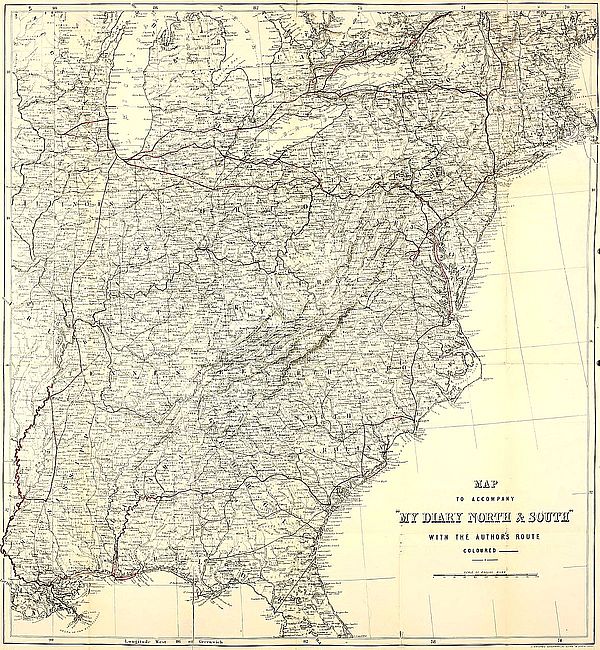
MAP TO ACCOMPANY “MY DIARY NORTH & SOUTH”
WITH THE AUTHOR’S ROUTE COLOURED
CHAPTER I. Departure from Cork
MY DIARY NORTH AND SOUTH.
Departure from Cork.—The Atlantic in March—Fellow-passengers—American
politics and parties—The Irish in New York—Approach
to New York.
On the evening of 3rd March, 1861, I was transferred
from the little steam-tender, which plies between
Cork and the anchorage of the Cunard steamers at the
entrance of the harbour, to the deck of the good
steamship Arabia, Captain Stone; and at nightfall we
were breasting the long rolling waves of the Atlantic.
The voyage across the Atlantic has been done by so
many able hands, that it would be superfluous to describe
mine, though it is certain no one passage ever resembled
another, and no crew or set of passengers in one ship
were ever identical with those in any other. For thirteen
days the Atlantic followed its usual course in the month
of March, and was true to the traditions which affix to
it in that month the character of violence and moody
changes, from bad to worse and back again. The wind
was sometimes dead against us, and then the infelix
Arabia with iron energy set to work, storming great
Malakhofs of water, which rose above her like the side
of some sward-coated hill crested with snow-drifts; and
having gained the summit, and settled for an instant
among the hissing sea-horses, ran plunging headlong
down to the encounter of another wave, and thus went
battling on with heart of fire and breath of flame—igneus
est ollis vigor—hour after hour.
The traveller for pleasure had better avoid the Atlantic
in the month of March. The wind was sometimes
with us, and then the sensations of the
passengers and the conduct of the ship were pretty
much as they had been during the adverse breezes before,
varied by the performance of a very violent
“yawing” from side to side, and certain squashings of
the paddle-boxes into the yeasty waters, which now ran
a race with us and each other, as if bent on chasing us
down, and rolling their boarding parties with foaming
crests down on our decks. The boss, which we represented
in the stormy shield around us, still moved on;
day by day our microcosm shifted its position in the
ever-advancing circle of which it was the centre, with
all around and within it ever undergoing a sea change.
The Americans on board were, of course, the most
interesting passengers to one like myself, who was
going out to visit the great Republic under very peculiar
circumstances. There was, first, Major Garnett, a
Virginian, who was going back to his State to follow
her fortunes. He was an officer of the regular army
of the United States, who had served with distinction
in Mexico; an accomplished, well-read man; reserved,
and rather gloomy; full of the doctrine of States’ Rights,
and animated with a considerable feeling of contempt
for the New Englanders, and with the strongest prejudices
in favour of the institution of slavery. He laughed
to scorn the doctrine that all men are born equal in the
sense of all men having equal rights. Some were born
to be slaves—some to be labourers in the lower strata
above the slaves—others to follow useful mechanical
arts—the rest were born to rule and to own their
fellow-men. There was next a young Carolinian, who
had left his post as attaché at St. Petersburgh to return
to his State: thus, in all probability, avoiding the
inevitable supercession which awaited him at the hands
of the new Government at Washington. He represented,
in an intensified form, all the Virginian’s
opinions, and held that Mr. Calhoun’s interpretation
of the Constitution was incontrovertibly right. There
were difficulties in the way of State sovereignty, he
confessed; but they were only in detail—the principle
was unassailable.
To Mr. Mitchell, South Carolina represented a power
quite sufficient to meet all the Northern States in arms.
“The North will attempt to blockade our coast,” said he;
“and in that case, the South must march to the attack
by land, and will probably act in Virginia.” “But if the
North attempts to do more than institute a blockade?—for
instance, if their fleet attack your seaport towns, and
land men to occupy them?” “Oh, in that case, we are
quite certain of beating them.” Mr. Julian Mitchell
was indignant at the idea of submitting to the rule
of a “rail-splitter,” and of such men as Seward and
Cameron. “No gentleman could tolerate such a
Government.”
An American family from Nashville, consisting of a
lady and her son and daughter, were warm advocates of
a “gentlemanly” government, and derided the Yankees
with great bitterness. But they were by no means
as ready to encounter the evils of war, or to break up
the Union, as the South Carolinian or the Virginian;
and in that respect they represented, I was told, the
negative feelings of the Border States, which are disposed
to a temporising, moderate course of action, most
distasteful to the passionate seceders.
There were also two Louisiana sugar-planters on
board—one owning 500 slaves, the other rich in some
thousands of acres; they seemed to care very little
for the political aspects of the question of Secession,
and regarded it merely in reference to its bearing on
the sugar crop, and the security of slave property.
Secession was regarded by them as a very extreme and
violent measure, to which the State had resorted with
reluctance; but it was obvious, at the same time, that,
in event of a general secession of the Slave States from
the North, Louisiana could neither have maintained her
connection with the North, nor have stood in isolation
from her sister States.
All these, and some others who were fellow-passengers,
might be termed Americans—pur sang. Garnett
belonged to a very old family in Virginia. Mitchell
came from a stock of several generations’ residence in
South Carolina. The Tennessee family were, in speech
and thought, types of what Europeans consider true
Americans to be. Now take the other side. First there
was an exceedingly intelligent, well-informed young
merchant of New York—nephew of an English county
Member, known for his wealth, liberality, and munificence.
Educated at a university in the Northern
States, he had lived a good deal in England, and was
returning to his father from a course of book-keeping
in the house of his uncle’s firm in Liverpool. His
father and uncle were born near Coleraine, and he had
just been to see the humble dwelling, close to the Giant’s
Causeway, which sheltered their youth, and where their
race was cradled. In the war of 1812, the brothers
were about sailing in a privateer fitted out to prey
against the British, when accident fixed one of them
in Liverpool, where he founded the house which has
grown so greatly with the development of trade between
New York and Lancashire, whilst the other settled in
the States. Without being violent in tone, the young
Northerner was very resolute in temper, and determined
to do all which lay in his power to prevent the “glorious
Union” being broken up.
The “Union” has thus founded on two continents a
family of princely wealth, whose originals had probably
fought with bitterness in their early youth against the
union of Great Britain and Ireland. But did Mr. Brown,
or the other Americans who shared his views, unreservedly
approve of American institutions, and consider
them faultless? By no means. The New Yorkers especially
were eloquent on the evils of the suffrage, and of
the licence of the Press in their own city; and displayed
much irritation on the subject of naturalisation. The
Irish were useful, in their way, making roads and
working hard, for there were few Americans who condescended
to manual labour, or who could not make far
more money in higher kinds of work; but it was absurd
to give the Irish votes which they used to destroy the
influence of native-born citizens, and to sustain a corporation
and local bodies of unsurpassable turpitude,
corruption, and inefficiency.
Another young merchant, a college friend of the
former, was just returning from a tour in Europe with
his amiable sister. His father was the son of an Irish
immigrant, but he did not at all differ from the
other gentlemen of his city in the estimate in which
he held the Irish element; and though he had no
strong bias one way or other, he was quite resolved to
support the abstraction called the Union, and its representative
fact—the Federal Government. Thus the
agriculturist and the trader—the grower of raw produce
and the merchant who dealt in it—were at opposite
sides of the question—wide apart as the Northern and
Southern Poles. They sat apart, ate apart, talked
apart—two distinct nations, with intense antipathies on
the part of the South, which was active and aggressive
in all its demonstrations.
The Southerners have got a strange charge de plus
against the Irish. It appears that the regular army
of the United States is mainly composed of Irish and
Germans; very few Americans indeed being low enough,
or martially disposed enough, to “take the shilling.”
In case of a conflict, which these gentlemen think
inevitable, “low Irish mercenaries would,” they say,
“be pitted against the gentlemen of the South, and the
best blood in the States would be spilled by fellows
whose lives are worth nothing whatever.” Poor
Paddy is regarded as a mere working machine, fit, at
best, to serve against Choctaws and Seminoles. His
facility of reproduction has to compensate for the waste
which is caused by the development in his unhappy
head of the organs of combativeness and destructiveness.
Certainly, if the war is to be carried on by the
United States’ regulars, the Southern States will soon
dispose of them, for they do not number 20,000 men,
and their officers are not much in love with the new
Government. But can it come to War? Mr. Mitchell
assures me I shall see some “pretty tall fighting.”
The most vehement Northerners in the steamer are
Germans, who are going to the States for the first time,
or returning there. They have become satisfied, no
doubt, by long process of reasoning, that there is some
anomaly in the condition of a country which calls itself
the land of liberty, and is at the same time the potent
palladium of serfdom and human chattelry. When
they are not sea-sick, which is seldom, the Teutons
rise up in all the might of their misery and dirt,
and, making spasmodic efforts to smoke, blurt out
between the puffs, or in moody intervals, sundry
remarks on American politics. “These are the swine,”
quoth Garnett, “who are swept out of German gutters
as too foul for them, and who come over to the States
and presume to control the fate and the wishes of our
people. In their own country they proved they were
incapable of either earning a living, or exercising the
duties of citizenship; and they seek in our country a
licence denied them in their own, and the means of
living which they could not acquire anywhere else.”
And for myself I may truly say this, that no man ever
set foot on the soil of the United States with a stronger
and sincerer desire to ascertain and to tell the truth,
as it appeared to him. I had no theories to uphold, no
prejudices to subserve, no interests to advance, no
instructions to fulfil; I was a free agent, bound to
communicate to the powerful organ of public opinion
I represented, my own daily impressions of the men,
scenes, and actions around me, without fear, favour,
or affection of or for anything but that which seemed
to me to be the truth. As to the questions which
were distracting the States, my mind was a tabula rasa,
or, rather, tabula non scripta. I felt indisposed to view
with favour a rebellion against one of the established
and recognised governments of the world, which, though
not friendly to Great Britain, nor opposed to slavery,
was without, so far as I could see, any legitimate cause
of revolt, or any injury or grievance, perpetrated or imminent,
assailed by States still less friendly to us, which
the slave States, pure and simple, certainly were and
probably are. At the same time, I knew that these
were grounds which I could justly take, whilst they
would not be tenable by an American, who is by the
theory on which he revolted from us and created his own
system of government, bound to recognise the principle
that the discontent of the popular majority with its
rulers, is ample ground and justification for revolution.
It was on the morning of the fourteenth day that
the shores of New York loomed through the drift of a
cold wintry sea, leaden-grey and comfortless, and in a
little time more the coast, covered with snow, rose in
sight. Towards the afternoon the sun came out and
brightened the waters and the sails of the pretty
trim schooners and coasters which were dancing
around us. How different the graceful, tautly-rigged,
clean, white-sailed vessels from the round-sterned,
lumpish billyboys and nondescripts of the eastern
coast of our isle! Presently there came bowling
down towards us a lively little schooner-yacht, very
like the once famed “America,” brightly painted in
green, sails dazzling white, lofty ponderous masts, no
tops. As she came nearer, we saw she was crowded
with men in chimney-pot black hats, and coats, and the
like—perhaps a party of citizens on pleasure, cold as
the day was. Nothing of the kind. The craft was our
pilot-boat, and the hats and coats belonged to the
hardy mariners who act as guides to the port of
New York. Their boat was lowered, and was soon
under our mainchains; and a chimney-pot hat having
duly come over the side, delivered a mass of newspapers
to the captain, which were distributed among
the eager passengers, when each at once became the
centre of a spell-bound circle.
CHAPTER II. Arrival at New York
Arrival at New York—Custom-house—General impressions as to North
and South—Street in New York—Hotel—Breakfast—American
women and men—Visit to Mr. Bancroft—Street-railways.
The entrance to New York, as it was seen by us
on 16th March, is not remarkable for beauty or picturesque
scenery, and I incurred the ire of several
passengers, because I could not consistently say it was
very pretty. It was difficult to distinguish through
the snow the villas and country houses, which are said
to be so charming in summer. But beyond these
rose a forest of masts close by a low shore of brick
houses and blue roofs, above the level of which again
spires of churches and domes and cupolas announced
a great city. On our left, at the narrowest part
of the entrance, there was a very powerful case-mated
work of fine close stone, in three tiers, something
like Fort Paul at Sebastopol, built close to the
water’s edge, and armed on all the faces—apparently
a tetragon with bastions. Extensive works were going
on at the ground above it, which rises rapidly from the
water to a height of more than a hundred feet, and
the rudiments of an extensive work and heavily armed
earthen parapets could be seen from the channel.
On the right hand, crossing its fire with that of the
batteries and works on our left, there was another
regular stone fort with fortified enceinte, and higher up
the channel, as it widens to the city on the same
side, I could make out a smaller fort on the water’s
edge. The situation of the city renders it susceptible
of powerful defence from the sea-side, and even now it
would be hazardous to run the gauntlet of the batteries
unless in powerful iron-clad ships favoured by wind
and tide, which could hold the place at their mercy.
Against a wooden fleet New York is now all but secure,
save under exceptional circumstances in favour of the
assailants.
It was dark as the steamer hauled up alongside the
wharf on the New Jersey side of the river; but ere
the sun set I could form some idea of the activity
and industry of the people from the enormous ferry-boats
moving backwards and forwards like arks on the
water, impelled by the great walking-beam engines,
the crowded stream full of merchantmen, steamers,
and small craft, the smoke of the factories, the tall
chimneys—the net-work of boats and rafts—all the
evidences of commercial life in full development.
What a swarming, eager crowd on the quay-wall!
what a wonderful ragged regiment of labourers and
porters, hailing us in broken or Hibernianized English!
“These are all Irish and Germans,” anxiously explained
a New Yorker. “I’ll bet fifty dollars there’s not a
native-born American among them.”
With Anglo-Saxon disregard of official insignia,
American Custom House officers dress very much like
their British brethren, without any sign of authority as
faint as even the brass button and crown, so that the
stranger is somewhat uneasy when he sees unauthorised-looking
people taking liberties with his plunder, especially
after the admonitions he has received on board
ship to look sharp about his things as soon as he lands. I
was provided with an introduction to one of the principal
officers, and he facilitated my egress, and at
last I was bundled out through a gate into a dark alley,
ankle deep in melted snow and mud, where I was at
once engaged in a brisk encounter with my Irish porter-hood,
and, after a long struggle, succeeded in stowing
my effects in and about a remarkable specimen of the
hackney-coach of the last century, very high in the
axle, and weak in the springs, which plashed down
towards the river through a crowd of men shouting
out, “You haven’t paid me yet, yer honour. You
haven’t given anything to your own man that’s been
waiting here the last six months for your honour!”
“I’m the man that put the lugidge up, sir,” &c.,
&c. The coach darted on board a great steam
ferry-boat, which had on deck a number of similar
vehicles, and omnibuses, and the gliding, shifting
lights, and the deep, strong breathing of the engine,
told me I was moving and afloat before I was otherwise
aware of it. A few minutes brought us over to
the lights on the New York side—a jerk or two up a
steep incline—and we were rattling over a most
abominable pavement, plunging into mud-holes,
squashing through snow-heaps in ill-lighted, narrow
streets of low, mean-looking, wooden houses, of which
an unusual proportion appeared to be lager-bier
saloons, whisky-shops, oyster-houses, and billiard and
smoking establishments.
The crowd on the pavement were very much what a
stranger would be likely to see in a very bad part of
London, Antwerp, or Hamburg, with a dash of the
noisy exuberance which proceeds from the high animal
spirits that defy police regulations and are superior to
police force, called “rowdyism.” The drive was long
and tortuous; but by degrees the character of the
thoroughfares and streets improved. At last we turned
into a wide street with very tall houses, alternating
with far humbler erections, blazing with lights, gay
with shop-windows, thronged in spite of the mud with
well-dressed people, and pervaded by strings of omnibuses—Oxford
Street was nothing to it for length.
At intervals there towered up a block of brickwork
and stucco with long rows of windows lighted up tier
above tier, and a swarming crowd passing in and out
of the portals, which were recognised as the barrack-like
glory of American civilisation—a Broadway
monster hotel. More oyster-shops, lager-bier saloons,
concert-rooms of astounding denominations, with
external decorations very much in the style of the
booths at Bartholomew Fair—churches, restaurants,
confectioners, private-houses! again another series—they
cannot go on expanding for ever. The coach at
last drives into a large square, and lands me at the
Clarendon Hotel.
Whilst I was crossing the sea, the President’s Inaugural
Message, the composition of which is generally
attributed to Mr. Seward, had been delivered, and had
reached Europe, and the causes which were at work in
destroying the cohesion of the Union, had acquired
greater strength and violence.
Whatever force “the declaration of causes which
induced the Secession of South Carolina” might have
for Carolinians, it could not influence a foreigner who
knew nothing at all of the rights, sovereignty, and
individual independence of a state, which, however,
had no right to make war or peace, to coin money, or
enter into treaty obligations with any other country.
The South Carolinian was nothing to us, quoad South
Carolina—he was merely a citizen of the United
States, and we knew no more of him in any other
capacity than a French authority would know of a
British subject as a Yorkshireman or a Munsterman.
But the moving force of revolution is neither reason
nor justice—it is most frequently passion—it is often
interest. The American, when he seeks to prove that
the Southern States have no right to revolt from a confederacy
of states created by revolt, has by the principles
on which he justifies his own revolution, placed between
himself and the European a great gulf in the level of
argument. According to the deeds and words of Americans,
it is difficult to see why South Carolina should not
use the rights claimed for each of the thirteen colonies,
“to alter and abolish a form of government when it
becomes destructive of the ends for which it is established,
and to institute a new one.” And the people
must be left to decide the question as regards their own
government for themselves, or the principle is worthless.
The arguments, however, which are now going
on are fast tending towards the ultima ratio regum.
At present I find public attention is concentrated on
the two Federal forts, Pickens and Sumter, called
after two officers of the revolutionary armies in the
old war. As Alabama and South Carolina have gone
out, they now demand the possession of these forts,
as of the soil of their several states and attached to their
sovereignty. On the other hand, the Government of
Mr. Lincoln considers it has no right to give up
any thing belonging to the Federal Government,
but evidently desires to temporize and evade any
decision which might precipitate an attack on the
forts by the batteries and forces prepared to act
against them. There is not sufficient garrison in
either for an adequate defence, and the difficulty
of procuring supplies is very great. Under the circumstances
every one is asking what the Government
is going to do? The Southern people have
declared they will resist any attempt to supply or
reinforce the garrisons, and in Charleston, at least,
have shown they mean to keep their word. It is a
strange situation. The Federal Government, afraid to
speak, and unable to act, is leaving its soldiers to do
as they please. In some instances, officers of rank, such
as General Twiggs, have surrendered everything to
the State authorities, and the treachery and secession
of many officers in the army and navy no doubt paralyze
and intimidate the civilians at the head of affairs.
Sunday, 17th March.—The first thing I saw this
morning, after a vision of a waiter pretending to brush
my clothes with a feeble twitch composed of fine fibre
had vanished, was a procession of men, forty or fifty
perhaps, preceded by a small band (by no excess of compliment
can I say, of music), trudging through the cold
and slush two and two: they wore shamrocks, or the
best resemblance thereto which the American soil can
produce, in their hats, and green silk sashes emblazoned
with crownless harp upon their coats, but it needed
not these insignia to tell they were Irishmen, and their
solemn mien indicated that they were going to mass.
It was agreeable to see them so well-clad and respectable-looking,
though occasional hats seemed as if they had
just recovered from severe contusions, and others had
the picturesque irregularity of outline now and then
observable in the old country. The aspect of the
street was irregular, and its abnormal look was
increased by the air of the passers-by, who at that
hour were domestics—very finely dressed negroes,
Irish, or German. The coloured ladies made most
elaborate toilettes, and as they held up their broad
crinolines over the mud looked not unlike double-stemmed
mushrooms. “They’re concayted poor
craythures them niggirs, male and faymale,” was the
remark of the waiter as he saw me watching them.
“There seem to be no sparrows in the streets,” said I.
“Sparras!” he exclaimed; “and then how did you
think a little baste of a sparra could fly across the
ochean?” I felt rather ashamed of myself.
And so down-stairs where there was a table d’hôte
room, with great long tables covered with cloths, plates,
and breakfast apparatus, and a smaller room inside, to
which I was directed by one of the white-jacketted
waiters. Breakfast over, visitors began to drop in.
At the “office” of the hotel, as it is styled, there is a
tray of blank cards and a big pencil, whereby the cardless
man who is visiting is enabled to send you his name
and title. There is a comfortable “reception-room,”
in which he can remain and read the papers, if you are
engaged, so that there is little chance of your ultimately
escaping him. And, indeed, not one of those
who came had any but most hospitable intents.
Out of doors the weather was not tempting. The snow
lay in irregular layers and discoloured mounds along
the streets, and the gutters gorged with “snow-bree”
flooded the broken pavement. But after a time the
crowds began to issue from the churches, and it was
announced as the necessity of the day, that we were to
walk up and down the Fifth Avenue and look at each
other. This is the west-end of London—its Belgravia
and Grosvenoria represented in one long street,
with offshoots of inferior dignity at right angles to
it. Some of the houses are handsome, but the
greater number have a compressed, squeezed-up aspect,
which arises from the compulsory narrowness of
frontage in proportion to the height of the building,
and all of them are bright and new, as if they were
just finished to order,—a most astonishing proof of
the rapid development of the city. As the hall-door is
made an important feature in the residence, the front
parlour is generally a narrow, lanky apartment, struggling
for existence between the hall and the partition
of the next house. The outer door, which is always
provided with fine carved panels and mouldings, is of
some rich varnished wood, and looks much better than
our painted doors. It is generously thrown open so as
to show an inner door with curtains and plate glass.
The windows, which are double on account of the
climate, are frequently of plate glass also. Some of the
doors are on the same level as the street, with a basement
story beneath; others are approached by flights
of steps, the basement for servants having the entrance
below the steps, and this, I believe, is the old Dutch
fashion, and the name of “stoop” is still retained for it.
No liveried servants are to be seen about the streets,
the doorways, or the area-steps. Black faces in gaudy
caps, or an unmistakeable “Biddy” in crinoline are
their substitutes. The chief charm of the street was
the living ornature which moved up and down the
trottoirs. The costumes of Paris, adapted to the severity
of this wintry weather, were draped round pretty,
graceful figures which, if wanting somewhat in that
rounded fulness of the Medicean Venus, or in height,
were svelte and well poised. The French boot has
been driven off the field by the Balmoral, better
suited to the snow; and one must at once admit—all
prejudices notwithstanding—that the American
woman is not only well shod and well gloved, but
that she has no reason to fear comparisons in foot
or hand with any daughter of Eve, except, perhaps,
the Hindoo.
The great and most frequent fault of the stranger
in any land is that of generalising from a few facts.
Every one must feel there are “pretty days” and
“ugly days” in the world, and that his experience on
the one would lead him to conclusions very different
from that to which he would arrive on the other. To-day
I am quite satisfied that if the American women
are deficient in stature and in that which makes us say,
“There is a fine woman,” they are easy, well formed,
and full of grace and prettiness. Admitting a certain
pallor—which the Russians, by-the-bye, were wont to
admire so much that they took vinegar to produce it—the
face is not only pretty, but sometimes of extraordinary
beauty, the features fine, delicate, well defined.
Ruby lips, indeed, are seldom to be seen, but now and
then the flashing of snowy-white evenly-set ivory teeth
dispels the delusion that the Americans are—though
the excellence of their dentists be granted—naturally
ill provided with what they take so much pains, by
eating bon-bons and confectionery, to deprive of their
purity and colour.
My friend R——, with whom I was walking, knew
every one in the Fifth Avenue, and we worked our
way through a succession of small talk nearly as far
as the end of the street which runs out among divers
places in the State of New York, through a débris
of unfinished conceptions in masonry. The abrupt transition
of the city into the country is not unfavourable to
an idea that the Fifth Avenue might have been transported
from some great workshop, where it had been
built to order by a despot, and dropped among the Red
men: indeed, the immense growth of New York in
this direction, although far inferior to that of many
parts of London, is remarkable as the work of
eighteen or twenty years, and is rendered more conspicuous
by being developed in this elongated street,
and its contingents. I was introduced to many persons
to-day, and was only once or twice asked how I
liked New York; perhaps I anticipated the question
by expressing my high opinion of the Fifth Avenue.
Those to whom I spoke had generally something to
say in reference to the troubled condition of the country,
but it was principally of a self-complacent nature.
“I suppose, sir, you are rather surprised, coming
from Europe, to find us so quiet here in New York: we
are a peculiar people, and you don’t understand us
in Europe.”
In the afternoon I called on Mr. Bancroft, formerly
minister to England, whose work on America must be
rather rudely interrupted by this crisis. Anything with
an “ex” to it in America is of little weight—ex-presidents
are nobodies, though they have had the advantage,
during their four years’ tenure of office, of being
prayed for as long as they live. So it is of ex-ministers,
whom nobody prays for at all. Mr. Bancroft conversed
for some time on the aspect of affairs, but he appeared
to be unable to arrive at any settled conclusion, except
that the republic, though in danger, was the most stable
and beneficial form of government in the world, and
that as a Government it had no power to coerce the
people of the South or to save itself from the danger.
I was indeed astonished to hear from him and others
so much philosophical abstract reasoning as to the
right of seceding, or, what is next to it, the want of
any power in the Government to prevent it.
Returning home in order to dress for dinner, I
got into a street-railway-car, a long low omnibus drawn
by horses over a strada ferrata in the middle of the
street. It was filled with people of all classes, and at
every crossing some one or other rang the bell, and the
driver stopped to let out or to take in passengers,
whereby the unoffending traveller became possessed of
much snow-droppings and mud on boots and clothing.
I found that by far a greater inconvenience caused by
these street-railways was the destruction of all comfort
or rapidity in ordinary carriages.
I dined with a New York banker, who gave such a
dinner as bankers generally give all over the world.
He is a man still young, very kindly, hospitable, well-informed,
with a most charming household—an American
by theory, an Englishman in instincts and tastes—educated
in Europe, and sprung from British stock.
Considering the enormous interests he has at stake, I
was astonished to perceive how calmly he spoke of the
impending troubles. His friends, all men of position
in New York society, had the same dilettante tone,
and were as little anxious for the future, or excited by
the present, as a party of
savants chronicling the movements
of a “magnetic storm.”
On going back to the hotel, I heard that Judge Daly
and some gentlemen had called to request that I
would dine with the Friendly Society of St. Patrick
to-morrow at Astor House. In what is called “the
bar,” I met several gentlemen, one of whom said,
“the majority of the people of New York, and all the
respectable people, were disgusted at the election of
such a fellow as Lincoln to be President, and would
back the Southern States, if it came to a split.”
CHAPTER III. St. Patrick’s day
“St. Patrick’s day” in New York—Public dinner—American Constitution—General
topics of conversation—Public estimate of the
Government—Evening party at Mons. B——’s.
Monday, 18th.—“St. Patrick’s day in the morning”
being on the 17th, was kept by the Irish to-day. In
the early morning the sounds of drumming, fifing, and
bugling came with the hot water and my Irish attendant
into the room. He told me: “We’ll have a pretty
nice day for it. The weather’s often agin us on St.
Patrick’s day.” At the angle of the square outside I
saw a company of volunteers assembling. They wore
bear-skin caps, some turned brown, and rusty green
coatees, with white facings and cross-belts, a good deal
of gold-lace and heavy worsted epaulettes, and were
armed with ordinary muskets, some of them with flintlocks.
Over their heads floated a green and gold flag
with mystic emblems, and a harp and sunbeams. A
gentleman, with an imperfect seat on horseback, which
justified a suspicion that he was not to the manner
born of Squire or Squireen, with much difficulty was
getting them into line, and endangering his personal
safety by a large infantry-sword, the hilt of which was
complicated with the bridle of his charger in some
inexplicable manner. This gentleman was the officer
in command of the martial body, who were gathering
to do honour to the festival of the old country, and the
din and clamour in the streets, the strains of music,
and the tramp of feet outside announced that similar
associations were on their way to the rendezvous. The
waiters in the hotel, all of whom were Irish, had on
their best, and wore an air of pleased importance.
Many of their countrymen outside on the pavement
exhibited very large decorations, plates of
metal, and badges attached to broad ribands over
their left breasts.
After breakfast I struggled with a friend through
the crowd which thronged Union Square. Bless them!
They were all Irish, judging from speech, and gesture,
and look; for the most part decently dressed, and comfortable,
evidently bent on enjoying the day in spite of
the cold, and proud of the privilege of interrupting all
the trade of the principal streets, in which the Yankees
most do congregate, for the day. They were on the
door-steps, and on the pavement men, women, and
children, admiring the big policemen—many of them
compatriots—and they swarmed at the corners, cheering
popular town-councillors or local celebrities. Broadway
was equally full. Flags were flying from the
windows and steeples—and on the cold breeze came
the hammering of drums, and the blasts of many wind
instruments. The display, such as it was, partook of
a military character, though not much more formidable
in that sense than the march of the Trades Unions, or
of Temperance Societies. Imagine Broadway lined
for the long miles of its course by spectators mostly
Hibernian, and the great gaudy stars and stripes, or
as one of the Secession journals I see styles it, the
“Sanguinary United States Gridiron”—waving in all
directions, whilst up its centre in the mud march the
children of Erin.
First came the acting Brigadier-General and his
staff, escorted by 40 lancers, very ill-dressed, and
worse mounted; horses dirty, accoutrements in the
same condition, bits, bridles, and buttons rusty and
tarnished; uniforms ill-fitting, and badly put on. But
the red flags and the show pleased the crowd, and
they cheered “bould Nugent” right loudly. A band
followed, some members of which had been evidently
“smiling” with each other; and next marched a body
of drummers in military uniform, rattling away in
the French fashion. Here comes the 69th N. Y. State
Militia Regiment—the battalion which would not turn
out when the Prince of Wales was in New York,
and whose Colonel, Corcoran, is still under court
martial for his refusal. Well, the Prince had no loss,
and the Colonel may have had other besides political
reasons for his dislike to parade his men.
The regiment turned out, I should think, only 200
or 220 men, fine fellows enough, but not in the least like
soldiers or militia. The United States uniform which
most of the military bodies wore, consists of a blue
tunic and trousers, and a kepi-like cap, with “U. S.”
in front for undress. In full dress the officers wear
large gold epaulettes, and officers and men a bandit-sort
of felt hat looped up at one side, and decorated with
a plume of black-ostrich feathers and silk cords. The
absence of facings, and the want of something to finish
off the collar and cuffs, render the tunic very bald and
unsightly. Another band closed the rear of the 69th,
and to eke out the military show, which in all was less
than 1,200 men, some companies were borrowed from
another regiment of State Militia, and a troop of
very poor cavalry cleared the way for the Napper-Tandy
Artillery, which actually had three whole guns
with them! It was strange to dwell on some of the
names of the societies which followed. For instance,
there were the “Dungannon Volunteers of ’82,” prepared
of course to vindicate the famous declaration
that none should make laws for Ireland, but the
Queen, Lords, and Commons of Ireland! Every honest
Catholic among them ignorant of the fact that the
Volunteers of ’82 were all Protestants. Then there was
the “Sarsfield Guard!” One cannot conceive anything
more hateful to the fiery high-spirited cavalier, than
the republican form of Government, which these poor
Irishmen are, they think, so fond of. A good deal of
what passes for national sentiment, is in reality dislike
to England and religious animosity.
It was much more interesting to see the long string
of Benevolent, Friendly and Provident Societies,
with bands, numbering many thousands, all decently
clad, and marching in order with banners, insignia,
badges and ribands, and the Irish flag flying alongside
the “stars and stripes.” I cannot congratulate
them on the taste or good effect of their accessories—on
their symbolical standards, and ridiculous old
harpers, carried on stages in “bardic costume,” very
like artificial white wigs and white cotton dressing-gowns,
but the actual good done by these societies,
is, I am told, very great, and their charity would
cover far greater sins than incorrectness of dress,
and a proneness to “piper’s playing on the national
bagpipes.” The various societies mustered upwards
of 10,000 men, some of them uniformed and armed,
others dressed in quaint garments, and all as noisy
as music and talking could make them. The Americans
appeared to regard the whole thing very much
as an ancient Roman might have looked on the
Saturnalia; but Paddy was in the ascendant, and
could not be openly trifled with.
The crowds remained in the streets long after the
procession had passed, and I saw various pickpockets
captured by the big policemen, and conveyed to appropriate
receptacles. “Was there any man of eminence
in that procession,” I asked. “No; a few small local
politicians, some wealthy store-keepers, and beer-saloon
owners perhaps; but the mass were of the small
bourgeoisie. Such a man as Mr. O’Conor, who may
be considered at the head of the New York bar for
instance, would not take part in it.”
In the evening I went, according to invitation,
to the Astor House—a large hotel, with a front like
a railway terminus, in the Americo-Classical style,
with great Doric columns and portico, and found, to
my surprise, that the friendly party was to be a great
public dinner. The halls were filled with the company,
few or none in evening dress; and in a few
minutes I was presented to at least twenty-four gentlemen,
whose names I did not even hear. The use
of badges, medals, and ribands, might, at first, lead
a stranger to believe he was in very distinguished
military society; but he would soon learn that these
insignia were the decorations of benevolent or convivial
associations. There is a latent taste for these things in
spite of pure republicanism. At the dinner there were
Americans of Dutch and English descent, some “Yankees,”
one or two Englishmen, Scotchmen,
and Welshmen.
The chairman, Judge Daly, was indeed a true son
of the soil, and his speeches were full of good humour,
fluency, and wit; but his greatest effect was produced
by the exhibition of a tuft of shamrocks in a flower pot,
which had been sent from Ireland for the occasion.
This is done annually, but, like the miracle of St.
Januarius, it never loses its effect, and always touches
the heart.
I confess it was to some extent curiosity to observe
the sentiment of the meeting, and a desire to see how
Irishmen were affected by the change in their climate,
which led me to the room. I came away regretting
deeply that so many natives of the British Isles should
be animated with a hostile feeling towards England,
and that no statesman has yet arisen who can
devise a panacea for the evils of these passionate and
unmeaning differences between races and religions.
Their strong antipathy is not diminished by the
impossibility of gratifying it. They live in hope,
and certainly the existence of these feelings is not
only troublesome to American statesmen, but mischievous
to the Irish themselves, inasmuch as they
are rendered with unusual readiness the victims of
agitators or political intriguers. The Irish element, as
it is called, is much regarded in voting times, by
suffraging bishops and others; at other times, it is
left to its work and its toil—Mr. Seward and Bishop
Hughes are supposed to be its present masters. Undoubtedly
the mass of those I saw to-day were better
clad than they would have been if they remained at
home. As I said in the speech which I was forced to
make much against my will, by the gentle violence of
my companions, never had I seen so many good hats
and coats in an assemblage of Irishmen in any other
part of the world.
March 19. The morning newspapers contain reports
of last night’s speeches which are amusing in one
respect, at all events, as affording specimens of the
different versions which may be given of the same
matter. A “citizen” who was kind enough to come
in to shave me, paid me some easy compliments,
in the manner of the “Barber of Seville,” on
what he termed the “oration” of the night before,
and then proceeded to give his notions of the merits
and defects of the American Constitution. “He did
not care much about the Franchise—it was given
to too many he thought. A man must be five years
resident in New York before he is admitted to the
privileges of voting. When an emigrant arrived, a
paper was delivered to him to certify the fact, which
he produced after a lapse of five years, when he might
be registered as a voter; if he omitted the process of
registration, he could however vote if identified by two
householders, and a low lot,” observed the barber,
“they are—Irish and such like. I don’t want any of
their votes.”
In the afternoon a number of gentlemen called,
and made the kindest offers of service; letters of introduction
to all parts of the States; facilities of every
description—all tendered with frankness.
I was astonished to find little sympathy and no respect
for the newly installed Government. They were
regarded as obscure or undistinguished men. I alluded
to the circumstance that one of the journals continued
to speak of “The President” in the most contemptuous
manner, and to designate him as the great “Rail-Splitter.”
“Oh yes,” said the gentleman with whom
I was conversing, “that must strike you as a strange
way of mentioning the Chief Magistrate of our great
Republic, but the fact is, no one minds what the
man writes of any one, his game is to abuse every
respectable man in the country in order to take his
revenge on them for his social exclusion, and at the
same time to please the ignorant masses who delight
in vituperation and scandal.”
In the evening, dining again with my friend the
banker, I had a favourable opportunity of hearing
more of the special pleading which is brought to bear
on the solution of the gravest political questions. It
would seem as if a council of physicians were wrangling
with each other over abstract dogmas respecting
life and health, whilst their patient was struggling in
the agonies of death before them! In the comfortable
and well-appointed house wherein I met several men
of position, acquirements, and natural sagacity, there
was not the smallest evidence of uneasiness on account
of circumstances which, to the eye of a stranger,
betokened an awful crisis, if not the impending dissolution
of society itself. Stranger still, the acts which
are bringing about such a calamity are not regarded
with disfavour, or, at least, are not considered unjustifiable.
Among the guests were the Hon. Horatio Seymour,
a former Governor of the State of New York; Mr.
Tylden, an acute lawyer; and Mr. Bancroft; the result
left on my mind by their conversation and arguments
was that, according to the Constitution, the Government
could not employ force to prevent secession, or to
compel States which had seceded by the will of the
people to acknowledge the Federal power. In fact,
according to them, the Federal Government was the
mere machine put forward by a Society of Sovereign
States, as a common instrument for certain ministerial
acts, more particularly those which affected the
external relations of the Confederation. I do not
think that any of the guests sought to turn the channel
of talk upon politics, but the occasion offered itself to
Mr. Horatio Seymour to give me his views of the Constitution
of the United States, and by degrees the
theme spread over the table. I had bought the “Constitution”
for three cents in Broadway in the forenoon,
and had read it carefully, but I could not
find that it was self-expounding; it referred itself
to the Supreme Court, but what was to support the
Supreme Court in a contest with armed power, either
of Government or people? There was not a man
who maintained the Government had any power to
coerce the people of a State, or to force a State to
remain in the Union, or under the action of the Federal
Government; in other words, the symbol of power at
Washington is not at all analogous to that which
represents an established Government in other countries.
Quid prosunt leges sine armis? Although
they admitted the Southern leaders had meditated
“the treason against the Union” years ago, they could
not bring themselves to allow their old opponents, the
Republicans now in power, to dispose of the armed
force of the Union against their brother democrats in
the Southern States.
Mr. Seymour is a man of compromise, but his
views go farther than those which were entertained
by his party ten years ago. Although secession would
produce revolution, it was, nevertheless, “a right,”
founded on abstract principles, which could scarcely
be abrogated consistently with due regard to the
original compact. One of the company made a remark
which was true enough, I dare say. We were talking
of the difficulty of relieving Fort Sumter—an infallible
topic just now. “If the British or any foreign power
were threatening the fort,” said he, “our Government
would find means of relieving it fast enough.” In fact,
the Federal Government is groping in the dark; and
whilst its friends are telling it to advance boldly, there
are myriad voices shrieking out in its ears, “If you
put out a foot you are lost.” There is neither army
nor navy available, and the ministers have no machinery
of rewards, and means of intrigue, or modes of gaining
adherents known to European administrations. The
democrats behold with silent satisfaction the troubles
into which the republican triumph has plunged the
country, and are not at all disposed to extricate them.
The most notable way of impeding their efforts is to
knock them down with the “Constitution” every time
they rise to the surface and begin to swim out.
New York society, however, is easy in its mind just
now, and the upper world of millionaire merchants,
bankers, contractors, and great traders are glad that
the vulgar republicans are suffering for their success.
Not a man there but resented the influence given by
universal suffrage to the mob of the city, and complained
of the intolerable effects of their ascendancy—of
the corruption of the municipal bodies, the venality
of electors and elected, and the abuse, waste, and
profligate outlay of the public funds. Of these there
were many illustrations given to me, garnished with
historiettes of some of the civic dignitaries, and of their
coadjutors in the press; but it did not require proof
that universal suffrage in a city of which perhaps three-fourths
of the voters were born abroad or of foreign
parents, and of whom many were the scum swept off
the seethings of European populations, must work most
injuriously on property and capital. I confess it is to
be much wondered at that the consequences are not
more evil; but no doubt the time is coming when the
mischief can no longer be borne, and a social reform
and revolution must be inevitable.
Within only a very few hundreds of yards from the
house and picture-gallery of Mons. B——, the representative
of European millions, are the hovels and
lodgings of his equals in political power. This evening
I visited the house of Mons. B——, where his wife
had a reception, to which nearly the whole of the party
went. When a man looks at a suit of armour made to
order by the first blacksmith in Europe, he observes
that the finish of the joints and hinges is much higher
than in the old iron clothes of the former time. Possibly
the metal is better, and the chasings and garniture as
good as the work of Milan, but the observer is not for
a moment led to imagine that the fabric has stood proof
of blows, or that it smacks of ancient watch-fire. If he
were asked why it is so, he could not tell; any more perhaps
than he could define exactly the difference between
the lustrous, highly-jewelled, well-greaved Achaian of
New York and the very less effective and showy creature
who will in every society over the world pass
muster as a gentleman. Here was an elegant house—I
use the word in its real meaning—with pretty statues,
rich carpets, handsome furniture, and a gallery of
charming Meissoniers and genre pieces; the saloons
admirably lighted—a fair fine large suite, filled with
the prettiest women in the most delightful toilettes,
with a proper fringe of young men, orderly, neat, and
well turned-out, fretting against the usual advanced
posts of turbaned and jewelled dowagers, and provided
with
every accessory to make the whole good society;
for there was wit, sense, intelligence, vivacity; and yet
there was something wanting—not in host or hostess,
or company, or house—where was it?—which was conspicuous
by its absence. Mr. Bancroft was kind
enough to introduce me to the most lovely faces and
figures, and so far enabled me to judge that nothing
could be more beautiful, easy, or natural than the
womanhood or girlhood of New York. It is prettiness
rather than fineness; regular, intelligent, wax-like
faces, graceful little figures; none of the grandiose
Roman type which Von Raumer recognised in London,
as in the Holy City, a quarter of a century ago.
Natheless, the young men of New York ought to be
thankful and grateful, and try to be worthy of it. Late
in the evening I saw these same young men, Novi
Eboracenses, at their club, dicing for drinks and oathing
for nothing, and all very friendly and hospitable.
The club-house is remarkable as the mansion of a
happy man who invented or patented a waterproof hat-lining,
whereby he built a sort of Sallustian villa, with
a central court-yard, à l’Alhambra, with fountains and
flowers, now passed away to the New York Club.
Here was Pratt’s, or the defunct Fielding, or the old
C. C. C.’s in disregard of time and regard of drinks—and
nothing more.
CHAPTER IV. Streets and shops in New York
Streets and shops in New York—Literature—A funeral—Dinner at
Mr. H——’s—Dinner at Mr. Bancroft’s—Political and social
features—Literary breakfast; Heenan and Sayers.
March 20th.—The papers are still full of Sumter
and Pickens. The reports that they are or are not to
be relieved are stated and contradicted in each paper
without any regard to individual consistency. The “Tribune”
has an article on my speech at the St. Patrick’s
dinner, to which it is pleased to assign reasons and
motives which the speaker, at all events, never had in
making it.
Received several begging letters, some of them
apparently with only too much of the stamp of
reality about their tales of disappointment, distress,
and suffering. In the afternoon went down Broadway,
which was crowded, notwithstanding the piles of
blackened snow by the kerbstones, and the sloughs of
mud, and half frozen pools at the crossings. Visited
several large stores or shops—some rival the best
establishments in Paris or London in richness and in
value, and far exceed them in size and splendour of
exterior. Some on Broadway, built of marble, or of
fine cut stone, cost from 6000l. to 8000l. a year in
mere rent. Here, from the base to the fourth or
fifth story, are piled collections of all the world can
produce, often in excess of all possible requirements
of the country; indeed I was told that the United
States have always imported more goods than they
could pay for. Jewellers’ shops are not numerous,
but there are two in Broadway which have splendid
collections of jewels, and of workmanship in gold and
silver, displayed to the greatest advantage in fine
apartments decorated with black marble, statuary, and
plate glass.
New York has certainly all the air of a “nouveau
riche.” There is about it an utter absence of any
appearance of a grandfather—one does not see even
such evidences of eccentric taste as are afforded in
Paris and London, by the existence of shops where
the old families of a country cast off their “exuviæ”
which are sought by the new, that they may persuade
the world they are old; there is no curiosity
shop, not to speak of a Wardour Street, and such
efforts as are made to supply the deficiency reveal an
enormous amount of ignorance or of bad taste. The
new arts, however, flourish; the plague of photography
has spread through all the corners of the city,
and the shop-windows glare with flagrant displays of
the most tawdry art. In some of the large book-sellers’
shops—Appleton’s for example—are striking
proofs of the activity of the American press, if not of
the vigour and originality of the American intellect.
I passed down long rows of shelves laden with the
works of European authors, for the most part, oh
shame! stolen and translated into American type without
the smallest compunction or scruple, and without
the least intention of ever yielding the most pitiful
deodand to the authors. Mr. Appleton sells no less
than one million and a half of Webster’s spelling
books a year; his tables are covered with a flood
of pamphlets, some for, others against coercion;
some for, others opposed to slavery,—but when I
asked for a single solid, substantial work on the
present difficulty, I was told there was not one published
worth a cent. With such men as Audubon
and Wilson in natural history, Prescott and Motley in
history, Washington Irving and Cooper in fiction,
Longfellow and Edgar Poe in poetry, even Bryant and
the respectabilities in rhyme, and Emerson as essayist,
there is no reason why New York should be a paltry
imitation of Leipsig, without the good faith of Tauchnitz.
I dined with a litterateur well known in England
to many people a year or two ago—sprightly, loquacious,
and well-informed, if neither witty nor profound—now
a Southern man with Southern proclivities,
as Americans say; once a Southern man with such
strong anti-slavery convictions, that his expression of
them in an English quarterly had secured him the
hostility of his own people—one of the emanations of
American literary life for which their own country
finds no fitting receiver. As the best proof of his
sincerity, he has just now abandoned his connection
with one of the New York papers on the republican
side, because he believed that the course of the journal
was dictated by anti-Southern fanaticism. He is, in
fact, persuaded that there will be a civil war, and that
the South will have much of the right on its side in
the contest. At his rooms were Mons. B——, Dr.
Gwin, a Californian ex-senator, Mr. Barlow, and several
of the leading men of a certain clique in New York.
The Americans complain, or assert, that we do not
understand them, and I confess the reproach, or statement,
was felt to be well founded by myself at all
events, when I heard it declared and admitted that
“if Mons. Belmont had not gone to the Charleston
Convention, the present crisis would never have
occurred.”
March 22nd.—A snow-storm worthy of Moscow or
Riga flew through New York all day, depositing more
food for the mud. I paid a visit to Mr. Horace
Greeley, and had a long conversation with him. He
expressed great pleasure at the intelligence that I was
going to visit the Southern States. “Be sure you
examine the slave-pens. They will be afraid to refuse
you, and you can tell the truth.” As the capital and
the South form the chief attractions at present, I am
preparing to escape from “the divine calm” and snows
of New York. I was recommended to visit many places
before I left New York, principally hospitals and prisons.
Sing-Sing, the state penitentiary, is “claimed,” as the
Americans say, to be the first “institution” of its kind
in the world. Time presses, however, and Sing-Sing
is a long way off. I am told a system of torture prevails
there for hardened or
obdurate offenders—torture
by dropping cold water on them, torture by thumb-screws,
and the like—rather opposed to the views of
prison philanthropists in modern days.
March 23rd.—It is announced positively that the
authorities in Pensacola and Charleston have refused
to allow any further supplies to be sent to Fort Pickens,
the United States fleet in the Gulf, and to Fort Sumter.
Everywhere the Southern leaders are forcing on a
solution with decision and energy, whilst the Government
appears to be helplessly drifting with the current
of events, having neither bow nor stern, neither keel
nor deck, neither rudder, compass, sails, or steam.
Mr. Seward has declined to receive or hold any
intercourse with the three gentlemen called Southern
Commissioners, who repaired to Washington
accredited by the Government and Congress of the
Seceding States now sitting at Montgomery, so that
there is no channel of mediation or means of adjustment
left open. I hear, indeed, that Government is
secretly preparing what force it can to strengthen the
garrison at Pickens, and to reinforce Sumter at any
hazard; but that its want of men, ships, and money
compels it to temporise, lest the Southern authorities
should forestall their designs by a vigorous attack
on the enfeebled forts.
There is, in reality, very little done by New York
to support or encourage the Government in any decided
policy, and the journals are more engaged now
in abusing each other, and in small party aggressive
warfare, than in the performance of the duties of a
patriotic press, whose mission at such a time is beyond
all question the resignation of little differences for
the sake of the whole country, and an entire devotion
to its safety, honour, and integrity. But the New York
people must have their intellectual drams every morning,
and it matters little what the course of Government
may be, so long as the aristocratic democrat can
be amused by ridicule of the Great Rail Splitter,
or a vivid portraiture of Mr. Horace Greeley’s old
coat, hat, breeches, and umbrella. The coarsest personalities
are read with gusto, and attacks of a kind
which would not have been admitted into the “Age”
or “Satirist” in their worst days, form the staple
leading articles of one or two of the most largely
circulated journals in the city. “Slang” in its worst
Americanised form is freely used in sensation headings
and leaders, and a class of advertisements which are
not allowed to appear in respectable English papers,
have possession of columns of the principal newspapers,
few, indeed, excluding them. It is strange, too, to see
in journals which profess to represent the civilisation
and intelligence of the most enlightened and highly
educated people on the face of the earth, advertisements
of sorcerers, wizards, and fortune-tellers by the
score—“wonderful clairvoyants,” “the seventh child
of a seventh child,” “mesmeristic necromancers,” and
the like, who can tell your thoughts as soon as you
enter the room, can secure the affections you prize,
give lucky numbers in lotteries, and make everybody’s
fortunes but their own. Then there are the most impudent
quack programmes—very doubtful “personals”
addressed to “the young lady with black hair and blue
eyes, who got out of the omnibus at the corner of 7th
Street”—appeals by “a lady about to be confined” to any
“respectable person who is desirous of adopting a child:”
all rather curious reading for a stranger, or for a
family.
It is not to be expected, of course, that New
York is a very pure city, for more than London or
Paris it is the sewer of nations. It is a city of luxury
also—French and Italian cooks and milliners, German
and Italian musicians, high prices, extravagant tastes
and dressing, money readily made, a life in hotels, bar-rooms,
heavy gambling, sporting, and prize-fighting
flourish here, and combine to lower the standard of the
bourgeoisie at all events. Where wealth is the sole
aristocracy, there is great danger of mistaking excess
and profusion for elegance and good taste. To-day as
I was going down Broadway, some dozen or more of
the most over-dressed men I ever saw were pointed out
to me as “sports;” that is, men who lived by gambling-houses
and betting on races; and the class is so
numerous that it has its own influence, particularly at
elections, when the power of a hard-hitting prizefighter
with a following makes itself unmistakeably felt.
Young America essays to look like martial France in
mufti, but the hat and the coat suited to the Colonel
of Carabiniers en retraite do not at all become the thin,
tall, rather long-faced gentlemen one sees lounging
about Broadway. It is true, indeed, the type,
though not French, is not English. The characteristics
of the American are straight hair, keen, bright, penetrating
eyes, and want of colour in the cheeks.
March 25th.—I had an invitation to meet several
members of the New York press association at breakfast.
Among the company were—Mr. Bayard Taylor,
with whose extensive notes of travel his countrymen
are familiar—a kind of enlarged Inglis, full of the
genial spirit which makes travelling in company so
agreeable, but he has come back as travellers generally
do, satisfied there is no country like his own—Prince
Leeboo loved his own isle the best after all—Mr.
Raymond, of the “New York Times” (formerly Lieutenant-Governor
of the State); Mr. Olmsted, the
indefatigable, able, and earnest writer, whom to describe
simply as an Abolitionist would be to confound
with ignorant if zealous, unphilosophical, and impracticable
men; Mr. Dana, of the “Tribune;” Mr.
Hurlbert, of the “Times;” the Editor of the “Courier
des Etats Unis;” Mr. Young, of the “Albion,”
which is the only English journal published in the
States; and others. There was a good deal of pleasant
conversation, though every one differed with his neighbour,
as a matter of course, as soon as he touched
on politics. There was talk de omnibus rebus et
quibusdam aliis, such as Heenan and Sayers, Secession
and Sumter, the press, politicians, New York
life, and so on. The first topic occupied a larger
place than it was entitled to, because in all likelihood
the sporting editor of one of the papers who was
present expressed, perhaps, some justifiable feeling in
reference to the refusal of the belt to the American.
All admitted the courage and great endurance of his
antagonist, but seemed convinced that Heenan, if not
the better man, was at least the victor in that particular
contest. It would be strange to see the great
tendency of Americans to institute comparisons with
ancient and recognised standards, if it were not that
they are adopting the natural mode of judging of
their own capabilities. The nation is like a growing
lad who is constantly testing his powers in competition
with his elders. He is in his youth and nonage,
and he is calling down the lanes and alleys to all
comers to look at his muscle, to run against or to
fight him. It is a sign of youth, not a proof of weakness,
though it does offend the old hands and vex the
veterans.
Then one finds that Great Britain is often treated
very much as an old Peninsula man may be by a set of
young soldiers at a club. He is no doubt a very gallant
fellow, and has done very fine things in his day, and he
is listened to with respectful endurance, but there is a
secret belief that he will never do anything very great
again.
One of the gentlemen present said that England might
dispute the right of the United States Government to
blockade the ports of her own States, to which she was
entitled to access under treaty, and might urge that
such a blockade was not justifiable; but then, it was
argued, that the President could open and shut ports
as he pleased; and that he might close the Southern
ports by a proclamation in the nature of an Order of
Council. It was taken for granted that Great Britain
would only act on sordid motives, but that the well
known affection of France for the United States is to
check the selfishness of her rival, and prevent a speedy
recognition.
CHAPTER V. Off to the railway station
Off to the railway station—Railway carriages—Philadelphia—Washington—Willard’s
Hotel—Mr. Seward—North and South—The
“State Department” at Washington—President Lincoln—Dinner
at Mr. Seward’s.
After our pleasant breakfast came that necessity
for activity which makes such meals disguised as mere
light morning repasts take their revenge. I had to
pack up, and I am bound to say the moral aid afforded
me by the waiter, who stood with a sympathising
expression of face, and looked on as I wrestled with
boots, books, and great coats, was of a most comprehensive
character. At last I conquered, and at six
o’clock P.M. I left the Clarendon, and was conveyed
over the roughest and most execrable pavements
through several miles of unsympathetic, gloomy, dirty
streets, and crowded thoroughfares, over jaw-wrenching
street-railway tracks, to a large wooden shed covered
with inscriptions respecting routes and destinations on
the bank of the river, which as far as the eye could
see, was bordered by similar establishments, where
my baggage was deposited in the mud. There were
no porters, none of the recognised and established
aides to locomotion to which we are accustomed in
Europe, but a number of amateurs divided the spoil,
and carried it into the offices, whilst I was directed to
struggle for my ticket in another little wooden box,
from which I presently received the necessary document,
full of the dreadful warnings and conditions,
which railway companies inflict on the public in all
free countries.
The whole of my luggage, except a large bag, was
taken charge of by a man at the New York side
of the ferry, who “checked it through” to the
capital—giving me a slip of brass with a number
corresponding with a brass ticket for each piece.
When the boat arrived at the stage at the other side
of the Hudson, in my innocence I called for a porter
to take my bag. The passengers were moving out
of the capacious ferry-boat in a steady stream, and the
steam throat and bell of the engine were going whilst
I was looking for my porter; but at last a gentleman
passing, said, “I guess y’ill remain here a considerable
time before y’ill get any one to come for that bag of
yours,” and taking the hint, I just got off in time to
stumble into a long box on wheels, with a double row
of most uncomfortable seats, and a passage down the
middle, where I found a place beside Mr. Sanford, the
newly-appointed United States Minister to Belgium,
who was kind enough to take me under his charge to
Washington.
The night was closing in very fast as the train
started, but such glimpses as I had of the continuous
line of pretty-looking villages of wooden
houses, two stories high, painted white, each with its
Corinthian portico, gave a most favourable impression
of the comfort and prosperity of the people. The rail
passed through the main street of most of these
hamlets and villages, and the bell of the engine was
tolled to warn the inhabitants, who drew up on the
side walks, and let us go by. Soon the white houses
faded away into faint blurred marks on the black
ground of the landscape, or twinkled with starlike
lights, and there was nothing more to see. The passengers
were crowded as close as they could pack,
and as there was an immense iron stove in the
centre of the car, the heat and stuffiness became most
trying, although I had been undergoing the ordeal of
the stove-heated New York houses for nearly a week.
Once a minute, at least, the door at either end of the
carriage was opened, and then closed with a sharp
crashing noise, that jarred the nerves, and effectually
prevented sleep. It generally was done by a man
whose sole object seemed to be to walk up the centre
of the carriage in order to go out of the opposite door—occasionally
it was the work of the newspaper boy,
with a sheaf of journals and trashy illustrated papers
under his arm. Now and then it was the conductor;
but the periodical visitor was a young gentleman with
a chain and rings, who bore a tray before him, and
solicited orders for “gum drops,” and “lemon drops,”
which, with tobacco, apples, and cakes, were consumed
in great quantities by the passengers.
At 10 o’clock, P.M., we crossed the river by a ferry-boat
to Philadelphia, and drove through the streets, stopping
for supper a few moments at the La Pierre Hotel.
To judge from the vast extent of the streets, of small,
low, yet snug-looking houses, through which we passed,
Philadelphia must contain in comfort the largest number
of small householders of any city in the world. At
the other terminus of the rail, to which we drove in a
carriage, we procured for a small sum, a dollar I think,
berths in a sleeping car, an American institution of
considerable merit. Unfortunately a party of prize-fighters
had a mind to make themselves comfortable,
and the result was anything but conducive to sleep.
They had plenty of whiskey, and were full of song and
fight, nor was it possible to escape their urgent solicitations
“to take a drink,” by feigning the soundest sleep.
One of these, a big man, with a broken nose, a mellow
eye, and a very large display of rings, jewels, chains and
pins, was in very high spirits, and informed us he was
“Going to Washington to get a foreign mission from
Bill Seward. He wouldn’t take Paris, as he didn’t care
much about French or Frenchmen; but he’d just like
to show John Bull how to do it; or he’d take Japan
if they were very pressing.” Another told us he was
“Going to the bosom of Uncle Abe” (meaning the
President)—“that he knew him well in Kentucky years
ago, and a high-toned gentleman he was.” Any
attempts to persuade them to retire to rest made by
the conductors were treated with sovereign contempt,
but at last whiskey asserted its supremacy, and having
established the point that they “would not sleep unless
they —— pleased,” they slept and snored.
At six, A.M., we were roused up by the arrival of the
train at Washington, having crossed great rivers and
traversed cities without knowing it during the night.
I looked out and saw a vast mass of white marble
towering above us on the left, stretching out in colonnaded
porticoes, and long flanks of windowed masonry,
and surmounted by an unfinished cupola, from which
scaffold and cranes raised their black arms. This was
the Capitol. To the right was a cleared space of mud,
sand, and fields studded with wooden sheds and huts,
beyond which, again, could be seen rudimentary streets
of small red brick houses, and some church-spires above
them.
Emerging from the station, we found a vociferous
crowd of blacks, who were the hackney-coachmen of
the place; but Mr. Sanford had his carriage in waiting,
and drove me straight to Willard’s Hotel where he
consigned me to the landlord at the bar. Our route
lay through Pennsylvania avenue—a street of much
breadth and length, lined with ælanthus trees, each
in a whitewashed wooden sentry-box, and by most
irregularly-built houses in all kinds of material, from
deal plank to marble—of all heights, and every sort of
trade. Few shop-windows were open, and the principal
population consisted of blacks, who were moving
about on domestic affairs. At one end of the long vista
there is the Capitol; and at the other, the Treasury
buildings—a fine block in marble, with the usual American
classical colonnades.
Close to these rises the great pile of Willard’s Hotel,
now occupied by applicants for office, and by the
members of the newly-assembled Congress. It is a
quadrangular mass of rooms, six stories high, and
some hundred yards square; and it probably contains
at this moment more scheming, plotting, planning
heads, more aching and joyful hearts, that any building
of the same size ever held in the world. I was ushered
into a bed-room which had just been vacated by some
candidate—whether he succeeded or not I cannot
tell, but if his testimonials spoke truth, he ought
to have been selected at once for the highest office.
The room was littered with printed copies of letters
testifying that J. Smith, of Hartford, Conn., was
about the ablest, honestest, cleverest, and best man
the writers ever knew. Up and down the long passages
doors were opening and shutting for men with
papers bulging out of their pockets, who hurried as if
for their life in and out, and the building almost shook
with the tread of the candidature, which did not always
in its present aspect justify the correctness of the
original appellation.
It was a remarkable sight, and difficult to understand
unless seen. From California, Texas, from the Indian
Reserves, and the Mormon territory, from Nebraska,
as from the remotest
borders of Minnesota, from every
portion of the vast territories of the Union, except
from the Seceded States, the triumphant republicans
had winged their way to the prey.
There were crowds in the hall through which one
could scarce make his way—the writing-room was
crowded, and the rustle of pens rose to a little breeze—the
smoking-room, the bar, the barbers, the reception-room,
the ladies’ drawing-room—all were crowded. At
present not less than 2,500 people dine in the public room
every day. On the kitchen floor there is a vast apartment,
a hall without carpets or any furniture but plain
chairs and tables, which are ranged in close rows, at
which flocks of people are feeding, or discoursing, or from
which they are flying away. The servants never cease
shoving the chairs to and fro with a harsh screeching
noise over the floor, so that one can scarce hear his neighbour
speak. If he did, he would probably hear as I did,
at this very hotel, a man order breakfast, “Black tea and
toast, scrambled eggs, fresh spring shad, wild pigeon,
pigs’ feet, two robins on toast, oysters,” and a quantity
of breads and cakes of various denominations. The
waste consequent on such orders is enormous—and
the ability required to conduct these enormous
establishments successfully is expressed by the common
phrase in the States, “Brown is a clever man,
but he can’t manage an hotel.” The tumult, the miscellaneous
nature of the company—my friends the
prize-fighters are already in possession of the doorway—the
heated, muggy rooms, not to speak of the
great abominableness of the passages and halls, despite
a most liberal provision of spittoons, conduce to render
these institutions by no means agreeable to a European.
Late in the day I succeeded in obtaining a sitting-room
with a small bed-room attached, which made me
somewhat more independent and comfortable—but
you must pay highly for any departure from the routine
life of the natives. Ladies enjoy a handsome drawing-room,
with piano, sofas, and easy chairs, all to
themselves.
I dined at Mr. Sanford’s, where I was introduced
to Mr. Seward, Secretary of State; Mr.
Truman Smith, an ex-senator, much respected among
the Republican party; Mr. Anthony, a senator of
the United States, a journalist, a very intelligent-looking
man, with an Israelitish cast of face;
Colonel Foster of the Illinois railway, of reputation
in the States as a geologist; and one or two
more gentlemen. Mr. Seward is a slight, middle-sized
man, of feeble build, with the stoop contracted
from sedentary habits and application to the desk,
and has a peculiar attitude when seated, which immediately
attracts attention. A well-formed and
large head is placed on a long, slender neck, and
projects over the chest in an argumentative kind of
way, as if the keen eyes were seeking for an adversary;
the mouth is remarkably flexible, large but well-formed,
the nose prominent and aquiline, the eyes
secret, but penetrating, and lively with humour of
some kind twinkling about them; the brow bold and
broad, but not remarkably elevated; the white hair
silvery and fine—a subtle, quick man, rejoicing in
power, given to perorate and to oracular utterances,
fond of badinage, bursting with the importance of
state mysteries, and with the dignity of directing the
foreign policy of the greatest country—as all Americans
think—in the world. After dinner he told some
stories of the pressure on the President for place,
which very much amused the guests who knew the
men, and talked freely and pleasantly of many things—stating,
however, few facts positively. In reference
to an assertion in a New York paper, that orders
had been given to evacuate Sumter, “That,” he said,
“is a plain lie—no such orders have been given. We
will give up nothing we have—abandon nothing that
has been entrusted to us. If people would only read
these statements by the light of the President’s inaugural,
they would not be deceived.” He wanted no
extra session of Congress. “History tells us that kings
who call extra parliaments lose their heads,” and he
informed the company he had impressed the President
with his historical parallels.
All through this conversation his tone was that of
a man very sanguine, and with a supreme contempt
for those who thought there was anything serious
in secession. “Why,” said he, “I myself, my brothers,
and sisters, have been all secessionists—we
seceded from home when we were young, but we all
went back to it sooner or later. These States will all
come back in the same way,” I doubt if he was ever
in the South; but he affirmed that the state of living
and of society there was something like that in the
State of New York sixty or seventy years ago. In the
North all was life, enterprise, industry, mechanical
skill. In the South there was dependence on black
labour, and an idle extravagance which was mistaken
for elegant luxury—tumble-down old hackney-coaches,
such as had not been seen north of the Potomac for
half a century, harness never cleaned, ungroomed
horses, worked at the mill one day and sent to town
the next, badly furnished houses, bad cookery, imperfect
education. No parallel could be drawn between
them and the Northern States at all. “You are all
very angry,” he said, “about the Morrill tariff. You
must, however, let us be best judges of our own
affairs. If we judge rightly, you have no right to
complain; if we judge wrongly, we shall soon be taught
by the results, and shall correct our error. It is
evident that if the Morrill tariff fulfils expectations, and
raises a revenue, British manufacturers suffer nothing,
and we suffer nothing, for the revenue is raised here,
and trade is not injured. If the tariff fails to create
a revenue, we shall be driven to modify or repeal it.”
The company addressed him as “Governor,” which
led to Mr. Seward’s mentioning that when he was
in England he was induced to put his name down
with that prefix in a hotel book, and caused a discussion
among the waiters as to whether he was the
“Governor” of a prison or of a public company. I
hope the great people of England treated Mr. Seward
with the attention due to his position, as he would
assuredly feel and resent very much any slight on the
part of those in high places. From what he said, however,
I infer that he was satisfied with the reception he
had met in London. Like most Americans who can
afford it, he has been up the Nile. The weird old stream
has great fascinations for the people of the Mississippi—as
far at least as the first cataract.
March 27th.—This morning, after breakfast, Mr.
Sanford called, according to promise, and took me to
the State department. It is a very humble—in fact,
dingy—mansion, two stories high, and situated at the
end of the magnificent line of colonnade in white
marble, called the Treasury, which is hereafter to do
duty as the head-quarters of nearly all the public departments.
People familiar with Downing Street, however,
cannot object to the dinginess of the bureaux in
which the foreign and state affairs of the American
Republic are transacted. A flight of steps leads to
the hall-door, on which an announcement in writing is
affixed, to indicate the days of reception for the various
classes of persons who have business with the Secretary
of State; in the hall, on the right and left, are small
rooms, with the names of the different officers on
the doors—most of them persons of importance; half-way
in the hall a flight of stairs conducts us to a
similar corridor, rather dark, with doors on each side
opening into the bureaux of the chief clerks. All
the appointments were very quiet, and one would see
much more bustle in the passages of a Poor Law
Board or a parish vestry.
In a moderately-sized, but very comfortable, apartment,
surrounded with book-shelves, and ornamented
with a few engravings, we found the Secretary of State
seated at his table, and enjoying a cigar; he received
me with great courtesy and kindness, and after a time
said he would take occasion to present me to the
President, who was to give audience that day to the
minister of the new kingdom of Italy, who had
hitherto only represented the kingdom of Sardinia.
I have already described Mr. Seward’s personal
appearance; his son, to whom he introduced me, is the
Assistant-Secretary of State, and is editor or proprietor
of a journal in the State of New York, which
has a reputation for ability and fairness. Mr. Frederick
Seward is a slight delicate-looking man, with a high
forehead, thoughtful brow, dark eyes, and amiable
expression; his manner is very placid and modest, and,
if not reserved, he is by no means loquacious. As we
were speaking, a carriage drove up to the door, and Mr.
Seward exclaimed to his father, with something like
dismay in his voice, “Here comes the Chevalier in
full uniform!”—and in a few seconds in effect the
Chevalier Bertinatti made his appearance, in cocked
hat, white gloves, diplomatic suit of blue and silver
lace, sword, sash, and riband of the cross of Savoy. I
thought there was a quiet smile on Mr. Seward’s face
as he saw his brilliant companion, who contrasted so
strongly with the more than republican simplicity of his
own attire. “Fred, do you take Mr. Russell round to
the President’s, whilst I go with the Chevalier. We
will meet at the White House.” We accordingly set
out through a private door leading to the grounds, and
within a few seconds entered the hall of the moderate
mansion, White House, which has very much the air of
a portion of a bank or public office, being provided with
glass doors and plain heavy chairs and forms. The
domestic who was in attendance was dressed like any
ordinary citizen, and seemed perfectly indifferent to the
high position of the great personage with whom he conversed,
when Mr. Seward asked him, “Where is the
President?” Passing through one of the doors on the
left, we entered a handsome spacious room, richly and
rather gorgeously furnished, and rejoicing in a kind of
“demi-jour,” which gave increased effect to the gilt
chairs and ormolu ornaments. Mr. Seward and the
Chevalier stood in the centre of the room, whilst his
son and I remained a little on one side: “For,” said
Mr. Seward, “you are not to be supposed to be here.”
Soon afterwards there entered, with a shambling,
loose, irregular, almost unsteady gait, a tall, lank, lean
man, considerably over six feet in height, with stooping
shoulders, long pendulous arms, terminating in hands
of extraordinary dimensions, which, however, were far
exceeded in proportion by his feet. He was dressed in
an ill-fitting, wrinkled suit of black, which put one in
mind of an undertaker’s uniform at a funeral; round
his neck a rope of black silk was knotted in a large
bulb, with flying ends projecting beyond the collar of
his coat; his turned-down shirt-collar disclosed a sinewy
muscular yellow neck, and above that, nestling in a
great black mass of hair, bristling and compact like
a ruff of mourning pins, rose the strange quaint face
and head, covered with its thatch of wild republican
hair, of President Lincoln. The impression produced
by the size of his extremities, and by his flapping and
wide projecting ears, may be removed by the appearance
of kindliness, sagacity, and the awkward bonhommie
of his face; the mouth is absolutely prodigious;
the lips, straggling and extending almost from one line
of black beard to the other, are only kept in order
by two deep furrows from the nostril to the chin; the
nose itself—a prominent organ—stands out from the
face, with an inquiring, anxious air, as though it were
sniffing for some good thing in the wind; the eyes
dark, full, and deeply set, are penetrating, but full of
an expression which almost amounts to tenderness; and
above them projects the shaggy brow, running into the
small hard frontal space, the development of which can
scarcely be estimated accurately, owing to the irregular
flocks of thick hair carelessly brushed across it. One
would say that, although the mouth was made to enjoy
a joke, it could also utter the severest sentence which
the head could dictate, but that Mr. Lincoln would be
ever more willing to temper justice with mercy, and to
enjoy what he considers the amenities of life, than to
take a harsh view of men’s nature and of the world,
and to estimate things in an ascetic or puritan spirit.
A person who met Mr. Lincoln in the street would
not take him to be what—according to the usages of
European society—is called a “gentleman;” and,
indeed, since I came to the United States, I have heard
more disparaging allusions made by Americans to him
on that account than I could have expected among
simple republicans, where all should be equals; but, at
the same time, it would not be possible for the most indifferent
observer to pass him in the street without notice.
As he advanced through the room, he evidently controlled
a desire to shake hands all round with everybody,
and smiled good-humouredly till he was suddenly
brought up by the staid deportment of Mr. Seward, and
by the profound diplomatic bows of the Chevalier Bertinatti.
Then, indeed, he suddenly jerked himself back,
and stood in front of the two ministers, with his body
slightly drooped forward, and his hands behind his back,
his knees touching, and his feet apart. Mr. Seward formally
presented the minister, whereupon the President
made a prodigiously violent demonstration of his body
in a bow which had almost the effect of a smack in its
rapidity and abruptness, and, recovering himself, proceeded
to give his utmost attention, whilst the
Chevalier, with another bow, read from a paper a long
address in presenting the royal letter accrediting him
as “minister resident;” and when he said that “the
king desired to give, under your enlightened administration,
all possible strength and extent to those sentiments
of frank sympathy which do not cease to be
exhibited every moment between the two peoples, and
whose origin dates back as far as the exertions which
have presided over their common destiny as self-governing
and free nations,” the President gave
another bow still more violent, as much as to accept
the allusion.
The minister forthwith handed his letter to the
President, who gave it into the custody of Mr. Seward,
and then, dipping his hand into his coat-pocket, Mr.
Lincoln drew out a sheet of paper, from which he
read his reply, the most remarkable part of which was
his doctrine “that the United States were bound by
duty not to interfere with the differences of foreign
governments and countries.” After some words of
compliment, the President shook hands with the
minister, who soon afterwards retired. Mr. Seward
then took me by the hand and said—“Mr. President,
allow me to present to you Mr. Russell, of the
London ‘Times.’” On which Mr. Lincoln put out
his hand in a very friendly manner, and said, “Mr.
Russell, I am very glad to make your acquaintance,
and to see you in this country. The London ‘Times’ is
one of the greatest powers in the world,—in fact, I don’t
know anything which has much more power,—except
perhaps the Mississippi. I am glad to know you as its
minister.” Conversation ensued for some minutes,
which the President enlivened by two or three peculiar
little sallies, and I left agreeably impressed with his
shrewdness, humour, and natural sagacity.
In the evening I dined with Mr. Seward, in company
with his son, Mr. Seward, junior, Mr. Sanford, and a
quaint, natural specimen of an American rustic lawyer,
who was going to Brussels as Secretary of Legation.
His chief, Mr. Sanford, did not appear altogether
happy when introduced to his secretary, for he
found that he had a very limited knowledge (if any)
of French, and of other things which it is generally
considered desirable that secretaries should know.
Very naturally, conversation turned on politics.
Although no man can foresee the nature of the crisis
which is coming, nor the mode in which it is to be
encountered, the faith of men like Mr. Sanford and
Mr. Seward in the ultimate success of their principles,
and in the integrity of the Republic, is very remarkable;
and the boldness of their language in reference
to foreign powers almost amounts to arrogance and
menace, if not to temerity. Mr. Seward asserted
that the Ministers of England or of France had
no right to make any allusion to the civil war
which appeared imminent; and that the Southern
Commissioners who had been sent abroad could not
be received by the Government of any foreign power,
officially or otherwise, even to hand in a document
or to make a representation, without incurring
the risk of breaking off relations with the Government
of the United States. As regards the great
object of public curiosity, the relief of Fort Sumter,
Mr. Seward maintains a profound silence, beyond the
mere declaration, made with a pleasant twinkle of the
eye, that “the whole policy of the Government, on
that and other questions, is put forth in the President’s
inaugural, from which there will be no deviation.”
Turning to the inaugural message, however, there is no
such very certain indication, as Mr. Seward pretends to
discover, of the course to be pursued by Mr. Lincoln
and the cabinet. To an outside observer, like myself, it
seems as if they were waiting for events to develop themselves,
and rested their policy rather upon acts that
had occurred, than upon any definite principle designed
to control or direct the future.
I should here add that Mr. Seward spoke in high
terms of the ability, dexterity, and personal qualities
of Mr. Jefferson Davis, and declared his belief
that but for him the Secession movement never could
have succeeded as far as it has gone, and would, in all
probability, indeed, have never taken place at all.
After dinner cigars were introduced, and a quiet little
rubber of whist followed. The Secretary is given to
expatiate at large, and told us many anecdotes of
foreign travel;—if I am not doing him injustice, I
would say further, that he remembers his visit to
England, and the attention he received there, with
peculiar satisfaction. He cannot be found fault with
because he has formed a most exalted notion of the
superior intelligence, virtue, happiness, and prosperity
of his own people. He said that it would not be
proper for him to hold any communication with the
Southern Commissioners then in Washington; which
rather surprised me, after what I had heard from
their friend, Mr. Banks. On returning to my hotel,
I found a card from the President, inviting me to
dinner the following day.
CHAPTER VI. A state dinner at the White House
A state dinner at the White House—Mrs. Lincoln—The Cabinet
Ministers—A newspaper correspondent—Good Friday at Washington.
March 28th.—I was honoured to-day by visits from a
great number of Members of Congress, journalists,
and others. Judging from the expressions of most
of the Washington people, they would gladly see a
Southern Cabinet installed in their city. The cold
shoulder is given to Mr. Lincoln, and all kinds of
stories and jokes are circulated at his expense. People
take particular pleasure in telling how he came towards
the seat of his Government disguised in a Scotch cap
and cloak, whatever that may mean.
In the evening I repaired to the White House.
The servant who took my hat and coat was particularly
inquisitive as to my name and condition in life; and when
he heard I was not a minister, he seemed inclined to
question my right to be there at all: “for,” said he,
“there are none but members of the cabinet, and
their wives and daughters, dining here to-day.” Eventually
he relaxed—instructed me how to place my hat
so that it would be exposed to no indignity, and informed
me that I was about to participate in a prandial enjoyment
of no ordinary character. There was no parade
or display, no announcement—no gilded staircase, with
its liveried heralds, transmitting and translating
one’s name from landing to landing. From the
unpretending ante-chamber, a walk across the lofty
hall led us to the reception-room, which was the same
as that in which the President held his interview
yesterday.
Mrs. Lincoln was already seated to receive her guests.
She is of the middle age and height, of a plumpness
degenerating to the embonpoint natural to her years;
her features are plain, her nose and mouth of an ordinary
type, and her manners and appearance homely,
stiffened, however, by the consciousness that her position
requires her to be something more than plain Mrs.
Lincoln, the wife of the Illinois lawyer; she is profuse in
the introduction of the word “sir” in every sentence,
which is now almost an Americanism confined to certain
classes, although it was once as common in England.
Her dress I shall not attempt to describe, though it
was very gorgeous and highly coloured. She handled
a fan with much energy, displaying a round, well-proportioned
arm, and was adorned with some simple
jewellery. Mrs. Lincoln struck me as being desirous
of making herself agreeable; and I own I was agreeably
disappointed, as the Secessionist ladies at Washington
had been amusing themselves by anecdotes which could
scarcely have been founded on fact.
Several of the Ministers had already arrived; by-and-by
all had come, and the party only waited for
General Scott, who seemed to be the representative
man in Washington of the monarchical idea, and to
absorb some of the feeling which is lavished on the
pictures and memory, if not on the monument, of
Washington. Whilst we were waiting, Mr. Seward took
me round, and introduced me to the Ministers, and to
their wives and daughters, among the latter, Miss Chase,
who is very attractive, agreeable, and sprightly. Her
father, the Finance Minister, struck me as one of the
most intelligent and distinguished persons in the whole
assemblage; tall, of a good presence, with a well-formed
head, fine forehead, and a face indicating
energy and power. There is a peculiar droop and
motion of the lid of one eye, which seems to have
suffered from some injury, that detracts from the
agreeable effect of his face; but, on the whole, he is
one who would not pass quite unnoticed in a European
crowd of the same description.
In the whole assemblage there was not a scrap of
lace or a piece of ribbon, except the gorgeous epaulettes
of an old naval officer who had served against us in the
last war, and who represented some branch of the naval
department. Nor were the Ministers by any means
remarkable for their personal appearance.
Mr. Cameron, the Secretary for War, a slight man,
above the middle height, with grey hair, deep-set
keen grey eyes, and a thin mouth, gave me the idea
of a person of ability and adroitness. His colleague,
the Secretary of the Navy, a small man, with a great
long grey beard and spectacles, did not look like one of
much originality or ability;
but people who know Mr.
Welles declare that he is possessed of administrative
power, although they admit that he does not know the
stem from the stern of a ship, and are in doubt whether
he ever saw the sea in his life. Mr. Smith, the
Minister of the Interior, is a bright-eyed, smart (I use
the word in the English sense) gentleman, with the
reputation of being one of the most conservative
members of the cabinet. Mr. Blair, the Postmaster-General,
is a person of much greater influence than his
position would indicate. He has the reputation of
being one of the most determined republicans in the
Ministry; but he held peculiar notions with reference
to the black and the white races, which, if carried out,
would not by any means conduce to the comfort or
happiness of free negroes in the United States. He is
a tall, lean man, with a hard, Scotch, practical-looking
head—an anvil for ideas to be hammered on. His
eyes are small and deeply set, and have a rat-like
expression; and he speaks with caution, as though he
weighed every word before he uttered it. The last of
the Ministers is Mr. Bates, a stout, thick-set, common-looking
man, with a large beard, who fills the office
of Attorney-General. Some of the gentlemen were
in evening dress; others wore black frock coats, which
it seems, as in Turkey, are considered to be en regle
at a Republican Ministerial dinner.
In the conversation which occurred before dinner, I
was amused to observe the manner in which Mr.
Lincoln used the anecdotes for which he is famous.
Where men bred in courts, accustomed to the world, or
versed in diplomacy, would use some subterfuge, or would
make a polite speech, or give a shrug of the shoulders as
the means of getting out of an embarrassing position,
Mr. Lincoln raises a laugh by some bold west-country
anecdote, and moves off in the cloud of merriment produced
by his joke. Thus, when Mr. Bates was remonstrating
apparently against the appointment of some
indifferent lawyer to a place of judicial importance,
the President interposed with, “Come now, Bates, he’s
not half as bad as you think. Besides that, I must tell
you, he did me a good turn long ago. When I took to
the law, I was going to court one morning, with some
ten or twelve miles of bad road before me, and I had
no horse. The judge overtook me in his waggon.
‘Hollo, Lincoln! Are you not going to the courthouse?
Come in and I’ll give you a seat.’ Well, I
got in, and the judge went on reading his papers.
Presently the waggon struck a stump on one side of
the road; then it hopped off to the other. I looked
out, and I saw the driver was jerking from side to side
in his seat; so says I, ‘Judge, I think your coachman
has been taking a little drop too much this morning.’
‘Well I declare, Lincoln,’ said he, ‘I should not much
wonder if you are right, for he has nearly upset me
half-a-dozen of times since starting.’ So, putting his
head out of the window, he shouted, ‘Why, you infernal
scoundrel, you are drunk!’ Upon which, pulling
up his horses, and turning round with great gravity,
the coachman said, ‘By gorra! that’s the first rightful
decision you have given for the last twelvemonth.’”
Whilst the company were laughing, the President beat
a quiet retreat from the neighbourhood of the Attorney-General.
It was at last announced that General Scott was
unable to be present, and that, although actually
in the house, he had been compelled to retire from
indisposition, and we moved in to the banquetting-hall.
The first “state dinner,” as it is called, of the President
was not remarkable for ostentation. No liveried
servants, no Persic splendour of ancient plate, or chefs
d’œuvre of art glittered round the board. Vases of
flowers decorated the table, combined with dishes in
what may be called the “Gallo-American” style, with
wines which owed their parentage to France, and their
rearing and education to the United States, which
abound in cunning nurses for such productions. The
conversation was suited to the state dinner of a cabinet
at which women and strangers were present. I was seated
next Mr. Bates and the very agreeable and lively Secretary
of the President, Mr. Hay, and except when there
was an attentive silence caused by one of the President’s
stories, there was a Babel of small talk round
the table, in which I was surprised to find a diversity of
accent almost as great as if a number of foreigners had
been speaking English. I omitted the name of Mr.
Hamlin, the Vice-President, as well as those of less
remarkable people who were present; but it would not
be becoming to pass over a man distinguished for
nothing so much as his persistent and unvarying adhesion
to one political doctrine, which has made him,
in combination with the belief in his honesty, the
occupant of a post which leads to the Presidency,
in event of any occurrence which may remove Mr.
Lincoln.
After dinner the ladies and gentlemen retired to
the drawing-room, and the circle was increased by
the addition of several politicians. I had an opportunity
of conversing with some of the Ministers, if
not with all, from time to time, and I was struck
by the uniform tendency of their remarks in reference
to the policy of Great Britain. They seemed to
think that England was bound by her anti-slavery
antecedents to discourage to the utmost any attempts
of the South to establish its independence on
a basis of slavery, and to assume that they were the
representatives of an active war of emancipation. As
the veteran Commodore Stewart passed the chair of the
young lady to whom I was speaking, she said, “I suppose,
Mr. Russell, you do not admire that officer?”
“On the contrary,” I said, “I think he is a very fine-looking
old man.” “I don’t mean that,” she replied;
“but you know he can’t be very much liked by you,
because he fought so gallantly against you in the
last war, as you must know.” I had not the courage
to confess ignorance of the Captain’s antecedents.
There is a delusion among more than the fair American
who spoke to me, that we entertain in England the sort
of feeling, morbid or wholesome as it may be, in
reference to our reverses at New Orleans and elsewhere,
that is attributed to Frenchmen respecting Waterloo.
On returning to Willard’s Hotel, I was accosted by
a gentleman who came out from the crowd in front of
the office. “Sir,” he said, “you have been dining with
our President to-night.” I bowed. “Was it an agreeable
party?” said he. “What do you think of Mr.
Lincoln?” “May I ask to whom I have the pleasure
of speaking?” “My name is Mr. ——, and I am the
correspondent of the New York ——.” “Then, sir,”
I replied, “it gives me satisfaction to tell you that I
think a great deal of Mr. Lincoln, and that I am
equally pleased with my dinner. I have the honour to
bid you good evening.” The same gentleman informed
me afterwards that he had created the office of Washington
Correspondent to the New York papers. “At
first,” said he, “I merely wrote news, and no one cared
much; then I spiced it up, squibbed a little, and let
off stories of my own. Congressmen contradicted me—issued
cards—said they were not facts. The public
attention was attracted, and I was told to go on; and
so the Washington correspondence became a feature in
all the New York papers by degrees.” The hum and
bustle in the hotel to-night were wonderful All the
office-seekers were in the passages, hungering after
senators and representatives, and the ladies in any way
related to influential people, had an entourage of
courtiers sedulously paying their respects. Miss Chase,
indeed, laughingly told me that she was pestered by
applicants for her father’s good offices, and by persons
seeking introduction to her as a means of making
demands on “Uncle Sam.”
As I was visiting a book-shop to-day, a pert, smiling
young fellow, of slight figure and boyish appearance
came up and introduced himself to me as an artist who
had contributed to an illustrated London paper during
the Prince of Wales’s tour, and who had become
acquainted with some of my friends; and he requested
permission to call on me, which I gave without difficulty
or hesitation. He visited me this evening, poor lad!
and told me a sad story of his struggles, and of the
dependence of his family on his efforts, as a prelude
to a request that I would allow him to go South
when I was making the tour there, of which he had
heard. He was under an engagement with the London
paper, and had no doubt that if he was with me his
sketches would all be received as illustrations of the
places to which my letters were attracting public interest
in England at the time. There was no reason
why I should be averse to his travelling with me in
the same train. He could certainly go if he pleased.
At the same time I intimated that I was in no way
to be connected with or responsible for him.
March 29th, Good Friday.—The religious observance
of the day was not quite as strict as it would
be in England. The Puritan aversion to ceremonials
and formulary observances has apparently affected
the American world, even as far south as this. The
people of colour were in the streets dressed in their
best. The first impression produced by fine bonnets,
gay shawls, brightly-coloured dresses, and silk brodequins,
on black faces, flat figures, and feet to match, is
singular; but, in justice to the backs of many of the
gaudily-dressed women, who, in little groups, were
going to church or chapel, it must be admitted that
this surprise only came upon one when he got a front
view. The men generally affected black coats, silk or
satin waistcoats, and parti-coloured pantaloons. They
carried Missal or Prayer-book, pocket-handkerchief,
cane or parasol, with infinite affectation of correctness.
As I was looking out of the window, a very fine, tall
young negro, dressed irreproachably, save as to hat and
boots, passed by. “I wonder what he is?” I exclaimed
inquiringly to a gentleman who stood beside me.
“Well,” he said, “that fellow is not a free nigger; he
looks too respectable. I daresay you could get him for
1500 dollars, without his clothes. You know,” continued
he, “what our Minister said when he saw a
nigger at some Court in Europe, and was asked what
he thought of him: ‘Well, I guess,’ said he, ‘if you
take off his fixings, he may be worth 1000 dollars
down.’” In the course of the day, Mr. Banks, a corpulent,
energetic young Virginian, of strong Southern
views, again called on me. As the friend of the
Southern Commissioners he complained vehemently
of the refusal of Mr. Seward to hold intercourse with
him. “These fellows mean treachery, but we will
baulk them.” In answer to a remark of mine, that
the English Minister would certainly refuse to receive
Commissioners from any part of the Queen’s dominions
which had seized upon the forts and arsenals
of the empire and menaced war, he replied: “The
case is quite different. The Crown claims a right
to govern the whole of your empire; but the Austrian
Government could not refuse to receive a deputation
from Hungary for an adjustment of grievances;
nor could any State belonging to the German Diet
attempt to claim sovereignty over another, because
they were members of the same Confederation.” I
remarked “that his views of the obligations of each
State of the Union were perfectly new to me, as a
stranger ignorant of the controversies which distracted
them. An Englishman had nothing to do with a
Virginian and New Yorkist, or a South Carolinian—he
scarcely knew anything of a Texan, or of an Arkansasian;
we only were conversant with the United States as
an entity; and all our dealings were with citizens of the
United States of North America.” This, however, only
provoked logically diffuse dissertations on the Articles
of the Constitution, and on the spirit of the Federal
Compact.
Later in the day, I had the advantage of a conversation
with Mr. Truman Smith, an old and respected
representative in former days, who gave me a very
different account of the matter; and who maintained
that by the Federal Compact each State had delegated
irrevocably the essence of its sovereignty to a Government
to be established in perpetuity for the benefit of
the whole body. The Slave States, seeing that the
progress of free ideas, and the material power of the
North, were obtaining an influence which must be
subversive of the supremacy they had so long exercised
in the Federal Government for their own advantage,
had developed this doctrine of States’ Rights as a cloak
to treason, preferring the material advantages to be
gained by the extension of their system to the grand
moral position which they would occupy as a portion
of the United States in the face of all the world.
It is on such radical differences of ideas as these, that
the whole of the quarrel, which is widening every day,
is founded. The Federal Compact, at the very outset,
was written on a torn sheet of paper, and time has
worn away the artificial cement by which it was kept
together. The corner-stone of the Constitution had
a crack in it, which the heat and fury of faction have
widened into a fissure from top to bottom, never to
be closed again.
In the evening I had the pleasure of dining with an
American gentleman who has seen much of the world,
travelled far and wide, who has read much and beheld
more, a scholar, a politician, after his way, a poet, and
an ologist—one of those modern Grœculi, who is
unlike his prototype in Juvenal only in this, that he
is not hungry, and that he will not go to heaven if you
order him.
Such men never do or can succeed in the United
States; they are far too refined, philosophical, and
cosmopolitan. From what I see, success here may be
obtained by refined men, if they are dishonest, never
by philosophical men, unless they be corrupt—not by
cosmopolitan men under any circumstances whatever;
for to have sympathies with any people, or with any nation
in the world, except his own, is to doom a statesman
with the American public, unless it be in the form of an
affectation of pity or good will, intended really as an
offence to some allied people. At dinner there was
the very largest naval officer I have ever seen in company,
although I must own that our own service is not
destitute of some good specimens, and I have seen an
Austrian admiral at Pola, and the superintendent of
the Arsenal at Tophaneh, who were not unfit to be
marshals of France. This Lieutenant, named Nelson,
was certainly greater in one sense than his British
namesake, for he weighed 260 pounds.
It may be here remarked, passim and obiter, that
the Americans are much more precise than ourselves
in the enumeration of weights and matters of this kind.
They speak of pieces of artillery, for example, as being
of so many pounds weight, and of so many inches
long, where we would use cwts. and feet. With a
people addicted to vertical rather than lateral extension
in everything but politics and morals, precision is a
matter of importance. I was amused by a description
of some popular personage I saw in one of the papers
the other day, which after an enumeration of many high
mental and physical attributes, ended thus, “In fact he
is a remarkably fine high-toned gentleman, and weighs
210 pounds.”
The Lieutenant was a strong Union man, and he
inveighed fiercely, and even coarsely, against the
members of his profession who had thrown up their
commissions. The superintendent of the Washington
Navy Yard is supposed to be very little disposed in
favour of this present Government; in fact, Capt.
Buchanan may be called a Secessionist, nevertheless, I
am invited to the wedding of his daughter, in order to
see the President give away the bride. Mr. Nelson says,
Sumter and Pickens are to be reinforced. Charleston
is to be reduced to order, and all traitors hanged, or he
will know the reason why; and, says he, “I have some
weight in the country.” In the evening, as we were
going home, notwithstanding the cold, we saw a number
of ladies sitting out on the door-steps, in white dresses.
The streets were remarkably quiet and deserted; all
the coloured population had been sent to bed long ago.
The fire bell, as usual, made an alarm or two about
midnight.
CHAPTER VII. Barbers’ shops
Barbers’ shops—Place-hunting—The Navy Yard—Dinner at Lord
Lyons’—Estimate of Washington among his countrymen—Washington’s
house and tomb—The Southern Commissioners—Dinner
with the Southern Commissioners—Feeling towards England
among the Southerners—Animosity between North and South.
March 30th.—Descended into the barber’s shop off
the hall of the hotel; all the operators, men of colour,
mostly mulattoes, or yellow lads, good-looking, dressed
in clean white jackets and aprons, were smart, quick,
and attentive. Some seven or eight shaving chairs
were occupied by gentlemen intent on early morning
calls. Shaving is carried in all its accessories to a high
degree of publicity, if not of perfection, in America;
and as the poorest, or as I may call them without
offence, the lowest orders in England have their easy
shaving for a penny, so the highest, if there be any
in America, submit themselves in public to the inexpensive
operations of the negro barber. It must be
admitted that the chairs are easy and well-arranged, the
fingers nimble, sure, and light; but the affectation of
French names, and the corruption of foreign languages,
in which
the hairdressers and barbers delight, are
exceedingly amusing. On my way down a small street
near the Capitol, I observed in a shop window, “Rowland’s
make easier paste,” which I attribute to an imperfect
view of the etymology of the great “Macassar;”
on another occasion, I was asked to try Somebody’s
“Curious Elison,” which I am afraid was an attempt
to adapt to a shaving paste, an address not at all suited
to profane uses. It appears that the trade of barber
is almost the birthright of the free negro or coloured
man in the United States. There is a striking exemplification
of natural equality in the use of brushes, and
the senator flops down in the seat, and has his noble
nose seized by the same fingers which the moment
before were occupied by the person and chin of an
unmistakeable rowdy.
In the midst of the divine calm produced by
hard hand rubbing of my head, I was aroused by a
stout gentleman who sat in a chair directly opposite.
Through the door which opened into the hall of the
hotel, one could see the great crowd passing to
and fro, thronging the passage as though it had been
the entrance to the Forum, or the “Salle de pas
perdus.” I had observed my friend’s eye gazing
fixedly through the opening on the outer world.
Suddenly, with his face half-covered with lather, and
a bib tucked under his chin, he got up from his seat
exclaiming, “Senator! Senator! hallo!” and made a dive
into the passage—whether he received a stern rebuke,
or became aware of his impropriety, I know not, but in
an instant he came back again, and submitted quietly,
till the work of the barber was completed.
The great employment of four-fifths of the people at
Willard’s at present seems to be to hunt senators and
congressmen through the lobbies. Every man is
heavy with documents—those which he cannot carry
in his pockets and hat, occupy his hands, or are thrust
under his arms. In the hall are advertisements
announcing that certificates, and letters of testimonial,
and such documents, are printed with expedition and
neatness. From paper collars, and cards of address
to carriages, and new suites of clothes, and long hotel
bills, nothing is left untried or uninvigorated. The
whole city is placarded with announcements of facilities
for assaulting the powers that be, among which
must not be forgotten the claims of the “excelsior card-writer,”
at Willard’s, who prepares names, addresses,
styles, and titles in superior penmanship. The men
who have got places, having been elected by the
people, must submit to the people, who think they
have established a claim on them by their favours.
The majority confer power, but they seem to forget
that it is only the minority who can enjoy the first
fruits of success. It is as if the whole constituency
of Marylebone insisted on getting some office under
the Crown the moment a member was returned to
Parliament. There are men at Willard’s who have
come literally thousands of miles to seek for places
which can only be theirs for four years, and who with
true American facility have abandoned the calling and
pursuits of a lifetime for this doubtful canvas; and I
was told of one gentleman, who having been informed
that he could not get a judgeship, condescended to
seek a place in the Post Office, and finally applied to
Mr. Chase to be appointed keeper of a “lighthouse,”
he was not particular where. In the forenoon I drove
to the Washington Navy Yard, in company with
Lieutenant Nelson and two friends. It is about two
miles outside the city, situated on a fork of land projecting
between a creek and the Potomac river, which
is here three-quarters of a mile broad. If the French
had a Navy Yard at Paris it could scarcely be contended
that English, Russians, or Austrians would not
have been justified in destroying it in case they got
possession of the city by force of arms, after a pitched
battle fought outside its gates. I confess I would not
give much for Deptford and Woolwich if an American
fleet succeeded in forcing its way up the Thames; but
our American cousins,—a little more than kin and less
than kind, who speak with pride of Paul Jones and
of their exploits on the Lakes,—affect to regard the
burning of the Washington Navy Yard by us, in the
last war, as an unpardonable outrage on the law of
nations, and an atrocious exercise of power. For
all the good it did, for my own part, I think it were as
well had it never happened, but no jurisconsult will
for a moment deny that it was a legitimate, even if
extreme, exercise of a belligerent right in the case of
an enemy who did not seek terms from the conqueror;
and who, after battle lost, fled and abandoned the
property of their state, which might be useful to them
in war, to the power of the victor. Notwithstanding
all the unreasonableness of the American people
in reference to their relations with foreign powers, it is
deplorable such scenes should ever have been enacted
between members of the human family so closely allied
by all that shall make them of the same household.
The Navy Yard is surrounded by high brick walls;
in the gateway stood two sentries in dark blue tunics,
yellow facings, with eagle buttons, brightly polished
arms, and white Berlin gloves, wearing a cap something
like a French kepi, all very clean and creditable.
Inside are some few trophies of guns taken from us
at York Town, and from the Mexicans in the land of
Cortez. The interior inclosure is surrounded by red
brick houses, and stores and magazines, picked out
with white stone; and two or three green grass-plots,
fenced in by pillars and chains and bordered by trees,
give an air of agreeable freshness to the place. Close
to the river are the workshops: of course there is
smoke and noise of steam and machinery. In a
modest office, surrounded by books, papers, drawings,
and models, as well as by shell and shot and racks of
arms of different descriptions, we found Capt. Dahlgren,
the acting superintendent of the yard, and the inventor
of the famous gun which bears his name, and is the
favourite armament of the American navy. By our
own sailors they are irreverently termed “soda-water
bottles,” owing to their shape. Capt. Dahlgren contends
that guns capable of throwing the heaviest shot
may be constructed of cast-iron, carefully prepared and
moulded so that the greatest thickness of metal may
be placed at the points of resistance, at the base of the
gun, the muzzle and forward portions being of very
moderate thickness.
All inventors, or even adapters of systems, must be
earnest self-reliant persons, full of confidence, and,
above all, impressive, or they will make little way
in the conservative, status-quo-loving world. Captain
Dahlgren has certainly most of these characteristics,
but he has to fight with his navy department, with
the army, with boards and with commissioners,—in
fact, with all sorts of obstructors. When I was
going over the yard, he deplored the parsimony of
the department, which refused to yield to his urgent
entreaties for additional furnaces to cast guns.
No large guns are cast at Washington. The
foundries are only capable of turning out brass field-pieces
and boat-guns. Capt. Dahlgren obligingly got
one of the latter out to practice for us—a 12-pounder
howitzer, which can be carried in a boat, run on land
on its carriage, which is provided with wheels, and is
so light that the gun can be drawn readily about by
the crew. He made some good practice with shrapnel
at a target 1200 yards distant, firing so rapidly
as to keep three shells in the air at the same time.
Compared with our establishments, this dockyard is
a mere toy, and but few hands are employed in it. One
steam sloop, the “Pawnee,” was under the shears, nearly
ready for sea: the frame of another was under the
building-shed. There are no facilities for making iron
ships, or putting on plate-armour here. Everything
was shown to us with the utmost frankness. The fuse
of the Dahlgren shell is constructed on the vis inertiæ
principle, and is not unlike that of the Armstrong.
On returning to the hotel, I found a magnificent
bouquet of flowers, with a card attached to them,
with Mrs. Lincoln’s compliments, and another card
announcing that she had a “reception” at 3 o’clock.
It was rather late before I could get to the White
House, and there were only two or three ladies in the
drawing-room when I arrived. I was informed afterwards
that the attendance was very scanty. The
Washington ladies have not yet made up their minds
that Mrs. Lincoln is the fashion. They miss their
Southern friends, and constantly draw comparisons
between them and the vulgar Yankee women and men
who are now in power. I do not know enough to say
whether the affectation of superiority be justified; but
assuredly if New York be Yankee, there is nothing in
which it does not far surpass this
preposterous capital. The impression of homeliness produced by Mrs. Lincoln
on first sight, is not diminished by closer acquaintance.
Few women not to the manner born there are,
whose heads would not be disordered, and circulation
disturbed, by a rapid transition, almost instantaneous,
from a condition of obscurity in a country town to be
mistress of the White House. Her smiles and her
frowns become a matter of consequence to the whole
American world. As the wife of the country lawyer,
or even of the congress man, her movements were of
no consequence. The journals of Springfield would
not have wasted a line upon them. Now, if she but
drive down Pennsylvania Avenue, the electric wire
thrills the news to every hamlet in the Union which
has a newspaper; and fortunate is the correspondent
who, in a special despatch, can give authentic particulars
of her destination and of her dress. The lady
is surrounded by flatterers and intriguers, seeking for
influence or such places as she can give. As Selden
says, “Those who wish to set a house on fire begin
with the thatch.”
March 31st, Easter Sunday.—I dined with Lord
Lyons and the members of the Legation; the only
stranger present being Senator Sumner. Politics were
of course eschewed, for Mr. Sumner is Chairman of the
Committee on Foreign Relations of the Senate, and
Lord Lyons is a very discreet Minister; but still there
crept in a word of Pickens and Sumter, and that was
all. Mr. Fox, formerly of the United States’ Navy,
and since that a master of a steamer in the commercial
marine, who is related to Mr. Blair, has been sent on
some mission to Fort Sumter, and has been allowed to
visit Major Anderson by the authorities at Charleston;
but it is not known what was the object of his mission.
Everywhere there is Secession resignation, in a military
sense of the word. The Southern Commissioners
declare they will soon retire to Montgomery, and that
any attempt to reinforce or supply the forts will be a
casus belli. There is the utmost anxiety to know what
Virginia will do. General Scott belongs to the State,
and it is feared he may be shaken if the State goes out.
Already the authorities of Richmond have intimated
they will not allow the foundry to furnish guns to the
seaboard forts, such as Munroe and Norfolk in Virginia.
This concession of an autonomy is really a recognition
of States’ Rights. For if a State can vote itself in or
out of the Union, why can it not make war or peace,
and accept or refuse the Federal Government? In
fact, the Federal system is radically defective against
internal convulsion, however excellent it is or may be
for purposes of external polity. I walked home with
Mr. Sumner to his rooms, and heard some of his views,
which were not so sanguine as those of Mr. Seward,
and I thought I detected a desire to let the Southern
States go out with their slavery if they so desired it.
Mr. Chase, by the way, expressed sentiments of the
same kind more decidedly the other day.
April 1st.—On Easter Monday, after breakfast with
Mr. Olmsted, I drove over to visit Senator Douglas.
Originally engaged in some mechanical avocation,
by his ability and eloquence he has raised himself
to the highest position in the State short of the
Presidency, which might have been his but for the
extraordinary success of his opponent in a fortuitous
suffrage scramble. He is called the Little Giant,
being modo bipedali staturâ, but his head entitles
him to some recognition of intellectual height. His
sketch of the causes which have led to the present disruption
of parties, and the hazard of civil war, was most
vivid and able; and for more than an hour he spoke
with a vigour of thought and terseness of phrase which,
even on such dreary and uninviting themes as squatter
sovereignty and the Kansas-Nebraska question, interested
a foreigner in the man and the subject. Although
his sympathies seemed to go with the South on the
question of slavery and territorial extension, he condemned
altogether the attempt to destroy the Union.
April 2nd.—The following day I started early, and performed
my pilgrimage to “the shrine of St. Washington,”
at Mount Vernon, as a foreigner on board called the
place. Mr. Bancroft has in his possession a letter of the
General’s mother, in which she expresses her gratification
at his leaving the British army in a manner which
implies that he had been either extravagant, in his
expenses or wild in his manner of living. But if he
had any human frailties in after life, they neither
offended the morality of his age, or shocked the
susceptibility of his countrymen; and from the time
that the much maligned and unfortunate Braddock
gave scope to his ability, down to his retirement
into private life, after a career of singular trials
and extraordinary successes, his character acquired
each day greater altitude, strength, and lustre. Had
his work failed, had the Republic broken up into
small anarchical states, we should hear now little of
Washington. But the principles of liberty founded in
the original Constitution of the colonies themselves,
and in no degree derived from or dependent on the
revolution, combined with the sufferings of the Old
and the bounty of nature in the New World to
carry to an unprecedented degree the material prosperity,
which Americans have mistaken for good
government, and the physical comforts which have made
some States in the Union the nearest approach to
Utopia. The Federal Government hitherto “let the
people alone,” and they went on their way singing
and praising their Washington as the author of so
much greatness and happiness. To doubt his superiority
to any man of woman born, is to insult the
American people. They are not content with his
being great—or even greater than the great: he must
be greatest of all;—“first in peace, and first in war.”
The rest of the world cannot find fault with the assertion,
that he is “first in the hearts of his countrymen.”
But he was not possessed of the highest military qualities,
if we are to judge from most of the regular actions,
in which the British had the best of it; and the
final blow, when Cornwallis surrendered at York Town,
was struck by the arm of France, by Rochambeau
and the French fleet, rather than by Washington and
his Americans. He had all the qualities for the work
for which he was designed, and is fairly entitled to the
position his countrymen have given him as the immortal
czar of the United States. His pictures are visible everywhere—in
the humblest inn, in the Minister’s bureau,
in the millionaire’s gallery. There are far more engravings
of Washington in America than there are of
Napoleon in France, and that is saying a good deal.
What have we here? The steamer, which has been
paddling down the gentle current of the Potomac, here
a mile and more in breadth, banked in by forest, through
which can be seen homesteads and white farm-houses,
in the midst of large clearings and corn-fields—has
moved in towards a high bluff, covered with trees,
on the summit of which is visible the trace of some sort
of building—a ruined summer-house, rustic temple—whatever
it may be; and the bell on deck begins to toll
solemnly, and some of the pilgrims uncover their heads
for a moment. The boat stops at a rotten, tumble-down
little pier, which leads to a waste of mud, and a
path rudely cut through the wilderness of briars on the
hill-side. The pilgrims, of whom there are some thirty
or forty, of both sexes, mostly belonging to the lower
classes of citizens, and comprising a few foreigners like
myself, proceed to climb this steep, which seemed in a
state of nature covered with primæval forest, and tangled
weeds and briars, till the plateau, on which stands the
house of Washington and the domestic offices around it,
is reached. It is an oblong wooden house, of two
stories in height, with a colonnade towards the river
face, and a small balcony on the top and on the level of
the roof, over which rises a little paltry gazebo. There
are two windows, a glass door at one end of the oblong,
and a wooden alcove extending towards the slave
quarters, which are very small sentry-box huts, that
have been recently painted, and stand at right angles to
the end of the house, with dog-houses and poultry-hutches
attached to them. There is no attempt at
neatness or order about the place; though the exterior
of the house is undergoing repair, the grass is unkempt,
the shrubs untrimmed,—neglect, squalor, and chicken
feathers have marked the lawn for their own. The house
is in keeping, and threatens to fall to ruin. I entered
the door, and found myself in a small hall, stained
with tobacco juice. An iron railing ran across the entrance
to the stairs. Here stood a man at a gate, who
presented a book to the visitors, and pointed out the
notice therein, that “no person is permitted to inscribe
his name in this book who does not contribute to
the Washington Fund, and that any name put down
without money would be erased.” Notwithstanding
the warning, some patriots succeeded in recording
their names without any pecuniary mulct, and others
did so at a most reasonable rate. When I had contributed
in a manner which must have represented an
immense amount of Washingtoniolatry, estimated by
the standard of the day, I was informed I could not
go up-stairs as the rooms above were closed to the
public, and thus the most interesting portion of the
house was shut from the strangers. The lower rooms
presented nothing worthy of notice—some lumbering,
dusty, decayed furniture; a broken harpsichord,
dust, cobwebs—no remnant of the man himself.
But over the door of one room hung the key of the
Bastille.[1] The gardens, too, were tabooed; but through
the gate I could see a wilderness of neglected trees and
shrubs, not unmingled with a suspicion of a present
kitchen-ground. Let us pass to the Tomb, which is
some distance from the house, beneath the shade of
some fine trees. It is a plain brick mausoleum, with a
pointed arch, barred by an iron grating, through which
the light penetrates a chamber or small room containing
two sarcophagi of stone. Over the arch, on a slab let
into the brick, are the words: “Within this enclosure
rest the remains of Gen. George Washington.” The
fallen leaves which had drifted into the chamber rested
thickly on the floor, and were piled up on the sarcophagi,
and it was difficult to determine which was
the hero’s grave without the aid of an expert, but there
was neither guide nor guardian on the spot. Some
four or five gravestones, of various members of the
family, stand in the ground outside the little mausoleum.
The place was most depressing. One felt angry with a
people whose lip service was accompanied by so little
of actual respect. The owner of this property, inherited
from the “Pater Patriæ,” has been abused in good set
terms because he asked its value from the country
which has been so very mindful of the services of his
ancestor, and which is now erecting by slow stages the
overgrown Cleopatra’s needle that is to be a Washington
monument when it is finished. Mr. Everett has been
lecturing, the Ladies’ Mount
Vernon Association has
been working, and every one has been adjuring everybody
else to give liberally; but the result so lately
achieved is by no means worthy of the object. Perhaps
the Americans think it is enough to say—“Si monumentum
quæris, circumspice.” But, at all events, there
is a St. Paul’s round those words.
On the return of the steamer I visited Fort Washington,
which is situated on the left bank of the Potomac.
I found everything in a state of neglect—gun carriages
rotten, shot piles rusty, furnaces tumbling to pieces.
The place might be made strong enough on the river
front, but the rear is weak, though there is low marshy
land at the back. A company of regulars were on
duty. The sentries took no precautions against surprise.
Twenty determined men, armed with revolvers, could
have taken the whole work; and, for all the authorities
knew, we might have had that number of Virginians
and the famous Ben McCullough himself on board.
Afterwards, when I ventured to make a remark to
General Scott as to the carelessness of the garrison, he
said: “A few weeks ago it might have been taken by
a bottle of whisky. The whole garrison consisted of
an old Irish pensioner.” Now at this very moment
Washington is full of rumours of desperate descents on
the capital, and an attack on the President and his
Cabinet. The long bridge across the Potomac into
Virginia is guarded, and the militia and volunteers of
the District of Columbia are to be called out to resist
McCullough and his Richmond desperadoes.
April 3rd.—I had an interview with the Southern Commissioners
to-day, at their hotel. For more than an hour
I heard, from men of position and of different sections in
the South, expressions which satisfied me the Union
could never be restored, if they truly represented the
feelings and opinions of their fellow-citizens. They
have the idea they are ministers of a foreign power
treating with Yankeedom, and their indignation is
moved by the refusal of Government to negotiate with
them, armed as they are with full authority to arrange
all questions arising out of an amicable separation—such
as the adjustment of Federal claims for property, forts,
stores, public works, debts, land purchases, and the like.
One of the Judges of the Supreme Court of the United
States, Mr. Campbell, is their intermediary, and of
course it is not known what hopes Mr. Seward has held
out to him; but there is some imputation of Punic
faith against the Government on account of recent
acts, and there is no doubt the Commissioners hear, as
I do, that there are preparations at the Navy Yard and
at New York to relieve Sumter, at any rate, with provisions,
and that Pickens has actually been reinforced
by sea. In the evening I dined at the British Legation,
and went over to the house of the Russian Minister,
M. de Stoeckl, in the evening. The diplomatic body in
Washington constitute a small and very agreeable
society of their own, in which few Americans mingle
except at the receptions and large evening assemblies.
As the people now in power are novi homines, the wives
and daughters of ministers and attachés are deprived
of their friends who belonged to the old society in
Washington, and who have either gone off to Secession,
or sympathise so deeply with the Southern States that
it is scarcely becoming to hold very intimate relations
with them in the face of Government. From the house
of M. de Stoeckl I went to a party at the residence of
M. Tassara, the Spanish Minister, where there was a
crowd of diplomats, young and old. Diplomatists
seldom or never talk politics, and so Pickens and
Sumter were unheard of; but it is stated nevertheless
that Virginia is on the eve of secession, and will
certainly go if the President attempts to use force in
relieving and strengthening the Federal forts.
April 4th.—I had a long interview with Mr. Seward
to-day at the State Department. He set forth at great
length the helpless condition in which the President
and the cabinet found themselves when they began the
conduct of public affairs at Washington. The last
cabinet had tampered with treason, and had contained
traitors; a miserable imbecility had encouraged the
leaders of the South to mature their plans, and had
furnished them with the means of carrying out their
design. One Minister had purposely sent away the
navy of the United States to distant and scattered
stations; another had purposely placed the arms,
ordnance, and munitions of war in undue proportions
in the Southern States, and had weakened the Federal
Government so that they might easily fall into the
hands of the traitors and enable them to secure the
war matériel of the Union; a Minister had stolen the
public funds for traitorous purposes—in every port, in
every department of the State, at home and abroad, on
sea and by land, men were placed who were engaged in
this deep conspiracy—and when the voice of the
people declared Mr. Lincoln President of the United
States, they set to work as one man to destroy the
Union under the most flimsy pretexts. The President’s
duty was clearly defined by the Constitution.
He had to guard what he had, and to regain, if possible,
what he had lost. He would not consent to any dismemberment
of the Union nor to the abandonment of one iota
of Federal property—nor could he do so if he desired.
These and many more topics were presented to me
to show that the Cabinet was not accountable for the
temporising policy of inaction, which was forced upon
them by circumstances, and that they would deal
vigorously with the Secession movement—as vigorously
as Jackson did with nullification in South Carolina, if
they had the means. But what could they do when
such men as Twiggs surrendered his trust and sacrificed
the troops to a crowd of Texans; or when naval
and military officers resigned en masse, that they might
accept service in the rebel forces? All this excitement
would come right in a very short time—it was a brief
madness, which would pass away when the people had
opportunity for reflection. Meantime the danger was
that foreign powers would be led to imagine the Federal
Government was too weak to defend its rights, and
that the attempt to destroy the Union and to set up a
Southern Confederacy was successful. In other words,
again, Mr. Seward fears that, in this transition state
between their forced inaction and the coup by which
they intend to strike down Secession, Great Britain
may recognise the Government established at Montgomery,
and is ready, if needs be, to threaten Great
Britain with war as the consequence of such recognition.
But he certainly assumed the existence of strong
Union sentiments in many of the seceded States,
as a basis for his remarks, and admitted that it
would not become the spirit of the American Government,
or of the Federal system, to use armed force in
subjugating the Southern States against the will of the
majority of the people. Therefore if the majority desire
Secession, Mr. Seward would let them have it—but he
cannot believe in anything so monstrous, for to him
the Federal Government and Constitution, as interpreted
by his party, are divine, heaven-born. He is
fond of repeating that the Federal Government never
yet sacrificed any man’s life on account of his political
opinions, but if this struggle goes on it will sacrifice
thousands—tens of thousands, to the idea of a Federal
Union. “Any attempt against us,” he said, “would
revolt the good men of the South, and arm all men
in the North to defend their Government.”
But I had seen that day an assemblage of men
doing a goose-step march forth dressed in blue tunics
and grey trowsers, shakoes and cross-belts, armed with
musket and bayonet, cheering and hurrahing in the
square before the War Department, who were, I am
told, the District of Columbia volunteers and militia.
They had indeed been visible in various forms parading,
marching, and trumpeting about the town with a poor
imitation of French pas and élan, but they did not, to
the eye of a soldier, give any appearance of military
efficiency, or to the eye of the anxious statesman any
indication of the animus pugnandi. Starved, washed-out
creatures most of them, interpolated with Irish
and flat-footed, stumpy Germans. It was matter
for wonderment that the Foreign Minister of a nation
which was in such imminent danger in its very capital,
and which, with its chief and his cabinet, was almost
at the mercy of the enemy, should hold the language
I was aware he had transmitted to the most powerful
nations of Europe. Was it consciousness of the
strength of a great people, who would be united by
the first apprehension of foreign interference, or was
it the peculiar emptiness of a bombast which is called
Buncombe? In all sincerity I think Mr. Seward
meant it as it was written.
When I arrived at the hotel, I found our young
artist waiting for me, to entreat I would permit him
to accompany me to the South. I had been annoyed
by a paragraph which had appeared in several papers,
to the effect that “The talented young artist, our
gifted countryman, Mr. Deodore F. Moses, was about
to accompany Mr. &c. &c., in his tour through the
South.” I had informed the young gentleman that
I could not sanction such an announcement, whereupon
he assured me he had not in any way authorised
it, but having mentioned incidentally to a person connected
with the press that he was going to travel
southwards with me, the injudicious zeal of his friend
had led him to think he would do a service to the
youth by making the most of the very trifling
circumstance.
I dined with Senator Douglas, where there was a
large party, among whom were Mr. Chase, Secretary
of the Treasury; Mr. Smith, Secretary of the Interior;
Mr. Forsyth, Southern Commissioner; and several
members of the Senate and Congress. Mrs. Douglas
did the honours of her house with grace and charming
good nature. I observe a great tendency to
abstract speculation and theorising among Americans,
and their after-dinner conversation is apt to become
didactic and sententious. Few men speak better
than Senator Douglas: his words are well chosen, the
flow of his ideas even and constant, his intellect
vigorous, and thoughts well cut, precise, and vigorous—he
seems a man of great ambition, and he told
me he is engaged in preparing a sort of Zollverein
scheme for the North American continent, including
Canada, which will fix public attention everywhere,
and may lead to a settlement of the Northern and
Southern controversies. For his mind, as for that of
many Americans, the aristocratic idea embodied in
Russia is very seductive; and he dwelt with pleasure on
the courtesies he had received at the court of the Czar,
implying that he had been treated differently in England,
and perhaps France. And yet, had Mr. Douglas
become President of the United States, his goodwill
towards Great Britain might have been invaluable, and
surely it had been cheaply purchased by a little civility
and attention to a distinguished citizen and statesman
of the Republic. Our Galleos very often care for none
of these things.
April 5th.—Dined with the Southern Commissioners
and a small party at Gautier’s, a French restaurateur
in Pennsylvania Avenue. The gentlemen present were,
I need not say, all of one way of thinking; but as these
leaves will see the light before the civil war is at an
end, it is advisable not to give their names, for it
would expose persons resident in Washington, who may
not be suspected by the Government, to those marks
of attention which they have not yet ceased to pay to
their political enemies. Although I confess that in my
judgment too much stress has been laid in England on
the severity with which the Federal authorities have
acted towards their political enemies, who were seeking
their destruction, it may be candidly admitted, that
they have forfeited all claim to the lofty position they
once occupied as a Government existing by moral force,
and by the consent of the governed, to which Bastilles
and lettres de cachêt, arbitrary arrests, and doubtful,
illegal, if not altogether unconstitutional, suspension of
habeas corpus and of trial by jury were unknown.
As Col. Pickett and Mr. Banks are notorious Secessionists,
and Mr. Phillips has since gone South, after
the arrest of his wife on account of her anti-federal
tendencies, it may be permitted to mention that they
were among the guests. I had pleasure in making the
acquaintance of Governor Roman. Mr. Crawford, his
brother commissioner, is a much younger man, of considerably
greater energy and determination, but probably
of less judgment. The third commissioner, Mr.
Forsyth, is fanatical in his opposition to any suggestions
of compromise or reconstruction; but, indeed,
upon that point, there is little difference of opinion
amongst any of the real adherents of the South. Mr.
Lincoln they spoke of with contempt; Mr. Seward
they evidently regarded as the ablest and most unscrupulous
of their enemies; but the tone in which
they alluded to the whole of the Northern people indicated
the clear conviction that trade, commerce, the
pursuit of gain, manufacture, and the base mechanical
arts, had so degraded the whole race, they would
never attempt to strike a blow in fair fight for what they
prized so highly in theory and in words. Whether it be
in consequence of some secret influence which slavery
has upon the minds of men, or that the aggression of
the North upon their institutions has been of a nature
to excite the deepest animosity and most vindictive
hate, certain it is there is a degree of something like
ferocity in the Southern mind towards New England
which exceeds belief. I am persuaded that these feelings
of contempt are extended towards England. They
believe that we, too, have had the canker of peace
upon us. One evidence of this, according to Southern
men, is the abolition of duelling. This practice, according
to them, is highly wholesome and meritorious;
and, indeed, it may be admitted that in the state of
society which is reported to exist in the Southern
States, it is a useful check on such men as it restrained
in our own islands in the last century. In the course
of conversation, one gentleman remarked, that he considered
it disgraceful for any man to take money for the
dishonour of his wife or his daughter. “With us,” he
said, “there is but one mode of dealing known. The
man who dares tamper with the honour of a white
woman, knows what he has to expect. We shoot him
down like a dog, and no jury in the South will ever
find any man guilty of murder for punishing such a
scoundrel.” An argument which can scarcely be
alluded to was used by them, to show that these
offences in slave States had not the excuse which might
be adduced to diminish their gravity when they occurred
in States where all the population were white. Indeed,
in this, as in some other matters of a similar character,
slavery is their summum bonum of morality, physical
excellence, and social purity. I was inclined to question
the correctness of the standard which they had set up,
and to inquire whether the virtue which needed this
murderous use of the pistol and the dagger to defend
it, was not open to some doubt; but I found there was
very little sympathy with my views among the company.
The gentlemen at table asserted that the white men
in the slave States are physically superior to the men
of the free States; and indulged in curious theories
in morals and physics to which I was a stranger.
Disbelief of anything a Northern man—that is, a
Republican—can say, is a fixed principle in their minds.
I could not help remarking, when the conversation
turned on the duplicity of Mr. Seward, and the wickedness
of the Federal Government in refusing to give the
assurance Sumter would not be relieved by force of arms,
that it must be of very little consequence what promises
Mr. Seward made, as, according to them, not the least
reliance was to be placed on his word. The notion
that the Northern men are cowards is justified by
instances in which Congressmen have been insulted
by Southern men without calling them out, and Mr.
Sumner’s case was quoted as the type of the affairs of
the kind between the two sides.
I happened to say that I always understood Mr.
Sumner had been attacked suddenly and unexpectedly,
and struck down before he could rise from his desk to
defend himself; whereupon a warm refutation of that
version of the story was given, and I was assured
that Mr. Brooks, who was a very slight man, and
much inferior in height to Mr. Sumner, struck him
a slight blow at first, and only inflicted the heavier
strokes when irritated by the Senator’s cowardly demeanor.
In reference to some remark made about
the cavaliers and their connection with the South, I
reminded the gentlemen that, after all, the descendants
of the Puritans were not to be despised in battle: and
that the best gentry in England were worsted at last
by the train-bands of London, and the “rabbledom”
of Cromwell’s Independents.
Mr., or Colonel, Pickett, is a tall good-looking man,
of pleasant manners, and well educated. But this
gentleman was a professed buccaneer, a friend of
Walker, the grey-eyed man of destiny—his comrade
in his most dangerous razzie. He was a newspaper
writer, a soldier, a filibuster; and he now threw himself
into the cause of the South with vehemence;
it was not difficult to imagine he saw in that
cause the realisation of the dreams of empire in the
south of the Gulf, and of conquest in the islands of
the sea, which have such a fascinating influence over
the imagination of a large portion of the American
people. He referred to Walker’s fate with much bitterness,
and insinuated he was betrayed by the British
officer who ought to have protected him.
The acts of Mr. Floyd and Mr. Howell Cobb, which
must be esteemed of doubtful morality, are here justified
by the States’ Rights doctrine. If the States had
a right to go out, they were quite right in obtaining
their quota of the national property which would not
have been given to them by the Lincolnites. Therefore,
their friends were not to be censured because they
had sent arms and money to the South.
Altogether the evening, notwithstanding the occasional
warmth of the controversy, was exceedingly
instructive; one could understand from the vehemence
and force of the speakers the full meaning of the
phrase of “firing the Southern heart,” so often
quoted as an illustration of the peculiar force of political
passion to be brought to bear against the
Republicans in the Secession contest. Mr. Forsyth,
struck me as being the most astute, and perhaps
most capable, of the gentlemen whose mission to
Washington seems likely to be so abortive. His
name is historical in America—his father filled high
office, and his son has also exercised diplomatic function.
Despotisms and Republics of the American
model approach each other closely. In Turkey the
Pasha unemployed sinks into insignificance, and the
son of the Pasha deceased is literally nobody. Mr.
Forsyth was not selected as Southern Commissioner on
account of the political status acquired by his father;
but the position gained by his own ability, as editor
of “The Mobile Register,” induced the Confederate
authorities to select him for the post. It is quite
possible to have made a mistake in such matters,
but I am almost certain that the coloured waiters
who attended us at table looked as sour and discontented
as could be, and seemed to give their service
with a sort of protest. I am told that the tradespeople
of Washington are strongly inclined to favour the
southern side.
April 6th.—To-day I paid a second visit to General
Scott, who received me very kindly, and made many
inquiries respecting the events in the Crimea and the
Indian mutiny and rebellion. He professed to have
no apprehension for the safety of the capital; but in
reality there are only some 700 or 800 regulars to protect
it and the Navy Yard, and two field-batteries,
commanded by an officer of very doubtful attachment to
the Union. The head of the Navy Yard is openly
accused of treasonable sympathies.
Mr. Seward has definitively refused to hold any
intercourse whatever with the Southern Commissioners,
and they will retire almost immediately
from the capital. As matters look very threatening,
I must go South and see with my own eyes how
affairs stand there, before the two sections come to
open rupture. Mr. Seward, the other day, in talking
of the South, described them as being in every respect
behind the age, with fashions, habits, level of
thought, and modes of life, belonging to the worst
part of the last century. But still he never has been
there himself! The Southern men come up to the
Northern cities and springs, but the Northerner rarely
travels southwards. Indeed, I am informed, that if
he were a well-known Abolitionist, it would not be
safe for him to appear in a Southern city. I quite
agree with my thoughtful and earnest friend, Olmsted,
that the United States can never be considered as a
free country till a man can speak as freely in Charleston
as he can in New York or Boston.
I dined with Mr. Riggs, the banker, who had an
agreeable party to meet me. Mr. Corcoran, his former
partner, who was present, erected at his own cost, and
presented to the city, a fine building, to be used as an
art gallery and museum; but as yet the arts which
are to be found in Washington are political and
feminine only. Mr. Corcoran has a private gallery of
pictures, and a collection, in which is the much-praised
Greek Slave of Hiram Powers. The gentry of Columbia
are thoroughly Virginian in sentiment, and look
rather south than north of the Potomac for political
results. The President, I hear this evening, is alarmed
lest Virginia should become hostile, and his policy, if he
has any, is temporising and timid. It is perfectly wonderful
to hear people using the word “Government” at
all, as applied to the President and his cabinet—a body
which has no power “according to the constitution”
to save the country governed or itself from destruction.
In fact, from the circumstances under which the constitution
was framed, it was natural that the principle
point kept in view should be the exhibition of a strong
front to foreign powers, combined with the least possible
amount of constriction on the internal relations of the
different States.
In the hotel the roar of office-seekers is unabated.
Train after train adds to their numbers. They cumber
the passages. The hall is crowded to such a degree
that suffocation might describe the degree to which
the pressure reaches, were it not that tobacco-smoke
invigorates and sustains the constitution. As to the
condition of the floor it is beyond description.
CHAPTER VIII. New York Press
New York Press—Rumours as to the Southerners—Visit to the
Smithsonian Institute—Pythons—Evening at Mr. Seward’s—Rough
draft of official dispatch to Lord J. Russell—Estimate
of its effect in Europe—The attitude of Virginia.
April 7th.—Raining all day, cold and wet. I am
tired and weary of this perpetual jabber about Port
Sumter. Men here who know nothing at all of what
is passing send letters to the New York papers, which
are eagerly read by the people in Washington as soon
as the journals reach the city, and then all these vague
surmises are taken as gospel, and argued upon as if
they were facts. The “Herald” keeps up the courage
and spirit of its Southern friends by giving the most
florid accounts of their prospects, and making continual
attacks on Mr. Lincoln and his Government;
but the majority of the New York papers are inclined
to resist Secession and aid the Government. I dined
with Lord Lyons in the evening, and met Mr. Sumner,
Mr. Blackwell, the manager of the Grand Trunk Railway
of Canada, his wife, and the members of the
Legation. After dinner I visited M. de Stoeckl, the
Russian Minister, and M. Tassara, the Minister of
Spain, who had small receptions. There were few
Americans present. As a rule, the diplomatic circle,
which has, by-the-by, no particular centre, radii, or
circumference, keeps its members pretty much within
itself. The great people here are mostly the representatives
of the South American powers, who are on more
intimate relations with the native families in Washington
than are the transatlantic ministers.
April 8th.—How it does rain! Last night there were
torrents of water in the streets literally a foot deep.
It still runs in muddy whirling streams through the
channels, and the rain is falling incessantly from a
dull leaden sky. The air is warm and clammy. There
are all kind of rumours abroad, and the barbers’ shops
shook with “shaves” this morning. Sumter, of course,
was the main topic. Some reported that the President
had promised the Southern Commissioners, through
their friend Mr. Campbell, Judge of the Supreme Court,
not to use force in respect to Pickens or Sumter. I
wrote to Mr. Seward, to ask him if he could enable
me to make any definite statement on these important
matters. The Southerners are alarmed at the
accounts they have received of great activity and preparations
in the Brooklyn and Boston navy yards, and
declare that “treachery” is meant. I find myself quite
incapable of comprehending their position. How can
the United States Government be guilty of “treachery”
towards subjects of States which are preparing to
assert their independence, unless that Government has
been guilty of falsehood or admitted the justice of the
decision to which the States had arrived?
As soon as I had finished my letters, I drove over
to the Smithsonian Institute, and was most kindly
received by Professor Henry, who took me through
the library and museum, and introduced me to Professor
Baird, who is great in natural history, and more
particularly in ornithology. I promised the professors
some skins of Himalayan pheasants, as an addition
to the collection. In the library we were presented
to two very fine and lively rock snakes, or
pythons, I believe, some six feet long or more, which
moved about with much grace and agility, putting out
their forked tongues and hissing sharply when seized
by the hand or menaced with a stick. I was told that
some persons doubted if serpents hissed; I can answer
for it that rock snakes do most audibly. They are
not venomous, but their teeth are sharp and needle like.
The eye is bright and glistening; the red forked
tongue, when protruded, has a rapid vibratory motion,
as if it were moved by the muscles which produce the
quivering hissing noise. I was much interested by
Professor Henry’s remarks on the large map of the
continent of North America in his study: he pointed
out the climatic conditions which determined the use,
profits, and necessity of slave-labour, and argued that
the vast increase of population anticipated in the
valley of the Mississippi, and the prophecies of imperial
greatness attached to it, were fallacious. He seems to
be of opinion that most of the good land of America
is already cultivated, and that the crops which it produces
tend to exhaust it, so as to compel the cultivators
eventually to let it go fallow or to use manure. The fact
is, that the influence of the great mountain-chain in the
west, which intercepts all the rain on the Pacific side,
causes an immense extent of country between the
eastern slope of the chain and the Mississippi, as well
as the district west of Minnesota, to be perfectly dry
and uninhabitable; and, as far as we know, it is as
worthless as a moor, except for the pasturage of wild
cattle and the like.
On returning to my hotel, I found a note from
Mr. Seward, asking me to visit him at nine o’clock.
On going to his house, I was shown to the drawing-room,
and found there only the Secretary of State,
his son, and Mrs. Seward. I made a parti carré for
a friendly rubber of whist, and Mr. Seward, who
was my partner, talked as he played, so that the
score of the game was not favourable. But his talk
was very interesting. “All the preparations of which
you hear mean this only. The Government, finding
the property of the State and Federal forts neglected
and left without protection, are determined to take
steps to relieve them from that neglect, and to protect
them. But we are determined in doing so to
make no aggression. The President’s inaugural clearly
shadows out our policy. We will not go beyond it—we
have no intention of doing so—nor will we withdraw
from it.” After a time Mr. Seward put down
his cards, and told his son to go for a portfolio which
he would find in a drawer of his table. Mrs. Seward
lighted the drop light of the gas, and on her husband’s
return with the paper left the room. The Secretary
then lit his cigar, gave one to me, and proceeded to
read slowly and with marked emphasis, a very long,
strong, and able dispatch, which he told me was to be
read by Mr. Adams, the American Minister in London,
to Lord John Russell. It struck me that the tone of
the paper was hostile, that there was an undercurrent
of menace through it, and that it contained insinuations
that Great Britain would interfere to split up the
Republic, if she could, and was pleased at the prospect
of the dangers which threatened it.
At all the stronger passages Mr. Seward raised his
voice, and made a pause at their conclusion as if to
challenge remark or approval. At length I could not
help saying, that the despatch would, no doubt, have
an excellent effect when it came to light in Congress,
and that the Americans would think highly of the
writer; but I ventured to express an opinion that it
would not be quite so acceptable to the Government
and people of Great Britain. This Mr. Seward, as an
American statesman, had a right to make but a secondary
consideration. By affecting to regard Secession
as a mere political heresy which can be easily confuted,
and by forbidding foreign countries alluding to it,
Mr. Seward thinks he can establish the supremacy of
his own Government, and at the same time gratify
the vanity of the people. Even war with us may not
be out of the list of those means which would be available
for re-fusing the broken union into a mass once more.
However, the Secretary is quite confident in what he
calls “re-action.” “When the Southern States,” he
says, “see that we mean them no wrong—that we
intend no violence to persons, rights, or things—that
the Federal Government seeks only to fulfil obligations
imposed on it in respect to the national property, they
will see their mistake, and one after another they will
come back into the union.” Mr. Seward anticipates
this process will at once begin, and that Secession will
all be done and over in three months—at least, so he
says. It was after midnight ere our conversation was
over, much of which of course I cannot mention in
these pages.
April 9th.—A storm of rain, thunder, and lightning.
The streets are converted into water-courses. From
the country we hear of bridges washed away by
inundations, and roads rendered impassable. Accounts
from the South are gloomy, but the turba
Remi in Willard’s are as happy as ever, at least as
noisy and as greedy of place. By-the-by, I observe
that my prize-fighting friend of the battered nose has
been rewarded for his exertions at last. He has been
standing drinks all round till he is not able to stand
himself, and he has expressed his determination never
to forget all the people in the passage. I dined at
the Legation in the evening, where there was a small
party, and returned to the hotel in torrents of rain.
CHAPTER IX. Dinner at General Scott’s
Dinner at General Scott’s—Anecdotes of General Scott’s early life—The
startling dispatch—Insecurity of the Capital.
April 10th.—To-day I devoted to packing up such
things as I did not require, and sending them to New
York. I received a characteristic note from General
Scott, asking me to dine with him to-morrow, and
apologising for the shortness of his invitation, which
arose from his only having just heard that I was
about to leave so soon for the South. The General
is much admired by his countrymen, though they do
not spare some “amiable weaknesses;” but, in my
mind, he can only be accused of a little vanity, which
is often found in characters of the highest standard.
He likes to display his reading, and is troubled with
a desire to indulge in fine writing. Some time ago
he wrote a long letter to the “National Intelligencer,”
in which he quoted Shakspere and Paley to prove that
President Buchanan ought to have garrisoned the
forts at Charleston and Pensacola, as he advised
him to do; and he has been the victim of poetic
aspirations. The General’s dinner hour was early;
and when I arrived at his modest lodgings, which,
however, were in the house of a famous French cook,
I found a troop of mounted volunteers of the district,
parading up and down the street. They were not
bad of their class, and the horses, though light, were
active, hardy, and spirited; but the men put on their
uniforms badly, wore long hair, their coats and buttons
and boots were unbrushed, and the horses’ coats and
accoutrements bore evidence of neglect. The General,
who wore an undress blue frock-coat, with eagle-covered
brass buttons, and velvet collar and cuffs, was with Mr.
Seward and Mr. Bates, the Attorney-General, and
received me very courteously. He was interrupted by
cheering from the soldiers in the street, and by clamours
for “General Scott.” He moves with difficulty,
owing to a fall from his horse, and from the pressure
of increasing years; and he evidently would not have
gone out if he could have avoided it. But there is
no privacy for public men in America.
Out the General went to them, and addressed a few
words to his audience in the usual style about “rallying
round,” and “dying gloriously,” and “old flag of our
country,” and all that kind of thing; after which, the
band struck up “Yankee Doodle.” Mr. Seward called
out “General, make them play the ‘Star-Spangled
Banner,’ and ‘Hail Columbia.’” And so I was treated
to the strains of the old bacchanalian chant, “When
Bibo,” &c., which the Americans have impressed to do
duty as a national air. Then came an attempt to play
“God save the Queen,” which I duly appreciated as a
compliment; and then followed dinner, which did credit
to the cook, and wine, which was most excellent, from
France, Spain, and Madeira. The only addition to
our party was Major Cullum, aide-de-camp to General
Scott, an United States’ engineer, educated at West
Point. The General underwent a little badinage
about the phrase “a hasty plate of soup,” which he
used in one of his despatches during the Mexican War,
and he appealed to me to decide whether it was so
erroneous or ridiculous as Mr. Seward insisted. I said
I was not a judge, but certainly similar liberal usage
of a well-known figure of prosody might be found to
justify the phrase. The only attendants at table were
the General’s English valet and a coloured servant; and
the table apparatus which bore such good things was
simple and unpretending. Of course the conversation
was of a general character, and the General, evidently
picking out his words with great precision, took the lead
in it, telling anecdotes of great length, graced now and
then with episodes, and fortified by such episodes as—“Bear
with me, dear sir, for a while, that I may here
diverge from the main current of my story, and proceed
to mention a curious——” &c., and so on.
To me his conversation was very interesting, particularly
that portion which referred to his part in the last
war, where he was wounded and taken prisoner. He
gave an account of the Battle of Chippewa, which
was, he said, fought on true scientific principles; and
in the ignorance common to most Englishmen of reverses
to their arms, I was injudicious enough, when
the battle was at its height, and whole masses of men
were moving in battalions and columns over the table,
to ask how many were engaged. The General made
the most of his side: “We had, sir, twenty-one hundred
and seventy-five men in the field.” He told us
how, when the British men-of-war provoked general
indignation in Virginia by searching American vessels
for deserters in the Chesapeake, the State of Virginia
organised a volunteer force to guard the shores, and,
above all things, to prevent the country people sending
down supplies to the vessels, in pursuance of the orders
of the Legislature and Governor. Young Scott, then
reading for the bar, became corporal of a troop of
these patrols. One night, as they were on duty by
the banks of the Potomac, they heard a boat with
muffled oars coming rapidly down the river, and soon
saw her approaching quite close to the shore under
cover of the trees. When she was abreast of the
troopers, Scott challenged “What boat is that?”
“It’s His Majesty’s ship ‘Leopard,’ and what the d——
is that to you? Give way, my lads!” “I at once
called on him to surrender,” said the General, “and
giving the word to charge, we dashed into the water.
Fortunately, it was not deep, and the midshipman in
charge, taken by surprise by a superior force, did not
attempt to resist us. We found the boat manned by
four sailors, and filled with vegetables and other supplies,
and took possession of it; and I believe it is the
first instance of a man-of-war’s boat being captured by
cavalry. The Legislature of Virginia, however, did not
approve of the capture, and the officer was given up
accordingly.
“Many years afterwards, when I visited Europe, I
happened to be dining at the hospitable mansion of Lord
Holland, and observed during the banquet that a gentleman
at table was scrutinising my countenance in a
manner indicative of some special curiosity. Several
times, as my eye wandered in his direction, I perceived
that he had been continuing his investigations, and at
length I rebuked him by a continuous glance. After
dinner, this gentleman came round to me and said,
‘General Scott, I hope you will pardon my rudeness
in staring at you, but the fact is that you bear a most
remarkable resemblance to a great overgrown, clumsy,
country fellow of the same name, who took me prisoner
in my boat when I was a midshipman in the “Chesapeake,”
at the head of a body of mounted men. He was,
I remember quite well, Corporal Scott,’ ‘That Corporal
Scott, sir, and the individual who addresses you, are
identical one with the other.’ The officer whose acquaintance
I thus so auspiciously renewed, was Captain Fox,
a relation of Lord Holland, and a post-captain in the
British navy.”
Whilst he was speaking, a telegraphic dispatch was
brought in, which the General perused with evident
uneasiness. He apologised to me for reading it by
saying the dispatch was from the President on Cabinet
business, and then handed it across the table to Mr.
Seward. The Secretary read it, and became a little
agitated, and raised his eyes inquiringly to the General’s
face, who only shook his head. Then the paper
was given to Mr. Bates, who read it, and gave a grunt,
as it were, of surprise. The General took back the
paper, read it twice over, and then folded it up and
put it in his pocket. “You had better not put it
there, General,” interposed Mr. Seward; “it will be
getting lost, or into some other hands.” And so the
General seemed to think, for he immediately threw it
into the fire, before which certain bottles of claret were
gently mellowing.
The communication was evidently of a very unpleasant
character. In order to give the Ministers opportunity
for a conference, I asked Major Cullum to
accompany me into the garden, and lighted a cigar.
As I was walking about in the twilight, I observed two
figures at the end of the little enclosure, standing as
if in concealment close to the wall. Major Cullum
said “The men you see are sentries I have thought
it expedient to place there for the protection of the
General. The villains might assassinate him, and would
do it in a moment if they could. He would not hear
of a guard, nor anything of the sort, so, without his
knowing it, I have sentries posted all round the house
all night.” This was a curious state of things for the
commander of the American army, in the midst of a
crowded city, the capital of the free and enlightened
Republic, to be placed in! On our return to the sitting-room,
the conversation was continued some hour or so
longer. I retired with Mr. Seward in his carriage. As
we were going up Pennsylvania Avenue—almost lifeless
at that time—I asked Mr. Seward whether he felt quite
secure against any irruption from Virginia, as it was reported
that one Ben McCullough, the famous Texan desperado,
had assembled 500 men at Richmond for some
daring enterprise: some said to carry off the President,
cabinet, and all. He replied that, although the capital
was almost defenceless, it must be remembered that
the bold bad men who were their enemies were equally
unprepared for active measures of aggression.
CHAPTER X. Preparations for war at Charleston
Preparations for war at Charleston—My own departure for the
Southern States—Arrival at Baltimore—Commencement of hostilities
at Fort Sumter—Bombardment of the Fort—General
feeling as to North and South—Slavery—First impressions of the
City of Baltimore—Departure by steamer.
April 12th.—This morning I received an intimation
that the Government had resolved on taking decisive
steps which would lead to a development of events in
the South and test the sincerity of Secession. The
Confederate general at Charleston, Beauregard, has
sent to the Federal officer in command at Sumter,
Major Anderson, to say, that all communication
between his garrison and the city must cease; and,
at the same time, or probably before it, the Government
at Washington informed the Confederate
authorities that they intended to forward supplies
to Major Anderson, peaceably if permitted, but at all
hazards to send them. The Charleston people are
manning the batteries they have erected against
Sumter, have fired on a vessel under the United
States flag, endeavouring to communicate with the
fort, and have called out and organised a large force
in the islands opposite the place and in the city of
Charleston.
I resolved therefore to start for the Southern States
to-day, proceeding by Baltimore to Norfolk instead of
going by Richmond, which was cut off by the floods.
Before leaving, I visited Lord Lyons, Mr. Seward, the
French and Russian Ministers; left cards on the President,
Mrs. Lincoln, General Scott, Mr. Douglas, Mr.
Sumner, and others. There was no appearance of any
excitement in Washington, but Lord Lyons mentioned,
as an unusual circumstance, that he had received no telegraphic
communication from Mr. Bunch, the British
Consul at Charleston. Some ladies said to me that
when I came back I would find some nice people at
Washington, and that the rail-splitter, his wife, the
Sewards, and all the rest of them, would be driven to
the place where they ought to be: “Varina Davis is a
lady, at all events, not like the other. We can’t put
up with such people as these!” A naval officer whom I
met, told me, “if the Government are really going
to try
force at Charleston, you’ll see they’ll be
beaten, and we’ll have a war between the gentlemen
and the Yankee rowdies; if they attempt violence,
you know how that will end.” The Government are
so uneasy that they have put soldiers into the Capitol,
and are preparing it for defence.
At 6 P.M. I drove to the Baltimore station in a
storm of rain, accompanied by Mr. Warre, of the
British Legation. In the train there was a crowd of
people, many of them disappointed place-hunters, and
much discussion took place respecting the propriety of
giving supplies to Sumter by force, the weight of opinion
being against the propriety of such a step. The tone in
which the President and his cabinet were spoken of
was very disrespectful. One big man, in a fur coat,
who was sitting near me, said, “Well, darn me if I
wouldn’t draw a bead on Old Abe, Seward—aye, or
General Scott himself, though I’ve got a perty good
thing out of them, if they due try to use their soldiers
and sailors to beat down States’ Rights. If they want
to go they’ve a right to go.” To which many said,
“That’s so! That’s true!”
When we arrived at Baltimore, at 8 P.M., the streets
were deep in water. A coachman, seeing I was a
stranger, asked me two dollars, or 8s. 4d., to drive to
the Eutaw House, a quarter of a mile distance; but I
was not surprised, as I had paid three-and-a-half and
four dollars to go to dinner and return to the hotel in
Washington. On my arrival, the landlord, no less a
person than a major or colonel, took me aside, and
asked me if I had heard the news. “No, what is it?”
“The President of the Telegraph Company tells me he
has received a message from his clerk at Charleston that
the batteries have opened fire on Sumter because the
Government has sent down a fleet to force in supplies.”
The news had, however, spread. The hall and bar
of the hotel were full, and I was asked by many
people whom I had never seen in my life, what my
opinions were as to the authenticity of the rumour.
There was nothing surprising in the fact that the
Charleston people had resented any attempt to reinforce
the forts, as I was aware, from the language of
the Southern Commissioners, that they would resist
any such attempt to the last, and make it a casus and
causa belli.
April 14.—The Eutaw House is not a very good
specimen of an American hotel, but the landlord does
his best to make his guests comfortable, when he likes
them. The American landlord is a despot who regulates
his dominions by ukases affixed to the walls, by certain
state departments called “offices” and “bars,” and
who generally is represented, whilst he is away on some
military, political, or commercial undertaking, by a
lieutenant; the deputy being, if possible, a greater man
than the chief. It requires so much capital to establish
a large hotel, that there is little fear of external competition
in the towns. And Americans are so gregarious
that they will not patronise small establishments.
I was the more complimented by the landlord’s
attention this morning when he came to the room, and
in much excitement informed me the news of Fort
Sumter being bombarded by the Charleston batteries
was confirmed, “And now,” said he, “there’s no saying
where it will all end.”
After breakfast I was visited by some gentlemen of
Baltimore, who were highly delighted with the news, and
I learned from them
there was a probability of their
State joining those which had seceded. The whole
feeling of the landed and respectable classes is with the
South. The dislike to the Federal Government at
Washington is largely spiced with personal ridicule
and contempt of Mr. Lincoln. Your Marylander is
very tenacious about being a gentleman, and what he
does not consider gentlemanly is simply unfit for anything,
far less for place and authority.
The young draftsman, of whom I spoke, turned up
this morning, having pursued me from Washington. He
asked me whether I would still let him accompany me.
I observed that I had no objection, but that I could not
permit such paragraphs in the papers again, and suggested
there would be no difficulty in his travelling by
himself, if he pleased. He replied that his former
connection with a Black Republican paper might lead
to his detention or molestation in the South, but that
if he was allowed to come with me, no one would doubt
that he was employed by an illustrated London paper.
The young gentleman will certainly never lose anything
for the want of asking.
At the black barber’s I was meekly interrogated
by my attendant as to my belief in the story of the
bombardment. He was astonished to find a stranger
could think the event was probable. “De gen’lmen
of Baltimore will be quite glad ov it. But maybe
it’l come bad after all.” I discovered my barber had
strong ideas that the days of slavery were drawing
to an end. “And what will take place then, do you
think?” “Wall, sare,’spose coloured men will be
good as white men.” That is it. They do not understand
what a vast gulf flows between them and the
equality of position with the white race which most of
those who have aspirations imagine to be meant by
emancipation. He said the town slave-owners were
very severe and harsh in demanding larger sums
than the slaves could earn. The slaves are sent
out to do jobs, to stand for hire, to work on
the quays and docks. Their earnings go to the
master, who punishes them if they do not bring home
enough. Sometimes the master is content with a
fixed sum, and all over that amount which the slave
can get may be retained for his private purposes.
Baltimore looks more ancient and respectable than
the towns I have passed through, and the site on which
it stands is undulating, so that the houses have not
that flatness and uniformity of height which make
the streets of New York and Philadelphia resemble
those of a toy city magnified. Why Baltimore should
be called the “Monumental City” could not be
divined by a stranger. He would never think that
a great town of 250,000 inhabitants could derive its
name from an obelisk cased in white marble to George
Washington, even though it be more than 200 feet
high, nor from the grotesque column called “Battle
Monument,” erected to the memory of those who fell in
the skirmish outside the city in which the British were
repulsed in 1814. I could not procure any guide
to the city worth reading, and strolled about at discretion,
after a visit to the Maryland Club, of which I was made
an honorary member. At dark I started for Norfolk,
in the steamer “Georgianna.”
CHAPTER XI. Scenes on board an American steamer
Scenes on board an American steamer—The “Merrimac”—Irish
sailors in America—Norfolk—A telegram on Sunday; news from
the seat of war—American “chaff” and our Jack Tars.
Sunday, April 14.—A night of disturbed sleep, owing
to the ponderous thumping of the walking-beam close
to my head, the whizzing of steam, and the roaring of
the steam-trumpet to warn vessels out of the way—musquitoes,
too, had a good deal to say to me in spite of
my dirty gauze curtains. Soon after dawn the vessel
ran alongside the jetty at Fortress Monroe, and I saw
indistinctly the waterface of the work which is in some
danger of being attacked, it is said, by the Virginians.
There was no flag on the staff above the walls, and the
place looked dreary and desolate. It has a fine bastioned
profile, with moat and armed lunettes—the
casemates were bricked up or occupied by glass
windows, and all the guns I could make out were
on the parapets. A few soldiers were lounging on the
jetty, and after we had discharged a tipsy old officer,
a few negroes, and some parcels, the steam-pipe
brayed—it does not whistle—again, and we proceeded
across the mouth of the channel and James’ River
towards Elizabeth River, on which stand Portsmouth
and Gosport.
Just as I was dressing, the door opened, and a
tall, neatly dressed negress came in and asked me
for my ticket. She told me she was ticket-collector for
the boat, and that she was a slave. The latter intelligence
was given without any reluctance or hesitation.
On my way to the upper deck I observed the bar was
crowded by gentlemen engaged in consuming, or
waiting for, cocktails or mint-juleps. The latter, however,
could not be had just now in such perfection as
usual, owing to the inferior condition of the mint.
In the matter of drinks, how hospitable the Americans
are! I was asked to take as many as would have
rendered me incapable of drinking again; my excuse
on the plea of inability to grapple with cocktails and
the like before breakfast, was heard with surprise, and
I was urgently entreated to abandon so bad a habit.
A clear, fine sun rose from the waters of the bay up
into the purest of pure blue skies. On our right
lay a low coast fringed with trees, and wooded densely
with stunted forest, through which creeks could be seen
glinting far through the foliage. Anxious-looking
little wooden lighthouses, hard set to preserve their
equilibrium in the muddy waters, and bent at various
angles, marked the narrow channels to the towns and
hamlets on the banks, the principal trade and occupation
of which are oyster selling and oyster eating.
We are sailing over wondrous deposits and submarine
crops of the much-loved bivalve. Wooden houses
painted white appear on the shores, and one large
building with wings and a central portico surmounted
by a belvedere, destined for the reception of the United
States’ sailors in sickness, is a striking object in the
landscape.
The steamer in a few minutes came alongside a
dirty, broken-down, wooden quay, lined with open
booths, on which a small crowd, mostly of negroes, had
gathered. Behind the shed there rose tiled and
shingled roofs of mean dingy houses, and we could catch
glimpses of the line of poor streets, narrow, crooked, ill-paved,
surmounted by a few church-steeples, and the
large sprawling advertisement-boards of the tobacco-stores
and oyster-sellers, which was all we could see of
Portsmouth or Gosport. Our vessel was in a narrow
creek; at one side was the town—in the centre of the
stream the old “Pennsylvania,” intended to be of 120
guns, but never commissioned, and used as receiving-ship,
was anchored—alongside the wall of the Navy
Yard below us, lay the “Merrimac,” apparently in
ordinary. The only man-of-war fit for sea was a
curiosity—a stumpy bluff-bowed, Dutch-built-looking
sloop, called the “Cumberland.” Two or three smaller
vessels, dismasted, were below the “Merrimac,” and we
could just see the building-sheds in which were one or
two others, I believe, on the stocks. A fleet of oyster-boats
anchored, or in sail-less observance of the Sunday,
dotted the waters. There was an ancient and fish-like
smell about the town worthy of its appearance and of
its functions as a seaport. As the vessel came close
alongside, there was the usual greeting between friends,
and many a cry, “Well, you’ve heard the news? The
Yankees out of Sumter! Isn’t it fine!” There were
few who did not participate in that sentiment, but
there were some who looked black as night and said
nothing.
Whilst we were waiting for the steam ferry-boat,
which plies to Norfolk at the other side of the creek
to take us over, a man-of-war boat pulled alongside,
and the coxswain, a handsome, fine-looking sailor, came
on deck, and, as I happened to be next him, asked me
if Captain Blank had come down with us? I replied,
that I did not know, but that the captain could
tell him no doubt. “He?” said the sailor, pointing
with great disgust to the skipper of the steamer, “Why
he knows nothin’ of his passengers, except how many
dollars they come to,” and started off to prosecute his
inquiries among the other passengers. The boat alongside
was clean, and was manned by six as stout fellows
as ever handled an oar. Two I made sure of were
Englishmen, and when the coxswain was retiring from
his fruitless search, I asked him where he hailed from.
“The Cove of Cork. I was in the navy nine years, but
when I got on the West Ingy Station, I heerd how Uncle
Sam treated his fellows, and so I joined him.” “Cut
and run, I suppose?” “Well, not exactly. I got away,
sir. Emigrated, you know!” “Are there any other
Irishmen or Englishmen on board?” “I should think
there was. That man in the bow there is a mate of
mine, from the sweet Cove of Cork; Driscoll by name,
and there’s a Belfast man pulls number two; and the
stroke, and the chap that pulls next to him is Englishmen,
and fine sailors they are, Bates and Rookey.
They were in men-of-war too.” “What! five out of
seven, British subjects!” “Oh, aye, that is—we onst
was—most of us now are ’Mericans, I think. There’s
plenty more of us aboard the ship.”
The steam ferry was a ricketty affair, and combined
with the tumble-down sheds and quays to give a poor
idea of Norfolk. The infliction of tobacco juice on
board was remarkable. Although it was but seven
o’clock every one had his quid in working order, and
the air was filled with yellowish-brown rainbows and
liquid parabolas, which tumbled in spray or in little
flocks of the weed on the foul decks. As it was Sunday,
some of the numerous flagstaffs which adorn the houses
in both cities displayed the United States’ bunting;
but nothing could relieve the decayed air of Norfolk.
The omnibus which was waiting to receive us must have
been the earliest specimen of carriage building in that
style on the Continent; and as it lunged and flopped
over the prodigious bad pavement, the severe nature of
which was aggravated by a street-railway, it opened the
seams as if it were going to fall into firewood. The
shops were all closed, of course; but the houses, wooden
and brick, were covered with signs and placards indicative
of large trade in tobacco and oysters.
Poor G. P. R. James, who spent many years here,
could have scarce caught a novel from such a place, spite
of great oysters, famous wild fowl, and the lauded poultry
and vegetables which are produced in the surrounding
districts. There is not a hill for the traveller to ascend
towards the close of a summer’s day, nor a moated
castle for a thousand miles around. An execrable,
tooth-cracking drive ended at last in front of the
Atlantic Hotel, where I was doomed to take up my
quarters. It is a dilapidated, uncleanly place, with
tobacco-stained floor, full of flies and strong odours.
The waiters were all slaves: untidy, slip-shod, and
careless creatures. I was shut up in a small room, with
the usual notice on the door, that the proprietor would
not be responsible for anything, and that you were to
lock your doors for fear of robbers, and that you must
take your meals at certain hours, and other matters
of the kind. My umbra went over to Gosport to take
some sketches, he said; and after a poor meal, in a
long room filled with “citizens,” all of them discussing
Sumter, I went out into the street.
The people, I observe, are of a new and marked type,—very
tall, loosely yet powerfully made, with dark
complexions, strongly-marked features, prominent noses,
large angular mouths in square jaws, deep-seated bright
eyes, low, narrow foreheads,—and are all of them much
given to ruminate tobacco. The bells of the churches
were tolling, and I turned into one; but the heat, great
enough outside, soon became nearly intolerable; nor
was it rendered more bearable by my proximity to
some blacks, who were, I presume, servants or slaves of
the great people in the forward pews. The clergyman
or minister had got to the Psalms, when a bustle arose
near the door which attracted his attention, and caused
all to turn round. Several persons were standing up
and whispering, whilst others were stealing on tiptoe out
of the church. The influence extended itself gradually
and all the men near the doors were leaving rapidly.
The minister, obviously interested, continued to read,
raising his eyes towards the door. At last the persons
near him rose up and walked boldly forth, and I at
length followed the example, and getting into the street,
saw men running towards the hotel. “What is it?”
exclaimed I to one. “Come along, the telegraph’s in at
the Day Book. The Yankees are whipped!” and so
continued. I came at last to a crowd of men, struggling,
with their faces toward the wall of a shabby
house, increased by fresh arrivals, and diminished by
those who, having satisfied their curiosity, came elbowing
forth in a state of much excitement, exultation, and
perspiration. “It’s all right enough!” “Didn’t I
tell you so?” “Bully for Beauregard and the Palmetto
State!” I shoved on, and read at last the programme
of the cannonade and bombardment, and of
the effects upon the fort, on a dirty piece of yellowish
paper on the wall. It was a terrible writing. At all
the street corners men were discussing the news with
every symptom of joy and gratification. Now I confess
I could not share in the excitement at all. The
act seemed to me the prelude to certain war.
I walked up the main street, and turned up some of
the alleys to have a look at the town, coming out on
patches of water and bridges over the creeks, or sandy
lanes shaded by trees, and lined here and there by pretty
wooden villas, painted in bright colours. Everywhere
negroes, male and female, gaudily dressed or in rags;
the door-steps of the narrow lanes swarming with infant
niggerdom—big-stomached, curve-legged, rugged-headed,
and happy—tumbling about dim-eyed toothless
hags, or thick-lipped mothers. Not a word were they
talking about Sumter. “Any news to-day?” said I to
a respectable-looking negro in a blue coat and brass
buttons, wonderful hat, and vest of amber silk, check
trowsers, and very broken-down shoes. “Well, sare, I
tink nothin’ much occur. Der hem a fire at Squire
Nichol’s house last night; leastway so I hear, sare.”
Squire, let me say parenthetically, is used to designate
justices of the peace. Was it a very stupid poco-curante,
or a very cunning, subtle Sambo?
In my walk I arrived at a small pier, covered with
oyster shells, which projected into the sea. Around
it, on both sides, were hosts of schooners and pungys,
smaller half-decked boats, waiting for their load of
the much-loved fish for Washington, Baltimore, and
Richmond. Some brigs and large vessels lay alongside
the wharves and large warehouses higher up the creek.
Observing a small group at the end of the pier I walked
on, and found that they consisted of fifteen or twenty
well-dressed mechanical kind of men, busily engaged
in “chaffing,” as Cockneys would call it, the crew of the
man-of-war boat I had seen in the morning. The sailors
were stretched on the thwarts, some rather amused,
others sullen at the ordeal. “You better just pull
down that cussed old rag of yours, and bring your old
ship over to the Southern Confederacy. I guess we
can take your ‘Cumberland’ whenever we like! Why
don’t you go, and touch off your guns at Charleston?”
Presently the coxswain came down with a
parcel under his arm, and stepped into the boat.
“Give way, my lads;” and the oars dipped in the
water. When the boat had gone a few yards from the
shore, the crowd cried out: “Down with the Yankees!
Hurrah for the Southern Confederacy!” and some
among them threw oyster shells at the boat, one of
which struck the coxswain on the head. “Back water!
Back water all. Hard!” he shouted; and as the boat’s
stern neared the land, he stood up and made a leap in
among the crowd like a tiger. “You cowardly d——d
set. Who threw the shells?” No one answered at
first, but a little wizened man at last squeaked out: “I
guess you’ll have shells of another kind if you remain
here much longer.” The sailor howled with rage:
“Why, you poor devils, I’d whip any half dozen of you,—teeth,
knives, and all—in five minutes; and my boys
there in the boat would clear your whole town. What
do you mean by barking at the Stars and Stripes? Do
you see that ship?” he shouted, pointing towards the
“Cumberland.” “Why the lads aboard of her would
knock every darned seceder in your State into a cocked
hat in a brace of shakes! And now who’s coming on?”
The invitation was not accepted, and the sailor withdrew,
with his angry eyes fixed on the people, who gave him
a kind of groan; but there were no oyster shells this
time. “In spite of his blowing, I tell yer,” said one of
them, “there’s some good men from old Virginny
abo’rd o’ that ship that will never fire a shot agin us.”
“Oh, we’ll fix her right enough,” remarked another,
“when the time comes.” I returned to my room, sat
down, and wrote for some hours. The dinner in the
Atlantic Hotel was of a description to make one wish
the desire for food had never been invented. My
neighbour said he was not “quite content about
this Sumter business. There’s nary one killed nor
wownded.”
Sunday is a very dull day in Norfolk—no mails,
no post, no steamers; and, at the best, Norfolk must
be dull exceedingly. The superintendent of the
Seaboard and Roanoke Railway, having heard that I was
about proceeding to Charleston, called upon me to offer
every facility in his power. Sent Moses with letters to
post-office. At night the musquitoes were very aggressive
and successful. This is the first place in which the
bedrooms are unprovided with gas. A mutton dip
almost made me regret the fact.
CHAPTER XII. Portsmouth
Portsmouth—Railway journey through the forest—The great Dismal
Swamp—American newspapers—Cattle on the line—Negro labour—On
through the Pine Forest—The Confederate flag—Goldsborough;
popular excitement—Weldon—Wilmington—The Vigilance
Committee.
Monday, April 15.—Up at dawn. Crossed by ferry
to Portsmouth, and arrived at railway station, which
was at no place in particular, in a street down which
the rails were laid. Mr. Robinson, the superintendent,
gave me permission to take a seat in the engine car, to
which I mounted accordingly, was duly introduced to,
and shook hands with the engineer and the stoker,
and took my seat next the boiler. Can any solid reason
be given why we should not have those engine sheds
or cars in England? They consist of a light frame
placed on the connection of the engine with the tender,
and projecting so as to include the end of the boiler
and the stoke-hole. They protect the engineer from rain,
storm, sun, or dust. Windows at each side afford a
clear view in all directions, and the engineer can step
out on the engine itself by the doors on the front part
of the shed. There is just room for four persons to
sit uncomfortably, the persons next the boiler being
continually in dread of roasting their legs at the furnace,
and those next the tender being in danger of getting logs
of wood from it shaken down on their feet. Nevertheless
I rarely enjoyed anything more than that trip. It is
true one’s enjoyment was marred by want of breakfast,
for I could not manage the cake of dough and the cup
of bitter, sour, greasy nastiness, called coffee, which
were presented to me in lieu of that meal this morning.
But the novelty of the scene through which I
passed atoned for the small privation. I do not
speak of the ragged streets and lines of sheds through
which the train passed, with the great bell of the
engine tolling as if it were threatening death to the
early pigs, cocks, hens, and negroes and dogs which
walked between the rails—the latter, by-the-bye,
were always the first to leave—the negroes generally
divided with the pigs the honour of making the
nearest stand to the train—nor do I speak of the
miserable suburbs of wooden shanties, nor of the expanse
of inundated lands outside the town. Passing
all these, we settled down at last to our work: the
stoker fired up, the engine rattled along over the
rugged lane between the trees which now began to
sweep around us from the horizon, where they rose like
the bank of a river or the shores of a sea, and presently
we plunged into the gloom of the primæval forest,
struggling as it were, with the last wave of the deluge.
The railroad, leaving the land, boldly leaped into
the air, and was carried on frailest cobweb-seeming
tracery of wood far above black waters, from which
rose a thick growth and upshooting of black stems of
dead trees, mingled with the trunks and branches of
others still living, throwing out a most luxuriant vegetation.
The trestle-work over which the train was
borne, judged by the eye, was of the slightest possible
construction. Sometimes one series of trestles
was placed above another, so that the cars ran on a
level with the tops of the trees; and, looking down, we
could see before the train passed the inky surface of
the waters, broken into rings and agitated, round the
beams of wood. The trees were draped with long
creepers and shrouds of Spanish moss, which fell from
branch to branch, smothering the leaves in their
clammy embrace, or waving in pendulous folds in the
air. Cypress, live oak, the dogwood, and pine struggled
for life with the water, and about their stems floated
balks of timber, waifs and strays carried from the rafts
by flood or the forgotten spoils of the lumberer. On
these lay tortoises, turtles, and enormous frogs, which
lifted their heads with a lazy curiosity when the train
rushed by, or flopped into the water as if the sight and
noise were too much for their nerves. Once a dark
body of greater size plashed into the current which
marked the course of a river. “There’s many allygaitors
come up here at times,” said the engineer, in reply to
my question; “but I don’t take much account of
them.”
When the trestle-work ceased, the line was continued
through the same description of scenery, generally
in the midst of water, on high embankments
which were continually cut by black rapid streams,
crossed by bridges on trestles of great span. The
strange tract we are passing through is the “Dismal
Swamp,” a name which must have but imperfectly expressed
its horrors before the railway had traversed its
outskirts, and the canal, which is constructed in its
midst, left traces of the presence of man in that
remnant of the world’s exit from the flood. In
the centre of this vast desolation there is a large loch,
called “Lake Drummond,” in the jungle and brakes
around which the runaway slaves of the plantations
long harboured, and once or twice assembled bands of
depredators, which were hunted down, broken up, and
destroyed like wild beasts.
Mr. Robinson, a young man some twenty-seven
years of age, was an excellent representative of the
young American—full of intelligence, well-read, a
little romantic in spite of his practical habits and
dealing with matters of fact, much attached to the
literature, if not to the people, of the old country;
and so far satisfied that English engineers knew something
of their business, as to be anxious to show that
American engineers were not behind them. He
asked me about Washington politics with as much
interest as if he had never read a newspaper. I made
a remark to that effect. “Oh, sir, we can’t believe,”
exclaimed he, “a word we read in our papers. They tell
a story one day, to contradict it the next. We never
know when to trust them, and that’s one reason, I
believe, you find us all so anxious to ask questions and
get information from gentlemen we meet travelling.”
Of the future he spoke with apprehension; “but,” said
he, “I am here representing the interests of a large
number of Northern shareholders, and I will do my
best for them. If it comes to blows after this, they
will lose all, and I must stand by my own friends down
South, though I don’t belong to it.”
So we rattle on, till the scene, at first so attractive,
becomes dreary and monotonous, and I tire of looking
out for larger turtles or more alligators. The silence
of these woods is oppressive. There is no sign of life
where the train passes through the water, except among
the amphibious creatures. After a time, however, when
we draw out of the swamp and get into a dry patch,
wild, ragged-looking cattle may be seen staring at us
through the trees, or tearing across the rail, and herds of
porkers, nearly in the wild-boar stage, scuttle over the
open. Then the engineer opens the valve; the sonorous
roar of the engine echoes through the woods,
and now and then there is a little excitement caused by
a race between a pig and the engine, and piggy is
occasionally whipped off his legs by the cow-lifter, and
hoisted volatile into the ditch at one side. When a
herd of cattle, however, get on the line and show fight,
the matter is serious. The steam horn is sounded, the
bell rung, and steam is eased off, and every means used
to escape collision; for the railway company is obliged,
to pay the owner for whatever animals the trains kill,
and a cow’s body on one of these poor rails is an
impediment sufficient to throw the engine off, and
“send us to immortal smash.”
It was long before we saw any workmen or guards
on the line; but at one place I got out to look at a
shanty of one of the road watchmen. It was a building
of logs, some 20ft. long by 12ft. broad, made in
the rudest manner, with an earthen roof, and mud
stuffed and plastered between the logs to keep out the
rain. Although the day was exceedingly hot, there
were two logs blazing on the hearth, over which was
suspended a pot of potatoes. The air inside was stifling,
and the black beams of the roof glistened with a
clammy sweat from smoke and unwholesome vapours.
There was not an article of furniture, except a big deal
chest and a small stool, in the place; a mug and a tea-cup
stood on a rude shelf nailed to the wall. The owner
of this establishment, a stout negro, was busily engaged
with others in “wooding up” the engine from the pile of
cut timber by the roadside. The necessity of stopping
caused by the rapid consumption is one of the
désagréments of wood fuel. The wood is cut down and
stacked on platforms, at certain intervals along the
line; and the quantity used is checked off against the
company at the rate of so much per chord. The negro
was one of many slaves let out to the company. White
men would not do the work, or were too expensive; but
the overseers and gangsmen were whites. “How can
they bear that fire in the hut?” “Well. If you
went into it in the very hottest day in summer, you
would find the niggers sitting close up to blazing
pine logs, and they sleep at night, or by day when
they’ve fed to the full, in the same way.” My friend,
nevertheless, did not seem to understand that any
country could get on without negro labourers.
By degrees we got beyond the swamps, and came
upon patches of cleared land—that is, the
forest had been cut down, and the only traces left of it were the
stumps, some four or five feet high, “snagging” up
above the ground; or the trees had been girdled round,
so as to kill them, and the black trunks and stiff arms
gave an air of meagre melancholy and desertion to the
place, which was quite opposite to their real condition.
Here it was that the normal forest and swamp had
been subjugated by man. Presently we came in
sight of a flag fluttering from a lofty pine, which
had been stripped of its branches, throwing broad bars
of red and white to the air, with a blue square in the
upper quarter containing seven stars. “That’s our
flag,”—said the engineer, who was a quiet man, much
given to turning steam cocks, examining gauges, wiping
his hands in fluffy impromptu handkerchiefs, and
smoking tobacco—“That’s our flag! And long may it
wave—o’er the land of the free and the home of the
ber-rave!” As we passed, a small crowd of men,
women, and children, of all colours, in front of a group
of poor broken-down shanties or log huts, cheered—to
speak more correctly—whooped and yelled vehemently.
The cry was returned by the passengers in the train.
“We’re all the right sort hereabouts,” said the engineer.
“Hurrah for Jeff Davis!” The right sort were not
particularly flourishing in outward aspect, at all events.
The women, pale-faced, were tawdry and ragged; the
men, yellow, seedy looking. For the first time in the
States, I noticed barefooted people.
Now began another phase of scenery—an interminable
pine forest, far as the eye could reach,
shutting out the light on each side by a wooden wall.
From this forest came the strongest odour of turpentine;
presently black streaks of smoke floated out of the
wood, and here and there we passed cleared spaces,
where in rude-looking furnaces and factories people
more squalid and miserable looking than before were
preparing pitch, tar, turpentine, resin, and other
naval stores, for which this part of North Carolina is
famous. The stems of the trees around are marked by
white scars, where the tappings for the turpentine take
place, and many dead trunks testified how the process
ended.
Again, over another log village, a Confederate flag
floated in the air; and the people ran out, negroes
and all, and cheered as before. The new flag is not so
glaring and gaudy as the Stars and Stripes; but, at a
distance, when the folds hang together, there is a
considerable resemblance in the general effect of the
two. If ever there is a real sentiment du drapeau got
up in the South, it will be difficult indeed for the
North to restore the Union. These pieces of coloured
bunting seem to twine themselves through heart and
brain.
The stations along the roadside now gradually grew
in proportion, and instead of a small sentry-box beside
a wood pile, there were three or four wooden houses, a
platform, a booking office, an “exchange” or drinking
room, and general stores, like the shops of assorted
articles in an Irish town. Around these still grew the
eternal forest, or patches of cleared land dotted with
black stumps. These stations have very grand names,
and the stores are dignified by high-sounding titles;
nor are “billiard saloons” and “restaurants” wanting.
We generally found a group of people waiting at each;
and it really was most astonishing to see well-dressed,
respectable-looking men and women emerge out of the
“dismal swamp,” and out of the depths of the forest,
with silk parasols and crinoline, bandboxes and portmanteaux,
in the most civilised style. There were
always some negroes, male and female, in attendance
on the voyagers, handling the baggage or the babies,
and looking comfortable enough, but not happy. The
only evidence of the good spirits and happiness of
these people which I saw was on the part of a number
of men who were going off from a plantation
for the fishing on the coast. They and their wives
and sisters, arrayed in their best—which means their
brightest, colours—were grinning from ear to ear as
they bade good-bye. The negro likes the mild excitement
of sea fishing, and in pursuit of it he feels for
the moment free.
At Goldsborough, which is the first place of importance
on the line, the wave of the secession tide struck
us in full career. The station, the hotels, the street
through which the rail ran was filled with an excited
mob, all carrying arms, with signs here and there of a
desire to get up some kind of uniform—flushed faces,
wild eyes, screaming mouths, hurrahing for “Jeff
Davis” and “the Southern Confederacy,” so that the
yells overpowered the discordant bands which were
busy with “Dixie’s Land.” Here was the true revolutionary
furor in full sway. The men hectored,
swore, cheered, and slapped each other on the backs;
the women, in their best, waved handkerchiefs and
flung down garlands from the windows. All was
noise, dust, and patriotism.
It was a strange sight and a wonderful event at
which we were assisting. These men were a levy of
the people of North Carolina called out by the Governor
of the State for the purpose of seizing upon forts
Caswell and Macon, belonging to the Federal Government,
and left unprotected and undefended. The
enthusiasm of the “citizens” was unbounded, nor was
it quite free from a taint of alcohol. Many of the
Volunteers had flint firelocks, only a few had rifles.
All kinds of head-dress were visible, and caps, belts and
pouches of infinite variety. A man in a large wide-awake,
with a cock’s feather in it, a blue frock-coat,
with a red sash and a pair of cotton trowsers thrust
into his boots, came out of Griswold’s hotel with a
sword under his arm, and an article, which might
have been a napkin of long service, in one hand. He
waved the article enthusiastically, swaying to and fro
on his legs, and ejaculating “H’ra for Jeff Dav’s—H’ra
for S’thern E’r’rights!” and tottered over to the
carriage through the crowd amid the violent vibration of
all the ladies’ handkerchiefs in the balcony. Just as
he got into the train, a man in uniform dashed after
him, and caught him by the elbow, exclaiming,
“Them’s not the cars, General! The cars this way,
General!” The military dignitary, however, felt that
if he permitted such liberties in the hour of victory
he was degraded for ever, so, screwing up his lips and
looking grave and grand, he proceeded as follows:
“Sergeant, you go be ——. I say these are my cars!
They’re all my cars! I’ll send them where I please—to
—— if I like, sir. They shall go where I please—to
New York, sir, or New Orleans, sir! And ——
sir, I’ll arrest you.” This famous idea distracted the
General’s attention from his project of entering the
train, and muttering, “I’ll arrest you,” he tacked
backwards and forwards to the hotel again.
As the train started on its journey, there was renewed
yelling, which split the ear—a savage cry many notes
higher than the most ringing cheer. At the wayside
inn, where we dined—pièce de résistance being pig—the
attendants, comely, well-dressed, clean negresses
were slaves—“worth a thousand dollars each.” I
am not favourably impressed by either the food or
the mode of living, or the manners of the company.
One man made very coarse jokes about “Abe Lincoln”
and “negro wenches,” which nothing but extreme
party passion and bad taste could tolerate. Several
of the passengers had been clerks in Government
offices at Washington, and had been dismissed because
they would not take the oath of allegiance. They
were hurrying off full of zeal and patriotism to tender
their services to the Montgomery Government.
I had been the object of many attentions and
civilities from gentlemen in the train during my
journey. One of them, who told me he was a municipal
dignitary of Weldon, having exhausted all the inducements
that he could think of to induce me to spend
some time there, at last, in desperation, said he would
be happy to show me “the antiquities of the place.”
Weldon is a recent uprising in wood and log houses
from the swamps, and it would puzzle the archæologists
of the world to find anything antique about it.
At nightfall the train stopped at Wilmington, and I
was shot out on a platform under a shed, to do the best
I could. In a long, lofty, and comfortless room, like a
barn, which abutted on the platform, there was a table
covered with a dirty cloth, on which lay little dishes of
pickles, fish, meat, and potatoes, at which were seated
some of our fellow-passengers. The equality of all men
is painfully illustrated when your neighbour at table
eats with his knife, dips the end of it into the salt, and
disregards the object and end of napkins. But it is
carried to a more disagreeable extent when it is held to
mean that any man who comes to an inn has a right to
share your bed. I asked for a room, but I was told
that there were so many people moving about just now
that it was not possible to give me one to myself; but
at last I made a bargain for exclusive possession.
When the next train came in, however, the woman
very coolly inquired whether I had any objection to
allow a passenger to divide my bed, and seemed very
much displeased at my refusal; and I perceived three
big-bearded men snoring asleep in one bed in the next
room to me as I passed through the passage to the
dining-room.
The ‘artist’ Moses, who had gone with my letter to
the post, returned, after a long absence, pale and agitated.
He said he had been pounced upon by the
Vigilance Committee, who were rather drunk, and very
inquisitive. They were haunting the precincts of the
Post-office and the railway station, to detect Lincolnites
and Abolitionists, and were obliged to keep themselves
wide awake by frequent visits to the adjacent bars, and
he had with difficulty dissuaded them from paying
me a visit. They cross-examined him respecting my
opinion of secession, and desired to have an audience
with me in order to give me any information
which might be required. I cannot say what reply
was given to their questioning; but I certainly refused
to have any interview with the Vigilance Committee
of Wilmington, and was glad they did not disturb me.
Rest, however, there was little or none. I might have
as well slept on the platform of the railway station
outside. Trains coming in and going out shook the
room and the bed on which I lay, and engines snorted,
puffed, roared, whistled, and rang bells close to my
keyhole.
CHAPTER XIII. Sketches round Wilmington
Sketches round Wilmington—Public opinion—Approach to Charleston
and Fort Sumter—Introduction to General Beauregard—Ex-Governor
Manning—Conversation on the chances of the war—“King
Cotton” and England—Visit to Fort Sumter—Market-place
at Charleston.
Early next morning, soon after dawn, I crossed the
Cape Fear River, on which Wilmington is situated, by
a steam ferry-boat. On the quay lay quantities of shot
and shell. “How came these here?” I inquired.
“They’re anti-abolition pills,” said my neighbour;
“they’ve been waiting here for two months back, but now
that Sumter’s taken, I guess they won’t be wanted.”
To my mind, the conclusion was by no means legitimate.
From the small glance I had of Wilmington,
with its fleet of schooners and brigs crowding the
broad and rapid river, I should think it was a thriving
place. Confederate flags waved over the public buildings,
and I was informed that the Forts had been seized
without opposition or difficulty. I can see no sign
here of the “affection to the Union,” which, according
to Mr. Seward, underlies all “secession proclivities.”
As we traversed the flat and uninteresting country,
through which the rail passes, Confederate flags and sentiments
greeted us everywhere; men and women repeated
the national cry; at every station militiamen and volunteers
were waiting for the train, and the everlasting word
“Sumter” ran through all the conversation in the
cars.
The Carolinians are capable of turning out a fair
force of cavalry. At each stopping-place I observed
saddle-horses tethered under the trees, and light driving
vehicles, drawn by wiry muscular animals, not remarkable
for size, but strong-looking and active. Some
farmers in blue jackets, and yellow braid and facings,
handed round their swords to be admired by the
company. A few blades had flashed in obscure
Mexican skirmishes—one, however, had been borne
against “the Britishers.” I inquired of a fine, tall,
fair-haired young fellow whom they expected to fight.
“That’s more than I can tell,” quoth he. “The Yankees
ain’t such cussed fools as to think they can
come here and whip us, let alone the British.” “Why,
what have the British got to do with it?” “They are
bound to take our part: if they don’t, we’ll just give
them a hint about cotton, and that will set matters
right.” This was said very much with the air of a man
who knows what he is talking about, and who was
quite satisfied “he had you there.” I found it was still
displeasing to most people, particularly one or two of the
fair sex, that more Yankees were not killed at Sumter.
All the people who addressed me prefixed my name, which
they soon found out, by “Major” or “Colonel”—“Captain”
is very low, almost indicative of contempt. The
conductor who took our tickets was called “Captain.”
At the Peedee River the rail is carried over marsh
and stream on trestle-work for two miles. “This is
the kind of country we’ll catch the Yankees in, if they
come to invade us. They’ll have some pretty tall
swimming, and get knocked on the head, if ever they
gets to land. I wish there was ten thousand of the
cusses in it this minute.” At Nichol’s station on the
frontiers of South Carolina, our baggage was regularly
examined at the Custom House, but I did not see any
one pay duties. As the train approached the level
and marshy land near Charleston, the square block of
Fort Sumter was seen rising above the water with the
“stars and bars” flying over it, and the spectacle
created great enthusiasm among the passengers. The
smoke was still rising from an angle of the walls.
Outside the village-like suburbs of the city a regiment
was marching for old Virginny amid the cheers of the
people—cavalry were picketed in the fields and gardens—tents
and men were visible in the byways.
It was nearly dark when we reached the station. I
was recommended to go to the Mills House, and on
arriving there found Mr. Ward, whom I had already
met in New York and Washington, and who gave me
an account of the bombardment and surrender of the
fort. The hotel was full of notabilities. I was introduced
to ex-Governor Manning, Senator Chesnut, Hon.
Porcher Miles, on the staff of General Beauregard, and
to Colonel Lucas, aide-de-camp to Governor Pickens.
I was taken after dinner and introduced to General
Beauregard, who was engaged, late as it was, in his
room at the Head Quarters writing despatches. The
General is a small, compact man, about thirty-six years
of age, with a quick, and intelligent eye and action,
and a good deal of the Frenchman in his manner and
look. He received me in the most cordial manner, and
introduced me to his engineer officer, Major Whiting,
whom he assigned to lead me over the works next day.
After some general conversation I took my leave;
but before I went, the General said, “You shall go
everywhere and see everything; we rely on your discretion,
and knowledge of what is fair in dealing with
what you see. Of course you don’t expect to find
regular soldiers in our camps or very scientific works.”
I answered the General, that he might rely on my
making no improper use of what I saw in this
country, but, “unless you tell me to the contrary, I
shall write an account of all I see to the other side
of the water, and if, when it comes back, there are
things you would rather not have known, you must
not blame me.” He smiled, and said, “I dare say
we’ll have great changes by that time.”
That night I sat in the Charleston club with John
Manning. Who that has ever met him can be indifferent
to the charms of manner and of personal
appearance, which render the ex-Governor of the State
so attractive? There were others present, senators or
congressmen, like Mr. Chesnut, and Mr. Porcher Miles.
We talked long, and at last angrily, as might be
between friends, of political affairs.
I own it was a little irritating to me to hear men
indulge in extravagant broad menace and rhodomontade,
such as came from their lips. “They would
welcome the world in arms with hospitable hands to
bloody graves.” “They never could be conquered.”
“Creation could not do it,” and so on. I was obliged
to handle the question quietly at first—to ask them “if
they admitted the French were a brave and warlike
people!” “Yes, certainly.” “Do you think you
could better defend yourselves against invasion than
the people of France?” “Well, no; but we’d make
it a pretty hard business for the Yankees.” “Suppose
the Yankees, as you call them, come with such preponderance
of men and matériel, that they are three
to your one, will you not be forced to submit?”
“Never,” “Then either you are braver, better disciplined,
more warlike than the people and soldiers of
France, or you alone, of all the nations in the world,
possess the means of resisting physical laws which prevail
in war, as in other affairs of life.” “No. The Yankees
are cowardly rascals. We have proved it by kicking
and cuffing them till we are tired of it; besides, we
know John Bull very well. He will make a great fuss
about non-interference at first, but when he begins to
want cotton he’ll come off his perch.” I found this
was the fixed idea everywhere. The doctrine of
“cotton is king,”—to us who have not much considered
the question a grievous delusion or an unmeaning
babble—to them is a lively all-powerful faith without
distracting heresies or schisms. They have in it enunciated
their full belief, and indeed there is some truth
in it, in so far as we year after year by the stimulants
of coal, capital, and machinery have been working up
a manufacture on which four or five millions of our
population depend for bread and life, which cannot be
carried on without the assistance of a nation, that may
at any time refuse us an adequate supply, or be cut off
from giving it by war.
Political economy, we are well aware, is a fine
science, but its followers are capable of tremendous
absurdities in practice. The dependence of such a
large proportion of the English people on this sole
article of American cotton is fraught with the utmost
danger to our honour and to our prosperity. Here were
these Southern gentlemen exulting in their power to
control the policy of Great Britain, and it was small
consolation to me to assure them they were mistaken;
in case we did not act as they anticipated, it could not
be denied Great Britain would plunge an immense
proportion of her people—a nation of manufacturers—into
pauperism, which must leave them dependent on
the national funds, or more properly on the property
and accumulated capital of the district.
About 8·30 P.M. a deep bell began to toll. “What is
that?” “It’s for all the coloured people to clear out
of the streets and go home. The guards will arrest
any who are found out without passes in half an hour.”
There was much noise in the streets, drums beating,
men cheering, and marching, and the hotel is crammed
full with soldiers.
April 17th.—The streets of Charleston present some
such aspect as those of Paris in the last revolution.
Crowds of armed men singing and promenading the
streets. The battle-blood running through their veins—that
hot oxygen which is called “the flush of victory”
on the cheek; restaurants full, revelling in bar-rooms,
club-rooms crowded, orgies and carousings in tavern or
private house, in tap-room, from cabaret—down narrow
alleys, in the broad highway. Sumter has set them distraught;
never was such a victory; never such brave lads;
never such a fight. There are pamphlets already full of
the incident. It is a bloodless Waterloo or Solferino.
After breakfast I went down to the quay, with a
party of the General’s staff, to visit Fort Sumter. The
senators and governors turned soldiers wore blue
military caps, with “palmetto” trees embroidered
thereon; blue frock-coats, with upright collars, and
shoulder-straps edged with lace, and marked with two
silver bars, to designate their rank of captain; gilt
buttons, with the palmetto in relief; blue trowsers,
with a gold-lace cord, and brass spurs—no straps. The
day was sweltering, but a strong breeze blew in the
harbour, and puffed the dust of Charleston, coating
our clothes, and filling our eyes with powder. The
streets were crowded with lanky lads, clanking spurs,
and sabres, with awkward squads marching to and fro,
with drummers beating calls, and ruffles, and points of
war; around them groups of grinning negroes delighted
with the glare and glitter, a holiday, and a
new idea for them—secession flags waving out of all the
windows—little Irish boys shouting out, “Battle of
Fort Sumter! New edishun!”—As we walked down
towards the quay, where the steamer was lying,
numerous traces of the unsettled state of men’s minds
broke out in the hurried conversations of the various
friends who stopped to speak for a few moments.
“Well, governor, the old Union is gone at last!”
“Have you heard what Abe is going to do?” “I
don’t think Beauregard will have much more fighting
for it. What do you think?” And so on. Our little
Creole friend, by-the-bye, is popular beyond description.
There are all kinds of doggerel rhymes in his
honour—one with a refrain—
“With cannon and musket, with shell and petard,
We salute the North with our Beau-regard”—
is much in favour.
We passed through the market, where the stalls
are kept by fat negresses and old “unkeys.” There
is a sort of vulture or buzzard here, much encouraged
as scavengers, and—but all the world has
heard of the Charleston vultures—so we will leave
them to their garbage. Near the quay, where the
steamer was lying, there is a very fine building in
white marble, which attracted our notice. It was
unfinished, and immense blocks of the glistening stone
destined for its completion, lay on the ground. “What
is that?” I inquired. “Why, it’s a custom-house
Uncle Sam was building for our benefit, but I don’t
think he’ll ever raise a cent for his treasury out of
it.” “Will you complete it?” “I should think not.
We’ll lay on few duties; and what we want is free-trade,
and no duties at all, except for public purposes.
The Yankees have plundered us with their custom-houses
and duties long enough.” An old gentleman
here stopped us. “You will do me the greatest
favour,” he said to one of our party who knew him,
“if you will get me something to do for our glorious
cause. Old as I am, I can carry a musket—not far,
to be sure, but I can kill a Yankee if he comes near.”
When he had gone, my friend told me the speaker was
a man of fortune, two of whose sons were in camp at
Morris’ Island, but that he was suspected of Union
sentiments, as he had a Northern wife, and hence his
extreme vehemence and devotion.
CHAPTER XIV. Southern volunteers
Southern volunteers—Unpopularity of the press—Charleston—Fort
Sumter—Morris’ Island—Anti-union enthusiasm—Anecdote of
Colonel Wigfall—Interior view of the fort—North versus South.
There was a large crowd around the pier staring at
the men in uniform on the boat, which was filled with
bales of goods, commissariat stores, trusses of hay, and
hampers, supplies for the volunteer army on Morris’
Island. I was amused by the names of the various
corps, “Tigers,” “Lions,” “Scorpions,” “Palmetto
Eagles,” “Guards,” of Pickens, Sumter, Marion, and
of various other denominations, painted on the boxes.
The original formation of these volunteers is in companies,
and they know nothing of battalions or
regiments. The tendency in volunteer outbursts is
sometimes to gratify the greatest vanity of the greatest
number. These companies do not muster more than fifty
or sixty strong. Some were “dandies,” and “swells,”
and affected to look down on their neighbours and
comrades. Major Whiting told me there was difficulty
in getting them to obey orders at first, as each man had
an idea that he was as good an engineer as anybody
else, “and a good deal better, if it came to that.”
It was easy to perceive it was the old story of volunteer
and regular in this little army.
As we got on deck, the major saw a number of rough,
long-haired-looking fellows in coarse gray tunics, with
pewter buttons and worsted braid lying on the hay-bales
smoking their cigars. “Gentlemen,” quoth he,
very courteously, “You’ll oblige me by not smoking
over the hay. There’s powder below.” “I don’t
believe we’re going to burn the hay this time, kernel,”
was the reply, “and anyway, we’ll put it out afore it
reaches the ’bustibles,” and they went on smoking.
The major grumbled, and worse, and drew off.
Among the passengers were some brethren of mine
belonging to the New York and local papers. I saw
a short time afterwards a description of the trip by
one of these gentlemen, in which he described it as an
affair got up specially for himself, probably in order to
avenge himself on his military persecutors, for he had
complained to me the evening before, that the chief
of General Beauregard’s staff told him, to go to ——,
when he applied at head-quarters for some information.
I found from the tone and looks of my friends, that
these literary gentlemen were received with great
disfavour, and Major Whiting, who is a bibliomaniac,
and has a very great liking for the best English
writers, could not conceal his repugnance and antipathy
to my unfortunate confrères. “If I had my way,
I would fling them into the water; but the General
has given them orders to come on board. It is these
fellows who have brought all this trouble on our
country.”
The traces of dislike of the freedom of the press,
which I, to my astonishment, discovered in the North,
are broader and deeper in the South, and they are not
accompanied by the signs of dread of its power which
exist in New York, where men speak of the chiefs of
the most notorious journals very much as people in
Italian cities of past time might have talked of the most
infamous bravo or the chief of some band of assassins.
Whiting comforted himself by the reflection that they
would soon have their fingers in a vice, and then pulling
out a ragged little sheet, turned suddenly on the representative
thereof, and proceeded to give the most
unqualified contradiction to most of the statements
contained in “the full and accurate particulars of the
Bombardment and Fall of Fort Sumter,” in the said
journal, which the person in question listened to with
becoming meekness and contrition. “If I knew who
wrote it,” said the major, “I’d make him eat it.”
I was presented to many judges, colonels, and others
of the mass of society on board, and, “after compliments,”
as the Orientals say, I was generally asked,
in the first place, what I thought of the capture of
Sumter, and in the second, what England would do
when the news reached the other side. Already
the Carolinians regard the Northern States as an alien
and detested enemy, and entertain, or profess, an
immense affection for Great Britain.
When we had shipped all our passengers, nine-tenths
of them in uniform, and a larger proportion engaged in
chewing, the whistle blew, and the steamer sidled off
from the quay into the yellowish muddy water of the
Ashley River, which is a creek from the sea, with a
streamlet running into the head waters some distance
up.
The shore opposite Charleston is more than a mile
distant, and is low and sandy, covered here and there
with patches of brilliant vegetation, and long lines of
trees. It is cut up with creeks, which divide it into
islands, so that passages out to sea exist between some
of them for light craft, though the navigation is perplexed
and difficult. The city lies on a spur or promontory
between the Ashley and the Cooper rivers,
and the land behind it is divided in the same manner
by similar creeks, and is sandy and light, bearing,
nevertheless, very fine crops, and trees of magnificent
vegetation. The steeples, the domes of public buildings,
the rows of massive warehouses and cotton stores
on the wharfs, and the bright colours of the houses,
render the appearance of Charleston, as seen from the
river front, rather imposing. From the mastheads of
the few large vessels in harbour floated the Confederate
flag. Looking to our right, the same standard was
visible, waving on the low, white parapets of the earthworks
which had been engaged in reducing Sumter.
That much-talked-of fortress lay some two miles
ahead of us now, rising up out of the water near
the middle of the passage out to sea between James’
Island and Sullivan’s Island. It struck me at first
as being like one of the smaller forts off Cronstadt,
but a closer inspection very much diminished its
importance; the material is brick, not stone, and the
size of the place is exaggerated by the low back
ground, and by contrast with the sea-line. The land
contracts on both sides opposite the fort, a projection
of Morris’ Island, called “Cumming’s point,” running
out on the left. There is a similar promontory
from Sullivan’s Island, on which is erected Fort
Moultrie, on the right from the sea entrance. Castle
Pinckney, which stands on a small island at the exit of
the Cooper River, is a place of no importance, and
it was too far from Sumter to take any share in
the bombardment: the same remarks apply to Fort
Johnson on James’ Island, on the right bank of the
Ashley River below Charleston. The works which did
the mischief were the batteries of sand on Morris’
Island, at Cumming’s Point, and Fort Moultrie. The
floating battery, covered with railroad-iron, lay a long
way off, and could not have contributed much to the
result.
As we approached Morris’ Island, which is an
accumulation of sand covered with mounds of the
same material, on which there is a scanty vegetation
alternating with salt-water marshes, we could perceive
a few tents in the distance among the sand-hills.
The sand-bag batteries, and an ugly black parapet,
with guns peering through port-holes as if from a
ship’s side, lay before us. Around them men were
swarming like ants, and a crowd in uniform were
gathered on the beach to receive us as we landed from
the boat of the steamer, all eager for news, and provisions,
and newspapers, of which an immense flight
immediately fell upon them. A guard with bayonets
crossed in a very odd sort of manner, prevented any
unauthorised persons from landing. They wore the
universal coarse gray jacket and trousers, with worsted
braid and yellow facings, uncouth caps, lead buttons
stamped with the palmetto-tree. Their unbronzed firelocks
were covered with rust. The soldiers lounging
about were mostly tall, well-grown men, young and
old, some with the air of gentlemen; others coarse,
long-haired fellows, without any semblance of military
bearing, but full of fight, and burning with
enthusiasm, not unaided, in some instances, by coarser
stimulus.
The day was exceedingly warm and unpleasant, the
hot wind blew the fine white sand into our faces, and
wafted it in minute clouds inside eyelids, nostrils, and
clothing; but it was necessary to visit the batteries, so
on we trudged into one and out of another, walked up
parapets, examined profiles, looked along guns, and did
everything that could be required of us. The result
of the examination was to establish in my mind the
conviction, that if the commander of Sumter had been
allowed to open his guns on the island, the first time he
saw an indication of throwing up a battery against
him, he could have saved his fort. Moultrie, in its
original state, on the opposite side, could have been
readily demolished by Sumter. The design of the
works was better than their execution—the sand-bags
were rotten, the sand not properly revetted or banked
up, and the traverses imperfectly constructed. The
barbette guns of the fort looked into many of the
embrasures, and commanded them.
The whole of the island was full of life and excitement.
Officers were galloping about as if on a field-day
or in action. Commissariat carts were toiling to and
fro between the beach and the camps, and sounds of
laughter and revelling came from the tents. These
were pitched without order, and were of all shapes,
hues, and sizes, many being disfigured by rude
charcoal drawings outside, and inscriptions such as
“The Live Tigers,” “Rattlesnake’s-hole,” “Yankee
Smashers,” &c. The vicinity of the camps was in an
intolerable state, and on calling the attention of the
medical officer who was with me, to the danger arising
from such a condition of things, he said with a
sigh, “I know it all. But we can do nothing.
Remember they’re all volunteers, and do just as they
please.”
In every tent was hospitality, and a hearty welcome
to all comers. Cases of champagne and claret, French
pâtés, and the like, were piled outside the canvas
walls, when there was no room for them inside.
In the middle of these excited gatherings I felt
like a man in the full possession of his senses coming
in late to a wine party. “Won’t you drink with
me, sir, to the—(something awful)—of Lincoln and all
Yankees?” “No! if you’ll be good enough to excuse
me.” “Well, I think you’re the only Englishman who
won’t.” Our Carolinians are very fine fellows, but
a little given to the Bobadil style—hectoring after
a cavalier fashion, which they fondly believe to be
theirs by hereditary right. They assume that the
British crown rests on a cotton bale, as the Lord
Chancellor sits on a pack of wool.
In one long tent there was a party of roystering
young men, opening claret, and mixing “cup” in
large buckets; whilst others were helping the
servants to set out a table for a banquet to one
of their generals. Such heat, tobacco-smoke, clamour,
toasts, drinking, hand-shaking, vows of friendship!
Many were the excuses made for the more demonstrative
of the Edonian youths by their friends.
“Tom is a little cut, sir; but he’s a splendid fellow—he’s
worth half-a-million of dollars.” This reference
to a money standard of value was not unusual
or perhaps unnatural, but it was made repeatedly;
and I was told wonderful tales of the riches of men
who were lounging round, dressed as privates, some of
whom at that season, in years gone by, were looked for at
the watering places as the great lions of American
fashion. But Secession is the fashion here. Young
ladies sing for it; old ladies pray for it; young men are
dying to fight for it; old men are ready to demonstrate
it. The founder of the school was St. Calhoun. Here
his pupils carry out their teaching in thunder and fire.
States’ Rights are displayed after its legitimate teaching,
and the Palmetto flag and the red bars of the
Confederacy are its exposition. The utter contempt
and loathing for the venerated Stars and Stripes, the
abhorrence of the very words United States, the
intense hatred of the Yankee on the part of these
people, cannot be conceived by anyone who has not
seen them. I am more satisfied than ever that the
Union can never be restored as it was, and that it
has gone to pieces, never to be put together again, in
the old shape, at all events by any power on earth.
After a long and tiresome promenade in the dust,
heat, and fine sand, through the tents, our party returned
to the beach, where we took boat, and pushed off
for Fort Sumter. The Confederate flag rose above the
walls. On near approach the marks of the shot against
the pain coupé, and the embrasures near the salient
were visible enough; but the damage done to the hard
brickwork was trifling, except at the angles: the edges
of the parapets were ragged and pock-marked, and the
quay-wall was rifted here and there by shot; but no
injury of a kind to render the work untenable could
be made out. The greatest damage inflicted was, no
doubt, the burning of the barracks, which were culpably
erected inside the fort, close to the flank wall facing
Cumming’s Point.
As the boat touched the quay of the fort, a tall,
powerful-looking man came through the shattered
gateway, and with uneven steps strode over the rubbish
towards a skiff which was waiting to receive him, and
into which he jumped and rowed off. Recognising one of
my companions as he passed our boat, he suddenly stood
up, and with a leap and a scramble tumbled in among
us, to the imminent danger of upsetting the party.
Our new friend was dressed in the blue frock-coat of a
civilian, round which he had tied a red silk sash—his
waist-belt supported a straight sword, something like
those worn with Court dress. His muscular neck was
surrounded with a loosely-fastened silk handkerchief;
and wild masses of black hair, tinged with grey, fell
from under a civilian’s hat over his collar; his unstrapped
trousers were gathered up high on his legs,
displaying ample boots, garnished with formidable
brass spurs. But his face was one not to be forgotten—a
straight, broad brow, from which the hair rose up
like the vegetation on a river bank, beetling black
eyebrows—a mouth coarse and grim, yet full of
power, a square jaw—a thick argumentative nose—a
new growth of scrubby beard and moustache—these
were relieved by eyes of wonderful depth and light, such
as I never saw before but in the head of a wild beast. If
you look some day when the sun is not too bright into
the eye of the Bengal tiger, in the Regent’s Park, as
the keeper is coming round, you will form some notion
of the expression I mean. It was flashing, fierce, yet
calm—with a well of fire burning behind and spouting
through it, an eye pitiless in anger, which now and
then sought to conceal its expression beneath half-closed
lids, and then burst out with an angry glare,
as if disdaining concealment.
This was none other than Louis T. Wigfall, Colonel
(then of his own creation) in the Confederate army,
and Senator from Texas in the United States—a good
type of the men whom the institutions of the country
produce or throw off—a remarkable man, noted for his
ready, natural eloquence; his exceeding ability as a
quick, bitter debater; the acerbity of his taunts; and
his readiness for personal encounter. To the last he
stood in his place in the Senate at Washington, when
nearly every other Southern man had seceded, lashing
with a venomous and instant tongue, and covering with
insults, ridicule, and abuse, such men as Mr. Chandler,
of Michigan, and other Republicans: never missing a
sitting of the House, and seeking out adversaries in the
bar-rooms or the gambling tables. The other day,
when the fire against Sumter was at its height, and the
fort, in flames, was reduced almost to silence, a small
boat put off from the shore, and steered through the
shot and the splashing waters right for the walls. It
bore the colonel and a negro oarsman. Holding up
a white handkerchief on the end of his sword, Wigfall
landed on the quay, clambered through an embrasure,
and presented himself before the astonished Federals
with a proposal to surrender, quite unauthorised, and
“on his own hook,” which led to the final capitulation
of Major Anderson.
I am sorry to say, our distinguished friend had just
been paying his respects sans bornes to Bacchus or
Bourbon, for he was decidedly unsteady in his gait and
thick in speech; but his head was quite clear, and he
was determined I should know all about his exploit.
Major Whiting desired to show me round the work, but
he had no chance. “Here is where I got in,” quoth
Colonel Wigfall. “I found a Yankee standing here
by the traverse, out of the way of our shot. He was
pretty well scared when he saw me, but I told him not
to be alarmed, but to take me to the officers. There
they were, huddled up in that corner behind the brickwork,
for our shells were tumbling into the yard, and
bursting like,”—&c. (The Colonel used strong illustrations
and strange expletives in narrative.) Major
Whiting shook his military head, and said something
uncivil to me, in private, in reference to volunteer
colonels and the like, which gave him relief; whilst
the martial Senator—I forgot to say that he has the
name, particularly in the North, of having killed more
than half-a-dozen men in duels—(I had an escape of
being another)—conducted me through the casemates
with uneven steps, stopping at every traverse to expatiate
on some phase of his personal experiences,
with his sword dangling between his legs, and spurs
involved in rubbish and soldiers’ blankets.
In my letter I described the real extent of the damage
inflicted, and the state of the fort as I found it. At
first the batteries thrown up by the Carolinians were
so poor, that the United States’ officers in the fort
were mightily amused at them, and anticipated easy
work in enfilading, ricocheting, and battering them to
pieces, if they ever dared to open fire. One morning,
however, Capt. Foster, to whom really belongs the
credit of putting Sumter into a tolerable condition of
defence with the most limited means, was unpleasantly
surprised by seeing through his glass a new work
in the best possible situation for attacking the place,
growing up under the strenuous labours of a band of
negroes. “I knew at once,” he said, “the rascals
had got an engineer at last.” In fact, the Carolinians
were actually talking of an escalade when the
officers of the regular army, who had “seceded,”
came down and took the direction of affairs, which
otherwise might have had very different results.
There was a working party of Volunteers clearing away
the rubbish in the place. It was evident they were not
accustomed to labour. And on asking why negroes were
not employed, I was informed: “The niggers would blow
us all up, they’re so stupid; and the State would have
to pay the owners for any of them who were killed and
injured.” “In one respect, then, white men are not so
valuable as negroes?” “Yes, sir,—that’s a fact.”
Very few shell craters were visible in the terre-plein;
the military mischief, such as it was, showed
most conspicuously on the parapet platforms, over
which shells had been burst as heavily as could be, to
prevent the manning of the barbette guns. A very
small affair, indeed, that shelling of Fort Sumter.
And yet who can tell what may arise from it? “Well,
sir,” exclaimed one of my companions, “I thank God
for it, if it’s only because we are beginning to have a
history for Europe. The universal Yankee nation
swallowed us up.”
Never did men plunge into unknown depth of
peril and trouble more recklessly than these Carolinians.
They fling themselves against the grim,
black future, as the cavaliers under Rupert may have
rushed against the grim, black Ironsides. Will they
carry the image farther? Well! The exploration
of Sumter was finished at last, not till we had visited the
officers of the garrison, who lived in a windowless, shattered
room, reached by a crumbling staircase, and who
produced whiskey and crackers, many pleasant stories
and boundless welcome. One young fellow grumbled
about pay. He said: “I have not received a cent, since
I came to Charleston for this business.” But Major
Whiting, some days afterwards, told me he had not got
a dollar on account of his pay, though on leaving the
United States’ army he had abandoned nearly all his
means of subsistence. These gentlemen were quite
satisfied it would all be right eventually; and no one
questioned the power or inclination of the Government,
which had just been inaugurated under such strange
auspices, to perpetuate its principles and reward its
servants.
After a time our party went down to the boats, in
which we were rowed to the steamer that lay waiting
for us at Morris’ Island. The original intention of
the officers was to carry us over to Fort Moultrie, on
the opposite side of the Channel, and to examine it
and the floating iron battery; but it was too late to do
so when we got off, and the steamer only ran across
and swept around homewards by the other shore. Below,
in the cabin, there was spread a lunch or quasi dinner;
and the party of Senators, past and present, aides-de-camp,
journalists, and flaneurs, were not indisposed to
join it. For me there was only one circumstance which
marred the pleasure of that agreeable reunion. Colonel
and Senator Wigfall, who had not sobered himself by
drinking deeply, in the plenitude of his exultation alluded
to the assault on Senator Sumner as a type of the manner
in which the Southerners would deal with the Northerners
generally, and cited it as a good exemplification of
the fashion in which they would bear their “whipping.”
Thence, by a natural digression, he adverted to the inevitable
consequences of the magnificent outburst of
Southern indignation against the Yankees on all the
nations of the world, and to the immediate action of
England in the matter as soon as the news came.
Suddenly reverting to Mr. Sumner, whose name he
loaded with obloquy, he spoke of Lord Lyons in
terms so coarse, that, forgetting the condition
of the speaker, I resented the language applied to
the English Minister, in a very unmistakeable manner;
and then rose and left the cabin. In a
moment I was followed on deck by Senator Wigfall:
his manner much calmer, his hair brushed back,
his eye sparkling. There was nothing left to be
desired in his apologies, which were repeated and
energetic. We were joined by Mr. Manning, Major
Whiting, and Senator Chesnut, and others, to whom
I expressed my complete contentment with Mr.
Wigfall’s explanations. And so we returned to Charleston.
The Colonel and Senator, however, did not
desist from his attentions to the good—or bad—things
below. It was a strange scene—these men, hot and
red-handed in rebellion, with their lives on the cast,
trifling and jesting, and carousing as if they had
no care on earth—all excepting the gentlemen
of the local press, who were assiduous in note and
food taking. It was near nightfall before we set
foot on the quay of Charleston. The city was indicated
by the blaze of lights, and by the continual
roll of drums, and the noisy music, and the yelling
cheers which rose above its streets. As I walked
towards the hotel, the evening drove of negroes,
male and female, shuffling through the streets in
all haste, in order to escape the patrol and the
last peal of the curfew bell, swept by me; and as
I passed the guardhouse of the police, one of my
friends pointed out the armed sentries pacing up and
down before the porch, and the gleam of arms in
the room inside. Further on, a squad of mounted
horsemen, heavily armed, turned up a bye-street, and
with jingling spurs and sabres disappeared in the dust
and darkness. That is the horse patrol. They scour
the country around the city, and meet at certain places
during the night to see if the niggers are all quiet.
Ah, Fuscus! these are signs of trouble.
“Integer vitæ, scelerisque purus
Non eget Mauri jaculis neque arcu,
Nec venenatis gravidâ sagittis,
Fusce, pharetrâ.”
But Fuscus is going to his club; a kindly, pleasant,
chatty, card-playing, cocktail-consuming place. He
nods proudly to an old white-woolled negro steward
or head-waiter—a slave—as a proof which I cannot
accept, with the curfew tolling in my ears, of the excellencies
of the domestic institution. The club
was filled with officers; one of them, Mr. Ransome
Calhoun,[2] asked me what was the object which most
struck me at Morris’ Island; I tell him—as was indeed
the case—that it was a letter copying-machine, a case
of official stationery, and a box of Red Tape, lying on
the beach, just landed and ready to grow with the
strength of the young independence.
But listen! There is a great tumult, as of many
voices coming up the street, heralded by blasts of music.
It is a speech-making from the front of the hotel.
Such an agitated, lively multitude! How they cheer
the pale, frantic man, limber and dark-haired, with
uplifted arms and clenched fists, who is perorating
on the balcony! “What did he say?” “Who is he?”
“Why it’s he again!” “That’s Roger Pryor—he says
that if them Yankee trash don’t listen to reason, and
stand from under, we’ll march to the North and dictate
the terms of peace in Faneuil Hall! Yes, sir—and so
we will, certa-i-n su-re!” “No matter, for all that;
we have shown we can whip the Yankees whenever we
meet them—at Washington or down here.” How much
I heard of all this to-day—how much more this evening!
The hotel as noisy as ever—more men in uniform
arriving every few minutes, and the hall and passages
crowded with tall, good-looking Carolinians.
CHAPTER XV. Slaves, their masters and mistresses
Slaves, their masters and mistresses—Hotels—Attempted boat-journey
to Fort Moultrie—Excitement at Charleston against New York—Preparations
for war—General Beauregard—Southern opinion as to
the policy of the North, and estimate of the effect of the war on
England, through the cotton market—Aristocratic feeling in the
South.
April 18th.—It is as though we woke up in a barrack.
No! There is the distinction, that in the passages
slaves are moving up and down with cups of iced milk
or water for their mistresses in the early morning,
cleanly dressed, neatly clad, with the conceptions of
Parisian millinery adumbrated to their condition, and
transmitted by the white race, hovering round their heads
and bodies. They sit outside the doors, and chatter in
the passages; and as the Irish waiter brings in my hot
water for shaving, there is that odd, round, oily, half-strangled,
chuckling, gobble of a laugh peculiar to the
female Ethiop, coming in through the doorway.
Later in the day, their mistresses sail out from the
inner harbours, and launch all their sails along the
passages, down the stairs, and into the long, hot, fluffy
salle-à-manger, where, blackened with flies which
dispute the viands, they take their tremendous meals.
They are pale, pretty, svelte—just as I was about to say
they were rather small, there rises before me the
recollection of one Titanic dame—a Carolinian Juno,
with two lovely peacock daughters—and I refrain from
generalising. Exceedingly proud these ladies are said
to be—for a generation or two of family suffice in this
new country, if properly supported by the possession
of negroes and acres, to give pride of birth, and all the
grandeur which is derived from raising raw produce,
cereals, and cotton—suâ terrâ. Their enemies say
that the grandfathers of some of these noble people
were mere pirates and smugglers, who dealt in a
cavalier fashion with the laws and with the flotsam
and jetsam of fortune on the seas and reefs hereabouts.
Cotton suddenly—almost unnaturally, as far as
the ordinary laws of commerce are concerned, grew up
whilst land was cheap, and slaves were of moderate
price—the pirates, and piratesses had control of both,
and in a night the gourd swelled and grew to a prodigious
size. These are Northern stories. What the
Southerners say of their countrymen and women in
the upper part of this “blessed Union” I have written
for the edification of people at home.
The tables in the eating-room are disposed in long
rows, or detached so as to suit private parties. When
I was coming down to Charleston, one of my fellow-passengers
told me he was quite shocked the first time
he saw white people acting as servants; but no such
scruples existed in the Mills House, for the waiters were
all Irish, except one or two Germans. The carte is
much the same at all American hotels, the variations
depending on local luxuries or tastes. Marvellous exceedingly
is it to see the quantities of butter, treacle,
and farinaceous matters prepared in the heaviest form—of
fish, of many meats, of eggs scrambled or scarred
or otherwise prepared, of iced milk and water, which an
American will consume in a few minutes in the mornings.
There is, positively, no rest at these meals—no
repose. The guests are ever passing in and out of the
room, chairs are for ever pushed to and fro with a
harsh grating noise that sets the teeth on edge, and
there is a continual clatter of plates and metal. Every
man is reading his paper, or discussing the news with
his neighbour. I was introduced to a vast number of
people and was asked many questions respecting my
views of Sumter, or what I thought “old Abe and
Seward would do?” The proclamation calling out
75,000 men issued by said old Abe, they treat with the
most profound contempt or unsparing ridicule, as the
case may be. Five out of six of the men at table wore
uniforms this morning.
Having made the acquaintance of several warriors,
as well as that of a Russian gentleman, Baron Sternberg,
who was engaged in looking about him in
Charleston, and was, like most foreigners, impressed
with the conviction that actum est de Republicâ, I
went out with Major Whiting[3] and Mr. Ward, the former
of whom was anxious to show me Fort Moultrie and the
left side of the Channel, in continuation of my trip
yesterday. It was arranged that we should go off as
quietly as possible, “so as to prevent the newspapers
knowing anything about it.” The major has a great
dislike to the gentlemen of the press, and General
Beauregard had sent orders for the staff-boat to be
prepared, so as to be quiet and private, but the fates
were against us. On going down to the quay, we
learned that a gentleman had come down with an
officer and had gone off in our skiff, the boat-keepers
believing they were the persons for whom it was intended.
In fact, our Russian friend, Baron Sternberg,
had stolen a march upon us.
After a time, the major succeeded in securing the
services of the very smallest, most untrustworthy, and
ridiculous-looking craft ever seen by mortal eyes. If
Charon had put a two-horse power engine into his
skiff, it might have borne some resemblance to this
egregious cymbalus, which had once been a flat-bottomed,
open decked cutter or galley, into the midst of
which the owner had forced a small engine and paddle-wheels,
and at the stern had erected a roofed caboose,
or oblong pantry, sacred to oil-cans and cockroaches.
The crew consisted of the first captain and the second
captain, a lad of tender years, and that was all. Into
the pantry we scrambled, and sat down knee to knee,
whilst the engine was getting up its steam: a very
obstinate and anti-caloric little engine it was—puffing
and squeaking, leaking, and distilling drops of water,
and driving out blasts of steam in unexpected places.
As long as we lay at the quay all was right. The
major was supremely happy, for he could talk about
Thackeray and his writings—a theme of which he
never tired—nay, on which his enthusiasm reached the
height of devotional fervour. Did I ever know any
one like Major Pendennis? Was it known who Becky
Sharp was? Who was the O’Mulligan? These questions
were mere hooks on which to hang rhapsodies
and delighted dissertation. He might have got down
as far as Pendennis himself, when a lively swash of
water flying over the preposterous little gunwales, and
dashing over our boots into the cabin, announced that
our bark was under weigh. There is, we were told,
for several months in the year, a brisk breeze from the
southward and eastward in and off Charleston Harbour,
and there was to-day a small joggle in the water
which would not have affected anything floating except
our steamer; but as we proceeded down the narrow
channel by Castle Pinckney, the little boat rolled as if
she would capsize every moment, and made no pretence
at doing more than a mile an hour at her best; and it became
evident that our voyage would be neither pleasant,
prosperous, nor speedy. Still the major went on between
the lurches, and drew his feet up out of the water, in
order to have “a quiet chat,” as he said, “about my
favourite author.” My companion and myself could
not condense ourselves or foreshorten our nether limbs
quite so deftly.
Standing out from the shelter towards Sumter, the
sea came rolling on our beam, making the miserable
craft oscillate as if some great hand had caught her
by the funnel—Yankeeicé, smokestack—and was rolling
her backwards and forwards, as a preliminary to
a final keel over. The water came in plentifully, and
the cabin was flooded with a small sea: the latter
partook of the lively character of the external fluid,
and made violent efforts to get overboard to join
it, which generally were counteracted by the better
sustained and directed attempts of the external to get
inside. The captain seemed very unhappy; the rest
of the crew—our steerer—had discovered that the
steamer would not steer at all, and that we were
rolling like a log on the water. Certainly neither
Pinckney, nor Sumter, nor Moultrie altered their
relative bearings and distances towards us for half an
hour or so, though they bobbed up and down continuously.
“But it is,” said the major, “in the
character of Colonel Newcome that Thackeray has, in
my opinion, exhibited the greatest amount of power;
the tenderness, simplicity, love, manliness, and ——” Here
a walloping muddy green wave came “all
aboard,” and the cymbalus gave decided indications
of turning turtle. We were wet and miserable,
and two hours or more had now passed in making a
couple of miles. The tide was setting more strongly
against us, and just off Moultrie, in the tideway
between its walls and Sumter, could be seen the heads
of the sea-horses unpleasantly crested. I know not
what of eloquent disquisition I lost, for the major was
evidently in his finest moment and on his best subject,
but I ventured to suggest that we should bout ship and
return—and thus aroused him to a sense of his situation.
And so we wore round—a very delicate operation,
which, by judicious management in getting side
bumps of the sea at favourable moments, we were
enabled to effect in some fifteen or twenty minutes;
and then we became so parboiled by the heat from the
engine, that conversation was impossible.
How glad we were to land once more I need not say.
As I gave the captain a small votive tablet of metal, he
said, “I’m thinkin’ it’s very well yes turned back. Av
we’d gone any further, devil aback ever we’d have
come.” “Why didn’t you say so before?” “Sure I
didn’t like to spoil the trip.” My gifted countryman
and I parted to meet no more.
Second and third editions and extras! News of
Secession meetings and of Union meetings! Every
one is filled with indignation against the city of New
York, on account of the way in which the news of the
reduction of Fort Sumter has been received there.
New England has acted just as was expected, but better
things were anticipated on the part of the Empire city.
There is no sign of shrinking from a contest: on the
contrary, the Carolinians are full of eagerness to test
their force in the field. “Let them come!” is their
boastful mot d’ordre.
The anger which is reported to exist in the North
only adds to the fury and animosity of the Carolinians.
They are determined now to act on their sovereign
rights as a state, cost what it may, and uphold the
ordinance of secession. The answers of several State
Governors to President Lincoln’s demand for troops,
have delighted our friends. Beriah Magoffin, of Kentucky,
declares he won’t give any men for such a wicked
purpose; and another gubernatorial dignitary laconically
replied to the demand for so many thousand
soldiers, “Nary one.” Letcher, Governor of Virginia,
has also sent a refusal. From the North comes news
of mass-meetings, of hauling down Secession colours,
mobbing Secession papers, of military bodies turning
out, banks subscribing and lending.
Jefferson Davis has met President Lincoln’s proclamation
by a counter manifesto, issuing letters of
marque and reprisal—on all sides preparations for
war. The Southern agents are buying steamers, but
they fear the Northern states will use their navy to
enforce a blockade, which is much dreaded, as it will
cut off supplies and injure the commerce, on which
they so much depend. Assuredly Mr. Seward cannot
know anything of the feeling of the South, or he
would not be so confident as he was that all would
blow over, and that the states, deprived of the
care and fostering influences of the general Government,
would get tired of their Secession ordinances,
and of their experiment to maintain a national life,
so that the United States will be re-established before
long.
I went over and saw General Beauregard at his
quarters. He was busy with papers, orderlies, and
despatches, and the outer room was crowded with
officers. His present task, he told me, was to put
Sumter in a state of defence, and to disarm the works
bearing on it, so as to get their fire directed on the
harbour approaches, as “the North in its madness”
might attempt a naval attack on Charleston. His
manner of transacting business is clear and rapid.
Two vases filled with flowers on his table, flanking his
maps and plans; and a little hand bouquet of roses,
geraniums, and scented flowers lay on a letter which
he was writing as I came in, by way of paper weight.
He offered me every assistance and facility, relying, of
course, on my strict observance of a neutral’s duty. I
reminded him once more, that as the representative of
an English journal, it would be my duty to write freely
to England respecting what I saw; and that I must not
be held accountable if on the return of my letters to
America, a month after they were written, it was found
they contained information to which circumstances
might attach an objectionable character. The General
said, “I quite understand you. We must take our
chance of that, and leave you to exercise your discretion.”
In the evening I dined with our excellent Consul,
Mr. Bunch, who had a small and very agreeable party
to meet me. One very venerable old gentleman, named
Huger (pronounced as Hugeē), was particularly interesting
in appearance and conversation. He formerly
held some official appointment under the Federal
Government, but had gone out with his state, and had
been confirmed in his appointment by the Confederate
Government. Still he was not happy at the prospect
before him or his country. “I have lived too long,”
he exclaimed; “I should have died ’ere these evil days
arrived.” What thoughts, indeed, must have troubled
his mind when he reflected that his country was but
little older than himself; for, he was one who had
shaken hands with the framers of the Declaration of
Independence. But though the tears rolled down his
cheeks when he spoke of the prospect of civil war,
there was no symptom of apprehension for the result,
or indeed of any regret for the contest, which he
regarded as the natural consequence of the insults,
injustice, and aggression of the North against Southern
rights.
Only one of the company, a most lively, quaint,
witty old lawyer named Petigru, dissented from the
doctrines of Secession; but he seems to be treated
as an amiable, harmless person, who has a weakness of
intellect or a “bee in his bonnet” on this particular
matter.
It was scarcely very agreeable to my host or myself
to find that no considerations were believed to be of
consequence in reference to England except her material
interests, and that these worthy gentlemen
regarded her as a sort of appanage of their cotton
kingdom. “Why, sir, we have only to shut off your
supply of cotton for a few weeks, and we can create a
revolution in Great Britain. There are four millions
of your people depending on us for their bread, not to
speak of the many millions of dollars. No, sir, we
know that England must recognise us,” &c.
Liverpool and Manchester have obscured all Great
Britain to the Southern eye. I confess the tone of
my friends irritated me. I said so to Mr. Bunch,
who laughed, and remarked, “You’ll not mind it when
you get as much accustomed to this sort of thing
as I am.” I could not help saying, that if Great
Britain were such a sham as they supposed, the sooner
a hole was drilled in her, and the whole empire sunk
under water, the better for the world, the cause of truth,
and of liberty.
These tall, thin, fine-faced Carolinians are great
materialists. Slavery perhaps has aggravated the
tendency to look at all the world through parapets
of cotton bales and rice bags, and though more stately
and less vulgar, the worshippers here are not less prostrate
before the “almighty dollar” than the Northerners.
Again cropping out of the dead level of hate to the
Yankee, grows its climax in the profession from nearly
every one of the guests, that he would prefer a return
to British rule to any reunion with New England.
“The names in South Carolina show our origin—Charleston,
and Ashley, and Cooper, &c. Our Gadsden,
Sumter and Pinckney were true cavaliers,” &c. They
did not say anything
about Peedee, or Tombigee, or
Sullivan’s Island, or the like. We all have our little
or big weaknesses.
I see no trace of cavalier descent in the names of
Huger, Rose, Manning, Chesnut, Pickens; but there
is a profession of faith in the cavaliers and their cause
among them because it is fashionable in Carolina. They
affect the agricultural faith and the belief of a landed
gentry. It is not only over the wine glass—why call
it cup?—that they ask for a Prince to reign over them;
I have heard the wish repeatedly expressed within the
last two days that we could spare them one of our
young Princes, but never in jest or in any frivolous
manner.
On my way home again I saw the sentries on their
march, the mounted patrols starting on their ride,
and other evidences that though the slaves are “the
happiest and most contented race in the world,” they
require to be taken care of like less favoured mortals.
The city watch-house is filled every night with slaves,
who are confined there till reclaimed by their owners,
whenever they are found out after nine o’clock, P.M.,
without special passes or permits. Guns are firing
for the Ordinance of Secession of Virginia.
CHAPTER XVI. Charleston; the Market-place
Charleston; the Market-place—Irishmen at Charleston—Governor
Pickens: his political economy and theories—Newspaper offices
and counting-houses—Rumours as to the war policy of the South.
April 19th.—An exceeding hot day. The sun pours
on the broad sandy street of Charleston with immense
power, and when the wind blows down the
thoroughfare it sends before it vast masses of hot
dust. The houses are generally detached, surrounded
by small gardens, well provided with verandahs to
protect the windows from the glare, and are sheltered
with creepers and shrubs and flowering plants, through
which flit humming-birds and fly-catchers. In some
places the streets and roadways are covered with
planking, and as long as the wood is sound they are
pleasant to walk or drive upon.
I paid a visit to the markets; the stalls are presided
over by negroes, male and female; the coloured
people engaged in selling and buying are well clad;
the butchers’ meat by no means tempting to the eye,
but the fruit and vegetable stalls well-filled. Fish
is scarce at present, as the boats are not permitted
to proceed to sea lest they should be whipped up
by the expected Yankee cruisers, or carry malcontents
to communicate with the enemy. Around the
flesh-market there is a skirling crowd of a kind of
turkey-buzzard; these are useful as scavengers and are
protected by law. They do their nasty work very
zealously, descending on the offal thrown out to them
with the peculiar crawling, puffy, soft sort of flight
which is the badge of all their tribe, and contending
with wing and beak against the dogs which dispute the
viands with the harpies. It is curious to watch the
expression of their eyes as with outstretched necks
they peer down from the ledge of the market roof
on the stalls and scrutinise the operations of the
butchers below. They do not prevent a disagreeable
odour in the vicinity of the markets, nor are they
deadly to a fine and active breed of rats.
Much drumming and marching through the streets
to-day. One very ragged regiment which had been
some time at Morris’ Island halted in the shade near
me, and I was soon made aware they consisted, for the
great majority, of Irishmen. The Emerald Isle, indeed,
has contributed largely to the population of
Charleston. In the principal street there is a large
and fine red sandstone building with the usual Greek-Yankee-composite
portico, over which is emblazoned
the crownless harp and the shamrock wreath proper
to a St. Patrick’s Hall, and several Roman Catholic
churches also attest the Hibernian presence.
I again called on General Beauregard, and had a
few moments’ conversation with him. He told me that
an immense deal depended on Virginia, and that as
yet the action of the people in that State had not
been as prompt as might have been hoped, for the
President’s proclamation was a declaration of war
against the South, in which all would be ultimately
involved. He is going to Montgomery to confer with
Mr. Jefferson Davis. I have no doubt there is to be
some movement made in Virginia. Whiting is under
orders to repair there, and he hinted that he had a
task of no common nicety and difficulty to perform.
He is to visit the forts which had been seized on the
coast of North Carolina, and probably will have a
look at Portsmouth. It is incredible that the Federal
authorities should have neglected to secure this
place.
Later I visited the Governor of the State, Mr.
Pickens, to whom I was conducted by Colonel Lucas,
his aide-de-camp. His palace was a very humble
shed-like edifice with large rooms, on the doors of
which were pasted pieces of paper with sundry high-reading
inscriptions, such as “Adjutant General’s Dept.,
Quartermaster-General’s Dept., Attorney-General of
State,” &c., and through the doorways could be seen
men in uniform, and grave, earnest people busy at their
desks with pen, ink, paper, tobacco, and spittoons.
The governor, a stout man, of a big head, and a large
important looking face, with watery eyes and flabby
features, was seated in a barrack-like room, furnished
in the plainest way and decorated by the inevitable
portrait of George Washington, close to which was
the “Ordinance of Secession of the State of South
Carolina” of last year.
Governor Pickens is considerably laughed at by his
subjects, and I was amused by a little middy, who
described with much unction the governor’s alarm on
his visit to Fort Pickens, when he was told that
there were a number of live shells and a quantity of
powder still in the place. He is said to have commenced
one of his speeches with “Born insensible to
fear,” &c. To me the governor was very courteous, but
I confess the heat of the day did not dispose me to
listen with due attention to a lecture on political
economy with which he favoured me. I was told,
however, that he had practised with success on the
late Czar when he was United States Minister to St.
Petersburg, and that he does not suffer his immediate
staff to escape from having their minds improved on
the relations of capital to labour, and on the vicious
condition of capital and labour in the North.
“In the North, then, you will perceive, Mr. Russell,
they have maximised the hostile condition of opposed
interests in the accumulation of capital and in the
employment of labour, whilst we in the South, by the
peculiar excellence of our domestic institution, have
minimised their opposition and maximised the identity
of interest by the investment of capital in the labourer
himself,” and so on, or something like it. I could not
help remarking it struck me there was “another
difference betwixt the North and the South which he
had overlooked—the capital of the North is represented
by gold, silver, notes, and other exponents, which are
good all the world over and are recognised as such;
your capital has power of locomotion, and ceases to
exist the moment it crosses a geographical line.”
“That remark, sir,” said the Governor, “requires that
I should call your attention to the fundamental principles
on which the abstract idea of capital should be
formed. In order to clear the ground, let us first
inquire into the soundness of the ideas put forward by
your Adam Smith”——I had to look at my watch and
to promise I would come back to be illuminated on
some other occasion, and hurried off to keep an engagement
with myself to write letters by the next
mail.
The Governor writes very good proclamations, nevertheless,
and his confidence in South Carolina is unbounded.
“If we stand alone, sir, we must win.
They can’t whip us.” A gentleman named Pringle,
for whom I had letters of introduction, has come
to Charleston to ask me to his plantation, but there
will be no boat from the port till Monday, and it
is uncertain then whether the blockading vessels, of
which we hear so much, may not be down by that
time.
April 20th.—I visited the editors of the Charleston
Mercury and the Charleston Courier to-day at their
offices. The Rhett family have been active agitators
for secession, and it is said they are not over well
pleased with Jefferson Davis for neglecting their claims
to office. The elder, a pompous, hard, ambitious man,
possesses ability. He is fond of alluding to his English
connections and predilections, and is intolerant of New
England to the last degree. I received from him, ere
I left, a pamphlet on his life, career, and services. In
the newspaper offices there was nothing worthy of remark;
they were possessed of that obscurity which is
such a characteristic of the haunts of journalism—the
clouds in which the lightning is hiding. Thence to
haunts more dingy still where Plutus lives—to the
counting-houses of the cotton brokers, up many pairs
of stairs into large rooms furnished with hard seats,
engravings of celebrated clippers, advertisements of
emigrant agencies and of lines of steamers, little
flocks of cotton, specimens of rice, grain, and seed
in wooden bowls, and clerks living inside railings,
with secluded spittoons, and ledgers, and tumblers
of water.
I called on several of the leading merchants and
bankers, such as Mr. Rose, Mr. Muir, Mr. Trenholm,
and others. With all it was the same story. Their young
men were off to the wars—no business doing. In one
office I saw an announcement of a company for a direct
communication by steamers between a southern port
and Europe. “When do you expect that line to be
opened?” I asked. “The United States’ cruisers will
surely interfere with it.” “Why, I expect, sir,” replied
the merchant, “that if those miserable Yankees
try to blockade us, and keep you from our cotton,
you’ll just send their ships to the bottom and acknowledge
us. That will be before autumn, I think.” It
was in vain I assured him he would be disappointed.
“Look out there,” he said, pointing to the wharf, on
which were piled some cotton bales; “there’s the key
will open all our ports, and put us into John Bull’s
strong box as well.”
I dined to-day at the hotel, notwithstanding many
hospitable invitations, with Messrs. Manning, Porcher
Miles, Reed, and Pringle. Mr. Trescot, who was
Under-Secretary-of-State in Mr. Buchanan’s Cabinet,
joined us, and I promised to visit his plantation as
soon as I have returned from Mr. Pringle’s. “We heard
much the same conversation as usual, relieved by Mr.
Trescot’s sound sense and philosophy. He sees clearly
the evils of slavery, but is, like all of us, unable to discover
the solution and means of averting them.”
The Secessionists are in great delight with Governor
Letcher’s proclamation, calling out troops and volunteers,
and it is hinted that Washington will be
attacked, and the nest of Black Republican vermin
which haunt the capital driven out. Agents are
to be at once despatched to get up a navy, and
every effort made to carry out the policy indicated
in Jeff Davis’s issue of letters of marque and
reprisal. Norfolk harbour is blocked up to prevent the
United States ships getting away; and at the same
time we hear that the United States officer commanding
at the arsenal of Harper’s Ferry has retired into
Pennsylvania, after destroying the place by fire. How
“old John Brown” would have wondered and rejoiced
had he lived a few months longer!
CHAPTER XVII. Visit to a plantation
Visit to a plantation; hospitable reception—By steamer to Georgetown—Description
of the town—A country mansion—Masters and
slaves—Slave diet—Humming-birds—Land irrigation—Negro
quarters—Back to Georgetown.
April 21st.—In the afternoon I went with Mr. Porcher
Miles to visit a small farm and plantation, some miles
from the city, belonging to Mr. Crafts. Our arrival
was unexpected, but the planter’s welcome was warm.
Mrs. Crafts showed us round the place, of which the
beauties were due to nature rather than to art, and so
far the lady was the fitting mistress of the farm.
We wandered through tangled brakes and thick
Indian-like jungle, filled with disagreeable insects,
down to the edge of a small lagoon. The beach was
perforated with small holes, in which Mrs. Crafts said
little crabs, called “fiddlers” from their resemblance
in petto to a performer on the fiddle make their
abode; but neither them nor “spotted snakes” did
we see. And so to dinner, for which our hostess
made needless excuses. “I am afraid I shall have
to ask you to eke out your dinner with potted meats,
but I can answer for Mr. Crafts giving you a bottle
of good old wine.” “And what better, madam,” quoth
Mr. Miles, “what better can you offer a soldier?
What do we expect but grape and canister?”
Mr. Miles, who was formerly member of the
United States Congress, and who has now migrated
to the Confederate States of America, rendered himself
conspicuous a few years ago when a dreadful
visitation of yellow fever came upon Norfolk and
destroyed one-half of the inhabitants. At that terrible
time, when all who could move were flying
from the plague-stricken spot, Mr. Porcher Miles
flew to it, visited the hospitals, tended the sick; and
although a weakly, delicate man, gave an example
of such energy and courage as materially tended to
save those who were left. I never heard him say
a word to indicate that he had been at Norfolk
at all.
At the rear of the cottage-like residence (to the best
of my belief built of wood), in which the planter’s
family lived, was a small enclosure, surrounded by a
palisade, containing a number of wooden sheds, which
were the negro quarters; and after dinner, as we sat
on the steps, the children were sent for to sing for us.
They came very shyly, and by degrees; first peeping
round the corners and from behind trees, oftentimes
running away in spite of the orders of their haggard
mammies, till they were chased, captured, and brought
back by their elder brethren. They were ragged, dirty,
shoeless urchins of both sexes; the younger ones
abdominous as infant Hindoos, and wild as if just
caught. With much difficulty the elder children were
dressed into line; then they began to shuffle their flat
feet, to clap their hands, and to drawl out in a monotonous
sort of chant something about the “River
Jawdam,” after which Mrs. Crafts rewarded them with
lumps of sugar, which were as fruitful of disputes as
the apple of discord. A few fathers and mothers gazed
at the scene from a distance.
As we sat listening to the wonderful song of the
mocking-birds, when these young Sybarites had retired,
a great, big, burly red-faced gentleman, as like
a Yorkshire farmer in high perfection as any man I
ever saw in the old country, rode up to the door, and,
after the usual ceremony of introduction and the collating
of news, and the customary assurance “They
can’t whip us, sir!” invited me then and there to
attend a fête champêtre at his residence, where there
is a lawn famous for trees dating from the first settlement
of the colony, and planted by this gentleman’s
ancestor.
Trees are objects of great veneration in America if
they are of any size. There are perhaps two reasons
for this. In the first place, the indigenous forest trees
are rarely of any great magnitude. In the second
place, it is natural to Americans to admire dimension
and antiquity; and a big tree gratifies both organs—size
and veneration.
I must record an astonishing feat of this noble Carolinian.
The heat of the evening was indubitably
thirst-compelling, and we went in to “have a drink.”
Among other things on the table were a decanter of
cognac and a flask of
white curaçao. The planter filled a tumbler half full of brandy. “What’s in that
flat bottle, Crafts?” “That’s
white curaçao.” The planter tasted a little, and having smacked his lips and
exclaimed “first-rate stuff,” proceeded to water his
brandy with it, and tossed off a full brimmer of the
mixture without any remarkable ulterior results. They
are a hard-headed race. I doubt if cavalier or puritan
ever drank a more potent bumper than our friend the
big planter.
April 22nd.—To-day was fixed for the visit to Mr.
Pringle’s plantation, which lies above Georgetown near
the Peedee River. Our party, which consisted of Mr.
Mitchell, an eminent lawyer of Charleston, Colonel
Reed, a neighbouring planter, Mr. Ward of New York,
our host, and myself, were on board the Georgetown
steamer at seven o’clock, A.M., and started with a quantity
of commissariat stores, ammunition, and the like,
for the use of the troops quartered along the coast.
There was, of course, a large supply of newspapers
also. At that early hour invitations to the “bar”
were not uncommon, where the news was discussed by
long-legged, grave, sallow men. There was a good
deal of joking about “old Abe Lincoln’s paper
blockade,” and the report that the Government had
ordered their cruisers to treat the crew of Confederate
privateers as “pirates” provoked derisive
and menacing comments. The full impulses of
national life are breathing through the whole of
this people. There is their flag flying over Sumter,
and the Confederate banner is waving on all the sand-forts
and headlands which guard the approaches to
Charleston.
A civil war and persecution have already commenced.
“Suspected Abolitionists” are ill-treated in the South,
and “Suspected Secessionists” are mobbed and beaten
in the North. The news of the attack on 6th Massachusetts,
and the Pennsylvania regiment, by the mob in
Baltimore, has been received with great delight; but
some long-headed people see that it will only expose
Baltimore and Maryland to the full force of the
Northern States. The riot took place on the anniversary
of Lexington.
The “Nina” was soon in open sea, steering northwards
and keeping four miles from shore in order to clear
the shoals and banks which fringe the low sandy coasts,
and effectually prevent even light gunboats covering a
descent by their ordnance. This was one of the reasons
why the Federal fleet did not make any attempt to
relieve Fort Sumter during the engagement. On our
way out we could see the holes made in the large hotel
and other buildings on Sullivan’s Island behind Fort
Moultrie, by the shot from the fort, which caused terror
among the negroes “miles away.” There was no sign
of any blockading vessel, but look-out parties were
posted along the beach, and as the skipper said we might
have to make our return-journey by land, every sail on
the horizon was anxiously scanned through our glasses.
Having passed the broad mouth of the Santee, the
steamer in three hours and a-half ran up an estuary,
into which the
Waccamaw River and the Peedee River
pour their united waters.
Our vessel proceeded along shore to a small jetty, at
the end of which was a group of armed men, some of
them being part of a military post, to defend the coast
and river, established under cover of an earthwork and
palisades constructed with trunks of trees, and mounting
three 32-pounders. Several posts of a similar
character lay on the river banks, and from some of these
we were boarded by men in boats hungry for news
and newspapers. Most of the men at the pier were
cavalry troopers, belonging to a volunteer association
of the gentry for coast defence, and they had been out
night and day patrolling the shores, and doing the
work of common soldiers—very precious material for
such work. They wore grey tunics, slashed and
faced with yellow, buff belts, slouched felt hats, ornamented
with drooping cocks’ plumes, and long jack-boots,
which well became their fine persons and bold
bearing, and were evidently due to “Cavalier” associations.
They were all equals. Our friends on board
the boat hailed them by their Christian names, gave
and heard the news. Among the cases landed at the
pier were certain of champagne and pâtés, on which
Captain Blank was wont to regale his company daily
at his own expense, or that of his cotton broker.
Their horses picketed in the shade of trees close to
the beach, the parties of women riding up and down
the sands, or driving in light tax-carts, suggested
images of a large pic-nic, and a state of society quite
indifferent to Uncle Abe’s cruisers and “Hessians.”
After a short delay here, the steamer proceeded on
her way to Georgetown, an ancient and once important
settlement and port, which was marked in the distance
by the little forest of masts rising above the level land,
and the tops of the trees beyond, and by a solitary
church-spire.
As the “Nina” approaches the tumble-down wharf
of the old town, two or three citizens advance from
the shade of shaky sheds to welcome us, and a few
country vehicles and light phaetons are drawn forth
from the same shelter to receive the passengers, while
the negro boys and girls who have been playing
upon the bales of cotton and barrels of rice, which
represent the trade of the place on the wharf, take
up commanding positions for the better observation
of our proceedings.
There is about Georgetown, an air of quaint simplicity
and old-fashioned quiet, which contrasts refreshingly
with the bustle and tumult of American cities. While
waiting for our vehicle we enjoyed the hospitality
of Colonel Reed, who took us into an old-fashioned,
angular, wooden mansion, more than a century old, still
sound in every timber, and testifying, in its quaint
wainscotings, and the rigid framework of door and
window, to the durability of its cypress timbers and the
preservative character of the atmosphere. In early days
it was the grand house of the old settlement, and the
residence of the founder of the female branch of the
family of our host, who now only makes it his halting-place
when passing to and fro between Charleston and
his plantation, leaving it the year round in charge of
an old servant and her grandchild. Rose-trees and
flowering shrubs clustered before the porch and filled
the garden in front, and the establishment gave one a
good idea of a London merchant’s retreat about Chelsea
a hundred and fifty years ago.
At length we were ready for our journey, and,
in two light covered gigs, proceeded along the
sandy track which, after a while, led us to a road cut
deep in the bosom of the woods, where silence was only
broken by the cry of a woodpecker, the scream of a crane,
or the sharp challenge of the jay. For miles we passed
through the shades of this forest, meeting only two or
three vehicles containing female planterdom on little
excursions of pleasure or business, who smiled their
welcome as we passed. Arrived at a deep chocolate-coloured
stream, called Black River, full of fish and
alligators, we find a flat large enough to accommodate
vehicles and passengers, and propelled by two negroes
pulling upon a stretched rope, in the manner usual in
the ferry-boats of Switzerland.
Another drive through a more open country, and we
reach a fine grove of pine and live oak, which melts
away into a shrubbery guarded by a rustic gateway:
passing through this, we are brought by a sudden
turn to the planter’s house, buried in trees, which
dispute with the green sward and with wild flower-beds
the space between the hall-door and the waters of the
Peedee; and in a few minutes, as we gaze over the
expanse of fields marked by the deep-water cuts, and
bounded by a fringe of unceasing forest, just tinged
with green by the first life of the early rice crops, the
chimneys of the steamer we had left at Georgetown,
gliding as it were through the fields, indicate the
existence of another navigable river still beyond.
Leaving the verandah which commanded this
agreeable foreground, we enter the mansion, and
are reminded by its low-browed, old-fashioned rooms,
of the country houses yet to be found in parts of
Ireland or on the Scottish border, with additions,
made by the luxury and love of foreign travel, of
more than one generation of educated Southern
planters. Paintings from Italy illustrate the walls,
in juxtaposition with interesting portraits of early
colonial governors and their lovely womankind, limned
with no uncertain hand, and full of the vigour of
touch and naturalness of drapery, of which Copley
has left us too few exemplars; and one portrait of
Benjamin West claims for itself such honour as his
own pencil can give. An excellent library—filled with
collections of French and English classics, and with
those ponderous editions of Voltaire, Rousseau, the
“Mémoires pour Servir,” books of travel and history
which delighted our forefathers in the last century,
and many works of American and general history—affords
ample occupation for a rainy day.
It was five o’clock before we reached our planter’s
house—White House Plantation. My small luggage
was carried into my room by an old negro in livery,
who took great pains to assure me of my perfect welcome,
and who turned out to be a most excellent
valet. A low room hung with coloured mezzotints,
windows covered with creepers, and an old-fashioned
bedstead and quaint chairs, lodged me sumptuously;
and after such toilette as was considered necessary by
our host for a bachelor’s party, we sat down to an
excellent dinner, cooked by negroes and served by
negroes, and aided by claret mellowed in Carolinian
suns, and by Madeira brought down stairs cautiously,
as in the days of Horace and Mæcenas, from the cellar
between the attic and the thatched roof.
Our party was increased by a neighbouring planter,
and after dinner the conversation returned to the
old channel—all the frogs praying for a king—anyhow
a prince—to rule over them. Our good host
is anxious to get away to Europe, where his wife and
children are, and all he fears is being mobbed at New
York, where Southerners are exposed to insult, though
they may get off better in that respect than Black
Republicans would down South. Some of our guests
talked of the duello, and of famous hands with the
pistol in these parts. The conversation had altogether
very much the tone which would have probably characterised
the talk of a group of Tory Irish gentlemen
over their wine some sixty years ago, and very pleasant
it was. Not a man—no, not one—will ever join the
Union again! “Thank God!” they say, “we are
freed from that tyranny at last.” And yet Mr. Seward
calls it the most beneficent government in the world,
which never hurt a human being yet!
But alas! all the good things which the house affords,
can be enjoyed but for a brief season. Just as nature
has expanded every charm, developed every grace, and
clothed the scene with all the beauty of opened flower,
of ripening grain, and of mature vegetation, on the
wings of the wind the poisoned breath comes borne
to the home of the white man, and he must fly before
it or perish. The books lie unopened on the shelves,
the flower blooms and dies unheeded, and, pity ’tis,
’tis true, the old Madeira garnered ’neath the roof,
settles down for a fresh lease of life, and sets about its
solitary task of acquiring a finer flavour for the infrequent
lips of its banished master and his welcome
visitors. This is the story, at least, that we hear on
all sides, and such is the tale repeated to us beneath
the porch, when the moon while softening enhances
the loveliness of the scene, and the rich melody of
mocking-birds fills the grove.
Within these hospitable doors Horace might banquet
better than he did with Nasidienus, and drink such
wine as can be only found among the descendants of
the ancestry who, improvident enough in all else,
learnt the wisdom of bottling up choice old Bual and
Sercial, ere the demon of oidium had dried up their
generous sources for ever. To these must be added
excellent bread, ingenious varieties of the galette,
compounded now of rice and now of Indian meal,
delicious butter and fruits, all good of their kind.
And is there anything better rising up from the bottom
of the social bowl? My black friends who attend on
me are grave as Mussulman Khitmutgars. They are
attired in liveries and wear white cravats and Berlin
gloves. At night when we retire, off they go to their
outer darkness in the small settlement of negro-hood,
which is separated from our house by a wooden palisade.
Their fidelity is undoubted. The house breathes
an air of security. The doors and windows are unlocked.
There is but one gun, a fowling-piece, on the
premises. No planter hereabouts has any dread of his
slaves. But I have seen, within the short time I have
been in this part of the world, several dreadful accounts
of murder and violence, in which masters suffered at
the hands of their slaves. There is something suspicious
in the constant never-ending statement that “we
are not afraid of our slaves.” The curfew and the night
patrol in the streets, the prisons and watch-houses, and
the police regulations, prove that strict supervision, at
all events, is needed and necessary. My host is a kind
man and a good master. If slaves are happy anywhere,
they should be so with him.
These people are fed by their master. They have
half a pound per diem of fat pork, and corn in abundance.
They rear poultry and sell their chickens and eggs to
the house. They are clothed by their master. He
keeps them in sickness as in health. Now and then
there are gifts of tobacco and molasses for the deserving.
There was little labour going on in the fields, for the
rice has been just exerting itself to get its head
above water. These fields yield plentifully; the waters
of the river are fat, and they are let in whenever the
planter requires it by means of floodgates and small
canals, through which the flats can carry their loads
of grain to the river for loading the steamers.
April 23rd.—A lovely morning grew into a hot day.
After breakfast, I sat in the shade watching the vagaries
of some little tortoises, or terrapins, in a vessel of
water close at hand, or trying to follow the bee-like
flight of the humming-birds. Ah me! one wee brownie,
with a purple head and red facings, managed to dash
into a small grape or flower conservatory close at hand,
and, innocent of the ways of the glassy wall, he or she—I
am much puzzled as to the genders of humming-birds,
and Mr. Gould, with his wonderful mastery of
Greek prefixes and Latin terminations, has not aided
me much—dashed up and down from pane to pane,
seeking to perforate each with its bill, and carrying
death and destruction among the big spiders and their
cobweb-castles which for the time barred the way.
The humming-bird had, as the Yankees say, a
bad time of it, for its efforts to escape were incessant,
and our host said tenderly, through his moustaches,
“Pooty little thing, don’t frighten it!” as if he was
quite sure of getting off to Saxony by the next
steamer. Encumbered by cobwebs and exhausted,
now and then our little friend toppled down among
the green shrubs, and lay panting like a living nugget
of ore. Again he, she, or it took wing and resumed
that mad career; but at last on some happy turn
the bright head saw an opening through the door, and
out wings, body, and legs dashed, and sought shelter
in a creeper, where the little flutterer lay, all but dead,
so inanimate, indeed, that I could have taken the lovely
thing and put it in the hollow of my hand. What would
poets of Greece and Rome have said of the humming-bird?
What would Hafiz, or Waller, or Spenser have
sung, had they but seen that offspring of the sun and
flowers?
Later in the day, when the sun was a little less fierce,
we walked out from the belt of trees round the house
on the plantation itself. At this time of year there is
nothing to recommend to the eye the great breadth of
flat fields, surrounded by small canals, which look like
the bottoms of dried-up ponds, for the green rice has
barely succeeded in forcing its way above the level of
the rich dark earth. The river bounds the estate, and
when it rises after the rains, its waters, loaded with
loam and fertilising mud, are let in upon the lands
through the small canals, which are provided with
sluices and banks and floodgates to control and regulate
the supply.
The negroes had but little to occupy them now.
The children of both sexes, scantily clad, were fishing
in the canals and stagnant waters, pulling out horrible-looking
little catfish. They were so shy that they
generally fled at our approach. The men and women
were apathetic, neither seeking nor shunning us, and
I found that their master knew nothing about them.
It is only the servants engaged in household duties
who are at all on familiar terms with their masters.
The bailiff or steward was not to be seen. One
big slouching negro, who seemed to be a gangsman
or something of the kind, followed us in our walk,
and answered any questions we put to him very readily.
It was a picture to see his face when one of our party,
on returning to the house, gave him a larger sum of
money than he had probably ever possessed before in
a lump. “What will he do with it?” Buy sweet
things,—sugar, tobacco, a penknife, and such things.
“They have few luxuries, and all their wants are provided
for.” Took a cursory glance at the negro
quarters, which are not very enticing or cleanly. They
are surrounded by high palings, and the entourage is
alive with their poultry.
Very much I doubt whether Mr. Mitchell is satisfied
the Southerners are right in their present course,
but he and Mr. Petigru are lawyers, and do not
take a popular view of the question. After dinner
the conversation again turned on the resources
and power of the South, and on the determination of
the people never to go back into the Union. Then
cropped out again the expression of regret for the
rebellion of 1776, and the desire that if it came to the
worst, England would receive back her erring children,
or give them a prince under whom they could secure a
monarchical form of government. There is no doubt
about the earnestness with which these things are said.
As the “Nina” starts down the river on her return
voyage from Georgetown to-night, and Charleston
Harbour may be blockaded at any time, thus compelling
us to make a long détour by land, I resolve
to leave by her, in spite of many invitations and
pressure from neighbouring planters. At midnight
our carriage came round, and we started in a lovely
moonlight to Georgetown, crossing the ferry after
some delay, in consequence of the profound sleep
of the boatmen in their cabins. One of them said to
me, “Musn’t go too near de edge ob de boat,
massa.” “Why not?” “Becas if massa fall ober,
he not come up agin likely,—a bad ribber for drowned,
massa.” He informed me it was full of alligators,
which are always on the look-out for the planters’ and
negroes’ dogs, and are hated and hunted accordingly.
The “Nina” was blowing the signal for departure, the
only sound we heard all through the night, as we drove
through the deserted streets of Georgetown, and soon
after three o’clock, A.M., we were on board and in
our berths.
CHAPTER XVIII. Climate of the Southern States
Climate of the Southern States—General Beauregard—Risks of the
post-office—Hatred of New England—By railway to Sea Island
plantation—Sporting in South Carolina—An hour on board a canoe
in the dark.
April 24th.—In the morning we found ourselves in
chopping little sea-way for which the “Nina” was
particularly unsuited, laden as she was with provisions
and produce. Eyes and glasses anxiously straining
seawards for any trace of the blockading vessels. Every
sail scrutinised, but no ‘stars and stripes’ visible.
Our captain—a good specimen of one of the inland-water
navigators, shrewd, intelligent, and active—told
me a good deal about the country. He laughed at the
fears of the whites as regards the climate. “Why,
here am I,” said he, “going up the river, and down the
river all times of the year, and at times of day and
night when they reckon the air is most deadly, and
I’ve done so for years without any bad effects. The
planters whose houses I pass all run away in May, and
go off to Europe, or to the piney wood, or to the
springs, or they think they’d all die. There’s Captain
Buck, who lives above here,—he comes from the State
of Maine. He had only a thousand dollars to begin
with, but he sets to work and gets land on the
Waccamaw River at twenty cents an acre. It was
death to go nigh it, but it was first-rate rice land, and
Captain Buck is now worth a million of dollars. He
lives on his estate all the year round, and is as healthy
a man as ever you seen.”
To such historiettes my planting friends turn a deaf
ear. “I tell you what,” said Pringle, “just to show you
what kind our climate is. I had an excellent overseer
once, who would insist on staying near the river, and
wouldn’t go away. He fought against it for more
than five-and-twenty years, but he went down with
fever at last.” As the overseer was more than thirty
years of age when he came to the estate, he had not
been cut off so very suddenly. I thought of the
quack’s advertisement of the “bad leg of sixty years
standing.” The captain says the negroes on the river
plantations are very well off. He can buy enough of
pork from the slaves on one plantation to last his ship’s
crew for the whole winter. The money goes to them,
as the hogs are their own. One of the stewards on
board had bought himself and his family out of bondage
with his earnings. The State in general, however,
does not approve of such practices.
At three o’clock P.M., ran into Charleston harbour,
and landed soon afterwards.
I saw General Beauregard in the evening; he was
very lively and in good spirits, though he admitted he
was rather surprised by the spirit displayed in the
North. “A good deal of it is got up, however,” he
said, “and belongs to that washy sort of enthusiasm
which is promoted by their lecturing and spouting.”
Beauregard is very proud of his personal strength,
which for his slight frame is said to be very extraordinary,
and he seemed to insist on it that the Southern
men had more physical strength, owing to their mode of
life and their education, than their Northern “brethren.”
In the evening held a sort of tabaks consilium in the
hotel, where a number of officers—Manning, Lucas
Chesnut, Calhoun, &c.—discoursed of the affairs of the
nation. All my friends, except Trescot, I think were
elated at the prospect of hostilities with the North,
and overjoyed that a South Carolinian regiment had
already set out for the frontiers of Virginia.
April 25th.—Sent off my letters by an English gentleman,
who was taking despatches from Mr. Bunch to
Lord Lyons, as the post-office is becoming a dangerous
institution. We hear of letters being tampered with on
both sides. Adams’s Express Company, which acts as
a sort of express post under certain conditions, is more
trustworthy; but it is doubtful how long communications
will be permitted to exist between the two hostile
nations, as they may now be considered.
Dined with Mr. Petigru, who had most kindly
postponed his dinner party till my return from the
plantations, and met there General Beauregard, Judge
King, and others, among whom, distinguished for their
esprit and accomplishments, were Mrs. King and Mrs.
Carson, daughters of my host. The dislike, which seems
innate, to New England is universal, and varies only in
the form of its expression. It is quite true Mr. Petigru is
a decided Unionist, but he is the sole specimen of the
genus in Charleston, and he is tolerated on account of
his rarity. As the witty, pleasant old man trots down
the street, utterly unconscious of the world around him,
he is pointed out proudly by the Carolinians as an
instance of forbearance on their part, and as a proof at
the same time of popular unanimity of sentiment.
There are also people who regret the dissolution of the
Union—such as Mr. Huger, who shed tears in talking
of it the other night; but they regard the fact very
much as they would the demolition of some article
which never can be restored and reunited, which was
valued for the uses it rendered and its antiquity.
General Beauregard is apprehensive of an attack by
the Northern “fanatics” before the South is prepared,
and he considers they will carry out coercive measures
most rigorously. He dreads the cutting of the levées,
or high artificial works, raised along the whole course
of the Mississippi, for many hundreds of miles above
New Orleans, which the Federals may resort to in
order to drown the plantations and ruin the planters.
We had a good-humoured argument in the evening
about the ethics of burning the Norfolk navy yard.
The Southerners consider the appropriation of the
arms, moneys, and stores of the United States as
rightful acts, inasmuch as they represent, according
to them, their contribution, or a portion of it, to
the national stock in trade. When a State goes out
of the Union she should be permitted to carry her forts,
armaments, arsenals, &c., along with her, and it was a
burning shame for the Yankees to destroy the property
of Virginia at Norfolk. These ideas, and many like
them, have the merit of novelty to English people, who
were accustomed to think there were such things as
the Union and the people of the United States.
April 26th.—Bade good-by to Charleston at 9·45
A.M. this day, and proceeded by railway, in company
with Mr. Ward, to visit Mr. Trescot’s Sea Island Plantation.
Crossed the river to the terminus in a ferry
steamer. No blockading vessels in sight yet. The
water alive with small silvery fish, like mullet, which
sprang up and leaped along the surface incessantly.
An old gentleman, who was fishing on the pier, combined
the pursuit of sport with instruction very ingeniously
by means of a fork of bamboo in his rod, just
above the reel, into which he stuck his inevitable
newspaper, and read gravely in his cane-bottomed
chair till he had a bite, when the fork was unhitched
and the fish was landed. The negroes are very much
addicted to the contemplative man’s recreation, and
they were fishing in all directions.
On the move again. Took our places in the Charleston
and Savannah Railway for Pocotaligo, which
is the station for Barnwell Island. Our fellow-passengers
were all full of politics—the pretty women
being the fiercest of all—no! the least good-looking
were the most bitterly patriotic, as if they hoped to
talk themselves into husbands by the most unfeminine
expressions towards the Yankees.
The country is a dead flat, perforated by rivers and
water-courses, over which the rail is carried on long and
lofty trestle-work. But for the fine trees, the magnolias
and live oak, the landscape would be unbearably
hideous, for there are none of the quaint, cleanly, delightful
villages of Holland to relieve the monotonous
level of rice-swamps and wastes of land and water and
mud. At the humble little stations there were invariably
groups of horsemen waiting under the trees, and
ladies with their black nurses and servants who had
driven over in the odd-looking old-fashioned vehicles,
which were drawn up in the shade. Those who were
going on a long journey, aware of the utter barrenness of
the land, took with them a viaticum and bottles of milk.
The nurses and slaves squatted down by their side in
the train, on perfectly well-understood terms. No one
objected to their presence—on the contrary, the passengers
treated them with a certain sort of special consideration,
and they were on the happiest terms with their
charges, some of which were in the absorbent condition of
life, and dived their little white faces against the tawny
bosom of their nurses with anything but reluctance.
The train stopped, at 12·20, at Pocotaligo; and there we
found Mr. Trescot and a couple of neighbouring
planters, famous as fishers for “drum,” of which more
by-and-bye. I had met old Mr. Elliot in Charleston,
and his account of this sport, and of the pursuit of
an enormous sea monster called the devil-fish, which
he was one of the first to kill in these waters, excited
my curiosity very much. Mr. Elliot has written a
most agreeable account of the sports of South Carolina,
and I had hoped he would have been well enough to
have been my guide, philosopher, and friend in drum
fishing in Port Royal; but he sent over his son to say
that he was too unwell to come, and had therefore dispatched
most excellent representatives in two members
of his family. It was arranged that they should row
down from their place and meet us to-morrow morning
at Trescot’s Island, which lies above Beaufort, in Port
Royal Sound and river.
Got into Trescot’s gig, and plunged into a shady
lane with wood on each side, through which we drove for
some distance. The country, on each side and beyond,
perfectly flat—all rice lands—few houses visible—scarcely
a human being on the road—drove six or seven
miles without meeting a soul. After a couple of hours
or so, I should think, the gig turned up by an open
gateway on a path or road made through a waste of rich
black mud, “glorious for rice,” and landed us at the door
of a planter, Mr. Heyward, who came out and gave us a
most hearty welcome, in the true Southern style. His
house is charming, surrounded with trees, and covered
with roses and creepers, through which birds and butterflies
are flying. Mr. Heyward took it as a matter
of course that we stopped to dinner, which we were
by no means disinclined to do, as the day was hot,
the road was dusty, and his reception frank and
kindly. A fine specimen of the planter man; and,
minus his broad-brimmed straw hat and loose clothing,
not a bad representative of an English squire at
home.
Whilst we were sitting in the porch, a strange sort of
booming noise attracted my attention in one of the
trees. “It is a rain-crow,” said Mr. Heyward; “a
bird which we believe to foretell rain. I’ll shoot it
for you.” And, going into the hall, he took down a
double-barreled fowling-piece, walked out, and fired
into the tree; whence the rain-crow, poor creature, fell
fluttering to the ground and died. It seemed to me a
kind of cuckoo—the same size, but of darker plumage.
I could gather no facts to account for the impression
that its call is a token of rain.
My attention was also called to a curious kind of
snake-killing hawk, or falcon, which makes an extraordinary
noise by putting its wings point upwards, close
together, above its back, so as to offer no resistance to
the air, and then, beginning to descend from a great
height, with fast-increasing rapidity, makes, by its
rushing through the air, a strange loud hum, till it
is near the ground, when the bird stops its downward
swoop and flies in a curve over the meadow. This I
saw two of these birds doing repeatedly to-night.
After dinner, at which Mr. Heyward expressed some
alarm lest Secession would deprive the Southern States
of “ice,” we continued our journey towards the river.
There is still a remarkable absence of population or life
along the road, and even the houses are either hidden
or lie too far off to be seen. The trees are much
admired by the people, though they would not be
thought much of in England.
At length, towards sundown, having taken to a track
by a forest, part of which was burning, we came to a broad
muddy river, with steep clay banks. A canoe was lying
in a little harbour formed by a slope in the bank, and
four stout negroes, who were seated round a burning
log, engaged in smoking and eating oysters, rose as we
approached, and helped the party into the “dug-out,”
or canoe, a narrow, long, and heavy boat, with wall
sides and a flat floor. A row of one hour, the latter part
of it in darkness, took us to the verge of Mr. Trescot’s
estate, Barnwell Island; and the oarsmen, as they bent
to their task, beguiled the way by singing in unison
a real negro melody, which was as unlike the works of
the Ethiopian Serenaders as anything in song could be
unlike another. It was a barbaric sort of madrigal,
in which one singer beginning was followed by the
others in unison, repeating the refrain in chorus, and
full of quaint expression and melancholy:—
“Oh, your soul! oh, my soul! I’m going to the churchyard to lay
this body down;
Oh, my soul! oh, your soul! we’re going to the churchyard to lay
this nigger down.”
And then some appeal to the difficulty of passing “the
Jawdam,” constituted the whole of the song, which
continued with unabated energy through the whole of
the little voyage. To me it was a strange scene. The
stream, dark as Lethe, flowing between the silent,
houseless, rugged banks, lighted up near the landing
by the fire in the woods, which reddened the sky—the
wild strain, and the unearthly adjurations to the singers’
souls, as though they were palpable, put me in mind of
the fancied voyage across the Styx.
“Here we are at last.” All I could see was a dark
shadow of trees and the tops of rushes by the river
side. “Mind where you step, and follow me close.”
And so, groping along through a thick shrubbery for a
short space, I came out on a garden and enclosure,
in the midst of which the white outlines of a house
were visible. Lights in the drawing-room—a lady to
receive and welcome us—a snug library—tea, and to
bed: but not without more talk about the Southern
Confederacy, in which Mrs. Trescot explained how
easily she could feed an army, from her experience in
feeding her negroes.
CHAPTER XIX. Domestic negroes
Domestic negroes—Negro oarsmen—Off to the fishing-grounds—The
devil-fish—Bad sport—The drum-fish—Negro quarters—Want of
drainage—Thievish propensities of the blacks—A southern estimate
of Southerners.
April 27th.—Mrs. Trescot, it seems, spent part of
her night in attendance on a young gentleman of
colour, who was introduced into the world in a state of
servitude by his poor chattel of a mother. Such kindly
acts as these are more common than we may suppose;
and it would be unfair to put a strict or unfair construction
on the motives of slave-owners in paying such
attention to their property. Indeed, as Mrs. Trescot
says, “When people talk of my having so many slaves,
I always tell them it is the slaves who own me. Morning,
noon, and night, I’m obliged to look after them,
to doctor them, and attend to them in every way.”
Property has its duties, you see, madam, as well as
its rights.
The planter’s house is quite new, and was built by
himself; the principal material being wood, and most of
the work being done by his own negroes. Such work
as window-sashes and panellings, however, was executed
in Charleston. A pretty garden runs at the back, and
from the windows there are wide stretches of cotton fields
visible, and glimpses of the river to be seen.
After breakfast our little party repaired to the river-side,
and sat under the shade of some noble trees
waiting for the boat which was to bear us to the
fishing-grounds. The wind blew up stream, running
with the tide, and we strained our eyes in vain for the
boat. The river is here nearly a mile across,—a noble
estuary rather,—with low banks lined with forests, into
which the axe has made deep forays and clearings for
cotton fields.
It would have astonished a stray English traveller,
if, penetrating the shade, he heard in such an out-of-the-way
place familiar names and things spoken of
by the three lazy persons who were stretched out—cigar
in mouth—on the ant-haunted trunks which lay
prostrate by the sea-shore. Mr. Trescot spent some
time in London as attaché to the United States Legation,
was a club man, and had a large circle of
acquaintance among the young men about town, of
whom he remembered many anecdotes and peculiarities,
and little adventures. Since that time he was
Under-Secretary of State in Mr. Buchanan’s administration,
and went out with Secession. He is the author
of a very agreeable book on a dry subject, “The
History of American Diplomacy,” which is curious
enough as an unconscious exposition of the anti-British
jealousies, and even antipathies, which have
animated American statesmen since they were created.
In fact, much of American diplomacy means hostility
to England, and the skilful employment of the anti-British
sentiment at their disposal in their own
country and elsewhere. Now he was talking pleasantly
of people he had met—many of them mutual friends.
“Here is the boat at last!” I had been sweeping
the broad river with my glass occasionally, and at
length detected a speck on its broad surface moving
down towards us, with a white dot marking the foam
at its bows. Spite of wind and tideway, it came
rapidly, and soon approached us, pulled by six powerful
negroes, attired in red flannel jackets and white
straw hats with broad ribands. The craft itself—a
kind of monster canoe, some forty-five feet long,
narrow, wall-sided, with high bow and raised stern—lay
deep in the water, for there were extra negroes for
the fishing, servants, baskets of provisions, water
buckets, stone jars of less innocent drinking, and
abaft there was a knot of great strong planters,—Elliotts
all—cousins, uncles, and brothers. A friendly
hail as they swept up alongside,—an exchange of
salutations.
“Well, Trescot, have you got plenty of Crabs?”
A groan burst forth at his insouciant reply. He
had been charged to find bait, and he had told the
negroes to do so, and the negroes had not done so.
The fishermen looked grievously at each other, and
fiercely at Trescot, who assumed an air of recklessness,
and threw doubts on the existence of fish in the river,
and resorted to similar miserable subterfuges; indeed,
it was subsequently discovered that he was an utter
infidel in regard to the delights of piscicapture.
“Now, all aboard! Over, you fellows, and take these
gentlemen in!” The negroes were over in a moment,
waist deep, and, each taking one on his back, deposited
us dry in the boat. I only mention this to record the
fact, that I was much impressed by a practical demonstration
from my bearer respecting the strong odour of
the skin of a heated African. I have been wedged up
in a column of infantry on a hot day, and have
marched to leeward of Ghoorkhas in India, but the
overpowering pungent smell of the negro exceeds
everything of the kind I have been unfortunate enough
to experience.
The vessel was soon moving again, against a ripple,
caused by the wind, which blew dead against us;
and notwithstanding the praises bestowed on the
boat, it was easy to perceive that the labour of pulling
such a dead-log-like thing through the water told
severely on the rowers, who had already come some
twelve miles, I think. Nevertheless, they were told
to sing, and they began accordingly one of those wild
Baptist chants about the Jordan in which they delight,—not
destitute of music, but utterly unlike what is
called an Ethiopian melody.
The banks of the river on both sides are low; on the
left covered with wood, through which, here and there,
at intervals, one could see a planter’s or overseer’s cottage.
The course of this great combination of salt and
fresh water sometimes changes, so that houses are
swept away and plantations submerged; but the land
is much valued nevertheless, on account of the fineness
of the cotton grown among the islands. “Cotton at
12 cents a pound, and we don’t fear the world.”
As the boat was going to the fishing-ground, which
lay towards the mouth of the river at Hilton Head, our
friends talked politics and sporting combined,—the
first of the usual character, the second quite new.
I heard much of the mighty devil-fish which frequents
these waters. One of our party, Mr. Elliott,
sen., a tall, knotty, gnarled sort of man, with a mellow
eye and a hearty voice, was a famous hand at the sport,
and had had some hair-breadth escapes in pursuit of it.
The fish is described as of enormous size and strength,
a monster ray, which possesses formidable antennæ-like
horns, and a pair of huge fins, or flappers, one of
which rises above the water as the creature moves
below the surface. The hunters, as they may be
called, go out in parties—three or four boats, or more,
with good store of sharp harpoons and tow-lines, and
lances. When they perceive the creature, one boat
takes the lead, and moves down towards it, the others
following, each with a harpooner standing in the bow.
The devil-fish sometimes is wary, and dives, when it
sees a boat, taking such a long spell below that it is
never seen again. At other times, however, it backs,
and lets the boat come so near as to allow of the harpooner
striking it, or it dives for a short way and
comes up near the boats again. The moment the
harpoon is fixed, the line is paid out by the rush of
the creature, which is made with tremendous force,
and all the boats at once hurry up, so that one after
another they are made fast to that in which the lucky
sportsman is seated. At length, when the line is run
out, checked from time to time as much as can be
done with safety, the crew take their oars and follow
the course of the ray, which swims so fast, however,
that it keeps the line taut, and drags the whole flotilla
seawards. It depends on its size and strength to
determine how soon it rises to the surface; by degrees
the line is warped in and hove short till the boats
are brought near, and when the ray comes up it is
attacked with a shower of lances and harpoons, and
dragged off into shoal water to die.
On one occasion, our Nimrod told us, he was
standing in the bows of the boat, harpoon in hand,
when a devil-fish came up close to him; he threw the
harpoon, struck it, but at the same time the boat ran
against the creature with a shock which threw him right
forward on its back, and in an instant it caught him
in its horrid arms and plunged down with him to the
depths. Imagine the horror of the moment! Imagine
the joy of the terrified drowning, dying man, when,
for some inscrutable reason, the devil-fish relaxed
its grip, and enabled him to strike for the surface,
where he was dragged into the boat more dead than
alive by his terror-smitten companions,—the only
man who ever got out of the embraces of the thing
alive. “Tom is so tough that even a devil-fish could
make nothing out of him.”
At last we came to our fishing-ground. There was a
substitute found for the favourite crab, and it was fondly
hoped our toils might be rewarded with success. And
these were toils, for the water is deep and the lines
heavy. But to alleviate them, some hampers were
produced from the stern, and wonderful pies from Mrs.
Trescot’s hands, and from those of fair ladies up the
river whom we shall never see, were spread out, and
bottles which represented distant cellars in friendly
nooks far away. “No drum here! Up anchor, and
pull away a few miles lower down.” Trescot shook
his head, and again asserted his disbelief in fishing, or
rather in catching, and indeed made a sort of pretence
at arguing that it was wiser to remain quiet and talk
philosophical politics; but, as judge of appeal, I gave it
against him, and the negroes bent to their oars, and
we went thumping through the spray, till, rounding a
point of land, we saw pitched on the sandy shore ahead
of us, on the right bank, a tent, and close by two
boats. “There is a party at it!” A fire was burning
on the beach, and as we came near, Tom and Jack and
Harry were successively identified. “There’s no take
on, or they would not be on shore. This is very unfortunate.”
All the regret of my friends was on my account,
so to ease their minds I assured them I did not mind
the disappointment much. “Hallo, Dick! Caught
any drum?” “A few this morning; bad sport now,
and will be till tide turns again.” I was introduced
to all the party from a distance, and presently
I saw one of them raising from a boat something
in look and shape and colour like a sack of flour,
which he gave to a negro, who proceeded to carry it
towards us in a little skiff. “Thank you, Charley.
I just want to let Mr. Russell see a drum-fish.” And
a very odd fish it was,—a thick lumpish form, about
4½ feet long, with enormous head and scales, and
teeth like the grinders of a ruminant animal, acting
on a great pad of bone in the roof of the mouth,—a
very unlovely thing, swollen with roe, which is the
great delicacy.
“No chance till the tide turned,”—but that would
be too late for our return, and so unwillingly we were
compelled to steer towards home, hearing now and
then the singular noise like the tap on a large unbraced
drum, from which the fish takes its name. At first,
when I heard it, I was inclined to think it was made
by some one in the boat, so near and close did it
sound; but soon it came from all sides of us, and
evidently from the depths of the water beneath us,—not
a sharp rat-tat-tap, but a full muffled blow with a
heavy thud on the sheepskin. Mr. Trescot told me
that on a still evening by the river-side the effect
sometimes is most curious,—the rolling and pattering
is audible at a great distance. Our friends were in
excellent humour with everything and everybody,
except the Yankees, though they had caught no fish,
and kept the negroes at singing and rowing till at
nightfall we landed at the island, and so to bed after
supper and a little conversation, in which Mrs. Trescot
again explained how easily she could maintain a battalion
on the island by her simple commissariat, already
adapted to the niggers, and that it would therefore be
very easy for the South to feed an army if the people
were friendly.
April 28th.—The church is a long way off, only available
by a boat and then a drive in a carriage. In the
morning a child brings in my water and boots—an
intelligent, curly-headed creature, dressed in a sort of
sack, without any particular waist, barefooted. I imagined
it was a boy till it told me it was a girl. I asked
if she was going to church, which seemed to puzzle her
exceedingly; but she told me finally she would hear
prayers from “uncle” in one of the cottages. This use
of the words “uncle” and “aunt” for old people is
very general. Is it because they have no fathers and
mothers? In the course of the day, the child, who was
fourteen or fifteen years of age, asked me “whether I
would not buy her. She could wash and sew very well,
and she thought missus wouldn’t want much for her.”
The object she had in view leaked out at last. It was
a desire to see the glories of Beaufort, of which she
had heard from the fishermen; and she seemed quite
wonderstruck when she was informed I did not live
there, and had never seen it. She had never been outside
the plantation in her life.
After breakfast we loitered about the grounds,
strolling through the cotton fields, which had as yet
put forth no bloom or flower, and coming down others
to the thick fringes of wood and sedge bordering the
marshy banks of the island. The silence was profound,
broken only by the husky mid-day crowing of
the cocks in the negro quarters.
In the afternoon I took a short drive “to see a tree,”
which was not very remarkable, and looked in at the
negro quarters and the cotton mill. The old negroes
were mostly indoors, and came shambling out to the
doors of their wooden cottages, making clumsy bows at
our approach, but not expressing any interest or
pleasure at the sight of their master and the strangers.
They were shabbily clad; in tattered clothes, bad straw
hats and felt bonnets, and broken shoes. The latter
are expensive articles, and negroes cannot dig without
them. Trescot sighed as he spoke of the increase of
price since the troubles broke out.
The huts stand in a row, like a street, each detached,
with a poultry house of rude planks behind it. The
mutilations which the poultry undergo for the sake of
distinction are striking. Some are deprived of a claw,
others have the wattles cut, and tails and wings suffer
in all ways. No attempt at any drainage or any convenience
existed near them, and the same remark applies
to very good houses of white people in the south. Heaps
of oyster shells, broken crockery, old shoes, rags, and
feathers were found near each hut. The huts were all
alike windowless, and the apertures, intended to be glazed
some fine day, were generally filled up with a deal board.
The roofs were shingle, and the whitewash which had
once given the settlement an air of cleanliness, was now
only to be traced by patches which had escaped the
action of the rain. I observed that many of the doors
were fastened by a padlock and chain outside. “Why
is that?” “The owners have gone out, and honesty is
not a virtue they have towards each other. They would
find their things stolen if they did not lock their doors.”
Mrs. Trescot, however, insisted on it that nothing
could exceed the probity of the slaves in the house,
except in regard to sweet things, sugar and the like;
but money and jewels were quite safe. It is obvious
that some reason must exist for this regard to the
distinctions twixt meum and tuum in the case of
masters and mistresses, when it does not guide their
conduct towards each other, and I think it might
easily be found in the fact that the negroes could
scarcely take money without detection. Jewels and
jewellery would be of little value to them; they
could not wear them, could not part with them. The
system has made the white population a police against
the black race, and the punishment is not only sure but
grievous. Such things as they can steal from each
other are not to be so readily traced.
One particularly dirty looking little hut was described
to me as “the church.” It was about fifteen feet square,
begrimed with dirt and smoke, and windowless. A
few benches were placed across it, and “the preacher,”
a slave from another plantation, was expected next
week. These preachings are not encouraged in many
plantations. They “do the niggers no good”—“they
talk about things that are going on elsewhere, and get
their minds unsettled,” and so on.
On our return to the house, I found that Mr.
Edmund Rhett, one of the active and influential political
family of that name, had called—a very intelligent
and agreeable gentleman, but one of the most ultra and
violent speakers against the Yankees I have yet heard.
He declared there were few persons in South Carolina
who would not sooner ask Great Britain to take back
the State than submit to the triumph of the Yankees.
“We are an agricultural people, pursuing our own
system, and working out our own destiny, breeding up
women and men with some other purpose than to
make them vulgar, fanatical, cheating Yankees—hypocritical,
if as women they pretend to real virtue; and
lying, if as men they pretend to be honest. We have
gentlemen and gentlewomen in your sense of it. We
have a system which enables us to reap the fruits of
the earth by a race which we save from barbarism in
restoring them to their real place in the world as
labourers, whilst we are enabled to cultivate the arts,
the graces, and accomplishments of life, to develop
science, to apply ourselves to the duties of government,
and to understand the affairs of the country.”
This is a very common line of remark here. The
Southerners also take pride to themselves, and not
unjustly, for their wisdom in keeping in Congress those
men who have proved themselves useful and capable.
“We do not,” they say, “cast able men aside at the
caprices of a mob, or in obedience to some low party
intrigue, and hence we are sure of the best men, and
are served by gentlemen conversant with public affairs,
far superior in every way to the ignorant clowns who
are sent to Congress by the North. Look at the
fellows who are sent out by Lincoln to insult foreign
courts by their presence.” I said that I understood
Mr. Adams and Mr. Drayton were very respectable
gentlemen, but I did not receive any sympathy; in
fact, a neutral who attempts to moderate the violence
of either side, is very like an ice between two hot
plates. Mr. Rhett is also persuaded that the Lord
Chancellor sits on a cotton bale. “You must recognise
us, sir, before the end of October.” In the
evening a distant thunderstorm attracted me to
the garden, and I remained out watching the broad
flashes and sheets of fire worthy of the tropics till
it was bed-time.
CHAPTER XX. By railway to Savannah
By railway to Savannah—Description of the city—Rumours of the
last few days—State of affairs at Washington—Preparations for
war—Cemetery of Bonaventure—Road made of oyster shells—Appropriate
features of the Cemetery—The Tatnall family—Dinner-party
at Mr. Green’s—Feeling in Georgia against the North.
April 29th.—This morning up at 6 A.M., bade farewell
to our hostess and Barnwell Island, and proceeded
with Trescot back to the Pocotaligo station, which we
reached at 12·20. On our way Mr. Heyward and his
son rode out of a field, looking very like a couple of
English country squires in all but hats and saddles.
The young gentleman was good enough to bring
over a snake hawk he had shot for me. At the
station, to which the Heywards accompanied us, were
the Elliotts and others, who had come over with invitations
and adieux; and I beguiled the time to
Savannah reading the very interesting book by Mr.
Elliott, senior, on the Wild Sports of Carolina,
which was taken up by some one when I left the car-carriage
for a moment and not returned to me. The
country through which we passed was flat and flooded as
usual, and the rail passed over dark deep rivers on lofty
trestle-work, by pine wood and dogwood tree, by the
green plantation clearing, with mud bank, dyke, and
tiny canal mile by mile, the train stopping for the
usual freight of ladies, and negro nurses, and young
planters, all very much of the same class, till at 3
o’clock P.M., the cars rattled up alongside a large shed,
and we were told we had arrived at Savannah.
Here was waiting for me Mr. Charles Green, who
had already claimed me and my friend as his guests,
and I found in his carriage the young American
designer, who had preceded me from Charleston, and
had informed Mr. Green of my coming.
The drive through such portion of Savannah as lay
between the terminus and Mr. Green’s house, soon
satisfied my eyes that it had two peculiarities. In the
first place, it had the deepest sand in the streets I have
ever seen; and next, the streets were composed of the
most odd, quaint, green windowed, many coloured
little houses I ever beheld, with an odd population of
lean, sallow, ill-dressed unwholesome-looking whites,
lounging about the exchanges and corners, and a busy,
well-clad, gaily-attired race of negroes, working their way
through piles of children, under the shade of the trees
which bordered all the streets. The fringe of green, and
the height attained by the live oak, Pride of India, and
magnolia, give a delicious freshness and novelty to the
streets of Savannah, which is increased by the great,
number of squares and openings covered with something
like sward, fenced round by white rail, and embellished
with noble trees to be seen at every few
hundred yards. It is difficult to believe you are in the
midst of a city, and I was repeatedly reminded of the
environs of a large Indian cantonment—the same kind
of churches and detached houses, with their plantations
and gardens not unlike. The wealthier classes, however,
have houses of the New York Fifth Avenue
character: one of the best of these, a handsome mansion
of rich red sandstone, belonged to my host,
who coming out from England many years ago, raised
himself by industry and intelligence to the position
of one of the first merchants in Savannah. Italian
statuary graced the hall; finely carved tables and furniture,
stained glass, and pictures from Europe set forth
the sitting-rooms; and the luxury of bath-rooms and a
supply of cold fresh water, rendered it an exception to
the general run of Southern edifices. Mr. Green
drove me through the town, which impressed me
more than ever with its peculiar character. We visited
Brigadier-General Lawton, who is charged with the
defences of the place against the expected Yankees,
and found him just setting out to inspect a band of
volunteers, whose drums we heard in the distance,
and whose bayonets were gleaming through the clouds
of Savannah dust, close to the statue erected to the
memory of one Pulaski, a Pole, who was mortally
wounded in the unsuccessful defence of the city against
the British in the War of Independence. He turned
back and led us into his house. The hall was filled
with little round rolls of flannel. “These,” said he,
“are cartridges for cannon of various calibres, made by
the ladies of Mrs. Lawton’s ‘cartridge class.’” There
were more cartridges in the back parlour, so that the
house was not quite a safe place to smoke a cigar in.
The General has been in the United States’ army, and
has now come forward to head the people of this State
in their resistance to the Yankees.
We took a stroll in the park, and I learned the
news of the last few days. The people of the South, I
find, are delighted at a snubbing which Mr. Seward
has given to Governor Hicks of Maryland, for recommending
the arbitration of Lord Lyons, and he is
stated to have informed Governor Hicks that “our
troubles could not be referred to foreign arbitration,
least of all to that of the representative of a
European monarchy.” The most terrible accounts are
given of the state of things in Washington. Mr.
Lincoln consoles himself for his miseries by drinking.
Mr. Seward follows suit. The White House and
capital are full of drunken border ruffians, headed by
one Jim Lane of Kansas. But, on the other hand, the
Yankees, under one Butler, a Massachusetts lawyer,
have arrived at Annapolis, in Maryland, secured the
“Constitution” man-of-war, and are raising masses of
men for the invasion of the South all over the States. The
most important thing, as it strikes me, is the proclamation
of the Governor of Georgia, forbidding citizens
to pay any money on account of debts due to Northerners,
till the end of the war. General Robert E. Lee
has been named Commander-in-Chief of the Forces
of the Commonwealth of Virginia, and troops are
flocking to that State from Alabama and other States.
Governor Ellis has called out 30,000 volunteers in
North Carolina, and Governor Rector of Arkansas has
seized the United States’ military stores at Napoleon.
There is a rumour that Fort Pickens has been taken
also, but it is very probably untrue. In Texas and
Arkansas the United States regulars have not made an
attempt to defend any of the forts.
In the midst of all this warlike work, volunteers
drilling, bands playing, it was pleasant to walk in the
shady park, with its cool fountains, and to see the
children playing about—many of them, alas! “playing
at soldiers”—in charge of their nurses. Returning,
sat in the verandah and smoked a cigar; but the
musquitoes were very keen and numerous. My host
did not mind them, but my cuticle will never be
sting-proof.
April 30th.—At 1·30 P.M. a small party started from
Mr. Green’s to visit the cemetery of Bonaventure, to
which every visitor to Savannah must pay his pilgrimage;
difficiles aditus primos habet—a deep sandy road
which strains the horses and the carriages; but at last
“the shell road” is reached—a highway several miles
long, consisting of oyster shells—the pride of Savannah,
which eats as many oysters as it can to add to the length
of this wonderful road. There is no stone in the whole
of the vast alluvial ranges of South Carolina and Maritime
Georgia, and the only substance available for
making a road is the oyster shell. There is a toll gate
at each end to aid the oyster shells. Remember they
are three times the size of any European crustacean
of the sort.
A pleasant drive through the shady hedgerows
and bordering trees lead to a dilapidated porter’s
lodge and gateway, within which rose in a towering
mass of green one of the finest pieces of forest architecture
possible; nothing to be sure like Burnham
Beeches, or some of the forest glades of Windsor, but
possessed, nevertheless, of a character quite its own.
What we gazed upon was, in fact, the ruin of grand
avenues of live oak, so well-disposed that their peculiar
mode of growth afforded an unusual development
of the “Gothic idea,” worked out and elaborated by
a superabundant fall from the overlacing arms and
intertwined branches of the tillandsia, or Spanish
moss, a weeping, drooping, plumaceous parasite, which
does to the tree what its animal type, the yellow
fever—vomito prieto—does to man—clings to it everlastingly,
drying up sap, poisoning blood, killing the
principle of life till it dies. The only differ, as
they say in Ireland, is, that the tillandsia all the
time looks very pretty, and that the process lasts
very long. Some there are who praise this tillandsia,
hanging like the tresses of a witch’s hair over an
invisible face, but to me it is a paltry parasite,
destroying the grace and beauty of that it preys upon,
and letting fall its dull tendrils over the fresh lovely
green, as clouds drop over the face of some beautiful
landscape. Despite all this, Bonaventure is a scene
of remarkable interest; it seems to have been intended
for a place of tombs. The Turks would have filled it with
turbaned white pillars, and with warm ghosts at night.
The French would have decorated it with interlaced
hands of stone, with tears of red and black on white
ground, with wreathes of immortelles. I am not sure
that we would have done much more than have got
up a cemetery company, interested Shillibeer, hired
a beadle, and erected an iron paling. The Savannah
people not following any of these fashions, all of which
are adopted in Northern cities, have left everything
to nature and the gatekeeper, and to the owner of
one of the hotels, who has got up a grave yard in the
ground. And there, scattered up and down under
the grand old trees, which drop tears of Spanish
moss, and weave wreathes of Spanish moss, and shake
plumes of Spanish moss over them, are a few monumental
stones to certain citizens of Savannah. There
is a melancholy air about the place independently of
these emblems of our mortality, which might recommend
it specially for picnics. There never was before
a cemetery where nature seemed to aid the effect
intended by man so thoroughly. Everyone knows a
weeping willow will cry over a wedding party if they
sit under it, as well as over a grave. But here the
Spanish moss looks like weepers wreathed by some
fantastic hand out of the crape of Dreamland. Lucian’s
Ghostlander, the son of Skeleton of the Tribe of the
Juiceless, could tell us something of such weird trappings.
They are known indeed as the best bunting
for yellow fever to fight under. Wherever their flickering
horsehair tresses wave in the breeze, taper end
downwards, Squire Black Jack is bearing lance and
sword. One great green oak says to the other, “This
fellow is killing me. Take his deadly robes off my
limbs!” “Alas! See how he is ruining me! I have
no life to help you.” It is, indeed, a strange and
very ghastly place. Here are so many querci virentes,
old enough to be strong, and big, and great, sapfull,
lusty, wide armed, green-honoured—all dying out
slowly beneath tillandsia, as if they were so many
monarchies perishing of decay—or so many youthful
republics dying of buncombe brag, richness of blood,
and other diseases fatal to overgrown bodies politic.
The void left in the midst of all these designed walks
and stately avenues, by the absence of any suitable centre,
increases the seclusion and solitude. A house ought
to be there somewhere you feel—in fact there was once
the mansion of the Tatnalls, a good old English family,
whose ancestors came from the old country, ere the
rights of man were talked of, and lived among the
Oglethorpes, and such men of the pigtail school, who
would have been greatly astonished at finding themselves
in company with Benjamin Franklin or his
kind. I don’t know anything of old Tatnall. Indeed
who does? But he had a fine idea of planting trees,
which he never got in America, where he would have
received scant praise for anything but his power to
plant cotton or sugar-cane just now. In his knee-breeches,
and top boots, I can fancy the old gentleman
reproducing some home scene, and boasting
to himself, “I will make it as fine as Lord Nihilo’s
park.” Could he see it now?—A decaying army of
the dead. The mansion was burned down during a
Christmas merrymaking, and was never built again, and
the young trees have grown up despite the Spanish moss,
and now they stand, as it were in cathedral aisles,
around the ruins of the departed house, shading the
ground, and enshrining its memories in an antiquity
which seems of the remotest, although it is not as
ancient as that of the youngest oak in the Squire’s
park at home.
I have before oftentimes in my short voyages
here, wondered greatly at the reverence bestowed
on a tree. In fact, it is because a tree of any
decent growth is sure to be older than anything else
around it; and although young America revels in her
future, she is becoming old enough to think about
her past.
In the evening Mr. Green gave a dinner to some
very agreeable people, Mr. Ward, the Chinese Minister—(who
tried, by-the-bye, to make it appear that his
wooden box was the Pekin State carriage for distinguished
foreigners)—Mr. Locke, the clever and
intelligent editor of the principal journal in Savannah,
Brigadier Lawton, one of the Judges, a Britisher,
owner of
the once renowned America which, under
the name of Camilla, was now lying in the river
(not perhaps without reference to a little speculation
in running the blockade, hourly expected), Mr.
Ward and Commodore Tatnall, so well known to us
in England for his gallant conduct in the Peiho affair,
when he offered and gave our vessels aid, though
a neutral, and uttered the exclamation in doing so,—in
his despatch at all events,—“that blood was thicker
than water.” Of our party was also Mr. Hodgson,
well known to most of our Mediterranean travellers
some years back, when he was United States’ Consul
in the East. He amuses his leisure still by inditing and
reading monographs on the languages of divers barbarous
tribes in Numidia and Mauritania.
The Georgians are not quite so vehement as the
South Carolinians in their hate of the Northerners;
but they are scarcely less determined to fight President
Lincoln and all his men. And that is the test of this
rebellion’s strength. I did not hear any profession of
a desire to become subject to England, or to borrow a
prince of us; but I have nowhere seen stronger determination
to resist any reunion with the New England
States. “They can’t conquer us, Sir” “If they try
it, we’ll whip them.”
CHAPTER XXI. The river at Savannah
The river at Savannah—Commodore Tatnall—Fort Pulaski—Want of
a fleet to the Southerners—Strong feeling of the women—Slavery
considered in its results—Cotton and Georgia—Off for Montgomery—The
Bishop of Georgia—The Bible and Slavery—Macon—Dislike
of United States’ gold.
May Day.—Not unworthy of the best effort of
English fine weather before the change in the kalendar
robbed the poets of twelve days, but still a little warm
for choice. The young American artist Moses, who
was to have called our party to meet the officers who
were going to Fort Pulaski, for some reason known to
himself remained on board the Camilla, and when at
last we got down to the river-side I found Commodore
Tatnall and Brigadier Lawton in full uniform waiting
for me.
The river is about the width of the Thames below
Gravesend, very muddy, with a strong current, and
rather fetid. That effect might have been produced
from the rice-swamps at the other side of it, where the
land is quite low, and stretches away as far as the sea
in one level green, smooth as a billiard-cloth. The
bank at the city side is higher, so that the houses stand
on a little eminence over the stream, affording convenient
wharfage and slips for merchant vessels.
Of these there were few indeed visible—nearly all
had cleared out for fear of the blockade; some coasting
vessels were lying idle at the quayside, and in the
middle of the stream near a floating dock the Camilla
was moored, with her club ensign flying. These are
the times for bold ventures, and if Uncle Sam is not
very quick with his blockades, there will be plenty of
privateers and the like under C. S. A. colours looking
out for his fat merchantmen all over the world.
I have been trying to persuade my friends here they
will find very few Englishmen willing to take letters
of marque and reprisal.
The steamer which was waiting to receive us had
the Confederate flag flying, and Commodore Tatnall,
pointing to a young officer in a naval uniform, told me
he had just “come over from the other side,” and that
he had pressed hard to be allowed to hoist a Commodore
or flag-officer’s ensign in honour of the visit and
of the occasion. I was much interested in the fine
white-headed, blue-eyed, ruddy-cheeked old man—who
suddenly found himself blown into the air by a great
political explosion, and in doubt and wonderment was
floating to shore, under a strange flag in unknown
waters. He was full of anecdote too, as to strange
flags in distant waters and well-known names. The
gentry of Savannah had a sort of Celtic feeling towards
him in regard of his old name, and seemed determined
to support him.
He has served the Stars and Stripes for three-fourths
of a long life—his friends are in the North,
his wife’s kindred are there, and so are all his best
associations—but his State has gone out. How
could he fight against the country that gave him birth!
The United States is no country, in the sense we understand
the words. It is a corporation or a body
corporate for certain purposes, and a man might as well
call himself a native of the common council of the
city of London, or a native of the Swiss Diet, in the
estimation of our Americans, as say he is a citizen of
the United States; though it answers very well to
say so when he is abroad, or for purposes of a legal
character.
Of Fort Pulaski itself I wrote on my return a long
account to the “Times.”
When I was venturing to point out to General
Lawton the weakness of Fort Pulaski, placed as it is
in low land, accessible to boats, and quite open enough
for approaches from the city side, he said, “Oh, that
is true enough. All our sea-coast works are liable to that
remark, but the Commodore will take care of the
Yankees at sea, and we shall manage them on land.”
These people all make a mistake in referring to the
events of the old war. “We beat off the British fleet
at Charleston by the militia—ergo, we’ll sink the
Yankees now.” They do not understand the nature
of the new shell and heavy vertical fire, or the effect
of projectiles from great distances falling into open
works. The Commodore afterwards, smiling, remarked,
“I have no fleet. Long before the Southern Confederacy
has a fleet that can cope with the Stars and
Stripes my bones will be white in the grave.”
We got back by eight o’clock P.M., after a pleasant
day. What I saw did not satisfy me that Pulaski was
strong, or Savannah very safe. At Bonaventure yesterday
I saw a poor fort called “Thunderbolt,” on an
inlet from which the city was quite accessible. It could
be easily menaced from that point, while attempts at
landing were made elsewhere as soon as Pulaski was
reduced. At dinner met a very strong and very well-informed
Southerner—there are some who are neither—or
either—whose name was spelled Gourdin and
pronounced Go-dine—just as Huger is called Hugée—and
Tagliaferro, Telfer in these parts.
May 2nd.—Breakfasted with Mr. Hodgson, where I
met Mr. Locke, Mr. Ward, Mr. Green and Mrs. Hodgson
and her sister. There were in attendance some good-looking
little negro boys and men dressed in liveries,
which smacked of our host’s Orientalism, and they
must have heard our discussion, or rather allusion, to the
question which would decide whether we thought they
are human beings or black two-legged cattle, with some
interest, unless indeed the boast of their masters, that
slavery elevates the character and civilises the mind of
a negro, is another of the false pretences on which
the institution is rested by its advocates. The native
African, poor wretch, avoids being carried into slavery
totis viribus, and it would argue ill for the effect on
his mind of becoming a slave if he prefers a piece of
gaudy calico even to his loin-cloth and feather head-dress.
This question of civilising the African in
slavery is answered in the assertion of the slave-owners
themselves, that if the negroes were left to their own
devices by emancipation, they would become the worst
sort of barbarians—a veritable Quasheedom, the like
of which was never thought of by Mr. Thomas Carlyle.
I doubt if the aboriginal is not as civilised, in the true
sense of the word, as any negro, after three degrees of
descent in servitude, whom I have seen on any of the
plantations—even though the latter have leather shoes
and fustian or cloth raiment, and felt hat, and sings
about the Jordan. He is exempted from any bloody
raid indeed, but he is liable to be carried from his
village and borne from one captivity to another, and
his family are exposed to the same exile in America
as in Africa. The extreme anger with which any
unfavourable comment is met publicly, shows the
sensitiveness of the slave-owners. Privately, they
affect philosophy; and the blue books, and reports
of Education Commissions and Mining Committees,
furnish them with an inexhaustible
source of argument if you once admit that the summum bonum lies in a
certain rotundity of person, and a regular supply of
coarse food. A long conversation on the old topics—old
to me, but of only a few weeks’ birth. People are
swimming with the tide. Here are many men who
would willingly stand aside if they could, and see the
battle between the Yankees, whom they hate, and the
Secessionists. But there are no women in this party.
Woe betide the Northern Pyrrhus whose head is
within reach of a Southern tile and a Southern
woman’s arm!
I re-visited some of the big houses afterwards, and
found the merchants not cheerful, but fierce and resolute.
There is a considerable population of Irish and
Germans in Savannah, who to a man are in favour
of the Confederacy, and will fight to support it. Indeed,
it is expected they will do so, and there is a pressure
brought to bear on them by their employers which
they cannot well resist. The negroes will be forced
into the place the whites hitherto occupied as labourers—only
a few useful mechanics will be kept, and the
white population will be obliged by a moral force
draughting to go to the wars. The kingdom of cotton
is most essentially of this world, and it will be fought
for vigorously. On the quays of Savannah, and in
the warehouses, there is not a man who doubts that he
ought to strike his hardest for it, or apprehends failure.
And then, what a career is before them! All the world
asking for cotton, and England dependent on it. What
a change since Whitney first set his cotton gin to work
in this state close by us! Georgia, as a vast country
only partially reclaimed, yet looks to a magnificent
future. In her past history the Florida wars, and the
treatment of the unfortunate Cherokee Indians, who
were expelled from their lands as late as 1838, show
the people who descended from old Oglethorpe’s band
were fierce and tyrannical, and apt at aggression, nor
will slavery improve them. I do not speak of the
cultivated and hospitable citizens of the large towns,
but of the bulk of the slaveless whites.
May 3rd.—I bade good-by to Mr. Green, who with
several of his friends came down to see me off, at the
terminus or “depôt” of the Central Railway, on my
way to Montgomery—and looked my last on Savannah,
its squares and leafy streets, its churches, and institutes
with a feeling of regret that I could not see more of
them, and that I was forced to be content with the
outer aspect of the public buildings. I had been
serenaded and invited out in all directions, asked to
visit plantations and big trees, to make excursions to
famous or beautiful spots, and specially warned not
to leave the State without visiting the mountain district
in the northern and western portion; but the
march of events called me to Montgomery.
From Savannah to Macon, 191 miles, the road passes
through level country only partially cleared. That is,
there are patches of forest still intruding on the green
fields, where the jagged black teeth of the destroyed
trees rise from above the maize and cotton. There
were but few negroes visible at work, nor did the land
appear rich, but I was told the rail was laid along the
most barren part of the country. The Indians had
roamed in these woods little more than twenty years
ago—now the wooden huts of the planters’ slaves and
the larger edifice with its verandah and timber colonnade
stood in the place of their wigwam.
Among the passengers to whom I was introduced was
the Bishop of Georgia, the Rev. Mr. Elliott, a man
of exceeding fine presence, of great stature, and
handsome face, with a manner easy and graceful, but
we got on the unfortunate subject of slavery, and I
rather revolted at hearing a Christian prelate advocating
the institution on scriptural grounds.
This affectation of Biblical sanction and ordinance
as the basis of slavery was not new to me, though it is
not much known at the other side of the Atlantic. I
had read in a work on slavery, that it was permitted by
both the Scriptures and the Constitution of the United
States, and that it must, therefore, be doubly right. A
nation that could approve of such interpretations of
the Scriptures and at the same time read the “New
York Herald,” seemed ripe for destruction as a corporate
existence. The malum prohibitum was the only
evil its crass senses could detect, and the malum per se
was its good, if it only came covered with cotton or
gold. The miserable sophists who expose themselves
to the contempt of the world by their paltry thesicles
on the divine origin and uses of slavery, are infinitely
more contemptible than the wretched bigots who published
themes long ago on the propriety of burning
witches, or on the necessity for the offices of the
Inquisition.
Whenever the Southern Confederacy shall achieve its
independence—no matter what its resources, its allies,
or its aims—it will have to stand face to face with
civilized Europe on this question of slavery, and the
strength which it derived from the ægis of the Constitution—“the
league with the devil and covenant
with Hell”—will be withered and gone.
I am well aware of the danger of drawing summary
conclusions off-hand from the windows of a railway,
but there is also a right of sight which exists under all
circumstances, and so one can determine if a man’s face
be dirty as well from a glance as if he inspected it
for half an hour. For instance, no one can doubt the
evidence of his senses, when he sees from the windows
of the carriages that the children are barefooted, shoeless,
stockingless—that the people who congregate at
the wooden huts and grog-shops of the stations are
rude, unkempt, but great fighting material too—that
the villages are miserable places, compared with
the trim, snug settlements one saw in New Jersey
from the carriage-windows. Slaves in the fields looked
happy enough—but their masters certainly were rough-looking
and uncivilised—and the land was but badly
cleared. But then we were traversing the least fertile
portions of the State—a recent acquirement—gained
only one generation since.
The train halted at a snug little wood-embowered
restaurant, surrounded by trellis and lattice-work, and
in the midst of a pretty garden, which presented a
marked contrast to the “surroundings” we had seen.
The dinner, served by slaves, was good of its kind,
and the charge not high. On tendering the landlord
a piece of gold for payment, he looked at it with disgust,
and asked, “Have you no Charleston money?
No Confederate notes?” “Well, no! Why do you
object to gold?” “Well, do you see, I’d rather have
our own paper! I don’t care to take any of the
United States’ gold. I don’t want their stars and
their eagles; I hate the sight of them.” The man
was quite sincere—my companion gave him notes of
some South Carolina bank.
It was dark when the train reached Macon, one of the
principal cities of the State. We drove to the best
hotel, but the regular time for dinner hour was over, and
that for supper not yet come. The landlord directed us
to a subterranean restaurant, in which were a series of
crypts closed in by dirty curtains, where we made a
very extraordinary repast, served by a half-clad little
negress, who watched us at the meal with great interest
through the curtains—the service was of the coarsest
description; thick French earthenware, the spoons of
pewter, the knives and forks steel or iron, with scarce
a pretext of being cleaned. On the doors were the
usual warnings against pickpockets, and the customary
internal police regulations and ukases. Pickpockets
and gamblers abound in American cities, and thrive
greatly at the large hotels and the lines of railways.
CHAPTER XXII. Slave-pens
Slave-pens; Negroes on sale or hire—Popular feeling as to Secession—Beauregard
and speech-making—Arrival at Montgomery—Bad
hotel accommodation—Knights of the Golden Circle—Reflections
on Slavery—Slave auction—The Legislative Assembly—A “live
chattel” knocked down—Rumours from the North (true and false)
and prospects of war.
May 4th.—In the morning I took a drive about the
city, which is loosely built in detached houses over a
very pretty undulating country covered with wood and
fruit-trees. Many good houses of dazzling white, with
bright green blinds, verandahs, and doors, stand in
their own grounds or gardens. In the course of the
drive I saw two or three sign-boards and placards
announcing that “Smith & Co. advanced money on
slaves, and had constant supplies of Virginian negroes
on sale or hire.” These establishments were surrounded
by high walls enclosing the slave-pens or
large rooms, in which the slaves are kept for inspection.
The train for Montgomery started at 9·45 A.M.,
but I had no time to stop and visit them.
It is evident we are approaching the Confederate
capital, for the candidates for office begin to show,
and I detected a printed testimonial in my room in
the hotel. The country, from Macon in Georgia to
Montgomery in Alabama, offers no features to interest
the traveller which are not common to the districts
already described. It is, indeed, more undulating, and
somewhat more picturesque, or less unattractive, but, on
the whole, there is little to recommend it, except the
natural fertility of the soil. The people are rawer,
ruder, bigger—there is the same amount of tobacco
chewing and its consequences—and as much swearing
or use of expletives. The men are tall, lean, uncouth,
but they are not peasants. There are, so far as I have
seen, no rustics, no peasantry in America; men dress
after the same type, differing only in finer or coarser
material; every man would wear, if he could, a black
satin waistcoat and a large diamond pin stuck in the
front of his shirt, as he certainly has a watch and a
gilt or gold chain of some sort or other. The Irish
labourer, or the German husbandman is the nearest
approach to our Giles Jolter or the Jacques Bonhomme
to be found in the States. The mean white affects the
style of the large proprietor of slaves or capital as
closely as he can; he reads his papers—and, by-the-by,
they are becoming smaller and more whitey-brown
as we proceed—and takes his drink with the same air—takes
up as much room, and speaks a good deal in
the same fashion.
The people are all hearty Secessionists here—the Bars
and Stars are flying at the road-stations and from the
pine-tops, and there are lusty cheers for Jeff Davis
and the Southern Confederacy. Troops are flocking
towards Virginia from the Southern States in reply
to the march of Volunteers from Northern States
to Washington; but it is felt that the steps taken
by the Federal Government to secure Baltimore have
obviated any chance of successfully opposing the
“Lincolnites” going through that city. There is a
strong disposition on the part of the Southerners to
believe they have many friends in the North, and they
endeavour to attach a factious character to the actions
of the Government by calling the Volunteers and the
war party in the North “Lincolnites,” “Lincoln’s
Mercenaries,” “Black Republicans,” “Abolitionists,”
and the like. The report of an armistice, now denied
by Mr. Seward officially, was for some time current,
but it is plain that the South must make good its
words, and justify its acts by the sword. General
Scott would, it was fondly believed, retire from the
United States’ army, and either remain neutral or take
command under the Confederate flag, but now that it
is certain he will not follow any of these courses, he is
assailed in the foulest manner by the press and in private
conversation. Heaven help the idol of a democracy!
At one of the junctions General Beauregard, attended
by Mr. Manning, and others of his staff, got into the
car, and tried to elude observation, but the conductors
take great pleasure in unearthing distinguished passengers
for the public, and the General was called on
for a speech by the crowd of idlers. The General hates
speech-making, he told me, and he had besides been
bored to death at every station by similar demands.
But a man must be popular or he is nothing. So, as next
best thing, Governor Manning made a speech in the
General’s name, in which he dwelt on Southern Rights,
Sumter, victory, and abolitiondom, and was carried off
from the cheers of his auditors by the train in the midst
of an unfinished sentence. There were a number of
blacks listening to the Governor, who were appreciative.
Towards evening, having thrown out some slight out-works
against accidental sallies of my fellow-passengers’
saliva, I went to sleep, and woke up at 11 P.M. to
hear we were in Montgomery. A very ricketty omnibus
took the party to the hotel, which was crowded to
excess. The General and his friends had one room
to themselves. Three gentlemen and myself were
crammed into a filthy room which already contained
two strangers, and as there were only three beds in the
apartment it was apparent that we were intended to
“double up considerably;” but after strenuous efforts,
a little bribery and cajoling, we succeeded in procuring
mattrasses to put on the floor, which was regarded by
our neighbours as a proof of miserable aristocratic
fastidiousness. Had it not been for the flies, the fleas
would have been intolerable, but one nuisance neutralised
the other. Then, as to food—nothing could be
had in the hotel—but one of the waiters led us to a
restaurant, where we selected from a choice bill of fare,
which contained, I think, as many odd dishes as ever
I saw, some unknown fishes, oyster-plants, ’possums,
raccoons, frogs, and other delicacies, and, eschewing
toads and the like, really made a good meal off dirty
plates on a vile tablecloth, our appetites being sharpened
by the best of condiments.
Colonel Pickett has turned up here, having made his
escape from Washington just in time to escape arrest—travelling
in disguise on foot through out-of-the-way
places till he got among friends.
I was glad, when bed-time approached, that I was not
among the mattrass men. One of the gentlemen in the
bed next the door was a tremendous projector in the
tobacco juice line: his final rumination ere he sank to
repose was a masterpiece of art—a perfect liquid pyrotechny,
Roman candles and falling stars. A horrid
thought occurred as I gazed and wondered. In case
he should in a supreme moment turn his attention my
way!—I was only seven or eight yards off, and that
might be nothing to him!—I hauled down my musquito
curtain at once, and watched him till, completely
satiated, he slept.
May 5th.—Very warm, and no cold water, unless
one went to the river. The hotel baths were not promising.
This hotel is worse than Mill’s House or
Willard’s. The feeding and the flies are intolerable.
One of our party comes in to say that he could
scarce get down to the hall on account of the crowd,
and that all the people who passed him had very
hard, sharp bones. He remarks thereupon to the
clerk at the bar, who tells him that the particular
projections he alludes to are implements of defence
or offence, as the case may be, and adds, “I suppose
you and your friends are the only people in
the house who haven’t a bowie-knife, or a six-shooter, or
Derringer about them.” The house is full of Confederate
Congressmen, politicians, colonels, and placemen
with or without places, and a vast number of
speculators, contractors, and the like, attracted by the
embryo government. Among the visitors are
many filibusters, such as Henningsen, Pickett, Tochman,
Wheat.[4] I hear a good deal about the association called
the Knights of the Golden Circle, a Protestant association
for securing the Gulf provinces and states, including—which
has been largely developed by recent events—them
in the Southern Confederacy, and creating them
into an independent government.
Montgomery has little claims to be called a capital.
The streets are very hot, unpleasant, and uninteresting.
I have rarely seen a more dull, lifeless place; it looks
like a small Russian town in the interior. The names
of the shopkeepers indicate German and French origin.
I looked in at one or two of the slave magazines, which
are not unlike similar establishments in Cairo and
Smyrna. A certain degree of freedom is enjoyed by
some of the men, who lounge about the doors, and are
careless of escape or liberty, knowing too well the
difficulties of either.
It is not in its external aspects generally that slavery
is so painful. The observer must go with Sterne,
and gaze in on the captives’ dungeons through the bars.
The condition of a pig in a stye is not, in an animal
sense, anything but good. Well fed, over fed, covered
from the winds and storms of heaven, with clothing, food,
medicine provided, children taken care of, aged relatives
and old age itself succoured and guarded—is not this
——? Get thee behind us, slave philosopher! The
hour comes when the butcher steals to the stye, and the
knife leaps from the sheath.
Now there is this one thing in being an ἄναξ ἄνδρων,
that be the race of men bad as it may, a kind of grandiose
character is given to their leader. The stag which
sweeps his rivals from his course is the largest of the
herd; but a man who drives the largest drove of sheep
is no better than he who drives the smallest. The flock
he compels, must consist of human beings to develop the
property of which I speak, and so the very superiority
of the slave master in the ways and habits of command
proves that the negro is a man. But, at the same time
the law which regulates all these relations between man
and his fellows, asserts itself here. The dominant race
becomes dependent on some other body of men, less
martial, arrogant, and wealthy, for its elegances,
luxuries, and necessaries. The poor villeins round the
Norman castle forge the armour, make the furniture,
and exercise the mechanical arts which the baron and
his followers are too ignorant and too proud to pursue;
if there is no population to serve this purpose, some
energetic race comes in their place, and the Yankee
does the part of the little hungry Greek to the Roman
patrician.
The South has at present little or no manufactures,
takes everything from the Yankee outside or the mean
white within her gates, and despises both. Both are reconciled
by interest. The one gets a good price for his
manufacture and the fruit of his ingenuity from a
careless, spendthrift proprietor; the other hopes to be
as good as his master some day, and sees the beginning
of his fortune in the possession of a negro. It is
fortunate for our great British Catherine-wheel, which
is continually throwing off light and heat to the remotest
parts of the world—I hope not burning down to a dull
red cinder in the centre at last—that it had not to send
its emigrants to the Southern States, as assuredly the
emigration would soon have been checked. The
United States has been represented to the British and
Irish emigrants by the free States—the Northern
States and the great West—and the British and
German emigrant who finds himself in the South, has
drifted there through the Northern States, and either
is a migratory labourer, or hopes to return with a little
money to the North and West, if he does not see his
way to the possession of land and negroes.
After dinner at the hotel table, which was crowded
with officers, and where I met Mr. Howell Cobb and
several senators of the new Congress, I spent the evening
with Colonel Deas, Quartermaster-General, and a number
of his staff, in their quarters. As I was walking
over to the house, one of the detached villa-like
residences so common in Southern cities, I perceived a
crowd of very well-dressed negroes, men and women,
in front of a plain brick building which I was informed
was their Baptist meeting-house, into which white
people rarely or never intrude. These were domestic
servants, or persons employed in stores, and their
general appearance indicated much comfort and even
luxury. I doubted if they all were slaves. One of
my companions went up to a young woman in a straw hat,
with bright red-and-green riband trimmings and
artificial flowers, a gaudy Paisley shawl, and a rainbow-like
gown, blown out over her yellow boots by a prodigious
crinoline, and asked her “Whom do you belong
to?” She replied, “I b’long to Massa Smith, sar.”
Well, we have men who “belong” to horses in
England. I am not sure if Americans, North and
South, do not consider their superiority to all Englishmen
so thoroughly established, that they can speak of
them as if they were talking of inferior animals. To-night,
for example, a gallant young South Carolinian,
one Ransome Calhoun,[5] was good enough to say that
“Great Britain was in mortal fear of France, and was
abjectly subdued by her great rival.” Hence came
controversy, short and acrimonious.
May 6th.—I forgot to say that yesterday before dinner
I drove out with some gentlemen and the ladies of the
family of Mr. George N. Sanders, once United States’
consul at Liverpool, now a doubtful man here, seeking
some office from the Government, and accused by a portion
of the press of being a Confederate spy—Porcus de
grege epicuri—but a learned pig withal, and weather-wise,
and mindful of the signs of the times, catching
straws and whisking them upwards to detect the
currents. Well, in this great moment I am bound to
say there was much talk of ice. The North owns the
frozen climates; but it was hoped that Great Britain,
to whom belongs the North Pole, might force the
blockade and send aid.
The environs of Montgomery are agreeable—well-wooded,
undulating, villas abounding, public gardens,
and a large negro and mulatto suburb. It is not
usual, as far as I can judge, to see women riding on
horseback in the South, but on the road here we
encountered several.
After breakfast I walked down with Senator Wigfall
to the capitol of Montgomery—one of the true Athenian
Yankeeized structures of this novo-classic land, erected
on a site worthy of a better fate and edifice. By an
open cistern, on our way, I came on a gentleman
engaged in disposing of some living ebony carvings to
a small circle, who had more curiosity than cash, for
they did not at all respond to the energetic appeals of
the auctioneer.
The sight was a bad preparation for an introduction
to the legislative assembly of a Confederacy which rests
on the Institution as the corner-stone of the social and
political arch which maintains it. But there they were,
the legislators or conspirators, in a large room provided
with benches and seats, and listening to such a sermon
as a Balfour of Burley might have preached to his
Covenanters—resolute and massive heads, and large
frames—such men as must have a faith to inspire
them. And that is so. Assaulted by reason, by logic,
argument, philanthropy, progress directed against his
peculiar institutions, the
Southerner at last is driven
to a fanaticism—a sacred faith which is above all reason
or logical attack in the propriety, righteousness, and
divinity of slavery.
The chaplain, a venerable old man, loudly invoked
curses on the heads of the enemy, and blessings on the
arms and councils of the New State. When he was
done, Mr. Howell Cobb, a fat, double-chinned, mellow-eyed
man, rapped with his hammer on the desk before
the chair on which he sat as speaker of the assembly,
and the house proceeded to business. I could fancy that,
in all but garments, they were like the men who first
conceived the great rebellion which led to the independence
of this wonderful country—so earnest, so grave, so
sober, and so vindictive—at least, so embittered against
the power which they consider tyrannical and insulting.
The word “liberty” was used repeatedly in the short
time allotted to the public transaction of business
and the reading of documents; the Congress was
anxious to get to its work, and Mr. Howell Cobb
again thumped his desk and announced that the house
was going into “secret session,” which intimated that
all persons who were not members should leave. I
was introduced to what is called the floor of the house,
and had a delegate’s chair, and of course I moved away
with the others, and with the disappointed ladies and
men from the galleries, but one of the members, Mr.
Rhett, I believe, said jokingly: “I think you ought to
retain your seat. If the ‘Times’ will support the South,
we’ll accept you as a delegate.” I replied that I was
afraid I could not act as a delegate to a Congress of Slave
States. And, indeed, I had been much affected at the
slave auction held just outside the hotel, on the steps of
the public fountain, which I had witnessed on my way
to the capitol. The auctioneer, who was an ill-favoured,
dissipated-looking rascal, had his “article” beside him
on, not in, a deal packing-case—a stout young negro
badly dressed and ill-shod, who stood with all his
goods fastened in a small bundle in his hand, looking
out at the small and listless gathering of men, who,
whittling and chewing, had moved out from the
shady side of the street as they saw the man put
up. The chattel character of slavery in the States
renders it most repulsive. What a pity the nigger
is not polypoid—so that he could be cut up
in chunks, and each chunk should reproduce itself!
A man in a cart, some volunteers in coarse uniforms,
a few Irish labourers in a long van, and four
or five men in the usual black coat, satin waistcoat,
and black hat, constituted the audience, whom the
auctioneer addressed volubly: “A prime field-hand!
Just look at him—good-natered, well-tempered; no
marks, nary sign of bad about him! En-i-ne hunthered—only
nine hun-ther-ed and fifty dol’rs for ’em! Why,
it’s quite rad-aklous! Nine hundred and fifty dol’rs! I
can’t raly——That’s good. Thank you, sir. Twenty-five
bid—nine hun-therd and seventy-five dol’rs for this
most useful hand.” The price rose to one thousand
dollars, at which the useful hand was knocked down
to one of the black hats near me. The auctioneer
and the negro and his buyer all walked off together
to settle the transaction, and the crowd moved
away.
“That nigger went cheap,” said one of them to a companion,
as he walked towards the shade. “Yes, Sirr!
Niggers is cheap now—that’s a fact.” I must admit
that I felt myself indulging in a sort of reflection
whether it would not be nice to own a man as absolutely
as one might possess a horse—to hold him subject
to my will and pleasure, as if he were a brute beast
without the power of kicking or biting—to make him
work for me—to hold his fate in my hands: but the
thought was for a moment. It was followed by
disgust.
I have seen slave markets in the East, where the traditions
of the race, the condition of family and social
relations divest slavery of the most odious characteristics
which pertain to it in the States; but the use of the
English tongue in such a transaction, and the idea of
its taking place among a civilised Christian people,
produced in me a feeling of inexpressible loathing and
indignation. Yesterday I was much struck by the intelligence,
activity, and desire to please of a good-looking
coloured waiter, who seemed so light-hearted and
light-coloured I could not imagine he was a slave. So
one of our party, who was an American, asked him:
“What are you, boy—a free nigger?” Of course he
knew that in Alabama it was most unlikely he could
reply in the affirmative. The young man’s smile died
away from his lips, a flush of blood embrowned the
face for a moment, and he answered in a sad, low
tone: “No, sir! I b’long to Massa Jackson,” and
left the room at once. As I stood at an upper window
of the capitol, and looked on the wide expanse of
richly-wooded, well-cultivated land which sweeps round
the hill-side away to the horizon, I could not help
thinking of the misery and cruelty which must have
been borne in tilling the land and raising the houses
and streets of the dominant race before whom one
nationality of coloured people has perished within the
memory of man. The misery and cruelty of the
system are established by the advertisements for runaway
negroes, and by the description of the stigmata
on their persons—whippings and brandings, scars and
cuts—though these, indeed, are less frequent here than
in the border States.
On my return, the Hon. W. M. Browne, Assistant-Secretary
of State, came to visit me—a cadet of an
Irish family, who came to America some years ago,
and having lost his money in land speculations, turned
his pen to good account as a journalist, and gained
Mr. Buchanan’s patronage and support as a newspaper
editor in Washington. There he became intimate
with the Southern gentlemen, with whom he naturally
associated in preference to the Northern members;
and when they went out, he walked over along with
them. He told me the Government had already
received numerous—I think he said 400—letters
from shipowners applying for letters of marque and
reprisal. Many of these applications were from merchants
in Boston, and other maritime cities in the New
England States. He further stated that the President
was determined to take the whole control of the army,
and the appointments to command in all ranks of
officers into his own hands.
There is now no possible chance of preserving
the peace or of averting the horrors of war from
these great and prosperous communities. The
Southern people, right or wrong, are bent on independence
and on separation, and they will fight to
the last for their object.
The press is fanning the flame on both sides: it would
be difficult to say whether it or the telegraphs circulate
lies most largely; but that as the papers print the telegrams
they must have the palm. The Southerners are told
there is a reign of terror in New York—that the 7th
New York Regiment has been captured by the Baltimore
people—that Abe Lincoln is always drunk—that
General Lee has seized Arlington heights, and is bombarding
Washington. The New York people are
regaled with similar stories from the South. The
coincidence between the date of the skirmish at Lexington
and of the attack on the 6th Massachusetts
Regiment at Baltimore is not so remarkable as the
fact, that the first man who was killed at the latter
place, 86 years ago, was a direct descendant of the first of
the colonists who was killed by the royal soldiery. Baltimore
may do the same for the South which Lexington
did for all the Colonies. Head-shaving, forcible deportations,
tarring and feathering are recommended and
adopted as specifics to produce conversion from erroneous
opinions. The President of the United States
has called into service of the Federal Government
42,000 volunteers, and increased the regular army by
22,000 men, and the navy by 18,000 men. If the
South secede, they ought certainly to take over with
them some Yankee hotel keepers. This “Exchange”
is in a frightful state—nothing but noise, dirt, drinking,
wrangling.
CHAPTER XXIII. Proclamation of war
Proclamation of war—Jefferson Davis—Interview with the President of
the Confederacy—Passport and safe-conduct—Messrs. Wigfall,
Walker, and Benjamin—Privateering and letters of marque—A
reception at Jefferson Davis’s—Dinner at Mr. Benjamin’s.
May 9th.—To-day the papers contain a proclamation
by the President of the Confederate States of
America, declaring a state of war between the Confederacy
and the United States, and notifying the issue
of letters of marque and reprisal. I went out with
Mr. Wigfall in the forenoon to pay my respects to Mr.
Jefferson Davis at the State Department. Mr. Seward
told me that but for Jefferson Davis the Secession plot
could never have been carried out. No other man of
the party had the brain, or the courage and dexterity,
to bring it to a successful issue. All the persons in
the Southern States spoke of him with admiration,
though their forms of speech and thought generally
forbid them to be respectful to any one.
There before me was ‘Jeff Davis’ State Department’—a
large brick building, at the corner of a
street, with a Confederate flag floating above it. The
door stood open, and “gave” on a large hall whitewashed,
with doors plainly painted belonging to small
rooms, in which was transacted most important business,
judging by the names written on sheets of paper
and applied outside, denoting bureaux of the highest
functions. A few clerks were passing in and out, and
one or two gentlemen were on the stairs, but there
was no appearance of any bustle in the building.
We walked straight up-stairs to the first floor, which
was surrounded by doors opening from a quadrangular
platform. On one of these was written simply, “The
President.” Mr. Wigfall went in, and after a moment
returned and said, “The President will be glad to see
you; walk in, sir.” When I entered, the President
was engaged with four gentlemen, who were making
some offer of aid to him. He was thanking them “in
the name of the Government.” Shaking hands with
each, he saw them to the door, bowed them and Mr.
Wigfall out, and turning to me said, “Mr. Russell, I
am glad to welcome you here, though I fear your
appearance is a symptom that our affairs are not
quite prosperous,” or words to that effect. He then
requested me to sit down close to his own chair at his
office-table, and proceeded to speak on general matters,
adverting to the Crimean War and the Indian Mutiny,
and asking questions about Sebastopol, the Redan, and
the Siege of Lucknow.
I had an opportunity of observing the President
very closely: he did not impress me as favourably as
I had expected, though he is certainly a very different
looking man from Mr. Lincoln. He is like a gentleman—has
a slight, light figure, little exceeding
middle height, and holds himself erect and straight.
He was dressed in a rustic suit of slate-coloured stuff,
with a black silk handkerchief round his neck; his
manner is plain, and rather reserved and drastic; his
head is well-formed, with a fine full forehead, square
and high, covered with innumerable fine lines and
wrinkles, features regular, though the cheek-bones are
too high, and the jaws too hollow to be handsome; the
lips are thin, flexible, and curved, the chin square, well
defined; the nose very regular, with wide nostrils; and
the eyes deep set, large and full—one seems nearly
blind, and is partly covered with a film, owing to
excruciating attacks of neuralgia and tic. Wonderful
to relate, he does not chew, and is neat and clean-looking,
with hair trimmed, and boots brushed. The
expression of his face is anxious, he has a very haggard,
care-worn, and pain-drawn look, though no trace of
anything but the utmost confidence and the greatest
decision could be detected in his conversation. He
asked me some general questions respecting the route
I had taken in the States.
I mentioned that I had seen great military preparations
through the South, and was astonished at
the alacrity with which the people sprang to arms.
“Yes, sir,” he remarked, and his tone of voice and
manner of speech are rather remarkable for what are
considered Yankee peculiarities, “In Eu-rope” (Mr.
Seward also indulges in that pronunciation) “they
laugh at us because of our fondness for military titles
and displays. All your travellers in this country have
commented on the number of generals, and colonels,
and majors all over the States. But the fact is, we
are a military people, and these signs of the fact
were ignored. We are not less military because we
have had no great standing armies. But perhaps we
are the only people in the world where gentlemen go
to a military academy who do not intend to follow
the profession of arms.”
In the course of our conversation, I asked him to
have the goodness to direct that a sort of passport or
protection should be given to me, as I might possibly
fall in with some guerilla leader on my way northwards,
in whose eyes I might not be entitled to safe conduct.
Mr. Davis said, “I shall give such instructions
to the Secretary of War as shall be necessary. But,
sir, you are among civilised, intelligent people who
understand your position, and appreciate your character.
We do not seek the sympathy of England by
unworthy means, for we respect ourselves, and we
are glad to invite the scrutiny of men into our acts;
as for our motives, we meet the eye of Heaven.” I
thought I could judge from his words that he had the
highest idea of the French as soldiers, but that his
feelings and associations were more identified with
England, although he was quite aware of the difficulty
of conquering the repugnance which exists to slavery.
Mr. Davis made no allusion to the authorities at
Washington, but he asked me if I thought it was
supposed in England there would be war between the
two States? I answered, that I was under the impression
the public thought there would be no actual
hostilities. “And yet you see we are driven to take
up arms for the defence of our rights and liberties.”
As I saw an immense mass of papers on his table,
I rose and made my bow, and Mr. Davis, seeing me
to the door, gave me his hand and said, “As long as
you may stay among us you shall receive every facility
it is in our power to afford to you, and I shall always
be glad to see you.” Colonel Wigfall was outside, and
took me to the room of the Secretary of War, Mr.
Walker, whom we found closeted with General Beauregard
and two other officers in a room full of maps
and plans. He is the kind of man generally represented
in our types of a “Yankee”—tall, lean,
straight-haired, angular, with fiery, impulsive eyes
and manner—a ruminator of tobacco and a profuse
spitter—a lawyer, I believe, certainly not a soldier;
ardent, devoted to the cause, and confident to the last
degree of its speedy success.
The news that two more States had joined the Confederacy,
making ten in all, was enough to put them
in good humour. “Is it not too bad these Yankees
will not let us go our own way, and keep their cursed
Union to themselves? If they force us to it, we may
be obliged to drive them beyond the Susquehanna.”
Beauregard was in excellent spirits, busy measuring off
miles of country with his compass, as if he were
dividing empires.
From this room I proceeded to the office of Mr.
Benjamin, the Attorney-General of the Confederate
States, the most brilliant perhaps of the whole of the
famous Southern orators. He is a short, stout man, with
a full face, olive-coloured, and most decidedly Jewish
features, with the brightest large black eyes, one of
which is somewhat diverse from the other, and a brisk,
lively, agreeable manner, combined with much vivacity
of speech and quickness of utterance. He is one of the
first lawyers or advocates in the United States, and
had a large practice at Washington, where his annual
receipts from his profession were not less than £8000
to £10,000 a year. But his love of the card-table rendered
him a prey to older and cooler hands, who waited
till the sponge was full at the end of the session, and
then squeezed it to the last drop.
Mr. Benjamin is the most open, frank, and cordial of
the Confederates whom I have yet met. In a few seconds
he was telling me all about the course of Government
with respect to privateers and letters of marque
and reprisal, in order probably to ascertain what were
our views in England on the subject. I observed it
was likely the North would not respect their flag, and
would treat their privateers as pirates. “We have an
easy remedy for that. For any man under our flag
whom the authorities of the United States dare to
execute, we shall hang two of their people.” “Suppose,
Mr. Attorney-General, England, or any of the
great powers which decreed the abolition of privateering,
refuses to recognise your flag?” “We intend to
claim, and do claim, the exercise of all the rights and
privileges of an independent sovereign State, and any
attempt to refuse us the full measure of those rights
would be an act of hostility to our country.” “But
if England, for example, declared your privateers were
pirates?” “As the United States never admitted
the principle laid down at the Congress of Paris,
neither have the Confederate States. If England
thinks fit to declare privateers under our flag pirates,
it would be nothing more or less than a declaration of
war against us, and we must meet it as best we
can.” In fact, Mr. Benjamin did not appear afraid
of anything; but his confidence respecting Great
Britain was based a good deal, no doubt, on his firm
faith in cotton, and in England’s utter subjection to
her cotton interest and manufactures. “All this coyness
about acknowledging a slave power will come
right at last. We hear our commissioners have gone
on to Paris, which looks as if they had met with no
encouragement at London; but we are quite easy in
our minds on this point at present.”
So Great Britain is in a pleasant condition. Mr.
Seward is threatening us with war if we recognise
the South, and the South declares that if we don’t
recognise their flag, they will take it as an act of hostility.
Lord Lyons is pressed to give an assurance to
the Government at Washington, that under no circumstances
will Great Britain recognise the Southern
rebels; but, at the same time, Mr. Seward refuses to
give any assurance whatever, that the right of neutrals
will be respected in the impending struggle.
As I was going down-stairs, Mr. Browne called me
into his room. He said that the Attorney-General and
himself were in a state of perplexity as to the form in
which letters of marque and reprisal should be made
out. They had consulted all the books they could get,
but found no examples to suit their case, and he wished
to know, as I was a barrister, whether I could aid him.
I told him it was not so much my regard to my own
position as a neutral, as the vafri inscitia juris which
prevented me throwing any light on the subject. There
are not only Yankee shipowners but English firms ready
with sailors and steamers for the Confederate Government,
and the owner of the Camilla might be tempted
to part with his yacht by the offers made to him.
Being invited to attend a levée or reception held
by Mrs. Davis, the President’s wife, I returned to the
hotel to prepare for the occasion. On my way I
passed a company of volunteers, one hundred and
twenty artillerymen, and three field-pieces, on their
way to the station for Virginia, followed by a crowd
of “citizens” and negroes of both sexes, cheering
vociferously. The band was playing that excellent
quick-step “Dixie.” The men were stout, fine fellows,
dressed in coarse grey tunics with yellow facings, and
French caps. They were armed with smooth-bore
muskets, and their knapsacks were unfit for marching,
being waterproof bags slung from the shoulders. The
guns had no caissons, and the shoeing of the troops
was certainly deficient in soleing. The Zouave mania
is quite as rampant here as it is in New York, and the
smallest children are thrust into baggy red breeches,
which the learned Lipsius might have appreciated, and
are sent out with flags and tin swords to impede the
highways.
The modest villa in which the President lives is
painted white—another “White House”—and stands
in a small garden. The door was open. A coloured
servant took in our names, and Mr. Browne presented
me to Mrs. Davis, whom I could just make out in the
demi-jour of a moderately-sized parlour, surrounded by
a few ladies and gentlemen, the former in bonnets, the
latter in morning dress à la midi. There was no affectation
of state or ceremony in the reception. Mrs.
Davis, whom some of her friends call “Queen Varina,”
is a comely, sprightly woman, verging on matronhood,
of good figure and manners, well-dressed, ladylike, and
clever, and she seemed a great favourite with those
around her, though I did hear one of them say “It
must be very nice to be the President’s wife, and be
the first lady in the Confederate States.” Mrs. Davis,
whom the President C. S. married en secondes noces,
exercised considerable social influence in Washington,
where I met many of her friends. She was just now
inclined to be angry, because the papers contained a
report that a reward was offered in the North for the
head of the arch rebel Jeff Davis. “They are quite
capable, I believe,” she said, “of such acts.” There
were not more than eighteen or twenty persons present,
as each party came in and staid only for a few
moments, and, after a time, I made my bow and
retired, receiving from Mrs. Davis an invitation to
come in the evening, when I would find the President
at home.
At sundown, amid great cheering, the guns in front
of the State Department, fired ten rounds to announce
that Tennessee and Arkansas had joined the Confederacy.
In the evening I dined with Mr. Benjamin and his
brother-in-law, a gentleman of New Orleans, Colonel
Wigfall coming in at the end of dinner. The New
Orleans people of French descent, or “Creoles,” as
they call themselves, speak French in preference to
English, and Mr. Benjamin’s brother-in-law laboured
considerably in trying to make himself understood in
our vernacular. The conversation, Franco-English, very
pleasant, for Mr. Benjamin is agreeable and lively.
He is certain that the English law authorities must
advise the Government that the blockade of the Southern
ports is illegal so long as the President claims
them to be ports of the United States. “At present,”
he said, “their paper blockade does no harm; the
season for shipping cotton is over; but in October
next, when the Mississippi is floating cotton by the
thousands of bales, and all our wharfs are full, it
is inevitable that the Yankees must come to trouble
with this attempt to coerce us.” Mr. Benjamin
walked back to the hotel with me, and we found
our room full of tobacco-smoke, filibusters, and conversation,
in which, as sleep was impossible, we were
obliged to join. I resisted a vigorous attempt of
Mr. G. N. Sanders and a friend of his to take me
to visit a planter who had a beaver-dam some miles
outside Montgomery. They succeeded in capturing
Mr. Deasy.
CHAPTER XXIV. Mr. Wigfall on the Confederacy
Mr. Wigfall on the Confederacy—Intended departure from the South—Northern
apathy and Southern activity—Future prospects of the
Union—South Carolina and cotton—The theory of slavery—Indifference
at New York—Departure from Montgomery.
May 8th. I tried to write, as I have taken my place
in the steamer to Mobile to-morrow, and I was obliged
to do my best in a room full of people, constantly disturbed
by visitors. Early this morning, as usual, my
faithful Wigfall comes in and sits by my bedside, and
passing his hands through his locks, pours out his ideas
with wonderful lucidity and odd affectation of logic all
his own. “We are a peculiar people, sir! You don’t
understand us, and you can’t understand us, because
we are known to you only by Northern writers and
Northern papers, who know nothing of us themselves,
or misrepresent what they do know. We are an agricultural
people; we are a primitive but a civilised
people. We have no cities—we don’t want them. We
have no literature—we don’t need any yet. We have
no press—we are glad of it. We do not require a press,
because we go out and discuss all public questions from
the stump with our people. We have no commercial
marine—no navy—we don’t want them. We are
better without them. Your ships carry our produce,
and you can protect your own vessels. We want no
manufactures: we desire no trading, no mechanical or
manufacturing classes. As long as we have our rice,
our sugar, our tobacco, and our cotton, we can command
wealth to purchase all we want from those
nations with which we are in amity, and to lay up
money besides. But with the Yankees we will never
trade—never. Not one pound of cotton shall ever go
from the South to their accursed cities; not one ounce
of their steel or their manufactures shall ever cross our
border.” And so on. What the Senator who is preparing
a bill for drafting the people into the army fears
is, that the North will begin active operations before
the South is ready for resistance. “Give us till
November to drill our men, and we shall be irresistible.”
He deprecates any offensive movement, and
is opposed to an attack on Washington, which many
journals here advocate.
Mr. Walker sent me over a letter recommending me
to all officers of the Confederate States, and I received
an invitation from the President to dine with him
to-morrow, which I was much chagrined to be obliged
to refuse. In fact, it is most important to complete my
Southern tour speedily, as all mail communication will
soon be suspended from the South, and the blockade
effectually cuts off any communication by sea. Rails
torn up, bridges broken, telegraphs down—trains
searched—the war is begun. The North is pouring
its hosts to the battle, and it has met the pæans of
the conquering Charlestonians with a universal yell of
indignation and an oath of vengeance.
I expressed a belief in a letter, written a few days
after my arrival (March 27th), that the South would
never go back into the Union. The North think that
they can coerce the South, and I am not prepared to
say they are right or wrong; but I am convinced that
the South can only be forced back by such a conquest
as that which laid Poland prostrate at the feet of
Russia. It may be that such a conquest can be made
by the North, but success must destroy the Union
as it has been constituted in times past. A strong
Government must be the logical consequence of victory,
and the triumph of the South will be attended by a
similar result, for which, indeed, many Southerners are
very well-disposed. To the people of the Confederate
States there would be no terror in such an issue, for it
appears to me they are pining for a strong Government
exceedingly. The North must accept it, whether they
like it or not.
Neither party—if such a term can be applied to the
rest of the United States, and to those States which
disclaim the authority of the Federal Government—was
prepared for the aggressive or resisting power of
the other. Already the Confederate States perceive
that they cannot carry all before them with a rush,
while the North have learnt that they must put forth
all their strength to make good a tithe of their lately
uttered threats. But the Montgomery Government
are anxious to gain time, and to prepare a regular army.
The North, distracted by apprehensions of vast disturbance
in their complicated relations, are clamouring
for instant action and speedy consummation. The
counsels of moderate men, as they were called, have
been utterly overruled.
The whole foundation on which South Carolina rests
is cotton and a certain amount of rice; or rather she
bases her whole fabric on the necessity which exists
in Europe for those products of her soil, believing and
asserting, as she does, that England and France cannot
and will not do without them. Cotton, without a market,
is so much flocculent matter encumbering the
ground. Rice, without demand for it, is unsaleable
grain in store and on the field. Cotton at ten cents
a pound is boundless prosperity, empire and superiority,
and rice or grain need no longer be regarded.
In the matter of slave-labour, South Carolina argues
pretty much in the following manner: England and
France (she says) require our products. In order to
meet their wants, we must cultivate our soil. There
is only one way of doing so. The white man cannot
live on our land at certain seasons of the year; he
cannot work in the manner required by the crops. He
must, therefore, employ a race suited to the labour,
and that is a race which will only work when it is
obliged to do so. That race was imported from Africa,
under the sanction of the law, by our ancestors, when
we were a British colony, and it has been fostered by us,
so that its increase here has been as great as that of
the most flourishing people in the world. In other
places, where its labour was not productive or imperatively
essential, that race has been made free, sometimes
with disastrous consequences to itself and to
industry. But we will not make it free. We cannot
do so. We hold that slavery is essential to our existence
as producers of what Europe requires; nay more,
we maintain it is in the abstract right in principle;
and some of us go so far as to maintain that the only
proper form of society, according to the law of God
and the exigencies of man, is that which has slavery
as its basis. As to the slave, he is happier far in his
state of servitude, more civilised and religious, than
he is or could be if free or in his native Africa. For
this system we will fight to the end.
In the evening I paid farewell visits, and spent
an hour with Mr. Toombs, who is unquestionably
one of the most original, quaint, and earnest of the
Southern leaders, and whose eloquence and power as
a debater are greatly esteemed by his countrymen.
He is something of an Anglo-maniac, and an Anglo-phobist—a
combination not unusual in America—that
is, he is proud of being connected with and descended
from respectable English families, and admires our
mixed constitution, whilst he is an enemy to what is
called English policy, and is a strong pro-slavery
champion. Wigfall and he are very uneasy about the
scant supply of gunpowder in the Southern States,
and the difficulty of obtaining it.
In the evening had a little reunion in the bed-room
as before.—Mr. Wigfall, Mr. Keitt, an eminent
Southern politician, Col. Pickett, Mr. Browne, Mr.
Benjamin, Mr. George Sanders, and others. The last-named
gentleman was dismissed or recalled from his
post at Liverpool, because he fraternised with Mazzini
and other Red Republicans à ce qu’ on dit. Here he
is a slavery man, and a friend of an oligarchy. Your
“Rights of Man” man is often most inconsistent with
himself, and is generally found associated with the men
of force and violence.
May 9th.—My faithful Wigfall was good enough to
come in early, in order to show me some comments on
my letters in the “New York Times.” It appears the
papers are angry because I said that New York was
apathetic when I landed, and they try to prove I was
wrong by showing there was a “glorious outburst of
Union feeling,” after the news of the fall of Sumter.
But I now know that the very apathy of which I spoke
was felt by the Government of Washington, and was
most weakening and embarrassing to them. What would
not the value of “the glorious outburst” have been, had
it taken place before the Charleston batteries had
opened on Sumter—when the Federal flag, for example,
was fired on, flying from the ‘Star of the
West,’ or when Beauregard cut off supplies, or Bragg
threatened Pickens, or the first shovel of earth was
thrown up in hostile battery? But no! New York
was then engaged in discussing State rights, and in
reading articles to prove the new Government would
be traitors if they endeavoured to reinforce the
Federal forts, or were perusing leaders in favour of
the Southern Government. Haply, they may remember
one, not so many weeks old, in which the “New
York Herald” compared Jeff Davis and his Cabinet
to the “Great Rail Splitter,” and Seward, and Chase,
and came to the conclusion that the former “were
gentlemen”—(a matter of which it is quite incompetent
to judge)—“and would, and ought to succeed.”
The glorious outburst of “Union feeling” which
threatened to demolish the “Herald” office, has created
a most wonderful change in the views of the proprietor,
whose diverse-eyed vision is now directed solely to the
beauties of the Union, and whose faith is expressed in
“a hearty adhesion to the Government of our country.”
New York must pay the penalty of its indifference,
and bear the consequences of listening to such counsellors.
Mr. Deasy, much dilapidated, returned about twelve
o’clock from his planter, who was drunk when he
went over, and would not let him go to the beaver-dam.
To console him, the planter stayed up all night
drinking, and waking him up at intervals, that
he might refresh him with a glass of whisky. This
man was well off, owned land, and a good stock
of slaves, but he must have been a “mean white,”
who had raised himself in the world. He lived
in a three-roomed wooden cabin, and in one of the
rooms he kept his wife shut up from the strangers’
gaze. One of his negroes was unwell, and he took
Deasy to see him. The result of his examination was,
“Nigger! I guess you won’t live more than an hour.”
His diagnosis was quite correct.
Before my departure I had a little farewell levée—Mr.
Toombs, Mr. Browne, Mr. Benjamin, Mr. Walker,
Major Deas, Colonel Pickett, Major Calhoun, Captain
Ripley, and others—who were exceedingly kind with
letters of introduction and offers of service. Dined as
usual on a composite dinner—Southern meat and
poultry bad—at three o’clock, and at four P.M. drove
down to the steep banks of the Alabama River,
where the castle-like hulk of the “Southern Republic”
was waiting to receive us. I bade good-by to Montgomery
without regret. The native people were not
very attractive, and the city has nothing to make up
for their deficiency, but of my friends there I must
always retain pleasant memories, and, indeed, I hope
some day I shall be able to keep my promise to return
and see more of the Confederate ministers and
their chief.
CHAPTER XXV. The River Alabama
The River Alabama—Voyage by steamer—Selma—Our captain and
his slaves—“Running” slaves—Negro views of happiness—Mobile—Hotel—The
city—Mr. Forsyth.
The vessel was nothing more than a vast wooden
house, of three separate storeys, floating on a pontoon
which upheld the engine, with a dining-hall or saloon
on the second storey surrounded by sleeping-berths,
and a nest of smaller rooms up-stairs; on the metal
roof was a “musical” instrument called a “calliope,”
played like a piano by keys, which acted on levers and
valves, admitting steam into metal cups, where it produced
the requisite notes—high, resonant, and not
unpleasing at a moderate distance. It is 417 miles to
Mobile, but at this season the steamer can maintain a
good rate of speed as there is very little cotton or
cargo to be taken on board at the landings, and the
stream is full.
The river is about 200 yards broad, and of the
colour of chocolate and milk, with high, steep, wooded
banks, rising so much above the surface of the stream,
that a person on the upper deck of the towering
Southern Republic, cannot get a glimpse of the fields
and country beyond. High banks and bluffs spring
up to the height of 150 or even 200 feet above
the river, the breadth of which is so uniform as give
the Alabama the appearance of a canal, only relieved
by sudden bends and rapid curves. The surface is
covered with masses of drift-wood, whole trees, and
small islands of branches. Now and then a sharp,
black, fang-like projection standing stiffly in the
current gives warning of a snag, but the helmsman,
who commands the whole course of the river,
from an elevated house amidships on the upper
deck, can see these in time; and at night pine boughs
are lighted in iron cressets at the bows to illuminate
the water.
The captain, who was not particular whether his name
was spelt Maher, or Meaher, or Meagher (les trois se
disent), was evidently a character—perhaps a good one.
One with a grey eye full of cunning and of some
humour, strongly marked features, and a very Celtic
mouth of the Kerry type. He soon attached himself
to me, and favoured me with some wonderful
yarns, which I hope he was not foolish enough to
think I believed. One relating to a wholesale destruction
and massacre of Indians, he narrated with evident
gusto. Pointing to one of the bluffs, he said that
some thirty years ago the whole of the Indians in the
district being surrounded by the whites, betook themselves
to that spot and remained there without any
means of escape, till they were quite starved out. So
they sent down to know if the whites would let them go,
and it was agreed that they should be permitted to move
down the river in boats. When the day came, and they
were all afloat, the whites anticipated the boat-massacre
of Nana Sahib at Cawnpore, and destroyed the helpless
red skins. Many hundreds thus perished, and the whole
affair was very much approved of.
The value of land on the sides of this river is great,
as it yields nine to eleven bales of cotton to the acre—worth
10l. a bale at present prices. The only evidences
of this wealth to be seen by us consisted of the cotton
sheds on the top of the banks, and slides of timber,
with steps at each side down to the landings, so constructed
that the cotton bales could be shot down on
board the vessel. These shoots and staircases are generally
protected by a roof of planks, and lead to unknown
regions inhabited by niggers and their masters, the
latter all talking politics. They never will, never can
be conquered—nothing on earth could induce them
to go back into the Union. They will burn every bale
of cotton, and fire every house, and lay waste every
field and homestead before they will yield to the
Yankees. And so they talk through the glimmering
of bad cigars for hours.
The management of the boat is dexterous,—as she
approaches a landing place, the helm is put hard over,
to the screaming of the steam-pipe and the wild
strains of “Dixie” floating out of the throats of the
calliope, and as the engines are detached, one wheel
is worked forward, and the other backs water, so
she soon turns head up stream, and is then gently
paddled up to the river bank, to which she is just
kept up by steam—the plank is run ashore, and the
few passengers who are coming in or out are lighted
on their way by the flames of pine in an iron basket,
swinging above the bow by a long pole. Then
we see them vanishing into black darkness up the
steps, or coming down clearer and clearer till they
stand in the full blaze of the beacon which casts dark
shadows on the yellow water. The air is glistening
with fire-flies, which dot the darkness with specks and
points of flame, just as sparks fly through the embers
of tinder or half-burnt paper.
Some of the landings were by far more important than
others. There were some, for example, where an iron
railroad was worked down the bank by windlasses for
hoisting up goods; others where the negroes half-naked
leaped ashore, and rushing at piles of firewood,
tossed them on board to feed the engine, which, all
uncovered and open to the lower deck, lighted up the
darkness by the glare from the stoke-holes, which cried
for ever, “Give, give!” as the negroes ceaselessly
thrust the pine-beams into their hungry maws. I
could understand how easily a steamer can “burn up,”
and how hopeless escape would be under such
circumstances. The whole framework of the vessel
is of the lightest resinous pine, so raw that the
turpentine oozes out through the paint; the hull is a
mere shell. If the vessel once caught fire, all that
could be done would be to turn her round, and run her
to the bank, in the hope of holding there long enough
to enable the people to escape into the trees; but if
she were not near a landing, many must be lost; as
the bank is steep down, the vessel cannot be run
aground; and in some places the trees are in 8 and
10 feet of water. A few minutes would suffice to set
the vessel in a blaze from stem to stern; and if there
were cotton on board, the bales would burn almost like
powder. The scene at each landing was repeated, with
few variations, ten times till we reached Selma, 110
miles distance, at 11·30 at night.
Selma, which is connected with the Tennessee and
Mississippi rivers by railroad, is built upon a steep,
lofty bluff, and the lights in the windows, and the
lofty hotels above us, put me in mind of the old
town of Edinburgh, seen from Princes Street. Beside
us there was a huge storied wharf, so that our passengers
could step on shore from any deck they
pleased. Here Mr. Deasy, being attacked by illness,
became alarmed at the idea of continuing his journey
without any opportunity of medical assistance, and
went on shore.
May 10th.—The cabin of one of these steamers, in
the month of May, is not favourable to sleep. The
wooden beams of the engines
creak and scream “consumedly,”
and the great engines themselves throb as
if they would break through their thin, pulse covers of
pine,—and the whistle sounds, and the calliope shrieks
out “Dixie” incessantly. So, when I was up and
dressed, breakfast was over, and I had an opportunity of
seeing the slaves on board, male and female, acting as
stewards and stewardesses, at their morning meal, which
they took with much good spirits and decorum. They
were nicely dressed—clean and neat. I was forced to
admit to myself that their Ashantee grandsires and
grandmothers, or their Kroo and Dahomey progenitors
were certainly less comfortable and well clad, and
that these slaves had other social advantages, though
I could not recognise the force of the Bishop of
Georgia’s assertion, that from slavery must come the
sole hope of, and machinery for, the evangelisation of
Africa. I confess I would not give much for the
influence of the stewards and stewardesses in Christianising
the blacks.
The river, the scenery, and the scenes were just the
same as yesterday’s—high banks, cotton-slides, wooding
stations, cane brakes—and a very miserable negro
population, if the specimens of women and children
at the landings fairly represented the mass of the
slaves. They were in strong contrast to the comfortable,
well-dressed domestic slaves on board, and it can
well be imagined there is a wide difference between
the classes, and that those condemned to work in the
open fields must suffer exceedingly.
A passenger told us the captain’s story. A number
of planters, the narrator among them, subscribed a
thousand dollars each to get up a vessel for the purpose
of running a cargo of slaves, with the understanding
they were to pay so much for the vessel, and so much
per head if she succeeded, and so much if she was
taken or lost. The vessel made her voyage to the
coast, was laden with native Africans, and in due
time made her appearance off Mobile. The collector
heard of her, but, oddly enough, the sheriff was not
about at the time, the United States’ Marshal was away,
and as the vessel could not be seen next morning, it
was fair to suppose she had gone up the river, or somewhere
or another. But it so happened that Captain
Maher, then commanding a river steamer called the
Czar (a name once very appropriate for the work, but
since the serf emancipation rather out of place), found
himself in the neighbourhood of the brig about nightfall;
next morning, indeed, the Czar was at her
moorings in the river; but Captain Maher, began to
grow rich, he had fine negroes fresh run on his land,
and bought fresh acres, and finally built the “Southern
Republic.” The planters asked him for their share
of the slaves. Captain Maher laughed pleasantly;
he did not understand what they meant. If he had
done anything wrong, they had their legal remedy.
They were completely beaten; for they could not have
recourse to the tribunals in a case which rendered
them liable to capital punishment. And so Captain
Maher, as an act of grace, gave them a few old niggers,
and kept the rest of the cargo.
It was worth while to see the leer with which he
listened to this story about himself, “Wall now! You
think them niggers I’ve abord came from Africa! I’ll
show you. Jist come up here, Bully!” A boy of some
twelve years of age, stout, fat, nearly naked, came up
to us; his colour was jet black, his wool close as felt, his
cheeks were marked with regular parallel scars, and
his teeth very white, looked as if they had been filed
to a point, his belly was slightly protuberant, and his
chest was marked with tracings of tattoo marks.
“What’s your name, sir?”
“My name Bully.”
“Where were you born?”
“Me born Sout Karliner, sar!”
“There, you see he wasn’t taken from Africa,” exclaimed
the Captain, knowingly. “I’ve a lot of these
black South Caroliny niggers abord, haven’t I, Bully?”
“Yas, sar.”
“Are you happy, Bully?”
“Yas, sar.”
“Show how you’re happy.”
Here the boy rubbed his stomach, and grinning with
delight, said, “Yummy! yummy! plenty belly full.”
“That’s what I call a real happy feelosophical chap,”
quoth the Captain. “I guess you’ve got a lot in your
country can’t pat their stomachs and say, ‘yummy,
yummy, plenty belly full?’”
“Where did he get those marks on his face?”
“Oh, them? Wall, it’s a way them nigger women
has of marking their children to know them; isn’t it,
Bully?”
“Yas, sar! me ’spose so!”
“And on his chest!”
“Wall, r’ally I do b’l’eve them’s marks agin the
smallpox.”
“Why are his teeth filed?”
“Ah, there now! You’d never have guessed it; Bully
done that himself, for the greater ease of biting his
vittels.”
In fact, the lad, and a good many of the hands, were
the results of Captain Maher’s little sail in the Czar.
“We’re obleeged to let ’em in some times to keep up
the balance agin the niggers you run into Canaydy.”
From 1848 to 1852 there were no slaves run; but
since the migrations to Canada and the personal liberty
laws, it has been found profitable to run them. There is
a bucolic ferocity about these Southern people which will
stand them good stead in the shock of battle. How the
Spartans would have fought against any barbarians who
came to emancipate their slaves, or the Romans have
smitten those who would manumit slave and creditor
together!
To-night, on the lower deck, amid wood faggots, and
barrels, a dance of negroes was arranged by an enthusiast,
who desired to show how “happy they were.”
That is the favourite theme of the Southerners; the
gallant Captain Maher becomes quite eloquent when he
points to Bully’s prominent “yummy,” and descants on
the misery of his condition if he had been left to the precarious
chances of obtaining such developments in his
native land; then turns a quid, and, as if uttering some
sacred refrain to the universal hymn of the South, says,
“Yes, sir, they’re the happiest people on the face of
the airth!”
There was a fiddler, and also a banjo-player, who
played uncouth music to the clumsiest of dances, which
it would be insulting to compare to the worst Irish
jig, and the men with immense gravity and great
effusion of sudor, shuffled, and cut, and heeled and
buckled to each other with an overwhelming solemnity,
till the rum-bottle warmed them up to the lighter
graces of the dance, when they became quite overpowering.
“Yes, sir, jist look at them how they’re enjoying
it; they’re the happiest people on the face of the
airth.” When “wooding” and firing up they don’t
seem to be in the possession of the same exquisite
felicity.
May 11th.—At early dawn the steamer went its way
through a broad bay of snags bordered with drift-wood,
and with steam-trumpet and calliope announced
its arrival at the quay of Mobile, which presented a
fringe of tall warehouses, and shops alongside, over
which were names indicating Scotch, Irish, English,
many Spanish, German, Italian, and French owners,
Captain Maher at once set off to his plantation, and we
descended the stories of the walled castle to the beach,
and walked on towards the “Battle House,” so called from
the name of its proprietor, for Mobile has not yet had
its fight like New Orleans. The quays which usually,
as we were told, are lined with stately hulls and a
forest of masts, were deserted; although the port
was not actually blockaded, there were squadrons
of the United States ships at Pensacola on the east,
and at New Orleans on the west.
The hotel, a fine building of the American stamp,
was the seat of a Vigilance Committee, and as we
put down our names in the book they were minutely
inspected by some gentlemen who came out of the
parlour. It was fortunate they did not find traces of
Lincolnism about us, as it appeared by the papers that
they were busy deporting “Abolitionists” after certain
preliminary processes supposed to—
“Give them a rise, and open their eyes
To a sense of their situation.”
The citizens were busy in drilling, marching, and
drum-beating, and the Confederate flag flew from every
spire and steeple. The day was so hot that it was
little more inviting to go out in the sun than it would
be in the dog-days at Malaga, to which, by-the-bye,
Mobile bears some “kinder sorter” resemblance, but,
nevertheless, I sallied forth, and had a drive on a
shell road by the head of the bay, where there were
pretty villarettes in charming groves of magnolia,
orange-trees, and lime oaks. Wide streets of similar
houses spring out to meet the country through
sandy roads; some worthy of Streatham or Balham,
and all surrounded in such vegetation as Kew might
envy.
Many Mobilians called, and among them the mayor,
Mr. Forsyth, in whom I recognised the most remarkable
of the Southern Commissioners I had met at
Washington. Mr. Magee, the acting British Consul
was also good enough to wait upon me, with offers of
any assistance in his power. I hear he has most difficult
questions to deal with, arising out of the claims
of distressed British subjects, and disputed nationality.
In the evening the Consul and Dr. Nott, a savant and
physician of Mobile, well known to ethnologists for his
work on the “Types of Mankind,” written conjointly
with the late Mr. Gliddon, dined with me, and I learned
from them that, notwithstanding the intimate commercial
relations between Mobile and the great Northern
cities, the people here are of the most ultra-secessionist
doctrines. The wealth and manhood of the city will
be devoted to repel the “Lincolnite mercenaries” to
the last.
After dinner we walked through the city, which
abounds in oyster saloons, drinking-houses, lager-bier
and wine-shops, and gambling and dancing places. The
market was well worthy of a visit—something like St.
John’s at Liverpool on a Saturday night, crowded with
negroes, mulattoes, quadroons, and mestizos of all
sorts, Spanish, Italian, and French, speaking their
own tongues, or a quaint lingua franca, and dressed in
very striking and pretty costumes. The fruit and
vegetable stalls displayed very fine produce, and some
staples, remarkable for novelty, ugliness, and goodness.
After our stroll we went into one of the great oyster
saloons, and in a room up-stairs had opportunity of
tasting those great bivalvians in the form of natural
fish puddings, fried in batter, roasted, stewed, devilled,
broiled, and in many other ways, plus raw. I am
bound to observe that the Mobile people ate them
as if there was no blockade, and as though oysters
were a specific for political indigestions and civil wars;
a fierce Marseillais are they—living in the most foreign-looking
city I have yet seen in the States. My private
room in the hotel was large, well-lighted with gas, and
exceedingly well furnished in the German fashion, with
French pendule and mirrors. The charge for a private
room varies from 1l. to 1l. 5s. a-day; the bed-room
and board are charged separately, from 10s. 6d. to
12s. 6d. a-day, but meals served in the private room
are all charged extra, and heavily too. Exclusiveness
is an aristocratic taste which must be paid for.
CHAPTER XXVI. Visit to Forts Gaines and Morgan
Visit to Forts Gaines and Morgan—War to the knife the cry of the
South—The “State” and the “States”—Bay of Mobile—The
forts and their inmates—Opinions as to an attack on Washington—Rumours
of actual war.
May 12th. Mr. Forsyth had been good enough to
invite me to an excursion down the Bay of Mobile, to
the forts built by Uncle Sam and his French engineers
to sink his Britishers—now turned by “C. S. A.”
against the hated Stars and Stripes. The mayor and
the principal merchants and many politicians—and
are not all men politicians in America?—formed
the party. If any judgment of men’s acts can be
formed from their words, the Mobilites, who are the
representatives of the third greatest port of the
United States, will perish ere they submit to the
Yankees and people of New York. I have now
been in North Carolina, South Carolina, Georgia,
Alabama, and in none of these great States have
I found the least indication of the Union sentiment,
or of the attachment for the Union which
Mr. Seward always assumes to exist in the South.
If there were any considerable amount of it, I was
in a position as a neutral to have been aware of its
existence.
Those who might have at one time opposed secession,
have now bowed their heads to the majesty
of the majority; and with the cowardice, which is the
result of the irresponsible and cruel tyranny of the multitude,
hasten to swell the cry of revolution. But the
multitude are the law in the United States. “There’s
a divinity doth hedge” the mob here, which is omnipotent
and all good. The majority in each State
determines its political status according to Southern
views. The Northerners are endeavouring to maintain
that the majority of the people in the mass of the
States generally, shall regulate that point for each
State individually and collectively. If there be any
party in the Southern States which thinks such an
attempt justifiable, it sits silent, and fearful, and
hopeless in darkness and sorrow hid from the light of
day. General Scott, who was a short time ago
written of in the usual inflated style, to which respectable
military mediocrity and success are entitled
in the States, is now reviled by the Southern papers
as an infamous hoary traitor and the like. If an
officer prefers his allegiance to the United States’ flag,
and remains in the Federal service after his State has
gone out, his property is liable to confiscation by the
State authorities, and his family and kindred are
exposed to the gravest suspicion, and must prove their
loyalty by extra zeal in the cause of secession.
Our merry company comprised naval and military
officers in the service of the Confederate States, journalists,
politicians, professional men, merchants, and
not one of them had a word but of hate and execration
for the North. The British and German settlers
are quite as vehement as the natives in upholding
States’ rights, and among the most ardent upholders
of slavery are the Irish proprietors and mercantile
classes.
The Bay of Mobile, which is about thirty miles long,
with a breadth varying from three to seven miles, is
formed by the outfall of the Alabama and of the Tombigee
river, and is shallow and dangerous, full of banks and
trees, embedded in the sands; but all large vessels lie
at the entrance between Fort Morgan and Fort Gaines,
to the satisfaction of the masters, who are thus spared
the trouble with their crews which occurs in the low
haunts of a maritime town. The cotton is sent down
in lighters, which employ many hands at high wages.
The shores are low wooded, and are dotted here and
there with pretty villas; but present no attractive
scenery.
The sea breeze somewhat alleviated the fierceness of
the sun, which was however too hot to be quite agreeable.
Our steamer, crowded to the sponsons, made little
way against the tide; but at length, after nearly four
hours’ sail, we hauled up alongside a jetty at Fort Gaines,
which is on the right hand or western exit of harbour,
and would command, were it finished, the light draft
channel; it is now merely a shell of masonry, but
Colonel Hardee, who has charge of the defences of
Mobile, told me that they would finish it speedily.
The Colonel is an agreeable, delicate-looking man,
scarcely of middle age, and is well-known in the States
as the author of “The Tactics,” which is, however,
merely a translation of the French manual of arms.
He does not appear to be possessed of any great energy
or capacity, but is, no doubt, a respectable officer.
Upon landing we found a small body of men on
guard in the fort. A few cannon of moderate calibre
were mounted on the sand-hills and on the beach. We
entered the unfinished work, and were received with a
salute. The men felt difficulty in combining discipline
with citizenship. They were “bored” with their sandhill,
and one of them asked me when I “thought them
damned Yankees were coming. He wanted to touch
off a few pills he knew would be good for their complaint.”
I must say I could sympathise with the
feelings of the young officer who said he would sooner
have a day with the Lincolnites, than a week with the
musquitoes for which this locality is famous.
From Fort Gaines the steamer ran across to Fort
Morgan, about three miles distant, passing in its way
seven vessels, mostly British, at anchor, where hundreds
may be seen, I am told, during the cotton season. This
work has a formidable sea face, and may give great
trouble to Uncle Sam, when he wants to visit his
loving subjects in Mobile in his gunboats. It is the
work of Bernard, I presume, and like most of his
designs has a weak long base towards the land; but
it is provided with a wet ditch and drawbridge, with
demi lunes covering the curtains, and has a regular
bastioned trace. It has one row of casemates, armed
with 32 and 42-pounders. The barbette guns are
8-inch and 10-inch guns; the external works at the
salients, are armed with howitzers and field-pieces, and
as we crossed the drawbridge, a salute was fired from
a field battery, on a flanking bastion, in our honour.
Inside the work was crammed with men, some of
whom slept in the casemates—others in tents in the
parade grounds and enceinte of the fort. They were
Alabama Volunteers, and as sturdy a lot of fellows as
ever shouldered musket; dressed in homespun coarse
grey suits, with blue and yellow worsted facings and
stripes—to European eyes not very respectful to their
officers, but very obedient, I am told, and very peremptorily
ordered about as I heard.
There were 700 or 800 men in the work, and an
undue proportion of officers, all of whom were introduced
to the strangers in turn. The officers were a
very gentlemanly, nice-looking set of young fellows,
and several of them had just come over from Europe
to take up arms for their State. I forget the name of
the officer in command, though I cannot forget his
courtesy, nor an excellent lunch he gave us in his
casemate after a hot walk round the parapets, and
some practice with solid shot from the barbette guns,
which did not tend to make me think much of the
greatly-be-praised Columbiads.
One of the officers named Maury, a relative of
“deep-sea Maury,” struck me as an ingenious and
clever officer; the utmost harmony, kindliness, and
devotion to the cause prevailed among the garrison,
from the chief down to the youngest ensign. In its
present state the Fort would suffer exceedingly from
a heavy bombardment—the magazines would be in
danger, and the traverses are inadequate. All the
barracks and wooden buildings should be destroyed
if they wish to avoid the fate of Sumter.
On our cruise homewards, in the enjoyment of a cold
dinner, we had the inevitable discussion of the Northern
and Southern contest. Mr. Forsyth, the editor and proprietor
of the “Mobile Register,” is impassioned for
the cause, though he was not at one time considered
a pure Southerner. There is difference of opinion
relative to an attack on Washington. General St.
George Cooke, commanding the army of Virginia on
the Potomac, declares there is no intention of attacking
it, or any place outside the limits of that free and
sovereign State. But then the conduct of the Federal
Government in Maryland is considered by the more
fiery Southerners to justify the expulsion of “Lincoln
and his Myrmidons,” “the Border Ruffians and Cassius
M. Clay,” from the capital. Butler has seized on the
Relay House, on the junction of the Baltimore and
Ohio railroad, with the rail from Washington, and has
displayed a good deal of vigour since his arrival at
Annapolis. He is a democrat, and a celebrated criminal
lawyer in Massachusetts. Troops are pouring into
New York, and are preparing to attack Alexandria,
on the Virginia side, below Washington and the Navy
Yard, where a large Confederate flag is flying, which
can be seen from the President’s windows in the
White House.
There is a secret soreness even here at the small
effect produced in England compared with what
they anticipated by the attack on Sumter; but hopes
are excited that Mr. Gregory, who was travelling
through the States some time ago, will have a strong
party to support his forthcoming motion for a recognition
of the South. The next conflict which takes
place will be more bloody than that at Sumter. The
gladiators are approaching—Washington, Annapolis,
Pennsylvania are military departments, each with a
chief and Staff, to which is now added that of Ohio,
under Major G. B. M‘Clellan, Major-General of Ohio
Volunteers at Cincinnati. The authorities on each
side are busy administering oaths of allegiance.
The harbour of Charleston is reported to be under
blockade by the Niagara steam frigate, and a force
of United States’ troops at St. Louis, Missouri, under
Captain Lyon, has attacked and dispersed a body of
State Militia under one Brigadier-General Frost, to the
intense indignation of all Mobile. The argument is,
that Missouri gave up the St. Louis Arsenal to the
United States’ Government, and could take it back if
she pleased, and was certainly competent to prevent
the United States’ troops stirring beyond the Arsenal.
CHAPTER XXVII. Pensacola and Fort Pickens
Pensacola and Fort Pickens—Neutrals and their friends—Coasting—Sharks—The
blockading fleet—The stars and stripes, and stars and
bars—Domestic feuds caused by the war—Captain Adams and
General Bragg—Interior of Fort Pickens.
May 13th. I was busy making arrangements to get
to Pensacola, and Fort Pickens, all day. The land
journey was represented as being most tedious and
exceedingly comfortless in all respects, through a waste
of sand, in which we ran the chance of being smothered
or lost. And then I had set my mind on seeing Fort
Pickens as well as Pensacola, and it would be difficult,
to say the least of it, to get across from an enemy’s
camp to the Federal fortress, and then return again.
The United States’ squadron blockaded the port of
Pensacola, but I thought it likely they would permit
me to run in to visit Fort Pickens, and that the
Federals would allow me to sail thence across to
General Bragg, as they might be assured I would not
communicate any information of what I had seen
in my character as neutral to any but the journal
in Europe, which I represented, and in the interests
of which I was bound to see and report all that I
could as to the state of both parties. It was, at
all events, worth while to make the attempt, and
after a long search I heard of a schooner which
was ready for the voyage at a reasonable rate, all
things considered.
Mr. Forsyth asked if I had any objection to take with
me three gentlemen of Mobile, who were anxious
to be of the party, as they wanted to see their friends
at Pensacola, where it was believed a “fight” was to
come off immediately. Since I came South I have
seen the daily announcement that “Braxton Bragg is
ready,” and his present state of preparation must be
beyond all conception. But here was a difficulty. I
told Mr. Forsyth that I could not possibly assent to
any persons coming with me who were not neutrals,
or prepared to adhere to the obligations of neutrals.
There was a suggestion that I should say these gentlemen
were my friends, but as I had only seen two
of them on board the steamer yesterday, I could not
accede to that idea. “Then if you are asked if Mr.
Ravesies is your friend, you will say he is not.”
“Certainly.” “But surely you don’t wish to have Mr.
Ravesies hanged?” “No, I do not, and I shall do
nothing to cause him to be hanged; but if he meets
that fate by his own act, I can’t help it. I will not
allow him to accompany me under false pretences.”
At last it was agreed that Mr. Ravesies and his friends
Mr. Bartré and Mr. Lynes, being in no way employed
by or connected with the Confederate Government,
should have a place in the little schooner which we
had picked out at the quayside and hired for the occasion,
and go on the voyage with the plain understanding
that they were to accept all the consequences
of being citizens of Mobile.
Mr. Forsyth, Mr. Ravesies, and a couple of gentlemen
dined with me in the evening. After dinner,
Mr. Forsyth, who, as mayor of the town, is the
Executive of the Vigilance Committee, took a copy of
Harper’s Illustrated Paper, which is a very poor imitation
of the Illustrated London News, and called my
attention to the announcement that Mr. Moses, their
special artist, was travelling with me in the South, as
well as to an engraving, which purported to be by
Moses aforesaid. I could only say that I knew nothing
of the young designer, except what he told me, and
that he led me to believe he was furnishing sketches to
the London News. As he was in the hotel, though he
did not live with me, I sent for him, and the young
gentleman, who was very pale and agitated on being
shown the advertisement and sketch, declared that he
had renounced all connection with Harper, that he was
sketching for the Illustrated London News, and that the
advertisement was contrary to fact, and utterly unknown
to him; and so he was let go forth, and retired
uneasily. After dinner I went to the Bienville Club.
“Rule No. 1” is, “No gentleman shall be admitted
in a state of intoxication,” The club very social, very
small, and very hospitable.
Later paid my respects to Mrs. Forsyth, whom I
found anxiously waiting for news of her young son, who
had gone off to join the Confederate army. She told
me that nearly all the ladies in Mobile are engaged in
making cartridges, and in preparing lint or clothing
for the army. Not the smallest fear is entertained
of the swarming black population.
May 14th. Down to our yacht, the Diana, which
is to be ready this afternoon, and saw her cleared out a
little—a broad-beamed, flat-floored schooner, some fifty
tons burthen, with a centre board, badly caulked,
and dirty enough—unfamiliar with paint. The skipper
was a long-legged, ungainly young fellow, with long
hair and an inexpressive face, just relieved by the
twinkle of a very “Yankee” eye; but that was all of
the hated creature about him, for a more earnest
seceder I never heard.
His crew consisted of three rough, mechanical sort of
men and a negro cook. Having freighted the vessel
with a small stock of stores, a British flag, kindly
lent by the acting Consul, Mr. Magee, and a tablecloth
to serve as a flag of truce, our party, consisting of the
gentlemen previously named, Mr. Ward, and the young
artist, weighed from the quay of Mobile at five o’clock
in the evening, with the manifest approbation of the
small crowd who had assembled to see us off, the
rumour having spread through the town that we were
bound to see the great fight. The breeze was favourable
and steady; at nine o’clock, P.M., the lights of Fort
Morgan were on our port beam, and for some time we
were expecting to see the flash of a gun, as the skipper
confidently declared they would never allow us to pass
unchallenged.
The darkness of the night might possibly have
favoured us, or the sentries were remiss; at all events,
we were soon creeping through the “Swash,” which is
a narrow channel over the bar, through which our
skipper worked us by means of a sounding pole. The
air was delightful, and blew directly off the low shore,
in a line parallel to which we were moving. When the
evening vapours passed away, the stars shone out
brilliantly, and though the wind was strong, and sent
us at a good eight knots through the water, there was
scarcely a ripple on the sea. Our course lay within a
quarter of a mile of the shore, which looked like a
white ribbon fringed with fire, from the ceaseless play
of the phosphorescent surf. Above this belt of sand
rose the black, jagged outlines of a pine forest, through
which steal immense lagoons and marshy creeks.
Driftwood and trees strew the beach, and from Fort
Morgan, for forty miles, to the entrance of Pensacola,
not a human habitation disturbs the domain sacred
to alligators, serpents, pelicans, and wild-fowl. Some
of the lagoons, like the Perdida, swell into inland seas,
deep buried in pine woods, and known only to the wild
creatures swarming along its brink and in its waters;
once, if report says true, frequented, however, by the
filibusters and by the pirates of the Spanish Main.
If the mosquitoes were as numerous and as persecuting
in those days as they are at present, the
most adventurous youth would have soon repented the
infatuation which led him to join the brethren of the
Main. The mosquito is a great enemy to romance, and
our skipper tells us that there is no such place known
in the world for them as this coast.
As the Diana flew along the grim shore, we lay
listlessly on the deck admiring the excessive brightness
of the stars, or watching the trailing fire of her wake.
Now and then great fish flew off from the shallows,
cleaving their path in flame; and one shining gleam
came up from leeward like a watery comet, till its
horrible outline was revealed close to us—a monster
shark—which accompanied us with an easy play of the
fin, distinctly visible in the wonderful phosphorescence,
now shooting on ahead, now dropping astern, till
suddenly it dashed off seaward with tremendous rapidity
and strength on some errand of destruction, and
vanished in the waste of waters. Despite the multitudes
of fish on the coast, the Spaniards who colonise
this ill-named Florida must have had a trying life
of it between the Indians, now hunted to death or
exiled by rigorous Uncle Sam, the mosquitoes, and
the numberless plagues which abound along these
shores.
Hour after hour passed watching the play of large
fish and the surf on the beach; one by one the cigar-lights
died out; and muffling ourselves up on deck,
or creeping into the little cabin, the party slumbered.
I was awoke by the Captain talking to one of his
hands close to me, and on looking up saw that he
was staring through a wonderful black tube, which he
denominated his “tallowscope,” at the shore.
Looking in the direction, I observed the glare of
a fire in the wood, which on examination through an
opera glass resolved itself into a steady central light,
with some smaller specks around it. “Wa’ll,” said the
Captain, “I guess it is just some of them d——d Yankees
as is landed from their tarnation boats, and is
‘conoitering’ for a road to Mobile.” There was an old
iron cannonade on board, and it struck me as a curious
exemplification of the recklessness of our American
cousins, when the skipper said, “Let us put a bag of
bullets in the ould gun, and touch it off at them;”
which he no doubt would have done, seconded by one
of our party, who drew his revolver to contribute to
the broadside, but that I represented to them it was
just as likely to be a party out from the camp at Pensacola,
and that, anyhow, I strongly objected to any
belligerent act whilst I was on board. It was very probably,
indeed, the watch-fire of a Confederate patrol,
for the gentry of the country have formed themselves
into a body of regular cavalry for such service; but the
skipper declared that our chaps knew better than to be
showing their lights in that way, when we were within
ten miles of the entrance to Pensacola.
The skipper lay-to, as he, very wisely, did not like to
run into the centre of the United States squadron at
night; but just at the first glimpse of dawn the Diana
resumed her course, and bowled along merrily till, with
the first rays of the sun, Fort M‘Rae, Fort Pickens,
and the masts of the squadron were visible ahead,
rising above the blended horizon of land and sea. We
drew upon them rapidly, and soon could make out the
rival flags—the Stars and Bars and Stars and Stripes—flouting
defiance at each other.
On the land side on our left is Fort M‘Rae, and
on the end of the sand-bank, called Santa Rosa
Island, directly opposite, rises the outline of the
much-talked-of Fort Pickens, which is not unlike Fort
Paul on a small scale. Through the glass the blockading
squadron is seen to consist of a sailing frigate, a
sloop, and three steamers; and as we are scrutinising
them, a small schooner glides from under the shelter
of the guardship, and makes towards us like a hawk on
a sparrow. Hand over hand she comes, a great swaggering
ensign at her peak, and a gun all ready at her
bow; and rounding up alongside us a boat manned by
four men is lowered, an officer jumps in, and is soon
under our counter. The officer, a bluff, sailor-like
looking fellow, in a uniform a little the worse for
wear, and wearing his beard as officers of the United
States navy generally do, fixed his eye upon the skipper—who
did not seem quite at his ease, and had, indeed,
confessed to us that he had been warned off by the
Oriental, as the tender was named, only a short time
before—and said, “Hallo, sir, I think I have seen
you before: what schooner is this?” “The Diana
of Mobile.” “I thought so.” Stepping on deck, he
said, “Gentlemen, I am Mr. Brown, Master in the
United States navy, in charge of the boarding schooner
Oriental.” We each gave our names; whereupon Mr.
Brown says, “I have no doubt it will be all right, be
good enough to let me have your papers. And now,
sir, make sail, and lie-to under the quarter of that
steamer there, the Powhatan.” The Captain did
not look at all happy when the officer called his attention
to the indorsement on his papers; nor did the
Mobile party seem very comfortable when he remarked,
“I suppose, gentlemen, you are quite well aware there
is a strict blockade of this port?”
In half an hour the schooner lay under the guns of
the Powhatan, which is a stumpy, thick-set, powerful
steamer of the old paddle-wheel kind, something like
the Leopard. We proceeded alongside in the cutter’s
boat, and were ushered into the cabin, where the officer
commanding, Lieutenant David Porter, received us,
begged us to be seated, and then inquired into the object
of our visit, which he communicated to the flag-ship by
signal, in order to get instructions as to our disposal.
Nothing could exceed his courtesy; and I was most favourably
impressed by himself, his officers, and crew.
He took me over the ship, which is armed with 10-inch
Dahlgrens and an 11-inch pivot gun, with rifled field-pieces
and howitzers on the sponsons. Her boarding nettings
were triced up, bows and weak portions padded with
dead wood and old sails, and everything ready for action.
Lieutenant Porter has been in and out of the harbour
examining the enemy’s works at all hours of
the night, and he has marked off on the chart, as he
showed me, the bearings of the various spots where
he can sweep or enfilade their works. The crew, all
things considered, were very clean, and their personnel
exceedingly fine.
We were not the only prize that was made by the
Oriental this morning. A ragged little schooner lay
at the other side of the Powhatan, the master of
which stood rubbing his knuckles into his eyes, and
uttering dolorous expressions in broken English and
Italian, for he was a noble Roman of Civita Vecchia.
Lieutenant Porter let me into the secret. These small
traders at Mobile, pretending great zeal for the
Confederate cause, load their vessels with fruit,
vegetables, and things of which they know the
squadron is much in want, as well as the garrison
of the Confederate forts. They set out with the
most valiant intention of running the blockade, and
are duly captured by the squadron, the officers of
which are only too glad to pay fair prices for the
cargoes. They return to Mobile, keep their money in
their pockets, and declare they have been plundered by
the Yankees. If they get in, they demand still higher
prices from the Confederates, and lay claim to the
most exalted patriotism.
By signal from the flag-ship Sabine, we were
ordered to repair on board to see the senior officer,
Captain Adams; and for the first time since I trod
the deck of the old Leander in Balaklava harbour,
I stood on board a 50-gun sailing frigate. Captain
Adams, a grey-haired veteran of very gentle manners
and great urbanity received us in his cabin, and
listened to my explanation of the cause of my visit
with interest. About myself there was no difficulty;
but he very justly observed he did not think it would
be right to let the gentlemen from Mobile examine
Fort Pickens, and then go among the Confederate
camps. I am bound to say these gentlemen scarcely
seemed to desire or anticipate such a favour.
Major Vogdes, an engineer officer from the fort, who
happened to be on board, volunteered to take a letter
from me to Colonel Harvey Browne, requesting permission
to visit it; and I finally arranged with Captain
Adams that the Diana was to be permitted to pass
the blockade into Pensacola harbour, and thence to
return to Mobile, my visit to Pickens depending on
the pleasure of the Commandant of the place. “I fear,
Mr. Russell,” said Captain Adams, “in giving you this
permission, I expose myself to misrepresentation and
unfounded attacks. Gentlemen of the press in our
country care little about private character, and are, I
fear, rather unscrupulous in what they say; but I rely
upon your character that no improper use shall be
made of this permission. You must hoist a flag of
truce, as General Bragg, who commands over there, has
sent me word he considers our blockade a declaration
of war, and will fire upon any vessel which approaches
him from our fleet.”
In the course of conversation, whilst treating me to
such man-of-war luxuries as the friendly officer had at
his disposal, he gave me an illustration of the miseries
of this cruel conflict—of the unspeakable desolation of
homes, of the bitterness of feeling engendered in
families. A Pennsylvanian by birth, he married long
ago a lady of Louisiana, where he resided on his plantation
till his ship was commissioned. He was absent on
foreign service when the feud first began, and received
orders at sea, on the South American station, to repair
direct to blockade Pensacola. He has just heard that
one of his sons is enlisted in the Confederate army, and
that two others have joined the forces in Virginia; and
as he said sadly, “God knows, when I open my broadside,
but that I may be killing my own children.” But
that was not all. One of the Mobile gentlemen brought
him a letter from his daughter, in which she informs
him that she has been elected vivandière to a New
Orleans regiment, with which she intends to push on to
Washington, and get a lock of old Abe Lincoln’s hair;
and the letter concluded with the charitable wish that
her father might starve to death if he persisted in his
wicked blockade. But not the less determined was
the gallant old sailor to do his duty.
Mr. Ward, one of my companions, had sailed in the
Sabine in the Paraguay expedition, and I availed
myself of his acquaintance with his old comrades to
take a glance round the ship. Wherever they came
from, four hundred more sailor-like, strong, handy
young fellows could not be seen than the crew; and
the officers were as hospitable as their limited resources
in whisky grog, cheese, and junk allowed
them to be.
With thanks for his kindness and courtesy, I parted
from Captain Adams, feeling more than ever the terrible
and earnest nature of the impending conflict. May
the kindly good old man be shielded on the day of battle!
A ten-oared barge conveyed us to the Oriental,
which, with flowing sheet, ran down to the Powhatan.
There I saw Captain Porter, and told him that Captain
Adams had given me permission to visit the Confederate
camp, and that I had written for leave to go on shore
at Port Pickens. An officer was in his cabin, to whom
I was introduced as Captain Poore, of the Brooklyn.
“You don’t mean to say, Mr. Russell,” said he, “that
these editors of Southern newspapers who are with you
have leave to go on shore?” This was rather a fishing
question. “I assure you, Captain Poore, that there is
no editor of a Southern newspaper in my company.”
The boat which took us from the Powhatan to the
Diana was in charge of a young officer related to
Captain Porter, who amused me by the spirit with
which he bandied remarks about the war with the
Mobile men, who had now recovered their equanimity,
and were indulging in what is called chaff about the
blockade. “Well,” he said, “you were the first to
begin it; let us see whether you won’t be the first to
leave it off. I guess our Northern ice will pretty soon
put out your Southern fire.”
When we came on board, the skipper heard our
orders to up stick and away with an air of pity and
incredulity; nor was it till I had repeated it, he kicked
up his crew from their sleep on deck, and with a “Wa’ll,
really, I never did see sich a thing!” made sail towards
the entrance to the harbour.
As we got abreast of Fort Pickens, I ordered tablecloth
No. 1 to be hoisted to the peak; and through
the glass I saw that our appearance attracted no ordinary
attention from the garrison of Pickens close at hand
on our right, and the more distant Confederates
on Fort M‘Rae and the sand-hills on our left. The
latter work is weak and badly built, quite under the
command of Pickens, but it is supported by the old
Spanish fort of Barrancas upon high ground further
inland, and by numerous batteries at the water-line
and partly concealed amidst the woods which fringe
the shore as far as the navy yard of Warrington, near
Pensacola. The wind was light, but the tide bore us
onwards towards the Confederate works. Arms glanced
in the blazing sun where regiments were engaged at
drill, clouds of dust rose from the sandy roads, horsemen
riding along the beach, groups of men in uniform,
gave a martial appearance to the place in unison with
the black muzzles of the guns which peeped from the
white sand batteries from the entrance of the harbour
to the navy yard now close at hand. As at Sumter
Major Anderson permitted the Carolinians to erect the
batteries he might have so readily destroyed in the
commencement, so the Federal officers here have
allowed General Bragg to work away at his leisure,
mounting cannon after cannon, throwing up earthworks,
and strengthening his batteries, till he has
assumed so formidable an attitude, that I doubt very
much whether the fort and the fleet combined can
silence his fire.
On the low shore close to us were numerous wooden
houses and detached villas, surrounded by orange-groves.
At last the captain let go his anchor off the
end of a wooden jetty, which was crowded with ammunition,
shot, shell, casks of provisions, and commissariat
stores. A small steamer was engaged in adding to the
collection, and numerous light craft gave evidence that
all trade had not ceased. Indeed, inside Santa Rosa
Island, which runs for forty-five miles from Pickens
eastward parallel to the shore, there is a considerable
coasting traffic carried on for the benefit of the Confederates.
The skipper went ashore with my letters to General
Bragg, and speedily returned with an orderly, who
brought permission for the Diana to come alongside
the wharf. The Mobile gentlemen were soon on
shore, eager to seek their friends; and in a few seconds
the officer of the quartermaster-general’s department
on duty came on board to conduct me to the officers’
quarters, whilst waiting for my reply from General
Bragg.
The navy yard is surrounded by a high wall, the
gates closely guarded by sentries; the houses, gardens,
workshops, factories, forges, slips, and building-sheds
are complete of their kind, and cover upwards of three
hundred acres; and with the forts which protect the
entrance, cost the United States Government not less
than six millions sterling. Inside these was the
greatest activity and life,—Zouave, Chasseurs, and all
kind of military eccentricities—were drilling, parading,
exercising, sitting in the shade, loading tumbrils,
playing cards, or sleeping on the grass. Tents
were pitched under the trees and on the little
lawns and grass-covered quadrangles. The houses,
each numbered and marked with the name of the
functionary to whose use it was assigned, were
models of neatness, with gardens in front, filled with
glorious tropical flowers. They were painted green
and white, provided with porticoes, Venetian blinds,
verandahs, and colonnades, to protect the inmates
as much as possible from the blazing sun, which in
the dog-days is worthy of Calcutta. The old Fulton
is the only ship on the stocks. From the naval
arsenal quantities of shot and shell are constantly
pouring to the batteries. Piles of cannon-balls dot
the grounds, but the only ordnance I saw were two
old mortars placed as ornaments in the main avenue,
one dated 1776.
The quartermaster conducted me through shady
walks into one of the houses, then into a long room,
and presented me en masse to a body of officers,
mostly belonging to a Zouave regiment from New
Orleans, who were seated at a very comfortable dinner,
with abundance of champagne, claret, beer, and
ice. They were all young, full of life and spirits,
except three or four graver and older men, who were
Europeans. One, a Dane, had fought against the
Prussians and Schleswig-Holsteiners at Idstedt and
Friederichstadt; another, an Italian, seemed to have
been engaged indifferently in fighting all over the
South American continent; a third, a Pole, had been
at Comorn, and had participated in the revolutionary
guerilla of 1848. From these officers I learned that
Mr. Jefferson Davis, his wife, Mr. Wigfall, and Mr.
Mallory, Secretary to the Navy, had come down from
Montgomery, and had been visiting the works all day.
Every one here believes the attack so long threatened
is to come off at last and at once.
After dinner an aide-de-camp from General Bragg
entered with a request that I would accompany him to
the commanding officer’s quarters. As the sand outside
the navy yard was deep, and rendered walking very disagreeable,
the young officer stopped a cart, into which
we got, and were proceeding on our way, when a tall,
elderly man, in a blue frock-coat with a gold star on
the shoulder, trowsers with a gold stripe and gilt
buttons, rode past, followed by an orderly, who looked
more like a dragoon than anything I have yet seen in
the States. “There’s General Bragg,” quoth the aide,
and I was duly presented to the General, who reined
up by the waggon. He sent his orderly off at once for
a light cart drawn by a pair of mules, in which I completed
my journey, and was safely decarted at the door
of a substantial house surrounded by trees of lime, oak,
and sycamore.
Led horses and orderlies thronged the front of the
portico, and gave it the usual head-quarterlike aspect.
General Bragg received me at the steps, and took me
to his private room, where we remained for a long
time in conversation. He had retired from the United
States army after the Mexican war—in which, by the
way, he played a distinguished part, his name being
generally coupled with the phrase “a little more grape,
Captain Bragg,” used in one of the hottest encounters
of that campaign—to his plantation in Louisiana; but
suddenly the Northern States declared their intention
of using force to free and sovereign States, which were
exercising their constitutional rights to secede from
the Federal Union.
Neither he nor his family were responsible for the
system of slavery. His ancestors found it established
by law and flourishing, and had left him property, consisting
of slaves, which was granted to him by the laws
and constitution of the United States. Slaves were
necessary for the actual cultivation of the soil in the
South; Europeans and Yankees who settled there
speedily became convinced of that; and if a Northern
population were settled in Louisiana to-morrow, they
would discover that they must till the land by the
labour of the black race, and that the only mode of
making the black race work, was to hold them in a
condition of involuntary servitude. “Only the other
day, Colonel Harvey Browne, at Pickens, over the way,
carried off a number of negroes from Tortugas, and
put them to work at Santa Rosa. Why? Because his
white soldiers were not able for it. No. The North
was bent on subjugating the South, and as long as he
had a drop of blood in his body, he would resist such
an infamous attempt.”
Before supper General Bragg opened his maps,
and pointed out to me in detail the position of all
his works, the line of fire of each gun, and the particular
object to be expected from its effects. “I know
every inch of Pickens,” he said, “for I happened to be
stationed there as soon as I left Westpoint, and I don’t
think there is a stone in it that I am not as well
acquainted with as Harvey Browne.”
His staff, consisting of four intelligent young men,
two of them lately belonging to the United States army,
supped with us, and after a very agreeable evening,
horses were ordered round to the door, and I returned
to the navy yard attended by the General’s orderly,
and provided with a pass and countersign. As a mark
of complete confidence, General Bragg told me, for my
private ear, that he had no present intention whatever
of opening fire, and that his batteries were far from
being in a state, either as regards armament or ammunition,
which would justify him in meeting the fire
of the forts and the ships.
And so we bade good-by. “To-morrow,” said the
General, “I will send down one of my best horses and
Mr. Ellis, my aide-de-camp, to take you over all the
works and batteries.” As I rode home with my
honest orderly beside instead of behind me, for he was
of a conversational turn, I was much perplexed in my
mind, endeavouring to determine which was right and
which was wrong in this quarrel, and at last, as at
Montgomery, I was forced to ask myself if right and
wrong were geographical expressions depending for
extension or limitation on certain conditions of climate
and lines of latitude and longitude. Here was the
General’s orderly beside me, an intelligent middle-aged
man, who had come to do battle with as much sincerity—aye,
and religious confidence—as ever actuated old
John Brown or any New England puritan to make war
against slavery. “I have left my old woman and the
children to the care of the niggers; I have turned up
all my cotton land and planted it with corn, and I
don’t intend to go back alive till I’ve seen the back of
the last Yankee in our Southern States.” “And are
wife and children alone with the negroes?” “Yes,
sir. There’s only one white man on the plantation, an
overseer sort of chap.” “Are not you afraid of the
slaves rising?” “They’re ignorant poor creatures, to
be sure, but as yet they’re faithful. Any way, I put
my trust in God, and I know He’ll watch over the
house while I’m away fighting for this good cause!”
This man came from Mississippi, and had twenty-five
slaves, which represented a money value of at least
£5000. He was beyond the age of enthusiasm, and
was actuated, no doubt, by strong principles, to him
unquestionable and sacred.
My pass and countersign, which were only once demanded,
took me through the sentries, and I got on
board the schooner shortly before midnight, and
found nearly all the party on deck, enchanted with
their reception. More than once we were awoke by
the vigilant sentries, who would not let what Americans
call “the balance” of our friends on board till they
had seen my authority to receive them.
CHAPTER XXVIII. Bitters before breakfast
Bitters before breakfast—An old Crimean acquaintance—Earthworks
and batteries—Estimate of cannons—Magazines—Hospitality—English
and American introductions and leave-takings—Fort
Pickens; its interior—Return towards Mobile—Pursued by a
strange sail—Running the blockade—Landing at Mobile.
May 16th.—The réveillé of the Zouaves, note for note
the same as that which, in the Crimea, so often woke up
poor fellows who slept the long sleep ere nightfall,
roused us this morning early, and then the clang of
trumpets and the roll of drums beating French calls
summoned the volunteers to early parade. As there was a
heavy dew, and many winged things about last night, I
turned in to my berth below, where four human beings
were supposed to lie in layers, like mummies beneath a
pyramid, and there, after contention with cockroaches,
sank to rest. No wonder I was rather puzzled to know
where I was now; for in addition to the music and the
familiar sounds outside, I was somewhat perturbed in my
mental calculations by bringing my head sharply in contact
with a beam of the deck which had the best of it;
but, at last, facts accomplished themselves and got into
place, much aided by the appearance of the negro cook
with a cup of coffee in his hand, who asked, “Mosieu!
Capitaine vant to ax vedder you take some bitter, sar!
Lisbon bitter, sar.” I saw the captain on deck busily
engaged in the manufacture of a liquid which I was
adjured by all the party on deck to take, if I wished
to make a Redan or a Malakhoff of my stomach, and
accordingly I swallowed a petit verre of a very strong,
intensely bitter preparation of brandy and tonic roots,
sweetened with sugar, for which Mobile is famous.
The noise of our arrival had gone abroad; haply the
report of the good things with which the men of Mobile
had laden the craft, for a few officers came aboard
even at that early hour, and we asked two who were
known to our friends to stay for breakfast. That meal,
to which the negro cook applied his whole mind and
all the galley, consisted of an ugly-looking but well-flavoured
fish from the waters outside us, fried ham and
onions, biscuit, coffee, iced water and Bordeaux, served
with charming simplicity, and no way calculated to move
the ire of Horace by a display of Persic apparatus.
A more greasy, oniony meal was never better enjoyed.
One of our guests was a jolly Yorkshire farmer-looking
man, up to about 16 stone weight, with any hounds,
dressed in a tunic of green baize or frieze, with scarlet
worsted braid down the front, gold lace on the cuffs and
collar, and a felt wide-awake, with a bunch of feathers
in it. He wiped the sweat off his brow, and swore
that he would never give in, and that the whole of the
company of riflemen whom he commanded, if not as
heavy, were quite as patriotic. He was evidently a kindly
affectionate man, without a trace of malice in his composition,
but his sentiments were quite ferocious when
he came to speak of the Yankees. He was a large
slave-owner, and therefore a man of fortune, and he
spoke with all the fervour of a capitalist menaced by a
set of Red Republicans.
His companion, who wore a plain blue uniform,
spoke sensibly about a matter with which sense
has rarely anything to do—namely uniform. Many
of the United States volunteers adopt the same grey
colours so much in vogue among the Confederates.
The officers of both armies wear similar distinguishing
marks of rank, and he was quite right in supposing
that in night marches, or in serious actions on a large
scale, much confusion and loss would be caused by men
of the same army firing on each other, or mistaking
enemies for friends.
Whilst we were talking, large shoals of mullet and
other fish were flying before the porpoises, red fish, and
other enemies, in the tideway astern of the schooner.
Once, as a large white fish came leaping up to the
surface, a gleam of something still whiter shot through
the waves, and a boiling whirl, tinged with crimson,
which gradually melted off in the tide, marked where
the fish had been.
“There’s a ground sheark as has got his breakfast,”
quoth the Skipper. “There’s quite a many of them
about here.” Now and then a turtle showed his
head, exciting desiderium tam cari capitis, above the
envied flood which he honoured with his presence.
Far away, towards Pensacola, floated three British
ensigns, from as many merchantmen, which as yet
had fifteen days to clear out from the blockaded port.
Fort Pickens had hoisted the stars and stripes to the
wind, and Fort M‘Rae, as if to irritate its neighbour,
displayed a flag almost identical, but for the “lone
star,” which the glass detected instead of the ordinary
galaxy—the star of Florida.
Lieutenant Ellis, General Bragg’s aide-de-camp,
came on board at an early hour, in order to take me
round the works, and I was soon on the back of the
General’s charger, safely ensconced between the raised
pummel and cantle of a great brass-bound saddle, with
emblazoned saddle-cloth and mighty stirrups of brass,
fit for the fattest marshal that ever led an array of
France to victory; but General Bragg is longer in the
leg than the Duke of Malakoff or Marshal Canrobert,
and all my efforts to touch with my toe the wonderful
supports which, in consonance with the American idea,
dangled far beneath, were ineffectual.
As our road lay by head-quarters, the aide-de-camp
took me into the court and called out “Orderly;” and
at the summons a smart soldier-like young fellow came
to the front, took me three holes up, and as I was riding
away touched his cap and said, “I beg your pardon,
sir, but I often saw you in the Crimea.” He had
been in the 11th Hussars, and on the day of Balaklava
he was following close to Lord Cardigan and
Captain Nolan, when his horse was killed by a round
shot. As he was endeavouring to escape on foot the
Cossacks took him prisoner, and he remained for eleven
months in captivity in Russia, till he was exchanged at
Odessa, towards the close of the war; then, being one
of two sergeants who were permitted to get their discharge,
he left the service. “But here you are again,”
said I, “soldiering once more, and merely acting as an
orderly!” “Well, that’s true enough, but I came over
here, thinking to better myself as some of our fellows
did, and then the war broke out, and I entered one of
what they called their cavalry regiments—Lord bless
you, sir, it would just break your heart to see them—and
here I am now, and the general has made me an
orderly. He is a kind man, sir, and the pay is good,
but they are not like the old lot; I do not know what
my lord would think of them.” The man’s name was
Montague, and he told me his father lived “at a place
called Windsor,” twenty-one miles from London.
Lieutenant Ellis said he was a very clean, smart, well-conducted
soldier.
From head-quarters we started on our little tour of
inspection of the batteries. Certainly, anything more
calculated to shake confidence in American journalism
could not be seen; for I had been led to believe that
the works were of the most formidable description,
mounting hundreds of guns. Where hundreds was
written, tens would have been nearer the truth.
I visited ten out of the thirteen batteries which
General Bragg has erected against Fort Pickens. I
saw but five heavy siege guns in the whole of the works
among the fifty or fifty-five pieces with which they were
armed. There may be about eighty altogether on the
lines, which describe an arc of 135 degrees for about
three miles round Pickens, at an average distance of a
mile and one-third. I was rather interested with Fort
Barrancas, built by the Spaniards long ago—an old
work on the old plan, weakly armed, but possessing a
tolerable command from the face of fire.
In all the batteries there were covered galleries in the
rear, connected with the magazines, and called “rat-holes,”
intended by the constructors as a refuge for the
men whenever a shell from Pickens dropped in. The
rush to the rat-hole does not impress one as being very
conducive to a sustained and heavy fire, or at all likely
to improve the morale of the gunners. The working
parties, as they were called—volunteers from Mississippi
and Alabama, great long-bearded fellows in flannel
shirts and slouched hats, uniformless in all save
brightly burnished arms and resolute purpose—were
lying about among the works, or contributing languidly
to their completion.
Considerable improvements were in the course of
execution; but the officers were not always agreed as
to the work to be done. Captain A., at the wheel-barrows:
“Now then, you men, wheel up these sand-bags,
and range them just at this corner,” Major B.:
“My good Captain A., what do you want the bags
there for? Did I not tell you, these merlons were not
to be finished till we had completed the parapet on the
front?” Captain A.: “Well, Major, so you did, and
your order made me think you knew darned little
about your business; and so I am going to do a little
engineering of my own.”
Altogether, I was quite satisfied General Bragg
was perfectly correct in refusing to open his fire on
Fort Pickens and on the fleet, which ought certainly
to have knocked his works about his ears, in spite
of his advantages of position, and of some well-placed
mortar batteries among the brushwood, at distances
from Pickens of 2500 and 2800 yards.
The magazines of the batteries I visited did not contain ammunition
for more than one day’s ordinary firing. The shot
were badly cast, with projecting flanges from the
mould, which would be very injurious to soft metal guns
in firing. As to men, as in guns, the Southern papers
had lied consumedly. I could not say how many were
in Pensacola itself, for I did not visit the camp: at the
outside guess of the numbers there was 2000. I saw,
however, all the camps here, and I doubt exceedingly if
General Bragg—who at this time is represented to have
any number from 30,000 to 50,000 men under his
command—has 8000 troops to support his batteries, or
10,000, including Pensacola, all told.
If hospitality consists in the most liberal participation
of all the owner has with his visitors, here, indeed,
Philemon has his type in every tent. As we rode along
through every battery, by every officer’s quarters, some
great Mississippian or Alabamian came forward with
“Captain Ellis, I am glad to see you.” “Colonel,” to
me, “won’t you get down and have a drink?” Mr.
Ellis duly introduces me. The Colonel with effusion
grasps my hand and says, as if he had just gained the
particular object of his existence, “Sir, I am very glad
indeed to know you. I hope you have been pretty well
since you have been in our country, sir. Here,
Pompey, take the colonel’s horse. Step in, sir, and
have a drink.” Then comes out the great big whisky
bottle, and an immense amount of adhesion to the first
law of nature is required to get you off with less than
half-a-pint of “Bourbon;” but the most trying thing to
a stranger is the fact that when he is going away, the
officer, who has been so delighted to see him, does not
seem to care a farthing for his guest or his health.
The truth is, these introductions are ceremonial
observances, and compliances with the universal curiosity
of Americans to know people they meet. The
Englishman bows frigidly to his acquaintance on the
first introduction, and if he likes him shakes hands with
him on leaving—a much more sensible and justifiable
proceeding. The American’s warmth at the first interview
must be artificial, and the indifference at parting is
ill-bred and in bad taste. I had already observed this
on many occasions, especially at Montgomery, where I
noticed it to Colonel Wigfall, but the custom is not
incompatible with the most profuse hospitality, nor
with the desire to render service.
On my return to head-quarters I found General
Bragg in his room, engaged writing an official letter
in reply to my request to be permitted to visit Fort
Pickens, in which he gave me full permission to do
as I pleased. Not only this, but he had prepared
a number of letters of introduction to the military
authorities, and to his personal friends at New
Orleans, requesting them to give me every facility
and friendly assistance in their power. He asked
me my opinion about the batteries and their armament,
which I freely gave him quantum valeat. “Well,”
he said, “I think your conclusions are pretty just;
but, nevertheless, some fine day I shall be forced
to try the mettle of our friends on the opposite side.”
All I could say was, “May God defend the right.”
“A good saying, to which I say. Amen. And drink
with you to it.”
There was a room outside, full of generals and
colonels, to whom I was duly introduced, but the time
for departure had come, and I bade good-by to the
general and rode down to the wharf. I had always
heard, during my brief sojourn in the North, that the
Southern people were exceedingly illiterate and ignorant.
It may be so, but I am bound to say that I observed a
large proportion of the soldiers, on their way to the
navy yard, engaged in reading newspapers, though
they did not neglect the various drinking bars and
exchanges, which were only too numerous in the
vicinity of the camps.
The schooner was all ready for sea, but the Mobile
gentlemen had gone off to Pensacola, and as I did
not desire to invite them to visit Fort Pickens—where,
indeed, they would have most likely met with a
refusal—I resolved to sail without them and to return
to the navy yard in the evening, in order to take them
back on our homeward voyage. “Now then, captain,
cast loose; we are going to Fort Pickens.” The worthy
seaman had by this time become utterly at sea, and did
not appear to know whether he belonged to the Confederate
States, Abraham Lincoln, or the British navy.
But this order roused him a little, and looking at me
with all his eyes, he exclaimed, “Why, you don’t mean
to say you are going to make me bring the Diana
alongside that darned Yankee Fort!” Our tablecloth,
somewhat maculated with gravy, was hoisted
once more to the peak, and, after some formalities between
the guardians of the jetty and ourselves, the
schooner canted round in the tideway, and with a fine
light breeze ran down towards the stars and stripes.
What magical power there is in the colours of a piece
of bunting! My companions, I dare say, felt as proud
of their flag as if their ancestors had fought under
it at Acre or Jerusalem. And yet how fictitious its
influence! Death, and dishonour worse than death,
to desert it one day! Patriotism and glory to leave it
in the dust, and fight under its rival, the next! How
indignant would George Washington have been, if the
Frenchman at Fort Du Quesne had asked him to
abandon the old rag which Braddock held aloft in the
wilderness, and to serve under the very fleur-de-lys
which the same great George hailed with so much joy
but a few years afterwards, when it was advanced to
the front at York Town, to win one of its few victories
over the Lions and the Harp. And in this Confederate
flag there is a meaning which cannot die—it marks the
birthplace of a new nationality, and its place must
know it for ever. Even the flag of a rebellion leaves
indelible colours in the political atmosphere. The hopes
that sustained it may vanish in the gloom of night, but
the national faith still believes that its sun will rise on
some glorious morrow. Hard must it be for this race,
so arrogant, so great, to see stripe and star torn from
the fair standard with which they would fain have
shadowed all the kingdoms of the world; but their
great continent is large enough for many nations.
“And now,” said the skipper, “I think we’d best lie-to—them
cussed Yankees on the beach is shouting to us.”
And so they were. A sentry on the end of a wooden
jetty sung out, “Hallo you there! Stand off or I’ll
fire,” and “drew a bead-line on us.” At the same
time, the skipper hailed, “Please to send a boat off
to go ashore.” “No, sir! Come in your own boat!”
cried the officer of the guard. Our own boat! A
very skiff of Charon! Leaky, rotten, lop-sided. We
were a hundred yards from the beach, and it was to
be hoped that with all its burthen, it could not go
down in such a short row. As I stepped in, however,
followed by my two companions, the water
flew in as if forced by a pump, and when the sailors
came after us the skipper said, through a mouthful
of juice, “Deevid! pull your hardest, for there an’t
a more terrible place for shearks along the whole
coast.” Deevid and his friend pulled like men, and
our hopes rose with the water in the boat and the
decreasing distance to shore. They worked like Doggett’s
badgers, and in five minutes we were out of
“sheark” depth and alongside the jetty, where Major
Vogdes, Mr. Brown, of the Oriental, and an officer,
introduced as Captain Barry of the United States
artillery, were waiting to receive us. Major Vogdes
said that Colonel Brown would most gladly permit me
to go over the fort, but that he could not receive any of
the other gentlemen of the party; they were permitted
to wander about at their discretion. Some friends
whom they picked up amongst the officers took them
on a ride along the island, which is merely a sand-bank
covered with coarse vegetation, a few trees, and pools
of brackish water.
If I were selecting a summer habitation I should certainly
not choose Fort Pickens. It is, like all other American
works I have seen, strong on the sea faces and weak
towards the land. The outer gate was closed, but at a
talismanic knock from Captain Barry, the wicket was
thrown open by the guard and we passed through a
vaulted gallery into the parade ground, which was full
of men engaged in strengthening the place, and digging
deep pits in the centre as shell traps. The men were
United States regulars, not comparable in physique to
the Southern volunteers, but infinitely superior in
cleanliness and soldierly smartness. The officer on
duty led me to one of the angles of the fort and turned
in to a covered way, which had been ingeniously contrived
by tilting up gun platforms and beams of wood
at an angle against the wall, and piling earth and sand
banks against them for several feet in thickness. The
casemates, which otherwise would have been exposed
to a plunging fire in the rear, were thus effectually
protected.
Emerging from this dark passage I entered one
of the bomb-proofs, fitted up as a bed-room, and
thence proceeded to the casemate, in which Colonel
Harvey Browne has his head-quarters. After some
conversation, he took me out upon the parapet and
went all over the defences.
Fort Pickens is an oblique, and somewhat narrow
parallelogram, with one obtuse angle facing the sea
and the other towards the land. The bastion at the
acute angle towards Barrancas is the weakest part of
the work, and men were engaged in throwing up an
extempore glacis to cover the wall and the casemates
from fire. The guns were of what is considered small
calibre in these days, 32 and 42 pounders, with four
or five heavy columbiads. An immense amount of
work has been done within the last three weeks, but
as yet the preparations are by no means complete.
From the walls, which are made of a hard baked brick,
nine feet in thickness, there is a good view of the
enemy’s position. There is a broad ditch round the
work, now dry, and probably not intended for water.
The cuvette has lately been cleared out, and in proof
of the agreeable nature of the locality, the officers told
me that sixty very fine rattle-snakes were killed by
the workmen during the operation.
As I was looking at the works from the wall, Captain
Vogdes made a sly remark now and then, blinking his
eyes and looking closely at my face to see if he could
extract any information. “There are the quarters of your
friend General Bragg; he pretends, we hear, that it is an
hospital, but we will soon have him out when we open
fire.” “Oh, indeed.” “That’s their best battery beside
the lighthouse; we can’t well make out whether there
are ten, eleven, or twelve guns in it.” Then Captain
Vogdes became quite meditative, and thought aloud,
“Well, I’m sure, Colonel, they’ve got a strong entrenched
camp in that wood behind their mortar batteries.
I’m quite sure of it—we must look to that with
our long-range guns.” What the engineer saw, must
have been certain absurd little furrows in the sand,
which the Confederates have thrown up about three
feet in front of their tents, but whether to carry off
or to hold rain water, or as cover for rattle-snakes, the
best judge cannot determine.
The Confederates have been greatly delighted with
the idea that Pickens will be almost untenable during
the summer for the United States troops, on account
of the heat and mosquitos, not to speak of yellow fever;
but in fact they are far better off than the troops on
shore—the casemates are exceedingly well ventilated,
light and airy. Mosquitos, yellow fever, and dysentery,
will make no distinction between Trojan and Tyrian.
On the whole, I should prefer being inside, to being
outside Pickens, in case of a bombardment; and there
can be no doubt the entire destruction of the navy
yard and station by the Federals can be accomplished
whenever they please. Colonel Browne pointed out the
tall chimney at Warrington smoking away, and said,
“There, sir, is the whole reason of Bragg’s forbearance,
as it is called. Do you see?—they are casting shot
and shell there as fast as they can. They know well if
they opened a gun on us I could lay that yard and
all their works there in ruin;” and Colonel Harvey
Browne seems quite the man for the work—a resolute,
energetic veteran, animated by the utmost
dislike to secession and its leaders, and full of what
are called “Union Principles,” which are rapidly
becoming the mere expression of a desire to destroy
life, liberty, property, anything in fact which
opposes itself to the consolidation of the Federal
government.
Probably no person has ever been permitted to visit
two hostile camps within sight of each other save
myself, I was neither spy, herald, nor ambassador;
and both sides trusted to me fully on the understanding
that I would not make use of any information
here, but that it might be communicated to the world
at the other side of the Atlantic.
Apropos of this, Colonel Browne told me an amusing
story, which shows that ’cuteness is not altogether
confined to the Yankees. Some days ago a gentleman
was found wandering about the island, who
stated he was a correspondent of a New York paper.
Colonel Browne was not satisfied with the account he
gave of himself, and sent him on board one of the ships
of the fleet, to be confined as a prisoner. Soon afterwards
a flag of truce came over from the Confederates,
carrying a letter from General Bragg, requesting
Colonel Browne to give up the prisoner, as he had
escaped to the island after committing a felony, and
enclosing a warrant signed by a justice of the peace
for his arrest. Colonel Browne laughed at the ruse,
and keeps his prisoner.
As it was approaching evening and I had seen everything
in the fort, the hospital, casemates, magazines,
bakehouses, tasted the rations, and drank the whisky,
I set out for the schooner, accompanied by Colonel
Browne and Captain Barry and other officers, and picking
up my friends at the bakehouse outside.
Having bidden our acquaintances good-by, we get
on board the Diana, which steered towards the Warrington
navy yard, to take the rest of the party
on board. The sentries along the beach and on the
batteries grounded arms, and stared with surprise as
the Diana, with her tablecloth flying, crossed over from
Fort Pickens, and ran slowly along the Confederate
works. Whilst we were spying for the Mobile gentlemen,
the mate took it into his head to take up the
Confederate bunting, and wave it over the quarter.
“Hollo, what’s that you’re doing?” “It’s only a signal
to the gentlemen on shore.” “Wave some other flag,
if you please, when we are in these waters, with a flag
of truce flying.”
After standing off and on for some time, the Mobilians
at last boarded us in a boat. They were full of
excitement, quite eager to stay and see the bombardment
which must come off in twenty-four hours.
Before we left Mobile harbour I had made a bet for
a small sum that neither side would attack within the
next few days; but now I could not even shake my
head one way or the other, and it required the utmost
self-possession and artifice of which I was master to
evade the acute inquiries and suggestions of my good
friends. I was determined to go—they were equally
bent upon remaining; and so we parted after a short
but very pleasant cruise together.
We had arranged with Mr. Brown that we would
look out for him on leaving the harbour, and a bottle
of wine was put in the remnants of our ice to drink
farewell; but it was almost dark as the Diana shot
out seawards between Pickens and M‘Rae; and for
some anxious minutes we were doubtful which would
be the first to take a shot at us. Our tablecloth still
fluttered; but the colour might be invisible. A lantern
was hoisted astern by my order as soon as the schooner
was clear of the forts; and with a cool sea breeze we
glided out into the night, the black form of
the Powhatan being just visible, the rest of the squadron
lost in the darkness. We strained our eyes for the
Oriental, but in vain; and it occurred to us that
it would scarcely be a very safe proceeding to stand
from the Confederate forts down towards the guardship,
unless under the convoy of the Oriental. It
seemed quite certain she must be cruising some way
to the westward, waiting for us.
The wind was from the north, on the best point for
our return; and the Diana, heeling over in the
smooth water, proceeded on her way towards Mobile,
running so close to the shore that I could shy a biscuit
on the sand. She seemed to breathe the wind through
her sails, and flew with a crest of flame at her bow,
and a bubbling wake of meteor-like streams flowing
astern, as though liquid metal were flowing from a
furnace.
The night was exceedingly lovely, but after the heat
of the day the horizon was somewhat hazy. “No sign
of the Oriental on our lee-bow?” “Nothing at all in
sight, sir, ahead or astern.” Sharks and large fish ran off
from the shallows as we passed, and rushed out seawards
in runs of brilliant light. The Perdida was
left far astern.
On sped the Diana, but no Oriental came in view.
I felt exceedingly tired, heated, and fagged; had been
up early, ridden in a broiling sun, gone through
batteries, examined forts, sailed backwards and forwards,
so I was glad to turn in out of the night dew
and, leaving injunctions to the captain to keep a bright
look out for the Federal boarding schooner, I went to
sleep without the smallest notion that I had seen my
last of Mr. Brown.
I had been two or three hours asleep when I was
awoke by the negro cook, who was leaning over the
berth, and, with teeth chattering, said, “Monsieur!
nous sommes perdus! un bâtiment de guerre nous
poursuit—il va tirer bientôt. Nous serons coulé! Oh,
Mon Dieu! Oh, Mon Dieu!” I started up and popped
my head through the hatchway. The skipper himself
was at the helm, glancing from the compass to the
quivering reef points of the mainsail. “What’s the
matter, captain.” “Waal, sir,” said the captain, speaking
very slowly, “There has been a something a running
after us for nigh the last two hours, but he ain’t a-gaining
on us. I don’t think he’ll kitch us up nohow
this time; if the wind holds this pint a leetle, Diana
will beat him.”
The confidence of coasting captains in their own
craft is an hallucination which no risk or danger will
ever prevent them from cherishing most tenderly.
There’s not a skipper from Hartlepool to Whitstable
who does not believe his Maryanne Smith or the
Two Grandmothers is able, “on certain pints,” to
bump her fat bows, and drag her coal-scuttle shaped
stern faster through the sea than any clipper afloat.
I was once told by the captain of a Margate Billy
Boy he believed he could run to windward of any
frigate in Her Majesty’s service.
“But, good heavens, man, it may be the Oriental—no
doubt it is Mr. Brown who is looking after us.”
“Ah! Waal, may be. Whoever it is, he creeped quite
close up on me in the dark. It give me quite a sterk
when I seen him. ‘May be,’ says I, ‘he is a privateering—pirating—chap,’
So I runs in shore as close as I
could; gets my centre board in, and, says I, ‘I’ll see
what you’re made of, my boy,’ And so we goes on.
He ain’t a-gaining on us, I can tell you.”
I looked through the glass, and could just make
out, half or three-quarters of a mile astern, and to leeward,
a vessel, looking quite black, which seemed to be
standing on in pursuit of us. The shore was so close,
we could almost have leaped into the surf, for when the
centre board was up the Diana did not draw much
more than four feet water. The skipper held grimly on.
“You had better shake your wind, and see who it is; it
may be Mr. Brown.” “No, sir, Mr Brown or no, I
can’t help carrying on now; there’s a bank runs all
along outside of us, and if I don’t hold my course I’ll be
on it in one minute.” I confess I was rather annoyed,
but the captain was master of the situation. He said,
that if it had been the Oriental she would have fired
a blank gun to bring us to as soon as she saw us.
To my inquiries why he did not awaken me when she
was first made out, he innocently replied, “You was in
such a beautiful sleep, I thought it would be regular
cruelty to disturb you.”
By creeping close in shore the Diana was enabled
to keep to windward of the stranger, who was seen
once or twice to bump or strike, for her sails shivered.
“There, she’s struck again.” “She’s off once more,”
and the chase is renewed. Every moment I expected
to have my eyes blinded by the flash of her bow gun,
but for some reason or another, possibly because she
did not wish to check her way, the Oriental—privateer,
or whatever it was—saved her powder.
A stern chase is a long chase. It is two o’clock in the
morning—the skipper grinned with delight. “I’ll lead
him into a pretty mess if he follows me through the
‘Swash,’ whoever he is.” We were but ten miles
from Fort Morgan. Nearer and nearer to the shore
creeps the Diana.
“Take a cast of the lead, John.” “Nine feet.”
“Good. Again.” “Seven feet.” “Again.” “Five
feet.” “Charlie, bring the lantern.” We were now in
the “Swash,” with a boiling tideway.
Just at the moment that the negro uncovered the
lantern out it went, a fact which elicited the most
remarkable amount of imprecations ear ever heard.
The captain went dancing mad in intervals of deadly
calmness, and gave his commands to the crew, and
strange oaths to the cook alternately, as the mate sung
out, “Five feet and a-half.” “About she goes! Confound
you, you black scoundrel, I’ll teach you,” &c.,
&c. “Six feet! Eight feet and a-half!” “About
she comes again.” “Five feet! Four feet and a-half.”
(Oh, Lord! Six inches under our keel!) And so we
went, with a measurement between us and death of
inches, not by any means agreeable, in which the
captain showed remarkable coolness and skill in the
management of his craft, combined with a most
unseemly animosity towards his unfortunate cook.
It was very little short of a miracle that we got past
the “Elbow,” as the most narrow part of the channel is
called, for it was just at the critical moment the binnacle
light was extinguished, and went out with a splutter,
and there we were left in darkness in a channel not
one hundred yards wide and only six feet deep. The
centre board also got jammed once or twice when it
was most important to lie as close to the wind as
possible; but at last the captain shouted out, “It’s all
right, we’re in deep water,” and calling the mate to the
helm proceeded to relieve his mind by chasing Charlie
into a corner and belabouring him with a dead shark
or dog fish about four feet long, which he picked up
from the deck as the handiest weapon he could find.
For the whole morning, henceforth, the captain found
great comfort in making constant charges on the hapless
cook, who at last slyly threw the shark overboard
at a favourable opportunity, and forced his master to
resort to other varieties of Rhadamantine implements.
But where was the Oriental all this time? No one
could say; but Charlie, who seemed an authority as to
her movements, averred she put her helm round as soon
as we entered the “Swash,” and disappeared in black
night.
The Diana had thus distinguished herself by running
the blockade of Pensacola, but a new triumph
awaited her. As we approached Fort Morgan a grey
streak in the East just offered light enough to distinguish
the outlines of the fort and of the Confederate
flag which waved above it. A fair breeze carried us
abreast of the signal station, one solitary light gleamed
from the walls, but neither guard boat put off to board
us, nor did sentry hail, nor was gun fired—still we
stood on. “Captain, had you not better lie-to?
They’ll be sending a round shot after us presently.”
“No, sir. They are all asleep in that fort,” replied
the indomitable skipper.
Down went his helm, and away ran the Diana into
Mobile Bay, and was soon safe in the haze beyond
shot or shell, running towards the opposite shore.
This was glory enough, for the Diana of Mobile.
The wind blew straight from the North into our teeth,
and at bright sunrise she was only a few miles inside
the bay.
All the live-long day was spent in tacking from one
low shore to another low shore, through water which
looked like pea soup. We had to be sure the pleasure
of seeing Mobile from every point of view, east and
west, with all the varieties between northing and
southing, and numerous changes in the position of
steeples, sand-hills, and villas, the sun roasting us all
the time and boiling the pitch out of the seams.
The greatest excitement of the day was an encounter
with a young alligator, making an involuntary voyage
out to sea in the tideway. The crew said he was
drowning, having lost his way or being exhausted by
struggling with the current. He was about ten feet
long, and appeared to be so utterly done up that he
would willingly have come aboard as he passed within
two yards of us; but desponding as he was, it would
have been positive cruelty to have added him to the
number of our party.
The next event of the day was dinner, in which
Charlie outrivalled himself by a tremendous fry of
onions and sliced Bologna sausage, and a piece of pig,
which had not decided whether it was to be pork or
bacon.
Having been fourteen hours beating some twenty-seven
miles, I was landed at last at a wharf in the
suburbs of the town about five o’clock in the evening.
On my way to the Battle House I met seven distinct
companies marching through the streets to drill, and
the air was filled with sounds of bugling and drumming.
In the evening a number of gentlemen called
upon me to inquire what I thought of Fort Pickens
and Pensacola, and I had some difficulty in parrying
their very home questions, but at last adopted a
formula which appeared to please them—I assured
my friends I thought it would be an exceedingly
tough business whenever the bombardment took place.
One of the most important steps which I have yet
heard of has excited little attention, namely, the refusal
of the officer commanding Fort MacHenry, at Baltimore,
to obey the writ of habeas corpus issued by a judge
of that city for the person of a soldier of his garrison.
This military officer takes upon himself to aver there is
a state of civil war in Baltimore, which he considers
sufficient legal cause for the suspension of the writ.
CHAPTER XXIX. Judge Campbell
Judge Campbell—Dr. Nott—Slavery—Departure for New Orleans—Down
the river—Fear of Cruisers—Approach to New Orleans—Duelling—Streets
of New Orleans—Unhealthiness of the city—Public
opinion as to the war—Happy and contented negroes.
May 18th.—An exceedingly hot day, which gives bad
promise of comfort for the Federal soldiers, who are
coming, as the Washington Government asserts, to put
down rebellion in these quarters. The mosquitos are
advancing in numbers and force. The day I first came
I asked the waiter if they were numerous. “I wish
they were a hundred times as many,” said he. On inquiring
if he had any possible reason for such an extraordinary
aspiration, he said, “because we would get rid
of these darned black republicans out of Fort Pickens
all the sooner.” The man seemed to infer they would
not bite the Confederate soldiers.
I dined at Dr. Nott’s, and met Judge Campbell,
who has resigned his high post as one of the Judges
of the Supreme Court of the United States, and
explained his reasons for doing so in a letter, charging
Mr. Seward with treachery, dissimulation, and falsehood.
He seemed to me a great casuist rather than
a profound lawyer, and to delight in subtle distinctions
and technical abstractions; but I had the advantage
of hearing from him at great length the whole history
of the Dred Scot case, and a recapitulation of the
arguments used on both sides, the force of which, in his
opinion, was irresistibly in favour of the decision of the
Court. Mr. Forsyth, Colonel Hardee, and others were
of the company.
To me it was very painful to hear a sweet ringing
silvery voice, issuing from a very pretty mouth, “I’m
so delighted to hear that the Yankees in Fortress
Monroe have got typhus fever. I hope it may kill
them all.” This was said by one of the most charming
young persons possible, and uttered with unmistakeable
sincerity, just as if she had said, “I hear all the snakes
in Virginia are dying of poison.” I fear the young
lady did not think very highly of me for refusing to
sympathise with her wishes in that particular form.
But all the ladies in Mobile belong to “The Yankee
Emancipation Society.” They spend their days sewing
cartridges, carding lint, preparing bandages, and I’m not
quite sure that they don’t fill shells and fuses as well.
Their zeal and energy will go far to sustain the South in
the forthcoming struggle, and nowhere is the influence
of women greater than in America.
As to Dr. Nott, his studies have induced him to
take a purely materialist view of the question of
slavery, and, according to him, questions of morals and
ethics, pertaining to its consideration, ought to be referred
to the cubic capacity of the human cranium—the
head that can take the largest charge of snipe shot
will eventually dominate in some form or other over the
head of inferior capacity. Dr. Nott detests slavery,
but he does not see what is to be done with the slaves,
and how the four millions of negroes are to be prevented
from becoming six, eight, or ten millions, if their
growth is stimulated by high prices for Southern
produce.
There is a good deal of force in the observation
which I have heard more than once down here, that
Great Britain could not have emancipated her negroes
had they been dwelling within her border,
say in Lancashire or Yorkshire. No inconvenience
was experienced by the English people per se in consequence
of the emancipation, which for the time
destroyed industry and shook society to pieces in
Jamaica. Whilst the States were colonies, Great
Britain viewed the introduction of slaves to such remote
dependencies with satisfaction, and when the United
States had established their sovereignty they found the
institution of slavery established within their own
borders, and an important, if not essential, stratum in
their social system. The work of emancipation would
have then been comparatively easy, it now is a stupendous
problem which no human being has offered to
solve.
May 19th.—The heat out of doors was so great that I
felt little tempted to stir out, but at 2 o’clock Mr. Magee
drove me to a pretty place, called Spring Hill, where
Mr. Stein, a German merchant of the city, has his
country residence. The houses of Mobile merchants
are scattered around the rising ground in that vicinity;
they look like marble at a distance, but a nearer
approach resolves them into painted wood. Stone is
almost unknown on all this seaboard region. The
worthy German was very hospitable, and I enjoyed a
cool walk before dinner under the shade of his grapes,
which formed pleasant walks in his garden. The
Scuppernung grape, which grew in profusion—a native
of North Carolina—has a remarkable appearance.
The stalk, which is smooth, and covered with a close
grained grey bark, has not the character of a vine,
but grows straight and stiff like the branch of a
tree, and is crowded with delicious grapes. Cherokee
plum and rose-trees, and magnificent magnolias,
clustered round his house, and beneath their shadow
I listened to the worthy German comparing the
Fatherland to his adopted country, and now and then
letting out the secret love of his heart for the old
place. He, like all of the better classes in the South,
has the utmost dread of universal suffrage, and would
restrict the franchise largely to-morrow if he could.
May 20.—I left Mobile in the steamer Florida for
New Orleans this morning at eight o’clock. She was
crowded with passengers, in uniform. In my cabin
was a notice of the rules and regulations of the
steamer. No. 6 was as follows: “All slave servants
must be cleared at the Custom House. Passengers
having slaves will please report as soon as they come on
board.”
A few miles from Mobile the steamer, turning to the
right, entered one of the narrow channels which perforate
the whole of the coast, called “Grant’s Pass.”
An ingenious person has rendered it navigable by an
artificial cut; but as he was not an universal philanthropist,
and possibly may have come from north
of the Tweed, he further erected a series of barriers,
which can only be cleared by means of a little pepper-castor
iron lighthouse; and he charges toll on all
passing vessels. A small island at the pass, just
above water-level, about twenty yards broad and one
hundred and fifty yards long, was being fortified.
Some of our military friends landed here; and it
required a good deal of patriotism to look cheerfully
at the prospect of remaining cooped up among the
mosquitos in a box, on this miserable sand-bank, which
a shell would suffice to blow into atoms.
Having passed this channel, our steamer proceeded
up a kind of internal sea, formed by the shore, on
the right hand and on the left by a chain almost
uninterrupted of reefs covered with sand, and exceedingly
narrow, so that the surf of the ocean rollers at
the other side could be seen through the foliage of
the pine trees which line them. On our right the
endless pines closed up the land view of the horizon;
the beach was pierced by creeks without number, called
bayous; and it was curious to watch the white sails of
the little schooners gliding in and out among the
trees along the green meadows that seemed to stretch
as an impassable barrier to their exit. Immense troops
of pelicans flapped over the sea, dropping incessantly
on the fish which abounded in the inner water; and
long rows of the same birds stood digesting their
plentiful meals on the white beach by the ocean foam.
There was some anxiety in the passengers’ minds,
as it was reported that the United States’ cruisers
had been seen inside, and that they had even burned
the batteries on Ship Island. We saw nothing of a
character more formidable than coasting craft and a
return steamer from New Orleans till we approached
the entrance to Pontchartrain, when a large schooner,
which sailed like a witch and was crammed with
men, attracted our attention. Through the glass I
could make out two guns on her deck, and quite
reason enough for any well-filled merchantman sailing
under the Stars and Stripes to avoid her close
companionship.
The approach to New Orleans is indicated by large
hamlets and scattered towns along the sea-shore, hid in
the piney woods, which offer a retreat to the merchants
and their families from the fervid heat of the unwholesome
city in summer time. As seen from the sea,
these sanitary settlements have a picturesque effect,
and an air of charming freshness and lightness. There
are detached villas of every variety of architecture
in which timber can be constructed, painted in the
brightest hues—greens, and blues, and rose tints—each
embowered in magnolias and rhododendrons.
From every garden a very long and slender pier, terminated
by a bathing-box, stretches into the shallow
sea; and the general aspect of these houses, with the
light domes and spires of churches rising above the
lines of white railings set in the dark green of the
pines, is light and novel. To each of these cities
there is a jetty, at two of which we touched, and
landed newspapers, received or discharged a few bales
of goods, and were off again.
Of the little crowd assembled on each, the majority
were blacks—the whites, almost without exception,
in uniform, and armed. A nearer approach did not
induce me to think that any agencies less powerful
than epidemics and summer-heats could render Pascagoula,
Passchristian, Mississippi City, and the rest of
these settlements very eligible residences for people of
an active turn of mind.
The live-long day my fellow-passengers never ceased
talking politics, except when they were eating and
drinking, because the horrible chewing and spitting
are not at all incompatible with the maintenance of
active discussion. The fiercest of them all was a thin,
fiery-eyed little woman, who at dinner expressed a
fervid desire for bits of “Old Abe”—his ear, his hair;
but whether for the purpose of eating or as curious
reliques, she did not enlighten the company.
After dinner there was some slight difficulty among
the military gentlemen, though whether of a political or
personal character, I could not determine; but it was
much aggravated by the appearance of a six-shooter on
the scene, which, to my no small perturbation, was presented
in a right line with my berth, out of the window
of which I was looking at the combatants. I am happy
to say the immediate delivery of the fire was averted
by an amicable arrangement that the disputants should
meet at the St. Charles Hotel at 12 o’clock on the
second day after their arrival, in order to fix time,
place, and conditions of a more orthodox and regular
encounter.
At night the steamer entered a dismal canal, through
a swamp which is infamous as the most mosquito
haunted place along the infested shore; the mouths
of the Mississippi themselves being quite innocent,
compared to the entrance of Lake Pontchartrain.
When I woke up at daylight, I found the vessel lying
alongside a wharf with a railway train alongside, which
is to take us to the city of New Orleans, six miles
distant.
A village of restaurants or “restaurats,” as they are
called here, and of bathing boxes has grown up around
the terminus; all the names of the owners, the notices
and sign-boards being French. Outside the settlement
the railroad passes through a swamp, like an
Indian jungle, through which the overflowings of
the Mississippi creep in black currents. The spires
of New Orleans rise above the underwood and semi-tropical
vegetation of this swamp. Nearer to the city
lies a marshy plain, in which flocks of cattle, up
to the belly in the soft earth are floundering among
the clumps of vegetation. The nearer approach to New
Orleans by rail lies through a suburb of exceedingly
broad lanes, lined on each side by rows of miserable
mean one-storied houses, inhabited, if I am to judge
from the specimens I saw, by a miserable and sickly
population.
A great number of the men and women had evident
traces of negro blood in their veins, and of the purer
blooded whites many had the peculiar look of the
fishy-fleshy population of the Levantine towns, and all
were pale and lean. The railway terminus is marked
by a dirty, barrack-like shed in the city. Selecting one
of the numerous tumble-down hackney carriages which
crowded the street outside the station, I directed the
man to drive me to the house of Mr. Mure, the
British consul, who had been kind enough to invite
me as his guest for the period of my stay in New
Orleans.
The streets are badly paved, as those of most of the
American cities, if not all that I have ever been in, but
in other respects they are more worthy of a great city
than are those of New York. There is an air thoroughly
French about the people—cafés, restaurants, billiard-rooms
abound, with oyster and lager-bier saloons
interspersed. The shops are all magazins; the people
in the streets are speaking French, particularly the
negroes, who are going out shopping with their masters
and mistresses, exceedingly well dressed, noisy, and
not unhappy looking. The extent of the drive gave an
imposing idea of the size of New Orleans—the richness
of some of the shops, the vehicles in the streets
and the multitude of well-dressed people on the pavements,
an impression of its wealth and the comfort of the
inhabitants. The Confederate flag was flying from the
public buildings and from many private houses. Military
companies paraded through the streets, and a large proportion
of men were in uniform.
In the day I drove through the city, delivered letters of
introduction, paid visits, and examined the shops and
the public places; but there is such a whirl of secession
and politics surrounding one it is impossible to discern
much of the outer world.
Whatever may be the number of the unionists or of
the non-secessionists, a pressure too potent to be resisted
has been directed by the popular party against the friends
of the Federal government. The agent of Brown Brothers,
of Liverpool and New York, has closed their office
and is going away in consequence of the intimidation
of the mob, or as the phrase is here, the “excitement
of the citizens,” on hearing of the subscription made
by the firm to the New York fund, after Sumter had
been fired upon. Their agent in Mobile has been compelled
to adopt the same course. Other houses follow
their example, but as most business transactions are
over for the season, the mercantile community hope
the contest will be ended before the next season, by
the recognition of Southern independence.
The streets are full of Turcos, Zouaves, Chasseurs;
walls are covered with placards of volunteer companies
there are Pickwick rifles, La Fayette, Beauregard, MacMahon
guards, Irish, German, Italian and Spanish
and native volunteers, among whom the Meagher
rifles, indignant with the gentleman from whom they
took their name, because of his adhesion to the North,
are going to rebaptise themselves and to seek glory
under one more auspicious. In fact, New Orleans looks
like a suburb of the camp at Châlons. Tailors are busy
night and day making uniforms. I went into a shop
with the consul for some shirts—the mistress and all her
seamstresses were busy preparing flags as hard as the
sewing machine could stitch them, and could attend
to no business for the present. The Irish population,
finding themselves unable to migrate Northwards, and
being without work, have rushed to arms with enthusiasm
to support Southern institutions, and Mr. John
Mitchell and Mr. Meagher stand opposed to each other
in hostile camps.
May 22nd.—The thermometer to-day marked 95° in
the shade. It is not to be wondered at that New
Orleans suffers from terrible epidemics. At the side of
each street a filthy open sewer flows to and fro with
the tide in the blazing sun, and Mr. Mure tells me the
city lies so low that he has been obliged to go to his
office in a boat along the streets.
I sat for some time listening to the opinions of the
various merchants who came in to talk over the news
and politics in general. They were all persuaded that
Great Britain would speedily recognise the South, but I
cannot find that any of them had examined into
the effects of such a recognition. One gentleman
seemed to think to-day that recognition meant forcing
the blockade; whereas it must, as I endeavoured to show
him, merely lead to the recognition of the rights of the
United States to establish a blockade of ports belonging
to an independent and hostile nation. There are some
who maintain there will be no war after all; that the
North will not fight, and that the friends of the
Southern cause will recover their courage when this
tyranny is over. No one imagines the South will
ever go back to the Union voluntarily, or that the
North has power to thrust it back at the point of the
bayonet.
The South has commenced preparations for the
contest by sowing grain instead of planting cotton, to
compensate for the loss of supplies from the North.
The payment of debts to Northern creditors is declared
to be illegal, and “stay laws” have been adopted in most
of the seceding states, by which the ordinal laws for the
recovery of debts in the States themselves are for the
time suspended, which may lead one into the belief that
the legislators themselves belong to the debtor instead
of the creditor class.
May 23rd.—As the mail communication has been
suspended between North and South, and the Express
Companies are ordered not to carry letters, I sent off
my packet of despatches to-day, by Mr. Ewell, of the
house of Dennistoun & Co.; and resumed my excursions
through New Orleans.
The young artist who is stopping at the St. Charles
Hotel, came to me in great agitation to say his life
was in danger, in consequence of his former connexion
with an abolition paper of New York, and that
he had been threatened with death by a man with whom
he had had a quarrel in Washington. Mr. Mure,
to calm his apprehensions, offered to take him to the
authorities of the town, who would, no doubt, protect
him, as he was merely engaged in making sketches
for an English periodical, but the young man declared
he was in danger of assassination. He entreated
Mr. Mure to give him despatches which would serve to
protect him, on his way Northward; and the Consul,
moved by his mental distress, promised that if he had
any letters of an official character for Washington
he would send them by him, in default of other
opportunities.
I dined with Major Ranney, the president of one of
the railways, with whom Mr. Ward was stopping.
Among the company were Mr. Eustis, son-in-law of
Mr. Slidell; Mr. Morse, the attorney-general of the
State; Mr. Moise, a jew, supposed to have considerable
influence with the governor, and a vehement politician;
Messrs. Hunt, and others. The table was excellent,
and the wines were worthy of the reputation which
our host enjoys, in a city where Sallusts and Luculli are
said to abound. One of the slave servants who waited
at table, an intelligent yellow “boy,” was pointed out
to me as a son of General Andrew Jackson.
We had a full account of the attack of the British
troops on the city, and their repulse. Mr. Morse
denied emphatically that there was any cotton bag
fortification in front of the lines, where our troops
were defeated; he asserted that there were only a few
bales, I think seventy-five, used in the construction of
one battery, and that they and some sugar hogsheads,
constituted the sole defences of the American trench.
Only one citizen applied to the state for compensation,
on account of the cotton used by Jackson’s troops,
and he owned the whole of the bales so appropriated.
None of the Southern gentlemen have the smallest
apprehension of a servile insurrection. They use the
universal formula “our negroes are the happiest, most
contented, and most comfortable people on the face of
the earth.” I admit I have been struck by well-clad
and good-humoured negroes in the streets, but they are
in the minority; many look morose, ill-clad, and discontented.
The patrols I know have been strengthened,
and I heard a young lady the other night, say, “I
shall not be a bit afraid to go back to the plantation,
though mamma says the negroes are after mischief.”
CHAPTER XXX. The first blow struck
The first blow struck—The St. Charles hotel—Invasion of Virginia by
the Federals—Death of Col. Ellsworth—Evening at Mr. Slidell’s—Public
comments on the war—Richmond the capital of the Confederacy—Military
preparations—General society—Jewish element—Visit
to a battle-field of 1815.
May 24th.—A great budget of news to-day, which
with the events of the week may be briefly enumerated.
The fighting has actually commenced between the
United States steamers off Fortress Monroe, and the
Confederate battery erected at Sewall’s point—both
sides claim a certain success. The Confederates declare
they riddled the steamer, and that they killed
and wounded a number of the sailors. The captain
of the vessel says he desisted from want of ammunition,
but believes he killed a number of the rebels, and
knows he had no loss himself. Beriah Magoffin,
governor of the sovereign state of Kentucky, has
warned off both Federal and Confederate soldiers
from his territory. The Confederate congress has
passed an act authorising persons indebted to the United
States, except Delaware, Maryland, Kentucky, Missouri
and the district of Columbia, to pay the amount of
their debts, to the Confederate treasury. The State convention
of North Carolina has passed an ordinance of
secession. Arkansas has sent its delegates to the
Southern congress. Several Southern vessels have
been made prizes, by the blockading squadron; but the
event which causes the greatest excitement and indignation
here, was the seizure, on Monday, by the
United States’ marshals, in every large city throughout
the Union, of the telegraphic despatches of the last
twelve months.
In the course of the day, I went to the St. Charles
Hotel, which is an enormous establishment, of the
American type, with a Southern character about it. A
number of gentlemen were seated in the hall, and front
of the office, with their legs up against the wall, and on
the backs of chairs, smoking, spitting, and reading the
papers. Officers crowded the bar. The bustle and noise
of the place would make it anything but an agreeable
residence for one fond of quiet; but this hotel is famous
for its difficulties. Not the least disgraceful among
them, was the assault committed by some of Walker’s
filibusters, upon Captain Aldham, of the Royal Navy.
The young artist, who has been living in great seclusion,
was fastened up in his room; and when I informed
him that Mr. Mure had despatches which he might
take, if he liked, that night, he was overjoyed to
excess. He started off north in the evening, and I saw
him no more.
At half-past four, I went down by train to the terminus
on the lake where I had landed, which is the
New Orleans Richmond, or rather, Greenwich, and
dined with Mr. Eustis, Mr. Johnson an English merchant,
Mr. Josephs a New Orleans lawyer, and Mr.
Hunt. The dinner was worthy of the reputation of
the French cook. The terrapin soup excellent, though
not comparable, as Americans assert, to the best turtle.
The creature from which it derives its name, is a small
tortoise, the flesh is boiled somewhat in the manner
of turtle, but the soup abounds in small bones, and
the black paws with the white nail-like stumps projecting
from them, found amongst the disjecta membra,
are not agreeable to look upon. The bouillabaisse was
unexceptionable, the soft crab worthy of every commendation,
but the best dish was, unquestionably, the
pompinoe, an odd fish, something like an unusually
ugly John Dory, but possessing admirable qualities in
all that makes fish good. The pleasures of the evening
were enhanced by a most glorious sunset, which
cast its last rays through a wilderness of laurel roses
in full bloom, which thronged the garden. At dusk,
the air was perfectly alive with fire-flies and strange
beetles. Flies and coleopters buzzed in through the
open windows, and flopped among the glasses. At
half-past nine, we returned home in cars drawn by
horses along the rail.
May 25th.—Virginia has indeed been invaded by the
Federals. Alexandria has been seized. It is impossible
to describe the excitement and rage of the people;
they take, however, some consolation in the fact that
Colonel Ellsworth in command of a regiment of New
York Zouaves, was shot by J. T. Jackson, the landlord
of an inn in the city, called the Marshal House.
Ellsworth, on the arrival of his regiment in Alexandria,
proceeded to take down the secession flag, which had
been long seen from the President’s windows. He went
out upon the roof, cut it from the staff, and was proceeding
with it down-stairs, when a man rushed out
of a room, levelling a double-barrelled gun, shot
Colonel Ellsworth dead, and fired the other barrel at
one of his men, who had struck at the piece, when
the murderer presented it at the Colonel. Almost
instantaneously, the Zouave shot Jackson in the
head, and as he was falling dead thrust his sabre
bayonet through his body. Strange to say, the people
of New Orleans, consider Jackson was completely
right, in shooting the Federal colonel, and maintain
that the Zouave, who shot Jackson, was guilty of murder.
Their theory is that Ellsworth had come over
with a horde of ruffianly abolitionists or, as the Richmond
Examiner has it “the band of thieves, robbers
and assassins, in the pay of Abraham Lincoln, commonly
known as the United States’ Army,” to violate the
territory of a sovereign state, in order to execute their
bloody and brutal purposes, and that he was in the act
of committing a robbery, by taking a flag which did
not belong to him, when he met his righteous fate.
It is curious to observe how passion blinds man’s
reason, in this quarrel. More curious still to see, by
the light of this event, how differently the same occurrence
is viewed by Northerners and Southerners respectively.
Jackson is depicted in the Northern papers
as a fiend and an assassin; even his face in death is
declared to have worn a revolting expression of rage and
hate. The Confederate flag which was the cause of the
fatal affray, is described by one writer, as having been
purified of its baseness, by contact with Ellsworth’s
blood. The invasion of Virginia is hailed on all
sides of the North with the utmost enthusiasm.
“Ellsworth is a martyr hero, whose name is to be
held sacred for ever.”
On the other hand, the Southern papers declare
that the invasion of Virginia, is “an act of the
Washington tyrants, which indicates their bloody and
brutal purpose to exterminate the Southern people.
The Virginians will give the world another proof,
like that of Moscow, that a free people, fighting on
a free soil, are invincible when contending for all that
is dear to man.” Again—“A hand of execrable cut
throats and jail birds, known as the Zouaves of
New York, under that chief of all scoundrels, Ellsworth,
broke open the door of a citizen, to tear down the
flag of the house—the courageous owner met the
favourite hero of the Yankees in his own hall, alone,
against thousands, and shot him through the heart—he
died a death which emperors might envy, and
his memory will live through endless generations.”
Desperate, indeed, must have been the passion and
anger of the man who, in the fullest certainty that
immediate death must be its penalty, committed such
a deed. As it seems to me, Colonel Ellsworth, however
injudicious he may have been, was actually in the
performance of his duty when taking down the flag of
an enemy.
In the evening I visited Mr. Slidell, whom I found
at home, with his family, Mrs. Slidell and her sister
Madame Beauregard, wife of the general, two very
charming young ladies, daughters of the house, and
a parlour full of fair companions, engaged, as hard
as they could, in carding lint with their fair hands.
Among the company was Mr. Slidell’s son, who
had just travelled from school at the North, under a
feigned name, in order to escape violence at the hands
of the Union mobs which are said to be insulting and
outraging every Southern man. The conversation, as
is the case in most creole domestic circles, was carried
on in French. I rarely met a man whose features
have a greater finesse and firmness of purpose than
Mr. Slidell’s; his keen grey eye is full of life, his thin,
firmly-set lips indicate resolution and passion. Mr.
Slidell, though born in a Northern state, is perhaps
one of the most determined disunionists in the
Southern confederacy; he is not a speaker of note,
nor a ready stump orator, nor an able writer; but
he is an excellent judge of mankind, adroit, persevering,
and subtle, full of device, and fond of intrigue;
one of those men, who, unknown almost to
the outer world, organises and sustains a faction,
and exalts it into the position of a party—what is
called here a “wire-puller.” Mr. Slidell is to the
South something greater than Mr. Thurlow Weed has
been to his party in the North. He, like every one
else, is convinced that recognition must come soon;
but, under any circumstances, he is quite satisfied, the
government and independence of the Southern confederacy
are as completely established as those of any
power in the world. Mr. Slidell and the members
of his family possess naïveté, good sense, and agreeable
manners; and the regrets I heard expressed in
Washington society, at their absence, had every justification.
I supped at the club, which I visited every day
since I was made an honorary member, as all the
journals are there, and a great number of planters and
merchants, well acquainted with the state of affairs in
the South. There were two Englishmen present, Mr.
Lingam and another, the most determined secessionists
and the most devoted advocates of slavery I have yet
met in the course of my travels.
May 26th.—The heat to-day was so great, that I felt a
return of my old Indian experiences, and was unable to
go, as I intended, to hear a very eminent preacher discourse
on the war at one of the principal chapels.
All disposable regiments are on the march to Virginia.
It was bad policy for Mr. Jefferson Davis to
menace Washington before he could seriously carry
out his threats, because the North was excited by the
speech of his Secretary at War to take extraordinary
measures for the defence of their capital; and General
Scott was enabled by their enthusiasm not only to
provide for its defence, but to effect a lodgment at
Alexandria, as a base of operations against the enemy.
When the Congress at Montgomery adjourned, the
other day, they resolved to meet on the 20th of July at
Richmond, which thus becomes the capital of the Confederacy.
The city is not much more than one hundred
miles south of Washington, with which it was in communication
by rail and river; and the selection must
cause a collision between the two armies in front of
the rival capitals. The seizure of the Norfolk navy
yard by the Confederates rendered it necessary to reinforce
Fortress Monroe; and for the present the Potomac
and the Chesapeake are out of danger.
The military precautions taken by General Scott, and
the movements attributed to him to hold Baltimore
and to maintain his communications between Washington
and the North, afford evidence of judgment and
military skill. The Northern papers are clamouring
for an immediate advance of their raw levies to Richmond,
which General Scott resists.
In one respect the South has shown greater
sagacity than the North. Mr. Jefferson Davis having
seen service in the field, and having been Secretary
of War, perceived the dangers and inefficiency of
irregular levies, and therefore induced the Montgomery
Congress to pass a bill which binds volunteers
to serve during the war, unless sooner discharged,
and reserves to the President of the Southern Confederacy
the appointment of staff and field officers, the
right of veto to battalion officers elected by each
company, and the power of organising companies of
volunteers into squadrons, battalions, and regiments.
Writing to the Times at this date, I observed: “Although
immense levies of men may be got together for purposes
of local defence or aggressive operations, it will
be very difficult to move these masses like regular
armies. There is an utter want of field-trains, equipage,
and commissariat, which cannot be made good in
a day, a week, or a month. The absence of cavalry,
and the utter deficiency of artillery, may prevent either
side obtaining any decisive result in one engagement;
but there can be no doubt large losses will be incurred
whenever these masses of men are fairly opposed to
each other in the open field.”
May 27th.—I visited several of the local companies,
their drill-grounds and parades; but few of the men were
present, as nearly all are under orders to proceed to
the Camp at Tangipao or to march to Richmond.
Privates and officers are busy in the sweltering streets
purchasing necessaries for their journey. As one looks
at the resolute, quick, angry faces around him, and
hears but the single theme, he must feel the South
will never yield to the North, unless as a nation which
is beaten beneath the feet of a victorious enemy.
In every state there is only one voice audible.
Hereafter, indeed, state jealousies may work their own
way; but if words mean anything, all the Southern
people are determined to resist Mr. Lincoln’s invasion
as long as they have a man or a dollar. Still, there
are certain hard facts which militate against the truth
of their own assertions, “that they are united to a man,
and prepared to fight to a man.” Only 15,000 are
under arms out of the 50,000 men in the state of
Louisiana liable to military service.
“Charges of abolitionism” appear in the reports of
police cases in the papers every morning; and persons
found guilty not of expressing opinions against slavery,
but of stating their belief that the Northerners will be
successful, are sent to prison for six months. The
accused are generally foreigners, or belong to the
lower orders, who have got no interest in the support
of slavery. The moral suasion of the lasso, of tarring
and feathering, head-shaving, ducking, and horse-ponds,
deportation on rails, and similar ethical processes
are highly in favour. As yet the North have
not arrived at such an elevated view of the necessities
of their position.
The New Orleans papers are facetious over their new
mode of securing unanimity, and highly laud what they
call “the course of instruction in the humane institution
for the amelioration of the condition of northern
barbarians and abolition fanatics, presided over by
Professor Henry Mitchell,” who, in other words, is the
jailer of the workhouse reformatory.
I dined at the Lake with Mr. Mure, General
Lewis, Major Ranney, Mr. Duncan Kenner a Mississippi
planter, Mr. Claiborne, &c., and visited the
club in the evening. Every night since I have been in
New Orleans there have been one or two fires; to-night
there were three—one a tremendous conflagration.
When I inquired to what they were attributable, a
gentleman who sat near, bent over, and looking me
straight in the face, said, in a low voice, “The slaves.”
The flues, perhaps, and the system of stoves, may also
bear some of the blame. There is great enthusiasm
among the townspeople in consequence of the Washington
artillery, a crack corps, furnished by the first
people in New Orleans, being ordered off for Virginia.
May 28th.—On dropping in at the Consulate to-day,
I found the skippers of several English vessels who are
anxious to clear out, lest they be detained by the
Federal cruisers. The United States steam frigates
Brooklyn and Niagara have been for some days
past blockading Pass á l’outre. One citizen made a
remarkable proposition to Mr. Mure. He came in to
borrow an ensign of the Royal Yacht Squadron for the
purpose, he said, of hoisting it on board his yacht, and
running down to have a look at the Yankee ships.
Mr. Mure had no flag to lend; whereupon he asked
for a description by which he could get one made. On
being applied to, I asked “whether the gentleman
was a member of the Squadron?” “Oh, no,” said
he, “but my yacht was built in England, and I wrote
over some time ago to say I would join the squadron.”
I ventured to tell him that it by no means followed he
was a member, and that if he went out with the flag
and could not show by his papers he had a right
to carry it, the yacht would be seized. However, he
was quite satisfied that he had an English yacht, and
a right to hoist an English flag, and went off to an
outfitter’s to order a facsimile of the Squadron ensign,
and subsequently cruised among the blockading
vessels.
We hear Mr. Ewell was attacked by an Union
mob in Tennessee, his luggage was broken open and
plundered, and he narrowly escaped personal injury.
Per contra, “charges of abolitionism” continue to
multiply here, and are almost as numerous as the
coroner’s inquests, not to speak of the difficulties which
sometimes attain the magnitude of murder.
I dined with a large party at the Lake, who had
invited me as their guest, among whom were Mr.
Slidell, Governor Hebert, Mr. Hunt, Mr. Norton,
Mr. Fellows, and others. I observed in New York
that every man had his own solution of the cause
of the present difficulty, and contradicted plumply
his neighbour the moment he attempted to propound
his own theory. Here I found every one agreed as
to the righteousness of the quarrel, but all differed as
to the best mode of action for the South to pursue.
Nor was there any approach to unanimity as the
evening waxed older. Incidentally we had wild tales of
Southern life, some good songs, curiously intermingled
with political discussions, and what the Northerns
call hyphileutin talk.
When I was in the Consulate to-day, a tall and well-dressed,
but not very prepossessing-looking man, entered
to speak to Mr. Mure on business, and was introduced
to me at his own request. His name was mentioned
incidentally to-night, and I heard a passage in his life
not of an agreeable character, to say the least of it.
A good many years ago there was a ball at New
Orleans, at which this gentleman was present; he
paid particular attention to a lady who, however,
preferred the society of one of the company, and in
the course of the evening an altercation occurred respecting
an engagement to dance, in which violent
language was exchanged, and a push or blow given by
the favoured partner to his rival, who left the room,
and, as it is stated, proceeded to a cutler’s shop, where
he procured a powerful dagger-knife. Armed with
this, he returned, and sent in a message to the
gentleman with whom he had quarrelled. Suspecting
nothing, the latter came into the ante-chamber,
the assassin rushed upon him, stabbed him to the
heart, and left him weltering in his blood. Another
version of the story was, that he waited for his
victim till he came into the cloak-room, and struck
him as he was in the act of putting on his overcoat.
After a long delay, the criminal was tried.
The defence put forward on his behalf was that he had
seized a knife in the heat of the moment when the
quarrel took place, and had slain his adversary in a
moment of passion; but evidence, as I understand,
went strongly to prove that a considerable interval
elapsed between the time of the dispute and the commission
of the murder. The prisoner had the assistance
of able and ingenious counsel; he was acquitted. His
acquittal was mainly due to the judicious disposition
of a large sum of money; each juror, when he retired
to dinner previous to consulting over the verdict, was
enabled to find the sum of 1000 dollars under his
plate; nor was it clear that the judge and sheriff had
not participated in the bounty; in fact, I heard a
dispute as to the exact amount which it is supposed
the murderer had to pay. He now occupies, under
the Confederate Government, the post at New Orleans
which he lately held, as representative of the Government
of the United States.
After dinner I went in company of some of my hosts
to the Boston Club, which has, I need not say, no connection
with the city of that name. More fires, the
tocsin sounding, and so to bed.
May 29th.—Dined in the evening with M. Aristide
Milten-berger, where I met His Excellency Mr. Moore,
the Governor of Louisiana, his military secretary, and a
small party.
It is a strange country, indeed; one of the evils
which afflicts the Louisianians, they say, is the preponderance
and influence of South Carolinian Jews,
and Jews generally, such as Moise, Mordecai, Josephs,
and Judah Benjamin, and others. The subtlety and
keenness of the Caucasian intellect give men a high
place among a people who admire ability and dexterity,
and are at the same time reckless of means and averse
to labour. The Governor is supposed to be somewhat
under the influence of the Hebrews, but he is a man
quite competent to think and to act for himself—a
plain, sincere ruler of a slave state, and an upholder of
the patriarchal institute. After dinner we accompanied
Madame Milten-berger (who affords in her own person
a very complete refutation of the dogma that American
women furnish no examples of the charms which surround
their English sisters in the transit from the
prime of life towards middle age), in a drive along the
shell road to the lake and canal; the most remarkable
object being a long wall lined with a glorious growth
of orange trees: clouds of mosquitoes effectually interfered
with an enjoyment of the drive.
May 30th.—Wrote in the heat of the day, enlivened
by my neighbour, a wonderful mocking-bird, whose
songs and imitations would make his fortune in any
society capable of appreciating native-born genius.
His restlessness, courage, activity, and talent ought
not to be confined to Mr. Mure’s cage, but he seems
contented and happy. I dined with Madame and
M. Milten-berger, and drove out with them to visit
the scene of our defeat in 1815, which lies at the
distance of some miles down the river.
A dilapidated farmhouse surrounded by trees and
negro huts marks the spot where Pakenham was
buried, but his body was subsequently exhumed and
sent home to England. Close to the point of the canal
which constitutes a portion of the American defences, a
negro guide came forth to conduct us round the place,
but he knew as little as most guides of the incidents of
the fight. The most remarkable testimony to the severity
of the fire to which the British were exposed, is afforded
by the trees in the neighbourhood of the tomb. In
one live oak there are no less than eight round shot
embedded, others contain two or three, and many are
lopped, rent, and scarred by the flight of cannon ball.
The American lines extended nearly three miles, and
were covered in the front by swamps, marshes, and
water cuts, their batteries and the vessels in the river
enfiladed the British as they advanced to the attack.
Among the prominent defenders of the cotton bales
was a notorious pirate and murderer named Lafitte, who
with his band was released from prison on condition
that he enlisted in the defence, and did substantial
service to his friends and deliverers.
Without knowing all the circumstances of the case,
it would be rash now to condemn the officers who
directed the assault; but so far as one could judge
from the present condition of the ground, the position
must have been very formidable, and should not have
been assaulted till the enfilading fire was subdued, and
a very heavy covering fire directed to silence the guns
in front. The Americans are naturally very proud of
their victory, which was gained at a most trifling loss
to themselves, which they erroneously conceive to be
a proof of their gallantry in resisting the assault. It is
one of the events which have created a fixed idea in
their minds that they are able to “whip the world.”
On returning from my visit I went to the club, where
I had a long conversation with Dr. Rushton, who is
strongly convinced of the impossibility of carrying on
government, or conducting municipal affairs, until
universal suffrage is put down. He gave many instances
of the terrorism, violence, and assassinations which prevail
during election times in New Orleans. M. Milten-berger,
on the contrary, thinks matters are very well
as they are, and declares all these stories are fanciful:
Incendiarism rife again. All the club windows crowded
with men looking at a tremendous fire, which burned
down three or four stores and houses.
CHAPTER XXXI. Carrying arms
Carrying arms—New Orleans jail—Desperate characters—Executions—Female
maniacs and prisoners—The river and levee—Climate of
New Orleans—Population—General distress—Pressure of the
blockade—Money—Philosophy of abstract rights—The doctrine of
state rights—Theoretical defect in the constitution.
May 31st.—I went with Mr. Mure to visit the jail.
We met the sheriff, according to appointment, at
the police court. Something like a sheriff—a great,
big, burly, six-foot man, with revolvers stuck in his
belt, and strength and arms quite sufficient to enable
him to execute his office in its highest degree.
Speaking of the numerous crimes committed in New
Orleans, he declared it was a perfect hell upon earth,
and that nothing would ever put an end to murders,
manslaughters, and deadly assaults till it was made
penal to carry arms; but by law every American
citizen may walk with an armoury round his waist if he
likes. Bar-rooms, cocktails, mint-juleps, gambling-houses,
political discussions, and imperfect civilization
do the rest.
The jail, is a square whitewashed building, with
cracked walls and barred windows. In front of the
open door were seated four men on chairs, with their
legs cocked against the wall, smoking and reading
newspapers. “Well, what do you want?” said one
of them, without rising. “To visit the prison.”
“Have you got friends inside, or do you carry an
order?” The necessary document from our friend
the sheriff was produced. We entered through
the doorway, into a small hall, at the end of which
was an iron grating and door. A slightly-built
young man, who was lolling in his shirt sleeves on a
chair, rose and examined the order, and, taking down a
bunch of keys from a hook, and introducing himself to
us as one of the warders, opened the iron door, and
preceded us through a small passage into a square
court-yard, formed on one side by a high wall, and on
the other three by windowed walls and cells, with doors
opening on the court. It was filled with a crowd of
men and boys; some walking up and down, others
sitting, and groups on the pavement; some moodily
apart, smoking or chewing; one or two cleaning their
clothes or washing at a small tank. We walked into
the midst of them, and the warder, smoking his cigar
and looking coolly about him, pointed out the most
desperate criminals.
This crowded and most noisome place was filled
with felons of every description, as well as with poor
wretches merely guilty of larceny. Hardened murderers,
thieves, and assassins were here associated with
boys in their teens who were undergoing imprisonment
for some trifling robbery. It was not pleasant to rub
elbows with miscreants who lounged past, almost smiling
defiance, whilst the slim warder, in his straw hat,
shirt sleeves, and drawers told you how such a fellow
had murdered his mother, how another had killed a
policeman, or a third had destroyed no less than three
persons in a few moments. Here were seventy murderers,
pirates, burglars, violaters, and thieves circulating
among men who had been proved guilty of no offence,
but were merely waiting for their trial.
A verandah ran along one side of the wall, above a
row of small cells, containing truckle beds for the
inmates. “That’s a desperate chap, I can tell you,”
said the warder, pointing to a man who, naked to
his shirt, was sitting on the floor, with heavy irons
on his legs, which they chafed notwithstanding the
bloody rags around them, engaged in playing cards
with a fellow prisoner, and smoking with an air of
supreme contentment. The prisoner turned at the
words, and gave a kind of grunt and chuckle, and then
played his next card. “That,” said the warder, in the
proud tone of a menagerie keeper exhibiting his fiercest
wild beast, “is a real desperate character; his name is
Gordon: I guess he comes from your country; he
made a most miraculous attempt to escape, and all but
succeeded; and you would never believe me if I told
you that he hooked on to that little spout, climbed up
the angle of that wall there, and managed to get
across to the ledge of that window over the outside
wall before he was discovered.” And indeed it did
require the corroborative twinkle in the fellow’s eye, as
he heard of his own exploit, to make me believe that the
feat thus indicated could be performed by mortal man.
“There’s where we hang them,” continued he, pointing
to a small black door, let into the wall, about 18 feet
from the ground, with some iron hooks above it.
“They walk out on the door, which is shot on a bolt,
and when the rope is round their necks from the hook,
the door’s let flop, and they swing over the court-yard.”
The prisoners are shut up in their cells during the
execution, but they can see what is passing, at least
those who get good places at the windows. “Some of
them,” added the warder, “do die very brave indeed.
Some of them abuse as you never heard. But most of
them don’t seem to like it.”
Passing from the yard, we proceeded up-stairs to
the first floor, where were the debtors’ rooms.
These were tolerably comfortable, in comparison to
the wretched cells we had seen; but the poorer
debtors were crowded together, three or four in a room.
As far as I could ascertain, there is no insolvency law,
but the debtor is free, after ninety days’ imprisonment,
if his board and lodging be paid for. “And what
if they are not?” “Oh, well, in that case we keep
them till all is paid, adding of course for every day
they are kept.”
In one of these rooms, sitting on his bed, looking
wicked and gloomy, and with a glare like that of a wild
beast in his eyes, was a Doctor Withers, who a few days
ago murdered his son-in-law and his wife, in a house
close to Mr. Mure’s. He was able to pay for this
privilege, and “as he is a respectable man,” said the
warder, “perhaps he may escape the worst.”
Turning from this department into another gallery,
the warder went to an iron door, above which was
painted a death’s head and cross-bones, beneath were
the words “condemned cell.”
He opened the door, which led to a short narrow
covered gallery, one side of which looked into a court-yard,
admitting light into two small chambers, in
which were pallets of straw covered with clean counterpanes.
Six men were walking up and down in the passage.
In the first room there was a table, on which were
placed missals, neatly bound, and very clean religious
books, a crucifix, and Agnus Dei. The whitewashed
wall of this chamber was covered with most curious
drawings in charcoal or black chalk, divided into compartments,
and representing scenes in the life of the
unhappy artist, a Frenchman, executed some years ago
for murdering his mistress, depicting his temptations—his
gradual fall from innocence—his society with abandoned
men and women—intermingled with Scriptural
subjects, Christ walking on the waters, and holding out
his hand to the culprit—the murderer’s corpse in the
grave—angels visiting and lamenting over it;—finally,
the resurrection, in which he is seen ascending to
heaven!
My attention was attracted from this extraordinary
room to an open gallery at the other side of the court-yard,
in which were a number of women with dishevelled
hair and torn clothes, some walking up and down
restlessly, others screaming loudly, while some with
indecent gestures were yelling to the wretched men
opposite to them, as they were engaged in their miserable
promenade.
Shame and horror to a Christian land! These
women were maniacs! They are kept here until
there is room for them at the State Lunatic
Asylum. Night and day their terrible cries and
ravings echo through the dreary, waking hours
and the fitful slumbers of the wretched men so
soon to die.
Two of those who walked in that gallery are to die
to-morrow.
What a mockery—the crucifix!—the Agnus Dei!—the
holy books! I turned with sickness and loathing
from the dreadful place. “But,” said the keeper,
apologetically, “there’s not one of them believes he’ll
be hanged.”
We next visited the women’s gallery, where female
criminals of all classes are huddled together indiscriminately.
On opening the door, the stench from the
open verandah, in which the prisoners were sitting, was
so vile that I could not proceed further; but I saw
enough to convince me that the poor, erring woman
who was put in there for some trifling offence, and
placed in contact with the beings who were uttering
such language as we heard, might indeed leave hope
behind her.
The prisoners have no beds to sleep upon, not
even a blanket, and are thrust in to lie as they
please, five in each small cell. It may be imagined
what the tropical heat produces under such conditions
as these; but as the surgeon was out, I could obtain
no information respecting the rates of sickness or
mortality.
I next proceeded to a yard somewhat smaller
than that appropriated to serious offenders, in which
were confined prisoners condemned for short sentences,
for such offences as drunkenness, assault, and the like.
Among the prisoners were some English sailors, confined
for assaults on their officers, or breach of articles;
all of whom had complaints to make to the Consul, as
to arbitrary arrests and unfounded charges. Mr. Mure
told me that when the port is full he is constantly
engaged inquiring into such cases; and I am sorry to
learn that the men of our commercial marine occasion
a good deal of trouble to the authorities.
I left the prison in no very charitable mood towards
the people who sanctioned such a disgraceful
institution, and proceeded to complete my tour of the
city.
The “Levee,” which is an enormous embankment
to prevent the inundation of the river, is now nearly
deserted except by the river steamers, and those which
have been unable to run the blockade. As New Orleans
is on an average three feet below the level of the river
at high water, this work requires constant supervision;
it is not less than fifteen feet broad, and rises
five or six feet above the level of the adjacent street,
and it is continued in an almost unbroken line for
several hundreds of miles up the course of the Mississippi.
When the bank gives way, or a “crevasse,”
as it is technically called, occurs, the damage done
to the plantations has sometimes to be calculated
by millions of dollars; when the river is very low
there is a new form of danger, in what is called the
“caving in” of the bank, which, left without the
support of the water pressure, slides into the bed of the
giant river.
New Orleans is called the “crescent city” in
consequence of its being built on a curve of the river,
which is here about the breadth of the Thames at
Gravesend, and of great depth. Enormous cotton
presses are erected near the banks, where the bales are
compressed by machinery before stowage on shipboard,
at a heavy cost to the planter.
The custom-house, the city-hall, and the United
States mint, are fine buildings, of rather pretentious
architecture; the former is the largest building
in the States, next to the capital. I was informed
that on the levee, now almost deserted, there
is during the cotton and sugar season a scene
of activity, life, and noise, the like of which is not
in the world. Even Canton does not show so many
boats on the river, not to speak of steamers, tugs, flat
boats, and the like; and it may be easily imagined that
such is the case, when we know that the value of the
cotton sent in the year from this port alone exceeds
twenty millions sterling, and that the other exports are
of the value of at least fifteen millions sterling, whilst
the imports amount to nearly four millions.
As the city of New Orleans is nearly 1700 miles
south of New York, it is not surprising that it rejoices
in a semi-tropical climate. The squares are surrounded
with lemon-trees, orange-groves, myrtle, and magnificent
magnolias. Palmettoes and peach-trees are found in
all the gardens, and in the neighbourhood are enormous
cypresses, hung round with the everlasting Spanish moss.
The streets of the extended city are different in
character from the narrow chaussées of the old town,
and the general rectangular arrangement common in
the United States, Russia, and British Indian cantonments
is followed as much as possible. The markets
are excellent, each municipality, or grand division,
being provided with its own. They swarm with
specimens of the composite races which inhabit the
city, from the thorough-bred, woolly-headed negro,
who is suspiciously like a native-born African, to the
Creole who boasts that every drop of blood in his
veins is purely French.
I was struck by the absence of any whites of the
labouring classes, and when I inquired what had become
of the men who work on the levee and at the
cotton presses in competition with the negroes, I was
told they had been enlisted for the war.
I forgot to mention that among the criminals in the
prison there was one Mr. Bibb, a respectable citizen,
who had a little affair of his own on Sunday morning.
Mr. Bibb was coming from market, and had secured
an early copy of a morning paper. Three citizens,
anxious for news, or, as Bibb avows, for his watch and
purse, came up and insisted that he should read the
paper for them. Bibb declined, whereupon the three
citizens, in the full exercise of their rights as a majority,
proceeded to coerce him; but Bibb had a casual revolver
in his pocket, and in a moment he shot one of his
literary assailants dead, and wounded the two others
severely, if not mortally. The paper which narrates
the circumstances, in stating that the successful combatant
had been committed to prison, adds, “great
sympathy is felt for Mr. Bibb.” If the Southern
minority is equally successful in its resistance to force
majeure as this eminent citizen, the fate of the Confederacy
cannot long be doubtful.
June 1st. The respectable people of the city are
menaced with two internal evils in consequence of the
destitution caused by the stoppage of trade with the
North and with Europe. The municipal authorities,
for want of funds, threaten to close the city schools,
and to disband the police; at the same time employers
refuse to pay their workmen on the ground of inability.
The British Consulate was thronged to-day by Irish,
English, and Scotch, entreating to be sent North or
to Europe. The stories told by some of these poor
fellows were most pitiable, and were vouched for by
facts and papers; but Mr. Mure has no funds at his
disposal to enable him to comply with their prayers.
Nothing remains for them but to enlist. For the third
or fourth time I heard cases of British subjects being
forcibly carried off to fill the ranks of so-called volunteer
companies and regiments. In some instances
they have been knocked down, bound, and confined in
barracks, till in despair they consented to serve. Those
who have friends aware of their condition were relieved
by the interference of the Consul; but there are many,
no doubt, thus coerced and placed in involuntary servitude
without his knowledge. Mr. Mure has acted
with energy, judgment, and success on these occasions;
but I much wish he could have, from national sources,
assisted the many distressed English subjects who
thronged his office.
The great commercial community of New Orleans,
which now feels the pressure of the blockade, depends
on the interference of the European Powers next
October. They have, among them men who refuse
to pay their debts to Northern houses, but they
deny that they intend to repudiate, and promise to
pay all who are not black Republicans when the war is
over. Repudiation is a word out of favour, as they
feel the character of the Southern States and of Mr.
Jefferson Davis himself has been much injured in Europe
by the breach of honesty and honour of which they
have been guilty; but I am assured on all sides
that every State will eventually redeem all its obligations.
Meantime, money here is fast vanishing. Bills
on New York are worth nothing, and bills on England
are at 18 per cent. discount from the par value of gold;
but the people of this city will endure all this and much
more to escape from the hated rule of the Yankees.
Through the present gloom come the rays of a glorious
future, which shall see a grand slave confederacy enclosing
the Gulf in its arms, and swelling to the shores
of the Potomac and Chesapeake, with the entire control
of the Mississippi and a monopoly of the great
staples on which so much of the manufactures and
commerce of England and France depend. They
believe themselves, in fact, to be masters of the destiny
of the world. Cotton is king—not alone king but czar;
and coupled with the gratification and profit to be
derived from this mighty agency, they look forward
with intense satisfaction to the complete humiliation of
their hated enemies in the New England States, to the
destruction of their usurious rival New York, and to
the impoverishment and ruin of the states which have
excited their enmity by personal liberty bills, and
have outraged and insulted them by harbouring abolitionists
and an anti-slavery press.
The abolitionists have said, “We will never rest till
every slave is free in the United States.” Men of larger
views than those have declared, “They will never rest
from agitation until a man may as freely express his
opinions, be they what they may, on slavery, or anything
else, in the streets of Charleston or of New
Orleans as in those of Boston or New York.” “Our
rights are guaranteed by the Constitution,” exclaim
the South. “The Constitution,” retorts Wendel Phillips,
“is a league with the devil,—a covenant with
hell.”
The doctrine of State Rights has been consistently
advocated not only by Southern statesmen, but by
the great party who have ever maintained there was
danger to liberty in the establishment of a strong central
Government; but the contending interests and
opinions on both sides had hitherto been kept from
open collision by artful compromises and by ingenious
contrivances, which ceased with the election of Mr.
Lincoln.
There was in the very corner-stone of the republican
edifice a small fissure, which has been
widening as the grand structure increased in height
and weight. The early statesmen and authors of the
Republic knew of its existence, but left to posterity the
duty of dealing with it and guarding against its consequences.
Washington himself was perfectly aware of
the danger; and he looked forward to a duration of
some sixty or seventy years only for the great fabric
he contributed to erect. He was satisfied a crisis
must come, when the States whom in his farewell
address he warned against rivalry and faction would
be unable to overcome the animosities excited by
different interests, and the passions arising out of
adverse institutions; and now that the separation has
come, there is not, in the Constitution, or out of it,
power to cement the broken fragments together.
It is remarkable that in New Orleans, as in New York,
the opinion of the most wealthy and intelligent men in
the community, so far as I can judge, regards universal
suffrage as organised confiscation, legalised violence
and corruption, a mortal disease in the body politic.
The other night, as I sat in the club-house, I heard
a discussion in reference to the operations of the
Thugs in this city, a band of native-born Americans,
who at election times were wont deliberately to shoot
down Irish and German voters occupying positions
as leaders of their mobs. These Thugs were only suppressed
by an armed vigilance committee, of which
a physician who sat at table was one of the
members.
Having made some purchases, and paid all my visits,
I returned to prepare for my voyage up the Mississippi
and visits to several planters on its banks—my first
being to Governor Roman.
CHAPTER XXXII. Up the Mississippi
Up the Mississippi—Free negroes and English policy—Monotony of the
river scenery—
Visit to M. Roman—Slave quarters—A slave-dance—Slave-children—Negro
hospital—General opinion—Confidence
in Jefferson Davis.
June 2nd.—My good friend the Consul was up early to
see me off; and we drove together to the steamer
J. L. Cotten. The people were going to mass as we
passed through the streets; and it was pitiable to see
the children dressed out as Zouaves, with tin swords
and all sorts of pseudo-military tomfoolery; streets
crowded with military companies; bands playing on
all sides.
Before we left the door a poor black sailor came up
to entreat Mr. Mure’s interference. He had been
sent by Mr. Magee, the Consul at Mobile, by land
to New Orleans, in the hope that Mr. Mure would
be able to procure him a free passage to some
British port. He had served in the Royal Navy, and
had received a wound in the Russian war. The
moment he arrived in New Orleans he had been
seized by the police. On his stating that he was
a free-born British subject, the authorities ordered
him to be taken to Mr. Mure; he could not be
allowed to go at liberty on account of his colour; the
laws of the State forbad such dangerous experiments
on the feelings of the slave population; and if the
Consul did not provide for him, he would be arrested
and kept in prison, if no worse fate befell him. He
was suffering from the effect of his wound, and was
evidently in ill health. Mr. Mure gave him a letter
to the Sailors’ Hospital, and some relief out of his
own pocket. The police came as far as the door with
him, and remained outside to arrest him if the Consul
did not afford him protection and provide for him, so
that he should not be seen at large in the streets of the
city. The other day a New Orleans privateer captured
three northern brigs, on board which were ten free
negroes. The captain handed them over to the
Recorder, who applied to the Confederate States’
Marshal to take charge of them. The Marshal refused
to receive them, whereupon the Recorder, as a magistrate
and a good citizen, decided on keeping them in
jail, as it would be a bad and dangerous policy to let
them loose upon the community.
I cannot help feeling that the position taken by
England in reference to the question of her coloured
subjects is humiliating and degrading. People who
live in London may esteem this question a light matter;
but it has not only been inconsistent with the national
honour; it has so degraded us in the opinion of Americans
themselves, that they are encouraged to indulge in an
insolent tone and in violent acts towards us, which will
some day leave Great Britain no alternative but an
appeal to arms. Free coloured persons are liable to
seizure by the police, and to imprisonment, and may be
sold into servitude under certain circumstances.
On arriving at the steamer I found a considerable party
of citizens assembled to see off their friends. Governor
Roman’s son apologised to me for his inability to accompany
me up the river, as he was going to the drill of
his company of volunteers. Several other gentlemen
were in uniform; and when we had passed the houses
of the city, I observed companies and troops of horse
exercising on both sides of the banks. On board were
Mr. Burnside, a very extensive proprietor,
and Mr. Forstall, agent to Messrs. Baring, who claims descent
from an Irish family near Rochestown, though he
speaks our vernacular with difficulty, and is much
more French than British. He is considered one of
the ablest financiers and economists in the United
States, and is certainly very ingenious, and well
crammed with facts and figures.
The aspect of New Orleans from the river is marred
by the very poor houses lining the quays on the levee.
Wide streets open on long vistas bordered by the most
paltry little domiciles; and the great conceptions of
those who planned them, notwithstanding the prosperity
of the city, have not been realised.
As we were now floating nine feet higher than the level
of the streets, we could look down upon a sea of flat
roofs and low wooden houses, painted white, pierced by
the domes and spires of churches and public buildings.
Grass was growing in many of these streets. At the
other side of the river there is a smaller city of shingle-roofed
houses, with a background of low timber.
The steamer stopped continually at various points along
the levee, discharging commissariat stores, parcels, and
passengers; and after a time glided up into the open
country, which spread beneath us for several miles at
each side of the banks, with a continuous background
of forest. All this part of the river is called the
Coast, and the country adjacent is remarkable for its
fertility. The sugar plantations are bounded by lines
drawn at right angles to the banks of the river, and
extending through the forest. The villas of the proprietors
are thickly planted in the midst of the green
fields, with the usual porticoes, pillars, verandahs, and
green blinds; and in the vicinity of each are rows of
whitewashed huts, which are the slave quarters. These
fields, level as a billiard-table, are of the brightest
green with crops of maize and sugar.
But few persons were visible; not a boat was to be
seen; and in the course of sixty-two miles we met only
two steamers. No shelving banks, no pebbly shoals, no
rocky margins mark the course or diversify the outline
of the Mississippi. The dead, uniform line of the
levee compresses it at each side, and the turbid waters
flow without let in a current of uniform breadth
between the monotonous banks. The gables and
summit of one house resemble those of another; and
but for the enormous scale of river and banks, and the
black faces of the few negroes visible, a passenger
might think he was on board a Dutch “treckshuyt.”
In fact, the Mississippi is a huge trench-like canal
draining a continent.
At half-past three P.M. the steamer ran alongside the
levee at the right bank, and discharged me at “Cahabanooze,”
in the Indian tongue, or “The ducks’ sleeping
place,” together with an English merchant of New
Orleans, M. La Ville Beaufevre, son-in-law of Governor
Roman, and his wife. The Governor was waiting to
receive us in the levee, and led the way through a
gate in the paling which separated his ground from
the roadside, towards the house, a substantial, square,
two-storied mansion, with a verandah all round it,
embosomed amid venerable trees, and surrounded
by magnolias. By way of explaining the proximity
of his house to the river, M. Roman told me that
a considerable portion of the garden in front had a
short time ago been carried off by the Mississippi; nor
is he at all sure the house itself will not share the
same fate; I hope sincerely it may not. My quarters
were in a detached house, complete in itself, containing
four bedrooms, library, and sitting-room, close to the
mansion, and surrounded, like it, by fine trees.
After we had sat for some time in the shade of the
finest group, M. Roman, or, as he is called, the
Governor—once a captain always a captain—asked
me whether I would like to visit the slave quarters.
I assented, and the Governor led the way to a high
paling at the back of the house, inside which the
scraping of fiddles was audible. As we passed the
back of the mansion some young women flitted past
in snow white dresses, crinolines, pink sashes, and
gaudily coloured handkerchiefs on their heads, who
were, the Governor told me, the domestic servants
going off to a dance at the sugar-house; he lets his
slaves dance every Sunday. The American planters
who are not Catholics, although they do not make
the slaves work on Sunday except there is something
to do, rarely grant them the indulgence of a dance,
but a few permit them some hours of relaxation on each
Saturday afternoon.
We entered, by a wicket gate, a square enclosure,
lined with negro huts, built of wood, something like
those which came from Malta to the Crimea in the early
part of the campaign. They are not furnished with
windows—a wooden slide or grating admits all the air a
negro desires. There is a partition dividing the hut into
two departments, one of which is used as the sleeping-room,
and contains a truckle bedstead and a mattrass
stuffed with cotton wool, or the hair-like fibres of dried
Spanish moss. The wardrobes of the inmates hang from
nails or pegs driven into the wall. The other room is
furnished with a dresser, on which are arranged a few
articles of crockery and kitchen utensils. Sometimes
there is a table in addition to the plain wooden chairs,
more or less dilapidated, constituting the furniture—a
hearth, in connection with a brick chimney outside
the cottage, in which, hot as the day may be, some
embers are sure to be found burning. The ground round
the huts was covered with litter and dust, heaps of old
shoes, fragments of clothing and feathers, amidst which
pigs and poultry were recreating. Curs of low degree
scampered in and out of the shade, or around two
huge dogs, chiens de garde, which are let loose at night
to guard the precincts; belly deep, in a pool of stagnant
water, thirty or forty mules were swinking in
the sun and enjoying their day of rest.
The huts of the negroes engaged in the house are
separated from those of the slaves devoted to field
labour out of doors by a wooden paling. I looked into
several of the houses, but somehow or other felt a
repugnance, I dare say unjustifiable, to examine the
penetralia, although invited—indeed, urged, to do so by
the Governor. It was not that I expected to come upon
anything dreadful, but I could not divest myself of
some regard for the feelings of the poor creatures, slaves
though they were, who stood by, shy, curtseying, and
silent, as I broke in upon their family circle, felt their
beds, and turned over their clothing. What right had I
to do so?
Swarms of flies, tin cooking utensils attracting them
by remnants of molasses, crockery, broken and old, on
the dressers, more or less old clothes on the wall, these
varied over and over again, were found in all the huts;
not a sign of ornament or decoration was visible; not
the most tawdry print, image of Virgin or Saviour; not
a prayerbook or printed volume. The slaves are not
encouraged, or indeed permitted to read, and some
communities of slave-owners punish heavily those
attempting to instruct them.
All the slaves seemed respectful to their master;
dressed in their best, they curtseyed, and came up to
shake hands with him and with me. Among them were
some very old men and women, the canker-worms of
the estate, who were dozing away into eternity, mindful
only of hominy, and pig, and molasses. Two negro
fiddlers were working their bows with energy in front
of one of the huts, and a crowd of little children were
listening to the music, together with a few grown-up
persons of colour, some of them from the adjoining
plantations. The children are generally dressed in a
little sack of coarse calico, which answers all reasonable
purposes, even if it be not very clean.
It might be an interesting subject of inquiry to the
natural philosophers who follow crinology to determine
why it is that the hair of the infant negro, or child, up
to six or seven years of age, is generally a fine red
russet, or even gamboge colour, and gradually darkens
into dull ebon. These little bodies were mostly large-stomached,
well fed, and not less happy than free-born
children, although much more valuable—for if once they
get over juvenile dangers, and advance toward nine or
ten years of age, they rise in value to £100 or more,
even in times when the market is low and money is
scarce.
The women were not very well-favoured; one yellow
girl, with fair hair and light eyes, whose child was quite
white, excepted; the men were disguised in such
strangely cut clothes, their hats, and shoes, and coats
so wonderfully made, that one could not tell what their
figures were like. On all faces there was a gravity
which must be the index to serene contentment and
perfect comfort, for those, who ought to know best,
declare they are the happiest race in the world.
It struck me more and more, however, as I examined
the expression of the faces of the slaves, that
deep dejection is the prevailing, if not universal, characteristic
of the race. Here there were abundant
evidences that they were well treated; they had
good clothing of its kind, food, and a master who
wittingly could do them no injustice, as he is, I am sure,
incapable of it. Still, they all looked sad, and even
the old woman who boasted that she had held her old
owner in her arms when he was an infant, did not
smile cheerfully, as the nurse at home would have
done, at the sight of her ancient charge.
The negroes rear domestic birds of all kinds,
and sell eggs and poultry to their masters. The money
is spent in purchasing tobacco, molasses, clothes, and
flour; whisky, their great delight, they must not have.
Some seventy or eighty hands were quartered in this
part of the estate.
Before leaving the enclosure I was taken to the
hospital, which was in charge of an old negress. The
naked rooms contained several flock beds on rough
stands, and five patients, three of whom were women.
They sat listlessly on the beds, looking out into space;
no books to amuse them, no conversation—nothing but
their own dull thoughts, if they had any. They were
suffering from pneumonia and swellings of the glands
of the neck; one man had fever. Their medical
attendant visits them regularly, and each plantation
has a practitioner, who is engaged by the term for his
services. If the growth of sugar-cane, cotton, and
corn, be the great end of man’s mission on earth, and
if all masters were like Governor Roman, slavery might
be defended as a natural and innocuous institution.
Sugar and cotton are, assuredly, two great agencies in
this latter world. The older one got on well enough
without them.
The scraping of the fiddles attracted us to the sugar-house,
where the juice of the cane is expressed,
boiled, granulated, and prepared for the refinery, a large
brick building, with a factory-looking chimney. In
a space of the floor unoccupied by machinery some
fifteen women and as many men were assembled, and
four couples were dancing a kind of Irish jig to the
music of the negro musicians—a double shuffle in a
thumping ecstasy, with loose elbows, pendulous paws,
angulated knees, heads thrown back, and backs arched
inwards—a glazed eye, intense solemnity of mien.
At this time of year there is no work done in the sugar-house,
but when the crushing and boiling are going on
the labour is intensely trying, and the hands work in
gangs night and day; and, if the heat of the fires be
superadded to the temperature in September, it may
be conceded that nothing but “involuntary servitude”
could go through the toil and suffering required to
produce sugar.
In the afternoon the Governor’s son came in from
the company which he commands: his men are of the
best families in the country—planters and the like.
We sauntered about the gardens, diminished, as I have
said, by a freak of the river. The French creoles love
gardens; the Anglo-Saxons hereabout do not much
affect them, and cultivate their crops up to the very
doorway.
It was curious to observe so far away from France so
many traces of the life of the old seigneur—the early
meals, in which supper took the place of dinner—frugal
simplicity—and yet a refinement of manner,
kindliness and courtesy not to be exceeded.
In the evening several officers of M. Alfred Roman’s
company and neighbouring planters dropped in, and we
sat out in the twilight, under the trees in the verandah,
illuminated by the flashing fire-flies, and talking
politics. I was struck by the profound silence which
reigned all around us, except a low rushing sound, like
that made by the wind blowing over corn-fields, which
came from the mighty river before us. Nothing else was
audible but the sound of our own voices and the distant
bark of a dog. After the steamer which bore us had
passed on, I do not believe a single boat floated up or
down the stream, and but one solitary planter, in his
gig or buggy, traversed the road, which lay between
the garden palings and the bank of the great river.
Our friends were all creoles—that is, natives of
Louisiana—of French or Spanish descent. They are
kinder and better masters, according to universal
repute, than native Americans or Scotch; but the
New England Yankee is reputed to be the severest
of all slave-owners. All these gentlemen to a man
are resolute that England must get their cotton
or perish. She will take it, therefore, by force;
but as the South is determined never to let a Yankee
vessel carry any of its produce, a question has been
raised by Monsieur Baroche, who is at present looking
around him in New Orleans, which causes some difficulty
to the astute and statistical Mr. Forstall. The
French economist has calculated that if the Yankee
vessels be excluded from the carrying trade, the commercial
marine of France and England together will
be quite inadequate to carry Southern produce to
Europe.
But Southern faith is indomitable. With their faithful
negroes to raise their corn, sugar, and cotton, whilst
their young men are at the wars; with France and
England to pour gold into their lap with which to
purchase all they need in the contest, they believe
they can beat all the powers of the Northern world in
arms. Illimitable fields, tilled by multitudinous negroes,
open on their sight, and they behold the empires of
Europe, with their manufactures, their industry, and
their wealth, prostrate at the base of their throne,
crying out, “Cotton! More cotton! That is all we
ask!”
Mr. Forstall maintains the South can raise an
enormous revenue by a small direct taxation; whilst
the North, deprived of Southern resources, will refuse
to pay taxes at all, and will accumulate enormous debts,
inevitably leading to its financial ruin. He, like every
Southern man I have as yet met, expresses unbounded
confidence in Mr. Jefferson Davis. I am asked invariably,
as the second question from a stranger, “Have
you seen our President, sir? don’t you think him
a very able man?” This unanimity in the estimate
of his character, and universal confidence in the head
of the State, will prove of incalculable value in a civil
war.
CHAPTER XXXIII. Ride through the maize-fields
Ride through the maize-fields—Sugar plantation; negroes at work—Use
of the lash—Feeling towards France—Silence of the country—Negroes
and dogs—Theory of slavery—Physical formation of the
negro—The defence of slavery—The masses for negro souls—Convent
of the Sacré Cœur—Ferry-house—A large landowner.
June 3rd. At five o’clock this morning, having been
awakened an hour earlier by a wonderful chorus of
riotous mocking-birds, my old negro attendant brought
in my bath of Mississippi water, which, Nile like, casts
down a strong deposit, and becomes as clear, if not so
sweet, after standing. “Le seigneur vous attend;” and
already I saw, outside my window, the Governor
mounted on a stout cob, and a nice chestnut horse
waiting, led by a slave. Early as it was, the sun felt
excessively hot, and I envied the Governor his slouched
hat as we rode through the fields, crisp with dew. In
a few minutes our horses were traversing narrow alleys
between the tall fields of maize, which rose far above
our heads. This corn, as it is called, is the principal
food of the negroes; and every planter lays down a
sufficient quantity to afford him, on an average, a supply
all the year round. Outside this spread vast fields, hedge-less,
wall-less, and unfenced, where the green cane was
just learning to wave its long shoots in the wind—a
lake of bright green sugar-sprouts, along the margin of
which, in the distance, rose an unbroken boundary of
forest, two miles in depth, up to the swampy morass,
all to be cleared and turned into arable land in process
of time. From the river front to this forest, the
fields of rich loam, unfathomable, and yielding from
one to one and a half hogsheads of sugar per acre
under cultivation, extend for a mile and a half in depth.
In the midst of this expanse white dots were visible
like Sowars seen on the early march, in Indian fields,
many a time and oft. Those are the gangs of hands at
work—we will see what they are at presently. This little
reminiscence of Indian life was further heightened by the
negroes who ran beside us to whisk flies from the
horses, and to open the gates in the plantation boundary.
When the Indian corn is not good, peas are sowed,
alternately, between the stalks, and are considered to
be of much benefit; and when the cane is bad, corn is
sowed with it, for the same object. Before we came
up to the gangs we passed a cart on the road containing
a large cask, a bucket full of molasses, a pail
of hominy, or boiled Indian corn, and a quantity of
tin pannikins. The cask contained water for the
negroes, and the other vessels held the materials for
their breakfast; in addition to which, they generally
have each a dried fish. The food was ample, and
looked wholesome; such as any labouring man would
be well content with. Passing along through maize
on one side, and cane at another, we arrived at last
at a patch of ground where thirty-six men and women
were hoeing.
Three gangs of negroes were at work: one gang of
men, with twenty mules and ploughs, was engaged in
running through the furrows between the canes, cutting
up the weeds and clearing away the grass, which is the
enemy of the growing shoot. The mules are of a fine,
large, good-tempered kind, and understand their work
almost as well as the drivers, who are usually the more
intelligent hands on the plantation. The overseer, a
sharp-looking creole, on a lanky pony, whip in hand,
superintended their labours, and, after a salutation to
the Governor, to whom he made some remarks on the
condition of the crops, rode off to another part of
the farm. With the exception of crying to their mules,
the negroes kept silence at their work.
Another gang consisted of forty men, who were
hoeing out the grass in Indian corn. The third gang,
of thirty-six women, were engaged in hoeing out cane.
Their clothing seemed heavy for the climate; their shoes,
ponderous and ill-made, had worn away the feet of
their thick stockings, which hung in fringes over the
upper leathers. Coarse straw hats and bright cotton
handkerchiefs protected their heads from the sun.
The silence which I have already alluded to, prevailed
among these gangs also—not a sound could be heard
but the blows of the hoe on the heavy clods. In the
rear of each gang stood a black overseer, with a heavy-thonged
whip over his shoulder. If “Alcíbíade” or
“Pompée” were called out, he came with outstretched
hand to ask “How do you do,” and then returned to his
labour; but the ladies were coy, and scarcely looked up
from under their flapping chapeaux de paille at their
visitors.
Those who are mothers leave their children in
the charge of certain old women, unfit for anything
else, and “suckers,” as they are called, are permitted
to go home, at appointed periods in the day, to give
the infants the breast. The overseers have power to
give ten lashes; but heavier punishment ought to be
reported to the Governor; however, it is not likely a
good overseer would be checked, in any way, by his
master. The anxieties attending the cultivation of
sugar are great, and so much depends upon the judicious
employment of labour, it is scarcely possible
to exaggerate the importance of experience in directing
it, and of power to insist on its application.
When the frost comes, the cane is rendered worthless—one
touch destroys the sugar. But if frost is the enemy
of the white planter, the sun is scarcely the friend of
the black man. The sun condemns him to slavery,
because it is the heat which is the barrier to the white
man’s labour. The Governor told me that, in August,
when the crops are close, thick-set, and high, and the
vertical sun beats down on the labourers, nothing but a
black skin and head covered with wool can enable a
man to walk out in the open and live.
We returned to the house in time for breakfast, for
which our early cup of coffee and biscuit and the ride
had been good preparation. Here was old France again.
One might imagine a lord of the seventeenth century in
his hall, but for the black faces of the servitors and the
strange dishes of tropical origin. There was the old
French abundance, the numerous dishes and efflorescence
of napkins, and the long-necked bottles of Bordeaux,
with a steady current of pleasant small talk. I saw
some numbers of a paper called La Misachibée, which
was the primitive Indian name of the grand river, not improved
by the addition of sibilant Anglo-Saxon syllables.
The Americans, not unmindful of the aid to which,
at the end of the War of Independence, their efforts
were merely auxiliary, delight, even in the North, to
exalt France above her ancient rival; but, as if to show
the innate dissimilarity of the two races, the French
creoles exhibit towards the New Englanders and the
North an animosity, mingled with contempt, which
argues badly for a future amalgamation or reunion. As
the South Carolinians declare, they would rather return
to their allegiance under the English monarchy, so the
Louisianans, although they have no sentiment in
common with the people of republican and imperial
France, assert they would far sooner seek a connection
with the old country than submit to the yoke of the
Yankees.
After breakfast, the Governor drove out by the ever-silent
levée for some miles, passing estate after estate,
where grove nodded to grove, each alley saw its brother.
One could form no idea, from the small limited frontage
of these plantations, that the proprietors were men of
many thousands a year, because the estates extend on
an average for three or four miles back to the forest.
The absence of human beings on the road was a feature
which impressed one more and more. But for the
tall chimneys of the factories and the sugar-houses, one
might believe that these villas had been erected by
some pleasure-loving people who had all fled from the
river banks for fear of pestilence. The gangs of
negroes at work were hidden in the deep corn, and their
quarters were silent and deserted. We met but one
planter, in his gig, until we arrived at the estate of
Monsieur Potier, the Governor’s brother-in-law. The
proprietor was at home, and received us very kindly,
though suffering from the effects of a recent domestic
calamity. He is a grave, earnest man, with a face like
Jerome Bonaparte, and a most devout Catholic; and
any man more unfit to live in any sort of community
with New England Puritans one cannot well conceive;
for equal intensity of purpose and sincerity of conviction
on their part could only lead them to mortal strife.
His house was like a French château erected under
tropical influences, and he led us through a handsome
garden laid out with hothouses, conservatories, orange-trees,
and date-palms, and ponds full of the magnificent
Victoria Regia in flower. We visited his refining
factories and mills, but the heat from the boilers,
which seemed too much even for the all-but-naked
negroes who were at work, did not tempt us to make a
very long sojourn inside. The ebony faces and polished
black backs of the slaves were streaming with perspiration
as they toiled over boilers, vat, and centrifugal
driers. The good refiner was not gaining much
money at present, for sugar has been rapidly falling in
New Orleans, and the 300,000 barrels produced
annually in the South will fall short in the yield of
profits, which on an average may be taken at 11l. a
hogshead, without counting the molasses for the planter.
With a most perfect faith in States Rights, he seemed
to combine either indifference or ignorance in respect
to the power and determination of the North to resist
secession to the last. All the planters hereabouts have
sown an unusual quantity of Indian corn, to have food
for the negroes if the war lasts, without any distress
from inland or sea blockade. The absurdity of supposing
that a blockade can injure them in the way of supply
is a favourite theme to descant upon. They may find
out, however, that it is no contemptible means of
warfare.
At night, there are regular patrols and watchmen,
who look after the levée and the negroes. A number
of dogs are also loosed, but I am assured that the
creatures do not tear the negroes; they are taught
“merely” to catch and mumble them, to treat them
as a well-broken retriever uses a wounded wild duck.
At six A.M., Moïse came to ask me if I should like
a glass of absinthe, or anything stomachic. At breakfast
was Doctor Laporte, formerly a member of the Legislative
Assembly of France, who was exiled by Louis
Napoleon; in other words, he was ordered to give in
his adhesion to the new régime, or to take a passport for
abroad. He preferred the latter course, and now, true
Frenchman, finding the Emperor has aggrandised
France and added to her military reputation, he admires
the man on whom but a few years ago he lavished
the bitterest hate.
The carriage is ready, and the word farewell is spoken
at last. M. Alfred Roman, my companion, has travelled
in Europe, and learned philosophy; is not so
orthodox as many of the gentlemen I have met who
indulge in ingenious hypotheses to comfort the consciences
of the anthropoproprietors. The negro skull
won’t hold as many ounces of shot as the white man’s.
Potent proof that the white man has a right to sell and
to own the creature! He is plantigrade, and carved as
to the tibia! Cogent demonstration that he was made
expressly to work for the arch-footed, straight-tibiaed
Caucasian. He has a rete mucosum and a coloured
pigment! Surely he cannot have a soul of the same
colour as that of an Italian or a Spaniard, far less of
a flaxen-haired Saxon! See these peculiarities in the
frontal sinus—in sinciput or occiput! Can you doubt
that the being with a head of that shape was made
only to till, hoe, and dig for another race? Besides,
the Bible says that he is a son of Ham, and prophecy
must be carried out in the rice-swamps, sugar-canes,
and maize-fields of the Southern Confederation. It is
flat blasphemy to set yourself against it. Our Saviour
sanctions slavery because he does not say a word
against it, and it is very likely that St. Paul was a slave-owner.
Had cotton and sugar been known, the apostle
might have been a planter! Furthermore, the negro is
civilised by being carried away from Africa and set to
work, instead of idling in native inutility. What hope is
there of Christianising the African races, except by the
agency of the apostles from New Orleans, Mobile, or
Charleston, who sing the sweet songs of Zion with,
such vehemence, and clamour so fervently for baptism
in the waters of the “Jawdam?”
If these high physical, metaphysical, moral and
religious reasonings do not satisfy you, and you are
bold enough to venture still to be unconvinced and to
say so, then I advise you not to come within reach of
a mass meeting of our citizens, who may be able to
find a rope and a tree in the neighbourhood.
As we jog along in an easy rolling carriage drawn by
a pair of stout horses, a number of white people meet us
coming from the Catholic chapel of the parish, where
they had been attending the service for the repose of
the soul of a lady much beloved in the neighbourhood.
The black people must be supposed to have
very happy souls, or to be as utterly lost as Mr.
Shandy’s homunculus was under certain circumstances,
for I have failed to find that any such services
are ever considered necessary in their case,
although they may have been very good—or, where
the service would be most desirable—very bad Catholics.
The dead, leaden uniformity of the scenery
forced one to converse, in order to escape profound
melancholy: the levée on the right hand, above which
nothing was visible but the sky; on the left plantations
with cypress fences, whitewashed and pointed wooden
gates leading to the planters’ houses, and rugged
gardens surrounded with shrubs, through which could
be seen the slave quarters. Men making eighty or
ninety hogsheads of sugar in a year lived in most
wretched tumble-down wooden houses not much larger
than ox sheds.
As we drove on the storm gathered overhead, and
the rain fell in torrents—the Mississippi flowed lifelessly
by—not a boat on its broad surface.
At last we reached Governor Manning’s place, and
went to the house of the overseer, a large heavy-eyed
old man.
“This rain will do good to the corn,” said the
overseer. “The niggers has had sceerce nothin’ to do
leetly, as they ’eve clearied out the fields pretty well.”
At the ferry-house I was attended by one stout
young slave, who was to row me over. Two flat-bottomed
skiffs lay on the bank. The negro groped
under the shed, and pulled out a piece of wood
like a large spatula, some four feet long, and a small
round pole a little longer. “What are those?” quoth
I. “Dem’s oars, Massa,” was my sable ferryman’s
brisk reply. “I’m very sure they are not; if they were
spliced they might make an oar between them.” “Golly,
and dat’s the trute, Massa.” “Then go and get oars,
will you?” While he was hunting about we entered
the shed at the ferry for shelter from the rain. We
found “a solitary woman sitting” smoking a pipe by the
ashes on the hearth, blear-eyed, low-browed and morose—young
as she was. She never said a word nor moved
as we came in, sat and smoked, and looked through
her gummy eyes at chickens about the size of sparrows,
and at a cat not larger than a rat which ran about on
the dirty floor. A little girl, some four years of age,
not over-dressed—indeed, half-naked, “not to put too
fine a point upon it”—crawled out from under the bed,
where she had hid on our approach. As she seemed
incapable of appreciating the use of a small piece
of silver presented to her—having no precise ideas in
coinage or toffy—her parent took the obolus in charge,
with unmistakeable decision; but still the lady would not
stir a step to aid our guide, who now insisted on the
“key ov de oar-house.” The little thing sidled off and
hunted it out from the top of the bedstead, and when it
was found, and the boat was ready, I was not sorry to
quit the company of the silent woman in black. The
boatman pushed his skiff, in shape a snuffer-dish, some
ten feet long and a foot deep, into the water—there was
a good deal of rain in it. I got in too, and the conscious
waters immediately began vigorously spurting through
the cotton wadding wherewith the craft was caulked.
Had we gone out into the stream we should have had a
swim for it, and they do say that the Mississippi is the
most dangerous river in the known world, for that
healthful exercise. “Why! deuce take you” (I said
at least that, in my wrath), “don’t you see the boat is
leaky?” “See it now for true, Massa. Nobody able to
tell dat till Massa get in though.” Another skiff proved
to be more staunch. I bade good-bye to my friend
Roman, and sat down in my boat, which was forced
by the negro against the stream close to the bank, in
order to get a good start across to the other side. The
view from my lonely position was curious, but not at all
picturesque. The world was bounded on both sides by a
high bank, which constricted the broad river, just
as if one were sailing down an open sewer of enormous
length and breadth. Above the bank rose the
tops of tall trees and the chimneys of sugar-houses,
and that was all to be seen save the sky.
A quarter of an hour brought us to the levée on the
other side. I ascended the bank, and across the road,
directly in front appeared a carriage gateway and
wickets of wood, painted white, in a line of park
palings of the same material, which extended up and
down the road far as the eye could see, and guarded
wide-spread fields of maize and sugar-cane. An avenue
lined with trees, with branches close set, drooping and
overarching a walk paved with red brick, led to the
house, the porch of which was visible at the extremity
of the lawn, with clustering flowers, rose, jessamine,
and creepers clinging to the pillars supporting the
verandah. The view from the belvedere on the roof
was one of the most striking of its kind in the world.
If an English agriculturist could see six thousand
acres of the finest land in one field, unbroken by hedge
or boundary, and covered with the most magnificent
crops of tasseling Indian corn and sprouting sugar-cane,
as level as a billiard-table, he would surely doubt his
senses. But here is literally such a sight—six thousand
acres, better tilled than the finest patch in all the
Lothians, green as Meath pastures, which can be turned
up for a hundred years to come without requiring
manure, of depth practically unlimited, and yielding an
average profit on what is sold off it of at least 20l. an
acre, at the old prices and usual yield of sugar. Rising
up in the midst of the verdure are the white lines of
the negro cottages and the plantation offices and sugar-houses,
which look like large public edifices in the
distance. My host was not ostentatiously proud in
telling me that, in the year 1857, he had purchased this
estate for 300,000l. and an adjacent property, of 8000
acres, for 150,000l., and that he had left Belfast in
early youth, poor and unfriended, to seek his fortune,
and indeed scarcely knowing what fortune meant, in
the New World. In fact, he had invested in these
purchases the greater part, but not all, of the profits
arising from the business in New Orleans, which he
inherited from his master; of which there still remained
a solid nucleus in the shape of a great woollen
magazine and country house. He is not yet fifty years
of age, and his confidence in the great future of sugar
induced him to embark this enormous fortune in an
estate which the blockade has stricken with paralysis.
I cannot doubt, however, that he regrets he did not
invest his money in a certain great estate in the North
of Ireland, which he had nearly decided on buying;
and, had he done so, he would now be in the position
to which his unaffected good sense, modesty,
kindliness, and benevolence, always adding the rental,
entitle him. Six thousand acres on this one estate all
covered with sugar-cane, and 16,000 acres more of
Indian corn, to feed the slaves;—these were great
possessions, but not less than 18,000 acres still remained,
covered with brake and forest and swampy,
to be reclaimed and turned into gold. As easy to
persuade the owner of such wealth that slavery is indefensible
as to have convinced the Norman baron that
the Saxon churl who tilled his lands ought to be his
equal.
I found Mr. Ward and a few merchants from New
Orleans in possession of the bachelor’s house. The
service was performed by slaves, and the order and
regularity of the attendants were worthy of a well-regulated
English mansion. In Southern houses along the
coast, as the Mississippi above New Orleans is termed, beef
and mutton are rarely met with, and the more seldom
the better. Fish, also, is scarce, but turkeys, geese,
poultry, and preparations of pig, excellent vegetables,
and wine of the best quality, render the absence of the
accustomed dishes little to be regretted.
The silence which struck me at Governor Roman’s is
not broken at Mr. Burnside’s; and when the last thrill of
the mocking-bird’s song has died out through the grove,
a stillness of Avernian profundity settles on hut, field,
and river.
CHAPTER XXXIV. Negroes—Sugar-cane plantations
Negroes—Sugar-cane plantations—The negro and cheap labour—Mortality
of blacks and whites—Irish labour in Louisiana—A sugar-house—Negro
children—Want of education—Negro diet—Negro
hospital—Spirits in the morning—Breakfast—More slaves—Creole
planters.
June 5th.—The smart negro who waited on me this
morning spoke English. I asked him if he knew how
to read and write.—“We must not do that, sir.”
“Where were you born?”—“I were raised on the
plantation, Massa, but I have been to New Orleens;”
and then he added, with an air of pride, “I sp’ose, sir,
Massa Burnside not take less than 1500 dollars for me.”
Downstairs to breakfast, the luxuries of which are fish,
prawns, and red meat which has been sent for to Donaldsonville
by boat rowed by an old negro. Breakfast over, I
walked down to the yard, where the horses were waiting,
and proceeded to visit the saccharine principality.
Mr. Seal, the overseer of this portion of the estate,
was my guide, if not philosopher and friend. Our road
lay through a lane formed by a cart-track, between
fields of Indian corn just beginning to flower—as it is
called technically, to “tassel”—and sugar-cane. There
were stalks of the former twelve or fifteen feet in
height, with three or four ears each, round which the
pea twined in leafy masses. The maize affords food to
the negro, and the husks are eaten by the horses
and mules, which also fatten on the peas in rolling
time.
The wealth of the land is inexhaustible: all the soil
requires is an alternation of maize and cane; and the
latter, when cut in the stalk, called “ratoons,” at the
end of the year, produces a fresh crop, yielding excellent
sugar. The cane is grown from stalks which are
laid in pits during the winter till the ground has been
ploughed, when each piece of cane is laid longitudinally
on the ridge and covered with earth, and from each
joint of the stalk springs forth a separate sprout when
the crop begins to grow. At present the sugar-cane
is waiting for its full development, but the negro
labour around its stem has ceased. It is planted in
long continuous furrows, and although the palm-like
tops have not yet united in a uniform arch over the
six feet which separates row from row, the stalks are
higher than a man. The plantation is pierced with
waggon roads, for the purpose of conveying the cane to
the sugar-mills, and these again are intersected by and
run parallel with drains and ditches, portions of the
great system of irrigation and drainage, in connection
with a canal to carry off the surplus water to a bayou.
The extent of these works may be estimated by the
fact that there are thirty miles of road and twenty
miles of open deep drainage through the estate, and that
the main canal is fifteen feet wide, and at present four
feet deep; but in the midst of this waste of plenty and
wealth, where are the human beings who produce both?
One must go far to discover them; they are buried in
sugar and in maize, or hidden in negro quarters. In
truth, there is no trace of them, over all this expanse of
land, unless one knows where to seek; no “ploughboy
whistles o’er the lea;” no rustic stands to do his own
work, but the gang is moved off in silence from point
to point, like a corps d’armée of some despotic emperor
manœuvring in the battle-field.
Admitting everything that can be said, I am the more
persuaded, from what I see, that the real foundation
of slavery in the Southern States lies in the power of
obtaining labour at will at a rate which cannot be
controlled by any combination of the labourers. Granting
the heat and the malaria, it is not for a moment to
be argued that planters could not find white men to do
their work if they would pay them for the risk. A
negro, it is true, bears heat well, and can toil under
the blazing sun of Louisiana, in the stifling air between
the thick-set sugar-canes, but the Irishman who is
employed in the stoke-hole of a steamer is exposed to a
higher temperature and physical exertion even more
arduous. The Irish labourer can, however, set a value on
his work; the African slave can only determine the
amount of work to be got from him by the exhaustion of
his powers. Again, the indigo planter in India, out from
morn till night amidst his ryots, or the sportsman toiling
under the mid-day sun through swamp and jungle, proves
that the white man can endure the utmost power of
the hottest sun in the world as well as the native.
More than that, the white man seems to be exempt
from the inflammatory disease, pneumonia, and attacks
of the mucous membrane and respiratory organs to which
the blacks are subject; and if the statistics of negro
mortality were rigidly examined, I doubt that they
would exhibit as large a proportion of mortality and
sickness as would be found amongst gangs of white
men under similar circumstances. But the slave is
subjected to rigid control; he is deprived of stimulating
drinks in which the free white labourer would
indulge; and he is obliged to support life upon an anti-phlogistic
diet, which gives him, however, sufficient
strength to execute his daily task.
It is in the supposed cheapness of slave-labour and
its profitable adaptation in the production of Southern
crops, that the whole gist and essence of the question
really lie. The planter can get from the labour of a
slave for whom he has paid 200l., a sum of money
which will enable him to use up that slave in comparatively
a few years of his life, whilst he would have to
pay to the white labourer a sum that would be a great
apparent diminution of his profits, for the same amount
of work. It is calculated that each field-hand, as an
able-bodied negro is called, yields seven hogsheads
of sugar a year, which, at the rate of fourpence a pound,
at an average of a hogshead an acre, would produce to
the planter 140l. for every slave. This is wonderful
interest on the planter’s money; but he sometimes gets
two hogsheads an acre, and even as many as three hogsheads
have been produced in good years on the best
lands; in other words, two and a quarter tons of sugar
and refuse stuff, called “bagasse,” have been obtained
from an acre of cane. Not one planter of the many I
have asked has ever given an estimate of the annual
cost of a slave’s maintenance; the idea of calculating it
never comes into their heads.
Much depends upon the period at which frost sets
in; and if the planters can escape till January without
any cold to nip the juices and the cane, their
crop is increased in value each day; but it is not till
October they can begin to send cane to the mill, in
average seasons; and if the frost does not come till
December, they may count upon the fair average of
a hogshead of 1200 pounds of sugar to every acre.
The labour of ditching, trenching, cleaning the waste
lands, and hewing down the forests is generally done
by Irish labourers, who travel about the country under
contractors, or are engaged by resident gangsmen for
the task. Mr. Seal lamented the high prices of this
work; but then, as he said, “It was much better to
have Irish to do it, who cost nothing to the planter if
they died, than to use up good field-hands in such severe
employment.” There is a wonderful mine of truth in
this observation. Heaven knows how many poor Hibernians
have been consumed and buried in these Louisianian
swamps, leaving their earnings to the dramshop
keeper and the contractor, and the results of their toil
to the planter. This estate derives its name from an
Indian tribe called Houmas; and when Mr. Burnside
purchased it for 300,000l. he received in the first
year 63,000l. as the clear value of the crops on his
investment.
The first place I visited with the overseer was a new
sugar-house, which negro carpenters and masons were
engaged in erecting. It would have been amusing had
not the subject been so grave, to hear the overseer’s
praises of the intelligence and skill of these workmen,
and his boast that they did all the work of skilled
labourers on the estate, and then to listen to him, in
a few minutes, expatiating on the utter helplessness and
ignorance of the black race, their incapacity to do any
good, or even to take care of themselves.
There are four sugar-houses on this portion of
Mr. Burnside’s estate, consisting of grinding-mills,
boiling-houses, and crystallising sheds.
The sugar-house is the capital of the negro quarters,
and to each of them is attached an enclosure, in which
there is a double row of single-storied wooden cottages,
divided into two or four rooms. An avenue of trees
runs down the centre of the negro street, and behind
each hut are rude poultry-hutches, which, with geese
and turkeys and a few pigs, form the perquisites
of the slaves, and the sole source from which they
derive their acquaintance with currency. Their terms
are strictly cash. An old negro brought up some
ducks to Mr. Burnside last night, and offered the lot
of six for three dollars. “Very well, Louis; if you
come to-morrow, I’ll pay you.” “No, massa; me
want de money now.” “But won’t you give me credit,
Louis? Don’t you think I’ll pay the three dollars?”
“Oh, pay some day, massa, sure enough. Massa good
to pay de tree dollar; but this nigger want money now
to buy food and things for him leetle famly. They will
trust massa at Donaldsville, but they won’t trust this
nigger.” I was told that a thrifty negro will sometimes
make ten or twelve pounds a year from his corn
and poultry; but he can have no inducement to hoard;
for whatever is his, as well as himself, belongs to his
master.
Mr. Seal conducted me to a kind of forcing-house,
where the young negroes are kept in charge
of certain old crones too old for work, whilst their
parents are away in the cane and Indian corn. A
host of children of both sexes were seated in the
verandah of a large wooden shed, or playing around
it, very happily and noisily. I was glad to see the
boys and girls of nine, ten, and eleven years of age
were at this season, at all events, exempted from
the cruel fate which befalls poor children of their age
in the mining and manufacturing districts of England.
At the sight of the overseer the little ones came forward
in tumultuous glee, babbling out, “Massa Seal,”
and evidently pleased to see him.
As a jolly agriculturist looks at his yearlings or young
beeves, the kindly overseer, lolling in his saddle,
pointed with his whip to the glistening fat ribs
and corpulent paunches of his woolly-headed flock.
“There’s not a plantation in the State,” quoth he,
“can show such a lot of young niggers. The way to
get them right is not to work the mothers too hard
when they are near their time; to give them plenty to
eat, and not to send them to the fields too soon.” He
told me the increase was about five per cent. per
annum. The children were quite sufficiently clad,
ran about round us, patted the horses, felt our legs,
tried to climb up on the stirrup, and twinkled their
black and ochrey eyes at Massa Seal. Some were
exceedingly fair; and Mr. Seal, observing that my
eye followed these, murmured something about the
overseers before Mr. Burnside’s time being rather a bad
lot. He talked about their colour and complexion
quite openly; nor did it seem to strike him that there
was any particular turpitude in the white man who
had left his offspring as slaves on the plantation.
A tall, well-built lad of some nine or ten years stood
by me, looking curiously into my face. “What is your
name?” said I. “George,” he replied. “Do you
know how to read or write?” He evidently did not
understand the question. “Do you go to church or
chapel?” A dubious shake of the head. “Did you
ever hear of our Saviour?” At this point Mr. Seal
interposed, and said, “I think we had better go on,
as the sun is getting hot,” and so we rode gently
through the little ones; and when we had got some
distance he said, rather apologetically, “We don’t think
it right to put these things into their heads so young,
it only disturbs their minds, and leads them astray.”
Now, in this one quarter there were no less than eighty
children, some twelve and some even fourteen years of
age. No education—no God—their whole life—food and
play, to strengthen their muscles and fit them for the
work of a slave. “And when they die?” “Well,” said
Mr. Seal, “they are buried in that field there by their
own people, and some of them have a sort of prayers
over them, I believe.” The overseer, it is certain, had
no fastidious notions about slavery; it was to him the
right thing in the right place, and his summum bonum
was a high price for sugar, a good crop, and a healthy
plantation. Nay, I am sure I would not wrong him
if I said he could see no impropriety in running a
good cargo of regular black slaves, who might clear
the great backwood and swampy undergrowth, which
was now exhausting the energies of his field-hands, in
the absence of Irish navvies.
Each negro gets 5 lbs. of pork a week, and as
much Indian corn bread as he can eat, with a portion
of molasses, and occasionally they have fish for breakfast.
All the carpenters and smiths’ work, the erection
of sheds, repairing of carts and ploughs, and the
baking of bricks for the farm buildings, are done on
the estate by the slaves. The machinery comes from
the manufacturing cities of the North; but great
efforts are made to procure it from New Orleans,
where factories have been already established. On
the borders of the forest the negroes are allowed to
plant corn for their own use, and sometimes they have
an overplus, which they sell to their masters. Except
when there is any harvest pressure on their hands, they
have from noon on Saturday till dawn on Monday
morning to do as they please, but they must not stir off
the plantation on the road, unless with special permit,
which is rarely granted.
There is an hospital on the estate, and even shrewd
Mr. Seal did not perceive the conclusion that was to be
drawn from his testimony to its excellent arrangements.
“Once a nigger gets in there, he’d like to live there for
the rest of his life.” But are they not the happiest,
most contented people in the world—at any rate, when
they are in hospital? I declare that to me the more
orderly, methodical, and perfect the arrangements for
economising slave labour—regulating slaves—are, the
more hateful and odious does slavery become. I would
much rather be the animated human chattel of a Turk,
Egyptian, Spaniard, or French creole, than the labouring
beast of a Yankee or of a New England capitalist.
When I returned back to the house I found my
friends enjoying a quiet siesta, and the rest of the
afternoon was devoted to idleness, not at all disagreeable
with a thermometer worthy of Agra. Even the mocking-birds
were roasted into silence, and the bird which
answers to our rook or crow sat on the under branches
of the trees, gaping for air with his bill wide open.
It must be hot indeed when the mocking-bird loses his
activity. There is one, with its nest in a rose-bush
trailed along the verandah under my window, which
now sits over its young ones with outspread wings, as if
to protect them from being baked; and it is so courageous
and affectionate, that when I approach quite close,
it merely turns round its head, dilates its beautiful
dark eye, and opens its beak, within which the tiny
sharp tongue is saying, I am sure, “Don’t for goodness
sake disturb me, for if you force me to leave, the children
will be burned to death.”
June 6th.—My chattel Joe, “adscriptus mihi domino,”
awoke me to a bath of Mississippi water with huge
lumps of ice in it, to which he recommended a mint-julep
as an adjunct. It was not here that I was
first exposed to an ordeal of mint-julep, for in the
early morning a stranger in a Southern planter’s house
may expect the offer of a glassful of brandy, sugar,
and peppermint beneath an island of ice—an obligatory
panacea for all the evils of climate. After it has been
disposed of, Pompey may come up again with glass
number two: “Massa say fever very bad this morning—much
dew.” It is possible that the degenerate Anglo-Saxon
stomach has not the fine tone and temper of
that of an Hibernian friend of mine, who considered
the finest thing to counteract the effects of a little
excess was a tumbler of hot whiskey and water the
moment the sufferer opened his eyes in the morning.
Therefore, the kindly offering may be rejected. But
on one occasion before breakfast the negro brought up
mint-julep number three, the acceptance of which he
enforced by the emphatic declaration, “Massa says,
sir, you had better take this, because it’ll be the last
he make before breakfast.”
Breakfast is served: there is on the table a
profusion of dishes—grilled fowl, prawns, eggs and
ham, fish from New Orleans, potted salmon from England,
preserved meats from France, claret, iced water,
coffee and tea, varieties of hominy, mush, and African
vegetable preparations. Then come the newspapers,
which are perused eagerly with ejaculations, “Do you
hear what they are doing now—infernal villains!
that Lincoln must be mad!” and the like. At one
o’clock, in spite of the sun, I rode out with Mr. Lee,
along the road by the Mississippi, to Mr. Burnside’s
plantation, called Orange Grove, from a few trees
which still remain in front of the overseer’s house.
We visited an old negro, called “Boatswain,” who
lives with his old wife in a wooden hut close by the
margin of the Mississippi. His business is to go to
Donaldsonville for letters, or meat, or ice for the
house—a tough row for the withered old man. He
is an African born, and he just remembers being carried
on board ship and taken to some big city before he
came upon the plantation.
“Do you remember nothing of the country you came
from, Boatswain?” “Yes, sir. Jist remember trees
and sweet things my mother gave me, and much hot
sand I put my feet in, and big leaves that we play
with—all us little children—and plenty to eat, and
big birds and shells.” “Would you like to go back,
Boatswain?” “What for, sir? no one know old Boatswain
there. My old missus Sally inside.” “Are you
quite happy, Boatswain?” “I’m getting very old,
massa. Massa Burnside very good to Boatswain, but
who care for such dam old nigger? Golla Mighty
gave me fourteen children, but he took them all
away again from Sally and me. No budy care much
for dam old nigger like me.”
Further on Mr. Seal salutes us from the verandah
of his house, but we are bound for overseer Gibbs,
who meets us, mounted, by the roadside—a man grim
in beard and eye, and silent withal, with a big whip in
his hand and a large knife stuck in his belt. He
leads us through a magnificent area of cane and
maize, the latter towering far above our heads; but
I was most anxious to see the forest primæval which
borders the clear land at the back of the estate, and
spreads away over alligator-haunted swamps into distant
bayous. It was not, however, possible to gratify one’s
curiosity very extensively beyond the borders of the
cleared land, for rising round the roots of the cypress,
swamp pine, and live oak there was a barrier of undergrowth
and bush twined round the cane brake which
stands some sixteen feet high, so stiff that the united
force of man and horse could not make way against the
rigid fibres, and indeed, as Mr. Gibbs told us, “When
the niggers take to the cane brake they can beat man or
dog, and nothing beats them but snakes and starvation.”
He pointed out some sheds around which were
broken bottles where the last Irish gang had been
working, under one “John Loghlin,” of Donaldsonville,
a great contractor, who, he says, made plenty of
money out of his countrymen, whose bones are lying
up and down the Mississippi. “They due work like
fire,” he said. “Loghlin does not give them half the
rations we give our negroes, but he can always manage
them with whiskey, and when he wants them to do a
job he gives them plenty of ‘forty rod,’ and they have
their fight out—reglar free fight, I can tell you, while
it lasts. Next morning they will sign anything and
go anywhere with him.”
On the Orange Grove Plantation, although the
crops were so fine, the negroes unquestionably seemed
less comfortable than those in the quarters of Houmas,
separated from them by a mere nominal division.
Then, again, there were more children with fair complexions
to be seen peeping out of the huts; some
of these were attributed to the former overseer, one
Johnson by name, but Mr. Gibbs, as if to vindicate
his memory, told me confidentially he had paid a
large sum of money to the former proprietor of the
estate for one of his children, and had carried it away
with him when he left. “You could not expect him,
you know,” said Gibbs, “to buy them all at the prices
that were then going in ’56. All the children on the
estate,” added he, “are healthy, and I can show my
lot against Seal’s over there, though I hear tell he
had a great show of them out to you yesterday.”
The bank of the river below the large plantation
was occupied by a set of small Creole planters, whose
poor houses were close together, indicating very limited
farms, which had been subdivided from time to time,
according to the French fashion; so that the owners
have at last approached pauperism; but they are tenacious
of their rights, and will not yield to the tempting
price offered by the large planters. They cling to the
soil without enterprise and without care. The Spanish
settlers along the river are open to the same reproach,
and prefer their own ease to the extension of their
race in other lands, or to the aggrandisement of their
posterity; and an Epicurean would aver, they were
truer philosophers than the restless creatures who wear
out their lives in toil and labour, to found empires
for the future.
It is among these men that, at times, slavery assumes
its harshest aspect, and that the negroes are exposed
to the severest labour; but it is also true that the
slaves have closer relations with the families of their
owners, and live in more intimate connection with
them than they do under the strict police of the large
plantations. These people sometimes get forty bushels
of corn to the acre, and a hogshead and a half of sugar.
We saw their children going to school, whilst the heads
of the houses sat in the verandah smoking, and their
mothers were busy with household duties; and the
signs of life, the voices of women and children, and
the activity visible on the little farms, contrasted not
unpleasantly with the desert-like stillness of the larger
settlements. Rode back in a thunderstorm.
At dinner in the evening Mr. Burnside entertained
a number of planters in the neighbourhood—M.
Bringier, M. Coulon (French creoles), Mr. Duncan
Kenner, a medical gentleman named Cotmann, and
others—the last-named gentleman is an Unionist, and
does not hesitate to defend his opinions; but he has
during a visit to Russia formed high ideas of the
necessity and virtues of an absolute and centralised
government.
CHAPTER XXXV. War-rumours, and military movements
War-rumours, and military movements—Governor Manning’s slave
plantations—Fortunes made by slave-labour—Frogs for the table—The
forest—Cotton and sugar—A thunderstorm.
June 7th.—The Confederate issue of ten millions
sterling, in bonds payable in twenty years, is not
sufficient to meet the demands of Government; and
the four millions of small Treasury notes, without interest,
issued by Congress, are being rapidly absorbed.
Whilst the Richmond papers demand an immediate
movement on Washington, the journals of New York
are clamouring for an advance upon Richmond. The
planters are called upon to accept the Confederate
bonds in payment of the cotton to be contributed
by the States.
Extraordinary delusions prevail on both sides. The
North believe that battalions of scalping Indian savages
are actually stationed at Harper’s Ferry. One of the
most important movements has been made by Major-General
M‘Clellan, who has marched a force into Western
Virginia from Cincinnati, has occupied a portion
of the line of the Baltimore and Ohio railway, which,
was threatened with destruction by the Secessionists;
and has already advanced as far as Grafton. Gen.
M‘Dowell has been appointed to the command of the
Federal forces in Virginia. Every day regiments are
pouring down from the North to Washington. General
Butler, who is in command at Fortress Monroe, has
determined to employ negro fugitives, whom he has
called “Contrabands,” in the works about the fort,
feeding them, and charging the cost of their keep
against the worth of their services; and Mr. Cameron,
the Secretary of War, has ordered him to refrain from
surrendering such slaves to their masters, whilst he
is to permit no interference by his soldiers with the
relations of persons held to service under the laws of
the States in which they are in.
Mr. Jefferson Davis has arrived at Richmond. At
sea the Federal steamers have captured a number of
Southern vessels; and some small retaliations have
been made by the Confederate privateers. The largest
mass of the Confederate troops have assembled at a
place called Manassas Junction, on the railway from
Western Virginia to Alexandria.
The Northern papers are filled with an account of a
battle at Philippi, and a great victory, in which no
less than two of their men were wounded and two were
reported missing as the whole casualties; but Napoleon
scarcely expended so much ink over Austerlitz as is
absorbed on this glory in the sensation headings of the
New York papers.
After breakfast I accompanied a party of Mr. Burnside’s
friends to visit the plantations of Governor
Manning, close at hand. One plantation is as like
another as two peas. We had the same paths through
tasseling corn, high above our heads, or through wastes
of rising sugar-cane; but the slave quarters on Governor
Manning’s were larger, better built, and more
comfortable-looking than any I have seen.
Mr. Bateman, the overseer, a dour strong man, with
spectacles on nose, and a quid in his cheek, led us over
the ground. As he saw my eye resting on a large knife
in a leather case stuck in his belt, he thought it necessary
to say, “I keep this to cut my way through the
cane brakes about; they are so plaguey thick.”
All the surface water upon the estate is carried into
a large open drain, with a reservoir in which the fans of
a large wheel, driven by steam-power, are worked so as
to throw the water over to a cut below the level of the
plantation, which carries it into a bayou connected with
the lower Mississippi.
In this drain one of my companions saw a prodigious
frog, about the size of a tortoise, on which he
pounced with alacrity; and on carrying his prize to
land he was much congratulated by his friend. “What
on earth will you do with the horrid reptile?” “Do
with it! why, eat it to be sure.” And it is actually
true, that on our return the monster ‘crapaud’ was
handed over to the old cook, and presently appeared
on the breakfast-table, looking very like an uncommonly
fine spatchcock, and was partaken of with enthusiasm
by all the company.
From the draining-wheel we proceeded to visit the
forest, where negroes were engaged in clearing the
trees, turning up the soil between the stumps, which
marked where the mighty sycamore, live oak, gum-trees,
and pines had lately shaded the rich earth. In
some places the Indian corn was already waving its
head and tassels above the black gnarled roots; in
other spots the trees, girdled by the axe, but not yet
down, rose up from thick crops of maize; and still
deeper in the wood negroes were guiding the ploughs,
dragged with pain and difficulty by mules, three abreast,
through the tangled roots and rigid earth, which
will next year be fit for sowing. There were one
hundred and twenty negroes at work; and these, with
an adequate number of mules, will clear four hundred
and fifty acres of land this year. “But it’s death on
niggers and mules,” said Mr. Bateman. “We generally
do it with Irish, as well as the hedging and
ditching; but we can’t get them now, as they are all
off to the wars.”
Although the profits of sugar are large, the cost of
erecting the machinery, the consumption of wood in
the boiler, and the scientific apparatus demand a far
larger capital than is required by the cotton planter,
who, when he has got land, may procure negroes on
credit, and only requires food and clothing till he can
realise the proceeds of their labour, and make a certain
fortune. Cotton will keep where sugar spoils. The
prices are far more variable in the latter, although it
has a protective tariff of 20 per cent.
The whole of the half million of hogsheads of the
sugar grown in the South is consumed in the United
States, whereas most of the cotton is sent abroad; but
in the event of a blockade the South can use its sugar
ad nauseam, whilst the cotton is all but useless in consequence
of the want of manufacturers in the South.
When I got back, Mr. Burnside was seated in his
verandah, gazing with anxiety, but not with apprehension,
on the marching columns of black clouds,
which were lighted up from time to time by heavy
flashes, and shaken by rolls of thunder. Day after day
the planters have been looking for rain, tapping glasses,
scrutinising aneroids, consulting negro weather prophets,
and now and then their expectations were
excited by clouds moving down the river, only to be
disappointed by their departure into space, or, worse
than all, their favouring more distant plantations with
a shower that brought gold to many a coffer. “Did
you ever see such luck? Kenner has got it again!
That’s the third shower Bringier has had in the last
two days.”
But it was now the turn of all our friends to envy
us a tremendous thunderstorm, with a heavy, even
downfall of rain, which was sucked up by the thirsty
earth almost as fast as it fell, and filled the lusty young
corn with growing pains, imparting such vigour to
the cane that we literally saw it sprouting up, and could
mark the increase in height of the stems from hour
to hour.
My good host is rather uneasy about his prospects this
year, owing to the war; and no wonder. He reckoned
on an income of £100,000 for his sugar alone; but if
he cannot send it North it is impossible to estimate
the diminution of his profits. I fancy, indeed, he more
and more regrets that he embarked his capital in these
great sugar-swamps, and that he would gladly now invest
it at a loss in the old country, of which he is yet a
subject; for he has never been naturalised in the United
States. Nevertheless, he rejoices in the finest clarets,
and in wines of fabulous price, which are tended by an
old white-headed negro, who takes as much care of the
fluid as if he was accustomed to drink it every day.
CHAPTER XXXVI. Visit to Mr. M‘Call’s plantation
Visit to Mr. M‘Call’s plantation—Irish, and Spaniards—The planter—A
Southern sporting man—The creoles—Leave Houmas—Donaldsonville—Description
of the City—Baton Rouge—Steamer to
Natchez—Southern feeling; faith in Jefferson Davis—Rise and
progress of prosperity for the planters—Ultimate issue of the war
to both North and South.
June 8th.—According to promise, the inmates of
Mr. Burnside’s house proceeded to pay a visit to-day to
the plantation of Mr. M‘Call, who lives at the other
side of the river some ten or twelve miles away. Still
the same noiseless plantations, the same oppressive
stillness, broken only by the tolling of the bell which
summons the slaves to labour, or marks the brief
periods of its respite! Whilst waiting for the ferry-boat,
we visited Dr. Cotmann, who lives in a snug
house near the levée, for, hurried as we were, ’twould
nevertheless have been a gross breach of etiquette to
have passed his doors; and I was not sorry for the
opportunity of making the acquaintance of a lady so
amiable as his wife, and of seeing a face with tender,
pensive eyes, serene brow, and lovely contour, such as
Guido or Greuse would have immortalised, and which
Miss Cotmann, in the seclusion of that little villa on
the banks of the Mississippi, scarcely seemed to know,
would have made her a beauty in any capital in Europe.
The Doctor is allowed to rave on about his Union
propensities and political power, as Mr. Petigru is permitted
to indulge in similar vagaries in Charleston,
simply because he is supposed to be helpless. There
is, however, at the bottom of the Doctor’s opposition
to the prevailing political opinion of the neighbourhood,
a jealousy of acres and slaves, and a sentiment
of animosity to the great seigneurs and slave-owners,
which actuate him without his being aware of their
influence. After a halt of an hour in his house,
we crossed in the ferry to Donaldsonville, where,
whilst we were waiting for the carriages, we heard a
dialogue between some drunken Irishmen and some still
more inebriated Spaniards in front of the public-house
at hand. The Irishmen were going off to the wars,
and were endeavouring in vain to arouse the foreign
gentlemen to similar enthusiasm; but, as the latter
were resolutely sitting in the gutter, it became necessary
to exert eloquence and force to get them on their legs
to march to the head-quarters of the Donaldsonville
Chasseurs. “For the love of the Virgin and your
own sowl’s sake, Fernandey, get up and cum along
wid us to fight the Yankees.” “Josey, are you going
to let us be murdered by a set of damned Protestins
and rascally niggers?” “Gomey, my darling, get up;
it’s eleven dollars a month, and food and everything
found. The boys will mind the fishing for you, and
we’ll come back as rich as Jews.”
What success attended their appeals I cannot tell,
for the carriages came round, and, having crossed a
great bayou which runs down into an arm of the Mississippi
near the sea, we proceeded on our way to Mr.
M‘Call’s plantation, which we reached just as the
sun was sinking into the clouds of another thunderstorm.
The more one sees of a planter’s life the greater
is the conviction that its charms come from a particular
turn of mind, which is separated by a wide interval
from modern ideas in Europe. The planter is a de-nomadised
Arab;—he has fixed himself with horses
and slaves in a fertile spot, where he guards his
women with Oriental care, exercises patriarchal sway,
and is at once fierce, tender, and hospitable. The
inner life of his household is exceedingly charming,
because one is astonished to find the graces and accomplishments
of womanhood displayed in a scene which
has a certain sort of savage rudeness about it after all,
and where all kinds of incongruous accidents are
visible in the service of the table, in the furniture of
the house, in its decorations, menials, and surrounding
scenery.
It was late in the evening when the party returned
to Donaldsonville; and when we arrived at the other
side of the bayou there were no carriages, so that we
had to walk on foot to the wharf where Mr. Burnside’s
boats were supposed to be waiting—the negro ferryman
having long since retired to rest. Under any circumstances
a march on foot through an unknown track
covered with blocks of timber and other impedimenta
which represented the road to the ferry, could not be
agreeable; but the recent rains had converted the
ground into a sea of mud filled with holes, with
islands of planks and beams of timber, lighted only by
the stars—and then this in dress trousers and light
boots!
We plunged, struggled, and splashed till we reached
the levée, where boats there were none; and so Mr.
Burnside shouted up and down the river, so did
Mr. Lee, and so did Mr. Ward and all the others,
whilst I sat on a log affecting philosophy and indifference,
in spite of tortures from mosquitoes innumerable,
and severe bites from insects unknown.
The city and river were buried in darkness; the rush
of the stream, which is sixty feet deep near the banks,
was all that struck upon the ear in the intervals of the
cries, “Boat ahoy!” “Ho! Batelier!” and sundry
ejaculations of a less regular and decent form. At
length a boat did glide out of the darkness, and the
man who rowed it stated he had been waiting all the
time up the bayou, till by mere accident he came down
to the jetty, having given us up for the night. In
about half an hour we were across the river, and had
per force another interview with Dr. Cotmann, who
regaled us with his best in story and in wine till the
carriages were ready, and we drove back to Mr. Burnside’s,
only meeting on the way two mounted horsemen
with jingling arms, who were, we were told, the night
patrol;—of their duties I could, however, obtain no
very definite account.
June 9th.—A thunderstorm, which lasted all the morning
and afternoon till three o’clock. When it cleared
I drove, in company with Mr. Burnside and his friends,
to dinner with Mr. Duncan Kenner, who lives some ten
or twelve miles above Houmas. He is one of the sporting
men of the South, well known on the Charleston
race-course, and keeps a large stable of racehorses and
brood mares, under the management of an Englishman.
The jocks were negro lads; and when we arrived, about
half-a-dozen of them were giving the colts a run in the
paddock. The calveless legs and hollow thighs of the
negro adapts him admirably for the pigskin; and these
little fellows sat their horses so well, one might have
thought, till the turn in the course displayed their
black faces and grinning mouths, he was looking at a
set of John Scott’s young gentlemen out training.
The Carolinians are true sportsmen, and in the South
the Charleston races create almost as much sensation
as our Derby at home. One of the guests at Mr.
Kenner’s knew all about the winners of Epsom Oaks,
and Ascot, and took delight in showing his knowledge
of the “Racing Calendar.”
It is observable, however, that the creoles do not
exhibit any great enthusiasm for horse-racing, but
that they apply themselves rather to cultivate their
plantations and to domestic duties; and it is even
remarkable that they do not stand prominently forward
in the State Legislature, or aspire to high political
influence and position, although their numbers and
wealth would fairly entitle them to both. The
population of small settlers, scarcely removed from
pauperism, along the river banks, is courted by men
who obtain larger political influence than the great
landowners, as the latter consider it beneath them to
have recourse to the arts of the demagogue.
June 10th.—At last venit summa dies et ineluctabile
tempus. I had seen as much as might be of the best phase
of the great institution—less than I could desire of a
most exemplary, kind-hearted, clear-headed, honest
man. In the calm of a glorious summer evening we
crossed the Father of Waters, waving an adieu to the
good friend who stood on the shore, and turning our
backs to the home we had left behind us. It was dark
when the boat reached Donaldsonville on the opposite
“coast.”
I should not be surprised to hear that the founder
of this remarkable city, which once contained the
archives of the State, now transferred to Baton Rouge,
was a North Briton. There is a simplicity and economy
in the plan of the place not unfavourable to that
view, but the motives which induced Donaldson to
found his Rome on the west of Bayou La Fourche
from the Mississippi must be a secret to all time.
Much must the worthy Scot have been perplexed by his
neighbours, a long-reaching colony of Spanish creoles,
who toil not and spin nothing but fishing-nets, and
who live better than Solomon, and are probably as
well dressed, minus the barbaric pearl and gold of the
Hebrew potentate. Take the odd, little, retiring, modest
houses which grow in the hollows of Scarborough, add
to them the least imposing mansions in the town of
Folkstone, cast these broadsown over the surface of the
Essex marshes, plant a few trees in front of them, then
open a few cafés billard of the camp sort along the main
street, and you have done a very good Donaldsonville.
A policeman welcomes us on the landing, and does
the honours of the market, which has a beggarly account
of empty benches, a Texan bull done into beef, and
a coffee-shop. The policeman is a tall, lean, west
countryman; his story is simple, and he has it to
tell. He was one of Dan Rice’s company—a travelling
Astley. He came to Donaldsonville, saw,
and was conquered by one of the Spanish beauties,
married her, become tavern-keeper, failed, learned
French, and is now constable of the parish. There
was, however, a weight on his mind. He had studied
the matter profoundly, but he was not near the bottom.
How did the friends, relatives, and tribe of his wife
live? No one could say. They reared chickens, and
they caught fish; when there was a pressure on the
planters, they turned out to work for 6s. 6d. a-day, but
those were rare occasions. The policeman had become
quite grey with excogitating the matter, and he had
“nary notion how they did it.”
Donaldsonville has done one fine thing. It has furnished
two companies of soldiers—all Irishmen—to
the wars, and the third is in the course of formation.
Not much hedging, ditching, or hard work these times
for Paddy! The blacksmith, a huge tower of muscle,
claims exemption on the ground that “the divil a
bit of him comes from Oireland; he nivir hird af it,
barrin’ from the buks he rid,” and is doing his best to
remain behind, but popular opinion is against him.
As the steamer could not be up from New Orleans
till dawn, it was a relief to saunter through Donaldsonville
to see society, which consisted of several gentlemen
and various Jews playing games unknown to Hoyle,
in oaken bar-rooms flanked by billiard tables. Doctor
Cotmann, who had crossed the river to see patients
suffering from an attack of euchre, took us round to
a little club, where I was introduced to a number of
gentlemen, who expressed great pleasure at seeing me,
shook hands violently, and walked away; and, finally,
melted off into a cloud of mosquitoes by the river bank,
into a box prepared for them, which was called a
bed-room.
These rooms were built of timber on the stage close
by the river. “Why can’t I have one of those rooms?”
asked I, pointing to a larger mosquito box. “It is engaged
by ladies.” “How do you know?” “Parceque
elles out envoyé leur butin.” It was delicious to meet
the French “plunder” for baggage—the old phrase,
so nicely rendered—in the mouth of the Mississippi
boatman.
Having passed a night of discomfiture with the winged
demons of my box, I was aroused by the booming
of the steam drum of the boat, dipped my head in water
among drowned mosquitoes, and went forth upon the
landing. The policeman had just arrived. His eagle
eye lighted upon a large flat moored alongside, on the
stern of which was inscribed in chalk, “Pork, corn,
butter, beef,” &c. Several “spry” citizens were also
on the platform. After salutations and compliments,
policeman speaks—“When did she come in?” (meaning
flat.) First citizen—“In the night, I guess.” Second
citizen—“There’s a lot of whisky aboord, too.” Policeman
(with pleased surprise)—“Yeu never mean it?”
First citizen—“Yes, sir; one hundred and twenty gallons!”
Policeman (inspired by patriotism)—“It’s a
west-country boat; why don’t the citizens seize it?
And whisky rising from 17c. to 35c. a gallon!”
Citizens murmur approval, and I feel the whisky part
of the cargo is not safe. “Yes, sir,” says citizen three,
“they seize all our property at Cairey (Cairo), and I’m
making an example of this cargo.”
Further reasons for the seizure were adduced, and
it is probable they were as strong as the whisky, which
has, no doubt, been drunk long ago on the very
purest principles. In course of conversation with the
committee of taste which had assembled, it was revealed
to me that there was a strict watch kept over those
boats which are freighted with whisky forbidden to the
slaves, and with principles, when they come from the
west-country, equally objectionable. “Did you hear,
sir, of the chap over at Duncan Kenner’s, as was
caught the other day?” “No, sir, what was it?”
“Well, sir, he was a man that came here and went over
among the niggers at Kenner’s to buy their chickens
from them. He was took up, and they found he’d a
lot of money about him.” “Well, of course, he had
money to buy the chickens.” “Yes, sir, but it looked
suspeec-ious. He was a west-country fellow, tew, and he
might have been tamperin’ with ’em. Lucky for him
he was not taken in the arternoon.” “Why so?”
“Because, if the citizens had been drunk, they’d have
hung him on the spot.”
The Acadia was now alongside, and in the early
morning Donaldsonville receded rapidly into trees and
clouds. To bed, and make amends for mosquito visits,
and after a long sleep look out again on the scene.
It is difficult to believe that we have been going eleven
miles an hour against the turbid river, which is of
the same appearance as it was below—the same banks,
bends, drift-wood, and trees. Large timber rafts,
navigated by a couple of men, who stood in the shade
of a few upright boards, were encountered at long
intervals. White egrets and blue herons rose from
the marshes. At every landing the whites who came
down were in some sort of uniform. There were two
blacks placed on board at one of the landings in
irons—captured runaways—and very miserable they
looked at the thought of being restored to the bosom
of the patriarchal family from which they had, no
doubt, so prodigally eloped. I fear the fatted calfskin
would be applied to their backs.
June 11th.—Before noon the steamer hauled alongside
a stationary hulk at Baton Rouge, which once “walked
the waters” by the aid of machinery, but which was
now used as a floating hotel, depôt, and storehouse—315
feet long, and fully thirty feet on the upper deck
above the level of the river. The Acadia stopped, and
I disembarked. Here were my quarters till the boat
for Natchez should arrive. The proprietor of the floating
hotel was somewhat excited because one of his
servants was away. The man presently came in sight.
“Where have you been, you ——?” “Away to buy
de newspaper, Massa.” “For who, you ——?” “Me
buy ’em for no one, Massa; me sell ’um agin, Massa.”
“See, now, you ——, if ever you goes aboard them
steamers to meddle with newspapers, I’m —— but I’ll
kill you, mind that!”
Baton Rouge is the capital of the State of Louisiana,
and the State House thereof is a very quaint and very
new example of bad taste. The Deaf and Dumb Asylum
near it is in a much better style. It was my intention
to have visited the State Prison and Penitentiary, but
the day was too hot, and the distance too great, and so
I dined at the oddest little creole restaurant, with
the funniest old hostess, and the strangest company in
the world.
On returning to the boat hotel, Mr. Conrad, one of
the citizens of the place, and Mr. W. Avery, a judge of
the district court, were good enough to call and to invite
me to remain some time, but I was obliged to decline.
These gentlemen were members of the home guard, and
drilled assiduously every evening. Of the 1300 voters
at Baton Rouge, more than 750 are already off to the
wars, and another company is being formed to follow
them. Mr. Conrad has three sons in the field, and
another is anxious to follow, and he and his friend, Mr.
Avery, are quite ready to die for the disunion. The
waiter who served out drinks in the bar wore a uniform,
and his musket lay in the corner among the brandy
bottles. At night a patriotic meeting of citizen soldiery
took place in the bow, with which song and whisky
had much to do, so that sleep was difficult.
Precisely at seven o’clock on Wednesday morning
the Mary T. came alongside, and soon afterward bore
me on to Natchez, through scenery which became
wilder and less cultivated as she got upwards. Of the
1500 steamers on the river, not a tithe are now in employment,
and the owners of these profitable flotillas
are “in a bad way.” It was late at night when the
steamer arrived at Natchez, and next morning early
I took shelter in another engineless steamer beside the
bank of the river at Natchez-under-the-hill, which was
thought to be a hotel by its owners.
In the morning I asked for breakfast. “There is
nothing for breakfast; go to Curry’s on shore.” Walk
up hill to Curry’s—a bar-room occupied by a waiter and
flies. “Can I have any breakfast?” “No, sir-ree; it’s
over half-an-hour ago.” “Nothing to eat at all?”
“No, sir.” “Can I get some anywhere else?” “I guess
not.” It had been my belief that a man with money
in his pocket could not starve in any country soi-disant
civilized. I chewed the cud of fancy faute de
mieux, and became the centre of attraction to citizens,
from whose conversation I learned that this was “Jeff.
Davis’ fast day.” Observed one, “It quite puts me
in mind of Sunday; all the stores closed.” Said
another, “We’ll soon have Sunday every day, then, for
I ’spect it won’t be worth while for most shops to keep
open any longer.” Natchez, a place of much trade
and cotton export in the season, is now as dull—let
us say, as Harwich without a regatta. But it is ultra-secessionist,
nil obstante.
My hunger was assuaged by Mr. Marshall, who drove
me to his comfortable mansion through a country like
the wooded parts of Sussex, abounding in fine trees,
and in the only lawns and park-like fields I have yet
seen in America.
After dinner, my host took me out to visit a wealthy
planter, who has raised and armed a cavalry corps at
his own expense. We were obliged to get out of the
carriage at a narrow lane and walk toward the encampment
on foot in the dark; a sentry stopped us, and we
observed that there was a semblance of military method
in the camp. The captain was walking up and down
in the verandah of the poor hut, for which he had
abandoned his home. A book of tactics—Hardee’s—lay
on the table of his little room. Our
friend was full of fight, and said he would give all he
had in the world to the cause. But the day before,
and a party of horse, composed of sixty gentlemen in
the district, worth from £20,000 to £50,000 each, had
started for the war in Virginia. Everything to be
seen or heard testifies to the great zeal and resolution
with which the South have entered upon the quarrel.
But they hold the power of the United States and the
loyalty of the North to the Union at far too cheap a
rate.
Next day was passed in a delightful drive through
cotton fields, Indian corn, and undulating woodlands,
amid which were some charming residences. I crossed
the river at Natchez, and saw one fine plantation, in
which the corn, however, was by no means so good as
the crops I have seen on the coast. The cotton looks
well, and some had already burst into flower—bloom,
as it is called—which has turned to a flagrant pink, and
seems saucily conscious that its boll will play an important
part in the world.
The inhabitants of the tracts on the banks of
the Mississippi, and on the inland regions hereabout,
ought to be, in the natural order of things, a people
almost nomadic, living by the chase, and by a sparse
agriculture, in the freedom which tempted their
ancestors to leave Europe. But the Old World has
been working for them. All its trials have been theirs;
the fruits of its experience, its labours, its research, its
discoveries, are theirs. Steam has enabled them to
turn their rivers into highways, to open primeval forests
to the light of day and to man. All these, however,
would have availed them little had not the demands of
manufacture abroad, and the increasing luxury and
population of the North and West at home, enabled
them to find in these swamps and uplands sources of
wealth richer and more certain than all the gold mines
of the world.
There must be gnomes to work those mines.
Slavery was an institution ready to their hands.
In its development there lay every material means
for securing the prosperity which Manchester opened
to them, and in supplying their own countrymen
with sugar. The small, struggling, deeply-mortgaged
proprietors of swamp and forest set their negroes
to work to raise levées, to cut down trees, to plant
and sow. Cotton at ten cents a pound gave a
nugget in every boll. Land could be had for a few
dollars an acre. Negroes were cheap in proportion.
Men who made a few thousand dollars invested them
in more negroes, and more land, and borrowed as much
again for the same purpose. They waxed fat and rich—there
seemed no bounds to their fortune.
But threatening voices came from the North—the
echoes of the sentiments of the civilised world repenting
of its evil pierced their ears, and they found their feet
were of clay, and that they were nodding to their fall in
the midst of their power. Ruin inevitable awaited them
if they did not shut out these sounds and stop the fatal
utterances.
The issue is to them one of life and death.
Whoever raises it hereafter, if it be not decided now,
must expect to meet the deadly animosity which is now
displayed towards the North. The success of the South—if
they can succeed—must lead to complications and
results in other parts of the world, for which neither
they nor Europe are prepared. Of one thing there can
be no doubt—a slave state cannot long exist without a
slave trade. The poor whites who have won the fight
will demand their share of the spoils. The land for tilth
is abundant, and all that is wanted to give them fortunes
is a supply of slaves. They will have that in spite of
their masters, unless a stronger power than the Slave
States prevents the accomplishment of their wishes.
The gentleman in whose house I was stopping
was not insensible to the dangers of the future,
and would, I think, like many others, not at all
regret to find himself and property safe in England.
His father, the very day of our arrival, had proceeded
to Canada with his daughters, but the Confederate
authorities are now determined to confiscate all property
belonging to persons who endeavour to evade the
responsibilities of patriotism. In such matters the pressure
of the majority is irresistible, and a sort of mob
law supplants any remissness on the part of the authorities.
In the South, where the deeds of the land of
cypress and myrtle are exaggerated by passion, this
power will be exercised very rigorously. The very
language of the people is full of the excesses generally
accepted as types of Americanism. Turning over a
newspaper this morning, I came upon a “card” as
it is called, signed by one “Mr. Bonner,” relating to
a dispute between himself and an Assistant-Quartermaster-General,
about the carriage of some wood at
Mobile, which concludes with the sentence that I
transcribe, as an evidence of the style which is tolerated,
if not admired, down South:—
“If such a Shylock-hearted, caitiff scoundrel does
exist, give me the evidence, and I will drag him before
the bar of public opinion, and consign him to an
infamy so deep and damnable that the hand of the
Resurrection will never reach him.”
END OF VOL I.
BRADBURY AND EVANS, PRINTERS, WHITEFRIARS.
FOOTNOTES:
[1] Since borrowed, it is supposed, by Mr. Seward, and handed over by
him to Mr. Stanton. Lafayette gave it to Washington, he also gave his
name to the Fort which has played so conspicuous a part in the war for
liberty—“La liberté des deux mondes,” might well sigh if he could see
his work, and what it has led to.
Obvious typographical errors and punctuation errors have been
corrected after careful comparison with other occurrences within
the text and consultation of external sources.
Except for those changes noted below, all misspellings in the text,
and inconsistent or archaic usage, have been retained.
Many words with hyphens, or without them, have been silently
adjusted to be more consistent. For example, instances of
‘ferry boat’ ‘ferry-boat’ and ‘ferryboat’ have all been made
‘ferry-boat’; ‘bare-footed’ has been changed to ‘barefooted’.
For consistency, instances of a.m. or p.m. have been
made upper case A.M. or P.M. (smallcap).
Pg xi: page number ‘59’ replaced by ‘60’. Pg 21: ‘savans’ replaced by ‘savants’. Pg 26: ‘and Welchmen’ replaced by ‘and Welshmen’. Pg 33: ‘every accessary to’ replaced by ‘every accessory to’. Pg 37: ‘obdurate offendors’ replaced by ‘obdurate offenders’. Pg 48: ‘borders of Minniesota’ replaced by ‘borders of Minnesota’. Pg 62: ‘but peole who’ replaced by ‘but people who’. Pg 73: ‘the hairdresssers and’ replaced by ‘the hairdressers and’. Pg 79: ‘preposterous capitol’ replaced by ‘preposterous capital’. Pg 85: ‘Vernon Assocation’ replaced by ‘Vernon Association’. Pg 100: ‘in the Brocklyn’ replaced by ‘in the Brooklyn’. Pg 112: ‘force at Charlestown’ replaced by ‘force at Charleston’. Pg 114: ‘there was was a’ replaced by ‘there was a’. Pg 116: ‘to the the city’ replaced by ‘to the city’. Pg 125: ‘Seabord and Roanoke’ replaced by ‘Seaboard and Roanoke’. Pg 131: ‘désagrémens’ replaced by ‘désagréments’. Pg 131: ‘forest hap been’ replaced by ‘forest had been’. Pg 171: ‘about Pedee, or’ replaced by ‘about Peedee, or’. Pg 182: ‘white curaçoa’ replaced by ‘white curaçao’ (twice). Pg 184: ‘Maccamaw River’ replaced by ‘Waccamaw River’. Pg 195: ‘Macamaw River’ replaced by ‘Waccamaw River’. Pg 224: ‘the once renowed’ replaced by ‘the once renowned’. Pg 229: ‘sourse of argument’ replaced by ‘source of argument’. Pg 229: ‘Wo betide’ replaced by ‘Woe betide’. Pg 237: ‘racoons, frogs’ replaced by ‘raccoons, frogs’. Pg 238: ‘many fillibusters’ replaced by ‘many filibusters’. Pg 243: ‘Southener at last’ replaced by ‘Southerner at last’. Pg 244: ‘in junks, and each junk’ replaced by ‘in chunks, and each chunk’. Pg 269: ‘creek and scream’ replaced by ‘creak and scream’. Pg 308: ‘The magatines’ replaced by ‘The magazines’. Pg 318: ‘the Powhattan being’ replaced by ‘the Powhatan being’. Pg 366: ‘Visit to M. Ronan’ replaced by ‘Visit to M. Roman’. Pg 368: ‘and Mr. Forstal’ replaced by ‘and Mr. Forstall’. Pg 394: ‘two hogheads’ replaced by ‘two hogsheads’.