New original cover art included with this eBook is granted to the public domain.
MY DAYS AND DREAMS
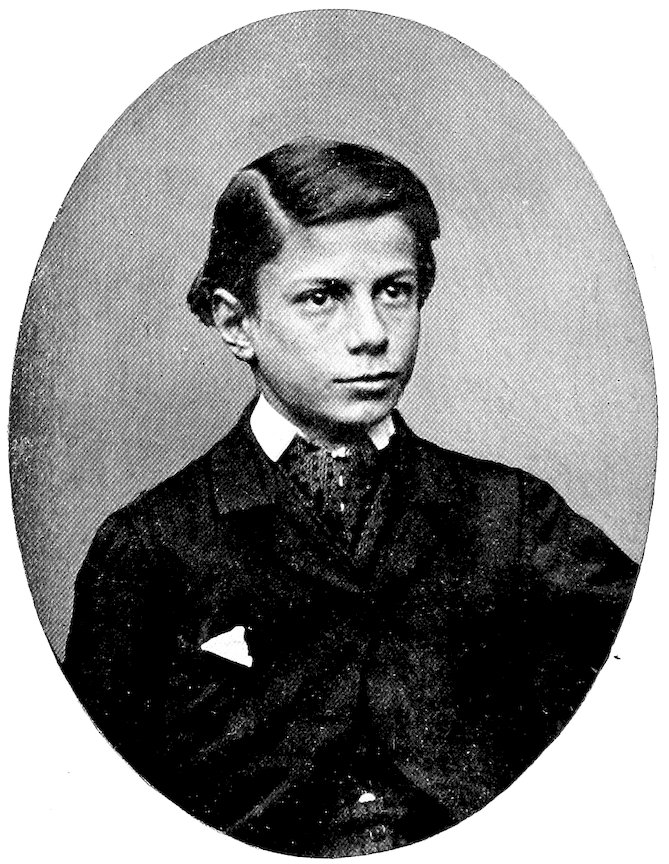
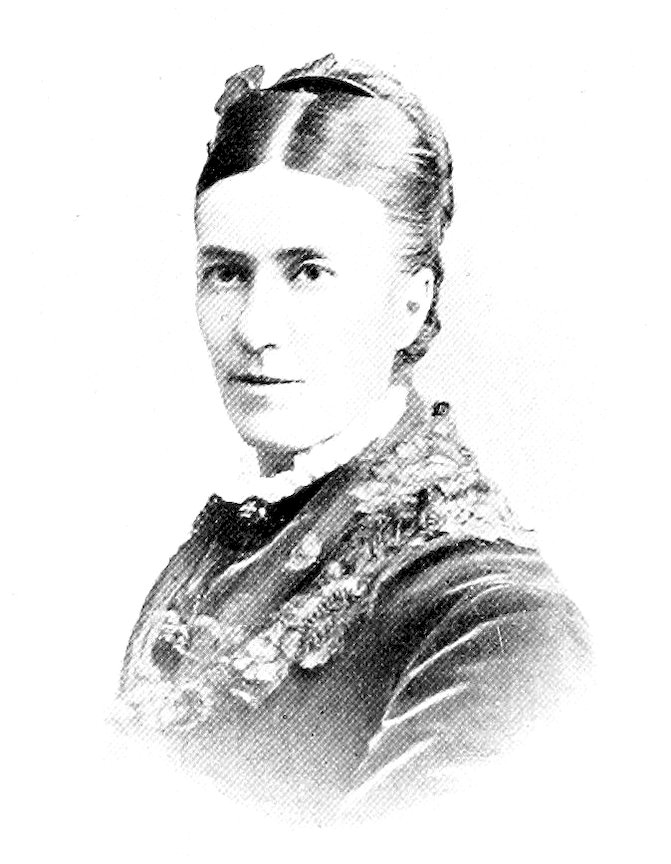
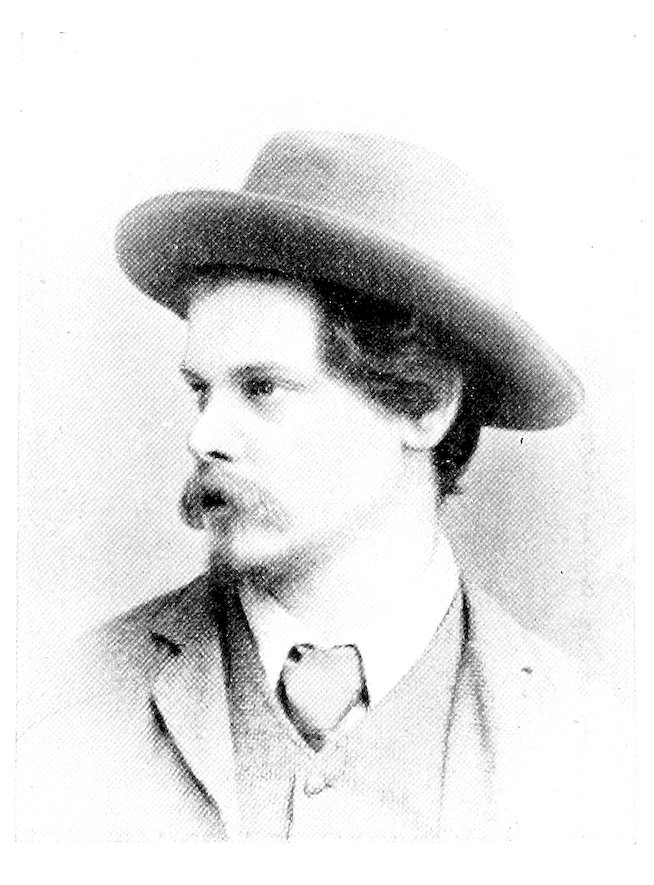
E. C. (1857), AGE THIRTEEN.
BY
EDWARD CARPENTER
Author of “Towards Democracy” “Civilization: its Cause and Cure,” &c.
WITH PORTRAITS AND ILLUSTRATIONS
LONDON: GEORGE ALLEN & UNWIN LTD.
RUSKIN HOUSE 40 MUSEUM STREET W.C.
First published June 1916
Second Edition October 1916
(All rights reserved)
PREFACE
7
Old St. Pancras Churchyard even now, though
dominated by the huge gasometers of Wharf Road
and backed against the roaring traffic of the Midland
Railway, preserves something of the sylvan beauty
which a hundred years ago made it the frequent
trysting-place of Percy Shelley and Mary Godwin.
As it happened, in the summer of 1890, when staying
in London, I used to make the garden my resort for
writing purposes; and one day in July of that year
I started some autobiographical notes. In a very
casual way, and with long intervals between, the
notes have been continued down to the present time.
The volume therefore to which this is the Preface
has been composed in somewhat disjointed fashion;
and the discerning reader will probably perceive
slight differences of style and outlook in its different
portions, and perhaps also experience some uncertainty
as to the proper chronology of the events which
it records. In order to mitigate the latter trouble
I have from time to time inserted in square brackets
the date of the year in which the corresponding
portion was written.
My life hitherto [7th July 1890] divides into four
pretty distinct periods—first, my early life up to the
age of twenty, during which time I lived mainly at
Brighton, embedded in a would-be fashionable world
which I hated; secondly, the period from ’64 to
about ’74, during which time I was mostly at Cambridge,
in a more or less intellectual atmosphere;
thirdly, from ’74 to ’81, when I carried on the Extension
lectures and made acquaintance with the manufacturing
centres and commercial society of the North
of England; and fourthly, for the ten years from
’80 and ’81 down to the present time, when I have
lived almost entirely among the working masses, and
been largely engaged in manual labour.
It may seem ungrateful to say so, but my abiding
recollection of early days is one of discomfort. Not
but that I had on the whole good times at school,
in the classes and in the games; not but that at
home I was lapped in the ease and attentive service
of a well-to-do household, and had a hundred advantages
denied to an ordinary child of the people; but
that after all at home I never felt really at home.
Perhaps I was unduly sensitive; anyhow I felt
14myself an alien, an outcast, a failure, and an object
of ridicule.
The social life which encircled us at Brighton was
artificial enough; but it was the standard which we
children had to live to. My parents were the best
people in the world, but they could not fly out of the
conditions in which they belonged. I hated the life,
was miserable in it—the heartless conventionalities,
silly proprieties—but I never imagined, it never
occurred to me, that there was any other life. To
be pursued by the dread of appearances—what people
would say about one’s clothes or one’s speech—to
be always in fear of committing unconscious trespasses
of invisible rules—this seemed in my childhood
the normal condition of existence; so much
so that I never dreamed of escaping from it. I only
prayed for a time when grace might be given me
to pass by without reproach. I was never a daring
or rumbustious child. Timid and sensitive, my spirit
was sadly lacking in the inestimable virtue of revolt.
I suffered and was stupid enough to think myself
in the wrong.
There was a curate at one of the churches to which
we used to go—a smooth-haired, carefully shaven,
meek young man, probably of feeble mind; but
all I knew was that people praised him: such a
good-looking, well-mannered fellow he was, and
preached such nice sermons! “Happy Mr.
Cass,” I used to think, for even now I remember
his name—“Oh, happy Mr. Cass, if only I could
be like you when I grow up.” I was then about
fourteen, and I fancy that the mere sight of Cass in
his spotless surplice must have worked upon me,
for it was about that time or a little later that I began
to make up my mind to take Orders. No doubt
from the first there was a fatal bias towards religion.
15I remember distinctly—and it must have been about
the same period—thinking as I lay awake in bed
at night that if the house were on fire I would save
my prayer-book! I saw myself in my mind’s eye
in heroic attitude rushing into my mother’s room
where the sacred volume lay, and bearing it out
through flames and smoke into the street. It was
not my mother or sisters that I was going to save ...
but my prayer-book! Alas! what a defect
of nature, or of teaching, must have been there!
Curious, the covered underground life that some
children lead! I never remember, all those years
at Brighton, till I was nineteen or twenty, a single
person older than myself who was my confidant. I
do not remember a single occasion on which in any
trouble or perplexity I was able to go to any one
for help or consolation. My mother, firm, just, and
courageous as she was, and setting her children an
heroic example, belonged to the old school, which
thought any manifestation of feeling unbecoming.
We early learned to suppress and control emotion,
and to fight our own battles alone: in some ways
a good training, but liable in the long run to starve
the emotional nature. Masters at school in those
days did not “draw boys out”; education was
mainly a nipping of buds; older friends outside the
family, who may so often play a useful part in the
development of boy or girl life, never came—that
I remember—to the rescue; and so my abiding
recollection of all that time is one of silent concealment
and loneliness.
Nevertheless of course there were joys. Though
a town-house is not a congenial nursery for a child,
yet we were comparatively fortunate. There was
a large space at the back, where we kept, in succession,
endless pets—pigeons, seagulls with clipped
16wings, rabbits, tortoises, guinea-pigs, and smaller fry
(I was especially fond of an aquarium); while in
front was the large garden of Brunswick Square,
overrun, despite the efforts of the gardener and other
authorities, by all the children of the surrounding
houses. A fearfully active family, boys and girls,
we kept a sort of proud superiority over the other
children in running races, prisoners’ base, etc.;
while inside the house, and for wet weather, we
had a sport entirely our own, and which consisted
in one pursuing the others up the front stairs and
down the back stairs, or vice versa, with endless
shrieks and uproar—a terrible affair, which nothing
but the noblest self-sacrifice could have ever nerved
our parents to endure! Also there was hide-and-seek
in the dark, a grisly game, dangerous both to
limbs and to furniture; and occasionally a battle
of the giants—as when, on one occasion, an elder
sister having with the greatest care built up a beautiful
dummy man round a long smooth pole, my
eldest brother came on the sly and drew the backbone
out! Then there was earth-shaking conflict,
which I, quite a small boy, witnessed from a distance,
and with quaking limbs.
As to school life, I suppose it is a general experience
that what one learns at school does not
count for much. At the age of ten I began at the
Brighton College. My eldest sister had taught me
a little Latin grammar before that. My eldest brother
Charlie was already at the College. He was a kind
of hero there. At that time (or possibly a year
or two later) he was easily first in everything. In
mathematics, classics, foreign languages, in cricket,
football, athletics—no matter what it was—he took
all the prizes. Withal he was so friendly, so sociable,
that he was a universal favorite; so generous and
17so humorous—so naturally full of fun and comedy—that
I really think he disarmed all jealousy in
others—nor felt a spark of jealousy or vanity in
himself. Seldom I should think has there been such
a boy; and when at the age of nineteen or twenty
he took his final leave in order to join the Indian
Civil Service, his memory lingered long and long
behind him in the school.[1]
My reception under those circumstances was
naturally favorable. One day, shortly after my
arrival, I was playing by myself in a corner of
the entrance hall, when a big boy with a pleasant
face came up to me and, making a suitable gesture,
said, “Sweep up the Chips, sweep up the Chips.”
Then I knew that my nickname was Chips—a family
nickname indeed, since my father and my brothers
at different times bore it.
The College was a large school of 150 or 200
boys—on public school lines. I went through the
18classes in due order from the lowest upwards; and
the personality of each master in turn impressed
its unconscious weight upon me. I remember distinctly
the agonized effort and the triumph of passing
the “Asses’ Bridge” in Euclid. The name of the
master who got me over was Newton, and for some
years I firmly believed that he was no other than
the celebrated Sir Isaac. I joined in the games and
athletics—and not without success, though I was
never very partial to cricket; I climbed slowly up
through the classes; I rubbed shoulders with all
the queer, red-haired, pock-marked, fat, lean, mean,
generous, handsome, clever, tyrannical, cross-eyed,
gentle, good-natured, specimens of fellow humanity—the
other boys—whose influence on one at that
age is so strange and incalculable, and whose characters
and deeds appear at the time so mysterious
and inexplicable; though when one looks back upon
them at a later date, they seem transparently clear
and simple. I cannot remember anything very
heroic that I did, though I can remember some
mean things. I remember joining with the others
in teasing the French master—that ever defenceless
quarry; and I remember what was much worse,
taking a kind of delight in privately tormenting an
idiot boy. That was indeed a strange experience.
I don’t know why the boy was allowed in the school;
he was certainly quite weak-minded and incapable;
and besides there exhaled from him an odd and fearsome
odour. That boy convulsed me with alternate
rage and pity. At one moment I was seized with
the greatest sympathy for his weakness, and the
next I was filled with wrath at his odour and his
idiocy, and found or invented excuses for slapping
him! Then after that I would sometimes lie awake
at night remorseful over my conduct, and planning
19little schemes of reparation; but in the morning
the sight of him would launch me on the waves of
irritation again. It was quite a little tragedy to
me—and I mention it because this savage and instinctive
dislike of anything malformed, which is so
very marked in boys, no doubt accounts for much
of their cruelty. It remains in the mind of course
to a much later age, but is gradually covered over
by the growth of sympathy and understanding. As
a rule my better deeds were done in defence of the
weak. Timid for the most part, I regained my
courage on these occasions—as in delivering a small
boy from a big bully; or once in sticking up for
two brothers, the dirtiest and most stupid boys in
the class, against the gibes of the master; or another
time in helping a poor man in the street with his
bundle—on which last occasion the said Sir Isaac
Newton passing by, instead of scolding me as I
expected, actually said, “That’s right, my boy”—a
remark for which I felt ever so grateful to him—for
indeed I was feeling rather ashamed of myself.
I think that was about the only occasion on which
a master exercised any directly helpful influence.
Schools were odd places in those days. The idea
of really reaching the boy and drawing out his interest
seems never to have occurred to the masters.
When I arrived in the Sixth Form, the Headmaster
was a certain Dr. Griffith—a burly, headstrong,
muddle-headed, perhaps rather good-natured man.
As often as not he would arrive in the class-room
late, with his hair a-tumble, and looking as if he
had not slept all night, would complain that some
naughty boy in the Fourth Form was preoccupying
his mind, and would leave us again alone with our
books. Then presently his study door would open,
and he would push the said boy into the room, saying,
20“I wish one of you gentlemen would cane this
boy,” and throwing a cane in over the boy’s head
would close the door again. Once, drawing a handful
of silver and gold out of his pocket, he asked me
to cane a boy for him—and afterwards I felt sorry
I had not accepted the bargain. I think he must
have been a little touched in the head. It is certainly
aggravating to think that we used to read Homer
and Virgil and the Greek plays, and never that I
remember was any attempt made to make us understand
the subject or the plot or the literary interest
of these works—nothing but grammar and syntax.
As to mathematics the neglect was worse—and I
left school at eighteen or nineteen having done
nothing beyond Euclid and Algebra.
My record in the classes was on the whole, I
suppose, good—though nothing remarkable. I
gained the usual number of prizes, and kept about
an equal interest in classics and mathematics. With
regard to the former, my father—who had progressive
ideas on such subjects—gave me a word for
word crib to Horace, saying that the best way to
learn a language was to use such a crib. Naturally
after that I rejoiced in it freely in my preparation-work
at home of an evening. But one day I could
not resist taking it to school and showing it to some
of my class-mates. Of course we were pounced
upon, and the crib confiscated. The form-master
at that time was E. C. Hawkins—a really fine type
of man, father of Anthony Hope Hawkins the novelist.
But when he asked me where I got the crib from, and
I replied quite truthfully and simply “My father gave
it me,” he was struck dumb! He certainly thought
I was lying, but could make no reply. And for a
long time after that would hardly speak to me.
Cricket I never took to much. Being a bad player
21I voted it ‘slow.’ Probably it gave too much rope
to my dreamy tendencies, and I got into trouble
missing unexpected catches. But hockey and football
I was fond of, and fives, as being more lively.
When I was about thirteen an event important to
us children happened, which I must not pass by. My
parents determined to spend a year in France, and
they actually transported the whole household, nine
children (i.e. all except my brother Charlie) and
two servants, to Versailles. I remember only too
well that awful night journey by Newhaven and
Dieppe, the raging sea, the arrival drenched, the
dim lights of the Customhouse, the cries of lost
children, the journey by train to Paris and onwards.
How my mother survived it I do not know. We
settled in a house in the Avenue de Sceaux, amid
barracks, and continual fanfaronades and trampings
of military, near the great Palace with its endless
galleries, and the Park with its fountains and music.
All very exciting and delightful. And we found
some good and friendly French neighbours. At first
they did not the least understand our household. It
never occurred to them for a moment that it was all
one family, and for some time it was supposed that
my father and mother kept a school! But when the
truth at last dawned upon them, their delight and
amazement knew no bounds, and we became the
centre of the greatest interest. I and my younger
brother, Alfred, went as day-boys to school at the
Lycée Hoche (then Imperiale)—a great place of five
hundred boys—where we learned French by sheer
necessity. I do not think we learned much else.
In the matter of lessons the instruction was much on
a par with that at the Brighton school, and the playground
life and social organization of the boys were
far less pregnant of good influences.
22I don’t know how the Lycées are now, but at that
time the school methods were only poor. The boys
sat an outrageously long time at their desks—ten
hours a day or more—either construing or preparing
lessons; but got through very little work, spending
most of their time in furtive games or conversations
with each other. Everything was done in set and
military style—marchings along corridors from class-room
to class-room, or from class-room to refectory,
or from refectory to playground. In the latter a
master (always called ‘pion’) was present to see
that there was no bullying, or to disperse knots of
boys (who might of course be talking sedition) or
to prevent individuals approaching the playground
wall within a set distance (lest they should escape).
The games were limited and regulated. Everything
was regulated. It was said that the Minister of
Education at Paris could at any hour of the day
place his finger on the line of Virgil that was being
translated, or the proposition of Geometry that was
being proved at that moment in all the Lycées alike
over the face of the land. One very curious custom
prevailed, which has probably now gone out of date,
but which had a strong suggestion about it of the
Church system of Indulgences. At the end of the
week the marks gained by each boy during the week
were added up and announced by the master. Then
those boys who were credited with more than a
certain number of marks were told they might write
out for themselves a certificate of satisfaction, good
for exemption from one, two, or even three hours’
punishment, according to circumstances! Great excitement
prevailed. You cut yourself a neat square
of paper, adorned it with lines and flourishes, and
inscribed on it “Témoignage de Satisfaction—Elève
Carpenter—bonne à une heure”—and left a space
23at foot for the signature of the master. When signed
you treasured this up in your desk—and at some
later date when the hour of punishment came, produced
it, and unless your crime was very heinous
were duly let off! It was a curious arrangement,
but one which had perhaps the advantage of discouraging
a boy from being too good—since obviously
it would be a mistake to collect a greater number
of such tickets than you were likely to make use of.
My brother and I, as day-boys, escaped a good
deal of the general school routine and regulation,
and on the whole had not a bad time. The boys
received us decently, and as we could play leap-frog
or prisoners’ base (Les Barres) as well as any of
them, paid us due respect; and one of the masters,
Llandais by name, was quite kind and thoughtful
towards me. Out of hours we careered through the
woods of Satory, watched military evolutions on the
plain above, or at dusk chased and caught the great
stag-beetles—a thrilling joy. We wandered through
the huge statue-adorned Park and the shady Bosquets
of diamond-necklace celebrity, and learned
swimming—as did also my sisters—in the fine open-air
swimming bath, which used to be the bath of
the pages of Louis XIV’s Court. After a year thus
spent, the family returned to England, and we boys
to the Brighton College.
As I say, it is probably a common experience that
mere school teaching does not leave a very deep
impression. Probably a good deal really is learned—but
these are the more indirect things which slip
into the background or foundation of the mind and
character and so pass comparatively unobserved.
Only three or four subjects of interest stand out
in my memory as belonging to my school-days, and
these all lay outside school proper. The earliest of
24these was music. At the age of ten I desired mightily
to learn the piano; but music was not considered
appropriate for a boy—besides there were six sisters
who had to be taught, poor things, whether they
liked it or not—and so my appearance on the music
stool was treated rather as an intrusion, and I was
generally hustled off again forthwith. However I
got my way by playing late of an evening, when they
were all upstairs in the drawing-room; I never
had any regular teaching, but my mother took pity
on me and taught me my notes; and from that time
I stumbled through the “Marche des Croates” and
the “Nun’s Prayer” till at last I emerged on the
far borderland of Beethoven’s Sonatas. This hour
of piano practice to myself was for a long time
one of the chief events of my day. Indeed, it is
curious, but I took to composing, or attempting to
compose, music before ever I thought of composing
or attempting to compose poetry. Of course with a
juvenile mind, and no musical training, nor even a
particularly keen ear, my compositions were of no
value, and I hardly ever troubled to write them out;
still the habit of making up pianoforte pieces, and
the love of doing so, continued all my life, and forced
its way out from time to time. It is only in quite
late years that, with more technical knowledge, I
have written some of these down—perhaps twelve or
twenty in all—and even occasionally thought of
printing them.
I was also fortunate enough, when I was about
fifteen, to come in for the reversion of a cupboard
full of chemical apparatus, which had belonged to
my eldest brother, and here in a little room with
retorts and test-tubes I spent many a half-holiday,
carrying out important experiments and prosecuting
valuable inventions, which ended almost invariably
25in bad smells and worse headaches. Perpetual
motion, as usual in such cases, was one of my chief
objects; and I could not for the life of me tell why
a solid cylinder of wood, placed with its axis horizontal
in the side of a box containing water, and
so carefully fitted that it would turn on its axis
without allowing the water to run out, would not
revolve perpetually—seeing indeed that the one half
of it which was in the water, being lighter than
water, would continually tend to rise, and the other
half of it which was in the air would continually
tend to fall. I invented an arrangement for the
pianoforte after the Morse telegraphic system, by
which extemporaneous effusions could be written
down in the act of playing—an invention which
luckily has not been generally adopted; and was
engaged on various other little patents at different
times. Sometimes I gave a lecture—though it must
be confessed that it was with difficulty that any of
the household could be induced to attend! The
lecture was small, but the danger from explosions
and horrible smells was great. My remarks were
not very lucid or explanatory, but consisted mainly
of expressions like “Now I will show you something
else” or “You needn’t be frightened, there is no
danger.” These investigations were however very
absorbing and excited far more interest in my mind
than anything I learned at school; and I remember
that they led me to think quite seriously about being
a doctor (I suppose from some vague notion about
the connection between chemicals and medicine)—a
profession which my father was inclined to recommend
to me, and which I have sometimes regretted
that I did not adopt.
Towards the later part of my time at Brighton
the natural épanchement of youth led me often to
26seek consolation and an escape from the wounds of
daily life in intercourse with Nature. The Brighton
social life—with its greetings where no kindness is—was
to me chilly in the extreme, and I often used
in later years to feel that I “caught cold” (morally
speaking) whenever I returned to it. The scenery
and surroundings of Brighton are also bare and
chilly enough; and trees, whose friendly covert I
have always loved, do not exist there; but the place
has two Nature-elements in it—and these two singularly
wild and untampered—the Sea and the Downs.
We lived within two hundred yards of the sea, and
its voice was in our ears night and day. On terrific
stormy nights it was a “grisly joy” to go down
to the water’s edge at 10 or 11 p.m.—pitchy darkness—feeling
one’s way with feet or hands, over the
stony beach, hardly able to stand for the wind—and
to watch the white breakers suddenly leap out of
the gulf close upon one—the “scream of the
madden’d beach dragged down by the wave,” the
booming of the wind, like distant guns, and the
occasional light of some vessel laboring for its life
in the surge.
But the Downs were my favorite refuge. On
sunny days I would wander on over them for miles,
not knowing very clearly where I was going—in a
strange broody moony state—glad to find some hollow
(like that described in Jefferies’ Story of my Heart)
where one could lie secluded for any length of time
and see only the clouds and the grasses and an occasional
butterfly, or hear the distant bark of a dog
or the far rumble of a railway train. The Downs
twined themselves with all my thought and speculations
of that time. Their chaste subdued gracious
outlines and quiet colour have a peculiar charm.
Their strongest line is generally some white edge
27of cliffs or curve of the shore itself, their deepest
tint the blue of the sea or occasionally a field of
red clover or one overgrown with charlock. For
the rest they wear the faint blue-green colour of thin
turf through which the chalk almost shows. Over
the velvety sward and among the fine herbage
cropped by plentiful sheep run innumerable tiny
flowers dwarfed by salt wind and scanty soil—thistles,
whose chins rest on the ground out of which they
grow; patches of sweet thyme which the wild bees
love, of pink centaury and thrift and madder and
dwarf-broom, and that sweet yellow lotus or bird’s-foot
trefoil, which runs all over the world, in Siberia
and Alps and Himalayas the same, one of the commonest
and friendliest of all the flowers that grow.
Overhead the lark sings, the clouds drift through
the untampered blue, the bee and the butterfly sweep
past on the breeze. Three or four miles from
Brighton, and one is in a world remote from man.
Except an occasional shepherd there is hardly a
human to be seen. Here and there in a hollow
nestles the tiniest hamlet—an old farmhouse, one or
two cottages, a dwarf church faced with rough work
of flints, a few trees and a well. Taking its character
from the sky—as all chalk and limestone countries
largely do—this land has an ethereal beauty
in summer weather; but on wintry and gray days
it is monotonous and sad. The shepherd then huddles
himself in his cloak in the lee of the gorse-bush, the
cloudy rack drives over the backs of his sheep, line
behind line the Downs stretch, colorless, unbroken
by any hint of tree or habitation; the wind whistles
among the thin grass stems with a peculiar shrill
and mournful pipe, and in its pauses the sullen and
distant roar of the sea is heard.
How can I describe, how shall I not recall, the
28thoughts which came to me as I wandered, towards
the close of my school time, over these same hills—the
brooding ill-defined, half-shapen thoughts? The
Downs were my escape; even in their most chill and
lonely moods they were my escape from a worse coldness
and loneliness, which, except for a few boyfriends
at school, I somehow experienced during all
that time. Nature was more to me, I believe, than
any human attachment, and the Downs were my
Nature. It was among them at a later time that I
first began to write a few verses. But at the time
I mention, and till quite the end of my school days, I
never wrote anything at all. If the thought of writing
had occurred to me I should have deemed it, in my
then state of mind, monstrous presumption—but I
doubt whether the thought ever did occur to me.
I did not even read poetry. Mozart and Beethoven
were familiar to me, but I must have been eighteen
years old before I was roused to any interest in
Tennyson (the poet of the day) by a lecture at
school on “In Memoriam.” After that I read “In
Memoriam” and loved it well. This was followed
(at Cambridge) by Wordsworth; and then by
Shelley, who excited in me the same passionate
attachment that he has excited in so many others.
After that Whitman dominated me. I do not think
any others of the poets—unless Plato should bear
that name—have deeply influenced me.
As to friends—that absorbing subject—I can trace
the desire for a passionate attachment in my earliest
boyhood. But the desire had no expression, no
chance of expression. Such things as affection were
never spoken about either at home or at school, and
I naturally concluded that there was no room for
them in the scheme of creation! The glutinous boyfriendships
that one formed in class-room or playground
29were of the usual type: they staved off a
greater hunger, but they did not satisfy. On the
other hand I worshipped the very ground on which
some, generally elder, boys stood; they were heroes
for whom I would have done anything. I dreamed
about them at night, absorbed them with my eyes
in the day, watched them at cricket, loved to press
against them unnoticed in a football melly, or even
to get accidentally hurt by one of them at hockey,
was glad if they just spoke to me or smiled; but
never got a word farther with it all. What could I
say? Even to one of the masters, I remember, who
was a little kind to me, I felt this unworded devotion;
but he never helped me over the stile, and so I
remained on the farther side.
I often think what a fund of romance, and of
intense feeling, there is in this direction latent in
so many boys and capable even of heroic expression—and
how much will have to be done some day in
the matter of directing and giving a constructive
outlet to it. Already however there is a great difference
in the tone of the public schools themselves on
this subject, from what there was twenty-five or
thirty years ago. The trouble in schools from bad
sexual habits and frivolities arises greatly—though
of course not altogether—from the suppression and
misdirection of the natural emotions of boy-attachment.
I, as a day boy, and one who happened to be
rather pure-minded than otherwise, grew up quite
free from these evils: though possibly it would have
been a good thing if I had had a little more experience
of them than I had. As it was, no elder person
ever spoke to me about sexual matters—no mother,
father, brother, monitor or master ever said a word.
I picked up the usual information from the talk of
my companions, and made up my own mind
30unbiased by any person or book. I suppose it was in
consequence of this that I never saw anything repellent
or shameful in sexual acts themselves. From
the earliest time when I thought about these things
they seemed to me natural—like digestion or any
other function—and I remember wondering why
people made such a fuss about the mention of them—why
they told lies rather than speak the truth, why
they were shocked, or why they giggled and stuffed
handkerchiefs in their mouths. It was not till (at
the age of twenty-five) I read Whitman—and then
with a great leap of joy—that I met with the treatment
of sex which accorded with my own sentiments.
Nevertheless though these desires were never to
me unclean, yet during all that time of later boyhood
and early university life they were strangely discounted
by that other desire of the heart. I could
not think much of sex while the hunger of the
heart was unsatisfied—and that for the time being
occupied all the foreground of my life. Indeed at
times it threatened to paralyse my mental and
physical faculties. It was like an open wound continually
bleeding. I felt starved and unfed, and
unable to rest in the chilling contacts of ordinary
life. As to the usual attractions set before the eyes
of middle-class youth, the hopeless, helpless young
ladyisms, or the bolder beauties of the gutter, they
were both a detestable boredom to me.
For indeed the life, and with it the character, of
the ordinary “young lady” of that period, and of
the sixties generally, was tragic in its emptiness.
The little household duties for women, encouraged
in an earlier and simpler age, had now gone out of
date, while the modern idea of work in the great
world was not so much as thought of. In a place
like Brighton there were hundreds, perhaps, of households,
31in which girls were growing up with but one
idea in life, that of taking their “proper place in
society.” A few meagre accomplishments—plentiful
balls and dinner-parties, theatres and concerts—and
to loaf up and down the parade, criticizing each
other, were the means to bring about this desirable
result! There was absolutely nothing else to do or
live for. It is curious—but it shows the state of
public opinion of that time—to think that my father,
who was certainly quite advanced in his ideas, never
for a moment contemplated that any of his daughters
should learn professional work with a view to their
living—and that in consequence he more than once
drove himself quite ill with worry. Occasionally it
happened that, after a restless night of anxiety over
some failure among his investments, and of dread
lest he should not be able at his death to leave the
girls a competent income, he would come down to
breakfast looking a picture of misery. After a time
he would break out. “Ruin impended over the
family,” securities were falling, dividends disappearing;
there was only one conclusion—“the girls
would have to go out as governesses.” Then silence
and gloom would descend on the household. It
was true; that was the only resource. There was
only one profession possible for a middle-class woman—to
be a governess—and to adopt that was to become
a pariah. But in a little time affairs would brighten
up again. Stocks went up, the domestic panic subsided;
and dinner-parties and balls were resumed
as usual.
As time went by, and I gradually got to know what
life really meant, and to realize the situation, it used
to make me intensely miserable to return home and
see what was going on there. My parents of course
were fully occupied, but for the rest there were six
32or seven servants in the house, and my six sisters had
absolutely nothing to do except dabble in paints
and music as aforesaid, and wander aimlessly from
room to room to see if by any chance “anything
was going on.” Dusting, cooking, sewing, darning—all
light household duties were already forestalled;
there was no private garden, and if there had been
it would have been “unladylike” to do anything
in it; every girl could not find an absorbing interest
in sol-fa or water-colours; athletics were not invented;
every aspiration and outlet, except in the
direction of dress and dancing, was blocked; and
marriage, with the growing scarcity of men, was
becoming every day less likely, or easy to compass.
More than once girls of whom I least expected it
told me that their lives were miserable “with nothing
on earth to do.” Multiply this picture by thousands
and hundreds of thousands all over the country, and
it is easy to see how, when the causes of the misery
were understood, it led to the powerful growth of
the modern “Women’s Movement.”
During my school-days, however, this tragedy had,
so far as our household was concerned, hardly developed
itself, or at any rate become at all serious;
and a charming recollection of that period is that
of my companionship with two of my elder sisters.
With one of these—my sister Ellen, afterwards Mrs.
Hyett—I used to go long country walks. She had
an eye for landscape and animal painting, and sometimes
brought her sketch-book with her. Occasionally
on hired hacks we rode together over the Downs.
Her mind had an adventurous outdoor quality about
it; and our conversation turned mainly on what we
saw on our explorations, and on speculations about
foreign lands. The other sister (Lizzie, afterwards
Lady Daubeney) was never much of a walker; but
33she stayed at home and played Beethoven’s Sonatas,
and these were a continual delight to me. I stood
quietly by and turned over the pages by the hour. The
“Sonata Appassionata” was a dream of wonder.
This sister had a highly poetic, sensitive temperament.
When the younger ones of the family were children
she told us absorbing fairy-tales. At the time I
speak of she was the one in the household who gave
to the atmosphere a touch of sympathy, tenderness
and romance; which was of priceless value. As
my mind expanded we even talked a little poetic
philosophy together, and discussed Tennyson and
Shakespeare.
My younger brother, Alfred, who was my schoolfellow
at the Lycée at Versailles, went to the Brighton
College with me (I joining for the second time)
when the family returned to Brighton in 1858. But
at an early age (fourteen) he joined the Navy, and
after a preliminary year on board the Britannia
training-ship, went away to sea. Consequently he
was not so much at home during those early years.
The sea-life suited him, I think. With a rather
dare-devil temperament as a boy he was always
getting into scrapes at school. [Once, I remember,
he had the brilliant idea of lighting a fire in his
locker in the schoolroom, and then sitting, all innocence,
on the seat—until the crackling of sticks and
the curling smoke drew all eyes that way, and he was
discovered like the phœnix in apparent peril of being
consumed!] In the Navy, at an early period, he
distinguished himself by saving life under risky circumstances.
In one case a man had fallen overboard
at night in the Tagus from another ship, and in the
darkness was being swept by the current seawards
past the Warrior, on which ship my brother was—when
the latter, who was on deck at the time, jumped
34in to the rescue, at the same time calling to some
of the bluejackets to man a boat and follow. Of
course he and the drowning man were immediately
lost to sight in the gloom, and when the boat did
get under weigh it was only by his distant shouts
that its crew could be guided. The two men had
drifted half a mile or more before they were picked
up; but it was not too late, and their rescue was
safely effected. In another case off the Falkland
Isles he swam to the rescue of an ordinary seaman
under even more perilous conditions, and for this
act gained the Albert medal—which may be called
the V.C. of life-saving medals.
At a later period [1875–76] my brother Alfred was
lieutenant on board H.M.S. Challenger, and it was
under his management that the deepest sounding
effected up to that period was taken. He obtained
4,475 fathoms, or nearly 27,000 feet in the vicinity
of the Ladrone Islands. After the Challenger he
had several commands in China and elsewhere, including
charge of the Marine Survey of India; and
as commander of the Investigator he spent several
years surveying and making charts of the coasts of
India and the Andaman Islands. In 1885, in connection
with the Burmese expedition against King
Thebaw, the important duty was assigned to him of
leading the War Flotilla up the river Irrawaddy.
As an officer he was well liked, being considerate
of the men under him, but firm in their management,
and in moments of danger plucky and reliable.[2]
35In later years he published not a few papers on
nautical and astronomical matters, and in 1915 a
more popular illustrated handbook for travellers, entitled
Nature Notes for Ocean Voyagers (Griffin, 5s.).
Such, roughly summed together, are the main outlines
of my early days—full after all of tenderest
recollections. A large family is a roughish training
school, but it is a valuable one. Over-sensitive and
of a clinging disposition by nature, I early learned
the profound lessons of suffering and of self-dependence.
My spirit concentrated itself, and partially
overcame its inherent vagueness and weakness in
years of silence. The tension of those early days, the
unexpressed hatred which I felt, though I did not
understand it, for the social conditions in which I
was born, was destined, when its meaning gradually
realized itself in my consciousness, to become one
of the great directing forces of my after life.
II MY PARENTS
36
My father (born in 1797) had a curious early life.
He came of a family which had lived in Cornwall
(Launceston) for some generations. He was the
eldest son—though he had three sisters—of an
Admiral in the Navy, and appears to have taken to
his father’s profession, when a boy, as a matter of
course. He was not, however, at all suited to it, for
he was of a rather studious temperament, and the
rough life of the Navy of those days was probably
very distasteful to him. He was in one or two
skirmishes with the French off the American coast,
and I remember his telling me of the painful feeling
which he experienced once when being in a small
boat and coming across some French sailors in
another small boat he had to take aim and fire
at them. To his relief, however, no one was hurt!
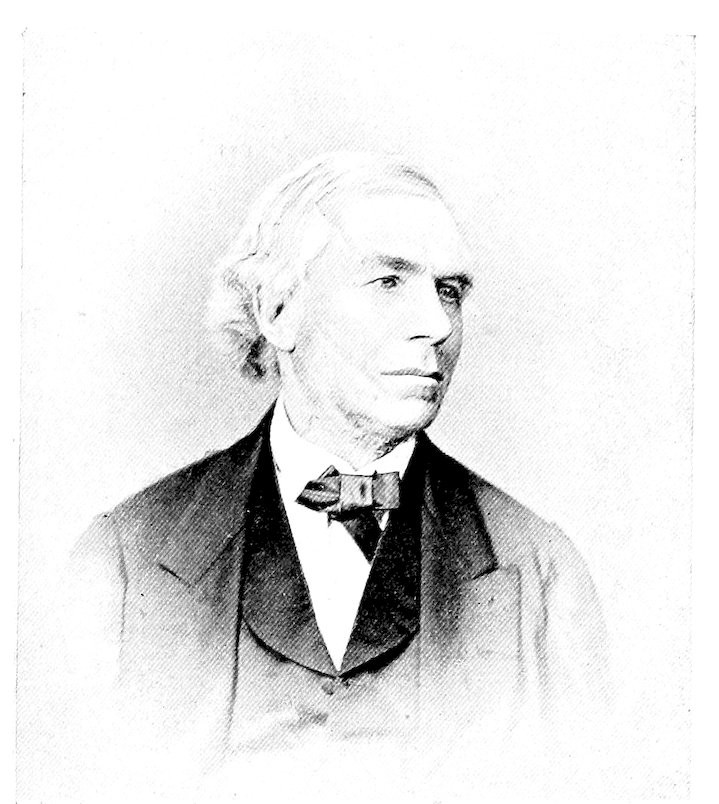
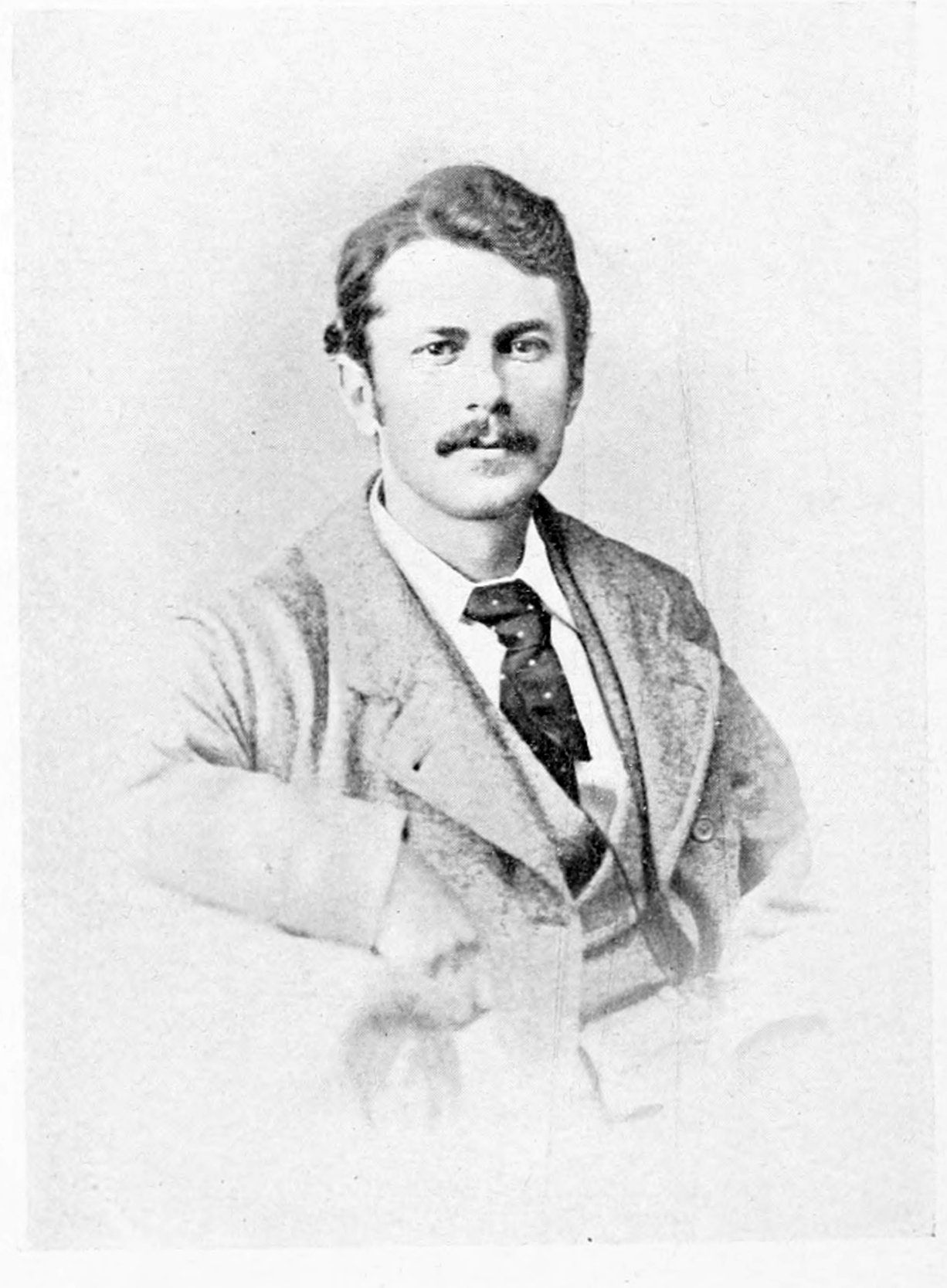
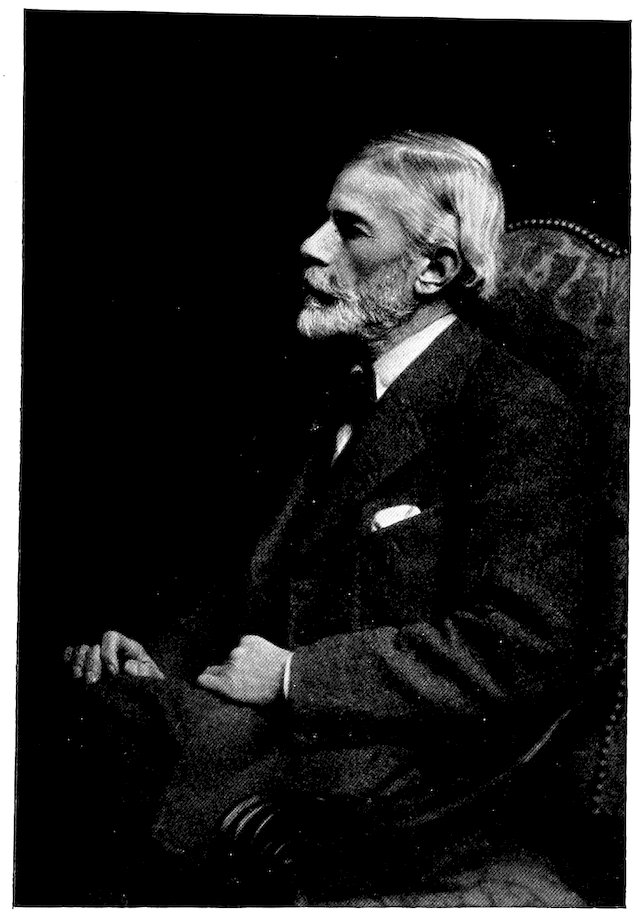
MY FATHER: CHARLES CARPENTER.
When he was twenty-three or twenty-four my father
began to learn German and read philosophy in his
spare hours, which did not look as though he were
destined to remain long on board ship! As a matter
of fact he left the Navy when he was about twenty-five.
The bad climate of Trincomalee, where he was
stationed for two years, damaged his health. He
came to London and set about reading for the
Chancery Bar. In due course he was called and for
some years practised with success—so much so indeed
37that on his retirement he was greatly complimented
by the presiding judge. In 1833 he married; and
this it was which, curiously enough, led to his retirement
from the Bar. For his father-in-law—Thomas
Wilson—who had also been in the Navy, and who was
then a widower, only consented to the marriage on
condition that his daughter should remain at home,
and that the married couple should therefore take
up their abode at his house at Walthamstow. This
they did, and the distance from London, a considerable
matter in those days, combined perhaps
with a little anxiety about my father’s health, which
still remained unsatisfactory, brought about the abandonment
of his profession—a great mistake as it
appeared, for of course as soon as he lost his regular
occupation he began to worry badly. Then, when
Mr. Wilson died, in 1843, a move to Brighton (which
just then was growing into importance, and yet
retained some of its old-world character) was thought
advisable, both for my father’s sake and for that
of the little family which now had to be considered.
But as far as my father was concerned this did not
mend matters, and my mother has often told me that
this was the worst period of their married life.
He got more and more anxious and restless—to
a degree which seemed almost a danger to his mind—till
at last my mother induced him to let himself be
appointed magistrate and take his seat on the
Brighton bench; after which his serenity returned,
and he remained one of the most active and probably
the most public spirited of the members of the
Brighton and afterwards of the Hove magistracy till
a year or two before his death. The death of his
own father in 1846 freed him from any real cause
for pecuniary anxiety—though from time to time all
through his later life he was liable to fits of considerable
38depression and nervousness about his monetary
concerns. He settled down permanently at Brighton
(No. 45 Brunswick Square) into the life of the
respectable rentier, with its usual aims and ideals as
far as his family was concerned, though for himself
his aims were very different from those of the society
round him, and his conception of life was as broad
as it could well be upon the foundation of that particular
social status to which he belonged.
His early life in the Navy had given my father that
honest, somewhat simple, cast of mind which belongs
to sea-faring folk. He was always ready to be
impressed by a tale of distress—especially if it came
from the lips of one of the fair sex. At the same
time his active brain had carried him far in most
fields of thought. Though having a strong religious
feeling, he soon emancipated himself from current
orthodoxies in religion, and seldom in later life went
to church—a fact which to the mild respectabilities
around us was a sufficient justification for calling
him an Atheist. For Frederick W. Robertson, who
was then preaching at Brighton, and who not unfrequently
came to our house, and for Frederick D.
Maurice, however, he had a great admiration; and
his own views were—as far as I remember what he
said when I was a boy—a kind of Broad Church
mysticism, derived at first from reading S. T.
Coleridge (whom he had met occasionally in former
years in London), and gradually broadening out under
the influence of Eckhardt, Tauler, Kant, Fichte, Hegel
and others into a religious and philosophic mysticism
without much admixture of the Broad Church at all.
In politics he was a strong Liberal—indeed in
his most active period a philosophic Radical of the
Mill school, and gave strong support to Henry
Fawcett during the time when the latter represented
39Brighton. Though occasionally asked to stand himself
he never as far as I know felt inclined to do so,
and indeed a certain lack of glibness and difficulty
of expression which he experienced always made him
disinclined from taking part in any kind of public
speechifying. In his quite latest years he veered
round to the support of Beaconsfield’s Government;
but this, if partly due to the reactionary tendency
of old age, was also caused by his keen perception
of the hypocrisy (unconscious or otherwise) of Gladstone,
whom in the last few years of his life he never
ceased to vilify.
Almost all general literature interested my father—especially
works on natural history, travels, and
science of any kind; but art and music were never
much in his line. Any tale of heroism, or prodigy
of science would bring ready tears to his eyes; and
his love of reading—as in the case of his own father—lasted
to the latest years of his life; for when he
was over eighty years of age he would not unfrequently
sit up till one or two in the morning, conning
the last new book or running over favorite passages
of his philosophical authors.
In a letter of his (written in ’73) I find the following
passage: “Circumstances have been leading me
to think a good deal lately about Instinct. I do not
see how any distinction can be drawn between what we
call Instinct in the lower animals—such as the insect
when she deposits eggs and then brings to the place
of deposit the food needful for the support of her
offspring grub, and covering them up (eggs and food)
together, flies away to perish—and that power in
Plants that causes them to send forth their roots
often to a great distance and in a special direction,
in search of the material needful for their nutriment,
the mineral perhaps without which they could not
40live. This can only be understood, as it seems to
me, upon the assumption of there being a Life, an
intelligent Life, in the Plant or Insect, of which
they are unconscious. Think of the Swallow going
to Egypt perhaps, and then at proper season returning
to its old nest under the eaves of some cottage in
England. The possession of sense-organs, therefore,
does not expel from the Bird or Fish this Intelligent
Life within them, which orders their migrations,
etc., but of which they are unconscious. And why
should it be otherwise with man? That he should
be conscious of this life will one day be his highest
blessing.”
And in another letter (of 1876): “Surely the true
meaning of Nirvana is that at some future stage
of our being man will be so conscious of the indwelling
and inworking of Deity, that he will ascribe
every movement, whether of his body or mind, to
the One Will, the One Vernunft, the One Life, and
thus think of himself as swallowed up by and
absorbed, as it were, in that Being.”
These extracts will show what a priceless debt
I owe to the early contact with his mind.
How strange and far-back all that early life seems
now—and yet so vivid—I can see it all in brightest
detail! Of an evening, after dinner or supper, how
we sat round the drawing-room table, or in scattered
chairs, reading. My father would get out his Fichte
or his Hartmann and soon become lost in their
perusal. Occasionally he would, when he came to
a striking passage, play a sort of devil’s tattoo with
his fingers on the table, or, getting up, would walk
to and fro quarter-deck fashion, with creaky boots,
and reciting his authors to himself. Then my mother
or perhaps my eldest sister would remonstrate, and
41after a time he would settle down again. Sometimes
if he was very quiet one might look up from one’s
book and see from his upturned eyes and half-open
lips that he had lapsed into inner communion and
meditation.
His was a very religious nature, and it was his
habit to think of the divinity as clearly present—as
he would say: “When I am taking my bath
or even when I am breathing I say to myself, ‘This
is God working within and around me.’” In later
years, however, his liability to extreme worry and
anxiety would return; and there were times when
even his books failed to save him from the sleepless
nights and despondent days occasioned by the
failure or possible failure of some Stock Exchange
speculation. At such times reports of railway companies,
maps, gazetteers, newspaper cuttings, etc.,
were got out and studied and restudied; I was called
in to take part in the investigations (“put in the
stocks” as I used to call it), and had to sit up till
the small hours of the morning in attitudes of painful
suspense and tension. The troubles, however, would
pass away in due time, and on the whole my father
was (owing chiefly to the care and thought he gave
to them) very successful over his “investments.”
The rest of the family spent the evening, as a
rule, in reading—of which we were all fond. My
sisters would play or sing a little; and when they
ceased, the sound of the near sea would reassert itself,
or the roaring of the wind in the chimney. My
mother sat on a low chair, with a book on her knee
and some knitting in her hands, but occasionally,
tired with the work of the day, would drop asleep;
at ten o’clock the servant brought up wine and
biscuits, and shortly afterwards we would all—except
my father—retire.
42Of my mother’s life how can I say anything?
That which is so vital to one, so intimate, how can
one disengage it from oneself? There was an
unspoken tragedy in those beautiful gazelle-like eyes—the
tragedy as of dumbness itself. The tender
loving spirit which beamed forth from them never
found direct utterance in this world. It was the look
of a prisoner. Her mother was a Scotchwoman. A
baneful parental influence—Scottish pride and puritanism—had
rested on my mother’s young life, making
all expression of tender feeling little short of a sin;
and this reserve, inculcated in youth, became in later
days involuntary and inevitable. My mother had a
sister to whom she was much attached, but who had
offended my grandmother by marrying a man who
was considered undesirable. The sister was never
forgiven, nor even acknowledged again. She died
soon after her marriage; and her death, with all the
accompanying circumstances, was a great blow to
my mother; but of it—as of other things which
touched her nearly—she would never speak.
Her nature was not so much intellectual or imaginative
as practical and prompt to act, with a kingly
sense of duty and courage. Her life was one long
self-sacrifice—first to her parents, then to her husband
and children. All day and much of the night, without
haste and without rest, she went about the house
attending to our young wants, to my father’s comfort,
and to the organization of a large household—wearing
herself daily to a thinner and slighter frame,
which even in age seemed by this means to maintain
its activity—till at last when her children were grown
up, and her husband’s growing infirmities demanded
the services of a trained nurse, there came upon
her the grievous sense—not the less grievous because
wholly unwarranted—that she was “no longer
43of any use in the world.” Twice, I remember,
she repeated these fatal words; and then, not long
after, a brief attack of bronchitis parted easily the
thread of life, already worn so fine. The manner of
her death was as heroic as that of her life, with
thought in lucid intervals for all around her, servants,
and everybody in the house; and with closing smile,
and words of calm, “All is as it should be.”
When my mother died (in January 1881) my
father—who had been for the most part absorbed
in business or philosophic speculations, and who had
given indeed too little time to personal matters—suddenly
became aware of the greatness of the loss
he had sustained. He woke up from dreamland
when it was too late. My mother’s silent and untiring
forethought had unconsciously to himself been the
great support and directing power of his life; and
now he ceased not to say, “The mainspring is broken,
the mainspring is broken.” His infirmities, which
at eighty-three years of age were the natural ills
of senile decay, rapidly gained upon him, and a year
afterwards, in April 1882, he died and was laid in
the same grave with her—in Hove cemetery, between
the sea and the Downs, close to the little church to
which, years before, we as children had trudged with
these our parents every Sunday by the fields and footpaths
which then separated the village of Hove from
the growing West of Brighton.
My mother had very gracious manners, of gently-smiling
dignity, yet her inflexible sense of truth and
justice—inflexible especially as regards her own life
and conduct—was easily apparent beneath the gentle
exterior. Her ideas of social demarcation, etc., were
of course of the old school; and she looked upon
it quite as a duty to keep up a certain position in
society—as the phrase is. Indeed, though much of
44the social life of Brighton was in reality irksome
to her, I think that she never questioned the duty of
conforming to it. But then—unlike many modern
mistresses—she never questioned the duty of attending
to the wants of dependents; and her care for the
interests of the household servants, and others whom
misfortune might bring to her door, was most unfailing
and most sincere. The servants in fact were
as a rule much devoted to her—though she was by
no means lax in matters of discipline and daily
superintendence.
A great feature of my mother’s character was her
love of animals, especially dogs and horses. Outdoor
and garden occupations she was also fond of—and
I believe her natural inclination would have led
her to a rural life. But Brighton offered nothing in
this direction—and here again the promptings of her
nature were destined only to be thwarted.
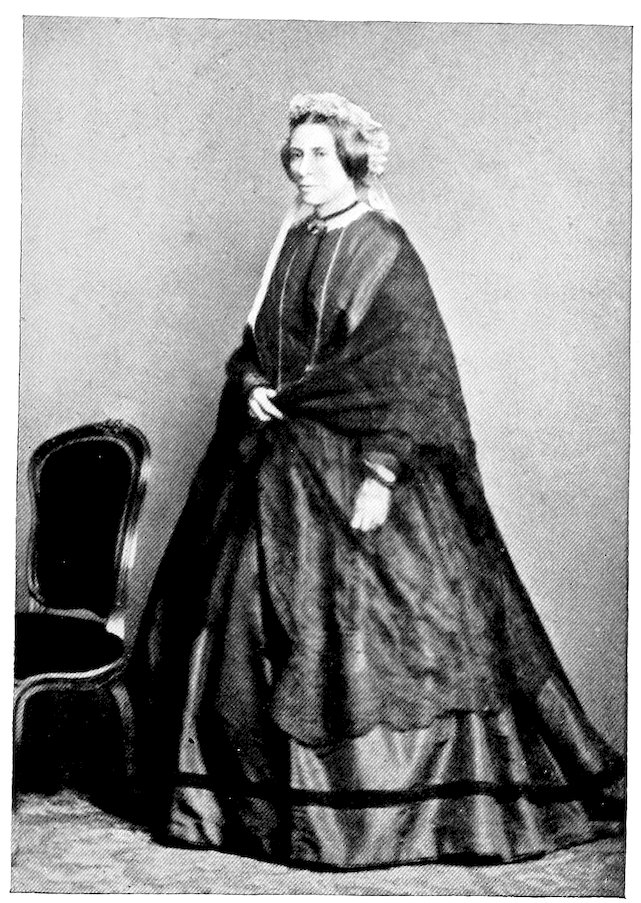
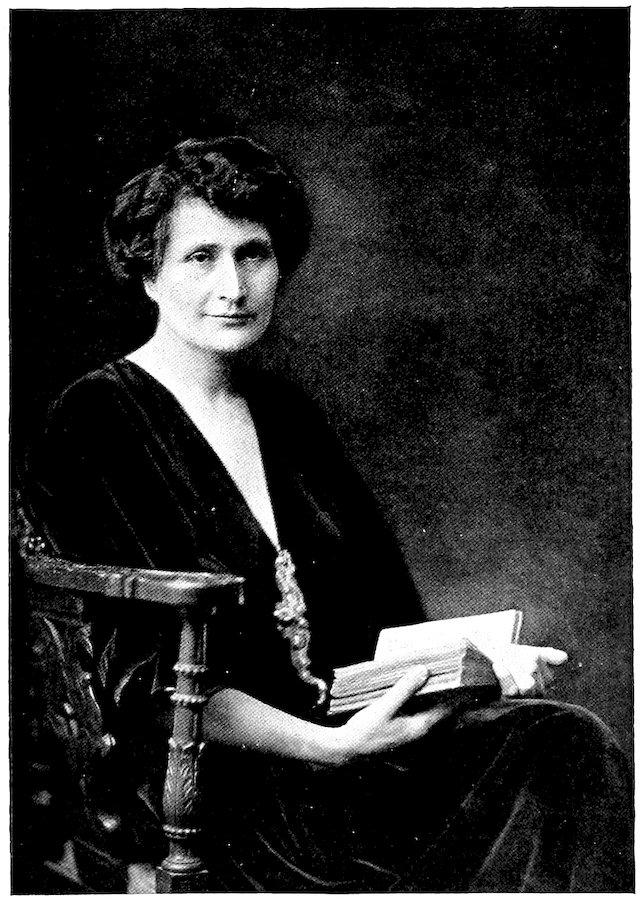
MY MOTHER: SOPHIA WILSON CARPENTER (ABOUT 1864).
III CAMBRIDGE
45
Between school and College days I went to Germany
for some months. I was already nineteen when
I left school, full old enough to go to College, but
it did not seem to be decided what was to become
of me. I inclined to go into Orders. Possibly my
father, dreading this, thought Heidelberg would be
an antidote! At any rate I could learn German
there. So off I went, lodged with a professor and
his Frau for five months, wandered through the woods
and over the hills of Heidelberg, heard Bunsen and
Kirchhoff lecture on Physics and Chemistry, attended
the English church on Sundays, and ate sausages
with the Professor and his friends on weekdays.
An odd secluded life, seeing but little of the Germans
and less of the English, what I chiefly remember
of it is those long moony rambles through the woods—not
very clearly thinking about anything that I
can make out, but wondering, and just waiting—and
every now and then chancing in some secluded
glade or gorgeous sunset scene upon something that
caught my breath and held me still. Indeed on one
occasion I perpetrated some rhymes in German about
the Neckar—the first verses that I ever wrote. The
Professor and his wife chaffed me about my odd
ways. I even wore a tall hat to the English church
on Sundays! He argued with me about the Bible
46and about the idiotic habits of my countrymen and
women. I resisted his arguments, but secretly they
touched me. Ultimately I gave up attending the
church, and became so disgusted with my tall hat
that when I returned to England I placed it in my
carpet-bag! So I learned something besides German
at Heidelberg.
Then came Cambridge. When my father after
some hesitation consented to let me go to Cambridge,
and asked me which College I would prefer, I said
“Trinity Hall,” and for my reason that it was a
gentlemanly college. My father laughed, as he certainly
was justified in doing—and I can only wonder
now what sort of animal I was then. At any rate the
answer shows that notwithstanding all my sufferings
at Brighton I had not yet realized what was the true
cause of them. There were however other reasons for
my choice. One was that Romer, the last Senior
Wrangler, was a “Hall” man; the other was that
the same College was now Head of the River. Both
events had brought Trinity Hall into notice.
So thither I went, and found myself immediately
in the thick of a boating set. The whole College
was given up to boating. Not to row or help in the
rowing in some way or other was rank apostasy. A
few might read besides, and a few—a dozen or
two at most—did so. I boated and talked boating
slang; was made stroke of the second boat, and it
went down several places; became Secretary of the
Boat Club; and for two years wore out the seat of
my breeches and the cuticle beneath with incessant
aquatic service. At the end of that time I got sadly
bored with the business, and gave it up. Indeed I
was obliged to give it up; for reading pretty hard
for my degree, as I was later on, the two strains
together were too much, and my health was breaking
47down. But so far perhaps boating had not been a
bad thing. It was healthy exercise, and brought
me in with healthy muscular companions who
bothered their heads about no abstruse problems,
and for the most part rarely read a book. Fives and
rackets too occupied some of my time; but in athletic
sports I was not so successful as I had been at school.
At Brighton I had been a good high-jumper, having
cleared 5 ft. 3 or 4, a good height in those days—but
at Cambridge, probably owing to the relaxing
quality of the air, I failed to make any mark. Thus,
with games and wine parties and boat suppers, life
slid easily onward.
Certainly nothing could be more unlike what I
had expected. I had imagined a university where
folk would talk Latin naturally and where I, lamely
taught at school and late coming from loafing in
Germany, would be an outcast and an object of contumely.
I found myself at the end of the first term
easily head of my year in the College examinations.
Myself and another. He, Yate, was the son of a
country doctor—keen on boating, but a fellow of
some originality and thought as well and of singular
gentleness and candour. A friendship sprang up between
us; and for the next year or two we were
always together. In examination honours (such as
they were) we were quits, and it was sincerely I
believe a matter of indifference to both of us which
might win the prize. Then he fell ill of rheumatic
fever, and ultimately died without taking his degree—my
first experience of loss of this kind.
Other friends of this period were Ernest Gray—a
very dear and affectionate creature who afterwards
became the Vicar and very fatherly pastor of a
country parish; Harry Spedding, son of Anthony
Spedding of Bassenthwaite, and nephew of James
48Spedding of Baconian fame; and Francis Hyett of
Painswick, who afterwards became my brother-in-law.
Harry Spedding was one of those extraordinary
beings who though quite unable to row himself
cherished an immense enthusiasm for boating. Long
and thin and weak-chested, hard work in the boats
would probably have been fatal to him, but on the
banks, running beside the boats and cheering the
crews in the races, his pluck and lively humour never
failed. Hyett did not take to the river, but kept
to racquets and his law-studies, and was really one
of the few undergraduates who took any interest in
political affairs. In later years he has done much
administrative and literary work in connection with
his own county.
In coming up to Cambridge it had never occurred
to me at the outset to go in for an honour degree;
my opinion of the university was too high for that.
But after a term or two the tutor to my surprise
seriously recommended me to read for the mathematical
tripos. I was of course frightfully behindhand
in my subjects, but I took a private ‘coach,’
went through the routine of cram, and ultimately
obtained a fellowship.
Mathematics interested me and I read them with
a good deal of pleasure—but I have sometimes regretted
that three years of my life should have been—as
far as study was concerned—nearly entirely
absorbed by so special and on the whole so unfruitful
a subject. I think every boy (and girl)
ought to learn some Geometry and Mechanics; without
these the mind lacks form and definiteness, and
its grip on the external world is not as strong as
it should be; but the higher mathematics (certainly
as they are read at Cambridge) are for the most part
a mere gymnastic exercise unapplied to actual life
49and facts, and easily liable to become unhealthy, as
all such exercises are.
After my degree, though retaining a certain general
interest in the subject, I never again opened a mathematical
book with the intention of seriously pursuing
its study. I worked however at one time on
“Taylor’s theorem” in the Differential Calculus, with
the object of finding a simpler and more direct
proof than Homersham Cox’s (the one usually
adopted). But not being able to complete the proof,
I handed it over to my friend Robert Muirhead, who
has adopted and worked it to its conclusion in a
contribution to the Proceedings of the Edinburgh
Mathematical Society (Vol. 12, Session 1893–4).
It was just about this time of my degree (and
curiously late) that my attention began to be turned
towards literary production. I had won as an undergraduate—and
to my surprise—two College prizes
for English Essays (one, by the way, on Civilization);
and shortly after my degree, in 1870, I was awarded
a university prize (the Burney), £100, for an essay
on “The Religious Influence of Art.” Meanwhile I
kept scribbling, just for my own satisfaction, quantities
of verse, very formless and incoherent—but
which formed an outlet for my own feelings in the
absence of any more tangible way of expressing them.
How well I remember going down, as I so frequently
did, alone to the riverside at night, amid
the hushed reserve and quiet grace of the old College
gardens, and pouring my little soul out to the silent
trees and clouds and waters! I don’t know what
kind of longing it was—something partly sexual,
partly religious, and both, owing to my strangely
slow-growing temperament, still very obscure and
undefined; but anyhow it was something that
brooded about and enveloped my life, and makes
50those hours still stand out for me as the most pregnant
of my then existence.
Here are some verses (written in ’68) which I give
as a specimen of the kind of thought and the half-formed
emotional atmosphere in which I brooded,
as well as of their juvenile style.
O pale and wan with watching, starless night!
Far, far beyond thy cloudy banks
Pass and repass in serried ranks
The flaming watchfires of the infinite—
Gliding and streaming through the realm of space
In breathless adoration round
The burning throne whose base profound
Knoweth no resting-place.
To thy deep silence through the moving years
Cometh no cry of misery,
No sound of all the things that be,
Upborne from this dark field of feverish tears;
But all the myriad worlds thou dost enfold
Move on before their Monarch hushed,
And, looking forth, my soul is crushed
Beneath a weight untold.
O great Humanity, that liest spread
Beneath the gaze of the sleepless night,
Who is there who will dare to fight
To raise the tresses of thy drooping head?
Who cares through the immensity of suns?
Which of the angels shall arise?
Oh! heavy and dark the burden lies
On all thy noblest ones.
Far off the morning stars may shout and sing,
For there is Love and Joy and Peace,
And Life—true life that cannot cease—
But here the ghastly shuddering of Death’s wing.
And here faint whispers only come to die
Upon the threshold of our hearts,
Voices at which the sad soul starts
With a half-uttered sigh.
51O hanging cloud, O scarcely stirring trees,
O velvet waters moved to sound
By the gliding fishes’ bound,
O Willow, whispering to the fitful breeze,
O gentle touch of the sweet summer air,
O solitary owl, alone,
Nursing thy joy in low weird tone
Within thy leafy lair!
O one and all, unveil! and let us see
The flaming soul of world-wide Love
Burning behind you, far above,
Beneath, deep-fountained life, strange mystery!
Unveil! O night that washest Earth’s dark shore,
O suns, through space that ever roll,
O Love, clasping us body and soul
For evermore!
Curiously enough, as it happened, I was practically
offered a Fellowship before I took my degree.
The College was in want of an assistant Lecturer.
There were three clerical Fellowships (the others
being connected with the Bar as a profession), and
one of these clerical Fellowships had lately become
vacant by Leslie Stephen, who held it, relinquishing
his Orders. It was understood that I was going
into the Church; it seemed probable that I should
take a fair degree; and for the rest, who could be
found so suitable—so mild, so docile, so decently
mannered and generally unaggressive—as the young
man in question! Accordingly one day the tutor
(Henry Latham) sounded me on the subject. I
conveyed to him that I had not changed my intention
of being ordained, and that I rather liked the prospect
of staying on at Cambridge in connection with
the College; and it became practically understood
that if things turned out favorably that should be
my destiny.
52And things turned out accordingly. In the Mathematical
Tripos of 1868 I came out tenth wrangler,
which was a sufficiently high degree to justify a
Fellowship at a small College; and in the autumn
of that year I came into residence at Trinity Hall
as a Lecturer; shortly afterwards I was elected to
a clerical Fellowship; and in June ’69 I was
ordained Deacon by the Bishop of Ely.
The story of my connection with the Church may
be soon told. Brought up in the philosophical Broad
Churchism of my father, with an ever-expanding
horizon, my mind had at no time undergone any
revulsion of feeling such as could be called a religious
crisis; no sense of antagonism to the Church and
its teachings had been developed. Though quite
aware that my opinions were vastly different from
those of the ordinary Churchman, I perhaps hardly
appreciated how far I had drifted; and with an
easy faith in progress, such as I had, it seemed to
me that anyhow in a few years the Church, widening
and growing from within, would become adapted to
the times, and be a perfectly habitable and a useful
institution.
As soon as I was ordained I had services in the
College Chapel to read, and sermons to preach—with
the usual accompaniment of winks and grins from
the fellow-students, shufflings of hassocks, racings
half-dressed through the prayers on winter mornings,
with clicks of watches timing the performance, and
all the gaping signs of unconcealed boredom; but I
thought I would like to see something more satisfactory
and more definite in the way of Church work than
that, and accordingly took a curacy at St. Edward’s
under a dry evangelical of the steel-knife and lemon-juice
type, named Pearson.
If I had nursed in my mind any sentiment of
53romance in connection with ecclesiastical affairs, it
was soon expelled by these experiences. A peep
behind the scenes was enough. The deadly Philistinism
of a little provincial congregation; the tradesmen
and shopkeepers in their sleek Sunday best;
the petty vulgarities and hypocrisies; the discordant
music of the choir; the ignoble scenes in the vestry
and the resumed saintly expression on returning into
the church; the hollow ring and the sour edge of
the incumbent’s voice; and the fatuous faces upturned
to receive the communion at the altar steps—all
these were worse, considerably worse, than the
undisguised heathenism of the chapel performance.
It was not long before I began to have serious
misgivings about the step I had taken. Still I did
not torment myself; and when in the following June
(1870) the time arrived for my ordination as a priest,
I prepared myself quite philosophically to go through
the ceremony.
But here an interesting hitch occurred. In the
Bishop’s examination preparatory to the ordination,
the candidates had among other things to write a
Life of Abraham; and such was my optimistic confidence
in the breadth of the episcopal mind that
I quite candidly and without any particular misgiving
committed to paper the view which I had picked up,
I think from Bunsen the historian, and which is also
adopted by Dean Stanley in his Jewish Church—that
Abraham’s intended immolation of Isaac was a relic
of Moloch-worship, and of the old practice of human
sacrifices, and that the “voice of God” which bade
him substitute the ram did indeed figure the evolution
of the human conscience to a higher ideal of worship
than that in vogue among savage nations. This
paper, containing so dreadful a heresy, I sent up
without a qualm! But on arriving myself some
54days later at the Palace at Ely, the Bishop (Harold
Browne) soon after the first greetings called me
into his study and confronted me with the offending
passage. At first I had some difficulty in understanding
what the trouble was, but when the Bishop in
grave tones began to remind me that the sacrifice
of Isaac was a type—a type and a prefigurement of
that greater sacrifice of Jesus, and that the whole
Biblical scheme of salvation rested four-square upon
this incident (not forgetting the ram), I immediately
saw that the fat was in the fire, and that there
was now no escaping a solemn discussion on the
Atonement.
And to that it came. Our conversation, interrupted
by dinner, was resumed again late in the evening;
and when all the other clerics and candidates had
gone to bed the reverend Father-in-God and I sat
up till past twelve discussing all the main and side
issues of Theology! On the latter he was easy
enough. I told him plainly that I did not believe in
the historical accuracy of the Old Testament; and
he admitted that there were gaps! Even the Thirty-nine
Articles were to be swallowed in the lump, and
not in detail, so to speak. But on the Atonement the
discussion narrowed. Here was a vital point. My
views were woolly in outline, sadly blurred by the
Broad Church mysticism of F. D. Maurice, and I
confess I had some difficulty in formulating them.
The Bishop merely shook his head, asked me to “say
that again,” and declared that he could not understand.
It ended by his requesting me to write out
my doctrine; and going to bed himself he left me
sitting up for a couple of hours more for this purpose!
In the morning I handed him, before breakfast,
my mystic script. After breakfast he once more
called me into his study, said he had read the paper,
55that it was thoughtful and all that, but that he could
not say that he really followed it, and that he was
sure it was not the doctrine of the Church of England.
We were then within a few minutes of the commencement
of the service. I took for granted that
he would not ordain me; but after a pause he said
“I cannot refuse to ordain you; but I do not think
your views are those of the Church.” I think he
hoped that I should then retire of my own accord.
However I said nothing but took it all as settled in
my favour, and in less than an hour the apostolic
hands were on my head.
After luncheon the good old man, not without a
certain anxiety and épanchement, put his arm in
mine and walked with me round the garden. I
remember there was a chaffinch hopping about, and
a longish discourse followed on creation and suffering
and vicarious sacrifice, which I listened to with
due deference; but it did not seem to me to lead to
any conclusion; and soon the time came for us
to leave the palace, and I saw him no more.
It may be imagined that I did not find my profession
any more satisfactory after being made
priest than before. He of the sour knife-edge, my
superincumbent, left St. Edward’s, being translated
into a canon of Carlisle, and was succeeded, curiously
enough, by Maurice himself. That was I think early
in 1871.
Of this transaction, by which F. D. Maurice
became incumbent of St. Edward’s, it may be worth
while to say a few words. Maurice had lately come
to Cambridge as Professor of Moral Philosophy.
As far as his moral worth was concerned, the choice
was a good one. There was an ineffable personal
charm about him, of moral earnestness and deep
feeling, connecting itself somehow with his lofty
56venerable head and extraordinary modesty. But of
his philosophy perhaps the less said the better. He
saw facts which doubtless it is impossible adequately
to translate into language. Certainly it was impossible
for him. To see him struggling with the root-ideas
which he was always trying, and vainly, to
express, to see him perspiring with effort, tapping
his forehead with his fingers, shutting his eyes, and
still only framing broken sentences, was really touching.
The net result among the students was, as I
have hinted, one of personal devotion to him, but
of utter bafflement as to his teaching. It is said that
one student hearing that the great man was giving
a course of lectures on the “I” (as he was), made
his way down to the Physiological schools and after
many inquiries finding that no lectures were being
given on the Eye, came back again with the conclusion
that the whole affair was a myth!
Well, Maurice having expressed a wish to take
some practical “duty” in Cambridge, and the living
of St. Edward’s falling vacant at that time, a movement
was got up in the College to offer the living
to him. The living was in the gift of the Fellows
of Trinity Hall, and most of the Fellows were favorable
to the proposal. But an unexpected difficulty
arose in the person of the Master (Dr. Geldart).
Not that the Master himself (who was an old sporting
man, more than anything else) cared a button
about the matter, but because his wife, Mrs. Geldart,
was accustomed to attend St. Edward’s and fuss
round the parson there, and she strongly disapproved
of any one so heretical as Maurice occupying the
pulpit!
I was a Fellow of the College at the time, and the
scenes round the table as we discussed the knotty
question were most amusing. The obvious embarrassment
57of the old Master when the question arose as
to why he thought Maurice so dangerous; his mysterious
references to the opinions of other people (his
wife) and his candid disavowal of any knowledge on
these subjects himself; the guffaws of Henry Fawcett
(then Professor of Political Economy and afterwards
Postmaster-General) as he called for his chop and
settled himself down to enjoy a scene to which his
blindness was little drawback; the quips of H. D.
Warr, one of the Fellows; the muttered blasphemies
of our Dean (Hopkins), who couldn’t think why
we wasted time “over such blasted nonsense”;
the ingenious surmises of the barrister fellows
generally as to what Maurice’s opinions might conceivably
be; and the politic expediencies of the
Tutor (Latham) who at last silenced the Master and
his Missus by producing a letter from the Bishop of
Carlisle (Goodwin) endorsing Maurice with a friendly
pat on the back: all this was as good as a play.
Maurice was installed in the living early in 1871,
and thenceforth read the services and prayed and
preached, with that profundity of earnest innocence
which was so characteristic of him, and which contrasted
strangely with the manner of his election,
and more strangely still with the cheap commercialism
of his congregation.
Maurice had no great ear for music. The organist
and choir of flat-singing shop-girls revelled in florid
hymns about the “blood-of-the-Lamb.” Maurice
besought me to alter this and induce them to sing
again those fine old hymns like the “Old Hundredth.”
A nice task for an amiable curate!
It was curious that after having been brought up
in and adopted Maurice’s views, I should now, having
become his curate, feel so uncomfortable as I did.
But so it was. I had had experience in the short
58space of a year and a half, of three spiritual superiors—each
in a sense more favorable than the last; and
yet my sense of aggravation continually increased.
I saw a good deal of Maurice. He was kindness
itself. I opened out my difficulties to him; and
he was I think troubled to find I could not reconcile
myself to the position which he occupied apparently
without difficulty. But to me his attitude was
a growing wonder. I could quite understand his
historical-philosophical view of the Creeds and the
Old Testament, and that he could read into them a
deep and necessary meaning, satisfactory to his own
mind; I had in fact been already, long before,
initiated into this Broad Church attitude by my
father. But when it came to standing up oneself
in church and reciting these documents to a congregation
who (as one knew perfectly well) did not
understand a word of them, and practically received
them in their grossest sense and in a spirit of mere
superstition, then I felt it was necessary to draw the
line somewhere! It was not that I then, or at any
time, made a trouble of the conformity of my own
views with those of the Church; for I thought and
I think now, that if a man feels he can do useful
work, and congenial to himself, in that connection,
he had better remain where he is until he is kicked
out; and that seeing the variety of interpretations
that Church doctrines are capable of, it is rather
for the Church to decide whether his interpretations
are within its pale, or not, than for him to do so.
But the trouble to me was a practical one—namely
the insuperable feeling of falsity and dislocation
which I experienced, and which accompanied all
my professional work from the reading of the services
to the visiting of old women in their almshouses—who
were, one could see, goaded on to hypocrisy by
59the position in which they were placed—and who
would hastily shuffle a Bible or prayer-book on to
the table, when they saw the parson coming. This
sense of falsity grew on me more and more till I felt
the situation to be intolerable.
It is remarkable—certainly I have found it so
in my own life—how little its greater changes are
one’s own choice, and in a sense, how much they are
forced upon one by necessity—sometimes by an outward
necessity, sometimes by an inner and necessary,
though perhaps unconscious evolution of one’s own
nature. No doubt I thought about this matter a
great deal, argued to myself the question of my conformity
to the Church, and the pros and cons of
remaining in it—worried myself, passed sleepless
nights—and felt generally unhinged over it; but
all this conscious argument brought me no nearer
to a decision. Deep below I felt that some sort of
sheer necessity was driving me on. Sometimes when
I was occupied with, and thinking about, quite other
things, a kind of shiver would run down my back:
“You’ve got to go, you’ve got to go,” and I felt
as if I was being pushed to the edge of a steep
place.
For it was not altogether easy to face the situation.
I was doing very well, in a pecuniary sense, at Cambridge,
making with my Fellowship and small offices
as lecturer, librarian, etc., £500 or £600 a year, and
prospects good for the future; the abandonment of
my Orders would probably mean the loss of my
Fellowship, and possibly also that I should have to
leave Cambridge altogether. And it did not seem
quite reasonable to risk all this for what might after
all be only a Quixotic fancy.
But blessed is Necessity which cuts all arguments
short! By the middle of May 1871 I felt so ill and
60wretched that I could not stay on even a few weeks
to the end of the term. I begged off my lectures,
left Maurice to find another curate, and ran away!
Meanwhile other threads and clues of life were
developing. Up to my degree (January ’68) I had
lived singularly apart from any intellectual or literary
circles. As an undergraduate my companions had
mostly been boating men. After my degree however
I came naturally into a more literary society,
consisting partly of the younger Fellows of Colleges
and partly of the more go-ahead students who had
not yet taken their degrees. One or two of the
more thoughtful undergrads of my own College also
leaned towards me. I belonged to one or two little
societies which used to meet and discuss literary or
other topics. To one of these, which W. K. Clifford
organized, I used, after I became a curate, to rush
round on Sunday evenings after church—in time to
take part in the reading of Mazzini’s Duty of Man;
illustrated by a plentiful accompaniment of claret-cup
and smoke! Clifford was a kind of Socratic presiding
genius at these meetings—with his Satyr-like
face, tender heart, wonderfully suggestive, paradoxical
manner of conversation, and blasphemous
treatment of the existing gods. He invented just
at that time a kind of inverted Doxology which ran:—
O Father, Son and Holy Ghost—
We wonder which we hate the most.
Be Hell, which they prepared before,
Their dwelling now and evermore!
and his influence, combined with that of Mazzini,
was certainly part of my education at that period.
If it had by any chance come to the Bishop’s ears
that I attended these meetings there is little wonder
about his hesitation to ordain me!
61There was another Cambridge heretic with whom
I not unfrequently consorted—Lock of King’s—who
certainly by his attainments and ability ought
to have been made a Fellow of his College, but his
views and the audacity with which he ventilated them
proved a fatal obstacle. Having to write a ’Varsity
prize-poem he sat up all the preceding night to do
it, worked himself up into a kind of prophetic frenzy
and managed under cover of a forecast of republican
utopianism to introduce the lines:—
Since they traded in holy things, and treated the people like beasts,
The priests shall be slain and the kings shall be drowned in the blood of the priests.
I don’t feel so certain of the exact words of the first
line as I do of the second, but I hope the author of
both (who was then, of course, an undergraduate)
will forgive my quotation of them. It is hardly to
be wondered at that in those days he was not made
a Fellow!
One of the undergraduates of my own College
with whom I made quite a friendship at this time was
Edward Anthony Beck. He came up to Cambridge,
a poor student from the country district of Castle
Rising in Norfolk, on the shores of the Wash—he
also with his head full of rhymes and verses, which
he had written since he was a boy of eight or ten,
to the wonderment and delight of his widower father,
who prophesied in no uncertain tone, a nook in Westminster
Abbey for his poet son. Beck was a bright,
capable fellow, with a slight stoop, and a stammer,
and a good-humoured way of laughing at his own
oddities. He took the University by surprise by
carrying off, in his first year, the prize poem on
Dante—having been fain, it is said, to work up the
62subject by reading Cary’s translation (which he could
not afford to buy) on the bookstalls. Then he wrote
another prize poem on Runnymede, which delighted
him chiefly I think on account of a misprint which
occurred in the printed copy. There was an eloquent
passage in the poem, describing the sunrise of freedom
in England, and something about the clouds
heralding the approach of morning:—
Streaks rosy-tinted vanward of the sun—
which the printer, in a materialistic mood, altered
into:—
Steaks rosy-tinted vanward of the sun.
These rosy-tinted steaks gave Beck, I believe, as
much pleasure as he got from all the kudos of his
poetic success. He worked away at Classics, took
a good first-class, and ultimately became a fellow
and tutor of the College. But his vein of poetic
feeling and romance, possibly too soon ripe, ran
itself out, and he never carried on this line of production
or published anything. His mind, perhaps
from the same cause, took on a slightly cynical
cast; he lapsed into the ordinary channels of lecturing
and coaching, then married and had a large
family, and so gave himself up to the work-a-day
routine of College life.
At the time I mention he and I chummed together
a good deal—indeed there was a touch of romance in
our attachment—we compared literary notes, went
abroad together once or twice, and after he was
made a Fellow, had rooms adjoining each other,
and spent many and many an evening in common.
He became a favorite in the general society of the
younger dons and B.A.’s, on account of his brightness,
63naturalness and frankly avowed enjoyment of
the good things of life.
As for myself, for a couple of years or so after
my degree I entered with great zest into this
academically intellectual existence—these chit-chat
societies, these little supper parties, these lingerings
over the wine in combination-room after dinner—where
every subject in Heaven and Earth was discussed,
with the university man’s perfect freedom of
thought and utterance, but also with his perfect
absence of practical knowledge or of intention to
apply his theories to any practical issue. It was
helpful no doubt especially as a solvent of old ideas
and prejudices; but after a time it began to pall
upon me and bore me. There was a vein of what
might be called painful earnestness in my character.
These talking machines were, many of them, very
obnoxious to me. And then of what avail was the
brain, when the heart demanded so much, and
demanding was still unsatisfied?
Looking back, I think with regard to this last-mentioned
matter, that the fault was probably a
good deal on my own side. Strong as had been
two or three attachments of this and my earlier
undergraduate period, and deeply as they had moved
me (to a degree indeed which I should be almost
ashamed to confess); yet for the most part, owing
to my reserved habits, and the self-repressive education
I had received—combined with the fatuities of
public opinion—I consumed my own smoke, and did
not give myself the utterance I ought to have given.
By concealing myself I was unfair to my friends,
and at the same time suffered torments which I need
not have suffered.
As I have already said, during the time shortly
after my degree I scribbled a great deal in verse
64form merely as an outlet to my own feelings, and
without much attention to conventionalities of style
and rhythms—though of course along the ordinary
lines of versification. But now came my introduction
to the poet who was destined so deeply to influence
my life. It was in the summer of ’68, I believe
(though it may have been ’69), that one day H. D.
Warr—one of the Fellows of Trinity Hall, and a
very brilliant and amusing man—came into my room
with a blue-covered book in his hands (William
Rossetti’s edition of Whitman’s poems) only lately
published, and said:—
“Carpenter, what do you think of this?”
I took it from him, looked at it, was puzzled, and
asked him what he thought of it.
“Well,” he said, “I thought a good deal of it at
first, but I don’t think I can stand any more of it.”
With those words he left me; and I remember
lying down then and there on the floor and for half
an hour poring, pausing, wondering. I could not
make the book out, but I knew at the end of that
time that I intended to go on reading it. In a
short time I bought a copy for myself, then I got
Democratic Vistas, and later on (after three or four
years) Leaves of Grass complete.
From that time forward a profound change set
in within me. I remember the long and beautiful
summer nights, sometimes in the College garden
by the riverside, sometimes sitting at my own window
which itself overlooked a little old-fashioned garden
enclosed by grey and crumbling walls; sometimes
watching the silent and untroubled dawn; and feeling
all the time that my life deep down was flowing
out and away from the surroundings and traditions
amid which I lived—a current of sympathy carrying
it westward, across the Atlantic. I wrote to Whitman,
65obtained his books from him, and occasional
postcardial responses. But outwardly, and on the
surface, my life went on as usual.
What made me cling to the little blue book from
the beginning was largely the poems which celebrate
comradeship. That thought, so near and personal
to me, I had never before seen or heard fairly
expressed; even in Plato and the Greek authors
there had been something wanting (so I thought).
If there had only been those few poems they would
have been sufficient to hold me; but there were
other pieces: there was “Crossing Brooklyn Ferry,”
“Out of the Rocked Cradle,” “President Lincoln’s
Funeral Hymn,” and the prose Preface[3]—and then
afterwards Democratic Vistas.
On the whole at that time I thought most, I
believe, of the prose writings. Democratic Vistas
was a mine of new thought. Both this and the
little blue book I read over and over again, and
still they were new. I had read a great deal of
Wordsworth about the time of my degree; then
Shelley captivated and held me for a long time;
portions of Plato and of Shakespeare I had read
repeatedly; but never had I found anything
approaching these writings of Whitman’s for their
inexhaustible quality and power of making one return
to them.
Yet all this time, or for three or four years, I
believe my interest in them was mainly intellectual—that
is, they were producing an intellectual ferment
in me, but I had not distinctly come into touch with
the dominant individuality behind them, nor felt that
66they were reshaping my moral and artistic ideals.
This is partly shown by the fact that I continued
all these years, and up to ’74 or so, writing verse
along the usual lines and upon the usual subjects.
Wordsworth’s “Tintern Abbey” and Shelley’s
“Adonais” and “Prometheus” still ruled my
artistic and emotional conceptions; and withal,
living as I was in an atmosphere of literary criticism
and finesse, mere academic technique seemed to me
a great matter, and I made great struggles to attain
to it.
Though I was not particularly successful in these
efforts towards the conventional in literature, yet I
have no doubt they were very helpful in giving me
some sort of training in the power of handling words
and rhythmical forms—and it was a true instinct
which led me through this instead of urging me to
leap at once into the ocean of metrical freedom, so
difficult to navigate with success. Anyhow so it was
that while (in other things as well as in literature)
my inner scarcely conscious nature was setting outwards
in a swift current from the shores of conventionality,
under the influence of its new genius, into
deeps it little divined, my external self was still busy
in a kind of backwater, and working hard if by
any means it might attain to a creditable or even a
possible existence in these channels!
But by ’71 and ’72 I began to feel that continued
existence in my surroundings was becoming impossible
to me. The tension and dislocation of my life
was increasing, and I became aware that a crisis was
approaching. In May of the former year I had taken
a holiday and got away from Cambridge. In October
I returned to my lecturing and College work, but not
to the church duties; and all ’72 I continued on,
going through the daily round—but in a torpid, perfunctory
67manner—feeling probably that I ought to
throw it all up, yet without the pluck to do so till I
was fairly forced. By the end of ’72 I was obviously
ill and incapacitated, and when I asked for leave of
absence for a couple of terms it was readily granted—my
own object in asking (so I put it to myself)
being to get quite away and for long enough to be
able to estimate my position and future action fairly
and deliberately.
The year ’73 was an important one for me. Feeling
shattered and exhausted, and with a big holiday
before me, I determined to go to Italy. It was a
new life and I may almost say inspiration. I spent
two months in Rome, a month in the Bay of Naples,
and a month at Florence. I was alone, still alone;
but the healing influences of the air and the sunshine
were upon me. Amid the bright external life of the
day, and the rich records and suggestions of the
past, all the questions which had been tormenting
me faded away. I thought about them no more; but
new elements came into my life which decided them
for me.
The Greek sculpture had a deep effect. The other
things, pictures, architecture, etc., interested me much
from an historical or æsthetic point of view; but
this had something more, a germinative influence on
my mind, which adding itself to and corroborating
the effect of Whitman’s poetry, left with me as it were
the seed of new conceptions of life. The marvellous
beauty and cleanliness of the human body as presented
by the Greek mind, the way in which the
noblest passions of the soul—the tender pitying love
of Diana for Endymion, the haughty inspiration of
Juno, the heroic endurance of the fallen warrior,
the childlike gladness of the faun—were united and
blended with the corporeal form—or rather scarcely
68conceived of as separated from it; the emotional
atmosphere which went with this, the Greek ideal of
the free and gracious life of man at one with nature
and the cosmos—so remote from the current ideals
of commercialism and Christianity!—to become
aware of all this in the midst of that “delicate
air” and delightful landscape and climate of Italy,
was indeed a new departure for me.
There are magnificent fragments of Greek sculpture
in the British Museum, not forgetting the priceless
frieze of the Parthenon—things which to a skilled
artistic eye are as suggestive as any that can be
found—but to me the great range and completeness
of the Italian galleries, the almost perfect Cupids,
fauns, Venuses, athletes, warriors, youths, maidens,
sages, gods, in unending procession under that
southern sky, gave a poetic impulse which I could
not, at any rate at that time, have surmised from a
broken marble seen in a London fog!
Nor must I omit, as part of the Greek impression,
a visit to the Temples of Pæstum—which helped to
give a habitation in the mind’s eye to those strings
of sculptured figures, exiles in alien Rome, and to
intensify the sense of harmonious life and divine
proportion which they had excited.
I stayed in Italy long enough to see, at Florence,
the fireflies skim and flicker over the blossoming
wheat-fields of May and June, and then returned
home, to find that without worrying about it a change
had taken place in my mental attitude which would
make my return to the Cambridge life impossible.
And here I must not omit to mention another
influence which played a large part in the shaping
of my life at this time. Most men own a deep debt
to women’s influence in the ordering and guidance
69of their lives. I cannot say that I have felt this.
With the exception of my mother and one other
person, I cannot remember a single case in which
a woman came to me as a strong motive-force or
inspiration, or as a help or a guide in doubt or
difficulty. Perhaps on the emotional side women did
not supply what I needed; while on the intellectual
side a woman with decisive, originative, authentic
mind is certainly not often to be met with. Such a
woman, however, of the latter type, was the person
to whom I allude, and whom I may call Olivia
(which indeed was one of her Christian names).
She was a connection by marriage with one of my
sisters, a woman about fifty, still retaining traces of
an exceedingly handsome youth. Married, but separated
from her husband; artistic to the finger-tips;
brought up in Italy, and loving the South; hating
everything British and Philistine and commercial;
detesting the Bible and religion; she had fought her
way through social odium and disability, and then
through severe illness and suffering, till she was but
the wreck (she used to say) of her former self.
Nevertheless a remarkable fire and enthusiasm still
survived in her, and though one of those natures who
see everything rather violently black or white, yet
the decisive artistic quality of her mind was most
refreshing and inspiring. I have given some general
account founded on her life and character in a separate
sketch.[4] Sufficient to say here that her conversations
on literature and art, her criticisms of art work (and
of my own efforts), her views on marriage, on religion—though
we disagreed a thousand times and often
saw things from opposite points—were most helpful to
me. They served to liberate my mind, corrected in
many respects the native vagueness of my thought,
70and certainly helped me greatly on the road to choose
my own way in life. I find a scrap of a letter from
her, written during this period of my suffering and
doubt as to my continuance at Cambridge and in
the Church: “I ought not to write this morning,
caro mio, I am too depressed. It is terrible to me
to know how you suffer. Your letter last night made
me cold to the finger-ends. One thing is clear anyhow,
your present life is intolerable, change it you
must.... When you get away from the depressing
influence of your present life with all its worries you
will breathe and clap your hands and thank God!”
It is needless to say that my move to Italy and my
preparations for abandoning Orders were things truly
after her own heart.
And now for the first time I seriously entertained
the idea of taking to literature as a profession. I
saw that my Cambridge career was at an end, and
that I must do something else; and for a time
(though only for a short time) it appeared to me
that I might make a living by writing.
I believe I felt that I really had something to write,
that I must write, though certainly my mind and purpose
was only vague as yet; and as to the professional
side of the question, though I realized, I
only partly realized, how difficult it would be to make
writing of any kind ‘pay.’ There were plenty of
‘candid friends’ however to impress that upon me,
and I well remember the derisive chorus of the other
Fellows which greeted (at some College meeting or
other) the announcement of my intention! I stayed
at home, at Brighton, during the summer and autumn
and gathered my verses—those more careful and
academic productions which I had perpetrated in
the late years—together in a volume for publication.
Of course no publisher would take the volume at
his risk, and I was content, after a few efforts, to
pay the piper myself for the pleasure of seeing the
work in print, and on the chance of its leaping to
a world-wide success! The book, under the title
Narcissus, and other Poems, was published in
November 1873, and needless to say fell practically
dead—a few notices, mostly depreciatory, in the
papers, a few copies bought by friends, and then it
ceased to stir.
MY SISTER LIZZIE.
71Nor was there any reason why it should stir.
There was nothing of any moment in the book;
only a vague sentiment of Nature and humanity
running through, not definite enough at any point to
carry weight; and really not so much of the author’s
own self in it, as of his effort to reach a certain
literary standard. Perhaps one of the best of the
pieces, both in form and intention, was “The Artist
to his Lady”: which I remember expressed in its
indefinite way the dominant feeling which I had
those last years, of being drawn away from my
surroundings by another ideal than that which I
could realize at Cambridge. Of the other pieces,
“The Carpenter and the King”—an extract from
an unfinished revolutionary drama of which the scene
was laid in Austria and Italy in 1848—indicates a
certain advance in political ideas and the germ of
future developments; while “The Angel of Death
and Life” contains in embryo some of the dominant
conceptions of Towards Democracy.
It so happened that at the time of publication of
Narcissus, in November ’73, I was at Cannes, in
the South of France, whither I had gone with my
sister Lizzie (to whom I was much attached) on
account of her illness. I stayed two or three weeks,
and then it became necessary for me to return home,
in order to make preparations for and be present at
72our College Fellows’ meeting at Christmas. It had
of course become quite imperative that I should make
some distinct announcement of my intentions with
regard to the future; and for my part I had now
quite decided that I would relinquish my Orders,
and go through the legal formalities of unfrocking
myself. Sincerely I hoped that this would lead to
my disappearance from Cambridge. If, before, I
had recoiled from such a thought, the torpor and
misery I had experienced since then had quite altered
my point of view.
And in all this matter it was not by any means
only the clerical difficulty that troubled me. As I
have hinted before I had come to feel that the so-called
intellectual life of the University was (to me
at any rate) a fraud and a weariness. These everlasting
discussions of theories which never came anywhere
near actual life, this cheap philosophizing and
ornamental cleverness, this endless book-learning, and
the queer cynicism and boredom underlying—all impressed
me with a sense of utter emptiness. The
prospect of spending the rest of my life in that atmosphere
terrified me; and as I had seemed to see
already the vacuity and falsity of society life at
Brighton, so in another form I seemed to see the
same thing here.
And now it dawned upon me that my abandonment
of Orders, instead of being a thing to be dreaded,
would be my veritable deliverance, and would provide
just that valid excuse for breaking with my
old life, which otherwise might prove hard to find.
When friends, relations, Fellows of the College, and
others, were all urging upon me the folly of committing
professional suicide, I felt that the argument
of conscience—though not really to myself the final
and convincing thing (since that was Necessity)—was
73one which I could make use of, and which I
should have to make use of, since every one, whether
I liked it or not, would credit me with it!
I therefore, to avoid all possible lapses or failures
that might ensue if I left the matter over to a personal
explanation at the College meeting, wrote beforehand
to the Master of Trinity Hall, explaining that I had
entirely made up my mind to formally relinquish my
Orders, and placing my Fellowship in his hands, in
accordance with what I supposed would be necessary
under the circumstances. Then two or three weeks
afterwards I followed in person to join in the Christmas
festivities.
At that time, every year at the Christmas season,
not only did all the Fellows assemble for the transaction
of College business at our meetings, but there
was a week of dinner-parties, with often fifty or sixty
guests each evening (no women) and very serious
junketings! This was, of course, in Commemoration
of the Founder of the College—and with money partly
left for the purpose. We sat down to dinner, a most
extensive one, at six o’clock, which lasted, with the
passing of the loving-cup and the serving of wine and
dessert, till about eight; then we adjourned to the
combination-room to take coffee and to chat for an
hour; after which the elder men generally resolved
themselves into whist parties, while the younger would
retire in batches to college rooms in order to smoke
and drink brandies and soda. Soon after ten supper
was served; and returning to the combination-room
one found a table spread with the traditional boar’s
head, supplemented by oysters, game-pie, and other
little delicacies. In order to stimulate the exhausted
powers, bottled stout was found useful at this period.
Some of the old hands did no scant justice to the
supper; others remained at the whist tables. Finally
74and as the coup de grâce, about 11.30 hot milk punch
and roast apples appeared!
It was generally the duty of the younger Fellows
to look after the ceremonies a little, to arrange the
whist parties, invite the guests to supper, and ply
them with meat and drink. I remember one evening,
somewhat past midnight, finding the Mayor of Cambridge
(who had been invited) by himself in a remote
corner discussing a roast apple. I went and got
a good big glass of milk-punch, and brought it him,
saying, “Now, Mr. Mayor, I’m sure this will do you
good”—but he waived it away, with a comical gesture,
replying: “No, no more—I can’t drink any
more, thank you; but this apple is delicious!”
Shortly afterwards, leaning on my arm, he was to be
seen carefully descending the stairs to his carriage.
My feelings at this particular Christmas were of
rather a mixed kind. As to the Fellows they were
berating me of one accord for my madness in writing
to the Master and practically resigning my Fellowship
before it was proved needful to do so; also for
my supposed Quixotism in troubling about my Orders.
As to the Dean, being of course in Orders himself
he made short work of the difficulty: “It is all such
tomfoolery,” he said, “that it doesn’t matter whether
you say you believe in it, or whether you say you
don’t. Look at my sermons in chapel now—are they
not models of unaffected piety! You let the matter
drop, and it will all blow over.”
Among the Fellows and members of my own and
other colleges with whom at that time I was often
in contact were Henry Fawcett (afterwards Postmaster-General),
Henry Latham (Tutor of Trinity
Hall), Charles Wentworth Dilke, W. K. Clifford,
George Darwin, Robert Romer (afterwards Lord
Justice), Lumley Smith, Henry Fielding Dickens,
75Augustine Birrell, Edward Beck (present Master of
Trinity Hall), and others of course. Most of these—though
not all—did their best from their different
points of view to dissuade me from the course I had
embarked on; but I was not going to be dissuaded
it was obvious to me that half-measures would be
no good, and that if I wanted to make my escape
from Cambridge I must throw the whole thing overboard;
so underneath all the unpleasantness there
was the secret satisfaction of feeling that unknown
to everybody I was really going to gain a point
instead of lose one!
What kind of debates they had in College meeting
over my case I don’t know, for of course I was not
present, but it was conveyed to me that though there
was a general wish that I should stay on as before,
yet if I persisted in relinquishing my Orders, it would
be doubtful if I could be asked to remain in the
College—owing to the scandal of the thing! As to
the question whether my relinquishment of Orders
should involve the loss of my fellowship, that was
adjourned for the present.
So again next term I did not rejoin; but remained
at home, at Brighton, occupied with another important
literary project! Moses: a drama. Early one
morning I had woken from sleep in the midst of a
heavy thunderstorm, with an extraordinarily vivid
conception (I don’t know how it came to be there) of
Moses on the top of Sinai. Then and there I wrote
out a long soliloquy (Act II. Sc. 1), which now insisted
on expanding itself into a considerable poem in
dramatic form—the ruling idea being to take the
Bible story, treat it in a rationalistic way, as an
obscure tradition of an actual event, and to show
Moses as a noble but entirely human reformer, embarrassed
in his great enterprise more by the apathy,
76stupidity and superstition of the people he desired
to save than by anything else.[5]
Meanwhile through solicitors I set the ecclesiastical
law in operation with a view to my unfrockment.
The process takes six months for its completion.
It was not necessary for me to see my Bishop again;
but I had one or two gravely regretful letters from
him. I spent the ‘Long’ at Cambridge—July and
August—the last ‘Long’ that I spent there; and
during that time received the legal document which
rendered me once again a layman.
These summer vacations spent at Cambridge were
the part of my university life that—even from my
undergraduate days—I had most enjoyed. Chapels
and lectures were in abeyance, the monotonous
tyranny of boating-practice and training was unknown;
a few students only were up, perhaps twenty
or so at our College—but these would be the more
intelligent and congenial spirits. During the long
morning from nine to two one got through a lot of
reading unhindered by lectures and other interruptions;
then came afternoons canoeing up the river,
two or three together, in the dreamy sheen of the
water and the overhanging willows, or through beds
of iris; or bathing; or playing fives or rackets; or
walking the country lanes, or sitting long on some
turfy bank with a friend. Sometimes we would make
quite a party and go, a fleet of canoes, with provisions,
far up the river and not return till dark.
Then as a rule there were two or three hours more
work in the evening, though sometimes this was
broken through by some little entertainment.
77What a curious romance ran through all that life—and
yet on the whole, with few exceptions, how
strangely unspoken it was and unexpressed! This
succession of athletic and even beautiful faces and
figures, what a strange magnetism they had for me,
and yet all the while how insurmountable for the
most part was the barrier between! It was as if
a magic flame dwelt within one, burning, burning,
which one could not put out, and yet whose existence
one might on no account reveal.[6] How the walks
under the avenues of trees at night, and by the riversides,
were haunted full of visionary forms for
which in the actual daylight world there seemed no
place!
Yet as time went on I think it must have become
clearer to me that Cambridge never would afford in
this direction the actual that I wanted. Expectation
grew dry at the fount, and torpor and distress in the
last year or two took the place of the romance of the
years before. Somehow I think I must have dimly
understood that the trouble arose partly from a deep
want of sympathy between myself and the whole
mental attitude, mode of life, and ideals of the university,
and of the gilded or silvered youth who lived
and moved within it; for I remember that on the
memorable journey from Cannes homewards, when I
was revolving the whole situation—the abandonment
of my Orders and Fellowship, the failure (as it
already appeared) of my first literary venture, and
the doubt of what I should or could do in the future,
it suddenly flashed upon me, with a vibration through
my whole body, that I would and must somehow go
and make my life with the mass of the people and
the manual workers.
It was in pursuance of this last idea that shortly
78after the eventful College meeting above mentioned
I went to see James Stuart at Trinity, who was just
then organizing the first outlines of the University
Extension Lecturing Scheme, and asked him if he
could find me a place on it. He agreed to do so;
and suggested that I should take the subject of
Astronomy. I consented, and shortly after was
appointed to begin a course of Lectures (in October
1874) at Leeds, Halifax and Skipton.
SELF, IN ABOUT 1875
IV UNIVERSITY EXTENSION AND NORTHERN TOWNS
79
I sometimes think myself singularly fortunate in
the way in which my dreams of life (the wildest and
most unlikely) have from time to time been realized;
but in this connection I have noticed two things that
have generally happened—one is that the new life-purpose
would come, to begin with, with great force,
making me believe it was going to be realized at
once, and that then it would seem to fail and almost
be abandoned, and then again, some years after, it
would be realized. The second thing is (and this
is in accordance with the general law of the “cussedness
of things”) that just in the moment of the
realization of the first endeavour, another ideal would
make itself felt, which would in some degree supersede
the former.
It had come on me with great force that I would
go and throw in my lot with the mass-people and
the manual workers. I took up the University
Extension work perhaps chiefly because it seemed
to promise this result. As a matter of fact it merely
brought me into the life of the commercial classes;
and for seven years I served—instead of the Rachel
of my heart’s desire—a Leah to whom I was not
greatly attached. Nevertheless this period was of
interest and useful to me. I had never been in the
80Northern Towns. I was profoundly ignorant of commercial
life. The manners, customs, ideas, ideals,
the types of people, the trades, manufactures, the
dominance of Dissent, the comparative weakness of
the Established Church, the absence of art, literature
and science, the dirt of the towns, the rough heartiness
and hospitality—all formed a strange contrast
to Cambridge and Brighton.
I spent the two winters ’74–’75 and ’75–’76 at
Leeds—lecturing there, and at Halifax and Skipton—living
in Leeds, in lodgings—and seeing a good
deal of the people (mostly ladies) who were actively
engaged in promoting the Extension lectures. My
subject was Astronomy. It was a curious subject
for these towns where seldom a star could be seen.
As far as the heavens were witness I might have told
any fables. My own knowledge was derived almost
entirely from books, and my pupils’ knowledge was
practically limited to books. Occasionally I used
to drag an evening class onto Woodhouse Moor, at
Leeds, to look at the actual subjects of our discussions,
but the latter generally withdrew themselves
from observation! I don’t know whether this kind
of learning was of much use; but it was on the
same lines as most modern learning. I think the
study of books educates the constructive imagination—and
teaches people to figure to themselves things
and situations they have never seen. That is perhaps
the chief use of it. The bulk of the pupils at this
time and during my later connection with the University
Extension were of the “young lady” class.
These were the main support of the movement, and
they might be said to fall into three groups—namely,
the best scholars from girls’ schools, especially some
very intelligent ones from the Friends’ Schools; girls
living at home and having nothing particular to do;
81and elder women in the same plight. These formed
the great majority of the afternoon classes, and a
considerable fraction of the evening classes; the
remainder being elderly clerks and a few extra-intelligent
young men, and a very small sprinkling
of manual workers.
Though for the most part incapable of any mathematical
processes, I found my students open to simple
geometrical reasoning and consequently able to follow
a great deal of formal Astronomy. They took a real
interest in the work, which carried them on and which
made the teaching a pleasure—a great pleasure in
comparison with my experience of the tuition of
“poll” men at Cambridge, whose dulness and
distaste for their work were crushing.
The modern Women’s Movement was just beginning
to take shape at that time. And there was
at Leeds three women—all remarkable characters in
their way—who were very much in evidence in connection
with the University Extension. They were
Miss Lucy Wilson, Miss Heaton, and Miss Theodosia
Marshall. Miss Wilson was Local Secretary to the
University Extension; Miss Heaton and Miss
Marshall both aspired after the dignity and influence
of the position. As may be imagined there
was no love lost between the three, and the cabals
and conflicts were unending and most amusing. At
one time there were two other lecturers from Cambridge
living in Leeds besides myself, namely H. S.
Foxwell (of St. John’s, Cambridge) and E. S.
Thompson (of Christ’s). We used to meet every
day for dinner at each other’s lodgings and had no
end of fun comparing notes of local scandal. Coming
from a distance and being in the position in which
we were, we were naturally the recipients of confidences
from all sides. The three ladies were constantly
82asking one or other of us out to tête-à-tête
breakfasts, lunches, or afternoon teas—pouring out
their grievances against one another, and drawing us
into deadly plots. These we duly compared—not
without hatching comical counterplots of our own.
But Miss Wilson was not to be dislodged; she
was firm in her seat. Extremely good-looking and
capable, and a good organizer, she yet had two
defects. Like many “advanced” women she was
very doctrinaire; and having swallowed a principle
(like a poker) would remain absolutely unbending
and unyielding; and, in the second place, she hated
men. On one occasion she got up a “Women’s
Rights” Meeting in Leeds. It was one of the first
of these meetings—certainly the first I had been to.
It was well attended—by women; Miss Wilson made
a clever speech, full of keen thrusts at the male
portion of mankind. I dare say it was well deserved.
It was very slashing. There were a few of us “lower
animals” huddled near the door. At some final
witticism there was a yell of applause. We shut
our eyes, assured that our last hour had come—but
were ultimately spared for another day.
On another occasion a rather amusing thing happened.
One of the lecturers—not either of those
already mentioned, but one living at Halifax though
also lecturing in Leeds—got himself engaged to be
married. This in itself was perhaps an offence to
Miss Wilson. But what was worse—and certainly
foolish of the young man—he went and fixed his
wedding (in the South of England) for a date in
the middle of the term, and then asked leave to miss
a lecture in order to attend it! Of course Miss
Wilson refused. Then in a day or two he wrote
again. The affair was very pressing, he said, and he
must go. Miss Wilson called her committee together.
83They were inclined to yield to the over-hasty marriage
arrangement—foreseeing no doubt that it was inevitable.
But Miss Wilson was absolute. She would
not yield—a great principle was at stake. “What
if all lecturers,” etc. Of course her word prevailed,
and a refusal was sent. Then the inevitable happened.
The fellow went off without leave, only
leaving me, poor unfortunate! to read his lecture
to his gently smiling class. After that there was a
scene between me and Miss Wilson on which the
curtain had better be drawn! “What business had
I to give my services and help to the rebellious
lecturer?” etc. Sufficient to say that we both survived
it, and were quite good friends afterwards.
On the whole it was an interesting time. It was
at Leeds that I came to know the three sisters Ford
of Adel Grange, whose friendship I have valued
ever since; and it was at Leeds that I resumed
acquaintance, to deepen into intimacy, with C. G.
Oates, of Meanwood Side—a companion of Cambridge
days. But my health was not of the best—a
certain overstrain and tension of the nerves, dating
from Cambridge worries, and carried on and increased
by other causes, was continually pulling me
down, and rendering my life at times quite painful.
It was at this time too that my brother Charlie died
in India (March 1876) quite suddenly, as I have
already explained, through a fall from his horse. He
was just, as it happened, on his way home on furlough
after a long absence, and the shock to my
mother and those at home was very great. And
even I—though I had seen comparatively little of
him—felt it a good deal.
In September 1876 my lecturing beat was changed
from the Leeds district to Nottingham, York and
Hull. I lodged at Nottingham (with a fatuous landlady)
84for that term and rather enjoyed the brighter
air of Nottingham and brighter spirits of the people,
after Leeds. The Casey family with their simple
rather foreign habits (Mrs. Casey half-English, half-German,
Mr. Casey half-Irish, half-French) were my
chief refuge during that and later visits to Nottingham.
To my Astronomy course, I added Light and
Sound. The limelight lantern became my companion,
and experiments—though they increased the labour
of preparation—made the lectures easier and more
successful. By nature an abominably bad speaker,
I had at first found lecturing extremely difficult and
a great strain. My nervous disorganization increased
the difficulty. Words would not come. I suffered;
and if possible my audiences suffered more! But
by degrees, by very slow degrees, I improved; practice
and hard work over my notes in preparation made
a vocabulary more ready to my tongue; and at last,
by about the end of my seven years, I could get
through an hour’s talk without absolutely disgracing
myself!
In this connection I may tell a story. One term
(a little later on, I think) I was lecturing at Barnsley.
The place was a little local theatre, unused at the
time; but about the middle of the term it was taken
by a traveling company, and we had to move into
another building. The last evening of our occupation,
some scenery was already up, and I, having
affixed my star diagrams to the shifts and side-scenes,
was lecturing from the stage when a belated
stranger, a rough navvy or collier—no doubt attracted
by the theatrical bills already out—came stumping
down the middle gangway and ultimately dropped
into a seat. He remained quiet for a good time;
and then—his patience fairly giving out—he rose
up and spoke. “Look ‘ere,” he said, “I’ve been
85sittin’ ‘ere ’alf an hour—and I haven’t understood
a word of what you’ve been saying, and I don’t
believe you do neither.”
I felt for the poor man—I deeply sympathized.
He had come in no doubt on the expectation of a
theatrical treat—got in too without paying at the
door, which was nuts, as they say—and now—what
had he come to?
There was a scene. Everybody jumped round on
their seats. The local Secretary—a tiny little man,
a Frenchman, a dentist—approached the bold
stranger.
“You must sit down,” he said.
“Shan’t sit down!”
“Den you must go out of de room.”
“Shan’t go out of the room.”
“Den I shall have to make you.”
The situation was too ludicrous—this tiny Gallic
David and this huge and beery Goliath! What
might have happened we know not. Fortunately
the stranger took the better part, and said—
“I’m sure I don’t want to stay ’ere any longer”—and
left us with contempt to our Astronomy.
In the Spring term, January to April, 1877, I
lodged at York—again an improvement in climate.
The lectures there were largely supported by
Unitarian, Quaker, and other dissenting groups
flourishing in the very shadow of the Cathedral.
There were the Spences, the Smithsons, the Wilkinsons,
and the excellent ‘Mount’ school (‘Friends’)
managed by Miss Rous—whose girls were good pupils
and great chums of mine.
In the end of April that year I went out to
America. This was the accomplishment of a long-slumbering
intention. Ever since, in my rooms at
86Cambridge, I had read that little blue book of
Whitman, his writings had been my companions, and
had been working a revolution within me—at first
an intellectual revolution merely—but by degrees the
wonderful personality behind them, glowing through
here and there, became more and more real and
living, and suffusing itself throughout rendered them
transparent to my understanding.
I began in fact to realize that, above all else, I
had come in contact with a great Man; not great
thoughts, theories, views of life, but a great Individuality,
a great Life. I began to see and realize
correspondingly that ‘views’ and intellectual furniture
generally were not the important thing I had
before imagined; that character and the statement
of Self, persistently, under diverse conditions were
all-important; that the body in Man (and this the
Greek statuary had helped me to realize), and the
quality corresponding to body in all art and behaviour,
was radiant in meaning and beautiful beyond
words; and that the production of splendid men and
women was the aim and only true aim of State-policy.
By day and night the presence of this Friend, exhaled
from his own book, had been with me—thus working,
transforming, drawing me wonderfully to seek him.
America too, the United States, began of necessity
to compel my interest, and to form an additional
attraction across the Atlantic. I wrote to Whitman
more than once, and in 1876 obtained from him the
complete (Centennial) Edition of his works published
in that year. Indeed I made every preparation
to go out to the States that summer, but circumstances
rendered the voyage impossible.
This year, however, 1877, gave me the long-desired
opportunity. I have recorded in another place[7] the
87main outlines of my visit to Whitman on this occasion,
so on that subject I need not say anything further
here, except that Whitman as a concrete personality
entirely filled out and corroborated the conception of
him which one had derived from reading Leaves of
Grass. The Rev. W. H. Channing, who was then
acting as Unitarian Minister at Leeds, insisted on
giving me letters of introduction to various friends
of his on that side—Emerson, O. W. Holmes, Russell
Lowell, Charles Norton of Harvard and others—of
which I made use. Emerson was very charming and
friendly. I stayed one night at his house and dined
with him and his wife and his daughter Ellen. His
failure of memory for names was considerable, and
at times painful, and there was the fixed look of age
often in his eye; but otherwise he was active in
body and full of fun and enjoyment of intellectual
life. His eyes greyish-blue, the corners of his lips
often drawn upward—altogether a wonderful bird-like
look about his face, enhanced by his way of
jerking his head forward—the look sometimes very
straight and intense, then followed by a charming
placid smile like moonlight on the sea. His domestic
life seemed admirable. I took a turn in the garden
with him in the afternoon and a drive afterwards—saw
the ‘Minute Man’ and the ‘old Manse’ where
his grandfather lived. Then in his library he talked
much about books and authors—handling his books
in a caressing loving way—and showed me his
Upanishad translations, and his verses “If the red
slayer thinks he slays,” etc. He expressed his admiration
for Carlyle and Tennyson; his want of
the same for Matthew Arnold; and his plain contempt
of Lewes’ Life of Goethe. His conversation
generally seemed very literary in character and I
could not get him to express any views or ideas
88about America’s place and progress. When I spoke
of Walt Whitman he made an odd whinnying sound:
“Well, I thought he had some merit at one time:
there was a good deal of promise in the first edition—burt
he is a wayward fanciful man. I saw him
in New York and asked him to dine at my Hotel.
He shouted for a ‘tin mug’ for his beer. Then
he had a noisy fire engine society. And he took
me there and was like a boy over it, as if there had
never been such a thing before.” Emerson also
took exception to Whitman’s metre.
O. W. Holmes did not please me so well—a good-natured
little spiteful creature, one might say, with
shovel underlip and bright grey-blue eyes under a
low brow, a dapper active man of seventy—his vanity
qualified by geniality and humour. No ideas whatever
about America. “As to Whitman, well, Lord
Napier said He was the one thing that interested
him in the States. And then Lord Houghton at
dinner one day came plump out in his favour—but
Willie Everett made such a fierce attack in reply that
conversation was silenced.” And he knew that
Rossetti and others in England thought much of
him; but he could only say that in America he was
not known. Then he told the story about him and
Lowell and Longfellow sitting in judgment on Walt
Whitman![8]
One of the men who interested me most in Boston
neighborhood was Professor Benjamin Pierce—Astronomical
Professor at Harvard—a fine capable
man. We had a long talk on Astronomy, very helpful,
and he gave me a fine set of drawings published
by the Observatory.
One day at New York I met Bryant the poet. It
was at his editorial office. Though eighty-four years
89old he was walking down there daily and getting
through much work. He was infirm and aged-looking
of course, but still wonderfully active; forehead
narrowing above, and high like a sort of promontory,
straight brow, and eyes sunken but opening out on
you occasionally, straight nose inclining to a hook,
and high bridge, white hair like a thin fall of spray
over neck, ears and mouth. A very literary person—and
manners extremely undemonstrative, even unsympathetic.
But it was Whitman I came out to see, and he in
interest and grandeur of personality out-towered
them all.
The other thing that fascinated me in America
was Niagara. I stayed there four days all alone,
looking at the Falls all the time, feeling their earth-shaking
roar under my feet by day and in bed at
night, and watching that strange calm sentinel, that
column of white spray which, like a great spirit,
exhales itself into the immense height of the sky
over the roaring gulf, and which, rainbow-tinted in
the sun, or glistening mysterious in the moon by
night, seems to overlook the land for far and wide
around. It was the only thing I saw which seemed
quite to match Whitman in spirit.
For the rest the broad, free life—Washington, New
York, Philadelphia, Boston, Albany, and the rivers
and steamboats—the rough freedom and ease and
independence—rougher and better a good deal than
exists now—the hearty welcomes and general friendliness
were pleasant and inspiring.
On my way down the Hudson I stopped at Esopus
and stayed with John Burroughs a night or two.
We took a long walk in the primitive woods back
of his house, while he talked of Whitman and bird-lore—a
tough reserved farmer-like exterior, some
90old root out of the woods one might say—obdurate
to wind and weather—but a keen quick observer close
to Nature and the human heart, and worth a good
many Holmes and Lowells.
I was alone all this time, and felt lonely, among
all these people; but as it was the same in England
there was nothing remarkable about it! I returned
in July to my life of lodgings and lectures; and
in September was put on another lecturing round—to
Sheffield, Chesterfield, and part of the time York
and Barnsley.
This itinerant life in lodgings was a little dull
and unfruitful it must be confessed; the only relief
from the importunities of lodging-landladies being
the futile hospitalities of commercial villa-dom. Both
experiences however had their comic side. At Nottingham
my landlady—a widow of course—used to
aggravate me much, when I first came downstairs
of a morning, by jumping out upon me from a side-door
with “What’ll you have for dinner to-day?”
This query, unannounced by any morning greeting
or salutation, and flung at me every day even before
I had had breakfast, was a complete poser. If I
suggested anything, the suggestion was met by insuperable
difficulties. She made no suggestions.
And there we used to stand staring at each other
in a kind of dismay which at that early hour in the
morning was sadly demoralizing! On one occasion
I wanted a box made—for some of my books—and
I asked this foolish widow to recommend me a
joiner for the purpose. She mentioned some man’s
name; and I, to make sure, queried: “Is he a
good workman? would he make a strong and serviceable
article?” “He made my husband’s coffin,
Sir,” she replied with an air of triumph! And once
91more I was completely silenced—for I really could
not ask whether it had lasted well or otherwise.
My first experiences of lodging in Sheffield were
about equally bad. I took a lodging at the top end
of Glossop Road. It was a good part of the town;
but the weather was awful. For three successive
days it rained blacks mingled with water! The sky
was dark. Lamps had to be lighted indoors. Then
my lodging-place people were most doleful—three
timid little old maids, like bunnie-rabbits. No. 1,
the youngest and most presentable, waited on me;
No. 3 I never saw, she lived in the kitchen below;
No. 2 haunted in the passage or on the stairs half-way
between. No. 1 would come in and ask me
what I would have for dinner. “Chop and potatoes,”
I would say. Then she would put her head out of
the door and say to the one in the passage “The
gentleman says he will have chop and potatoes.”
Then I could hear the one in the passage say to
No. 3 in the kitchen “The gentleman says he will
have chop and potatoes.” Then a sort of echo came
up from below in a deep tone “Chop and potatoes.”
Then No. 1 would begin again with the second
course. “Rice pudding.” “The gentleman says
he will have rice pudding.” And so it went on, also
for three days, everything that I said was circulated
round the house and echoed back again from below!
It was too much. If this was Sheffield I could stand
it no longer—and I fled away and took rooms at
Chesterfield—dullest alas! of earthly places, but with
a rather better climate.
Perhaps I rather liked the quietude of Chesterfield—where
it was hardly necessary to know anybody.
There were good country walks out towards
the moors, and once or twice I got as far as Barlow,
half-way to Millthorpe—of which place, needless to
92say, I had then never heard. I penetrated, during
my stay in Chesterfield, into the cottage of a plasterer,
a dear old man, S. Ashmore, and became familiar
in his household—the only permanent alliance I made
in Chesterfield.
The next winter—1878–9—I really did manage to
settle in Sheffield, in Holland Terrace, Highfields—three
old maids again for landladies!—but rather
better conditions generally. I lectured at Nottingham
and Hull and Chesterfield, so had a good deal
of traveling, and added a new course of lectures—“Pioneers
of Science”—which was popular on
account of its more discursive character: a brief
history of scientific progress illustrated by biographies
of the great men. The courses on “Sound” and
“Light” went on as well; also that on
“Astronomy”—which last was a popular subject
in Sheffield. Omne ignotum pro magnifico. The
evening students were very enthusiastic. Many of
them bought telescopes, and we had outdoor meetings
at night, with all sorts of optical gear, for the purpose
of observing the heavenly bodies. One elderly
enthusiast was quite sure he had discovered a comet,
and was not satisfied till he had written to Greenwich
Observatory, and even then (seeing that they could
not find it) he was not satisfied. The Sheffield
students too formed a Students’ Association, and
discussed subjects among themselves, organized
excursions, and hunted up fresh pupils—all very
good. From the first I was taken with the Sheffield
people. Rough in the extreme, twenty or thirty
years in date behind other towns, and very uneducated,
there was yet a heartiness about them, not
without shrewdness, which attracted me. I felt more
inclined to take root here than in any of the Northern
towns where I had been.
93But during all this lecturing period my health
had been bad, and getting worse instead of better;
and now I was approaching a crisis in regard to
it. The state of my nerves was awful; they were
really in a quite shattered condition. My eyes, which
even in Cambridge days had been weak, kept getting
worse. There was no disease or defect—I had been
to three first-rate oculists and they all agreed about
that. It was simply extreme sensitiveness—probably
the optic nerve itself. A strong light from a lamp
or candle was quite painful. I could hardly read
more than an hour a day—certainly not two hours.
It caused a pain in the nerve, which seemed to
mount to and disorganize the brain. I was conscious
that the refusal of my eyes to read was in
all probability a kindly indication that I would
be much better without reading—but this would
mean giving up the lectures—so here I was
again!
As long as the lectures went on I was in perpetual
suffering with my eyes, and anxiety—sometimes being
really unable to prepare the work before me. Then
on this came the strain of lecturing—traveling to a
place with a great box of apparatus, arriving there
three or four hours before the time of the meeting,
getting all one’s apparatus and experiments ready
(in some wretched schoolroom with no assistance),
having often in those days to make my oxygen gas
myself for the lantern; to rush out when all was
ready for a cup of tea, to return in time to take
an hour’s preliminary class, and then to give the
lecture; all this was terribly exhausting. But
it by no means ended there. After the lecture some
local manufacturer and patron would carry one off
to his residence for the night, there to meet a few
friends at supper, and to talk and be talked to till
94the small hours of the morning. When one got to
bed—a vibrating mass of nerves—sleep was out of
the question. There were all the pupils and their
faces, and their needs and their personalities; there
were the tiresome patrons and committee people, in
endless dance on my brain. Often and often I never
slept a wink—only to get up the next day and go
through a similar round. Often and often when I
got back to my lodgings I had to lie on my back
on the sofa for hours—not even then to sleep—but
simply to rest and soothe the nerve-pain throughout
my body. I felt my life was becoming wrecked
and I remember at last swearing a great oath to
myself that somehow or other I would get out of
it and find my health again.
And behind it all there was that other need—which
I have already mentioned more than once—that of
my affectional nature, that hunger which had indeed
hunted me down since I was a child. I can hardly
bear even now to think of my early life, and of
the idiotic social reserve and Britannic pretence
which prevailed over all that period, and still indeed
to a large extent prevails—especially among the so-called
well-to-do classes of this country—the denial
and systematic ignoring of the obvious facts of the
heart and of sex, and the consequent desolation
and nerve-ruin of thousands and thousands of women,
and even of a considerable number of men. I came
home in the summer to Brighton to find my sisters,
for the most part unmarried, wearing out their lives
and their affectional capacities with nothing to do,
and nothing to care for: a little music, a little
painting, a walk up and down the Promenade; but
the primal needs of life unspoken and unallowed;
suffering (as one can now see all this commercial age
has been doomed to suffer) from a state of society
95which has set up gold and gain in the high place of
the human heart, and to make more room for these
has disowned and dishonoured love. It is curious—and
interesting in its queer way—to think that almost
the central figure of the drawing-room in that later
Victorian age (and one may see it illustrated in the
pages of Punch of that period) was a young or
middle-aged woman lying supine on a couch—while
round her, amiably conveying or consuming tea and
coffee, stood a group of quasi-artistic or intellectual
men. The conversation ranged, of course, over
artistic and literary topics, and the lady did her best
to rise to it; but the effort probably did her no
good. For the real trouble lay far away. It was
of the nature of hysteria—and its meaning is best
understood by considering the derivation of that
word. I had two sisters—who each of them for
some twenty years led that supine, and one may
say tragic, life; so I had good occasion—beside
what may have lain within my own experience—to
understand it pretty thoroughly. Certainly the
disparity of the sexes and the absolute non-recognition
of sexual needs—non-recognition either in life
or in thought—weighed terribly hard upon the women
of that period.[9]
Another cause, increasing the hardship of disparity,
was the growing disinclination of men (of the upper
classes) to get married. Partly this arose, no doubt,
from their growing realization of the perils and complications
of matrimony; but partly also it arose
from an increase in the number of men of what may
be called an intermediate type, whose temperament
did not lead them very decisively in the direction
of marriage—or even led them away from it; men
96who did not feel the romance in that direction which
alone can make marriage attractive, and perhaps
justifiable. There have of course been, in all ages,
thousands and thousands of women who have not
felt that particular sort of romance and attraction
towards men, but only to their own kind; and in
all ages there have been thousands and thousands
of men similarly constituted in the reverse way;
but they have been, by the majority, little understood
and recognized. Now however it is coming
to be seen that they also—both classes—have their
part to play in the world.
For my part I have always had excellent and
enduring alliances among women, and life would
indeed be sadly wanting and impoverished without
their friendship and society; but since the days
when I sat a boy of nine or ten under the table,
apparently playing with my marbles, while my elder
sisters and their girl friends were talking freely and
unconsciously with each other about some ball of
the night before, and their partners in the dances,
and their conversations—the workings of the feminine
mind and nature have always been perfectly open and
clear to me. By a sort of intuition (partly no
doubt inborn) I never had any difficulty in following
these workings. They enshrined no mystery for
me. This fact has always caused me to find women’s
society interesting; but naturally it did not conduce
to headlong adorations and marriage! The romance
of my life went elsewhere.
Whether such a state of affairs may be desirable
or undesirable, whether it may indicate a high moral
nature or a low moral nature, and so forth, are
questions which (in a land where everything is either
moral or immoral) are sure to be asked. But in a
sense they are quite beside the mark. They do not
97alter the fact; and that has always been the same
since my earliest days.[10] But it will be evident enough—to
any one who takes the trouble to think what
these things mean—that to a person of my emotional
nature the conditions which brought about—to a comparatively
late age—the absence of marriage, or its
equivalent, were a fruitful source of trouble and
nervous prostration. I realized in my own person
some of the sufferings which are endured by an
immense number of modern women, especially of
the well-to-do classes, as well as by that large class
of men of whom I have just spoken, and to whom
the name of Uranians is often given.
Certainly my isolation was in a sense my own
fault—due partly to reserve and partly to ignorance.
When at a later time I broke through this double
veil, I soon discovered that others of like temperament
to myself were abundant in all directions, and
to be found in every class of society; and I need
not say that from that time forward life was changed
for me. I found sympathy, understanding, love, in
a hundred unexpected forms, and my world of the
heart became as rich in that which it needed as
before it had seemed fruitless and barren.
The Uranian temperament in Man closely resembles
98the normal temperament of Women in this
respect, that in both Love—in some form or other—is
the main object of life. In the normal Man,
ambition, moneymaking, business, adventure, etc.,
play their part—love is as a rule a secondary matter.
The majority of men (for whom the physical side
of sex, if needed, is easily accessible) do not for
a moment realize the griefs endured by thousands
of girls and women—in the drying up of the well-springs
of affection as well as in the crucifixion of
their physical needs. But as these sufferings of
women, of one kind or another, have been the great
inspiring cause and impetus of the Women’s Movement—a
movement which is already having a great
influence in the reorganization of society; so I do
not practically doubt that the similar sufferings of
the Uranian class of men are destined in their turn
to lead to another wide-reaching social organization
and forward movement in the direction of Art
and Human Compassion.
V BRADWAY AND TOWARDS DEMOCRACY
99
Everything, one sometimes thinks, has its Compensation.
The soul of man is so vast, so endless,
that no matter on what side or sides it be hemmed
in or thwarted, it will find its outlet in some fresh
direction—all the more powerfully perhaps for its
temporary and local obstruction. This is true of
bodies of people, and it is true also of individuals.
The sufferings of these years, the emotional distress
and tension which I had experienced, poured
themselves out in poetical effusions, outbursts, ejaculations—I
know not what to call them. Sometimes
lying full length in the train coming home at midnight
from some lecture engagement, hardly able
to move; sometimes in the morning with a sense
of restoration, flying over the fields in the sunlight;
sometimes in my little lodging; sometimes on a
long country walk—I wrote just what the necessity
of my feelings compelled—formless scraps, cries,
prophetic assurances—in no available metre, or shape,
just as they came. In no shape that they could be
given to the world; but they were a relief to me,
and a consolation.
Afterwards, when I found as it were the keynote
which harmonized these disjointed utterances, I made
use of them; and they were mostly embodied and
embedded and adapted into the structure of Towards
Democracy.
100I say my nerves had come to such a pass of
dislocation, that I was nearly breaking down; and
I had sworn a great oath to myself to mend matters
somehow. The year 1879 was in many ways the dim
dawn or beginning of a new life to me.
Early in that year I made my first valid essays
in the direction of a reform in diet. I may have
tentatively experimented in vegetarianism before that,
but ineffectually and in ignorance. Once I remember
boldly dining off nothing but a vegetable marrow.
Of course, disastrous defeat and dismay immediately
followed! Practically I had always lived along the
usual régime, of plentiful meat, washed down with
beer or wine; and probably the sick headaches and
nervous tension of my early years were to a considerable
extent due to this excess of stimulation.
Now, the vegetarian ideal, for many reasons, began
to commend itself to me; and though I did not
abandon meat at once, I gradually pushed along
this line—slowly as my way is, but steadily—so that
after four or five years, that is, by ’83 or ’84, I
practically was able to dispense with meat (and
alcoholics) altogether—and did so dispense, often for
months at a time.
A word here about my vegetarian practice
generally. I find now [1899] that though I have
lived, as said, for months at a time without meat
or fish of any kind, and have enjoyed in so doing
infinitely better health than ever before—and though
I feel as if I could continue in this diet indefinitely
and much prefer it—I have yet never made any absolute
rule against flesh-eating, and have as a matter
of fact eaten a very little every now and then—just,
as it were, to see how it tasted, or to avoid giving
trouble in Philistine households, and so forth. Having
a strong (perhaps a too strong) objection to principles101generally, I have disliked the idea of making
any absolute rule in the matter. Briefly I find the
vegetarian diet—fruit and grains and vegetables,
nuts, eggs, and milk—pleasant, clean, healthful in
every way, and grateful to one’s sense of decency
and humanity. It is a real pleasure to live among
those who adopt it. But having spent my time for
the most part embedded among folk who favour
meat, I have not always kept to my own choice,
but have given in at times to a supposed convenience
or necessity. Perhaps I should have done better,
for myself and others, if I had been more resolute,
but such are the facts.
In the year 1879 also the absolute necessity for
a more open-air life began to make itself felt. I
had always lived in towns, and though fond of the
country I looked on the town as my natural home.
Now I began to long for a country home. I took
long walks round Sheffield, and bitterly regretted
having to come back in the evening, instead of staying
permanently outside. I began to revolve how a
change might be possible. Manual work, too, in
contradistinction to the mere ‘exercise’ (riding or
cricket or athletics) which takes the place of work
among the well-to-do classes, began to have a
fascination for me. I think it was in this summer
[1879] that being at Brighton, I worked for a couple
of months in a joiner’s shop, regularly, from 6.30
to 8.30 every morning; I used to make panel doors,
and got a good experience, so far, of the trade.
Also as I continued to make Sheffield the headquarters
of my lectures, I was taking definite root
there, and reaching down partly through my classes,
partly through explorations of my own, into the
actual society of the manual workers; and beginning
to knit up alliances more satisfactory to me than
102any I had before known. Railway men, porters,
clerks, signalmen, ironworkers, coach-builders,
Sheffield cutlers, and others came within my ken,
and from the first I got on excellently and felt
fully at home with them—and I believe, in most
cases, they with me. I felt I had come into, or at
least in sight of, the world to which I belonged,
and to my natural habitat.
It was about this time that I made the acquaintance
of a man who for some years after was a
good deal associated with me—Albert Fearnehough.
He came up one evening after a lecture, and gave
me his name (I remember thinking how strange it
was) and address; and asked me if I would come
and see him some time. Later, meeting me in the
street, he renewed the request, telling me that his
friend who came with him to the lectures was a
young farmer who was well up in ‘book-learning’
(which he himself was not)—that they both lived in
the country, he in a cottage on the farm of which
Fox, his friend, was owner; and that they would
both gladly entertain me any time that I cared for
a country walk. Here was exactly my opportunity.
I accepted the invitation, and not long afterwards
went to visit the two friends at the little hamlet of
Bradway, four or five miles from Sheffield, on the
charming outskirts of Beauchief Abbey.
ALBERT FEARNEHOUGH AND “BRUNO.”
Fearnehough was a scythe-maker, a riveter, a
muscular, powerful man of about my age, quite ‘uneducated’
in the ordinary sense (since indeed at the
age of nine he had pushed a handcart about the
streets of Sheffield) but well-grown and finely built,
with a good practical capacity though slow brain,
and something of the latent fire and indomitableness
of the iron-worker—a man whose ideal was the rude
life of the backwoods, and who hated the shams of
103commercialism. Indeed he was always getting into
coils with his employers because he would not scamp
and hurry over his work, as occasion demanded;
and with his workmates because he would not
countenance their doing so. In many ways he was
delightful to me, as the one ‘powerful uneducated’
and natural person I had as yet, in all my life,
met with. Moreover there was a touch of pathos
in his inarticulate ways and in his own sense of
inability to compete with the cheapjack commercialism
of the day. He lived in a tiny little
cottage, on Fox’s farm as I have said, with his wife,
a good patient worker, and two children. And many
a Saturday or Sunday afternoon I came up there
and had tea with them, or roamed about the
fields.
Charles Fox was a very singular character—a
bachelor, with a good brain, curiously fond of
mathematics in his boyhood, quite an original thinker
in his way—yet to look at, a mere clodhopping
farmer with inexpressive face, humped shoulders, and
beetle-like gait. He was not ill-looking, but decidedly
quaint, with his florid, shaven face, and only
the sharp gleam of his eye to show you his shrewdness.
Most of the country-folk thought him a little
touched in the head, for his odd Socratic humour;
and never fathomed in the least his real ability. He
lived on the farm left him by his father, with an
unmarried cousin of his, Miss Fox, for housekeeper,
and with her son Teddie for his farm-lad and helper;
and with a brother, Owen, who certainly was weak
in the head and feeble, and of no practical use in
the establishment. Between Teddie and his uncle
quite an affection existed; but of the household,
and especially of Charles Fox I have given some
account in a separate paper, under the title of Martin
104Turner[11]; and what I have there said I need not
repeat.
My acquaintance with these two men had its
inevitable effect on me. I saw at last my way of
escape out of that dingy wilderness, that selva
oscura, in which I had wandered lost, from childhood
even down to the very middle of life’s journey.
They represented at any rate for me a deliverance
from the idiotic fatuous life I had been submerged
in all my boyhood at Brighton, and more or less
ever since. They represented, if nothing more, a
life close to Nature and actual materials, shrewd,
strong, manly, independent, not the least polite or
proper, thoroughly human and kindly, and spent for
the most part in the fields and under the open sky.
My visits to little Bradway and the farm became
more and more frequent. I was accepted cordially
by both households. I joined in the farm work, and
spent long evenings with the boy and his uncle in the
cowhouse or with the two families round their kitchen
fire—quaint scenes of fun and merriment which are
graven on my mind, but which it would take too long
to recount here. I soon formed a plan of coming
to live if possible with these good people, and carrying
on my lectures even from this distance out in the
country.
It took a little time to arrange anything, but
after some months it was agreed that Fearnehough
should move into another cottage a little distance off
(since the one he occupied was so small) and that I
should lodge with him for a time. Accordingly (in
May 1880) he migrated with his family to the neighboring
parish of Totley, and I joined them there;
but in March of the following year, the adjacent
105cottage to the old one on Fox’s land having become
vacant, and Fox having thrown the two into one,
we returned to Bradway and resumed our old relations
on the farm.
I had managed to carry on my lectures from Totley—indeed
I had added a new course, on the “History
of Music,” and one that interested me much, to my
former ones; but it was certainly inconvenient, carrying
on the work from such a distance in the country;
and new interests and forces were growing within me.
The life, especially since our return to Bradway,
was so different from anything to which I had before
been accustomed, it was so congenial in many
respects, so native, so unrestrained, it seemed to
liberate the pent-up emotionality of years. All the
feelings which had sought, in suffering and in distress,
their stifled expression within me during the
last seven or eight years, gathered themselves together
to a new and more joyous utterance. My physical
health was every day becoming better. There was
a new beauty over the world. Everywhere I paused,
in the lanes or the fields, or on my way to or from
the station, to catch some magic sound, some intimation
of a perpetual freedom and gladness such as
earth and its inhabitants (it seemed to me) had
hardly yet dreamed of. I remember that, all that
time, I was haunted by an image, a vision within
me, of something like the bulb and bud, with short
green blades, of a huge hyacinth just appearing
above the ground. I knew that it represented vigour
and abounding life. But now I seem to see that, in
the strange emblematic way in which the soul sometimes
speaks, this image may have been a sign of
the fact that my life had really at last taken root,
and was beginning rapidly to grow.
Another thing happened about this time. On the
10625th January 1881 my mother died. Her death
affected me profoundly. Though there had been
(as I have explained elsewhere) so little in the way
of spoken confidences between us, we were united
by a strong invisible tie. For months, even years,
after her death, I seemed to feel her, even see her,
close to me—always figuring as a semi-luminous
presence, very real, but faint in outline, larger than
mortal. It was an inexpressibly tender and consoling
relation. Gradually, in the course of years,
the presence, or the sense of it, faded away, becoming
less and less objective, into the background of my
mind, where it remains now, more as it were an actual
part of myself than it was then.
Her death at this moment exercised perhaps a
great etherealizing influence on my mind, exhaling
the great mass of feelings, intuitions, conceptions,
and views of life and the world which had formed
within me, into another sphere. The Bhagavat Gita
about the same time falling into my hands gave me
a keynote. And all at once I found myself in touch
with a mood of exaltation and inspiration—a kind of
super-consciousness—which passed all that I had experienced
before, and which immediately harmonized
all these other feelings, giving to them their place,
their meaning and their outlet in expression.
And so it was that Towards Democracy came to
birth. I was in fact completely taken captive by
this new growth within me, and could hardly finish
my course of lectures for the preoccupation. Already
I was speculating how I could cut myself free. No
sooner were the lectures over (about the end of April
1881) than I began writing Towards Democracy.
It seemed all ready there. I never hesitated for a
moment. Day by day it came along from point to
point. I did not hurry: I expressed everything
107with slow care and to my best; I utilized former
material which I had by me; but the one illuminating
mood remained and everything fell into place under
it; and rarely did I find it necessary to remodel,
or rearrange to any great extent, anything that I
had once written.
I soon saw that the whole utterance would take a
long time. I decided to give up my lecturing work
so as to be quite unhampered. And I did so.
What with my savings from Cambridge days, and
a small income of fifty or sixty pounds a year springing
from them, I knew I could live well enough for
a few years—and so I felt supremely happy. It
became necessary also to have some place in which
to sit many hours a day writing—and so I knocked
together a kind of wooden sentinel-box, placed it
in a quiet corner of the garden, overlooking far
fields, and thither resorted all through the summer,
and into the autumn, and far away through the winter.
What sweet times were those! all the summer to
the hum of the bees in the leafage, the robins and
chaffinches hopping around, an occasional large bird
flying by, the men away at work in the fields, the
consuming pressure of the work within me, the wonderment
how it would turn out; the days there in
the rain, or in the snow; nights sometimes, with
moonlight or a little lamp to write by; far far
away from anything polite or respectable, or any
sign or symbol of my hated old life. Then the afternoons
at work with my friends in the fields, hoeing
and singling turnips or getting potatoes, or down in
Sheffield on into the evenings with new companions
among new modes of life and work—everything
turning and shaping itself into material for my poem.
There was a sense to me of inevitableness in it all,
and of being borne along, which gave me good
108courage, notwithstanding occasional natural doubts;
and a sense too of unspeakable relief and deliverance,
after all those long years of gestation, as of
a woman with her child.
In about a year, that is, by early in 1882, Towards
Democracy—that is the long first poem which bears
that name—was completed except for some technical
revisions. The child, conceived and carried in pain
and anguish, was at last brought into the world.
Some further details with regard to the genesis of
Towards Democracy were given in a short paper in
the Labour Prophet for May 1894, and are now
reprinted as a Note to the editions of Towards
Democracy; and the history of its publication is
given in Chapter XI below.
E. C. (1887), AGE 43.
VI MANUAL WORK AND MARKET-GARDENING
109
In April 1882 my father died; and I was at once
whirled out of my land of dreams into a very different
sphere. It became necessary for me to return home,
to Brighton, and handle, as executor, a considerable
estate—divisible among ten children. The investments
were chiefly in American securities—and they
gave a lot of trouble! I stayed at Brighton four or
five months, dealing with solicitors, brokers, officials,
relatives—selling, negotiating, dividing, transferring
without end—doing the work of a lawyer’s clerk in
fact. Indeed our solicitor remarked one day, perhaps
rather plaintively, that it was lucky I had had
the time to spare, as it had saved the family no doubt
some hundreds of pounds! Of course the work was
not really finished for three or four years, but the
thick of it was got through that summer, and after
that I returned to my beloved Bradway.
My forced stay at Brighton brought out into strong
relief the contrast between the old life and the new.
I felt more than ever the futility and irksomeness
of the old order. I missed my companions of the
North, I grieved more than ever over the wasted
lives around me in the South—but it was with a new
sense, the knowledge that there was something better.
I employed my spare time in writing shorter pieces
in the style of Towards Democracy and revising
110what I had already written, using my new surroundings
again as a point of view under the great light
of my main inspiration. My unmarried sisters remained
on for a few years at Brighton after my
father’s death, keeping the house together much as
of old. Then they removed to London, and at last
(in 1886) the old house and furniture were sold
and its doors closed on the family who had occupied
it for forty years.
At the end of the summer of which I am speaking—about
September 1882—I returned to my home at
Bradway. My father’s death had left me (more or
less prospectively) possessor of about £6,000—which
with my little savings of earlier years, seemed quite
a large fortune—too large indeed—it rather weighed
on my mind![12] My lectures were over and done
with; some years of literary work were before me,
but obviously not of a paying sort, either in the way
of wages or fame. The question was What should I
do?
I might have simply settled down into an armchair
literary life. I really don’t know exactly why
I didn’t. But the fancy for manual work had seized
me, and for some reason or other, nothing but a life
of that kind would satisfy me—only it must be in
the open air. No sooner had my father died than I
made up my mind to buy a piece of land and work
on it as a market-gardener.
No doubt it was a healthy instinct. The motive
was in the main a purely personal one. I felt (and
rightly) the need of physical work, of open-air life
and labour—something primitive to restore my overworn
constitution. I felt the need directly and
instinctively, not as a thing argued out and intellectually
111concluded. I have sometimes been credited with
making this move onto the land in pursuance of
some great theory or scheme of social salvation!
But it was not so. There was no idea of this kind
in it, or if there was, it was of a very secondary
character. My thought was my own need. But I
may have had some feeling that a life of this kind
was more honest than the alternative, and I think
also that I felt it would bring me more decisively
into touch with the great body of the people (a
strong motive at the time)—and so far I believe these
two motives had some secondary play.
At any rate I never felt much doubt about the
move. I persuaded Fearnehough, after a little time,
to join me if I should settle anywhere; and then I
set looking out for a bit of land. But that was not
easy to find. At intervals for many months I scoured
the country in the neighborhood of Sheffield, but
could find nothing there except the small holding
at Millthorpe, which though good land and in a
lovely situation, with water, etc., seemed too far
from town to be available for market purposes. Then
I went down into Worcestershire; but in truth the
difficulty of finding a small freehold anywhere in
England—especially with good soil and near a market—is
great; and being no more successful in Worcestershire
I returned to Sheffield. Ultimately and
being (as usual in such things) more compelled by
necessity than of my own choice, I fell back on the
seven acres at Millthorpe which I now occupy. Of
course I could not help rejoicing in the lovely necessity
of living in such a place—the charming brook
running at the foot of my three fields, the beautiful
wooded valley, and the close proximity, a mile or so
off, of the open moors. But I had some misgiving,
not only about the market side of the question, but
112about living so completely gulfed in the country—eight
or nine miles from a town centre—for I had
never tried anything of the kind before.
I spent the winter of ’82 and ’83 mostly at Bradway,
continuing my writing and other life there, in
the intervals of the search for land. About Easter
’83 I came to terms for the purchase of the three
fields at Millthorpe, and soon after that I set to
house-building. The house was finished by the end
of the summer, and in October ’83 the Fearnehoughs
and I moved in. About the same time I published
through John Heywood of Manchester, my first poem
Towards Democracy.
It was a small thin volume of 110 pages, meant
for the pocket. It was sent out to the Press, but
excited very little comment, except as the ravings of
some anonymous author. Yet after a time, faithful
to its charge, it came back to me, bringing dear
and true friends from all sorts of unlikely places
and distant parts of the world; and has not ceased
to do so since. Not long after its publication Havelock
Ellis picked it up on a second-hand bookstall
in London, and wrote to me; and he again brought
me into communication with Olive Schreiner, whose
African Farm was then beginning to attract attention.
That winter, of ’83–’84, was spent in hard work,
getting the house and the yard and out-buildings
in order, laying out the garden ground, digging
up the grass-land, planting fruit and other trees, etc.
And so were the summers and winters following, for
four or five years.
That strange œstrum of hard manual work, and
digging down to the very roots of things, spurred me
on. I hardly know how to account for it. It possessed
me. Every habit, every custom or practice
of daily life—house-arrangement, diet, dress, medicine,
113etc., was overhauled and rigorously scrutinized.
I worked for hours and for whole days together out
in the open field, or garden, or digging drains with
pick and shovel, or carting along the roads; going
into Chesterfield and loading and fetching manure,
or to the coalpit for coal, grooming and bedding
down the horse, or getting off to market at 6 a.m.
with vegetables and fruit, and standing in the market
behind a stall till 1 or 2 p.m.; I was not satisfied
but I must do everything that was necessary to be
done, myself.
It was a considerable strain. With my somewhat
vague aspiring mind, to be imprisoned in the rude
details of a most material life was often irksome.
Yet a consuming passion drove me on—a desire to
know, to do something real, an evil conscience perhaps
of the past unreality of my existence. I was
compelled to eat it all out.
I carried on, for those first three or four years,
the superintendence (of course with the help of my
friend and his wife) of house and garden, with their
manifold points of detail. I went on with my writing—adding
essays on social subjects (“England’s
Ideal” and others) to my poems; and I started
lecturing on similar topics.
It was too much. I remember that period as a
time of great strain. I felt indeed the isolation of
the country—gulfed as I was among a perfectly
illiterate unprogressive country population (much
more so than at Bradway), with my friend and his
family, who though good and true people were also
quite limited to material interests. There was no
one to whom I could talk, who could give me any
help. My Sheffield friends were far away, only to
be seen once a week or so, and (in the early years
at any rate) visitors at Millthorpe were rare. It was
114too much, and my health suffered a little; and yet
(as I have said) I was driven to it. It is strange
how unaccounted impulses and instincts underlie the
evolution of one’s life. Certainly during those years
I (in some ways the most unlikely person to do so)
bottomed out the whole of the material and
mechanical ways of life—from the details of household
life to the processes of agriculture and of a
great number of other trades and industries. It
was a training such as no university could give.
And if my health suffered now and then from the
strain, on the whole it improved immensely during
this period; so that after five or six years I threw
off completely my nerve troubles, and became stronger
than I had ever been before in my life.
Two other things happened in 1883 besides my
migration to Millthorpe, and publication of Towards
Democracy—namely, my first acquaintance with the
Socialist movement, and my reading of Thoreau’s
Walden.
Of course, in a vague form, my ideas had been
taking a socialistic shape for many years; but they
were lacking in definite outline—that definition which
is so necessary for all action. That outline as regards
the industrial situation was given me by reading
Hyndman’s England for All. However open to criticism
the Marxian theory of surplus-value may be
(and every theory must ultimately succumb to criticism),
it certainly fulfilled a want for the time by
giving a definite text for the social argument. The
instant I read that chapter in England for All—the
mass of floating impressions, sentiments, ideals, etc.,
in my mind fell into shape—and I had a clear line of
social reconstruction before me.
I gave my first semi-socialistic lecture (though I
115think this was before reading the above book)—on
“Co-operative Production”—in that year; and later
on in the same year I one evening looked in at a
committee meeting of the Social Democratic Federation
in Westminster Bridge Road. It was in the
basement of one of those big buildings facing the
Houses of Parliament that I found a group of conspirators
sitting. There was Hyndman, occupying
the chair, and with him round the table, William
Morris, John Burns, H. H. Champion, J. L. Joynes,
Herbert Burrows (I think) and others. After that,
though I did not actually join the S.D.F., I kept in
touch with them, and was able at a later time to
render material help in the establishment of Justice
as their organ.
From that time forward I worked definitely along
the Socialist line: with a drift, as was natural,
towards Anarchism. I do not know that at any
time I looked upon the Socialist programme or doctrines
as final, and it is certain that I never anticipated
a cast-iron regulation of industry, but I saw
that the current Socialism afforded an excellent text
for an attack upon the existing competitive system,
and a good means of rousing the slumbering consciences—especially
of the rich; and in that view I
have worked for it and the Anarchist ideal consistently.
The other thing that happened in 1883 was my
reading of Thoreau’s Walden. Just about the very
day that I got into my new house and onto my plot
of land—the realization of the plotting and scheming
of some years—that book fell into my hands, which
took the bottom completely out of my little bucket!
Having just committed myself to all the exasperations
of carrying on a house and market-garden and the
petty but innumerable bothers of ‘trade,’ the charming
116ideal of a simplification of life below the level
of all such things was opened out before me—and
for the time I felt almost paralyzed.
Whatever the practical value of the Walden experiment
may be, there is no question that the book is
one of the most vital and pithy ever written. Its
ideal of life spent with Nature on the very ground-plane
of simplicity (though probably only permanently
realizable by a highly cultured humanity,
having access to all the results of art and science,
as Thoreau had at Concord) has yet shattered the
conventional views of thousands of people. It helped,
I must confess, to make me uncomfortable for some
years. I felt that I had aimed at a natural life and
completely failed—that I might somehow have
escaped from this blessed civilization altogether—and
now I was tied up worse than ever, on its
commercial side.
What sort of line my life would have taken if
Thoreau had come to me a year earlier, I cannot tell.
It is certain that there would have been a considerable
difference. Perhaps it is lucky I was not drifted
away by him and stranded, too far from the currents
of ordinary life. At any rate I do not regret now
that things happened as they did. Instead of
escaping into solitude and the wilds of nature—which
would have satisfied one side—but perhaps not the
most persistent—of my character, I was tied to the
traffic of ordinary life, and thrown inevitably into
touch with all sorts of people.
Early in 1883, as I have said, I gave my first
lecture on social questions, and from that time forward
I spoke on these subjects. In the summer of
’84 I went again to the United States, my chief
object again being to see Whitman—though I had
also friends to visit. I crossed the Atlantic as a
117steerage passenger—in a big Inman boat, the City
of Berlin—with seven or eight hundred other
steerage passengers. It was a great experience. I
have described it in my poem “On an Atlantic
Steamship.” The fact of my venturing it shows
the determination with which I was working down
into a knowledge of the life of the people. Besides,
I had crossed as a saloon passenger before, and I
felt that that was intolerable! The experience was
not nearly so rude as I had expected. We had
good weather, which of course is everything, and
were on deck all day; the nationalities, Swedes,
German, Irish, English, etc., were kept apart from
each other below; I secured a cabin with a very
decent set of young English fellows, and we got on
first-rate. The food was quite clean and good. So
well satisfied was I that I actually returned (from
Quebec) in the steerage section!
I spent three or four days in Philadelphia and saw
Whitman each day (of which I have given an account
elsewhere[13]); and then went on to Massachusetts.
The visit to Whitman did not help me so much as
the first time. He was very friendly; he gave me
introductions to Dr. Bucke in Canada, and to W.
Sloane Kennedy, and was generally kind; but his
self-centredness (arising no doubt largely from
physical causes) had increased, and seemed difficult
to overcome.
In Massachusetts I stayed with my friends the
Rileys, who had at one time been on St. George’s
farm (Ruskin’s) near Sheffield. They were now
on a farm near Townsend Centre, and I remained
with them about three weeks, joining in the life,
doing a bit on the farm with them, and seeing
118something of the neighbours. George Riley, the son,
and I were chums, and spent some of the time
walking together—on one occasion a two days ‘out’
to Wachusett, mountain and lake, a charming neighborhood.
During the time I also visited Sloane
Kennedy, at Belmont, and together we went to
Walden pond, bathed in it, and added a stone to
Thoreau’s cairn. Thence to Pennsylvania, beyond
Pittsburg, to stay with Mrs. Hardy and her three
daughters—also people I had known in Sheffield—who
together were ‘running’ a big farm and making
it pay well, an excellent example of female management.
Thence, after a pleasant stay of four or five
days, across Lake Erie to Toronto and so to London,
to see Dr. Bucke. Dr. Bucke was acting as head and
superintendent of a large Asylum for Insane folk—over
a thousand patients—which he managed excellently.
I found him very interesting. We had
long talks about Whitman; he showed me his Whitman
books, pictures, etc., and then after another four
or five days I got the steamer at Toronto, and
went down the St. Lawrence to Quebec. The Lake
itself, the passages of the thousand islands and of
the successive rapids, were a great delight. I had
only an hour or two at Quebec, unfortunately—not
time to see much of the town; and then I embarked
on the Parisian for home. Here again the lower
reaches of this magnificent river, the coast of Gaspé,
and of Labrador, the hundreds of icebergs we saw
that day, becalmed in a glassy blue sea, and in
blazing sunlight, were most interesting. We slipped
through the straits of Belle-Isle and had an enjoyable
passage to Liverpool.
It was, I think, some little time before the events
recorded in the first part of this chapter—though
119I cannot be quite sure about the date—that I had
the signal experience of meeting with Edward J.
Trelawny, the devoted friend of Shelley and the
companion of Byron. For years and years—until
indeed the star of Whitman rose in the West—Shelley
had been my own ideal. To grasp Trelawny’s hand
was to gain an unexpected link with a far remote past.
Trelawny’s life had been one of extraordinary
adventure. To understand even a part of it one must
read his Adventures of a Younger Son (largely his
own story), and his book Records of Shelley, Byron,
and the Author (1858 and 1878). Born in 1792
of a well-known Cornish family he joined the Navy
as a mere boy, and then at an early age deserted and
took up, according to his own account, with a pirate
gang among the seas of Java and Borneo. After
some amazing adventures, he returned in about 1813
to Europe; and soon after married an English lady.
Of this period however, between 1813 and 1820,
very little seems to be known, except that he himself
says: “I became a shackled, careworn and spirit-broken
married man of the civilized West!” It
was in 1820 at Lausanne that a German bookseller
chanced to show him Queen Mab; and a little later,
at Geneva, that he met Thomas Medwin, Shelley’s
cousin. The reading of the book and the conversations
with Medwin convinced Trelawny that here
was a man worth knowing; and he did not rest till
a year or two later he went to Pisa and actually made
Shelley’s acquaintance (early in 1822). The two
were about the same age; and it shows something
of what manner of man Trelawny was, that he so
quickly recognized the quality of Shelley; and something
of what Shelley was that he so soon commanded
the admiration of this buccaneer and man of adventure.
After Shelley’s death Trelawny was with Byron
120a great deal, both as Captain of Byron’s yacht and
companion in his expedition to Greece; but he never
expressed a great regard for Byron—perhaps indeed
he hardly did the latter justice. Byron died at
Missolonghi in 1824; but Trelawny stayed on in
Greece, joined the Greek cause against the Turks,
took to wife the sister of Ulysses, or Odysseus, a
Greek chieftain, lived for some time with him and
his guerilla band in a cave on Mount Parnassus, and
was nearly killed there by a bullet from a spy. These
and many other things are written in the Records
above mentioned.
Later, after his return to England, and somewhere
about 1840, Trelawny fell in love with a certain
Lady Goring, and finally induced her to leave her
husband and live with him. And it was this, curiously
enough, which at a later period led to my acquaintance
with him. Lady Goring’s son, by the old Sir
Harry, married a cousin of mine, and when a boy
of sixteen or seventeen I used occasionally to go and
stay with the young pair at Highden near Worthing
where they lived, and where I was initiated in the
mysteries of coursing, ferreting, etc., which were
very much in the order of the day there. Charles
Goring, my cousin’s husband, was the very type of
the “bold bad baronet” of the shilling novels—a
type fairly common then, though almost extinct now—a
rather handsome man with fierce twirlable moustache,
and thoroughly bearish manners, given to
swearing and drinking, and devoted to his dogs and
guns. Whatever induced my cousin—who was the
sweetest and gentlest of girls—to marry him I do
not know. But that is always the way: the mild and
forgiving women marry the wicked men, and of
course make the latter all the wickeder by doing so!
In course of time he grew a little tired of his wife
121(there were no children) and behaved badly towards
her. Then his mother died—whom he had not seen
since she ran away with Trelawny, some twenty-five
or more years before; and so, seized with some sort
of compunction after all this time, Charles Goring
went on a pilgrimage to his mother’s adopted home;
found there Trelawny and his mother’s daughter by
Trelawny—his own stepsister, by that time a rather
beautiful girl or young woman.
From all this complications arose, which I need
not go into, but which ultimately in an indirect way
led to a somewhat celebrated affair in the Divorce
Courts—the Goring Case of the year 1878. Suffice
it to say that soon after these unfortunate squabbles
were over, Charles Goring had the grace to die, and
my cousin (who had obtained a separation order)
was left quite free. It was then that I asked her
one day to give me an introduction to Edward
Trelawny, which she willingly did.
I found him at the house which he was then
occupying in Pelham Crescent, S.W.—No. 7 I think—a
quite old man of about eighty-seven or eighty-eight,
rugged to a degree, with sunken eyes and projecting
cheek-bones, but with a strange gleam of
fire about him even at that age—not unlike some
semi-extinct volcano—and the appearance of what
had once been a rather massive and powerful frame.
He was sitting in a high chair near the fire with a
pile of books on the floor beside him. “You are
interested in Shelley,” he said. And then without
waiting for a reply: “He was our greatest poet
since Shakespeare.” And then: “He couldn’t have
been the poet he was if he had not been an Atheist.”
That was a pretty good beginning; he rolled out the
“Atheist” with evident satisfaction. He went on
to express his contempt for the contemporary poets,
122like Tennyson and Browning; then returned to
Shelley: “I am not sure he wasn’t the greatest man
we have ever had: all these others just tinker with
the surface; Shelley goes down to the roots.” We
talked a little about individual poems, but I forget
what. Then he took up one of the books beside
him—a Godwin’s Political Justice, and read extracts
from it—always with a choice which showed his
hatred of modern Civilization. (And this was interesting
from one who had seen so much of the world
outside the bounds of our civilization.) Indeed there
was something astonishing in this old man’s intensity
of rebelliousness, which extreme age had apparently
done nothing to reduce. He directed my attention to
an oil-portrait over the mantelpiece: “Do you know
who that is?” I guessed. It was a portrait—apparently
not a very good one—of Mary, Percy Shelley’s
wife[14]: the face rather milk-and-watery in expression.
“She did him no good,” he said—“was always
a drag on him—shackling him with jealousies and
the conventions of social life.” [Trelawny was never
quite fair to any one he did not like, and it was
evident he did not like Mary—though in the earlier
days of their acquaintance he had certainly been fond
of her.] “Poets,” he continued, “ought never to
marry. It’s the greatest mistake. A poet ought to
be free as air—free to say and do what he pleases—and
he cannot be free if he is married.” This was
pretty good from a man who had been so very much
married as Trelawny!
He had had four wives at least—no one knew how
many more. His first wife (as appears also from
The Younger Son) was a girl of Borneo. The second
was the lady who filled somehow the gap between
1813 and 1820. The third, as we have seen, was a
123Greek, the sister of Odysseus; the fourth was the
former Lady Goring. There were many stories about
him in the family, mostly no doubt somewhat embellished.
His second wife, it was said, was only a
small woman, and when she was “naughty” he
would dangle her by the scruff of her neck out of
the window, until she was good again. He had
various dried heads, of pirates and others, among his
treasures; and swords and daggers stained with the
blood of enemies! Our conversation rambled on,
but at this distance of time I forget details. As
I say, it gave me a strange thrill on leaving (and
he died soon after) to grasp the hand of one who had
been so near to Shelley, and whose character undoubtedly
had a great fascination for the poet. In
Shelley’s Fragments of an Unfinished Drama (in
which the Pirate on the Enchanted Isle is generally
supposed to represent Trelawny), the poet says—
He was as is the sun in his fierce youth,
As terrible and lovely as a tempest.
On the other hand Trelawny in the Preface to his
Records says of Shelley: “After glancing one day
at an old Italian romance, in which a knight of Malta
throws down the gauntlet defying all infidels, Shelley
remarked: ‘I should have picked it up. All our
knowledge is derived from infidels.’” These two
quotations give a good idea of the relation between
the two men.
VII SHEFFIELD AND SOCIALISM
124
During my absence in the United States, my friend
Harold Cox, who had just left Cambridge, came
down to Millthorpe and spent a good part of the
summer there—remaining a bit after my return home.
He wanted to get manual and farm and garden
experience, and that same autumn he plunged into
farming—took a farm at Tilford in Surrey, and inducted
a little colony into it. But the land was
mere sand, and the experience of one winter and
spring was enough! In less than a year he gave
the place up, and went out, by way of a change,
to India, to the Anglo-Mohammedan College at
Futtehgur. While in India he went in ’85 or ’86
for a tour in Cashmere, and from Cashmere he sent
me a pair of Indian sandals. I had asked him,
before he went out, to send some likely pattern of
sandals, as I felt anxious to try some myself. I
soon found the joy of wearing them. And after
a little time I set about making them. I got two
or three lessons from W. Lill, a bootmaker friend
in Sheffield, and soon succeeded in making a good
many pairs for myself and various friends. Since
then the trade has grown into quite a substantial
one. G. Adams took it up at Millthorpe in 1889;
making, I suppose, about a hundred or more pairs
a year; and since his death it has been carried on
at the Garden City, Letchworth.
125In 1885 I published the second edition of Towards
Democracy—still through John Heywood; and early
in ’86 quite an important local event occurred in
the establishment of our Sheffield Socialist Society.
One or two of us beat round the town and got
together a few Socialists and advanced Radicals;
we persuaded William Morris to come down (early
in March)—and the result of that was the formation
of the Society.
At that time, William Morris, having with a few
others parted from Hyndman and the S.D.F., had
founded the Socialist League—branches of which were
springing up merrily all over the country. And it
was William Morris’s great hope, often expressed
in the Commonweal and elsewhere, that these
branches growing and spreading, would before long
“reach hands” to each other and form a network
over the land—would constitute in fact “the New
Society” within the framework of the old, and
destined ere long to replace the old. No doubt the
forces of reaction—the immense apathy of the masses,
the immense resistance of the official and privileged
classes, entrenched behind the Law and the State,
and the immense and growing power of Money—were
things not then fully realized and understood. There
seemed a good hope for the realization of Morris’
dream—and we most of us shared in it. But History
is a difficult horse to drive. In this matter of the
Socialist movement, as in other matters, it has always
been liable to take the most unexpected turns; and
the little League societies after flourishing gaily for
a few years—suddenly began to wane and die out;
I believe indeed that at this moment there is not
one of them left. Morris saw with some sadness
that his hope was not going to be fulfilled—and
though I do not think that he altogether lost heart
126he was fain in his last years to bury his disappointment
in a return to his art work, and even to favour
as a forlorn hope the Parliamentary side in revolutionary
politics! It is curious indeed in this matter
to see how, of all the innumerable little societies—of
the S.D.F., the League, the Fabians, the Christian
Socialists, the Anarchists, the Freedom groups, the
I.L.P., the Clarion societies, and local groups of
various names—all supporting one side or another
of the general Socialist movement—not one of them
has grown to any great volume, or to commanding
and permanent influence; and how yet, and at the
same time, the general teaching and ideals of the
movement have permeated society in the most remarkable
way, and have deeply infected the views
of all classes, as well as general literature and even
municipal and imperial politics. Perhaps it is a
matter for much congratulation that things have
turned out so. If the movement had been pocketed
by any one man or section it would have been
inevitably narrowed down. As it is, it has taken on
something of an oceanic character; and if by its
very lack of narrowness it has lost a little in immediate
results, its ultimate success we may think is
all the more assured.
The real value of the modern Socialist movement—it
has always seemed to me—has not lain so much
in its actual constructive programme as (1) in the
fact that it has provided a text for a searching
criticism of the old society and of the lives of the
rich, and (2) the fact that it has enshrined a most
glowing and vital enthusiasm towards the realization
of a new society. It is these two points which have
always drawn and attached me to it. The constructive
details of the future are things about which
there may and indeed must be different opinions.
127The necessity of organization in society, and of united
action, the avoidance of officialism and bureaucracy,
the handling of the land so as to afford the most
general access to it, the barring of monopolies and
of all industrial parasitism, the liberation of labour
to dignity and self-reliance, the conduct of public
ownership, the questions of taxation, representation,
education, etc.—these are all most complex affairs
whose united and detailed solution can only proceed
step by step, by slow trial and experience. We
must expect mistakes and differences of opinion here.
Nevertheless I think we may say that in the broad
lines of its constructive policy Socialism has taken
the right course and the one which time will justify.
It has laid down in fact once for all the principles
that parasitism and monopoly must cease, and it
has set before itself the ideal of a society which
while it accords to every individual as full scope
as possible for the exercise of his faculties and enjoyment
of the fruits of his own labour, will in return
expect from the individual his hearty contribution
to the general well-being, and at least to claim
nothing for his own which (or the value of which)
he has not by his own effort produced. Towards
the fulfilment of these aims Socialism has proposed
a guarded public ownership of land and of some
of the more important industries (guarded, that is,
against the dangers of officialism), and it seems
likely that this general programme is the one along
which western society will work in the near future;
that is, till such time as the State, quâ State, and
all efficient Government, are superseded by the voluntary
and instinctive consent and mutual helpfulness
of the people—when of course the more especially
Anarchist ideal would be realized.
As I say, while there is practically no dissent
128about the future form of society as one which shall
embody to the fullest extent the two opposite poles
of Communism and Individualism in one vital unity,
there may and naturally must be differences on the
question of the detailed working out of the problem,
and indeed it may well be that the solution will take
somewhat different forms in different places and
among different peoples.
It has not been, I repeat, the belief in special
constructive details as panaceas which has led me
into the Socialist camp, so much as the fact that the
movement has been a distinct challenge to the old
order and a call to the rich and those in power to
remodel society and their own lives; and that other
fact that within the Socialist camp has burned that
wonderful enthusiasm and belief in a new ideal of
fraternity—which however crude and inexperienced
it may at times appear is surely destined to conquer
and rule the world at last.
It is this latter side of the movement which
by the outsider is so little known and understood.
Those who stand outside a revolutionary agitation,
or who look down on it from above, necessarily
only see the defiant subversive elements of it, they
do not guess the glowing heart within. To me,
passing from time to time from one stratum of life
to quite another, it was a strange experience and
not without its comic side, to see the wildly different
features which one and the same movement wore
to those within and those without; to hear Socialism
spoken of from above, as nothing but an envious
shriek and a threat, a gospel of bread and butter,
a grab, a “divide up all round”—the work of unscrupulous
demagogues and tinsel politicians; and
then the next moment to pass into the heart of
the thing and to find oneself in an atmosphere of
129the most simple fraternity and idealism, where the
coming of the kingdom of Heaven, a kingdom of
social order and decency, was entertained with a
childlike faith that might almost make one smile;
where it seemed only necessary to go out into the
streets and preach the better ideals for crowds to flock
to the standard; and where, if a betterment of
conditions was the main thing sought for, it was
a betterment of social life and a satisfaction of the
needs of the heart fully as much as an increased
allowance of bread and butter. It was a strange
experience to pass from cold to hot, and from hot
to cold, as it were, and to realize how little those
in the one current could understand what was going
on in the other.
Certainly from what experience I have had of
a movement at one time thought very revolutionary,
I am inclined to think that most revolutions must
have been pretty well justified before they took place.
One hears of dangerous mobs led by demagogues and
fed on fancied wrongs; and of course there are
such things in every movement as self-seeking
blusterers, or designing misleaders; there is
ignorance and non-reasoning exasperation; but my
experience of the (British) masses is that instead
of being too inflammable, they are surely only too
slow to move, too slow to perceive the burdens
which they bear, or to point out the cause of their
own suffering; and—in the Socialist agitation—the
number and influence of the blusterers and self-seekers
compared with the genuine leaders has
always been very small. No, revolutions do not take
place without cause; and I doubt whether in any
case the excesses accompanying a rising have exceeded
the cruelties and injuries of the preceding
tyranny. There is such a heart of tenderness and
130patient common sense in the mass of the people—everywhere
I believe—as to convince one that, notwithstanding
the slanders that have been heaped up
by the armchair historian, they are really more inclined
to endure than to accuse, more ready to forgive
than retaliate. No—the general Socialist movement
(including therein the Anarchist) has done and is
still doing a great and necessary work—and I am
proud to have belonged to it. It has defined a
dream and an ideal, that of the common life conjoined
to the free individuality, which somewhere
and somewhen must be realized, because it springs
from and is the expression of the very root-nature
of Man.
Our “Sheffield Socialists,” though common working
men and women, understood well enough the
broad outlines of this ideal. They hailed William
Morris and his work with the most sincere appreciation.
I found among them the most interesting
personalities, saturated for the most part, as I have
said, with the thought of fraternity and fellowship;
and I made one or two lifelong friends.
G. E. H.
(One of the first “Sheffield Socialists.”)
We organized lectures, addresses, pamphlets, with
a street-corner propaganda which soon brought us
in amusing and exciting incidents in the way of
wrangles with the police and the town-crowds. At first
an atmosphere of considerable suspicion rested upon
the movement, and dynamite and daggers were
assumed by outsiders to be indispensable parts of
our equipment; but as time went on, and after a
few years, this died away—and where there had been
only jeers or taunts at first, crowds came to listen
with serious and sympathetic mien. A dozen or
twenty at most formed the moving and active element
of our society—though its membership may have been
a hundred or more; and these disposed themselves
131to their various functions. Mrs. Usher, large-bosomed
and large-hearted, would move on the outskirts
of our open-air meetings, armed with a bundle
of literature. She was an excellent saleswoman and
few could resist her hearty appeal “Buy this
pamphlet, love, it will do you good!” Even in
the streets or the tramcars the most solemn and
substantial old gentlemen fell a prey to her. Her
brothers, the two Binghams, were among our two
speakers, and both of them pretty effective, the one
in a logical, the other in a more oratorical way.
They were provision merchants in the town; and
their business suffered at first, but afterwards gained,
by the connection. Then there was Shortland,
handsome, fiery and athletic, an engine fitter,
always ready for a row and to act as ‘chucker
out’ if required. Or J. M. Brown, who took quite
an opposite part. He (tailor by trade) the very
picture of kindness and broad good-nature would
move among the crowd as if he hardly belonged to
us, and engaging persuasively in conversation, first
with one and then with another, would draw many
a doubter into the fold; or George E. Hukin, with
his Dutch-featured face and Dutch build—no speaker,
nor prominent in public—but though young an excellent
help at our committee meetings, where his
shrewd strong brain and tactful nature gave his
counsels much weight; and always from the
beginning a special ally of mine; or George Adams,
afterwards associated with me at Millthorpe, with
his amusing quips and sallies, and plucky
antagonisms, a good friend and a good hater,
and always ready for an adventurous bout; or
Raymond Unwin, who would come over from
Chesterfield to help us, a young man of cultured
antecedents, of first-rate ability and good sense,
132healthy, democratic, vegetarian, and now I need not
say a well-known architect and promoter of Garden
Cities.
Then at one time there was Fred Charles—who was
afterwards accused of an anarchist plot and sentenced,
most unfairly, to ten years’ hard labour. He was
already leaning to the Anarchist side of the movement,
but was ready to work with us; and certainly was one
of the most devoted of workers. No surrender or
sacrifice for the ‘cause’ was too great for him;
and as to his own earnings (as clerk) or possessions,
he practically gave them all away to tramps or the
unemployed. The case was tried at Stafford in
March ’92 by Justice Hawkins, and though the
incriminating evidence was quite slender yet, there
being a panic on at the time with regard to
Anarchism, there was an obvious determination to
convict. I appeared in the box to testify to Charles’
excellent character and public spirit, but needless to
say without success. Or there was Burton, enginetenter,
rather a type of the stout, somewhat self-satisfied
and ignorant street-speaker, who would get us
into trouble shouting “The land for the people!”
or other cant phrases of the period, with really no
clear idea of what they meant, and would have to
be rescued when attacked or challenged by some
keener critic among the audience; or again, Jonathan
Taylor, the very opposite in type to these, tall,
lean, logical and conclusive to the last degree;
who with a kind of homely unconquerable humour,
compelled his hearers from finger to finger, and from
point to point, of his argument, and somehow always
succeeded in holding the most restive crowd, and
for any period. He had been on the school-board at
one time, and was useful to us also by his knowledge
of local and municipal expediencies. Or
133again, John Furniss: he was a remarkable man,
and perhaps the very first to preach the modern
Socialism in the streets of Sheffield. A quarryman
by trade, keen and wiry both in body and in mind,
a thorough-going Christian Socialist, and originally
I believe a bit of a local preacher; he had somehow
at an early date got hold of the main ideas
of the movement; and in the early ’eighties used
to stride in—he and his companion George Pearson—five
or six miles over the Moors, to Sheffield in order
to speak at the Pump or the Monolith; and then
stride out again in the middle of the night. And
this he kept up for years and years, and when later
he migrated to another quarry about the same
distance from Chesterfield did exactly the same thing
there; for perhaps twenty years, with marvellous
energy and perseverance, he must have kept up this
propaganda; and the amount of effective influence
he must have exercised would be hard to reckon.
Such were some of the characters with whom I
found myself associated, and for five or six years
we carried on the Society with the utmost friendliness,
accord and enthusiasm. It was a most interesting
time. I knew all those mentioned and many
others, very intimately, was familiar in their houses,
stayed with them, knew all their goings-out and
comings-in, and something of the details of their
various trades.
In 1887 we took a large house and shop in
Scotland Street, a poor district of the town; and
opened a café, using the large room above for a
meeting and lecture room, and the house for a joint
residence for some of us who were more immediately
concerned in carrying on the business. We had
all sorts of social gatherings, lectures, teas, entertainments
in the Hall—the wives and sisters of the
134“comrades” helping, especially in the social work;
we had Annie Besant, Charlotte Wilson, Kropotkin,
Hyndman, and other notables down to speak for
us; we gave teas to the slum-children who dwelt
in the neighboring crofts and alleys (but these had
at first to be given up on account of the poor
little things tearing themselves and each other to
pieces, perfect mobs of them, in their frantic attempts
to gain admittance—a difficulty which no arrangement
of tickets or of personal supervision seemed to
obviate); and we organized excursions into municipal
politics; and country propaganda. This last
was often amusing as well as interesting. While, in
the towns, as time went on, audiences grew in
numbers and attentiveness, it still remained very
difficult to capture the country districts. The miners
would really not be uninterested, but in their sullen
combative way they would take care not to show
it. Many a time we have gone down to some mining
village and taken up our stand on some heap of
slag or broken wall, and the miners would come
round and stand about or sit down deliberately with
their backs to the speaker, and spit, and converse,
as if quite heedless of the oration going on. But
after a time, and as speaker succeeded speaker, one
by one they would turn round—their lower jaws
dropping—fairly captivated by the argument. It was
much the same with the country rustics—but as a
rule less successful. I remember on one occasion
seven or eight of us, armed with literature, going
for a long country walk to Hathersage in the Derbyshire
dales. We had Tom Maguire with us, from
Leeds, an excellent speaker, full of Irish wit and
persuasiveness. We set him upon a stoneheap in
the middle of the village and standing round him
ourselves while he spoke, acted as decoy ducks to
135bring the villagers together. The latter full of
curiosity came, in moderate numbers, but not one
of them would approach nearer than a distance of
twenty or thirty yards—just far enough to make the
speaker despair of really reaching them. In vain
we separated and going round tried to coax them
to come nearer. In vain the speaker shouted himself
hoarse and fired off his best jokes. Not a
bit of it—they weren’t going to be fooled by us!
and at last red in the face and out of breath and
with a string of curses, Tom descended from his
cairn, and we all, shaking the dust of the village
off our feet, departed!
I meanwhile and during these years, not only took
part in our local work, but spoke and lectured in
the Socialist connection all round the country—at
Bradford, Halifax, Leeds, Glasgow, Dundee, Edinburgh,
Hull, Liverpool, Nottingham and other places—my
subjects the failures of the present Commercial
system, and the possible reorganization of the
future. As to the Café, we were only able to hold
to it for a year. Though quite a success from the
propagandist point of view, financially it was a
failure. The refreshment department was not
patronized nearly enough to make it pay. The neighborhood
was an exceedingly poor one. And so
we were obliged to surrender the place, and retire
to smaller quarters. During that year however I
really lived most of the time at the Scotland Street
place. I occupied a large attic at the top of the
house, almost high enough to escape the smells of
the street below, but exposed to showers of blacks
which fell from the innumerable chimneys around.
In the early morning at 5 a.m. there was the strident
sound of the ‘hummers’ and the clattering of innumerable
clogs of men and girls going to their
136work, and on till late at night there were drunken
cries and shouting. Far around stretched nothing
but factory chimneys and foul courts inhabited by
the wretched workers. It was, I must say, frightfully
depressing; and all the more so because of
tragic elements in my personal life at the time.
Only the enthusiasm of our social work, and the
abiding thoughts which had inspired Towards
Democracy kept me going. I spent my spare
time during the year in arranging and editing the
collection of songs and music called Chants of
Labour—a thing which might have been much better
done by some one else, but I could find no one
to do it. And it was a queer experience, collecting
these songs of hope and enthusiasm, and composing
such answering tunes and harmonies as I could, in
the midst of these gloomy and discordant conditions.
As I say, we only stayed a year here, and as far
as my health was concerned I don’t think I could
have endured it much longer. I realized the terrible
drawback to health and vitality consequent on living
in these slums of manufacturing towns, and the way
these conditions are inevitably sapping the strength
of our populations.
VIII TRADE AND PHILOSOPHY
137
In 1887 or 1888 I turned over the organization and
commercial side of the garden at Millthorpe to my
friend Albert Fearnehough. During the first four
years or so I had taken the responsibility, and
by many mistakes bought some valuable experience—but
now I found that my literary and social work
demanded so much time that I wanted my brain free
from agricultural cares. So after this, while still contributing
a fair amount of manual labour I left the
organization alone.
I cannot say that, adopting the commercial
standard, the experiment at Millthorpe could at any
time be called paying. At the same time it was
never (to me) disheartening. Taking strawberries
as our main crop, we found, with several years’
experience, that £40 per acre was a fair estimate
of the gross produce. (And I do not think that
this is excessive since I know that £60 or £70 is
a not uncommon estimate.) If we had put, say,
5 acres out of our 7½ under strawberries, this would
have yielded £200 a year, which, allowing for extra
labour, manure, etc., would still have maintained a
man and his family; 100 fowls would probably
have paid the rent (if it had not been a freehold);
and the 2½ acres would have gone far to keep a
horse or pony. But I had not the time to give to
138a complete organization, nor perhaps felt the necessary
interest in it; and my friend had hardly the
required energy; so we just paddled along, keeping
two or three acres only under spade cultivation, and
making a small sum, but not sufficient to meet
expenses. I think, as I say, that the thing might
have been made to pay in the commercial sense—but
there is no doubt that under prevailing conditions
and prices in England, agriculture of any
kind requires pretty hard work and long hours to
make it fairly successful. One of the reasons of
this is the want of a prosperous country population
and the local markets which this would afford. With
industrial villages scattered over the land, eggs, fruits,
vegetables would be in great demand—even in country
districts—prices would be fair, the middleman would
be dispensed with; even the horse and cart might
not be needed. But it is quite a different matter
when the stuff has to be sent to a distant market,
there to be bought by hucksters, and to feed middlemen
and railway shareholders, before it feeds either
the producer or consumer. This trouble is really
one of the great troubles of modern civilization—and
while there is no doubt a certain advantage gained by
division of labour among nations and provinces, and
by the raising of products in the most suitable localities,
it is a matter quite open to question whether
the enormous expenses of the present world-wide
exchange and the maintenance of these swarms of
merchants, traders, shipping and railroad companies,
with their innumerable shareholders and employees,
does not quite obliterate or absorb the advantage
so gained. Indeed when one thinks of the immense
numbers of people in this way withdrawn from any
direct service in production and made systematically
dependent on the others, one may question whether
139the gain does not at times come very near a loss;
and one ceases to wonder that the condition of the
actual producers, agricultural and others, remains
so poor and unimproved.
In ’86 and ’87 I prepared for the Press and
published the volume called England’s Ideal. The
papers composing it had been written at different
times during the two or three years preceding—some
of them at Brighton, during intervals when family
affairs had taken me back there for a time.
Especially I remember writing Desirable Mansions
in this way in an interval when I was tangled in
family business and the idiotic life of the place—and
with a kind of savage glee as I sought to tear
the whole sickly web to pieces. Descended from
the transcendental generative thought of Towards
Democracy on the one hand, and my new-found
acquaintance with intensely practical life on the
other, these papers, though crude in some respects,
bear I believe a certain impetus about them. Once
or twice, by the violent opposition they have excited
(always a reassuring thing for an author), I have
had evidence of this. When Desirable Mansions
was first issued, as a separate pamphlet, I received
a copy, anonymously sent and written all over with
the most furious and scurrilous denials, challenges,
abuse, etc.; and after the publication of England’s
Ideal as a volume, a friend of mine had a letter
from a lady, in which she said that her husband
had been reading the book, and that she had got
hold of it and “poked it into the fire, as she found
it was unsettling him so!” I have always regretted
that I did not get hold of that letter, with leave
to publish it. It would have made such a splendid
advertisement.
The influences of Ruskin, in style and moral bias,
140and of Marx in economics, are very apparent in
the volume; and though I do not think that I
ever gave myself ‘hand and foot’ to Marx in his
views; yet I was very willing to adopt his theory
of surplus value as a working hypothesis. The
truth is that though no exact measure of ‘surplus
value’ or of the amount of which the workman
is ‘defrauded’ by the capitalist, is possible—and
though any theory which attempts to exactly define
this amount is sure to be open to criticism[15]; yet,
the general fact of surplus value, namely that the
workman does not get the full value of his labours,
and that he is taken advantage of by the capitalist
is obvious—and serious—enough. And it is on this
general position that England’s Ideal—like the whole
Socialist movement—is founded. The seriousness of
the matter may be seen from the fact that from this
original falsity (of the appropriation of other folks’
labour) are flowing to-day by a perfectly logical evolution
two other great falsities or failures—Commercial
Crises and shopkeeping Imperialism—which are
now threatening ruin to all the Western Civilizations.
Commercial Crises, as has been often explained
(see England’s Ideal, pp. 42, 43) flow primarily from
the fact that the working masses for their wages
only receive a fraction of the value of the goods
produced, and therefore can only buy back a
fractional part of the same, while the capitalist
classes (though with their share of the swag they
could buy back the remainder) do not want more
than a part of the remainder. Consequently there
occurs every year on the one hand an accumulation
of goods unused and on the other an accumulation
of capital waiting for reinvestment; and these two
141things from time to time clog the Commercial
Machine so as to render it hardly workable, and will
probably in the end bring it to a standstill. As to
modern Imperialism it is a logical outcome of the last-mentioned
item, the accumulation of capital waiting
for reinvestment. For all the openings for capital
in the mother country having been filled up there
remains nothing but to invest it in manufactures
abroad. And since other Western countries are
similarly filled up, there further remains nothing but
to go to savage and outlying nations and force them
to become our employees and our customers. But to
do this with safety requires military occupation
and the country’s flag. Hence in a nutshell the
flag-waving and Imperialism of the day.
In 1889 I got off Civilization: Its Cause and
Cure—another series of reprints. And here too the
philosophical position, though often crudely expressed,
and with more attempt at suggestion than
finish, is I think in the main well-founded and
valuable. The attacks on Civilization and on Modern
Science were both wrung from me, as it were by
some inner evolution or conviction and against my
will; but in both cases the position once taken
became to me fully justified. In neither case did
I take any great precautions to guard against misunderstanding,
and in consequence I have been freely
accused of blinding myself—in respect of Civilization—to
modern progress, and of desiring to return
to the state of primitive man; and in respect to
Science—of preferring ignorance to intelligence. But
no careful reader would make these mistakes. The
monumental, patient, one may almost say heroic, work
which has been done by Science during the nineteenth
century, in the way of exact observation,
classification, and detailed practical application, can
142never be ignored and can hardly be over-estimated.
None the less the very decided criticism in Civilization:
Its Cause and Cure, of the limits of scientific
theorizing and authority has been quite necessary;
as well as the forcible insistence on the fact that
Science only deals with the surface of life and not
with its substance. As to Civilization the advances
of Humanity during the Civilization period have been
largely bound up with the advance of Science and
have chiefly consisted perhaps in increase of technical
mastery over Nature and materials. Like every
increase of power this has led to greater opportunity
of good and greater opportunity of evil. On
the moral side however, we may believe that men’s
sympathies have broadened and widened during the
civilization period—so that there is a larger and more
general sense of Humanity. On the other hand
during this period something of the intensity of the
old tribal kinship and community of life has been
lost, as well as something of the instinctive kinship
of each individual to Nature. It is obvious enough
that there can be no return to pre-scientific or pre-civilization
conditions—though it may be hoped that
a later age may combine some of the virtues of
the more primitive man with the powers that have
been gained during civilization.
In the year following [1890] something happened
which in a curious vague way I had been expecting
to happen for some time. It almost amounted to
my making the acquaintance of a pre-civilization
man of a very high type. I have mentioned how
the Bhagavat Gita falling into my hands at a certain
date, gave the clue to and precipitated the crystallization
of Towards Democracy. From that time of
course I was intensely interested in the wise men
of the East, and that germinal thought which in
143various ages of the world has become the nucleus
and impulse of new movements. During the years
’80 to ’90 there was a great deal of Theosophy
and Oriental philosophy of various sorts current in
England, and much talk and speculation, sometimes
very ill-founded, about ‘adepts,’ ‘mahatmas,’ and
‘gurus.’ I too felt a great desire to see for myself
one of these representatives of the ancient wisdom.
But it did not seem very clear how the thing would
come about. However at last there came a very
pressing letter from my friend Arunáchalam in Ceylon
(the very friend who had given me the Bhagavat
Gita at an earlier date), asking me to come out
and meet a certain Gñani to whose discourses and
teaching he was himself already deeply indebted,
and who was willing to give some time to me if
I should come. So the way was made plain, and
I immediately made arrangements to go.
I have given a careful account of this Gñani, his
personality and teaching, in my book Adam’s Peak
to Elephanta—and I need not repeat the material
here. As I say, he was in some respects a high
type of pre-civilization man. For, like most men
of this class in India, he identified himself so closely
with the ancient religious tradition that one could
almost feel him to be one of the old Vedic race of
two thousand or three thousand years back. His
modes of thought, appearance, personality, all suggested
this. And here in this man it was of absorbing
interest to feel one came in contact with the
root-thought of all existence—the intense consciousness
(not conviction merely) of the oneness of all
life—the germinal idea which in one form or another
has spread from nation to nation, and become the
soul and impulse of religion after religion. However
one might differ from him in points of detail,
144in matters of modern science or of politics, one
felt that he, and his predecessors three thousand
years ago, had seized the central stronghold, and
were possessors of an outlook and of intuitions which
the modern might truly envy. After seeing Whitman,
the amazing representative of the same spirit in all
its voluminous modern unfoldment—seven years
before—this visit to the Eastern sage was like going
back to the pure lucid intensely transparent source
of some mighty and turbulent stream. It was a
returning from West to East, and a completing of
the circle of the Earth.
It is curious that his teacher (Tilleinathan Swamy)
seems to have told this Gñani many years before
that an Englishman or Englishmen would come to
him. Probably he foresaw, from the growth of the
English mind, that the time was not very far distant
when the English would rise to an understanding
of the great Indian tradition and would come over
to study it.
Looking back now [1901] after ten years, on
my personal experiences of the Eastern teachings,
I seem to realize more and more that the true line
is that (first adequately pointed out by Whitman)
which consists in combining and harmonizing both
body and soul, the outer and the inner. They are
the eternal and needful complements of each other.
The Eastern teaching has or has had a tendency
to err on one side, the Western on the other. The
Indian methods and attitude cause an ingathering
and quiescence of the mind, accompanied often by
great illumination; but if carried to excess they
result in over-quiescence, and even torpor. The
Western habits tend towards an over-activity and
external distraction of the mind, which may result
in disintegration. The true line (as in other cases)
145is not in mediocrity, but in a bold and sane acceptance
of both sides, so as to make them offset and
balance each other, and indeed so that each shall
make the extension of the other more and more
possible. Growth is the method and the solution.
The soul goes out and returns, goes out and returns;
and this is its daily, almost hourly, action—just as
it is an epitome of the æonian life-history of every
individual.
This visit to the East in some sense completed
the circle of my experiences. It took two or three
years for its results to soak and settle into my mind;
but by that time I felt that my general attitude
towards the world was not likely to change
much, and that it only remained to secure and
define what I had got hold of, and to get it
decently built out if possible into actual life and
utterance.
With regard to this process of “building out”
into the actual world I should feel very ungrateful
if I did not acknowledge my indebtedness to the
Nature-conditions around me. For any sustained
and more or less original work it seems almost necessary
that one should have the quietude and strength
of Nature at hand, like a great reservoir from which
to draw. The open air, and the physical and mental
health that goes with it, the sense of space and
freedom in the Sky, the vitality and amplitude of
the Earth—these are real things from which one
can only cut oneself off at serious peril and risk
to one’s immortal soul. And there is somewhat of
the same potency and vitality in the very life of the
mass-peoples who are in touch with these foundation-facts
and outdoor occupations. It was a true
instinct or a gracious Fate—and I realized this more
146and more—which had compelled me to locate myself
in the midst of such surroundings.
I should feel ungrateful too if I did not express
my indebtedness to the lovely little stream which
like a live thing ran night and day, winter and
summer, full of grace and music at the foot of my
garden. It entered into my life and became part
of it.[16] The hut, which I had built at Bradway
to write the earlier part of Towards Democracy in,
I transported with me to Millthorpe, and planked
it down on the edge of the brook, facing the sun
and the south; and thenceforth it served a double
purpose—that of a study in which, a hundred yards
away from the house, I could write in comparative
safety from interruption; and that of a bathing
shelter with its feet almost in the water. Here
through uncounted hours I continued the production
of Towards Democracy and my other books,
avoiding always the act of writing within the house
except when absolutely forced to retire by stress
of weather or other causes, and rejoicing always
to get the sentiment of the open free world into
my pages; and here I came, either alone or with
friends, to rest from labour in the garden, or to
bathe and be refreshed after the heat of the day.
THE HUT AND THE BROOK.
IX MILLTHORPE AND HOUSEHOLD LIFE
147
It must be admitted, however, that the acclimatization
to the new and somewhat limited and strenuous
life at Millthorpe did not take place all at once; and
perhaps the fact of my having burnt my boats, as
it were, and committed myself as I had done, was
after all a good thing. For some little time I
felt restive and unsettled at the enchainment—partly,
as I have said, because the Thoreau ideal, opening
out underneath, took the bottom out of the commercial
and rather materialistic life in the way of
Trade in which I was embarking; and partly
because anyhow the latter sort of life—though
valuable as an experience—was not by its nature
likely to hold my interest for long. The rustics
too and farmfolk around me were on my first arrival
a little strange, and inclined, as often happens in
such cases, to hold off and be suspicious of a newcomer;
my reputation as a Socialist alarmed them;
there was none of the cordiality of little Bradway;
the climate was damp and the winters were long;
and I had occasional relapses of feeling about
it all.
Yet if I had cut the painter and floated my little
boat away onto the great deep I doubt whether the
result would have been favorable. After all, all
life means a denial of part of oneself. It is
148obviously impossible to find a situation or conditions
which will satisfy all the demands of one’s nature—millionfold
complex as they are. Some must be
sacrificed. To moan over that necessity or to pose
as a martyr is absurd. All one can reasonably
do is to find a situation which will satisfy the root-demands,
and the rooting demands—those that have
the power of growth in them. Then the seed, though
it seem to die in its prison-house, will assuredly
find its outlet and quicken into a new life.
I could not complain in this case that the root-needs
of my temperament were unsatisfied. Quite
the contrary. I was plunged in the very heart of
Nature—that Nature which for many years I had
felt the need of—in a singularly beautiful Derbyshire
valley with plentiful woods, streams and moors;
I had already become familiar with the mass-folk
of Sheffield, and found friends among the workers
in many trades; and was beginning to know the
rustics of my own neighborhood. I was leading
an outdoor life, and my health was every day
becoming firmer and more consolidated. I had
escaped from the domination of Civilization in its
two most fatal and much-detested forms, respectability
and cheap intellectualism. In my happy valley
there was no resident squire of any kind, nor even
a single “villa,” while the church, more than a
mile distant, was quite amiably remote! We were
just a little population of manual workers, sincerely
engrossed in our several occupations. And finally,
and perhaps more than all, I had found a firm
basis and secure vantage-ground for my literary and
productive work.
People have often asked me if I did not miss
the life I had left behind. I cannot truly say that
I ever did. At Brighton and at Cambridge and
149partly in London I had had my fill of balls and
dinner-parties and the usual entertainments, and when
at the close of those two dispensations (somewhere
in the early ’eighties) I gave my dress clothes away,
I did so without any misgiving and without any fear
that I should need them again. The fact is that
though it is perfectly true that by steadily and persistently
going to evening parties and social functions
one may come into touch with interesting or remarkable
people of sorts, yet the game is hardly worth
the candle. Through leagues of boredom, platitudes
and general futility one occasionally has the satisfaction
of exchanging a wink of recognition, so to
speak, with some really congenial and original woman
or man; but at all such functions the severe flow
of amiable nonsense soon cuts any real conversation
short, and if one wants to continue the latter the
only way is to arrange a meeting quite outside and
apart—which after all one might have done in other
and simpler ways. As to the matter of dress, the
adoption of a pleasant yet not strictly conventional
evening garb of one’s own has the useful effect of
automatically closing doors which are not “worth
while” and opening those that are—so in that way
it is much to be recommended!
On the whole, though just the first few years
at Millthorpe were somewhat isolated I believe my
independent life there has really enabled me to
see more of the great world than I should otherwise
have done. Visitors from a distance have often
many and intimate things to tell one, and questions
can be discussed in a more leisurely way than in
a great centre where every one stands watch in hand,
counting the minutes. And on the other hand, by
going myself to London for a fortnight or so three
or four times a year, I found I could get into touch
150with all sorts of cliques and circles—such as I perhaps
should not have cared to be involved in if I had
been permanently living there! The country became
a splendid basis for literary work, with the opportunity
it afforded (so priceless to me) of writing
in the open air and in close contact with the ordinary
realities of life; it supplied a good basis for my
lecturing and other excursions into the Northern
Towns; and with its market-gardening and sandal
trades kept my hands busy when my head required
a rest.
Of the many years mainly spent here at Millthorpe,
the first fifteen—from 1883 to 1898—were somewhat
handicapped for me by the presence of a small
working-family in the house; first, for ten years,
the Fearnehoughs of whom I have already spoken;
and afterwards, for five years, the Adams’. No
other arrangement was at that time possible. Both
families were charming and interesting in their
different ways; but necessarily they hampered my
freedom a good deal. With children in the house
(in both cases) the domestic arrangements had
largely to be suited to their necessities and convenience,
and my interests had to come very decidedly
second. This did not so much matter at
the beginning of the time, but later with the expansion
of my own sphere of operations a different
household arrangement became imperative.
Fearnehough, as I have said, was of a “powerful
uneducated” type—a good specimen of the British
worker—a bit slow in brain, but exceedingly thorough
and downright in all his dealings. His wife possessed
the infinite patience and kindliness of the household
guardian—going always about her work with untiring
forethought and industry—even when, as often happened,
151she was silently suffering from bad headaches.
There was a certain native grace about her, and
dignity about him, which well became them. The
two children, boy and girl of about nine and ten
when they first arrived, were sensible and natural
too. To have this family living with me—though
it may have been hampering in some ways—was for
some years very helpful. Whether at meals, or
working in the fields, or sitting round the fire of
an evening, to be in close touch with so sane and
simple an outlook on life, and one so entirely
different from that to which I had generally been
accustomed, was in itself an education. The very
downrightness of daily existence among those who
live close upon absolute necessity is a thing hardly
realized even by the most well-meaning of the well-to-do,
unless they positively share that existence.
Of course it cuts away a vast deal of sentimentalism,
æstheticism, and all that. But on the whole it is
rather healthy.
I remember one day—in later years when Annie,
the daughter, had gone away to work in Sheffield—speaking
to her mother about the girl (whose absence
I knew she felt) and saying rather sentimentally,
“I expect you miss Annie a good deal nowadays.”
The answer was characteristic, and in its way quite
lovely: “Yes, I do miss her—especially on washing
days!” It was not that Mrs. Fearnehough cared
one whit less for her daughter than many a very
cultured mother might, but simply that her answer
allowed the bed-rock of human nature to be seen.
At any rate it took the wind out of my sentimentality!
Not long ago I was asking a neighboring farmer—whose
son had just got married and migrated on
to a little farm of his own—how the son “liked
his new place.” “Like it?” said the old man with
152a dryish sort of laugh—“well, I guess he’ll like it
if he can any way make a living out of it—and if
he can’t he won’t; he’ll be better able to say in
a year or two.” It is from answers like these that
one perceives how close on the rocks the lives of
the mass peoples are thrust—too close indeed to allow
much scope for expression of their real life or liking.
Fearnehough and I stumbled away at our market-gardening
for a good many years. Being both to
begin with quite ignorant of the trade we made our
full complement of mistakes and purchased our experience
sometimes dearly. Yet by degrees we got
the land into good order. We dug it over, made
drains to carry off the water, planted a hundred or
two of fruit and forest trees, built bits of walls and
fences, kept a horse, and fowls, and grew our crops,
and took our produce into market—a strenuous time,
but greatly interesting in its way. My commercial
instinct was weak, but Albert’s was perhaps even
weaker! With his real love of good work he would
spend as much time preparing an onion-bed as could
only be paid for by ten times the value of the crop;
and at one period he insisted on rooting every bit of
rock and stone out of the subsoil so persistently that I
began to think the garden would be turned into a
quarry! It was characteristic of him when I remonstrated,
to say: “I can’t help it—if I didn’t do my
work thorough when I’m at it, I should only keep
awake at night thinking about it.” I have already
given some of the general results and conclusions
of our labours of that time. When the period of
our experiment came to an end, Fearnehough returned
again to his scythe-making trade in Sheffield, which
he still carries on, hale and hearty, down to this day
[1915].
I cannot pass this period by without dwelling for
153a moment on another friend at that time a member
of the household. I mean my dog Bruno[17]—so called
not from his colour, for he was a very handsome
black spaniel, but from some fanciful association
with Giordano Bruno the Italian. That dog—like so
many black animals, black horses, black cats, black
poodles, black-plumaged birds, rooks, jackdaws, starlings,
and so forth—had something demonic about
him. The tenderness and gentleness of his spirit,
combined with a penetrative vision which searched
one’s very soul, was almost superhuman. I came
first to know him when he was merely a puppy at
a friend’s house. We almost fell in love with each
other then and there, and I was not altogether surprised
when a few weeks afterwards he arrived at
my door, sent on as a present from the said friends.
He never doubted for a moment that he had come
to his true home, and he settled down at once, a most
loving member of the household. The Fearnehoughs
took to him right cordially, and Albert himself a year
or so later had the great satisfaction of saving him
from a horrible death.
I had been out somewhere on foot with Bruno
and arriving back within a couple of hundred yards
of my gate I perceived the local pack of foxhounds
(the pests of this as of all countrysides!) scattered
about the road between me and home—the huntsmen
having gone into the public-house for a moment to
have a drink. But that moment was more than
sufficient—for hounds are dangerous things unless
under severe control. Something occurred—I know
not what. A hound gave cry; the others joined in;
and in an instant, to my horror and despair, the whole
pack was yelling in pursuit, and Bruno flying for
his life—in the only direction he could at the moment
154fly, away from home! The dog was swift and active,
but what chance had he? I gave him up for lost.
With extraordinary agility however and much
presence of mind he doubled and, clearing ever so
many garden walls and gates, dashed through the
little hamlet back again, finally racing across one
of my fields with the whole pack close behind and
of course gaining on him. Most luckily Albert was
in our yard at the moment, and hearing the hullabaloo
rushed out with a pitchfork in his hand, just
in time to check the ravening horde while Bruno
rushed past him to safety. A moment more and the
dog would have been torn to fragments.
Bruno showed in high degree that curious quality
resembling conscience in man, by which dogs, having
contracted and adopted a new standard of life from
their masters, betray an emotional conflict going on
within them. Sometimes—as is often the case where
fowls are kept—we would have a nest of newly-hatched
chicks being kept warm and dry in a basket
on the hearth. On such occasions Bruno was torn
by conflicting passions. The very sight and smell
of the chicks roused the old primitive hunting instinct,
and he would creep nearer and nearer to the
basket in a very ecstasy of excitement—his limbs
trembling and his nose quivering as he sniffed the
prey. Yet he knew perfectly well that he must not
touch; and his fidelity was so absolute that I firmly
believe he harboured no intention of doing so. But
who can tell? We felt that possibly a sudden frenzy
of the animal nature might overtake him; and we
could not do otherwise than keep on the watch. As
a matter of fact he never did do anything rash;
but the tension on him, poor dog, was so great that
sometimes for two or three days he would hardly
touch his food, and he positively grew quite thin
155under the strain. It was really a relief for all of
us when the hatching days were over.
There is something strangely touching in the fact
that dogs not only thus develop a conscience and
a morality foreign to their canine nature, but that
also from their intense devotion to their so-called
‘masters’ they are severed and alienated to some
degree from the natural loves of their race—at any
rate on the affectional side. I think Bruno nourished
in his heart a strange susceptibility to beauty. His
amours with other dogs were only of the ordinary
kind; but he cherished for a certain white kitten
a positive adoration. The kitten was certainly beautiful—snow-white
and graceful to a degree—and to
Bruno obviously a goddess; but alas! like other
goddesses only too fickle and even cruel. When
Bruno arrived on the scene, the kitten would skip on
to the vantage-ground of a chair-seat; and from
thence torment the pathetic and pleading nose of
the dog with naughty scratches. Again and again
would Bruno—wounded in his heart as well as in
his head—return to his ineffectual suit, only to have
his advances rejected as before. At last he had to
abandon this quest, but it was curious that a year
or two later he fell in love with another white kitten
in much the same way and with much the same
result.
“Everything however comes to him who waits”;
and the most curious and pathetic part of this story
is its ending. For, a good many years afterwards
when Bruno had become quite an old dog and had
lost much of his activity, a cat came and fell in
love with him! This cat used to come from a
neighboring farm and spend much of its time with
the dog, and frequently at night would stay with
him in the little outhouse which he used as a kennel,
156sleeping between the dog’s paws. Ultimately the
cat was there when Bruno died.
Fearnehough’s place, when he returned to Sheffield,
was taken by George Adams, who (also with wife
and two children) came to share the Millthorpe
Cottage with me. Adams was in most ways the
very reverse of Albert Fearnehough. Town bred,
rather slight and thin, with a forward stoop and a
shock of black hair, he was of an impetuous humorous
and rather artistic temperament—not too exact or
precise about details, but one who could cover a
good deal of ground in a day. Born in the poorest
slums of Sheffield he told me more than once how,
after his mother died, he was left alone a mere urchin
in a tiny lodging with his father. His father was a
cobbler by trade rather given to drink, and in the
habit of going out early of a morning to work as
a wage-slave in some shop, and returning late. When
he went out he left a halfpenny on the table for the
boy to find his food with during the day! Not a
very good start in life. The boy roamed about,
half-starved, cadging or ‘snaking’ what he could—but
developed, perhaps in consequence, a singular
resourcefulness. When about thirteen his father died,
and he was left absolutely alone in the world. The
neighbours may have been kind in their way, but he
was alone and without refuge to flee to. Then something
pathetic happened. An orphanage for little
girls had lately been opened in the neighborhood,
and the boy knew one or two of these girls. One
evening, at closing time, the matron discovered among
her little flock this large-eyed, thin-legged almost
rickety ragamuffin sitting! Asked what he was
doing there he replied that he wanted to be taken
in. “But the orphanage is for girls only,” said
157the matron, “and you are not a girl.” It was no
use, he would not go; tears ran down his face; he
told his plight; and they were fain to find him a
bed in an attic for the night. Needless to say he
remained a second and a third night. The pale
mobile face made friends; and the end of it was
that a boys’ side was created in the orphanage and
added to that of the girls!
After remaining in the orphanage for a year or
two a place was found for George Adams in the
villa-residence of a Sheffield manufacturer, where he
went first as knife and boot boy and afterwards
as under-gardener. The good people of the villa
discovered his taste for drawing and painting, and
sent him to a School of Art for lessons; and so
when at the age of twenty or so he left ‘service’
and started for himself as an insurance-collector
(most depressing of occupations) he had a fair knowledge
of gardening and a fair artistic ability at his
command. He married, and joining the Socialist
movement became one of our most lively and adventurous
spirits. The departure of the Fearnehoughs
gave me the opportunity of offering their place at
Millthorpe to him (and his family)—which he
accepted as a joyful exchange from the dismal
trade of eternally dunning the needy denizens of
mean streets for their funeral and coffin monies.
With his arrival at Millthorpe things took on a
more lively air there. His knowledge of gardening
was a decided help, and the financial side of the
venture—if not exactly a success from the purely
commercial point of view—did certainly under the
circumstances (absence of any rent, etc.) yield a
small profit to the good. He took up cordially with
the sandal-making, which I had at first carried on
alone, and which came in useful in winter when the
158outdoor work was slack; and he added bee-keeping
to our activities. My literary work and connections
were increasing, and the place became more social,
and more especially socialistic, than it had been
before—so much so indeed that the country folk (or
some of them at any rate) became a little alarmed!
A year or two after George Adams’ arrival the
Parish Councils Act came into operation, and the
first election was the cause of much excitement in
the villages. Adams and I—though knowing perfectly
well that we had no chance of success—decided—chiefly
for the fun of the thing—to come forward
as candidates; and almost a panic ensued among
the larger farmers and the parson as to what we
might possibly do or propose. Strange stories were
circulated of the Socialist programme, and of the
expenses into which the community would certainly
be plunged if it were adopted. But the finishing
touch to our chances was given by an election address
printed and circulated by one candidate of decidedly
Conservative type, in which he did not hesitate to say
that “it is reported publicly in Holmesfield that one
of our opponents advocates the burning of the Bible,
and also working on the Sabbath Day.” After that
we had no prospect of success! Which of us two
was really pointed at in this accusation we never quite
knew, though we entered into a sort of friendly
rivalry for the honour. But the printed card containing
the address I retain to this day, and it is a
treasured possession.
Adams was certainly not mealy-mouthed, and I
am afraid he made very blasphemous remarks at
times, but his intense sense of fun and his twinkling
delight over ‘good stories’ quite redeemed any such
deficiencies. His courageous humour was all the
more remarkable because, poor thing, he was always
159suffering from ill-health. Dating from the early life
which I have described, his internal arrangements,
as can easily be imagined, never worked really
properly; and at times he would suffer a lot of
pain, and become seriously emaciated. How he
managed to keep up his gardening and other activities
in spite of frequent illness was always a wonder;
but his vivid imagination carried him on, and if he
were downcast at times, new plans and enterprises
were sure to come in and disperse the pessimistic
mood.
The gardening work, however, at Millthorpe was
too much for his slight frame; and after some five
years’ stay there he elected to retire with his family
into a cottage not far off in the same parish and
devote himself to the sandal-trade and to the occasional
sale of his water-colour drawings. This he
did; and after remaining for four or five years moved
on to the Letchworth Garden City where his labours
and his personality were much appreciated, and where
he occupied a little home of his own until his death
in 1910.
The Adams’ left Millthorpe early in February ’98;
and the next day—trundling with the help of two
boys all his worldly goods in a handcart over the
hills, and through a disheartening blizzard of snow—George
Merrill arrived. This extraordinary being,
in many ways so kindred a spirit to my own, had
now been known to me for some years. I had met
him first on the outskirts of Sheffield immediately
after my return from India, and had recognized at
once a peculiar intimacy and mutual understanding.
Bred in the slums quite below civilization, but of
healthy parentage of comparatively rustic origin, he
had grown so to speak entirely out of his own roots;
and a singularly affectionate, humorous, and swiftly
160intuitive nature had expanded along its own lines—subject
of course to some of the surrounding conditions,
but utterly untouched by the prevailing
conventions and proprieties of the upper world.
Always—even in utmost poverty—clean and sweet in
person and neat in attire, he was attractive to most
people; and children (of whom he was especially
fond) would congregate round him. Yet being by
temperament loving and even passionate—to a degree
indeed which sometimes scandalized the “unco’ guid”—he
was, it may safely be said, never ‘respectable.’
Fortunately he was either too careless or too unconscious
of public opinion to trouble much about that;
and despite the shafts of occasional criticism he remained
always fairly assured of himself—with the same
sort of unconscious assurance that a plant or an animal
may have in its own nature. What struck me most,
however, on my first meeting with him, was the
pathetic look of wistfulness in his face. Whatever
his experiences up to then may have been, it assured
me that the desire of his heart was still unsatisfied.
To George Merrill the arrival at Millthorpe was
the fulfilment of a dream; and a blizzard ten times
as bad as the actual one would not I believe have
daunted him. The departure of the Adams’ had
left the house largely denuded of furniture, and for
some days we bivouacked with a trestle table for
meals and a sanded floor. By degrees we got things
into order, acquired the necessaries of life and
comfort; and started housekeeping on a new
footing. For seven years the possibility of this
arrangement had I believe wavered before George’s
eyes, and it had certainly been considered by me.
But we had hardly spoken about it. It was too
remote. On my side other arrangements and engagements
precluded the plan; on his, the various situations
he had found—once in a newspaper office, once
in an hotel, and lastly in an ironworks—were not
to be lightly thrown aside. It was only now, when
the Adams’ were leaving and George at the same
time was out of work, that the Fates pointed
favorably and the thing was done.
GEORGE MERRILL.
(Photo: Lena Connell.)
161If the Fates pointed favorably I need hardly
say that my friends (with a few exceptions) pointed
the other way! I knew of course that George had
an instinctive genius for housework, and that in all
probability he would keep house better than most
women would. But most of my friends thought
otherwise. They drew sad pictures of the walls
of my cottage hanging with cobwebs, and of the
master unfed and neglected while his assistant amused
himself elsewhere. They neither knew nor understood
the facts of the case. Moreover they had sad
misgivings about the moral situation. A youth who
had spent much of his early time in the purlieus of
public-houses and in society not too reputable would
do me no credit, and would only by my adoption
be confirmed in his own errant ways. Such was
their verdict. For myself if I entertained any of
these misgivings it was but very faintly. Of the
fellow’s essential goodness I felt no doubt. What
rather troubled me was the question whether he
would be able to endure the dulness and quiet of
a country life.
With a remarkably good ear for music, and a
sympathetic baritone voice, he had a ready talent
which would have taken him far on the music-hall
stage. In fact I hardly know how it was that he
did not find a vocation on that stage. Anyhow he
was known in not a few circles for his musical
quips and his comic or sentimental songs; and was
pretty familiar with the doings and personnel of
162the theatres. To take such an one away into the
depths of rustic life might have been a great mistake.
Probably if this had been the prevailing side
of his character it would have been a mistake. As
it was the move proved a complete success. In
a few months or a year my friend was quite
acclimatized, and while enjoying (like myself) a day
or two in town was always genuinely glad to
get back again to our little home in Cordwell
Valley.
As I have said, the families I had with me before
were both kindly and good sorts, and in their different
ways helpful and useful. But a time had come
with the growing expansion of my work when it
became quite impossible to continue running things
on the old footing, and quite necessary for me to
have the house really at my own command. The
arrival of George Merrill rendered this possible. And
immediately a new order of things began. Merrill
from the first developed quite a talent for housework.
He soon picked up the necessary elements of
cookery, vegetarian or otherwise; he carried on the
arts of washing, baking and so forth with address
and dispatch; he took pride in making the place
look neat and clean, and insisted on decorating every
room that was in use with flowers. I, for my part,
finally gave up the market garden business and contracted
the garden ground into merely sufficient to
supply the needs of the house. This I cultivated
partly myself and partly with the occasional help
of an outsider; and in addition I made it a rule
to dust my own study and light the fire in it every
morning. These little garden and household works—if
not amounting to much—I have still always
found very helpful and rather pleasant—as giving the
bodily side of life some decent expression, and at
163the same time rendering the mental perspective more
just.
Thus we settled down, two bachelors: keeping
the mornings intact for pretty close and rigorous
work; and the afternoons and evenings for more
social recreation. As a rule I find the housekeeper
who is a little particular and ‘house-proud’ is inclined,
not unnaturally, to be somewhat set against
visitors—especially those who may bring some amount
of dirt and dishevelment with them. But George—though
occasionally disposed that way—was so
genuinely sociable and affectionate by nature that
the latter tendency overcame the former. The only
people he could not put up with were those whom
he suspected (sometimes unjustly) of being pious
or puritanical. For these he had as keen a flair
as the orthodox witch-finder used to have for
heretics; and I am afraid he was sometimes rude
to them. On one occasion he was standing at the
door of our cottage, looking down the garden brilliant
in the sun, when a missionary sort of man arrived
with a tract and wanted to put it in his hand.
“Keep your tract,” said George. “I don’t want
it.” “But don’t you wish to know the way to
heaven?” said the man. “No, I don’t,” was the
reply, “can’t you see that we’re in heaven here—we
don’t want any better than this, so go away!”
And the man turned and fled. Like the archdeacon
in Eden Phillpotts’ Human Boy “he flew and was
never heard of again.”
No doubt his objection to the pious and puritanical
was returned with interest by their objection to him.
Whatever faults or indiscretions he may have been
guilty of, they were occasionally (in true provincial
style) fastened on and magnified and circulated
about as grave scandals. It was on such occasions
164however that the real affection of the country people
for us showed itself, and they breathed slaughter
against our assailants. George in fact was accepted
and one may say beloved by both my manual worker
friends and my more aristocratic friends. It was
only the middling people who stumbled over him;
and they did not so much matter! Anyhow our
lives had become necessary to each other, so that
what any one said was of little importance.
It thus became possible to realize in some degree
a dream which I had had in mind for some time—that
of making Millthorpe a rendezvous for all
classes and conditions of society. I had by this
time made acquaintances and friends among all the
tribes and trades of manual workers, as well as
among learned and warlike professions. Architects,
railway clerks, engine-drivers, signalmen, naval and
military officers, Cambridge and Oxford dons,
students, advanced women, suffragettes, professors
and provision-merchants, came into touch in my
little house and garden; parsons and positivists,
printers and authors, scythesmiths and surgeons, bank
managers and quarrymen, met with each other.
Young colliers from the neighboring mines put on
the boxing-gloves with sprigs of aristocracy; learned
professors sat down to table with farm-lads. Not,
thank heaven! that this happened all in the lump;
but little by little and year by year my friends of
various degrees and shades got to know each other—and
this was a real satisfaction to me. Many
lady friends also came to stay with us—some of
them unmarried (which may, who knows? have been
a cause for scandal); and not a few married couples
who liked our way of life and enjoyed talking
over questions of household arrangement and
simplification.
165Of course, after reading Thoreau’s Walden, whatever
simplifications I may have effected in my own
household management seemed very negligible and
unimportant. Still I felt that some move in that
direction, and some propaganda on the subject, was
really needed. I tried hard to get some lady friend
or other—who would probably understand household
affairs much better than I—to write about the subject;
but tried in vain. None would take it up.
And so ultimately I was reduced to writing on the
question myself—in England’s Ideal and elsewhere.
To-day I feel the importance of the subject as
much as—perhaps more than—I did then. I certainly
often wish that our household life, plain as it is,
was even more plain. But I find that Time—mere
Time—has a sinister effect in complicating life.
Things arrive, and cannot so easily be got rid of
again. Presents are made by well-meaning people,
and cannot very well be returned to the donors;
new habitudes of life are grafted on the old ones
without actually displacing the latter; the wheel
of life turns one way, like a ratchet, but will not
turn back again; and so the complications grow
and the embarrassments multiply—often to such a
degree that they become almost unendurable; and
one realizes at last why Death came into the world,
and how necessary as a Deliverer of souls and a
loosener of mortal knots he is. For myself I can
truly say that the Waste Paper Basket stands as a
signal of one of my greatest pleasures; and that
when I feel depressed (which is not very often)
I go about the house and hunt up things to destroy
or give away—after which ritual act I feel ever so
much better and happier.
Simplicity and plainness of life are necessary, on
account of the frightful waste of time and strength
166which the opposite policy entails—a waste which is
obviously becoming daily worse and worse. Nor
is it necessary to point out that if you employ
servants to keep all these beggarly elements of life
in order for you, instead of looking after them yourself,
you still only waste your time and strength
in securing (or appropriating in some way) the
money with which you pay those servants, as well
as in the extra labour and anxiety of looking after
the said servants—a state of affairs probably worse
than the first.
Plainness again is necessary from foundation considerations
of humanity and democracy. To live in
opulent and luxurious surroundings is to erect a fence
between yourself and the mass-world which no selfrespecting
manual worker will pass. It is consequently
to stultify yourself and to lose some of the
best that the world can give.
Thirdly, from mere considerations of health the
thing is necessary. My Japanese friend, Sanshiro
Ishikawa, calls our houses prisons. Plain food, the
open air, the hardiness of sun and wind, are things
practically unobtainable in a complex ménage.
And lastly, and most important, the complexity
of material possessions and demands all around one
almost inevitably has the effect of stifling the life
of the heart and of the spirit. “The thorns sprang
up and choked them.” The endless distraction of
material cares, the endless temptation of material
pleasures, inevitably has the effect of paralysing the
great free life of the affections and of the soul.
One loses the most precious thing the world can
give—the great freedom and romance of finding
expression and utterance for one’s most intimate self
in the glorious presence of Nature and one’s fellows.
X MILLTHORPIANA
167
What I have just said might seem to suggest a
sort of perpetual garden-party going on at Millthorpe.
But this of course was by no means the
case, and for weeks at a time we would often be
quiet enough. A distance of four miles from the
nearest railway-station is a good defence; especially
in winter with snow on the ground; also the
general rule of not seeing visitors till the afternoon.
Still we were liable to incursions. To Job are
ascribed the pregnant words (xxxi. 35) “O that
mine adversary had written a book!” And I am
afraid that I had in some such way laid myself
open to attack. The ubiquitous American who (to
adopt the style of Bernard Shaw) only stayed in
England to visit Millthorpe and Stratford-on-Avon,
was much in evidence. And faddists of all sorts
and kinds considered me their special prey. I don’t
know what I had done to deserve this—but so it was.
Vegetarians, dress reformers, temperance orators,
spiritualists, secularists, anti-vivisectionists, socialists,
anarchists—and others of very serious mien and character—would
call and insist in the most determined
way on my joining their crusades—so that sometimes
I had almost to barricade myself against them.
A friend suggested (and the idea was not a bad one)
that I should put up at the gate a board bearing the
168legend “To the Asylum” on it. Then the real
lunatics would probably avoid the neighborhood.
Nevertheless on the whole we got a good deal of
fun out of these incursions, and occasionally some
real and solid advance.
On one occasion—it was when the Fearnehoughs
were living with me—we were sitting quietly at our
humble dinner of carrots or what-not, in the middle
of the day, when I saw two young ladies pass the
window. There came a knock at the door, and I
opened it. There stood a very good-looking
elegantly dressed girl of twenty-three or twenty-four,
with terracotta frock and gainsborough hat, rather
Londony in style; with a less showy companion
beside her. Said number one: “Does Mr.
Carp——” and then breaking off, “Oh! I see
you are Mr. Carpenter. You know, I heard you
once speak at the Fabian Society. I belong to
the Fabian Society. And my cousin and I were
near here, and thought perhaps we might call.”
“Very glad to see you, I’m sure.”
“And is this really where you carry on your
Simplification of Life? Oh! Madge! isn’t it interesting”
(this last thrown in as an interjection).
“I don’t know about that; but won’t you come
in and sit down?”
“Thank you so much, I should be glad of a rest.”
“Will you have a bit of cake and a glass of
milk?”
“Oh no! but I should like a piece of dry bread.”
“Well, you need not ‘simplify’ so much as that.”
“Oh! but I am so fond of dry bread!”
Then it came out that the Uncle and Aunt were
waiting outside, so they had to be got in, and ultimately
the party were all safely landed in my study—where
after the simplification trouble had been
got over, we made a reasonable acquaintance with
each other.
MILLTHORPE COTTAGE AND ORCHARD.
(Holmesfield on the hill above.)
169But I never afterwards quite forgot that expression
“Is this where you carry on your?” etc.—as if
one hung a flag out of the window.
On another occasion, it being summer-time, a party
of forty Spiritualists came over from Manchester to
spend Sunday at a neighboring farmhouse, and with
the intention of digging me out in the course of the
afternoon. Providence however interposed and sent
pelting rain all day, and the poor things having to
walk several miles from the station arrived at their
farmhouse simply drenched; and when they had
had their dinner, and partially dried their clothes,
were naturally in no mood or condition to turn out
again—with the exception of ten or twelve of the
more heroic, who came on and called on me. What
I had done to merit this honour I do not know, as
I had had very little experience of Spiritualism; but
they sat round and told me all sorts of wonderful
stories. In the middle of it all, a plashing was heard
outside in the rain, a knock at the door, and a young
lady sandal-enthusiast arrived. She was a neatlooking
well-made girl, in sandals, with bare, unstockinged
feet, and she wore a simple navy blue
serge dress; but of course she was wringing wet.
We had not seen her before; her name was Swanhilda
Something (somehow it sounded appropriate);
she had set out to walk all the way from Sheffield
(nine miles). On the way the rain had come on,
and the sandals had nearly come off. She had no
umbrella or waterproof; and she was decidedly more
than damp. Mrs. Adams, who was then in charge
of our ménage, took her upstairs and gave her a
change, and she presently joined the Spiritualist
party, looking it must be confessed somewhat like
170a ghost; but full of spirit and pluck. Her pluck
(as I found afterwards) as a dress-reformer was
really splendid. On this occasion, after tea, she
refused all offers of a bed for the night, donned her
still damp clothes and her sandals, and joining the
forty Spiritualists, they all splashed back across the
hills to the station.
One of the pathetic things of the Socialist movement
is the way in which it has caused not a few
people of upper class birth and training to try and
leave their own ranks and join those of the workers,
when—by their very birth and training being unable
to bridge the gulf—the result has been that they,
belonging neither to one class nor the other, outcasts
from one, and more or less pitied or ridiculed by
the other, have fallen into a kind of limbo between.
I have known several cases of young men of this
kind. One of them I may describe under the name
of ‘Bryan.’ His father, being a country squire,
wanted Bryan to go into the army. The boy had
ideas of his own about the matter, and simply refused.
Differences ensued, and ultimately the father offered
him £100 a year for three years, and told him to
find his own way into life. The youth drifted to
London, fell in with the Socialists at a street corner,
became inspired with their ‘cause,’ and sought to
identify himself thenceforth with the working class.
He came and spent a year or more in our neighborhood
at Millthorpe. He was a good fellow—his
heart, as they say, in the right place; but whether
owing to the wretched character of his training, or
to native want of skill or perseverance, he never could
or would shape himself to do any solid work. He
would dabble a little at the joiner’s bench, or in the
garden, or with the woodmen in the woods—but only
a little. When we urged him to learn some one trade
171thoroughly—if only cobbling or cabinet-making—he
would always say “Ah! but things will be different
when the Revolution comes—we shall all go
barefoot, or these things will be done by machinery”;
and so one got no nearer any practical result. On
one occasion being in the neighborhood of his family
home, I went and called on his father, thinking I
might be of some use, but found him in a state of
despair.
“Oh, Bryan,” he said, “I don’t know what has
taken the boy. Why the other day he came to see
us in our London house, and the first thing he said
was ‘Father, all these houses ought to be burnt
down.’
“‘Burnt down,’ I replied; ‘are you mad?’
“‘Well, they ought to be,’ he said, ‘and the people
made to do some honest work instead of idling their
lives away on other folk’s labour.’
“‘And pray what sort of work would you set
them to, young man?’
“‘Oh, anything,’ he said, ‘any straightforward
work like mending the roads or breaking stones.’
“‘Then I suppose you Socialists would take an
old man like me, seventy years of age, and turn me
out of house and home, and set me to break stones
on the roads—nice “saviours of society” you
are!’
“‘Well,’ he replied, ‘of course there would be
exceptions—I daresay we should allow you a pension,
say £100 a year, on account of your age and
infirmity!’
“Think of that, Mr. Carpenter, think of your own
son offering you £100 a year, and in the name of
these rascally Socialists!”
Needless to say I deeply sympathized—(I don’t
think in fact he suspected me of being a Socialist)—but
172I saw that nothing useful could be done, and at
an early opportunity I retired.
Bryan drifted out to Topolobampo, a socialist
colony on the Gulf of California; and when that
broke up he floated about the borders of Mexico and
California, living on chance luck and occasional remittances
until family changes brought him finally
home.
Another case of a somewhat similar kind was that
of a young R.E. captain, Captain Peterson, let us
call him, who had read Tolstoy and convinced himself
that a military life was wrong, and that he must leave
the Army. Being at the time Adjutant of Volunteers
in a neighboring town, he used to come up to
Millthorpe to discuss these questions and as to how
he should ordain his life when once free. I admired
his enthusiasm, but felt obliged to warn him not
to be in too great a hurry; for it was easy to see
that in practical matters he was a mere babe. Certainly
the Army was not the place for him. Anything
but ‘correct’ in dress, with generally a large gap
between his waistcoat and his trousers, and again
another between his trousers and his boots, with projecting
schoolboy ears and red nose, he was just the
man who would be unmercifully chaffed or even
‘ragged’ by his fellow-officers. But on the other
hand his capacity for battling his way in the world,
or for earning his own living, was evidently of the
smallest; and his schemes for the future were of the
most wild-cat kind. He was going to build a house—but
as he would have no money to pay for it,
he should get together a little group of workmen
(who desired to improve their minds) on the condition
that he should teach them elementary mathematics,
surveying, etc., during one half of the day,
while they should set bricks and mortar for him
173during the other half! (A charming scheme! but
I think I see the British workman agreeing to it!)
His house, according to the plan which he drew out of
his pocket, was more like a greenhouse than anything
else—with walls and roof largely glass; and when I
suggested that it might prove rather hot in
summer (!) he seemed to have no difficulty in
imagining plentiful vines trailing overhead, with
foliage and hanging bunches of grapes, to ward
off the sun’s rays. For the floor of his room he had
a device of which he was quite proud. “It is often
convenient,” he said, “to have two carpets—a rough
one for ordinary use, and a better one for special
occasions.”
I assented to this rather dubious premise, for the
sake of seeing what would follow!
“Well” he continued “my idea is to sew these
two carpets together like a roller towel, and have
them passing over rollers at the two opposite ends
of the room, so that one carpet should be on the
floor, and the other underneath. Then, you know,
when you saw visitors coming, all you would have
to do would be to turn the crank (suiting the action
to the word), and you would have your best carpet
on in a jiffey!”
Too amazed and speechless to make any objection,
I could only see with my mind’s eye, a cottage
piano and a table and an armchair or two gaily sailing
across the room, as the crank was being turned.
“Meanwhile” he went on “as carpets are always
wanting brushing I intend to have brushes fixed
underneath the floor, so that every time the carpet
is changed it will be automatically brushed. Nothing
could be simpler.”
It would have been cruel to make further objections
to schemes so indeed transparently simple. But
174they will give the reader an idea of the difficulties and
dangers attending the metamorphosis from the condition
of an army officer to that of a private in the
peaceful regiments of humanity. What has become
now of our friend Peterson I cannot certainly say.
That he nobly and consistently abandoned his life
in the army I know; but whether he succeeded in
getting a house built on the Principles of Euclid is
doubtful.
Peterson was also connected with an occurrence
which at the time was rather mysterious, and caused
us some puzzlement. My friend George Merrill had
come to live with me, and we two were occupying
the house alone. One evening, late in the summer,
we had just returned from Sheffield, and tired had
thrown ourselves for a moment into chairs, when
almost at once a knock came at the door—so soon
indeed that we wondered how the visitor could have
been so close behind. George went to the door and
then turning to me said “A lady wants to see you.”
At once a voice from outside said very distinctly,
“A woman, if you please.” Roused to a sense of
serious events impending, I went forward, and saw,
as well as the falling dusk would allow, what
appeared to be a fairly pleasant-looking woman of
about thirty-five, but somewhat dishevelled and
untidy in dress; and said—
“Can I do anything for you?”
“You can,” she replied, “I’m lost, I’m an outcast
from the world, will you befriend me?”
“I will if I can,” I said, “but tell me first about
yourself—what is your name? do you come from
Sheffield?”
“You,” she exclaimed, “Mr. Carpenter, the author
of Towards Democracy—and you won’t help me, till
you know my name and all about me!”
175I looked at George with a wild surmise. “Certainly,”
I said, “I can’t very well help you till I
know what is the matter.”
“I tell you,” she rejoined with increasing emphasis,
“I’m lost, I’m an outcast, I can never go back to the
world again. Ah!” (pointing to the garden and the
rising moon) “if I could only live here in this beautiful
scene, with you, far away from the town and
all its belongings. Mr. Carpenter, will you befriend
me?”
What an appeal to a lone bachelor! Luckily I
resisted the temptation to a too ready sympathy, and
leaning forward said again, “But still you have not
told me anything about yourself and your troubles.”
As I did so I caught a distinct and strong waft of
liquor.
“Is it not enough that I am lost?” she replied.
The situation was really embarrassing. At last I
said:—
“Well, you know, I and my friend have only just
come back from Sheffield, and are very tired; will
you come again to-morrow, or any day you like to
name, when we shall have more time, and tell me
your whole story.”
At this she threw up her head with a kind of snort,
and said: “And you are Mr. Carpenter! and you
say come to-morrow—and to-morrow perhaps I shall
be dead!” And thus saying she strode off to the
gate with the air of a tragedy queen.
Nevertheless for some days we could not help feeling
a little uncomfortable. The people at the neighboring
inn told us that she had come from the
Sheffield direction during the afternoon, and had
been hanging about waiting for our return for some
hours, doubtless had been in the garden on our
arrival—which accounted for her sudden appearance—but
176no one knew who she was; nor did tidings of
her, or of any mischance to her, reach us for some
weeks—till at last the memory of the incident died
out.
Then one afternoon, the said Captain Peterson
having turned up and being engaged in expounding
his theories over a cup of tea—my attention (which
had quite wandered from his conversation) was suddenly
caught by the words “and there’s that woman,
she gets drunk, and then comes to my house, and
won’t go away—it’s very awkward!—and she has
read your Towards Democracy too.”
“That’s the woman,” I exclaimed, “tell me about
her!” and a few explanations soon disclosed the
fact that my mysterious visitor was the wife of
Peterson’s colour-sergeant—a decent sort of body
apparently, and all right except for occasional
drinking-bouts, when she became liable to these
vespertinal excursions!
During the first year or so after Merrill’s arrival,
and for a year or two before that, we had a young
Russian, or Russian Jew, staying in the house. Invalided
with consumption he had somehow taken
refuge with us. He went by the name of Max Flint.
He was of that fine and delicate type of Jew (somewhat
perhaps like Mordecai in George Eliot’s Daniel
Deronda) which one associates with Polish origin—a
sensitive face with slender nose (not the Jewish
proboscis), arched fine eyebrows and brown pensive
eyes, well-formed features on the whole, and hands
the same—something refined and almost womanly
about him. He was handy in a house, and skilful
with a needle; for indeed he was a tailor by trade.
His history is worth relating if only because
typical of hundreds and thousands of similar cases.
G. M. FEEDING THE FOWLS.
177His father, who was a Jewish butcher by trade,
“very religious” according to Max “and always
lending money and always losing it,” lived at
Slobodka across the river from Kovno, and not far
from the German frontier. Slobodka was the Jewish
quarter and consisted of small wooden houses, two
stories at most, but even so not unfrequently each
occupied by more than one family. Noah Flynck
however and his wife and the eight children were
proud to have a house all to themselves. The mother
died early but Max remembered her telling stories in
which she recalled the subjugation of Poland. How
Polish ‘gentlemen,’ landowners, took refuge in
Slobodka, were hunted down by the Russian soldiers
and hanged, and their lands appropriated—especially
one well-known old story of a Polish noble who concealed
himself in the interior of a haystack. The
troops surrounded and searched his house and farmyard,
but could not find him, till at last his little
dog (who had smelt him out) was seen scratching
and routing on the top of the stack, and he was
betrayed!
When Max was about sixteen or seventeen the
terror of the Russian conscription came upon him.
Few people realize what this nightmare is to the
Russian peasantry. Even in the late Japanese war,
villages were surrounded at midnight by Cossacks
and police, houses if not opened immediately were
broken into, men roused from sleep, and all between
the ages of twenty-one and forty-three taken away,
in most cases never to be heard of again! In Max’s
time it was as bad, if not worse. The same thing
went on. At any moment, at dead of night, the
home might be broken into and plundered—the young
men snatched away for ever. Bribes might defer
your fate for a time—but only for a time. As to
178passports, you could not move without a passport—even
to go from one village to another.
Max determined—even against old Noah’s wish—to
get away to England; and he managed to
effect the escape. There are of course professional
smugglers who undertake this business for you; and
Max often told the story of how he paid three roubles
to one of these for the job. He was instructed to be
at a certain village close to the river Memel on a
certain evening. He gave his family the slip, and
arrived there to time; met the agent all right,
and with twenty others bound on the same errand
was packed in a stable for the night. Half of the
company went off in the small hours of the morning,
but Max and the remaining half had to remain there
all the next day and night till 2 a.m., when the man
came and gave them the signal to follow. They
crept through the deserted street and along the road
till they came to the bridge which alone divided
them from Germany. But how to cross this in face
of the Russian sentinel keeping watch at the near
end? Needless to say it was a question of bribes.
Of the three roubles the soldier was to have one.
And Max with a kind of glee used to describe how
he saw the man sitting there in his box as they crept
by, and pretending to be asleep, yet visibly peeping
with one eye through his fingers to see that only the
bargained number got through. Once on the German
side they were all right, and could breathe again
freely. They met at an inn, counted up their
remaining monies, and went on in parties together.
Max came to Leeds. Of the hundreds of Russian
Jews there he knew a little about some. He
changed his name from Flynck to Flint, to suit the
English ear, and soon settled down into sweated
work in a Jewish tailors’ den.
179One must hope and suppose that the move was
for the better; but what a long crucifixion is the
life of the people! You escape from the horrors
of the Russian army—from being preyed upon by
human and insect vermin, as well as becoming food
for powder—only to sit cross-legged for the rest
of your life in a dirty, evil-smelling workshop, with
gas flaring, stoves superheated (for making the irons
hot), and windows all tightly shut—and that, in the
heart of a sad-eyed smoke-ridden manufacturing town
in the North of England. The wages I believe, in
Max’s case, were not so bad as in some such dens,
but the ‘drive’ and the pressure were incessant,
the machine-work was exhausting, and the hours
amounted to ten and a half per day. Little wonder
that in a few years he developed the seeds of phthisis,
and was practically marked down as its victim.
Turning into a rebel and a hater of the present
order (or disorder) of things, he joined the Socialist
club in Leeds and became a worker in the cause.
That led to his abandoning his own religion,
lodging with Christians, and doing such outrageous
things as poking the fire or preparing his own meals
on the Sabbath Day—which in turn led to the Jewish
community slandering and persecuting him! They
threw mud and stones at him in the streets; and
he became an outcast among his own people. The
Jewish girl he was courting refused to consort with
him any more and went off with another man, driving
him so mad that (as Max told me himself) he on
one occasion nearly killed her.
It was somewhere about this time that, in connection
with the said Socialist club, I happened to
meet him. It was at the deathbed of another
Socialist; and perceiving his distress and evident
need of a change I asked him for a short holiday
180to Millthorpe. After that he came again, and again.
There was something so gentle and helpful about
him that he was always gratefully received by my
friends; and the stories of his life and times were
always interesting. Once or twice I wrote—in my
best German—to his father[18]; and the innocent joy
of the old man (in his replies) was touching. But
naturally Max did not get stronger—and a time came
when after being here a week or two he obviously
could not go to work again and had to stay on
rather indefinitely. The Adams’ and he became great
friends, and he even helped a little in the sandalwork.
Then later, when this was too laborious for
him, he took up basket-making, and turned out quite
a number of useful baskets; and as many of these
were “waste-paper baskets,” one must feel that in
this alone—in the providing receptacles for the printed
rubbish of the day—he performed a useful service!
Gradually however he got weaker, and had to give
up all work. Then it became necessary for him to
go to a convalescent Home at Bournemouth; and
there after some months he died.
It is often the case that invalids and old people
feel themselves a burden on the household in which
they live, think they are no good in the world, and
wish themselves out of the way; and yet all the
time the opposite may be the fact. Often they form
a point of real interest in the house, they call out
people’s sympathy and helpfulness, and their own
pluck and sociability under failing health gives
courage to others who are stronger. Something of
this was true of Max. Though depressed at times
his quaint and delicate humour was a joy to his
friends and acquaintances. One event, which might
181have proved prematurely fatal to him, he would
frequently recount with pleasure. It was one
Christmas; a time when the Village Band is in
the habit of coming round to each house in turn
and playing its rather fearsome tunes! As it happened
Max’s bedroom, being at one end of the house,
was over a more or less open shed. It was evening
and he was composing himself to sleep; when the
band arrived. But, snow being on the ground, their
footsteps were not heard; and the bandmen very
naturally disposed themselves, for more shelter, inside
the shed, quite unconscious of course that they were
exactly underneath the bed on which an invalid was
sleeping. All of a sudden they struck up with a
tremendous blare “Christians, Awake!” or some
such tune. It was like St. Jerome hearing the last
Trump. Poor Max was nearly lifted out of bed
by the shock. For a moment he did not know
whether he was in this world or the next. When
he concluded in favour of this one he found himself
lying there in the old bedroom, but his heart palpitating
so violently that, combined with the fit of
laughter which also seized him, he was quite a wreck
for some days after.
There was something ironical in the idea of a
Christian hymn proving so nearly fatal to a Jew;
but a similar irony, curiously enough, pursued him
to his end at Bournemouth. At the Home there—in
order to avoid unpleasant questionings, and also
because to him the matter was of no importance—he
had said nothing about his Jewish connection
but had declared himself a Christian, and had
received in a friendly way the visits of the chaplain.
When he died the Home made the usual arrangements
for his interment in the Protestant Cemetery.
But—and the story shows how the Jewish community
182hangs together—the Jews at Leeds and Manchester
got to know somehow about it all, and telegraphed
to the synagogue at Southampton to stop the infamy
of Christian burial. A deputation came over from
Southampton and arrived at the Bournemouth home
only an hour or two before the funeral—to claim
the body for removal to Southampton and burial
with Jewish rites. I of course was on the spot;
and a nice position I was in! The matron of the
Home and the Chaplain on the one hand had
“always understood” that he was a Christian; the
Chief Rabbi and his friends insisted absolutely that
he was a Jew; the funeral car was already waiting
in the yard; and Max himself lay there in the
mortuary chapel with his features in death finer and
paler than ever, and wearing such an expression
of high calm and indifference as might well represent
his own actual feeling in the matter. I, of
course, to all the parties concerned was obviously
the “guilty” person—guilty of having got them into
such a coil—and they looked at me with eyes of
blame. But—though really just as indifferent as Max
himself—I thought it best to ‘play the game’; and
insisted that as he had openly declared himself a
Christian he was a Christian and should be buried
as such. The Jewish party on its side brought
arguments to show that a mere declaration on such
a matter counted for nothing; and soon we plunged
into a long discussion which I kept up for some
time in order (partly) to hear what they would say.
When I perceived however how tremendously
seriously the Jews took the whole matter, and reflected
also that Max’s father would be broken-hearted
if he heard that his son had been put in a
Christian grave, I thought it best to give way. The
Chaplain and the matron agreed, and were indeed
183quite sensible about it all—and finally poor Max’s
mortal remains were carried off in triumph by his
own people.
In conclusion of this chapter I may relate a curious
story which perhaps helps to show how the elements
of real inspiration and of mental aberration may
sometimes get mixed up in the same person.
I had received a letter from London from a man
who described himself as a gold-miner from the
Sierra Nevada, saying that he had just arrived in
England, and was wishful to see me, as he had a
message to deliver, and proposing to come on immediately
to Millthorpe. As it happened I was just
starting for Glasgow and Edinburgh on a lecturing
tour. So I wrote at once telling him to wait a
week for my return, and to employ his time meanwhile
in sight-seeing. But on my return I found
to my surprise that he had already been in the
village some days, that he had taken a lodging,
and was awaiting my arrival. The next day,
November 21, 1910, he walked into my yard—obviously
an American of a manual worker type,
thin, sandy-haired and tall, with dark clothes and
black slouch hat, somewhat horny-handed, but
with a certain refinement of figure and physiognomy.
Also there was a slightly “fallen in”
and tired look about him which puzzled me
at the moment, but was soon explained. He
began almost immediately—as soon as we were sat
down—telling me a long story—of which I can only
give the outlines.
It seemed that he had been working for a good
many years in a gold-mine (probably as part-owner
of it)—a mine up 10,000 feet in the Sierra Nevada.
One day—six years before the events which he was
184about to narrate—a strange vision came to him. He
had lost his way on the Nevada sandhills, and was
searching about in some anxiety, when a sudden
transformation of the landscape occurred, and he
was transported into a new world, which he could
only describe as ‘heaven.’ On several succeeding
occasions the same vision came to him. Meanwhile,
he said, he had been fighting hard against the three
great temptations of a miner’s life—drink, tobacco,
and an irascible temper. Each of these troubles in
turn disappeared finally with a sudden deliverance
and certain assurance of success. Then, only a
couple of months before coming to England, more
frequent visions came to him, accompanied by voices;
and the affair culminated in his getting hold of
Dr. Bucke’s book on Cosmic Consciousness when
he read the chapters about Buddha and Jesus. Then
followed what he described as “seven days of
ecstasy, agonizing ecstasy—tears of peace and joy
streaming down my face—in which I saw everything,
everything.” After that he read one day in the
same book the chapter on E. C.
Then one morning—as he was going up the
mountain to his work from the camp below (Victor,
Colorado), he heard the voices again shouting:
“They came surging up close to my ears, and then
faded away into the far distance, and then came
close again—and two of the voices were God’s, and
one was my own [!], and they were shouting Edward
Carpenter, Edward Carpenter, go and see E. C.,
go and see, etc., etc. And I at the same time
was shouting Brother E. C.—God’s beloved Son, I
am coming to you.”
[George and I looked at each other again with a
wild surmise! Another case for the Asylum!]
“And all this,” he continued, “kept being repeated
185as I walked up the hill, over and over again,
till at last it faded away in the distance. And all
the morning over my work I was in tears—tears of
joy and pain—and had to conceal my face from
my mates. But as I turned the crusher I felt
enormous strength, and was quite unconscious of
effort.”
Then followed all sorts of stories about God telling
him to do this and that, and the Devil telling him
to do this and that, and of temptations and tests
to which he had been subjected. But in the end,
he said, he had been impelled to come and see me,
and he had come. One day he just threw down
his tools and left them lying there, went and said
good-bye to his mother (and she evidently did not
want him to go) and set sail for England. And
now we two (he and I) were to lead a mission
round the world—he had some idea about a new
Messiah—and to preach and convert the nations
together.
Things were evidently getting serious! Yet I
hardly knew what to do. He was such a very
decent fellow, quiet and kindly and essentially
reasonable, and by no means a fanatic; and most
obviously genuine and spontaneous. I hardly knew
how to attack him.
Then George Merrill saved the situation. He
asked Grogan (C. E. Grogan was his name) to have
some tea; and the answer gave the needed clue.
“Tea? No, thank you, I haven’t taken tea or
any food for three weeks.” [Afterwards on inquiry
at his village-lodgings I found his landlady had been
dreadfully disturbed at his not touching a crumb
of anything all the time he was there.]
“But if you won’t eat, you’ll have a cup of tea,
or something to drink?”
186“No, nothing—except a glass of water—I haven’t
eaten anything for three weeks, and I don’t think
I shall ever eat again.”
The cat was out; and the line of action was
clear.
“Look here!” I said, “I quite understand you,
and sympathize with your experiences—and I think
indeed you have had some very real experiences,
and some realizations of another kind of consciousness;
but you must be careful, and have some idea
of what you are doing. There is no doubt that
sometimes abstinence from food will help to develop
internal faculties. On the other hand to go too far
and to weaken the body, perhaps permanently, may
be most foolish, and dangerous. The body is there
to give expression to the soul, and if you have any
important spiritual revelation to express you want
all the faculties of your body in good order for the
purpose. Starvation, it is well known, engenders
visions and voices, often of a very delusive character.
You must not give yourself away to all that. How
do you know that what you say is of God is not
of the Devil; and vice versâ? And how do I
know?”
So I went on at him; making him plainly understand
that I was not going to join in his crusade—whatever
it was. “Besides,” I said, “I still do
not see what made you come here. You say you
have not read any of my writing—except what was
contained in Dr. Bucke’s book. What do you know
about me?”
Then he leaped out again. “Oh, I know all
about you. I know that you will never die!”
“That is not a very cheerful prospect,” said I,
gently laughing.
“Oh, well,” he replied, “you will at any rate
187live four hundred years. It is like this: The earth
and all that are in it, are from this day passing
gradually into a new and higher plane of existence.
That process will complete itself in four hundred
years, and at the end of that time the earth will be
absorbed into the Sun and the ethereal life. A
wonderful period of new life will arrive; and all
those who are living then will be transformed without
passing through Death.”
He spoke earnestly and with conviction. I did
not oppose him; but warned him again about going
too far with his abstinence, and advised deliberation
in his conclusions. He did not seem inclined to
give way about food—said he thought he should
never require it again, and maintained that the
internal breathing (prana) came to him with a
wonderful sense of fragrance and refreshment.
He was extraordinarily good; for though I had
refused, almost rudely, to join in his schemes, he
took no offence—simply said that he was satisfied
now, that he had given the message he had been
told to give, and would return to America “to-morrow.”
Having then made my negative attitude quite clear,
so that there should be no misunderstanding, I now
adopted a positive line; and talked to him for some
little time about experiences of the kind he had
described. Then I went and fetched some books—the
Bhagavat Gita, some of the Upanishads, and
other works. He had never even heard their names.
I opened the Bhagavat Gita, almost at random, and
pointed him out a passage. He almost clapped his
hands for joy. “Oh yes, that is exactly what I
feel.” He seized the book, and turned over the
pages, pouncing on passage after passage with
delight. “Yes, yes, that is just it!” There was
188no doubt about his sincere and instant appreciation.
Then I showed him the passage in the Bhagavat
Gita about moderation in eating and moderation in
abstinence; but he did not seem inclined to agree.
“I just do what God tells me.”
Finally I gave him the Gita, and some other
books of similar character. And he on his side
decided to return to America “to-morrow”—and insisted
on my writing at once for a cab. I did not
attempt to dissuade him—feeling that perhaps he was
right—also that his friends in America would be
more satisfied if he returned.
Meanwhile he looked ever so much better than
when he came into the house—and evidently was so—“glad
to have carried out what he had to do,”
he said. I told him that on board ship his mind
would settle itself; and he went off.
He wrote from Liverpool next day, saying he was
very happy; and a month or so later from Colorado—in
which letter he said, “The unseen force which
caused me to quit eating caused me to begin again
(as suddenly as I quit). My fast was merely a
part of the lesson which is continually before me.”
Since then I have heard from him from time to time.
In one letter he says: “I am feeling fine, and
slowly but surely am I (as a child) permitted to
learn the a, b, c of real life. It is my belief that
we are all permitted to pierce the veil that conceals
real Life from our view, only accordingly as our
minds are ready to absorb the knowledge gained
thereby. From a point of view of Cosmic Consciousness
I am beginning my life all over again,
and am only beginning in a small way to see and
understand some of the simpler truths of the same;
but I have lost much of that feeling of haste, and
learning with the idea in mind that I have all eternity
189to learn in. My folk and relatives all glad that I
am home and quit my wanderings for the present.
I think I shall engage in mining again in a small
way. This mining camp is about 10,000 feet altitude,
and the weather is beautiful, plenty sunshine,
and not cold winter weather.”
In his latest to me he says: “You will remember
when I visited you I said you would never die.
I still feel same way and see no chance of my
dying, personally it is a matter of indifference whether
I live or die. If I must die in order to live again,
so be it, but may we not be permitted to enjoy
eternal life here and now? I think so. I think
the Harvest of the world is ripe, but such great
changes are slow and almost unnoticeable and I
think overlap each other, so that harvest or death
of one thing is the Birth of another, that is consciousness
of Eternal Life becoming more general. Well,
I think that I have written enough that you may see
the drift of my mind, and I think that is what you
want. Love to Mr. Merrill and yourself, yours truly,
C. E. Grogan.”
To which words of Grogan’s I would only add:
“No doubt we are permitted to enjoy eternal life
here and now—even in this tiniest corner, wherever
it may be, of space and time.”
XI THE STORY OF MY BOOKS
190
The fate of my books has been interesting—at any
rate to myself! Leaving aside Narcissus and Other
Poems, and Moses: a Drama—which were written in
early days at Cambridge, and were only, so to speak,
exercises in literature and efforts to vie with then-accepted
models—Towards Democracy, of course, has
been the start-point and kernel of all my later work,
the centre from which the other books have radiated.
Whatever obvious weaknesses and defects it may
present, I have still always been aware that it was
written from a different plane from the other works,
from some predominant mood or consciousness superseding
the purely intellectual. Indeed, so strong has
been this feeling that, though tempted once or twice
to make alterations from the latter point of view, I
have never really ventured to do so; and now, after
more than thirty years since the inception of the
book, I am entirely glad to think that I have not.
It is a curious question—and one which literary
criticism has never yet tackled—why it is that certain
books, or certain passages in books, will bear reading
over and over again without becoming stale; that
you can return to them after months or years and
find entirely new meanings in them which had escaped
you on the first occasion; and that this can even go
on happening time after time, while other books and
191passages are exhausted at the first reading and need
never be looked at again. How is it possible that
the same phrase or concatenation of words should
bear within itself meaning behind meaning, horizon
after horizon of significance and suggestion? Yet
such undoubtedly is the case. Portions of the poetic
and religious literature of most countries, and large
portions of books like Leaves of Grass, the Bhagavat
Gita, Plato’s Banquet, Dante’s Divina Commedia,
have this inexhaustible germinative quality. One
returns to them again and again, and continually
finds fresh interpretations lurking beneath the old
and familiar words.
I imagine that the explanation is somewhat on this
wise: That in the case of passages that are exhausted
at a first reading (like statements say of Church
doctrine or political or scientific theory) we are simply
being presented with an intellectual ‘view’ of some
fact; but that in the other cases in some mysterious
way the words succeed in conveying the fact itself.
It is like the difference between the actual solid shape
of a mountain and the different views of the mountain
obtainable from different sides. They are two things
of a different order and dimension. It almost seems
as if some mountain-facts of our experience can be
imaged forth by words in such a way that the phrases
themselves retain this quality of solidity, and consequently
their outlines of meaning vary according
to the angle at which the reader approaches them
and the variation of the reader’s mind. None of the
outlines are final, and the solid content of the phrase
remains behind and eludes them all. Anyhow the
matter is a most mysterious one; but as a fact it
remains, and demands explanation.
I have felt somehow with regard to Towards
Democracy that—while my other books were merely
192subsidiary and mainly represented ‘views’ and
‘aspects’—this one (with all its imperfections) had
that central quality and kind of other-dimensional
solidity to which I have been alluding. And my
experiences in writing it have corroborated that
feeling.
I have spoken elsewhere about the considerable
period of gestation and suffering which preceded the
birth of this book; nor were its troubles over when
it made its first appearance in the world. The first
edition, printed and published by John Heywood of
Manchester, at my own expense, fell quite flat. The
infant showed hardly any signs of life. The Press
ignored the book or jeered at it. I can only find
one notice by a London paper of the first year of
its publication, and that is by the old sixpenny
Graphic (of August 11, 1883), saying—not without
a sort of pleasant humour—that the phrases are
“suggestive of a lunatic Ollendorf, with stage
directions,” and ending up with the admission that
“the book is truly mystic, wonderful—like nothing
so much as a nightmare after too earnest a study
of the Koran!” The Saturday Review got hold
of the second edition, and devoted a long article
(March 27, 1886) to slating it and my socialist
pamphlets (Desirable Mansions, etc.) as instances of
“the kind of teaching which is now commonly set
before the more ignorant classes, and which is probably
accepted in good faith by not a few among
them. A haphazard collection of fallacies, to which
the semblance of a basis is given by half a dozen
truisms, flavored by a little Carlylese, or by diluted
extracts of Walt Whitman ... such is the compound
which ‘cultivated’ Socialism offers as a new
and saving faith to the working classes, and of which
the works before us offer a good example.” Then
193follow severe comments on my absurd views about
Usury and the manners and customs of the Rich,
and finally a long quotation from Towards
Democracy; of which book the writer says: “And
this sort of thing goes on through two hundred and
fifty pages, the blank monotony of which is only
relieved here and there by a few passages which
it would be undesirable to quote, and which it is
not wholesome to read.”
The London Press—when it did deign to notice
my work—followed the same sort of lead; and it
was left (as usual) to comparative outsiders to
make any real discovery in the matter. Curiously
enough, a very young man (George Moore-Smith) in
a long article in the Cambridge Review of November
14, 1883, led the way in drawing serious attention
to the first edition. The Indian Review (Wm.
Digby) of May 1885 had a remarkably sympathetic
and intelligent notice of the second edition, and I owe
much to my friend W. P. Byles’ introduction of the
book to Northern readers through the Bradford
Observer (of March 19, 1886); also to an article
by H. Rowlandson in The Dublin University Review
for April, 1886.
With the third edition (1892) a certain amount
of timid acknowledgment set in. Notices in a few
more or less well-known papers were friendly though
brief and cautious, as with a scent of danger. The
fourth and complete edition did not appear till ten
years later (1902), and by that time the book had
established itself. It had ceased to demand Press-appreciations,
favorable or otherwise; and so the
critics—very luckily for themselves—escaped, and have
escaped, without ever having had to give any sort
of full pronouncement or verdict on the book!
To return to the first edition. I had only five
194hundred copies printed; but at the end of two years
when I had gathered material enough for a second
edition, there was still a hundred or so of these on
hand. All the same I did not feel any serious misgiving.
I caused a thousand copies to be printed of
the second edition (260 pp.), sent them round to the
Press again, and waited. This was in 1885. If
anything the reception accorded was worse than
before—in a sense worse—because there was more
of it! By 1892—when I needed to print a third
edition—only some seven hundred copies of the second
edition had gone. Seven hundred in seven years!
The prospects were not good, yet I did not feel
depressed. I had certainly not expected any great
sale; and there were even signs of improvement.
My other books were beginning to attract a little
attention. It was obviously also hard on this book
to have it published in Manchester. So I determined
to go to London. There was no possible
chance of getting a publisher there to take it as his
own speculation; so I went to Mr. Fisher Unwin
and asked him to print at my expense and sell it
on commission—which he naturally was quite willing
to do! The book had now grown to 368 pp., and
its price had to be raised from 2s. 6d. to 3s. 6d.;
but its sales actually improved, and for two or three
years ranged at about two hundred copies a year.
I began to think it was just possible that my little
bark would navigate itself, that it would float out
on deeper waters and into the world-current; when
something disastrous happened which left it in the
shallows for quite a few years longer.
That something was the Oscar Wilde trial or trials,
which took place in the spring of 1895; but to
understand how they affected Towards Democracy
I must go back a little. Early in 1894 I started
195writing a series of pamphlets on sex-questions—those
questions which at that time were generally tabooed
and practically not discussed at all, though they now
have become almost an obsession of the public mind.
As pamphlets of that kind would have no chance
with the ordinary publishers, I got them printed
and issued by the Manchester Labour Press—a little
association for the spread of Socialist literature, on
the committee of which I was. The pamphlets were
Sex-love, Woman, and Marriage; and they sold
pretty well—three or four thousand copies each.
Encouraged by their success I began early in ’95
to put them together, and add fresh matter to them,
till I had a book ready for publication—which I
afterwards entitled Love’s Coming-of-Age. This
book I offered to Fisher Unwin (as he was already
selling Towards Democracy) and he accepted it—undertaking
to produce the book himself and give
me a fair Royalty. His Agreement was signed in
June 1895.
Meanwhile, in January 1895 (though dated 1894)
I issued from the Labour Press, and in the same
connection as the other pamphlets, a fourth one,
entitled Homogenic Love—which I suppose was
among the first attempts in this country to deal
at all publicly with the problems of the Intermediate
Sex. I placed “printed for private circulation only”
on the Title-page, and had only a comparatively
small number of copies struck off—which were not
sold but sent round pretty freely to those who I
thought would be interested in the subject or able
to contribute views or information upon it. My
object in fact was to get in touch with others and
to obtain material for future study or publication.
Even in this quiet way the pamphlet created some
alarm—and in the dove-cotes of Fleet Street (as I
196heard) caused no little fluttering and agitation; but it
is quite possible the matter would have ended there, if
it had not been for the Oscar Wilde troubles. Wilde
was arrested in April 1895 and from that moment
a sheer panic prevailed over all questions of sex,
and especially of course questions of the Intermediate
Sex.
I did not include Homogenic Love in my proposed
new book, nor had I any intention of including
it; but when the mere existence of the thing came
to the knowledge of Fisher Unwin he was so perturbed
that he actually cancelled his Agreement with
me, with regard to the book Love’s Coming-of-Age,
and broke loose from it. It was in vain that I
tried to restrain him. He had got his leg over the
trace, as it were, and was ‘off.’ Indeed, he was
quite willing to sacrifice the expense he had already
incurred (for the book was now partly set up) rather
than go on with it. Under the circumstances I
could not, of course, very well compel him to publish.
Moreover I felt sorry for his perturbation,
and quite understood some of its causes. The extent
of it was finally shown by his going so far as to
turn Towards Democracy out of his shop, and refuse
to publish that any longer!
Thus my two books Love’s Coming-of-Age and
Towards Democracy—like two poor little orphans—were
both out on the wide world again.
For the moment I will go on with Love’s Coming-of-Age.
Being routed by Fisher Unwin, I went
to Sonnenschein, Bertram Dobell, and others—altogether
five or six publishers—but they all
shook their heads. The Wilde trial had done its
work; and silence must henceforth reign on sex-subjects.[19]
There was nothing left for me but to
197return to my little Labour Press at Manchester, and
get the book printed and published from there—which
I did, the first edition being issued in 1896.
It is curious to think that that was not twenty
years ago, and what a landslide has occurred since
then! In ’96 no ‘respectable’ publisher would touch
the volume, and yet to-day [1915] the tide of such
literature has flowed so full and fast that my book
has already become quite a little old-fashioned and
demure! But the severe resistance and rigidity of
public opinion at the time made the volume very
difficult to write. The readiness, the absolute determination
of people to misunderstand if they
possibly could, rendered it very difficult to guard
against misunderstandings, and as a matter of fact
nearly every chapter in the book was written four
or five times over before I was satisfied with it.
Love’s Coming-of-Age ought of course (like some
parts of England’s Ideal) to have been written by
a woman; but, though I tried, I could not get any
of my women-friends to take the subject up, and
so had to deal with it myself. Ellen Key, in Sweden,
began—I fancy about the same period—writing that
fine series of books on Love, Marriage, Childhood,
and so forth, which have done so much to illuminate
the Western World; but at that time I knew nothing
of her and her work.
My book circulated almost immediately to some
extent in the Socialistic world, where my name was
fairly well known; but some time elapsed before
it penetrated into more literary and more ‘respectable’
circles. One of the first signs of its succeeding
in the latter direction took a rather amusing
shape. I had, one day, to call upon a well-known
London publisher (who was already publishing some
of my books, though he had refused this particular
198one) on business, and having discussed the matters
immediately in hand, he presently turned to me and
inquired how my Love’s Coming-of-Age was selling.
I of course gave a fairly favorable account. “I
think,” said he in a somewhat chastened tone “that
perhaps we made rather a mistake in refusing some
little time back to take it up. A Sunday or two
ago I was at church [probably a Congregational
or Unitarian Chapel], and the minister quoted a
page or two from your book, and spoke very highly
of it, and actually gave the published address and
price, and all; and I saw quite a lot of people
noting the references down.” He paused, and then
added, “Quite a good advertisement—worth thirty
or forty copies I daresay.” I could not help smiling.
No wonder he was sorry! But the story gave
promise of better things to come.
In 1902 the said publishing firm was glad to
tale the book up and publish it on commission for
me—which they (and their successors) have done
ever since. And its sale in England (though not
phenomenal like that of the German translation)
has, I must say, been very good.
To return to Towards Democracy. Considering
its expulsion from Mr. Fisher Unwin’s shop and
the generally panicky condition of the book market
in London, there seemed nothing to do but to return
to Manchester and place it also in the hands of the
little Labour Press for publication. The two
thousand or so copies remaining in Unwin’s hands
were my property, and I had only to remove them
to Manchester, get a new title-page printed, and
have them issued from there. This I accordingly
did, and in ’96 the Labour Press edition appeared—368
pp., the same as Fisher Unwin’s. Naturally
the Labour Press connection was not very favorable
199as regards circulation, and the price (3s. 6d.)
was high for Socialist and Labour circles. The
spread of the book remained slow—slower of course
than it had been with Unwin, and hardly amounted
to a hundred copies a year.
This was bad; but worse remained behind.
Somewhere early in 1901 the Labour Press—whose
financial affairs had never been very satisfactory—went
bankrupt! I knew of course what was pending;
and as the stock of Towards Democracy
belonged to me, and I knew that if left at the
Press it would be in danger of falling into the
creditors’ hands, there was nothing left but to
smuggle it away as soon as I could into some place
of safe keeping. Mr. James Johnston, City Councillor,
always a good friend, came to the rescue and
offered me storage room in his office. I hired a
dray. And so one foggy day, with a good part
of a ton of Towards Democracy on board—which I
helped to load and unload—I jogged with the drayman
through the streets of Manchester amid the
huge turmoil of the cotton goods and other traffic.
A strange load—and I never before realized how
heavy the book was!
It lay there for some months, and then about
July of the same year I made arrangements with
Sonnenschein & Co. for them to sell the book on
commission, and the stock was transferred into their
hands. From that time its sales slowly went forward—from
a hundred or a hundred and fifty per annum
in 1902, to eight hundred or nine hundred in 1910,
when the Sonnenschein business, and with it my book,
passed into the hands of George Allen & Co. In
1902 the fourth part of Towards Democracy, i.e.
“Who shall command the Heart” was published;
and in 1905 this was incorporated with the three
200former parts in one complete volume. Later in the
same year I succeeded (a long cherished project)
in producing a pocket edition of the whole on India
paper, which has ever since sold alongside and pari
passu with the Library edition. Thus after twenty-one
years (in 1902) these writings (begun in 1881)
came to an end; and three years later the book
took its definite and permanent form in print and
binding, and some sort of rather indefinite place
in the world of letters.
Talking about their place in the world of letters,
some of my books have, I fear, puzzled the public
by their titles. Ioläus has been much of an offender
in this way. The uncertainty as to who or what
Ioläus might be, the difficulty of knowing how to
spell the word, and the impossibility of pronouncing
it, proved at one time such obstacles that they quite
adversely affected the sales. On one occasion I
received a telegram from a firm asking me to send
at once two hundred Oil-cans. My puzzlement was
great, as I had indeed never embarked in the oil
trade, nor in my wildest dreams thought of doing
so—till suddenly it flashed upon me that the message,
having had to pass through a rustic post-office, had
been transformed on the way, and that the romantic
friend and companion of Hercules had been turned
into a paraffin tin! After that I modified the title
so as to avoid any such sacrilege in the future.
Coming back to Towards Democracy again, I do
not know that I have ever seen a very serious
estimate or criticism of that book in any well-known
literary paper. Like others of my works
it has come into the literary sheep-fold not through
the accepted gate but “some other way, like a thief
or a robber.” It has been generally ignored—as
already explained—by the guardians of the gate, yet
201it has quietly and decisively established itself, and
the ‘sheep’ somehow have taken kindly to the
‘robber.’ And perhaps the matter is best so. A
book of that kind is not easy to criticize; it cannot
be dispatched by a snap phrase; it does not belong
to any distinct class or school; its form is open
to question; its message is at once too simple and
too intricate for public elucidation—even if really
understood by the interpreter. That it should go
its own way quietly, neither applauded by the crowd,
nor barked at by the dogs, but knocking softly here
and there at a door and finding friendly hospitality—is
surely its most gracious and satisfying destiny.
But though the ignoring by the critics of Towards
Democracy has seemed natural and proper, I confess
I have been somewhat surprised by their non-recognition
or non-discussion of the questions dealt
with in the other books; because, as I have said
these books are on a different plane from Towards
Democracy. They deal with theories or views which
flow (as I think) perfectly logically from the central
idea of Towards Democracy—just as the different
views or aspects of a mountain flow perfectly logically
from the mountain-fact itself. We cannot discuss
the central idea, but we can discuss the aspects,
because they come within the range of intellectual
apprehension and definition. If the world—it seems
to me—should ever seize the central fact of such
books as Leaves of Grass and Towards Democracy,
it must inevitably formulate new views of life on
almost every conceivable subject: the aspects of
all life will be changed. And the discussion and
definition of these views ought to be extraordinarily
interesting. It is therefore surprising I say that no
serious discussion of the underlying or implicit
assumptions of these two books has yet taken place.
202It is true, of course, that to-day the world is witnessing
a strange change of attitude on almost all
questions, and a vague feeling after the new aspects
to which I am alluding; but it does not concatenate
these views on to any central fact, and therefore
cannot deal with them adequately or effectively. It
is as if people, having taken drawings of a hitherto
undiscovered mountain from many different sides,
and comparing them together, should not realize that
it is the same mountain which they have been
observing all the time, and that there is a unity
and a reality there which will explain and concatenate
all the outlines. I say it is a little disappointing
that this point has not yet been reached, because it
would make the discussion and definition of the
new views so wonderfully interesting. On the other
hand it is obvious that in the midst of the enormous
output and rush of modern literature, critics generally
have thrown up the sponge, and are content to
get through their work perfunctorily or as best they
can, without the added labour of tackling, or
attempting to tackle, a great new synthesis.
The attempt made a quarter of a century ago—in
Civilization: its Cause and Cure—to define the characteristics
of (modern) civilization, and to show the
civilization-period as a distinct stage in social evolution,
destined to pass away and to be succeeded by
a later stage—of which later stage even now some
of the features may be indicated—has never as far
as I know been seriously taken up and worked out.
The Socialists of course have certain views on the
subject, but they are limited to the economic field,
and do not by any means cover the whole ground;
and various doctrinaire sets and sects are nibbling
at the problem from different sides; but a real statement
and investigation of the whole question, and a
203linking of it up to deepest spiritual facts, would
obviously be absorbingly interesting. I first read
the paper which bears the above name at the Fabian
Society (? in 1888), and, needless to say, it was
jeered at on all sides; but since then, somehow, a
change has come, and even Sidney Webb and Bernard
Shaw, who most attacked me at the time, have
ceased to use the word ‘Civilization’ in its old
optimistic and mid-Victorian sense. What we want
now is a real summing-up and settling of what the
word connotes—both from the historical point of
view, and with regard to the future.
Another paper in the same book, which shocked
a good many of my Cambridge friends, was my
“Criticism of Modern Science.” The Victorian
age glorified modern Science—not only in respect
of its patient and assiduous observation of facts,
which every one allows, but also on account
of the supposed Laws of Nature which it had
discovered, and which were accounted immutable
and everlasting. A light arising from some quite
other source convinced me that this infallibility of
the scientific “Laws” was an entire illusion. I
had been brought up on mathematics and physical
science. I had lectured for years on the latter. But
now the reaction set in; and—rather rudely and
crudely it must be confessed—I turned on my old
teacher to rend her! I published in 1885, and in
Manchester, a shilling pamphlet called Modern
Science: A Criticism, and sent it round to my
mathematical and scientific friends. I think most
of them thought I had gone daft! But, after all,
the whirligig of Time has brought its revenge, and
the inevitable evolution of human thought has done
its work; and now, one may ask, where are the
airy fairy laws and theories of the Science of the last
204century? The great stores of observations and facts
are certainly there, and so are the marvellous applications
of these things to practical life—but where are
the immutable Laws?—where are the clean-cut
systems of the families and species of plants and
animals? where is Boyle’s law of gases? where the
stability of the planetary orbits? where the permanence
and indestructibility of the atom? where is
the theory of gravitation, where the theory of light,
the theory of electricity? the law of supply and
demand in Political Economy, of Natural Selection
in Biology? of the fixity of the Elements in
Chemistry, or the succession of the strata in Geology?
All gone into the melting-pot—and quickly losing
their outlines!
It is true that in the great brew which is being
thus formed, rags and chunks of the old “Laws of
Nature” are still discernible; but no one supposes
they are there for long, and on all sides it is obvious
that the scientific world is giving up the search for
them, and the expectation (in the face of such things
as radium, Hertzian waves, Karyokinesis and so forth)
of ever reconstituting Science again on the old Victorian
basis. These fixed ‘Laws,’ it is pretty evident,
and their remaining débris, will melt away, till out
of the seething brew something entirely different
and unexpected emerges. And that will be?...
Yes, what indeed out of such a Cauldron might be
expected to emerge—a strange and wonderful Figure,
a living Form!
Yet the curious thing is that while this process of
the dissolution of scientific theory is going on before
our eyes, and on all sides, no one seems to be aware
of it—at any rate no one sums it up, gives it outline
and definition, or tackles its meaning and result.
Tolstoy was pleased with the attacks on Modern
205Science contained in Civilization: its Cause and Cure,
wrote to me about it, and had the chapter printed in
Russian, with a preface by himself. But his point
of view was that Science being a serious enemy to
Religion anything which bombarded and crippled
Science would help to free Religion. That was
not my point of view. I do not regard Science—or
rather Intellectualism—as the foe of Religion,
but more as a stage which has to be passed through
on the way to a higher order of perception or consciousness—which
might possibly be termed Religion—only
the word religion is too vague to be very
applicable here.
Another airy castle which is obviously fading away
before our eyes is that of the “Laws” of Morality.
The whole structure of civilization-morality is being
rapidly undermined. The moral aspects of Property,
Commerce, Class-relations, Sex-relations, Marriage,
Patriotism, and so forth, are shifting like dissolving
views. Nietzsche has scorched up the old Christian
altruism; Bernard Shaw has burned the Decalogue.
Yet (in this country and according to our custom)
we jog along and pretend not to see what is happening.
No body of people faces out the situation,
or attempts to foretell its future. The Ethical society
professes to substitute Ethics for Religion, as a basis
of social life; yet never once has it informed us what
it means by Ethics! The Law courts go mumbling
on over ancient measures of right and wrong which
the man in the street has long ago discarded. Much
less has any group attempted to foreshadow the new
Morality, and concatenate it on to the great root-fact
of existence. In my “Defence of Criminals: a
Criticism of Morality,”[20] I gave an outline and an
indication of what was happening, and of the way
206out into the future; but that paper, as far as I
know, has never been seriously discussed.
Nevertheless under the surface new ideas are forming,
the lines of the coming life are spreading. The
book Civilization—first published by Sonnenschein,
in 1889—has had a good circulation, and been translated
into many languages. Though somewhat hastily
and crudely put together, yet owing to a certain élan
about it, and probably largely owing to the fact that
it gives expression to the main issues above-mentioned,
it has been well received.
One idea, which runs all through the book—namely,
that of there being three great stages of
Consciousness: the simple consciousness (of the
animal or of primitive man), the self-consciousness
(of the civilized or intellectual man), and the mass-consciousness
or cosmic consciousness of the coming
man, is only roughly sketched there, but is developed
more fully in The Art of Creation. It is of course
deeply germane to Towards Democracy. And though
we may not yet be in a position to define the conception
very exactly, still it is quite evident, I think, that
some such evolution into a further order of consciousness
is the key to the future, and that many æons to
come (of human progress) will be ruled by it. Dr.
Richard Bucke, by the publication (in 1901) of his
book Cosmic Consciousness made a great contribution
to the cause of humanity. The book was a bit
casual, hurried, doctrinaire, un-literary, and so forth,
but it brought together a mass of material, and
did the inestimable service of being the first to
systematically consider and analyse the subject.
Strangely here again we find that his book—though
always spreading and circulating about the world,
beneath the surface—has elicited no serious recognition
or response from the accredited authorities, philosophers,
207psychologists, and so forth; and the subject
with which it deals is in such circles practically
ignored—though in comparatively unknown coteries
it may be warmly discussed. So the world goes on—the
real expanding vital forces being always
beneath the surface and hidden, as in a bud, while
the accepted forms and conclusions are little more
than a vari-coloured husk, waiting to be thrown off.
Relating itself closely and logically with the idea
(1) of the three stages of Consciousness is that
(2) of the Berkeleyan view of matter—the idea that
matter in itself is an illusion, being only a film
between soul and soul: called matter when the film
is opaque to the perceiving soul, but called mind
when the latter sees through to the intelligence behind
it. And these stages again relate logically to the
idea (3) of the Universal or Omnipresent Self. The
Art of Creation was written to give expression to
these three ideas and the natural deductions from
them.
The doctrine of the Universal Self is obviously
fundamental; and it is clear that once taken hold
of and adopted it must inevitably revolutionize all
our views of Morality—since current morality is
founded on the separation of self from self; and
must revolutionize too all our views of Science. Such
matters as the Transmutation of Chemical Elements,
the variation of biological Species, the unity of
Health, the unity of Disease, our views of Political
Economy and Psychology; Production for Use
instead of for Profit, Communism, Telepathy; the
relation between Psychology and Physiology, and
so forth, must take on quite a new complexion when
the idea which lies at the root of them is seized.
This idea must enable us to understand the continuity
of Man with the Protozoa, the relation of
208the physiological centres, on the one hand to the
individual Man and on the other to the Race from
which he springs, the meaning of Reincarnation, and
the physical conditions of its occurrence. It must
have eminently practical applications; as in the
bringing of the Races of the world together, the
gradual evolution of a Non-governmental form of
Society, the Communalization of Land and Capital,
the freeing of Woman to equality with Man, the
extension of the monogamic Marriage into some kind
of group-alliance, the restoration and full recognition
of the heroic friendships of Greek and primitive
times; and again in the sturdy Simplification and
debarrassment of daily life by the removal of those
things which stand between us and Nature, between
ourselves and our fellows—by plain living, friendship
with the Animals, open-air habits, fruitarian
food, and such degree of Nudity as we can reasonably
attain to.
These mental and social changes and movements
and many others which are all around us waiting
for recognition, will clearly, when they ripen, constitute
a revolution in human life deeper and more
far-reaching than any which we know of belonging
to historical times. Even any one of them, worked
out practically, would be fatal to most of our existing
institutions. Together they would form a revolution
so great that to call it a mere extension or
outgrowth of Civilization would be quite inadequate.
Rather we must look upon them as the preparation
for a stage entirely different from and beyond Civilization.
To tackle these things in advance, to prepare
for them, study them, understand them is clearly
absolutely necessary. It is a duty which—however
burked or ignored for a time—will soon be forced
upon us by the march of events. And it is a duty
which cannot effectively be fulfilled piecemeal, but
only by regarding all these separate movements of
the human mind, and of society, as part and parcel
of one great underlying movement—one great new
disclosure of the human Soul.
Self in Porch
1905
209My little covey of books, dating from Towards
Democracy, has been hatched mainly for the purpose
of giving expression to these and other various questions
which—raised in my mind by the writing of
Towards Democracy—demanded clearer statement
than they could find there. Towards Democracy
came first, as a Vision, so to speak, and a revelation—as
a great body of feeling and intuition which I
had to put into words as best I could. It carried
with it—as a flood carries trees and rocks from
the mountains where it originates—all sorts of
assumptions and conclusions. Afterwards—for my
own satisfaction as much as for the sake of others—I
had to examine and define these assumptions and
conclusions.
That was the origin of my prose writings—most
of them—of England’s Ideal, Civilization, The Art
of Creation, Love’s Coming-of-Age, The Intermediate
Sex, The Drama of Love and Death, Angels’ Wings,
Non-governmental Society,[21] A Visit to a Gñani,[22] and
so forth. They, like the questions they deal with,
have led a curious underground life in the literary
world, spreading widely as a matter of fact, yet
not on the surface. Like old moles they have worked
away unseen and unobserved, yet in such a manner
as to throw up heaps here and there and in the most
unlikely places, and bring back friends to me on all
sides—lovely and beautiful friends for whom I cannot
sufficiently thank them.
XII PERSONALITIES—I
210
It is curious that, with my somewhat antinomian
tendencies, I should have gone to Trinity Hall—which
was, and is, before all a Law College—and
should thus have been thrown into close touch with
the legal element in life. As an undergraduate,
whose days were consumed in boating and mathematics,
this was not noticeable; but it was not
entirely after my heart when I became a Fellow, to
find myself in a society which was almost wholly
composed of barristers; and in after life to discover
that my friends of early days had nearly all become
eminent K.C.’s and Judges!
Just before my entering Trinity Hall, an undergraduate
of that College, Robert Romer, had become
Senior Wrangler—and I really believe this had something
to do with my selecting the College for myself.
The ‘Hall’ men were hugely delighted, as this distinction
in the Tripos had never come to the College
before—the more so, because Romer was a boating
man and rowed in the First Boat; and a myth grew
up (possibly encouraged by the subject himself, and
in order to show how easily a real boating man
can do anything he turns himself to!) that he passed
his examinations by the light of nature, and never
needed to ‘swot’ like an ordinary mortal. Others
however said—and this was a more likely explanation—that
211he used to sit at his study table with a
pot of beer and a sporting journal before him, while
in the open drawer of the table lay his mathematical
books and papers. When a knock came at the
door it was the simplest thing in the world to close
the drawer, and be found consuming his ale! After
his degree he remained at Cambridge for a time
as mathematical coach, but was by no means a
success in that line. He could not sympathize with
a learner’s difficulties; and when a pupil came to
him with a problem which he could not understand,
Romer would say “What? You can’t
understand that? You can’t understand that?—then
God help you, I can’t!” Naturally he
soon gave up teaching and took to the Bar. After
my degree—when we were Fellows of the College
together—I saw quite a little of him: a rough, muscular-brained,
“damn-your-eyes” type of man, and
as may be imagined quite ignorant of art and literature,
but good-natured and healthy. Later however
the sheer physical force of his mentality took him
to the highest reaches of the legal profession (Lord
Justice of Appeal) and he passed out of my
sphere.
Another Senior Wrangler whom I knew fairly well,
as he headed the Tripos in my own year (1868),
and who afterwards became Lord Justice (in the
Court of Patents) was J. Fletcher Moulton. He
was one of those people who without any great depth
of intellect or even of character possessed an extraordinary
rapidity of mind. His information was
encyclopædic, and in examinations he threw off his
papers with the airy ease of a tree throwing off
its dead leaves in autumn; to the wonderment indeed
both of examiners and fellow-students. Yet I am
not aware that he ever contributed anything very
212original in the study of mathematics or law—or in
any other department of human thought.
Great success in examinations does naturally not
as a rule go with originality of thought. W. K.
Clifford who had undoubtedly one of the finest mathematical,
scientific, and philosophical minds of the
period of which I am speaking was only Second
Wrangler; and my friend Robert F. Muirhead who,
as Smith’s Prizeman and later, has contributed important
papers on mathematical subjects, was nowhere
to speak of in his Tripos. One could hardly of
course expect that originality and the pigeon-hole
mind should go together.
To return to our Judges. That men like Romer
and Moulton should attain the highest places in their
profession is natural; but I confess I have been
surprised (having known them so well in boating
days) at the kind of men who are commonly made
High Court or County Court Judges. I will not mention
names (!)—but here is one, for instance, who
was Captain of the boat-club in my time—a physically
powerful, but mentally quite muddle-headed person;
here is another, whose forte was boxing (no harm
in that, but one might have wished that he had
other interests besides)—a rather brutish and decidedly
illiterate type; a third, whose constitution,
both physical and mental, was feeble, but who had
powerful relatives in the legal profession. All these
were of the kind that have considerable difficulty in
passing their elementary examinations. And there
were many more of the same kind. Nevertheless,
having once got their feet on the ladder, they have
slowly and gradually—by family influence or sheer
physical health (an important thing)—climbed nearly
to the top. No blame to them, certainly; but one
cannot help asking—and I put the question especially
213to Labour M.P.’s: Are these the sort of men we
really require for such posts? Let alone their want
of bookish culture—which perhaps does not so much
matter—we cannot but ask: What do men of this
class—who have been brought up at a public school,
who have worked hard at boating or cricket at the
University, who afterwards have buried themselves
in law-chambers and the purlieus of the Courts—and
whose acquaintance with manual workers is
pretty well confined to ‘scouts’ and ‘gyps’ and
an occasional gamekeeper in the country—what do
they know about the great mass-people on whom
they have to sit in judgment, about the habits and
temperament and customs of life of the latter? and
how on earth are they qualified to bring order
and good sense and real sympathy and understanding
into that most important branch of public life—the
administration of the law? These are indeed questions
to which serious answers will have to be given
ere long.
I have already mentioned Henry Fawcett (afterwards
Postmaster-General) who was a Fellow of
Trinity Hall at the time of which I am speaking.
The story of his blindness is well known. It was
only just after his degree that he was out pheasant-shooting
with his father. In a rather thick covert
the father fired at a bird, unknowing that his son
was standing in the line of fire. Two small shot
struck the latter—one entering into each eye—a
strange and fatal chance. It was the father, I think,
who told me that as soon as Henry knew that he
was permanently blinded he said “Well, it shan’t
make any difference in my plans of life!” And
certainly it made very little. As may be guessed
from that, Fawcett was a man of astounding pluck
and vitality—a vitality which would have been almost
214overbearing if it had not been tempered by extreme
good nature—and his force of character, combined
with very democratic sympathies, enabled him despite
his blindness to do valuable work in Parliament and
in connection with the Post Office. The adoring
gratitude of the father at the public success of the
son whom he had so badly crippled was most
touching, and he would follow his son about the
country and attend his public meetings for the mere
pleasure of witnessing his success. As Fawcett was
member for Brighton—and my father lent his support
to his candidature—he, and Mrs. Fawcett, used frequently
to dine with us at Brunswick Square, and
I saw a good deal of them both at Brighton and at
Cambridge. Fawcett’s pluck and vitality were however
sometimes a trial to his friends. I have a
rather too vivid recollection of riding with him, over
the Brighton Downs or along the green lanes of
Cambridgeshire. “Carpenter,” he would say, “this
is a nice piece of grass, isn’t it? Let’s have a
canter.” Then he would set off at an amazing rate,
and I would have to keep close alongside of him,
with a sharp look-out and warning for unexpected
ditches and stoneheaps, and in momentary fear of
a headlong fall—which for a man of his weight
would have been a terrible thing! Or he would
insist on my coming to skate with him, in winter,
on the Cam. We would go five or six miles down
the river, and back—he holding one end of a stick
and I the other. That was all very well if the ice
was sound, but every one knows what river ice is;
and I have often skated with him when I, being a
light weight, passed over easily, while he, holding
on to the stick and a pace or two behind, was cracking
through at every other step. The prospect of
having to fish a public man, weighty in every sense,
215out of a flowing river was certainly not pleasant.
However I am happy to say that I was not present
with him at any disaster. Except once. That was
at a public meeting when he was speaking, at
Brighton. I was on the platform. A stone was
thrown by some one at the back of the hall, which
struck him on the forehead, causing blood to flow.
Great sensation ensued. For the moment he felt a
little faint and relapsed into a chair. Ladies rushed
up on all sides with smelling salts. However in a
few minutes he was all right, and resumed his
speech. Afterwards he said to me “I didn’t mind
the stone; but those scent-bottles made me sick!”
So it will be seen that he and I had points in
common! Since his death Mrs. Fawcett and I have
still met not unfrequently—generally perhaps as joint
speakers on some Women’s Suffrage platform.
Charles Wentworth Dilke was a ‘Hall’ man. He
had just taken his degree when I arrived as a
‘freshman’; but he stayed up in College for a
year or so more on account of some law-examination
or other. He never became a Fellow, but was
an enthusiastic lover of his College; and was always
very good to us undergraduates. I remember breakfasting
with him at his rooms, and his showing me,
pencilled on his door-jamb, the record of his hours
of work, day by day, for the last year or so—seventy
hours per week, as regular as clockwork! He was,
then and afterwards, always an amazing worker—his
room even in those youthful days pigeon-holed
all over with notes and documents. He was also
a man with a high sense of chivalry and honour,
and I have no doubt that the contretemps which
threw him for a time out of public life—and which
his chivalry forbade him to explain—weighed pretty
heavily on him. His love of facts and statistics,
216so conspicuous throughout his political life, was
shared by his brother Assheton; and it used to
be said that the two brothers never enjoyed themselves
more thoroughly than when sitting knee to
knee they spent an hour or so in ‘imparting facts
to each other’!
Another politician of my time, though a little
younger than myself, was Augustine Birrell. Even
in those days he was chiefly known for his quaint
humours and jokes—though the term ‘birrelling’ had
not then been adopted. But being, as an undergraduate,
somewhat interested in politics and not
at all interested in rowing, he did not bulk largely
in the eyes of his contemporaries, and I fear was
a little neglected. In a late letter to me he chaffs me
in his own native style on my academic and clerical
past, saying “I have the most vivid recollection of
you as Junior Tutor. The marvellous neatness of
your now discarded white tie lives especially in my
untidy mind!”
Socialism and Millthorpe, I need hardly say, swept
me out of these academic and semi-political surroundings
into a different world—the world of a new
society which was arising and forming within the
structure of the old. William Morris represented
this new society more effectively and vitally than
any one else of that period; because away and
beyond the scientific forecast he gave expression to
the emotional presentment and ideal of a sensible
free human brotherhood—as in John Ball, or News
from Nowhere. His sturdy, brusque, sea-captain-like
figure, with his fine-outlined face and tossing
hair, his forcible unpolished speech, yet all so direct,
sincere, enthusiastic—brought inspiration and confidence
wherever he went; and for a time, as I have
217already said, there was a widespread belief that the
Socialist League was going to knit up all the United
Kingdom in one bond of new life.[23] Having set the
“Sheffield Socialists” going in ’86, he came one
day not long after to speak at Chesterfield, and
stayed at Millthorpe a night or two. I remember
his arriving from the train with Jefferies’ book After
London in his hands—which had just come out. The
book delighted him with its prophecy of an utterly
ruined and deserted London, gone down in swamps
and malaria, with brambles and weeds spreading
through slum streets and fashionable squares, and
pet dogs reverting to wolfish and carrion-hunting
lives. And he read page after page of it to us
with glee that evening as we sat round the fire.
He hated modern civilization, and London as its
representative, with a fierce hatred—its shams, its
hypocrisies, its stuffy indoor life, its cheapjack style,
its mean and mongrel ideals; with a hatred indeed
which, I cannot but think, thousands and hundreds
of thousands following him will one day share.
Once he said to me, talking about his own life:
“I have spent, I know, a vast amount of time
designing furniture and wall-papers, carpets and
curtains; but after all I am inclined to think that
sort of thing is mostly rubbish, and I would prefer
for my part to live with the plainest whitewashed
walls and wooden chairs and tables.” He certainly
was no drawing-room sort of man. His immense
energy did not run to small talk. As a rule in
conversation, seized by his subject, and oblivious of
the arguments of others, he would jump from his
chair and stride up and down the room in ardent
monologue—condemning the present or picturing the
future or the past. I once asked his daughter, May,
218what he did in the way of recreation. “My father
never takes any recreation,” she said, “he merely
changes his work.” And so it was. When he had
been toiling at Merton Abbey all day, and preaching
Socialism at a street corner all the evening, then
at night—sick of the ugly life around him—he would
come home and dream himself away into the fourteenth
century, and for his recreation produce a
masterpiece like John Ball. Be it said, nevertheless,
that he did sometimes relax, and that when in the
humour, no one enjoyed a pipe and a glass and the
jovial company of friends and the telling of good
stories, more than William Morris.
He certainly did not like anything resembling
sentimentality. A friend tells me that he used to
recite the following stanza, apparently delighting in
its quaintness—but whether Morris composed it himself
or had found it elsewhere he does not know:—
I sits with my feet in a brook,
And if any one asks me for why,
I hits him a crack with my crock,
For it’s sentiment kills me, says I.
Among those who came from time to time to speak
for our Socialist group in Sheffield or to stay at
our “Commonwealth” Café were, besides William
Morris, two notable personalities—Peter Kropotkin
and Annie Besant. Their work and influence, both
world-wide—the one in the Anarchist, and the other
in the Theosophist, field—have been really important.
Though never myself strictly identified with either
of these movements I have been in touch with them,
and consequently in more or less friendly relation
with their two leading spirits during a long period—now
nearly thirty years. Both characters are
certainly remarkable for their vigour, their sincerity,
219their ability and devotion. Kropotkin at the age
of seventy and after fifty years of passionate conflict
with ‘government’ and ‘authority’ still retains
his sunny and almost childlike temperament and
still believes in the speedy oncoming of an age of
perfectly voluntary and harmonious co-operation in
the human race. Indeed it is mainly due to him
that this magnificent dream has spread so far and
wide over the world, and has done so much as it
has towards its own realization. The dramatic
circumstances too of Kropotkin’s own life have greatly
helped—his early escapes from prison and from
death, his abandonment of a princely inheritance to
become the companion and fellow-prisoner of
criminals and outcasts, his later life spent in poverty
and among obscure circles of enthusiasts—these things
combined with encyclopædic knowledge and a high
scientific reputation have compelled attention and
respect. As in the case of many ardent social
reformers, and certainly in the case of most notorious
Anarchists, there is a charming naïveté about Kropotkin.
It is so easy—if you believe that all human
evil is summed up in the one fatal word ‘government’
(or it may be that the word is ‘white-slave-traffic,’
or ‘war,’ or ‘drink,’ or anything else)—to
order your life and your theories accordingly.
Everything is explained by its relation to one thing.
It is easy, but it is misleading. And Kropotkin’s
writings, despite their erudition, suffer from this
naïveté. Whether it be History (his French Revolution),
or Natural History (his Mutual Aid) or
economic theory (his Paroles d’un Revolté) the
reader finds one solution for everything, and the
countervailing facts and principles consistently—though
certainly not intentionally—ignored. This
detracts from the value of the writings; though
220in justice it should be said that the principles on
which Kropotkin so vigorously insists—i.e. individual
liberty and free association—are of foundational importance.
In a country like Russia—obsessed by
authority and officialism—it is not unnatural that its
reformers, such as Tolstoy and Kropotkin, should
be almost over-conscious of the governmental evil;
and this fact rather encourages the hope that Russia
may one day after all be the leader in the great
European reaction towards a freer and more
voluntary state of society.
The naïveté of the social reformer explains too
the common fact that the Anarchist who is in theory
“thirsting for the blood of kings” and occasionally
perhaps capable of perpetrating a deed of violence
himself, is generally (like Kropotkin) the gentlest
and mildest of men, who “would not hurt a fly.”
It is only such men—having the love of humanity
in their hearts—who are able to believe in the speedy
realization of an era of universal goodwill; and
again it is only such men—being innocent enough
to believe that the only impediment to the realization
of this era is a certain wicked person in
‘authority’—who can spur themselves on to the
bloody dispatch of such person.
If the career of Kropotkin has been romantically
varied in one way, that of Mrs. Besant has been
equally so in another. To begin as a curate’s wife,
with a vivid strain of religious devotion; to break
away into Broad Churchism and then into boundless
disbelief; to become an ardent Secularist, companion
of Bradlaugh and propagandist of antipopulation
doctrines; to suffer imprisonment,
persecution, and embitterment of spirit; to espouse
the cause of Socialism and do battle in the ranks
of Labour; to float into the haven of Theosophy and
221be made the mouthpiece of invisible Mahatmas and
of the by no means invisible Mme. Blavatsky;
and finally to complete this quaint circle by becoming
the high-priestess of a religious movement and the
guardian of the herald of the coming Christ—such
a career ought to satisfy the most picturesque ambition.
Yet it would be unfair to doubt Annie Besant’s
sincerity. Having known her so long as I have
I feel sure that she has been urged onward from
point to point by a perfectly genuine mental evolution,
largely directed no doubt at each turn of the
road by some dominant mind whom she has met,
and largely coloured by that naïveté of which we
have already spoken—a naïveté indeed which has
made it possible for her to take herself very seriously
and to fulfil her adopted rôle always with a strong
sense of duty and a comparatively weak perception
of the humour of the situation.
From the hour when, alone in the pulpit of her
husband’s church, Annie Besant discovered her own
great oratorical gift, her future career, one may say,
was decided. With an excellent capacity for logical
and clear statement she became the exponent in
succession of large and important blocks of modern
thought. She helped to batter down the ruins and
remains of the stupefied old Anglican Church; she
gave the general mind a wholesome shock on the
Malthusian question; she dotted out clearly the main
lines of the Socialist movement; she formed a new
channel for religious thought by making the words
‘Karma’ and ‘re-incarnation’ familiar; and she
sought to bring the Western public into touch with
the great age-long ideas and inspirations of the old
Indian sages. In all these ways she has done
splendid work, and helped vastly in the construction
of that great twentieth century bridge which
222will in its due time lead us into another world. Only
in the last item—her touch upon the ideas and
inspirations of the ancient East—does she seem to
me, curiously enough, to have failed. With all her
enthusiasm for the subject, Mrs. Besant does not
appear to have the intuitive perception, the mystic
quality of mind, which should enable her to reach
the very heart of the old Vedantic teaching. Her
intellect, clear and systematic in its structure, has
little of the poetic or original or inspirational in
its composition, and it may be doubted whether it
has ever quite fathomed the religious writings with
which it has been so much occupied. Anyhow Mrs.
Besant’s own writings on these subjects are—unlike
her general lectures—dull to a degree. She analyses
the composition of the human personality, or the
order of general creation, or the various life-rounds
of our mortal race; but in all she seems to be
repeating or corroborating some pre-established formula,
never to be describing something which she has
herself perceived; system and formula prevail, unseen
‘authorities’ are hinted at, the pages bristle with
sanskrit jargon, but no living or creative idea moves
among them, and the reader rises from their perusal
void of inspiration or of any really vital impulse
towards new fields of thought and life. Nevertheless,
taking it all in all, and especially in her expositions
of Socialism and Theosophy, Mrs. Besant has
done, as I have said, a great work; and one cannot
sufficiently admire the courage with which she has
carried it through, as well as her kindliness and helpfulness
towards others, and—in later years—her own
inner mental calm, contrasting with the somewhat
restless bitterness of an earlier time.
In 1884 or so the founding of the New Fellowship
223in London (from which afterwards the Fabian Society
sprang) brought me into touch with Havelock Ellis
and Olive Schreiner. As I think I have already said,
Ellis discovered in the proverbial penny box of a
second-hand publisher, and soon after its publication,
the little first edition of my Towards Democracy;
and rescuing it wrote to me. Thus began my
friendship with him, and afterwards with the authoress
of The Story of An African Farm. A prophet is
seldom acclaimed in his own country; and the work
which Ellis has done in that most important field
of Sexual Psychology is even yet by no means recognized
in England as it ought to be—even though
the subject is becoming extremely ‘actual’ here in
the present day, and though elsewhere over the world
his pioneer work is most honorably received and
respected. The six massive volumes of his Studies
in the Psychology of Sex form a masterpiece of
large-minded and yet extremely detailed observation
and generalization, and provide a survey of the
most impartial character over this vast realm, and
such as can be obtained nowhere else. For though
the Germans have written extensively in this field
their books—more Teutonico—are generally overladen
with detail, huge jungles through which it is
difficult to find one’s way. Ellis combines with the
Englishman’s perspicacity and love of order a remarkable
erudition and command of particulars.
And at the present juncture when the world is waking
up to the absolute necessity of a reasonable understanding
and frank recognition of sex-things, the
appearance of his book may almost be characterized
as ‘providential.’ This quality may indeed be suspected
in the fact that the author began making
notes for his magnum opus at a very early age,
driven thereto by some sort of instinct, nor finished
224his work till he was about fifty. I know of few
things in literature more touching than the postscript
to his last volume—the Nunc Dimittis after some
thirty years of toil: “It was perhaps fortunate for
my peace that I failed at the outset to foresee all
the perils that beset my path. I knew indeed that
those who investigate sincerely and intimately any
subject which men are accustomed to pass by on the
other side lay themselves open to misunderstanding
and even obloquy. But I supposed that a secluded
student who approached vital social problems with
precaution, making no direct appeal to the general
public, but only to the public’s teachers, and who
wrapped up the results of his inquiries in technically
written volumes open to few—I supposed that such
a student was at all events secure from any gross
form of attack on the part of the police or the
government under whose protection he imagined that
he lived. That proved to be a mistake. When only
one volume of these Studies had been written and
published in England, a prosecution instigated by
the Government put an end to the sale of that volume
in England, and led me to resolve that the subsequent
volumes should not be published in my own country.[24]
I do not complain. I am grateful for the early and
generous sympathy with which my work was received
in Germany and the United States, and I recognize
that it has had a wider circulation, both in English
and the other chief languages of the world, than
would have been possible by the modest method
of issue which the government of my own country
induced me to abandon. Nor has the effort to crush
my work resulted in any change in that work by
so much as a single word. With help, or without it,
225I have followed my own path to the end.... He
who follows in the steps of Nature after a law that
was not made by man, and is above and beyond
man, has time as well as eternity on his side, and
can afford to be both patient and fearless. Men
die, but the ideas they seek to kill live. Our books
may be thrown to the flames, but in the next generation
those flames become human souls.”
The personality of Havelock Ellis is that of
a student, thoughtful, preoccupied, bookish, deliberate;
yet unlike most students he has a sort
of grand air of Nature about him—a fine free head
and figure as of some great god Pan, with distant
relations among the Satyrs.
Those early meetings of the New Fellowship were
full of hopeful enthusiasms—life simplified, a humane
diet and a rational dress, manual labour, democratic
ideals, communal institutions. Indeed one or two
little practical efforts towards colony groups were
at that time made.[25] Herbert Rix, W. J. Jupp,
Percival Chubb, Edith Lees (afterwards Mrs. Ellis),
Mrs. Hinton, widow of James Hinton, Caroline Haddon,
Ernest Rhys were among the early members.
Edith Lees was one of the most active and vigorous
of this group. She helped to organize and to carry
on for some time a joint dwelling or co-operative
boarding-house near Mecklenburgh Square, where
eight or ten members of the Fellowship dwelt in
a kind of communistic Utopia. Naturally the arrangement
gave rise to some rather amusing and some
almost tragic episodes, which she has recorded for
us in a little story entitled Attainment. After her
marriage she took a farm near St. Ives in Cornwall,
226which became a helpful retreat for her husband as
well as herself from the strenuousness of London
life. With her extraordinary energy and directness
she plunged into and soon mastered all the details
of cattle and pig breeding and farming; and I
shall never forget the impression she produced on
one occasion when staying with me at Millthorpe,
when we took her round to the public-house in the
evening. The delight and amazement of the farm
men at finding some one more or less resembling a
lady who really understood and would talk freely
about such things, and her at-home-ness among that
company were most refreshing. They were fascinated
by the directness of her intense blue eyes, her
sturdy figure, her vigorous gestures, and the evident
equality of her comradeship with them. And to this
day they not unfrequently ask us, “When is that little
lady coming again, with that curly hair, like a lad’s,
and them blue eyes, what talked about pigs and
cows? I shall never forget her.”
Edith Ellis not only became a help to her husband
in his literary work, but herself spoke and wrote on
subjects of Eugenics and Sex-psychology. Of late
years she has made a considerable study of James
Hinton, and has done me the honour to associate
my name with his and with Nietzsche’s in a little
book entitled Three Modern Seers.
One evening as we sat round a table (in Rix’s
rooms at Burlington House) I saw a charming girl-face,
of riant Italian type, smiling across to me. It
was Olive Schreiner. She had arrived from South
Africa only a few months before, had published
her African Farm, and though only twenty-one or
twenty-two years of age was already famous as its
authoress. Juvenile in some ways as that book was,
somewhat incoherent and disjointed in structure,
227written by a mere girl of eighteen or nineteen, and
with a title which gave no idea of its real content,
yet its intensity was such that it seized almost at
once on the public mind. The African sun was
in its veins—fire and sweetness, intense love of beauty,
fierce rebellion against the things that be, passion and
pity and the pride of Lucifer combined. These things
too Olive Schreiner’s face and figure revealed—a
wonderful beauty and vivacity, a lightning-quick
mind, fine eyes, a resolute yet mobile mouth, a
determined little square-set body. It was right—since
alliances are so often knit by contrast—that
she and Havelock Ellis should have become friends
and maintained a close correspondence with each
other for over thirty years; and it was a privilege
to me to share in the friendship of them both.
Naturally, with such gifts of body and mind the
arrival of the authoress of the African Farm excited
almost a furore of interest. Quite a procession of
the young literary men of the day arrived in hansom-cabs
at the door of her Bloomsbury lodgings to pay
their homage to the new genius, and Olive herself
often told me with considerable amusement of the
dismay and severe disapproval of more than one of
her landladies, who certainly were not inclined to
believe that mere literary talent could cause so much
attraction! Anyhow, at that time of day, before the
suffragette had arrived, and when ‘ladies’ took the
greatest care to bridle in their chins and speak in
mincing accents, a young and pretty woman of apparently
lady-like origin who did not wear a veil and
seldom wore gloves, and who talked and laughed
even in the streets quite naturally and unaffectedly,
was an unclassifiable phenomenon, and laid herself
open to the gravest suspicions! We may congratulate
ourselves that the pioneer women of to-day have
228made a return to some of these inhumanities of the
Victorian era impossible.
During that Bloomsbury period and afterwards
I saw Olive Schreiner fairly frequently—that is,
when she was in England (or Europe). I saw her
in Paris early in ’87, and at Todmorden and Whitby
later in the same year; also at Alassio where she
stayed for two or three months in ’88. Those two
years ’87 and ’88 were a period of considerable
suffering for her. In 1893 she was in England again,
and spent three months during the summer in a little
cottage in my valley. After ’93, what with her
marriage to S. C. Cronwright, and what with the
outbreak of the Boer War and all the tragedies
attendant upon that, she did not come to England for
a long period, and it was on the last day of 1913
that I saw her again, after a twenty years’ absence.
Her father was a German Free Church Missionary—of
the most tender self-forgetful type—the original
doubtless of the German overseer in The African
Farm. Olive herself has often told me how he
would give away his last coin to any one he deemed
to be in need. His wife would say to him:—
“John, where is that best Sunday coat of yours?”
And he would say:—
“Is it not upstairs in the chest, as usual?”
“No, John, I have been looking for it everywhere.”
“How very strange” was the reply.
“Now, John, I believe you have given it away!”
“No, surely, my dear, I could not have given
that away—at least I think not.”
“John! now tell me true, did you not give it to
that tramp that came yesterday?”
“Well, my dear, now you mention it I think I may
have done so; it is just possible you are right, but
I am sure I hardly remember.”
229“Oh John! John! you are indeed incorrigible.”
That was the picture of the father—soft, pitiful
and dreamy. The mother, Rebecca Lyndall by her
maiden name, was of English descent, keen, intellectual,
fine featured and somewhat self-willed. The
two types were combined in their daughter; and
she again in writing her novel divided them up.
‘Waldo’ represented one side of her own character,
‘Lyndall’ the other.
Perhaps there was a tragic element in the combination
of two such different hereditary strains in
the one person; perhaps there were other causes.
Certain it is that beneath the mobile and almost
merry-seeming exterior of Olive Schreiner there ran
a vein of intense determination, and that this again
was crossed and countered by an ineradicable pessimism.
The Story of an African Farm, despite
its magical and beautiful pictures, is painful to
read; and the same may be said of her other books.
They realize and force the reader to realize almost
too keenly the pain and evil of the world—too keenly
I mean for truth and fact. Yet what is fact but
what we feel; and if Olive Schreiner feels things
so, so far her presentment is true. I have seen her
shake her little fist at the Lord in heaven, and curse
him down from his throne, with a vibrating force
and intensity which surely must have been felt (and
surely also with healthy result) in the Highest Circles.
A lady who had spent forty years of her life
working in the Mission Schools of South Africa
once said to me—and this was quite in her old age,
when she was nearing eighty—“Ah!” she said,
“the Kaffirs are the finest people on earth. You
English think a lot about yourselves, but I tell
you, you are not to be compared with the Kaffirs.”
Olive Schreiner was born in Basuto Land. She
230grew up and spent her early life among the natives,
and in many ways her verdict was the same as that
just quoted. She loved the dark folk and their land,
and she has never ceased to love them. It has been
one of the tragedies of her life that she has been
compelled to stand by and witness the crushing of
this free and fine-souled people beneath the sordid
heel of Western Commercialism—or let us say “the
attempted crushing,” for indeed (thank heaven!)
the process is not yet complete. It has been her
agony to see them at every moment cajoled and
betrayed of their lands, broken with labour in the
mines, deceived with drink, and mowed down with
machine-guns—and all this by the very Christian
race that ought to have lent them a helping hand;
and to have been able to do so little (as it would
seem to her) for their salvation. But even though
it would seem little, the fact that one woman in South
Africa has thus prophet-like stood up and (much of
the time) singly opposed Rhodes and the shoddy
Imperialism of which he was the mouthpiece, has
had an influence deep and wide reaching and such
as will be felt far down the years.
Another thing that has formed almost a tragedy
in Olive Schreiner’s life has been her dedication to
the Cause of Women. No one can read her Three
Dreams in a Desert or her Woman and Labour
without feeling how in the consciousness of the sufferings
of Woman the iron has entered into her soul.
If she had only been content—like some of the wilder
spirits of the movement—to unload on men the vials
of her wrath, and to saddle on mankind alone the
responsibility for these sufferings, her strain in the
cause would have had more of the delight of battle
in it. But she was too large-minded not to see that
if there is to be any blame in such a matter, the
231blame must be accepted by Woman herself just as
much as by Man. The two sexes are joined together,
and if Man has been unworthy has it not been because
Woman his mother has made him so? If Woman has
played the parasite has that not resulted in her injuring
Man? Olive Schreiner’s perception of the
slow inevitable strain and suffering inseparable from
Evolution itself in this matter of the emancipation
of women, has had a complexion of tragedy in it.
She has seen her dearest friends, like Constance
Lytton and others, crippled and broken for life by
their heroic struggles and undaunted resolution in
face of prison-horrors; and yet she has felt that
the evil lay deeper than any accusation against men
(taken by itself) could explain, or any mere reform
of the suffrage could mend.
It is curious how South Africa, to those who know
the country well, carries with it a fascination and an
attraction which time and again draws them back
to its soil. A friend of mine who lived for some
years around Lake Nyassa told me that after his
return to England he frequently dreamt at night
of all that wild region and its primitive animal life.
On more than one occasion he dreamed that he was
wrecked at sea, and swam desperately to the African
coast, if only he might die as it were in the arms of
his beloved; or he would make an imaginary pilgrimage
from London to the very shores of the
Lake, and there in a kind of ecstasy would take
the water up in his palms and wash it over his
face and head—only to wake up and find his features
wet with his own tears.
This was Henry B. Cotterill—a schoolfellow of
mine at the Brighton College—where indeed his
father was headmaster. About the time (1875 or
232so) when I was lecturing Astronomy at Leeds,
Livingstone’s book came out exposing the horrors
of the black slave traffic around Lakes Tanganyika
and Nyassa—a region at that time entirely, except
by Livingstone himself, unexplored by white men.
The book bit deeply into Cotterill’s heart and soul.
It said that the only cure for the Mahomedan or
Arabian trade in slaves would be the introduction
of a trade by white men in the legitimate articles
of commerce; and from that moment Cotterill could
not rest, goaded on by the thought that he must
undertake this work. At the time he was acting as
an assistant master at Harrow School. He started
lecturing there and at other places round the country
on the subject. He collected a fund; the Harrow
boys and masters gave him a steel launch or cutter
which could be taken up country in sections and
screwed together; he came to Leeds and spoke
there, as well as at places like Edinburgh, Manchester,
Liverpool; the fund grew; and I remember
going with him to some African warehouse in London
City, where he bought bales of cotton cloth, and
hundredweights of beads, and quantities of scarlet
shell-jackets (especially coveted by African chieftains
as their sole garment) for purposes of barter
up country. Thus off his own bat, as it were, he
got up this strange mission, and leaving Harrow
and pedagogy behind, embarked on a career of considerable
adventure and danger. The mission succeeded,
ordinary traders followed in his footsteps, and
within a few years the slave-trade engineered by
Moors and Arabs died out in the land. It was
followed, it is true, by the almost equal horrors of
that commercial civilization which has since been
introduced by Europeans; but I suppose one must
be thankful in the slow and age-long evolution of
233human affairs for even one small step towards better
things.
At a later time Cotterill returned to England,
but unable, like many another traveler and lover
of the wild, to endure the smug Philistinism of
British life, he ultimately settled on the Continent—or
rather led a somewhat roving life there, chiefly
in France, Germany and Italy—supporting himself
and a small family by the not too lucrative pursuits
of literature and the teaching of languages. He has
written and edited many books, to which his encyclopædic
knowledge and command of six or seven languages
have contributed; but undoubtedly his great
and monumental work has been the translation of
the Odyssey of Homer complete into English hexameters.[26]
Daring is the man who ventures on that
exceedingly boggy ground of the English hexameter,
and many are those who have gone under and been
gulfed in the attempt. By lightness and speed of
movement only can one keep going; but in those
qualities—so characteristic of the Greek—this translation
is supremely successful; its verbal fidelity
is amazing; its presentation of the old warrior and
tribal life (made possible as he himself says by his
intimate knowledge of African customs) is such as
no armchair scholar could attain to; and the result
is a gift to the whole English-speaking world—a
rendering of the immortal classic that one may read
with unflagging joy and zest from cover to cover.
XIII PERSONALITIES—II
234
The part that Olive Schreiner played in trying to
avert the Boer War, and to expose the scoundrelly
commercial machinations which led to it, is well
known. Curiously enough, while England was being
worked up by a lying Press into a fury of indignation
against President Krüger I knew already early in
1899 about the real state of affairs and the plot of the
financiers to force on a reckless and selfish war—not
only from Olive Schreiner herself but from a man who
came at that time to Millthorpe from Johannesburg.
This was Lisle March-Phillipps—who afterwards
wrote With Rimington and other books about the
war. He was a young man of about thirty, who
after an upper-class education on the usual lines
had had the good sense to go abroad and see a
little of the world for himself; had drifted out to
South Africa, and had actually worked in the mines
and shared the life of the miners. Disgusted with
what he saw of the Beit and Joel and Rhodes and
Barney Barnato gang—their meanness to their employees,
their slanders against Krüger, their nonsense
lies about British “women and children,” and
foreseeing the inevitable conflict, he hurried home—thinking
doubtless also that he might do something
to make the actual truth known in England. For
some reason, not very clear to me as we had had
no previous communication, he came straight to Millthorpe,
235and walking in one afternoon sat a long time
telling me all about the affair. I saw at once that
his errand was authentic and that he knew what he
was talking about, and from that time did my best
in my small way, at public meetings and lectures,
to get the matter seen in its true light, and to check
the rising war-tide. All of no use of course. The
gulled sentimental sloppy British public poured itself
out in a torrent of rubbish—as a broken reservoir
might pour through the slums and alleys of a manufacturing
town; and it was hopeless even to protest.
It is one of the saddest things to find how easily
the great majority of a nation may be caught and
swept away by some trumped-up catchword, often
of the most flimsy character. I wrote a warning
leaflet entitled Boer and Briton and circulated some
twenty thousand copies of it. I spoke with L. H.
Courtney (now Lord Courtney) and others at a public
meeting at Bradford, and at various other meetings.
Mr. W. T. Stead did his best to warn the nation as
to what was happening; Cronwright-Schreiner came
over from the Cape, and later H. W. Nevinson also,
in a crusade through England and Scotland. To
no purpose: they only got mobbed and insulted for
their pains. Finally March-Phillipps, anxious to see
at close quarters all that was going on and unable
to get a billet as war-correspondent, went out again
and joined Rimington’s Scouts; and after the war
was over—returning to Millthorpe and taking a
cottage there—remained near us a good part of the
summer and wrote his very graphic and interesting
account of the campaign as witnessed and taken
part in by him.[27]
It was at an early period of the Socialist movement—in
1884 I think—that I first came across
236Henry Salt and his gifted life-companion and wife,
and it is to their initiative that I owe the gain of
a close and long-enduring friendship. Salt and his
brother-in-law, J. L. Joynes, were two young Eton
masters who had in their time been collegers and
scholars of Eton and afterwards graduates of King’s
College, Cambridge. Carried along on the rising
tide of Socialism they both (much to their credit)
broke away from the highly respectable traditions
of these foundations. Henry George of Land Tax
fame was in the country, and Joynes actually associated
himself with George, and went with him in
1881 or ’82 on a propagandist campaign to Ireland.
This might well have passed unobserved at Eton,
had it not happened that at some obscure place he
and George were both temporarily arrested and had
to spend the night under lock and key. The notoriety
this gave to Joynes was fatal to his career,
and he had to resign his mastership. Henry Salt
and his wife about the same time gave almost worse
offence. They adopted vegetarianism—a thing almost
unheard of at Eton except in the dubious connection
of Shelley; they revolted in their personal habits
from the luxury and indulgence of the life there;
and they protested against the coursing of hares,
and other inhumanities favored by both boys and
masters. It soon became clear to them that they
could not remain in surroundings so uncongenial,
and that they too would have to sacrifice a professional
career and comparative affluence for the greater
blessings of liberty and a simple living; and it was
at the time when they were revolving their schemes
of liberation and of migration into other spheres of
life that I came—through Jim Joynes—to know them.
Joynes and his sister were singularly unlike externally,
yet singularly alike in the depths of their
237hearts and in their devotion to each other. Both
were tall and long-limbed: she dark, raven-haired,
with large eyes and sensitive, somewhat sad, Dante-like
profile; he red-haired, with high complexion,
small bluish eyes, heavy features. She was intensely
emotional, too emotional, but—as such people often
are—highly musical; and her literary gift was certainly
one of the most remarkable I have known—though
unfortunately, except in her letters, rarely
utilized. He was intensely logical, concentrated,
determined—though underneath ran a strong current
of poetic feeling—as witness his little book of
excellent verses On Lonely Shores (1892). Both
of them did good work in connection with the
Socialist and Labour movement, he more especially
by lecturing and writing for the Social Democratic
Federation and other such organizations; and she
rather more by personal sympathy and helpful friendship
towards the rank and file of the workers; both
of them were devoted lovers of Nature, and of a
natural plain way of life; and their devotion to each
other only ended with his too early death in 1893.
These two and Henry Salt were among the
pioneers in the early eighties of the great Socialist
and Humanitarian and Nature movements which are
destined to play such an important part in the new
Democracy. Henry Salt’s work in founding the
Humanitarian League (in 1891) and presiding over
its very various activities has been so really extensive
and far-reaching that it is difficult to estimate—the
more so because unlike so many leaders of
movements he has always kept his own name consistently
in the background. As a matter of fact
he has not only been the main originator of the
important work done, but has been the guiding hand
and inspirer of the many committees which have
238had to be formed in order to deal with the various
subjects—with Vivisection, Blood Sports, ‘Murderous
Millinery,’ Reform of the Prisons, the Game
Laws, Slaughter-house Reform, Corporal Punishment,
Diet Reform, Rights of Native Races, and so forth.
Besides this the long list of his publications—on
Shelley, on James Thomson (B.V.), on H. D.
Thoreau, Richard Jefferies, Lucretius, etc., shows
the trend of his mind and his liberating influence
in the matters of religion and social freedom and a
large-minded Nature-study.
At one time he and I composed jointly “A
Church Service for the use of the Respectable
Classes”—which I am afraid however has never
yet been properly published. It consisted of a
Preface, in the manner of our Prayer-book Preface
of 1661, of a sort of Athanasian Creed (on the
Trinity of Land, Capital and Interest) called the
creed of St. Avaritius, of a Litany (on the lines of
salvation through dividends and social advancement),
and a final Processional Hymn. Of this last, as it
has already been printed among some of Salt’s verses,
the two first stanzas may here be given:—
Respectables are we
And you presently will see
Why we confidently claim to be respected:
In well-ordered homes we dwell
And discharge our duties well—
Well dressed, well fed, well mannered, well connected.
We have heard the common cant
About poverty and want
And all that is distressing and unhealthy;
Some cases may be sad,
But the system can’t be bad
Which affords such satisfaction to the Wealthy.
And so on.
239On one occasion a boy brought to Mrs. Salt a
young rook which had been hurt (so he said) by
falling out of its nest, and as she and her husband
had been staying with us, the bird became for some
time an inmate of our establishment. But though
it became familiar, as was natural, with us, and
would fly in and out of the door or window, and
perch on hand or head quite freely, its devotion
to Mrs. Salt was something almost uncanny. Indoors
or outdoors it would be with her; and if
she went into town for a few hours, or anywhere
that she could not take the bird, she had to escape
by ruse, or by simply caging the creature first.
When she sat on the lawn it would delight to play
and dance around, and to pick daisies with its beak
and place them in her lap, or bright and shining
pebbles from the gravel walk. Anything more like
an engaging human child it would be hard to imagine.
And it certainly seemed to know by some intuition
of her return after absence along the road, and if
caged would become very restless, or if free would
fly to meet her. Once after a long absence, when
she appeared once more—in the midst, as it happened,
of a small crowd of people—the bird with
a loud cry suddenly flew down from a tall tree and
alighted forthwith upon her shoulder—much to the
astonishment of the onlookers. Later, and after
some months of this kind of life, the bird one day
disappeared; nor could we ever find out what had
happened to it—whether an accident or the mere
“call of the wild” back to rook-land. It was
seen no more, alive or dead; and one human heart
at any rate felt the loss very deeply.
I have mentioned 1881 as the year in which
Towards Democracy ‘came to me,’ and insisted
240on being given form and expression. It is curious
that the same year (or 1882) saw the inception of
a number of new movements or enterprises tending
towards the establishment of mystical ideas and a
new social order. Mother Shipton’s prophecy with
its strange prognostication of mechanically propelled
cars and flying machines ended up with the
words:—
And the world to an end shall come
In eighteen hundred and eighty-one.
The world did not come to an end, but in a certain
sense a new one began; and just in those two years
quite a number of societies were started with objects
of the kind indicated. Hyndman’s Democratic
Federation, Edmund Gurney’s Society for Psychical
Research, Mme. Blavatsky’s Theosophical Society,
the Vegetarian Society, the Anti-vivisection movement,
and many other associations of the same kind
marked the coming of a great reaction from the
smug commercialism and materialism of the mid-Victorian
epoch, and a preparation for the new
universe of the twentieth century. Amongst these
was one which especially claimed to fulfil the prophecies
of Mother Shipton and to be the herald of
a New Age. This was the Hermetic Society. It
consisted practically of two people—Edward Maitland
and Anna Kingsford; for though there was
a nominal membership I think it may be said that the
other members had little or no voice in it. And its
idea was to read into the stories of Jesus, and of
Moses and Abraham and so forth, their inner significations,
to interpret in fact much of the New
and Old Testaments not as historical matter but
rather as eternal truths, allegories and emblems of
the drama of each human soul. Thus the miraculous
241birth of Jesus, his exile in Egypt, his temptation in
the wilderness, his toils and sufferings, his Betrayal,
Crucifixion, Resurrection and Ascension were not external
histories of a certain man, but inner histories
of you and me and all mankind.
This method of interpreting the myths of past
days, which we now in the twentieth century so
well understand, and which explains for us the origin
of a vast number of legends and at the same time
accounts for their popularity, was in 1881—except
for some few previous hints by Swedenborg and
others—quite unrecognized. And we owe much to
Edward Maitland and Anna Kingsford that they
gave it, as well as some valuable collateral matter,
to the world. Of course they did not fully recognize—though
they did in part—how much of the
story of Jesus, for instance, is purely legendary and
mythical. But even if they had known it to be
entirely legendary, that would not probably have
greatly altered their views—though it would certainly
have deprived their gospel of the supernatural
halo with which they delighted to invest it.
It was this affectation, if I may use the term,
of a supernatural mission which rather spoilt the
work of these two well-meaning people—as it has
spoiled alas! the work of so many ‘prophets’ and
teachers in the past. To the egotism of the human
being there is no end; and if such an one can only
persuade others that he has some supernatural source
of knowledge and power, or persuade himself (or
herself) of the same, there is no limit to the devilry
or folly into which he will plunge—as witness the
history of the priesthood all down the centuries.
In the case of Anna Kingsford and Edward Maitland
it was not devilry which was the trouble, but
the other thing! Having reached a certain insight
242or intuition, or whatever you may call it, into the
inner meanings of life, they both became so inflated
with heavenly conceit over their discovery that they
really grew quite foolish and intolerable. As it
happened I had known Maitland since I was a boy.
When I was eighteen or twenty years of age he
a grown man, and known in the literary world as
the author of The Pilgrim and the Shrine, used
sometimes to come to my father’s house at Brighton.
He was an interesting talker, well up in literature
and science, and always keen on some new idea or
discovery; but even then somewhat egotistically
absorbed in his own thoughts and conversation.
When he met the lady, however, who became his
great life-inspiration, it must be said that he submerged
all his own claims to prophetic gifts in a
whole-hearted recognition of hers. He laid his soul
at her feet.
Anna Kingsford was certainly a remarkable
woman. As a young girl she had had strange
visions. When Maitland met her (she being twenty-seven)
she must from all descriptions have been
singularly beautiful. He describes her as “tall,
slender and graceful in form; fair and exquisite
in complexion; bright and sunny in expression. The
hair long and golden, but the brows and lashes
dark, and the eyes deep-set and hazel, and by turns
dreamy and penetrating. The mouth rich, full, and
exquisitely formed.” While Mrs. Fenwick Miller
says: “I thought her the most faultlessly beautiful
woman I ever beheld; her hair is like the sunlight,
her features are exquisite, and her complexion—I can
use no other term than faultless—not a spot, not a
flaw, not a shade.”
Add to these natural gifts a good medical training
in the Schools of Paris, a fair knowledge of Greek
243and Latin, considerable literary ability and a generous
and undisguised use of cosmetics, and you have a
strange but powerful combination. Edward Maitland
met her in 1874 (he was then fifty and she
twenty-eight), and practically thenceforward dedicated
his life to her. (It must however be remembered
that the intimacy caused no estrangement from
Mr. Kingsford, the husband, who remained a close
friend to them both.) The reinforcement of Anna
Kingsford’s intuitive and prophetic gift by Maitland’s
incisive and logical mentality certainly had a valuable
result, and their combined work left a notable
mark on the time. Jointly from 1881 (to 1888
when Anna Kingsford died) they carried on a
strong Crusade against Vivisection—one of the
earliest protests made; and they published besides
a series of works—The Perfect Way, Clothed with
the Sun, The Virgin of the World, etc.—bearing the
esoteric and theosophic message to which I have
already alluded. Of these The Perfect Way, which
shows both the systematic clearness of the one mind
and the inspiration of the other, is perhaps the most
important. It embodies in fairly clear outline those
ideas of Indian and Gnostic origin which were at
that time curiously descending upon the Western
world, and which no doubt quite independently began
about the same time to be spread abroad by Mme.
Blavatsky and the Theosophic Society. Portions of
this book, and large portions of Clothed with the
Sun were apparently spoken by Mrs. Kingsford under
trance conditions, and have a certain fine quality
and atmosphere about them. They seem to indicate
things actually seen in the inner world of being;
but they suffer, as such communications must do,
from the medium through which they come. Large
portions of The Perfect Way degenerate into mere
244drivel, and large portions of Clothed with the Sun
are offensive (as their authoress herself often personally
was) with a kind of spiritual arrogance.
It is curious that those two prophetesses Anna Kingsford
and Sophie Blavatsky—though so very different
in personal exterior—should have been so like each
other in many respects. Both undoubtedly had access
to trance-conditions and to some region of astral
intelligence or earth memory; both (as happens in
such cases) dug out for us some shining jewels of
truth, but mixed at the same time with a huge mass
of rubbish. (No words can describe the general
rot and confusion of Blavatsky’s Secret Doctrine.)
Both were emotional in their different ways to an
abnormal degree; and both were, fortunately for
themselves, associated with coadjutors of cool and
intellectual temperament—Mrs. Kingsford with Maitland,
and Blavatsky with Mrs. Besant. Both had
really great and remarkable gifts; and both, notwithstanding
their high calling, descended to strange
and unworthy subterfuges—Blavatsky to common
juggleries and Anna Kingsford to a most deliberate
and disagreeable ‘pose.’ At the Hermetic Society’s
meetings the latter would take the chair in state—after
the style of the Great Panjandrum—and if any
humble member of the audience asked a simple
question like “Do you think, Mrs. Kingsford, that
the soul survives after death?”—she would draw
herself up, close her eyes, and say “I know,” and
sit down again! On one celebrated occasion I remember
that at the close of the meeting, Edward
Maitland rose and referring to the epoch-making
speech of the Lady-president on “The finding of the
Christ,” pointed out that that very meeting was indeed
a world-event. For just as the Kings of the East
came across the ford of the Jordan to lay their
245treasures at the feet of the infant Saviour, so now
the treasures of Eastern thought were being brought
across the world for the birth of a new Redeemer
in the West, and by one whose name was most
appropriately and prophetically none other than
Kingsford!! After that we could naturally do
nothing but dissolve along our different lines—in
tears, or laughter, or through the doorways and
passages, as the case might be. We poor little
mortals must be grateful for what illuminations we
can get, however quaint or queer the mediating personalities
may be.
The years from 1881 onward were certainly a
new era for me. They not only brought me Towards
Democracy, but they marked the oncoming of a
great new tide of human life over the Western World,
and so—partly through the book itself—brought me
into touch with a number of people and movements.
It was a fascinating and enthusiastic period—preparatory,
as we now see, to even greater developments
in the twentieth century. The Socialist and
Anarchist propaganda, the Feminist and Suffragist
upheaval, the huge Trade-union growth, the Theosophic
movement, the new currents in the Theatrical,
Musical and Artistic worlds, the torrent even of
change in the Religious world—all constituted so
many streams and headwaters converging, as it were,
to a great river. To be in fairly close touch, as
time went on, with these movements and their
(English) representatives—with men and women like
John Burns, Cunninghame Graham, Mrs. Despard,
H. M. Hyndman, Bernard Shaw, Keir Hardie, the
Bruce Glasiers, Pete Curran, Ramsay Macdonald,
Walter Crane, Sydney Olivier, H. W. Nevinson,
H. G. Wells, Annie Besant, F. R. Benson, Granville
Barker, Iden Payne, Mona Limerick, Isadora Duncan,
246Margaret Macmillan, Lowes Dickinson, G. P. Gooch,
G. M. Trevelyan, Roger Fry, Rutland Boughton,
Granville Bantock, Laurence Housman, William
Rothenstein, R. J. Campbell, E. W. Lewis, the Sidney
Webbs, Olive Schreiner, Isabel Margesson, Edith
Ellis, Alfred Russel Wallace, Oliver Lodge, George
Barnes of the A.S.E., C. T. Cramp of the A.S.R.S.,
Stephen Reynolds of the Fisheries, Raymond Unwin
of Garden Suburbs, Cecil Reddie of Abbotsholme,
James Devon of the Prisons Commission, Edward
Westermarck, Havelock Ellis, and so forth—was indeed
an extraordinary inspiration and encouragement.
Practically all these (and I have not mentioned the
foreign friends and coadjutors) were giving their
lives to the furtherance of some tributary of the
great movement, and each of them represented
hundreds or perhaps thousands of others who were
doing the same. One felt that something massive
must surely emerge from it all.
It was no wonder that Hyndman—whose name I
have put near the beginning of this list—becoming
conscious as early as 1881 of the new forces all
around in the social world was filled with a kind
of fervour of revolutionary anticipation. We used
to chaff him because at every crisis in the industrial
situation he was confident that the Millennium was at
hand—that the S.D.F. would resolve itself into a
Committee of Public Safety, and that it would be
for him as Chairman of that body to guide the ship
of the State into the calm haven of Socialism! The
S.F.D. was constituted in the early eighties; when
1889 was impending it was obvious that that year,
as centenary of the first outbreak of the French
Revolution would be the fateful date. I remember
his telling me, not without gleeful rubbing of hands,
247that the whole Society of London Stevedores (whom
he had been addressing at the Docks) was behind
him to a man, and would come without fail to his
support. 1889 however passed, with nothing more
effectual than the Socialist Congress at Paris—at
which a great deal of dissension and difference of
opinion was manifested. Then came ’99, the last
year of the century and clearly big with destiny;
and he piled his hopes upon that. But it alas!
only gave birth to the Boer War—which put things
back for many a year. And after that 1909 and
other dates did but provide further material for disappointment.
And yet all the time the Socialist
clock was really going forward, and though there
was no sudden revolution or conversion, the nation
steadily and almost unconsciously became saturated
with the new ideas. Hyndman—though no doubt
disappointed from time to time—stuck gamely to his
‘cause’—and it was largely through his personal
exertions that the educational work begun by him
in ’81 was carried to such fruition that in 1914
with the German War the Government and the
country suddenly adopted large sections of the
Socialist programme (without calling them Socialist
of course) as the most natural thing in the world!
That neither Hyndman in his time, nor Morris in
his, nor the Fabian Society in theirs, nor Keir Hardie,
nor Kropotkin, nor Blatchford, nor any other individual
or body, succeeded in capturing the social
movement during these years and moulding it to his
or their hearts’ desire, must always be matter for
congratulation. For once pocketed by any clique
it would have pined and dwindled into an insignificant
thing; but, as I have just tried to show, the
real movement of this period has been far too great
for such a destiny. It is like a great river, fed by
248currents and streams flowing into it from the most
various directions and gathering a force which no
man can now control and a volume too great to be
confined.
One regrets that Hyndman’s efforts to get into
Parliament have never been crowned with success.
Not that he would have been any use in the House
as a party-leader (Labour or Socialist). Much the
reverse; for though personally the most good-natured
man in the world he had an extraordinary
gift for falling foul of all his friends in the political
arena. But because it would have been a satisfaction—and
there would have been a certain poetical
justice in it—to see Hyndman face to face with the
bogeys of his own propaganda, the representatives
of the established order, and trouncing them to his
heart’s content. With an excellent command of
statistics and finance, a good knowledge of political
conditions and the diplomatic personnel over Europe,
two great causes close to his heart in the championship
of our colored subjects in India and our white
wage-slaves at home, and with a vigorous and ready
tongue, he would surely, off his own bat, have made
the House sit up, and compelled its attention to some
neglected things. Nevertheless he would never I
think under any circumstances have been a great
force in politics; for curiously enough notwithstanding
his mental vigour and energy there was a certain
want of weight about his personality which prevented
his influence carrying very far. On the platform,
with his waving beard and flowing frock-coat, his
high and spacious forehead and head somewhat low
and weak behind, he gave one rather the impression
of a shop whose goods are all in the front window;
and though a good and incisive speaker his frequent
gusts of invective seemed out of keeping with the
249obvious natural kindliness of the man and rather
suggested the idea that he was lashing himself up
with his own tail.
The frock-coat and tall hat were always of course
de rigueur with him—not I imagine that they were
particularly congenial to his Socialist ideals, but
because they were a necessary part of his outfit and
‘make-up’ on the stage of the Stock Exchange;
for no doubt the Stock Exchange as the centre of
our Commercial system will cling to these old
symbols of the industrial capitalist era to the
very last.
A young friend of mine, who was at one time
clerk to Albert Grant of City fame, told me the
following story. One day while he was sitting in
Grant’s office H. M. Hyndman was announced, and
walked in, frock-coat and all. My friend left the
room while the two conferred—the well-known
Socialist with the even more well-known German
Jew and Company-promoter. Grant’s reputation was
not of the highest—or if it could be called “high”
at all it was only in the sense in which game is
sometimes so called. When the visitor was gone and
my young friend returned to the room, Grant said,
rubbing his hands “Do you know who that is?
Do you know who that is? That is Mr. Hyndman,
the great Socialist. You see, you see, with all their
talk, even they cannot get on without me.”
I do not for a moment suppose that Hyndman’s
dealings on this occasion were anything to be
ashamed of; but Albert Grant’s transactions were
commonly thought to be of a shady character.
Perhaps to make up for that, he bought with some
of his gains the site of Leicester Square, converted
it into a public garden, and presented it to the
public. In consideration of this, and possibly other
250things, he was made a Baron—Baron Grant. Whereupon
some wag wrote the following distich:—
Princes can Rank confer, but Honour can’t;
Rank without honour is a barren (Baron) grant.
I have mentioned Walt Whitman more than once
in the foregoing pages, and I think I ought not
to let this chapter pass without referring to the
ardent little coterie at Bolton in Lancashire who
for many years celebrated his birthday with songs
and speeches and recitations, with decorations of lilac-boughs
and blossoms and the passing of loving cups
to his memory. J. W. Wallace was the president,
and Dr. Johnston, Fred. Wild, J. W. Dixon,
Charles F. Sixsmith, were some of the earlier
members of this little club, which met quite frequently
from 1885 onward for twenty years or more.
If there was a somewhat Pickwickian note about its
revels still no one could doubt the sincerity of its
enthusiasm. It helped largely to spread the study
and appreciation of Whitman’s work in the North of
England; it welcomed Dr. Bucke on his arrival from
Canada with congratulatory addresses and hymns of
its own composing; some of its members (the two
first-mentioned) crossed the Atlantic on a pilgrimage
to the good grey poet; and Dr. Johnston wrote a quite
excellent little book A Visit to Walt Whitman descriptive
of Whitman’s personality and surroundings, which
I believe is now being reissued from the Press in
conjunction with some Notes on the same subject
by Wallace. In later years I have been able to
count Dr. Johnston and Charlie Sixsmith among my
own constant friends.
I will conclude this chapter with a few brief notes
on my almost lifelong friend Arunáchalam. I feel
251that I owe a great debt to him because long ago,
in ’80 perhaps or ’81 he gave me a translation of
a book, then little known in England, the Bhagavat
Gita—the reading of which as I think I have said
before, curiously liberated and set in movement the
mass of material which had already formed within
me, and which was then waiting to take shape as
Towards Democracy. As when a ship is ready to
launch, a very little thing, the mere knocking away
of a prop, will set her going; so—though it was
something more than that—did the push of the
Bhagavat Gita act on Towards Democracy. It gave
me the needed cue, and concatenated my work to
the Eastern tradition.
I first came across Arunáchalam at a meeting of
the Chitchat or some such society at Cambridge,
when he was an undergraduate of Christ’s and I
a newly made Fellow of Trinity Hall. As in the
case of other Hindus his extraordinary quickness
and receptiveness of mind had very quickly rendered
him au fait in all our British ways and institutions.
With engagingly good and natural manners,
humorous and with some of the Tamil archness and
bedevilment about him, he was already a favorite
in his own college—and at that time these early
comers to the Universities from India were certainly
received by our students with more friendliness and
sense of equality than they are to-day. His father
having been a wealthy man and occupying a good
position in Ceylon, Arunáchalam had received a good
education and was fairly well up in Greek and Latin,
French and German, and their literatures, besides his
own Eastern languages, like Tamil and Sanskrit.
Altogether he was a very taking, all-round sort of
fellow, capable of talking on most subjects, and full
of interested inquiry about all. Many were the afternoons
252or evenings we spent together—walking or
boating or sitting by the fireside in College rooms—and
I learned much from him about the literature
of India and the manners and customs of the mainland
and Ceylon. When he left Cambridge he went
to London and studied Law for some years, and then
going out to Ceylon joined the Civil Service there,
and in due time became Judge, Registrar-General,
and finally Member of the Legislative Council.
In 1890 he wrote to me about the Gñani Ramaswamy
whose acquaintance he had made, and asked
me to come out and meet him; and I gladly went—for
it just chimed in with my wishes at the time;
and, as I have told in my Visit to a Gñani and
elsewhere, for six weeks or so we called on the
Guru every day and absorbed all he had to say
on the traditional esoteric philosophy of India in
general and of the Tamils in particular. After
settling in Ceylon, Arunáchalam paid from time to
time various visits to England, at one time to bring
his wife over, at another to put his sons to College,
and so on. The last occasion was in 1913 when
he received a tardy recognition of his really important
services to the Crown in the form of a knighthood.
On these occasions, whether he was conversing
with the humblest of my friends at Millthorpe or
at Sheffield, or with high officials and “great ladies”
in London his manners had always just the same
charming frankness and grace about them, which
established at once the human relation as the paramount
thing. And yet this man, whose artistic
culture and practical knowledge of the world was
miles above most people he met, had often to suffer
from the boorish rudeness of Anglo-Indians in his
own land, or of belated Britishers on board ship.
Alas, for the vulgarity of my countrymen!
253I cannot leave him without one little anecdote.
Being a guest on some occasion at a Mansion House
dinner he was duly of course introduced to the various
bigwigs present, and took his seat with the rest;
but immediately caused consternation (being a vegetarian)
by refusing turtle-soup and other carnivorous
dishes in favour of spinach, potatoes and the like,
and finally nearly wrecked the whole show by asking
for a glass of water! Such a thing had never been
heard of before. Waiters hurried to and fro, but
water could not be found; and at last, with many
apologies, he was asked to put up with a bottle of
Apollinaris (“Whiskey, sir, with it?” “No, thank
you”)!
XIV LONDON AND LECTURES
254
Having many friends in London, and a good many
relations, I naturally, during all the years of my
sojourn at Millthorpe, have been in the habit of
paying fairly frequent visits to the big city. It
is good to have one’s roots in the country, but it
is also necessary to have one’s branches in the great
towns where one can come into contact with the
winds and storms of human life.
A considerable social storm at which I was present
was that of the so-called “Bloody Sunday” in
November ’87. A socialist meeting had been announced
for 3 p.m. in Trafalgar Square, to protest
against the Irish policy of the Government, and the
authorities (for conscience doth make cowards of
us all) probably thinking Socialism a much greater
‘terror’ than it really was, had vetoed the meeting
and drawn a ring of police, two deep, all round
the interior part of the Square. Of course the
Socialists had to make an active protest, if only
in order to bring the case into court; and three
leading members of the S.D.F.—Hyndman, John
Burns and Cunninghame Graham—agreed to march
up arm-in-arm and force their way if possible into
the charmed circle. Somehow Hyndman was lost
in the crowd on the way to the battle, but Graham
and Burns pushed their way through, challenged the
255forces of ‘Law and Order,’ came to blows, and
were duly mauled by the police, arrested, and
locked up.
I was in the Square at the time, and like most
of the crowd there more as a sightseer than anything
else. Indeed, though a large crowd it was
of a most good-humored and peaceable kind; but
the way in which it was ‘worked up,’ provoked
and irritated by the authorities, was a caution; and
gave me the strongest impression that this was done
purposely, with the intention of leading to a collision.
If this was not so the only explanation must be
that abject fear, on the part of the authorities, was
the moving cause. As I say, the crowd was a most
good-humored, easy-going, smiling crowd; but
presently it was transformed. A regiment of
mounted police came cantering up. The order
had gone forth that we were to be ‘kept moving.’
To keep a crowd moving is I believe a technical
term for the process of riding roughshod in all
directions, scattering, frightening and batoning the
people—the idea no doubt being to prevent the formation
of knots or the consolidation of organized
bodies among the crowd. In this case there was
really no sign of any organized movement on the
part of the people against the police, nor had I
heard of any plan to that effect, further than the
march-up of the three leaders already mentioned.
I was standing—with my friend Robert Muirhead,
Cambridge mathematician and Smith’s Prizeman, two
peaceable enough members of society as may be
supposed—on an island-refuge just where the Strand
debouches into Trafalgar Square, when we found
ourselves violently pushed about by mounted and
foot police and told to ‘move on.’ Whether Muirhead
did not move on fast enough, or what the
256trouble was, was never explained; but the next
moment I saw him seized by the collar by a mounted
man and dragged along, apparently towards a police-station,
while a bobby on foot aided in the arrest.
I jumped to the rescue and slanged the two
constables, for which I got a whack on the cheekbone
from a baton (which distressed the more
respectable members of my family for some weeks
after), but Muirhead was released, and we soon regained
our footing on the refuge, from which for
some time we watched the police continuing, at considerable
risk to life and limb, to circle round and
insult the ‘mob.’ I mention these little details just
to show the kind of thing that happens. Purely
as the result of this ill-timed action there were
one or two ugly rushes I believe and a few broken
heads; but the damage of ‘Bloody Sunday’ did not
after all amount to much.
The case came into Court afterwards, and Burns
and Graham were sentenced to six weeks’ imprisonment
each for “unlawful assembly.” I was asked
to give evidence in favour of the defendants, and
gladly consented—though I had not much to say,
except to testify to the peaceable character of the
crowd and the high-handed action of the police.
In cross-examination I was asked whether I had
not seen any rioting; and when I replied in a
very pointed way “Not on the part of the people!”
a large smile went round the Court, and I was not
plied with any more questions.
MORNING LEADER CARTOON, 13 MARCH, 1906.
“If Society people had to make their own clothes there would be some curious scenes in the streets, and many would go about attired in simply an Indian blanket.”—Mr. Edwd. Carpenter at the meeting of the Humanitarian League at Essex Hall.
(By courtesy of the Daily News.)
At an early period of my Millthorpe days (about
1885 I think) two young Cambridge men who had
only just taken their degrees, Lowes Dickinson and
Roger Fry, came down to see me—two gentle,
humorous and charming creatures, who have since
257made their mark in Literature and Art, and whose
friendship has remained with me, I am happy to say,
all these years. Dickinson as a writer of pure
English is I should say far ahead of any of his
contemporaries. In contrast with the Meredithian,
Henry Jamesian, Chestertonian, and other literary
gymnastics of the day, his style flows along, pellucid
with pure grace and purpose, saying exactly what
is needed, no more and no less. It has the quality
of ‘the absolute in style’—which is very different
from, though sometimes mistaken for, absence of
style. Nothing could be more charming and to
the point than his Letters of John Chinaman (or
From a Chinese Official) and his Greek View of
Life. With regard to the former he told me an
amusing story about W. J. Bryan, candidate more
than once for the Presidency of the United States.
Being an American Mr. Bryan, perhaps naturally,
did not perceive (the English being so perfect) that
no Chinaman could possibly have written the book,
and being also somewhat shocked at some of the
remarks in it about the common infidelities of
matrimonial life in England and America, he quite
innocently published an article rebutting these
charges and explaining that if the author (the supposed
Chinese official) had had the advantage of
being brought up in an Anglo-Saxon household he
would never have made such mistakes! Dickinson
had consequently to write to Mr. Bryan, and, breaking
his incognito, to inform him that the author had
had the said advantage, and really knew what he
was talking about!
From 1885 onwards I lectured pretty frequently
in London, Edinburgh, Glasgow, Bristol, Leeds,
Birmingham, Bradford, and so forth—chiefly at first
in connection with the various Socialist societies and
258groups in those places. The subjects treated of
were those which are now so well recognized and
understood everywhere that there is no need to insist
on them, though at that time they were only
beginning to appear on the social horizon—the evils
of Competition, Adulteration, Falsification of goods,
Waste, the scramble for Dividends, the iron Law
of Wages, and so forth. Afterwards the lectures
branched out a little more widely into literary and
philosophical subjects, and with more general
audiences.
In 1891, as I have already said, the Humanitarian
League was founded. And later on I gave addresses
on various occasions in connection with the League’s
meetings; one at an early date (about ’92 or ’93)
on Vivisection—in conjunction with Edward Maitland;
another on the same subject some years later;
one in ’97 on the Prisons; one in ’98 on what
might be called “Humane Science”; and one in
1906 on “Simplification of Life,” and others. In
the last-mentioned lecture I referred to the complexity
of life among our well-to-do classes which
arises from the fact of their being able to pay
servants for doing things for them, and pointed out
(supposing the bottom ever fell out of the bucket
of modern society, and these people really had to
produce their own food, clothing, etc.) how simple
their lives would probably become—and how interesting
it would be to see them going about barefoot
and clothed in flour-sacks, rather than do the
hard work of cobbling and tailoring for themselves.
The Morning Leader took the idea up, and brought
out a Cartoon illustration of the lecture, showing
the London Club men promenading in Hyde Park
with only Indian blankets and flour-bags for covering,
259though still clinging religiously to their old
umbrellas and tall hats!
For the Theosophist societies I spoke occasionally,
in Birmingham, Liverpool, Manchester, Sheffield, and
elsewhere—weaving in some amount of Indian
philosophy (the Upanishads, etc.) with talk on social
subjects; also for the Ethical societies in much
the same way; and for Charles Rowley’s Sunday
afternoons at Ancoats, Manchester. In 1905 I took
up the question of Small Holdings and the Co-operative
Colonization of the Land—a question which
had by that time become actual through the Small
Holdings Acts of 1892 and 1907, and which will
have to be still more seriously considered in the
future; and spoke on the subject in Holmesfield
and other villages in my neighborhood, as well as
in Oxford, Glasgow and other large centres. Joseph
Fels was very keen at that time on the subject;
and I went with him to view his group of a dozen
or so five-acre holdings at Maylands in Essex. Unfortunately
the experiment did not turn out a success.
He had bought some very heavy clay land at an
absurdly low price, £7 an acre, and had spent
£20 per acre on it in breaking up and burning the
clay and heavily manuring, thus making the real
initial cost of the land £27 per acre; and had
then planted the ground with fruit-trees and had
suitable cottages built on it. Reckoning up the
total cost of each holding he offered them at a
low rental, some 3 per cent. or 4 per cent. on the
capital invested, and took some care besides in the
choice of tenants, feeling confident that with proper
handling the places would prove remunerative.
Unfortunately they did not do so. Probably it had
been a mistake to speculate on such extremely poor
land as this was to begin with. Anyhow it never
260yielded the crops expected; and one by one the
tenants disheartened abandoned their holdings, and
the whole scheme fell to the ground.
Having always a good many friends among the
Railway-men I was not unfrequently asked to speak
at their clubs and branch meetings. On one
occasion in November 1907, in conjunction with
George Barnes, C. T. Cramp, Pete Curran and
Victor Grayson, I addressed an A.S.R.S. meeting
of over three thousand in the Sheffield Corn-Exchange.
George Barnes always strikes me as a
fine, solid and sensible man; Charlie Cramp the
same; and indeed the railway-men generally—perhaps
from their close and constant contact with
the flow of humanity—have a discernment and
reasonableness of outlook which is quite peculiar.
Victor Grayson, the course of whose political career
was so brief and so meteoric, was a most humorous
creature. His fund of anecdotes was inexhaustible,
and rarely could a supper party of which he was a
member get to bed before three in the morning.
On the platform for detailed or constructive argument
he was no good, but for criticism of the
enemy he was inimitable—the shafts of his wit played
like lightning round him, and with his big mouth
and flexible upper lip he seemed to be simply
browsing off his opponents and eating them up. His
disappearance from public life has been quite a loss.
In some ways these large audiences are easier
to speak to than small ones. Consciousness of
personalities—either one’s own or of members of
the audience—disappears; the great broad human
interests come forward; finesse and detailed argument
are of little account; the reverberation of
emotion is great, and that carries the speaker on;
but of course much depends on conditions. To
261hold a large audience in the open air is difficult
work, but it is good practice. Concatenation and
logical continuity are of no great importance, but
every word must be distinct, every phrase must tell,
every point be made clear and attractive, else the
congregation will evaporate even while you talk to
it, and condense again round the nearest coster’s
barrow.
In a closed room or hall you have your hearers
more at command. They cannot easily escape, and
you may become dull without knowing it! But here
again much depends on circumstances. I find a
room (of the common type) with level floor and
high raised platform at one end rather trying. It
is difficult to get at an audience so much below
you, and as the voice tends to rise the more distant
listeners seem unreachable. Worse still is a flat
room where you stand on the floor without any
platform; for then you cannot see your flock, and
you lose all command over it. Personally I like
an amphitheatre lecture-hall with rising tiers of seats
one behind the other; or best of all an ordinary
theatre with pit and galleries, so that from the
stage one is nearly on a level with the great bulk
of those present. I have spoken (on The Larger
Socialism or cognate subjects) to audiences of two
thousand or more at various theatres—the ‘Grand,’
Manchester (November 1908 and November 1909),
the ‘Prince’s,’ Blackburn (October 1910), the
‘Metropole,’ Glasgow (November 1910), and others,
and with a satisfactory sense in general of being
able to reach my hearers.
On November 11, 1910, I gave an address
to the Literary and Philosophical Society at
Greenock on State-Interference with Industry,
which was repeated afterwards at Cambridge,
262Oxford, and elsewhere. The subject was much
to the fore at that time, and from opposite points
of view, owing to prevalent strikes and lock-outs.
The Clyde shipping strike was on, and there was
a good deal of indignation expressed up and down
the country at the conduct of the men in the shipyards,
who had refused to take up their tools and
go to work again, even after their leaders had counselled
and urged them to do so. I was as much
in the dark as most others about the cause of this
strange refusal—until I reached Greenock; and then
I soon heard from various quarters, both of men
and masters, the real reason. It was not a question
of wages or of hours. Those matters had so far
been settled satisfactorily. The real grievance was
a personal one. The men had been affronted by
the overbearing conduct of the Chairman of the
Employers’ Association, the insulting manner in
which he had behaved to their representatives, and
so forth; and they were not going to put up with
this without a protest. They wanted to be treated
in a gentlemanly way. It was encouraging and
refreshing to find that this was so; and the fact
that it was so lets a good deal of light into a
frequent cause of labour troubles and dissensions.
But of course in this case at Greenock, as in so
many others, the Press all over the country had
got on the wrong tack, and the public never knew
the real rights of the matter.
On October 24, 1908, the Women’s Suffrage
party held a great demonstration in Manchester,
which like others of their functions was a miracle
of organization. There were to be ten platforms,
and the mere getting together of ten distinct bodies
of processionists at their respective starting-stations
in the neighborhood of the Town Hall, and marching
263them off to the appointed time, was no light
matter. However it was done; and with Mrs.
Despard walking gallantly at the head, supported
by Margaret Ashton, Miss Abadam, Dr. Helen
Wilson, Isabella Ford, Mrs. Swanwick, Mrs. K. D.
Courtney, Mrs. Billington Greig, Councillor James
Johnston, Professor Chapman, Canon Hicks and
myself, a solid phalanx nearly a mile long, with
bands and banners complete, walked all the way
to Alexandra Park, three miles out! The immense
crowd which came forth to witness the demonstration,
and which lined both sides of the road, did
not say much; it did not cheer to any great extent,
nor did it scoff; it was simply deeply impressed.
A large part of it followed on the route and collected
round the ten platforms—about a thousand listeners
to each. Each platform dealt with a separate subject—mine,
in conjunction with Mrs. Greig and Miss
Margaret Robertson, took Prison Reform. A cornet
finally gave the signal for a joint resolution to be
proposed in favour of the Suffrage, which was of
course carried by acclamation, and the crowd
dispersed.
Mrs. Despard’s work in the two related causes
of Women and Labour has been splendid. Her
ardour and indomitable resolution, despite the
drawback of advancing years, have been almost
miraculous, and I always see her in my mind’s eye
marching gloriously to some encounter, and resembling
the horse (in the words of the book of
Job) “who saith among the trumpets Ha! ha!
and sniffeth the battle from afar!” It has been
an honour and a pleasure to me to speak on many
a platform with Mrs. Despard—in Trafalgar Square
and elsewhere. In October 1912 I took the chair at
a meeting of the Sheffield Women’s Freedom League,
264when she lectured on the subject of Shelley’s Prometheus
Unbound. It is characteristic of her that
this poem was a favorite of hers from earliest girlhood;
and in a sustained address that evening she
quoted very large portions of it by heart, holding
her audience for nearly two hours in rapt accord
and attention. Mrs. Despard was, I need hardly
say, like Shelley himself, an ardent vegetarian—though
Shelley, owing to circumstances and conditions,
often probably found it difficult to live quite
up to the mark of his wishes in this respect.
In October 1909 I was honoured by being made
President of the Vegetarian Congress at Manchester
for that year—notwithstanding my own occasional
derelictions from the ideal standard—and I found
myself in the chair at an interesting meeting supported
by well-known pillars of the movement like
Professor J. E. Mayor of Cambridge, Dr. E. A.
Axon of Manchester, Dr. Lybeck of Helsingfors, and
others. The thing that struck me most about the
meeting was the extraordinary number of extremely
ancient looking patriarchs present with long white
hair and beards; and I very nearly disgraced
myself in my opening speech by expressing a doubt
whether in view of this result Vegetarianism was a
thing really to be desired or recommended! Some
kind presiding spirit however saved me from this
ineptitude, and I reached the end of my discourse
safely and without succumbing to the temptation.
A subject on which I have often spoken—though
always with the sense of only touching the fringe
of it—is that of the connection between Sun worship
and Christianity. The existing books on the subject
are quite unsatisfactory, being very limited in their
outlook. Some day it will have to be worked out
265more thoroughly. It is a most interesting subject,
but as it involves a good deal of historical and
antiquarian information and some technical knowledge
of Astronomy besides reference to early sexual
rites, it is not a very easy one to put before a general
audience. I gave a lecture on it for the Sheffield
Ethical Society in December 1908 and for J. R.
Campbell’s “Progressive League” at the City
Temple in November 1909, as well as in other
places; but it really would require a series of
lectures for anything like adequate presentment.
The continuity of Christianity with the religions of
the old world and its ordered evolution from them
is the idea which we now require to realize. We
have had enough of its portrayal as a miraculous
and exceptional stage in human development; and
now that the world is coming round again to a
concrete appreciation of the value and beauty of
actual life, and to a sort of neo-Pagan point of
view, it is above all important that we should understand
the sources from which Christianity sprang
in the past, and what germs of a world-religion
it may bear within itself for the future, when it
shall have cast off the crude and gothic elements
of its mediæval development.
My friend Edward Lewis, himself a writer on The
New Paganism, was in 1912 and 1913 minister of
the King’s Weigh House Church, Duke Street, W.,
and he and R. J. Campbell not unfrequently interchanged
pulpits at that time. Lewis persuaded me
to speak at his church; and on two occasions
(November 1912 and October 1913) I did so. His
congregation, largely trained no doubt and educated
by his discourses, was an intelligent and sympathetic
one, and though I had some misgivings on
my first visit in speaking on so abstruse a subject
266as “The Nature of the Self”—illustrated as it was
by numerous quotations from the Upanishads and
from Towards Democracy—I felt no misgiving on
the second occasion, when my subject (similarly
illustrated) was “Rest.” These lectures were repeated
at the Lyceum (women’s) Club, Piccadilly,
at Croydon, Eastbourne and elsewhere; and the
fact that audiences like these, of a rather popular
character, could listen with deep understanding and
sympathy to the unfolding of innermost psychological
teachings has convinced me that the germs of a
new and democratic religion are only waiting among
our mass-peoples for the day and the stimulus which
will bring them to birth and development.
Edward Lewis, being vigorous in heart and brain,
and a real man, naturally could not continue very
long in a profession like “the ministry” which
entailed his ascending the pulpit three or four times
a week and not only giving ‘edifying’ counsel to
his congregation but confining his own life within
a corresponding circle of inanity. Such a career
would inevitably have sapped and ruined his manhood;
and with true instinct he threw up his
five or six hundred a year and retired into the
wilderness. The members of his congregation were
duly shocked and grieved in their different ways,
according to the views they took of his lapse or
lapses from holiness; but if, as is likely, the
quondam Christian minister should become the missionary
and apostle of a new and vital Paganism,
the world will be very much the gainer.
The War, now going on [1915] is not only acting
already very directly on the industrial life of the
nations concerned but is pointing pretty clearly
towards a remodelling of our general conception of
267Industry for the future. It is fairly certain that
somehow or other the gloomy and depressing wage-slavery
of the present day—so intimately bound up
with the Commercial régime—will have to give way;
and productive work will have to regain the
characters of spontaneity and gladness which surely
are of the essence of its nature, and which are the
necessary roots of all Art and of all Beauty and
Joy in life. With that transformation of industry
all life will be transformed, and the neo-Pagan ideal
will become a thing possible of realization.
For some years, from 1910 onwards I have
spoken on this idea—entitling my lectures “Freedom
in Industry,” “Beauty in Civic Life” and so
forth, and delivering them before various bodies and
in various places—as at Caxton Hall, London, for
the Humanitarian League; at Crosby Hall, Chelsea,
for the University Settlement there; for the Fabian
Society at Oxford; for the Arts Club at Leeds;
for the Progressive and Town-planning League at
Bolton; for the N.U.T. Association at Chesterfield;
and for many Adult Schools, I.L.P. Clubs and
Ethical and Theosophist societies in different parts
of the country.
To produce for Use; that production should really
take place for the benefit of the Consumer; to concentrate
not on Profit to individuals, but on advantage
and gain to the Community; to drop in one inspired
moment the whole mad sequence of cut-throat
Rivalry, insane Waste, disgusting Fraud, and inane
Uselessness, which constitute modern Industry; all
this would mean such an enormous liberation of
Power, such an incalculable increase in general
Wealth, that the spectre of poverty would be exorcised
for ever, and the numbing anxiety which
weighs so heavily now on the lives of millions would
268be lifted away like an evil cloud. Joy would descend
upon life, and the ordinary occupations would become
free, spontaneous and beautiful.
Our powers of production to-day are so immense
that even in the midst of the present frightful War
we (on this little island) can spare millions of our
best men for fighting, and millions more for the
work of providing those fighters with engines of death
and destruction, and yet with the residue can calmly
and easily keep the nation going. What our powers
and our achievement might be if once those eight
millions or so—whose work is now only destructive—were
turned on to the great positive task of social
reconstruction and sensible human emancipation, it
really passes imagination to conceive. The age-long
world-dream of Paradise Regained would at last be
within our reach. We can see that the War is even
now forcing the modern peoples to take stock of
their boasted Civilization, to reckon up the gains
to Humanity which it represents—and the losses;
to find out and decide in what direction they are
really moving, and in what direction they want to
move. If an event so great, so colossal, as this
does not shatter the old order of profit-grinding
and wage-slavery and wake a new ideal of life in
the heart of the nations, one would say there is
little hope for the world. But surely it will do so.
XV TRANSLATIONS AND TRANSLATORS
269
Among the many good things in my life which I
owe to my books by no means the least has been
my introduction through them to dear and valued
foreign friends.
One day in March 1901 there called upon me a
young Hungarian—Ervin Batthyány by name—a
modest, sturdy and almost rustic-looking youth of
about twenty-three. He proved to be a member
of the well-known Batthyány family, whose influence
in Hungarian politics, on the Liberal as well
as on the Conservative side, has always been considerable;
but he was by no means conservative
in his outlook or ultra-aristocratic in his leanings.
It happened at the moment of his appearance that
I was doing some gardening and trundling about
a wheelbarrow. “Oh,” he said at once, “do let
me wheel that barrow for you; I do like so much
to do that sort of work, but I have no chance at
home—I am so civilized you know.” For a moment
I thought he was chaffing; then the next moment
I saw he was quite sincere. I believe I let him
trundle the barrow for a bit; then we sat down
and talked.
It turned out that he was expecting in the following
year to come into large landed estates in
Hungary; that he had studied and thought about
270Socialism to some extent; and that among other
things he wanted to consult me about the administration
of his property when he should have the management
of it. It appeared that with the almost feudal
system still prevailing in that part, the cottagers and
labourers working on such estates were practically
attached to the soil and frequently transferred with
it from owner to owner; that they were employed
by the farm-bailiffs in gangs for the benefit of the
estate; that they received next to no monetary
wages, but were paid in pork or flour or the poor
tenements they inhabited—that is, they were paid
by a small share of the wealth they had themselves
created; that they had no means of earning anything
independently; and that they had little or
no education—the schools being all under the thumb
of the Catholic priests.
We talked over possible reforms—of a mild kind
of course, as anything drastic would be out of the
question; and when he went away he said with
the same charming simplicity as before “The next
time I see you I hope I shall not be so civilized.”
The next time proved to be some three years later.
He returned to Buda-Pesth shortly after his visit
to Millthorpe; and took as it happened a copy of
Towards Democracy with him, which he gave to a
lady friend there—a certain Madame Nadler—knowing
that she was interested and indeed accomplished
in English literature. Madame Nadler took warmly
to the book, and before long it came about that
she and the young Count, who was a frequent visitor
at her house, spent a large part of their time together
in reading and discussing it—with the not unnatural
result that they became warmly interested in each
other.
Meanwhile he, the young man, plunged into the
271administration of his newly acquired estate, and in
the course of two or three years made useful changes.
He founded an undenominational school, with a workshop
for instructing the peasants in various crafts,
and a reading-room provided with more or less
socialistic literature—an innocent enough proceeding
as we should think, but it turned the whole Clerical
party against him, and terrified the aristocratic landowners
of the neighborhood out of their wits, as
with the shadow of a coming revolution! All this,
together with his journalistic work in connection with
various anti-militarist and Anarchist papers brought
him into conflict with his family and the authorities,
with the result that a sequestration of his property
took place, and for a couple of years he was subject
to a good deal of annoyance. During that period,
curiously enough, little Millthorpe became the chief
means of communication between the two friends—for
I was in touch with them both, while their
local and more direct letters were liable to be intercepted.
They were thus able to concert plans to
frustrate the enemy, which they did with such success
that at the end of the period mentioned Ervin resumed
work on his estates—though not without some
risk, as may be imagined, of renewed attacks.
After these events Towards Democracy became
more than ever a link between the two friends. They
determined to translate the book—not into Hungarian
but into German (as being a more widely received
language), and they set to work upon it in real
earnest. Mme. Nadler’s competence for this labour
was quite exceptional. With a great enthusiasm for
the book and a quick appreciation of its meanings,
she combined a very fine literary sense and aptness
of phrase; while Ervin with his rather encyclopædic
brain was able to interpret all sorts of references
272to trades and Nature-processes. In 1906 the
translation of Part I was published in Berlin; and
Parts II, III and IV followed in separate editions
in the three following years, 1907, 1908, and 1909.
But meanwhile (early I think in 1904) Mme.
Nadler having decided to give her children the
advantage of an English education, and at the same
time to save them from the hatefulness of enforced
military service, migrated to this country; and so
it came to pass that I made the personal acquaintance
of this remarkable and beautiful woman—an
acquaintance which, I need not say, soon ripened
into friendship. Ervin, too, finding his native land
not very congenial came over to England; and
thus it happened that after the lapse of three years
he and I resumed the conversations which we had
first begun over the wheelbarrow. I did not notice
that he was notably less ‘civilized’ than before,
but his experiences had very obviously altered his
political and social outlook, and his general views
were decidedly more anti-governmental than they
had been at the earlier date.
These translations by Madame Nadler were, however,
by no means the first to be made into German.
In 1901 or so Herr Karl Federn had come over
from Vienna and spent a day or two at Millthorpe.
In 1902 he placed his translation of Love’s Coming-of-Age
with a Leipzig publisher, and the book almost
immediately had a good reception. It passed
through several editions, and when a few years later,
in 1912, the first German Women’s Congress was
held in Berlin the book curiously enough became
a sort of bone of contention, dividing the advanced
party who took it as their text-book, from the more
conservative party who anathematized it. In proportion
as controversy raged around it the work
became more notorious, a cheap edition was printed,
and before the Great War broke out some fifty
thousand copies had been sold.
LILLY NADLER-NUELLENS WITH HER DAUGHTER.
273Herr Federn was not very fortunate in his choice
of a title. Wenn die Menschen reif zur Liebe
werden is only a rather heavy paraphrase of
Love’s Coming-of-Age, and the text of the book
itself suffers from a certain heaviness and diffuseness.
Still to Herr Federn himself I feel I owe a
considerable debt, not only for introducing my work
to the German public, but for the general fidelity
of his translations and the loyalty of his dealings
on my account with the German publishers. In
1903 he published also in Leipzig his translation
of Civilization: its Cause and Cure; and in 1905,
in Jena, the translation of The Art of Creation (Die
Schöpfung als Kunstwerk). This last was issued
in rather elaborate format by the well-known firm,
Eugen Diederichs, but has never reached the
circulation of the other two.
In the Spring of 1909 I was at Florence for
some weeks; and there—largely through my friend
Professor Herron—I came into touch with an interesting
circle of young Italian literati and artists;
especially interesting to me because they represented
a strong reaction away from the very
bourgeois and commercialized Italian art-ideals of
the later nineteenth century, and towards the ideals
of John Ruskin and William Morris—ideals founded
on the socialization of human activities and the intimate
relationship of all true literary and artistic
work to the actual life of the mass-peoples.
The group included such men as Riccardo
Nobili, probably the best living exponent of Fourteenth
274Century Italian art, whose charming little
story A Modern Antique delightfully exposes the
fakes of Florentine art-dealers and the gorgeous
gullibility of American globe-trotters; Roberto
Assagioli, the young philosopher, editor of Psiche—a
psychological Review—and author of an illuminating
tract on the Talking Horses of Elberfeldt[28];
Guido Ferrando, author of a couple of tracts
on La Coscienza Universale and La Nuova Psicologia
(Florence 1908)—who has done me the honour to
translate my Love’s Coming-of-Age and my Art of
Creation into Italian; Count Auteri, the Sicilian
architect and sculptor; Giuseppe Rambelli, the artist,
and others.
More or less associated with this group—and on
a second visit—I made the acquaintance of Teresina
Bagnoli, a gifted young woman who had already
been in correspondence with me with regard to a
translation of T. D. (of which she sent me batches
from time to time for criticism and revision). I
found her swift and penetrating and original, and
verging on Anarchism in her political and philosophic
outlook; and I have to thank her for her excellent
little volume Verso la Democrazia[29] which has
brought me into touch with Italian readers in that
intimate field.
It is curious, but perhaps not unexpected, that
my best translators have been women. To a third
lady friend, Mademoiselle Senard, I owe a very excellent
version of Towards Democracy into French
(Parts III and IV only). After some little preliminary
correspondence Mlle. Senard came over from
Paris in the summer of 1913 and spent a couple
275of months in the country in my neighborhood.
Sprung from an old-fashioned and rather aristocratic
family in Burgundy she had managed at a comparatively
early age to emancipate herself from a convent
school and education, and by her resolution had
almost compelled her parents to find for her a way
out into the great world. She had become a perfect
linguist in English, German and Italian; and I found
her a fine-looking and attractive person of thirty-five
or so, always, like a true Frenchwoman, perfectly
dressed and chic, yet simply dressed and absolutely
natural in her conversation and movements.
It was a pleasure to spend many a morning or
afternoon with her, looking over her translation
work or rambling through the garden and the
fields.
However well one may know a foreign language
it is rarely possible to follow every nuance of meaning
or to succeed entirely in avoiding errors; and
a foreigner dealing with English has perhaps all
the more difficulty in that way on account of the
idiomatic and irregular character of our language.
I have not always cared so much about the other
books, but with Towards Democracy I have been
very anxious that the renderings should be faithful;
and it has been fortunate for me that in these three
cases I have had such very competent translators,
and been sufficiently versed myself in the languages
concerned to be able to assist them in doubtful
places.
Marcelle Senard wrote also a little brochure of
her own on Edward Carpenter et sa Philosophie,[30]
which shows the clearness and penetration of a
well-balanced French mind. Then, on the outbreak
276of the War in 1914 she took up Nursing work, and
with extraordinary energy and devotion organized
and helped to equip a new Hospital for the Wounded
at Nevers, south of Paris, where she remained for
a year as Manageress and Secretary, till exhausted
with the incessant labour she was at last compelled
to relinquish the post.
In connection with French translations I must not
forget to mention my friend Paul Le Rouge who is
now assistant judge in French Morocco, and who
translated and published my Prisons, Police and
Punishment in Paris some ten years ago. I am
sorry to say I have not found an English judge or
police-magistrate who has taken an equal interest
in the original book!
Early in 1910 I received one or two letters from
a young Japanese illustrating the sad state of commercial
slavery and militarism into which Japan had
fallen since the Russo-Japanese War. Women and
children as well as men were being worked twelve
hours or more a day in the factories which were
springing up on all sides, and for a miserable
pittance; there were no regulations to curb the greed
of employers; and any public protest was treated
as anti-governmental Socialism, with the result that
papers were suppressed in the most arbitrary way,
and speakers committed to prison. A Japanese lady,
Mme. Fukuda, had been imprisoned for five years
for thus voicing the wrongs of the workers; and
my correspondent, Sanshiro Ishikawa, was awaiting
trial on a similar charge. He had, being a fair
English scholar, been interested in my work for
some time; and told me (what I had heard before)
that a translation of my Civilization book had circulated
pretty widely in his country at a quite early
277date. That translation, however, had gone out of
print, and he, Ishikawa, was preparing a new one
for the press, when—the Japanese Censor interfered
and forbade its publication!
This shows up pretty clearly the state of darkness
which had descended on the land of the Rising
Sun! It was not of course on account of his
interest in my book that he had been arrested, but
on account of his general work in the cause of
Labour.
The result of his trial was that he was sent to
prison for three months, and that on his emergence
he had to keep rather quiet on account of the attentions
of the Police. He retained however his interest
in my writings, made translations of portions of
them, and embodied these together with some
biographical matter in a book of some three hundred
pages beautifully printed in Japanese characters and
published in Tokyo in 1912; but of course for
the most part a sealed book to me. Some small
portions, however, are printed in our language and
characters, including a letter from myself written
to him while he was in prison—which I may as
well reproduce here as it serves to throw light on
the situation:—
Dear Friend Ishikawa Sanshiro,
Just a line to cheer you in prison—though you will be nearly
coming out when this reaches you. I received your letter of March
27 with much pleasure. You were to go to prison next day. They
seem to be very severe and despotic in Japan, when one cannot
even publish Civilization: its Cause and Cure there. But your
countrymen are too sensible to bear this sort of treatment for very
long. I suppose it is patriotism which is so very strong in the nation
just now, and which forms an excuse for anti-socialism. King
Edward VII’s death is causing a great wave of patriotism here; yet
the future of mankind is leading us beyond patriotism to humanity.
I cannot write much now, but thought I would send you a few
278lines. I believe I did send you my photograph. If it did not reach
you let me know, and I will send another.
With hearty greetings and thanks to you for what you have done
in the great Cause.
Yours very truly,
Edwd. Carpenter.
21 May, 1910.
After a time—I hardly know whether on account
of troubles in Japan or of attractions towards
Europe—Sanshiro determined to come to these
Western lands; and one day in the autumn of 1913,
as I happened to be in London, he came to call
on me there. Anything less dangerous-looking as
a revolutionary it would be hard to imagine. Small
in stature, timid in manner, and with a very gentle
voice, he seemed the embodiment of quietude and
sympathy. It was not difficult however in his case,
as in that of many Japanese, to discern, beneath
that composed exterior, a strong undercurrent of
resolution and courage.
He read English with ease, but spoke it rather
slowly and with difficulty, was intelligent, and like
many Orientals skilful with his fingers and apt at
housework. We tried to find him employment and
a means of living in our neighborhood or in Sheffield
or Manchester, but without success, and after similar
efforts in London he migrated to Brussels where he
knew of a friend in Paul Reclus, son of Elie and
nephew of Elisée Reclus, and where he obtained
occupation in decorative painting. This was early
in 1914. In August, of course, the War broke out,
and a few weeks later the Germans entered Brussels.
The Reclus family—before their entry I imagine—retired
to Paris; but Sanshiro remained in Brussels—I
believe as caretaker of their apartments. It
was a somewhat risky position. The Germans drew
279a cordon round the city, and ruled severely within it.
Once or twice only he got messages through to me.
But as the weeks went by he began to feel that
he must escape at all costs; and in the end he
succeeded in doing so—by representations I believe
to the Japanese Government, which led to his liberty
being granted in exchange for a German prisoner
taken at Kiao-chow; but of this I am not certain.
I have not seen him since, but anyhow he got to
Liancourt (near Paris) where he now is [1915].
Another Japanese friend, Mr. Saikwa Tomita, the
youthful author of The Matanjitenshô or Psalm of
the Last Day, has translated and published large
portions of Towards Democracy in current Japanese
magazines, and intends apparently to bring the whole
out in book form—as well as versions of The Art
of Creation and some of my other works. Speaking
(in a letter) of the present War, he says: “Japan
is at her crisis as well as Europe is. Here in this
country, as you well know, he who is for the lower
classes and vagabonds, or who is for [the] cosmopolitanism,
is treated by the authorities under the
name of ill-fame and has to suffer from a bitter
experience.” And Sanshiro Ishikawa above-mentioned
speaks likewise: “Is not this a terrible
epoch, that the violent force only holds the supreme
power in this world, and humanity has no influence,
at least in [the] international affairs. The present
situation of Japan is in most dangerous step [stage];
many peoples are becoming admirers of militarism.
Commercialism is already too powerful; and I feel
a duty that I must fight with full-hearted spirit
against them.”
Let us pray that these true-hearted fighters for
Internationalism may prevail—all over the world, and
among all nations!
280I am proud to find that among the Bulgarians—who
are supposed just now to be our enemies—I
have many friends. Messrs. Vaptzaroff and Dosseff,
editors of the magazine called Renaissans at Burgas
and Tchirpan, published in it shortly before the War
various chapters of Civilization, including “The
Defence of Criminals,” “Custom,” “Modern
Science,” etc., and later the whole of that book,
and of England’s Ideal. With the outbreak of the
war however they retired to Maikop in the Kuban
Territory (east of the Black Sea), being in touch
there with another friend of mine, the Russian novelist
and mystic, Ivan Najívin. M. Najívin, who makes
his home apparently in the country near Novorossisk
on the shores of the Euxine—working there among
his bees, and in his vineyard and vegetable garden—has
written to me for some years, chiefly about
Cosmic Consciousness and Sandals! He is, as may
be imagined, particularly interested in the Indian
Sannyasis and mystics, and was lately much surprised
to find that some of the Russian peasant sects
(notably the Stranniks) among whom he had lived
so long were all the time unbeknown to him holding
views and favouring practices very similar to those
of the Hindu mystics. “Bientôt je vous écrirai des
choses extraordinaires à propos du gñanam et
samadhi, etc. Tout cela existe parmi le bas peuple
et les moines Russes!” (letter of May 1913). He
has translated my Visit to a Gñani into Russian under
the title I Am, also large portions of Towards
Democracy and the whole of Civilization. Besides
M. Najívin I am indebted to M. Sergius Orlovski
and M. G. Rapoport and others for introductions to
the Russian public.
MARCELLE SENARD.
(Photo: L. Fréon, Neuilly, Paris.)
To my young friend Illit Gröndahl of Kloften,
Norway, I owe the circulation of my works in
281Norway, especially in Bergen. In Amsterdam a
translation of Civilization (De Beschaving: hare
oorzaak en hare Genesing) was issued as long ago
as 1899—with Preface by Leo Tolstoy (the same
preface which Tolstoy wrote to the chapter on
Modern Science[31]); and in the same city a translation
of Love’s Coming-of-Age (Liefde’s Meerderjarigheid)
was issued in 1904.
XVI RURAL CONDITIONS
282
In contrast with the Artisans and Town-workers
whom I had got to know so well, the farm-populations
and rustics among whom I found myself
embedded when I settled at Millthorpe were decidedly
interesting. In the working masses of the towns—at
any rate of the Northern towns—what attracted
one was the ferment of the New Life coming on:
the social dreams of a better future; the efforts to
realize such dreams, even in a small way; the push
towards independence; the greater alertness and
education; the busy hum and activity of Trades
Unions and all manner of Labour Associations. What
interested me in the country was something quite
different. It was in fact the Old Life—the old
immemorial rustic existence still going on, still there
though giving signs of passing of course. As it
happened, I could hardly have found a more old-world,
purely agricultural parish, if I had searched
for it—certainly not in the North of England—than
Holmesfield when I first came there. (Now—oh,
irony!—it is already beginning to be civilized!) It
was all in the old rural style—the leisurely long day
with its varied occupations and interests, the life of
the open air and the fields, the cattle and the crops,
the barn and the public-house; the absolute acceptance
of things as they are, complete non-interest in
283reform, positive indifference to anything not patently
visible to the eye, or to abstractions of any kind.
The good folk would talk about a particular field—and
really with amazing detail about its history, its
climate, its soil, its suitability for such and such
crops, and so forth; but if you broached any phase
of the Land Question (however really important to
them)—their eyes would soon glaze and their conversation
revert to their pigs or potatoes.
A few years after my arrival at Millthorpe, having
found out some facts about the Commons Enclosures
in the neighborhood, I wrote a four-page tract
entitled Our Parish and our Duke—giving some
account of the circumstances under which our
common lands were eaten up by our local landlords
early last century—and circulated it around. It was
printed in the London Star (July 8, 1889) and
quoted and commented on in other papers; and it
sold and circulated in leaflet form some twenty
thousand or more copies; but in the Parish itself
it elicited no response! One old farmer whom I
knew pretty well said “It’s very well put together,
Mister, and it’s just exactly true”—and that was
all the backing I got. Probably if there were others
that approved they did not dare to say so. The fact
that it challenged a Duke gave them pause! The
tract, somewhat enlarged and altered and under the
title The Village and the Landlord, is now published
by the Fabian Society (Tract No. 136, 1d.).[32]
Thus, as I think I have said before, on first
coming to Millthorpe I experienced a certain sense
of isolation among the people there. Whereas in
Sheffield and even at little Bradway I was received
284as a friend and commonly called by my christian
name, at Millthorpe I was a stranger—and like all
strangers an object of suspicion—and was addressed
as “Mister.” It was a curious situation, and I
found myself leading a double and divided life. How
I came in the end to bridge the gulf and (so far)
to overpass it I hardly know; but Time does
wonders, and by slow degrees the rustics have
accepted me almost as one of themselves and given
me, some of them, their warm friendship. I am
indeed bound to say that despite the great differences
between them and the town-workers, and the greater
general intelligence and alertness of the latter, I
admire the character of the country-folk most—their
extraordinary serenity and good humour, their
tenacity, sincerity, and real affectionateness. Even
their silent ways—though irritating at times—are a
relief from the eternal gabble of the cities. Said
a farmer youth to me one day—after we had been
listening for some time to the rather cheap talk
of an elderly and radical “citizen”—“They do talk,
those townsfolk,” he said; and then after a pause—“them
as talks so much they must tell a lot o’
lies.” And I entirely agreed with him.
Talking about the gulf fixed between the Old
and the New, and especially between the mentality
of the downright manual worker and that of the
artist—at one time we had an artist friend staying
with us who was rather down on his luck and making
only a poor living. He was working on a landscape
picture, and every morning used to sit in one of
my fields and close to the wall which divided it
from the high-road. An old road-mender (the same
who had told me years before how he remembered
the Commons “going in” i.e. being enclosed)—a
285good old man but bowed with age and labour—used
to come that way every morning to his work;
and every morning, as sure as Fate, made some
patronizing remark to the painter, which at last
enraged the latter beyond endurance. “That’s a
nice pastime for you, young man.” And then the
next morning, “I see you’re amusin’ yoursen again,
young man”; and so on. (“Pastime, indeed!
amusing myself! I wish the old fool had to do it
instead of me. But I’ll be even with him yet!”)
So the next morning the artist inveigled the old
man into conversation, and after submitting meekly
to more patronage, said: “Well you see I have
to do this for my living.”
“Do it for your livin’, do ye?”
“Yes.”
“Do you sell them paintin’s, then?”
“Of course I do.”
Old Man (a little taken aback): “And how
much might you get for a thing like that?”
Artist (stretching a point): “Well I might get
ten pounds.”
Old Man (astonished): “Ten pun! well I
never!”
Artist (following up): “Or I might get more
of course.”
Old Man (thoughtfully and with deep respect):
“Ten pun! Well, I never—and sittin’ down to it
too!”
But Hodge is passing away. The old agricultural
population (farmer and labourer) is changing under
the pressure of modern life; and soon—for good
or evil—will be a thing of the past. The motor-car
and the cycle, the telephone and the daily paper,
are ploughing up the country districts, torrents of
286townsfolk pour over the land on holidays, and the
seeds of new ideas are being sown. Already I can
see, even in this little corner of the land, a new
type of native arising.
The great drawback of the country folk in England
(worse here no doubt than in Ireland) is their want
of initiative. Centuries of smothered life under the
incubus of the Landlord and the Parson have had
their inevitable effect. They never will speak their
minds, or commit themselves to any action which
is not entirely customary and approved by the powers
that be. It may be different in other parts of the
country, but here the one answer to any question
of importance (especially if put by a stranger) is
“I don’t know—I don’t know.” So fearful have
they been for generations lest their words should
be by chance reported in ruling quarters that the
habit of concealment has at last got into their blood.
One sees from this how paralysing our land system
is towards all manhood and resourceful initiative in
the country.
Nor is the matter much different in many other
lands. When in Sicily (in 1909) we found that
among the peasants the children were systematically
taught to lie, and punished by their parents for
truth-speaking. And for a very simple reason. For
if a stranger came along and asked questions of a
child—“How much land has your father?”—“How
many goats does he keep?”—ten to one that stranger
was an emissary of the Church (the chief landlord
of the old days), or a taxgatherer, and so an
emissary of the State; and the truth would mean
more rent or more taxes. Thus deceit was the
only salvation, and lying the chief foundation of
“Morality.” Here in England the parson and the
landlord have a similar paralysing influence; and
287whether they actively and consciously are conspiring
against the people, or whether their questionings (as
sometimes may happen) are inspired by pure kindness,
the result is the same—namely the corruption
of the people; and perhaps a worse corruption in
the second case than in the first.
Still the new life must come, and has to come,
and is coming. Small Holdings—either freehold or
with a secure tenancy under a public body—give
perhaps the best chance of breeding a spirit of
independence in the people. Co-operation trains them
in adaptability and resource.
At one time—seeing the waste of energy resulting
from the twenty or so small farmers in our valley
each making their separate few pats of butter weekly
(and bad butter at that!) I got a dozen or more of
them together and put the case for co-operative milk-selling
before them. They all agreed that it was
the right thing to do, that milk-selling paid much
better than butter-making and that the cost of
transit to town (by motor-car or country cart) could
be recouped with profit. We went into the figures
and were satisfied. But when it came to actual
operations the paralysis of lack of initiative was on
them, and no one would stir a finger! If I had
arranged a whole scheme and set it in operation I
have no doubt they would have fallen in with it.
But, as I said, I had my own work to do, and had
no intention of giving up a large part of the day
to their affairs. The only one who volunteered to
do anything practically—and this illustrates the
difference between the agricultural and the other
workers—was curiously enough a navvy. He had
only a very small farm which he carried on side
by side with his navvy work, but he immediately
took practical steps and would I believe have carried
288a scheme through but for an illness which just then
overtook him.
A supply of Small Holdings (holdings say up
to thirty acres in size[33]) on a really secure basis
would do an immense work in liberating the social
life of the rural workers. For the first time in his
history one of the most important types of man in
the country would be able to hold up his head,
face his ‘superiors,’ and give some kind of utterance
and expression to his own ideals. At present
agricultural life is hugely dull from its mere
uniformity and want of variety under the all-pervading
foot-rule of the landowner and his faithful
servant the parson. A greater supply of small
holdings would also, I need hardly say, be valuable
from the economic point of view, and the greater
variety it would encourage in the culture of the soil.
Of course what we now especially want, and what
happily people are beginning to feel the want of,
is the establishment of large co-operative farms over
the face of the land—somewhat on the model of the
Danish farms. When it is remembered what the
Danes have done, with an originally quite poor soil,
by their organized co-operative methods—how they
have renewed the prosperity of their own country
and created a new invasion of Britain by their agricultural
products—it seems astonishing that we over
here still remain in the muddy ruts of our old ways.
Supposing for example that by co-operative or
governmental purchase, or even (if it can be
imagined) by gift from a large landowner, an extensive
farm of some two thousand acres were
acquired; supposing that suitable portions of the
farm were broken up into twenty small holdings
289of ten or twenty acres each; and that the remaining
body of the land were farmed in thorough style
under a skilled manager—the workers on the central
farm being the small holders themselves, who would
thus work partly for themselves on an individualistic
basis and partly collectively for wages; supposing
that the manager was given by the co-operators a
certain amount of authority for the purposes of work
and organization, and that on the other hand he
was there to advise the small holders to a certain
extent as to their work and crops; supposing that
he organized co-operative arrangements for the
members of the society, both for the purchase of
necessary materials and the sale of their products;
suppose that a joint council arranged the matters
of wages and dividends, and the establishment of
creameries, cheese and butter-making apparatus, egg-collecting
systems, and so forth; surely it is not
very difficult to see that in some such roughly indicated
way a great new departure might be made
in the agricultural development of the United
Kingdom. If a thousandth, if a twenty thousandth
part of what is spent in the mad destruction of
a great war were spent on some such constructive
work, ten times the number of people now employed
in agriculture might be placed productively on the
land, and the output of wealth and home-grown
food (so important to our island) might be
enormously increased.
About nine years ago—in 1906—I began to pull
the farm lads and men together to form a little
Club at Millthorpe. For some years we had a difficulty
in finding a place for it, and had to be content
with a very small room in a cottage. But here
came in the advantage of the small holder. A
290silversmith who lives in the locality—the only man
beside myself who has two or three acres of freehold
and who is not tied to a landlord—having joined
the Club, and seeing our difficulty, offered a fine
and large barn belonging to him for our use. If
it had not been for him we should have had to go,
cap in hand, to some local owner or cleric and
could never have developed freely. As it is, the
place has been a great success. Managed in an
easy-going sort of way by the men themselves (and
I am happy to say that my share now of the management
is very small) the Club has taken its own lines
quite naturally. In order to avoid ill-feeling and
competition with the public-house—which is close at
hand—we have no drink, except tea and coffee.
Whist, lectures, readings, whist drives, dances, socials,
billiards, are the chief amusements, and the place
serves occasionally for discussion of local affairs.
Theatricals, in a small way, now and then. And
the balance of our weekly subscriptions goes in winter
to a Christmas supper, and in summer to an excursion
by rail or brake.
With small people secure in their tenure, such
Clubs would grow up pretty abundantly and would
become the start-points of co-operative movements,
creameries, agricultural Banks, and so forth. The
great thing is that they should not be managed by
benevolent superiors, for the management of their
own concerns is after all the chief and most important
item of a people’s education. There is however
a place in our countrysides—and a need—for
people of a rather wider knowledge and outlook
than the general rustics to come and live among
them simply as friends (and not as benefactors).
People of this kind can certainly contribute something—even
though their ‘wider knowledge’ be as
291a rule rather vague and bookish. They have information
about what is going on elsewhere, and they
often are good at organizing. A new kind of parson,
democratic-minded and really in touch with the
people, and not attached to any ‘church,’ and a
man with a little leisure at his command, might be
greatly helpful. Why do not the thousands of young
men (or women) who are thus qualified rush in to
fill this void?
At one time, as I think I have already mentioned,
I was a member of the Parish Council, but
the hopelessness of getting any result therefrom,
combined with the waste of time connected with
it, caused me after a few years to abandon the
position. The four or five farmers, all in terror
of their landlords, and the parson (bound by golden
chains to the Lord of the Manor) formed a solid
phalanx against any progressive proposal. Perhaps
I ought to have fought things out a little more, but
wrangling is an occupation which I detest, and to
fight questions to a practical finish always means
the expenditure of much time—time which I with
my agricultural, literary and other labours could ill
afford. The one prevailing idea with the Council
was not to spend any money if possible; and even
the few shillings necessary for the repair of a small
length of public footpath would be debated over
with a tenacity and miserliness of outlook which
made one despair; while the Vicar (not without
laudable presence of mind) would resign himself to
slumber in the Chair!
About the only thing of use I was able to do was
to save from loss or destruction the Award Book—that
is the book which records the enclosure, early last
century, of the Common Lands of Holmesfield Parish,
292and specifies the details of their assignment to the
various proprietors then holding land in the parish.
And this I only did with difficulty and after the
labours of many months. When the Award was
completed (in 1820) the said Award Book naturally
and rightly was handed over, not to the Church or
the Squire, but to one of the Trustees who represented
the Parish generally—a farmer, who of course
kept the book at his farm under lock and key, but
with permission to the parishioners to inspect it at
convenient seasons. In course of time the farmer
died, and his son following in the same farm,
became custodian of the book. Later on and after
many years, the son died, and the son’s widow became
custodian. By that time most people in the parish
had forgotten, or were utterly ignorant of the
existence of such a book. It might easily have
happened that the widow or her son, migrating to
another part of the country, should have taken the
book with them among their household goods—in
which case it might have been lost for ever to our
Parish. Such or something similar has happened
frequently of course. It happened to the Minute
Book of the Courts Baron of Holmesfield—a manuscript
record of the meetings of the said Court all
the way from 1588 to 1800, and a most valuable
and interesting document. In some unknown way
the book disappeared; but by a piece of good luck,
it has now come into the possession of the Free
Library at Sheffield, where it can easily be inspected,
and where it is safer perhaps than it would have
been in the village to which it refers.
To return to our Award Book, the Parish Councils
Acts very wisely gave all such documents into the
custody of the Parish Council to be kept in a Parish
room or Chest. But the difficulty was to make
293our Council take any active interest in the fate of
the book. Moreover it possessed no Parish Room
or Parish chest, and when the question came before
it of having a chest made, even that appeared to
some of the members a serious and unnecessary
expense. Questions of the dimensions of the chest,
the material of which it should be constructed, the
number of locks it should carry, the selection of
the joiner who should be entrusted with the precious
work and so forth, were endlessly debated; the
Council meetings took place only at long intervals
and it seemed at last as if the chest never would
get made. I mention these details merely to show
the kind of thing that happens in country villages.
Meanwhile the Vicar went to the said widow and
(not without remonstrance from her) succeeded in
obtaining the Award Book; and placed it in the
Vestry. A faction then arose in the Council who
maintained that the book was quite secure in the
Vestry safe; and that no Parish Chest was needed!
It had then to be pointed out that the Act did not
allow such books to be kept in the Vestry, and
that the Council would be responsible if it did not
keep the thing in its own custody. And so the
game went on. Ultimately after a full year of
similar imbecility, the chest really got itself made;
the Award Book and some other documents were
placed within, and now repose there in waiting for
the Day of Judgment. Exhausted by the labours
connected with the affair, and hopeless of ever
getting any useful activity out of the P.C., I shortly
afterwards retired from it.
Of course these conditions are not the same in
all parishes. Where there are mining or artisan
populations there is often a good deal of briskness
and movement; but in the agricultural regions and
294the South of England affairs are somewhat as I
have described. The District Councils are a shade
better than the Parish Councils; but the membership
of them falls largely into the hands of small
shopkeepers and a middling class of folk who are
very philistine and wanting in æsthetic perception,
and as a rule rather ignorant except in matters of
business. They make hard and fast rules and regulations—often
suggested by the conditions existing
in the jerry-built slum-areas of the smaller towns—and
by enforcing these regulations in country districts
where they are not needed do seriously hamper
the expansion of rural life. Such are some of the
regulations about the height and cubic space of
rooms, which desirable though they be in slum-tenements
are quite out of place and the cause of
needlessly high rents in country cottages; such also
the barring of wooden dwellings, on account of fire,
in many rural and even isolated regions where there
is no public danger from this cause; and again the
vexatious restrictions set upon the use of vans and
tents. In these respects the work of the District
Councils is really helping towards the increase of
an existing evil, the depopulation of the countrysides.
On the other hand the composition of these
Councils makes them absurdly deferent to big commercial
and aristocratic interests, and the money of
the ratepayers gets poured out like water on schemes
in which under cover of public works private interests
are largely concerned. As I have had occasion to
explain in the Fabian Tract above-mentioned—The
Village and the Landlord—our local District Council,
having decided that a reservoir was needed, applied
to the then Duke of Rutland for the purchase of
a suitable area on the moors above us. The land
295in question had before 1820 been part of the
Common Lands of the parish, and was now, as the
ducal private property, paying rates on an estimated
rental of less than 2s. 6d. per acre. It could not
therefore be supposed to be worth much more than
£3 per acre, capital value; and it might almost
have been expected that in consideration of the
history of the Enclosure transactions, and of the
additional fact that the land was wanted for an
important public purpose (water supply), the area
necessary for the reservoir would have been granted
free. Far from that happening, as a matter of fact the
amount actually charged was at a rate of about £150
per acre! The sad thing about such a levy on the
public purse is not only that the ducal people should
have charged it, but that the District Council should
have paid it! If the latter had had the gumption
to offer a bold resistance, to decide for themselves
what was a reasonable payment, and to bring the
whole matter before the public, the case for the
former would probably have collapsed. But there’s
the rub—the want of spirit and pluck in these public
bodies; and considering these and similar things
one seems to see very plainly that what really matters
in the life of a nation is not so much the exact form
of its institutions as the general level of education,
alertness, and public spirit among its people. With
these latter advantages defective institutions may still
be made to serve; without them the best will soon
become corrupt. It may however be said that some
institutions are naturally more favorable than others
to the growth of public spirit, and that is a
consideration worth remembering.
One of the few native institutions of long standing
in this locality is the Well-dressing—which takes place
in some of the neighboring villages once a year,
296during the feast-week of the village, and is accompanied
with dancing and other festivities. The village
fountain or spring is decorated with flowers—sometimes
in quite elaborate and ornamental designs—and
the festival evidently dates from very early or
pre-Christian times when the divinities of the streams
and water-sources were recognized and worshipped.
When I first came, in 1883, into these parts, there
were along all the lane sides numbers of the most
charming stone cisterns and water-troughs bubbling
with clean water and overhung with maiden-hair
ferns; and it was part of the habits of the country-folk
to keep these places in order—a joy to human
beings and to animals. Now we have a reservoir
as above-mentioned. The Well-dressings truly
remain as a yearly function; but the divinities
whom they used to celebrate have fled. The cisterns
and troughs all over the country are neglected. They
are cracked and dried up and full of potsherds and
salmon-tins; wayfaring men and animals go thirsty;
and the public spirit and service of the water-gods
has vanished. We are told that water conducted
through miles of iron tubes and lengths of lead
piping is much more ‘sanitary’ than the water from
field springs and wells. It may be. But I prefer
the latter. At one time there were so many cases
of lead-poisoning in the Sheffield district, traceable
to lead connections, that the matter excited serious
attention. It was decided that the trouble was due
to a certain acid in the moor water, which dissolved
the lead, and consequently large filter-beds charged
with chalk and lime were made in connection with
the reservoirs, which neutralized the acid. The
water was freed from this danger, but it became
saturated with lime; and the people died from stone
in the bladder instead of lead-poisoning! Personally
297I would prefer to take my risk of a microbe in a
flowing cistern. And with an alert country-population,
assisted by an occasional inspector, such a risk
would certainly be small.
But we are told that public spirit ought to make
us join these reservoir schemes; and pressure is
put on us by the ‘authorities’ to do so. I do not
by any means agree. Though no doubt there are
cases in which local storage is advisable or necessary,
the unbridled transfer of water over immense
distances is attended by serious evils. The beautiful
Thirlmere is turned into a mere water-tank in order
to supply Manchester; the lovely dales of Derbyshire
are disfigured beyond recognition so that they
may quench the thirst of Birmingham. In other
words, in order to encourage the growth of a hideous
and dirty city with an unclean and poverty-stricken
population a tract of clean and gracious land a
hundred miles off is cleared of its population and
also rendered hideous! And all this at a huge and
incalculable expense. We do not want these great
congested and unhealthy centres, and we do want
our streams and springs and the gods who dwell
among them. Let the people come out for the water
if they want it; but let them come with forethought
and reverence.
Another native institution managed, like the well-dressing,
by the people themselves is the Ploughing
Match. There is a Farmers’ Association which of
course ought to be a kind of Trade-union for the
promotion and protection of farming interests.
Perhaps once it was alive; but now and ever since
I have known anything about the matter it has
become hopelessly futile and decadent. It has a
dinner at some public-house once a year and gets
thoroughly drunk—and that is about all it does!
298But the Ploughing-Match Association, which was
originally I suppose an offshoot of the Farmers’
Association, is alive—possibly because it has nothing
whatever to do with politics. The farmers and their
sons and the small holders (such as there are) join
in and organize the affair; and it is a pretty sight
to see in two adjacent fields perhaps twenty teams
of men or boys with their shining ploughs and their
beribboned horses going to and fro each on their
appointed strip of land; the turning of the animals
at the extremities; the clicks and calls; the marvellous
accuracy of the furrows; the groups of
critics and the judges. Going among them all one
perceives what splendid material there is here among
the English countrysides; and also one grieves to
think how it is paralysed from development and
expansion by our absurd land-system and generally
apathetic way of conducting ourselves towards the
most important of all industries. We have at
Holmesfield the champion ploughman of the neighborhood,
who takes the prizes at the village matches
for many miles round. He is a great friend of
mine. And I am also proud to say that at our
Association Committee meetings my professional
opinion is sometimes consulted, and I may occasionally
be seen amid the fumes of smoke and beer
occupying the Chair and keeping a dozen or twenty
farmers in order, or bringing them back to the
practical point of discussion when (as they generally
do) they wander afar from it—a sufficiently humorous
situation for a so-called “poet and prophet”!
But the most important village institution after
all—and more important perhaps than the Church—is
the Public-house. Here is the natural centre of
the Village life, and here the village Opinion—if
299there is any—is collected and consolidated. It is a
great pleasure to me to sit occasionally in our “Royal
Oak” among the rustics whom I know so well.
Their quaint humour, their shrewd judgments, their
shy silences, their naughty stories, are a continual
recreation. Unfortunately, like so much else in rural
life, the Pub. has in general been allowed to go to
decay; and instead of being the village meeting-place
and centre of sociability it has too often become
a mere resort of drink and imbecility. “Tied” to
a Brewery, and at an exorbitant rent, the Publican
has no alternative but to sell as much as he can
of the vile decoction supplied to him. He encourages
booze but does not encourage sociable converse. The
Brewer rises to wealth and obtains a seat in the
House of Lords; the villager sinks slowly but
surely poisoned in body and atrophied in mind, and
dies in a ditch.
One of the very first things to be done for the
restoration of the rural life is the reorganization of
the Public-house—or rather its liberation. The
clutch of the Brewers upon the drink trade should
be cut off decisively and finally. The manufacture
of beer ought either to be a State monopoly or it
ought to be absolutely free, without licence, and
subject only to a severe inspection. There has been
a great deal of talk lately about the intemperance
of the workers, and the abolition or serious restriction
of the drink traffic; but the real root of the
evil (certainly as regards beer) is the badness and
poisonous character of the liquor supplied. See to
it that that is clean and wholesome—that the lager-beers,
small beers, teas and temperance drinks are
not sophisticated with harmful chemicals—and for
the rest leave the houses free. Leave the publican
to use his good sense and authority, and make him
300responsible for not keeping order. If that policy
is carried out there will not be much to complain
of. The sale of actual spirits in drinking shops is
another question, and that might well be restricted
or abolished.
The village pub. ought to be a place where pleasant
and decent refreshment of various kinds is provided—especially
of drink which is a first necessity for
tired workers. It ought to be clean and fairly comfortable
and provided with games, papers, and
similar means of recreation. On the other hand it
should have no suspicion of genteel or missionary
purpose about it. If the manual worker cannot talk
freely and feel himself at home in the place he
decidedly will not come to it; and it is certainly
better that he should be a bit rough and rowdy than
that he should feel that he is being ‘improved.’
What the rural worker wants above all—and what
it is very necessary that he should have—is a place
where he can be at ease, converse freely, exchange
ideas, and develop out of his own roots. The town
worker has now, in his trade unions, his various clubs
and societies, got something of the kind. The rural
worker is a poor lost thing; he has no centre of
growth. The Church is absolutely of no use to
him in that respect; for the Parson practically
paralyses his flock. The Chapel is better, for there
the Chapel-folk organize themselves and carry out
in an authentic way many a little scheme for their
own satisfaction or entertainment. The Village
Club and the Village Co-operative society are just
beginning in many places to show an independent
and progressive life; but after all the Village Pub.
strikes its roots deepest and widest, and if on a
healthy basis is the natural meeting-place where all
these other movements germinate and from whence
they spring.
XVII HOW THE WORLD LOOKS AT SEVENTY
301
I remember having often wondered, in earlier days,
what would be the answer to this question. And
now I have the privilege of myself standing on the
pinnacle of age—and of being in the position where
some kind of verdict may be given.
There are two verses about David and Solomon—whose
origin I have not been able to trace, but
which run as follows:—
King David and King Solomon
Led very merry lives
With many many concubines
And many many wives.
But when old age came on them
With many many qualms,
King Solomon wrote the Proverbs
And David wrote the Psalms.
Perhaps this gives the most general and accepted
view on the subject—a view of old age as something
a little dull, a little ineffectual, consoling itself
with verses and good advice and other second-hand
joys. On the whole perhaps a fairly correct view; and
yet I cannot but think that it misses something very
important, something which in earlier days one does
not associate with old age—the sense of adventure.
Youth is full of acknowledged adventure; the campaigns
302of Love and of War are thrilling and absorbing;
but youth does not know—or at any rate only
faintly surmises—how absorbing may be the great
adventure of Death.
On the whole I am struck by the singularly little
difference I feel in myself, as I realize it now, from
what I was when a boy—say of eighteen or twenty.
In the deeps of course. Superficially there are
plenty of differences, but they relate mostly to superficial
things like success in games, examinations and
so forth. I used to go and sit on the beach at
Brighton and dream, and now I sit on the shore of
human life and dream practically the same dreams.
I remember about the time that I mention—or it
may have been a trifle later—coming to the distinct
conclusion that there were only two things really
worth living for—the glory and beauty of Nature,
and the glory and beauty of human love and friendship.
And to-day I still feel the same. What else
indeed is there? All the nonsense about riches,
fame, distinction, ease, luxury and so forth—how little
does it amount to! It really is not worth wasting
time over. These things are so obviously second-hand
affairs, useful only and in so far as they may
lead to the first two, and short of their doing that
liable to become odious and harmful. To become
united and in line with the beauty and vitality of
Nature (but, Lord help us! we are far enough off
from that at present), and to become united with
those we love—what other ultimate object in life is
there? Surely all these other things—these games
and examinations, these churches and chapels, these
district councils and money markets, these top-hats
and telephones and even the general necessity of
earning one’s living—if they are not ultimately for
that, what are they for?
303At any rate that is how I feel about it now. I
feel that the object of life at seventy is practically
the same as it was at twenty. Only one thing has
been added. One thing. Beneath the surface waves
and storms of youth, beneath the backward and
forward fluctuations, deep down, there has been
added the calm of inner realization and union. I
know now that these two primordial and foundational
things (or perhaps they are one) are there. Our
union with Nature and humanity is a fact, which—whether
we recognize it or not—is at the base of
our lives; slumbering, yet ready to wake in our
consciousness when the due time arrives.
With this assurance one certainly discovers that
life—even in old age—may be delightful. What one
loses in the keenness and passion of sensual and
external things one gains in the inward world—in
calm and strength and the deep certainties of life.
One can hardly expect to have it both ways. We
may concentrate mainly (though not exclusively) on
the outer life, or we may concentrate mainly on
the inner life, but hardly on both at the same time.
And the latter alternative has its advantages.
Socrates, in reply to a friend who condoled with him
on the waning of his sexual passion, asked whether
he would not consider a man happy who had escaped
from the clutches of a fierce tiger. “Certainly I
should,” answered the friend. “Then why,” retorted
Socrates, “do you not congratulate instead
of commiserating me?”
I find there are compensations and consolations
in old age. People feel kindly towards you—partly
because they consider you harmless and not likely
to injure them, partly because they are not envious
of your condition. They pity you a little in fact—which
304pleases them and does no harm to you. I
find I am a little hard of hearing, and people are
good enough—in fact they are compelled—to speak
up and speak distinctly. They have the pleasure
of helping me over my deafness, and I have the
satisfaction of getting them out of their mumbling
habits of conversation—a satisfaction so great that
were I really not a bit deaf I feel that I should
have to pretend to be! As I think I have said
before[34] old people and infirm folk and chronic
invalids and the like often get needlessly depressed
over the impression that they are a burden and an
affliction to their friends, whereas in very truth by
calling out the sympathies, the energy, the resource
and the consideration of those around them they are
really conferring the greatest of benefits; and many
a household is really supported and held together
by the one who to all outward appearance seems to
be the most frail and useless member of it. As
Lâo-tsze says “The thirty spokes of a carriage-wheel
uniting at the nave are made useful by the
hole in the centre,[35] where nothing exists,” and “To
teach without words and to be useful without action,
few among men are capable of this.”
After the fuss and flurry of all the good folk who
go about “doing good,” to find that you can perhaps
be most useful by being a “hole in the centre”
is very refreshing.
Unfortunately the world is very unwilling to allow
this privilege, and as a rule in a quite automatic
way accords to the aged a good deal of respect
and influence, pushing them up into positions of
power and notoriety. This is all right if you are
quite worthy of it, but dangerous if you are not.
And naturally if you desire power (and notoriety)
you are not likely to be worthy of it.
E. C. (1910), AGE 66.
(Photo: Elliott & Fry.)
305On August 29, 1914, being my seventieth birthday,
some of my friends were good enough to
present me with a congratulatory Address couched
in very friendly and affectionate terms. Though I
cannot say that I desired the thing beforehand—seeing
that there is always something painful in the
very idea of being singled out in any such way—yet
I must confess that, being done, it was a consolation
and a pleasure to me.[36]
There is one thing however that I think I have
not sufficiently dwelt on as a valid and permanent
object of Life—though perhaps in some subtle way
it may be implied in what I have said before. I
mean Self-Expression. Constructive expression of
oneself is one of the greatest joys, and one of the
greatest needs of life; and as long as one’s Life
exists—in this or any other sphere—so long I imagine
will that need be present, and the joy in its fulfilment.
It is a foundation-urge of all Creation. At
first sight this seems contrary, and indeed hostile,
to the hole-in-the-centre theory; but probably it will
be found not to be so. Probably it is only a
question of the depth at which the Self is functioning.
Near the surface the self is very definite and
constructive in this or that direction; it is limited
in its aims and operations, and so far its activity
seems to be at variance with other aims and operations.
At the centre it is neither this nor that,
because it is All. It vanishes from sight because
it has become the Whole.
306Most healthy work is generated from a desire
for, or an effort towards, self-expression. If one’s
feet suffer from cold and exposure to injury one
makes boots to protect and cover them. If boots
prove painful and confining one designs sandals in
order to free them. Having made these for oneself
first, other people desire them and adopt the same
devices. One’s work, begun for a private purpose
and to satisfy one’s own wants, is continued for
public ends and becomes a kind of extended selfishness.
It is the same with the institutions of society.
Finding that they maim and confine you personally,
the best thing you can do is to liberate yourself by
reshaping them. In reshaping them you liberate
others, and are accounted a reformer and general
benefactor. But I imagine that no one is really
a useful reformer who does not begin the work
from his own private need, since that is the only
way in which he can understand the true inwardness
of the work to be done. And the accusation
of selfishness, which may be preferred against him,
saves him from the awful danger of becoming, or
posing as, a public benefactor.
It is truly wonderful to see what activity, what
enthusiasm, vast numbers of people throw into
public work of one kind or another. Let us hope
they all do so from the underlying ground of some
personal need which makes them unhappy in the
existing conditions and impels them for their own
personal satisfaction to alter those conditions. If
so their work will probably be healthful and successful.
It will not wait on results but will bring
its own results with it. Still there is a paradox in
all such action. I cannot personally be comfortable
in a society which makes a fetish, say, of what
H. G. Wells calls The Misery of Boots. Therefore
307I work for a future society where people shall go
barefoot or freely wear such footgear as suits them.
But by the time such state of society arrives, where
shall “I” be? That is the question. What is
the good of my working for a state of things which
will certainly not come in my lifetime? What is
the impelling force which causes me so to work
when it would be so much easier not to work, and
merely to let things slide? If, as one must suppose,
it is something organic in Nature, it must be that
I “myself” will be there. I, the superficial one,
am working now for the other “I,” the deeper one—who
is also really present even at this moment
(although he lies low and says nothing about it) and
who in due time will consume the fruits which he
is now preparing.
I find at the age of seventy that I am getting
nearer to that place in the centre where nothing
exists and yet all is done—and that I suppose is
satisfactory. A very simple round of life contents
me. As long as I can have my friend (or friends)
and my little corner of Nature, and my little pastime
of constructive work, I really do not know what to
wish for more. (And surely every one ought to
be able to command these.)
We are up—my friend and I—at about 7 a.m. in
summer, about 8.0 in winter. In summer a wash
and a sunbath on the lawn, for half an hour, are
very much in the order of the day. Then, for me,
there is my study to tidy up and dust and (in winter)
my fire to light; there is the front of the house
to sweep, wood to chop, and so forth. George has
his kitchen to attend to, coals to get in, the chickens
to feed, and preparations to make for the work of
the day—baking or washing or whatever it may be.
308I remember the time when I used to think that to
get up early, perhaps by candlelight, go down into
a dishevelled sitting-room, clean out the grate and
light up the fire would surely be the most dismal
of occupations; as a matter of fact I find these
little preliminary duties quite interesting. They stir
one’s limbs and one’s interest in the world, and
help to peel off the thin but clinging veil of sleep.
By 8.30 I find I can settle down to work, either
in my study or, if the weather allows, outside in
my little veranda or porch. I thus get a couple of
hours fairly undisturbed. At 10.30 we have breakfast—or
what is called ‘brunch,’ a combination of
breakfast and lunch—a good meal of coffee and milk,
oatmeal porridge, an omelet, stewed fruit, or similar
provender, and which one enjoys all the more for
its being the first in the day. Brunch and reading
the daily paper occupy an hour; and at 11.30 I
am able to start work again and go on to 1.30 or
2.0. I thus get a good four hours or more in the
morning for solid literary work, to some extent
broken into at times by mere business matters and
correspondence, but generally the most satisfactory
period of work in the day.
At two or so one goes easy. By the ruse of
‘brunch’ one has avoided that deadly snare, the
midday meal. Is it not Thoreau who says that one
should pass by the one o’clock dinner “tied to the
mast, like Ulysses, and deaf to the voice of the
Siren”? Certainly George and I never cease to
congratulate ourselves on this arrangement by which
the painful density and lethargy of that period is
escaped. It seems to place the day in its proper
order and perspective; and we only regret that
most people owing to professional hours and public
duties are not able to conform to it. From 2.0 or
3092.30 to 5.0 one can make a change. There are oddments
of work to do in the garden, there are little
outdoor renewals and repairs round the house, there
are visitors and casual guests; at 4.0 or so there
is the sociability of afternoon tea. At 5.0 there
are letters to get ready for the post, which goes
at 6.30. At 7.0 there is supper, which is generally
a rather more substantial meal than brunch. Sometimes
tea and supper are combined in one intermediate
meal, which of course goes by the name of
‘tupper.’ In the evening there are friends to see,
books to read, notes to make; there is the public-house,
which is an unfailing joy, and the farm-lads’
Club, which is always homely and cheering. What
can one wish for more? It is hard to say.
Yet I ought to say—and it would be less than
candid not to say—that there have been times all
through my life when the necessity of escaping into
an altogether bigger world than that provided by
my native land has come upon me with a kind of
Berserker rage. As I think I have said, I come
of Cornish ancestry—and my private opinion is that
I was left on the coast of Cornwall some three
thousand years ago by a Phœnician trader. At any
rate the leaden skies of England, and something (if I
may say so) rather grey and leaden about the people,
have since early days had the effect of making me
feel not quite at home in my own country. I
longed for more sunshine, and for something corresponding
to sunshine in human nature—more gaiety,
vivacity of heart and openness to ideas. But everything
has its compensation, and the result of being
pinned down so much to a limited and local life on
the land has been that every three or four years I
have been able to ‘stick it’ no longer, and have
310been compelled in the intervals of my work to make
a dash for some warmer and brighter climate. In
this way it has come about that I have seen quite
a little of other lands—not only of the usual resorts
in Switzerland and Italy, but of places like Morocco,
Sicily, Corsica, Spain, besides (as already mentioned)
the United States and Ceylon and India. Having
a talent for economical travel I have been able to
do this at singularly small expense. And my knowledge
of agriculture and of the working life of the
people at home has in such cases opened up a world
of interest in the comparison of these with the corresponding
things abroad—a world which as a rule
is a sealed book to the ordinary tourist. In many
cases my companions have themselves been manual
workers, and I have found the vivacity of their
interest in foreign fields and crops or in town-trades
and workshops both encouraging and amazing.
At the age of seventy one does not bother so
much about the exceptional feats, about great
exploits, the climbing of the highest mountains. The
ordinary levels of life seem sufficient. I confess
that excessive cleverness and all that sort of thing
bores me rather than otherwise. I seem to see
in the general average of human life, in the ordinary
daily needs, a steady force pushing mankind onwards,
or rather, gradually unfolding through mankind—the
liberation of a core of goodness and worth which
is undeniable, impossible to ignore, and daily coming
more and more into evidence. I say this deliberately
and with full recognition all the time of the vast
masses of cheap and nasty people as well as of cheap
and nasty things which are washed up in the ordinary
current of this our modern life, and with recognition
also of the huge whirlpools of popular madness
which occasionally arise, and which accompany crises
311like that from which we are now suffering [1915].
Perhaps the madness and the blind passion—the
loosening of the torrents of hate and revenge, and
of the pent-up waters of prejudice and ignorance—are,
after all, better than the dreary stagnation of
the cheap and nasty. The whole commercial period
through which we, here in the West, have been
passing for the last hundred years has undoubtedly
bred, both in men and goods, a lamentable commonplaceness
and cheapness—a low level and a paltry
standard of human value. Perhaps even the madness
of warfare is better than that.
It is curious that for the last twenty years or
more there has been a general feeling—especially
among the Socialists and Internationalists of the
various countries—that society was approaching a
critical period of transformation. It had become
obvious that the existing order of things—in Government,
Law, Finance, Industry, Commerce, Morality,
Religion, the Capitalist Wage system, the Rivalry
of nation with nation, the administration and cultivation
of the Land, and so forth—could not continue
much longer. In each one and all of these matters
we have been heading towards an impasse, a block,
a point at which further progress in the old direction
must cease, and a new departure begin. We have
seen this; and yet we have been unable to say, for
the most part, or even surmise, how the change
would come, what catastrophe would upset the
balance of our highly artificial Commercial Civilization,
or in what way a new order of life, and
a more human and rational order, might begin to
establish itself. The Catastrophe has come. We
are already in the welter of a World-war which in
magnitude exceeds anything that has ever occurred
in the past, or even been imagined. The nations
312are in the melting-pot; the institutions of society
are threatened in every direction. But at present
we are still unable to see the outcome, or even to
guess what it will be. The lineaments of the new
world are hidden from us. That the outcome will
be far, far greater and grander than we now suppose,
I do not doubt—also that it will take far longer
than we generally think to define itself.
Beneath all the madness of the present conflict—the
raging passions, the insane folly, the frantic
delusions, the devilish concentration of all the wit
and ingenuity of man towards purposes of death
and torture, there is, I firmly believe, a method and
a meaning. A new life is preparing to show itself—coming
to the surface of society, as it were, out of
the deeps, showing indeed the strangest and most
violent agitation of that surface just before its appearance.
Having lived so long as I have done among
the downright manual workers of our towns and
the agricultural rustics—primitives as they are in
many ways and belonging to a period “before civilization”—I
do not feel at all alarmed. I know
that the lives of these good solid folk, founded as
they are upon the primal facts of Nature, will not
in any case suffer a very great change. If the
whole of our Banking and Financial system collapsed
and fell in, if world-wide Commerce came
to a standstill, if the Capital necessary for huge
armaments and general ironworks was not forthcoming,
if Law and Government were paralysed, old-age
insurances ceased to be paid, and Landlords
were unable to collect their rents—if all this and
much more happened, my friend who ploughs the
fields near my cottage would go out next morning
with his team to his usual work, and scarcely know
the difference. If anything he would decidedly feel
313more cheerful and hopeful. Some other friend who
forges and tempers table-knives by the score would
continue to forge and temper them. The knives
would still be wanted, the power to make them would
still be there. And if at any point combined labour
were needed, as to build a workshop or carry
through a steel-making process, the men who do
these things now in forced and servile toil under
the Capitalist system would do them ten times better
and more heartily in free co-operation.
No, if all this jerry-built cheapjack Commercial
Civilization collapsed it would not much matter. The
longer I live the more I am convinced of its essential
pettiness and unimportance. The great foundational
types, the real workers of the world—whether in
England or Germany or France, or Turkey or
Bulgaria or Egypt—will remain, and indeed must
remain because the primal facts of Nature, the sun
and the earth and the needs of human life, continually
generate them. They will remain and, once
freed (as one may hope) from the burden of the
futile and idiotic superstructure which they have to
support, will rise to a far finer standard of being
than they can now realize. The cheap and aimless
types belonging to the mercantile and middle classes
will disappear with the world to which they belong.
Let me say however, for the consolation of some,
that it is not necessary to suppose that the transformation
of Civilization of which I speak—and which
is even now preparing—must necessarily mean that
all Law and Government, and world-wide Commerce
and Finance and huge organization of Industry, and
even present-day Art and Morality and Religion,
will collapse and become non-existent. In a sense
they will do so, and in a sense they will not. “In
the twinkling of an eye they will be changed.” In
314some sense the outer forms of these things will
remain; but the Spirit will be changed; and so
greatly changed that their shapes also will be profoundly
modified. When Industry exists really for
the supply of good and useful things and not for
the manufacture of profit; when High Finance is
not for gambling, but for the insurance and security
of everybody; when Courts of Law are for the
uplifting and not for the downcasting of criminals,
and so on; then the forms of these institutions will
be as different from what they are now as the organs
of a Dragonfly are different from those of the Waterbeetle
from which it sprang.
But before this great and wonderful Transformation
takes place, there must—it is abundantly
evident—be great sacrifices. No such huge change
could happen without. Some of the functions and
activities of the present Society must perish; and
with them must perish those who are engaged in
these functions. Thousands and millions of individuals
must die in the mere effort to create and
establish a new collective order. Heroisms, exceeding
those of the past, will be needed and will be
supplied. We need not fear. We know the great
heart of humanity.
It is amazing to see, in the present war, the high
spirits, the courage, the devotion, the loyalty to each
other of the combatants in each nation; and these
things would be utterly unintelligible were it not for
the fact that each people (and we need make no exception)
thinks and believes in some obscure way that
the cause for which it is fighting is a noble and
an honorable one. Terrible as war is, and terrible
the apparent folly of mankind which allows it to
continue, still it is to my mind obvious that those
engaged in it could not give their lives, as they so
315constantly do, not only with conscious devotion to
some high purpose, but even with an instinctive
exultation and savage joy in the very act of death,
if they were not impelled to do so by the insurgence
of a greater life within—a life within each one more
vivid and even more tremendous than that which he
throws away. The willing sacrifice of life, and the
ecstasy of it, would be unintelligible if Death did
not indeed mean Transformation.
In my little individual way I experience something
of the same kind. I feel a curious sense of
joy in observing—as at my age one is sometimes
compelled to do—the natural and inevitable decadence
of some portion of the bodily organism, the failures
of sight and hearing, the weakening of muscles, the
aberrations even of memory—a curious sense of
liberation and of obstacles removed. I acknowledge
that the experience—the satisfaction and the queer
sense of elation—seems utterly unreasonable, and not
to be explained by any of the ordinary theories of
life; but it is there, and it may, after all, have
some meaning.
APPENDICES — CONGRATULATORY LETTER — REPLY
317
318
(August 29, 1914).
In offering you our congratulations on the completion of your
seventieth year, we would express to you (and we speak, we are
sure, the thoughts of a very large number of other readers and
friends) the feelings of admiration and gratitude with which we
regard your life-work.
Your books, with no aid but that of their own originality and
power, have found their way among all classes of people in our
own and many other lands, and they have everywhere brought with
them a message of fellowship and gladness. At a time when
society is confused and overburdened by its own restlessness and
artificiality, your writings have called us back to the vital facts
of Nature, to the need of simplicity and calmness; of just dealing
between man and man; of free and equal citizenship; of love,
beauty, and humanity in our daily life.
We thank you for the genius with which you have interpreted
great spiritual truths; for the deep conviction underlying all your
teaching that wisdom must be sought not only in the study of
external nature, but also in a fuller knowledge of the human heart;
for your insistence upon the truth that there can be no real wealth
or happiness for the individual apart from the welfare of his
fellows; for your fidelity and countless services to the cause of the
poor and friendless; for the light you have thrown on so many
social problems; and for the equal courage, delicacy, and directness
with which you have discussed various questions of sex, the
study of which is essential to a right understanding of human
nature.
We have spoken of your many readers and friends, but in your
case, to a degree seldom attained by writers, your readers are your
friends, for your works have that rare quality which reveals “the
man behind the book,” and that personal attraction which results
only from the widest sympathy and fellow-feeling. For this, most
of all, we thank you—the spirit of comradeship which has endeared
your name to all who know you, and to many who to yourself
are unknown.
319
Millthorpe, Holmesfield,
Derbyshire,
1st September, 1914.
In thanking my friends on the occasion of my seventieth birthday
(29th August) for the many hearty letters of congratulation
I have received, and in particular for the widely signed and very
friendly Address which on the same occasion has been presented to
me, I should like to say a few words.
At a moment like this when Europe is plunged in a monstrous
war one naturally does not wish to dwell on one’s own affairs. Yet
some of us who have worked for thirty years or more in connection
with the great Labour Movement at home and abroad may perhaps
be excused if we cannot help looking on the strange events of the
last few weeks in a somewhat personal light. For those events
surely connect themselves by a kind of logical fatality with that
very Labour Movement. They seem to point to the break-up all
over Europe of the old framework of society, and (like the
Napoleonic wars of a century ago) to bear within themselves the
seeds of a new order of things.
Insane commercial and capitalistic rivalry, the piling up of power
in the hands of mere speculators and financiers, and the actual
trading for dividends in the engines of death—all these inevitable
results of our present industrial system—have now for years been
leading up to this war; and in that sense indeed all the nations
concerned are responsible for it—England no less than the others.
But the mad vanity of the Prussian military clique, and its brutal
eagerness for imperial expansion at all costs, have precipitated the
fatal move. The German Government is now involved in a conflict
which the more socialistic section of its population absolutely
detests, and for which its masses have little desire or enthusiasm;
it is alienating from itself the loyalty of the warm-hearted and very
human and brotherly folk whom it professes to represent; and
is sowing the seed of its own destruction. Curiously enough too,
by supplying the Russian Autocracy with an excuse for gratifying
its lust of conquest (an excuse which is welcome no doubt as a
means of discounting the revolutionary movement at home) this
action of Germany is destined to lead to a disorganization of Russia
similar to that which awaits herself.
320On the other hand, the same action has already caused an extraordinary
and astounding development of solidarity and enthusiasm
among the more pacific peoples of Western Europe—this partly
no doubt in sheer self-defence, but even more, I think, as an
expression of their hatred of militarism and bullying Imperialism.
The enormous growth during the past few years of democratic and
communal thought and organization on the Continent generally
is well known; and the events of which we are speaking have
suddenly crystallized that into definite consciousness and into a
fresh resolve for the future—the resolve that never again shall the
peoples be plunged in the senseless bloodshed of war to suit the
ambition or the private interests of ruling classes. Furthermore, in
Britain, where, for so long, the forward movement has seemed to
hang fire and fail to define itself, we have developed—most swiftly
and in almost miraculous fashion—a whole programme of socialist
institutions, and (what is more important) a powerful and democratic
sentiment of public honour and duty.
In view of all this it is impossible, as I have said, not to hope for
a great move forward—when this present nightmare madness is
over—among the Western States of Europe towards the consolidation
of their respective democracies and the establishment of a
great Federation on a Labour basis among them; as well as to
expect a sturdy reaction, perhaps amounting to revolution, among
the Central and Eastern peoples against the military despotism and
bureaucracy from which they have so long suffered. In both these
directions, in aiding the Federation of the democracies of the West
and in hastening the disruption of the military bureaucracies of the
East, England—if she rises to her true genius, and to a far grander
conception of foreign policy than she has of late years favoured—will
have a great work to do. Nor is it possible to doubt that the
new order thus arriving will largely be the outcome of those years
of work all over Europe in which the ideal of a generous Common
Life has been preached and propagated as against the sordid and
self-seeking Commercialism of the era that is passing away.
If in my small way I have done anything towards the social
evolution of which I speak, it is I think chiefly due to the fact
that I was born in the midst of that Commercial Era, and that
consequently my early days were days of considerable suffering.
The iron of it, I suppose, entered into my soul. Coming to my first
consciousness, as it were, of the world at the age of sixteen (at Brighton
in 1860) I found myself—and without knowing where I was—in the
middle of that strange period of human evolution the Victorian
321Age, which in some respects, one now thinks, marked the lowest
ebb of modern civilized society: a period in which not only
commercialism in public life, but cant in religion, pure materialism
in science, futility in social conventions, the worship of stocks and
shares, the starving of the human heart, the denial of the human
body and its needs, the huddling concealment of the body in
clothes, the “impure hush” on matters of sex, class-division,
contempt of manual labour, and the cruel barring of women from
every natural and useful expression of their lives, were carried to an
extremity of folly difficult for us now to realize.
As I say, I did not know where I was. I had no certain tidings
of any other feasible state of society than that which loafed along
the Brighton parade or tittle-tattled in drawing-rooms. I only
knew I hated my surroundings. I even sometimes, out of the
midst of that absurd life, looked with envy I remember on the men
with pick and shovel in the roadway and wished to join in their
labour; but between of course was a great and impassable gulf
fixed, and before I could cross that I had to pass through many
stages. I only remember how the tension and pressure of those
years grew and increased—as it might do in an old boiler when the
steamports are closed and the safety-valve shut down; till at last,
and when the time came that I could bear it no longer, I was
propelled with a kind of explosive force, and with considerable
velocity, right out of the middle of the nineteenth century and far
on into the twentieth!
My friends speak of gratitude, and I am touched by these
expressions, because I do indeed think the genuine feeling of
gratitude is a very human and lovable thing—blessing in a sense
both him that gives and him that takes. Yet I confess that somehow,
when directed towards myself, I find the feeling difficult to
realize. After all, what a man does he does out of the necessity of
his nature: one can claim no credit for it, for one could hardly
do otherwise. I have sometimes, for instance, been accused of
taking to a rather plain and Bohemian kind of life, of associating with
manual workers, of speaking at street corners, of growing fruit,
making sandals, writing verses, or what not, as at great cost to my
own comfort, and with some ulterior or artificial purpose—as of
reforming the world. But I can safely say that in any such case
I have done the thing primarily and simply because of the joy I had
in doing it, and to please myself. If the world or any part of it
should in consequence insist on being reformed, that is not my
fault. And this perhaps after all is a good general rule: namely
322that people should endeavour (more than they do) to express or
liberate their own real and deep-rooted needs and feelings. Then
in doing so they will probably liberate and aid the expression of
the lives of thousands of others; and so will have the pleasure of
helping, without the unpleasant sense of laying any one under an
obligation.
And here I think I ought to say (lest by concealing the fact
I should seem to be laying my friends under an obligation and
obtaining their seventieth-birthday congratulations under false
pretences) that only two or three years ago a horny-handed son
of toil—a gold-miner from the wilds of South Nevada—came all the
way direct to Millthorpe on purpose to tell me that I should yet
live for four hundred years! He stayed, curiously enough, but a
very few days in this country, and having delivered his message
set sail again the next morning but one for his gold-mines and his
quartz-crushing. The prophecy I confess was one of rather doubtful
comfort either to myself or my friends, but in order to avoid
disappointment in case of its fulfilment I think perhaps I ought to
mention it.
Anyhow, referring back to those early Victorian days, I now
seem plainly to see that if what was working then in my little soul
could have been realized in society at large there would have been
no need for you to address me the special letter or letters which
I have just received—pleasant though they are to me—because you
would have understood that in all reason letters equally grateful
and full of recognition ought to be addressed to the joiner, the
farm-labourer, the dairy-maid, and the washerwoman of your village,
or to the soldier fighting now in the ranks. You would have
realized that the lives of all of us are so built and founded one
on the work of another that it is impossible to assign any credit to
one whose name happens to be known, which is not equally due to
the thousands or millions of nameless and unknown ones who really
have contributed to his work. We literary folk, I need hardly say,
think a great deal too much about ourselves and our importance.
This is of course so very obvious that I am persuaded that most
of the signatories on this occasion will understand the matter so.
And on that understanding I may say to my friends: I accept
your expressions with the greatest pleasure. I appreciate the
extraordinarily tender and gracious wording of the Address, and
I thank you from my heart.
EDWARD CARPENTER.
APPENDIX II — BIBLIOGRAPHY
323
The Religious Influence of Art: being the Burney Prize Essay for 1869.
Cambridge, Deighton, Bell & Co., 1870. [Out of print.
Narcissus and other Poems. London, Henry S. King & Co., 1873. [o. p.
Moses: A Drama in Five Acts. London, E. Moxon, 1875. [o. p.
The Same. Reprinted with alterations and republished as The Promised
Land. Sonnenschein, 1910. George Allen & Unwin, 1916.
Syllabuses of University Extension Lectures. (Astronomy, Sound, Light,
Pioneers of Science, Science and History of Music, &c.) 1874–1881.
Towards Democracy (Part I). First edition. John Heywood, Manchester,
1883.
The Same (including Parts I and II). John Heywood, Manchester, 1885.
The Same (including Parts I, II, and III). Fisher Unwin, London, 1892.
The Same (with new Title-page). The Labour Press, Manchester, 1896.
The Same (Part IV only, “Who Shall Command the Heart”). London,
Swan Sonnenschein; Manchester, S. Clarke, 1902.
The Same (Four Parts complete in one vol.). London and Manchester,
Sonnenschein and S. Clarke, 1905.
The Same. Complete Library Edition, with two portraits. Same
publishers, 1908.
The Same, on India paper (pocket edition), without portraits, but with
Note at end, 1909.
Later issues the same as the last two. Sixteenth Thousand, 1916.
American Edition: T.D. complete. New York, Mitchell Kennerley,
1912.
England’s Ideal and other Papers on Social Subjects. London, Swan
Sonnenschein (Social Science Series). First edition, 1887.
The Same. Thirteenth Thousand. Published by George Allen and
Unwin, London, 1916; New York, Charles Scribner’s Sons.
Civilization: its Cause and Cure. And other Essays. London, Swan
Sonnenschein (Social Science Series). First edition, 1889.
The Same. Fourteenth Thousand. London, George Allen & Unwin,
1916; New York, Charles Scribner’s Sons.
Chants of Labour. Edited by Edward Carpenter. With music; and
Frontispiece by Walter Crane. First edition. London, Swan Sonnenschein,
1888.
The Same. Seventh Thousand. London, George Allen & Unwin, 1916.
From Adam’s Peak to Elephanta: being Sketches in Ceylon and India.
With illustrations. First edition, London, Sonnenschein, 1892;
New York, Macmillan Co.
324The Same. Second edition, enlarged, 1903.
The Same. Third edition, revised, 1910.
A Visit to a Gn̄ani: being four chapters from the above, in separate
volume, with two photogravure portraits. George Allen & Co., 1911.
The Same. Authorized American edition. Published by A. B. Stockham
& Co., Chicago, 1900.
The Same. Pirated and mutilated. Published by the Yogi Publication
Society, Masonic Temple, Chicago, 1905.
Love’s Coming-of-Age: a Series of Papers on the Relations of the Sexes.
First edition, The Labour Press, Manchester, 1896.
The Same. Second edition, 1897.
The Same. Third edition. Swan Sonnenschein, London; S. Clarke,
Manchester, 1902.
The Same. Fifth edition, enlarged, 1906.
The Same. Fourteenth Thousand. London, George Allen & Unwin,
1916.
The Same. Note on Preventive Checks omitted. London, Methuen.
Shilling edition, 1914.
The Same. American edition. Stockham Publishing Company, Chicago,
1902. [Out of print.
The Same. Published by Mitchell Kennerley, New York, 1911.
Forecasts of the Coming Century: by Alfred Russel Wallace, Tom Mann,
H. Russell Smart, William Morris, H. S. Salt, Enid Stacy, Margaret
McMillan, Grant Allen, Bernard Shaw and Edward Carpenter.
Edited by E. C., and published by the Labour Press, Manchester, 1897.
The Story of Eros and Psyche from Apuleius, and the first book of the
Iliad of Homer, done into English by Edward Carpenter. London,
Sonnenschein, 1900. [Out of print.
Angels’ Wings: Essays on Art and its Relation to Life. With nine full-page
Plates and Appendix. First edition. London, Sonnenschein, 1898;
New York, Macmillan Co.
The Same. Second edition, 1899.
The Same. Third edition, 1908.
Ioläus: an Anthology of Friendship, in old Caslon type, with red initials and
side-notes. First edition. London, Sonnenschein, 1902; Boston,
U.S.A., Ch. A. Goodspeed.
The Same. Author’s edition, 1902, bound in white and blue calf; 150
copies only. [Out of print.
The Same. Second edition, enlarged. Forty pages added; black initials
and notes. Sonnenschein, 1906.
The Same. Third edition. Title changed to Anthology of Friendship
(Ioläus). Published by George Allen & Unwin, 1915.
325The Art of Creation: Essays on the Self and its Powers. First edition.
London, George Allen, 1904.
The Same. Second edition, enlarged, 1907.
The Same. Third edition. George Allen & Unwin, 1916.
Prisons, Police, and Punishment: an Inquiry into the Causes and Treatment
of Crime and Criminals. London, Fifield, 1905. [Out of print.
The Simplification of Life: being selections from the writings of E. C.
by Harry Roberts. Published by Anthony Treherne, London, 1905.
Second edition. George Allen & Unwin, January 1915.
Days with Walt Whitman: with some Notes on his Life and Work, and
three Portraits. London, George Allen, 1906.
The Same. Second edition, 1906.
Sketches from Life in Town and Country: Some Verses, and a Portrait of
the Author. London, George Allen, 1908. [Out of print.
The Intermediate Sex: a Study of some Transitional Types of Men and
Women. First edition. London, Sonnenschein; Manchester, Clarke,
1908.
The Same. Second edition, 1909.
The Same. Third edition. George Allen & Co., 1912.
The Same. Fourth edition. London, George Allen & Unwin, 1916.
The Same. American edition. Published by Mitchell Kennerley, New
York, 1912.
The Drama of Love and Death: a Study of Human Evolution and Transfiguration.
London, George Allen & Co., April 1912.
The Same. Second edition, August 1912.
The Same. American edition. New York, Mitchell Kennerley, 1912.
Intermediate Types among Primitive Folk: a Study in Social Evolution.
London, George Allen, 1914.
The Same. American edition. New York, Mitchell Kennerley, 1914.
The Healing of Nations: and the Hidden Sources of their Strife. First
edition. London, George Allen & Unwin, March 1915. Reprinted
April and October 1915.
The Story of My Books. London, George Allen & Unwin, March 1916.
My Days and Dreams: being Autobiographical Notes by Edward Carpenter.
With Seventeen Portraits and Illustrations. George Allen & Unwin,
May 1916.
PAMPHLETS.
Modern Science: a Criticism. Pp. 75. John Heywood, Manchester and
London, 1885. [o. p.
Co-operative Production: with reference to the experiment of Leclaire. A
lecture given at the Hall of Science, Sheffield, 1883. Published by
John Heywood, Manchester, 1883. Pp. 16. [o. p.
326The Same. Second edition. The Modern Press, 13, Paternoster Row,
London, 1886. [o. p.
England’s Ideal. A Tract reprinted from To-day, May 1884. Pp. 22. John
Heywood, Manchester and London, 1885. [o. p.
Modern Moneylending, and the Meaning of Dividends. John Heywood,
1883.
The Same. Second edition, 1885. Pp. 28. [o. p.
Desirable Mansions. A Tract reprinted from Progress, June 1883. Pp. 16,
John Heywood, 1883.
The Same. Second edition. The Modern Press, London, 1886.
Third edition, 1887. [o. p.
Social Progress and Individual Effort. Reprinted from To-day, February
1885. Pp. 13. The Modern Press, London, 1886. [o. p.
The Enchanted Thicket: an Appeal to the “Well-to-do,” by Edward
Carpenter, late Fellow of Trinity Hall, Cambridge: being a reprint by
permission from the book England’s Ideal. For private circulation,
1889. Pp. 12.
Civilization, Exfoliation, and Custom. Published by Humboldt Library of
Science, New York, 1891. Pirated from Civilization: its Cause and
Cure. Pp. 65.
Modern Science and Defence of Criminals. Humboldt Library, 1891. Also
pirated from Civilization: its Cause and Cure. Pp. 53.
Our Parish and our Duke: a Letter to the Parishioners of Holmesfield, in
Derbyshire. Four-page leaflet, published by the author, 1889. (Two
editions about 10,000 each.) Also printed in full in the London Star,
July 8, 1889. [o. p.
The Village and the Landlord. An adaptation of the foregoing. Published
by the Fabian Society (Tract No. 136). London, 1907.
A Letter Relating to the Case of the Walsall Anarchists. Four-page leaflet.
Reprinted from Freedom, December 1892. [o. p.
Intorno alla Protezione degli animali (four-page leaflet). Reprinted from
Il Lavoro (Genoa) of May 18, 1906.
Empire: in India and Elsewhere. Pp. 20. London, A. C. Fifield, 1900.
The Same. New edition, 1906. Published by Fifield, for the Humanitarian
League.
A Letter to the Employees of the Midland and other Railway Companies.
Four-page leaflet. Fillingham, Sheffield. Signed “E. C., on behalf
of the Sheffield Socialist Society, Commonwealth Café,” November
1886. [o. p.
Boer and Briton. Four-page leaflet. Labour Press, Manchester, January 7,
1900. (? Two editions 5,000 each.) [o. p.
327Proof of Taylor’s Theorem in the Differential Calculus. By Edward Carpenter
and R. F. Muirhead. Four-page pamphlet, with orange cover.
Extracted from the Proceedings of the Edinburgh Mathematical
Society, vol. xii. Session 1893–4.
Sex-love: and its Place in a Free Society. Pp. 24. Labour Press,
Manchester, 1894. Second edition, 1894. [o. p.
Woman: and her Place in a Free Society. Pp. 40. Labour Press,
Manchester, 1894. [o. p.
Marriage in Free Society. Pp. 48 (5,000 copies). Labour Press, Manchester,
1894. [o. p.
Homogenic Love: and its Place in a Free Society. (Printed for private
circulation only.) Pp. 52. Manchester, 1894. [o. p.
An Unknown People. Reprinted from the Reformer. Pp. 37. London,
A. and H. B. Bonner, 1897. (Brown and gold cover.)
The Same. Second edition, 1905. (Plain brown cover.) [o. p.
Fly, Messenger! Fly: being a reprint (8 pages) from Towards Democracy,
by permission. For private circulation only. Tring, 1894.
The Wreck of Modern Industry: and its Reorganization. Pamphlet, pp. 16.
National Labour Press, Manchester, 1909.
Non-Governmental Society. Originally a chapter in Forecasts of the Coming
Century, 1897; afterwards in Prisons, Police, and Punishment.
Pp. 32. Reprinted separately, and published by A. C. Fifield, London,
1911.
Vivisection. By Edward Carpenter and Edward Maitland. Two Addresses
given before the Humanitarian League. Fifty-four page pamphlet.
London, W. Reeves, 1893.
Vivisection. By Edward Carpenter. Pp. 12. Another Address given before
the Humanitarian League. Published at 53, Chancery Lane, London,
1904.
Vivisection. Two Addresses by Edward Carpenter (being the above two
Addresses). Revised edition. London, Fifield, 1905.
The Art of Creation. Being the second Anniversary Lecture of the Larmer
Sugden Memorial, delivered at the William Morris Labour Church,
at Leek, by Edward Carpenter, and printed at Hanley, in Staffordshire,
1903.
The Inner Self. Report of a lecture given at King’s Weigh House Church,
London, November 7, 1912, and published (pp. 8) by the Christian
Commonwealth Company, 1912.
St. George and the Dragon: a Play in Three Acts for children and young
folk. Dedicated to the I.L.P. clubs. Labour Press, Manchester, 1895.
Second edition, 1908.
328The Need of a Rational and Humane Science: a lecture given before the
Humanitarian League. Published at 53, Chancery Lane, London,
1896. Pp. 33.
The Same. Reprinted as a chapter in Humane Science Lectures by
various authors. London, George Bell, 1897, and incorporated in
Civilisation: its Cause and Cure, edition 1906.
British Aristocracy and the House of Lords. Pp. 36. Reprinted from
the Albany Review of April, 1908. London, Fifield, 1908.
The Smoke-Nuisance and Smoke-Preventing Appliances. Pp. 8. Being
report of a lecture given at the Firth College, Sheffield, October 27,
1889. Publishers, Leader & Sons, Sheffield.
SOME MAGAZINE ARTICLES.
(Not including those already [1916] republished in book form.)
The Value of the Value-Theory. To-day, June 1889.
On High Street, Kensington, in the Commonweal, April 26, 1890.
Lawrence Oliphant, critique in the Scottish Art Review, February 1889.
November Boughs, critique in same Review, April 1889.
The Smoke-Plague and its Remedy. Macmillan’s Magazine, July 1890.
Love’s Coming-of-Age: a Reply to Mr. Rockell. The Free Review (Sonnenschein),
October 1896.
Two Gifts: a Poem. The Adult, February 1898.
On English Hexameter Verse. Two articles in the Cambridge Review,
February 22 and March 1, 1900.
An Open-Air Gymnasium, Sandow’s Magazine, January 1900.
The Awakening of China. In the Co-operative Wholesale Society’s Annual,
Manchester, 1907.
Morality under Socialism. The Albany Review, September 1907.
Four Articles, Sketches in Morocco. The New Age, November 1906, and
May, June, and July 1907.
The Taboos of the British Museum. By E. S. P. Haynes (and E. C.) in
English Review, December 1913.
The Meaning of Pain. English Review, July 1914.
Does Pain on one Plane mean Pleasure on another? The Epoch, July 1914.
The Great Kinship. Translated from the French of Elisée Reclus (“La
Grande Famille”) by E. C. The Humane Review, January 1906.
Sport and Agriculture. In the Humanitarian, November 1913.
Conscription and National Service. Letter to the Daily Chronicle, London,
August 12, 1915.
329Two articles on The Music Drama of the Future. The New Age, August 15
and 22, 1908.
Two articles on The New South African Union. The New Age, August 27
and September 3, 1909.
Two articles on The Minimum Wage. The New Age, December 21 and 23,
1907.
Drawing-room Table Literature. Article in the New Age, March 17, 1910.
Le Philosophe Meh-ti. Book-review in the New Age, February 1, 1908.
Beauty in Civic Life: report of a lecture. The Humanitarian, January 1912.
TRANSLATIONS.
German.
Wenn die Menschen reif zur Liebe Werden (Love’s Coming-of-Age). Translated
by Karl Federn; published by Hermann Seemann, Leipzig,
1902.
Die Civilisation: ihre Ursachen und ihre Heilung. Translated by K.
Federn; published by H. Seemann, Leipzig, 1903.
Towards Democracy. Translated by Lilly Nadler-Nuellens and Ervin
Batthyány.
(Part I), “Demokratie,” published by H. Seemann, Leipzig, 1903; Berlin,
1906.
(Part II), “Freiheit,” same publishers, 1907.
(Part III), “Der Freiheit Entgegen,” published by Freier Literarischer
Verlag, Berlin, Tempelhof, 1908.
(Part IV), same title and publishers, 1909.
Die Schöpfung als Kunstwerk (The Art of Creation). Translated by K.
Federn, published by Eugen Diederichs, Jena, 1905.
Das Mittelgeschlecht (The Intermediate Sex). Translated by L. Bergfeld,
published by Seitz und Schauer, München, 1907; afterwards, Reinhard,
München.
England’s Ideal. Translated by Sophie von Harbon; published by Wilhelm
Borngräber, Berlin, 1912.
Articles and Pamphlets.
Die Homogene Liebe. Pamphlet. Translated by H. B. Fischer, published
by Max Spohr, Leipzig, 1894.
Three separate pamphlets, “Die Geschlechstliebe,” “Das Weib,” and “Die
Ehe,” all published in 1895. Same translator and publisher as above.
Article “Ueber die Beziehungen zwischen Homosexualität und Prophetentum”
in the Vierteljahrs-berichts des Wissenschaftlich-humanitären
Komitees, July 1911, published by Hirschfeld, Berlin.
Pamphlet Die Gesellschaft ohne Regierung (Non-governmental Society).
Translated by Pierre Ramus, published by W. Schouteten, Brüssel,
1910.
330Italian.
L’amore diventa maggiorenne (Love’s Coming-of-Age). Translated by
Guido Ferrando; published by frat. Bocca, Torino, Roma, etc., 1909.
L’Arte della Creazione. Translated by G. Ferrando; published by Enrico
Voghera, Roma, 1909.
Verso la Democrazia (Part I). With biographical notice and note from
Labour Prophet. Translated by Teresina Campani-Bagnoli; published
by R. Carabba, Lanciano, 1912.
French.
Prisons, Police, et Châtiments. Traduit et annoté par Paul Le Rouge et
Alain Garnier, avocats à la Cour d’Appel de Paris. Published by
Schleicher Frères, Paris, 1907.
Vivisection. Par E. C. Traduit de l’anglais par E. F. Satchell; published
by St. Catherine’s Press, Bruges, 1910.
L’Amour Homogénique et sa Place dans une Société libre. Published
in La Société Nouvelle, Brussels and Paris, September 1896.
Vers l’Affranchissement (being Parts III and IV of Towards Democracy).
Translated by Marcelle Senard. Published by the Librairie de l’Art
Indépendant, 81 rue Dareau, Paris, 1914.
AlsoE. C. et sa Philosophie. Par M. Senard. Published same year and
place.
La Régénération des Peuples (The Healing of Nations). Translated by
M. Senard; published by....
Dutch.
Liefde’s Meerderjarigheid (Love’s Coming-of-Age). Translated by Meezenbrock;
published by Holkema, Amsterdam, 1904.
Die Beschaving: hare Oorzaak en hare Genezing (Civilization: its Cause
and Cure). Translated by P. H.; published by Elsevier, Amsterdam,
1899.
Russian.
Civilization: its Cause and Cure. Translated by Ivan Najívin, with
biographical Note, and Portrait, Moscow, 1906.
Modern Science: a Criticism. With Introductory Note by Leo Tolstoy, 1904.
Prisons, Police, and Punishment. Translated by A. M. (without Appendix).
Large 8vo, light green cover. Moscow, 1907.
A Visit to a Gn̄ani (four chapters) entitled I Am. Translated by Ivan Najívin,
Moscow, 1907.
Towards Democracy (I arise out of the Night). Being selections from T. D.,
with Note on E. C. by Sergius Orlovski. Moscow.
331Love and Death. Translated by P. D. Ouspenski. With Introduction.
Petrograd, 1915.
The Intermediate Sex. Translated by P. D. Ouspenski. Petrograd, 1915.
See also article on E. C. by S. E. Rapoport in Russian Thought for January
or February 1914. Petrograd.
Bulgarian.
Modern Science: a Criticism. With Introduction by Leo Tolstoy. Translated
from the Russian by D. Jethkoff and Chr. Dossieff. Burgas, 1908.
AlsoCivilization and England’s Ideal. Translated by D. Vaptzaroff, Burgas,
1908.
Articles in Renaissans (Burgas):—
On Rational and Humane Science. 1909.
England’s Ideal. 1910.
Defence of Criminals. (2 numbers.) 1914.
Spanish.
Defensa de los Criminales. Critica de la Moralidad. Translated by Julio
Molina y Vedia; published by P. Tonini, Buenos Aires, 1901.
El Matorral Encantado (The Enchanted Thicket). Translated by Peter
Godoi Perez, por el Grupo “Los Precursores.” Santiago, 1911.
Japanese.
Sections I to XIX of Towards Democracy by Saikwa Tomita in Tokyo
Magazine of July 1915.
AlsoAfter Long Ages and many shorter poems.
See alsoE. C.: Poet and Prophet. By Ishikawa Sanshiro: being a series
of chapters on E. C. with long quotations from his works, also portrait
and letter from E. C. Yokohama, 1912.
MUSIC.
SeeChants of Labour. Edited by E. C. First edition 1888.
AlsoThree Songs (“Men of England,” by Shelley, “The People to their
Land,” and “England, Arise”). Set to music by E. C. Published
by the Labour Press, Manchester, 1896.
England, Arise. Arranged by John Curwen as four-part song for male voices.
Staff and sol-fa notation. Published by J. Curwen and Sons, Berners St.
London, W., 1906.
The City of the Sun. Words and music by E. C. Published by the Labour
Press, Manchester, (?) 1908.
Die Stadt der Sonne. Worte und Musik von E. C., “dem Kämpfenden
Proletariat gewidmet.” Verlag “Wohlstand für Alle.” Vienna XII.
Herthorgasse, 12, (?) 1909.
332SOME BOOKS, PAMPHLETS, ARTICLES, ETC.
E. C.: The Man and his Message. Pp. 40. With two portraits. By Tom
Swan. Manchester, 1901. Second edition, 1902.
The Same. Third Edition. London, Fifield, 1905. Fourth edition,
1910.
E. C.: Poet and Prophet. By Ernest Crosby. 50 pp. Second edition,
Fifield, 1905.
The Gospel according to E. C. By G. H. Perris. In two chapters. Article
in the New Age, April 23 and 30, 1896.
Three Modern Seers (Hinton, Nietzsche, and E. C.). With Portraits.
Pp. 228. By Mrs. Havelock Ellis. London, Stanley Paul, 1910.
E. C.: Poet and Prophet. Expositions of and quotations from his works.
Pp. 300. In Japanese script. By Ishikawa Sanshiro. Yokohama,
1912.
E. C.: an Exposition and an Appreciation. By Edward Lewis. Pp. 310.
With Portrait. London, Methuen, 1915.
Modern Science. A reprint in English of Leo Tolstoy’s Introduction to
that Essay. Published by Wm. Reeves, Charing Cross Road, London.
E. C. and his Message. By Leonard D. Abbott in the International Socialist
Review, Chicago, November 1, 1900.
E. C. ein Sänger der Freiheit und des Volkes. Von Pierre Ramus, verlag
Schouteten. Brussels, 1910.
E. C. et sa Philosophie. Par M. Senard. Libr. de l’Art Indépendant, Paris,
1914.
Chapter on E. C. in All Manner of Folk. By Holbrook Jackson. London,
Grant Richards, 1912.
And various articles:—
See the Dublin University Review, April, 1886; Seed-time, London,
April, 1893; the Friend, January 4, 1895; the Twentieth Century, New
York, June 25, 1898; the Inquirer, London, May 13, 1899; the Westminster
Review, December, 1901; the Pioneer, London, January, 1901;
the Humane Review, July, 1903; the Literary Digest, New York,
February 25, 1905; the Craftsman, New York, October, 1906; the
Millgate Monthly, Manchester, April 1907; the Forum, New York,
August 1910; the Christian Commonwealth, London, December 11,
1912; Bibby’s Annual, 1913; the Bystander, March 18, 1914; the
Epoch, November 1915; the Herald of the Star, August 11, 1915; etc.
UNWIN BROTHERS, LIMITED THE GRESHAM PRESS WOKING AND LONDON
1. In India he rose rapidly through the early grades of the Service.
The Mutiny of 1857 was just over, and administration was being
reorganized in various directions. He was stationed at Futtehpore,
Saharanpore and various places in the N.W. Provinces; and then
at Allahabad, where he became Settlement Officer and something
of an authority on Land and Irrigation questions. Afterwards he
was transferred to the Central Provinces and made full Commissioner
first at Jubbulpore and then at Nagpore. It was at the
last-named place that a fatal accident overtook him while riding in
a steeple-chase; and a career of great promise was cut short. This
was in March 1876. The Pioneer of the 7th of March said: “His
public career, though now but commencing, was full of the highest
promise. Sound, cool, and cautious in deliberation, he carried into
action the promptness and decision which are born of self-reliance
and of a healthy vigorous physique. His was emphatically mens
sana in corpore sano; and he himself an officer of rare judgment
and of most sterling merit.”
See A Memoir of C. W. C.: a little brochure (privately printed)
written by my eldest sister after his death.
2. His son, Francis, followed my brother into the Navy, thus
representing a fourth generation of Carpenters in a direct line in
the same profession, He is now [1915], though still young, occupying
a high position in the North Sea Fleet, and has distinguished
himself not only like his father by saving life, but also by bringing
out important inventions which have been taken up by the Admiralty.
3. It is curious how æsthetic in style this Preface is, though written
in 1855, rather before the English æsthetic movement, and how,
perhaps on account of its slight affectation of manner, it was
abandoned by Whitman afterwards.
5. The drama is now [1911] republished under the title The
Promised Land, and the soliloquy in question is given in the first
part of Act II. Sc. 1. As a reflection of the thoughts which were,
I suppose, occupying my mind at that time, it may have some slight
interest.
6. This of course would all be very different now [1915].
7. Days with Walt Whitman (George Allen and Unwin, 1906).
8. See Days with Walt Whitman, by E. Carpenter, p. 30.
9. This is a subject which through the Freudian psycho-analysis
has come now [1915] to be much better understood.
10. Many examples of this kind of temperament are given in
Vol. II of Dr. Havelock Ellis’ classical work Studies in the
Psychology of Sex—Philadelphia, 1901 and 1915. (See history VII,
beginning “My parentage is very sound”, history XVII, etc.) And
I will say that in my case the temperament has always been
quite natural and associated with perfect healthiness of habit
and general freedom from morbidity; and that it has been absolutely
inborn, and not induced by any outside example or teaching.
It is therefore a part of my nature, and a most intimate and
organic part. And I have to thank Mr. Edward Lewis that in his
Exposition and Appreciation of E. C. (Methuen, 1915, pp. 200, 299, etc.)
he has so clearly and firmly indicated this.
11. See Sketches from Life in Town and Country (George Allen and
Unwin), by E. Carpenter.
12. However, I happily managed in the next few years to get rid of
a good portion of this!
13. See Days with Walt Whitman (George Allen and Unwin, 1906),
by E. Carpenter.
14. Perhaps the portrait by Edward Williams, but I cannot say.
15. See “The Value of the Value-theory,” an article by myself in
the little magazine To-day for June 1889 (published by W. Reeves).
16. See the last poem but one in Towards Democracy, p. 502.
24. They are published now in Philadelphia by the F. A. Davis
Company there.
25. See Seed-time, a quarterly journal issued by the Fellowship;
which however was not started till 1890 and ceased publication in
1898. Editor, Maurice Adams, one of the earliest members.
30. Published by the Libr. de l’Art indépendant, 81 rue Dareau,
Paris.
31. But not of course to Civilization itself. M. Najívin, writing to
me, says: “A propos de la ‘Civilization’ Tolstoy n’a pas écrit un
préface—seulement il a beaucoup loué ce livre dans deux lettres à
moi, et j’ai fait des extraits de ces lettres et je les ai publiés maintes
fois.... L’exemplaire de la ‘Civilization’ avec des notes de Tolstoy
est envoyé au Musée de Tolstoy à St. Petersbourg.”
32. There is also a little book called Some Forgotten Facts in the
History of Sheffield (Independent Press, Sheffield, 2s. 6d.) which
gives valuable information about the enclosures in that district.
33. The Small Holdings Act of 1907 defines anything up to fifty
acres as a small holding.