Crochet,—a species of knitting
originally practised by the peasants
in Scotland, with a small hooked
needle called a shepherd’s hook,—aided
by taste and fashion, has, within
the last seven years, obtained the preference
over all other ornamental works
of a similar nature. It derives its present
name from the French; the instrument
with which it is worked being by them, from
its crooked shape, termed “crochet.” This
art has attained its highest degree of perfection
in England, whence it has been transplanted
to France and Germany, and both these countries,
although unjustifiably, have claimed the
invention. Crochet has been applied, with
considerable success, to the production of numerous
useful and decorative articles, such as
shawls, table-covers, couvre-pieds, pillows, ottomans,
chairs, rugs, slippers, bags, cabats,
purses, caps, waistcoats, and the like. Silk,
wool, cotton, chenille, and gold, are all suitable
materials for this description of work, but the
purpose for which it is intended must necessarily
determine their choice.
Crochet has the recommendation of being a
less intricate method of working than knitting,
and therefore claims a more extensive cultivation
than perhaps it has hitherto met with. It
is particularly adapted for making articles for
charitable purposes; hence, the instruction of
children in blind schools, in this easy and useful
art, is well worthy the attention of philanthropists.
Waistcoats, shawls, knee-caps,
sleeves, comforters, mittens, gloves, etc., may
be made, without difficulty, in crochet. It has
not, however, been deemed necessary in the
following pages to give directions for any of
these simple articles, as, when the crochet
stitch is acquired, the modes of working such,
and a variety of others, in daily use, will readily
present themselves. As an example of the
double appropriation, which almost all the following
directions admit of, we may instance
the bottom of a bag;—this, if commenced with
a chain of about fifty stitches (not joining the
ends), and worked in coarse wool, with a large
needle, in rows backwards and forwards, gradually
increasing with a seam stitch, will form
a warm and comfortable round cape. A paper
pattern, the size of any desired object, can
easily be cut,—and the making a stitch at
the commencement, or the decreasing in the
middle, or the end of a row, and vice versâ,
render this work subservient to almost any
form.
For large pieces of work, when wool is employed,
that kind denominated fleecy, either
English or German, is generally to be preferred.
This material, of a six-thread size, with an
ivory needle, offers the easiest kind of work
with which we are acquainted. It may be
readily learned, and has, therefore, been much
practised, both by invalids, and by persons
whose sight either needs relief, or has become
impaired. All striped patterns, if desired, may
be worked in narrow breadths, and joined in
the dividing lines; so that a table cover may
be made in four or six lengths, and afterwards
sewn together with wool, without the least detriment
to its appearance. Crochet may be
executed with coarse and fine chenille, for pillows,
bags, caps, and waistcoats; with crochet
silk, for caps, slippers, and bags; with coarse
netting silk, it forms strong purses, bags, and
slippers; and the most delicate work may be
done with the finer silks. Gold and silver
cord, and passing, may be intermixed with the
chenilles and silks, or employed separately;
and gold and steel beads, first strung on the
silk, may be worked in various patterns, so as
to produce the most rich and beautiful effect.
Crochet may be divided into plain single
crochet, plain double crochet, plain stitch open
crochet, and open crochet with one, two, three,
or more stitches. These varieties will be described,
as they occur, in the following directions
for working.
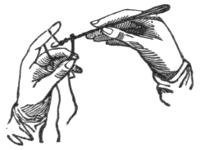
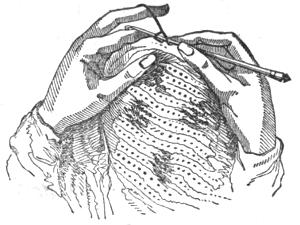
The mode of working the crochet stitch,
although in itself most simple, is difficult to
describe in writing; but, with the aid of the
annexed engraving, which shows the position
of the hands, and the manner in which the
needle and the work should be held, we will
endeavour to explain the elementary process.
Having wound a skein of wool, make a loop
at one end; through this loop draw another
loop, through this second loop another, and so
on, moderately tightening each, as it is drawn
through, until a chain of sufficient length be
made to serve as the foundation for the article
intended to be worked. Pass the needle
through the last loop of this foundation, and
catching the wool, draw it through, repeating
the same at every successive loop; then, return
along this row, and, in a similar manner, form
a second. A repetition of this process, alternately
backwards and forwards, from right to
left, and from left to right, will give the first
and easiest lesson. The work will be the same
on both sides, producing, by turns, one raised
and one sunken row.
Before proceeding further, however, it will,
be necessary, for the better understanding of
the directions hereafter offered, to give an

THE CROCHET NEEDLE.
A chain,—the foundation, formed by a succession
of loops drawn one through the other.
Plain single crochet,—where one loop only
is made on the needle, and drawn through
each stitch. It is lighter and thinner than
double crochet.
Plain double crochet,—where two loops
are kept on the needle, and the wool drawn
through both before the stitch is finished. This
is the crochet stitch generally practised, and
that used for working table-covers, etc.
Double stitch crochet,—in this, both meshes
of the chain are taken. It is principally employed
for the soles of shoes, and where extra
thickness is required, but it is not suitable for
working patterns.
Plain stitch elastic crochet,—is worked alternately
in rows backwards and forwards, from
right to left and from left to right, always taking
the under mesh of the chain.
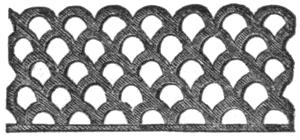
No. 1.
Plain stitch open crochet,—is composed of
chains, of five stitches each in length, forming
loops, each fifth stitch being crocheted to the
centre stitch of the corresponding loop in the
preceding row, as shown in the engraving. It
is mostly used for purses.
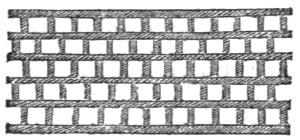
No. 2.
Open crochet—is worked (as nearly as can
be described) as follows:—make a chain of the
length required; work one plain stitch at the
beginning. Bring the silk round the needle,
and pass the needle through the first loop of
the chain; through this bring the silk, which
makes three stitches on the needle; draw the
silk through the first two stitches, which leaves
two on the needle; then draw the silk through
these two, which leaves one on the needle;
through this one, make one plain stitch. Put
the silk over the needle, and bring it through
the third loop of the chain; the three stitches,
as before, will now be found on the needle;
draw the silk through the first two, which leaves
two on the needle; draw the silk through these
two, which finishes the stitch, and leaves one
upon the needle as before. The plain stitch
that is then made between the two double
stitches, allows for the stitch which was passed
in the chain, and leaves an open space. It is
suitable for purses, bags, etc.
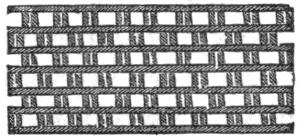
No. 3.
Double open crochet,—similar to the open
crochet stitch, but varied by making the two
long stitches together; this is done by omitting
the single stitch, and passing the needle
through the next loop of the chain, instead of
missing one stitch; thus producing two stitches
together, and then an open space. It is suitable
for bags, purses, &c.
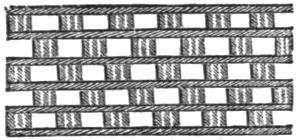
No. 4.
Treble open crochet,—also similar to the preceding,
but varied by making three stitches
successively, without making any plain stitch,
which produces alternate squares of open space
and stitches. Beads may be introduced on it
with very good effect in the following manner:—let
the beads be threaded on the silk, and
pass one on the middle stitch of the three
double stitches, giving a bead in the centre of
each square. This stitch makes a very pretty
purse.
To make a stitch,—at the commencement
and end of a row, is to make one stitch of a
chain before the first stitch, and after the last,
which in the next row are to be crocheted.
A dividing, or seam stitch,—called also a
raised stitch, is made by putting the needle
through both meshes of the chain, and working
two stitches in the same hole. These stitches
must always be made exactly over each other.
In crocheting circles they form a kind of star
pattern, and serve the purpose of increasing
stitches. They should not be employed when
working with chenille.
To increase a stitch,—to make two stitches
in the same loop.
To decrease,—to take two stitches together,
or to miss one stitch. Decreasing is always
done in the same ratio as increasing.
True or perfect stitch,—when working in
different colours, the keeping the stitches directly
over each other, without any appearance
of the half-stitch. This requires care, but it
greatly adds to the beauty of the work, and
makes the pattern more distinct.
To fasten off,—to draw the wool through
the last stitch.
To fasten on,—lay the ends of the wool
contrariwise, and crochet a few stitches with
both, or work in the second wool, and run the
end in with a needle at the back of the work.
To run the ends,—to pass them down a
few stitches with a needle. This is the neatest
and strongest plan; but they may be tied and
cut off.
A dividing line,—generally formed of two
stitches alternately up and down, into the
ground of the stripes on either side.
N. B. The engravings of the patterns are
placed in the book as they are intended to be
worked; that is, by commencing at the lower
part, on the right hand side.
A steel crochet needle is generally advisable;—with
expert workers, it makes the most even
stitches, but it is easier to work with an ivory
needle.
The second-sized netting silk is prettiest for
purses.
The coarsest, or crochet silk, is best adapted
for bags, with steel or gold beads.
Where many colours are required in a pattern,
and the same do not very frequently
occur, it is advisable to introduce them in
short lengths, instead of carrying on each
thread. This should always be attended to
when working with chenille.
When beads are used, they should be strung
on the silk with a needle.
When beads are introduced, the wrong side
of the work becomes the right. It is possible
to crochet with the beads on the right side,
but they never lay so firmly, nor indeed is it
the proper way of using them.
The average number of stitches for the
length of a purse, in fine silk, is one hundred
and sixty. In coarse silk,—one hundred and
ten.
From ninety to one hundred stitches form
the circle of a purse in fine silk.
One hundred and thirty stitches may be
taken for the round of a bag, in crochet silk.
A table-cover, in six-thread fleecy, is generally
computed at about four hundred stitches
in length.
Borders of flowers, and very intricate patterns,
may be worked in crochet, but it would
be impossible to convey a complete idea of these
even to the most experienced worker, without
greatly exceeding the limits of the present
work. The expert needle-woman will soon perceive
the best method of copying any pattern of
this description she may desire.
The terms chiné and ombré, are frequently
applied to the materials employed in crochet
and knitting. Wool and silk are chiné, when
two, three, or more different colours are introduced,
at intervals, on one thread, in the
process of dying;—they are ombré, when one
colour only is similarly employed, but which
gradually runs from the lightest to the darkest
shade.
N. B. In the directions for working the different
patterns in crochet, it must be borne in
mind, that unless any other stitch be mentioned,
the plain, or double crochet stitch, is
always to be employed.
This is merely given as the first and easiest
pattern in crochet, for the purpose of teaching
the stitch.
A good-sized ivory or steel crochet needle,
with six-thread fleecy, will be required. Instead
of working the rows backwards and forwards,
as before described, begin each row
separately at the same end. When the last
stitch of each row is finished, draw the wool
through, and cut it off, leaving an end of two
or three inches. It is impossible to determine
the exact number of stitches,—that must depend
on the article, and its required size; but
with this description of wool, half a yard in
length will generally be found to number about
sixty-five stitches, and a calculation may accordingly
be made.
First stripe—one row black; one row white;
one row black.
Second stripe—one row dark scarlet; one
bright scarlet; one light scarlet;—reverse the
same, to form a shaded stripe.
Third stripe—the same as the first.
Fourth stripe—the same as the second, but
in shades of blue.
These stripes are to be repeated alternately.
No. 5.
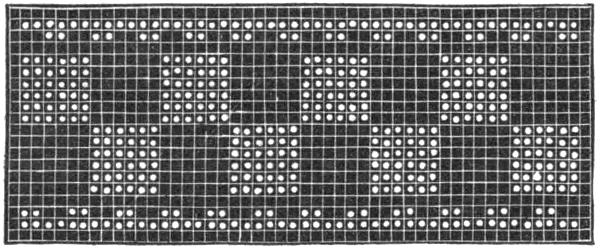
The ground of this pattern is plain. The
cheques are composed of chiné wool, the first
row differing in colour from that of the second.
The dividing line is in plain colours.
This pattern may be worked in stripes of
different colours, varying the colour of the
cheques agreeably to that of the ground. It
is adapted for a pillow, or a variety of other
articles, according to the material employed.
No. 6.
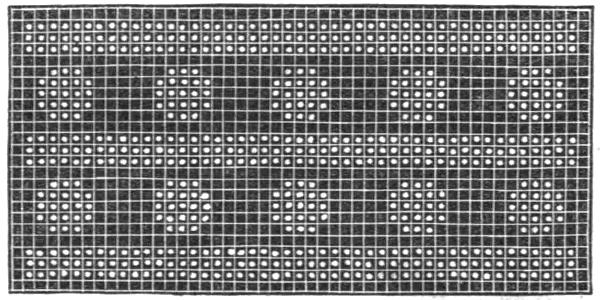
Zephyr, or double German wool.
This pattern may be worked according to
the two following methods. The first is the
easiest, as one thread of wool only is required
to be carried on to form the pattern.
Commence with a chain and one row of
black. Second row—scarlet. Third row—straw
colour.
Crochet a stripe, consisting of seven rows of
imperial blue, with the pattern in chiné wool—black,
white, and scarlet.
Repeat the three plain rows, as before, reversed,—straw
colour, scarlet, and black.
Crochet another stripe with drab, with the
pattern in chiné wool—blue, black, and white.
Commence again as at first.
The second method of working this pattern
is as follows,—having the plain rows, and the
ground of the two stripes as before. Crochet
the figure of the blue stripe,—
First row—three stitches black.
Second row—three stitches claret; two
black.
Third row—one stitch dark claret; one gold
colour; two dark scarlet; one black.
Fourth row—one stitch scarlet; two gold
colour; two scarlet.
Fifth row—three stitches scarlet.
Crochet the figure on the drab stripe,—
First row—three stitches claret.
Second row—three stitches dark green; two
claret.
Third row—one stitch middle green; one
white; two middle green; one claret.
Fourth row—one stitch light green; two
white; two light green.
Fifth row—three stitches light green.
The above pattern may be worked for a
bag, with the same colours, using silk instead
of wool, and commencing with a chain of about
one hundred and thirty stitches, with No. 2
Crochet Silk. It is a very easy bag to work,
and, if wished to be more elegant, gold may be
introduced. This pattern, also, with the same
sized silk, will make a very pretty crochet
slipper.
Commence with a chain and one row of
amber.
Second row—two stitches of amber, and two
of black,—alternately.
No. 7.
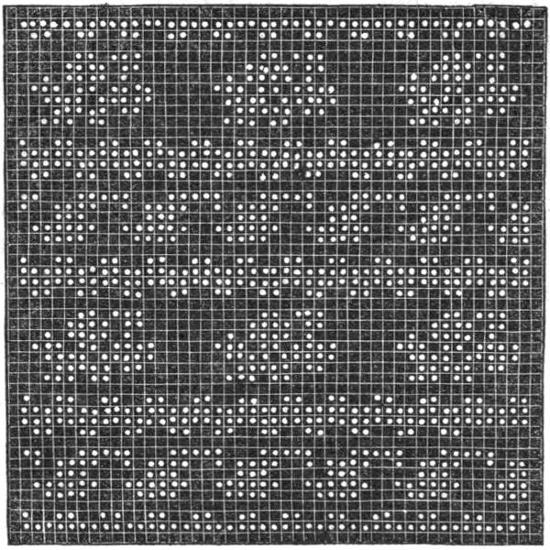
Then crochet one plain row of black, which
forms the ground of the first stripe. The pine
pattern on this stripe occupies five rows in
height; the first row—blue; the second—scarlet;
the third—green; the fourth—yellow; the
fifth—white. One plain row of black; and
one row—two stitches of black, and two of
amber,—alternately;—followed by one plain
row of amber, complete the first stripe.
The ground of the second stripe is scarlet;
the dividing lines,—both at top and bottom,—imperial
blue, the inner row of each being
composed of two stitches, alternately blue and
scarlet. The pattern occupies seven rows in
height; the first row—green; the second—black;
the third—blue; the fourth—amber;
the fifth—green; the sixth—stone colour; the
seventh—white.
The third stripe is imperial blue; the dividing
lines—amber; the pattern,—first row—black;
second—scarlet; third—white; fourth—green;
fifth—drab.
The fourth stripe is white; the dividing
lines—scarlet; the pattern,—first row—green;
second—black; third—blue; fourth—scarlet;
fifth—green: sixth—lilac; seventh—light
green.
Repeat from the first stripe.
This pattern, worked with six-thread fleecy,
will be found very easy and effective for a
table cover; using a steel or ivory crochet
needle, according to the fancy of the
worker.
The same pattern, with the colours as above
described for the first and second stripes, with
No. 1 Crochet Silk, will make an extremely
elegant bag. This should be commenced with
a chain of about two hundred and sixteen
stitches, united at the two ends, whether for
a round, or square bag. Gold thread may be
substituted in the dividing lines, working only
one plain row, instead of two, as in the engraving.
Five of the narrow, and four of the
wide stripes, will form a bag of an ordinary
size.
This pattern may be worked beautifully
with chenille, or with chenille and gold, for a
variety of purposes.
No. 8.
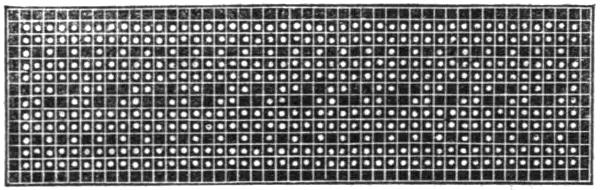
This pattern is recommended as being exceedingly
easy; and, at the same time very
pretty. Six-thread fleecy, with an ivory needle.
First stripe.
- Chain and first row—drab.
- Second row—dark crimson.
- Third row—one stitch rose colour; one drab;—alternately.
- Fourth row—bright pink.
- Fifth row—drab.
Second stripe.
- First row—two stitches white;—two black—alternately.
- Second row—two stitches white; two black;—alternately;—commencing with one stitch only of white.
Third stripe.
- First row—bright blue.
- Second row—dark olive drab.
- Third row—one stitch light olive drab; one bright blue;—alternately.
- Fourth row—yellow.
- Fifth row—blue.
Repeat the second stripe, and commence
again from the first.
This pattern may be varied, by working the
first and third stripes as above directed, with
the black and white stripes in double open
crochet. It may also be done in either manner
with coarse chenille.
The scroll pattern of the border of this design
is on a black ground. The ground of
each stripe of the Persian pattern for the centre
may be varied. Six, or eight thread fleecy,
with a steel or ivory needle. Commence
with:—
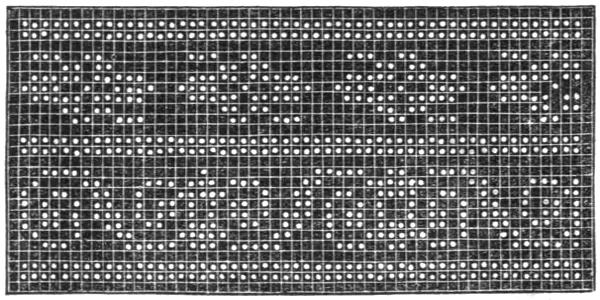
No. 9.
Chain and first row—dark red brown.
Second row—scarlet.
Third row—black.
Fourth row—one stitch light green; one
black; five red brown; five black; three brown;
two black; two green; two black; three brown;
five black; five brown; one black; two green.—Repeat
to the end of the row.
Fifth row—one stitch middle green; one
orange; four black; two orange; three black;
one orange; three black; one orange; four
green; one orange; three black; one orange;
three black; two orange; four black; one
orange; two green.—Repeat.
Sixth row—one stitch orange; two black;
two orange; two black; two orange; two
black; one orange; one scarlet; two orange;
one black; one orange; two dark green; one
orange; one black; two scarlet; one black;
one orange; two black; two orange; two
black; two orange; two black; one orange;
one green.—Repeat.
Seventh row—one stitch gold colour; one
black; two scarlet; one black; one gold colour;
one black; three gold colour; one black; one
gold colour; one black; two scarlet; one black;
one gold colour; two black; one gold colour;
one black; two scarlet; one black; one gold
colour; one black; three gold colour; one
black; one gold colour; one black; two scarlet;
one black; one gold colour; one black.—Repeat.
Eighth row—one stitch gold colour; one
black; two scarlet; one black; one gold colour;
two black; two gold colour; one black;
one gold colour; two black; one gold colour;
one black; one gold colour; two black; one
gold colour; one black; one gold colour; two
black; one gold colour; one black; two gold
colour; two black; one gold colour; one black;
two scarlet; one black; one gold colour; one
black.—Repeat.
Ninth row—one stitch dark blue; one yellow;
three black; one yellow; two black;
two yellow; two black; two yellow; two
black; one yellow; two blue; one yellow;
two black; two blue; two black; two yellow;
two black; one yellow; three black; one yellow;
two blue.—Repeat.
Tenth row—one stitch middle blue; one
black; three yellow; four black; two yellow;
four black; one yellow; four blue; one yellow;
four black; two yellow; four black;
three yellow; one black; two blue.—Repeat.
Eleventh row—ten stitches black; five white;
two black; two light blue; two black; five
white; ten black; one blue.—Repeat.
Twelfth row—black.
Thirteenth row—red brown.
Fourteenth row—scarlet. This finishes the
border.
Commence the ground of the centre, or second
stripe, with one plain row of white; the
colours of the Persian pine pattern on which
are as follow:—
First row—three stitches dark green; two
white; two green.
Second row—two stitches light scarlet; one
white; two scarlet.
Third row—two stitches middle green; three
dark scarlet; one white; three scarlet; two green.
Fourth row—four stitches light green; two
white; one black; two white; four green.
Fifth row—two stitches light green; three
dark blue; one white; three blue; two green.
Sixth row—two stitches light blue; one
white; two blue.
Seventh row—two stitches light green; two
white; three green.
One plain row of white finishes the stripe.
The brown and scarlet rows are again to be
worked, when the border may be repeated,
alternately with the stripes of the Persian
pattern; or, the latter alone may be repeated,
with the colour of the ground varied,—the
colours of the pattern being also changed, to
harmonize with it.—The colours, as above
given, are for a white ground.
This pattern is adapted for the border of
a table-cover, hearth-rug or stair-carpet. It
may be worked in four, six, or eight-thread
fleecy, with a steel or ivory needle, according
to its appropriation. The colours required are
three distinct shades of green, two of scarlet,
two of blue, two of gold colour, two of lilac,
black, white, and geranium: the proper selection
of these constitutes much of the beauty
of the pattern:—the geranium colours should
be very bright. Commence with:—

No. 10.
Chain and first row—black.
Second row—gold colour.
Third row—black.
Fourth row—two stitches black; one light
green; one black; one green; two black;
three geranium.—Repeat to the end of the
row.
Fifth row—two stitches geranium; one
white; one dark green; one white; two geranium;
three gold colour.—Repeat.
Sixth row—the same as the fourth.
Seventh row—black.
Eighth row—blue.
The above finishes the narrow border. The
ground of the centre border is white; having
worked two rows of which, commence the
pattern with,—
First row—two stitches white; six dark
scarlet; two white; three light green; two
white; three green; three white; one scarlet;
two white; two scarlet; two white; three
green; two white; three green; three white;
one scarlet; two white; two scarlet; two white;
three green; two white; three green.—Repeat
to the end of the row.
Second row—one stitch white; two light
scarlet; one white; one middle green; four
scarlet; two white; three green; one white;
two green; two white; four scarlet; one white;
three scarlet; two white; three green; one
white; two green; two white; four scarlet;
one white; three scarlet; two white; three
green; one white; two green; one white.—Repeat.
Third row—one stitch white; two dark blue;
one white; one dark green; four blue; three
white; five green; four white; two blue; one
white; three blue; three white; five green;
four white; two blue; one white; three blue;
three white; five green; one white.—Repeat.
Fourth row—one stitch black; two white;
six light blue; ten black; three white; five
blue; ten black; three white; five blue; nine
black.—Repeat.
Fifth row—one stitch black; eight white.—Repeat.
Sixth row—ten stitches black; three white;
five light gold colour; ten black; two white;
six gold colour; ten black; three white; five
gold colour.—Repeat.
Seventh row—Four stitches white; three
dark green; five white; two dark gold colour;
one white; three gold colour; four white;
three green; three white; two gold colour; one
white; one green; four gold colour; four white;
three green; five white; two gold colour; one
white; three gold colour.—Repeat.
Eighth row—two stitches white; six middle
green; two white; four light lilac; one white;
three lilac; two white; six green; two white;
two lilac; one white; one green; four lilac;
two white; six green; two white; four lilac;
one white; three lilac.—Repeat.
Ninth row—one stitch white; three light
green; three white; two green; three white;
one dark lilac; two white; two lilac; two
white; three green; three white; two green;
two white; six lilac; two white; three green;
three white; two green; three white; one lilac;
two white; two lilac; one white.—Repeat.
Two rows of white complete the centre
border.
Repeat the small border, beginning with the
row of blue.
This pattern may be worked with double
German wool.
Commence with a chain of about one hundred
and ninety stitches in black. Then,—
With three distinct shades of scarlet, crochet
a shaded stripe, consisting of five rows,—beginning
with the darkest colour,—the lightest
forming the centre.—Repeat the black row.
Work a stripe of treble open crochet, consisting
of one row of each of the following
colours: namely,—chrysophas green, scarlet,
white, gold colour, lilac, and chrysophas green.
Repeat the black row.—Form a stripe similar
to the first, with shades of white.—Repeat
the black row.
Repeat the stripe of treble open crochet.—Repeat
the black row.—Crochet another shaded
stripe with lilac.—Repeat the black row.—Repeat
the stripe of treble open crochet.—Repeat
the black row.—Work another shaded
stripe with gold colours.—Repeat the black
row.—Repeat the stripe of treble open crochet.—Repeat
the black row, and the first shaded
stripe with scarlet. This forms the centre
stripe. Reverse the order of the coloured
stripes to complete the pillow.
Commence with two plain rows, the first—gold
colour; the second—black. The black
forms the ground of the first half stripe.
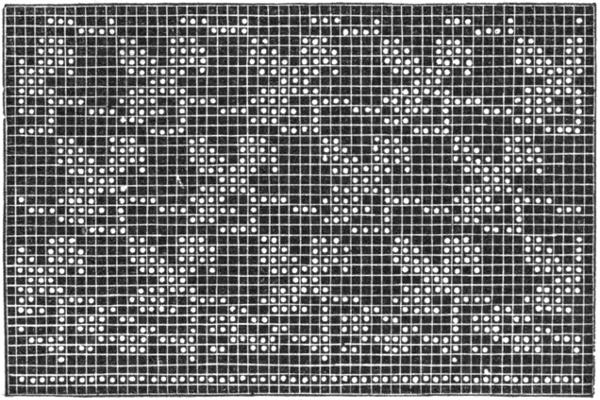
No. 11.
N. B. The zigzag edges of the riband stripe
are every where worked with white.
Third row—twelve stitches of black, one of
white,—alternately.
Fourth row—one stitch white; three black;
three red brown; two black; two middle green;
one black; one white.—Repeat.
Fifth row—three stitches white; one black;
three orange; two light green; three black;
one white.—Repeat.
Sixth row—three stitches scarlet; two white;
three black; three gold colour; one black; one
white.—Repeat.
Seventh row—five stitches scarlet; two white;
one black; three yellow; one black; one white.—Repeat.
Eighth row—one stitch scarlet; four dark
stone colour; two scarlet; two white; three
black; one white.—Repeat.
Ninth row—two stitches scarlet; four middle
stone colour; three scarlet; four white.—Repeat.
Tenth row—two stitches dark green; three
light stone colour; seven scarlet; one black.—Repeat.
Eleventh row—three stitches middle green;
ten scarlet.—Repeat.
Twelfth row—five stitches light green; five
scarlet; one dark stone colour; one scarlet;
one light green.—Repeat.
Thirteenth row—one stitch dark stone colour;
one scarlet; four dark green; four scarlet; three
dark stone colour.—Repeat.
Fourteenth row—one stitch middle stone colour;
two scarlet; three middle green; four
scarlet; three middle stone colour.—Repeat.
Fifteenth row—one stitch light stone colour;
three scarlet; two light green; five scarlet;
two light stone colour.—Repeat.
Sixteenth row—six stitches scarlet; four
white; three scarlet.—Repeat.
Seventeenth row—six stitches scarlet; one
white; three drab; three white.—Repeat.
Eighteenth row—three stitches white; three
scarlet; one white; one drab; four dark lilac;
one drab.—Repeat.
Nineteenth row—three stitches drab; four
white; two drab; four middle lilac.—Repeat.
Twentieth row—six stitches drab; three
dark green; three light lilac; one drab.—Repeat.
Twenty-first row—seven stitches drab; three
middle green; three drab.—Repeat.
Twenty-second row—four stitches drab; one
dark lilac; one drab; six light green; one drab.—Repeat.
Twenty-third row—Four stitches drab; four
dark lilac; one drab; four dark green.—Repeat.
Twenty-fourth row—four stitches drab; four
middle lilac; two drab; three middle green.—Repeat.
Twenty-fifth row—five stitches drab; three
light lilac; three drab; two light green.—Repeat.
Twenty-sixth row—four stitches white; nine
drab.—Repeat.
Twenty-seventh row—one stitch white; three
blue; three white; six drab.—Repeat.
Twenty-eighth row—one stitch white; one
blue; four claret; one blue; three white; three
drab.—Repeat.
Twenty-ninth row—one stitch white; two
blue; four dark scarlet; three blue; three
white.—Repeat.
Thirtieth row—three stitches dark olive;
three scarlet; seven blue.—Repeat.
Thirty-first row—one stitch blue; three middle
olive; nine blue.—Repeat.
Thirty-second row—six stitches light olive;
five blue; one claret; one blue.—Repeat.
Thirty-third row—two stitches claret; one
blue; four dark olive; four blue; two claret.—Repeat.
Thirty-fourth row—two stitches dark scarlet;
two blue; three middle olive; four blue;
two dark scarlet.—Repeat.
Thirty-fifth row—two stitches scarlet; three
blue; two light olive; five blue; one scarlet.—Repeat.
Thirty-sixth row—seven stitches blue; four
white; two blue.—Repeat.
Thirty-seventh row—one stitch white; six
blue; one white; three scarlet (the ground of
the next stripe); two white.—Repeat.
This completes the pattern, which consists
of the same sprig repeated in different colours,
on three different coloured grounds. It will be
perceived that the sprigs run in a diagonal
direction; and the commencement of the first
two rows of the fourth stripe, on referring to
the corresponding part of the previous stripe,
will show where the next sprig is to be begun.
If worked for a bag, or sac de voyage, the
pattern should be commenced from the bottom,
thus forming a border at the lower part; but if
a pillow, table cover, or couvre-pied, is intended
to be made,—first crochet two plain rows, and
then commence the pattern as at the sixteenth
row.
For working the larger articles in the above
pattern, fleecy may be employed; for the
smaller—German wool; and for the more
elegant—chenille and gold, or silk and gold.
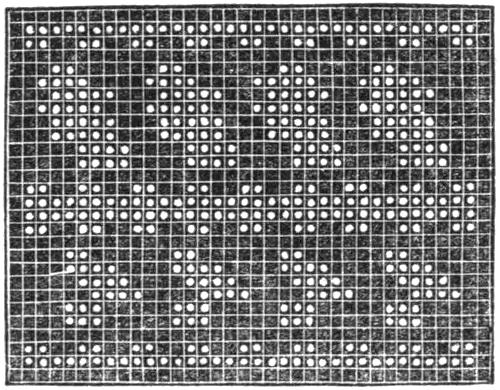
No. 12.
This is suitable either for a table cover,
counterpane, pillow, the tops of large ottomans,
the cover for a chair, a rug, or a bedside carpet.
Six-thread fleecy and a steel needle will be required.
The dividing line is formed of two
clarets. The stripes are scarlet, blue, gold colour,
and white.
The pattern on the scarlet stripe—two shades
of green, lilac, white, brown, and bright yellow.
On the blue stripe—two scarlets, two whites,
two gold colours, two dark scarlets.
On the gold coloured stripe—two blues, claret,
white, lilac, and green.
On the white stripe—two greens, two scarlets,
two blues, brown, and yellow.
Six-thread fleecy with a steel needle.
The pattern of the border is in black,—the
ground in shades of gold colour. Commence
with a chain of black, and one plain row of the
same; then, two plain rows of red brown. In
the next row begin the pattern as follows:—
First row—black, with the single stitches of
the ground in red brown.
Second and third rows—black and orange.
Fourth, fifth, and sixth rows—black, and gold
colour.
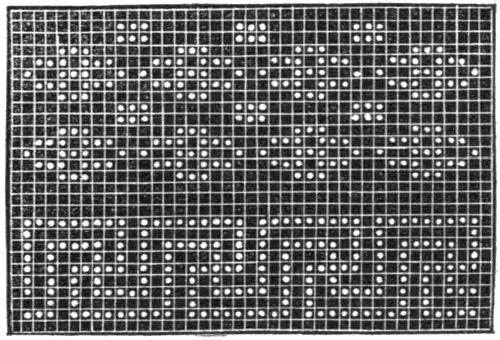
No. 13.
Seventh, eighth, and ninth rows—black and
yellow. One plain row of straw colour, followed
by one plain row of white, complete the
border.
Commence the ground of the centre, with
one plain row of middle blue. On this blue
ground, work the pattern in the following colours:—
First row—dark claret.
Second row—claret.
Third row—claret, with the three centre
stitches in white.
Fourth row—middle scarlet.
Fifth row—light scarlet.
Sixth and seventh rows—(forming the second
pattern of the centre)—the gold colour and yellow
that were used in the ground of the border.
Commence again with the claret, as in the
first row of the pattern.
When the square is completed, neatly run in
the wools with a rug needle, or tie them close
to the work; this will produce a firm edge, on
which a fringe may be sewn.
This pattern is very easy, and the effect exceedingly
good. It is well adapted for working
with chiné wool.
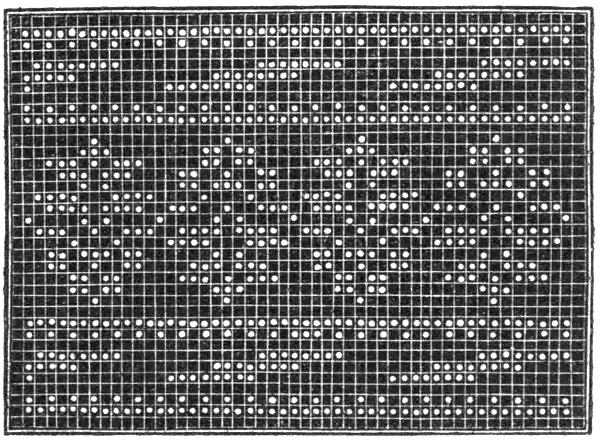
No. 14.
The chain and first row black. The next
row alternate stitches of black and chiné wool
(say blue). The ground of the first stripe is
in blue chiné wool, with the pattern in white.
The dividing line black. The ground of the
next stripe is worked in scarlet chiné wool,
with the pattern in white, except the centre
line or wave, which should be black.
Raised, or ribbed crochet is worked in rows
from right to left, according
to the ordinary method;
but the side of the
work is reversed at every
alternate row, as in plain
crochet (see page 14),
hence it becomes the
same as that description
of work, with this exception,
that the back,
or under stitch, is always
to be taken; it has therefore
a ribbed or raised
appearance, and is rendered
thicker and closer,
and of a more elastic
texture.
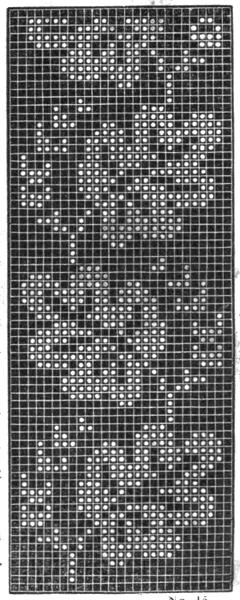
No. 15.
The annexed design
is well adapted for working
in raised crochet. The colour, forming the
pattern, should only be introduced when necessary,
and should not be carried on through the
ground, as in plain double crochet; therefore,
the same thread must be taken up and dropt,
as the form of the pattern may require—a
process by no means difficult. When necessary,
however, the idle wool should be carried
through the stitches of that in use, and not left
loose at the back.
The pattern here given is intended to be
worked in stripes; these are afterwards to be
sewn together. It is very handsome for quilts,
couvre-pieds, &c. The colours may be varied,
thus—first stripe, white, with the pattern in
scarlet; the second, scarlet, with the pattern
in white. Shaded wools may be used for the
pattern on a plain ground.
Commence with a chain of black. Work one
row in two stitches of black and two of scarlet,
alternately. Then, one row of scarlet and one
row of black; the latter forms the ground of
the border,—the pattern on which is in four
shades of gold colour,—two rows of each, commencing
with the darkest. One plain row of
black, and one of scarlet, finish the border.
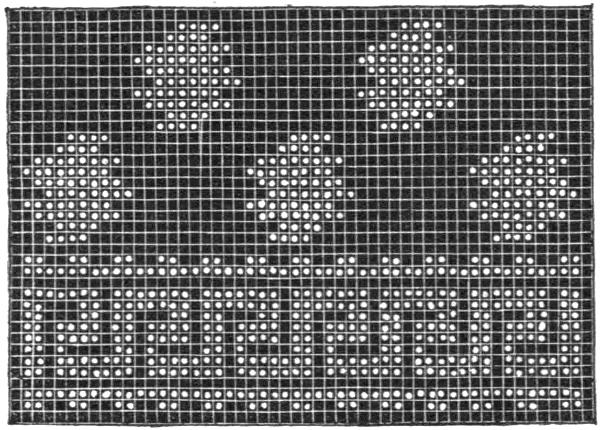
No. 16.
Crochet one plain row of white, then one
plain row of blue; the latter forms the ground
of the centre. The colours of the pine pattern
are as follows:
First row—middle scarlet.
Second row—light scarlet.
Third row—three stitches drab; two black;
three drab.
Fourth row—three stitches white; two black;
three white.
Fifth row—three stitches gold colour; two
lilac; three gold colour.
Sixth row—three stitches yellow; two lilac;
three yellow.
Seventh row—three stitches middle scarlet;
two black; three middle scarlet.
Eighth row—three stitches light scarlet; two
black; three light scarlet.
Ninth row—drab.
Tenth row—white.
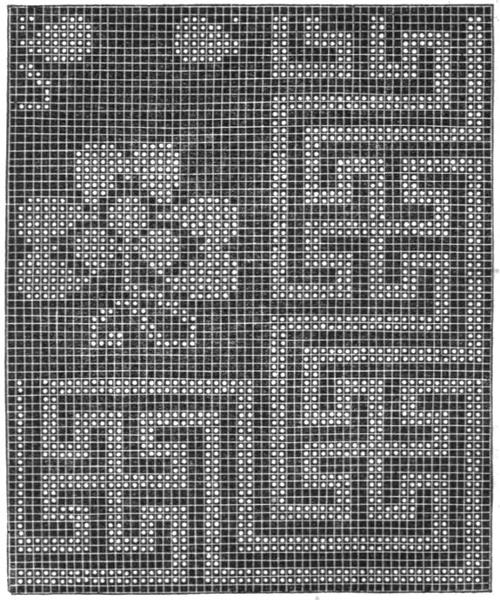
No. 17.
This pattern may be employed for a tidy,
sofa pillow, mat, carpet, cradle, or bed quilt,
carriage wrapper, d’oyley, and a variety of other
purposes, where a border on each side may be
required. It may be worked either in plain
double crochet, or in raised crochet. A different
material, together with a different sized
needle, are the only requisites to adapt it to
any of the above purposes. Thus,—
For a sofa pillow, eight-thread zephyr fleecy;
for a tidy, three-thread fleecy; for a window
mat, eight-thread common fleecy; for a flower
mat, German or English wool; for a cradle
quilt, eight-thread zephyr fleecy; for a bed
quilt, six-thread fleecy; for a d’oyley, rather
fine knitting cotton. The size of the article,
however, must in the first instance be determined,
and the number of stitches counted, so
as to bring in the pattern as suited to that size.
The simplest colouring will be the most effective,—a
plain ground, with the pattern in any
bright colour. Designs of this description,
which require calculation and constant counting,
may be adopted as amusing, but not as
very easy work.
Make a chain of fourteen stitches, in claret
crochet silk; join both ends together, and crochet
one plain row all round. In the next row
(in order to keep the circle flat), every other
stitch is to be made a seam or dividing stitch,
which is done by putting the needle under both
loops instead of one, and making two stitches,
in the same place, every other stitch being a
plain stitch. In the next row, work the seam-stitch
in the same place, leaving two plain
stitches between each, instead of one. Repeat
this circle sixteen times, always observing to
keep the seam stitch in the same place, the
number of plain stitches gradually increasing,
when a flat surface of about four inches in diameter
will be produced, intersected with seven
raised stripes. A vandyke border in claret and
green may now be made as follows.
First row—five stitches claret; one green.
Second row—three stitches claret; three
green.
Third row—one stitch claret; five green.
Fourth row—green.
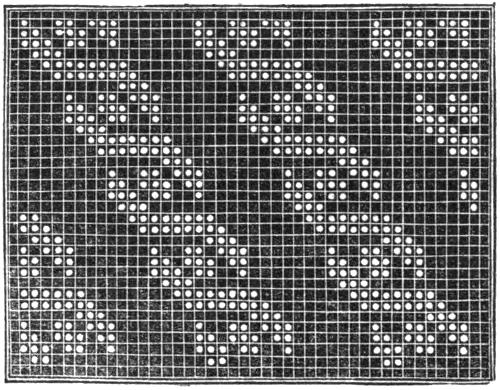
No. 18.
The annexed pattern may then be worked
in green on the claret ground.
When within five rows of the top of the bag,
work one plain row of the ground, repeat the
vandyke, and work two plain rows of the claret
ground.
This bag is very pretty and delicate worked
in white and gold, and in blue and gold; it
may also be varied in colour as taste may dictate.
The pattern looks extremely well in
steel beads.
Make a chain of fourteen stitches, join both
ends together with the crochet, and crochet
one plain row all round. In the next row,
every other stitch is to be made a seam or dividing
stitch, which is done by putting the
needle under both loops, instead of under one,
and making two stitches in the same place:
every other stitch being a plain stitch, on which
is to be a bead. In the next row, work the
seam stitch exactly over the last, which will
leave two plain stitches between, instead of
one; this is to be repeated until eight circles
are formed, every plain stitch having a bead
on it. Crochet eight rows more, leaving the
seam-stitch in the same place, but diminish the
number of beads, by leaving out one bead in
each division on each successive circle, so that
the last row will have but one bead in each division.
Then, crochet four plain rows, keeping
the seam-stitch in the same place as before,
then one plain row all round, without a seam-stitch,
which forms the bottom of the bag.
This bag is worked in plain stitch double
crochet, with crochet silk, and gold of the same
size. A steel needle, with twenty-five yards
of gold cord, and about twelve skeins of silk,
will be required. The colours of the silk are
claret, three shades of green, and black.
Commence with a chain of nine stitches, in
claret; unite the ends, and crochet one plain
row,—increasing on every stitch. Join on the
black silk, and work one stitch of black, and
two of claret,—alternately,—increasing with
the black stitch. There should now be twenty-seven
stitches. Work another row the same,
but without increasing. In the next row, (the
third, with two colours)—two stitches black,
two claret,—alternately—increasing with the
black stitches. The two stitches of claret are
to be repeated over each other (so as to form a
star) in each of the nine following rows.
Fourth and fifth rows—claret and black,—increasing
one stitch on every two stitches of
the claret.
Sixth, seventh, eighth, and ninth rows—claret
and dark green,—increasing one stitch, as before.
Tenth row—claret, and middle green, increasing
one stitch, as before.
Eleventh row—one stitch gold; four middle
green,—increasing one stitch; two gold; two
green; one gold; two claret.—Repeat.
Twelfth row—two stitches gold; two middle
green; three gold; two green; one gold; two
claret.—Repeat.
Thirteenth row—two stitches gold; three
middle green; one gold; three green; two
gold,—increasing on the gold stitches; two
claret.—Repeat.
Fourteenth row—one stitch claret; two gold;
five light green; two gold; five claret,—increasing
on the third stitch.—Repeat from the
first two gold stitches.
Fifteenth row—one stitch claret; two gold;
three light green; two gold; eight claret,—increasing
on the third stitch.—Repeat from the
first two gold stitches.
Sixteenth row—one stitch claret; five gold;
five claret,—increasing on the third stitch; one
gold; five claret.—Repeat from the five gold
stitches.
Seventeenth row—one stitch claret; three
gold; five claret; three gold; six claret,—increasing
on the second stitch.—Repeat from
the first three gold stitches.
Eighteenth row—one stitch claret; one gold;
three claret,—increasing on the second stitch;
two dark green; two claret; three gold; two
claret; two green; three claret.—Repeat from
the first gold stitch.
Nineteenth row—four stitches claret; two
middle green; two gold; one claret; one gold;
one claret; two gold; two green; seven claret.—Repeat
from the first two green stitches.
Twentieth row—one stitch claret; two light
green; two claret; one gold; two claret; two
green; nine claret, without increasing.—Repeat
from the first two green stitches.
Twenty-first row—two stitches claret; five
dark green; fourteen claret.—Repeat from the
five green stitches.
Twenty-second row—one stitch claret; three
middle green; fifteen claret.—Repeat from the
three green stitches.
The bottom, and the first row of sprigs are
now completed,—the bag being at its full diameter.
In the next row the sprigs are to be
commenced again.
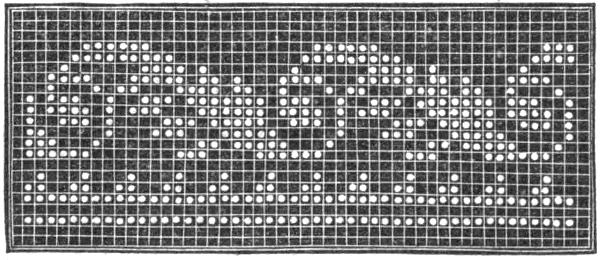
No. 19.
The pattern on this bag is in white and gold,—the
ground being of a rich Waterloo blue. It
should be worked with middle-sized crochet silk.
The above scroll pattern will be repeated nine
times, on a bag of the usual size. Commence
with a chain of one hundred and eighty stitches.
Chain, and first row,—Waterloo blue.
Second row—white.
Third row—Waterloo blue.
Fourth row—gold.
Fifth row—two stitches gold, two blue,—alternately.
Sixth row—one stitch gold, three blue—alternately.
Work one row of blue, and commence the
scroll pattern as follows:—
First row—two stitches blue; six gold; four
blue; three white; five blue.—Repeat to the
end of the row.
Second row—one stitch blue; one gold;
three blue; two gold; three white; one blue;
two gold; seven blue.—Repeat.
Third row—one stitch gold; five blue; three
gold; two white; three blue; three white;
three blue.—Repeat.
Fourth row—one stitch gold; one blue;
three gold; two blue; three gold; two white;
one blue; three gold; four blue.—Repeat.
Fifth row—one stitch gold; one blue; one
gold; two white; one gold; one blue; four
gold; two white; three blue; three white;
one blue.—Repeat.
Sixth row—one stitch gold; two blue; three
gold; one blue; five gold; two white; one
blue; three gold; two blue.—Repeat.
Seventh row—one stitch blue; one gold;
three blue; one gold; two blue; two gold;
one blue; two gold; two white; three blue;
two white.—Repeat.
Eighth row—two stitches blue; four gold;
three blue; one gold; one blue; two gold;
one blue; one gold; two white; two gold;
one blue.—Repeat.
Ninth row—four stitches blue; one gold;
seven blue; one gold; one blue; three gold;
one white; two blue.—Repeat.
Tenth row—three stitches white; one gold;
eleven blue; three gold; two white.—Repeat.
Eleventh row—three stitches gold; fourteen
blue; three gold.—Repeat.

No. 20.
The above cachemir pattern may be taken
for the upper part of the bag,—being worked
in white and gold.
The most elegant colouring for this bag will
be four shades, from black, of any pretty écru;
mixed with either blue, violet, scarlet, or green,
in an equal number of shades.
Commence with a chain of two hundred and
forty stitches in fine netting silk;—work two
plain rows of open crochet, and join them
together at both their edges: this will form
a pretty finish for the bottom of the bag.
Crochet one plain row of black.
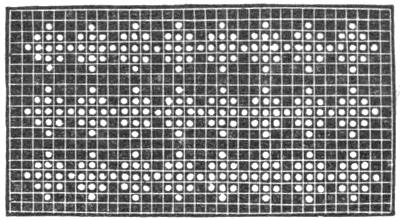
No. 21.
The above pattern is now to be worked.—Commence
with the gold, to form a half row of
diamonds, by crocheting one plain row. In the
next row,—three stitches gold, one black,—alternately;—in
the next row,—one stitch gold,
three black,—alternately. The next row is
black,—forming the centre row, of the first
perfect row of diamonds.
The next row of diamonds,—formed of the
darkest shade of écru, is commenced as the
preceding,—one stitch écru; three black; in
the next row,—three stitches écru; one black.
This finishes the first complete row of diamonds
in black. The next row is plain écru,—forming
the centre row of the second perfect
row of diamonds. The third row of diamonds
is to be a middle shade of écru; the fourth—the
lightest shade of écru.
Repeat one row of diamonds in gold, and
commence another stripe of diamonds with any
of the before-mentioned colours, beginning with
black; then the darkest shade; then the middle;
and lastly, the lightest.
Repeat the one row of diamonds in gold, and
commence again with the stripe in shades of
écru.
Commence with a chain of four stitches in
blue; having united the ends, crochet three
rows,—increasing on every stitch, in the first
and second rows; and on every other stitch in
the third row, which should count twenty-four
stitches.
Fourth row—join on the claret; work one
stitch claret, one blue,—alternately.
Fifth row—two stitches claret; one blue—alternately,—increasing
on the claret stitches.
Sixth row—two stitches claret; two blue,—increasing
on the blue stitches.
Seventh row—two stitches claret; three blue,—increasing
on the second stitch of blue.
Eighth row—two stitches claret; four blue,—increasing
on the second stitch of blue.
Ninth row—two stitches claret; five blue,—increasing
on the second stitch of blue.
Tenth row—two stitches claret; six blue,—increasing
on the third stitch of blue.
Eleventh and twelfth rows—two stitches
claret; six blue,—without increasing.
Thirteenth row—two stitches claret; seven
blue,—increasing on the third stitch of blue.
Fourteenth row—one stitch claret; five
blue; five claret,—increasing on the second
stitch; five blue; four claret,—without increasing.—Repeat
from the first five stitches of
blue.
Fifteenth row—one stitch claret; three blue;
seven claret; three blue; seven claret,—increasing
on the third stitch.—Repeat from the
first three blue stitches.
Sixteenth row—one stitch claret; one blue;
ten claret,—increasing on the fourth stitch.—Repeat
from the first blue stitch.
Seventeenth and eighteenth rows—claret,—without
increasing.
Nineteenth row—claret,—increasing one
stitch on every thirty-third. This row should
contain one hundred and thirty-six stitches,
when the bag will have acquired its full size,
and the increasing be finished.
The next three rows are worked in four
stitches of gold, and four of claret,—alternately.
Then, four plain rows, viz.—one of gold; one
of black; one of white; and one of gold;—followed
by one row of blue, and one row of
white, in double open crochet; then, one row
of gold, one row of black, and one row of gold,
in plain crochet. Repeat the two rows of
double open crochet,—the first in blue, the
second in claret;—also the one row of gold;
the one row of black; and the one row of gold.
Commence again with the rows of blue and
white, in double open crochet.
There should be four divisions of double open
crochet, the bag being finished with the black
and gold stripe.
Make a chain of six loops, in fine blue chenille,
and unite both ends. Crochet in rows,—to
form a round (increasing a sufficient
number of stitches in each row to keep the work
flat), until fourteen rows are finished. This
forms the bottom of the bag.
Commence a vandyke pattern, by making
one stitch of gold to every fifth of the coloured
ground, in the first row. In the next row
three stitches of gold, and three of the ground;
in the next, five of the gold, and one of the
ground. The two next rows are to be plain—the
first of gold, the second of black.
Work two rows of open crochet,—the one in
scarlet, the other in blue.
The two rows of black, with one row of gold
between, are then to be worked in plain crochet;
followed by two rows of open crochet,—the
first white, the second blue. Repeat the
two rows of black, with the gold between, and
the two rows of open crochet,—alternately, to
complete the bag.
About sixteen skeins of chenille, and
twenty-four yards of gold cord, will be required.
Commence at the top with a chain of fourteen
stitches, unite the ends, and crochet one
plain row. In the next row, make a raised or
dividing line on every other stitch, as for the
bottoms of bags. The increasing must be continued
until the diameter of the circle is about
six inches and a half. Work round this, in
plain rows, until the cap be sufficiently deep;
occasional increasing stitches may be made, if
it be not large enough.
The cap should be finished with a double
gold braid,—meeting the points of the increasing
lines: a gold band round the bottom,
and a handsome tassel at the top may be added;
or in the place of these, silk trimmings may be
substituted. It requires to be very neatly made
up in the inside.
Commence at the top with a chain of six or
eight stitches; unite the ends, and work in
rows round and round, (increasing a sufficient
number of stitches in each row to keep the work
flat,) until it be about eight inches in diameter.
The sides may be worked in open crochet, introducing
a few plain lines of black and gold
between each two rows of the open crochet.
The best colours for a cap in chenille are
black and gold;—dark blue, black, and gold;—and
claret, black, and gold.
Commence with a chain of about six stitches
in plain green netting silk; crochet both ends
together; work three plain rows of green, and
then one row of alternate stitches of dark scarlet
and green.
The scarlet silk will now form the ground, on
which the star pattern of green is to be worked.
Crochet a row with two stitches of green, and
two of scarlet, alternately; in the next row,
two of scarlet and three of green. Crochet, in
a similar manner, one row after another, increasing
on each row one stitch in the green
pattern, every time that colour is repeated,
until it counts seven stitches in each division;
taking care to keep the two scarlet stitches of
the ground exactly over each other.
The pattern is now to be decreased, by
working four stitches of scarlet and five of
green; in the next row,—seven of scarlet and
three of green; and in the next,—ten of scarlet
and one of green;—increasing one stitch in
each division of the ground.
Work two plain rows of scarlet, increasing a
sufficient number of stitches to keep the work
flat, and finish with a kind of fringe, formed by
two rows of open crochet in green.
The chain is made by commencing with five
plain stitches, then putting the needle through
the back of the second stitch, and making one
plain stitch. It will be found, by twisting the
chain after every stitch, that one stitch appears
to go across,—this is the stitch that is always
to be taken and crocheted.
The light-coloured stripes composing this
slipper, are alternately buff and white: the
dark stripe between each is a full blue. Each
stripe is separated by a dividing line of black.
The colours of the pattern on each stripe, are
as follow:—
Commence at the toe with the blue stripe,—the
colours of the pattern being claret, gold
colour, and scarlet.
The second stripe is buff,—the colours of the
pattern being dark blue, lilac, scarlet, and
green.
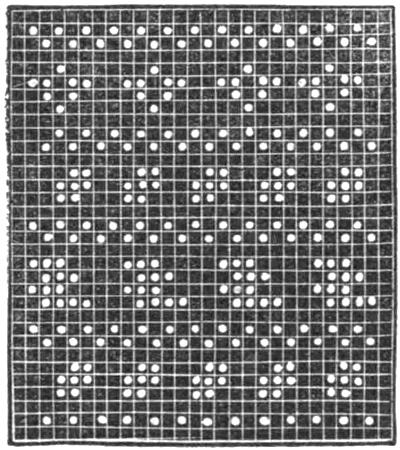
No. 22.
Repeat the blue stripe.
The fourth stripe is white,—the colours of
the pattern being violet, lilac, green, and
scarlet.
This slipper may be worked in crochet silk,
or German wool. The number of stripes must
depend on the required size of the slipper.
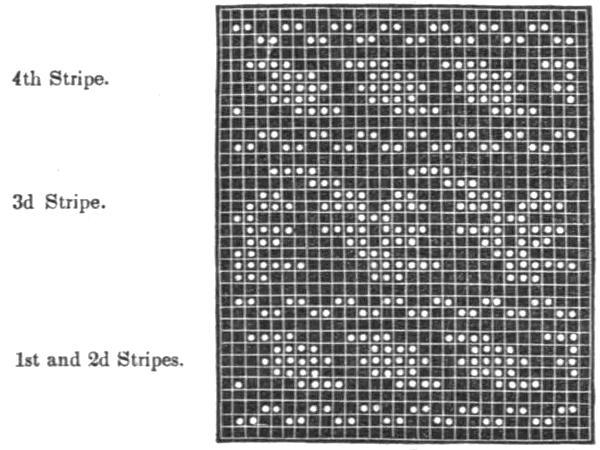
No. 23.
The above pattern is intended for a slipper,
in German wool, or crochet silk, in stripes,
across the front, continued in the same direction
round the back. The colours of the different
stripes,—commencing at the toe, are as follow:—
First stripe—gold colour; with the pattern
composed of black, green, white, bright scarlet,
and black.
Second stripe—blue; the pattern in scarlet,
black, gold colour, white, and claret.
Third stripe—(the centre of the engraving)
scarlet; this stripe is wider than any other on
the slipper. The pattern on it is composed of
light green, dark green, black, light blue, and
gold colour, dark blue and claret, black, gold
colour and lilac, white and dark lilac, light
green, and dark green.
Fourth stripe—white; the pattern in blue,
yellow, lilac, green, and scarlet.
The narrow stripes are repeated round the
back of the slipper; they are gold colour, blue,
scarlet, white, and green.
For a moderate-sized gentleman’s slipper in
crochet silk, the toe might be commenced with
twenty-four stitches, and increased in the succeeding
rows, until the width across the instep
were eighty stitches,—but, as some persons
work so much tighter than others, a positive
number cannot be given. The silk also may
vary in size, as well as the dimensions required
for a slipper. The increasing is made by the
addition of a stitch on each side of the work.
The stripes in the front of the slipper are
gold colour, blue, scarlet, and white; the latter
crosses the instep. Count the number of stitches
on the white stripe, and, with the gold colour
commence a stripe one third of its length on
one side, to form the back. Continue these
stripes, until the back be sufficiently long to be
sewn to the front on the other side. It is advisable,
before commencing a slipper, to cut a
paper pattern of the desired size and shape.
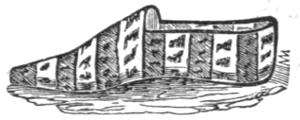
The above form chaussons to wear over the
shoes, the sole being formed of coarse crochet
in black; or they may be made up in the usual
way for slippers, either for ladies or gentlemen.
In crochet silk they are extremely warm and
durable.—The ends of the wool or silk, are
to be threaded with a needle, and run into the
work on the inside.
Plain crochet-purses are exceedingly strong,
and may be made very prettily with a moderate
sized netting silk. Those, worked in rows the
length of the purse, are the most easily made.
Make a chain in scarlet netting silk of one
hundred and forty stitches, on which crochet
three plain rows with the same colour. Then,
five plain rows in shades of green, or stone
colour. These two stripes are to be repeated
until the purse is of a sufficient width. When
completed, it is to be neatly sewn up, or joined
by crocheting the two sides together. The
ends are then to be drawn up, and the purse
trimmed.
Commence with a chain of fourteen stitches,
and joining both ends together, crochet one
plain row all round. In the next row, every
alternate stitch is to be made a dividing or
seam-stitch; this is done by passing the needle
under both the corresponding loops in the first
row, and making two stitches in the same place.
This dividing stitch is to be repeated in the
same place on each row, until ten rows are
worked; when a sufficient number of plain
rows are to be crocheted according to the length
of the purse, until the side opening commences.
The opening of the purse is made by crocheting
plain rows, alternately, from right to left,
and from left to right. When a sufficient number
of these are done:—
The plain rows are again to be worked, to
correspond with the former part; but, instead
of the round end, it is to be left square, and
sewn up, with a tassel at either corner.
Make a chain of one hundred and sixty, or
one hundred and seventy stitches; to the last
stitch of this, crochet a short chain of five
stitches, the last of which is again to be crocheted
to the fifth stitch of the chain; repeat this
on the whole length of the foundation; and
return along the row in the same way, by attaching
every fifth stitch to the centre stitch of
each loop of the last row. The whole of the
purse is to be continued in the same manner,
but it may be varied, according to taste, by
using two or more colours. When the purse is
worked to the size desired, cut a piece of stiff
cardboard, and sew the purse firmly to it,—the
wrong side outwards; then, damp it with
water, and allow it to remain until dry. This
process will stretch the purse, tighten the
stitches, and bring them all into their proper
places. Then, having sewn or crocheted up
the sides, draw up the ends and put on the
trimmings.—This purse should only be made
with fine silk.
The pattern No. 1 (page 16) represents this
stitch.
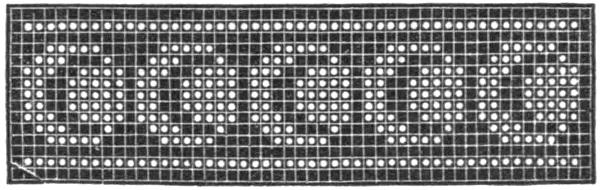
No. 24.
Commence with a chain of one hundred and
eighty stitches in fine white netting silk.
Second row—gold.
Third row—white.
Crochet eleven rows with bright violet silk,
with the above pattern in gold.
Fifteenth row—white.
Sixteenth row—gold.
Seventeenth row—white.
Work three rows of treble open crochet with
gold. The above, worked four times, will
complete the purse. It is advisable to omit
one of the circular figures, in the centre of
each stripe; and also, to reverse the direction
of the pattern at the opposite end of the purse.
Ponceau, blue, or green, may be substituted
for the violet silk.
This pattern may also be effectively worked
in any two decided colours, either with zephyr,
or six-thread fleecy, for sofa pillows, tidies, etc.
Commence at the bottom with a chain of
fourteen stitches; unite both ends, and work
round and round, increasing by means of dividing
lines, until a flat circle of about two
inches in diameter be formed. On this, work
plain rows until the purse be about three inches
in length. It must then be exactly divided,
and each side worked backwards and forwards,
for about eight rows, or whatever is sufficient
for the depth of the snap.
The annexed pine pattern, and the usual
vandyke, are suitable for short purses. About
one hundred and twenty stitches will form a
good-sized purse.
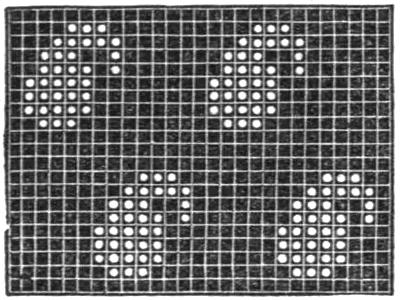
No. 25.
Commence with one row of open crochet, in
gold-coloured silk; work a row of plain crochet,
every two stitches alternately blue and gold
colour; then, one row of plain blue.
The next, or fourth row—is formed alternately,
of two stitches of scarlet, and five of blue.
Fifth row—four blue, five white, alternately.
Sixth row—four blue; four stone colour.
Seventh row—five stitches blue; two pink.
Repeat the row of plain blue; then, one
row, alternately two stitches of blue and two
of gold colour, and commence again with the
open crochet.
Commence with one row of open crochet,
the length of the purse, in fine white netting
silk. Then, one row of plain crochet, in alternate
stitches, of white and full blue, or white
and ponceau.
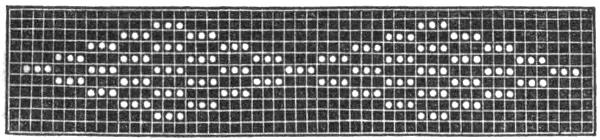
No. 26.
Work the above pattern in gold, on the blue,
or ponceau, ground. Then, three rows of open
crochet in white; and repeat the pattern and
open crochet alternately.
When the purse is finished, it will be found
that there are only two rows of open crochet
where it is joined, but this cannot be avoided.
The same pattern may also be worked in gold
or steel beads, but it will then be advisable to
omit the pattern in the centre of the purse.
An additional colour may be introduced, with
very good effect, on the ground between the
beads. In a moderate-sized purse, the pattern
will be repeated seven times in the length. A
few plain stitches at the top and bottom of the
purse will be desirable.
Commence with a chain of one hundred
stitches, in dark green netting silk, and work
one plain row; then, crochet five rows with steel
beads, to form the first stripe of the pattern.
Work one plain row of white. Then, on the
white ground, crochet the second stripe of the
pattern, with gold beads. Work one plain row
of white.
The third stripe is green,—the lower division
of the pattern is in steel beads, the upper, in
gold beads.
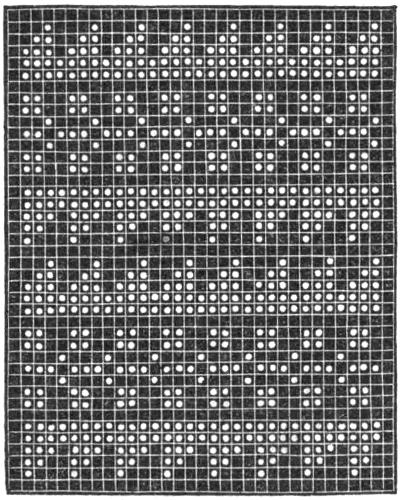
No. 27.
The fourth stripe is white, the pattern in
steel beads, with one plain row of white at top
and bottom.
Commence again with the green, and having
worked the five rows of the pattern with gold
beads, finish with twenty plain rows of green.
Make a star bottom with steel beads (as
directed page 65), and fine netting silk of a
dark emerald green. Work three rows of open
crochet in a light green—then, either of the
annexed patterns, in steel beads, on a ponceau
ground.
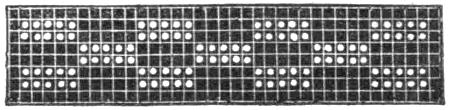
No. 28.
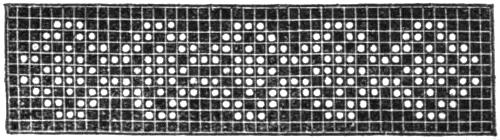
No. 29.
Work two more rows of open crochet in
light green. Repeat the pattern with steel
beads, and work two more rows of open
crochet. This completes one end of the purse.
The centre is to be in plain crochet.
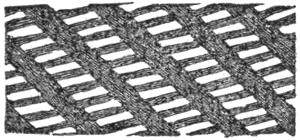
No. 30.
Make a chain of one hundred and seventy
stitches, in reel silk. To the commencement
of this chain, crochet another short chain (as
in plain stitch open crochet), of three stitches,
the third stitch of which pass through the
fourth stitch of the chain, and work three plain
stitches. Crochet another chain of three
stitches, and pass the last stitch, as before,
through the fourth stitch of the chain. This
is to be repeated to the end of the row.
All the succeeding rows are the same, except
that the plain stitches of the next row are
always one stitch in advance of the preceding.
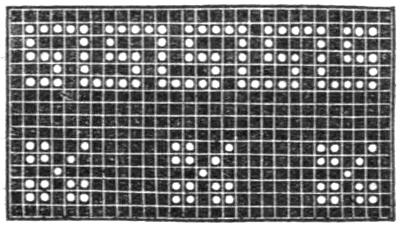
Spiral crochet may be varied by working
five, or seven stitches, instead of three, as
above directed. Most elegant purses and bags
may thus be made, by the introduction of gold,
and using the silk in shades.
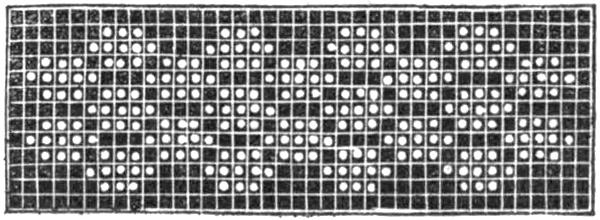
No. 31.
Commence with one row of open crochet, in
fine netting silk, of a dead gold colour. Work
one row of plain crochet in black, and five
rows in blue; on the latter, the above sprig
pattern may be worked in gold, or steel beads.
One plain row of black completes the stripe.
Work two rows of open crochet in the gold
colour. Then,—
Seven rows of black, with the Grecian border
in ponceau, on the same, to form a second
stripe.
Repeat the two rows of open crochet in gold
colour, and commence again, with the blue
stripe, as before.
The purse should be about nine inches in
length. It will take three skeins of blue silk,
two of gold colour, one of black, and one of
ponceau. The silk should be fine.
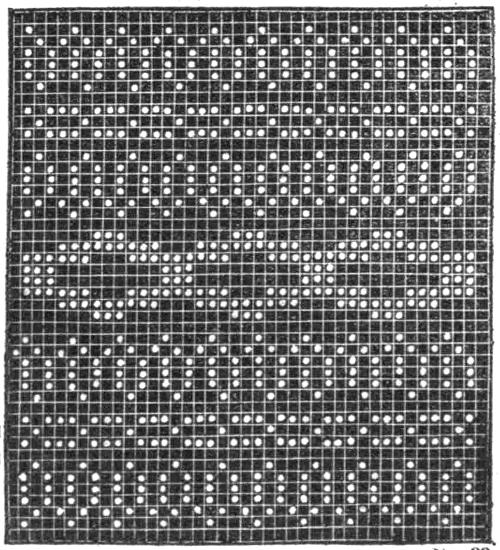
No. 32.
Work one row the length of the purse, in
treble open crochet, with fine white netting silk.
Then—two rows of plain crochet, in ponceau.
Crochet thirteen rows in white, with the
above pattern in gold passing.
Repeat the two rows of ponceau;—then
three rows of treble open crochet,—the first
in white; the second in ponceau; the third in
white.
Repeat the pattern, etc., and when the purse
is of a sufficient width, finish with one row of
treble open crochet in white.
Crochet up the two sides, with ponceau, to
the opening. Then, work one plain row in
ponceau, round the opening, to strengthen the
purse, and give it uniformity.
If intended for ordinary use, the colours may
be changed to blue and claret.
Commence with a chain of six stitches, in
black eight-thread fleecy. Unite both ends.
Crochet all round, increasing on every stitch,
for the first row.
The pattern may be formed in three shades
of scarlet, on a blue ground of three shades;
the darkest shade of the scarlet being on the
lightest shade of the blue.
Second row—one stitch of dark scarlet, and
two stitches of light blue, alternately;—forming
the commencement of a star of six points.
Third row—three stitches of the dark scarlet,
and two of the blue.
Fourth row—five stitches of a lighter shade
of scarlet, and two of the blue.
Fifth row—five stitches of the lighter scarlet,
and three of the second shade of blue.
Sixth row—three stitches of the lightest scarlet,
and six of the second blue.
Seventh row—one stitch of the lightest scarlet,
and eight of the darkest blue.
Eighth row—one plain row of the darkest
blue.
Three plain rows of black, will finish the
D’Oyley.
In every row, increasing stitches are to be
made in the blue; and also, in the plain rows
of black.
Four-thread fleecy with a steel needle.
It is impossible to give the exact number of
stitches for the commencement of a chancelière,
as each row varies; it is advisable, therefore,
to cut the shape in stiff paper, as a pattern,—first
of the top, and then of the border. In
those parts where it is requisite to increase
the width of the work, it should be done by
making an extra stitch on each side. The
stitches of the border are to be worked in a
contrary direction to those of the top, as shown
in the preceding engraving.—The following
pattern will be found suitable for a chancelière.
No. 33.
Commence at the toe, by working two plain
rows of ground in scarlet, and crochet the
centre stripe of the annexed pattern in rich
green, on the same coloured ground.
The ground of the next stripe is black, on
which the pattern is to be worked in three
shades of gold colour.
Work a plain row of middle blue, which also
forms the ground of the small chain pattern,
with the exception of the centre row, which is
claret. The chain is in white.
Work a plain row of claret, and then repeat
the second stripe as before, with the colours reversed.
The above colours, if well chosen, are exceedingly
pretty, but they may be varied according
to fancy.
The slipper pattern No. 23, and also the
Turkish pattern No. 12, are equally adapted
for a chancelière.
The chancelière should be made up on a
very firm foundation, and stuffed between the
lining and the work with wool: the inside
should be made separate, and knitted in the
brioche stitch, with six or eight thread fleecy.
The ermine ruff, or trimming, of worsted, may
easily be procured, but if it cannot readily be
so, a thick knitted fringe, three or four times
doubled, will be a good substitute. The bottom
is formed of leather or cloth.
The annexed pattern is adapted for any
square requiring a border, such as a table
cover, mat, quilt, sofa cushion, couvre-pied,
etc. To render it easy, the centre may be
worked in the same colours as the border,
introducing any spot, sprig, or other small pattern,—the
same colours being carried through
the whole, or slipped at the back. If, however,
the plan of introducing the colour only
in the pattern be understood, it may here be
employed with advantage.
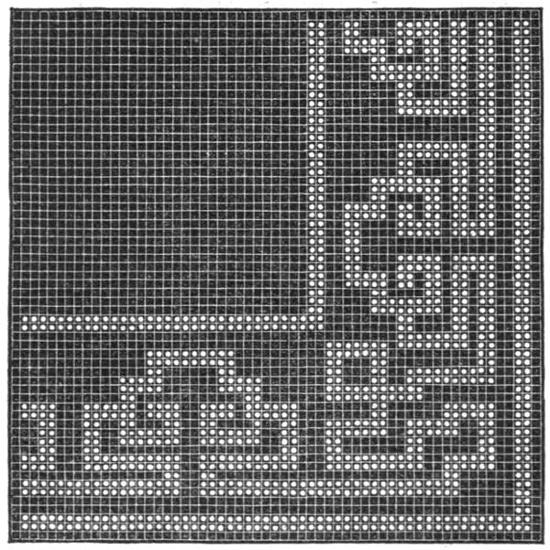
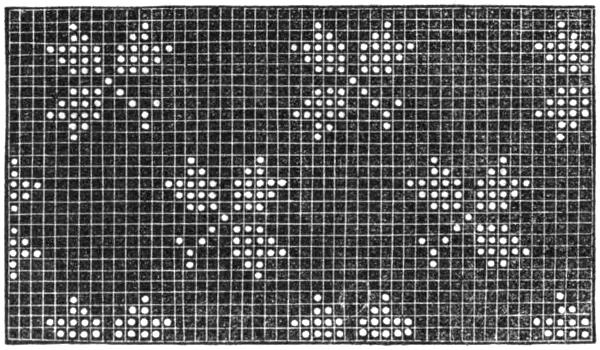
No. 34.
The ground of the pattern might be in a
self colour,—say white, with the pattern in
scarlet; or, the ground might be in five shades
of scarlet, the pattern being crocheted in emerald
green, blue, white, or black, according to
taste, or the purpose for which the work was
designed. The whole of the pattern might
also be worked in chiné or shaded wool.
The kind of wool to be used must be adapted
to the purpose for which the work is required;
thus,—for a quilt or couvre-pied, six-thread
fleecy—for a mat, eight thread common fleecy;—for
a table mat, German wool; for a baby’s
quilt, or a sofa pillow, eight thread zephyr
fleecy.
No. 35.
For the centre of the design, either the preceding
sprig pattern, or the patterns Nos. 20
or 39, may be taken. If the ground be worked
in shades, five shades of any colour, neither too
distinct, nor too dark, should be selected.
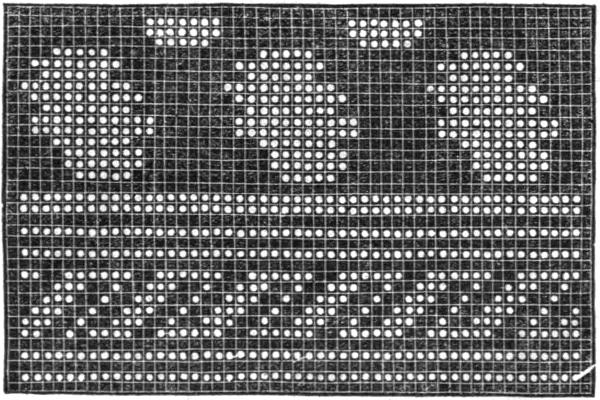
This border is well adapted for ribbed or
raised crochet, as described at page 57.
No. 36.
Commence with a chain and one row of
black. Crochet four plain rows,—one white,
one light green, one white, one black. The
latter forms the ground of the border,—the
pattern on which is in three shades of scarlet—two
rows of each, beginning with the darkest.
One plain row of black finishes the border.
Work six plain rows:—the first, green; the
second, white; the third, green; the fourth,
black; the fifth, white; the sixth, scarlet.
The ground of the centre may be gold
colour, commencing with one plain row,—the
colours of the pine pattern on which are as
follow:—
First row—middle blue.
Second row—light blue.
Third row—dark scarlet.
Fourth row—light scarlet.
Fifth row—four stitches middle green; three
white; four middle green.
Sixth row—four stitches light green; three
white; four light green.
Seventh row—three stitches lilac; two black;
three lilac.
Eighth row—four stitches light lilac; two
black; four light lilac.
Ninth row—middle green.
Tenth row—light green.
Eleventh row—dark scarlet.
Twelfth row—light scarlet.
No. 37.
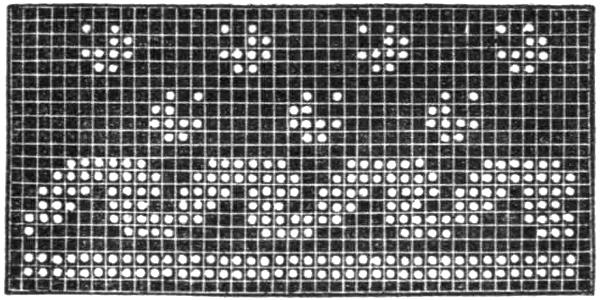
The chain and first row—black.
Second row—scarlet.
Third row—white.
Fourth row—bright blue, which continues
through the next three rows, forming the outer
ground of the border. The pattern of the
border is in shades of scarlet.
Fifth and sixth rows—blue, and dark
scarlet.
Seventh row—blue, bright scarlet, and drab—the
latter forming the inner ground of the
border.
Eighth row—bright scarlet and drab. The
single stitch at the top of the blue ground being
white.
Ninth and tenth rows—light scarlet, and
drab.
Eleventh row—drab, which also forms the
ground of the centre.
The colours for the small pine pattern in the
centre, are,—black, two shades of blue, and
white.
In the next, or reversed row of the pattern,
the colours may be varied as follow:—black,
two shades of scarlet, and white.
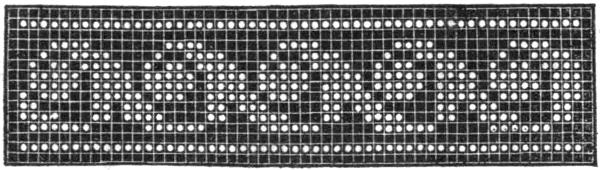
Commence with chain and first row,—bright
green.
Second row—scarlet.
Third row—green.
Fourth, fifth, and sixth rows—treble open
crochet, with gold.
No. 38.
Seventh, eighth, and ninth rows—repeat
the first, second, and third rows. Then,—crochet
a stripe, consisting of eleven rows, with
the above pattern, in dead gold colour, on a
violet ground. As these stripes range perpendicularly,
the position of the scrolls in the
pattern should be reversed at the bottom of
the bag, in order that they may appear the
same on either side.
This bag may be worked in various combinations
of colour; it is very pretty if the pattern
be worked in shaded, or chiné, silk, and
the stripes alternately in two different colours.
It may be as well to observe, that the plain
line on either side of the scroll, as shown in
this, as in many other patterns, may be advantageously
omitted. It has therefore not been
noticed in the preceding directions.
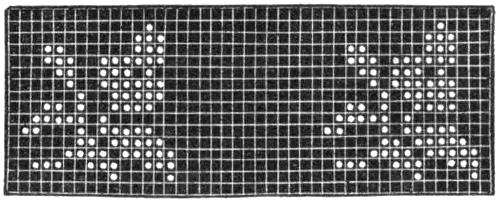
No. 39.
The above sprig pattern will be found useful
for bags, and a variety of other purposes.
It may be worked in two shades of green, and
three of pink, as follows:—
First row—first stitch dark green; second,
light green.
Second row—one stitch light green: two
dark green;—two light green; one dark green;—three
dark green.
Third row—two stitches light green; three
dark green;—two light green; two dark green.
Fourth row—three stitches light green;
two dark green;—two dark green.
Fifth row—four stitches light green; one
dark green;—one dark green;—two dark green.
Sixth row—dark green.
Seventh row—three stitches dark pink; one
dark green;—one dark green; two dark green.
Eighth row—three stitches dark pink; one
dark green; one middle pink;—one light green.
Ninth row—three stitches dark pink; three
middle pink;—one light green.
Tenth row—one stitch dark green;—three
middle pink;—two light green.
Eleventh row—three stitches light pink;
three middle pink;—three light green.
Twelfth row—three stitches light pink;—two
light green.
Thirteenth and fourteenth rows—light pink.
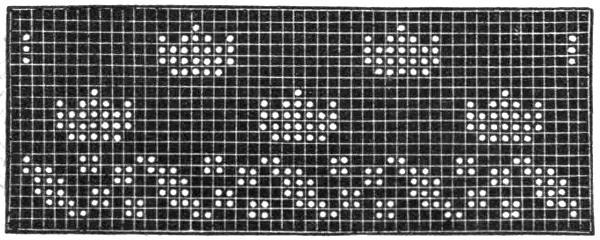
No. 40.
The above pattern may be worked in German
wool, or crochet silk. If an useful and durable
bag be desired, the following colours will be
found to work well on a black ground.—Commence
with a chain and two rows of black.
Crochet the border pattern as follows:—
First row—one stitch scarlet; four black;
two middle green; three black; one scarlet.—Repeat.
Second row—three stitches scarlet; two
black; two light green; one black; two lilac;
one black.—Repeat.
Third row—one stitch black; three scarlet;
four black; two white; one black.—Repeat.
Fourth row—one stitch black; three scarlet;
two black; two lilac; three black.—Repeat.
Fifth row—two stitches black; three scarlet;
one black; two white; one black; two middle
green.—Repeat.
Sixth row—four stitches black; two scarlet;
three black; two light green.—Repeat.
Crochet one plain row of black. Work the
sprig pattern in the same colours as the border,—arranging
them in the following order:
first row,—scarlet; second,—middle green;
third,—light green; fourth,—lilac; fifth,—white.
If German wool be used, the white may be
worked with floss silk.
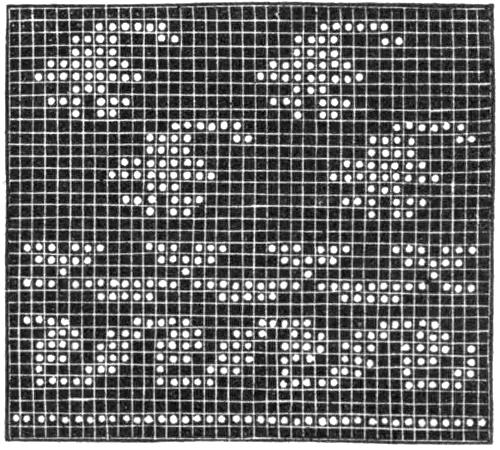
No. 41.
Commence with a chain and one plain row
of black. Work two plain rows of scarlet, and
in the next row, commence the pattern of the
first border in black. The outer ground of the
border is scarlet,—the inner ground of the
border is white. Three wools are worked at
the same time.
Work one plain row of white between the
two border patterns.
The second border pattern is in two shades
of blue—the first two rows being on the former
white ground, the three last on the black
ground, which composes the centre. Commence
the centre with,—
Two plain rows of black. Then on the
black ground, commence the palm pattern as
follows:—
First row—middle green.
Second row—bright green.
Third row—bright scarlet.
Fourth row—scarlet, the centre stitch white.
Fifth row—three stitches blue; two white;
two blue.
Sixth row—blue.
Seventh row—gold colour.
Eighth row—yellow.
This pattern requires three different coloured
wools in many of the rows. It is very handsome.
The side border may be crocheted on.
Six-thread fleecy, and a steel needle, should
be used.
A Brioche (so called from its resemblance
in shape to the well known French cake of
that name), may be as easily worked in crochet
as in knitting. It may also be divided into
stripes or compartments, gradually decreasing
in breadth towards the top or centre of the
cushion, in the same manner as in the knitted
brioche. Various patterns may be introduced
in these stripes, but, when a very soft cushion
is desired, this is not advisable, as the extra
wool, then required to be carried through the
work, would render it of too firm a texture.
The following directions for working a
brioche in crochet will be found very simple,
and, at the same time, serve as a guide for
those of a more complicated nature.
Commence with a chain of seventy stitches
in eight-thread zephyr fleecy—black.
First row—black.
Second row—gold colour.
Third row—black.
The above three rows are all of an equal
length. Then, crochet fifteen rows in any
pretty colour, omitting four stitches at the
end of the first, and of each successive row,
so that in the last of these fifteen rows there
will be only ten stitches.
Repeat the row of black, taking in each of
the four stitches omitted at the ends of the
last fifteen rows, as also the four stitches at
the top of the last row of black. Crochet one
row of gold colour, and one row of black, as at
the commencement, when one compartment
of the brioche will be completed, forming a
conical stripe.
Repeat the fifteen rows, omitting the four
stitches at the end of each row, as before directed;
and continue as above until sixteen
similar compartments are worked; this will be
found sufficient for an ordinary-sized brioche.
The colours of the stripes may be varied,
thus,—blue, brown, scarlet, and stone colour,
in their order of succession, repeated four times,
will form a very pretty contrast,—the dividing
stripe between each being formed of two rows
of black, with a row of gold between them.
Either chiné or ombré wool may also be employed.
When finished, the brioche may be made up
either entirely soft, or with a stiff bottom of
mill-board, about six or eight inches in diameter,
covered with cloth or velvet. The top
should be drawn together, and fastened in the
centre, either with a tuft of soft wool, or with
a cord and tassels, as represented in the preceding
engraving. It should be stuffed with
down or fine combed wool.
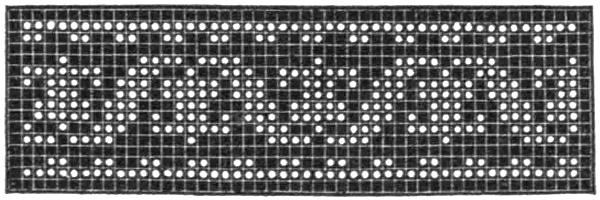
No. 42.
The above pattern will be found very easy
to work, in perpendicular stripes, for a bag, the
stripes being divided by two rows of treble
open crochet in gold. Each side of the bag is
formed of four stripes of the above pattern,
and five stripes of the treble open crochet;
but, as the latter should form the outer edge at
the side of the bag, and cannot be worked without
a foundation, it will be necessary to begin
with the figured stripe in silk, and afterwards
to open the treble open crochet in gold on
either side of it.—Therefore,
Commence with a chain in dark green
netting silk.—The number of stitches must
depend on the size of the silk employed,
but a chain of about twelve inches in length
will be found sufficient for a bag of this
description. The bag should be worked in
one length.
First row—dark green.
Second row—two stitches of ponceau, and
two of dark green, alternately.
Third row—ponceau.
In the fourth row the pattern commences
with two colours, the wave portion of the
pattern being in dark green; with the bell in
a lighter shade of green; the ground, ponceau:
or, the pattern may be worked in chiné
greens.
Eight rows complete the pattern, when a
plain row of ponceau, a row of two alternate
stitches of ponceau and green, and a plain row
of green, finish the stripe.
Crochet two rows of treble open crochet in
gold; and commence again with the pattern in
silk.
This bag when completed is about six inches
square; it should be hemmed at the top, and
lined, and finished with strings and tassels.
The pattern No. 24, is also equally adapted
for a bag of this description; but in the centre
of the work the pattern should be reversed, in
order that when the two sides of the bag are
folded together the pattern may run in the
same direction, as in the manner described for
the bag at page 113.
A very easy but extremely elegant bag in
perpendicular stripes may be made by commencing
with—
Chain and first row—scarlet.
Second row—gold.
Crochet eleven plain rows in scarlet.
Fourteenth row—gold.
Fifteenth row—scarlet.
On each side of the band thus made, crochet
two rows of treble open crochet in gold.
Four plain scarlet stripes, and five of the
open crochet, arranged as in the preceding
example, complete the bag.
Commence with a chain of eight stitches:
having united the ends, make every other
stitch a treble increased stitch,—by crocheting
three stitches in one loop. Continue to increase
in a similar manner, until twenty-eight
rows be worked, taking care that the increasing
stitches be kept exactly over each other; when
a point in the centre, and a point at the termination
of each line of dividing stitches, will be
formed. The remaining part of the bag is to be
worked in rounds, until it be of sufficient height.
The prettiest way of working this description
of bag, is with steel or gold beads.
The following pine pattern may be taken for
the centre of each division of points.
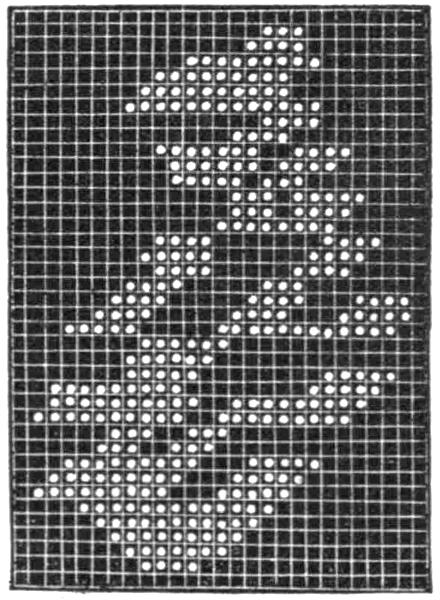
No. 43.
The upper part of the bag may be semé,
with a pattern composed of beads, such as the
following.
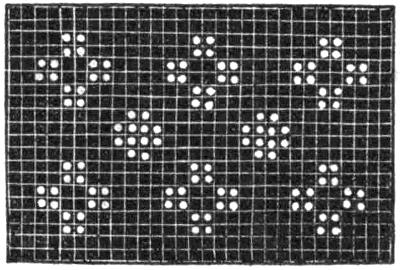
No. 44.
The top may be finished with three plain
rows of crochet; or with any small border
pattern in beads, similar to those figured beneath:
but for this purpose there are several
others, in various parts of the book, equally
appropriate, and that may be selected according
to the taste of the worker.
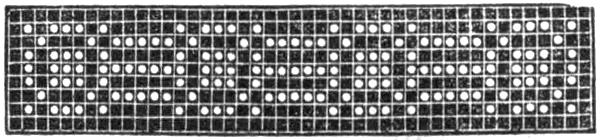
No. 45.
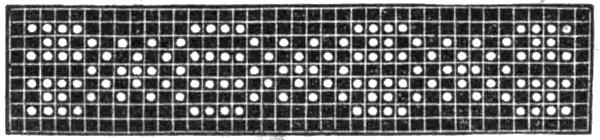
No. 46.
This bag should be worked in one long
piece, and afterwards folded together, so that
the rows range perpendicularly; in the same
manner as that described at page 123.
Commence with a chain in ponceau.
- First row—gold.
- Second row—deep blue.
- Third row—ponceau.
- Fourth row—deep blue.
- Fifth row—gold.
- Sixth row—ponceau.
- Seventh row—black.
- Eighth row—ponceau.
treble open crochet.
Repeat from the first row, until the bag be
of a sufficient breadth.
Open crochet, as also double and treble open
crochet, have already been fully described (see
page 16). The two following patterns are,
amongst numerous others of a like description,
merely variations of a similar kind of work:
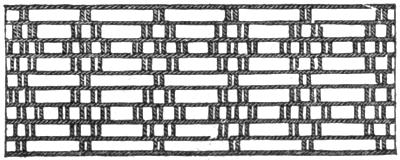
No. 47.
It is therefore unnecessary to enter into a detailed
description of these, as it would occupy
too great a space, and the engravings sufficiently
explain themselves. These patterns
are useful for a variety of purposes, particularly
for working with cotton, for tidies, D’Oyleys,
etc.
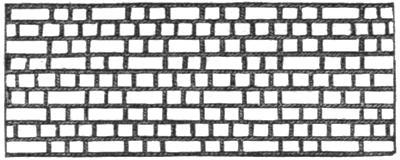
No. 48.
The two circular ends should be worked
first. Commence with a chain of six stitches,
in black four-thread fleecy: unite both ends,
and crochet all round, increasing on every
stitch for the first row.
The pattern is then to be worked in three
shades of scarlet, on a ground composed of three
shades of green; the darkest shade of the scarlet
being on the lightest shade of the green.
Second row—one stitch dark scarlet; two
light green.—Repeat.—This forms the commencement
of a star of six points.
Third row—three stitches dark scarlet; two
light green.—Repeat.
Fourth row—five stitches middle scarlet;
two light green.—Repeat.
Fifth row—five stitches middle scarlet; three
middle green.—Repeat.
Sixth row—three stitches light scarlet; six
middle green.—Repeat.
Seventh row—one stitch light scarlet; eight
dark green.—Repeat.
Eighth row—dark green.
Two plain rows of black finish the end.
N. B. In every row, increasing stitches are
to be made in the green, as also on the plain
rows of black.
Having finished the two ends, make a chain
of about sixteen inches in length, in black;
and work the other part of the bolster as follows:—
First row—black.
Second row—dark green.
Third row—middle green.
Fourth row—light green.
Fifth row—white.
Repeat the first four rows—reversed.
Tenth and Eleventh rows—scarlet.
Twelfth row—commence a pattern, by working
alternately six stitches of scarlet and four
of black.
Thirteenth row—seven stitches scarlet (a);
four yellow; six scarlet.—Repeat from (a).
Fourteenth row—six stitches scarlet; four
black.—Repeat.
Fifteenth row—seven stitches scarlet; (b) four
light green; six scarlet.—Repeat from (b).
Sixteenth and Seventeenth rows—scarlet.
Commence again as at first row; and repeat,
until a piece be worked sufficiently long to go
easily round the ends.
The bolster should be made up by stuffing
it with down or soft wool. A long crochet
band, worked similar to the green shaded
stripe, should be attached to either end, with a
small worsted tuft in the centre, by way of ornament.
Bags, worked in a similar manner to the
above, are frequently made; these, however,
are not required to be so long. They are
fastened at the opening with strings or buttons.
They may be made with eight-thread zephyr
fleecy.
Raised, or ribbed crochet has already been
described at page 57. To work a slipper,
commence with a chain of seven stitches, and
crochet forty-six rows backwards and forwards,
observing to make three stitches in one loop
in the centre stitch of each row. This will
make a sufficient increase in each succeeding
row to form the front of the slipper, and at
the same time cause the ribbed rows to run in
an uniform diagonal direction on either side.
Having thus completed the front of the shoe,
crochet, on the right-hand side, a row of twenty-six
stitches, and work a sufficient number of
rows (about ninety) to form the back. The
end of this band is then to be sewn to the
other side of the front.
The sole of the slipper may be made either
of leather, or of crochet in coarse wool; the
latter is most readily made by cutting the shape
in stiff paper, and then working it to the exact
size. The top of the slipper may be finished
with an ermine trimming of worsted.
Commence with a chain of nine hundred
stitches in black eight-thread zephyr fleecy.
First row—black.
Second and Third rows—white.
Crochet eleven rows, alternately with black,
and any pretty chiné wool.
Fourteenth and Fifteenth rows—white.
Sixteenth and Seventeenth rows—green.
Crochet eleven rows, alternately with scarlet,
and any bright chiné wool.
Twenty-ninth and Thirtieth rows—green.
Thirty-first and Thirty-second rows—black.
Crochet eleven rows, alternately with white,
and a chiné wool.
Forty-fourth and Forty-fifth rows—black.
Forty-sixth and Forty-seventh rows—red.
Crochet eleven rows, alternately with green,
and a chiné wool.
Fifty-ninth and Sixtieth rows—scarlet.
Repeat from second row.
By omitting a stitch in the centre of each
row, the shawl will assume, whilst working, a
pointed form, similar to that of a half square,
at the same time that the rows of crochet will
run in a diagonal direction from either side of
the centre. It may be trimmed with a black
fringe of about four inches deep sewn on the
two sides.
To form the striped pattern as above directed,
four chiné wools, of different colours,
should be employed.
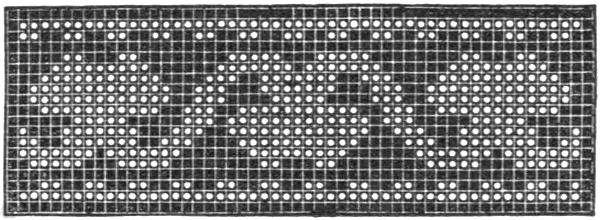
No. 49.
This is worked with German wool, in open
crochet stitch, but without leaving a stitch between
each, as in the ordinary method.
Chain and first row—claret.
Second row—two stitches claret, two blue,
alternately.
Third row—blue.
Crochet the above pattern in claret on the
blue ground.
Fifteenth row—blue.
Sixteenth row—two stitches claret, two blue,
alternately.
Seventeenth row—claret.
Repeat from first row.—In the second stripe
of the pattern, deep gold colour should be used
in place of the blue, and black in place of the
claret wool; thus working, alternately, a stripe
in each of the two colours.
This will form a good pine pattern for the
border of a shawl, in German wool on a black
ground.
Commence with chain and first row—deep
gold colour.
Second row—black.
Then crochet the annexed pine on a black
ground, in the following colours.
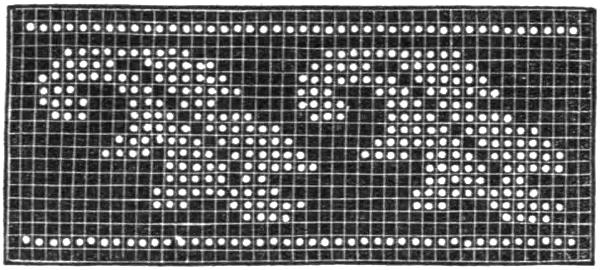
No. 50.
First row—imperial blue.
Second row—lighter shade of blue.
Third row—deep scarlet.
Fourth row—bright scarlet.
Fifth row—dark green.
Sixth row—middle green.
Seventh row—dark lilac.
Eighth row—light lilac.
Ninth and Tenth rows—two shades of stone
colour.
Eleventh and Twelfth rows—two shades of
blue.
Thirteenth and Fourteenth rows—two shades
of scarlet.
Then, work one plain row of black, and one
plain row of gold colour.
To form a point, if it be intended for the
border of a half square shawl, omit a stitch in
the centre of each row;—this, if the size of
the shawl has been determined upon, previously
to commencing the work, may easily be done
without interfering with the pattern, as by calculating
the number of stitches required, a
greater space of the ground where the stitches
are to be omitted between the two centre pines
may be allowed. For a square shawl, the border,
if preferred, may be worked separately,
and afterwards sewn on.