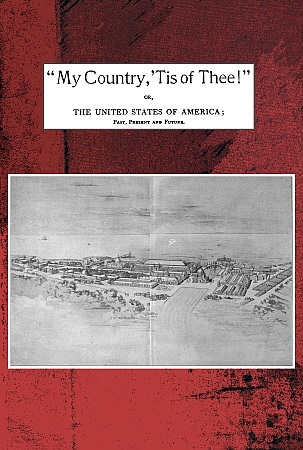
DURING the past half century a favorite and effective method of
displaying and recording the industrial progress of the world has been
found in the holding of World’s Fairs, or Universal Exhibitions. Almost
every important capital of the world has now held one or more of these
interesting displays, each in succession striving to outdo its
predecessors in extent and magnificence, until the latest of them truly
present in epitome the invention, industry, art, science, and general
progress of the entire world. It was fitting that the first of these
universal exhibitions should be held in the world’s chief city, London.
It was opened in 1851 in a huge building erected in Hyde Park for the
purpose, known as the Crystal Palace. This stupendous structure was
composed chiefly of iron and glass and had a floor area of more than one
million square feet. In size and originality of design it was one of the
marvels of the world. The example quickly stimulated similar enterprises
in other capitals. Dublin and Paris soon followed, and almost
simultaneously with the exhibition in the Irish metropolis a similar
exhibition was opened in the capital of the Western Hemisphere.
The American Crystal Palace, which was opened in New York in 1853, was
in point of size much inferior to its prototype in London, and
altogether insignificant when contrasted with the stupendous exhibitions
of later years. For its time, however, it was proportionately equal to
any that has ever been held. At that time New York City contained only a
little more than half a million inhabitants, or about one-third of its
present population. The development of the United States was still less
advanced. What was now central Western States were then sparsely settled
frontier territories. The Pacific railroads were a dream of the dim
future. The Atlantic Cable was a vision. The telegraph itself was a mere
rudiment of its present development. The railroad and the steamboat were
primitive affairs. Even horse cars had not come into general use.
Photography was in its infancy. As for the telephone, the electric
light, and a score of other great inventions that are now of universal
use, they were not even dreamed of. As the New York Crystal Palace of
1853 was to the Chicago Exhibition of 1893, so was America and its
civilization of that time to our country of to-day.
This first universal exhibition held on American soil was situated in
what is now known as Bryant Park, in New York City. It is now in the
very heart of the city, at Sixth Avenue and Fortieth and Forty-second
Streets. In 1853 it was well out of town in the suburbs, and was known
as Reservoir Square. At that time it was surrounded by open fields and
gardens, with here and there rows of pleasant rural cottages. A few of
the streets were paved in that part of the city, but there was only a
faint indication of what another generation would see. The little park
was four hundred and fifty-five feet square, and almost the entire area
was occupied by the Crystal Palace. The central idea embodied in the
plan of the structure was that of a Greek cross, whose arms pointed
north, south, east, and west. The extreme dimensions of the building,
from north to south and from east to west, were 365 feet 5 inches, and
the arms were each 149 feet 5 inches wide. The external angles formed by
the arms of the cross were filled up with triangular structures, one
story in height, thus making the outline of the ground plan an octagon.
At each of the angles of the building was an octagonal tower, 76 feet
high, and over the central intersection of the cross rose a magnificent
dome, 100 feet in diameter and 123 feet high. The external walls of the
building were composed almost exclusively of cast-iron and glass. The
floors were of wood, and the roof was of wood, covered with tin and
supported on wrought-iron framework. The roof was supported by 190
cast-iron columns on the ground floor, each 8 inches in diameter and 21
feet high. They divided the interior into two avenues or naves, each 41
feet 5 inches wide, with aisles, 54 feet wide, on each side. These
naves, at their intersection, left an octagonal space 100 feet in
diameter. The aisles were covered with galleries, while the naves were
open to the roof and were spanned by semicircular arches of cast-iron.
The dome was supported by twenty-four columns, each 62 feet high,
connected at the top by wrought-iron trusses. On the top of these was a
cast-iron bed-plate, with cast-iron shoes for the ribs of the dome,
which were thirty-two in number. These ribs were bolted at the top to a
horizontal ring of wrought and cast iron, 20 feet in diameter,
surmounted by a lantern with thirty-two ornamental windows, decorated
with the Arms of the Union and the several States. The whole quantity of
iron employed in the construction amounted to 1,800 tons, of which 300
tons were wrought and 1,500 tons cast. The quantity of glass was 15,000
panes, or 55,000 square feet. The quantity of wood used amounted to
750,000 feet board measure. The principal dimensions of the building
were as follows: From main floor to gallery floor, 24 feet; from main
floor to ridge of nave, 67 feet 4 inches; from main floor to summit of
dome, 123 feet 6 inches; area of main floor, 157,195 square feet; area
of gallery floor, 92,496 square feet; total area of floor space, 249,691
square feet, or about 5¾ acres.
The total amount of space on the floor occupied by different countries
for exhibition, exclusive of the naves, was about 152,000 square feet,
divided as follows: The United States 54,530; Great Britain, 17,651;
Switzerland, 4,428; the German Zollverein, 12,249 Holland and Belgium,
3,645; Austria, 2,187; Denmark, Sweden, and Norway, 4,231; Russia, 729;
the West Indies, 1,093; British Colonies, 5,798. The total number of
exhibitors was 4,383. Of these 1,778 were from the United States; 677
from England; 116 from Switzerland; 813 from the German Zollverein; 155
from Holland and Belgium; and 100 from Austria. The exhibits were
divided in 31 general classes as follows: Class I, Minerals, Mining, and
Metallurgy, Geological and Mining Sections and Plans. Class II, Chemical
and Pharmaceutical Products and Processes. Class III, Substances
Employed as Food. Class IV, Vegetable and Animal Substance Employed in
Manufactures. Class V, Machines for Direct Use. Class VI, Machinery and
Tools for Manufacturing. Class VII, Civil Engineering, Architectural,
and Building Contrivances. Class VIII, Naval Architecture, Military
Engineering, Armor and Accoutrements. Class IX, Agricultural,
Horticultural, and Dairy Implements. Class X, Philosophical Implements
and Products Resulting from their Use. Class XI, Manufactures of Cotton.
Class XII, Manufactures of Wool. Class XIII, Manufactures of Silk and
Velvet. Class XIV, Manufactures of Flax and Hemp. Class XV, Mixed
Fabrics. Class XVI, Leather, Furs, Hair, and their Manufactures. Class
XVII, Paper, Stationery, Types, Printing, and Book-binding. Class XVIII,
Dyed and Printed Fabrics. Class XIX, Tapestry, Carpets, Floor-cloths,
Lace, Embroideries, Trimmings, and Fancy Needlework. Class XX, Wearing
Apparel. Class XXI, Cutlery and Edge Tools. Class XXII, Iron, Brass,
Pewter, and General Hardware. Class XXIII, Works in Precious Metals and
their Imitations. Class XXIV, Glass Manufactures. Class XXV, Porcelain
and other Ceramic Manufactures. Class XXVI, Decorated Furniture and
Upholstery. Class XXVII, Manufactures in Slate and other Ornamental
Stones. Class XXVIII, Manufactures from Animal and Vegetable Substances
not Woven or Felted. Class XXIX, Miscellaneous Manufactures, Perfumery,
and Toys. Class XXX, Musical Instruments. Class XXXI, Fine Arts.
The plan of the building was designed by Messrs. Carstensen &
Gildemeister, and was selected in preference to other plans submitted by
Sir Joseph Paxton, the builder of the London Crystal Palace. C. E.
Detmold was the superintending architect and engineer, Horatio Allen the
consulting engineer, and Edward Hurry the consulting architect. The
municipal authorities of New York on January 3d, 1852, granted a lease
of Reservoir Square for five years, thus furnishing the site for the
building. The New York Legislature on March 11th, 1852, granted a
charter to the Association for the Industry of All Nations, and on March
17th the Board of Directors met and organized with Theodore Sedgwick as
President, and William Whetten as Secretary. The United States
Government gave countenance and aid to the institution by permitting the
introduction of foreign goods for exhibition free of duty. Daniel
Webster, then Secretary of State, secured the aid of the Representatives
of the United States at the chief Courts of Europe, and the Ministers of
Foreign Powers residing in the United States sympathized warmly with the
Association, and commended it favorably to their respective governments.
Under such auspices, and with such encouragement the work went forward.
The first column was put in place with appropriate ceremonies on October
30th, 1852; the building was open to the public on July 15th, 1853,
though still incomplete; and on Friday evening, August 20th, 1853, the
full opening was effected.
Perhaps no more interesting view of this notable institution and the
chief events connected with it can be given than that which was
presented by the principal metropolitan newspapers of the day. Let us
first quote from an account of the raising of the first column:
“The erection of the first column of the Crystal Palace took place
on Reservoir Square at noon on Saturday. The interest in and
importance of the occasion attracted a large concourse of citizens.
There must have been at least two thousand persons present.”
Volumes could not tell more. Two thousand persons present on such an
occasion, and they called it a “large concourse!” Nevertheless,
continued the scribe, “There was a large number of distinguished
citizens upon the platform beside the pillar. Among those present we
noticed his Excellency Gov. Hunt, his Honor the Mayor, Archbishop
Hughes, Felix Forreste, General Tallmadge, Henry Meigs, C. Crolius,
ex-Senator J. A. Bunting, Rev. Dr. Peet, Lambert Suydam, Hon. Judge
Betts, Senators McMurray and Beekman, and several other invited guests.
General Tallmadge and others were present as a deputation from the
American Institute. Dodworth’s band was present during the proceedings
and played delightfully. When the pillar was raised, by means of a
derrick, the Governor directed it to its place, amid the enthusiastic
cheering of those present and the firing of cannon, the band, the while,
playing a national air.”
The chief address was made by Theodore Sedgwick, the President of the
Association, and his remarks are worth repeating here, as expressive of
the sentiments that inspired him and his associates in the enterprise:
“Governor Hunt: In the name of the Directors of the Association, I
thank you cordially and respectfully for the trouble which you have
taken to honor this occasion with your presence. Our thanks are
also eminently due to the city government, not only for their
attendance here to-day, but more for the sagacious foresight with
which they have extended their liberal aid to the enterprise in its
infancy. We are also proud to see among our friends the officers of
two societies—one from our own, and one from a sister State—which
have done so much to raise the aims and promote the interests of
American industry, to open the path in which we are now treading.
The general objects to which this building will be destined are so
familiar to us all that I need not dwell upon them. Our
arrangements are so far advanced that we can speak with confidence
as to our ultimate success. It is sure to strike the mind of the
European producer, that he has substantial objects to attain by
sending specimens of his skill here, which no European country can
afford. On the other hand, the American manufacturer, who has
comparatively little but honor to gain by sending the produce of
his skill to Europe, has a clear and distinct inducement to exhibit
his goods here. If no unforseen event occurs, we shall have it in
our power to make such an exhibition of the costly, artistic, and
luxurious products of the Old World as has never yet been seen
among us. These considerations will produce their results; and we
are equally confident that the industry of our country, with that
fearless energy which, perhaps, more than any other one thing is a
distinguishing trait in our national character, will eagerly enter
into a contest from which, in every respect, nothing but good can
flow. I shall say on this head no more. Those whose eyes, like
mine, were delighted by the surpassing glories of the London
Exhibition—who know the power, opulence, and varied resources of
the Old World—who know what those creatures of genius, the French,
are trying to effect, may well pause before they make vaunts for
the future. Suffice it, we shall do everything that industry and
fidelity can accomplish. Nor shall I enlarge on the benefits of an
exhibition of this kind. There is no doubt whatever that there yet
exists no similar means for extending the circle of knowledge and
taste—above all, for enlarging and increasing that mutual
good-will and confidence which is the surest bulwark of national
independence, and the only guaranty of international peace.
“Sir, at this moment, everything from the pen of that great
statesman, whose loss we lament, will be received with interest. I
shall, therefore, trespass on you by reading the following letter
which I received from him:
“ ‘Department of State, }
“ ‘Washington, Oct. 12th, 1852. }
“ ‘Sir: I have received your favor of Oct. 7th, and I have examined
with care the papers accompanying it, as well as the sketch of the
building which you have been good enough to send; the latter
appears to me very beautiful. Your name and that of the gentlemen
associated with you, are sufficient guarantees that the enterprise
will be conducted with energy, fidelity, and capacity; and there
can be no doubt that an exhibition of the kind you contemplate, if
properly carried out, will be of very general interest and utility.
You do not overrate my desire to promote your views. Of course I
cannot, as a member of the Government of the United States, give
you any other aid than you have already received from the Customs
Department, by making your building a bonded warehouse; but I will
write to the representatives of the United States at the principal
Courts of Europe, stating to them strongly my sense of the
importance of your enterprise, and the numerous reasons in my mind
why they should give your agent, Mr. Buscheck, all the aid and
support that they properly can. I am, sir, with great respect, your
ob’t serv’t,
“ ‘Daniel Webster.
“ ‘Theodore Sedgwick, Esq., New York.’
“Permit me, sir, to say a word respecting the building itself. We
intend—and I believe it is not too much to claim—that the Palace
itself shall make an epoch in the architecture of our city. We
believe that it will give an impulse to construction in the
material of iron that will be of the greatest service to that
interest. Iron constructions have already been carried far forward
by a most intelligent and accomplished mechanic—Mr. James
Bogardus—and I believe that the experience of this building will
give it a great additional impulse. Its superior lightness,
durability, cheapness, and facility of construction give it immense
advantages over any other material. We are erecting an edifice
that will cover, on the ground floor, two and a half acres, and it
will be done in the winter, in about six months, for a sum not much
varying from $200,000. If any one compares this time and the time
with what would be required for a building of any other material,
except wood, the immense superiority of iron is most perceptible.
But there are, sir, ulterior considerations which I wish clearly to
state. The large cities of the elder world, especially on the
Continent, possess great galleries for popular instruction and
entertainment. It is, at first sight, remarkable, though, in fact,
easily intelligible, that in a country reposing entirely on popular
power, comparatively nothing is done on a great public scale for
the pleasure and instruction of our adult people. We have no
galleries, no parks. This is not the place to say anything in favor
of a park, though an object which should be dear to the heart of
every New Yorker. But I desire in regard to the other objects, to
point out how easy it will be hereafter to convert this building
into a great People’s Gallery of Art. Its structure is eminently
adapted for the purpose. We stand here on the city’s ground, and it
will be completely in the power of the city hereafter to accomplish
this result. Long after our Association shall have disappeared, I
hope this building may stand—as long as yonder massive and
majestic creation; and like that, in the hands of the public
authorities, be one of those monuments which makes the Government
dear to the people. [Cheers.] Allow me to say a few words of our
purposes. The undertaking is a private one—fostered by no
governmental aid; but the interests are so numerous and divided
that not the slightest color is afforded for the charge of
speculation. There are, I venture to say, very few undertakings of
equal magnitude which are represented by so large a number of
parties, and it thus becomes practicable to impress upon the
direction and management of the enterprise that broad, liberal,
impartial, and, as it were, national character which is essential
to its proper development. If our success is what we expect and
intend it shall be, we shall claim the honor of it for our
institutions—those institutions which enable private individuals
to accomplish what in other countries vast governmental efforts are
required to effect. We shall claim the honor for the country and
for the people; for that mixture of individual energy and practical
accommodation which gives such wonderful efficiency to the American
character; for that public spirit and private good feeling of which
we have such striking evidence here to-day—bringing together at
this moment, men of all parties, to work together for a common
object of general interest. [Cheers.] Other considerations, sir,
yet remain, which, at some other time, I shall ask higher and
holier personages to develop, but which I cannot now altogether
overlook. When this structure shall be raised—when its lofty dome
shall have rushed upward to the point where that flag now
floats—when its crystal surface shall reflect in streams of
radiance our warm American sun—when its graceful and majestic
interior shall be filled with the choicest products of both
worlds—our minds will soar upward beyond and above all the
material considerations to which I have alluded, and will recognize
our own nothingness, and the infinite superiority of the Power by
whose favor we are permitted to do what little we effect. And we
shall then unite to pour forth our thanks for His mercies, and our
supplications for His forgiveness and protection.” [Loud cheers.]
The Governor immediately replied as follows:
“Mr. President: Availing myself of the invitation so kindly extended to
me by the Association over which you preside, I have come to participate
in the appropriate ceremonies of this occasion, and to manifest the
sincere interest and approval with which I regard your noble
undertaking.
“You have now reared the first column of an edifice intended to attract
the productions of genius, industry, and art from all the civilized

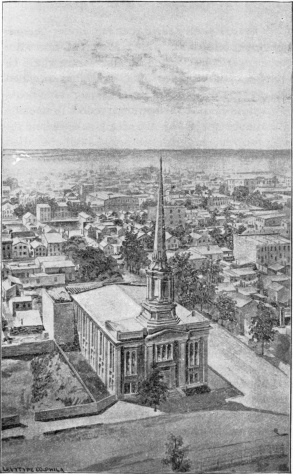 CHICAGO IN 1856.
nations of the world. This liberal design is in harmony with the
prevailing spirit and tendency of the age in which we live, and its
successful completion will form a conspicuous landmark in the history of
American progress. It is a generous conception, alike honorable to the
public spirit and patriotism of the citizens forming the Association,
and important in its influence upon the advancement and happiness of
society.
“The conquests already made, and the increasing interest evinced by our
countrymen in the culture of those useful arts which promote the
physical prosperity and moral elevation of a people are a source of just
pride and encouragement to the American statesman.
“By the blessing of Providence we are permitted to work out our destiny
in a period of profound peace. For more than a third of a century the
civilized world has been exempt from those destructive wars and
convulsions which had so long wasted the best energies of the human
race. Nobler purposes engage the thoughts of men and the councils of
nations.
“Instead of meeting in battle array, and spreading havoc and desolation
over the face of the earth, a kindlier rivalry prevails, and governments
cope with each other in a more generous spirit of emulation; in works of
beneficence and improvement; in the expansion of commerce, the
encouragement of industry, and the triumphs of peaceful invention.
“People, widely separated from each other by intervening seas and
diversities of language and institutions are now drawn nearer together
by rapid and constant commercial intercourse. Remote countries are
enabled to confer inestimable benefits upon each other by a free
interchange of useful discoveries and improvements, thus stimulating
industry and skill throughout the world, each imparting to all the
fruits of its own civilization, and (above all) diffusing over the globe
the spirit of universal brotherhood, which, in God’s good time, shall
unite the human family by the cordial ties of sympathy and concord.
“When considered in a mere political aspect, the wonderful display of
the industry of all nations, exhibited in England last year, must be
regarded as one of the most important events in modern history.
“I rejoice to witness the enlightened efforts of my own countrymen to
emulate so noble an example.
“The prosecution and success of the enterprise, now so auspiciously
begun, cannot fail to exert a salutary influence, and to produce the
most valuable results.
“It will elevate the national character abroad, and advance our best
interests at home.
“It will stimulate our people to new and higher efforts, until we shall
finally attain to an equality with the older nations in every useful and
ornamental art. It will promote the development and improvement of those
natural advantages, so varied and remarkable, with which our country is
favored; and furnish another proof of the elevating influence of free
institutions.
“In conclusion, Mr. President and gentlemen of the Association, permit
me to congratulate you upon this auspicious commencement. The whole
country will rejoice in the consummation of your great purpose. Accept
my sincere wishes that your labors in the work of civilization and
beneficent progress may be crowned with the success which is due to so
bright an example of disinterested public spirit.”
Mayor Kingsland followed, in a few brief remarks, expressive of his
sense of the importance of the undertaking, and his sincere desire to
see it carried out to a most successful completion.
General Talmadge, on the part of the American Institute, offered the
managers of the Crystal Palace his warmest congratulations upon the
raising of the first pillar of their edifice, and that, too, under such
auspicious circumstances. The American Institute (he said) was glad to
find such worthy comrades co-operating with them to advance the general
prosperity of the country.
Appropriate airs were then played by the band, and the “large
assemblage” shortly afterward went their way rejoicing in the event of
the day, with hearty wishes for the successful completion of the New
York Crystal Palace. Such was the first formal celebration of what
seemed to its projectors a most stupendous enterprise. But the next year
saw a much more imposing demonstration, when, on July 14th, 1853, the
nearly completed building was formally inaugurated. The President of the
United States traveled from Washington to New York to take part in the
august ceremonial, his deliberate progress of several days, by coach,
boat, and train, being the theme of many columns of patriotic chronicles
in the daily press. Here is a leading journal’s account of the opening
exercises:
“The 14th of July, 1853, will henceforward rank in our history as a
great day. Then was consecrated unto Art and Industry a building novel
and splendid, as regards architecture, and containing productions from
all parts of the earth. The Crystal Palace is far more beautiful than
its original in London, though much inferior in size. It covers,
however, five acres. Its sides are composed of glass, supported by iron.
Its dome is truly magnificent, and is a triumph of art. The prevailing
colors of the ceiling are blue, red, and cream color. The single fault
we find with the colors of the other portions of the building is that
the supporting pillars are of the same color with the other solid works,
while, if they were bronzed, a certain sameness would be avoided.
“Notwithstanding the immense confusion of the Palace on the day
preceding the inauguration, we were surprised, on entering it yesterday
morning, to find the dome completed and glorious in its artistic beauty;
the stairways arrayed with their crimson and gold, and many of the
divisions elaborate in their ornamentation, completely arranged, and
containing their various contributions.
“The vastness of the City of New York was strikingly illustrated by the
weather of yesterday. The President and his suite were caught in a heavy
rain in the lower part of the city, lasting an hour, while the early
visitors at the Palace were ignorant of the circumstance, the atmosphere
being dry and the sun bright in that quarter.
“The approaches to the Palace were very much crowded as we proceeded
there about eleven o’clock. The thickly-studded drinking-shops were
flaunting in their intemperate seductions. The various shows of
monsters, mountebanks, and animals, numerous as the jubilee-days of the
Champs Élysées, opened wide their attractions to simple folk. Little
speculators in meats, fruits, and drinks had their tables and stalls
al fresco. A rush and whirl of omnibuses, coaches, and pedestrians
encircled the place. But amid all this was plainly discernable the
excellent provisions of the police to maintain order. The entrances to
the Palace were kept clear, and no disturbance manifested itself through
the day. Different colored tickets admitted the visitors at three
different sides of the Palace, the fourth closing up against the giant
Croton Water Reservoir.
“There were two platforms partially under the dome, the centre point
under which being occupied by Baron Marochetti’s exceedingly absurd
statue of Washington, with Carew’s indescribably absurd statue of
Webster—the worst calumny on that great man ever yet perpetrated, or
that can be perpetrated—standing behind it. One of these platforms was
toward Forty-second Street, or the north nave; the other toward the
Croton Water Reservoir, on the east nave. According to the programme,
they were filled by the following classes of persons:
| ON NORTH NAVE PLATFORM. |
| General Franklin Pierce, President of the United States. |
| MEMBERS OF THE CABINET. |
Jefferson Davis, Secretary of War.
James Guthrie, Secretary of the Treasury.
Caleb Cushing, Attorney-General. |
|
| SENATE OF THE UNITED STATES. |
Salmon P. Chase, U. S. Senator from Ohio.
Richard Brodhead, Jr., U. S. Senator from Pennsylvania. |
| OFFICERS OF THE ARMY. |
Major-General Winfield Scott, Commander-in-Chief.
Major-General John E. Wool, and a few others. |
| OFFICERS OF THE NAVY. |
Commodore James Stewart.
Commodore Boorman, of the Navy Yard. |
| There were several other naval and military officers present, but
their names are not recollected. |
| GOVERNORS OF VARIOUS STATES. |
Horatio Seymour, Governor of the State of New York.
George F. Fort, Governor of the State of New Jersey.
Howell Cobb, Governor of the State of Georgia. |
| THE CLERGY. |
Rt. Rev. Jonathan M. Wainright, D. D., Provisional Bishop of New York.
Most Rev. John Hughes, D. D., Archbishop of New York.
Rt. Rev. Henry J. Whitehouse, D. D., Bishop of Illinois.
Gardiner Spring, D.D., William Adams, D.D., and others. |
| THE JUDICIARY. |
Judge Betts, Judge Edmonds, Judge Oakley, Judge Roosevelt, Judge
Sandford, Judge Emmett, etc. |
| MILITARY, ETC. |
Major-General Sandford, Brigadier-General Hall, Brigadier-General
Morris, with the Staff of the Major-General. |
| FOREIGN COMMISSIONERS. |
| Messrs. Whitworth and Wallace of the English Commission, were
present. Lord Ellesmere we did not see; he had not arrived in town
at ten o’clock. Lady Ellesmere and daughters were present. |
| FOREIGN MINISTERS, ETC. |
General Almonte, Minister Plenipotentiary from Mexico.
M. De Sartiges, Minister Plenipotentiary from France.
M. De Osma, Minister Plenipotentiary from Peru. |
| ON THE EAST PLATFORM. |
Officers of the Army and Navy, a considerable number.
Officers of the “Leander.” (We are not sure that any were
present—the ship is not here.)
Foreign Consuls resident in the City—a number present.
Judiciary of the Southern District of New York.
Jacob A. Westervelt, Mayor of New York.
Francis R. Tillon, Recorder of the City of New York.
Richard T. Compton, President of the Board of Aldermen.
Jonathan Trotter, President of the Board of Assistants.
The Common Council were rather thinly represented in numbers.
Isaac V. Fowler, Postmaster at New York.
Rev. Dr. Ferris, Chancellor of the University.
Charles King, LL. D., President of Columbia College.
Members of the Press, the Clergy, Officers of the American
Institute, etc., etc. |
“We believe there was no Foreign Commissioner, who came from Europe to
be present at the Exhibition, but the Earl of Ellesmere. The absence of
this Commissioner yesterday was much to be regretted, the more so as he
was prevented from coming by indisposition. Lady Ellesmere and her two
daughters were present, however.
“There were two military bands—Dodsworth, stationed in the west
gallery; Bloomfield’s U. S. Band, in the south gallery, and an
orchestra, with Noll’s Military Band, and a grand chorus, accompanied
also by an organ, in the east gallery.
“The President, being detained by the storm, did not arrive at the
appointed time of one o’clock, being delayed till about an hour later.
When he did arrive, however, with his suite, civil and military, he was
warmly greeted by the people within the building, who amounted to some
20,000, as far as we could judge. The United States Band struck up ‘Hail
Columbia,’ and finished with ‘Yankee Doodle.’ This part of the day’s
proceedings was extremely interesting. When the shouts had died away,
and thousands of fair hands, waving their handkerchiefs, had exhausted
their first burst of enthusiasm, Bishop Wainright delivered, in a full,
round voice, his appropriate prayer.
“Then came stealing through the vast aisles the hymn of Old Hundred set
to semi-secular words. The effect where we stood under the dome was
mystically grand. It might be imagined to typify the voices of distant
nations rolling in harmonious vastness through the aisles, and bearing
the accents of gentleness and beneficence. Their artistic interpretation
was intrusted to the ladies and gentlemen of the Sacred Harmonic
Society, and admirably did they execute their task. Mr. George Bristow
was the conductor of the body. Mr. Timm, however, was the chief director
of all the musical arrangements. The hymn ran thus:
“Here, where all climes their offerings send,
Here, where all arts their tribute lay,
Before Thy presence, Lord, we bend,
And for Thy smile and blessing pray.
“For Thou dost sway the tides of thought,
And hold the issues in Thy hand,
Of all that human toil has wrought,
And all that human skill has plann’d.
“Thou lead’st the restless Power of Mind
O’er destiny’s untrodden field,
And guid’st, wandering bold but blind,
To mighty ends not yet revealed.
“Next Mr. Theodore Sedgwick, the President of the Crystal Palace
Association, rose and addressed President Pierce. The President replied
evidently impromptu, and his words were well chosen. He appeared
fatigued in the previous efforts he had made in public speaking during
his journey, and was very brief. Mr. Pierce, however, most favorably
impressed his auditory. He was fluent, earnest, and unabashed before so
vast an auditory. Mr. Sedgwick, when the President had finished,
proposed three cheers for the President, which were responded to by the
multitude.
“In the mere proprieties of the day the scene passed off well. The
speeches had the excellence of brevity; the music was fine and varied,
great rivalry evidently existing between the different bands and
orchestras; the audience was unexceptionable in its deportment; the
appearance of the feminine portion was brilliant, and it must be added
that the directors liberally provided a ladies’ refreshment room; the
attention of those in authority, the new uniformed police included, was
unremitting; the progress made in decorating, finishing, and arraying
the details of the building and its contents in the few last days, when
all seemed to promise disorder and defeat on the promised day of
opening, was a veritable wonder of industry; the arrangements of
tickets, places, entrance, exits, were admirable; the accommodations for
the corps of reporters were liberal and thoughtful; the positions of the
sculptural attractions were well chosen as to locality, light, and
combined effect; and in a word, the whole was arranged as to outward
show with a skill that was unsurpassable.
“It was a thing to be seen once in a lifetime. As we grow in wealth and
strength we may build a much greater Crystal Palace, and accumulate more
imperial-like treasures than we could now afford to purchase, but it
cannot have the effect of this one. This has been the first love of its
kind. The second cannot bring the exhilaration and glory of the first,
though exhausting the wealth of genius in its production. In this we
behold the first decided stand of America among the industrial and
artistic nations of the earth. In this we see a recognition of her
progress, power, and possibilities. In this we find a yearning after
Peace—Peace which shall dimple the face of the earth with the smiles of
plenty, which shall join the hearts of nations, which shall abolish
poverty and servitude. God’s earth loves Man to her innermost depths;
treat her well with Peace, and she will reward him as a generous mother:
abuse her with War and she will drive him from her presence. Such
history has proved; but we may fairly believe that the historical
vicissitudes of the past may be avoided in traveling the peaceful and
generous path pointed out by the Crystal Palace.”
The comments and eulogiums of orators and press upon this first American
World’s Fair were, of course, largely pitched in a tone that to-day is
interesting only in contrast. It is archaic, primitive, embryonic,
though not devoid of what has aptly been termed spread-eagleism. One
writer, however, discussed the theme with memorable eloquence, and in a
spirit of broad-minded philosophy that makes his almost every word as
appropriate to the great fair of 1893 as to that of forty years before.
“The exhibition,” he said, “must be particularly instructive to
Americans, because it will furnish them with evidences of a skill in
many branches of creation beyond their own, and of models of workmanship
which are superior precisely in those points in which their own are most
deficient. No one, we presume, will push his national predilections so
far as to deny that, in the finer characteristics of manufacture and
art, we have yet a vast deal to learn. Stupendous as our advances have
been in railroads, steamboats, canals, printing presses, hotels, and
agricultural implements—rapidly as we are growing in excellence in a
thousand departments of design and handicraft—astonishing as may be our
achievements, under all the difficulties of an adverse national
policy—adroit, ingenious, and energetic as we have shown ourselves in
those labors which have been demanded by the existing conditions of our
society, we have yet few fabrics equal to those of Manchester, few wares
equal to those of Birmingham and Sheffield, no silks like those of
Lyons, no jewelry like that of Geneva, no shawls like those of the East,
no mosaics like those of Italy. But, in our rapid physical
improvements—growing, as we are, in prosperity, in population, in
wealth, in luxuries of all kinds—these are the articles that we ought
to have, and must have to give diversity to our industry, to relieve us
from dependence upon other nations, to refine our taste, and to enable
the ornamental and elegant appliances of our life to keep pace with our
external development. Mere wealth, without the refinements of
wealth—barbaric ostentation, prodigal display, extravagant
self-indulgence—can only corrupt morals and degrade character. But the
cultivation of the finer arts redeems society from its grossness,
spreads an unconscious moderation and charm around it, softens the
asperities of human intercourse, elevates our ideals, and imparts a
sense of serene enjoyment to all social relations. Our common people,
immeasurably superior to the common people of other nations in easy
means of subsistence, in intelligence, as in the sterling virtues, are
yet almost as immeasurably behind them in polished and gentle manners,
and the love of music, painting, statuary, and all the more refining
social pleasures.
“These Exhibitions, then, which make us acquainted with the superlative
arts of other nations, cannot but be highly useful to us. But they have
also another use—a moral, if not a religious use, in that they teach us
so powerfully the dependence of nations upon each other—their mutual
relations, and the absolute necessity of each to the comfortable
existence of all the rest. There is hardly an article in the Crystal
Palace to which the labor of all the world has not in some sort
contributed—hardly a machine which is not an embodied record of the
industrial progress of the world—hardly a fabric which, analyzed, does
not carry us to the ends of the earth, or which does not connect us
intimately with the people of every clime—with the miners who tortured
its raw material from the dark cave, or the diver who brought it from
the bottom of the sea—with the solitary mariner who shielded it from
the tempests—with the poor, toil-worn mechanic who gave it form or
color, or with the artist who imparted to it its final finish. Thus, no
man liveth to himself alone, even in his most ordinary occupations; he
is part and parcel of us, as we are of him. A wonderful and touching
unity pervades the relations of the race; all men are useful to all men;
and we who fancy that, in some important respects, we stand on the
summit level of humanity, have a deep interest in the laborers of the
vales—in the celerity, the excellence and the success of what they do,
and in the comfort and happiness of their general condition. As Emerson
has wisely sung, in that sweet poem of his:
‘All are needed by each one;
Nothing is fair or good alone.’
“There is also another thought suggested by our topic which contains a
world of meaning. We are apt to speak, in our discussions, of the
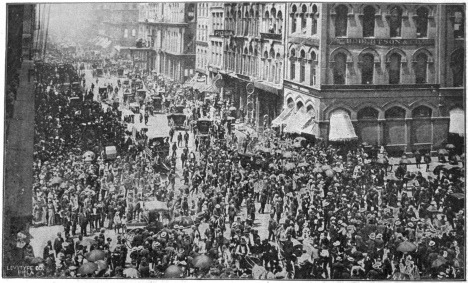 CHICAGO STREET LIFE, WASHINGTON STREET AND WABASH
AVENUE.
CHICAGO STREET LIFE, WASHINGTON STREET AND WABASH
AVENUE.
progress of industry, but do we always ask ourselves wherein that
progress consists? Is it in the greater perfection to which, in modern
times, we have carried the works of our hands? Look at the elegant
tissues of Persia and India, or at the flexible blades of Toledo and
Damascus, and say in how far we have surpassed these works of
semi-barbarous ages and people, with all our boasted mechanical
improvements! Can we imagine anything more splendid, more rich, and more
delicate than the clothes in which the Oriental princes still array
themselves, as their forefathers used to array themselves centuries ago?
Have we yet a dye more brilliant than the Tyrian, a sculpture equal to
that of Greece, an architecture better than that of the ‘Dark Ages,’
paintings on glass to compare with those in the old cathedrals, workers
in bronze to rival a Cellini? Is it not the highest compliment that we
pay to a product of skill or genius to say of it that it is ‘classical,’
that it is worthy of the models that have been preserved for ages in our
galleries and museums? What then do we mean when we speak of ourselves
as more advanced than former nations; what is that difference between us
which authorizes us to use the word progress and to look back with a
complacent half-pitying eye upon the attainments of the generations that
have passed away?
“It is this: that in our discoveries in science, by our applications of
those discoveries to practical art, by the enormous increase of
mechanical power consequent upon mechanical invention, we have
universalized all the beautiful and glorious results of industry and
skill, we have made them a common possession of the people, and given to
society at large, to almost the meanest member of it, the enjoyments,
the luxury, the elegance which in former times were the exclusive
privilege of kings and nobles. Formerly the labor of the world fed, and
clothed, and ornamented the Prince and his Court, or the warrior and his
chieftains—but now it feeds and clothes and ornaments the peasant and
his family. Then the ten thousand poor, miserable wretches worked for
the one, or the few, but now the ten thousand work for the ten thousand.
Then the wealth of provinces was drained to heap up splendors for the
lord of the province, but now that wealth is multiplied and diffused, to
give happiness to the commonalty. All the concentrated capital of Lyons,
and Leeds, and Lowell, all our complicated machinery, while it creates
new demands for human labor, is intended to cheapen manufacturing
products, as the effort of that cheapness is to put the fabrics of
woolen and silk within the reach of the poorest classes. Our books, at
this day, may not be individually superior to the books of the days of
Elzevir, but millions of men now possess books where hundreds only
possessed them formerly. Our vases and cups may not be more exquisitely
wrought than the vases and cups of Benevento Cellini, but they are
wrought, not like his, for Popes and Emperors, but for Smith and Jones,
and all the branches, collateral and direct, of the immense families of
Smith and Jones. Our roads are not built at a vast expense, for some
royal progress, or the passage of a conquering army, but are built to
roll from house to house the precious treasures of industry, or a happy
freight of excursionists, giving their hearts a holiday of merriment and
innocent delight.
“Our progress in these modern times, then, consists in this, that we
have democratized the means and appliances of a higher life; that we
have spread, far and wide, the civilizing influences of art; that we
have brought, and are bringing more and more the masses of the people up
to the aristocratic standard of taste and enjoyment, and so diffuse the
influence of splendor and grace over all minds. Grander powers have been
infused into society. A larger variety and a richer flavor have been
given to all our individual experiences; and, what is more, the barriers
that once separated our race, the intervals of time and space that made
almost every tribe and every family the enemy of every other tribe and
family have been annihilated to enable the common interests and common
enjoyments to renovate and warm us into amity of feeling and the
friendly rivalry of fellow-workmen pursuing, under different
circumstances, the same great ends.
“Legislation, rightly directed, might have done and might yet do much
for the civilization and advancement of society; but, unfortunately, in
most nations of the earth, the legislation, having been under the
exclusive control of a self-styled higher class, has impeded rather than
hastened the movement. Yet, in the face of this terrible obstacle, under
all the evils of the insular monopoly of Great Britain, seeking to
aggrandize her own manufacturing industry at the expense of the industry
of the rest of mankind, the genius of practical art has triumphed, and
will triumph still more over every difficulty. It is raising the laborer
to his true position; it is facilitating the association of men; it is
harmonizing their interests; and, whether legislation helps it or not,
it will ultimately redeem our race from dependence and slavery. And
herein is the chief reason why we to-day salute with satisfaction the
opening of the Crystal Palace.”
The Crystal Palace was not a financial success. Nearly a million dollars
were lost in the enterprise. Finally, on the evening of Tuesday, October
5th, 1858, the edifice was destroyed by fire, with most of its contents.
It was really not a very great conflagration, measured by others that
have occurred. Yet it meant the destruction of an entire World’s Fair
establishment, and was, in those times, something more than a nine
day’s wonder. “About five o’clock last evening,” said a next morning’s
paper, “smoke was seen issuing from a large room in the north nave, and
in front of the entrance on Forty-second Street, and in less than half
an hour thereafter, the Palace was a total wreck, and nothing now
remains of this edifice but a heap of unsightly ruins. The octagonal
turrets at each corner still remain standing, while here and there on
every side may be seen stacks of iron, the remains of staircases, and
portions of the framework composing the galleries.
“From the room above mentioned flames soon made their appearance, and
spread with incredible rapidity in every direction. There were about
2,000 persons scattered about the edifice at the time, all of whom, the
moment the alarm of ‘fire’ was raised, made a rush for the Sixth Avenue
entrance, the doors of which were thrown open. The entrance on Fortieth
Street was closed, there being no other means of ingress or egress
except on Sixth Avenue. Under the direction of ex-Captain Maynard and
several of the Directors of the Institute, the crowd of visitors were
conducted safely to the street, and no one that we have heard of was in
anywise injured. Some of the exhibitors endeavored to save their
property, but were forced to turn toward the door, and were soon
compelled to flee to the street. The amount of property saved is
comparatively trifling. Mr. Smith, an employee of the Institute, behaved
nobly. He was in charge of the jewelry department, and was engaged
repairing a case when the alarm was given. He finished the case and
closed the door and then went toward where the fire was. The smoke was
so dense that he almost suffocated. He saw the fire at the Forty-second
Street entrance and then ran back to the property that had been placed
in his charge, which property consisted of a quantity of watches valued
at several thousand dollars. Seizing the case, he dragged it from its
fastening along the gallery, down a flight of stairs, and thence out
into the street, the entrance at this point having at this time been
broken open. While on his way out, the dome was all in flames. The smoke
was so dense that he could see but a few feet either side of him, and he
is under the impression that he was the last man in the Palace before
the dome fell. A young man named Wallis, also in the employ of the
Institute, heard the alarm, and ran toward Smith, whom he desired to
break open the case with an axe, in order that the jewelry and watches
could be more readily got at, but Smith told him he would not do so.
Wallis was obliged to run to the street, the smoke nearly suffocating
him. The view from the street and neighboring buildings was very grand,
and thousands of persons thronged to the scene of conflagration.”
The Institute mentioned was the well-known American Institute, of New
York, which, after the close of the World’s Fair proper, had occupied
the Palace with its annual fair. It was reckoned that the total loss by
the fire was a million dollars, but the list of the chief exhibitors and
their individual losses, published next day, now looks absurdly meagre.
And thus passed out of existence the first Universal Exhibition of Art
and Industry ever held on the American Continent. When the next was
held, this was practically a new nation. The greatest war of modern
times had been fought and the National Constitution amended in many
important respects. Political and social changes of startling character
were visible on every hand. Material growth and development had been
achieved on a stupendous scale. Great inventions had been made. Every
circumstance, indeed, rendered it fitting and necessary that the second
World’s Fair should immeasurably exceed in all respects that which we
have just described.
When the World’s Fair of 1853 was opened in New York it was evident that
the American nation was nearing some great and important changes. When
the Crystal Palace was burned in 1858, the nation was on the very verge
of the “impending conflict” which had been long foreseen. The war came.
At its close America was a new nation. Its political, social, and
industrial systems were transformed. Its growth and expansion received
an enormous impetus. The influx of population and of ideas and arts from
other countries was many-fold greater than ever before. And thus it
approached the one-hundredth anniversary of its independence, and
preparations were made to commemorate the time with a second Universal
Exhibition.
The Centennial Exhibition, which was held in Philadelphia in 1876, was
the greatest fair the world had then seen. None of its predecessors had
equalled it in extent, or surpassed it in variety or general interest.
Paris, in 1867, had given a more compact and systematic display, and at
Vienna, in 1873, Oriental nations were more fully represented. But the
American Exhibition had many points of superiority over those. It showed
the natural products, industries, inventions, and arts of the Western
Hemisphere as they had never been shown before, and brought them for the
first time, in their fullness and perfection, in contrast with those of
the Old World. In the department of machinery it was incomparably
superior to all its predecessors, and also in that of farm implements
and products. In fine arts it did not contain as many really great
masterpieces as had been seen at Paris and Vienna, but it embraced a
wider representation of contemporary art from all parts of the world.
In general manufactures the display was much greater in quantity than
had ever before been attempted. And it greatly exceeded all other fairs
as a really international exhibition, for every civilized state on the
globe, excepting Greece and a few minor republics in Central and South
America, was represented.
About 236 acres of Fairmount Park in Philadelphia were occupied by the
Exhibition. The ground was admirably adapted for the purposes of the
Fair. It was an elevated plateau, with three spurs jutting out toward
the Schuylkill River. One of the three spurs was occupied by Memorial
Hall, containing the art exhibition, another by Horticultural Hall, and
the third by Agricultural Hall, while the broad plain where they joined
contained the Main Building, Machinery Hall, United States Government
Building, and about a hundred smaller structures. The grounds were
traversed by five main avenues, a belt-line railroad, and many miles of
minor walks. There was an extensive lake, and a splendid wealth of
lawns, flower beds, and groves.
The Main Building was the largest edifice in the world. It was 1,876
feet long and 464 feet wide, covering 21½ acres of ground. In the centre
were four square towers, 120 feet high. The facades at the end were 90
feet high, and the corner towers 75 feet. The central aisle was 1,832
feet long, 120 feet wide, and 70 feet high. The framework was of iron,
filled in with wood and glass. Nearly one-third of the space was
occupied by American exhibitors. Great Britain and her colonies occupied
the next largest area, with a display of enormous proportions and
dazzling brilliancy. A single firm of silversmiths sent half a million
dollars’ worth of wares. France and her colonies and the German Empire
were also splendidly represented. Other conspicuous exhibitors were
Holland, Belgium, Austria, Russia, Spain, Japan, Sweden and Norway,
Italy, and China. Mexico, Brazil, Switzerland, Portugal, Egypt, Turkey,
Denmark, Tunis, Chile, the Argentine Republic, Peru, the Orange Free
State, the Sandwich Islands, and Venezuela were also represented. Never
before had there been gathered together in one place such a
comprehensive display of the arts and industries of so many of the
peoples of the world.
Machinery Hall, which was especially devoted to machinery in motion, was
1,402 feet long and 360 feet wide, with an annex 208 by 210 feet for
hydraulic machinery. There were more than 10,000 feet of shafting for
conveying to the various machines the motive power generated by the huge
Corliss engine. This enormous machine had cylinders of 44 inches
diameter, and ten feet stroke, a fly-wheel 30 feet in diameter, and 56
tons in weight, making 36 revolutions per minute. There were 20 tubular
boilers of 70 horse-power each, and at 60 pounds pressure the work of
the engine was about 1,400 horse-power. This building contained by far
the largest and most varied display of working machinery that had at
that time ever been seen in the world.
Horticultural Hall was a graceful Moorish palace, largely built of
glass, and contained a magnificent exhibit of trees, shrubs, and flowers
from all parts of the world. Agricultural Hall consisted of a nave 826
feet long and 100 wide, crossed by three transepts, each 465 feet long,
and from 80 to 100 feet wide. The inclosed space was about 12 acres in
extent, and it contained a marvellous display of agricultural implements
and products from all parts of the world. Memorial Hall was intended as
a permanent building, and was constructed in substantial manner of
granite, glass, and iron. It is 365 feet long and 210 feet wide, with a
square tower at each corner, and a four-sided dome at the centre.
Besides these buildings the United States Government erected a vast
structure, 360 by 300 feet, for the display of the operations of its
various departments; many foreign governments had buildings of their
own; so had more than a score of the States; and there were also
buildings for the Judges, and for a great number of special industries.
The technical history of the enterprise may be briefly recounted as
follows: The Exhibition was really a natural outgrowth of the Universal
Exposition held at Paris in 1867. That affair was much the most
extensive international exhibition ever held up to that time, and its
brilliant success produced a marked impression throughout the civilized
world. Austria took immediate measures to rival it, and carried out her
ambitious plans six years later at Vienna. Among the many Americans who
saw the wonderful show on the banks of the Seine there were many who
expressed a desire to see an enterprise of the kind attempted in their
own country. It is believed that Gen. C. B. Norton, of New York, one of
the Commissioners to the Paris Exposition, was the first who suggested
the idea of a World’s Fair to commemorate the Centennial Anniversary of
American Independence. This he did while viewing the preparations for
the exposition in the Champs de Mars in company with Mr. Dudley S.
Gregory, of New York, in the summer of 1866. His plan was to hold the
exhibition in Central Park. Mr. Gregory returned in the fall and laid
the matter before the American Institute, but it does not appear that
any action was taken. The next agitation of the question was in June,
1868, when at a meeting of the Massachusetts exhibitors at Paris, held
in the Music Hall, Boston, for the distribution of the awards forwarded
by the French Government to this country, Dr. C. J. Jackson offered a
resolution in favor of an international exhibition in Washington, to
open July 4th, 1876. After some speech-making the resolution was
adopted. In the fall of the same year a meeting to forward the project
was held in New York under the chairmanship of Dr. G. B. Loring. A
committee of nine was appointed, but there the matter ended. New York
had failed to appreciate the grandeur and importance of the project.
Washington had a livelier comprehension, but was too poor to do anything
that involved expenditure.
It now remained for Philadelphia to come forward. In 1869 Mr. M. Richard
Muckle, of The Philadelphia Ledger, wrote a letter to President Grant,
urging the holding of a World’s Fair in the city where the Declaration
of Independence was signed, and this letter, widely published and
commented upon, fairly set the ball in motion. Soon after it appeared
the Franklin Institute and the Academy of Fine Arts memorialized
Congress on the subject, and the City Councils appointed a Centennial
Committee. In February, 1871, a committee from the New Jersey
Legislature visited Philadelphia to confer with the Councils, and in
April a delegation from Virginia came on the same errand. At the
instance of the Pennsylvania members, Congress took up the question in
the session of 1870-71, and on the 3d of March passed an act “to
provide for celebrating the One Hundredth Anniversary of American
Independence by holding an International Exhibition of arts,
manufactures, and products of the soil and mine in the City of
Philadelphia and State of Pennsylvania, in the year 1876.” Under this
act one hundred Commissioners were appointed; but it was found
impossible to assemble a quorum of this unwieldy body, and the
organization was changed by a supplementary act, providing for one
Commissioner and one alternate from each State and Territory, appointed
by the President on the nomination of the Governors. No money was
appropriated. In June, 1872, Congress passed another act, creating a
separate corporation, called the Board of Finance, to raise funds by
subscriptions throughout the country, and to take entire charge of the
finances of the Exhibition, which was made a stock concern, with a
capital of $10,000,000, in shares of $10 each. Large subscriptions were
at once obtained from the citizens of Philadelphia. The State of
Pennsylvania appropriated $1,000,000; the City of Philadelphia,
$1,500,000; the State of New Jersey, $100,000; and the States of
Delaware, New Hampshire, and Connecticut, $10,000 each. Subscriptions
amounting to about $250,000 were subsequently raised in New York City.
The business men of the New England States also contributed, but the
West gave almost nothing, and the South nothing. The aggregate amount
spent by foreign countries for the Exhibition was about $2,500,000.
On June 26th, 1873, Governor Hartranft informed the President that
provision had been made for erecting the buildings. Upon that
information the President, on July 3d of the same year, issued his
proclamation declaring that the Exhibition would be held in 1876.
Secretary Fish, on the 5th of July, informed the representatives of
foreign nations of the Exhibition, and invited them to participate.
Formal acceptances were received, before the beginning of 1876, from
Great Britain, France, Austria, Germany, Belgium, Sweden, Holland,
Spain, Portugal, Italy, Norway, Egypt, Denmark, Turkey, Switzerland,
Mexico, Venezuela, Brazil, Chile, Peru, Argentine Confederation,
Sandwich Islands, China, Japan, Australia, Canada, Bolivia, Nicaragua,
Colombia, Liberia, Orange Free State, Equador, Guatemala, Salvador, and
Honduras. March 3d, 1875, Congress appropriated $505,000 for the
arrangement of an official Government display, of which $150,000 was to
be appropriated for the erection of a special building for the
Government Exhibition. On the 4th of July, 1873, the Commissioners of
Fairmount Park formally conveyed 450 acres of land at Lansdowne, in the
Park, for buildings and other purposes of the Exhibition.
In 1873 the Commission sent Professor W. P. Blake, of Connecticut, to
the Vienna Exhibition as a Special Commissioner to study and report upon
it. The General Director, Mr. A. T. Goshorn, also made a thorough
examination of that fair. Ground was broken for the Exhibition buildings
July 4th, 1874. Machinery Hall was completed in November, 1875,
Horticultural Hall and the Main Building in January, 1876, and Memorial
Hall and Agricultural Hall in April. In February, 1876, Congress
appropriated $1,500,000 to complete the payments for the buildings, and
thus enabled the Commission to open the Exhibition free from debt.
The formal opening of the Centennial Exhibition was effected on May
10th, 1876. At nine o’clock A.M. on that day the gates of the grounds,
with the exception of those at the east end of the Main Building, were
opened to the public at the established rate of admission of fifty cents
each. The Main Building, Memorial Hall, and Machinery Hall were reserved
for guests and exhibitors until the conclusion of the ceremonies, at
about one P.M., when all restrictions were withdrawn. The inaugural
ceremonies were conducted in the open air, on an area of about 300 by
700 feet between the Main Building and Memorial Hall. The concourse of
spectators within sight of the ceremonies, though largely not within
hearing distance, was more
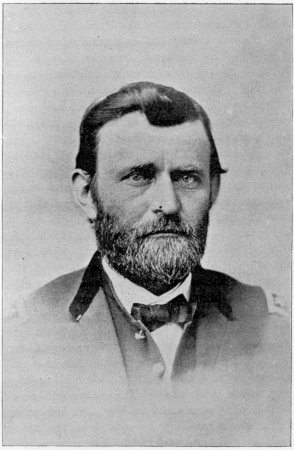 ULYSSES S. GRANT.
than 110,000. At an early hour a military parade moved from the city to
the exhibition grounds. At its head was the First Troop of Philadelphia
City Cavalry, acting as the bodyguard of the President of the United
States. This was followed by the Boston Cadets and the Boston Lancers,
escorting Governor Rice, of Massachusetts, and his staff. Governor
Hartranft, of Pennsylvania, and his staff came next, and were succeeded
by Major-General Bankson and a large body of Pennsylvania State troops.
No flags nor other ensigns were displayed on or about the buildings and
grounds until an appointed signal was given, and all the organs, bells,
and other musical instruments awaited in silence the same notice.
At 10.15 A.M. the huge orchestra of one hundred and fifty pieces, under
the direction of Mr. Theodore Thomas, began playing the various national
airs of the world. First was played “The Washington March,” after which
came the national music of the Argentine Republic, Austria, Belgium,
Brazil, Denmark, France, Germany, Great Britain, Italy, the Netherlands,
Norway, Russia, Spain, Sweden, Switzerland, and Turkey, concluding with
“Hail Columbia.” On the arrival of the President of the United
States—General U. S. Grant—accompanied by the Emperor Dom Pedro, of
Brazil, the Director General of the Exhibition, and other notable
personages, the “Centennial Inauguration March,” which had been composed
by Richard Wagner for the occasion, was performed. The Rev. Dr. Matthew
Simpson, Bishop of the Methodist Episcopal Church, then offered prayer.
A hymn, written by John Greenleaf Whittier, was sung by the choir of one
thousand voices to music composed by John K. Paine, with organ and
orchestral accompaniment. John Welsh, President of the Centennial Board
of Finance, formally presented the buildings to the Centennial
Commission. A cantata, written by Sidney Lanier, of Georgia, with music
by Dudley Buck, was sung by the chorus, with solos by Myron W. Whitney.
General Joseph R. Hawley, President of the United States Centennial
Commission, formally presented the Exhibition to the President of the
United States, who responded in a brief address, closing with the words,
“I declare the International Exhibition now open.” At that moment a
thousand flags were unfurled on every hand, innumerable bells and
whistles were sounded, a salute of one hundred guns was fired, and
Handel’s “Hallelujah Chorus” was sung by the great choir, with organ and
orchestral accompaniment. Then the President and other distinguished
guests formed in a small procession and moved through the principal
buildings. In Machinery Hall the President and the Emperor of Brazil set
in motion the great engine and all the machinery connected therewith,
being assisted by Mr. George H. Corliss, the builder and giver of the
engine. Then the President and other guests were escorted to the Judges’
pavilion, where a brief reception was held. This concluded the opening
exercises, and thenceforth the grounds and buildings were open to the
public, at fifty cents admission, every week-day until November 10th,
when the Exhibition was closed.
A number of the State Governments arranged excursions to the Exhibition
by the State officers and citizens generally. These “State days,” as
they were termed, were as follows: New Jersey, August 24th; Connecticut,
September 7th; Massachusetts, September 14th; New York, September 21st;
Pennsylvania, September 28th; Rhode Island, October 5th; New Hampshire,
October 12th; Delaware and Maryland, October 19th; Ohio, October 26th;
and Vermont, October 27th.
The other principal events on the season’s calendar were as follows: May
23d, Session of True Templars; May 24th, Meeting of Judges of Awards;
May 30th, Decoration Day and Opening of the Bankers’ Building; June 1st,
Parade of Knights Templar; June 7th, Convention in Brewers’ Hall; June
12th, Women’s International Temperance Convention; June 15th, Dedication
of Ice Water Fountain by the Sons of Temperance; June 27th to July
10th, Encampment of the West Point Cadets; July 1st, Excursion of
Soldiers’ Orphans from Lincoln Home; July 4th, Centennial Celebration of
the Declaration of Independence and Dedication of the Catholic Total
Abstinence Beneficial Society’s Fountain; July 6th, 7th, 8th, 13th,
18th, 19th, 20th, 21st, Excursions given by the Philadelphia & Reading
Railroad to its Employees; July 15th, Encampment of the Columbus, Ohio,
Cadets; August 3d to 9th, Encampment of Pennsylvania Troops; August
30th, Excursion of Steinway & Sons’ Employees; August 22d, National and
International Rowing Matches began on the Schuylkill River; August 23d,
Parade of the Knights of Pythias; August 28th, Parade of Swiss Citizens;
August 29th, Reception by the Mayor of Philadelphia; September 1st to
October 18th, Live Stock Exhibitions; September 2d, Encampment of
Connecticut National Guard; September 4th, International Medical
Congress; September 20th, Odd Fellows’ Day; September 23d, International
Rifle Teams—Scotch, Irish, Australian, and American—visited the
Exhibition; September 28th, Grand Display of Fireworks; October 7th,
Encampment of Cadets of Virginia Military Institute; October 12th,
Dedication of Statue of Columbus; October 14th, Dedication of Statue of
Dr. Witherspoon; October 19th, Tournament; October 26th, Merchants’
Day; November 2d, Dedication of Statue to Bishop Allen by Colored
Citizens; November 7th, Reception by Women’s Centennial Executive
Committee; November 9th, International Pyrotechnic Contest; November
10th, Closing Ceremonies.
The United States Centennial Commission held an imposing commemoration
of the Centennial Anniversary of the Declaration of Independence in
Independence Square on July 4th. The following was the programme of
exercises:
1. Grand Overture, “The Great Republic,” founded on the National Air,
“Hail Columbia,” and arranged for the occasion by the composer, George
F. Bristow, of New York; rendered by the orchestra under the direction
of Patrick Sarsfield Gilmore.
2. The President of the Commission, General Joseph R. Hawley, called the
assembly to order and announced the acting Vice-President of the United
States, Senator Thomas W. Ferry, as the presiding officer of the day in
the absence of the President of the United States.
3. Prayer by the Rev. Dr. William B. Stevens, Protestant Episcopal
Bishop of Pennsylvania.
4. Hymn, “Welcome to all Nations,” by Oliver Wendell Holmes, to the
music of Keller’s “National Hymn.”
5. Reading of the Declaration of Independence from the original
manuscript by Richard Henry Lee of Virginia.
6. Greeting from Brazil; a Hymn for the First Centennial of American
Independence, composed by A. C. Gomes, of Brazil, at the request of the
Emperor Dom Pedro; rendered by the orchestra.
7. Reading of “National Ode,” by Bayard Taylor.
8. Grand Triumphal March, with chorus, “Our National Banner;” words by
Dexter Smith, of Massachusetts, music by Sir Julius Benedict, of
England.
9. Oration, by William M. Evarts, of New York.
10. Hallelujah Chorus, from Handel’s “Messiah.”
11. Doxology, “The Old Hundredth Psalm.”
Space will not permit the printing here of the oration or other features
of the programme, with the exception of the hymn, “Welcome to All
Nations,” by Oliver Wendell Holmes, which was as follows:
I.
Bright on the banners of lily and rose,
Lo, the last sun of the century sets!
Wreathe the black cannon that scowled on our foes,
All but her friendships the nation forgets!
All but her friends and their welcome forgets!
These are around her, but where are her foes?
Lo, while the sun of the century sets,
Peace with her garlands of lily and rose!
II.
Welcome! a shout like the war-trumpets swell,
Wakes the wild echoes that slumber around!
Welcome! it quivers from Liberty’s bell;
Welcome! the walls of her temple resound!
Hark! the gray walls of her temple resound!
Fade the far voices o’er river and dell;
Welcome! still whisper the echoes around;
Welcome! still trembles on Liberty’s bell!
III.
Thrones of the continents! Isles of the sea!
Yours are the garlands of peace we entwine!
Welcome once more to the land of the free,
Shadowed alike by the palm and the pine,
Softly they murmur, the palm and the pine,
“Hushed is our strife in the land of the free.”
Over your children their branches entwine,
Thrones of the continents! Isles of the sea!
The distribution of awards to exhibitors occurred in the Judges’ Hall on
Wednesday, September 27th, with an interesting programme of music and
addresses.
On November 9th a farewell banquet was given to the Foreign
Commissioners and Judges of Awards by the Centennial Commission and
Board of Finance in St. George’s Hall. The guests on this occasion
included the Commissioners and Diplomatic Representatives of the nations
which had participated in the Exhibition, the Chief Justice and Judges
of the Supreme Court of the United States, a number of Senators and
members of the United States Congress, the Secretary of State and other
members of the Cabinet of the United States, the Governors of
Pennsylvania, Massachusetts, Delaware, and New Jersey; the Mayor of
Philadelphia, the Presidents of the Philadelphia City Councils, and the
officers and members of the Fairmount Park Commission, the Centennial
Commission, and the Centennial Board of Finance. The President of the
United States was the presiding officer of the evening. During the
course of the banquet addresses were made by representatives of the
several bodies participating, and by Commissioners of each of the
foreign countries represented, each being introduced in turn by the
President of the Centennial Commission amid the applause of the guests.
The closing ceremonies of the Exhibition occurred on Friday, November
10th. They were to have been held like the opening exercises,
out-of-doors, but stormy weather made it necessary to hold them within
the Judges’ Hall. At sunrise a Federal salute of thirteen guns was
fired. The programme proper was opened with the Inauguration March,
composed by Richard Wagner, and performed by the orchestra under
Theodore Thomas. Prayer was offered by the Rev. Dr. Joseph A. Seiss.
Addresses followed by D. J. Morrell, United States Centennial
Commissioner from Pennsylvania, and Chairman of the Executive Committee;
John Welsh, President of the Centennial Board of Finance; A. T. Goshorn,
Director General, and Joseph R. Hawley, President of the United States
Centennial Commission; alternating with musical selections rendered by
the chorus and orchestra. After General Hawley’s address, the national
hymn, “My Country, ’tis of Thee,” was rendered by the orchestra, choir,
and general audience. During the singing, the American flag which was
carried by John Paul Jones on his frigate, the “Bon Homme Richard,” in
1779, was unfurled above the platform, and a salute of forty-seven guns
was fired. Then the President of the United States rose and said: “I now
declare the International Exhibition of 1876 closed.” General Hawley
said: “The President of the United States will now give the signal to
stop the great engine.” The President then waved his hand to a telegraph
operator, who instantly sent an electric message to the engineer in
Machinery Hall, and at exactly 3.40 o’clock P.M. the great engine ceased
to work. The singing of the Doxology by the choir and audience concluded
the ceremony.
It will be of interest to add, for purposes of record and reference,
some statistics regarding the Exhibition. Nearly all supplies of goods,
and nearly all visitors were brought to Philadelphia over the lines of
two railroad companies, the Pennsylvania, and the Philadelphia &
Reading. During 1874 these roads delivered at the Exhibition grounds
3,341 loaded freight cars; in 1875, 10,479; and in 1876, 6,340; a total
of 20,160 loaded cars bearing about 200,000 tons of freight. During the
continuance of the Exhibition there arrived at the Centennial station of
the Pennsylvania Railroad 23,972 passenger trains, and at the station of
the Philadelphia & Reading Railroad, 42,495. The average number of
trains daily was more than 410, and the average number of cars to each
train more than 6, giving accommodations in the whole number of trains
for over 20,000,000 passengers. The greatest service in one day at the
Pennsylvania depot comprised 250 trains of 2,004 cars, bearing 58,347
passengers; and at the Philadelphia & Reading station on the same day
370 trains of 2,867 cars, bearing 185,800 passengers; a total of 620
trains, 4,871 cars, and 244,147 passengers. During the entire
Exhibition there arrived at the Pennsylvania depot 1,392,697
passengers, and at the Philadelphia & Reading 1,726,010.
There were received at the Exhibition from all the countries of the
world 154,273 packages of goods, weighing 57,116,658 pounds; and there
were removed from the grounds at the close of the fair 58,700 packages,
weighing 27,041,271 pounds.
From May 10th to November 10th, 1876, there were admitted to the grounds
a grand total of 9,910,966 persons, from whom were received admission
fees amounting to $3,813,724.49. The largest number admitted on any day
was 274,919, on Pennsylvania Day, September 28th. The smallest number,
12,720, was admitted on Friday, May 12th. The largest number of persons
passing through a single gate in a single hour was 1,870. The day of the
week most popular among visitors was Thursday, with an average of 76,905
attendants, and the least popular was Monday, with an average of 50,051.
The total number of persons transported to and from the Exhibition was
19,821,932, of whom 3,574,528 came on local trains, 2,334,804 on
railroad trains from out of the city, 10,557,100 by tramways, 556,500 by
steamboat, 803,000 by carriages, and 1,996,000 on foot.