The first recollections of a child are dim and hazy, and
so the nursery at 28 East 20th Street, in New York City,
does not stand out as clearly to me as I wish it did—but
the personality of my brother overshadowed the room, as his
personality all through life dominated his environment.
I suppose I must have been about four, and he about seven,
when my first memory takes definite form. My older sister,
Anna, though only four years older than my brother Theodore,
was always mysteriously classed with the “grown people,” and
the “nursery” consisted of my brother Theodore, my brother
Elliott, a year and a half younger than Theodore, and myself,
still a year and a half younger than Elliott.
In those days we were “Teedie,” “Ellie,” and “Conie,”
and we had the most lovely mother, the most manly, able, and
delightful father, and the most charming aunt, Anna Bulloch,
the sister of my Southern mother, with whom children were
ever blessed.
Theodore Roosevelt, whose name later became the synonym
of virile health and vigor, was a fragile, patient sufferer in those
early days of the nursery in 20th Street. I can see him now
struggling with the effort to breathe—for his enemy was that
terrible trouble, asthma—but always ready to give the turbulent
“little ones” the drink of water, book, or plaything which they
vociferously demanded, or equally ready to weave for us long
stories of animal life—stories closely resembling the jungle stories
of Kipling—for Mowgli had his precursor in the brain of the
little boy of seven or eight, whose knowledge of natural history
even at that early age was strangely accurate, and whose imagination
gave to the creatures of forest and field impersonations
as vivid as those which Rudyard Kipling has made immortal
for all time.
We used to sit, Elliott and I, on two little chairs, near the
higher chair which was his, and drink in these tales of endless
variety, and which always were “to be continued in our next”—a
serial story which never flagged in interest for us, though sometimes
it continued from week to week, or even from month to
month.
It was in the nursery that he wrote, at the age of seven, the
famous essay on “The Foregoing Ant.” He had read in Wood’s
“Natural History” many descriptions of various species of ant,
and in one instance on turning the page the author continued:
“The foregoing ant has such and such characteristics.” The
young naturalist, thinking that this particular ant was unique,
and being specially interested in its forthgoing character, decided
to write a thesis on “The Foregoing Ant,” to the reading of which
essay he called in conclave “the grown people.” One can well
imagine the tender amusement over the little author, an amusement,
however, which those wise “grown people” of 28 East
20th Street never let degenerate into ridicule.
No memories of my brother could be accurate without an
analysis of the personalities who formed so big a part of our
environment in childhood, and I feel that my father, the first
Theodore Roosevelt, has never been adequately described.
He was the son of Cornelius Van Shaack and Margaret
Barnhill Roosevelt, whose old home on the corner of 14th Street
and Broadway was long a landmark in New York City. Cornelius
Van Shaack Roosevelt was a typical merchant of his day,
fine and true and loyal, but ultraconservative in many ways;
and his lovely wife, to whom he addressed, later, such exquisite
poems that I have always felt that they should have been given
more than private circulation, was a Pennsylvanian of Quaker
blood.
The first Theodore Roosevelt was the youngest of five sons,
and I remember my mother used to tell me how friends of her
mother-in-law once told her that Mrs. Cornelius Van Shaack
Roosevelt was always spoken of as “that lovely Mrs. Roosevelt”
with those “five horrid boys.”
As far as I can see, the unpleasant adjective “horrid” was
only adaptable to the five little boys from the usual standpoint
of boyish mischief, untidiness, and general youthful irrepressibleness.
The youngest, my father, Theodore Roosevelt, often told
us himself how he deplored the fate of being the “fifth wheel
to the coach,” and of how many a mortification he had to endure
by wearing clothes cut down from the different shapes of
his older brothers, and much depleted shoes about which, once,
on overhearing his mother say, “These were Robert’s, but will
be a good change for Theodore,” he protested vigorously, crying
out that he was “tired of changes.”
As the first Theodore grew older he developed into one of
the most enchanting characters with whom I, personally, have
ever come in contact; sunny, gay, dominant, unselfish, forceful,
and versatile, he yet had the extraordinary power of being a
focussed individual, although an “all-round” man. Nothing
is as difficult as to achieve results in this world if one is filled
full of great tolerance and the milk of human kindness. The
person who achieves must generally be a one-ideaed individual,
concentrated entirely on that one idea, and ruthless in his aspect
toward other men and other ideas.
My father, in his brief life of forty-six years, achieved almost
everything he undertook, and he undertook many things, but,
although able to give the concentration which is necessary to
achievement, he had the power of interesting himself in many
things outside of his own special interests, and by the most delicate
and comprehending sympathy made himself a factor in
the lives of any number of other human beings.
My brother’s great love for his humankind was a direct inheritance
from the man who was one of the founders in his city
of nearly every patriotic, humanitarian, and educational endeavor.
I think, perhaps, the combination of the stern old
Dutch blood with the Irish blood, of which my brother always
boasted, made my father what he was—unswerving in duty, impeccable
in honesty and uprightness, and yet responsive to the
joy of life to such an extent that he would dance all night, and
drive his “four-in-hand” coach so fast that the old tradition
was “that his grooms frequently fell out at the corners”!
I remember that he always gave up one day of every week
(and he was a very busy merchant and then banker) to the personal
visiting of the poor in their homes. He was not satisfied
with doing active work on many organizations, although he
did the most extraordinary amount of active organization work,
being one of the founders of the Children’s Aid Society, of the
State Aid Society, of the Sanitary Commission and Allotment
Commission in the time of the Civil War, and of the Orthopædic
Hospital, not to mention the Museum of Natural History and
the Museum of Art—but he felt that even more than this organized
effort must be the effort to get close to the hearts and
homes of those who were less fortunately situated than he.
My older sister suffered from spinal trouble, and my father
was determined to leave no stone unturned to make her body
fit for life’s joys and life’s labors, and it was because of his efforts
to give his little girl health—successful efforts—that in
co-operation with his friends Howard Potter and James M.
Brown and several others he started the great work of the New
York Orthopædic Hospital, having become imbued with belief
in the methods of a young doctor, Charles Fayette Taylor. Nobody
at that time believed in treating such diseases in quite
the way in which modern orthopædy treats them now, but my
father, like his son, had the vision of things to be, and was a
leader in his way, as was my brother in his.
He could not at first influence sufficient people to start the
building of a hospital, and he decided that if the New York
public could only see what the new instruments would do for the
stricken children, that it could be aroused to assist the enterprise.
And so, one beautiful spring afternoon, my mother gave
what was supposed to be a purely social reception at our second
home, at 6 West 57th Street, and my father saw to it that the
little sufferers in whom he was interested were brought from
their poverty-stricken homes to ours and laid upon our dining-room
table, with the steel appliances which could help them
back to normal limbs on their backs and legs, thus ready to
visualize to New York citizens how these stricken little people
might be cured. He placed me by the table where the children
lay, and explained to me how I could show the appliances, and
what they were supposed to achieve; and I can still hear the
voice of the first Mrs. John Jacob Astor, as she leaned over one
fragile-looking child and, turning to my father, said: “Theodore,
you are right; these children must be restored and made into
active citizens again, and I for one will help you in your
work.”
That very day enough money was donated to start the first
Orthopædic Hospital, in East 59th Street. Many business
friends of my father used to tell me that they feared his sudden
visits when, with a certain expression in his eyes, he would approach
them, for then before he could say anything at all they
would feel obliged to take out their pocketbooks and ask: “How
much this time, Theodore?”
One of his most devoted interests was the newsboys’ lodging-house
in West 18th Street, and later in 35th Street, under the
auspices of the Children’s Aid Society. Every Sunday evening
of his life he went to that lodging-house, after our early hospitable
Sunday supper, to which many a forlorn relation or
stranded stranger in New York was always invited, and there
he would talk to the boys, giving them just such ideas of patriotism,
good citizenship, and manly morality as were the
themes of his son in later years.
The foundational scheme of the Children’s Aid Society was,
and is, to place little city waifs in country homes, and thus give
them the chance of health and individual care, and a very dramatic
incident occurred many years after my father’s death,
when my brother, as governor of New York State and candidate
for the vice-presidency in 1900, had gone to the Far West to make
the great campaign for the second election of William McKinley.
The governors of many Western States decided to meet in the
city of Portland, Ore., to give a dinner and do honor to the
governor of the Empire State, and as Governor Roosevelt entered
the room they each in turn presented themselves to him.
The last one to come forward was Governor Brady, of Alaska,
and as he shook hands with Governor Roosevelt he said: “Governor
Roosevelt, the other governors have greeted you with
interest, simply as a fellow governor and a great American, but
I greet you with infinitely more interest, as the son of your
father, the first Theodore Roosevelt.”
My brother smiled and shook him warmly by the hand, and
asked in what special way he had been interested in our father,
and he replied: “Your father picked me up from the streets in
New York, a waif and an orphan, and sent me to a Western
family, paying for my transportation and early care. Years
passed and I was able to repay the money which had given me
my start in life, but I can never repay what he did for me, for
it was through that early care and by giving me such a foster
mother and father that I gradually rose in the world, until today
I can greet his son as a fellow governor of a part of our great
country.”
I was so thrilled when my brother told me this story on his
return from that campaign, that the very next Sunday evening
I begged him to go with me to the old 35th Street lodging-house
to tell the newsboys that were assembled there the story of another
little newsboy, now the governor of Alaska, to show that
there is no bar in this great, free country of ours to what personal
effort may achieve.
My father was the most intimate friend of each of his children,
and in some unique way seemed to have the power of responding
to the need of each, and we all craved him as our most
desired companion. One of his delightful rules was that on
the birthday of each child he should give himself in some special
way to that child, and many were the perfect excursions which
he and I took together on my birthday.
The day being toward the end of September was always
spent in the country, and lover as he was of fine horses, I was
always given the special treat of an all day’s adventure behind
a pair of splendid trotters. We would take the books of poetry
which we both loved and we would disappear for the whole
day, driving many miles through leafy lanes until we found the
ideal spot, where we unharnessed the horses and gave them their
dinner, and having taken our own delicious picnic lunch, would
read aloud to each other by the hour, until the early September
twilight warned us that we must be on our way homeward.
In those earlier days in New York the amusements were
perhaps simpler, but the hospitality was none the less generous,
and our parents were indeed “given to hospitality.”
My lovely Southern mother, of whom I will speak more
later, had inherited from her forebears a gift for hospitality,
and we young children, according to Southern customs, were
allowed to mingle more with our elders than was the case with
many New York children. I am a great believer in such mingling,
and some of the happiest friendships of our later lives were
formed with the chosen companions of our parents, but many
things were done for us individually as well. When we were
between thirteen and sixteen I remember the delightful little
Friday-evening dances which my mother and father organized
for us in 57th Street, and in which they took actual part themselves.
As I said before, my father could dance all night with the
same delightful vim that he could turn to his business or his
philanthropy in the daytime, and he enjoyed our pleasures as he
did his own. It always seems to me sad that the relationship
between father and son, or father and daughter, should not have
the quality of charm, a quality which it so often lacks, and which
I believe is largely lacking because of the failure of the older
generation to enter into the attitude of the younger generation.
I was delicate at one period and could not dance as I had
always done, and I remember when I was going to a little entertainment,
just as I was leaving the house I received an exquisite
bunch of violets with a card from my father, asking me
to wear the flowers, and think of his wish that I should not overtire
myself, but also of his sympathy that I could not do quite
what I had always done.
Comparatively few little girls of fourteen have had so lover-like
an attention from a father, and just such thought and tender,
loving comprehension made our relationship to our father
one of perfect comradeship, and yet of respectful adoration.
He taught us all, when very young, to ride and to swim and to
climb trees. I remember the careful way in which he would
show us dead limbs and warn us about watching out for them,
and then, having taught us and having warned us, he gave us
full liberty to try our wings and fall by the wayside should they
prove inadequate for our adventures.
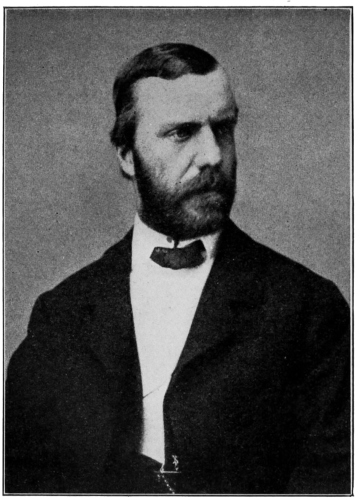
Theodore Roosevelt, Sr., aged thirty,
1862.
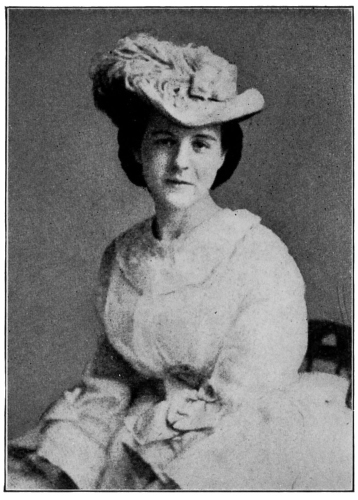
Martha Bulloch Roosevelt, twenty-two years
old, about 1856.
After graduating from our first Shetland pony, he provided
us each with a riding-horse, and always rode with us himself,
and a merry cavalcade went forth from our country home, either
early in the morning before he started for the train or in the
soft summer evenings on his return. When at one time we were
living on the Hudson River, we had hoped one autumn afternoon
that he would come home early from the city, and great
was our disappointment when a tremendous storm came up and
we realized that he would take a later train, and that our beloved
ride must be foregone. We were eagerly waiting in the
hall for his return and watching the rain falling in torrents and
the wind blowing it in gusts, when the depot wagon drove up
to the door and my father leaped out, followed by the slight
figure of a somewhat younger man. As the young man tried
to put up his umbrella it blew inside out and, like a dilapidated
pinwheel loosened from his hand, ran round and round in a circle.
The unknown guest merrily chased the umbrella pinwheel,
and my mother, who had joined us children at the window,
laughingly wondered who my father’s new friend was. The
front door opened and the two dripping men came in, and we
rushed to meet them.
I can see the laughing face of the young man become suddenly
shy and a little self-conscious as my father said to my
mother: “Mittie, I want to present to you a young man who
in the future, I believe, will make his name well known in the
United States. This is Mr. John Hay, and I wish the children
to shake hands with him.”
Many and many a time, long, long years after, when John
Hay was secretary of state in the cabinet of the second Theodore
Roosevelt, he used to refer to that stormy autumn afternoon
when a delicate boy of eleven, at the instigation of
his father, shook hands with him and looked gravely up into
his face, wondering perhaps how John Hay was going to make
his name known throughout the United States. How little did
Mr. Hay think then that one day he would be the secretary of
state when that same little delicate boy was President of the
United States.
My father’s intimacy with John Hay had come about through
the fact of contact in the Civil War, when they both worked so
hard in Washington together.
My father stands out as the most dominant figure in our
early childhood. Not that my mother was not equally individual,
but her delicate health prevented her from entering into
our sports and unruly doings as our father did; but I have always
thought that she, in an almost equal degree with my father,
influenced my brother’s nature, both by her French Huguenot
and Scotch blood and her Southern ancestry.
The story of her meeting with my father has a romantic flavor
to it. My grandmother, Mrs. Stephens Bulloch, lived in an
old plantation above Atlanta, on the sand-hills of Georgia.
There, in the old white-columned house overlooking a beautiful
valley, my grandmother led a patriarchal life, the head of a large
family, for she had been as a young girl the second wife of Senator
John Elliott, and she not only brought up the children of that
marriage but the children and stepchild of her second marriage
as well. My own mother was the second daughter of Mr. and
Mrs. Stephens Bulloch, but she never knew the difference between
her Elliott half brother and sisters, her Bulloch half-brother
and her own brother and sister.
In the roomy old home with its simple white columns there
was led an ideal life, and the devotion of her children to my beautiful
grandmother, as the many letters in my possession prove,
was one of the inspiring factors in their lives, and became the
same to our own childhood, for many were the loving stories
told us by my mother and aunt of the wonderful character of
their mother, who ran her Southern plantation (Mr. Bulloch
died comparatively young) with all the practical ability and
kindly supervision over her slaves characteristic of the Southern
men and women of her time.
The aforesaid slaves were treated as friends of the family,
and they became to us, her little Northern grandchildren, figures
of great interest. We were never tired of hearing the stories
of “Daddy Luke” and “Mom Charlotte.”
The first of these two, a magnificent Nubian, with thick
black lips and very curly hair, was the coachman and trusted
comrade of my grandmother’s children, while his wife, “Mom
Charlotte,” was a very fastidious mulatto, slender and handsome,
who, for some illogical reason, considered her mixed blood
superior to his pure dark strain. She loved him, but with a
certain amount of disdain, and though on week-days she treated
him more or less as an equal, on Sundays, when dressed in her
very best bandanna and her most elegant prayer-book in hand,
she utterly refused to have him walk beside her on the path to
church, and obliged him ignominiously to bring up the rear with
shamefaced inferiority. Mom Charlotte on Sundays, when in
her superior mood, would look at her spouse with contempt,
and say, “B’ Luke, he nothin’ but a black nigger; he mout’ stan’
out to de spring,” referring to Daddy Luke’s thick Nubian lips,
and pointing at the well about one hundred yards distant from
the porch.
There was also a certain “little black Sarah,” who was the
foster-sister of my uncle, Irvine Bulloch, my mother’s younger
brother. In the old Southern days on such plantations there
was almost always a colored “pickaninny” to match each white
child, and they were actually considered as foster brother or
sister. Little Irvine was afraid of the darkness inside the house,
and little Sarah was afraid of the darkness outside the house,
and so the little white boy and the little black girl were inseparable
companions, each guarding the other from the imaginary
dangers of house or grounds, and each sympathetically rounding
out the care-free life of the other.
My mother’s brilliant half-brother, Stewart Elliott, whose
love of art and literature and music took him far afield, spent
much of his time abroad, and when he came back to Roswell
(the name of the plantation) he was always much amused at
the quaint slave customs. One perfect moonlight night he took
his guitar into the grove near the house to sing to the group of
girls on the porch, but shortly afterward returned much disgusted
and described the conversation which he had overheard
between little white Irvine and little black Sarah on the back
porch. It ran as follows, both children gazing up into the sky:
Sarah: “Sonny, do you see de Moon?” “Yes, Sarah, it do
crawl like a worrum.” The moon at the moment was performing
the feat which Shelley poetically described as gliding, “glimmering
o’er its fleecelike floor.” The young musician could
not stand the proximity of such masters of simile as were Irvine
and Sarah, and demanded that they should be forbidden the
back porch on moonlight nights from that time forth!
There was also another young slave who went by the name
of “Black Bess,” and was the devoted companion of her two
young mistresses, Martha, my mother, and her sister, Anna
Bulloch. She slept on a mat at the foot of their beds and rendered
the devoted services that only the slave of the old plantation
days ever gave to his or her mistress. My mother used
to accompany her mother on her visits to all the outlying little
huts in which the various negroes lived, and she often told us
the story of a visit one day to “Mom Lucy’s” little home, where
a baby had just been born.
Mom Lucy had had several children, none of whom had
lived but a few hours, and when my grandmother and her little
daughter visited the new baby, now about a week old, the mother,
still lying on her couch, looked up at my grandmother and said:
“Ole Miss, I jus’ done name her.” “And what have you named
her, Lucy?” asked my grandmother; “she is a fine baby and
I am so glad you are going to have the comfort of her all your
life.” “Oh!” said the colored woman sadly, “I don’t ’spec’
her to live, dey ain’t none of ’em done live, and so I jus’ call her
Cumsy.” “Cumsy?” said my grandmother, “and what may
that mean, Lucy?” “Why, ole Miss, don’t you understan’?
Dey all done go to deir heavenly home, and so I jus’ call dis one
‘Come-see-de-world-and-go,’ and my ole man and me we is goin’
to call her ‘Cumsy’ for short.”
My grandmother tried to argue Lucy out of this mortuary
cognomen, but with no effect, and years afterward when my
mother revisited Roswell as Mrs. Theodore Roosevelt, one of
the first negroes to greet her was “Come-see-the-world-and-go!”
All these stories of the old plantation were fascinating to
the children of the nursery in 20th Street, and we loved to hear
how the brothers and sisters in that old house played and worked,
for they all did their share in the work of the household. There
the beautiful half-sister of my mother, Susan Elliott, brought
her Northern lover, Hilborne West, of Philadelphia, whose sister,
Mary West, had shortly before married Weir Roosevelt, of New
York, the older brother of my father, Theodore Roosevelt. This
same Hilborne West, a young physician of brilliant promise,
adored the informal, fascinating plantation life, and loved the
companionship of the two dainty, pretty girls of fourteen and
sixteen, Martha and Anna Bulloch, his fiancée’s young half-sisters.
Many were the private theatricals and riding-parties, and
during that first gay visit Doctor West constantly spoke of his
young connection by marriage, Theodore Roosevelt, who he
felt would love Roswell as he did.
A year afterward, inspired by the stories of Doctor West,
my father, a young man of nineteen, asked if he might pay a
visit at the old plantation, and there began the love-affair with
a black-haired girl of fifteen which later was to develop into
so deep a devotion that when the young Roosevelt, two years
later, returned from a trip abroad and found this same young
girl visiting her sister in Philadelphia, he succumbed at once
to the fascination from which he had never fully recovered, and
later travelled once more to the old pillared house on the sand-hills
of Georgia, to carry Martha Bulloch away from her Southern
home forever.
I cannot help quoting from letters from Martha Bulloch
written in July, 1853, shortly after her engagement, and again
from Martha Roosevelt a little more than a year later, when
she revisits her old home. She had been hard to win, but when
her lover leaves Roswell at the end of his first visit, immediately
following their engagement, she yields herself fully and writes:
Roswell, July 26, 1853.
Thee, Dearest Thee:
I promised to tell you if I cried when you left me. I had
determined not to do so if possible, but when the dreadful feeling
came over me that you were, indeed, gone, I could not help
my tears from springing and had to rush away and be alone with
myself. Everything now seems associated with you. Even
when I run up the stairs going to my own room, I feel as if you
were near, and turn involuntarily to kiss my hand to you. I
feel, dear Thee,—as though you were part of my existence, and
that I only live in your being, for now I am confident of my own
deep love. When I went in to lunch today I felt very sad, for
there was no one now to whom to make the request to move
“just a quarter of an inch farther away”—but how foolish I
am,—you will be tired of this “rhapsody....”
Tom King has just been here to persuade us to join the Brush
Mountain picnic tomorrow. We had refused but we are reconsidering.
July 27th, ——
We have just returned after having had a most delightful
time. It was almost impossible for our horses to keep a foothold,
the Mountain was so steep, but we were fully repaid by
the beautiful extended view from the top, and when we descended,
at the bottom, the gentlemen had had planks spread
and carriage cushions arranged for us to rest, and about four
o’clock we had our dinner. Such appetites! Sandwiches,
chicken wings, bread and cheese disappeared miraculously.
Tom had a fire built and we had nice hot tea and about six
o’clock we commenced our return. I had promised to ride back
with Henry Stiles, so I did so, and you cannot imagine what a
picturesque effect our riding party had,—not having any Habit,
I fixed a bright red shawl as a skirt and a long red scarf on my
head, turban fashion with long ends streaming. Lizzie Smith
and Anna dressed in the same way, and we were all perfectly
wild with spirits and created quite an excitement in Roswell by
our gay cavalcade—But all the same I was joked all day by
everybody, who said that they could see that my eyes were
swollen and that I had been crying.
All this in a very delicate Italian hand, and leaving her lover,
I imagine, a little jealous of “Henry Stiles,” in spite of the
“rhapsody” at the beginning of the letter!
My father’s answer to that very letter is so full of deep joy
at the “rhapsody,” in which his beautiful and occasionally capricious
Southern sweetheart indulged, that I do not think he
even remembered “Henry Stiles,” for he replies to her as follows:
New York, August 3rd.
How can I express to you the pleasure which I received
in reading your letter! I felt as you recalled so vividly to my
mind the last morning of our parting, the blood rush to my temples;
and I had, as I was in the office, to lay the letter down,
for a few minutes to regain command of myself. I had been
hoping against hope to receive a letter from you, but such a letter!
O, Mittie, how deeply, how devotedly I love you! Do continue
to return my love as ardently as you do now, or if possible love
me more. I know my love for you merits such return, and do,
dear little Mittie, continue to write, (when you feel moved to!)
just such “rhapsodies.”
On December 3, 1853, very shortly before her wedding,
Martha Bulloch writes another letter, and in spite of her original
“rhapsody,” and her true devotion to her lover, one can
see that she has many girlish qualms, for she writes him: “I
do dread the time before our wedding, darling—and I wish that
it was all up and that I had died game!”
A year and a half later, May 2, 1855, Martha Roosevelt is
again at the home of her childhood, this time with her little baby,
my older sister, Anna, and her husband has to leave her, and
she writes again:
“I long to hear you say once again that you love me. I
know you do but still I would like to have a fresh avowal. You
have proved that you love me dear, in a thousand ways and
still I long to hear it again and again. It will be a joyful day
when we meet again. I feel as though I would never wish to
leave your side again. You know how much I enjoy being with
mother and Anna, but all the same I am only waiting until
‘Thee’ comes, for you can hardly imagine what a wanting feeling
I have when you are gone.
“Mother is out in the entry talking to one of the ‘Crackers.’
While I was dressing mother brought in a sweet rose and I have
it in my breast pin. I have picked one of the leaves off just
this moment and send it to you—for Thee—the roses are out
in beautiful profusion and I wish you could see them....”
A year and a half in the cold North had not dimmed the
ardor of affection between the young couple.
We children of the nursery in 28 East 20th Street loved
nothing better than to make my mother and aunt tell us the
story of the gay wedding at the old home near Atlanta. I remember
still the thrill of excitement with which I used to listen
to the details of that wonderful week before the wedding when
all the bridesmaids and ushers gathered at the homestead, and
every imaginable festivity took place.
One of my mother’s half-brothers had just returned from
Europe, and fell in love at first sight with one of her beautiful
bridesmaids, already, alas! engaged to another and much older
man, not a member of the wedding-party. My child’s heart
suffered unwarranted pangs at the story of the intense attraction
of these two young people for each other, and I always felt
that I could see the lovely bridesmaid riding back with the man
to whom she had unwittingly given her heart, under the Southern
trees dripping with hanging moss. The romantic story
ended tragically in an unwilling marriage, a duel, and much
that was unfortunate.
But my mother and my father had no such complications
in their own lives, and the Southern girl who went away with
her Northern lover never regretted that step, although much
that was difficult and troublous came into their early married
life because of the years of war from 1861 to 1865, when Martha
Bulloch’s brothers fought for the South and Theodore Roosevelt
did splendid and unselfish work in upholding the principles
for which the North was giving its blood and brawn.
The fighting blood of James Dunwoody and Irvine Bulloch
was the same blood infused through their sister into the veins
of their young kinsman, the second Theodore Roosevelt, and
showed in him the same glowing attributes. The gallant attitude
of their mother, Mrs. Stephens Bulloch, also had its share
in the making of her famous grandson.
Her son Irvine was only a lad of sixteen, while her stepson,
James, was much older and was already a famous naval blockade-runner
when she parted from them. Turning to her daughter
Anna she prayed that she might never live to know if Irvine
were killed or Richmond taken by the Northern army. I cannot
but rejoice that her life passed away before such news could
come to her. It must have been bitter, indeed, for her under
these circumstances to face the necessity of accepting the bread
of her Northern son-in-law, and it speaks volumes for the
characters of both that during the whole war there was never
a moment of estrangement between them or between my
father and his lovely sister-in-law, Anna Bulloch, who became,
because of the fact that she lived with us during those
early years of our lives, one of the most potent influences of our
childhood.
I, myself, remember nothing of the strain of those troubled
days; but my aunt has often told me of the bedtime hour in
the nursery when a certain fair-haired, delicate little boy, hardly
four years old, would kneel at her side to say his evening prayer,
and feeling that she would not dare interrupt his petition to
the Almighty, would call down in baby tones and with bent
head the wrath of the Almighty upon the rebel troops. She
said that she could never forget the fury in the childish voice
when he would plead with Divine Providence to “grind the
Southern troops to powder.”
This same lovely aunt taught us our letters at her knee, in
that same nursery, having begged, in return for my father’s hospitality,
that she should be accepted as our first instructress,
and not only did she teach us the three R’s, but many and many
a delightful hour was passed in listening to her wonderful renderings
of the “Br’er Rabbit” stories.
Both my aunt and my mother had but little opportunity
for consecutive education, but they were what it seems to me
Southern women ever are—natural women of the world, and
yet they combined with a perfect readiness to meet all situations
an exquisite simplicity and sensitive sympathy, rarely
found in the women of the North. This sensitiveness was not
only evidenced in their human relationships but in all pertaining
to art and literature. I have often said that they were
natural connoisseurs.
I remember that my father would never buy any wine until
my mother had tasted it, and experts of various kinds came to
her in the same way for expressions of her opinion. She was very
beautiful, with black, fine hair—not the dusky brunette’s coarse
black hair, but fine of texture and with a glow that sometimes
seemed to have a slightly russet shade, what her French hair-dresser
called “noir doré,” and her skin was the purest and most
delicate white, more moonlight-white than cream-white, and
in the cheeks there was a coral, rather than a rose, tint. She
was considered to be one of the most beautiful women of the
New York of her day, a reputation only shared by Mrs. Gardiner
Howland, and to us, her children, and to her devoted husband
she seemed like an exquisite “objet d’art,” to be carefully and
lovingly cherished. Her wit, as well as that of my aunt, was
known by all her friends and yet it was never used unkindly,
for she had the most loving heart imaginable, and in spite of
this rare beauty and her wit and charm, she never seemed to
know that she was unusual in any degree, and cared but little
for anything but her own home and her own children. Owing
to delicate health she was not able to enter into the active life
of her husband and children, and therefore our earliest memories,
where our activities were concerned, turn to my father and
my aunt, but always my mother’s gracious loveliness and deep
devotion wrapped us round as with a mantle.
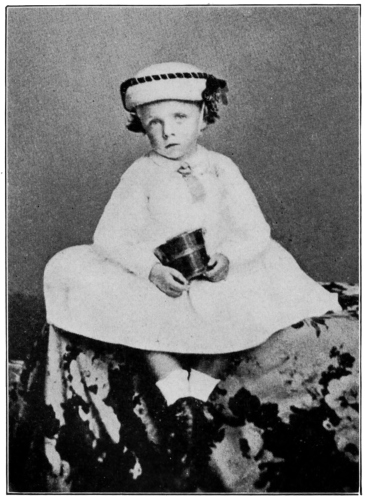
Theodore Roosevelt, about eighteen
months old, 1860.
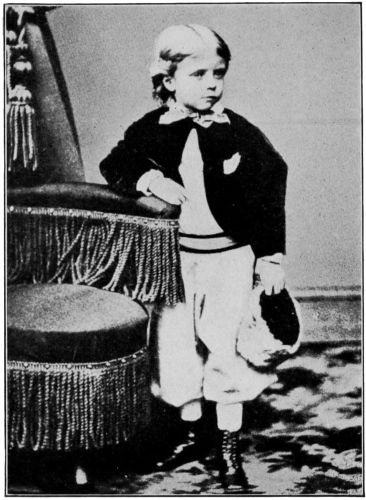
Theodore Roosevelt, about four years
old, 1862.
And so these were the three Deities of the Nursery in which
Theodore Roosevelt spent his first years, and even at that early
time they realized that in that simple room in the house which
the patriotic women of America are about to restore as a mecca
for the American people there dwelt a unique little personality
whose mentality grasped things beyond the ken of other boys
of his age, and whose gallant spirit surmounted the physical
difficulties engendered by his puny and fragile body.
* * * * *
The nursery at 28 East 20th Street in the early years of the
Civil War missed its chief deity, my father. From the letters
exchanged by my mother and father, preserved by each of them,
I have formed a clear realization of what it meant to that nursery
to lose for almost two years the gay and vigorous personality
who always dominated his environment as did later his son.
Mr. William E. Dodge, in a very beautiful letter written
for the memorial meeting of the Union League Club in February,
1878, just after my father’s death, gave the following interesting
account of my father’s special work in the Civil War. This
letter was read after an eloquent speech delivered by Mr. Joseph
H. Choate. The part of the letter to which I especially refer
ran as follows:
“When the shadows of the coming war began to grow into
a reality he (Theodore Roosevelt) threw himself with all his
heart and soul into work for the country.
“From peculiar circumstances he was unable to volunteer
for military service, as was his wish, but he began at once to
develop practical plans of usefulness to help those who had gone
to the front.
“He became an active worker on the Advisory Board of the
Woman’s Central Association of Relief, that wonderful and
far-reaching organization of patriotic women out of which grew
the Sanitary Commission.
“He worked with the ‘Loyal Publication Society,’ which,
as many of our members know, was a most active and useful
educating power in the days when there was great ignorance as
to the large issues of the conflict.
“He joined enthusiastically in the organization of the Union
League Club, was for years a most valued member of its executive
committees and aided in the raising and equipment of the
first colored troops.
“His great practical good sense led him to see needs which
escaped most other minds. He felt that the withdrawal from
the homes of so many enlisted men would leave great want in
many sections of the country. He saw the soldiers were more
than amply clothed and fed, and their large pay wasted mostly
among the sutlers, and for purposes which injured their health
and efficiency. So with two others he drafted a bill for the appointment
of Allotment Commissioners, who without pay should
act for the War Department and arrange to send home to needy
families, without risk or cost, the money not needed in the camps.
For three months they worked in Washington to secure the passage
of this act—delayed by the utter inability of Congressmen
to understand why anyone should urge a bill from which no one
could selfishly secure an advantage.
“When this was passed he was appointed by President Lincoln
one of the three Commissioners from this State. For long,
weary months, in the depth of a hard winter, he went from
camp to camp, urging the men to take advantage of this plan.
“On the saddle often six to eight hours a day, standing in
the cold and mud as long, addressing the men and entering their
names.
“This resulted in sending many millions of dollars to homes
where it was greatly needed, kept the memory of wives and children
fresh in the minds of the soldiers, and greatly improved
their morale. Other States followed, and the economical results
were very great.
“Towards the close of the war, finding the crippled soldiers
and the families of those who had fallen were suffering for back
pay due and for pensions, and that a race of greedy and wicked
men were taking advantage of their needs to plunder them, he
joined in organizing the Protective War-Claim Association,
which without charge collected these dues. This saved to the
soldiers’ families more than $1,000,000 of fees.
“He also devised and worked heartily in the Soldiers’ Employment
Bureau, which found fitting work for the crippled men
who by loss of limb were unfitted for their previous occupations.
This did wonders toward absorbing into the population of the
country those who otherwise would have been dependent, and
preserved the self-respect of the men. I believe it did more
and vastly better work than all the ‘Soldiers’ homes’ combined.
For the work in the Allotment Commission he received the special
and formal thanks of the State in a joint resolution of the
Legislature.”
Nothing was more characteristic of my father’s attitude
toward life than his letters during this period to my mother.
He realized fully that in leaving his young family he was putting
upon his youthful and delicate wife—whose mental suffering
during the war must have been great, owing to the fact of her
being a Southerner—her full share of what was difficult in the
situation. He writes with the utmost frankness of his wish
that she might look on the great question of which the war was
a symptom from the same standpoint as his, but the beautiful
love and trust which existed between them was such that in
all these letters which passed so constantly during my father’s
labors as Allotment Commissioner, there was never the slightest
evidence of hurt feelings or friction of any kind.
In the early fall of 1861 he was struggling to have passed
by Congress the bill to appoint Allotment Commissioners, and
spent weary days in Washington to achieve that purpose. When
the bill was passed and he and Mr. William E. Dodge and Mr.
Theodore Bronson were appointed as the three commissioners,
he threw himself with all the ardor and unselfishness of his magnificent
nature into the hard work of visiting the camps in mid-winter,
and persuading the reluctant soldiers to believe that it
was their duty to allot a certain portion of their pay to their
destitute families.
He writes on January 1, 1862:
I have stood on the damp ground talking to the troop and
taking their names for six hours at a time. One of the regiments
that I visited last, which is wretchedly officered and composed
of the scum of our city, seemed for the first time even to recall
their families. We had an order from the General of Division,
and the Colonel sent his adjutant to carry out our desires. He
came, dirty and so drunk that he could not speak straight, and
of course got the orders wrong. All the officers seem to be in
with the sutler while the private said he was an unmitigated
thief. The delays were so great that I stood out with one of
these companies after seven o’clock at night, with one soldier
holding a candle while I took down the names of those who desired
to send money home. The men looked as hard as I have
often seen such men look in our Mission neighborhood, but after
a little talking and explaining my object and reminding them of
those they had left behind them, one after another put down
his name, and from this company alone, they allotted, while
I was there, $600.00. This would be increased afterwards by
the officers, if they were decent ones, and other men absent on
guard and through other reasons. I could not help thinking
what a subject for a painting it would make as I stood out there
in the dark night, surrounded by the men with one candle just
showing glimpses of their faces,—tents all around us in the woods.
One man, after putting down five dollars a month, said suddenly:
“My old woman has always been good to me, and if you please,
change it to ten.” In a moment, half a dozen others followed
his example and doubled their allotments.
I enclose a letter for Teedie [Theodore]. Do take care of
yourself and the dear little children while I am away, and remember
to enjoy yourself just as much as you can. [This
sentence is so like my father. Duty was always paramount,
but joy walked hand in hand with duty whenever it legitimately
could.]
I do not want you not to miss me, but remember that I would
never have felt satisfied with myself after this war is over if I
had done nothing, and that I do feel now that I am only doing
my duty. I know you will not regret having me do what is
right, and I do not believe you will love me any the less for it.
Yours as ever,
Theodore Roosevelt.
This particular letter is very characteristic of the father of
President Roosevelt—a man of the qualities which his country
has grown to associate with its beloved “Colonel.” In my
brother’s case they were the direct inheritance from the man who
stood out knee-deep in mud using his wonderful personality
to make those hard-faced drafted men remember their own
people at home, and at the same time writes to the lovely mother
of his children to try and enjoy herself as much as possible in
his absence.
My mother’s answers to my father’s letters were very loving.
Alone, and delicate, she never dwells on loneliness or ill
health, but tells him the dear details of the home he loved so
well. On January 8, 1862, she writes: “Teedie came down stairs
this morning looking rather sad, and said ‘I feel badly—I have
a tooth ache in my stomach.’—later he asked if ‘Dod’ (God) was
a fox?!—this after being shown a picture of a very clever looking
fox! He is the most affectionate and endearing little creature
in his ways.” One can well imagine how the lonely father, doing
his distant and gruelling duty, treasured the dainty letters full
of quaint stories of childish sayings. In another and later missive
there is a description of a birthday supper-party in which
“Teedie” is host to his cousins; it runs as follows: “Teedie,
the host, was too busy with his chicken and potatoes to converse
much, but as soon as he finished he made the sage remark
that he ‘loved chicken, roast beef and everything that was good
better than salt water.’ This speech occasioned a roar of
laughter, and was evidently thought very witty. Teedie, too,
seemed to be under the false impression that it was clever. He
seemed to be inflated with vanity for some time afterwards!”
How gladly the tired man, after long days in the saddle, and
evenings of effort with sullen soldiers, must have turned to just
such humorous accounts of the small boy who always said or
did something quaint, which lost nothing in the picture drawn
by the facile pen of his mother.
Theodore Roosevelt writes his wife again in January, 1862,
a letter interesting because of his attitude toward the German
regiments. He says:
“We are continually at work now, and to-day saw three
regiments, but even at this rate, it will be long before I see you
again. They were all Germans to-day—a motley crew, having
few friends and frequently no characters. We had been told
that we ran the risk of our lives by going to these regiments, and
much more nonsense of the same kind, but the only risk we
ran has been from starvation. We were out talking to the men
until very late, and then found a German dinner which Dodge
could eat nothing of but the brown bread. He wanted to be
polite, however, and I was much amused with his statement
that he would ride five miles to get such bread, which was
literally a fact, however, I have no doubt, in his state of starvation.
“The men, as Germans always do, took time to consider,
and we left them to describe the allotment idea to other persons.
However, after due consideration, a fair number sent
money home. These Germans were generally of the lowest characters,
and with the exception of one regiment disappointed me,
although I have no doubt they will fight well. There are some
12,000 of them.
“This morning I saw that our efforts are noticed in The World
and The Tribune. You have seen, I suppose, that we have been
mentioned several times in The Times. This is particularly
satisfying as the papers threatened once to be down on us, which
would lose for us the confidence of the soldiers.”
The letters all give vivid accounts of his experiences, differing
in interest. He speaks of General Wadsworth, the grandfather
of our present United States senator, and says that the
general “helped to make my bed when I spent one night with
his division.”
In an interim of work, on February 7, he writes of his invitation
to Mrs. Lincoln’s ball, at which he says he had a delightful
time.
“Mrs. Lincoln in giving the Ball, stated that she gave it as
a piece of economy in war time, and included those diplomats,
senators, congressmen and others, that it had been previously
the habit to invite at a number of formal dinners. No
one lower in the army than the Division General,—not even a
Brigadier, had an invitation to the Ball, and of course there
was much grumbling and a proportionate amount of envy. Some
complained of the supper, but I have rarely seen a better, and
often a worse one. Terrapin, birds, ducks, and everything else
in great profusion when I was in the dining room, although some
complained of the delay in getting into the room, as we went
in parties.
“I spent all of yesterday kicking my heels in the ante-room
of the Secretary of War, and in making out an order for him
which he promised to sign and afterwards refused. [How history
repeats itself!] I was with him about two hours, altogether,
and received any number of the highest kind of compliments,
but I wanted a more important proof of his good
feeling which I did not get. I still hope that I may get it
through the President.”
On February 12, 1862, comes this description of the delightful
visit to Newport News and he says:
“All the officers received us in such a hospitable spirit and
the weather assisted in making our stay agreeable. I passed
two of the pleasantest days that I have enjoyed when away from
home. General Mansfield suggested some practice with the
parrot gun, and one of those sad accidents occurred, for a gun
burst and two men were killed.
“We have been treated like princes here. The steamboat
was put at our disposal and when, through a misunderstanding,
it left before we were on board, another one was immediately
sent with us. I enclose several things to keep for me.”
Amongst the enclosures was a note which is sufficiently interesting
to give in facsimile.
EXECUTIVE MANSION, WASHINGTON
Mr. Rosevalt.
Dear Sir:
I very much regretted that a severe headache confined me
to my room on yesterday, this morning I find we are expected
to hold a noon reception which will be over by three and a half
o’clock at which time I will be very happy to have you
ride with us.
Very truly yours
Mrs. A. Lincoln.
This quaint missive reminds me of the fact of my father’s
kindly tolerance of “Mrs. A. Lincoln’s” little peculiarities. I
remember how he used to tell us, when occasionally he was invited,
as this letter says, to “ride” with her, that he would also
be invited to stop at the shop where she bought her bonnets,
and give his advice on which bonnet was especially becoming!
In an earlier letter, after referring to an interview with Secretary
Stanton, he speaks of his apparent decision of character.
But he was disappointed when he could not, in the beginning,
make the secretary take his point of view about the Allotment
Commission. Later, however, he received the full support of
Secretary Stanton.
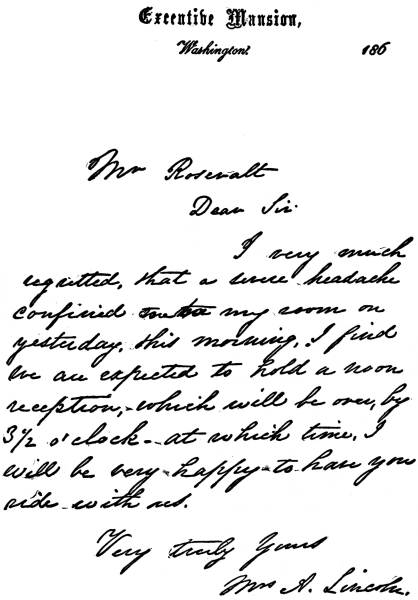
AN INVITATION FROM THE WIFE OF ABRAHAM LINCOLN TO
THEODORE ROOSEVELT, Sr.
In a letter dated February 5 he speaks of “justified pleasure”
as follows:
“I find that only about six men under fifty [he himself
was only twenty-nine] are invited to the President’s to-night,
and I have determined to go for a short time, at least. There
will be the largest collection of notables there ever gathered in
this country, and it would probably be a sight worth remembering.”
Under date of Washington, February 14, he writes again:
“I have so many acquaintances here now that I could easily
find a temporary companion. Hay [John Hay] is going with
me to Seward’s to-night, and I am hoping to procure the pass
for your mother. [My grandmother was most anxious to get
back to her own people in the South]. In Baltimore I saw,
or fancied I saw, on the faces of our class of the inhabitants,
their feelings in consequence of the news just received of the
taking of Roanoke Island. They looked very blue. The sutlers
here are serious obstacles in getting allotments. As soon
as we see a Regiment and persuade the men to make allotments,
they send around an agent to dissuade them from signing their
names, convincing them that it is a swindle because they want
the money to be spent in Camp and go into their pockets instead
of being sent home to the poor families of the men, who
are in such want.
“I enclose you a flower from the bouquet on the table of
the Executive Mansion. Also a piece of silk from an old-fashioned
piano cover in Arlington House.”
As I opened the letter, the flower fell to dust in my hands,
but the little piece of green silk, faded and worn, had evidently
been treasured by my mother as being a relic of Arlington House.
On February 27, 1862, his stay in Washington was drawing
to a close, and my father regretted, as so many have done, that
he had not kept a diary of his interesting experiences. He writes
on September 27:
“All those whom I have seen here in Washington in social
intercourse day by day will be characters in history, and it would
be pleasant to look over a diary hereafter of my own impressions
of them, and recall their utterly different views upon the policy
which should be pursued by the Government. I have rarely
been able to leave my room in the evening, for it has been so
filled with visitors, but I have not felt the loss of liberty from the
fact that those who were my guests I would have taken a great
deal of trouble to see, and never could have seen so informally
and pleasantly anywhere except in my own room.
“It has, of course, been more my duty to entertain those
whose hospitality I was daily receiving, in the camps, by invitations
to drop in during the evening; all of these are striving
to make their marks as statesmen, and some, I am sure, we will
hear from hereafter.”
On March 1, 1862, he says:
We have all been in a state of excitement for some days
past, caused by movements in the Army foreshadowing a general
battle. The snow which is now falling fast, has cast a
damper over all our spirits.... Several of the Generals have
stated to me their belief that the war, as far as there was any
necessity for so large an army, would be closed by some time in
May,—probably the first of May. If so, my work will be all
over when I return to New York, and I can once more feel that
I have a wife and children, and enjoy them.
It is Sunday afternoon, and I have a peculiar longing to
see you all again, the quiet snow falling outside, my own feelings
being very sad and that of those around being in the same condition
makes me turn to my own quiet fireside for comfort. I
wish we sympathized together on this question of so vital moment
to our country, but I know you cannot understand my
feelings, and of course I do not expect it.
Your Loving Husband Who Wants
Very Much to See You.
One can well imagine the note of sadness in the strong young
man who had relinquished his urgent desire to bear arms because
of the peculiar situation in which he found himself, but who
gave all his time and thought and physical endurance to the
work vitally needed, and which he felt he could have handled
better with the sympathy of his young wife, whose anxiety
about her mother and brothers was so poignant and distressing.
Never, however, in the many letters exchanged between
the parents of my brother, Theodore Roosevelt, was there one
word which was calculated to make less possible the close family
love and the great respect for each other’s feelings.
In the last letter quoted above, one feels again that history
does indeed repeat itself, when one thinks that it was written
in March, 1862, and that those “generals” of whom my father
speaks were expecting that no large army would be needed after
May 1 of that year, when in reality the long agony of civil
war was to rack our beloved country for nearly three years more.
This was proven shortly after to my father, and in the following
October he is writing again from Baltimore, and this time in a
less wistful mood:
Since I last wrote you I have enjoyed my pleasantest experiences
as Allotment Commissioner. The weather was lovely
our horses good and Major Dix accompanied us from the Fortress
to Yorktown. It was about twenty-five miles of historic
ground passing over the same country that General McClellan
had taken his army along last spring.
First comes the ruins of the little town of Hampton, then
through Big Bethel where Schanck was whipped, to the approaches
to Yorktown. There ravines have been cut through
miles of roads made, and immense breastworks thrown up by
our army.
Suydam was away but the rest of General Keyes’ staff
received us most hospitably, and after dinner furnished us with
fresh horses to visit the regiments, one of their number accompanying
us.
I had practise for both my French and German in the Enfans
Perdus, Colonel Comfort’s regiment and it was quite late
before our return. As I had broken my eyeglasses I had to
trust entirely to my horse who jumped over the ditches in a
most independent manner. We all sat up together until about
twelve except Bronson who had seemed used up all day, and
had not accompanied me to the regiments. He seemed to feel
the shock of the fall when the car ran off the track, and not to
recover from it so easily as myself.
Next morning we rode another twenty-five miles to Newport
News to see the Irish Brigade. General Corcoran was
there, and accompanied us to the regiments first suggesting
Irish whiskey to strengthen us. At dinner ale was the beverage
and after dinner each Colonel seemed to have his own particular
tope. On our return they made an Irish drink called “scal thun”
and about one o’clock gave us “devilled bones.” The servant
was invited in to sing for us and furnished with drinks at odd
times by the General, who never indulged, however, himself
to excess. We then went the grand rounds with the General
at two in the morning, arrested two officers for not being at their
posts and returned at half past three, well prepared to rest quietly
after a very fatiguing day, and one of the most thoroughly Irish
nights that I ever passed.
Next morning (yesterday) we had a delightful ride over
to Fortress Monroe, and had lunch at General Dix’s before leaving
in the boat.
A dozen of the officers were down at the boat, and we felt
as we bid goodbye to some of them, like leaving old friends....
Dearest: a few words more and I must close. Bronson has
a very bad cold and decides that he will leave me to-morrow.
If well enough he will undoubtedly call on you. Of course this
makes me doubly homesick but I must see it through.
Goodbye. Yours as ever,
Theodore Roosevelt.
Again on October 18, having apparently been able to return
for a brief visit to his family, he writes from Niagara:
“I was able to get a top berth and retired for the 31st time
in two months to spend the night on the railroad. My three
nights at home have made it hard, rather than easier, to continue
my journeys.
“All our party started from Albany to Fonda, and I had
a hard day’s work for the men had been deceived by the bounty
and were suspicious about everything regarding the Allotment
Commission. The officers’ dinner was a good deal like pigs
eating at a trough. When at night three companies had not
yet been visited, I determined to do it wholesale. I had two
tents pitched and occupied one already prepared, placing a
table, candles and allotment roll in each. I then had the three
companies formed into three sides of a square and used all my
eloquence. When I had finished they cheered me vociferously.
I told them I would be better able to judge who meant the cheers
by seeing which company made most allotments. [This sentence
of my father’s makes me think so much of my brother’s
familiar “shoot; don’t shout!” when he would receive vociferous
cheers for any advice given.] I thus raised the spirit of competition
and those really were the best that I had taken during
the day. By eight o’clock we found our work done, dark as
pitch, and rain descending in torrents, but still the work was
done.”
These letters give, I think, a vivid picture of my father’s
persistence and determined character, and the quality of “getting
there,” which was so manifestly the quality of his son as well,
and at the same time the power of enjoyment, the natural affiliation
with his humankind, and always the thoughtfulness
and consideration for his young wife left with her little charges
at home.
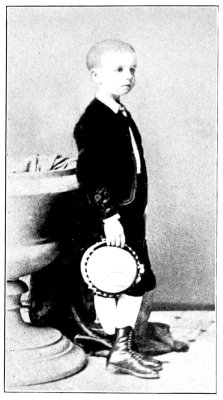
Elliott Roosevelt, aged five and
a half years, about 1865.
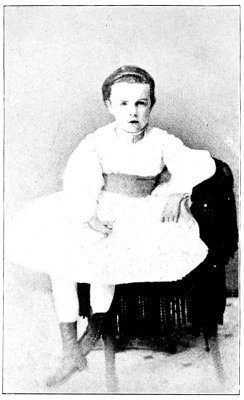
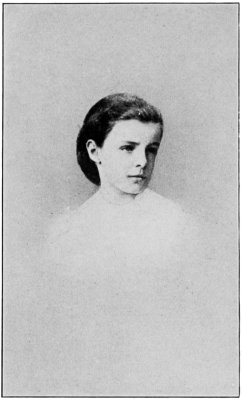
Corinne Roosevelt, about four years
old, 1865.
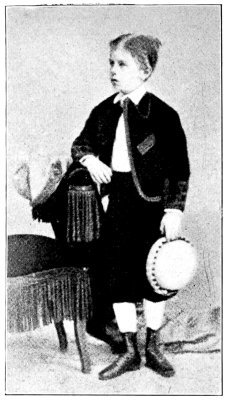
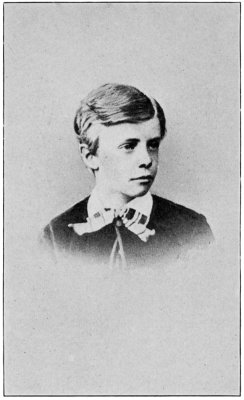
Theodore Roosevelt, aged seven,
1865.
In that same home the spirit of the war permeated through
the barriers of love raised around the little children of the nursery,
and my aunt writes of the attitude of the small, yellow-haired
boy into whose childish years came also the distant din
of battle, arousing in him the military spirit which even at four
years of age had to take some expression. She says: “Yesterday
Teedie was really excited when I said to him that I must
fit his zouave suit. His little face flushed up and he said, ‘Are
me a soldier laddie too?’ and when I took his suggestion and
said, ‘Yes and I am the Captain,’ he was willing to stand for a
moment or two to be fitted.” Even then Theodore Roosevelt
responded to his country’s call, and equally to the discipline of
the superior officer!