AT BEECHWOOD.
EARLY in August Edmund came to Weylea. A gentleman visitor had become
quite a rarity at Mrs. Lyell's, and I was amused at the fuss which all
the household made about his coming and the number of questions that
were put to me concerning my brother's tastes and habits. How I counted
upon the few days that Edmund would spend with me!
There was a little difficulty in fixing the date, for Ralph Dugdale
wanted my brother to pass from Weylea to Beechwood. Beechwood Hall
was always full of visitors in the summer, so Edmund had to study the
Dugdales' convenience in arranging the time of his visit.
Nothing had given me more pleasure in looking forward to Edmund's
coming than the thought that I should be able to make him acquainted
with Leonard Glynne, but, to my vexation, circumstances decreed
otherwise. The days Edmund finally fixed for his visit were just those
during which Leonard would be absent from Weylea, having promised to
go to Bournemouth at that time to attend the wedding of a cousin. He
seemed no less vexed than I when we found that he would miss Edmund.
Leonard had been very kind to me during the weeks that had passed. He
had helped me through many arithmetical difficulties since the evening
when he discovered me hopelessly crying over my hard sum, and, thanks
to his assistance, I had taken a good place in the examination to which
Mr. Oesten subjected his pupils at the close of the term. It used to
amuse Mrs. Lyell to see us sitting side by side and working away at
our sums. I fancied she was glad we were such good friends. Sweet to
me were the hours thus spent. Though subject to fluctuations, the
happiness I had gained on that Friday evening remained with me.
It made my heart ache to see how pale and haggard Edmund looked. My
anxiety was ever on the look out for signs of ill-health in him, and it
needed not Mrs. Lyell's gentle, "My dear, your brother looks far from
strong," to set it on the alert.
There was another change I noted in Edmund; he seemed scarcely in his
usual spirits. The cheerfulness with which he greeted me had rather a
forced appearance.
"Edmund," I said to him, as soon as we were alone, walking round the
garden together, "how about the scholarship? Do you think you have a
good chance of it?"
"Oh, that is all over," he said, rather impatiently.
"Of course the examination is over," I said, "but you do not yet know
the result?"
"Yes, it is known," he said, shortly. "Shrimpton has the scholarship."
"Oh, Edmund! Then you have lost it?" I cried, in dismay.
"Naturally I have lost it since he has gained it. Don't look so amazed,
Dorothy; I always told you it was very doubtful if I got it."
"But I had made up my mind that you would; I did not think anyone could
beat you. Was it because of the time you lost in the spring?"
"Perhaps; I don't know. Anyhow, I came out below Shrimpton."
"What a pity, to be sure! And after your working so hard!"
"Pooh! I did not work so very hard."
"You worked hard enough to make yourself look very thin and worn. I am
distressed to see you looking so."
"Oh, nonsense! Don't bother me about my looks, Dorothy, for goodness'
sake!"
I was wounded by the impatience with which he spoke. I had expected my
brother to make much of me under the circumstances in which we met, but
it was not Edmund's way to be demonstrative. Moreover, I could see that
he was out of spirits and absorbed in his own affairs. Alas! Mine was
not the self-forgetful love that can give true sympathy. I was annoyed
that Edmund asked me no question about my own studies. I wanted to tell
him the story of my troubles with my sums and the help Leonard Glynne
had given me, but somehow I found it difficult to talk about Leonard.
Presently Edmund said, carelessly—
"What sort of a fellow is that nephew of Mrs. Lyell's?"
"He is very nice," I said, in an indifferent tone; but my heart beat
mote quickly as I spoke.
Edmund was satisfied with my vague reply. He asked no more about
Leonard Glynne.
After a minute, he said, "I tell you what, Dottie, I think I shall walk
over to Beechwood to-morrow morning, if you don't mind; I want to see
Ralph."
"Very well," I said, rather coldly, for in truth I did mind.
I did not like to lose Edmund's company on the first morning after
his arrival. I had thought to have him to myself on the whole of
the following day. Happily, I had sufficient good sense to keep my
disappointment to myself.
The next morning Edmund asked me if I would not accompany him to
Beechwood Hall; but my foolish shyness made me shrink from visiting
the Dugdales. I agreed, however, to walk as far as the gates with
Edmund. On the way, I told him of my previous walk to Beechwood and my
undignified encounter with the little lady in widow's mourning. Edmund
seemed much interested in my account.
"That must have been Mrs. West, Ralph's only sister," he said. "Did you
notice her particularly? She is a charming little woman, and so good."
"Little she certainly is," I said; "I never saw a smaller, more compact
little body. I remember that her eyes struck me; they were so kind, and
yet so sad. So she is a widow?"
"Yes," said Edmund, in a low tone, "her husband died when they had been
married but a few weeks. She mourned him deeply, Ralph says, and yet
she is by no means melancholy. It is wonderful how bright she is—quite
the life of the house."
Edmund's account of Mrs. West interested me so that I was rather
pleased when, on returning from his visit, he said to me—
"The Dugdales have asked me to go to them on Saturday for a week, and
they want you to come, too."
"Me! Oh, Edmund!"
"Yes, you. Here, Mrs. Dugdale has written you a note, so you see I am
not romancing."
I took the note. It was simple and kind. It made me believe that my
company was really desired, and, as Mrs. Lyell urged me to go, I very
willingly sat down to write an acceptance.
When Saturday came, Mrs. Lyell sent us over to Beechwood in her
carriage. We arrived there about four o'clock on a perfect afternoon.
We drove up the long avenue and through the small square garden in
front of the house to a flight of stone steps, above which was a heavy
oaken door. The door was quickly opened to us by a man-servant in quiet
livery; we entered a large, square hall with a polished oaken floor and
richly-carved wainscot.
But before I had time to look round, a little figure came out of one of
the rooms, and, taking me by both hands, said, in warm tones—
"How do you do, Miss Carmichael? I am so glad you have come. Your
brother has often spoken to me of you, and now at last, I have the
pleasure of seeing you."
So Edmund spoke of me to people whom I did not know! That was quite a
new idea to me, and one for which I was hardly prepared. But I could
not be sorry that Mrs. West had heard of me. How kind she was! There
was a peculiar intensity in the gaze of her clear, grey eyes, and yet
I did not shrink from them. I had never before seen such truthful
yet such sweet eyes. It was with a sense of deep satisfaction that I
returned the pressure of her hand. I felt that here was a sister woman
whom I could thoroughly trust. Since there can hardly be trust without
love, I suppose that I loved her from that moment.
"You are very kind; it is a great pleasure for me to come," was all I
could manage to say, however.
"Why, surely I have seen you before?" she said, as she looked at me
earnestly. "Where have we met?"
"Don't you remember how I ran against you and nearly knocked you down
one day just inside your gates? It was the day after my arrival at
Weylea, and my curiosity concerning the outside of Beechwood Hall led
me to act the part of trespasser, I am sorry to say."
"Oh, yes, I remember perfectly now! I wondered so who you were. But
don't say you are sorry. I only wish you had had equal curiosity
concerning the inside of our home and it had led you to pay us a visit.
I wish I had known sooner that you were in the neighbourhood."
"I should think you had most cause to be sorry," remarked Edmund,
drily; "it is no joke to have an ethereal being like Dorothy come
blundering up against you."
"For shame, Mr. Carmichael!" she cried, turning upon him with affected
indignation. "We'll have no brotherly compliments, if you please. Ah!
Here comes Ralph. I consign you to him for correction."
Ralph Dugdale came running down the broad oaken staircase. He carried
under his arm a lovely King Charles spaniel, which he hastily deposited
on the mat ere he shook hands with me. Then I found myself meeting
again the kind, merry eyes that had surprised me weeping in solitude
on the eve of Mabel's wedding day. Like his sister's, they had a very
searching, earnest glance; but there was no sadness in them, as in hers.
"Well, Miss Carmichael!" he said, gaily. "Are you satisfied with the
way in which I have fulfilled my trust?"
"What trust?" I asked, with wonder.
"Can you have forgotten it? And all these months I have been striving
so hard to take good care of your brother, as I promised to do!"
"Oh, I remember now!" I said, laughing. "Thank you very much. I am sure
you have done all that you could, though I must confess Edmund looked
to me wretchedly white and thin when he arrived at Mrs. Lyell's."
"Did he? Well, you see, Cambridge is not the place where a man fattens,
as a rule. We take a serious view of life there, and live abstemiously,
in order to get as much work as possible out of our brains. Fish and
marmalade form the chief items of our diet when we are working for
exams. But what has this fellow been doing now? I thought you said
something about correction, Grace."
"He has been making rude insinuations respecting his sister," said Mrs.
West, mischievously.
"The thankless wretch! He deserves at least 'social ostracism,' to
quote an extraordinary phrase I heard a lady use the other day. I have
not the least idea what she meant by it, and I don't think she had
much, but it must mean something dreadful."
"Ralph, beware! You now are offending against our sex!" said his sister.
"I! Indeed, you mistake me. I have the greatest reverence for all fair
ladies. Miss Carmichael, I see you are looking at my dog. Allow me to
introduce Master Prince. He is worthy of the honour, although he has
rather a capricious temper, and will not always treat my friends with
due respect. Ah, I see he is going to take to you."
"He knows that I am fond of dogs," I said, bending to stroke Prince's
long, silky ears. "And he is a beauty, a real beauty!"
"Ah, he will be sure to like you if you talk to him like that. Prince
is as vain as any—oh! I forgot; it won't do to say woman. Now, Grace, I
did not say it."
"You dare not, sir. You know well that masculine vanity is a far
heavier and more dangerous quality than woman's. Come, Miss Carmichael,
shall we go upstairs?"
I followed her as she led the way to my room. In doing so, I noted that
there was nothing to betoken widowhood in her indoor dress. Her black
gown was of some thin, gauzy material, suitable to the warm day, and
devoid of crape, whilst no cap hid the abundant coils of her bright,
chestnut hair. Observing these things, I came to the conclusion that
some years had passed since her husband died.
I was not long in my room, for having only driven from Weylea, it was
not necessary to make any change in my dress. When I was ready, Mrs.
West took me into the garden, where, on a long, narrow lawn, overhung
by some splendid beeches, sat Mr. and Mrs. Dugdale, surrounded by what
seemed to me at first to be a large party of guests. Mrs. Dugdale
looked very picturesque sitting there. She had an abundance of snowy
hair gracefully arranged under a lace cap, which gave her a charming
appearance. I thought at first that she must be very old, but when I
approached her, I saw that her face was that of a woman hardly more
than fifty, and her eyes were as clear and bright as her daughter's.
She welcomed me with a motherly warmth, which set me at once at my
ease. Ralph placed a chair for me in the shade, and hastened to fetch
me some of the tea which the servants were dispensing. He stood beside
me whilst I drank it, protecting me from Prince's importunities, he
said, for Prince showed a great desire to share my piece of cake,
and his master held him in check, partly by homilies on the sin of
greediness, delivered with a sternness of manner and, solemnity
of tone, which made the dog slink off a few paces with his tail
significantly lowered, and partly by liberal largess of cake.
Afterwards, Ralph and I had a walk round the garden—such a quaint,
delightful garden, not straight and orderly, like Mrs. Lyell's, but
with shaded walks, where the trees met overhead, hidden alcoves, and
a winding maze-like rosary, with which I was charmed. When we went
indoors, Mrs. West took me all round the house that I might feel at
home in it, she said. It was a fine old house, dating from early in
the seventeenth century, and I enjoyed making the tour of it, and was
especially interested in the long left corridor, where the traditional
ghost was said to perambulate.
"Your room is not far off. I hope you will not be afraid of seeing the
ghost," said Mrs. West.
"Oh, no," I said, "I should never be afraid of ghosts here. The
atmosphere of your home is too cheerful for such gloomy visitants. You
are all too good and kind."
Grace, for so I soon learned to call her, smiled and looked pleased at
my impulsive speech.
"You are right," she said; "love and cheerfulness make a good
prescription for laying ghosts. It is the melancholy and
conscience-stricken who see them."
When the dinner hour approached, there was quite a large party gathered
in the drawing-room—a wide and lofty apartment with a painted ceiling,
and on the walls many ram pictures by old masters.
I was glad it was Ralph Dugdale who took me down to dinner, for I
felt rather shy of the guests, although they had received me very
pleasantly. They seemed to be highly-cultivated people, some of them
literary and scientific workers, and the tone of their conversation was
rather beyond me. But though I could not take part in it, I enjoyed
listening to the bright, clever talk, which, although not lacking
humour, never degenerated into mere trivialities or personal gossip.
And when I needed a word of explanation, Ralph Dugdale never failed to
give it. His pleasant little "asides" kept me from experiencing any
sense of isolation. Whilst I was made conscious of my ignorance, Edmund
was in his element. I was proud of the part my brother sustained in the
conversation. He spoke modestly, yet decidedly, and so to the point
that the older men seemed to listen to him with satisfaction.
A subject was introduced which gave rise to considerable discussion.
I remember well the side Edmund took. He supported certain views
expressed by Mrs. West, and argued for them with such feeling and
earnestness that I saw her face light up with pleasure as she listened
to him. My brother wore a new aspect to me that evening. I had always
admired him and believed in him with all my heart, but now I perceived
in him a power, a goodness which I had not suspected.
The next day was Sunday—a quiet, peaceful Sunday. Morning and evening
we attended the picturesque old church standing in a bend of the
beech-shaded road, with the green churchyard about it, through which
a common footpath made a short cut to the village. Many of the
tombstones within the enclosure were grey and moss-grown, but as we
walked up the path to the porch, I saw to the right a handsome slab of
polished granite, which could not have been erected many years. On the
well-turfed mound below lay a wreath exquisitely wrought with white
roses and jessamine. "Arthur West" was the name upon the stone. As it
met my eye, I knew why Grace had started for church some time before
the rest of us.
My thoughts often wandered to Weylea during the course of that day.
Leonard Glynne was expected to return on the previous evening. I
pictured him pacing the garden alone on this Sunday afternoon, and
smiled to myself with a delightful consciousness that he would miss me
and desire my presence.
I did not regret my absence; I liked the idea of his missing me. I had
passed many long and lonely hours, vainly wishing that he would come;
it pleased me to fancy that perhaps he would now experience the same.
"Miss Carmichael," said Ralph Dugdale to me the next morning, soon
after breakfast, "are you fond of riding?"
The question took me by surprise somehow, and I felt myself colouring
as I answered that there was nothing I enjoyed more.
"But you must not suppose that Dorothy is much of a horse-woman," my
brother felt himself called upon to say. "She has never ridden anything
better than a lazy old pony."
"So much for your knowledge, Ted," I retorted. "Since I came to Weylea,
I have mounted a far different sort of steed."
"Why, what do you mean? You have not ridden since you left home?"
"Indeed I have. You remember the lovely horse I showed you in Mrs.
Lyell's stables? I have ridden him. Mr. Glynne took me for a ride one
day."
"What! Have you ridden that highbred creature? I did not think you were
capable of it, Dottie. You are more accomplished than I gave you credit
for. Why have you not told me of this before?"
"I don't know," I replied, colouring hopelessly, and lowering my eyes
with a dreadful feeling that I had betrayed my secret to everyone
present.
But I don't think anyone but Grace noticed my confusion.
When I looked up again, I caught her eyes scanning my countenance with
an inquiring expression. Edmund had too often laughed at me for my
trick of blushing on the least provocation to attach any importance to
my blushes now.
"If you have ridden that splendid animal of Glynne's, Miss Carmichael,
I fear you will not think much of any mount our stables can afford,"
said Ralph Dugdale; "but if you are willing to try an inferior beast,
we might have a ride to-day. What do you say, Grace?"
"Oh, I shall be delighted, if Dorothy would like it," was her reply.
Of course, I could make but one response to that. The morning
threatened to be very hot, so it was settled that we should not start
for our ride before four o'clock.
Though Ralph depreciated its merits, it was a very good horse that I
rode, and the ride was very pleasant, though I did not, of course,
enjoy it as I had enjoyed the first ride I took along that road.
We had made a long round, and were returning by the London road, Ralph
and I leading, Grace and Edmund a few paces behind, when I saw coming
towards us from the direction of Weylea a solitary rider. Not for an
instant did I wonder who it was who rode with such graceful ease,
nor fail to recognise the steed which was advancing with such swift,
splendid action.
A thrill passed through me from head to foot, my heart fluttered
strangely, my hand nervously jerked the bridle, making my horse sway
to one side. Then an evil spirit of coquetry awoke within me. I would
show Leonard that he was not the only gentleman who was pleased to ride
with me and with whom I could enjoy a ride; so I turned to Ralph with
a playful remark. He replied to it laughingly, his merry eyes flashing
their fun into mine. We continued our bantering talk, I appearing
unaware of Leonard's approach till Leonard was close upon us. Then
Ralph said, "Why, here is your friend, Mr. Glynne."
"My friend!" The word thrilled me with a sense of its deep truth. I
looked then. Leonard reined in his horse slightly as he approached
us. I saw his face flush as he recognised me; but the next moment it
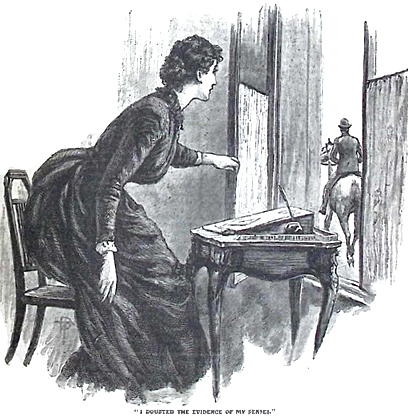
grew pale and hard. He did not smile as he lifted his hat; at the same
instant, he touched his horse with his spurs, and Ariel flew past us
like the wind.
"Mr. Glynne must have wanted you to observe his horse's speed,"
remarked Ralph Dugdale. "I meant to speak to him, but he evidently did
not think it worth while to spoil his canter for the sake of greeting
us."
I made a careless reply, but in truth I was deeply wounded. The
enjoyment of the ride was over. I wished I had not come out. It seemed
more than I could bear, this cruel indifference from one who had made
me believe that at least he was my friend.
Then I remembered my refusal to ride with him, and my tacit assent to
Mrs. Lyell's assertion that riding was not a desirable accomplishment
for women. Since that day, Leonard had not asked me to ride. No doubt
he was annoyed to find how hollow an excuse I had framed, as it
appeared that I had no objection to riding with Ralph Dugdale. He was
angry with me. My spirits revived at the thought. His anger was easier
to bear than his indifference.
But I did not recover the good spirits with which I had started for the
ride. I was so quiet that evening that Grace asked me if I were not
very tired.
"I am afraid we took you too far," she said; "we forgot you were not
used to such exercise."
I was not sorry she should think I was tired. Pleasant as it was to be
with the Dugdales, I found myself longing for the end of the week to
come when I should return to Weylea. I wanted to see Leonard again, and
assure myself that his anger was only momentary.
When our visit to Beechwood ended, Edmund was going to Burford to be
Mabel's guest during the remainder of his vacation. Mabel had invited
me to accompany him, but I had refused, although Edmund wished me to
go. It was seldom I could resist my brother's persuasions, but on this
occasion I firmly, I may say stubbornly, refused to stay at The Towers.
"You may be that man's guest if you like, Edmund," I said, "but I will
not. I cannot forget, if you can, how he cheated us out of our share in
the business."
"Cheating is rather a strong word, Dottie," said Edmund; "Steinthorpe
did nothing illegal. After all, there is a good deal to be said for
him."
"Then please do not say it, for I would rather not hear it," said I,
perversely.
Naturally my refusal to go to her house offended Mabel. It was
clear, she wrote, that I had ceased to care much for her, and took
little interest in my baby nephew, who was growing such a lovely
boy. I scarcely troubled to contradict this statement, and so the
breach between me and my sister widened. Perhaps, without knowing
it, I was growing indifferent towards Mabel, for my own life and the
possibilities of my future had a very absorbing interest for me just
then, making me forget the claims of the past upon me.
It happened on the last day of my stay at Beechwood Hall that some
acquaintances living at Weylea drove over to make a morning call on the
Dugdales. Mrs. Dugdale was out, and Grace and I were about to start for
a walk when they arrived, so she took me with her into the drawing-room
to receive Mrs. Vaughan and her two daughters. The girls were about my
age, and two of the greatest chatterboxes I ever met with. Although I
was a stranger to them, they rattled away as fast as possible, saying,
as it seemed to me, the first thing that came uppermost, retailing all
the gossip of the neighbourhood without the least doubt of its being
acceptable, and not seldom both speaking at once.
For a while I listened to them with much amusement, till suddenly the
elder one turned to Grace, interrupting her conversation with Mrs.
Vaughan by the question—
"Oh, Mrs. West! Can you tell me when Rose Carsdale is coming home?"
"I am sorry I cannot," said Grace, smiling; "I have but the slightest
acquaintance with Miss Carsdale."
"Oh, what a pity!" exclaimed the girl. "She is so nice—most lovely, I
call her. With that exquisite golden hair of hers, she looks quite a
picture."
"Everyone admires her," chimed in the sister.
"Yes, and she always dresses so beautifully," continued the first
speaker. "She seems to know by instinct just what will suit her, or is
it that she looks lovely in anything? I don't know, I am sure. Some
people call her a flirt, but I don't think she is. Of course, she can't
help gentlemen admiring her. And some say she is affected, but then
people are so ill-natured. You would not call her affected, would you?"
"It would be most impertinent of me if I did," said Grace, to whom the
question appeared to be addressed, "for I know so little of her."
"It is wonderful that she is not yet engaged," began the younger
Miss Vaughan; "it cannot be for want of offers. Fanny, who was that
gentleman we used to see with her so much last summer? I wondered if
that meant anything. You know who I mean; you met him at the Fosters."
"Oh, Mr. Glynne," said her sister. "He is a neighbour of theirs, you
know."
I felt myself growing pale. Did Grace observe it? Whether or not, she
said, quickly—
"I must tell you that Mr. Glynne is a friend of Miss Carmichael's."
"Is he? Then we beg your pardon if we have said anything about him that
we ought not," exclaimed the girls in chorus.
And the elder girl, making her voice heard above her sister's, added,
"Mr. Glynne is very nice. I met him at the Fosters, and liked him so
much! And he is very good-looking, too, don't you think?"
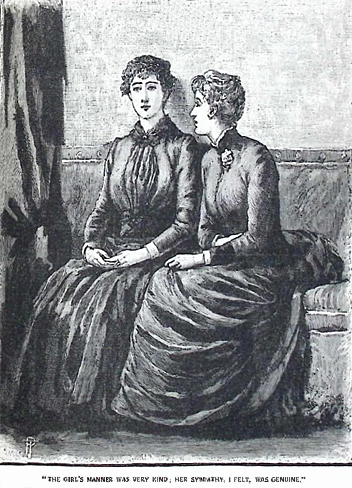
What a relief it was to me when Mrs. Vaughan rose to depart! When they
had driven away, Grace, turning to me with a laugh, said—
"Did you ever know such talkers? Yet they are kind-hearted, although,
as you have had proof, rather vulgar-minded. I often think it is a
mercy they are so good-natured, for they might do much harm with their
tongues if they were malicious. As it is, I have never heard them speak
ill of anyone."
But though they had no hurtful intention, those girls, by their
thoughtless words, had inflicted on me cruel suffering. They had not
only destroyed my tranquillity for the time, but they had dropped into
my mind a bitter seed, which, as I even then foresaw, would poison my
happiness for many a day.
====================