On the following evening, when the family were, as usual, assembled
together in the parlour, Mr. Fitzallan began his promised tale as
follows:—
“About twelve years ago, there was known at Boston, in North America,
a boy, who, from the vagrant life he led, was distinguished by the
degrading appellation of Dirty Barnaby. He had been maintained by the
parish, but was so deformed, and of such a disgusting appearance,
that no one would take him as an apprentice, and he was obliged to
earn a scanty subsistence, by performing such menial offices for the
inhabitants as few others would undertake. This child of misfortune
was the butt of ridicule to all the boys in the place; and the
hardships and ignominy he was continually exposed to, created in his
mind a sort of sullen gloom, which added to the unpleasantness of his
rudely-formed countenance.
“The only object towards which he displayed the least show of kindness
or affection, was a large dog, which followed him about wherever he
went, and who patiently shared the kicks bestowed on his less-docile
master, and as meekly partook with him his sorry meal of mouldy
fragments.
“In the same neighbourhood was a young gentleman, whom I shall
distinguish by the name of Theodore, who was as remarkable for his
personal graces as poor Barnaby was for his deformity. He had often
wondered how such a miserable object became possessed of such a fine
dog, and one day, with much affability, interrogated him on the subject.
‘Pray, my lad,’ said he to him, with a voice of kindness to which the
boy had been little accustomed, ‘what is your dog’s name?’
‘Rover, Sir.’
‘Have you had him long?’
‘Two years.’
‘Was he given to you by any body in this place?’
‘Do you think I stole him, Sir?’
‘I hope not.’
‘No, Sir, I did not; though I am poor and ugly, I thank God I am
honest.’
‘That’s a good lad; but where did you get the dog?’
‘He came to me, Sir.’
‘Came to you! that is very unlikely.’
‘Sir, I would not tell a lie for the world.’
‘I admire your integrity; but I wish to know how you got the dog.’
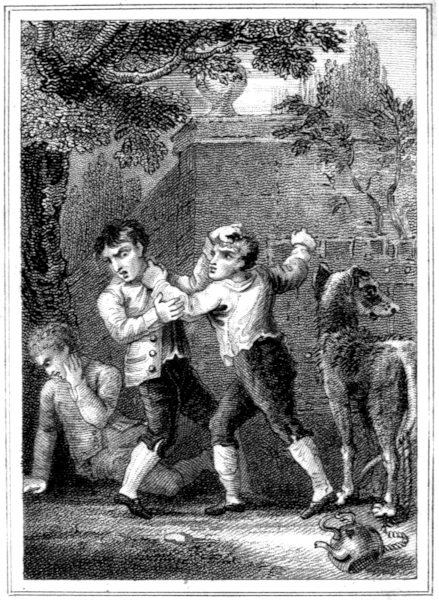
‘Sir, I will tell you. Some vicious boys had one day tied an old kettle
to the tail of the poor animal, who, frightened and tormented, ran up
and down till I thought he would go mad. Enraged at their barbarity,
I stripped off my ragged jacket, and getting all the stones together
I could hold, pelted the boys so stoutly, that most of them ran
away. The cruel are always cowards, Sir; so I had not much trouble in
fighting the rest. I mastered three of them, and bore the poor animal
away out of their reach. When I had relieved Rover’s bleeding tail, he
licked my hands in gratitude. I kissed and cried over him, for I was
used to being ill treated myself, Sir. Rover seemed determined not to
leave me; and if it had been my last morsel, I could not have refused
him the bit of meat which I had put away in paper for my supper. Well,
Sir, I never found an owner for Rover; so I have kept him ever since.
Many people have tried to decoy him away from me, and he fares badly
enough, poor fellow; yet he would starve rather than he would leave me;
and it makes my heart ache to see his ribs almost clinging together.’
“Theodore could not restrain his tears at this simple, touching tale.
He was affected by the magnanimity and sensibility which this poor
child of nature displayed, and was for some moments incapable of making
any reply. At length he inquired of Barnaby whether he would sell his
dog?—‘I have half-a-guinea in my pocket,’ said he, ‘and if you will
let me have Rover, it shall be yours. You may be assured also that I
will do more for you when I have the power.’
‘You are a generous young gentleman, Sir,’ said Barnaby, ‘and I always
loved you, because you looked so tender, and never joined the other
boys in hooting at me. If I could do without my dog, you should have
him, for I am sure he would be better off with you; but indeed, Sir, I
cannot bear to part with him. I hope you will not be angry with me.’
‘Angry! oh no,’ replied Theodore; ‘to shew you that I am not, you shall
take this half-guinea, and buy a good dinner for yourself and Rover.’
‘God bless you, Sir!’ ejaculated Barnaby.
“It was all he could say; and he turned hastily away, his eyes swimming
with tears.
“The kind accents of Theodore had even a more powerful effect on him
than his money. Theodore was returning home, when, at the corner of the
street in which he lived, he again encountered Barnaby, who had taken a
circuit round the houses, and was now hastening to meet him.
‘You must have the dog, Sir,’ said he, with a firm voice; ‘I cannot
take your money for nothing; but you must keep him close, or he will
run away. However, if he should return to me, I will bring him back;
and I hope you will sometimes let me just have a peep at him in the
kitchen or the stable.’
‘You shall see him every day,’ returned Theodore, well pleased with
the arrangement, as well as with the noble-minded boy, whose deformed
exterior concealed such a valuable heart.
“Blush, oh ye children of vanity! at this simple truth; fly not to
your looking-glasses for self-approval, nor henceforward deem ugliness
incompatible with virtue.
“Barnaby retreated, casting many a longing, lingering look behind
at poor Rover, who, secured by the silk handkerchief of Theodore,
struggled to get free, and was reluctantly forced into the house.
A few days of close confinement ensued; and at last good fare, the
comforts of a warm fireside, and kind treatment, reconciled him to
his new master, and every inmate of the house, with whom he was soon
on the most familiar terms. He was at once lord of the kitchen, and a
welcome guest in the parlour. His engaging and docile manners rendered
him an object of admiration to every one, and, unlike many who are
suddenly exalted from indigence to prosperity, he forgot not his former
benefactor, but the first time he came to the house, set up a loud bark
of joy, and leaped upon him with every demonstration of affection, and
could with difficulty be restrained from again following the fortunes
of his humble master.
“The hardships under which poor Barnaby had formerly laboured had been
much ameliorated by the kind generosity of the amiable Theodore, who
had taken care that he should be supplied with wholesome food, and a
decent change of wearing apparel from his own cast wardrobe; and as the
boy had learnt to read and write in the charity-school, and was now too
old to be apprenticed to a trade, Theodore gave him a recommendation
to an old friend and schoolfellow, who consented to receive him as a
servant, and took him with him to England.
“We must now pass over a lapse of three years, during which Theodore
attained the stature and maturity of manhood, and formed an intimacy
with the family of Sir George Norbury, whose charming daughter soon
engaged his affections, and in return bestowed hers on the worthy youth.
“It may not be unnecessary here to observe, that the early dissipations
of the Baronet had materially impaired his fortune, to repair which
he hoped to form an advantageous alliance for his daughter. As
family-pride led him to shudder at the idea of sinking into obscurity,
after having enjoyed all the notoriety of rank and affluence, he
therefore no sooner discovered the attachment subsisting between the
young people, than he determined to break it off, and for that purpose
removed his daughter out of Theodore’s reach, by taking her to England,
as the parents of Theodore, though genteel, were not affluent, and he
being but a younger son, could not be expected to have a very ample
provision made for him. Young Fitzallan had indeed been destined for
the navy, and had served four years as a midshipman; but an unexpected
peace had occasioned him to be paid off, and he was now deemed an
unwelcome encumbrance to his family.
“War once more opened a prospect for Theodore, and he was ordered to
London by his father, to solicit an appointment at the navy-board.
Accompanied by his faithful dog, he pursued his course with a light
heart; and after a favourable voyage, landed in England, his native
place.
“The evening was far advanced when the vessel put into port; and
Theodore, impatient to proceed as far as possible on his way to town,
took a postchaise immediately. His whole mind was occupied with the
pleasing idea of seeing Miss Norbury in London; and he had proceeded
two stages before it occurred to him that he had not got his faithful
Rover in the chaise with him. To go forward was now impossible—for
his life he would not leave the poor animal behind in a strange
country; and he accordingly procured fresh horses, in the resolution
of returning, let the expence and delay cost him what it might. A
heavy fog now obscured the atmosphere, and rendered it impossible to
distinguish any object at the distance of a yard. The postboy declared
it was a ‘despart night for travelling in such a confounded hurry, and
all for a stupid hound of a dog, who, if he had any nouse,
would be sure to follow him to London.’ But the resolution of Fitzallan
was immoveable; and with all the inconsiderate vehemence of a sailor,
he swore the postboy into obedience.
“The cutting whip now smacked on the lank sides of the jaded animals,
who, fatigued with a day of hard labour, and disturbed from a transient
moment of repose, could scarcely drag their stiffened limbs along.
Theodore every minute put his head out of the window, alternately
encouraging the driver to proceed, or whistling and hallooing for the
wandering fugitive.
“No Rover appeared; and the impatience of Theodore increased, till
it was suddenly checked by a violent crash, with which the chaise was
precipitated down a steep bank, and Fitzallan received a contusion
on his head, which, for some moments, deprived him of sensation.
The postillion with difficulty extricated him from the chaise, and
scratching his head, with much stoical coldness, said—‘I am sure,
please your honour, it was no fault of mine; you would have me drive at
such an outrageous rate, though I could not see the nose on my face. I
am sure too the poor beasteses have suffered cruelly, for their
sides bleed like any thing.’
‘I see my error, now it is too late, my lad,’ said Theodore, with a
sigh of anguish, ‘and am justly punished for my thoughtless inhumanity;
but repining will not repair our difficulties. What is to be done?’
‘That be’s the puzzle, your honour; the chaise is all to shatters,
and thof I mought ride to ——, it would be morally impossible
to your honour, in such a bleeding and scarified state. By the mass,
a lucky thought has just entered my head. I seed a light in a window
glimmering just now; the house cannot be far off; do you wait here with
the cattle, and I will hunt it out, and see if they are willing to do
any thing for us.’
“This being instantly agreed to by Theodore, the postboy ran off, and
soon returned with the pleasing intelligence, that the gentleman was
welcome to what accommodation they could afford.
‘And so, Sir,’ added the postillion, ‘if you please I will help you on,
and then I can go forward with the horses.’
“Theodore, ill as he was, was touched with compassion for the poor
goaded animals; and slipping a crown-piece into his hand, begged him to
stop and refresh them at the next inn on the road.
“They were by this time arrived at the door of a spacious and elegant
mansion, where a servant waited with a light, and conducted him into a
parlour superbly furnished. Theodore would have retreated.
‘I must be an intruder here,’ said he; ‘shew me into any place more
suitable to my present condition. I fear your humanity induces you to
act without permission from the master of the house.’
‘Indeed I do not, Sir,’ replied the man; ‘our Peter has been sent up to
my young master with an account of your misfortune; and though he has
retired for the night, being much fatigued after a long journey, he
begs you will not refuse to accept the offer of accommodation, and has
ordered us to pay you every attention which your situation requires.’
‘I am infinitely obliged to your master for his politeness and
hospitality. May I beg to know his name?’
‘Baron Montgomery, Sir.’
“Theodore put his hand in his pocket for a card; but fatigue and
exertion had so completely overpowered him, that he fainted away.
When he recovered, he found himself in bed. Proper styptics had been
applied to his head, to stop the effusion of blood, and such cordial
restoratives administered as essentially relieved him.
“The young man then retired, leaving him to repose. As he took leave of
him for the night, he said—‘Should you want any thing, Sir, please to
ring the bell; there will be a person up all night.’
‘Not on my account, I hope,’ said Fitzallan.
‘No, Sir; my old master expired this day at two o’clock, and there
is one of the domestics sitting up with the corpse, which is in the
apartment below this.’
‘Very well,’ returned Theodore, and then wished the man a goodnight.
“After passing a few unquiet hours, Fitzallan fell into a doze, from
which he was roused by a noise, which he distinguished to be footsteps
on the stairs. He imagined some one was coming to know if he wanted
any thing, and he expected every moment the entrance of a servant. The
steps, however, died away, and again he tried to compose himself to
sleep, when he heard a repetition of the same noise, and at the same
time accompanied by a sort of breathing, which seemed to pause at his
door.
“A degree of superstition had, very early in life, crept into the
mind of Theodore, owing to the improper management of those intrusted
with the care of his infant years. He recollected that the old Baron
had expired that day at two o’clock; and sounding his repeater, found
that it was precisely the same hour. The weak state of his body also
affected his spirits; and he yielded himself up to a state of timidity,
which he was unable to get the better of.
“His terror was considerably augmented by a noise which shook the
room, and seemed as if part of it had given way. In a faltering voice
he articulated—‘Who is there?’ but no answer was returned. The low
breathing sound was again heard, and the next instant something of icy
coldness pressed against his cheek, and a heavy weight seemed to rest
on his stomach. No longer master of his fears, Theodore rung the bell,
violently uttering a cry of terror, which, in a few minutes, brought an
old woman with a lamp into the room, and immediately, to the mingled
astonishment, shame, and joy of Fitzallan, he discovered, in the object
of his groundless alarm, his faithful dog!”
“Dear papa!” exclaimed Caroline, who, during the narration, had crept
closer to her mother, and turned pale with apprehension, “how happy I
am to hear that was all! I really thought it had been a ghost.”
“My dear child,” returned Fitzallan, “have not I often warned you
against the folly of giving way to such weak fears? The possessor of a
virtuous heart has no more to dread by night than by day; and though
I was timid enough in the case I have related to suffer my fears to
vanquish my reason, I must, in justice to myself, attribute my terror
to the powerful force of early impressions. There is a passage in a
favourite author, which I have often read to you, and wished you to
retain it in your memory, as you may find it of infinite service to you
in the events of life. It is in Sturm, whose works you have perused
with so much profit and delight. That exquisitely sublime author makes
this judicious observation:—‘How much we torment ourselves by vain
terrors, which have no foundation but in a disordered fancy! We might
spare ourselves many fears, if we would take the trouble to examine the
objects which frighten us, and seek for their natural causes. The same
thing happens to us with respect to moral things. With what ardour we
pursue the goods of fortune, without examining if they are worth such
anxiety, or can procure us the hoped-for happiness.’”
“I well remember this, papa,” said Caroline; “but pray tell us now how
Rover came to be in that house?”
“I will to-morrow evening, my love; but it grows late—you must
retire; and let me again caution you to indulge no fears of darkness
or hobgoblins. There is a good God watching over to protect virtue and
innocence. Pray to him when you lay down to sleep; let his blessings
and mercies occupy your last thoughts, and he will suffer nothing evil
to approach you. So good night, my children.”