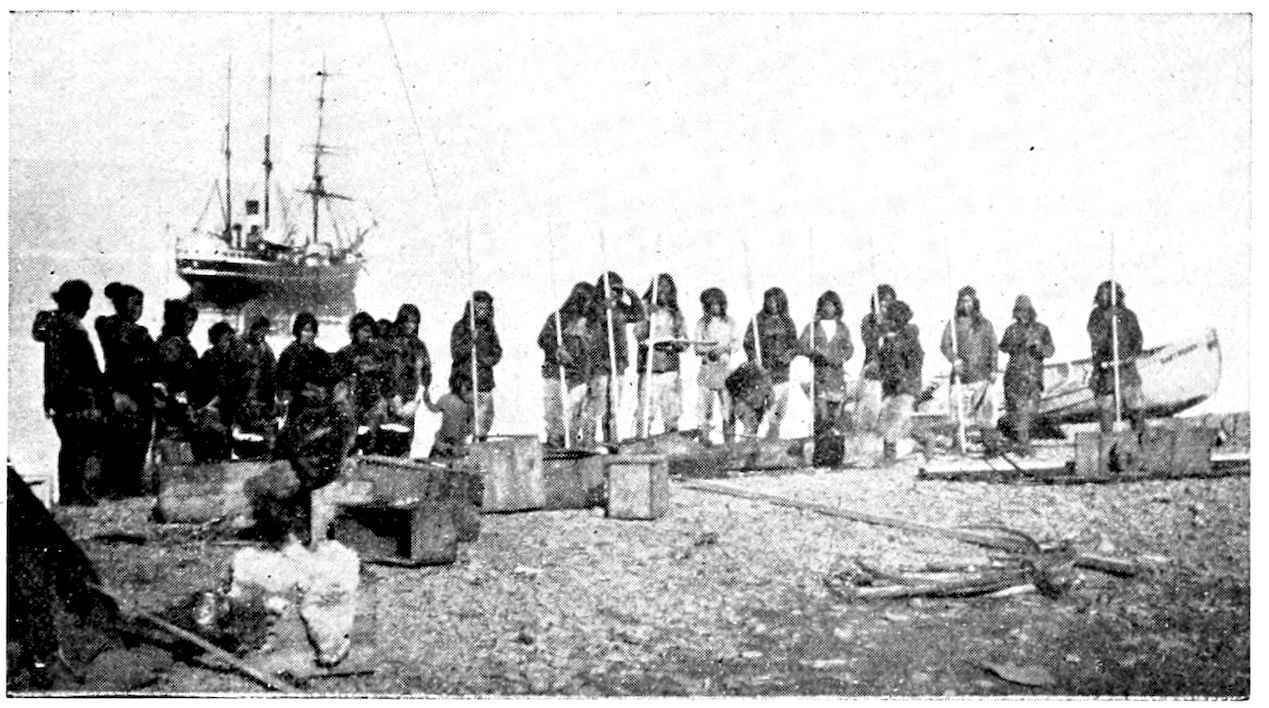
MY ARCTIC JOURNAL A YEAR AMONG ICE-FIELDS AND ESKIMOS
Transcriber’s Note:
The cover image was created by the transcriber and is placed in the public domain.
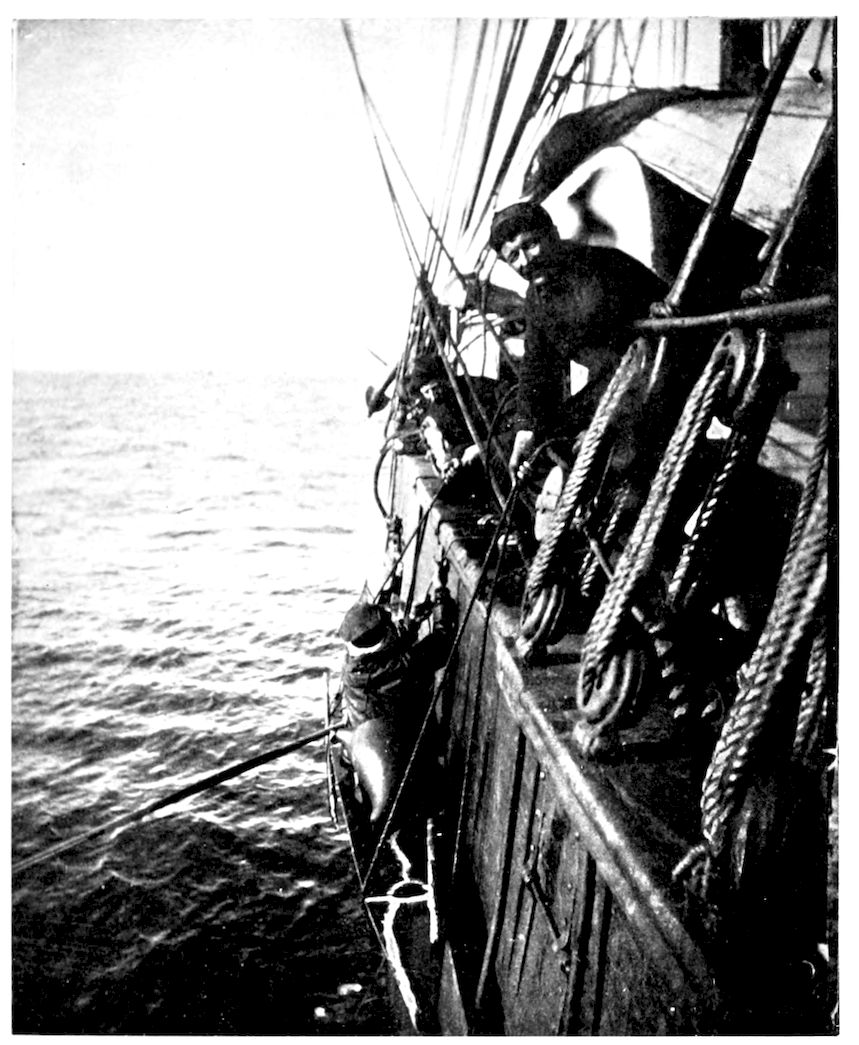
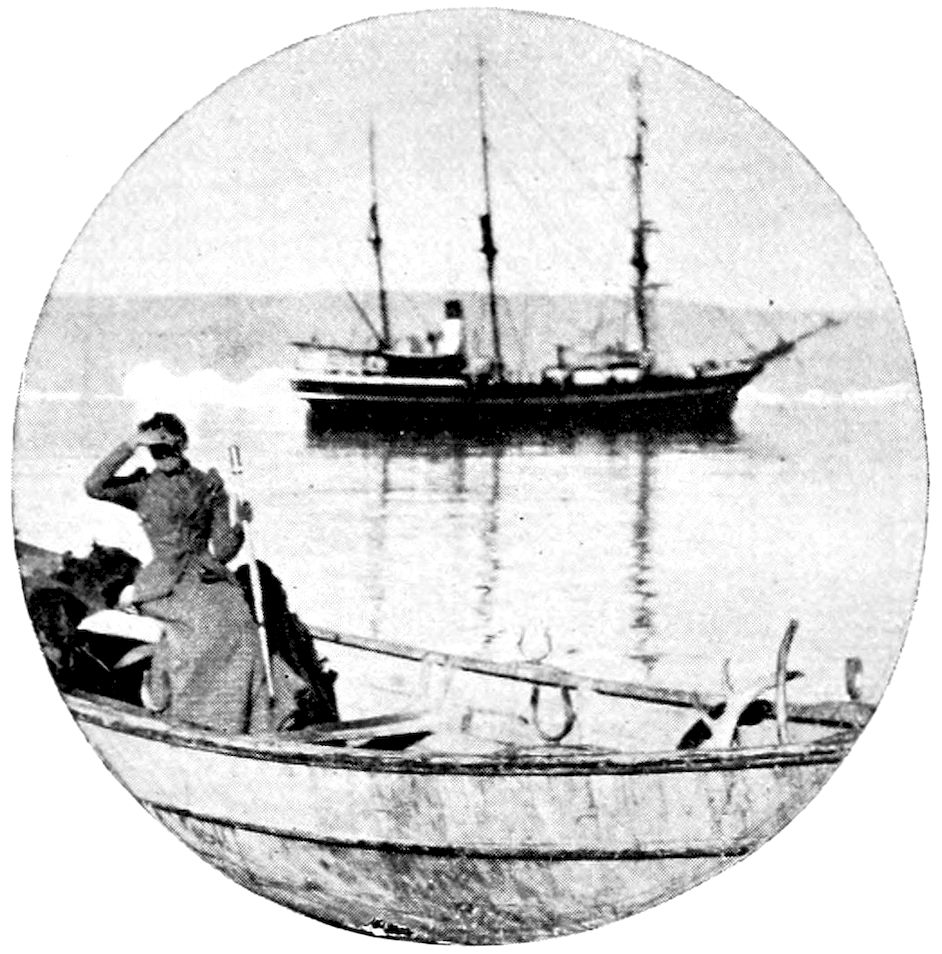
TAKING ON AN ESKIMO PILOT.
BY
JOSEPHINE DIEBITSCH-PEARY
WITH AN ACCOUNT OF
THE GREAT WHITE JOURNEY
ACROSS GREENLAND
BY
ROBERT E. PEARY
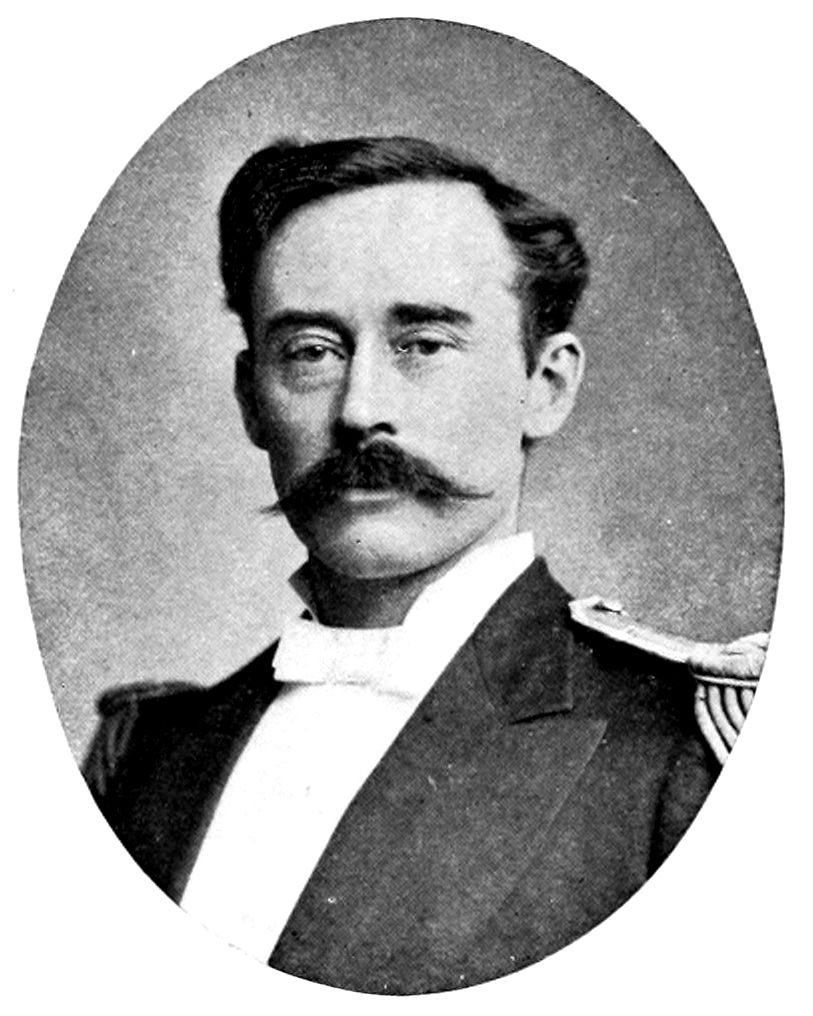
CIVIL ENGINEER, U. S. NAVY
LONDON
LONGMANS, GREEN, AND CO.
1894
All rights reserved
THE DE VINNE PRESS, NEW YORK, U. S. A.
INTRODUCTORY NOTE
1
On June 6, 1891, the steam-whaler “Kite,” which was to
bear the expedition of the Philadelphia Academy of Natural
Sciences northward, set sail from the port of New-York, her
destination being Whale Sound, on the northwest coast of Greenland,
where it had been determined to pass the winter, preliminary
to the long traverse of the inland ice which was to solve
the question of the extension of Greenland in the direction of
the Pole. The members of the expedition numbered but five
besides the commander, Mr. Peary, and his wife. They were
Dr. F. A. Cook, Messrs. Langdon Gibson, Eivind Astrup, and
John T. Verhoeff, and Mr. Peary’s faithful colored attendant
in his surveying labors in Nicaragua, Matthew Henson. This
was the smallest number that had ever been banded together
for extended explorations in the high Arctic zone. A year and
a quarter after their departure, with the aid of a relief expedition
conducted by Professor Angelo Heilprin, Mr. Peary’s party,
lacking one of its members, the unfortunate Mr. Verhoeff, returned
to the American shore. The explorer had traversed
northern Greenland from coast to coast, and had added a
remarkable chapter to the history of Arctic exploration.
The main results of Mr. Peary’s journey were:
The determination of the rapid convergence of the shores of
Greenland above the 78th parallel of latitude, and consequently
the practical demonstration of the insularity of this great
land-mass;
2The discovery of the existence of ice-free land-masses to the
northward of Greenland; and
The delineation of the northward extension of the great
Greenland ice-cap.
In the following pages Mrs. Peary recounts her experiences
of a full twelvemonth spent on the shores of McCormick Bay,
midway between the Arctic Circle and the North Pole. The
Eskimos with whom she came in contact belong to a little tribe
of about three hundred and fifty individuals, completely isolated
from the rest of the world. They are separated by hundreds of
miles from their nearest neighbors, with whom they have no
intercourse whatever. These people had never seen a white
woman, and some of them had never beheld a civilized being.
The opportunities which Mrs. Peary had of observing their
manners and mode of life have enabled her to make a valuable
contribution to ethnological learning.
THE PUBLISHERS.
PREFACE
3
This plain and simple narrative of a year spent by a refined
woman in the realm of the dreaded Frost King has
been written only after persistent and urgent pressure from
friends, by one who shrank from publicity, and who reluctantly
yielded to the idea that her experiences might be of
interest to others besides her immediate friends.
I have been requested to write a few words of introduction;
and while there may be some to whom it might occur
that I was too much interested to perform this task properly,
it must nevertheless be admitted that there is probably no
one better fitted than myself to do it. Little, indeed, need
be said.
The feeling that led Mrs. Peary through these experiences
was first and foremost a desire to be by my side, coupled with
the conviction that she was fitted physically as well as otherwise
to share with me a portion at least of the fatigues and
hardships of the work. I fully concurred in this feeling, and
yet, in spite of my oft-expressed view that the dangers of life
and work in the Arctic regions have been greatly exaggerated,
I cannot but admire her courage. She has been where no
white woman has ever been, and where many a man has hesitated
to go; and she has seen phases of the life of the most
4northerly tribe of human beings on the globe, and in many
ways has been enabled to get a closer insight into their ways
and customs than had been obtained before.
I rarely, if ever, take up the thread of our Arctic experiences
without reverting to two pictures: one is the first
night that we spent on the Greenland shore after the departure
of the “Kite,” when, in a little tent on the rocks—a tent
which the furious wind threatened every moment to carry
away bodily—she watched by my side as I lay a helpless
cripple with a broken leg, our small party the only human
beings on that shore, and the little “Kite,” from which we
had landed, drifted far out among the ice by the storm, and
invisible through the rain. Long afterward she told me that
every unwonted sound of the wind set her heart beating with
the thoughts of some hungry bear roaming along the shore
and attracted by the unusual sight of the tent; yet she never
gave a sign at the time of her fears, lest it should disturb me.
The other picture is that of a scene perhaps a month or
two later, when—myself still a cripple, but not entirely
helpless—this same woman sat for an hour beside me in the
stern of a boat, calmly reloading our empty firearms while a
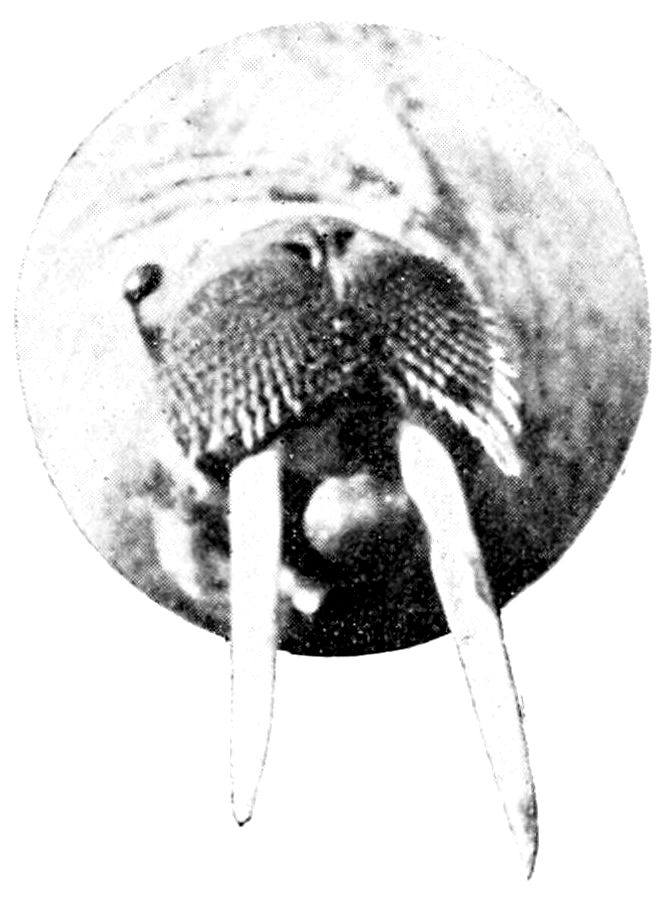
herd of infuriated walrus about us thrust their savage heads
with gleaming tusks and bloodshot eyes out of the water
close to the muzzles of our rifles, so that she could have
touched them with her hand, in their efforts to get their
tusks over the gunwale and capsize the boat. I may perhaps
be pardoned for saying that I never think of these
5two experiences without a thrill of pride and admiration
for her pluck.
In reading the pages of this narrative it should be remembered
that within sixty miles of where Kane and his little
party endured such untold sufferings, within eighty miles of
where Greely’s men one by one starved to death, and within
less than fifty miles of where Hayes and his party and one
portion of the “Polaris” party underwent their Arctic trials
and tribulations, this tenderly nurtured woman lived for a
year in safety and comfort: in the summer-time climbed
over the lichen-covered rocks, picking flowers and singing familiar
home songs, shot deer, ptarmigan, and ducks in the
valleys and lakes, and even tried her hand at seal, walrus,
and narwhal in the bays; and through the long, dark winter
night, with her nimble fingers and ready woman’s insight,
was of inestimable assistance in devising and perfecting the
details of the costumes which enabled Astrup and myself to
make our journey across the great ice-cap in actual comfort.
Perhaps no greater or more convincing proof than this
could be desired of what great improvements have been made
in Arctic methods. That neither Mrs. Peary nor myself regret
her Arctic experiences, or consider them ill-advised, may
be inferred from the fact that she is once more by my side in
my effort to throw more light on the great Arctic mystery.
First Sight of Greenland—Frederikshaab Glacier—Across the Arctic Circle—Perpetual
Daylight—Sunlit Disko—The Climb to the Ice-cap—Dinner at
Inspector Anderssen’s—A Native Dance—From Disko to Upernavik—Upernavik—The
Governor and his Wife—The Duck Islands—Gathering Eggs
and Eider-down and Shooting Ducks.
Wednesday, June 24. We have sailed and tossed, have
broken through the ice-barriers of Belle Isle Straits, and once
more ride the rolling swells of the broad Atlantic. Our three
days’ jam in the ice has given us a foretaste of Arctic navigation,
but the good little “Kite” speeds northward with a confidence
which inspires a feeling of security that not even the
famed “greyhounds of the ocean” afford. Genial Captain
Pike is on the bridge and off the bridge, and his keen eye is
casting for the land. When I came on deck to-day I found
the bold, wild coast of Greenland on the right. It was a
grand sight—the steep, black cliffs, some of them descending
almost vertically to the sea, their tops covered with dazzling
snow, and the inland ice flowing through the depressions
between their summits; at the foot of the cliffs gleamed bergs
of various sizes and shapes, some of them a beautiful blue,
others white as snow. The feature of the day was the
10Frederikshaab glacier, which comes down to the sea in
latitude 62° 30′. It did not, however, impress me as being
very grand, owing perhaps to our being so far from it. Its
face is seventeen miles long, and we could see it like a wall
of white marble before us. Long after we had passed it, it
still appeared to be with us, and it kept us company nearly
all day. Just beyond the glacier was disclosed the most
beautiful mountain scenery imaginable. The weather was
deliciously warm, and revealed to us a new aspect of Arctic
climate. It seems strange to be sitting on deck in a light
coat, not even buttoned, and only a cap on my head, in
the most brilliant sunshine, and gazing on snow-covered
mountains.
Out on the Billowy Sea.
The First Fragment of Greenland Ice.
11
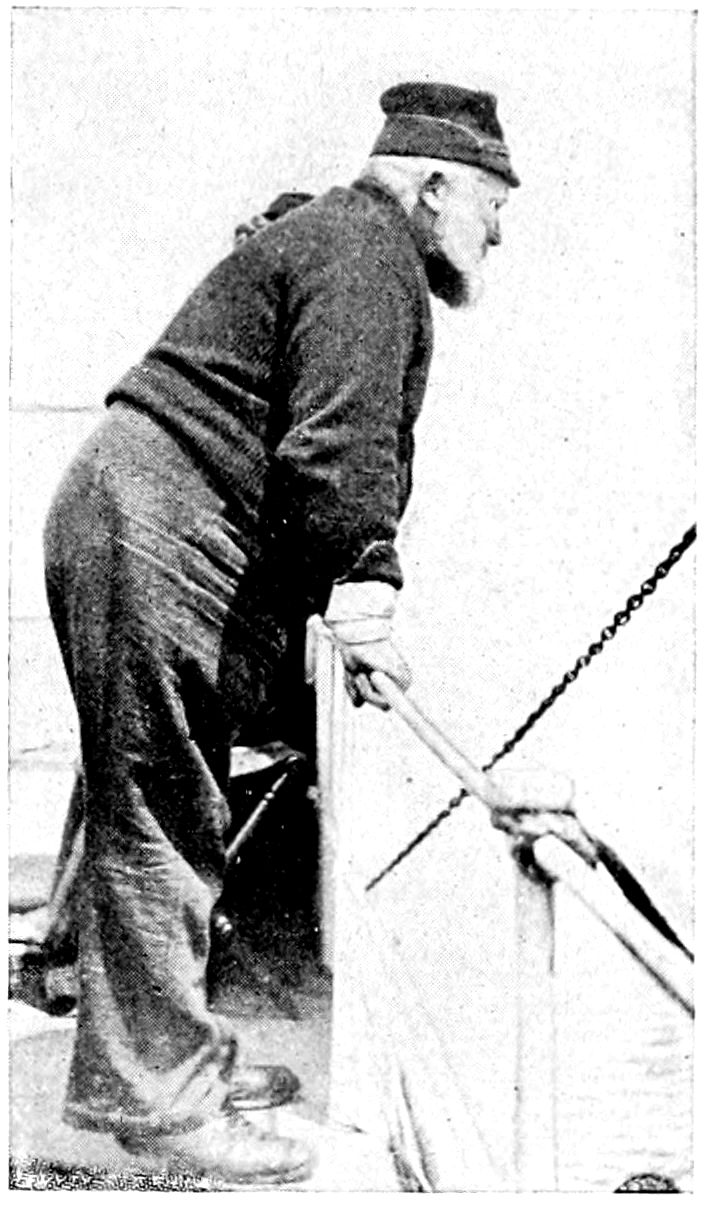
Capt. Richard Pike—“On Duty.”
Thursday, June 25. We were promised another lovely
day, but after noon the weather changed and a cool wind
sprang up, which helped to push our little craft along at a
good rate. To-night we shall have the midnight sun for the
first time, and it will be weeks, even months, before he sets
for us again. Everything on
deck is dripping from the fog
which has gathered about us.
Friday, June 26. In spite of
the thick fog we have been making
good time, and expect to be
in Disko, or more properly Godhavn,
about noon to-morrow.
We saw our first eider-ducks
to-day. Numerous bergs again
gleam up in the distance, probably
the output of the Jakobshavn
glacier.
Tuesday, June 30. We have
been in a constant state of excitement
since Saturday morning,
when we first set foot on
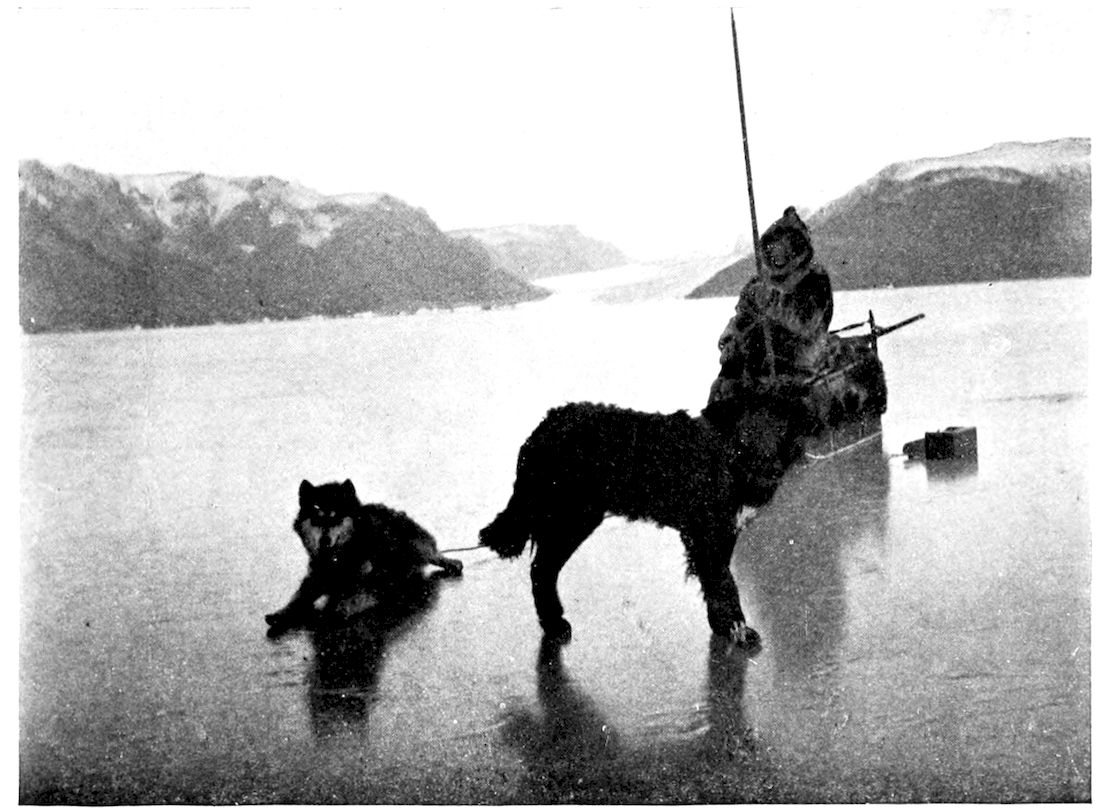
Greenland’s ice-bound shores. The pilot, a half-breed Eskimo,
came on board and took us into the harbor of Godhavn shortly
after nine o’clock. Mr. Peary, Captain Pike, Professor Heilprin,
and myself went ashore and paid our respects to Inspector
Anderssen and his family. They were very attentive
12to us, and invited “Mr. and Mistress Peary” to stay with them
during their stop in Godhavn—a pleasure they were, however,
compelled to forego. In the afternoon a party of us from the
“Kite” set out on our first Arctic tramp, our objective point
being the summit of the lofty basalt cliffs that tower above
the harbor. My outfit consisted of a red blanket combination
suit reaching to the knee, long knit stockings, a short eider-down
flannel skirt reaching to the ankles, and the “kamiks,” or
long-legged moccasins, which I had purchased in Sidney.
The day was exceptionally fine and sunny, and we started off
in the best of spirits. Never had I seen so many different
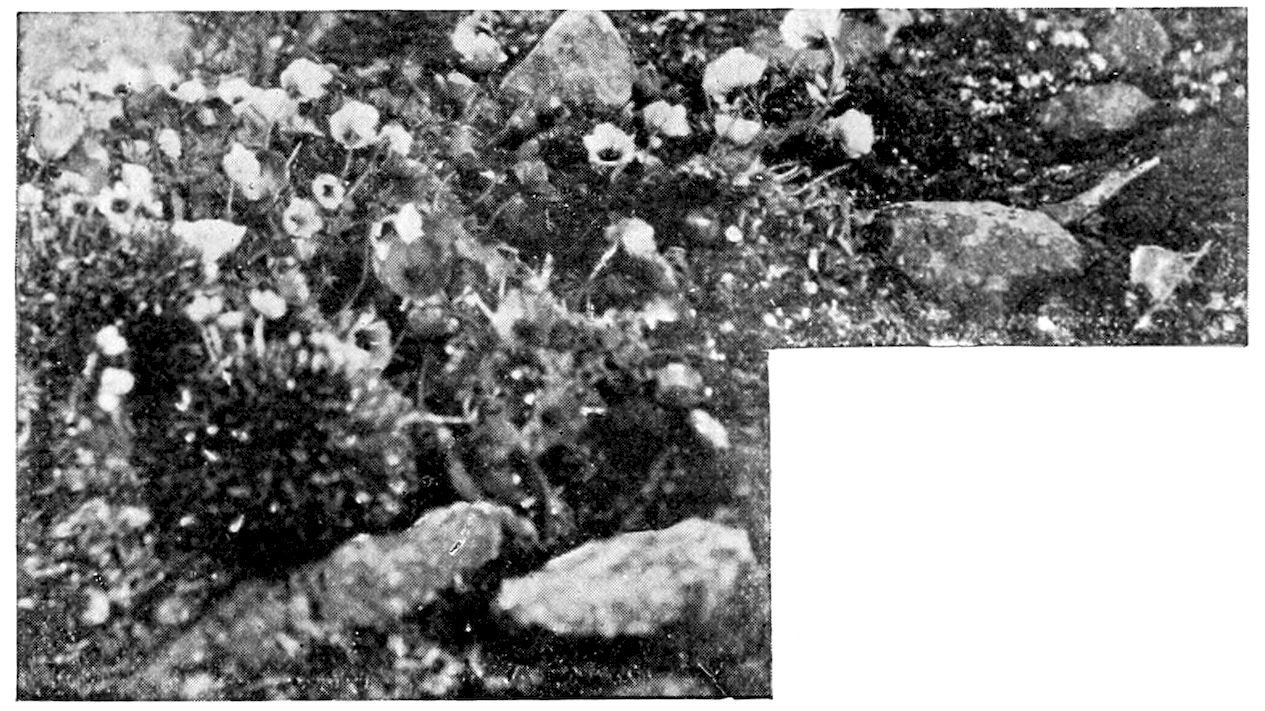
wild flowers in bloom at once. I could not put my foot down
without crushing two or three different varieties. Mr. Gibson,
while chasing a butterfly, slipped and strained the cords of
his left foot so that he was obliged to return to the ship.
Never had I stepped on moss so soft and beautiful, all shades
of green and red, some beds of it covered so thickly with tiny
pink flowers that you could not put the head of a pin down
between them. We gathered and pressed as many flowers as
we could conveniently carry—anemones, yellow poppies,
mountain pinks, various Ericaceæ, etc. Sometimes our path
was across snow-drifts, and sometimes we were ankle-deep in
flowers and moss. Mountain streams came tumbling down in
every little gully, and their water was so delicious that it
seemed impossible to cross one of these streams without
stooping to drink. Our advance was very slow, as we could
not resist the temptation of constantly stopping to look back
13and feast upon the beauties of the view. Disko Bay, blue as
sapphire, thickly studded with icebergs of all sizes and beautifully
colored by the sun’s rays, lay at our feet, with the little
settlement of Godhavn on one side and the brown cliffs towering
over it. As far as the eye could reach, the sea was dotted
with icebergs, which looked like a fleet of sail-boats. The scene
was simply indescribable. We reached the summit, at an
elevation of 2400 feet, and built a cairn, in which we placed a
tin box containing a piece of paper with our names written
upon it, and some American coins. From the summit of
these cliffs we stepped upon the ice-cap, which seemed to roll
right down to their tops. The temperature was 91° F. in the
sun, and 56° in the shade. As we descended a blue mist
seemed to hang over that part of the cliffs that lay in shadow,
and the contrast with the white bergs gleaming in the sapphire
waters below was very striking. We returned to the foot of
the cliff after eight o’clock. On Sunday we made another expedition,
to the Blaese Dael, or “windy valley,” where a
beautiful double waterfall comes tumbling through the hard
rock, into which it has graven a deep channel. We gathered
more flowers, and collected some seaweed; the mosquitos,
of which we had had a foretaste the day before, were extremely
troublesome, and recalled to memory the shores of
New Jersey. When we reached the first Eskimo hut, a
number of the piccaninnies[1] came to me and presented me
14with bunches of wild flowers. We gave them some hardtack
in return, and they were happy.
1. The Eskimos frequently designate their children as piccaninnies, a word doubtless
introduced by the whalers.
Mr. Peary, Professor Heilprin, myself, and two other members
of our party dined with the inspector in the evening,
joining some members of the Danish community, who had
also been invited. The course consisted of fresh codfish with
caper-sauce, roast ptarmigan, potatoes boiled and then
browned; and for dessert, “Rudgrud,” a “dump,” almonds,
and raisins. There was, following European custom, a varied
accompaniment of wines.
After dinner the gentlemen went up-stairs to examine the
geological and oölogical collections of the inspector, while the
ladies preferred the parlor with their coffee. Were it not for
the outer surroundings, it would have been difficult to realize
that we were in the distant Arctic realm, so truly homelike
were the scenes of the little household, and so cheerful the
little that was necessary to make living here not only comfortable,
but pleasant. The entire community numbers barely
120 souls, nine tenths of whom are Eskimos, mainly half-breeds;
the remainder are the Danish officials and their
families, whose recreation lies almost entirely within the little
circle which they themselves constitute.
Toward nine o’clock we visited the storehouse, where a
native ball was in progress. Several of our boys went the
rounds with the Eskimo “belles,” but for me the odor of the
interior was too strong to permit me to say that looking on
was an “unalloyed pleasure.” The steps were made to the
15music of stringed instruments, over which the resident half-breeds
have acquired a fair mastery. The participants and
onlookers were all in a lively frame of mind, but not uproarious;
and at the appointed time of closing—ten o’clock—all
traces of hilarity had virtually been banished.
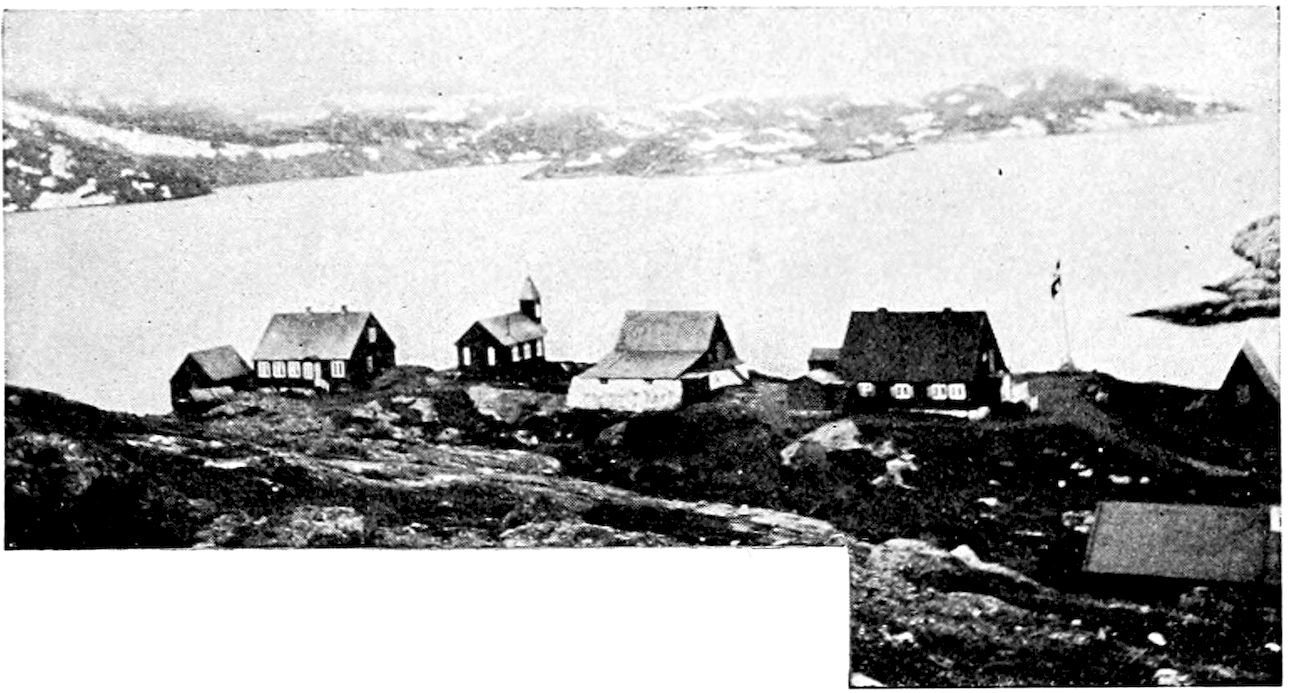
The Most Northern Outpost of Civilization on the Globe—Upernavik.
We had hoped to leave early on the following morning, but
it was not until near two o’clock that the fog began to lift,
and that a departure was made possible. Firing the official
salute, and dipping our colors, we gave three hearty cheers in
honor of our first Greenland hosts, and sailed out of the rock-bound
harbor. It soon cleared up, and we were able to make
our normal seven knots an hour. This morning it was foggy
for a while, but it cleared up beautifully, and now we are just
skimming along, and expect to reach Upernavik, the most
northern of the Danish settlements in Greenland, about nine
o’clock in the evening.
16Thursday, July 2. We did not reach Upernavik until 2.30
yesterday morning, owing to a very strong current which was
running against us all the way from Godhavn. We remained
up all night, and at 1.30 A. M. were enjoying the dazzling
brightness of the sunshine. Mr. Peary took a number of
photographs between midnight and morning. Upernavik is a
very different-looking place from Godhavn. There are four
frame-houses and a little church. The natives live in turf huts,
very miserable-looking habitations, built right down in the
mud. As soon as our ship steamed into the harbor, in
which two Danish vessels were at anchor, the governor, Herr
Beyer, came on board with his lieutenant-governor, a young
fellow who had arrived only three days before. We returned
the visit at noon, and were pleasantly received by the governor
and his wife, a charming woman of about thirty years,
who had been married but a year, and whose fondness for
home decoration had expressed itself in the pictures, bric-à-brac,
fancy embroideries, and flowering plants which were
everywhere scattered about, and helped to make up an extremely
cozy home. As in all other houses in the country,
the guests were treated to wine immediately on entering, and
with a delicate politeness the governor presented me with a
corsage bouquet of the flowers of Upernavik, neatly tied up
with the colors of Denmark. Our visit was fruitful in the
receipt of presents, among which were Eskimo carvings, a
dozen bottles of native Greenland beer, and a box of “goodies,”
addressed to “Miss Peary,” and to be opened, as a reminder,
on Christmas eve. The hospitality shown to us could not
have been more marked had our friendship extended over
many years.
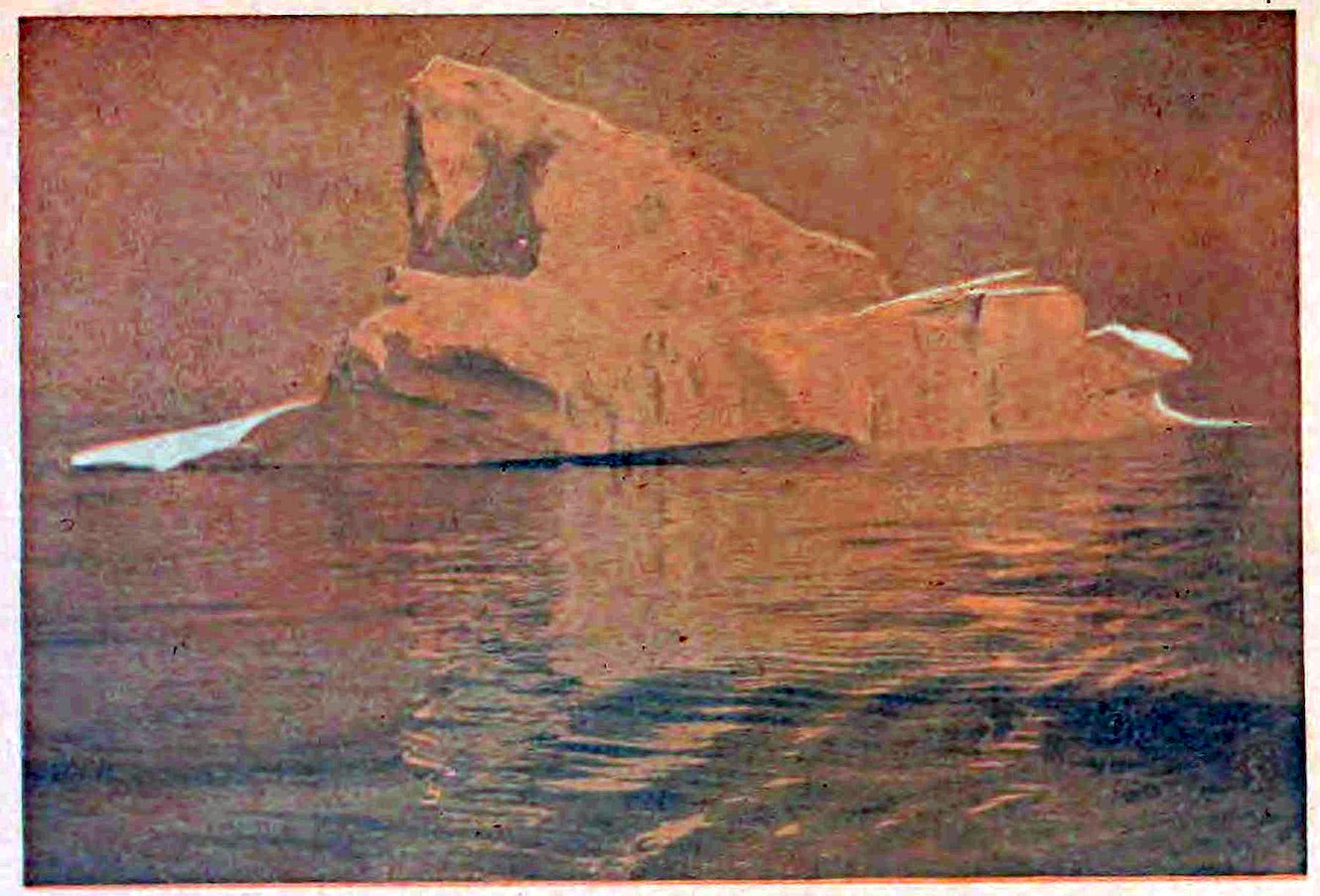
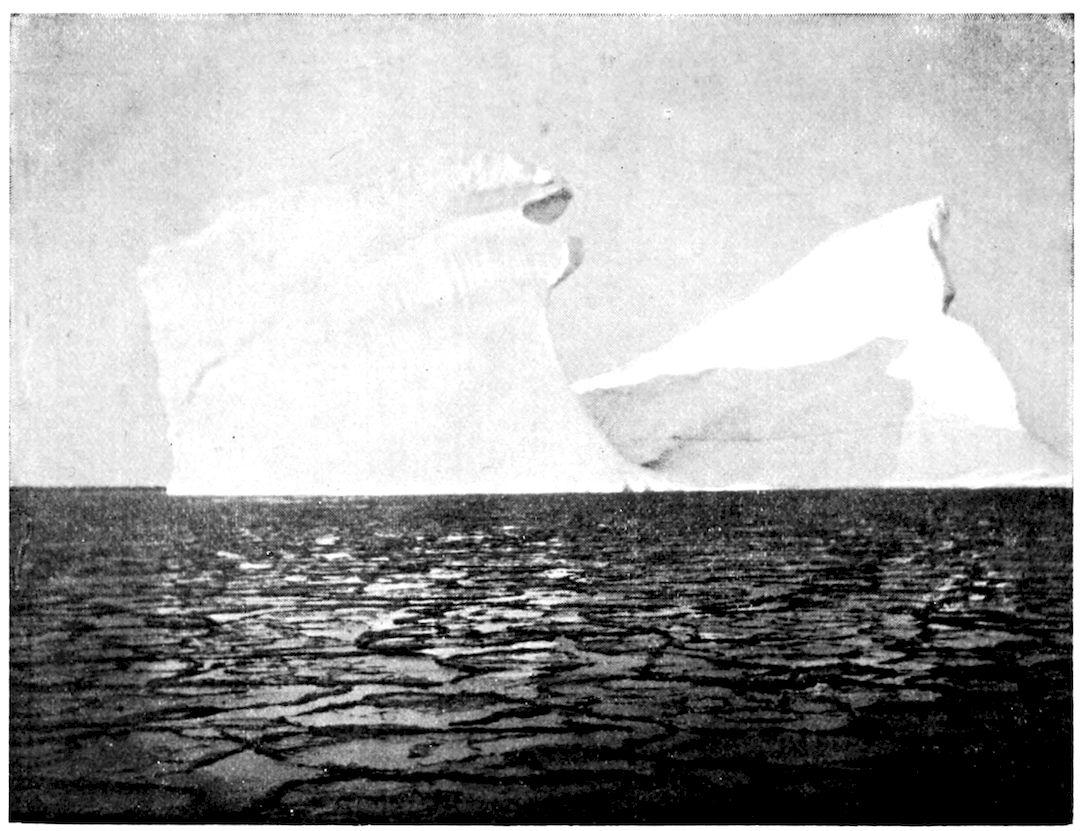
THE SUNSET GLOW—BERG OFF SVARTENHOEK.
17Our visit was a brief one, as we were to weigh anchor early
in the afternoon. We steamed away from Upernavik and
headed north. The fog had cleared away and disclosed a
giant mountain towering above us in the harbor. The sun
shone brightly, and the sea was smooth as glass and blue as
turquoise. The night promised to be a beautiful one, but I
resisted the temptation to stay up, having been up the entire
night before, and the greater part of the one before that. At
4 A. M. Captain Pike knocked at our door and informed us
that in half an hour we would be at the Duck Islands.
Here we were to land and all hands shoot eider-ducks and
gather their eggs for our winter supply. We were soon on
shore, and then began a day’s sport such as I had often read
about, but never expected to see. The ducks flew in thick
flocks all about us, and on every side were nests as large as a
large hen-nest, made of eider-down and containing from three
to six eggs. The nests were not hidden, but right out on the
rocks in full sight. Alas! we were too late; the ducks were
breeding, and out of 960 eggs we did not get over 150 good
ones. As I had not taken my gun, I spent the time in gathering
down, and collected forty-three pounds in five hours.
After returning to the “Kite” for breakfast, we visited a
second island, and there I bagged a bird, much to my satisfaction.
Altogether ninety-six ducks were shot.
CHAPTER II IN THE MELVILLE BAY PACK
18
Melville Bay—On the Edge of the Dreaded Ice-pack—Fourth of July—Butting
the Ice—Accident to the Leader of the Expedition—Gloom on the “Kite”—Blasting
the “Kite” out of a Nip—A Real Bear and a Bear Hunt—A Chase on
the Ice—A Phantom Ship—Free of the Pack and in the North Water at Last—The
Greenland Shore to Barden Bay—First Sight of the Arctic Highlanders.
Thursday, July 2. We are opposite the “Devil’s Thumb,”
latitude 74° 20′, and now, at 8 P. M., are slowly making
our way through the ice which marks the entrance into the
Melville Bay “pack.”
Friday, July 3. At midnight the engine was stopped, the
ice being too thick for the “Kite” to make any headway.
At 6.30 A. M. we started again, and rammed our way along
for an hour, but were again forced to stop. At eleven o’clock
we tried it once more, but after a couple of hours came to a
standstill. We remained in this condition until after five
o’clock, when the engine was again started. For two hours
we made fairly good progress, and we thought that we should
soon be in open water, but a small neck of very heavy ice
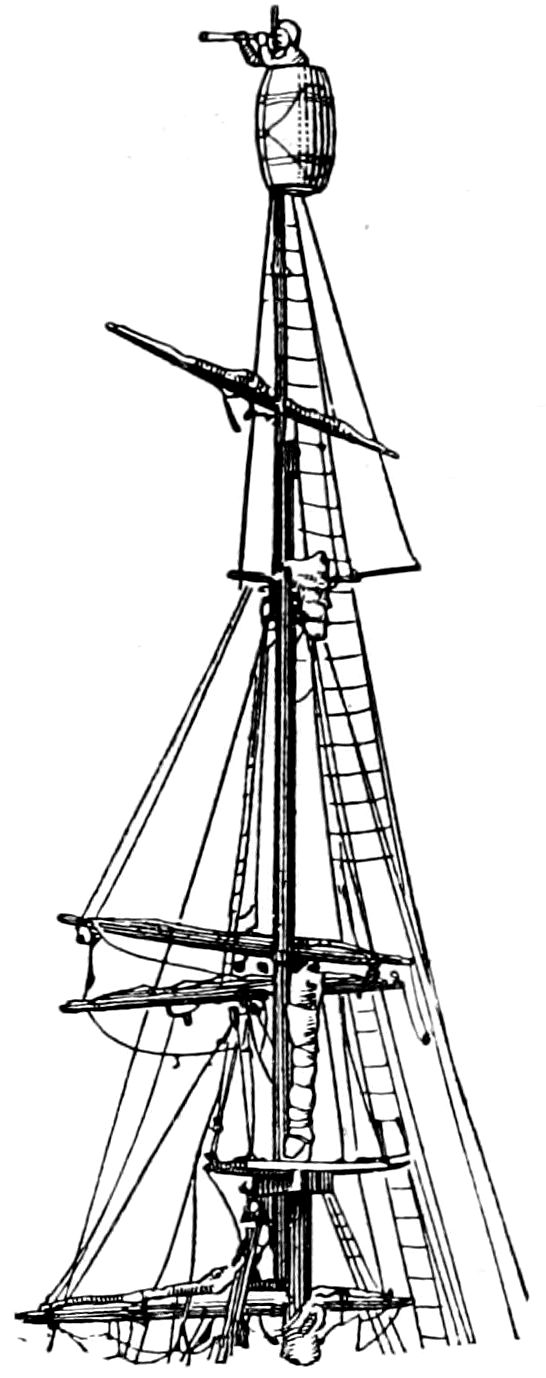
stopped us. While we were on deck, the mate in the “crow’s-nest,”
which was hoisted to-day, sang out, “A bear! A bear!”
Off in the distance we could see an object floating, or rather
19swimming, in the water, and in a minute the boys were climbing
helter-skelter over the sides of the “Kite,” all with guns,
although some soon discovered that theirs were not loaded;
but the bear turned out to be a seal, and
not one of about thirty shots hit him.
It is now nearly 11 P. M. The sun is
shining beautifully, and it is perfectly
calm. I have worn only a gray spring
jacket, which I have found sufficient for
the balmy temperature. At midnight
the cannon was fired, the flags were
run up and dipped, and the boys fired
their rifles and gave three cheers for
the Fourth of July. The thermometer
marked 31°.
“A Bear! A Bear!”
Saturday, July 4. The ice remains
stubborn, and we are fast bound. All
around the eye sees nothing but the
immovable pack, here smooth as a table,
at other places tossed up into long hummock-ridges
which define the individual
ice-cakes. Occasional lanes of water
appear and disappear, and their presence gives us the one
hope of an early disentanglement. The event of the day has
been a dinner to Captain Pike, in which most of the members
of our party participated. After dinner hunting-parties scoured
the ice after seals, with the result of bringing in two specimens,
20one weighing twenty-six pounds, and the other thirty-three
pounds.
Sunday, July 5. All night we steamed along slowly, but at
8 A. M. we were forced once more to stop. The day has been
very disagreeable, foggy, rainy, and even snowy. We have
done nothing but eat and sleep. A lazily hovering ivory-gull,
which ventured within near gunshot, has been added to
our collections.
Tuesday, July 7. The weather yesterday was dreary and
disagreeable, but to-day it seems warmer. The snow has
ceased falling, although the sky is still overcast, and the fog
prevents us from seeing the horizon. At noon the sun came
through the clouds for a few moments, and the fog lifted
sufficiently for the captain to make an observation and find
that our position was latitude 74° 51′. During the afternoon
the wind died down, and an attempt was made to get through
the ice; but after boring and ramming the immovable pack
for nearly an hour, and gaining only a ship’s length, we concluded
that we were burning coal for nothing. Mr. Peary,
with Gibson, Astrup, Cook, and Matt, has been busy all the
afternoon sawing, marking, and fitting the lumber for our
Whale Sound cottage. The curing of a large number of
drake-skins, intended to be made up into undershirts for
winter wear, was a part of the day’s work.
Thursday, July 9. Yesterday and to-day the fog lifted
sufficiently at times to permit us to see the land, about forty
miles distant. A good observation places us in latitude 74°
2151′, and longitude about 60° W. Mr. Peary fixed the points
with his pocket sextant and the ship’s compass, and then made
a sketch of the headlands. The ice looks rotten, but yet it
holds together too firmly to permit us to force a passage.
We measured some of the
floes, and found the thickest
to be two and a half feet. It
has seemed very raw to-day,
owing largely to a slight northwest
wind; and for the first
time the average temperature
has been below the freezing-point,
being 31½° F.
Sailing Through the Pack.
Friday, July 10. This morning
the rigging was covered
with hoar-frost, making the
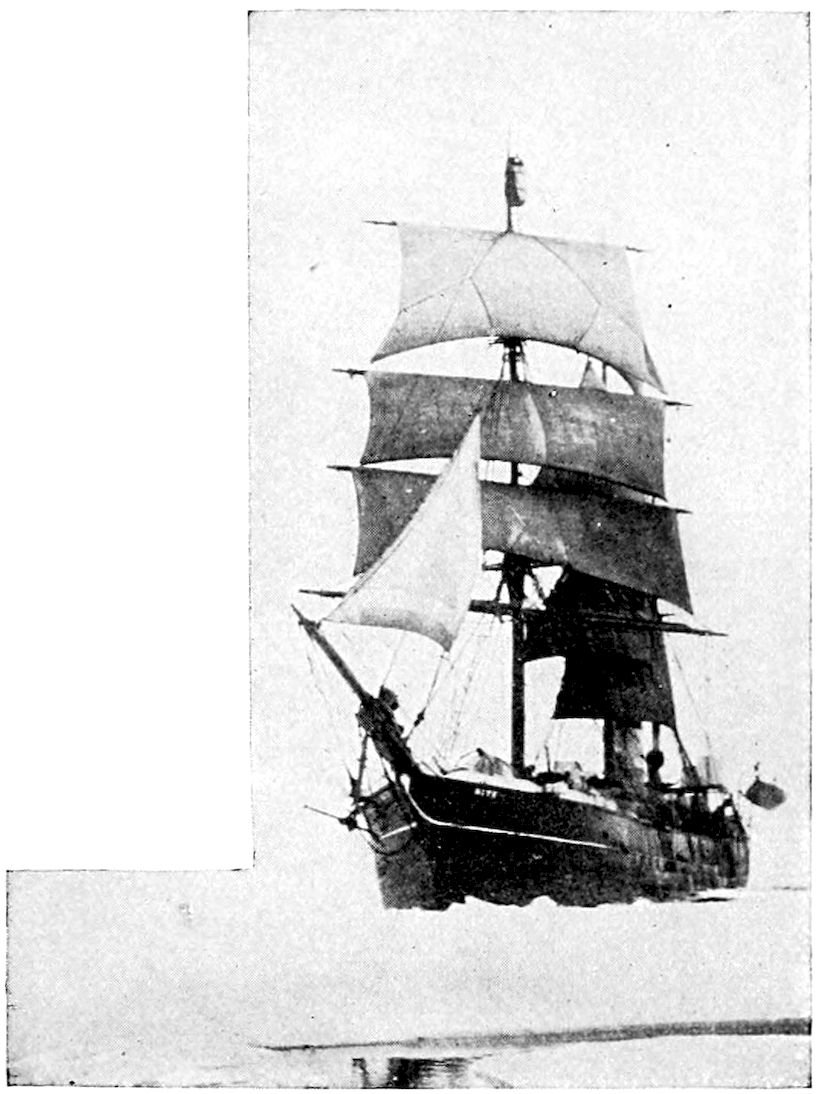
“Kite” look like a “phantom
ship.” The fog hung heavily
about us, shutting
out the land completely.
In the
forenoon a sounding
was made, but
no bottom was found at 343 fathoms. While we were at dinner,
without any warning the “Kite” began to move, steam
was immediately gotten up, and for an hour and a half we cut
our way through the ice, which had become very rotten, large
22floes splitting into several pieces as soon as they were struck
by the “Kite.” We made about three knots, when we
were again obliged to halt on account of a lowering fog.
Our little move was made just in time to keep up the courage
of some of the West Greenland party, who were beginning
to believe that we should be nipped and kept here for
the winter.
Although we realized that we were still ice-bound in the
great and much-dreaded Melville Bay pack, we could not but
enjoy at times the peculiar features of our forced imprisonment.
Efforts to escape, with full promise of success, followed
by a condition of impotency and absolute relaxation, would
alternately elevate and depress our spirits to the extent of
casting joy and gloom into the little household. The novelty
of the situation, however, helped greatly to keep up a good
feeling, and all despondency was immediately dispelled by the
sound of the order to “fire up,” and the dull rumbling of the
bell-metal propeller. We never tired of watching our little
craft cut her way through the unbroken pans of ice. The
great masses of ice were thrust aside very readily; sometimes
a piece was split from a large floe and wedged under a still
larger one, pushing this out of the way, the commotion causing
the ice in the immediate vicinity fairly to boil. Then we
would run against an unusually hard, solid floe that would not
move when the “Kite” struck it, but let her ride right up on
it and then allow her gradually to slide off and along the edge
until she struck a weak place, when the floe would be shivered
23just as a sheet of glass is shivered when struck a sharp, hard
blow. The pieces were hurled against and on top of other
pieces, crashing and splashing about until it seemed as though
the ice must be as thick again as it was before the break-up;
but the good old “Kite” pushed them aside, leaving them in
the distance groaning and creaking at having been disturbed.
The day has been pleasant, in spite of an average temperature
of 27½°.
Tuesday, July 14. How different everything looks to us
since I last wrote in this journal! Saturday the weather was,
as usual, cold and foggy; and when, at 5.30 P. M., we found
ourselves suddenly moving, every one was elated, hoping we
would be able to get into the clear water ahead, which the
mate said could be seen from the crow’s-nest. Mr. Peary was
particularly pleased, as he said we should then reach Whale
Sound by July 15, the limit he had set for getting there.
After supper he and I bundled up and went on deck, and
watched the “Kite” cut through the rotten ice like butter.
We had been on the bridge for some time, when Mr. Peary
left me to warm his feet in the cabin. Coming on deck again,
he stepped for a moment behind the wheel-house, and immediately
after, I saw the wheel torn from the grasp of the two
helmsmen, whirling around so rapidly that the spokes could
not be seen. One of the men was thrown completely over
it, but on recovering himself he stepped quickly behind the
house, and I instantly realized that something must have happened
to my husband. How I got to him I do not know, but
24I reached him before any one else, and found him standing on
one foot looking pale as death. “Don’t be frightened, dearest;
I have hurt my leg,” was all he said. Mr. Gibson and
Dr. Sharp helped, or rather carried, him down into the cabin
and laid him on the table. He was ice-cold, and while I
covered him with blankets, our physicians gave him whisky,
cut off his boot, and cut open his trousers. They found that
both bones of the right leg had been fractured between the
knee and the ankle. The leg was put into a box and padded
with cotton. The fracture being what the doctors pronounced
a “good one,” it was not necessary to have the bones pulled
into place. Poor Bert suffered agonies in spite of the fact that
the doctors handled him as tenderly as they could. We found
it impossible to get him into our state-room, so a bed was
improvised across the upper end of the cabin, and there my
poor sufferer lies. He is as good and patient as it is possible
to be under the circumstances. The accident happened in
this way. The “Kite” had been for some time pounding,
or, as the whalers say, “butting,” a passage through the ice,
slowly but steadily forging a way through the spongy sheets
which had already for upward of a week imprisoned her.
To gain strength for every assault it was necessary constantly
to reverse, and it was during one of these evolutions, when
going astern, that a detached cake of ice struck the rudder,
crowding the iron tiller against the wheel-house where Mr.
Peary was standing, and against his leg, which it held pinned
long enough for him to hear it snap.
25Wednesday, July 15. Mr. Peary passed a fairly comfortable
night, and had a good sleep without morphine to-day, consequently
he feels better. As for myself, I could not keep up
any longer, and at 11 A. M., after Dr. Cook had dressed the
leg and made an additional splint, I lay down, and neither
moved nor heard a sound until after five o’clock. This was
the first sleep I have had since Friday night. Dr. Cook, who
has been more than attentive, has made a pair of crutches for
the poor sufferer, but he will not be able to use them for a
month.
We find to-day that our latitude is 75° 1′, and our longitude
60° 9′; consequently our headway has been very slow.
It seems as if when the ice is loose the fog is too thick for us
to travel in safety, and when the fog lifts the ice closes in
around us. Once to-day the ice suddenly opened and a crack
which visibly widened allowed us to make nearly four miles
in one stretch. Throughout much of the night and day we
steamed back and forth and hither and thither, trying to get
through or around the ice, and to prevent the “Kite” from
getting nipped between two floes. A little after supper the
fog suddenly closed in upon us, and before we could complete
the passage of a narrow and tortuous lead, through
which we were seeking escape from the advancing floes in our
rear, we were caught fast between two large pans. The ice
was only about fourteen inches thick, and there was but little
danger of the “Kite” being crushed; still, Captain Pike, with
the memories of former disasters fresh in his mind, did not
26relish the situation, and blasted our way out with gunpowder
at 8.15 P. M. This is our first “nip.”
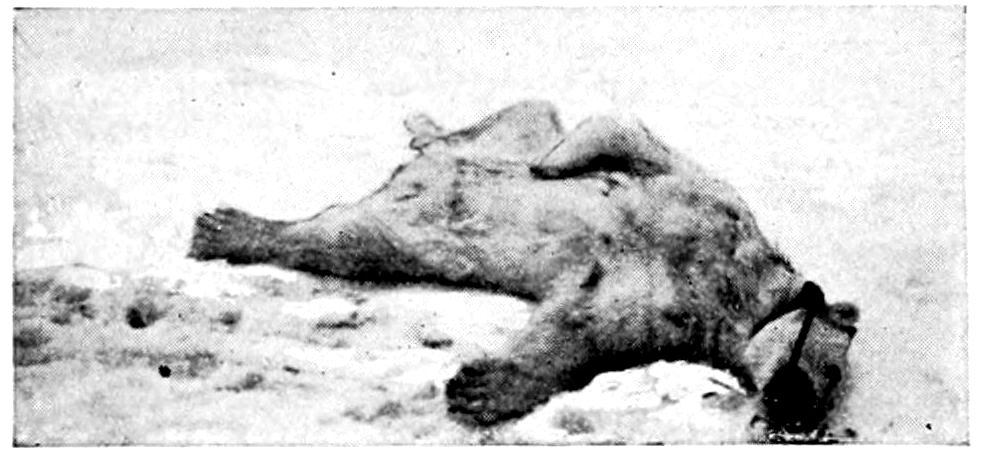
Bruin at Rest.
An hour later the captain called down to me to come up at
once, as a bear was advancing toward the ship. The boys had
been watching and longing for a bear ever since we left New-York,
and many false alarms had been given; but here was a
real live polar coming straight for the “Kite.” A very, very
pretty sight he was, with black snout, black eyes, and black
toes. Against the white snow and ice, he seemed to be of a
cream color. His head was thrown up as he loped along toward
us, and when, within a short distance of the “Kite,” a
gull flew over his head, he made a playful jump at it, all unconscious
of the doom which awaited him. Eleven men with
guns were stooping down on the quarter-deck waiting for the
captain to give the word to fire. A bullet disabled one of the
fore legs, while another struck the animal in the head, instantly
dyeing it crimson;
the bear stopped short,
wheeled round, fell
over on his head, and
then got up. By this
time it was simply raining
bullets about the
poor beast; still he staggered on toward the water. Gibson,
who had jumped on the ice as soon as he fired, was
now close to him, and, just as he started to swim away, put
a ball in his neck, which stopped him short. A boat was lowered,
27and he was brought alongside the “Kite.” He measured
seven feet one inch in length, and we estimated his weight at
from eight to ten hundred pounds.
Friday, July 17. Last night was the worst night my poor
husband has had. His leg pained him more than it had done
so far, and he begged me to give him a sedative, which, with
the doctor’s consent, I did; but even then his sleep was disturbed
to such an extent that it amounted to delirium. He
would plead with me to do something for his leg. After doing
everything I could think of, I said, “Can’t you tell me where
it hurts you most, and what you think might help you?”
His answer was, “Oh, my dear, pack it in ice until some one
can shoot it!” In this way he spent the night, and this morning
he was thoroughly exhausted. Dr. Cook has succeeded
in making his leg more comfortable, and now he sleeps. It
seems very hard that I cannot take him away to some place
where he can rest in peace.
Tuesday, July 21. Since last writing in my journal, four
days ago, we have been steadily nearing Cape York, and we
hope soon to clear the ice of Melville Bay, and pass into
the open North Water beyond. Our hopes have, however,
so often been disappointed that day by day, even when in full
view of the land, we become less and less confident of ever
being able to disengage ourselves from our confinement.
Huge grounded bergs still hold the ice together, and until
they show signs of moving there is little prospect of a general
break-up.
28On Saturday a bear with two cubs was seen on the ice
ahead of us, and immediately every man was over the side of
the vessel making for the animals. The mother, with a tender
affection for her young, guided an immediate retreat, herself
taking the rear, and alternately inciting the one cub and
then the other to more rapid movement. Our boys were
wholly unacquainted with the art of rapid traveling on the
rough and hummocky ice, and before long the race was admitted
to be a very unequal one; they were all quickly
distanced. One of the men, in the excitement of the moment,
joined in the chase without his gun, and, even without this
implement, when he returned to the “Kite” he was so out of
breath that he had to be hauled up the sides of the vessel like
a dead seal. He lay sprawling and breathless on the deck
for at least five minutes, much to the merriment of the crew
and the more fortunate members of the party. A round
weight of over two hundred pounds was responsible for his
discomfiture. Monday morning about two o’clock the fog
suddenly lifted, and we found ourselves almost upon the land.
The visible shore extended from Cape York to Wolstenholme
Island, and we could clearly distinguish Capes Dudley Diggs
and Atholl. I held a looking-glass over the open skylight in
such a way that Mr. Peary could see something of the outline
of the coast. Poor fellow! he wanted to go on deck so badly,
thinking that if he were strapped to a board he could be
moved in safety, but the doctor persuaded him to give up the
thought. As the doctors have all agreed that in six months
29his leg will be as good as it ever was, he refuses to consider
the idea of returning on the “Kite”; as for myself, now
that we have started, I want to keep on too. The air is
almost black with flocks of the little auk, and a party on the
ice to-day brought in sixteen birds in a very short time.
Wednesday, July 22. Drs. Hughes and Sharp brought in
sixty-four birds as the result of an all-night catch. We are still
in the ice, with no signs of our getting out, although the captain
says we have drifted twenty miles to the northward since
Monday morning. We are now abreast of Conical Rock.
Second Mate Dunphy has just reported seeing from the crow’s-nest
a steamer off Cape York, but it is not visible to the
naked eye, and we are in doubt as to what it is.
Friday, July 24. The steamer did not materialize; either
the mate was mistaken or the vessel drifted away from us.
The ice parted early yesterday morning, much to everybody’s
relief, and we have since been pushing steadily on our course.
The long line of table-topped bergs off Cape York, some of
which measured not less than two hundred to three hundred feet
in height, and perhaps considerably over a mile in length, is
visibly moving over to the American waters, and to this disrupting
force we are doubtless largely indebted for our liberation.
The scenery of this portion of the Greenland coast is
surpassingly fine. The steep red-brown cliffs are frequently
interrupted by small glaciers reaching down to the water’s
edge. The entrance to Wolstenholme Sound, guarded as it
was by huge bergs, was particularly beautiful. Saunders
30Island in the distance, and Dalrymple Rock immediately in
the foreground, stood up like great black giants, contrasting
with the snow-white bergs surrounding them and the red cliffs
of the mainland on either side. Whenever anything particularly
striking or beautiful appears, I am called on deck, and
with my hand-glass placed at the open transom over Mr.
Peary’s head, manage to give him a faint glimpse of our surroundings.
At nine o’clock this evening we rounded Cape
Parry, and about ten o’clock stopped at the little Eskimo
village of Netchiolumy in Barden Bay, where we hoped to
obtain a native house, sledge, kayak, and various native
utensils and implements for the World’s Columbian Exposition.
Our search-party found only three houses in the
settlement, and the lonely inhabitants numbered six adults
and five children; five dogs added life to the solitude. These
people had quantities of sealskins and narwhal tusks, many of
which were obtained in exchange for knives, saws, files, and
tools in general. Wood of any kind, to be used in the construction
of sledges, kayak frames, and spear- and harpoon-shafts,
was especially in demand; they cared nothing for our
woven clothing, nor for articles of simple show and finery.
We stopped this morning at Herbert Island, where we had
hoped to visit a native graveyard, but no graves were found.
CHAPTER III ESTABLISHING OURSELVES
31
Arrival at McCormick Bay—Selecting the Site for the House—Temporary
Quarters—Hurrying the Erection of the House—White Whales—Departure
of the “Kite”—Alone on the Arctic Shore—A Summer Storm—Arctic Picnicking—The
First Birthday and the First Deer—Birthday-dinner Menu—Departure
of the Boat Party for Hakluyt and Northumberland Islands after
Birds and Eskimos—Occupations during their Absence—Return of the Party
with an Eskimo Family.
Sunday, July 26. Mr. Peary is getting along nicely. His
nights are fairly comfortable, and consequently he feels much
better by day; his back now troubles him more than his leg.
Yesterday morning at three o’clock he was awakened and told
that the ice prevented our getting to Cape Acland, and that
we were just abreast of McCormick Bay, and could not proceed
further into the sound. He accordingly decided to put
up our quarters on the shores of this bay. It was now a question
as to which side of the bay would be most favorable for a
home. At 9 A. M., together with several members of our party,
I rowed over to the southeast shore, and walked along the
coast for about three miles, prospecting for a site, and made
a provisional choice of what seemed a desirable knoll. We
returned to the “Kite” about noon. After dinner Professor
Heilprin, Dr. Cook, Astrup, and three others went over to
32the other shore, and toward evening they returned with the
report that the place was perfectly desolate and not at all
suitable for a camp. After supper we returned to the southeast
shore to see if we could improve on the location selected in the
morning, but after tramping for miles came back to the old site.
While it cannot in truth be said that the spot is a specially
attractive one, it would be equally untrue to describe it as
being entirely devoid of charm or attraction. Flowers bloom
in abundance on all sides, and their varied colors,—white,
pink, and yellow,—scattered through a somewhat somber
base of green, picture a carpet of almost surpassing beauty.
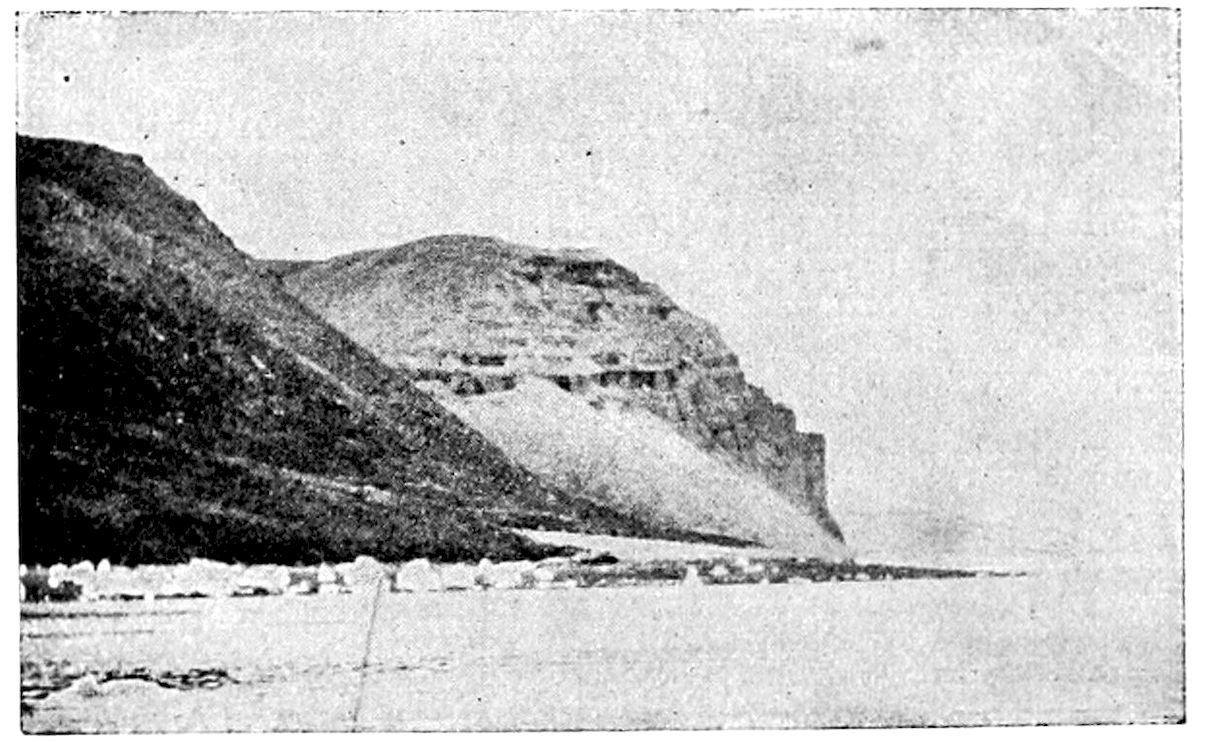
Rugged cliffs of sandstone, some sixteen hundred to eighteen
hundred feet high, in which the volcanic forces have built up
long black walls of basalt, rise steeply behind us, and over
their tops the eternal ice-cap is plainly visible. Only a few
paces from the base of the knoll are the silent and still partially
ice-covered waters of the bay, which extends five miles
or more over to the opposite shore, and perhaps three times
that distance eastward to its termination. A number of
lazy icebergs still stand guard between us and the open
waters of the western horizon, where the gray and ice-flecked
bluffs of Northumberland and Hakluyt Islands disappear
from sight.
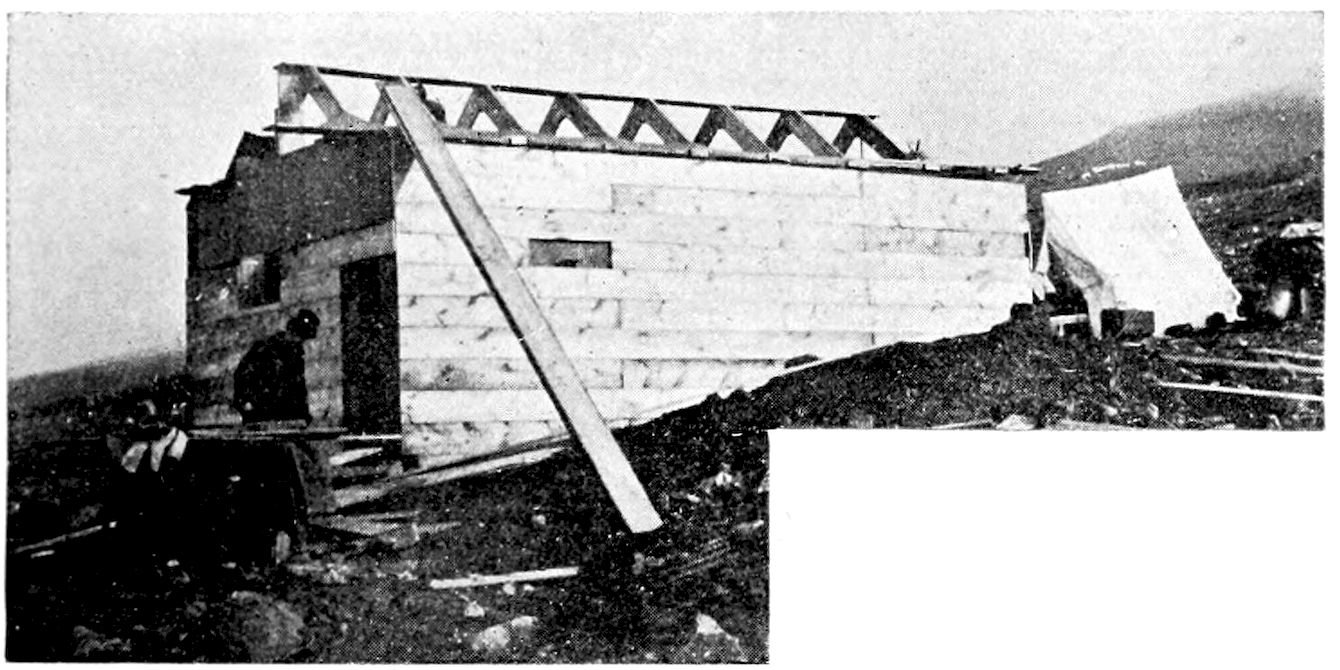
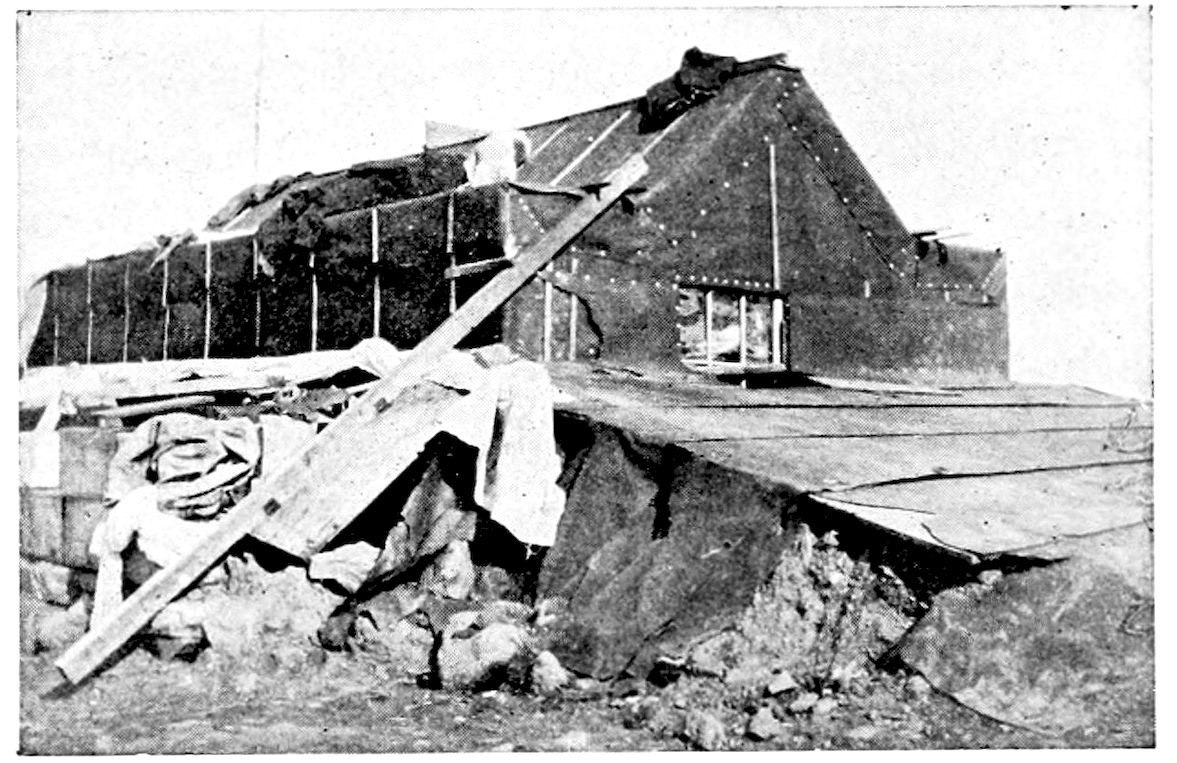
ON THE BEACH OF McCORMICK BAY.
33This morning the members of our party went ashore with
pickaxes and shovels, and they are now digging the foundations
of our “cottage by the sea.” They are also putting up
a tent for our disabled commander, whence he can superintend the erection of the structure. The men are working in
their undershirts and trousers, and it is quite warm enough for
me to stay on deck without a wrap, even when I am not exercising;
yet, if we had this temperature at home, we should consider
it decidedly cool. I have had oil-stoves taken ashore for
the purpose of heating the tent in case it becomes necessary.
Our “Cottage by the Sea.”
Wednesday, July 29. The last three days have been busy
ones for me, being obliged to attend to all the packing and
unpacking myself, besides
waiting on Mr.
Peary. Monday, after
dinner, the boys finished
digging the foundations. Mr. Peary was then strapped to a
board, and four men carried him from the “Kite” into a boat.
After crossing the bay he was carried up to the tent just
back of where the house is being erected, and placed on
a rough couch. He is near enough to superintend the work,
and everything is progressing favorably.
Last night was a queer one for me. All the boys slept on
board the “Kite,” leaving me entirely alone with my crippled
34husband in the little shelter-tent on the south shore of
McCormick Bay. I had forgotten to have my rifle brought
ashore, and I could not help thinking what would be the best
thing for me to do in case an unwelcome visitor in the shape
of a bear should take it into his head to poke his nose into
the tent. While I was lying awake, imagining all sorts of
things, I heard most peculiar grunts and snorts coming from
the direction of the beach, and on looking out saw a school of
white whale playing in the water just in front of our tent.
They seemed to be playing tag, chasing each other and diving
and splashing just like children in the water. I was surprised
at their graceful movements as they glided along, almost
coming up on the beach at times. The night passed uneventfully,
but I decided to have Matt sleep on shore to-night,
should the others go on board the “Kite” again. In case of
a sudden wind-storm I could not steady the tent alone, and
some one ought to be within calling distance.
As the members of the returning party come to bid us
good-by it makes me feel very, very homesick; but a year
will soon pass, and then we too shall return home. The professor
has kindly offered to see mama, and do for her what
he can in the way of keeping her posted.
Early Thursday morning, July 30, those of our party who
had slept aboard ship—that is, all except Mr. Peary, Matt, and
myself—were aroused and told they must “pull for the
shore,” as the “Kite” was going to turn her nose toward
35home. Not being accustomed to the duties of housekeeper
and nurse, I was so completely tired out that I slept soundly
and knew nothing of the cheers and farewell salutes which
passed between the little party who were to remain in the far
North, and those on board the “Kite,” who would bring our
friends the only tidings of us until our return in ’92. Mr.
Peary remarked on the cheerfulness of our men. Less than
five minutes after the boat grated on the beach he heard the
sound of the hammer and the whistling of the boys.
Three or four hours after the “Kite” left McCormick Bay
a furious wind and rain storm swept down upon us from the
cliffs back of our house. The boys continued the work on
the roof as long as possible, hoping to be able to get the
whole house under cover, but the fury of the storm was such
as to make it impossible for them to keep their foothold on
the rafters, and they were obliged to seek shelter under what
there was of the roof. At meal-time they all crowded in our
little 7 × 10 canvas tent, sitting on boxes and buckets, and
holding their mess-pans in their laps. These I supplied with
baked beans, stewed corn, stewed tomatoes, and corned beef,
from the respective pots in which they had been prepared.
The rain dashed against the tent, and the wind rocked it to
and fro. Every little while one of the guy-ropes would snap
with a sound like the report of a pistol, and one of the boys
would have to put his dinner on the ground and go out
into the storm and refasten it, for these ropes were all that
kept our little tent from collapsing. The meal completed,
36the boys returned to the house, where they had more room,
even if they were not more comfortable.
I never shall forget this wretched night following the departure
of the “Kite.” The stream which rushed down the
sides of the cliffs divided just back of the tent, and one arm
of it went round while the other came through our little
shelter. The water came with such force that in a few
moments it had made a furrow down the middle of the tent
floor several inches deep and nearly the entire width of the
floor space, through which it rushed and roared. All night
long I was perched tailor-fashion on some boxes, expecting
every moment to see the tent torn from its fastenings and the
disabled man lying by my side exposed to the fury of the
storm. Our only comfort, and one for which we were duly
thankful, was that during this “night” of storm we had constant
daylight; in other words, it was just as light at two
o’clock in the morning as it was at two o’clock in the afternoon.
When it was time for breakfast, I lighted the oil-stove,
which I had fished out of the water just as it was about to
float away, and made some coffee, and we breakfasted on
coffee, biscuit, and corned beef.
This state of affairs continued until the afternoon, when
the storm finally abated and the boys began work again on
the roof. The water in the tent subsided, and by putting
pieces of plank down I could again move about without sinking
into the mud, and I at once set to work to get the boys a
square meal.
37By Saturday morning our habitation was under cover, the
stove put up temporarily, with the stovepipe through one of
the spaces left for a window, and a fire made from the blocks
and shavings that had escaped the flood. The house was
soon comparatively dry,—at least it did not seem damp when
compared with the interior of the tent,—and Mr. Peary was
carried in and placed on a bed composed of boxes of provisions
covered with blankets. Although we had no doors or
windows in place, we felt that it might rain and storm as
much as it pleased, and it would not interfere with finishing up
the house and getting the meals, two very important items
for us just then.
Gradually our home began to have a finished appearance:
the inside sheathing was put on, and the doors and windows
put in place. We had no more violent wind-storms, but it
rained every day for over a week. At last, on August 8,
there was no rain; and, as it was Matt’s birthday, Mr. Peary
told the boys after lunch to take their rifles and bring in a
deer. One of the rules of our Arctic home was that each
member’s birthday should be celebrated by such a dinner as
he might choose from our stock of provisions. Before going
out Matt chose his menu, which I was to prepare while the
hunters were gone. The plum-duff, however, he mixed himself,
as he had taken lessons from the cook on board the
“Kite.” After every one had gone, Mr. Peary surprised me
by saying he intended to get up and come into the room
where I was preparing the dinner. Only the day before the
38doctor had taken his leg out of the box and put it in splints,
and he had been able for the first time since July 11 to turn
on his side. I tried to persuade him to lie still for another
day, but when I saw that he had set his heart on making the
effort, I bandaged up the limb and helped him to dress.
Then I brought him the crutches which Dr. Cook had made
while we were still on board the ship, and with their aid he
came slowly into the other room. Here, through the open
door, he could watch the waves as they rose and fell on the
beach about one hundred yards distant, while I prepared the
“feast.” The bill of fare that Matt selected was as follows:
Mock-turtle soup.
Stew of little auk with green peas.
Broiled breasts of eider-duck.
Boston baked beans, corn, tomatoes.
Apricot pie, plum-duff with brandy sauce.
Sliced peaches.
Coffee.
With the soup I served a cocktail made by Mr. Peary after
a recipe of his own, and henceforth known by our little party
as “Redcliffe House cocktail”; with the stew, two bottles of
“Liebfrauenmilch”; and with the rest of the dinner, “Sauterne.”
About five o’clock we heard the shouts of the boys,
and on going out I saw them coming down the cliffs heavily
laden with some bulky objects. I rushed in and reported the
facts in the case to Mr. Peary, who immediately said, “They are
39bringing in a deer. Oh, I must get out!” So out he hobbled,
and to the corner of the house, where he had a good view of
the returning hunters. As soon as he saw them he said, “Get
me my kodak. Quick!” and before the boys had recovered
from their surprise at seeing Mr. Peary, whom they had left
confined to his bed, standing on three legs at the corner of
the house, the first hunting-party sent out from Redcliffe had
been immortalized by the ever-present camera. The boys
were jubilant over their success, and brought back appetites
that did justice to the dinner which was now nearly ready.
At six o’clock we all sat down at the rude table, constructed
by the boys out of the rough boards left from the house, and
just large enough to accommodate our party of seven. We
had not yet had time to make chairs, so boxes were substituted,
and we managed very nicely. We had no table-cloth,
and all our dishes were of tin, yet a merrier party never sat
down to a table anywhere. Three days afterward we repeated
the feasting part of the day, with a variation in the bill of
fare, in honor of the third anniversary of our marriage, and
this time we sampled the venison, which we found so delicious
that the boys were more eager than ever to lay in
a stock for the winter.
The next day, August 12, Mr. Peary sent all the boys, except
Matt, in one of our whale-boats, the “Faith,” to search
Herbert and Northumberland Islands for an Eskimo settlement,
and if possible to induce a family to move over and
settle down near Redcliffe House. The man could show us
40the best hunting-grounds, and assist in bagging all kinds
of game, while the woman could attend to making our skin
boots, or kamiks, and keeping them in order. They were also
instructed to visit the loomeries, as the breeding places of the
birds are called, and bring back as many birds as possible.
During their absence Matt was at work on our protection
wall of stone and turf around Redcliffe, and Mr. Peary busied
himself as best he could in making observations for time,
taking photographs, and pressing flowers and other botanical
specimens which I gathered for him. He even ventured part
of the way up the cliffs at the back of the house, but this was
slow and laborious work. The ground was so soft that his
crutches would sink into it sometimes as much as two feet.
The weather continued bright and balmy, and I did not feel
the necessity of even a light wrap while rambling over the
hills. What I did long for was an old-fashioned sunbonnet
made of some bright-colored calico, and stiffened with strips
of pasteboard, for the sun was burning my face and neck very
badly. The boys returned at the end of a week, bringing
with them a native man named Ikwa; his wife, Mané; and
two children, both little girls—Anadore, aged two years and
six months, and a baby of six months, whom we called Noyah
(short for Nowyahrtlik).
CHAPTER IV HUNTS AND EXPLORATIONS
41
Ikwa and his Family—Present of a Mirror—August Walrus Hunt—Preparations
for Sending out the Depot Party—Departure for Head of McCormick Bay—First
Herd of Reindeer—Exciting Experiences in Tooktoo Valley—Packing
the Things up the Bluffs—The Inland Ice Party Off—Return to Redcliffe—A
Foretaste of Winter.
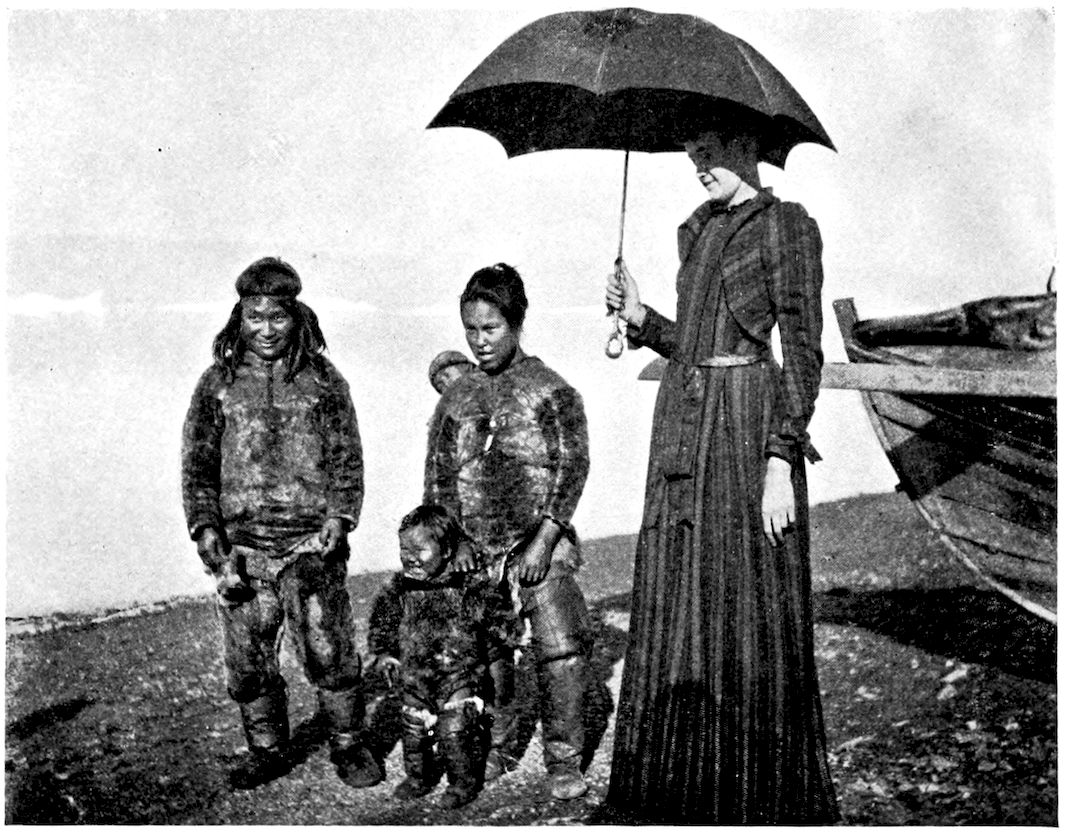
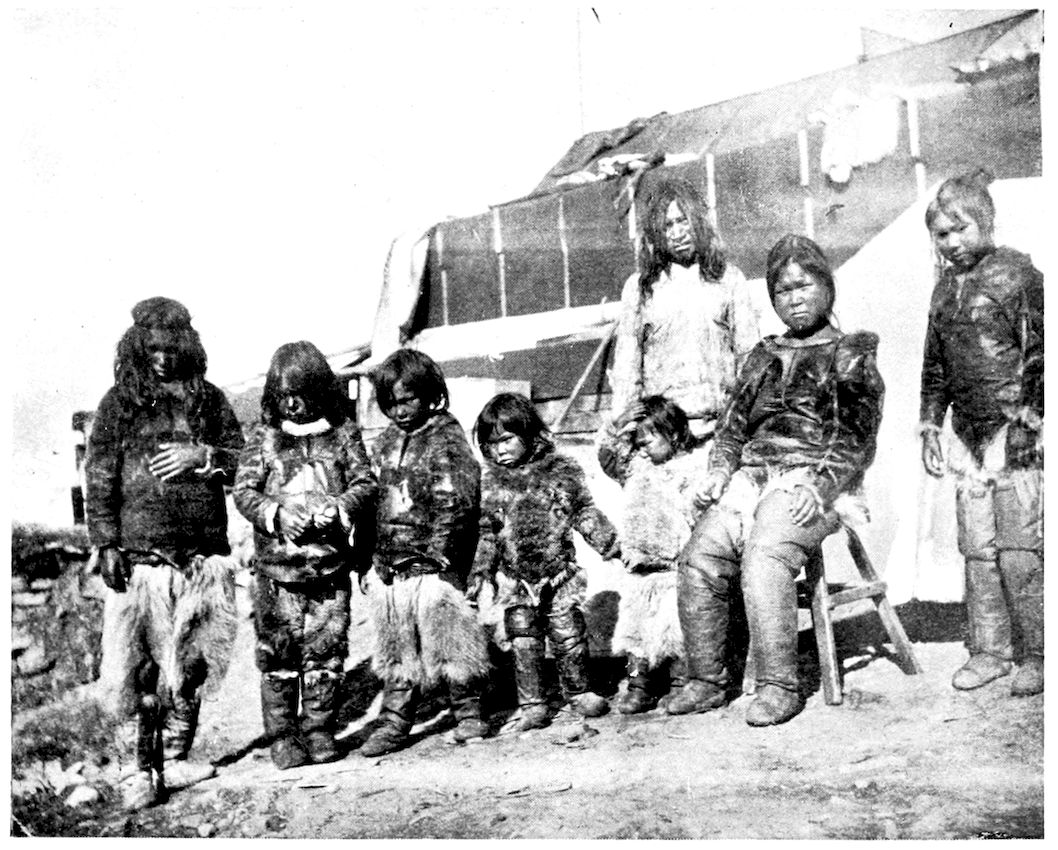
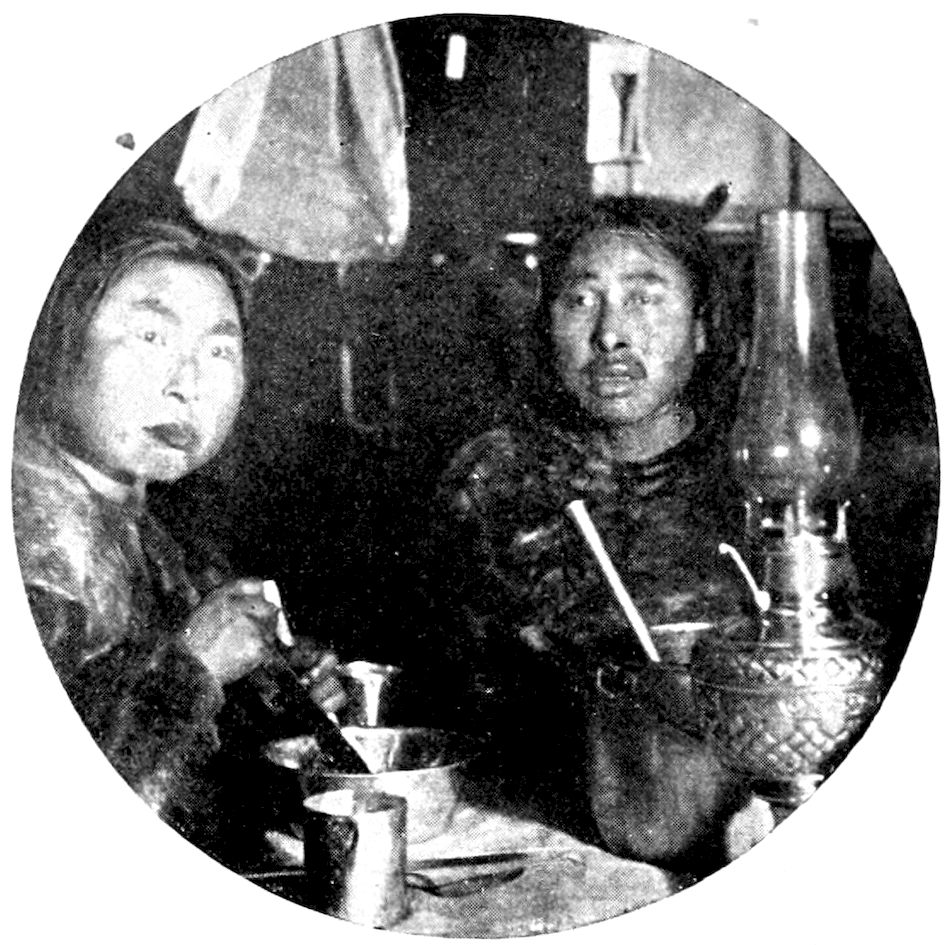
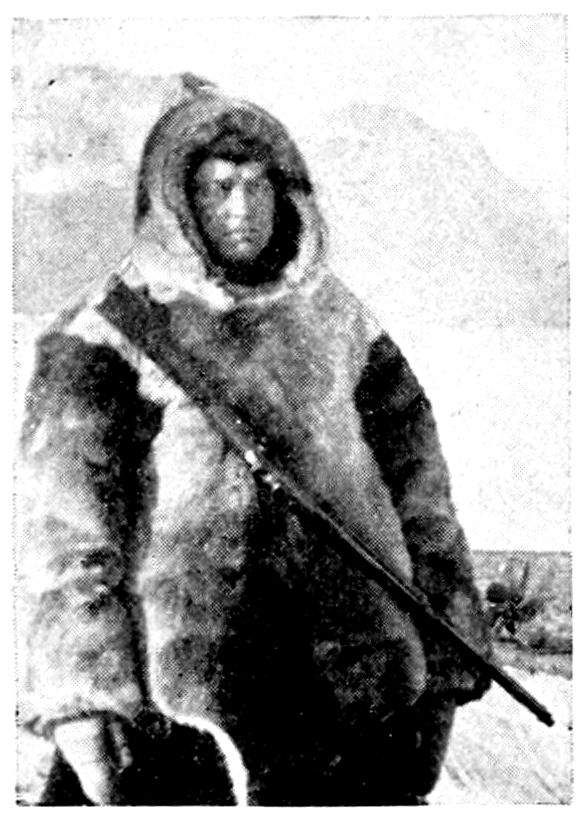
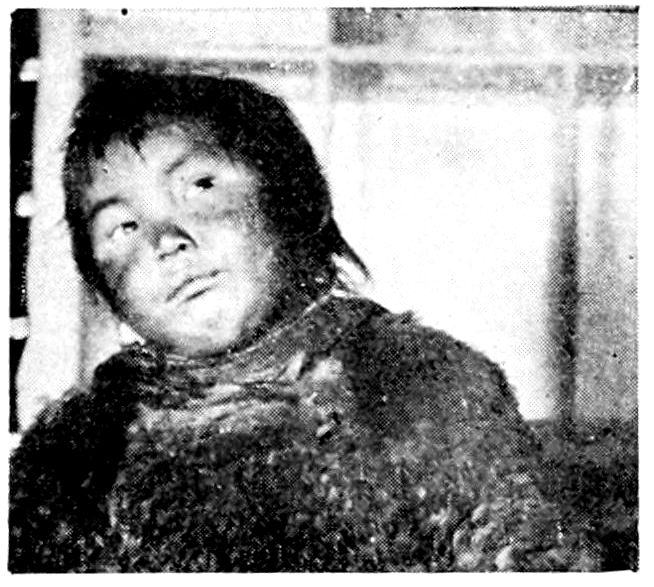
These Eskimos were the queerest, dirtiest-looking individuals
I had ever seen. Clad entirely in furs, they reminded
me more of monkeys than of human beings. Ikwa, the man,
was about five feet two or three inches in height, round as a
dumpling, with a large, smooth, fat face, in which two little
black eyes, a flat nose, and a large expansive mouth were
almost lost. His coarse black hair was allowed to straggle in
tangles over his face, ears, and neck, to his shoulders, without
any attempt at arrangement or order. His body was covered
with a garment made of birdskins, called by the natives
“ahtee,” the feathers worn next the body, and outside of this
a garment made of sealskin with the fur on the outside, called
“netcheh.” These garments, patterned exactly alike, were
made to fit to the figure, cut short at the hips, and coming to
a point back and front; a close-fitting hood was sewed to the
neck of each garment, and invariably pulled over his head
42when he was out of doors. His legs were covered with sealskin
trousers, or “nanookies,” reaching just below the knee,
where they were met by the tanned sealskin boots, called by
the natives “kamiks.” We learned later that sealskin trousers
were worn only by
those men who were
not fortunate enough
or able to kill a bear.
In winter these men
wear dogskin trousers,
which are as warm as
those made of bearskin,
but not nearly so
stylish. Winter and
summer the men wear
stockings reaching to
the knee, made of the
fur of the Arctic hare.
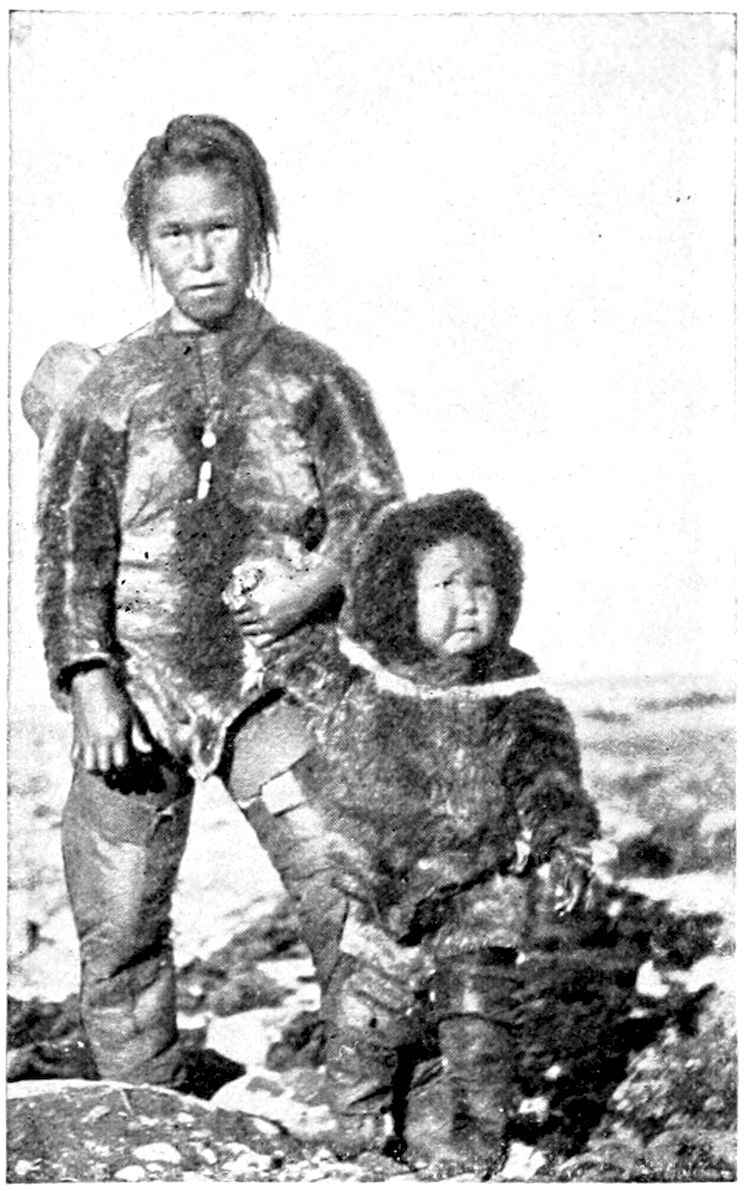
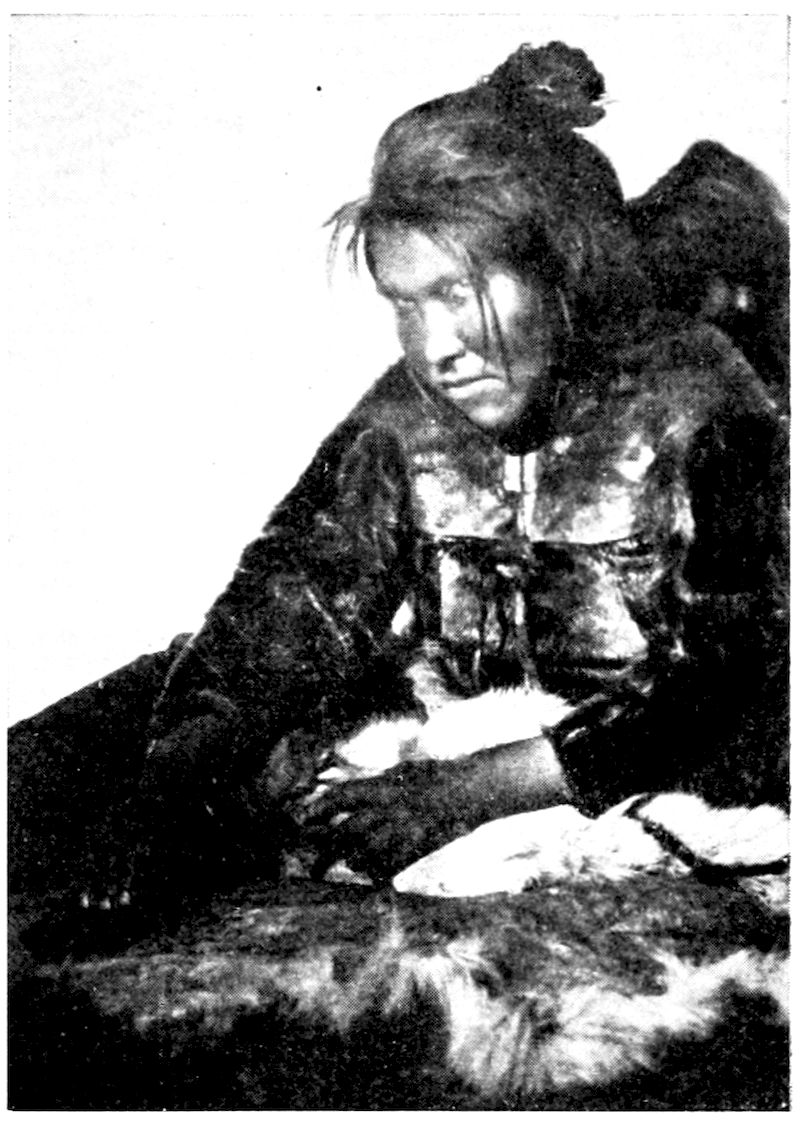
Mané and Anadore
At first I thought
the woman’s dress was
identical with that of
the man, and it puzzled
me to tell one from
the other; but in a
day or two I had made out the many little differences in the
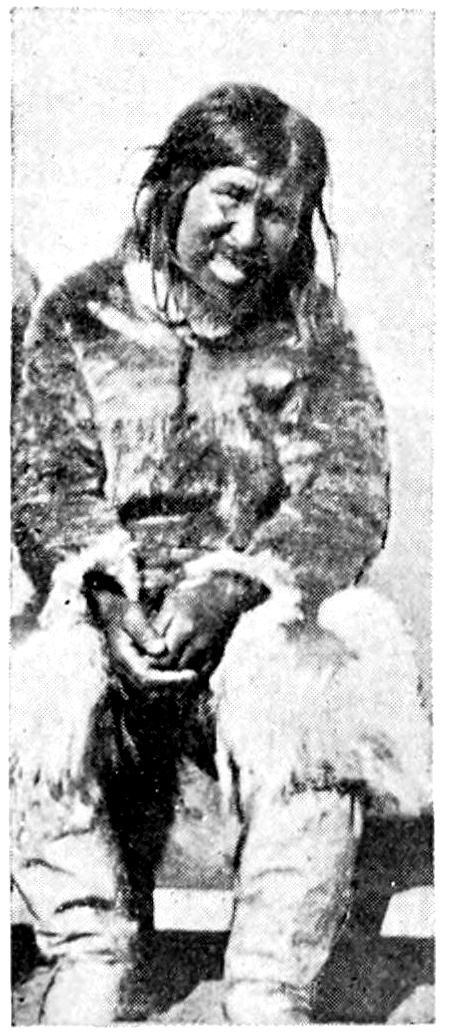
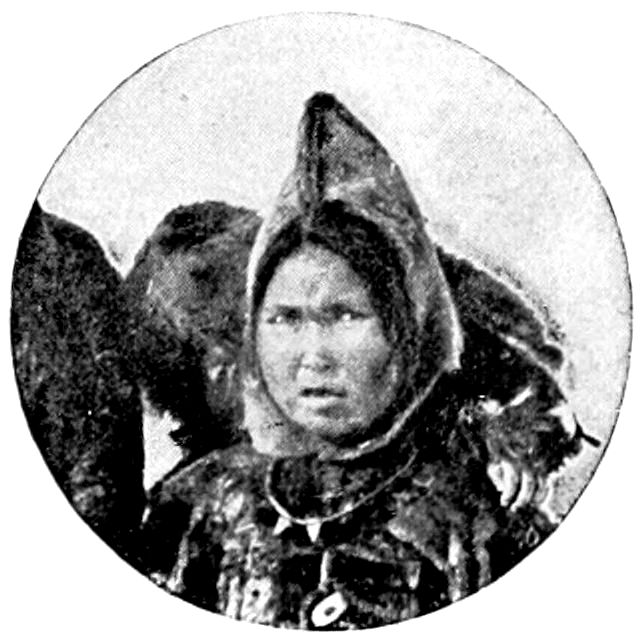
costumes. The woman, like the man, wore the ahtee and
netcheh made respectively of the birdskins and sealskin.
43They differed in pattern from those of the man only in the
back, where an extra width is sewed in, which forms a pouch
extending the entire length of the back of the wearer, and
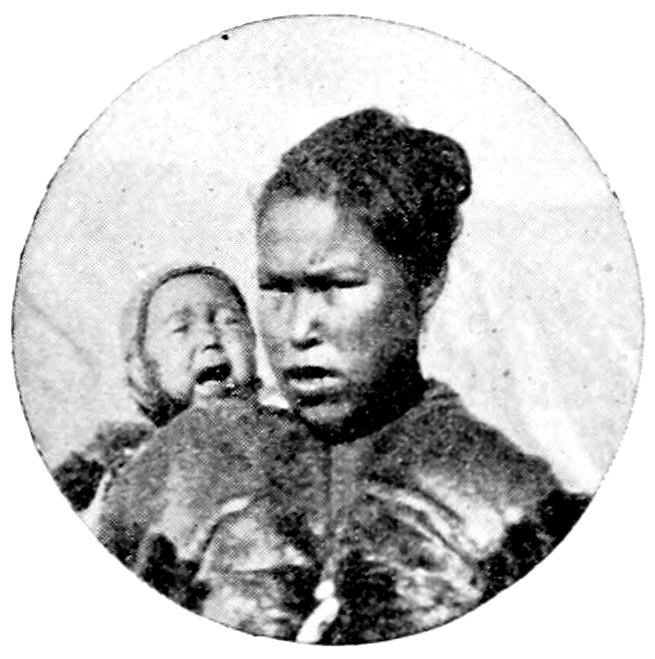
fitting tight around the hips. In this pouch or hood the baby
is carried: its little body, covered only by a shirt reaching to
the waist, made of the skin of a young blue fox, is placed
against the bare back of the mother; and the head, covered by
a tight-fitting skull-cap made of sealskin, is allowed to rest
against the mother’s shoulder. In this way the Eskimo child
is carried constantly, whether awake or asleep, and without
clothing except the shirt and cap, until it can walk, which is
usually at the age of two years; then it is clothed in skins,
exactly as the father if it is a boy, or like the mother if a girl,
and allowed to toddle about. If it is the youngest member
of the family, after it has learned to walk it still takes its place
in the mother’s hood whenever it is sleepy or tired, just as
American mothers pick up their little toddlers and rock them.
The woman’s trousers, or nanookies, are made of foxskin,
and are hardly anything more than “trunks”; these are met
by the long-legged boots, or kamiks, made of tanned sealskin,
and the long stockings, or “allahsy,” of reindeer fur. Altogether
this family appeared fully as strange to us as we did
to them. They had never before seen woven material, and
could not seem to understand the texture, insisting that it was
the skin of some animal in America.
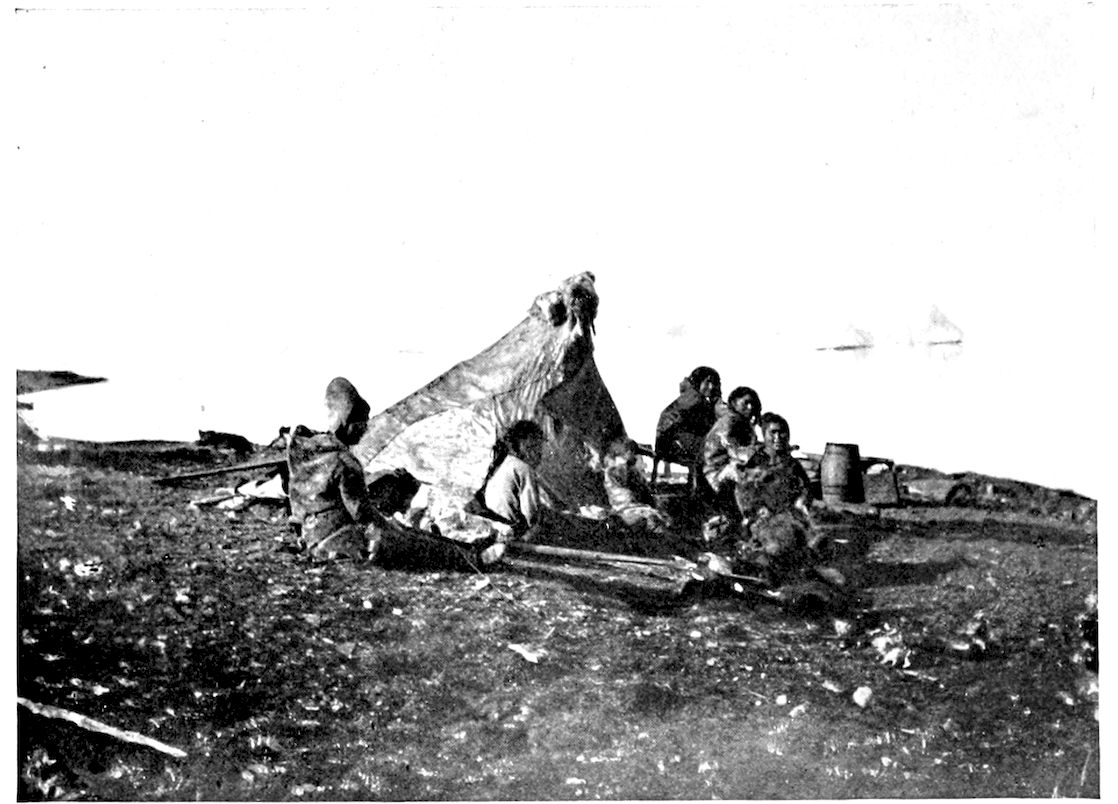
They brought their dog, a sledge, a tent, a kayak (or canoe),
and all their housekeeping utensils and articles of furniture,
44which consisted of two or three deerskins, on which the family
slept; a stove made of soapstone and shaped like our dust-pans,
in which they burned seal fat, using dried moss as a wick; and
a dish or pot made of the same material, which they hung
over their stove, and in which they melted the ice for drinking
purposes and also heated their seal and walrus meat (I say
heated, for we would hardly call it cooked when they take it
out of the water). The skin tent put up, and these articles
put in place, the house was considered furnished and ready
for occupancy. Wood being almost impossible to procure, the
tent was put up with narwhal tusks, which are more plentiful
and answer the purpose. The tent itself is made of sealskin
tanned and sewed together with narwhal sinews. These people
were very curious to see the white woman, who, they were
given to understand, was in the American “igloo” (house);
and when Mr. Peary and I came out, they looked at both of
us, and then Ikwa asked, “Soonah koonah?” Of course we
did not know then what he wanted, but he soon made us
understand that he wished to know which one of the two was
the woman. I delighted him, and won his lasting favor, by
making him a present of a knife. His wife, Mané, was almost
overwhelmed by a gift of some needles; while Anadore, the
elder of the two children, amused herself by making faces at
her image in a small mirror that I had presented to her. It
was the first time these people had seen themselves, and the
parents were as much amused as the children. They asked
many questions, but as we could not understand them any
more than they knew what we were talking about, the whole
conversation was decidedly more amusing than instructive.
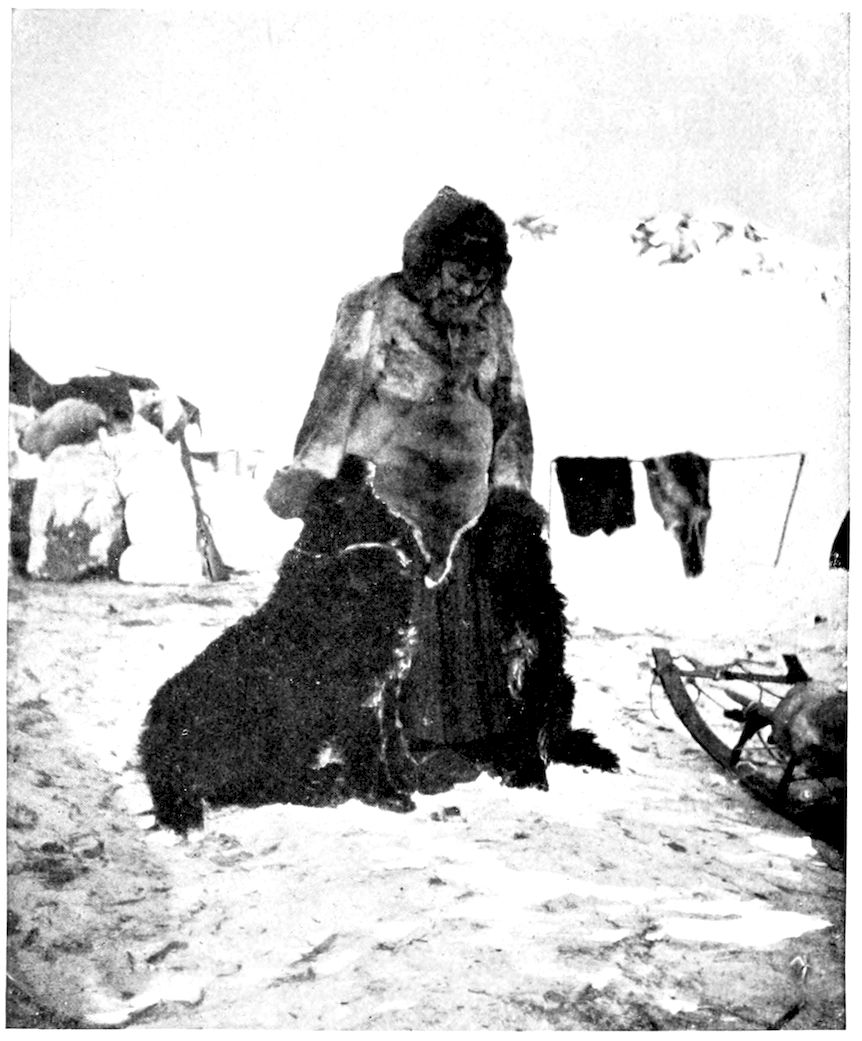
A SUMMER DAY.—IKWA AND FAMILY.
45
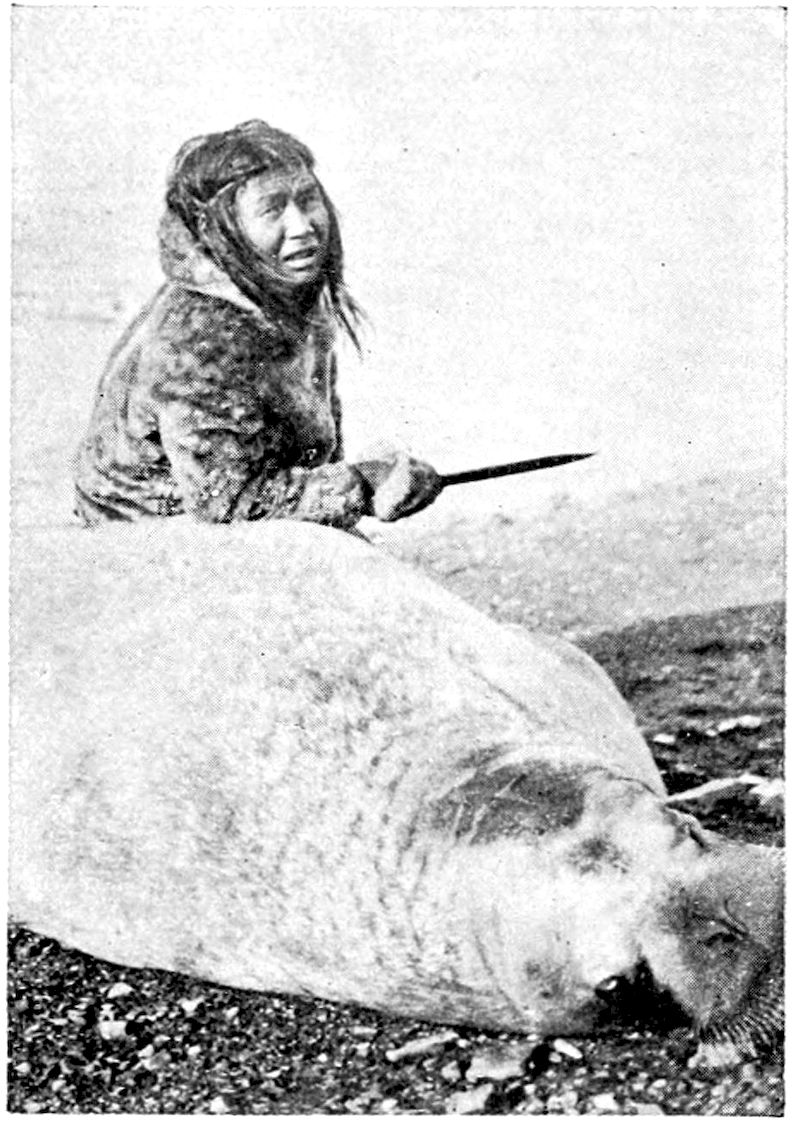
Ikwa and his Quarry.
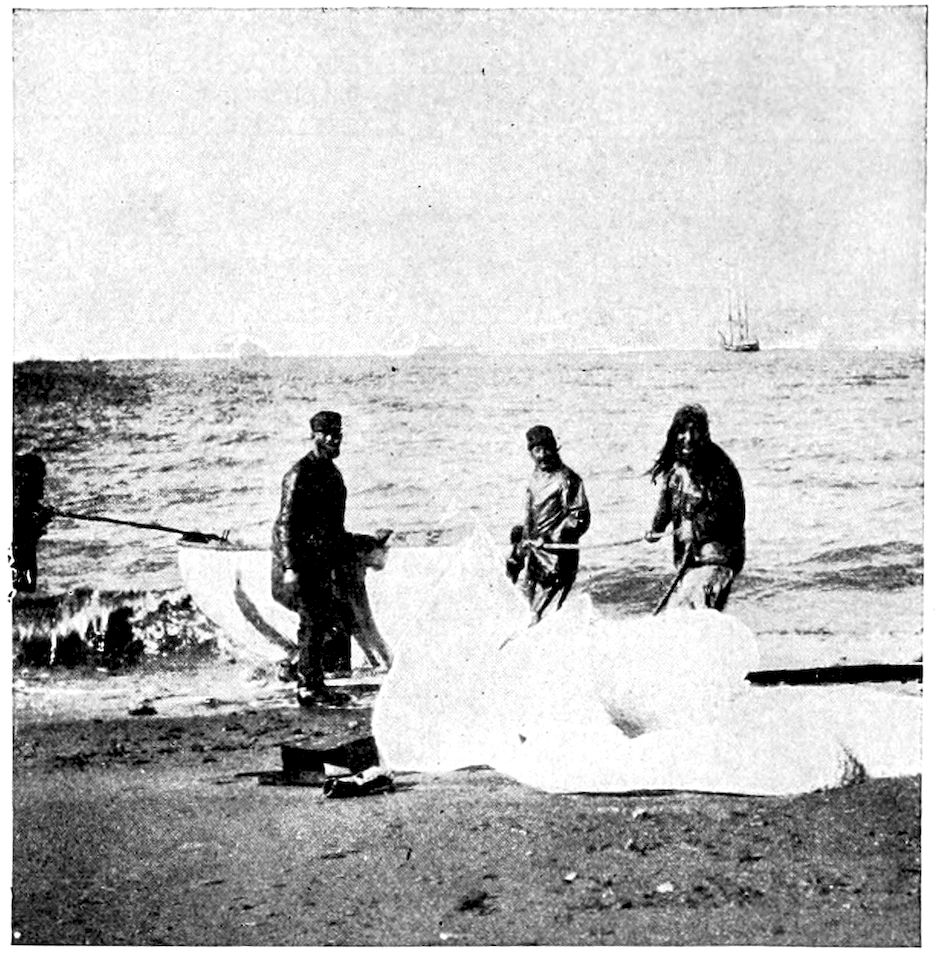
Later in the day the boys launched the whale-boat, and Mr.
Peary, Gibson, Verhoeff, Matt, and myself, with our new man
Ikwa, went down to Cape Cleveland, two and a half miles
from Redcliffe, where the boys had beached a walrus killed by
them while crossing Murchison Sound. It was very interesting
to watch Ikwa cut
up this enormous animal,
weighing more
than 1500 pounds, with
an ordinary six-inch
pocket-knife. So precisely
did he know just
where every joint was,
that not once did he
strike a bone, but cut
the entire animal up
into pieces which could
be easily handled by
one man, as though
it had been boneless.
This done, the pieces
were packed in the
boat, preparatory to taking them to Redcliffe. Here at Cape
Cleveland we found the grass very green, and in places
over two feet high. This unusual growth is explained by the
46presence of blubber caches, seal caches, and the ruins of an
Eskimo village. We gathered many flowers, among which the
yellow Arctic poppy was the most prominent, and also shot a
number of little auk and a few gulls and eider-ducks. Mr.
Peary hobbled along the beach on his crutches, around the
cape, and had his first view up Whale Sound and Inglefield
Gulf. On our return to Redcliffe, all the meat was hung up
back of the house to be used in the winter for dog-food and
as an occasional treat for our Eskimo family. It was a little
too strong for our taste, and we decided we would resort to it
only in case we were unsuccessful in getting deer.
A few days after this, early in the morning, Ikwa came
running into our house, apparently much excited, crying,
“Awick! Awick!” This we had learned was walrus. The
boys tumbled out of their beds, and in a very few moments were
in the boat with Ikwa, pulling in the direction of a spouting
walrus out in McCormick Bay. In a short time they returned
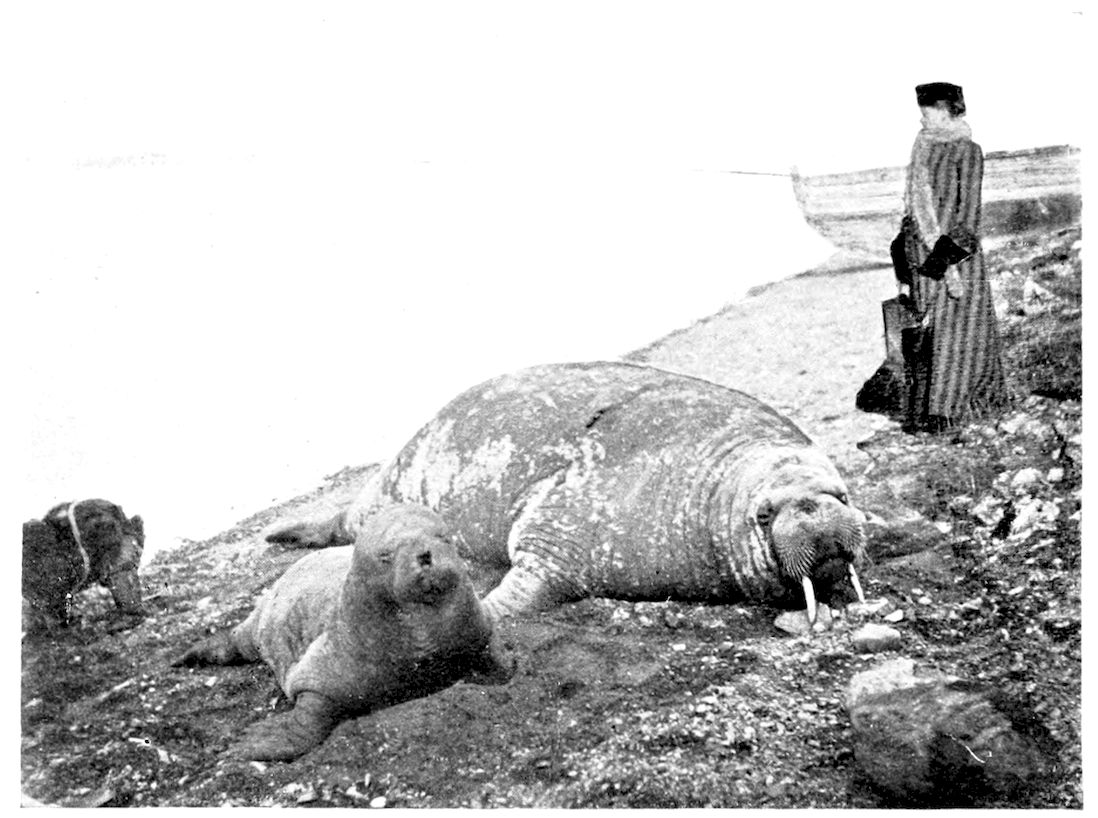
with a large mother walrus and her baby in tow. The mother
had been killed, but the baby—a round bundle of fat about
four feet long—was alive, and very much so, as we found out a
little later. Mr. Peary wanted to get photographs of the little
thing before it was shot, and while he was dressing, a task
which was of necessity slow, the boys came into the house,
leaving the baby walrus about a hundred yards up on the
beach. Suddenly we heard cries for help coming from the
shore. On stepping to the window, I saw one of the most
comical sights I had ever seen. The little walrus was slowly
47but surely making his way to the waters of the bay. Mané
with her baby on her back was sitting in the sand, her heels
dug into it as far as she could get them, holding on to the line
attached to the walrus, without apparently arresting its progress
in the least, for she was being dragged through the
gravel and sand quite rapidly. While I looked, Matt came
rushing to her assistance, and taking hold of the line just
ahead of where Mané held it, he gave it one or two turns
about his wrists, and evidently thought all he had to do
would be to dig his heels into the sand and hold back; but
in an instant he was down in the sand too, and both he and
Mané were plowing along, the sand flying, and both shouting
lustily for help. So strong was this little creature that had
not the other boys rushed out and secured him, he would
easily have pulled Matt and Mané to the water’s edge, where,
of course, they would have let him go, and he would have
been a free walrus once more. I have always regretted that I
did not get a “kodak” of the scene.
It was now the end of August, and active preparations
were in progress for sending a party with provisions to establish
an advance depot on the inland ice for the spring sledge
journey across the great ice desert to the northern terminus
of Greenland. It was decided that Astrup, Gibson, and Verhoeff
should go on this trip, while Dr. Cook and Matt remained
with Mr. Peary and myself at Redcliffe.
On September 3, all arrangements having been perfected
for the inland ice-party, every one in the settlement, except
48Matt and Mané with her children, sailed for the head of
McCormick Bay, where it had been decided that the boys
should ascend the cliffs and attack the ice. Redcliffe House
is about fifteen miles from the head of the bay, and this
distance had to be rowed, for we got no favoring breeze. It
was late in the evening when we rounded a point of land
whence we could see the green valley stretching from the
water’s edge back to the giant black cliffs, which here form
the boundaries of the inland ice. The landscape was a beautiful
one. As I looked I beheld moving objects on one of the
hillsides, which, seen through the glass, seemed to me to be
the size of a cow. We at once knew they were reindeer, and
their apparent size was due to mirage. Astrup was landed
with a Winchester at a point where he could go round and
come upon the grazing herd from behind the hill; it was
hoped they would not see him, and that he would bag quite a
number. After landing Astrup we kept on until we were
opposite the center of the valley; here our boat was run
ashore, and we decided to camp.
Mr. Peary told me to take a run over the rocks and down
the valley in order to get warm, as I had become chilled from
sitting in the boat and not exercising for several hours; so
after seeing him safely on the little knoll about twenty feet
above the shore-line, where we intended to make camp, I
strolled away. Upon climbing the hill, just back of the camping-ground,
I came in sight of the herd of deer which we had
seen from the boat, and as I watched them I saw the smoke
49and heard the report of Astrup’s rifle. In an instant they
were scampering off in every direction, and although Astrup
fired shot upon shot not one dropped. One of the animals,
however, after running some distance, stumbled and fell, lay
still for an instant, then got up, ran on a few yards, and fell
again. As it did not rise I judged it had received one of
Astrup’s bullets, and forgetting how deceptive distances are
in the pure, clear air, I started on the run toward the prostrate
creature, apparently not more than a mile distant. Happening
to look back, I saw Dr. Cook and Ikwa coming in my
direction, and waited for them. On reaching me the doctor
said they were on their way to help Astrup bring in his game.
I called his attention to the little white spot on the green
grass, and told him it was a deer, and that I had seen it drop.
As we could see nothing of Astrup, we decided to take care
of the animal. Dr. Cook had his rifle loaded with twelve
cartridges, Ikwa had a muzzle-loader charged, and an extra
load for it besides, and I had on my cartridge-belt and revolver
(a 38–caliber Colt). After walking—or trotting would
perhaps express it better—for some distance, we came to a
stream that flowed down the center of the valley throughout
its length, which we had to cross in order to reach our destination.
Fortunately the doctor had on his long-legged rubber
boots, for we soon saw that the only way to get on the other
side was to wade the stream. We tried it at different places,
and finally the doctor found a place where he could cross.
First taking his rifle and my revolver and belt of cartridges
50over, he returned for me and carried me across; then we
continued in the direction of the white spot, which all this
time had not moved. After traveling for nearly an hour we
were near enough to see that beside the prostrate deer stood
a tiny black-and-white creature, a fawn. Whether it saw us
and whispered to its mother, I do not know; but immediately
after we had made out the little one, the mother deer raised
her head, looked at us, then rising slowly, started off at a
moderate walk. We quickened our steps, and so did she.
When within three hundred yards, Dr. Cook discharged his
rifle several times, but only succeeded in wounding her in the
fore leg, which did not seem to retard her progress in the least.
Several times we were near enough to have shot her without
any trouble, but we were so excited—a case of buck-fever, I
believe the hunters call it—that she escaped every shot. To
add to our difficulties the deer made for a neighboring lake,
and in the effort to stop her before she reached it, we fired
shot after shot until the doctor’s rifle was empty. There was
now nothing for us to do but stand around and crouch behind
the boulders in the hope that the poor wounded animal would
come ashore within pistol-shot range. It was evident that she
was too weak to swim across, and it was very touching to see
how the little fawn would support its mother in the water.
Once or twice she tried to climb out on the ice-foot, but the
ice was not strong enough, and broke beneath her weight. We
were thoroughly chilled and hungry by this time, but disliked
the idea of returning empty-handed to camp after such a long
51absence. At last, just as we were talking of returning, we
saw Astrup in the distance, and called to him to join us. When
he came up to us he said he had had no luck. He had a few
cartridges left in his rifle, which he expended on our victim
without, however, harming her in the least. Astrup then
urged us to return, as he, too, was tired out; but we were
loath to leave our wounded deer, especially as we now knew
it was only a matter of time when we should get her, for she
could not hold out much longer. Nearer and nearer she came
to the ice, finally leaning against the edge as if to gather
strength, when suddenly the doctor darted over the ice-foot
into the icy water, and before the startled animal realized his
intention, he had her by her short horns, which were still in
the velvet, and was pulling her slowly ashore. The little one
then left its mother for the first time, ran as fast as it could
over the rocks, and disappeared behind the cliffs.
The doctor had some trouble in pulling the wounded animal
out on the ice, which kept constantly breaking. All this time
he was standing knee-deep in the ice-cold water, and before
long he had to call to us to relieve him, his feet and legs being
so numb that he could stand it no longer. As Astrup had on
low shoes, he did not feel like wading out to the doctor, who
was rubbing and pounding his feet, so I went to his relief.
My oil-tan boots kept the water out for some time. Although
I could not drag the poor creature out on the ice, still I had
no difficulty in holding her, as she made no resistance whatever.
After the doctor had somewhat restored his circulation,
52he came to me, and together we pulled the wounded animal
out. Then I was asked to kill her with my revolver, but I
could not force myself to do it, and Astrup took the weapon
and put her out of her misery. We placed the body on a
large flat rock, piled boulders on it, and left it. Both Dr.
Cook and I were thoroughly cold by this time, and we all
hurried toward camp. It was now nearing midnight, and I
had been away from camp since six o’clock. It was hard to
realize the time of day, as the sun was shining just as brightly
as in the early afternoon. We soon reached the river, and
across it the poor doctor had to make three trips: first to carry
the rifles over, then to come back for me, and then to go after
Astrup. As this last load weighed 183 pounds, and the current
was very swift, progress was of necessity slow. The doctor
had to feel his way, and did not dare to lift his feet from
the bottom. At last we were all safely over. Ikwa, who had
taken off his kamiks and stockings and waded the stream, was
lying flat on his back on a mossy bank nearly convulsed with
laughter at the sight of the doctor carrying Astrup. Once
across the river we redoubled our speed, and soon reached
camp, where I found Mr. Peary, with Gibson and Verhoeff,
anxiously awaiting me.
The next two days the boys spent in packing their provisions
and equipment over the bluffs to the edge of the ice,
while I stayed in camp and cooked, and Ikwa put in his time
hunting. On the fourth day, Monday, September 7, right after
lunch, the boys left with their last load, and in spite of the
snow, which had been falling lightly all day, determined to
keep on to the inland ice. Dr. Cook accompanied them, helping
them carry their provisions to the edge of the ice, and on
his return we were to start for Redcliffe.
LOOKING DOWN INTO THE SUN GLACIER FJORD FROM THE ICE-CAP.
53
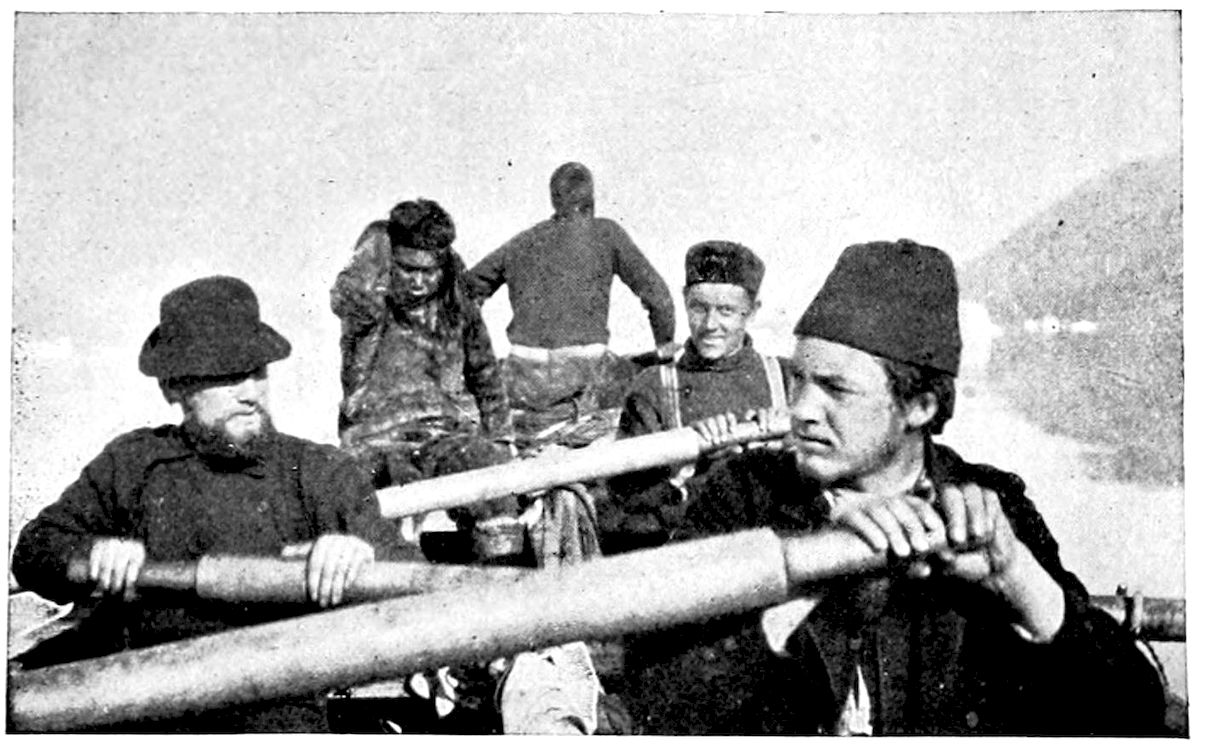
The Crew of the “Faith.”
Cook. Ikwa. Gibson. Astrup. Verhoeff.
Just as everything had been stowed away in the boat, a
wind-storm came down upon us which threatened to blow our
little craft upon the rocks. The sea was rough and the wind
cold, which made the time of waiting for the doctor seem
very long. At last we were joined by our companion, who
told us that he had left the inland ice-party ensconced in their
sleeping-bags, and that it was snowing furiously upon the ice-cap.
When we reached Redcliffe seven hours later, we found
everything white and about ten inches of snow on the ground.
CHAPTER V BOAT JOURNEYS AND PREPARATIONS FOR WINTER
54
Return to Head of McCormick Bay for Deer—Footprints on the Shore—Successful
Deer Hunt—Meeting with the Returning Inland Ice Party—Astrup and
Gibson Make a Second Attempt on the Ice-cap—Attempted Boat Trip up
Whale Sound—Stopped by the New Ice—Exciting Battle with Walrus—Dr.
Cook and Matt Tramp to Nowdingyah’s—Last of the Boat Trips—Setting
up the Stove—My Experience with a Snow-slide—Final Return of the Inland
Ice Party—Preparing Redcliffe for Winter.
We were all pretty tired the next day, and Mr. Peary decided
to wait another day or two before starting on a second
hunting-expedition to the head of the bay. It was Thursday
morning, September 10, when we nailed up our doors and, out
of regard for “social custom,” tacked a card on the front door,
which read: “Have gone to Tooktoo Valley for two or three
days’ hunt. Visitors will please leave their cards,” and then
headed our boat eastward.
In order to avail ourselves of the breeze, we were obliged to
cross the bay and then tack. When about half-way it was
decided to run ashore and prepare lunch. As soon as the
keel of the boat grated on the sand, Ikwa jumped out to make
the bow-line fast, but he had hardly touched the ground before
he gave utterance to a cry of surprise, and pointed to footprints
in the sand. In a moment we were all excitement.
55The footprints were those of two persons walking in the direction
of Redcliffe. What a peculiar sensation it is to find signs
of human beings in a place where you believe yourself and
party to be the only inhabitants! After examining them carefully,
Ikwa said Gibson and Verhoeff had passed down the
beach that morning. This worried Mr. Peary, for the supposition
was that something must have happened to one of the
party, and the other two were bringing him to Redcliffe. He
was reassured, however, in a few minutes; for on following the
footprints a little distance, I found the prints of all three of the
boys, and we knew that the inland ice-party had returned.
Knowing that they would make themselves comfortable at the
house, Mr. Peary decided to keep on to the hunting-grounds,
which we reached in the early afternoon. During our three
days’ stay in this lovely valley, Matt and Ikwa bagged nine
deer; I myself went hunting once or twice, but without success.
Most of my time was devoted to taking photographs
of the glaciers in the vicinity, and keeping camp. The sand
along the shore was too deep and the hills were too steep for
Mr. Peary to take long walks in any direction, and he was
glad to have company in camp.
On Monday we loaded our boat with the trophies of the
chase, and sailed for home. When within three and a half
miles of the house, we saw Astrup and Verhoeff coming up the
beach, and we immediately hailed them, and pulled for the
shore. They got into the boat, and during our sail home
Astrup told of the continued storm on the ice-cap; how the
56deep snow had prevented their making more than one or one
and a half miles per day; that Verhoeff had frozen his face, and
that they had then decided to return to Redcliffe, report the
condition of the traveling, and see if Mr. Peary wished them to
keep on. After reaching Redcliffe, Mr. Peary gave the inland
ice-party a few days’ rest, and then sent them in the “Faith,”
our largest whale-boat, back to the head of McCormick Bay
to bring home their equipment and place all the provisions in
a cache which would be easily accessible. Gibson and Verhoeff
were to put in two or three days hunting deer, while
Astrup was to make a careful examination of the cliffs and
glaciers to ascertain the most practicable route to the ice-cap
with dogs and sledges. They returned in four days, and we
immediately began work changing the equipment to make it
suitable for two persons instead of three, and dried out the
sleeping-bags thoroughly. Three days afterward, September
22, Astrup and Gibson again set out for the inland ice.
57
Walrus on Ice-cake.—Off Herbert Island.
Wednesday, September 23. This morning at 9.30 Mr. Peary,
Matt, Dr. Cook, Ikwa, and myself started in the “Mary Peary”
for a trip up Inglefield Gulf. There was not a breath of air
stirring, and the boys had to row from the start. Before we
had gone a mile, several burgomasters flew over our heads, and
we next came upon a flock of eiders, but did not get within
gunshot. When just off Cape Cleveland, we caught sight of
several walrus in the middle of the bay, and made for them.
A number of shots were fired, and some of the animals were
wounded; but as Ikwa said we should be sure to find “amis-su-ar” (plenty) “awick” in the gulf, we did not wait for them
to come again to the surface. After a two hours’ rest we
proceeded up the gulf, but were stopped by the heavy new
ice, which we could almost see forming in our wake. It being
certain that we could not make further progress by the boat,
Mr. Peary decided to have a walrus-hunt for the purpose of
obtaining ivory. We could see the walrus in every direction,
and headed the boat for a cake of ice with about fifteen of the
creatures asleep on it. The boys were told to pull for all they
were worth until the order was given to stop. Mr. Peary then
took his camera, and he became so absorbed in getting his
photo just right that he forgot to give the order to stop until
the boat was so near the cake of ice that before anything
could be done she ran on it at least four feet, throwing her
bow straight up into the air. The walrus, jumping into the
water from under her, careened the boat to port until she
shipped water, throwing Matt flat on his back; then with a
58jerk (which proved to come from an animal Ikwa had harpooned)
she was righted, and we were skimming over the
water, through the new ice, towed by the harpooned walrus.
This performance lasted at least twenty minutes, during which
time the boys kept up a constant volley at the walrus that
besieged us on every side to revenge their wounded companions.
There were at least two hundred and fifty around
us at one time, and it seemed as if it would be impossible to
keep the animals from attacking us; but by steady firing
we managed to hold them at oar’s length. This kept me
busy reloading the rifles. I thought it about an even chance
whether I would be shot or drowned.
I cannot describe my feelings when these monsters surrounded
us, their great tusks almost touching the boat, and
the bullets whistling about my ears in every direction. Whenever
a volley of shots greeted them, the whole bunch jumped
into the air and then plunged under water, leaving us in doubt
as to where they would reappear. If they should happen to
come up under the boat, we should probably be the ones to
take the plunge; this uncertainty was very exciting, especially
as the brutes went down and came up in bunches, leaving us
seventy-five or a hundred to fight while the rest plunged.
Ikwa had evidently never seen so many “awick” at one
time, and became very much frightened, finally pounding the
sides of the boat with his harpoon and yelling at the top of
his voice, in which he was joined by Matt. When we finally
got out of the turmoil we had four heads with tusks, and would
59have had more, but the bodies sank before we could secure
them. As we could not proceed up the gulf in the boat, we
camped about three miles southeast of Cape Cleveland. The
boat was pulled up on a bit of sandy beach, and with the aid
of the boat-hooks and a couple of tarpaulins we fixed up a
very comfortable boat-tent.
Thursday, September 24. It was decided last night that
Matt and Dr. Cook should set out on foot for “Nowdingyah’s,”
an Eskimo camp of which we had been in search; so
we had coffee early, and by eight o’clock the boys started off
with their rifles and some pemmican.[2] About ten o’clock
the boys came in woefully tired, vowing that they had walked
forty miles, and reported finding Nowdingyah’s camp, but all
four igloos were deserted. Ikwa said that their owners were
“pehter-ang-ito” (far away) hunting; these northern Eskimos
are in the habit of leaving their settlements, to which they
periodically return.
2. It may be of interest to my readers to
know just what pemmican is. The best
lean beef is cut in strips and dried until it
can be pulverized, then it is mixed with an
equal quantity of beef suet. To this mixture
are added sugar and currants to suit the
taste, and the whole is heated through
until the suet has melted and mixed with
the other ingredients, when it is poured
into cans and hermetically sealed. It is
only a modification of the old-fashioned
way of preserving meat when whole families
drove out on the prairies and hunted
buffalo. As soon as shot the buffalo was
skinned and the green skin sewed into a
bag, into which the meat, after it had been
sun-dried and mixed with the suet, was
packed. As the skin dried and shrunk, it
compressed the meat, which in this way
was preserved indefinitely. Pemmican is
not at all unpleasant to the taste, especially
if eaten with cranberry jam.
Friday, September 25. Just before we left camp at eleven
o’clock, an amusing incident occurred. Ikwa, who had been
skirmishing for the past hour, returned in a jubilant frame of
60mind, and announced his discovery of a cached seal. He asked
Mr. Peary if he might bring the seal to Redcliffe in the boat,
saying it was the finest kind of eating for himself and family.
We could not understand why this particular seal should be so
much nicer than those he had at Redcliffe; but as he seemed
very eager to have it, we gave him the desired permission, and
off he started, saying that he would be back very soon. About
half an hour later the air became filled with the most horrible
stench it has ever been my misfortune to endure, and it grew
worse and worse until at last we were forced to make an
investigation. Going to the corner of the cliff, we came upon
the Eskimo carrying upon his back an immense seal, which
had every appearance of having been buried at least two
years. Great fat maggots dropped from it at every step that
Ikwa made, and the odor was really terrible. Mr. Peary
told him that it was out of the question to put that thing in
the boat; and, indeed, it was doubtful if we would not be
obliged to hang the man himself overboard in order to disinfect
and purify him. But this child of nature did not see the
point, and was very angry at being obliged to leave his treasure.
After he was through pouting, he told us that the more
decayed the seal the finer the eating, and he could not understand
why we should object. He thought the odor “pe-uh-di-och-soah”
(very good).
At noon we passed Cape Cleveland, homeward bound, and
an hour later reached Redcliffe. The house seemed very
cold and chilly after the bright sunshine. Verhoeff, who had
61been left in charge, greeted us, and we soon had all the oil-stoves
going, bread baking, rice cooking, beans heating, venison
broiling, and coffee dripping, and at two o’clock all sat down
to dinner and then turned in.
Tuesday, September 29. The last three days have been
spent in hunting-explorations on the north shore and in preparations
for the winter. The stove has been put up, the
windows doubled, and the house made generally air-tight.
We find the ice in the bay becoming firmer day by day, and
in one of our expeditions we found it all but impossible to
force the boat through it. Mr. Peary has now left off his
splints and bandages, and has even laid aside his crutches.
After lunch to-day I started out with a couple of fox-traps,
and put them in the gorge about a mile back of the house.
The day was fine, and I enjoyed my walk, although I came in
for an unpleasant scare. After leaving the traps, I thought I
would go over the mountains into the valley beyond, and see if
I could find deer. Half-way up, about a thousand feet above
sea-level, the snow began to slide under me, taking the shales
of sandstone along with it, and of course I went too, down,
down, trying to stop myself by digging my heels into the snow
and attempting to grasp the stones as they flew by; but I kept
on, and a cliff about two hundred feet from the bottom, over
which I would surely be hurled if I did not succeed in stopping
myself, was the only thing which I could see that could
arrest my progress. At last I stopped about half-way down.
What saved me I do not know. At first I was afraid to move
62for fear I should begin sliding again; but as I grew more
courageous I looked about me, and finally on hands and
knees I succeeded in getting on firm ground. I did not
continue my climb, but returned to the house in a roundabout
way.
Mr. Peary had the fire started in the big stove, and finds
that it works admirably. The trouble will be to keep the fire
low enough. Ikwa indulged in a regular war-dance at the
sight of the blaze, never before having seen so much fire, and
for the first few moments kept putting his fingers on the stove
to see how warm it was. He soon found it too hot. He has
been getting his sledge, dog-harness, spears, etc., in readiness
for the winter’s hunt after seal.
Wednesday, September 30. Toward noon Matt came running
in shouting, “Here are the boys, sir!” and sure enough
Astrup and Gibson were here, bringing nothing but their snow-shoes
with them. They were on the ice just a week, and
estimate the distance traveled inland at thirty miles, and the
greatest elevation reached at 4600 feet. They returned because
it was too cold and the snow too deep for traveling.
At the same time, they admit that they were not cold while
on the march, and they do not think the temperature was more
than 10° below zero; but as Gibson stepped on and broke the
thermometer on the third day, up to which time the lowest
had been –2°, they had no way of telling for certain. Gibson’s
feet were blistered, he having forgotten to put excelsior or
grass in his kamiks. He believes that with the moral support
63of a large party they can easily make from ten to fifteen miles
per day.
Thursday, October 1. The day has been fine; the house
is gradually assuming a cozy as well as comfortable appearance
under Mr. Peary’s supervision. He is about from
morning until night, limping a great deal, but he has put
aside his crutches for good. At night his foot and leg are
swollen very much, but after the night’s rest look better, although
far from normal. Ikwa went out on the ice to-day for
some distance to test its strength. I took my daily walk to
the fox-traps, and as usual found no foxes had been near them.
Sunday, October 4. Nothing of any consequence has taken
place since the return of the explorers. The boys have been
at work on the house, hanging blankets, putting up shelves,
etc. Friday I found one of my traps sprung, and a great many
tracks around it, but no fox. On Saturday we went down to the
point one quarter of a mile below the house, Mr. Peary walking
without cane or crutch, and set a fox-trap on the rocks
near some tracks. All this time the weather has been perfect.
To-day Dr. Cook tried going out on the ice, but it did not
hold him. The bunks of the boys have been placed against
the east side of the large room and separate curtains furnished.
The winter routine of four-hourly watches throughout the
twenty-four hours was begun to-day, the boys taking them
in turn.
Monday, October 5. It has been cloudy all day long, but
with a temperature of about 12°. It still seems warm, as
64there is no wind whatever. I went to my fox-traps this forenoon,
and found the view from the heights very fine. The
clouds hung low, and gave a soft gray background for the blue
bergs which gleamed on every side of a long black strip of
water—the open sea—in the far distance. The light that fell
on Northumberland Island decked it in a bright yellow,
while the cliffs across the bay were black in the dark shadow.
The boys brought the “Mary Peary” up and turned her
over, supporting her on pillars built of blocks of ice. Here Mr.
Peary intends to put such provisions as we may need for our
boat journey home next summer, covering the whole thing
with snow. The “Faith” has been turned over against the
front wall, and a place fixed under her for the Newfoundland
dogs, Jack and Frank. As soon as we have enough snow the
house, too, will be banked in with it.
CHAPTER VI WINTER UPON US
65
McCormick Bay Frozen over—First Sledge Trip to the Head of the Bay for Deer—Shaky
New Ice—First Aurora—The Strange Light on the Opposite Shore—First
Visit from the Natives—Return of our Hunting-party with Ten Deer—More
Natives—Second Severe Snow-storm of the Season—Still more Native
Visitors—Great Amusement over the White Woman—Farewell to the Sun.
Tuesday, October 6. McCormick Bay is frozen over so as
to support the dogs and sledge, and Ikwa has been on several
seal-hunts. He finds one of the holes in the ice which the
seals keep open all the winter and where they come to breathe.
Here he takes up his position, being careful not to make the
least noise. Sometimes he waits for hours before the seal
comes up, and sometimes the seal skips that hole entirely.
When it comes he drives his spear through the hole quick as
a flash into the head of the animal. In this way all the seals
are caught during the fall and winter. Ikwa went out on his
sledge with his “mikkie” (dog) after “pussy” (seal) to-day,
but did not get any.
The day has been, like yesterday, dark and cloudy, but the
temperature has been higher, averaging 20° instead of 12°;
the wind has been blowing quite fresh from the east. Mr.
Peary has set the boys at work building a sledge for a prospective
66journey to the head of the bay, and I have been busy all
day getting our room, or rather our bed, in order. All the
boxes have been removed from under the bed, to my great
delight, and put into the lean-to at the south end of the
house. It felt and smelt like a damp cellar under there, but
now that the air has a chance to circulate freely, I think it
will be better.
I have not been out of the house to-day. It is quite dark
at six o’clock, and on a cloudy day, as to-day, we lighted the
lamp at five o’clock.
Matt has started in as lunch-maker; this gives me nearly
all day to myself. Our first table-cloth, of unbleached cotton,
also made its début; it is a great improvement on bare
boards.
Wednesday, October 7. This morning, at about ten
o’clock, we started out on our first sledging-trip up the bay
in search of “tooktoo” (reindeer).
Astrup, Gibson, and Matt pulled our sledge, while Jack
and Frank, our Newfoundland dogs, and Mikkie, were harnessed
to Ikwa’s. We were delighted to see that our dogs
would pull, but Ikwa soon decided that Frank was “peeuk
nahmee” (no good), so the boys put him to their sledge, but
he preferred pulling backward to pulling forward; by coaxing
they persuaded him to help them somewhat, but it was always
hard work to get him started after a stop.
MY CROSS-MATCHED TEAM.—McCORMICK BAY.
67After journeying about four miles, our Eskimo suddenly
stopped his sledge and explained that he did not want any
more deerskins, but needed “pussy” skins for his kamiks, or
boots, kayak, tupic (tent), etc., and he would leave us and
watch the seal-holes, walking home at night. He told us
how to fasten his mikkie, and then, after I had kodaked him
sitting on his seal chair at a hole, we went on. I ran along
at the upstanders of Mr. Peary’s sledge, he being all alone;
but the ice being rather slippery and the dogs traveling along
at a run, I soon found it difficult to keep on my feet, and so
jumped on the sledge with Mr. Peary, and rode the greater
part of the time. The two dogs pulled us easily, the sledge
and load weighing about five hundred pounds. The dogs are
fastened to the sledge by single traces, and are guided without
reins by the driver with a long whip and much shouting.
The mikkie not understanding our language, and Mr. Peary
not knowing the Eskimo terms, and not understanding the language
of the whip, we had no means of guiding our team;
besides, in many places the ice had to be tested by a member
of the party going ahead with an alpenstock and “feeling”
it. Often detours had to be made, and several times we had
to rush over places where the ice buckled under us, and it
seemed as though it must let us through; for these reasons
we allowed the other sledge to take the lead. This we could
do only by stopping and letting the boys get one fourth or
one half of a mile ahead; then, giving our dogs the word, they
would scud along at the top of their speed, not making any
attempt to stop until they had caught up to the other sledge,
which they did in a few minutes. In this way we finally
68reached the head of the bay shortly after six. We immediately
set about putting up the tent and arranging our sleeping
gear, and Mr. Peary got the stove ready and put on ice
for tea, and also a can of beans to heat. I was disabled by a
sick-headache.
During the next few days the boys made a number of unsuccessful
hunting-expeditions, and their failure decided us to
return to Redcliffe. The mercury had already descended at
nights to –4°, yet I did not feel the low temperature, and
indeed had not felt uncomfortably cold for more than a few
minutes at a time. On the 9th, at noon, just half the disk of
the sun appeared over the top of the mountain back of the
glacier, and it was evident that we were in the shadow of the
Arctic winter. Two days later we saw the first aurora—not a
good one, however.
Monday, October 12. Back again at Redcliffe. In the
evening Matt came in very much excited, saying that there
was a moving light on the opposite shore. We all rushed
out to see it. How queer it seems to be the only human
beings on this coast! Ikwa said Eskimos were eating their
supper, and would be here to-morrow. Astrup fired a rifle.
Tuesday, October 13. About three o’clock this afternoon
Mané came in and said “Innuit” (Eskimo) was coming with
“kamutee” (sledge) and “mikkie” (dog). We ran out, and
with the aid of the glass saw two Eskimos, one of them Ikwa,
and a sledge drawn by three dogs. The strange “husky”
69turned out to be Nowdingyah, whose deserted camp we visited
last month. He is much larger in every way than Ikwa, and
seems bright and intelligent. When offered a knife in exchange
for one of his dogs, he said the dog we wanted was the
leader of his team of bear-dogs, specially trained, but he
would come again by and by and then give us three others.
We have now little difficulty in understanding the natives, or
making ourselves understood by signs.
Saturday, October 17. The weather still continues lovely,
although the days are rapidly getting shorter. Late Thursday
night Ikwa, who had departed with our visitor, returned,
telling us that the natives where Nowdingyah lived would
soon come over to see us; he also said that Nowdingyah had
seven puppy-dogs, and this is why he was so willing to give
us three. Ikwa has been laying in a supply of sealskins for
a tupic and kayak, and says he will need fifteen for these
articles alone; he will require an additional supply for kamiks
for himself and family. The seal is evidently the most valuable
animal of the chase to the natives, who utilize every
particle of it for food or clothing. About three o’clock we
discovered the boys, who had gone to Five-Glacier Valley,
on the opposite side of the bay, coming across the ice, and
about an hour later they arrived jubilant with a load of ten
deerskins, one blue fox, and one Arctic hare. Gibson had also
shot two seals, which they could not, however, bring with them,
as the ice was too thin for the hunters to reach their booty.
Still later Ikwa came in, and said “Innuits pingersut” (Eskimos
70three), “kamutee martluk” (sledges two), were coming;
and in a few minutes Nowdingyah, Arrotochsuah, and Kayunah
landed with two sledges and five dogs. Arrotochsuah
is an old man with
gray hair, but looks
exactly like a woman;
Kayunah is a
young man, stutters
badly, and while
he has a decidedly
idiotic appearance
he has a fox-like
expression about
the eyes and nose,
and accordingly he
has been dubbed
the “Fox.” Nowdingyah is the only one of the Eskimos who
has hair on his face, and he has a little mustache and imperial
which give to him something of a Japanese touch.
Arrotochsuah Fashioning a Spear.
Sunday, October 18. Mr. Peary has been on the jump
all day, getting odds and ends to trade with the natives.
He has secured three very fine seal-spears, one walrus-lance—all
with fine lines of walrus-hide—an “ikkimer” (soapstone
blubber lamp), a drill, and two dogs and a sledge.
The natives left early in the afternoon, the old man being
tired, having been obliged to sleep out on the beach on his
sledge, with no shelter, as there was no room in Ikwa’s
71igloo; he walked about the greater part of the night to
keep warm.
Monday, October 19. Astrup and Verhoeff went to-day to
Cape Cleveland, and put up a flag-pole and signal for use in
surveying. Mr. Peary is fixing up my lockers with cardboard,
preparatory to putting up the curtains. So far the weather
has been fine; we have full moon, and this makes it seem less
like night, but at 8 A. M. it is still quite dark. From about
eleven until two, the coloring on land, ice, snow, and sky is
beautiful, all the delicate shades being brought out to best
advantage. We took two short strolls, fixed up the curtains
about the range and lockers, and then I did a little sewing.
To-night the wind is blowing fiercely from the south.
Wednesday, October 21. Last night we had our first
wind-storm since the second night of our encampment here,
when I was in the tent alone with Mr. Peary, who was strapped
down to a plank. The wind rattled things in a lively manner,
and the boys on duty had to go out every fifteen minutes and
inspect the premises to see that nothing was loosened or blown
away. This wind from the southeast continued until five
o’clock this morning, when it abated somewhat. The day has
been cloudy. The boys have put up a snow-hut for the dogs,
and one for their own convenience, in which to experiment
with their fur clothing and sleeping-bags.
Thursday, October 22. My brother Henry’s birthday.
We drank his health and prosperity in a bottle of Haute
Sauterne, as we did my brother Emil’s eleven days before.
72My husband and I are keeping house alone. All the boys
have gone on a deer hunting expedition, while Ikwa, with the
dogs, is after hares. We have had Mané here all day at
work on a pattern deerskin stocking. The day has been dark
and cloudy, and it has snowed lightly.
Friday, October 23. Last night it snowed a very little,
and this morning it is cloudy and gloomy. We sat up till
midnight, then the alarm was set for two o’clock, at which time
coal had to be put on the fire—an operation to be repeated at
four, and again at six. Mané has been with us all day, with
her two piccaninnies, at work on deerskin stockings. The
elder child, Anadore, is just at the age (two years) when she is
into everything, and she tried our patience to the limit. We
cannot allow Mané to take the furs to her igloo to sew, as they
would be filled with “koomakshuey” (parasites), and some
one must stay in the room with her to superintend her work.
I am doing very little besides getting the meals and fixing up
odd jobs about the rooms; reading Greely’s work is about the
extent of my labor. To-night at nine o’clock the thermometer
is 10°, and the moon is shining brightly.
Sunday, October 25. This morning there was about three
inches of new snow on the ground, and the cliffs back of the
house are beginning to look white. About 2 P. M. huskies
were seen coming across the bay, and a half-hour later they
had arrived,—Kayunah, his “koonah” (wife) and three piccaninnies,
and Arrotochsuah, his koonah and one piccaninny.
Arrotochsuah’s koonah was very much amused at me, and
73kept screaming “Chimo koonah!” (Welcome woman!) until I
said “Chimo! Chimo!” and then she laughed and laughed.
The other woman was more quiet. These Eskimos are
much cleaner and more presentable people than Ikwa and
his family. Later in the evening I gave each woman two
needles, a cake of soap, and a box of matches. Arrotochsuah’s
koonah presented me with a spoon made by herself
from a piece of walrus tusk, and used by her piccaninny,
Magda, a boy about twelve years old, ever since he could
feed himself. In return I gave the boy a looking-glass, and I
made a similar present to Kayunah’s smallest. Mr. Peary
allowed all hands to sleep on the floor in the boys’ room. It
is amusing to listen to the conversation between our men and
the huskies. In one instance the boys could not quite make
out whether a man had died from eating walrus or the walrus
had eaten him, etc.
Monday, October 26. To-day is the last day the sun will
be above the horizon until February 13th.
CHAPTER VII ESKIMO VISITORS
74
Our Visitors Leave for their Homes—Departure of a Party to Build a Stone Hut
in Tooktoo Valley—Arrival of the Most Northerly Family in the World—The
Last Hunting-party of the Season Goes to Five-Glacier Valley—Still the
Natives Come—Mama’s Birthday—Finishing Touches to our Winter Quarters—Eclipse
of the Moon—Beginning of the Winter Routine—Matt Installed as
Cook—Thanksgiving.
Wednesday, October 28. Yesterday Nowdingyah and his
piccaninny, a little girl about two and a half years old, put in
their appearance. The child was nicely dressed in a blue-fox
“kapetah” (overcoat) and seal cap trimmed with fox, but she
was not as pretty as Kayunah’s little one. I gave her a looking-glass,
too, which amused her father as much as it did the
child. After supper Mr. Peary brought out his reading-glass,
and Arrotochsuah’s wife immediately said she had seen a
white man have one at the northern settlement of Etah, and
she showed us how he had used it as a burning-glass. We
are all curious to know what party of white men she had seen.
The whole evening till midnight was spent in taking flashlight
photographs of the Eskimos and ethnological measurements
of Kayunah.
Our Eskimo visitors left for their homes this morning. At
noon the boys, with Dr. Cook in charge, started for Five-Glacier
75Valley to hunt reindeer and to bring the cached venison
down to the edge of the ice, where Ikwa will call for it
in a few days and bring it back on the sledge. The boys
will then proceed to the head of the bay, and under Dr. Cook’s
direction build a stone igloo for the use of the inland ice-party
next spring. About three o’clock Matt returned for a tin of
biscuits which had been forgotten, and informed us that Verhoeff
had frozen his nose and face severely, and that Astrup’s
cheeks had also been nipped. The temperature was –10°,
and a fresh southeaster was blowing across the bay. Ikwa and
Mané came in this afternoon and added quite a number of
words to our Eskimo vocabulary; the former also gave us an
account of the murder of his father by tattooed natives while
out after bear off Saunders Island.
Saturday, October 31. Ikwa started this morning with the
sledge and dogs for Arrotochsuah’s igloo, where he expects
to get a load of hay. About 2 P. M., while we were out, Mr.
Peary shoveling snow against the wall, we saw a dark object
on the ice, and with the aid of the glass made out a sledge
and two people, but they did not seem to get any nearer, and
in a short time disappeared. About six they arrived—Annowkah,
his wife M’gipsu, and an awful-looking baby of about
two months. They came from Nerki, a place beyond Arrotochsuah’s,
two days’ journey from Redcliffe. They are cleaner
and more intelligent-looking than any natives we have yet
seen. In conversation we discovered that they were the most
northerly family of Greenland, and consequently of the globe.
76Mr. Peary and I are having great times keeping house by
ourselves; he brings in the snow for water, the coal and coal-oil,
and keeps watch during the night, while I cook, wash
dishes, sweep (without a broom—the only article of importance
that was overlooked in the preparations for our Arctic
journey), and look after Mané, who is here with her two
children working on the reindeer skins. We shall not be
sorry when the boys return and take some of these duties off
our shoulders.
Prepared for Winter.—My South Window.
Thursday, November 5. Jack is the father of eight jet-black
pups. The days are only a few hours long now, but the darkness
is not yet the darkness of a winter night at home. Mr.
Peary’s leg is improving steadily, and he seems more like
himself. The strain has told on both of us, and I am glad it
is over. He put up his writing-desk yesterday, and our room
77is almost fixed for the winter, and looks very cozy. We have
been busy putting up the rest of the blankets in our room,
and have closed the side window and one half of the end
window. As daylight has almost entirely departed this will
make no difference in the amount of our illumination, and the
room will be much warmer, although thus far we have had no
cause to complain, the thermometer not having registered
below 16° at any time.
Our house is by no means a palace, nor do its interior fixings
even remotely suggest luxury. We have two rooms, the
smaller of which, measuring twelve feet by seven and a half,
has been reserved for Mr. Peary and myself, while the larger,
of not quite double the size, is used as the general “living-room,”
besides affording sleeping-quarters to the boys. A
dining or “mess” table, a few rude chairs, a bookcase, and
the “bunks” built to the east wall, constitute the furniture,
of which it can in truth be said there is no superabundance.
The red blanketing which has been tacked all over the inside
walls and the ceiling, seven feet overhead, imparts a warm
feeling to the interior, and relieves what would otherwise be a
cheerless expanse of boards and tar paper. Our stove in the
partition-wall between the two rooms is so placed as to give a
goodly supply of heat to the lowest stratum of the atmosphere.
The shell of the house is made of inch boards, lined inside
and outside with two-ply and three-ply tarred paper, which
is made to fit as nearly air-tight as possible. To the inside of
the ten-inch rafters and posts we have nailed a lining of heavy
78cardboard, which forms a support to the blanketing, besides
making a complete inner shell of its own. Between the
two shells there is free air space, which will greatly help to
retain the warmth in the rooms.
A stone wall has been built around the house four feet
away from it, and on it we shall store our boxes of provisions,
and then stretch a canvas cover over to the roof of the house.
Our corridor will thus be sheltered as well as the house, and
even in the most inclement weather we shall be able to breathe
pure air and have outdoor exercise. With the first heavy snow
everything will be plastered over with this natural fleece, and
cold though it may be on the outside, we hope to keep quite
comfortable within.
Saturday, November 7. To-day has been reception day.
We have to-night seventeen huskies in our camp, and I
don’t know how many dogs; if I were to judge by the howling
and yelping, I should say at least fifty. I have been under
the weather for the last two days, but feel better to-night.
Sunday, November 8. We generally devote Sunday to
sleep; the boys, except the watchman, turn in right after
breakfast and sleep till lunch. We have a cold supper, which
saves me the trouble of cooking Sunday afternoon. We
usually have pemmican and cranberry sauce, salmon, hot
biscuits, chocolate, and fruit. Arrotochsuah and his family
moved into a snow-igloo to-day.
Monday, November 9. Mama’s birthday. My thoughts
have been at home and with her all day, and I am sure she
79has thought of me. I do not even know where she is. In my
mind I have seen sister Mayde at work on something mysterious
for the past week. I must try to put my mind on something
else or I shall have a spell of homesickness. I placed a
bamboo pole across the front of our bed and draped the two
United States flags (one belonging to the National Geographical
Society of Washington, and the other to the Philadelphia
Academy of Natural Sciences) à la portière across the
front; then on the wall just beside my place I have hung the
photographs of my dear ones.
Frank.
Saturday, November 14. Very little worthy of note has
happened this week. My daily routine is always the same; I
take my coffee in bed, then get
lunch for my family, take a walk
afterward, usually with Mr. Peary,
then sew or read, and at four o’clock
begin to get dinner. Last Thursday
Gibson initiated Frank into
dragging a load of ice from the
berg to the house. Yesterday was
lovely and clear, and the full moon
which we have throughout the
twenty-four hours, made it as
bright as day. Our walk to-day
was to the berg, a mile distant (as
measured by our newly finished odometer wheel), and return—the
first long walk Mr. Peary has taken; his leg did not feel
80any worse for the trip, but was considerably more swollen at
night. Frank to-day for the first time behaved very well
in hauling ice.
Sunday, November 15. This has been a lovely day. How
much I should like to take a peep at the home folks! To-night
we have had the eclipse of the moon. It was first noticed
about 7.30, and Mr. Peary watched it carefully, making observations
with his transit and chronometer. About nine
o’clock Arrotochsuah arrived from Netchiolumy,[3] on Barden
Bay, accompanied by one of his sons and another young man.
The first we immediately nicknamed the “Smiler,” and the
other the “Villain,” owing to the expressions on their faces.
3. Erroneously called by most geographers Ittiblu.
Tuesday, November 17. Yesterday was an exceptionally
fine day, beautifully moonlit. The “Villain” of Netchiolumy
has a sledge made of the boards which Dr. Cook traded for a
tupic when the “Kite” stopped at the settlement in July.
This morning Ikwa introduced a rather clean-looking native
from Omanooy, a place this side of Akpani, on Saunders
Island; his name is Kioppadu. Our sewing progresses slowly,
Arrotochsuah’s wife, whom we had installed as seamstress,
being too old to prepare the skins by the time-honored native
method of chewing. Matt got supper to-night, and will from
now until May I prepare all the meals under my supervision.
This gives me more time to myself, besides not confining
me to the house. It was no easy task for me to cook
for six boys, and for such appetites.
81Thursday, November 19. We have had our first real winter
snow-storm to-day. The wind whistled, and the snow was
driven into every crack and crevice. Just before noon Kayunah
and family came; Makzangwa, his wife, is going to chew
skins for us. They will live in the snow-igloo, having brought
all their household effects with them; these consist of the
soapstone blubber lamp or stove, a reindeer skin as a coverlet
for the bed (which is merely a bundle of hay on some
pieces of board given them by us), a few rabbit and gull skins
for wraps for the feet, and a sealskin to put against the wall
behind the bed. When these articles are put inside the igloo,
their house is furnished.
Saturday, November 21. A clear day; the stars are
twinkling and the air is delightful, but one must exercise
to keep warm. Since Matt does the cooking, I take long
walks every day, and find them very agreeable. We had a
general house-cleaning to-day, and will have it now every
Saturday. We have been obliged to dismiss the Eskimos
from the living-room during meal-time, as their odor is too
offensive.
Sunday, November 22. Kayunah came in this morning,
and said that our coffee and biscuit made his family sick, and
as they had no more seal meat they must go home. Mr.
Peary gave them permission to help themselves to the walrus
stacked up behind our house, and the Eskimo was satisfied.
Ikwa and Kyo (Kioppadu) have gone over to the settlement
of Igloodahominy, on Robertson Bay, after blue foxes.
82Monday, November 23. It grows gradually darker every
day. To-day at noon it was impossible to read ordinary print
by daylight. Mr. Verhoeff went on the cliffs to look at his
thermometer, and found that it read higher than those at
Redcliffe. Ikwa and his brother returned about noon without
foxes or game of any kind. We had a faint aurora this evening.
On the whole I am very much disappointed in the
auroras; I thought we should have very beautiful displays in
the Arctic regions, but it seems that we are too far north of
the magnetic pole.
Wednesday, November 25. The days are rather unsatisfactory,
although I keep busy all day sewing, mending, rearranging
my room, etc. When I sum up at bedtime what I
have accomplished, it is very little. Mr. Peary and the boys
are busily at work on some test sledges. This afternoon
Annowkah and M’gipsu returned, bringing with them a
twelve-year-old girl, named Tookymingwah, whose father
was dragged under the ice and drowned a few weeks ago by
an infuriated “oogzook” seal (Phoca barbata?) which he had
harpooned. She has a mother and two sisters, who will be
here soon.
Mr. Peary issued the Thanksgiving proclamation, and I
have been busy getting things ready for the Thanksgiving
dinner, which I told Matt I would prepare. Our cooking and
baking is all done on oil-stoves; since I have only three
ovens I baked my pies to-day, as I shall need all the stoves
and ovens to-morrow. This forenoon I went out to our
83berg, accompanied by Mr. Peary and my two Newfoundland
dogs, after a load of ice. It is rather a novel idea to me,
chopping ice from the stately icebergs and melting it for
drinking and cooking purposes.
Thursday, November 26. Thanksgiving day, and all work
is suspended. Before lunch I went down to Cape Cleveland
with Mr. Peary to see how much daylight still remains
toward the south. The sky was tinged with rose near the
southern horizon, and the moon was just coming up from
behind Northumberland Island. How strange it is that while
we have no sunlight whatever, we know that at home they
are having day and night just as usual! The temperature
was 12½° F. Dinner was served at 7 P. M. All the boys
wore American clothing, and the room was draped with the
Stars and Stripes.
CHAPTER VIII ARCTIC FESTIVITIES
84
Creeping Toward the Winter Solstice—Household Economy—The Holidays—Christmas
Amusements—Christmas Dinner to the Natives—New-Year Festivities—Moonlight
Snow-shoe Tramps—Reception in the South Parlor.
Wednesday, December 2. Thanksgiving has come and
gone. We had a very pleasant time, and enjoyed our dinner
as much as any one at home. The only difference between
day and night at Redcliffe is that during the day in
addition to the bracket-lamps we have a large Rochester
lamp burning. The huskies, as we continue to call the natives,
have named it the “mickaniny sukinuk” (baby sun).
Matt lights it at 8 A. M., and the officer on watch puts it out
at 10 P. M. Mr. Peary has made a rule that no member of
the party, unless ill, shall occupy his bunk between the hours
of 8 A. M. and 7 P. M. He has also changed from the four-hour
watches to twelve-hour watches; thus one man has the
night watch for a whole week, and during this time sleeps in
the daytime, and one man has the day watch. At the end
of a week these two men are relieved by two others. The
boys think they like this arrangement very much better.
The native whom Ikwa brought back with him from Keati
is named Mahoatchia, and Ikwa says that he and the one-eyed
bear-hunter, Mekhtoshay, of Netchiolumy, exchange
wives with each other every year. It is interesting to note
that these two men are the only ones in the tribe who indulge
in this practice, yet the other men seem to think it all
right; but the women are not at all satisfied with this social
arrangement.
OUR FRIENDS ABOUT REDCLIFFE.
85If some of our dear ones at home could look down upon us
now they would be surprised to find how comfortable and
contented we are. Everybody is busily engaged in getting
the equipment and clothing ready for the long spring sledge
journey over the inland ice. Mr. Peary gives me an idea of
what kind of garments he wants, and I am making experimental
outfits out of canton flannel, which, when satisfactory,
will be used as patterns by which the skins will be cut, thus
avoiding the chance of wasting any of the valuable furs.
While I am at work on this, two native women, M’gipsu, wife
of Annowkah, with her baby on her back, and Tookymingwah,
the twelve-year-old girl, are both sitting tailor-fashion
on the floor, chewing deerskins. The native method of treating
the skins of all animals intended for clothing, is first to rid
them of as much of the fat as can be got off by scraping with
a knife; then they are stretched as tight as possible, and
allowed to become perfectly dry. After this they are taken by
the women and chewed and sucked all over in order to get as
much of the grease out as possible; then they are again dried
and scraped with a dull implement so as to break the fibers,
86making the skins pliable. Chewing the skins is very hard
on the women, and all of it is done by them; they cannot
chew more than two deerskins per day, and are obliged to
rest their jaws every other day.
Kyo, Ikwa’s brother, and Annowkah come in occasionally
and scrape some of the skins after they have been chewed.
Kyo especially tries to make himself useful. He presents
rather a comical appearance in his bearskin nanookies and blue
guernsey given him by one of the boys. Every time he sees
any shavings or other trash on the floor he seizes the broom,
made by him out of the wings of eider-ducks, and sweeps
it up. Mr. Peary and the boys are carpentering from morning
till night, and every day we assure one another that we do
not mind the Arctic night at all; but I don’t think that any of
us will object to seeing the sun again.
Thursday, December 10. A whole week has passed since
I wrote in my journal. We have had one or two very disagreeable
days, the wind making it too unpleasant for my
daily walk.
87
M’gipsu Sewing.
We have been busy working on the fur outfits. I have succeeded
in getting satisfactory patterns for Mr. Peary; Mané
and M’gipsu are sewing. The former is a poor sewer, but
M’gipsu is very neat as well as rapid, and I have suggested to
Mr. Peary that he offer her an inducement if she will stay and
sew until all the garments are completed. She understands
us and we understand her better than any of the other natives,
including Ikwa and Mané, although they have been with us
fully ten weeks longer. I hope it is not a case of new broom,
and that she will wear well. The little girl Tookymingwah,
whom we all call “Tooky,” is a neat little seamstress, but is
not very rapid. A few
days ago her mother,
named Klayuh, but
always called by us
the “Widow,” arrived
with her two younger
daughters, the youngest
about five years
old. I asked her if
she had only the three
children, and she
burst into tears and
left the house without
answering me.
Turning to M’gipsu,
I asked her what it
meant, and she said it
was “peuk nahmee”
(not well) for me to
ask Klayuh about other children. When I insisted upon
knowing why, she took me aside and whispered that Klayuh
had just killed her youngest child, about two years of age,
by strangling it. She went on to explain that it was perfectly
right for Klayuh to do this, as the father of the child had
88been killed, and she could not support the children herself,
and no man would take her as a wife so long as she had a
child small enough to be carried in the hood. I asked her
if this was always done, and she said: “Oh, yes, the women
are compelled to do it.”
Mr. Peary has spoken to M’gipsu about staying at Redcliffe
as seamstress, and she is delighted at the opportunity.
When Ikwa heard of this arrangement he rushed in and
wanted to know why he was “no good” for Peary, and why
Mané could not do the sewing, and said that if Peary preferred
Annowkah and M’gipsu he would pull down his igloo
and take his family back to Keati. It was some little
time before we could quiet him and make him understand
that we needed more than one woman to sew all of the
clothing.
The last three days have been particularly busy ones for me,
as Matt has been sick in bed with something like the grippe,
and I have had the cooking to do in addition to the sewing.
The poor fellow has had an uncomfortable time, but the doctor
says he will be all right in a day or two.
Our house looks like a huge snow-drift from a little distance,
so completely is it covered with snow. The whole village
presents the appearance of a series of snow-mounds of various
sizes. We have five snow-igloos inhabited by the natives,
besides a storehouse, an experimental snow-house, and some
dog-houses, all built of blocks of snow. Just at present we
are getting quite a little amusement out of two young natives
89from Cape York, who express the same surprise at us and our
mode of living as the country boy does the first time he comes
to a city. They are dressed in new suits throughout,—kamiks,
bearskin nanookies, foxskin kapetahs, and birdskin shirts,—and
so the boys have nicknamed them the “Cape York dudes.”
The younger one, Keshu, is a stepbrother of Klayuh, and he
has brought her the sad tidings that their father is very sick
and will probably never get well again. I should not be surprised
if she would return to Cape York with them.
Monday, December 21. The dark night is just half over;
to-day is the shortest day. So far the time has not seemed
very long, but I am afraid before we have had many more
dark days we shall all think it long enough. I have done
nothing as yet toward celebrating Christmas, but I want to
make some little thing for Mr. Peary. As far as the boys are
concerned, I think an exceptionally good dinner will please
them more than anything else I could give them. M’gipsu
has made a pair of deerskin trousers for one of the boys, and
has also completed a deerskin coat. She is now at work on a
deerskin sleeping-bag, which is to be fastened about the neck
of the occupant, over a fur hood with a shoulder cape, which
I am endeavoring to fashion.
She is sitting on the floor in my room (an unusual honor),
and her husband, Annowkah, comes in as often as he can find
an excuse for doing so. He frequently rubs his face against
hers, and they sniffle at each other; this takes the place of
kissing. I should think they could smell each other without
90doing this, but they are probably so accustomed to the (to
me) terrible odor that they fail to notice it.
I dislike very much to have the natives in my room, on
account of their dirty condition, and especially as they are
alive with parasites, of which I am in deadly fear, much to the
amusement of our party. But it is impossible for the women
to sew in the other room, where the boys are at work on their
sledges and ski, so I allow two at a time to come into my
room, taking good care that they do not get near the bed.
At the end of their day’s work, I take my little broom, which is
an ordinary whisk lashed to a hoe-handle, and sweep the room
carefully. The boys have made brooms out of the wings of
ducks and gulls, which are very satisfactory, there being only
the bare floor to sweep; but I have a carpet on my floor, and the
feather brooms make no impression on it, so I am compelled
to use my little whisk. It answers the purpose admirably, but
it takes me twice as long as it would otherwise have done.
After the room has been thoroughly swept, I sprinkle it with a
solution of corrosive sublimate, given to me by the doctor, and
in this way manage to keep entirely free from the pests.
Both Mr. Peary and myself rub down with alcohol every night
before retiring as a further protection against these horrible
“koomakshuey,” and we are amply repaid for our trouble.
Matt has entirely recovered from his sick spell, and has again
taken charge of the cooking.
I was right in my surmise about the widow; she accompanied
the “dudes” to Cape York, taking her three children with
91her. Kyo also left at the same time for his home at Omanooy.
He says he will return in ten days with a load of deerskins
which he has at his igloo. Mr. Peary loaned him two of his
dogs, and has promised him ammunition in exchange for
the deerskins. We are anxious to see what kind of a gun he
has; he says he got it from an old man who had received it
from a white man long ago.
We have had a great house-cleaning in honor of the approaching
holidays. I have replaced the cretonne curtains at
the bottom of my bed, wash-stand, bookcase, and trunk, with
new ones, and have put fresh muslin curtains at my windows.
The boys have cleaned the large room, taking all superfluous
lumber and tools out, and have even scrubbed the floor. The
natives think we are crazy to waste so much water. Poor
things, they think water was made only for drinking purposes.
Saturday, December 26. Just after I made the last entry
in my journal, one of the boys reported that the tide-gage
wire was broken. Mr. Peary, Verhoeff, and Gibson
went out to put it in commission. After about an hour Verhoeff
rushed into the house calling, “Doctor, Doctor, come
out to the tide-gage as quick as you can!” The doctor,
whose turn it was to be night watchman, and who was therefore
asleep at this hour, tumbled out of his bunk and into his
clothes, and made a rush for the tide-gage. I was lying in
my bed suffering from the effects of a sick-headache; but never
having fully recovered from the shock caused by Mr. Peary’s
accident in Melville Bay, and realizing that he was not yet
92quite sure of his injured limb, the thought flashed across my
mind that something had happened to him. No sooner did
this idea occur to me than it became a settled fact, and in
less time than it takes to tell I had thrown on my wrapper
and kamiks, caught up a steamer-rug to throw about me, and
was on my way down to the tide-gage. As I ran down the
beaten path, I could see the light of the little bull’s-eye lantern
flashing to and fro in the distance. It was as dark as any
starlight night at home, although it was early in the evening,
and not any darker now than it had been at noon. I could
hear the low buzz of conversation without being able to distinguish
any voices, and the figures seemed all huddled together.
My whole attention was absorbed by this little group,
and I did not properly watch my path; consequently I
stumbled, then slipped and lost my footing, falling astride a
sharp ridge of ice on the ice-foot. For an instant I could not
tell where I was hurt the most, and then I discovered that I
could move neither limb, the muscles refusing to do my bidding.
I next tried to call Mr. Peary, whose voice I could now
distinctly hear, but I could utter no sound. Then I lost consciousness.
The next thing I knew, I was lying on the same
spot in the same position. The little group, not more than
sixty yards away, were laughing and talking; but I was unable
to raise my voice above a hoarse whisper, and could in no way
attract their attention, so interested were they in their work of
raising the tide-gage anchor. I was clothed in such a way
that lying out on the ice with the temperature eighteen degrees
93below zero was anything but comfortable. I found that by
great exertion I could move myself, and by doing this a little
at a time, I gradually got on my hands and knees and crawled
back to the house. As the whole distance was up-hill and
every movement painful, I was obliged to make frequent
stops to rest. At last I reached my room and had just
strength enough left to drag myself upon the bed. I noticed by
the clock that I had been absent thirty-five minutes. On examination
it was found that I was cut and bruised all over,
but the doctor declared that I was not seriously hurt; but even
now I have not entirely recovered from the effects of the fall.
The day before yesterday was spent in decorating the interior
of our Arctic home for the Christmas and New-Year
festivities. In the large room the ceiling was draped with red
mosquito-netting furnished by Mr. Gibson. Dr. Cook and
Astrup devised wire candelabra and wire candle-holders,
which were placed in all the corners and along the walls.
Two large silk United States flags were crossed at one end of
the room, and a silk sledge-flag given to Mr. Peary by a friend
in Washington was put up on the opposite wall. I gave
the boys new cretonne for curtains for their bunks. In my
room I replaced the portières, made of silk flags, with
which the boys had decorated their room, by portières made
of canopy lace, and decorated the photographs of our dear
ones at home, which were grouped on the wall beside the bed,
with red, white, and blue ribbons. This occupied us all the
greater part of the day. About nine o’clock in the evening
94Mr. Peary made a goodly supply of milk-punch, which was
placed upon the table, together with cakes, cookies, candies,
nuts, and raisins. He gave each of the boys a book as a
Christmas gift. We spent the evening in playing games and
chatting, and at midnight Mr. Peary and I retired to our room
to open some letters, boxes, and parcels given to us by kind
friends, and marked, “To be opened Christmas eve at midnight.”
I think our feeling of pleasure at the many and
thoughtful remembrances was clouded by the feeling of intense
homesickness which involuntarily came with it. It was the
first Christmas in my life spent away from home, and for the
first time since the little “Kite” steamed out of Brooklyn I
felt how very far away we are from those we love and who
love us. I shall never forget the thoughtful kindness of Mrs.
Beyer, wife of the governor of Upernavik, to a perfect stranger.
Although she is obliged to get all her supplies from Denmark,
and then order them a year in advance, out of her slender
stock she had filled a large box with conserves, preserves,
bonbons, spice-cakes, tissue-paper knickknacks for decorating
the table, and very pretty cards wishing us a merry Christmas.
Mr. Peary had carved for me two beautiful hairpins, and
I made a guidon out of a silk handkerchief and a piece of
one of my dresses, to be carried by him on his long journey
over the ice-cap to the northern terminus of Greenland.
Yesterday—Christmas morning—we had a late breakfast,
and it was very near noon before all the inmates of Redcliffe
were astir. I had decided to have an early dinner, and then to
95invite all our faithful natives to a dinner cooked by us and
served at our table with our dishes. I thought it would be as
much fun for us to see them eat with knife, fork, and spoon
as it would be for them to do it.
While I was preparing the dinner, most of the boys went
out for a walk, “to get a good appetite,” they said. After the
table was set, Astrup placed a very pretty and cleverly designed
menu-card at each plate. Each card was especially
appropriate to the one for whom it was intended.
At 4.30 P. M. we all sat down to our “Merry Christmas.”
The dinner consisted of
Salmon à la can.
Rabbit-pie with green peas.
Venison with cranberry sauce.
Corn and tomatoes.
Plum-pudding with brandy sauce.
Apricot pie.
Pears.
Candy, nuts, raisins.
Coffee.
96
Christmas Dinner to the Natives.
We arose from the table at half-past seven, all voting this to
have been the jolliest Christmas dinner ever eaten in the
Arctic regions. After Matt had cleared everything away, the
table was set again, and the Eskimos were called in. Ikwa
and his family sent regrets, as they had just returned from a
visit to Keati, and were too tired to put on “full dress” for a
dinner-party. We therefore had only two of our seamstresses,
M’gipsu and Inaloo, with us; in place of Ikwa and his wife we
invited two visitors, Kudlah and Myah. We had nicknames
for all the natives. Ahngodegipsah we called the “Villain” on
account of the similarity of his expression, when he laughed,
to that of the villain on the stage. His wife, Inaloo, talked
so incessantly that she at once received from the boys the
nickname of the “Tiresome.” M’gipsu was called the “Daisy”
because she could do anything she was asked to do. Her
husband, Annowkah, we knew as the “Young Husband”; Kudlah
was called “Misfortune”; and Myah was known as the
“White Man.” The “Villain” was put at the head of the table
97and told that he must serve the company just as he had seen
Mr. Peary serve us. The “Daisy” took my place at the foot of
the table, her duty being to pour the tea. The “Young Husband”
and “Misfortune” sat on one side, while “Tiresome”
and the “White Man” sat opposite. Their bill of fare was as
follows:
Milk-punch.
Venison-stew, corn-bread.
Biscuit, coffee.
Candy, raisins.
It was amusing to see the queer-looking creatures, dressed
entirely in the skins of animals, seated at the table and
trying to act like civilized people. Both the “Villain” and
the “Daisy” did their parts well. One incident was especially
funny. Myah, seeing a nice-looking piece of meat in the stew,
reached across the table, and with his fork endeavored to pick
it out of the dish. He was immediately reproved by the
“Villain,” who made him pass his mess-pan to him and then
helped him to what he thought he ought to have, reserving,
however, the choice piece for himself. They chattered and
laughed, and seemed to enjoy themselves very much. Both
women had their babies in their hoods on their backs, but this
did not hinder them in the least. Although at times the
noise was great, the little ones slept through it all.
M’gipsu watched the cups of the others, and as soon as she
spied an empty one she would say: “Etudoo cafee? Nahme?
Cafee peeuk.” (More coffee? No? The coffee is good.) Finally
98at ten o’clock the big lamp was put out, and we told them
it was time to go to sleep, and that they must go home, which
they reluctantly did.
To-day has been a rather lazy day for us all, and now at
11 P. M. Mr. Peary, Dr. Cook, and Matt have just come in
from a visit to the fox-traps about two miles distant. On the
return they indulged in a foot-race, and when they came in
they looked as if they had been dipped in water. The perspiration
ran in streamlets down their faces. This trip has
encouraged Mr. Peary very much in the belief that by next
spring his leg will be just as good as it ever was.
Saturday, January 2, 1892. I have been lazy about writing
up my notes lately, but now I shall turn over a new leaf.
1891 has gone; what will 1892 bring? I don’t think I want
to know. Better take it as it comes, and hope for the best.
The “Villain” and his wife have gone to their home in Netchiolumy,
Myah and Kudlah also have left us, and, with the exception
of Keshu (alias the “Smiler”) and his wife, all of our
Eskimo visitors have departed; Ikwa and family and Annowkah
and family remain, but they are not considered
company at Redcliffe.
The sun is surely coming back to us, for at noon now we
have a perceptible twilight, and the cliffs opposite Redcliffe
can be plainly seen. Since December 29 the weather has
been very disagreeable, and we have considerable new snow.
The whole week has been a semi-holiday. Almost every day
I have been out for a snow-shoe tramp, and I have rather enjoyed
99it in spite of the wind, which is just high enough to be
disagreeable.
On the 30th I issued cards of invitation for an “At home
in the south parlor of Redcliffe, December 31, from 10 P. M.
1891 to 1892.” The day was a thoroughly Arctic one, and
I was glad that my guests would not have far to come. All
day I was busy preparing for company. I had to manufacture
my own ice-cream without a freezer, bake my own cake
and crullers, and set everything out on an improvised sideboard.
At 9 P. M. I dressed myself in a black silk tea-gown
with canary silk front, covered and trimmed with black lace,
cut square in the neck and filled in with lace, and having lace
sleeves. At ten my guests began to arrive. The invitations
were limited to the members of the North Greenland Expedition
of ’91 and ’92, and they all looked especially nice
and very much civilized, most of them actually sending in
their cards. They were all dressed in “store clothes,” although
one or two clung to their kamiks. I had no chairs,
so each guest was requested to bring his own. Mr. Peary sat
on the bed, while I occupied the trunk. I spent a very delightful
evening, and I think the boys enjoyed the chocolate
ice-cream and cake. At midnight we all drank “A Happy
New Year” in our Redcliffe cocktail, and then my guests
departed. All this time the wind was howling and moaning,
and the snow was flying, while the night was black as
ink, not a star being visible. More than once during the
evening, when a particularly heavy gust swept down from the
100cliffs and fell against our little house with a shriek, the contrast
between inside and outside was forced upon us.
The next day we had a late breakfast, and then two of the
boys went out to lay off a course for the athletic games
which they had been discussing for some time. The weather
was so bad that I did not go out to witness them, but let
Matt go, and prepared our New-Year’s dinner alone. This
time Mr. Peary decided that he would give the natives the
materials for their own New-Year’s dinner and let them prepare
it themselves. They were given eider-ducks, reindeer legs,
coffee, and biscuit. We have quite a batch of new Eskimos,
among them two men from Cape York, who are almost as
tall as Mr. Peary, and whom we call the “giants.” They
have quite a number of narwhal tusks to trade, and are
determined to have a rifle for them, but I hardly think they
will get it.
CHAPTER IX THE NEW YEAR
101
The New Year Ushered in with a Fierce Storm—Return of the Noon Twilight—We
fail to feel the Intense Cold—Native Seamstresses and their Babies—Some
Drawbacks to Arctic Housekeeping—Peculiar Customs of the Natives—Close
of the Winter Night.
Saturday, January 9. The storm which began December 29
has continued until this morning. Now it looks as though it
might clear off. The new snow is about twenty-four inches
deep on a level, and there are drifts as high as I am.
Fortunately we had a good ice supply on hand, and no
native visitors, for they drink twice as much water as we use
for cooking, drinking, and toilet purposes combined. The
boys have been busy on their individual ski and sledges;
Mr. Peary has been fitting and cutting fur clothing and
sleeping-bags; and the “Daisy” has been sewing as hard as
she can. The wind is still blowing in squalls, and of course
the snow is still drifting, but the moon came out for a little
while to-day, and we think and hope the storm is over.
Monday, January 11. At last clear and cold, and the twilight
is very pronounced in the middle of the day. Everybody
is still busy sewing or carpentering. Each one of the
102party is desirous of having his ski lighter and stronger
than those of the others, except Verhoeff, whose whole interest
is divided between the thermometer and the tide-gage.
The words of the physicians on board the “Kite” six months
ago have come true—Mr. Peary’s leg is practically as sound
as it ever was.
In my Kooletah.
Saturday, January 16. During the last week we have had
beautiful weather—calm, clear, and cold. Every day we have
a more decided light, and I take advantage of it by indulging
in long snow-shoe tramps. I can walk for hours without tiring
if a single snow-shoer has gone before me; but if I attempt to
break the path alone I soon get exhausted.
I have been busy making
foot-wraps out of blanketing, and
have also made myself some articles
of clothing out of the same material.
We find that mittens made out of
blanketing and worn inside the fur
mittens absorb the moisture and add
to the warmth and comfortable feeling.
My room has looked more like a
gun-shop than anything else for the
last few days; Mr. Peary has been putting a new spring in
his shot-gun and overhauling an old rifle.
Sunday, January 17. To-day at 2 P. M. Mr. Peary and
I went out for our tramp. The temperature was –45°,
and the only chance to walk was along the pathway made
103through the twenty-inch depth of snow three quarters of the
way to the iceberg. It is astonishing how little I feel these
low temperatures: Mr. Peary, however, always sees that I am
properly protected. In many of the little details I should be
negligent, and would probably suffer in consequence, but I
have to undergo an inspection before he will let me go out.
The daylight was bright enough to-day to enable us to read
ordinary print, and we feel that ere long we shall have the
sun with us again for at least a portion of the twenty-four
hours. We stayed out only half an hour, but my dress for
about two feet from the bottom was frozen stiff as a board,
my kamiks were frozen to the stockings, and the stockings to
the Arctic socks next my feet; yet I have felt much colder
at home when the temperature was only a little below the
freezing-point.
The remainder of the day we spent in marking, clipping,
and sorting newspaper cuttings. This occupation we found
so interesting that we prolonged it until after midnight.
Monday, January 18. The day has been bright and calm.
Mr. Peary, with Dr. Cook and Astrup, took his first snow-shoe
tramp of the season, and went nearly to the berg. This
is the first time the broken leg has been given such vigorous
exercise, but it stood the strain remarkably well. I have been
busy on the sleeping-bag cover all day. I find it very inconvenient,
not to say disagreeable, sewing in a temperature of
44°; but as I am dependent on the stoves in the other room
for my heat, it cannot be helped. Verhoeff has a mania for
104saving coal, and keeps everybody half frozen. He kept the
fire to-day on six tomato-cans of coal. Water spilled near the
stove froze almost instantly.
Tuesday, January 19. Somewhat cloudy to-day, but after
lunch Mr. Peary and I went out to the berg on snow-shoes. I
did not get a single tumble, and Mr. Peary said I managed my
snow-shoes very well. I was as warm as any one could wish to
be, although the thermometer registered 44° below zero. We
took our time, not hurrying at all, and so prevented perspiration,
which always makes one uncomfortable in these low
temperatures. I had no shoes or kamiks on, only the deerskin
stockings, and a pair of long knit woolen ones over
them, yet my feet were warmer than ever before on these
outdoor tramps.
Thursday, January 21. A clear and perceptibly lighter
day than yesterday; indeed, it seems as if it grew lighter now,
a month after the shortest day, much more rapidly than it grew
darker a month before the shortest day. Mr. Peary, the doctor,
and Astrup started a path with their snow-shoes toward
Cape Cleveland, and made about half the distance. The doctor
and Astrup took our sledge, the “Sweetheart,” to the iceberg,
intending to bring in a load of ice, but as they reached
the berg they heard the howling of dogs ahead of them and
saw a dark object on the snow some distance away. They
started for it, and found a party of huskies plowing their way
through the snow. The party consisted of Keshu, his wife
and child of three years, his brother, Ahninghahna, older than
he, and Magda, a boy of twelve. They were on their way
to Redcliffe. They had been staying with Keshu’s father,
Arrotochsuah, but as the food was giving out over there, and
as the old people were not able to travel, they thought it
desirable to look elsewhere. They all have frost-bites except
the little child, and were very grateful for the assistance given
them by the doctor and Astrup in getting to the house. They
tell us that they have been on the way for five days and
nights, the distance being about fifteen miles. To-night the
woman was photographed, and her portrait added to our ethnological
series.
AMPHITHEATRE BERG—MCCORMICK BAY.
105Friday, January 22. Another clear, cold day; the temperature,
–39°. The addition of the new Eskimos makes the
settlement much more lively. In the house I wear a knit
kidney-protector, a Jaros combination suit, two knit skirts, a
flannel wrapper, and a pair of knit stockings, together with a
pair of deerskin ones in place of kamiks. When going out I
only add my snow-shoes, my kooletah (great fur overall), and
muff. In this rig I can stay out and walk for hours, and feel
more comfortable than I have felt while shopping in Philadelphia
or New-York on a winter’s day. This evening Mané
No. 2 (wife of Keshu) and M’gipsu have been at work in my
room, both sitting flat on the floor, the former cutting and fitting
two pairs of kamiks for us from a skin brought here by
herself, for which she will receive a clasp-knife. The bargain
pleases her greatly. These women are both good sewers, and
it would interest some of our ladies to watch them at their
106work. They, as well as all the other native women, usually
take off their kamiks and stockings while in the house, so that
almost the entire leg is bare, their trousers being mere trunks.
They sit flat on the floor, using their feet and legs to hold
the work, and their mouths to make it pliable; the thimble is
worn on the forefinger, and they sew from right to left. The
thread is made as they need it by splitting the deer or narwhal
sinews and moistening them in the mouth. While at this
work the babies are being continually rocked or shifted on
their backs without the aid of the hands. The children are
carried in the hood constantly, whether awake or asleep, for
the first year, and only taken out when fed. They are tiny,
ugly creatures, and until they are able to walk never wear
anything but a sealskin cap which fits close about the face,
where it is edged with fox, and a foxskin jacket reaching to
the waist.
Saturday, January 23. I cleaned “house,” which means
our little room, seven by twelve. This in itself would be no
task, but we have no brooms, and every inch of my floor is
swept with a whisk-broom and on my knees. As I have only
one whisk, and that a silver-handled one, I can afford to sweep
thoroughly only once a week. I have put an old blanket
down which covers the carpet in the middle of the room,
where all the walking and working is done. This blanket is
shaken every day and the room brushed up, giving us a fairly
clean apartment. I also finished the sleeping-bag cover. Now
at midnight the temperature is –30½°, and the doctor and
107Astrup have taken their sleeping-bags out under the boat as
an experiment in sleeping in the open air.
Monday, January 25. A clear, calm day, with the very
bright daylight tipping all the bergs and crests of the cliffs
with silver. The temperature is –29°, and the landscape is a
cold-looking one, but its aspect does not
chill us. It is certainly novel to feel so
decidedly hot in a temperature of –30°,
while my handkerchief freezes stiff before
I get through using it. I have been busy cutting and
sewing a flannel lining for my reindeer knickerbockers, for
which I utilized my old gray eider-down wrapper. I also made
out a schedule or bill of fare for the week, arranging the menu
for each day, so as to get the greatest benefit from the patent-fuel
stove and save as much oil as possible.
A Winter Recreation.—My Cross-matched Team.
108Thursday, January 28. About five o’clock I was called out
to see the brightest aurora we had yet seen. It extended over
us almost due east and west.[4] This night we succeeded in
obtaining an observation of Arcturus.
4. This was the only aurora observed by us during our entire stay in the Arctic
regions which was bright enough to cast a shadow.
Friday, January 29. To-day we went out to the “amphitheater
berg,” breaking a new path part of the distance—warm
as well as hard work. This evening, for the first time
in our house, one of the women (Mané) stripped herself to the
waist; there she sat sewing away, in the midst of a crowd of
huskies as well as our boys, just as unconcerned as if she were
clad in the finest raiment. The men do this frequently when
it gets too warm for them, but I never saw a woman do it
before. It is true they are nearly always entirely nude in
their igloos, and visiting Eskimos, as soon as they enter an
igloo, take off every stitch, just as we lay aside our wraps and
overcoats at home. This is done by both sexes.
Sunday, January 31. Another month has slipped away,
and I can say, “One month nearer home.” I must admit I
am very homesick at times. Hardly a night passes that I do
not dream of some of my home folks. The bill of fare which I
made out for last week, giving the times for cooking each dish
on the patent-fuel stove, worked very well, and I can save
about one quart of oil a day; this will be of considerable help
to us in case we shall be obliged to go to south Greenland in
our boats. I walked down to the two first fox-traps, but
109found them completely snowed under. In places the snow-crust
is hard enough to bear the weight of the body, but
oftener one sinks in six or eight inches, and in places the surface
snow has drifted considerably deeper. The temperature
is about –20°, and it has been thick and dark all day. Yesterday
Verhoeff went upon the cliffs and found the minimum
thermometer registering only –24° as the lowest for the
month, while at Redcliffe we have had it down to –53°.
Strange that on the hill-tops it should be so much warmer
than here below.
Tuesday, February 2. A beautiful, clear, cold day; temperature,
–35°. We now have daylight from ten A. M. until
three P. M., while there is a decided twilight from nine to ten
and from three to four. We were inspected in daylight by
the doctor, and we all show the effects of the long dark night;
Mr. Peary and Astrup, being the two fairest ones in the party,
look the most sallow. We walked out to the amphitheater
berg without snow-shoes. The left-hand column at the entrance
to the theater is a massive pillar of ice, like the whitest
marble, about a hundred feet high; inside the berg the snow
was very deep. The right-hand side of the entrance had recently
broken, and tons of the splintered ice were lying around.
We saw the new moon one quarter full for the first time over
the cliffs to the north, while the glow from the setting sun to
the southwest made a most beautiful picture; the tops of the
bergs in the distance were completely hidden in the low line
of mist rising from the cracks in the ice, which gave them
110the appearance of long flat rocks in the midst of the snow-plain.
Friday, February 5. This morning all our Eskimo visitors
left us, and things are once more running in the old groove.
I have not been out for several days in consequence of a sore
toe. I have finished blanket sleeves for all the sleeping-bags,
and yesterday boiled my first pudding. To-night about eight
o’clock noises were heard out on the ice, and in a little while
Arrotochsuah and his wife arrived, with one large dog and one
puppy. They were very much fatigued, having been five
days and four nights on their way over. These old people
seem very fond of each other, and share whatever they get.
Their food-supply having given out, they are on their way
to their son’s igloo at Netchiolumy, forty-five miles distant,
whither they intend to travel on foot, part of the way through
snow two feet deep. The woman, seemingly sixty years of
age, says they tumble into the snow every few steps, but up
they get and stagger on, and in this way they make the trip
with packs on their backs.
Thursday, February 11. Just seven months ago to-day Mr.
Peary broke his leg, and he celebrated the event by taking a
ten-mile tramp on the bay ice. His leg did not trouble him
at all, and did not swell very much. To-day we have been
married three years and a half. It seems as if I had been
away from home as long as that, and yet it was only eight
months on the 6th of February since I left Washington.
Saturday, February 13. We are making preparations to
111witness the return of the sun. Gibson and Verhoeff have
erected a snow-house on the ice-cap, and Mr. Peary has invited
us all to accompany him to-morrow to the summit, and
welcome the reappearing luminary. My head has been aching
very badly all day, and I do not feel in condition to spend the
night in a snow-hut, so I shall stay at home and keep house.
It will be pleasant to exchange the strange daylights we have
been having for weeks—daylights without a sun—for the
vivifying glow of direct sunlight.
CHAPTER X SUNSHINE AND STORM
112
Return of the Sun—Furious Storm and Inundation at Redcliffe—Repairing the
Damage—Verhoeff’s Birthday—Fears for Dr. Cook and Astrup—Rescue of
Jack—Battling with an Arctic Hurricane—Down with the Grippe—Dazzling
March Scenery—The Commander has the Grippe—Astrup and Gibson
reconnoiter after Dogs—The Widow returns a Bride—The Snow begins to
Melt—Sunning Babies on the Roof.
Sunday, February 14. At home this is St. Valentine’s day.
Here it is simply Sunday, and for me a lonely one. This
morning Mr. Peary, Astrup, and Dr. Cook started for the
mountain-top with their sleeping gear and provisions for two
days. The day has been misty, cloudy, and rough. At six A. M.
the temperature was 11½°, and at eight it was 33°, with the
wind blowing a gale that shook the doors and windows of
our little home for the first time since it was really finished.
At eight in the evening the mercury had fallen one degree,
and the wind was blowing in gusts, but with greater force
than before. I am worried about our travelers. Gibson just
brought in a piece of ice perfectly wet and covered with wet
snow, which shows the effect of the high temperature. He
says he can hardly stand up against the wind, but that it is
warm, almost balmy. Jack came to the door and whined
113piteously to be let in, something I have never known him to
do before. Now at 10.45 it is raining hard.
Monday, February 15. What a wretched twenty-four hours
the past have been! All night the wind blew in violent gusts,
sometimes accompanied by wet snow and sometimes by rain.
This morning the whole place appears in a dilapidated condition.
A thaw has set in, and the water is running in every
direction. The inmates of the snow-igloo were forced to leave
it, and to-night one could read through its walls, the action of
the wind, water, and temperature has worn them so thin. Part
of our snow-wall has fallen, or rather melted down, and the
water is pouring down the sides of the house into the canvas-covered
passages, soaking everything. The thermometer reads
38°, and the wind still blows, while it continues to rain and
snow. With Matt’s assistance I have moved everything out
of the lean-to back of the house, and have had all the cutlery
brought in, some of which was already covered with rust. At
two o’clock the water began to come in under my back door,
and then Gibson, who has the night watch, and therefore the
right to sleep during the day, got up, and with Matt went on
the roof and shoveled the snow off to prevent the water from
leaking into the house. It was all they could do to keep from
being blown down, and in ten minutes both were drenched to
the skin. If our little party on the ice have this wind and
rain, I do not see what they can do. Their snow-hut will
melt over them, and they will be wet and cold, while in such
a wind it will be impossible to venture down the cliffs. To-night
114the temperature has fallen to 33°, but otherwise things
are unchanged. At two P. M. the maximum thermometer
registered 41½°. This temperature will hardly be equaled at
this time in New England.
An Arctic Tot.
Tuesday, February 16. A glorious day follows thirty-six
hours of violent storm. The sun shines on Cape Robertson
and on the snow-covered cliffs east of Redcliffe House. I
walked down to Cape Cleveland with Jack, my faithful attendant.
The sun had just gone behind the black cliffs of Herbert
Island, and the glare was still
so bright that it hurt my eyes to
look at it. I never appreciated the
sunlight so much before; involuntarily
it made me feel nearer home.
The sky was beautifully tinted—pink
and blue in the east, light
orange in the south, a deep yellow
and crimson in the northwest.
Fleecy clouds tinged with rose floated overhead, while the air
was calm and balmy. How thoroughly I should have enjoyed
my walk amid the exquisitely colored surroundings had I
known how it fared with my husband on the ice above!
Reaching the house at 1.45, I found no tidings of the party,
and so watched and waited, until at last a lone figure rounded
the mile point. Although I could not see anything beyond
a dark spot on the ice moving toward the house, I knew it
must be Mr. Peary, for, in spite of his long-forced inactivity
and his broken leg, he still outwalks the boys. I started out
with Jack, and we soon met. The party were all right, but
had had a pretty hard time of it.
MY FAITHFUL COMPANIONS, “JACK” AND “FRANK.”
115Thursday, February 18. A bright, sunny day. We have
been busy rebuilding the snow entrance which was washed
away by the recent thaw and rain. This completed, Mr. Peary
got out his “ski” and began coasting down the hill back of the
house. Astrup and the doctor joined in the sport, and even
the huskies got their sleds and coasted on them. I spent the
time in taking photographs of the boys, especially in their
grotesque tumbles.
Friday, February 19. Another cloudy day; it seems as if
the sun had not yet become accustomed to his new route and
forgets us every other day. The old couple started for Netchiolumy
this morning, and Ikwa went off with his sledge and
our mikkies to bait fox-traps. After lunch Astrup and the
doctor went on the cliffs to build three cairns from Cape
Cleveland to Three-Mile Valley, expecting to get back by
supper-time. At six o’clock they had not returned, but we
were not alarmed, and put their supper away for them. About
seven Ikwa came in, and reported that while passing Cape
Cleveland he had heard the rumbling of a snow-slide down the
steep sides of the cliffs, but it was too dark for him to see anything.
At 9.15 the old couple returned, saying the snow was
too deep for them to travel, and they are therefore going to
stay here for a while. The truth is, they like it here, and
think they had better let well enough alone. They said that
116in passing Cape Cleveland they heard Jack bark and Dr. Cook
halloo to them. This, together with Ikwa’s story of the snow-slide
and the non-appearance of the boys, made us think that
something might have happened to them, so Mr. Peary and
Gibson started for the Cape at once (about ten P. M.). When
they reached it they heard Jack whining, crying, and barking
by turns, and on going around the Cape they found quantities
of loose snow evidently lately brought down from the cliffs,
and in the middle of this heap a snow-shoe! Mr. Peary called
and called, but the only answer received was Jack’s cry, nor
would the animal come down. Mr. Peary at once started
back to Redcliffe on almost a run—Gibson had all he could
do to keep up with him—intending to procure ropes, sledges,
sleeping-bags, alpenstocks, lanterns, etc., and to call out all
the men in the settlement in order to begin at once a close
search of the almost vertical cliffs, covered with ice and snow,
where Jack was, and where he supposed the boys might also
be, perhaps badly bruised and mangled, or overcome by the
cold. In the meantime, to our great relief, both boys appeared
at Redcliffe, exhausted and hungry. They said they had
reached Cape Cleveland about 1.30 P. M. and started up the
cliff; it was very steep and seemed unsafe for about one third
of the way, but after that it appeared to be easy climbing.
When, however, they had ascended three hundred feet, progress
became increasingly difficult, the course being over round
stones covered with ice, where it was impossible to cut steps.
On looking down they found, to their horror, that it would be
117impossible to return, the cliff being too steep and slippery.
Here Astrup dropped a snow-shoe—Ikwa’s snow-slide—which
he had been using to punch steps in the snow and to
scrape places among the icy stones for a foothold. This left
them only the one which the doctor was using. Further progress
was very slow; they knew that their steps had to be
firm, for one misstep would send them to their doom. To add
to their difficulty it began to grow dark, about four P. M., when
they were not more than half-way up; poor Jack was unable
to follow them any longer up the steep, icy wall, and, likewise
unable to go down, he began to howl and cry piteously at
being left. The howl of a dog under the most favorable circumstances
is horrible. To the boys it sounded like their
death-knell. They heard the old people pass along the bay,
and called to them. Finally they reached the top, and then
ran along to Mile Valley above the house and came down it to
the bay, in this way missing Mr. Peary.
Sunday, February 21. Yesterday we made an unsuccessful
effort to rescue Jack, and this morning the attempt was resumed
by Mr. Peary and Dr. Cook. I was to meet them at noon with
lunch. About ten o’clock the boys reported a wind-storm
down at Cape Cleveland; the snow was driving off the cliffs
in thick clouds, and the whole sky became black. The storm,
however, did not strike Redcliffe, but passed to the east, and
we could see it at work at the head of the bay. Believing it
to be over at the Cape, I started on snow-shoes, with shot-gun
on my shoulder, and with a gripsack containing tea, boiler,
118cups, spoons, alcohol-stove and alcohol, potted turkey and
biscuits, and sugar and milk. On turning the first point the
wind struck me, but, thinking it was only a squall left by the
recent storm, I hastened on as best I could. Finally I left the
path and went inshore, but could not see where I stepped,
and was blown down several times. I relieved myself of the
snow-shoes and gun, but was again knocked about by the
wind, and had my breath completely taken away by the snow
driving in my face. I finally met Mr. Peary with our good
dog Jack, and we reached home late in the afternoon, tired
and sore.
Monday, February 22. Washington’s birthday; grandmother’s
birthday. Our dinner consisted of venison pie with
corn, broiled guillemot breasts and green peas, chocolate, and
apple pandowdy. The day has been cloudy and misty.
Sunday, March 6. I am recovering from an attack of the
grippe. Tuesday, February 23, after going to bed I had a chill,
and all night my back and every bone in my body ached. In
the morning my aches increased and I was in a fever. Of
course Mr. Peary called in the doctor, and between them they
have brought me round. I went out for the first time yesterday,
Mr. Peary pushing me on the sledge to the tide-gage,
where the sun was shining beautifully.
Tuesday, March 8. Yesterday was a bright, cold day. Matt
returned from a four days’ deer hunt at the head of the bay,
during which he experienced a temperature of from –40° to
–50°. Gibson has had everything he possesses put in order
119for a hunt with Annowkah, in Five-Glacier Valley. He took
two reindeer sleeping-bags, his full deerskin suit, a sealskin
suit, heavy woolen shirts, stockings ad libitum, a heavy pair
of blankets, a tarpaulin, and sundry small articles, besides an
Eskimo lamp and blubber, which he proposes to keep burning
in the igloo all the time.
Tuesday, March 22. The last two weeks have been entirely
uneventful, our time having been largely occupied in preparations
for various hunting-trips and the great inland journey—the
fashioning of experimental clothing, making of sledges,
etc. The temperature has been steadily rising, but we have
had some sharp reminders of an Arctic winter’s force; on the
14th, when the sun shone for the first time on the window of
our room, the mercury was still –35°. The landscape is now
resplendent in its glory, but the beauties of the snow-plain are
here wasted on the desert air. Day before yesterday Mr.
Peary made a reconnoissance of the ice-cap, traveling about
twenty-two miles, and reaching an elevation of 3800 feet; his
minimum temperature was –32° as against –25° at Redcliffe.
To-morrow he intends to start for Netchiolumy.
Sunday, April 3. The past week has been a long and anxious
one for me. Mr. Peary’s indisposition last Sunday turned
out to be an attack of the grippe, and for two days he was
very sick, his fever running up to 103.8. It was accompanied
with vomiting, coughing, and violent headache. Tuesday
night his temperature went down to normal, and he felt better
but weak, and this weakness he fought against with the unreasonableness
120of a child. Wednesday he said he would start
for Netchiolumy, in spite of my protestations, telling me I was
childish to suppose he did not know what was best for him;
and not until the doctor told him that there was danger of
pneumonia, and that he must take the responsibility if he persisted
in going, did he reluctantly yield. Thursday night his
temperature began to rise again in consequence of over-exertion.
Friday he still fought against lying down and keeping
quiet, and Saturday and Sunday he had a relapse, his fever
reaching 102.2, and leaving him weaker than before. I have
done nothing but watch over him, and it has kept me busy
day and night.
One of our Visitors.
The weather during the week has been beautiful, and the
sunshine is appreciated by us more and
more every day.
Yesterday, late in the evening, two men
were seen coming toward the house from
the direction of Cape Cleveland. They
proved to be Kyo and Keshu, the Cape
York dudes. They said quite a number of
people were in a deserted igloo on Herbert
Island and would be along by and by. It
seems our former visitor, the widow Klayuh,
whose husband was drowned while harpooning
an oogzook seal last fall, and who
stopped here with her three children on
her way to Cape York to see her dying
121father, has consoled herself by becoming Kyo’s wife, and she is
among those who are to come. This morning both Eskimos
started off to bring their friends, together with their sledges
and dogs, over to Redcliffe. As Mr. Peary is anxious to get
some dogs, he sent Gibson and Astrup to follow them and see
that they brought all the animals with them.
Monday, April 4. About two o’clock this morning our
expected visitors arrived, and reported that they had seen
nothing of Gibson and Astrup, nor of Kyo and Keshu. The
arrivals are Klayuh and her two children—the elder, Tooky,
apparently a young lady (as she has her beau in tow), although
they give her age as only twelve suns; and the younger, a
girl of five or six suns—Tooky’s admirer, Kookoo, Klayuh’s
stepmother, a widow of three months, with her small child on
her back, and her beau Ahko. Not knowing that her husband
was dead, and in order to say something to her when
she came in my room, I asked her if the man accompanying
her was her husband, when, to my surprise, she burst into
tears and sobbed out that her husband was dead. I began to
talk in a sympathetic manner, when she suddenly dried her
eyes and interrupted me with, “Utchow, utchow, mikky
sungwa Ahko wenia awanga” (wait, wait a little while, and
Ahko will be my husband). This forenoon another couple
arrived, both rather youthful in appearance, and the woman
quite small; they too had seen nothing of the boys. Just as
we were through with dinner Astrup came in and said Gibson
was coming with Kyo and Keshu and eight dogs; in about
122an hour and a half they arrived. After dinner I helped Mr.
Peary reload one of his cameras, and in this operation I could
see how nervous he still is. For the first time since I have
known him he has the blues, and pretty badly at that. He has
lost confidence in himself, and is harder to nurse than after
his accident on board of the “Kite.” However, he insisted on
photographing and measuring all the new-comers, and this kept
us up until nearly two o’clock—Mr. Peary photographing, the
doctor measuring, and I recording. I saw that he was very
much exhausted, and I gave him his salt-water sponge-bath
under the blankets, after which he slept well, something he
has not done of late.
Wednesday, April 6. Yesterday the sun was warm enough
to melt the snow on top of the house, and I put my eider-down
pillows out for an airing. To-day has been so lovely that the
women took their sewing on top of the house, where they also
took their babies, stripped them, and placed them on a deerskin,
allowing the sun to beat upon them. The little ones
crowed and seemed to enjoy it hugely. In company with
Astrup and Annowkah Mr. Peary sledged across to Herbert
Island to get some blubber for Annowkah’s family that had
been cached there last summer. He got back at midnight
and looked very tired, having walked at least twenty-five
miles, but he is in better spirits, and I hope the trip will benefit
him in spite of his fatigue. During his absence I thawed,
scrubbed, cut up, and tried out twenty-five pounds of bacon,
getting twelve pounds of clear fat; I also cut up and tried
out four pounds of toodnoo (venison tallow), which gave me
123two and a half pounds of grease. This is to be utilized in the
lunches for the advance party. It took me about eight hours
to do all this.
Saturday, April 9. This morning we found the doctor down
with the grippe. Poor fellow, I am afraid he will have a hard
time of it. The boys have no consideration for the sick, and he
is right out in the noise and turmoil all the time. At eleven A. M.
Mr. Peary started with his six best dogs and Keshu for Herbert
Island to bring back some seals cached there for dog-food.
He rode the whole distance over, which, measured by
the odometer, was 14.06 miles. During his absence I worked
on canvas-bags for various instruments and on cording the
sails intended for our sledges. At 11.30 P. M., it being daylight
throughout the twenty-four hours, I started to meet Mr.
Peary, but had only walked half a mile when I saw him coming.
The day has been, as usual, fine; temperature ranging
from –9° to –22°. We have now a team of ten good dogs,
a very cheering sight for us. Mr. Peary feels confident that he
will get more, and this means assured success on the inland ice.
CHAPTER XI SLEDGE JOURNEY INTO INGLEFIELD GULF
124
The Start from Redcliffe—Our Team—Temporary Village on Northumberland
Island—A Crazy Woman—A Never-to-be-forgotten Night in a Native Snow-igloo—From
the Snow village to Keati—Across Whale Sound to Netchiolumy—An
Eskimo Metropolis—Aged Dames—From Netchiolumy to Ittiblu—Midnight
Glories—The Solitary Habitation at Ittiblu and its Inhabitants—My
Coldest Sleep in Greenland—Nauyahleah, the Ancient Gossip—A Native
Graveyard—From Ittiblu to the Head of Inglefield Gulf—Meeting with a
Traveling-party.
Monday, April 18. Having completed our arrangements
for a week’s exploration of Inglefield Gulf, we started from
Redcliffe about noon with the large dog-sledge, drawn by six
dogs and driven by Kyo.
The day was very bright, and the sun shone warm all the
time. The traveling as far as Cape Cleveland was good, but
then it began to grow heavy, and before we had gone half-way
across there were places where the dogs sank in to their
bellies and almost swam, while we sank down to our knees in
a semi-slush; the sledges, however, went along nicely. Fortunately,
there were only a few such places, and as we got
near the west end of Herbert Island the ice became smoother
and harder, and the dogs sped along, two of us riding at a
time, and sometimes all three.
125Our sledge reached the west end of Herbert Island at eight
o’clock, and two hours later, having crossed over to Northumberland
Island, we came upon a cantonment of four snow-igloos.
These were occupied by families from different settlements,
who congregated here to be near a patch of open water
a short distance off, where they caught seal. The largest
snow-igloo was occupied by Tahtara, his wife, his father and
mother, and some small children. This was put at our disposal;
another was occupied by Ikwa and family, together
with Kyoshu and his son, while Myah and his wife were accommodated
in a third. The mistress of the remaining igloo
was making an awful noise and trying to come out of her
habitation, while a man was holding her back and talking to
her, but she screamed and struggled so long as we remained
where she could see us. I asked Mané what was the nature
of the trouble, and she told me that the woman was pi-blocto
(mad).
As the wind was blowing fiercely and the air was thick with
drifting snow, Mr. Peary urged me to come into the igloo,
which I did, rather to please him than to get out of the storm.
Now as long as I have been in this country I have never entered
an Eskimo hut; hearing about the filth and vermin was
quite enough for me. But Mr. Peary said the snow-house
was much cleaner, etc., etc., and seeing that it really made
him uncomfortable to have me stay outside, I yielded. Can I
ever describe it? First I crawled through a hole and along
a passage, about six feet, on my hands and knees; this was
126level with the snow outside. Then I came to a hole at the
end of the passage and in the top of it, which seemed hardly
large enough for me to get my head through, and through
which I could see numberless legs. Mr. Peary called for me
to come, so the legs moved to one side and I wedged myself
into the aperture and climbed into a circular place about five
feet high, the floor of which, all of snow, was about two feet
higher than that of the tunnel. A platform one and a half
feet above this floor, and perhaps four feet wide in the middle
and two and a half feet at the sides, ran all around the walls
of the igloo, except that part in which the aperture or door
came up in the floor. The middle of this platform for about
five feet was the bed, and it was covered with two or three
tooktoo skins, which almost crawled away, they were so very
much alive. On this bed sat Tahtara’s mother, tailor-fashion,
with a child on her back; another woman, younger by far,
and rather pretty, his wife; and two children, about six and
eight years old; and on the edge, with his feet resting on a
chunk of walrus, from which some hungry ones helped themselves
whenever they wanted to, regardless of the fact that a
number of feet had been wiped on it, and that it was not only
frozen solid but perfectly raw, sat Tahtara himself, smiling and
saying, “Yess, yess,” to everything that Mr. Peary said to
him. Mr. Peary had also taken a seat on the edge of this
bed, and the women immediately made room for me between
them; but this was more than I could submit to, so, excusing
myself by saying that my clothing was wet from the drifting
snow and that I could not think of getting their bedding wet,
I sat down, not without a shiver, on the edge beside Mr.
Peary, selfishly keeping him between the half-naked women
and myself.
THE INHABITANTS OF “SNOW VILLAGE,” NORTHUMBERLAND ISLAND.
127The sides of this platform on either side of the doorway
were devoted to two ikkimers (stoves), one of which was
tended by Tahtara’s mother and the other by his wife. These
stoves were very large and filled with chunks of blubber; over
each hung a pan, made of soapstone, containing snow and
water, and above these pans were racks or crates, fastened very
securely, on which the inmates flung their wet kamiks, stockings,
mittens, and birdskin shirts. The drippings of dirt,
water, and insects fell invariably into the drinking-water. I
say “drinking-water”; they have no water for any other
purpose. Mr. Peary had put our Florence oil-stove on the
side platform and was heating water for our tea. Fortunately
our teapot had a cover on it, which I made my business to
keep closed.
Besides the persons mentioned there were always as many
husky visitors as could possibly pack in without standing
on one another. These took turns with those unable to get
in, so that after one had been in a while and gazed at the
circus, he would lower himself through the trap and make way
for a successor among the many crouching in the passageway
behind him. This was kept up throughout the night. Of
course the addition of our stove, together with the visitors,
brought the temperature up rapidly, and to my dismay the
128Eskimo ladies belonging to the house took off all of their
clothing except their necklaces of sinishaw, just as unconcernedly
as though no one were present.
The odor of the place was indescribable. Our stove did
not work properly and gave forth a pungent smell of kerosene;
the blubber in the other stoves sizzled and sometimes
smoked; and the huskies—well, suffice it to say that was a
decidedly unpleasant atmosphere in which I spent the night.
I soon found that if I kept my feet on the floor they would
freeze, and the only way I could keep them off the floor was
to draw up my knees and rest the side of one foot on the edge
of the platform and place the other upon it. In this way, and
leaning on my elbow, I sat from ten at night until ten in the
morning, dressed just as I was on the sledge. I made the
best of the situation, and pretended to Mr. Peary that it was
quite a lark.
Mr. Peary went out to look after the dogs several times
during the night, and each time reported that the wind was
still blowing fiercely and the snow drifting. In the morning
the wind had subsided somewhat, and after coffee the dogs
were hitched, and we resumed our journey, heading for Keati.
After traveling about an hour we came upon a single stone
igloo, which proved to be Nipzangwa’s; he and his father, old
Kulutunah, immediately came out to meet us. We reached
Keati, the inhabitants of which had been apprised in advance
of our coming by special messenger, about noon, and an hour
later, reinforced with additional dogs, started across the Sound
129for the settlement on Barden Bay (Netchiolumy). Ikwa followed
with his dogs and sledge. The traveling was fine, and
the dogs took our sledge, with all three of us riding, along
at a trot all the way. We arrived at our destination about
six P. M., the odometer registering 14.4 miles from Keati.
Map of Whale Sound and Inglefield Gulf.
Here we found a great many natives, probably sixty, most
of whom we had already seen at Redcliffe during the winter.
In addition to the regular inhabitants of the place there were a
half-dozen families from Cape York and its vicinity, who were
stopping in snow-igloos on their way home from Redcliffe.
The winter is their visiting time, and only during this season
do the inhabitants of one place see those of another; they
travel for miles and miles over the ice, some with dogs and
130some without, but there is invariably at least one sledge with
every party. This year the travel has been unusually brisk,
owing to the American settlement, which all were anxious to
visit. Where a family has a sledge and two or three dogs,
they load it with a piece of raw walrus or seal (enough to last
them from one village to the next), anything and everything
that can be scraped together for trade, one or two deerskins
for bedding, and the smallest child that has outgrown the
mother’s hood. The rest of the family then take turns in riding,
one at a time, while two push the sledge.
On our arrival at the igloos we were immediately surrounded
by the natives; two very old women in particular
were led to me, and one of them, putting her face close to
mine—much closer than I relished—scrutinized me carefully
from head to foot, and then said slowly, “Uwanga sukinuts
amissuare, koona immartu ibly takoo nahme,” which means,
“I have lived a great many suns, but have never seen anything
like you.”
We had brought our things up to the igloos and intended
to get our supper on the hill, but the native odor, together
with that of passé pussy (seal) and awick (walrus) lying about,
was too strong, and I suggested that we return to the sledge.
The two old women who first greeted us, despite the fact that
they could not walk alone, were determined to accompany us,
and they were helped down the hill to the sledge. They
looked as old and feeble as women at home do between eighty
and eighty-five. Never having seen such a sight, they could
131not let the chance go by, even at the expense of their little
strength. Not being able to carry everything in one trip, I
went back for the rest, preferring this to staying with the
sledge, where the natives were now swarming, and wanting
to handle everything they saw. When I came to the igloos
again, Annowee, a Cape York woman, who had lately been to
Redcliffe, began to beg me not to go down, but to have
Mr. Peary come up to her; she had “ah-ah” (pain) in her
knees and could not possibly make the descent. She wanted
to see us as long as she could, as she would never see our
like again. All this time she was not only talking loudly,
but clutching at my arm whenever I turned to go, and when
I said, “Utchow, utchow, wanga tigalay” (just wait, I am
coming back), she said, “Peeuk,” but did not want me to
take the things down for fear I should not come back. The
other women now closed about me, and all begged me to stay.
Mr. Peary, who remained with the sledge, was somewhat disturbed
by my position, but it was all done in kindly feeling.
In spite of the fact that Annowee “could not come down,”
she was at the sledge almost as soon as I was.
We took our supper, after which we bartered for tanned
oogzook-sinishaw (seal-thong), sealskins, bearskin trousers,
and two dogs. Old Ahnahna gave me a scolding for the benefit
of her companions because I would not give her a needle;
she said Mr. Peary was “peudiochsoa” (very good) but “Mittie”
Peary was “peeuk nahme”—that I used to give her needles,
but now I would not do it, etc. While saying this she
132was laughing all the time, and when I gave her a cup of tea
and a cracker she changed her opinion of me at once.
Mr. Peary walked to the Tyndall Glacier and took photos of
it, and of the village and the natives. Kyo then hitched up
the dogs, we said good-by all around, Ikwa included, and at
eight o’clock left for Ittiblu.
To show how sharp these semi-savages are, I may mention
the following incident: On the way from Keati to Netchiolumy
we dropped at different times three snow-shoes from our
sledge, but seeing Ikwa behind us pick them up, we did not
stop for them. On reaching Netchiolumy he brought them to
us, and said they were fine for us, were they not? We said yes.
“Well,” he said, “if I had not picked them up you would not
have them, and as my eyes hurt me very much, and I see you
have them to spare, you should give me a pair of smoked
glasses.” I thought so too, and he got what he asked for.
We had the perfection of traveling. The surface of Whale
Sound was just rough enough to prevent it from being slippery,
and yet so smooth that the sledge went along as if it
were running on a track.
Mr. Peary, Kyo, the driver, and myself were all three seated
upon the sledge, which in addition was heavily laden with
our sleeping-bags, equipment, provisions, etc., and yet the nine
handsome creatures, picked dogs of the tribe, who were pulling
us, immediately broke into a run, and, with tails waving
like plumes over their backs, kept up a brisk gait until we
reached Ittiblu at two o’clock in the morning; the odometer
133registered 21.94 miles. The night was a beautiful one. The
sun shone brightly until near midnight, when it went down
like a ball of fire, tinging the sky with crimson, purple, and
yellow lights, which gradually faded out and left a dull grayish
blue, which in turn changed to a gray just dark enough to
show us the numberless stars that studded the firmament.
When we reached Ittiblu the sun came up from behind the
dark cliffs of the eastern shore of Inglefield Gulf. We had
been traveling sixteen hours, and were pretty well tired out.
Our dogs, too, were glad to have a meal and rest.
We immediately set to work to build a snow-igloo of our
own, on the icy floor of which we placed our sleeping-bags
and everything that
we did not wish
handled by the inhabitants
of the settlement.
While still
at work on this we
were visited by two
residents, Panikpah,
a former visitor at
Redcliffe, and Koomenahpik,
his father;
they showed a true native hospitality by asking us to share
the comforts of their igloo—an invitation, however, which we
politely declined.
Our Snow-igloo.
Our igloo proved icy cold, and I shall never forget the
134difference of temperature between inside and outside. It was
just like going from a cellar into a temperature of 90°, and we
resolved that unless it was storming we would in future sleep
without shelter. Among our breakfast callers was the wife of
Koomenahpik, Nauyahleah, the most comical old soul I had
yet seen. She evidently felt it her duty to entertain me, and
began to tell me all about herself and her family; she let me
know that I had already seen one of her sons at Redcliffe,
whose name is Tawanah, and who lives still farther up Inglefield
Gulf; he had stopped at Ittiblu, she said, on his return
from the Peary igloo, and told her what a large koona Peary’s
koona was, and how white her skin was, and that her hair was
as long as she could stretch with her arms. She followed
us wherever we went, and chatted incessantly—whether we
were taking photographs or making observations for latitude
and time, it made no difference to her. If we did not answer
her she would sing at the top of her voice for a few minutes,
and then chatter again. She showed us a number of graves,
which are nothing but mounds of stones piled on the dead
bodies, and told us who lay beneath the rocks.
At eight in the evening we left Ittiblu, with four additional
dogs obtained from Panikpah. All night long we dashed on
over the smooth surface of Whale Sound, except where we
passed Academy Bay. Here from one cape to the other
the snow was soft and several inches deep. Again the sun
only left us for a short time, and in spite of a temperature
of –35°, the ride was a delightful one.
135About two A. M. we were abreast of another beautiful
glacier, a great river of ice slowly making its way from the
eternal inland ice to the sea. The smooth and even appearance
of all the glaciers, Mr. Peary told me, was due to the blanket
of snow which covered them.
It took us about an hour to pass the face of the ice-sheet,
which in places towered above us to a height of one hundred
feet and more. As we rounded the southwest corner Kyo
sang out, “Inuits, Inuits,” and, looking ahead, we saw an
Eskimo snow-igloo built up against the rocks on the shore.
Scattered about on the ice-foot lay about a dozen seals, some
whole, and some partially cut up; three or four young white
seals, a number of sealskins, a large sledge and a small toy-sledge
patterned exactly like the large one, and coils of sealskin
and walrus lines. In the “tochsoo,” or entrance to the
igloo, was tied a young dog, who had no idea of awakening
his master, for he only looked at us and gave no sound.
In response to Kyo’s shouts a man came slowly crawling
out, rubbing his eyes, and showing every evidence of having
been suddenly awakened out of a sound sleep. This proved
to be Kudlah, a young native whose home was at the head of
Inglefield Gulf, and who on a visit to Redcliffe during the
winter had been nicknamed by our boys “Misfortune.” Kudlah
had a hang-dog sort of expression. We were told that a
woman would only live with him a year and then leave him,
it being the privilege of the Eskimo maiden to return to her
parents’ roof at the end of a year, provided there is no family,
136if she finds that she has made a mistake. “Misfortune” had
grown very fond of the “kabloonah’s kapah” (white man’s
food), especially coffee and crackers, during his visit at Redcliffe,
and he now came right to our sledge and asked if we
had no “kapah” for him. He told us that he, with his wife,
and Tawanah with his wife, a son twelve years of age, and
three smaller children, were on their way to Redcliffe. They
had left their home, Nunatochsoah, at the head of Inglefield
Gulf, two days before, and had walked all day and until midnight,
when they built the snow-house and camped. The
women and children being very tired, and seal-holes, whence
young seals are procured, being plentiful in this neighborhood,
they decided to rest a few days and hunt seal. I asked him
where they found the pretty little white creatures, and he told
me that the mother seal crawls out on the ice through the
cracks and hollows out a place for herself under the snow, not
disturbing the surface at all, except perhaps by raising it a
little, and thus giving it the appearance of a snow-drift or
mound. Here she gives birth to her young, and stays with
them until they are old enough to take to the water, leaving
them only long enough to get food for herself.
To me these mounds did not seem different in appearance
from the ordinary snow-mound, but the trained eye of the
native immediately distinguishes the “pussy igloo” (seal-house);
he walks softly up to it, and puts his ear close to the
snow and listens. If he hears any sign of life he jumps on the
mound as hard as he can, until it caves in, and then, with a
kick in the head, he dispatches the young one. Then he lies
in wait for the mother seal to return to her young, when she
is promptly harpooned.
SLEDGING INTO INGLEFIELD GULF.
137While Kudlah was entertaining us, Tawanah and the two
women came out of the igloo. The latter were very much
interested in me, and wanted to know if there were any more
women like me at Redcliffe. When told that there were not,
but that they were plentiful in the American country, they
asked, “Are they all so tall, and so white, and have they all
such long hair? We never have seen women like you.”
Our driver had been refreshing himself with seal and blubber,
and Mr. Peary now called to him to untangle the dogs, as
we wished to continue our journey. This he did not like, and
said the people were all gone, and there was no use in going
any farther up the gulf. The snow, he said, was very deep,
and the dogs would not be able to pull the load; but Mr.
Peary was firm in his decision to push on to the head of the
gulf, if possible, in order to complete his surveys. Accordingly,
at four A. M. we started again, and to our surprise Kudlah
and Tawanah accompanied us. When questioned as to
their destination, Tawanah said they had a lot of sealskins
and young seals at Nanatochsuahmy which he wanted to give
Mr. Peary, and they were going as far as his igloo with us.
In about three hours we came to a small island, and here
we pitched camp. After a hearty supper of Boston baked
beans, corned beef, and stewed tomatoes, with tea and crackers,
we turned in, and what a delightful sleep we had! The sun
138shone warm, and that peculiar stillness which is found only in
the Arctic regions was conducive to long sleep.
Mount Daly.
After supper we explored the little island and found the
plateau covered with the tracks of deer and ptarmigan, but
we could descry no living creature. The view from the summit
was very fine. We could see down the sound as far as
Herbert Island, and
almost up to the head
of Inglefield Gulf; on
the right the eye took
in the greater part of
Academy Bay, and
on the left in the distance
towered Mts.
Putnam, Daly, and
Adams.
Arriving at Nunatochsoah,
we spent
about an hour in skirmishing
about the
place, Tawanah taking us to various caches containing sealskins,
both tanned and untanned, and two caches containing
young seals, about twenty-two in all. Kudlah, too, had a few
seals and skins, and both men were anxious to barter their
possessions with Mr. Peary for a knife and a saw.
CHAPTER XII THE SLEDGE JOURNEY—( Continued )
139
From Tawanah’s Igloo to the Great Heilprin Glacier—The Little Matterhorn—A
Wet Night—Ptarmigan Island—“As the Crow flies” for the Eastern Bastion
of Herbert Island—A Nap in the Sunshine—Back at Redcliffe—A Busy Week
of Preparation for the Start on the Inland Ice—Canine Rivals.
We unloaded our sledge, and, with Kudlah as our driver,
continued the exploration of Inglefield Gulf to its head. In
spite of Kudlah’s having spent the entire time at Tawanah’s
in eating seal, we had scarcely traveled a mile before he said
he was hungry for American kapah. When told it was not
yet time, he turned his attention to the dogs again, but soon
we saw that the dogs were having a go-as-you-please time,
and on looking to the driver for the reason we found him sitting
bolt-upright and fast asleep. We woke him, and to keep
him awake I gave him some crackers to eat. They had the
desired effect as long as they lasted, but as soon as they had
disappeared off he went to sleep again, and I came to the conclusion
that they acted more as a narcotic than a stimulant, and
discontinued them.
Just before reaching the head of this great gulf we came to
a nunatak in one of the numerous glaciers, shaped like the
140Swiss Matterhorn, and we named it the Little Matterhorn.
We were in an Alpine landscape, but the more striking features
of the European ice-covered mountains were here brought
out in increased intensity. Arrived at the head of the gulf,
we were confronted by one of the grandest glaciers that we
had yet seen.
Never shall I forget my impressions, as, on this bracing
April day, with the thermometer from 30° to 35° below zero,
Mr. Peary and I, shod with snow-shoes, climbed over the deep-drifted
snow to the summit of a black rock, destined in a few
years to be engulfed by the resistless flow of the glacier, and
from this elevated point looked out across the mighty stream
of ice to the opposite shore, so distant as to be indistinct, even
in the brilliant spring sunshine that was lighting all the scene.
Looking up the glacier, the vast ice river disappeared in the
serene and silent heights of the ice-cap. To think that this
great white, apparently lifeless, expanse, stretching almost
beyond the reach of the eye, is yet the embodiment of one of
the mightiest forces of nature, a force against which only the
iron ribs of mother-earth herself can offer resistance! As we
stood there silent, a block of ice larger than many a pretentious
house, yet but an atom compared with the glacier itself, pushed
from its balance by the imperceptible but constant movement
of the glacier, fell with a crash from the glacier face, sending
the echoes flying along the ice-cliffs, crushing through the thick bay
ice, and bringing the dogs, far below us, to their feet with
startled yelps.
141The glacier, which forms much of the eastern wall of Inglefield
Gulf, has a frontage of about ten miles, and is the largest
of the series of giant glaciers in which are here concentrated
the energies of the ice-cap. North of it lie the Smithson
Mountains, and farther beyond, a vast congeries of ice-streams
which circle westward and define the northern head of the gulf.
To the eastern sheet, upon whose bosom no human being had
ever stepped, and on whose beauty and grandeur no white
person had ever gazed, we gave the name of Heilprin Glacier,
in honor of Prof. Angelo Heilprin, of the Academy of Natural
Sciences of Philadelphia.
On the upward voyage to Greenland we had passed numbers
of glaciers, beginning with the great Frederikshaab ice-stream.
I had seen the distant gleaming of the Jakobshavn
Glacier, and after passing Upernavik we were never without
a glacier in sight, and yet it was not until September, when
Mr. Peary was able to get out in the boat, and we went to the
head of McCormick Bay to see the inland ice-party off, that I
came in actual contact with one of these streams of ice. About
eight miles above Redcliffe, on the same side of the bay, there
is a hanging glacier, which has peered at us past the shore
cliffs ever since we entered McCormick Bay. This glacier is
supported upon a great pile of gravel, looking like a railway
fill, which gives it the appearance of being upon stilts. It was
a peculiar experience to see the red-brown rocks and cliffs
glowing in the sun, and this great vertical wall of blue ice
standing out beyond them, with little streams of water trickling
142down from it, and occasionally fragments of ice breaking away
and dashing down with a muffled, metallic sound; and more
than this, to find the ever-constant friend, the Arctic poppy,
growing actually beneath the overhanging walls of the glacier.
The great glaciers, too, that surround Tooktoo Valley, with its
green meadows and glistening lakes, will always remain with
me an exquisite recollection.
Returning to our sledge, we made a direct line for our camp,
which was reached after an absence of ten hours.
Wearied with our journey, we immediately prepared to rest,
and selected a sheltered nook on the sea ice, where the snow
was several inches deep, and where we were protected from
the light breeze which blows almost constantly by a huge buttress
of ice, part of the ice-foot. The memory of the delightful
sleep of the night before, when we lay right out in the sunshine,
helped me to hurry the sleeping-bags into place and
crawl into mine without losing much time.
Tawanah came to me and asked if I would not like to have
my kamiks and stockings put up on the rocks where the sun
could shine on them and dry out what little moisture they
might contain, and I told him to take them away. In what
seemed to me only a few minutes, but what was actually four
hours, I was awakened by some one grasping both sides of
my sleeping-bag, evidently trying to stand it and its contents
on end. The words “Don’t roll over; try to stand up as
quickly as you can; the tide has risen above the ice,” rang in
my ears. On looking about me I saw that I had been lying
in about six inches of water and peacefully sleeping.
143Fortunately I had a sealskin cover over my deerskin bag,
and the water had not penetrated it; therefore my deerskin
knickerbockers and flannel wrapper, which I always take off
after I have pulled myself down in the bag, fold and place
under me, were perfectly dry. My poor husband did not
fare so well. He had folded his trousers, kamiks, and stockings
and placed them under his head as a pillow, and of
course they were soaking wet. Not having a cover to his
sleeping-bag, the water had soaked through, and it was this
that had wakened him.
After a time we managed to dry out, and, continuing our
journey, reached our little island at midnight. As we approached
the island numbers of ptarmigan were seen flying
about the rocks, a circumstance which determined us to name
the spot Ptarmigan Island. We secured a few of these beautiful,
snow-white birds, and, after taking observations for position,
proceeded on our course to Tawanah’s igloo, which we
reached shortly after four A. M.
While preparing the morning meal, I was the center of an
admiring circle. Men, women, and children formed a perfect
ring about me. Never had they seen such a stove, and never
such cooking. They chattered incessantly, and plied me with
so many questions that I began to despair of getting anything
to eat. Finally I gave each a tin of coffee and some crackers,
and this kept them busy long enough for me to eat my meal,
and we then turned in.
We awoke about four o’clock in the afternoon, and at once
began our exploration of the surrounding cliffs and the neighboring
144glacier, which Mr. Peary considered one of the first
magnitude, and named, after the distinguished secretary of the
American Geographical Society, the Hurlbut Glacier. It was
nine o’clock before we were through with exploring, photographing,
and making observations, and then we made a dash
for the east end of Herbert Island.
Mr. Peary laid our course down the center of the gulf,
and we were beginning to calculate the time when we should
reach Redcliffe, when suddenly we encountered deep, soft snow,
through which the dogs could not pull the loaded sledge with
any of us seated upon it. There was nothing left for us but
to get off and walk, or rather wade through the snow. After
a few hours of this tiring work the dogs refused to go farther,
and it was only with special coaxing and driving that any
progress was made. When at last we reached Herbert Island
we were almost as glad as the dogs to be able to rest. Redcliffe
was still fifteen miles distant.
Mr. Peary and I spread our sleeping-bags down on the snow
out in the brilliant sunshine, and lay down on them for a nap.
We had not been asleep long when I awoke and found that
Mr. Peary had arisen and was walking rapidly in the direction
of the ice-foot. He was following an Eskimo who had shouldered
a rifle, and my first impression was that the native had
taken one of our own rifles from the sledge and was making
off with it.
AN APRIL JOURNEY.
145At Kyo’s call the retreating figure stopped short and turned
back. He came directly to us, and we recognized him as
Tahtara, the man at whose snow-igloo I had spent such a
memorable night. He had been at Redcliffe, and was now
out on a seal-hunt, with a companion, named Kulutingwah,
who presently came dashing round with two fine-looking dogs
and one of our sledges.
These dogs were the most affectionate Eskimo dogs we had
yet seen, and by far the prettiest. They were large, powerful-looking
animals, that dragged the sledge with three natives
upon it through the soft snow as easily as if they had no load
at all. They were the first dogs we had seen who were trained
to obey their master’s words without the aid of the whip.
When Kulutingwah left his sledge-team he did not have to
turn the sledge over and stick the upstanders into the snow to
keep the dogs from running away, but simply told them to stay
there, and with a low, deep growl they would stretch themselves
upon the snow and remain perfectly quiet until his return,
in spite of the tempting pieces of seal meat which might
be lying around in their vicinity.
After restowing our sledges we started homeward. Our
dogs, like horses at home, seemed to smell the stable, and
broke into a brisk trot, which they kept up until we reached
Redcliffe, at nine in the evening, Sunday, April 24.
Dr. Cook, who had been left in charge, had done good work
during our absence of a week. Quite a number of natives from
Netchiolumy, Keati, and the snow village had arrived, and
among them an unusual number of lady visitors, all willing
to sew for the “Americans” for the small consideration of
146a couple of needles. The doctor had set them to work on
kamiks, fur mittens, fur stockings, and fur trousers, and they
had worked like beavers all the week, while the men had put
in their time hunting, and a goodly number of seals were
added to the store of dog-meat.
Musical Dogs.
We were now in possession of twenty-two good dogs, the
pick of all the dogs in the tribe, and Mr. Peary felt that the success
of his long sledge journey was assured. Every pack of
Eskimo dogs has its leader. If a new dog is added to the
pack a fight takes place at once between
him and the leader to determine his position
in the team. Now, up to this time
a great white shaggy brute, from Cape
York, whom we called Lion, on account
of his gray mane, had been the canine
king of Redcliffe. With the arrival of
Kulutingwah’s fine dogs there came a
change. Lion and his first lieutenant, a
dog marked very much like himself, at
once charged upon the new-comers, evidently
expecting to thrash them into subjection
as easily as had been done in the
case of the other dogs, but he, for once, was doomed to disappointment;
although the fight raged fierce and long, poor
Lion was vanquished, and forced to resign his position as king
in favor of the larger of the new-comers, whom we called
“Naleyah” (chief).
CHAPTER XIII OFF FOR THE INLAND ICE
147
The First Detachment of the Inland Ice-party leaves Redcliffe—Departure of the
Leader of the Expedition—Rest after the Excitement—Arrival of the Ravens—Return
of Gibson and Matt—Gloomy Weather—Daily Incidents at Redcliffe—Spring
Arrivals of Eskimos—Eskimos imprisoned in their Igloos by a May
Snow-storm—The First Little Auks—Open Water off Cape Cleveland—Harbingers
of Summer—Myriads of Auks and Seals—Snow-buntings—Green
Grass and Flies—Kyo, the Angekok.
Saturday, April 30. The past week has been one of hustle
and bustle. The overland ice journey has been uppermost in
our minds and actions, and this morning the real start was
made. All the boys except Verhoeff, with the dogs and five
natives, left with three loaded sledges for the head of the bay,
whither several loads of provisions had already been transported.
Mr. Peary is to follow in a few days.
148
Preparing for the Start.
Wednesday, May 4. At 8.30 P. M. yesterday, Mr. Peary
with Matt, who had returned for additional equipment, started
for the head of the bay to join Gibson, Astrup, and Dr. Cook,
who have been there since Saturday. I watched him out of
sight, and then returned to the house, where Mr. Verhoeff and
I will keep bachelor and maid’s hall. For three full months I
shall be without my husband—a year of anxiety and worry
to me. It has been arranged to have two of the boys accompany
the expedition, merely as a “supporting-party,” and their
farthest point will probably be the Humboldt Glacier; I can
therefore expect news from the interior in three weeks or less.
The last ten days have been one continuous rush for me, and
part of the time I hardly knew where I was. After I am
rested I shall begin a thorough overhauling of everything, and
get things ready for packing. As I write, 11.45 P. M., the
sun is shining, and as I think Mr. Peary will begin his march
149to-night, I hope this morning’s snow-storm has cleared the
weather for some time to come. Strange coincidence: just
six years ago I bade Mr. Peary good-by as he started on his
first Greenland trip. May it be a good omen, and he return
as successful as he did then!
Saturday, May 7. The weather continues alternately dreary
and pleasant, but the approach of springtime is unmistakable.
Already the ravens have arrived, and moderate thaws have
begun to loosen our covering of snow and ice. Shortly after
six this morning I was awakened by hearing one of the huskies
cry, “My tigalay, my tigalay” (Matt has returned), and
in a minute later Matt and Gibson came in. The former had
returned on account of a frozen heel, while Gibson came back
for additional alcohol. In a note to me Mr. Peary stated that
he had met with a severe obstacle in the way of heavy snow
and steep up-grades, and therefore had not made the distance
that he had hoped to cover in a week’s time.
Sunday, May 8. At last it seems to have cleared, but still
the head of the bay is enveloped in mist. Gibson left us again
yesterday, and he is probably with his party this evening. The
thermometer is steadily rising, and with a temperature to-day
of 28° everything has been dripping. I got all the snow off
the roof of the house and the canvas-covered annex on the
west side, as water had begun running down between the
tarred paper.
Tuesday, May 10. All night the wind blew a gale from
the east and northeast, and all day the snow has been flying
150in clouds so thick that at times we could not see the tide-gage,
a hundred yards distant. My thoughts have been
continually with the little party on the ice. I know who will
have the worst time, who will have to look out for everything,
and it worries me because I know he is not as well as he ought
to be. Everything around Redcliffe is hidden in the snow-drifts,
and the snow has been coming in under the canvas until
we have three feet of it in front of our door inside the inclosure,
in spite of Matt’s blocking all the openings in the
walls. With Matt’s help the range and lockers were moved
out of my room to-day, and we found the wall and floor covered
with ice. I knocked off as much as I could, and removed
the cardboard from the floor, and to-night the blanket and
carpet at that end of the room have thawed and are dripping
wet. This evening Kyo wanted to know if we would permit
him to go with us beyond Cape York, to where the other
Eskimos live (Upernavik, or Disko). I told him he could;
then he wanted to know if I would draw a map of Greenland,
and mark our route upon it. He seemed to understand, and
was pleased to know that he could go.
Wednesday, May 11. A beautiful day. The drifts are
hard as marble. Matt shoveled the snow out of the entrance,
and we once more opened our windows. The drip from the
roof has forced us to remove all the snow and ice, and we are
thus recovering our non-wintry appearance.
Friday, May 13. Contrary to all expectations, last night
and to-day have been warm and bright. All the huskies
151gathered on our roof, which is dry and retains the sun’s heat.
Noyah, the baby, rolled about entirely naked in a temperature
of 22°, except for a cap, which was nothing more or less
than the toe of one of Mr. Peary’s cast-off blue socks. Verhoeff,
who has made a tour to one of the neighboring icebergs,
reports that the snow has been swept from the ice in the middle
of the bay, and that the ice has commenced to melt.
Saturday, May 21. The past week has seen our home
again converted into an Eskimo encampment. There have
been numerous arrivals of old and new faces, representing all
conditions of age from the tiniest baby to Tahtara’s mother.
The simple folk have come as heralds of the approaching spring,
some to stay and others to proceed farther. They report the
return of the little auk at Keati. Yesterday and to-day
have been wild, stormy days, the wind blowing a gale from
the southeast nearly all the time, and when it was not actually
snowing the snow was flying so furiously that it was all but
impossible to face it. The two Eskimo families in the snow-igloos
experienced much discomfort, and this morning Kyo
called for Matt to dig him out. The snow had drifted in the
entrance to his igloo until it had filled and piled up higher
than the house, and he had had great difficulty in keeping an
air-hole open during the night.
Monday, May 23. A beautiful day. I hoisted a new flag
on Redcliffe House in honor of my sister Mayde’s birthday.
Yesterday was the anniversary of my own birth, the first of
my life when I did not receive a birthday wish from my dear
152mother, and the first which I spent without receiving a loving
greeting from some dear one. I was obliged to go through
the routine formality of setting out the wine, but I felt neither
like eating nor drinking. Yesterday morning the first little
auks were seen flying over Redcliffe House, some in the
direction of the head of the bay, others in the opposite direction.
Kyo, Matt, and I indulged in a little target-shooting to-day
with my revolver. We put up a tin at forty feet distance
and fired six shots each. In the first round Matt scored
nothing, Kyo hit the target 3 times, while I hit it 5 times.
I then stepped out, and Matt and Kyo tried again, the former
scoring 5 and the latter 4.
Thursday, May 26. A perfect day, clear, calm, and warm.
Nearly four weeks have elapsed since Mr. Peary left me, and
yet no news. For a full week, day by day, I have been expecting
the supporting-party, and am now nearly desperate.
Being in no mood for writing, reading, or sewing, I called Jack
and started for Cape Cleveland, where open water had been
reported. For a quarter of a mile before reaching the Cape
I sank into water almost to my boot-tops, but I felt fully
repaid for my trouble by the beautiful sight which met my
gaze. The water, of deepest blue and clear as crystal, sparkled
and danced in the sunlight, as if it were overjoyed to have
broken loose from its long imprisonment, and once more have
the countless birds sporting on its bosom. The water and the
air above it were at times black with birds, the majority being
153little auks. There was, however, a goodly sprinkling of black
guillemots and gulls. I also saw a pair of eider-ducks. I
watched this scene for some time. Two stately, massive
bergs in the center of the pool of dancing water imparted
grandeur to the picture—now glistening with the dazzling
white of marble, and a moment later black with the myriads
of feathered creatures that had settled on them. The sight of
the water made me feel more homesick than ever, so I continued
my walk around the Cape. At every step I broke into
the snow nearly to my hips, and sometimes there was water
under it. I saw four pairs of snow-buntings chirping and flitting
about among the rocks and patches of grass where the
snow had disappeared. They were evidently getting acquainted
with each other, and looking for a place in which to
make their home. Almost half-way between the trap-dyke
and Three-Mile Valley I came upon the place where Kulutunah
had formerly had his tupic, and where he had left
nearly one half of a last summer’s seal lying exposed on the
ice. About this had gathered hundreds upon hundreds of
flies, some large and some small, the first I have seen since
leaving Upernavik, I think. I brought some back as specimens.
The air was filled with the chirping of birds, the buzz
of flies, the drip, drip, drip of the snow and ice everywhere
about, and the odor of decaying seal. On my return I climbed
over the Cape in preference to rounding it, as I had seen large
pieces of ice break off and float out into the dark water. From
my elevated position the surface of the ice around and beyond
154the water looked as if it had had its face badly freckled, so
covered was it with black specks; each speck represented a
seal taking his sun-bath. Yet it is very difficult for the natives
to catch these creatures, as the ice is rotten and will not bear
their weight.
On reaching Redcliffe House I saw Kyo dressed in a pair
of woven trousers, a blue flannel shirt, and a pair of suspenders
given him by Matt, and Mr. Peary’s old gray felt hat,
which I gave him a day or two ago, and which he hesitated
to take, because, he said, it was not mine to give, and Mr.
Peary would say on his return, “Ibly tiglipo, ibly peeuk
nahme” (you steal, you are no good). He looked precisely
like an Indian as he stood there, busy putting up his tent on
the brow of the hill directly back of the house. This place
has been free of snow for some time and is perfectly dry, while
his igloo, as well as the other two, is constantly wet from the
melting snow. He is filled with the idea of going to America.
Every night he comes for a magazine to look at after he has
gone to bed, as he has seen some of the boys do. He says
Mr. Peary will be his “athata” (father) and Missy Peary his
“ahnahna” (mother) on the ship, and when he gets to America
he will learn how to read, and then he won’t have to select
books with pictures. Whatever he sees he wants to know if
he will see it made in America. He tells me that he is an
“angekok” (doctor), and that he always cures the people.
They never die where he is, and he can make them do just
as he chooses. His wife does not seem to care to go to
155America, so for the last few days he has borrowed two or
three magazines to take into his igloo, where for three or four
hours at a stretch he has sat with his wife in front of him and
the book between them, swaying himself from side to side,
and singing a monotonous sort of tune at the top of his voice.
In this way, the other natives assure me, he works a spell over
her, and she willingly consents to go with him.
Cape Cleveland.
CHAPTER XIV WEARY DAYS OF WAITING
156
Anxious Fears for the Inland Ice-party—A “Red-Letter” Day—Return of
the Supporting-party with Good News—First Flowers—Job’s Comforters
among the Huskies—An Attack of Homesickness—The Snow disappearing—My
Confidante, the Brook—The Eider-ducks return—I stand my Watch
with the Others—Matt crippled by a Frosted Heel—We are reduced to a Seal
Diet—A July Snow-storm—Influx of Natives—Open Water reaches Redcliffe—Matt
overhears a Native Plot to kill us.
Monday, May 30. We had a great excitement about 8.30
this evening. A black spot was seen out in the sound beyond
an iceberg, over two miles away. With the aid of the glass
we could see it was moving in our direction, and we thought
it was Annowkah coming back from the other bay. Kyo, who
was watching constantly, all at once became very much excited,
declaring it was not an Innuit, and he could not tell what
it was. Then, suddenly throwing down the glass, his eyes
almost starting from his head, he exclaimed, “Nahnook, nahnook,
boo mut toy-hoy, car, car, toy-hoy” (a bear! a bear!—the
rifle, quick, hurry, hurry, quick). Matt and I rushed into
the house for our rifles and ammunition, but by the time we
came out the object was behind the berg, lost to view. It soon
reappeared, however, and we then saw that it was a dog. Kyo,
who had been watching it closely, immediately recognized it
as one of Mr. Peary’s pack, and said that it was in a starving
condition. The poor animal was hardly able to get along, and
had evidently had nothing to eat for a week or ten days. He
is very weak, especially in his hind legs, and he has a cut from
his left eye down to his mouth. The dog is the one which
we had designated the “devil dog,” and was in charge of the
supporting-party. Can it be that the supporting-party has
met with mishap, or are they returning by way of Smith
Sound? The incident brings up unpleasant forebodings, but
I am utterly powerless in my position.
FRAGMENTS FROM THE HEILPRIN GLACIER—HEAD OF INGLEFIELD GULF.
157Thursday, June 2. Three more days of increasing suspense,
and still no news. It is now twenty-seven days since
Gibson left us to rejoin the party, and at that time Mr. Peary
wrote, “We go over the ice-cap to-night,” and he thought
that the supporting-party would be back in ten days, or at
most in two weeks. Spring is now rapidly coming to us, and
the mercury, in the sun, has risen well into the seventies.
Friday, June 3. My nightmare is over; the boys have
returned, and they bring good news of my husband. I cannot
describe how I felt when the doctor, on shaking hands
with me, told me he had left Mr. Peary and Astrup both in
good health and spirits, and doing good traveling. Both boys
look exceedingly well, although their faces, and noses particularly,
are much burned and blistered by the sun and wind,
and Gibson complains of his eyes. I got them something
hot to drink, made them chocolate, and then retired to my
158room to read my letter. Gibson weighs 173¼ pounds net,
against 176¼ when he left; the doctor weighs 153 pounds
net, as against 146¼.
A Corner of my Room.
Saturday, June 11. The past week has been almost entirely
without incident. Dr. Cook has assumed command of
our establishment, and I am therefore free of responsibility
beyond that of taking care of myself. My thoughts wander
constantly to the members of the inland ice-party, and I often
wonder if they will return in time for
us to go south still this summer. The
doctor and Gibson do not expect them
before the 1st of September, while our
Eskimo friends cheerfully assure us that
they will never return. My instinct revolts
against this judgment, but it makes
an impression upon me, nevertheless.
To-day I walked over to the Quarter-Mile
Valley, and sat by the stream which
there rushes down from the cliffs and tumbles over the icy
hummocks, cutting its way through the snow that fills its bed
and over the ice-foot into the bay. The little snow-buntings
were chirping and flitting about me, and great patches of
purple flowers, the first of which I observed just one week
ago, were to be seen wherever the snow had melted sufficiently
for them to peep through; these were the earliest
flowers of the season. I sat here and indulged in a fit of
homesickness. Never in my life have I felt so utterly alone
159and forsaken, with no possible chance of knowing how and
where my dear ones are. It surely must end some time.
Sunday, June 12. The snow is disappearing rapidly, and
just as soon as a patch of ground is laid bare it is covered with
flowers, usually the purple ones, although I have seen a few
tiny white and yellow ones as well. The west wall of our
entrance is covered with green shoots. The doctor and
Gibson are preparing for a ten days’ hunting-trip up the bay,
and they have made up the following list of provisions and
accessories: 140 crackers (seven per man per day), 10 pounds
sugar, 4 pounds meal, 8 pounds hominy, 5 cans milk, 1 three-pound
can of tongue, 2 cans corned beef, 3 cans tomatoes,
3 cans corn, 2 cans soup, 4 cakes pea-soup, 4 pounds bacon,
1 package cornstarch, 1 can Mosqueros food, flavoring extract,
salt, 4 pounds coffee, ½ pound of tea, 15 pounds dog-meat
for two dogs, 2 cans alcohol, 2 alcohol-stoves, 2 boxes wind-matches
and 1 box blueheads, 1 box of cartridges, and a number
of shells. They expect to leave this evening. The condition
of Matt’s frozen heel has been steadily growing worse,
and, poor fellow! he is beginning to suffer acutely. He is
threatened with a chronic running sore.
There is only one thing now left to me which gives me any
pleasure, and that is to go to the little brook in the Quarter-Mile
Valley and listen to its music while I give my thoughts
full play. I close my eyes, and once more I am in our little
tent, listening to this same music, mingled with the sound of the
“Kite’s” whistle and the splash of the white whales as they
160frisked back and forth in the water close to the shore. This
was when we first landed, and before the house was ready
for us.
Wednesday, June 15. The last of winter is leaving us.
The water is rushing and gurgling on all sides, and the brown
cliffs back of the house, as well as the red cliffs to the right,
are almost entirely bared of the snowy mantle which has so
long covered them. Eider-ducks are passing us daily, and in
their wake come other birds from the balmy south.
My routine tramps have been largely interfered with by the
character of the walking, which has become very bad, snow,
slush, and water alternating in layers. Into this one plunges
thigh-deep without warning, and it requires considerable maneuvering
to extricate one’s self without becoming saturated
with ice-cold water. The tide comes in beyond the ice-foot,
and Verhoeff almost swims to the tide-gage, which is now
five inches higher out of the ice. I have been for some time
past taking my watch regularly with the boys, and naturally
it interferes somewhat with the fulness of my night’s rest. At
present the night is divided into three watches, of which I take
the first, Verhoeff the second, and Matt the morning watch.
Wednesday, June 22. Another week has passed, and by
this much my husband is nearer to his return. Our routine
continues unchanged, except in unimportant details, and the
monotony of our life, together with certain vexations which
necessarily arise, makes me at times cross and despondent.
Our Eskimos have been taking advantage of the open leads
161and the return of animals to go out on various hunting-expeditions,
and they report more or less success with walrus, white
whale, and narwhal. I am longing for venison, as we have
been largely reduced to a seal diet, and seal is all but nauseating
to me. Deer seem to be very difficult to get at just at
present, and Dr. Cook, who returned early Sunday morning
from his hunt at the head of the bay, brought none with him—indeed,
no meat of any kind.
The first rain of the season took place last Thursday night,
and it has been raining again lightly this evening. Yesterday
I took a walk along the base of the trap-dyke. The snow has
disappeared from the plateau, and the air is fragrant with the
spring flowers and mosses, which fairly cover the ground.
Numberless snow-birds are flitting about, chirping to each
other, and the rushing of the brooklets is heard constantly.
All the flowers have returned and all the birds are here again,
and they will stay with us until the middle of September, when
I hope that we, too, shall return south. Altogether the scene
reminded me of the time when Mr. Peary and I came up here
last fall, and I gathered flowers while he pressed them.
Tuesday, June 28. What a horrible day it has been! The
wind blows so hard that it is almost impossible for me to
stand up against it. The rain dashes against the window until
it seems as though it would break it in. At times the rain
changes to snow, while on the cliffs it has been snowing constantly.
They are as white as they have been any time this
winter. Icebergs have been groaning and toppling over all
162day, and in the fury of the storm, just after midnight, the
tide-gage fell over. My constant thought is of the advance
party. God help them if they are caught in such a storm on
ice that is not suitable for building igloos. As the days wear
on I feel as if the chances were almost even as to whether I
shall ever see my husband again. I can do nothing, not even
keep still. Perhaps it is a good thing that I am obliged to do
the work about the house.
Our boys have been improving the time by gathering up
collections of various kinds, and the doctor has been especially
busy trading for any and every thing in the way of native
clothing, implements, and toys, for all of which he gives
pieces of boards, barrel-staves, boxes, and other odds and
ends in the lumber line, all worthless to us, but invaluable to
the poor Eskimos. Wood is to them their most precious
article, for without it they could neither have boats nor
sledges, nor would they be able to fashion those perfect
instruments of the chase, the harpoon and spear, which they
handle with unsurpassed dexterity. Yet wood is also their
scarcest article, and is obtained only from wreckage or through
occasional barter with whalers passing near Cape York. A
cargo of lumber would procure anything from the natives—indeed,
almost their entire possessions.
Friday, July 1. To-day we narrowly escaped a bad accident.
The doctor accidentally discharged a gun in the big room,
where Gibson, Verhoeff, and Tooky were sitting. Fortunately
no one was hurt, the charge going through the roof, making
163quite a hole, and badly frightening Matt, who was lying there.
Matt’s foot is improving somewhat, and probably in a few days
his condition will be such that he will be able to get about.
This prospect is gratifying to me, as I have determined to go
to the head of the bay in about three weeks, there to await
Mr. Peary’s return, and I wish to have Matt for my companion.
Monday, July 4. This evening I was treated to a native
vegetable dish. Returning from a walk to Cape Cleveland,
I met Mané and her children coming to meet me. She told
me they eat the little purple flowers which bloom so abundantly
almost everywhere in this vicinity, and asked me to
try them. I found that they were quite as sweet as our clover
blossoms, and they have, besides, a very aromatic flavor.
Mané had brought two of our tin mess-pans with her, and we
filled them with blossoms and sour-grass. On reaching Redcliffe
Mané mixed the flowers and sour-grass, then, pouring
a little water on them, put them on the stove. I suggested
that she wash them so as to remove at least some of the
sand, at which she laughed, saying that sand was good for
the stomach; nevertheless, she made a show of washing them,
and then let them boil for about fifteen minutes. The flavor
was a peculiarly pleasant one, but I thought it a little sour,
and added some sugar, which gave it something of the taste
of rhubarb-plant stewed, only more aromatic.
This concoction is the only vegetable dish that these people
ever have, and this is only eaten by the women and children,
not by the men. On the other hand, the men eat the eggs
164of the different birds, but will not allow the women to touch
them. It was amusing to see both Mané and M’gipsu eat
cake containing eggs, begging us not to tell their husbands,
and consoling themselves with the reflection that eggs did
not form the chief part of the cake.
Wednesday, July 6. Another sunshiny day. Yesterday
morning two Eskimo boys came in, and reported that a whole
troop of natives were at Ittiblu on their way over from Netchiolumy.
They are compelled to go up the gulf this far in order
to cross on the ice above the open water.
The open water has now nearly reached Redcliffe, and is
full of birds. About five o’clock this morning fourteen natives
arrived, among whom are Mekhtoshay (the one-eyed man) and
his wife and boy, and Ingyahpahdu and his six children.
The one-eyed man brought his tent with him, a very small
one, but the others are camping with their neighbors—a
privilege which is generally permitted in traveling. We have
taken advantage of these numerous arrivals to continue our
series of ethnological photographs, and the doctor has been
kept busy posing, grouping, etc. Our settlement now numbers
thirty-four natives, men, women, and children.
Gibson has started off on a ten days’ collecting-tour to the
head of the bay. He will leave the tent in Tooktoo Valley
for me, and I shall go as soon as he returns, taking provisions
enough to last till August 6th. If Mr. Peary has not returned
by that time then I shall come back to the house and get everything
ready for our homeward journey in the early autumn.
165Thursday, July 7. I determined to take advantage of the
fine weather we are having and get rid of some washing to-day.
I also put Noyah, Mané’s little one, in the tub and gave
her a good scrubbing. She actually looked quite cute, and
after getting over her surprise at being plunged into the water,
enjoyed it, laughing and splashing. It seems odd to see the
children so backward. This child, who is already two years
old, has just begun to stand alone, and in all other respects
she is like a child at home of ten months or a year. M’gipsu’s
baby is a year old, but in size and mental development compares
with a five-months-old white baby. To-night we finished
taking the photographs and measurements of the Eskimos.
Sunday, July 10. The day has been bright, warm, and
sunny. At eight o’clock this morning the thermometer in
the sun registered 92° and still it would be called a cool,
pleasant day at home. The doctor tore down the shed back
of my room in order to give the sun a chance to melt the ice
and dry the things under it.
Ikwa killed an “oogzook” this morning while out in his
kayak. It took three men all day to bring in the skin and
part of the carcass. Ikwa says he has to divide the skin
among all the men in the settlement, even Kyoshu the cripple
coming in for a share. It is the rule that every animal killed,
larger than a seal, must be divided among all the men in the
community, regardless of their share in the securing of it.
Monday, July 11. When I awoke this morning I heard
Matt and the doctor talking very earnestly, but could not
166hear what they were saying; from their tone I judged it
was something serious. Finally I called to the doctor and
asked him what the trouble was. He told me that Matt
had overheard Kyo and Kulutingwah planning to make away
with one of us. I could not help laughing at this recital,
which provoked the doctor a little; we had laughed at similar
stories related by Arctic explorers, and had agreed that these
natives were not at all inclined to be warlike or vindictive. I
tried to reason with the boys. In the first place, if the natives
had any such design, would they not have kept the three men
here who left for Karnah yesterday? Secondly, would they
be likely to come over to our house and discuss their plans?
And thirdly, do any of us know enough of their language to
understand a conversation in which the participants are not
even to be seen? The whole thing seemed very amusing to
me, but both boys were evidently frightened, and wanted to
be armed and ready for any emergency; consequently, I gave
the doctor Mr. Peary’s pistol to carry and Matt my large one,
and they have worn them all day. Matt imagined he knew
the cause of the whole thing, namely, Kyo was mad because
I had stopped his coffee and bread in the morning; he had
blamed Matt for it, and so Matt felt certain he was to be
the victim. The fact is, however, that Kyo got his coffee as
usual this morning. I had intended to stop it, but as Mané
was sick and did not care for her share, there was enough to
go round. The doctor, more than any one else, has reason
to fear Kyo, as Kyo makes no secret of his dislike for him.
A FRIENDLY “TUPIC” AND ITS INHABITANTS.
(Looking out of McCormick Bay.)
167One year ago to-night was the most miserable night I had
ever spent. Mr. Peary had broken his leg, and for a few hours
I did not know whether he would ever be able to use it again;
to-night I do not even know that he is alive. I feel very certain,
however, that a month will solve this question for me,
and so am determined not to worry any more.
CHAPTER XV MY CAMPING EXPERIENCE IN TOOKTOO VALLEY
168
Conclusion of the Murder Scare—A Fifteen-mile Walk along the Arctic Shore—Matt
my Sole Companion—An Arctic Paradise—A Tramp with an Unpleasant
Ending—Twenty-four Hours with Nothing to eat—In the Shadow of the Ice-cliffs—Fording
a Glacial River—Safe in Camp again.
Tuesday, July 12. Gibson arrived this morning, minus his
sledge and his entire load, having been obliged to abandon
them on account of hard traveling. He advises me to go to
the head of the bay without delay, as the ice is even now in a
bad condition, and each day makes it worse. Ikwa was on
the point of starting with a sledge of provisions and bedding,
and I decided at once that Matt should accompany him. I
shall follow later along the shore. At one P. M. Matt and
Ikwa started, with five dogs, one native sledge, and one toboggan.
I fully intended to leave after supper, but I found
so many things to do that I was too tired to think of walking
fifteen miles, and determined to wait until to-morrow. I gave
my room a thorough cleaning, and put down my new carpet,
washed and did up my bed-curtains, and made things
as bright and clean as possible. I hope the little den will
look somewhat homelike to Mr. Peary when he comes back.
169I am afraid this lovely weather will not last much longer; but
even if it rains I believe I can be as comfortable in the tent as
here at Redcliffe.
Kyo came in to-night and had a long talk with the doctor
about the doctor’s threatening to shoot the huskies. He is
very much frightened at the doctor’s carrying the revolver.
What added to his fright was that we opened the side window
this afternoon, Kyo immediately concluding that we intended
to fire on the natives from it. I am more than ever
convinced that there was nothing in Matt’s “overheard conversation,”
and it is certain that all the Eskimos are badly
frightened at the display of firearms. Kyo said the doctor
might shoot the others, but the bullets would not hurt him;
that the “kokoyah” (evil spirit) was kind to him, and he
would never die. But if the white man killed the Innuits
the kokoyah would, at Kyo’s command, “shad-a-go” (destroy)
their vessel, and they would all die. Finally peace was
declared, and Kyo brought over his sealskin float, for which
he wanted wood to make the ring of his kayak. I am sorry
for this episode, which has brought about an unpleasantness
with the natives.
Wednesday, July 13. At 2.30 this afternoon, in company
with Dr. Cook, I left Redcliffe on my fifteen-mile walk to the
head of the bay, which we reached at eight o’clock. Matt
and Ikwa, who had preceded us, had a terrible time in getting
through. Half the time they were in water above their waists,
and occasionally they were obliged to float themselves over on
170Ikwa’s sealskin float. It was all that Matt could do to persuade
Ikwa to continue. It began to rain about ten P. M., and
has rained lightly ever since. I fear the doctor did not have
a pleasant walk back.
Thursday, July 14. I made a short scout after duck, but
saw only a few eiders far out on the ice. How sweet the air
is, and how restful the rushing of the streams as they make
their way to the shore! I feel the need of rest and quiet,
and it is very peaceful here. When the weather clears I shall
enjoy the rambles over the soft green moss, I know.
A Garden Spot.—Greenland Moss and Poppies
Friday, July 15. This morning the sun was shining brightly,
and had it not been for the mosquitos the day would have
been thoroughly enjoyable
Matt and I
started about nine
A. M. to take a look
at the country beyond
Boat Camp, but I find
it will be impossible to
cross the glacial river,
and yet I must get to Tooktoo Camp
before long. After lunch I took my shot-gun and started out
171in the direction of the hanging glacier, where there are a
number of ponds. In one of these I saw two long-tailed
ducks, but I could only secure one. The breast gives us one
meal, and the rest of the bird stew for another. After supper
we took a walk over the hills toward the glacier. The evening
was fine, the air sweet, the grass and moss soft, and studded
with thousands of flowers. In every direction can be
heard either the rushing and roaring of a glacier river, or the
rippling and swishing of some tiny stream. The snow-buntings
and sandpipers are hopping about and chirping merrily,
and the great golden ball is moving slowly along the heavens.
The inland ice seems to wear a continual smile, so bright does
its surface appear. Does it wish to assure me that all is well
with the ones who are traveling on its bosom, or is it only
mocking me? I will try to think the former.
Sunday, July 17. A dull, foggy day. The mosquitos are
so thick that it is all but impossible to venture out.
Wednesday, July 20. Yesterday at noon the sun was shining
brightly, and there was a light southeast wind, enough to
keep the mosquitos quiet, so I decided to start for the cache
back of Tooktoo Camp, in which I wished to deposit a note
and some canned goods. I knew it would be a long tramp
around the intervening lake, but I would be amply repaid if
my husband were to return while I was still here, and find
the note, assuring him of a welcome a few miles beyond.
When we reached the mouth of the glacial stream which
discharges into the head of the bay, it was low tide, and we
172made an effort to ford it, thinking thereby to save a walk of
five miles. Matt stepped in and I followed. The water felt
intensely cold; it was above my kamik-tops, but not above
my knees, and we went on. When we came to a rock about
one fourth of the way over I was compelled to climb on it and
beat my feet and legs; I could not control them any longer.
Then we again plunged into the icy water, which now reached
above my knees. It took us fifteen minutes to cross, and the
temperature of the water was certainly not over 35°, for large
and small pieces of ice were floating about us. The current
was in places very strong, and had it not been for the boathook
I had taken with me, on which to hoist a flag over the
cache, I should have been swept off my feet many times.
Once across, and our wet stockings changed for dry ones, I
did not regret having come. We found the cache after some
little trouble, and I deposited the note, also a can of milk, a
can of fruit, some biscuit, and a small flask of brandy, and
then put up the flag.
We retraced our steps past old Tooktoo Camp to the mouth
of the river. Here we found that the tide had already risen
a foot, and we continued our walk along the river-bank toward
the head of the lake. On reaching it we found that it communicated
with a second lake by a deep, roaring torrent, which,
although narrower than the river below, was still too wide and
deep to be crossed; so on we went till we reached the end of
the second lake, and here it seemed as if we might walk around
it by climbing along the lower edge of two glaciers, although
173we were by no means sure that a raging stream did not sweep
down on the other side. Great rocks were continually rolling
from the top of the glaciers, and I did not think it safe to
venture. The scene was an impressive one. Black cliffs
raise their heads over four great white glaciers, smooth as
marble, and at their feet roars a furious torrent, till it merges
into a broad lake, which looks as calm and unruffled as if this
stream were only a drop in its depths. On each side of this
stretch of water the valley is carpeted with soft green moss
and yellow poppies, and fairly alive with the chirping and
flitting of birds. We tarried here quite a while. I could not
make up my mind to leave so beautiful a scene; besides, the
only thing left for us to do now was to wait for low tide,
which would be about one A. M., and then ford the river
where we had crossed it in the morning. It was 8.45 P. M.
when we again reached the mouth of the stream. The tide
was high, but falling. Had we had something to eat we
should not have minded the waiting. We kept moving in
order to keep warm, until we thought that the tide had
reached its ebb. As we neared the shore we could see no
familiar line of rocks which indicated low tide, and on closer
examination we were horrified to find a “high low tide.”
Still we felt we must attempt to cross, and Matt started in,
while I followed at his heels. The first step was over our
knees, the next came mid-thigh on Matt, and then I backed
out, for I knew that we were not near the deepest part yet;
besides, the current was so strong that I could hardly keep
174my footing. We tried lower down, but with the same result.
Even had we made up our minds to bear the cold water, we
could not possibly have stood up against the current. We
then determined to try it in the lake, but were baffled there as
well. By this time we were pretty well drenched, almost to
our waists, and yet the only thing for us to do was to wait for
the noon low tide of the morrow. We sat down on a rock,
took off our stockings and kamiks, and wrung the water out
as best we could, then put them on again. I knew it would
never do for us to sleep, or even sit still in our wet clothes,
for there is always a cool breeze blowing, and the night temperatures
average about 40°; yet the prospect of twelve
hours more of tramping, when we had already tramped
twelve and a half hours, with nothing to eat—we had only
had coffee and a cracker before starting—and a cold fog settling
down upon us, was anything but encouraging. I suggested
that we go to the cache, where we had left the brandy
and milk for the inland ice-party, and mix a drink of some of
it, and then begin the climb to Nunatak Cache. This we did.
I had my old enemy, the sick-headache, brought on by lack
of food and the excitement, and consequently every step was
agony, yet I knew I must keep on. Thoughts came crowding
in upon me of my husband and my mother. We walked
and walked until almost ready to drop with hunger, fatigue,
and lack of sleep; then, as we climbed above the fog into the
warm sunshine, we would sit down a few minutes, wrapping
our heads in our handkerchiefs to keep off the mosquitos,
175which swarmed about us. As soon as one of us saw the other
dozing we pushed on again. In this way we climbed through
the ravine and in sight of Nunatak Cache, but it was impossible
for me to go farther; my limbs trembled under me, and
refused to act at my bidding. We returned to the river.
At 11.30 this morning the welcome line of rocks indicating low
tide made its appearance, and, to our great relief, we found
that we were able to cross the stream. Two more thankful
creatures never were than we when we found ourselves on dry
land on our side of the “kook” (river) again. We were perfectly
numb with cold from mid-thigh down, and so ran and
pounded our feet and limbs for the three miles that intervened
between the river and the tent, which we reached in an hour.
Thus far we feel no ill results from our icy adventure.
Saturday, July 23. The bay, which has been perfectly
clear of ice, except for a few small bergs near the glacier, is
filled again, as a result of the tide-wind. The white whales,
which have been sporting about for a number of days, are
shut out from their playground. I tramped about nearly all
day, but did not get near any game. I never weary of Tooktoo
Valley. To me it is a beautiful spot, with its river and
lakes, its glaciers and mountains, its carpet of soft green moss,
its wealth of flowers, and its busy birds and insects. I have
not heard from Redcliffe since I left there, over a week ago;
no information of any kind has come to me.
CHAPTER XVI “OOMIAKSOAK TIGALAY!”—THE SHIP HAS COME!
176
An Eskimo Messenger—“Oomiaksoak Tigalay” (the Ship has come)—Letters
from Home—A Visit from Professor Heilprin—Distressing Possibilities—The
“Kite” leaves for Smith Sound—Return of the “Kite”—Domestic
Disturbances among the Natives—An Eskimo Woman and Girl disappear.
Sunday, July 24. At five o’clock this morning, before I
was really awake, I heard a sharp, shrill whistle, different
from the notes of the birds that usually awake me, and before
I could quite satisfy myself that it was not a bird I heard it
again, close to the tent, and also a footstep. “Kiny-ah-una”
(who is there), I called. “Awangah, oomiaksoak tigalay” (me,
the ship has come), was the answer. “Angwo” (not so), I
replied. “Shagloo nahme awangah” (me not lie), he said,
and with this a shaggy, black head was thrust into the tent,
and a bundle of mail tossed to me. The next few hours are
a blank to me, for I was devouring my mother’s letter, which
took the shape of a journal that she had kept for me. A few
words from Professor Heilprin tell me that he is at Redcliffe
with a party and the old “Kite,” but he does not say who are
in the party. Now if Mr. Peary only gets back safe I shall
indeed be happy. All those dear to me have been spared,
while there has been a great deal of sickness and death everywhere.
ROBERT E. PEARY, U. S. N.
177Monday, July 25. This morning the sun came out bright,
and he has shone all day. After looking in vain for the
inland ice-party, and also for a party from the “Kite,” until
two P. M., I retired to the tent to escape the mosquitos. I told
Matt he might go down to Redcliffe and see the “Kite” party
if he chose, but he said he did not care for the walk, and would
take the gun and go for a stroll. At 3.30, feeling hungry, I
went out to see if I could see anything of him, in order to
know whether I should cook for one or for two. Away off
near the foot of the cliffs I saw a lone figure, which did not
look like Matt, slowly making its way in the direction of the
tent. I soon made out Professor Heilprin. He had walked
fifteen miles to pay me a visit, and we chatted for hours. It
did seem so good to talk with some one again who had been
in touch with civilization. I feel as though I had been in
another world. Both mother and brother urge me to come
home, even if Mr. Peary has not returned from the inland ice
by the time the “Kite” is obliged to set sail again for the
sunny south, and the professor says his orders are to “bring
Mrs. Peary back under any circumstances.” While I do not
think there is the slightest doubt that my husband will be
here before the latter part of August, and while I fully believe
that if he is not here then he will never come, yet I could
never leave while there was the faintest chance of his being
alive. I told the professor just how I felt about the matter,
178and he said, “Well, we will see when the time comes.” My
brother Emil writes that I should have “some consideration
for my friends and relatives.” And what of my husband?
He says further, “What good can you do Bert on the coast
while he is on the ice?” Does he suppose that if Mr. Peary
is alive he will stay on the ice the whole year round? And
when he returns and finds he is too late for the “Kite,” will
that not be disappointment enough, without finding that I, too,
have deserted him? I know just how my dear ones at home
feel, and I know, too, that they cannot long for me any more
than I long for them. It will go hard to remain—harder for
me than for them, for they will know that I am well and comfortable;
and besides, they have friends and acquaintances,
and intelligent and interesting employments and amusements
with which to occupy their minds and time, while I have only
a few white men and some uncivilized people, together with
three months of darkness, to make my life pleasant. Not a
very enviable existence, I am sure. As for cold, hardship, and
hunger, that is nonsense. Of course, if I feel so inclined, I
can go out and sit on an iceberg until I freeze to it, and let
the wind and snow beat upon me, even starve myself; but my
tastes do not run in that direction.
Tuesday, July 26. The “Kite” leaves to-day for Littleton
Island, to be gone three or four days. When the professor
left, at 2.30 A. M., Matt had not yet returned; I think he must
have gone to the “Kite.”
Wednesday, July 27. Yesterday and to-day were bright,
179warm days, although the wind blew quite strong most of the
time. Matt returned from the “Kite” yesterday morning,
bringing with him a loaf of nice bread, a veal cutlet, and a
flask of brandy sent by the steward of the “Kite.” Dr. Cook,
with four Eskimos, came up in the “Mary Peary” this morning,
bringing the rest of the mail matter with him. He also
brought me more supplies, but at the same time urges me to
return to Redcliffe with him.
Saturday, July 30. Once more back at Redcliffe. After
considering the matter, I decided that Mr. Peary would wish
me to look after things at our home, and although it was a
great disappointment for me to leave before the return of the
ice-party, I was forced to do it. There has been considerable
excitement in our Eskimo settlement. Ikwa has beat Mané
so badly that she cannot come out of her tent; her head is
cut and bruised, and one eye is completely closed. We know
of no reason for this peculiar conduct. Kyo has gone to Igloodahominy
in his kayak, the first time during our visit that an
Eskimo has ventured across the bay in a kayak. While he
was out on a seal-hunt early this morning, Klayuh, his wife,
and Tooky, her daughter, ran away. Kyo, it is said, had
thrust a knife in Klayuh’s leg several times, and he has
threatened to kill Tooky. He is now searching for the fugitives,
but the whole settlement has conspired to throw him
off the track. He has already been up to the head of the
bay, and down as far as Cape Cleveland.
The “Kite” returned at nine o’clock yesterday evening,
180having penetrated into Smith Sound to a position opposite
Force Bay, where it was stopped by the unbroken pack.
Professor Heilprin came ashore immediately after, and introduced
to me some of his companions. Dr. Cook, who had
made a vain attempt to reach Ittiblu, returned at ten P. M.
this evening; he found the gulf impassable owing to the large
quantities of loose ice which had been detached from the glaciers,
and literally choked the basin.
The “Kite” in McCormick Bay.
Thursday, August 4. I have lived through five days more
of intense suspense. The Eskimos console me by talking of
181Mr. Peary as “sinnypoh” (dead); one of them yesterday
told me that he had dreamt that only one “kabloona” (white
man) would return from the ice. To offset these dark forebodings,
and keep my spirits from sinking too low, I repeat a
paragraph in Mr. Peary’s letter, which says: “I have no doubt
I shall be with you about August 1st, but if there should be
a little delay, it will be delay only, and not danger. I have a
hundred days’ provisions.”
The weather continues exceptionally fine, clear, bright, and
warm. Professor Heilprin, having determined to move his
party to the head of the bay, preparatory to a search on the
inland ice, the “Kite” heaved anchor at nine this morning,
and is now lying opposite the point which I only recently
deserted. By the professor’s kind invitation I joined the
“Kite” party, and Matt, who has been my steady guardian
since Mr. Peary’s departure, accompanies me.
Friday, August 5. The entire relief-party left to-day for
Nunatak Cache, their object being to plant stakes seven miles
apart as guide-posts on the inland ice. I remained on board
the “Kite” all day, and shall retire early, if not to sleep, to
rest.
CHAPTER XVII RETURN OF THE EXPLORERS
182
End of my Weary Waiting—Mr. Peary returns “on Time”—Experiences of
the Inland Ice-party—The Great Greenland Ice-cap—The “Kite” Aground—Landing
through the Surf—Back at Redcliffe—The Natives regard the
Commander and Astrup as Supernatural Beings.
Saturday, August 6. From a half-sleep I was roused early
this morning by the plash of oars and loud talking, and before
I had fully grasped the idea that the professor’s party had
returned, some one jumped over the rail on the deck just
over my head, and a familiar footstep made its way hurriedly
toward the companionway. I knew it was Mr. Peary, but
was unable to move or make a sound. He came rushing
down the stairs and rattled at my door, calling to me to open
it; but I seemed to be paralyzed, and he forced it open and
stood before me, well and hearty, safe at last.
Monday, August 8. Back at Redcliffe again, but how
different everything seems! Not only is our whole party
once more reunited, but there is the little “Kite” out in the
bay, ready to take us south at any time.
ACROSS THE SNOW DESERT.—FOLLOWING THE GUIDON.
183I have been afraid to go to sleep since Mr. Peary’s return,
for fear I might wake up and find it all a dream; besides, we
had so much to tell each other that there was no time or inclination
for sleep. Mr. Peary recounted to me the events of his
journey; how after he sent Mr. Gibson and Dr. Cook back
to Redcliffe from the Humboldt Glacier, May 24th, he and
Astrup marched on day after day, with their magnificent team
of Eskimo dogs, which Astrup learned to handle as well as a
native driver.
The First Musk-ox.
They encountered storms which kept them buried in the
snow for days at a time, but their worst enemies were the
snow-arched crevasses which they
met just before reaching the latitude
of Sherard Osborne Fjord.
These arches were so treacherous
that more than once they were on
them before they were aware of
it, and old Lion came very near
ending his journey
by breaking through
one of them and
being precipitated
the full length of
his trace into the
yawning chasm.
Fortunately the
trace was strong
enough to hold his
weight, and he was
184pulled up none the worse for his tumble. The loss of a single
animal would have been a calamity to the party.
Cairn on Navy Cliff.
Lat. 81° 37′.
On July 1st Mr. Peary saw the loom of land ahead, and
thinking it only one of the west-coast mountains, changed his
course to northeast, and then to east, hoping to be able to
round it; but after a few days’ further travel he saw the land
still ahead, and then found
that it was the northern
boundary of Greenland.
He now decided to leave
his sledges and supplies at
the edge of a moraine, and,
with a few days’ rations, start overland
toward the coast. They had not
gone far when they came across unmistakable
signs of musk-oxen, and
then upon the animals themselves,
grazing in a little valley. A few shots
from Mr. Peary’s rifle brought down
two of them. Then a little baby musk-ox
came peering around a great boulder
to learn the cause of all the noise
and commotion. This was captured
alive, but the poor little thing did not
survive its mother very long. Mr.
Peary camped in this lovely valley, and there feasted his dogs
on fresh meat.
185These noble brutes, accustomed all their lives to raw,
bloody meat, had been living on dry pemmican for the past
two months, working day after day as they had never worked
continuously before. No wonder they strained at their traces,
plunging and tugging to get loose and help themselves. As
quickly as one of the musk-oxen was skinned the body was
tossed within their reach, and they pounced upon it with a
greediness which plainly showed how much they longed for
the juicy meat. The explorers themselves also enjoyed the
fresh meat for a change, but they were glad to get back to
pemmican again after a few days.
After the dogs had been fed and rested, the march across
the boulder-strewn country toward the coast was resumed.
It ended July 4th, when the party came out on a bluff on the
east coast, some 3800 feet high, which overlooked the great
unknown Arctic Ocean. Here a couple of days were spent
in making observations for latitude and longitude, in taking
photographs of the surrounding country, and in building a
cairn in which to deposit the record of their journey, and
then the return march was begun. McCormick Bay was
reached on August 6th, after an absence of ninety-three days,
during which time Mr. Peary says neither he nor Astrup had
an ache or a pain.
186
Looking down over the Arctic Ocean.
Late yesterday afternoon a brisk wind blew up that made
the surf fly and prevented any of us from going ashore. As
Professor Heilprin was anxious to examine some of the great
glaciers, it was decided that the “Kite” remain at her present
anchorage until after he had made his examinations the next
day. This morning, however, the wind was still blowing, and
although an attempt was made to land a boat, it had to be
abandoned; Captain Pike, too, was desirous to get the “Kite”
down the bay before she was blown on the rocks. Indeed,
this was necessary,
as the vessel had
already had her nose
stuck in the mudbank,
and it had
seemed for a time
that she was in a
precarious position.
Fortunately we escaped with the loss
of only about eleven feet of the vessel’s
“shoe.” The incident was by
no means pleasing, and we all felt
relieved when the vessel again rode
a straight keel. For hours we drifted
about, hoping the wind would go
down, but finally we headed down
the bay. It was impossible to swing
the vessel inshore opposite Redcliffe,
and we were obliged to pass our home and continue
to Cape Cleveland. Here again we could find no sheltered
nook where it would be safe to land a boat, and we sailed
back and forth until late in the afternoon, when the captain
187thought that we might land in the lee of the great cliffs just
east of Cape Cleveland. The boat was put in charge of the
second mate, who, with the three strongest sailors, pulled Mr.
Peary, Astrup, and myself to the shore, a distance of perhaps
half a mile. We got along well in spite of the great billows
until we reached the shore, where, before we could make a
landing, two waves in rapid succession broke over our boat,
almost filling it with water, and nearly swamping us. I was
completely drenched.
Just before reaching Cripple Point we were met by Dr.
Cook, Verhoeff, and Gibson, anxious to greet the inland ice-party,
of whose return they had been apprised by Matt. It
was very curious to watch the expressions on the faces of the
natives, who stood in groups about Redcliffe House staring
at Mr. Peary and Astrup as they approached. When they
were spoken to they answered in low, frightened tones, and
they could not be induced to come forward and shake hands,
or in any way come in contact with the two, until they were
convinced that they were really human beings, and not great
spirits come down from the ice-cap. Then they were very
anxious to know if Mr. Peary had seen the spirits of the
departed Eskimos, what they lived on, how they looked, and
all about them. They were very much surprised not only to
see the dogs return alive, but to see them in much better
condition than when they left, as they had repeatedly said
the Americans did not know how to feed the Eskimo dog, and
he would soon starve under their treatment. Now they have
188perfect confidence in Mr. Peary, and say they would go anywhere
with him, even on the ice-cap, because they do not
believe he would let the evil spirit harm them.
Astrup’s Musk-lamb.
Mr. Peary has decided to start on a trip up Inglefield Gulf
to-morrow. His purpose is to verify some of the observations
made by us on our
April sledge trip, to
take photographs of
the landscape in its
summer dress, and to
secure ethnological
specimens at Karnah
and Nunatochsoah
that were promised
us by the natives of
those places. We expect
to return within
a week, and then
everything will be
put on board the
good ship “Kite,”
and we shall bid adieu to our Arctic home and the dear old
huskies, who, even if they are not particularly clean, have
been our faithful friends, and will, I am sure, never forget us.
IN MUSK-OX LAND BEYOND THE ICE-CAP.
CHAPTER XVIII BOAT JOURNEY INTO INGLEFIELD GULF
189
The Sculptured Cliffs of Karnah—Luxuriant Vegetation—Stormy Weather—Anniversary
Camp—My Kahlillowah—Crossing the Gulf in a Tempest—The
Shelter of Academy Bay—Fury of the Arctic Winds—An Iceberg Breakwater—We
reach Karnah again—Rounding Cape Cleveland—Fighting for
Life and Shelter—Safe at Redcliffe.
The weather was not very encouraging as we started from
Redcliffe House on Tuesday, August 9, the strong wind of
the two previous days having brought up heavy storm-clouds,
which now hid the sun and hung threateningly overhead. It
was just about noon when we left the beach at Redcliffe, the
light “Mary Peary” shooting rapidly along with the strokes of
the six Eskimo boatmen, and in a short time we had rounded
Cape Cleveland and started eastward up the gulf. The scene
before us was very different from what it had been ten months
previously, when we made our first attempt. There were then
numerous pans and streams of ice, with the new ice rapidly
cementing them together; the land itself was covered with
snow, and the ice-foot had already commenced to form on
the beach. Now there was only an occasional fragment of
ice, though the great bergs were numerous. The mountains
190of the shore were rich with the warm hues of summer. Late
in the afternoon a favoring wind came up from the west, and
with foresail hoisted we moved merrily along before it. Relieved
thus from their labors, our crew lounged contentedly
upon the seats, and fell into a conversational mood. Mr. Peary
learned from them that many years ago Mekhtoshay had shot
an “amarok,” or wolf, at Netchiolumy, and that Panikpah had
killed one at Nerki; Koomenahpik and Mekhtoshay, who are
brothers, also related that years ago they had both seen
“oomingmuk” (musk-oxen), “awahne, awahne, Etah” (far
beyond Etah).
At half-past six in the evening we reached Karnah, a small
Eskimo settlement on the north shore of the sound, some
twenty miles from Cape Cleveland. Here the low, flat shore
ends, and a line of towering gray cliffs begins. We pitched
our tent on a level bit of grass among the stones, and after
our evening meal was completed we crossed the noisy glacial
stream flowing near the village, climbed the hill just west of
it, and then followed the shore westward till we came to the
stone igloos of Karnah the deserted. Four houses form this
village, which lies in the center of a beautiful grassy meadow,
stretching back from the shore to the foot of the brown mountains.
The luxuriance of the grass here was wonderful. All
across the meadow we waded through it, literally knee-deep,
and in one or two places immediately about the igloos it was
so rank that as I stooped to gather some sprays for pressing
I was almost hidden. Returning to our tent, we were soon
191lulled to sleep by the boisterous music of the glacial stream.
During the night it snowed lightly, and when we awoke the
ground was covered with a white mantle, which, however,
soon disappeared.
Leaving Karnah on the morning of the 10th, for three or
four hours we threaded our way through bergs and great
cakes of blue ice, past the giant cliffs of Karnah, with their
great bastions, towers, chimneys, and statues, carved by the
Arctic storms from the gray sandstone, the breeding places
of black guillemots, burgomaster gulls, and white falcons. As
we passed along our Eskimo boatmen pointed out to us the
striking figures, all of heroic size, looming against the sky far
up the cliffs, and told us that such and such a one was a
woman, and such another a man, and that the cliffs themselves
were known as “innuchen” (statue rocks). There
would be wide scope here for the imaginative genius who
has given the nomenclature to the rocks in the Garden of
the Gods. All this time it was raining in fierce showers,
and we rounded the point of the bay east of Karnah in the
face of one of them. A number of deer were seen quietly
grazing in the valleys. A fresh wind came up from the
south, and we went dashing up the bay, with the foam flying
from the bow of the boat, and a boiling white wake
behind us. We landed on a sandy beach near the head of
the bay. While the tent was being pitched and the boat
hauled out of the water a school of white whales (“kahkoktah”)
came puffing and sporting into the cove, and Koomenahpik
192immediately went out in his kayak, which we had in
tow, after them. He remained out for an hour, but as the
result of cautiousness, either on his
part or on the part of the whales,
he did not succeed in getting near
enough to use his harpoon, and
returned unsuccessful. The view
from our camp was very impressive.
Facing us, and forming nearly a
semicircle, was a great glacier; just
across the cove a great nunatak
reared its brown mass above the ice,
and everywhere the
cliffs were of a warm
red and brown coloring,
a marked contrast
to the wintry shores
of Herbert and Northumberland
islands,
and to the chilly,
gray sandstone cliffs
of Karnah. Our tent
was pitched just above
high-water mark beside a little stream whose banks were
actually yellow with Arctic poppies.
Pillar of Sandstone.
The heavy showers continued through the night, and we
waited until noon of the 11th for them to cease. Verhoeff was
193out after specimens until after midnight, and then, returning,
slept in the boat. He left us at this point to join Gibson in
Tooktoo Valley. Crossing over to the eastern side of the bay,
we found a beautiful rock-protected cove, with a stream flowing
into it from a valley above. While Mr. Peary climbed to
the top of a rock to obtain some bearings, I took my rifle and
started up the valley in search of deer. In a short time I had
shot two. One of them I brought down at long range while
he was running at full speed. As this day was the anniversary
of our wedding, we celebrated it mildly with a milk-punch and fried liver from the deer which I had shot. Here,
midway between the Arctic Circle and the Pole, we were in
a veritable garden spot. Vines and plants and flowers run
and grow in luxuriant abundance over and in the crevices of
the rocks. The stream which empties into the cove comes
from a beautiful mirror-like lake set in a grassy meadow only
a short distance up the valley, and over the protecting ledge
to the west come the continuous thunder and groanings of
the great glacier.
Continuing our exploration, we arrived, through wind, snow,
and rain, at the precipitous island which lies near the eastern
extremity of the gulf. Here, in the angle of the island and a
huge glacier, in which it was partially buried, we pitched the
tent, though not without protest from the natives, who said
that the waves from an iceberg breaking off the glacier might
smash the boat and swamp the camp. While we were at
dinner Koomenahpik raised the alarm of “kahlillowah,” and
194looking out we saw two narwhal among the bergs, a large one
and a small one. We immediately pulled out for the animals.
As we approached, the larger of the two disappeared, but we
were able to get near enough to the other one for me to put a
bullet through its head; then Koomenahpik drove a harpoon
into its back, and after a short struggle we had it in tow for the
camp. The next morning we found my prize high and dry
on the rocks, a great mottled, misshapen mass of flesh, with a
gleaming ivory horn, straight as an arrow, and almost as sharp
as a stiletto, projecting straight out from its nose. It was a
wonderful sight to me, who never before had seen the narwhal,
the fabled ancestor of the unicorn. I could not gaze at
it sufficiently.
THE MELVILLE GLACIER—INGLEFIELD GULF.
195When we started off again, in the afternoon of August 14th,
our boat was loaded down almost to the gunwales with our
trophies of narwhal and reindeer, the tents, and other equipment.
The morning’s promise of pleasant weather had not
been fulfilled. Heavy black clouds were gathering thick and
fast, and by the time we had reached the southern end of the
island it was raining steadily. As we ran out from the lee of
the island the full force of the now furious northeast gale struck
us, and we were pelted mercilessly with sheets of water. It was
a wild scene, with the sullen, spectral glare of the great glaciers
north and east of us beneath the pall of black clouds, the wind
howling over us as if it would pick us bodily out of the water,
and the black cliffs at the mouth of Academy Bay, our destination,
mere shadows, felt rather than seen through the rain
full twenty miles to the south. The gulf was full of great
bergs and masses of hard blue ice, the outflow from the glaciers,
through the mazes of which we were obliged to pick
our way; yet they were our friends, for they kept the water
smooth in spite of the raging wind, and gave us now and then
a shelter, behind which we could stop for a few moments and
catch our breath before striking out again into the furious
blast. Fortunately, the wind was partly in our favor; in
spite of our tortuous course we made rapid progress, and in
four hours were abreast of the group of islands down in the
southeast corner of the gulf, which we had visited in April
during our sledge trip. From here to Tawanah’s igloo at
the month of the bay was the critical part of our voyage.
This distance was entirely free of ice, and though only five or
six miles in width, the force of the wind was such that the
whitecaps were rushing madly across it as we came out from
under the shelter of the islands. With just a bit of the foresail
up to enable the boat to run away from the waves, and
two oars ready to be dropped instantly into the rowlocks, in
case of necessity, we dashed madly along, with every now and
then the top of a wave coming in over the stern of the boat,
and striking Mr. Peary and myself in the back with a resounding
whack. More than once my teeth involuntarily closed
more firmly as I saw a mad white crest rushing down upon
us, but our little craft rode the waves like a duck, and we
finally shot under the lee of the point at Tawanah’s igloo.
As the boat sped along through the placid water and the sail
196flapped against the mast in the eddy of wind under the point,
every one breathed a sigh of relief.
In spite of the fury of the storm out in the gulf, here in the
bay under the steep shore everything was calm and quiet. The
mast and sail were taken down and the oars run out, and our
native crew settled down to work again, glad to warm themselves
by exercise. Suddenly, however, the wind, with the
perverseness common to winds in these Arctic regions, came
rushing out of the bay, meeting us full in the face, and making
it almost impossible for the men to make head against it. But
Mr. Peary spurred them on, and by hugging the shore we
succeeded, with the aid of the tide, in reaching a little island
about half-way up the bay, opposite which, despite the high
waves, we effected a landing. We had the utmost difficulty
in setting up our tent, but we at last got the better of the
hurricane by securing the bottom of the tent all around with
huge stones.
Never before had I understood the power of the wind. To
add to its terrifying effect, it did not blow steadily now, as
when it first commenced, but came in frightful gusts with
intervals of calm between. For perhaps a minute or two it
would be absolutely still, the black cliffs across the bay would
loom up in perfect distinctness, and every intonation of the
waves, dashing upon the rocks, could be heard; then a rushing
white wall would spring into view around the bend of the
bay a mile or so above us, an ominous murmur would be heard,
rapidly increasing in volume and intensity, until, with a roar,
197the Arctic blast was upon us, literally cutting the tops off the
waves and hurling them in solid masses of water far up the
cliffs. The icebergs went tearing out of the bay like ships in
a ten-knot breeze. A number of these bergs sailed in toward
our little island, and, grounding at the upper end of the
channel, formed a complete breakwater. When the wild gusts
struck these great bergs they rocked and groaned, flung themselves
at each other with thunderous crash, reeling backward
shattered and split from the shock, while all the time the
waves dashed against their outer faces, climbed in white jets
clear to their tops, and fell in intermittent cataracts into the
waters of our little harbor. It seemed as if we were at the
very gates of the Hyperborean Inferno. All night long this
struggle continued, the flying spray from the iceberg breakwater
dashing against the tent, drenching it and all its contents.
Mr. Peary and Matt spent the greater part of the
night in holding up the tent-poles.
By morning the storm had exhausted its fury, and we were
on our journey once more. But heavy weather soon set in
again, and a disagreeable drizzle continued throughout the
night and the greater part of the following day. We made
a bee-line diagonally across the gulf to Karnah, the castellated
cliffs of which could just be discerned through the gray mist
which hung low over the water. Head winds and a contrary
flood-tide made our progress slow, and it was only after a long
and weary day of hard work for the men at the oars, and of
wet and cold and cramp for those in the stern of the boat,
198that we touched the northern shore a few miles above Karnah,
where we gladly availed ourselves of the opportunity to jump
out and stretch our stiffened limbs. It was our intention to
camp here for the night, but after the refreshing effects of a
hot dinner, with ample draughts of tea, every one felt so much
better, although thoroughly tired out, that we determined to
push on to Redcliffe. As we neared Cape Cleveland the wind
blew a gale, but now, for the first time, it was in our favor,
and Mr. Peary ordered up both sails. Under Matt’s skilful
guidance we went flying past the cliffs for the mouth of
McCormick Bay, dodging the hard blue lumps of ice, some
of which could not be seen until we were almost upon them,
frightening a herd of walrus into which we dashed unexpectedly,
and then at last whirled round the point at Cape Cleveland
into an eddy of quiet wind and water. Scarcely had we
rounded the Cape, however, when Mr. Peary’s eye saw another
one of those white squalls rushing down upon us from Tooktoo
Valley, and there was just time to get the masts and sails
down, and the men to the oars with feet braced against the
seats and backs straining to the bending ash-blades, when the
squall was upon us. The wind tore off the tops of the waves
and dashed them in our faces until it was impossible to see.
When the gusts were at their height the men could only hold
their own and prevent the boat from being blown backward
out into the sound, while in the intervals between they managed
to gain a little, and in this way we crept along inch by
inch toward the sheltered beach on which we had landed from
199the “Kite” a week before. Suddenly, just as we came abreast
of the place where a still remaining portion of the ice-foot
formed an ugly overhanging shelf, under which the waves
broke furiously, Kulutingwah’s oar snapped short off, and
Kulutingwah himself, with a wild cry, pitched backward into
the bottom of the boat. In the momentary confusion which
followed, the boat began drifting rapidly under the shelf, when
Mr. Peary seized the oar of the man nearest him and urged
every one to his utmost, at the same time shouting to Kulutingwah
to jump for the bow of the boat and throw the grapnel
out. With understanding quickened by fear, the Eskimo
carried out the order almost as soon as it was uttered, and
with all still tugging at the oars to ease the strain upon the
anchor-rope, the boat settled slowly back inch by inch, until
finally she stopped so near the wicked blue shelf of ice that I
could touch it with my hand. This respite gave us a chance
to recover our breath, and enabled Mr. Peary to make a change
in the disposition of the men. In the intervals between the
gusts the oars slowly and painfully worked the boat ahead,
and before the next squall struck us the grapnel was thrown
over, and every one crouched low in the boat, to present as
little surface as possible to the wind. In this way, with the
woman Armah crying and screaming in the bottom of the
boat, and the faces of the men a dingy white, we at last
reached the coveted beach. So deafening was the roar of the
wind that we could hardly hear each other’s voices. Leaving
Kulutingwah to watch the boat, we made our way to Redcliffe.
CHAPTER XIX FAREWELL TO GREENLAND
200
Alarm about Mr. Verhoeff—A Search Instituted—Alone with Matt and the
Native Women—No News—Return of the Search-parties—Poor Verhoeff—Packing
up—I play Lady Bountiful—Pennsylvania’s Gifts to the Natives—Farewell
to Redcliffe—Fossil-hunting at Atanekerdluk—Godhavn revisited—Godthaab—Eskimo
Kayakers—Fire-swept St. John’s—Arrival at Philadelphia—Home
again.
Thursday, August 18. When we rejoined our men at midnight
we learned from Dr. Cook that Verhoeff, who left us at
Bowdoin Bay, had not yet returned, and that Gibson and Mr.
Bryant, the second in command of Professor Heilprin’s party,
were in Five-Glacier Valley searching for him. Verhoeff,
after having joined Gibson, left him at the valley for a further
search after minerals, and his last words were, “If I am
not here don’t be worried; I may be gone till Tuesday or
Wednesday.”
Before retiring Mr. Peary sent a note on board the “Kite,”
informing Professor Heilprin of our return, and stating that
we should be ready to say farewell to Redcliffe the next day.
Soon after breakfast this morning Mr. Peary began getting
the boxes and barrels of specimens ready for shipment, while
201I took charge of the household effects, provisions, etc. While
we were thus occupied our boat was seen coming from Five-Glacier
Valley. When it had approached near enough for
us to distinguish the occupants, we saw there were only two
white men in it—Gibson and Mr. Bryant. Gibson told us
that they had waited at the appointed place until their provisions
gave out, and then had taken a scout up the valley
for some distance, but had seen no sign of Verhoeff. They
left a note for him, intending to return for a further search.
We now began to feel grave apprehensions regarding the
missing man, and a vigorous search was immediately determined
upon. Mr. Peary set to work to provision the boat;
then, summoning about him all the native men, who are as
expert as our Indians in following a trail, he told them that
they must go with him to Five-Glacier Valley and look for
Verhoeff, promising a rifle and ammunition to the man who
should first discover him. Professor Heilprin then suggested
that while Mr. Peary and his men went up McCormick Bay
to the mouth of the valley, he and his party should go round
in the “Kite” to the head of the valley in Robertson Bay;
and it was so decided, and the Eskimos were divided between
the two parties. I remained at Redcliffe with Matt and the
native women and children.
At two o’clock the search-parties left, and I turned my
attention once more to packing. The women stood around
me, devoured with curiosity as to what I would do with all
these things, and plying me with questions as to whose husband
202would win the coveted prize. They would not believe
that I did not know, because I had known that Mr. Peary and
Astrup would return from the inland ice.
Friday, August 19. The day is not a promising one; dark
clouds are gathering and the air seems oppressive. I trust
that the search-parties will find Mr. Verhoeff to-day, for he
must be running short of provisions by this time. We calculated
that what he had could by economizing be made to last
him through Wednesday, and to-day is Friday. There is no
sign of boat or ship.
Most of our provisions are stowed away on the “Kite,”
among them all the fresh meat; in the excitement we forgot
to get any out for our use, and to-day we are living on crackers
and coffee.
Sunday, August 21. When this morning’s fog lifted at
noon, the “Kite” was seen off Five-Glacier Valley. All day
yesterday we watched for her and waited for some news, but
heard and saw nothing. Seeing the vessel, I supposed of
course that Verhoeff had been found, and the “Kite” had
gone round to the valley to pick up the rest of the party.
After hours of watching we saw the “Kite” get up steam
and head down the bay toward Redcliffe, and late in the afternoon
she stopped opposite our house, and the professor came
off to me in a boat, only to bring the distressing news that
nothing had been seen or heard of Verhoeff. Mr. Peary
was then exploring the shore from the mouth of the valley
around Cairn Point to the head of Robertson Bay, where it
203was intended that the “Kite” should join him. Another
party were making thorough search through the valley. After
leaving me some provisions the “Kite” continued on her way
to Robertson Bay.
Tuesday, August 23. We have had no tidings from the
search-parties since the “Kite” left us Sunday evening. I
am very much afraid that we shall never see our lost companion
alive again. The weather since he has been in the field
has been exceptionally cold, raw, and wet, and he was clothed
very lightly; besides, his food must have given out some days
ago. The natives all agree that no one could have slept without
shelter in the furious gales which we have had lately,
clothed as lightly as Verhoeff was; and as they have the
experience which we lack, I cannot help feeling that there is
truth in what they say, so to-night I go to bed with a heavy
heart. With the dark winter night passed in safety and comfort,
and the long sledge journey accomplished successfully, it
seems sad indeed that we should now, on the eve of our departure,
meet with so great a loss.
Wednesday, August 24. About two o’clock this morning
Mané came running in to me with the news that the ship was
coming, and I at once went out on the beach to await her. In
half an hour she dropped anchor, and Mr. Peary, with the other
members of our party, came ashore bringing the sad tidings
that Verhoeff’s footprints had been found and traced upon
a great glacier which was cut by numberless wicked-looking
crevasses, and there lost. After searching the glacier in every
204direction without success, there was no doubt left that poor
Verhoeff had lost his life in an effort to cross the ice-stream.
Mr. Peary cached enough provisions to last one man a year,
at Cairn Point, in case Verhoeff should, in some miraculous
way, return after the “Kite’s” departure.
It was with a feeling akin to homesickness that I took the
pictures and ornaments from the walls of our little room, pulled
down the curtains from the windows and bed, had Matt pack
the books and nail them up, sorted the things on the bed, and
packed those I wanted to keep. The tins and cooking utensils
I put on the stone and turf wall just outside of my room previous
to distributing them among the natives.
My trunk packed and removed, the carpet up and the curtains
down, the improvised bookcase taken to pieces, and it
was hard to imagine that this dismantled room had once been
as snug and comfortable as any boudoir in the world. Could
the walls talk they would tell of some very pleasant hours
spent there by the members of the North Greenland Expedition
of 1891–92, and of many months of real solid comfort
and happiness enjoyed by the woman who, when she left home
and friends, was told over and over again that she must expect
to endure all kinds of hardships, to suffer agony from
that dreaded Arctic enemy, scurvy, etc.
205
Receiving Gifts of Charity.
I next turned my attention to the various articles put aside
for the Eskimos, and after sorting them over I called all the
women in the settlement to me, and stood them in a row.
There were nine among them, including the two brides (mere
children), Tookymingwah, wife of Kookoo, and Tungwingwah,
wife of Kulutingwah. When they had grasped the idea that
I was about to present them with these things they fairly
danced with joy, shouting to their husbands, and laughing and
talking with each other. I took care that Mané and M’gipsu,
who had been with us constantly sewing and curing skins,
should have the more desirable articles, while the others
shared equally. After the distribution the professor, with a
few members of his party, rowed off to the “Kite,” and in
a short time returned with their boat laden with pots, kettles,
knives, scissors, thimbles, and needles for the women, and long
ash-poles, timber cut suitable for kayaks, lances, saws, gimlets,
knives, etc.—in fact, everything in the hardware and lumber
line that could be of any possible use to the men. Then all
the natives were collected on the beach and the different
206articles distributed among them. I know if the good Pennsylvanians
who sent these gifts could have seen the pleasure
these poor natives derived from them they would have felt
amply repaid.
We spent a couple of hours in taking photographs of the
natives, their tupics, our poor little abandoned house and its
surroundings, and then bade farewell to Redcliffe. It had
been my home for thirteen months—some of them had
seemed more than twice as long as any ordinary month—and
I felt sorry to leave it to the mercy of wind and weather
and Eskimo. Mané asked me if she might pitch her tupic in
my room, saying it would be so nice and dry, and the wind
could not strike it and blow it over; then, too, no matter how
cold it might be, her ikkimer would be sufficient to heat it
comfortably. I told her she might do so, but she must take
good care of the house and not allow others to destroy anything
about it, until the return of the next sun, when, if we
did not come back, it should belong to Ikwa and herself to
do with as they wished.
It was about noon when I left the settlement with the last
boat-load, and as soon as we were safely on board the “Kite”
the work of raising the anchor was begun. In the meantime
Ikwa and Kyo in their kayaks were paddling round and round
the “Kite,” calling to us their last good-byes. Ikwa asked
if he might come aboard just once more, and on permission
being granted, he immediately climbed over the side and
jumped on deck. Some one took a fancy to his kayak paddle,
207which had been broken and mended, as only an Eskimo
can mend, in at least a dozen different places, and gave him
an old sledge-runner for it. When the time came for the Old
Pirate to leave us all of us felt badly, and when he said “Gooby,”
with his peculiar accent, his eyes filled and he choked.
After this he would not turn his head in our direction, and
only waved his hand in answer to our good-byes. His picture,
as he paddled himself with the sledge-runner, curved at
both ends, to the shore, will never fade from my memory.
As the “Kite” steamed slowly down the bay the natives
ran along the beach, shouting to us and waving their hands,
Kulutingwah bringing up the rear with a torn American flag
attached to a pole, which he waved frantically to the imminent
danger of those near him. I could not help thinking, Have
these poor ignorant people, who are absolutely isolated from
the rest of humanity, really benefited by their intercourse with
us, or have we only opened their eyes to their destitute condition?
I hope the latter is not the case, for a happier, merrier
set of people I have never seen; no thought beyond the
present, and no care beyond that of getting enough to eat
and to wear. As we steamed down the bay we turned our
eyes on the red cliffs, and when they faded from view Cape
Cleveland and Herbert and Northumberland Islands were the
only familiar landmarks left in sight. On these we gazed
with the feeling that we were looking our last upon the scene.
The old Cape, especially, seemed very near and dear to me;
twice it had sheltered and protected me from the fury of an
208Arctic gale—once in the winter when Mr. Peary and the doctor
had gone to rescue “Jack,” my pet Newfoundland, from
its precipitous cliffs, and the second time only a few days
ago, when we returned from our venturesome boat journey
up Inglefield Gulf.
Our home journey was almost wholly devoid of incident.
Melville Bay, smooth as glass, had lost its terrors, and we
steamed through it almost without hindrance. We reached
Atanekerdluk, in the Waigatt, on August 29th, and there
spent a delightful and profitable day in collecting fossils
among the “leaf beds” which have been made famous to
geologists. The following morning we arrived at Godhavn,
where once more we enjoyed the kind hospitality of Inspector
and Mrs. Anderssen, and the pleasing attentions of a daughter
who had only recently returned from Denmark. The same
friendly reception awaited us at Godthaab, the capital of the
Southern Inspectorate of Greenland, where the honors of hospitality
were divided between Inspector and Mrs. Fencker and
Governor and Mrs. Baumann. It was here that Nansen descended
from the ice-cap after his memorable journey across
the Land of Desolation and passed a long, weary winter of
waiting.
SADDLE MOUNTAIN.—GODTHAAB.
209The Eskimos of this region have the reputation of being
the most expert kayakers in the whole of Greenland, and
we were witness to some of their most remarkable feats,
such as describing a complete revolution through the water,
and crossing one another at right angles, one canoe shooting
over the bow of the other. These performances, which are
said to have been at one time common with all the west-coast
Eskimos, are rapidly becoming a lost art, and it has even been
doubted if they took place
at all.
Sports of the Kayakers.—Overturning.
Kayaker Overturned.
Our kind friends were so
pressing in their attentions
that it was not without regret
that we were forced
to bid adieu to their hospitable
homes and a last
farewell to the Greenland
shores. After a rather
tempestuous voyage we
arrived at St. John’s, Newfoundland,
on September
11th, to find a scene of
desolation, and wreck and
210ruin running in the path of the recent conflagration. The fire
had broken out two days after the departure of the “Kite” on
her last mission of good-will, and this was the first intimation
that any of us had had of the catastrophe. Shaping our course
southward, we arrived, after an uneventful voyage, at our port
of destination, Philadelphia, where on the 24th, amid a chorus
of cheers and hurrahs, and the tooting of innumerable horns
and whistles, we received the congratulations of the multitude
that had assembled to await our arrival.
I returned in the best of health, much stronger than when
I left sixteen months before. The journey was a thoroughly
enjoyable one. There were some drawbacks, it is true, but
we meet with them everywhere, and were it not for the sad
loss of Mr. Verhoeff, I should not have a single regret.
CHAPTER XX GREENLAND REVISITED
211
Along the Labrador Coast—Strange Passengers on the “Falcon”—Holsteinborg
and Godhavn—The Quickest Passage of Melville Bay—Meeting with
Old Friends—No Tidings of Verhoeff—Establishing Ourselves at Bowdoin
Bay—Deaths among the Eskimos—A Rich Walrus Hunt—Smith Sound and
the Northern Ice-pack—Polaris House—Departure of the “Falcon.”
Anniversary Lodge, Bowdoin Bay, Greenland, August 20,
1893. The reader who has followed me through my Arctic
experiences of 1891–92 may be interested to know how we
found our Eskimo friends upon our return to them after an
absence of nearly a year.
On July 8 the steamship “Falcon,” carrying north the members
of Mr. Peary’s new Arctic expedition, left Portland, and
headed for St. John’s, where we landed on the 13th. We had
with us a conglomerate cargo, including, in addition to the
ordinary paraphernalia of an Arctic expedition, eight little
Mexican burros or donkeys, two St. Bernard dogs, the Eskimo
dogs which Mr. Peary had brought down from Greenland, and
numerous homing pigeons, kindly presented to us by friends
interested in the expedition. At St. John’s we added a few
212Newfoundland dogs, and then proceeded north along the Labrador
coast, touching at several of the missionary stations, where
we obtained about thirty dogs from the Eskimos. It was a
pitiable sight to see how famished these poor Moravian missionaries
were for news from the old as well as the new country.
They have direct mail communication with Europe only
once a year.
I was told that although they have only three months in
the year when frost is out of the ground, yet they all cultivate
small gardens, and the most delicious dish of stewed rhubarb
that I ever tasted was prepared from a bundle sent to me by
one of the missionaries. It was interesting to note that while
the appearance of the Labrador Eskimos is very similar to that
of the natives of South Greenland, yet their mode of dress
is different in both pattern and material. The undershirts,
instead of being made of the skins of birds, are made of blanketing,
and instead of being the same length back and front,
are fashioned with a long tail; over this is worn a garment of
the same pattern, made of drilling. The trousers are also of
woven material. Of course this was their summer costume.
The women all wore blanket skirts, and had woolen shawls
about their shoulders.
After following the coast of Labrador for ten days, we
headed across Davis Strait for Holsteinborg, on the Greenland
shore. It took us about twelve hours to steam through
the stream of ice which was flowing southward, but only once
did the “Falcon” have to go astern in order to move a pan of
213ice and make a passageway for herself. Steadily she steamed
on, butting against the cakes and floes until her timbers quivered
and creaked. At last we were in clear water again, and
then our vessel fairly bounded over the waves.
Arrived at Holsteinborg, we found a pretty, clean little
village. There are more wooden houses here than at Godhavn,
and altogether the place looks more thrifty. We found the
governor absent, but the assistant governor, a young Danish
officer who spoke a little English, did the honors, and he procured
twenty-three dogs from the natives for us. Among
other attentions, he sent to me a basket of radishes, fresh from
his garden.
Business completed, the “Falcon” steamed north for Godhavn.
On our arrival at this little hamlet we found everything
apparently unchanged, but, to our great disappointment, our
pilot informed us that Inspector Anderssen was absent on a
tour of inspection, accompanied by his daughter, and that
Governor Joergensen and family had gone to Denmark. We
found Mrs. Anderssen as rosy-cheeked and as youthful as when
we first saw her. She made our visit very pleasant, rounding
it off with one of her delightful little dinners on the evening
of our departure. We requited her hospitality by presenting
her with various kinds of fruit—pineapples, lemons, oranges,
and a watermelon. The natives expressed great pleasure on
seeing us, and old Frederick, who had accompanied Mr. Peary
on the ice in 1886, after shaking hands with me, said, “Very
gude, you look all samee,” rubbing his hands over his face and
214then pointing to mine to show me that I had not changed in
looks since last he saw me.
Our next stopping-place was Upernavik, where we remained
just long enough to pick up a few dogs, after which we put in
at Tassiusak, the most northerly inhabited spot in the world
belonging to any government. This place boasts of but a single
wooden house. We here still further increased our stock
of dogs, and then left. The next day we revisited the Duck
Islands, but this year the sport did not compare with that of
two years ago, when the birds were so plentiful that one could
hardly walk without fear of stepping on them. This year it
was a month later in the season, and not only were the young
ducks hatched, but the old mother ducks were out teaching the
ducklings to swim, and the islands consequently were all but
deserted. I devoted my time to the gathering of down for the
bedding in our Arctic home, and secured about thirty pounds.
We now headed for the ever-dreaded Melville Bay, my first
experience with which I shall never forget. We were then
three weeks in crossing, and it was during that time that Mr.
Peary had the misfortune to have his leg broken. This time
everything looked favorable; we had no fog, and there was no
ice in sight from the crow’s-nest. Captain Bartlett was determined
to break the record in the crossing of this water—thirty-six
hours—on this his first voyage to the Arctic regions. In
twenty-four hours and fifty minutes we reached the Eskimo
settlement at Cape York, Melville Bay behind us and still no
ice to be seen.
215At this settlement, where formerly so many natives lived,
we found only three families, all of them strange to us; they
could tell us nothing about our acquaintances in the tribe, not
having seen any of the inhabitants to the north of them since
the time we left McCormick Bay. We pushed on along the
Greenland coast until we rounded Cape Parry, and then steamed
into Barden Bay, stopping at the Eskimo village of Netchiolumy.
Here, too, instead of finding about sixty natives, as was the
case a year ago, we found only two families. Mr. Peary with
two men went ashore at once, and before their boat reached
the land I heard one of the natives shout “Chimo Peary,”
and saw him dance up and down for joy. On his return
Mr. Peary informed me that the natives were Keshu, alias the
Smiler, and Myah, the White Man, with their families. They
were wild with delight, and begged to be allowed to accompany
us to the site of our new house and pitch their tents
beside it. They were stowed with all their belongings into
Mr. Peary’s boat, and in a short time both families with their
houses and their chattels were on board the “Falcon.” They
gave us all the news and gossip of the tribe. Naturally, we
first questioned them about our lost companion, Mr. Verhoeff.
There never was a doubt in our minds that Mr. Verhoeff lost
his life in crossing the glacier at the head of Robertson Bay;
but his friends at home took a different view of the matter,
and were confident that we would find him alive and well.
These natives say that nothing has been seen or heard of him,
and they hesitate to speak of him, as they never speak of their
216dead. Mr. Peary thought perhaps some article of his clothing
had been found by the Eskimos that might throw some light
on the disappearance of our unfortunate associate; but nothing
whatever has been found. We next inquired about our Eskimo
friends, and were grieved to hear that the little five-year-old,
bright-eyed, mischievous Anadore, daughter of our
henchman Ikwa and his wife Mané, had died in the early
spring. We learned that Redcliffe House had been destroyed
by a few of the natives, led on by the famous angekok, Kyoahpadu,
and that he had also destroyed the provisions which
were cached at Cairn Point by Mr. Peary.
The Cliffs of Karnah.
We arrived at our destination, at the head of Bowdoin Bay,
on August 3d, without any difficulty, the ice having almost
completely left the bay and sound. The Sculptured Cliffs of
Karnah, forming the cape of Bowdoin Bay, stood out sharp
and clear in the early morning sunlight, while the towering red
217Castle Cliffs frowned down upon the bay from the opposite
cape.
The site selected for our new home is only a few feet from
where we pitched our tent last year when engaged in the exploration
of Inglefield Gulf, and where, amidst a furious rainstorm,
we celebrated our wedding anniversary. As we shall
celebrate at least two more such anniversaries here, we have
christened our new home “Anniversary Lodge.” The great
cliff which mounts guard over us Mr. Peary has named Mt.
Bartlett, in honor of our gallant young skipper, Captain Harry
Bartlett, of St. John’s. Our snug and picturesque harbor is to
be known as Falcon Harbor, named after the little bark which
brought us here in safety, and which is the first ship to anchor
in these waters.
The day after we dropped anchor in Falcon Harbor we were
visited by five of our former Eskimo acquaintances, who had
paddled at least twenty-five or thirty miles in their kayaks on
seeing the ship pass their settlement. Two of them, Kulutingwah
and Annowkah, were residents of Redcliffe, and it really
seemed like meeting old neighbors, although I must confess
that they appear even dirtier than they did a year ago. Annowkah
told me that his wife, M’gipsu, who was our most
skilful seamstress, was ill; but it is impossible to get these
people to talk much about their sick, and so I was unable to
find out what really ailed the poor woman.
Our Eskimos stayed with us a few days and assisted us in
landing our supplies. They were vastly amused at the burros,
218which they persist in calling “big dogs”; and I can hardly
blame them, for my St. Bernard dog is almost as large and
tall as some of these little animals. After the provisions were
all ashore, each native took a load of about fifty pounds on his
back and carried it to the ice-cap; but this was the last straw,
and every man decided that he really must return to his
family at once.
On August 12, the work on the house being well advanced,
Mr. Peary decided to make a trip after walrus for dog-food,
intending to proceed as far as Smith Sound, if possible. It
takes quite a little pile of meat to feed eighty-three Eskimo
dogs. Accompanied by the two natives, Keshu and Myah,
we started for Karnah, the nearest settlement, where we had
intended to pick up one or two additional hunters; but on
reaching the place we were shocked to hear that M’gipsu had
died “two sleeps ago.” Mr. Peary went to Annowkah’s tent,
and there sat the bereaved husband, with his sealskin hood
pulled over his head, looking straight before him, saying nothing
and doing nothing, apparently knowing nothing of what
was going on about him. It is the custom with these people
to act in this way for a certain length of time after a death,
and then they desert the hut or tent in which the death has
taken place, and it is never again occupied. M’gipsu’s little
six-year-old boy, whose father died when he was very small,
also sat in the tent all huddled up in one corner. Poor little
fellow! I do not know what will become of him now, for it is an
open secret that his stepfather, Annowkah, does not like him.
219As we proceeded up the sound we saw the cakes of ice
thickly sprinkled with walrus, which had come out of the
water and were taking a sun-bath. The boats were lowered,
and the men started after them. In a few hours we had
twenty-four of the monsters on board. Their average weight
was estimated at not less than fifteen hundred pounds. There
were several cold baths taken by the hunters, and some narrow
escapes, but nothing serious occurred, and we continued on our
course, heading for Cape Alexander. Once around the cape,
we steamed half-way across the sound toward Cape Sabine,
where we were stopped by the ice-pack, which stretched in
an unbroken plain as far as we could see. Turning back, we
visited the site of the Polaris House, where a portion of Captain
Hall’s party wintered after the “Polaris” was wrecked.
We picked up a number of souvenirs in the shape of bolts,
hooks, hinges, even buttons and leaves from books. A quantity
of rope was found on the border of a little pond just back
of where the house stood, and it seemed to be in a state of
perfect preservation. We also stopped at Littleton Island, and
on the adjoining McGary Island some of the party indulged
in a little shooting. A few ducks and guillemots were shot;
four additional walrus and an oogzook seal were also obtained
in this vicinity. The weather then became thick and a strong
wind sprang up, which put an end to the sport.
All night we steamed toward Hakluyt Island, but on reaching
it we could not make a landing on account of the gale.
We lay in the shelter of the cliffs of Northumberland, and
220when the storm abated steamed along its shore, and, crossing
Whale Sound, entered Olrich’s Bay, the scenery of which surpasses
that of any of the other Greenland bays that I have
seen. Our party scattered at once in search of reindeer,
which we were told were numerous here, and in a few hours
we had seventeen on board ship.
Our house is up, and promises to be very cozy. The good
ship “Falcon” sails for home to-morrow, taking with her the
last messages which we can send our dear ones for some time.
Everything points to the success which Mr. Peary hopes
for. What the future will bring, however, no one can tell.
THE GREAT WHITE JOURNEY FROM McCORMICK BAY TO THE NORTHERN SHORE OF GREENLAND AND RETURN
221
BY
ROBERT E. PEARY
SAILING OVER THE INLAND ICE.
222According to my program, the 1st of May was to be the
time for the start on the inland ice, and on the 28th of April,
Astrup, Gibson, Dr. Cook, and the native men then at Redcliffe
left with the last load of supplies for the head of
McCormick Bay. The natives were to return after helping
the boys carry the supplies to the top of the bluff; the boys
themselves were to push forward with the work until I joined
them. This I did on the 3d of May. When I left Redcliffe
the number of natives there had dwindled very materially;
some drawn away to the seal-hunt, but more driven away by
their superstitious feeling in regard to my going upon the
great ice. We had the most exceptionally fine weather all
through April, but on the very night that I reached the head
of the bay a sullen sky over the ice-cap betokened a change.
From this night until the morning of the 6th of August, when
Astrup and myself clambered down the flower-strewn bluffs
again, my couch was the frozen surface of the inland ice, and
my canopy the blue sky.
The first two weeks after leaving the little house upon the
shores of McCormick Bay were occupied in transporting the
supplies—which at various times during the preceding month
223had been carried by the members of my party and helping
natives to the crest of the bluffs at the head of the bay—to
the edge of the true inland ice, some miles distant, and then
in dragging them over and among the succession of the great
domes of ice which extend inward some fifteen miles to the
gradual slope of the vast interior snow-plain. One or two
snow-storms and the constant violent wind rushing down from
the interior to the shore, combined with the difficulties of the
road and the constant annoyance from our team of twenty
savage and powerful Eskimo dogs, entirely unaccustomed to
us and to our methods, made these two weeks a time of unremitting
and arduous labor for myself. The only pleasant
break in this work was the occurrence of my own birthday,
and the unexpected appearance from among the medical
stores, in charge of Dr. Cook, of a little box from the hands
of the dear one left behind, containing a bottle of Château
Yquem, a wine endeared to both of us by many delightful
associations, a cake, and a note containing birthday wishes for
success and continued health. Once on the true ice-cap, two
good marches brought us to the divide, from which, as from
the ridge of a great white-roofed house, the ice-cap slopes
north to the shores of Kane Basin and historic Renssellaer
Harbor, where Kane and his little party passed so many Arctic
months, and southward to the shores of Whale Sound and
our own little home. From this divide we had a slight descent
in our favor, and we kept on from the edge of the basin
of the Humboldt Glacier, where the great mass of the inland
224ice, like very cold molasses, hollows itself slowly down to the
mighty glacier itself. Here the fiercest storm that we had
encountered thus far burst upon us, and for three days we
were confined to our snow shelter, getting out as best we
could in occasional lulls in the storm to secure loose dogs and
endeavor to protect the loads upon the sledges from their
ravages. In this we were fairly successful, though we did not
succeed in preventing them from devouring some six pounds
of cranberry jam, and eating the foot off Gibson’s sleeping-bag.
This storm over, we were not again troubled by really
violent storms during our northward march.
225
The Land beyond the Ice.
On the 24th of May Dr. Cook and Gibson, who had formed
our supporting party, left us to return to Redcliffe, leaving
Astrup as my sole companion for the remainder of the journey.
On the last day of May, from the dazzling surface
of the ice-cap we looked down into the basin of the Petermann
Glacier—the grandest amphitheater of snow and ragged
ice that human eye has ever seen, walled in the distance by a
Titan dam of black mountains, and all lit by the yellow midnight
sunlight. Still keeping on to the northward, navigating
the ice as does the mariner the sea along an unknown coast,
we were befogged for two or three days in clouds and mists
which prevented us from seeing to any distance. As a result,
we approached too near the mountains of the coast, and got
entangled in the rough ice and crevasses of the Sherard Osborne
Glacier system. Here we lost twelve or fourteen days
in our efforts to get back to the smooth, unbroken snow-cap
of the interior. Once there, we continued our march, always
northeastward, till on the 27th of June I discerned black
mountain-summits rising above the horizon of the ice-cap,
directly ahead of us.
Then the northwest entrance
of a fjord came
into view, and we could
trace its course southeasterly
just beyond the
nearer mountains of the
land north and northeast.
I changed my
course to east, when I
was soon confronted by
the land and the fjord
beyond. Then I turned
to the southeast, and
traveled in that direction
until the 1st of July,
when we, after fifty-seven
days of journeying
over a barren waste
of snow, stepped upon the rocks of a strange new land, lying
red-brown in the sunlight, and dotted with snow-drifts here
and there. The murmur of rushing streams, the roar of leaping
cataracts from the ice-cap, and the song of snow-buntings
made the air musical. Leaving the sledge and our supplies at
226the very edge of the rocks, leading our dogs, and with a few
days’ supplies upon our backs, Astrup and myself started on
over this strange land, bound for the coast, which we knew
could not be far distant. Four days of the hardest traveling,
over sharp stones of all sizes, through drifts of snow and across
rushing torrents, and we came out at last upon the summit of
a towering cliff, about 3500 feet high, now known as Navy
Cliff, from which we overlooked the great and hitherto undiscovered
Independence Bay.
Before us stretched new lands and waters, to which, with
the explorer’s prerogative, I gave names, as follows: the bay
at our feet, opening into the Arctic Ocean half-way between
the 81st and 82d parallels of latitude, was named Independence
Bay in honor of the day, July 4th; the red-brown land
beyond the fjord which had stopped our forward northward
progress was called Heilprin Land; and a still more distant
land beyond the entrance of a second fjord, Melville Land.
The enormous glacier at our right, flowing due north into Independence
Bay, received the name of Academy Glacier, and
the bold rugged land beyond it, Daly Land.
It was almost impossible for us to believe that we were
standing upon the northern shore of Greenland as we gazed
from the summit of this bronze cliff, with the most brilliant
sunshine all about us, with yellow poppies growing between
the rocks around our feet, and a herd of musk-oxen in the
valley behind us. Two of these animals we had killed, and
their bodies were now awaiting our return for a grand feast of
227fresh meat. Down in that same valley I had found an old
friend, a dandelion in bloom, and had seen the bullet-like
flight and heard the energetic buzz of the bumble-bee.
The Academy Glacier.
For seven days we remained in this northern land, more
than six hundred miles of pathless icy sea separating us from
the nearest human being, and then we began our return
march. This return march, much shorter than the upward
one, was uneventful and monotonous.
For about two weeks we were about
a mile and a half above the sea-level,
literally in the clouds, and day after day, in every direction,
stretched only the steel-blue line of the snow horizon. The
snow was soft and light, and without our “ski,” or Norwegian
snow-skates, and Indian snow-shoes we should have been almost
helpless in it; but at last, after passing the latitude of the
Humboldt Glacier, when we were only about a mile above
the sea-level, the traveling became better. The slight downgrade
assisted us, and for seven days we averaged thirty miles
228a day, increasing our distance on each successive day, showing
that both men and dogs were in perfect training, and, like the
scientific athlete, had still the reserve force necessary for a
grand spurt on the home stretch.
MAP OF INDEPENDENCE BAY
EAST COAST OF GREENLAND July 4th 1892 R. E. Peary, U.S. Navy
Observation Spot on Navy Cliff Lat. 81° 37′ 5″ N. Long. 34° 5′ W.
The night of the 5th to the 6th of August was an exquisitely
clear and perfect one. From eight to eleven Astrup
and myself and our remaining five dogs toiled up the north
slope of the largest of the ice-domes between the head of
McCormick Bay and the edge of the true interior ice—one to
which I had given the name “Dome Mountain.” As I rose
229over the crest of the great white mass and looked down and
forward upon our course, there, some two miles away, upon
the slope of the next dome, were two or three dark, irregular
objects. Even as I looked at them they moved and separated,
until I could count several detached bodies. They could be
but one thing—men; and as there were so many of them,
and as I was sure that none of the Eskimos could have been
persuaded by my boys to set foot upon the inland ice, I knew
in an instant that some ship was lying in the bay waiting for
us. It was but a little while later, both parties descending
rapidly toward each other, that we met in the depression between
the two domes, and I grasped again the hand of Professor
Heilprin, who had been the last to say good-by to me
a year before, as I lay a cripple in my tent, and who now had
come again to meet me and bring us back. It was a strange
and never-to-be-forgotten meeting. In the ship lying at
anchor at the very head of the bay I found the woman who
had been waiting for me for three months, and two days later
we were back again in the little house which had sheltered us
through a year of Arctic vicissitudes.
Such, in brief, is the outline of the inland-ice journey from
McCormick Bay to the northern shore of Greenland and back.
Its important results are already well known, and it is not
necessary to revert to them here. I will attempt, however, to
give some adequate impression of the unique surroundings in
which our work was done, and also to make clear the real
character of this great interior ice-plateau, a natural feature so
230entirely different from any with which we are acquainted in
better known portions of the globe that I have sometimes
found it difficult to convey, even to the most cultivated
minds, a really adequate conception of what the great ice-cap
is like.
The terms “inland ice” and “great interior frozen sea,”
two of the more common names by which the region traversed
by us is generally known, both suggest to the majority of
people erroneous ideas. In the first place, the surface is not
ice, but merely a compacted snow. The term “sea” is also
a misnomer in so far as it suggests the idea of a sometime expanse
of water subsequently frozen over. The only justification
for the term is the unbroken and apparently infinite horizon
which bounds the vision of the traveler upon its surface.
Elevated as the entire region is to a height of from 4000 to
9000 feet above the sea-level, the towering mountains of the
coast, which would be visible to the sailor at a distance of
sixty to eighty miles, disappear beneath the landward convexity
of the ice-cap by the time the traveler has penetrated
fifteen or twenty miles into the interior, and then he may
travel for days and weeks with no break whatever in the continuity
of the sharp, steel-blue line of the horizon.
The sea has its days of towering, angry waves, of laughing,
glistening whitecaps, of mirror-like calm. The “frozen sea”
is always the same—motionless, petrified. Around its white
shield the sun circles for months in succession, never hiding
his face except in storms. Once a month the pale full moon
231climbs above the opposite horizon, and circles with him for
eight or ten days.
Sometimes, though rarely, cloud shadows drift across the
white expanse, but usually the cloud phenomena are the heavy
prophecies or actualities of furious storms veiling the entire
sky; at other times they are merely the shadows of dainty,
transparent cirrus feathers. In clearest weather the solitary
traveler upon this white Sahara sees but three things outside
of and beyond himself—the unbroken, white expanse of the
snow, the unbroken blue expanse of the sky, and the sun. In
cloudy weather all three of these may disappear.
Many a time I have found myself in cloudy weather traveling
in gray space. Not only was there no object to be seen,
but in the entire sphere of vision there was no difference in
intensity of light. My feet and snow-shoes were sharp and
clear as silhouettes, and I was sensible of contact with the
snow at every step. Yet as far as my eyes gave me evidence
to the contrary, I was walking upon nothing. The space between
my snow-shoes was as light as the zenith. The opaque
light which filled the sphere of vision might come from below
as well as above. A curious mental as well as physical strain
resulted from this blindness with wide-open eyes, and sometimes
we were obliged to stop and await a change.
The wind is always blowing on the great ice-cap, sometimes
with greater, sometimes with less violence, but the air is never
quiet. When the velocity of the wind increases beyond a
certain point it scoops up the loose snow, and the surface of
232the inland ice disappears beneath a hissing white torrent of
blinding drift. The thickness of this drift may be anywhere
from six inches to thirty or even fifty feet, dependent upon
the consistency of the snow. When the depth of the drift is
not in excess of the height of the knee, its surface is as tangible
and almost as sharply defined as that of a sheet of water,
and its incessant dizzy rush and strident sibilation become,
when long continued, as maddening as the drop, drop, drop,
of water on the head in the old torture-rooms.
While traversing the inland ice our hours of marching were
those corresponding to what here would be night—that is,
when the sun was above the northern horizon. In our line of
march I took the lead, on snow-shoes or ski as the condition
of the snow demanded, setting the course by compass, or by
time, and the shadow cast by my bamboo staff. The dogs, a
few yards in the rear, followed my trail, and Astrup traveled
on ski beside the sledge, encouraging the dogs and keeping
them up to their work.
Our daily routine was as follows: When the day’s march
(measured sometimes by the hours we had been on the move
and sometimes by the distance covered) was completed, I began
sounding the snow with the light bamboo staff to which
my little silken guidon was attached, until I found a place
where it was firm enough to permit of blocks being cut from
it. This done, the guidon-staff was erected in the snow, and
at the shout of “Tima” from me, my dogs, no matter how
long or how hard the day had been, would prick up their ears
233and come hurrying up to me until they could lie down around
my feet, glad that the day’s work was done.
As soon as the sledge came to a standstill I read the odometer,
aneroid, and thermometer; then Astrup and myself undid
the lashings, and as soon as the lines were loose Astrup
took the saw-knife and began excavating for our kitchen,
while I took the short steel-pointed stake to which we fastened
our dogs and drove it firmly into the snow in front,
and some fifty feet to leeward, of the kitchen site. I then
untangled the dogs’ traces, detached the animals from the
sledge, and made them fast to the stake. I next got out a
tin of pemmican, a can-opener, and a heavy hunting-knife,
and, kneeling behind the sledge, prepared the dogs’ rations,
which consisted of a pound of pemmican each. I then fed
the hungry creatures, standing over them meanwhile with the
whip, to see that the weaker ones were not deprived of their
share.
By this time Astrup had completed an excavation in the
snow, about eight feet long by three feet wide and a foot and
a half deep, and with the snow blocks obtained from this excavation
had formed a wall a foot or a foot and a half high
across one end and half-way down each side. Across this
wall was put one, and sometimes both, of the ski, and over
this was spread a light cotton sail, weighted down with blocks
of snow. This was known as our kitchen, and at the innermost
end was placed the kitchen-box, containing our milk,
tea, pea-soup, Liebig’s Extract, drinking-cups, can-opener,
234knives, spoons, and the day’s rations of pemmican and biscuit;
also the alcohol-stove and a box of matches, done up in
a waterproof package.
Then, if it was Astrup’s turn as cook he immediately began
the preparations for dinner by lighting the alcohol-lamp and
filling the boiler with snow, while I lay down in the lee of the
sledge and made my notes of the day’s work. If it was my
turn as chef, as soon as the kitchen was finished I took possession
of it, and Astrup retreated to the shelter of the sledge.
While the snow was melting I wrote up my notes, Astrup
usually devoting this time to rubbing vaseline into his face to
repair the ravages of the sun and wind. As soon as sufficient
water had been melted, two cupfuls of pea-soup were made,
and this, with a half-pound lump of pemmican, formed our
first course. While we were enjoying this the water for our
tea was brought to the boiling-point. Pea-soup and pemmican
finished, we each had a cupful of cold milk, and when this
had disappeared the tea was made; six biscuits apiece formed
our dessert.
When our luxurious repast was over, what was left of our
day’s allowance of alcohol was allowed to expend itself on a
fresh boilerful of snow for our morning tea, while the cook
made his preparations for the night by changing his footgear
and tightening the drawstrings of his furs. In addition to his
other duties, the cook of the day had the entire responsibility,
from dinner-time until breakfast, of the dogs, and it was the
first rigid regulation of the journey that he should always be
235so dressed that he could at a moment’s notice jump from his
shelter and capture a loose dog. The dogs were always fastened
directly in front of the opening of the kitchen, so that
the occupant, by raising his head, could see at once if his presence
were needed. During the first portion of our journey
this duty was an onerous one, and frequently meant a sleepless
night; but later on, after several of the dogs had received
some severe discipline for attempted thefts, and particularly
after we had adopted the plan of muzzling them every night
as soon as they had finished their dinner, we had but little
trouble.
In the morning I was generally the one to waken first, and
would either start the alcohol-lamp myself or else call Astrup
for that purpose. Our morning meal consisted of a lump of
pemmican, six biscuits, two ounces of butter, and two cups of
tea each. As soon as this was finished everything was repacked
on the sledge, and while Astrup was completing the
lashing, I removed the dogs’ muzzles, untangled their traces,
and attached them to the sledge. I then read the odometer,
aneroid, and thermometer, and, taking the guidon, which had
waved and fluttered over the kitchen throughout our hours of
rest, from its place, stepped forward, and the next march was
commenced. After from four to six hours of marching we
would halt for half an hour to eat our simple lunch of pemmican
and give the dogs a rest, and then, after another four to
six hours of traveling, halt again and repeat the already described
routine.
DRIFTED IN.
236The three sledges used on our journey were the survivors
of a fleet of ten, comprising seven different styles. They consisted
simply of two long, broad wooden runners curved at
both ends, with standards supporting light but strong crossbars.
The largest sledge was thirteen feet long and two feet
wide, with runners four inches wide and standards six inches
high; this sledge had no particle of metal in its construction,
being composed entirely of wood, horn, and rawhide lashings.
It weighed forty-eight pounds, and carried easily a load of
a thousand pounds. After a two hundred and fifty mile trip
round Inglefield Gulf, it made the long journey to the north
and return to within two hundred miles of McCormick Bay,
when it was abandoned for a lighter sledge. The second
sledge was eleven feet by two, with three and one-half inch
runners and six-inch standards. It weighed thirty-five pounds,
and carried a load of over five hundred pounds. It broke
down on the upward trip and was abandoned. The third
sledge, made by Astrup, was ten feet by sixteen inches, with
three-inch runners and two-inch standards; it weighed thirteen
pounds, and carried a load of four hundred pounds. This
sledge made the round trip of thirteen hundred miles, though
carrying a load for only about eight hundred miles.
The result of this extended practical experience with sledges
has been to show me that my previous ideas as to the great
superiority of the toboggan type of sledge for inland-ice work
(ideas gained during my reconnoissance in 1886, east of Disko
Bay) were erroneous, and that the sledge with broad runners
237and standards is the sledge. Also, that the wear upon the
runners is practically nil, and that shoes of steel or ivory are
not only useless, but actually increase the tractive resistance.
Of even greater importance to our successful progress during
the inland-ice journey than our sledges were the ski, or
Norwegian snow-skates. Valuable as are the Indian snow-shoes
for Arctic work, the ski far surpass them in speed, ease
of locomotion, and reduced chances of chafing or straining the
feet. On the upward journey I alternated between the snow-shoes
and the ski, but while descending the northern ice-slope
I had the misfortune to break one of the ski, and on the return
trip was obliged to use the snow-shoes only. Astrup
used ski entirely from start to finish.
I am satisfied that the only material for the clothing of men
traveling upon the inland ice is fur, and that the man who
dispenses with it adds to the weight he has to carry, and
compels himself to endure serious drafts upon his vitality, to
say nothing of deliberately choosing discomfort instead of comfort.
The great objection urged against fur clothing is that,
allowing the evaporation from the body no opportunity to escape,
the clothing beneath it gets saturated while the wearer is
at work, and then, when he ceases, he becomes thoroughly
chilled. This trouble is, in my opinion, due entirely to inexperience
and ignorance of how to use the fur clothing. It was
a part of my plan to obtain the material for my fur clothing
and sleeping-bags in the Whale Sound region, and I was entirely
successful in so doing. My boys shot the deer, the
238skins were stretched and dried in Redcliffe, I devised and cut
the patterns for the suits and sleeping-bags, and the native
women sewed them. As a result of my study of the Eskimo
clothing and its use, I adopted it almost literatim, and my
complete wardrobe consisted of a hooded deerskin coat weighing
five and one-fourth pounds, a hooded sealskin coat weighing
two and one-half pounds, a pair of dogskin knee-trousers
weighing three pounds nine ounces, sealskin boots with woolen
socks and fur soles, weighing two pounds, and an undershirt;
total, about thirteen pounds. With various combinations of
this outfit, I could keep perfectly warm and yet not get into
a perspiration, in temperatures from +40° F. to –50°, whether
at rest, or walking, or pulling upon a sledge.
The deerskin coat, with the trousers, footgear, and undershirt,
weighed eleven and one-fourth pounds, or about the
same as an ordinary winter business suit, including shoes, underwear,
etc., but not the overcoat. In this costume, with the
fur inside and the drawstrings at waist, wrists, knees, and face
pulled tight, I have seated myself upon the great ice-cap four
thousand feet above the sea with the thermometer at –38°,
the wind blowing so that I could scarcely stand against it, and
with back to the wind have eaten my lunch leisurely and in
comfort; then, stretching myself at full length for a few moments,
have listened to the fierce hiss of the snow driving past
me with the same pleasurable sensation that, seated beside the
glowing grate, we listen to the roar of the rain upon the roof.
Our sleeping-bags, also of the winter coat of the deer, with
239the fur inside, were, I think, the lightest and warmest ever
used. In my own bag, weighing ten and one-fourth pounds,
I have slept comfortably out upon the open snow, with no
shelter whatever and the thermometer at –41°, wearing inside
the bag only undergarments. During the inland-ice journey,
throughout which the temperature was never more than a
degree or two below zero, our sleeping-bags were discarded,
our fur clothing being ample protection for us when asleep,
even though I carried no tent.
While the variety of food was not as great as it has been
on some other expeditions, I doubt if any party ever had more
healthy or nutritious fare. A carefully studied feature of my
project was the entire dependence upon the game of the
Whale Sound region for my meat supply; and though I took
an abundance of tea, coffee, sugar, milk, flour, corn-meal, and
evaporated fruits and vegetables, my canned meats were only
sufficient to carry us over the period of installation, with a
small supply for short sledge journeys. In this respect, as in
others, my plans were fortunate of fulfilment, and we were
always well supplied with venison. With fresh meat and
fresh bread every day we could smile defiance at scurvy.
Sketch Map showing route of the North Greenland Expedition OF 1891–’92 R. E. PEARY, U.S.N.
TRANSCRIBER’S NOTES
Silently corrected typographical errors and variations in spelling.
Archaic, non-standard, and uncertain spellings retained as printed.