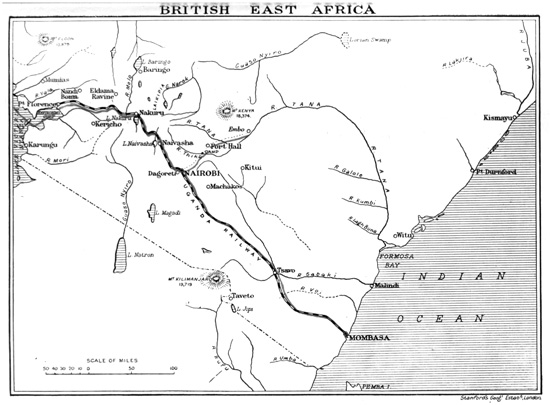
The town of Nairobi, the capital of the
East Africa Protectorate, stands on the base
of wooded hills at the three hundred and
twenty-seventh mile of the railroad. Originally
chosen as a convenient place for assembling
the extensive depots and shops necessary
to the construction and maintenance of the
railway, it enjoys no advantages as a residential
site. The ground on which the town is built
is low and swampy. The supply of water is
indifferent, and the situation generally unhealthy.
A mile farther on, however, upon
the rising ground a finer position could have
been found, and this quarter is already being
occupied sparsely by Government buildings,
hospitals, and barracks. It is now too late
to change, and thus lack of foresight and of
a comprehensive view leaves its permanent
imprint upon the countenance of a new
country.
Our train traverses the Athi plains, more
crowded perhaps with game than any other
part of the line, and approaches swiftly the
long rows of one-storeyed tin houses which
constitute the town. Nairobi is a typical
South African township. It might be Pietermaritzburg
or Ladysmith of twenty years ago,
before blue gum-trees and stone buildings had
waxed and multiplied. In its present stage
perhaps it resembles Buluwayo most. The
population is also South African in its character
and proportions. There are five hundred
and eighty whites, three thousand one hundred
Indians, and ten thousand five hundred and
fifty African natives. The shops and stores
are, however, much more considerable than
these figures would appear to warrant, and are
fully capable of supplying the varied needs of
settlers and planters over a wide area. Nairobi
is also the headquarters of a brigade of the
King's African Rifles, the central office and
depot of the Uganda Railway, and the seat of
the Administration, with its numerous official
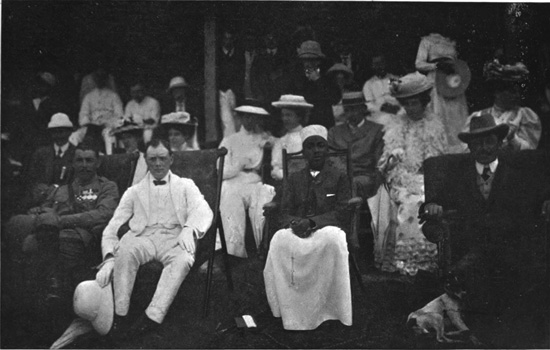
personnel. The dinner of the Colonists'
Association, to which I was invited, afforded
the familiar, yet in Central Africa not unimpressive,
spectacle of long rows of gentlemen
in evening dress; while the ball given by the
Governor to celebrate the King's birthday
revealed a company gay with uniforms, and
ladies in pretty dresses, assembled upon a spot
where scarcely ten years before lions hunted
undisturbed.
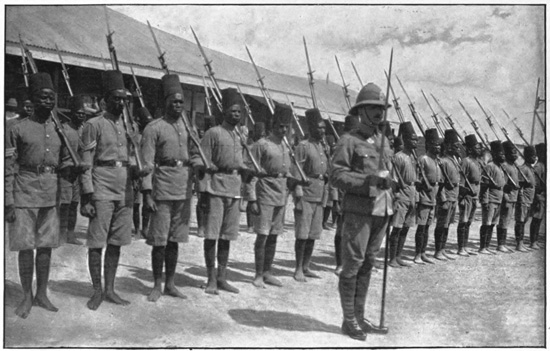
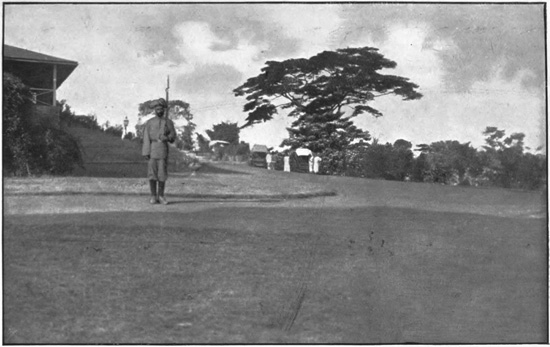
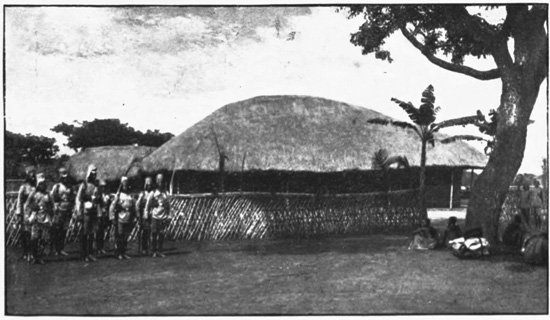
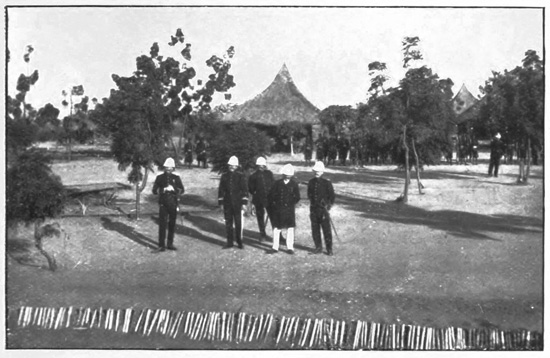
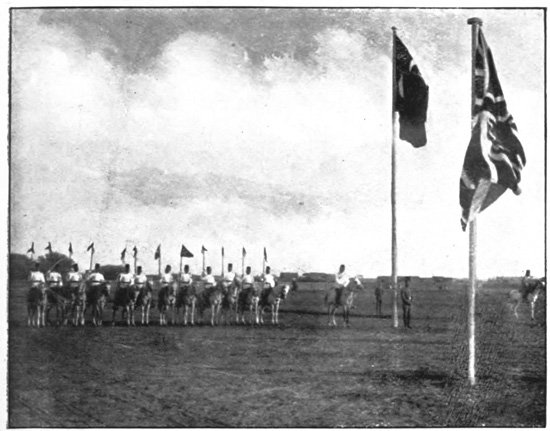
Guard of Honour, King's African Rifles.
Every white man in Nairobi is a politician;
and most of them are leaders of parties. One
would scarcely believe it possible, that a centre
so new should be able to develop so many
divergent and conflicting interests, or that a
community so small should be able to give to
each such vigorous and even vehement expression.
There are already in miniature all the
elements of keen political and racial discord,
all the materials for hot and acrimonious
debate. The white man versus the black; the
Indian versus both; the settler as against the
planter; the town contrasted with the country;
the official class against the unofficial; the
coast and the highlands; the railway administration
and the Protectorate generally; the
King's African Rifles and the East Africa
Protectorate Police; all these different points
of view, naturally arising, honestly adopted,
tenaciously held, and not yet reconciled into
any harmonious general conception, confront
the visitor in perplexing disarray. Nor will
he be wise to choose his part with any hurry.
It is better to see something of the country,
of its quality and extent, of its promises and
forfeits, of its realities and illusions, before
endeavouring to form even a provisional
opinion.
The snow-clad peak of Mount Kenya, a
hundred miles away, can on a clear morning
be easily seen from the slopes above Nairobi—a
sharp, serrated summit veined with gleaming
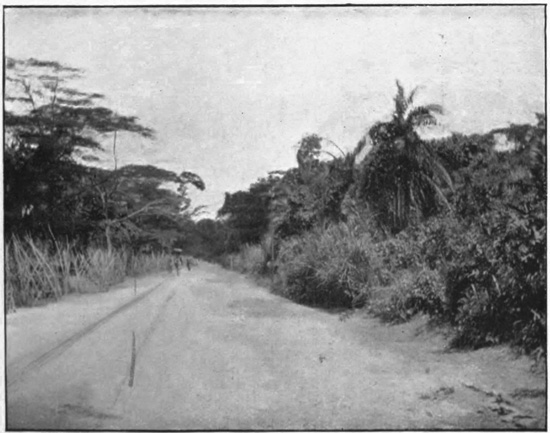
white. A road—passable, albeit unmetalled,
for wagons and even a motor-car—runs
thitherward by Fort Hall and across the Tana
River. On the way there is much to see. A
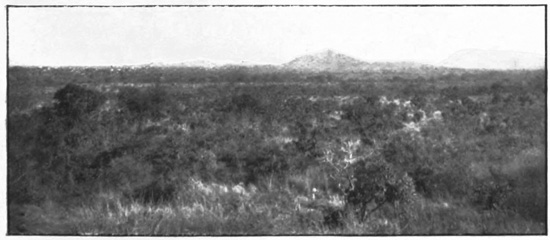
wild, ragged-looking, but fertile region, swelling
into successive undulations and intersected
by numerous gorges whose streams are shaded
by fine trees, unfolds itself to the eye.
Scattered about upon spacious estates of many
thousand acres are a score or two of colonists,
each gradually making himself a home and a
living in his own way. One raises stock;
another plants coffee, which grows so exuberantly
in this generous soil as to threaten the
speedy exhaustion of the plant. Here are
ostriches, sheep, and cattle standing placidly
together in one drove under the guardianship
of a native child of eleven. There is a complete
dairy farm, admirably equipped. One
of the streams has been dammed effectively,
and turbines are already in position to light
Nairobi with electricity. Upon the banks
of another there is talk of building an
hotel.
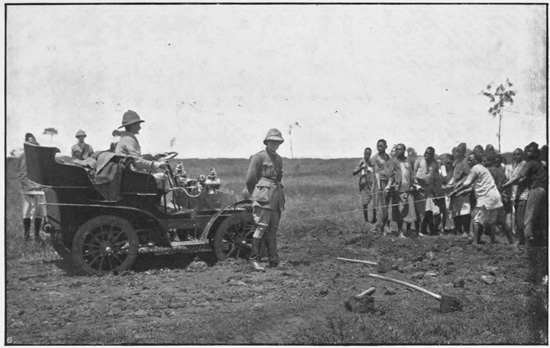
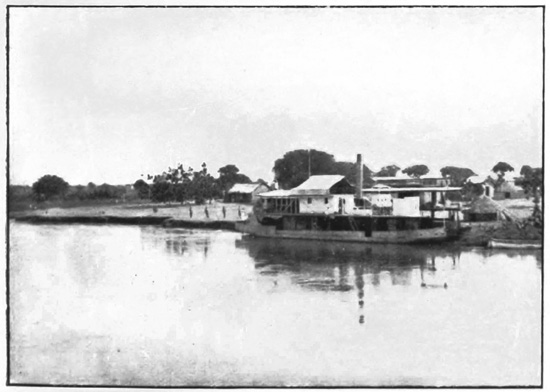
Breakdown on the way to Thika Camp.
At one place I found a family of good
people from Hightown, Manchester, grappling
courageously with an enormous tract of ten
thousand acres. Hard by, an old Boer, who
has trekked the length of Africa to avoid the
British flag, sits smoking stolidly by his grass
house, reconciled to British rule at last by a
few months' experience of paternal government
in a neighbouring Protectorate. He has few
cattle and less cash, but he holds decided views
as to the whereabouts of lions; there, moreover,
stands the heavy tilted wagon of the
Great Trek—an ark of refuge when all else
fails; and for the rest there is plenty of
game, few people, and the family grows from
year to year. In short, one sees a sparse, heterogeneous
population engaged in varied labours;
but everywhere hard work, straitened resources,
hopes persisting through many disappointments,
stout hospitable hearts, and
the beginnings, at any rate, of progress.
A camp has been prepared for me in a
very beautiful spot at the juncture of the
Chania and Thika rivers. Tents are pitched
and grass shelters are erected in a smooth
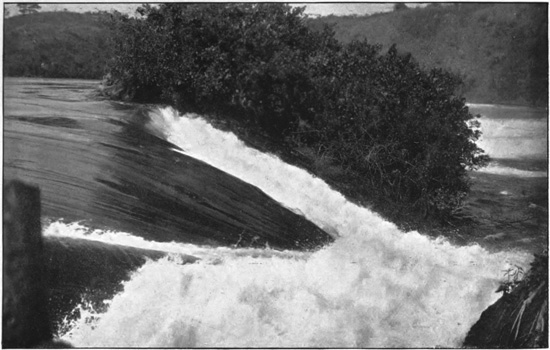
meadow. Southwards, a hundred yards away,
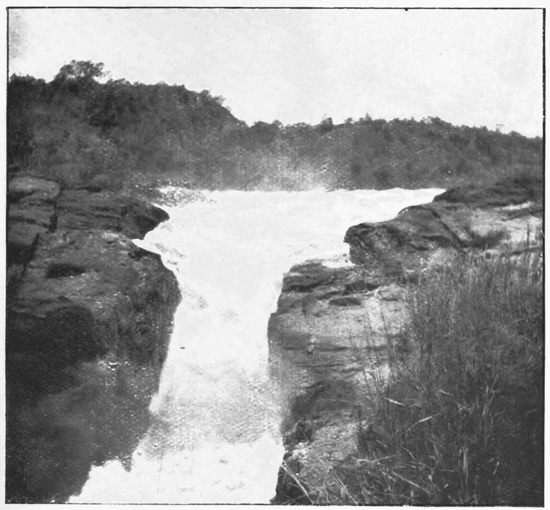
a fine waterfall plunges downwards over
enormous boulders amid tall, interlacing trees.
The muffled roar of another rises from a deep
ravine an equal distance to the north; and
the Philistine computes, with a frown, four
thousand horse-power expending itself upon
the picturesque.
Nothing causes the East African colonist
more genuine concern than that his guest should
not have been provided with a lion. The
knowledge preys upon his mind until it becomes
a veritable obsession. He feels some
deep reproach is laid upon his own hospitality
and the reputation of his adopted country.
How to find, and, having found, to kill, a lion
is the unvarying theme of conversation; and
every place and every journey is judged by a
simple standard—"lions or no lions." At
the Thika camp, then, several gentlemen,
accomplished in this important sport, have
come together with ponies, rifles, Somalis,
and all the other accessories. Some zebras
and kongoni have been killed and left lying
in likely-looking places to attract the lions;
and at 4 a.m., rain or shine, we are to go and
look for them.
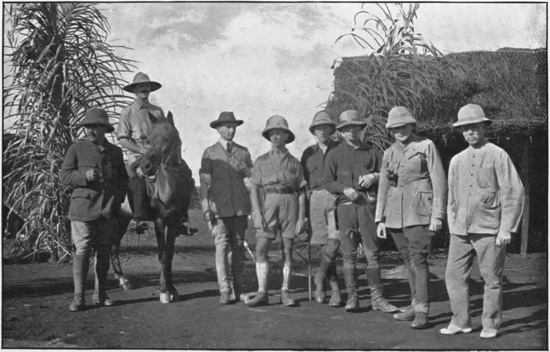
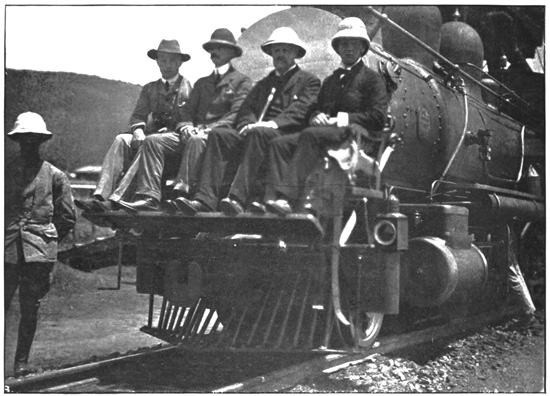
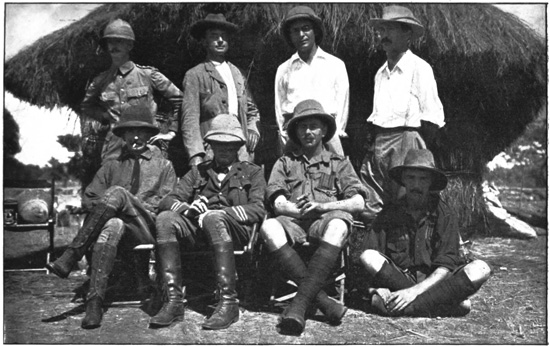
Shooting Party at Thika Camp.
From left to right—Capt. Sadler, Major Riddell, Mr. Marsh, Marquis Gandolfi-Hornyold, Hon. K. Dundas,
Mr. Percival, Mr. Churchill, Mr. D. J. Wilson.
The young Englishman, be he officer or
settler in the East African Highlands, cuts a
hardy figure. His clothes are few and far
between: a sun hat, a brown flannel shirt
with sleeves cut above the elbow and open
to the chest, a pair of thin khaki knickerbockers
cut short five inches—at least—above
the knee, boots, and a pair of putties comprise
the whole attire. Nothing else is worn. The
skin, exposed to sun, thorns, and insects, becomes
almost as dark as that of the natives,
and so hardened that it is nothing to ride all
day with bare knees on the saddle; a truly
Spartan discipline from which at least the
visitor may be excused.
This is the way in which they hunt lions.
First find the lion, lured to a kill, driven from
a reed-bed, or kicked up incontinently by the
way. Once viewed he must never be lost
sight of for a moment. Mounted on ponies
of more or less approved fidelity, three or
four daring Britons or Somalis gallop after
him, as in India they ride the pig—that
is to say, neck or nothing—across rocks,
holes, tussocks, nullahs, through high grass,
thorn scrub, undergrowth, turning him, shepherding
him, heading him this way and that
until he is brought to bay. For his part the
lion is no seeker of quarrels; he is often
described in accents of contempt. His object
throughout is to save his skin. If, being
unarmed, you meet six or seven lions unexpectedly,
all you need do—according to
my information—is to speak to them sternly
and they will slink away, while you throw a
few stones at them to hurry them up. All
the highest authorities recommend this.
But when pursued from place to place,
chased hither and thither by the wheeling
horsemen, the naturally mild disposition of
the lion becomes embittered. First he begins
to growl and roar at his enemies, in
order to terrify them, and make them leave
him in peace. Then he darts little short
charges at them. Finally, when every attempt
at peaceful persuasion has failed, he pulls up
abruptly and offers battle. Once he has done
this, he will run no more. He means to fight,
and to fight to the death. He means to
charge home; and when a lion, maddened
with the agony of a bullet-wound, distressed
by long and hard pursuit, or, most of all, a
lioness in defence of her cubs, is definitely
committed to the charge, death is the only
possible conclusion. Broken limbs, broken
jaws, a body raked from end to end, lungs
pierced through and through, entrails torn
and protruding—none of these count. It
must be death—instant and utter—for the
lion, or down goes the man, mauled by septic
claws and fetid teeth, crushed and crunched,
and poisoned afterwards to make doubly sure.
Such are the habits of this cowardly and
wicked animal.
It is at the stage when the lion has been
determinedly "bayed" that the sportsman
from London is usually introduced upon the
scene. He has, we may imagine, followed
the riders as fast as the inequalities of the
ground, his own want of training, and the
burden of a heavy rifle will allow him. He
arrives at the spot where the lion is cornered
in much the same manner as the matador
enters the arena, the others standing aside
deferentially, ready to aid him or divert the
lion. If his bullet kills, he is, no doubt, justly
proud. If it only wounds, the lion charges the
nearest horseman. For forty yards the charge
of a lion is swifter than the gallop of a racehorse.
The riders, therefore, usually avoid waiting
within that distance. But sometimes they do
not; or sometimes the lion sees the man who
has shot him; or sometimes all sorts of things
happen which make good stories—afterwards.
After this general description no particular
example is required, and the reader need not
be disappointed to learn that our lion escaped
what, no doubt, would have been his certain
destruction by the breaking of a single link in
the regular chain of circumstances. He was
not found upon the kill. His place was taken
by a filthy hyena, and it was not until we had
beaten thoroughly for two hours more than
three miles of reed-bed that we saw him—a
splendid great yellow cat, looking as big as a
bullock—bounding away up the opposite hill.
Off started our riders like falcons; but alas!—if
"alas!" is the proper word—a deep and
impassable nullah intervened, necessitating
large circuits and long delays; so that the
lion got clean away out of sight of all men,
and we were reduced to the slow and tedious
process of tracking him footprint by footprint
through waving grass, breast-high, hour after
hour, always expecting to tread on his tail, and
always—disappointed!
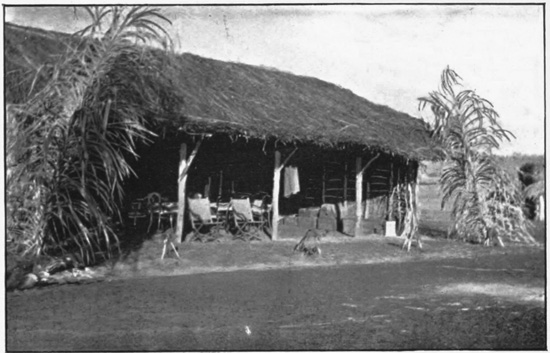
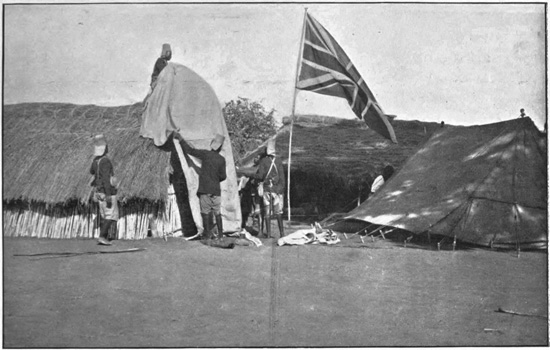
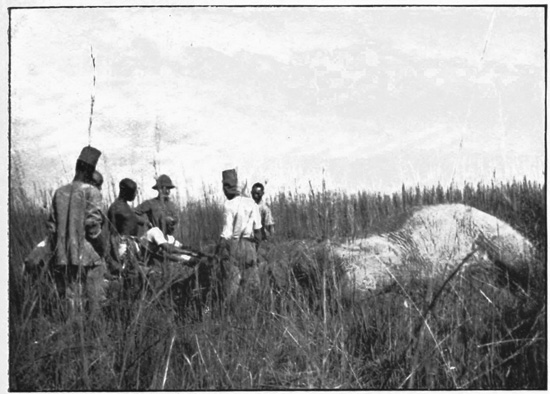
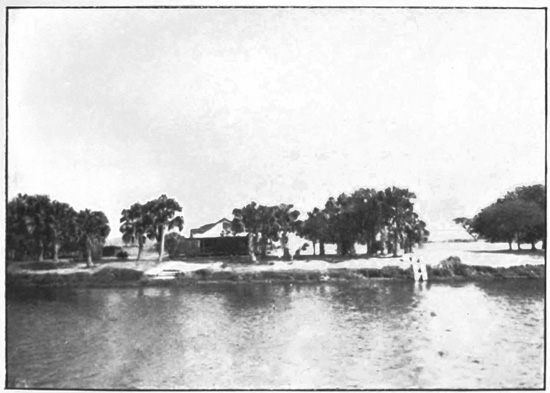
The Banda at Thika Camp.
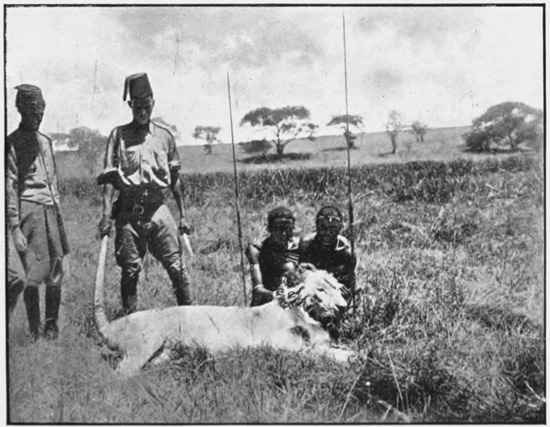
Colonel Wilson's Lion.
In the afternoon I had to ride to Fort Hall,
where there was to be a great gathering of
Kikuyu chiefs and thousands of their warriors
and women. The country is much the same
as that traversed on the previous day, but
greener, smoother, and more pleasant-looking.
Fort Hall is not a fort in any military sense,
but the Commissioner's house with a ditch
round it, a jail, a few houses, and an Indian
bazaar. The station is hardly well selected,
being perched up on a hill out of the reach
of any railway—and unhealthy nevertheless.
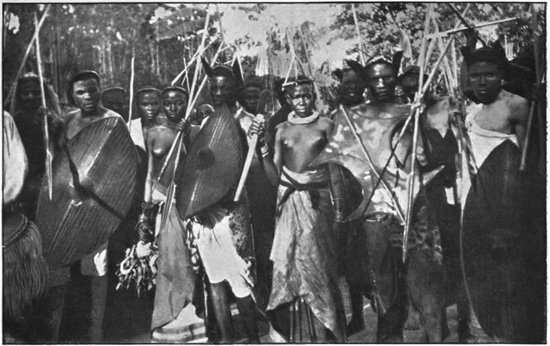
The whole place was crowded with natives in
their most highly ornamented and elaborate
nudity, waiting for the war-dance.
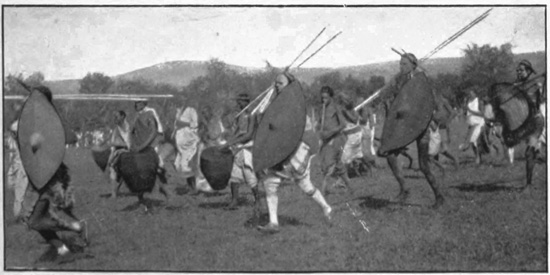
This ceremony was performed the next
morning. Long before daylight the beating
of drums, the blowing of horns, and the
rhythm of loud, yet not altogether unmelodious
chanting awakened the weariest
sleeper; and when, at eight o'clock the indaba
began, the whole space in front of the fort was
densely packed with naked, painted, plumed,
and gyrating humanity, which seethed continually
to and fro, and divided from time to
time as particular chiefs advanced with their
followers, or as gifts of struggling sheep and
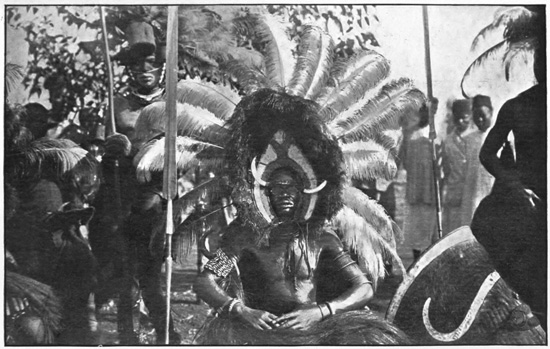
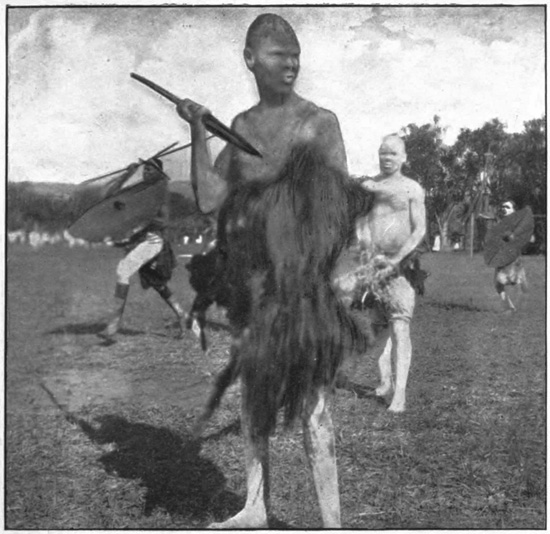
bulls were brought forward. In his war dress
the Kikuyu, and, still more, the Masai warrior,
is a striking, if not impressive, figure. His hair
and body are smeared with the red earth of
his native land, compounded into a pigment
by mixture with the slimy juice of the castor-oil
plant, which abounds. Fantastic headdresses,
some of ostrich feathers, others of
metal or leather; armlets and leglets of twisted
wire; stripes of white clay rubbed across the
red pigment; here and there an old pot-hat or
some European garment, incongruously contrasted
with leopard-skins and bulls' horns;
broad, painted cow-hide shields, and spears
with soft iron blades nearly four feet long,
complete a grotesque and indecorous picture.
Still, there is a sleek grace about these active
forms—bronze statues but for their frippery—which
defeats all their own efforts to make
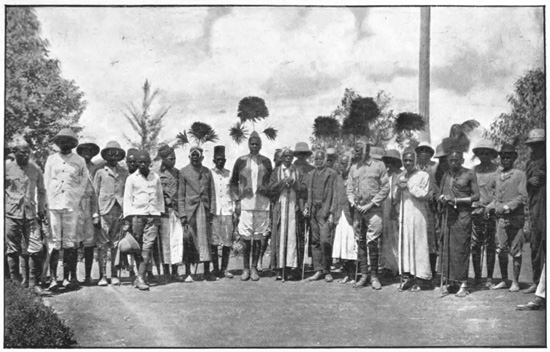
themselves hideous. The chiefs, however,
succeed in reducing themselves to regular
guys. Any old, cast-off khaki jacket or
tattered pair of trousers; any fragment of
weather-stained uniform, a battered sun-helmet
with a feather stuck lamely into the top of it,
a ragged umbrella, is sufficient to induce them
to abandon the ostrich plume and the leopard-skin
kaross. Among their warriors in ancient
gear they look ridiculous and insignificant—more
like the commonest kind of native sweeper
than the hereditary rulers of some powerful and
numerous tribe.
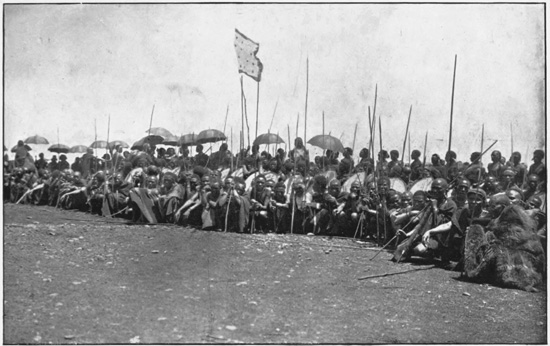
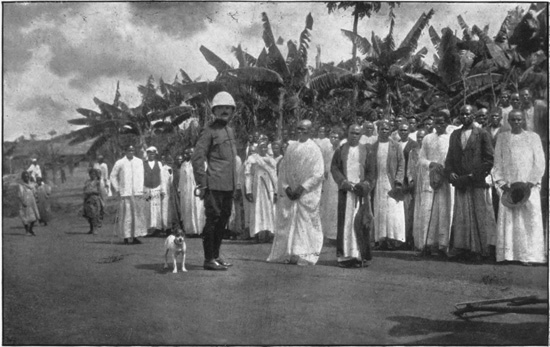
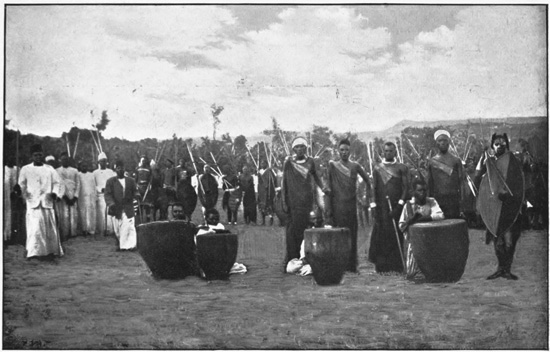
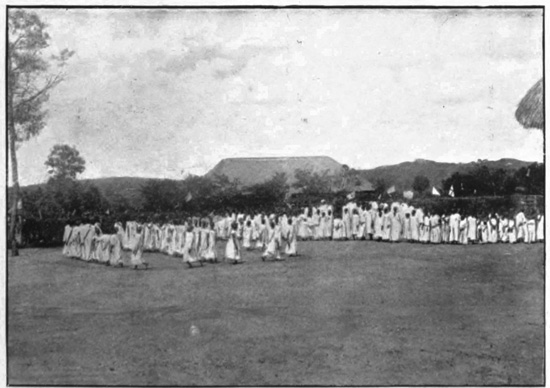
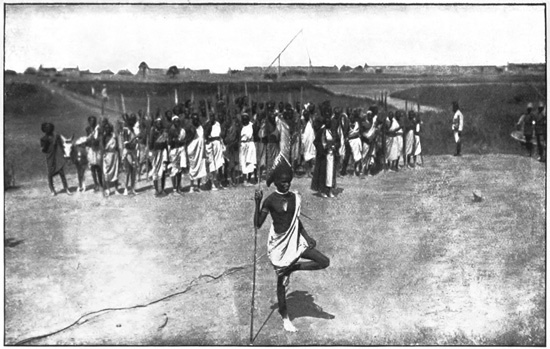
"Durbar" at Kiambu.
It is unquestionably an advantage that the
East African negro should develop a taste for
civilized attire. In no more useful and innocent
direction could his wants be multiplied
and his desires excited, and it is by this
process of assimilation that his life will
gradually be made more complicated, more
varied, less crudely animal, and himself raised
to a higher level of economic utility. But it
would surely be worth while to organize and
guide this new motive force within graceful
and appropriate limits. A Government runs
risks when it intrudes upon the domain of
fashion; but when a veritable abyss of knowledge
and science separates the rulers from the
ruled, when authority is dealing with a native
race still plunged in its primary squalour, without
religion, without clothes, without morals,
but willing to emerge and capable of emerging,
such risks may fairly be accepted; and the
Government might well prescribe or present
suitable robes for ceremonial occasions to the
chiefs, and gradually encourage, and more
gradually still enforce, their adoption throughout
the population.
After the dance it had been arranged that I
should go as far as the bank of the Tana River
to see the view of Mount Kenya, and then
return to the Thika camp before night.
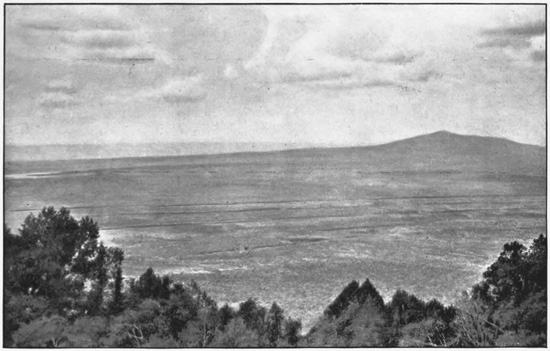
But when the whole splendid panorama of
the trans-Tana country opened upon us, I
could not bring myself to stop short of the
promised land; and, casting away material
cares of luncheon and baggage, I decided to
ride through to Embo, twenty-eight miles
from Fort Hall, and our most advanced post
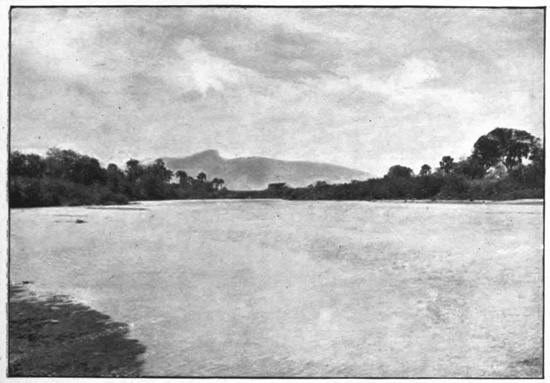
in this direction. We crossed the Tana by
a ferry which travels along a rope under the
impulsion of the current. The ponies swam
the deep, strong, sixty-yard stream of turbulent
red water. On the farther bank the country
is really magnificent in quality and aspect.
The centre of the picture is always Mount
Kenya; but there never was a mountain
which made so little of its height. It rises
by long gentle slopes, more like a swelling
of ground than a peak, from an immense
upland plain, and so gradual is the acclivity
that, but for the sudden outcrop of snow-clad
rock which crowns the summit, no one would
believe it over eighteen thousand feet high.
It is its gradual rise that imparts so great a
value to this noble mountain; for about its
enormous base and upon its slopes, traversed by
hundreds of streams of clear perennial water,
there grows, or may grow, in successive, concentric
belts, every kind of crop and forest known
in the world, from the Equator to the Arctic
Circle. The landscape is superb. In beauty,
in fertility, in verdure, in the coolness of the
air, in the abundance of running water, in its
rich red soil, in the variety of its vegetation,
the scenery about Kenya far surpasses anything
I have ever seen in India or South
Africa, and challenges comparison with the
fairest countries of Europe. Indeed, looking
at it with an eye fresh from Italy, I was most
powerfully reminded of the upper valleys of
the Po.
We rode on all day through this delicious
country, along a well-kept native road, smooth
enough for a bicycle, except where it crossed
stream after stream on primitive bridges. On
every side the soil was cultivated and covered
with the crops of a large and industrious population.
It is only a year since regular control
was established beyond the Tana, not without
some bloodshed, by a small military expedition.
Yet so peaceful are the tribes—now that
their intertribal fighting has been stopped—that
white officers ride freely about among
their villages without even carrying a pistol.
All the natives met with on the road were
armed with sword and spear, and all offered
us their customary salutations, while many came
up smiling and holding out long, moist, delicate-looking
hands for me to shake, till I had
quite enough of it. Indeed, the only dangers of
the road appear to be from the buffaloes which
infest the country, and after nightfall place the
traveller in real peril. We were very glad for
this reason, and also because we had eaten
nothing but a banana each since early morning,
to see at last on the top of the next hill the
buildings of Embo just as the sun sank beneath
the horizon.
Embo is a model station, only five months
old—one small, three-roomed house for the
District Commissioner, one for the military
officer, an office, and a tiny jail, all in good
dressed stone; two Indian shops in corrugated
iron; and seven or eight long rows of beehive
grass huts for a hundred and fifty soldiers and
police. Two young white officers—a civilian
and a soldier—preside from this centre of
authority, far from the telegraph, over the
peace and order of an area as large as an
English county, and regulate the conduct and
fortunes of some seventy-five thousand natives,
who have never previously known or acknowledged
any law but violence or terror. They
were uncommonly surprised to see four horsemen
come riding up the zigzag path to their
dwelling; but their astonishment was no bar
to their hospitality, and we were soon rewarded
for our journey and our fasting in most excellent
fashion.
I had just time before the darkness flooded
the land and blotted out the mighty mountain
and its wreaths of fire-tipped cloud to walk
round this station. The jail consisted of a
single room, barred and bolted. Inside not a
prisoner was to be seen. I inquired where
they were, and was shown two little groups
seated round fires in the open. They were
chained together by a light running chain, and
after a hard day's miscellaneous work about
the station they chatted peacefully as they
cooked and ate their evening meal. The
prison was only their shelter for the night—primitive
arrangements, no doubt, but are
they more barbarous than the hideous, long-drawn
precision of an English convict establishment?
The African protectorates now administered
by the Colonial Office afford rare scope for the
abilities of earnest and intelligent youth. A
man of twenty-five may easily find himself
ruling a large tract of country and a numerous
population. The Government is too newly
established to have developed the highly centralized
and closely knit—perhaps too closely
knit—hierarchy and control of the Indian
system. It is far too poor to afford a complete
Administration. The District Commissioner
must judge for himself, and be judged upon
his actions. Very often—for tropical diseases
make many gaps in the ranks, and men must
often return to England to recruit their health—the
officer is not a District Commissioner
at all, but a junior acting in his stead or in
some one's stead, sometimes for a year or more.
To him there come day by day the natives of
the district with all their troubles, disputes,
and intrigues. Their growing appreciation of
the impartial justice of the tribunal leads them
increasingly to carry all sorts of cases to the
District Commissioner's Court. When they
are ill they come and ask for medicine. When
they are wounded in their quarrels it is to the
white man they go to have the injuries dressed.
Disease and accident have to be combated
without professional skill. Courts of justice
and forms of legality must be maintained
without lawyers. Taxes have to be collected
by personal influence. Peace has to be kept
with only a shadow of force.
All these great opportunities of high service,
and many others, are often and daily placed
within the reach of men in their twenties—on
the whole with admirable results. It was most
pleasant to hear with what comprehension and
sympathy the officers of the East Africa Protectorate
speak about their work; and how they
regard themselves as the guardians of native interests
and native rights against those who only
care about exploiting the country and its people.
No one can travel even for a little while among
the Kikuyu tribes without acquiring a liking
for these light-hearted, tractable, if brutish
children, or without feeling that they are
capable of being instructed and raised from
their present degradation. There are more
than four million aboriginals in East Africa
alone. Their care imposes a grave, and I think
an inalienable, responsibility upon the British
Government. It will be an ill day for these
native races when their fortunes are removed
from the impartial and august administration
of the Crown and abandoned to the fierce self-interest
of a small white population. Such
an event is no doubt very remote. Yet the
speculator, the planter, and the settler are
knocking at the door. There are many things
which ought to be done—good, wise, scientific,
and justly profitable. If the Government
cannot find the money to develop the natural
economic strength of the country, to make its
communications, to start its industries, can it
with any reason bar the field to private enterprise?
Can it prevent the ingress of a white
population? Ought it to do so, and for how
long? What is to happen when there are
thirty thousand white people in East Africa,
instead of the three thousand or so who make
so much stir at the present time? Perhaps
the course of these chapters will lead us back
again to these questions. I am very doubtful
whether it will supply their answers.
We have a discussion in the evening on a
much more manageable subject. The District
Commissioner at Embo has been ordered by
the High Court of the Protectorate to retry
a criminal case which he had settled some
months before, on account of an informality
in the report of the proceedings, which had
excited the attention of the revising authority.
It is pointed out that neither the accused nor
his fellow-natives understand, or can ever be
made to understand, the meaning of this repetition
of a trial; that they are bewildered;
that their confidence in their personal ruler
may be weakened; that endless practical difficulties—for
instance, the collection of witnesses
scattered about in distant villages, and the disquietude
caused to them by a second summons
from the strange, mysterious power called
"Government"—arise out of an error which
only a lawyer could detect, and which only
appears upon a piece of paper. "Some one,"
quaintly says a young civil officer, who has
ridden over with us, "forgot to say 'Bo!' in
the right place." I ask the nature of the
"Bo!" It is certainly substantial. No
mention was made in the report of the trial
that the accused was given the opportunity of
cross-examining the hostile witnesses. Therefore,
although this was in fact done, the trial
is held to be no trial, and ordered anew.
Now, here is again a balancing of disadvantages;
but without here examining whether
a simple release would not have been better
than a retrial, I find myself plainly on the side
of the "Bo!" There is scarcely anything
more important in the government of men
than the exact—I will even say the pedantic—observance
of the regular forms by which the
guilt or innocence of accused persons is determined.
Those forms are designed to protect
the prisoner, not merely from the consequences
of honest forgetfulness in his judges, but from
systematic carelessness and possible oppression.
Once they are allowed to be loosely construed
the whole system of civilized jurisprudence
begins to crumble, and in its place there is
gradually erected a rough-and-ready practice
dependent entirely for its efficiency and fairness
upon the character and intelligence of the
individual responsible. Necessary as it is to
trust to personal authority in the control of
native races of the lowest standard, it is not
less necessary to assign well-marked limits to
that authority, and, above all, to place the
simple primary rights of accused persons to
what we at home are accustomed to call a "fair
trial" outside its scope. Nor does the administrator
really suffer in native eyes from the
apparition into his domain of superior authority.
The tribesmen see that their ruler—to them
all-powerful, the man of soldiers and police,
of punishment and reward—is himself obedient
to some remote external force, and they wonder
what that mysterious force can be and marvel
dimly at its greatness. Authority is enhanced
and not impaired by the suggestion of immense
reserves behind and above the immediate ruler—strong
though he be. But upon this, as
upon other matters, it is not necessary for
every one to be of the same opinion; and even
lawyers are not always wise.
On our homeward ride in the early morning
we passed a Swahili village. These Mohammedans
have penetrated deeply and established
themselves widely in the Eastern parts of
Africa. Armed with a superior religion and
strengthened with Arab blood, they maintain
themselves without difficulty at a far higher
level than the pagan aboriginals among whom
they live. Their language has become a sort
of lingua franca over all this part of the world.
As traders they are welcomed, as fighting men
they are respected, and as sorcerers they are
feared by all the tribes. Their Khan had
supplied us with bananas on the previous day
with many expressions of apology that, as we
were unexpected, he had no "European food."
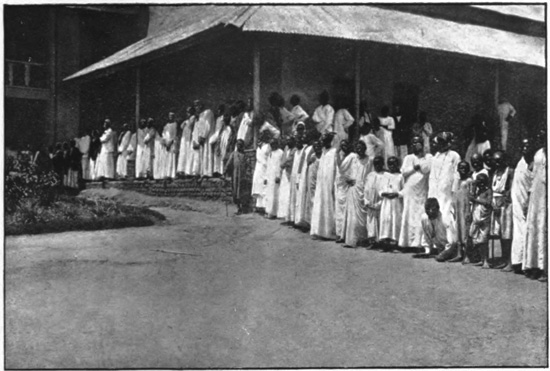
To-day all this was repaired. The men of the
village, to the number of perhaps fifty, walked
sedately out to meet us, their long white
smocks in striking contrast to the naked,
painted barbarians who surrounded them. The
Khan led up a white Arab stallion, of vicious
temper and tripling gait, to replace my wearied
pony; and then produced tea and a familiar
tin of mixed biscuits, which he had over-night
sent runners to procure, that his hospitality
might incur no reproach.
While we were eating and parleying with
the Khan there arrived on the scene a mounted
Kikuyu chief, with chair, umbrella, khaki helmet,
and other insignia, and attended by about
a hundred warriors in full feather. In order
to show their respect they began at once their
war-dance, and we left them a quarter of an
hour later still circling and hopping to and
fro with quivering spears and nodding plumes
to their monotonous chorus, while the white-robed
Swahilis stood gravely by and bade us
farewell in the dignified manners of the East.
I reflected upon the interval that separates
these two races from each other, and on the
centuries of struggle that the advance had
cost, and I wondered whether that interval
was wider and deeper than that which divides
the modern European from them both; but
without arriving at any sure conclusion.
Our journey to Embo had been so delightful
that I was not inclined to hanker after rejected
alternatives. But when we drove in to the
Thika camp as the sun was setting, tired out by
fifty miles of road, the first spectacle which
saluted my eyes was a lion's skin spread out
upon the ground and Colonel Wilson engaged in
sprinkling it with arsenical powder. Then we
were told the tale, which in brief was that they
were driving a long reed-bed, when the lion
sprang out and ran obliquely across the line of
beaters. Wilson fired and the lion bounded back
into the reeds, whence stones, fires, shoutings,
shots, and all other disturbances failed to move
him. Whereupon, after two hours, being impatient
and venturesome, they had marched in
upon him shoulder to shoulder, to find him,
fortunately, quite dead.
My friends endeavoured to console me by
the news that lions had now been heard of in
two other places, and that we should be sure
to find one in the morning; and next day,
after we had driven three miles of reeds, it
seemed that their hopes were well founded,
for a large animal of some kind could be seen
moving swiftly to and fro under cover, and
every one declared this must be the lion. At
last only one more patch of reeds remained to
beat, and we took up our positions, finger on
trigger, about sixty yards from the farther
edge of it, while the beaters, raising an astonishing
tumult with yells and the beating of
tin cans, plunged boldly in. Parturiunt montes—out
rushed two enormous wart-hogs. Let no
one reproach the courage of the pig. These
great fierce boars, driven from their last shelter,
charged out in gallant style—tusks gleaming,
tails perpendicular—and met a fate prepared
for a king. With these and another which we
galloped down and pistolled on the way home
I had to be content, and can now, so far as I
am concerned, sadly write, in the expressive
words of Reuter, "No lions were 'bagged.'"