Receiving a lieutenancy—Lord Collingwood’s kindness—Joining the
Warrior—An unexpected supply of dollars—An accident at
sea—Capture of Ischia and Procida—Expedition against the Ionian
Isles—Joining the Amphion—Captain Hoste’s activity in the
Adriatic—Commodore Dubourdieu and his squadron at Ancona—Chasing
the enemy—A wild-goose pursuit—Success at last—A glorious battle
and a splendid victory—Details of the action of Lissa—My return
to England—Interview with the First Lord of the Admiralty—A visit
to Ireland—A solicitation from Captain Hoste to join the
Bacchante as first lieutenant—Revisiting the
Mediterranean—Provoking the enemy—They provoking us—A
capture—Unhappy loss of prizes—An inexplicable
accident—Extraordinary explosion of a French frigate—A flag of
truce—Venice—Corfu—Capture of flotilla.
His lordship presented to me my lieutenancy in the handsomest manner
possible. He paid me many compliments, and expressed his regret that
this had been the first opportunity he had had of bestowing a commission
in his own gift; adding that he cheerfully gave it to me as some
reparation for my sufferings, and as a reward of my enterprise and
fortitude. His lordship warmly expressed his approbation of my conduct
during the time I had been under his immediate command; and rewards as
well as praise were doubly valuable from a veteran officer, so highly
and so justly celebrated for his nautical skill and consummate valour.
His lordship cordially wished me every possible success in the service;
and to his order, to repair on board the Warrior, he jocosely added,
“I suppose your luggage can be easily conveyed to your ship.” To this
supposition I as laconically replied that a stocking would be sufficient
to contain everything I possessed.
But my gratitude to this great and good man, for his paternal kindness
to me since I had been on board the Ocean, was so powerful as to
overwhelm expression, and the recollections of all the friendly feelings
that had been evinced towards me by Captain Thomas, and every officer of
the ship, rushed upon my mind irresistibly; and it was not without great
and many efforts that I prevented my feelings exhibiting themselves by
what might have been called a weak and feminine, though a natural,
ebullition of intense emotions. It was some time before I could command
myself sufficiently to express to his lordship my deep and heartfelt
sense of his kindness and patronage. A period of twenty-nine years has
not diminished, in the slightest degree, the gratitude which had then
nearly overpowered me.
I was taken on board the Warrior by one of her boats, under the
command of Lieutenant David Dunn. No sooner was I seated in the boat,
than the coxswain, touching his hat, informed me that a bag of dollars
had been just handed in for my use. This was an act of timely and
generous friendship, greatly enhanced by the delicacy with which it had
been contrived. It immediately occurred to me from whom this good
feeling and liberality had emanated. The Hon. William Waldegrave (now a
post-captain) was then one of the lieutenants on board the Ocean. He
had evinced a very friendly feeling towards me, and, previously to my
leaving the ship, had suggested to me the necessity of my being
provided with a certain sum of money for the purpose of settling with my
predecessor on taking his place, for what he may have paid in advance
for table expenses and contingencies to the mess. I replied to Mr.
Waldegrave that my friend Captain Hoste had had the extraordinary
kindness to give me carte blanche permission to draw on his banker at
Malta for any money I might stand in need of. But he had not been put
off by my answer; on opening the bag I found myself supplied amply, or
even profusely; and there was a friendly letter, in which he told me
that when I should have a surplus of prize-money, I might pay his
present advance to his banker. I need not say that I scrupulously, and
with the greatest pleasure, fulfilled this duty.
Arrived on board the Warrior, I was introduced to Captain Spranger,
who received me politely, and, at the same time, I was informed by the
mate of the deck that it was now my watch. I was also introduced to my
brother officers, all of whom appeared to be cordial and polite. Dinner
was now announced, and after quickly despatching what there was, I sent
for the ship’s tailor to equip me for my new rank, by metamorphosing a
midshipman’s into a lieutenant’s uniform; and, having borrowed a coat
from Mr. Dunn for the interim, I ascended to the quarter-deck, and
immediately received “the Orders,” and took the command of the watch.
As Mr. Dunn was much taller and stouter than myself, I cut rather a
ludicrous figure in his uniform, a figure not often seen on the
quarter-deck of one of his Majesty’s ships-of-war; but an officer in
command of the watch, on board of a man-of-war, more especially when in
a line of battle, has his attention so entirely absorbed by things of
importance that he has no time to reflect on his personal appearance,
whether it be such as to gratify his pride, or to mortify his vanity.
The following morning, Captain Spranger appointed me the signal
lieutenant, and this relieved me of all duty at night, except when
signals were to be made.
In the afternoon of the ensuing day, 31st March, when our division of
the fleet was in the act of wearing together by signal, the Renown and
the Warrior ran foul of each other, which occasioned us so much damage
that we began to leak a good deal. We, however, gained on the leak, and
having made all possible despatch in refitting, accompanied Sir John
Stuart in the expedition to the Bay of Naples, and were present and
co-operated at the capture of the islands of Ischia and Procida. In the
autumn we had the sole conducting of the expedition, under
Brigadier-General Oswald, against the Ionian Islands, and succeeded in
capturing Zante, Cephalonia, Ithaca, and Cerigo.
We next repaired to Malta to refit, and afterwards joined the fleet off
Minorca. Our ship being found to be in a defective state, Lord
Collingwood sent her for a short cruise off Cape San Sebastian, with
orders then to repair to Malta, and take the April convoy to England.
On our arrival at Malta, I was overjoyed to find the Amphion. My old
friend, Lieutenant Jones, came to inform me that my friend and old
shipmate, Charles George Rodney Phillott, the first lieutenant, had been
promoted for distinguished services, and, with his usual zeal and
friendship, he expressed his hope that I might be appointed to fill his
vacancy. After a communication with Captain Spranger, I addressed
myself to Captain Hoste, and notwithstanding the applications to him
were so numerous, and so highly backed, I succeeded in my object, and on
2nd March, with a cheerful heart and full of hope, I joined the
Amphion, and became the third or junior lieutenant. My friend Jones
became the first, whilst Mr. William Slaughter, whom I succeeded, was
now the second lieutenant.
As my desires were for the most active service, I was now in a fair way
of having them fully gratified. On the 27th Captain Hoste resumed his
station in the Adriatic. The enemy’s naval force was now rapidly
increasing in the ports both of Venice and Ancona, and it was evident
that the French Emperor was about to make an effort, either to inflict
some serious injury on our commerce, or to interrupt our naval
superiority in the Adriatic. Our little squadron was in incessant
activity; and although our force was trifling in comparison to that of
the enemy, we trusted to our good fortune for falling in with it in
detail, and visions of honour, glory, distinction, promotion, and all
the results of conquest, continually filled our minds. I had
individually an anxious wish for an opportunity of expressing to the
French in the warmest manner how much I was obliged to them for their
former favours. We used to heave-to, or stand close in shore off their
ports, and under easy sail, and sometimes we would detain, board, and
destroy their coasting vessels, and do everything in our power to
exasperate them and induce them to come out.
On 29th September we discovered that the ships at Chiozza, near Venice,
under Commodore Dubourdieu, had sailed; and Captain Hoste, in the
Amphion, accompanied by the Active, Captain J. A. Gordon,
immediately pushed for Ancona. Here we found the enemy, consisting of
three large frigates, two corvettes, two brigs, one schooner, and a
gunboat. Some of them were under sail outside the port, whilst others
within appeared to be getting under weigh. We concluded they would
immediately give us chase, but in the evening, to our great vexation,
they all returned into port. Our calculation was, that they would push
for Corfu, get reinforced by any ships that might be off or at that
island, and then proceed in all probability for Sicily.
The Cerberus and Acorn joined our little squadron; and on our again
reconnoitring Ancona on 17th October, we found that all our birds had
escaped. Instantly every stitch of canvas that could be of use was
spread, and our course was for Corfu, with the intention of looking into
Lissa, en passant. Our hope was, by superior sailing, to arrive first
at Corfu, and prevent their entering without risking a battle.
We fell in with a Sicilian privateer, that informed us she had just been
chased by the enemy, who were steering for Corfu. Our calculations were
thus verified; every sail was crowded, and our hearts rebounded with the
expectation that the dawn would present to us the enemy in the offing.
The morning came, however, and in vain did our eyes traverse in all
directions within the verge of the horizon. Not a foe was to be seen,
and the glowing hopes of a battle vanished. We stood for Brindisi,
across to Cattaro, on the Albanian coast, and ran down the whole
Adriatic; but all was disappointment. Finally we bore up for the island
of Lissa, where, on our arrival, we found, to our infinite
mortification, that the enemy had been before us, and had departed. In
fact, the treacherous Sicilian had deceived us; and on the very day on
which this ally had given us the false information, the French
commodore, having learned from a fisherman that the English squadron was
on a cruise, ran across to Port St. George; landed troops; committed
great havoc and devastation; destroyed our prizes; took away three
neutral ships that we had detained; and hurried back to Ancona. This was
a bitter drug of disappointment; and none felt it more severely than our
gallant captain. I dined with him that day, and saw the big drop trickle
down his manly cheek. Never was there a more gloomy, melancholy
dinner-party, or dinner-table, than this.
All sail was set, and we were following in the direction which the enemy
had taken, or were said to have taken. At midnight of the ensuing day we
had hazy weather with light winds and a heavy swell. In sweeping the
horizon with an excellent night-glass, I imagined that some dark objects
had obstructed my view on its edge. I had repeatedly ascertained this,
and my observation was confirmed by the young gentleman of my watch, ere
I took the resolution of acquainting my most gallant chief with the
fact. I shall never forget the ecstasy with which he sprang from his
cot, exclaiming emphatically, “We have them at last, thank God!—Thank
you, O’Brien,” said this brave enthusiast in his country’s cause—“thank
you for this good look-out; let the officers be called and all get
quietly to their quarters; back your mizen top-sail, that Gordon (of the
Active, the next ship in line) may get near enough to communicate
without noise, and I shall be on deck in a moment.”
All these judicious orders were as rapidly executed as they had been
given, and Captain Gordon received our joyful intelligence, and as duly
conveyed it to the next in succession in the line. Every heart was full
of unrestrainable joy at the approaching conflict; and proud was I at
having been the officer who had discovered the enemy. Daylight came, and
what was my mortification, what were the chagrin and disappointment of
us all, when the enemy’s fleet turned out to be not exactly “des
châteaux d’Espagne,” but a reality, though nothing more than paltry
fishermen! We reached Ancona and found the fugitives safe in the
harbour. The Moniteur, in noticing this wild-goose chase, had the
impudence to state “that the English squadron, though superior to the
French in force and numbers, had most sedulously avoided measuring
strength with it.”[38]
The Cerberus left us for Malta to refit, but we were joined by the
Volage, of twenty-two guns, and the Alacrity brig, of eighteen.
Daily did we capture coasting vessels and insult the enemy’s coasts. The
Volage, on the night of 27th November, in hazy weather, owing to a
sudden shift of wind, ran foul of the Amphion; and both ships were
obliged to leave the squadron. In Malta, whilst under repairs, I had the
satisfaction of seeing my brave friends, Lieutenants Jones and
Slaughter, advanced to the rank of commander in reward of their gallant
services. My now becoming first lieutenant of the Amphion, my
commander and they were pleased to call my birthright; but Lord
Collingwood was dead, and Sir Charles Cotton the new commander-in-chief,
a stranger to me, without consulting with Captain Hoste, placed my
friend Lieutenant Dunn over my head, who was only eight months my
senior.
On 26th February, 1811, both ships being ready for sea, we sailed for
the Adriatic, and on 12th March arrived on our old cruising ground off
the island of Lissa, where we found the Active and Cerberus—the
Acorn sloop being on detached service. Our squadron consequently
consisted of four ships, and all were now most anxious to reconnoitre
the Ancona heroes, who had, with such consummate effrontery, stated that
the Adriatic had been by them scoured of British intruders.
Their politeness, it would appear, anticipated our wishes, and surpassed
our expectation, by inducing them to make the amende honorable for
former conduct in paying us a visit before dawn of the next morning,
Wednesday, 13th March, a day for ever memorable, at least with me, and
all who shared its glories, and, I might add, not to be forgotten in
Britain’s naval annals.
The Active being well to windward, on the look-out, Gordon descried a
squadron of ships-of-war lying-to; he instantly made the night-signal
for an enemy, and bore up to join us. At daylight our joy was
indescribable—they were not much more than a mile off Port St. George.
The force of our long-sought enemy, whom we immediately recognised, was
ascertained to be, six ships, a brig, a schooner, xebec, and two
gunboats; certainly a very superior number—the disparity, to all
appearance, overwhelming; but, strange to say, there was not a soul in
the Amphion, from the chief down, who did not anticipate a complete
victory; and I have been informed since that the same feeling prevailed
throughout the other ships.
All sail was made close-hauled, tacking occasionally to meet this
Franco-Venetian squadron, under the same chief, Dubourdieu, who, at
about six o’clock, was bearing down in two divisions to attack us. He,
leading the starboard or weather-one, in the Favorite, a large
frigate, followed by the Flore, Bellona, and Mercurio brig; the
lee division was led by the Danaë, followed by the Corona,
Carolina, and small craft.[39]
Our ships were in a very compact line ahead, the Amphion, Active,
Cerberus, and Volage, having every sail still set, that we might
close as soon as possible. When nearly within gun-shot, Captain Hoste
telegraphed “Remember Nelson!” which was answered by three loud cheers
from the crews of our squadron, who manned the rigging on the occasion.
At nine, now reduced to top and top-gallant sails, on the starboard
tack, in such close order as to make it impossible for any vessel to
pass between, decorated with union-jacks and ensigns at the different
mast-heads and stays, independent of the regular red ensigns at the
mizen peaks, we hoisted a commodore’s pendant at the Amphion’s main,
at the going up of which our gallant commander cried out most
emphatically, “There goes the pride of my heart!”
Every preparation made, there was a pause or a profound silence
throughout the ship, both squadrons approaching fast, when Captain Hoste
called to me to “try a single shot from one of the main-deck guns at
Dubourdieu’s ship.” This done, it fell immediately under her bows, which
convinced us that we should hit her with guns double-shotted in a very
few minutes.
In that time a most tremendous fire was opened, and became general on
both sides: ours was so well directed, and our ships so close in line,
that the French commodore, who evinced great gallantry, was completely
foiled in the attempt to board us on the starboard quarter. This sealed
his destruction; for at the moment that his jib-boom had nearly plombed
our taffrail, his bowsprit and forecastle being crowded with boarders,
himself in full uniform amongst the foremost, displaying great
intrepidity, and animating his men, a brass five-and-a-half inch
howitzer, which had been previously loaded with between seven and eight
hundred musket-balls, and well pointed, was discharged right at them.
The carnage occasioned by this, together with an incessant fire of small
arms from the marines and seamen, as well as round, grape, and canister,
from every great gun that could be brought to bear, was truly dreadful.
Numbers of the poor wretches were swept away; and amongst the fallen was
distinctly observed their gallant leader.
The Favorite’s fire now became irregular and languid, and she
appeared unmanageable. Our squadron being already too near the shore, it
was deemed indispensable to get their heads off to sea; and therefore
the signal was made to wear together. Our opponent, attempting the same
evolution, failed, and, in great confusion, went plump on Lissa rocks.
We had also, in the Amphion, a narrow escape from sharing the same
fate; and for our safety we were, under Providence, mainly indebted to
the extraordinary efforts and presence of mind of William Thomas,
captain of the fore-top, stationed there, who, at the critical moment of
wearing (the rocks not half pistol-shot distant under our lee),
perceiving the jib-stay and halliards shot away, the halliards unrove
from the mast-head block, and consequently the sail rendered useless, on
which the performance of this evolution principally depended, caught the
end of the halliards on its way down, and, with the swiftness of a hind,
and the agility of a monkey, was at the mast-head block, through which
they were instantly rove, and carried down by him with the utmost
rapidity, by the top-mast stay to the bowsprit end, where, in a
twinkling, they were again bent, and the jib set flying, to the
admiration of all who witnessed this intrepid, “indeed, almost
superhuman” exploit, as it was since termed by Captain Sir David Dunn,
who was then first lieutenant, and an eye-witness of the affair.[40] The
ship happily, I might have said miraculously, wore clear of the danger,
and renewed the action on the larboard tack.
The Volage, previously the rear-ship, of course now led on the
larboard tack, and gallantly did she perform her part.
The Flore now evinced a determination to execute, by boarding the
Amphion, the intention of her fallen chief; and certainly made a most
gallant attempt, but was frustrated.[41] However, she succeeded in
passing under the stern, and poured in a raking fire, which would have
proved most destructive to the men on the main-deck, had I not ordered
them to lie down between the guns, as by standing they were uselessly
exposed, it being impossible to bring a gun to bear on the enemy at the
moment. Many of the Flore’s shot rattled along the decks without doing
injury to the men thus protected by lying close between the guns, one of
which had its pomillion knocked off.
The Flore, now to leeward on the same tack, hauled up on our
lee-quarter; the Bellona did the same on the weather-quarter; so that
we were warmly handled between them.
The lee-division of the enemy at this time was also on the larboard
tack, and the captain of the Danaë, carefully avoiding the larger
frigates, stuck close to the Volage, who plied him so well from her
thirty-two pound carronades, that he was obliged to haul off to a more
respectful distance; this manœuvre compelled the Volage to increase
the quantity of powder, in the hope of reaching her wily antagonist, to
whom, unfortunately, the effort proved favourable.
The breechings having given way in consequence of the increased charges,
the carronades were upset, leaving the gallant Hornby but one
six-pounder to keep up the unequal contest. The Volage was nearly cut
to pieces, when the Active came opportunely to her relief; at sight of
which, the Danaë made all sail to escape to Lessina, as did the
Carolina, and the small craft scampered off in various directions.
The Corona having all this time been warmly engaged by the Cerberus,
now attempted to follow the Danaë’s example, but was pursued and
brought to close action in a superior style by the Active.
In the meantime we suffered much in the Amphion from the well-directed
fire of the two ships, Flore and Bellona, so judiciously placed on
our quarters; but the former, being the most formidable, demanded our
chief attention; and being to leeward, we were enabled, by bearing up,
to close and pass ahead so as nearly to touch her, when we poured our
starboard broadside into her larboard bow. In consequence she soon
ceased firing and struck her colours.
The Bellona was now attended to with marked and double diligence, we
at the same time keeping a few main-deck guns pointed at the Flore,
fearing she might play us a trick, and take advantage of our disabled
state by slipping away; this was scarcely done, when I received a
message from the captain by his aide-de-camp, Mr. Cornwallis Paley, to
the above effect; and I had great pleasure, in reply, to say that I had
anticipated the wishes of my chief, having had some slight knowledge of
the character of those with whom we had now to deal. I confess I had a
presentiment respecting this ship, which proved but too well-founded.
The Bellona soon followed the Flore’s example; at forty-five minutes
past eleven she struck her colours. The Mercurio brig fired
occasionally until the Favorite had gone on the rocks near to which
she had dropt anchor, and was busily employed with her boats in saving a
part of the crew from the wreck. I fancied the Flore was increasing
her distance to leeward, and apprehended she intended to copy the
Danaë and Carolina, and try to get into Lessina, a French port on
the Dalmatian coast, when I was delighted by a message that Captain
Hoste wanted me immediately to take possession of the captured frigate;
the first lieutenant, Dunn, having been incapacitated, from being
severely burnt by an explosion on the quarter-deck, which also wounded
our gallant chief, his brother, Thomas Edward Hoste, midshipman, and
many others.
On this occasion, Captain Hoste evinced the greatest possible coolness
and magnanimity. Lieutenant Dunn had been completely blown off his legs,
and not a particle of skin left on his face, and therefore he might have
been considered hors de combat for the present; but this brave officer
still remained at his post, showing with his leader a brilliant example,
as did Lieutenant Thomas Moore of the marines, who had been badly
wounded, and was with difficulty persuaded to go to the surgeon to be
dressed, after which he returned to his quarters.
The question now was, how to proceed on board the prize; for our ship
was in almost a dismantled state, all yards and other tackles being shot
to pieces, and the boats in a most shattered state; one, however,
appearing not quite so bad as the rest, was carried bodily to the
gangway, and tossed into the sea with a rope fast to her, by which,
though half full of water, she was hauled to the ship’s side. I
immediately got into her with Mr. Kempthorn, midshipman, and four
seamen, all of whom commenced baling with their hats, etc., except one
man at each side, who managed to paddle.
The Flore still increasing her distance, I requested that we might be
permitted to try and reach her; but our gallant chief, from the
dangerous state of our boat, and not for a moment imagining the beaten
foe could act so dishonourably, after being under our guns so many
hours, directed me to proceed to the nearest, the Bellona, on board of
which with difficulty we got about noon.
Taking two of the boat’s crew, I was received on the gangway by her
first lieutenant and surviving officers—the captain (Duodo) excepted,
who, they informed me, was then in his cabin mortally wounded.
Perceiving them all with side-arms, I requested to know if their ship
had surrendered. They replied in the affirmative; to which I observed,
that on such an occasion, it was usual that swords should be delivered
to the officer taking possession; with which they instantly and
willingly complied. I now added, the form being gone through, that they
were welcome to their arms, and presented his sword to each individual,
all of whom declined the favour. These trophies were, therefore, handed
into the boat, where I wished the late possessors also to place
themselves, that they might pay the British commodore a visit: she
being, from baling and stuffing the leaks, in rather a better state than
when I quitted her. To comply with this proposal they seemed very
reluctant, and expressed astonishment at my having risked the lives of
myself and crew in such a conveyance; but when I assured them that if
the Bellona possessed a better, they were welcome to take it, all
appeared enchanted and most thankful for this act of kindness, and the
first lieutenant directed the stern-boat to be lowered; but, to their
great dismay, she was, if possible, in a worse state than our own.
Having a light favourable breeze, we trimmed the sails as well as we
could, and closed with the Amphion, by which our distance was
shortened nearly one-half; and I succeeded in persuading them to depart,
and had the pleasure of seeing all ascend the Amphion’s side.
I had the mortification to discover, at the same time, the Flore out
of gun-shot distance, trimming her sails and making off towards Lessina.
Anxious now to put the Bellona to rights, and ascertain her actual
condition, more especially with regard to the magazine, etc., I
interrogated the gunner, who stated that Captain Duodo had given him
orders to place secretly in the cable tier some barrels of gunpowder, to
which was attached a train, intending, he supposed, in the event of
being compelled to surrender, that the ship, if not altogether
destroyed, should be rendered useless to the captors—his being taken
off the deck wounded prevented this catastrophe. I was forthwith
conducted to the spot, and there placed one of the Amphion’s men as a
sentinel, giving him the necessary instructions, while I left the other
at the helm.
I next proceeded to the cabin of the unfortunate captain, whom I found
stretched on his back, in the most deplorable state: his wound, a most
severe one in the abdomen, having become exceedingly offensive. By my
visit he appeared much affected, and pressed my hand between both of his
and wept, expressing his gratitude in the most impressive manner for the
kindness I had shown to a vanquished enemy. I begged he would command
my services in any way they could be beneficial to him, and bade him
adieu.
It would be difficult to describe the horrors which now presented
themselves. The carnage was dreadful—the dead and dying lying about in
every direction; the cries of the latter were most lamentable and
piercing. The surgeon, a herculean man, with an apron and his
shirt-sleeves tucked up, attended by his assistant and others, bore a
conspicuous part in the tragedy, being busily employed in examining
wounds, ascertaining the bodies from whom the vital spark had actually
fled, and superintending their interment, or rather launching out of the
ports!
Strange to say, every man stationed at one of the guns had been killed,
and as it was supposed by the same shots,[42] which passed through both
sides of the ship into the sea. At another gun the skull of one poor
creature was actually lodged in the beam above where he stood, the shot
having taken an oblique direction: in short, the scene was heart-rending
and sickening.
The prisoners assembled on the quarter-deck, and among them were a
number of soldiers seated on their knapsacks, apparently in expectation
of following their officers on board the British commodore. I addressed
them, and assured them they should be treated with kindness, but that,
in the first instance, each must return immediately to his station and
assist with a good will in putting the ship in an efficient state to
encounter the Borea, or north-east gale, with the approach of which we
were now threatened; and I added that I was aware they must be to a
certain degree in want of food and exhausted, but the work must be
first done, and after that they should have double allowance. To my
proposal they assented; and to work they went most cheerfully, some
shaking and kissing my hands, declaring they would most willingly obey
my orders.
Two seamen now came forward, and in broken English made themselves known
to be Portuguese—one a quarter-master and the other a mizen-top man. I
expressed regret and astonishment at finding the subjects of our friend
and ally, their king, in an enemy’s ship, but that it would now be in
their power to redeem, by good conduct, their character, in which case I
should intercede for them with the commodore, and hoped they would be
permitted to enter his Britannic Majesty’s service, when they would be
considered as Englishmen. They appeared much pleased with this
intelligence, and promised faithfully to do all in their power to merit
approbation, which promise they most scrupulously performed.
The seaman at the helm was now relieved by the Portuguese
quarter-master, and I felt myself strong in having four men upon whom I
could place some dependence.
In a short time we found ourselves in a somewhat better condition: the
dead nearly all thrown overboard, with some who were not quite lifeless,
but of whom not the slightest hope of recovery could be entertained, as
the surgeon and his assistant repeatedly assured me. The sprung and
shattered spars from aloft were sent down; the sails, which stood in
need thereof, unbent and replaced; and the decks shovelled and cleared
from the heaps of gore and ordure with which they had been encumbered.
The Favorite appeared at this time in one perfect blaze on the rocks.
The action was still kept up with great animation between the Active
and Corona, when, at about half-past two, after a most obstinate
resistance, to the honour of her captain, Paschaligo (who was a
descendant of one of the most celebrated of the Doges), as well as of
her gallant captors, the latter was subdued.
The Amphion and Volage were in a most helpless state; the hull of
the Cerberus was a perfect riddle, though less damaged in masts,
spars, and rigging than her consorts. At about four o’clock the
Favorite blew up; the explosion caused a terrible shock, which was
felt by the whole squadron; and we, on board the Bellona, were most
thankful for our having so providentially escaped the same fate, by
Captain Duodo being wounded.
At about nine P.M. the Corona was in imminent danger, having caught
fire in the maintop, when in tow by the Active; she was, of course,
instantly cut adrift. At about ten the flames, to us, appeared terrific,
particularly on the main-mast and rigging, being then at point-blank
distance on her lee beam. I used every effort, and succeeded in getting
out of the reach of her heavy metal. At midnight we had the satisfaction
of seeing the fire quite extinguished. This had been effected through
the extraordinary activity and exertions of Lieutenant James Dickenson
of the Cerberus, and George Haye of the Active, who had led their
men, and, rushing through the devouring element in the most heroic
manner, cut away the loose spars, rigging, etc. So particular a service
could not be performed without detriment to those employed; some lives
were lost, and Lieutenant Haye, whose gallantry had been on various
previous occasions conspicuous, had been, with many other brave fellows,
severely burnt.
Happily, the British squadron, with the Bellona and Corona prizes,
were snugly moored in Port St. George, before the expected north-east
gale, which did not set in until the 15th, and we were all busily
employed plugging shot-holes, and repairing all defects, preparatory to
our proceeding to Malta.
I took the first opportunity of visiting my gallant and worthy chief,
whom, with my friend Dunn and many others, I found in a dismal state
from their wounds, now become painful in the extreme. He expressed great
satisfaction at seeing me, and complimented me on the Bellona being
the first ship in getting into the harbour, and upon my managing the
prisoners so well. He allowed the two Portuguese seamen to enter his
Majesty’s service, and ordered me a few more of the Amphion’s crew,
with two or three marines.
He appeared greatly annoyed by the perfidy of the captured frigate
Flore, and was preparing a letter[43] to the senior officer of the
fugitives, demanding her to be given up, according to the laws of war
and honour. We, as soon as possible, carefully got the wounded Captain
Duodo on shore, to the comfortable residence of a dignitary of the
church (a canonico), where he shortly expired.
The surgeon of the Bellona being the senior, and considered clever,
Captain Hoste directed all the wounded prisoners to be placed under his
superintendence, amongst whom was a Frenchman of the Favorite, whose
right leg was so badly shattered that amputation was instantly
necessary. Anxious to learn this poor fellow’s history, I visited him in
the cockpit, where I found him extended on the platform, the operation
having been performed. His spirits were high.
He assured me he had no recollection of a single circumstance after his
ship had been set fire to; he, with many of his wounded companions, were
then prostrate on the decks; all who were capable of moving had of
course quitted the ship. He must have been blown to the shore when the
ship exploded; and he supposed his unfortunate fellow-sufferers had
fallen into the sea. “Our ship’s fate,” he observed, “was quick and
extraordinary. La moitié a sauté dans l’air, l’autre a coulé à fond”;
and, he added, “I am your prisoner, and have lost my leg; but, my good
officer, I have an excellent appetite, and a good meal would make me
quite happy.” I need not say that this brave Frenchman was taken
especial care of, until he was sent on the 20th, with all the wounded,
to Lessina.
Two hundred of the Favorite’s crew, who had escaped on shore, were
compelled to surrender their arms on Sunday, by the enterprising conduct
of Mr. James Lew and Mr. Robert Kingston, midshipmen of the Active,
left in charge of prizes at Lissa, who placed themselves at the head of
a few privateer’s men whom they persuaded to volunteer on the occasion.
The squadron and prizes being in a tolerable state for encountering the
perils of the sea, on the 25th we quitted Port St. George to proceed to
Malta; and off the harbour Captain Hoste communicated with the
Magnificent (seventy-four) and Éclair (brig), which were watching
the enemy.
On Thursday, 28th March, when off Cape Colonna, on the Calabrian coast,
a heavy gale of wind came on, which made the Bellona labour
exceedingly, rolling her lower yards nearly in the water, and the whole
squadron strain very much. We found the pumps choked, and the leaks
gaining rapidly; but, however, we cleared all away round the pump-well,
and commenced baling with buckets, at which the prisoners were most
active, and actually volunteered their services to fight the guns, in
the event of falling in with an enemy. This favour, I assured them, I
could not accept, as, should we unfortunately be recaptured, they would
every one be put to death. The fact was, they were triple our number,
and I allowed them to remain in their beds during the night, and had
sentinels placed over the hatchways, without their suspecting it, to
prevent many coming up at a time on any pretence whatever. The pumps at
length were cleared and got to work, the gale abated, and all was once
more in ship-shape order.
On Sunday, the 31st, we arrived in the harbour of Valetta, in Malta. The
joy and enthusiasm with which we were received were most gratifying to
the feelings of the whole squadron. The lines were manned spontaneously
by the entire garrison; nor do I suppose an individual remained in any
of the houses who could by any means move out, or mount to their flat
roofs, which appeared crowded to excess, whilst a continued hurrah and
vivas were kept up from the time we entered the harbour until the
ships were anchored and sails furled.
Fêtes, balls, and every kind of homage and attention were paid by the
different families and individuals, of every class, in the garrison, to
the victors; and the gallant prisoner, Captain Paschaligo, shared in
every honour shown them, for which he appeared truly grateful. The
Amphion and Volage were so much cut up, that to place them in a
state to reach England with the prizes was as much as was possible to be
hoped for or attempted.
On the 26th of April I had much pleasure in reading to our little crew
of the Bellona a complimentary letter, for their gallant conduct on
the 13th ult., from the commander-in-chief, Sir Charles Cotton, which
they received with reiterated cheers.
Lieutenant Dunn, now nearly recovered, was directed to take charge of
the larger prize frigate, the Corona, and Lieutenant James Dickenson,
of the Cerberus, superseded me in the Bellona, when I returned to
the Amphion, and became now, de facto, what I had some right to
consider myself, de jure, first lieutenant, for my friend had had the
situation but a few weeks. However, in that time he was made commander,
and left me in the background.
On the 2nd of June the Amphion sailed from the hospitable Isle of
Malta, the Volage and prizes in company; and, having a propitious
passage, arrived safely in Old England, passing through the Needles.
When off Portsmouth we received instructions to proceed to Deptford with
our prizes, and I had the pleasure of being introduced to the Rev. Dixon
Hoste, the father of my worthy captain. On the 12th of August the
Amphion was put out of commission, and the crew had leave to visit
their friends in different parts of the United Kingdom.
Even now, I could not divest myself of the strong feeling which
predominated in my breast, that, as I had so just a claim to promotion,
it would eventually take place. I took the earliest opportunity of
waiting upon Mr. Charles Yorke, who was then First Lord of the
Admiralty. He received me in that courteous manner, and conversed with
me with that candour, which had justly made him popular in the service.
I fully stated the extreme hardship of my case, in having lost the
absolute certainty of promotion by an officer being put over me who was
only of my standing. Mr. Yorke entered into my views and feelings, and
assured me that I should be appointed the first lieutenant to Captain
Hoste, in his next command. He then gave me leave to visit my friends in
Ireland, whom I had left at an early age, and from whom I had been
separated for sixteen years. To those who have visited their dearest
relations, and the spot of their nativity and boyhood, after a long
separation, and as long a period of affliction, I need not describe the
joys I felt at the prospect of again seeing and embracing all that were
dear to me; but, at the point of departure, I, to my great grief and
dismay, received an appointment to join, as second lieutenant, the
Volage, then fitting for the East India station.
I repaired to the Admiralty, and met Mr. Edgecombe, the private
secretary to the first lord, in the hall, just leaving his office. He
expressed astonishment at this occurrence, took my letter, and the next
day it was cancelled, and I obtained official leave to visit my native
country. My companion on this happy journey was my fellow-sufferer in my
escape from Bitche, Barklimore.
Whilst enjoying the full tide of the greatest of all blessings—the
affectionate welcome and caresses of the dearest friends and
relations—I received from Captain Hoste the news that he was to have
the command of the Bacchante, then on the stocks at Deptford, and
that I was to be his first lieutenant.
On 16th November 1811, I was on board of the Bacchante when she was
launched; and, amidst a joyous and brilliant assembly, she glided into
the element upon which she was destined to render services to her
country, and achieve glory for all on board.
We were joined by about twenty of the Amphion’s crew, and almost all
our former midshipmen, viz. Messrs. Farewell, Few, Hoste, Langton,
Paley, Rees, and Waldegrave, whose leave of absence had expired. How
beautifully is this fidelity and attachment of seamen to officers and
ship contrasted to impressment and the various annoyances that engender
an inclination in them to desert.
On our way to our station in the Mediterranean we had to take out the
Duke del Infantado, who was then one of the most important political
personages of Spain. We were ordered to land him at Cadiz.
On the morning of 13th March, the old Amphions came to me on the
quarter-deck, and requested twenty-four hours’ leave of absence, that
they might dine on shore at Portsmouth, and celebrate the first
anniversary of our glorious triumph off Lissa. James Bealy,
quarter-master, was spokesman, and presented a code of regulations, and
a bill of fare for dinner, with copies of two songs composed by himself
and a seaman of the Volage, to be sung on this joyous occasion.[44]
All returned to their exact time.
It was not till the 3rd of June that we sailed from Spithead, and on the
13th we landed the Duke del Infantado, with his numerous suite, at
Cadiz, whence he sent a present of 300 dollars to our petty officers and
ship’s company. This gift I returned in a courteous manner, expressing
my thanks, but intimating that English ships-of-war never accepted of
such presents. I need not say that my conduct received the approbation
of Captain Hoste.
On our way to Malta, first communicating with the commander-in-chief,
Sir Edward Pellew, off Toulon, we recaptured a Liverpool trader, that
had just been taken by a Franco-Neapolitan privateer, La Victoire,
which, after a long chase, we captured also.
On 19th August we appeared off Ancona, and did all in our power to
provoke the Uranie, a French frigate of forty-four guns, with fourteen
gunboats, to chase us. Our provocations were retaliated, for the enemy
did not weigh an anchor.
We next proceeded off Trieste, when we discovered the Danaë, of
unenviable celebrity (on the 13th of March, off Lissa), lying securely
under the batteries, flanked by a formidable galley mounting several
guns, and full of men; and though we captured and destroyed many small
vessels in their presence, their gallant protectors never moved from
their position.
On the 31st, being off Rovigno, on the Istrian coast, information was
received that several vessels laden with ship timber for the Venetian
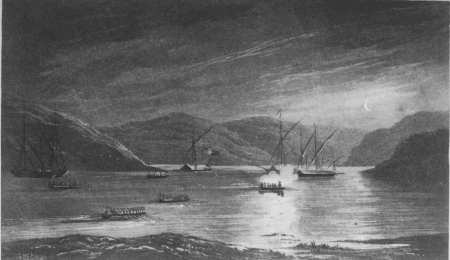
Government were lying at the small port of Lema. The boats, five in
number, two of which were small or gigs, had been in readiness early in
the evening, with the command of which I had been honoured by Captain
Hoste, who left me, as he was accustomed, discretionary power to proceed
and cut them out if possible.
The port at which they lay was about eight miles up a river, the
entrance of which was eight or ten miles from Rovigno. When about two
miles up the river, though it was by no means a clear night, we
discovered two merchant-vessels hauled in close under the cliff, which
was chalky and high; on taking possession of them they proved to be
laden with wine: the masters had their wives and families on board; they
informed us that there were several vessels taking in ship timber under
the protection of an armed xebec and two gunboats, about seven miles
higher up.
I anchored the prizes in the centre of the river: in the charge of them
I left Mr. Langton, a steady young man, and a few hands, to be in
readiness to join us on our return, taking with me in my boat the
masters, who were extremely reluctant to become my pilots and
companions, asserting that the force which we possessed was by no means
equal to the attack, and that we would eventually be captured and they
of course shot on the spot.
By a little persuasion, however, and assuring them they were in no
danger, they became more tranquil and reconciled. We now advanced most
cautiously in a line ahead; oars were muffled, and the most profound
silence observed. A gentle fair breeze enabled us to use our sails,
though we could not help reflecting that on coming back it would be
right against us.
When informed that we were within a mile of the enemy, we lowered our
sails and made all snug for boarding, having reduced our propelling
force to two oars of a side, but all the rest were out and ready in the
rullocks. When we were within two or three cables’ length, only

 London Edward Arnold, 1902.
one oar of a side was used, and each dropped softly into the water,
whilst I assigned to every boat her opponent, agreeably to the manner in
which the pilots had described the enemy’s positions, reserving to
myself the largest, the xebec, which lay farthest up, and the attack of
which was to be the general signal for boarding, although no enemy was
as yet perceptible.
Continuing thus slowly and cautiously, yet no enemy appearing, I almost
apprehended that a hoax had been played off by these men, but they
declared that they would willingly forfeit their existence if the
information they had given was not correct, and at that instant laid
themselves flat in the bottom of the boat, when by a stentorian voice, I
was hailed in English, in the most insulting language, “Come alongside,
you English b——s.” I thanked them for the invitation, and, giving way
with all our might, assured them we should be instantly with them. We
were, under a discharge of grape from our twelve-pound carronade and a
volley of musketry, on the decks of the xebec in a twinkling!
Her guns were primed and matches in hand, some of which were picked up
in a lighted state; but the crew, from the rapidity of our movements,
appeared paralysed, and the maître d’équipage, who had been, we were
told, in the English service, and by whom we were defied, with many
others, jumped overboard.
In the conflict the captain had been wounded in his cabin and made his
escape by the rudder-chains. Report said that this unfortunate man,
though very near the shore, never reached it.
The general attack was simultaneous, as previously concerted, and it
proved successful; but from the smart fire which was kept up on both
sides by the other parties, I dreaded serious consequences.
Lieutenant Gostling, with Mr. Hoste, had most gallantly boarded and
carried one gunboat; while Mr. Few, midshipman, in the most intrepid and
determined style, in his gig, sword in hand, carried the other.
The merchant vessels were found by Mr. Powell, with sails unbent and
fast to the shore by their sterns. On receiving this intelligence, I
left Mr. Haig in command of the xebec, who conducted her down the river
in a superior manner, and proceeded to Mr. Powell’s assistance. In a
short time we succeeded in getting the merchant vessels cut adrift, and
in tow of our boats, obliging their own crews (whom we found concealed
below) to get their sails up and bend them; during which time the
vessels were drifting down the river, and the breeze was most
providentially veering round fair.
It was past midnight, and by the light of the moon just appearing above
the horizon, we could discern that not a vessel was left in the port;
and, to complete our joy, upon inquiry, not a man was even wounded.
Notwithstanding that there were bodies of troops in the neighbourhood
who, as the beating of their drums convinced us, were hastening to
intercept our getting down the river, which was not more than
musket-shot distance across, we escaped with all our prizes, and were
joined by one more, a wine vessel, which came out of a little creek at
the entrance of the river, mistaking us for friends on seeing the French
colours, but not perceiving the union-jack over them. Captain Hoste was
overjoyed at our success, and at seeing his gallant young brother in
command of one of the gunboats.
I represented to him the services that had been rendered to us by the
masters of the wine vessels, as well as the mistake made by the last
poor fellow, whose whole property consisted of the little vessel and
cargo, which he had laboured so hard in the morning to place under my
protection. Captain Hoste, with his usual kindness of heart, readily
assented to my wishes, and the three vessels with their crews were
liberated.
The xebec was equipped immediately, and placed under the command of Mr.
Powell, who greatly distinguished himself in her against the enemy. We
took our prizes to Lissa, and on 16th September sailed to join the
blockading squadron off Venice.
The wind being foul, we stretched over to the coast of Apulia, and at
daybreak on the 18th we discovered an enemy’s convoy of twenty-six
vessels standing along shore, between the islands of Tremite and Vasto.
The wind was too light and baffling for the frigate to get near them,
and the barge, launch, two yawls, and a gig were immediately manned, and
placed under my discretionary orders. A general chase now commenced.
Our boats had been formed into three divisions, viz. the launch and
second yawl in shore, to the right; the barge and first yawl in the
centre; and the gigs to the left in the offing, at such a distance that
their force, which was inconsiderable, should not be recognised. The
enemy hauled into a snug semicircular bay, forming themselves to its
shape the moment they discovered us. In this strong position, with their
heads towards us, rudders unshipped, and tackles from their mast-heads
to the shore, and strong stern-fasts, they hauled their sterns close on
the beach; eight of the number, being armed vessels, were judiciously
placed, three on each horn or wing, and two in the centre.
Our mode of attack was arranged accordingly. I pushed in for the centre;
Messrs. Haig and Powell with the launch and second yawl swept the shore
on the right, and the gigs had orders to advance slowly on the left. We
approached in good order and quickly. When we came within musket-shot,
the armed vessels commenced a heavy cannonade, to which compliment we
replied with cheers only, until within half pistol-shot, when we
returned the fire with grape and canister from our twelve-pound
carronade. At the second discharge we were alongside, and the crews fled
precipitately over the sterns, wading through the water to the shore,
where they afterwards formed to gall us with their musketry, but were
soon routed by our marines, and a party under Messrs. Webb and Farewell,
reserved for that purpose, and driven to a respectable distance, at
which they were kept, while the remainder of our gallant fellows were
actively employed in getting the tackling off the shore, shipping the
rudders, hauling the vessels off the ground and out of the bay, some of
which, in two hours, were actually under weigh for the frigate. With the
exception of six salt vessels, the cargoes consisted of almonds and oil,
and by four o’clock all were conducted to the ship, two only excepted,
which were by our shot sunk and could not be moved; the part above water
of these were destroyed by fire, and effectually demolished before we
quitted.
The breeze now began to freshen, and the atmosphere had all the
appearance of the commencement of a Borea, or N.E. gale; consequently no
time was lost in despatching as many of the prizes as we could to Lissa.
The salt craft were scuttled and sunk; the remaining vessels we took in
tow.
The gale increased during the night, and caused us great uneasiness for
the safety of the eleven prizes sent away, two of which we fell in with
the next morning; one being dismasted, the crew had quitted her, and we
took her in tow. We were by them informed that one under the command of
the Honourable H. J. Rous, midshipman, had upset; but the cargo (oil)
being of a buoyant nature, the vessel floated on her broadside, which
enabled another, her consort, under the Honourable William Waldegrave, a
promising young officer, to pick him and her crew up, with the exception
of one man (I think Oliver Cooke), whom they could not by any means get
hold of at the moment.
Soon after we fell in with Mr. Rous, who gave us the bearing of the
wreck, and the apparent distance. We, of course, immediately cast adrift
our tow, and after many hours of tacking, wearing, and diligent search,
in various directions, with every telescope in the ship in requisition,
in the earnest and anxious expectation of discovering the unfortunate
poor fellow, were, at noon, about to relinquish all hope, when our
second lieutenant (Hood) imagined he had discovered a something astern
of us, which proved to be the wreck, and very soon we perceived the
object of our anxiety on it.
We instantly wore round, and in a moment, although the sea was running
very high, and it was a dangerous service, I had a boat’s crew of
volunteers, and picked him up.
He had managed to secure himself with a piece of rope to one of the
timber heads on the upper gunwale, from which, owing to extreme
weakness and languor, he had great difficulty to extricate himself. The
judicious means resorted to by our skilful surgeon (William Lodge Kidd),
together with the attention bestowed on him by all on board, restored
the patient in a short time to, at least, a sense of his ameliorated
situation.
He informed us that, at daylight, he had perceived the ship advancing
towards the wreck, and was overjoyed, being confident that we must have
observed him; but, when he saw us about to depart, he thought his heart
would instantly break. Considering the size of a large frigate, and the
wreck of a comparatively small vessel, occasionally covered with the
sea, it is easy to account for the difference in our optics.
All of our prizes arrived in safety except two, which I grieve to say
were never heard of. They were commanded by very promising young men,
Dobson and Mason. Mr. Few, of whom I have had occasion already to make
honourable mention, commanded one of the captured vessels, which was
without any ground tackling, and finding that she was drifting rapidly
before the gale on the enemy’s coast, he adopted the ingenious
contrivance of slinging a twelve-pound gun and letting it go as an
anchor, and by this means the vessel rode out the gale and was saved
from destruction. Another midshipman, Mr. Richardson, by getting his
cables out abaft, and letting go his anchors from the stern, though in
very deep water, contrived to retard the drifting of his vessel until
the gale abated, and thus did he save his prize. This youth had but just
commenced his naval career.
It was at this period that a truly dreadful accident occurred on board
of the Bacchante, and which plunged all our officers and crew into
the profoundest melancholy. On anchoring, a light vessel was brought
alongside of us, in order that we might load her with some of the
oil-casks that we had saved out of the sinking prizes. A remarkably fine
youth, the son of Viscount Anson, had just quitted my side, and had
descended into the vessel, to see the process employed in loading her.
He had not been two minutes on board, and was apparently at play with
another youth about his own age, a Mr. William Barnard, when one of our
main-deck guns, by some inexplicable cause, went off, and killed him on
the spot, without hurting his companion or any other person whatever.
The ball, however, was very nearly killing Captain Duff Markland, of the
admiral’s ship, the Milford, for it whizzed close by his head as he
was looking out of the quarter-gallery window.
How this fatal gun had so unhappily gone off was inscrutable. The
lanyards and leaden apron over the lock and touch-hole were secured in
the best and usual manner. No fire or means of ignition were near it;
and as to any vibration or concussion of the decks, caused by our
removing the casks, if such existed, it must have been very slight, and
equally effective in the adjacent guns. Be the cause what it may, we had
to consign to its last long resting-place the mutilated body of a young
officer, suddenly cut off in all the promise of youth, at a moment of
sportive innocence, and amidst the affections of all around him. Our
brave captain was deeply affected, for poor young Anson had been
entrusted by his parents to his special care and superintendence.
On the 25th we again stood over to the Apulian coast, and vainly
endeavoured to gain some intelligence of our lost shipmates and prizes.
Our ultimate object was the blockade of Venice. We had heard, however,
of the most tragical fate of the Danaë, French frigate, lying off
Trieste.
A seaman who had been punished (and his miscreant nature affords a
presumption that his punishment had been merited), had by some
contrivance or other procured access to the magazine. Having everything
in readiness, he waited only for the captain’s returning on board. This
officer had been at the opera—from the refined and luxurious enjoyment
and splendour of which he had returned to his rougher quarters, and
could scarcely have got into his cot, when the diabolical assassin
applied his match to the powder, and the noble vessel, with her full
complement of (I doubt not) brave men, was in an instant blown to atoms;
for only four of them were left to tell this wretched tale.
The Flore frigate, that had so shamefully made her escape after she
had struck to us, had been wrecked some time back off the coast of
Venice; and all that remained of the fine squadron, of which Napoleon
had formed such high expectations, was the Carolina. What could be a
better compliment to our noble captain?
I was engaged to dine with him on the 29th of September, or Michaelmas
Day, and off goose—an odd English dinner in such a part of the world.
In the morning, it falling a dead calm, and our frigate being only
twelve or fourteen miles off the fortified town of Viesta, it struck
Captain Hoste that by a flag of truce I might learn whether our poor
fellows in the two prizes had perished at sea or whether they had been
driven on the enemy’s coast and made prisoners of war.
As it was not unusual for Napoleon’s officers to disrespect flags of
truce, and to violate the security paid to them by civilised nations, I
took the worst boat (an old gig), with four volunteers, and I supplied
myself with a knapsack, and all other things that might enable me, were
I captured, to indulge in my old habits of escaping from French clutches
rather than be again taken to Bitche; where a recollection might be had
of me that would be by no means consonant to my wishes.
After a long and tedious row we got near to the batteries, which were
manned, and exhibited all the bustle of drums and bugles, and all other
symptoms of excitement and of brave and noble daring, as if they had
been approached by a first-rate ship-of-war, instead of by a small boat
containing only four men under a flag of truce, which showed that they
were unarmed.
As we approached the centre of the fort the soldiers crowded the
ramparts, making the most violent demonstrations with their side-arms,
brandishing their swords, and using the most abusive language towards
us.
I pursued my object, pointing to my flag of truce, and to a packet of
papers which I held in my hands; but a number of officers and soldiers
rushed from the sally-port to the water’s edge, using the most
disgusting language, swearing that they would cut us to pieces if we
attempted to land.
I appealed to the officer upon the respect due to a flag of truce: and I
anxiously inquired after the fate of my companions, but I was unhappily
convinced that he knew nothing of them, for all the reply I got was a
charge that, under the pretext of a flag of truce, I had approached
solely with a view to discover the state of the garrison, and we
deserved to be shot as spies. I had therefore only to rejoin my ship,
where an ample portion of goose was reserved for me by my good chief.
We repaired off Venice, where, on the 14th of October, we discovered, in
company with the Achille, that the enemy had three sail of the line
more ready than willing, we imagined, to put to sea. With this
intelligence we were despatched to our Admiral Freemantle, at Lissa, and
again returned, after capturing two trabaccolos, laden with firewood,
close in on the Istrian coast. There was a good deal of boat-fighting on
this occasion, as they were covered by musketry from the shore; however,
we had not sustained any loss; and we soon had a much better exploit.
As there could not have been for the Adriatic and its coasts a better
pilot than Captain Hoste, in passing between the Brioni Islands and the
main, a large quantity of ship timber was discovered by us lying on the
beach, near the town of Fazano, on the Istrian shore, which he
determined to seize and embark the first convenient opportunity, which
soon presented itself.
On the 13th of November, after having been opposed by adverse winds and
drifted by currents, we found the commodore, Captain Rowley, in the
Eagle, with the Achille, Captain Hollis, in company. Captain Hoste
gave the former the information, who immediately acquiesced in a
proposal made by our gallant chief to bring the timber off. The
commodore kindly declared, that as it had been discovered by him, the
command of the forces necessary for the execution of that service should
be given to his first-lieutenant (myself), and that he, the commodore,
with the other line-of-battle ship, would be most happy to supply as
many officers and men as might be deemed expedient for the purpose.
Arrangements were accordingly made: light winds, together with the draft
of water they required, prevented the line-of-battle ships getting near
enough to the shore to cover the debarcation, but the Bacchante was
enabled to take her position sufficiently close to the town, with
springs on her cables, and all boats were out and in readiness at an
hour before daylight on the 14th.
The marines, with the seamen of the Eagle and Bacchante intended for
the service, pulled off from the frigate for the shore at daybreak
(those of the Achille, being at a great distance in the offing, not
having arrived), with three hearty cheers, which were returned with
great animation by our good captain and shipmates. My orders, as on
former occasions, were discretionary, with a proviso that, in the first
instance, it was indispensably necessary to take the town of Fazano.
In about twenty minutes we were all landed, and in a very few minutes
more had possession of the town, and had the pleasure of seeing the
British colours flying from the top of the church steeple without
opposition, for the troops and militia had abandoned the place on our
approach. All the advantageous positions were instantly occupied by our
marines, under the command of Lieutenants Holmes and Haig; the enemy we
observed on the adjacent heights, waiting, we supposed, for a
reinforcement from the garrison of Pola, only eight miles distant, and
where they had a formidable force, having in that place regular
fortifications.
Immediately on our colours being displayed I searched out and found the
padré, or chief clergyman, to whom I communicated our intention of
taking off all the ship timber, as it was a Napoleon or government
concern, adding, that we waged no war against the inhabitants, nor
should they be in the slightest way molested; whatever provision or
merchandise they had to dispose of, we should purchase at their own
prices; the fishermen and boats I should put in requisition, to aid in
the embarcation of the timber, after which they would be allowed to
depart freely. All these particulars I requested the good padré would
have the kindness to communicate to his flock, who received joyfully the
intelligence, and to work we went most willingly—none more so than the
natives, who I believe, if they durst declare it, were more attached to
us than to the usurper and his myrmidons.
The timber proved to be solid oak, and so ponderous that on launching it
sunk like lead; therefore we were under the necessity of slinging or
hanging every beam and piece of it to the boats’ sides, as rafting it
off was out of the question.
By sunset the frigate was nearly full; the lower decks and booms were
the only places where it could be conveniently placed, so as not to
interrupt the working of the guns, and our signal was made for
re-embarcing, which was complied with, with the most exact precision and
in perfect order, without a casualty with the exception that one of our
carpenter’s crew, named Remmings, was missing, whom we strongly
suspected of having an intention to desert. The troops and militia
entered the town at the moment of our embarcation. Early on the next
morning, the 15th, we again landed and resumed our duties with the same
facility, the enemy having retired from the town to the heights as on
the preceding day; and by ten o’clock we had sent off all that the ship
could possibly contain. Having destroyed the remainder, we returned to
the frigate; just as I was informed that the enemy was advancing in
great force, with a determination to drive us into the sea.
We were next despatched to Corfu, off which island Captain Hoste
appeared on the 24th December, it blowing a hurricane at the time.
On 5th January 1813, when passing the Island of Fano, early in the
afternoon, we discovered a flotilla of gun-vessels standing out to sea,
evidently bound across to Otranto. The wind being fair for the Adriatic,
we crowded all possible sail, as if making a passage up the Gulf without
perceiving the enemy’s flotilla, which lowered their sails and hauled in
under the high cliffs of the island. The moment we lost sight of them,
we shortened sail, and stood over close-hauled on a wind, for Otranto,
in the hope of cutting them off on the morning following. At midnight we
were made happy by a number of letters from England, which the Weazle
had recently received.
On the 6th, at about half-past five, the officer of the watch sent a
midshipman to inform me that it was a perfect calm, with light only
sufficient to distinguish that we were at a short distance from five
gunboats of the enemy, then exactly midway between Corfu and Otranto.
Our ruse de guerre had evidently so far proved successful. The
Weazle was not more than four miles from us, but in an opposite
direction to the flotilla, now about six or seven miles distant. This
service, as there was no wind, was necessarily to be executed by our
boats, which were in readiness by six o’clock, and which I had the
honour of commanding.
As on former occasions, my gallant friend, Lieutenant Haig of the
marines, always active and zealous in the service of his king and his
country, accompanied me in the barge. Lieutenant Hood commanded the
launch; Lieutenant Gosling, the second yawl; Mr. Edward Webb, master’s
mate, the first yawl and two gigs, one of which was commanded by Mr.
Hoste, midshipman.
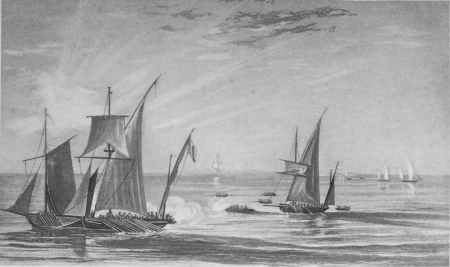
The enemy, perceiving the preparations, separated, two of them taking
the direction back towards Corfu; the remaining three, with sails
furled, kept their course towards Otranto, sweeping with all their
might, which division we pursued, Mr. Webb, with whom the Weazle’s
boats were directed to co-operate, chasing the former division.
After two good hours’ chase, we in the barge closed with the sternmost
gunboat, the officer of which kept up an incessant and well-directed
fire of round and grape, that splintered several of the oars; but not a
man was wounded, and to this fire we could reply by cheers only, as
otherwise we should have been obliged to lay in our oars, which, of
course, would retard our progress in closing. Now nearly alongside, and
about to cease rowing, we discharged our twelve-pound carronade with
grape, which wounded two of his men; and, seeing that we were ready to
lay him on board, he thought proper to haul down his colours.
The other boats coming up, I pushed on for the next ahead. To Mr. Hoste,
whose gig kept the whole time close to the barge, I left charge of the
prize. I perceived him take possession in good style with his little
crew, send the prisoners below off the deck, and, with amazing celerity,
he had her bow-gun, which traversed upon a pivot, to bear upon the
chase, contributing greatly to her
 London. Edward Arnold. 1902.
surrender, though a fine breeze now sprang up, which enabled them to
make sail—which, of course, we did also; as did the frigate when it
reached her, though at a great distance to leeward.
The third gunboat was closing fast with the Neapolitan coast, but we
gained upon her, and in little more than an hour we had the satisfaction
of having captured the whole, without any loss whatever on our side.
Mr. Webb, in the first yawl, captured the sternmost of the two which he
had been in chase of, before the Weazle or her boats (notwithstanding
they used every exertion) could co-operate. However, as they were
rapidly advancing, he left his prize to be taken possession of by them,
and, pushing forward, boarded and carried, in the most gallant manner,
the other, ably supported by the Hon. H. J. Rous. All proved to be
vessels of a superior description and very fast craft: their officers
stated that they were bound to Otranto, for the purpose of picking up
and fetching back to Corfu specie for the payment of the troops in that
island.
Their guns were fitted on a pivot, which enabled them to traverse and
fire in any direction, without altering the course; it was by this means
that they were enabled to annoy our boats so much in approaching, as I
have already stated. We found it necessary to bear up for Valona Bay, in
order to put our prizes in a state to encounter bad weather, which, from
all appearances, was then to be expected.
On the 8th we sailed with them for the Island of Zante; and the next
day, when off Fano, we captured a convoy consisting of five vessels,
laden with provisions, for Corfu. The weather again becoming boisterous,
compelled us to return to our anchorage, and to destroy two of the
gunboats; a third was missing, which we feared must have gone down. If I
am not mistaken, it was the Calypso, under the command of Mr. Edward
O. Pocock.
13th January.—We were now again on our passage to Zante with the
prizes captured on the 9th inst.: the weather becoming boisterous,
buffeted them about very much, and on the 23rd it became still more
inclement, which obliged us to take young Mr. Hoste and the crew out of
one until the weather abated. Another, commanded by Mr. Few, which we
had left perfectly secure and well in under the Island of Zante, we
perceived early the next morning (24th), bearing down to us with the
signal of distress at the mast-head. I obtained permission from Captain
Hoste to proceed with a volunteer crew (as was usual on dangerous
occasions) to her assistance. On coming within hail, I received the
melancholy intelligence of the loss of this very promising young man,
Mr. Few,[45] in the night. It happened that, in the act of wearing, the
vessel’s fore-yard struck him, and tossed him completely overboard: the
night was excessively dark, and a mountainous sea running; the crew had
heard him call out, but could not see him or render any assistance. This
severe loss cast a gloom over all hands. Another young gentleman was
placed in command; and, having seen all our prizes safe into Zante (with
the exception of the three which were missing), we resumed our station
off Corfu.