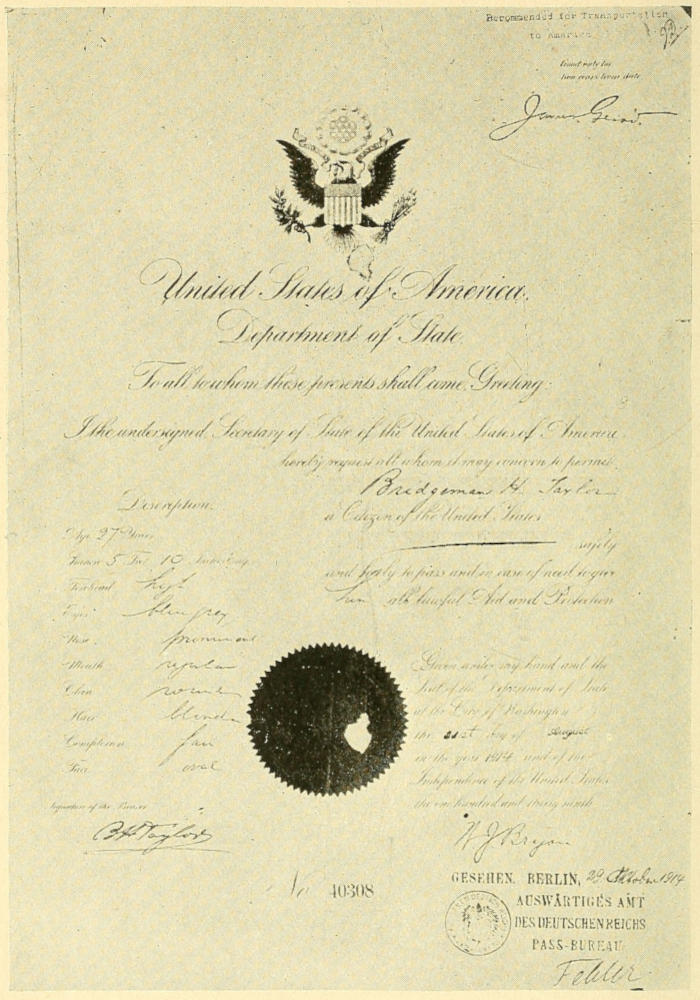
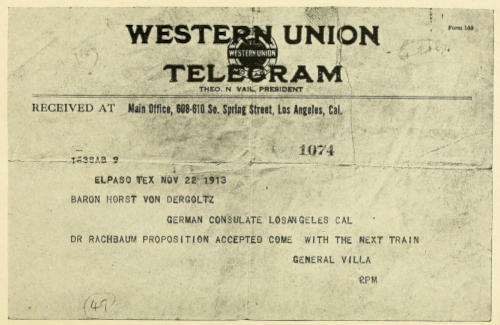
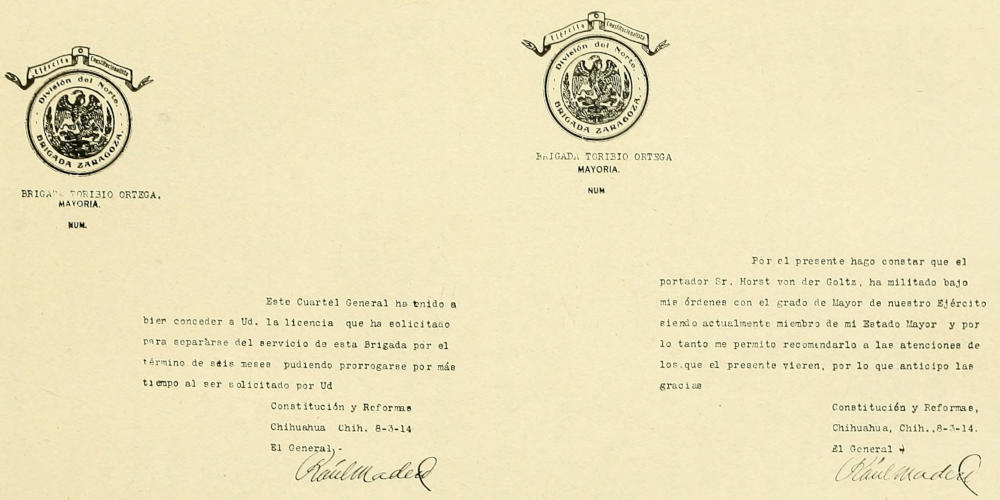
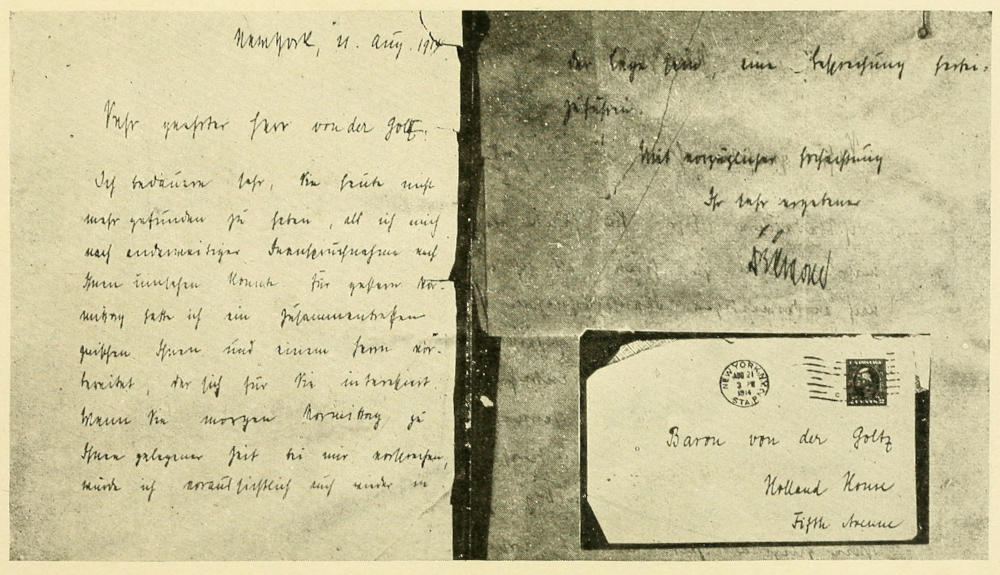
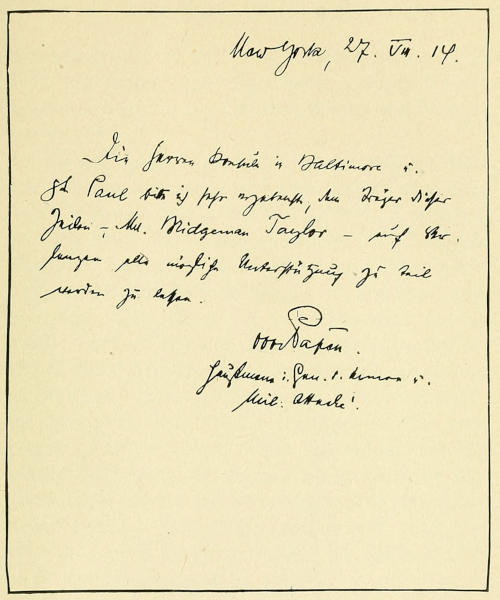
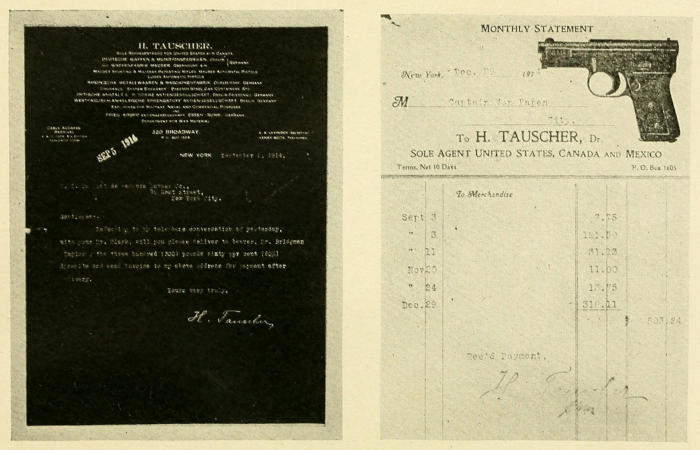
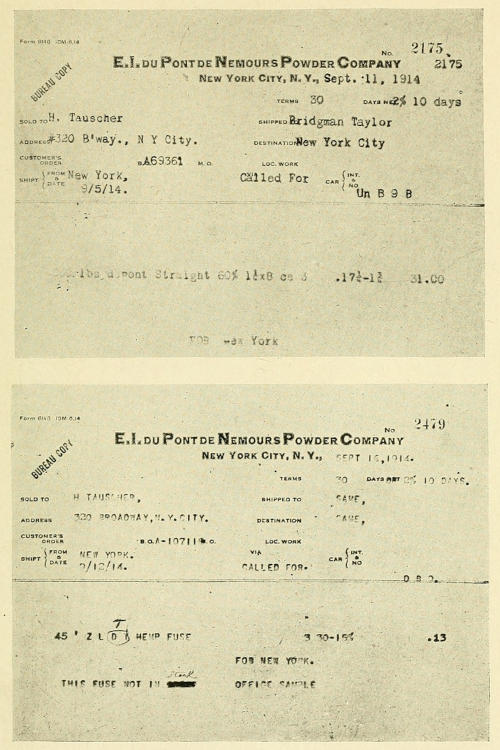
The Bridgeman H. Taylor passport upon which
von der Goltz returned to Germany and later went to England. In the
upper right hand corner is the visé of the American Embassy at Berlin.
My Adventures AS A
German Secret Agent
BY
CAPT. HORST VON DER GOLTZ Formerly Major in the Mexican Constitutional Army.
Sometime Confidential Aide to Captain von Papen,
Recalled Military Attaché to the Imperial
German Embassy at Washington,
German Secret Agent.
ILLUSTRATED
NEW YORK
ROBERT M. McBRIDE & COMPANY
1917
Copyright, 1917
by Robert M. McBride & Company
Published, 1917
“One must at times separate
a gentleman and a diplomat
from his official acts performed
under orders from his home government,
otherwise great confusion
and injustice will occur. Some
governments have a little way of
telling those who represent them
abroad ... to get such and such
a thing done, and done it must be.
Nor would those high Government
officials at home care often to hear
painful details of the successful
execution of many such orders
which are given.”
from “The Strangling of Persia,” by W. Morgan Shuster.
TO THE
UNITED STATES OF GERMANY—WHENEVER
THEY MAY COME TO BE—I
DEDICATE THIS BOOK AND MY HOPES.
Germany displays an interest in Mexico, and aids the United
States for her own purposes. The Japanese-Mexican treaty and its
share in the downfall of Diaz
My letter again. I go to America and become a United States
soldier. Sent to Mexico and sentenced to death there. I join
Villa’s army and gain an undeserved reputation
War. I re-enter the German service and am appointed aide
to Captain von Papen. The German conception of neutrality and
how to make use of it. The plot against the Welland Canal
The German intrigue against the United States. Von Papen,
Boy-Ed and von Rintelen, and the work they did. How the
German-Americans were used and how they were betrayed
I have not attempted to write an autobiography.
This book is merely a summary—a
sort of galloping summary—of the last ten
years of my existence. As such, I venture to
write it because my life has been bound up in
enterprises in which the world is interested. It
has been my fortune to be a witness and sometimes
an actor in that drama of secret diplomacy
which has been going on for so long and which
in such a large way has been responsible for this
war.
There are many scenes from that drama that
have no place in this book—many events with
which I am familiar that I have not touched
upon. My aim has been to describe only those
things with which I was personally concerned
and which I know to be true. For a full history
of the last ten years my readers must go elsewhere;
but it is my hope that these adventures
of mine will bring them to a better understanding
of the forces that have for so long been
undermining the peace of the world.
Inevitably there will be some who read this
book, who will doubt the truth of many of the
statements in it. I cannot, unfortunately, prove
all that I tell here. Wherever possible I have
offered corroborative evidence of the truth of
my statements; at other times I have tried to
indicate their credibility by citing well recognized
facts which have a direct bearing upon my contentions.
But for the rest, I can only hope that
this book will be accepted as a true record of
facts which by their very nature are insusceptible
of proof.
So far as my connection with the German
Government is concerned, I may refer the
curious to the British Parliamentary White
Papers, Miscellaneous Nos. 6 and 13, which contain
respectively my confession and a record of
the papers found in the possession of Captain
von Papen, former military attaché to the German
Embassy at Washington, and seized by the
British authorities on January 2 and 3, 1916.
There are also, in addition to the documents
reproduced in this book, various court records
of the trial of Captain Hans Tauscher and others
in the spring of the same year. Of German
activities in the United States, the newspapers
bear eloquent testimony. I have been concerned
rather with the motives of the German Government
than with a statement of what has been
done. These motives, I believe, you will not
doubt.
But there is one point which I must ask my
readers not to overlook. I have told that I became
a secret agent through the discovery of a
certain letter which contained very serious reflections
upon one of the most important personages
in the world. I have told, also, how the
possession of that letter had an important bearing
upon the course of my life—how it led me
to America, and how in the struggle for its possession,
I very nearly lost my life. This, I know,
will be severely questioned by many. Before
rejecting this part of my story, I ask merely that
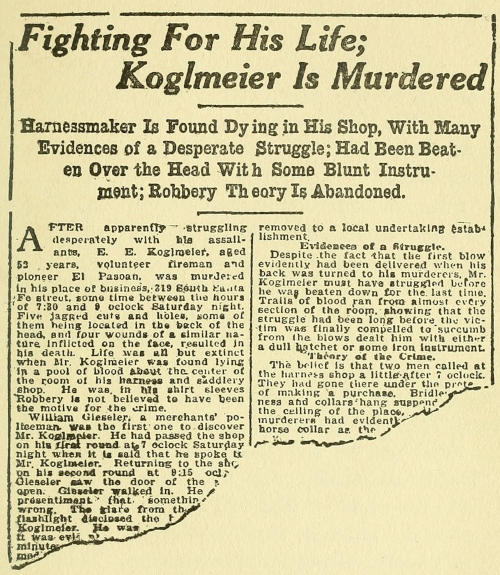
you consider the fate that overtook Koglmeier,
the saddler of El Paso, whose only crime was
that he had been partially in my confidence. I
ask you to recall that another German, Lesser,
who had been associated with me at the same
time, mysteriously disappeared in 1915, shortly
before von Papen left for Europe. No one has
been able to prove why these men were treated as
they were. And if I did not have in my possession
something which the German Government
regarded as highly important, why the surprising
actions of that Government, actions none the less
astonishing because they are well known and
authenticated? Consider these things before you
doubt.
Finally, let me say that I have taken the liberty
of changing or omitting the names of various
people who are mentioned in these adventures,
merely because I have had no wish to compromise
them by disclosing their identity.
New York, July 8, 1917.
ERRATA
Page 5. Chapter I. First line:
March 28th, 1917 should read March 29th, 1916.
Page 140. Last two paragraphs:
December 23rd should read December 20th.
Page 171. Second paragraph:
October 8th should read October 3rd, 1914.
Transcriber’s Note: The errata have been corrected.
My Adventures as a German Secret Agent — CHAPTER I
I find an old letter, containing a strange
bit of scandal—and its contents draw me into
the service of the Kaiser.
On March 29th, 1916, the steamer Finland was
warped into its Hudson River dock and I
hurried down the gang plank. I was not alone.
Agents of the United States Department of
Justice had met me at Quarantine; and a man
from Scotland Yard was there also—a man who
had attended me sedulously since, barely two
weeks before, I had been released under rather
unusual circumstances from Lewes prison in
England; the last of four English prisons in
which I had spent fifteen months in solitary confinement
waiting for the day of my execution.
My friend from Scotland Yard left me very
shortly; soon after, I was testifying for the
United States Government against Capt. Hans
Tauscher, husband of Mme. Johanna Gadski, the
diva. Tauscher, American agent of the Krupps
and of the German Government, was charged
with complicity in a plot to blow up the Welland
Canal in Canada during the first month of the
Great War. During the course of the trial it
was shown that von Papen and others (including
myself) had entered into a conspiracy to violate
the neutrality of the United States. I had led
the expedition against the Welland Canal and I
was telling everything I knew about it. Doubtless
you remember the newspapers of the day.
You will remember how, at that time, the
magnitude of the German plot against the neutrality
of the United States became finally apparent.
You will remember how, in connection
with my exposure came the exposure of von Igel,
of Rintelen, of the German Consul-General at
San Francisco, Bopp, and many others. With all
of these men I was familiar. In the activities of
some of them I was implicated. It was I, as I
have said, who planned the details of the Welland
Canal plot. I shall tell the true story of these
activities later on.
But first let me tell the story of how I became
to be concerned in these plots—and to do that
I must go back over many years; I must tell how
I first became a member of the Kaiser’s Secret
Diplomatic Force (to give it a name) and incidentally
I shall describe for the first time the
real workings of that force.
I have been in and out of the Kaiser’s web for
ten years. I have served him faithfully in many
capacities and in many places—all over Europe,
in Mexico, even in the United States. I served
the German Government as long as I believed it
to be representing the interests of my countrymen.
But from the moment that I became convinced
that the men who made up the Government—the
Hohenzollerns, the Junkers and the
bureaucrats—were anxious merely to preserve
their own power, even at the expense of Germany
itself, my attitude toward them changed. That
is why I write this book—and why I shall tell
what I know of the aims and ambitions of these
men—enemies of Germany as well as of the rest
of the world.
I was not a spy; nor was I a secret service
agent. I was, rather, a secret diplomatic agent.
Let me add that there is a nice distinction between
the three. A secret diplomatic agent is a
man who directs spies, who studies their reports,
who pieces together various bits of information,
and who, when he has the fabric complete, personally
makes his report to the highest authority
or carries that particular plan to its desired conclusion.
His work and his status are of various
sorts. Unlike the spy, he is a user, not a getter,
of information. He is a free lance, responsible
only to the Foreign Office; a plotter; an unofficial
intermediary in many negotiations; and
frequently he differs from an accredited diplomatic
representative, only in that his activities
and his office are essentially secret. Obviously
men of this type must be highly trained and reliable;
and their constant association with men
of authority makes it necessary that they, themselves,
be men of breeding and education. But
above all, they must possess the courage that
shrinks at no danger, and a devotion, a patriotism
that knows no scruples.
This, then, was the calling into which I found
myself plunged, while still a boy, by one of the
strangest chances that ever befell me, whose life
has been full of strange happenings.
As I recall my adolescence I realize that I was
a normal boy, vigorous, wilful, fond of sport, of
horses, dogs and guns, and I know that but for
the chance I speak of, I should have grown up
to the traditions of our family—Cadet school—the
University—later a lieutenancy in the German
Army—and to-day, perhaps, death “somewhere
in France.”
And yet, in that boyhood that I am recalling,
I can remember that there were other interests
which were far greater than the games that I
loved, as did all lads of my age. Mental adventure,
the matching of wits against wits for
stakes of reputation and fortune, always exercised
an uncanny fascination over my mind.
That delight in intrigue was shown by the books
I read as a boy. In the library of my father’s
house there were many novels, books of poems,
of biography, travel, philosophy and history; but
I passed them by unread. His few volumes of
court gossip and so-called “secret history” I
seized with avidity. I used to bear off the
memoirs of Maréchal Richelieu, the Cardinal’s
nephew, and read them in my room when the
rest of the household was asleep.
I recall, too, that there was another tendency
already developed in me. I see it in my dealings
with other boys of that day. It was the impulse
to make other people my instruments, not by
direct command or appeal, but by leading them
to do, apparently for themselves, what I needed
of them.
Such was I, when my aunt who had cared for
me since the death of my parents some years
before, fell ill and later died. I was disconsolate
for a time and wandered about through the halls
and chambers of the house, seeking amusement.
And it was thus that one day I came upon an old
chest in the room that had been hers. I remembered
that chest. There were letters in it—letters
that had been written to her by friends made in
the old days when she was at court. Often she
had read me passages from them—bits of gossip
about this or that personage whom she had once
known—occasionally, even, mention of the
Kaiser.
Doubtless, too, I thought, there were passages
which she had not seen fit to read to me: some
more intimate bits of gossip about those brilliant
men and women in Berlin whom I then knew
only as names. With the eager curiosity of a
boy I sought the key, and in a moment had unlocked
the chest.
There they lay, those neat, faded bundles,
slightly yellow, addressed in a variety of hands.
Idly I selected a packet and glanced over the
envelopes it contained, lingering, in anticipation
of the revelations that might be in them. I must
have read a dozen letters before my eye fell upon
the envelope that so completely changed my life.
It lay in a corner of the chest, as if hidden
from too curious eyes—a yellow square of paper,
distinguished from its fellows by the quality of
the stationery alone, and by its appearance of
greater age. But I knew, before I had read fifty
words of it, that I was holding in my hands a
document that was more explosive than dynamite!
For this letter, written to my aunt years
before, by one of the most exalted personages in
all of Germany, contained statements which, had
they been made by any one else, would have been
treason to utter, and which cast the most serious
doubts upon the legitimacy of the Kaiser,
Wilhelm II.
I realize fully that what I have written will
seem grossly improbable to most of my readers.
I know that few persons will believe me. And
since I cannot prove what I have said, since the
letter is no longer in my possession, I can ask
you only to consider the facts and to weigh for
yourself the probabilities of my statement.
Those of you whose memories go back to the
last twenty years of the nineteenth century, will
readily recall the notorious ill-feeling that existed
between Wilhelm II and his mother, Victoria,
the Dowager Empress Friederich. Stories
have too often been told of this enmity, culminating
in the virtual banishment from Berlin of
the Queen Mother, for me to need do more than
mention them. But what is not so generally
known is the small esteem in which Victoria was
held by the entire German people. During the
twenty years of her married life as the wife of
the then Crown Prince Friederich, she was
treated by Berlin society with the most thinly-veiled
hostility. Even Bismarck made no attempt
to conceal his dislike for her, and accused
her—to quote his own words—of having “poisoned
the fountain of Hohenzollern blood at its
source.”
Victoria, for her part, although she seems to
have had no animosity toward the German
people, certainly possessed little love for her
eldest son, and did her best to delay his ascension
to the Imperial throne as long as she could.
When in 1888 Wilhelm I was dying, she tried
her utmost to secure the succession to her husband,
who was then lying dangerously ill at San
Remo. “Cancer,” the physicians pronounced the
trouble, and even the great German specialist,
Bergman, agreed with their diagnosis. There
is a law that prevents any one with an incurable
disease, such as cancer, from ascending the
Prussian throne; but Victoria knew too well the
attitude of her son, Wilhelm, toward herself, not
to wish to do everything in her power to prevent
him from becoming Emperor so long as she
could. In her extremity she appealed to her
mother, Queen Victoria of England, who sent
Mackenzie, the great English surgeon, to San
Remo to report on Friederich’s condition.
Mackenzie opposed Bergman and said the disease
was not cancer; and the physicians inserted
a silver tube in Friederich’s throat, and in due
course he became Emperor Friederich III.
But in spite of Mackenzie and the silver tube,
Friederich III died after a reign of ninety-eight
days—and he died of cancer.
Now what was the reason for this hostility between
mother and son and between Empress and
subjects? There have been many answers given—Victoria’s
love for England, her colossal lack
of tact, her impatient unconventionality. Berlin
whispered of a dinner in Holland years before,
when Victoria had entertained some English
people she met there—people she had never seen
before—and had finished her repast by smoking
a cigar. That in the days when the sight of a
woman smoking horrified the German soul! And
Berlin hinted at worse unconventionalities than
this.
As for the animosity of the Kaiser, that was
attributed to the fact that he held her responsible
for his withered left arm.
Plausible reasons, all of these, and possibly
true. But consider, if you will, the rumors that
followed Victoria all her life—the story of an
early attachment to the Count Seckendorf, her
husband’s associate during the Seven Weeks’
War of 1866—the reports, sometimes denied but
generally believed, of her marriage to the Count
not long before her death. Consider, too, the
dissimilarity between the Kaiser and the other
men of his race—big, slow-minded, amiable men—so
unlike Wilhelm II, with his aggressive,
alert personality, his quick mind and his Piedmontese
face. And can you not imagine the
attitude of a woman who had been guilty of infidelity
and yet retained her sense of national
honor—the hesitancy she might feel at seeing the
child of this infidelity upon the throne, and so
perpetrating a gigantic fraud upon a people and
a husband whom she respected if she did not
love? And have not women been known to hate,
rather than love, the offspring of a guilty union?
True or not, these suppositions—what does it
matter? You can see, can you not, why I believed
that my letter told the truth, and why I
knew that here was a plaything which would
astound the world, if made public?
But what to do with this letter to which I
attached so much importance? Something impelled
me not to speak of it to my family. But
who else was there?
In my perplexity I did an utterly foolish thing.
I put my whole confidence in a man’s word.
There was, serving at a nearby fortress, a
General Major von Dassel, who was in the habit
of coming to our house quite regularly. To him
I went, and under pledge of silence I told him
my story. Of course, he broke the pledge and
left immediately for Berlin. All doubts, if I had
any, as to the importance of the document
vanished with him. And if I had any misgivings
concerning my own importance they quickly
vanished, too. Back from Berlin, with General
Major von Dassel came an agent of the Reichs
Kanzler. He did not come to our house; instead
von Dassel sent for me to go to his headquarters
in the fortress. I met there a solemn frock-coated
personage who, so he said, had come down from
Berlin especially to see me. Imagine my elation!
I was in my element; what I had hoped for had
at last happened. The pages of Richelieu and
of my secret histories were coming true. Another
man and I were to lock our wits in a fight
to the finish—that pleasure I promised myself.
He was a worthy opponent, an official, a professional
intriguer. As I looked into his serious,
bearded face, I built romances about him.
The agent of the Chancellor wanted my document
and my pledge to keep silent about its contents.
Through sheer love of combat, I refused
him on both points. He tried persuasion and
reason. I was adamant. He tried cajolery.
“It is plain,” he said, in a voice that was caressingly
agreeable, “that you are an extremely
clever young man. I have never before met your
like—that is, at your age. A great career will be
possible to such a young man if only he shows
himself eager to serve his government, eager to
meet the wishes of his Chancellor.”
Of course, I was delighted with this flattery,
which I felt was entirely deserved. I began to
believe that I was a person of importance. I
became stubborn—which always has been one of
my best and worst traits. I saw that the gentleman
in the frock-coat was becoming angry; his
serious eyes flashed. Apparently much against
his will, he tried threats; he suavely pointed out
that if I persisted in my resolve not to turn over
the document, destruction yawned at my feet.
The threats touched off the fuse of my romanticism.
I felt I was leading the life of intrigue of
which I had read.
“If you will wait here,” I told him, “I shall go
home and get the document for you.”
The Chancellor’s representative stroked his
beard, deliberated a moment and seemed uncertain.
“Oh, the Junge will come back all right,”
put in the General Major von Dassel. But the
Junge did not come back. My family had
always been excessively liberal with money, and
I had enough in my own little “war chest” to buy
a railroad ticket, and a considerable amount besides.
So I promptly ran off to Paris; and to
this day I don’t know how long the gentleman
in the frock-coat waited for me in von Dassel’s
office.
The terrors and thrills and delight of that
panic stricken flight still make me smile. No
peril I have since been through was half as exciting....
Berlin!... Köln!... Brussels!
It was a race against apprehension. I was
happily frightened, much as a colt is, when it
shies at its own shadow. Although I was in long
trousers and looked years older than I was, I had
not sense enough to see the affair in its true light—a
foolish escapade which was quite certain to
have disagreeable consequences. And so I fled
from Berlin to Paris.
From Paris I fled, too. There, any circumstance
struck my fevered imagination as being
suspicious. After a day in the French capital, I
scurried south to Nice and from Nice to Monte
Carlo. Precocious youngster, indeed, for there
I had my first experience with that favored figure
of the novelist, the woman secret agent. No
novelist, I venture to say, would ever have picked
her out of the Riviera crowd as being what she
was. She wore no air of mystery; and though
attractive enough in a quiet way, she was very
far from the siren type in looks or manners. The
friendliness that she, a woman of the mid-thirties,
showed a lonely boy was perfectly natural. I
should never have guessed her to be an agent of
the Wilhelmstrasse had she not chosen to let me
know it. Of course, the moment she spoke to
me of “my document,” I knew she had made my
acquaintance with a purpose. If the dear old
frock-coated agent of the Chancellor had been
asleep, the telegraph wires from Berlin to Paris
and Nice and Monte Carlo had been quite awake.
The proof that I was actually watched and
waited for thrilled me anew. It also alarmed me
when my friend explained how deeply my government
was affronted. Soon the alarm outgrew
the thrill and in the end I quite broke down. Then
the woman in her, touched with pity, apparently
displaced the adventuress. We took counsel
together and she showed me a way out.
“Your document,” she said, “has a Russian as
well as a German importance. Why not try
Petersburg since Berlin is hostile? For the sake
of what you bring, Russia might give shelter and
protection.”
Remember, I was very young and she was all
kindness. Yes, she discovered for me the avenue
of escape and she set my foot upon it in the most
motherly way. And I unknowingly took my first
humble lesson in the great art of intrigue. For
as I learned years afterwards, that woman was
not a German agent but a Russian!
But at that time I was all innocent gratitude
for her kindness. I was thankful enough to proceed
to Petersburg by way of Italy, Constantinople
and Odessa. Of course, she must have
designated a man unknown to me to travel with
me, and make sure that I reached the Russian
capital. To my hotel in Petersburg, just as the
woman had predicted, came an officer of the
political police, who courteously asked me not
to leave the building for twenty-four hours. The
next day the man from the Okrana came again.
This time he had a droshky waiting, with one of
those bull-necked, blue corduroy-robed, muscular
Russian jehus on the box. We were driven
down the Nevsky-Prospect to a palace. Here I
soon found myself in the presence of a man I did
not then know as Count Witte. He greeted me
kindly, merely remarking that he had heard I
was in some difficulties, and offering me aid and
advice. My letter was not referred to and the
interview ended.
So began the process of drawing me out. A
fortnight later the matter of my information was
broached openly and the suggestion was made
that if I delivered it to the Russian Government,
high officials would be friendly and a career assured
me in Russia, as I grew up. But by that
time Germany had changed her attitude. Her
agents also reached me in St. Petersburg. From
them I received new assurance of the importance
of the document. If I would release it—so the
German agent who came to my hotel told me—and
keep my tongue still, Berlin would pardon
my indiscretion and assure me a career at home.
Russia or Germany? My decision was quickly
made. That very night I was smuggled out of
Petersburg and whisked across the frontier at
Alexandrovna, into Germany; and the letter
passed out of my hands—for the time being.
CHAPTER II.
I Impersonate a Russian Prince and
steal a treaty. What the treaty contained and
how Germany made use of the knowledge.
Gross Lichterfelde! As I write,
it all comes back to me clearly, in spite of
the full years that have passed—this, my first
home in Berlin. A huge pile of buildings set in
a suburb of the city, grim and military in appearance;
and in fact, as I soon discovered.
I was to become a cadet, it seems; and where
in Germany could one receive better training
than in this same Gross Lichterfelde?
At home I had had some small experience with
the exactions of the gymnasium; but now I
found that this was but so much child’s play in
comparison to the life at Gross Lichterfelde.
We were drilled and dragooned from morning
till night: mathematics, history, the languages—they
were not taught us, they were literally
pounded into us. And the military training! I
am not unfamiliar with the curricula of Sandhurst,
of St. Cyr, even of West Point, but I
honestly believe that the training we had to
undergo was fully as arduous and as technical as
at any of those schools. And we were only boys.
Military strategy and tactics; sanitation; engineering;
chemistry; in fact, any and every
study that could conceivably be of use to these
future officers of the German Army; to all of
these must we apply ourselves with the utmost
diligence. And woe to the student who shirked!
Then there was the endless drilling, that left us
with sore muscles and minds so worn with the
monotony of it that we turned even to our
studies with relief. And the supervision! Our
very play was regulated.
Can you wonder that we hated it and likened
the cadet school to a prison? And can you
imagine how galling it was to me, who had come
to Berlin seeking romance and found drudgery?
But we learned. Oh, yes. The war has shown
how well we learned.
There was one relief from the constant study
which was highly prized by all the cadets at Gross
Lichterfelde. It was the custom to select from
our school a number of youths to act as pages
at the Imperial court; and lucky were the ones
who were detailed to this service. It meant a
vacation, at the very least, to say nothing of a
change from the Spartan fare of the cadet school.
I must have been a student for a full three
months before my turn came; long enough, at
any rate, for me to receive the news of my selection
with the utmost delight. But I had not been
on service at the Imperial Palace for more than
a few days when a state dinner was given in
honor of a guest at court. He was a young
prince of a certain grand-ducal house, which by
blood was half Russian and half German. I
recall the appearance of myself and the other
pages, as we were dressed for the function.
Ordinarily we wore a simple undress cadet uniform,
but that evening a striking costume was
provided: nothing less than a replica of the garb
of a mediaeval herald—tabard and all—for
Wilhelm II has a flair for the feudal. From my
belt hung a capacious pouch, which, pages of
longer standing than I assured me, was the most
important part of my equipment; since by custom
the ladies were expected to keep these
pouches comfortably filled with sweetmeats.
Candy for a cadet! No wonder every boy welcomed
his turn at page duty, and went back reluctantly
to the asceticism of Gross Lichterfelde.
That was my first sight of an Imperial dinner.
The great banquet hall that overlooks the square
on the Ufer, was ablaze with lights. The guests—the
men in their uniforms even more than the
women—made a brilliant spectacle to the eyes of
a youngster from the provinces; but most brilliant
of all was Wilhelm II, resplendent in the
full dress uniform of a field marshal. I can
recall him as he sat there, lordly, arrogant, yet
friendly, but never seeming to forget the
monarch in the host. It seemed to me that he
loved to disconcert a guest with his remarks; it
delighted him to set the table laughing at some
one’s else expense.
By chance, during the banquet, it fell to me
to render service to the young prince. Once, as
I moved behind his chair, a German Princess exclaimed,
“Oh, doesn’t the page resemble his
Highness?”
The Kaiser looked at me sharply.
“Yes,” he agreed, “they might well be twins.”
Then, impulsively lifting up his glass, he
flourished it toward the Russo-German prince
and drank to him.
That was all there was to the incident—then.
I returned to Gross Lichterfelde the next morning,
and proceeded to think no more of the
matter. Nor did it come to my mind when a few
weeks later, I was suddenly summoned to Berlin,
and driven, with one of my instructors, to a
private house in a street I did not know. (It was
the Wilhelmstrasse, and the residence stood next
to Number 75, the Foreign Office. It was the
house Berlin speaks of as Samuel Meyer’s Bude—in
other words, the private offices of the
Chancellor and His Imperial Majesty.)
We entered a room, bare save for a desk or
two and a portrait of Wilhelm I, where my
escort surrendered me to an official, who silently
surveyed me, comparing his observations with a
paper he held, which apparently contained my
personal measurements. Later a photograph
was taken of me, and then I was bidden to wait.
I waited for several hours, it seemed to me, before
a second official appeared—a large, round-faced
man, soldierly despite his stoutness—who
greeted my escort politely and, taking a photograph
from his pocket, proceeded to scrutinize
me carefully. After a moment he turned to my
escort.
“Has he any identifying marks on his body?”
he asked.
My escort assured him that there were none.
“Good!” he exclaimed; and a moment later we
were driving back toward Gross Lichterfelde—I
quite at sea about the whole affair, but not daring
to ask questions about it. Idle curiosity was not
encouraged among cadets.
I was not to remain in ignorance for long,
however. A few days later I was ordered to
pack my clothing, and with it was transferred to
a quiet hotel on the Dorotheen Strasse. The
hotel was not far from the War Academy, and
there I was placed under the charge of an exasperatingly
puttering tutor, who strove to perfect
me on but three points. He insisted that my
French be impeccable; he made me study the
private and detailed history of a certain Russian
house; and he was most particular about the way
I walked and ate, about my knowledge of Russian
ceremonies and customs—in a word, about
my deportment in general.
The weeks passed. At last, by dint of much
hard work, I became sufficiently expert in my
studies to satisfy my tutor. I was taken back to
the house on the Wilhelmstrasse, where the
round-faced man again inspected me. He talked
with me at length in French, made me walk
before him and asked me innumerable questions
about the family history of the house I had been
studying. Finally he drew a photograph from
his pocket—the same, I fancy, which had figured
in our previous interview.
“Do you recognize this face?” he inquired,
offering me the picture.
I started. It might have been my own likeness.
But no! That uniform was never mine.
Then in a moment I realized the truth and with
the realization the whole mystery of the last few
weeks began to be clear to me. The photograph
was a portrait of the young Prince Z——; my
double, whom I had served at the banquet.
“It is a very remarkable likeness,” said the
round-faced man. “And it will be of good service
to the Fatherland.”
He eyed me for a moment impressively before
continuing.
“You are to go to Russia,” he told me.
“Prince Z—— has been invited to visit his family
in St. Petersburg, and he has accepted the invitation.
But unfortunately Prince Z—— has discovered
that he cannot go. You will, therefore
become the Prince—for the time being. You
will visit your family, note everything that
is said to you and report to your tutor, Herr
——, who will accompany you and give you
further instructions.
“This is an important mission,” he added
solemnly, “but I have no doubt that you will comport
yourself satisfactorily. You have been
taught everything that is necessary; and you
have already shown yourself a young man of
spirit and some discretion. We rely upon both
of these qualities.” He bowed in dismissal of
us, but as we turned to go he spoke again.
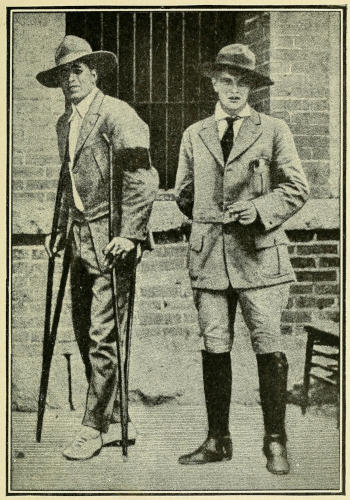
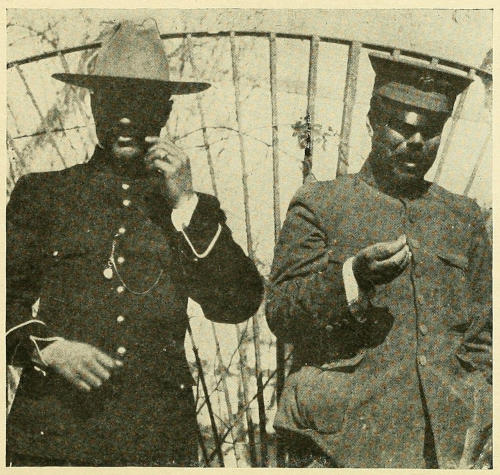
This photograph, taken outside the Cuartel
at Juarez, Mexico, shows von der Goltz (at the right), then a Major in the
Mexican Army, and Lieut. Leiva, a Mexican officer later reported killed in
battle.
“Remember,” he was saying. “From this day
you are no longer a cadet. You are a prince.
Act accordingly.”
That was all. We were out of the door and
halfway to our hotel before I realized to the full
the great adventure I had embarked upon. Embarked?
Shanghaied would be the better term.
I had had no choice in the matter, whatsoever. I
had not even uttered a word during the interview.
At any rate, that night I left for Petrograd—still
St. Petersburg at that time—accompanied
by my tutor and two newly engaged valets, who
did not know the real Prince. Of what was
ahead I had no idea, but as my tutor had no
doubts of the success of our mission, I wasted
little time in speculating upon the future.
What the real prince’s motive was in agreeing
to the masquerade, and where he spent his time
while I was in Russia, I have never been able to
discover. From what followed, I surmise that
he was strongly pro-German in his sympathies
but distrusted his ability to carry through the
task in hand.
In St. Petersburg I discovered that my
“relatives”—whom I had known to be very
exalted personages—were inclined to be more
than hospitable to this young kinsman whom
they had not seen in a long time. I found myself
petted and spoiled to a delightful degree; indeed
I had a truly princely time. The only drawback
was that, as the constant admonitions of my
tutor reminded me, I could spend my princely
wealth only in such ways as my—shall I say,
predecessor?—would have done. He, alas, was
apparently a graver youth than I.
So two weeks passed, while I was beginning to
wish that the masquerade would continue indefinitely,
when one day my tutor sent for me.
“So,” he said, “We have had play enough, not
so? Now we shall have work.”
In a few words he explained the situation to
me. Russia, it seemed, was about to enter into an
agreement with England, regarding what appeared
to be practically a partitioning of Persia.
Already a certain Baron B—— (let me call him)
was preparing to leave St. Petersburg with instructions
to find out under what circumstances
the British Government would enter into pourparlers
on the subject. Berlin, whose interests
in the Near East would be menaced by such an
agreement, needed information—and delay. I
was to secure both. It was the old trick of using
a little instrument to clog the mechanism of a
great machine.
Let me explain here a feature of the drawing
up of international treaties and agreements
which, I think, is not generally understood. Most
of us who read in the newspapers that such and
such a treaty is being arranged between the representatives
of two countries, believe that the
terms are even then being decided upon. As a
matter of fact these terms have long since been
determined by other representatives of the two
countries concerned, and the present meeting
is merely for the formal and public ratification
of a treaty that has already been secretly made.
The usual stages in the making of a treaty
are three: First, an unofficial inquiry by one
government into the willingness or unwillingness
of the other government to enter into
a discussion of the question at issue. This
is usually done by a man who has no official
standing as a diplomat at the moment, but whose
affiliations with officials in the second country
have given him an influence there which will
stand his government in good stead. After a
willingness has been expressed by both sides to
enter into discussions, official pourparlers are
held in which the terms of the agreement are
discussed and decided upon. Finally the treaty
is formally ratified by the Foreign Ministers or
special envoys of the countries involved. This
secrecy in the first two stages is necessitated by
the fear of meddling on the part of other governments,
and also by a desire on the part of any
country making overtures to avoid a possible
rebuff from the other; and it explains why negotiations
which are publicly entered into never fail.
But to return to my adventures. My Government
had learned of the impending pourparlers
between Britain and Russia; it knew that Baron
B——’s instructions would contain the conditions
which Russia considered desirable. What
was necessary was to secure these instructions.
Now, my tutor had, long before this, seen to
it that I should be on friendly terms with various
members of the baron’s household; and he had
been especially insistent that I pay a good deal
of attention to the young daughter of the house,
whom I shall call Nevshka. I had wondered
at the time why he should do this; but I obeyed
his instructions with alacrity. Nevshka was
charming.
Now I saw the purpose of this carefully fostered
friendship.
“The baron will spend this evening at the
club,” I was informed. “He will return, according
to his habit, promptly at twelve. You will
visit his house this evening, paying a call upon
Nevshka. You will contrive to set back the
clock so that his home coming will be in the
nature of a surprise to her. The hour will be so
late that she, knowing her father’s strictness, will
contrive to get you out of the house without his
seeing you. That is your opportunity! You
must slip from the salon into the rear hall—but
do not leave the house. And if, young man, with
such an opportunity, you cannot discover where
these papers are hidden and secure them, you are
unworthy of the trust that your government has
placed in you.”
I nodded my comprehension. In other words
I was to take advantage of Nevshka’s friendship
in order to steal from her father—I was to perform
an act from which no gentleman could help
shrinking. And I was going to do it with no
more qualms of conscience than, in time of war,
I should have felt about stealing from an enemy
general the plan of an attack.
For countries are always at war—diplomatically.
There is always a conflict between the
foreign ambitions of governments; always an
attempt on the part of each country to gain its
own ends by fair means or foul. Every man
engaged in diplomatic work knows this to be
true. And he will serve his government without
scruple, for well he knows that some seemingly
dishonorable act of his may be the means of
averting that actual warfare which is only the
forlorn hope that governments resort to when
diplomatic means of mastery have failed.
So I undertook my mission with no hesitation,
rather with a thrill of eagerness. I pretended to
be violently interested in Nevshka (no difficult
task, that) and time sped by so merrily that even
had I not turned back the hands of the clock, I
doubt if the lateness of the hour would have
seriously concerned either of us. Oh, yes, my
tutor—who, as you of course have guessed by
now, was no mere tutor—had analyzed the situation
correctly.
As the baron was heard at the door, I drew
out my watch.
“Nevshka, your clock is slow. It is already
midnight.”
Nevshka started.
“Come!” she exclaimed. “Father must not
see you. He would be furious at your being
here at this hour.” In a panic she glanced about
the salon. “Go out that way.” And she pointed
to a door at the rear, one that opened on a dimly
lit hallway.
I went. I heard the baron express his surprise
that Nevshka was still awake. I heard her lie—beautifully,
I assure you. And I remained hidden
while the baron worked in his library for
a while; hardly daring to breathe until I heard
him go up the stairs to his bedroom.
He was a careless man, the baron. Or perhaps
he had been reading Poe, and believed that the
most obvious place of concealment was the safest.
At any rate, there in a drawer of his desk, protected
only by the most defenseless of locks, were
the papers—a neat statement of the terms upon
which Russia would discuss this Persian matter
with England.
I returned home with my prize, to find my
tutor awaiting me. He said no word of commendation
when I gave him the papers, but I
knew by his expression that he was well pleased
with my work. And I went to bed, delighted
with myself, and dreaming of the great things
that were to come.
The next day we left Petersburg. A German
resident of the city had telephoned my relatives,
warning them that a few cases of cholera had
appeared. Would it not, he suggested (Oh, it
was mere kind thoughtfulness on his part) be
best to let the young prince return to Germany
until the danger was over? His parents would
be worried. Indeed, it would be best, my
“relatives” agreed. So with regret they bade
leave of me; and in the most natural manner in
the world I returned to Berlin.
Wilhelmstrasse 76 again! The round-faced
man again, but this time less military, less unbending,
in his manner. I had done well, he told
me. My exploit had attracted the favorable
attention of a very exalted personage. If I could
hold my tongue—who knows what might be in
store for me?
That was the end of the matter, so far as I
was concerned. But in the history of European
politics it was only the beginning of the chapter.
It might be well, at this point, to recall the
political situation in Europe, as it affected England,
Russia and Germany at this time. Even
two years before—in 1905—it had become evident
to all students of international affairs that
the next great conflict, whenever it should come,
would be between England and Germany; and
England realizing this, had already begun to
seek alliances which would stand between her and
German ambitions of world dominance. The
Entente with France had been the first step in
the formation of protective friendships; and
although this friendship had suffered a strain
during the Russo-Japanese War, because of the
opposing sympathies of the two countries, the
end of the war healed all differences. The defeat
of Russia removed all immediate danger
of a Slavic menace against India. To England,
then, the weakened condition of Russia offered
an excellent opportunity for an alliance that
would draw still more closely the “iron ring
around Germany.” Immediately she took the
first steps leading toward this alliance.
Now, Russia stood badly in need of two
things. War-torn and threatened by revolution,
the government could rehabilitate itself only by
a liberal amount of money. But where to get it?
France, her ally, and normally her banker, was
slow, in this instance to lend—and it was only
through England’s intervention that the Czar
secured from a group of Paris and London bankers
the money with which to finance his government
and defeat the revolution.
But more than money, Russia needed an ice-free
seaport to take the place of Port Arthur,
which she had lost; and for this there were only
two possible choices: Constantinople or a port
on the Persian Gulf. In either of these aims she
was opposed by Britain, the traditional enemy
of a Russian Constantinople, on the one hand,
and the possessor of a considerable “sphere of
interest” in the Persian Gulf on the other.
So matters stood, when in August, 1907, but
a few weeks after my masquerade, Sir Arthur
Nicholson, acting for England, and Alexander
Iswolsky, acting for Russia, signed the famous
Anglo-Russian Agreement, providing for the
distribution of Persia into three strips, the
northern and southern of which would be respectively
Russian and British zones of influence;
providing also, in a secret clause, that
Russia would give England military aid in the
event of a war between Germany and England!
Meantime what was Germany doing?
She had, you may be sure, no intention of
allowing England to best her in the game of
intrigue. Her interests in the Near East were
commercial rather than military; but she could
not see them threatened by an Anglo-Russian
occupation of Persia, such as the Agreement
portended. Then, too, she was bound to consider
the possible effect on Turkey, in whom she
was taking an ever-increasing (and none too
altruistic) interest.
The details of what followed I can only surmise.
I know that in the time between my trip
to Russia and the signing of that Agreement, on
August 31, the Kaiser held two conferences: one
on August 3, with the Czar at Swinemunde; the
other on August 14, with Edward VII, at the
Castle of Wilhelmshohe. And when, on September
24th, the terms were published, they were
bitterly attacked by a portion of the English
press, not so much because of the danger to
Persia, as because of the fact that Russia got the
best of the bargain![1]
Had the Kaiser succeeded in having these
terms changed? Who knows? Certainly one
can trace the hand of German diplomacy in the
events of the next seven years, most of which are
a matter of common knowledge. The steady
aggressions of Russia in Persia during the
troubled years of 1910-1912; the almost open
flouting of the terms of the treaty, which expressly
guaranteed Persian integrity; the constant
growth of German influence, culminating
in the Persian extension of the German-owned
Bagdad Railway; the founding of a German
school and a hospital in Teheran, jointly supported
by Germany and Persia; and finally, the
celebrated Potsdam Agreement of 1910, between
Russia and Germany, in which Germany agreed
to recognize Russia’s claim to Northern Persia
as its sphere of influence, which provided for a
further rapprochement between the two countries
in the matter of railroad construction and commercial
development generally, and which has
been generally supposed to contain a guarantee
that neither country would join “any combination
of Powers that has any aggressive tendency
against the other.”
And England did not protest, in spite of the
fact that the Potsdam Agreement absolutely
negatived her own treaty with Russia and made
it, in the language of one writer, “a farce and a
deception!” Why? Was it because she believed
that when war came, as it inevitably must, Russia
would forget this new alliance in allegiance to
the old?
England was mistaken, if she believed so.
Russia—Imperial Russia—was never so much the
friend of Germany as when, neglecting the war
on her own Western front, she sent her armies
into the Caucasus, persuaded the British to
undertake the Dardanelles expedition, and, following
her own plans of Asiatic expansion, betrayed
England!
As I write this the Kut el Amara muddle is
creating a great stir in the allied countries. Lord
Hardinge, Viceroy of India, and the government
of India have been severely blamed for sending
General Townsend into Mesopotamia with insufficient
material, medical supplies and troops. At
the time that the move was made the explanation
given for it was that it was done in order to protect
the oil pipes supplying the British navy in
those waters from being destroyed by the enemy.
There was no doubt in my mind at that time, in
spite of the fact that I was in prison and communication
with the outside was very meagre,
that this was not the real reason. Subsequent
developments have shown—and the abandonment
of the inquiry instituted by the British Government
about this affair only further supports
my contention—that Russia intended to use England’s
helpless position to secure for herself an
access to the Persian Gulf. Grand Duke Nicholas
himself abandoned the campaign on the Eastern
front to go to the Caucasus. The Gallipoli enterprise
which turned out to be such a monumental
failure was undertaken upon his instigation. Do
you think for one second that if Imperial Russia
had thought England was able to capture Constantinople,
a city which she herself has been
wanting for centuries, she would have invited
England to do so? The fact is that the Gallipoli
enterprise tied up all of England’s available reserves
so that the English could practically do
nothing to forestall the Russian movements to
the Persian Gulf. The Government of India,
realizing the danger, sent General Townsend
upon the famous Bagdad campaign rather as a
demonstration, than as a military enterprise. I
will quote from my diary which I kept while in
prison.
“Just read in The Times: ‘British moving
north into Mesopotamia to protect oil pipes and
capture Bagdad.’ I don’t need to read Punch
any more, The Times being just as funny.
My dear friends, you didn’t move up there for
that reason. You went up there so as to be able
to tell your Russian friends that there was no
need to come further south as you were there
already.”
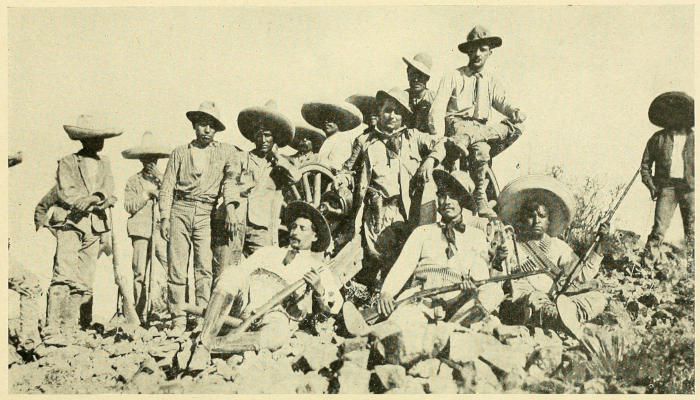
Raul Madero and Staff. Captain von der Goltz
is standing the second from the left.
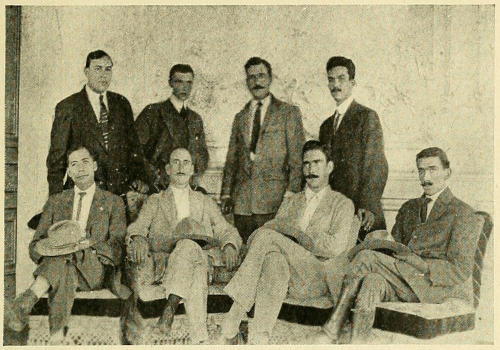
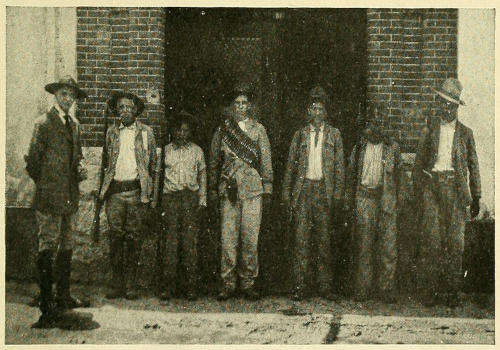
A group of recruits who came from the United
States to enter Villa’s Army. Captain von der Goltz is at the extreme left.
As part of the Russian Army had already advanced
as far as Kermansha, General Townsend
disregarded all military rules and tactics in his
desperate attempt to keep the Russians from
going further South, paying very little attention
to securing his line of communication, and he was
subsequently cut off from his base and forced to
surrender to the Turks.
In the early part of the war Russia did not try
to gain anything at the expense of Germany but
consistently applied herself to the task of enriching
herself at the expense of England. Imperial
Russia as an ally has constantly been fighting
England and done the Allied cause more damage
than the German army.
But Imperial Russia wrote her own death
sentence by her treachery. There was a revolution
in Russia ...
But I anticipate.
That is the story of my little expedition into
Russia—and of what it brought about.
As for me, I was sent back to Gross Lichterfelde,
where I abruptly ceased to be a young
prince, and became once more a humble cadet.
But only to outside eyes. Dazzled by the success
of my first mission, I regarded myself as a superman
among the cadets. Life loomed romantically
before me. I told myself that I was to
consort with princes and beautiful noblewomen
and to spend money lavishly. The future seemed
to promise a career that was the merriest, maddest,
for which a man could hope.
I laugh sometimes now when I think of the
dreams I had in those days. I was soon to learn
that the life which fate had thrust upon me was
set with traps and pitfalls which might not easily
be escaped. I was to learn many lessons and to
know much suffering; and I was to discover that
the finding of my “document” was only the beginning
of a chain of events that were to control
my whole life—and that its influence over my
career had not ended.
But at that time I was all hopes and rosy
dreams—of my future, of myself, occasionally
of Nevshka.
Nevshka. Is she still as charming as ever?
CHAPTER III.
Of what comes of leaving important
papers exposed. I look and talk indiscreetly—and
a man dies.
In spite of my dreams and extreme self-satisfaction,
I found the atmosphere of Gross
Lichterfelde as drab and monotonous as ever it
had been before my masquerade. Discipline sits
lightly upon one who is accustomed to it solely,
but to me, fresh from a glorious fortnight of
intrigue and festivity, it was doubly galling. Yet
there was one avenue of escape open to me, that
was denied my fellows, for I was required to
pay a weekly visit to my tutor in the Wilhelmstrasse,
there to continue my studies in the art
of diplomatic intrigue.
It is a significant comment upon the life at
Gross Lichterfelde that I could regard these
visits as a kind of relaxation. Surely no drill-master
was ever so exacting as this tutor of mine.
And yet, despite his dryness and the complete
lack of cordiality in his manner, there was somewhere
the gleam of romance about him. To me
he seemed, in a strangely inappropriate way,
an incarnation of one of those old masters of
intrigue who had been my heroes in former days
at home; and my imagination distorted him into
a gigantic, shadowy being, mysterious, inflexible
and potentially sinister.
We studied history together that autumn; not
the dull record of facts that was forced upon us
at Gross Lichterfelde, but rather a history of
glorious national achievement, of ambitions attained
and enemies scattered—a history that had
the tone of prophecy. And I would sit there in
the soft autumn sunlight viewing the Fatherland
with new eyes; as a knight in shining armor,
beset by foes, but ever triumphing over them by
virtue of his righteousness and strength of arm.
Then I would return to Gross Lichterfelde and
its discipline.
Yet even at Gross Lichterfelde, we contrived
to amuse ourselves, chiefly by violating regulations.
That is generally the result of walling
any person inside a set of rules; his attention
becomes centered on getting outside. Your own
cadets at West Point, so I have been told, have
their traditional list of deviltries, maintained with
admirable persistence in the face of severe penalties.
At Gross Lichterfelde one proved his manliness
by breaking bounds at least once a week,
to drink beer, and flirt with maids none the less
divine because they were hopelessly plebian.
In the prevailing lawlessness, I bore my share,
and in the course of my escapades, I formed an
offensive and defensive alliance with a cadet of
my own age against that common enemy of all
our kind, the Commandant of the school, Willi
von Heiden, I will call my chum, because that
was not his name. We became close friends.
And through our friendship there came an event
which I shall remember to my last day. It gave
me a glimpse into the terrible pit of secret
diplomacy.
Often at the present, I find myself living it
over in my mind. If I have learned to take a
lighter view of life than most men, my attitude
dates from that time when a careless word of
mine, spoken in innocence, condemned a man to
death. I will try to tell very briefly how it
came about.
The Christmas after my excursion to St.
Petersburg I was invited by Willi von Heiden
to visit him at his home. His father was a squireling
of East Prussia, one of the Junkers. He
had an estate in that rolling farm land between
Goldap and Tilsit, which was the scene of countless
adventures of Willi’s boyhood.
Just before we left Gross Lichterfelde—yes,
even there they allow you a few days vacation at
Christmas—Willi received a letter and came to
me with a joyous face.
“Good news,” he cried, “we are sure to have
a lively holiday. Brother Franz is getting a few
days’ leave, too.”
I had heard much of Willi’s older brother,
Franz. He was a young man in the middle
twenties, an officer of a famous fighting regiment
of foot, one of the Prussian Guards. Willi had
dilated upon him in his conversation with me.
Franz was his younger brother’s hero. From all
accounts Franz von Heiden was possessed of a
mind of that rare sort which combines unremitting
industry with cleverness. His future as
a soldier seemed brilliant and assured.
“Where is Franz?” was Willi’s first question
when we reached his home.
I shall be long forgetting my first impressions
of the man. I had been looking for a dry,
spectacled student, or a stiff young autocrat of
the thoroughly Prussian type, which I, like many
other Germans, thoroughly disliked and inwardly
laughed at. Instead, I found another chum.
Franz was an engaging young man of slight
build but very vigorous and athletic. I found
him frank, friendly, unassuming, apparently
wholly carefree and full of quiet drollery. From
his first greeting any prejudice that I might have
formed from hearing my chum, Willi, chant
his excellencies, was quite wiped away. And as
the days passed I found myself drawn to seek
Franz’s company constantly. I have no doubt
it flattered my vanity—always awake since my
exploit in St. Petersburg—to find this older
man treating me as a mental equal. It seemed
to me that he differentiated between me and
Willi, who was quite young in manner as well
as years. At times the impulse was very strong
for me to confide in Franz, to let him know that
I was not a mere cadet, that I had been in Russia
for my government. Luckily for myself I suppressed
that impulse. Luckily for me, but very
unluckily for Lieutenant Franz von Heiden—as
it turned out.
One sunny December morning we were all
three going out rabbit shooting. While Willi
counted out shells in the gun room, I went to
summon Franz from the bedroom he was using
as his study. It was characteristic of him that
without any assumption of importance, he gave
a few hours to work early every morning, even
while on leave. I found him intent upon some
large sheets of paper, but he pushed them aside.
“Time to start now?” he asked. “Good! Wait
a minute, while I dress.” He stepped into the
adjoining dressing-room.
And then, as if Fate had taken a hand in the
moment’s activities, I did a thing which I have
never ceased to regret. Fate! Why not? What
is the likelihood that by mere vague chance I, of
all the cadets of Gross Lichterfelde, should have
become Willi von Heiden’s chum and shared his
holidays? That by mere chance I should have
been an inmate of his home when Franz was
there, three days out of the whole year? That
by mere chance, I, with my precocious knowledge
and thirst for yet more knowledge, should have
entered his study when he was occupied with a
particular task? Why did I not send the servant
to call him? And why, instead of doing any one
of the dozen other things I might have done
while I was waiting for Franz to change his
clothes, should I have stepped across and looked
at the big sheets of paper on his table?
I did just that. I did it quite frankly and
without a thought of prying. I saw that the
sheets were small scale maps. They were the
maps of a fort and the names upon them were
written both in French and in German. The
thrill of a great discovery shot all through me.
It flashed upon me that I had heard Willi say
that during the previous summer Franz had spent
a long furlough in the Argonne section of
France. He had been fishing and botanizing—so
Willi had said. Indeed, only the night before
Franz himself had told us stories of the sport
there; and all his family had accepted the stories
at their face value. So had I until that moment
when I stood beside his desk and saw the plans
of a French field fortress. Then I knew the
truth. Lieutenant Franz von Heiden was doing
important work—so confidential that even his
family must be kept in ignorance about it—for
the intelligence department of the German
General Staff. Like me, he was entitled to the
gloriously shameful name of spy!
If I had obeyed my natural impulse to rush
into Franz’s room and exchange fraternal greetings
with this new colleague of the secret service,
so romantically discovered, he might have saved
himself. Instead, something made me play the
innocent and be the innocent, too, as far as intent
was concerned.
When Franz returned, dressed for the shoot, I
was standing looking out of his window, and I
said nothing about my discovery.
We had our rabbit shoot that day. We
crowded all the fun and energy possible into it.
It was our last day together and by sundown I
felt as close to Franz von Heiden as though he
were my own brother. A few days later Willi
and I went back to Gross Lichterfelde.
Shortly after I returned from my Christmas
leave, my tutor sent for me. He even recognized
the amenities of the occasion enough to unbend a
little and greeted me with a trace of mechanical
friendliness.
“I trust you had a pleasant holiday,” he said,
“you told me, did you not, that you were to
spend it at the Baron von Heiden’s?”
That touch of friendliness was the occasion of
my tragic error. I remember that I plunged
into a boisterous description of my vacation, of
the pleasant days in the country, of the shooting,
of Franz. As my tutor listened, with a tolerant
air, I told him what a splendid fellow Franz was,
how cleverly he talked and how diligently he
worked. And then, with a rash innocence for
which I have never forgiven myself, I told him
of what I had seen on that day of the rabbit
shooting—of the maps on the table. Franz was
one of us!
But my tutor was not interested. Abruptly
he interrupted my burst of gossip; and soon after
that he plunged me into a quiz in spoken French.
My progress in that seemed his only preoccupation.
A month later Willi von Heiden staggered
into my room. “Franz is dead,” he said.
The brilliant young lieutenant, Franz von
Heiden, had come to a sudden and shocking end.
He was shot dead in a duel. His opponent was
a brother officer, a Captain von Frentzen. The
“Court of honor” of the regiment had approved
of the duel and it was reported that the affair was
carried out in accordance with the German code.
Later I learned the story. Captain von Frentzen
was suddenly attached to the same regiment
as Franz. His transfer was a cause of great
surprise to the officers and of deep displeasure
to them, for the captain had a notorious reputation
as a duelist. Naturally the officers, Franz
among them, had ignored him, trying to force
him out of the regiment. Upon the night of a
regimental dance, the situation came to a head.
In response to the gesture of a lady’s fan
Franz crossed the ball room hurriedly. He was
caught in a sudden swirl of dancers and accidentally
stepped on Captain von Frentzen’s foot.
In the presence of the whole company von Frentzen
dealt Franz a stinging slap in the face. “Apparently,”
he sneered, “you compel me to teach
you manners.” Franz looked at him, amazed
and furious. There was nothing that he had
done which warranted von Frentzen’s action. It
was an outrage—a deadly insult. There was but
one thing to do. A duel was arranged.
To understand more of this incident you must
understand the unyielding code of honor of the
German officer. Franz von Heiden’s original
offense had been so very slight that even had he
refused to apologize to Frentzen the consequences
might not have been serious. But
Frentzen’s blow given in public was quite a different
matter. It was a mortal affront. I heard
that Franz’s captain had been in a rage about it.
“My best lieutenant,” he had said to the
colonel. “An extremely valuable man. To be
made to fight a duel with that worthless butcher,
von Frentzen. Shameful! God knows that laws
are sometimes utterly unreasonable by many of
our ideas, as officers are equally senseless. I have
racked my brain to find a way out of this difficulty,
but it seems impossible. Can’t you do
something to interfere?”
The colonel looked at him steadily. “Your
honest opinion. Is von Heiden’s honor affected
by Frentzen’s action?”
There was nothing Franz’s captain could do
but reply, “Yes.”
The duel was held on the pistol practice
grounds of the garrison, a smooth, grassy place,
surrounded by high bushes; at the lower end
there was a shed built of strong boards, in which
tools and targets were stored. At daybreak
Franz von Heiden and his second dismounted at
the shed and fastened their horses by the bridle.
They stood side by side, looking down the road,
along which a carriage was coming. Captain
von Frentzen, his second, and the regimental
surgeon got out. Sharp polite greetings were
exchanged. On the faces of the seconds there
was a singular expression of uneasiness, but
Frentzen looked as though he were there for some
guilty purpose. The prescribed attempts at
reconciliation failed. The surgeon measured off
the distance. He was a long-legged man and
made the fifteen paces as lengthy as possible.
Just at this moment the sun came up fully.
Pistols were loaded and given to Franz and
Frentzen. Fifteen paces apart, the two men
faced each other. One of the seconds drew out
his watch, glanced at it and said, “I shall count;
ready, one! then three seconds; two!—and again
three seconds; then, stop! Between one and stop
the gentlemen may fire.” He glanced round
once more. The four officers stood motionless in
the level light of the dawn. He began to count.
Presently Franz von Heiden was stretched out
upon the ground, his blue eyes staring up into
the new day. He lay still....
When I heard that story I ceased to be a boy.
My outlook on the future had been that of an
irresponsible gamester, undergoing initiation
into the gayest and most exciting sports. All at
once my eyes were hideously opened and I
looked down into the pit that the German secret
service had prepared for Franz von Heiden, and
knew I was the cause of it. It was terrible! By
leaving that map where I could see it Franz von
Heiden had been guilty of an unforgivable
breach of trust. By his carelessness he had let
someone know that the Intelligence Department
of the General Staff had procured the plans of
a French fortress in the Argonne. Wherefore,
according to the iron law of that soulless war
machine, Franz von Heiden must die.
And this is the sinister way it works. Trace
it. I innocently betray him to my tutor, an
official of the Secret Diplomatic Service. A few
days later one of the deadliest pistol shots in the
German army is transferred to Franz’s regiment.
A duel is forced upon him and he is shot down
in cold blood.
Not long after the news of the duel, my tutor
sent for me. “Is it not a curious coincidence,”
he began, his cold gray eyes boring into mine,
“that the last time you were here we spoke of
Lieutenant Franz von Heiden? The next time
you come to see me he is dead. I understand
that certain rumors are in circulation about the
way he died. Some of them may have already
come to your attention. I caution you to pay no
attention whatever to such silly statements.
Remember that a Court of Honor of an honorable
regiment of the Prussian Guards has
vouched for the fact that Lieutenant von
Heiden’s quarrel with Captain von Frentzen and
the unfortunate duel that followed was conducted
in accordance with the officers’ code of the Imperial
Army.”
I hung my head, sick at heart; but he was relentless.
“Remember also,” he said in a pitiless voice,
“that men of intelligence never indulge in fruitless
gossip, even among themselves. I hope you
understand that—by now.” He paused a
moment, as if he remembered something.
“For some time,” he went on, in the most
casual way, “I have been aware that it will be
necessary for me to talk to you seriously. Now
is as good a time as any. You know that your
training for your future career has been put
largely in my hands. I am responsible for your
progress. The men who have made me responsible
require reports about your development.
They have not been wholly satisfied with what I
was able to tell them. Your intentions are good.
You show a certain amount of natural cleverness
and adaptability, but you have also disappointed
them by being impulsive and indiscreet.
“Now,” he said, “I ask you to pay the closest
attention to everything I shall say. Your attitude
must be changed if you are to go on, and
some day be of service to your government. You
must learn to treat your work as a deadly serious
business—not as a romantic adventure. We were
just speaking of von Heiden. I seem to remember
vaguely that the last time you were here you
had some sort of a cock-and-bull story to tell
me of—what was it?—of seeing some secret maps
of French fortifications on the unfortunate young
man’s table. I could hardly refrain from smiling
at the time. Such poppycock! You do not
imagine for a moment, do you, that if he had
proved himself discreet enough to be intrusted
with such highly confidential things, he would
have been so imprudent as to betray that fact to
a mere casual friend of his little brother? I hope
you see how absurd such imaginings are.”
I groaned mentally as he continued.
“Remember now,” my tutor said icily, “every
man in our profession is a man who not only
knows very much, but may know too much,
unless he can be trusted to keep what he knows
to himself. There are three ways in which he can
fail to do that—by carelessness, by accident, and
by deliberate talking. Never talk—never be
careless—never have accidents happen to you.
Then you will be safe, and in no other way can
you be so safe. Keep that in your mind. You
will find it much more profitable and useful than
remembering what anybody has to say about
Franz von Heiden. It was a commonplace
quarrel with Captain von Frentzen which killed
him. A court of honor has said so.”
That night at Gross Lichterfelde, after lights
were out, Willi von Heiden came creeping to my
bed. I was the only intimate friend he had
there and he felt the need of talking with some
one about the big brother who had been his hero.
Need I go into details of how his artless confidence
made me feel? But human beings are
exceedingly selfish and self-centered creatures.
I had a heart-felt sorrow for my chum and his
family in their tragic bereavement. And, blaming
myself as I did for it, I was abased completely.
Yet there was another feeling in me at least as
deeply rooted as those two emotions. It was
dread.
Dread was to follow me for many years. I
had learned the dangers of the dark secret world
in which I lived. Its rules of conduct and its
ruthless code had been revealed to me, not merely
by precept but by example. And with that
realization all the thrill of romance and adventure
disappeared. For I knew that I, too, might
at any time be counted among the men who
“knew too much.”
CHAPTER IV.
I am sent to Geneva and learn of a plot.
How there are more ways of getting rid of a
King than by blowing him up with
dynamite.
If at any time in this story of my life, I have
given the impression that accident did not
play a very important part in the work of myself
and other secret agents, I have done so unintentionally.
“If” has been a big word in the
history of the world; and even in my small share
of the events of the last ten years, chance has
oftentimes been a more able ally than some of the
best laid of my plans. If, for instance, I had
not happened to be in Geneva in the winter of
1909-10; or if a certain official of the Russian
secret police—the Okrana—had not met a well-deserved
death at the hands of a committee of
“Reds”; or if the German Foreign Office had
not been playing a pretty little game of diplomacy
in the Southwestern corner of Europe—why,
the world to-day would be poorer by a King,
and possibly richer by another combatant in the
Great War.
And if another King had not kept a diary
he might have kept his throne. And if both he
and a certain young diplomat, whose name I
think it best to forget, had not had a common
weakness for pretty faces, Germany would have
lost an opportunity to gain some information
that was more or less useful to her, an actress
whose name you all know would never have become
internationally famous, and this book
would have lost an amusing little comedy of
coincidences.
All of which sounds like romance and is—merely
the truth.
I had spent two uneventful years at Gross
Lichterfelde at the time the comedy began; two
years of study in which I had acquired some
knowledge and a great weariness of routine, of
hard work unpunctuated by any element of adventure.
Of late it had almost seemed as if,
after all, it was planned that I should become
merely one of the vast army of officers that Gross
Lichterfelde and similar schools were yearly
turning out. For such a fate, as you can imagine,
I had little liking.
Consequently I was far from displeased when
one day I received a characteristically brief note
from my old tutor, asking me to call upon him.
Still more was I elated when, the next day, he
informed me that I had enough of books for the
time being, and that he thought a little practical
experience would be good for me. A vacation, I
might call it, if I wished—with a trifle of detective
work thrown in.
H’m. I was not so delighted with that prospect,
and when the details of the “vacation” were
explained to me, I was strongly tempted to say
no to the entire proposition. But one does not
say no to my old tutor. And so, in the course of
a week, I found myself spending my evenings in
the Café de l’Europe in Geneva, bound on a still
hunt for Russian revolutionists.
Russia, at this time, had not quite recovered
from the fright she received in 1905 and 1906,
when, as you will remember, popular discontent
with the government had assumed very serious
proportions. “Bloody Sunday,” and the riots
and strikes that followed it, were far in the past
now, it is true, but they were still well remembered.
And although most of the known revolutionary
leaders had been disposed of in one way
or another, there were still a few of them, as well
as a large number of their followers, wandering
in odd corners of Europe. These it was thought
best to get rid of; and Russian agents promptly
began ferreting them out. And Germany—always
less unfriendly to the Romanoffs than has
appeared on the surface—lent a helping hand.
So it happened that on a particular night in
December of 1909, I sat in the Café de l’Europe,
bitterly detesting the work I had in hand, yet
inconsistently wishing that something would
turn up. I had no idea at the moment of what
I should do next. Chance rumor had led me to
Geneva, and I was largely depending upon
chance for further developments.
They came. I had been sitting for an hour
I suppose, sipping vermouth and lazily regarding
my neighbors, when the sound of a voice
came to my ears. It was the voice of a man
speaking French, with the soft accent of the
Spaniard; the tone loud and unsteady and full
of the boisterous emphasis of a man in his cups.
But it was the words he spoke that commanded
my attention.
“Our two comrades,” he was saying, “will
soon arrive from the center in Buenos Ayres.”
“Yes,” another voice assented—a harsher
voice, this, to whose owner French was obviously
also a foreign tongue. “In the spring, we hope.”
The Brevet promoting Senior Captain von
der Goltz to the rank of Major of Cavalry in the Mexican Constitutionalist
Army. It will be noted that the commission bears the signature
of Raul Madero and General Villa.
The Spaniard laughed.
“An excellent business! So simple. Boom!
And our dear Alfonso....”
Some element of caution must have come over
him, for his voice sank so that I could no longer
hear his words. But I had heard enough to
make me assume a good deal.
Some one was to be assassinated! And that
some one? It was a guess, of course, but the
name and the accent of the speaker were more
than enough to lead me to believe that the proposed
victim must be King Alfonso of Spain.
I sat there, undecided for the moment. It
was really no affair of mine. I was on another
mission, and, after all, my theory was merely a
supposition. On the other hand, the situation
presented interesting possibilities—and as I
happened to know, Alfonso’s seemingly pro-German
leanings and made him an object of
friendly interest at that time to my government.
I decided to look into the matter.
It had been difficult to keep from stealing a
glance at my talkative neighbors but I restrained
myself. I must not turn around and yet it was
vitally necessary that I see their faces. All I
could do was to hope that they would leave before
I finished my vermouth; for I had no mind
to risk my clear-headedness with more than the
glass I had already had.
They did leave shortly afterward. As they
passed my table I took care to study their faces,
and my intention to keep them in sight was immensely
strengthened. The Spaniard I did not
know, but his companion I recognized as a Russian—and
one of the very men I was after.
I had been in Geneva long enough to know
where I could get information when I needed it.
It was only a day or two, therefore, before I had
in my hands sufficient facts to justify me in
reporting the matter to my government.
Alfonso was in England at the time and presumably
safe; for I had gathered that no attempt
would be made upon his life until he returned to
Spain. So I wrote to Berlin reporting what I
had learned.
A telegram reached me next day. I was
ordered to Brussels to communicate my information
to the Spanish Minister there.
Mark that: I was ordered to Brussels, although
there was a Spanish Minister in Switzerland.
But my government knew that there were
many factions in Spain, and it had strong
reasons to believe that the Spanish Minister to
Belgium was absolutely loyal to Alfonso. And
in a situation such as this, one takes as few
chances as possible.
I followed my instructions. The Spanish Minister
thanked me. He was more than interested;
and he begged me, since I had no other direct
orders, to do him the personal favor of staying
a few days longer in the Belgian capital. I did
so, of course, and a day or so later received from
my government instructions to hold myself at
the Spaniard’s disposal for the time being.
That night, at the minister’s request, I met
him and we discussed the matter fully. He
wished me, he said, to undertake a more thorough
investigation of the plot. I was already involved
in it, and would be working less in the dark than
another. Besides, he hinted, he could not very
well employ an agent of his own government.
Who knew how far the conspiracy extended?
I was not displeased to abandon my chase of
the Russian revolutionaries, toward whom I felt
some sympathy. So, as a preliminary step, I
went up to Paris, where through the good offices
of one Carlos de Silva—a young Brazilian free-thinker,
who was there ostensibly as a student—I
succeeded in gaining admission into one of the
fighting organizations of radicals there. They
were not so communicative as I could have
wished, but by judicious pumping I soon learned
that there was an organized conspiracy against
the life of Alfonso, and that the details of the
plot were in the hands of a committee in Geneva.
Geneva, then, was my objective point. But
what to do if I went there? I knew very well
that conspirators do not confide their plans to
strangers. And I dared not be too inquisitive.
Obviously the only course to follow was to employ
an agent.
Now, Cherchez la femme is as excellent a
principle to work on when you are choosing an
accomplice, as it is when you are seeking the
solution of a crime. I therefore proceeded to
seek a lady—and found her in the person of a
pretty little black-eyed “revolutionist,” who
called herself Mira Descartes, and with whom I
had already had some dealings.
It is here that accident crosses the trail again.
For if a certain official of the Okrana had not
been murdered in Moscow three years before, his
daughter would never have conceived an intense
hatred of all revolutionary movements and I
should have been without her invaluable assistance
in the adventure I am describing.
Mira Descartes! She was the kind of woman
of whom people like to say that she would have
made a great actress. Actress? I do not know.
But she was an artist at dissembling. And she
had beauty that turned the heads of more than
the “Reds” upon whom she spied; and a genius
for hatred: a cold hatred that cleared the brain
and enabled her to give even her body to men she
despised in order the better to betray them.
I was fortunate in securing her aid, I told
myself; and I did not hesitate to use her services.
(For in my profession, as must have been apparent
to you, scrupulousness must be reserved
for use “in one’s private capacity as a gentleman.”)
So Mlle. Descartes went to Geneva, and armed
with my previously acquired information and
her own charms, she contrived to get into the
good graces of the committee there, and surprised
me a week later by writing to Paris that
she had already contracted a liaison with the
Spaniard whom I had overheard speaking that
night in the Café de l’Europe.
Soon I had full information about the entire
plot. It was planned, I learned, to blow up
King Alfonso with a bomb upon the day of his
return to Madrid. The work was in the hands
of two South Americans who were then in
Geneva.
But far more important than this was the information
which Mlle. Descartes had obtained
that a high official of Spain—a member of the
Cabinet—was cognizant of the plot and had kept
silent about it.
Why, I asked myself, should this official—a
man who surely had no sympathy with the aims
of the revolutionists—lend his aid to them in this
plot? The reason was not hard to discover.
Alfonso’s position at the time was far from
secure. His government was unpopular at
home; and the pro-Teutonic leanings of many
government officials had lost him the moral and
political support of the English government and
press—a fact of considerable importance.
So it seemed possible that Alfonso’s reign
might not be of long duration. And the new
government? It might be radical or conservative;
pro-English or pro-German. A man with
a career did well to keep on friendly terms with
all factions. Thus, I fancied, the Cabinet Minister
must have reasoned. At any rate he said
nothing of the plot.
But I went to Brussels and reported all I had
learned—and did not forget to mention the
Cabinet Minister’s rumored share in the plot.
There my connection with the affair ceased.
But not long after a little tragi-comedy occurred
which was a direct result of my activities. Let
me recall it to you.
On the evening of May 24, 1910, those of the
people of Madrid who were in the neighborhood
of that monument which had been raised in memory
of the victims of the attempted assassination
of Alfonso, four years before, were horrified by
a tragedy which they witnessed.
There was a sudden commotion in the streets,
an explosion, and the confused sound of a crowd
in excitement.
What had happened? Rumor ran wild through
the crowd. The King was expected home that
day—he had been assassinated. There had been
an attempted revolution. Nobody knew.
But the next day everybody knew. A bomb
had burst opposite the monument—a bomb that
had been intended for the King. One man had
been killed; the man who carried the bomb. But
the King had not arrived in Madrid that day
after all.
The police set to work upon the case and
presently identified the dead man as Jose Tasozelli,
who recently arrived in Spain from Buenos
Ayres. It was not certain whether he had any
accomplices.
And while the police worked, the King, following
a secret arrangement which had been
made by the Spanish Minister at Belgium, and
of which not even the Cabinet had been informed—arrived
safely and quietly in Madrid; a day
late, but alive.
What became of the Cabinet Minister? There
are no autocracies now, and not even a King may
prosecute without proof. So the Minister
escaped for the time being. But it is interesting
to remember that this same Minister was assassinated,
not a great while after.
Now there are more ways of getting rid of a
king than by blowing him up with dynamite.
Foreign Offices are none too squeamish in their
methods, but they do balk at assassination, even
if the proposed victim is a particularly objectionable
opponent of their plans. There is another
method which, if it be correctly followed, is every
bit as efficacious.... Again I must refer you
to that excellent French proverb: Cherchez la
femme.
It would be difficult to estimate properly the
part that women have played in the game of
foreign politics. As spies they are invaluable:
for amourous men are always garrulous. But as
Enslavers of Kings they are of even greater
service to men who are interested in effecting a
change of dynasty. Even the most loyal of subjects
dislikes seeing his King made ridiculous;
and in countries where the line is not too strictly
drawn between the public exchequer and the
private resources of the monarch, a discontented
faction may see some connection between excessive
taxes and the jewels that a demi-mondaine
wears. Revolutions have occurred for less than
that—as every Foreign Office knows.
I am not insinuating that all royal scandals
are to be laid at the door of international politics.
I merely suggest that, given a king who is to be
made ridiculous in the eyes of his subjects, it is
a simple matter for an interested government to
see that he is introduced to a lady who will produce
the desired effect. But no diplomat will
admit this, of course. Not, that is, until after he
has “retired.”
This brings me to the second act of my comedy.
If I were drawing a map of Europe—a diplomatic
map, that is,—as it was in the years of
1908 to 1910, I should use only two colors, Germany
should be, let us say, black; England red.
But the black of Germany should extend over
the surfaces of Austria, Italy and Turkey; while
France and Russia should be crimson. The rest
of the continent would be of various tints, ranging
from a discordant combination of red and
black, through a pinkish gray, to an innocuous
and neutral white.
In the race to secure protective alliances
against the inevitable conflict, both Germany
and England were diligently attempting to color
these indeterminate territories with their own
particular hue. Not least important among the
courted nations were Spain and Portugal. Both
were traditionally English in sympathy; both
had shown unmistaken signs, at least so far as
the ruling classes were concerned, of transferring
their friendship to Germany. It was inevitable,
therefore, that these two countries should be the
scene of a diplomatic conflict which, if not apparent
to the outsider, was fought with the
utmost bitterness by both sides.
Somehow, by good fortune rather than any
other agency—Spain had managed to avoid a
positive alliance with either nation. Alfonso was
inclined to be pro-German at that time; but an
adroit juggling of the factions in his kingdom
had prevented him from using his influence to
the advantage of Germany.
Portugal was in a different situation. Poorer
in resources than her neighbor, and hampered by
the necessity of keeping up a colonial empire
which in size was second only to England’s, she
had greater need of the protection of one of the
Powers. Traditionally—and rightly from a
standpoint of self-interest—that Power should
have been England. There were but three obstacles
to the continuance of the friendship that
had existed since the Peninsular War—King
Manuel, the Queen Mother and the Church.
Germany seemed all-powerful in the Peninsula
in 1908. Alfonso’s friendship was secured, and
the boy king of Portugal was completely under
the thumb of a pro-German mother and a Church
which, as between Germany and England, disliked
Germany the less. England realized the
situation and in approved diplomatic fashion set
about regaining her ascendancy.
But diplomacy failed. At the end of two
years Berlin was more strongly intrenched in
Portugal than ever; and England knew that
only heroic measures could save her from a
serious diplomatic defeat.
Then Manuel did a foolish thing. He kept a
diary.
It was a commonplace diary, as you will remember
if you read the parts of it which were
published some time after the revolution which
dethroned its author. The outpourings of a very
undistinguished young man—conceited, self-indulgent,
petulant—it gained distinction only as
the revelation of an unkingly person’s thoughts
on himself in particular and women in multitudes.
But there were portions of it—many of
them never published—which expressed unmistakably
Manuel’s anti-English feeling and his
affection for Germany.
Somehow England came into possession of the
diary.
Perhaps it was the diary’s revelation of
Manuel’s extreme susceptibility to feminine
charms, which suggested the next step. That I
cannot tell. In any event, not long after the
diary became a matter of diplomatic moment,
Manuel paid a visit to England, ostensibly in
search of a bride. His search was unsuccessful;
but in London he met and promptly became infatuated
with Mlle. Hedwig Navratil—better
known as Gaby Deslys.
They chose well who selected the lovely Bohemian
as the instrument of Manuel’s downfall.
Young, charming, she had all the qualities which
would appeal to Manuel’s nature. Added to
that, it had been rumored that not long before
King Alfonso had shown some interest in her—and
Manuel was easily influenced by the example
of his elders.
You remember the rest of the story. Manuel’s
frequent visits to Paris, where Mlle. Gaby was
playing; the jewels—bought, it was said, with
money from the public treasury—which he
showered upon her; these were the subjects of
countless rumors at the time. Then came reports
that the lady was domiciled in one of the
royal palaces. Finally, in September of 1910,
the scandalized and tax-ridden populace of
Portugal, learned that Mlle. Deslys had been
“billed” at the Apollo Theatre in Vienna as the
“Mistress of the King of Portugal.”
On October 5th, this same scandalized and tax-ridden
populace joined forces with the revolutionary
party—and Manuel fled to England,
where he attended numerous musical comedies
and hoped against hope that the English Government
would live up to that provision of the
treaty of 1908 which pledged England to aid the
Portuguese throne in the event of a revolution.
But England—remembering the diary—wisely
forgot its pledge. And a Republican government
in Portugal looked with suspicion upon the
diplomatic advances of a nation which had been
too friendly towards the exiled king—and became
pro-English, as you know.
There ends my comedy. The lady in the case
achieved a sudden international fame and eventually
came to America, where, I believe, she attracted
more interest than commendation. But
at best, so far as we are concerned, she is of importance
merely as an illustration of how diplomacy—or
chance, if you prefer—combines
politics and the woman for its own purposes.
But there is an amusing epilogue to the affair,
which was not without its importance to the
Wilhelmstrasse, and in which I had a small part.
To tell it, I must pass over several months of
work of one sort or another, until I come to the
following winter—that of 1911.
I was on a real vacation this time and had
selected Nice as an excellent place in which to
spend a few idle but enlivening weeks. The
choice was not a highly original one, but as it
turned out, chance seemed to have had a hand
in it after all. Almost the first person I met
there was a man with whom I had been acquainted
for several years, and who was destined
to have his share in the events which followed.
People who have visited Europe many times
can hardly have avoided seeing upon one occasion
or another, a famous riding troupe who
called themselves the “Bishops.” They were five
in number—Old Bishop, his daughter and her
husband, a man named Merrill, and two others—and
their act, which was variously known as “An
Afternoon on the Bois de Boulogne,” “An Afternoon
in the Thiergarten,” etc. (depending upon
the city in which they played), was a feature of
many of the famous circuses of seven or eight
years ago. At this time they were helping to
pay their expenses through the winter, by playing
in a small circus which was one of the current
attractions of Nice.
I had bought horses from old Bishop in the
past and knew him for a man of unusual shrewdness,
who besides being the father of a charming
and beautiful daughter, was in himself excellent
company; and I was consequently pleased to run
across him and his family at a time when all my
friends seemed to be in some other quarter of the
earth. We talked of horses together and it was
suggested that I might care to inspect an Arab
mare, a recent acquisition, of which the old man
was immensely proud.
That evening I heard of the arrival in Nice of
a young British diplomat, an undersecretary of
one of the embassies, whom, I remembered I had
once met at a hotel in Vienna. I called upon him
the following day—but I did so, not so much to
renew our old acquaintance, as because that very
morning I had received a rambling letter from
my chief, commenting upon the imminent arrival
of the Englishman and suggesting that I might
find him a pleasant companion during my stay
on the Riviera.
More work, in other words. My chief did not
waste time in encouraging purposeless friendships.
As I read the letter, it was a hint that
the Englishman had something which Berlin
wanted and I was to get it.
It was not difficult to recall myself to the
Undersecretary. We became friendly, and proceeded
to “do” Nice together; and in the course
of our excursions we became occasional visitors
at the villa of Maharajah Holkar, who, with his
secretary (and his seraglio) lived—and still
lives, for all I know—at 56 Promenade des
Anglais.
The Maharajah was at that time an engaging
and eccentric old gentleman, who had been an
uncompromising opponent of the English during
his youth in India, and was now practically an
exile, spending most of his time in planning
futile conspiracies against the British Government,
which he hated, and making friends with
Englishmen toward whom he had no animosity
whatever. He was especially well disposed toward
my diplomatic friend, and the two spent
many a riotous evening together over the chess
board, at which the Maharajah was invariably
successful.
Meanwhile I made various plans and cultivated
the acquaintance of the Rajah’s secretary.
He was a Bengali, who might well have stepped
out of Kipling, so far as his manner went. In
character the resemblance was not so close. I
happened to know that he was paid a comfortable
amount yearly by the British Government, to
keep them informed of the Rajah’s movements;
and I also happened to know that the German
Government paid him a more comfortable
amount for the privilege of deciding just what
the British Government should learn. (I have
often wondered whether he shared the proceeds
with the Maharajah, and whether even he knew
for whom he was really working.) The secretary,
I decided, might be of use to me.
As it happened, it was the secretary who unwittingly
suggested the method by which I
finally gained my object. It was he who commented
upon the diplomat’s intense interest in
the Maharajah’s seraglio, giving me a clue to
the character of the Englishman, which was of
distinct service. And it was he who suggested
one evening that the three of us—for the Maharajah
was ill at the time—should attend a performance
of the circus in which my friends, the
Bishops, were playing.
You foresee the end, no doubt. The diplomat,
with his too susceptible nature, was infatuated
by Mlle. Bishop’s beauty and skill. He wished
to meet her, and I, who obligingly confessed that
I had had some transactions with her father,
undertook to secure the lady’s permission to
present him to her.
I did secure it, of course, although not without
considerable opposition on the part of all three
of the family; for circus people are very straight-laced.
However, by severely straining my purse
and my imagination, I convinced them that they
would be doing both a friendly and a profitable
act, by participating in the little drama that I
had planned. Eventually they consented to aid
me in discomfiting the diplomat, whom I represented
as having in his possession some legal
papers that really belonged to me, although I
could not prove my claim to them.
You will pardon me if I pass over the events
of the next few days, and plunge directly into a
scene which occurred one night, about a week
later, the very night in fact on which the Bishops
were to close their engagement with the little
circus in which they were playing. It was in
the sitting-room of the diplomat’s suite at the
hotel that the scene took place; dinner a deux
was in progress—and the diplomat’s guest was
Mlle. Bishop, who had indiscreetly accepted the
Englishman’s invitation.
Came a knock at the door. Mademoiselle grew
pale.
“My husband,” she exclaimed.
Mademoiselle was right. It was her husband
who entered—very cold, very businesslike, and
carrying a riding crop in his hand. He glanced
at the man and woman in the room.
“I suspected something of the sort,” he said,
in a quiet voice. “You are indiscreet, Madame.
You do not conceal your infidelities with care.”
He took a step toward her, put paused at an
exclamation from the Englishman.
“Do not fear, Monsieur—” elaborate irony
was in his voice as he addressed the diplomat—“I
shall not harm you. It is with this—lady—only,
that I am concerned. She has, it appears, an
inadequate conception of her wifely duty. I
must, therefore, give her a lesson.” As he spoke
he tapped his boot suggestively with his riding
whip.
“My only regret,” he continued politely, “is
that I must detain you as a witness of a painful
scene, and possibly cause a disturbance in your
room.”
Again he turned toward his wife, who had sat
watching him, with a terrified face. Now as he
approached her she burst into tears, and ran to
where the Englishman stood.
“He is going to beat me,” she sobbed. “Help
me, for Heaven’s sake. Stop him. Give him—give
him anything.”
But the Englishman did not need to be
coached.
“Look here!” he cried suddenly, interposing
himself between the husband and wife. “I’ll
give you fifty pounds to get out of here quietly.
Good God, man, you can’t do a thing like this,
you know. It’s horrible. And you have no
cause. I give you my word you have no cause.”
He was a pitiable mixture of shame and apprehension
as he spoke. But Merrill looked at
him calmly. He was quite unmoved and still
polite when he replied:
“The word of a gentleman, I suppose. No,
Monsieur, it is useless to try to bribe me. It is
a great mistake, in fact. Almost—” he paused
for a moment, as if he found it difficult to continue—“almost
it makes me angry.”
He was silent for a space, but when he spoke
again it was as if in response to an idea that had
come to him.
“Yes,” he continued. “It does make me angry.
Nevertheless, Monsieur, I shall accept your suggestion.
Madame and I will leave quietly, and
in return you shall give us—O, not money—but
something that you value very much.”
He turned to his wife.
“Madame. You will go to Monsieur’s trunk,
which is open in the corner, and remove every
article so that I can see it.”
The Englishman started. For a moment it
seemed as if he would attack Merrill, who was
the smaller man, but fear of the noise held him
back. Meantime, the woman was riffling the
trunk, holding up each object for her husband’s
inspection. The latter stood at the door, his eyes
upon both of the others.
“We are not interested in Monsieur’s clothing,”
he said calmly. “What else is there in the
trunk? Nothing? The desk then. Only some
papers? That is a pity. Let me have them,
however—all of them. And you may give me
the portfolio that lies on the bureau.”
As he took the packet, the rider turned to the
diplomat, who stood as if paralyzed, in the corner
of the room.
“I do not know what is in these papers, Monsieur,
but I judge from your agitation that they
are valuable. I shall take them from you as a
warning—a warning to let married women alone
in the future. Also I warn you not to try to
bribe a man whom you have injured. You have
made me very angry to-night by doing so.
“Above all,” he added, “I warn you not to
complain to the police about this matter. This is
not a pretty story to tell about a man in your
position—and I prepared to tell it. Good
night, Monsieur.”
He did not wait to hear the Englishman’s
reply.
That night, while the two younger members
of the Bishop family sped away on the train—to
what place I do not know—and old Bishop
expressed great mystification over their disappearance,
I made a little bonfire in my grate of
papers which had once been the property of the
diplomat, and which I knew would be of no
interest to my government. There were a few
papers which I did not burn—a memorandum
or two, and a bulky typewritten copy of
Manuel’s diary, which I found amusing reading
before I took it to Berlin.
I called upon my English friend the next day
but I did not see him. He had been taken ill,
and had been obliged to leave Nice immediately.
No, it was impossible to say what the ailment
was.
Ah, well, I thought, as I returned to my
room, he would get over it. It was an embarrassing
loss, but not a fatal one; and doubtless
he could explain it satisfactorily at home.
I was sorry for him, I confess. But more
than once that day I laughed as I thought of the
scene of last night, as Mlle. Bishop had described
it to me. An old game—but it had worked so
easily.
But then, wasn’t it Solomon who complained
about the lack of original material on this globe?
The Diary? I took it to Berlin, as I have said,
where it was a matter of considerable interest.
Subsequently it was published, after discreet
editing.
But at that time I was engaged upon a matter
of considerably more importance.
CHAPTER V.
Germany displays an interest in Mexico,
and aids the United States for her own purposes.
The Japanese-Mexican treaty and its
share in the downfall of Diaz.
It was in Paris that my next adventure occurred.
I had gone there following one of
those agreeably indefinite conversations with my
tutor which always preceded some especial undertaking.
“Why not take a rest for a few weeks?”
he would say. “You have not seen Paris
in some time. You would enjoy visiting the city
again—don’t you think so?” And I would
obligingly agree with him—and in due course
would receive whatever instructions were necessary.
It may seem that such methods are needlessly
cumbersome and a little too romantic to be real;
but in fact there is an excellent reason for them.
Work such as mine is governed too greatly by
emergencies to admit of definite planning beforehand.
A contingency is foreseen—faintly, and
as a possibility only—and it is thought advisable
to have a man on the scene. But until that contingency
develops into an assured fact, it would
be the sheerest waste of energy to give an agent
definite instructions which might have to be
changed at any moment.
General Villa and Colonel Trinidad Rodriguez,
von der Goltz’s commanding officer.
General Raul Madero, the brother of the
murdered President of Mexico.
So I had become accustomed to receive my instructions
in hints and stingy morsels, understanding
perfectly that it was part of my task
to discover for myself the exact details of the
situation which confronted my government. If
I were not sufficiently astute to perceive for myself
many things which my superiors would never
tell me—well, I was in the wrong profession,
and the sooner I discovered it the better.
I went to Paris in just that way and put up
at the Grand Hotel. So far as I knew I was on
genuine leave of absence from all duties and I
proceeded to amuse myself. Though under no
obligations to report to anyone, I did occasionally
drop around to the Quai d’Orsay—where
most of the embassies and consulates are—to
chat with men I knew. One day it was suggested
to me at the Germany Embassy that I
lunch alone the next day at a certain table in the
Café Americaine. “I would suggest,” said one
of the secretaries, “that you wear the black derby
you have on. It is quite becoming,”—this with
an expressionless face. “I would suggest
also that you hang it on the wall behind your
table, not checking it. Take note of the precise
hook upon which you hang it. It may be that
there will be a man at the next table who also
will be wearing a black derby hat, which he will
hang on the hook next to yours. When you go
out be careful to take down his hat instead of
your own.”
I asked no questions. I knew better. Old and
well known as it is, the “hat trick” is perennially
useful. Its very simplicity makes it difficult
of detection. It is still the best means of
publicly exchanging documents between persons
who must not be seen to have any connection
with each other.
I went to the Café Americaine, that cosmopolitan
place on the Boulevard des Italiens
near the opera. My man had not yet come, I
noticed, and I took my time about ordering
luncheon, drank a “bock” and watched the
crowd. Near by was a party of Roumanians,
offensively boisterous, I thought. An American
was lunching with a dancer then prominent at
the Folies. Two Englishmen—obviously officers
on leave—chatted at another table, and in
a corner, a group of French merchants heatedly
discussed some business deal. The usual scene
... almost commonplace in its variety.
Slowly I finished luncheon, and when I turned
to get my hat, I saw, as I expected, that there
was another black derby beside it. I took the
stranger’s derby, and when I reached my room
in the Grand Hotel I lifted up the sweatband.
There on thin paper were instructions that took
my breath away. For the time being I was to be
in charge of the “Independent Service” of the
German Government in Paris—that is, the
Strong Arm Squad.
This so-called “Independent Service” is an
interesting organization of cut-throats and
thieves whose connection with diplomatic undertakings
is of a distinctly left-handed sort, and is,
incidentally, totally unsuspected by the members
of the organization themselves. Composed of
the riff-raff of Europe—of men and women who
will do anything for a consideration and ask no
questions—it is frequently useful when subtler
methods have failed and when by violence only
can some particular thing be accomplished. As
an organization the “Independent Service” does
not actually exist: the name is merely a generic
one applied for convenience to the large number
of people in all great cities who are available for
such work, and who, if they fail and are arrested
or killed, can be spared without risk or sorrow.
Naturally in illegal operations the trail must
not lead to the embassy; and for that reason all
transactions with members of the “Service” are
carried on through a person who has no known
connection with the Government. To his accomplices
the Government agent is merely a man
who has come to them with a profitable suggestion.
They do not question his motives if his
cash be good.
My connection with this delightful organization
necessitated a change of personality. I
went round to the Quai d’Orsay and paid a few
farewell calls to my friends there. I was going
home, I said; and that afternoon the Grand
Hotel lost one guest and Le Lapin Agile on the
hill of Montmartre gained a new one. Acting
under instructions I had become a social outcast
myself.
The place where I had been told to stay had
been a tavern for centuries. Once it was called
the Cabaret of the Assassins, then the Cabaret
of the Traitor, then My Country Place and now,
after fifty years, it was The Sprightly Rabbit.
André Gill had painted the sign of the tavern,
a rabbit which hung in the street above the entrance.
After I had taken my room—being
careful to haggle long about the price, and finally
securing a reduction of fifty centimes—for one
does well to appear poor at Le Lapin Agile—I
came down into the cabaret. It was crowded
and the air was thick and warm with tobacco
smoke. Disreputable couples were sitting
around little wooden tables, drinking wretched
wine from unlabeled bottles; an occasional shout
arose for “tomatoes,” a specialty of Frederic, the
proprietor, which was, in reality, a vile brew of
absinthe and raspberry syrup. There was much
shouting and once or twice one of the company
burst into song.
“Tomatoes,” I told the waiter who came for
my order. As he went I slipped a franc into his
hand. “I want to see The Salmon. Is he in?”
He nodded.
A moment later a man stood before me. I saw
a short, rather thick-set fellow, awkward but
wiry, whose face bore somewhere the mark of a
forgotten Irish ancestor. He was red-haired.
I did not need his words to tell me who he was.
“I am The Salmon,” he said. “What do you
want?”
I studied him carefully before replying, appraising
him as if he were a horse I contemplated
buying. It was not tactful or altogether safe,
as The Salmon’s expression plainly showed; but
I wished to be sure of my man. After a moment:
“Sit down, my friend,” I told him. “I have
a business proposition to make. M. Morel sent
me to you.”
He smiled at the name. The fictitious M.
Morel had put him in the way of several excellent
“business propositions.”
“It is a pleasure,” responded The Salmon.
“What does Monsieur wish?”
I told him....
In order to make you understand the business
I was on, it is necessary that I pause here,
abandoning The Salmon for the moment, and
recall to your memory a few facts about the
political situation as it existed in this month of
February, 1911. Europe at the time was alull—to
outward seeming. As everybody knows
now the forces that later brought about the War
were then merrily at work, as indeed they had
been for many years. But outwardly, save for
the ever impending certainty of trouble in the
Balkans, the world of Europe was at peace.
But in America a storm was brewing. Mexico,
which for so many years had been held at peace
under the iron dictatorship of Diaz, was beginning
to develop symptoms of organized discontent.
Madero had taken to the field, and although
no one at the time believed in the ultimate
success of the rebellion, it was evident that many
changes might take place in the country, which
would seriously affect the interests of thousands
of European investors in Mexican enterprises.
Consequently Europe was interested.
I do not purpose here to go into the events of
those last days of Diaz’s rule. That story has
already been told, many times and from various
angles. I am merely interested in the European
aspects of the matter, and particularly in the
attitude of Germany.
Europe was interested, as I have said. Diaz
was growing old and could certainly not last
much longer. Then change must come. Was
the Golden Age of the foreign investor, which
had so long continued in Mexico, to continue
still longer? Or would it end with the death of
the Dictator?
To these questions, which were having their
due share of attention in the chancellories as well
as in the commercial houses of Europe, came
another, less apparent but more troublesome and
more insistent than any of these. Japan, it was
rumored, although very faintly, was seeking to
add to its considerable interest in Mexico, by
securing a strip of territory on the western coast
of that country—an attempt which, if successful,
would almost certainly bring about intervention
by the United States.
My government was especially interested in
this movement on the part of Japan. It knew
considerably more about the plan than any save
the principals, for, as I happened to learn later
on, it had carefully encouraged the whole idea—for
its own purposes. And it knew that at that
very time, the financial minister of Mexico, Jose
Yves Limantour, was conducting preliminary
negotiations in Paris with representatives of
Japan, regarding the terms of a possible treaty.
It knew that even then a protocol of this treaty
was being drawn up.
There was only one thing that my government
wanted—a copy of the protocol. It was that
which I had been instructed to get!
The personality of Limantour is one of the
most interesting of our day. Brilliant, incorruptible,
unquestionably the most able Mexican
of his generation, he had for seventeen years been
closely associated with the dictator, and for a
considerable portion of that period had been
second only to Diaz in actual power. His presence
in Paris at this time was significant. He
had left Mexico on the 11th of July, 1910, ostensibly
because of the poor health of his wife,
although it had been reported that a serious break
had taken place between himself and Diaz. He
had spent a certain amount of time in Switzerland,
and had later come to Paris to arrange a
loan of more that $100,000,000 with a group of
English, French and German bankers. But that
task had been completed in the early part of
December, and in view of the unsettled conditions
in Mexico, there was no good reason for his continuing
in Paris, save one—the negotiations with
Japan.
It was this man against whom I was to fight—this
man who had proven himself more than a
match for some of the best brains of both continents.
The prospect was not reassuring. I
knew that already several attempts had been
made by our agents to secure the protocol, with
the result that Limantour was sure to be more
on his guard than he ordinarily would have been.
Yet I must succeed—and it was plain that I
could do so only by violence.
Violence it should be, then; and with the assistance
of my friend The Salmon—to whom, you
may be sure, I did not confide my real object—I
prepared a plan of campaign, which we duly
presented to a group of The Salmon’s friends,
who had been selected to assist us. To these
men—Apaches, every one of them—I was presented
as a decayed gentleman who for reasons
of his own had found it necessary to join the
forces of The Salmon. I was a good fellow, The
Salmon assured them, and by way of proving my
friendship I had shared with him my knowledge
of a good “prospect” whom I had discovered.
“The man,” I said, “always carries lots of
money and jewelry.” Of course I did not tell
them his name was Limantour. I said he always
played cards late at the club. “To stick him
up,” I said, “will be the simplest thing in the
world, but we must be careful not to hurt him
badly—not enough to set the police hot on our
trail.” The Apaches fell in with the proposal
enthusiastically. We would attempt it the following
night.
Now the instructions which came to me under
the sweatband of the black derby in the Café
Americaine informed me that every night quite
late Limantour received at the club a copy of
the report of the day’s conference with the
Japanese envoy. It was prepared and delivered
to Limantour by his secretary and it was his
habit to study it, upon returning home, and plan
out his line of attack for the negotiations of the
following day. I concluded that Limantour
therefore would have it (the report) on his person
when he left the club.
Accordingly I had my Apaches waiting in the
shadows. There were five of us. Limantour
started to walk home, as I knew he was frequently
in the habit of doing. We followed and
in the first quiet street that he ventured down,
he was blackjacked. In his pockets we found a
little money and some papers, one glance of
which assured me were of no value.
My carefully planned coup had failed. You
can imagine how I felt about such a fiasco and
how very quickly I had to think. Here was my
first big chance and I had thoroughly and hopelessly
bungled it. Limantour was already stirring.
The blow he had received had purposely
been made light. If he recovered to find himself
robbed merely of an insignificant sum of money
and some papers his suspicions would be aroused.
I could not hope for another chance at him. I
knew that Limantour was too clever not to sense
something other than ordinary robbery in such
an attack upon him. Furthermore my Apaches
had to be bluffed and deceived as thoroughly as
he was. I had promised them a victim who
carried loads of money and at the few coins they
had obtained there was much growling. Luckily
I had a flash of sense. I resolved to turn the
mishap to my advantage.
“We hit the wrong night, that’s all,” I muttered.
“You take the coins and get away. I
am going to try to fool him.” Like rats they
scurried away. When Limantour came to he
found a very solicitous young man concerned
with his welfare.
“I saw them from down the street,” I told
him, “they evidently knocked you out, but they
cleared out when I came. Did they get anything
from you? Here seem to be some letters.”
And from the sidewalk I picked up and restored
to him the papers I had taken from his pockets,
not two minutes before.
Limantour accepted them and I knew that my
audacity had triumphed.
“They are not of very much importance,” said
Limantour, “and I had only a few francs on me.”
Then suddenly, as if he just realized that he
was alive and unharmed, Jose Limantour began
to thank me for my assistance. I thought of
those who had told me he was a cold, hard distant
man. Limantour flung his arms around my
neck. I was his savior! I was a very brave
young gentleman. If I had not come up so
boldly and promptly to his aid, he might have
been very badly beaten, perhaps even killed.
For all he knew he owed me his life. He must
thank me. He must know his preserver. Here
was his card. Might he have mine? I had been
wise enough to keep some of my old cards when
I changed the rest of my personality from the
Grand Hotel to Montmartre. I gave him one
of them.
“A German,” he exclaimed, “and a worthy
representative of that worthy race.” Limantour
was enchanted. “And you live at the Grand
Hotel?”
That was better still. I was only a sojourner
in Paris and one might venture to offer me hospitality—no?
Next day he would send around
a formal invitation to come and dine at his house
and meet his family. They would be delighted
to meet this brave and intrepid hero and would
also wish to thank me.
In a nearby café we had a drink and parted
for the night. Next morning of course I had
to appear again at the Grand Hotel. On foot
I walked away from Le Lapin Agile, jumping
into a taxi when I was out of sight. The taxi
took me to the Gare du Nord; there I doubled
in my tracks and presently, as if just having left
a train, I took another taxi and was driven with
my luggage to the hotel. I dropped around that
afternoon to the Quai d’Orsay and called upon
some of my acquaintances, remarking that I had
come back for a little holiday. That night I had
the pleasure of dining with Limantour.
Thereafter I had to lead a double life. By
day, I was an habitue of prominent hotels, restaurants,
and clubs. I associated with young
diplomats and occasionally took a pretty girl to
tea. By night I lived in Le Lapin Agile and
consorted with thugs and their ilk. It cost me
sleep, but I did not begrudge that in view of
the stakes. All this time I was cultivating the
acquaintance of Limantour and those around
him.
Shortly afterward I succeeded in taking one
of the members of his household on a rather wild
party and when his head was full of champagne
he babbled that Limantour and his family were
planning to sail for Cuba and Mexico on the
following Saturday. I was also informed that
on Friday, the day before the sailing, there would
be a farewell reception at one of the embassies.
Knowing Limantour’s habits of work as I did
by this time, I was able to lay my plans with as
much certainty as prevails in my profession.
After weighing all the possibilities I decided to
defer my attempt on him until this last Friday
night. I reasoned that he would probably receive
a draft of the agreement from his secretary
at the club late than night. He would take it
home with him and go over it with microscopic
care. The next forenoon—Saturday—he would
meet the Japanese envoy just long enough to
finish the matter and then he would hurry to the
steamer. Of course Limantour might have
acted in a different way. That was the chance
one has to take.
Friday night came. In his luxurious limousine,
Limantour and his family went to the farewell
reception of the embassy. Comparatively
early, he said his farewell—leaving Madame to
go home later—and in his car he proceeded to
the club. I saw him pass through the vestibule
after leaving his chauffeur with instructions to
wait. My guess as to Limantour’s movements
had been right, so the plans I had made worked
smoothly.
I, too, had an automobile waiting near his
club. Two of my men sauntered over to Limantour’s
car. Under pretence of sociability they
invited his chauffeur to have a drink. They led
him into a little café on a side street near by,
the proprietor of which was in with the gang.
Limantour’s chauffeur had one drink and went
to sleep. My men stripped him of his livery,
which one of them donned. Presently Limantour
had a new chauffeur sitting at the wheel of
his limousine.
An hour later Limantour was seen hurrying
out of the club. As a man will, he scarcely
noticed his chauffeur but cast a brief “home” to
the man at the wheel. His limousine started,
following a route through deserted residential
streets, in one of which I had the trap ready.
Half blocking the road was a large automobile,
apparently broken down. It was the automobile
in which I had been waiting outside the club.
In it were four of my Apaches. Limantour’s
car was called upon to stop.
“Can you lend me a wrench?” one of my men
shouted to Limantour’s false chauffeur.
His limousine stopped. That free masonry
which existed in the early days between motorists
lent itself nicely to the situation. It was most
natural for the chauffeur of Limantour’s car to
get out and help my stalled motor. Indeed,
Limantour himself opened the door of the limousine
and half protruding his body, called out
with the kindest intentions.
To throw a chloroform-soaked towel over his
head was the work of an instant. In half a
minute he was having dreams—which I trust
were pleasant. It was still necessary to keep my
own men in the dark, to give these thugs no
inkling that this was a diplomatic job. This
time I was prepared; for I had learned of Limantour’s
habits in regard to carrying money on his
person. In my right hand overcoat pocket there
were gold coins and bank notes. With the leader
of the gang, I went through Limantour’s clothes.
In the darkness of that street, it was a simple
matter to seem to extract from them a double
fist-full of gold pieces and currency, which I
turned over to The Salmon.
“Perhaps he has more bank notes,” I muttered,
and I reached for the inner pocket of his
coat. There my fingers closed upon a stiff document
that made them tingle. “I’ll just grab
everything and we can go over it afterwards.”
Out of Limantour’s possession into mine came
pocket-book, letters, card-case and that heavy
familiar feeling paper.
Dumping the unconscious Limantour into his
limousine we cranked up our car and were off,
leaving behind us at the worst, plain evidence
of a crime common enough in Paris. It was to
be corroborated next morning by the discovery
of a drunken chauffeur, for we took pains to go
back and get him once more into his uniform
and full of absinthe. But it did not come to even
that much scandal. Limantour, for obvious
reasons, did not report the incident to the police.
The next morning it was given out that Limantour
had gone into the country and would not
sail for a week. He had had a sudden recrudescence
of an old throat trouble and must rest and
undergo treatment before undertaking the voyage
to Mexico—so the specialist said. This report
appeared in Paris newspapers of the day. Of
the protocol nothing was said at that time or
later—by Señor Limantour.
I turned it over to the proper authorities in
Berlin, and very soon departed from Montmartre,
leaving behind me a well-contented
group of Apaches, who assured me warmly that
I was born for their profession. I did not argue
the question with them.
There the matter might have ended; but Germany
had another card to play. On February
27, 1911, Limantour left Paris for New York,
to confer with members of the Madero family,
in order if possible to effect a reconciliation and
to end the Madero revolt. He landed in New
York on March 7th. On that very day, by an
odd coincidence, as one commentator[2] calls it,
the United States mobilized 20,000 troops on
the Mexican border!
It was no coincidence. The Wilhelmstrasse
had read the proposed terms of the treaty with
great interest. It had noted the secret clauses
which gave Japan the lease of a coaling station,
together with manoeuver privileges in Magdalena
Bay, or at some other port on the Mexican
coast which the Japanese Government might
prefer. It had noted, too, that agreement which,
although not expressly stipulating that Japan
and Mexico should form an offensive and defensive
alliance, implied that Japan would see
to it that Mexico was protected against aggression.
And then Germany—acting always for her
own interests—forwarded the treaty to Mexico,
where it was placed in the hands of the American
Ambassador, Henry Lane Wilson.
Mr. Wilson immediately left for Washington
with a photograph of portions of the treaty. A
Cabinet meeting was held. That night orders
were sent out for the mobilization of American
troops, the assembling of United States marines
in Guantanamo and the patrolling of the west
coast of Mexico by warships of the United
States.
Within a week Mr. Wilson held a conference
in New York with Señor Limantour. Limantour
left hurriedly for Mexico City, arriving there
March 20th. Conferences were held. Japan
denied the existence of the treaty and Washington
recalled its war vessels and demobilized its
troops. But barely seven weeks after Limantour
arrived in Mexico, Madero, the bankrupt,
with his handful of troops “captured” Ciudad
Juarez. And shortly after, Diaz, discredited and
powerless, resigned from the office he had held
for a generation.
That is the story of the fall of Diaz so far as
Germany was concerned in it. There were other
elements involved, of course—but this is not a
history of Mexico.
Germany had done the United States a service.
It is interesting to consider the motives for her
action.
Those motives may be explained in two words:
South America.
Germany, let it be understood, wants South
America and has wanted it for many years. Not
as a possession—the Wilhelmstrasse is not insane—but
as a customer and an ally. Like many
other nations, Germany has seen in the countries
of Latin America an invaluable market for her
own goods and an unequaled producer of raw
supplies for her own manufacturers. She has
sought to control that market to the best of her
abilities. But she has also done what no other
European nation has dared to do—she has attempted
to form alliances with the South American
countries which, in the event of war between
the United States and Germany, would create a
diversion in Germany’s favor, and effectively tie
the hands of the United States so far as any
offensive action was concerned.
There was just one stumbling block to this
plan: the Monroe Doctrine. It was patent to
German diplomats that such an alliance could
never be secured unless the South American
countries were roused to such a degree of hostility
against the United States that they would welcome
an opportunity to affront the government
which had proclaimed that doctrine. And Germany,
casting about for a means of making
trouble, had encouraged the Japanese-Mexican
alliance, hoping for intervention in Mexico and
the subsequent arousal of fear and ill-feeling
toward the United States on the part of the
South American countries.
And Germany had been so anxious for the
United States to intervene in Mexico that she
had not only encouraged a treaty which would
be inimical to your interests, but had made certain
that knowledge of this treaty should come
into your government’s hands by placing it there
herself!
The United States did not intervene and Germany
for the moment failed. But Germany did
not give up hope. The intrigue against the
United States through Mexico had only begun.
It has not ended yet.
CHAPTER VI.
My letter again. I go to America and
become a United States soldier. Sent to Mexico
and sentenced to death there. I join
Villa’s army and gain an undeserved
reputation.
I must leave Europe behind me now and go
on to the period embraced in the last five
years. A private soldier in your United States
Army—the victim of an attempt at assassination
in stormy Mexico—major in the Mexican army;
once again German secret agent and aide of
Franz von Papen, the German Military
Attaché in Washington; prisoner under suspicion
of espionage, in a British prison, and finally your
Government’s central witness in the summer of
1916, in a case that was the sensation of its hour—these
are the roles I have been called on to play
in that brief space of time.
In the month of April, 1912, I abruptly quitted
the service of my government. The reasons
which impelled me were very serious. You remember
that my active life began with the discovery
of a document of such personal and political
significance that government agents followed
me all over Europe until I drove a bargain with
them for it. In the winter of 1912, by a chain of
circumstances I must keep to myself, that self-same
document came again into my possession.
I knew enough then, and was ambitious enough,
to determine that this time I would utilize to the
full the power which possession of it gave me.
But it could not be used in Germany. Therefore
I disappeared.
There was an immediate search for me, which
was most active in Russia. I was not in Russia
nor in Europe. After running over in mind all
the most unlikely places I could put myself I
had found one that seemed ideal.
While they were scouring Russia for me I was
making my way across the Atlantic Ocean in the
capacity of steward in the steerage of the steamship
Kroonland of the Red Star Line.
The telegram von der Goltz received from
Villa, inviting him to go to Mexico with Dr. Rachbaum, Villa’s physician,
and join the Constitutionalist army.
The Kroonland docked in New York City in
May, 1912. I left her as abruptly as I had left
a prouder service. Three days later a sorry-looking
vagabond, I had applied for enlistment
in the United States Army and had been accepted.
I was sent to the recruiting camp at
Fort Slocum, and under the severe eye of a
sergeant began to learn my drill.
It was toward the middle of May that I—or
rather, “Frank Wachendorf”—enlisted. After a
stretch of recruit training at Fort Slocum, I was
assigned to the Nineteenth Infantry, then at
Fort Leavenworth, Kansas.
I learned my drill—shades of Gross Lichterfelde!—with
extreme ease. That is the only
single thing that I was officially asked to do.
But early in my short and pleasant career as a
United States soldier something happened which
gave me special occupation. My small library
was discovered. Among the volumes were
Mahan’s “Sea Power” and Gibbon’s “Decline
and Fall”—not just the books one would look for
among the possessions of a country lout hardly
able to stammer twenty words in English. But
the mishap turned in my favor. My captain sent
for me.
“Wachendorf,” he said, “you probably have
your own reasons for being where you are. That
is none of my business. But you don’t have to
stay there. If you want to go in for a commission
you are welcome to my books and to any aid
I can give you.”
Thereafter life in the Nineteenth was decidedly
agreeable. I set myself sincerely and
whole-heartedly at the task of winning a commission
in your army. I believe I might eventually
have won it, too. But fate revealed other
plans for me when I had been an American
soldier some nine months.
That winter of 1913, you remember, had been
a stormy period in Mexico. Huerta had made
his coup d’etat. Francisco Madero had been
deposed and murdered. President Taft had
again mobilized part of the United States forces
on the border, leaving his successor, President
Wilson, to deal with a Southern neighbor in the
throes of revolution.
The Nineteenth Infantry was ordered to Galveston,
Texas. And in Galveston the agents of
Berlin suddenly put their fingers on me again.
It happened in the public library. I was reading
a book there one day when a man I knew well
came and sat down beside me. We will call him
La Vallee—born and bred a Frenchman, but
one of Germany’s most trusted agents.
“Wie gehts, von der Goltz?” was his greeting.
I told him he had mistaken me for some one
else. He laughed.
“What’s the use of bluffing,” he asked, “when
each of us knows the other? Just read these instructions
I’m carrying.” He laid a paper before
me.
La Vallee’s instructions were brief and outwardly
not threatening. Find von der Goltz,
they bade him. Try to make him realize how
great a wrong he was guilty of when he deserted
his country. But let him understand, too, that
his government appreciates his services and believes
he acted impulsively. If he will prove his
loyalty by returning to his duty his mistake will
be blotted out.
I read carefully and asked La Vallee how I
was expected to prove my loyalty at that particular
time.
“You know what it is like in Mexico now,” he
said. “Our government has heavy interests
there. Your services are needed in helping to
look out for them.”
“But,” I objected, “I am a soldier in the
United States Army. You are asking me to be
a deserter.”
“Germany,” said La Vallee, “has the first
claim on every German. If your duty happens
to make you seem a deserter, that is all right.
Frank Wachendorf must manage to bear the disgrace.
Speaking of that,” he added, carelessly
enough, but eyeing me severely, “were you not
indiscreet there? Suppose some enemy should
find out that you made false statements when
you enlisted? I believe there is a penalty.”
La Vallee knew that he had me in his power.
I had to yield, and was told to report to the
German Consul at Juarez, across the Rio Grande
from El Paso. So in March, 1913, Frank
Robert Wachendorf, private, became a deserter
from the United States Army and a reward of
$50 was offered for his arrest.
Before I crossed the border I had one very
important piece of business to attend to, and I
stopped in El Paso long enough to finish it.
Mexico, under the conditions that prevailed, was
an ideal trap for me. As the lesser of two evils
I had decided to risk my body there. But I had
no mind to risk also what was to Berlin of far
more value than my body—namely, that document
which, a year before, had led to my abrupt
departure from Germany and her service.
In El Paso, where I was utterly unacquainted,
I had to find some friend in whose stanchness I
could put the ultimate trust. Being a Roman
Catholic, I made friends with a priest and led
him into gossip about different members of his
flock. He spoke of a harnessmaker and saddler,
one E. Koglmeier, an unmarried man of about
fifty, who kept a shop in South Santa Fe Street.
He was, the priest said, the most simple-minded,
simple-hearted and utterly faithful man he knew.
I lost no time in making Koglmeier’s acquaintance,
on the priest’s introduction, and we
soon were on friendly terms. When I crossed
the international bridge I left behind in his safe
a sealed package of papers. He knew only that
he was to speak to no one about them and was to
deliver them only to me in person or to a man
who bore my written order for them.
I reported to the German Consul in Juarez.
He asked me to carry on to Chihuahua certain
reports and letters addressed to Kueck, the German
Consul there. From Chihuahua Kueck sent
me on to Parral with other documents. And a
German official in Parral gave me another parcel
of papers to carry back to Kueck.
I had no sooner reached Chihuahua on the return
trip than I was put under arrest by an
officer of the Federal (Huertista) forces, then
in control of the city. I asked on whose authority.
On that, he said, of Gen. Salvador Mercado.
I was a spy engaged in disseminating anti-Federal
propaganda. I had to laugh at the
sheer absurdity of that, and asked what proofs
he had to sustain such charges.
“The papers you are carrying,” he said then,
“will be proof enough, I think.”
Chihuahua was under martial law. I had not
the slightest inkling as to what might be in those
papers I had so obligingly transported. I had
put my foot into it, as your saying goes, up to
my neck, the place where a noose fits.
They marched me up to the cuartel and into
the presence of Gen. Mercado. That was June
23, 1913, at 9 o’clock in the evening.
Gen. Salvador Mercado, then the supreme
authority in Chihuahua, with practical powers of
life and death over its people, proved to be a
squat, thick, bull-necked man with a face of an
Indian and the bearing of a bully.
His first words stirred my temper to the bottom,
luckily for me. If I had confronted the
man with any other emotion than raging anger
I should not be alive now.
“Your Consul will do no good,” he told me
sneeringly. “He says you are not a German.
You are a Gringo. You are a bandit and a
robber. You have turned spy against us, too,
I am going to make short work of you. But first
you are going to tell me all you know.”
As the completeness of the frame-up flashed
upon me I went wild. There was a chair beside
me. I converted one leg into a club and started
for Mercado. The five other men in the room
got the best holds upon me that they could. By
the time they had mastered me Mercado had
backed away into the furthest corner of the room.
The remainder of our interview was stormy
and fruitless. It resulted in my being taken to
Chihuahua penitentiary, the strongest prison in
Mexico, and thrown into a cell. It was two
months and a half before I came out again.
There is small use going in detail into the
major and minor degradations of life in a Mexican
prison. I pass over cimex lectularius and
the warfare which ended with my release. There
are more edifying things to tell. For instance,
how I came into possession of half a blanket and
a pair of friends.
I was confined—incommunicado, a sentry with
fixed bayonet standing before my door—in an
upper tier in the officers’ wing. Confinement in
the officers’ wing carried one special privilege
in which I, the desperado, did not share. During
the day the cell doors were left open and the
prisoners had the run of the corridor and galleries.
My sentry’s bayonet barred them from
me, but could not keep them from talking of the
new prisoner who claimed to be a German and
was suffering because he was suspected of attachment
to the Constitutionalist cause.
On my third or fourth night there I was attracted
to my cell door by a sibilant “Oiga!
Aleman!” and something soft was thrust between
the bars.
“German,” whispered a voice in Spanish out
of the blackness, “it is cold to-night. We have
brought you up a blanket.”
So began my friendship with Pablo Almendaris
and Rafael Castro, two young Constitutionalist
officers. Almendaris, in particular, later
became a chum of mine. He was a long, lank,
solemn individual, the very image of Don
Quixote of La Mancha. I remember him with
love because he was the man who gave to me in
prison, out of kindness of heart, a full half of his
single blanket.
This is how it happened. He and Rafael
Castro, who were cellmates, had contrived a way
to pick their lock and roam the cell block at
night, stark naked, their brown skins blending
perfectly with the dingy walls. They had already
heard the story of my plight. That night Almendaris
had cut his blanket in two, and the pair,
with the bit of wool and a bottle of tequila they
had bought that day when the prison market was
open, sneaked up to the gallery and my cell.
They gave the liquor to the sentry, who, being an
Indian, promptly drank the whole of it down and
became blissfully unconscious.
The blanket was the first of many gifts, and
many were the chats we had together, all with a
practical purpose.
“If you ever escape or are released,” Almendaris
kept telling me, “go to Trinidad Rodriguez.
He is my colonel. And if you ever get
out of Mexico, go to El Paso and hunt up
Labansat. He is there.”
So they contrived to alleviate the minor evils
of my predicament, and I shall never forget
them. The major difficulty was beyond their
reach. The trap had closed completely round
me. The charge of spying and Mercado’s general
truculence were only cloaks for a more subtle
hostility from another quarter. The reason for
my imprisonment was soon revealed openly.
I had made various attempts to communicate
with Kueck, the German Consul. Always I met
the retort that Kueck himself said I was no
German. At the same time, managing to smuggle
an appeal for aid to the American Consul, I
was informed that etiquette forbade his taking
any steps in my behalf. Kueck himself, he said,
had told him the German Consulate was doing
all it could to protect me. It did not need a
Bismarck to grasp the implications of those contradictory
statements.
After I had been in prison for about three
weeks Kueck came to see me and made the whole
matter thoroughly plain.
“Von der Goltz,” he opened bluntly, “you are
in a bad situation.”
“Do you think so?” I asked him, significantly.
“I have every reason to think so,” he said.
“My hands are tied. I positively can take no
steps in your behalf, unless”—he looked straight
at me—“unless you restore certain documents
you have no right to possess.”
They had me nicely. The surrender of my
letter was the price I must pay for my life.
Acting under instructions, he had made me a
definite offer. I had to take it or leave it.
I could not give the letter up. It was my
guarantee of safety. As long as Kueck did not
know where it was I was valuable to him only
while alive. Furthermore, I had some hopes of
being freed by outside aid. Through Almendaris
I had learned that the Constitutionalists were attacking
Chihuahua, with good hope of taking the
city. I knew that if they succeeded, the German—whose
suffering for their cause, I was told, was
known throughout their forces—would be well
taken care of. So I reached my decision.
“Herr Consul,” I said, “I will not give up the
papers you refer to. I am not a child. Those
papers are in a safe place. So are instructions
as to their disposal in case of emergency. Let
anything happen to me, and within a fortnight
every newspaper in the United States will be
printing the most sensational story within memory.”
On July 23, 1913, I was tried by court-martial
and sentenced to death. That led to a bitter
personal quarrel between Gen. Manuel Chao, the
Constitutionalist commander attacking the city,
and Mercado, who defended it.
Chao sent in a flag of truce, absolving me from
any connection with his cause and threatening
that if I were killed Mercado personally would
have to pay the score when the Constitutionalists
took Chihuahua. The Indian bully retorted that
if the Constitutionalists ever captured the city
they would not find their pet alive there.
Three times in the weeks that followed, the
Constitutionalist forces seemed on the point of
capturing Chihuahua. Have you ever walked
out with your own firing squad and spent an
endless half hour on a chilly morning in the company
of an officer with drawn sword, five soldiers
with loaded rifles and a sergeant with the revolver
destined to give you your coup de grace? Three
times that happened to me, at Mercado’s orders.
My profession has seldom permitted me to indulge
in personal hatreds, but as I was marched
back from that third bad half hour my mind was
filled with one thought: If ever I got Mercado
where he had me then I would let him know what
it felt like.
Then matters came to a crisis. Reinforcements
were brought up from Mexico City and
the Constitutionalist besiegers suffered a crushing
defeat. I could put no more hope in them.
Kueck came again to see me.
“Give me an order on Koglmeier for those
papers,” he demanded. “There’s no use saying
Koglmeier hasn’t got them, for I know he has.”
I could see he was not bluffing, and knew the
game was up. I signed the release for the papers.
There had been no personal animosity between
Kueck and myself. I had seen too much of life
to be angry with a man simply because he was
obeying his orders.
Constitutionalist soldiers surrounding
the first cannon captured by Villa after he was released from prison
in Mexico City.
About September 12, 1913, Kueck came to
escort me out of prison, and in his own carriage
drove me to the railway station, bound north, out
of Mexico. I had a sheaf of letters, signed by
Kueck, which recommended me, as Baron von
der Goltz, to the good offices of German Consular
representatives throughout the United States
and requested them to supply me with funds.
The last man who spoke to me in Chihuahua
was Col. Carlos Orozco, commander of the Sixth
Battalion of Infantry, and Gen. Mercado’s right-hand
man, though his bitter enemy. His farewell
was a threat. “You are lucky to get out of
Mexico,” he told me. “If you ever come back
and I see you I will have you shot at once.” My
next meeting with Col. Carlos Orozco occurred
on Mexican soil.
Escorted by Consul Kueck out of Mexico I
went up to El Paso, determined to return to
Mexico as soon as possible. But before I did
anything else, I felt a very great desire to square
accounts with Gen. Salvador Mercado.
So I stopped off at El Paso to look for Labansat,
the Constitutionalist about whom my friend
Pablo Almendaris told me while I was in prison,
I lost no time in getting into touch with him and
other members of the Constitutionalist junta.
Another acquaintance made at that time
proved very useful to me later. Dr. L. A.
Raschbaum, Francisco Villa’s personal physician,
was a fellow guest at the Ollendorf Hotel.
We were an earnest but impecunious bunch.
Juan T. Burns, now Mexican Consul General
in New York, may still remember a morning
when he and I found ourselves with one nickel
between us and the necessity of getting breakfast
for two at an El Paso lunch counter. That lone
“jitney” bought a cup of coffee and two rolls.
Each of us took a roll and we drank the cup of
coffee mutually.
I also renewed my intimacy with Koglmeier,
the saddler in South Santa Fe Street. He told
me a man he did not know had come with my
written order for the papers I had left in his
safe and he had turned them over.
Despairing at last of obtaining results at El
Paso, I availed myself of my consular recommendations
and went out to Los Angeles, Cal.
There I received help from Geraldine Farrar,
whom I had known in Germany, and in November,
1913, directly after the battle of Tierra
Blancha, Chihuahua, I received a telegram saying:
“Dr. Raschbaum’s proposition accepted;
come at once,” and signed “Francisco Villa.”
My way lay open before me and I was free to
start.
I reached El Paso on November 27th and
went on to Chihuahua, which had fallen into the
hands of the Constitutionalists. Once there, I
looked up my friend of the half blanket, Pablo
Almendaris, and by him was introduced to Col.
Trinidad Rodriguez, commanding a cavalry
brigade, who promptly attached me to his staff,
with the rank of captain.
The Federalists had retreated across the desert
northward and settled themselves in Ojinaga,
the so-called Gibraltar of the Rio Grande, a
tremendously strong natural position.
Toward the middle of December we received
orders to proceed to the attack of Ojinaga. Our
brigade and the troops of Gens. Panfilo Natira
and Toribio Ortega were included in the expedition,
some 7,000 men. The railway carried
us seventy miles. The rest of the journey had
to be made on horseback. During four days of
marching in the desert I made acquaintance with
Mexican mounted infantry, the most effective
arm for such conditions and country the world
has seen.
Arriving before the outer defenses of Ojinaga,
we began our siege of the city. Soon after I got
my first sight of Pancho Villa.
Of a sudden one evening, Trinidad Rodriguez
told me that “Pancho” had just arrived
and we must ride over for a conference with him.
We found Villa lying on a saddle blanket in
an irrigation ditch in the company of Raul
Madero, brother of the murdered President, a
handful of officers who had come up with them,
and our own commanders, Natira and Ortega.
Madero, to my mind one of the ablest Mexicans
alive, was clad in the dingiest of old gray
sweaters. Villa, unkempt, unshaven and unshorn,
was begrimed and weary from his ride
across the desert. But he seemed full of bottled-up
energy, and when Gen. Rodriguez and I came
up he was giving Gen. Ortega a talking to because
so little had been accomplished in regard
to taking Ojinaga.
While we talked I rolled me a cigarette, and
all at once he broke off abruptly. “Give me some
of that, too,” he demanded. I handed him “the
makings” and he attempted a cigarette. He was
so clumsy with it that I had to roll it for him.
Then for the first and last time in my acquaintance
with him I saw Pancho Villa smoke. Contrary
to the stories that have gone out about him,
he is a most abstemious man with regard to
alcohol and tobacco.
On Christmas night, 1913, happened the adventure
which made me, quite by accident, and
without intention, a hero. Also, I underwent
the greatest fright of my life.
My commander, Rodriguez, had received
orders to make an attack that night straight-forward
toward Ojinaga. After it was completely
dark we formed and advanced, finding
ourselves very soon among the willows lining the
bank of the Rio Conchas, which we had to cross.
It was my first taste of genuine warfare, and
I cannot begin to tell you how it affected me,
how ghastly it was among the willows in the
vague darkness through which the column was
threading its way with the utmost possible quietness.
The beat of hoofs was muffled in the soggy
ground, and the only sound to break the utter
stillness of the night was the occasional clank of a
spur or thin neigh of a horse.
Then all at once, to the front and in the distance,
came a boom—the single growling of a
field-gun. Ping! Ping! Ping! broke out a
volley of rifle shots, and then with its r-r-r-r-r!
a Hotchkiss machine gun got to work. A
staccato bam! bam! bam! as a Colt’s machine
gun joined the chorus. Somewhere troops were
going into serious action. That was no skirmishing.
We finally crossed the river and dismounted.
Part of the brigade had gone astray. Rodriguez
cursed impatiently and incessantly under his
breath until it joined us. He was a born cavalry
leader, mad for action. Any sort of waiting
lacerated his nerves.
In line, with rifles trailing, we moved across
the unknown terrain of low, rolling hills. On
our front there had been no firing. Then all at
once, directly before us and not far ahead,
sounded a startled “Qui vive?” and an instant’s
silence while the surprised outpost of the enemy
waited for an answer. “Alerta! Alerta!”
sounded his shrill alarm.
Hell broke open around us then. Rifles,
machine guns and cannon opened fire all at once.
Bullets whined above our heads and bursting
shrapnel fell around us. We had just come to
an irrigation ditch, six feet wide, with a high wire
fence on the further bank of it.
“Stay here till they’re all across and look for
skulkers,” Trinidad Rodriguez gave himself
time to order me, then leaped across the ditch
and began to run toward the fence. “Come on
here, boys!” he shouted.
The men were quickly across. I followed, or
tried to, and just as my front foot touched the
further bank the clay crumbled. Down I went
into the ditch.
When I recovered myself in that four feet
of mud and water and poked my head up over
the bank the fence had been demolished. Beyond
it countless rifles spat tongues of fire toward
me. But not a living soul was near. The
night had swallowed up every last one of our
men.
Fright had not come yet. I was bewildered.
I still had my rifle and began to use it. After
a few discharges there came a violent wrench and
the barrel parted company with the rest of the
weapon. It had been shot to pieces in my hands.
I threw the stock away and got out my revolver—a
Colt .44 single-action, of the frontier model.
Boom! There was a roar like a field-gun’s
and a flash that lit up the night all round me.
The wet weapon was outdoing itself in pyrotechnics,
and I was unnecessarily attracting attention
to myself. So, half swimming, half
wading, I moved down the ditch in the direction
of the high hill which, looming vaguely, seemed
half familiar to me.
I was lost, you understand. I had come at
night into unknown terrain. I welcomed that
hill, which seemed to give me back my bearings.
I reached the base of it, got out of my ditch
and began to climb, with some caution, luckily
for me. For just as I stole over the crest a roar
and a flash obliterated the night. Two enemy
field-pieces had been discharged together, almost
into my face.
Deeming it more than likely that the flash had
shown the gunners one startled Teutonic face,
I rolled down that hill and was once more in my
ditch. But panic had full possession of me. I
climbed out on the far side and ran among the
scattered trees there until I realized that no
racer can hope to outrun a bullet. Then I
stopped.
Phut! Phut! Bullets were hissing into the
soft irrigated ground all round me, for by accident
I had gotten into a very dangerous zone
of dropping cross-fire, while overhead shrapnel
was searching out blindly for our horses.
By good luck I knew the trumpet calls. Whenever
the signal to fire sounded I took what cover
I could, going on again in what I decided was
the direction of the Rio Conchas as soon as the
bugles called “cease firing.”
After a while I found a small gray horse
standing dejectedly by a tree. I mounted him
and eventually got among the willows on the
river bank. There the horse collapsed under me
without a warning quiver or groan, and when I
had wriggled myself loose and groped him over
I discovered the poor brute must have been shot
as full of holes as a flute before I ever found him.
But I had small sympathy to spend on fallen
horses just then. Cleaning my gory hands as
best I could on breeches and tunic, I stumbled
on through the bushes. After a long time I
came, by accident, to the place where the brigade
had dismounted to go into action. The mounts
were mostly gone, but a few still stood there,
with perhaps a score of men and one officer,
Lieut. Col. Patricio, who was vastly surprised
at my sudden appearance from the direction of
the front.
Our brigade had been withdrawn within
twenty minutes of the beginning of the action—as
soon as it was quite certain the surprise had
failed. Patricio was waiting there because his
brother had been killed and he wanted, if possible,
to take back his body.
“But,” cried the colonel, suddenly warming
into emotion, “you—where have you been? You,
valiant German, refused to come back with the
others! All night, all by yourself, you have been
fighting single-handed. Let me embrace you!”
He flung his arms about me, to receive a fresh
surprise. “You are all sticky with something,”
he cried. “What is it?”
“Blood,” I told him simply and truthfully.
My reputation was made.
Bravado stirs a Mexican as nothing else can.
Counterfeit bravado is just as effective as any
so long as the substitution is not suspected.
Young Capt. von der Goltz, in his first real engagement,
had got stupidly lost and very badly
frightened. But of Capt. von der Goltz Col.
Patricio and his troopers sang the praises for
days thereafter to every officer and every peon
soldier they met. He had fought on alone for
hours after every comrade left him. He had
bathed himself in the blood of his enemies, up to
his hips and up to his shoulders. You could see
it on his clothes.
By the time Ojinaga fell “El Diable Aleman”—the
German Devil—had become a tradition of
the Constitutionalist Army.
Ojinaga fell at New Year’s, 1914, the Federalists
retreating across the Rio Grande into the
United States. We pursued them. And on the
bank of the river I had a little adventure.
You remember that when I left Chihuahua, a
released prisoner, the last person who spoke to
me was Col. Carlos Orozco, commanding the
Sixth Infantry Battalion, and his farewell was
a threat.
That Sixth Battalion had been engaged in the
defense of Ojinaga and had retreated with its
fellow organizations. When I came up to the
Rio Grande a small body of fugitives was in
midstream. My handful of troopers rode in,
surrounded them and brought them back to
Mexico. Their heroic commander, who had
offered no show of resistance, proved to be
Orozco, with the colors of his outfit wrapped
round his body, under his blouse!
The provocation was too much for me. “Don
Carlos,” I asked him, “is it possible you have forgotten
me? When we parted last time you
promised to shoot me if ever we met again. I
am naturally all on fire to learn whether you are
thinking of keeping your promise now?”
Prominent prisoners were getting short shrift
in those days, and Orozco preserved a sullen
silence. But I let him ford the river to safety.
He eventually got back to Mexico City and
Huerta, by way of San Antonio, Galveston and
Vera Cruz. The story of his exploit at Ojinaga,
the sole Federal officer to come out of it alive,
unwounded, and bringing his colors with him,
furnished columns of copy to El Imparcial and
the other papers. Friends and admirers of his
who heard the lion roar at that time may find
some interest in this less romantic record of his
adventure.
I had another account to settle with my old
acquaintance, Consul Kueck of Chihuahua.
During the last battle before Ojinaga an officer
struck up a rifle which he saw a peon aiming at
my back. The ball whistled over my head. The
soldier later saw fit to confess the reason for his
act. He said that a big, fat German—Kueck’s
secretary, he thought—had come to him just
before we left Chihuahua on our expedition and
had given him 500 pesos to attempt my life.
Returning to Chihuahua very soon after New
Year’s, I made it my business to call on Consul
Kueck. He had cleared out across the border
to El Paso, just before we got in.
Failing the principal, I took the liberty of
arresting Kueck’s secretary inside the sacred
precincts of the Foreign Club. After my adjutant
and he and I had three or four hours’
private talk and he understood how likely he was
to occupy the cell in Chihuahua penitentiary
which had once been mine, he helped me obtain
copies of certain documents in the consular
archives, particularly the letter Kueck had
written the American Consul affirming himself
to be fully responsible for my safety, at the very
time when he was setting Mercado on and telling
me that he could and would do nothing for
me. Once I got hold of that, I felt fairly certain
that Kueck would be moderate in his dealings
with me thereafter.
Only Gen. Salvador Mercado stood wholly on
the debit side of my account book. I had heard
that he had been captured on United States soil,
along with numerous other fugitive Federal
officers, and had been put for safekeeping into
the detention camp at El Paso.
It chanced that Villa and Raul Madero went
up to the border for a few days of the winter
race-meet at Juarez, just across the river from
El Paso. Don Raul was kind enough to invite
me too, and I went along in fettle, with a new
uniform. Our army was in funds and I had all
the money I wanted.
From Juarez it was merely a matter of crossing
the international bridge to be in El Paso. I
went over. I wanted to see Koglmeier, the
saddler in South Santa Fe Street, and I wanted
to visit the detention camp.
I chose to see the camp first, and had the
forethought to fill one of the pockets of my overcoat
with Mexican gold pieces, very welcome to
my whilom enemies. Poor fellows, they were,
most of them, in the tattered clothing they had
worn when captured. Their faces were wan and
meagre and they were glad enough to accept,
along with my greeting, the bits of gold I contrived
to slip into their hands.
In the center of the camp we came upon a
tent more imposing than its mates, though by no
means palatial.
“This,” said my cicerone, “is the quarters of
Gen. Mercado, the ranking officer here. Do you
wish to pay him your respects?”
As I have said, Salvador Mercado is squat and
thick in build, with a bull neck. Some day, I
fear, he is going to die of apoplexy, if he does
not fall, more gloriously, in action. He shows
certain apoplectic symptoms. For instance, as
we stepped inside his tent and he saw who one
of his visitors was, his neck swelled till it
threatened to burst his collar.
“My General,” I assured him warmly, “it is
indeed a pleasure and an honor to see you again.
I trust the climate up here agrees with you?” I
did not offer him a gold piece when he said
good-bye.
Photograph of a clipping from the El
Paso Herald of December 22, 1913. No motive has ever been discovered
for the crime, other than the theory advanced by Captain von der Goltz.
From the detention camp I went to Koglmeier’s
shop in South Santa Fe Street. Both
front and rear doors were standing open, and
through the back of one I could see Koglmeier’s
horse, a beast I had often ridden, switching its
tail in the yard, which was its stable. I went
into the store. “Koglmeier!” I called. “Oh,
Koglmeier!”
From the side of the shop stepped out a man
on whom I had never set eyes before.
“Koglmeier ain’t here.”
“But he must be here,” I insisted. “I can see
his horse out there in the yard.”
“Yes,” said the man, “the horse is here, but
Koglmeier ain’t. Nor he won’t be. It just
happens that Koglmeier’s dead.”
“When did he die?”
“The 20th of last December,” said the man.
“But he didn’t die. He got murdered.”
On the night of that 20th of December, Koglmeier,
the quietest, most inoffensive man in El
Paso, had been murdered in his shop. It looked,
said my informant, “like his head had been beat
in with a hatchet, or something.” Robbery apparently
had not been the motive, for his possessions
were untouched. If he had made an
outcry it had not attracted attention, perhaps
because a carousel was going full blast in the
vacant lot beside his place of business. The
authorities were utterly at sea, and still are. The
United States Department of Justice agents
told me they could find no motive for the murder.
I knew the motive. Koglmeier had kept “my
documents” for me; therefore Imperial Germany
had willed he die.
This “six months’ leave of absence” granted
by Gen. Raul Madero of the Mexican Constitutionalist army to von der Goltz,
is declared by von der Goltz to have saved him from the death of a spy,
when the British captured him in London. With this document von der Goltz
was enabled to convince the London War Office that instead of being a German
spy he was a bona-fide Mexican army officer on leave of absence. At the
right is the letter of recommendation given von der Goltz by Madero at
the same time.
Koglmeier was the only German in El Paso
who was a friend of mine, and knew of the existence
of those documents which I had been forced
to give up through the agency of Mercado’s
firing squads.
His end subdued the festive spirit in me and
I was not sorry when we started back for the
interior of Mexico.
Torreon was taken by Villa on April 2, 1914,
and we settled down there for a brief period of
rest and recuperation. Rest! Torreon stands
out in my memory as the scene of the most hectic
activity I have indulged in. Raul Madero and
I have since laughed over the ludicrousness of it.
But at the time it was deadly serious. My reputation
was at stake. I managed to save it barely
by the skin of its teeth.
Chief Trinidad Rodriguez got twenty machine
guns down from the United States and turned
them over to me. “Train your gun crews and
get the platoons ready for field service,” he
ordered. “You can have three weeks. Then I
shall need them.”
Without a word I saluted and turned on my
heel. I could not very well tell my general that
I had never in my life touched even the tip of
one finger to a machine gun.
The guns arrived next day, as promised. They
had been sent to us bare, just the barrels and
tripods. There were no holsters, no pack saddles
for either guns or ammunition, not one of the
accessories which equip a machine gun company
for action. I had to start from the ground, in
literal truth. And I had not a soul to advise me
how to begin.
We loaded the guns onto our wagons, took
them over to camp and laid them side by side in
a long row down the center of an empty ware-house
in Torreon.
That satisfied me for one afternoon. I went
over to Gen. Rodriguez’s quarters.
“I’ve got the guns,” I reported.
“Good!” he cried. “I shall want the platoons
ready for action in three weeks. Not a day
later.”
It was up to me to have them ready. So I got
busy at once.
My first move was an abduction. There happened
to be in Torreon jail at that time a first
class bank robber named Jefferson, who was
being held for the arrival of extradition papers
from Texas. The day after my guns arrived
Jefferson escaped, and though the authorities
made diligent search they failed to find him. He
knew more about machine guns than I did. His
profession had made him an excellent mechanic.
Furthermore, he had Yankee ingenuity and
American “git up and git.” We soon had all
twenty guns set up in working order.
Then came the problem of the gun crews. Our
Indians, slow, thick-headed, stubborn and stolid,
were no fit material for such highly specialized
work. Machine gun manipulation requires
special qualifications in every man concerned.
Three men compose the crew. One squats behind
the shield and pulls the trigger. The second,
prone, slides the clips of cartridges into the
breach. The third passes up the supply of ammunition.
At any moment the gun may heat and
jam. Also, at any moment any one of the trio
may fall, yet his work must be carried on. I
have seen a gunner sit on the dying body of a
comrade and coolly aim and fire, the action being
so hot there was not time to drag the wounded
man aside. You cannot take an Indian wild from
the hills and in twenty-one days fit him to do
such work as that by any course of training.
My only resort was to get my gun crews ready
made.
A brigade not far away from ours possessed
machine gun platoons which were the pride of its
heart. I looked at them, and broke first the
Tenth and then the Eight Commandment.
To a wise old sergeant I gave a hundred pesos.
“Juan,” I told him, “get the men of those
machine gun crews drunk in this quarter of
Torreon. And encourage them to be noisy.”
Juan obeyed instructions. Once the beer
and mezcal took hold, the men I wanted became
boisterous enough to justify our provost guard
in running them all in. The rest was simple.
The breach of discipline was condoned by Gen.
Rodriguez only on condition that the culprits
were turned over to him for further discipline.
So I got my gun crews. I was beginning to
have hopes. The best saddler in the city was
making holsters. When I first approached him
with an order he had promptly thrown up his
hands. “There is not a scrap of leather left in
Torreon,” he said.
I instantly thought of chair backs. In Spanish
countries furniture upholstered in old carved
Cordovan leather is an heirloom. In time of war
ruthlessness is a useful quality. I soon presented
my saddler with sufficient leather for my
purpose and could turn my attention to pack
saddles. Not even the sawbuck frames were procurable
in Torreon, but wood was plenty. And
there was a jail filled with idle prisoners. Ten
days after the first sight of my guns I was able
to report to Gen. Rodriguez that the platoons
were coming along.
“But I have no mules for them yet,” I hinted.
He sent a hundred next day, beauties, fat,
strong, in the pink of condition. But they had
come straight down from the mesa. They could
be trusted to kick saddles, guns, tripods, holsters
and ammunition cases into nothing at the least
provocation.
Torreon was celebrating its new Constitutionalism
with daily bull fights. Each afternoon,
while the fight was on, the plaza before the entrance
to the ring was crowded with public rigs
in waiting, all drawn by sorry-looking mules,
half fed and too worn out to have a single kick
left in them.
With a squad of troopers I descended on the
plaza one day. No cabbie anywhere is markedly
shy or retiring, and these were hill-bred muleteros.
But we got the mules in the end.
“You are getting the best of the bargain,” I
assured them. “I am only swapping with you.
In the corral I have a hundred fine, strong, new
mules worth three times as much as these played-out
beasts you are getting rid of. You can have
the nice new ones to-morrow.”
If Gen. Trinidad ever guessed how thoroughly
improvised his favorite outfit was—the second in
command a bank robber on enforced vacation,
the gunners kidnapped, the equipment made by
forced labor from commandeered material, and
the mules snatched rudely from between the
shafts of cabs—he made no comment.
He did not live long to enjoy the fruits of my
labors. In mid-June, during the ten-day attack
which resulted in the fall of Zacatecas, he was
mortally wounded.
I shall always remember that day, not only
for the death of my chief, but for a personal bit
of adventure.
I was temporarily away from my guns with
some riflemen in a trench. The enemy fire was
very hot and the men became exceedingly restive.
Something had to be done to steady them, for
there was no cover of any sort on the bullet-swept,
shrapnel-searched plain behind us. Retreat
was impossible. There were plenty of
horrors in the situation—the blazing sun, the
sense of isolation, the cries and curses of the men
who were being struck. And there was the
cactus.
Unless you have been under fire of high-power
rifles in a region where the common broad-leaved
cactus grows you cannot guess its nerve-shaking
possibilities. A jacketed bullet can pierce a score
of leaves without much diminution of its velocity,
and as it goes through the thick, juicy flesh, it lets
out a sound like the spitting of some gigantic
cat. Ten Mauser bullets piercing cactus can
make you believe a whole battalion is concentrating
its fire on your one small but precious
person.
The men were getting demoralized. If they
broke I was done for. If I stayed in the trench
alone the Federals would eventually get me and
stand me up to the nearest wall. If I retreated
with them, nothing was gained. No man can
hope to outrun a bullet.
I stood up, exposing my body from mid-thigh
upward to that withering fire, and took out my
cigarette case. The nearest men watched side-wise,
waiting to see me fall.
By some fortune I was not hit, and after a
moment looked down at the man beside me.
“Hello, Pablo!” I said, “why aren’t you
smoking, too?” I offered my case to him, but
took good care to stretch out my arm quite level.
To get at the contents he had to rise to his feet.
Habit won. He did not even hesitate, and I
held my cigarette, Mexican fashion, for him to
take a light. Once committed in that fashion, he
was too proud to show the white feather, and
he and I smoked our cigarettes out while the
bullets flew. It was the longest cigarette, I
think, I ever smoked, but it turned the trick. We
held on to that trench till darkness put an end
to the fire.
After the capture of Zacatecas I went to the
staff of Gen. Raul Madero, with the rank of
Major. The invitation had been extended several
times before. Now that Trinidad was dead,
there was nothing to hold me back, and I very
gladly joined the official family of the brother
of the murdered President. Since my first association
with him, before Ojinaga, he had impressed
me as the ablest man I had seen south of
the Rio Grande.
The closer and constant contact entailed by
my becoming a member of his staff confirmed
that feeling. Raul Madero has clarity of intelligence,
an encyclopaedic grasp of Mexican
affairs, social, religious, political and financial,
and a winning personality that masks abundant
energy and determination.
I was associated with him for only six weeks.
On June 28th, 1914, you remember, the Archduke
Francis Ferdinand of Austria was assassinated.
All through July the Austrian Government
was formulating its demands on Serbia,
which culminated in the ultimatum of July 23.
Long before that I had formed my opinion as to
which way the wind was to blow. And I had a
sufficiently conceited notion of my usefulness as
a trained and experienced agent to believe that
when the general European disturbance should
break out my days as a soldier of fortune in
Mexico would be ended.
Toward the end of July a stranger brought
me credentials proving him a messenger from
Consul Kueck in El Paso.
“The Consul,” he told me, “wishes to ask you
one question, and the answer is a yes or a no.
This is the question: In case your Government
wished your services again, could she expect to
receive them?”
“In case of war—yes,” I answered.
It was not very long before I received a telegram
from Kueck. “Come,” was all it said.
CHAPTER VII.
War. I re-enter the German service
and am appointed aide to Captain von Papen.
The German conception of neutrality
and how to make use of it. The
plot against the Welland Canal.
The meaning of Kueck’s telegram was plain.
War had come at last, the war that we had
expected and prepared for during so many years.
My country was at war and I must leave whatever
I was doing and return to its service.
I went to Raul Madero with the telegram.
“It has come,” I said. “War. I shall have to
go.”
We had spoken together too often, during the
past few weeks, of my duty in the event of hostilities,
for any long discussion to be necessary
now. I asked for and received all that I believed
to be necessary—a leave of absence for six
months with the privilege of extension. The
next day, August 3, 1914, I said good-bye to my
troops and to my commander and hastened north
to El Paso.
At the Hotel el Paso del Norte, I met my
former enemies, Kueck and his stout secretary.
We had dinner together and he gave me letters
containing instructions to proceed to New York
and to place myself at the disposal of Captain
Franz von Papen, the German military attaché
at Washington.
“When will Captain von Papen be in New
York?” I asked.
“I have just received a communication from
Papen,” replied Kueck, adding with a gratified
smile, “I am keeping him informed of conditions
along the border. He will be in New York two
weeks from to-day.”
There was no necessity for haste then, and I
remained in El Paso for five days longer, keeping
my eyes and ears open and learning, among
other things, more “facts” about Mexico than I
could have acquired in Mexico itself in a life time.
“There are lies, damned lies and El Pasograms,”
some one has said. I collected enough of the
last-named to cheer me on my way to Washington
and to make me marvel that Rome had ever
been called the father of lies. No wonder newspaper
correspondents like to report Mexican
news from El Paso.
Dr. Kraske’s letter addressed to “Baron
von der Goltz,” arranging for an appointment with Captain von Papen.
Translated it reads:
New York, August 21, 1914.
Dear Herr von der Goltz:
I am very sorry not to have found you in after another engagement. I
was unable to come round and try to catch you.
I had arranged a meeting for yesterday morning between you and a
gentleman who is interested in you.
If you call on me to-morrow morning at whatever time is convenient
to you, I shall probably be able to arrange another interview.
I am, etc.,
Dr. Kraske.
Washington was technically on vacation at the
time, but there was an unwonted air of excitement
about the city—far greater than formerly
existed when Congress was in full session. At
the German Embassy I found only a few clerks;
but letters from Newport, to which the Ambassador
and his staff had gone for the summer,
informed me that Captain von Papen would
meet me in New York in a fortnight. And then
I learned for the first time that it was impossible
for me to reach Germany, but that I was to be
assigned to work in the United States.
I knew what that meant, of course, and I was
not wholly unprepared for it. Secret agents
could be very useful in a neutral country,
and I knew from my acquaintance with German
methods in Europe, that plans would already
have been made for conserving German interests
in the United States. What those plans were I
did not know; but my only immediate concern
was to remove any possible suspicion from myself
by doing something that on the surface
would seem to be absolutely idiotic.
I became violently and noisily pro-German.
On the train I entered into arguments (as a
matter of fact I could not have escaped them if
I tried) in which I stoutly defended the invasion
of Belgium and prophesied an early victory for
Germany. And when I arrived in New York
I registered at the Holland House, where my
actions would be more conspicuous than at one
of the larger hotels, and proceeded to make myself
as noticeable as possible by spending a great
deal more money than I could afford—and talking.
In a day or two the reporters were on my
trail and I became their obliging prey. What I
told them I do not now remember in its entirety,
but newspaper clippings of the day assure me
that I made many wild and bombastic statements,
promising that Paris would be captured in a very
few weeks—in a word uttering the most flagrant
nonsense. The reporters decided that I was a
fool and deftly conveyed that impression to their
readers. And in a very brief time I had the
satisfaction of learning that I was everywhere
regarded as a person of considerably more
loquacity than intelligence.
That was the very reputation I had attempted
to get. I wanted to be known—and widely—as
a braggart, a spendthrift, a rattlebrain, for the
very excellent reason that in no other way could
I so easily divert suspicion from myself later on.
I was a German, and consequently under the
surveillance of enemy secret agents, with whom—oh,
believe me!—the United States was filled.
It was impossible for me to escape some notice.
Since that was the case, the safest course for me
to pursue was to comport myself in such a way
that all interested persons would report (as I
afterwards learned they did report) that I was
not worth watching, since no sane government
would ever employ me.
While I was engaged in achieving this enviable
reputation, I had managed to keep in touch with
the Imperial German Consulate in New York,
and on August 21 I had received from the Vice-Consul,
Dr. Kraske, a note informing me that
“the gentleman who is interested in you”—Captain
von Papen—“will meet you next morning
at the Consulate.” That letter was to figure
two years later in the trial of Captain Hans
Tauscher. I reproduce it here. You might note
that it is addressed to “Baron von der Goltz,”
although my card did not bear that title, and I
had registered at the Holland House under my
Mexican military title of Major.
Upon the following morning I went to that
old building at Number Eleven Broadway. There
in a little room in the offices of the Imperial
German Consulate began a series of meetings
that were designed to bear fruit of the greatest
consequences to the United States—that would,
had they been successful, have made American
neutrality a lie and would have perhaps drawn
the United States into a serious conflict with
England, if not into actual war.
I remember von Papen’s enthusiasm as he
outlined the general program to me. “It was
merely a question of tying their hands”—that
was the burden of his statements, time and again.
We could hope for nothing from American neutrality;
it was a fraud, a deception. Washington
could not see the German viewpoint at all.
Everything was done to favor England. Why,
the entire country was supporting the allies—the
government, the press, the people—all of
them! Nowhere was there a good word for Germany.
And that in spite of the excellent propaganda
that Germany was conducting. I remember
that the failure of German propaganda was
an especially sore spot with him.
“How about the German-Americans?” I asked
him upon one occasion.
He made a sound that was between a grunt
and a cough.
“I am attending to them,” was his reply. I
did not understand what he meant until much
later.
We talked much of American participation in
the war in those days. Papen was convinced that
it would come sooner or later; and certainly upon
the side of the Entente—unless the German-Americans
could be brought into line. They
were being attended to, he would repeat, but
meantime it was necessary for us to decide upon
some immediate action. Of course there was
Mexico to be considered. It was too bad that
Huerta had fallen. What did I think of Villa?
Could he be persuaded to cause a diversion if the
United States abandoned its neutrality?
I told him that I thought it very unlikely. “He
is not very friendly toward Germans,” I said,
“and he appreciates the importance of keeping on
good terms with the United States. No, I don’t
think you can reach him—now. Later on, he
may take a different attitude—when we have had
a few more victories.”
Von Papen nodded. I was probably right, he
thought. We must show these ignorant people
how powerful the Germans were. It would have
a great moral effect. But that was for the future.
Meantime what did I think of this letter as a
suggestion for possible immediate action?
“This letter” was from a man named Schumacher,
who lived in Oregon, at Eden Bower
Farm. He had written to the Embassy, suggesting
that we secretly fit out motor boats armed
with machine guns, and using Buffalo, Detroit,
Cleveland and Chicago as bases, make raids upon
Canadian cities and towns on the Great Lakes.
There were some good features to the plan—its
value as a means of terrorizing Canadians,
for instance—but it was doubtful whether at that
time we could carry it out successfully. Then,
too, we could not be sure whether it was not
merely a trap for us. Papen had been making
inquiries about Schumacher and was not entirely
satisfied as to his good faith.
There were a number of other schemes which
we considered at this time. One was to equip
reservists of the German Army, then in the
United States, and co-operating with German
warships then in the Pacific Ocean to invade
Canada from the State of Washington. This
plan was abandoned because of the impossibility
of securing enough artillery for our purposes.
Another plan that we considered more carefully,
involved an expedition against Jamaica.
This was a much more feasible scheme than any
that had been proposed thus far, and we spent
many days over it. Jamaica was none too well defended,
and it seemed fairly probable that with
an army of ragamuffins which I could easily
recruit in Mexico and Central America, we could
make a success of it. Arms were easy to secure;
in fact, we had a very well equipped arsenal in
New York; and filibustering had become so
common since the outbreak of the Mexican revolution,
that it would be easy to obtain what additional
material we needed without disclosing
our purpose. On the whole the idea looked
promising, and matters had gone so far that von
Papen secured my appointment as captain, so
that in the event of my being captured on British
soil with arms in my hand, I should be treated as
a prisoner of war.
Then just when we were making final preparations
for my departure from New York, von
Papen came to me in great excitement and said
he had come upon a plan that would serve our
purposes to perfection. Canada was, after all,
our principal objective; we could strike a telling
blow against it, and at the same time create consternation
throughout America by blowing up
the canals which connected the Great Lakes!
“It is comparatively simple,” said von Papen.
“If we blow up the locks of these canals, the
main railway lines of Canada and the principal
grain elevators will be crippled. Immediately
we shall destroy one of England’s chief sources
of food supply as well as hamper the transportation
of war materials. Canada will be thrown
into a panic and public opinion will demand that
her troops be held for home defense. But best
of all, it will make the Canadians believe that the
thousands of German reservists and the millions
of German-Americans in the United States are
planning active military operations against the
Dominion.”
I looked at him in surprise. Where had he
got such a plan? Papen enlightened me with his
next words.
Two men—not Germans but violently anti-English—had
come to him with the suggestion,
he said. It was in a very indefinite form as yet,
but the idea was certainly worth careful consideration.
He wished me to discuss the matter with
the two men at my hotel.
It did seem a good plan. As I discussed it the
next evening with the two men, whom von Papen
had sent to me, it seemed entirely practicable and
immensely important. Together we went over
the maps and diagrams they had brought with
them, which showed the vulnerable points of the
different canals and railways. After a number
of conferences with them and with von Papen,
the plot took definite shape as a plan to blow up
the Welland Canal.
“It can be done,” I told von Papen one day,
and together we discussed the details. Finally
von Papen looked up from the notes we had been
examining.
“I think it will do admirably,” he said. “Will
you undertake it?”
I nodded.
“Good,” said von Papen. “I shall leave the
details to you—but keep me informed of your
needs and I shall see that they are taken care of.”
So began the plot which was literally to carry
the war into America. My first need was for
men, and for help in getting these I appealed to
von Papen, who obligingly furnished me with a
letter of introduction—made out in the name of
Bridgman H. Taylor—to Mr. Luederitz, the
German Consul at Baltimore. There were several
German ships interned at that port, and we felt
that we should have no difficulty in recruiting our
force from them.
Before I went to Baltimore, however, I did
engage one man, Charles Tucker, alias Tuchhaendler,
who had already had some dealings with
the two men who originally proposed the scheme.
Tucker accompanied me to Baltimore, and
together we paid a visit to Consul Luederitz.
The consul glanced at the letter I presented to
him.
“Captain von Papen requests me to give you
all the assistance you may ask for, Major von der
Goltz,” he said, intimating by the use of my
name that he had previously been informed of the
enterprise. “I shall be happy to do anything in
my power. What is it you wish?”
Men, I told him, were my chief need at the
moment. He said that there should be no difficulty
about securing them. There was a German
ship in the harbor at the time, and we could
doubtless make use of part of the crew and an
officer, if we desired. He offered me his visiting
card, on the back of which he wrote a note of
recommendation to the captain of the ship. But
while we were talking this man entered the office
and we made our preliminary arrangements
there.
The following day, a Sunday, Tucker and I
visited the ship and after dinner selected our men,
who were informed of their prospective duties. I
also listened to the news that was being received
on board by wireless; for the captain was still
allowed to receive messages, although the harbor
authorities had forbidden him to use his apparatus
for sending purposes.
I needed nothing more in Baltimore, so far as
my present plans were concerned, but at Consul
Luederitz’s suggestion, I decided to furnish myself
with a passport, made out in my nom de
guerre of Bridgman Taylor. Luederitz was of
the opinion that it might be useful at some future
time as a means of proving that I was an American
citizen, and accordingly we had one of the
clerks make out an application, which was duly
forwarded to Washington; and on August 31st
the State Department furnished the non-existent
Mr. Bridgman H. Taylor with a very comforting,
although as it turned out, a decidedly
dangerous document. One other thing I needed
at the moment—a pistol, for my own was out of
order. This Mr. Luederitz provided me with,
from the effects of an Austrian who had committed
suicide in Baltimore, not long before, and
whose property, in the absence of an Austrian
Consulate in the city, had been turned over to
the German Consul.
The days immediately following my return to
New York were filled with preparations for our
coup. I engaged three additional men to act as
my lieutenants, acquainted them with the main
objects of our plan and agreed to pay them daily
while in New York, and to add a bonus when
our enterprise should succeed. These men had
all been well recommended to me, and I knew
I could trust them thoroughly. One, Fritzen,
who was later captured in Los Angeles, had been
a purser on a Russian ship. A second, Busse,
was a commercial agent who had lived for many
years in England; the third bore the Italian
name of Covani.
Meantime I saw von Papen frequently, and had
on one occasion received from him a check for
two hundred dollars, which I needed for the
sailors who were coming from Baltimore. That
check, which is reproduced in this book, was to
prove a singularly disastrous piece of paper, for
in order to avoid connecting my name with that
of von Papen, it was made out to Bridgman
Taylor. I cashed it through a friend, Frederick
Stallforth, whose brother, Alberto Stallforth,
had been the German Consul at Parral when I
was there. He, incidentally, was later implicated
in the Rintelen trial and was detained for a time
on Ellis Island, from which he was subsequently
released.
Mr. Stallforth lifted his eyebrows when he saw
the name on the check. I smiled.
“I am Bridgman Taylor,” I told him. He
laughed, but said nothing, merely getting the
check cashed for me at the German Club on
Central Park South, of which he was a member.
In a few days everything was ready. My men
had arrived from Baltimore, my plans were
definitely made—I needed but one thing: the
explosives. These, von Papen told me, I could
obtain through Captain Hans Tauscher, the
American agent of the Krupps, which means, in
effect, the German Government.
It has been asserted many times in the last
year that the charges against Capt. Tauscher
were utterly unfounded. It is easy to understand
the motives of this gentleman’s defenders.
There are many people still in this country whose
friendship with the amiable captain would wear
a decidedly suspicious look were his complicity
in the anti-American plots of the first two years
of the war to be proved. I shall not quarrel with
these people. But reproduced in this book are
four documents, the originals of which are in the
possession of the Department of Justice, which
tell their own story to the curious and are a fair
indication of the way I secured the explosives I
needed for my expedition.
These documents show:
First, that on September 5, 1914, Captain
Tauscher, American representative of the
Krupps, ordered from the du Pont de Nemours
Powder Company, 300 pounds of sixty per cent.
dynamite to be delivered to bearer, “Mr. Bridgman
Taylor,” and to be charged to Captain
Tauscher.
Second, that on September 11th, the du Pont
Company sent Captain Tauscher a bill for the
same amount of dynamite delivered to Bridgman
Taylor, New York City, on September 5th;
and on September 16th, they sent him a second
bill for forty-five feet of fuse delivered to Bridgman
Taylor on September 13th—the total of
the two bills amounting to $31.13.
Third, that on December 29, 1914, Tauscher
sent a bill to Captain von Papen for a total
amount of $503.24. The third item, dated September
11th, was for $31.13.
Is it difficult to tell of whom I got my explosives
or who eventually paid for them? I got
the dynamite at any rate, by calling for it myself
at one of the company’s barges in a motor boat,
and taking it away in suitcases. At 146th Street
and the Hudson River we left the boat, and,
carrying the explosives with us, went to the
German Club, where I applied to von Papen for
automatic pistols, batteries, detonators, and wire
for exploding the dynamite. Von Papen
promised them in two or three days—and he kept
his word.[3]
Before going to Baltimore, “Mr. Bridgeman
Taylor”—Captain von der Goltz—received this letter from Capt. von Papen.
Translated it reads:
New York, 27. VIII. 14.
I request the Consuls in Baltimore and St. Paul to give the bearer of
this letter—Mr. Bridgeman Taylor—all the assistance he may ask for.
von Papen,
Captain in the General Staff of the Army
and Military Attaché.
Bit by bit, all this material was removed from
the German Club—in suitcases and via taxi-cab.
They were exciting little rides we took those days,
and my heart was often in my mouth when our
chauffeur turned corners in approved New York
fashion. But luckily there were no accidents and
in a day or so all of our materials were stored
away; part of them in my apartments—not in
the Holland House, alas!—but in a cheap section
of Harlem. For von der Goltz, the spendthrift,
the braggart, was seen no longer in the gay
places of New York. He had spent all his
money, and now, no longer of interest to the
newspapers—or to the secret agents of the allies—had
taken a two dollar and a half room in
Harlem where he could repent his follies—and
be as inconspicuous as he pleased.
So it came about that toward the middle of
September we five—Fritzen, Busse, Tucker,
Covani and myself—took train for Buffalo,
armed with dynamite, automatic guns, detonators
and other necessary implements, and proceeded
absolutely unmolested, to go to Buffalo.
There I engaged rooms at 198 Delaware Avenue
and began to reconnoitre the ground. I made
a trip or two over the Niagara River via aëroplane,
with an aviator who unquestionably
thought me mad and charged accordingly; and
at the suggestion of von Papen, I secured money
for my expenses from a Buffalo lawyer, John
Ryan.
It had been decided that von Papen should let
us know when the Canadian troops were about
to leave camp so that we might strike at the
psychological moment. A telegram came from
him, signed with the non-committal name of
Steffens, telling me that Ryan had money and
instructions. Ryan gave me the money, as I
have stated, but insisted that he had no instructions
whatever.
Then, after a stay of several days in Niagara,
during which we did nothing but exchange futile
telegrams with Ryan and “Mr. Steffens”—we
learned that the first contingent of Canadian
troops had left the camp—and my men and I
returned to New York, unsuccessful.
Our failure was greater than appears on the
surface, for my men and I were a blind. Our
equipment, our loud talking, our aggressive pro-Germanism—even
our secret preparations, which
had not been secret enough—were intended
primarily to distract attention from other and
far more dangerous activities.
We had been watched by United States Secret
Service men from the very beginning of our
enterprise. During our entire stay in Buffalo
and Niagara, we had been under the surveillance
of men who were merely waiting for us to make
their suspicions a certainty by some positive attempt
against the peace of the United States.
We knew it and wanted it to be so.
And while they were waiting for sufficient
cause to arrest us, other men, totally unsuspected,
were making their way down through Canada,
intent upon destroying all of the bridges and
canal locks in the lake region!
You can see what the effect would have been
had our plan succeeded—Canada crippled and
terrorized—England robbed of the troops which
Canada was even then preparing to send her,
but which would have been forced to remain at
home to defend the border. But far more desirable
in German eyes, the United States would
have been convicted in the sight of the world of
criminal negligence. For my band of men—the
obvious perpetrators of one crime had been acting
suspiciously for weeks. And yet, in spite of
that, we were at liberty. The United States had
made no effort to apprehend us.
Good fortune saved the United States from
serious international complications at that time.
While we were waiting for word from von Papen
the Canadian troops had left Valcartier Camp,
and were then on their way to England. Part
of our object had been removed, and for the rest—well,
the plan would keep, we thought.
It was a disappointed von Papen whom I met
on my return to New York—a rather crest-fallen
person, far different from the urbane soldier
that Washington knew in those days. We
commiserated with each other upon our failure,
and talked of the better luck that we should have
next time. I did not know that there was to be
no next time for me.
For it came about that Abteilung III B., the
Intelligence Department of the General Staff
wished some first-hand information about conditions
in the United States and in Mexico; and
I, who knew both countries (and who was the
possessor of an American passport bearing an
American name) was selected to go.
On October 3rd, 1914, Bridgman Taylor
waved farewell to New York from the deck of
an Italian steamer, bound for Genoa. The
curious might have been interested to know that
in Mr. Taylor’s trunk were letters of recommendation
to various German Consuls in Italy;
strangely enough, they bore the name of Horst
von der Goltz within them, and the signature of
each was “von Papen.”
I had said good-bye to von Papen the night
before, at the German Club. He had asked me
to turn over to him all the fire-arms I had, for
use again when needed.
We talked of the war that night, and of Germany,
which I had not seen in two years. And
we spoke of the United States, and of what I
was to tell them “over there.”
“Say that they need not worry about this
country,” he told me. “The United States may
still join us in the splendid fight we are making.
But if they do not it is of small moment. And
always remember that if things look bad for us,
something will happen over here.”
I left him, speculating upon the “something”
that would happen; for then I did not know of
all the plans that were in my captain’s head. I
was to learn more about them later on—and I
was to know a bitter disgust at the things that
men may do in the name of patriotism. But of
those things I will speak in their proper place.
CHAPTER VIII.
I go to Germany on a false passport.
Italy in the early days of the war. I meet the
Kaiser and talk to him about Mexico
and the United States.
It was peaceful sailing in those early days of
the war, and our ship, the Duca d’Aosta,
reached Genoa with no mishap. I had but one
moment of trepidation on the voyage, for on the
last day the ship was hailed by a British cruiser.
Here, I thought, was where I should put my
passport to the test, but as it happened, our ship
was not searched. An officer came alongside
inquiring, among other things, if there were any
Germans on board, but he accepted the captain’s
assurance that there were none—to my great
relief.
Genoa, like all the rest of the world, was in a
state of great excitement in those days. Rumors
as to the possible course of the Italian Government
were flying about everywhere, and one
could hear in an hour as many conflicting statements
of the Government’s intentions as he might
wish. The country was a battlefield of the
propagandists at the moment. Nearly all of the
German consuls, who had been forced to leave
Africa at the declaration of war, had taken up
their quarters in Italy, and were busily disseminating
pro-German literature of all sorts. I was
told, too, that the French Ambassador had
already spent large sums of money buying
Italian papers, in which to present the Allied
cause to the as yet neutral people of Italy. And
when I went into the office of the Imperial German
Consul General, von Nerf, I was amused
to see a huge pile of copies of—of all papers in
the world!—the Berlin Vorwaerts, which had
been imported for distribution throughout the
country. Here was a pretty comedy! That
newspaper, which during its entire existence had
been the bitterest foe of German autocracy in the
Empire, had become a propagandist sheet for its
former enemy and was now being used as a lure
for the hesitating sympathies of the Italian
people! In German, French and Italian editions
it was spread about the country, carrying the
message of Teutonic righteousness to the uninformed.
I found von Nerf to be a large man, with
whiskers that recalled those of Tirpitz, although
without that gentleman’s temperament or embonpoint.
He assured me that Italy would never
enter the war; there were too many factions in
the country which would oppose such a step.
“Why, consider,” he bade me, “we have the
three most important parties on our side. The
Catholics will never consent to a break with
Germany; the business men are all our staunch
partisans; and the Labor Party is too violently
opposed to war ever to consider entering it.
Besides,” he continued, “laboring men all over
the world know that it is in Germany that the
Labor Party has reached its greatest strength.
Why, then, should they consider taking sides
against us?”
“But do you think that there is any chance of
Italy entering the war on our side?” I asked him.
Von Nerf shrugged his shoulders. “It is
doubtful,” was his reply. “What could they do
in their situation?”
I had come to von Nerf with von Papen’s
letter of introduction, to ask for assistance in
reaching Germany. Accordingly he arranged for
my passage, and soon I was on a train bound for
Milan and Kufstein, where I was to change for
the train to Munich. At that time the German
consuls were paying the passage of thousands of
Germans who wished to leave Italy for service in
the army. The train on which I traveled was
full of these volunteers, who later disembarked
at Kufstein, on the Austro-German border, to
report to the military authorities there.
At Munich we passed some wounded who were
being taken from the front—the first real glimpse
of the war that I had had. There was little evidence
of any war-feeling in the Bavarian capital;
restaurants were crowded, and everyone was
light-hearted and confident of victory. I saw
few signs of any hatred there, or elsewhere
during my stay in Germany. All that there was
was directed against England; France was universally
respected, and I heard only expressions
of regret that she was in the war.
On the train from Munich to Berlin I had the
first good meal I had eaten in several weeks. It
was good to sit down to something besides miles
of spaghetti and indigestible anchovies. And
the price was only two marks—for that was
long before the days of the Food Controller and
$45 ham.
Berlin was filled with Austrian officers, some of
them belonging to motor batteries—the famous
’32’s—which had been built before the war in the
Krupp factories, not for Germany—for that
would have occasioned additional armaments on
the part of France—but by Austria, who could
increase her strength without suspicion. The
city, always martial in appearance, had changed
less than one would have expected. There, too,
the restaurants were filled; in particular the
Piccadilly, which had been rechristened the
Fatherland, and was enjoying an exceptional
popularity in consequence. One was wise to go
early if he wished to secure a table there; and
that fortunate person could see the dining-room
filled with happy crowds, eating and drinking,
and applauding vociferously when Die Wacht
am Rhein or some other patriotic air was played.
I had returned to Germany for two purposes;
to fight and to bring full details of conditions in
Mexico and the United States to the War Office.
One of my first official visits was paid to the
Foreign Office, where I found every one busy
with routine matters and very little concerned
about the success or failure of the German
propaganda in Italy—an attitude in marked
contrast to that of the General Staff. There the
first question asked me related to conditions in
Italy. This indifference of the Foreign Office
would seem, in the light of after events, to indicate
a false security on the Ministry’s part;
but in reality the facts are otherwise. Germany
had never expected Italy to enter the war on the
side of the Central Powers; she did hope that her
former ally would remain neutral, and at that
time was doing her utmost to keep her so, both
by propaganda and by assuring her of a supply
of coal and other commodities, for which Italy
had formerly depended upon England, and which
Germany now hoped to secure for her from
America. But even at the time of my visit the
indications of Italy’s future course were fairly
clear—and the Foreign Office was accepting its
failure with as good grace as could be mustered
to the occasion.
But if the Foreign Office was indifferent to
the attitude of Italy, it was intensely interested
in that of Turkey, which had not yet entered the
war. It seemed to me as if Mannesmann and Company,
a house whose interests in the Orient are
probably more extensive than those of any other
German company, seemed almost to have taken
possession of the Colonial Office, so many of its
employees were in evidence there: and I had an
extended conference with Bergswerkdirektor
Steinmann, who had formerly been in charge of
the Asia Minor interests of this company.
Mexico, of course, was the principal topic of our
conversation, but many times he spoke of Turkey
and of the small doubt that existed as to her
future course of action.
Captain Tauscher’s order upon the du Pont
de Nemours Powder Company for explosives to be delivered to “Bridgeman
Taylor” and a bill for “merchandise” charged to Captain von Papen. The
third item on Tauscher’s bill corresponds with the amount of the
two bills shown in the preceding illustrations. The four photographs
indicate how von der Goltz secured ammunition for the Welland
Canal Enterprise.
Next door to the Foreign Office, every corner
of which was a-hum with busy clerks and officials,
stood the house to which I had been taken from
Gross Lichterfelde so many years before—“Samuel
Mayer’s Bude.” It was very quiet and
empty to outward appearance; and yet from
within that silent, deserted house, I think it safe
to say, the destiny of Europe was being directed.
It was there that the Kaiser spent his days, when
he was in Berlin. And it was there that the
Imperial Chancellor had his office and determined
more than any man except the Kaiser, the
policies of the Empire.
One entered the house, going directly into a
large room that was occupied no longer by the
round-faced man of my cadet days, but by Assessor
Horstman, the head of the Intelligence
Department of the Foreign Office. Upstairs
was the private office of the Emperor, and, to the
rear of that, the Nachrichten Bureau—a newspaper
propaganda and intelligence office,
directed by the Kaiser and under the charge of
Legation-Secretary Weber.
I visited the Turkish Legation, at the suggestion
of Herr Steinmann, and discussed at length
and very seriously with the Ambassador the attitude
of Italy and its effect upon Turkey’s possible
entry into the war. He assured me that the
only thing necessary to make Turkey take part
in the conflict was a guarantee that Germany
was capable of handling the Italian situation,
and that whatever Italy might do would not
affect Turkish interests.
But it was with the General Staff that my chief
business was. At the outbreak of hostilities this—the
“War Office” so-called—had become two
organizations. One, devoted to the actual supervision
of the forces in the field, had its headquarters
in Charleville, France, far behind the
battle front; the other branch remained in the
dingy old building on the Koenig’s Platz, in
which it had always been quartered. It is here
that the army department of “Intelligence,”
officially known as Abteilung III B., is located,
and it was to this department that I had been
assigned.
Bills from the du Pont de Nemours Powder
Company for explosives delivered to “Bridgeman Taylor” and charged to
Captain Tauscher.
Von Papen had, of course, communicated to
Berlin an account of our various activities and
there was little that I could add to the information
the department possessed about conditions
in the United States. Mexico seemed rather the
chief point of interest, and Major Köhnemann,
to whom I spoke, asked innumerable questions
about the attitude of Villa towards both the
United States and Germany; what I thought of
his chances of ultimate success, and whether I
believed that he, if he succeeded, would be more
friendly to Germany than Carranza was at the
time. After an hour of such discussion, which
more closely resembled a cross-examination, he
suddenly rose.
“Your information is of great interest, Captain
von der Goltz,” he said. “I shall ask you to
return here at five o’clock this evening. Wear
your heaviest underclothing. You are going to
see the Emperor.”
I started. Prussian officers do not joke, as a
rule, but for the life of me, I could not see any
sane connection between his last two remarks.
The major must have noticed my perplexity, for
he smiled as he continued.
“You are going to travel by Zeppelin,” he
explained. “It will be very cold.”
That night I drove by motor to a point on
the outskirts of the city, where a Zeppelin was
moored. It was one of those which had formerly
been fitted up for passenger service, and was now
used when quick transportation of a small number
of men was necessary. There were several
officers of the General Staff whose immediate
presence at Coblenz, where the Emperor had
stationed himself, was needed; and since speed
was essential we were to travel this way.
The miles that lay between Berlin and Coblenz
seemed but so many rods to me, as I sat in
the salon of the great airship, resting and talking
to my fellow passengers. One would have
thought that we had been traveling but a few
moments when suddenly there loomed below us
in the moonlight, the twin fortresses of Ehrenbreitstein
and Coblenz, each built upon a high
plateau. Between them, in the valley, the lights
of the city shone dimly; in the center of the town
was the Schloss, where the Emperor awaited us.
But I did not see the Emperor that night.
Instead, I was shown to a room in the castle—a
room lighted by candle—and there my attendant
bade me goodnight.
At half-past three I was awakened by a knock
at the door. “Please dress,” said a voice. “His
Majesty wishes to see you at four o’clock.”
It was still dark when at four o’clock I entered
that room on the ground floor of the castle where
the Emperor of Emperors worked and ate and
slept. In the dim light I saw him, bent over a
table on which was piled correspondence of all
kinds. He did not seem to have heard me enter
the room, and as he continued to work, signing
paper after paper with great rapidity, I looked
down and noticed that, in my haste to appear
before him on time, I had dressed completely save
for one thing. I was in my stocking feet.
I coughed to announce my presence. He
looked up then, and I saw that he wore a Litewka,
that undress military jacket which is used by
soldiers for stable duty, and which German officers
wear sometimes in their homes. But the
face that met mine, startled me almost out of my
composure; for it was more like the countenance
of Pancho Villa than that of Wilhelm Hohenzollern.
That face, as a rule so majestic in its
expression, was drawn and lined; his hair was
disarranged and showed numerous bald patches
which it ordinarily covered. And his moustaches—for
so many years the target of friend and foe
and which were always pointed so arrogantly
upward—drooped down and gave him a dispirited
look that I had never seen him wear
before.
In a word, it was an extremely nervous and
not a stolid, Teutonic person who sat before me
in that room. And it was not an assertive, but
merely a very tired human being, who finally
addressed me.
“I am sorry to have been obliged to call you at
this hour,” he said, “but I am very busy and it is
important that I should see you.”
And then instead of ordering me to report to
him, instead of commanding me to tell him those
things which I had been sent to tell him, this
autocrat, this so-called man of iron, spoke to me
as one man to another, almost as a friend speaks
to a friend.
I do not remember all that we spoke of in that
half hour—the three years that have passed have
brought me too much of experience for me to
recall clearly more than the general tenor of our
conversation. It is his manner that I remember
most vividly, and the general impression of the
scene. For as I stood before him then, it suddenly
seemed to me that he spoke and looked as
a man will who is confronted by a problem that
for the moment has staggered him—not because
of its immensity but because he sees now that he
has always misunderstood it.
Here, I thought, is a man, accustomed to
facing all issues with grand words and a show of
arrogance; and now at a time when oratory is of
no avail, he finds himself still indomitable, perhaps,
but a trifle lost, a trifle baffled, when he
contemplates the work before him. For Wilhelm
II had labored for years to prevent, or if that
were impossible, to come victoriously through,
the crisis which he knew must some day develop,
and which he himself had at last precipitated.
He had striven constantly to entrench Germany
in a position that would command the world;
and had sought to concentrate, so far as may be,
the trouble spots of the world into one or two, to
the end that Germany, when the time came, might
extinguish them at a blow. But the time had
come, and he knew that despite his efforts, there
were not two but many issues that must be faced,
and each one separately. He had striven with a
sort of perverted altruism, to prepare the world
for those things which he believed to be right and
which, therefore, must prevail. And now after
long years of preparation, of diplomatic intrigue
with its record of nations bribed, threatened or
cajoled into submission or alliance, he was faced
with a condition which gave the lie to his expectations
and he knew that “failure” must be
written across the years. Russia, Japan, were
for the moment lost; Italy was making ready to
cast itself loose from that alliance which had been
so insecurely founded upon distrust. And in
America—who could tell? And yet, for all that
I read weariness and bewilderment in his every
tone, I could find in him no trace of hesitation or
uncertainty. Instead, I knew that running
through every fibre of the man there was an unquestioning
assurance of victory—a victory that
must come!
While I stood there imagining these things, he
spoke of our aims in Europe and in America and
of the things that must be done to bring them to
success. He bade me tell him the various details
of our affairs in Mexico and the United States;
and he, like Köhnemann, was chiefly interested in
Mexico. It was in fact, almost suspicious, his
interest was so great; and I could explain it only
in one way—that he viewed Mexico as the ultimate
battlefield of Japan and the United States
in the next great struggle—the struggle for the
mastery of the Pacific. For just as Belgium has
been the battlefield of Europe, so must Mexico
be the battleground of America in that war
which the future seems to be preparing.
I remember wondering, as he spoke of what
might come to pass, at the tremendous familiarity
he displayed with the points of view of the
peoples and governments of both Americas. I
had thought myself well acquainted with conditions
in both continents; but here was a man
separated by thousands of miles from the peoples
of whom he talked, whose knowledge was, nevertheless,
more correct, as I saw it, than that of
anyone—Dernburg not excepted—whom I had
met.
It was then, I think, that he told me what
Germany wished of me, outlining briefly those
things which he thought I could do best.
“You can serve us,” he said, “in Turkey or in
America. In the one you will have an opportunity
to fight as thousands of your countrymen
are fighting. In the other, you will have chosen
a task that is not so pleasant perhaps, and not
less dangerous, but which will always be regarded
honorably by your Emperor, because it
is work that must be done. Which do you
choose?”
I hesitated a moment.
“It shall be as your Majesty wishes,” I said
finally.
He looked at me closely before he spoke again.
“It is America, then.”
And then, as I bowed in acquiescence, he
spoke once more—for the last time so far as my
ears are concerned.
“I must be ready by 7; my train leaves at 7.10.
I may never see you again, but I shall always
know that you have done your duty. Good-bye.”
And so I left him—this man who is a menace
to his people, not because he is vicious or from
any criminal intent; not, I believe, because his
personal ambitions are such that his country
must bleed to satisfy them; but merely because
his mind is the outcome of a system and an education
so divorced from fact that he could not
see the evil of his own position if it were explained
to him.
For in spite of his remarkable grasp of the
facts of Empire, the deeper human realities have
passed him by. For years he has had a private
clipping bureau for his own information; but he
does not know that he has never seen any but the
clippings that the Junkers—those who stood to
gain by the success of his present course—have
wished him to see. He does not know that he
has been shut out from many chapters of the
world’s real history; or that this insidious censorship
has kept from him those things, which, I am
sure, had he known in the days when his intellect
was susceptible to the influence of fact, would
have made him a man instead of an Emperor.
Here was a man who honestly believed that he
was doing what was best for his people, but so
hopelessly warped by his training and so closely
surrounded by satellites that even had the truth
borne wings, it could not have reached him.
To me it seems that the menace of the Hohenzollerns
lies in this: not that they are worse than
other men, not that they mean ill to the world,
but that time and experience have left them
unaroused by what others know as progress.
They stand in the pathway of the world to-day,
believing themselves right and regarding themselves
as victims of an oppressive rivalry. They
do not know that their viewpoint is as tragically
perverted as that of the fox who, feeling that he
must live, steals the farmer’s hens. But, like the
farmer, the world knows only that it is injured;
and just as the farmer realizes that he must rid
himself of the fox, so the world knows, to-day,
and says that the Hohenzollerns must go!
CHAPTER IX.
In England—and how I reached there.
I am arrested and imprisoned for fifteen months.
What von Papen’s baggage contained.
I make a sworn statement.
Back in Berlin, I sought out Major Köhnemann,
and together we spent many days in
planning my future course of action. It was
a war council in effect, for the object toward
which we aimed was nothing less than the crippling
of the United States by a campaign of
terrorism and conspiracy. It was not pleasant
work that I was to do, but I knew, as every informed
German did, that it was necessary.
Therefore I accepted it.
What would you have? Germany was in the
war to conquer or be conquered. America, the
source of supply for the Allies, stood in the way.
Knowing these things, we set about the task of
preventing America from aiding our enemies,
by using whatever means we could. We did not
feel either compunction or hostility. It was
war—diplomatic rather than military, but war none
the less.
I do not intend to go into the details of our
plans at the present moment. Those will have
their place in a later chapter. Enough to say that
after a brief visit to both the eastern and western
fronts I left Germany for England—en route to
America with a program that in ruthlessness or
efficiency left nothing to be desired.
But before going to England it was necessary
that I take every possible precaution against exposure
there. My passport might be sufficient
identification, but I knew that since the arrest of
Carl Lody and other German spies in England,
the British authorities were examining passports
with a great deal more care than they had
formerly exercised. Accordingly, one morning,
Mr. Bridgman Taylor presented himself at the
American Embassy for financial aid with which
to leave Germany. There was good reason for
this. To ask a consulate or embassy to visé a
passport when that is not necessary, may easily
seem suspicious. But the applicant for aid, receives
not only additional identification in the
form of a record of his movements, but also
secures an advantage in that his passport bears
an indorsement of his appeal for assistance, in
my case signed with the name of the Ambassador.
At The Hague I again applied for help from the
United States Relief Commission. I amused
myself on this occasion by making two drafts;
one for fifteen dollars on Mr. John F. Ryan
of Buffalo, N. Y., and one for thirty dollars on
“Mr. Papen” of New York City.
I was fairly secure, then, I thought. If suspicion
did fall upon me, it would be simple to
prove that I had submitted my passport to a
number of American officials, and had consequently
satisfied them of my good faith as well
as that the passport had not been issued to some
one other than myself, as in the case of Lody.
As a final step I took care to divide my personal
papers into two groups: those which were
perfectly harmless, such as my Mexican commission
and leave of absence, and those which
would tend to establish my identity as a German
agent. These I deposited in two separate safe-deposit
vaults in Rotterdam, taking care to remember
in which each group was placed—and
that done, with a feeling of personal security,
and even a certain amount of zest for the adventure,
I boarded a channel steamer for England.
I was absolutely safe, I felt. In my confidence,
I went about very freely, ignoring the
fact that England was at the moment in the
throes of a spy-scare, and even so well-recommended
a German-American as Mr. Bridgman
Taylor, was not likely to escape scrutiny.
And yet, I believe that I should not have been
caught at all, if I had not stopped one day in
front of the Horse Guards and joined the crowd
that was watching guard mount. Why I did it,
it is impossible for me to say. There was no
military advantage to be gained; that is certain.
And I had seen guard mount often enough to
find no element of novelty in it. Whim, I suppose,
drew me there; and as luck would have it,
it drew into a particularly congested portion of
the crowd. And then chance played another
card, by causing a small boy to step on my foot.
I lost my temper and abused the lad roundly for
his carelessness—so roundly in fact that a man
standing in front of me turned around and looked
into my face.
I recognized him at once as an agent of the
Russian Government, whom I had once been
instrumental in exposing as a spy in Germany.
I saw him look at me closely for a moment
and I could tell by his expression, although
he said no word, that he had recognized me also.
Thrusting a penny into the boy’s hand, I made
haste to get out of the crowd as quickly as I
could.
Here was a pleasant situation, I thought, as
I made my way very quietly to my hotel. I
could not doubt that the Russian would report
me—but what then? His word against mine
would not convict me of anything, but it might
lead to an inconvenient period of detention. I
sat down to consider the situation.
After all, I decided, the situation was serious
but not absolutely hopeless. Unquestionably I
should be reported to the police; unquestionably
a careful investigation would result in the discovery
that there was no Bridgman H. Taylor
at the address in El Paso which I had given to
the Relief Commission at the Hague. For the
rest, my accent would prove only that I was of
German blood; not that I was a German subject.
So far, so bad. But what then? I had, in the
safe deposit vaults at Rotterdam, papers proving
that I was a Mexican officer on leave. It would
be a simple matter to send for these papers, to
admit that I was Horst von der Goltz, and to
state that I was in England en route from a visit
to my family in Germany and now bound for
Mexico to resume my services. There remained
but one matter to explain: why I was using an
American passport bearing a name that was not
mine.
That should not be a difficult task. Huerta
had been overthrown barely a week before my
leave of absence was issued. Carranza’s government
had not yet been recognized, and already
my general, Villa, had quarreled with him, so that
it was impossible for me to procure a passport
from the Mexican Government. In my dilemma,
I had taken advantage of the offer of an American
exporter, who had been kind enough to lend
me his passport, which he had secured and found
he did not need at the time. As for my name, it
was not a particularly good one under which to
travel in England, so I had naturally been
obliged to use the one on my passport.
It was a good story and had somewhat the appearance
of truth. The question was, would it
be believed? Even if it were, it had its disadvantages;
for I should certainly be arrested as
an enemy alien, and after a delay fatal to all my
plans, I should probably be deported. I decided
to try a bolder scheme.
In Parliamentary White Paper, Miscellaneous
No. 13, (1916), you will find a statement which
explains my next step. “Horst von der Goltz,”
it says, “arrived in England from Holland on
the fourth of November, 1914. He offered information
upon projected air raids, the source
whence the Emden derived her information as to
British shipping, and how the Leipsic was obtaining
her coal supply. He offered to go back
to Germany to obtain information and all he
asked for in the first instance was his traveling
expenses.”
What is the meaning of these amazing
statements? Simply this. I realized that even if
the story I had concocted were believed it would
mean a considerable delay and ultimate deportation.
And as I had no mind to submit to either
of these things if I could avoid them, I decided
to forestall my Russian friend by taking the
only possible step—one commendable for its
audacity if for nothing else. Accordingly I
walked straight to Downing Street and into the
Foreign Office. I asked to see Mr. Campbell of
the Secret Intelligence Department. This was
walking into the jaws of the lion with a vengeance.
I told Mr. Campbell that I wished to enter the
British Secret Service; that I was in a position
to secure much valuable information.
“Upon what subject?” asked Mr. Campbell.
The check which almost cost von der Goltz
his life. It was this “Scrap of Paper” which was found among von Papen’s
effects and which enabled the British authorities to prove von der Goltz’s
connection with the German Government. In the British White Paper,
Miscellaneous No. 6 (1916) is to be found this comment:
Mr. Bridgeman Taylor: This person came over to England to offer himself
for work under His Majesty’s Government. His real name is von der Goltz,
and he is now in England.
Zeppelin raids, I told him. I choose that subject
first, because it was the least harmful I could
think of in case my “traitorous” offer ever
reached the ears of Berlin. No one knew better
than I how impossible it was to obtain information
about Zeppelins. I reasoned that the officers in
command of Abteilung III B in the General
Staff would know that I was bluffing when I
offered to get information upon that subject for
the English. They would know that I was not
in a position to have or to obtain any such
knowledge, for in Germany no topic is so closely
guarded as that. Also, I reasoned that it was a
topic in which the English were vastly interested.
They were.
Mr. Campbell was hesitating, so I added two
other equally absurd subjects, the movements of
the Emden and the Leipsic, about which I knew—and
the service chiefs knew that I knew—absolutely
nothing.
Mr. Campbell was plainly puzzled. My intentions
seemed to be good. At any rate, I had
come to him quite openly, and any ulterior
motives I might have had were not apparent.
Then, too, I had offered him the key of my safe
deposit box, telling him what it contained. He
considered a moment.
“We shall have to investigate your story,” he
said finally. “We shall send to Holland for the
papers you say are contained in the vault there;
and you will be questioned further. In the
meantime I shall have to place you under
arrest.”
I had expected nothing better than this, and
went to my jail with a feeling that was relief
rather than anything else. My papers would
establish my identity and then, if all went well,
I should go back to Germany and make my way
to America by another route.
But all did not go well. Somehow, in spite of
my commission and leave of absence—perhaps
because my offer seemed too good to be true—the
British authorities decided that it would be
better to lose the information I had offered them
and keep me in England. Whatever their suspicions,
the only charge they could bring against
me and prove was that I was an alien enemy who
had failed to register. They had no proof whatever
of any connection between me and the German
Government. So on the 13th of November,
1914, they brought me into a London police
court to answer the charge of failing to register.
I was delighted to do so. It was far more comfortable
than facing a court martial on trial for
my life as a spy, as the English newspapers had
seemed to expect. Accordingly on the 26th of
November I was duly sentenced to six months at
hard labor in Pentonville Prison, with a recommendation
for deportation at the expiration of
my sentence. I served five months at Pentonville—where
Roger Casement was hanged—and
then my good behavior let me out. Home Secretary
MacKenna signed the order for my deportation.
I was free. I was to slip from under the
paw of the lion.
And then something happened—to this day I
don’t know what. Instead of being deported I
was thrust into Brixton Prison, where Kuepferer
hanged himself, strangely enough, just after his
troubles seemed over. Kuepferer had driven a
bargain with the English. He was to give them
information in return for his life and freedom;
and then, when he had everything arranged, he
committed suicide. In Brixton I was not sentenced
on any charge, I was simply held in
solitary confinement, with occasional diversions
in the form of a “third degree.” After my first
insincere offer to give the English information I
kept my mouth shut and made no overtures to
them, although I confess that the temptation to
tell all I knew was often very great. The English
got nothing out of me and in September,
1915, I was shifted to another prison. They
took me out of Brixton and placed me into Reading—the
locale of Oscar Wilde’s ballad. Conditions
were less disagreeable there. I was
allowed to have newspapers and magazines, and
to talk and exercise with my fellow prisoners.
You may be sure that all this time the English
made attempts to solve my personal identity as
well as to learn the reason for my being in England.
They could not shake my story. Time
after time I told them: “I am Horst von der
Goltz, an officer of the Mexican army on leave.
I used the United States passport made out to
Bridgman Taylor from necessity—to avoid the
suspicion that would be attached to me because
of my German descent.
“Gentlemen, that is all I can tell you.”
Over and over again I repeated that meagre
statement to the men who questioned me. I
would not tell them the truth, and I knew that
no lie would help me. And then came an event
which changed my viewpoint and made me tell—if
not the whole story—at least a considerable
part of it.
I had, as I have said, managed to secure newspapers
in my new quarters. It is difficult to say
how eagerly I read them after so many months of
complete ignorance, or with what anxiety I
studied such war news as came into my hands.
It was America in which I was chiefly interested,
for I knew that after my capture, some other
man must have been sent to do the work which I
had planned to do. I know now that it was von
Rintelen who was selected—that infinitely resourceful
intriguer who planted his spies throughout
the United States, and for a time seemed
well on the way to succeeding in the most gigantic
conspiracy against a peaceful nation that had
ever been undertaken. But at the time I could
tell nothing of this, although I watched unceasingly
for reports of strikes, explosions and German
uprisings which would tell me that that
work which I had been commanded to do and
from which I was only too glad to be spared, was
being prosecuted.
So several months passed—months in which I
had time for meditation and in which I began
to see more clearly some things which had been
hinted at in Berlin—and of which I shall tell
more later on. And then one day I read a dispatch
that caused me to sit very silently for a
moment in my cell, and to wonder—and fear a
little.
Von Papen had been recalled.
I read the story of how he and Captain Boy-Ed
had over-reached and finally betrayed themselves;
of the passport frauds that they had conducted;
of the conspiracies and sedition that they
had sought to stir up. I learned that they had
been sent home under a safe-conduct which did
not cover any documents they might carry. It
was this last fact which caused me uneasiness.
Had von Papen, always so confident of his success,
attempted to smuggle through some report
of his two years of plotting? It seemed improbable,
and yet, knowing his tendency to take
chances, I was troubled by the possibility. For
such a report might contain a record of my
connection with him—and I was not protected
by a safe-conduct!
My fears were well-founded, as you know.
Von Papen carried with him no particular reports,
but a number of personal papers which
were seized when his ship stopped at Falmouth.
In my prison I read of the seizure and was
doubly alarmed; increasingly so when the newspapers
began publishing reports that they implicated
literally hundreds of Irish- and German-Americans
whose services von Papen had used in
his plots. Then as the days passed, and my
name was not mentioned in the disclosures, I
became relieved.
“After all,” I thought, “he knows that I am
here in prison and that I have kept silent. He
will have been careful. These others—he has had
some reason for his incautiousness with them.
But, he will not betray me, just as he has betrayed
none of his German associates.”
Then, on the night of January 30th, 1916, the
governor of Reading Prison informed me that
I was to go to London the next day.
“Where to?” I asked.
“To Scotland Yard,” he said briefly.
“What for?”
“I do not know.”
My heart sank, for I realized at once that
something had occurred which was of vital import
to me. I have faced firing squads in Mexico. I
have stood against a wall, waiting for the signal
that should bid the soldiers fire. And I have
taken other dangerous chances, without, I believe,
more fear than another man would have
known. But never have I felt more reluctant
than that night when I stood outside of Scotland
Yard, waiting—for what?
I was brought in to the office of the Assistant
Commissioner and found myself in the presence
of four men, who regarded me gravely and in
silence. I had never seen them before, but later I
learned their names: Capt. William Hall of the
Admiralty Intelligence Department; Mr. Nathan,
the Oriental expert of the Foreign Office; Captain
Carter of the War Office, and Mr. Basil
Thompson, Assistant Commissioner of the Police
of London.
There was something tomb-like about the atmosphere
of the room, I thought, as I faced these
men—and then I changed my opinion, for I saw
lying open on the table around which they were
seated—a box of cigarettes. I reached forward
to take one, forgetting all politeness (for I had
not smoked in six weeks) when my eye caught
sight of a little pink slip of paper which one of
them held in his hand—a slip which, I knew at
once, was the cause of my presence there.
It was Captain Hall who held the paper
toward me. It read:
Washington, D. C.
September 1, 1914.
The Riggs National Bank,
Pay to the order of Mr. Bridgman Taylor
two hundred dollars.
F. von Papen.
When I had read it he turned over the check
so that I could see the endorsement.
They were all watching me. The room was
very still. I could hear myself breathe. Mr.
Nathan of the Foreign Office handed me a pen
and paper.
“Sign this name, please—Mr. Bridgman
Taylor.”
I knew it would be folly to attempt to disguise
my handwriting. I wrote out my name. It
corresponded exactly with the endorsement on
the back of the check.
“Do you know that check?” he asked.
“Yes,” I admitted, racking my wits for a possible
explanation of the affair.
“Why was it issued?”
I had an inspiration.
“Von Papen gave it to me to go to Europe and
join the army—but you see I didn’t——”
“Ah! Von Papen gave it to you.”
I was doing quick thinking. My first fright
was over, but I realized that that little check
might easily be my death warrant. I knew that
von Papen had many reports and instructions
bearing my name. I was afraid to admit to
myself that after all these months of security, I
had at last been discovered. Von Papen’s check
proved that I had received money from a representative
of the German Government. There
might be other papers which would prove every
thing needed to sentence me to execution. I was
groping around for an idea—and then in a flash
I realized the truth. It angered and embittered
me.
There passed across my memory the year and
more of solitary confinement, during which I had
held my tongue.
I swung around on the Englishmen.
“Are you the executioners of the German
Government?” I asked. “Are you so fond of
von Papen that you want to do him a favor? If
you shoot me you will be obliging him.”
The four grave faces looked at me. “We are
going to prosecute you on this evidence,” was the
only answer.
“You English pride yourselves,” I said, “on
not being taken in. Von Papen is a very clever
man. Are you going to let him use you for his
own purposes? Do you think he was foolish
enough not to realize that those papers would be
seized? Do you think”—this part of it was a
random shot, and lucky—“do you think it is an
accident that the only papers he carried, referring
to a live, unsentenced man in England refer
to me? Just think! Von Papen has been recalled.
The United States can investigate his
actions now without embarrassment. And he,
knowing me to be one of the connecting links in
the chain of his activities, and knowing that I am
a prisoner liable to extradition, would ask nothing
better than to be permanently rid of me. And
in the papers he carried he very obligingly furnished
you with incriminating evidence against
me. You can choose for yourselves. Do him this
favor if you want to. But I think I’m worth
more to you alive than dead. Especially now
that I see how very willing my own government
is to have me dead.”
The four men exchanged glances. I had made
the appeal as a forlorn hope. Would they accept
it and the promise it implied? I could not tell
from their next words.
“We shall discuss that further,” said Captain
Carter. “You will return to Reading.”
The next few days were full of anxiety for me.
I could not tell how my appeal had been regarded,
but I knew that it would be only by good
fortune that I should escape at least a trial for
espionage—for that is what my presence in England
would mean. Finally I received a tentative
assurance of immunity if I should tell what I
knew of the workings of German secret agencies.
In spite of any hesitancy I might formerly
have felt at such a course, I decided to make a
confession. Von Papen’s betrayal of me—for
that he had intentionally betrayed me, I was, and
am, convinced—was too wanton to arouse in me
any feeling except a desire for my freedom,
which for fifteen months I had been robbed of,
merely through the silence which my own sense
of honor imposed upon me. But I must be careful.
I had no desire to injure anyone whom von
Papen had not implicated. And I did not wish
to betray any secret which I could safely withhold.
I speculated upon what other documents von
Papen might have carried. So far as I knew
the only one involving me was the check; but of
that I could not be sure, nor did it seem likely.
It was more probable that there were other
papers which would be used to test the sincerity
of my story. My aim was to tell only such
things as were already known, or were quite
harmless. But how to do that? I needed some
inkling as to what I might tell and on what I
must be silent.
That knowledge was difficult to obtain, but I
finally secured it through a rather adroit questioning
of one of the men who interrogated me
at the time. He had shown me much courtesy
and no little sympathy; and after some pains I
managed to worm out of him a very indefinite
but useful idea of what matters the von Papen
documents covered.
What I learned was sufficient to enable me to
exclude from my story any facts implicating
men who might be harmed by my disclosures. I
told of the Welland Canal plot so far as my part
in it was concerned, and I told of von Papen’s
share in that and other activities. And I took
care to incorporate in my confession the promise
of immunity that had been made me tentatively.
“I have made these statements,” I wrote, “on
the distinct understanding that the statements I
have made, or should make in the future, will not
be used against me; that I am not to be prosecuted
for participation in any enterprise directed
against the United Kingdom or her Allies I
engaged in at the direction of Captain von Papen
or other representatives of the German Government;
and that the promise made to me by Capt.
William Hall, Chief of the Intelligence Department
of the Admiralty, in the presence of Mr.
Basil Thompson, former Governor of Tonga,
and Assistant Commissioner of Police, and in the
presence of Superintendent Quinn, political
branch of Scotland Yard, that I am not to be
extradited or sent to any country where I am
liable to punishment for political offences, is
made on behalf of His Majesty’s Government.”
It was on February 2nd that I turned in my
confession and swore to the truth of it. Affairs
went better with me after that. I was sent to
Lewes Prison, and there I was content for the
remainder of my stay in England. And although
I was still a prisoner I felt more free
than I had felt in many years. I was out of it
all—free of the necessity to be always watchful,
always secret. And above all, I had cut myself
loose from the intriguing that I had once enjoyed,
but which in the last two years I had
grown to hate more than I hated anything else
on earth.
In the safe-deposit vault, the receipt for
which is reproduced herewith, Capt. von der Goltz deposited his Mexican
Commission and other papers which would prove his connection with the
Mexican Constitutionalist army. It will be noted that the receipt bears
von der Goltz’s signature as “B. H. Taylor,” the name under which he
returned to Europe.
And there my own adventures end—so far as
this book is concerned. I shall not do more than
touch upon my return to the United States on
so far different an errand than I had once
planned. My testimony in the Grand Jury proceedings
against Captain Tauscher, von Igel and
other of my onetime fellow conspirators, is a
matter of too recent record to deserve more than
passing mention. Tauscher, you will remember,
was acquitted because it was impossible to prove
that he was aware of the objects for which he
had supplied explosives. Von Igel, Captain von
Papen’s secretary, was protected by diplomatic
immunity. And Fritzen and Covani, my former
lieutenants, had not yet been captured.[4]
But though my intriguing was ended, Germany’s
was not. It may be interesting to consider
these intrigues, in the light of what I had
learned during those two years—and what I have
discovered since.
CHAPTER X.
The German intrigue against the United
States. Von Papen, Boy-Ed and von Rintelen,
and the work they did. How the German-Americans
were used and how they were betrayed.
In the long record of German intrigue in the
United States one fact stands out predominantly.
If you consider the tremendous ramifications
of the system that Germany has built, the
extent of its organization and the efficiency with
which so gigantic a secret work was carried on,
you will realize that this system was not the work
of a short period but of many years. As a
matter of fact, Germany had laid the foundation
of that structure of espionage and conspiracy
many years before—even before the time when
the United States first became a Colonial Power
and thus involved herself in the tangle of world
politics.
I am making no rash assertions when I state
that ten years ago the course which German
agents should adopt toward the United States
in the event of a great European war, had been
determined with a reasonable amount of exactness
by the General Staff, and that it was this
plan that was adapted to the conditions of the
moment, and set into operation at the outbreak
of the present conflict. No element of hostility
lay behind this planning. Germany had no
grievance against you; and whatever potential
causes of conflict existed between the two nations
lay far in the future.
That plan, so complete in detail, so menacing
in its intent, was but part of a world plan
that should assure to Germany when the time
was ripe the submission of all her enemies and
the peaceful assistance and acquiescence in her
aims of whatever parts of the world should at
that time remain at peace. Germany looked far
ahead on that day when she first knew that war
must come. She realized, if no other nation did,
that however strong in themselves the combatants
were, the neutrals who should command the
world’s supplies, would really determine the
victory.
Knowing this, Germany—which does not play
the game of diplomacy with gloves on—laid her
plans accordingly.
The United States offered a peculiarly fruitful
field for her endeavors. By tradition and geography
divorced from European rivalries, it was,
nevertheless, from both an industrial and agricultural
standpoint, obviously to become the most
important of neutral nations. The United
State alone could feed and equip a continent;
and it needed no prophet to perceive that whichever
country could appropriate to itself her resources
would unquestionably win the war, if a
speedy military victory were not forthcoming.
It was Germany’s aim, therefore, to prepare
the way by which she could secure these supplies,
or, failing in that, to keep them from the enemy,
England—if England it should be. In a military
way such a plan had little chance of success.
England’s command of the seas was too complete
for Germany to consider that she could establish
a successful blockade against her. It was then, I
fancy, that Germany bethought herself of a
greatly potential ally in the millions of citizens
of German birth or parentage with whom the
United States was filled.
One may extract a trifle of cynical amusement
from what followed. Those millions of German-Americans
had never been regarded with affection
in Berlin. The vast majority of them were
descendants of men who had left their homes
for political reasons; and of those who had been
born in Germany many had emigrated to escape
military service, and others had gone to seek a
better opportunity than their native land provided.
They had been called renegades who had
given up their true allegiance for citizenship in
a foreign country, and Bernstorff himself, according
to the evidence of U. S. Senator Phelan,
had said that he regarded them as traitors and
cowards.
But Germany voicing her own spleen in
private and Germany with an axe to grind, were
two different beings. And no one who observed
the honeyed beginnings of the Deutschtum
movement in America would have believed that
these men who in public were so assiduously and
graciously flattered were in private characterized
as utter traitors to the Fatherland—and worse.
Certainly no one believed it when, in 1900,
Prince Henry of Prussia paid his famous visit to
America. No word of criticism of these “traitors”
was spoken by him; and when at banquets
glasses were raised and Milwaukee smiled across
the table at Berlin, the sentimental onlooker
might have known a gush of joy at this spectacle
of amity and reconciliation. And the sentimental
onlooker would never have suspected that Prince
Henry had traveled three thousand miles for any
other purpose than to attend the launching of the
Kaiser’s yacht Meteor, which was then building
in an American yard.
But to the cynical observer, searching the
records of the years immediately following
Prince Henry’s visit, a few strange facts would
have become apparent. He would have discovered
that German societies, which had been
neither very numerous nor popular before, had
in a comparatively short time acquired a membership
and a prominence that were little short of
remarkable. He would have noted the increasing
number of German teachers and professors
who appeared on the faculties of American
schools and colleges. He would have remarked
upon the growth in popularity of the German
newspapers, many of them edited by Germans
who had never become naturalized. And yet, observing
these things, he might have agreed with
the vast majority of Americans, in regarding
them as entirely harmless and of significance
merely as a proof of how hard love of one’s
native land dies.
He would have been mistaken had he so regarded
them. The German Government does not
spend money for sentimental purposes; and in
the last ten years that Government has expended
literally millions of dollars for propaganda in
the United States. It has consistently encouraged
a sentiment for the Fatherland that
should be so strong that it would hold first place
in the heart of every German-American. It has
circulated pamphlets advocating the exclusive use
of the German language, not merely in the
homes, but in shops and street cars and all other
public places. It has lent financial support to
German organizations in America, and in a
thousand ways has aimed so to win the hearts of
the German-Americans that when the time
should come the United States, by sheer force of
numbers, would be delivered, bound hand and
foot, into the hands of the German Government.
It was this object of undermining the true
allegiance of the German citizens of the United
States which transformed an innocent and
natural tendency into a menace that was the
more insidious because the very people involved
were, for the most part, entirely ignorant of its
true nature. Germany seized upon an attachment
that was purely one of sentiment and race
and sought to make it an instrument of political
power; and she went about her work with so
efficient a secrecy that she very nearly accomplished
her purpose.
By the time the Great War broke out the
German propaganda in America had assumed
notable proportions. German newspapers were
plentiful and had acquired a tremendous influence
over the minds of German-speaking folk.
Many of the German societies had been consolidated
into one national organization—the German-American
National Alliance, with a membership
of two millions, and a president, C. J.
Hexamer of Chicago, whose devotion to the
Fatherland has been so great that he has since
been decorated with the Order of the Red Eagle.
And the German people of the United States
had, by a long campaign of flattery and cajolery,
coupled with a systematic glorification of German
genius and institutions, been won to attachment
to the country of their origin that required
only a touch to translate it into fanaticism.
Germany had set the stage and rehearsed the
chorus. There were needed only the principals
to make the drama complete. These she provided
in the persons of four men: Franz von
Papen, Karl Boy-Ed, Heinrich Albert, and
later, Franz von Rintelen.
They were no ordinary men whom Germany
had appointed to the leadership of this giant
underground warfare against a peaceful country.
Highly bred, possessing a wide and intensive
knowledge of finance, of military strategy and
of diplomatic finesse, they were admirably
equipped to win the admiration and trust of the
people of this country, at the very moment that
they were attacking them. All of them were
men skilled in the art of making friends; and so
successfully did they employ this art that their
popularity for a long time contrived to shield
them from suspicion. Each of these men was
assigned to the command of some particular
branch of German secret service. And each
brought to his task the resources of the scientist,
the soldier and the statesman, coupled with the
scruples of the bandit.
It is impossible in this brief space to tell the
full story of the activities of these gentlemen and
of their many, highly trained assistants. Violence,
as you know, played no small part in their
plans. Sedition, strikes in munitions plants, attacks
upon ships carrying supplies to the Allies,
the crippling of transportation facilities, bomb
outrages—these are a few of the main elements
in the campaign to render the United States
useless as a source of supply for Germany’s
enemies. But ultimately of far more importance
than this was a program of publicity that
should not only present to the German-Americans
the viewpoint of their fatherland (an entirely
legitimate propaganda) but which was
aimed to consolidate them into a political unit
which should be used, by peaceful means if possible—such
as petitions and the like—and if that
method failed, by absolute armed resistance, to
force the United States Government to declare
an embargo upon shipments of munitions and
foodstuffs to the Allies, and to compel it to
assume a position, if not of active alliance with
Germany (a hope that was never seriously entertained)
at least one which should distinctly
favor the German Government and cause serious
dissension between America and England.
There followed a two-fold campaign; on the
one hand active terrorism against private industry
insofar as it was of value to the Allies,
reinforced by the most determined plots against
Canada; on the other an insincere and lying
propaganda that presented the United States
Government as a pretender of a neutrality which
it did not attempt to practise—as an institution
controlled by men who were unworthy of the
support of any but Anglophiles and hypocrites.
Left to itself the sympathy of German-Americans
would have been directed toward Germany;
stimulated as it was by an unremitting campaign
of publicity, this sympathy became a devotion
almost rabid in its intensity. Race consciousness
was aroused, and placed upon the defensive by
the attitude of the larger portion of the American
press, the German-Americans became defiant
and aggressive in their apologies for the Fatherland.
Even those whose German origin was so
remote that they were ignorant of the very
language of their fathers, subscribed to newspapers
and periodicals whose sole reason for
existence was that they presented the truth—as
Germany saw it. If in that presentation the
German press adopted a tone that was seditious—why,
there were those in Berlin who would
applaud the more heartily. And in New York
Captain von Papen and his colleagues would
read and nod their heads approvingly.
At the end of the first two months of the war,
and of my active service in America, the campaign
of violence was well under way. Already
plans had been made for several enterprises
other than the Welland Canal plot, which I have
discussed already. Attacks had been planned
against several vulnerable points in the Canadian
Pacific Railway, such as the St. Clair Tunnel,
running under the Detroit River at Point
Huron, Mich.; agents had been planted in the
various munitions factories, and spies were
everywhere seeking possible points of vantage at
which a blow for Germany could be struck. A
plan had even then been made to blow up the
railroad bridge at Vanceboro.
But already von Papen and his associates,
including myself, knew that Germany could
never succeed in crippling Allied commerce in
the United States and in proceeding effectively
against Canada until we could count upon the
implicit co-operation of the German-Americans,
even though that co-operation involved active
disloyalty to the country of their adoption.
There lay the difficulty. That the bulk of the
German-Americans were loyal to their government,
I knew at the time. Now, happily, that is
a matter that is beyond doubt. Among them
there were, of course, many whose zeal outran
their scruples and others whose scruples were for
sale. But for the most part, although they could
be cajoled into a partnership that was not always
prudent, they could not be led beyond this point
into positive defiance of the United States, however
mistaken they might believe its policies.
The rest of the story I cannot tell at first hand,
for I was not directly concerned in the events
that followed. What I know I have pieced
together from my recollection of conversations
with von Papen, and from what many people in
Berlin, who thought I was familiar with the
affair, told me. Who fathered the idea, I do not
know. Some one conceived a scheme so treacherous
and contemptible that every other act of this
war seems white beside it. It was planned so
to discredit the German-Americans that the
hostility of their fellow-citizens would force them
back into the arms of the German Government.
These millions of American citizens of German
descent were to be given the appearance of disloyalty,
in order that they might become objects
of suspicion to their fellows, and through their
resentment at this attitude the cleavage between
Germans and non-Germans in this country would
be increased and perhaps culminate in armed
conflict.
On the face of it this looks like the absurd and
impossible dream of an insane person, rather
than a diplomatic program. And yet, if it be
examined more closely, the plan will be seen to
have a psychological basis that, however far-fetched,
is essentially sound. Given a people
already bewildered by the almost universal condemnation
of a country which they have sincerely
revered; add to that serious difference in sympathies
an attitude of distrust of all German-Americans
by the other inhabitants of this country;
and you have sown the seed of a race-antagonism
that if properly nurtured may easily
grow into a violent hatred. In a word, Germany
had decided that if the German-Americans could
not be coaxed back into the fold they might be
beaten back. She set about her part of the task
with an industry that would have commanded
admiration had it been better employed.
Glance back over the history of the past three
years and consider how, almost over night, the
“hyphen” situation developed. America, shaken
by a war which had been declared to be impossible,
become suddenly conscious of the presence
within her borders of a portion of her population—a
nation in numbers—largely unassimilated,
retaining its own language, and possessing
characteristics which suddenly became conspicuously
distasteful. Inevitably, as I say, the
cleavage in sympathies produced distrust. But
it was not until stories of plots in which German-Americans
were implicated became current that
this distrust developed into an acute suspicion.
Germanophobia was rampant in those days, and
to hysterical persons it was unthinkable that any
German could be exempt from the suspicion of
treason.
It was upon this foundation that the German
agents erected their structure of lies and defamation.
Not content with the efforts which the
jingo press and jingo individuals were unconsciously
making in their behalf, they deliberately
set on foot rumors which were intended to increase
the distrust of German-Americans. I
happen to know that during the first two years
of the war, many of the stories about German
attempts upon Canada, about German-American
complicity in various plots, emanated from the
offices of Captain von Papen and his associates.
I know also that many plots in which German-Americans
were concerned had been deliberately
encouraged by von Papen and afterward as
deliberately betrayed! Time after time, enterprises
with no chance of success were set on foot
with the sole purpose of having them fail—for
thus Germany could furnish to the world evidence
that America was honey-combed with
sedition and treachery—evidence which Americans
themselves would be the first to accept.
It was in reality a gigantic game of bluff.
Germany wished to give to the world convincing
proof that all peoples of German descent were
solidly supporting her. It was for this reason
that reports of impossible German activities were
set afloat; that rumors of Germans massing in
the Maine woods, of aëroplane flights over
Canada, and of all sorts of enterprises which had
no basis in fact, were disseminated. And since
many anti-German papers had been indiscreet
enough to attack the German-Americans as disloyal,
the German agents used and fomented
these attacks for their own purposes.
Who could gain by such a campaign of slander
and the feeling it would produce? Certainly not
the Administration, which had great need of a
united country behind it. Certainly not the
American press, which was certain to lose circulation
and advertising; nor American business,
which would suffer from the loss of thousands of
customers of German descent, who would turn
to the German merchant for their needs. Only
two classes could profit: the German press, which
was liberally subsidized by the German Government,
and the German Government itself.
It was to the interests of the administration at
Washington to keep the country united by keeping
the Germans disunited. The reverse condition
would tend to indicate that Americanism was a
failure, since the country was divided at a
critical time; it would seriously hamper the
Government in its dealings with all the warring
nations; and it would be of benefit only to the
German societies and German press, and through
them to the German Government. It was of
benefit. The German newspapers increased their
circulations and advertising revenues, in many
cases by more than one hundred per cent. German
banks and insurance companies received
money that had formerly gone to American institutions
and which now went to swell the
Imperial German War Loans. And the German
clubs increased their memberships and became
more and more instruments of power in the work
of Germany.
There is a typical German club in New York—the
Deutscher Verein on Central Park South.
During the war it has been used as a sub-office
of the German General Staff. It was here that
von Papen used to store the dynamite that was
needed in such enterprises as the Welland Canal
plot. It was here that conspirators used to meet
for conferences which no one, not even the other
members of the club, could tell were not as innocent
as they seemed.
These German societies and other agencies
were used not merely to promote sympathy for
the German cause, but also to influence public
opinion in matters of purely American interest.
On January 21, 1916, Henry Weismann, president
of the Brooklyn branch of the German-American
National Alliance sent a report to
headquarters in Chicago, regarding the activities
of his organization in the recent elections. In
the Twenty-third Congressional District of New
York, Ellsworth J. Healy had been a candidate
for Congress. Both he and another man, John
J. Fitzgerald, candidate for Justice of the
Supreme Court of New York, were regarded by
German interests as “unneutral.” They were
defeated, and Weismann in commenting upon
the matter, wrote: “The election returns prove
that Deutschtum is armed and able, when the
word is given, to seat its men.”
Even in the campaign for preparedness Germany
took a hand. Berlin was appealed to in
some cases as to the attitude that American citizens
of German descent should adopt toward this
policy. Professor Appelmann of the University
of Vermont wrote to Dr. Paul Rohrbach, one of
the advisers of the Wilhelmstrasse, requesting his
advice upon the subject. Dr. Rohrbach replied
that American Deutschtum should not be in
favor of preparedness, because “it is quite conceivable
that in the event of an American-Japanese
war, Germany might adopt an attitude of
very benevolent neutrality toward Japan and so
make it easier for Japan to defeat the United
States.” And not long ago the Herold des
Glaubens of St. Louis, made this statement:
“When we found that the agitation for preparedness
was in the interest of the munition
makers and that its aim was a war with Germany,
we certainly turned against it and we have
agitated against it for the last three months.”
But this anti-militaristic spirit was a rather
sudden development on the part of the German
societies. In 1911, when a new treaty of arbitration
with Great Britain was under consideration,
a group of roughs, led and organized by a German,
violently broke up a meeting held under
the auspices of the New York Peace Society to
support that treaty. The man who broke that
meeting up was Alphonse G. Koelble. It was
this same Koelble who in 1915, when Germany’s
attack upon America was most bitter, organized
a meeting of “The Friends of Peace,” in order
to protest against militarism! Strange, is it not,
this inconsistency? Or was it that Mr. Koelble
was acting under orders?
Germany did these things not only for their
political effect, but also because she knew that
she could turn the evidence of her own meddling
to account. It was for the same reason that
Wolf von Igel, von Papen’s secretary and successor,
retained in his office a list of American
citizens of German descent who “could be relied
on.” This list was found by agents of the Department
of Justice when von Igel’s office was
raided. And the German agents were glad it
was discovered. It gave to Americans an additional
proof of the hold that Germany had
obtained over a large group of German-Americans.
It was as late as March, 1916, that the members
of the Minnesota chapter of the German-American
National Alliance received a circular,
advising them of the attitude toward Germany
of the various candidates for delegate to the
national conventions of the different parties, and
indicating by a star the names of those men
“about whom it has been ascertained that they are
in agreement with the views and wishes of
Deutschland and that if elected they will act
accordingly.” I do not believe that the men who
sent that circular expected it to be widely obeyed.
But unquestionably they knew it would be made
public.
I think that if the German conspirators in
America had confined their activities to this field
they might ultimately have succeeded. They had
managed to seduce a sufficient number of German-Americans
to cause the entire German-American
population to be regarded with suspicion.
They had contrived to discredit the
pacifist and labor movements by making public
their own connection with individuals in these
bodies. They had aroused the public to such a
pitch of distrust that in the Presidential campaign
of 1916 the support of the “German vote”
was regarded with distaste by both candidates.
And they had helped to create so tremendous a
dissension in America that friendships of long
standing were broken up, German merchants in
many communities lost all but their German
customers, and German-Americans were belabored
in print with such twaddle as the following:
“The German-Americans predominate in the
grog-shops, low dives, pawn shops and numerous
artifices for money-making and corrupt practices
in politics.”
The foregoing statement, which I quote from
a book, “German Conspiracies in the United
States,” written by a gentleman named Skaggs,
is not perhaps a fair sample of the attacks made
upon German-Americans by the press in general,
but it is indicative of the heights to which feeling
ran in the case of a few uninformed or hysterical
persons. The point is that to a large portion of
the populace the German-Americans had become
enemies and objects of abuse.
They, in turn, beset on all sides by a campaign
of slander insidiously fostered by men to whom
they had given their trust, did exactly what had
been expected. They fell right into the arms
of that movement which for fourteen years had
been subsidized for that very purpose. They
ceased to read American newspapers. They read
German newspapers, many of which almost
openly preached disloyalty to the United States.
They became clannish and joined German
societies which frequently contained German
agents. They began to boycott American business
houses and dealt only with those of German
affiliations.
Germany had gained her point. She alone
could gain by the disunity of the country. It was
to her advantage that the profits which had
formerly gone to American business houses
should be deflected to German corporations.
And had she rested her efforts there, she might,
as I say, have seen them produce results in the
form of riots and armed dissension, which would
have effectively prevented the United States
from entering the war.
But Germany over-reached herself. Emboldened
by the apparent success of their schemes,
her principal agents, von Papen, Boy-Ed and
von Rintelen (who had begun his work in January,
1915) became careless, so far as secrecy was
concerned, and so audacious in their plans that
they betrayed themselves, perhaps intentionally,
as a final demonstration of their power. The
results you know. Insofar as the disclosures of
their activities tended further to implicate the
German-Americans, they did harm. But by
those very disclosures the eyes of many German-Americans
were opened to the true nature of the
influence to which they had been subjected, and
through that fact the worst element of the German
propaganda in America received its death
blow.
To-day the United States is at war and no
intelligent man now questions the loyalty of the
majority of the citizens of German blood. That
in the past their sympathies have been with
Germany is unquestioned and, from their standpoint,
entirely proper. That in many cases they
view the participation of the United States in
the war with regret is probable. But that they
will stand up and if need be fight as staunchly
as any other group in the country, no man may
doubt.
That is the story of the darkest chapter in the
history of German intrigue. Other things have
been done in this war at which a humane man
may blush. Other crimes have been committed
which not even the staunchest partisan can condone.
But at least it may be said that those
things were done to enemies or to neutral people
whom fortune had put in the way of injury. The
betrayal of the German-Americans was a wanton
crime against men whom every association and
every tie of kinship or tradition should have
served to protect.
Germany has not yet abandoned that attack.
There are still spies in the United States, you
may be sure—still intrigues are being fostered.
And there are still men who, consciously or unconsciously,
are striving to discredit the German-Americans
by presenting them as unwilling to
bear their share in the burden of the nation’s
war. Only a week before these lines were written
one man—George Sylvester Viereck—circulated
a petition begging that Germans should not be
sent to fight their countrymen, and an organization
of German Protestant churches in America
is repeating this plea. As a German whom
fortune has placed outside the battle, and as one
whose patriotism is extended toward blood rather
than dynasty, I ask Mr. Viereck and these other
gentlemen if they have not forgotten that many
German-Americans have already shown their
feelings by volunteering for service in this war—and
if they have not also forgotten that the two
great wars of American history were fought
between men of the same blood.
Ties of blood have never prevented men from
fighting for a cause which they believed to be
just. They will not in this war! And when Mr.
Viereck and his kind protest against the participation
in the war of men of any descent whatever,
they imply that the American cause is not just
and that it is not worthy of the support of the
men they claim to represent.
Is this their intention?
CHAPTER XI.
More about the German intrigue against
the United States. German aims in Latin
America. Japan and Germany in Mexico.
What happened in Cuba?
“American intervention in Mexico would
mean another Ireland, another Poland—another
sore spot in the world. Well, why not?”
Those were almost the last words spoken to
me when I left Germany in 1914, upon my ill-fated
mission to England. I had in my pocket
at the moment detailed memoranda of instructions
which, if they could be carried out, would
insure such disturbances in Mexico that the
United States would be compelled to intervene.
I had been given authority to spend almost unlimited
sums of money for the purchase of arms,
for the bribery of officials—for anything in fact
that would cause trouble in Mexico. And the
words I have quoted were not spoken by an uninformed
person with a taste for cynical comment;
they were uttered by Major Köhnemann,
of Abteilung III B of the German General
Staff. They form a lucid and concrete explanation
of German activities in Mexico during the
past eight years.
Long before this war began German agents
were at work in Mexico, stirring up trouble in
the hope of causing the United States to intervene.
I have already told how, in 1910 and 1911,
Germany had encouraged Japan and Mexico in
negotiating a treaty that was to give Japan an
important foothold in Mexico. I have told how,
after this treaty was well on the way to completion,
Germany saw to it that knowledge of the
projected terms was brought to the attention of
the United States—thereby indirectly causing
Diaz’s abdication. That instance is not an
isolated case of Germany meddling in Mexican
affairs. Rather is it symptomatic of the traditional
policy of Wilhelmstrasse in regard to
America.
It may be well to examine this policy more
closely than I have done. Long ago Germany
saw in South America a fertile field for exploitation,
not only in a commercial way, in which it
presented excellent opportunities to German
manufacturers, but also as a possible opportunity
for expansion which had been denied her elsewhere.
All of the German colonies were in torrid
climates, in which life for the white man was
attended with tremendous hardships and exploitation
and colonization were consequently
impeded. Only in the Far East and in South
America could she find territories either unprotected
through their own weakness, or so thinly
settled that they offered at once a temptation
and an opportunity to the nation with imperialistic
ambitions. In the former quarter she was
blocked by a concert of the Powers, many of
them actuated by similar aims, but all working at
such cross purposes that aggression by any one
of them was impossible. I have already alluded
to the result of such a situation in my discussion
of the Anglo-Persian Agreement. In South
America there was only one formidable obstacle
to German expansion—the Monroe Doctrine.
I am stating the case with far less than its true
complexity. There were, it is true, many facts
in the form of conflicting rivalries of the Powers
as well as internal conditions in South America,
that would have had a deterrent effect upon the
German program. Nevertheless, it is certain
that the prime factor in keeping Germany out
of South America was the traditional policy of
the United States; and, so far as the German
Government’s attitude in the matter is concerned,
it is the only phase of the problem worth considering.
Germany had no intention of securing territory
by a war of conquest. Her method was far
simpler and much less assailable. She promptly
instituted a peaceful invasion of various parts of
the continent; first in the persons of merchants
who captured trade but did not settle permanently
in the country; second, by means of a vast
army of immigrants, who, unlike those who a
generation before had come to the United States,
settled, but retained their German citizenship.
With this unnaturalized element she hoped to
form a nucleus in many of the important South
American countries, which, wielding a tremendous
commercial power and possessing a
political influence that was considerable, although
indirect, would aid her in determining the course
of South American politics so that by a form of
peaceful expansion she could eventually achieve
her aims.
Was this a dream? At any rate it received
the support of many of the ablest statesmen of
Germany, who duly set about the task of discrediting
the Monroe Doctrine in the eyes of the
very people it was designed to protect, so that
the United States, if it ever came forcibly to defend
the Doctrine, would find itself opposed not
only by Germany but by South America as well.
Now, the easiest way to cast suspicion upon a
policy is to discredit the sponsor of it. In the
case of the United States and South America
this was not at all difficult; for the southern
nations already possessed a well defined fear and
a dislike of their northern neighbor that were
not by any means confined to the more ignorant
portions of the population. Fear of American
aggression has been somewhat of a bugaboo in
many quarters. Recognizing this, Germany,
which has always adopted the policy of aggravating
ready-made troubles for her own ends,
steadily fomented that fear by means of a quiet
but well-conducted propaganda, and also by
seeking to force the United States into taking
action that would justify that fear.
As a means toward securing this latter end,
Mexico presented itself as a heaven-sent opportunity.
Even in the days when it was, to outward
eyes, a well-ordered community, there had
been men in the United States who had expressed
themselves in favor of an expansion southward
which would result in the ultimate absorption of
Mexico; and although such talk had never attracted
much attention in the quarter from which
it emanated, there were those who saw to it that
proposals of this sort received an effective publicity
south of the Isthmus. Given, then, a
Mexico in which discontent had become so acute
that it was being regarded with alarm by American
and foreign investors, the possibility of intervention
became more immediate and the opportunity
of the trouble-maker increased proportionately.
The order for the deportation of von der
Goltz which for some reason was not put into effect.
Germany’s first step in this direction, was, as
you know, the encouragement of a Japanese-Mexican
alliance, the failure of which was a vital
part of her program. It was a risky undertaking,
for if, by any chance, the alliance were
successfully concluded, the United States might
well hesitate to attack the combined forces of the
two countries; and Mexico, fortified by Japan,
would present a bulwark against the real or
fancied danger of American expansion, that, for
a time at least, would effectually allay the fears
of South America. That risk Germany took,
and insofar as she had planned to prevent the
alliance scored a success. That she failed in her
principal aim was due to the anti-imperialistic
tendencies of the United States and the statesmanship
of Señor Limantour, rather than to any
other cause.
Then came the Madero Administration with
its mystical program of reform—and an opposition
headed by almost all of the able men in
the republic, both Mexican and foreign. Bitterly
fought by the ring of Cientificoes, who saw the
easy spoils of the past slipping from their hands;
distrusted by many honest men, who sincerely
believed that Mexico was better ruled by an able
despot than by an upright visionary; hampered
by the aloofness of foreign business and governments,
waiting for a success which they alone
could insure, before they should approve and
support; and constantly beset with uneasiness by
the incomprehensible attitude of the Taft Administration
and of its Ambassador—the fate of
the Madero Government was easily foreseen.
Before Madero had been in power for three
months this opposition had taken form as a campaign
of obstruction in the Mexican Chamber of
Deputies, supported by the press, controlled
almost exclusively by the Cientificoes and by
foreign capitalists; by the clergy, who had reason
to suspect the Government of anti-clerical tendencies;
and by isolated groups of opportunity
seekers who saw in the Administration an obstacle
to their own political and economic aims.
The Madero family were represented as incompetent
and self-seeking; and in a short time the
populace, which a month before had hailed the
new government as a savior of the country, had
been persuaded that its program of economic
reform had been merely a political pretense, and
accordingly added its strength to the party of
the Opposition.
Here was tinder aplenty for a conflagration
of sorts. Germany applied the torch at its most
inflammable spot.
That inflammable spot happened to be a
man—Pazcual Orozco. Orozco had been one of
Madero’s original supporters, and in the days
of the Madero revolution had rendered valuable
services to his chief. An ex-muleteer, uncouth
and without education, he possessed considerable
ability; but his vanity and reputation were far
in excess of his attainments. Unquestionably he
had expected that Madero’s success would mean
a brilliant future for himself, although it is difficult
to tell in just what direction his ambitions
pointed. Madero had placed him in command of
the most important division of the Federal army,
but this presumably did not content him. At any
rate, early in February, 1912, he made a demand
upon the Government for two hundred and fifty
thousand pesos, threatening that he would withdraw
from the services of the Government unless
this “honorarium”—honesty would call it a bribe—were
paid to him. Madero refused his demand,
but with mistaken leniency retained Orozco
in office—and on February 27, Orozco repaid
this trust by turning traitor at Chihuahua, and
involving in his defection six thousand of Mexico’s
best troops as well as a quantity of supplies.
Now mark the trail of German intrigue. In
Mexico City, warmly supporting the Madero
Government, but of little real power in the country,
was the German Minister, Admiral von
Hintze. Under normal circumstances, his influence
would have been of great value in helping
to render secure the position of Madero; but with
means of communication disrupted as they were
to a large extent, his power was inconceivably
less than that of the German consuls, all of whom
were well liked and respected by the Mexicans
with whom they were in close touch. Apart from
their political office, these men represented German
business interests in Mexico, particularly in
the fields of hardware and banking. In the three
northern cities of Parral, Chihuahua and Zacatecas,
the German consuls were hardware merchants.
In Torreon the consul was director of
the German bank. As such it would seem that it
was to their interests to work for the preservation
of a stable government in Mexico. And yet the
fact remains that when Orozco first began to show
signs of discontent, these men encouraged him
with a support that was both moral and financial;
and when the general finally turned traitor, it
was my old friend, Consul Kueck, who, as President
of the Chamber of Commerce of Chihuahua,
voted to support him and to recognize Orozco’s
supremacy in that State!
I leave it to the reader to decide whether it was
the Minister or the consuls who really represented
the German Government.
It would be idle to attempt to trace more than
in the briefest way Germany’s part in the events
of the next few years. Always she followed a
policy of obstruction and deceit. During the
months immediately succeeding the Orozco outbreak,
at the very moment that von Hintze was
lending his every effort to the preservation of the
Madero regime, sending to Berlin reports which
over and over again reiterated his belief that
Madero could, if given a free hand, restore order
in the republic, the German consuls were openly
fomenting disorder in the North.
They were particularly well equipped to make
trouble, by their position in the community and
by the character and reputation of the rest of the
German population. It may be said with safety
that however careless Germany has been about
the quality of the men whom she has allowed to
emigrate to other countries, her representatives
throughout all of Latin-America have been conspicuous
for their commercial attainments and
for their social adaptability. This, in a large way
has been responsible for the German commercial
success in Central and South America. As bankers
they have been honest and obliging in the
matter of credit. As merchants they have
adapted themselves to the local conditions and to
the habits of their customers with notable success.
In consequence they have been well-liked as individuals
and have been of immense value in increasing
the prestige of the German Empire. In
Mexico they were the only foreigners who were
not disliked by either peon or aristocrat; and it
is significant to note that during seven years of
unrest in that country, Germans alone among
peoples of European stock have remained practically
unmolested by any party.
Consider of what service this condition was in
their campaign. Respected, influential, they
were in an excellent position to stimulate whatever
anti-American feeling existed in the Latin
American countries. At the same time, they
were equally well situated to encourage the unrest
in Mexico that would be the surest guarantee
of American intervention—and the coalition
against the United States which intervention
would be certain to provoke. They made the
utmost use of their advantage, and they did it
without arousing suspicion or rebuke.
After the failure of the short-lived Orozco outbreak,
events in Mexico seemed to promise a
peaceful solution of all difficulties. Many of
Madero’s opponents declared a truce, and the
irreconcileables were forced to bide their time in
apparent harmlessness. In November came the
rebellion of Felix Diaz, fathered by a miscellaneous
group of conspirators who hoped to find
in the nephew sufficient of the characteristics of
the great Porfirio to serve their purposes. This
venture failed also. Again Madero showed a
mistaken leniency in preserving the life of Diaz.
He paid for it with his life. Out of this uprising
came the coup d’etat of General Huerta—made
possible by a dual treachery—and the murder of
the only man who at the time gave promise of
eventually solving the Mexican problem.
What share German agents had in that tragic
affair I do not know. You may be sure that they
took advantage of any opportunity that presented
itself to encourage the conspirators in a
project that gave such rich promise of aiding
them in their purposes. I pass on to the next
positive step in their campaign. That was a
repetition of their old plan of inserting the
Japanese question into the general muddle.
The Japanese question in Mexico is a very
real one. I know—and the United States Government
presumably knows, also—that Japan
is the only nation which has succeeded in gaining
a permanent foothold in Mexico. I know that
spies and secret agents in the guise of peddlars,
engineers, fishermen, farmers, charcoal burners,
merchants and even officers in the armies of every
Mexican leader have been scattered throughout
the country. The number of these latter I have
heard estimated at about eight hundred; at any
rate it is considerable. There are also about ten
thousand Japanese who have no direct connection
with Tokio but who are practically all men of
military age, either unmarried or without wives
in Mexico—most of them belonging to the army
or navy reserve. And, like the Germans, the
Japanese never lose their connection with the
Government in their capacity as private individuals.
Through the great government-owned steamship
line, the Toyo Kisen Kaisha, the Japanese
Government controls the land for a Japanese
coaling station at Manzanilla. At Acapulco a
Japanese company holds a land concession on a
high hill three miles from the sea. It is difficult
to see what legitimate use a fishing company
could make of this location. It is, however, an
ideal site for a wireless station. In Mexico City
an intimate friend of the Japanese Chargé
d’Affaires owns a fortress-like building in the
very heart of the capital. Another Japanese
holds, under a ninety-nine year lease, an
L-shaped strip of land partly surrounding and
completely commanding the water works of the
capital of Oxichimilco. The land is undeveloped.
Both of these Japanese are well supplied with
money and have been living in Mexico City for
several years. Neither one has any visible means
of support. And in all of the years of revolution
in Mexico no Japanese have been killed—except
by Villa. He has caused many of them to be
executed, but always those that were masquerading
as Chinese. Naturally a government cannot
protest under such circumstances.
These facts may or may not be significant.
They serve to lend color to the convictions of
anti-Japanese agitators in the United States, and
as such they have been of value to Germany.
Accordingly it was suggested to Señor Huerta
that an alliance with Japan would be an excellent
protective measure for him to take.
Huerta had two reasons for looking with favor
upon this proposal. He was very decidedly in
the bad graces of Washington, and he was constantly
menaced by the presence in Mexico of
Felix Diaz, to whom he had agreed to resign the
Presidency. Diaz was too popular to be shot,
too strong politically to be exiled and yet—he
must be removed. Here, thought Huerta, was
an opportunity of killing two birds with one
stone. He therefore sent Diaz to Japan, ostensibly
to thank the Japanese Government for its
participation in the Mexican Centennial celebration,
three years before, but in reality to begin
negotiations for a treaty which should follow the
lines of the one unsuccessfully promulgated in
1911.
Señor Diaz started for Japan—but he never
arrived there. Somehow the State Department
at Washington got news of the proposed
treaty—how, only the German agents know—and
Señor Diaz’s course was diverted.
Meanwhile, in spite of the strained relations
between Huerta and Washington, Germany was
aiding the Mexican president with money and
supplies. In the north, Consuls Kueck of Chihuahua,
Sommer of Durango, Muller of Hermosillo,
and Weber of Juarez were exhibiting
the same interest in the Huertista troops that
they had formerly displayed toward Orozco.
Kueck, as I happened to learn later, had financed
Salvator Mercado, the general who had so
obligingly tried to have me shot; and at the same
time he was assiduously spreading reports of
unrest in Mexico, and even attempted to bribe
some Germans to leave the country, upon the
plea that their lives were in danger.
When I raided the German Consulate at Chihuahua,
I found striking documentary proof of
his activities in this direction. There were letters
there proving that he had paid to various Germans
sums ranging as high as fifty dollars a
month, upon condition that they should remain
outside of Mexico. These letters, in many cases,
showed plainly that this was done in order to
make it seem that the unrest was endangering
the lives of foreign inhabitants; in spite of which
several of the recipients complained that their
absence from Mexico was causing them considerable
financial loss, and showed an evident desire
to brave whatever dangers there might be—if
they could secure the permission of Consul
Kueck.
During the year and more that Huerta held
power, Germany followed the same tactics. I
need not remind you of the attempt to supply
Huerta with munitions after the United States
had declared an embargo upon them; or that it
has been generally admitted that the real purpose
of the seizure of Vera Cruz by United States
marines was to prevent the German steamer
Ypiranga from delivering her cargo of arms to
the Mexicans. That is but one instance of the
way in which German policy worked—a policy
which, as I have indicated, was opposed to the
true interests of Mexico, and has been solely
directed against the United States. Up to the
very outbreak of the war it continued. After
Villa’s breach with Carranza, emissaries of
Consul Kueck approached the former with offers
of assistance. Strangely enough he rejected
them, principally because he hates the Germans
for the assistance they gave his old enemy,
Orozco. Villa had, moreover, a personal grudge
against Kueck. When General Mercado was
defeated at Ojinaga, papers were found in his
effects that implicated the Consul in a conspiracy
against the Constitutionalists, although at the
time Kueck professed friendship for Villa and
was secretly doing all he could to increase the
friction that existed between the general and
Mercado. Villa had sworn vengeance against the
double-dealer; and Kueck, in alarm, fled into the
United States.
With the outbreak of the Great War the situation
changed in one important particular. Heretofore,
German activities had been part of a plan
of attack upon the prestige of the United States.
Now they became necessary as a measure of defense.
Before two months had passed it became
evident to the German Government that the
United States must be forced into a war with
Mexico in order to prevent the shipment of
munitions to Europe.
So began the last stage of the German intrigue
in Mexico—an intrigue which still continues. As
a preliminary step, Germany had organized her
own citizens in that country into a well-drilled
military unit—a little matter which Captain von
Papen had attended to during the spring of 1914.
One can read much between the lines of the report
sent to the Imperial Chancellor by Admiral
von Hintze, commenting upon the work of
Captain von Papen in this direction. The
Admiral says in part: “He showed especial industry
in organizing the Germany colony for
purposes of self-defense, and out of this shy and
factious material, unwilling to undertake any
military activity, he obtained what there was to
be got.”
Von Hintze significantly recommends that the
captain should be decorated with the fourth class
of the Order of the Red Eagle.
As I have stated elsewhere, I left Germany in
October of 1914, with a detailed plan of campaign
for the “American front,” as Dr. Albert
once put it. My final instructions were simple
and explicit.
“There must be constant uprisings in Mexico,”
I was told, in effect. “Villa, Carranza, must be
reached. Zapata must continue his maraudings.
It does not matter in the least how you produce
these results. Merely produce them. All consuls
have been instructed to furnish you with whatever
sums you need—and they will not ask you
any questions.”
Rather complete, was it not? I left with every
intention of carrying the instructions out—and in
a little over a week was made hors de combat. It
was then that von Rintelen, who had already
planned to come over to the United States in
order to inaugurate a vast blockade running system,
undertook to add my undertaking to his
own responsibilities.
What von Rintelen did is well known, so I
shall only summarize it here. His first act was
an attempted restitution of General Huerta,
which he knew was the most certain method of
causing intervention. Into this enterprise both
Boy-Ed and von Papen were impressed, and the
three men set about the task of making arrangements
with former Huertistas for a new uprising
to be financed by German money. They sent
agents to Barcelona to persuade the former
dictator to enter into the scheme; and finally,
when the general was on his way to America, they
attempted to arrange it so that he should arrive
safely in New York and ultimately in Mexico.
It was a plan remarkably well conceived and
well executed. It would have succeeded but for
one thing. General Huerta was captured by
the United States authorities at the very moment
that he tried to cross from Texas into Mexico!
But the indomitable von Rintelen was not discouraged.
He had but one purpose—to make
trouble—and he made it with a will. He sent
money to Villa, and then, like the philanthropist
in Chesterton’s play, supported the other side by
aiding Carranza, financing Zapata and starting
two other revolutions in Mexico. Meanwhile
anti-American feeling continued to be stirred up.
German papers in Mexico presented the Fatherland’s
case as eloquently as they did elsewhere,
and to a far more appreciative audience. Carranza
was encouraged in his rather unfriendly
attitude toward Washington. In a word, no
step was neglected which would embarrass the
Wilson Administration and make peace between
the two countries more certain or more difficult
to maintain.
Need I complete the story? Is it necessary to
tell how, after the recall of von Papen and
Boy-Ed and the escape of von Rintelen, Mexico
continued to be used as the catspaw of the German
plotters? Every one knows the events of the
last few months; of the concentration of German
reservists in various parts of Mexico; of the
bitter attacks made upon the United States by
pro-German newspapers; and of the reports,
greatly exaggerating German activities in Mexico,
which have been circulated with the direct
intention of provoking still more ill-feeling between
the two countries by leading Americans to
believe that Mexico is honey-combed with German
conspiracies.
Cover of the British White Paper,
containing von der Goltz’s confession, and referring to him as
“Bridgeman Taylor.”
These activities have not applied to Mexico
alone. It is significant that twice in February of
this year the Venezuelan Government has declined
to approve of the request of President
Wilson that other neutral nations join him in
breaking diplomatic relations with Germany as
a protest against submarine warfare, and that
many Venezuelan papers have stated that this
refusal is due to the representations of resident
Germans, who are many and influential. These
are, of course, legitimate activities, but they are
in every case attended by a threat. Revolutions
are easily begun in Latin America, and the
obstinate government can always be brought to
a reasonable viewpoint by the example of recent
uprisings or revolutions, financed by Germany,
in Costa Rica, Peru and Cuba. Within a very
recent time, rumors were afloat in Venezuela that
Germany was assisting General Cipriano Castro
in the revolutionary movement that he had been
organizing in Porto Rico. It was reported that
there were on the Colombian frontier many disaffected
persons who would gladly join Castro
if he landed in Colombia and marched on Caracas,
as he did successfully in 1890.
For several years the Telefunken Co., a German
corporation, has tried to obtain from the
Venezuelan Government a concession to operate
a wireless plant, which should be of greater power
than any other in South America. When this
proposal was last made, certain ministers were
for accepting it, but the majority of the Government
realized the uses to which the plant could be
put and refused to grant the concession. An
alternative proposal, made by the Government,
to establish a station of less strength, was rejected
by the company.
Germany has steadily sought such wireless
sites throughout this region. Several have been
established in Mexico, and in 1914 it was through
a wireless station in Colombia, that the German
Admiral von Spee was enabled to keep informed
of the movements of the squadron of Admiral Sir
Christopher Cradock—information which resulted
in the naval battle in Chilean waters with
a loss of three British battleships. It was after
this battle that Colombia ordered the closing of
all wireless stations on its coasts.
In Cuba, too, the hand of Germany has been
evident, in spite of the disclaimers which have
been made by both parties in the recent rebellion.
That rebellion grew out of the contested election
in November, in which both President Menocal
and the Liberal candidate, Alfredo Zayas,
claimed a victory. It is strange if this is the real
cause of the uprising, that hostilities did not
begin until February 9, when General Gomez,
himself an ex-president, began a revolt in the
eastern portion of the island. The date is important;
it was barely a week before new elections
were to be held in two disputed provinces
and only six days after the United States had
severed diplomatic relations with the German
Government, and but four days after President
Menocal’s Government had declared its intention
of following the action of the United States.
A little study of the personnel and developments
of the rebellion form convincing evidence
as to its true backing. The Liberal Party is
strongly supported by the Spanish element of
the population, who are almost unanimously pro-German
in their sympathies. All over the island,
both Germans and Spaniards have been arrested
for complicity in the uprising. Nor have the
clergy escaped. Literally, dozens of bishops have
been jailed in Havana, upon the same charges.
It is also a notorious fact that the Mexicans
have supported the Liberals, and that the staffs
of the Liberal newspapers are almost exclusively
composed of Mexican journalists. These newspapers
were suppressed at the beginning of the
revolution.
But far more significant are the developments
in the actual fighting.
Most of the action has taken place in the eastern
provinces of Camaguey, Oriente and Santa
Clara—in which the most fertile fields of sugar
cane are situated. The damage to the cane fields
has been estimated at 5,000,000 tons and is, from
a military standpoint, unnecessary.
Col. Rigoberto Fernandez one of the revolutionary
leaders, stated that the rebels were plentifully
supplied with hand-grenades and artillery—although
the reports prove that they had none.
Was this an empty boast—or may there be a connection
between Fernandez’s statement and the
capture by the British of three German ships,
which were found off the Azores, laden with mines
and arms?
I was in Havana in the latter part of March—upon
a private errand, although the Cuban
papers persisted in imputing sinister designs
to me. Naturally, the Germans were not inclined
to tell all their secrets, but my Mexican
acquaintances, all of whom were well informed regarding
Cuban affairs, gave me considerable information.
Among other Mexicans I met
General Joaquin Maas, the former general of
the Federal forces under Huerta. The general
has since made peace with Carranza and was at
this time acting as the latter’s go-between in
negotiations with Germany. When I last saw
Maas, it was after the battle of El Paredo. He
was about to blow out his brains, but one of his
lieutenants elegantly informed him that he was
a fool and dissuaded him from suicide. Maas received
me with the courtesy due a former opponent
and was not averse to telling me much
about the situation. I also had ample occasion to
speak with Spaniards, whose sympathies were
decidedly pro-German. Little by little I was
enabled to acquire a rather complete idea—not of
the issues underlying the Cuban revolution—but
who had brought matters to a head. The answer
may be found in one word—Germany. German
agents—notably one Dr. Hawe ben Hawas, who
recently took a mysterious botanizing expedition
throughout that part of Cuba, which later became
the scene of revolutionary activities, and
who has thrice been arrested as a German spy—saw
in the political unrest of the country another
opportunity to create a diversion in favor of
Germany. Cuba at peace was a valuable economic
ally of the United States. Cuba in rebellion
was a source of annoyance to this country,
since it meant intervention, the political value of
which was unfavorable to the United States, and
a serious loss in sugar, which is one of the most
important ingredients in the manufacture of
several high explosives.
Hence the burning of millions of tons of sugar
cane. Hence the rebel seizure of Santiago de
Cuba. Hence the large number of negroes who
joined the rebel army, and whose labor is indispensable
in the production of sugar.
The ironic part of it all is that Germany had
nothing to gain by a change of government in
Cuba. Any Cuban government must have a
sympathetic attitude toward the United States.
What Germany wanted was a disruption of the
orderly life of the country—and she wanted it to
continue for as long a time as possible.
At the present writing the Cuban rebellion is
ended. General Gomez and his army have been
captured, President Menocal is firmly seated in
power again, and the rebels hold only a few unimportant
points. But much damage has been
done in the lessening of the sugar supply—and
the rebellion has also served its purpose as an
illustration of Germany’s ability to make trouble.
Germany has played a consistent game
throughout. She has sought to use all the existing
weaknesses of the world for her own purposes—all
the rivalries, all the fears, all the antipathies,
she has utilized as fuel for her own
fire. And yet, although she has played the
game with the utmost foresight, with a skill
that is admirable in spite of its perverse uses, and
with an unfailing assurance of success—she has
come to the fourth year of the Great War with
the fact of failure staring her in the face.
But she has not given up. You may be sure
that she has not given up.
CHAPTER XII. — HOW THE SPY SYSTEM WORKS. — HOW TO GET RID OF THE SPY SYSTEM.
The last stand of German intrigue.
Germany’s spy system in America. What is
coming?
As I write these last few pages three clippings
from recent newspapers lie before me on
my desk. One of them tells of the new era of
good feeling that exists between the governments
of Mexico and the United States, and speaks of
the alliance of Latin-American republics against
German autocracy.
Another tells how the first contingent of
American troops have landed in France, after a
successful battle with a submarine fleet. And a
third speaks of the victorious advance of the
troops of Democratic Russia, after the world had
begun to believe that Russia had forgotten the
war in her new freedom.
I read them over again and I think that each
one of these clippings, if true, writes “failure”
once again upon the book of German diplomacy.
I remember a day not so very many months
ago, when a man with whom I had some business
in—for me—less quiet days, came to see me.
“B. E. is in town,” he said quietly. “He says
he must see you. Can you meet him at the
—— Restaurant to-night?”
Boy-Ed! I was not surprised that he should
be in this country, for I knew the man’s audacity.
But what could he want of me? Well, it would
do no harm to meet him, I thought, and, anyway,
my curiosity was aroused.
I nodded.
“I’ll be there,” I said. “At what hour?”
“Six-thirty,” my friend replied. “It’s only for
a minute. He is leaving to-night.”
That evening for the first time in two years
I saw the man who had done his share in the
undermining of America. I did not ask him
what his presence in this country meant, and
needless to say, he did not inform me.
Our business was of a different character. I
had just arranged to write a series of newspaper
articles exposing the operations of the Kaiser’s
secret service and Boy-Ed tried to induce me to
suppress them.
“I cannot do it,” I told him.
But the captain showed a remarkable knowledge
of my private affairs.
“Under your contract,” he said, “the articles
cannot be published until you have endorsed
them. As you have not yet affixed your signature
to them, you can suppress them by merely
withholding your endorsement.”
This I declined to do and our conversation
ended.
Shortly afterward, Boy-Ed returned to Germany
on the U-53. He did not attempt to see
me again, but three times within the following
weeks, attempts were made upon my life. Later,
pressure was brought to bear from sources close
to the German Embassy, but they failed to
secure the suppression of the articles.
But my curiosity was aroused as to the meaning
of Boy-Ed’s presence here and I set to work
to discover the purpose of it. This was not difficult,
for although I have ceased to be a secret
agent, I am still in touch with many who
formerly gave me information, and I know ways
of discovering many things I wish to learn.
Soon I had the full story of Boy-Ed’s latest
activities in this country.
He had, I learned, gone first to Mexico in an
attempt to pave the way for that last essay at a
Mexican-Japanese alliance, which the discovery
of the famous Zimmermann note later made
public. Whether he had succeeded or no, I did
not discover at the time. But what was more
important, I did learn that while he was in Mexico,
Boy-Ed had selected and established several
submarine bases for Germany! His plans had
also carried him to San Francisco, to which he
had gone disguised only by a mustache. There
he had identified several men who were needed
by the counsel of the defense of the German
Consul Bopp, who had been arrested on a charge
of conspiracy and for fomenting sedition within
the United States.
From the Pacific Coast Boy-Ed had gone to
Kansas City and had bought off a witness who
had intended to testify for the United States in
the trial of certain German agents. Thence,
after a private errand of his own, he had made
his way to New York, en route to Newport and
Germany.
It may be well here to comment upon one
feature of the Zimmermann note which has
generally escaped attention. It was through no
blunder of the German Government that that
document came into possession of the United
States, as I happen to know. I have pointed out
before that diplomatic negotiations are carried
through in the following manner. The preliminary
negotiations are conducted by men of unofficial
standing and it is not until the attitude
of the various governments involved is thoroughly
understood by each of them that final negotiations
are drawn up. Now, although no negotiations
had taken place between Germany, Japan
and Mexico, the form of the Zimmermann note
would seem to indicate that there was a thorough
understanding between these countries. They
were drawn up in this form with a purpose.
Germany wished the United States to conclude
that Mexico and Japan were hostile to her;
Germany hoped that this country would be outwardly
silent about the Zimmermann note but
would take some diplomatic action against Mexico
and Japan which would inevitably draw these
two countries into an anti-American alliance.
Did President Wilson perceive this thoroughly
Teutonic plot? I cannot say; but at any rate
upon February 28, he astounded America by
revealing once again Germany’s evil intentions
toward the United States, and by so doing not
only defeated the German Government’s particular
plan but effectively cemented public
opinion in this country, bringing it to a unanimous
support of the government in the crisis
which was slowly driving it toward war.
That marked the last stand of German intrigue,
as it was conducted before the war. Now
there is a new danger—a danger whose concrete
illustration lies before me in the account of that
first engagement between United States warships
and German submarines.
The people of the United States, just entered
into active participation in the war, are faced with
a new peril—the betrayal of military and naval
secrets to representatives of the German Government
working in this country. Not only was
it known to Germany that American troops had
been sent to France, but the very course that the
transports were to take had been communicated
to Berlin. It is probable that other news of equal
value has been or is being sent to Germany at
the present time; and the United States is confronted
with the possibility of submarine attacks
upon its troop ships, as well as other dangers
which, if not properly combated, may result in
serious losses and greatly hamper it in its conduct
of the war.
What exactly is this spy peril which this
country now faces and which constitutes a far
greater, because less easily combated danger than
actual warfare?
How can it be got rid of?
These are the questions which the American
people and the American Government are asking
themselves and must ask themselves if they
are to bear an effective share in the war in which
they are now engaged.
Because of my former connection with the
German Government and my work as a secret
agent both in Europe and America, in the former
of which I was brought into intimate contact with
the workings of the secret service in other countries,
I am prepared to give a reliable account
of the general structure and workings of the
German spy system in the United States as it is
to-day.
It is important to remember that the secret
diplomatic service, as it was conducted in this
country before the war, and with which I was
connected, is entirely different both in its personnel
and methods with the spy system which is
in operation to-day. A little further on I shall
point out why this is so and why it must be so.
Before the entry of the United States into the
war, the principal activities of the German
Government’s agents were confined to the
fomenting of strikes in munitions plants and
other war activities, the organizing of plots to
blow up ships, canals, or bridges—anything which
would hamper the transportation of supplies to
the Allies—and the inciting of sedition by stirring
up trouble between German-Americans and
Americans of other descent. All of these acts
were committed in order to prevent you from
aiding in any way the enemies of Germany; and
also, by creating disorder in this country in peace
times to furnish you with an object lesson of
what could be done in war times.
These things were planned, overseen and
executed by Germans and by other enemies of
the Allies, under the leadership of men like von
Papen, who were accredited agents of the German
Government and who were protected by
diplomatic immunity.
Now that war has come an entirely new task
is before the German Government and an entirely
new set of people are needed to do it. Wartime
spying is absolutely different from the work
which was done before the war, and the two have
no connection with each other—except as the
work done before the war has prepared the way
for the work which is being done now.
And whereas the work done before the war
was conducted by Germans, the present work,
for very obvious reasons, cannot be done by any
one who is a German or who is likely to be suspected
of German affiliations.
I venture to say that not one per cent. of the
persons who are engaged in spying for the
German Government at the present time are
either of German birth or descent.
I say this, not because I know how the German
secret service is being conducted in this country,
but because I know how it has been conducted in
other countries.
Let me explain. It is obvious that such
activities as the inciting to strikes, and the conspiring
which were done in the last three years
could be safely conducted by Germans, because
the two countries were at peace. The moment
that war was declared, every German became an
object of suspicion, and his usefulness in spying—that
is, the obtaining of military, naval, political
and diplomatic secrets—was ended immediately.
For that reason Germany and every other
government which has spies in the enemy country
make a practice during war of employing practically
no known citizens of its own country.
At the present time more than ninety per cent.
of the German spies in England are Englishmen.
The rest are Russians, Dutchmen,
Roumanians—what you will—anything but Germans.
One of the former heads of the French secret
service in this country was a man who called himself
Guillaume. His real name is Wilhelm and
he was born in Berlin!
For that reason to arrest such men as Carl
Heynen or Professor Hanneck is merely a precautionary
measure. Whatever connection these
men may have had with the German Government
formerly, their work is now done, and their
detention does not hinder the workings of the
real spy system one iota.
It is difficult to distinguish between the work
done in neutral countries by the secret diplomatic
agent—the man who is engaged in fomenting
disorders, such as I have described—and the spy,
who is seeking military information which may
be of future use. The two work together in that
the secret agent reports to Berlin the names of
inhabitants of the country concerned, who may be
of use in securing information of military or
naval value. It is well to remember, however,
that the real spy always works alone. His connection
with the government is known only to a
very few officials, and is rarely or never suspected
by the people who assist him in securing information.
Here permit me to make a distinction between
two classes of spies: the agents or directors
of espionage, who know what they are doing;
and the others, the small fry, who secure bits of
information here and there and pass it on to their
employers, the agents, often without realizing
the real purpose of their actions.
In the building of the spy system in America,
Germans and German-Americans have been
used. Business houses, such as banks and insurance
companies, which have unusual opportunities
of obtaining information about their
clients—most of whom, in the case of German
institutions in this country, are of German birth
or descent—have been of service in bringing the
directors of spy work into touch with people who
will do the actual spying.
The German secret service makes a point of
having in its possession lists of people who are
in a position to find out facts of greater or less
importance about government officials. Housemaids,
small tradesmen, and the like, can be of
use in the compiling of data about men of importance,
so that their personal habits, their
financial status, their business and social relationships
become a matter of record for future use.
These facts are secured, usually by a little
“jollying” rather than the payment of money, by
the local agent—a person sometimes planted in
garrison towns, state capitals, etc.—who is paid
a comparatively small monthly sum for such
work. This information is passed to a director
of spies, who thereby discovers men who are in a
position to supply him with valuable data and
who determine whether or not they can be
reached.
Now, just how is this “reaching” done?
Mainly, I think it safe to say, by blackmail and
intimidation. If from this accumulated gossip
about his intended victim—who may be an army
or naval officer, a manufacturer of military supplies,
or a government clerk—the spy learns of
some indiscretion committed by the man or his
wife, he uses it as a club in obtaining information
that he desires. Or he may hear that a man is
in financial straits. He will make a point of
seeing that his victim is helped, and then will
make use of the latter’s friendship to worm facts
out of him. In this way, sometimes without the
suspicion of the victim being aroused, little bits
of information are secured, which may be of no
importance in themselves, but are of immense
value when considered in conjunction with facts
acquired elsewhere.
Ultimately the victim will balk or become suspicious.
Then he is offered the alternative of
continuing to supply information or of being
exposed for his previous activities. Generally
he accepts the lesser evil.
In this manner the spy system is built up even
in peace times. The tremendous sums of money
that are spent in this manner amount to millions.
The quantity of information secured is on the
other hand, inconceivably small for the most part.
But in the mass of useless and superfluous facts
that are supplied to the spies and through them
to the government, are to be found a few that are
worth the cost of the system. By the time war
breaks out, if it does, the German Government
has in its possession innumerable facts about the
equipment of the army and navy of its enemy—and
more important still, it has in its power men,
sometimes high in the confidence of the enemy
government, who can be forced into giving additional
information when needed.
Now, the moment that war breaks out, what
happens? The German Government has distributed
throughout the country thousands of
men and women who have legitimate business
there; it has its hands on men who are not spies,
but who will betray secrets for a price either in
money or security; it is acquainted with the
strength and weakness of fortresses, various
units of the service, the exact armament of every
ship in the navy, the resources of munition factories—in
a word almost all of the essential
details about that country’s fighting and economic
strength. It also knows what portion of
the populace are inclined to be disaffected. And
it is thoroughly familiar with the strategical
points of that country, so that in case of invasion
it may strike hard and effectively.
What is must learn now is:
First, what are the present military and naval
activities of the enemy.
Second, what are they planning to do.
Finally, the German Government must learn
the how, why, when and where of each of these
things.
That, with the machinery at its command, is
not so difficult as it would seem.
Here is where the value of the minor bits of
information comes in. A trainman tells, for instance,
that he has seen a trainload of soldiers
that day, upon such and such a line. A similar
report comes in from elsewhere. Meantime
another agent has reported that a certain packing
house has shipped to the government so many
tons of beef; while still another announces the
delivery at a particular point of a totally different
kind of supplies. Do you not see how all
these facts, taken together, and coupled with an
accurate knowledge of transportation conditions
and of the geographical structure of the country
would constitute an important indication of an
enemy’s plans, even failing the possession of any
absolute secrets? Do you not suppose that
weeks before you were aware that any United
States soldiers had sailed for France, the Germans
might have known of all the preparations
that were being made and could deduce accurately
the number of troops that were sailing, and
many facts of importance about their equipment.
There is no need for the betrayal of secrets for
this kind of information to become known. It is
a mere matter of detective work.
But mark one feature of it. These facts are
communicated by different spies—not to a central
clearing house of information in this country,
as has been surmised, but to various points
outside the country for transmission to the Great
General Staff. They are duplicated endlessly
by different agents. They are sent to many different
people for transmission. And even if half
of the reports were lost, or half of the spies were
discovered, there would still be a sufficient number
left to carry on their work successfully.
Germany does not depend upon one spy alone
for even the smallest item. Always the work is
duplicated. Always the same information is
being secured by several men, not one of whom
knows any of the others; and always that information
is transmitted to Berlin through so
many diverse channels that it is impossible for the
most vigilant secret service in the world to prevent
a goodly part of it from reaching its
destination.
How that information is transmitted I shall
tell in a moment. First, I wish to explain how
more important facts are secured—the secret
plans of the government, such, for instance, as the
course which had been decided upon for the
squadron which carried the first American troops
to France.
It is obvious that such facts as these could not
have been deduced from a mass of miscellaneous
reports. That secret must have been learned in
its entirety. Exactly how it was discovered I do
not pretend to know nor shall I offer any
theories. But here, in a situation of this sort,
unquestionably, is where the real spy—the
“master spy,” if you wish to call him so—steps
in.
Now, it is impossible, in spite of the utmost
vigilance, to keep an important document from
the knowledge of all but one or two people. No
matter how secret, it is almost certain to pass
through the hands of a number of officials and
possibly several clerks. And with every additional
person who knows of it, the risk of discovery
or betrayal is correspondingly increased.
If in code, it may be copied or memorized by a
spy who is in a position to get hold of it, or by a
person who is in the power of that spy! Once
in Berlin, it can be deciphered. For the General
Staff and the Admiralty have their experts in
these matters who are very rarely defeated.
You may be sure that Germany has made her
utmost efforts to put her spies into high places
in this country, just as she has tried to do elsewhere.
You may be sure, also, that she has
neglected no opportunity to gain control over
any official or any naval or army officer—however
important or unimportant—whom the
agents could influence. That has always been
her method; nor is it difficult to see why it frequently
succeeds.
Imagine the situation of a man who in time of
peace had supplied, either innocently or otherwise,
a foreign agent with information which
possessed a considerable value. It is probable
that he would revolt at a suggestion that he do
it in time of war—but with his neck once in the
German noose, with the alternative of additional
compliance or exposure facing him, it is not hard
to see how some men would become conscious
traitors and others would be driven to suicide.
By a system of blackmail and intimidation the
Germans have attempted to force into their ranks
many people from whom they extort information
that would now be regarded as traitorous,
although formerly it might have been given out
in all innocence.
Undoubtedly it was for purposes of intimidation
that von Papen carried with him to England
papers incriminating Germans and German-Americans
who had been associated with him in
one way or another. And why did von Rintelen
return to this country and aid this government
in exposing the German affiliations of people
who had no German blood in them? The obvious
answer is that those people had balked at aiding
him in some scheme he had proposed. Therefore
he made examples of them, with the double purpose
of demonstrating to the United States the
extent of German intrigue and of filling other
implicated people with fear of the exposure that
would come to them if they were not more compliant.
Once in possession of secret information, the
spy is faced with the necessity of transmitting it
to Berlin. Here again, the spy who is a German
would meet with considerable difficulty. He may
mail letters if no mail censorship has been instituted;
but these are liable to seizure and are
not so useful in the transmission of war secrets
as they were in informing his government before
the war of more or less standard facts about the
strength of fortifications and the like. He may
use private messengers—as do all spies—but the
delay in this method is a severe handicap.
In sending news of the movements of troops,
speed is the prime essential. Consequently he
must communicate either by wireless or by cable.
How does he do it?
There are innumerable ways. There may be in
the confidential employ of many business houses
which do a large cable business with neutral
countries men who are either agents or dupes of
the German Government. These men may send
cables which seem absolutely innocent business
messages, but which if properly read impart facts
of military value to the recipient in Holland, say,
or in Spain or South America. It is not a difficult
matter to use business codes, giving to the
terms an entirely different meaning from the one
assigned in the code-book. Personal messages
are also used in this way, as is well known. As
to the wireless, although all stations are under
rigid supervision, what is to prevent the Germans
from establishing a wireless station in the Kentucky
Mountains, for instance, and for a time
operating it successfully?
But in spite of all cable censorship, the spy
can smuggle information into Mexico, where it
can be cabled or wirelessed on to Berlin, either
directly or indirectly by way of one of the neutral
countries. Even in spite of the most rigid censorship
of mails and telegrams this sort of smuggling
can be accomplished.
When I was in the Constitutional Army in
Mexico, I used to receive revolver ammunition
from an old German who carried it over the
border in his wooden leg. Could not this method
be applied to dispatches?
There are numerous authenticated cases of
spies who have sent messages concealed in
sausages or other articles of food. Moreover,
the current of the Rio Grande at certain places
runs in such a manner that a log or a bucket
dropped in on the American side will drift to the
Mexican shore and arrive at a point which can
be determined with almost mathematical certainty.
I mention those instances merely to show how
little of real value the censorship of cables and
mails can accomplish. The question arises:
What can be done? I shall try to indicate the
answer.
I say frankly that I think it absolutely impossible
to eradicate spies from any country.
Certainly it cannot be done in a week or a year,
or even in many years. It is more than probable
that the German spy systems in France and England
are more complete to-day than they were at
the beginning of the war. Three years ago the
spies in those countries were made up of both
experienced and inexperienced men. Now the
bunglers have been weeded out, and only those
who are expert in defying detection remain. But
these are the only men who were ever of real use
to Germany; and fortified as they are by three
years of unsuspected work in these countries,
they are enabled to secure information of infinitely
more worth than they formerly were.
What is the situation in America?
I have shown you the structure of that system.
Let me repeat again that Germany has installed
in this country thousands of men, whose nationality
and habits are such as to protect them from
suspicion, who work silently and alone, because
they know that their very lives depend upon
their silence, and who are in communication with
no central spy organization, for the very simple
reason that no such organization exists. There
is no clearing house for spy information in this
country. There are no “master spies.”
Do you think that the German Government
would risk the success of a work so important as
this, by organizing a system which the arrest of
any one man or group of men would betray? The
idea of centralization in this work is popular at
present. In theory it is a good one. In practise
it is impossible. By the very nature of the spy’s
trade, he must run alone, and not only be unsuspected
of any connection with Germany now,
but be believed never to have had such a connection.
If the secret service were a chain, the
loss of one link would break it. With a system
of independent units, endlessly overlapping,
eternally duplicating each other’s work, they
continue their practices even though half of their
number are caught.
Now with these men, protected as they are by
the fact that not even their fellows know them,
with their wits sharpened by three years of silent
warfare against the agents of other governments
and your own neutrality squad, the task of
ferreting them out is an utterly impossible one.
You cannot prevent spies from securing information.
You cannot prevent the transmission of that
information to Berlin, without instituting, not a
censorship, but a complete suppression of all
communications of any sort.
But you can do much to counteract their
methods by doing two things:
I. Delaying all mails and cables, other than
actual government messages.
II. Instituting a system of counter espionage,
which shall have for its object the detection
but not the arrest of enemy spies; and the dissemination
of misleading information.
The war work of the spy depends for success
upon the speed with which he can communicate
new facts to Berlin. If all his messages are delayed,
his effectiveness is severely crippled.
If in addition to that, all persons sending suspicious
messages anywhere are carefully
shadowed; if their associations are looked up, it
may be possible to determine from whom they
are getting information, and by seeing that incorrect
reports are given them, render them of
negligible value to their employers.
Public arrests of suspected men are worthless.
Such disclosures only serve to put the real spies
on their guard. But if the spies are allowed to
work in fancied security, it will be possible to find
out just what they know and the government can
change its plans at the last moment and so nullify
their efforts.
Eternal vigilance, here as elsewhere, is the
price of security. Germany has regarded the
work of her spies as of almost as much importance
as the force in the field. She has spent
millions of dollars in building up a system in this
country, whose ramifications extend to all points
of your national life. And since upon this system
rests all of her hopes of rendering worthless
your participation in the war, she will not lightly
let it fail.
I toss aside my clippings and sit looking out
into the New York street which shows such little
sign of war as yet. Defeat! That is the end of
this silent warfare, this secret underground attack
that has in it nothing of humanity or honor.
I think of Germany, a country of quiet, peaceful
folk as I once knew it, bearing no malice, going
cheerfully about their work, seeking their destiny
with a will that has nothing in it of conquest.
And I think of Germany embattled, ruled by a
group of iron men who see only their own ambitions
as a goal—who have brought upon the
country and the world this three-year tyranny of
hate.
What will be the end? Will the war go on,
eating up the lives and honor of men with its
monstrous appetite? Or will there be peace—a
peace that will bring nothing of revenge or oppression;
that will carry with it only a desire for
justice to all the peoples of the earth—that will
kill forever this desire for conquest which now
and in the past has borne only sorrow and bloodshed
as its fruit? Will the peace bring forgetfulness
of the past, in so far as men can forget?
That would be worth fighting for.
THE END.
FOOTNOTES
[1] You will find an interesting account of the effect of this
treaty upon Persia in William Morgan Shuster’s valuable
book, “The Strangling of Persia.”
[2] Mr. Edward I. Bell, in his “The Political Shame of Mexico.”
[3] It is interesting to remember that Captain von Papen
had in the earlier part of the year, while he was still
in Mexico, conducted an investigation into the types of explosives
used in Mexico for similar enterprises. This investigation
had been undertaken at the request of the German
Ministry of War. Letters regarding this matter were found
in Captain von Papen’s effects by the British authorities, and
are printed in the British White Papers, Miscellaneous No. 6
(1916).
[4] Fritzen, who was captured in Hartwood, Cal., on March 9,
1917, was arraigned in New York City on March 16, and
after pleading not guilty, later reversed his plea. He is at
present serving a term of eighteen months in a Federal
prison.