INTRODUCTION.
Many books have been written on the history of Pitcairn
Island, while magazine articles and newspaper sketches almost
without number have appeared from time to time, treating on
some feature of the island or its history. While there are some
points of disagreement between the different writers, they have
in the main given a fairly good history of the island, and of its
condition many years ago, though some of their statements
have been somewhat exaggerated. That it is inevitable that
some errors should creep into such histories may be clearly
seen from the fact that very few of the writers have ever visited
the island, while those who have done so, remained but a short
time, and so could see but one side of life on that isolated spot.
The present work is written by a native of the island, and
one who has practically spent her whole life on the island, a
few years of her childhood only having been spent on Norfolk
Island. While her lifetime does not cover quite one-half of the
time covered by the history of the island, she had access for
many years to one at least who remembered events that occurred
before the beginning of the present century. The
author’s father was the second oldest man of the community at
the time of his death, in September, 1893, and was a grandson
of John Adams, one of the mutineers of the Bounty, whose
death took place in 1829. She has thus had the best of advantages
for obtaining a correct knowledge of the island history.
The writer of this introduction spent over eighteen months
on the island, leaving there February 9 of the present year, and,
as far as his observation goes, believes that the statements contained
in this book are strictly reliable.
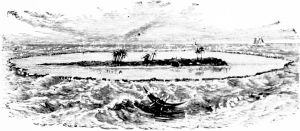
The island, though but a dot on the broad Pacific, being but
two and one-quarter miles long by one and a half miles wide,
is an interesting spot, and its history reads like a romance. Its
location is a favorable one, being about two degrees south of
the tropic of Capricorn, for which reason the weather is never
so intensely hot as in some of the islands of the south seas,
and is never cold. Beautiful tropical trees,—the tall, graceful
cocoanut palm, the wide-spreading banyan, the pandanus palm,
and others,—cover its surface from end to end. Refreshing
breezes, cooled and moistened by passing over thousands of
miles of ocean, constantly fan the surface of this lovely isle. It
can be truthfully said of this island that
“Every prospect pleases.”
The people who inhabit this little Eden are half castes, their
dark features and black hair plainly betraying their Tahitian
blood, though some of them have quite light complexion and
blue eyes. At present there are but about one hundred and
thirty of the inhabitants. The kindness and hospitality of this
interesting people have been remarked by all who have ever
called at the island.
We believe this little book will be read with profit and
delight by all who are so fortunate as to secure a copy.
E. H. GATES.
St. Helena, Cal., July 30, 1894.
CHAPTER I.
The Bounty and the Mutineers
TOWARD the close of the eighteenth
century, at a time when
events producing the most
important results were occurring
among some of the nations of the earth, there was
being laid, unconsciously, the foundation of a history
which in all its points could equal, if not surpass, any
tale of fiction.
During the reign of King George Third, of England,
the English Government considered it advisable to
introduce, if possible, the breadfruit into her colonies
in the West Indies, and for this purpose a ship was
specially fitted out and provisioned. A small sloop-of-war,
named the Bounty, was the one provided, and
her internal arrangements were begun and completed
with the view of transferring, with the least possible
injury, the tender plants from their native soil.
On the twenty-ninth day of December, 1787, the
Bounty left England, under orders to proceed to the
Society Islands, for the purpose of procuring plants of
the breadfruit tree, to be conveyed to the West Indies.
Lieutenant William Bligh was appointed commander,
and about forty-five persons, including a gardener,
made up the crew. Provisions for eighteen months
were put on board.
The different feelings that possessed the minds of
the men who were leaving behind them what they held
most sacred and dear on earth, may be imagined; yet
were they doubtless cheered by the thought of one
day meeting again the dear friends at home, when the
long separation was ended. But for the ship, and for
some of the crew, it was never to be, and could the
results of that voyage have been foreseen, it is a question
how many of those who then left their native land
would have dared to embark on a journey that was to
be fraught with events so startling in their nature, and
that was to end so strangely, that even at this distant
day the story is repeated and listened to with sustained
interest, not only by strangers, but by the immediate
descendants of the misguided men, who themselves fell
victims at last to their own wrongdoing.
The voyage out was safely accomplished, the Bounty
having arrived at Tahiti in the month of October,
the year following her departure from England. Six
months were spent at the island collecting and stowing
away the plants, the crew in the meanwhile becoming
very friendly with the natives. A violent storm threatening,
Captain Bligh deemed it prudent to leave. This
was in April, 1789.
Leaving Tahiti, the Bounty went on to Anamooka,
where Captain Bligh took in water, fruits, goats, and
other live stock, and put to sea again on the 26th of
the same month. It was after leaving the last mentioned
island that some dissatisfaction was first noticed
among the crew. Hitherto, if there had been cause
for complaint respecting the captain’s treatment of
those he commanded, it had not been openly manifested.
It has now become matter of history that
William Bligh possessed a tyrannical temper, and frequently
had misunderstandings with his officers and
men. This, and the fact that many of the crew had
formed intimate acquaintance with the people of the
islands, doubtless caused them to conceive the plan of
seizing the ship, after having disposed of the officers.
Shortly before the mutiny broke out, one of the
men, Fletcher Christian (master’s mate), incurred the
captain’s severe displeasure. It is said that through
the advice of a young officer who perished in the Pandora,
Christian first formed the design of mutiny, which
was so effectually carried out. Be that as it may, the
night of the 28th of April, 1789, witnessed the outbreak
on board the Bounty, as the mutinous crew rose
in arms against their captain. Fletcher Christian,
aided by three other men, secured the person of Captain
Bligh. They entered his cabin, and dragged him
from his bed. Being soon overpowered, his hands
were pinioned behind him, thus rendering him helpless
in the hands of his captors.
A boat had been made ready to receive the unfortunate
Bligh and those of his companions who were to
share his fate, but the share of provisions allowed them
was very small. Owing to the smallness of the size
of the boat, only eighteen men besides the captain
ventured to trust their lives in it. Others would gladly
have accompanied the eighteen, but there was no possibility
of obtaining room in the boat, already too full,
and their only alternative was to remain in the ship
with their misguided companions. The boat containing
the unfortunate men being cut adrift was soon
headed for the island of Tofoa, about thirty miles distant,
where a landing was effected. The natives there
showed a decidedly hostile spirit, and when made aware
of the presence of the white men, they rushed down
to the beach, shooting arrows and hurling stones at
the intruders. A man named John Norton was killed.
The other eighteen hastened to get beyond the reach
of their pursuers and their arrows. Then commenced
a voyage attended with so much hardship and misery
in the exposed condition of the voyagers that even to
this day it commands the admiration and excites the
wonder of all who hear. Going over the vast distance
of upwards of twelve hundred leagues, encountering
every kind of weather, enduring dreadful sufferings,
hunger, and thirst, these men at last reached the island
of Timor, where was a Dutch settlement. Here they
were shown the greatest hospitality and kindness by
the governor. Leaving Timor, they went to Batavia,
where Bligh and some of his officers took passage on
a vessel bound for Europe. They eventually reached
England in safety.
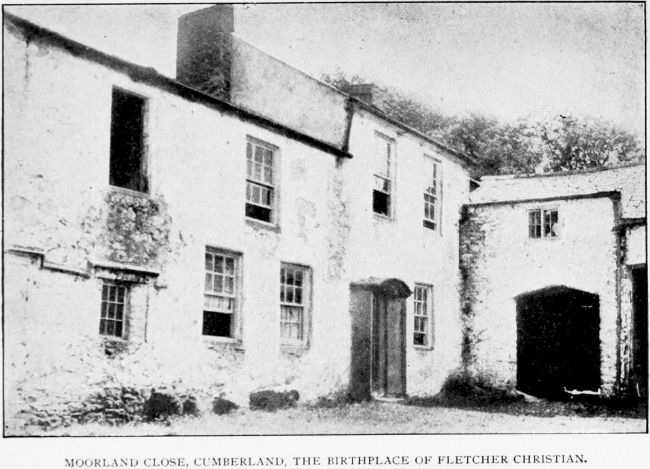
MOORLAND CLOSE, CUMBERLAND, THE BIRTHPLACE OF FLETCHER CHRISTIAN.
No time was lost in acquainting the English Government
with the disastrous failure of the Bounty’s mission,
and, although there were some among the crew
who, at the time of the mutiny, pleaded that no blame
should be attached to them, the result showed that
Bligh did not spare those whose hearts and hands were
alike innocent of any wrong against him. Very soon
the Pandora, commanded by Captain Edwards, a man
devoid of the humane feelings of kindness and pity,
was sent in search of the men who had so willfully forgotten
their duty. Of these only fourteen were found,
eight having accompanied Fletcher Christian, with the
Bounty, and two of their number having been killed
by the natives of Tahiti some little while before.
These poor men were conveyed in irons on board the
Pandora, where they were placed in a close room, with
one small opening to admit light and air. Chained to
the floor, exposed to the most cruel treatment that
the mind of the inhuman Edwards could conceive, enduring
the heaviest privations, and compelled to live
in their noisome den from day-to-day without any
means of having it cleansed, the condition of these
sufferers can more readily be imagined than described.
In this cruel position they were forced to exist; and
when at last the Pandora was wrecked on a coral reef,
the unfeeling Edwards would not listen to the piteous
pleadings of the prisoners and release them, even to
afford what help they might be able to render in trying
to save the ship. One sailor, however, possessed
of humane feelings, would not willingly let so many of
his fellow-creatures perish thus before his eyes, and,
exerting all his strength, succeeded in accomplishing
their release, but not until four of them had perished.
On board the ship that finally conveyed them to England,
they were treated as human beings, and allowed
freedom from their chains. Of these ten men “four
were acquitted; one was discharged on account of an
informality in the indictment; the other five were found
guilty and were condemned to death. Of these two
received a pardon, and the three others were executed
at Spithead,” from which place they had sailed on their
eventful voyage four years before.
CHAPTER II.
The Arrival at Pitcairn
DURING all this time where were
Christian and the other guilty
men who followed him? After
having set the boat containing
Bligh and his companions adrift, Fletcher Christian
assumed command of the Bounty, and returned toward
Tahiti. The ship was taken first to Toobonai, the
intention of the men being to settle there; but, finding
the place destitute of animals, they went to Tahiti to
procure a stock of pigs and goats. Obtaining what
they needed, they returned again to Toobonai, but
found the natives hostile to their landing. Once
more, and for the third and last time, the Bounty was
brought to Tahiti, where she was anchored in Matavai
Bay, on the 20th of September, 1789. Sixteen of the
crew here landed, taking with them their share of the
arms and other articles on board the Bounty. These
were the men, it will be understood, who were discovered
and taken away by the Pandora, as related in the
previous chapter.
Leaving at Tahiti that portion of the crew whose
choice it was to remain, Christian, accompanied by
eight of his shipmates who decided to cast in their lot
with him, sailed away from Tahiti forever. But this
number was not all, for six of the native men, and ten
women, and a girl of fifteen, were taken on board as
wives and servants, the sailors having determined to
seek some place where they could live secure from the
danger of discovery. It is said that Christian, having
seen an account of the discovery of a lone island in
the Pacific Ocean, by Captain Cartaret, in the year 1767,
directed the course of the ship to that place. It was
named Pitcairn Island, after the young man who
descried it, he being, as the story goes, a son of the
Major Pitcairn who fell in the Battle of Bunker Hill.
On the twenty-third day of January, 1790, the Bounty
reached her destination. The island, though small,
being about five miles in circumference, and scarcely
more than two miles across at its widest point, was
thickly covered with a luxuriant growth of trees.
On coming near enough for a boat to venture, a
small party went on shore to search the land. They
effected a landing on the west side of the island, but,
finding that a few yards from the sea the rocks rose
perpendicularly to a forbidding height, and thinking
to find a more convenient place for a settlement, they
brought the ship round to the northeast side of the
island. Here they managed to bring their boat safely
to the shore, through perilous rocks and breakers. It
did not take long to discover that the island had been,
and perhaps still was, inhabited, and fears were entertained
lest they should be attacked by hostile natives.
Traces of former habitations,—marais, stone images,
rude pictures cut in the rocks, stone hatchets, etc., etc.,—were
evident proofs that human beings had once
lived on the island, and in addition to these, several
human skulls and other bones were afterward seen.
As day after day passed, and no one appeared to
molest them, the mutineers began to feel more secure
and safe, and preparations were made for a permanent
settlement. Their supply of water, though not abundant,
was sufficient for their requirements, and the plants
brought with them from Tahiti would, in due course
of time, be able to supply their every want. But, first,
all trace of the ship must be destroyed. She was
driven near enough to the shore to allow of her being
fastened to a tree by means of a rope. Everything
that could be of service to the settlers was removed.
For greater safety, one little child was brought ashore
in a barrel, as the landing place for boats was very dangerous.
When all had been removed from the ship,
she was set on fire, and destroyed.
There were those among the mutineers, if not all,
who were grieved that they should be obliged to
destroy the vessel that had been their home so long.
Especially was it so with John Mills, if his daughter’s
testimony is correct, for she never wearied of telling
how her father sorrowed over the destruction of the
Bounty, as it was his hope one day to return in her to
England, even at the risk of his life. These fugitives
from justice spent the early days of their settlement
on Pitcairn Island in caves, and tents made of canvas,
while their cottages were being built. Here, on this
solitary, uninhabited spot, Christian could, at least,
hope to hide himself and his guilty associates from
the extreme penalty of the law.
But no degree of outward security could bring peace
to a mind constantly disturbed with self-accusing
thoughts, or still the reproaches of a conscience
burdened with guilt and remorse. Poor, misguided
men! Utterly isolated from the rest of the world,
their only means of communication destroyed, their
condition was forlorn in the extreme. In their outward
circumstances they were tolerably comfortable,
as they had brought with them enough of the necessities
of life to sustain them until the land could be
made to produce fresh supplies. Such clothing as
they possessed would have to be carefully kept, and
as regarded the native men and women, the simplest
covering sufficed for them. The land was shared out
among the Englishmen, their native servants helping
them to cultivate the ground. Salt was obtained from
the small, shallow pools in the rocks, and these rocks
were also shared among them.
For two years a fair degree of prosperity blessed
their efforts, but the comparative peace and success
they enjoyed could not be expected to continue. The
first real trouble and disturbance was caused by one
of the mutineers named Williams. His wife had gone
out one day among the cliffs to search for sea birds
and eggs. While so doing, she fell and was killed.
Williams, wanting another woman, demanded and
obtained the wife of one of the native men. Wronged
and outraged by this scandalous act, the native men
vowed to be revenged on the Englishmen, and a plot
was formed to murder them all. The secret being
made known to the women, they imparted it to the
Englishmen, in a song as follows:—
“Why does black man sharpen ax?
To kill white man.”
And now begins a story of oppression, treachery,
and bloodshed, that forms the darkest page in this
island’s history. So constant was the dread experienced
by some of the women, that they contrived, in
secret, to construct a rude raft, with the intention of
returning to Tahiti, or be lost in the attempt. They
had their raft launched, and ventured a little way
beyond the breakers; but their hearts failed them, and
the entreaties of some of the women left behind, who
had found out their intention, prevailing, they returned
to shore again. Hostile feelings were strong on both
sides. The women, however, sided entirely with the
Englishmen. In one instance one of the women
deliberately murdered her native husband, when they
were alone together in a cave where they lived.[1]
When some degree of peace had been restored, and
the suspicions of their masters were quieted, the
wronged and oppressed Tahitians, obtaining possession
of arms, fell upon the white men while they were
quietly working on their allotments of land, and
hunted and shot them down. Fletcher Christian,
John Mills, Isaac Martin, William Brown, and John
Williams were killed. William McCoy and Matthew
Quintall escaped into the woods, while John Adams,
having at first escaped into the woods, on again showing
himself, was shot and severely wounded. Recovering
himself, he ran away from his pursuers, and,
making for the rocky cliffs, would have thrown himself
off, but those in pursuit, by sundry signs, showed
that they intended no further harm. Being thus reassured
of his safety, he returned with them to one of
the houses, where he was kindly treated. Edward
Young, a favorite with the women, had been concealed
by them, and so escaped the dangers to which
the others had been exposed. Thus were the lives of
four among the nine mutineers spared. But peace was
not yet to be. How was it possible, when the men and
women that remained practiced freely every vice that
could degrade manhood and womanhood. Treachery
and bloodshed still raged among them, and no one felt
his life secure.
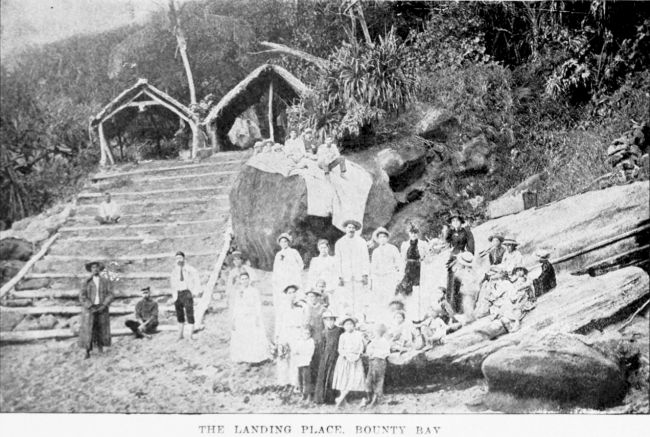
THE LANDING PLACE, BOUNTY BAY.
A story is told of how the death of one of the native
men was accomplished. It was before anyone had
been killed. The man, called by the name of Timiti,
had been accused of some wrongdoing, and was
brought before the Englishmen to be tried. Christian,
so the story goes, was, while trying the case,
walking backward and forward through the midst of
the assembled company met to see the result of the
trial. Timiti, learning only too well that his sentence
would be death, took the opportunity when Christian
was in the act of turning himself around, to make a
spring for the open door. Before his judges could
recover from their surprise, he was too far on his way
to be readily overtaken, and his pursuers were obliged
to return without him. Taking a short cut down
towards the sea, he speedily descended the steep
cliffs, and ran across the rocky shore. Swimming
across places where no footpath could be found, and
walking the rest of the way, he at length reached a
place on the south side of the island known by the
name of Taowtama. Here he succeeded in hiding
himself for a while, until someone descried him from
the heights above, engaged in a favorite pastime,
called ihara (pronounced e-hurra).
The news soon spread that Timiti’s hiding place was
discovered, and another native, named Menálee, was
sent out to secure him. One of his companions also
went with him, and before long they were at the place.
Timiti, suspecting treachery, would have fled, but the
two men, through their fair speeches and the food
they had brought him, quickly disarmed him of his
suspicions. To further assure him they produced a
comb, and prevailed on him to let them comb his hair.
Having thus decoyed him into their power, the rest
was easy enough, and a few seconds sufficed to dispatch
the poor fellow.
After the massacre of Christian and his companions
the native men turned upon one another, and the four
remaining Englishmen, assisted by the widows of the
murdered white men, joined in ridding the island of
these “disturbers of the peace,” so that in a short time
after the mutineers had been killed every one of the
native men was also put to death.
During the occurrence of these shocking scenes,
how must every human impulse and every kindly feeling
have been nearly extinguished! To add to the
dreadful evils that were committed, McCoy, who had
been brought up in a distillery, spent much of his
time in distilling ardent spirits from the roots of the
tee plant. Quintall assisted him, his “teakettle being
converted into a still.” These two men succeeded
but too well. Drunkenness was added to the already
long list of vices, and was of frequent occurrence. In
McCoy’s case it brought its own punishment, for in
an attack of delirium he made his way to the rocky
shore, and, fastening a stone around his body, cast
himself off into the sea. The dead body was found
by a little girl, a daughter of John Adams, and was
brought up to the little settlement and buried.
Quintall, McCoy’s boon companion, met his death
at the hands of his two remaining shipmates. Always
disorderly and troublesome, provoking a quarrel whenever
he could, and frequently threatening the lives of
Young and Adams, he became a constant terror to
them. As an instance of his ferocious nature, the
story is handed down that one day his wife went out
fishing, and, not succeeding in obtaining enough to
satisfy Quintall, he punished her by biting off her
ear.[2] Like Williams, he also lost his wife, and in the
same way, she having fallen from the rocks when
going after birds. Regardless of the fearful consequences
which so quickly followed a crime of the
same nature only a short time before, Quintall demanded
the wife of one of his two remaining companions.
Their refusal to comply with his demands
determined him to try to put his oft-repeated threats
into execution. Adams and Young, knowing their
lives to be in danger, felt themselves justified in putting
an end to Quintall’s life.
The opportunity soon came, and one day when
he was in John Adams’ house, he was set upon and
overpowered by the two other men. By means of a
hatchet the dreadful work of death was soon completed.
The daughter of John Mills (who lived to
the age of ninety-three), then a young girl of eight or
nine years of age, was an eyewitness of the awful deed,
and used to relate how terrified were all of the little
band of women and children who beheld the blood-bespattered
walls. The dreadful scene was vividly
pictured on her mind and memory through the long
course of more than eighty years.
CHAPTER III.
The Mutineers Discovered
THE two chief causes of trouble
and mischief being now removed,
there was prospect of
enjoying more tranquillity and
peace than had ever been known before. Of the fifteen
males who landed on the island, only two now
remained. These two, Adams and Young, having
the whole responsibility of the young and increasing
colony devolving upon them, arose to the exigency of
the case. Young was naturally of a thoughtful and
serious cast of mind, and the scenes which he and
Adams had witnessed, and in which they had participated,
had the effect of deepening the serious impressions
that had been made upon them both, and they
resolved to train, as best they could, their own children
and those of their unfortunate companions, in
the paths of virtue and right. Young’s superior education
better fitted him for the grave undertaking; but
he did not long survive his repentance. He had long
been afflicted with the asthma, and died of that complaint
in the year 1800, about a year after Quintall’s
death.
John Adams was now sole survivor. With a deep
and abiding repentance for his former course of life,
he strove to amend the misdoings of years by instilling
into the minds of the young and rising generation
around him right principles. Alone and unaided in
the gigantic task, he suffered not his courage to fail in
the endeavor, and his earnestness of purpose, directed
in a right channel, could not fail to win some measure
of success. The number of children that had been
born to the mutineers was twenty-three. Fletcher
Christian left three children; John Mills, two; William
McCoy, three; Matthew Quintall, five; Edward
Young, six; and John Adams, four. John Williams,
a Frenchman, Isaac Martin, an American, and William
Brown, an Englishman, left no children.
John Adams used to relate that it was through the
influence of a dream that he was first led seriously to
consider the condition of the helpless and ignorant
youths who were so suddenly and unexpectedly left
on his hands, and to arouse himself to the heavy
responsibility that rested on him, as the only instructor
that could be had for them, totally unfit for the task
though he might be. It was a late beginning, but he
engaged in the work with all his heart. A Bible and
prayer book saved from the Bounty were the only
means at his command in teaching the young people
to read. But, with the blessing of God upon his humble
efforts, John Adams had the satisfaction of seeing
the children of such disreputable parentage growing
up around him, quiet, peaceable, industrious, and
happy, and with an increasing love of virtue and strict
morality. A beautiful feature of the whole was the
love that united them as one family under the fatherly
control of John Adams. Such was the condition of
life on Pitcairn Island when, in 1808, Captain Mayhew
Folger, of the American ship Topaz, accidentally
discovered that the island was inhabited. Following
is part of a letter received by the writer from Mr.
Robert Folger (a son of the captain above named),
who kindly gave permission to make use of it. The
letter was dated Massillon, Stark County, Ohio, August
4, 1882. After giving his reasons for writing,
the letter proceeds as follows:—
“My brother, sister, and myself are the only surviving
children of Captain Mayhew Folger, of the
ship Topaz, of Boston, the discoverer, in February,
1808, of the colony on Pitcairn’s Island. I do not
like to refer to the survivor of the Bounty crew on the
island as a mutineer, for I cannot help feeling that the
cruelty of Bligh to his men was such as to justify
almost anything on the part of the people on board....
I may now say that I have been for nearly
twenty-five years gathering facts in regard to Pitcairn’s
Island.
“I have Bligh’s own account of the mutiny, ‘Delano’s
Voyages,’ my father’s logbook, with his entry
therein in his own handwriting, dated, as I now
remember, February 8, 1808—Lady Belcher’s book,
‘The Mutineers of the Bounty’—and numerous letters
and newspaper publications.
“If you would like a copy of my father’s journal
entry, I shall have great pleasure in transcribing it,
and sending it to you. I may as well say in advance
that he, as a shipmaster, shared in the general feeling
of the world, and shipmasters especially, against the
‘arch-mutineer,’ Christian.
“The history of your island will long, I may say
always, be a wonder. During the sixty years that I
remember it, it has been a wonder, and it will continue
to be, as wonders do not decrease in interest. Three-quarters
of a century have gone into the great ocean
of time since Captain Mayhew Folger discovered the
colony, and the interest in the history of the island is
unabated. The island cannot be mentioned without
exciting a wonder even in the mind of the unlearned,
as to the history of the colonists, their present status,
and, indeed, all that concerns them.
“In connection with the truth concerning the colonists,
there has been a great deal of error and nonsense
published. Blackwood’s Magazine is not free
from being a participant in setting afloat most senseless
statements, which were about twenty-four years
since repeated in this country. There are very few
living who can enter into the spirit of Pitcairn’s history,
and, what is to me most singular and unaccountable,
a large number of would-be historians are engaged
in uttering most senseless pretensions to correct
the history of the island, from the arrival of the
Bounty until the arrival of the Topaz—a period of
twenty years when nothing was known, nor could be
known, of the island, nor was known until the arrival
of the Topaz in February, 1808.
“You, undoubtedly, have had access to the account
of the mutiny by Captain Bligh, also to ‘Delano’s Voyages,’
published in 1817, in which are two letters from
Captain Folger, one to Captain Delano, and one to
the Lords of the Admiralty, R. N., and which was
received by them through Rear-Admiral Hotham,
who, in 1813, was, I think, in command of the English
blockading squadron on our coast in the War of 1812....
It was through Rear-Admiral Hotham that
my father sent the Azimuth compass, and within five
years last past I have noticed in some publication
(I cannot state what one) that Her Majesty’s navy
had obtained the Bounty’s chronometer, which was
taken from my father at Valparaiso when his vessel
was confiscated by the Spanish governor of Chile
when he reached the South American Coast, after
having visited Pitcairn’s Island.
“As your grandfather, Mr. Buffett, mentions ‘Delano’s
Voyages,’ I suppose you too have read that, in
many respects, curious book. In the main, the portion
which refers to my father is correct. Captain
Delano visited my father at Kendal in 1817....
In reading Mr. Delano’s book you will find a letter
to the Lords of the Admiralty dated at Kendal....
If I were to write a history of the island, I could give
a chronological statement that would be in order and
critically correct, as I think I have in my library every
date from the discovery of the island in 1767, by
Captain Cartaret, of H. B. M. ship Swallow, to the
present time....
“Since writing the foregoing, I concluded to copy
all the entries from my father’s logbook in which the
island is mentioned....
“‘Ship Topaz, of Boston, Mayhew Folger master, on
a sealing voyage to the South Pacific Ocean, 1808.
“‘Saturday, 6th February.—First part light airs at
east, steering west by south, half south by compass.
At ½ past on P. M. saw land bearing southwest by west
half west. Steered for the land with a light breeze at
east, the said land being Pitcairn’s Island, discovered
in 1767 by Captain Cartaret in his Britannic Majesty’s
sloop Swallow. A 2 A. M. the isle bore south two
leagues distant. Lay off and on till daylight. At 6
A. M. put off with two boats to explore and look for
seals.
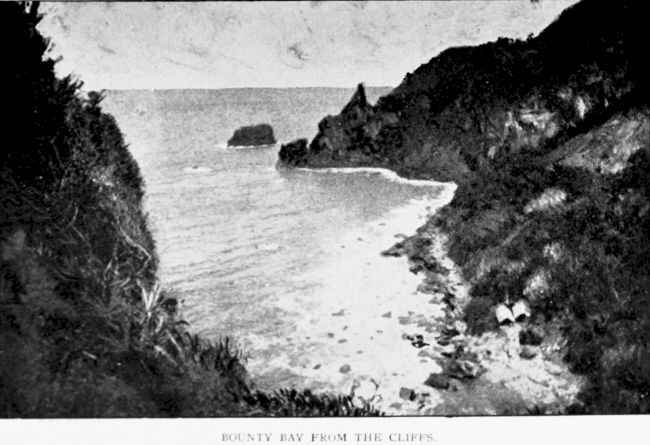
BOUNTY BAY FROM THE CLIFFS.
“‘On approaching the shore saw a smoke on the
land, at which I was very much surprised, it being
represented by Captain Cartaret as destitute of inhabitants.
“‘On approaching still nearer the land, I discovered
a boat paddling towards me with three men in her.
On approaching her, they hailed me in the English
language, asking who was the captain of the ship, and
offered me a number of cocoanuts, which they had
brought off as a present, and requested I would land,
there being, as they said, a white man on shore.
“‘I went on shore and found there an Englishman
by the name of Alexander Smith, the only person
remaining out of nine that escaped on board the ship
Bounty, Captain Bligh, under the command of that
arch-mutineer, Christian. Smith informed me that,
after putting Captain Bligh in the longboat and sending
her adrift, Commander Christian proceeded to
Otaheite. There all the mutineers chose to stop
except Christian himself, Smith, and seven others.
They all took wives at Otaheite, and six men as servants,
and proceeded to Pitcairn’s Island, where they
landed all their goods and chattels, ran the ship Bounty
on shore, and broke her up, which took place, as near
as he could recollect, in 1790. Soon after, one of their
party ran mad and drowned himself; another died with
a fever, and after they had remained about four years
on the island, their men servants rose upon them and
killed six of them, leaving only Smith alive, and he
desperately wounded, with a pistol ball in the neck.
However, he and the widows of the deceased arose
and put all the servants to death, which left him the
only surviving man on the island, with eight or nine
women and several small children. He immediately
went to work tilling the ground, so that it produces
plenty for them all, and he lives very comfortably as
commander-in-chief of Pitcairn’s Island.[3]
“‘All the children of the deceased mutineers speak
tolerable English; some of them are grown to the
size of men and women; and, to do them justice, I
think them a very humane and hospitable people; and
whatever may have been the errors or crimes of Smith,
the mutineer, in times back, he is at present a worthy
man, and may be useful to navigators who traverse
this immense ocean.
“‘Such is the history of Christian and his associates.
Be it remembered that this island is scantily supplied
with fresh water, so that it is impossible for a ship to
get a supply. I place it in latitude 25° 2′ south, and
130° west longitude, from my last lunar observation.
“‘Sunday, 7 February.—Light airs from the eastward
and very hot. The ship laying off and on, I
stayed on shore with the friendly Smith and his truly
good people until 4 P. M., then left them and went on
board and made sail, steering southeast and southeast
by east, bound for Massafuero, having received from
the people on shore some hogs, cocoanuts, and plantains.
At noon the isle bore northwest by north by
compass 34′ dist. Latitude observation 25° 31′ south,
etc.’”
After Captain Folger’s accidental discovery of the
little colony on Pitcairn Island, nothing more was
known or heard of them for a period of nearly six
years. In the year 1814 H. M. ships Briton and Tagus,
commanded respectively by Captains Staines and
Pipon, out on a cruise and returning to Valparaiso
from the Marquesas, passed near the island. So
strange was the sight of a ship that when these two
were first descried approaching the island, the young
woman who first saw them ran to make it known to
the rest by saying that “two paafata [a wooden flooring
erected on four posts, on which the feed for their
goats was kept] were floating in toward the shore,
with their posts turned wrong end up.” But the
experienced eye of John Adams soon discerned what
the visitors were.
As for the people on board, they were not a little
surprised to see from their vessels the land laid out
in regular plantations. The houses, too, that could be
seen were different in make from those of the other
islands they had lately visited. In a short time a
canoe was seen paddling off towards the ships. To the
astonishment of those on board, the visitors from the
shore, on coming near enough to speak to those on
the Briton, called out in plain English, “Won’t you
heave us a rope now?” A rope was thrown them,
and they were warmly welcomed on board.
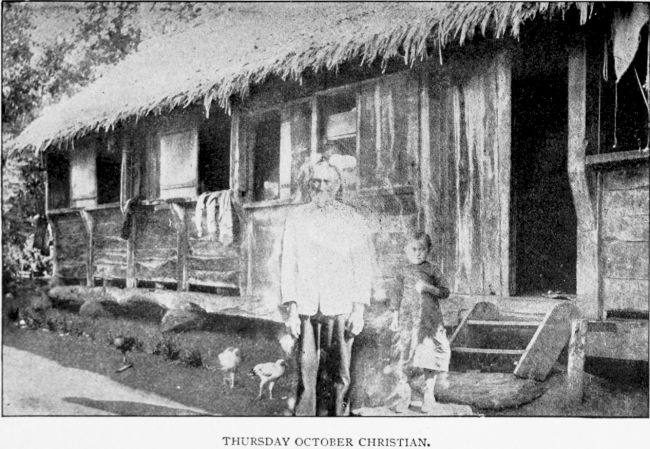
The mystery was explained when, on being questioned,
they said that they were Thursday October
Christian, son of Fletcher Christian, the mutineer,
and George Young, son of the midshipman Edward
Young. The former was named after the day and
month of his birth. He was described as a “tall and
handsome young man about twenty-four years of age,
his scanty clothing consisting of a waistcloth, while he
wore a broad-brimmed straw hat adorned with black
cock’s feathers.” His companion, George Young, was
said to be a “fine, noble-looking youth, 17 or 18 years
of age.” On being invited below, and having food set
before them, they further astonished their kind entertainers
by reverently asking a blessing before partaking
of their food. In reply to a question they said
that the good custom had been taught them by John
Adams. Every kindness was shown to the two young
men, and when they were taken to see a cow that was
on board the ship, they created some amusement by
asking whether the animal was “a huge goat or a
horned sow.”
THURSDAY OCTOBER CHRISTIAN.
Captain Sir Thomas Staines went on shore, and was
agreeably surprised to find the youthful colony living
harmoniously together under the patriarchal rule of
John Adams. Great fears were entertained by the
humble islanders lest their only instructor and teacher
should be removed from them, more especially as he
had fully decided to give himself up should he be
required to do so. But the Tahitian women pleaded
strongly that he might be allowed to remain, and,
clinging to John Adams, weeping while they pleaded,
the humane captain, himself deeply touched at the
scene, resolved not to disturb them. At the same
time he advised Adams not to go down to the landing
place, where the boat was, himself making the excuse
that the path to the beach was sufficiently rough and
stony for the old man not to venture. The advice was
followed, Adams accompanying the kind-hearted captain
only part of the way. Thanking him for the
thoughtful consideration shown to himself and people,
he bade Captain Staines farewell, and returned to the
little village.
CHAPTER IV.
The Gem of the Pacific
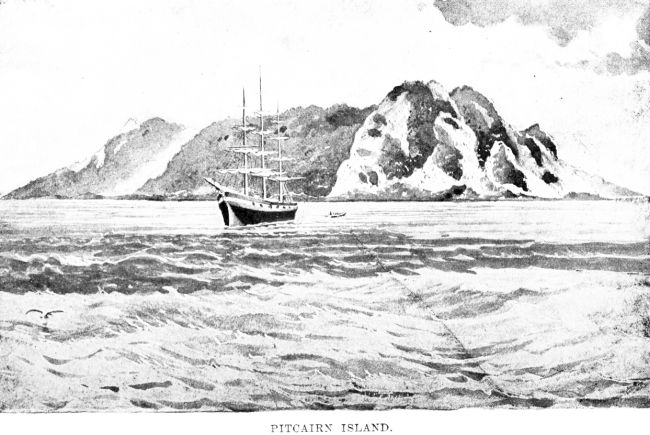
PITCAIRN ISLAND, brought to notice through the events already
narrated, is insignificantly small, being only about five miles and
a half in circumference and two miles and a half across. It was,
when the mutineers first settled on it, thickly covered with trees
wherever there was soil sufficient for their roots to take hold; but,
in the period of a hundred years, during which wild goats have roamed
in herds over certain portions of the island, many of the trees have
disappeared. The soil, thus made bare, has severely suffered by being
washed away by heavy rains, and scarcely a trace of the once luxuriant
growth of trees remains. Viewed from the sea, the island in two or
three places presents a bare and sterile appearance. Its isolated
position in mid-ocean, its rock-bound shores and precipitous cliffs,
alike impress the beholder with a sense of the security such a place would afford to
those whose chief aim was to hide their crimes and get beyond the reach
of well-merited punishment.
The highest part of the island is about one thousand
one hundred and nine feet above the sea. Facing
the north is a peak, or immense rock, scarcely less
high, called the Goat House. A cave in the side of
this rock, partly hidden by lofty trees, is said to have
been the intended retreat of Christian and his companions,
in the event of their being sought after and their
lone island discovered. The peak overlooking Bounty
Bay, called Ship-landing Point, because it stands
directly over the place where the Bounty was driven
near the rocks and destroyed, has been described as
“possessing considerable beauty.” It rises in bold
outline almost perpendicularly from the sea, its rugged,
rocky front softened here and there by patches of
grass and shrubs. The scenery surrounding the little
bay, with its rocky shore, is always beautiful. Vine-covered
trees, with foliage of intensest green—more
especially the pandanus palm tree—flourish in rich
growth quite near the water’s edge, the salt spray
frequently moistening their branches, while the soft
sea air helps to diffuse the delicious fragrance of the
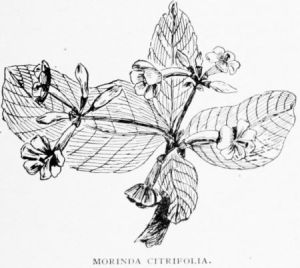
sweetest flower that the island boasts of, the morinda
citrifolia, named by the islanders simply “high white,”
in distinction to the pure white blossoms of the “four
o’clock,” which blooms on a low bush.
Overhead, near the highest extremity of Ship-landing
Point, looking from the north, is seen a natural
curiosity, a huge portion of the rock showing in profile
a representation of a man’s head of gigantic size.
It is called the Old Man’s Head, and it is not difficult
to imagine that it looks down upon the small bay
with an expression of mild benevolence. The ascent
from the landing place is very steep, but is made comparatively
easy by a very tolerable road leading up
the few hundred feet.
On the southeast side of the island is the place
known as “the Rope,” so called because in former
years the steep descent could only be accomplished
by means of a rope. A zigzag path, only wide enough
to afford a foothold, now leads down from the high
precipice to the water’s edge. The steep cliffs, rising
almost perpendicularly from the shore, are grandly
beautiful. The variegated colors of the soil, the rocks,
and the foliage of trees, all blended together, or contrasted
in shades of black and gray, yellow and brown,
red and green, make the scenery altogether pleasing;
and not less beautiful is the view of the waters of the
little bay, when, calm and smooth, it spreads out like
a lake, without a ripple on its surface, or when, with
wild and roaring sound, wave after wave breaks and
rolls in toward the shore, leaving the surface of the
water as if covered with billows of loveliest lace, pure
and white.
PATH THROUGH COCOANUT GROVE.
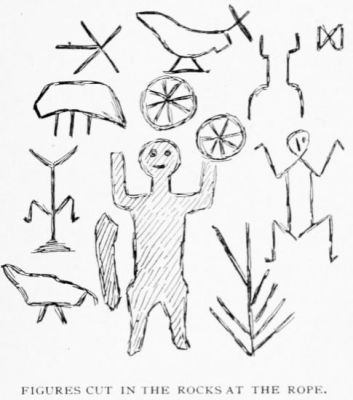
In the most sheltered corner of the bay, at the Rope,
is a small stretch of sand, on one end of which, at the
foot of the rock that towers above it, there were found
by the mutineers some stone axes and other implements,
which were made and used by the natives that originally inhabited
the island. Here, too, are cut in the rocks some of the figures made
by the rude artists of those by-gone ages. Most of the characters have
been obliterated by more than a century’s exposure to every kind of
weather. A few, however, remain quite distinct, as may be seen by the
accompanying illustration.
FIGURES CUT IN THE ROCKS AT THE ROPE.
The pandanus palm tree, with its clustering branches
of drooping leaves, fringes the shores of the bay
nearly its whole extent. The innumerable huge
stones and rocks that cover the bottom of the bay
make it impossible for a boat to land. Its waters
teem with myriads of small fish. The bêche de mer
drags out its existence in the many sand-bottomed
pools, while the cray fish and whelk, both of which
are eaten, make their home beneath and among the
seaweed-covered rocks that abound in the shallow
bay. Looking north from the ridge of the Rope, the
eye rests upon a small but lovely valley, named St.
Paul’s Valley, it being in the vicinity of St. Paul’s
Rock. Grand old trees, with their varied and changing
tints of foliage, render the scenery always beautiful,
while, as an accompaniment to their gentle, rustling
music, comes the booming sound of the surf on the
rocks far below.
In the valley between Ship-landing Point on the
northeast and the Goat House, facing north, lies, nestling
among trees, the little village settled by the mutineers
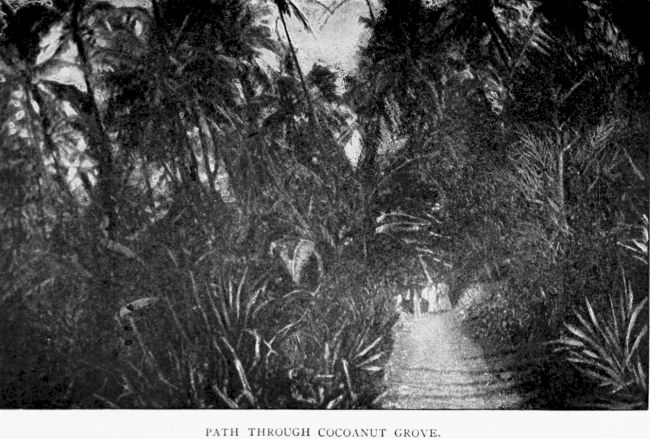
a hundred years ago. Groves of cocoanut and
orange trees surround it, while the beautiful banyan
tree, with its curious growth of long, rope-like roots
hanging in thick profusion, and its towering branches
covered for ten months of the year with a springlike
robe of green, lends a delightful charm to the scenery.
Although the island is rocky to some extent, it still
possesses much picturesque beauty. Steep ridges and
deep valleys are its chief characteristics, both being
covered by grand old shade-giving trees. The only
drawback to a thorough enjoyment of walking or
resting beneath the trees is the absence of singing
birds to enliven the branches with their songs. One
little homely bird with its coat of brown and white is
the only occupant of the woods, with the exception of
a beautiful white sea bird that in the early warmer season
comes to deposit its egg on a niche of the bare
branch of the banyan or other large tree. These two
birds, the former with its constant “tweet, tweet,” and
the latter with its lively, shrill calls, impart some life
to the otherwise silent groves. Occasionally a few
other varieties of sea birds, sailing overhead, pierce the
silent air with their cries.
MORINDA CITRIFOLIA.
Ferns, of which there are about twenty-six varieties,
adorn the valleys in lovely and rich profusion.
Of wild flowers there are but few, and all of them are,
with one exception, small, white, and fragrant. This
one is a sweet little flower that loves to open its golden
eyes during the colder months of the year, and is
found mostly around the edge of the high precipices.
It is a universal favorite. The “flower tree” (morinda
citrifolia) is in bloom almost all the year round, but is
at its loveliest from October to March. Its pure white
blossoms contrast richly with the dark, glossy leaves,
while its delightful perfume, as well as its simple
beauty, makes it a favorite with old and young. Children,
boys as well as girls, find a never-ceasing pleasure
in stringing the flowers into garlands, which they
wear around their hats.
The bright blossoms that here and there meet the
eye have been introduced from time to time, mostly
by the captains of passing ships, who have kindly
given from their own limited stock. Also many
seeds have been sent by friends in England, America,
and the Sandwich Islands; but only those from the
last-named place have succeeded well, most of the
others, owing greatly, no doubt, to the want of proper
culture, having proved a failure. However, through
the thoughtful kindness of friends, the little island is
not entirely destitute of nature’s loveliest productions.
First among the principal fruits that the island produces
is the orange. The trees begin to be in blossom
from the end of July at the earliest, and continue
flowering until October. The season of the fruit is
from April to November. As the trees occasionally
produce a second crop, it is not unusual to have them
in fruit the year round. Watermelons, muskmelons,
pineapples, roseapples, and figs are in season from
November to April. Bananas, of which there are a
few varieties, can be had all the year round, but are at
their best from January to June. The guava grows
wild, and from March to July the trees are laden with
fruit. Grapes might be cultivated. The sugar cane
is also one of the principal productions of the island,
the rich syrup made from its juice being used instead
of sugar. Arrowroot is cultivated with profit. The
process of making it involves much labor. The
plants are set in the ground in the months of October
and November, and the roots are fully matured by
June. The yam crop is set at the same time as the
arrowroot, and takes the same length of time to come
to maturity.
Such are some of the present productions of the
little island that became the hiding place of the mutineers.
They themselves doubtless introduced the
breadfruit, cocoanut, taro, yam, and one variety of
the sweet potato. The places they once owned and
cultivated are still called by their names, as John
Adams’ Breadfruit Patch, Ned Young’s Ground, McCoy’s
Valley, and so on through the whole list. But,
while their names remain, every trace of their burial
places is lost, the grave of John Adams alone excepted.
Pitcairn! To thee, land of my birth,
My song I bring;
Thy hills and valleys, trees and flowers,
Their praise I sing.
The cocoanut, with waving plumes
Of shining green,
The sweetly-scented orange blooms,
Both here are seen.
And stately trees, and luscious fruits,
Thy soil supplies;
But the enriching showers and rains
The heaven denies.
Thou once wast fertile, rich, and green,
But now, how bare;
And yet thou still art beautiful,
Still sweet and fair.
Such matchless days of calm, fair skies
Thy summers bring!
And lovely, too, are all the hours
Of balmy spring.
Each season, as it rolls around,
New beauties gives;
And every object, silent, cries,
“My Maker lives.”
CHAPTER V.
JOHN BUFFETT and JOHN EVANS
Marriages and Births
TO RETURN to John Adams and his
small community. Five or six
years had passed since the visits
of the Briton and the Tagus,
and during that time the fact of the island being
inhabited, and by whom, had become more widely
known. About the year 1819 the East India Company’s
ship Hercules, Captain Henderson, made a call
at the island and left some useful and much-needed
gifts for the islanders, consisting of carpenters’ tools,
large iron boilers, etc., etc., the last mentioned being
used chiefly for the purpose of boiling down salt water
to obtain salt.
In the month of October, 1823, an English whaleship,
the Cyrus, Captain Hall, visited Pitcairn Island.
John Adams, being now somewhat advanced in years,
and beginning already to feel the infirmities of age,
expressed to Captain Hall the wish that he could find
among the ship’s crew someone to assist him in the
arduous task of trying to impart instruction to his
young people. The captain listened kindly, and promised
to do what he could. Calling his men around
him, he made known to them the wishes of the old
man, and asked if any of them would be willing to
accede to his request. After a few minutes’ hesitation,
John Buffett, a young man twenty-six years of age,
stepped forward and volunteered his services. Being
bound by no home ties, he counted it no great sacrifice
to remain.
Buffett had in early youth been apprenticed to a
cabinet maker in Bristol, his native place. Of a roving
disposition, a sea life especially possessing a peculiar
fascination for him, he left his early trade to serve
on board His Majesty’s ship Penelope, and again on
the Impregnable. He was shipwrecked in the Gulf of
St. Lawrence, and afterwards cast away on the coast
of California, where he was received and cared for in
the kindest manner by an old Spanish comandante
in the place. The latter made every effort to persuade
Buffett to make his home in California, but he decided
not to do so, and from thence he made his way to Honolulu,
in the Sandwich Islands, where he joined the
Cyrus. At last, after his many adventures, he arrived
at Pitcairn Island, where, accepting his captain’s proposal,
he resolved to end his days among the people
with whom his lot was now cast.
Among his shipmates on board the Cyrus was a
youth about nineteen years of age, named John Evans,
a native of London. For love of Buffett, he determined
to remain on the island, and for this purpose he
ran away from the ship. Being of very small build,
he contrived to hide himself in the hollow stump of a
tree until the vessel had sailed, and it was safe for him
to make his appearance. As there was no help for it,
Evans also was allowed to become a member of the
community.
Not many months passed before both Buffett and
Evans sought in marriage the hands of two of the
island maidens. Buffett met with no opposition to his
suit, and, in due time, was united in marriage to Dorothy,
a daughter of Edward Young. Evans did not
obtain such ready favor when he requested of John
Adams the hand of his daughter Rachel. The old
man did not approve of the young people’s entering
the marriage relation at too early an age, and Evans
was barely nineteen; besides, the disparity in age of
the two young persons was another obstacle in the
father’s view, the young woman being the older by
some years. However, the matter was referred to the
daughter for decision. Her answer came, quick, short,
and decided, “Try it, daddy.” He at length consented,
but not without misgivings regarding her future happiness,
and his paternal blessing was not withheld when
the twain stood up to be made one, being wedded with
a ring formed of the outer circle of a limpet shell.
THE CHAPEL.
It may prove interesting to some readers to know
the names of those others whom John Adams united
in the bonds of matrimony. The service was performed
according to the rites of the Church of England.
The parties were, of course, the sons and
daughters of all the mutineers who left children, and
their names are as follows: Matthew Quintall to
Elizabeth Mills, Arthur Quintall to Katharine McCoy,
Daniel McCoy to Sarah Quintall. These two last mentioned
young men one day swam off to a rock at a considerable
distance from the shore, and there agreed to
seek each one the other’s sister for a wife. The rock
received, from that incident, its name, Táné M’á, i. e.,
“The place of the men’s agreement.” Thursday October
Christian, son of Fletcher Christian, and the first
born on the island, married Susan, the girl of fifteen
who came in the Bounty. The others were: Charles
Christian, married to Sarah McCoy; Edward Quintall,
to Dinah Adams; George Young, to Hannah Adams;
William Young, to Elizabeth Mills, widow of Matthew
Quintall, who met his death in some unknown manner.
Most of the young men went out one day in their
canoes to fish. They were mostly within speaking
distance of each other, but as Matthew, or Matt, as he
was called, was not seen tending his canoe, the others
supposed that he was lying down in it. It was afterwards
discovered that the canoe was, and had been no
one knew how long, floating about without an occupant.
The body had sunk, and was never again seen.
The following story is told to show the binding force
with which a promise was regarded in those early days:
George Adams, the only son of John Adams, had,
when quite a youth, “conceived an attachment for Polly
Young, but she declared that she would never marry
George.” On Captain Beechy’s visit to the island,
Adams referred the case to him and the other officers.
Their opinion was that the young girl’s determination
was made before she was old enough to know her own
mind, and would be more “honored in the breach than
the observance.” Polly, however, viewed the matter
in a different light, but confessed that her opinion of
her lover was considerably altered since she declared
she would not have him. Subsequently they were
married, perhaps not “in haste,” but Polly repented
“in a hurry,” for she discovered all too soon that a
home with George did not mean a “woman’s paradise.”
One gold ring, the property of Edward Young,
played an important part in the wedding services performed
in those days, and continued to be used until
somewhere in the forties.
Only four of the children of the mutineers died
unmarried. One of them, Johnny, the only son of
John Mills, the mutineer, came to his death by an
awful fall from a high, rocky cliff, where he had gone
in search of birds’ eggs. His injuries were such that
he died before he could be conveyed to his home.
The poor lad was only fourteen years old when the
sad accident occurred. Two of the sons of Edward
Young, Robert and Edward, both died shortly after
the return of the community from Tahiti in 1831,
while Fletcher Christian’s only daughter, Mary, died
of dropsy, on Norfolk Island, about the year 1865.
A daughter of Quintall, having strayed from the path
of virtue, was so harshly treated by her brother that
when she had an opportunity she left the island. The
captain of a passing vessel, being informed of the matter,
and learning the wish of the unfortunate young
woman, kindly allowed her a passage on his ship.
She was taken to the island of Rurutu, where she was
most kindly received. One of the chiefs of the island
made her his wife, and she eventually became the
mother of a numerous family.
Such were the early loves and marriages between
the children of the original settlers. Families of
healthy, vigorous children were raised, and over them
all John Adams presided, much after the fashion of the
patriarchs of old, and was looked up to and respected
as a father by the growing community, who had the
utmost confidence in the wisdom of his counsels and
teachings. At the time of Captain Beechy’s visit in
the Blossom, in 1825, the community numbered twenty-six
adults and thirty-five children, making a total of
sixty-one persons. During a period of thirty-five
years there had been twenty-seven births, and of the
original settlers from the Bounty there remained only
John Adams and five of the Tahitian women. These
six, with the addition of Buffett and Evans, made eight
of the adult population.
When it was first ascertained that the Blossom was
a man-of-war, great fears prevailed among the little
community lest the ship had come to convey Adams
a prisoner to England. But they were soon reassured.
The captain and officers hastened to explain that
their coming was for an altogether different purpose.
When they realized that their fears were groundless,
and that there was no danger of the old man’s removal,
the female portion of the community crowded around
him and embraced him in the most affectionate manner.
Especially touching it was to see the way in
which Hannah Young clung to her father and embraced
him, weeping, even, in the fullness of her joy
when she understood that he was not to be taken
away.
GROUP OF ISLAND MAIDENS.
During the whole stay of the Blossom her captain
and officers were most hospitably entertained by the
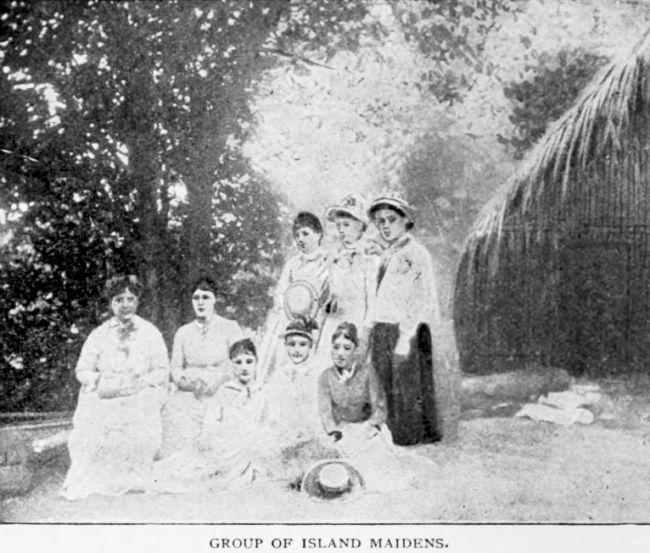
simple-hearted islanders. The young women especially,
who inherited from their Tahitian mothers a
strong love for flowers, made it their pleasant duty
every morning to adorn the caps of the officers with
freshly-made wreaths of sweet-smelling flowers. The
visitors were charmed with the open, simple manners
of all the islanders, but observed that “the same
marked difference between the sexes prevailed here
as in all the islands of the Pacific, notably at meals,
the women were not allowed to sit down with the
men; and when the captain and officers passed their
remarks and opinions respecting the difference observed
between the sexes, their words were resented,
as seeming to interfere with long-established custom.”
(It was not so much a “marked difference between the
sexes” as a feeling of unaccountable shyness that prevented
the women in those early times from sitting
down to the same table with strangers. At the present
day most of the island women, inheriting the same
dispositions from their mothers, when an occasional
visitor happens to share their hospitality, would much
prefer to “stand and wait” than act the part of hostess
by sitting down with their guests.)
The day was invariably begun and ended with
prayer and praise to the divine Father for His mercies
and His preserving care, each and every family engaging
in a short service of worship by parents and children,
nor was a day considered as rightly begun if their
first duty to their Creator was omitted. This right
custom has ever been, and still is, religiously observed
by their descendants. Captain Beechy and his officers
had the opportunity during their stay of attending
divine service on the Sunday. That day was very
strictly kept. There was complete cessation from
work; no fires were made, all the cooking being done
on the Saturday, that nothing of a worldly nature might
interfere with the sacred duties of the day of rest. In
the public worship on Sundays, Buffett assisted Adams
in reading the service, the especial part allotted him
being the sermon, “some sentences of which were read
over two or three times,” to catch the attention of his
hearers, and also to help to impress the words on their
memory. Buffett also acted as schoolmaster, and
“found the children both willing and attentive scholars.”
When the Blossom left the island, the tearful, affectionate
farewells told how the hearts of all the islanders
had been won to their visitors, whose pleasant
stay and cheerful companionship had been such a
bright spot in their quiet lives, and was to form ever
after one of their most delightful and pleasing recollections.
CHAPTER VI.
GEORGE HUN NOBBS.
Death of John Adams
THE EVEN, uneventful round of life
in the little community passed
steadily along, with “scarcely a
ripple to stir its monotonous surface.”
Cultivating the ground and keeping it in order,
building houses for the more newly married couples,
canoe building and fishing, and occasionally going out
with their guns to shoot goats, wild fowl, and birds,
supplied constant occupation for the men. A favorite
mode of taking fish was with the spear, usually made
by fastening five pieces of iron, bent to the required
shape, and having barbed points, onto a pole about
twenty feet long, and in the use of which the men were
very expert. The women were always to be seen
assisting their husbands, fathers, and brothers in their
outdoor occupations, and sometimes accompanied
them when they went out in their canoes to fish.
Cooking and other housework, and taking care of the
children, gave them daily employment. But their
principal work, during the colder months of the year,
was the making of native cloth.
This native cloth, or tappa, is made from the bark
of the aute plant (pronounced outy), i. e., the paper
mulberry, and has very much the nature and consistency
of paper. The work is exceedingly laborious
and wearisome, and when the yield of the plants is
large, it sometimes occupies months in doing. Yet it
was necessary to be done, as that material supplied
nearly all the bedding used then.
When anyone not accustomed to sleeping beneath
such noise-creating bedclothes tries it for the first
time, the constant loud rustle that it makes generally
succeeds in driving all sleep away. Captain Beechy
spoke of sleeping in cloth that “seemed fresh from the
loom,” as that was all that his entertainers could give
him. Frequent washing and exposure to the sun will
eventually deprive the material of its stiffness and
noisiness, and in cold weather it affords a warm covering,
as it excludes all air. It is colored a bright reddish
brown, and rendered tougher by being dyed in
the sap obtained from the doodooee (candlenut tree).
This dye is made by steeping the bark of the doodooee
in water.
In the early days this stiff, uncomfortable cloth was
worn by all, with, perhaps, the exception of John
Adams himself. By the women, pieces about a yard
in width and two yards in length were fastened around
the waist by simply crossing the two upper ends and
turning them in to secure them. Another yard of the
same material was thrown across the shoulders, as a
covering to the body, and this constituted almost
wholly their everyday garment. For Sunday wear
each woman and girl owned a frock of most primitive
make, being gathered in around the neck, and falling
loosely from the shoulders, reaching a little below the
knee. Underneath was a petticoat worn as described
above, which completed the whole attire. The men
and boys wore the waistcloth, almost exclusively, on
week days. Sundays they donned their breeches,
which did not reach to the knee, thus displaying the
muscular growth of their limbs.
The frequent outdoor employments of both men and
women resulted in a great muscular development of
their physical frame, and rendered them strong and
capable of enduring a vast amount of manual labor.
Yet this did not deprive the female portion of the community
of their feminine instincts, and all their womanly
ways remained. Their children were brought up
early to help in all the little homely duties that pertained
to the house, as well as to aid their parents in field
work; nor were they allowed to absent themselves
from the school, where they were taught reading,
writing, and arithmetic by John Buffett.
In 1828 George Hun Nobbs, accompanied by an
American named Bunker, arrived at Pitcairn Island
from Valparaiso. He had reached the last-mentioned
place after having passed through several adventures,
and while there heard for the first time the story of
the Bounty, and how Pitcairn Island was settled by
the descendants of the mutineers. The story so fascinated
him that he determined, if it could be done, to
reach the island and take up his residence with the
inhabitants. Accordingly, obtaining possession of a
launch, he, with Bunker, left Valparaiso, and in due
time they reached their destination safely. Both these
additions to their number received a cordial welcome
from the inhabitants.
Nobbs did not long delay seeking to woo and win
a wife; and, with some difficulty, at length succeeded
in obtaining the hand of Sarah Christian, a granddaughter
of Fletcher Christian. Bunker was not so
fortunate, for Peggy Christian would not listen to his
suit, and whether through unrequited love or a fit of
temporary insanity is not known, but he attempted
self-destruction by throwing himself headlong off a
cliff. By some means the fall was broken, and his
suicidal intentions were frustrated. He died, however,
shortly after.
ROSA YOUNG. ARTHUR YOUNG.
JOHN YOUNG. SARAH YOUNG.
The launch on which the voyage of the two men
was made was run ashore, broken up, and used in
building Nobbs’ house. In giving an account of himself,
Nobbs said that he was the “unacknowledged son
of a marquis.” Being, by a superior education, better
fitted than was John Buffett to fill the place of teacher
among the youth of the island, Nobbs had not been
long among them before he took charge of the school,
taking the work almost entirely out of Buffett’s hands.
Buffett was inclined to resent this act of Nobbs as a
gross injustice, but the people in general favored the
change, chiefly because of a grave fault which Buffett
had committed. Yet some of the parents remained
faithful in their allegiance to the teacher that had first
come among them, and did not withdraw their children
from his care, for, in spite of his fault, he endeavored
to the best of his ability to perform his duty
faithfully to them, while he sought to atone for the
wrong he had done by a lifelong repentance.
The duty of officiating as pastor was also assumed
by Nobbs. John Adams had by this time left the
management of everything that concerned the progress
and improvement of the people, in the hands of
the two younger men. On the twenty-ninth day of
March, 1829, the year following the arrival of Nobbs,
the last of the Englishmen that came in the Bounty
passed quietly and peacefully away, at the age of
sixty-five years, deeply and sincerely mourned by the
family over whom he had been so strangely placed.
He survived the last of his companions twenty-nine
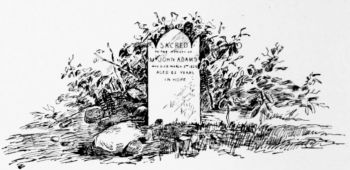
years. A plain white stone marks his resting place,
the inscription “In Hope” being placed beneath the
simple record of his name, age, and death. The headstone
was made in Devonport, England.
A year subsequent to the death of John Adams the
Seringapatam, man-of-war, Captain Waldegrave, visited
the island, bringing gifts of clothing and other
useful presents to the islanders. Previous to that time
the people, on account of their rapidly increasing
numbers, had been considering whether the island,
with its limited resources, would be adequate to their
support and maintenance, not the least cause of anxiety
being the scarcity of water. This condition of
affairs was reported to the proper authorities, and an
arrangement having been effected between the British
Government and the authorities at Tahiti for a grant
of land for the use of the Pitcairners in Tahiti, the Comet,
sloop, Captain Sandilands, arrived at Pitcairn Island
on the twenty-eighth day of February, 1831, as convoy
to the Lucy Ann, which, on the seventh day of
March, sailed for Tahiti, with the whole Pitcairn Island
colony, and their small stock of movable goods, on
board.
At the end of fourteen days the emigrants landed,
having received a cordial welcome. But the experiment
did not succeed. They had not been long in
Tahiti when a malignant fever broke out amongst
them and rapidly reduced their numbers. Fourteen
of the people died in quick succession, and, notwithstanding
the liberal provision made for their support
by the kind-hearted people of Tahiti, the Pitcairners
were anxiously desirous to return to their home.
Then, too, the manners of the people among whom
they now lived were so different from the pure, simple
lives they led amongst themselves, and the open and
undisguised immorality of some of the people around
them rendered them very unhappy. In less than
three weeks after their arrival at Tahiti an opportunity
of returning presented itself, and Buffett and his
family availed themselves of it. Four more of the
young men accompanied them. The vessel that
carried them called at Hood’s Island on the way, and
there one of the four young men died. After the safe
arrival home of the others, and before the rest of the
community came, another of their number passed
away.
Meanwhile, preparations were making at Tahiti for
the return of the rest of the people. The schooner
Charles Doggett was chartered to convey them to
their home. A quantity of the Bounty’s copper had
been carried to Tahiti, and this was given by the people
to purchase the schooner, as it was all they were
able to do; but liberal aid was given by generous
friends in Tahiti, who raised a subscription to supply
the deficiency. The return voyage occupied twenty-two
days, the whole stay at Tahiti not extending over
five months.
A pleasing incident is here recorded, illustrating the
old Bible truth, “Cast thy bread upon the waters; for
thou shalt find it after many days.” During the
sojourn of the Pitcairners at Tahiti, in the time of their
deep sorrow and grief, when one and another of their
number sickened and died, the second mate of an
American whaleship, whose name was Coffin, learned
of the dire distress that they suffered. Pitying their
forlorn condition as strangers in a strange land, and
obeying the impulse of a kind heart, he generously
spent five dollars in procuring such food for those
who were sick as he thought they would relish. Nor
were the needs of the others forgotten. This act of
disinterested Christian kindness was warmly remembered
by all the people, and when, after nineteen years,
the kind-hearted man came to Pitcairn as master of a
ship, the people made him a present of ten barrels of
yams, the cost of which was twenty dollars. This
substantial proof of the recollection of his goodness
toward them affected the captain to tears, and it was
with difficulty that he could be prevailed upon to
accept the gift, pleading that his former kindness
might be allowed to pass unrewarded. But the people
earnestly insisted upon his accepting what they
considered but a small return for the unforgotten
deed of kindness shown them in their extremity.
CHAPTER VII.
MR. JOSHUA HILL
A NEW chapter now
opens in the history of
this island. About the
year 1832-33 it was
favored with a new arrival, in the person of Joshua
Hill. He was a man of excellent education, but stern
in his nature, and a tyrannically strict disciplinarian.
He reached the island by way of Tahiti, to which
place he had come from Honolulu. In England he
had heard the curious story of the little island in mid-ocean,
and how it was peopled, and he left home for
the purpose of coming amongst the islanders as their
pastor and teacher, considering his age no obstacle,
although he was about seventy years old. But he
was forestalled by Nobbs.
It is only fair to acknowledge that at the time of his
coming the condition of affairs on the island did not
witness favorably to the management of those who
were the acknowledged leaders. Like the Israelites
in the times of the judges, “every man did what was
right in his own eyes,” for, since the patriarchal rule
of John Adams, no one had supplied, as he did, the
place he held so long in the confidence, as well as the
affection, of the people.
It excites a feeling of surprise that, in all the old
man’s endeavors at reformation, he had allowed the
old still, used by McCoy and Quintall, to continue its
unholy, debasing work. But so it was; and at the
time of Hill’s arrival, it was in constant operation,
several of the men being addicted to the vice; nor
were Nobbs and Buffett averse to “a wee drap on the
sly.” Neither, since the removal to Tahiti, did all the
people retain the beautiful, strict morality that had
been their crowning virtue, as was proved in two
cases; so that, altogether, the island stood in need of a
general and thorough reformation.
Hill at once assumed the reins of government. His
first step was to appoint four principal men to support
him, to whom he gave the title of elders. These were
supplemented by three sub-elders, and four cadets.
The people at first willingly submitted to all his innovations,
and, had he been as wise and prudent in the
administration of his measures as he was zealous in
having them performed, there is no question but that
he would have accomplished such lasting good among
the people as would have continued so long as they
had a history. One fact will show that this was done,
in spite of the many faults and errors that he committed
during his brief term of leadership. To his
honor be it recorded that through his untiring and energetic
exertions the trouble-creating still was destroyed,
and never after was its baleful work to be revived.
Hill professed to have been sent out by the English
Government, which assertion, if not entirely false, was
at least doubtful. He utterly ignored the presence of
the other Englishmen, and succeeded only too well in
influencing the islanders against them. But there was
one exception. Charles Christian, a son of Fletcher
Christian, whose many noble qualities endeared him
to all, ever remained the staunch, unchanging friend
of the persecuted Nobbs, Buffett, and Evans; and when,
by Hill’s order, Buffett was publicly flogged, this true
friend, hearing of the unjust and cruel treatment, hastened
to the rescue, and, by his unflinching bravery and
manly courage, succeeded in delivering the unhappy
man from his hard-hearted and wicked tormentors.
But this extreme measure was carried into effect after
Hill’s rule had been fairly established.
Under his strict discipline everything worked fairly
well at the start. But his too zealous eagerness to
accomplish a reform led him to do what prudence and
calm reason should have prevented. The following
instance may serve as an example: Two women had set
afloat some report concerning Hill, which, reaching his
ears, he strongly resented. Immediate steps were taken
to punish the offenders. A meeting was convened,
consisting of the irate leader, his elders, sub-elders,
and cadets, to pass judgment on the women. In the
course of the meeting, they knelt for a few minutes
while Hill prayed. Among the various petitions that
he uttered, occurred this sentence: “If these women
die the common death of all men, the Lord hath not
sent me.” The prayer ended, but there was no response.
Not one present, with the exception of Hill
himself, would pronounce the “amen.” Nor was it to
be expected that they would thus denounce the women
who were nearly related to some of them. But their
refusal to take part in the prayer enraged their leader
still more, and, while he stood revealed before his followers
in his true character, overzealous, revengeful,
and tyrannical, the spell with which his influence had
bound them was broken, and the hold he had obtained
on the minds of some of them was forever lost.
Wrangling, quarreling, and abusive language were
constantly kept up between the parties. Hill and his
party, who were the stronger, caused the lives of the
three other Englishmen to be daily embittered with
hard treatment. Buffett in particular was forced to
undergo severe punishment on account of a wrong
done five or six years before Hill came. When Hill
was informed of the matter, he considered it his duty
to administer such penalty as would prove a wholesome
lesson to Buffett in future. Nor would Nobbs have
escaped were it not that at the time he was sick in bed,
and Hill’s cruelty did not quite reach to the extent of
flogging a sick man. Nobbs, who was poetical, wrote
a lively epigram on Hill, in the closing lines of which
he mentioned the erection of the gallows—
“With a Hill to enliven the scene.”
This at once met a retort, and thus the spirit of animosity
was kept alive and never suffered to die.
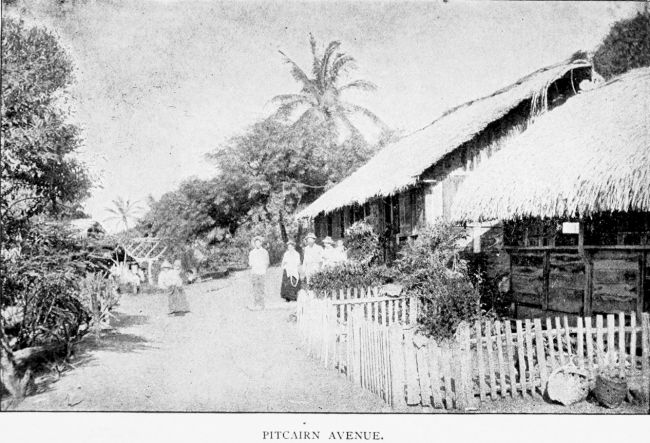
PITCAIRN AVENUE.
The ill treatment to which the three Englishmen
were constantly subjected at last reached a climax by
their being forced to leave the island. Separated from
their families, they were carried away on a schooner,
the captain of which condemned Hill’s doings unsparingly,
while to the exiled men he showed the utmost
kindness. They were taken to Tahiti, but did not
remain there long, as an opportunity was soon afforded
them of returning to the home of their adoption.
Arriving there, they took their families with them and
left, Nobbs and Evans going as far as the Gambier
Islands, while Buffett went on to Tahiti.
When the cruel banishment had been effected, the
men who before had yielded unquestioning obedience
to Hill’s orders, began to awake to the fact that they
had been participating in a wholesale course of injustice
and oppression. Their true friends had received
ill usage at their hands, even unto banishment, while
they had submitted to be ruled by a tyrant. Shame
and remorse for the part they had taken, filled their
minds, and they only waited the opportunity to have
the exiles recalled.
It soon came. The captain of a schooner, the Olivia,
making a call at the island at the time, was told all the
facts of the case, and he very generously promised to
go to the Gambier Islands and remove the two families
of Nobbs and Evans to their home. This was accordingly
done, and once more all were again on Pitcairn
Island, as Buffett and his family had arrived from
Tahiti a short time before on the Olive Branch. While
these last seemed to have gained in health during their
sojourn at Tahiti, the two families who stayed at the
Gambier Islands were extremely emaciated, owing to
the poor food on which they were obliged to subsist.
Their relatives and friends greeted them on their home
coming with open arms, while expressions of affection
and tears of joy, that spoke more than words, told how
glad they were that all of them were permitted to meet
again.
On the return of the exiled men, they found the
island in an unsettled state. Divisions were rife among
the people. Hill no longer exercised undisputed sway
over their minds and actions. His power, once so
great, was now quite broken. At this time there
occurred a quarrel between Hill and one of his former
elders, which narrowly escaped proving a very serious
affair. The trouble arose in this way: A young girl,
daughter of the ex-elder, had been charged with stealing
some yams, and was proved guilty. The father
was summoned before Hill, to hear what his daughter’s
sentence would be. Hill declared that the offender
ought to be executed, or, at least, be made to suffer very
severely for her fault. The father strongly opposed such
harsh measures, and positively asserted that his daughter
should not be subjected to the will of the merciless
man. Aroused to fury by this opposition to his will,
which the father steadily maintained, Hill rushed into
his bedroom, and, grasping his sword, returned, and,
waving it threateningly at his opponent, cried out,
“Confess your sins, for you are a dead man.” This he
repeated with, if possible, increased fury, while his
threatened victim, as he afterward declared, felt that his
last hour had indeed come. A table stood between
them, and young Quintall, although intimidated by
the murderous fire that gleamed in Hill’s eye, as well
as by the sword that he was brandishing, quickly
cleared the table at a bound, and, before Hill could
divine his intention, laid a firm grip on the shoulders
of his enemy, and by main force threw him upon the
floor. Unable to do anything else but maintain his
hold on his fallen foe, he was powerless to prevent the
thrusts of Hill’s sword. Fortunately, they resulted in
a few slight scratches only, which were sufficiently
deep, however, to leave lifelong scars on the breast of
the intended victim. How long the struggle would
have lasted had the combatants been left alone, it is not
possible to say. A young man happened to pass by the
house, and, catching a glimpse of what was passing
within, took in the whole situation at once. Running
as quickly as he could to his house, he soon returned
armed with a musket, and called out that he was going
to shoot Hill. Others, hearing the shout, came running
together to learn what the cause of the disturbance
was. Arriving at the scene of the quarrel, their
first act was to dispossess Hill of his sword. He was
then allowed to rise and retire peaceably to his room.
Nothing further was done to him, but he did not
receive his sword back again until the day when, friendless
and unloved, he left the island forever.
Letters of complaint from the persecuted Buffett,
Evans, and Nobbs had, in the meantime, been sent on
to Valparaiso, asking redress from those who might
and could render help and deliverance from Hill’s
power. In answer to their earnest appeal, the Actæon
was sent to the island in 1836. She was commanded
by Lord Edward Russell. His lordship, shortly after
arriving, called a meeting, over which he himself presided.
Permission was given to all concerned to speak
their minds freely, a privilege of which each one readily
availed himself. A warm and lively debate ensued,
and while Hill was speaking in his own defense, one
unruly member of the meeting would every now and
again interrupt him with, “It’s a lie, my lord,” addressed
to Lord Russell.
The proceedings of the court provoked much laughter,
and all was greatly enjoyed by his lordship. One
circumstance especially called forth peals of laughter.
Hill was relating a story about a book that belonged
to Hannah Young. Opposite to the motto “Dieu et
mon droit,” on the title-page, were written the following
lines:—
“God and my right we often see
Emblazoned abroad;
Let them who read this motto be
With Jesus, right with God.”
Beneath this Nobbs had placed his signature, “G. H.
Nobbs, P. S. M.” Hill had taken the liberty to add
as a postscript this quotation from Holy Writ: “Alas,
master! for it was borrowed.” On Lord Russell’s
asking an explanation of the three initial letters subjoined
to the name of Nobbs, Hill readily replied that
Nobbs intended them to mean “Pastor and Spiritual
Master,” but, in his estimation, the correct rendering
should be “Public Miscreant and Scoundrel.” These
lively thrusts were given by each party until his lordship
declared that the whole proceeding was too good
to finish at one sitting, and the meeting adjourned to
the following day.
On the second day his lordship’s decision was that
Hill should be removed from the island as soon as
possible, and the following year the Imogen arrived
to carry that decision into effect. The first words
spoken by her captain, when the boat from shore went
off to the ship, were: “Is Joshua Hill still on the island?
I am sent on purpose to remove him.” The next day,
at an early hour, Hill, with his few possessions, was
conveyed on board the Imogen, where cold looks
awaited him. Friendless and alone in the midst of
strangers, the old man stood on the deck of the vessel
that was to bear him away. With all his faults,
aggravated as they were, it is impossible not to feel a
deep sympathy in his hour of adversity for the poor
old man, who, through a mistaken, perverted zeal, had
rendered himself obnoxious to those whom he undoubtedly,
and with all honesty of purpose, wished to
benefit. Thus passed out of the history of Pitcairn
Island Joshua Hill, whose memory is still freshly
retained by those who knew him, rather as being
associated with harshness, severity, and tyranny, than
like that of the just, whose memory “smells sweet and
blossoms in the dust.”
CHAPTER VIII.
THE FLAG OF OLD ENGLAND
AFTER Mr. Hill’s removal, Mr. Nobbs, with the hearty consent of
nearly all the people, assumed sole charge as pastor and schoolmaster.
Under his benign rule peace once more reigned, and the former
brotherliness between the families, that had been so fully established
under John Adams, was once more as fully resumed. While Mr. Nobbs
devoted himself to the higher needs of the people, combining with
his other duties those of a physician (to the best of his ability),
Buffett had resumed his old trade of cabinet work, which he confined
to such articles as workboxes, writing desks, and chests of drawers
of all sizes. The wood of the mero tree, which the soil of
the island abundantly produced, supplied all the material needed in
the darker shades. The timber is exceedingly close grained and hard,
and when fully matured becomes changed in color from dark red to almost black, and
takes polish beautifully. The bright yellow color of the wood of the
white-flower tree was used for ornamenting, as it forms a pretty
contrast with the other. Buffett also instructed those among the young
men who showed any inclination to learn, and was highly gratified
at seeing them display decided skill in the handiwork. John Evans,
also, who wished to try his hand at the trade, came with the others
to take lessons in practical work, and succeeded fairly well in the
business.
Buffett, who was fond of a joke, used to relate how
one day, when he was at work in his house, Evans
came to him, bringing an unfinished workbox that
he was making, in his hand. Setting the box down,
he turned to Buffett, and began telling him how his
work was almost a failure, and was likely to come to
grief unless he obtained some much needed help from
the master hand. “In fact, Buffett,” he said, “I just
came over to ask you to give it a licking.” As soon
as Evans had finished speaking, Buffett, without a
word, took up the workbox, and, rapidly passing his
tongue over its smooth surface, set it down again, saying,
with a hearty laugh, “There is your box; I have
given it a licking.” Astonished beyond expression,
and indignant at having his request so literally fulfilled,
Evans angrily snatched up the innocent cause
of the joke, and was hastening away, when Buffett
good-humoredly assured him that no offense was
intended, and he was at length prevailed on, though
reluctantly, to calm his ruffled feelings, and wait a few
minutes until Buffett had given the necessary help
he asked for.
While Nobbs gave instruction to the children in the
schoolroom, Buffett proposed to establish a class for
young men, to give them instruction in navigation
and the more advanced branches of arithmetic, and, in
addition to these, studies upon such subjects of general
information as they could obtain through the
medium of books, though of these they had only a
very limited supply. The more thoughtful among
the young men eagerly availed themselves of even
this chance of improvement, and organized themselves
into a band, with Buffett at their head, who gave the
name “Mutual Improvement Society” to their class.
While it lasted, it was well attended, and most, if not
all, of the members derived lasting benefit therefrom.
While Nobbs and Buffett were engaged in pursuits
so congenial to them, the necessary cultivation of their
allotments of land was performed by their wives and
children, and whoever of their neighbors that would
willingly assist. They themselves did but a trifling
portion of the work. Evans, on the other hand,
seemed to possess a natural liking for the soil and its
cultivation, in which work he was aided by his strong
and healthy wife.
It was now forty-seven years since the island had
been settled, and in all that time no rules had been
enacted for the government of the people. Conscience
sometimes, and more frequently inclination, ruled
them. But this state of things was about to be ended.
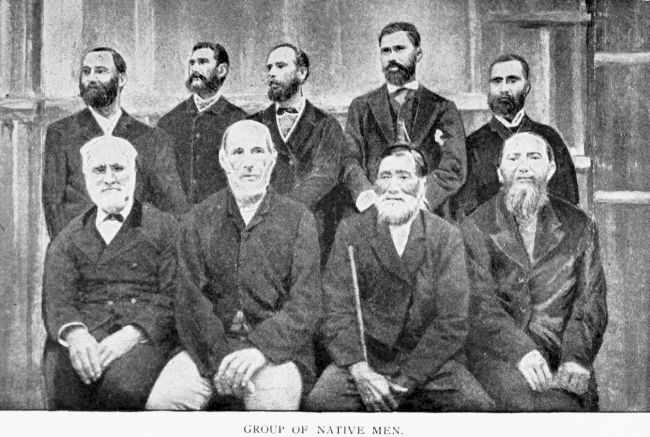
GROUP OF NATIVE MEN.
In the year 1838 Her Majesty’s ship Fly came on
a visit, and for the first time, to the evident satisfaction
and pleasure of the islanders, the flag of Old England
was hoisted on Pitcairn Island, Captain Elliott observing,
“You are now under the protection of the English
flag.” From that time until the entire community
was removed to Norfolk Island, they were annually
visited by one or more of Her Majesty’s ships of war.
Captain Elliott also strongly advised the people to
have written laws by which they might be governed,
and, further, to appoint a magistrate from among themselves
to enforce those laws. Mr. Hill had also spoken
strongly about the necessity and importance of such
a step being taken, but his advice had not been acted
upon. The captain’s proposal was received differently,
everybody being willing to carry out any plans that
he thought would be best for them. Their unanimous
choice fell upon the youngest son of Quintall, whose
strong common sense and really excellent abilities
recommended him as the fittest person to be nominated.
When Hill first came among the people, Quintall
attracted his particular notice, and Hill constituted
him his chief elder. The two men possessed
many similar traits of character, and on no point were
they more agreed than in the intense dislike to the
three other Englishmen. That Quintall could be a
staunch friend was proved by the fact that he stood
by Hill to the last, when everyone else had deserted
him. In after years the intermarriages that took place
between his own children and those of Nobbs and
Buffett were evident proofs that they did not share
their father’s prejudices.
Like Hill, he, too, when aroused by anger, was capable
of committing deeds of cruelty, as the following
story will show. Engaged in a dispute one day with
John Evans, both men lost control over themselves,
and began to abuse one another. The quarrel increased,
and Quintall, being a powerful man, brought
it to a termination by lifting Evans, who was small,
as easily as he would a child, and throwing him violently
into a pigsty, thereby causing him serious injury.
This wicked act was recorded in the register of those
times, for it was customary to enter therein every
occurrence, however trivial, and whenever a case
occurred which could not be satisfactorily adjusted by
the local authorities, it was usual to postpone it until
the arrival of a ship of war, to whose captain the matter
was referred for decision. It was so in this case,
but the fact that the perpetrator of the deed was at
the time laid on his sick bed, from which he never
again arose, prevented his receiving his just deserts,
and so the passing of the sentence awaited a higher
tribunal than that of earth.
A more pleasing theme than the story just related
was the arrival of the first missionary vessel that ever
called at the island. This was the Camden, which was
sent out by the London Missionary Society. In her
missionary visits to the various islands of the Pacific,
she made a brief call at Pitcairn Island, having but
one missionary on board, a Mr. Heath. The Camden’s
stay extended only to four days, during which time Mr.
Heath gave two public addresses, and held several
meetings in Mr. Nobbs’ house. Captain Morgan, who
commanded the vessel, also delivered an impressive
discourse from the text, “My son, give me thine heart.”
A good supply of Bibles was left on the island, enough
for each family to have one. Captain Morgan also
sent out from England, on his arrival there, a box of
books, schoolbooks as well as religious publications,
and slates and pencils for the use of the school. These
were all thankfully received, as they supplied a very
pressing want, especially the last-named gifts.
In the year 1841 Christian’s widow died. Her
name, given by the Englishmen, was Isabella, but as
Christian himself had dubbed her “Mainmast,” this
latter name was the one by which she was exclusively
called, only it was abbreviated to “Mai’mas’.” She
was of very advanced age when she died, but to the
last retained vivid recollections of the events of earlier
years, and used often to relate to her attentive listeners
the story of Captain Cook’s visit to the Society Islands.
Once when he was in Tahiti he was suffering from a
severe attack of rheumatism. Some of the Tahitian
women took him in hand, and effected a cure by means
of the native remedy. This consisted of a preparation
of the a’pi-plant (arum gigantum) which was externally
applied to the part or parts affected. The painful,
stinging properties of the plant (compared to which
the sting of the nettle is almost enjoyable) would seem
to lead one to decide in favor of the rheumatism, as
this remedy seems certainly worse than the disease.
But Mainmast declared that the dreadful remedy cured
Captain Cook. This old woman’s death left but one
more remaining of the original party that came in
the Bounty, thus severing, link by link, the tie that
bound the younger portion of the community to those
who originally settled the colony.
Scarcely anything occurred to disturb the tranquil
round of life that the inhabitants enjoyed, and day
after day passed along in quiet monotony, broken only
by the arrival of some passing ship. The “event” of
every year was the visit of a man-of-war.
About the year 1847 an accident befell Mr. Nobbs’
eldest son, which nearly proved fatal. He, in company
with some other young men, had one day gone out to
hunt goats. As they were returning home, Reuben
Nobbs slipped and fell. The loaded gun he carried was
instantly discharged, most of its contents being lodged
in his right hip, while the ball passed entirely through.
He was brought home, and his father attended him.
Month after month passed, and, although he did not
grow worse there still was no perceptible improvement.
When the next man-of-war came, the Spy, her
surgeon examined the wound, and, probing it, extracted
large pieces of wadding, the presence of which
had prevented recovery. After that the cure was
rapid, and the young man was soon able to walk with
the help of a crutch. But the result was a lameness
that unfitted him for such work as life on the island
required, and, as he had good business abilities, his
father, who had friends in Valparaiso, wrote to them
asking if they would kindly obtain for his son some
means of gaining a living. The answer was favorable,
and in due time Reuben Nobbs arrived at Valparaiso,
to begin his duties as clerk in a commercial
establishment. He was cordially received, and,
by a diligent application to work, and the determination
to please his employers, he succeeded not
only in learning to do that which was required of
him, but also in giving entire satisfaction to his employers
during his whole stay.
CHAPTER IX.
THE QUEEN’S BIRTHDAY
THE year 1848 is remembered as
the first year when the 24th of
May, the Queen’s birthday, was kept
as a holiday. The young men, with Mr. Nobbs at
their head, started the celebration. The Bounty’s old
gun was made to do duty on the occasion in firing a
salute in honor of Her Majesty, and every old musket
that could be put to such a use, with as heavy
charges as could be carried, was pressed into service
to assist the Bounty’s gun in making all the noise
possible. The one bell on the island was kept ringing
merrily, while, to add to the other sounds, cheer
after cheer rang from the throats of the whole community,
who had assembled to show loyalty to their
sovereign.
The bell was a gift presented to the islanders in
1844 by the people on board the Basilisk, man-of-war,
to be used for calling the worshipers to church. For
years a bugle horn had been used for this purpose,
and when that wore out, a musket took its place, one
shot being fired as the hour for divine service approached.
The musket was in use at the time of the
Basilisk’s visit. The beautiful, deep-toned bell, that
was so thoroughly appreciated, at once displaced the
discordant old musket, but never had it rung so merrily,
nor so long, as when it lent its aid to celebrate
the Queen’s birthday.
But, with all the noise they were able to produce,
they felt that something important was lacking.
They had no song suitable for the great occasion.
The national anthem was then unknown, and what
were they to do in this dilemma? Fortunately, the
question did not long remain unanswered. The loyal-hearted
and enthusiastic Mr. Nobbs proved himself
equal to the occasion. A song was quickly composed,
and heartily, if not harmoniously, sung by the untrained
voices of the islanders, to the tune of “The
Girl I Left behind Me.” The concluding stanza—
“We’ll fire the gun, the Bounty’s gun,
And set the bell a-ringing,
And give three cheers for England’s Queen,
And three for Pitcairn’s Island,”
was followed by a succession of ringing cheers, repeated
until the hills echoed again with the sound.
The memory of that day, with all its noise and merriment,
and the simple pleasures that were so thoroughly
enjoyed, was kept fresh in the minds of the
women, who determined not to be outdone by the
men. Accordingly, they made what preparations they
could for their celebration, when the day came around
again.
Let me tell you first something about the dress of
the women of that period. They no longer wore
exclusively, Sundays as well as week days, the homely
frock gathered into a band around the throat, and
beneath this frock a scant petticoat such as had been
worn since they had known the use of the needle.
Gradually, gowns, long waisted and bone ribbed, after
the patterns sent on shore by ship captains’ wives, and
also from time to time sent to the island by friends in
England and elsewhere, took the place, for Sunday
wear, of the primitive frock that had been worn so
long.
Every woman’s ambition was to possess a gown,
and, notwithstanding the difficulties attending the cutting
and fitting, each one was supplied, the more
elderly women wearing a pattern differing somewhat
from that which the younger women wore. Mr.
Nobbs did what he could to advance the tastes of the
women in regard to dress, and upon his wife devolved
the dreadful task of cutting and fitting, made thus
dreadful because there was no previous knowledge of
the art; and several days would elapse before even one
garment would be ready for the needle. Fortunately,
some of the younger women were quick to learn, and,
in spite of limited advantages, they were soon able to
take the burden from Mrs. Nobbs’ hands. Occasionally
help was given them by some of the ship captains’
wives that visited the island. Knitting was also
taught by them, but soon became a lost art.
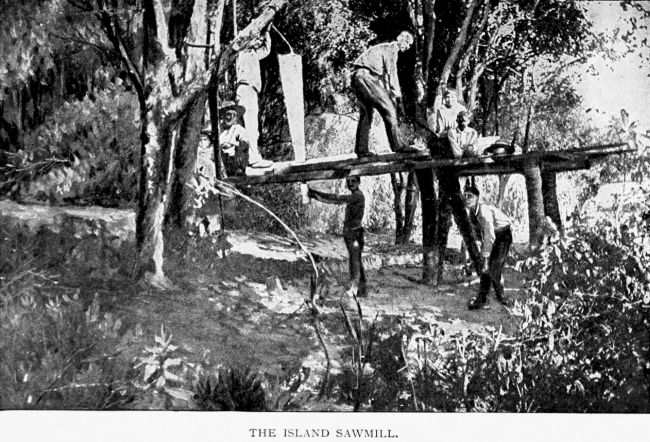
THE ISLAND SAWMILL.
On the Queen’s birthday in question, the matrons
and maidens decided to dress in their best—white
gowns preferred—and spend the day as their fancy led
them. One old grandmother proposed that a knot of
white ribbon be worn on the left shoulder, which was
done, strips of cloth supplying the place of ribbons.
When the twenty-fourth day of May arrived, cloudless
and beautiful, it was greeted with loud and loyal cheers
from all, while the women and girls rose with the dawn
to array themselves in honor of the day, and surprise
their husbands and brothers, fathers and lovers, with
their display, as all their preparations had been kept
secret.
The men were invited to come and join in the merrymaking,
and they obeyed with alacrity. All work was
laid aside, and everyone entered heartily into the sports
and games that followed. The older women attended
to the babies and prepared the early supper, the materials
for which had been supplied beforehand. After
the plentiful repast, all were at liberty to enjoy themselves
as they pleased. The daughters of the mutineers,
being now themselves the grandmothers, entered
with zest into the sports, and contributed not a little
to the general entertainment by reviving many of the
games learned from their Tahitian mothers.
They introduced into their games and sports the
beating of calabashes with sticks, performed with extreme
precision, to which the players kept time, moving
with noiseless step and an easy grace that was
pleasing to witness. This performance was called the
ihara. Another native dance, the uri, was performed
by Susannah, the girl of fifteen who came in the Bounty,
now an old woman of seventy-four, and blind in one
eye. She displayed remarkable liveliness in honor of
the Queen’s birthday, and her performance provoked
mirth from the younger people, who had never seen the
dance before. This old woman died in the September
following, 1850, at the age of seventy-five, being the
last survivor of those who came to the island from
Tahiti sixty years before.
The merry players kept up the dancing to a late
hour. What mattered if most of them danced with
bare feet; that did not affect their light-heartedness
and happiness. A drum and tambourine supplied all
the music they wanted. The island boasted one fiddle,
but no one considered himself sufficiently expert in
the use of the bow to volunteer his services. At last
the simple enjoyments of the day ended, only to linger
in the memory as a bright and pleasing recollection.
The singing of the islanders had been improved as
the years passed. When John Adams had the sole
care of the young community, he did not neglect
entirely the training of their voices, although the result
was not all that could be wished. He succeeded in
impressing on their memories one simple and plaintive
air, which, slightly modified, was made to suit either
common, short, or long meter. This was the only
attempt at singing made by the islanders until Buffett
came amongst them. The ninety-fifth psalm of Watts’
Version was a great favorite among the people, and
that to which John Adams’ tune was oftenest sung.[4]
Buffett soon sought to introduce at least a change of
tunes into the services of the church, and, being gifted
with a good voice, he managed, with the help of an
accordion, to lead the people a few steps further on.
A book of church music given him at Tahiti supplied
a variety of tunes, but nothing more was attempted
than the simple air. Nor were the tunes sung in unison,
as the following incident will show.
In the earlier part of 1850 a ship touched at the island
on her way to California. Five gentlemen, four of
whom were passengers, came on shore. The fifth was
the supercargo of the vessel. The day following was
Sunday, and the visitors attended service in the little
church with the islanders, Mr. Nobbs officiating as
pastor, while John Buffett led the singing. If the
visitors expected to derive pleasure from that most
delightful part of public worship, they were disappointed.
The effect produced by the congregation,
singing without regard to time or tune, was so discordant
and jarring that Mr. Carleton, the supercargo,
declared that the sounds grating upon his ears nearly
compelled him to take his hat and leave the house.
The next day, Monday, the ship was seen at a long
distance from the island, but, thinking that the captain
would certainly return for his passengers, no apprehensions
were entertained that they would be left behind.
But so it proved, and the only explanation that could
be given of the captain’s conduct was that the wind,
which was favorable, was steadily increasing, and he did
not want to lose it. He left his passengers to the hospitality
of the islanders, and the kind favor of the first
captain that should call going the same way, and took
away with him one of the islanders who was on board
when the ship sailed. This man went to California
and returned by way of Sydney.
When the surprised and forsaken passengers had
ascertained that they had been left behind, they wisely
decided to make the best of the circumstances. Mr.
Carleton, who was highly gifted with musical talent,
mentioned to John Buffett the matter of trying to
improve the singing of the people. In reply he was
requested to undertake the task. This he at first
declined, saying that he would not have the time he
should require to produce anything like a satisfactory
result, and so would rather not attempt it. However,
as no opportunity came within the week for him to
leave the island, he finally yielded to Buffett’s earnest
and oft-repeated requests, and consented to make a
beginning.
He invited all who were willing to come, to meet
every evening at one of the houses, and from among
them he chose such as seemed to possess some musical
ability. These he instructed particularly, that
they might be able to carry forward the work. The
pleasing results produced by harmony of sounds
served to awaken in the hearts of the learners such
eagerness and anxiety to do their best as to greatly
encourage their teacher in his efforts. With the determination
to succeed, it was not very surprising that
in the short space of one week they accomplished a
result beyond their highest hopes, and when Mr. Carleton
took his departure the second week after, it was
in full confidence that the important work which had
so well begun, would not be left to stagnate. Nor
was he mistaken. An old man used to tell how he
was affected by the first sounds of harmony that he
heard. He said: “The first tune I listened to was
Devizes. Buffett was singing the air, and Mr. Carleton
the bass. I stood by open mouthed, drinking in
the sweet sounds, and thinking it must be like heaven.”
When Mr. Carleton left the island, he was accompanied
by Mr. Brodie, one of the four passengers, who
pleaded that the captain should take him, instead of any
of the others, as there were accommodations on the ship
for only two. This gentlemen afterward wrote an
interesting account of the island, which he published.
Baron de Thierry, one of the remaining three, continued
the work begun by Mr. Carleton. He attempted
to teach drawing also, but without success,
possibly because the fingers of his pupils, having from
earliest childhood been trained to use the hoe and to
manage the wheelbarrow, could not be made to hold
and carry the pencil. The baron one night when
Mr. Carleton was engaged in teaching his singing class,
caused the singing to give place to a hearty burst of
merriment. One of the pupils, with her strong, clear
voice, was ascending the scale, and as she arose to the
highest notes without any apparent effort, enunciating
every syllable clearly and distinctly, the baron called
out: “Stop, stop. No one but my daughter is able to
do it like that.”
The enforced stay of the five gentlemen on Pitcairn
Island was productive of one of the best and most
satisfactory results, for all the subsequent pleasure
and delight that the people, both of Pitcairn Island
and Norfolk Island, derive from music, instrumental as
well as vocal, had their origin in those early lessons
taught by Mr. Carleton. The memory of this man is
revered and loved among the people, who owe to him
so much of the pleasure they receive from this high
and ennobling art.
CHAPTER X.
Visit of H.M.S. Portland
THE time was now drawing near when
an important change was to take place
in the history of the Pitcairn islanders.
Ever since it had been arranged that the island should
be visited yearly by a British ship of war, its arrival
was the looked-for event of each year. When Admiral
Sir Fairfax Moresby was commander in chief
on the Pacific station, an officer on board one of
Her Majesty’s ships, while on a visit to the island,
proposed that the women send a request to the admiral
to pay them a visit. A letter was written forthwith,
and signed by several of the island matrons and
maidens. The admiral was pleased to respond to the
letter in person, and arrived at the island in August,
1852, in his flagship, the Portland. His coming was
greeted by the people with every demonstration of
joy, which reached its height when, gathered beneath
a grove of orange trees, they listened to the band that
the admiral had kindly ordered ashore, and enjoyed
such delicious strains of music as they never had
dreamed of. From the admiral down to the humblest
seaman, everybody on board the Portland showed
kindness to the islanders, so much so that the visits
of the Portland were considered by the people as
comprising the golden period in their island’s history.
The admiral was accompanied by two of his sons,
the younger of whom, Mr. Fortescue Moresby, by his
pleasant, cheerful ways and winning manners, endeared
himself greatly to the hearts of the islanders.
Among the earliest subjects that engaged Admiral
Moresby’s attention was the position of Mr. Nobbs as
an unordained pastor of the people, and he took on
himself the responsibility of sending that gentleman to
England, with a letter of recommendation to the bishop
of London, requesting him to receive Mr. Nobbs as a
candidate for ordination, adding that his faithful services
to the people of his adopted home, and the good
that he had been the means of accomplishing, might
be considered in place of whatever deficiency there
was in his theological training.
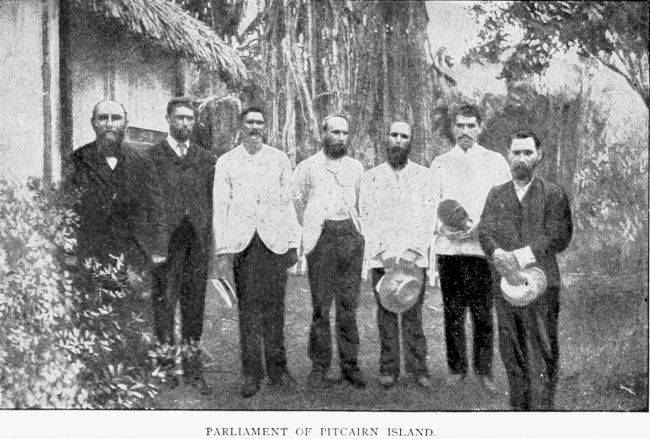
PARLIAMENT OF PITCAIRN ISLAND.
When the Portland left Pitcairn Island, Mr. Nobbs
left too, accompanied by one of his daughters, Miss
Jane Nobbs, who went as far as Valparaiso, where her
brother Reuben was. Here she was received by a
very worthy family, who showed her every consideration
and kindness. Before Mr. Nobbs could consent
to leave his flock, it was arranged that the Portland’s
chaplain, Mr. Holman, should remain behind and supply
the place of the absent pastor. A lad from the
Portland also remained with Mr. Holman. The people
on the whole regarded it as a very satisfactory
arrangement, although no one could quite fill the place
Mr. Nobbs had so long and so ably filled.
Arriving at Valparaiso, Mr. Nobbs took passage on
the steamer Orinoco to England, which place he safely
reached, and was duly ordained. The late Prince
Consort honored him with an interview, and he had
also a glimpse of the Queen. Indeed, Her Majesty,
in passing, extended to him her royal hand, which he
warmly grasped, and heartily shook, after which she
quietly, and without a word, passed on. This little
incident was often recalled by the worthy man, and
always with some degree of amusement at the possible
mistake he made at the time. In Mr. Nobbs’
interview with his Royal Highness, the Prince showed
much kindly interest in his far-distant home, and made
many inquiries respecting his labors there. A salary
of £50 a year was granted him, and, had there been
proof that Mr. Nobbs had indeed been promoted to
the rank of lieutenant in the naval service, another
fifty would have been added. His stay in England
was too short to admit of his accepting many of the
numerous invitations given him by persons of rank
and wealth, but in one particular case he never ceased
to regret that circumstances made it impossible for
him to attend. This was an invitation to call on
Messrs. Wilson and Cook, gentlemen who had sent
large gifts of useful household articles to Pitcairn
Island a short time before. In May, 1853, Mr. Nobbs
reached home again, the whole time of his absence
not extending over nine months.
One very sad and fatal accident had happened during
his absence. When the Portland reached Valparaiso,
Admiral Moresby sent the Virago on to Pitcairn
Island, that the people might see a steamship for the
first time. She came in the month of January, near
its close. On the day that she was to leave, almost
everybody was on board, and the vessel had steamed
around the little island, much to the wonder and delight
of the people. It was toward the close of the
day, and when the people were about to return on
shore, that a farewell salute from the Bounty’s gun
was to be fired. Among those who were attending to
the gun was the magistrate, Matthew McCoy. The
ramrod used on the occasion was an old, smoothly-planed
rafter made from the wood of the cocoanut
tree, very hard, and which had been used in building.
Unknown to those in attendance was a nail in the
rafter. This, coming in contact with the gun, already
heated by the sun, caused the powder to ignite before
all was ready. In an instant the gun was discharged,
and the men attending it were scattered in all directions,
several feet from the spot.
The untimely discharge soon brought a small crowd
of the people left on shore to the scene of the accident,
and, as the disaster was witnessed from the
Virago, the boats were quickly got ready, and as soon
as possible the doctor and his assistants were at the
place. Two young men, William Evans and Driver
Christian, were severely wounded, but Matthew McCoy
had received his death blow. His right arm was
fearfully shattered, and he was, besides, much bruised
and injured. The arm was amputated, in the hope
that his life might be spared, but all that surgical skill
could do was of no avail, for during the night of January
27, 1853, he died. Thus ended, in sadness and
gloom, the day that had dawned so brightly, and
which had been so greatly enjoyed by all. The dead
man was buried with funeral honors, all the officers
and men that could be spared from the Virago being
present. But no outward display could allay the sorrow
or calm the grief of the desolate widow and
fatherless children, who so deeply mourned their irreparable
loss. Before the Virago sailed, the Bounty’s
gun was spiked to prevent it from ever being used
again. After having lain and rusted for nearly forty
years, it was at length used as the foundation for a
flagstaff.
As stated above, Mr. Nobbs reached home in May
and immediately resumed his duties as pastor, the people
observing that he seemed to have acquired a somewhat
more dignified bearing after having been ordained,
although his thorough kindliness of disposition and
interest in everything that concerned the people’s welfare,
remained unchanged.
The arrival of the Portland was most timely, as
the people were suffering from the effects of a severe
drought, and were obliged to subsist on whatever
they could get, unripe pumpkins forming their principal
diet. Liberal supplies from the ship’s stores provided
them with sufficient food to last until better
times appeared. The admiral then left, taking with
him Mr. Holman and the lad that had remained with
him. The Portland proceeded on her way to the Gambier
Islands, but soon returned, going on to Valparaiso.
As she came near enough to Pitcairn Island
for the people to communicate by signals, one of distress
was hoisted, for the islanders, almost without an
exception, were suffering greatly from an attack of
influenza. Misinterpreting the signal, the Portland
kept on, but was stopped when a boat was seen putting
off from the land, manned by a few poor fellows,
who were hardly able to manage their oars. On
learning the cause of their coming, the admiral and
his officers at once went on shore, and the report of
the men was confirmed by the sight of the pitiable
condition of the islanders.
Everything that kindness could suggest was done
for the sufferers, all the visitors doing what they could
to relieve the distress around them; nor did they
take their final leave of the island until there were visible
signs of improvement. So attached had all the
islanders become to the people on the ship that much
real sorrow was felt at parting; indeed, the leave taking
was such that men, as well as women and children,
wept freely, as they looked their last on the faces of
the kind friends who had done so much for them, and
who were not ashamed to mingle their tears with the
tears of those they were leaving behind. The blessings
of a grateful people followed their departing visitors.
Reuben Nobbs, who had accompanied his father
and sister home from Valparaiso, remained with his
family for a few months; but, on the arrival of H. M.
S. Dido, in the following year, he prepared to return
to his duties at Valparaiso on that ship. But his stay
was short, and he was soon home again, as consumption
had made rapid progress. Kind and willing
hands carried him from the place where he was
landed, for he was universally beloved, and conveyed
him to his home, where he lingered on until March 2,
1855, when he died.
Two accidents, each fatal in its nature, happened
shortly after this. The first death was the result of a
wound in the foot of a lad, caused by the barbed point
of an arrow made of iron. Lockjaw set in, and after
the terrible agonies that followed, he died. The other
accident was sudden, and death was instantaneous.
It was on a Saturday, and most of the men were out
in their canoes fishing. A young man named Daniel
McCoy, with his wife, went to the northwest side of
the island, at a place called the Lookout, to fish among
the rocks. Several other young people went in the
same direction, but separated themselves into different
parties to fish.
Dan and his wife went alone to a spot to reach
which they must either swim a narrow passage of
water, or climb a few steps, and then descend a steep
and very dangerous path among the rocks. They
chose the latter, and in making the descent the young
man lost his hold, slipped, and fell. The fall was not
high, scarcely ten feet; but he fell heavily and broke
his back. With one dreadful groan, and a last dying
look upon his wife, he immediately expired. Almost
distracted, she went in search of their companions,
who were at some distance from them, fishing. Grief
and horror seemed to lend wings to her speed, as she
passed over the rough stones and jagged rocks that
for the most part formed her pathway. Only a few
minutes sufficed for her to reach a spot where she
could see her companions, and make them understand
by signs that their assistance was required. The
frantic cries and wild gesticulations at once convinced
them that something dreadful had occurred, and they
instantly started to learn what had happened.
It was soon told, and, while some of the fishing
party returned with the bereaved wife to the scene of
the awful accident, others hastened home to tell the
sad news, and to get assistance to carry the body home.
As nearly all the men were out fishing, these had to
be summoned by means of signals, and as soon as possible
a whaleboat was launched to go on the sad
errand. In a short time the scarcely cold, lifeless
burden was tenderly placed within, and taken back to
the home whence, but a few hours before, he had left
in all the strength and pride of young manhood.
Scarcely anything noteworthy occurred during the
twelve months that followed the death of Daniel
McCoy, which took place on the seventh day of April,
1855. Life gradually assumed its ordinary, monotonous
round; but every day was bringing nearer the
day when everything was to be changed.
CHAPTER XI.
Removal to NORFOLK ISLAND
WHEN, in 1853, Admiral Moresby
visited Pitcairn Island, he saw that
the rapidly increasing numbers of
the inhabitants would soon necessitate a removal of
a part, or the whole, of the community to a larger
place, although he judged that Pitcairn Island, if
brought under proper cultivation, was capable of
maintaining a thousand inhabitants. The admiral
argued that as a removal must be made at some
future time, it would be the wisest course to have it
done as early as possible, only he stipulated that all
the people should go together.
And now the time was rapidly approaching. A
report was sent to the home government concerning
the matter, and early in the year 1856 H. M. S. Juno
was sent from the colonies to inform the islanders that
arrangements were being made for their removal to a
larger island, and also to advise them to make the
necessary preparations for their departure.
The tidings were received with different feelings.
Some were ready to seize the opportunity of improving
their worldly prospects, and the very thought of a
change from their hitherto quiet lives was hailed with
delight, while others, to whom home and its associations
were dearer than any prospect that could be held
out to them, preferred to remain, and probably were
only restrained from so doing because the advice of
their good friend, the admiral, was that all should go
and receive their grant of land.
The island chosen for the future home of the Pitcairn
islanders was Norfolk Island, once a penal settlement.
The island is about twenty miles in circumference,
and well capable of maintaining several thousand
inhabitants.
In the latter part of April, 1856, the Morayshire,
commanded by Captain Joseph Mathers, arrived from
Sydney, to carry the emigrants to their new home.
By the second day of May everything was ready, and
the time had come to say farewell to the dear old spot
where all their lives had been spent. Some, with
buoyant hopes and bright expectations, stepped on
board the ship that was to carry them away, while
others—and these the far greater number—with sad
hearts and tear-dimmed eyes left their island home.
Utterly lonely and desolate, the little rock stood in the
vast ocean as it slowly receded from view, and many a
silent tear was shed and final farewell whispered for
the dear old home that most of them were to behold
no more, and which to many was most sacred because
of the loved ones sleeping there.
The passage to Norfolk Island was accomplished in
thirty-six days, and was, on the whole, rather pleasant
than otherwise to the emigrants. But few of them suffered
from seasickness during the entire voyage. On the
8th of June, 1856, the Morayshire arrived at Norfolk
Island, and well pleased was the worthy captain to get
rid of the noisy crowd, the children more especially,
who tried his patience sorely, and who often enlivened
the ship with their cries and screams. No death occurred
on the passage, but one poor little baby who
was sick all the way, lingered only a few days after
landing, and then died.
When the Morayshire arrived at Norfolk Island, H.
M. S. Herald was already there surveying. Boats
from the latter ship boarded the new arrival, bringing
acceptable supplies of fresh provisions. Her people
also very kindly assisted in landing the emigrants and
their goods. The crew of a whaling vessel rendered
help as well. When the Morayshire left, after a stay
of a little over two weeks, the captain took away the
few persons that had been on the island to take care
of the property ere it passed into other hands. The
passengers who left Norfolk Island on the Morayshire
were a Mr. Stuart, who acted as governor, and his wife,
a man by the name of Rogers, his wife and little
daughter, and an elderly couple named Waterson.
Besides these were eight reformed convicts, whose
work was to look after the affairs of the place.
Old Mrs. Waterson related a dream that made an
impression upon her mind. A few nights before the
emigrants landed, she seemed to see a woman, tall,
large, and dark complexioned, standing by her side.
So vivid was everything connected with the dream,
even to the woman’s name, Rachel, that she felt convinced
that the person was on the coming ship.
Accordingly, when the people landed, she started off
in search of the reality, and scanned with curious eagerness
each face that she saw. Not meeting on the
street anyone that answered to the description, she went
on toward the pier, and, within a few minutes’ walk of
the place, discovered the object of her search sitting
on the steps of the Convicts’ Hospital. A warm welcome
and greeting followed, with the explanation that
the acquaintance had been already made in a dream,
and Mrs. Waterson was especially gratified to learn that
the dream was true to the very name, the person being
Rachel Evans, the daughter of John Adams. Even
before the old lady left the island, the pleasing acquaintance
had ripened into warm friendship.
Rogers’ occupation on the island was that of a stock
keeper and overseer. Walking along a certain road
one day, in company with some of the recent settlers,
he observed, in a playful spirit, that when that particular
road was being made, he was among the gang of
convicts so employed, having been sent to Norfolk
Island on the charge of striking down his superior officer.
“But,” he remarked pleasantly, “my term of
punishment expired some time ago.” Seven other
men, ex-convicts nearly all, made up the total of those
who remained to look after the place. These men
attended to the live stock, milked the cows, kept the
dairy, and performed such work. The kindness and
attention shown by every one of them to the newcomers
could not be surpassed.
Each one exerted himself in pointing out to the
new arrivals the different buildings and their various
uses, among them the old and new barracks, the government
house, the jail and prison, all strongly built
of stone, some of which were beautiful as well as
strong. Many dreadful tales were also told concerning
the island and those who were sent there to be
punished, but scarcely a trace remained to testify to
the truth of the dark stories of blood and crime. At
one place, outside of the burying ground, was shown
a mound several feet in length, where moldered the
dust of thirteen men who were hung for some dreadful
crime on the trees above, while their open grave
yawned beneath them.
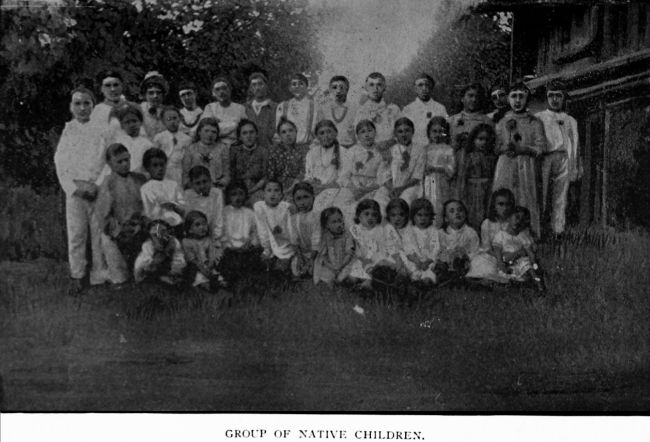
GROUP OF NATIVE CHILDREN.
An eyewitness related how, one day, when a gang
of convicts was constructing a bridge over a stream,
one of them murdered a constable who was in charge
of the gang. From this dreadful act the scene of the
murder received its name, and the “Bloody Bridge”
stands, a lasting monument of the awful crime committed
there. A tragic story was told of a convict
who contrived to make his escape from Norfolk Island
to another small island some three miles distant, called
Philip Island. By some means this man, known as
Jacky-Jacky, was discovered, and a boat was immediately
dispatched to secure the escaped prisoner. Finding
himself discovered and pursued, and choosing
death rather than capture, Jacky-Jacky started to the
highest point of the island, several hundred feet above
the sea level, where he cast himself off and so perished.
These were only some of the stories that were told
by those who were themselves witnesses of the awful
scenes, stories still more dark and fearful in their
nature than were those in connection with the early
settlement of the island lately deserted by the emigrants.
But the deeds of horror and bloodshed had
passed away with the lives of those who committed
them, and everything betokened calmness and peace
when the little colony entered on their newly granted
possession.
CHAPTER XII.
A GOODLY HERITAGE
NORFOLK ISLAND, henceforth
to become the home of the Pitcairn
islanders, possesses remarkable
beauty. Having all their
lives been accustomed to wooden houses of the plainest
description, roofed with thatch, and standing here
and there embosomed amid trees, the sight of regularly
laid out streets and stone-built houses was an
entirely new experience to the new settlers. When
they took possession of their present home, all the
dwelling houses, as well as the government buildings,
were in a good state of preservation, and some of the
latter were splendid structures.
The government house occupied a conspicuous
place on a slight eminence nearly in the center of the
town, and its spacious apartments, as well as its exterior,
were well kept. The large garden adjoining
showed signs of former care, but everything had been
allowed to run wild, and the grapevines mingled in
happy confusion with the honeysuckle, nasturtium,
and other flowering creepers.
Inclosed within high stone walls were the buildings
of the old and new barracks, while near to the latter
stood the ruins of what had been a fine hospital, which
a fire had destroyed. Next to this, but separated by a
wall, was the handsome commissariat store—now the
church of the present inhabitants.
The large, gloomy prison was the central figure in a
group of buildings that stood near the sea, having the
Protestant church on one side, and the Roman Catholic
chapel on the other. This still retained many signs
of the outward services of the latter church, notably
the gaudy pictures that ornamented the walls, a large
one being that of the virgin and child.
Separated from these churches by a narrow, sunless
passage, formed by the surrounding walls, were the
jail buildings, strongly built of stone. Of special interest
was the place where the gallows used to be erected
when death was the penalty for crime. Although the
time had gone by forever when such scenes could be
witnessed, a feeling akin to horror could not be suppressed
when passing beneath the spot where so many
had taken their last farewell of life, and the silent,
narrow cells around seemed almost in the echo of
one’s footfall to give forth the sad sighs and groans
of despair, as the condemned criminal awaited the
moment when he should be called forth to meet his
doom.
Until a more settled state of things was reached, on
their immediate arrival the families were arranged
into groups of two and three, and messed together.
Two women, whose respective families occupied the
same house, went out one day in search of green herbs
for food. They congratulated themselves on finding
a good supply of onions, and brought their treasures
home, pleased at the thought of the relish they would
add to the evening meal. A hearty laugh greeted the
discovery that their precious onions were the bulbs
of the narcissus, which in their ignorance they had so
naturally mistaken for onions.
The dwelling houses differed in every respect from,
and were altogether superior to, the thatched cottages
that the people had so lately occupied. These were
built mostly of stone, the walls within being neatly
plastered, and they were roofed with shingles, supplied
from the Norfolk Island pine. The houses generally
consisted of four large rooms with chimneys attached.
Each kitchen, which was a separate building, was
floored with stone, and had a spacious fireplace and a
brick oven on one side of the chimney. The interior
was made light and clean by being frequently whitewashed.
Attached to each cottage was a garden; and
flowers fair and fragrant delighted the senses of both
sight and smell. Altogether the change was a decided
gain, and everything bespoke only prosperity and happiness
in store for the people that had been so highly
favored.
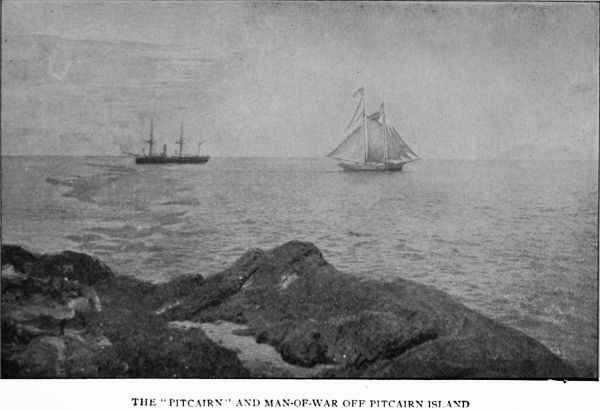
THE “PITCAIRN” AND MAN-OF-WAR OFF PITCAIRN ISLAND
To the Pitcairn islanders Norfolk Island was literally
a land “flowing with milk and honey.” Although the
sight of a cow was a familiar one to them, they were
scarcely prepared for the large numbers of strong,
healthy cattle that they saw, which supplied the milk,
while honey was obtained from the hollow trees
where the wild bees built their hives. The island, too,
supported some two or three thousand sheep, besides
cattle and horses; but the sheep were not entirely
free from disease, and many of them died. The grass
that covered a large portion of the island afforded
abundant pasture for the flocks and herds that fed
there.
The soil and climate of the island were favorable
for the cultivation of various fruits, and lemons, guavas,
peaches, figs, white and purple grapes, loquats,
quinces, mulberries, pomegranates, watermelons, etc.,
etc., were produced in great abundance.
The island was well wooded. Extensive groves of
the Norfolk Island pine lent their aid to delight the
eye, while a variety of noble trees beautified and enriched
the land, their luxuriant foliage affording a
pleasing shade for the feathered songsters that awoke
the echoes so sweetly with their warbling notes.
Streams of water traverse the island in several directions,
while not infrequently the water is hid from
view by the thick growth of flags and reeds that cover
their marshy banks, and the streams themselves teem
with eel life. The abundant supply of water was by
no means the least of the blessings that had been
bestowed upon the people, for in their old home they
had known what it was to suffer for want of water.
But now “the lines were fallen unto them in pleasant
places; yea, they had a goodly heritage.” Indeed, so
fair was that heritage that it seemed impossible to realize
that it was ever the abode of so much misery and
crime; and the words of the Christian poet could not
have been more aptly applied than to this lovely island,
“Where every prospect pleases,
And only man is vile.”
Along the southern shore stretches a long line of
coral reef, and this, extending some distance into the
sea, renders it unsafe for a ship to approach too near the
land. A little beyond this reef stands a rock known
as Nepean Island, only relieved from utter barrenness
by one or two pine trees. On this rock the whale
birds congregate in great numbers to deposit their
eggs, which are eagerly sought for by the people for
food. While Nepean Island is covered with sea birds
in their laying season, Philip Island, which stands
further seaward, is overrun with wild rabbits, that make
their home there and feed on the scanty herbage that
the poor soil produces. Excellent fish of many varieties
abound in the waters around the island. Surrounded
with all that they needed, and still living
together in one unbroken circle, everything seemed to
promise contentment and happiness. But, as will be
seen, it was not long before the hearts of some pined
for the old home, and desired to return.
About two months after the new settlers had arrived,
the bishop of New Zealand visited Norfolk Island in
his yacht Southern Cross, bringing a large supply of
flour and other necessary things for the people’s immediate
wants. He had come to the island a short time
before, but as the Morayshire had not yet arrived, had
returned to New Zealand. Now, on this second trip,
he had brought his lady with him, and also his chaplain,
the Rev. J. C. Patteson, who was destined to
become a martyr to the cause he loved.
Mrs. Selwyn remained on Norfolk Island, while the
bishop went back to his labors. She soon won the
hearts of the people, and gave much assistance in
teaching in the day school as well as in the Sunday
school. She tried to impress upon the minds of the
young women and girls whom she taught, the importance
of practicing habits of cleanliness and industry
while young, teaching them also how to cook. This
energetic lady was not satisfied with merely giving
instruction, but would frequently visit her scholars at
their homes to see whether those instructions had been
followed or not. In this way more lasting good was
accomplished, and much real benefit resulted from her
patient and conscientious labors.
When the Pitcairn islanders first came into possession
of Norfolk Island, they understood that the island
belonged to them, for so had they interpreted the letter
sent them before their removal, by Sir William Denison,
the governor at that time of New South Wales.
On arriving at their new home they found that two
men were already there to divide the land among the
new arrivals. These latter quietly informed them that
their services were not needed, as the islanders were
able to manage for themselves. The two men left on
the Morayshire, and, having reported to the proper
authorities, two other surveyors were promptly dispatched
to Norfolk Island with orders to measure the
entire island and divide it into fifty-acre lots. Each
family had fifty acres to a share, a rather smaller portion
than they had at first shared out among themselves.
Subsequently, when the governor himself
visited the island, his letter was shown him as sufficient
authority to justify the people in the course they had
taken. This document he calmly got possession of,
and remarked something to the effect that matters
were somewhat changed since the letter was penned.[5]
On Sir William’s next visit to Norfolk Island he
informed the people that a schoolmaster and a miller
with their families were then on their way from England
to settle amongst them. There were, besides, a
shoemaker and a stone mason. “But,” added the governor,
“I stopped the shoemaker in Sydney, for I did
not like the looks of the man.”
A letter had been written to the people about this
time by their old friend the Baron de Thierry, then
residing in Auckland. It contained such sound advice
and good counsel to the people respecting their right
use of the many privileges accorded them, that Sir
William declared it “worthy a place in the archives of
the island.” The governor himself gave much wise
counsel to the people, and encouraged them to exert
themselves to the best of their ability in the discharge
of their several duties in the untried life that lay before
them, showing how much depended upon their own
efforts to insure success in the general improvement
of themselves and their surroundings.
In due time the expected party from England
arrived. The school, which was then kept by Simon
Young, was immediately given into the hands of Mr.
Thomas Rossiter. He was an excellent disciplinarian,
and proved himself fully qualified to assume the task
of managing and controlling the children, who often
tried his patience. One of the spacious rooms on the
second floor of the new barracks had been converted
into a schoolroom, and here, once every week, Mr.
Nobbs, for several years, was in the habit of visiting
the children for the purpose of giving some religious
instruction. This consisted principally in thoroughly
grounding them in the teachings of the church catechism,
and putting the more advanced pupils through
a series of questions and answers preparatory to their
becoming candidates for confirmation.
Mr. Rossiter, while engaged in his daily duties as
schoolmaster, also encouraged the people to apply
themselves to the cultivation of the land, and to raise
field and garden products for the yearly show which
he instituted. Both by advice and example he won
encouraging success. Under his skillful hand the wild
confusion of the neglected government garden gave
place to order and beauty, and the rich, ripe clusters
of luscious grapes bore witness to the careful attention
that was bestowed on them.
James Dawe, the miller, did not find his business a
very lucrative one. Almost the first effort was to
repair the water mill and the adjoining dam, which had
suffered from long neglect. The mill was soon put in
working order, saving thereby a great deal of labor.
But some disagreement arose between the miller and
the party of men who worked with him, which resulted
in his leaving the island, with his family, after a stay
of less than two years. As for the stone mason, there
was no employment for him on the island, so, after
repairing a broken wall or two, he left again for Sydney,
where he found good employment and wages.
A new enterprise was undertaken by the quondam
Pitcairners. Observing that a great number of whales
frequented the waters around the island at certain seasons
of the year, they decided to purchase boats and
every necessary article needed for the capture of these
monsters. They showed ready skill in this new undertaking,
and succeeded well from the first. The oil
obtained a ready market both in Sydney and in Auckland.
CHAPTER XIII.
HO! FOR PITCAIRN
IN THE meanwhile two families had
returned to their old home. The
superior advantages enjoyed in their
new home, the greater household conveniences, the
larger educational privileges, the easier access to and
communication with the outside world, all failed to
weigh as much with them as the wish to see once
more the place that they loved as home. The families
consisted of Moses Young, his wife and five
young children, and Mayhew Young, who had married
the widow of Matthew McCoy, their infant daughter,
and six other children by the woman’s first husband.
These made up the first return party, sixteen souls in
all, four males and twelve females. Three daughters
of the former Mrs. McCoy remained on Norfolk Island,
the two elder ones with their husbands, and the youngest
to be married. Had the children been consulted in the
matter, every one old enough to think would have
chosen to remain, but the only alternative was to obey
and follow their parents.
A much larger party had at first decided to return,
and had already conveyed their goods on board the vessel
that was to bear them away, but the tears and persuasions
of the friends from whom they were about to
part were more than they were able to resist, so they
did not leave, as they had at first intended. The parting
was sad. One last gathering in the church where
they had worshiped for two years, one last mingling of
their voices together in the parting song, which was
falteringly sung, while sobs choked the utterance and
tears dimmed the sight, and then the final prayer was
uttered in tremulous tones and with tender earnestness
by the lips of their faithful pastor, Mr. Nobbs, commending
the departing company to God’s care. Thus
was the first separation effected between the people
that for sixty years had been dwelling together like
one family, sharing each other’s joys and sorrows—the
first separation, that held out no hope of ever meeting
again. The schooner Mary Ann, which took them
away, left on the second day of December, 1858, and
reached her destination on the seventeenth day of the
following month, January, 1859, making a passage of
forty-six days.
The few men that first landed from the schooner
had been but a short time on shore when they saw a
boat, well manned, approaching the landing place at
Bounty Bay. The boat’s crew, as they soon discovered,
belonged to a French vessel, the Josephine.
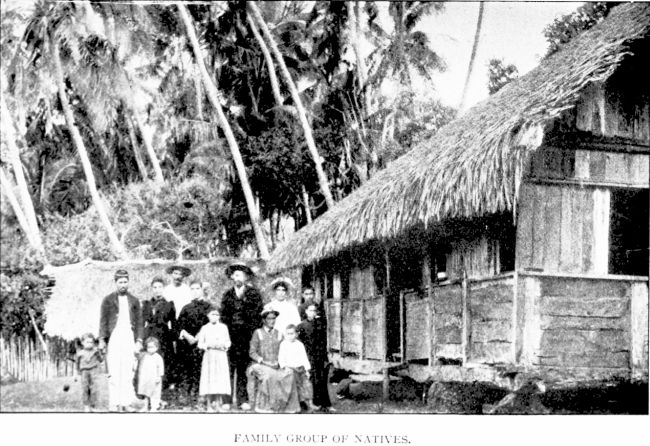
FAMILY GROUP OF NATIVES.
Closely following the first boat came another, but,
meeting with some accident at the landing place, the
boats soon returned to their ship, and she sailed away,
much to the relief and satisfaction of the two families
who had come to stay, and who were not a little dismayed
at the thought of the stranger being so near to
them.
The two families and their belongings were soon safely
landed. An inspection of the deserted village showed
unmistakable proofs that the island had been inhabited
by someone for a short time, at least, subsequent
to the removal of the former inhabitants. A keg of
salt, some old crockery gathered from the deserted
houses, and sundry other household articles had been
brought together, evidently for the use of someone in
need. Some of the houses had been destroyed by fire,
while others had been broken down. These were all
so many evidences that the island had been lately occupied.
The matter, however, was soon cleared up. A
slate was picked up in the schoolroom whereon was
written with some iron instrument the names of some
men who had found an asylum on the island, after
having lost their ship on Oeno, a low-lying coral island,
surrounded by reefs, some eighty miles northwest of
Pitcairn Island.
Further particulars were afterwards obtained, first,
from an American sailor who was left on the island by
the captain of the whale ship Hiawatha, and later
from a copy of the Friend, sent to the island by the
people’s faithful friend, the Rev. Samuel C. Damon, of
Honolulu, Hawaiian Islands. In the Friend was the
account of the loss of the Wildwave on Oeno Island.
The ship was under command of Captain J. N. Knowles,
who, in the early part of 1858, was on a voyage from
San Francisco to one of the Eastern States, and who,
having lost his ship, came with such of the crew as were
willing to Pitcairn Island, where they stayed until a
boat had been constructed of such materials as the
island afforded, to convey them to Tahiti, whence a
passage home could be found.
About twenty-three years afterwards one of the
lads who had returned with the first party, now grown
into a middle-aged man, was in San Francisco. While
there he called at the office of Captain Knowles, and
heard from that gentleman’s own lips the following
interesting account of their enforced detention on Pitcairn
Island:—
The Wildwave was outward bound from San Francisco,
when she became a wreck on the reefs of Oeno
Island. Besides the captain, officers, and crew, there
were ten passengers, numbering in all about thirty-seven
persons, all of whom landed safely on the island.
The remains of a brother of Captain Knowles, which
were being carried home for interment, were also taken
on shore and buried. The headstone that accompanied
the body was also set to mark the last resting
place of the dead. When everything that could contribute
to their comfort had been landed, the shipwrecked
men proceeded at once to make the best of
the circumstances. Abundant food supplies had been
brought ashore from the ship, and if that should fail
before help could come, the large numbers of birds,
as well as of fish, were sufficient to keep them from
starvation.
But the captain felt that some immediate action
must be taken, and so, as speedily as possible, a boat
was made ready and provisioned, and himself, Mr.
Bartlett, the first mate, the carpenter, and four seamen
bade good-by to the thirty men left on Oeno, and came
on to Pitcairn Island, to obtain if possible help for
themselves and their companions. The captain, by a
wise forethought, had, before leaving, taken the second
mate and others to mark the spot where three or four
birds were sitting on their eggs. These birds were
then secured and taken along with the party in the
boat, to be their news carriers in the event of their
reaching their destined place in safety. This they
did. They landed on the west side of the island, and
the boat was drawn up only a few yards from the
water’s edge, as it was the captain’s intention to return
as soon as possible to Oeno. This plan, however, was
frustrated by an unlooked-for calamity.
The captain’s and mate’s first care after dragging
the boat to the place where it was to be left, was to
take out from it all their nautical instruments, and
then, taking the birds in their hands, they started on
their way up the high hill leading to the village.
Strips of leather had been prepared on which to send
the message of their safe arrival to their companions
on Oeno. These missives having been securely fastened
to the birds, they were let go, and the party
stood somewhat anxiously watching them take their
flight. At first the unusual encumbrance seemed
likely to impede their progress, and the watchers saw
them “turn round and round as if stunned a little,” but
they soon regained their wonted manner, and the men
had the satisfaction of seeing the birds take their way
in the direct line whence they had come. In time the
men on Oeno had the pleasure of learning of the safety
of the little band who had gone to Pitcairn, but the
hope of soon seeing them again was not realized, and
many months of weary watching passed ere further
word reached them.
Meanwhile, the seven men, after seeing to the safe
flight of the birds, proceeded on their way. Arriving
at the top of the hill, they looked down on the little
village of thatched cottages nestling among orange
trees. These trees, even at that distance, were seen
to be loaded with golden fruit. The sight was a very
pleasant one to the shipwrecked men, but no rising
smoke gave evidence that the place was inhabited. A
few minutes’ quick walking brought them down to
the silent houses, where not a human being was seen.
For a day or two they remained in the deserted village,
intending soon to return to their companions on Oeno;
but the mate, having occasion to go over to the west
side, found to his dismay that the boat, which had
been left too near the water, had been not only reached
by the heavy surf that had arisen in their absence,
but was broken beyond repair.
This unlooked-for disaster was the cause of grave
anxiety, and all that could be done was to go to work
and construct another boat. This was a very difficult
matter, as materials and tools were scant and poor.
To obtain nails some of the houses were broken down,
and others were burned. Trees were cut down, and as
the men had no saws, the ax was made to do duty
for both saw and ax, thus occasioning great loss of
time and material. But in spite of the many drawbacks,
the work went steadily and bravely on.
At length the boat was finished. The sail of the
broken boat, and such odds and ends as could be
found in the houses, made up the rigging of the little
craft, which was named the John Adams. The trappings
of the old pulpit in the church supplied the red,
and a bit of blue calico taken from off an old bedstead
served for the ground, on which were arranged the
white stars of the American flag; and so, with the stars
and stripes to float from the mast of their small vessel,
it was launched, after months of weary, anxious work
and waiting, rendered doubly anxious by the knowledge
that the loved ones at home were pining in suspense
and uncertainty regarding their fate.
Two of the men, afraid of venturing in the boat
they had helped to build, stayed behind until help
from a more reliable source could come to them.
Owing to adverse winds, Captain Knowles did not
return to Oeno, as he had at first intended, but steered
for Tahiti instead, making a brief call at the island of
Nukahiva on the way. At Tahiti they found the
U. S. sloop-of-war Vandalia. The story of the shipwreck
and subsequent facts was soon told, and the
Vandalia went at once to the rescue. Mr. Bartlett,
the mate of the Wildwave, also went with the rescuing
party, who in due time reached Oeno, where they
found all the thirty men alive and well. These having
been received on board, the Vandalia went to Pitcairn
Island, where the other two men of the crew were,
both of whom were enjoying excellent health, but
glad to leave the place that was so lonely and isolated.
After Captain Knowles had reached Tahiti, he did
not delay to take the first opportunity to go home, as
he was extremely anxious about his wife, an anxiety
which was only too well founded, for the poor lady had
died of hopeless grief and suspense concerning the
fate of her husband.
CHAPTER XIV.
AN UNPLEASANT SURPRISE
IN the course of our narrative
we now return to the two
families on Pitcairn. Their
first night on shore was passed in one of the old
houses which was so thickly covered with a growth
of the wild bean that all felt sure it would afford the
best protection against rain, if rain should fall. But
they were soon convinced of their mistake when, during
the night, a pouring rain roused them from their
slumbers by coming in upon them through the frail
covering of the vines. Early the next day they
removed to another house, which afforded better
accommodations, and where they stayed until their
own cottages were repaired. They had but just finished
the work of arranging their new abode to the
best advantage when some of the young girls sallied
forth, accompanied by one of their mothers, to have a
look around the forsaken place. When only a short
distance from the house, they espied, coming towards
them through the bush-grown path, two men, who had
just come ashore from a ship, unknown to any of
the party on the island. At sight of the strangers,
one of whom was carrying a gun, the other being
a colored man, the woman and girls screamed and
fled, one of the girls in her terror dropping several
feet from the boughs of an orange tree up which she
had climbed.
Impelled by a haunting dread that something awful
was about to happen, they ran in breathless haste
toward the house where the other woman and children
were. Their frightened looks told plainly enough
that something unusual had occurred, and, crowded
close together, the story of what they had seen was
repeated. But they congratulated themselves on the
fact that their retreat would not be easily discovered, as
the path was well nigh hidden from view by the thick
growth of weeds and bushes. Worst of all, their natural
protectors were all absent from home at the time.
Their terror could be better imagined than described
when, a few minutes having passed, the black man’s
face appeared through an opening in the trees, and
immediately behind him was his white companion.
The lot of timid women and children could scarce
refrain from shrieking aloud, but the colored man
assured them, with a pleasant smile, that there was
nothing to fear, and that the gun was brought on
shore for other game than themselves. It did not
take long to quiet their fears, when they discovered
that the black man was really a pleasant-spoken,
kindly person; but the other man held aloof, and
scarcely had a word to say. They both gladly
accepted food from the hands of the women, who also
gave them permission to take all the fruit that they
wished.
The visitors informed them that they had just come
ashore from a whaler, the William Wirt, and had
brought their ammunition with them for the purpose
of obtaining game. Another whale ship came in on
the same day, and their respective crews carried back
to their ships a large supply of animal food, which
they had taken in hunting, viz., goats, fowls, and fish,
as all were so easily obtained on account of their great
numbers.
The search for hens’ eggs gave much pleasant occupation
to the young people, as the island was nearly
overrun by the immense increase of fowls; nor were
the older folk less active in going out on an egg hunt
than the children. Life for them seemed one continuous
round of present enjoyment. There was scarcely
any need for work, as the island produced in lavish
abundance more than sufficient, both of animal and
vegetable food, for their every want—goats, sheep,
fowls, and plenty of fish, which had become tame
through having been left so long in their undisturbed
freedom. One obstacle in the way of the young people’s
pleasures was the presence of the few cattle on the
island, the mere sight of which was enough to make
them run for refuge to the nearest tree, if not within
easy distance of their homes. As the island is too
small to allow the increase of cattle upon it, it was
thought best to extirpate them; and, most unwisely,
the doomed cattle were in time all destroyed.
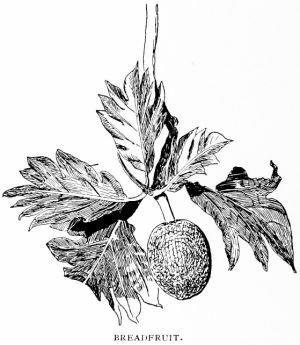
BREADFRUIT.
During those years the productiveness of the island
was remarkable. The breadfruit, yams, potatoes, taro,
as well as the delicious fruits that grew on the island,
seemed untouched by the curse. It did not seem possible
that in a few years a change so complete could
take place as to affect almost the entire productions of
the island. But so it was. Being abundantly provided
with food supplies, with scarcely an effort of their own,
the two families had not much to do. The making of
tappa, however, gave employment to all during three
or four months of the year, and heavy work it was too,
with all the various processes through which it passed.
A description of the work may be given here.
First, the plants must be cut down and divested of
their bark. Each bark is then peeled and the inner
portion beaten out until it becomes soft, and the fibers
separate. Washing is the next thing, and this is
repeated until every trace of the abundant sap is
removed. By this time the substance has widened to
five times its natural width, and has a beautiful lace-like
appearance. It is then wrapped up in the large
leaves of the appi (arum gigantum), sufficient being
inclosed in the wrap to make a sheet. Being allowed
to remain for a few days, it becomes soft and almost
pulpy. Then it is ready to lay out in strips of the
required length, one bark being laid over another
until the proper thickness is obtained. The whole is
then beaten out, two persons being required to do this,
as they stand on the opposite sides of a large, long,
and smoothly planed log, called a “dood-a,” and with
their heavy beaters keeping time with the utmost
exactness. The work is noisy and tiresome. When
each sheet is finished, it is hardened by spreading out
daily in the sun. This is continued until the paper-like
fabric can bear washing. To render it tough it
is dyed, the dye being obtained by steeping the red
inner bark of the doodooee (candlenut tree) in water.
When dry the dye has a reddish brown color, which is
very pretty when fresh.
Most of this disagreeable work was performed by
the two mothers of the families, as they could not
trust the delicate work of handling the easily injured
sheets to the inexperienced hands of the young girls.
These, from the age of eight to thirteen, grew up in
almost entire ignorance of the art of sewing, and this
for the good reason that they had nothing to learn
with. Thread was too precious to waste in teaching
the children to sew, and should the few needles break
or be lost, there was no prospect of replacing them;
besides, every bit of calico which might be used for
the purpose of learning to sew was carefully hoarded
as a future patch for the garment, which only too
readily became threadbare. Usually a slit in the
sleeve or side of a frock or petticoat was drawn
together by means of a string which the fibrous bark
of the boo-ron tree supplied. But these girls enjoyed
their wild, free life notwithstanding, and were
happy in the possession of perfect health, plenty to
eat and drink, and their garments, if poor, and even
ragged, were kept as clean as the nature of their duties
allowed, while in their persons they were particularly
clean.
Living such a free, wild life as they did, and with so
much idle time on their hands, it is not to be wondered
at that the young people, unaided, would turn their
attention to books, and seek to educate their minds in
the knowledge to be gained from them. This fact
caused much anxiety to two, at least, of their number,
Sarah McCoy, the oldest girl, and also her brother.
These two young people had been members of Mrs.
Selwyn’s class during their two years’ stay on Norfolk
Island, and nothing had caused them more regret on
leaving that place than the fact that they were by
their removal cut off from so many of the educational
advantages obtained there, having just experienced
enough of the pleasures of knowledge to make them
long for more. Urged by the necessities of the case
to do what they could, these two young persons collected
what books they thought would help them,
which they found in the old schoolroom, together with
slates and pencils, and opened a school in Mr. Nobbs’
former study, for a class of six or seven girls and one
boy, giving them lessons in reading, writing, and spelling,
teaching them also addition, subtraction, multiplication,
and division.
But searching for hens’ eggs, taking care of chickens,
running with a wheelbarrow down some steep
hill, swinging on the long hanging roots of the great
banyan trees, and other employments of a like nature,
were far more congenial to the tastes of the
lively, healthy, and active-limbed children than to
sit droning lazily over their books and drawling out
“Ab-ba, father,” and so on; and when for some misbehavior
the youthful teacher would remonstrate, he
would be greeted with a derisive laugh; or should he
attempt to administer the rod, he would be met with
such a spirit of defiance that his attempts at punishment
would be useless. Such scenes usually ended in
the unruly scholar climbing with the agility of a cat
up the posts of the house, where he would look
down upon his teacher and feel secure from the well-merited
punishment.
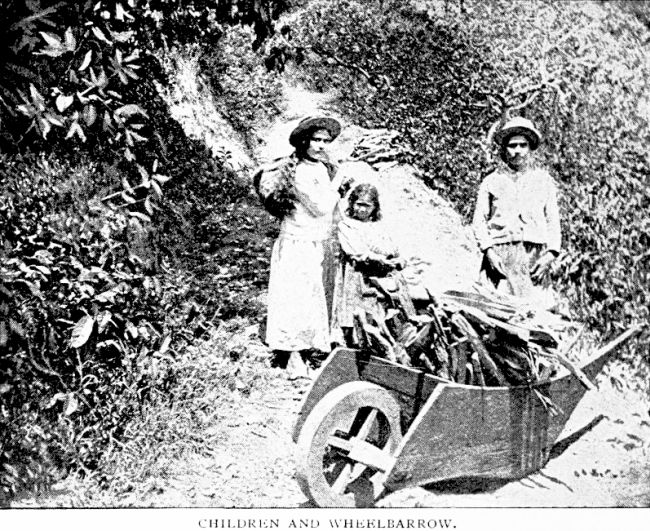
CHILDREN AND WHEELBARROW.
In spite of such untoward behavior from the older
children, the long-suffering teachers succeeded in
accomplishing what they had set themselves to do,
and had the satisfaction of seeing their trying pupils
accomplish the task of learning to write, in addition to
their being able to read. They also learned to spell
fairly well, and were able to master the simpler rules
in arithmetic. In October, 1860, H. M. S. Calypso
visited the island, staying a few hours. The chaplain
of the ship came on shore, and manifested much interest
in regard to the religious instruction of the children
and their right bringing up. On leaving, the kind
visitors supplied the little school with books, slates
and pencils, copy books, pens, penholders, and ink, a
gift which was thoroughly appreciated and most
thankfully received.
On Sundays the two families met for worship in
Moses Young’s house, each of the two men at times
taking part in conducting the services, but more frequently
the master of the house officiated, and in strict
accordance with the Church of England liturgy in
the Book of Common Prayer.
Moses Young, who owned a fife, on which he often
discoursed sweet music, was also an excellent performer
on the fiddle. To the ability he possessed of playing
with considerable skill on these his favorite instruments,
was added a limited knowledge of written music,
gained under the able leadership of Mr. Hugh Carleton.
This knowledge he tried to put to the best
account, and formed a class, composed of the four
adults, including himself, and as many of the young
people as wished to come, to whom he taught the
gamut. Having drilled his little class in “do, re, mi,
fa, sol, la, ti, do,” and learning the skips, ad infinitum,
he made a sudden advance to a few of the old standard
church tunes, and succeeded in reviving, for the
benefit of his youthful learners, the old tunes of Truro
and Clarendon, and teaching them an entirely new
tune besides. He did not accomplish more of his
laudable undertaking, probably because his pupils did
not give him the needed encouragement, or else he
himself checked their ardor, as he did in the following
instance. One night at the close of the usual
drill, and before the class was dismissed, the teacher
proposed that they should sing the National Anthem.
Sundry efforts were made before the proper pitch was
obtained. At last the tune was fairly started, and the
anthem sung. The closing lines,—
“Shed o’er her heart a ray
Of wisdom’s glorious day;
Loved be Victoria’s sway—
God save the Queen,”
were sung in a manner expressive of the singers’ entire
satisfaction in the performance. Their leader, however,
thought differently, and, waiting until the last
notes had ceased, he turned to his pupils a face beaming
with hardly-suppressed mirth, and remarked,
“Your singing sounds just like the noise made by a
swarm of big flies.” He then burst into a merry peal
of laughter, in which he was joined by his whole class.
In October, 1862, H. M. S. Charybdis paid a short
visit to the island. It being impossible to land at
Bounty Bay, the visitors went around to the west side,
where the first half of the way led up a steep, high
hill. But the walk was cheerfully accomplished, and
a warm hospitality was extended them when they
reached the little village, a substantial repast of the best
that the island afforded being prepared for them. The
two humble homes were made to look their best, and
the carefully hoarded linen and cotton sheets were
brought out and displayed upon the beds, in honor
of the visitors.
The Charybdis stayed only a day, taking a good
supply of all that the island produced. So fruitful
was the little island at the time of their visit that the
officers declared that it seemed “like a little Garden of
Eden.” A printed account of the visit of the Charybdis
to Pitcairn was sent to Norfolk Island. The
news, when received, after the long silence of nearly
five years, created an excitement among relatives and
friends not to be described, and smiles and tears followed
each other in quick succession as the short but
interesting description of the old home and the loved
ones there was read and reread to ears and hearts
that seemed never to grow weary of listening.
CHAPTER XV.
THE SECOND PARTY RETURNS
TIME passed on, and again preparations
were being made at Norfolk
for the second return party to Pitcairn
Island. Four families decided
to go. These were, first, Thursday O. Christian, his
wife and nine children. Mrs. Christian’s aged mother
also accompanied them for the purpose of seeing
again her son, Mayhew Young, who was of the first
party. The old lady was Elizabeth Mills, only
daughter of John Mills, of the Bounty, and the son
whom she was going to see was one named in affectionate
remembrance of her much esteemed and well-remembered
friend, Captain Mayhew Folger, who had
discovered the colony on Pitcairn Island fifty-five
years before. The other families were Robert Buffett
and his wife, Samuel Warren and his wife, who was
the daughter of T. O. Christian. These last mentioned
persons were married to each other on the eve of leaving
Norfolk Island. In addition to those above mentioned
were Simon Young, his mother (Hannah
Adams), his wife, and eight children. The number of
persons composing the second party was twenty-seven.
Their friends were strongly opposed to their
leaving, and did all in their power to induce them to
stay.
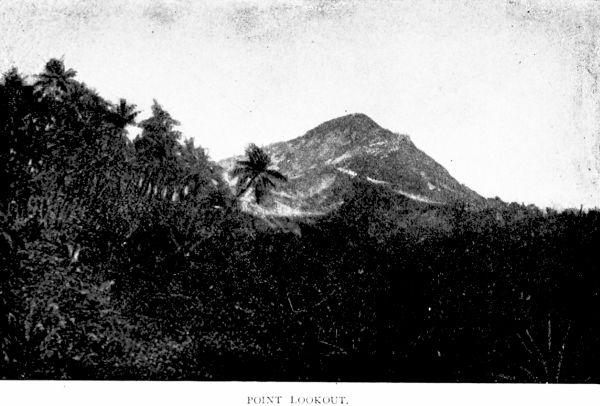
POINT LOOKOUT.
The last mentioned family was amongst the first that
had decided upon returning, and had taken the first
steps in preparing to return; but the fact that the passage
fare by the first vessel was not paid out of his
own money had enough weight with Simon Young to
decide his waiting until he was able to defray the expense
of the passage for both himself and family.
Having had some little experience in teaching children
in the week-day school, besides being for years a
Sunday school teacher, he was greatly concerned also
about the welfare of the young people that had preceded
him to the old home, and the thought of their
need, as well as his own deep-seated love of home,
seemed to urge him to take the present step. In vain
did relatives and friends place before the parents the
question of the future welfare of their children; their
decision was made, the passage already engaged, and
the thought of again withdrawing was not to be
allowed.
Nor were their relatives alone opposed to their
going. In a letter sent to the wife of Simon Young
Mrs. Selwyn expressed, not her opinion only, but the
opinions of both Bishop Selwyn and Bishop Patteson
as well, in regard to the ministration of the word of
God, and the ordinances attending thereon. Speaking
of the “important news” that reached them in New
Zealand, she says: “I will not conceal that it has made
me very, very sorry. I never, like all the rest of us,
had but one opinion about the return to Pitcairn’s
Island, and you know full well what that opinion is;
and I am more concerned than I can say to find that
your family are to be foremost in the next departure.
To both the bishops and to myself does it seem a very
serious responsibility for anyone voluntarily to put
himself and his family out of the reach of all the means
of grace appointed by our Lord himself as necessary
to us. It is a very different matter if he find himself
bereft of them through no fault or design of his own,
as you all were in the old days of Pitcairn.”
Writing on the same subject, Bishop Patteson thus
expresses himself in a letter to Simon Young: “I fear
that you do not feel the real importance of this point
on which I so greatly insist,” i. e., “the most essential
thing of all—the authorized ministration of the word
and sacraments.” “You may or may not think that
the ministrations of Bishop Selwyn, or me, or Mr.
Nobbs, are edifying—that is not to the point. It is
Christ himself, who by the hands of His ministers,
regularly appointed, gives to His own people His own
blessings. If you willfully, and by your own act,
deprive yourself and family of this blessing, how shall
you receive the blessing? Christ gives it in His own
appointed way; what right have you or anyone to neglect
His way, and yet think to receive the blessing?
“And if you are not doing right in going away from
such privileges, you may be sure that you will not be
doing good to others. You will be encouraging them
in a course that is not right. You ought to be using
whatever influence you have to keep others from going
from the blessings which you have at Norfolk Island,
and will not have at Pitcairn Island.
“And with reference to what you say about the
‘path marked out by God.’ My dear friend, often-times
a man makes up his mind really on some point,
though he is hardly willing to allow to himself that he
has done so; and then, with a design already settled
in his mind—seeks for advice and direction....
Now if you have any doubt about the course you propose
to follow, and you must have doubts, you must
see that it cannot be right to leave the blessings I
have spoken of—you cannot make what is wrong
appear right by any other process than one of self-deception.
“Your object is to do those who have gone some good.
But if God’s blessing go not with you, you cannot
and will not do them good; and if it be wrong to go,
it is wrong to encourage others to go. Why are you
‘sorry that they went’? Not only because they have
left their friends, but you are, I hope, sorry because
they are living on apart from the regular ministrations
of the church. But you cannot supply that want;
you add only to the number of those who are in
want. You disapprove their conduct, and yet follow
it. But you think you go to help them. No, my
friend, by doing what is at least doubtful, if not wrong,
you are very far from helping them. You injure yourself
and your family, and you encourage those that
are gone to think lightly of the error they have committed.
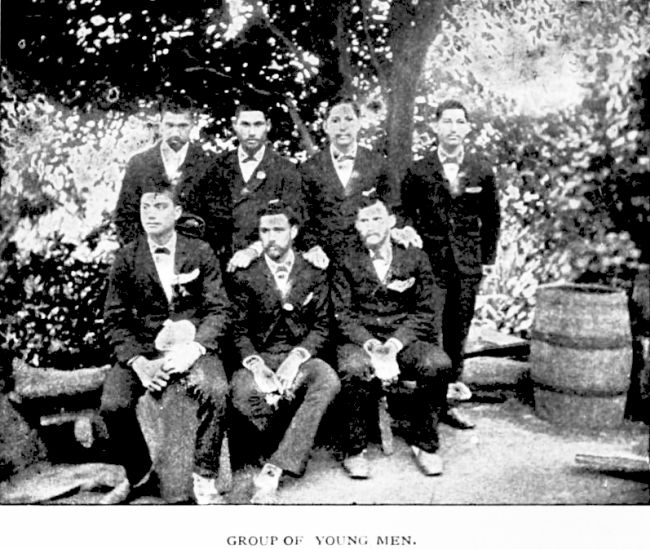
GROUP OF YOUNG MEN.
“I have written strongly, but you know why. If
I have said the truth, may God bless it to the good
of us both.”
This letter, written in such plain and strong language,
and which showed such solicitude for the
spiritual welfare of those who were on the eve of leaving,
did not fail to make a deep impression, yet not so
as to convince that the step about to be taken was a
wrong one.
As for their own pastor, Mr. Nobbs, he had strongly
opposed the return of the first two families, but now
was rather willing than otherwise that the rest should
follow. Indeed, far from discouraging such a step, he
was glad that someone could be found who would voluntarily
go and, to the best of his ability, instruct the
children who were growing up so far from educational
privileges. Quickly the day drew on that was to witness
another painful separation. As in the first case,
the young people of the second return party did not
share the feelings of their parents. Pitcairn Island
possessed no attraction for them, and Norfolk Island,
which was home to them, was rendered doubly dear
because of the many loved companions and friends that
were to be left behind.
One sore trial to Simon Young and his wife and
family was the separation from the eldest son, a youth
of eighteen years of age, who, with a son of Mr. Nobbs,
was left with Bishop Patteson, to be by him trained
and fitted for a life of future usefulness in the work of
the mission. It was the young man’s own choice and
resolve to remain with the bishop, who, both to his
companion and himself, had ever showed the kind and
tender consideration of a parent in everything regarding
their best interests. So, however sad the parting
or sharp the trial, the parents knew that their son was
in good hands, and Bishop Patteson had written that,
as far as they could supply it, both himself and Mrs.
Selwyn would fill the place of parents to him. His
companion had always been to him as a dear brother.[6]
And now the time had come for the final parting.
Once more grief-stricken friends assembled in the
church, which would know the presence of some of
them no more forever, to implore the divine aid and
blessing upon all, but more especially to commend the
departing friends to the care and keeping of their faithful
God. The hymn, composed by Mr. Nobbs and
sung on the former occasion, was again sung, the two
last stanzas of which are given here, these referring
directly to those about to leave, being composed for
this special farewell gathering:—
“For those who in the flesh remain,
Though absent from our sight,
For their remembrance we’ll retain
Affections pure and bright;
Though parted, severed, far away,
Perchance to meet no more,
For their prosperity we’ll pray,
And love them as before.
“Again dissevered is the tie;
Brethren and sisters part;
The mournful separation nigh
Pervades with grief each heart;
Here, now, beneath this sacred roof
Fresh blessings we implore,
Beneath our tears the fervent proof,
‘We’ll love you as before.’”
In the large company that had gathered for the last
farewell service, there was scarcely an eye that was
not dim with tears. Brothers and sisters, as well as
parents and children, who had never known what
separation meant were now about to experience its
pain. Perhaps no one felt the bitterness of parting
more than did the two aged mothers, Elizabeth Young
and Hannah Young, who were leaving behind them
children that were most dear, to return to the far-distant
home of their childhood. The night after
the farewell meeting was a wakeful one for those
whom the parting most nearly concerned, as the
morrow would witness the departure. The morning
dawned only too soon. The whole community, including
all the other families that had recently settled
among them, accompanied the party that was leaving,
down to the pier. Loud sobs and many tears told
what a heavy trial the separation was. At last all
was over—the last fond embrace, the lingering kiss, the
warm hand clasp—and the voyagers embarked in their
small vessel to return to the isolated island whither
the two other families had preceded them six years
before. Two men, relatives of the families who were
leaving, came with them on a visit.
One death took place before the voyage was ended,
that of a child of Thursday Christian, that had been
ailing for some time before leaving Norfolk Island. At
the mother’s request, the captain kindly consented to
preserve the body, to be brought and laid with others
of her children in the graveyard at Pitcairn Island.
The body was put in a barrel, and this was placed in
the forepart of the ship on deck, and was for some
time an object of terror to the superstitious minds of
the young people on board, who wondered how the
mother dared to approach the spot in the dead of
night and weep over her child there. By degrees,
however, the feelings of awe and fear wore away, and
as the little ship neared the end of her voyage, there
remained but the wish that the gentle child had been
spared to reach the place whither they were going.
And, too, the sorrow of parting from friends on Norfolk
Island gradually lost its bitterness as the thought
of soon seeing again their long-separated friends was
cherished. Still the frequent sigh and the silent tear
told that the dear ones were not forgotten. Especially
touching was it to see the two old ladies, who had no
growing families to engross their thoughts, sit together
and weep silent tears, as the aged will, over the sons
and daughters they were to see no more.
CHAPTER XVI.
The Reception
THE schooner St. Kilda, which conveyed
the second return party to Pitcairn Island,
leaving Norfolk Island on the 18th of December,
1863, reached its destination on the 2d of
February, 1864, the voyage being on the whole a
pleasant one. It was night when the little ship
reached the end of her voyage, a beautiful night,
calm and clear, and the unsuspecting folks on shore
did not dream of seeing on the morrow the long
absent faces of relatives and friends, and were preparing
to retire to rest when a musket’s sharp report from
over the water broke the stillness. On board all was
excitement and bustle, muskets firing, the young men
hallooing and burning flash lights to attract the attention
of those on shore, even calling some of them by
their names, as the vessel was close to the land.
The perfect Babel of sounds soon succeeded in rousing,
not the peaceful inhabitants only, but their terror
as well. Leaving their homes, they hurried down to
that part of the land overlooking the sea, whence the
noise proceeded, to try to find out the cause of such
a commotion. An undefinable dread took possession
of their hearts when they saw the lights and heard
the repeated sharp reports of the muskets across the
water. The children were cautioned not to expose
themselves, but to remain hidden behind the thick
shrubs and trees, lest a stray ball should hit them, for
they did not know that nothing but powder was put in
the barrels. No answering response was made from
the shore to those on board, the frightened islanders
deeming it more prudent to maintain perfect silence
and wait until morning to learn the cause of all the
disturbance.
Very early the next morning two of the men went
off in their canoes, and were agreeably surprised to
find that the formidable foe of the previous night was
only a party of old friends come to settle again in their
former home. As soon as possible the boat was lowered
and the passengers taken ashore. They were
not a little amused to find that the girls on the island
had by no means recovered from their fright, but, on
the approach of the first persons who landed, ran away
in different directions to hide themselves, and could
scarcely be persuaded by their mothers to come out
and greet their friends. By degrees, however, their
extreme shyness wore off, and soon they were chatting
away with one another about all that had taken place
since their long separation.
With the exception that the once-cultivated grounds
were all overrun with weeds, and the houses mostly
were in ruins, there did not seem to be, to the eyes of
the older people, at least, any change in the island.
But to the younger people the change from the island
they had just left made a great impression, the dwelling
houses and kitchens, in their ugly bareness and
smoke-begrimed appearance, contrasting unfavorably
with the neatly-built houses and tidy kitchens they
had been accustomed to. The ovens, too, where most
of the cooking was done were only holes dug in the
ground, the required heat being obtained from a number
of small stones which were placed over a pile of
wood after the fire had been kindled to heat the
stones. The covering for such ovens consists of
leaves, and over these a thick layer of earth, which
effectually prevents the escape of the steam, which so
thoroughly and so well cooks the food that is placed
within.
The appearance, too, of the little village was so different
from the place where they had lately lived! Instead
of a long row of houses neatly standing side by side,
facing a broad and well-paved street, here were only a
few humbly-thatched dwellings—only two of which
were habitable—half hidden amongst the thick growth
of trees which surrounded them. But the general
appearance, so different, was none the less beautiful,
and the sight of the orange groves, displaying their
wealth of golden fruit, was a very pleasing picture to
the young folks, who had never seen such a sight
before. Near to these could be seen the breadfruit
trees, with their large, beautiful leaves, growing side
by side with the glossy, dark-leaved fei, or mountain
plantain, its heavy bunch of fruit being supported in
an upright position by a stout stalk shooting direct
from the center of the leaves, while here and there a
cocoanut tree lent its graceful aid to beautify the
scenery. Towering over all, and lovely in their delicate,
light-green foliage, were the wide-spreading
branches of the mighty banyan tree, whose roots, as
they hang from the boughs overhead, prove such a
strong temptation to the boys and girls to go swinging
on them. Sometimes an accident happens when
swinging on the roots of the banyan trees, but in no
instance has it ended fatally, and in one case only
were there any bones broken.
Everything about the island, and the manner of
cooking and living in general, interested the young
people greatly. Never before had they heard such a
chorus of cock crowing in the early morning, or the
endless chirpings of numberless chickens, as they followed
their busy, clucking mothers. The boys and
girls, to whom such a free, wild life was a desirable
change from the confinement of a long voyage, entered
heartily into the fun of going out in search of hens’
eggs, an abundance of which was found all over the
island. The time to them passed quickly, like one
long holiday, for in the unsettled state of things they
were not confined to any school duties.
There was much to hear and tell on both sides.
One story that greatly interested the newcomers was
that of a Peruvian ship, loaded with natives, that came
to Pitcairn from Easter Island the year before, 1863.
The captain of the ship, on coming near enough,
ordered a boat to be lowered and manned. He himself
went in the boat to seek for a landing place. The
people on shore observing the boat approaching, two
men went off in a canoe to meet the strangers. The
captain accosted them with the question, “Can you
speak Anglice?” Receiving an answer in the affirmative,
he said that he was going ashore to see if he
could get some sugar cane for a load of slaves he had
on board, whom, he informed them, he was taking to
their homes. On coming ashore he tried by many
arguments to persuade every member of the two families
to accompany him back to the ship, where,
he assured them, they would receive kind treatment.
One thing he objected to was their knowledge of the
English language, and he told them also that their
skins were not as dark as he expected to find them.
The captain’s entreaties for them to go on board, and
his oft-repeated expressions of kindness toward them,
served to arouse their suspicions, and they firmly
declined; however, the two men who had been to
meet the boat went on board the ship. There they
saw a sight which they could not easily forget.
Numbers of poor natives of different ages, from quite
young children to men and women in and beyond
middle life, many of whom were entirely naked,
were crowded into the close and stifling hold of the
ship. Those who were not entirely naked had a
waistcloth only for their covering. All seemed sad,
and their countenances bore the trace of much sorrow,
and had a look of hopeless misery. The atmosphere
of the place where the poor natives were confined was
very unwholesome from want of fresh air, and many
of the slaves were suffering from a distressing cough
that shook their frames. The captain told them that
he was going to the Gambier Islands, on his way to
restore the poor creatures to their homes.
It was not until many years had passed that the
truth about the ship and her business was made
known. The natives were being taken to the Peruvian
Coast to work as slaves, and the captain was trying
to get all he could to go with him. Long afterwards
some of the survivors returned to their home
on Easter Island, but with their return were introduced
certain diseases which until then had been
unknown among their people. So their home coming
was as much a cause of regret as of rejoicing.
While the two families on Pitcairn Island were
blessed with robust health and plenty of food, their
clothing was very scanty, and was made to do service
long after it was threadbare, and while scarcely of sufficient
body to hold together. Their very limited supply
was obtained from whale ships that once in a long while
would call in to obtain fresh provisions. On one
occasion they were imposed upon in the following
manner: The captain of a certain whale ship, requiring
something fresh in the way of fruit and other things,
called in at the island to obtain a supply. He took
from the islanders one hundred and eighteen fowls, a
number of hogs, about eighteen barrels in all of yams
and potatoes, and large quantities of fruit, the getting
of which and carrying them down to the landing place
occupied the handful of men and women and the few
children that were old enough to help, for a whole
week. The people were sorely in need of clothing,
which could very well have been sold them in payment
of what they gave, but they received in return
about sixteen yards of calico, three boxes of soap, two
of which carried together just made a comfortable
load for a boy to carry, and the bargain was finished
by the addition of a coil of rope and two half worn-out
tubs, which served the purpose of emptying the mud
out from the wells on the island that required cleaning.
The captain pleaded hard times as an excuse for
what he gave, and the people had to be satisfied with
such an explanation. But in telling the story afterwards
many a hearty laugh was had at their own
expense, seeing how easily they were imposed upon
and how they took it as a matter of course.
CHAPTER XVII.
AT HOME AGAIN.
Visit of H.M.S. Sutlej
AS was to be expected, the first weeks
that followed the arrival of the second
party were very busy weeks
indeed. They were housed as well
as could be managed in the two small dwellings of the
families that first came. But the inconveniences attendant
on such crowded accommodations were cheerfully
borne. In a short time a temporary abode for each
family of the newcomers had been erected, into which
they removed until their permanent homes should
have been built. As all the men and boys took hold
of the work, willingly and cheerfully helping each
other, the building business progressed rapidly.
A pleasant break in the busy weeks was the visit of
Admiral Sir John Kingcome in his flagship, the Sutlej,
on the 29th of March, 1864. The day was perfect,
with scarce a ripple on the sea, and the sky was wearing
its loveliest blue. The sight of the large boats
crowded with men going and returning between the
shore and the ship, was greatly enjoyed by the islanders.
A large crowd both of officers and men landed,
and all seemed to enjoy their visit much, and they
gladly availed themselves of the privilege of taking
free whatever the island produced. The young gentlemen
manifested a great deal of interest in the preparation
of a dinner gotten up for them in the island style,
especially that part of it which consisted of the dressing
of a pig and cooking it in the primitive under-ground
oven, a favorite mode of cooking meat among
the people.
In the afternoon, as the people had been kindly invited
to visit the ship, nearly all went on board, and had
a delightful time visiting the different parts of the large
vessel, and listening with thrilling pleasure to the band
as it discoursed sweetest music. The visit of the Sutlej
was opportune as regarded one young man, at least.
He had a wound in the right knee which threatened
to prove fatal, but the surgeon of the ship, having
examined it, probed the wound and applied the proper
remedies. The cure that followed was rapid and complete.
In the long interval that followed the admiral’s
coming, when the islanders seemed to have been shut
completely out from the rest of the world, the pleasure
that his visit gave still remained as a bright spot in
the round of their monotonous lives.
At this time the chief concern of the people was to
build a suitable house for public worship. Services
were held in one of the dwelling houses, which, although
there was room enough to accommodate comfortably
the two families that had first come, was now too small
for the increased number of worshipers. As soon,
then, as these later arrivals had been settled with some
degree of comfort, the work of building the church
and schoolhouse combined began. Willing hands
made light work, and, notwithstanding the lack of
workers, the plain wooden structure, with thatched
roof, was duly finished and consecrated to divine service.
It was a glad day when the small congregation
met for the first time within its humble walls to worship
God, nor was the worship less fervent because
above them there was only a bare, thatched roof.
Simon Young now stood as leader of the people, and,
in addition to his services for the spiritual welfare of
the people, took upon himself the task of instructing,
to the best of his ability, the youth and children in
the “three R’s”—reading, ‘riting, and ‘rithmetic. Having
brought from Norfolk Island a small supply of
schoolbooks, he was able with their help to guide
the young and ignorant minds into the pursuit of something
higher than the searching for hens’ eggs and
their own self-pleasing.
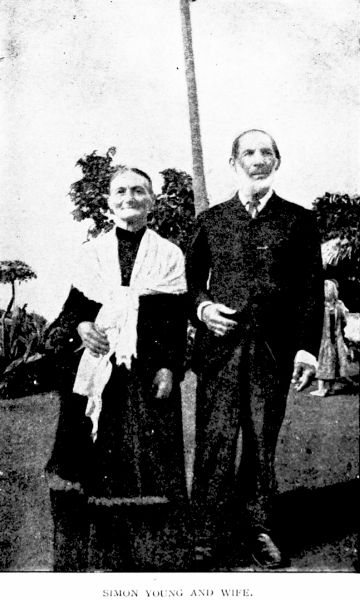
SIMON YOUNG AND WIFE.
Possessing a fair knowledge of simple music, he also,
with the small means at command, taught the children
to sing. After leading them through the simplest airs,
he taught them, and with great success, to sing in
four parts, and the fact that out of a class of fifteen
ten were able to read music by sight, gave him great
encouragement in that branch of his work. Beginning
life anew, house building and cultivating the ground
for the support of a large family left him scarcely any
leisure for self-improvement, but what he was able to
do he did faithfully. In cultivating the land, wife
and children assisted, thus lightening the heavy duties
of the husband and father. No work was allowed to
supersede that which was the dearest aim and object
of his whole life, namely, seeking to instill knowledge
into the minds of the young, and helping to train them
to love what is good and pure and true, and to inspire
them to search for themselves the treasures of knowledge
that may be obtained in the works of other men,
some few volumes of which he possessed. He also
organized a Sunday school, at first taking all the labor
upon himself, and, as the necessity arose, appointing
others to assist him.
In December of 1864 six of the young people—three
of the older settlers and three of the others—were
united in the bonds of matrimony, the wedding
taking place on Christmas day. To the younger portion
of the community, at least, the excitement of a
triple wedding was a very pleasant thing to happen to
break the monotony of their quiet and secluded lives.
In 1866 a man-of-war, the Mutine, called at the
island, bringing letters from relatives and friends on
Norfolk Island, the first word that had been received
from them since the parting, nearly three years before.
The day was a stormy one in November—so stormy
that the ship was delayed only long enough to deliver
the mail, one canoe with two men in it having successfully
passed through the heavy breakers and the tossing
sea to reach the ship. The news brought was
mostly sad, for the deaths of several dear friends were
recorded, but that which more than any other affected
the people deeply was the tidings of the death
of Edwin Nobbs and Fisher Young, who had been
shot by the natives of Santa Cruz, when, with the
bishop of Melanesia, they visited that place. Although
the two young men had been dead two years before
the tidings reached them, the loss of their firstborn
son came upon the parents of Fisher Young with all
the shock of a sudden and unexpected bereavement,
and the heartrending cries of the mother bespoke the
grief felt for her son. He had been consecrated to
God before his birth, and his chosen path was that of
a missionary, nor was it small comfort to his parents
that his last dying message was, “Tell my father that I
died in the path of duty.” Great sorrow prevailed
among the little community when the sad news was
received, and many tears were shed for those who had
gone, especially for the two young men, who were
loved and respected by all.
The Rev. G. H. Nobbs, Edwin’s father, wrote a
hymn on the sad occasion, which was frequently sung
by the people of Norfolk Island, to the tune Jerusalem
the Golden (Ewing). A copy of the words and
music was sent to their friends on Pitcairn Island.
Following is the hymn, which was soon learned and
frequently sung:—
“O Lord, the heathens’ madness
Has caused our tears to flow;
Yet still, amid our sadness,
This thought assuages woe,—
There’s naught on earth progressing
That’s hidden from Thy sight,
Correcting, as in blessing
‘Shall not our God do right?’
“Our loved ones’ toils are over,
Life’s transient journey sped,
Till earth her slain discover,
And ocean yields her dead;
Then at their Lord’s appearing,
Decked with the martyrs’ crown,
And spotless raiment wearing,
Shall as His seed be known.
“We kiss the hand that smote us,
And bow before the rod;
Thou hast in mercy taught us
To know that Thou art God.
With undisguised submission
We would approach Thy throne,
Presenting this petition,
‘Thy will, O Lord, be done.’”
There had been two deaths on the island since the
second party arrived, and those took place within a
few weeks of each other. The first was that of Hannah
Young, John Adam’s youngest daughter, in her
sixty-third year; the other a young girl, both victims
of consumption.
During the year 1867 the people had the pleasure
of enjoying the visits of the royal mail steamers Rakaia
and Kaikoura. The former called three times,
and the latter once, before the Panama line was broken
up. The account of the Rakaia’s first visit, written
by a gentleman of the name of Dilke, who was a passenger
on board, and which was published in the
Leisure Hour for 1868 or 1869, eventually reached the
island, and was read with much interest by the people.
The illustration that accompanied the article caused a
great deal of amusement, as it represented a canoe
ornamented with cocoanut leaves and loaded with fruit,
being paddled off to a vessel in the distance. The
canoe had two occupants, each one clad in a small
waistcloth as his only covering. The representation
was not very true to fact. As a further illustration of
what those in the outside world knew about the little
isolated rock and the people upon it, may be told the
following little incident:—
About two years before the Rakaia’s call, a merchant
vessel, the John L. Demock, on her passage from the
Australian colonies to San Francisco, lay becalmed
for two nights and a day off the island. The ship was
not seen, as she came in on the south side of the
island. On the second day, as the people on board
saw no boat from the shore nor any other sign that
the island was inhabited, they lowered a boat, and its
crew, with several gentlemen passengers, pulled for the
shore. The people on shore descried the boat only
when she was within a short distance from land, and a
canoe or two put off to meet and welcome the strangers,
and show them the landing place. It was an agreeable
surprise to the visitors to find themselves addressed in
the English language, and the hearty welcome extended
to them, and the warm invitation to come and
partake of the hospitalities of the island, entirely disarmed
them of their fears, and they hastily hid away
the weapons of defense with which they had come
well armed in case of a hostile attack. Their stay of
a day and a night was sufficient to prove that nothing
but good will was felt toward them by all, and on
leaving they took with them their boat loaded down
with all that the island could supply. On reaching
the ship they found their companions getting ready
another boat and more weapons to come in search of
them, fearing that they might have fallen in with enemies.
But the long detention was happily explained,
and the good ship soon was on her way again. Some
questions that have been put to those who go on board
ship, even at this late date, are very amusing. “Do
you know what that is?” was asked of one of the
islanders, the article in question being a lump of sugar.
“Can you read writing?” “Can anyone on the island
read?” or, “You do not know what reading is?” and
similar questions have been earnestly asked by some
who for the first time have become acquainted with
the people.
In March of 1868 John Buffett, now over seventy
years of age, but still hale and active, came to visit his
only daughter, Mrs. Mary Young. Everybody was
glad to welcome the old man, whom no one had expected
to see again. In June of the same year the
Ashburton, from the colonies, made a call, stopping for
a day and a night. Her captain, Smith, was a former
acquaintance, and now, as a large company of passengers
was with him, he kindly allowed them to come
ashore and spend the day. The ladies and gentlemen
were not slow to avail themselves of the kind permission,
and the pleasure of their short visit was as much
enjoyed by the islanders as by themselves. A table
long enough for the whole party was spread, around
which they all sat down to a dinner that had been
hastily gotten up for them. In the evening some of
the company belonging to an opera troupe, led by Mr.
Fred Lyster and Miss Minnie Walton, sang a few of
their songs for the entertainment of the people, and
in return the schoolchildren sang some of their part
songs. These ended, the visitors took their leave, as
night had come on, but the beautiful moon, shining in
its full brilliancy, lighted the way over the rippling
waters, as the boat, weighed down with its living
human freight, glided on its way, after the hearty
“Godspeed” had been spoken.
In July, 1872, John Buffett returned to Norfolk
Island on the whale ship Sea Ranger, accompanied by
one of his grandsons and another young man. They
were received by their relatives and friends on Norfolk
Island with every demonstration of joy, their unexpected
arrival causing intense excitement. Every
attention was shown them, and feast and dance were
gotten up in behalf of their visitors. On receiving an
invitation to visit the pretty chapel and grounds of the
Melanesian Mission, they went, and were impressed
with the order and neatness that prevailed everywhere.
The orderly behavior of the students, and the exactness
which characterized the arrangements of the
whole establishment, under the able management of
Mr. R. H. Codrington, who was during that time at
the head of the mission, called forth their highest admiration,
and repeated visits only served to strengthen
the impressions at first received that a noble work was
being done at the mission.
The bishop of Auckland, New Zealand, was at the
same time on a visit to Norfolk Island, and during his
stay confirmed some of the young people, of which
act he makes mention in his “Notes of a Visit to Norfolk
Island,” as follows:—
“November 16, Saturday. I had a class of young
people from the settlement (i. e., the home of the quondam
Pitcairners) who were to be confirmed on the following
day.... My class was held in St. Barnabas
Chapel. Afterwards I received a visit from two young
men, James Russell McCoy and Benjamin Stanley
Young (brother of Fisher Young, killed at Santa Cruz
in 1864), who had recently come by a whaling vessel
from Pitcairn’s Island. They wished to be admitted
to confirmation, and I was very glad that they should
be, after having some conversation with them upon
the subject.”
Besides the confirmation service, Bishop Cowie
ordained three deacons from among the Melanesians.
This ceremony was witnessed by the two young men
with much interest. The service was performed in
the church of the Norfolk islanders, a building which
had been completed by them a short time before, and
of which they were justly proud, the whole being
designed and finished by themselves. It had been
dedicated under the name of All Saints. Bishop
Cowie’s “Notes” thus make mention of the ordination
service:—
“The ordination was held at eleven o’clock, morning
prayer having been said for the Norfolk islanders at
an earlier hour by Mr. Nobbs, the chaplain of the settlement.
It was at first intended to hold the ordination
at St. Barnabas, but as in that case the Norfolk
islanders could not have been present at the service,
owing to the smallness of the mission chapel, it was
thought better that the Melanesians should go down
to the settlement (three miles distant), the new church
there, All Saints, being large enough to hold all the
church-going population of the island.... The
venerable pastor of the quondam Pitcairn islanders,
the Rev. G. H. Nobbs, assisted me at the ministration
of the holy communion, ... the communicants
numbering over a hundred. Whilst the clergy
were communicating, Heber’s beautiful hymn, ‘Bread
of the world in mercy broken,’ was softly and sweetly
sung by the congregation....
“In the afternoon at three o’clock I held a confirmation
at All Saints for the Norfolk islanders....
The preface to the confirmation service was read by
the Rev. G. H. Nobbs, whose granddaughter, Catherine
Nobbs, played the harmonium accompaniment at
both the services. Twenty young people were confirmed
(including the two lately arrived from Pitcairn’s
Island), nearly all being descendants of the Bounty
mutineers. The hymns were particularly well sung
by nearly the whole congregation, one of them to the
tune Cambridge New, said to have been a great favorite
with Bishop Patteson. A son and a daughter of John
Adams, of the Bounty, viz., George Adams and Rachel
Evans, both over seventy years of age, were at the
service, and I went to see Arthur Quintall, now quite
imbecile, the son of another of the mutineers.”
The three aged persons above mentioned were the
only survivors on Norfolk Island of the children of
the mutineers, for death had taken away many of the
people in the space of nine years. In 1868 a malignant
fever swept like a blasting wind over the island,
and many of the people died, so that the two young
visitors missed the faces of many a dear relative and
friend whom they still remembered well. Several
other changes had taken place on the island. The
people had in many instances removed to their own
allotments of land, and were now living widely separated
from one another.
The visit, of nearly three months’ duration, was
rendered as delightful and pleasing as possible, and
they left their kind friends with feelings of hope as
well as of sorrow, for the young men had expectations
of returning again to live on the island before many
years had passed. On leaving, letters from the people
on Norfolk Island were given them to take home.
These letters contained strong advice and earnest
entreaties to their friends on Pitcairn Island to return
to them and live together in one community as before.
Every argument that could be brought to bear on the
subject was used to induce the Pitcairners to return
to Norfolk Island. When the letters were, on their
arrival, read to the people, and the question thoroughly
discussed, the majority favored the proposal.
That all obstacles should be removed, their friends
had generously offered to charter and fit out a vessel
at their own expense for the purpose of conveying
them back to Norfolk Island, promising also that if
they should return their former grants of land would
be restored to them. The condition was that all
should return, as otherwise they could scarcely be
expected to put themselves to such an expense. Naturally,
most of the younger members of the community
were eager to return, and some among the older ones
were not unwilling. But a few of the families were
determined to remain where they were, and there the
matter ended.
One argument given in favor of their return was the
change that Pitcairn Island had undergone in the space
of a very few years. Extreme scarcity of water was a
source of much discomfort and anxiety to the inhabitants,
and the soil, that had formerly been so productive,
seemed now to have lost its remarkable fertility.
The yam crop, which hitherto had yielded so well, and
had been one of the principal food supplies, now failed
almost entirely. Nor did the sweet potato escape the
general plague, for a very troublesome blight would
attack the young plantation, completely preventing its
growth, and when the tubers became matured, they
were often infested by a destructive worm, that worked
untold mischief among them.
The breadfruit, too, yielded to the general decline,
and splendid trees that once bent beneath their wealth
of fruit, began to decay, and failed gradually to produce
fruit, until they ceased almost entirely. Other
fruit trees were more fortunate and did not suffer as
much as the food-producing plants. Around the
entire island, along the edge, or precipice, where once
had flourished a thick growth of stunted, hardy trees,
could now be seen bare, barren soil, free to be washed
away by heavy rains. During this period, when the
island was undergoing such a change, it was subject to
frequent seasons of drought. The water supply daily
diminished, and the springs that in former years had
been ceaselessly flowing now dried up, with but two
exceptions. Such was the condition of Pitcairn Island
when the request from Norfolk Island that the community
might remove thither was sent. But the
conditional proposition was not accepted, and it was
never again renewed.
CHAPTER XVIII.
WRECK of the CORNWALLIS
THE CLOSING months of 1873, and almost
the entire year of 1874, was the period
when, more than any other, the island suffered from
the effects of drought. As ships, the only means of
communication possible with the outside world, very
seldom called at the island during the years that
followed the arrival of both parties from Norfolk
Island, the inhabitants seemed to occupy a little world
entirely by themselves, and might have remained in
their remote isolation for an indefinite time were it
not that an unlooked-for event happened, which led
to the little island’s receiving much attention from
many who until now had never known of its existence,
and to the reviving again of the interest shown
by those who in former years proved themselves true
friends.
Toward the close of January, 1875, the Liverpool ship
Cornwallis, of the firm of Balfour, Williamson & Co.,
homeward bound from San Francisco, came in sight.
The captain in his boyhood had read the story of the
mutineers of the Bounty and their subsequent settlement
of the isolated rock, and decided that he would
make a call at the place where, just eighty-five years
before, Christian and his guilty party had landed.
Taking with him his apprentices, they left the ship in
charge of the first officer, and came ashore in their
own boat, accompanied by some of the island men
who had gone off to the ship.
But a very short time had elapsed after they landed
when the ship was observed to be losing her ground,
and, as if impelled by some unseen power, she drifted
shoreward, coming on swiftly and surely to destruction.
The people on shore watched with breathless
anxiety and terror the doomed ship, and earnest but
unavailing prayers went up that the fearful catastrophe
might be averted. The poor captain, half frantic,
rushed with his young men and all the island men that
were within call, to the landing place, to launch the boat
and put off to the vessel, that was every moment nearing
the rocks. But no effort could save her, and she
soon struck on some unseen rocks a few feet from the
shore. Had there been ten minutes more time, she
would have been saved, as the water clear to the shore
is very deep, and a few minutes more would have sufficed
to steer the ship clear of danger.
A few of the islanders that had remained on the
ship when the boat first went off, terrified beyond
control at the approaching shipwreck, now hastily got
into their boat and started for the shore. Meeting
the captain’s boat returning, they also went back to
where the ship now lay, a helpless wreck. The excitement
that prevailed was great, and soon everybody
was near the scene of the disaster. The other men
that had been engaged about their several duties when
the disaster took place, now returned from the fields,
and, seeing what had happened, were quickly on the
rocks near where the ship lay. Swimming off to the
vessel, they were soon engaged with the others who
had been before them in rendering what assistance
they were able, and in a short time after the ship
struck, all the crew had been safely landed.
Little else was saved. The mate wished to make a
return trip to the vessel in spite of the wind, that was
now increasing into a gale, and at the cry, “Who will
volunteer?” a ready response was given, but the darkness
coming on, and the threatening weather, made it
advisable to delay the effort until the next morning.
The boat was once more drawn up to a place of safety,
and in the gloomy darkness, with feelings still more
gloomy, the captain and crew of the Cornwallis,
accompanied by the islanders, men, women, and children,
formed a silent procession up the steep hill path
that led to the village. All that could be done for the
strangers thus unexpectedly thrown amongst them
was done as well as their limited means afforded, and
everyone willingly gave up sleeping rooms to the shipwrecked
men during their enforced stay, being content
that their unexpected guests should enjoy whatever
could be provided for their comfort.
The chief anxiety experienced was how to find
enough to feed their guests should their stay be a
long one, for this addition to their number was confessedly
a tax upon them in the matter of food supplies,
the islanders themselves being obliged to be careful
in the use of what they had, as the island had not
yet recovered from the effects of the long-continued
drought of the previous years. Not a thing was saved
from the ship. The heavy seas rolled over the poor
vessel during the night, and by morning the gale had
increased to such fury that it was hopeless to attempt
a return to the ship, each oncoming wave threatening
to overturn it or break it in pieces. The deepest sympathy
was felt for the distressed captain and his company
of officers and men, but nothing could be done
to alleviate the misery of their condition.
On the second day after the ship had become a
wreck, she turned over and broke up by the violence
of the waves. The sea around was strewn with wreckage,
which floated away to leeward. The ship’s lifeboat,
uninjured, was among the things that were scattered
from the ship on breaking up, and in the hope
of rescuing it a crew of the islanders started to launch
the captain’s gig. With brave hearts and strong arms
they waited for a moment’s lull in the angry waves to
give them an opportunity of getting safely over the
dreadful surf that rolled ceaselessly in to shore. At
last the moment came, and at the command, “Pull
ahead,” with a strength that seemed more than human,
the boat was got beyond the danger of the breakers,
that threatened to engulf her. In due time the lifeboat
was reached. Being full of water, each man
took turns to bail the boat. Wind and tide being both
against them, the work was exceedingly heavy, but
courageous hearts and willing hands insured success,
and after several hours’ hard battling with the sea, the
gig and lifeboat were both landed in safety.
A sad accident occurred on shore while the men
were engaged in rescuing the boat. A boy twelve
years of age had, with some of his companions, gone
down to the rocks near which the ship was wrecked,
to get something that floated ashore. In attempting
to reach his object, he was suddenly struck down by
a heavy sea, and washed off into the boiling waters.
The only aid that could be rendered was by means of
a rope thrown to him, but before it could be brought
the poor boy had sunk, bruised and killed by the
wreckage that was tossing around. The poor, distracted
mother witnessed the fearful scene, and in her
agonizing grief made her way to the place where her
boy was taken off, and would have thrown herself into
the sea, as if such a sacrifice could avail to save her
boy, but the arms of strong men who had followed
held her back, and she was carried with great difficulty
and in an unconscious state up the rocky steep to her
home, where pitying friends received her and attended
her through the long, dreary months of illness that
followed. The father was not present when the accident
took place, so word was sent to him where he
was at work. He was with difficulty restrained from
casting himself into the angry sea in the remote hope
of finding the body of his son, but at length submitted
to be led home; nor was the body ever seen again,
although a search was kept up for several days.
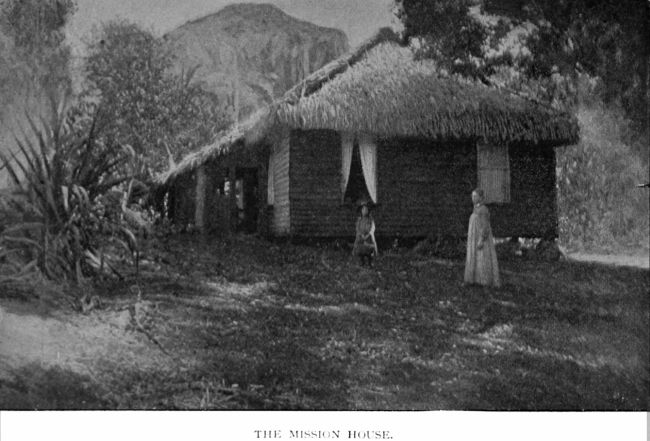
THE MISSION HOUSE.
The American ship Dauntless had come in during
the day, and Captain Wilbur waited until next morning,
when, on learning what had taken place, he kindly
offered to take the whole crew of the Cornwallis on
his ship, and give them a passage to New York,
whither he was bound. The ship was wrecked on
Saturday, and by Tuesday noon all her crew had left,
leaving only the poor remains of the good ship to
remind the people of the sad occurrence.
The September following another shipwrecked crew
was welcomed to the island. The Liverpool ship
Khandeish, homeward bound from San Francisco, was
wrecked on the reefs of Oeno Island, and the crew,
taking with them what could be saved from the ship’s
stores, and a little of their clothing, left in their big
boat and gig for Pitcairn Island. The wind favoring,
the short voyage was soon accomplished. As soon as
the shipwrecked mariners’ boats were seen, a crew of
the islanders put off in their boat—the gig that had
been left by Captain Hammond, of the Cornwallis—to
meet and welcome their unlooked-for visitors.
When all had landed, the crew of the ship was divided
into companies of twos and threes for their better
accommodation amongst the families with whom they
were to stay, and who all had gone down to the beach
to receive them. They were made welcome to the
homes of the people, and were soon like members of
the families where each sojourned, taking part in the
daily labors, and joining with them in their family
worship, as well as attending all the religious services
that were held. During their stay of fifty-one days
they behaved in a way to win the approval of all, and
when, on the 19th of November, they left on the British
ship Ennerdale for San Francisco, the parting on
both sides was expressive of much sorrow. One of
the men remained behind and was shortly afterwards
married to a widow to whom he had become attached.
The captain, officers, and crew of the Khandeish,
on their arrival in San Francisco, represented the condition
of the Pitcairn islanders as a very needy one
indeed, although the islanders themselves, accustomed
all their lives to the simplest manner of living, did not
realize so fully as their late guests did their “forlorn
condition,” as some of the papers expressed it. Of
the treatment they received while on the island they
spoke in terms of warmest gratitude, and did what
they could in return for the hospitality that had been
shown them. In this they succeeded beyond their
utmost expectations, for the generous citizens of San
Francisco responded with such heartiness that contributions
kept pouring in, and every useful and necessary
article that was thought of,—cooking utensils,
tinware of almost every description, cups, plates,
spoons, etc., etc., wooden pails and tin pails,—testified
to their large-hearted liberality. Clothing made and
unmade, buttons, pins, needles, etc., almost enough to
stock a respectable haberdasher’s shop, were contributed
to the immense stock of goods collected
in response to the call of charity and benevolence.
A good supply of flour, a luxury to the islanders,
was sent by Captain Skelly, of the Khandeish, as his
contribution to the general stock. As a crowning
gift to the whole, a beautifully-toned organ, of the
Mason & Hamlin Organ Company, was sent.
The gifts came on different ships, the first part being
brought by Captain D. A. Scribner, of the American
ship St. John, which arrived at the island in March,
1876. The captain was a very dear friend of the
islanders, having made repeated calls to the island
before. He was intrusted with a large mail from the
ship’s company that had lately left the island, and
whose letters were frequent in their expressions of
gratitude for the kindness that had been shown them
during their temporary sojourn, and were also full of
praise at the munificence and generosity displayed by
the good people of San Francisco, who had so willingly
responded to the call for charity.
To say that the islanders were grateful for the goodness
so lavishly showered upon them, would but faintly
express what they really felt. Grateful indeed they
were, yet none the less did they feel their unworthiness
that they should be the favored recipients of so much
bounty in return for the small acts of human kindness
rendered their fellow-men in distress, and which they
rightly considered were only their duty to do.
The organ was brought by Captain Scribner. Directly
on its being landed it was lifted on the shoulders
of a few strong men and borne by them up the steep
path, nor was the heavy but precious burden set down
until they reached the little thatch-roofed church,
where it was placed beside the reading table. All the
inhabitants, old and young, gathered around while
Captain Scribner played, “Shall We Gather at the
River?” Every voice joined in the song, and when it
ended, repeated expressions of thanks were given to
the kind friend who brought it, and through him to
the generous friends who sent the handsome gift.
Tears were in many eyes as the people stood around
and witnessed the substantial proofs of the kindness
they were receiving. It was a new and very delightful
experience to them to listen for the first time to
the tones of a perfect-keyed instrument. The only
other one of the kind that the island boasted was an
old harmonium, that, weak-lunged and out of tune,
had been given to a young woman by the doctor of
H. M. S. Petrel, which was on a day’s visit to the
island two months before. The old feeble instrument
had been taken to pieces and cleared from the rubbish
and dust that had accumulated within it, and otherwise
repaired, so that now, with its really sweet tones,
it served for the young people to practice their first
lessons in instrumental music, which they were not
slow to do, notwithstanding the fact that they had no
book or teacher to aid or direct them. And now,
when the new organ was opened, all who wished had
the gratification of trying a few chords on it, and enjoying
the power of the instrument, an experience
delightful as it was new. The donors themselves
would have felt rewarded had they seen how much
pure enjoyment their beautiful gift conferred, a gift
that was valued with keen appreciation by everyone.
Among the many and various presents sent from
San Francisco, the wants of the school were not forgotten,
and a large supply of schoolbooks came—books
new and old, and ranging from the first to fifth
and sixth readers. This want, so generously supplied,
was one of the greatest that had been experienced, and
the children as well as the teacher hailed with delight
the prospect of having a book all to one’s self, and no
longer being obliged to read from the same book turn
by turn. The change was truly gratifying, for before
this the school had for its best reader, speller, and
grammar an old copy of Lindley Murray excepted,
a few antiquated copies of good old Mavor’s spelling
book, dog-eared, and so literally worn out that in
places here and there the words were entirely obliterated
and many of the leaves had become loose and
dropped out through age and usage. The one venerable
copy of an old book of geography was succeeded
by a goodly number of others, which opened to the
children’s view a world hitherto undreamed of.
It would occupy too much space to give a detailed
account of everything sent to the people, every article
of which was gratefully received and thoroughly appreciated.
In recounting the deeds of generous kindness
lavishly bestowed upon the islanders from time to time,
it should never be forgotten how large a debt of gratitude
they owe to their friends both in Valparaiso and
Honolulu, as well as in England. But while they were
thankful for favors shown, the thought was none the
less humiliating that, in their peculiar circumstances,
they were obliged to be dependent upon the charity of
others for some of the very necessaries of life. Whaling
ships and trading vessels, the former sources of
such supplies, now ceased almost entirely to come to
the island. Had there been a way by which they
could, through their own efforts, procure all that was
needed for their necessities, the necessary labor would
have been willingly bestowed; but their extremely
isolated position rendered such efforts almost impossible.
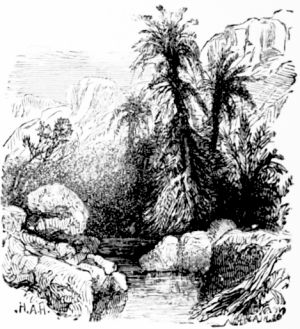
CHAPTER XIX.
VISIT of REAR-ADMIRAL DE HORSEY
EARLY Sunday morning, on the 8th of
September, 1878, the islanders were greatly
surprised at seeing a British man-of-war
to the north of the island. As the mist
and light rains that partly hid the ship from view
cleared away, she was seen standing in toward the
land, with the evident intention of communicating
with the shore. The one boat that the islanders
possessed was soon launched and on its way to the
ship. After a short stay it returned, accompanied by
others from the ship; which was H. M. S. Shah, the
flagship of the admiral commanding the Pacific station.
A large crowd from the ship came on shore, and as
they came in time for the morning service, the still
unfinished meetinghouse that was being built at the
time was furnished with seats formed by boards laid
across boxes, to accommodate the congregation, whose
number was doubled by the addition of the visitors.
The chaplain of the ship, Rev. J. Reed, took part in
officiating. The people greatly enjoyed the pleasure
of having Admiral De Horsey and his officers join
with them in their worship and service, and would
have been pleased to have them remain through the
afternoon, but the admiral was anxious to leave on the
evening of the same day, so their stay was unavoidably
short. However, he afterward kindly yielded to the
request to remain until the next day, to afford the people
opportunity to get some fruit and other things for
their visitors, as they felt that they could not conscientiously
allow themselves to do so on the Sunday.
Having decided to prolong his stay, the admiral gave
an invitation to all the islanders to come on board at
eight the next morning to visit his ship and have
breakfast there. Most of the people availed themselves
of the kind invitation and were ready at an early
hour for the anticipated pleasure. The day opened
calm and dull, with occasional light showers of rain,
which, while they dampened the garments, failed to
damp the spirits of those who visited the ship.
Breakfast was laid on a long table in the cabin, and at
the appointed hour a large party sat down with the
good admiral to partake of the bountiful feast he had
ordered.
The kind people on board seemed to vie with each
other in their efforts to entertain and please, showing
their visitors about their huge home on the waters, and
how they lived, enjoying, too, the evident wonder and
admiration displayed by their guests as they watched
the revolving of the mighty engines, and also the keen
pleasure and interest they manifested in everything
they saw around them. On deck the band was playing,
while in one of the rooms below one of the officers
was seated at a piano, making music for a company
of admiring listeners. In the gun room the
crowd of young officers had gathered the schoolchildren
together, and persuaded them to sing some of
their songs and glees, they in return singing some of
their bright, lively songs. The hours flew quickly,
and soon one by one the islanders passed down the
steep sides of the ship to return home, after wishing
their kind visitors good-by, and carrying with them a
lively remembrance of their delightful entertainment
on board, while the Shah, with her over eight hundred
souls, steamed on her way and was soon out of
sight.
The following is the report of Rear-Admiral de
Horsey, commander in chief on the Pacific station,
which was received at the admiralty:—
“September 17, 1878. Sir, I request you will acquaint
the lords commissioners of the admiralty
that, as Pitcairn Island lay in my track from Esquimalt
to Valparaiso, and the weather being sufficiently
favorable for landing, I took advantage of the circumstance
to visit that island, for the purpose of ascertaining
the condition of the inhabitants, and also to
obtain refreshments on this long voyage. Having
sighted Pitcairn at daylight on the 8th inst., we arrived
at Bounty Bay at 8 A. M., and remained off the island
until noon the following day, when we proceeded on
our voyage.
“A few particulars as to the present condition of this
small and almost inaccessible island, the only spot of
British territory lying in the vast triangle between Vancouver,
Falkland, and Fiji Islands, may not be uninteresting
to their lordships, and are therefore made the
subjects of this letter. The population at present numbers
ninety, of all ages, of which forty-one are males
and forty-nine females.... There is but one survivor
of the generation which immediately followed
the mutineers, viz., Elizabeth Young, aged about eighty-eight,
daughter of John Mills, gunner’s mate of the
Bounty, and of an Otaheitian mother.
“The oldest man on the island is Thursday October
Christian, grandson of Fletcher Christian, master’s
mate of the Bounty. The population may be further
described as consisting of sixteen men, nineteen women,
twenty-five boys, and thirty girls. The deaths on the
island have numbered about twelve in the last nineteen
years, as no contagious diseases visit the island....
“A few medicines which were sent from Valparaiso
in H. M. S. Reindeer (in 1869) are administered as
required, by the pastor. Pitcairn Island is governed
by a ‘magistrate and chief ruler in subordination to
her Majesty the Queen of Great Britain,’ who not only
administers the laws, but also enacts them. There are
two councillors to advise and assist the chief magistrate,
besides which, the ‘heads of families’ are convened
for consultation when required.... The
chief magistrate is elected annually on New Year’s
day, and is open to reëlection. Both sexes of and
above the age of seventeen have a vote. The office
is at present filled by Mr. James Russell McCoy, who
is also steersman of the only boat on the island....
Divine service is held every Sunday at
10:30 A. M. and at three P. M., ... and it is
conducted strictly in accordance with the liturgy of
the Church of England, by Mr. Simon Young, their
selected pastor, who is much respected. A Bible class
is held every Wednesday, when all who conveniently
can, attend. There is also a general meeting for
prayer on the first Friday of every month. Family
prayers are said in every house the first thing in the
morning and the last thing in the evening, and no food is
partaken of without asking God’s blessing before and
afterwards. Captain Beechy, writing fifty-three years
ago, says: ‘These excellent people appear to live together
in perfect harmony and contentment, to be
virtuous, religious, cheerful, and hospitable, to be patterns
of conjugal and paternal affection, and to have
very few vices.’ I have ventured to quote those words,
as they hold true to this day, the children having followed
in the footsteps of their parents.
“The observance of Sunday is very strict; no work
is done; but this is not in any pharisaical spirit, as
shown on the occasion of our visit, which chanced to
be on a Sunday, when everything consistent with not
neglecting divine service was done to supply us with
refreshments for the crew, the chief magistrate arguing
that it was a good work, and necessary, as the ship
could not wait. Of these islanders’ religious attributes
no one can speak without deep respect. A people
whose greatest privilege and pleasure is to commune
in prayer with their God, and to join in hymns
of praise, and who are, moreover, cheerful, diligent,
and probably freer from vice than any other community,
need no priest among them. The pastor also
fulfills the duty of schoolmaster, in which he is assisted
by his daughter, Rosalind Amelia Young. The instruction
comprises reading, writing, arithmetic, Scripture
history, and geography. The girls are taught
sewing and hat making as well, and the whole are
taught part singing very effectively.... Schooling
is conducted in the church house, one end of which
is used as a library, open to all. English is the only
language spoken or known. [And a corruption of
the same.]...
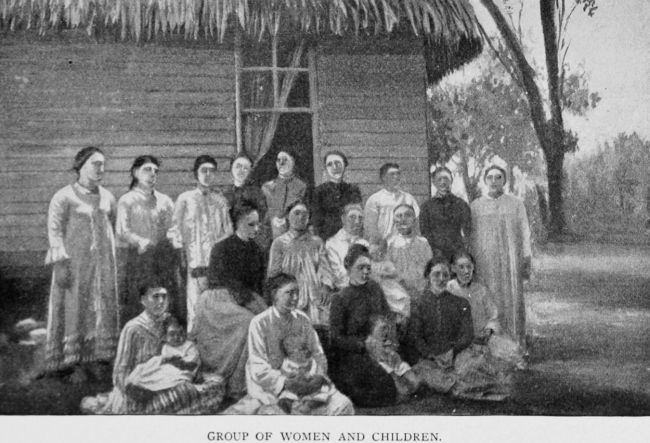
GROUP OF WOMEN AND CHILDREN.
“The Pitcairn islanders are, of course, entirely dependent
upon their own resources. They grow sweet
potatoes, yams, plantains, etc., and formerly plenty of
breadfruit, but these are nearly all dying out. They
have also beans, carrots, turnips, cabbages, and a little
maize, pineapples, custard apples, and plenty of oranges,
lemons, and cocoanuts. Clothing is obtained alone
from passing ships in barter for refreshments. They
have a few sheep, goats, pigs, fowls, cats, and dogs. As
it rains generally once a month, they have plenty of
water, although at times in former years they have suffered
from drought. No alcoholic liquors, except for
medical purposes, are used, and a drunkard is unknown.
The houses are well ventilated, and furnished sufficient
for their simple wants. Scarcely any trees good for
timber grow here.... The men are chiefly employed
tilling their grounds, farming, house building,
canoe fishing, etc.; the women, in sewing, hat and
basket making (in addition to their other household
work). All are industrious, and willing to take their
share of public work when required. This, at present,
is enlarging the church house, to meet the wants of an
increasing population.
“The only communication with the outside world is
by means of passing ships, averaging perhaps one a
month, and chiefly those on their way to and from
California; but this is precarious, as most ships fetch
to windward of Pitcairn, and those that do sight the
island are frequently unable to communicate. At the
time of our visit the landing was considered good, but
it was necessary to watch for a smooth place, and to
use a light boat. They have no communication with
Otaheite, and very rarely with Norfolk Island or New
Zealand.
“The necessary articles required by the islanders
are best shown by those we furnished in barter for
refreshments, viz., flannel, serge, drill, half boots, combs,
tobacco, and soap. They also stand much in need of
maps and slates for their school, and tools of any kind
are most acceptable. I caused them to be supplied
from the public stores with a Union Jack for display
on ships’ arrival, and a pit saw, of which they were
greatly in need. This, I trust, will meet the approval
of their lordships. If the munificent people of England
were only aware of the wants of this most
deserving little colony, they would not go long unsupplied.
I would suggest that anything desired to be
sent be addressed to the care of the admiral on this
station, either at Coquimbo or Vancouver Island. If
sent by private ships, goods may never reach the
island. Within the last two years or so two wrecks
have occurred—the English ship Khandeish, on Oeno
Island, and the English ship Cornwallis, on Pitcairn
Island. In both cases the crews took refuge on Pitcairn
Island, remaining respectively over six weeks
and three days, and receiving every assistance, including
food and clothing, from the scanty supplies of the
Pitcairn islanders. At the wreck of the Cornwallis
the islanders in rendering assistance lost their only
boat, one made by themselves, and thus their only
means of communicating with passing ships....
“One stranger, an American, has settled on the
island—a doubtful acquisition. A few of the islanders
have expressed a wish to return to Norfolk Island—a
not unnatural wish for change—but the chief magistrate
thinks none are likely to go. The islanders, at
my invitation, visited the Shah. No less than sixty-eight
men, women, and children, out of a total of
ninety, came on board, regardless of the difficulties of
embarking, and the wind and rain. Their poor garments
were nearly wet through, and many were sea-sick,
but the pleasure of going on board one of their
own country’s ships of war outweighed all other considerations,
and made them essentially happy.
“Finally I submit to their lordships that when the
service will admit it is desirable that a ship of war
should visit Pitcairn annually, and I propose to cause
this to be done during the remainder of my command.
I submit also that this small colony is deserving such
attention and encouragement as Her Majesty’s government
may think fit to hold out to it. Her Majesty
the Queen does not, I believe, possess in any part of
the world more loyal and affectionate subjects than
this little knot of settlers. I may here observe that
a notion appears to prevail among the Pitcairn islanders
that Her Majesty’s government is displeased with
them for having returned from Norfolk Island (which,
as their lordships are aware, they did in two parties,
the first in 1859 and the rest, I believe, in 1864),
although their return was, I believe, at their own
expense, and they have since been no burden to the
Crown. This notion, whence received I know not, I
venture to affirm was without foundation, feeling assured
that Her Majesty’s government would rather
honor them for preferring the primitive simplicity of
their native island to either the dissolute manners of
Otaheite or even the more civilized but less pure and
simple ways of Norfolk Island.... They will
lose rather than gain by contact with other communities.”
I have etc., etc. A. F. R. de Horsey,
“Rear-Admiral and Commander in Chief.”
In July, 1879, the year following the visit of the
Shah, H. M. S. Opal came, bringing a beautiful
organ of American manufacture—Clough & Warren’s—as
a gift from the Queen, Her Majesty having sent
the sum of £20 to Admiral de Horsey for the benefit
of the Pitcairn islanders. This he expended in the
purchase of the above-named gift, thinking, and rightly
too, that the money could not be spent in a more
satisfactory way. The organ is ornamented with a
heart-shaped silver plate placed in the center above
the keyboard, bearing the inscription, “A present
from Her Majesty the Queen to her loyal and loving
Pitcairn Island subjects, in appreciation of their domestic
virtues.” This gift was received with pardonable
pride that the Queen should condescend to
remember the little isolated colony, as well as with
feelings of true loyalty toward, and love for, their
sovereign. When the captain of the Opal seated himself
at the instrument and struck a few chords of the
national song of Great Britain, there was not a voice
that did not join heartily in singing, “God save the
Queen.”
Besides the organ, the result that immediately followed
the admiral’s appeal to the “munificent people
of England” was seen in the abundant and varied substantial
gifts sent to the island on H. M. S. Osprey in
March, 1880. When the admiral’s account of his
visit was published in England, a ready response was
made to his appeal by many friends there, and subscriptions
were immediately set on foot. The chairman
of the committee to direct matters and dispose
of the various subscriptions, the Rev. Andrew A. W.
Drew, a clergyman of the Church of England, particularly
exerted himself in the interests of the islanders,
he and his wife attending personally to the packing
of the many boxes that contained the gifts, the
task being a most wearisome one, as, owing to the long
way the boxes had to come, they needed to be packed
with the greatest care. Every article that was sent
was of the best. A large supply of schoolbooks and
the much-needed slates and pencils also came, a gratefully
received addition to what the good people of San
Francisco had previously supplied. Especial mention
should be made of the handsome gift of a number of
Oxford Bibles—teachers’ editions and others. Each
Sunday school teacher was furnished with a teacher’s
Bible, which was valued accordingly, and the happy
possessors felt that on them were bestowed the richest
gifts that England sent.
The beautiful and costly present of two boats was
also received, and that too with feelings akin to shame
that so much thought and kindness had been bestowed
on the islanders, whose part in receiving far surpassed
that of the “more blessed” giving. One of the boats
was named “Queen Victoria,” and it bears an inscription
to the effect that it was a gift sent in recognition
of the “gallant services rendered by the islanders in
saving life.” The other boat, a whaleboat, was named
“Admiral Drew,” in remembrance of the father of the
Rev. A. Drew, the gentleman above mentioned. Mr.
Drew had had the latter boat built strictly in accordance
with his own directions, and the beautiful little
craft answers admirably the purpose for which it was
intended, viz., battling with the heavy surf that so
frequently beats upon the shore.
Thus much in regard to the response made to the
admiral’s appeal by the large-hearted donors in England.
A volume could, however, be written respecting
the numberless gifts from private individuals and
others, that have from time to time been showered
upon the people of this remote spot of earth, gifts
that have been received with gratitude mingled with
a feeling of unworthiness on the one hand, and of
dependence on the other, enabling the recipients to
experience in all its force the truth of the expression,
“It is more blessed to give than to receive.”
An attempt had been made two years previous, by
a firm in Liverpool, De Wolfe & Co., to establish some
sort of business on the island, the planting and raising
of cotton, preparing cocoanut and candlenut, and
also arrowroot, by these means to enable them to
supply their simple wants through their own exertions.
But the little island was too far removed from
any business center to make it a paying concern, and
in less than two years after the attempt was made it
was broken up.
CHAPTER XX.
FRIENDLY VISITS
ABOUT the middle of the year 1880
seven of the youth from Norfolk
Island came on a visit to the old home
of their parents. Scarcely any communication passed
between the two islands, so that the event of their
coming was improved in learning all about the state
of the island and people they had lately left.
The friends of the young men noticed with surprise
that, with but one exception, they were all slaves to
the tobacco habit, both chewing and smoking, for not
one among the youth of the island practiced the
unclean vice. The captain of the whale ship with
whom they had come was himself a total abstainer as
regarded both tobacco and spirits, but all his endeavors
to reform the young men under his command,
example and precept notwithstanding, failed to have
the desired effect. He was more successful when he
attempted a reform among the old men of the island,
in one case at least, as the following incident will show.
In a meeting held on Sunday evening the captain
addressed himself to the tobacco users, seven in number,
and those, five at least, the oldest men in the
community. He spoke very strongly against the bad
habit to which they were addicted, and its consequent
evil results. Some of his hearers were for the moment
impressed with his appeals, and two of them almost
decided to abandon the vice forever. They respected
their would-be reformer enough not to indulge in the
practice in his presence. On the following morning,
as one of the men was walking along the road with a
lighted pipe in his mouth, he espied the captain a few
yards ahead of him, waiting to give him a warm
morning greeting. Regardless of the consequences,
in the fear of being found out, he quickly caught the
heated clay pipe from his lips and thrust it into his
pocket, which was as quickly burnt through. Though
smarting with the pain, he bravely shook hands with
the captain and passed on, not daring to betray his
pipe, even at the cost of suffering. But it was the last
struggle he had with the habit, for from that day it
was abandoned, and he was made free, yet “so as by
fire.”
It was during this same year, 1880, that an unusual
and very peculiar visitation appeared among the community,
affecting only the younger members, eleven or
twelve young persons in all having been subject to it.
The disease, if such it may be called, was temporary
insanity, the case that lasted the longest not extending
over two years. The first symptom of the attack
was a strange hallucination of the mind, the person
affected seeing some object which greatly terrified
him, or hearing voices calling to him, then gradually
losing all recollection of former events, until the mind
became an utter blank. One peculiar feature of the
disease was a distorted vision, that transformed every
object into something different to what it was, as, for
instance, a full-grown man or woman appeared as but
a child, while a mere baby would assume the full proportions
of a man. In almost every case the patient
was calm and quiet; the power of speech seemed taken
away, while the vacant stare showed that the mind
had lost control over itself.
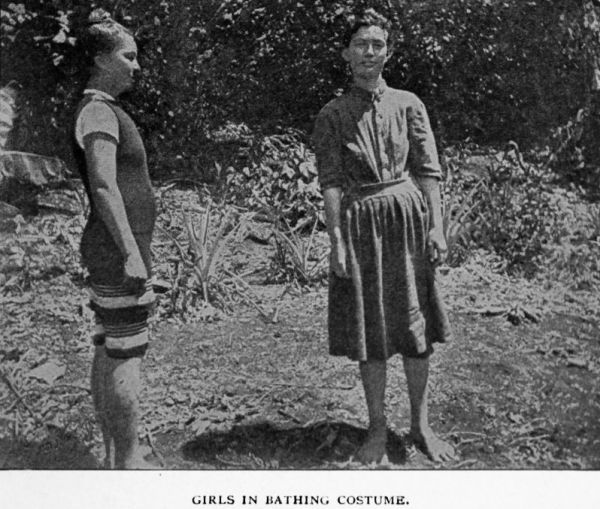
GIRLS IN BATHING COSTUME.
One case was that of a youth who had been shipwrecked,
and whose stay was prolonged on the island.
This was in 1881. One morning he declared that
during the night he saw his mother’s coffin pass above
him out of the window, and nothing could persuade
him that it was a delusion. A few hours afterwards
he became oblivious to everything that was going on
around him, and in the very first stage of the disease
was entirely deprived of the power of speech. When
speech returned after a few days, he employed himself
searching from house to house for some fancied
friend who was unjustly condemned to prison, and
whom he was sparing no effort to release. On one
occasion he wandered away during the night to the
opposite side of the island, where he was found by a
party who went in search, sleeping under an overhanging
rock, wrapped up in his scout’s blanket, for
at that stage of his derangement he declared that he
was Davy Crockett out on an Indian trail. Davy
Crockett was only one out of the many different characters
whom he personated in the different stages of
the disease.
Many and various were the phases that the
disease assumed, each patient being acted upon in
a different manner. There has never been any satisfactory
explanation of the cause that produced it.
The case above mentioned as being of longest duration
was that of a young girl whose mind became
affected in April, 1884, and was restored in the early
part of the year 1886. Since that time the peculiar
disease has not made its appearance.
In the early part of 1881 two young men left the
island to venture for the first time as far as England.
There every kindness that could be shown them
was bestowed. One of them, however, almost immediately
on landing, was secured as a highly prized
specimen of the human species, to be exhibited in the
Westminster Aquarium. Entirely ignorant of the
intention of the parties who had obtained him, he consented
to their proposal to accompany them, and they
were soon speeding away from Liverpool to London,
where he was duly settled in his place in the aquarium,
and advertised. “Does he eat like other people?”
was one of the many questions that amused him,
as it was earnestly put by one of the spectators. A
bluff old sea captain was very indignant that he had
to pay for the privilege of seeing an old acquaintance
whom he had twice visited in his far-away island home.
But he was not kept long in his unenviable position,
for the Rev. A. W. Drew, a clergyman of the Church
of England, no sooner learned of the facts of the case
than he immediately came to the rescue. He at once
had the visitor from Pitcairn Island, whose health was
much impaired, removed to his own home, where he
was taken care of and waited upon in his hours of
weakness and suffering with every attention and care
that kindness and love could suggest. Even when his
life was all but despaired of, the good clergyman and
his estimable wife never gave up their hope and trust
in God that He would bless the efforts that were made
to restore their guest to health again. Their house
was his home during the rest of his stay, and the
unwearying love and care manifested by the many
friends who came to see him, as well as by the clergyman
and his family, made an impression upon his mind
that could never be effaced. The other visitor shared
the same kindness and attention that were so lavishly
bestowed upon his companion, the worthy people of
Hull, to which port his ship went, doing all that lay
in their power for him while he stayed with them. On
their arrival in San Francisco they experienced everywhere
they went the utmost favors that thoughtfulness
could suggest or friendship could show.
In June of the same year another of the young
men from the island left for England. The two who
preceded him returned home after an absence of one
year and two years respectively, but the third, Richard
Young, never came back, and after a period of nine
years’ absence, died in Oakland, California.
In the meantime another shipwrecked crew had
been thrown upon the hospitality of the islanders.
The English ship Acadia, outward bound from San
Francisco, in about a month from leaving that
port, was wrecked on Ducie Island. As soon as it
was ascertained that the ship could not be saved, preparations
were made to abandon her. The crew were
able to save a considerable portion of their clothes,
and, putting into their two boats as much provision as
they could safely carry, made sail for Pitcairn Island,
stopping for a day at Elizabeth Island. On leaving
the ship, one of their number, the boatswain, received
the untimely discharge of a pistol in his body, which
fortunately did not prove serious.
On leaving Elizabeth Island, the wind, being in their
favor, enabled them to make a speedy passage to the
place whither they were bound, and on the morning
of the second day the shipwrecked mariners were gladdened
by the sight of the English flag hoisted on the
high peak above the landing place. As before, the
men were taken in by the different families, in twos
and threes, until they should have an opportunity to
leave. This soon occurred, Captain George, the first
officer, Mr. John Simpson, and two or three of the lads
that were with them on the Acadia, leaving on the
American ship Edward O’Brien, for England.
It may not be out of place to say here that, the trial
that awaited them having terminated favorably, Captain
George and Mr. Simpson each accepted a berth on
board the steamer Escambia, the former occupying
the position of first officer, and Mr. Simpson a grade
lower. The Escambia left London for China, going
thence to San Francisco, where, after loading, an
attempt was made to put to sea before the cargo had
been properly adjusted. This imprudent act ended
disastrously, for the vessel keeled over and sank in a
few minutes. Most of those on board went down
with the ship, and amongst those who thus perished
were the late captain and mate of the ill-fated
Acadia. Of the rest of the crew left on the island,
three took passage for England on the American ship
Alfred D. Snow, and, later on, the remainder returned
to San Francisco, with the exception of three, who chose
to remain on the island, and a youth, whose home and
parents were in San Francisco, but who had been unfairly
left behind. Nor did he have an opportunity to
return home until after a nine months’ stay on the
island.
Two of the men whose choice was to remain were
after a while married, one making his home on the
island, while the other, after a stay of three years, left
with wife and two little children for his home in Wales,
where the wife and mother died in less than a year.
The third, the carpenter of the ship, had also decided
to follow his two shipmates’ example, and succeeded,
not wisely but too well, in winning the affections of a
girl who was shortly to be married to one of the island
men. But the unfortunate attachment ended unhappily,
for some of the young woman’s relatives, indignant
at the turn of affairs, set themselves to put the
matter right, according to their judgment, and enlisted
the sympathies of the magistrate in their favor. He
soon had an opportunity, from a fancied insult to himself,
to order the Englishman off the island. The act,
unjust in itself, was carried out, and he left the island
on the British man-of-war Sappho, in July, 1882.
Captain Clark, of the Sappho, did not conceal his
opinion of the whole proceedings, but openly declared
the injustice of the act. However, in accordance with
the magistrate’s strongly expressed wish, he received
the carpenter on board his ship, and gave him a
passage to Honolulu, where he obtained suitable
employment.
In letters received from him he denounced bitterly
and in unsparing terms all who had shared in the unworthy
strife that ended in his being sent away. Before
leaving, Captain Clark, by special request, framed a
law which forbade henceforth the marriage of a stranger
to any of the islanders, with the intention of settling
amongst them. Several reasons were given why such
a law should be made, the principal one being that the
population was increasing quite rapidly enough without
any addition from the outside. The law was afterwards
amended by a clause stating that should anyone
whose stay could benefit the island, wish to settle there,
he might do so. But as the island offered no inducement
whatever to anyone outside of its own inhabitants
as a desirable place for a home; there was no
danger of any addition to the population from outsiders,
and the law might have remained as it was originally
written.
CHAPTER XXI.
The WRECK of the OREGON
TWO YEARS had passed away after the
crew of the Acadia found a haven on
Pitcairn Island, when one night, the
23d of August, 1883, as the islanders were about to
retire to rest, they were startled by shouts and the
blowing of a fog horn from over the waters. That
another shipwreck had occurred somewhere near was
evident, and the men, hastily mustering, went forth with
lanterns into the night, and were soon at the landing
place. Having launched a boat, a few minutes’ rapid
pulling brought them to the object of their search. It
proved to be a boat which had belonged to the bark
Oregon, now a wreck on the reefs of Oeno. She had
been about a month out from Oregon on her way to
Chile when she struck on the reefs that surrounded the
low-lying island of Oeno. All the crew, and three
passengers, a widowed lady and her two infant boys,
landed safely on Oeno Island. The position of the
ship after she struck was such as to enable the crew
to remove everything they wanted, so that they were
comfortably settled during their enforced stay.
When all had been made as comfortable as circumstances
permitted, the captain, Hardy by name, and his
mate, Mr. Walker, after consulting together, decided
that the captain should take their small boat and seek
a passage through the heavy surf that broke continuously
on the reef surrounding the lagoon, and should
he succeed in accomplishing it safely, the rest were to
follow in the two other boats, with as much of the
goods as they could prudently carry. Captain Hardy,
accompanied by one of the sailors and the cook, left
the shore. Just when the boat had passed beyond
the smooth waters of the lagoon out into the breakers,
it capsized, and the poor captain was drowned.
The mate’s boat, following almost directly, passed
safely through the rolling surf, and in passing, the two
men who were clinging to the upturned boat, were rescued.
With this addition to his crew, the mate, not
returning to tell those behind of the captain’s fate, at
once steered in the direction of Pitcairn Island. The
weather being fair and the wind favorable, they reached
their destined place on the second night out.
Most of the men in the mate’s boat were Chileans,
and were scarcely able to speak any word in the English
language. All were received and sheltered, a
disused little building having been fitted up for their
accommodation, and after a rest of two nights and a
day Mr. Walker, leaving his own men behind, took a
crew of the islanders and returned to Oeno, in search
of the remainder of the ship’s company. But these
had not waited his return, for, having been left without
a word as to what had occurred after the captain’s
futile attempt to effect a passage, they had launched
their big boat, and, placing therein the trunks belonging
to the lady, Mrs. Collyer, who, with her children,
accompanied them, they too followed the way that
the rest had taken. A big Irish sailor took command
of the boat and found some difficulty in managing the
rest of the men who were with him, and who certainly
showed no disposition to willingly obey his orders.
Though he possessed very limited knowledge in the
art of navigation, yet, under the guidance of a merciful
Providence, their boat came in all right, and the
day after the mate had gone, the crew of tired men,
who had rowed almost the whole distance, beheld, with
a feeling of true thankfulness, the sight of land and
the prospect of rest. The poor woman, too, was worn
out with anxiety, and the care and attention bestowed
on her when she arrived in the midst of friends were
most gratifying.
Hers had been a sad experience. Her husband,
the Rev. J. W. Collyer, whose field of labor had been
in Chile, was going, for the benefit of his health, on
a visit to his mother in the United States, and had
engaged a passage for himself and family on the
bark Oregon, for the State of the same name. Only
a few days out from the South American Coast his
sickness took a sudden turn for the worse, and unexpectedly
and with but a few minutes’ warning he died,
leaving not one word to comfort and cheer his almost
broken-hearted wife. She had to endure the further
pain of having him buried at sea, and in her widowed
state, among strangers, she made the voyage to Oregon.
She was now returning to her father’s house in
Lola, Chile, when the unlooked-for disaster happened,
depriving her of the hope of soon seeing her family
and friends. But their stay on the island was of short
duration, for, ere the return of Mr. Walker from Oeno,
all had been again received on board the British ship
Leicester Castle, in command of Captain Boag, on his
way to San Francisco.
Arriving at Oeno Mr. Walker’s first care was to
secure the lady’s box of jewelry, which he guarded
with jealous care, but reached Pitcairn just an hour
too late to deliver the box into the lady’s own hands,
as the Leicester Castle was about to make sail when
the mate’s boat appeared, the islanders having supplied
whatever they could spare from their own
slender stock of provisions to help the heavy demands
made upon the stores of the Leicester Castle by the
addition of a whole crew of shipwrecked men. After
a long and tedious passage Captain Boag at length
arrived in port, where the crew of the late Oregon were
speedily discharged. Mrs. Collyer also left almost
immediately for home, where she arrived safely in due
time, and where her box of treasures reached her
after a few months’ delay. On his arrival in England
Captain Boag suffered some inconvenience on account
of his having taken so many of the shipwrecked
men on board his ship, and drawing so heavily on his
own limited resources to supply their wants.
On the 6th of November the last survivor of the
generation immediately succeeding the mutineers
passed away. Elizabeth Young, nee Mills, and whose
first husband was a son of Quintall the mutineer,
died at the ripe age of ninety-three. Her struggles
with the last enemy were protracted, as if life was so
hard to yield up. While speech lasted, she seemed
to live over again the days when, as a child, she was
instructed by John Adams, and while tossing about
on her bed and during her calmer moments, she never
ceased repeating the prayer that John Adams taught
his youthful flock to repeat before retiring to rest: “I
will lay me down in peace and take my rest, for Thou,
Lord, only makest me to dwell in safety. Into Thy
hands I commend my body, soul, and spirit. Thou
has redeemed me, O Lord, Thou God of truth.” The
second year following the death of old Elizabeth
Young—called by everybody “ma-ma”—saw more
deaths than had happened in any previous year since
the island was reinhabited, four deaths occurring
among the community during the year 1885.

CHAPTER XXII.
ARRIVAL of MR. JOHN I. TAY
OWING to the extremely isolated situation
of Pitcairn Island, and the uncertainty
that attends every effort to reach it again should
one venture beyond its narrow limits, the islanders had
hitherto, with very few exceptions, been satisfied to
spend all their lives together, rather than run the risk
of leaving their lone island home without having an
idea when they would see it again. In a period of
twenty-seven years only five had left the island to visit
other places, all being men; but in January, 1886, for
the first time an island woman left her home and family,
to begin life anew in a distant land. To leave
behind and forever the scenes of earlier years, the fond
parents and brothers and sisters, and the old life of
simple duties and pleasures, to enter upon a scene of
life new and untried—indeed, scarcely dreamed of—needed
great courage. This she displayed, being
guided by her high sense of the duty she owed her
husband, who, after a stay of five years and a half, was
about to return to his native land.
The pain of parting from parents, whose tender love
had watched over her whole life, and from brothers,
sisters, and friends who cherished her, and who prized
her love and friendship, was bravely borne. Only a
short time, less than a day, was allowed them in making
preparations for their departure, and when the
hour of parting came, the procession that followed
them to the landing place was like that of a funeral,
as all knew that the separation would be final. In
less than a year after reaching her new home she
passed away, the cold winter in a foreign land proving
too severe for a constitution always delicate.
In October of the same year, 1886, on the eighteenth
day of the month, there arrived the British
man-of-war Pelican, whose captain had courteously and
kindly received on board, at Tahiti, an American
missionary, John I. Tay by name, a member of the
body of Christians known as Seventh-day Adventists.
Wishing to reach Pitcairn Island for the purpose of
setting before the people what he believed were truths
hitherto unknown to them, he found passage, as before
stated, on board the Pelican. He was treated by all
the officers and men with the greatest consideration
and courtesy, and was successful, during the passage,
in awakening sufficient interest among some of the
ship’s company to lead them to inquire and search
further into the subjects presented in the books they
received from him.
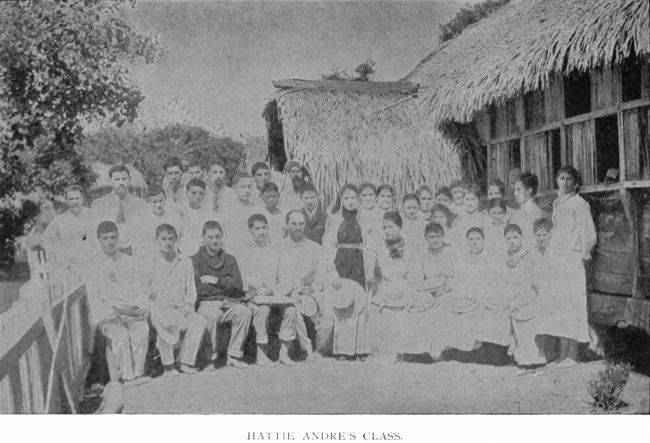
HATTIE ANDRE’S CLASS.
As no objection was raised by the people in regard
to the question whether the missionary would be
allowed to stay, he was left on the island when the
Pelican went away. Ten years earlier a large package
of Seventh-day Adventist publications had been
sent to the island, accompanied by letters from two of
the leading ministers of that body, Elders James
White and J. N. Loughborough, earnestly requesting
the people to give a candid, careful reading to what
had been sent them. The letters were read, but the
pamphlets and tracts were regarded with suspicion,
and their contents were examined very cautiously at
first.
Further study awakened deeper interest, until to
the minds of four-fifths of the people there came the
conviction that the statements regarding the Sabbath,
supported by an array of proofs from the Bible itself,
were too convincing to be longer denied. Yet no one,
until the coming of Mr. Tay, left Sunday keeping and
accepted the seventh day as the Sabbath. This was
done the second week of the missionary’s stay, and
before Mr. Tay left the whole community was observing
and thoroughly believing in the seventh day as
the Sabbath of the Lord.
A careful study of the different points of doctrine
held by Seventh-day Adventists, led first to a conviction
on the part of the people that their positions were
correct, and finally to their acceptance of them,
although they felt that this would be a matter of
regret, if not of positive displeasure, to many who had
hitherto expressed, and shown in a most substantial
manner, the warm interest they had always felt in the
island of Pitcairn and its people. While this to the
islanders was sad to contemplate, they felt that they
could not do otherwise than follow their convictions
of duty.
After the departure of Mr. Tay, who left in the last
week of November, 1886, some differences arose in
regard to the manner of worship, and in the interests
of harmony and Christian union a meeting was convened
to talk over and consider the matter and adopt
some plan of worship in which all could unite. This
was in March, 1887, and the result of the meeting was
that the Book of Common Prayer was laid aside.
For a year the islanders had been observing the
seventh day as the Sabbath, and it was a question with
them how the change would be accepted by the representatives
of the British Government, under whose
protection they were, when a man-of-war should arrive.
Therefore, some little concern was felt when, in December,
1887, H. M. S. Cormorant came. The day
was Sunday, and the visitors, noticing the fact that the
day was not being kept as a sacred time, were curious
to know the reason why. One question followed
another, until the whole story was told. Perhaps the
following extract from an English periodical, written
by one of the gentlemen on board the Cormorant, best
tells how the change was regarded. After a brief
description of the island and how it was peopled, the
writer goes on to say:—
“It will be a matter of regret, therefore, to many
who are interested in the little community to hear that
within the last year or two their principles have undergone
a revolution, and that they have enrolled themselves
among the Seventh-day Adventists—a sect originating
in the United States. It was with natural surprise
that I heard of this change, and, in the course of
conversation, found that its cause was a visit to the
island of an Adventist missionary who remained some
weeks, inculcating the doctrines of his sect among the
islanders. He could have found no better soil in which
to sow his doubtful seed. Very earnest and anxious
to learn, implicit believers and reverencers of the Bible,
the simple islanders, ignorant of sophistry and the
subtleties of scriptural deductions, listened attentively
to the arguments of their fanatical visitor, who, taking
the Bible as his standpoint, soon convinced them of
the soundness of his views.... The island was
flooded with Seventh-day Adventist literature, emanating
from the headquarters of the sect in Michigan, and
the islanders were full of the enthusiasm of converts
in the pursuit of their new creed.”
The article from which the foregoing extract was
taken, concludes with a very pleasing description of
the writer’s feelings on awaking in the morning and
hearing the voice of praise and prayer ascending from
more than one family altar, a custom begun by John
Adams, the converted mutineer, and which continues
still.
The visit of the Cormorant will always be among
the bright and pleasant remembrances of the island,
although she stayed only two days. On the first day
every youth and child, as well as many adults, underwent
the light operation of being vaccinated. The
act was in itself simple enough, but the virus used
was so powerful that many of those who had for the
first time been inoculated, were for several days utterly
prostrated with severe headaches and shooting pains
throughout the whole body. In many cases the
wounds showed a strong disinclination to heal, and so
great was the flow of pus that it necessitated the constant
use of bandages until the lengthy process of
healing was accomplished.
Captain Nicolls gave an invitation to all who so
wished to visit his ship and enjoy a pleasant entertainment
on board. The after part of the deck had been
prepared for the entertainment, and from side to side
of the ship was a great display of bunting, prettily
festooned to form a partition. The captain presided
at a large piano, while at his side stood one of his
officers, accompanying on the violin, which instrument
contributed largely to the music, two or three more
being skillfully played by as many of the ship’s company.
The loud cheers that greeted every fresh performance
were heard on shore, and when the first star
of evening appeared, the islanders sang for their closing
piece, “Twilight Is Stealing over the Sea.” Then
all rose to finish the evening’s enjoyment by singing
“God Save the Queen,” after which the island boats,
with their human freight, started homewards, and the
Cormorant steamed away to her destination, bidding
good-by with her siren whistle.
CHAPTER XXIII.
THE MISSIONARY SHIP PITCAIRN
IN January of 1889 one of the saddest accidents
that ever happened on the island
occurred. A young man twenty-four years
of age went out one day to search amongst the rocks for
young sea birds. He was accompanied by two of his
younger brothers, who held a rope, while he descended
to a very dangerous place in the rocks. His brothers
urged him in vain not to go, but no amount of persuasion
would avail, and he pursued his purpose. He
had taken a few birds and was about to try to get
another a few feet above him in a small hollow in the
rock, when he lost his footing and fell several hundred
feet into the pitiless sea below. Breathless with haste
and pale with horror, the two other boys came back
to tell the awful story of what had taken place. The
horror felt by everyone was great, and the piercing
cries of the mother and the wife of the young man
rent the air as they ran toward the scene of the fearful
accident. In as short a time as possible a boat
was manned and pulled by arms nerved to their
utmost strength to the spot where the young man’s
body fell into the water. But nothing came of the
search, although it was kept up for days. All that
was ever found was a hat belonging to him, and which
had floated a long distance from the place where he fell.
Toward the middle of the same year an excitement
of a different character was experienced. When the
Cormorant visited the island in 1887, which was the
year of the Queen’s Jubilee, the captain and officers
inquired whether the little community had contributed
anything toward a celebration of the event. When
the answer was given in the negative, they said that
the Queen would acknowledge a gift, however small.
Being thus encouraged, a box containing some specimens
of the people’s handiwork was put up as soon
as possible, and sent to their sovereign.
Her Majesty was graciously pleased to receive the
humble token of loyalty and love, and sent an acknowledgment,
accompanied by a gift of the coins struck
on the occasion of her Jubilee, varying in value from
a sixpenny piece to four shilling pieces. These were
to be distributed among the women and girls, and
Captain Nicolls, of the Cormorant, on his second visit,
had the pleasant duty of distributing the gift, which
the receivers were proud to get and keep in remembrance
of their beloved Queen. The ceremony over
the Cormorant left, but before the return voyage was
half accomplished, Captain Nicolls, at Rio Janeiro,
took the yellow fever and died. He was buried at sea.
A new decade was now entered upon, and in the
opening month of 1890 the people celebrated, on the
twenty-third day, the century of years since the Bounty
arrived at the island. The same period of time which
among the nations of the earth had witnessed the
amazing onward march in progress and advanced civilization,
saw but little change in this little world situated
by itself in the midst of the vast ocean. Yet the
people felt that God had led them all the way, and
they met together at the church to hold a service of
praise with which to begin the day, thanking God for
past mercies and praying him to supply future grace.
Following is a hymn composed and sung on the occasion:—
Our Father, God, we come to raise
Our songs to thee in grateful praise;
We come to sing thy guiding hand,
By which supported still we stand.
To this fair land our fathers sought
To flee the doom their sins had brought,
In vain—nor peace nor rest was found,
For strife possessed th’ unhallowed ground.
Darkness around their path was spread;
Their crimes deserved a vengeance dread;
When, lo! a beam of hope was given
To guide their erring feet to heaven.
Thy holy word, a beacon light,
Had pierced the shades of sin’s dark night,
And poured a flood of radiance where
Had reigned the gloom of dull despair.
We own the depths of sin and shame,
Of guilt and crime from which we came;
Thy hand upheld us from despair,
Else we had sunk in darkness there.
We, their descendants, here to-day
Meet in thy house to praise and pray,
And ask thy blessing to attend
And guide us to life’s journey’s end.
Oh, that our lives henceforth may be
More consecrated, Lord, to thee!
Thy boundless favors to us shown
With gratitude we humbly own.
Thou know’st the depths from whence we sprung;
Inspire each heart, unloose each tongue,
That all our powers may join to bless
The Lord, our Strength and Righteousness.
In the early part of this year, 1890, the news came
that the much-talked-of missionary schooner had been
built and would shortly sail on its mission to the
Pacific islands; but not until the 25th of November
of the same year did she arrive, making Pitcairn Island
her first stopping place. The missionaries, who were
Elders Gates and Read and their wives and Mr. and
Mrs. Tay, were gladly welcomed. After a short rest
they began the work of organizing the church and
Sabbath school. The rite of baptism was performed,
whereby all the adult members of the community were
received into the body of the church. This solemn
and impressive service was witnessed for the first time
by the people, who had hitherto seen and known only
the sprinkling of water on the faces of infants.
When the Pitcairn, for so the ship was named, left
the island, three of the islanders went away to engage
in work in different places. On her return, in July,
1892, two of her company were missing. Mr. Tay,
whose name was so closely associated with the ship,
and also with the island, had died at Suva, in Fiji, and
the captain, Mr. Marsh, had fallen a victim to the influenza,
and died in Auckland, New Zealand.
Elder Gates and his wife remained on the island,
while the Pitcairn returned to California. Too much
cannot be said of the good that their stay accomplished.
Although, physically, the gentleman was not strong,
he made every effort to elevate the minds of the people,
who naturally had, owing to their isolated situation,
very narrow and limited views of life. As soon as
possible he started a class, which all the young people
attended, and, to further help them, organized a literary
society of over forty, in which every member took
part, and which was thoroughly enjoyed as long as it
was kept up.
Four months after his coming he started a paper,
giving it the name of the Monthly Pitcairnian, to whose
written pages all were invited to contribute. The paper
had its own staff of reporters, six in number, who
almost invariably failed to send in any news; nevertheless,
its pages were always full. There was, first,
the opening page, on which generally appeared an
original poem. This was followed by the editorial
page, which the editor, Elder Gates, contrived to fill
with some lively article. The rest of the paper consisted
of five other departments, devoted to Moral and
Religious Topics, the Home Circle, News Items,
Pleasantries, and All Sorts.
On the 18th of February, 1893, the Pitcairn came
the second time from San Francisco, bringing, in addition
to the other passengers, missionaries to be located
on different islands. A teacher from America, Miss
Hattie Andre, just graduated from college, came to
organize and teach school on Pitcairn Island. After
the necessary delay incident on a fresh arrival, immediate
steps were taken to have the school fairly started.
This was done in the early part of April, and the
young people, fully aware of their lack of education,
were not slow to avail themselves of the advantages
offered them in having for their instructor one so well
qualified and fitted for the work. Forty-two young
persons, varying in age from fourteen to thirty-nine
years, had their names entered as students, one of these
being a girl from Mangareva, whose two younger
brothers were placed among the other children from
the age of seven to thirteen years. These were
twenty in number, and were taught by one of the
island women.
Mrs. Gates at the same time opened a kindergarten
school for the youngest children, and had a class of
fourteen to begin with. In addition to this she organized
a mothers’ meeting, and had a class twice a month,
to instruct in the methods of giving treatment to the
sick, and also in cooking. Besides this she taught, or
rather attempted to teach, stenography to a few of the
young people, some of whom soon gave up the attempt
to learn. Four diligently practiced, and were meeting
with a fair measure of success when the class was
unavoidably broken up.
The literary society and the classes taught by
Elder Gates were merged into the school, and the
Monthly Pitcairnian passed over into the hands of the
students, who were expected to keep its columns well
supplied, notwithstanding the lack of material to supply
them with.
And now is drawing near a time unparalleled in the
history of Pitcairn Island—a time when she passed
under a visitation so terrible while it lasted, and so
awful in its effects, that it was remarked that those
who survived it were not the same persons they were
before it came. But this is anticipating. On the 27th
of April, 1893, the shipwrecked crew of the Bowdon,
lost on Oeno reef, came to Pitcairn Island. The
captain and a few others soon went away on an American
ship for England, while the rest waited for an
opportunity to go back to San Francisco. It is not
necessary to give a detailed account of their stay, but
it brought no blessing to the island.
Several trips were made to and from the wreck by
the islanders, and even several of the women accompanied
their husbands and brothers in their last trip in
open boats to Oeno. All returned in safety, no accident
having occurred either going or returning, as the
weather continued fine. This was in June, the month
of vacation. The month following H. M. S. Hyacinth
came, and during her short stay several cases of sickness
were attended by the doctor, who pronounced
the disease to be a form of la grippe. Some of the
persons who were suffering at that time had their lives
despaired of, but all of them eventually recovered.
That the awful fever that attacked the people was
introduced with the shipwrecked crew was evident.
When the Hyacinth left, a slight attack of influenza
spread among the people, aggravating the more serious
disease. Everything that was possible to be done
under the circumstances was accomplished, the missionaries
exerting themselves to the utmost to help
the stricken people, who one by one rapidly fell victims
to the dread sickness. On the 26th of August
the first death occurred, opening the way for many
others, and before the terrible work of death was
ended, twelve persons were taken away, the last death
occurring on the 19th of October. So urgent were
the calls for help from those who were helpless that
there was scarcely time to weep for the dead, and the
few who passed unstricken through the fiery ordeal
were constant in their attendance, night and day,
until nature itself nearly gave up the struggle.
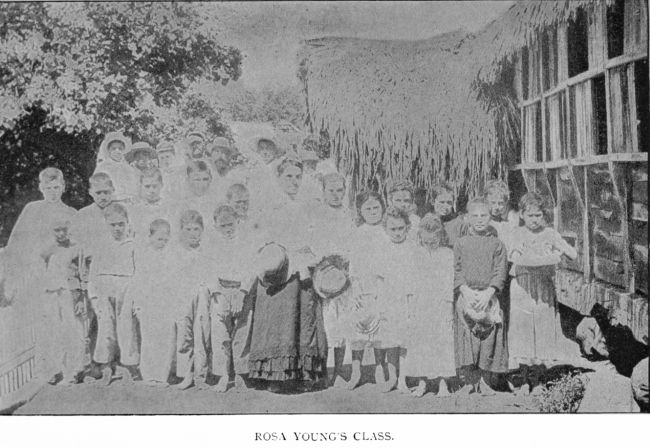
ROSA YOUNG’S CLASS.
Some of the most valued workers and prominent
members of the church and Sabbath school, as well
as two in civil office, fell, and four of the most promising
young people were taken away by death. Simon
Young, the loved and respected pastor of the church,
who for twenty-nine years had labored among the
people, fell at his post. His daughter, Mrs. J. R.
McCoy, who was the first to die, and two sons,
Edward and John Young, the former leaving a widow
and four children, all perished in the plague. Ella
McCoy, a girl of brightest promise, died a week after
her mother. By the deaths, the school lost five of its
students, John Young, Reuben Christian, Ella McCoy,
and Martha and Clarice Christian. Little Willie Christian
was the only one from the younger department
who died. The three others who succumbed to the
dread malady were Elias Christian, father of little
Willie, Childers Young, and a two-year-old baby,
Emma Christian.
The present writing witnesses the visit of the Pitcairn
on her second return trip to San Francisco.
When she leaves, Elder Gates and family will leave
too, also three young persons from the island will
take passage on her for California, to attend school
there. Miss Andre remains with us until duty calls
elsewhere. With the Pitcairn came letters of sympathy
and cheer from friends in Australia, where the
news of his wife’s death met Mr. McCoy.
What further awaits this little island is still in the
future. Nearly two years ago, in October, 1892, when
the Champion, man-of-war, called, Captain Rooke
presided at a meeting held to inquire into the altered
religious views of the people, and that something of
the same nature is yet in store for the community is
what is strongly believed.
Since the advent of the Pitcairn there have been
more frequent communications between the Norfolk
Island people and their relatives on Pitcairn Island,
but the means of communication with the outside
world is far from satisfactory.
Several among the people of the island have taken
short trips to Tahiti and Mangareva, and have returned,
and in 1891 two young men went to California and
Oregon, on a British bark, the Earl Dunraven, whose
captain, a friend of the islanders, brought a large gift
of clothing and many useful things from kind friends
in the places he visited.
In writing this account of facts concerning Pitcairn
Island it is felt that it would be unjust not to mention
everyone to whom the people are indebted for favors
unnumbered; but that is scarcely possible; only we
feel it beyond our power to express the debt we owe
to so many, and as the years come and go, and bring
us to the grand close of all earthly things, we can
only pray that those who have watched over us in
supplying our wants may meet a rich reward. The
unceasing efforts that have been put forth by friends in
the long past, and by those who have risen to fill their
places, to elevate and benefit the people, have not all
been in vain, and whatever of good has been accomplished,
all under God, is owing to those efforts.
No account of the history of either Pitcairn or Norfolk
Island—the latter in regard to the second “social
experiment” carried out there, viz., the occupation of
that island by the descendants of the Bounty mutineers—can
be complete without a mention of two who
figured largely in the early history of the settlement
of Pitcairn Island by the mutineers and their descendants.
These two were John Buffett and the Rev. G.
H. Nobbs, who, especially the latter, from the time of
their advent among the small community in 1823 and
1828 respectively, continued to do all that lay in their
power for the social benefit of the people, even though
some most serious mistakes were made.
Mr. Nobbs, who so closely identified himself with
the people, and whose constant effort was to promote
their best interests, closed his long and useful life in
November, 1884, going down to his grave respected
and honored by all, and leaving behind him sons well
qualified to sustain his honored name.
John Buffett, also, who so nobly volunteered to shut
himself off from all the fascinations that the world may
have contained for him, and chose to cast in his lot
with a community so insignificant and so remote, that
he might help John Adams in his declining days, in
the arduous duties and heavy responsibilities that the
rearing of a youthful colony necessitates, passed away
in May, 1891, having nearly completed a century of
years. He also left numerous descendants behind
him; all his children, consisting of seven sons and one
daughter, survived him, children of whom he had no
cause to be ashamed. His companion, John Evans,
who for the love that he bore him deserted his ship,
and hid himself away that he might remain with Buffett,
died in December of the same year, 1891, at a
very advanced age, being tenderly and lovingly cared
for by his only surviving daughter and her children.
In this record of deaths may fitly be mentioned that
of another who performed no mean part in seeking to
raise the social standing of the people over whose
children he was placed as their schoolmaster. Mr.
Thomas Rossiter, who for many years faithfully fulfilled
the heavy duties of teacher of a large school on
Norfolk Island, duties for which he was eminently
qualified, after some time resigned his place to others.
His death occurred in 1893. The school is now
conducted by Mr. Alfred Nobbs, a son of the Rev.
G. H. Nobbs, assisted by a few other teachers.
A few more words concerning the great mortality
attendant on the epidemic that resulted so fatally
among the inhabitants of Pitcairn Island during the
months of August, September, and October, 1893.
With the exception of three or four of the islanders,
the entire community suffered more or less from the
terrible visitation. The missionaries resident on the
island at the time wholly escaped the pestilence, a
fact which was doubtless due to the beautiful regularity
of habits that they unfailingly practiced, and the
remarkable and beneficent results of which were so
noticeable during the time of the fever. That the
irregular habits of the people both in eating and sleeping
had much to do in producing such fearful consequences
there can be no doubt, and this matter, which
had before been plainly presented to the people by the
faithful missionaries, but which had not received the
amount of attention that its importance demanded, was
after the fever more strongly than ever urged upon
the people, their own example serving, more than the
precepts they taught, to illustrate the truth of their
teachings. The result of all is that now the community
that had for so long neglected the plainest principles
of the laws of health, are beginning to realize that
they cannot always ignore those laws with impunity,
nor disregard them without great injury to themselves—a
lesson that the saddest experience through which
they have passed served but to deepen and impress
upon their minds, minds that had hitherto been too
indifferent and careless in regard to these things, and
too slow to comprehend the importance of them.
Every step taken in the right direction has, under
God, been the result of the faithful teachings of Elder
Gates and his wife, who before they left had the satisfaction
of seeing a reformation in the dietary habits of
the people.
The question has been frequently asked whether the
people degenerate physically in consequence of too
close relationship in marriage. To this the answer
must be given in the negative, unless, as someone has
observed, the loss of the front teeth, which is quite
general, be a sign of degeneracy. But, in the writer’s
opinion, that is the result of not paying a more strict
attention to the care and cleanliness of the teeth, and
no doubt also to the fact that the food usually eaten
is not of the kind to strengthen and preserve them.
The civil government of the island differs somewhat
to what has been the custom for years. When the
Champion, man-of-war, visited the island in October,
1892, Captain Rooke presided at a meeting convened
to consider some questions, civil and religious, acting
as regards the former agreeably to the opinion of the
British Consul at Tahiti, with whom he had consulted
when on the eve of leaving Tahiti for Pitcairn Island.
The outcome of the meeting was as follows: 1. It
was moved and carried that seven members of parliament
be elected. 2. Those seven, having been elected
by general vote, will next proceed to elect from their
own numbers the next magistrate to hold office yearly.
3. It was suggested that not less than five of the seven
meet to form a quorum to consider any business—all
seven if the question be very grave.
Some other points were brought forward and discussed
at some length, but it is sufficient for the purpose
to mention only these. The resolutions proposed
were soon acted upon, and the plan was found to work
well. The women as well as the men have a vote.
As regards the present social standing of the people
a few words might be said. Many who have visited
the island have gone away with the impression that
the favored inhabitants breathe a purer air than other
people, and an atmosphere wholly untainted by sin;
but it is difficult to conceive how such an idea can for
a moment be entertained concerning any place upon
earth which is inhabited by any of Adam’s fallen race.
Human nature is human nature the world over, and
fallen at that, so that it is certainly a mistake to think
that, because so remote from the rest of the world, no
vice or sin of any kind mars the character or degrades
the reputation of those who dwell so secluded from
the world. But Satan found an entrance into the
Eden home of our first parents ere yet they had
known of the existence of sin, and who inheriting
their tainted nature dare hope to escape his snares?
Further, how was it possible that a people sprung
from such a debased stock as settled the island over
a century ago, and in whom runs the blood of those
who stopped short at no crime, could be pure and stainless
in character? A beautiful simplicity no doubt
characterized the lives of the little community that grew
up under the fostering care of John Adams, and, indeed,
all through a century’s period much of that simplicity
still remains, but it is a mistake to cherish the idea
that sin does not have a kingdom on the little island;
and while it is cause of deep and humble thankfulness
to God that He has, by His mercy and through the
instrumentality of a multitude of Christian friends, kept
the people from sinking into the lowest state of degradation
and sin, it is also a fact to be deplored that
there are among the people strong tendencies in a
wrong direction, tendencies that God’s grace alone can
keep in check.
The visits of the missionary ship Pitcairn from the
island of that name to Norfolk Island are hailed with
unfeigned pleasure, as it is by that means that the two
communities so closely related by blood have any
certain communication with each other. These visits
are the means by which the younger portion of the
two communities have their interest in each other
awakened. The dear ties that bound so closely the
hearts of the older members, though sundered by distance,
were never lost sight of, but it was scarcely to
be expected that younger members, growing up without
any knowledge of one another, should preserve
undiminished the same feelings of kindred affection
that their fathers and mothers possessed, and so it is
matter for thankfulness that the old ties are being
revived and strengthened.
APPENDIX TO FOURTH EDITION. — A VISIT TO PITCAIRN ISLAND. — Transcriber’s Notes
The interest manifested in that far-away mite in the
Pacific—Pitcairn Island—and the avidity with which the first
two editions of this book were sought for, has led the publishers
to issue this improved edition.
Since the publication of the book many articles in regard to
Pitcairn have appeared in the newspapers in all parts of this
country.
The New York World sent a letter of inquiry to Miss Young,
the author of this book, in October, 1893, and her answer
appeared in that paper under date of January 13, 1895.
The letter is of such general interest and conveys such recent
news from Pitcairn, that it is thought best to publish it herewith.
We also append an article published in Harper’s Weekly of
December 8, 1894, describing a visit made by Captain Cornelius
A. Davis to Pitcairn in March, 1894. The article is of particular
interest because it comes from a disinterested observer.
PUBLISHERS.
MISS YOUNG’S LETTER TO THE “SUNDAY WORLD.”
Pitcairn Island, in the South Pacific,}
August 18, 1894.}
To the Sunday World—
It is probable that, such a long time having elapsed before
you received any reply to your letter, you have taken it for
granted that it never reached its destination. The facts in the
case are that it arrived here on the 3d of February last, having
been sent on from San Francisco, thence to Tahiti, and from
that place to Wellington, New Zealand, to the brigantine Pitcairn,
our missionary ship, which brought it here on the above-named
date.
It should have been replied to in February, and the answer
sent you via Pitcairn, bound to San Francisco, which place she
reached somewhere near the end of March, but having had
some considerable writing then on hand which it was absolutely
necessary that I should finish, I was obliged to let some
of my letters go unanswered, yours among the rest, and then,
in the unavoidable hurry and bustle consequent upon leave
taking, it was forgotten until a day or two ago.
Please pardon my carelessness, which has been quite unintentional,
as I am one who does not believe in ignoring the
correspondence of anyone, and would think myself guilty of
rudeness not to send a reply to anyone who should show
enough interest in us and our island’s history as to request any
information that it is in my power to give.
I will with pleasure answer your questions, for the readers
of the great Sunday World, and trust they may prove satisfactory
to you, but, first, a fact or two concerning myself may
prove of interest.
I am Young (one of the descendants of the original settlers),
but young no longer in years, having completed my forty-first
year five days ago, on the 13th inst. At the date when your
letter was written, October 26, I had just passed the crisis of a
fever typhus that had taken as victims twelve of our number,
my honored and beloved father among the number, and, in
addition to him, two brothers, a sister, and a niece.
In regard to the wish expressed in one or more of my published
letters that you mentioned, i. e., that of paying a visit
sometime to the outside world, or, rather, to some portion of
it, that wish remains still ungratified. My mother’s father was
an Englishman, who, at the age of twenty-six, decided to cast in
his lot with the little handful of children of the mutineers who
were in 1823 ruled over in a sort of patriarchal manner by the
sole survivor of the mutineers, John Adams.
He, Adams himself, unlettered and unlearned, had, after
all the rest of his companions died, most of them having been
murdered, wakened up to a sense of the great responsibility
that rested upon him, with the growing young community on
his hands, and when, in 1823, a whale ship, the Cynes, happened
to call in here, he expressed the earnest wish that someone
would feel sympathy enough for him and the worse than
orphaned children he was striving to lead, according to the
best light he had, upward to God and good, to remain and
assist him.
My grandfather, John Buffett, remained, and ever since I can
remember his talking about his early boyhood home in Bristol,
England, it has been my wish one day to go there. That dear
hope is abandoned. I had a sister who married, and took her
two little boys away to Cardigan, Wales, to her husband’s
home, and she passed very near our grandfather’s early home,
but that was all.
Since she went away to Wales, over eight years ago, it has
been the earnestly expressed wish of my heart to pay them a
visit, but my sister died in April, 1887, having been there only
eleven months, and my earnest, longing wish to see my dear
little nephews again will never be realized.
I have had frequent invitations from many dear, valued
friends to visit America, but can see no open way yet. I had
my trunk packed ready to go to California last year, but unforeseen
circumstances prevented it. Five of our people from this
island went, but I was not one, although I deeply grieved over
it. All those who went have returned, with the exception of a
young man now at school at Healdsburg, and a charming little
girl adopted for a time by a minister and his wife, who have
been living here, a Mr. and Mrs. Gates. I shall now take up
and answer, in regular order, the points in your letter about
which you request information. First, school work.
How I happened to become connected with that work was
in this way—I shall have to go back many years to begin at the
start: In the years 1857-1858 two families, not being altogether
satisfied with the change of living on Norfolk Island,
left that place and returned here, to their old home. Those
families consisted of fifteen or sixteen persons, Moses Young
and family, and Mayhew Young and family, which were mostly
children by the wife’s former husband, a McCoy. It may interest
you to know that Mayhew was so named for Captain Mayhew
Folger, the American captain who discovered, away back
in 1808, that this island was inhabited by the children of the
mutineers.
Well, to be brief, my own father, Simon Young (I cannot
begin to tell you how good he was), feeling that the children of
the two families that first returned needed someone to look
after their educational and spiritual affairs, determined that he
would make the effort to return also and do what he could for
them. His own educational advantages had been very limited,
but he had made the very best use he could of them, and had
taught the children, while on Norfolk Island, the art, at least,
of reading, writing, and the four principal rules in arithmetic.
So, in December, 1863, our family and a few others besides
left Norfolk Island to come back here, arriving in the early part
of February, 1864.
We left a good school and teacher behind, and I have never
ceased to regret that it was never my privilege to have gone
through some regular course of study, to better enable me to
accomplish what has since been my life work, for I was only
ten when my return here was made.
As soon as possible father took up the work of teaching the
few children and young people as best he was able, and, at
about fourteen years of age, I began to help him by putting the
youngest through the alphabet and first reading lessons. I have
had no educational privileges, and only do the best I can, with
what success will be known in the great hereafter.
In February, 1893, Miss Hattie Andre, a young lady just
graduated from a college in Michigan, arrived here to take
charge of the school. My loved and honored father, sixty-nine
years of age, then retired from the work, leaving it in the hands
of Miss Andre and myself. She has a membership of about
thirty-four of the young people, and I teach twenty-one of the
youngest children, from the age of seven to fourteen, two
of mine being Dano-Spanish boys from Mangareva, one of
the Gambier Islands. Their sister attends Miss Andre’s school.
You inquire about our religious belief. When John Adams
took up the work of trying to rear in righteousness the rising
young community, his sole aids to education were a Bible and
Book of Common Prayer, saved from the Bounty. With these
extremely limited means he taught, quite successfully, the
young folks to read, and, instituting some sort of religious
services, he very naturally had the liturgy of the Church of
England to pattern after.
This is what we had followed until October, 1886, when
we, as a body, and after ten years’ searching “whether those
things were so,” and battling against most unfounded and
unreasonable prejudices, joined ourselves to that church known
as the Seventh-day Adventists—seventh day because we believe
in and preach the letter of the fourth commandment of
the decalogue, and Adventists because we believe in the soon
coming of our Lord and Saviour Jesus Christ in the clouds of
heaven to take his true followers to himself.
In our view of the case this is the explanation of so much
that the world at large is at present undergoing, and which
seems so mysterious to those who do not make the prophecies
of God’s word their study.
You very rightfully judged that we are kept pretty well
posted by means of newspapers and friends, who now and then
touch in here on their way to different ports, in regard to what
the world is doing, but we have no regular means of correspondence.
Our friends abroad take advantage of the occasional
trips of our little missionary ship to send us letters and
anything else, as she always comes direct to us after leaving
California. She arrived on the 17th ult., and proposes to make
a quick return to America (if she is not sold, as has been arranged),
where she will be about the end of the present year.
Several of our people have made visits to some of the neighboring
islands and some have gone to England and back, but I
do not think the words “dissatisfied with our lot” can be
properly applied to anyone here. In regard to myself personally,
I am so in love with the free, natural life I enjoy here that
I would not willingly exchange it for any other, much as I
would enjoy a visit to your shores and to see in reality the life of
the world of which I have read so largely—life in all its phases,
from the high-toned “society” life to the very lowest. So that
I do not feel that “surprised” would correctly describe my
impressions.
Yes, marriage is—shall I say it?—committed among our
people, the different family names numbering seven. Young,
McCoy, and Christian are of the original families, and those who
have come in later on are Buffett, Warren, Butler, and Coffin,
the last three being Americans, and only the very last, Coffin,
still lives. I think away back in the long past there were some
curious “love stories” which would prove quite interesting
reading, and within my own knowledge there are several that
would make a good foundation for very entertaining stories
should someone be found to weave them.
From the time of John Adams until the last marriage ceremony
took place here—that was in 1889 (I seem to see you
smile at the long space that intervenes)—the form used has been
that of the Church of England. In the eighties the young people
seemed to think that the chief end of man and woman, or
rather of boy and girl, was marriage; and scarcely had they
arrived at man’s and woman’s estate, certainly not to the estate
of wisdom and prudence, when marriage was contracted. At
present, and it gladdens my heart to see it, more efforts are
made at getting some education than in getting married, and
we have quite a company of young men and women who
think more of getting what they can out of their schoolbooks
than of being bound for life to one another.
I am not exactly posted as to the number of inhabitants here
at present, but think that after the fourteen deaths that took
place last year the population is about 136 only, the largest part
being children under the age of sixteen.
It is quite universally accepted among people of the world
outside our own little speck of earth that coined money is an
almost unheard-of, unknown, and, of course, unused article
among us, but such are not the real facts in the case. Our circumstances
make it possible to exist, as far as the necessities of
life are concerned, without the use of money, i. e., as far as
food, fuel, water, and our houses are concerned, but for clothing
we depend upon the product of our island, which we sell, when
the opportunity offers, to a trader who calls here and brings us
our supplies in that line. In addition to this, many friends have
contributed from time to time very largely to our comfort in
gifts of clothing and other things that we cannot procure here.
Our “standard of value” is the American dollar and the
English pounds, shillings, and pence, on which no discount is
made here, as we are English subjects. It would amuse you to
see how many and various are the coins that pass through our
hands, and whose value often puzzles us. As we are not in a
position to obtain (except on occasions when we are visited by a
British ship of war) more than a few cents at a time, in exchange
for fruit and curios, we do not, as do Sabbath schools
abroad, contribute every week, but the dimes, quarters, shillings
and pence that may be obtained from passing ships are
carefully hoarded for the quarterly donation.
We have a Sabbath school of 125 members, varying in age
from two years to seventy-two; and happy the child, as well as
the grown-up, who has an offering as large as a quarter to
donate at the beginning of every quarter. We are glad at the
thought of our little “mite” contributed towards the missionary
ship Pitcairn, the first one to be built and used in the interests
of the Seventh-day Adventists, and that our Sabbath
school is self-supporting.
Our amusements consist, I may say, in a change of occupations.
A peculiar way in which to amuse one’s self, you will
think, but really our time is too fully occupied in so many
different ways to have time or inclination even for amusements
that are amusements merely. If the boys can have
enough powder for their guns to boom away at their own sweet
will, they ask for no greater pleasure, and one unwearying source
of enjoyment for the young people here is to gather around an
organ and spend the time in singing to the accompaniment of
the instrument.
You ask if a photographer has ever come to our shores. Yes,
many of them, and many views have been taken, not only of
the varied scenery, but of the people, mostly in groups. Last
March an American shipmaster, Captain Davis, was here and
spent most of his time taking pictures. Among others, he took
that of Miss Andre and her school, and of me and my bare-footed
little boys and girls.
The gentleman and lady mentioned above, Mr. and Mrs.
Gates, had been living with us for eighteen months, and last
February, when they were leaving, I gave Mr. Gates a manuscript
copy of a little work I had been writing, the facts connected
with this island’s history from the time it was inhabited
by the Bounty’s mutineers up to date. I did not confine myself
to solid work, but only wrote at long intervals, so that what
should have been finished within a short time was dragged out
to a length of six years. Possibly some of the photographic
views taken here will be used to illustrate the little work. It
should be going through the press now, if not already gone,
and will be brought out in book form—only a very simple,
modest affair—at the Pacific Press, Oakland, Cal., where you
may obtain a copy if you have enough interest in it to order
one.
I have already written longer then I should have done, and
fear my long letter will prove a tax to your patience, but your
questions have been answered at some length, so I trust you
will excuse my trespassing on your valuable time to read all
this product of my pen.
I shall be pleased to have you write when you are so inclined,
and also to learn when you get this letter.
Yours very cordially,
Rosalind A. Young.
When Captain Cornelius A. Davis, of the five-masted
schooner Governor Ames—the only schooner of her class in
the world, as well as the largest fore-and-aft vessel in existence—dropped
anchor off Pitcairn Island, four thousand miles south
of San Francisco, a few months ago, he was surprised to find
himself greeted by name by a delegation of islanders who came
on board. The inhabitants of the historic little island are accustomed
to keep a sharp lookout for all passing vessels, and as
soon as one is sighted in the offing, a boat pushes out to her,
carrying friendly greetings and the offer of any assistance that
may be needed. From each captain news of the ship he has
left behind in the last port is obtained, together with the probable
date of their sailing; so that in a majority of instances when
a vessel reaches Pitcairn she is recognized immediately, and the
skipper discovers that he does not need any introduction to his
new-found island friends—for such they very soon prove themselves
to be. He is invited to land and partake of the best the
island affords, and the impression he carries away with him is
uniformally a pleasant one. Captain Davis says that he would
have been glad to stay at the island two or three days if there
had been any good excuse for doing so, but after he had secured
some fresh fruit for the crew, he felt compelled to resume his
voyage. Puget Sound had been left behind thirty-five days
earlier, and Liverpool was still one hundred and twenty-nine
days away.
There is no more picturesque incident, perhaps, in the annals
of marine venture than the mutiny on board the British ship
Bounty, in 1789, and the subsequent landing of several of the
mutineers on Pitcairn Island, a speck of land which had been
discovered some years before by Carteret, and named for the
midshipman who first descried it from the masthead. These
mutineers, fearing punishment, resolved to hide themselves
from the world, and accordingly sought out this lonely spot,
and, together with a number of Polynesian men and women,
founded a new community far from the ordinary track of commerce.
At first, according to the scant historical accounts
which have come down to us, there was riot and reveling on
the island, but gradually the rougher element in the population
disappeared, and when the American vessel Topaz rediscovered
the little settlement in 1808, it seems to have been orderly
and prosperous. For more than half a generation the whereabouts
of the mutineers of the Bounty had been a mystery, and
their rediscovery at this time aroused a good deal of interest,
especially in England. It was as if the sea had given up its
dead. Everything pertaining to the little strip of land in the
far Pacific was hailed with interest, and in the eighty-six years
since then many books and papers descriptive of it and its people
have been written. In a few weeks another volume is to be
published in California by the Seventh-day Adventists, who
have recently succeeded in converting the islanders to their
faith. Formerly they were associated with the Church of
England.
The community to-day is a model one in many respects.
Since the time of the hardy mutineers a great change has taken
place, and it is said that nobody on the island ever indulges
in intoxicants, tobacco, or profanity. A rude church and
schoolhouse—the structure shown in two of the illustrations
accompanying this article—has been erected, and one of
the descendants of the early settlers preaches regularly to all
the members of the settlement, for church going is regarded as
a matter of course on Pitcairn; and, moreover, there are not very
many other divertisements. When it is remembered that there
are only about one hundred and thirty people on the entire
island, and that the island is scarcely three miles in length, it is
easy to understand the lack of excitement which sometimes
characterizes life there. And yet a spirit of intense loyalty pervades
the community. Nobody has any desire to remove
permanently to any other place, and those who visit the United
States and Great Britain do so merely to prepare themselves
for more useful labor at home. The other day young Henry
Christian, a descendant of the leader of the mutiny on board the
Bounty, arrived in San Francisco, whither he had come for the
purpose of pursuing a course of study at an American school,
but there can be no doubt that he will return in due time to
Pitcairn. With him came also the president of the island,
James R. McCoy; for the islanders elect an officer with this
title, although they are under the nominal rule of England.
Queen Victoria sent them two lifeboats some years ago, and
these are used constantly in boarding the vessels that anchor off
shore. A British flag, too, flies from one of the peaks of the
island, the flagstaff being planted in the muzzle of one of the
old cannon with which the Bounty was equipped.
Captain Davis is an expert amateur photographer, and he
succeeded, during his few hours’ stay on the island, in getting
some admirable views of the people and their surroundings.
One of these views [see page 231] shows most of the adult
inhabitants grouped around Miss Andre, a young woman from
Ohio, who assists the native minister in his religious work, and
instructs the men and women of the community in the ordinary
branches of education. Captain Davis listened to a well-recited
lesson in geography the day he was there, and he says that
these grown-up students seemed intelligent and eager to learn.
Their faces are strong and impressive, and while there is a considerable
trace of “Kanaka” blood in most of the countenances,
others are thoroughly Caucasian. The mixture of totally dissimilar
races has in this instance, at least, resulted in a sturdy,
resourceful, and self-reliant stock.
The primary school is taught by Miss Rosa Young, a native
of Pitcairn, and the author of the book descriptive of the
island which is about to be published. She is the island
editor as well as schoolteacher, writing a chronicle of the community
from time to time, which passes from one to another of
the people. There is no printing press on the island, and this
is the only contemporary record of its doings enjoyed by the
settlement. But then, with only one hundred and thirty people
to keep track of, doubtless everybody who is so inclined contrives
to be pretty well posted. On two different occasions
Pitcairn has been deserted by its inhabitants, for one reason or
another, and the present inhabitants are descended mostly from
two families who returned to the island as late as 1858. In 1830
the eighty-seven people then resident there removed to Tahiti
through fear of drought, and, though the moral laxity of the
latter place so disturbed them that they went back to Pitcairn
the next year, in 1856 they undertook a second pilgrimage, this
time to Norfolk Island, where many of them or their descendants
live to-day. William and Moses Young, together with
their families, however, appear to have pined for Pitcairn, and
accordingly journeyed back there again.
The landing place shown in one of the pictures [see page 27]
on another page is at Bounty Bay, where the original
settlers of the island destroyed their vessel more than a hundred
years ago, and where, as the illustration shows, many of the
inhabitants gathered to bid Captain Davis good-by. Up from
this spot runs a path to the settlement itself, which is three or
four hundred feet above the level of the sea. The main street
is bordered with palm trees, and the thatched cottages on either
side give evidence of thrift and prosperity. There are no cows
or oxen on the island, but goats are plentiful, and as the land is
steep and rocky in places, these sure-footed animals are doubtless
better adapted to the needs of the people. Oranges grow
in abundance, and so do sweet potatoes, yams, bananas, and
pineapples. Captain Davis says that the dinner provided in his
honor at the house of the Advent missionary was bountiful and
excellent.
In these days of hurry and bustle it is refreshing to catch a
glimpse of an Arcadian community like this, whose little world
is far removed from all our modern tendencies in civilization.
There are no telephones or telegraphs on Pitcairn Island; no
oceanic cable brings from the distant mainland the tidings of
war or catastrophe on the other side of the globe. Scarcely any
of the inhabitants ever saw a railway train or an electric light,
and probably not even one of them has ever been inside of a
theater. The papers and magazines that they read are weeks
old by the time they reach Pitcairn, and much that they contain
must be as unintelligible as Greek to the islanders. What do
they know of college football games? or how much can they
comprehend of the excitement of a presidential election? They
are a people apart, and their horizon is bounded by limitless
sea and sky.—Henry Robinson Palmer, in Harper’s Weekly,
December 8, 1894.