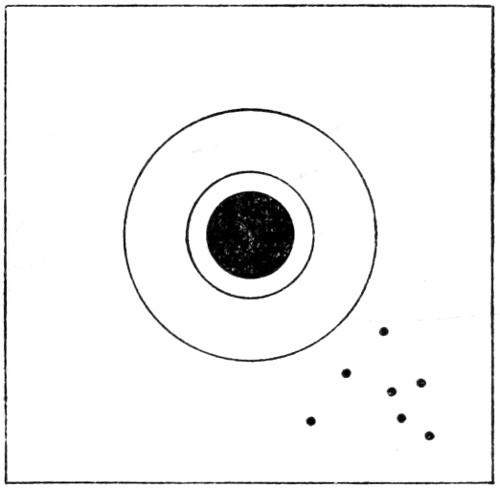
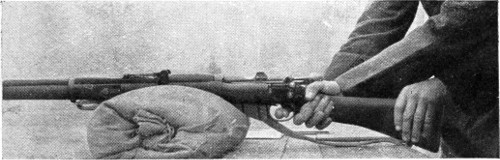
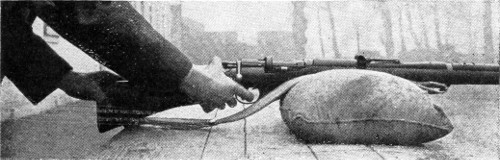
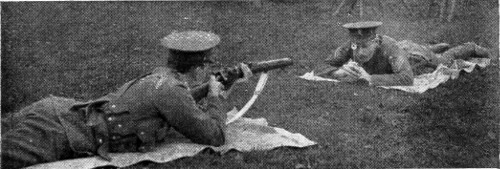
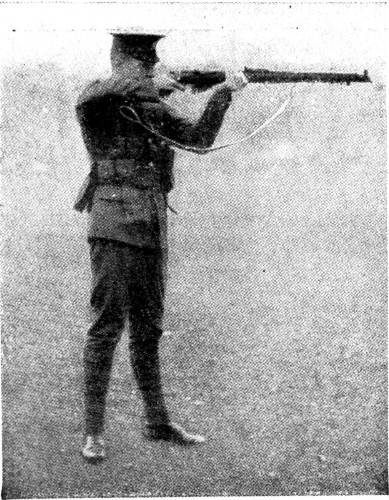
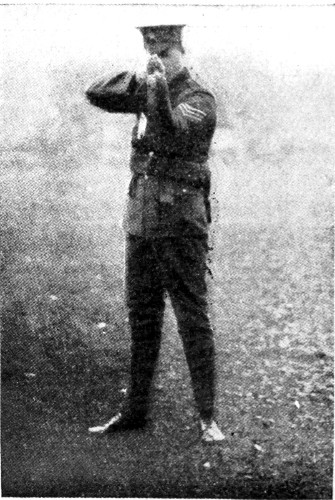
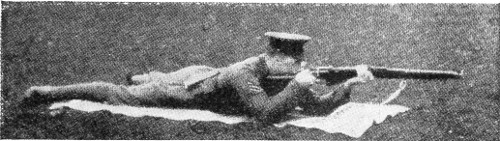
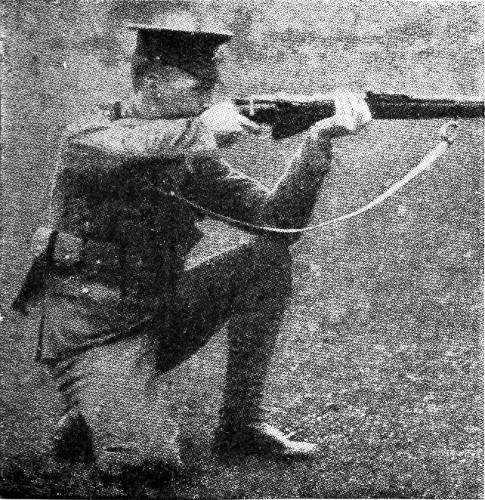
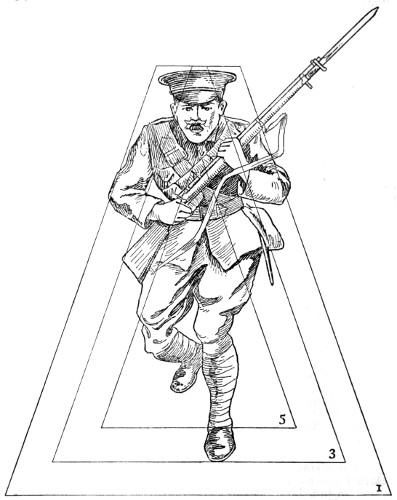
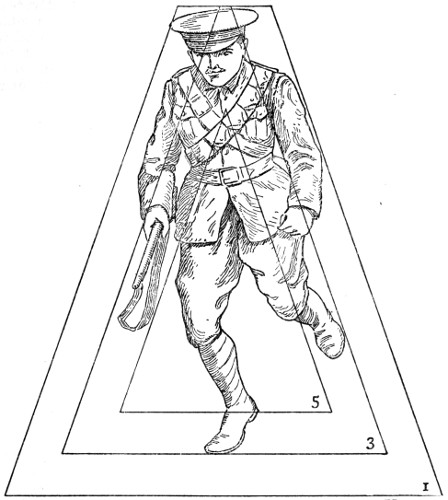
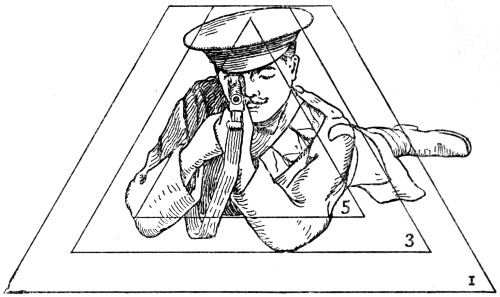
1. When no classification range is available, elementary
practices with service ammunition may be carried out on
a 30 yards range. Such practice will render recruits familiar
with the discharge of the rifle, and improve their trigger
release under easy conditions. No practice will take place
unless an officer or experienced serjeant is present.
2. Precautions for Safety.—All precautions for safety will
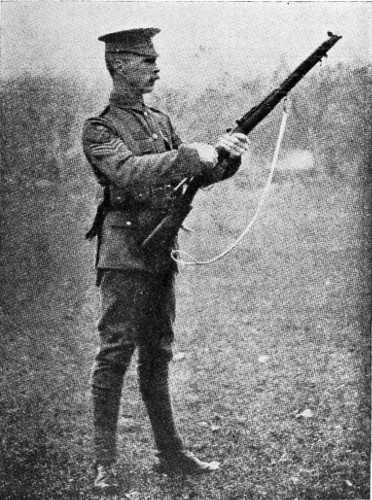
be taken. Loading, in all positions except lying, will be
carried out with the rifle held just above the waist, and
the muzzle directed towards the target. Charging or uncharging
magazines is not to be carried out with the muzzle
pointing upwards.
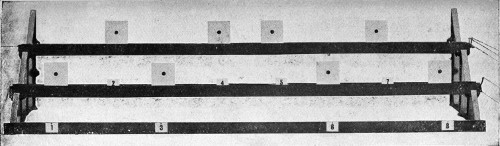
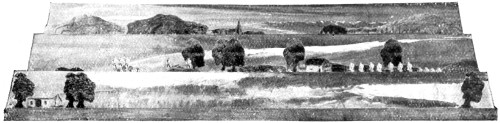
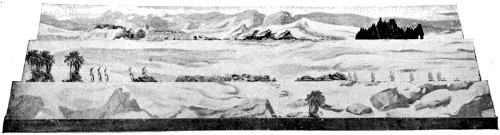
3. Practices.—Practice at vanishing, moving, and landscape
targets can be carried out as on miniature ranges,
but with service ammunition. Long-range sighting-targets
should be provided as a means of ascertaining the error
of the rifle, and practice may be carried out with long-range
sights.
1. One firer will be detailed to each target, and fire five
shots, maintaining the regulation point of aim throughout.
Targets will be changed, and a second detail of men will fire
similarly. Both details will then proceed to the targets,
see their groups measured, and note the positions of the
points of mean impact with reference to the points aimed
at. If it is impracticable to proceed to the targets, the
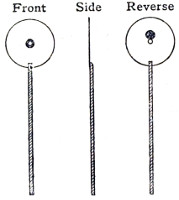
group may be marked by means of small spotting-discs
(see also Appendix, VI, para. 2, note 3).
2. Rules for Measuring Groups.—(i) The groups will be
measured with wire rings, 4, 8, and 12 inches in diameter,
counting 25, 20, and 15 points respectively; 10 points will
be allowed for a 12-inch group with one wide shot.
(ii) The ring which will contain all the shots will be
recorded as the measure of the group. A shot-mark is
included within a ring when it cuts the circumference of
the largest circle which can be described within that ring
by means of a pencil held at right angles to the target.
(iii) All shot marks found on a target will be included in
the group to be measured. No points will be allotted to a
group unless there are five shot-marks at least on the target.
If more than five shot-marks are found on the target, there
will be no score, and the practice will be repeated.
(iv) Point of Mean Impact.—When the ring is placed to
include all the shots, the centre of the ring will be taken as
approximately the point of mean impact. Its distance
from, and direction with reference to, the point aimed at
will be recorded on the register—e.g., 7 inches, four o’clock.
(v) On return to the firing-point other details will fire,
but steps will be immediately taken to ascertain the cause
of any bad shooting of men in the first two details.
3. Third-Class Shots.—As a rule, third-class shots should
not be allowed ammunition for further training in application
practice until a satisfactory standard in grouping has
been attained. This may be fixed at a ring of diameter
equal to one-three-hundredth of the range, but officers
should exercise their discretion as to allowing one wide shot
in five when dealing with young soldiers.
1. Deliberate Practices.—In deliberate practices, twenty
seconds is the time limit allowed for each shot, reckoned
from the act of loading. If there is a tendency to exceed
the limit, a whistle should be used to mark the beginning
and end of each period, but not otherwise.
2. Timed Exposure of Targets.—The timed exposure of
targets for snapshooting and rapid fire practices will be
reckoned from the time when the target is in position and
stationary to the time when it is again moved for lowering.
The movements of raising and lowering must be conducted
with the utmost rapidity, but without jarring the target
frames.
3. Timing in Rapid Practices.—(i) Timing in rapid practices
should be reckoned from the word of command
“Rapid Fire,” and fire should be stopped by the command
“Cease Fire.” The command “Rapid Fire” should be
given as soon as the target appears. The target should
be lowered at the end of the time allowed for firing under
orders of the officer on butt duty, but the officer superintending
at the firing-point should also time the practice
and order “Cease Fire” at the end of the time allowed
for firing, reckoned from the command “Rapid Fire.”
Four points will be deducted for every shot fired after the
order to cease fire has been given.
(ii) Charging Magazine in Rapid Practices.—In rapid practices,
unless otherwise stated in the “Instructions for the
Conduct of the Practice,” the magazine will be charged
with four rounds, and the rifle will be loaded before the
target appears.
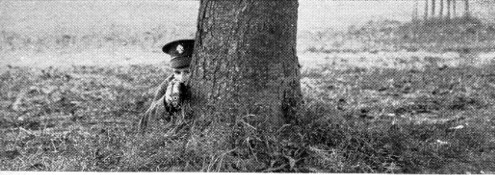
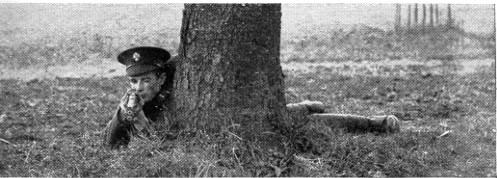
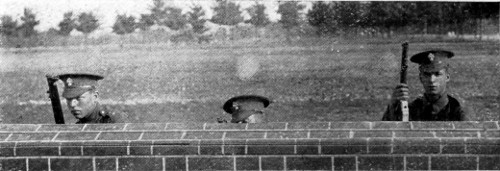
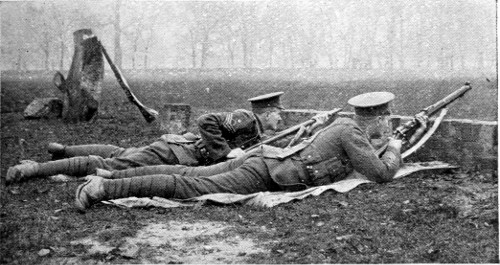
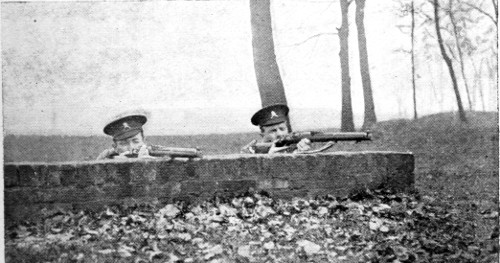
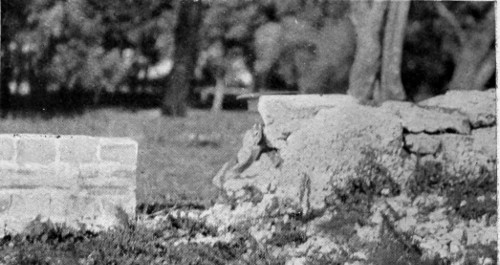
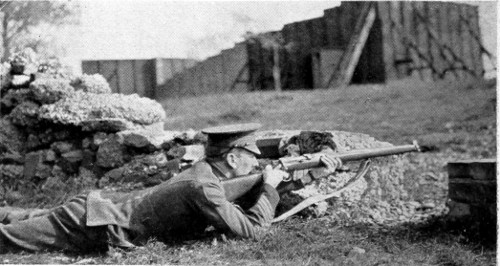
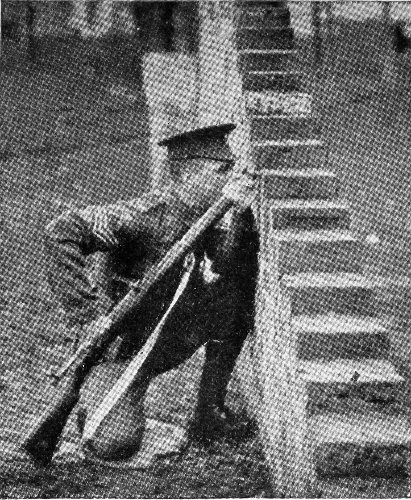
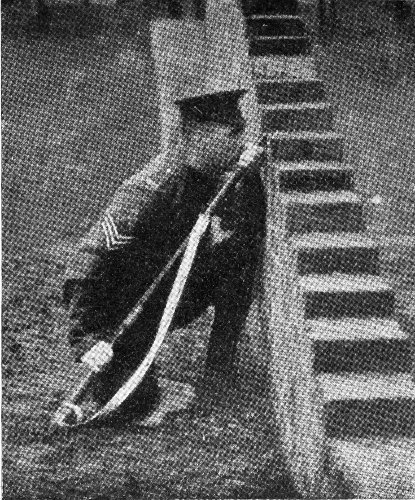
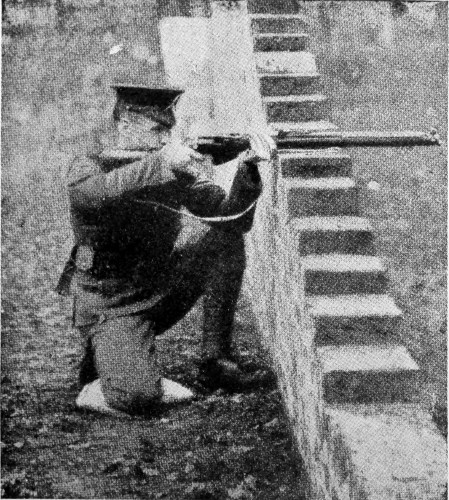
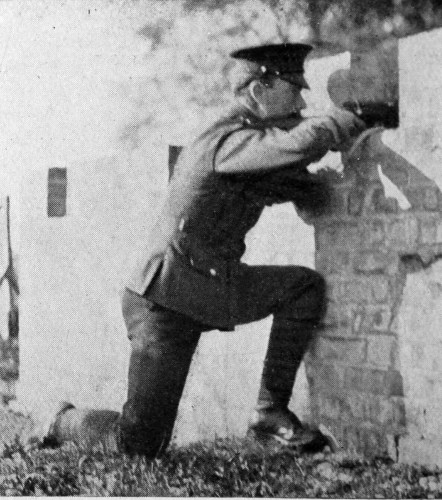
4. Firing from Cover.—(i) In firing from behind cover,
the position adopted must be such as would enable the
firer on service to obtain the fullest protection from the
cover, having due regard to the efficiency of his fire. In
the prone position, the grip of the left hand must be maintained
on the rifle, and there must be no undue exposure
of the shoulder or legs.
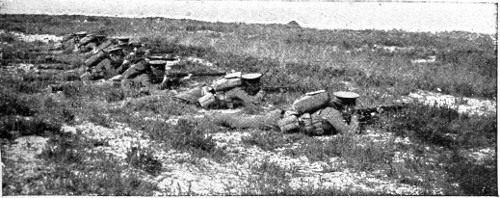
(ii) In firing from behind cover, the butt of the rifle will
be in contact with the ground, and the firer will remain in
observation, but otherwise completely covered, until the
command “Rapid Fire” is given in rapid-firing practices,
or the target appears in “Snapshooting” and “Crossing-Shot”
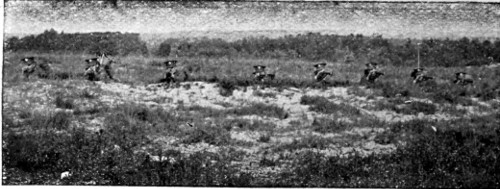
practices. When snapshooting or firing rapid in
the open, the rifle may be held in the loading or aiming
position, as preferred.
5. Jambs.—In the event of a jamb occurring in a timed
practice, and provided that it is not caused by any fault
on the part of the firer, the time allowed for the practice
will be increased to the extent due to the delay caused
thereby. Should, however, a jamb in a rapid practice be
due to a breakage of mechanism or other defect that cannot
readily be rectified on the range, the whole practice will be
fired again.
6. Missfires.—In the event of missfires, extra rounds will
be allowed equal to the number of missfires in the practice
concerned, a proportionate part of the time allowed for the
whole practice being given for each extra round.
7. Extra Time.—Whenever extra time is allowed for a
timed practice, a report giving the reason, and stating
whether the jamb or missfire was due to the rifle or to the
ammunition, will be rendered to Command Headquarters.
1. Range practices, unless otherwise ordered, will be
fired in drill order. Range practices should be fired, as far
as possible, in favourable weather. It is of the utmost
importance that recruits’ firing should not take place in
cold and unsuitable weather.
2. Order of Practices.—Range practices should as a rule
be fired in the order in which they appear in the tables,
but brigade commanders may vary the order at their
discretion. When deliberate and rapid practices for classification
are fired at the same distance, each man may
fire the rapid practice immediately after the deliberate
practice.
3. In the case of ranges of less than full extent, general
officers commanding-in-chief may frame special instructions,
make proportionate changes in the size of targets, and vary
the points for classification.
4. Distribution of Ammunition.—(i) The general distribution
of ammunition laid down in the several parts of Tables
A and B respectively should be adhered to. In the Regular
Army and Special Reserve not more than fifteen rounds
should be fired in one day, except in classification practices,
when twenty-five rounds may be fired, if necessary.
It is always better, when time is pressing, to reduce the
number of rounds fired in instructional practices than to
hurry through them. All available officers should be
present at the firing-points during instructional practices.
(ii) Forfeiture of Rounds.—Omission to fire the rounds allotted
and failure to fire during an exposure or run in
vanishing and moving practices will entail forfeiture of the
rounds that should have been fired, and misses will be
recorded for them. Ammunition required for repetition
of qualifying practices will, when necessary, be taken from
the surplus.
5. Firing Positions.—In range practices the regulation
positions are obligatory, except in firing from cover, when
the rifle should be rested and the position adapted to the
ground. This includes resting the arm as well, if suitable,
but the cover is not to be specially constructed as a rest for
the rifle.
6. Commencing Practice.—No man will load, or assume
a firing position, until the senior officer present has ordered
the practice to commence. After firing, men will return
to the loading position, but will not open the breech in the
deliberate practices until the last shot has been signalled.
If it is necessary to suspend firing, all men who are in position
will raise the safety-catch (or unload if no safety-catch
is provided), until the order is given to resume the
practice.
7. Important Rules.—(i) Loading.—Loading will always be
through the magazine.
(ii) Sling.—Dependence on the sling should be discouraged,
and it will not be used for steadying the rifle in range
practices.
(iii) Rifle.—No soldier equipped with a rifle is permitted
to fire with any but his own.
(iv) Sighting Shots.—No sighting shots are allowed.
(v) Men will fire singly, never in twos or threes.
8. Shots to verify Wind or Elevation.—Occasional shots
to verify elevation or strength of wind, or to prove the
accuracy of a rifle, may sometimes be fired by an officer or
non-commissioned officer, with the senior officer’s permission.
They will not be fired during classification practices
or standard tests. Notification of their commencement
and conclusion will be made to the officer in the
butts by telephone, signal, or bugle-sound. The target in
use will be lowered and checked, and a clean one raised for
the occasional shots. When they are completed, it will
be lowered and checked, and the original target raised for
the firer to complete his rounds.
9. Resting Arm or Rifle.—A coat or waterproof-sheet may
be used to protect the uniform, but except when firing from
cover, or when rests are authorized, neither rifle, forearm,
wrist, nor hand, is to rest against anything, or to be supported.
10. No one is allowed at the firing-point, except the men
actually firing, the instructors, and officers. All non-commissioned
officers and men not on duty at the firing-point
will ground or pile arms, and remain not less than 30 yards
in rear of the firing-point. No shouting is allowed; men
next to fire will be brought up by signal.
11. Instruction during Intervals of Firing.—(i) During
intervals of firing an opportunity should be given occasionally
to all ranks for revising their impressions as to the
visibility of the human figure at short distances, by placing
men on the firing-platforms up the range. The study of
visibility under conditions of known distance and in relation
to targets used for practice in shooting is especially valuable.
(ii) Those men who are not actually engaged in firing
should receive instruction in ground reconnaissance, use
of the eyes, use of field-glasses, range-finding, and description
of ground, while waiting behind the firing-point.
12. Field-Glasses.—Field-glasses or telescopes will be
carried by all officers and section commanders. The men
should be encouraged to use them during spare time on the
range.
13. Condition of Sights.—The sights will be used as
issued, without alteration of any kind. They may not be
blackened; the browning is renewed by an armourer when
required. No additions, marking, or colouring, are permitted,
nor are orthoptics allowed.
14. Observation Practices.—The change which takes
place in conditions of shooting when there is no signalling
of each shot is not always appreciated, and it is essential
that the importance of the first application of fire should
be realized. Troops, therefore, which are unable to fire
field practices should fire some at least of the instructional
practices without signalling. Such practices are called
“observation practices.” The targets should be placed on
the face of the stop-butt or at the foot of the gallery-bank,
and may with advantage be falling or collapsible targets.
15. Precautions.—To guard against accidents, the following
orders will be observed:
(i) No firing will take place until a large red danger-flag
is hoisted on the signal-staff at or near the butts,
and the necessary look-out men posted.
(ii) A smaller red danger-flag will be hoisted at the butts
as a warning to cease fire. This flag will remain
exposed during the entire period of cessation of
fire, and will not be withdrawn until the whole
of the butt party is under cover. No one will
leave the butts until cessation of fire has been
notified from the firing-point.
(iii) A red flag will be kept raised at the firing-point when
no firing is taking place, and will be lowered only
on the order of the senior officer. This order will
not be given until the flag at the butts has been
withdrawn.
(iv) Aiming or snapping during target practice may only
take place from the firing-point after the red flag
has been lowered.
1. Surplus Ammunition.—The rounds shown as “surplus”
in Tables A and B will be distributed primarily
by commanding officers for the following purposes:
(i) Repetition firing, as prescribed in the tables.
(ii) Fifteen rounds per man to be expended by company
commanders for further training of indifferent
shots.
(iii) The further training of recruits.
(iv) Fire-direction practices.
(v) The testing of rifles when necessary.
(vii) Occasional shots on the rifle-range (Sec. 58, para. 8).
(vii) Ten rounds per man who commences the course for
voluntary practice.
(viii) Any surplus available after the above requirements
have been fulfilled will be distributed to companies
for general practice. It is not to be used for practice
for competitions.
2. Computation of Averages.—The best shot of each
squadron or company will be determined by his aggregate
score in Part III. Averages made by companies
in each of the classification practices will be calculated
to one place of decimals, and published in regimental
orders. Only the scores of those officers, non-commissioned
officers, and men who completed a practice will be
included in the numbers by which the total points made in
that practice are divided. Points made by casuals (see
footnote to Sec. 63) will be included at the end of the year,
and fresh averages struck. The sum of the averages of the
practices of Part III. will be termed the “company
average” in classification practices.
1. The conditions for qualification in Part I., Table B,
are:
A score of not less than 15 in each of Practices 1 and 4,
and a total of not less than 45 in Practices 2, 3, 5,
and 6.
2. Those who fail to reach any of these standards will,
after firing Practices 7 to 14, repeat those practices of
Part I. in which they failed, until the standard is attained
or a third failure is recorded. They will omit Practices 15,
16, and 17. Those who fail to reach all the standards after
two repetitions of those practices in which they failed will
be classified as Third-Class shots, and will not fire Part III.,
but will fire Part VI. if ammunition is available. Special
reports will be submitted in the case of men who are found
to be incapable of reaching the second class standard in
Table B.
1. The classification practices should be fired during the
most favourable time of year for individual firing. As a
man’s pay is affected by these practices, every facility
should be given for firing to be carried out under favourable
conditions.
2. With the exception of those who are exempted from
musketry by the regulations, every man on the strength
of his unit on the last of the four days allotted to classification
firing will be classified at or before the end of the year.
3. Trained men, not exempted by the regulations, who
for any reason do not commence Table B will be classified
as Third-Class shots. Those who commence Table B,
Part III., but do not complete it, will be classified according
to the number of points obtained in those practices which
they complete.
4. A note will be made in the Company and Battalion
annual returns of the number of men (if any) who are
classified without having completed the range practices of
Table B.
5. Cavalry and Infantry.—(i) Cavalry and infantry
soldiers, if qualified in Part I., will be classified upon their
total scores in Part III. as follows:
| Those who obtain 130 points and upwards |
Marksmen. |
| Those who obtain 105 points and less than 130 |
First-Class shots. |
| Those who obtain 50 points in Practices
18 to 22 inclusive, or in the
alternative obtain 70 in Part III. |
Second-Class shots. |
| Those who for any reason fail to attain
the Second-Class standard |
Third-Class shots. |
(ii) Commanding officers will take every opportunity of
stimulating all ranks to take an interest in shooting and
judging distance by granting indulgences to the most
proficient, and by giving prominence to the best shooting
company in any manner considered desirable.
(iii) Third-Class shots will not be employed in any
capacity which will interfere with their attendance at all
parades and instructional duties.
6. Royal Engineers.—The sappers and pioneers of the
Royal Engineers (Regular Forces) will fire the following
practices:
(i) Table A.—Recruits’ Course Regular Forces (Cavalry,
R.E., Infantry), and Special Reserve (R.E., and Infantry),
Parts I., II., III., and IV. They will not repeat Part I.,
nor any practices of Part II., unless they fail to make a
total score of 90 points in these practices. Those who
fail to obtain 90 points will, after firing Part III., repeat
Practices 5 to 12, instead of firing Part IV. Surplus
ammunition will be used for the further training of indifferent
shots, for testing rifles, or for occasional shots.
(ii) Table B.—Annual Course, Regular Forces (Cavalry,
R.E., and Infantry). Parts I., II. (Practices 7, 9, 12,
and 14), and III. The qualification standard will be the
same as for the cavalry and infantry. Those who fail to
qualify in Part I. at the first attempt will proceed with the
prescribed practices of Part II. (twenty rounds), and then
repeat those practices of Part I. in which they failed.
Those who fail twice in any of the standards in Part I. may,
provided sufficient ammunition is available out of the
authorized annual allowance, repeat those practices in
which they failed once more, with a view to qualification.
Those who repeat any practices of Part I. will, if they
qualify on first or second repetition, fire the whole of
Part III., or, failing that, Practices 19, 20, 23, 24, and 25,
according to the amount of ammunition available.
(iii) Any man who qualifies in Part I. on the first, second,
or third attempt, and completes the practices of Part III.,
will be classified according to the standards of Part III.,
but not below Second-Class shot. Those who complete
Practices 19, 20, 23, 24, and 25 only will be classified as
Second-Class shots, provided they have qualified in Part I.;
those who fail in Part I., or who, having qualified in Part I.
for any reason do not complete these five practices, will
be classified as Third-Class shots. Any ammunition unexpended
will form a surplus for further instruction.
7. R.A.M.C. and A.V.C.—Recruits of the R.A.M.C. and
A.V.C. will fire Practices 1 to 4, Table B (Royal Artillery,
etc.). The following standard will be required:
Practice 1.—All shots in a 12-inch ring. Those who fail
to attain this standard will repeat Practice 1 until they do
so, or expend the full allowance of ammunition. Ammunition
not required for the above practices is to be expended
on preliminary training on the 30-yards range, as considered
necessary.
1. Part I.—Part I. should be fired intermittently during
the latter part of preliminary training, and may be repeated
as often as is considered necessary. The conditions may be
varied, with the object of removing any particular defects
observed in previous shooting.
2. Part II.—On the completion of Part II., recruits will
repeat once those practices of Part II. in which they failed
to reach the Grouping Standard, or, if they obtain less
than 90 points in Part II., they will repeat, once, the whole
of Part II. before proceeding to Parts III. to VI.
3. Elementary Field Practices.—Recruits who have completed
their course of instruction in range practices will
fire elementary field practices before joining their companies
in the trained soldiers’ course in order that they
may realize the true function of elementary shooting as a
means to an end and a preparation for field firing—not as
an end in itself.
1. Soldiers of the cavalry, Royal Engineers, and infantry
of the Regular Forces who complete Table A will be
exercised in the whole of Table B (sappers of the Royal
Engineers the prescribed practices only), with their own
companies, if possible, in the same year; but their scores
in Part III. will not be included in the company or battalion
averages. In special cases, which should be exceptional,
commanding officers may direct that backward men shall
repeat Part II., Table A, instead of firing any portion of
Table B in the same year.
2. If Part II., Table B, has been commenced before they
are available, they will begin firing at any practice which
their companies are executing at the time they become
qualified, and will then complete the remainder of the
table. If all the companies in the battalion have completed
Part II., Table B, before they are available, the
brigade commander will decide as to whether they shall
be exercised as casuals.28 They will be awarded marksmen’s
badges if they attain the necessary standard in Table B.
In any case, they will receive such further practice in firing
as may be considered by their company commanders to
be necessary.
1. Object of Range Practices.—Range practices are fired
by trained soldiers in order that they may revise their
knowledge of elementary and timed shooting before entering
upon more advanced practices. Soldiers who have missed
the whole or a portion of the range practices and have
become available to commence the field practices with their
companies may, if they are known to be good shots, be
allowed by their commanding officers to execute the field
practices, and fire the range practices subsequently.
2. Programme of Instructional Practices.—Considerable
latitude is allowed as regards the programme of instructional
practices. Officers commanding companies may
vary the number of rounds to be fired by individuals, or
they may alter the order of the practices in Part II.
Officers commanding battalions may, with the approval
of general officers commanding brigades, vary the instructional
practices in any way calculated to further instruction;
but it is not permitted to design practices, or to vary the
details of practices in Part II. with the object of assimilating
the conditions to those of the classification practices.
3. Uncompleted Practices.—If a man has fired one or
more rounds in any range practice, and is prevented from
completing it, the points made will not count, and the
whole practice will be recommenced when his training is
resumed. Every soldier not exempted by Musketry Regulations
or by the King’s Regulations will execute the full course
of range and field practices yearly.
4. Correction of Sighting.—Correction of sighting in individual
firing is rarely possible in war. It is therefore
all-important to estimate the elevation and deflection for
the first shot. When a reasonable standard of skill in
trigger-pressing has been shown in grouping practices, and
the principle of application is understood, further practice
in deliberate fire should aim at successful application of fire
from the first shot, and less importance should be attached
to correction of sighting, according to the signalling, of a
series of shots.
5. Sighting Shots.—For this reason skilled shots should
fire two or three shots at each of several ranges for sighting
practice rather than long series of shots at one or two
distances. Only a few rounds in all should be devoted in
their case to deliberate shooting; a high standard of snapshooting
should be developed. Officers and sergeants may
fire sighting-shots at ranges beyond 600 yards, but as a
rule such training should be reserved for the fire-direction
practices.
6. Allowance for Wind.—It is convenient to memorize
the effect of right-angle winds at some one distance, as a
guide in estimating deflection allowance for winds of similar
strength at other distances. Five hundred yards is a satisfactory
range for this purpose, and the approximate effect
of right-angle winds blowing ten, twenty, and thirty miles
per hour may be studied with advantage. The use of elaborate
wind-tables, and dependence on flags, telescopes, or sighting-shots,
is prohibited.
N.B.—Royal Engineers (Sappers and Pioneers) of the Regular
Forces will fire those practices only which are detailed in the
Instructions for Royal Engineers (see Sec. 61, para. 6).
| Part I.—Instructional Practices (Elementary). |
| No. |
Practice. |
Target. |
Distance
in Yards. |
Rounds. |
Instructions for Conduct of Practice. |
| 1 |
Grouping |
2nd Class Elementary (Bull’s-eye) |
100 |
5 |
Lying, with arm or rifle rested. |
| 2 |
Application |
2nd Class Elementary (Bull’s-eye) |
200 |
5 |
Lying, with arm or rifle rested. |
| 3 |
Grouping |
2nd Class Elementary (Bull’s-eye) |
100 |
5 |
Lying. |
| 4 |
Application |
2nd Class Elementary (Bull’s-eye) |
200 |
5 |
Lying. |
|
|
Total rounds |
|
20 |
|
| Part II.—Instructional Practices (Repetition). |
| 5 |
Grouping |
2nd Class Elementary (Bull’s-eye) |
100 |
5 |
Lying. All shots in 12-inch ring. |
| 6 |
Application |
2nd Class Figure |
200 |
5 |
Lying, with arm or rifle rested. Five hits,
including four within inner
(24-inch) ring.
|
| 7 |
Application |
2nd Class Figure |
200 |
5 |
Lying. Five hits within Magpie (36-inch) ring. |
| 8 |
Application |
2nd Class Figure |
300 |
5 |
Lying. Five hits. |
| 9 |
Application |
1st Class Figure |
200 |
5 |
Kneeling. Four hits at least within inner
(40-inch) ring. |
| 10 |
Application |
1st Class Figure |
300 |
5 |
Kneeling with arm or rifle rested.
Four hits at least within inner
(40-inch) ring. |
| 11 |
Application |
1st Class Figure |
400 |
5 |
Lying. Four hits at least. |
| 12 |
Application |
1st Class Figure |
500 |
5 |
Lying, with arm or rifle rested. |
| 13 |
Application |
1st Class Figure |
500 |
5 |
Lying. |
| 14 |
Application |
1st Class Figure |
600 |
5 |
Lying, with side of rifle only rested. |
|
|
Total rounds |
|
50 |
|
| Part III.—Instructional Practices (Timed). |
| 15 |
Deliberate |
2nd Class Figure |
200 |
5 |
Lying. |
| 16 |
Deliberate |
2nd Class Figure |
200 |
5 |
Kneeling. |
| 17 |
Rapid |
2nd Class Figure |
200 |
5 |
Lying. 40 seconds allowed. |
| 18 |
Deliberate |
1st Class Figure |
400 |
5 |
Lying. |
| 19 |
Rapid |
1st Class Figure |
400 |
5 |
Lying. 40 seconds allowed. |
| 20 |
Deliberate |
1st Class Figure |
500 |
5 |
Lying. Taking cover behind
stones or sandbags
representing a parapet
and firing over them. |
| 21 |
Snapshooting |
2nd Class Figure |
200 |
5 |
Lying. Exposure, 6 seconds for each shot. |
| 22 |
Snapshooting |
2nd Class Figure |
200 |
5 |
Kneeling. Taking cover in
a trench, or behind a
screen representing a
wall, and firing over the
parapet. Exposure, 6
seconds for each shot. |
|
|
Total rounds |
|
40 |
|
| Part IV.—Instructional Practices. |
| 23 |
Grouping |
2nd Class Elementary (Bull’s-eye) |
100 |
5 |
Lying. |
| 24 |
Application |
1st Class Figure |
300 |
5 |
Kneeling. |
| 25 |
Rapid |
1st Class Figure |
300 |
5 |
Lying. 40 seconds allowed. |
| 26 |
Snapshooting |
2nd Class Figure |
200 |
5 |
Lying. Taking cover as in
20. Exposure, 5 seconds
for each shot. |
| 27 |
Application |
1st Class Figure |
500 |
5 |
Lying. |
|
|
Total rounds |
|
25 |
|
Twenty rounds will be expended in elementary practices, 10 rounds in an attack
practice from 700 to 200 yards, and 10 rounds in a defence practice against full-length
figures representing an advancing enemy.
For the Conditions of Individual Field Practices on Classification Ranges, see
pp. 185-188.
Twenty-five rounds will be expended, if ammunition is available.
| Total rounds |
25 |
| Surplus rounds |
20 |
| Total rounds for Table A |
200 |
For the Conditions of Collective Field Practices on Classification Ranges, see
pp. 188-192.
N.B.—The Royal Engineers (Sappers, Regular Forces), including
Regular Establishment of the R.E. Special Reserve, will
fire those practices only which are detailed in the Instructions
for Royal Engineers (see Sec. 61, para. 6).
Trained drivers of the Royal Engineers will fire:
Part I.—Practices 1, 2, 3, 5, and 6.
Part II.—Practices 7 and 9.
Part III.—Practice 19.
They will be classified on the same standard as laid down for
the forty rounds fired in Table B, p. 169.
| Part I.—Qualifying Practices. |
| No. |
Practice. |
Target. |
Distance
in Yards. |
Rounds. |
Instructions for Conduct of Practice. |
| 1 |
Grouping |
2nd Class Elementary (Bull’s-eye) |
100 |
5 |
Lying, with arm or rifle rested. |
| 2 |
Application |
2nd Class Elementary (Bull’s-eye) |
200 |
5 |
As in 1. |
| 3 |
Application |
2nd Class Figure |
300 |
5 |
Kneeling, with arm or rifle rested. |
| 4 |
Grouping |
2nd Class Elementary (Bull’s-eye) |
100 |
5 |
Lying. |
| 5 |
Application |
1st Class Figure |
400 |
5 |
Lying. |
| 6 |
Application |
1st Class Figure |
500 |
5 |
Lying, with side of rifle only rested. |
|
|
Total Rounds |
|
30 |
|
| Part II.—Instructional Practices (Timed). |
| 7 |
Snapshooting |
2nd Class Figure |
200 |
5 |
Lying. Taking cover behind
stones or sandbags
representing a parapet
and firing over them.
Exposure, 6 seconds for
each shot. |
| 8 |
Snapshooting |
2nd Class Figure |
200 |
5 |
Sitting or kneeling. Bayonet
fixed. Exposure, 6
seconds for each shot.
|
| 9 |
Rapid |
2nd Class Figure. |
200 |
5 |
Lying. Bayonets fixed. 30
seconds allowed. |
| 10 |
Deliberate |
2nd Class Figure. |
300 |
5 |
Lying. |
| 11 |
Rapid |
2nd Class Figure. |
300 |
10 |
Lying. Rife unloaded and
magazine empty until the
target appears. Loading
from the pouch or bandolier
by 5 rounds afterwards.
One minute allowed. |
| 12 |
Deliberate |
1st Class Figure |
500 |
5 |
Lying. |
| 13 |
Rapid |
1st Class Figure |
500 |
5 |
Lying. Taking cover as in
7. 45 seconds allowed. |
| 14 |
Deliberate |
1st Class Figure |
600 |
5 |
Lying. Taking cover behind
stones or sandbags
and firing round them,
with side of rifle only
rested. |
| 15 |
Snapshooting |
Figure No. 3 (silhouette) |
200 |
5 |
Lying. Taking cover as in
14. Exposure, 4 seconds
for each shot. |
| 16 |
Snapshooting |
Figure No. 3 (silhouette) |
200 |
5 |
Kneeling. Taking cover in
a trench or behind a
screen representing a wall
and firing over the parapet.
Exposure, 5 seconds
for each shot. |
| 17 |
Crossing shot |
Figure No. 6 (silhouette) |
200 |
5 |
Lying. One shot at each
run of 30 feet. Pace of
target—quick time. |
|
|
Total rounds |
|
60 |
|
| Part III.—Classification Practices. |
| 18 |
Grouping |
2nd Class Elementary (Bull’s-eye) |
100 |
5 |
Lying. |
| 19 |
Snapshooting |
Figure No. 3 (silhouette) |
200 |
5 |
Lying. Taking cover as in
7. Bayonet fixed. Exposure,
4 seconds for each
shot. |
| 20 |
Deliberate |
2nd Class Figure |
400 |
5 |
Lying. Taking cover as
in 14.
|
| 21 |
Deliberate |
2nd Class Figure |
300 |
5 |
Kneeling. Taking cover as
in 16. |
| 22 |
Rapid |
2nd Class Figure |
300 |
15 |
Lying. Rifle to be loaded
and 4 rounds in the magazine
before the target
appears. Loading from
the pouch or bandolier
by 5 rounds afterwards.
One minute allowed. |
| 23 |
Deliberate |
1st Class Figure |
500 |
5 |
Lying. |
| 24 |
Rapid |
1st Class Figure |
500 |
5 |
Lying. 30 seconds allowed. |
| 25 |
Deliberate |
1st Class Figure |
600 |
5 |
Taking cover as
in 7. |
|
|
Total rounds |
|
50 |
|
Note.—No instruction or assistance of any kind will be given to any man during
the firing of Part III., Table B (Cavalry, R.E., and Infantry).
The use of the wind-gauge or of the fine adjustment will not be permitted in any
classification practice or standard test classification practice.
For the conditions of Individual Field Practices on Classification Ranges see
pp. 185-188.
Short series of shots will be fired at distances beyond 600 yards by officers and
non-commissioned officers for practice in observation of fire, estimating atmospheric
influences, and verifying sighting by trial shots. Screens, or any visible objects
such as might serve as range marks on service, will be used as targets. About 300
rounds, drawn from the surplus, should suffice. Special fire-direction exercises
should be substituted for these practices if range accommodation does not extend
beyond 600 yards.
| Total rounds |
50 |
| Surplus rounds |
25 |
| Total rounds for Table B |
250 |
For the conditions of Collective Field Practices on Classification Ranges see
pp. 188-192.
RECRUITS’ COURSE—ROYAL ARTILLERY, DRIVERS
ROYAL ENGINEERS (REGULARS), ARMY SERVICE
CORPS (REGULARS AND SPECIAL RESERVE), AND
ARMY ORDNANCE CORPS.
| Grouping Practice for those Recruits or Trained Men
who fail in the Preliminary Test. |
| No. |
Practice. |
Target. |
Distance
in Yards. |
Rounds. |
Position and Grouping Standard. |
| 1 |
Grouping |
2nd Class Elementary (Bull’s-eye) |
100 |
5 |
Lying, with rest. |
| 2 |
Grouping |
2nd Class Elementary (Bull’s-eye) |
100 |
5 |
Lying. |
|
|
Total rounds |
|
10 |
|
| Elementary Course for First-Year Men and Third-Class
Shots. |
| 1 |
Grouping |
2nd Class Elementary (Bull’s-eye) |
100 |
5 |
Lying. All shots in 12-inch
ring. |
| 2 |
Application |
2nd Class Elementary (Bull’s-eye) |
200 |
5 |
Lying, with rest. Five
hits including four within
Inner (24-inch) ring. |
| 3 |
Application |
2nd Class Elementary (Bull’s-eye) |
200 |
5 |
Lying. Five hits, including
four within Inner
(24-inch) ring. |
| 4 |
Application |
1st Class Figure |
300 |
5 |
Lying. Taking cover behind
stones or sandbars
representing a parapet
and firing over them.
Four hits. |
| 5 |
Application |
1st Class Figure |
400 |
5 |
Lying. |
| 6 |
Application |
1st Class Figure |
500 |
5 |
Lying. Taking cover as
in 4. |
|
|
Total rounds |
|
30 |
|
Note.—The course should be fired in five days as follows:—
Practices 1 and 2, first day. Repetition, second day. Practices 3 and 4, third
day. Repetition, fourth day. Practices 5 and 6, fifth day.
Practices 1, 2, 3, and 4 will be repeated once each if the grouping standard is not
attained, but not on the same day. Should the firer have attained the grouping
standard in any of the first four practices without repetition, he may on conclusion
of all the practices be given the option of repeating No. 6 with a view to increasing
his score for qualification.
In all cases of repetition the second score only will count for classification.
As a rule five days should be devoted to firing the course, of which the second and
fourth would be reserved for repetition and careful instruction of indifferent shots.
Surplus rounds will be used as the officer commanding the battery or company
may direct on preliminary or further training, testing rifles, occasional shots, or
marksmen’s firing in Part III., Table B, for cavalry and infantry.
Points required for 2nd Class=65. Grouping standards have no effect on classification;
they govern repetition only.
ANNUAL COURSE—ROYAL ARTILLERY, ARMY SERVICE
CORPS, AND ARMY ORDNANCE CORPS.
| Trained Soldiers’ Course for Marksmen, First and Second
Class Shots. |
| No. |
Practice. |
Target. |
Distance
in Yards. |
Rounds. |
Position. |
| 1 |
Grouping |
2nd Class Elementary (Bull’s-eye) |
100 |
5 |
Lying. |
| 2 |
Application |
2nd Class Figure |
200 |
5 |
Lying. Taking cover behind
stones or sandbags
and firing round them
with side of rifle only
rested. |
| 3 |
Application |
2nd Class Figure |
300 |
5 |
Sitting or kneeling. |
| 4 |
Application |
1st Class Figure |
400 |
5 |
Lying. |
| 5 |
Rapid |
1st Class Figure |
400 |
5 |
Lying. 40 seconds allowed. |
| 6 |
Application |
1st Class Figure |
500 |
5 |
Lying. Taking cover behind
stones or sandbags
representing a parapet
and firing over them. |
| 7 |
Snapshooting |
2nd Class Figure |
200 |
5 |
Lying. Taking cover as
in 2. 5 seconds’ exposure. |
| 8 |
Observation |
Iron falling |
300 |
5 |
Lying. Taking cover as
in 6. Firing in pairs. |
|
|
Total rounds |
|
40 |
|
Note.—Three points will be allowed for every direct hit in Practice 8.
In Practices 5 and 8 there will be no signalling until the firer has completed his
practice.
In Practice 8 there will be separate targets for each firer, and the firers in each
pair will fire alternately, assisting each other by observation.
Classification:—
| Those who obtain 95 points or more |
1st Class shots. |
| Those who obtain 60 points and less than 95 |
2nd Class shots. |
| Those who obtain less than 60 points |
3rd Class shots. |
1. Special Instructions.—(i) (a) Not more than twenty
rounds should be fired in field practices in one day.
(b) The dress for individual field practices will be drill
order, and for collective field practices marching order.
(c) The firing positions will be any that are suited to the
ground or conditions of the scheme.
(d) Some practice should be given in snapshooting in the
standing position during rapid advances at short range.
(ii) Practices on Classification Ranges.—If it is absolutely
necessary to use classification ranges (see Sec. 66), the
practices should be performed on a flank, if the extent of
the danger area will permit. In this case, or if the actual
range is used, the ground should be broken by means of
screens, earth parapets, brushwood, or any other suitable
contrivance, with a view to introducing some realism and
uncertainty as to distances.
(iii) Allotment of Ammunition.—The allotments of ammunition
to individual and collective field practices respectively
may be varied as general officers commanding may decide,
but the total amount allotted to field practices is to be
fired in field practices, even if a classification range only is
available. Due safety precautions must be taken (see
Musketry Regulations, Part II.).
(iv) Registers and Records.—Company commanders will
keep registers of all collective practices fired. Ricochets
will not be included in the figures recording results of
standard or comparative firing. They will be shown
separately from other hits in the registers.
2. Individual Field Practices.—(i) The distances should
not exceed 600 yards. Training should be progressive in
regard to targets, distances, and all other respects. It is
essential to give firers full information as to the object of the
practice, and to criticize freely the good and bad points of their
shooting [Sec. 54, para. 2 (iv)].
(ii) The firers should be formed into small squads, but
there should be no fire control, nor any orders except such
as may be necessary to regulate fire and movement in the
interest of safety and to insure that the objects of the
training are fully carried out.
(iii) Practice will be afforded in acting promptly against
targets appearing suddenly and disappearing after a short
period of exposure. The value of every shot will be ascertained
by markers, and notified to the firer. The men will
as a rule fire alternately, working in pairs for mutual
assistance. When a successful shot is observed, the correct
sighting as found will be immediately notified by the
firer to the remainder of the squad.
(iv) Any preliminary information as to the ground and
results of range-finding at long range which might be available
on service should be given in the later practices in
order to combine all methods of ranging.
3. Collective Field Practices.—(a) Collective field practices,
if ground is available, should be fired almost entirely at
longer ranges. When ground is not available for firing at
ranges beyond 600 yards, practice in collective firing is
necessarily conducted at shorter ranges, but such practice
must be supplemented by fire-direction practices without
ammunition at longer ranges.
(b) Arranging Targets.—The practice of requiring units
to arrange targets or positions for others to fire at, or during
a skirmish to place head-and-shoulder targets on the
ground to represent themselves in position at any temporary
halt, has been found to stimulate interest.
Casualty Competitions.—Falling or collapsible targets are
of great value in all field practices, and may be used
with advantage in casualty competitions designed to test
the relative abilities of two firing lines, which simultaneously
fire at separate sets of targets representing their
opponents. Each man is represented by a target placed
in front of the opposing firing-line, and becomes a casualty
if that target falls. In this way superiority of fire is soon
established by one line or the other, and fire ceases.
1. General Rules.—The following are examples of individual
and collective field practices for use on classification
ranges, as used at the School of Musketry, Hythe.
They are intended as a guide to officers who have to frame
practices for their units. These practices and similar ones
may be fired on classification ranges on which rapid practices
are allowed if the following points are observed:
(i) Damage to Gallery.—It is most important, for the
safety of the range, that any damage done to
the gallery-bank should be made good each day,
as soon as the practices are completed.
(ii) Oblique Fire.—In practices involving oblique fire, such
as those in which the crossing figure No. 6 is
used, the run of the figure or figures should be
confined to a lateral space of 25 yards. The
firers should occupy a corresponding space at
the firing-point. These oblique practices must
not be fired at ranges less than 400 yards.
(iii) Falling Plates.—Earthenware tiles should be used, as
steel plates give back-splashes which may endanger
the markers. Tiles should be placed
about 4 feet below the top of the stop-butt. If
there is no stop-butt, they may be placed at the
foot of the gallery-slope.
2. Targets.—Targets will be supplied by R.E. (vide
Musketry Regulations, Part II., 1910, para. 141).
(i) Wood.—Veneer figures can be supplied, or they can
be cut out of match-boarding. Dimensions will
be found in Musketry Regulations, Part II., 1910,
Plate 37 et seq. For use in a gallery, the figures
must be mounted on poles.
(ii) Tiles.—Earthenware tiles can be obtained. Ordinary
roofing tiles are cheaper, and answer the purpose.
A useful and cheap substitute is 3 bricks placed
on end on a flat piece of wood, and tied together
with a piece of string or wire.
3. Markers.—The success of a practice depends largely
on the markers. They should be rehearsed carefully, but
not in view of the firers.
Object: To teach the necessity for quick opening of fire with
effect from the first shot.
Rounds: 5 per man.
Targets: 2 iron falling-plates for each pair of firers.
Distance: Unknown—about 250 yards.
Method: 2 squads, each of four firers, are extended in pairs,
rifles unloaded and at safe, sights normal, till the command
“Fire.” Squads fire against each other.
Targets represent the firers of the opposing squad.
When a target is knocked down, the man of the opposing team
in a corresponding position ceases fire, unloads, and takes no
further part in the practice; his ammunition is available for the
other man of his pair.
Points are allotted as follows:
For each hit, 5 points; total, 10 points.
If both targets hit within 40 seconds, 5 points; total, 15 points.
Object: To bring out the dependence of movement on fire.
Rounds: 10 per man.
Targets: A Figure 3 target for each firer, to be exposed 3
times for 35 seconds at 35 seconds’ interval. Targets to be
twirled and lowered when hit, and not to reappear till the next
exposure.
Distance: Known—600 to 400 yards.
Method: (6) Firers, with rifles loaded and extended behind
cover on the 600 yards’ firing-point; they open fire on the targets
appearing. On the completion of each of the first two exposures
the order “Advance” is given, when the firers double forward
100 yards.
Scoring: 3 points for each hit. 1 point for each unfired
round handed in, if target has been hit at each range.
Object: To test men’s intelligence and marksmanship.
Rounds: 10 per man.
Targets: 3 Figure 6 targets concealed behind a short length of
wall (built of sandbags on the marker’s gallery), or represented
by a specially prepared screen, which is understood to be bullet-proof.
One of the targets (representing a man observing) looks
round one end of the wall for 10 seconds, and if not fired at moves
in quick time along the gallery, followed by the other two targets
at 3 paces interval.
On the first shot being fired, all targets move at the double
towards the nearest cover (either the wall or the end of the
gallery). Any targets which are still under cover when fire is
opened do not appear.
Targets to be twirled and lowered when hit.
Distance: Known—400 yards.
Method: 2 men with rifles loaded are concealed behind cover
on the 400 yards’ firing-point, and are told the following:
“You are a patrol; before reaching this point you saw an
enemy’s patrol of 3 men move behind the wall on the marker’s
gallery; you have crept up here unseen by them.
“None of your troops are within a mile of you, and it is
unlikely that the enemy’s patrol is closely supported.
“Your object is to try to shoot all the enemy’s patrol. The
marker’s gallery represents flat ground, with cover at each end
of it.”
Object: A test of rapidity of fire, combined with accuracy after
movement.
Rounds: 10 per man.
Targets: A Figure 3 target and 5 iron falling-plates for each
firer.
The Figure 3 target to be exposed twice for 3 seconds at an
interval of 30 seconds.
Distance: 200 to 300 yards.
Method: (6) Firers are formed up about 50 yards in rear of
the selected fire position (rifles unloaded and at safe).
On the command, “Advance,” they rush to the fire position,
load, and adjust sights. 25 seconds after the order “Advance,”
the Figure 3 target is exposed, when fire will be opened. The
falling-plates will then be engaged till the second exposure of the
Figure 3 target, after which fire will cease.
Scoring: 2 points for each hit on the Figure 3. 1 point for
each plate knocked down.
(If desired, this practice can be carried out without movement.)
Object: To teach the necessity for quickness in obtaining effect.
Rounds: 5 per man.
Targets: 1 Figure 6 target, 1 Figure 3 target, and 2 Figure 4
targets for each firer, to appear as follows within a given sector
at about 5 seconds’ interval:
Figure 6 moving to a flank for 5 seconds.
Figure 3 appears for 4 seconds.
Figure 4 appears for 3 seconds.
2 Figures 4 appear for 10 seconds.
Targets when hit will not be replaced.
Distance: Known—300 yards.
Method: (6) Firers with rifles loaded are extended behind
cover, and told to watch their front. They open fire on the
appearance of the targets.
| Scoring: |
Figure |
6 |
target— |
3 |
points. |
|
” |
3 |
” |
2 |
” |
|
” |
4 |
” |
1 |
point. |
Object: A test of rapidity and accuracy of fire.
Rounds: 10 per man.
Targets: A Figure 4 target for each firer, exposed for 45 seconds,
divided into 3 unequal exposures, at intervals of 5 seconds.
Targets to appear in a different place at each exposure (within
certain limits).
Distance: Known—200 yards.
Method: (6) Firers lying in the open (rifle unloaded and at
safe) are told to watch their front. On the appearance of the
targets, they load and open fire.
No. 1.
Object: To practise section commanders in applying collective
fire from observation.
Rounds: 10 per man.
Targets: 8 iron falling-plates 1 yard apart, in two groups of
four, on the stop-butt.
Distance: Unknown—about 850 yards.
Method: A section (12 firers) is formed up in rear of the
800 yards’ firing-point. Rifles to be unloaded and at safe till
warning, “Commence,” 3 minutes after which fire will cease.
Notes.—Method of ranging and correction. Point of aim
given. Fire orders.
Object: To exercise section commanders in giving fire orders
and in controlling fire.
Rounds: 10 per man.
| Targets: |
(a) 3 Figure 3 targets, 1 yard apart. |
|
(b) 1 Figure 6 target. |
(a) and (b) are exposed twice separately and once together in
any order for 30 seconds at irregular intervals.
Targets hit will be twirled and lowered, and will not reappear
till the next exposure.
Distance: Known—500 yards.
Method: A section (12 firers) is extended on the firing-point;
on the appearance of the targets, the commander gives his fire
orders.
Notes.—Rapidity in dealing with the situation. Fire orders.
Volume employed. Point of aim.
Object: To bring out the necessity for (a) opening fire in full
volume to produce surprise, (b) making fire effective from the
first opening.
Rounds: 10 per man.
Targets: 8 Figure 1 targets, representing men in close formation.
On the first shot being fired, these are replaced by 8
Figure 6 targets extending outwards; when these are well
extended, they are replaced by 8 Figure 4 targets, which remain
exposed for 1 minute. Any figure hit will be lowered, and not
replaced by another.
Distance: Known—500 yards.
Method: A section (12 firers) is ordered to ambush and shoot
all of a small body of the enemy in order to obtain some written
information which is believed to be in their possession. The
enemy is expected to cross a piece of flat ground represented by
the marker’s gallery.
Notes.—Use of cover for concealment. Preliminary arrangements.
Simultaneous and quick opening of fire in full volume
at the close formation. Change of rate to slow fire at the
extended line.
Object: Superiority of fire. A test of rapidity and accuracy
of fire.
Rounds: 10 per man.
Targets: 10 Figure 3 targets, reinforced by 3 more after
15 seconds, and then every 10 seconds up to 55 seconds.
Targets hit are lowered.
If at any time all targets have been hit, no more will be put
up; benefit of doubt to be given to the firers.
Should the number of targets at any time exceed 10, the firers
have lost superiority of fire, and fire ceases.
Distance: 400 yards.
Method: A section (10 firers), with rifles unloaded and at safe,
lie down on the firing-point. Sights may be adjusted.
On the appearance of the targets, the commander gives orders
to load, and fire orders. Fire will cease (a) should the number
of targets exceed 10, (b) if all targets are down, (c) one minute
after the first appearance of the targets.
The time in which all targets are hit, or the number of targets
left standing at the end of a minute, should be noted.
Note.—This practice may be fired as a competition.
Object: A practice which brings out rapidity of loading, sight-setting,
movement, and fire, combined with accuracy.
Rounds: 10 per man.
Targets: 10 iron falling-plates extended to 3 paces.
Distance: 600 yards to position.
Method: A section (10 firers) lie down on the firing-point, rifles
unloaded and at safe, sights normal, till the warning, “Commence,”
when the commander gives his orders.
One round at least must be fired by each man before an
advance of 100 yards is allowed. The whole section must
advance together.
Note.—Should this practice be fired as a competition, the
section which knocks down all its plates in the shortest time, or
that which knocks down most plates, wins.
It will generally be found that the section which reaches
300 yards quickest will win. Teams to be disqualified if anyone
advances till all safety-catches are on.
Object: To bring out the great advantage of ranging by observation,
before the target appears, when circumstances permit.
Rounds: 15 per man.
Targets: 20 Figure 6 targets. A length of wooden hurdles on
the marker’s gallery represents a bridge.
Distance: 800 yards.
Method: A section (10 firers). The commander is given the
following information:
“You are placed here to cover that bridge, which is the only
way the enemy can cross.
“They are now 500 or 600 yards from it, and mean to get across.
“You are being supported, and your first duty is to be prepared
to bring a heavy fire on the bridge.
“There is no need for concealment.”
Note.—The enemy appears near the bridge 3 minutes after
these instructions are given. Method of ranging. Anticipatory
orders.
Object: A practice to exemplify fire and movement during an
advance.
Rounds: 15 per man.
Targets: A screen 10 by 3 feet at 800 and 700 yards. Both
will be put up together; one will be lowered when hit by 10 shots
at 800 yards, the other will similarly be lowered when hit
10 times at 700 yards.
5 Figure 3 targets extended to 3 paces will be exposed 5 seconds
after the disappearance of the second screen.
Targets to be exposed till hit; they will be lowered when hit.
5 seconds after the last target is hit they will be again exposed
till they have been exposed 5 times.
Distance: Known—800 to 200 yards.
Method: 2 sections (20 firers) under the platoon sergeant, lie
down on the 800 yards’ firing-point, rifles unloaded and at safe,
sights normal. On the warning, “Commence,” the commander
gives his orders, 10 minutes after which fire will cease.
A screen must be lowered before any advance may be made
at 800 and 700 yards.
All five targets must be lowered before an advance may be
made at the other ranges.
Advances will each be 100 yards.
No advance will be made beyond 200 yards.
Note.—If fired as a competition, the 2 sections who get most
targets down win; if more than one team get all their targets
down, that with the most ammunition in hand wins.
Object: A practice to show the dependence of movement on fire.
Rounds: 10 per man.
Targets: 12 Figure 3 targets, extended to 3 paces; each to be
lowered when hit.
5 seconds after the last one has been lowered, the targets will
be again exposed till hit.
Distance: Known—600, 500, 400 yards.
Method: A section (10 firers) is extended to 3 paces on the
600 yards’ firing-point, rifles unloaded and at safe, sights normal.
On the warning, “Commence,” the commander gives his
orders.
No advance will be made from 600 yards till four targets have
been lowered.
No advance will be made from 600 yards till the remaining
eight targets have been lowered.
Note.—If fired as a competition, the section which hits all its
targets at 400 yards in the shortest time wins, or the section
which hits most targets.