By George Bird Grinnell
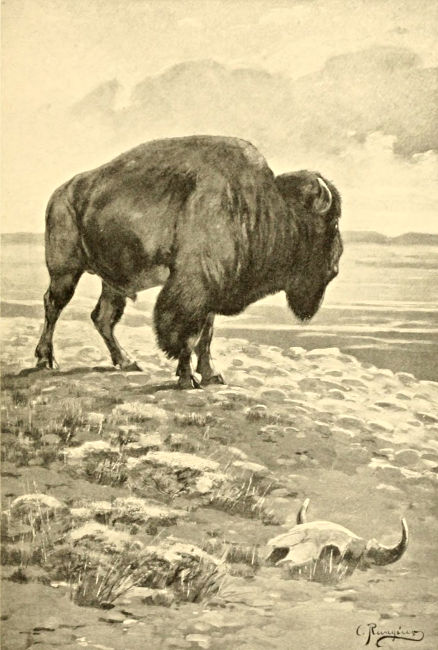
THE LAST OF THE HERD
The buffalo was the largest and economically
the most important of North American mammals.
It was also one of the most numerous, and over
a great area of the continent was practically the
sole support of its aboriginal inhabitants. Within
the memory of men who as yet are hardly middle-aged,
it roamed the country between the Missouri
River and the Rocky Mountains, in multitudes
so vast that it was commonly stated that its numbers
could not be materially reduced, that it would
exist long after the speakers had died. Yet,
within thirty years it has so absolutely disappeared
that the number of living wild buffalo
existing to-day is probably not greater than the
herd of European bison—commonly, but erroneously,
called aurochs—so carefully preserved
in the forests of Lithuania by the Russian Czar.
The history of the buffalo’s extermination has
been many times written, and the cause of its disappearance
is not far to seek. It was killed in
great numbers by the Indians, who used its flesh
for food, its skin for clothing and for their shelters.
Yet, under natural conditions, the destruction
which they wrought was never very extensive,
and was more than compensated for by the annual
increase. Wolves, bears, and other wild animals
which were found in great numbers throughout
the buffalo’s range in old days, devoured many of
them; but these were largely the aged, wounded,
and crippled, or those which were drowned in the
rivers, or mired in quicksands and mud-holes.
All this destruction by natural enemies did little
more than keep the race in good condition, by
cutting off the sickly and the feeble.
When, however, the white man appeared on
the scene, new conditions arose. The buffalo
had a robe which was as useful to the white man
as to the Indian. A trade speedily sprang up in
these robes, which the Indians were glad to kill
and tan for a cupful of sugar, or a few charges of
powder and ball, or a drink or two of alcohol.
Now, the Indians had a motive for killing which
heretofore they had not had. They killed more
buffalo and made more robes than before, but
still they made no impression on the wandering
millions which swayed to and fro under the influence
of the seasons. Steamboats might pass down
the Missouri River loaded to the guards with
bales of robes, but the vast herds of buffalo showed
no diminution. The early white explorers, or
trappers, or traders, did not themselves take the
trouble to collect buffalo hides; there were more
valuable furs in the country, beaver and otter and
bears, which brought better prices, and—more
important than this—did not require to be tanned
before they became marketable. For a buffalo
skin untanned was never shipped; it was only
after some Indian woman had expended on it
days of patient labor, that it would bring at the
trading post the pitiful reward which the white
man gave.
At last, however,—and that was less than forty
years ago,—a railroad began to push its way out
on to the broad plains lying between the Missouri
River and the Rockies, and to thrust itself into
the very region where the buffalo fed. Over the
shining rails of this railroad trains began to pass,
carrying passengers; and among these were many
white men eager for gain. These at once saw
the possibilities of the buffalo. At first they
killed them for meat, but soon the hides began to
be shipped also. And other men, learning that
the buffalo hides brought $2.00 each, and that
buffalo were to be had for the trouble of shooting
them, crowded into the range.
Then there began along the Platte Valley in
Nebraska, a scene of slaughter which has seldom
been equalled. The country was full of buffalo
skinners. Each hunter had his teams, and his
gangs of skinners which followed him about from
place to place, and cared for the hides of the
beasts which he killed. In some places the only
water accessible was the Platte River, and here
the buffalo came to drink. Here, too, the hunters,
concealed in ravines or in rifle-pits that they had
dug, shot down the beasts one by one, as they
came to water, and, indeed, formed so complete a
cordon along the river’s banks, that the buffalo
could not get through and turned back into the
hills. When at night the thirsty herds tried to
approach the river under cover of darkness, they
found that the hunters had built along the bottom
great fires, which they kept up all night, and
which the scared buffalo did not dare to pass.
It took but a little time to split the herd which
for centuries had passed across the valley north
and south with the seasons. It was about 1870
when this work began, and in 1874 the buffalo
were last seen in the valley of the Platte. The
herd had been split.
As other railroads to the southward pushed
into the buffalo country, the same scenes were
enacted. The buffalo country swarmed with
hunters who came in constantly increasing numbers,
so that none of them earned any money
by their butcher’s work. The price of hides fell,
but the buffalo continued to be slaughtered. Hundreds
of thousands of hides went to market, but
these were only a small proportion of the buffalo
killed. Colonel Dodge has expressed the belief,
that of the buffalo killed, only one-fourth or one-fifth
reached a market. It is conceivable that
the proportion was even less. A very large number
of the hunters knew nothing about hunting,
or shooting, or skinning a buffalo, or curing its
hide. The number of maimed and crippled animals
that went off to die was very large. The
number of hides ruined in skinning was large,
and the number improperly cured was still larger.
By the latter part of 1874, buffalo to the southward
of the Platte River began to be very scarce,
and in 1876 they were almost gone. After that
none were found in the southern country except
a few in the southern portion of the Indian
Territory and in the waterless country of the
pan-handle of Texas. There, protected by the
drought, and so few in number as to present little
attraction to the skin hunter, a few lingered for
some years, until finally captured or destroyed by
Buffalo Jones in his expeditions after calves for
domestication.
In the northern country the buffalo lingered
longer. The Northern Pacific Railroad, built as
far west as Bismarck on the Missouri River in
1873, stopped there for six or seven years, and it
was not until it had been continued well beyond
the Missouri that it again entered the buffalo
range and brought with it, as was inevitable, the
buffalo skinner. When he came, he did the work
he had done in the South, and did it as effectively.
But as the number of buffalo left in the
northern herd was small, it took only two or
three years to destroy them.
After 1883, except for a band of about five
thousand which had been overlooked on one of
the Sioux reservations, there were no buffalo left
in the northern country except a few scattering
individuals, which, hidden in out-of-the-way
places, had been overlooked by the hunters and
Indians, and so for a year or two were preserved
from slaughter. In the arid region about the
heads of the Dry Fork and Porcupine Creek in
Montana, one of these little groups was left,
which yielded to expeditions sent out by the
National Museum and the American Museum
of Natural History, a series of specimens, probably
the last of this species ever to be collected for
science. They were brought together just in
time, for since then there have been no buffalo.
A small herd of the so-called wood bison still
inhabits the vast wilderness between Athabasca
Lake and Lesser Slave Lake, but their numbers
are few. In the year 1900 there were two little
bunches of wild buffalo in the United States, perhaps
neither of them numbering more than fifteen
or twenty head. In the summer of 1901 one of
these bunches, which had long ranged in Lost
Park, Colorado, was wiped out by poachers, while
for some years nothing has been heard of the
other little band which ranged in Montana, and
which, in 1895, numbered forty or fifty head, no
less than thirty-two of which were killed a year
or two later by Red River half-breeds who made
a special trip to their range. At present the only
important band of buffalo in the United States is
that ranging within the confines of the National
Park, and it is altogether probable that this does
not number more than twenty-five or thirty.
No doubt the extraordinary abundance of the
buffalo had something to do with the wastefulness
of the slaughter which followed the railroad
building into the buffalo range. Many people no
doubt really believed that in their time the buffalo
could not be exterminated. They seemed to reason
that as there always had been “millions of
buffalo” there always would be. Men killed buffalo
for any foolish, childish reason that might
come into their heads,—to try their guns, to see
whether they could hit them, for fun!
How wantonly even some of the first traders
destroyed them is often shown by the few writings
that have come down to us from those early
days. Henry, in his Journal of August, 1800,
tells of the way in which he and some of his men
passed the time while waiting for others of his
people to come up. He says, “We amused ourselves
by lying in wait, close under the bank, for
the buffalo which came to drink. When the poor
brutes came to within about ten yards of us, on a
sudden we would fire a volley of twenty-five guns
at them, killing and wounding many. We only
took the tongues. The Indians suggested that
we should all fire together at one lone bull which
appeared, to have the satisfaction, as they said, of
killing him stone dead. The beast advanced till
he was within six or eight paces, when the yell
was given, and all hands let fly; but instead of
falling he galloped off, and it was only after several
more discharges that he was brought to the
ground. The Indians enjoyed this sport highly—it
is true, the ammunition cost them nothing.”
There has been much misunderstanding as to
the former distribution of the buffalo over the
North American continent, and the extent of
territory through which it was found. Many
respected authorities have declared that it occurred
in Eastern Canada, and generally along
the Atlantic slope; in portions of New England,
the Middle states, and south even into Florida.
It was said in general terms that the buffalo
occurred over the entire continent of North
America, from Florida to the 50th degree of
north latitude.
These loose statements were corrected by Dr.
J. A. Allen, in his most important monograph on
the American bisons, and it is now well understood
that the range of the buffalo included only
about one-third of the continent; that, while it was
found on the Atlantic slope, this was only in the
southeastern portion of its range; while in Canada,
New England, and Florida, it was probably
unknown.
The error into which early writers were led on
this subject undoubtedly arose from the terms
used by the earlier explorers, who spoke constantly
of vaches, or vaches sauvages, and less frequently
of buffu or buffle. But the term wild cows, used
by the early French Jesuits and English explorers,
referred to the elk (Cervus canadensis), while the
words buffu or buffle were used to designate moose
(Alces). In some of the narratives of the journeys
of the Jesuit travellers, there appear on almost
every page references to the herds of vaches
sauvages, and many of these writers, at one time
or another, describe these wild cows in such
unmistakable language as to show beyond question
that they were the elk or wapiti.
Dr. Allen assigns the Alleghany Mountains as
the general eastern boundary of the range of the
buffalo, although explaining that it frequently
passed beyond that range, and showing conclusively
that it occurred in the western portions
of New York, Pennsylvania, Virginia, North and
South Carolina and Georgia. Mr. Hornaday
cites some evidence to show that it occurred in
the District of Columbia, and quotes Francis
Moore, in his “Voyage to Georgia,” to prove that
there, at least, buffalo were found close to the salt
water.
While Dr. Allen gives the Tennessee River as
the southern boundary of the buffalo’s range, west
of the Alleghanies and east of the Mississippi
River, Mr. Hornaday quotes a number of references
to show that it occurred in some numbers
in what is now the state of Mississippi, and gives
a tradition of the Choctaws, narrated by Clayborne,
in regard to the disappearance of the
species from that section. This tradition is to
the effect that during the early part of the
eighteenth century a great drought occurred
there by which the whole country was dried up.
For three years not a drop of rain fell. Large
streams went dry, and the forest trees all died.
Up to that time, it is said, elk and buffalo had
been numerous there, but during this drought
these animals crossed the Mississippi River and
never returned.
In the eastern portion of its range, the Great
Lakes formed a barrier on the north which the
buffalo did not pass; but from western New York
westward, it was found in numbers along the
southern shores of these lakes, and in the territory
now Ohio, Indiana, Illinois, Michigan, and Wisconsin.
Audubon tells us that in the first years
of the nineteenth century there were buffalo in
Kentucky, but declares that about 1810, or soon
after, they all disappeared. This disappearance
was due chiefly to their actual destruction by
white men and by Indians, and not, as is commonly
stated, to the retiring of the great herds
before the advance of settlement and civilization.
It seems that the last buffalo were killed east of
the Mississippi River about the year 1820, although
it may be that in Wisconsin and Minnesota
they lasted somewhat longer.
West of the Great Lakes, and turning sharply
northward so as to run nearly northwest, the eastern
border of the buffalo’s range west of the Mississippi
was a line running very near the western
extremity of Lake Superior, up through the Lake
of the Woods, west of Lake Winnipeg, and thence
northward to and beyond the Great Slave Lake.
There this border line turned to the west, and
then sharply to the south, and meeting the Rocky
Mountains not far from where Peace River leaves
them, followed the range south, about to the 49th
parallel; and then turning southwestwardly and
including Idaho, a part of eastern Oregon, the
northeast corner of Nevada, the greater portion of
Utah, and most of New Mexico, the line passed
down south well into Mexico, turning eastwardly
just north of the 25th parallel of latitude, and running
north to the coast, which it followed around
again to the mouth of the Mississippi.
As it has been known in our day, the buffalo
in the southern portion of its range was a trans-Missouri
animal. North of the parallel of 45
degrees it was found in equal numbers on both
sides of the Missouri River, and in its northern
extension reached, and possibly even to-day
reaches, north to Great Slave Lake; for, as already
stated, the only considerable band of wild buffalo
to-day is the wood bison of the north, estimated
to number four hundred or five hundred.
Besides the boundaries thus set forth, it is probable
that in early days there was a considerable
extension of the buffalo’s range northward and
westward, into portions of what is now Alaska.
Certain it is that in that territory buffalo remains
have been found in great numbers. Some of these
skulls belong to species long extinct, and much
larger than the American bison; but, on the other
hand, there are many which are closely similar to
that species.
The range of the buffalo to the west of the
Rocky Mountains began to contract not very
long after the narrowing of its range on the
east. The earlier explorers in the West, from
Pike downward, report buffalo in abundance.
Yet, as already stated, the westernmost point at
which their remains have been found is among
the foot-hills of the eastern side of the Blue
Mountains of Oregon. In 1836, it is reported,
buffalo were abundant in Salt Lake Valley, but
there nearly all were soon afterward destroyed
by deep snows, which covered the ground for a
long period of time. This corresponds well with
statements made to me by John Robinson, better
known in early days as Uncle Jack Robinson,
one of the old-time trappers, who died between
1870 and 1880. In 1870 he told me that the
buffalo on the tributaries of the Green River and
on the Laramie Plains had all perished nearly
forty years before, during a winter when very
deep snows fell, followed by a thaw and subsequent
cold, which crusted the snow so that the
buffalo could not get through it, and starved to
death. This statement was confirmed by the
small number of remains, most of them extremely
old and weathered, which we found in this region
at that time. On the other hand, on upper tributaries
of the Green River buffalo were found
much later, and it is possible that these may have
been animals which wintered in narrow valleys
of the mountains, where, during this deep snow,
food was accessible. Fremont states that in the
spring of 1824 buffalo were abundant as far west
as Fort Hall, while Bonneville reported them in
extraordinary abundance in the Bear River Valley.
The mere fact that buffalo were not seen by
an explorer who passed through any given territory
does not necessarily show that they did not
range in that country. I have travelled for
months through a buffalo range without seeing
buffalo or any evidence of their very recent
presence, yet the signs found showed conclusively
that a short time before they had been
there in vast numbers. It would have been perfectly
possible for two honest reports, made a few
months or years apart by explorers who were not
prairie men, absolutely to contradict each other.
Although the buffalo disappeared from the
country west of the Green River, and even from
the Laramie Plains, a long time ago, it lingered
much later on tributaries of the Platte
River further to the northward. There were
buffalo on the Sweetwater and its tributaries
between 1870 and 1880, and on certain other
tributaries of the North Platte River between
1880 and 1890. About this same time there
was a small band ranging in what is called the
Red Desert Country, south of what is now the
National Park. But the last of these disappeared
about 1890.
The color of the buffalo is well understood to
be a dark liver brown over most of the body,
changing to black on the long hair of the fore
legs, muzzle, and beard. The long hair on the
hump is yellowish, faded from sunburn, and often
much the color of the hair of a “tow-headed
child.” The mountain bison, which lives largely
in the timber, and is scarcely or not at all exposed
to the sun, is much darker, sometimes
almost black, throughout.
Very rarely buffalo of unusual color were seen.
These were sometimes roan, sometimes gray or
spotted with white, or even pure white throughout.
A hide taken on the upper Missouri about
1879 was white on the head, legs, and belly, and
elsewhere of normal color; the result was that
when the animal was skinned and the hide
tanned there was a fine robe of the ordinary
color bordered with a wide band of white. If I
recollect aright, this particular hide was sold on
the river to an Englishman for $500.
Buffalo of unusual color, being so seldom seen,
were regarded by the Indians with great reverence.
Among the plains tribes, the buffalo, on which
they depended for food, shelter, and clothing, was
sacred. Its skull was usually placed on the ground
near the sweat lodge, prayers were made, and the
pipe was offered to it, in a petition to the buffalo
to remain with them, to be abundant, and even to
run over smooth ground, so that their horses
should not fall during the chase. If buffalo
in general were sacred, how much more should
the white one receive reverence. The Pawnees
cherished their skins as sacred objects, and kept
them in their medicine bundles, or used them to
wrap about these bundles. The Blackfeet regarded
white buffalo as especially dedicated to the
Sun, and hung up the white robe as a votive offering
to that deity. In the same way, the Cheyennes,
in old times, sacrificed the hide of a
white buffalo to the Sun, although later, after
their habits had been measurably changed by
contact with the whites, they sometimes sold
such robes.
My friend George Bent—son of Col. William
Bent, one of the historic characters of the early
West—tells me that during a long course of trading
among the Cheyennes and Arapahoes, he has
seen but five robes that could fairly be called
white. One of these was silver-gray, another,
white, a third, cream color, the fourth, dapple
gray, and the fifth, yellowish fawn color. He tells
me that in ancient times the white buffalo was
regarded by the Cheyennes as sacred, and that, if
one of them killed a white buffalo, he left it where
it fell, taking nothing from it, and not even putting
a knife into it. The Cheyennes believe that any
white buffalo belongs far to the north, and comes
from that region where, according to their tradition,
the buffalo originally came out of the ground.
A great many years ago a war party of Cheyennes
went up north against the Crows. One day
they came to a hill, and when they looked over it
they saw before them great herds of buffalo lying
down, and among them a cow, perfectly white.
When the buffalo stood up to go to water, the
white cow also stood up, and went with them, and
it was observed that none of the other buffalo
went very close to her. They did not appear to
fear her, but they did not crowd close about her;
they gave her plenty of room, as if they respected
her. This led the Cheyennes to think that the
white buffalo was a chief among other buffalo.
The women of the Cheyennes did not dress a
white buffalo’s hide. When occasion arose for
such work, it was commonly done by some captive
woman; for example, a Kiowa, or a Pawnee,—some
one who was not bound by Cheyenne customs
and Cheyenne fears. Rarely, a Cheyenne
woman went through a certain ceremony, being
prayed over by a medicine-man, and painted in
a peculiar fashion; this ceremony removed the
tabu, and she might then dress the white robe.
The habits of the buffalo were in most respects
those of domestic cattle. They fed in loose herds
as cattle do, the members of a family—that is
to say, the old cow and her progeny, sometimes
up to three or four years old—keeping together;
the old bulls, lazier, heavier, and less active than
the cows and the younger stock, were usually
on the outskirts of the herd, and if it was slowly
moving in any direction, were likely to be behind.
Much has been written concerning the intelligence
of the buffalo, and the manner in which the bulls
stood sentry over the herd, constantly on the
watch for danger. There is not and never was
any foundation for these stories, which were mere
creations of the writer’s imagination. As a matter
of fact, the cows were much more alert and
watchful than the bulls, were always the first to
detect danger and to move away from it, while the
bulls were dull and slow, and often did not start
to run until the herd at large was in full flight.
Moreover, the cows and younger animals of the
herd were much swifter than the bulls, and so
pressed constantly to the front, while the bulls
brought up the rear. The disposition of the
males had nothing to do with any desire to protect
the herd, but resulted from the fact that they
were slower than the others. The earlier writers
on the habits of these and other animals, credited
them with human motives and aspirations, which
of course they do not possess. A somewhat similar
fashion of writing about animals is current at
the present day, but is false and unnatural, and
will pass.
The hides of the buffalo are in their best
condition in the early part of the winter, and it
was the practice of the Indians to collect their
robes at that time of the year,—namely, between
November and January. Soon after January,
however, the hair begins to grow loose, and it
is shed during the spring and early summer,
though often great patches cling to the body
until late summer or early fall. I have seen
buffalo in the month of July still clad in what
looked like a loose robe, the old hair hanging together
in an almost complete mat, covering the
body. Usually, however, by rubbing against trees,
rocks, and banks of dirt, and by rolling on the
prairie, the loose hair is got rid of by early summer.
In very old animals the moult takes place later and
less easily than in those in good condition, and
sometimes old and lean buffalo do not seem to
shed their coats completely.
The rutting season begins in July and lasts
about two months. During this time frequent
battles take place among the bulls, apparently
fierce on account of the size and activity of the
combatants, but usually without important results.
These fights are much like similar contests
between domestic bulls; they paw up the
ground, kneel down and thrust their horns into
the earth, mutter and bellow and grunt; but
although they charge on each other with fury,
and come together with a tremendous shock, the
contest usually ends in nothing more important
than the driving off, for a time, of the weaker
bull. From their great activity at this season,
the bulls rapidly lose flesh; but after the rut is
over, they regain it, so that by the beginning
of the cold weather they, like the cows, are fat
and in good order.
The buffalo cow produces, usually, a single
calf, which may be born during the months of
March, April, May, or June. The usual time
for the calves to be born is in April and May.
Shortly before that time the mother separates
herself from the herd, which, however, she rejoins
not long after the birth of the calf. Like many
other ruminants, the mother hides her calf when
it is small and weak, but does not wander far from
it. After it has gained some strength it joins
other calves, and these usually keep together a
little apart from the main herd, their mothers
coming to them from time to time in order that
they may nurse.
When first born, the calves are reddish yellow
in color, do not possess any noticeable hump, and
look very much like ordinary domestic calves,
except that possibly the tail is slightly shorter.
Before very long, however, they commence to
grow darker in color, and I have seen calves
in August that at a little distance seemed almost
as dark as the adult buffalo.
The cow is devoted to her calf, and is ready
to fight for it against any enemy except man.
Usually, in the buffalo chase, the cow, thoroughly
frightened, paid no attention to the calf. But, on
the other hand, cases have occurred, where men
have been capturing calves to rear in captivity,
in which the cow refused to desert her offspring,
but turned upon the captor of the calf and
charged him with the utmost boldness.
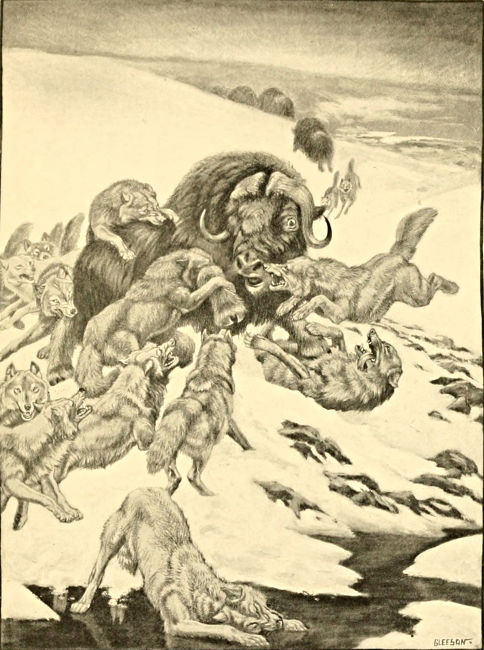
Colonel Dodge instances a case where a number
of bulls devoted themselves to protecting a
calf against wolves. He says, “I have seen evidence
of this many times, but the most remarkable
instance I ever heard of was related to me
by an army surgeon who was an eye-witness.
He was one evening returning to camp after
a day’s hunt, when his attention was attracted
by the curious actions of a little knot of six or
eight buffalo. Approaching sufficiently near to
see clearly, he discovered that this little knot
were all bulls, standing in a close circle with
their heads downward, while in a concentric
circle, at some twelve or fifteen paces distant,
sat, licking their chops in impatient expectancy,
at least a dozen large gray wolves—except man,
the most dangerous enemy of the buffalo. The
doctor determined to watch the performance.
After a few moments the knot broke up, still
keeping in a compact mass, and started on a
trot for the main herd some half mile off. To
his very great astonishment, the doctor now
saw that the central and controlling figure of
this mass was a poor little calf, so newly born
as scarcely to be able to walk. After going fifty
or one hundred yards, the calf lay down; the
bulls disposed themselves in a circle as before,
and the wolves, who had trotted along on each
flank of their retreating supper, sat down and
licked their chops again. This was repeated
again and again, and although the doctor did not
see the finale (it being late and the camp distant),
he had no doubt that the noble fathers did their
whole duty by their offspring, and carried it safely
to the herd.”
We may imagine that this was an unusual
occurrence; at the same time, it is true that
a group of buffalo, if one of their number is
attacked or threatened by wolves while they
are close together, will all rally to the general
defence, and will stand by each other. But that
the bulls make it their business to defend calves,
or systematically preserve anything except their
own skins, I do not believe.
Few people who have seen the buffalo only
in captivity, few even of those who have hunted
them on the level plains, have any idea of the
agility of this clumsy, heavy creature, or of
the disposition that it shows to reach elevated
points, so difficult of access that a horse might
find it a hard matter to climb them. In old
times, one might see buffalo ascending steeps
that were nearly vertical; or, on the other hand,
throwing themselves down the sides of mountains
so sharply sloping and rough that a horseman
would not dare follow them. Like many other
animals, wild and tame, they often liked to
seek elevated points from which a wide view
might be had, and I have found their tracks
and other signs on points high up in the
mountains, where only sheep or goats would
be looked for. The mountain bison, so-called—and
by many hunters regarded as a species quite
distinct from the buffalo of the plains—was
especially given to frequenting the peaks in summer;
no doubt in part to avoid the attacks of
flies, but also in part—as I believe—from sheer
love of climbing.
Like most other herbivorous animals, the
buffalo was subject to panics, and was easily
stampeded, and when thoroughly frightened, a
herd ran for a long way before stopping. When
alarmed, they huddled together as closely as possible,
running in a dense mass. The result of
this was that only the animals on the outskirts
of the herd could see where they were going;
those in the centre blindly followed their leaders
and depended on them. This very fact was a
source of danger, for the leaders, crowded upon
by those that followed, even if they saw peril
in front of them, could not stop, and often could
not even turn aside, but were constantly forced
on to a danger that they would gladly have
avoided. This is the entirely simple explanation
of a characteristic often wondered at by writers
about this species; that is, their habit of running
headlong into danger,—plunging over cut banks
into the pens prepared for them by the Indians,
or rushing into quicksands or places where they
mired down, or into deep water, which might
have well been avoided, or even up against such
obstacles as a train of cars or a steamboat in the
river. The simple fact is that the animals which
saw the danger were unable to avoid it on account
of the pressure from behind, and those that
were pressing the leaders on were ignorant of the
danger toward which they were rushing.
I have already adverted to the popular but
erroneous belief that the buffalo performed extensive
migrations in spring and fall. This is not
true. There were, unquestionably, certain seasonal
movements east and west, and north and
south, yet these movements were never very extended,
and constituted nothing more than the
very general shiftings which are made by many
ruminants between a summer and a winter range.
Throughout the country lying between the Saskatchewan
and the Missouri River, the buffalo, in
summer, moved up close to the mountains and
even into the foot-hills; and at the coming of
winter, with its snows and its bitter winds, they
moved to the eastward again, seeking the lower
ground and such shelter as the ravines and buttes
and timbered river valleys of the prairie might
afford.
On the other hand, buffalo, in their journeys to
water, usually travelled to the nearest streams, and
as on the plains the streams usually run from west
to east, and the buffalo travelled in single file, their
trails ran at right angles to the course of the
rivers, or north and south. It is quite possible
that the directions of these trails, deeply worn,
and showing the passage of great numbers of animals,
may have given rise to the popular belief in
this north and south migration.
At the same time, it is true that the buffalo
herds were more or less constantly in motion.
As they were very numerous, it was obviously
essential that they should move constantly, to
reach fresh grazing grounds. Often, too, they
were disturbed by hunters, red or white, who
stampeded the herds, which then rushed off in a
close mass, perhaps not to stop for ten or a dozen
miles. Besides that, frequently, the prairie was
burned, so that they were deprived of food, and
long journeys must be made to reach fresh grazing
grounds.
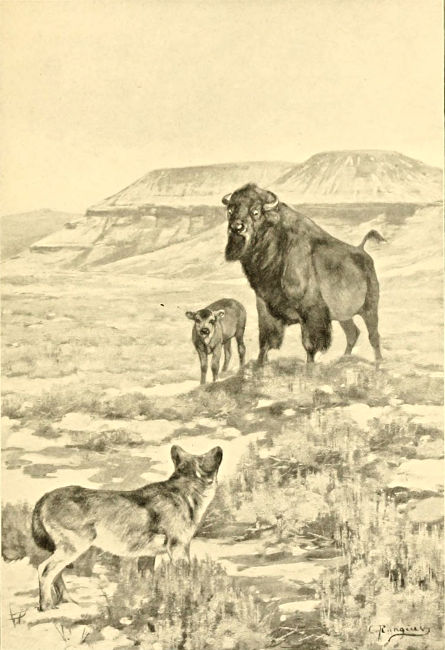
PROTECTED
Not very much is known, and very much less
has been written concerning the tendency in animals,
wild and domestic, to confine themselves to
particular localities; yet all people who live much
out of doors understand, even though they may
not reason much about it, how very local in habit
many birds and animals are. The ranchman, of
course, knows that the horses and cattle which
feed on his range divide themselves up into little
bunches, each of which selects some special area
where they spend all their time, rarely moving far
from it, except to make journeys to water; or, at
some change of the seasons, to migrate from summer
to winter range or back again. In domestic
stock this attachment to locality is strongly
marked, and it is a common thing for animals
that have been driven to a range hundreds of
miles distant from that on which they have been
accustomed to feed, to travel back toward their
old haunts as soon as they are turned loose. I
have known cases where one-third of a large
bunch of horses, driven to a new range four or
five hundred miles away, were a year later gathered
again on their old home range. It is a matter
of common experience for horses that escape
from owners, travelling at a distance from the
home range, to take the back trail and return
to it.
Among our larger game animals a similar condition
of things prevails. White-tail deer are
greatly attached to particular localities, and when
undisturbed, confine their wanderings within
very narrow limits. Even if thoroughly frightened,
and driven to a considerable distance, they
soon return. If an old white-tail buck is run
with dogs, he may make a long chase, and cover
a wide stretch of country, but to-morrow he will
probably be found in his old home. In the same
way, mule deer, mountain sheep, white goats,
and antelope show their attachment for localities,
and unless persistently disturbed, wander but
little.
The same thing is true with regard to non-migratory
birds. Ruffed grouse attach themselves
to certain pieces of woodland, or to
particular swamps, and the birds may be found
there all through the season. In like manner,
quail establish themselves on certain small
pieces of ground, and after their haunts have
been learned, may be started there with unfailing
regularity.
During many years’ experience with big game,
I have often had these facts thrust on my attention,
and have seen much to warrant the belief
that, like other wild animals, the buffalo feels
attachment for a particular range of country,
which it does not desert except for good reason,
or when the change from summer to winter, or
back again, leads to a migration that may fairly
be called seasonal. The buffalo’s attachment to
locality, and its natural inertia, is well exemplified
by an experience of Major G. W. H. Stouch,
U.S.A., retired, a veteran soldier of more than
thirty-five years’ experience on the plains, of which
he told me many years ago. I give it as nearly
as possible in his own words:—
“In the fall of 1866 I was directed to proceed
with Company C, Third Infantry, to reëstablish
old Fort Fletcher on the north fork of Big Creek,
sixteen miles below the present Fort Hays,
Kansas. When on October 16th we marched
down to the site chosen, and went into camp, I
noticed half a mile above us on the creek bottom
a considerable herd of buffalo feeding; there
were perhaps eight or nine hundred of them.
As soon as I saw them, it occurred to me that I
would leave them undisturbed, and that so long
as they remained there they might furnish us
a supply of beef at very little cost of time or
trouble. I therefore ordered the men not to
hunt up the creek, or disturb these buffalo in
any way, instructing them to do all their hunting
down the stream.
“In order to put my idea in practice at once,
I detailed one of the soldiers as hunter and
butcher of the company, and told him to go up
the creek and kill a buffalo, but not to show
himself either before or after firing the shot—merely
to kill a fat cow and then to remain under
cover until I joined him with a wagon. He
did so. At the report of the rifle the buffalo
fired at ran a few steps, and then lay down, while
those nearest to it made a few jumps, looked
around, saw no one, and then went on feeding.
From the camp we were watching the result of
the shot, and as soon as fired, I went with a
wagon to bring in the meat. As the wagon approached
the carcass, the nearest buffalo moved
out of the way, without showing any special fear,
and the wagon returned to camp with its load.
This was repeated daily, the buffalo never being
frightened either by the shot or the wagon, and
seeming to become more tame as time went on,
often approaching within a few hundred yards
of where we were at work erecting the buildings.
“About November 1st, Troop E, Seventh
Cavalry (under Lieutenant Wheelan) arrived to
reinforce the post; and about November 19th
Company B, Thirty-seventh Infantry (under Lieutenant
Phelps) also arrived. I explained my
plan of operation to these officers, and requested
them to detail hunters from their companies, and
to order their men to hunt down the creek, and
not to disturb what I had come to regard as the
post beef herd. They did so, and the herd still
remained with us.
“One morning in February, ’67, a sergeant,
whom I had sent the day before with a small
detail to make a scout, rapped at my door, and
reported his return. Among other things, he
said: ‘Lieutenant, I met our buffalo herd travelling
up the creek, about fifteen miles from here.
They were moving slowly; just feeding along.’
“I determined to see if they could not be
brought back, and taking twenty-five men (accompanied
by Lieutenant Cooke, Third Infantry,
Adjutant, Assistant-Surgeon Fisk, and Mr. Hale,
the post trader) rode up the creek, and entered the
valley above the herd. Then, forming a skirmish
line across the bottom, we very slowly advanced
toward the buffalo. When they first noticed us,
the leaders seemed uncertain what to do; but as
they had been accustomed to seeing large parties
of us, instead of running, as I feared they might,
they at length turned about and began slowly to
work backward in the direction from which they
had come. By nightfall the herd was on its old
feeding ground, and there we left it, and there it
remained until spring, and would, no doubt, have
remained longer, but, unluckily, the Seventh Cavalry,
under General Custer, rode in upon it, as
they came down the creek to the post for supplies,
after their unsuccessful chase after the
Cheyennes, who had run away from General
Hancock. General Custer detailed two troops
with orders to secure meat for the command.
After chasing it, and killing forty-four head, the
herd was scattered, and never returned. The
herd supplied the post (consisting of about three
hundred officers and men) with fresh beef from
October 16, 1866, until about April 20, 1867.”
The buffalo calf, when captured very young,
was easily tamed. Indeed, nothing more was
needed at times than to permit the calf to suck
the fingers for a moment or two, when it would
follow the rider into camp, and seemed to be
wholly without fear of man. As already stated,
when very young it is hidden by its mother, and,
like the young of deer, elk, antelope, and other
ruminants, it can then be captured, and makes
no effort to escape. This, by many writers, has
been denounced as stupidity and dulness. As
a matter of fact, it is merely following out the
protective instinct which is common to the young
of many large mammals, at a time when they are
without weapons for self-protection, and without
strength or speed to save themselves by flight.
At various times during the last two hundred
years, attempts have been made to domesticate
the buffalo, and with entire success. But these
attempts have never been continued long enough
to be productive of any economic results. Nevertheless,
buffalo were kept in captivity from the
beginning of the eighteenth century, and toward
the end of that century were actually domesticated,
bred, and crossed with domestic cattle in
Virginia, and somewhat later in Kentucky. The
very full account given to Mr. Audubon by Mr.
Robert Wycliff, of Lexington, Kentucky, in 1843,
has often been quoted, and all the experiments
since made have confirmed the conclusions then
stated. It was proved, and is now well known,
that the buffalo, in domestication, are easily
handled, respect fences, and are but little more
difficult to control than domestic cattle; that the
male buffalo crosses readily with the domestic
cow; that the progeny of the two species are
fertile with either species and among themselves.
It has also been demonstrated that the cross-bred
animal is larger than either parent, and so makes
a better beef animal. Besides, its hide yields a
robe which, if not equal to that of the buffalo, is,
at least, vastly superior to the hide of the ordinary
beef. More important than either the beef or the
robe, is the very greatly increased hardiness of the
cross-bred animal, which enables it to endure extremes
of cold and snow, which would destroy
the ordinary domestic cattle.
From the days of Robert Wycliff, almost to the
time when Mr. C. J. Jones, of Kansas, began experiments
in breeding buffalo, little or nothing had
been done in this direction. A few years earlier
Mr. S. L. Bedson, of Stony Mountain, Manitoba,
set to work at the same problem, and both
men met with abundant measure of success. Both
bred pure buffalo in considerable numbers, and
both succeeded in breeding the buffalo with the
domestic cow, and securing a progeny which was
remarkable for size and for the robes produced.
Indeed, Mr. Hornaday quotes Mr. Bedson as saying
that the three-quarter bred animal produces
“an extra good robe which will readily bring
forty to fifty dollars in any market where there
is a demand for robes.”
It is altogether possible that the time for
establishing a race of buffalo cattle has past.
The buffalo are extinct, and the number of animals
in captivity to be drawn on, very small.
Nevertheless, the great preponderance of bulls
among these domesticated buffalo, makes it possible
that something in this direction might be
done, though the chances now are much against it.
The buffalo has often been broken to the yoke.
Robert Wycliff says of this animal, “He walks
more actively, and I think has more strength
than an ox of the same weight. I have broken
them to the yoke and found them capable of
making excellent oxen; and for drawing wagons,
carts, or other heavily laden vehicles on long
journeys, they would, I think, be greatly preferable
to the common ox.” Under the yoke, however,
they are said to be somewhat difficult to
control, and cases are cited where broken buffalo
have, for various causes, run away, to the great
detriment of the load they were hauling. In the
year 1874 a settler on Trail Creek, in Montana,
told me that he had a pair of bulls broken to the
yoke, and declared that they would haul more
than “any two yoke of cattle on the place.”
There is another reason besides the lack of
buffalo for thinking that no systematic attempt
to cross these animals with domestic cattle will
ever be attempted. The days of free ranging,
where the cattle are turned out on the prairie to
look after themselves, winter and summer, are
almost over, and year by year the area of the free
range is becoming more and more contracted.
The advantages of great size and a valuable robe
would still be an attraction to the farmer; but the
hardiness which enables the half-breed animal to
endure almost any winter weather will soon cease
to be required, because the cattle of almost all
the western country will be kept under fence, and
fed on hay during the winter.
From time immemorial the buffalo furnished
food to the Indians, and with the coming into the
land of the white man it supported him also.
What the primitive method was by which the
Indians hunted buffalo we do not know, but at
the time the redmen became known to the
whites, when they were footmen, the only
method of securing this animal was by the surround,
or by driving it into pens from which the
buffalo could not escape, and where they were
easily destroyed. Such pens were built at the
foot of cut bluffs or low cliffs, over which the
buffalo were driven; or, in the more open and
flat country, where ravines with steep sides were
not found, a long fenced causeway was often
built, on which the buffalo were driven, and
when reaching its end, the leaders, by reason of
the pressure of those behind, were forced to jump
into the pen, and the others followed, until all
were captured. Often, if the drive was made
over a high bluff, the fall killed many of the
beasts, and even when this did not take place,
many of the younger and weaker animals were
destroyed by their fellows in the tremendous
crush which took place within the pen.
No sooner did the buffalo find themselves confined,
than they began to race about the enclosure,
and the men standing on the logs which
formed its sides, shot them with their stone-headed
arrows as they ran by, until at length all
had fallen.
The principle of the foot surround was not
different from this. When a herd of buffalo
was found, the Indians waited for a day when
the wind did not blow, and then, creeping toward
the buffalo, they surrounded them on all sides.
When the line was fairly complete, one man
would show himself, and perhaps frighten the
buffalo by waving his robe at them. They
would start to run, when the men stationed at
the point of the circle toward which they were
directing their course would show themselves,
toss their robes in the air, and turn them in
another direction. Thus, whichever way they
ran, they found people standing before them, and
soon they began to run around in a circle within
the ring of men, and continued to do this until
they became exhausted. Little by little the men
drew closer together, making the circle smaller,
and soon the buffalo were running near enough
to them for them to be shot by their arrows.
It did not always happen that the hunt was
successful. Sometimes in the pen a strong bull
might find a place where no one was standing,
and might leap over the barrier, or at least leap
on it, throwing his whole weight against it. Very
likely he would be followed by others, and perhaps
a number would succeed in surmounting
the wall; or they might even break it down, and
then the whole herd would stream out of the pen
and be lost. Sometimes, too, in the surround,
especially if the herd of buffalo was large, it was
found impossible to turn them, and they would
break their way through the ring of men. In
like manner, when, as sometimes happened, the
Indians set up their lodges all about the herd,
the buffalo might yet find a way to break through
and escape.
If, however, all went well, and a good part of
the herd was killed, there was great rejoicing all
through the camp. Everybody was happy, since
now, for some days, food would be abundant,
and every one would have enough to eat; and
there is nothing that the Indian dreads so much
as hunger.
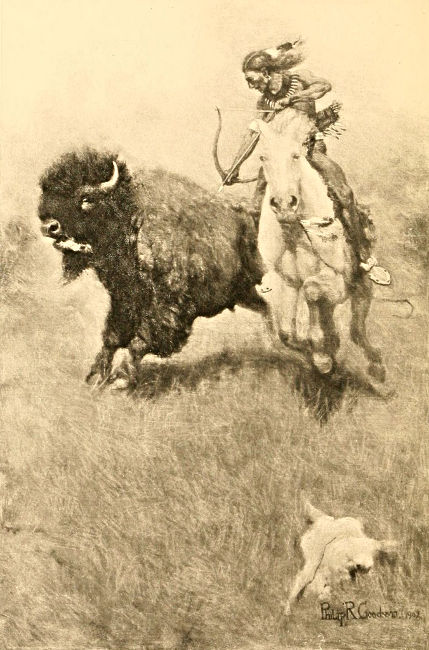
Later, after the Indians obtained horses and
iron-pointed arrows, and, later still, repeating
rifles, these old methods were all given up. It
was easier to chase the buffalo on horseback, and
their pack-horses gave them a ready means for
bringing the spoils of the chase back to the camp.
Now, too, they used the lance in hunting, driving
the horse close up on the buffalo’s right side,
holding the lance across the body, and, with a
mighty two-handed thrust, sending the keen steel
deep into the animal’s vitals.
Perhaps no more exciting scene could be witnessed
than one of the old-time buffalo chases by
the Indians. Naked themselves, they rode their
naked horses, carrying their quivers of arrows on
their backs or by their sides, and their bows in
their hands. The good buffalo horses were swift
of foot to catch the cow, admirably trained for
running over the rough prairie, often dangerous
from badger holes or burrows of the prairie dog,
and knowing how to approach the buffalo, and
also how to avoid its charge—trained, in fact,
just as well as the cow-pony is trained, which
knows exactly what is expected of him when
he is cutting cattle out of a bunch. The chase
was conducted in silence, and the only sound
heard was the rumble of a thousand hoofs—dull
where the ground was soft, and sharp if it hardened.
If the herd was large, the scene was one
of great confusion. Buffalo and horses with their
riders were dimly seen amid the cloud of dust
thrown up by the fleeing herd. Horses were
constantly overtaking the buffalo, riders were
bending down, horses were sheering off, buffalo
were falling. The old bulls, passed by the swift
riders, were turning off and fleeing, singly or in
little groups, to right and to left, while the swifter
cows, with heads down and tails in air, were pressing
forward in flight to escape the Indians, who
were riding with their rearmost ranks.
Not greatly differing from this, save that guns
were used and there was much yelling and noise,
were the hunts of the wild Red River half-breeds.
These were pursued on horseback, and the men
were armed with the old Hudson Bay smoothbore
flint-lock guns. Powder was carried in a
horn and balls in the mouth. When he had
discharged his gun, the hunter poured the powder
from the horn directly into the barrel, guessing
at the quantity, slipped a ball from the mouth
into the barrel, the gun was given a jar on the
saddle to settle the load, a little priming was
poured into the pan, and he was ready for
another shot.
On such hunts the Red River half-breeds
transported their families and their property
almost entirely in the well-known Red River
carts, each drawn by a single horse, and containing,
besides a load of baggage, a woman and
perhaps two or three children.
Besides these wholesale methods of taking
buffalo, of course they were killed singly by men
who crept close enough to them to drive even a
stone-headed arrow deep enough into the sides to
reach the life. Often, when the buffalo were in
situations where it was impossible to approach
them, men disguised as wolves crept in among
the herd, and killed buffalo with their arrows.
Catlin and others have described and figured this
method of approach, which at the present day is
traditional only among the Indians; yet an old
friend, who died a few years ago, almost a hundred
years old, has told me that he had many
times killed buffalo in this way, either alone or
in company with some Indian friend.
Indians and half-breeds alike preserved the
flesh of the buffalo by drying it. The strips or
wide flakes of meat were cut about one-quarter
of an inch thick and hung on scaffolds exposed
to sun and air. In a day or two the meat was
thoroughly dried, when it was bent into proper
lengths, and either tied in bundles or done up in
parfleches. It was from this dried meat that the
well-known pemmican was made. The dried
meat was roasted over a fire of coals, and then
broken up by pounding with sticks on a hide, or
by pounding between two stones. This pulverized
flesh was mixed with the melted fat of the
buffalo, and after the whole mass had been thoroughly
stirred, was packed in sacks made of
buffalo skin, which were then sewed up with
sinew, and as the mass gradually cooled the sack
became hard, and would keep for a very long
time.
The killing of buffalo, as described, was in no
sense sport; instead, it was work of the hardest
kind. The swift ride over the dry plains through
the clouds of dust, the killing of the buffalo, and
finally the cutting up of the animals was physical
labor far harder than most of that performed by
civilized man. Usually, the buffalo were killed
far from water, and the severe work that the man
had been doing and the summer heat made him
very thirsty. It is not strange, then, that he
slaked his thirst by devouring the liver, sprinkled
with gall, or by eating raw the gelatinous nose of
the buffalo.
The description of a butchering, given by Audubon
in his “Missouri River Journal,” is very
graphic, and is worth quoting here:—
“The moment that the buffalo is dead, three
or four hunters, their faces and hands often covered
with gunpowder, and with pipes lighted,
place the animal on its belly, and, by drawing out
each fore and hind leg, fix the body so that it
cannot fall again; an incision is made near the
root of the tail, immediately above the root in
fact, and the skin cut to the neck, and taken off
in the roughest manner imaginable, downward
and on both sides at the same time. The knives
are going in all directions, and many wounds
occur in the hands and fingers, but are rarely
attended to at this time. The pipe of one man
has perhaps given out, and with his bloody hands
he takes the one of his nearest companion, who
has his own hands equally bloody. Now one
breaks in the skull of the bull, and with bloody
fingers draws out the hot brains and swallows
them with peculiar zest; another has now
reached the liver, and is gobbling down enormous
pieces of it; while perhaps a third, who
has come to the paunch, is feeding luxuriously
on some—to me—disgusting-looking offal.
But the main business proceeds. The flesh is
taken off from the sides of the boss, or hump
bones, from where these bones begin to the very
neck, and the hump itself is thus destroyed.
The hunters gave the name of ‘hump’ to the
mere bones when slightly covered by flesh; and
it is cooked, and is very good when fat, young,
and well broiled. The pieces of flesh taken
from the sides of these bones are called filets,
and are the best portion of the animal when
properly cooked. The forequarters, or shoulders,
are taken off, as well as the hind ones, and the
sides, covered by a thin portion of flesh, called
the dépouillé, are taken out. Then the ribs are
broken off at the vertebræ, as well as the boss
bones. The marrow-bones, which are those of
the fore and hind legs only, are cut out last.
The feet usually remain attached to these; the
paunch is stripped of its covering of layers of fat,
the head and backbone are left to the wolves.
The pipes are all emptied, the hands, faces, and
clothes all bloody, and now a glass of grog is
often enjoyed, as the stripping off the skin and
flesh of three or four animals is truly very hard
work.… When the wind is high, and the buffaloes
run toward it, the hunters’ guns often snap,
and it is during their exertions to replenish their
pans that the powder flies and sticks to the moisture
every moment accumulating on their faces;
but nothing stops these daring and usually powerful
men, who, the moment the chase is ended,
leap from their horses, let them graze, and begin
their butcher-like work.”
The Indian and the half-breed killed the buffalo
for their support,—for food, clothing, shelter,
and many of their implements. The civilized
buffalo skinner exterminated it for its hides.
There was another class which did something
toward wiping out the buffalo, yet the numbers
killed by them were inconsiderable in comparison
with those killed for commercial purposes. This
class comprised those who ran buffalo for sport.
Buffalo-running was not a difficult art, nor especially
exciting, except so far as it is exciting
to chase and overtake some creature that is trying
to escape. Provided a man had a good
horse and was fairly accustomed to riding, there
was little difficulty and little danger in the buffalo
chase. At the same time, the combination of the
swift ride, the rough country, the dust and dirt
thrown up by the flying herd, and the close proximity
of the great beasts have reduced many a
buffalo runner on his first chase to a pitch of
nervousness which made him do precisely the
wrong thing. There have been cases, not a few,
where riders, trying to kill buffalo with a pistol,
have shot their own horses instead of the buffalo;
and at least one case came to my knowledge
where the excited hunter, riding up on the right
instead of the left side of the bull, and shooting
across his own body, managed to shoot himself
in the left arm.
There was something rather exhilarating in
the headlong ride after buffalo, a game not unlike
“follow my leader,” which boys play, where
the leader chooses the roughest and most difficult
ground over which he can pass, and the follower
is obliged to take the same route. But buffalo-hunting
is now a sport of the distant past, and it
is needless to speak of it at any length.
In the days of its abundance the buffalo was a
most impressive species, and their enormous numbers
have been a theme on which many writers
have delighted to linger. Adjectives have failed
them to describe the multitudes of buffalo seen,
and it was not unusual for men to travel long
distances among great herds, which made slow
way for them as they passed along. Many calculations
have been made of the numbers of
buffalo seen at one time; but, after all, these
can be little more than guesswork. Terms like
thousands and millions, so commonly used, have
little or no meaning, for we have no standard of
comparison by which to measure them. All the
earlier writers, however graphic their descriptions
of their numbers, fail to impress the reader, because
no one could comprehend such numbers
except by seeing them. Dr. Allen, Mr. Hornaday,
Colonel Dodge, and many of the old explorers,
give much matter bearing on this subject.
A few lines from the Journal of Alexander Henry
give some idea of their numbers on the Red
River. He says, under date of September 18,
1800: “I took my usual morning view from the
top of my oak, and saw more buffalo than ever.
They formed one body, commencing about half a
mile from camp, whence the plain was covered
on the west side of the river as far as the eye
could reach. They were moving slowly southward,
and the meadow seemed as if in motion.
This afternoon I rode a few miles up Park River.
The few spots of wood along it have been ravaged
by buffalo; none but the large trees are
standing, the barks of which are rubbed perfectly
smooth, and heaps of wool and hair lie at the
foot of the trees. The small wood and brush
are entirely destroyed, and even the grass is not
permitted to grow in the points of the wood.
The bare ground is more trampled by these cattle
than the gate of the farm yard.”
Even in recent times one might journey for
days at a time through herds, which to the eye
seemed absolutely to cover a blackened prairie,
and I myself have travelled for weeks through the
Northwest without, at any time during the day,
being out of sight of buffalo. How many millions
there were in the great herds through which we
used to pass, it is useless now to compute. They
have all gone. But over a vast extent of the
western country they have left memorials still
visible and long to endure in the deep trails
which furrow the prairie in all directions.
Other mementos still to be seen, and stirring
the heart of the old-timer, though to the man of
to-day they are without a meaning, are the huge
erratic boulders which lie here and there over
the prairie where they were dropped by the great
ice mass in its passage down from the highland.
Against such boulders the buffalo used to rub
their bodies, and such masses of granite or of
flinty quartzite, polished and with their sharp
angles worn away by the rubbing against them
of the tough hides, may often be seen. About
such a rock, deep worn in the ground, is the
trench, where the bulls and the cows and the
younger animals once marched as they pushed
their sides against the hard rock, their hoofs
cutting the soil into fine dust to be blown away
by the wind. The angles of these old rubbing-stones
are still discolored by the grease left on
them from the buffalo’s skins, and looking at
them, one might fancy that they had been used
only yesterday.
Here, then, are monuments of imperishable
granite, fashioned by a race of dumb creatures,
and telling to him who can read their sculpturing
a long story of life and power and multitude forever
gone. From earliest time man has set up
all over the earth his enduring memorials to hold
the wonder of later ages; but of the races of
the beasts, which one has done this, save only the
bison?
(Bos bison[6])
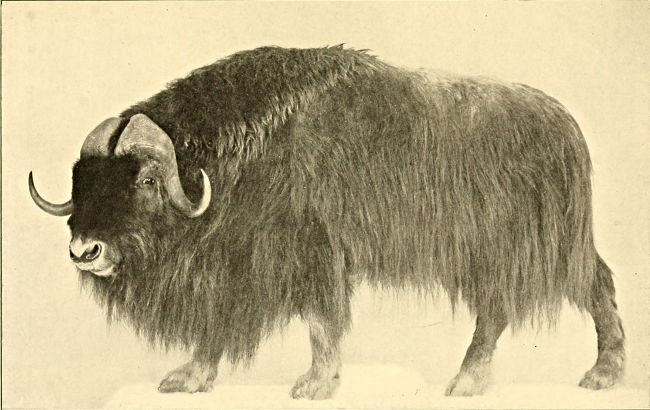
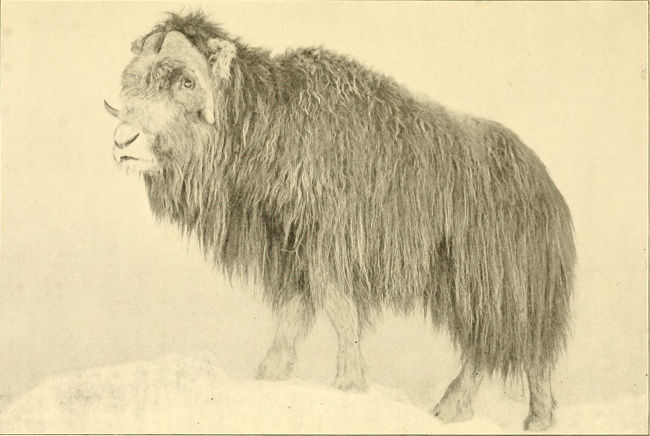
The great elevation of the forequarters, the
mass of long hair clothing the head, shoulders,
and fore part of the body, together with the peculiar
form of the head and horns, the latter of which
are cylindrical, serve at once to distinguish the
bison from the other members of the ox tribe.
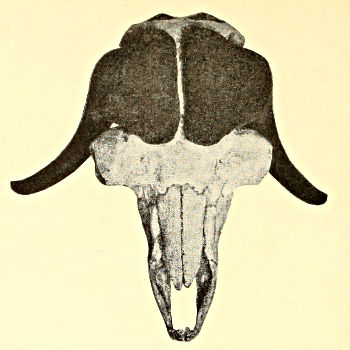
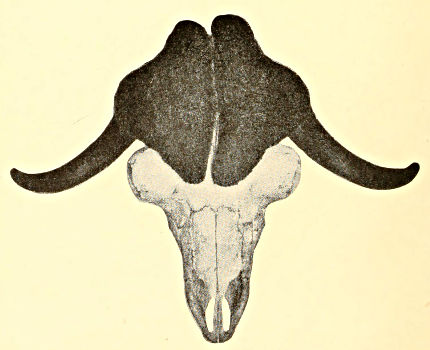
Some of the points distinguishing the American
bison from its European cousin are that the mass
of hair on the fore quarters is longer, the form
of the skull is different, the horns are shorter,
thicker, blunter, and more sharply curved. In
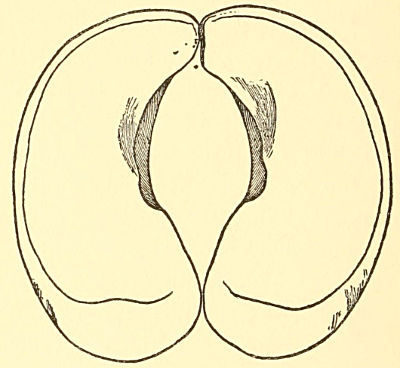
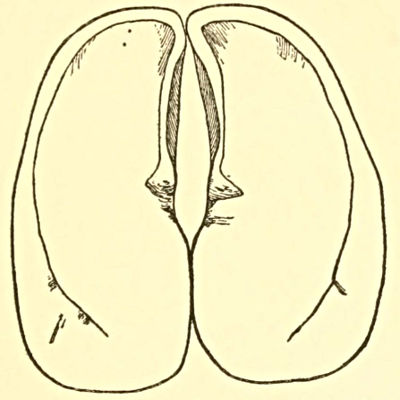
the skull of the American animal the sockets
of the eyes have a more tubular form.
Height at shoulder about 6 feet; weight from
15 to 20 hundredweight; an adult bull weighed
by W. T. Hornaday scaled 1727 pounds.
Distribution.—The greater portion of western
North America, ascending to the Great Slave Lake,
and descending to New Mexico and Texas; now
nearly exterminated. American writers recognize
two races (or species), the prairie bison (B. bison
typicus) and the larger wood bison (B. bison athabascæ)
of the forest highlands of the northwest.
Measurements of Horns
| Length on Outside Curve |
Circumference |
Tip to Tip |
Widest Inside Spread |
Locality |
Owner |
| —21½ | 15¼ | .. | 35
outside | Northern Montana | W. F. Sheard |
| 20⅞ | 15 | .. | 30½ | Wyoming | Hon. F. Thellusson |
| —20¼ | 16⅛ | 33½ | .. | ? | W. H. Root |
| —19 | 12½ | .. | .. | Western Montana | P. Liebinger |
| 18⅞ | 14¾ | .. | 16⅞ | Western Montana | The late J. S. Jameson |
| —18¼ | 14 | 26¼ | 29 | Sioux Country | Sir Greville Smyth, Bart. |
| —18 | 14 | .. | .. | Montana | F. Sauter |
| 17¾ | 12⅜ | 15⅛ | .. | ? | H.R.H. the Duke of Saxe-Coburg and Gotha |
| —17½ | 12½ | .. | .. | Southwestern Montana | Theodore Roosevelt |
| 17½ | 12 | .. | 25½ | Wyoming | H.R.H. le Duc d’Orléans |
| 17½ | 13½ | 21 | .. | ? | Viscount Powerscourt |
| 17⅛ | 11⅜ | 10⅜ | 17⅛ | ? | British Museum |
| —17 | 14 | 17½ | .. | Yellowstone, Montana | Count E. Hoyos |
| 16⅝ | 14¼ | 24 | .. | Bighorn Mts., Wyoming | Moreton Frewen[7] |
| 16½ | 12½ | 19⅜ | .. | Colorado | Sir Edmund G. Loder, Bart. |
| 16¼ | 13½ | 14¼ | .. | ? | Duke of Portland |
| 16⅛ | 15⅞ | 25¾ | .. | Colorado | Sir Edmund G. Loder, Bart. |
| 15½ | 14⅜ | .. | 19¾ | Wyoming | St. George Littledale |
| —15.8 | 12.14 | 15 | .. | Indian Territory, near Texas | Prince Henry of Liechtenstein |
| 14 | .. | 12¼ | .. | North Park, Colorado | Col. Ralph Vivian |
| 13½ | 13½ | 17½ | .. | ? | G. Wrey |
| 13⅜ | 12 | .. | .. | ? | Hon. Walter Rothschild |