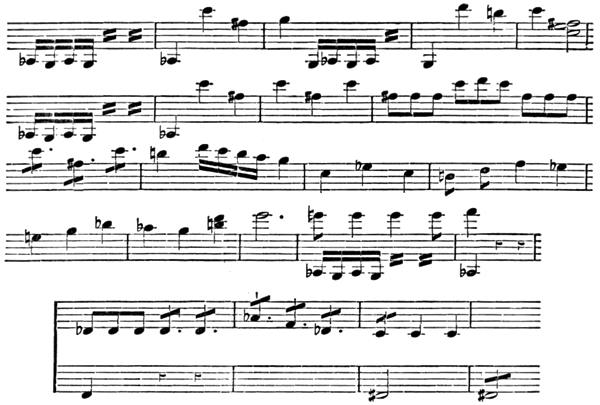
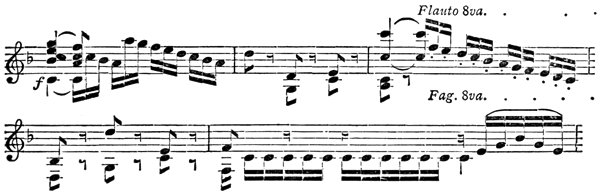
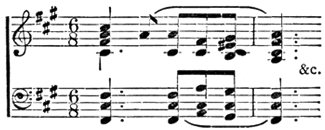
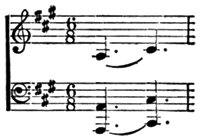
In Thibet, and other Asiatic countries in which the Buddhist religion is
established, variously-constructed musical instruments are generally
deposited in a certain part of the temple, to be at hand for the priests
when required in ceremonies and processions. In examining the Assyrian
bas-reliefs in the British Museum, we are led to surmise that a similar
custom prevailed in Western Asia before the Christian era. At any rate, it
appears probable that the various instruments represented in the hands of
musicians who assisted in religious rites observed by the king were
usually deposited in a room appropriated to their reception. The same
appears to have been the case in the Temple of Jerusalem. King David had,
it is recorded, musical instruments made of a wood called berosh,
which afterwards, under the reign of Solomon, were made of algum,
or almug, a more precious wood imported from foreign districts.
King Solomon, being in possession of superior instruments, probably
preserved the inferior ones of his father as venerated memorials; and the
kinnor upon which David played before Saul may have been as
carefully guarded by King Solomon as the Emperor of Germany guards in his
cabinet of curiosities the flute of Frederick the Great.
Howbeit, Josephus records that Solomon had made for the musical
performances at the dedication of the Temple a large number of stringed
instruments and trumpets, all of which were kept together in the Temple
with the treasures. It is not likely that at so early a period collections
of antiquated instruments were formed for any scientific purpose; the art
of music was too much in its infancy to suggest the preservation of
evidences elucidating its gradual development.
The collections of ancient and scarce musical instruments which, in modern
time, have been made in several European countries are very interesting to
the lover of music, although they have, in most instances, evidently been
formed less with the object of illustrating the history of the art of
music than for the purpose of preserving curious and tasteful relics of
bygone time, or of exhibiting characteristic contrivances of foreign
nations.
In Italy some of the Conservatories of Music possess antiquated
instruments of great rarity. Curious old spinets, lutes, mandolines, and
guitars, are said to be found dispersed among private families and in
convents, especially in Naples and its vicinity. In the Liceo Comunale di
Musica, at Bologna, are deposited above fifty instruments, among which are
an Italian cither (cetera) of the beginning of the sixteenth
century; an archlute by "Hieronymus Brensius, Bonon" (Bologna); a
chitarrone, by "Matteo Selles, alla Corona in Venetia, 1639;" a chitarrone
inscribed "In Padova Uvendelio Veneto, 1609;" a theorbo by "Hans Frei in
Bologna, 1597;" a lute by "Magno Stegher in Venetia." A lute, "Magno
Dieffopruchar a Venetia, 1612." This lute has fourteen strings arranged in
seven pairs, each pair being tuned in unison. Several marine trumpets, one
of which bears the inscription, "Pieter Rombouts, Amsterdam, 17." A viola
da gamba, inscribed "Antonius Bononiensis." A sordino, or pochette, by
"Baptista Bressano," supposed to date from the end of the fifteenth
century. Its shape is peculiar, somewhat resembling that of the Portuguese
machête, representing a fish. A viola d'amore, with the inscription
"Mattias Grieser, Lauten and Geigenmacher in Insbrugg, Anno 1727;" two
curious old harps; an old tenor flute, measuring in length about three
feet; some curious double flutes; cornetti, or zinken, of different
dimensions. An archicembalo. This is a kind of harpsichord with four rows
of keys, made after the invention of Nicolo Vicentino, and described in
his work "L'Antica Musica ridotta alla moderna prattica. Rome, 1555." The
compass of this archicembalo comprises only four octaves; but each octave
is divided into thirty-one intervals, forming in all one hundred and
twenty-five keys. It was made by Vito Trasuntino, a Venetian, who lived
towards the end of the sixteenth century, and who added a tetracordo
to it, to facilitate the tuning of its minute intervals. However, the
archicembalo was probably not the first instrument of the harpsichord kind
which contained an enharmonic arrangement of intervals. The clavicymbalum
perfectum, or Universal-clavicymbel, which Prætorius states he saw in
Prague, and which was likewise made in the sixteenth century, was of a
similar construction. One of the most singular instruments in the
collection of the Liceo Comunale de Musica at Bologna is the cornamusa,
which consists of five pipes inserted into a cross-tube, through which
they are sounded. Four of the pipes serve as drones; and the fifth, which
is the largest, is provided with finger-holes, like the chanter of a
bagpipe. The instrument has, however, no bag, although it is probably the
predecessor of the species of bagpipe called cornamusa.
Instruments played with a bow of the celebrated Cremona makers are at the
present day more likely to be met with in England than in Italy. In the
beginning of the present century Luigi Tarisio, an Italian by birth, and a
great connoisseur and collector of old violins, hunted over all Italy and
other European countries for old fiddles. To avoid the high custom dues
which he would have had to pay on the old instruments, he took them all to
pieces, as small as possible, and carried the bits about him in his
pockets and in a bag under his arm. So thoroughly was he acquainted with
his acquisitions that, having arrived at the place of his destination, he
soon restored them to their former condition, assigning to each fragment
its original position. Tarisio made his first appearance in Paris, in the
year 1827, with a bag full of valuable débris from Italy; and he
continued his searches for nearly thirty years. During this time he
imported into France most of the beautiful violins by Antonius
Stradiuarius, Joseph Guarnerius, Bergonzi, Montagnana, and Ruggeri, which
are of highest repute, and the greater number of which have afterwards
found their way into England.
In Germany we meet with several collections of interest. The Museum of
Antiquities, at Berlin, contains, among other musical curiosities,
well-preserved lyres which have been found in tombs of the ancient
Egyptians. The Gesellschaft der Musikfreunde ("Society of Lovers of
Music"), at Vienna, possesses a collection of antiquated instruments,
among which are noteworthy: a viola di bardone by Jacobus Stainer, 1660; a
viola di bardone by Magnus Feldlen, Vienna, 1556; a viola di bardone by H.
Kramer, Vienna, 1717; a viola d'amore by Weigert, Linz, 1721; a viola
d'amore by Joannes Schorn, Salzburg, 1699; a tromba marina (marine
trumpet) by J. Fischer, Landshut, 1722; a lute by Leonardo Tieffenbrucker,
Padua, 1587; a theorbo by Wenger, Padua, 1622; a theorbo by Bassiano,
Rome, 1666; a Polish cither by J. Schorn, Salzburg, 1696; a large flute
made in the year 1501; an old German schalmey (English shalm or shawm)
by Sebastian Koch; an old German trumpet by Schnitzer, Nürnberg, 1598; an
oboe d'amore, made about the year 1770, etc.
A curious assemblage of scarce relics of this kind is also to be found in
the Museum of the Germanic Society at Nürnberg. The most noteworthy
specimens in this collection are: two marine trumpets, fifteenth century;
a German cither with a double neck (bijuga-cither) sixteenth century; a
German dulcimer (hackbret), sixteenth century; a lute by Michael
Harton, Padua, 1602; a viola da gamba by Paul Hiltz, Nürnberg, 1656; a
viola d'amore, with five catgut strings, and eight sympathetic wire
strings, seventeenth century; an arpanetta (harpanetta, German spitzharfe)
mounted on one side with brass wire, and on the opposite side with steel
wire, sixteenth century; a clavecin with finely painted cover, by Martinus
van der Biest, Antwerp, 1580; two German zinken (cornetti)
sixteenth century; two specimens of the bombardo, viz., a German
alt-pommer and tenor-pommer, by J. C. Denner, seventeenth century; some
specimens of the cormorne (German krummhorn) of the sixteenth and
seventeenth centuries; a trumpet made by J. C. Kodisch, Nürnberg, anno
1690; a splendid brass trombone (German bass-posaune) ornamented with the German
eagle and imperial crown, made by Friedrich Ehe, in Nürnberg, anno 1612; a
Polish bagpipe, seventeenth century; a syrinx of reeds covered with black
leather, sixteenth century; eight military pipes, made by H. F. Kynsker,
in Nürnberg, seventeenth century; a small portable organ (regal)
with two rows of keys, sixteenth century. The regal has become very
scarce. There are only a few specimens known to be in existence; one, of
the sixteenth century, is in the possession of the Chanoinesses de
Berlaimont, at Brussels; another, made about the middle of the seventeenth
century, belongs to the Duke of Athol, and is at Blair Athol, in Scotland;
another, which belongs to Mr. Wyndham S. Portal, Malshanger, Basingstoke,
is in the shape of a book, and its pipes have reeds, or vibrating tongues
of metal. This regal, which probably dates from the sixteenth century, is
of the kind which was called in German Bibelregal, because it
resembles a Bible in appearance.
Old musical instruments are generally so fragile, and were formerly
thought so little of when they came out of use, that it is perhaps not
surprising to find of those dating from a period earlier than the
sixteenth century very few specimens, and these have generally been
altered, and it is seldom that they have been properly restored to their
original condition. As an instance how valuable specimens are gradually
becoming more and more scarce, may be mentioned the interesting collection
of obsolete German harps, pipes, and trumpets, dating from a period
anterior to the year 1600, which was preserved in the Town Library of
Strassburg, and which, at the recent bombardment of the town, was reduced
to ashes. It contained, among other curiosities: a cornetto curvo; some
specimens of the cornetto dritto; a flauto dolce. Several specimens of the
bombardone, the predecessor of the bassoon; a dulcinum fagotto; two
specimens of the cormorne, an oddly-shaped wind instrument belonging to
the shalm or oboe family. An arpanetta. This instrument, called in German
spitzharfe or drathharfe, is especially interesting,
inasmuch as it resembles the old Irish harp called keirnine, which
was of a similar form, and which was also strung with wire instead of
catgut. There is such a harp extant in the museum of the Society of Lovers
of Music, at Vienna, before-mentioned.
If the lumber-rooms of old castles and mansions in Germany were ransacked
for the purpose, some interesting relics of the kind would probably be
brought to light. In the year 1872 Dr. E. Schebeck, of Prague, was
requested by Prince Moriz Lobkowitz to examine the musical instruments
preserved in Eisenberg, a castle of the Prince, situated at the foot of
the Erzgebirge, in Bohemia. Most of them had formerly been used in the
private orchestra kept by Prince Josef Franz Maximilian Lobkowitz, the
well-known patron of Beethoven, to whom the composer has dedicated some of
his great works. The present Prince Lobkowitz, who seems to have inherited
his parent's love for music, wished to have an examination of the
instruments, with the object of making a selection of the most interesting
ones for the great Vienna Exhibition in 1873. Dr. Schebeck found, among
other rarities, violins by Gaspar di Salo, Amati, Grancino, Techler,
Stainer, and Albani; a violoncello by Andreas Guarnerius; a scarce
specimen of a double-bass by Jacobus Stainer; two precious old lutes by
Laux Maler, who lived at Bologna during the first half of the fifteenth
century; a lute, highly finished, and apparently as old as those of Laux
Maler, with the inscription in the inside "Marx Unverdorben a Venetia;" a
lute, with the inscription "Magno Dieffoprukhar a Venetia, 1607." There
can be no doubt that we have here the Italianised name of the German
Magnus Tieffenbrucker, who lived in Italy.[5]
Fortunately for musical antiquarians the collection of rare instruments in
the Conservatoire de Musique at Paris has been preserved uninjured during
the recent disasters in that city. Among the instruments may be noticed, a
small and beautiful musette with drones of ivory and gold, which belonged
to Louis XIII.; a German regal, or portable organ, sixteenth century; a
pochette by Stradiuarius; a courtaud, an early kind of bassoon,
dating from the fifteenth century; several bass-flutes, and other
rare old wind instruments; Boïeldieu's pianoforte; Grétry's clavichord; a
"Trumpet of Honour," which was made by order of Napoleon I., and which has
the name of "T. Harper" engraven on its silver rim. M. Victor Schœlcher
has presented to the Conservatoire de Musique about twenty rather
primitive instruments of uncivilised nations obtained by him during his
travels in Western Africa and South America, among which may be noted
several Negro contrivances of the harp and guitar kind.
An interesting catalogue of the instruments in the Musée du Conservatoire
National de Musique has recently been published by Gustave Chouquet, the
curator of the museum. It comprises 630 instruments, or portions of
instruments, each fiddle-bow, mute, etc., being separately numbered. On
the whole, the Paris collection, though large, is far less valuable than
that of the South Kensington Museum.
One of the most valuable private collections ever formed of ancient
musical instruments was that of M. Louis Clapisson in Paris. During a
course of more than twenty years M. Louis Clapisson succeeded in procuring
a considerable number of scarce and highly decorated specimens of
instruments of the Middle Ages and the Renaissance. The collection has
been dispersed since the death of its owner; a large portion of it is now
incorporated with the collection of the Conservatoire de Musique at Paris,
and some of its most valuable specimens were secured for the South
Kensington Museum. It was, however, so unique that the following short
survey of its contents will probably be welcome to the archæological
musician.
Clapisson's collection comprised (according to the catalogue of its
contents which was published in French, and which is now scarce) 167
instruments. Among them are especially noteworthy:—A clavecin (or
harpsichord) with two rows of keys, dated 1612; embellished with paintings
which date from the time of Louis XIV. In front is a painting by Teniers,
and in the inside are some fine paintings by Paul Brill. An Italian spinet
of the time of Louis XIV., embellished with paintings of garlands
of flowers, cupids, etc., attributed to Poussin. The fine carving and the
ornamentation of engraved amber on this spinet give it a stamp of
originality. An Italian spinet, bearing the inscription "Francisci di
Portalvpis Veronen opus, 1523," of ebony inlaid with ivory. An Italian
spinet of the sixteenth century, ornamented with marquetry of various
coloured woods. The corners of the key-board are adorned with caryatides
finely carved in box-wood. A travelling spinet made in the shape of a
mail-trunk dating from the time of Henri II. It is signed "Marins," which
is the name of a celebrated manufacturer of that period. A clavecin made
in France in the year 1657, ornamented with paintings and with marquetry
of ivory, with the arms of the family of Pierre di Dreux (called
Mauclere), Duke of Bretagne, who lived about the year 1250. An Italian
dulcimer of wood carved and gilt, dating from the seventeenth century. It
is tastefully inlaid with slips of silvered glass. A French dulcimer of
the time of Louis XIV., with twisted columns of wood carved and gilt, and
with paintings of flowers and birds. A French dulcimer, or timpanon, of
the time of Louis XIII., ornamented with roses neatly carved in wood. The
instrument is in a case, which is ornamented with paintings and inlaid
slips of silvered glass. A French dulcimer of carved wood, ornamented with
slips of engraved Venetian glass, with turquoises, and with paintings on
Vernis Martin. A sonorous stone from China, in the form of a fish.
A French harp, of the time of Louis XV., gilt and carved with flowers and
paintings in relief. A harp of the time of Louis XVI., having belonged to
the Princesse de Lamballe, whose name is engraven on it. It is finely
painted with medallions on Vernis Martin. A theorbo of the time of
Louis XIII., inlaid with designs in ivory. Engraven on it is the coat of
arms of the House of Austria; also a portrait, and the device Non omnes.
A French guitar made, according to an inscription, by Voboam, a celebrated
lute-maker at the court of Louis XIV. It is made in the figure of a
tortoise, the body being of tortoise-shell, and the head, feet and tail of
coloured enamel. A French guitar of the time of Louis XIII., inlaid with
ivory, on which are engraven subjects of the chase. A French guitar of the
time of Louis XIII., inlaid with ivory engraved with mythological
subjects. An Italian mandoline of citron-wood inlaid with mother-of-pearl,
engraven with figures. An Italian mandoline, ornamented with marquetry,
mother-of-pearl, and carving; assigned to Stradiuarius. A French mandoline
of the time of Louis XVI., with the arms of the Dauphin inlaid with
mother-of-pearl. A small Italian mandoline with three strings. A mandora
of the time of Henri II., inlaid with broad strips of ivory, and with fleurs
de lys in ebony. A French hurdy-gurdy (or vielle) of the time
of Louis XIV., made of box-wood and citron-wood, carved, and ornamented
with medallions of mother-of-pearl and with turquoises; formerly the
property of Madame Adelaïde. A French hurdy-gurdy by Louvet, dated 1750;
tastefully ornamented. A small hurdy-gurdy for the use of ladies, made in
France during the period of Louis XVI. This vielle, elegant in form
and tastefully inlaid with ivory, bears the inscription "Delaunay." A
Hungarian violin, made in Presburg, inlaid with marquetry of various
coloured woods. A small violin by Jacobus Stainer, inlaid with ornaments
in silver, including the coat of arms of France; with a finely-carved head
of a faun. A French quinton, or five-stringed viol, made by
Guersan, in 1755. A viola da gamba, with a finely-carved head representing
an angel bandaging the eyes of a female. A small viola da gamba of the
kind on which the French ladies used to play at the time of Louis XIII. A
pochette by Stradiuarius, known to be genuine. A pochette of the sixteenth
century, of engraved ivory and ebony, inlaid with precious stones. A
pochette of ivory and coloured woods, dating from the period of Louis
XIII., and bearing the inscription "Marins." A crystal flute, the
invention of Laurent; silver keys enriched with amethysts. A small Italian
double-flute of ivory, made by Anciuti in Milan, anno 1722. An oboe of
ivory, carved by Anciuti in Milan, beginning of the eighteenth century. A
French oboe of ebony, inlaid with ivory, tortoise-shell, and enriched with
gold and precious stones; of the time of Louis XIII. A small French oboe
of the time of Louis XIV., made of ivory, with three silver keys. A
French musette (a species of bagpipe with bellows); the pipes of
ivory; twenty-one silver keys; the bag ornamented with embroidery in gold.
This fine musette dates from the period of Louis XV. A small French
musette of ivory, with silver keys, having belonged to the painter
Vanloo. A cornemuse bretonne (bagpipe of Brittany) of the time of
Louis XIII. A trumpet of the time of Henri IV., ornamented with embossed
fleurs de lys and with the portrait of Henri IV., surrounded by
butterflies. A serpent of the sixteenth century, made of wood, with the
carved head of a demon finely executed.
Turning to Belgium, we again meet with some interesting collections. M.
Fétis, the well-known musician, had a number of Eastern instruments
procured from Egypt, to enable him to familiarise himself with the Arabic
tonal system, which essentially differs from our own, but which
undoubtedly is of much higher antiquity, and therefore of particular
interest to the musical historian. After the death of Fétis, his
collection was purchased by the Belgian Government. Dr. Burney, who
visited Antwerp in the year 1772, records in his journal that he saw in a
public edifice of the town, called Oosters Huys, a large number of wind
instruments of a peculiar construction. "There are," he says, "between
thirty and forty of the common flute kind, but different in some
particulars—having, as they increase in length, keys and crooks,
like hautbois and bassoons. They were made at Hamburg, and all of one sort
of wood, and by one maker, 'Casper Ravchs Scratenbach,' was engraved on a
brass ring or plate, which encircled most of these instruments. The large
ones have brass plates pierced, and some with human figures well engraved
on them. These last are longer than a bassoon would be if unfolded. The
inhabitants say that it is more than a hundred years since these
instruments were used, and that there is no musician at present in the
town who knows how to play on any one of them, as they are quite different
from those now [in the year 1772] in common use. In times when commerce
flourished in this city these instruments used to be played on every day
by a band of musicians, who attended the merchants trading to the
Hanse Towns in procession to the Exchange."
No doubt there are some curious old harpsichords and lutes still to be
found in Belgium and in the Netherlands—countries in former times
distinguished for the cultivation of the art of music. Besides, the
connection of the Netherlands with Asia has facilitated the acquisition of
curious instruments from the East, a number of which may be seen deposited
in the Museum at the Hague.
A glance at a collection made by a musical amateur, during the seventeenth
century, is sure to interest the musical antiquarian. The collector,
Jean-Baptiste Dandeleu, a man of position and property in Brussels, died
in the year 1667. Among his effects were the following instruments, the
list of which is here literally transcribed as it was written at the time
of his decease:—"Une orgue, que l'on dit avoir appertenu à feu
l'archiduq (de glorieuse mémoire), et couste trois milles florins.—Une
espinette organisée.—Un coffre dans lequel y a neuf violes de gambes
d'accord.—Encor une vieille viole de gambes.—Six corps de
luths ou thiorbes dans des vieilles caisses.—Une mandore aussy dans
sa caisse.—Une autre petit instrument en forme de poire avec le col
rompu, ou decollé.—Une caisse doublée de baye rouge, dans la quelle
y a six fluttes rares d'accord, qui sont de bouys, avec leurs escorces et
noeuds.—Une cornette noire de musique.—Encore une flûte de
bouys de la longueur d'environ un pied dans une caisse noire.—Trois
caisses avec diverses flûtes de bouys grandes et petites d'accord, entre
les quelles aucunes manquent.—Encor six flûtes semblables, que l'on
croid estre celles qui manquent cy-dessus.—Encor une grande flûte,
ou pippe noire.—Un violon dans sa caisse.—Un cistre aussy dans
sa caisse.—Un instrument rare pour sa structure à mètre les livres
des musiciens dessus pour un concert de musique.—Cincq petits
lesseniers."
Most of the instruments in this collection were undoubtedly manufactured
about the period in which they are mentioned. However, as regards lutes
and viols, preference was given already as early as the seventeenth
century to old ones, if they were the work of good makers. Thus, the lutes of
Laux Maler, dating from the beginning of the fifteenth century—"pittifull
old, batter'd, crack'd things," as Thomas Mace calls them in his 'Musick's
Monument,' London, 1676—fetched as much as a hundred pounds apiece.
"I have often seen," Mace remarks, "lutes of three or four pounds price
far more illustrious and taking to a common eye.... First know that an old
lute is better than a new one." Thus also with viols: "We chiefly value
old instruments before new; for by experience they are found to be far the
best." The improvement by age he reasonably attributes to the circumstance
that "the pores of the wood have a more and free liberty to move, stir, or
secretly vibrate; by which means the air—which is the life of all
things, both animate and inanimate—has a more free and easie
recourse to pass and repass."
An interesting collection of antiquated musical instruments has been made
by M. César Snoeck, of Renaix, in Belgium. It comprises among other
rarities:—A small virginal bearing the inscription: "Paulus
Steinicke me fecit, Anno 1657." A harpanetta, seventeenth century. A cetera
or Italian cither, seventeenth century. The top terminates in a
finely-carved figure, and the body is flattened towards the lower end.
This interesting instrument is of the kind which the Italian improvisatori
used for accompanying the voice. An assemblage of specimens, varying in
size, of the German, or perhaps Dutch, zinken. These quaint-looking
flute-trumpets, although blown through a mouth-tube somewhat similar to
that of the trumpet, have finger-holes like a flute. They probably were
made about the year 1700. A tenor-flute and three bass-flutes, probably of
the seventeenth century.
The municipality of Ghent, in Belgium, possesses silver trumpets which
were made in the fifteenth century. It will be remembered from the
biblical records (Numbers, x., 2) that Moses constructed two trumpets
entirely of silver. Neither was the use of the trumpet for strategical
purposes unknown to the Hebrews, as is evidenced by Gideon's employment of
the instrument (Judges, vii.). There is an old German treatise, quaintly
entitled 'Versuch einer Anleitung zur heroisch-musikalischen
Trompeter-und Pauker-Kunst' ("An Attempt at a Guide to the heroic-musical
Art of the Trumpeter and the Kettle-Drummer"), written by Johann Ernst
Altenburg, Halle, 1795, which contains some interesting accounts
concerning the various occasions on which the trumpet was formerly used in
different European countries, at Court ceremonies and public festivities,
as well as in war. Altenburg, who himself was a distinguished military
trumpeter, and, no doubt, also a brave warrior, remarks: "Awful and
terrible is the sound of the trumpet when it announces the near approach
of the enemy; or when the enemy demands by trumpet-signal the surrender of
a beleaguered town; or when he storms and enters the town with the blare
of the trumpet of war! Likewise, the signal of alarm produces an uneasy
impression upon a weaker corps when surprised and surrounded by a stronger
corps. However, by means of this uncommon music, which has been made use
of by many as a stratagem in olden time and at the present day, often
important conquests have also resulted. During the Seven Years' War, in
which I took part, it happened during a dark night that a large body of
the enemy's troops nearly succeeded in surprising and cutting off one of
our corps which was much smaller and weaker; but we, modifying the signals
of our trumpets so as to make them appear to come from different quarters
and from long distances, succeeded in intimidating the enemy, so that he
suddenly turned and fled, believing that we were receiving succour."
This may be the place to notice a fine collection of old trumpets in the
possession of Prince Charles of Hohenzollern-Sigmaringen. They were made
by Johann Leonard Ehe, in Nürnberg; Hieronymus Stark, in Nürnberg, anno
1669; Christopher Frank, Magnus Wolf, Wilhelm Haas, anno 1688.
Passing over the Royal Museum of Northern Antiquities at Copenhagen, which
contains highly curious specimens of the old Scandinavian brass trumpet
called lure—especially interesting if compared with the
bronze trumpets of mediæval time excavated from bogs or mosses in Ireland,
and now
preserved in the Museum of the Royal Irish Academy at Dublin—we now
proceed to a cursory survey of the musical antiquities in the museums of
London.
The British Museum possesses several instruments, or fragments of
instruments, of the ancient Egyptians, Greeks, and Romans, and old Celtic
trumpets which have been found in Ireland. In the ethnological department
of the British Museum are particularly noteworthy:—The specimens of
Chinese instruments brought over to England by Mr. Tradescant Lay; those
from Siam, obtained by Sir John Bowring; those from Java, obtained by Sir
Stamford Raffles; a considerable number of flutes, including nose-flutes,
and of trumpets, from Otaheite, Tongataboo, and New Zealand;
well-preserved drums from the Polynesian Islands; serpent-headed drums of
the natives of New Guinea; Negro instruments from Western Africa, etc.
The Museum of the East India House, in London, contains upwards of 120
musical instruments, mostly from Hindustan and Burmah, some of which are
very fine, but many are out of repair. An assemblage of curious pipes,
trumpets, and drums of the Polynesians, as well as fiddles of the
Hottentots and Kafirs in Southern Africa, may be seen in the Museum of the
London Missionary Society. Furthermore, the Botanical Museum at Kew
possesses several interesting contrivances of this kind, made of peculiar
species of wood by Indian tribes in South America.
The collection of musical instruments belonging to the South Kensington
Museum is now, as far as is known, the most comprehensive in existence.
The latest edition of its catalogue, published in the year 1874, describes
353 instruments, of which 246 belong to the Museum, and 107 are on loan.
The catalogue contains 143 wood-engravings and six photographs of
instruments, and is preceded by an essay on the history of musical
instruments. A glance at its comprehensive index will perhaps convey to
the reader the impression that it takes cognizance of almost every musical
instrument in the world. This is, however, by no means the case. Even an
account of all our own instruments in use at the present day would fill a
large volume. But, endeavour has been made to render the catalogue as
comprehensive as is consistent with its object, and the reader will find
in it illustrations and descriptions of most of the instruments mentioned
in the present essay.
There have been some curious lists preserved of musical instruments which
belonged to English amateur musicians, and which were sold, after the
death of the owner, at public auctions.
The collection of musical instruments which belonged to King Henry VIII.
appears to have been remarkably comprehensive and valuable. An inventory
of its contents was compiled by Philip van Wilder, a Dutch lute-player in
the service of the king. The manuscript of this inventory is preserved in
the British Museum. Among the instruments entered are:—Two paier of
clavicordes.—A payre of new long virginalls made harp-fashion, of
Cipres, with keys of ivory, having the King's arms crowned and supported
by His Grace's beastes within a garter gilt, standing over the keys.—Gitterons
which are called Spanish vialles.—Flutes called Pilgrims' staves.—A
great base recorder. Two base recorders of walnut. Pipes of ivory or wood,
called cornets.
In 'The History and Antiquities of Hengrave, Suffolk, by John Gage,
London, 1822,' are recorded among the effects of Sir Thomas Kytson of
Hengrave Hall, about the year 1600:—Six viols in a chest. Six
violins in a chest. Lutes. Citterns. Bandoras. Seven recorders in a case.
Hautboys. A curtall. Cornets. A lezarden. A pair of little virginals. A
pair of double virginals. A wind-instrument like a virginal. A pair of
double organs.
The "curtall" was probably the French courtaud mentioned
previously, page 37; and the "lezarden" was
probably similar to the serpent, an old wind-instrument mentioned
in page 41.
Among the English private collections about two centuries ago deserves to
be noticed one which was formed by Thomas Britton, the small-coal man.
This extraordinary musical amateur, born in the year 1656 of poor parents
in Northamptonshire, set out for London while still a lad to gain his
living. After various vicissitudes he succeeded in his project by becoming a
seller of small-coal. During the day he wandered through the streets
carrying a sack of coals on his back, and crying them for sale. In the
evening he practised his viol, and studied the theory of music. Moreover,
he was as fond of studying chemistry as he was of making music. The
library of books and musical compositions which he collected from
second-hand book-stalls, in his peregrinations through the streets during
a period of thirty-six years, was extensive, considering his position. A
list of his music-books is given in Hawkins's 'History of Music.' Thomas
Britton lived in Aylesbury Street, Clerkenwell, in a hired stable
converted into a dwelling-house. The ground-floor he used for the
repository of his small-coal; and the room above—a long and narrow
space, with a ceiling so low that a tall man could but just stand upright
in it—was his concert-room. Here the best musicians in London—among
them Dr. Pepusch, Matthew Dubourg, the violinist, who at that time was a
little boy, and Handel, during the last four years of Thomas Britton's
life—were glad to perform. The fine concerts and the estimable
character of Thomas Britton became soon more generally appreciated; his
concerts, given gratuitously, attracted a genteel audience, among whom
might be seen dukes, lords, and other persons of rank and wealth. The
musical instruments of this great small-coal man, which were sold by
public auction after his death in 1714, are entered in the catalogue of
the sale as follows:—"A fine guitar in a case. A good dulcimer. Five
instruments in the shape of fish. A curious ivory Kitt and bow in case. A
good violin by Ditton. Another very good one. One said to be a Cremona. An
extraordinary Rayman. Three others ditto. One very beautiful one by Claud
Pieray of Paris, as good as a Cremona. One ditto. Another very good one.
Another ditto. A very good one for a high violin. Another ditto. An
excellent tenor. Another ditto by Mr. Lewis. A fine viol by Baker of
Oxford. Another excellent one, bellied by Mr. Norman. Another, said to be
the neatest and best that Jay ever made. A fine bass violin, new-neck'd
and bellied by Mr. Norman. Another rare good one by Mr. Lewis. A good
harpsichord
by Philip Jones. A Rucker's virginal, thought to be the best in Europe. An
organ of five stops, exactly consort pitch, fit for a room, and with some
adornments may serve for any chapel, being a very good one."
The "five instruments in the shape of fish" were, probably, specimens of
the machête, a small kind of guitar made in Portugal and Madeira,
and occasionally brought to England as a curiosity. However, the pochette
also was sometimes made in the shape of a fish. As regards the
instrument-makers mentioned in Britton's list, suffice it to state that
Jacob Rayman, who lived in Southwark about the year 1640, enjoyed a
reputation especially as a maker of fine violas, and that Edward Lewis,
who lived in London about the year 1700, was a distinguished violin-maker.
Barak Norman in London, Henry Jay in Southwark, and John Baker in Oxford,
were distinguished viol-makers of the seventeenth century.
Some fine collections made in the present century by English gentlemen
consisted almost entirely of Italian violins, violas and violoncellos. It
is but natural that the possessor of real or supposed works of art should
feel particularly gratified when he finds them admired by persons whose
judgment he has reason to esteem. Louis Spohr, in his 'Autobiography,'
describes a visit which he paid to an enthusiastic musical dilettante
and collector of violins, in London, in the year 1820. Spohr had come over
from Germany to England to give concerts, and was unacquainted with the
English language. He relates: "One morning a livery-servant brought me a
note containing the words: 'Mr. Spohr is requested to call upon the
undersigned to-day at four o'clock precisely.' As the name of the writer
was unknown to me, I answered in the same laconic manner: 'I am engaged
about that time, and cannot come.' On the following morning the servant in
livery brought another note, much more politely written: 'Mr. Spohr is
requested to favour the undersigned with the honour of a visit, and to fix
himself the time when it will be convenient for him to come.' The servant
had also been desired to offer me the use of his master's carriage, and as
I had meanwhile ascertained that the gentleman was a celebrated
physician who habitually frequented concerts, and who took special
interest in violin performances, I no longer hesitated to accept his
invitation. At the time fixed by me the carriage arrived, and I drove to
his house. A courteous old man, with gray hair, met me already on the
stairs; but now we discovered that we could not talk together, as he spoke
neither French nor German. We stood for a moment embarrassed face to face,
till he took me by the arm and led me into a large room, on the walls of
which were hung a great number of violins. Other violins had been taken
out of their cases and were placed on the tables. The Doctor gave me a
violin-bow and pointed to the instruments. I now perceived that he desired
to have my opinion as to the value of his fiddles. I, therefore, began at
once to try one after the other, and to arrange them in a certain order,
according to their merit. This was no easy task; for, there were so many,
and the old gentleman brought all of them to me without missing one. When,
after the lapse of an hour, I had selected the six most valuable ones, and
was playing upon these alternately, to ascertain which was the best, I
perceived that the Doctor cast upon one of them glances especially tender,
and that whenever I touched the strings of this one with the bow his face
quite brightened up. I, therefore, gladly afforded the good old man
pleasure by declaring this instrument to be the most superior one of the
whole collection. Highly delighted with this decision, he fetched a viola
d'amore and extemporised a fantasia upon this instrument, which has long
since gone out of use. I listened with pleasure, because the viola d'amore
was at that time unknown to me, and the Doctor proved a by no means bad
player. Thus ended the visit to our mutual satisfaction. When I took my
hat to leave, the old gentleman, with a kind smile and a deep bow, slipped
a five-pound note into my hand. Surprised, I looked at the money and at
the giver, not understanding at first what he meant by it; but suddenly it
occurred to me that it was intended as a fee for having examined his
violins. I smilingly shook my head, laid the paper on the table, pressed
the Doctor's hand, and descended the stairs. He followed me to the
street-door.... Some months later, when I gave my benefit-concert, the
Doctor procured a ticket, for which he sent me a ten-pound note."
One of the largest private collections of this kind, more recently formed
by an English musical amateur, was sold in London by auction in the year
1872, after the death of its owner, Mr. Joseph Gillott of Birmingham. It
contained above 150 instruments played with a bow. Among them were two
viola da gambas, by Gaspar di Salo and Barak Norman; a viola d'amore, by
Bertrand, Paris, 1614; violins, violas, and violoncellos assigned to
Gaspar di Salo, Stradiuarius, Amati, Guarnerius, Testore, Guadagnini,
Bergonzi, and other famous makers.
If, as occasionally happens, an amateur who considers himself a good judge
of old violins is overreached by a dealer who professes to have but little
knowledge on the subject, the transaction is simple enough. However, the
purchaser of a "splendid Amati," or an "incomparable Stradiuarius,"
obtained by him at a bargain, might remember that the number of violins
manufactured by the famous Cremona makers is limited, and that the history
of the specimens still extant is almost as traceable as the pedigree of a
prince or of a racehorse. As regards the various lutes, citherns, wind
instruments with reeds, etc., which were popular during the last three
centuries, many of them are now so scarce as to be unknown, even to
professional musicians, except to a few with an archæological turn of
mind.
It may easily be understood, that a reference to books alone does not
ensure so thorough an acquaintance with the instruments as is obtainable
from a careful examination of the actual specimens which are therein
described. Should it interest the musician to restore to its original
condition some dilapidated lute or cithern which he may happen to pick up,
and to learn to play upon it according to the old method taught in some
old book, he will become acquainted with niceties in the construction of
the instrument, such as the peculiar arrangement of its pegs, frets,
bridge, pins, and other contrivances, which are not to be learnt from
books. Such knowledge of details gathered from practical experience, which at
a first glance may appear unimportant, is often of great use, since it
tends to throw light upon questions of more general interest relating to
the history of music. Indeed, in a search after truth, every
well-ascertained fact is of importance, since it serves as a solid step
for progress.
Again, in playing on the lute, harpsichord, or other antiquated instrument
the compositions written for it by our old masters, the performer is sure
to discover certain charms in the music which cannot be expressed on any
modern instrument, and which reveal faithfully the original conceptions of
the composer. Take, for instance, Handel's 'Suites de Pièces,' conceived
by him for the harpsichord, with its different stops and qualities of
sound. In playing them on the pianoforte, the strictly musical beauties
can be expressed, and these, it must be granted, constitute the greater
charm of the compositions; but many additional beauties, calculated upon
the characteristics of the harpsichord, are entirely lost. It does not, of
course, therefore follow that musicians ought to learn the harpsichord,
lute, or any other antiquated instrument, for which good music has been
written. Enough, if these observations convince them that there have been
charming musical instruments, as well as charming compositions, in former
times, from which valuable hints may be derived for further progress in
the inexhaustible art of music.
At all events, it appeared to me advisable to save from oblivion and decay
any such antiquities as I happened to meet with, in England. When I began
to form my collection, in the year 1868, scarcely any musician in London
took interest in the matter; and it was perhaps this circumstance which
enabled me soon to lay a good foundation for my collection by searches in
the old curiosity shops in Wardour Street, and in similar places. Although
the chief object was to obtain specimens of the various musical
instruments used by our forefathers, which are alluded to by Shakespeare
and other classical authors, it appeared to me desirable, as illustrative
of the history of music, to incorporate into the collection the most
interesting of the extra-European contrivances of the kind, and
among these principally such instruments of Asiatic nations as are the
prototypes of certain ones of our own. Moreover, some of the
extra-European acquisitions may be regarded as being antiquated, since the
introduction of Christianity and European civilisation into some distant
islands caused the natives to discontinue the construction of such
instruments as they formerly used in their pagan ceremonies. About forty
Hindu and Burmese instruments were selected from the comprehensive
collection which was sent from Hindustan to the International Exhibition,
London, 1872. They represent the most characteristic inventions of the
kind popular in Hindustan and Burmah, and are, moreover, in an unimpaired
condition, which is seldom the case with such brittle manufactures tossed
about on the sea from distant lands.
As regards the European curiosities in the collection, their number was
perhaps most advantageously increased by some treasures which formed part
of the museum of Signor Mario in Florence, and which were sold in London
some years ago. Thus the collection has grown so as to comprise now about
two hundred and fifty instruments, some of which are of great scarcity,
and several are of great beauty. I gladly take this opportunity to supply
the musician with a survey of the collection, since I know from experience
how interesting and instructive such a list is to the archæological
student. About a hundred instruments of the collection, which are at
present exhibited in the South Kensington Museum, shall be noticed but
briefly, since they are described in the musical catalogue of the Museum,
which is easily accessible. Omitting some unimportant specimens, the
collection contains:—
Sancho, a stringed instrument from Senegambia, Western Africa. Valga, a
stringed instrument from Congo, Western Africa. Its five strings are made
of vegetable fibre, and are tuned by being wound round five canes inserted
in the body. Length, 3 feet. The brass-headed buttons with which the
instrument is ornamented may have been derived from England. It is not
unfrequently the case that savages or semi-civilised people in remote
parts of the world adorn their rude works of art with some
acquisitions of European manufacture scarce with them, and therefore much
prized. In fact, European nations often evince a similar predilection in
the ornamentation of their articles of luxury. Five is the usual number of
canes in the valga; but there are also specimens with ten canes, and
consequently with ten strings. The canes are generally stuck in holes
under the body of the valga, and as they can be inserted more deeply or
drawn out at pleasure, this is probably the method most commonly resorted
to for tuning the strings. The valga is made of different shapes. Some of
these are precisely like the riverboats of the Negroes, of which
illustrations are given in Speke's 'Journal of the Discovery of the Source
of the Nile.' The valga is, however, most popular in Western Africa, where
it is known by different names in different districts. Near the Gaboon
river it is called wambee; and in Benguela, kissumba. Kasso,
a species of Negro harp from Senegambia. Ingomba, a Negro drum from Lower
Guinea, made of the stem of a palm-tree, 6 feet 6 inches in length;
covered at both ends with the skin of an elephant's ear. Negro trumpet
from Eastern-central Africa. Made of the tusk of an animal. With two holes
for blowing and for modulating the sound, perforated towards the thinner
end. This trumpet was brought to England by the African traveller
Petherick. Abyssinian fiddle with bow. The whole instrument is cut out of
one block of wood. The belly is of parchment. Seven catgut strings. The
thinnest string is shorter than the others, and the peg by means of which
it is tuned is placed at the side of the neck close to the body. The
instrument in shape bears some resemblance to the chikarah of the
Hindus. There are some musical instruments to be found on the Eastern
coast of Africa which probably were derived originally from Hindustan. The
present fiddle, which was brought to England by a soldier engaged in the
Abyssinian war, confutes the statement of Bruce and some other travellers
that the Abyssinians possess no instrument of the violin class. Fiddle of
the Zulu Kafirs, South-eastern Africa. A very primitive contrivance,
consisting of an iron basin, over which a skin is stretched, and of
a rudely-made bow. It has three gut-strings. The back is open, the bottom
of the basin having purposely been knocked out. This instrument was sent
by Mr. Alfred J. Topham, from Pieter-Maritzburg, to the Manchester
Exhibition. Marouvané, a bamboo instrument from Madagascar. Length, 21
inches. Its seven strings are cut out of the bark of the bamboo and are
raised by bridges consisting of little plugs of wood. The tones produced
are
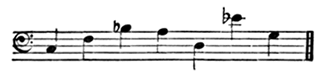
but as the position of some of the bridges may have been slightly altered
since the instrument came into the hands of Europeans, not much reliance
is to be placed on the odd arrangement of intervals here exhibited.
Five nose-flutes, called vivo and fango-fango, of the
Polynesian Islanders. Four of these instruments were brought to England by
Vice-Admiral Sir Henry Denham. Two are from the Tonga Islands, and two
from the Fiji Islands. Among the latter is especially noteworthy a large
and fine one, profusely ornamented with designs burnt into the surface,
which was obtained by Sir H. Denham at Angras, one of the Fiji Islands.
The fifth specimen is from Otaheite. Jew's harp, brought by Vice-Admiral
Sir Henry Denham from the Fiji Islands. It is neatly made of a sort of
cane. Three Pandean pipes (one with nine tubes, and two with eleven tubes)
brought by Vice-Admiral Sir Henry Denham from the Fiji Islands. These
neatly-constructed specimens of the syrinx yield the following tones:—

Bone flute of the Caribi Indians, in Guiana, South America. Two rattles of
the Indians of Vancouver Island, brought from Nootka Sound. Of wood,
formed in imitation of a bird and of a fish, and painted with different
colours. These rattles, called belapella, contain pebbles, and are
used by the Medicine Men in their incantations. Dancing rattles
of the Indians in the vicinity of the River Amazon, Brazil. Made of a
species of nut, a large number of which are hollowed, and suspended to a
cord, to be hung over the shoulders. By way of embellishment, some bright
feathers and the tail of a quadruped are interspersed between the nuts.
The sound produced by this rattle, when shaken, is soothing and pleasant,
somewhat like the sound caused by the waves over the shingle on the
sea-shore when heard at a distance. At any rate, it is preferable to some
more pretentious musical performances of the present day. Sakasaka, a
rattle of the Negroes of St. Lucia, West Indies. Ornamented with some rude
designs cut on the surface. It contains a number of small red berries of
an oval shape, known as jamboo berries.
Samsien, a Japanese stringed instrument. With a large plectrum of a white
wood. Its three strings are of silk. The body is square, and is covered in
front and at the back with parchment. Koto, a kind of dulcimer, from
Japan, with silken strings and movable bridges. The present specimen is
one of the smallest. Pepa, a Chinese kind of lute, with four silken
strings. Two specimens. Yue-kin, or "Moon-guitar," a Chinese instrument,
with four silken strings. Two specimens. San-heen, a Chinese stringed
instrument. Ur-heen, Chinese fiddle. Two specimens. Tche, a Chinese
stringed instrument, mounted with sixteen thin wire-strings. Kin, a
Chinese instrument, the favourite of the great Confucius, and called,
somewhat inappropriately, "Scholar's Lute." With its case lacquered and
gilt. Yang-kin, Chinese dulcimer, with two little sticks or wooden hammers
of a rather peculiar shape. Ty, Chinese flute. Cheng, Chinese organ, with
seventeen bamboo tubes, containing vibrating tongues of metal, like our
harmonium. Two specimens. Hiuen-tchung, antique Chinese bell. Two
specimens. Chinese kind of tambourine, with a wooden hammer. Used in
Buddhist worship. Chinese wooden castanets called pan, made in the shape
of two spoons combined.
Ranat, a kind of harmonicon from Siam. It has nineteen slabs of sonorous
wood placed over a sound-board resembling a canoe, and tuned
diatonically. Thro, three-stringed fiddle of the Burmese; two specimens.
The top of the finger-board of one of these fiddles is ornamented with
carvings in wood, and with a figure in ivory of a little idol. The strings
are of silk; the head of the other specimen is likewise elaborately
carved. This fiddle probably dates from the eighteenth century, if not
earlier, and is a fine specimen of Burmese art. It was formerly in Signor
Mario's museum. Megyoung, a Burmese stringed instrument in the form of an
alligator, with three silken strings and eleven small bridges. Osee, a
Burmese drum of a very peculiar construction. Walet khot, Burmese
castanets, consisting of a pair of large split bamboos, 33 inches in
length. Keay zoot, a pair of diminutive castanets of metal, from Burmah;
they are in the shape of a saucer, and measure only an inch in diameter.
The silvery tinkling sound which they produce is pleasant.
Sitar, a Hindu stringed instrument from Nagpoor. Sitar, a fine specimen
with movable brass frets, Hindustan. The strings are of thin wire. Vina,
the principal national instrument of the Hindus, also known as the
Bengalese vina, strung with wire. The present specimen, which is of the
smaller kind, is also called kinnari. Been, or Anthara vinai,
Hindustan. This species of vina, is called by some Europeans, "the Benares
vina," while the old national instrument of the Hindus, which is somewhat
different in shape, is called, as we have just seen, "the Bengalese vina,"
no doubt on account of their being most popular in the districts indicated
by their names. Rudra vina, from Bombay, a kind of been with
sympathetic wire-strings, placed under the wire-strings which are sounded
by the player. Taûs and bow, Hindustan. The taûs is a kind of sitar, the
thin wire strings of which are played with a bow. It is made in the shape
of a peacock, hence its name taûs, which signifies "peacock." The
present specimen, which was sent by the Rajah of Navha to the
International Exhibition, London, 1872, is from the Punjab. It is richly
coloured, and gilt. The crest and the tail of the bird represented are
peacock's feathers, stuck into holes made for the purpose. Koka, a rude
kind of Hindu fiddle, mounted with two wire strings, from Bombay. The body
consists of a large nut. The instrument bears a strong resemblance to the
gunibry of the Barbary States; the latter is, however, played with
the fingers, instead of a bow. Chikarah, a Hindu instrument of the violin
class, from Bombay. It is cut out of a single block of wood, which, when
rubbed or damped, emits a peculiar aromatic scent. The belly is of
parchment. The instrument has three catgut-strings, beneath which are
placed seven thin strings of wire. The wire-strings are fastened to
tuning-pegs situated at the side of the neck. They merely serve as
sympathetic strings, to increase the sonorousness when the catgut-strings
are played upon with the bow. Sarungi, a Hindu instrument of the violin
class, from Bombay. It is constructed of the same kind of wood as the
chikarah before mentioned, but its shape is different. The belly is of
parchment. The four catgut-strings with which the sarungi is mounted are
played with the bow, and thirteen strings of thin brass wire, which run
through little holes in the ivory bridge, are placed under the
catgut-strings to serve as sympathetic strings. The performer on the
sarungi does not press the catgut-strings down upon the finger-board, but
touches them at the side with his fingers to produce the tones which he
desires. He places the instrument before his breast in a nearly
perpendicular direction. Whatever may be thought of this method of
playing, the sarungi is certainly considered a very effective instrument,
not only by the Hindus, but even by some European listeners. For instance,
Colonel Meadows Taylor ('Proceedings of the Royal Irish Academy, Dublin,
1865,' p. 115) remarks: "Its tones are nearer, perhaps, in quality to the
human voice than any other instrument with which I am acquainted."
However, he does not appear to be acquainted with many instruments.
Sarinda, a Hindu violin, with three strings. It is made of a single block
of wood, hollowed, and carved. The upper part of the body is left
partially open, and is partially covered with skin resembling bladder,
generally from a species of gazelle. Sarod, with bow; a Hindu instrument
with four catgut-strings, and underneath them five thin strings of
brass. On the neck are three catgut-frets. The instrument is painted with
designs in various colours. It came from Gwalior. Rabab, a kind of guitar
of the Hindus, played with a plectrum. It resembles the saruda.
Toontoonee: this curious Hindu instrument, with one wire-string, is used
by mendicants and ballad-singers in the Dekhan. Santir, a dulcimer, from
Cashmere. Sarmundal, from Kattyawar, Hindustan; a kind of dulcimer in a
case. This scarce instrument is tastefully ornamented with painted flowers
and fanciful designs. Its wire-strings are twanged with a plectrum made of
wood and glass. Murchang, Jew's harp; two specimens of a peculiar shape,
from Cashmere. Shank, conch trumpet, from Kattyawar, Hindustan,
beautifully ornamented with brasswork. The shank is a sacred instrument
blown by the Brahmin priests. Tootooree, a horn of metal, from Hindustan.
Kombu, a horn of the Hindus, resembling in its semicircular shape the
tootooree, but being smaller and heavier; from Madras. Bhangull, a very
thin and long metal trumpet, from Kattyawar, in Hindustan. Kurna, a metal
trumpet, straight and large, from Hindustan. Seeng, a large brass trumpet,
from Hindustan. Poongee (also called magoudi and toomeree), the
snake-charmer's double pipe, from Hindustan. Each tube contains a single
reed. There are three specimens of the poongee in the collection, one of
which is painted with various designs. The tubes of the poongee are
inserted in a gourd. Mukha, a kind of oboe, from Madras. Mukhavinai, a
small kind of oboe, Hindustan. Ottu, a species of oboe, somewhat
resembling the Arabic zourna, from Janpore, in Hindustan. Zourna, from
Hindustan; made of a dark brown wood, with nine finger-holes. Buguri, a
very peculiar reed wind-instrument, having finger-holes like a flute, and
being at its lower end provided with a bell like a trumpet, from Madras.
Bansee, flute, Hindustan. Double flageolet, from Hindustan. Nagarah, a
drum, from Surat, Hindustan. The body is of red earthenware, and the
parchment is affixed to it by means of a leathern network, which is
tastefully adjusted over the back of the drum; diameter at the top, 16
inches; height, 6-1/2 inches. Banyan, a small hand-drum,
Hindustan. Davandai, a kind of double drum, or rather a double darabouka,
Hindustan. Kudu Kuduppai, a very diminutive double darabouka of brass and
fish bladder, Hindustan. Ghunta, a small bell with a handle, used by the
Brahmin priests of Hindustan in religious ceremonies. Jalar, a pair of
large castanets of metal, resembling small cymbals, from Hindustan. The
sound of them is remarkably pure and sustained.
Rebab; a three-stringed fiddle from Persia. The body, cut out of a single
piece of wood, is rudely ornamented with a pattern which is burnt on it.
The strings are of catgut. They run at the top of the neck through holes,
and are fastened at the back to the tuning-pegs. This rebab is an
exact counterpart of the rebec formerly popular in Western Europe.
Kemângeh a'gouz, with bow; from Egypt; a species of Eastern violoncello,
with two strings made of horsehair. The body consists of the shell of a
cocoa-nut, covered at the top with a bladder and perforated at the back
with a number of sound-holes. Tanbour Baghlama; the eastern mandoline,
strung with four thin wire-strings. Two specimens from Egypt. Gunibry; a
rather primitive two-stringed instrument of the guitar kind, from Morocco;
two specimens. Kuitra, a kind of guitar from the Barbary States. The body
is made of a tortoise. The kuitra, or kitar, an instrument
of the Persians and Arabs, is evidently the prototype of our guitar. The
present specimen is one of the small kinds of kuitra; the larger kind has
eight strings of sheep's gut arranged in four pairs.
Three English flageolets, made in the beginning of the present century. An
ivory flûte à bec, made by Stanesby, junior, London, 1740. An ivory flauto
piccolo with a silver key; English, eighteenth century. An ivory flauto
traverso with one silver key; English, eighteenth century. This ivory
flute and the two preceding ones are handsome instruments. A flûte à bec;
English, about 1700; of box-wood and ivory; length, 18 inches; eight
finger-holes, and without any key. An English recorder, of wood stained
black; length, 26 inches; it probably dates from the seventeenth century.
Two tenor
flutes, German, made about the year 1600. Length, 2 ft. 9 in. Seven
finger-holes and one key. These scarce instruments were formerly in Signor
Mario's museum. An English bass flute, made about the year 1650. Wood and
ivory; with a brass tube for blowing the instrument. Six finger-holes, and
one brass key at the upper side, and one finger-hole for the thumb at the
opposite side. Length, 3 ft. 8 in. Three double flageolets dating from the
beginning of the present century, two of which are made by Bainbridge in
London, and the third is inscribed "Simpson." A triple flageolet, on which
harmony in three parts can be played; made by Bainbridge in London, in the
beginning of the present century. An English horn (oboe da caccia) made of
red cedar, by Thomas Stanesby, junior, in London, about 1740. An English
horn (oboe da caccia), eighteenth century; probably made in England. Wood,
stained black, and ivory. This is the kind of oboe which J. S. Bach has
employed in his 'Passion of St. Matthew.' A dolciano, a small bassoon.
Inscription: "Wood and Ivy, late Gerd Wood, London." A basset
horn (corno di bassetto), probably English. A border bagpipe, from
Northumberland. With bellows, and four drones. A French bagpipe
(cornemuse). An English trumpet in case; made probably in the eighteenth
or in the beginning of the nineteenth century. A small trombone, English,
made by Allen and Pace. A horn, of brass; the bell terminating in the head
of a serpent; English, eighteenth century. A serpent, by "Gerrock Wolf, in
London;" beginning of the present century. Two alphorns, made by M. von
Euw in Bürgy, Rigi Kulm, Canton Swyz, Switzerland, of birchwood neatly
covered with birch-bark. Length, 8 ft. 1 in. A cither, a specimen of the
kind which was commonly found in England, some centuries ago, in barbers'
shops; English, about 1700.[6] A German cither; end of the
seventeenth century. Ornamented with marquetry. A small English cither,
made about the year 1700. The open strings produce only five tones instead of six.
Specimens of this kind are very scarce. An English cither of the
eighteenth century. An English cither made by Remerus Liessem, London,
1756. The body is of a very old-fashioned form, having several
incurvations at the sides. A small English cither of the eighteenth
century. The sound-hole is ornamented with a rose made of wood. The rose
of the English cither is more usually made of bronze. Cetera; an Italian
cither, made about the year 1680. This is the most beautiful cither in the
collection. The entire instrument, except the belly, is inlaid with
tasteful designs in ivory and ebony. Also the tone is remarkably fine. A
Scotch cither neatly inlaid with wood ornamentation. At the back is a
plate of mother-of-pearl with the inscription "Rudiman, ABDN, DG." Perhaps this cither belonged to the
well-known Latin grammarian Rudiman, who, about the year 1700, was at
King's College in Aberdeen. An Irish cither with an ivory finger-board and
with ten tuning-screws of brass. A large specimen. Made by Perry in
Dublin; eighteenth century. Cithara; a Portuguese cither with six pairs of
wire-strings, inlaid with tortoise-shell and ivory. Made by Joan Vieira da
Silva at Lisbon, about 1700. Cithara; a Portuguese cither, probably dating
from the beginning of the eighteenth century. Mounted with twelve strings
in pairs. A very fine-toned instrument. Inscription: "Cyprianio Antonio a
fez em Lisboa, ao Largo da Esperança." A keyed cither; English, eighteenth
century. It has six ivory keys. The idea of applying keys like those of
the pianoforte to the cither, and thus striking the wire-strings with
hammers instead of twanging them with a quill originated in Germany, but
proved to be of no practical advantage. Bijuga cither (i.e. a
cither with a double neck, like the theorbo). Two French specimens, dating
from about the middle of the eighteenth century. Bijuga cither, made by
Renault in Paris, anno 1779. This handsome species of cither, constructed
like the theorbo, but having a flat back, was evidently often strung in
France with catgut instead of wire, and played with the fingers like the
theorbo. It is probably the instrument which in some old French books is
called pandore. It has sixteen strings. A French bijuga cither
of the eighteenth century, inlaid with mother-of-pearl, ivory and ebony. A
fine specimen. An English bijuga cither, eighteenth century. A German
bijuga cither (or Grosszither, as it used to be called in Germany),
sixteenth century. With seventeen wire-strings. This old instrument is
very beautiful in shape, and has a remarkably picturesque rose in the
middle of the sound-board. Two Neapolitan mandolinos, inlaid with designs
in mother-of-pearl tortoise-shell and ivory. One of these handsome
instruments bears the inscription "Januarius Vinaccio fecit, Neapoli, in
Rio Catalana, A. Domini 1776." A beautiful Neapolitan mandolino in its old
Italian case. Inside the instrument is the inscription "Vincentius
Vinaccio fecit, Neapoli, Sito Nella Calata de Spitalletto, A. D. 1785." A
Milanese mandolino, dating from about the year 1700. Rosewood, inlaid with
mother-of-pearl, tortoise-shell, and ivory. Silver frets. In front, a
figure of Apollo under a canopy and other embellishments in
mother-of-pearl. An ornamented sound-hole, the rose being covered with
glass. A figure, made of mother-of-pearl, inlaid near the bridge, contains
the engraved initials "A. G.," which may be those of the maker of this
elegant instrument—possibly Andreas Guarnerius. This mandolino, the
handsomest I ever saw, is of the kind called by some musicians
"mandurina." It has twelve wire-strings which are arranged in pairs, and
therefore produce six tones; while the more common Neapolitan mandolino
has eight strings constituting four pairs. A French mandoline, made by
Eulry-Clement, in Mirecourt, Vosges, beginning of the present century; the
back inlaid with strips of different woods. Eight strings arranged in four
pairs. A mandola; Italian, seventeenth century. This scarce instrument may
be most briefly described as a huge Neapolitan mandolino. It has the shape
of the mandolino, but the size of a large lute; sixteen wire-strings,
placed in pairs, produce eight tones of the open strings. The sound is
remarkably full and fine. A mandola, similar to the preceding one,
inscribed "Gio. Battista, Neapoli, A. D. 1701." Length, 2 ft. 11 in.;
depth of body, 10 in. The mandola was played with a quill like the
mandolino and the cither. Pandura, two specimens, made in Italy about the
year 1700. Bandurria; Spanish, eighteenth century; played with a plectrum
usually made of tortoise-shell. Pandore; English, seventeenth century;
played with a quill. It is also called chiterna. Pandurina; Italian, about
1700; its nine catgut and wire strings are arranged in pairs tuned in
unison, except the lowest, which is single. The open strings, therefore,
produce five tones. The neck is provided with catgut frets. The pandurina,
which in shape resembles a diminutive lute, even smaller than the
Neapolitan mandoline, was usually played with the fingers, but
occasionally also with a quill. On the Continent, gentlemen used to carry
it under their mantle when they went to musical parties, or for
serenading. Pandurina, twelve-stringed. Inscription: "Carlo Steffani fece.
L'Anno 1712, in Mantova." Pandurina, in its old Italian case, with brass
ornamentation. The back made of strips of ebony and ivory; length, 20 in.
Ivory frets; twelve metal strings. Inscription in the inside: "Joseph
Molinari, Venetus, Anno, 1737." Quinterna, Italian, seventeenth century. A
species of guitar somewhat resembling a violin in shape, with frets made
of catgut. Mounted with eight catgut-strings which produce five tones, as
they are arranged in three pairs and two single ones. A five-stringed
guitar inlaid with mother-of-pearl and tortoise-shell. Italian, eighteenth
century. A French guitar, made by Vobeam, a celebrated lute-maker of the
time of Louis XIV. The strings are arranged in pairs tuned in unison. An
English guitar, made in the beginning of the present century; the back and
sides of the body are of rosewood; the sides have several indentations.
Machine head. Portuguese guitar, made about the year 1600, with three
sound-holes. The head is bent backwards somewhat like that of the lute;
the frets are of catgut, as they used likewise to be on the lute. Not only
the belly, but the entire body is made of thin pine-wood. The strings,
twelve in number, are arranged so that the higher six are in sets of two,
and the lower six in sets of three. As the strings of each set are tuned
in unison, five tones are produced by the open strings. An inscription in
the inside of this guitar, now greatly obliterated, runs as follows:
"Manoel Correa de Almda Uileiro da Rainha, N. S., morador na
Ruadireita la Esperança LXa." It would, therefore, appear that
the guitar was made by Manoel Correa of Almeida in the province of Beira,
Portugal, and that the maker had the title of manufacturer of musical
instruments to the Queen. The Portuguese musician, Manoel Correa, born in
the year 1590, at Lisbon, and engaged about the year 1620 as chapelmaster
at the Cathedral in Saragossa, was probably of the same family as the
maker of this instrument. A guitar of the Portuguese peasants, made in
Lisbon, eighteenth century; oval shape with indentations at the side; six
strings. Inside is a label with the inscription: "Joze Terreira Coelho a
fez em, Lisboa, ao Poco los Negros, a Cruz da Esperança." Machête, a small
guitar with four strings; Portuguese, eighteenth century. Harp-guitar;
English, about 1800. On the finger-board is the inscription: "Clementi and
Co., London;" painted with flowers, etc.; eight strings. The pianist and
composer Clementi gave his name to a firm of music-sellers in the year
1800. Harp-guitar; English, about 1800; seven strings. The harp-guitar was
manufactured with the intention of producing a sort of guitar with a
superior quality of sound, by adopting the body of the harp. Lyre-guitare;
French, period of Louis XV.; a guitar in the form of Apollo's lyre, with
the addition of a finger-board in the middle. Lyre-guitare; French, said
to have belonged to Queen Marie-Antoinette; carved and gilt. Guitar-lyre;
English, made by R. Wornum, Wigmore Street, London, about 1770. The
English guitar-lyre is in its construction almost identical with the
French lyre-guitare. Harp-lute; English, about 1800; painted green, with
gilt ornamentation of flowers, and other designs. Dital harp; English. An
improved harp-lute, recorded to have been invented by Edward Light,
London, about the year 1800. Harp-ventura; English, invented at the
beginning of the present century by Angelo Benedetto Ventura, in London.
This gorgeously-ornamented instrument resembles the dital harp and the
harp-lute in construction. Harp-theorbo; English, made by Walker, about
1800. Lute, the back inlaid with ivory and various woods. From an
inscription in the inside, now greatly obliterated, it would appear that
this lute was made by Magnus Tieffenbruker, in Venice, about 1580. Lute,
by Laux Maler, in Bologna, fifteenth century. Brass and ivory screws have
been substituted for the original tuning-pegs. This contrivance, as well
as a painting of flowers on the sound-board, is probably not older than a
hundred years. The places where some of the ancient tuning-pegs were fixed
are still discernible. The cracks on its pear-shaped body rather
contribute to its dignity, and might be likened to the wrinkles of a
venerable grandsire. The sound of this old lute is very fine. A German
lute, made by Jacobus Heinrich Goldt, in Hamburg, anno 1712. According to
an inscription in the inside, it was altered in the year 1753. A French
lute of the seventeenth century. An Italian lute; inscription: "Vvendelio
Venere in Padova, 1600;" with the head turned backwards; twenty strings.
This lute is of one of the most celebrated Italian lute-makers, and is in
a well-preserved and playable condition, notwithstanding its high age. An
English lute with a double neck (Testudo theorbata) made about 1650. A
theorbo, Italian, seventeenth century. It has twenty-four catgut strings,
which are arranged in pairs tuned in unison, except the highest two which
are single strings. It was the custom to have the highest string, called
chanterelle, single; it principally served for playing the melody.
Sometimes, as in the present instance, two chanterelles were used.
The twenty-four open strings, therefore, produce thirteen different tones.
The frets are of catgut. A French theorbo, made about the year 1700. An
archlute; Italian, about 1700; a large instrument, with eighteen strings,
ten of which are for the upper set of tuning-pegs, belonging to the bass
strings which are at the side of the finger-board. The ten bass strings
produce five tones with their octaves, each tone having two strings tuned
in an octave. The archlute, or bass-theorbo, is the largest sized kind of
the theorbo, or lute with a double neck. An Italian archlute, inscribed:
"Matheus Bucchenberg, Roma, 1619." From Signor Mario's museum.
Bucchenberg, or Bueckenberg as he was more generally called, was
one of the most celebrated lute-makers in Italy, and a German by birth.
The present archlute has three ornamented sound-holes. It is provided with
a mechanism by means of which any one of the bass strings by the side of
the finger-board can be raised a semitone in pitch at the pleasure of the
performer. This ingenious contrivance, which renders the bass strings more
useful in compositions having modulations into distant major or minor
keys, occurs also on a French theorbo dating from about the year 1700,
which is in my collection. But on this French theorbo, the mechanism acts
upon all the strings beside the finger-board simultaneously, while on the
archlute just noticed it is contrived so that any single string may be
altered in pitch independently of others. As the mechanism is evidently
not a later addition, but was made with the instrument in 1619, it is
suggestive to musical antiquarians, inasmuch as it reveals a higher degree
of progress in the construction of the lute than is generally supposed to
have been attained about the beginning of the seventeenth century. An
Italian theorbino, or the smallest kind of theorbo, seventeenth century;
with sixteen strings, six of which run beside the finger-board. A
chitarrone, or large Roman theorbo; Italian. Inscription: "Vitus de
Angelis, Bonon, 1609." It is about six feet long, and has twenty-one
strings. The chitarrone was formerly called Roman theorbo, because it was
principally used at Rome. There was a similar instrument popular at Padua,
somewhat smaller in size. The present specimen was made in Bologna. The
chitarrone was used in the orchestra, assisting at dramatic performances
as well as in church music. It was often strung with wire instead of
catgut; the same was the case with the common theorbo of Germany and
England. A chitarrone, with marquetry and three ornamented sound-holes;
made by M. Bueckenberg, in Rome, anno 1614. From Signor Mario's
collection. An Irish harp (clarseth), strung with wire; made by Egan, in
Dublin, in the beginning of the present century. An arpanetta (German,
Spitzharfe), English, seventeenth century; with one hundred steel
wire-strings and thirty-five brass wire-strings. A bûche (German, Scheidholt),
from Val d'Ajol, in the Vosges mountains, in France; made in the beginning
of the present century. An English specimen of the hummel, probably
made during the eighteenth century; with twelve wire strings. It resembles
the bûche, and may be regarded as an antiquated species of our present
horizontal cither. A bell-harp, made by John Simcock, in Bath, about the
year 1700: length, 20 in. It has sixteen tones. Each tone is produced by
three thin brass wire-strings tuned in unison. The strings are twanged
with two little plectra, or quills, of which the performer fastens one to
the thumb of each hand. The two wooden handles, one on each side of the
instrument, are for holding while swinging it during the performance, to
produce the effect of a distant bell. A bell-harp; English, about 1700.
Inscribed: "Bath, John Simcock, inventor and maker." This instrument has
twenty-four tones produced by thin brass wire-strings. The highest tones
have each four strings tuned in unison, the others have three, except the
deepest, which is produced by a single string covered with wire. The
instrument is in its old case. Dulcimer; English, with movable bridges.
Inscribed: "Old Weston, Huntingdonshire, 1846." Dulcimer; English,
beginning of the present century; of mahogany, the sound-board of pine,
being painted green, and gilt. Sixteen sets of wire-strings, each set
consisting of three strings tuned in unison. Salterio, Italian dulcimer,
made by Antonio Bertefice, at Florence, in the year 1745. Salterio;
Italian dulcimer; a small specimen, inscribed at the back: "Antonius Berri
fecit, Anno 1722." From Signor Mario's museum. Echelette; French,
eighteenth century. It has twenty-two slabs of a hard and sonorous wood,
which are sounded by being struck with two little mallets. A sordino, or
boat-shaped pochette; English, seventeenth century. An Italian sordino,
dating from about the year 1600. The body is of tortoise-shell, inlaid
with silver; the tuning-pegs are of ivory; with a carved head of wood and
ivory. The entire length of this sordino is only 14 inches. A kit, or
pochette, in the shape of the violin; Italian, about 1600. Violetta
piccola, the smallest kind of the old viol instruments, shaped
with a slanting neck like the viola da gamba. This small species of treble
viol was called by the French haute-contre. Italian, seventeenth
century. A five-stringed viol, called by the French quinton.
Inscription "Antonius Gragnani fecit, Anno 1741." A small six-stringed
viol, called by the French dessus-de-viole; French, seventeenth
century. A six-stringed viol, called by the French pardessus;
French, seventeenth century. A treble viol, with a carved head; English,
about 1700. Its neck has catgut frets, and its six strings were tuned like
those of the bass-viol, or viola da gamba, but an octave higher. A
countertenor-viol; English, seventeenth century. Inside is the
inscription: "Henry Jay, in Southwarke, 1667." The scroll is finely
carved. The belly has, besides the usual two sound-holes, an oval
sound-hole in the middle, with an ornamental rose. The back has a peculiar
curve towards the end; probably, the instrument was intended to rest on
the left shoulder when played. Like the viola da gamba, it has six strings
and catgut frets. It was tuned a fifth higher than the viola da gamba. A
tenor-viol; English, about 1620. This small species of viola da gamba is
now very scarce. It was tuned a fourth higher than the larger viola da
gamba, or bass-viol. Viola da gamba, inlaid with mythological
representations and other ornamentation in ivory, mother-of-pearl,
tortoise-shell, and precious stones. Made about the year 1580, probably by
Joachim Tielke in Hamburg; a splendid instrument. Viola da gamba; English,
seventeenth century; with a finely-carved head representing the bust of a
girl. Inside is the inscription: "Richard Meares, without Bishopsgate,
near to Sir Paul Pinder's, London, Fecit 1677." In the Post Boy of
the 9th of July, 1720, we find the following advertisement: "This is to
give notice to all gentlemen and ladies, lovers of musick, that the most
celebrated new opera of 'Radamistus,' composed by Mr. Handell, is now
engraving finely upon copper-plates by Richard Meares, musical instrument
maker and music printer, at the Golden Viol. To make this work more
acceptable, the author has been prevailed upon to correct the whole." The
Golden Viol was
the sign of a music-shop in St. Paul's Churchyard, where Richard Meares,
the publisher of Handel's opera, lived. But, to judge from a notice of
this publisher given in Hawkins's 'History of Music' (Vol. V., p. 109), it
appears that he was the son of the maker of the present viola da gamba. At
any rate, when Handel came to England this instrument was no longer a new
one; for it was made before Handel was born. The bow belonging to it is of
the old-fashioned kind known as the Corelli bow. And it may be here
mentioned that with most of the viols before enumerated curious bows are
placed which have long since gone out of use. Viola da gamba; Italian,
about 1600; with a finely-carved head. The finger-board is inlaid with
designs of flowers, etc., in tortoise-shell and ivory. This fine-toned
bass-viol is supposed to have been made by Gaspar di Salo. At all events,
it is a valuable specimen by some early Italian maker. Viola da gamba;
English, about 1700. The instrument resembles a small violoncello, since
its body does not slant towards the neck. An illustration of this kind of
viola da gamba is given in 'The Division-Violist, by Christopher Simpson,
London, 1659.' Its body is remarkably flat, and its quality of sound is
consequently very clear. Like the common viola da gamba, the instrument is
six-stringed, and has catgut frets. A seven-stringed viola da gamba;
probably Italian; towards the end of the seventeenth century. The addition
of a seventh string to the viola da gamba is said to have been first
resorted to by the French virtuoso Maria Marais, towards the end of
the seventeenth century. The string added is the lowest, and is tuned a
minor third lower than the C string on the violoncello. The innovation
evidently did not find much favour with gamba players in general; and it
is seldom that one still meets with a seven-stringed gamba. A
four-stringed viola da gamba; made by John Baker in Oxford, anno 1688.
Four-stringed gambas met with at the present day are almost invariably
altered six-stringed ones, on which the neck has been narrowed, and the
head shortened, so that the instrument may be used as a small violoncello.
This one was originally made with only four strings, and has evidently never
been tampered with. Viola d'amore; Italian, seventeenth century. A fine
specimen, in a well-preserved condition. Viola d'amore; Italian,
seventeenth century. Old-fashioned shape, having several incurvations at
the sides, and a sound-hole with a rose in the middle of the belly. Seven
catgut-strings, and underneath them seven sympathetic strings of thin
steel-wire. Viola d'amore; German, eighteenth century. Probably made by
Jacob Rauch, in Mannheim, about 1740. With only five catgut-strings, and
with eight sympathetic wire-strings. An English viola d'amore strung
entirely with wire, seventeenth century; with a curiously-constructed
head, ornamented with a carved female bust. A so-called psaltery (also
known as sultana and cither-viol). Mounted with six wire-strings, and
played with a bow. Irish; eighteenth century. Made by Thomas Perry, in
Dublin, anno 1767. A psaltery, made by Thomas Perry, in Dublin, second
half of eighteenth century. The neck and the tail-piece are of ivory. Its
ten strings are of steel and brass wire, the highest eight being arranged
in four pairs producing four tones, and the others are single ones
producing two tones. Hardangerfelen. A kind of viola d'amore of the
Hardanger peasants in Norway, inlaid with mother-of-pearl and ivory. The
top, carved and gilt, represents a dragon's head. This fiddle has four
catgut-strings, and four thin steel-strings beneath them. Inside is the
inscription "Fabrokert of Knudt Erikson, Helland, 1872." It was sent to me
from Christiania. Violins of unusual shapes, three curious specimens, made
during the eighteenth century. A violin made of iron. Probably English,
beginning of the present century. If on no other account, this violin is
certainly interesting in an acoustic point of view, since it proves that
much sound is obtainable merely by the vibration of the strings acting
upon the column of air in the violin, without any assisting vibration of
the belly or sound-board. At all events, the substance of which this
violin is made is not likely to contribute to the sonorousness. A tromba
marina or marine trumpet, probably Dutch, seventeenth century. Besides one
string of thick catgut upon the instrument, there are in the inside forty-one
sympathetic strings of thin steel-wire. A nyckel-harpa, a curious
instrument of the Swedish peasantry, which may be briefly described as a
combination of a fiddle and a hurdy-gurdy. A crwth, an antiquated Welsh
instrument of the fiddle class. The body is cut out of a single block of
wood, the belly only being glued to it. Two specimens of the nail-violin,
one of which has sympathetic strings of thin brass-wire running over the
sound-board. These two curious instruments were probably made in France or
Germany about the year 1800. The invention of the nail-violin is
attributed to a German of the name of Wilde, who lived in St. Petersburg
about the middle of the eighteenth century. A hurdy-gurdy (French, vielle),
made by Pagot at Jenzat, a small town near Orleans, about the year 1840.
Carved head. Six tuning-pegs at the top, and one at the tail-piece. This
hurdy-gurdy is of the kind which the French call vielle en luth,
because its body is shaped like that of the lute. The other kind, which
has indentations at the sides resembling those of the guitar, is called vielle
en guitare. Organ hurdy-gurdy, or vielle organisée, made by a
Frenchman residing in London during the middle of the eighteenth century.
This curious instrument, which was formerly also known in England, where
it was called flute-cymbal, consists of a hurdy-gurdy combined with
a small organ of two stops, and it is so contrived as to allow the
hurdy-gurdy or the organ to be used each separately, or both combined, at
the pleasure of the performer. Some portions of it have been restored in
the present century. Clavichord, generally called in German Clavier.
Made in Einbeck, near Hanover, about the year 1800. Clavichord, made in
Thuringia. Clavichord, made by the celebrated manufacturer, Barthold
Fritz, in Brunswick, in the year 1751; ornamented with painting and
engraving. Harpsichord, inscribed "Jacobus Kirkman, Londini, fecit 1772."
The case is of walnut, inlaid with tulip-wood. Carved legs representing
eagle's claws grasping a ball. With two keyboards, constituting a "double
harpsichord," as it used to be called in England. The woodwork about the
keyboards is ornamented with designs in marquetry of various coloured
woods. This harpsichord has six stops and two pedals, and is provided with a
Venetian swell. Jacobus Kirkman, having obtained an order from King George
III. to produce a fine harpsichord intended as a present for Queen
Charlotte, made—as manufacturers under such circumstances not
unfrequently do—two harpsichords exactly alike, viz., one for Queen
Charlotte, and the present one, which was bought by John Bacon, the famous
sculptor, after whose death it came into the possession of Dr. Sclatter,
priest-vicar of Exeter Cathedral, who had it for nearly half-a-century,
and after whose death it was sold at a sale of his effects. Harpsichord
with two keyboards, six stops, and two pedals. Inscribed "Jacobus et
Abraham Kirkman, fecerunt 1773." The case is of mahogany; the wood near
the keyboards is walnut, inlaid with tulip-wood and a tesselated border of
various coloured woods. Only the lute-stop has jacks with crow-quills; the
jacks of the other stops are provided with small pieces of prepared
leather instead of quills. The variety in the colour of sound thereby
obtained is very effective. This instrument probably exhibits the highest
degree of perfection which was ever attained in the construction of the
harpsichord, in so far as quality and power of sound are concerned. As
regards outward appearance, the beauty of some of the Dutch harpsichords,
or clavicembali, ornamented with paintings by celebrated artists,
is unsurpassed.
It now remains to draw attention to the fact that many of the Museums of
Antiquities in different countries instituted by Government contain some
curiosities of the kind in question which cannot fail to interest the
musical antiquarian. This is the case even in America, where in the
museums of Mexico, Lima, and other towns, may be found among the examples
of workmanship and arts of the Aztecs and the Inca Peruvians various
contrivances relating to music. That royal personages in their cabinets of
curiosities obtained from distant lands should not unfrequently have
scarce, or handsome, or grotesque-looking musical instruments is only what
might be expected. There are, for instance, about forty acquisitions of
this kind in Windsor Castle, which consist chiefly of Asiatic and African
drums, pipes, and stringed instruments. Several of them, however, are
spoiled by having been "improved," or Europeanized. Some have descriptive
labels attached to them, as, for instance, an Ashanti war-trumpet made of
a human bone, and ornamented with human jawbones; and an Ashanti war-drum,
carved from the trunk of a tree, and likewise ornamented with human
jawbones; which two curiosities, the labels inform us, belonged to the
King of Ashanti, from whom they were taken "in the action in which he was
defeated by Colonel Purden. Sent by Sir Herbert Taylor in 1827. Brought to
England by Major-General Sir Neil Campbell, commanding on the Western
Coast of Africa." There is also in this assemblage a fanciful contrivance,
which is intended for a sort of guitar, and of which a label affixed
informs us: "This instrument was made from the head of the Duke of
Schomberg's horse, killed at the battle of the Boyne, 1690."
Of the special exhibition of ancient musical instruments held in the South
Kensington Museum in the year 1872, an account has been given in the
Descriptive Catalogue of the Musical Instruments in the South Kensington
Museum, London, 1874. The present survey would, however, be imperfect if
that remarkable exhibition were left entirely unnoticed, although the
collection which it comprised had an existence of four months only.
Suffice it here to record that it contained upwards of five hundred
instruments, including a large number of violins, violas, and violoncellos
of the celebrated Cremona makers. Should a similar exhibition be
attempted, an equally successful result is not likely to be achieved for
years, if ever. Old and scarce musical instruments have become of much
more antiquarian interest than formerly was the case. The specimens still
obtainable by purchase gradually find their way into public museums, not
only in European countries, but also in America, and in the English
colonies. Whenever they have been secured for a museum they generally are
no longer obtainable on loan for other exhibitions. Private persons
possessing such treasures set upon them a higher value than formerly, and
are therefore less inclined to expose them to the risk of being injured.
For these reasons it appears all the more desirable that there should be
some record of the collections known to be still in existence.
MUSICAL MYTHS AND FOLK-LORE. — CURIOUS COINCIDENCES. — HINDU TRADITIONS. — CELESTIAL QUARRELS. — AL-FARABI. — TRUSTY FERDINAND. — THE WILD HUNTSMAN. — THE BOLD GERMAN BARON. — PROPHETIC CALLS OF BIRDS. — WHISTLING.
Music is so delightfully innocent and charming an art that we cannot
wonder at finding it almost universally regarded as of divine origin.
Pagan nations generally ascribe the invention of their musical instruments
to their gods or to certain superhuman beings of a godlike nature. The
Hebrews attributed it to man; but as Jubal is mentioned as "the father of
all such as handle the harp and organ" only, and as instruments of
percussion are almost invariably in use long before people are led to
construct stringed and wind instruments, we may suppose that, in the
biblical records, Jubal is not intended to be represented as the original
inventor of all the Hebrew instruments, but rather as a great promoter of
the art of music.
However this may be, thus much is certain: there are among Christians at
the present day not a few sincere upholders of the literal meaning of
those records who maintain that instrumental music was already practised
in Heaven before the creation of the world. Elaborate treatises have been
written on the nature and effect of that heavenly music, and passages from
the Bible have been cited by the learned authors which are supposed by
them to confirm indisputably the opinions advanced in their treatises.
It may, at a first glance, appear singular that nations have not generally
such traditional records respecting the originators of their vocal music
as they have respecting the invention of their musical instruments. The
cause is however explicable; to sing is as natural to man as to speak, and
uncivilised nations are not likely to speculate whether singing has ever
been invented.
There is no need to recount here the well-known mythological traditions of
the ancient Greeks and Romans referring to the origin of their favourite
musical instruments. Suffice it to remind the reader that Mercury and
Apollo were believed to be the inventors of the lyra and the kithara; that
the invention of the flute was attributed to Minerva; and that Pan is said
to have invented the syrinx. More worthy of our attention are some similar
records of the Hindus, because they have hitherto scarcely been noticed in
any work on music.
In the mythology of the Hindus the god Nareda is the inventor of the vina,
the principal national musical instrument of Hindustan. Saraswati, the
consort of Brahma, may be considered as the Minerva of the Hindus. She is
the goddess of music as well as of speech. To her is attributed the
invention of the systematic arrangement of the sounds into a musical
scale. She is represented seated on a peacock and playing on a stringed
instrument of the guitar kind. Brahma himself we find depicted as a
vigorous man with four handsome heads, beating with his hands upon a small
drum. And Vishnu, in his incarnation as Krishna, is represented as a
beautiful youth playing upon a flute. The Hindus still possess a peculiar
kind of flute which they consider as the favourite instrument of Krishna.
Furthermore, they have the divinity of Genēsa, the god of wisdom,
who is represented as a man with the head of an elephant holding in his
hands a tamboura—a kind of lute with a long neck.
Among the Chinese we meet with a tradition according to which they
obtained their musical scale from a miraculous bird called Foung-hoang,
which appears to have been a sort of Phœnix. As regards the
invention of musical instruments, the Chinese have various traditions. In
one of these we are told that the origin of some of their most popular
instruments dates from the period when China was under the dominion of
heavenly spirits called Ki. Another assigns the invention of several of
their stringed instruments to the great Fohi, called "the Son of Heaven,"
who was, it is said, the founder of the Chinese empire, and who is stated
to have lived about b.c. 3000, which was long
after the dominion of the Ki, or spirits. Again, another tradition holds that the
most important Chinese musical instruments, and the systematic arrangement
of the tones, are an invention of Niuva, a supernatural female, who lived
at the time of Fohi, and who was a virgin-mother. When Confucius, the
great Chinese philosopher, happened to hear on a certain occasion some
divine music, he became so greatly enraptured that he could not take any
food for three months afterwards. The music which produced this miraculous
effect was that of Kouei, the Orpheus of the Chinese, whose performance on
the king, a kind of harmonicon constructed of slabs of sonorous
stone, would draw wild animals around him and make them subservient to his
will.
The Japanese have a beautiful tradition according to which the
Sun-goddess, in resentment of the violence of an evil-disposed brother,
retired into a cave, leaving the universe in darkness and in anarchy; when
the beneficent gods, in their concern for the welfare of mankind, devised
music to lure her forth from the retreat, and their efforts soon proved
successful.[7]
The Kalmuks, in the vicinity of the Caspian Sea, adore a beneficent
divinity, called Maidari, who is represented as a rather jovial-looking
man, with a moustache and an imperial, playing upon an instrument with
three strings, somewhat resembling the Russian balalaika.
Almost all these ancient conceptions we meet with also among European
nations, though more or less modified.
Odin, the principal deity of the ancient Scandinavians, was the inventor
of magic songs and Runic writings.
In the Finnish mythology the divine Vainamoinen is said to have
constructed the five-stringed harp, called kantele, the old national
instrument of the Finns. The frame he made out of the bones of the pike,
and the teeth of the pike he used for the tuning-pegs. The strings he made
of hair from the tail of a spirited horse. When the harp fell into the
sea, and was lost, he made another, the frame of which was of
birchwood, with pegs made out of the branch of an oak-tree. As strings for
this harp he used the silky hair of a young girl. Vainamoinen took his
harp, and sat down on a hill near a silvery brook. There he played with so
irresistible an effect that he entranced whatever came within hearing of
his music. Men and animals listened enraptured; the wildest beasts of the
forest lost their ferocity; the birds of the air were drawn towards him;
the fishes rose to the surface of the water, and remained immovable; the
trees ceased to wave their branches; the brook retarded its course, and
the wind its haste; even the mocking echo approached stealthily, and
listened with the utmost attention to the heavenly sounds. Soon the women
began to cry; then the old men and the children also began to cry; and the
girls, and the young men—all cried for delight. At last Vainamoinen
himself wept; and his big tears ran over his beard, and rolled into the
water, and became beautiful pearls at the bottom of the sea.
Several other musical gods or godlike musicians could be cited, and,
moreover, innumerable minor spirits, all bearing evidence that music is of
divine origin.
True, people who think themselves more enlightened than their forefathers
smile at these old traditions, and say that the original home of music is
the human heart. Be it so. But do not the purest and most beautiful
conceptions of man partake of a divine character? Is not the art of music
generally acknowledged to be one of these? And is it not, therefore, even
independently of myths and mysteries, entitled to be called the divine
art?
It is a suggestive fact that several nations in different parts of the
world possess an ancient tradition, according to which some harp-like
instrument was originally derived from the water.
The Scandinavian god Odin, the originator of magic songs, is mentioned as
the ruler of the sea; and as such he had the name of Nikarr. In the depth
of the sea he played the harp with his subordinate spirits, who occasionally
came up to the surface of the water to teach some favoured human being
their wonderful instrument.
Vainamoinen, the divine player on the Finnish kantele, according to the
Kalewala, the old national æpos of the Finns, constructed the first
instrument of this kind of fish-bones.
Hermes, it will be remembered, made his lyre, the chelys, of a
tortoise-shell.
In Hindu mythology the god Nareda invented the vina, a five-stringed
instrument, considered as the principal national instrument of the Hindus,
which has also the name kach'-hapi, signifying a tortoise. Moreover
nara denotes in Sanskrit "water," and Narada or Nareda
"the Giver of Water."
Like Nareda, so Nereus and his fifty daughters, the Nereides, mentioned in
Greek mythology, were renowned for their musical accomplishments.
Again, there is an old tradition, preserved in Swedish and Scottish
national ballads, of a skilful harper who constructs his instrument out of
the bones of a young girl drowned by a wicked woman. Her fingers he uses
for the tuning screws, and her golden hair for the strings. The harper
plays, and his music kills the murderess.[8] A
similar story is told in the old Icelandic national songs, and the same
tradition has been found still preserved in the Faroe Islands, as well as
in Norway and Denmark.[9]
May not the agreeable impression produced by the rhythmical flow of the
waves and the soothing murmur of running water have led various nations,
independently of each other, to the widespread conception that they
obtained their favourite instrument of music originally from the water? Or
is this notion traceable to a common source, dating from a pre-historic
age—perhaps from the early period when the Aryan race is surmised to
have diffused its lore through various countries? Or did it originate in the
old belief of the world with all its charms and delights having arisen
from a chaos in which water constituted the predominant element?
Howbeit, Nareda, the Giver of Water, was evidently also the ruler of the
clouds; and Odin had his throne in the skies. Indeed, many of the musical
water-spirits appear to have been originally considered as rain-deities.
Their music may, therefore, be regarded as derived from the clouds rather
than from the sea. In short, the traditions respecting spirits and water
are not in contradiction to, but rather confirmatory of the belief that
music is of heavenly origin.
Mia Tonsine, a wonderful musician in the time of the Emperor Akber, sang
one of the night-rags at mid-day. The power of the music was such
that it instantly became night, and the darkness extended in a circle
round the palace as far as the sound of the voice could be heard. Rags are
characteristic songs composed in certain modes or scales; and each Rag is
appropriated to a distinct season, in which alone it must be sung or
played at prescribed hours of the day or night; for, over each of the six
Rags, or kinds of compositions, presides a certain god, who presides
likewise over the six seasons. The six seasons are: Seesar, the
dewy season; Heemat, the cold season; Vasant, the mild
season, or spring; Greesshma, the hot season; Varsa, the
rainy season; and Sarat, the breaking-up, or end of the rains.[10]
Whoever shall attempt to sing the Rag Dheepuck (or "Cupid the
Inflamer") is to be destroyed by fire. The Emperor Akber ordered Naik
Gopaul, a celebrated musician, to sing that Rag. Naik Gopaul endeavoured
to excuse himself, but in vain; the Emperor insisted on obedience. The
unhappy musician therefore requested permission to go home, and to bid
farewell to his family and friends. It was winter when he returned,
after an absence of six months. Before he began to sing he placed himself
in the waters of the Jumna till they reached his neck. As soon as he had
performed a strain or two the river gradually became hot; at length it
began to boil, and the agonies of the unhappy musician were nearly
insupportable. Suspending for a moment the melody thus cruelly extorted,
he sued for mercy from the monarch, but sued in vain. Akber wished to
prove more strongly the powers of the Rag Dheepuck. Naik Gopaul
renewed the fatal song: flames burst with violence from his body, which,
though immersed in the waters of the Jumna, was consumed to ashes.
The effect produced by the Rag called Maig Mullaar is immediate
rain. It is told that a singing girl once, by exerting the powers of her
voice in this Rag, drew from the clouds timely and refreshing showers on
the parched rice-crops of Bengal, and thereby averted the horrors of
famine from the "Paradise of Regions," as the province of Bengal is
sometimes called.
Sir William Ouseley, who obtained these traditions, it would appear, from
oral communication, states that they are related by many of the Hindus,
and implicitly believed by some. However, on inquiring of the people
whether there are still musical performers among them who can produce
effects similar to those recorded, one is gravely told that the art is now
almost lost, but that there are still musicians possessed of miraculous
powers in the west of Hindustan; and if one inquires in the west, they say
that should any such musicians remain, they must be found in Bengal.[11]
A reliable collection of Hindu traditions relating to music might,
probably, be suggestive and valuable to the musical historian, especially
if he examined them with reference to the myths of the ancient Egyptians
and Greeks.
There appears to be a notion universally prevailing among uncivilised
people that, during an eclipse of the sun or moon, the two luminaries
are quarrelling with each other, or that their conjugal happiness is being
disturbed by some intruding monster.
The natives of the Polynesian Islands have an old tradition, according to
which the moon (called marama) is the wife of the sun (called ra),
and, during an eclipse, the moon is supposed to be bitten or pinched by
some angry spirit.[12]
The Javanese, and the natives of the Indian Archipelago in general, when
an eclipse takes place, shout and beat gongs to prevent the sun or moon
from being devoured by the great dragon (called nága), which they
suppose to be attacking the luminary.[13]
This notion appears to have been adopted by the Malays from the Hindus, in
whose mythology a god called Rahu—who is recorded to have been
originally a giant, and who is painted black—at the time of an
eclipse swallows up the sun and moon, and vomits them up again.
Of the Chinese we are told: "As soon as they perceive that the sun or moon
begins to be darkened, they throw themselves on their knees and knock
their foreheads against the earth. A noise of drums and cymbals is
immediately heard throughout the whole city. This is the remains of an
ancient opinion entertained in China, that by such a horrid din they
assist the suffering luminary, and prevent it from being devoured by the
celestial dragon."[14]
The Greenlanders have, according to Crantz, a somewhat similar tradition;
but, instead of musical instruments, the men carry kettles and boxes to
the top of the house, and rattle and beat them, and the women pinch the
dogs by the ears, to frighten away the moon, who, they suppose, is
insulting his wife, the sun.[15] In Greenland, the moon is
the man, and the sun is the wife, as in Germany.
Again, the Negroes in Western Africa appear to have much the same notion.
The traveller Lander, during his stay at Boussa in Soudan, witnessed the
wild behaviour of the Negroes at the occurrence of an eclipse of the moon.
Their principal exertions to avert the supposed impending calamity
consisted in blowing trumpets, beating drums, singing and shouting.[16]
The Japanese legend of the sun-goddess, who, after having hidden herself
in a cavern, is enticed from her dark abode by the power of music, is
apparently likewise a poetical conception of an eclipse. Titsingh, in
reciting the same tradition, says that Fensio-Daysin, the sun-goddess,
fled to the cavern in consequence of a dispute she had with her brother,
Sasanno-Ono-Mikotto, the god of the moon.[17]
From these examples it seems that musical performances, or, at least, the
sounds of loud instruments, are considered the most effective agent for
appeasing the anger of the quarrelling celestial bodies. But there is no
reason to assume that this peculiar notion originally emanated from one
people. Like several other popular traditions, it most likely owes its
origin to impressions produced on the mind by a certain natural
phenomenon; and it may, therefore, have suggested itself to different
nations quite independently, instead of having been transmitted from one
nation to another.
Most of the popular legends and fairy tales which have been traditionally
preserved are of high origin. Many of those which appear to have
originated during the Christian era are only modifications of older ones
dating from heathen times. Thus, we find the Virgin Mary in a legend
substituted for a pagan goddess, and one or other Saint for a pagan god.
Sometimes a remarkable incident, recorded in ancient history, is related
as having occurred at a much more recent time. Perhaps it may have
happened again, but in many cases the old tradition has, undoubtedly, been
borrowed by one nation from another, and has been adapted to circumstances
which favoured its adaptation.
In the musical records of the Arabs mention is made of the wonderful
accomplishments of a celebrated musician, whose name was Al-Farabi, and
who acquired his proficiency in Spain, in one of the schools at Cordova,
which flourished as early as towards the end of the ninth century. The
reputation of Al-Farabi became so great, that ultimately it extended to
Asia. The mighty Caliph of Bagdad himself desired to hear the celebrated
musician, and sent messengers to Spain with instructions to offer rich
presents to Al-Farabi, and to convey him to the Caliph's court; but the
musician feared that if he went he should be detained in Asia, and should
never again see his home, to which he felt deeply attached. However, at
last he resolved to disguise himself, and to undertake the journey, which
promised him a rich harvest. Dressed in a mean costume he made,
unrecognized, his appearance at the court just at the time when the mighty
Caliph was being entertained with his daily concert. Al-Farabi, unknown to
everyone present, was permitted to exhibit his skill. He sang,
accompanying himself on the lute. Scarcely had he commenced his
performance in a certain musical mode when he set all his audience
laughing aloud, notwithstanding the efforts of the courtiers to suppress
so unbecoming an exhibition of mirth in the presence of the mighty Caliph.
In truth, even the mighty Caliph himself was compelled to burst out into a
fit of laughter. Presently, Al-Farabi changed to another mode, and the
effect was that immediately all his hearers began to sigh, and soon tears
of sadness replaced the previous tears of mirth. Again he sang and played
in another mode, which excited his audience to such a rage that they would
have fought each other if he, seeing the danger, had not directly gone
over to an appeasing mode. After this wonderful exhibition of his skill,
he concluded in a mode which had the extraordinary effect of making his
listeners fall into a profound sleep, during which Al-Farabi took his
departure.
It will be seen that this incident is almost identical with one recorded
as having happened about twelve hundred years earlier at the court of
Alexander the Great, and which forms the subject of Dryden's fine poem,
'Alexander's Feast.' The distinguished flutist, Timotheus, playing before
Alexander, successively aroused and subdued different passions by changing
the musical modes during the performance, exactly in the same way as did
Al-Farabi more than a thousand years later.
The Germans have a curious story in which an incident occurs calling to
mind Arion's famous adventure. It will be remembered that Arion, after
having gained by his musical talents great riches, was, during a voyage,
in imminent danger of being murdered by the sailors, who coveted the
treasures he was carrying with him. When he found that his death was
decided upon, he asked permission to strike once more his beloved lyre.
And so feelingly did he play, that the fishes surrounding the ship took
compassion. He threw himself into the water, and was carried ashore by a
dolphin.
As regards Trusty Ferdinand, the hero of the German story, we are told
that he, seeing a fish struggling near the shore and gasping for water,
takes it by the tail and restores it to its element. Whereupon the fish,
in gratitude, puts its head out of the water, and presents Trusty
Ferdinand with a flute. "Shouldst thou ever stand in need of my
assistance," says the fish, "only play upon this flute, and I will come
and help thee." Sometime afterwards Trusty Ferdinand embarks on a voyage
to a distant country. While on board a ship he has the misfortune to let
drop into the sea a precious ring, upon the possession of which depends
the happiness of a beautiful princess as well as his own happiness. He
takes up his flute; as soon as he begins to play, the fish appears and
reaches back to him the precious ring.
The Wild Huntsman tears through the forest at night attended by a noisy
host, pursuing his furious chase with unearthly singing, with sounding of
horns, with the barking of dogs, the clattering of horses, and with
fearful shouting and hallooing. This widespread conception has been
ascertained to date from ancient pagan time, in which Wuotan, (or Woden),
the principal deity of German mythology, exhibits the characteristics
commonly attributed to the Wild Huntsman. But it is new as well as old;
for it suggests itself not less naturally at the present day than it
suggested itself in bygone times—as the reader will perhaps know
from his own experience, if he has ever found himself alone on a stormy
moonlight night in a forest of Bohemia or Germany. In any case, he may be
sure that it is no joke to traverse in such a night a forest which still
continues in almost its primeval state.
For awhile everything appears silent as the grave, and the lonely
pedestrian, pursuing some old track which faintly indicates the way to a
village, is only occasionally bewildered by the sudden darkness occurring
when a cloud obscures the moon, or by the startling brightness, should he
reach unexpectedly a clearing in the forest just at the moment when a
cloud has passed across the moon, casting not far before him its shadow,
which like a spectre rapidly flits over the brushwood, assuming various
uncouth shapes. Soon his imagination is excited by distant sounds never
heard in open day—yelping of foxes, howling of wolves, grunting of
wild boars; and now by the piteous cry of agony emitted by a bird which
has fallen a prey to some ravenous beast. Presently he is startled by an
awful noise like the galloping of a cavalcade: a herd of stags is hastily
fleeing through the wood. The cavalcade seems to come straight upon him;
but soon the noise grows weaker, and quickly dies away. Now a whirlwind
sweeping over the forest, and violently shaking the tops of the trees,
gradually approaches the harassed pedestrian. At first only groaning and
grumbling, it
soon bursts forth into a terrific howl; and as it furiously passes over
the head of the involuntary witness, it scares from their hiding-places
sundry owls, the hooting and screeching of which alone would suffice to
make his hair stand on end. And when the whirlwind has swept over, and is
only heard faintly murmuring in the distance, other sounds and apparitions
not less terrifying are sure soon to arise. In short, the lonely wanderer,
be he ever so intelligent an observer of nature, will most likely feel his
heart eased of a heavy weight when he has left the forest behind him.
Soon, having reached the end of his journey, he may put on his slippers
with that comfortable sensation of relief which people are sure to
experience when they have escaped an imminent danger. It is all very well
for him now to persuade himself that, after all, he has only witnessed
some interesting natural phenomena; he may perhaps even smile at the
superstitious notions of simple-minded peasants. But of what avail is this
to him? The night is not yet over, and he cannot escape a fearful dream of
a personal encounter with the Wild Huntsman and his furious host.
From what has been said it will not surprise the reader that the reports
of witnesses who profess to have met with the Wild Huntsman are at
variance in many points. Much evidently depends upon the nature of the
locality in which the mysterious apparition shows itself. In some parts of
Germany particular stress is laid upon the softness and sweetness of his
music. This conception may have originated in the pine-forests where the
delicate needle-shaped leaves of the trees are vibrated by the wind like
the strings of an Æolian harp. But, the blowing of the huntsman's horn
seems to be an indispensable attribute to the furious chase. The
country-folks in Mecklenburg, and in some other provinces in the North of
Germany where Low German is spoken, on hearing the mysterious noise in the
wood, say, "De Wode tüt!" ("Woden is tooting!") thereby implying a
series of unrhythmical sounds rather than a melodious succession of tones
on the horn—in fact, sounds very much like the hooting of the owl.
It is moreover a common belief that a kind of owl, called by the peasants
Tutosel, always accompanies the Wild Huntsman with his furious
host.
An account of an extraordinary occurrence given by an honest witness is,
of course, generally preferable to a statement of the same occurrence
merely obtained from hearsay; and the evidence of the witness deserves all
the greater attention if he shows himself to be an intelligent and keen
observer. The subjoined report of the German Baron Reibnitz may therefore
interest the reader. It was communicated by the Baron to the Philosophical
Society in Görlitz, Silesia. As Görlitz possesses a Philosophical Society,
there must be clever fellows in the town. Be this as it may, the document
is authentic, and has been faithfully translated from the German.
"The popular tradition of the Wild Huntsman, current in many places,
prevails also still at the present day in my village of Zilmsdorf. From my
earliest years I had been acquainted with it, but only from hearsay; and
as soon as I had come into possession of my paternal inheritance, I gave
the most stringent orders, especially to the nightwatch, to inform me
immediately, at any hour of the night, should this event come to pass.
"About thirty years ago, towards eleven o'clock on a clear night in the
month of May, I heard a knocking at my window:—
"'Gracious Baron!' cried my nightwatch, 'The Wild Huntsman! In the upper
wood of Teuplitz!'
"I directly gave orders to arouse Stäglich, my gamekeeper, who at that
time—I being then a bachelor—was groom, gamekeeper,
house-steward, in short all in all to me, and was moreover just of my own
age, and certainly an excellent forester.
"'Go, fetch the horses! Make haste! Don't stop to saddle—only the
horse-cloth; the Wild Huntsman is in the forest; we will welcome him!'
"This was the very thing for Stäglich. In less than ten minutes
we were mounted, well-armed, and were flying over meadows and ploughed
fields towards the sounds of hunting-horns and the crying of hounds.
Scarcely had we reached the heath when the noise ceased. We remained
quiet. On a sudden we heard close by us a yelping much like that of a
badger-dog when it has recovered the lost scent. Rapidly the yelping of
dogs, large and small, with the sounds of horns, increased; and now
commenced a truly furious chase, which moved towards the middle of the
forest, where other hunting-horns besides were winding awfully. We spurred
our horses and rushed forwards, but an impenetrable thicket compelled us
to change our course, and to turn into a part of the forest where there
was but little underwood, but where, notwithstanding the beautiful
starlight night, it was so pitch dark that we really could not see the
wood for the trees, as the saying is. The horses—which, as is
well-known, are at night more nervous than men—shied several times.
"On a sudden the Wild Hunt appeared to come directly towards us, with a
clamour so terrible that, as soon as we reached the summit of the hill
where the highest forest trees stand, we called out to each other: 'Now at
them!'
"Like a whirlwind it rushed past us, with awful music of voices and
instruments, at a distance of scarcely forty paces. The horses snorted and
shied, and that of my gamekeeper reared and fell backwards.
"'Heaven be merciful to us, and protect us!' we both cried. I hastened to
his assistance, but he was already rising. Soon he was again at my side.
Our horses nervously pressed close to each other. The Wild Hunt appeared
to be over, when, after a little while, we heard it commencing anew a
great distance off, in the open fields. Without waste of time we hastened
in that direction, and soon reached the fields.
"The stars shone brightly and cheerfully. Now the Wild Hunt passed before
us; but as we approached, it gradually went off in a curved line, with
sounding of horns, crying of hounds, and clattering of horses. Soon it was
far away on the distant heath.
"We rode home, where the nightwatch anxiously awaited us. He had already
begun to doubt whether we should ever come back. It was past one o'clock."[18]
The calls of birds are perhaps more frequently considered as good presages
than as unlucky ones. Among the Slavonic nations, especially the Poles and
Lithuanians, the hooting of the owl predicts misery and death. Also in
Germany, if the little screech-owl makes its appearance in a village
during a moonlight night, and settling on a farm-building emits its
melancholy notes, some people are sure to hint that there will be ere long
a death in the family of the householder. Moreover, a similar superstition
prevails in Hindustan.[19]
The croaking of a raven is considered in Russia and Servia as foreboding
the shedding of blood.[20] The ancient tradition of
the singing of the dying swan is familiar to everyone. Although our common
swan does not produce sounds which might account for this tradition, it is
a well-known fact that the wild swan (cygnus ferus), also called
the whistling swan, when on the wing emits a shrill tone, which, however
harsh it may sound if heard near, produces a pleasant effect when,
emanating from a large flock high in the air, it is heard in a variety of
pitches of sound, increasing or diminishing in loudness according to the
movements of the birds and to the current of the wind. With the idea of
the song of the dying swan appears to be connected the Scandinavian
tradition of the Valkyrjas, who were maidens in armour with wings of
swans. During a
battle the Valkyrjas approached floating through the air, and hovering
over the scene of carnage, they indicated who were to fall in the fight.[21]
The cuckoo is regarded by the Russians and by most other Slavonic nations
as a bird of sadness. According to a Servian tradition the cuckoo (called
kukawiza) was a girl who wept so continually for her deceased
brother that she was transformed into a bird, which in two melancholy
tones sends its unabating complaint through the air. A Servian girl who
has lost her brother (lover?) never hears the cuckoo without shedding
tears. Moreover, in Servia the cuckoo is considered as a prophetic bird,
especially by the heyduk, or robber, who augurs from its earlier or
later singing.[22]
Among the Germanic races the notes of the cuckoo, when in the spring it
first makes itself heard, are generally considered as a good omen. It is
still, as from Teutonic mythology it appears to have been in ancient time,
a belief among the peasantry in Germany that if anybody counts the number
of times this bird repeats its call, he may ascertain from it how many
years he has still to live, or how many years will elapse before an event
comes to pass which he has reason to expect. There is an old story told of
a person who, having led a rather wicked life, in order to atone for it
resolved to become a monk for the rest of his life. It happened that, just
as he was entering the monastery, he heard the cuckoo crying its name the
first time in the spring. He anxiously counted the number of calls; and
finding them to amount to twenty-two repetitions, he at once changed his
mind. "If I have to live twenty-two years longer," he argued with himself,
"I may as well enjoy twenty years longer the pleasures of this world, and
then I shall have two whole years left to denounce its vanities in a
monastery." So he at once returned to the world.
The country-lasses in Sweden count the cuckoo's call to ascertain how many
years they have still to remain unmarried; but they generally shut
their ears and run away when they have heard it a few times. Should a girl
hear it oftener than ten times, she will declare rather vexedly that she
is not superstitious, and that she has not the least faith in the cuckoo's
call.
"Why! he makes music with his mouth!" exclaimed a native of Burmah when he
observed an American missionary whistling; and the missionary noted down
the words in his journal, with the reflection: "It is remarkable that the
Burmese are entirely ignorant of whistling."[23]
But may not the simple-minded Asiatic only have been astonished in
observing what he thought unbecoming in a gentleman who had come to Burmah
to teach a new religion?
The Arabs generally disapprove of whistling, called by them el sifr.
Some maintain that the whistler's mouth is not to be purified for forty
days; while others are of opinion that Satan touching a man's person
causes him to produce the offensive sound.[24]
The natives of the Tonga Islands, Polynesia, consider it wrong to whistle,
as being disrespectful to their gods.[25]
In European countries people are met with who object to whistling on a
certain day of the week, or at certain times of the day. The villagers in
some districts of North Germany have the saying, that if one whistles in
the evening it makes the angels weep. The villagers in Iceland say that
even if one swings about him a stick, whip, wand, or aught that makes a
whistling sound, he scares from him the Holy Ghost; while other
Icelanders, who consider themselves free from superstitions, cautiously
give the advice: "Do it not; for who knoweth what is in the air?"[26]
There seem to have been, however, in all ages light-hearted persons who,
defying the superstitious views of their compatriots, have whistled to
their heart's content, or for the amusement of those who set at nought
popular prejudices.
Joseph Strutt, in his 'Sports and Pastimes of the People of England'
records the astonishing performance of a whistler who, assuming the name
of Rossignol, exhibited at the end of the last century his talent on the
stage of Covent Garden Theatre. Again, an amusing account is given in the
'Spectator' (Vol. VIII., No. 570) of a skilful whistler, who was the host
of the tavern especially patronised by Addison and Steele; and the writer
concludes his description of the host's surprising talent by recommending
his readers to repair to the tavern and to order a bottle of wine for the
sake of the whistling.
The Russians in the Ukraine tell a queer story about a whistling robber of
old, who must have been a person of fabulously large dimensions, for he
used to sit, we are told, on nine oak trees at once. His name is still
known; but it would be an infliction upon the reader to put before him a
name almost entirely made up of consonants, and only pronounceable by a
Russian. This celebrated robber had, however, also a nickname signifying
"Nightingale," which was given to him on account of his extraordinary
whistling powers. Whenever a traveller happened to enter the forest in
which the robber Nightingale had his domicile, it was pity for him if he
had neglected to make his will; for the robber Nightingale whistled so
impressively that the poor traveller must needs faint away, and then the
wretched whistler stepped forward and killed him outright. But, at last, a
great hero, who was besides a holy man, and whose name was Ilja Murometz,
repaired to the forest to subdue the robber Nightingale. Having hit him
with an arrow, and taken him prisoner, he bound him to the saddle of his
horse and escorted him to Kiev to the court of the Grand-Prince Vladimir.
Even there the fettered whistler proved most dangerous. For when the
Grand-Prince, merely from curiosity, and perhaps to see whether his
courtiers had told him the truth, commanded the robber to whistle before
him—the
Grand-Princess and all the royal children being present—the man at
once commenced whistling in a manner so overpowering that soon Vladimir
with his whole family would inevitably have been dead, had not some brave
courtiers, perceiving the danger, got up and shut the whistler's mouth.
Moreover, some enlightened Russians say that the story must not be taken
literally. At the time of the introduction of Christianity into Russia
there lived near Kiev, they say, a pagan high-priest who was so
distinguished an orator that he actually succeeded in drawing many to his
side to check the spread of Christianity. This man, whose powers of
persuasion were so great that his adherents called him Nightingale, was at
last vanquished by his Christian antagonist Murometz. The bones of
Murometz, we are further informed, have never decayed, and are still
annually exhibited in Kiev to be venerated by an assemblage of pious
believers.[27]
THE STUDIES OF OUR GREAT COMPOSERS.
An inquiry into the gradual cultivation of the genius of our great musical
composers is as instructive as it is interesting to the lover of music.
Before attempting this inquiry, it is advisable to ascertain exactly what
is meant by the designation "our great composers."
To compose music does not only imply to invent musical ideas, but also to
employ ideas which are already invented in such a way as to exhibit them
in a new light. Certain modulations, passages, and rhythmical combinations
occurring in our musical compositions may be regarded as common property;
but how surprisingly original and fresh do they often appear to us through
the new way in which they are employed by composers in connection with
other ideas! Now, a composer who has the power to construct very beautiful
works of art in a certain form, by inventing ideas and by showing in a new
light ideas not invented by him, deserves to be regarded as a great
composer.
However, in order to trace the gradual progress of his genius, it is not
sufficient to examine his studies, or, so to say, to watch him in his
workshop; we must commence our inquiry further back, and observe him first
as a promising child.
Unfortunately, of the early initiatory lessons of our great composers but
little is generally ascertainable. Celebrated musicians have more
important occupation than to explain their earliest instructions; or they
have to a great extent forgotten how they learnt in childhood the
rudiments of their art. Still the initiatory lessons are especially
noteworthy, since the foundation exercises an almost ineffaceable
influence upon the subsequent direction of the musical student.
The talent for music in children is not always so easily discovered as
might be supposed. Idleness, not unusual in fast-growing children, or
indifference caused by injudicious training, may be mistaken for want of
talent. There are records extant of distinguished musicians who in early
childhood evinced neither talent nor fondness for music. Others, who,
showing no inclination to learn the musical instrument on which they
received instruction, have unexpectedly exhibited much talent and industry
in practising on another kind of instrument of their own choice. Most of
our distinguished musicians have manifested from early childhood a
preference for a particular instrument which they perseveringly
cultivated, and on which they afterwards excelled.
Parents are apt to see talent in their children where it does not exist,
or, at least, not in the supposed degree. Some even find unmistakable
evidence of musical talent in the shape of the head of their offspring. A
peculiar formation of the skull, especially about the temples, is
certainly observable in many clever musicians, and may be recognized in
the few portraits which are known to be faithful likenesses of great
composers. It would be interesting to know whether the infantine musical
prodigies, of which there have been so many during the present century,
generally possessed this phrenological indication. Be this as it may, they
have become great composers in only exceptional instances. Indeed, early
musical prodigies have but seldom achieved in after-life so much as was
expected from them. There are, however, exceptions; for instance, Mozart.
Dr. Crotch in his infancy displayed abilities as extraordinary as
Mozart's. At the age of three years and a half he could play some
harmonized tunes on the pianoforte, and when he was five years old he
performed in public on the organ at a benefit concert in London. He
afterwards achieved comparatively but little, and did not realise the
expectations which as a child he had excited.
There are instances on record of musicians who in their early childhood
were forced against their inclination to practise assiduously, and who
must have been tortured by the incessant care for their progress
bestowed on them by their parents. They became brilliant players, making
music like a well-constructed machine. Our great composers have generally
had a happier childhood. They were, in most instances, children whose
physical development was especially attended to; who were permitted to
ramble about in fields and forests, and by outdoor amusements and bodily
exercises to lay the foundation for a healthy life. This, perhaps,
sufficiently explains why not all of them have displayed a precocity of
talent in early childhood. Indeed, their full development has been in many
instances but slow, and several of them did not produce their best works
until they had attained an age exceeding that generally allotted to
musicians. Gluck composed his 'Iphigenia in Tauris' at the age of
sixty-five; Haydn composed the 'Creation' in his sixty-ninth year, and the
'Seasons' in his seventy-second year. Handel was fifty-six years old when
he wrote the 'Messiah,' and sixty-one when he wrote 'Judas Maccabæus.'
Some of our most gifted musicians have required much longer time than
others for cultivating their talent, because they had not in childhood the
same advantage of guidance which others had, and were consequently
compelled to find out for themselves the best method of cultivation.
Perhaps there now walks behind a plough a Handel, who has not shown that
he is a man of genius because circumstances prevented his knowing and
cultivating his powers. Happy is the artist who, in his childhood, was led
by a judicious guide in the way which saves much time, trouble, and
disappointment! Mozart had such a guide in his father; also Mendelssohn.
Weber deserves, perhaps, all the greater praise from the fact of his
father having been an impediment rather than a help to him.
A systematic education in childhood presents the greatest advantage; this
is too self-evident to require further comment. It may also be taken for
granted that the moral and mental education of the young composer is not
less important than are his musical studies. Nay, his moral training is
even of higher importance, since one may be a good musician, but must
be a good man. Moreover, he is sure to become a better musician if he
possesses an acute discernment of right and wrong, with love for the
former and dislike to the latter.
As regards his mental education, it is more important for him to know how
to think than what to think. A clear discernment is preferable to
much information; at any rate, it is better to know but little and to
understand that little clearly, than to know a great deal confusedly.
There can be no doubt that a classical education is of great advantage to
the musician, not only on account of the refining influence which a
familiarity with classical literature exercises upon the artistic mind,
but also on account of the languages. An acquaintance with two or three
modern languages is almost indispensable to the composer. Latin poetry
occurs not unfrequently in Church music; and several old treatises on
music have been written in Latin, and are therefore not accessible to
musicians unacquainted with this language. It does not, of course, follow
that to be a great composer one must know Latin; however, many musicians
have thought it advisable in their later years to study this language,
when they had not the opportunity of studying it in their youth.
Talented young musicians sometimes appear rather deficient in their mental
cultivation. The enthusiasm with which they pursue their musical studies
is apt to cause them to neglect other studies. But there is no real
deficiency of intellectual gifts; on the contrary, they have generally a
great versatility of talent. This often becomes apparent in their later
years. Several eminent musicians have evinced much talent for painting.
The humorous, witty, and clever remarks of some of our great composers are
notorious.
Without having thoroughly mastered the technicalities of the art, it is
impossible to achieve anything of artistic value. An assiduous and
persevering cultivation of the talent is as necessary as the talent
itself. It has generally cost a musical composer long and continued labour
to produce a valuable work of art. He attained his aim by knowing what was
requisite for its achievement, and by labouring perseveringly to attain
it.
As has been already intimated, it is of great importance for the progress
of the future composer that his initiatory lessons should be correct, so
that there is nothing learnt which afterwards requires to be unlearnt. A
bad touch on the pianoforte, or a wrong method of bowing in playing the
violin, is scarcely ever entirely remedied in later years. Example is
better than precept. A teacher who, by playing to his pupil, can show him
how a passage ought to be executed, may save him much time and trouble.
Our celebrated singers have generally learnt the most easily the best they
are able to accomplish by having been sung to. However, music may be
learnt by different methods, and each method may have something to
recommend it. The teacher must study the pupil to find out what is the
best for him.
Our great composers had generally instruction in singing very early.
Indeed, a composer who has not cultivated his voice in childhood is not
likely to write vocal music so effectively as would be the case if he had
accustomed himself to sing his melodies while inventing them. Even the
melodious phrases in his instrumental compositions are likely to be more
impressive if he has been a singer from early age.
Furthermore, the young student has to learn to play in a high degree of
perfection at least one musical instrument. The pianoforte is—in our
time, perhaps—the best suited for his purpose, on account of the
harmony and of the arrangement of orchestral works executable on the
instrument. Most of our great composers were pianists, harpsichord
players, or organists. There are, it is true, exceptions. Gluck's
instrument was the violoncello; Spohr's, the violin. But even composers
who are not pianists, generally, while composing for the orchestra, make
use of the pianoforte.
The best musical performer is he who can play the most simple melody with
the greatest expression; and the second best is he who can play the most
difficult passages with the greatest correctness. Some pianists of
astonishing manual dexterity are unable to play a simple tune with proper
expression; others cannot execute well a technically easy sonata by
Mozart, because they have not learnt—or, perhaps, have
forgotten—the pure expression required for such unaffected music.
The execution of many modern pianists is best suited for the performance
of their own compositions.
If the young musician is bent upon becoming a distinguished virtuoso,
it may easily be disadvantageous to him as a composer, not only on account
of the time he will require for practising his fingers, but also because
his fingers are apt to induce him to compose for them instead of for the
heart. A great composer generally plays one instrument masterly; and he
has, probably, found it expedient to learn another instrument or two
besides that which he has principally cultivated. If, in addition to the
pianoforte, he can play the viola or violoncello in a quartet, or Bach's
pedal-fugues on the organ, he possesses the means of familiarising himself
more thoroughly with many of our classical compositions than he could
possibly do by merely hearing or reading them; and the familiarity thus
acquired is beneficial to him. Moreover, some practical experience with
wind-instruments is useful to the composer of orchestral works. Our great
masters knew this, and acted upon it.
The exercise of the fingers takes up time, but not necessarily much. One
hour of practice with great attention is better than three hours of
careless practice. The former has not only the advantage that it advances
the student more rapidly, but also that it leaves him the time required
for other studies, reading, and recreation. Several of our great composers
could be named who, notwithstanding their diligent studies from their
youth, always found plenty of time for bodily exercise, and for amusements
conducive to the preservation of health and energy—such as
pedestrian tours, riding, fencing, swimming, dancing, etc.
The young musician has soon to commence the study of the theory of music,
especially if he exhibits decided talent for composing. He must learn to
write with facility any musical composition strictly according to the
rules which have been laid down by our theorists as they found them
observed in the works of the great masters. When he has acquired the skill
to write correctly and fluently in the different forms of composition, it
will be early enough for him to disregard the rules occasionally
where he thinks it advisable for his purpose. Perhaps he may establish a
new one. By far the greater number of our rules of composition are not
dictated by any physical law traceable in acoustics, but only by human
taste, which is continually undergoing modifications in the course of
time. Thus, most of our great composers have caused some alterations in
our theory of music. It is not only possible, but probable, that in a
hundred years' time we shall have admirable musical compositions very
different in form and construction from our present ones.
Several of our great composers in their youth excelled in extemporising.
They were fond of it, and spent many an hour in pouring forth on their
favourite instrument their momentary inspirations and fanciful
conceptions. Extempore fantasias are sometimes so original and effective
that it is a pity they cannot be preserved by being committed to notation
at the moment of their creation. However, charming as such spontaneous
effusions may be on account of their freshness, they do not possess the
artistic value of an elaborately constructed and carefully finished work.
At any rate, our great composers have in their youth derived greater
benefit from carefully working out in notation a theme according to a
certain form of composition, than from indulging in extempore fantasias.
These have, however, often helped them in creating beautiful ideas for
their works.
It may easily be understood that a retentive memory is of great value to
the musician, be he composer or merely performer. Talented young musicians
not unfrequently possess an astounding memory. Sonatas, symphonies, and
even fugues, which they practise, they can soon play by heart. As they
advance in years the power of memory generally becomes somewhat weaker.
Blind musicians appear to preserve it undiminished for a longer period
than others. The blind flutist Dulon knew 120 flute concertos by heart,
which he had numbered, and any one of which he could play instantly on its
number being mentioned to him. True, there is musically little gained by
burdening the memory with compositions which chiefly consist of
compilations of passages calculated to display the dexterity and skill of
the performer. The works which the musician ought to be able to recall to
his memory are the classical works, such as Gluck's 'Iphigenia in Tauris,'
Mozart's 'Don Giovanni,' Beethoven's Symphonies, Handel's 'Messiah,'
Bach's 'Passion according to St. Matthew.' There are not a few among our
great composers who studied the master-works of their predecessors so
effectually that they knew by heart a considerable number of them from
beginning to end, with the instrumentation of every bar.
As regards the different forms of composition, that of the sonata is the
most important; for, if the composer is able to express his ideas with
facility in this form, he possesses the key to all the other forms—except
some of the older ones, as that of the fugue. Certain theorists recommend
the student of composition to select a sonata by Mozart, or some other
master, in which the established form is strictly adhered to, and to write
a precisely similar sonata by imitating the model bar for bar, using the
same time, tempo, modulations, changes in loudness, and so on—only
substituting other notes. No doubt he may thus manufacture a sonata which
is correct in form, whatever it may be in spirit. Our great composers did
not arise from students trained to make music as the shoemaker makes
shoes.
The form of the fugue has already become antiquated, and that of the
sonata is more and more neglected by our present composers, and apparently
will likewise become antiquated in the course of time. But until we have
beautiful examples of some new form, it is not probable that those forms
which have been gradually brought to a high degree of perfection will be
entirely dispensed with, whatever modern composers may produce exhibiting
an indifference to the rules observed by their predecessors.
Our great composers were particularly careful in the choice of the theme.
This is only what might be expected. An orator who discourses on an
uninteresting subject will not easily command the attention of his
hearers. Still, if he is gifted with extraordinary powers of eloquence, he
may discourse on almost any subject interestingly. Thus also
in music. Beethoven and other great composers have occasionally chosen a
theme which becomes significant only from its original and spirited
treatment.
The artistic charm of a well-constructed composition consists in the
development of the theme, so that it is exhibited in a variety of
beautiful aspects—appearing, though always the same, yet always new.
The skill of thus treating the theme, our great composers, by constant
study and practice, have cultivated to an admirable degree of perfection.
They were fully aware that it is as indispensable to the composer as is
the power of creating an interesting musical idea. However, the
development of the theme may be carried too far. It appears pedantic when
it is contrived more with regard to the form than to the spirit of the
music; and it disturbs the unity of the composition when the theme is so
much changed as to appear an entirely new idea. Schubert, in his
pianoforte sonatas, has not unfrequently altered the theme so much that
its second exposition does not bear the required resemblance with its
first; it becomes another theme, which is not wanted. For the clever
development of a theme Schubert did not possess sufficient practical
experience acquired by systematic study. Had he possessed a full command
over the rules of the art—and especially, had he written less
hastily—he might, with his wonderful gifts, have been as great a
composer as Beethoven.
A few examples from Beethoven's book of sketches may find a place here,
since they throw some light upon his studies. The alterations which he
marked with "meilleur" are generally decided improvements upon the
first notation of the idea to which they refer. This is, for instance,
strikingly apparent in his sketches of his famous song 'Adelaide,' the
beginning of which, noted down at first thus:—
he afterwards altered into:—
The following sketches from Beethoven's pocket-book refer to his Quartet
in C♯ minor, Op. 131, with
which they must be compared to render the several attempts at improvement
more clearly intelligible:—
The first sketches for a tenth symphony, which Beethoven intended to
compose, are noted by him thus:—
Beethoven wrote As over the little fragment of the Andante,
evidently to indicate that he intended it to be in A flat major—As
signifying in German A flat.
As an interesting specimen of Haydn's sketches, the following notation of
his first design of the earthquake in the 'Seven Last Words' may serve.
The entire sketch of which this is a fragment, has been published in the
'Allgemeine musikalische Zeitung,' Leipsig, 1848:—
Haydn, as well as Beethoven, generally used one staff for his first
sketches; Mozart made them more clear by using two staves—one for
the melody and another for the bass. Still, as the sketches are only
indications to assist the memory, which is, as we have seen, in composers
generally very strong, especially when their own inventions are concerned,
a hasty notation is in most instances sufficient. In writing the score of
an orchestral composition, Haydn, Mozart and Beethoven usually noted down
the entire thread of a movement, or what may be called the melody and the
bass of the piece; and having written this, they inserted the notation for
the various instruments.
In submitting the manuscript of a composition to a final revision, or in
preparing a new edition of a published work, our great composers have not
unfrequently introduced improvements which testify to their
unabating study as well as to their delicacy of taste and discernment. One
or two examples in support of this opinion shall be pointed out here.
Others will probably occur to the musical reader.
André, in Offenbach, has published the score of the overture to the
'Zauberflöte' (the Magic Flute), from Mozart's original manuscript, with
its alterations and corrections. This interesting publication exhibits
clearly the care bestowed by Mozart upon the work, and affords an
excellent study for the musician.
A remarkable improvement by extension occurs in Mozart's famous Symphony
in C major. Mendelssohn speaks of it with admiration in a letter to
Moscheles as follows: "Just now André sends me for inspection the original
score of Mozart's C major Symphony ('Jupiter'); I shall copy something
from it for you which will amuse you. Eleven bars before the end of the
Adagio it stood formerly thus:—
and so on, as it proceeds to the end. Mozart has written the entire
repetition of the theme on an inserted leaf; he has struck out the
passage, and has introduced it three bars before the end. Is that not a
happy alteration? The repetition of the seven bars belongs to my most
favourite portions of the whole symphony."[28]
The Adagio of Beethoven's Sonata in B flat major, Op. 106, originally
commenced with its present second bar thus:—
Beethoven had sent, in the year 1819, a copy of the manuscript of this
sonata to Ferdinand Ries, in London, who had undertaken to superintend its
publication in England. Great must have been the astonishment of Ries
when, soon after the arrival of the bulky manuscript of this gigantic
sonata, he received a letter from Beethoven containing the notation of an
additional single bar:—
to be placed at the beginning of the Adagio. The beautiful effect obtained
by the alteration is especially noteworthy, inasmuch as it serves as an
example of the incessant care which Beethoven bestowed upon the
improvement of his compositions up to the last moment of their
publication.
Probably no composer has revised his manuscripts more carefully, and
re-written whole pieces with the view of improving them, than has J. S.
Bach. His forty-eight Preludes and Fugues, entitled 'Das wohltemperirte
Clavier,' afford instructive examples of improvements, which may be traced
by a comparison of the several editions of the work, and especially by an
examination of the several manuscripts of these preludes and fugues in
Bach's handwriting which have been preserved.
The prelude in C major, in the first set, was originally longer than in
subsequent revisions. The second half, which Bach has struck out, was a
repetition of its first half.
The prelude in C♯ major, in the
first set, he has curtailed by striking out thirty-five bars. This he did
evidently for the purpose of increasing the unity of this charming
composition by discarding what was foreign to its character, as indicated
by the theme.
On the other hand, the beautiful prelude in D minor, in the same set, he
has considerably enlarged.
These few remarks must suffice to draw the reader's attention to the
careful reconsideration given by Bach to 'Das wohltemperirte Clavier.'
Beethoven generally kept his manuscripts a long time by him, and altered
and polished them up gradually. This he did especially with the
manuscripts of his earlier compositions. Gluck, in composing an opera,
carried out in his mind the principal airs and choruses before he wrote
down a note; so that, when he began to commit the music to paper, he
considered his opera as almost finished. Mozart, too, had sometimes a
whole new composition in his head before he commenced writing it down. The
overture to 'Don Giovanni' he is recorded, by some of his biographers, to
have composed a few hours before the first performance of the opera, so
that the copied parts for the musicians were not yet dry when they were
carried into the orchestra. Probably Mozart did not compose the overture
when he committed it to paper, but had it ready in his head. He was often
composing when otherwise occupied, and even while he was playing
billiards.
A musical composer may have a good reason for preserving the manuscript of
his new work though he considers it a failure. He may wish to refer to it
after a time to ascertain whether his unfavourable opinion remains
unchanged on a subsequent examination. Perhaps it contains ideas which he
may be glad to employ in later years when his power of invention begins to
flag. Still, a celebrated musician would do wisely to destroy any such
manuscripts when he no longer requires them; otherwise they are sure to
arise against him after his death as posthumous works. They will, at
least, lower his fame, if it is too great to be seriously injured by them.
In truth, there is often harm done to art as well as to artists by these
posthumous publications—in most instances weak productions which
have been permitted to live from carelessness of the composers, or perhaps
from the natural affection which a father feels for even his most
ill-favoured child.
Our great composers have generally been extremely cautious, especially
during the earlier part of their lifetime, in selecting for publication
only such of their manuscripts as they were fully justified in considering
worthy of being published. As regards most musicians, it would be better for
their reputation if they had published only half the number of their
works, and destroyed the other half.
It is a noteworthy fact that our great composers have occasionally
produced beautiful effects by disregarding the rules laid down in
treatises on the theory of music. Beethoven has been not unfrequently a
trespasser in this respect. Weber, in the Introductory Chorus of the
elves, in 'Oberon,' produces really charming consecutive fifths. So does
Handel, in the beautiful Pastoral Symphony in the 'Messiah':—
and Gluck repeatedly, in the beautiful air of Rinaldo, in 'Armida':—
Graun, in his cantata, 'Der Tod Jesu' (The Death of Jesus), introduces
into the first chorale consecutive fifths upon the words "Zur Frevelthat
entschlossen" (On evil deed resolved), thus:—
Zur Fre-vel-that ent-schlos-sen.
which, no doubt, was considered by some musicians as remarkably
appropriate to the words, although, probably, they could not have heard it
in the performance, had they not previously seen it in notation. Not such
whims only, but even oversights and misprints occurring in the works of
eminent masters have found admirers, who regarded them as strokes of
genius; while, on the other hand, some of the most original and
surpassingly beautiful ideas were thought to be misprints, and attempts
have actually been made by theorists to correct them.
A curious instance of a misprint which by many admirers of Beethoven has
been accepted as a beautiful inspiration occurs in the scherzo of his C
minor Symphony. To dispel all doubt of its being a misprint, Mendelssohn
caused the publishers of the Symphony to make known a letter addressed to
them by Beethoven in the year 1810, in which he says: "The following
mistake I still find in the C minor Symphony, namely, in the third piece,
in 3/4 time, where, after C major, the minor key recommences. It stands
thus (I take at once the bass part):—

The two bars marked with * are redundant, and must be struck out; of
course, also in all the other parts which have rests." A reference to the
manuscript in the possession of the publishers revealed how the two
superfluous bars had crept in. Beethoven had originally intended that the
entire scherzo, with the trio, should be repeated, and then be concluded
by the coda. He had marked in the manuscript the two superfluous bars with
1, and the two following ones with 2, and had written with a red pencil, "Si
replica con trio allora 2," which the engraver had not exactly
understood. As also the written parts for the instruments, which were used
at the first performance of the C minor Symphony in Vienna, under
Beethoven's direction, do not possess those two bars, there remains not
the least doubt that they were never intended by the composer to be where
they are now found to the delight of many enthusiastic admirers of
Beethoven.
A misprint in Beethoven's 'Sinfonia Pastorale' (which Schumann points out
in his 'Gesammelte Schriften,' Vol. IV.) is almost too evident to be left
uncorrected, even by those who find it beautiful. In the second part of
the first movement, where the theme recommences, with the accompaniment of
triplets, the score has the following notations:—
That here, by mistake, three rests for the first violins have been
inserted by the engraver, instead of three simile-signs,  , is evident from the sudden interruption of the
flow of the triplet accompaniment, as well as from the fact that
immediately afterwards, in the inversion of the same passage, the violas
have the same accompaniment without any interruption. Otto Jahn, in his
'Gesammelte Aufsätze über Musik,' notices a misprint in the score of
Beethoven's last Quartet, Op. 135, which is very extraordinary. He says:
"In the last movement the copyist has omitted two bars in the first violin
part, so that during twelve bars it is two bars in advance of the other
instruments. After the twelve bars, the corrector perceiving that two bars
were wanting to restore the equilibrium, has inserted two there according
to his own fancy." Jahn gives side by side the genuine reading and the
interpolated one. The wonder is that the latter is playable at all,—or
rather, that the musicians, in playing it, should not have discovered at
once that there must be something radically wrong. However, as Jahn justly
remarks, the respect for the eccentricities of Beethoven's last quartets
was so great, that no one ventured to think there could be a mistake here
which required rectifying.
, is evident from the sudden interruption of the
flow of the triplet accompaniment, as well as from the fact that
immediately afterwards, in the inversion of the same passage, the violas
have the same accompaniment without any interruption. Otto Jahn, in his
'Gesammelte Aufsätze über Musik,' notices a misprint in the score of
Beethoven's last Quartet, Op. 135, which is very extraordinary. He says:
"In the last movement the copyist has omitted two bars in the first violin
part, so that during twelve bars it is two bars in advance of the other
instruments. After the twelve bars, the corrector perceiving that two bars
were wanting to restore the equilibrium, has inserted two there according
to his own fancy." Jahn gives side by side the genuine reading and the
interpolated one. The wonder is that the latter is playable at all,—or
rather, that the musicians, in playing it, should not have discovered at
once that there must be something radically wrong. However, as Jahn justly
remarks, the respect for the eccentricities of Beethoven's last quartets
was so great, that no one ventured to think there could be a mistake here
which required rectifying.
A carefully-compiled manual, containing reliable corrections of the most
important misprints occurring in our classical compositions, would be a
boon to the musical student. There are many in Bach's fugues, and even in
Beethoven's sonatas, which are not easily detected, but which are on this
account all the more noteworthy.
The following beautiful conception, which occurs in the first movement of
Beethoven's Sinfonia Eroica, was regarded by many, on the first
publication of the symphony, as a misprint:—
Ferdinand Ries, the pupil of Beethoven, was unable to appreciate the charm
of this soft and timid indication of the theme on a dissonance immediately
before it gloriously breaks out on the harmonious triad. In his
biographical notices of Beethoven he thus speaks of it: "In the first
Allegro of the Symphony there occurs a bad whim of Beethoven for the horn.
Some bars before the theme enters again, in the second part of the
Allegro, Beethoven indicates it by the horn, while the violins continue to
sound the second-chord. This must always convey to those who are
unacquainted with the score, the impression that the horn-player has
counted incorrectly, and that he falls in at a wrong bar. At the first
rehearsal of the symphony, which was very unsatisfactory, but in which the
horn-player kept proper time, I was standing near Beethoven, and, in the
belief that it was wrong, I cried: 'That confounded hornist! Can he not
count! It sounds so infamously wrong!' Beethoven was near to giving me a
box on the ear. It took him a long time to forgive me."
By making beautiful "mistakes," Beethoven has extended the rules of
composition. Ries relates, "During a walk I took with him, I spoke to him
of certain consecutive fifths which occur in his C minor Quartet, Op.
18, and which are so eminently beautiful. Beethoven was not aware of them,
and maintained that I must be in error as to their being fifths. As he was
in the habit of always carrying music paper with him, I asked for it, and
wrote down the passage in all its four parts. When he saw that I was
right, he said, 'Well, and who has forbidden them?' Not knowing how to
take this question, I hesitated. He repeated it, until I replied in
astonishment, 'But, they are against the first fundamental rules!' 'Who
has forbidden them?' repeated Beethoven. 'Marpurg, Kirnberger, Fuchs,
etc., etc.—all theorists,' I replied. 'And I permit them!' said
Beethoven."
The harsh beginning of Mozart's C major Quartet (No. 6 of the set
dedicated to Joseph Haydn) has been the subject of fierce attacks and
controversies. Many musicians have supposed that misprints must have crept
into the score; while others have endeavoured to prove in detail that all
the four instruments are treated strictly according to the rules of
counterpoint. Otto Jahn (in his 'Biography of Mozart,' Vol. IV. p. 74)
finds it beautiful as "the afflicted and depressed spirit which struggles
for deliverance." This may be so; and it is needless to conjecture what
the admirers of the passage would have said, if it had emanated from an
unknown composer. As it stands, it is, at any rate, interesting as an idea
of Mozart, whose compositions are generally distinguished by great
clearness of form and purity of harmony.
The adherence to a strictly prescribed form may easily lead the composer
to the re-employment of some peculiar idea which he has already employed
in a previous work. In fugues especially this may be often observed.
Beethoven, in his sonatas, and likewise in his other compositions written
in the sonata form, as trios, quartets, etc., introduces not unfrequently
in the modulation from the tonic to the dominant certain favourite
combinations of chords and modes of expression; and he has one or two
phrases which may be recognised with more or less modification, in many of
his compositions. Mozart, too, has his favourite successions of chords;
for instance, the interrupted cadence which the German musicians call Trugschluss.
Spohr repeats himself perhaps more frequently than any other composer.
Mendelssohn has a certain mannerism in the rhythmical construction of many
of his works, which gives them a strong family likeness. Weber has
employed a certain favourite passage of his, constructed of groups of
semi-quavers, so frequently, that the sight of a notation like this:—
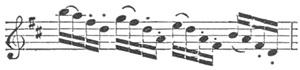
is to the musician almost the same as the written name Carl Maria von
Weber.
Some of the best examples for illustrating the studies of our great
composers are to be found in those compositions which originally formed
part of earlier and comparatively inferior works, and which were
afterwards incorporated by the composers into their most renowned works.
In thus adopting a piece which would otherwise probably have fallen into
oblivion, the composer has generally submitted it to a careful revision;
and it is instructive to compare the revision with the first conception.
Gluck has used in his operas several pieces which he had originally
written for earlier works, now but little known. For instance, the famous
ballet of the Furies in his 'Orfeo,' is identical with the Finale in his
'Don Juan,' where the rake is hurled into the burning abyss; the overture
to 'Armida' belonged originally to his Italian opera, 'Telemacco;' the
wild dance of the infernal subjects of Hate, in 'Armida,' is the Allegro
of the duel-scene in his 'Don Juan.'
As an instance of adoption from a former work wonderfully improved by
reconstruction, may be noticed Handel's Sarabande, in his opera 'Almira,'
performed the first time at Hamburg in the year 1705:—
From this Sarabande, Handel, six years later, constructed the beautiful
air "Lascia ch'io pianga," in his opera 'Rinaldo,' performed in London in
the year 1711:—
Las-cia ch'io pian-ga mia cru-da sor-te,
e che so-spi-ri la li-ber-tà,
e che so-spi-ri,
e che so-spi-ri la li-ber-tà,
Las-cia ch'io pian-ga mia cru-da sor-te,
e che so-spi-ri la li-ber-tà.
Il duolo in fran-ga que-ste ri-tor-te
de
miei mar-ti-ri sól per pie-tà
de
miei so-spi-ri sól per pie-tà.
Las-cia ch'io pian-ga mia cru-da sor-te,
e che so-spi-ri la li-ber-tà,
e che so-spi-ri,
e che so-spi-ri la li-ber-tà,
Las-cia ch'io pian-ga mia cru-da sor-te,
e che so-spi-ri la li-ber-tà.
Beethoven's third overture to his opera 'Leonora' (later called 'Fidelio')
is a reconstruction of the second. A comparison of these two overtures
affords an interesting insight into Beethoven's studies. It must be
remembered that Beethoven, not satisfied with the first overture, wrote a
second, and subsequently a third, and a fourth. The first three, which are
in C major, he wrote when the opera was known by the name of 'Leonora;'
and the fourth, which is in E major, when the opera was brought anew on
the stage in its revised form under the name of 'Fidelio.' The air of
Florestan is indicated in Nos. 1, 2, and 3, composed in 1805 and 1806. No.
2 has the distant trumpet-signal, produced on the stage; and in No. 3 this
idea is further carried out; but in No. 4, written in 1814, it is dropped.
A composer who borrows from his former works deserves reproach as little
as a person who removes his purse from one pocket into another which he
thinks a better place. To borrow from the works of others, as some
composers have done, is altogether a different thing. However, it would be
unreasonable to regard such a plagiarism as a theft unless the plagiarist
conceals the liberty he is taking by disguising the appropriation so as to
make it appear a creation of his own. Some inferior musicians display much
talent in this procedure. Our great composers, on the other hand, have
often so wonderfully ennobled compositions of other musicians which they
have thought advisable to admit into their oratorios, operas, or other
elaborate works, that they have thereby honoured the original composers of
those pieces as well as benefited art. It is a well-known fact that Handel
has, in several of his oratorios, made use of the compositions of others.
As these adoptions have been pointed out by one or two of Handel's
biographers, it may suffice here to allude to them. Beethoven has adopted
remarkably little. His employment of popular tunes where they are
especially required, as for example in his Battle Symphony, Op. 91, can
hardly be regarded as an instance to the contrary. At any rate, popular
tunes have frequently been adopted by our great composers for the purpose
of giving to a work a certain national character. Weber has done this very
effectively in his 'Preciosa.' Gluck, in his 'Don Juan,' introduces the
Spanish fandango. Mozart does the same in his 'Le Nozze di Figaro,'
twenty-five years later. Here probably Mozart took a hint from
Gluck. However this may be, there can be no doubt that Gluck's 'Don Juan'
contains the germs of several beautiful phrases which occur in Mozart's
'Don Giovanni.' Even on this account it deserves to be better known to
musicians than it is, independently of its intrinsic musical value. A
detailed account of it here would, however, be a transgression. Suffice it
to state that Gluck's 'Don Juan' is a ballet which was composed at Vienna
in the year 1761, twenty-six years before Mozart produced his 'Don
Giovanni.' The programme of the former work, which has been printed from a
manuscript preserved in the Bibliothèque de l'Ecole Royale de Musique of
Paris, shows that it is nearly identical with the scenarium of the latter
work. The instrumental pieces, of which there are thirty-one, are mostly
short, and increase in beauty and powerful expression towards the end of
the work. The justly-deserved popularity in Vienna of Gluck's 'Don Juan'
probably induced Mozart to have his 'Don Giovanni' first performed under
the title of 'Il Dissoluto Punito,' and the great superiority of this
opera may perhaps be the cause of Gluck's charming production having
fallen into obscurity.
Mozart's facility of invention was so remarkably great that he can have
had but little inducement to borrow from others. Plagiarisms occur but
rarely in his works, but are on this account all the more interesting when
they do occur. Take for instance the following passage from 'Ariadne of
Naxos,' a duodrama by Georg Benda. It is composed to be played by the
orchestra while Ariadne exclaims: "Now the sun arises! How glorious!"
Mozart was in his youth a great admirer of this duodrama. He mentions in
one of his letters that he carried its score constantly with him. The
great air of the Queen of Night in 'Die Zauberflöte,' Act 1, commences
thus:—
It is, however, quite possible that Mozart had made Benda's work so
thoroughly his own that he borrowed from it in the present instance
without being aware of the fact.
Again, Johann Heinrich Rolle published in the year 1779 an oratorio
entitled 'Lazarus, oder die Feier der Auferstehung' (Lazarus, or the
Celebration of the Resurrection). The second part of this oratorio begins
with an introductory symphony, as follows:—
Perhaps Mozart was not acquainted with Rolle's oratorio when he wrote his
overture to the 'Zauberflöte,' in the year 1791. The curious resemblance
in the two compositions may be entirely owing to the form of the fugue in
which they are written.
Moreover, the theme of Mozart's overture to the 'Zauberflöte' resembles
also the theme of a Sonata by Clementi which was composed ten years
earlier than the overture. In Clementi's Sonata it is as follows:—
In the complete edition of Clementi's pianoforte compositions this Sonata
is published with the appended notice that Clementi played it to the
Emperor Joseph II. when Mozart was present, in the year 1781. Mozart
appears to have been fond of the theme, for he introduces a reminiscence
of it into the first movement of his Symphony in D major, dating from the
year 1786.
The first chorus in Mozart's 'Requiem' was evidently suggested by the
first chorus in Handel's 'Funeral Anthem for Queen Caroline.' The motivo
of both is however an old German dirge dating from the sixteenth century,
which begins thus:—
Wenn mein Stündlein vor-han-den ist,
und
soll hinfahrn mein Stras-se.
and which may have been familiar to Mozart as well as to Handel.
The motivo of the Kyrie Eleison in Mozart's 'Requiem:'—
Chri-ste e-le-
Ky-ri-e e-le
——— i-son! e-
occurs also in Handel's oratorio 'Joseph:'—
We will re -
We will re - joice
Hal - le - lu — jah! Hal — le
-
and in Handel's 'Messiah:'—
And with his stripes we are heal - ed,
And with His, &c.
Likewise in a Quartet for stringed instruments by Haydn, Op. 20, thus:—
In the solemn phrase of the Commendatore, in 'Don Giovanni,' we have an
interesting example of the happy result with which Mozart has carried out
ideas emanating from Gluck. In the opera 'Alceste,' by Gluck, the Oracle
sings in one tone, while the orchestral accompaniment, including three
trombones, changes the harmony in each successive bar, as follows:—
Oracle. Le roi doit mou-rir
au-jour-d'hui,
si quelqu'autre
au tré-pas ne se liv-re pour lui.
That Mozart was much impressed with the effect of Gluck's idea may be
gathered from the circumstance of his having adopted it in 'Don Giovanni,'
and likewise, to some extent, in 'Idomeneo.' The Commendatore in 'Don
Giovanni' sings, accompanied by trombones:—
Di ri-der fi-n-rai pria dell' au-ro-ra.
Ri-bal-do! au-da-ce! las-cia a'mor-ti la pa-ce!
There can hardly be a greater difference in the styles of two composers
than exists in the style of Gluck and that of J. S. Bach. The masterly
command of Bach over the combination of different parts according to the
rules of counterpoint is just the faculty in which Gluck is deficient. It
is on this account especially interesting to observe how Gluck has
employed an idea which he apparently borrowed from Bach. The student may
ascertain it by carefully comparing the air, 'Je l'implore, et je
tremble,' in 'Iphigenia in Tauris,' with J. S. Bach's beautiful gigue in B
flat major, commencing:—
Clementi, a pianoforte composer, who has certainly but little in common
with Gluck, has for his B minor Sonata dedicated to Cherubini—perhaps
his best work—a theme which may be recognised as that of the dance
of the Scythians in 'Iphigenia in Tauris.'
Again, Beethoven's style, especially in his later works, is as different
from Haydn's as possible; nevertheless we occasionally meet with a phrase
in Beethoven's later works which appears to have been suggested by Haydn.
For instance, Haydn, in his Symphony in B flat major (No. 2 of Salomon's
set) has a playful repetition of a figure of semi-quavers leading to the
re-introduction of the theme, thus:—
In Beethoven's famous E minor Quartet, Op. 59, a similar figure leads to
the theme, thus:—
A more exact comparison of the two passages than the present short
notations permit will probably convince the student of the great
superiority of Beethoven's conception. He was one of those rare masters
who convert into gold whatever they touch.
But it is not the object here to give a list of the similarities and
adaptations which are traceable in the works of different musical
composers. Such a list would fill a volume, even if composers of secondary
rank, who are often great borrowers, were ignored. For the present essay a
few examples must suffice, especially as others will probably occur to the
reflecting reader.
Some insight into the studies of our great composers may also be obtained
by comparing together such of their operas or other elaborate vocal
compositions with instrumental accompaniment as are founded on the same
subject. Note, for instance, the love-story of Armida, taken by the
compilers of the various librettos from the episode of Rinaldo and
Armida in Tasso's 'Gerusalemme Liberata.' The story had evidently a great
attraction for the musical composers of the eighteenth century. There have
been above thirty operas written on it, several of which it might now be
difficult to procure, nor would an examination of them perhaps repay the
trouble. However, the operas on the subject composed by Lulli, Gluck,
Graun, Handel, Traetta, Jomelli, Naumann, Haydn, Sarti, Cimarosa, Rossini,
Sacchini, etc., would suffice for the purpose. Thus also, a comparison of
several compositions depicting a storm—most of our masters have
written such a piece—elicits valuable hints for the musical student.
Compare, for instance, with each other the storms in Gluck's 'Iphigenia in
Tauris,' Haydn's 'Seasons,' Beethoven's 'Sinfonia Pastorale,' Cherubini's
'Medea.'
Even arrangements may illustrate the studies. Take, for instance, the
arrangements of Vivaldi's violin concertos by J. S. Bach. It is, however,
but seldom that eminent composers have occupied themselves with arranging
the works of others. Instructive examples of this kind are therefore rare.
It is recorded of some composers that they were in the habit of founding
their instrumental works on certain poetical ideas. Haydn is said to have
done this almost invariably. Schindler, in his biographical notices of
Beethoven, states that the two pianoforte Sonatas, Op. 14, of Beethoven,
were explained to him by the composer as representing a dialogue between
two lovers. When Schindler asked the meaning of the motivo of the C minor
Symphony,
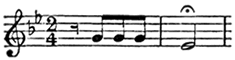
Beethoven exclaimed, "Thus Fate knocks at the gate!" And being requested
by Schindler to supply him with the key to the Sonatas in D minor, Op. 31,
and in F minor, Op. 57, Beethoven's answer was: "Read Shakespeare's
'Tempest!'" Beethoven probably resorted to such replies merely to satisfy
troublesome inquirers somewhat resembling the inquisitive gentleman in
Washington Irving's 'Tales of a Traveller,' who "never could enjoy the
kernel of the nut, but pestered himself to get more out of the shell."
Several of the titles of Beethoven's instrumental compositions ('Pastoral
Sonata,' 'Moonlight Sonata,' 'Sonata appassionata,' etc.) did not
originate with the composer, but were given to the pieces by the
publishers to render them more attractive to the public. The title of his
sonata Op. 81, 'Les Adieux, l'Absence et le Retour,' emanates however from
Beethoven himself. This is noteworthy inasmuch as it has brought the
advocates of descriptive music into an awkward dilemma. They found in this
sonata an unmistakable representation of the parting and ultimate reunion
of two ardent lovers,—when, unhappily for them, Beethoven's
autograph manuscript of the sonata was discovered, in the library of
Archduke Rudolph, bearing the inscription (in German), "The Farewell,
Absence, and Return of His Imperial Highness the Venerated Archduke
Rudolph."
A similar subject is treated by J. S. Bach, in a capriccio for the
harpsichord, entitled, 'On the Departure of a very dear Brother,' in which
the different movements are headed as follows:—"No. 1. Entreaty of
friends to put off the journey.—No. 2. Representation of the various
accidents which might befall him.—No. 3. General lament of friends.—No.
4. Entreaty being of no avail, the friends here bid farewell.—No. 5.
Air of the postillion.—No. 6. Fuga in imitation of the post-horn."
This is but a modest essay in tone-painting compared with a certain
production by Johann Kuhnau, a predecessor of Bach, who depicted entire
biblical stories in a set of six sonatas for the clavichord, which were
published in Leipzig in the year 1700. Each sonata is prefaced by a
programme, which informs the player what is meant by the several movements—a
very necessary proceeding. The stories depicted are from the Old
Testament. One of the sonatas is entitled, 'Jacob's Marriage;' another,
'Saul cured by David's Music;' another, 'The Death of Jacob;' and so on.
To show how far Kuhnau ventures into detailed description, the explanation
printed with the sonata called 'Gideon' may find a place here. It
runs as follows:—"1. Gideon mistrusts the promises made to him by
God that he should be victorious.—2. His fear at the sight of the
great host of the enemy.—3. His increasing courage at the relation
of the dream of the enemy, and of its interpretation.—4. The martial
sound of the trombones and trumpets, and likewise the breaking of the
pitchers and the cry of the people.—5. The flight of the enemy and
their pursuit by the Israelites.—6. The rejoicing of the Israelites
for their remarkable victory."
Still earlier, in the seventeenth century, Dieterich Buxtehude depicted in
seven suites for the clavichord, 'The Nature and Qualities of the
Planets;' and Johann Jacob Frohberger, about the same time, composed for
the harpsichord a 'Plainte, faite à Londres, pour passer la mélancolie,'
in which he describes his eventful journey from Germany to England—how
in France he was attacked by robbers, and how afterwards in the Channel,
between Calais and Dover, he was plundered by Tunisian pirates. Frohberger
composed also an allemande intended to commemorate an event which
he experienced on the Rhine. The notation is so contrived as to represent
a bridge over the Rhine. Mattheson is said to have cleverly introduced
into one of his scores, by means of the notation, the figure of a rainbow.
Such music one must not hear; enough if one sees it in print. It deserves
to be classed with the silent music mentioned in Shakespeare's 'Othello,'
Act III., Scene 1:—
"Clown.—But, masters, here's money for you: and the General
so likes your music, that he desires you, for love's sake, to make no
more noise with it.
"First Musician.—Well, sir, we will not.
"Clown.—If you have any music that may not be heard, to't
again: but, as they say, to hear music the General does not greatly
care.
"First Musician.—We have none such, sir.
"Clown.—Then put your pipes in your bag, for I'll away: go,
vanish into air; away!"
It may afford satisfaction to the lover of descriptive music to imagine he
hears in certain choruses by Handel the leaping of frogs, the humming of
flies, or the rattling of hailstones; but the judicious admirer of these
compositions values them especially on account of their purely musical
beauties. These may in a great measure be traced to euphony combined with
originality. Music must be above all things melodiously beautiful. Our
great composers bore this in mind, or acted upon it as a matter of course;
hence the fascinating charms of their music. The euphony does not depend
upon the consonant harmony prevailing in the composition; if this were the
case, music would be the more euphonious the fewer dissonant chords it
contains, and the major key would be more suitable for euphony than the
minor key, since the major scale is founded upon the most simple relation
of musical intervals yielding concords. However, our finest compositions
contain numerous dissonant chords; and many—perhaps most—are
in the minor key. Some of our great composers have certainly written more
important works in minor than in major keys. Mozart, in those of his
compositions which are in major keys, often manifests extraordinary
inspiration as soon as he modulates into a minor key.
Remarkably devoid of euphony are the compositions of some musicians who,
having taken Beethoven's last works as the chief models for their
aspirations, have thereby been prevented from properly cultivating
whatever gift they may naturally possess for expressing their ideas
melodiously and clearly. Moreover, they talk and act as if affected
originality, or far-fetched fancies, constituted the principal charm of a
composition. Not less tedious are the works of some modern composers who
possess no originality, but who write very correctly in the style of some
classical composer. There has been published a vast amount of such stale
and unprofitable productions. Music, to be interesting, must possess some
quality in a high degree. If it is very good, it is just what it ought to
be; if it is very bad, one can honestly condemn it, and leave it to its
fate. But music which is neither very good nor very bad—which
deserves neither praise nor blame, and which one cannot easily ignore
because it is well meant—this is the most wearisome. And often how
long such productions are! The composers show with many notes that they
have felt but little, while our great composers show with but few notes
that they have felt much.
An inferior composer has, however, not unfrequently a better chance of
becoming soon popular than a superior one. The latter is likely to be
properly appreciated only by a few unbiassed judges—at least during
his earlier career—while the former may possess qualities which at
once please the uncultivated taste, and the voice of the unrefined
majority may silence the voice of the few whose opinion is correct. If you
become acquainted with a celebrated musician, you will perhaps find that
he is not so talented as you expected; and if you become acquainted with a
musician of no reputation, you will perhaps find that he is much more
talented than you expected. Diffidence is apt to be mistaken for want of
ability. Even some of our deepest thinkers, on acknowledging that they did
not understand a certain subject, have been set down by ignorant people as
dunces.
Composers who have made good studies sometimes write ingenious
contrivances or "learned music," instead of inventing a beautiful melody.
They are apt to introduce fugues into their works when they are short of
ideas or at a loss how to proceed. Even our great composers have done this
occasionally, when their power of invention began to flag. But they were
careful, when resorting to mere head-work, to use it only in places most
appropriate; and they generally succeeded in imparting to it some musical
charm.
Always striving to attain a higher degree of perfection, they were in fact
students all their lifetime. The more they learnt, the clearer they saw
that they had much to learn, and that time was precious to them. Beethoven
on his death-bed was studying the scores of Handel's oratorios, and Mozart
to the end of his life investigated the intricate works of Johann
Sebastian Bach.
Many examples from different composers might have been cited in support of
the opinions advanced in this essay. But, not to lengthen it
unnecessarily, only a few examples, referring to such of our composers as
are universally acknowledged to be truly great, have been selected. No
doubt many more will occur to the reflecting reader, if he is familiar
with our classical compositions.
SUPERSTITIONS CONCERNING BELLS. — PROTECTIVE BELL-RINGING. — SIGNIFICANT SOUNDS OF BELLS. — BAPTIZED BELLS. — INSCRIPTIONS ON CHURCH BELLS. — THE CHURCH BELLS BANISHING THE MOUNTAIN-DWARFS. — THE EXPULSION OF PAGANISM IN SWEDEN.
Much is said about church-bells which formerly sometimes used to toll
entirely by themselves on occasions of extraordinary importance. In some
countries places are pointed out where church-bells which have fallen into
a lake or river, or have sunk deep into the ground, will toll on certain
days of the year, or on certain solemn occasions. The believers in these
wonders go to the place where a bell is said to be hidden, and listen
attentively. Generally they soon hear the distant sounds which they
anxiously wish to hear.
A wonderful bell is mentioned by Abraham à Sancta Clara, who so forcibly
preached during the latter half of the seventeenth century; and some
account of the same bell is given by Montano in his 'Historische Nachricht
von denen Glocken,' published in the year 1726. Montano says that "it may
be seen at Vililla, a small town in the kingdom of Arragon." When this
bell was being cast, one of the thirty pieces of silver for which the
arch-traitor Judas Iscariot delivered up Jesus Christ to the chief
priests, was melted down with the metal, which had the effect of causing
the bell to sound occasionally by itself without being touched, especially
before the occurrence of some great national calamity, such as a
disastrous issue of a warlike expedition, or the death of a king. In the
year 1601, Montano records, it continued to ring by itself for three days
unintermittingly,—viz., from Thursday the 13th of June until
Saturday the 15th; but whether it had some particular reason for this
extraordinary procedure, or whether it was merely actuated by some
capricious impulse, we are not informed by the learned writer.
Spain appears to have been pre-eminently favoured with such miraculous
bells. This is perhaps not to be wondered at considering that miracles
occur most frequently in countries where the people are best prepared to
accept them.
A lamentable misunderstanding occasioned by a little house-bell is
recorded by Grimm as having occurred in a German town; but we are not
informed of the name of the town, nor of that of the citizen in whose
house it occurred. The inmates of the house, with the exception of the
mistress, heard distinctly the sound of the bell, and were quite certain
that no one had touched it. Moreover, a few days afterwards, they heard it
a second time. The master of the house, a strong and healthy man, made up
his mind at once that this omen portended the decease of his wife, who was
keeping her bed, very much reduced indeed. He forbade the servants to tell
their mistress what had occurred, lest it might frighten her and hasten
her dissolution. The state of suspense, after the bell had given warning
the second time, lasted for about six weeks, when suddenly—the
husband died, and the wife became better! Even after the widow had married
again, the bell rang by itself on several occasions; and whenever this
happened, there was sure to be a death in the house—sooner or later.[29]
The notion that the tinkling and clanging of bells is a safeguard against
the influence of evil spirits, so common among Christian nations,
evidently prevailed also with the ancient Egyptians. Some little
hand-bells with representations of Typhon have been found in Egyptian
tombs, and are still preserved. The Hebrew high-priests had bells attached
to their garments, and the reason assigned to this usage, given in Exodus
xxviii., verse 35, is: "His sound shall be heard when he goeth into the
holy place before the Lord, and when he cometh out, that he die not."
Whatever
may be the right interpretation of this sentence—there are more than
one—it cannot but remind us of the use made by the ancient Egyptians
of the Sistrum, the tinkling sounds of which were considered indispensable
in religious ceremonies. Nay, what is more remarkable, the sistrum is
still in use, being employed by the priests of a Christian sect in
Abyssinia; while the Copts, in Upper Egypt, who are likewise Christians,
shake in their religious performances a tinkling instrument of metal,
called marâoueh, avowedly for the purpose of keeping off the Evil
One. Moreover, the Shamans, in Siberia, when preparing themselves for
performing incantations, and for prophesying, dress themselves in garments
to which are attached tinkling and rattling appendages. Likewise the
"medicine men," or prophets of the American Indians, when they engage in
sorcery and invocation of spirits, employ, if not tinkling metal, at least
dried and rattling seed-pods, loose bills of certain water birds, gourds
containing pebbles, and similar contrivances.
The old belief, even at the present day not uncommon, that bell-ringing on
the approach of a thunderstorm, and during its continuance, is a
protection against lightning, may not unfrequently have been conducive to
a deplorable accident, since the current of air produced by the swinging
of a bell is more likely to attract the electric fluid than, as is
supposed, to drive it away. In Prussia the old and cherished custom of
ringing bells during a thunderstorm was wisely forbidden by Frederick the
Great, in the year 1783, and his ordinance directed the prohibition to be
read in all the churches of the kingdom.
The erroneous opinion that an admixture of silver with the bell-metal,
consisting of copper and tin, greatly improves the sound of the bell, is
very common.
The old church at Krempe, in Holstein, possessed formerly a bell of
extraordinary sonorousness, which, people say, contained a great deal of
silver. When this bell was being cast, the people brought silver coins and
trinkets to be thrown into the fusing metal, in order to ensure a very fine
tone. The avaricious founder had a mind to retain these valuable offerings
for himself, so he put them aside. But, during his temporary absence, the
apprentice took all the silver and threw it into the melting mass. When,
on the master's return, his apprentice told him that he had applied the
silver to the purpose for which it was presented by the donors, the master
waxed angry, and slew the lad. Now, when the bell was cast, and hung in
the tower of the church, its sound proved indeed most sonorous, but also
very mournful; and whenever it was rung it distinctly sounded like "Schad'
um den Jungen! Schad' um den Jungen!" ("Pity for the lad! Pity for the
lad!")
The church-bell at Keitum, on the Isle of Silt, in the North Sea, off the
coast of Denmark, distinctly says "Ing Dung!" which are the names of two
pious spinsters at whose expense the old bell-tower of the church was
erected long ago. There exists an old prophecy in the place that, after
the bell shall have fallen down and killed the finest youth of the island,
the tower will likewise fall, and will kill the most beautiful girl of
Silt. A fine youth was actually killed by the fall of the bell in the year
1739; and since that time the young girls of Silt are generally very timid
in approaching the tower, for each one thinks that she may be the destined
victim.
The good people of Gellingen, in the district of Angeln, on the borders of
Denmark, once ordered two bells to be cast for them in the town of Lübeck.
These bells were brought by water to Schleimünde; but as ill-luck would
have it, one of them fell into the sea and was lost. Now, whenever the
remaining bell is being rung, it distinctly proclaims, of which everyone
may convince himself, "Min Mag ligger i ä Minn!" ("My companion lies in
the Schleimünde!")[30]
The church at Dambeck, in Mecklenburg-Schwerin, is so very old that the
oldest inhabitants of the place affirm that its outer walls, which only
are now remaining, were built before the deluge. The tower with the
bells is sunk in the Lake Müritz; and in olden time people have often seen
the bells rising to the surface of the water on St. John's Day. One
afternoon some children, who had carried the dinner to their parents
labouring in an adjacent field, stopped by the lake to wash the napkins.
These little urchins saw the bells which had risen above the water. One of
the children, a little girl, spread her napkin over one of the bells for
the purpose of drying it; the consequence was that the bell could not
descend again. But though all the rich people of the town of Röbel came to
secure the bell for themselves, they were unable to remove it,
notwithstanding that they brought sixteen strong horses to draw it from
the place. They were still unsuccessfully urging the horses, when a poor
man happened to pass that way from the fields with a pair of oxen. The
man, seeing what the rich people were about, at once told them to put
their horses aside; he then yoked his pair of oxen to the bell, and said:
"Nu met God foer Arme un Rieke, all to gelieke!" ("Now with the help of
God, alike for poor and rich.") Having pronounced these words, he drove
the bell without the least difficulty to Röbel, where it was soon hung in
the tower of the new church. Whenever a really poor man dies in Röbel,
this bell is tolled for him free of charge, and it distinctly says
"Dambeck! Dambeck!"[31]
A hundred other instances could be noticed of church-bells being said to
pronounce some sentence referring to a remarkable incident which occurred
in very remote time. The people, in reciting these sentences, generally
imitate the sound of the bell, which of course, greatly heightens the
effect of the story. Switzerland is especially rich in such old and
cherished traditions.
Every true-born Briton is familiar with the prophetic words chimed by the
bells of Bow Church to Whittington on his return to London, which
signified to him that he was destined to fill one of the highest posts of
honour to which an Englishman can aspire. Some people scout the tradition,
bluntly saying, "I don't believe a word of it!" Others reply, "Only just
prove that it is a myth, and I shall not believe it any longer, of that I
am quite certain."
Baptized bells are still by many people believed to possess marvellous
powers. In Roman Catholic countries the large church bells are most
frequently named after particular saints. The baptism, or the dedication
to a saint, as the case may be, is performed with solemn ceremonies. The
words of consecration pronounced by the priest are "May this bell be
sanctified and consecrated in the name of the Father, and the Son, and the
Holy Ghost, in honour of Saint ——." A real baptism does not
always take place, but the solemn consecration resembles so closely a
baptismal ceremony that it is not surprising the people should generally
regard it as such; neither is it surprising that with these exhibitions
there should still prevail many superstitious notions relating to
miraculous bells.
The uneducated man in Lithuania believes that a newly-cast church bell
emits no sound until it has been consecrated and baptized; and the sound
of a baptized bell, he fancies, frightens away all sorcery, and even the
devil. Moreover, the Lithuanians have a poetical and beautiful conception,
according to which the souls of the deceased are floated on the sounds of
baptized bells into Heaven.[32]
If we look back a century or two, we meet with popular traditions implying
that baptized bells were regarded by many persons much as living beings.
Take, for instance, the following story, recorded by Montano:—"When
the French, anno 1677, in their cruel madness held possession of the town
of Deux-Ponts (or Zweibrücken), they took the bell from the church-tower
and endeavoured to destroy it by knocking it to pieces. This they were,
however, unable to accomplish. They, therefore, made a large fire, upon which
they placed the bell with the intention of melting it. All the military
officers stood by to watch the process. How great was their surprise when
they saw that the tortured bell begin to sweat blood! The highest officer
took his handkerchief, stained it with the blood, and sent it to the King
of France; for he thought it possible that, without this irrefragable
evidence, neither the king nor anyone else would believe the miracle."
The Swiss preserve some curious traditions respecting baptized bells. They
have even had a medal struck commemorating some miracle which occurred
when the Pope sent such a blessed bell to the canton of Valais. Moreover,
all the bells of the Roman Catholic churches in Switzerland wander
annually to Rome for the purpose of confession. They leave on Thursday in
Passion Week, and return on the following Saturday; at any rate, there is
no bell-ringing during the time indicated. Rochholz says that it is a
usual custom in Switzerland to have sponsors at the baptismal ceremony of
a church-bell, to dress the bell for the occasion in a garment called
"Westerhemd;" to pronounce the Creed in its name; and to sprinkle it with
holy water. All these rites were, for instance, observed in the village of
Ittenthalen situated in the valley of Frickthal, canton Aargau, where the
new bell received not only the name of the godmother, but also was
presented by her with a baptismal gift of 200 francs.[33]
Unbaptized bells have, according to accounts from various countries, often
proved troublesome, and instances are mentioned of their having flown out
of towers, several miles distance through the air, and having fallen into
a pond believed to be bottomless. In Moringen, a small town south of
Hanover, is a bottomless pond called "Opferteich" ('Pond of Sacrifice')
near which, according to an old tradition, the pagan ancestors of the
people of Moringen used to offer sacrifice. A bell which through some
neglect had not received the rite of baptism, flew into the pond, where it
is
said to be chained fast and guarded by a ferocious dog. Another unbaptized
bell was carried by an awful storm from the church of Grone, a village not
far from Moringen, a long distance through the air, and sunk into a pond,
where it rests on a table covered with black. At least, a diver, whom the
peasants engaged to recover it, reported that he had seen it so placed.
But when they sent the diver down a second time, provided with a rope to
secure the bell, they found, on drawing up the rope, the diver and not the
bell fastened to it, and he was dead.[34]
In a morass near the town of Lochen, in Holland, are two ponds of stagnant
water, in which the Evil One has hidden two fine bells which, many years
ago, he suddenly carried off from the church-tower of Lochen, as they had
not been baptized. These bells are still heard by the people, tolling
every year on Christmas Eve precisely at twelve o'clock. The Dutch call
these two ponds "Duivelskolken."[35]
The inscriptions on church bells are sometimes so quaint, and in some
countries so characteristic, that a collection of them would probably be
amusing. Take, for instance, the following English specimens, in which the
names of the donors are immortalised:—
On a bell at Alderton are the words:—
"I'm given here to make a peal,
And sound the praise of Mary Neale."
And on a bell at Binstead:—
"Doctor Nicholas gave five pounds,
To help cast this peal tuneable and
sound."
An alarm-bell in the church of Sherborne, cast in the year 1652, bears the
inscription:—
"Lord, quench this furious flame!
Arise, run, help, put out the same!"
On the bell which emits the highest sound in the peal of St. Mary's, at
Devizes, are the words:—
"I am the first, altho' but small,
I will be heard above you all."
St. Helen's Church, at Worcester, possesses a set of eight bells, cast in
the time of Queen Anne, with inscriptions recording the victories gained
in her reign.
A recent traveller in Iceland saw in a village of that country a
church-bell which had the inscription in the German language:—
"Aus dem Feuer bin ich gegossen,
Hans Meyer in Kopenhagen hat mich
geflossen, Anno 1663."[36]
recording that it had been cast, more than two hundred years ago, by a
German founder residing in Denmark. The great bell in the cathedral at
Glasgow contains a statement of its having been cast in the year 1583, in
Holland, and recast in the year 1790 in London; and a bell in the
cathedral of St. Magnus, at Kirkwall, Orkney, records that it was sent to
Amsterdam to be recast in the year 1682. Still more frequent than
historical statements are scriptural sentences and religious admonitions.
The Burmese, in order to protect a newly-cast bell from being defiled by
their European aggressors, have hit upon the expedient of supplying it
with a threatening sentence. The bell is in a Buddhist temple at Moulmein.
Besides an inscription in Burmese characters it has a sentence in bad
English running thus:—
"This bell is made by Koonalinnguhjah the priest, and the weight 600 viss.
No one body design to destroy this bell. Moulmein, March 30, 1855. He who
destroyed this bell, they must be in the great heell and unable to coming
out."
Curious traditions are still found among the country people in Sweden,
Denmark, Germany and some other European countries, of mountain-dwarfs,
and suchlike mysterious inhabitants of the country, having been forced to
emigrate on account of the bell-ringing. To note one instance:—
In Holstein, people say, a large number of mountain-dwarfs, greatly
troubled by the sounds of the many new church-bells introduced, made up
their mind to leave the country. Accordingly, having arranged their
affairs, they set out in a body and travelled northwards until they came
to the River Eider, at a place where there is a ferry. It was late in the
night when a knock at the door aroused the ferryman from his sleep. He
thought he must have been dreaming; for, it had never happened that
anybody had called him up in the middle of the night to be ferried over
the river. He therefore took no notice of it, and soon fell asleep again.
But after awhile he was awakened by the sound of another knock at the
door; and this time he felt sure he had not been dreaming. So he dressed
himself quickly, and opened the house-door to see who was there. But,
strange enough, he saw no one at the door; and when he called out in the
dark, inquiring who wanted him, he got no reply. Then he thought the best
thing he could do would be to go to bed again. However, he had scarcely
taken his coat off, when there came a bang at the door which quite
startled him, so loud it was. Taking up a bludgeon from a corner of the
room, and putting on his hat, he at once went out of the house to
scrutinise the place.
He had gone only a few steps in the direction towards the river, when to
his great surprise he saw before him in a field a multitude of
gray-looking dwarfs, who moved restlessly to and fro like ants when you
open an ant-hill. Presently one of them, a very old fellow with a long
white beard, approached the ferryman and requested him to convey the whole
company over the Eider.
"You will be duly paid for your services," said the pigmy with the long
beard. "Only place your hat upon the bank of the river for our people to
throw the money into as they enter the boat."
The ferryman did as he was desired; but he would rather not have had
anything to do with these people. The boat was soon crowded with them.
They scrambled about everywhere like insects, and he had to make the
passage several times before he had carried them all over to the opposite
bank of the river. He observed that each of them threw what appeared to be
a grain of sand into the hat; but this he did not mind—thinking only
how glad he should be when he had got rid of them all. In fact, he did not
trust them, especially as the fellow with the long beard informed him that
they were compelled to migrate to some other part of the world on account
of the church bells and the hymn-singing, which they could not put up with
any longer.
When the ferryman had carried over the last load of the little emigrants,
he saw that the whole field near the place where he had landed them was
glittering with lights, which flitted about in every direction. The little
wanderers had all of them lighted their lanterns. But when he had returned
to the bank near his house, and came to take up his hat, how he opened his
eyes! Certainly he had never been so surprised in all his life. The hat
was full of gold!
He joyfully carried the treasure into his house, and was immensely rich
ever after. In short, this simple man became in no time one of the most
respectable gentlemen in the country, and died actually worth thousands of
pounds.
If the reader should ever happen to visit Lagga, a parish in the
south-west of Sweden, the people will point out to him an enormously large
stone which a giant once threw at a church, and in which the marks of his
strong fingers are still discernible. It was, Afzelius says, a common
practice with giants in Sweden to hurl stones at the churches, but they
never hit them. Moreover, the sound of the church bell was very hateful to
them. Near Lagga is a mountain celebrated as the former domicile of a
giant, who lived there until the time of the Reformation, when the church
of the place was provided with bells. One morning the dejected giant
addressed a peasant from Lagga, whose name was Jacob, and who happened to
be at the foot of the mountain. "Jacob!" said the giant in a subdued tone
of voice, "come in, Jacob, and eat of my stew!"
But Jacob, alarmed at the kind invitation, replied rather hesitatingly:
"Sir, if you have more stew than you can consume, you had better keep the
rest for to-morrow."
Upon this sensible advice, the dejected giant complained: "I cannot stay
here even till to-morrow! I am compelled to leave this place because of
the constant bell-ringing, which is quite insupportable!"
Whereupon Jacob, getting a little courage, asked him: "And when do you
intend to come back again?"
The dejected giant, hearing himself thus questioned, ejaculated whiningly:
"Come back again? Oh! certainly not until the mount has become the bottom
of the sea, and the sea itself arable and fertile land; if this should
ever happen, then I may perhaps come back again."
CURIOSITIES IN MUSICAL LITERATURE.
Anything which is new and unprecedented in music is seldom at once
properly appreciated by the majority of musicians however beautiful it may
be. Hence the diversity of opinion concerning certain important musical
compositions which we meet with in our literature.
The 'Letters on Musical Taste' written by J. B. Schaul ('Briefe über den
Geschmack in der Musik. Carlsruhe, 1809,') contain many sensible
observations which are blemished by unreasonable attacks on Mozart,
because the then new composer did not in his operas restrict himself to
the same treatment of the orchestra to which previous masters had
accustomed the ear. Schaul was a great admirer of Boccherini. "What a
difference between a Mozart and a Boccherini!" he exclaims. "The former
leads us among rugged rocks in a thorny forest but sparingly strewn with
flowers; whereas the latter conducts us into a smiling landscape with
flowery meadows, clear and murmuring brooks, and shady groves, where our
spirit abandons itself with delight to a sweet melancholy, which affords
it an agreeable recreation even after it has left these pleasant regions."
There are several other remarks of this kind in the book, which aroused
the ire of Carl Maria von Weber, and induced him to take up his pen in
defence of Mozart,[37] which he probably would
have thought unnecessary, if the book were not otherwise rather clever.
When, in the year 1790, Mozart's 'Don Giovanni' was performed in Berlin
for the first time, the new opera found favour with the public, but by no
means with the critics. The following extract is translated from the
'Chronik von Berlin,' Vol. IX., p. 133:—"It is not by overcharging
the orchestra, but by expressing the emotions and passions of the heart,
that the composer achieves anything great, and transmits his name to
posterity. Grétry, Monsigny, and Philidor are, and ever will be, examples
of this truth. Mozart, in his 'Don Giovanni,' aimed at producing something
extraordinary, thus much is certain, and something extraordinary surely he
has produced; nothing however, which could not be imitated, or which is
great. Not the heart, but whim, eccentricity, and pride are the sources
from which 'Don Giovanni' has emanated.... This opera, nevertheless,
proved remunerative to the manager; and gallery, boxes and pit will also
in future not be empty; for a ghost in armour and furies spitting fire are
a powerful magnet."[38]
The chord with the augmented octave, which occurs several times in
Mozart's overture to 'Don Giovanni':—
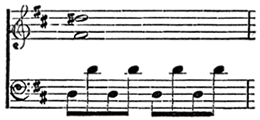
has caused more than one honest theorist to shake his head. No doubt, if
seen in notation disconnected from the preceding and following bars, it
looks deterrent enough; but ought it thus to be judged? Still, Schilling
in his Musical Dictionary,[39] has thought it necessary
to excuse Mozart for having used this chord. In the article headed
"Accord" he remarks: "Türk says we possess no chord with an augmented
octave. Until Mozart, this interval was only used as a Suspension. Mozart,
however, makes it stable enough by filling with it a whole bar of 4/4
time. The master always knows why he acts in a certain particular way and
not otherwise; and as in 'Don Giovanni' the extraordinary is predominant,
this long-sustained augmented interval—this premeditated
poignard-stab—may stand there as a warning to our libertines. We,
for our part, know nothing more frightful than this sustained chord, and
the sudden energy with which it is intended to be executed."
If Mozart could provoke adverse criticism, it is not surprising that
Beethoven did, considering his great originality. Dr. Crotch therefore,
should not be thought a worse critic than many others when he says (in his
'Lectures,' London, 1831, p. 146) of Beethoven: "That he has ever
disregarded the rules of composition is to be regretted, as there does not
seem to have been the least good obtained by it in any one instance."
Rochlitz, in criticising Beethoven's last violin quartets, which he
evidently did not like, cautiously observes: "When Beethoven had published
his first three Trios for pianoforte, violin and violoncello—and
soon afterwards, his first Symphony in C major—a certain reviewer
thought it right and good to speak of the Trios almost jokingly, treating
them rather as confused explosions of the bold wantonness of a young man
of talent; and the symphony he earnestly and warningly declared to be an
odd imitation of the style of Haydn, amounting almost to caricature. Yet
this critic was really an able musician of much experience, and standing
firm as a rock in his time and its theory. He had also produced many works
which are justly appreciated, and he liked Beethoven in a degree. Had the
man given his name, or did we not owe reticence to the dead, every reader
would concede this, and even more, if we named him. Again, when Beethoven
had finished his second Symphony in D major, and Prince Lichnowsky brought
the manuscript to Leipzig, Spazier, after the performance of the symphony,
gave his opinion about it in his new journal, entitled 'Zeitung für die
elegante Welt.' He called it a coarse monster—a pierced dragon
writhing indomitably, which will not die, and which in bleeding to
death (Finale) flourishes its uplifted tail furiously in all directions in
vain. Now, Spazier was a clever fellow, a many-sided and versatile man,
and by no means inexperienced. As musician, he was acquainted with every
composition which in his time was considered as superior. Having been a
pupil and faithful assistant of Reichardt, he enjoyed as a critic a by no
means small reputation, and was even feared. Since then, twenty-five years
have elapsed; and what is now thought of these works by the whole world?"[40]
A collection of the musical reviews emanating from critics of reputation,
which condemn our master-works, might be amusing, but would probably be
more ridiculous than instructive. England especially could contribute a
large share of such curiosities in musical literature. No doubt some of
the judges were clever enough; they cannot exactly be said to have been
unable to understand what they criticised; but they had compiled a certain
code of rules for their own guidance in judging, gathered from the works
of some favourite composer, which rules they considered as the only right
ones. Consequently they denounced whatever they found in disagreement with
their adopted code.
J. N. Forkel, the learned and justly-esteemed author of a 'History of
Music,' and of several other useful works, possessed for J. S. Bach so
intense an admiration, that he had at last no ear for any composer who
differed from his idol. Hence his unwarrantable attacks on Gluck in his
'Musikalisch-Kritische Bibliothek,' Gotha, 1778.
We possess in the German language a cleverly written book entitled 'Ueber
Reinheit der Tonkunst' (On the Purity of Music), the first edition of
which appeared in the year 1825. The author of this book, A. C. J.
Thibaut, a distinguished Professor of Law in Heidelberg, had studied the
old Italian and Dutch Church composers of the time of Palestrina, whose
works he delighted in having performed at regular meetings of a number of
well-trained
choristers in his house. Thibaut's enthusiasm for the old writers of vocal
music without instrumental accompaniment was so unbounded that the great
instrumental compositions by Beethoven and others had but little
attraction for him. He ridicules with much sarcasm Weber's overture to
'Oberon.' Celebrated pianists evidently found but little favour with him.
Still, Thibaut has had a beneficial influence on musicians, and his
strange and spirited book deserves a prominent place among our curiosities
in musical literature.
Distinguished composers sometimes prove but unreliable judges of the
merits of other composers, especially if the latter are their
contemporaries, and perhaps their rivals. We know from the biographies of
the composers how greatly Weber disliked Rossini; how lightly Spohr
appreciated Weber's 'Der Freischütz' when all the world was in ecstasy
about the opera; how Spohr found fault with Beethoven's symphonies. And we
know what Beethoven, in an unguarded moment, said of these composers. We
remember Mozart's unfavourable opinions concerning Clementi, Abbé Vogler
and some other musical celebrities of his time; likewise J. S. Bach's
joking remarks to his son Friedemann about their going to Dresden to
listen to the "pretty little songs" of Hasse; and Handel's hard words
about Gluck: "He knows no more of counterpoint than my cook!"—not to
record other such gossip which is rather scandalous. Being reminded of
these musical discords, it is all the more agreeable to remember the
sincerity with which many of our great musicians have acknowledged the
merits of their compeers. Haydn's esteem for Mozart was only equalled by
Mozart's esteem for Haydn. Beethoven's high appreciation of Cherubini is
notorious. Likewise, Schubert's admiration of Beethoven. But it is
unnecessary here to point out instances of the kind.
Musical amateurs often evince a preference for a certain composer merely
because they have accidentally become more familiar with his works than
with those of other composers. No wonder that in their literary
productions referring to music they should have largely contributed to the
curiosities.
In noticing here M. Victor Schœlcher's 'Life of Handel,' it is with
sincere esteem for his enthusiasm and perseverance, which enabled him to
collect interesting information respecting the great composer. However, in
order to write the 'Life of Handel' it is not sufficient to be an
enthusiastic admirer of his works. One must be well acquainted with the
musicians contemporary with the great composer, and with the stage of
progress of the art at the time when the little boy Handel took his
initiatory lessons. One must also have practical experience in musical
composition. The following opinion expressed in the work alluded to may
serve as an example of a literary curiosity from a musical amateur:—"When
a great artist like Handel is accused of theft, the proofs should be
exhibited openly.... These pretended thefts are nothing but accidental
resemblances, fugitive, and quite involuntary.... If Dr. Crotch is to be
believed, Handel was never anything but a plagiarist, who passed his life
in seeking ideas out of every corner!" and so on. Now, it is a well-known
fact that Handel did in several instances make use of the compositions of
others. But, no discerning biographer would for this reason regard him as
a thief. The really musical inquirer would find it interesting to examine
carefully how the great composer has treated and ennobled ideas emanating
from others.
An autobiography of a celebrated musician may be instructive, if the
author possesses the moral courage to record candidly what he has thought
and felt. He must tell the truth, and nothing but the truth. How seldom is
this the case! Be it from a praiseworthy consideration for others, or
perhaps from personal vanity, statements of committed mistakes,
unsuccessful struggles, and such like facts, are often omitted or gilded
over. The letters of celebrated musicians, published after their death by
their friends, are generally so much polished, and sentences thought to be
injurious to the reputation of the great artist so carefully expunged,
that we obtain only occasionally a glimpse at the real life of the man.
Perhaps the most amiable, but also the weakest publications of this kind
are generally the biographical notices which have been edited by the
widow of a celebrated musician. To note one instance: 'Spohr's
Autobiography' is interesting, although it is somewhat tinged with
self-complacency. After Spohr's death his widow published the
Autobiography, supplementing it with laudatory remarks such as the
following:—
"During the last few years of his life he often expressed his conviction
that there must certainly be music in Heaven, although it might be very
different from our own music. When his wife replied with all her heart:
'Yes, perhaps different; but more beautiful than yours it cannot be!'—Then,
a smile of happy contentment and blissful hope spread over his face."[41]
The musician acquainted with the frequent repetitions in Spohr's works of
certain modulations and mannerisms in favour with the composer, may well
be excused if he shudders at the thought that he should have to listen to
them eternally.
Let us now direct our attention for a moment to books relating to musical
controversy. The reader is probably aware of the dispute occasioned by
Gluck and Piccini, in France, towards the end of the last century, and of
the large number of pamphlets which it caused to be published, including
some which were written by the most distinguished thinkers of the time.
The dispute concerning the genuineness of Mozart's Requiem likewise
supplies some curious specimens of musical literature. The paper-war
commenced with an article by Gottfried Weber, published in the musical
journal 'Cæcilia,' in the year 1825. The gauntlet thrown down was taken
up, in the same year, by the Abbé Stadler. After this beginning of the
controversy, other champions, pro and contra, made their
appearance; and the quarrel, conducted not entirely without personal
insult, soon grew to be as formidable as the fray between the Montagues
and the Capulets,—when, fortunately for the sake of concord,
Mozart's MS. score of the Requiem was discovered, and revealed
which portions of the work had been committed to paper by himself, and
which were written after his death by his instructed disciple, Süssmayr.
Another controversy of a peculiar kind, in which many musicians took part,
and upon which several dissertations were published, originated in a
violent attack by Giovanni Spataro upon Franchino Gafori, in the beginning
of the sixteenth century. An account of this dispute, which related to
some theoretical questions, is given in Hawkins's 'History of Music,'
London, 1776, Vol. II., p. 335. As regards the style of language of the
combatants, it reminds us more of fists and clubs than of needle-guns; but
this is only what might be expected.
Again, as regards the learned inquiries respecting the origin and use of
music, some curious treatises may be noticed.
The opinion that man learnt the art of music from the songs of birds is
very old, and was already held by the Roman poet Lucretius, nearly a
century before our Christian era. Guido Casoni, in his 'Della Magia
d'Amore,' Venice, 1596, finds the origin of music in Love. J. C. Ammon, a
German clergyman, wrote in the year 1746, an essay entitled 'Gründlicher
Beweis dass im ewigen Leben wirklich eine vortreffliche Musik sei' ('A
Clear Proof that there is in Eternal Life really excellent Music'). Also
Mattheson, of whose literary productions more than one might be classed
with the curiosities, wrote circumstantially about the music in Heaven. A
book of his on the subject, published in the year 1747, bears the title—'Behauptung
der himmlischen Musik aus den Gründen der Vernunft, Kirchen-Lehre, und
Heiligen Schrift' ('An Assertion that there is Music in Heaven, proved
from conclusions of reason, from the teaching of the Church, and from Holy
Scripture'). Latrobe, in his treatise entitled 'The Music of the Church,'
London, 1831, settles this question by citing passages from the
Revelation; for instance, the nature of the instrumental accompaniments to
the vocal music in Heaven, is in his opinion clearly revealed by the
passage "Harpers harping upon their harps." (Rev. XIV., 2).
The erroneous conjecture, that the art of music suggested itself
originally to man, from his hearing the various sounds in nature, instead
of being innate in him, has been entertained by several writers. Suffice
it to notice two books on this hypothesis, written in the present century:
'The Music of Nature; or an attempt to prove that what is passionate and
pleasing in the art of singing, speaking, and performing upon musical
instruments, is derived from the sounds of the Animated World,' by William
Gardiner; London, 1832. 'La Harpe d'Eole et la musique cosmique; études
sur les rapports des phénomènes sonores de la nature avec la science et
l'art;' par J. G. Kastner; Paris, 1856.—Kastner is the author of
several musical treatises which might be enumerated with the literary
curiosities.
Feyoo y Montenegro, a Spanish ecclesiastic, about the middle of the
eighteenth century, wrote a dissertation, the title of which, translated
into English, is: 'The Delights of Music accompanied by Virtue are upon
Earth the foretaste of Heaven.' By way of contrast to this may be noticed
Francesco Bocchi's 'Discorso sopra la Musica,' Florence, 1580, in which
the learned author maintains that music is injurious to morals and good
manners. Vicesimus Knox, in his 'Essays moral and literary,' London, 1778,
recommends the acquirement of musical accomplishments as a means of
protecting oneself in old age from contempt and neglect.
The oddities of the following English works are sufficiently indicated by
their titles:—'The Schoole of Abuse conteining a pleasaunt Inuective
against Poetes, Pipers, Plaiers, Jesters, and such like Caterpillers of a
Commonwelth,' by Stephen Gosson; London, 1579. 'Histrio-mastic; The
Player's Scovrge, or Actors' Tragedie,' by William Prynne; London, 1633.
For the publication of this work, which contains a satire against vocal
music, the author was condemned by King Charles I. to have his ears cut
off, and to stand in the pillory.
Curious specimens of English treatises on sacred music are:—'A
Treatise concerning the lawfulness of Instrumental Musick in Holy
Offices,' by Henry Dodwell. Second edition; London, 1700. 'The Temple
Musick; or
an Essay concerning the Method of Singing the Psalms of David, in the
Temple, before the Babylonish Captivity,' by Arthur Bedford; London, 1706.
'The Great Abuse of Musick,' by Arthur Bedford, London, 1711.
A German philosopher, in the beginning of the present century, wrote 'On
our Inclination to sing when we are in a cheerful Mood.' Others have shown
that cheerful music makes some persons feel sad. Shakespeare knew this, to
conclude from Jessica's words (The Merchant of Venice, Act V., Scene I.):
'I am never merry when I hear sweet music.'
As regards curious illustrations of musical instruments, the following
works are especially deserving of notice:—
'Musica getutscht und ausgezogen,' Basel, 1511, by Sebastian Virdung.—'Musica
instrumentalis,' Wittenburg, 1529, by Martin Agricola.—'Musurgia seu
Praxis Musicæ,' Strassburg, 1536, by Ottomarus Luscinius.—The
last-named work is written in Latin; the other two are in German. All
these contain illustrations of the instruments described by the authors.
Sebastian Virdung's book is written in dialogue. Virdung and Luscinius
(whose German name was Nachtigall) were priests. Martin Agricola was a
professional musician, and conductor of a choir and orchestra at
Magdeburg. His book is written in wretched doggerel rhymes, but the
wood-engravings are very exact, and his explanations are lucid. The
circumstances of Martin Agricola having been practically experienced in
the art, and having lived, so to say, in the midst of the instruments on
which he treats, render his observations especially reliable.
The same may be said of Michael Prætorius, a distinguished Kapellmeister
at Brunswick, who is the author of 'De Organographia,' Wolfenbüttel, 1619.
This valuable treatise forms the second volume of a work entitled,
'Syntagma Musicum,' etc. The first volume treats on the history of music,
chiefly sacred; it is written in Latin, and was published in 1615. The
third volume, which like the second is written in German, contains an
account of the different vocal compositions in use at the time when the
work was written. The wood-engravings of 120 instruments belonging to
Volume II. were published with the separate title: 'Theatrum Instrumentorum
seu Sciagraphia,' Wolfenbüttel, 1620. The proper German name of Prætorius
is Schulz. It was not unusual with the old German authors to Latinize
their names on the title-page of their books.
The works just noticed are now so scarce that the musician rarely finds an
opportunity to consult them. Hardly more accessible is the 'Harmonie
universelle,' Paris, 1636, by F. Marin Mersenne,—a work which is
valued especially on account of its comprehensiveness. The second volume
contains descriptions with illustrations of the musical instruments in use
about the year 1600. Mersenne was a monk,—as was also Athanasius
Kircher, whose 'Musurgia universalis' appeared in Rome in the year 1650.
Kircher's work is less scarce than that of Mersenne, but also less
important. The illustrations in 'Musurgia universalis' are however,
interesting, and it is principally on account of them that the work is
still appreciated by musical historians. The 'Musurgia universalis' is
written in Latin. Athanasius Kircher occupied himself also in making
acoustic experiments, and he wrote a treatise on the subject, illustrated
by engravings. He also constructed various acoustic instruments, which
after his death, were deposited with other curiosities left by him, in a
Museum at Rome. Dr. Burney, who saw them in Rome in the year 1770, remarks
in his Journal: "They are now almost all out of order; but their
construction is really curious, and manifests an ingenuity as well as zeal
of this learned father in his musical inquiries and experiments."
Filippo Bonanni, who like Athanasius Kircher was a Jesuit Father,
published at Rome in the year 1722, a work entitled 'Gabinetto armonico
pieno d'istromenti sonori,' which contains 138 copper-plate engravings of
musical instruments, most of them with representations of the performers.
It is written in Italian. A second edition, in Italian and French,
appeared in 1776. Bonanni's work is an amusing picture-book rather than a
scientific treatise. The illustrations are inexact, and the explanations
are meagre and unsatisfactory. The author had evidently never seen most of
the instruments which he describes, and many of the illustrations appear
to have been drawn from his description and not from actual specimens.
It is however, from Bonanni and kindred writers that Laborde has compiled
his 'Essai sur la Musique,' Paris, 1780. It would be more easy than
pleasant to cite mis-statements copied from old authors by Laborde which
have been recapitulated almost verbally by subsequent writers down to
Fétis. In consulting the 'Essai sur la Musique' with its illustrations,
many of which are fanciful, it must be borne in mind that Laborde was a
musical dilettante more distinguished for his enthusiasm for the art, than
for any particular qualification as an author on the subject in question.
Sir John Hawkins, likewise a musical dilettante and ardent lover of the
art, by persevering diligence succeeded in accumulating a large mass of
material for the compilation of a history of music, published in 1776,
which contains many interesting accounts of scarce works on music, with
extracts from them; but he was evidently not much of a musician, and the
information he offers is arranged without sufficient discernment or order.
Hawkins was probably unacquainted with the original German works from
which he gives extracts in translation. At any rate, he has made some
funny mistakes. For instance, in noticing a publication of a series of
letters on music by Steffani, he says (Vol. IV., p. 303): "Mattheson, in
his 'Orchestra', mentions two persons, namely John Ballhorn and ( )
Weigweiser, as the authors of observations on these letters by Steffani;
but, according to Mattheson, neither of them was either able to read the
original, or in the translation to distinguish between the sense of the
author as delivered in the text, or the opinions of the translator
contained in the notes."
Now, the fact is that neither John Ballhorn nor Wegweiser—or
Weigweiser as Hawkins spells the word,—were distinguished men
deserving a place in a 'General History of Music.' "Johann Ballhorn"
merely signifies "a Blunderer," just as "Jack of all Trades" signifies a
person who can turn his hand to anything. Old Mattheson was a
quaint and sarcastic writer. He calls the translator of Steffani's
treatise from Italian into German a "Johann Ballhorn" on account of the
blunders in the translation; and another writer, who commented upon the
subject, and who put himself forth as a true Mentor, he nicknames
Wegweiser, which simply means "Guide." The student ought, however, to
acknowledge the literary scrupulosity of Hawkins evinced by his leaving a
small blank space open before "Weigweiser" to enable any reader who may
happen to be informed of the christian name of this gentleman, to insert
it there. Still, Hawkins may well be excused, considering that even
Nagler, in his well-known Lexicon of Artists, written in German, exhibits
a somewhat similar "John Ballhorn." He mentions a Mr. "Somebody" among the
English engravers, and states that this artist has engraven the Death of
General Wolfe painted by West.
A writer on musical history must above all be a musician of practical
experience—an accomplished executant on at least one instrument, so
that he is enabled to familiarize himself with the compositions of
different masters more thoroughly than could otherwise be possible; and a
composer in order to form a correct judgment of the compositions of
others. The opinion about Handel or Bach of a writer who is but
imperfectly practised in counterpoint, and who is incompetent to produce
correctly a fugue or other intricate composition constructed according to
fixed rules, is not likely to prove of use to the student of musical
history. Burney possessed many of the qualities requisite for a musical
historian. He was a professional musician systematically trained in the
art, and an intelligent inquirer without pedantry or prejudice. Moreover,
he had the moral courage to rescind an opinion when he discovered that it
was erroneous. For instance, respecting an opinion which he formerly held
on German music, he candidly avows ('History of Music' Vol. IV., p. 606),
"It was inconsiderately inserted in the first edition of my 'German Tour'
before I was able to examine the truth.... So far, therefore from letting
a second-hand prejudice warp my judgment, or influence my
opinions in writing my General History, I have long been keeping double
guard over my pen and my principles."
The most valuable literary productions are generally to be found among the
investigations which are confined to a certain branch of the art. The
works which pretend to embrace its whole science are often but mere
compilations by writers who, like Bottom the weaver, want to act not only
Pyramus, but at the same time also Thisbe and the lion.[42]
With the objectionable curiosities in musical literature might also be
classed certain compilations which contain acute observations interspersed
with silly remarks. In the preface the author states that he considers it
an agreeable duty to acknowledge his obligations to other writers; but, as
he does not indicate in the course of the book the sources from which he
has drawn, most readers remain ignorant of the fact that the acute
observations ought properly to have been given in inverted commas.
Equally objectionable are certain productions bearing on the æsthetics of
music, in which the author shows with high-flown words that he is himself
not quite clear about what he propounds. It certainly seems odd that just
such worthless productions are often prefaced with the remark that the
subject of the book has never been properly treated before, whereas there
are generally much better works on the same subject well known to
musicians.
Here also may certain puffing publications be alluded to, which resemble
the literary productions of quack doctors. Some are curious, however
objectionable they may be. We have guides professing to teach how to
become a brilliant player without the trouble of practising an instrument;
how to compose fine music with the aid of dice instead of musical
knowledge; how to sing in chorus without having a voice; and suchlike
tempting propositions.
Nor must the fanciful schemes for reform relating to the theory of music,
to musical notation, to the construction of instruments, etc., be left
unnoticed. Some of these are very extravagant, while others have proved to
be of greater practical utility than was expected. Space can
only be afforded here for three curious examples of proposed innovations,
two of which shall be selected from English publications of this
description.
'An Essay to the Advancement of Musick, by casting away the Perplexity of
different Cliffs, and uniting all Sort of Musick,—Lute, Viol,
Violin, Organ, Harpsechord, Voice, etc.—in one Universal Character;'
by Thomas Salmon, London, 1672.
'A New System of Music, both theoretical and practical, and yet not
mathematical; written in a manner entirely new; that's to say, in a Style
plane and intelligible; and calculated to render the Art more Charming,
the Teaching not only less tedious, but more profitable, and the Learning
easier by three Quarters. All which is done by tearing off the Veil that
has for so many ages hung before that noble Science;' by John Francis De
La Fond, London, 1725.—The author proposes to abolish the clefs
entirely, as he finds them only troublesome.
Wilhelm Kühnau published in Berlin, in the year 1810, a book entitled "Die
Blinden Tonkünstler," which contains the biographies of seventy blind
musicians. The author discards all the foreign words used in German music,
and substitutes for them German words of his own coining. For
Kapellmeister he proposes 'Tonmeister;' for Clarinette, 'Gellflöte;' for
Harmonika, 'Hauchspiel;' and so on. He, however, does not stand alone as
such a whimsical innovator. Beethoven, ten years later, coined the word
'Hammer-Klavièr' for Pianoforte, and used it on the title-page of his
large sonata in B flat major, Op. 106.
As specimens of Lampoons may be mentioned:—Joel Collier's 'Musical
Travels through England,' London, 1774, written in ridicule of Dr. Charles
Burney; and L. Rellstab's 'Henriette, oder die schöne Sängerin,' Leipzig,
1826, which caricatures certain admirers of the celebrated songstress and
estimable lady, Henriette Sontag, in Berlin. These musical enthusiasts
included several noblemen of the highest position, and a foreign
ambassador at the Prussian Court, who were described under fictitious
names so as to be easily recognised. The scandalous gossip thereby
occasioned induced the government to confiscate the obnoxious though witty
book, and to condemn Rellstab to be imprisoned three months in the
fortress of Spandau. The punishment of the author, of course, greatly
increased the popularity of the book. Being forbidden by high authority,
it was read everywhere,—even aloud to circles of guests in the
coffee-rooms and wine-houses of Berlin,—until curiosity was
satisfied.
As regards musical novels, those which may be called curious are mostly so
on account of their eccentricities and improbabilities. Some interesting
exceptions could, however, be pointed out. The heroes of the novels are
not unfrequently drawn from life, inasmuch as they represent certain
celebrated musicians.
E. T. A. Hoffmann, the spirited and highly imaginative novelist, has
taken, it is generally believed, the eccentric musician Louis Böhner as a
model for his famous 'Kapellmeister Kreisler.' After having travelled for
several years through Germany, and performed his own compositions in
concerts at different courts, Louis Böhner, more estimable as an artist
than otherwise, retired to his native village in Thuringia, where he died
in great poverty. His concerto in D major for the pianoforte, Op. 8, which
was published about ten years before Weber composed 'Der Freischütz,'
contains the following passage—

in which may be recognised the melody of Agatha's grand Scena. Besides
this, there occur in Böhner's concerto some other slight resemblances with
phrases in 'Der Freischütz.' It is said that on a certain occasion Böhner
played the concerto in the presence of Weber. The resemblances are not
very striking, and may be accidental. Their discovery, however, did not
fail to cause some contributions to our literary curiosities.
The journals of musicians travelling in distant parts of the world often
contain, as might be expected, interesting observations about
music, which are not likely to be found in the journals of other
travellers. If not particularly instructive, they are at least often
amusing to musicians who prefer to read something about their art more
novel and refreshing than they are likely to find in their treatises on
thorough-bass. A. Anton, a German by birth, who was band-master in the
Bengal army, published, after his return to the Fatherland, some
unpretending extracts from his journal, under the title 'Von Darmstadt
nach Ostindien; Erlebnisse und Abenteuer eines Musikers auf der Reise
durch Arabien nach Lahore. Die denkwürdigen Ereignisse der letzten Jahre
nach seinem Tagebuch wahrheitsgetreu geschildert.' ('From Darmstadt to the
East Indies; Life and Adventures of a Musician during his journey through
Arabia to Lahore. The memorable occurrences of the last years truthfully
depicted from his journal;' Darmstadt, 1860.)
M. Hauser, an accomplished violinist, has given an account of his travels
round the world, in a series of letters published with the title: 'Aus dem
Wanderbuche eines österreichischen Virtuosen; Briefe aus Californien,
Südamerika, und Australien.' ('From the Journal of Travels of an Austrian
Virtuoso; Letters from California, South America, and Australia;' Leipzig,
1859.) Hauser's grand show-piece was evidently a sort of descriptive
composition of his own, called 'The little Bird in the Tree,' in which he
cleverly imitated the chirping of the tiny feathered songster. Whether he
imitated it by bowing above or below the bridge, he does not state. In
Tahiti he played it with success to queen Pomare; and at the gold-fields
he charmed the diggers with it to such a degree, that they rewarded him
with pinches of gold-dust and nuggets fresh from the soil. Having himself
become thoroughly tired of 'The little Bird in the Tree,' although it was
his own composition, and wishing to treat the people with some really good
music, he ventured, at a concert in a town of the Isthmus of Panama, to
play Beethoven's famous violin concerto. His audience were at first
puzzled, not knowing what to make of the music; soon, however, silence
changed into general conversation about the news of the town and suchlike
topics.
In order to gain a hearing and money, there was no choice for the virtuoso
but to resort to 'The little Bird in the Tree.' With this conviction he
laid aside the classical music, determining at the same time to enjoy it
all the more heartily at home after having made his fortune. His jottings
contain interesting statements concerning the cultivation of music in the
various countries which he visited.
A journal of a vagabond musician may, perhaps, be thought to possess but
little attraction. If, however, the vagabond musician is an intelligent
man who has had the advantage of a University education, his observations
may be much more interesting than those of a fashionable virtuoso
who moves in the highest circles of society, but whose knowledge is almost
entirely confined to his profession. Ernst Kratz was such a man. He
published his journal in two volumes entitled 'Kunstreise durch
Nord-Deutschland' ('Rambles of an Artist through North Germany;'
Sonderburg, 1822). This strange journal, which the author brought out at
his own expense, is mentioned neither by Fétis nor Forkel. Probably it
never became known through the usual channel of the book trade. It will be
the last of the productions noticed in the present survey of literary
curiosities; but, considering that it is as scarce as it is singular, an
account of it more detailed than has been given of the extraordinary
publications previously noticed may interest the musical reader.
Ernst Kratz was a Prussian, born during the second half of the last
century. His diary commences with an account of his unsuccessful attempts,
in the year 1813, to obtain a commission in the Prussian army against the
French. He had then just left the University of Halle. Why he should have
wished to give up his profession as a lawyer, does not transpire; perhaps
his overflowing energy, and his love of adventure, made the quiet and
regular life of a peaceable citizen appear to him but a miserable
existence. Though of a generous disposition, he was evidently a
self-willed and quarrelsome man, not likely to follow submissively the
dictates of others, who perhaps might be his superiors in position, but
his inferiors in talent and knowledge. Having a fine bass voice, and
some skill in playing the pianoforte and the violin, it occurred to him,
during a visit to a wealthy brother-in-law residing in a small town in the
province of Brandenburg, to organise a concert for the benefit of the
wounded soldiers disabled in the war with Napoleon I.
The zeal with which he engaged in the praiseworthy scheme secured him the
co-operation of the musical dilettanti among the nobility and gentry of
the town and its neighbourhood. The concert proved a decided success, and,
to the gratification of all there was a good round sum of money to be
handed over to the fund for the wounded soldiers.
The result of his first attempt induced Kratz to give similar concerts in
different provincial towns for the same charitable purpose. The
preparations caused him endless trouble, as he generally had to practise
beforehand with each of the amateur singers, his or her part alone, to
enable them to perform with tolerable correctness. The result was
sometimes unsatisfactory, not only musically, but also financially, as the
unavoidable expenses almost swallowed up the receipts. Meanwhile Kratz
received from the Princess Wilhelm of Prussia, the patroness of the
Society for the Relief of the Wounded Soldiers, the title of
'Kammersänger,' in acknowledgment of his benevolent exertions. The honour
conferred upon him increased his fondness for a rambling life, while it
was of little or no use to him in gaining the means of subsistence.
Soon he traversed large districts of Central and Northern Germany, giving
concerts, with which he combined declamatory performances. Experience
taught him to restrict his visits almost entirely to small towns and
watering-places, where his expenses were small, and where he had no
rivalry to fear. During these wanderings he occasionally met with a
clergyman, a doctor, or a lawyer, with whom he had studied in Halle; and
the hospitable manner in which most of his former acquaintances received
him, suggests that they must have had pleasant recollections of his
companionship.
He seldom omits to record in his journal the number of visitors to his
concert; its proceeds and expenses; with other little business details.
These memoranda he intersperses with various observations, of which the
following is a specimen:—
"I may take this opportunity to confute the erroneous opinion, entertained
by many, that a clever music-director can hear every false tone which
occurs in the orchestra. This may be possible if there is only one
instrument for each part, but not otherwise; and also not when the
orchestra is playing forte. The music-director Türk, in Halle,
known as a great theorician and as a good composer, usually had at his
winter concerts the assistance of some students, as they occasioned him no
expense and rendered his orchestra more complete. I offered to assist as a
violin player; but, as the number of violinists was sufficient, while
there was only one tenor player, he appointed me to the tenor. This I
rather liked, since as the performances consisted chiefly of operatic
music and oratorios, it enabled me to follow cursorily the words with the
music. Without an acquaintance with the words, the music of the songs is
hardly comprehensible. My colleague did the same. Not unfrequently we
became so much absorbed in this pursuit that we played wrong,—nay,
we lost our part,—without Türk perceiving it. On the other hand, it
occurred not seldom that he cried out to us: "Die Prätschel!"[43] when we played correctly. This is easily
explicable. If, for instance, five soprano singers execute in unison a
passage rather rapidly, and one of them introduces a wrong tone not very
loud, the best music-director will not perceive it; still less when the
mistake occurs in the middle parts where the other parts cover the false
tone. Of course, it is different if the tone is long sustained and sung
loud."
When Kratz has made himself rather ridiculous, he can philosophize about
the occurrence so that it appears to him very interesting. Take, for
instance, his account of a rehearsal in which he ventured to play a violin
concerto beyond his power:—
"When the orchestra had played the introductory Tutti, and I had to begin
the Solo,—suddenly it becomes misty before my eyes, my whole body
trembles, I cannot see the notes clearly, cannot command my fingers,
cannot manage the bow. We begin again, and a third time; but it is not
much better, although we make some progress. By degrees I become more
collected; still my playing remains a wretched attempt to the end,
provoking the suppressed and loud laughter of the musicians. None of the
somewhat difficult passages, which I knew by heart, could I play. I am not
a virtuoso on the violin; but if one has attained a certain
dexterity, one must be able to play those pieces which one has properly
learnt. Thus this rehearsal enriched my psychology, inasmuch as it served
me as an example for the proposition:—It is very difficult, if not
impossible, to appear in later years before the public in a capacity in
which one has not appeared in early youth. The fear for the teacher
suppresses in youth the shyness for the public, and accustoms us to resist
it, and not allow it to become an obstacle. The fear for the teacher is a
support which later we miss, while the shyness which overcomes us is all
the stronger since we have learnt the value of the opinion which formerly
concentrated only in the teacher, and with which we were well acquainted
beforehand. While as a singer and a declamator I feel the most at my ease
when I appear before a large audience, at the rehearsal, in the presence
of an orchestra only, I could not play a violin concerto, merely because
the former I have done in public from early youth, and this never before."
The proceeds of his concerts he divided into two equal portions, one of
which he regularly forwarded after the concert to the relief fund for the
wounded soldiers, retaining the other half to defray his travelling
expenses. But his concerts were often so thinly attended that they
realized no proceeds to divide, and hardly sufficient means for his
subsistence. He feared to come into suspicion of having appropriated to
himself more than his due; and he felt vexed at the implications which he
sometimes thought he detected in the remarks of strangers, intimating that
the wounded soldiers were of more use to him than he to them.
Reduced to this extremity, Kratz resolved to trouble himself no further
about the wounded soldiers, and henceforth to give his musical-declamatory
entertainments for his own benefit. And with this step begins a new epoch
in his life, in which he depicts himself in his journal as a genuine
vagabond musician. After two years' rambles, he writes:—"I must
mention that my purse is at present in a very low condition. This is
something very common to all travelling artists with or without
reputation, and does not happen now for the first time to me. In Silesia
and other provinces I had already experienced the same trouble.
Considering the peculiar nature of my vocation, I never expected from the
very outset of my rambles that I should gain much money. That I have not
suffered more frequently, is owing to my very moderate habits, and also to
the circumstance that my strong physical condition enables me to brave any
adversities. Whenever my endeavours to obtain an audience in a town
failed, I at once submitted myself to restrictions and deprivations. I
should not even now think this worth mentioning, did it not show how
greatly I had to suffer on account of the musical festival at
Frankenhausen. In fact, it was owing to this that I became for the first
time quite destitute." This happened in 1815. The musical festival in
Frankenhausen was under the management of music-director G. F. Bischoff. A
new cantata by Spohr, performed in the presence of the composer, who
afterwards played a violin concerto, constituted its principal attraction.
It speaks much for the love of music in Kratz that, notwithstanding his
miserable circumstances, he carried out his intention of attending the
festival. His request for permission to assist in the orchestra, or in the
chorus, met with a refusal on the pretext that it came too late, all the
places being filled. Disappointed, he bent his steps to Heringen, a
neighbouring small town, with the intention of giving a
musical-declamatory entertainment which might help him to some food, and
to the price of a ticket of admission to the concert in Frankenhausen. His
struggles he faithfully records thus:—
"In Ashausen, a village three-quarters of an hour's walk from Heringen, I
went into the inn for the night. It was Sunday. The room below was full. I
heard music in the upper room; went up stairs, and found there was dancing going
on. I watched the dancers for a long time. Then, merely for my love of
music, I placed myself among the musicians and played occasionally with
them. When they thus recognised me as a musician, they treated me—but,
unfortunately, with spirits. However, sometimes bread and butter, and
oftener cake, was handed to them, of which I was likewise asked to
partake; and this suited me better. After the dancing was over, several
peasants gathered round the new musician, and I played to them dance-tunes
on the violin, which they liked better than the tunes of their own band. I
took up a horn, having learnt the instrument formerly, and blew them a
piece or two. They now wanted to treat me with spirits, which I however
felt obliged to decline, although it was fine liqueur; for I am no
spirit-drinker. The cake, unhappily, was consumed. I now learnt that they
were celebrating the baptism of a child. I only wished they might continue
the whole night, as it would save me the expense of a bed. However, about
three o'clock in the morning the last of the company departed, and I had
to go down into the public room, where I threw myself on a bench to avoid
paying for a bed. Nevertheless, the unreasonable host demanded that I
should pay him for having slept in his house; but this I did not, because
I had only two groschen[44] in my possession, and
could not entirely divest myself of cash. I therefore paid him only a half
groschen for a cup of coffee in the morning."
Arrived, on Monday, at Heringen: "In the afternoon I happen to pass the
church, which is open. I enter and sit down, tarrying near to my Only
Friend. There I remain alone for a long time, occupied with my
reflections; for, I stand so alone in the world.—In the evening the
decisive hour approaches; the concert at Frankenhausen is at stake, and—Behold!
I have an audience of nineteen persons, few expenses, the host of the
Town-Hall means it well with me, and Frankenhausen is safe!"
Kratz shows himself always to the greatest advantage when he is very badly
off. As soon as he gains a little money, he generally becomes
quarrelsome. It would only be painful to trace his ups and downs,—the
former occurring but occasionally, and being but slight,—until his
arrival in Cassel. In this town the manager of the theatre, perhaps in an
unguarded moment of compassion, gives him hope of an engagement as singer.
The music-director Guhr holds out the same encouragement, amounting almost
to a promise. They afterwards find that their intention cannot possibly be
carried out. Kratz, greatly disappointed, brings an action against them
for breach of promise. Other persons become implicated in this formidable
law-suit, which is carried on for about two years. During all the time
Kratz makes constant pedestrian tours into the country, giving
musical-declamatory entertainments in the small towns and villages, living
on the plainest of fare and sleeping upon straw. When he has scraped
together a few thalers, he returns to Cassel to hand them over to his
lawyer. One cannot but admire his energy; if he had employed only half of
it in a noble cause, he might have done much good. He lost his law-suit
and left Cassel.
On New Year's Eve, 1816, we find him in full-dress at a ball given by a
former fellow-student, now a person of high position in Quedlinburg, who
has taken him for a week into his house, and has dressed him up. The next
day, Kratz reflects upon the event, in his journal, thus:—
"January 1st, 1817. Every thing changes in life. The deadening winter is
followed by the reviving spring; out of the moistened eye beams again the
sun-ray of joy. The first day of the last year found me in the hut of a
peasant, sleeping on a couch of straw, and my rest unpleasantly disturbed
by the firing of volleys by the peasant lads; the first day of this year
finds me awake in a brilliantly-lighted saloon, where I am surrounded by
varicoloured figures moving in the brightness of light, where the sound of
music floats agreeably about my ears, while I am blissfully waltzing round
with the most charming girl in the room."
Unfortunately for Kratz, this blissful state was of but short duration.
Soon we find him again as before in his "Rambles of an Artist," except
that he now moves gradually to the North, until he reaches Hamburg,
which he enters, and where we lose sight of him.
In the present survey several books have been mentioned which possess but
little value. Still, they deserve a place among the fanciful, paradoxical,
extravagant, and quaint publications relating to the art of music. Some
more might have been cited; but the list is probably large enough to
convince the lover of music that we are by no means in want of curiosities
in our musical literature.
THE ENGLISH INSTRUMENTALISTS.
Towards the end of the sixteenth century, and in the beginning of the
seventeenth, companies of English actors visited Germany to perform at the
courts of princes, and at public festivities. The Germans called these
actors 'Die englischen Comödianten' (The English Comedians); and the
musicians accompanying them they called 'Die englischen Instrumentisten'
(The English Instrumentalists.) Respecting the English Comedians much has
already been written by Shakespearean scholars. The musical
accomplishments of these strolling troupes have, however, not received
sufficient attention to satisfy musicians. Although they appear not to
have been remarkable, they are interesting inasmuch as they were
associated with the performances of Shakespeare's dramas, and also because
the English Instrumentalists have been, with few exceptions, the only
English musicians who ever visited Germany with the object of gaining a
livelihood in that country by displaying their skill.
Some notices of them are to be found in the historical records of the
German theatres, which have been published during the present century.
What induced these actors and musicians to leave their native country?—Want
of support at home. There were too many of them in England. During the
sixteenth century many were in the service of English noblemen. It was a
usual custom with the nobility to keep a company of instrumentalists as
well as actors; and to these were not unfrequently added skilful tumblers,
or acrobats, who seem to have enjoyed great popularity. Strolling troupes
of the latter visited the provincial towns. W. Kelly, in his
'Notices illustrative of the Drama, and other popular amusements in
Leicester, during the 16th and 17th centuries,' says: "The earliest notice
we have of the visits of companies of tumblers to the town is in 1590."
These personages undoubtedly also played on musical instruments. In the
German records alluded to, they are called Springer (i.e.
"Jumpers" or "Dancers"), and it would appear that not all the English
Instrumentalists, but only the lowest class of them, combined the art of
dancing and tumbling with that of music. The majority were musical actors
rather than professional musicians; while others occupied themselves
almost exclusively with playing on musical instruments, such as the lute,
treble-viol, viola da gamba, recorder, cornet, trumpet, etc.
In a Proclamation of Queen Elizabeth, issued in the year 1571, these
strolling performers are mentioned in rather disreputable company: "All
Fencers Bearewardes Comon Players in Enterludes, and Minstrels, not
belonging to any Baron of this Realme, or towarde any other honorable
Personage of greater Degree; all Juglers Pedlers Tynkers and Petye
Chapmen; wiche said Fencers Bearewardes Comon Players in Enterludes
Minstrels Juglers Pedlers Tynkers and Petye Chapmen, shall wander abroade,
and have not Lycense of two Justices of the Peace at the Feaste, whereof
one to be of the Quorum, wher and in what Shier they shall happen to
wander ... shalbee taken adjudjed and deemed Roges Vacaboundes and Sturdy
Beggers;" etc.[45]
Some interesting details concerning the nature of the performances of the
English common musicians at the time when this Proclamation appeared, may
be gathered from 'A Dialogue betwene Custome and Veritie, concerninge the
use and abuse of Dauncinge and Mynstralsye, by Thomas Lovell, London,
1581.' The book is written in verse. Custom defends and excuses dancing
and minstrelsy, which Verity attacks and abuses. As regards the minstrels,
Verity remarks:—
"They are accounted vagarant roges
By
act of Parliament,
What reason why they should not then
Like Roges to Jaile be sent,
Except they doo belong to men
Which
are of high degree,
As in that act by woords set downe
Expressly we may see.
To such,
I think, but few of these
Vain Pipers
doo pertain:
To men so grave a shame it were
Fond Fidlers to maintain.
A great
disgrace it were to them,
Their cloth
abrode to send
Upon the backs of them which doo
Their life so lewdly spend."
Respecting the performances of the minstrels, vocal as well as
instrumental, Verity says:—
"Their singing if you doo regard,
It
is to be abhord:
It is against the sacred woord
And Scripture of the Lord.
But this
doo minstrels clene forget:
Some
godly songs they have,
Some wicked Ballads and unmeet,
As companies doo crave.
For
filthies they have filthy songs,
For
baudes lascivious rimes;
For honest good, for sober grave
Songs; so they watch their times.
Among the lovers of the trueth,
Ditties
of trueth they sing;
Among the Papists, such as of
Their godlesse legend spring.
For he
that cannot gibe and jest,
Ungodly
scoff and frump,
Is thought unmeet to play with Pipe,
On tabret or to thump.
The
minstrels doo with instruments,
With
songs, or els with jest,
Maintain them selves, but as they
use,
Of these naught is the best."
This Dialogue, the author of which is supposed to have been a Puritan,
concludes with Verity convincing and converting Custom.[46]
A grant under the Privy Seal of James I. for the issue of letters patent
in favour of Thomas Downton and others, on transferring their services as
players to the Elector Frederic, dated January 4th, 1613, contains the
following names of actors and musicians: Thomas Downton, William Bird,
Edward Juby, Samuell Rowle, Charles Massey, Humfrey Jeffs, Franck Grace,
William Cartwright, Edward Colbrand, William Parr, William Stratford,
Richard Gunnell, John Shanck, and Richard Price. These, and "the rest of
their Associates" were licensed and authorised as servants of the Elector
Palatine "to use and exercise the art and facultie of playing Comedies,
Tragedies, Histories, Enterludes, Moralls, Pastoralls, Stage Plaies and
such other like as they have already studied, or hereafter shall use or
study."
In a Patent of James I., licensing the performance of plays by his
Majesty's Servants at the private house in Blackfriars, as well as at the
Globe, March 27th, 1620, are mentioned: John Hemings, Richard Burbadge,
Henry Condall, John Lowen, Nicholas Tooley, John Underwood, Nathan Feild,
Robert Benfeild, Robert Gough, William Ecclestone, Richard Robinson, and
John Shancks. In a patent of Charles I., dating June 24th, 1625, which
renews that of James I., we have, besides the names just mentioned, Joseph
Taylor, William Rowley, John Rice, Elliart Swanston, George Birch, Richard
Sharpe, and Thomas Pollard.[47]
The names are here given to enable the reader to compare them with the
names, often arbitrarily spelt, of the English actors and instrumentalists
in the German records.
The earliest account of the appearance of these foreigners in
Germany dates from the year 1556, when an English company of actors
visited the court of the Margrave of Brandenburg. In Berlin they found a
well-organized musical band belonging to the Elector Joachim II., the
regulations of which, dating from the year 1570, are still extant. In a
more comprehensive set of regulations issued by the Elector Johann Georg,
in the year 1580, the following instruments are specified as being played
by the Elector's musicians:—Positif, Zimphonien, Geygen,
Zinckenn, Qwerpfeiffen, Schalmeyenn, Krumbhörner,
Dultzian, Trummeten, Posaunen, Bombarten,
("Organ, spinets, instruments played with a bow, cornets, small German
flutes, shalms, cormornes, a small bassoon, trumpets, trombones,
bombardos."[48]).
In the beginning of the seventeenth century we find in the Elector of
Brandenburg's service some English musicians who had probably come to
Germany with the English actors. The following are mentioned in the
Prussian records, with their names more or less Germanized.
Johann Kroker (John Croker), Berlin, 1608. He must have been a rather
distinguished musician; for the Elector Joachim Friedrich made him
Vice-Kapellmeister, or second leader of the orchestra.
Johann Spencer. In a letter dated "Königsberg, July 14th, 1609," the
Elector Johann Sigismund recommends Johann Spencer to the Elector of
Saxony as an English musician who was recommended to him by the Duke Franz
von Stettin, and who had been for some time in Berlin. The Elector adds
that Johann Spencer's music had pleased him pretty well.[49] There can hardly be a doubt that this musician
is the same John Spencer who was the director of a company of English
Comedians travelling in Holland and in Germany.
Walter Rowe (also written Roe) Berlin, 1614. A viola-da-gamba player of
some reputation. He must have been at least thirty-three years in the
service of the Elector, for he is still mentioned as a member of the
orchestra in 1647. About the year 1626 he resided for some time at the
court of the Duke of Mecklenburg-Güstrow. His son, Walter Rowe, was
likewise a musician in the Elector's orchestra at Berlin.
Lambert Blome (probably Bloom) is mentioned in the year 1621 as a Clarin-Bläser
(trumpeter) in the orchestra at Berlin.
Valentin Flood was, in 1627, engaged in Berlin, as player on the Treble
Viol.
John Stanley, a theorbo player, was, in the autumn of the year 1628, at
the court of the Elector of Brandenburg, and in the year 1631, entered the
service of the Landgrave Wilhelm of Hesse-Cassel.
Johann Boldt (probably John Bolt), Berlin, 1635. Cornetto player.
These musicians were not the only foreigners in the band of the Elector at
Berlin. Several Italians are mentioned in the records, and even one or two
Polish cither players. As early as in the year 1564, mention is made of an
Italian virtuoso, Antonio Bontempi, who was engaged as player on the lute,
theorbo, and cornetto.
Although the English comedians most probably visited the Netherlands
before they made their appearance in Germany, we meet with them in Holland
not earlier than in the year 1604. A company, which in 1605 performed in
Leyden, had previously been in Berlin, and was provided with letters of
recommendation from the Elector of Brandenburg.[50]
Moreover, there was a company of English comedians in Denmark during the
second half of the sixteenth century. Five of these, who in the old
documents are mentioned as Instrumentalists, probably because they were
chiefly musicians, arrived in the year 1586 at the court of Christian II.,
Elector of Saxony. Leaving unnoticed those who are mentioned only as
actors, we find recorded in Dresden the following English
instrumentalists, whose names are copied as spelt in the German documents:—
Tomas Konigk (Thomas King), Dresden, 1586. He had previously been in
Denmark.
Tomas Stephan (Thomas Stephen), Dresden, 1586.
George Bryandt (George Bryant), Dresden, 1586; also known as an actor.
Thomas Pabst (Thomas Pope), Dresden, 1586. He is supposed to have been a
personal acquaintance of Shakespeare.[51]
Rupert Persten (probably Rupert Pierst). Dresden, 1586.
These musicians are in their appointment designated as Geyger und
Instrumentisten ('Fiddlers and Instrumentalists') and their duties are
prescribed as follows:—"They must be attentive and obedient, of good
behaviour at our Court; they must follow us on our travels if we desire
it. Whenever we hold a banquet, and also on other occasions, as often as
they are ordered, they have to attend with their fiddles and other
requisite instruments, to play music. And they must also amuse us with
their art of tumbling, and other graceful things which they have learnt.
They are expected to demean themselves towards us as behoves faithful and
attentive servants; which they have also promised, and bound themselves to
observe."[52]
John Price, who came to Dresden in the year 1629, was a virtuoso on
the flute. The Elector of Saxony gave him a superior appointment in his
orchestra. Mersenne ('Harmonie universelle,' Paris, 1636) mentions him as
a brilliant player. The little flute which he principally used had only
three finger-holes; but he is said to have been able by various
expedients, or knacks, to obtain on it a compass of three octaves. He had
previously an engagement at the Court of Würtemberg, in company with John
Dixon, mentioned as an English instrumentalist, and with John Morell,
David Morell, and two other Englishmen, who probably were comedians.
In the year 1626, a company of English comedians performed in Dresden,
among other pieces, Shakespeare's 'Romeo and Juliet,' 'Hamlet,' 'King
Lear,' and 'Julius Cæsar.'[53] A troupe of English
comedians, which in the year 1611 visited Königsberg, consisted of
thirty-five members, nineteen of whom are designated in the records as
actors, and sixteen as instrumentalists.[54]
No doubt most of those designated as actors were also musical; but the
circumstance of nearly one half of the troupe being professional musicians
sufficiently shows how greatly the entertainments consisted of musical
performances. Another proof of this may be found in a record stating that
in Hildesheim a company of English actors gave representations in English.[55]
There were probably but few persons among the audience who understood
English. It may, therefore, be surmised that music constituted the chief
attraction of the entertainment. There was, however, also amusing leaping
and dancing, and the funny clown,—the English Jack-Pudding, Dutch
Pekelharing, German Hanswurst, French Jean Potage, Italian Signor
Maccaroni. The clown derives his nickname from the favourite dish of the
mob.
It is unnecessary, for the purpose of tracing the pursuits of the English
actors and instrumentalists, to follow them in their visits to all the
German towns which preserve records of them. Suffice it to notice their
stay in Cassel, where they arrived in the year 1600. The Landgrave Moritz
of Hesse Cassel took them into his service, and, in 1605, built for them a
theatre in the form of a circus, to which he gave the name Ottoneum, in
honour of his eldest son, Otto. The walls of this edifice were beautifully
ornamented with frescoes.
However, in 1607, the Landgrave Moritz declared that he was tired of "the
confounded dancers and jumpers," as he called them; and he dismissed the
company from his service, with the exception of a few clever
members, whom he retained until the year 1613. The Landgrave Moritz was a
learned man, and likewise a poet and a musical composer. His opinion is
therefore not without some weight. The company, after its departure from
Cassel, perambulated for several years through Germany, and appears to
have found everywhere a good reception,—especially at Nürnberg,
where, in 1612, their "new beautiful comedies" were much admired.
Four names may here be given of English actors, who, in the year 1591, set
out to go to Germany with the avowed intention of improving their
impoverished circumstances. They are: Robert Brown, John Broadstreet (or
Breadstreet), Thomas Sackville and Richard Jones. As in the letter of
recommendation of these men, which has been discovered in the archives of
the Hague, their musical accomplishments are mentioned before their other
accomplishments,—it being stated that they intended to travel for
the purpose "of practising their profession by performing of music, feats
of agility, and games of comedies, tragedies and histories,"[56]—it is evident that music must have been
one of their most practised arts, if not actually their original
profession.
In the year 1603, Lord Spencer was sent by James I. on a special embassy
to Prince Frederick, Duke of Würtemberg, to invest him with the Order of
the Garter. Among Lord Spencer's retinue were four skilful musicians, who
appear to have been picked English instrumentalists, to judge from the
praise bestowed on them by Erhardus Cellius in his account of the visit,
which was published at Tübingen in the year 1605. The following quotation
is a translation, the narrative of Erhardus Cellius being originally
written in Latin:—"The royal English musicians whom the illustrious
royal ambassador had brought with him to enhance the magnificence of the
embassy and the present ceremony [the Duke's investiture of the Order of
the Garter], though few in number, were eminently well skilled in the art.
For England produces many excellent musicians, comedians and tragedians
most skilful in the histrionic art; certain companies of whom, quitting
their own abodes for a time, are in the habit of visiting foreign
countries at particular seasons, exhibiting and representing their art
principally at the courts of princes. A few years ago, some English
musicians coming over to our Germany with this view, remained for some
time at the courts of great princes; and their skill, both in music and in
the histrionic art, procured them such favour that they returned home
liberally rewarded, and loaded with gold and silver."[57] Erhardus Cellius was Professor of Poetry and
History at Tübingen.
There remain to be noticed a few English musicians who came to Germany
about the time of the visits of the English comedians, but who appear not
to have been connected with any of the companies.
John Dowland, a virtuoso on the lute, and also a composer, visited
about the year 1585 the Courts of Hesse-Cassel and of
Brunswick-Wolfenbüttel. Afterwards, he was for some time lutenist in the
service of the King of Denmark, where perhaps he may have associated with
the English comedians. John Dowland was evidently a personal acquaintance
of Shakespeare, who has immortalized him in his 'Passionate Pilgrim':—
"If music and sweet poetry agree,
As
they must needs, the sister and the brother,
Then must the
love be great 'twixt thee and me,
Because
thou lov'st the one, and I the other.
Dowland to thee is dear,
whose heavenly touch
Upon the lute
doth ravish human sense;
Spenser to me, whose deep conceit is
such
As passing all conceit, needs no
defence.
Thou lov'st to hear the sweet melodious sound
That Phœbus' lute, the queen of
music, makes;
And I in deep delight am chiefly drown'd
Whenas himself to singing he betakes.
One god is god of both, as poets feign;
One knight loves both, and both in thee remain."
To conclude that Shakespeare must have been a practical
musician, because he wrote beautiful poetry on the charms and power of
music, would be as bold as to assume from certain passages in his dramas
that he was originally a lawyer, a soldier, a tinker or a horse-dealer.
Indeed, regarded as a critical opinion, his beautiful sonnet on Dowland is
less valuable than the judgment of Dr. Burney, who remarks: "After being
at pains of scoring several of Dowland's compositions, I have been equally
disappointed and astonished at his scanty abilities in counterpoint, and
the great reputation he acquired with his contemporaries, which has been
courteously continued to him either by indolence or ignorance of those who
have had occasion to speak of him, and who took it for granted that his
title to fame, as a profound musician, was well founded."[58]
John Bull, another English musician of some reputation, was a virtuoso on
the harpsichord and organ. Perhaps the circumstance of his playing these
instruments kept him aloof from the English Comedians on the continent;
otherwise his restless and unsettled life would have fitted him well for
their companionship. Born in Somersetshire, about the middle of the
sixteenth century, John Bull, in the year 1601, made his first journey to
Holland, France and Germany, where his organ performances, and even his
compositions, found admirers. Having returned to England, he went, in
1607, a second time to the continent with the object, it is recorded, of
restoring his shattered health,—or perhaps, as Dr. Burney surmises,
to improve his shattered financial condition. He died in Germany. Sir John
Hawkins, in his 'History of Music,' gives two Riddle Canons by John Bull,
written in the shape of a triangle. The anecdote about the marvellous
skill of this musician, exhibited by his adding forty more parts to a song
composed in forty parts,[59] is so absurd as hardly to
provoke a smile from anyone acquainted with the theory of music. John Bull has
also been praised for having composed some pieces for the Virginal so
difficult that even pianists of the present day are startled by his rapid
passages in thirds and sixths. But, considering how rude and unmelodious
these contrivances are, he would deserve greater praise if his music were
easily executable, impressive, and better suited for the instrument for
which it was composed, than is the case. If R. Clark's statement,
according to which John Bull was the composer of the English National
Anthem, were correct, he would have a greater claim to consideration than
he deserves at present. The composers of old popular tunes are seldom
known; it is therefore only proper to regard the whole nation as the
composer of its principal national tune, if its origin has not been
definitively ascertained; and in this sense it is perhaps right to assign
the composition of the English National Anthem to John Bull.
Another English musician, Thomas Cutting, went to Denmark in 1607. He was
a lutenist. There is no record of his having been in Germany. John Abell,
an English singer and lutenist, gave concerts in Holland, Germany, and
Poland, at the time of Charles II., consequently, after the period of the
English Comedians' visit to the Continent.
It is a remarkable fact that, previous to the appearance of those
musicians in Germany, England had already been visited by foreign
musicians, whose talents, considering the positions obtained by several of
them, must have had considerable influence upon the taste of their English
colleagues. There were five German musicians in the service of Richard
III., in the year 1483; eighteen foreign musicians in the service of Henry
VIII.; and as far as can be made out from the corrupt spelling of the
names, the bands of Edward VI. and of Queen Elizabeth contained about as
many foreigners as that of Henry VIII. The Dutch lutenists, Philip van
Welder and Peter van Welder, held a superior position in the band of
Edward VI. The former had already been engaged by Henry VIII. as teacher
on the lute
to the royal children. The distinguished lutenist Jacques Gaulter (or
Gouter), in the service of Charles I., was a Frenchman.
The generally acknowledged superiority of the foreign musicians explains
the dissatisfaction with the popular taste expressed in the works of
several English musicians. Already John Dowland complains in his Prefaces
of being neglected. Matthew Lock, in his 'Little Consort of three parts,
containing Pavans, Ayres, Corants, and Sarabands, for Viols or Violins,'
London, 1657, remarks: "For those mountebanks of wit, who think it
necessary to disparage all they meet with of their own countrymen, because
there have been and are some excellent things done by strangers, I shall
make bold to tell them (and I hope my known experience in this science
will enforce them to confess me a competent judge), that I never yet saw
any foreign instrumental composition (a few French Corants excepted,)
worthy an Englishman's transcribing." John Playford, in his 'Musick's
Delight on the Cithren,' London, 1666, complains: "It is observed that of
late years all solemn and grave musick is much laid aside, being esteemed
too heavy and dull for the light heals and brains of this nimble and
wanton age; nor is any musick rendered acceptable, or esteemed by many,
but what is presented by foreigners: not a City Dame, though a tap-wife,
but is ambitious to have her daughters taught by Monsieur La Novo
Kickshawibus on the Gittar, which instrument is but a new old one, used in
London in the time of Queen Mary." Again, in his 'Introduction to the
Skill of Musick,' John Playford complains: "Our late and solemn musick,
both vocal and instrumental, is now justl'd out of esteem by the new
Corants and Jigs of foreigners, to the grief of all sober and judicious
understanders of that formerly solid and good musick." This is copied from
the edition published in 1683; the first edition appeared in 1655.
Christopher Simpson, in his 'Compendium of Practical Musick,' London,
1667, boldly asserts: "You need not seek outlandish authors, especially
for instrumental musick; no nation, in my opinion, being equal to the
English in that way; as well for their excellent, as their various and
numerous Consorts of three, four, five and six parts, made properly for
instruments," etc. Thus also Christopher Simpson, at the conclusion of his
'The Division Violist, or an Introduction to the Playing upon a Ground,'
London, 1659, says: "And here I might mention (were it not out of the Rode
of my Designe,) divers others [besides Mr. John Jenkins]; most eminent men
of this our nation, who, for their excellent and various compositions,
especially for instruments, have, in my opinion, far outdone those
nations, so much cryed up for their excellency in Musick."
The preference given by these musicians to their own music does not,
however, throw much light upon the question: Of what kind was the music
played by the English instrumentalists, who accompanied the comedians on
the continent?
A satisfactory answer to this question may be obtained from an examination
of the secular music popular in England about three hundred years ago, and
from the stage directions in the dramas performed by the strolling actors.
As regards the diffusion of musical knowledge in England at the time of
Queen Elizabeth, the historical records contain contradictory statements,
which however may, with some discrimination, be reconciled with each
other. It is well known that England possessed at that period some
estimable composers of sacred music who would probably have obtained a
hearing on the continent, had they not been obscured by the excellent
Flemish and Italian church composers. Some intelligent foreigners who made
a trip to England, at the time of Queen Elizabeth, praise the music which
they heard in the principal churches of the country. Paul Hentzner, a
German scholar, who visited England in the year 1598, remarks in his
journal: "The English excel in dancing and music, for they are active and
lively, though of a thicker make than the French." He subsequently
expresses a less favourable opinion of the musical taste of the English:
"They are vastly fond of great noises that fill the ear, such as the
firing of cannon, drums, and the ringing of bells."[60] This statement accords with a remark of Dr.
Burney in his History of Music, Vol. III., p. 143; and likewise with
Handel's advice to Gluck, when the latter, after the performance of his
opera 'Caduta de' Giganti' in London, anno 1746, complained of want of
success: "For the Englishman you must compose something which is powerful,
and which acts upon his tympanum."[61]
Music was also called noise. For instance, in Shakespeare's Henry IV.,
Part II., Act 2, Scene 4:—
'And see if thou canst find Sneak's noise; Mistress Tearsheet would fain
hear some music.'
It may be supposed that the popular taste for loud music was some
centuries ago much the same as it is at the present day, where quantity is
often more thought of than quality. But, there are some records from which
it would appear that the cultivation of music was universal among the
educated classes. Henry Peacham in his 'Compleat Gentleman,' London, 1634,
enumerates with the many requisite accomplishments of a gentleman, some
practical and theoretical knowledge of the art of music. However, he does
not describe the gentleman as he finds him, but, as in his opinion he
ought to be. To conclude from his description that in the seventeenth
century every English gentleman was musical, would be as unwarrantable as
to conclude from Lord Chesterfield's well-known advice to his son to leave
violin-playing to the professional musicians, that in the eighteenth
century Englishmen of education considered it derogatory to play on a
musical instrument.
In Thomas Morley's 'Introduction to Practical Musick,' London, 1597, which
is written in dialogue, Philomathes says to Polymathes, in the beginning
of the discourse, that recently when at a party he could not join in their
madrigal singing after supper "euery one began to wonder. Yea, some
whispered to others, demaunding how I was brought up: so that vpon shame
of mine ignorance, I goe now to seeke out mine old friend master Gnorimus,
to make my selfe his scholler." This statement appears, however, to be in
contradiction with one made about the same time in another instruction
book, entitled 'The Schoole of Mvsicke; wherein is tavght the perfect
Method of trve fingering of the Lute, Pandora, Orpharion, and
Viol-da-Gamba; with most infallible generall rules, both easie and
delightfull. Also a Method how you may be your owne instructor for
Prick-song, by the help of your Lute, without any other teacher: with
lessons of all sorts for your further and better instruction. Newly
composed by Thomas Robinson, Lutenist; London, 1603.' This book likewise
is written in the form of a dialogue, the persons in conversation being
"Knight" and "Timothevs." In the beginning of the dialogue Knight remarks:
"In mine opinion I think it impossible to be a good Musitien, except a man
be seene in all the seauen liberall Sciences; for I know many great
clarkes in Diuinitie, Phisicke, Law, Philosophie, etc., that haue small,
or no knowledge at all in Musicke, nay, some quite reject it."
No doubt, these statements of two professional musicians contradictory to
each other, as to the cultivation of music by English gentlemen towards
the end of the reign of Queen Elizabeth, must not be taken literally, but
rather as what the authors thought an ingenious and elegant manner of
proving that their works supplied a want. Thus, Thomas Morley teaching
vocal music, maintains that every young gentleman is expected to be a
singer; and Thomas Robinson, teaching the lute and the cither, expresses
his dissatisfaction that many gentlemen know nothing about musical
instruments,—indeed, nothing of music. Moreover, Thomas Robinson is
a "Student in all the liberall Sciences;" we know this from his own
statement on the title-page of his 'New Citharen Lessons,' London, 1609;
and being a learned man, he considers it impossible to be a good musician
without being versed in "all the seauen liberall Sciences."
The fact that there is no English book dating from the sixteenth,
seventeenth, or eighteenth century, which contains descriptions with
illustrations of the different musical instruments formerly in
use in England, while a considerable number of such books were published
on the continent, sufficiently proves, if other testimony were wanting,
that instrumental music was not so much cultivated in England as on the
continent. The English books of instruction for certain instruments were
generally but poor compilations got up by the publishers themselves. The
illustrations of musical instruments given in Hawkins's 'History of Music'
have most of them been copied from Luscinius and Mersenne. Hawkins appears
to have been unaware that these instruments, of which he gives
descriptions derived from foreign sources, were formerly also in use in
England. At any rate, he mentions several of them by their German names,
without giving their English names.
Some English musicians who at the time of James I. visited the continent,
Italianised their names, a rather unpatriotic act to which they probably
would not have thought of resorting, had they not become convinced of the
superiority of the continental music. John Cooper called himself Giovanni
Coperario; and Peter Phillips, who lived for a time in the Netherlands,
altered his name into Pietro Philippi.
As regards the national music of England at the time of the strolling
instrumentalists, the inquirer may obtain reliable information by
examining an old collection of popular tunes entitled 'The Dancing Master;
or Directions for dancing Country Dances, with the Tunes to each Dance,
for the Treble Violin.' The first edition was published by John Playford,
about the middle of the sixteenth century. The work, which consisted of
only one volume, became popular, and went through many editions with
enlargements, until, at about the year 1700, it extended to three volumes
containing nearly one thousand tunes. It may be surmised that this
collection comprises nearly all the airs of the secular songs which were
popular in England at the time of the Instrumentalists. It must be
remembered that most of the airs of songs were also used as dance-tunes,
and that comparatively but few of the dance-tunes in the earlier editions
of the collection are instrumental pieces not derived from vocal music.
Whether all these melodies are of English origin is another
question. Some are known to be Welsh, others Irish, others Scotch; and
some appear to have been derived from the continent. Some of the dances
are of foreign origin, and most probably they became first known with the
tunes which belonged to them when they were introduced into England.
Afterwards, new tunes were composed to them, which more or less resembled
the old ones. Irrespective of all those tunes in the 'Dancing Master,'
which are apparently not English, there still remains a considerable
number of specimens which may be accepted as genuine English tunes. They
should be examined just as they are published, without modern harmony or
any other arrangement which obscures their original character. Some of
them are certainly odd. Take for instance the 'Cushion Dance,' with its
melancholy tune, in which the dancers converse in song with the musicians.
Joan Sanderson, or the Cushion Dance.
An old Round Dance.
"Note.—The first strain twice; the second once; and the last
as oft as is required."
"This dance is begun by a single Person (either Man or Woman) who taking a
Cushion in their Hand, dances about the Room; and at the end of the Tune
they stop and sing, This Dance it will no further go. The Musicians
answer, I pray you good Sir, why say you so? Man, Because Jean
Sanderson will not come too. Musician, She must come too, and she
shall come too, and she must come whether she will or no. Then he lays
down the Cushion before a Woman, on which she kneels, and he kisses her,
singing, Welcome Jean Sanderson, welcome, welcome. Then she rises,
takes up the Cushion, and both dance, singing, Prinkum-prankum is a
fine Dance, and shall we go dance it once again, once again, and once
again, and shall we go dance it once again? Then making a stop, the
Woman sings as before, The Dance, etc. Musician, I pray you
Madam, etc. Woman, Because John Sanderson, etc. Musician, He
must, etc. And so she lays down the Cushion before a Man, who kneeling
upon it salutes her, she singing, Welcome John Sanderson, etc. Then
he taking up the Cushion, they take hands and dance round, singing, as
before; and thus they do till the whole Company are taken into the Ring.
And if there is Company enough, make a little Ring in the middle, and
within that Ring set a Chair and lay the Cushion in it, and the first Man
set in it. Then the Cushion is laid before the first Man, the Woman
singing This Dance, etc. (as before) only instead of—come
too, they sing—go fro; and instead of Welcome John
Sanderson, etc., they sing Farewell John Sanderson, Farewell,
Farewell; and so they go out one by one as they came in. Note:
The Woman is kiss'd by all the Men in the Ring at her coming in and going
out, and likewise the Man by all the Women."
The popular tunes of almost every European nation possess certain features
of their own which the student of national music can ascertain and define.
To pronounce upon the original home of any one national tune is of course
often as hazardous as to pronounce upon a man's native country from his
physiognomy. There are Germans who look much like Englishmen, but a number
of Germans seen gathered together would not easily be mistaken for
Englishmen. The same may be observed in every nation. We may occasionally
meet with an Englishman who has the appearance of a Frenchman, a Chinese,
or a Gipsy; but an assembly of Englishmen reveals a certain
family-likeness appertaining to the English race. Thus also a collection
of the popular tunes of a nation generally exhibits certain predominant
peculiarities which enable us to determine whence the tunes came. Those in
the 'Dancing Master,' regarded collectively, do not exhibit any
family-likeness which it would be possible to indicate by words or by
musical notation. They appear to have sprung from as many sources as the
words of the English language. The language has, however, a strongly
marked
individual character from the various adopted words having become
Anglicized; while the musical compositions of Englishmen bear no stamp by
which they could be recognized as English.
The English instrumentalists played, of course, chiefly the popular tunes
of their time. It is unnecessary to explain in detail how the music was
introduced into the dramatic performances. The works of Shakespeare, with
which the reader is presumably familiar, show this sufficiently. They
likewise contain many instances of the admission of popular songs or
ballads,—such as Desdemona's "Sing willow, willow, willow;"
Ophelia's "How should I your true love know?" or the Clown's "O mistress
mine where are you roaming?" in Twelfth-night. Also vocal music composed
for two or more voices was occasionally introduced,—even the jocular
catch, which was especially relished in England, and which Shakespeare
ridicules (Twelfth-night, Act II., Scene 3):—
'Sir Toby Belch.—Shall we rouse the night-owl in a catch
that will draw three souls out of one weaver? shall we do that?'
After some punning, Sir Toby, Sir Andrew Aguecheek and the Clown sing
together a catch.
Enter Maria.
'Maria.—What a caterwauling do you keep here? If my lady
have not called up her steward, Malvolio, and bid him turn you out of
doors, never trust me.'
In 'Hamlet,' Act III., Scene 2, strolling actors are introduced, and with
them musicians playing on hautboys and recorders. In the representations
of the English comedians in the Ottoneum, at Cassel, anno 1606, the
instrumentalists always struck up after each act.[62]
No doubt they played, besides their English tunes, also the most popular
ones of Germany, which would ensure them a more favourable reception.
Travelling musicians who perform in public, almost invariably find it to
their advantage thus to meet the taste of their audience. And it appears,
likewise,
very probable that the English Instrumentalists, on their return home,
entertained their audience in England with the popular tunes, and perhaps
some more elaborate pieces, with which they had become acquainted on the
Continent, and which to the English public would possess the charm of
novelty.
However this may be, the position of the Instrumentalists at home, after
they had discontinued their continental tour, was by no means enviable, to
judge from 'The Actors' Remonstrance, or Complaint for the silencing of
their profession and banishment from their severall Play-houses, London,
1643,' in which the dejected actors remark: "Our Musicke that was held so
delectable and precious, that they scorned to come to a Taverne under
twentie shillings salary for two houres, now wander with their instruments
under their cloaks, I meane such as haue any, into all houses of good
fellowship, saluting every roome where there is company with, Will you
haue any musike Gentlemen?"[63]
The English comedians in Germany generally performed in the German
language. This must have been funny,—perhaps not the least so in
pathetic passages, solemn admonitions, or in reflecting monologues, where
even the slightest foreign pronunciation is apt to transform the sublime
into the ridiculous. Here brevity must have been often desirable, and the
falling in of the band may have afforded relief. Thus, the English
Instrumentalists, although they have exercised no influence upon the
cultivation of the art of music, are certainly interesting, inasmuch as
they have assisted in the earliest representations of the dramas of
Shakespeare.
MUSICAL FAIRIES AND THEIR KINSFOLK. — THE FAIRIES OF THE MAORIES. — ADVENTURES IN THE HIGHLANDS. — THE IMPORTUNATE ELVES. — BAD SPIRITS. — THE MUSICIAN AND THE DWARFS. — THE LITTLE FOLKS. — MACRUIMEAN'S BAGPIPE. — THE GYGUR FAMILY. — LINUS, THE KING'S SON. — NECKS. — THE CHRISTIAN NECK. — MAURICE CONNOR. — WATER LILIES. — IGNIS FATUUS. — THE FAIRY MUSIC OF OUR COMPOSERS.
Fairies notoriously possess great fondness for music. They may be seen in
meadows dancing at night by moonlight; and people often find in the
morning the traces in the dew, called Fairy Rings. In European countries
their favourite musical instruments evidently are the harp and the fiddle.
They also often excel as vocalists, and we find them reputed as enchanting
singers in almost every part of the world.
Their music resembles, as might be expected, the old tunes of the
country-people in the district which they inhabit. The following air of
the Irish fairies is copied from T. Crofton Croker's 'Fairy Legends and
Traditions of the South of Ireland:'—
This air, which, of course, is said to be of high antiquity, is commonly
sung by every skilful narrator of a certain Irish fairy tale to which it
belongs, to enhance the effect of the story.
The fairies of New Zealand are described as a very numerous people, merry,
and always singing like crickets. In appearance they are quite different
from the Maories, the natives of New Zealand; they rather resemble
Europeans, their hair and complexion being remarkably fair.
One day, when Te Kanawa, a chief of one of the Maori tribes, happened to
fall in with a troop of fairies on a hill in the Waikato district, he
heard them distinctly singing some mysterious verses, which he afterwards
repeated to his friends, and which are still preserved in the poetry of
the New Zealanders.
Te Kanawa had died before any Europeans arrived in New Zealand, but the
details of his encounter with the fairies are not forgotten by the people.
They say that he had gone out with his dogs to catch Kiwis,[64] when night came on and he found himself right at
the top of Pukemore, a high hill. There it was where the fairies
approached the brave chief, and frightened him almost to death. He lighted
a fire, and therewith scared them a little. Whenever the fire blazed up
brightly, off went the fairies and hid themselves, peeping out from behind
stumps of trees; and when it burnt low, back they came close to it,
merrily singing and dancing.
The sudden thought struck the trembling chief that he might perhaps induce
the fairies to go away if he gave them the jewels he had about him; so he
took off a beautiful little figure carved in green jasper, which he wore
as a neck ornament; then he pulled out his jasper ear-drop finely carved,
and also his earring made of the tooth of a tiger-shark. Fearing lest the
fairies should touch him, he took a stick, and, fixing it into the ground,
hung the precious presents upon it. Directly after the fairies had ended
their song they examined the trinkets; and they took the shadow from them,
which they handed about from one to another through the whole party.
Suddenly they all vanished carrying with them the shadows of the jewels,
but leaving behind the jewels themselves.
The verses which Te Kanawa heard the fairies sing are, as has been already
said, still known, and the Maories cite them in proof that everything
happened to their brave chief, Te Kanawa, as it is related.[65]
The fairies in the Highlands of Scotland generally have their habitations
in rugged precipices and rocky caverns, found in districts especially
remarkable for wildness of scenery. Their favourite amusements are music
and dancing, and their reels are said to last sometimes for a whole year
and even longer, without intermission.
A peasant from the neighbourhood of Cairngorm, in Strathspey, who with his
wife and children had settled in the forest of Glenavon, happened to send
his two sons late one evening into the wood to look after some sheep which
had strayed. The lads, traversing the wood in all directions, came upon a
habitation of fairies from which emanated the sweetest music that one can
possibly imagine,—or rather, much sweeter music than anyone can
possibly imagine. The younger brother, completely fascinated by its
charms, at one leap entered the abode of the fairies, from which, alas! he
could not return. The elder brother, compelled to give him up as lost, ran
home to his parents to tell them what had occurred.
Now, there lived in the neighbourhood a "wise man," whom they thought best
to consult in the matter. This man taught the elder brother some
mysterious words of disenchantment, and told him to repair to the same
place where the lad had been drawn into the cliff, and to pronounce
solemnly the words; but this must be done exactly a year after the
occurrence of the event. The elder brother most earnestly attended to the
injunction. When the year had elapsed, he stood before the cave of the
fairies on the same day and precisely at the same hour at which his
brother had left him. The music was still going on, and by means of the
mysterious words he actually succeeded in liberating his brother, who was
still dancing. The daring little boy fully believed that he had been
dancing with the fairies for only half-an-hour; for, he said, he had been
dancing all the while, and the first reel was not yet over. But, when he
arrived at home again, his parents observed at once how much his arms,
legs, and his whole body had grown during the year.
Not less remarkable is the following adventure of a village-clergyman told
in the Highlands of Scotland.
A parson who enjoyed the reputation of being a very pious man, was
returning home to his village one night, after having administered
spiritual consolation to a dying member of his flock. The night was far
advanced and he had to pass through a good deal of "uncanny" land;
however, he, knowing himself to be a conscientious minister of the gospel,
did not fear any spirit. On his reaching the end of the lake which
stretches for some distance along the side of the road to the village, he
was greatly surprised by suddenly hearing strains of music more melodious
than he ever before had heard in his life. Overcome with delight, the
pious minister could not refrain from sitting down to listen to the
melodious sounds; besides he was very anxious to find out, if possible,
the nature and source of the charming music. He had not sat listening many
minutes when he could clearly perceive the gradual approach of the music;
he also observed a light in the direction from whence the music proceeded,
gliding across the lake towards him. Instead of taking to his heels, as
any faithless wight would have done, the pious pastor, quite fearless,
determined to await the issue of the singular phenomenon. As the light and
music drew near, he could at length distinguish an object resembling a
human being walking on the surface of the water, attended by a group of
diminutive musicians, some of them bearing lights, and others, instruments
of music, on which they continued to perform those melodious strains which
first attracted his attention. The leader of the band dismissed his
attendants, landed on the beach, and afforded the minister the amplest
opportunity of examining his appearance.
He was a little primitive-looking, grey-headed man, clad in the most
grotesque habit ever seen; indeed, his whole appearance was such as to
lead the venerable pastor all at once to suspect his real character. He
walked up to the parson, saluted him very gracefully, apologizing for
the intrusion. The parson politely returned his compliment, and without
further explanation invited him to sit down beside him. The invitation was
complied with; upon which the minister proposed the following question:—
"Who art thou, stranger, and from whence?"
To this question, the fairy, with downcast eye, replied that he was one of
those beings sometimes called 'Doane Shee,' or 'Men of Peace,' or 'Good
Men,' though the reverse of this title was perhaps a more befitting
appellation for them. Originally angelic in his nature and attributes, and
once a sharer in the indescribable joys of the regions of light, he was
seduced by Satan to join him in mad conspiracy; and as a punishment for
his transgression he was cast down from those regions of bliss, and was
now doomed, along with millions of fellow-sufferers, to wander through
seas and mountains until the coming of the great day. What their fate
would be thereafter, they could not divine.[66]
An almost incredible incident is recorded in Denmark as having occurred to
a youth not far from the town of Apenrade in Slesvig. The youth had sat
down on a hill, called Hanbierre, and had fallen asleep. Near that hill is
a grove of alders,—just the kind of place which one might expect the
elves to frequent. The youth did not awaken until midnight. Presently he
heard all around him most ravishing music; and looking about in
astonishment, he saw two beautiful girls who were singing and dancing in
the moonlight. After a little while they came near to him, and spoke to
him. But he, knowing that it is dangerous to converse with elves, remained
silent. They asked him many questions to induce him to speak; and when he
still persisted in not answering them, they threatened him, singing—"Hearken,
O youth! Wilt thou not speak to us to-night before the cock crow, thy
silver-shafted knife shall surely lay thy heart to rest!"—Again they
sang strains most sweet and ravishing. He could no longer resist, and was
just on the point of speaking to them, when, fortunately for him, the cock
crowed, and they vanished.
From this event the hill is called Hanbierre, or Hahnenberg, which means
'Cock's Hill.'
A short extract from a discussion on Spirits, written about three hundred
years ago by an English inquirer into their nature and propensities, may
find a place here. This description occurs in a work by Thomas Nash,
Gentleman, entitled 'Pierce Penilesse his Supplication to the Deuill;
Describing the ouer-spreading of Vice, and the suppression of Vertue;
Pleasantly interlac'd with variable delights; and pathetically intermixt
with conceipted reproofes. London, 1592.' It does not clearly appear
whether the author's remarks are intended to refer especially to the
Spirits of England; but this probably is the case. True, he describes them
as more ill-tempered than those on the Continent are generally said to be;
but this may perhaps be merely owing to the gloominess of the English
climate. Howbeit, these troublesome Spirits are most likely not so bad as
we find them here depicted; for, is it not a well-known fact, also
mentioned by Thomas Nash, Gentleman, that they love music?
"The spirits of the earth keepe, for the most part, in forrests and woods,
and doo hunters much noyance; and sometime in the broad fields, where they
lead trauelers out of the right way, or fright men with deformed
apparitions, or make run mad through excessiue melancholy, like Aiax
Telamonious, and so proue hurtful to themselves, and dangerous to others:
of this number the chiefe are Samaab and Achymael, spirits of the east,
that haue no power to doo great harm, by reason of the vnconstancie of
their affections. The vnder-earth spirits are such as lurk in dens and
little cauernes of the earth, and hollow crevices of mountaines, that
they may dyue into the bowels of the earth at their pleasures: these dig
metals and watch treasures, which they continually transport from place to
place that non should haue vse of them: they raise windes that vomit
flames, and shake the foundation of buildins; they daunce in rounds in
pleasant lawnds, and greene medowes, with noises of musick and minstralsy,
and vanish away when any comes nere them: they will take vpon them any
similitude but that of a woman, and terrefie men in the likeness of dead
mens ghosts in the night time."
The following adventure was first related by a jolly young German, who
said he was acquainted with a friend of the very person to whom it
occurred.
Once upon a time, a poor musician who lived in the neighbourhood of
Hildesheim, an old town in the former kingdom of Hanover, went home late
at night from a lonely mill, where he had been playing dance-tunes at a
christening festivity. The mill is still extant. Its name is Die Mordmühle
(The Murder Mill), probably because something dreadful may have happened
there years ago. His way led him past a cliff in which there was a dwarf's
hole. When he cast a glance at the hole, he saw, to his amazement, sitting
before it a dwarf, not more than three feet high. Scarcely had he
recovered from his first fright, when suddenly he felt himself seized by
invisible hands and drawn under ground many miles deep into the mountain.
All this occurred in a moment's time. Immediately the poor musician found
that he had been transported into a beautiful hall, illuminated with many
thousand lights of various brilliant colours. The flooring of the hall was
of pure silver, and the walls were all of the purest gold: the chandeliers
were of emeralds and diamonds.
Presently the dwarfs desired the musician to play his best tunes. While
playing, he heard quite unmistakably the little folks dancing to his
music; he also heard them coughing, giggling, and laughing; but he did not
see any
being except the dwarf who had taken him there. After a little while the
same dwarf brought in a bottle of exquisitely fine wine, and placed it
before the musician. When the poor fiddler had helped himself repeatedly
from the bottle, he began to feel more at his ease, and became a little
talkative.
"Well, my good master," he said, "I am playing and playing here one tune
after another, and hear all kinds of noises; but I see no Christian soul
but yourself: could I not have just a look at the gentlefolks whom I have
the honour of serving with my music?"
To this sensible request the dwarf replied: "By all means! There is no
danger in that. Just take my hat and put it on thy head."
As soon as the musician had placed the dwarf's large round hat on his
head, he saw the hall crowded with thousands of little pigmy ladies and
gentlemen, very smartly dressed, who were promenading up and down, bowing
and curtseying to each other; and with them were some little children,
certainly not bigger than a thumb. After having played a country-dance to
conclude the ball, the musician was dismissed, but not before the dwarf
who had brought him there had filled his pockets with wood shavings, of
which a large heap lay stored up just near the entrance of the hall.
"Of what use is that stuff to me!" thought the musician; and the first
thing he did, when he found himself again free in the open air, was to
empty his pockets and throw all the shavings into the road. Heartily tired
he reached his home. On the following morning he put his hand into his
coat pocket to ascertain if perchance any of the shavings remained; when,
Lo! what should he draw out, but a piece of the purest gold! Directly he
set off again to the road where he had disencumbered himself of the
shavings the night before. But he could find nothing; all traces of the
treasure had disappeared.[67]
A young girl who was in service at a farm-house in the province of
Schleswig in Germany, had to work daily so very hard that she became at
last quite dissatisfied with her lot.
One morning when her master sent her into the field after the cows, she
had to pass a hill in which people had often heard the subterranean little
folks singing and dancing. The girl thought to herself how enviably happy
those dear dwarfs in the hill must be, who work but leisurely and sing so
cheerfully. "Alas!" she exclaimed, "could I but live with them, how gladly
would I bid farewell to my present home!"
Her words were heard by one of the dwarfs, a young lad who had just been
seriously contemplating how very advisable it would be for him to look out
for a wife. So, when the girl returned from the field, he presented
himself to her, and soon persuaded her to marry him. They are said to have
lived very happily together in the hill for many years. They had also
about half-a-dozen children; funnily-small dear little creatures these
must have been, to be sure.
The dwarfs in that district possessed in former times a peculiar kind of
cradle song, of which some fragments have been caught by the listening
peasants, and are still preserved.
The music which the dwarfs produce is, as might be expected, remarkably
soft and soothing. Loud and noisy music is not at all to the taste of the
little folks. A peasant who one day had been to town to purchase rice,
raisins, and other luxuries for the wedding festival of his daughter,
which was to take place on the following morning, fell in with one of the
dwarfs near an old grave-yard situated close to the road. In the course of
conversation which they had together, the dwarf expressed a wish that he
might be permitted to witness the festivity, and promised to bring with
him for a wedding present a lump of gold as large as a man's head.
The delighted peasant said he should be most happy to welcome the generous
guest; indeed, he should consider it quite an honour.
"A propos!" remarked the dwarf, just as they shook hands at
parting, "What kind of music do you have to-morrow?"
Whereupon the rejoicing peasant rather boastingly replied: "First-rate
music! We shall have trumpets and kettle-drums!"
Then the dwarf begged to be excused attending; for (he said) trumpets and
kettle-drums he could not endure.[68]
There is in Scotland a family of hereditary bagpipers whose name is
Macruimean (or M'Crimmon). Now, it is well known how it came to pass that
the famous bagpiper, Macruimean, got his fine music. He was ploughing one
day near a haunted hill, when one of the "Little Folks," a tiny green man,
came up and invited him into the mountain. After they had entered a cave,
the tiny green man gave Macruimean an exquisitely fine bagpipe, and told
him that so long as any part of the instrument remained, either with him
or with his offspring they would continue to be the best bagpipers in
Scotland. When the lucky Macruimean had arrived with his bagpipe at his
house, he found to his surprise that he could play upon it beautifully any
tune which occurred to his mind. Indeed, his performance was so powerful
and impressive that it astonished every one; and the people in the
Highlands have still the saying, Co ard ri Piob mhoir Mic-Chruimean,—("As
loud as Macruimean's pipes.")
There is also still in the Highlands a cave called Uamh na'm Piobairean—i.e.,
"The Piper's Cave," into which the famous Macruimean with his children
used to repair to practise the bagpipe. This cave is on the top of a brae,
or rising ground, eight miles north from Dunvegan Castle. Even his
daughters, people say, would occasionally steal to the cave, if they could
lay hold on their father's favourite set of pipes, and indulge in a
vigorous practice for an hour or so. Moreover, at what time the Macruimean
family was first established as the hereditary bagpipers of the Lairds of
MacLeod, no one can say now; for it was so very long ago.[69]
As regards giants, there are now-a-days only very few remaining in
European countries. Formerly, it would appear, they were abundant, and
many traces of their habitations and doings are still pointed out by the
people. However, respecting the capacity of the giants for music, but
little is recorded. Jacob Grimm alludes to the charming musical powers of
Gygur, a Scandinavian giantess and sorceress, and he thinks it likely that
an old German name for the violin, which is Geige, was derived from
Gygur.[70] If this be so, the French
Gigue and the English Jig may be supposed likewise to have
their origin from the name of that mysterious monster. There was evidently
in olden time a whole Gygur family; but it is very doubtful whether any of
its members are still extant. If there are yet any to be found, it must be
up in the North, perhaps in Norway, Sweden, or Iceland; at any rate, the
people in these countries still speak occasionally of their old giants, or
trolls as they are also called.
This story is current in Iceland. It was told to a German traveller in
that out-of-the-way part of the world by a poor joiner,—evidently a
true-born Icelander, well versed in the folk-lore of his country, but a
somewhat prosy narrator. The story is here given in a condensed
form. True, there is not much said in it about music; but its chief
incidents are brought about by the agency of magic songs. The singing of
the swans lulls the king's son into a death-like slumber, and it is by
means of music that the sweet foster-sister of Linus, when she finds him
reposing on the couch,—but all this the reader will see in the story
itself, and to tell it first in a preamble, and then a second time, would
be even worse than the prolixity of the honest Icelandic joiner. So let us
proceed to the story.
There was once a king and a queen who had a son whose name was Linus.
Every one in the whole kingdom admired the young prince for his fine
person and his many accomplishments.
Now it happened that when Linus, the king's son, had attained the age of
twenty years, he suddenly disappeared, and no one could say what had
become of him.
Not far from the king's palace lived with her parents in a little hut a
young girl who was the prince's foster-sister; and he had always been
extremely fond of her. No wonder that he liked her so much, for she was as
beautiful as she was amiable.
"Mother," said the girl, "pray, now let me go, that I may seek for him
until I find him again!"
When the mother heard her speaking thus, she became convinced that all
dissuasion would be useless, and she permitted her daughter to go.
However, she gave her a magic ball of thread, and taught her how to throw
it before her as a guide to the hidden abode of the king's son; for the
old lady was not altogether inexperienced in the mysteries of sorcery. The
girl took the ball of thread and let it run before her; and it rolled and
rolled many miles over mountains and through valleys, until it suddenly
stopped near a precipitous cliff.
"Here he must be!" ejaculated the girl, and anxiously looked about whether
there was not somewhere an entrance into the cliff. But all she could
find, after a careful search was a narrow crevice, somewhat hidden by a
projecting rock, scarcely wide enough for her to squeeze herself through. When
she had succeeded in entering the cliff, she found herself in a large
cavern, the walls of which were smoothly planed, and suspended on them
were all kinds of odd implements. Surveying the cavern with a curiosity
not unmixed with fear, she discovered on one side a short passage leading
into another cavern not quite so large as the first, but handsomer in
appearance. Having entered the second cavern, she observed a splendid bed
standing in the middle of the room. Trembling with hope and fear, she drew
nearer to the bed, and lo! there she found him lying asleep, the beloved
Linus, the king's son!
Her first thought was to awaken him as quickly as possible, that he might
fly with her out of the mountain. But all her exertions to arouse him had
no effect, although she tried various means which ought, it might be
supposed, certainly to have awakened him. While considering what she
should do, she was suddenly terrified by a rumbling sound like that of
distant thunder, which gradually became louder and louder, until it
appeared to be quite near the entrance to the cavern. She had just time to
hide herself behind some furniture in the corner, when the cliff opened
widely, and in came a giantess, seated on a chariot of ivory, inlaid with
gold, and having a golden whip in her hand.
As soon as the giantess, who was also a great sorceress, had entered the
cavern, the opening in the cliff closed again. Presently she went to the
bed on which the king's son was reposing, and summoning two swans from the
end of the cavern, she recited the spell:—
"Sing, sing ye my swans,
To awake Linus, the king's son!"
Immediately the swans began to sing a song, charming beyond all
description; and as they sang the youth awoke. Then the horrid giantess
sat down by the side of the king's son, and told him how very fond she was
of him; and that she should never be happy until he was her husband. But,
Linus, the king's son, smiled without answering her; and, turning his head
aside, he thought of his foster-sister in the little hut not far from his
father's palace. How little did he suspect that the dear girl was near to
him, hidden in the cavern!
However, the giantess perceiving that she was talking in vain, at last
determined to await a more propitious time. So she again called her swans,
and recited the spell:—
"Sing, sing ye my swans,
To charm the king's son to sleep!"
Immediately the swans sang a song inexpressibly soothing, and the king's
son fell asleep again. Thinking the youth safely secured, the giantess
took up her golden whip, and seating herself in the chariot of ivory,
inlaid with gold, she recited the spell:—
"Run, run my precious chariot,
And carry me to the Lifsteinn!"
As soon as she had said these words the cliff opened, and the chariot flew
off like a flash of lightning. Now, when the watchful girl heard the
thundering sound gradually diminishing into a feeble murmur, she knew that
she might venture out of her hiding-place. The first thing she did was to
command the swans:—
"Sing, sing ye my swans,
To awake Linus, the king's son!"
Immediately the swans began to sing most charmingly, and the beloved Linus
awoke. Oh! how unspeakably happy he was when he beheld his dear
foster-sister standing before him! For a time the cavern was to them a
paradise;—but soon the anxious question arose how to escape from the
clutches of the giantess.
Then the quick-witted girl suggested a plan which Linus hopefully adopted;
and having summoned the swans to lull the youth to sleep again, she
withdrew into her hiding-place; for the increasing rumbling of the chariot
warned her of the approaching danger.
The giantess had not long returned to the cavern when she determined on
making another attempt to gain the affection of the king's son. So she
commanded the swans to sing him awake. The prince arose, appeared much
more compliant than before, and expressed his willingness to marry her on
the following day, if it were not otherwise destined.
Then the enamoured giantess, in answer to his inquiries, revealed to him
various secrets as to her magic powers; and when he asked her to
tell him candidly whither she went so often in her chariot, she replied:—
"Ah, my dear boy, there is no cause for jealousy! The fact is, I have a
brother who is a great giant, and we both, my brother and I, have but one
life, and that is bound up in a Lifsteinn ('Stone of Life'). Now, you must
know, the Lifsteinn is very brittle, and if it should be broken our death
would be certain. Daily I visit my brother, who lives far off in a valley
near a deep spring under three high trees. We then fetch up our Lifsteinn,
which lies in the deep spring, and carefully examine it; for, nothing
affords us greater satisfaction than to find our Lifsteinn uninjured."
This valuable information was listened to with breathless attention by the
young girl in her hiding-place; and when the giantess, having previously
ordered the swans to sing the king's son to sleep, had taken her departure
in the chariot, the girl lost no time in hastening from the cavern; and,
rolling the ball of thread before her, she followed it over mountains and
through valleys until she had reached the deep spring under the three high
trees. The great giant, whose mere breathing made all the leaves of the
trees tremble, was just placing the Lifsteinn in the lap of the giantess,—when
the courageous girl sprang out from behind the trees, and snatching it up
threw it on the ground and shattered it to fragments. In a moment both the
giant and the giantess fell down dead.
Now the girl ascended the ivory-golden chariot, took up the golden whip,
and smacking it, recited the spell—
"Run, run my precious chariot,
And take me to Linus the king's son!"
When the chariot had entered the cavern, she at once commanded the swans
to awaken the king's son; and this they did in strains of music so
melodiously beautiful that no mortal had ever heard the like. Linus and
his dear foster-sister, having provided themselves with as many jewels and
as much gold and silver from the cavern as they could carry, took their
seats in the chariot and commanded it to take them straight to the king's
palace. Oh! how they all rejoiced throughout the whole kingdom! There was
no end of festivities!
But the most glorious festival was that when they celebrated the marriage
of Linus, the king's son, with his sweet foster-sister. On that day the
old king, in his happiness, resigned the crown in favour of his dear son.
Of course, king Linus and his beloved queen were quite happy then and ever
after.[71]
The Necks, or water-spirits, are renowned for their love and talent for
music. There exist, people say, various kinds of these interesting
creatures. The Swedes relate wonderful stories respecting the marvellous
harp-playing of a Neck called Strömkarl, who generally prefers the
vicinity of water-mills and cascades for his abode. In olden times, before
the introduction of Christianity into Sweden, the people used to sacrifice
a black lamb to the Strömkarl, who, in return, taught them his charming
music. Also the Norwegians sacrificed formerly to a similar Neck, called
Fossegrim. He taught his enchanting harp-playing to anyone who on a
Thursday evening would throw a young white ram into a river flowing
northwards, meanwhile averting his face.[72]
The Neck, or Nicker, has become quite a stranger in England. Some
Englishmen, however, take care to preserve his name, applying it to a
spirit of another element than water, and everyone knows at once whom they
mean when they speak of "Old Nick."
It is said that there are still to be found in Sweden minstrels who have
learnt their music from the Necks. A certain farm in Smaland, called
Neckaryd, has, according to popular tradition, derived its name from
having been inhabited in olden time by a family of minstrels whose name
was Neckar, and who learnt their music from a Neck. The last survivors of
this remarkable family are still remembered by the people. They were four
brothers who used to play at weddings and on other festive occasions. Their
grandfather is said to have first played the following Necken-Polska,
which is still a favourite national dance in Sweden.
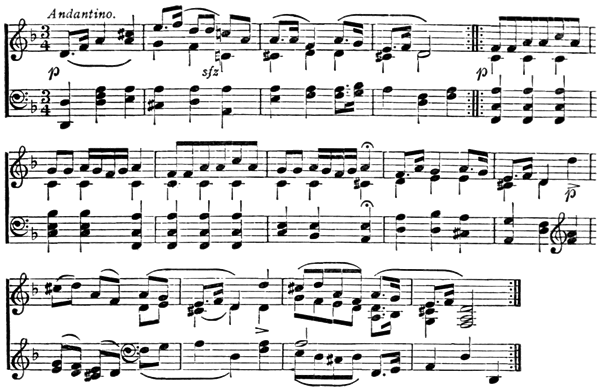
In some districts of Sweden this tune is played with C-natural, instead of
C-sharp, in the first bar. The former is the older form, and may therefore
be regarded as exhibiting more accurately the tune as originally derived
from the Neck, than the present notation with C-sharp, which is, however,
now almost universally adopted. Another tune, which is likewise said to
have been caught from hearing it played by a Neck, and which is certainly
a very old favourite of the people, is as follows:—
This tune exhibits less the characteristics of the old Swedish dance-tunes
than the former, which, like most of them, is in the Minor Key.
The musical performances of the Neck are not any longer confined to
secular music. The country people, in some parts of Sweden, assert that
they have heard him occasionally playing sacred tunes on his golden harp.
Thus we are told of a Neck near the Hornborga bridge, who used to play and
to sing with a sweet voice: "I know, I know, I know that my Redeemer
liveth!"
Some boys who happened to hear him, called out to him: "What good is it
for you to be thus singing and playing? you will never enjoy eternal
happiness!"
Then the poor Neck began to cry bitterly, and hid himself beneath the
water.
A clergyman in Sweden, riding one evening over a bridge, heard most
delightful sounds of some stringed instrument. He looked about, and saw on
the surface of the water a youth wearing a little red cap, and with golden
hair, long and wavy, which streamed over his shoulders. In his hand he
held a golden harp. The clergyman knew at once that this must be a Neck;
he, therefore, in his zeal, called out to him:—
"How canst thou play so cheerfully on thy harp? As likely is this dry
staff, which I am carrying in my hand, to bud and blossom, as that thou
shouldst inherit eternal life!"
The unhappy Neck sorrowfully threw his golden harp into the stream, and
sat down on the water weeping most piteously.
The clergyman spurred his horse and continued on his way. But he had not
proceeded far, when to his great surprise he saw that his old
walking-staff began to put forth leaves; and soon there appeared between
them flowers more beautiful than he had ever seen. This he understood to
be a sign from Heaven that he should teach the consoling
doctrine of reconciliation in a more liberal spirit than he had hitherto
done. So he hastened directly back to the Neck, who was still sitting on
the water sorrowfully complaining; and showing him the green staff, he
said:—
"Dost thou see now my old staff is budding and blossoming, like a young
plant in a garden of roses? thus also blossoms hope in the hearts of all
created beings, for their Redeemer liveth!"
Consoled, the Neck took up again his golden harp, and heavenly sounds of
joy resounded far over the water the whole night long, and many people
heard them along the banks of the stream.
Like the Siren, so does the female Neck enchant youths with sweet music,
and draw them down into the water. Thus also Hylas, a king's son, is
commemorated in Greek Mythology as having been drawn into the water by
nymphs enamoured of the beautiful youth.
The Irish relate a somewhat similar story of a famous bagpiper, whose name
was Maurice Connor, and who had the reputation of being the best piper in
the whole province of Munster. One day, when he played on the sea coast,
at a lonely place in the county of Kerry, a beautiful lady with green hair
came up from the sea, singing and dancing most charmingly; and when she
invited him to go with her, and to marry her, he could not resist. Thus
Maurice Connor became the husband of the green-haired lady deep in the
sea. The union evidently proved happy. For several years afterwards the
sea-faring people often heard, on a still night, the sounds of a bagpipe
off the coast, and some say they are quite sure that it was Maurice
Connor's music which they heard.[73]
The Water Lily (Nymphæa) is by the Germanic nations regarded as the
flower of the Nixes, or Water Nymphs. These charming beings, it is said,
are so fond of music and dancing that they occasionally come up from the
water to the villages lying near their abode, especially at the
celebration of a wake, to join in the festivity. But, if they tarry too
long at these visits, and fail to return home before the crowing of the
cock, they must forfeit their life, and on the glassy surface of the
water, into which they have again descended, may be seen a tinge of blood.
One evening in the autumn, after the vintage was finished, the young folks
of Jupille, in Belgium, were cheerfully dancing on the village-green, when
three beautiful maidens suddenly approached from the banks of the Meuse,
and joined the merrymakers. They were dressed in dazzling white garments;
and on their blond, wavy hair, they wore wreaths of water-lilies just
unfolded. Whether they walked or merely floated over the earth nobody
could tell; but certainly never had the youths of Jupille had such aërial
partners.
After dancing, all the company sat down in a circle, and the three maidens
began to sing with voices so lovely that everyone listened with fixed
attention, unconscious how fast the time was passing. However, as soon as
the clock struck twelve, the three maidens whispered some words to each
other, greeted all around, and vanished out of sight.
On the following evening, just as the moon had arisen, they came again.
The youths directly hastened forward to invite them to dance. As the air
was sultry, one of them drew off her gloves, and her partner took care of
them for her. This evening, the dancing was carried on with even greater
spirit than before, and they were still engaged in it when the clock
struck twelve. Startled by the sound, the three maidens ceased dancing,
and one of them asked hurriedly: "Where are my gloves?"
But the youth wished to retain the gloves as a token of love, and the
maiden was compelled to leave them and to hasten away with her companions.
The youth followed the three maidens quickly; for he wished above all
things to know where his beautiful partner lived. He pursued them further
and further, until they reached the river Meuse. The three maidens threw
themselves into the stream and vanished.
When, on the following morning the love-sick youth returned to the river
where he had lost sight of his partner, he found the water at that place
blood-red; and the three maidens have never appeared again.[74]
As regards the 'Will-o'-the-Wisp,' or 'Jack-in-a-Lanthorn,' there are
various opinions prevailing in folk-lore. The Germanic races generally
regard these fiery phenomena as wandering souls which, for some culpable
cause, have not become partakers of the heavenly rest. Among these are
especially classed the souls of covetous husbandmen, who in tilling their
fields encroached upon the property of their neighbours; and also the
souls of unbaptized children. A Dutch parson, happening to go home to his
village late one evening, fell in with three Will-o'-the-Wisps.
Remembering them to be the souls of unbaptized children, he solemnly
stretched out his hand, and pronounced the words of baptism over them.
But, what was the consequence? A thousand and more of these apparitions
suddenly made their appearance, evidently all wanting to be baptized. They
frightened the good man so terribly, that he took to his heels, and made
for home as fast as he could.[75]
On the ridge of the high Rhön, near Bischofsheim, where there are now two
morasses, known as the red and the black morass, there stood formerly two
villages, which sunk into the earth on account of the dissolute life led by the
inhabitants. There appear on those morasses at night maidens in the shape
of dazzling apparitions of light. They float and flutter over the site of
their former home; but they are now less frequently seen than in the olden
time. A good many years ago, two or three of these fiery maidens came
occasionally to the village of Wüstersachsen, and mingled with the dancers
at wakes. They sang with inexpressible sweetness; but they never remained
beyond midnight. When their allowed time had elapsed, there always came
flying a white dove, which they followed. Then they went to the mountain,
singing, and soon vanished out of sight of the people who followed,
watching them with curiosity.[76]
Ancient myths and miracles have always been favourite subjects for operas,
and the lover of music does not need to be told that several of our
dramatic composers have admirably succeeded in producing music of the
fairies and of other aërial conceptions of the fancy. It is, however, not
only in their great operatic works, but even in ballads with the
accompaniment of the pianoforte, that we meet with exquisitely enchanting
strains of fairy music. Take, for instance, Franz Schubert's 'Erl-King,'
or Carl Lœwe's 'Herr Oluf.' Nor have some composers been less happy
in music of this description entirely instrumental. Mendelssohn's overture
to 'A Midsummer Night's Dream,' his first orchestral work of importance,
and perhaps his best, seems to depict the fairies dancing in a ring on a
moonlight night. But, probably no composer has written instrumental pieces
which might be classed with the fairy music, so beautifully as has
Beethoven. The Largo assai in his pianoforte Trio in D major, Op. 70,
is a remarkable instance. Beethoven does not head this movement with words
intimating that he intends to tell a fairy-tale in tones. Very possibly he
did not even think of the fairies when he composed that wonderful music.
Be this as it may, its tremulous chords with their tenderly-vibrating
passages, descending the scale pianissimo, occasionally swelling to
loudness and then subduing again into their former soft Æolian murmur—and,
above all, its mysterious and unhomely modulations—convey an
impression more analogous to the effect produced by some of our best
fairy-tales than is the case with many musical compositions which avowedly
were suggested by such stories.
SACRED SONGS OF CHRISTIAN SECTS.
A collection of specimens of the sacred songs, with the tunes, used by the
different Christian sects, would be very interesting, and might be
instructive to the musician if it were compiled according to the following
plan.
The collection should contain the most characteristic and favourite songs
used at the present day in public worship and in family devotion. Probably
at least a dozen specimens would be required from each sect, to exhibit
clearly the characteristics of the common songs. But, besides these,
specimens of the songs performed at religious festivals and suchlike
extraordinary occasions, should be given.
The tunes should be rendered in notation exactly as they are usually sung.
If the people sing them in unison, they should not be harmonized; and if
they sing them in harmony, the several parts should be faithfully written
down, however they may be, without any attempt at improvement, and without
unwarranted additions.
If instrumental accompaniment is used, it should not be arranged for any
other instrument than that on which it is usually played; its original
peculiarities should be strictly preserved.
There exist not unfrequently different readings of the same tune. Wherever
this is the case, the most common reading should be given first; and, of
the deviations or varieties of the tune, which may chance to be preferred
by
some congregations, the most usual ones ought to be indicated in small
notes after the notation of the tune as it is most commonly sung.
Many of the tunes belonging to the songs are very old, and several of them
have been derived from secular songs. Some historical account of these
songs would greatly enhance the value of the collection. The alterations
which they have undergone in the course of time might, where they are
traceable, be shown in notation referring to different centuries or
periods; and if the secular melody from which the sacred tune has been
derived is still extant, it might likewise be given.
The specimens of songs appertaining to a sect should be prefaced by some
account of the doctrines and religious ceremonies peculiar to the sect,
and especially by a lucid explanation of the prevailing manner in which
the music is executed.
Furthermore, the value of the collection would be increased by admitting
also examples of the most popular instrumental pieces used in divine
worship; or, at any rate, by giving a description of them, should they be
too long for insertion. The field for research and selection of materials
for the preparation of such a work is so extensive that much discernment
would be required, in order to exhibit clearly the distinctive features of
the music of each sect without enlarging the work to a size which would be
inconvenient.
The immense number of hymn-books for congregational use, published with or
without musical notation, which have appeared since the time of the
Reformation, is almost overwhelming to the student, and rather increases
than facilitates the labour of selecting the most noteworthy examples for
a work like that in question. Here, however, valuable assistance might be
obtained by a careful reference to certain works on hymnology by C. von
Winterfeld, G. von Tucher, Hoffmann von Fallersleben, P. Wackernagel, and
others.
Although congregational singing has been especially cultivated since the
time of the Reformation, it is not foreign to the Roman Catholic Church;
indeed, a very interesting collection might be made of old songs
with the music occasionally performed by Roman Catholic congregations.
With their spiritual songs and hymns in Latin, which were composed during
the Middle Ages, they had sacred songs in their vernacular language dating
from a period anterior to the Reformation. After having flourished,
especially in Germany during the seventeenth century, the congregational
singing of the Roman Catholic Church fell gradually more and more into
disuse until the present century, when attempts to revive it have been
made in some of the dioceses. The oldest known Roman Catholic hymn-book in
German dates from the year 1517, and was compiled by Michael Vehe. It
contains seventy-four tunes, some of which were especially composed for
the book; the others were old and well-known tunes. However, the most
comprehensive of the old collections of sacred songs for popular use dates
from the year 1625, and was compiled by the Abbot David Gregorius Corner.
Among the books of this description subsequently published are several
which contain songs in the German language intended to be sung by the
people at the principal church festivals, in processions, pilgrimages, and
also at Holy Mass. On the last-mentioned occasion a hymn was sometimes
introduced after the Transubstantiation. It was also not unusual on high
festivals for the priest to sing in Latin, and the people to respond in
German. The musical student would do well to acquaint himself with the
modern publications of Roman Catholic songs, as for instance, 'Cantica
Spiritualia,' Augsburg, 1825; 'Kirchen und religiöse Lieder aus dem 12 ten
bis 15 ten Jahrhundert,' by J. Kehrein, Paderborn, 1853; the sacred songs
collected by Freiherr von Ditfurth, Leipzig, 1855, and others.
Examples of elaborate vocal compositions, with or without instrumental
accompaniment, generally performed by an appointed choir of singers and by
professional musicians, would probably demand too much space in a
compendium like that which has been suggested above; but, at all events,
some account might be given of such compositions. Those belonging to the
Roman Catholic Church are especially important. The most popular specimens
should be pointed out. They are in many instances easily obtainable. True,
the most popular ones are by no means generally also the best; but it
would be desirable to ascertain accurately the popular taste of the
present day.
As regards the Chorales of the Lutheran Church, it would be necessary to
trace the alterations which they have undergone in the course of time. For
this purpose the best Chorale books published in Germany during the 16th
and 17th centuries would require especial attention; as for instance,
those by Spangenberg, 1545; Prætorius, 1604; Hassler, 1607; Schein, 1627;
Schütz, 1628; Crüger, 1640, and others. The division of Germany into many
little principalities may be the chief cause of the enormous number of
published collections of songs for congregational use, since every petty
sovereign liked to have in his dominion something exclusive, and the
people liked it too. Thus, there is no hymn-book which is universally
adopted in the Lutheran Church of Germany, and many publications of the
kind are but poor compilations,—at any rate, as far as the music is
concerned. The noble Chorale of the time of Luther has gradually lost, by
tamperings with its harmony and its rhythmical flow, much of its original
dignity and impressiveness. It has suffered especially by the
objectionable interludes which the organists introduced, and still
introduce, not only between the verses, but also at every line which
terminates with a pause in the musical notation. These interludes, which
not unfrequently are extempore effusions of the organist, may afford him
an opportunity to display his skill in counterpoint, and perhaps his
manual dexterity; but they are for this reason all the more out of place
in a Chorale. Still, as they constitute one of the characteristics of
certain congregational musical performances of the present day, some
examples of them should be given in the work.
Likewise the notation of a Chorale with a figured bass should not be
omitted. A considerable number of Chorale books containing only the tunes
with the bass, the harmony produced by the tenor and alto being indicated
by figures, have been published chiefly for the use of organists, who of
course may be supposed to be familiar with thorough-bass. In the year
1730, Georg Philip Telemann, in Hamburg, published his 'Fast allgemeines
Evangelisch-Musicalisches Lieder-Buch,' which contains 433 Chorales; the
different readings of the same tune, in use at that time, are indicated by
small notes, and the tunes have a figured bass, with some instruction at
the end of the book for inexperienced thorough-bass players.
The Chorales of the Hussites are especially deserving of investigation.
Luther appreciated them highly, and several of them were adopted by the
Protestants at the time of the Reformation. The Enchiridion, anno 1524,
which has already been mentioned in another place,[77]
contains two from this source. The earliest published collections of the
Chorales of the Hussites, in which the poetry is in the Czech language,
are: Jona Husa, Cantional, 1564; Girjka Streyce, Chorales with Goudimel's
harmony, 1593; D. K. Karlsperka, Chorales, 1618. Noteworthy are likewise
the songs of the Hussites collected and published by K. J. Erben, Prague,
1847. Also the following in German: A Chorale book of the Bohemian and
Moravian Brethren, edited by Michael Weiss, 1531. The same enlarged by
Johann Horn, 1596. A Chorale book of the Herrnhut Brethren, edited by
Christian Gregor, 1784. Gregor, who was organist as well as bishop in
Herrnhut, is the inventor, or originator, of the peculiar construction of
the organ generally adopted by his sect, in which the player is seated so
as to face the congregation. His publication, which contains 467 Chorales
with figured basses, was the first work of its kind printed for the
Herrnhut Brethren, and constituted the musical portion of their song-book
printed in 1778.
Turning to the sacred poetry of the Reformed Church in Switzerland and
France, we find a famous collection of metrical psalms in French, written
at the request of Calvin by Clément Marot and Théodore de Bèze, to which
tunes were composed or adapted, by Bourgeois, in 1547, and by Goudimel, in
1565. Some musical historians assert that Bourgeois and Goudimel
derived their tunes from a German collection by Wilhelm Franck, published
in Strassburg in the year 1545, so that their merit consists only in
having set them in four-part harmony. It would certainly be desirable to
have the tunes properly traced to their original source.
Several of these old Chorales were gradually adopted by various
denominations in different countries. A collection with the poetry in the
Czech tongue, edited by G. Streyce in 1593, which has already been alluded
to, corresponds exactly with a French edition published in Paris in the
year 1567, which bears the title 'Les CL. Pseaumes de David, mis en rime
Francoise par Clément Marot et Théodore de Bèze,' and in which the
syllables of the Solmisation are printed with the notation of the tunes.
On Marot's poetry with Goudimel's music is also founded the German
Cantional entitled 'Psalter des Königlichen Propheten David,' by Ambrosius
Lobwasser, Leipzig, 1574, a publication which was highly thought of in
Germany, Switzerland, and Holland, and which retained its popularity until
the eighteenth century.
Also the Italian Chorale book, entitled 'Sessanta Salmi di David, tradotti
in rime volgari italiene, etc. De la stampa di Giovanni Battista,'
Pinerolo, 1566, contains, besides a number of new tunes, several which
have evidently been borrowed from the French work.
Again, the first edition of metrical psalms with musical notation for the
Church of England, by Sternhold and Hopkins, London, 1562, contains
several tunes derived from the Calvinists and Lutherans on the Continent.
This edition has merely the melodies without any harmonious accompaniment,
not even a bass. They were intended, as the title-page informs us, "to be
sung in churches of the people together, before and after evening prayer,
as also before and after sermon; and moreover in private houses, for their
godly solace and comfort, laying apart all ungodly songs and ballads,
which tend only to the nourishment of vice and corrupting of youth." In an
edition dating from the year 1607 the syllables of the Solmisation are
annexed to the musical notation, as we find it in Marot's version with
Goudimel's music. This was intended as an assistance to unmusical
singers; or, as the English publisher says, "that thou maiest the more
easily, by the viewing of these letters, come to the knowledge of perfect
solfayeng whereby thou mayest sing the psalms the more speedilie and
easilie." Even the tablature of the lute is used in combination with the
notation, in a curious English book entitled 'Sacred Hymns, consisting of
fifty select Psalms of David and others, paraphrastically turned into
English Verse, and by Robert Tailovr set to be sung in five parts, as also
on the Viole and Lute or Orpharion. Published for the vse of such as
delight in the exercise of Mvsic in hir original honour,' London, 1615.
The 'Chorale Book for England,' edited by W. S. Bennett and O.
Goldschmidt, London, 1865, contains in a Supplement some tunes of English
composers of the seventeenth and eighteenth centuries; while the great
majority of the tunes of which the work is compiled have been taken from
the famous old Chorale books of the Lutheran Church. It rather shows how,
in the opinion of the compilers, the congregational music of the Church of
England ought to be, than how it actually is at the present day. At all
events, it cannot be regarded as a repository of the most favourite tunes
of the majority of the congregations. The tunes preferred are often
without originality, rather morbidly-sentimental, not unlike modern
secular airs of a low kind. The collection of the tunes used by a
congregation is not unfrequently a compilation by the organist. Many of
the organists are but superficial musicians, while the clergymen generally
know nothing about music. Performances of elaborate compositions are
attempted, which would tax the power of well-trained professional
musicians, and which the congregations would not think of attempting if
they possessed musical knowledge. In fact, the only vocal music which a
congregation is competent to perform in an edifying manner is a simple
tune in a small compass, like the old Chorales, sung in unison,—or,
more strictly speaking, sung by male and female voices in octaves,—while
the organ accompanies in four-part harmony. To execute a tune well even
thus, is more difficult than many imagine; but, if it is accomplished by
the whole congregation, the effect is very solemn and impressive. The
inquirer ought, of course, to examine the most popular collections of the
present day, such as 'Hymns Ancient and Modern;' 'Church Hymns with
Tunes,' edited by A. Sullivan, published under the direction of the Tract
Committee of the Society for Promoting Christian Knowledge; and the
comprehensive 'Hymnary' edited by J. Barnby. Moreover, regard should be
taken to the preference given to certain kinds of musical performances by
the several congregations of worshippers belonging to the Anglican Church,
such as the High, the Low, the Broad Church-men.
The admission of secular tunes into the hymnology, which in the Anglican
Church finds advocates even in the present century, has caused the
publication of several curious collections of sacred poetry set to
melodies taken from secular compositions of Haydn, Mozart, Beethoven, and
other celebrated musicians, and often painfully distorted to adapt them to
the metre of the verses. True, the adaptation of secular melodies for
sacred songs is not a new expedient. It was resorted to by our estimable
composers of chorales and promoters of congregational singing at the time
of the Reformation. The old secular songs from which some of the chorales
have been derived are still known, and it appears probable that several
chorales, the origin of which is obscure, likewise emanated from this
source. The secular origin of such old tunes does not detract from their
suitableness for devotional service, since their secular ancestors are no
longer popular, and also because three hundred years ago there was not the
difference between the style of sacred and secular music which exists in
our day. It is a very different thing to apply to sacred words a modern
secular tune the secular words of which are well known.
Still, something similar was done by the Netherlandish composers of church
music even long before chorales were constructed from secular tunes. These
composers introduced the airs of popular songs into their Masses, to
render their labours in counterpoint more attractive to the multitude.
About the middle of the sixteenth century, some noteworthy metrical
versions of the psalms in Dutch were published in Antwerp.
All the tunes of these psalms, given in notation, are derived from secular
popular Dutch songs. Of this description is Symon Cock's publication,
entitled 'Souter Liedekens ghemaect ter eeren Gods op alle die psalmen van
David;' anno 1540. The most important work of the kind, however, was
brought out by Tielman Susato. It probably comprises most of the secular
airs and dance-tunes which were popular in the Netherlands during the
sixteenth century. Tielman is supposed to have been a native of Soest, a
town in Westphalia, Germany, which the citizens called in Latin Susatum;
hence his adopted name Susato. His work consists of six small volumes, in
oblong octavo, containing in all 245 tunes. The first volume is entitled:
'Het ierste musyck boexken mit vier Partyen daer inne begrepen zyn XXVIII.
nieuue amoreuse liedekens in onser neder duytscher talen, gecomponeert by
diuersche componisten, zeer lustig om singen en spelen op alle musicale
Instrumenten. Ghedruckt Tantuuerpen by Tielman Susato vuonende uoer die
nieuue vuaghe Inden Cromhorn. Cum Gratia et Privilegio. Anno MCCCCCLI.'
("The first Music Book, in four parts, wherein are contained 28 new lovely
songs in our Low Dutch language, composed by different composers, very
pleasant to sing and to play upon all kinds of musical instruments.
Printed at Antwerp by Tielman Susato, dwelling in the Cromhorn over
against the new Weighing house, anno 1551.") The Cromhorn (German, Krummhorn;
Italian, Cormorne), an old wind-instrument of the bassoon family,
was evidently used by Tielman Susato as a sign for his office, just as we
find with the English music-sellers some centuries ago the sign of the
"Base Viol," the "Golden Viol," &c. Volume II. contains likewise
secular songs in four-part harmony. Volume III. contains a collection of
dance tunes, called on the title-page "Basse dansen, Ronden, Allemaingien,
Pauanen, Gaillarden," etc., and appeared with the preceding ones in the
year 1551. The old Dutch dances were generally walked, or trodden, and the
dancers sang at the same time.
Volume IV. bears the title: 'Sovter Liedekens, I. Het vierde musyck
boexken mit dry Parthien, waer inne begrepen syn die Ierste XLI.
psalmen van Dauid, Gecomponeert by Jacobus Clement non papa, den Tenor
altyt houdende die voise van gemeyne bekende liedekens; Seer lustich om
singen ter eeren Gods. Gedruckt Tantwerpen by Tielman Susato wonende voer
die Nyeuwe waghe Inden Cromhorn. Anno 1556.' ("Sweet Songs, I. The fourth
music book, in three parts, wherein are contained the first 41 Psalms of
David, composed by Jacobus Clement non papa, the Tenor always having the
air of commonly-known songs; very pleasant to sing to the honour of God.
Printed at Antwerp, by Tielman Susato, dwelling in the Cromhorn over
against the New Weighing house, anno 1556.") The other volumes likewise
contain psalms with secular tunes arranged in the same way. Clement was a
celebrated musical composer, who obtained the addition of non papa
to his name, to guard against the possibility of his being mistaken for
Pope Clement VII. his contemporary. The secular song from the air of which
the three-part music has been constructed, is always indicated in the
heading, by the first line of the secular song. For instance: 'Den eersten
Psalm, Beatus vir qui non, etc.; Nae die wyse, Het was een
clercxken dat ginck ter scholen.' ("To the air: He was a little
scholar who went to school.") 'Den XVIII. Psalm; Nae die wyse, Ick had
een ghestadich minneken.' ("To the air: I had a stately sweet-heart.")
Moreover, not only secular music, but also sometimes the poetry of a
popular secular song, was altered for sacred use. H. Knaust published, in
the year 1571, in Frankfurt: 'Gassenhawer, Reuter vnd Berglidlin
Christlich moraliter vnnd sittlich verendert,' etc. ("Low Street Songs,
Soldiers' and Miners' Songs, altered into Christian and moral Songs.")
No sect probably has been more extraordinary in the adoption of secular
tunes than the Muggletonians in England. Lodowicke Muggleton and John
Reeve founded this sect, in the year 1651. Macaulay, in his History of
England, (London, 1854, Vol. I., Chap. 2) notices the former in terms by
no means complimentary. He says: "A mad tailor, named Lodowicke Muggleton,
wandered from pothouse to pothouse, tippling ale, and denouncing eternal
torments against those who refused to believe, on his testimony, that the
Supreme Being was only six feet high, and that the sun was just four miles
from the earth." In the year 1829 Joseph and Isaac Frost published in
London 'Divine Songs of the Muggletonians, in grateful praise to the Only
True God the Lord Jesus Christ.' Many of the hymns are written to secular
tunes, such as—By a prattling stream on a midsummer's eve;—When
I spent all my money I gained in the wars;—Cupid, god of soft
persuasions;—Dear Cloe, come give me sweet kisses; etc.
The following commencements of a few of the hymns will suffice to show
their character:—
Song VI.
Happy Muggletonians, who only
True faith have to receive;
Revelation ever new
Gave to great Muggleton and Reeve.
Song IX.
Hail! hail! two prophets great,
Whose message does relate
To the
state of Adam's seed, etc.
Song CXXXIII.
I do believe in God alone,
Likewise in Reeve and Muggleton, etc.
In a work illustrating the musical performances of the various
denominations even small and eccentric ones must not be omitted.
As regards the Protestant Church of the Scandinavians, the following
remarks may perhaps serve as a guide for research:—Schiörring
published in the year 1783 a Danish Chorale book, of which an improved
edition, with figured basses, by P. E. Bach, appeared in 1794. An account
of the old Swedish psalm-books of Swedberg, and others, is to be found in
'Den Nya Swenska Psalmboken framställd uti Försök till Swensk
Psalmhistoria, of Johan Wilhelm Beckman,' Stockholm, 1845. A Lutheran
hymn-book was printed in Skalholt, Iceland, in 1594, and went through many
editions.
In the Baltic Provinces of Russia, J. L. E. Punschel published in Dorpat,
in the year 1839, a Chorale book containing 364 different melodies in
four-part harmony. A second edition appeared in 1843, and a third in 1850. Its
title is—'Evangelisches Choralbuch, zunächst in Bezug auf die
deutschen, lettischen, und esthnischen Gesangbücher der russischen
Ostsee-Provinzen, auf den Wunsch Livländischen Provinzial-Synode
bearbeitet und angefertigt.' The preface contains some interesting notices
of the old hymn-books formerly in use in Livonia, Esthonia and Courland.
The Greek Church of Russia obtained its music originally from Greece. The
performances are entirely vocal, without instrumental accompaniment.
Although the original music has in the course of time undergone several
reforms, it is still very antique, characteristic, and beautiful. Among
the works which have been written on the music of the Greek Church may be
mentioned the following, which are more easily accessible to most musical
inquirers in Western Europe than are the works written in the Russian
language: Prince N. Youssoupoff published in the year 1862, in Paris, the
first part of 'Histoire de la Musique en Russe,' which treats on 'Musique
sacrée, suivi d'un choix de morceaux de Chants d'Eglise anciens et
modernes.' Chaviara and Randhartinger published in 1859, at Vienna, a
complete collection of the liturgical songs of the Greek Church, with the
Greek words. Another work, being an 'Introduction to the Theory and Praxis
of the Greek Church Music,' by Chrysanthos, written in Greek, was printed
at Paris in 1821.
In Poland we have, besides the usual compositions of the Roman Catholic
Church, some old books of metrical psalms with the music. The most
noteworthy publication of this kind is by Nicolas Gomolka, dating from the
year 1580. Gomolka was a celebrated Polish musician, who himself composed
the psalms translated into his native language. A selection of them was
published by Joseph Cichocki, Warsaw, 1838. Attention must also be drawn
to a work by Ephraim Oloff, written in German, and entitled
'Liedergeschichte von Polnischen Kirchen-Gesängen,' etc., Danzig, 1744,
which contains an account of the old Polish hymn-books. Furthermore, the
Abbé Michel-Martin Mioduszewski published at Cracow, in 1838, a collection
of ancient and modern songs used in the Roman Catholic Church of Poland. To
this work supplements have more recently been issued. He likewise
published at Cracow, in 1843, a collection of Polish Christmas Carols with
the tunes. It may be remarked here that Christmas Carols of high antiquity
and originality are to be found among several European nations.
Interesting collections of them have been published in France and in
England.
Turning to America, in the United States we meet with a remarkable variety
of hymn-books for the use of different sects, many of which are but poor
compilations, musically as well as poetically. A little treatise by George
Hood, entitled 'A History of Music in New England, with biographical
sketches of Reformers and Psalmists,' Boston, 1846, is the earliest and
most noteworthy publication containing an account of the hymn-books
popular in the United States during the seventeenth and eighteenth
centuries. The student ought likewise to consult 'Church Music in America,
comprising its history and its peculiarities at different periods, with
cursory remarks on its legitimate use and its abuse; with notices of the
Schools, Composers, Teachers and Societies; by N. D. Gould,' Boston, 1853.
There is also a circumstantial account of American psalmody in J. W.
Moore's 'Encyclopædia of Music,' Boston, 1854. The first psalm-book used
in New England was a small edition of Henry Ainsworth's version of the
psalms, which the Puritans brought with them when they came to this
country in the year 1620. It was published in England in 1618, and had
tunes resembling the German Chorale, printed over the psalms, without
harmony. The notation was in the lozenge or diamond shape, and without
bars. The first book of metrical psalms published in America was compiled
by thirty ministers, and appeared at Cambridge in the year 1640. It was,
in fact, the first book printed in the English Colonies of America. It
passed through many editions. G. Hood says: "The history of music in New
England for the first two centuries is the history of Psalmody alone," and
this accounts for his calling his little publication before mentioned a
"History of Music," although it treats exclusively of psalmody. But, if a
history of the music of America should be written, it might
commence with an account of the music, sacred and secular, of the
aborigines, which, at any rate in Mexico, Central America, and Peru, had
made some progress long before the arrival of the Puritans; and which,
although it has not exercised any influence upon the cultivation of the
music introduced into America from Europe, is well worthy of examination,
inasmuch as it illustrates several curious questions relating to ethnology
and national music. As in South and Central America the Indians, soon
after the discovery of their countries, were appealed to by the Roman
Catholic priests who made use of the help of sacred music, thus also in
the United States the Protestant missionary, John Elliot, translated the
psalms into Indian verse, and had them printed at Cambridge in 1661. The
converted natives sung them with much fervour. Indeed, it is recorded that
many of the Indians excelled as vocalists in the performance of the
European tunes which had been taught them by the missionaries.
Among the enthusiastic promoters of congregational singing in that
country, during the eighteenth century, deserves to be mentioned, William
Billings, who, in 1770, published at Boston, 'The New England
Psalm-Singer, or American Chorister; containing a Number of Psalm-tunes,
Anthems and Canons, in four and five parts; never before published.' W.
Billings, whose publications are recorded to have "opened a new era in the
history of psalmody in the colonies," was in his youth a tanner by trade,
and knew but little of the theory of music; nor did he care about it,
although he composed sacred songs harmonized for different voices. The
popularity which his productions obtained reveals the uncultivated taste
of his contemporary countrymen. In his address "To all Musical
Practitioners," he says: "Nature is the best dictator; for all the hard,
dry, studied rules that ever were prescribed will not enable any person to
form an air.... For mine own part, as I do not think myself confined to
any rules for composition laid down by any that went before me, neither
should I think, were I to pretend to lay down rules, that any who came
after me were any ways obliged to adhere to them any further than they
should think proper. So, in fact, I think it best for every composer to be
his own carver." And as to the effect of the music of his own "carving,"
he exclaims: "It has more than twenty times the power of the old slow
tunes; each part straining for mastery and victory, the audience
entertained and delighted, their minds surpassingly agitated and extremely
fluctuated, sometimes declaring for one part and sometimes for another.
Now, the solemn bass demands their attention—next, the manly tenor;
now, the lofty counter—now, the volatile treble. Now here—now
there—now here again. O, ecstatic! Rush on, ye sons of Harmony!"
In order to ascertain exactly the present condition of Church music in the
United States, it is as necessary to refer to some of the tasteless
publications of hymns, as to examine the valuable collections. The former
are, however, only deserving of attention if they are very popular, or if
they tend to illustrate the peculiarities of certain religious sects. The
character of the following books is sufficiently indicated by their
lengthy titles:—
'The Southern Harmony, and Musical Companion; containing a choice
collection of Tunes, Hymns, Psalms, Odes, and Anthems, selected from the
most eminent authors in the United States; together with nearly one
hundred New Tunes which have never before been published; suited to most
of the Metres contained in Watts's Hymns and Psalms, Mercer's Cluster,
Dossey's Choice, Dover Selection, Methodist Hymn Book, and Baptist
Harmony; and an easy Introduction to the Grounds of Music, and plain rules
for Beginners. By William Walker. New Edition, thoroughly revised and
greatly improved. Philadelphia, 1854.'
'The Golden Censer; A Musical offering to the Sabbath Schools, or
Children's Hosannas to the Son of David; by W. B. Bradbury, author of the
Golden Chain, Golden Shower, Oriola, Jubilee, Key-Note, etc., etc. New
York, 1864.'
'Chapel Gems for Sunday Schools, selected from the Snow Bird, Robin, Red
Bird, Dove and Blue Bird, by G. F. Root and B. R. Hanby; and from the
Linnet, by F. W. Root and J. R. Murray. With additional pieces by D. P.
Horton of Brooklyn, N. Y. Chicago, 1868.'
Publications of sacred songs for children, which are taught in school,
especially deserve attention, inasmuch as they affect the musical taste of
the people, and ensure the popularity of certain hymns.
Furthermore, the dances of the Shakers should be noticed, with examples of
the songs to which they are performed. Sacred dancing was practised by the
Hebrews at the time of King David, and is still one of the ceremonies
observed by the Roman Catholic priests in the Cathedral of Seville, by the
Dervishes of the Mohammedans, and by several pagan nations. It would be
desirable to ascertain exactly the reason, or biblical warrant, which
induces Christian sects to advocate its practice.
An interesting collection of Negro songs, mostly sacred, entitled 'Slave
Songs of the United States,' was published at New York in the year 1867.
The songs, which are from different districts of the United States,
contain the musical notation with the words, and were collected by W. F.
Allen, C. P. Ware, and L. M. Garrison. This curious publication supplies
us with some information respecting the religious vocal performances of
the American negroes, and the intense fervour which is displayed by the
worshippers while they are singing. Moreover, they have also a kind of
sacred dance, called "The Shout," which consists in shuffling round, one
after the other, in a ring, with a jerking, hitching motion, which
agitates the entire shouter, while they sing in chorus a "Spiritual."
These performances are especially in favour with the Baptist negroes. The
tunes, some of which exhibit traces of an African origin, are extremely
interesting.
The Negro Baptists at Richmond, in Virginia, have in their church a choir
consisting of about forty singers. An Englishman, who attended their
service, records: "The voices were exquisitely sweet, well deserving the
praise which I heard accorded to them. The hymn selected concluded with
these words and direction:—
'Give the hand of friendship ere we
part,
May heaven now embalm
it in each heart!'
(Rise,
and clasp hands.)
"Acting on this the large congregation, for the church was full, rose and
clasped each other's hands."[78]
From the reports of missionaries in different parts of the world it would
appear that the converted pagans not unfrequently prove excellent
psalm-singers. Sometimes their own tunes have with good result been
adapted to the sacred poetry translated for them into their native
language. This, for instance, has been done in the 'Hindustani Choral
Book, or Swar Sangrah; containing the Tunes to those Hymns in the Gi't
Sangrah which are in Native Metres; compiled by John Parsons;' Benares,
1861. This book contains ninety Hindu tunes, most of which are evidently
of secular origin. We therefore find here an expedient resorted to
somewhat similar to that which we have observed with the Dutch more than
three centuries ago.
Again, to render the survey more complete, it would be requisite to
incorporate into it some specimens of church music of the Christian
Abyssinians, Copts, Armenians, and other Eastern sects who possess
peculiar liturgies, and notations of their sacred songs or chants.
The value of the collection might be further increased by an introductory
essay surveying the sacred musical performances of non-Christian
religions. Here the synagogical songs of the Jews, the chants of the
Mohammedans, and the musical performances in the temples of the Buddhists
and the Brahmins, would require special consideration: but the music used
in the ceremonies of the pagan religions of the least civilized races
should not be left unnoticed.
END OF VOL. I.