Allowing for any exaggeration as to chronology, natural to the
lively imagination of Asiatics, there is no reason to doubt that
the Chinese possessed long before our Christian era musical
instruments to which they attribute a fabulously high antiquity.
There is an ancient tradition, according to which they obtained
their musical scale from a miraculous bird, called foung-hoang,
which appears to have been a sort of phœnix. When Confucius,
who lived about B.C. 500, happened to hear on a certain occasion
some Chinese music, he became so greatly enraptured that he
could not take any food for three months afterwards. The
sounds which produced this effect were those of Kouei, the
Orpheus of the Chinese, whose performance on the king—a kind
of harmonicon constructed of slabs of sonorous stone—would
draw wild animals around him and make them subservient to
his will. As regards the invention of musical instruments the
Chinese have other traditions. In one of these we are told that
the origin of some of their most popular instruments dates from
the period when China was under the dominion of heavenly
spirits, called Ki. Another assigns the invention of several
stringed instruments to the great Fohi who was the founder of
the empire and who lived about B.C. 3000, which was long after
the dominion of the Ki, or spirits. Again, another tradition holds
that the most important instruments and systematic arrangements
of sounds are an invention of Niuva, a supernatural female,
who lived at the time of Fohi.
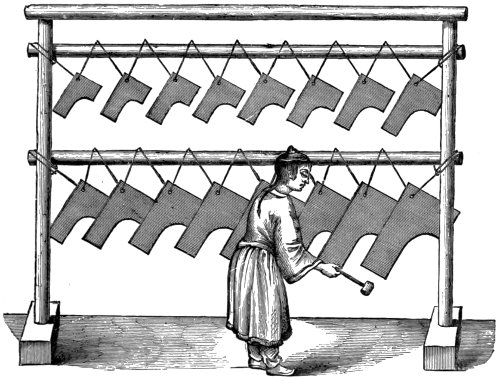
According to their records, the Chinese possessed their much-esteemed
king 2200 years before our Christian era, and employed
it for accompanying songs of praise. It was regarded as a sacred
instrument. During religious observances at the solemn moment
when the king was sounded sticks of incense were burnt. It
was likewise played before the emperor early in the morning
when he awoke. The Chinese have long since constructed
various kinds of the king, one of which is here engraved, by
using different species of stones. Their most famous stone
selected for this purpose is called yu. It is not only very
sonorous but also beautiful in appearance. The yu is found
in mountain streams and crevices of rocks. The largest specimens
found measure from two to three feet in diameter, but of
this size examples rarely occur. The yu is very hard and heavy.
Some European mineralogists, to whom the missionaries transmitted
specimens for examination, pronounce it to be a species
of agate. It is found of different colours, and the Chinese
appear to have preferred in different centuries particular colours
for the king.
The Chinese consider the yu especially valuable for musical
purposes, because it always retains exactly the same pitch. All
other musical instruments, they say, are in this respect doubtful;
but the tone of the yu is neither influenced by cold nor heat, nor
by humidity, nor dryness.
The stones used for the king have been cut from time to time
in various grotesque shapes. Some represent animals: as, for
instance, a bat with outstretched wings; or two fishes placed
side by side: others are in the shape of an ancient Chinese bell.
The angular shape shown in the engraving appears to be the
oldest and is still retained in the ornamented stones of the pien-king,
which is a more modern instrument than the king. The
tones of the pien-king are attuned according to the Chinese
intervals called lu, of which there are twelve in the compass
of an octave. The same is the case with the other Chinese
instruments of this class. They vary, however, in pitch. The
pitch of the soung-king, for instance, is four intervals lower than
that of the pien-king.
Sonorous stones have always been used by the Chinese also
singly, as rhythmical instruments. Such a single stone is called
tse-king. Probably certain curious relics belonging to a temple in
Peking, erected for the worship of Confucius, serve a similar purpose.
In one of the outbuildings or the temple are ten sonorous
stones, shaped like drums, which are asserted to have been cut
about three thousand years ago. The primitive Chinese characters
engraven upon them are nearly obliterated.
The ancient Chinese had several kinds of bells, frequently
arranged in sets so as to constitute a musical scale. The Chinese
name for the bell is tchung. At an early period they had a somewhat
square-shaped bell called té-tchung. Like other ancient
Chinese bells it was made of copper alloyed with tin, the
proportion being one pound of tin to six of copper. The té-tchung,
which is also known by the name of piao, was principally
used to indicate the time and divisions in musical performances.
It had a fixed pitch of sound, and several of these bells
attuned to a certain order of intervals were not unfrequently
ranged in a regular succession, thus forming a musical instrument
which was called pien-tchung. The musical scale of the sixteen
bells which the pien-tchung contained was the same as that of the
king before mentioned.
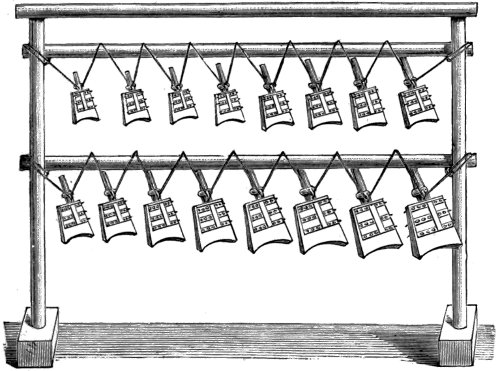
The hiuen-tchung was, according to popular tradition, included
with the antique instruments at the time of Confucius, and came
into popular use during the Han dynasty (from B.C. 200 until
A.D. 200). It was of a peculiar oval shape and had nearly the
same quaint ornamentation as the té-tchung; this consisted of
symbolical figures, in four divisions, each containing nine mammals.
The mouth was crescent-shaped. Every figure had a deep
meaning referring to the seasons and
to the mysteries of the Buddhist
religion. The largest hiuen-tchung
was about twenty inches in length;
and, like the té-tchung, was sounded
by means of a small wooden mallet
with an oval knob. None of the bells
of this description had a clapper. It
would, however, appear that the
Chinese had at an early period some
kind of bell provided with a wooden
tongue: this was used for military
purposes as well as for calling the
people together when an imperial
messenger promulgated his sovereign’s commands. An expression
of Confucius is recorded to the effect that he wished to be “A
wooden-tongued bell of Heaven,” i.e. a herald of heaven to proclaim
the divine purposes to the multitude.

The fang-hiang was a kind of wood-harmonicon. It contained
sixteen wooden slabs of an oblong square shape, suspended in a
wooden frame elegantly decorated. The slabs were arranged in
two tiers, one above the other, and were all of equal length and
breadth but differed in thickness. The tchoung-tou consisted of
twelve slips of bamboo, and was used for beating time and for
rhythmical purposes. The slips being banded together at one
end could be expanded somewhat like a fan. The Chinese state
that they used the tchoung-tou for writing upon before they
invented paper.
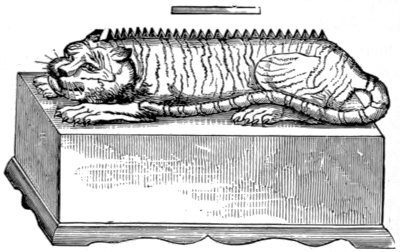
The ou, of which we give a woodcut, likewise an ancient Chinese
instrument of percussion and still in use, is made of wood in
the shape of a crouching tiger. It is hollow, and along its back
are about twenty small pieces of metal, pointed, and in appearance
not unlike the teeth of a saw. The performer strikes them
with a sort of plectrum resembling a brush, or with a small stick
called tchen.
Occasionally
the ou is made
with pieces of
metal shaped
like reeds.
The ancient
ou was constructed
with
only six tones
which were attuned
thus—f,
g, a, c, d, f. The instrument appears to have become deteriorated
in the course of time; for, although it has gradually
acquired as many as twenty-seven pieces of metal, it evidently
serves at the present day more for the production of rhythmical
noise than for the execution of any melody. The modern ou
is made of a species of wood called kieou or tsieou: and the
tiger rests generally on a hollow wooden pedestal about three
feet six inches long, which serves as a sound-board.
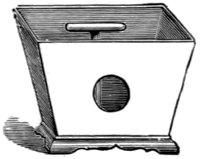
The tchou, likewise an instrument of percussion, was made of
the wood of a tree called kieou-mou, the stem of which resembles
that of the pine and whose foliage is
much like that of the cypress. It was
constructed of boards about three-quarters
of an inch in thickness. In the
middle of one of the sides was an aperture
into which the hand was passed for
the purpose of holding the handle of a
wooden hammer, the end of which
entered into a hole situated in the bottom of the tchou. The
handle was kept in its place by means of a wooden pin, on which
it moved right and left when the instrument was struck with a
hammer. The Chinese ascribe to the tchou a very high antiquity,
as they almost invariably do with any of their inventions when
the date of its origin is unknown to them.
The po-fou was a drum, about one foot four inches in length,
and seven inches in diameter. It had a parchment at each end,
which was prepared in a peculiar way by being boiled in water.
The po-fou used to be partly filled with a preparation made from
the husk of rice, in order to mellow the sound. The Chinese
name for the drum is kou.
The kin-kou (engraved), a large drum fixed on a pedestal which
raises it above six feet from the ground, is embellished with symbolical
designs. A similar drum on which natural phenomena
are depicted is called lei-kou; and another of the kind, with
figures of certain birds and beasts which are regarded as symbols
of long life, is called ling-kou, and also lou-kou.
The flutes, ty, yo, and tché were generally made of bamboo.
The koan-tsee was a Pandean pipe containing twelve tubes of
bamboo. The siao, likewise a Pandean pipe, contained sixteen
tubes. The pai-siao differed from the siao inasmuch as the tubes
were inserted into an oddly-shaped case highly ornamented with
grotesque designs and silken appendages.
The Chinese are known to have constructed at an early period
a curious wind-instrument, called hiuen. It was made of baked
clay and had five finger-holes, three of which were placed on one
side and two on the opposite side, as in the cut. Its tones were
in conformity with the pentatonic scale. The reader unacquainted
with the pentatonic scale
may ascertain its character
by playing on the pianoforte
the scale of C major
with the omission of f and
b (the fourth and seventh);
or by striking the black
keys in regular succession
from f-sharp to the next
f-sharp above or below.
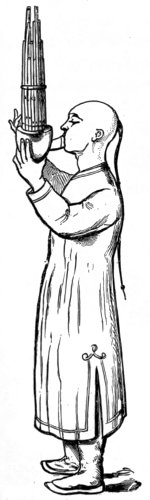
Another curious wind-instrument of high antiquity, the cheng,
(engraved, p. 46) is still in use. Formerly it had either 13, 19, or
24 tubes, placed in a calabash; and a long curved tube served as
a mouth-piece. In olden time it was called yu.
The ancient stringed instruments, the kin and chê, were of the
dulcimer kind: they are still in use, and specimens of them are in
the South Kensington museum.
The Buddhists introduced from Thibet into China their god
of music, who is represented as a rather jovial-looking man with
a moustache and an imperial, playing the pepa, a kind of lute
with four silken strings. Perhaps some interesting information
respecting the ancient Chinese musical
instruments may be gathered from the
famous ruins of the Buddhist temples
Ongcor-Wat and Ongcor-Thôm, in Cambodia.
These splendid ruins are supposed
to be above two thousand years old: and,
at any rate, the circumstance of their age
not being known to the Cambodians suggests
a high antiquity. On the bas-reliefs
with which the temples were enriched
are figured musical instruments, which
European travellers describe as “flutes,
organs, trumpets, and drums, resembling
those of the Chinese.” Faithful sketches
of these representations might, very likely,
afford valuable hints to the student of
musical history.
In the Brahmin mythology of the
Hindus the god Nareda is the inventor
of the vina, the principal national instrument
of Hindustan. Saraswati, the
consort of Brahma, may be regarded as
the Minerva of the Hindus. She is the
goddess of music as well as of speech; to her is attributed the
invention of the systematic arrangement of the sounds into a
musical scale. She is represented seated on a peacock and playing
on a stringed instrument of the lute kind. Brahma himself we
find depicted as a vigorous man with four handsome heads,
beating with his hands upon a small drum; and Vishnu, in his
incarnation as Krishna, is represented as a beautiful youth playing
upon a flute. The Hindus construct a peculiar kind of flute,
which they consider as the favourite instrument of Krishna.
They have also the divinity Ganesa, the god of Wisdom, who is
represented as a man with the head of an elephant, holding
a tamboura in his hands.
It is a suggestive fact that we find among several nations in
different parts of the world an ancient tradition, according to
which their most popular stringed instrument was originally
derived from the water.
In Hindu mythology the god Nareda invented the vina—the
principal national instrument of Hindustan—which has also the
name cach’-hapi, signifying a tortoise (testudo). Moreover, nara
denotes in Sanskrit water, and narada, or nareda, the giver of
water. Like Nareda, Nereus and his fifty daughters, the Nereides,
were much renowned for their musical accomplishments; and
Hermes (it will be remembered) made his lyre, the chelys, of
a tortoise-shell. The Scandinavian god Odin, the originator of
magic songs, is mentioned as the ruler of the sea, and as such
he had the name of Nikarr. In the depth of the sea he played
the harp with his subordinate spirits, who occasionally came up
to the surface of the water to teach some favoured human being
their wonderful instrument. Wäinämöinen, the divine player on
the Finnish kantele (according to the Kalewala, the old national
epic of the Finns) constructed his instrument of fish-bones. The
frame he made out of the bones of the pike; and the teeth of
the pike he used for the tuning-pegs.
Jacob Grimm in his work on German mythology points out
an old tradition, preserved in Swedish and Scotch national
ballads, of a skilful harper who constructs his instrument out of
the bones of a young girl drowned by a wicked woman. Her
fingers he uses for the tuning screws, and her golden hair for the
strings. The harper plays, and his music kills the murderess. A
similar story is told in the old Icelandic national songs; and the
same tradition has been preserved in the Faroe islands, as well as
in Norway and Denmark.
May not the agreeable impression produced by the rhythmical
flow of the waves and the soothing murmur of running water
have led various nations, independently of each other, to the
widespread conception that they obtained their favourite instrument
of music from the water? Or is the notion traceable to a
common source dating from a pre-historic age, perhaps from the
early period when the Aryan race is surmised to have diffused its
lore through various countries? Or did it originate in the old
belief that the world, with all its charms and delights, arose from
a chaos in which water constituted the predominant element?
Howbeit, Nareda, the giver of water, was evidently also the
ruler of the clouds; and Odin had his throne in the skies.
Indeed, many of the musical water-spirits appear to have been
originally considered as rain deities. Their music may therefore
be regarded as derived from the clouds rather than from the sea.
In short, the traditions respecting spirits and water are not in
contradiction to the opinion of the ancient Hindus that music is
of heavenly origin, but rather tend to support it.
The earliest musical instruments of the Hindus on record have,
almost all of them, remained in popular use until the present day
scarcely altered. Besides these, the Hindus possess several
Arabic and Persian instruments which are of comparatively
modern date in Hindustan: evidently having been introduced
into that country scarcely a thousand years ago, at the time of
the Mahomedan irruption. There is a treatise on music extant,
written in Sanskrit, which contains a description of the ancient
instruments. Its title is Sângita râthnakara. If, as may be
hoped, it be translated by a Sanskrit scholar who is at the same
time a good musician, we shall probably be enabled to ascertain
more exactly which of the Hindu instruments of the present day
are of comparatively modern origin.
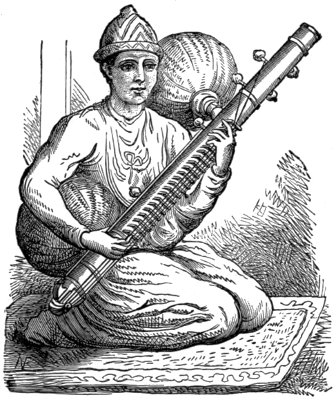
The vina is undoubtedly of high antiquity. It has seven wire
strings, and movable frets which are generally fastened with wax.
Two hollowed gourds, often tastefully ornamented, are affixed to
it for the purpose of increasing the sonorousness. There are
several kinds of the vina in different districts; but that represented
in the illustration is
regarded as the oldest.
The performer
shown is Jeewan Shah,
a celebrated virtuoso
on the vina, who lived
about a hundred years
ago. The Hindus divided
their musical
scale into several intervals
smaller than
our modern semitones.
They adopted
twenty-two intervals
called sruti in the
compass of an octave,
which may therefore
be compared to our chromatic intervals. As the frets of the vina
are movable the performer can easily regulate them according to
the scale, or mode, which he requires for his music.
The harp, chang, has become almost obsolete. If some Hindu
drawings of it can be relied upon, it had at an early time a
triangular frame and was in construction as well as in shape and
size almost identical with the Assyrian harp.
The Hindus claim to have invented the violin bow. They
maintain that the ravanastron, one of their old instruments
played with the bow, was invented about five thousand years ago
by Ravanon, a mighty king of Ceylon. However this may be
there is a great probability that the fiddle-bow originated in Hindustan;
because Sanskrit scholars inform us that there are names
for it in works which cannot be less than from 1500 to 2000 years
old. The non-occurrence of any instrument played with a bow
on the monuments of the nations of antiquity is by no means so
sure a proof as has generally been supposed, that the bow was
unknown. The fiddle in its primitive condition must have been
a poor contrivance. It probably was despised by players who
could produce better tones with greater facility by twanging the
strings with their fingers, or with a plectrum. Thus it may have
remained through many centuries without experiencing any
material improvement. It must also be borne in mind that the
monuments transmitted to us chiefly represent historical events,
religious ceremonies, and royal entertainments. On such occasions
instruments of a certain kind only were used, and these we
find represented; while others, which may have been even more
common, never occur. In two thousand years’ time people will
possibly maintain that some highly perfected instrument popular
with them was entirely unknown to us, because it is at present in
so primitive a condition that no one hardly notices it. If the
ravanastron was an importation of the Mahomedans it would
most likely bear some resemblance to the Arabian and Persian
instruments, and it would be found rather in the hands of the
higher classes in the towns; whereas it is principally met with
among the lower order of people, in isolated and mountainous
districts. It is further remarkable that the most simple kind
of ravanastron is almost identical with the Chinese fiddle called
ur-heen. This species has only two strings, and its body consists of
a small block of wood, hollowed out and covered with the skin
of a serpent. The ur-heen has not been mentioned among the most
ancient instruments of the Chinese, since there is no evidence of
its having been known in China before the introduction of the
Buddhist religion into that country. From indications, which to
point out would lead too far here, it would appear that several
instruments found in China originated in Hindustan. They seem
to have been gradually diffused from Hindustan and Thibet, more
or less altered in the course of time, through the east as far as Japan.
Another curious Hindu instrument, probably of very high antiquity,
is the poongi, also called toumrie and magoudi. It consists
of a gourd or of the Cuddos nut, hollowed, into which two pipes
are inserted. The poongi therefore somewhat resembles in appearance
a bagpipe. It is generally used by the Sampuris or snake
charmers, who play upon it when they exhibit the antics of the
cobra. The name magoudi, given in certain districts to this instrument,
rather tends to corroborate the opinion of some musical
historians that the magadis of the ancient Greeks was a sort of
double-pipe, or bagpipe.
Many instruments of Hindustan are known by different names
in different districts; and, besides, there are varieties of them.
On the whole, the Hindus possess about fifty instruments. To
describe them properly would fill a volume. Some, which are in
the Kensington museum, will be found noticed in the large catalogue
of that collection.
Of the musical instruments of the ancient Persians, before the
Christian era, scarcely anything is known. It may be surmised
that they closely resembled those of the Assyrians, and probably
also those of the Hebrews.
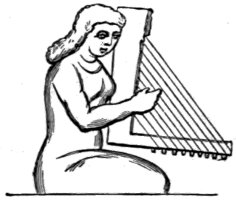
The harp, chang, in olden time a favourite instrument of the
Persians, has gradually fallen into desuetude. The illustration of
a small harp given in the woodcut
has been sketched from the celebrated
sculptures, perhaps of the sixth
century, which exist on a stupendous
rock, called Tackt-i-Bostan, in the
vicinity of the town of Kermanshah.
These sculptures are said to have
been executed during the lifetime of
the Persian monarch Khosroo Purviz.
They form the ornaments of two lofty arches, and consist of
representations of field sports and aquatic amusements. In one
of the boats is seated a man in an ornamental dress, with a halo
round his head, who is receiving an arrow from one of his
attendants; while a female, who is sitting near him, plays on a
Trigonon. Towards the top of the bas-relief is represented a
stage, on which are performers on small straight trumpets and
little hand drums; six harpers; and four other musicians, apparently
females,—the first of whom plays a flute; the second, a
sort of pandean pipe; the third, an instrument which is too much
defaced to be recognizable; and the fourth, a bagpipe. Two
harps of a peculiar shape were copied by Sir
Gore Ousely from Persian manuscripts about four
hundred years old resembling, in the principle on
which they are constructed, all other oriental
harps. There existed evidently various kinds of
the chang. It may be remarked here that the
instrument tschenk (or chang) in use at the present
day in Persia, is more like a dulcimer than a
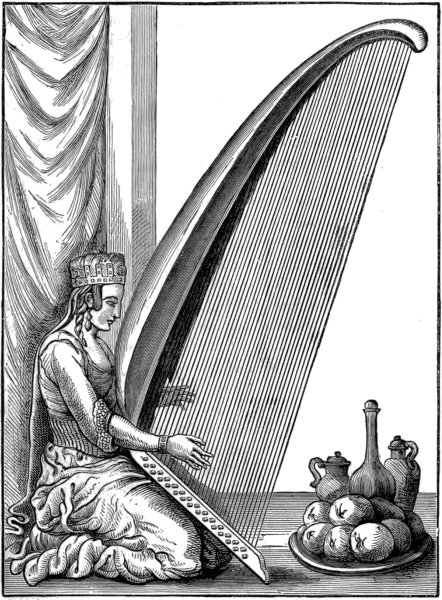
harp. The Arabs adopted the harp from the Persians,
and called it junk. An interesting representation
of a Turkish woman playing the harp
(p. 53) sketched from life by Melchior Lorich in the
seventeenth century, probably exhibits an old Persian chang; for
the Turks derived their music principally from Persia. Here we
have an introduction into Europe of the oriental frame without a
front pillar.
The Persians appear to have adopted, at an early period,
smaller musical intervals than semitones. When the Arabs conquered
Persia (A.D. 641) the Persians had already attained a
higher degree of civilisation than their conquerors. The latter
found in Persia the cultivation of music considerably in advance
of their own, and the musical instruments superior also. They
soon adopted the Persian instruments, and there can be no doubt
that the musical system exhibited by the earliest Arab writers
whose works on the theory of music have been preserved was
based upon an older system of the Persians. In these works the
octave is divided in seventeen one-third-tones—intervals which are
still made use of in the east. Some of the Arabian instruments
are constructed so as to enable the performer to produce
the intervals with exactness. The frets on the lute and
tamboura, for instance, are regulated with a view to this
object.
The Arabs had to some extent become acquainted with many
of the Persian instruments before the time of their conquest of
Persia. An Arab musician of the name of Nadr Ben el-Hares
Ben Kelde is recorded as having been sent to the Persian king
Khosroo Purviz, in the sixth century, for the purpose of learning
Persian singing and performing on the lute. Through him, it is
said, the lute was brought to Mekka. Saib Chatir, the son of
a Persian, is spoken of as the first performer on the lute in
Medina, A.D. 682; and of an Arab lutist, Ebn Soreidsch from
Mekka, A.D. 683, it is especially mentioned that he played in the
Persian style; evidently the superior one. The lute, el-oud, had
before the tenth century only four strings, or four pairs producing
four tones, each tone having two strings tuned in unison. About
the tenth century a string for a fifth tone was added. The strings
were made of silk neatly twisted. The neck of the instrument
was provided with frets of string, which were carefully regulated
according to the system of seventeen intervals in the compass of
an octave before mentioned. Other favourite stringed instruments
were the tamboura, a kind of lute with a long neck, and the
kanoon, a kind of dulcimer strung with lamb’s gut strings (generally
three in unison for each tone) and played upon with two
little plectra which the performer had fastened to his fingers. The
kanoon is likewise still in use in countries inhabited by Mahomedans.
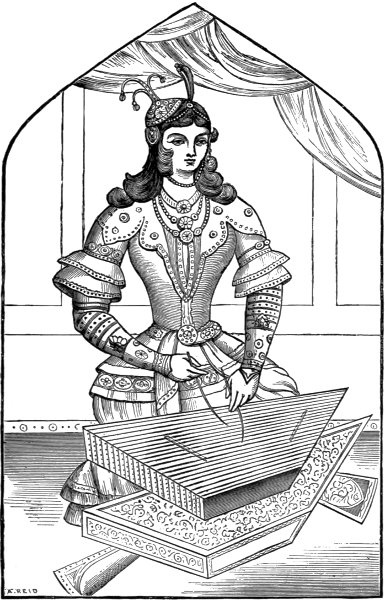
The engraving, taken from a Persian painting at
Teheran, represents an old Persian santir, the prototype of our
dulcimer, mounted with wire strings and played upon with two
slightly curved sticks.
Al-Farabi, one of the earliest Arabian musical theorists known,
who lived in the beginning of the tenth century, does not allude
to the fiddle-bow. This is noteworthy inasmuch as it seems in
some measure to support the opinion maintained by some historians
that the bow originated in England or Wales. Unfortunately
we possess no exact descriptions of the Persian and
Arabian instruments between the tenth and fourteenth centuries,
otherwise we should probably have earlier accounts of
some instrument of the violin kind in Persia. Ash-shakandi,
who lived in Spain about A.D. 1200, mentions the rebab, which
may have been in use for centuries without having been thought
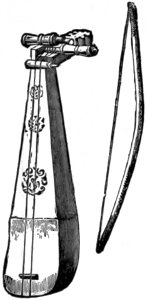
worthy of notice on account of its rudeness. Persian writers of
the fourteenth century speak of two instruments of the violin
class, viz., the rebab and the kemangeh. As
regards the kemangeh, the Arabs themselves
assert that they obtained it from Persia, and
their statement appears all the more worthy
of belief from the fact that both names,
rebab and kemangeh, are originally Persian.
We engrave the rebab from an example at
South Kensington.
The nay, a flute, and the surnay, a
species of oboe, are still popular in the east.
The Arabs must have been indefatigable
constructors of musical instruments. Kiesewetter
gives a list of above two hundred
names of Arabian instruments, and this does
not include many known to us through
Spanish historians. A careful investigation of the musical
instruments of the Arabs during their sojourn in Spain is
particularly interesting to the student of mediæval music, inasmuch
as it reveals the eastern origin of many instruments which
are generally regarded as European inventions. Introduced into
Spain by the Saracens and the Moors they were gradually diffused
towards northern Europe. The English, for instance, adopted
not only the Moorish dance (morrice dance) but also the kuitra
(gittern), the el-oud (lute), the rebab (rebec), the nakkarah (naker),
and several others. In an old Cornish sacred drama, supposed
to date from the fourteenth century, we have in an enumeration
of musical instruments the nakrys, designating “kettle-drums.” It
must be remembered that the Cornish language, which has now
become obsolete, was nearly akin to the Welsh. Indeed, names
of musical instruments derived from the Moors in Spain occur in
almost every European language.
Not a few fanciful stories are traditionally preserved among
the Arabs testifying to the wonderful effects they ascribed to the
power of their instrumental performances. One example will
suffice. Al-Farabi had acquired his proficiency in Spain, in one
of the schools at Cordova which flourished as early as towards
the end of the ninth century: and his reputation became so great
that ultimately it extended to Asia. The mighty caliph of Bagdad
himself desired to hear the celebrated musician, and sent messengers
to Spain with instructions to offer rich presents to him and
to convey him to the court. But Al-Farabi feared that if he went
he should be retained in Asia, and should never again see the
home to which he felt deeply attached. At last he resolved
to disguise himself, and ventured to undertake the journey which
promised him a rich harvest. Dressed in a mean costume, he
made his appearance at the court just at the time when the caliph
was being entertained with his daily concert. Al-Farabi, unknown
to everyone, was permitted to exhibit his skill on the lute.
Scarcer had he commenced his performance in a certain musical
mode when he set all his audience laughing aloud, notwithstanding
the efforts of the courtiers to suppress so unbecoming an
exhibition of mirth in the royal presence. In truth, even the
caliph himself was compelled to burst out into a fit of laughter.
Presently the performer changed to another mode, and the effect
was that immediately all his hearers began to sigh, and soon tears
of sadness replaced the previous tears of mirth. Again he played
in another mode, which excited his audience to such a rage that
they would have fought each other if he, seeing the danger, had
not directly gone over to an appeasing mode. After this wonderful
exhibition of his skill Al-Farabi concluded in a mode which
had the effect of making his listeners fall into a profound sleep,
during which he took his departure.
It will be seen that this incident is almost identical with one
recorded as having happened about twelve hundred years earlier
at the court of Alexander the great, and which forms the subject of
Dryden’s “Alexander’s Feast.” The distinguished flutist Timotheus
successively aroused and subdued different passions by
changing the musical modes during his performance, exactly in
the same way as did Al-Farabi.
If the preserved antiquities of the American Indians, dating from
a period anterior to our discovery of the western hemisphere,
possess an extraordinary interest because they afford trustworthy
evidence of the degree of progress which the aborigines had
attained in the cultivation of the arts and in their social condition
before they came in contact with Europeans, it must be admitted
that the ancient musical instruments of the American Indians are
also worthy of examination. Several of them are constructed in a
manner which, in some degree, reveals the characteristics of the
musical system prevalent among the people who used the instruments.
And although most of these interesting relics, which have
been obtained from tombs and other hiding-places, may not be of
great antiquity, it has been satisfactorily ascertained that they are
genuine contrivances of the Indians before they were influenced
by European civilization.
Some account of these relics is therefore likely to prove of
interest also to the ethnologist, especially as several facts may
perhaps be found of assistance in elucidating the still unsolved
problem as to the probable original connection of the American
with Asiatic races.
Among the instruments of the Aztecs in Mexico and of the
Peruvians none have been found so frequently, and have been
preserved in their former condition so unaltered, as pipes and
flutes. They are generally made of pottery or of bone, substances
which are unsuitable for the construction of most other instruments,
but which are remarkably well qualified to withstand the
decaying influence of time. There is, therefore, no reason to
conclude from the frequent occurrence of such instruments that
they were more common than other kinds of which specimens
have rarely been discovered.
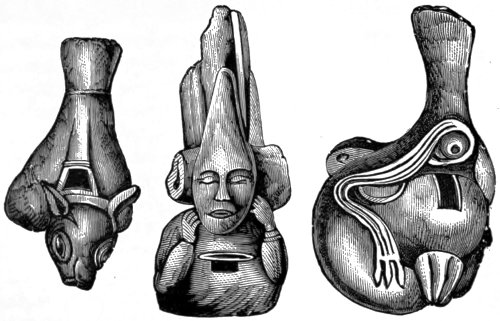
The Mexicans possessed a small whistle formed of baked clay,
a considerable number of which have been found. Some specimens
(of which we give engravings) are singularly grotesque in
shape, representing caricatures of the human face and figure,
birds, beasts, and flowers. Some were provided at the top with a
finger-hole which, when closed, altered the pitch of the sound, so
that two different tones were producible on the instrument.
Others had a little ball of baked clay lying loose inside the air-chamber.
When the instrument was blown the current of air set
the ball in a vibrating motion, thereby causing a shrill and whirring
sound. A similar contrivance is sometimes made use of by
Englishmen for conveying signals. The Mexican whistle most
likely served principally the same purpose, but it may possibly
have been used also in musical entertainments. In the Russian
horn band each musician is restricted to a single tone; and
similar combinations of performers—only, of course, much more
rude—have been witnessed by travellers among some tribes in
Africa and America.
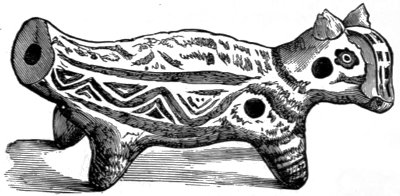
Rather more complete than the above specimens are some of
the whistles and small pipes which have been found in graves of
the Indians
of Chiriqui
in central
America.
The pipe or
whistle which
is represented
in the accompanying
engraving appears,
to judge from the somewhat obscure description transmitted
to us, to possess about half a dozen tones. It is of pottery, painted
in red and black on a cream-coloured ground, and in length about
five inches. Among the instruments of this kind from central
America the most complete have four finger-holes. By means
of three the following four sounds (including the sound which
is produced when none of the holes are closed) can be
emitted: 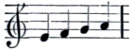 the fourth finger-hole, when
closed, has the effect of lowering the pitch a semitone. By a
particular process two or three lower notes are obtainable.
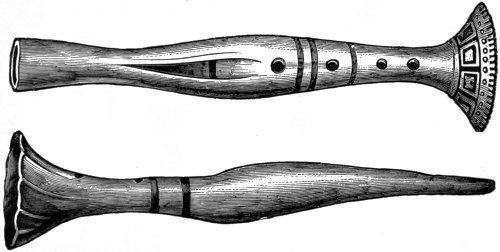

The pipe of the Aztecs, which is called by the Mexican
Spaniards pito, somewhat resembled our flageolet: the material
was a reddish pottery, and it was provided with four finger-holes.
Although among about half a dozen specimens which
the writer has examined some are considerably larger than
others they all have, singularly enough, the same pitch of
sound. The smallest is about six inches in length, and the
largest about nine inches. Several pitos have been found in a
remarkably well-preserved condition. They are easy to blow,
and their order of intervals is in conformity with the pentatonic
scale, thus: 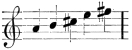 The usual shape of
the pito is that here represented; showing the upper side of one
pipe, and a side view of another. A specimen of a less common
shape, also engraved, is in the British museum. Indications
suggestive of the popular estimation in which the flute (or
perhaps, more strictly speaking, the pipe) was held by the Aztecs
are not wanting. It was played in religious observances and
we find it referred to allegorically in orations delivered on solemn
occasions. For instance, at the religious festival which was held
in honour of Tezcatlepoca—a divinity depicted as a handsome
youth, and considered second only to the supreme being—a
young man was sacrificed who, in preparation for the ceremony,
had been instructed in the art of playing the flute. Twenty days
before his death four young girls, named after the principal
goddesses, were given to him as companions; and when the
hour arrived in which he was to be sacrificed he observed the
established symbolical rite of breaking a flute on each of the
steps, as he ascended the temple.
Again, at the public ceremonies which took place on the
accession of a prince to the throne the new monarch addressed a
prayer to the god, in which occurred the following allegorical
expression:—“I am thy flute; reveal to me thy will; breathe into
me thy breath like into a flute, as thou hast done to my predecessors
on the throne. As thou hast opened their eyes, their ears,
and their mouth to utter what is good, so likewise do to me. I
resign myself entirely to thy guidance.” Similar sentences occur
in the orations addressed to the monarch. In reading them one
can hardly fail to be reminded of Hamlet’s reflections addressed
to Guildenstern, when the servile courtier expresses his inability
to “govern the ventages” of the pipe and to make the instrument
“discourse most eloquent music,” which the prince bids him
to do.
M. de Castelnau in his “Expédition dans l’Amérique” gives
among the illustrations of objects discovered in ancient Peruvian
tombs a flute made of a human bone. It has four finger-holes at
its upper surface and appears to have been blown into at one
end. Two bone-flutes, in appearance similar to the engraving
given by M. de Castelnau, which have been disinterred at Truxillo
are deposited in the British museum. They are about six inches
in length, and each is provided with five finger-holes. One of
these has all the holes at its upper side, and one of the holes is
considerably smaller than the rest. The specimen which we
engrave (p. 64) is ornamented with some simple designs in black.
The other has four holes at its upper side and one underneath,
the latter being placed near to the end at which the instrument
evidently was blown. In the aperture of this end some remains
of a hardened paste, or resinous substance, are still preserved.
This substance probably was inserted for the purpose of narrowing
the end of the tube, in order to facilitate the producing of
the sounds. The same contrivance is still resorted to in the construction
of the bone-flutes by some Indian tribes in Guiana. The
bones of slain enemies appear to have been considered especially
appropriate for such flutes. The Araucanians, having killed a
prisoner, made flutes of his bones, and danced and “thundered
out their dreadful war-songs, accompanied by the mournful sounds
of these horrid instruments.” Alonso de Ovalle says of the
Indians in Chili: “Their flutes, which they play upon in their
dances, are made of the bones of the Spaniards and other
enemies whom they have overcome in war. This they do by
way of triumph and glory for their victory. They make them
likewise of bones of animals; but the warriors dance only to the
flutes made of their enemies.” The Mexicans and Peruvians obviously
possessed a great variety of pipes and flutes, some of which
are still in use among certain Indian tribes. Those which were
found in the famous ruins at Palenque are deposited in the
museum in Mexico. They are:—The cuyvi, a pipe on which
only five tones were producible; the huayllaca, a sort of flageolet;
the pincullu, a flute; and the chayna, which is described as “a
flute whose lugubrious and melancholy tones filled the heart with
indescribable sadness, and brought involuntary tears into the
eyes.” It was perhaps a kind of oboe.

The Peruvians had the syrinx, which they called huayra-puhura.
Some clue to the proper meaning of this name may perhaps be
gathered from the word huayra, which signifies “air.” The
huayra-puhura was made of cane, and also of stone. Sometimes
an embroidery of needle-work was attached to it as an ornament.
One specimen which has been disinterred is adorned with twelve
figures precisely resembling Maltese crosses. The cross is a figure
which may readily be supposed to suggest itself very naturally;
and it is therefore not so surprising, as it may appear at a first
glance, that the American Indians used it not unfrequently in
designs and sculptures before they came in contact with
Christians.
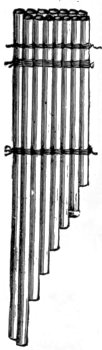
The British museum possesses a huayra-puhura consisting of
fourteen reed pipes of a brownish colour, tied
together in two rows by means of thread, so as
to form a double set of seven reeds. Both sets
are almost exactly of the same dimensions and
are placed side by side. The shortest of these
reeds measure three inches, and the longest six
and a half. In one set they are open at the
bottom, and in the other they are closed. Consequently,
octaves are produced. The reader is
probably aware that the closing of a pipe at the
end raises its pitch an octave. Thus, in our organ,
the so-called stopped diapason, a set of closed
pipes, requires tubes of only half the length of
those which constitute the open diapason, although
both these stops produce tones in the same
pitch; the only difference between them being
the quality of sound, which in the former is less bright than in
the latter.
The tones yielded by the huayra-puhura in question are as
follows: 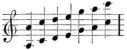 The highest octave is
indistinct, owing to some injury done to the shortest tubes; but
sufficient evidence remains to show that the intervals were purposely
arranged according to the pentatonic scale. This interesting
relic was brought to light from a tomb at Arica.
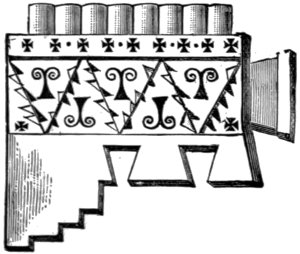
Another huayra-puhura, likewise still yielding sounds, was
discovered placed over a corpse in a Peruvian tomb, and was
procured by the French general, Paroissien. This instrument is
made of a greenish stone which is a species of talc, and contains
eight pipes. In the Berlin
museum may be seen a
good plaster cast taken
from this curious relic. The
height is 5⅜ inches, and
its width 6¼ inches. Four
of the tubes have small
lateral finger-holes which,
when closed, lower the
pitch a semitone. These
holes are on the second,
fourth, sixth, and seventh
pipe, as shown in the engraving. When the holes are open, the
tones are:  and when they are closed:
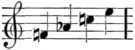 The other tubes have unalterable tones.
The following notation exhibits all the tones producible on the
instrument:
The musician is likely to speculate what could have induced the
Peruvians to adopt so strange a series of intervals: it seems
rather arbitrary than premeditated.
If (and this seems not to be improbable) the Peruvians considered
those tones which are produced by closing the lateral
holes as additional intervals only, a variety of
scales or kinds of modes may have been contrived
by the admission of one or other of
these tones among the essential ones. If we
may conjecture from some remarks of Garcilasso
de la Vega, and other historians, the
Peruvians appear to have used different
orders of intervals for different kinds of tunes,
in a way similar to what we find to be the
case with certain Asiatic nations. We are
told for instance “Each poem, or song, had
its appropriate tune, and they could not put
two different songs to one tune; and this
was why the enamoured gallant, making
music at night on his flute, with the tune
which belonged to it, told the lady and all
the world the joy or sorrow of his soul, the
favour or ill-will which he possessed; so that
it might be said that he spoke by the flute.”
Thus also the Hindus have certain tunes for
certain seasons and fixed occasions, and likewise
a number of different modes or scales
used for particular kinds of songs.
Trumpets are often mentioned by writers
who have recorded the manners and customs
of the Indians at the time of the discovery
of America. There are, however, scarcely
any illustrations to be relied on of these instruments transmitted
to us. The Conch was frequently used as a trumpet for conveying
signals in war.
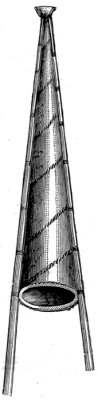
The engraving represents a kind of trumpet made of wood, and
nearly seven feet in length, which Gumilla found among the
Indians in the vicinity of the Orinoco. It somewhat resembles
the juruparis, a mysterious instrument of the Indians on the Rio
Haupés, a tributary of the Rio Negro, south America. The
juruparis is regarded as an object of great veneration. Women
are never permitted to see it. So stringent is this law that any
woman obtaining a sight of it is put to death—usually by poison.
No youths are allowed to see it until they have been subjected to
a series of initiatory fastings and scourgings. The juruparis is
usually kept hidden in the bed of some stream, deep in the forest;
and no one dares to drink out of that sanctified stream, or to
bathe in its water. At feasts the juruparis is brought out during
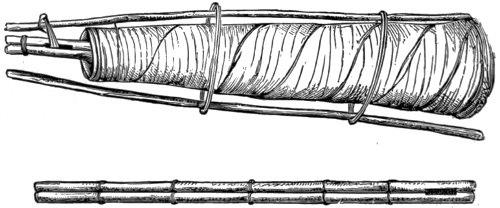
the night, and is blown outside the houses of entertainment. The
inner portion of the instrument consists of a tube made of slips of
the Paxiaba palm (Triartea exorrhiza). When the Indians are
about to use the instrument they nearly close the upper end of
the tube with clay, and also tie above the oblong square hole
(shown in the engraving) a portion of the leaf of the Uaruma, one of
the arrow-root family. Round the tube are wrapped long strips
of the tough bark of the Jébaru (Parivoa grandiflora). This
covering descends in folds below the tube. The length of
the instrument is from four to five feet. The illustration, which
exhibits the juruparis with its cover and without it, has been
taken from a specimen in the museum at Kew gardens. The
mysteries connected with this trumpet are evidently founded
on an old tradition from prehistoric Indian ancestors. Jurupari
means “demon”; and with several Indian tribes on the Amazon
customs and ceremonies still prevail in honour of Jurupari.
The Caroados, an Indian tribe in Brazil, have a war trumpet
which closely resembles the juruparis. With this people it is the
custom for the chief to give on his war trumpet the signal for
battle, and to continue blowing as long as he wishes the battle to
last. The trumpet is made of wood, and its sound is described
by travellers as very deep but rather pleasant. The sound is
easily produced, and its continuance does not require much
exertion; but a peculiar vibration of the lips is necessary which
requires practice. Another trumpet, the turé, is common with
many Indian tribes on the Amazon who use it chiefly in war.
It is made of a long and thick bamboo, and there is a split reed
in the mouthpiece. It therefore partakes rather of the character
of an oboe or clarinet. Its tone is described as loud and harsh.
The turé is especially used by the sentinels of predatory hordes, who,
mounted on a lofty tree, give the signal of attack to their comrades.
Again, the aborigines in Mexico had a curious contrivance of
this kind, the acocotl, now more usually called clarin. The
former word is its old Indian name, and the latter appears to
have been first given to the instrument by the Spaniards. The
acocotl consists of a very thin tube from eight to ten feet in
length, and generally not quite straight but with some irregular
curves. This tube, which is often not thicker than a couple of
inches in diameter, terminates at one end in a sort of bell, and
has at the other end a small mouthpiece resembling in shape that
of a clarinet. The tube is made of the dry stalk of a plant which
is common in Mexico, and which likewise the Indians call acocotl.
The most singular characteristic of the instrument is that the performer
does not blow into it, but inhales the air through it; or
rather, he produces the sound by sucking the mouthpiece. It is
said to require strong lungs to perform on the acocotl effectively
according to Indian notions of taste.
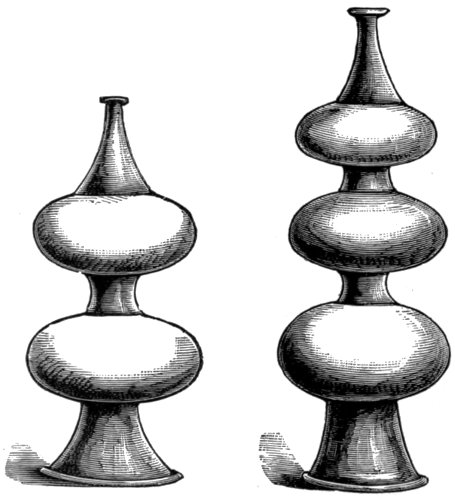
The botuto, which Gumilla saw used by some tribes near the
river Orinoco (of which we engrave two examples), was evidently
an ancient Indian contrivance, but appears to have fallen almost
into oblivion during the last two centuries. It was made of baked
clay and was commonly from three to four feet long: but some
trumpets of this kind were of enormous size. The botuto with
two bellies was usually made thicker than that with three bellies
and emitted a deeper sound, which is described as having been
really terrific. These trumpets were used on occasions of mourning
and funeral dances. Alexander von Humboldt saw the botuto
among some Indian tribes near the river Orinoco.
Besides those which have been noticed, other antique wind
instruments of the Indians are mentioned by historians; but
the descriptions given of them are too superficial to convey a
distinct notion as to their form and purport. Several of these
barbarous contrivances scarcely deserve to be classed with musical
instruments. This may, for instance, be said of certain musical
jars or earthen vessels producing sounds, which the Peruvians
constructed for their amusement. These vessels were made
double; and the sounds imitated the cries of animals or birds.
A similar contrivance of the Indians in Chili, preserved in the
museum at Santiago, is described by the traveller S. S. Hill as
follows:—“It consists of two earthen vessels in the form of our
india-rubber bottles, but somewhat larger, with a flat tube from
four to six inches in length, uniting their necks near the top and
slightly curved upwards, and with a small hole on the upper side
one third of the length of the tube from one side of the necks.
To produce the sounds the bottles were filled with water and
suspended to the bough of a tree, or to a beam, by a string
attached to the middle of the curved tube, and then swung
backwards and forwards in such a manner as to cause each end
to be alternately the highest and lowest, so that the water might
pass backwards and forwards from one bottle to the other through
the tube between them. By this means soothing sounds were
produced which, it is said, were employed to lull to repose the
drowsy chiefs who usually slept away the hottest hours of the day.
In the meantime, as the bottles were porous, the water within
them diminished by evaporation, and the sound died gradually
away.”
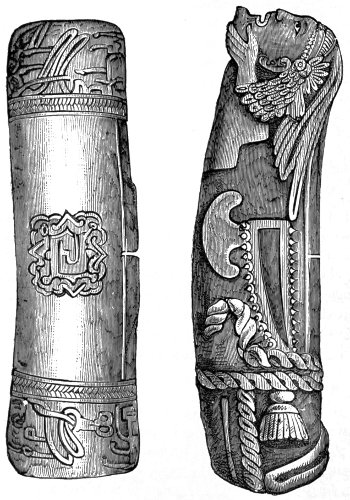
As regards instruments of percussion, a kind of drum deserves
special notice on account of the ingenuity evinced in its construction.
The Mexicans called it teponaztli. They generally made it
of a single block of very hard wood, somewhat oblong square in
shape, which they hollowed, leaving at each end a solid piece
about three or four inches in thickness, and at its upper side a
kind of sound-board about a quarter of an inch in thickness. In
this sound-board, if it may be called so, they made three incisions;
namely, two running parallel some distance lengthwise of the
drum, and a third running across from one of these to the other
just in the centre. By this means they obtained two vibrating
tongues of wood which, when beaten with a stick, produced
sounds as clearly defined as are those of our kettle drums. By
making one of the tongues thinner than the other they ensured
two different sounds, the pitch of which they were enabled to
regulate by shaving off more or less of the wood. The bottom of
the drum they cut almost entirely open. The traveller, M. Nebel,
was told by archæologists in Mexico that these instruments always
contained the interval of a third, but on examining several specimens
which he saw in museums he found some in which the two
sounds stood towards each other in the relation of a fourth; while
in others they constituted a fifth, in others a sixth, and in some
even an octave. This is noteworthy in so far as it points to a
conformity with our diatonic series of intervals, excepting the
seventh.
The teponaztli (engraved above) was generally carved with
various fanciful and ingenious designs. It was beaten with two
drumsticks covered at the end with an elastic gum, called ule,
which was obtained from the milky juice extracted from the ule-tree.
Some of these drums were small enough to be carried on a
string or strap suspended round the neck of the player; others,
again, measured upwards of five feet in length, and their sound
was so powerful that it could be heard at a distance of three
miles. In some rare instances a specimen of the teponaztli is still
preserved by the Indians in Mexico, especially among tribes who
have been comparatively but little affected by intercourse with
their European aggressors. Herr Heller saw such an instrument
in the hands of the Indians of Huatusco—a village near Mirador
in the Tierra templada, or temperate region, occupying the slopes
of the Cordilleras. Its sound is described as so very loud as to
be distinctly audible at an incredibly great distance. This circumstance,
which has been noticed by several travellers, may perhaps
be owing in some measure
to the condition of the atmosphere
in Mexico.
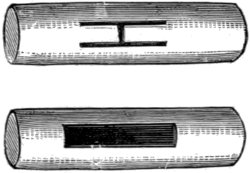
Instruments of percussion constructed
on a principle more or
less similar to the teponaztli were
in use in several other parts of
America, as well as in Mexico.
Oviedo gives a drawing of a drum from San Domingo which, as
it shows distinctly both the upper and under side of the instrument,
is here inserted.
The largest kind of Mexican teponaztli appears to have been
generally of a cylindrical shape. Clavigero gives a drawing of
such an instrument. Drums, also, constructed of skin or parchment
in combination with wood were not unknown to the
Indians. Of this description was, for instance, the huehuetl of the
Aztecs in Mexico, which consisted, according to Clavigero, of a
wooden cylinder somewhat above three feet in height, curiously
carved and painted and covered at the top with carefully prepared
deer-skin. And, what appears the most remarkable, the parchment
(we are told) could be tightened or slackened by means of
cords in nearly the same way as with our own drum. The huehuetl
was not beaten with drumsticks but merely struck with the fingers,
and much dexterity was required to strike it in the proper manner.
Oviedo states that the Indians in Cuba had drums which were
stretched with human skin. And Bernal Diaz relates that when
he was with Cortés in Mexico they ascended together the Teocalli
(“House of God”), a large temple in which human sacrifices were
offered by the aborigines; and there the Spanish visitors saw a
large drum which was made, Diaz tells us, with skins of great
serpents. This “hellish instrument,” as he calls it, produced, when
struck, a doleful sound which was so loud that it could be heard
at a distance of two leagues.
The name of the Peruvian drum was huanca: they had also
an instrument of percussion, called chhilchiles, which appears to
have been a sort of tambourine.
The rattle was likewise popular with the Indians before the
discovery of America. The Mexicans called it ajacaxtli. In
construction it was similar to the rattle at the present day commonly
used by the Indians. It was oval or round in shape, and
appears to have been usually made of a gourd into which holes
were pierced, and to which a wooden handle was affixed. A
number of little pebbles were enclosed in the hollowed gourd.
They were also made of pottery. The little balls in the ajacaxtli
of pottery, enclosed as they are, may at a first glance appear a
puzzle. Probably, when the rattle was being formed they were
attached to the inside as slightly as possible; and after the clay
had been baked they were detached by means of an implement
passed through the holes.
The Tezcucans (or Acolhuans) belonged to the same race as
the Aztecs, whom they greatly surpassed in knowledge and
social refinement. Nezahualcoyotl, a wise monarch of the Tezcucans,
abhorred human sacrifices, and erected a large temple which
he dedicated to “The unknown god, the cause of causes.” This
edifice had a tower nine stories high, on the top of which were
placed a number of musical instruments of various kinds which
were used to summon the worshippers to prayer. Respecting
these instruments especial mention is made of a sonorous metal
which was struck with a mallet. This is stated in a historical
essay written by Ixtlilxochitl, a native of Mexico and of royal
descent, who lived in the beginning of the seventeenth century,
and who may be supposed to have been familiar with the musical
practices of his countrymen. But whether the sonorous metal
alluded to was a gong or a bell is
not clear from the vague record
transmitted to us. That the bell
was known to the Peruvians appears
to be no longer doubtful,
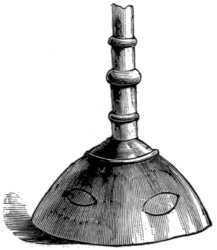
since a small copper specimen
has been found in one of the old
Peruvian tombs. This interesting
relic is now deposited in the
museum at Lima. M. de Castelnau
has published a drawing of
it, which is here reproduced. The
Peruvians called their bells chanrares; it remains questionable
whether this name did not designate rather the so-called horse
bells, which were certainly known to the Mexicans who called
them yotl. It is noteworthy that these yotl are found figured in
the picture-writings representing the various
objects which the Aztecs used to pay as
tribute to their sovereigns. The collection
of Mexican antiquities in the British museum
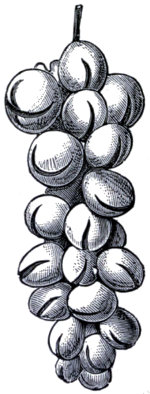
contains a cluster of yotl-bells. Being nearly
round, they closely resemble the Schellen
which the Germans are in the habit of
affixing to their horses, particularly in the
winter when they are driving their noiseless
sledges.
Again, in south America sonorous stones
are not unknown, and were used in olden
time for musical purposes. The traveller
G. T. Vigne saw among the Indian antiquities
preserved in the town of Cuzco, in
Peru, “a musical instrument of green sonorous
stone, about a foot long, and an inch
and a half wide, flat-sided, pointed at both
ends, and arched at the back, where it was about a quarter
of an inch thick, whence it diminished to an edge, like the
blade of a knife.... In the middle of the back was a
small hole, through which a piece of string was passed; and when
suspended and struck by any hard substance a singularly musical
note was produced.” Humboldt mentions the Amazon-stone,
which on being struck by any hard substance yields a metallic sound.
It was formerly cut by the American Indians into very thin plates,
perforated in the centre and suspended by a string. These plates
were remarkably sonorous. This kind of stone is not, as might
be conjectured from its name, found exclusively near the Amazon.
The name was given to it as well as to the river by the first
European visitors to America, in allusion to the female warriors
respecting whom strange stories are told. The natives pretending,
according to an ancient tradition, that the stone came from the
country of “Women without husbands,” or “Women living alone.”
As regards the ancient stringed instruments of the American
Indians our information is indeed but scanty. Clavigero says
that the Mexicans were entirely unacquainted with stringed
instruments: a statement the correctness of which is questionable,
considering the stage of civilization to which these people
had attained. At any rate, we generally find one or other kind of
such instruments with nations whose intellectual progress and
social condition are decidedly inferior. The Aztecs had many
claims to the character of a civilized community and (as before said)
the Tezcucans were even more advanced in the cultivation of the
arts and sciences than the Aztecs. “The best histories,” Prescott
observes, “the best poems, the best code of laws, the purest
dialect, were all allowed to be Tezcucan. The Aztecs rivalled
their neighbours in splendour of living, and even in the magnificence
of their structures. They displayed a pomp and ostentatious
pageantry, truly Asiatic.” Unfortunately historians are sometimes
not sufficiently discerning in their communications respecting
musical questions. J. Ranking, in describing the grandeur of the
establishment maintained by Montezuma, says that during the
repasts of this monarch “there was music of fiddle, flute, snail-shell,
a kettle-drum, and other strange instruments.” But as this
writer does not indicate the source whence he drew his information
respecting Montezuma’s orchestra including the fiddle, the
assertion deserves scarcely a passing notice.
The Peruvians possessed a stringed instrument, called tinya,
which was provided with five or seven strings. To conjecture
from the unsatisfactory account of it transmitted to us, the tinya
appears to have been a kind of guitar. Considering the fragility
of the materials of which such instruments are generally constructed,
it is perhaps not surprising that we do not meet with
any specimens of them in the museums of American antiquities.
A few remarks will not be out of place here referring to the
musical performances of the ancient Indians; since an acquaintance
with the nature of the performances is likely to afford additional
assistance in appreciating the characteristics of the instruments.
In Peru, where the military system was carefully organised,
each division of the army had its trumpeters, called cqueppacamayo,
and its drummers, called huancarcamayo. When the Inca returned
with his troops victorious from battle his first act was to repair to
the temple of the Sun in order to offer up thanksgiving; and
after the conclusion of this ceremony the people celebrated the
event with festivities, of which music and dancing constituted
a principal part. Musical performances appear to have
been considered indispensable on occasions of public celebrations;
and frequent mention is made of them by historians who
have described the festivals annually observed by the Peruvians.
About the month of October the Peruvians celebrated a solemn
feast in honour of the dead, at which ceremony they executed
lugubrious songs and plaintive instrumental music. Compositions
of a similar character were performed on occasion of the decease
of a monarch. As soon as it was made known to the people that
their Inca had been “called home to the mansions of his father
the sun” they prepared to celebrate his obsequies with becoming
solemnity. Prescott, in his graphic description of these observances,
says: “At stated intervals, for a year, the people assembled
to renew the expressions of their sorrow; processions were
made displaying the banner of the departed monarch; bards and
minstrels were appointed to chronicle his achievements, and their
songs continued to be rehearsed at high festivals in the presence
of the reigning monarch,—thus stimulating the living by
the glorious example of the dead.” The Peruvians had also particular
agricultural songs, which they were in the habit of singing
while engaged in tilling the lands of the Inca; a duty which
devolved upon the whole nation. The subject of these songs, or
rather hymns, referred especially to the noble deeds and glorious
achievements of the Inca and his dynasty. While thus singing,
the labourers regulated their work to the rhythm of the music,
thereby ensuring a pleasant excitement and a stimulant in their
occupation, like soldiers regulating their steps to the music of the
military band. These hymns pleased the Spanish invaders so
greatly that they not only adopted several of them but also composed
some in a similar form and style. This appears, however,
to have been the case rather with the poetry than with the
music.
The name of the Peruvian elegiac songs was haravi. Some
tunes of these songs, pronounced to be genuine specimens, have
been published in recent works; but their genuineness is questionable.
At all events they must have been much tampered
with, as they exhibit exactly the form of the Spanish bolero. Even
allowing that the melodies of these compositions have been
derived from Peruvian harivaris, it is impossible to determine
with any degree of certainty how much in them has been retained
of the original tunes, and how much has been supplied besides
the harmony, which is entirely an addition of the European
arranger. The Peruvians had minstrels, called haravecs (i.e., “inventors”),
whose occupation it was to compose and to recite the
haravis.
The Mexicans possessed a class of songs which served as a
record of historical events. Furthermore they had war-songs,
love-songs, and other secular vocal compositions, as well as
sacred chants, in the practice of which boys were instructed by
the priests in order that they might assist in the musical performances
of the temple. It appertained to the office of the
priests to burn incense, and to perform music in the temple at
stated times of the day. The commencement of the religious
observances which took place regularly at sunrise, at mid-day,
at sunset, and at midnight, was announced by signals blown on
trumpets and pipes. Persons of high position retained in their
service professional musicians whose duty it was to compose
ballads, and to perform vocal music with instrumental accompaniment.
The nobles themselves, and occasionally even the
monarch, not unfrequently delighted in composing ballads and
odes.
Especially to be noticed is the institution termed “Council of
music,” which the wise monarch Nezahualcoyotl founded in
Tezcuco. This institution was not intended exclusively for promoting
the cultivation of music; its aim comprised the advancement
of various arts, and of sciences such as history, astronomy,
&c. In fact, it was an academy for general education.
Probably no better evidence could be cited testifying to the
remarkable intellectual attainments of the Mexican Indians before
the discovery of America than this council of music. Although
in some respects it appears to have resembled the board of music
of the Chinese, it was planned on a more enlightened and more
comprehensive principle. The Chinese “board of music,” called
Yo Poo, is an office connected with the Lé Poo or “board of
rites,” established by the imperial government at Peking. The
principal object of the board of rites is to regulate the ceremonies
on occasions of sacrifices offered to the gods; of festivals and
certain court solemnities; of military reviews; of presentations,
congratulations, marriages, deaths, burials,—in short, concerning
almost every possible event in social and public life.
The reader is probably aware that in one of the various hypotheses
which have been advanced respecting the Asiatic origin
of the American Indians China is assigned to them as their
ancient home. Some historians suppose them to be emigrants
from Mongolia, Thibet, or Hindustan; others maintain that they
are the offspring of Phœnician colonists who settled in central
America. Even more curious are the arguments of certain
inquirers who have no doubt whatever that the ancestors of the
American Indians were the lost ten tribes of Israel, of whom
since about the time of the Babylonian captivity history is silent.
Whatever may be thought as to which particular one of these
speculations hits the truth, they certainly have all proved useful
in so far as they have made ethnologists more exactly acquainted
with the habits and predilections of the American aborigines than
would otherwise have been the case. For, as the advocates of
each hypothesis have carefully collected and adduced every
evidence they were able to obtain tending to support their
views, the result is that (so to say) no stone has been left unturned.
Nevertheless, any such hints as suggest themselves
from an examination of musical instruments have hitherto remained
unheeded. It may therefore perhaps interest the reader
to have his attention drawn to a few suggestive similarities occurring
between instruments of the American Indians and of certain
nations inhabiting the eastern hemisphere.
We have seen that the Mexican pipe and the Peruvian syrinx
were purposely constructed so as to produce the intervals of the
pentatonic scale only. There are some additional indications of
this scale having been at one time in use with the American
Indians. For instance, the music of the Peruvian dance cachua
is described as having been very similar to some Scotch national
dances; and the most conspicuous characteristics of the Scotch
tunes are occasioned by the frequently exclusive employment of
intervals appertaining to the pentatonic scale. We find precisely
the same series of intervals adopted on certain Chinese instruments,
and evidences are not wanting of the pentatonic scale having
been popular among various races in Asia at a remote period.
The series of intervals appertaining to the Chiriqui pipe, mentioned
page 61, consisted of a semitone and two whole tones, like the
tetrachord of the ancient Greeks.
In the Peruvian huayra-puhura made of talc some of the pipes
possess lateral holes. This contrivance, which is rather unusual,
occurs on the Chinese cheng. The chayna, mentioned page 64,
seems to have been provided with a reed, like the oboe: and in
Hindustan we find a species of oboe called shehna. The turé of
the Indian tribes on the Amazon, mentioned page 69, reminds us
of the trumpets tooree, or tootooree, of the Hindus. The name
appears to have been known also to the Arabs; but there is no
indication whatever of its having been transmitted to the peninsula
by the Moors, and afterwards to south America by the
Portuguese and Spaniards.
The wooden tongues in the drum teponaztli may be considered
as a contrivance exclusively of the ancient American Indians.
Nevertheless a construction nearly akin to it may be observed in
certain drums of the Tonga and Feejee islanders, and of the
natives of some islands in Torres strait. Likewise some negro
tribes in western and central Africa have certain instruments
of percussion which are constructed on a principle somewhat
reminding us of the teponaztli. The method of bracing the drum
by means of cords, as exhibited in the huehueil of the Mexican
Indians, is evidently of very high antiquity in the east. It was
known to the ancient Egyptians.
Rattles, pandean pipes made of reed, and conch trumpets, are
found almost all over the world, wherever the materials of which
they are constructed are easily obtainable. Still, it may be
noteworthy that the Mexicans employed the conch trumpet in
their religious observances apparently in much the same way as it
is used in the Buddhist worship of the Thibetans and Kalmuks.
As regards the sonorous metal in the great temple at Tezcuco
some inquirers are sure that it was a gong: but it must be borne
in mind that these inquirers detect everywhere traces proving an
invasion of the Mongols, which they maintain to have happened
about six hundred years ago. Had they been acquainted with the
little Peruvian bell (engraved on page 75) they would have had
more tangible musical evidence in support of their theory than
the supposed gong; for this bell certainly bears a suggestive
resemblance to the little hand-bell which the Buddhists use in
their religious ceremonies.
The Peruvians interpolated certain songs, especially those
which they were in the habit of singing while cultivating the
fields, with the word hailli which signified “Triumph.” As the
subject of these compositions was principally the glorification of
the Inca, the burden hailli is perhaps all the more likely to
remind Europeans of the Hebrew hallelujah. Moreover, Adair,
who lived among the Indians of north America during a period of
about forty years, speaks of some other words which he found
used as burdens in hymns sung on solemn occasions, and which
appeared to him to correspond with certain Hebrew words of a
sacred import.
As regards the musical accomplishments of the Indian tribes at
the present day they are far below the standard which we have
found among their ancestors. A period of three hundred years of
oppression has evidently had the effect of subduing the melodious
expressions of happiness and contentedness which in former times
appear to have been quite as prevalent with the Indians as they
generally are with independent and flourishing nations. The
innate talent for music evinced by those of the North American
Indians who were converted to Christianity soon after the emigration
of the puritans to New England is very favourably
commented on by some old writers. In the year 1661 John Elliot
published a translation of the psalms into Indian verse. The
singing of these metrical psalms by the Indian converts in their
places of worship appears to have been actually superior to the
sacred vocal performances of their Christian brethren from
Europe; for we find it described by several witnesses as
“excellent” and “most ravishing.”
In other parts of America the catholic priests from Spain did
not neglect to turn to account the susceptibility of the Indians for
music. Thus, in central America the Dominicans composed as
early as in the middle of the sixteenth century a sacred poem in
the Guatemalian dialect containing a narrative of the most
important events recorded in the Bible. This production they
sang to the natives, and to enhance the effect they accompanied
the singing with musical instruments. The alluring music soon
captivated the heart of a powerful cazique, who was thus induced
to adopt the doctrines embodied in the composition, and to
diffuse them among his subjects who likewise delighted in the
performances. In Peru a similar experiment, resorted to by the
priests who accompanied Pizarro’s expedition, proved equally
successful. They dramatized certain scenes in the life of Christ
and represented them with music, which so greatly fascinated the
Indians that many of them readily embraced the new faith. Nor
are these entertainments dispensed with even at the present day
by the Indian Christians, especially in the village churches of the
Sierra in Peru; and as several religious ceremonies have been
retained by these people from their heathen forefathers, it may be
conjectured that their sacred musical performances also retain
much of their ancient heathen character.
Most of the musical instruments found among the American
Indians at the present day are evidently genuine old Indian
contrivances as they existed long before the discovery of America.
Take, for example, the peculiarly shaped rattles, drums, flutes,
and whistles of the North American Indians, of which some
specimens in the Kensington museum are described in the large
catalogue. A few African instruments, introduced by the negro
slaves, are now occasionally found in the hands of the Indians,
and have been by some travellers erroneously described as
genuine Indian inventions. This is the case with the African
marimba, which has become rather popular with the natives of
Guatemala in central America: but such adaptations are very
easily discernible.

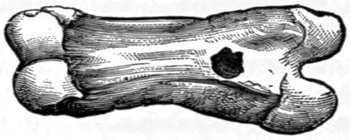
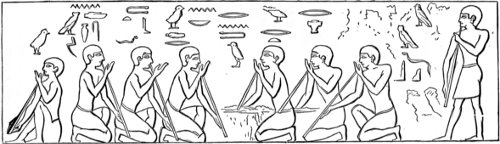
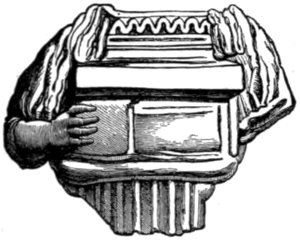
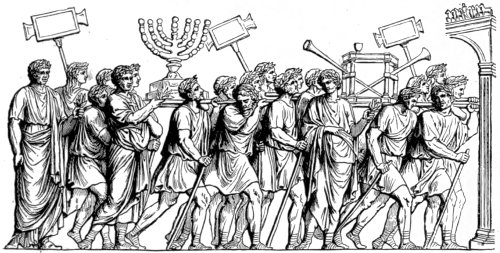
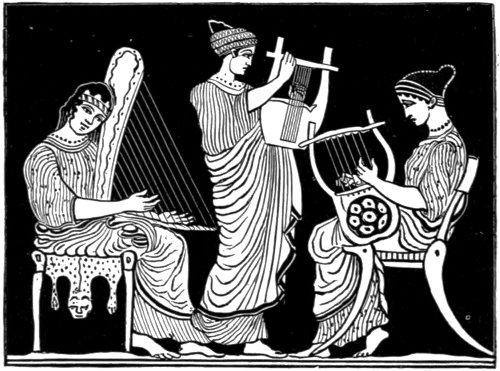
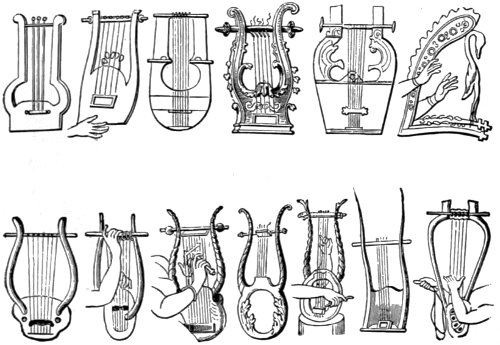
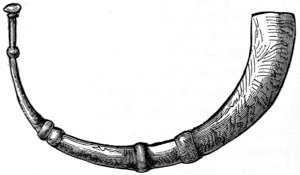
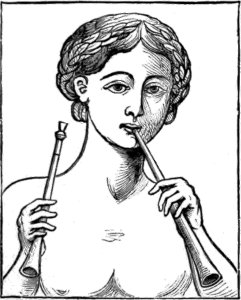
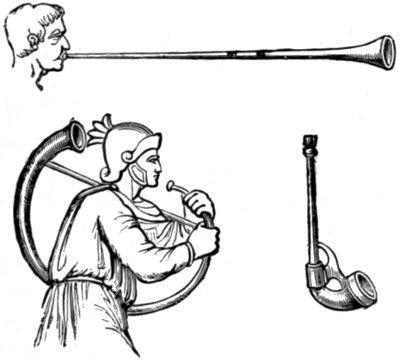
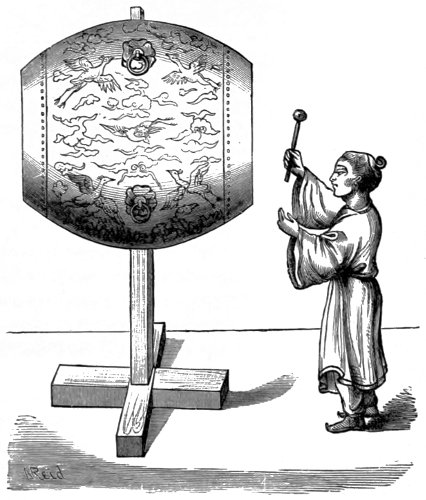
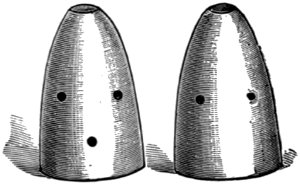


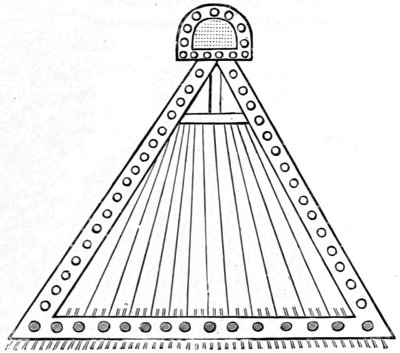
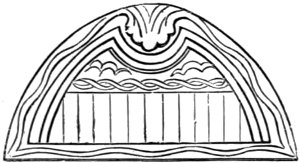
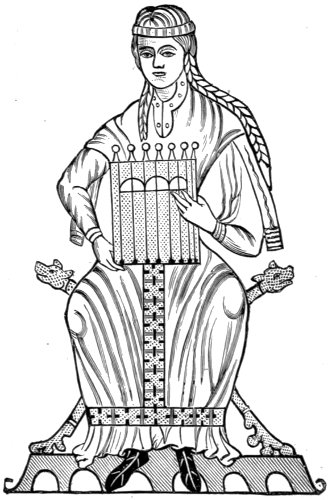
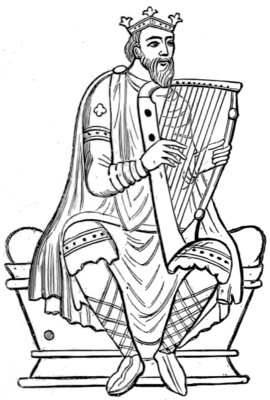
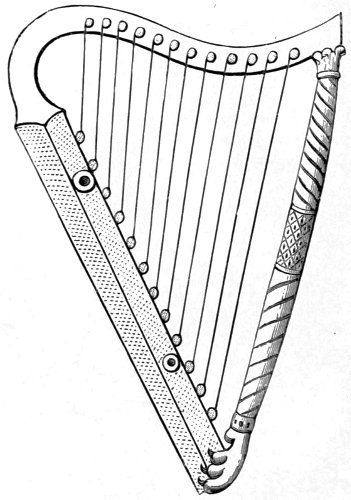
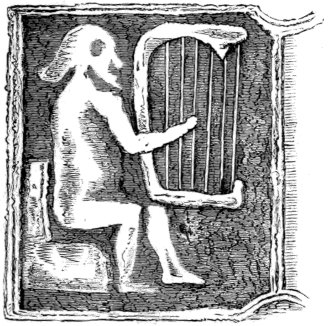
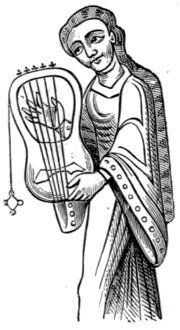
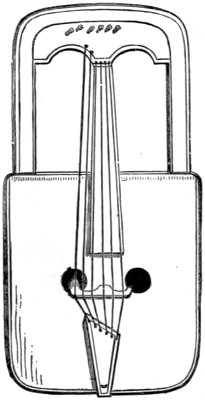
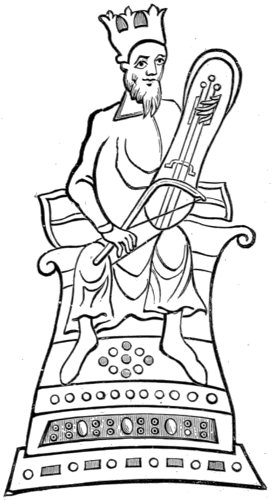
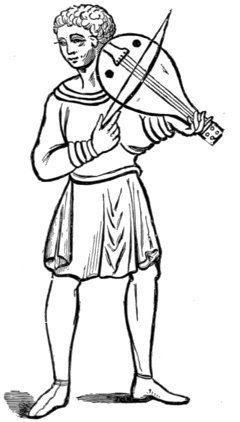
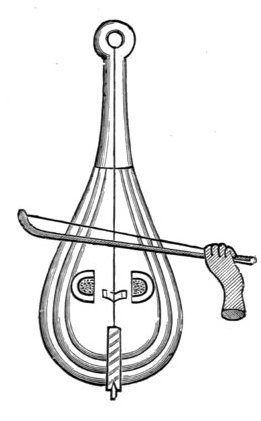

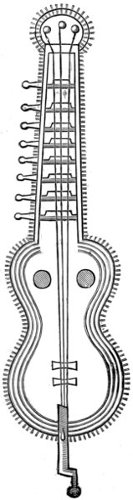
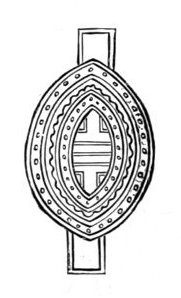
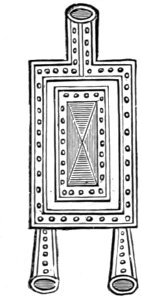
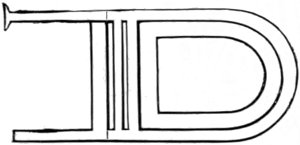

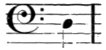 running at the side of the
finger-board instead of over it; this string was, therefore, only
capable of producing a single tone. The four other strings
were tuned thus:
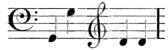 Two other species,
on which all the strings were placed over the finger-board,
were tuned:
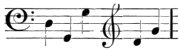 and:
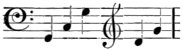 The woodcut above represents a
very beautiful vielle; French, of about 1550, with monograms of
Henry II. This is at South Kensington.