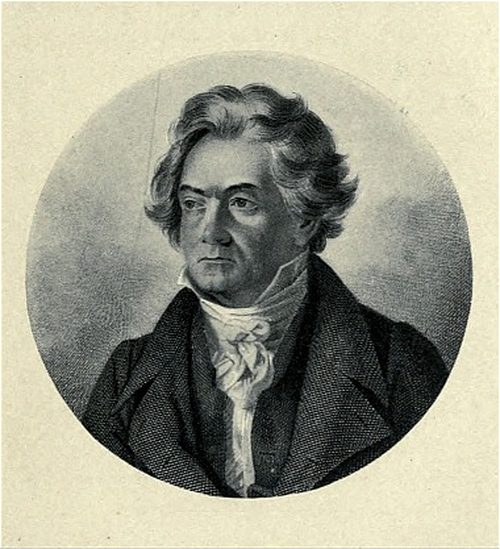
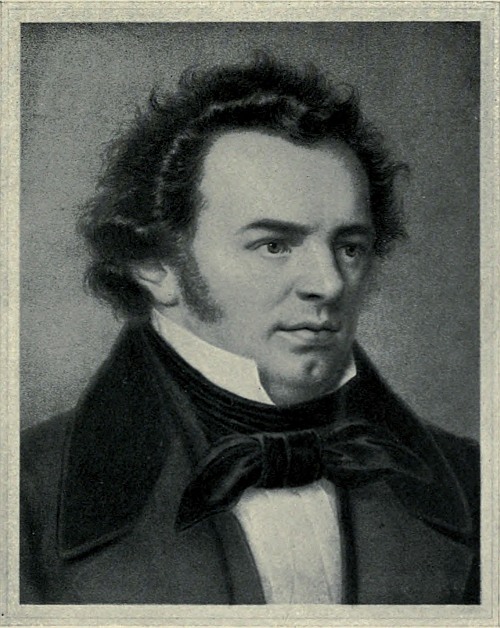
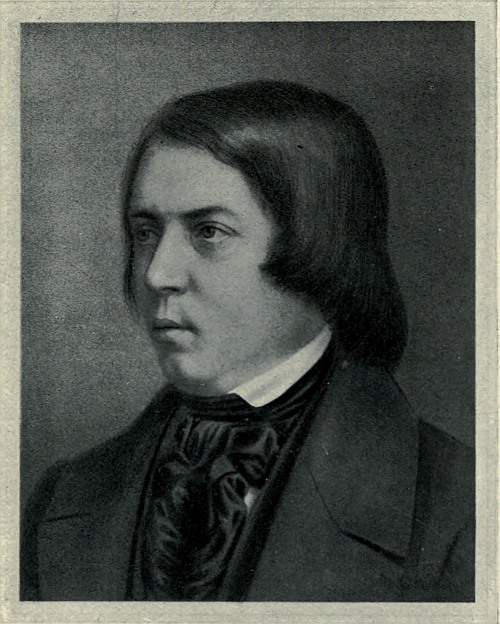
This work, now in its third edition,
has demonstrated its great
usefulness.
Taking up the representative
symphonies of the great composers,
and illustrating his remarks with
excerpts from the score, the author
shows the individuality, the special
intention of the master, and, where
possible, the underlying purpose of
his art.
As an aid in the study of the
symphony, and as a companion at
symphony concerts, the book is
without a rival.
Philadelphia & London J. B. Lippincott Company
1902
Copyright, 1901
By J. B. Lippincott Company
Electrotyped and Printed by
J. B. Lippincott Company, Philadelphia, U.S.A.
TO
GEORGE W. STOCKLEY, Esq.
Preface
I have endeavored through showing
the true nature of music, and the conditions
that are essential to its growth
in breadth and significance, to incite
amateurs to a more respectful consideration
of its claims.
A glance backward over the
course of music's evolution
suffices to show that, until
in very recent times, it furnishes no
pregnant data for the historian. The
first era of music's evolution began before
the advent of historic man, for the
earliest races of whom we know anything
had a well-defined appreciation of
its significance, but no noteworthy landmarks
appear until after music came
in touch with modern culture; indeed,
no great advancement is traceable until
after the invention of notation. The
first record of melodies produced is supposed
to have been made in the fourth
century (A.D.),—viz., that of three Greek
hymns,—to Apollo, Nemesis, and Calliope,—which,
however, possess meagre
means of proving their authenticity.
From this shadowy period until harmonies
enter the field, nearly a thousand
years later, the historian finds no fruitful
material, no verified accomplishments.
The march of material events was
amply recorded, but melodies were
passed from mouth to mouth and ear to
ear, necessarily changing their outlines
in the process, for the line that connects
memory and expression seems, in most
of humankind, to run so near that which
leads from imagination to expression,
as to engender inaccuracy in transmission.
(This crossed-line influence is
recognizable in the productions of most
composers. Memories become entangled
in their fancies.) Although our
modern melody has doubtless come
down to us through long lines of heritage,
yielding to the prevailing influences
of each successive stage in transmission,
there is no statistical light on its line of
development.
It would be interesting to know in
what form the first musical intuition
manifested itself, and then to trace an
unbroken chain of cause and effect from
that first manifestation to date, but that
knowledge would not materially benefit
music, which is the only art whose career
does not follow well-defined cycles,—the
features of periods reproducing themselves
with the recurrence of conditions.
In sculpture, poetry, and architecture
we have seasons of reverting to the antique,
and with good results. These
arts dealt with tangible material, could
be kept present to the eye and mind,
and therefore developed quickly. We
return to their ancient forms, so restful
in their conformity to natural adjustment,
for relief from the tireless ingenuity of
modern producers, and to find bases for
new flights.
Music is, however, so essentially intangible
that it required ages to discover
sufficient of its underlying principles to
afford the foundation for an art. Nothing
within our ken has been as slow in
evolving, and yet nothing has shown
such an unwavering tendency forward
and upward. These characteristics, and
its insidious influence upon man's nature,
entitle it to be called the divine art. It
is in course of evolution from its original
germ, but the outlines of its early technical
forms have no significance for the
nineteenth-century composer.
For the above reasons statistics will
be avoided when they are not essential
in locating and verifying conditions.
Some periods were too influential in
broadening and defining the scope of
musical expression to be ignored. I
shall endeavor to make my theories in
regard to the origin and growth of music
accord with its inherent qualities, as well
as with man's devious and changing
nature. The greater the music the more
direct is its appeal to our imaginations,
and the stronger its effect upon our
emotions. Each intrinsically great composition
has its distinguishing mood or
temperament, which is the sequential expression
and perpetuation of an emotion.
This mood is first announced by the
chosen themes, and then its varied phases
and the cumulative intensity essential
to sustained expression are secured
through the logical manipulation of these
themes.
I would divide music into two classes,
natural and artificial. The latter class
is, as the name assigned to it implies,
a mechanical combination of musical
means, the result of purely intellectual
processes, incited by will force, and not
by inspiration. It lacks all reason for
being, and I shall dismiss it without further
ceremony. It is to natural music,
which springs from our imaginations,
is formulated for purpose by intellect,
appeals to the sympathies, and sways
the emotions, that I shall devote my attention.
The music of the barbarous
races, although developed little beyond
the initial stage, is adapted in its character
to their habits and sensibilities, and
is among them quite as powerful an
agency for stimulating the passions as
is our nineteenth-century music among
the people of this Western civilization.
Their musical exercises are purely emotional,
and therefore natural.
Natural music is composed of two
species, that which is earnest and edifying,
and that which is entertaining only.
These diverse growths are equally spontaneous,
and each develops form, substance,
and proportions in keeping with
the intellectual soil by which it is nurtured.
The world requires that music shall
suit its varying moods. Some of Johann
Strauss' waltzes are quite as genuine
music as are Beethoven's symphonies,
and each in its own way contributes to
the pleasure and benefit of mankind.
Which would be the greater loss, were
it blotted out of existence, is unquestionable,
for the resultant deprivation
must be measured by the comparative
numbers who would feel the lack of each.
The great majority of the public, and
even some of music's devotees, derive
more pleasure from entertaining than
from earnest (so-called classical) music.
This is partly because earnest music is
quite often abstruse, requiring well-directed
mental effort to understand its
full significance; but a more generally
prevailing reason for this condition (especially
when dance music is concerned)
is to be found in its cheering and exhilarating
effect.
I think it pure affectation for musical
persons to express a lack of respect for
a good piece of dance music. A large
percentage of those who do so are not
sincere. They fear to discredit their
appreciation of the classical, thinking
wrongly that there would be something
incongruous in liking both. The artist's
ideals should embrace the whole gamut
of human feeling, and music that strikes
our sensibilities at any point in this line
is genuine, whether it be a symphony, a
love song, or a waltz.
If music be the language of the emotions,
its germs must be those sounds
through which joy, grief, love, fear, rage,
wonder, and longing find natural, unpremeditated,
and often involuntary expression.
The fact that the import of these
sounds, whether produced by man, beast,
or bird, is unmistakable, has led some
writers to accord music the honor of having
been the initial means of intercourse
between members of the human family,—the
original language. This is hardly
consistent, for life is mostly unrhythmic
monotone, punctuated only here and
there by episodes fruitful in musical germs.
Scientific observation has established
the fact that all of the higher species of
living things have forms of vocal intercommunication.
Like human beings,
animals have forms of speech comporting
with their degrees of intelligence and
needs, but quite apart from these forms,
they and man have mutually intelligible
codes of emotional expression. These
codes are not identical in less essential
details, nor are they equally comprehensive,
but they spring from a common
source. They vary in character according
to the qualities of instinctive feeling,
refined or coarse, that dominate the
creatures that employ them.
The lowest grade of animal life which
possesses vocal apparatus is susceptible
of but three emotions—anger, longing,
and fear—in such measure as to elicit
expression. The higher grades feel joy,
love, sorrow, anger, fear, and longing.
Music has significance only when
fraught with messages from the composer
to the hearer. Therefore those
sounds which most clearly voice strong
emotions are the most pregnant musical
germs. Isolated shouts of triumph, rage,
and joy, or cries of pain, fear, and entreaty,
appeal to our sensibilities, but
they do not suggest music, although its
line of development from these primal
elements is traceable. It began with the
first intellectual recognition of the adequacy
of tonal expression, when those
sounds which had been involuntarily
produced as the result of sensations,
were placed by the human mind in the
category of expressive means.
At this point our germs came under
the influence of deliberate purpose. Intellect
took spontaneous shouts, cries,
and moans in hand, and has gradually
endowed them with continuity, life pulsation
(rhythm), and form; has made them
express sentiments surcharged with emotions,
creating a definitely significant
atmosphere (stimmung). This pervading
atmosphere or mood, which is a vital
element in successful musical effort, must
be in no wise confounded with the situations
incident to and arising through
the descriptive (program) composer's
art. The first is personal, a heart mood;
the second is impersonal, a brain picture.
From this first step in musical evolution
intellect has been more and more
closely associated with emotion, as the
composer's intentions have become more
definite and his forms more extended.
Music's progress has not been uniform,
for it is most sensitive, and the
conditions have often been unfavorable.
It has followed, to a great degree, the
tidal fluctuations of refinement and fine
sensibility in the masses; for although
its growth is dependent upon certain
conditions, these necessary conditions,
if confined within narrow limits, or when
found only in isolated persons, will not
suffice.
It must breathe a free air, full of
sympathetic feeling and impulse, and it
must have a broad, deep soil in which
to spread its roots, for it aspires heavenward,
up through the material into
the ideal.
The growth of music from its initial
stage to an art is quite analogous, except
in time consumed, to the growth of each
talent to maturity, or of each musical conception
to full expression. They all move
on towards realization, impelled by art
instinct and imagination. The composer
of to-day has a legendary past,
full of romance and heart-throbs, and a
warm, sympathetic present, to stimulate
his fancy, but it required ages of joy,
sorrow, love, and culture to quicken and
refine man's stoical nature. The soil
which nourishes our imaginations has
been made fertile by the blood and tears
of countless generations.
CHAPTER II MUSIC'S FIRST ERA, AND THE INFLUENCES WHICH WERE OPERATIVE IN VARIOUS LANDS DURING ITS CONTINUANCE
There are two distinct eras in
the course of the evolution of
music. The first ended and
the second began with the invention
and adoption of notation. This mechanical
device so revolutionized musical
production and taste, that we may
properly concede to it the honor of
having made possible the formulation
of our art, for it chronicled the accomplishments
of each generation, thus
furnishing its successors with suggestive
models. These were virtually lacking
in the first era, which accounts amply
for the little advancement made during
its continuance.
That early career of music is shrouded
in utter darkness, unbroken by a single
luminous episode, and the lights which
we are enabled to throw back upon it are
entirely deductive.
They are not sufficiently strong to
bring details into relief, but they suffice
to develop outlines which are ample for
the purposes of my sketch. The fact
that the ancient Egyptians, Greeks, and
Chinese devoted much attention to what
some are pleased to call the science, or
technic, of music is to me no indication
of the condition of music existing at
that time. Their libraries contained
numerous volumes devoted to music,
but their treatises considered melody
(harmony was not known) from a purely
mathematical stand-point. This vital
element of music, which should be as
free as air, was fettered by pedantry.
I feel convinced that the evolution of
music was seriously delayed by this too
early association with science. China
has perpetuated this system of vassalage,
the result being that her present temple
melodies, which also serve as folk-songs,
are utterly devoid of plastic grace and
spontaneity. The fallibility of long lines
of oral transmission casts doubt upon
the Chinaman's claim that he inherits at
least a portion of these songs, in their
original form, from a period four thousand
years back; still, there is one feature
of the situation which, in a measure,
substantiates it,—viz., the instinct for
imitation that distinguishes this race
from all others.
Evolution involves removal from an
elementary state, and we measure its advancement
through placing the present
outlines and qualities, of whatever may
be concerned, over against those that
characterized some known previous condition.
China has produced some great
scholars, and her civilization, such as it
is, endures like the everlasting hills, and
seems subject to little more change than
they, but her people are not emotional,
imaginative, nor susceptible to influences
from without. The great wonder
is not that real art feeling has never
manifested itself in China, nor that she
has repulsed all attempts to introduce
the fruits of European musical culture,
but that the Chinaman, with his nature,
should have ever evoked our muse.
China has contributed nothing to the
development of music, and we cannot
draw one spark of light from her for
our investigations. The Mongolian race
treated their feeble first musical impulse
as they still do the feet of high-caste
female children,—viz., they wrapped it
so tightly in pedantic cerements that it
could not grow; and, being an impulse,
and not flesh and bones, it failed to
endure the repression.
Although these ancient scientific treatises
afford no clues to the actual spirit
and form of contemporaneous musical
utterances, they do bespeak the presence
of interest and respect. As I have
shown, this condition was of no service
in China, but as the Egyptian and Greek
people and culture were of a quite different
substance and mould, we may
safely infer that their efforts were important
features in this preparatory
era.
The light which we are enabled to
throw backward over the line of musical
evolution is drawn from the following
sources: 1, the nature of music itself,
and the first purposeful use of its germs;
2, its present condition among barbarous
peoples; 3, profane history of ancient
Egypt; 4, its development in pace with
that of the Aryan race; and, 5, Biblical
references (to which I shall devote a
separate chapter).
NATURE OF MUSIC
It is a gross misconception to regard
music as merely a "concord of sweet
sounds," for that would be a barren
art which had no contrasting features.
Much great music is not beautiful, for
it may be tragical, sombre, or may
voice any of the moods incident to life.
Euphony was doubtless one of the last
developed qualities, for it springs from
joy, love, or reverence. We must look
among the coarser emotions for the
germ which was first used in tone expression.
In that prehistoric time, at the beginning
of what might be called soul tenantry,
man, whether created or evolved,
being the first of his line, had no fruits
of human experience to guide him, and
his emotional status could therefore have
differed little from that of the higher
grades of soulless creatures. We learn
from history that since it began its annals
animal nature has remained virtually
unchanged, whereas man, because
possessed of a higher grade of intellect
and a definite recognition of Deity, in
one form or another, has refined and
broadened the scope of his impulses and
understanding. As it is the first subjective,
and not objective, manifestation
of tone expression that we are seeking,
we cannot do better than to scan this
feature of animal life.
Such manifestations result from the
sequential co-operation of emotion, reason,
and impulse. Animals have their
growls, roars, and trumpetings of anger
and defiance, and many of them have
forms of expressing affection, but these
latter are acquired through experience,
whereas they instinctively appeal
to agencies outside themselves for relief
from pain or want, employing means
the efficacy of which they recognize. If
we turn to humankind, we find that
the new-born babe will express its desire
for food long before it becomes
responsive to its mother's endearments.
I, therefore, assume that pleading was
the first purposeful, premeditated form
of tonal communication, and, consequently,
that it was the nucleus about
which experience and culture have gathered
such ample resources. (This term,
tonal communication, applies equally
well to our formulated art, for music is
invariably addressed by its creator to
some intelligence, whether it be a person,
the world, or God.)
This first developed element has never
relinquished its prominence, for it is the
mood which most often pervades the
composer's tone pictures. We find it
depicted, as prompted by each and all
phases of human insufficiency, appealing
to appropriate sources for relief,—the
oppressed entreating the tyrant, the
lover the object of his affection, and the
finite world, prostrate before Infinity,
pouring its hopes and aspirations into
the Divine ear.
Now occurs a period of unmeasurable
time upon which we can throw no
light. It extends from this first manifestation
up to that stage in evolution
which produced forms of tonal expression
like those now employed by the
lowest savage races. Some time during
this unexplorable period, man having
appropriated a fuller vocabulary from
nature's store, and having adopted more
sustained, and at the same time articulate,
forms, was led to feel pulsations,—incipient
rhythm. Whether this primitive
conception of metre was suggested
by associated word successions, or was
incident to the extension of tonal expression
itself, we can only conjecture,
but rhythmic impulse is evident in, and
it is the main feature of, the crudest
musical efforts.
MUSIC OF THE SAVAGE RACES
Science has long busied itself with
race origin. It has approached the
problem from every side, and has accomplished
so much towards its solution
as to afford grounds upon which to base
the assumptions that the diverse types
of mankind, as they now exist, are each
physically, morally, and mentally the
outcome of conditions of which climate,
soil, and degrees of isolation have been
the most potent factors; and that these
branches which have spread out to cover
the world spring from one common
family trunk. Even within the limits
of historic time migrations have been
caused either by climatic changes or by
the dissensions incident to over-population.
When the savages of the South Sea
Islands became detached, and whether
of their own volition or through a dispensation
of Providence, which caused
the Pacific Ocean to isolate them from
less pestiferous humanity, will never be
known. It must, however, have taken
place after the idea of at least limited
tone expression had taken a firm hold
on mankind and had become a transmittible
instinct, for these savages evince
little more disposition or capacity for
originating than the more intelligent
species of animals. I cite these people
and their lyric status to mark the lowest
ebb in things human and musical of
which we have any knowledge.
Their music and habits are alike
crossed by the line which separates the
human from the animal, and it is needless
to say which quality contributes the
larger portion. Their songs are, like
their language, ejaculatory, showing little
exercise of reason in their forms, and
voicing the baser emotions solely. Rude
rhythms are the only features that attest
their origin in musical impulse. Music
in its course of evolution had necessarily
to pass through this primitive
stage. In more congenial environments
it passed on and out, but these barbarians,
being neither emotionally nor
intellectually capable of imparting the
impetus requisite to the development of
finer and broader significance, have for
thousands of years used their present
crude forms. Their stage comes in
touch with music's line of evolution at
a period countless years before David
sang.
From a letter in response to my inquiries
as to the musical status of these
barbarians, written by Count Pfeil, who
has most closely observed their customs
during twenty years spent in exploring
the dark continent and these darker
islands, I infer that their barbarism has
grades analogous to those that exist in
the culture of civilized nations.
In speaking of the two musical instruments
in use Graf Pfeil says, "They
are the 'Tutupele' on New Britain and
Duke of York, and a sort of pan pipe
or flute on the Solomon Islands. The
former may hardly be called an instrument.
It is used in connection with the
superstitious ceremonies of the Dult-Dult
practice, and is supposed to herald
the appearance of the spirits. Two
pieces of wood are carved down till they
sound two neighboring notes, such as
c-d, g-a, or f-g. They are then placed
over a little hollow dug in the ground, and
are beaten with small club sticks....
"The other instrument is used by the
Solomon Islanders. They assemble three
or four men, each armed with his flute,
of which the largest pipe is about three
feet in length, with a two-inch internal
diameter. There are five of these pipes
in each instrument. They are made of
bamboo, and played by being raised to
the lips and strongly blown into. The
sound, especially when heard from a long
distance, which robs it of its harshness,
is not at all unpleasant, but has rather a
melodious, though sad, character. The
few men who play these instruments
begin turning round and round, and
others, wishing to join in the dance,
gather round them, also moving in a
circle. When a hundred dancers perform,
those on the outside run at a headlong
speed, while those forming the
centre spin, but very slowly. The dancers
accompany the players by very
curious half-whistling sounds, which
sound like the twitter of birds. The
louder and shriller the sounds the prettier
they are thought to be....
"On the Duke of York, boys have a
curious, cruel way of procuring music.
They take a large beetle and break
off one of its legs. In the remaining
stump they push a lot of elastic gum, of
which they hold the other end. The
beetle is now made to fly, but not being
able to get away from the boy's
hand, keeps circling round and round it,
emitting a loud whirring or humming
sound....
"All these races sing. Their songs
are very monotonous, but are defined,
like our own. You can ask them to sing
such or such a song, and they will always
sing it exactly as they sang it before.
All songs are sung in a subdued voice,
as the melancholy and suspicious character
of the people prevents all loud
demonstrations of mirth.... I have
never heard their songs accompanied by
any instrument, excepting at a dance,
when, to my sorrow, combined vocal and
instrumental efforts served as an accompaniment
to the dance."
The North American Indians, despite
the demoralizing influences of traders,
agencies, and fire-water, are noble men
as compared with the cannibals just considered.
Many of their less amiable
traits are doubtless the fruits of white
intruders' avarice, which has from the
first set aside equity when dealing with
the red man. They live having a future
state in view in the happy hunting-grounds,
which stimulates in them a
strict, but not too comprehensive, moral
consciousness. Those conditions of life
which mould race characteristics have in
the case of the North American Indian
developed bodily activity, close observation,
bravery, and reasoning faculties,
though crude. They lack delicate sensibility
and imagination, but still in them
we find nomadic manhood at its best,
and their music mirrors their character.
Their war, funeral, and joyous songs
are alike monotonous to modern Aryan
ears, for they are devoid of romance and
fine feeling, and are composed of repetitions
ad libitum, instead of progressive
developments. Their climaxes are produced
through increased unction in delivery
rather than through sequential
means. They mark the primary pulsations
of their songs through swaying the
body, dancing, and through the use of
rude instruments, and in so doing work
themselves up to a remarkable state of
exaltation. This result of their musical
exercises must not be construed as indicating
the presence of a strong, emotional
element in the Indian character.
They are, on the contrary, so stolid that
few things can ruffle their equanimity.
Their ecstasies are purposeful and self-induced.
Their phenomenal capacity for reading
and interpreting nature's chronicle of
the movements of living things, and its
continual exercise, have blinded them,
in a great degree, to the beauties of
landscape. They devote themselves to
the analysis of details instead of to the
contemplation of the Creator's harmonious
ensemble, and they consequently
develop little sense for the beautiful.
The fundamental manifestation of this
sense is, in normally endowed man, an
appreciation of the forms and colors of
material things. Upon this sense we
may build responsiveness to the intangible
and ideal, but without it we have no
foundation for æsthetic taste. I can think
of nothing more incongruous than an
atmosphere of Bach fugues or Beethoven
symphonies for a man who sees only
tons of hay, feet of lumber, water-power,
etc., while gazing upon nature's grand
panorama. The music of the North
American Indian is neither euphonious
nor romantic, but it is distinctly more human
than that of the South Sea Islanders,
and its varying tribal phases permit the
inference that it has, in their keeping,
accumulated resources, however slight
they may seem.
The Indian's character and music
throw light upon the course of evolution
during the first era, inasmuch as they,
contrasted with those of the cannibal
races, tend to substantiate my claim that
sound expression takes its cue from
attendant culture, advancing in pace
with it.
PROFANE HISTORY OF ANCIENT EGYPT
At that remotest period upon which
the historian can throw light (about
3000 B.C.) the Valley of the Nile was
the scene of undertakings the fruits of
which have ever since excited the wonder
of the world. The Pyramids, the
somewhat later-built Palace of Karnak,
and Temples of Luxor and Ipsambul
stand first among the phenomenal conceptions
of human architects; and the
mechanical skill required in handling the
massive blocks and pillars of which they
are composed would severely test the
appliances of our practical and inventive
age. These monumental buildings, their
consistent environments, and the deciphered
records of scientific and literary
accomplishments in those earliest historic
times, bespeak broad culture. As
we possess no record of a race from
whom the Egyptians could have drawn
either stimulus or knowledge itself, their
culture was presumably indigenous, and
therefore of slow growth. The Palace
of Karnak, for instance, marks the climax
of accomplishment in a line of
architectural endeavor which may have
begun soon after the Nile commenced
making her alluvial deposits.
The persistent and audacious ambition
which this long course of development
attests, and the art feeling expressed
in their works, endows Egyptian interest
in music, as evinced through the
scientific treatises mentioned at the beginning
of this chapter, with especial
significance. They were more learned
and less pedantic than the Chinese, and
were, besides, emotional and imaginative,
although sadly superstitious. Had that
high enlightenment permeated all classes
of the people, Egypt would have been
an Elysium for our art, but it was, unfortunately,
confined to the upper social
grades, which embraced the priests, and
to a certain extent the warriors.
The masses, in company with prisoners
of war and slaves from Central
Africa, were mere servitors to the monarchs
and priests in executing their ambitious
schemes. Although their labor
built up indubitable testimony to the
greatness of their masters, the burdens
imposed upon them century after
century finally wore away their fealty;
therefore the decadence and downfall of
great Egypt. There could not possibly
have been anything like art enthusiasm
among a people so oppressed. Despite
this vital lack, ancient Egypt did more,
directly and indirectly, to foster music,
and to give it an onward impulse, than
all other agencies of the first era combined.
This was somewhat attributable
to the fact that then, for the first time,
tone expression was associated with
rhythmic texts; still, I infer that their
music was merely an accessory to euphonious
declamation,—subservient to
poetry,—for had their melodies possessed
independent import, those resourceful
people would have found some
way of recording them. These relations
between music and poetry were
perpetuated in Greece; indeed, our art
was not accorded equality as a contributive
element in song until in quite
modern times. There have been several
distinct epochs in this relationship,—viz.,
that in which tone expression, because
of its little understood capacities
was held in vassalage to her sister art;
music's equality (dating from the adoption
of notation), during which she greatly
extended and beautified her forms; her
ascendency, which characterized the
vocal works of the early part of the
present century; and now the Wagner
school, in which the two are again made
to collaborate on equal terms.
The ancient Egyptians employed pan
pipes, flutes, horns, instruments of percussion,
and small harps. Mural pictures
of the fourth dynasty represent
players blowing upon pipes of different
lengths, and consequently of different
pitches, which is a dumb declaration
that at least some principles regulating
the simultaneous use of tones had been
recognized. Outside this pictorial record,
we can find no intimation that anything
analogous to modern harmony was
known and practised by this people.
In the absence of specific data we are
forced to predicate the condition of
music in that stupendous, though exclusive,
civilization, upon the elements of
the atmosphere from which it drew its
impulse. As the more prominent of
these elements were profound religious
feeling, scientific learning, insatiable ambition,
and a clearly pronounced lyric
tendency, their melodies must have been
coherent and expressive.
ARYAN RACE
As the instincts and capacities of the
Aryan race have always been unique, it
may prove instructive to glance at those
features of its prehistoric existence in
Asia which have been brought to light
through comparative philology and
mythology. In the first place, these
sciences establish the fact that we of the
West (Greeks, Italians, Germans, English)
and the Hindoos of the East are
of common origin. Our ancestors listened
to the same legends, ballads, and
mythical tales while gathered as children
about one and the same mother, and
they have handed them down to this
generation of the descendants of each so
little changed as to furnish ample proof
of family relationship. Many of the
more important words of the various
Aryan languages are suggestively similar,
and this in spite of the five thousand
years of transmission, and of
the diverse conditions incident to the
growth of widely separated clans into
great nations.
The Aryans were worshippers of
Nature in her more spectacular and
heroic forms and moods,—in storms,
fire, sunset, and dawn, but looked upward
for their Supreme Deity. The
sky, with its fathomless depths of blue
and its star mysteries, was their Zeus.
From this it will be seen that they were,
in a way, idolaters, but their idolatry
was not degrading; it was, indeed, ennobling.
They contemplated Nature,
and in her processes saw the hand of
an all-pervading, beneficent power,—a
God. They worshipped the God thus,
and in no other way, revealed to them
through His works.
Their conceptions of family and community
organization have served, and
still serve, as models to civilized nations.
They were paternal, the clans being
large families with patriarchal heads,
and elected councillors. They were
pastoral, cultivating the soil and herding
cattle, sheep, horses, and pigs; but they
were at the same time good warriors.
They wore leathern shoes, garments
woven from wool, and they had at
least a rudimentary knowledge of the
sciences.
From all this I infer that the early
Aryans were a race of freemen, not
subject to the class discrimination that
ruined Egypt.
Their appreciation of nature, and their
reverence, ambition, and pertinacity fitted
them to become the especial guardians
of the arts, and their comparative class
equality enabled them to fulfil the requirements
of my theory that music can
only flourish in a widely diffused interest
and knowledge. It must breathe a
genial and suggestive atmosphere.
Our main business is with Aryan
music after it came under the influence
of Egyptian culture, but it may interest
my readers to flash, for a moment, the
light of analogy back upon its earlier
period. We have found the early
Aryans less learned than the Egyptian
scholar class, but also less superstitious
and less pedantic. They were normal
human beings in their occupations, susceptibilities,
and social life. With such
a picture in view it is quite natural for
our imaginations to hear its complement
in expressive sounds,—peaceful lullabies,
songs of praise and love, and sonorous
rejoicings.
In remote times the region which
is supposed to have been the original
home of the Aryans must have been fertile,
for early poets were enthusiastic in
describing its charms. The climatic
changes that made the soil arid as it is
to-day may have suggested, or may
even have necessitated, migration; still,
what condition or combination of conditions
induced the Aryans to abandon
Central Asia can never be positively
known; but it is certain that they, like
irresistible tidal waves, rolled westward
and southward, destroying, carrying before
them, or absorbing and dominating
all peoples and institutions in their course.
One of the streams of Aryan migration
flowed towards the south and formed
the Hindoo and Persian nations, and another
came into Europe by way of the
Hellespont and took up its abode in
Greece and Italy. Three others, the
Celtic, Teutonic, and Slavonic, followed
in the order named, passing to the north
of the Black Sea, and occupied respectively
Western, Central, and Eastern
Europe.
Of all the nations who have developed
from these original nuclei, the Hindoos
show least evidence of close intercourse
with the world's great teacher, whereas
the Greeks, perhaps because of their
proximity to Egypt, were led to avail
themselves of her tuition to the fullest
extent.
The ancient Hindoos were less scientific
than the Chinese or Egyptians, and
isolation has prevented them from advancing
with modern civilization. Their
music is less the fruit of theories than it
is of natural Aryan impulse. They do
not look upon it as a science, but as a
matter of the emotions, the result of,
and intended to quicken, the imagination.
I have seen Hindoo melodies which exhibited
a correct appreciation of rhythmic
adjustment, still their accomplishments
do not entitle them to a place among
the potent factors in musical evolution.
Now we come to the climax of our
first era. Such a true conception of
beauty, such perfect symmetry, and such
far-reaching imagination and lofty aspiration
as are present in, and have
made ancient Greek art and literature
luminous for all time, bespeak conditions
that would have carried music to fruition
during their continuance had she not
been so intangible, and therefore necessarily
slow in developing. Had her
nature been less coy, we might have
ancient Greek music as monumental as
the Iliad or the Parthenon.
The Greeks were quick to recognize
the virtues of Egyptian learning, and
Greece soon became great Egypt's
greater pupil. Still, we should accord
Egypt first place among the factors
that built up modern civilization and led
to the formulation of musical art, for she
originated the vital impulse.
That period of Greek culture supremacy
dispensed no laurels to its
mothers, wives, and daughters. Woman
was regarded as an inferior being, and
she took no honorable part in intellectual
social life. Boys were exhaustively educated,
while girls were neglected. This
was the one blot on the glory of those
times, and we, besides deprecating the
injustice it involved, must regret that
these ancient art-workers denied themselves
that highest earthly source of
inspiration, intercourse with the delicate
enthusiasm, the keen perceptions,
and art instinct of educated and loved
womanhood; for to what heights might
their achievements have attained but for
this misconception of woman's nature
and capacities!
One would think that Sappho's
lyrics, which induced Plato to call her
the "Tenth Muse," would have suggested
the existence, in woman's purer
and more sensitive nature, of a subtle
vein of beautiful intellectuality, but such
was not the case. Judging from what
we have seen of early Aryan family
life, this unpractical and debasing idea
of suppressing woman must have been
imbibed with Egyptian learning.
Music was taught in the Greek
schools, and youths were thus fitted to
join in the sacred choruses, and to appreciate
the significance of poetry. The
immortal bards sang their creations, and
they often remained unwritten for generations.
The drama developed from
songs and dances. Music was a prominent
feature of their symposiums, the
lyre being passed from guest to guest,
each contributing of his best to the intellectual
feast. Banquets were brought
to a close by singing hymns. Music pervaded
each function of Hellenic life.
Their choruses were unisons, and
their instrumental accompaniments were
either purely rhythmic (regardless of
pitch) or they followed the voice, for
the Greeks had no discoverable conception
of harmony. In contemplating the
marvellous erudition and the poetic
sense of ancient Greece, and the important
rôle played by music in the
period of her glory, I can but feel that
the failure to chronicle her melodies is
a misfortune. They may not have been
rich in variety of tone succession or in
rhythm, but they doubtless were vigorous,
expressive, and logically rounded,
and they therefore mark the brightest
point reached in the first era.
Greece succeeded Egypt as the
world's teacher, and her precepts gain
significance as advancing culture enables
us to better comprehend the fine
adjustment of imagination to nature
which they embody. Her sculpture,
architecture, and literature are the highest
models that we have, and those of
our architects who appreciate the import
of monumental buildings look to ancient
Greece for appropriate inspiration.
Is it not reasonable and logical to assume
that the spirit of Greece's unwritten
musical forms has been preserved,
passed from nation to nation, and from
generation to generation, and that it
underlies our present classical school?
I say spirit in speaking of musical transmission,
for music's resources and outward
forms were, in the Homeric period,
and still are, in course of development.
It would be a waste of space to discuss
the musical doings of other European
nations during this period. Those
that did least to prepare the way have
been most active since our art took
shape. As great as Italy's services have
been since the sixteenth century (A.D.),
she did little for music previous to that
time. St. Ambrose, of Milan (384 A.D.),
and St. Gregory, of Rome (590 A.D.),
ordained rituals, prayers, music, etc., but
there is no detailed record of their
achievements, therefore no authentic
Gregorian chants.
CHAPTER III BIBLICAL MENTION OF MUSIC
The Old Testament is a chronicle
of the growth, movements,
physical and mental habits, and
religious status of the great Jewish race.
Its religion with one Godhead, whose
immediate presence was often felt, its
music addressed to this presence, and
its family, tribal, and racial organizations
were all Jewish. The great moving
lever of Jewish existence was a religion
whose creed prohibited the making of
"graven images," so painting and
sculpture were not cultivated; it recognized
the direct agency of supreme will
in moulding daily events, and prescribed
oft-repeated praise and prayer, and thus
created the atmosphere of exalted devotional
feeling which we find recorded
in many of the books of the Bible, and
which climaxed in David's Psalms.
The ancient Hebrews were in no
measure a scientific people. Their one
intellectual aspiration found vent in
beautifying the worship of God. They
were religious teachers, who have directly
or indirectly shaped the creeds of
the civilized world.
According to the conditions upon
which I have thus far based my theories
of musical evolution, early Jewish songs
could not have been equal, in artistic
merit, to the texts with which they were
associated, for there was an utter lack,
in this race, of such general culture and
art sense as we found prevailing in ancient
Egypt; but the Hebrews were a
race apart, and their unique instincts
may have made their music an exception
to all rules.
Their song-impulse was confined to
one line, but it was so strong that
it projected itself from conception, in
religious enthusiasm, to a high grade
of fulfilment without touching the low
plane of their general culture; nevertheless,
the above-mentioned short-comings
and the subsequent decadence of race
nationality relegate Hebrew music to a
low place as an influence upon the
world's song.
They had men who devoted themselves
to the playing of instruments as
an accompaniment to song, and the
Bible mentions more varieties of instruments
than can be found in profane history
of those times. Worship was such
an important feature of Jewish life, and
praise was so essential an element in
their worship, that the masses must have
learned and sung those great lyrics
which to-day represent the culmination
of human awe, reverence, prayer, and
thanksgiving. It is impossible to imagine
David singing his psalms to crude
or inadequate musical settings.
Here we have a situation apparently
full of vital contradictions. Most of the
influences which have proven themselves
necessary to the development of music
were wanting, and still there is evidence
that it had grown to be an expressive
means. The Jews were actuated by
profound religious feeling and by an
exquisite sense of nature's forms. No
poet has yet equalled David's simple
but beautiful appreciation of the universe,
and of its influence upon mankind.
The Jews of Poland, Spain, and Germany
have diverse musical settings of
the Psalms, so there is no traceable
line of inheritance from David. This
line has been obliterated by the changes
incident to generations of unassisted
memory. That there may be rare exceptions
to this rule of change in form
during extended oral transmission was
abundantly proven recently by a German
Hebrew musician and scholar. He
played me an unwritten Passover hymn
which his father had always sung at that
festival time, and told me that he had
not long before been entertained by a
Spanish Hebrew, who sang the same
melody tone for tone. This gentleman's
hearing and memory are so absolute
that there is no question to be
raised as to this case; but as far as
my investigations have gone, it stands
alone.
The composer of the nineteenth century
can nowhere else find such earnest
and suggestive texts as in the Old Testament.
They voice the hopes, sorrows,
despair, reverence, and joys of our
hearts just as aptly as they did those of
the Hebrew bards who wrote them thousands
of years ago. Their natural and
direct method of expressing the emotions,
and their incomparable elevation
of spirit, make them appeal especially
strongly to the musician, whose flights
of imagination start from these emotions.
We are denied the privilege of scanning
the forms and substance of Biblical
melodies or chants, and must content
ourselves with tracing the more prominent
features of the rôle which was assigned
to music during that older era,
and the mechanical devices which were
employed to enhance rhythmic precision
and sonority.
Some writers have endeavored to
solve the problem presented by Hebrew
music in the midst of incongruous
conditions by attributing its development
to the influence of presumable
intercourse with prehistoric Egyptian
civilization. This does not appear logical,
for Hebrew music seems to have
been little, if at all, affected by the continued
direct contact during the long
sojourn of the Israelites in Egypt.
The Jewish and Egyptian characters
were so diametrically opposed (as was
evinced in their beliefs, habits, and aspirations)
that their emotional forms of
expression could not possibly have followed
common lines.
Intercourse with Egyptians did not
impart even a scientific impulse to the
Hebrew mind. It is therefore safe to
conclude that my previously mentioned
hypothesis—that the force of their impulses
carried Jewish music and poetry
to unique positions, as compared with
those of their other arts and branches
of learning—is worthy of credence.
The first mention of music is made in
Genesis iv. 21. Jubal, the son of Lamech
and Adah, is described as the
"father of all such as handle the harp
and organ." Jubal was of the seventh
generation of Adam's descendants, and
the world was, according to Biblical
records, in its second century of existence.
These "harps and organs" were
doubtless similar to those depicted in
pictures painted in the fourth Egyptian
dynasty. The first named were frames
upon which one or, at most, a very limited
number of strings were stretched,
and the "organs" were pan-pipes (a
series of reeds of graded lengths, bound
together, and played by blowing into
them as they were passed back and
forth across the lower lip). The pan-pipes
were probably played in unison
with the voice, whereas the primitive
harp was used, with the existing instruments
of percussion, to mark rhythms
only.
All historians agree in their deductions
as to the order in which the several
classes of instruments made their appearance
on the musical stage. As
rhythm is the heart pulsation of music,
it naturally took hold of the first singers
of in any measure formulated melody,
leading to swaying of the body, clapping
of the hands, stamping of the feet,
and quickly suggested the employment
of other resonant means for marking its
progress. Our drums were at first only
hollow pieces of wood, our cymbals,
triangle, and gong may have had double
duties,—musical and culinary,—and our
harp and piano were anticipated by
single strings stretched to yield a sonorous
tone regardless of pitch.
Next came the wind instruments,—at
first single reeds blown to mark rhythms,
then pan-pipes, and much later single
pipes provided with finger-holes like the
unimproved flute. Last of all came the
instruments from which the tones are
drawn by passing a bow over the strings.
The idea of adapting the vibrating length
of strings to a desired pitch, through
pressing them down upon a fingerboard,
is comparatively modern. These
general classes took on numerous forms
and were made from various materials.
The existence of Jubal and his musical
line of descendants bespeaks a wide-spread
interest in and use of song, but
Genesis yields no further enlightenment,
no texts, nor any other allusions to the
subject of music.
Exodus xv. furnishes the next mention.
The treacherous quicksands of the
Red Sea having swallowed up the Egyptians,
Moses and the children of Israel
join in a song of rejoicing and thanksgiving
to God, to whose direct interposition
they ascribe their deliverance. The
song as recorded is too circumstantial
to have been spontaneous. Moses, in
writing his account of the occurrence,
doubtless embodied the sentiments
which burst forth from the hearts of his
people in the presence of the event in
a more orderly and more amplified form.
The sentiments are lofty, and the effect
produced by the singing of that vast
chorus of just rescued was, beyond compare,
the grandest focus of human enthusiasm
that the world has witnessed; for
Moses had six hundred thousand fighting
men alone.
"Miriam the prophetess," after the
song, or during lapses in the singing, to
incite the throng to renewed efforts,
"took a timbrel in her hand; and all the
women went out after her with timbrels
and dancing. And Miriam answered
them, Sing ye to the Lord, for He
hath triumphed gloriously; the horse
and his rider hath He thrown into the
sea." The timbrels were drums, probably
much like our tambourines in size
and shape.
The trumpet is mentioned three times
in the nineteenth and twentieth chapters
of Exodus in connection with the delivery
to Moses of the Commandments.
The last occasion is after the consummation
of this universe-shaping ceremony,—viz.,
"And all the people saw
the thunderings, and the lightnings, and
the noise of the trumpet, and the mountain
smoking."
The thirty-second and thirty-third chapters
of Deuteronomy contain one of the
Bible's most sombre lyrics. Moses,
whose life has been devoted to the welfare
of the Israelites, who has for forty
years struggled to overcome in them the
demoralization incident to centuries of
bondage, sings there a parting song to
his people, for they are about to enter
into possession of the promised land,
which happiness is denied him. Could
a sadder picture be imagined than this
good man, so little confident in the fruits
of his past teaching, exhorting the Israelites
for the last time?
It would make my sketch tiresome to
burden it with the less important musical
events chronicled in sacred history, like
the songs of Deborah, Hannah, etc., so
I shall skip four centuries, the musical
exercises of which seem to have been
marked by no extraordinary occurrences,
unless we accept the fall of Jericho as
a musical phenomenon.
At the end of this period we come
upon David, who might appropriately
be called the Isaiah of our art, for his
songs voice the conception of a full, free,
resourceful musical fruition, unmeasured
as yet by even the greatest composers
who have given them settings. I. Samuel
xvi. makes the first mention of
David's musical capacity,—viz., "And
Saul said unto his servants, Provide me
now a man that can play well, and
bring him to me.... And it came
to pass, when the evil spirit from God
was upon Saul, that David took a harp,
and played with his hand: so Saul was
refreshed, and was well, and the evil
spirit departed from him." David's first
recorded "psalm of thanksgiving" is
in II. Samuel xxii. Its power, vivid imagery,
and conception of omnipotence
have never been surpassed by the mind
of man. It is musically suggestive and
inspiring, but a composer capable of
grasping its import might be awed into
silence, for our art is still feeble to attempt
such flights. A careful reading
of verses five to eighteen, inclusive,
will yield an understanding of my feelings
in regard to this song.
There is in much earnest music a substratum
of "ecclesiastical tone," for the
deeper strings of cultivated human responsiveness
are attuned to worship.
Our relation as creatures to God, the
Creator, is the prime factor in inducing
this condition, but next to it Biblical
song most influences the trend of high
musical aspiration. These influences are
insidious, and their fruits do not necessarily
betoken design on the part of the
composer, who may be not at all devout;
but he, having imbibed, in common with
civilized mankind, the spirit of religion,
it permeates, and to some extent characterizes,
his highest efforts.
As long as man continues to write
music David will not cease to be one of
the moving levers in shaping his conceptions.
This ecclesiastical tone, when
present, does not usually manifest itself
in themes, nor in their contrapuntal development,
but in the harmonic outlines
upon which these elements rest. David
is supposed to have written the larger
number of the one hundred and fifty
Psalms that have come down to us, and
it may be interesting to trace some of
the musical colors suggested by his more
clearly manifested moods. They mirror
the deepest recesses of his God-fearing
and paternal heart.
The thirteenth Psalm is a wail of sorrow,
which is saved from sinking to despair
by David's memory of past mercies.
This latter element is analogous in
this case to the major harmonies in our
modern minor keys, which lend suggestions
of coming brightness to our darkest
tone pictures.
In the nineteenth Psalm, which begins,
"The heavens declare the glory of God,
and the firmament sheweth his handiwork,"
we find a spirit of contented contemplation,
for which these quoted lines
strike the key-note, and announce the
theme with no uncertain sound.
The twenty-third consists of pastoral
similes, which follow each other with
quiet but ever-increasing intensity. It
is as full of restful confidence and self-contained
energy as the slow movement
of Beethoven's Fifth Symphony. It is
too sustained in its sequential progress
to afford the contrasts so essential to
composers of mediocre ability, which
may account for the desecrations of
which it has been the subject. Nothing
so tests the calibre of a musician as
logically growing continuity. This Psalm
would have found an ideal setting in
Bach's lofty serenity.
The spirit of exultation in the praise
of the Almighty, which is present in
even the sadder moments of David's
song, flashing light through its doubts
and sorrows, breaks into effulgent glory
in the ninety-eighth Psalm, which has
probably received more attention from
composers than any other Biblical text.
It has inspired much wonderful music,
but a misconception of the spirit which
prompted the last verse has become
traditional.
The psalmist did not invoke the floods
to clap their hands, and the hills to be
joyful together before the Lord, in order
to propitiate God, but to express the joy
he felt in anticipating the advent of
Him who should "judge the people with
equity." To be consistent, the composer
should set this sentiment in broad
grandeur, as the culmination of his
musical scheme.
These examples will suffice to illustrate,
in a superficial way, the suggestive
richness of David's Psalms.
Isaiah, in chapter v. 12, says, "And
the harp and the viol, the tabret and
pipe, and wine, are in their feasts;" indeed,
the prophet makes repeated references
to music, but not in such manner
as to endow his chronicle with special
import to us.
I will close this chapter with two instances
from the New Testament. The
first occurred in connection with the
Lord's Supper,—viz., after the administration
of the sacrament, and when they
had sung a hymn they went out into the
Mount of Olives. This quiet hymn will
not cease to echo through the universe
until we are enabled to realize St. John's
vision of heavenly music, which as described
in Revelation (fifth chapter)
would form a fitting climax to earthly
musical effort.
CHAPTER IV MUSIC FROM THE INVENTION OF NOTATION TO DATE
The sweep of events in this new
era has been so grand in its
cumulative momentum and
high tendency, that one is quite as much
embarrassed by its richness in data as
by the poverty of the older period.
At the opening of its second era
music began to make history, and many
painstaking and erudite men have devoted
the best years of their lives to
collating her records; we are therefore
amply supplied with books of reference,
which fact would seem to justify me in
still further pursuing the path marked
out by my individual impressions. My
deductions and theories may not always
follow beaten paths; indeed, I am only
led to discuss the well-known events of
this era by the hope that these digressions
may afford my readers new points of
view, and thus, perhaps, incite them to
acquire a more intimate knowledge of
the nature of music.
Before commencing our explorations
I should like to emphasize the theory
advanced in Chapter II.,—viz., that the
progress of musical evolution is more or
less rapid as the quality of its culture
environment is better or less well suited
to its requirements. Great composers
are not eccentric growths, but they are
the natural fruits of the conditions into
which they are born and in which they
create.
Acorns thrown upon bare rocks will
decay; planted in sands exposed to the
violent winds from the sea, they grow
into gnarled scrubs; but if they fall into
a soil possessing qualities calculated to
expand their inherent germs, they become
noble oaks, differing in size according
to the assertive vitality of their
several germs and to the impulses which
they receive from earth and sky. These
conditions also mould their forms, for
their branches reach out for sunlight and
rain just as their root-tendrils seek more
substantial, but no more necessary, sustenance.
This quest gives direction to
their growth.
The forest giants are like our Bach,
Beethoven, Schubert, Schumann, and
Wagner; they, like these musical giants,
tower above their fellows. Our musicians
spread their roots out into the past
(into the knowledge of what others have
achieved), their aspirations are warmed
into activity by the sunlight of widely
diffused culture, and their creations take
form from their surroundings.
To illustrate my theory: if Beethoven
were now living and composing music,
it would necessarily differ as much from
that which he did produce, in form and
means, as our life conditions and modes
differ from those of seventy-five years
ago, for such a genius would be quick
to feel the presence of new elements
in either his material surroundings or art
atmosphere.
Some of these new elements are
helpful to the composer, while others
tend to stifle his spontaneity or to distort
the outlines and too much brighten
the colors of his tone pictures. In the
first class I would put the universal increase
of musical intelligence; the mechanical
devices, which, as applied to the
organ, piano, and most of the orchestral
wind instruments, greatly increase their
efficiency; Berlioz's idea of color integrity,
which has revolutionized orchestral
writing; the decrease of conventionality
in form; the greater intensity in
harmonic successions; and the somewhat
Bach-like import with which the writer
of to-day attempts to endow the bass
and middle voices.
At the head of the second class
(harmful elements) I should place the
immense practicality of our age, which
intrudes its steam ploughs upon our
rural pictures, and, with its unending
procession of mechanical innovations,
crowds poetic fancy into dark recesses,
where she survives but does not thrive;
then comes the feverish haste to become
rich or famous, which so dominates our
generation as to disturb the contemplative
moods of the artist, imparting sometimes
a suggestion of prosaic utility to
his creations, and in other cases endowing
them with incongruous form and
colors; and last, but not least, comes
the modern habit of self-introspection,
which, springing from a laudable desire
to reason philosophically, smothers spontaneity.
Beethoven would have rebelled against
these adverse conditions, but he would
nevertheless have been influenced by
them. His spirit will defy time, but his
models and methods have become antiquated.
A modern composer, however
gifted, could not follow them without
sacrificing his claims to recognition.
We willingly allow Bach and Beethoven
to transport us back into their
times, and we draw refreshment from the
natural atmosphere that pervades them,
but would reject a modern product
which embodied similar elements; for
they would, in such case, be artificial,
not the elements suggested by and characteristic
of an emotional mood.
Notation, which defined musical
achievements, and thus fitted each stage
of development to serve as a stepping-stone
to formulated art, was unaccountably
long in coming.
There is no absolute certainty as to
who invented our present system of
writing music, but the honor is usually
accredited to Huchbold, of Flanders
(840-930). He was a learned Benedictine
monk and an ardent worker in
the field of music. Huchbold certainly
employed a form of notation at least
suggestive of that now in use, but, according
to some historians, Huchbold's
own writings mention the device as if not
original with him. He left examples of
part writing, which, however, mark no
improvement on the implied methods
of the ancient Egyptians (suggested
through the mural paintings referred to
in Chapter II.), for his voices progress in
parallel fourths, fifths, and octaves, and
consequently have no independent significance.
The earliest example of modern notation
is to be seen in the Winchester
Cathedral. It is the setting of a prayer,
and is supposed to have been written in
1016 A.D. England also claims to have
furnished the first example of contrapuntal
composition,—a four-voiced canon
with two free bassi, written in, or prior
to, 1240. If this be authentic, it is a
phenomenon, like "thunder out of a
clear sky," for there was not at that time,
nor for three hundred years afterwards,
any manifest scientific tendency in England's
musical methods. This piece may
have been a direct or indirect product
of the Flanders school, of which Huchbold
was the progenitor.
This learned priest, who strove to
materialize and co-ordinate musical
means (not its spirit), may be taken as
an index of the intellectual bent of his
time in the Netherlands, whose people,
undaunted by human foes, or by the
more merciless sea, which was a perpetual
menace to their very existence,
devoted much attention to the development
of the arts and sciences and to
building up industries. Their intelligent
and persistent enterprise walled out the
North Sea and made it a tractable servant,
and created on those reclaimed
marshes a civilization which for several
hundred years represented the highest
attainments of man.
This earnestness of character and
high culture were congenial elements to
the growth of music, and there is abundant
evidence that their complement, a
distinct sense for sound expression, was
not wanting, for Taine, in his "Art in the
Netherlands," says, "Other people cultivate
music; to them it seems an instinct."
It is not strange that this instinct, coupled
with the perpetuated spirit of Huchbold,
should have produced a formulated art
at that propitious stage in music's evolution.
Music itself had become a ripe
impulse, ready and waiting for just such
conditions. The Flanders school adjusted
tone relationships and invented
counterpoint and canon. John Osteghem
and his pupil Despres were the greatest
masters of that initial school, which for
nearly two centuries, beginning with the
middle of the fourteenth, furnished all
the European courts with singers, instrumentalists,
and composers.
Their more elaborate music was written
for the Church, and a damper was
consequently put upon production by
the Reformation, which greatly simplified
religious observances and closed choir
doors to the composers of ambitious
works.
Before the development of opera
and the institution of the concert orchestra
and chorus, the Church was the
sole patron of high musical endeavor.
Fortunately, the Netherlands musicians
had forestalled the calamitous results of
this religious revolution through the establishment
of conservatories of music
in Venice and Naples. They transplanted
their knowledge and high aspirations
into sunny and Catholic Italy,
where they flourished and bore fruit
after their native land had ceased to be
musically supreme.
A new art is unavoidably over-conservative.
The natural laws, upon which
it is founded, hold its devotees to literal
conformity until experience has evolved
a sense of their broader meaning.
They are in reality but rigid outlines,
drawn in accordance with fundamental
art adjustments, the recognition of which
saves the curved lines of our fancy's
pictures from abnormity and chaos.
They are quite analogous to the anatomical
knowledge which is essential to
the artist, who conforms to its general
requirements and still endows his figures
with individual character.
The Netherland music of that period
was more intellectual than emotional;
therefore, taking the comparative characteristics
of the two peoples into account,
we can but regard the migration
of the focus of musical activity to
Italy as an extremely fortunate event;
beside the fact that this change of base
avoided delay in evolution, or possible
decadence.
The emotional Italians would not have
made music's foundation as deep or as
broad, but they were well fitted to contribute
grace and beauty to its superstructure.
The sensuous element in
music is almost wholly a reflex of Italian
temperament. We northern peoples,
recognizing the power inherent in this
quality, cultivate it with more or less
success, but it is an exotic in our colder
natures.
Under the influence of Italian character
music soon began to assume more
graceful lines, purer euphony, and richer
significance. Science was further developed,
but it was treated as a means,
subject to individual conceptions. The
success of this school transplanted from
the Netherlands to Italy culminated in
the production of Palestrina (1524-1594),
the first high-priest of our finally clarified
art.
The inherent qualities of music, which
were considered at some length in Chapters
I. and II., make our art exclusive.
They wall it about, forming an outer
temple, an inner temple, and a holiest
of holies. The first is accessible to all
sincere and responsive adherents of the
musical faith. The second is for those
who minister, priests dedicated to the
service. To the innermost sanctuary,
which holds the presence of our musical
goddess, Aaron-like high-priests alone
are admitted, but the song incense which
they bring forth diffuses itself, filling the
inner and the outer temples to their
farthermost recesses. It is primarily to
the ministrations of these high-priests
that we owe the widely diffused musical
culture of to-day. It shall therefore be
one of my tasks to trace the characteristic
influence of each one of this line,
whose creations will endure throughout
time. In the course of music's refining
she had necessarily become more and
more exclusive, less accessible in her
ever higher estate to coarse and uncultivated
mankind. This exclusiveness
had from the first step in evolution been
raising the walls of our now finished
temple.
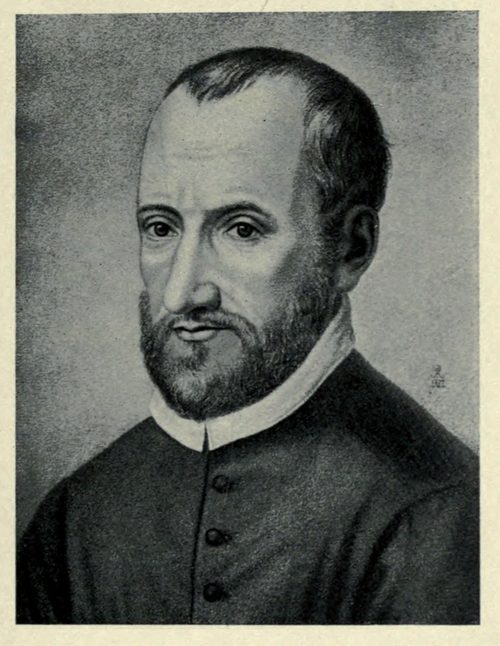
PALESTRINA
By permission of E. H. Schroeder, Berlin
Although most of Italy's early music,
like that of the Netherlands, was written
for the Church, Palestrina was the first
composer to strike a clear ecclesiastical
tone. The tendency had been towards
brilliancy, with a seasoning of unbecoming
sentimentality, and Pope Marcelli,
realizing the inappropriateness of
such musical settings, conferred with
this rising genius, and commissioned
him, in 1563, to write a mass consistent
with the spirit of worship. Palestrina's
third attempt resulted in the great
"Pope Marcelli Mass," which is to-day
as acceptable a model for church music
as it was in the sixteenth century.
I have chosen Palestrina as the first
high-priest because he, like his successors,
Bach, Beethoven, Schubert, Schumann,
and Wagner, was a creator, and
because his works, like theirs, exhale
the incense of the holiest of holies; an
incense which, unlike all others, gains
power with the passage of time.
Palestrina's works are characterized
by lofty purpose and by logically audacious
methods. His voice leading was
so smooth and melodic as to prompt
one of the most erudite of living musicians,
who was at first an anti-Wagnerite,
to say that "Wagner began with Meyerbeer
and ended with Palestrina;" meaning
in the latter comparison to pay the
highest possible tribute to the contrapuntal
skill and musical methods of the
writer of "Die Meistersinger."
Besides Palestrina, Scarlatti and Pergolesi
were the only early Italian composers
whose music outlived the generation
in which it was written. Scarlatti
wrote operas, but it is through his piano-forte
music that his name has been kept
alive. Pergolesi, who appeared on the
scene nearly two hundred years later
than Palestrina, wrote operas which
were received with wild enthusiasm.
During the period of Italy's supremacy
(1500-1700) many forms of composition
were originated, and many
mechanical devices for recording and
performing music were invented or perfected.
Among the former were the
fugue, the oratorio, the latter of which
was at first responsive (alternating
music and reading), but soon assumed
its present character, the mass, and the
opera. (It is astonishing that Monteverde's
operas "Arianna" and "Orfeo,"
produced in 1607-8, embody to some
degree Wagner's idea of consistent
musical drama.) The organ, violin, and
piano-forte were improved, the flageolet,
clarionet, bassoon, music type, punches,
and metal plates were invented, the first
opera-house was built (in Venice), and
the elements of modern orchestra (wind,
stringed, and percussion instruments)
were formally combined.
Flanders' light had shone into France
and England, had awakened the people
of those lands to a sense of music's
latent possibilities, and we find them
working intelligently and with good results;
but our present aim is to follow
the main stream of musical development,
guided by the successive "beacon-lights"
of achievement, along its course.
We will later trace these lesser tributaries.
At the beginning of the eighteenth
century two lights of dazzling brilliancy
draw our gaze from Italy to Germany.
The direct influence of the Netherlands,
which made a deep and lasting impression
on the slow, but earnest, intellectual,
and song-loving Germans, had
quickened their susceptibilities, and had
made them responsive to the riper musical
development of Italy.
The Teutonic character is less emotional
and impulsive than the Italian,
but it is more methodical, more romantic,
and deeper. It is more like that of
the Netherlanders, but in measuring
their status we must not forget that at
the period of which I write two hundred
years had passed since the beginning
of music's decadence in the northern
first home. The Reformation, which
had such a depressing effect upon that
initial art, incited these less scientifically
musical people to song. Luther, who
co-ordinated the modern German language,
also struck a song tone, which
set the hearts of his race into sympathetic
vibration.
The choral voices the deepest strata
of German character, and its spirit echoes
through their more earnest works,—in
the substratum, mentioned in Chapter
III.,—so the Reformation marks the beginning
of Germany's musical culture,
which under direct and indirect guidance
and incitement from Italy grew substantially
and broadened until the eighteenth
century, when the appearance
of Händel and Bach evidences a northward
turn in the stream of development.
The Italians had contributed the most
potent qualities of their nature to this
stream, and now the Germans added
their deep feeling, intellectual force, and
somewhat later their romance. As will
be seen, Italy had not entered an inactive
era, but Germany at this period
took first place among the factors of
evolution, a place she still holds.
BACH
My theory in regard to the essential
character of widely diffused interest in
music finds full endorsement in the conditions
which prevailed at that time, and
still continue in Germany. Luther's
chorals were written for and were sung
by the people. Each worshipper found
in them a conveyance for his devotional
feelings. This feature of church service,
this song essence, gradually permeated
every-day life and bore wonderful
fruit; produced a really musical
nation, out of which our second high-priest,
Johann Sebastian Bach, and his
less German contemporary, George
Frederick Händel, could arise.
Before the advent of these giants
Germany had written and performed
numerous operas, and had in various
ways manifested high aspirations, but
her musicians had composed no monumental
works.
Her early troubadours, of whom Walther
von der Vogelweide was the greatest,
and the "Meistersänger," of whom
Hans Sachs, who lived 1494-1576, was
the most gifted, left no record of their
melodies. The very existence of these
Meistersänger guilds for hundreds of
years shows vitality of purpose and high
aim. Spurred on to ever higher accomplishment
by friendly rivalry, these
guilds doubtless contributed much to the
lyric strain in the German nature, and
therefore to the ultimate greatness of
their "Fatherland." The last of these
guilds was disbanded at Ulm in 1836.
Bach was the mightiest man who has
composed music. A writer who saw
him says, "His black eyes, shining out
of his massive head, looked like flames
bursting from a rock." He was the descendant
of a line that was both mentally
and physically stalwart. His remotest
traceable ancestor was a baker
who migrated from Hungary to Saxony,
and his son, Johann Sebastian's great-grandfather,
was a carpet-weaver and
musician. The two succeeding generations
devoted themselves exclusively to
music, and they furnished half Thuringia
with capable musicians. Their conscientious
work, however, gave no premonition
of the coming sublime climax in
their family achievements.
Johann Sebastian Bach inherited an
iron will, self-abnegation, and devotion
to art. His conceptions soared so far
above the existing traditions, and he
did so little to attract public attention,
that he was but slightly heeded during
his lifetime; indeed, it required a century
after his death and the appreciation of a
Mendelssohn to make the world realize
that a veritable god had lived among
men. The modest cantor of Leipzig's
St. Thomas' school was obliged to
struggle to support his large family, but
he made no concessions to prevailing
taste; he did not depart from the lines
of his ideal to secure popularity. He
patiently submitted to whatever teaching-drudgery
was necessary to earn
bread for his children, but when seated
on his organ-bench or when he took his
quill in hand he admitted no other
allegiance than that to art, and no other
impulse than that which prompted him
to serve her with his fullest powers.
The force, dignity, simple loveliness,
pathos, and grandeur which in turn
characterize his conceptions are so wonderful,
when considered as products of
the eighteenth century, that they and
his serene indifference to recognition
stamp him a unique man,—a musical
Messiah.
Bach's versatility, facility, and physical
endurance were as remarkable in their
way as was the quality of his creations.
He wrote for organ, piano, violin, for
voices unaccompanied and with organ or
orchestra, and asserted his mastery in
each and all of these fields. His preserved
writings would busy a copyist
ten hours per day for fourteen years,
and still Bach, in the absence of other
outlets, found time to engrave much of
his own music. It is to be hoped that
the tardy appreciation of his character
and works, which have at last filled the
world with adoration, may penetrate the
Beyond and warm his heart towards mankind,
who during his life so little fathomed
the depths of his emotions and
failed to see the loftiness of his ideals.
Händel was also great, unless compared
with his greater contemporary.
His best work was the oratorio "Israel
in Egypt." His style was a mixture of
Italian grace and German vigor. He
was a master of vocal resources, and
his works are therefore strong in sonority,
and grateful to both singers and hearers.
Händel wrote fluently, but with a less
sustained earnestness than Bach, and
his compositions have done more to
foster chorus singing than have all other
agencies combined; for which reason the
musical world is but discharging a just
debt in assigning to him the place of
honor on its vocal repertoires.
Of these two masters, Händel wrote
less involvedly. Bach depended upon
the legitimate development of his themes,
whereas Händel often resorted to tone
masses,—was more harmonic than contrapuntal.
Soon after the middle of the eighteenth
century the ever-rising flood of musical
culture became highest in Vienna. This
resulted quite as much from the city's
contiguity to Italy, whose lyric springs
had by no means run dry, as from the
stream of northern influence. Musical
intelligence had by this time become so
diffused that bright lights showed themselves
at many points on the horizon,
but Vienna was made resplendent by a
galaxy that illumined her musical life
and prepared her for our third and
fourth high-priests, Beethoven and Schubert.
The most brilliant of this galaxy were
Haydn, Mozart, and Gluck, each and
all of whom bequeathed treasures to the
world surpassed in value only by those
with which our priestly line endowed
us. "Papa Haydn" gave expression to
his pure aspirations and childlike simplicity
in symphonies, stringed quartets,
and other ensemble works, and in large
vocal compositions. The "Creation"
and "Seasons" are his most ambitious
writings. Few of Haydn's works have
great intellectual power, but they are as
refreshing as rural scenes or well-told
tales. Mozart and Gluck will be necessarily
discussed in Chapter V., so I will
pass them now.
Beethoven was our third high-priest,
because his somewhat earlier appearance
entitles him to precedence over his later
coadjutor. The Vienna school had originated
or evolved the sonata form, had endowed
music with more sustained and
more clearly defined melody, richer harmonic
color, and dramatic power, and
had greatly enriched the orchestra; so
Beethoven began his work with far
ampler resources at his command and
more fertile traditions in which to root
his art than had any of his predecessors.
Beethoven was like Bach in many of
his characteristics; he was self-reliant,
manfully tender, and forcible without
violence. His best conceptions are so
high and noble that they leave human
frailties far behind and suggest the
music of the spheres, but he was less
constant in his fidelity to art than Bach;
not because he yielded to pressure from
without, but because of his impatient
nature, which at times impelled him to
follow routine rather than wait for inspiration
to outline his course. This
resulted in lapses, which will, when
awe has given place to discriminating
judgment, lead the musical world to
discard some of his now blindly accepted
works. This is to be desired,
for those who profess to, or actually do,
derive pleasure from all of Beethoven's
works are either untrue to themselves,
or they are incapable of responsiveness
to his supreme moments, which produced
such wonders of tonal expression
as "Fidelio" and the "Eroica."
BEETHOVEN
It will not matter what forms music
may assume in the course of her further
evolution, Beethoven's more intensely
individual creations will retain their
monumental character, looking serenely
upon passing generations of mankind
like the Pyramids, but even less perishable
than they.
In scanning Beethoven's methods and
the spirit which pervades his compositions,
as compared with those of Bach,
we must take cognizance of the different
social and musical conditions which prevailed
in their respective periods. Europe
was, at the beginning of the nineteenth
century, shaking off her powdered
wigs and their attendant austerity.
Culture was becoming more
confident and audacious, and music reflected
the features of her new environment
in increased geniality and breadth
of scope. Beethoven's methods were
quite opposed to those employed by
Bach. The former drew a grand sweep
of outline, and then used counterpoint
as a contributive element, whereas thematic
counterpoint was the substance
of Bach's creations,—the tissue which
gave them form. Each was a reflex of
the noblest tendencies of his time.
SCHUBERT
By permission of E. H. Schroeder, Berlin
I approach Schubert, our fourth high-priest,
whose ministrations, coming in
conjunction with those of Beethoven,
make their epoch the most remarkable
one in music's career, with wonder for
his achievements and regret for his half-lived
life. That which was so beautifully
said of Keats, "Life of a long life condensed
to a mere drop, and fallen like a
tear upon the world's cheek, to make it
burn forever," would apply equally to
Schubert. He was born into a period
that had already manifested lyric tendencies,
but he was an inexhaustible
spring, from which limpid melody gushed
in ever-increasing volume, filling his
every musical scheme to repletion. Nature
made Schubert the greatest musical
genius the world has seen, and had
his life but reached completeness, he
would, perhaps, have drawn from his
emotional well-spring greater symphonies
than the "C major" and the "Unfinished."
Schubert was virtually the originator
of the modern song, which has been,
and always will be, a great solace to
mankind. It is at the same time the
most practical, because the most easily
understood, means of educating musical
instinct into sympathy with the spirit
that pervades more elaborate forms.
The associated texts make clear their
musical import, and the appreciation
of one really good composition places
us on a vantage-ground from which we
can better comprehend others. Schubert
required the song as a ready outlet
for his lyric productiveness, and wrote
twelve hundred of them without redundancies
and with always definite and
distinguishing significance.
Many gifted composers have put their
most felicitous fancies into this fireside
form, but although some have sung
more impassionedly, and others have
placed their melodies in richer settings,
no one has been so uniformly adequate
as Franz Schubert. Schumann, Franz,
and Jensen always please, and they
often excite our wonder by the beauty
and adaptability of their song conceptions,
but Schubert's songs do not express,
they embody, moods and sentiments.
His flow of melody was so
fresh and strong that in instrumental
compositions it often carried him to uncommon
length. The Germans call his
C major symphony "The Symphony of
Heavenly Length." This phrase quite
aptly describes the work, for an idea of
its proportions, and of the quality which
prevents them from being prohibitory,
are both voiced by the expressive adjective
employed, Schubert scarcely
lived to maturity, but he dispensed such
unalloyed benefits that his name will be
forever enshrined in the hearts of those
who love pure music.
During all this time culture had been
making great strides, and a comprehensive
glance, at the time of Schubert's
death, would have revealed all Europe
aflood with musical enthusiasm. Orchestras
were multiplied and improved, grand
chorus organizations were founded, and
institutions for the education of musical
aspirants were established under the
patronage of various governments.
Out of this condition come two bright
lights that rivet our attention upon Cantor
Bach's old home as the centre of
influence. Our stream of development,
which was a rivulet as it flowed from
Flanders, soon became a mighty river,
and has now overflowed its banks and
formed a great sea of culture.
Mendelssohn was one of the most
genial characters that we meet in the
annals of music. His education and
temperament made the adequate adjustment
of resources to the fulfilment of
his schemes almost intuitive; but his
conceptions themselves, although invariably
round and poetic, usually lack
the bold lines and the deep import that
have distinguished the creations of our
high-priests. Human characters, like
forest-trees, seem to need exposure to
trying winds, which if successfully weathered
only strengthen their fibres and
loosen the soil about their roots, so that
they may spread out and extend downward
to fresh and deeper sources of impulse.
It may be that Mendelssohn's
life conditions were too peaceful, that
he was too much sheltered from care
and adversity to fully develop the depth
and nobility of his nature, which flashes
out in some parts of "Saint Paul" and
"Elijah," and pervades the "Walpurgis
Night."
His happy disposition found its most
characteristic expression in inimitable
scherzi and works of that less emotional
class. Mendelssohn's elegance of style,
richness of color, and his personality
caused a wave of imitation to set across
musical production, but it soon subsided,
for only the most stalwart methods endure
the dilution incident to their adoption
by lesser talent without degenerating
to insipid weakness. Mendelssohn's
greatest service to the musical
world was rendered in his persistent
advocacy of Bach.
Schumann, our fifth high-priest, had
to encounter the difficulties of life in the
open field, having had no social nor
financial breastworks from behind which
he could ignore the "arrows of outrageous
fortune." His path was strewn
with thorns, and was unlighted by recognition
until near its end. Schumann
was not so consummate a master of
counterpoint as was Mendelssohn, but
his stronger individuality and deeper
sensibility filled his fancies with epoch-making
qualities. Our art had during
the previous quarter century taken on
more intensity, greater freedom in voice
leading, and, last of all, a well-defined
romantic vein.
SCHUMANN
By permission of E. H. Schroeder, Berlin
The first two appealed strongly to
Schumann's nature, as is evidenced by
his writings, for the pictures of his imaginings
are not peaceful pastoral scenes,
but depict storms of passion and emotional
struggles. Romance shows itself
at times, but it is not a distinguishing
element. Schumann wrote four symphonies,
of which the last one heard
is always the best. They rank among
the few immortal works in this epic form,
but entirely because of the individual
character of their schemes and the richness
of their musical texture, for their
instrumental colors are not adequate.
He succeeded equally well in ensemble,
chorus, and piano-forte music, and his
songs almost rival those of Schubert, but
strange to say, the orchestra seems to
have been a closed book to our fifth high-priest.
Schumann had, in his impatience to
overcome the weakness of his fourth or
ring fingers, employed a mechanical appliance
which permanently lamed his
hands, thereby dashing his hopes of becoming
a piano virtuoso. This is the
only recorded case in which violent
methods have produced desirable fruits;
for they usually deaden the nerves only,
and result in strength without facility,
and tone without beauty; in other words,
in wooden pianists. In this case they
produced entire disability, and forced
Schumann into his proper sphere,—creation,—in
which he accomplished lasting
good, whereas the benefits to art of
even the highest grade of virtuosity are
comparatively ephemeral.
His love for the piano-forte led him to
study its capacities and limitations most
thoroughly, the consequence being that
his compositions for that instrument are
more grateful to the fingers and ears of
pianists than those of any other classical
composer.
Schumann's music is more involved
than Beethoven's or Schubert's, and his
restless passion found expression in
broken rhythms and in dissonant compounds,
which, however they may at
first impress us, gain natural and deep
significance with close familiarity. He
was the first composer to feel and apply
the immense, expressive resources inherent
in rhythm.
Schumann's quintet for strings and
piano-forte is one of the greatest pieces
of ensemble music that has been written,
and his piano concerto in A minor is, to
my mind, without a rival. Of his songs,
the "Frauen Liebe und Leben" cyclus
are, when the numbers are considered
singly, and then in their respective relations
to his beautifully rounded conception
of womanliness, the most remarkable,
although the "Dichter Liebe" is
full of gems, and the "Spring Night"
is a picture which is more suggestive of
a magic wand than of a human intellect.
Our fifth high-priest was not alone a
musician; he was a philosopher and the
ablest critic the musical world has seen.
He was so broad that he could be generous
as well as just, as was shown
by his laudatory writings in regard to
his rival,—Mendelssohn. He estimated
Wagner's cruder stage correctly, and
would doubtless have become an adherent
of the new faith had he lived to
see its riper fruits; for he was always
susceptible to manifestations of genuine
creative ability and logical reasoning.
The consideration of Wagner, the
sixth in line, involves entering upon a
somewhat new field, and it will require
so much space that I will give him, his
forms, and his methods a separate chapter.
Before undertaking that task it
may be well to trace some of the tributary
influences which, following collateral
lines, have helped to swell the tide of
musical culture. It will facilitate the accomplishment
of this purpose to scan the
achievements of each nation separately,
mentioning only such individuals and
events as were active agents in furthering
the cause.
France evinced a very marked interest
in music early in its second era,
but her good intentions were several
hundred years in crystallizing. The
establishment of an Academy of Music
in Paris (1672) was the first really noteworthy
event in the history of French
music. Tulli, who was its first director,
was a very able man. He wrote operas,
which were sung in French, and he
created the chrysalis from which our
symphony was later developed.
Although the next hundred years
were not productive of great men, Paris
had at the end of that period become
attractive and congenial to such masters
as Gluck, Cherubini, and Piccini. This
shows that she had educated a generation
of intelligent listeners, and at least
a portion of the executants necessary to
the performance of grand opera.
In 1795 the Conservatory was founded,
which event marked the beginning of
that earnest, organized effort that has
given the world so many rare instrumentalists
and vocalists. The finesse
of the French school is delicious when
applied with intellectual breadth sufficient
to prevent its becoming finical. France
has also produced numberless composers,
but few who have attained to
more than passing fame. Her people
are quick in their perceptions, and deft
and dainty in all that appertains to
æsthetics. They are enthusiastic lovers
of such music as does not require them
to think earnestly while following it, but
they are emotionally volatile.
Berlioz is the only French composer
who successfully resisted the pressure of
this environment. He was made of
stern stuff, and followed the promptings
of his muse without wavering, although
she often dictated courses and methods
that precluded immediate success with
the public. In his Requiem Mass, which
looks bizarre to a casual observer of the
score, he uses each and all of the executive
forces, an immense orchestra with
all possible accessories, auxiliary brass
corps, chorus, and soli, with such keen
appreciation of individual quality and
such unerring judgment as to the appropriate
rôle for each quality in the
grand ensemble, that the effects he attains
not only disarm criticism, they fill one
with awe. Still, if we scrutinize Berlioz's
works closely, we find that he was
more a Rubens than a Rembrandt, for
while his diction was often more erratic
than sequential, his sense of tone color
was so acute that it led him to inaugurate
the movement that is still in progress
for purging music of pernicious
unisons reinforcements.
Of the other notable French composers,
Gounod is delightfully melodious,
but is too sweet to be entirely
wholesome, and Saint-Saëns (half German
in instinct and manner) is a phenomenal
master of instrumentation, and
he is very ingenious, but one is seldom
convinced that his compositions have
grown from emotional germs. Massenet,
Bizet, and others have written, or
are writing, charming music, but it has
little substantiality. Its charms are liable
to effervesce, like the emotions of the
Paris public. The French seem to reserve
all of their earnestness for the more
tangible arts, and for science, to all of
which they have contributed their full
share.
England's musical career has been
unique. The people of that snug little
island across the channel should be an
enthusiastically happy race, for nature
endowed their land with fertility and
beauty, and centuries of skillful cultivation
have enhanced these virtues until
Albion's rural loveliness is to-day unequalled.
They have exceptionally rich
traditions, their prowess in arms and
achievements in literature, science, pictorial
art, and industry furnish abundant
grounds for their national pride, but it is
a pity that their blessings have not made
them more demonstrative, for stoical
complacency is not good soil in which to
grow an emotional art. For this reason
recorded English composition, which began
so unprecedentedly well in the sixteenth
century with the invention of the
madrigal, has not fulfilled the promise
implied by that event.
The English are a sturdy race, and
their climate and out-of-door amusements
have endowed their voices with uncommonly
mellow and tuneful qualities. It
is therefore quite natural that their musical
activities should have been so largely
centred in chorus singing, which they
make peculiarly sonorous and artistically
adequate.
This choral virtuosity is not a recent
growth, for it attracted Händel in the
eighteenth century. It was also recognized
by Mendelssohn. This love for
song has been materially fostered by
the Established Church, whose elaborate
services have furnished composers with
both incitement and outlet. Most of
England's choral works are dignified and
smooth, but they lack intensity.
There is an element in English (and
American) musical life the evil influence
of which cannot be easily over-estimated:
it is the popular ballad. In them the
best lyric texts in any language are
associated with musical conceptions
which are usually so devoid of artistic
qualities and significance, that no one at
all musical would endure them were it
not for the halo cast about their imbecility
by the poet's art, which they profane.
The Scandinavian countries, and Russia,
Poland, and Hungary, each with its
distinctive folk-song treasury and romantic
traditions, have, during this century,
awakened to great musical activity,
and each of them has produced one or
more composers who have made an impression
on art evolution.
The first named have given us Svendsen,
Grieg, and Hamerik, not to mention
the artistic but less stalwart Gade, with
their weird and at times grotesque
rhythms, melodic contour, and harmonies.
The sensation produced by these
Scandinavian song characteristics when
first brought to the notice of the outside
world, impelled these talented men to
incorporate them into their art. This
was a mistake, for great music is as
broad as the universe, whereas the vein
of national song is narrow and only limitedly
fruitful. Had Svendsen escaped
infection from this northern piquancy,
he might possibly have fitted himself
to wear high-priestly robes, for his endowments
were of the highest, and his
début as a composer was startlingly
brilliant.
Russia's musical type is less pronounced
than the Scandinavian. Her
producers have therefore developed on
cosmopolitan lines. Tschaikowski, who
was beyond compare the most gifted
composer that Russia has given to the
world, may with the passage of time be
recognized as the natural heir of our
priestly line. His emotional power,
clean-cut individuality (originality), fine
sense of rhythmic values and color combinations,
and his inexhaustible lyric
invention place him at the head of symphonists
of his time.
An event which reflected honor on
the empire of the Czar was the birth
within her borders of that giant of all
pianists, Anton Rubinstein. I speak of
him as a pianist rather than as a composer,
for while he often showed the
possession of uncommon creative faculties,
he was too diffuse, seldom focussed
his tonal diction to such coherent
strength as would make his writings
comparable with his playing.
Poland gave us Chopin, who is the
one exception to the rules by which I
have endeavored to trace the successive
stages of musical evolution. All other
composers have taken inherited forms
and means, and have moulded them into
shapes comporting with the spirit of their
individual conceptions, and even these
conceptions were to a considerable extent
reflections of their environment. Beethoven
was a mighty genius, but he did
not create an art type, and was therefore
not, in a broad sense, original, whereas
Chopin was radically so, his works seeming
to owe no allegiance to schools, and
seldom to nationality, but only to his
poetic soul, of which they were the
legitimate offspring.
His fancies are sometimes more graceful
than strong; they even, now and
then, verge on the sentimental; so Chopin
is not entitled to a place among the
giants, although he revolutionized composition
for the piano, and wrote some
things so beautiful that they excite ever
fresh wonder. The small form seemed
to best suit his spontaneous style; therefore
op. 10 and op. 25, and the preludes,
undoubtedly better represent Chopin's
individuality than do any other of his
works.
Franz Liszt was born in Hungary, and
in his less serious moments made use of
the gypsy-like rhythms, twists, and spasmodic
utterance of her national music.
At other times he wrote universal music,
which he made characteristic through
breathing into it his own rich individuality.
The Abbé Doctor was more
fêted and less spoiled thereby than any
successful artist of modern times. He
led a life of triumph from youth to old
age, and through it all preserved a simple
modesty of manner, interest in new
talents and accomplishments, and an indescribable
intellectual fascination.
Nothing afforded Liszt more pleasure
than to give advice to, or to use his influence
for the benefit of, talent struggling
to clarify its own conceptions, or
seeking indispensable publicity. The
list of his protégés includes many who
have made world records, like Raff,
Bülow, Tausig, and Wagner. But for
"Meister" Liszt's early perception of
Wagner's then undeveloped genius, we
should have had no sixth high-priest to
record, and no Bayreuth festivals.
America has only recently entered the
lists, for the conditions attendant upon
a new civilization make artistic achievement
impossible. These conditions were
emphatically bad in our land, and they
yielded reluctantly to art requirements.
The religious bigotry of a large portion
of those who first came to America,
seeking freedom of conscience (for those
who thought and believed as they thought
and believed), was deadly to art impulse.
They looked upon any music not set to
sacred words as a frivolity that would
imperil their souls, and they exercised
little judgment in selecting such music
as they did use. This narrow view of
our art greatly delayed the advent of
musical intelligence, and it called a
species of "psalm-smiters" into being,
who, with inappropriate adaptations of
secular melodies, and worse attempts at
composition, debased both music and
the services of the church, and sapped
the vitality of art tendency when it first
became manifest. America still harbors
some of these vampires, but the day of
art is breaking over our land, and
these creatures of darkness will soon
disappear.
Our progress was at first slow, but
there have been no backward steps, and
the past fifty years have witnessed a
magical advance in general intelligence
and in creative capacity.
Before closing this chapter I must return
to Germany and trace some of the
subsidiary sources of her present supremacy.
The name "Robert Franz," which
was years ago adopted by a timid young
musician as his nom de plume, was formed
by combining the first names of his ideal
tone poets, Schumann and Schubert.
His success was immediate, and he soon
became so identified with this name
that his own almost passed out of use.
Robert Franz was a pure lyrist, and his
songs must be given place little below
those of his great models. He served
to perpetuate the spirit of song, and
placed the world under tribute by his
Bach researches.
Raff was a man of startling routine,
and of no less astounding inequalities in
merit. Some of his symphonies are
replete with sensuous melody and fresh
harmonic, contrapuntal, and instrumental
color, while others are incomprehensibly
dull. "Leonora" and "Im Walde"
represent Raff at his best, and they are
so strong and beautiful that they will
keep their creator's name before the
musical world for many years. No one
can predict how long Raff's mastery of
methods and forms will exert a salutary
influence upon composers.
Schumann was Brahms' musical god-father,
and he predicted great results
from the development of his godson's
talent. There is much difference of
opinion as to whether Schumann's prophecy
was fulfilled, but many capable critics
are on the affirmative side. Brahms
has, in one way at least, shown the possession
of absolutely great qualities,—viz.,
his productivity did not exhaust,
but increased the vitality of his conceptions.
He was an artist with whom
future generations will have to do, but
he was not an epoch-maker.
CHAPTER V WAGNER AND THE MUSIC DRAMA — FOOTNOTE:
It is quite proper to devote a
chapter to Richard Wagner, for
his later works are not only examples
of the most skillful and purposeful
employment of the contrapuntal and
instrumental resources which he, in common
with his contemporaries, inherited
from the past, but they show how audacious
genius may safely pursue its purposes
out beyond beaten paths into
unexplored regions of tonal expression.
Why may genius do this, which is so
uniformly fatal to the less gifted? It is
because of its comprehensive grasp of
logical sequence and its intuitive choice
of adaptable means.
Ripe genius is a definite talent which
has been subjected to exhaustive discipline,
which is familiar with traditions,
and takes full cognizance of pedantic
forms, but is guided by an art feeling
engendered by this knowledge, and not
by the knowledge itself.
It is a law unto itself. It conceives a
picture, a poem, or a musical sentiment,
and communicates it to us through
means that are often as unfamiliar as
is the effect of the whole original; for
it usually avoids the ruts of travelled
ways, its clear view of the objective
goal enabling it to follow the less frequented
stream-side or mountain-top
paths.
Wagner was, in the last thirty years
of his life, a ripe genius. He was the
sixth of our musical high-priests, and
he filled the art temple with a characteristic
song incense which will pervade its
atmosphere as long as human passions
continue to furnish art impulse.
There is a class of pedants who still
take satisfaction in calling Wagner's
music artificial; but these short-sighted
critics cannot or will not properly survey
the field of his activity and its fruits.
No human mind could, unless impelled
by natural, sequential feeling and virile
imagination, write even one of his later
dramas without manifold exhibitions of
weakness in redundancies and lapses
in significance. The fact that Wagner's
works, from the "Meistersinger"
on, show few, if any, such barren moments,
adequately evidences their natural
growth from musical germs.
A great creator always incites a large
number of lesser lights to imitate his
methods, but few of them do so successfully.
Wagner is not, however,
answerable for the vague effects of his
dramatic means, when they are transplanted
into Wagnerish overtures and
symphonic poems. He evolved situations
that made these means legitimate
and significant; isolated, they fall into
bizarre artificiality. Although we cannot
fail to be influenced by the elements
which Wagner added to tonal resources,
they, like all other elements, must be
applied because most adaptable to the
development of the musical scheme in
hand, and not because of their newness.
"A prophet is not without honor save
in his own country." This was strikingly
exemplified by the attitude of professional
Leipzig towards Wagner during
the earlier stages of his career. Leipzig
was at that time regarded by the outlying
world as the musical centre of the universe,
a Mecca with a magic balm, dispensed
by a priesthood whose Mahomet
was Mendelssohn.
The town had been a prominent seat
of learning since the first part of the
fifteenth century, had possessed Bach as
cantor of its "St. Thomas' school," had
for a long series of years maintained its
"Gewandhaus" concerts, and was the
greatest of all book- and music-selling
marts.
These circumstances combined to
make Leipzig stand out in bold relief
on the world's map, but it required
Mendelssohn's magnetism to make its
attractions irresistible.
The Conservatory faculty of those
days included all the most prominent
musicians domiciled in Leipzig, for the
town was too small to furnish adherents
for such contra-minded parties or factions
as exist in larger cities. Mendelssohn
had enlisted his forces with
well-directed regard for harmony, but
their creed, although properly placing
Bach as the corner-stone of musical
faith, was too narrow in its tenets to
admit those to communion whose fancy
led them outside the pale of traditional
forms. They were even lukewarm towards
Schumann, who had lived among
them, had created a period,[A] and had
contributed treasures to musical literature
so luminous with genius that, as
the mists of prejudice clear away, they
will eclipse forever all contemporaneous
productions in the various forms which
they followed. The rugged boldness
of originality was in the esteem of the
Leipzig pedagogue but an exhibition
of crude ignorance. Those who could
not or would not recognize Schumann's
great throbbing heart in his writings, because
he, in expressing his individuality,
did not always follow prescribed formulæ,
would naturally have rejected
Wagner, for his earlier works were not
cast in classic moulds.
Those of Wagner's creations which
had been before the public previous to
1860 were characterized by few departures
from Weber and Meyerbeer in
scheme. Wagnerian harmonies were,
however, too strong for the Leipzig
critic, but the public flocked to hear
them, and was pleased.
Original ideas often find first recognition
among the non-professional, because
musical leaders are so saturated
with pedantry that sparks of genius
cannot quickly kindle them to enthusiasm.
In 1862 the Gewandhaus directors
made a great concession; they invited
Richard Wagner to conduct his "Tannhäuser
Overture" at one of their concerts.
This was a fatal mistake, for his
triumph was complete, and their influence
as opponents of the "music of the
future" was correspondingly weakened.
I have discussed Leipzig at such length,
not because it was Wagner's birthplace,
but because from this town, with all its
intolerance and smallness, started the
only short road to success. Leipzig's
endorsement was a universally accepted
voucher.
Wagner had found this direct path
barred, and his wanderings in surmounting
or circumventing obstacles lasted
for a long series of years, but his faith
remained steadfast, and he reached the
goal of his ambition a far stronger
man because of the difficulties he had
overcome. His appearance at the
Gewandhaus was only a station on his
course to already assured success, and
not his starting-point.
Wagner found opera a succession of
solo, ensemble, and chorus pieces, strung
upon plots often too slender to give them
coherence.
Texts had been made subservient to
music, and that, in turn, to the singer's
convenience and ambition for display.
Operas were written as early as the
thirteenth century, but Cherubini was
the first Italian, and Gluck the first German,
to produce works that have survived.
Cherubini was followed by Rossini,
a man of genius, but too indolent
to fully develop his gifts. Had his
beautiful sensuous melodies been put
into richer settings, had more earnest
thought been added to his spontaneity,
his operas would have taken their places
among the undying creations.
Flashes of genius ultimately tire. It
is the steady light of genius, fed by
knowledge and earnestness (as in Beethoven,
Schubert, and Schumann), that
can hold the world's attention restfully,
which means perpetually.
Bellini, with "Norma" and "Sonnambula,"
and Donizetti, with "Lucia di
Lammermoor" and "Lucretia Borgia,"
still hold a place on the operatic stage,
but their grasp is weakening. Verdi
was the best equipped of all Italian opera
composers, and his "Trovatore," with
it rare gems, will crown his memory to
the end of musical time. His later
works, "Aida," "Othello," and "Falstaff,"
written under the influence of the
Wagner period, are quite different from
his earlier operas in instrumentation
and in treatment of themes. In them
he is more logical and stronger, but less
sensuous. They furnish the first instances
of Italian music dressed in foreign
garb; of Italian music written
under pressure from without. It has
until recently been Italy's province to
shed influence over the musical world.
I construe Verdi's concessions to Wagner
as the strongest possible endorsement
of the latter's ideas. No other
composer was in position to pay such
tribute to Wagner's forceful and far-reaching
art sense.
The Italian composers of the new
school are musical brigands, who for a
brief space succeeded in taking tribute
from the musical world. Their leader,
Mascagni, made such a sensational raid
with his "Cavalleria Rusticana" that
young Italy jumped into the breach he
made, and evidently thought to take
possession of our temple, regardless of
their lack of equipment and discipline.
Although but few years have elapsed
since this assault on art, its episodes
have already been relegated to the
realm of disturbing memories.
"Cavalleria Rusticana," the first and
best of its class, has some merits; it
is short, melodious, and dramatic, but
its melodies are often sentimental, and
its dramatic points are usually made
through the audacious employment of
crude means. The direct influence of
this work and its reception, conspired
for harm to art.
Gluck was a Teuton, and although
educated in Italy and adopted by
France, can with propriety be called
the father of German opera. His "Iphigenia
in Tauris" and "Orpheus and
Eurydice" will always be regarded as
classic models of lyric writing. Gluck's
schemes differed little from those of the
Italian school, but his harmonic and
instrumental methods were German.
Mozart was a phenomenal combination
of inconsistencies. His routine
and creative genius were of the highest
order, his spontaneity and finish make
his music delightful alike to amateurs
and musicians, but he seldom seems to
take matters seriously. "Don Juan,"
the "Requiem," and his string quartets
are exceptions, for in these he is earnest
and does his genius full justice.
Beethoven gave us "Fidelio." He
was equally endowed with Mozart, but
was actuated in what he did by earnest,
deep feeling. "Fidelio," although built
on the old and now discarded lines, will
only take second place (musically) when
some genius arises capable of writing
symphonies to supersede Beethoven's
nine. In "Fidelio" we still have the
string of well-defined pieces, but they
are rich in harmonization and polyphony.
Weber made a great impression on
opera. His audacious use of the orchestra
and of modulation, opened up new
fields of possibility, and there is a doubt as
to whether modern German opera would
have become what it is, had Weber not
lived. He was gifted with an inexhaustible
store of melody, was equal to all
dramatic situations, however exacting,
and could court popular favor without
belittling his art,—a very rare quality.
Weber was at first Wagner's model,
and "Rienzi" and "Der Fliegende Holländer"
bear a distinct Weber impress.
Meyerbeer was a German, but early
adopted Italian methods. He was an
excellent business man, possessed ample
means, and therefore secured deserved
recognition early in his career, instead
of having lived almost a life of deferred
hopes, as is usually the good musician's
lot. Meyerbeer is melodious, and is
often dramatic, but unlike Weber, sometimes
belittles his art in catering to public
tastes. His pageant and ballet music
are the most characteristic and impressive
features of his operas.
Wagner expressed contempt for
Meyerbeer, but evidently recognized the
grandeur of the operatic pageantry of
which he was the creator. We see evidences
of this phase of Meyerbeer's influence
until we pass the "Lohengrin"
stage.
Many other good operas were produced
during the first half of this century,
but as they were not potential factors in
operatic evolution, I shall mention them
only in passing.
Adam wrote "Postillion;" Auber,
"Fra Diavolo," "Die Stumme von Portici,"
etc.; Flotow, "Martha" and "Alessandro
Stradella;" Hérold, "Zampa;"
Kreutzer, "Nachtlager von Granada;"
Lortzing, "Der Waffenschmied," "Der
Czar und Zimmermann," etc; Marschner,
"Hans Heiling," "Der Templer
und die Jüdin," and "Der Vampyre;"
Nicolai, "The Merry Wives;" Spohr,
"Jessonda" and "Faust," and Schumann,
"Genoveva." All of these operas
are still given at least occasionally, and
most of them are excellent musical compositions.
The situation at the time when Wagner
first manifested a defined tendency
towards the music drama was as follows:
Gluck had given the world his two great
works, and they, together with "Fidelio,"
"Don Juan," "The Magic Flute," "The
Marriage of Figaro," "Der Freischutz,"
and "Oberon" of the German, and
"Trovatore," "William Tell," "Norma,"
"Lucia di Lammermoor," "La Sonnambula,"
"Robert le Diable," "Der
Prophet," and "Die Hugenotten" of the
Italian, were the most prominent and
best examples of operatic writing.
Although the first steps towards the
emancipation of opera from inconsistencies
were the result of conditions rather
than of premeditation, Wagner had sufficient
genius to appreciate the power inherent
in logical sequence: a power
which, when compared with that resulting
from eccentric modes, is as the progress
of the ages to that of a leaf borne by the
wind. Logical sequence moves onward
with irresistible momentum, whereas
fragmentary diction is blown about by
every wind of caprice.
The condition which most influenced
Wagner's conceptions was his relation
as poet to his musical undertakings.
He was in each instance first poet and
then composer, and nothing could have
been more natural than his early evinced
disposition to guard his texts from distorted,
disconnected renderings. This
disposition grew, as through experience
his grasp became more and more comprehensive.
There were no backward
steps in his career. It was like his
schemes,—consequent,—advancing unwaveringly
from inception to full realization
in "Parsifal" and "Tristan und
Isolde."
Wagner had courage adequate to
sustain him in following his conceptions
through ridicule, want, and almost
utter friendlessness. No discouragement
could divert him from the even
tenor of his chosen course. His early
operas, although their texts were treated
with unwonted respect, gave little intimation
of the revolution which was to
be accomplished by their author, and it
is extremely doubtful whether Wagner
at this period had a shadowy conception
even of that later ideal, which time and
experience developed, in which music
and the pictorial element were not only
to collaborate with, but were to reproduce
the situations and sentiments of his
poems.
This kind of tone painting, in which
the composer endeavors to endow his
musical phrases with definite significance,
is justifiable and effective when they are
so closely associated in performance with
the motive text as to derive directness
from its more tangible character. Such
efforts must not be classed with so-called
program music.
"Der Fliegende Holländer", "Rienzi,"
and "Tannhäuser" might have been produced
through the co-operation of Weber
and Meyerbeer, with Wagner's individuality
as a flavor. In them the voices are
given melodies in clear-cut form, and
they contain pompous Meyerbeerisms
almost approaching the bizarre. This
Wagner flavor, which consisted largely
of a disregard of harmonic laws and
key relationships, as dictated by the pedantic
school, caught the public, but it
aroused the violent opposition of older
musicians. They denounced Wagner as
a crazy ignoramus and his operas as
abominations.
Viewed from a theoretical stand-point,
there was that in Wagner's earlier
works which in a measure justified his
critics. He was not a good contrapuntist,
and he consequently violated
tenets of musical structure when conformity
would have been more adequate.
The relations borne by plastic musical
diction to the elementary rules of tonal
science are so little understood, and a
clear understanding of these relations is
so important, that I feel justified in reiterating
in different form what was said
in a former chapter,—viz., that musical
theory as a whole is but the codification
of nature's adjustments. Extraordinary
requirements license exceptional means
and modes, but when composers abandon
the letter of musical tenets and
substitute therefor the higher law of
compensation, they enter upon a field in
which pitfalls abound, and through which
nothing but keen judgment, founded
upon experienced erudition, can safely
guide them.
This law of compensation allows us to
disregard elementary laws, when the
nature of the situation in hand is such as
to warrant and reconcile our musical
sense to combinations or successions,
which would without this justification
sound crude and faulty. The habit of
what is called free writing is most pernicious,
for compensation must legitimize
each irregularity or we lapse into
incoherency.
Wagner was a firm, but an equally
thoughtful man, and while apparently
undisturbed by the cyclone of criticism
evoked by his compositions, saw his
vulnerable points, and at once set about
fortifying them. He studied counterpoint
exhaustively, taking Bach as his
model, and memorizing many of that
master's most characteristic works. He
then gave the world "Die Meistersinger"
as the fruit of his labor, and
therewith forever silenced honest cavillers
who had based their adverse criticisms
on his ignorance, for that work is
a sublime example of contrapuntal virtuosity,
and it marks the beginning of a
new era in Wagner's development as a
musician. His orchestral settings having
kept pace with his musical growth, had
ripened, had become tempered, consequently
"Die Meistersinger" is one of
the most beautiful compositions of any
time, and in it we have the clear announcement
of the new dispensation.
There have been tons of literature
printed, having as subjects "The Music
of the Future," "Wagner," and "The
Music-drama," some of the authors of
which have been properly equipped
(good musicians and liberally educated
men), but more have been literary
scavengers. The former class, having
been on a war footing ever since Wagner
became a bone of contention, are
only just now beginning to discuss his
creations dispassionately. Most of them
were quite naturally arrayed against
Wagner, for the most pungent flavor of
the educated critic's writing is pedantry.
He prefers traditions without originality
to originality which does nor conform to
traditions.
Wagner's first works almost paralyzed
these gentlemen, and they were a
long time forgetting and forgiving the
shock. Their criticisms were terribly
acrid, but, as I have before mentioned,
were instrumental in creating the music-drama,
inasmuch as through pointing out
veritable faults and weaknesses they
led Wagner to broaden his scholarship.
These critics find it hard to lay down
their arms, although the battle is over,
and Wagner died in full possession of
the field. The few who were from the
outset in sympathy with Wagner were
quite as intemperate in their laudations
as were his opponents in their strictures.
They were blind idolaters, and Wagner
was their musical "golden calf."
The essence of the creed upon which
the new dispensation is based is logical
consistency. Poetry, music, and "stage
business" are by it required to co-operate
in expressing sentiments and in carrying
the threads of dramatic schemes.
Each of these arts is entirely essential
to Wagner's creations. His texts are
statues, which music, stage-setting, and
action imbue with life. For this reason
no one can hope to follow Wagner
intelligently who starts without having
made himself conversant with his poems.
His later texts are heroic epics of no
mean order. Their adaptability and
musical suggestiveness are phenomenal.
They could have been produced only by
a musician-poet who had his completed
pictures in view while writing them.
They contain a vast amount of a
species of word-painting,—viz., the use
of words the very sounds of which are
expressive. I remember well the hilarity
caused among the anti-Wagnerites by
the "Nibelungen" text, which was published
some years before the operas
were performed. Satires and parodies
were written; Wagner was described
wooing his muse arrayed in fanciful
vestments suiting the character of the
subject under treatment. That was a
happy time for his opponents. Opera
texts that were not sentimental lyrics
were incomprehensible. The "Call of
the Walküre" was to them the climax
of inanity; but those who have heard its
musical setting will readily understand
how its performance hushed these
scoffers into respectful silence. I mention
this "call" because most musical
persons have heard it, and wondered at
its adaptability.
Wagner bestowed the utmost care
upon each and every task which he undertook;
his effects are, therefore, less
accidental than those of any other composer.
He was in the habit of making
three manuscripts,—viz., a sketch in
which the outlines of form and character
were defined, then a score in which
contrapuntal and instrumental material
were developed, and, lastly, a manuscript
in which, after ample weighing
and filing, each detail of dynamic marking,
etc., was not approximately but
precisely indicated. A Wagnerian crescendo
or decrescendo must begin and
end with the notes and dynamic force
prescribed by the master, or we miss
the full realization of his pictures. In
securing instrumental color he was liable
to mark the various parts played together
differently, ranging from forte to pianissimo,
according to the combination and
registers of the instruments employed.
Wagner left little or nothing to the
conductor's discretion. Nevertheless,
there are few who have the keen, delicate
perception requisite to understanding
his aims, and still fewer who have it
in their power to so control their forces
as to secure their fulfilment.
We will now look at some of Wagner's
methods of musical treatment. In
the first place, we find the Overture replaced
by the Vorspiel (prelude or introduction).
The former, in its independent
completeness, complying more
or less with the exactions of the sonate
form, was quite in place when operas
consisted of detached pieces; whereas
the "Vorspiel," which is analogous to
the dramatic prologue, is better adapted
to the newer form. It is composed of,
or at least it introduces, the pivotal
themes of the drama which it precedes.
In the prelude to "Parsifal," which begins
with the communion theme, Wagner
has accorded to it, and to the grail and
faith motives, places of honor. They
are, indeed, the foundation upon which
the whole drama rests, and are the keys
to its situations. We find the traditional
closing form (Coda) conspicuous
by absence, the prelude leading up to
and closing in the opening tones of the
first act. This omission is grateful, for
all careful musical listeners must have
been disturbed time and again by the
long-drawn, fanfare effects that custom
has placed at the end of musical pieces.
They are relics of barbarism to which
even Beethoven's genius could not impart
logical significance. The composer
who, having finished the development
of his themes, having said what he had
to say, appends a closing form composed
of either new material or of old
inconsequently presented, sacrifices symmetry
and vital force.
If custom required poets to attach
Hallelujah-Hosanna verses to their finished
poems, the result would not be
intrinsically more incongruous than that
produced by the average musical coda.
A piece of music should end roundly,
with a peroration, but this peroration
must be adapted to the character and
length of that which has preceded it,
must grow out of the themes from which
the piece has been developed, and form
an integral part of the whole. The oft-mentioned
intangibility of our art seems
to induce timidity among her devotees,
and unfortunately this timidity is often
greatest among those who are best
fitted to introduce innovations.
We will next consider the vocal treatments
of Wagner's texts. Following
his course from the beginning, we find
the singer's parts grow less and less
melodic, but the listener, if not the
singer, has more than adequate compensation
for this loss of lyric quality
in the dramatic power gained. Reverting
to our simile of the statue, the stage
setting and orchestra provide an atmosphere,
and the singer breathes into the
text the breath which launches it into
life.
In his later dramas Wagner makes
the vocal parts purely musical declamation.
He endeavors to, and usually succeeds
in intensifying the elocutionary
effects through changes of pitch and expressive
rhythm, but gives the singer's
convenience and voice limitations little
attention. The singer's parts are, therefore,
very difficult to learn and exhausting
to sing, and they afford so little opportunity
for display that only a love
of art, strongly flavored with self-abnegation,
could induce singers to attempt
them.
My study of Wagner's works has
greatly increased my respect for the
intellects of Wagnerian singers. Any
man or woman who can sing a leading
part in one of the music-dramas acceptably,
must have been endowed with
strong throat and lungs, and must have
acquired a faultless vocal method.
It is almost needless to say that the
texts are set without any of those old-time
illogical repetitions in which composers
indulged, in order that happy
thoughts—good musical episodes—might
be amplified. Wagner never lost
sight of his central idea, and made
everything bend to its fullest realization.
His orchestra does not accompany, in
the common acceptation of that term,
but sings into its many-voiced melody
the sentiments and moods suggested by
the text. The principal means used
in the attainment of this end is the
"Leit Motif." Its auxiliaries are the
countless shades of harmonic and instrumental
color which Wagner commanded.
These "Leit Motifs" (leading and
characteristic themes) constituted Wagner's
vocabulary. They expressed to
him personalities, moods, or sentiments,
as the case required, and they were
consequently chosen to impersonate
these in his schemes. They sometimes
consist of a few tones, and again of
phrases. They appear in varied forms
to suit changing conditions, but their
impersonations are only made clearer
through their elastic adaptability. These
themes seldom appear in the vocal parts,
but Wagner makes them, through adaptation
and instrumentation, express each
shade, from sunlight to storm, from love,
trust, and worship, to wrath, fear, and
hate, and in this way follows his text on
parallel lines,—music by the side of and
reinforcing poetry.
Wagner's demands on the stage-carpenter
and scene-painter are so great
that none but large theatres with ample
means can properly realize his ideas of
pictorial illustration. He possessed remarkable
talent for inventing scenic
effects, and disregarded cost.
Wagner originated the idea of having
the stage overshoot the space allotted
to the orchestra, the effect of which has
been good in most instances where applied.
It has two advantages over the
common placing,—viz., it brings the
singer nearer his audience, which facilitates
his task of making himself understood,
and it has a grateful tendency to
suppress obstreperous brass, who have
a way, when placed in front of the stage,
of making singers forgotten. I have
seen singers struggle with tense muscles
and swelling veins to make a vocal
climax with no other result than an
heroic spectacle.
When a conductor allows his brass to
bury the more modest elements of his
orchestra under their clangor, he shows
incapacity,—either a lack of control or a
coarse conception of their mission,—and
as this incapacity is quite common, any
mechanical device which will insure
moderation on the part of our assertive
friends who play the trumpets and trombones
is worthy of commendation.
Now let us see what can be done
towards putting ourselves still more
closely in sympathy with the master,
and to better prepare ourselves to follow
his creations intelligently. Following
intelligently does not imply merely
the recognition of episodes of especial
significance or beauty, but much more:
it implies the loss of no contributive
detail and an easy grasp of the combined
means.
Exhaustive study alone can make this
possible. Its importance must serve to
excuse my reverting to the subject of
texts. One should never take a book
into an opera-house, but should make
it superfluous through earnest and repeated
readings at home. We should
at least so familiarize ourselves with the
text of works worthy of hearing, that
we can anticipate situations and keep
in touch with each and every detail of
action and shade of meaning. This
having been accomplished, and having
made ourselves acquainted with the
more important Leit Motifs, we shall
be intellectually equipped to follow the
master in the development of his music-drama
on the lines and through the
methods we have considered.
I do not wish to claim that the most
favorable conditions would enable us to
fully understand intentions, or to discover
all points of beauty and strength
in one hearing; our study should, however,
have placed us quite inside the
cold curiosity line. We would be entitled
to a creative sense akin to that felt by
a co-worker: our natures would have
been made acoustically receptive and
responsive.
[A] Composers who originate forms or methods
that recommend themselves to the musical world
because they voice recognizable advance in art expression,
create periods. Mendelssohn was in his
more earnest moods a modernized Bach. He did
not originate forms, but adapted those of his great
ideal to our nineteenth century habits of thought
and feeling. He did this inimitably, but he was
more finished than forceful or bold, and his impress
on art was consequently not deep, although extremely
salutary.
CHAPTER VI WHAT ARE THE INFLUENCING FACTORS IN DECIDING MUSICAL DESTINIES? WHO IS TO BE OUR SEVENTH HIGH-PRIEST?
For reasons inherent both in
music itself and in man's sluggish
and prejudiced perceptions,
really great composers have usually
to wait longer for recognition than
do those of mediocre capacities. Music
that is worthy of consideration is
as individual as its composer's features
or his unconscious habits. It is a tonal
utterance of his most intimate nature,
an inarticulate but clear expression of
his strongest emotions,—a shadow-picture
of his very soul. The more intense
the nature, the stronger the emotions;
and the deeper the soul of the composer,
the less quickly can we apprehend
the full import of his writings, for
they are characteristic of him and foreign
to us. Each period-maker adds so
much to art resources and so materially
modifies art methods, that he may be
said to originate a musical dialect, with
which our ears and minds have to become
familiar before his poetic schemes
can assume for us sustained and clear
significance.
Because of this alien character of pronounced
originality, high-priestly honors
are usually posthumous, for they are
bestowed only upon those who have
convinced the musical world of their
fitness through the life-long, patient, and
intelligent use of supreme endowments.
It is the musical world only that has the
power to confer high-priestly honors,
for that office is not at the disposal of
composers' friends or adherents, nor of
parties or clans. One must have gained
universal recognition as a beneficent
and radically new factor in art in order
to secure the requisite suffrages, and
that requires so much time that but two
of our six high-priests lived to realize
the honor. Even Beethoven did not
live to feel full assurance of immortality,
but Wagner did. He knew that his
innovations had been accepted by the
world, that his achievements broadened
the foundations of art and opened new
channels for musical thought, that his
individuality shone brightly across the
broad sea of modern culture, a "beacon-light"
of resplendent brightness, and
that he was a period-maker, whose impress
upon art was too deep to wear
away, for he was a musician who abated
not one jot or tittle of that which he
thought was art's due.
This working throughout life for posthumous
honors is not so depressing as
it would seem at first glance, for any
man, however modest, if blessed with
supreme endowments, must feel his
power, and be buoyed up by the certainty
of ultimate recognition. The art
love, steadfastness, ambition, individuality,
and imagination of truly great
men are proof against the struggles and
discouragements of the artist's existence.
Time is then our final tribunal, the
only adjuster of musical values who
makes no errors in judgment. The
individual judge gauges the merits of
contemporaneous composers, guided by
his or her personal impressions. Time
gathers composite impressions made
upon races of music-lovers during decades,
and her verdicts, based upon
these impressions, are final. We are
sometimes nonplussed, and even rebellious,
when the success of our favorite
composer, or of some especially sympathetic
piece of music, proves ephemeral,
but the fittest always survives, and the
fittest is the composer or work which,
in addition to the indispensable technical
and æsthetic qualities, is pervaded by
the richest vein of altruistic individuality.
If time be our final tribunal, then professional
critics are the advocates who
present the claims of artists at the bar
of her court. These advocates differ
widely in ability and in character. A
few of them have great learning, acute
perceptions, and honesty; they will advocate
no cause that is prejudicial to the
interests of art, our muse having, as it
were, endowed them with a super-retainer.
Such advocacy embodies the
highest and best of which the limitations
of individuality admit. From this ideal
standard professional critics grade downward
until they reach assertive, prejudiced,
and sometimes malicious ignorance.
In passing down the scale we
first find capacity without the essential
confidence in convictions (timid ability is
always a weak factor in adjusting affairs,
whether artistic or material), then honesty
and good-will unsupported by
capacity, then capacity biassed by prejudice
or self-interest, and last and worst,
the pettifogger. These classes show
arrogance, and attract attention (temporarily)
in inverse ratio to their abilities.
If we scan the history of our
tribunal, we find that the more assertive
the advocate the smaller his sphere of
influence.
The great public is the jury in this
court, and its decisions, although ultimately
wise and just, are always so delayed
by the babel of pleas that dins in
its ears, that I feel justified in devoting
a little space to these "moulders of
opinion," and to facilitate my purpose
will use a simile drawn from nature,
which is less whimsical and more reliable
than man.
Music is like a sensitive plant,—it
flourishes only when each and every condition
is favorable to its growth. For
this reason those who find pleasure, edification,
and comfort in its subtle qualities
should imitate the skilled gardener
in his watchful and discriminating culture
of flowers. A professional gardener is
to horticulture what a critic should be to
art. Each is supposed to bring trained
faculties to his task, but the gardener,
familiar with the principles that govern
flower growth, studies the natures of his
germs, and then adapts soil, temperature,
etc., to the requirements of each.
He thus starts out with one material advantage
over his art confrère, in that his
experience enables him to recognize the
genera of his germs and to anticipate
results. He deals with seeds, roots,
slips, and bulbs; the art critic with the
mysteries of individuality, of which he
most often judges from the impressions
made upon his susceptibilities by a momentary
contact of its outward manifestations.
These manifestations are
seldom full and trustworthy indexes of
creative capacity, especially in the cases
of young composers, because of the
unfavorable conditions that so often
attend upon their development and
presentation.
Communities are gardens in which
music thrives, barely exists (the most
common condition), or entirely fails to
take root. Propagation is the crucial
test of vitalizing qualities. A community
that can produce new varieties, really
audacious talents, must possess a high
degree of fertility. The composers to
be found living and creating in any given
place are therefore reflections of their
musical environment, for the faculties of
musical organisms are more sensitive
even than music itself. Transplanted
music will continue to exist under conditions
that afford no incitement to earnest
creation, nor the elements from which
virility may be drawn. Beethoven's
works interest communities in which his
faculties would have remained latent.
The legitimate functions of criticism
are to seek out and to nurture true talent
and to guide public discrimination in its
initial judgment. Critics and reviewers
are experts to whose expressed opinions
the printing-press imparts degrees of
convincing power not always comportable
with their merit, and spreads them
broadcast for good or ill. Printed criticism,
because of this cogent quality, and
because it appeals, and may repeatedly
appeal,—being in fixed form,—to so
broad a radius of intelligence, should be
the most powerful as well as the most
active agency in creating the conditions
essential to musical growth; but a careful
review of the past and present relations
of criticism to art culture would,
to my mind, convince any unbiassed
thinker that the decision of our court
had been delayed and not facilitated by
the average advocate, and that the productivity
of our garden had never been
increased by the ministrations of professional
gardeners.
Nevertheless, printed criticism has a
momentary influence. We do not necessarily
surrender when confronted by
criticisms at variance with our own ideas,
but the undue weight with which printed
matter is endowed often causes even
expert opinion to waver, protest to the
contrary as it may.
Printed news is not always authentic,
nor are printed opinions on finance,
political economy, sports, weather, etc.,
infallible, although usually written by
specialists; but these matters, being material,
adjust themselves, and their editorial
short-comings seldom do irreparable
harm; whereas our sensitive art, the
elements of which are emotional, and
the supersensitive organisms which are
blessed with art productivity, are less
capable of recovering from the shock
incident to misconception and misrepresentation.
Wagner was unique in this respect,
for he endured years of calumny and
injustice without flinching. His nature
was dual, as if his art instinct had been
grafted into an heroic character, like a
noble oak, from which it drew vitality,
and whose wide-spread roots imparted
stability to its convictions without infusing
into them any other suggestion of
its stern elements. Were all talented
composers as firmly rooted as Wagner,
there would be less reason for protesting
against ignorance and carelessness in
print.
The second question propounded in
the headlines of this chapter can be discreetly
considered, but it can receive no
conclusive answer until time's verdict is
rendered. We can weigh the impressions
made upon our individual susceptibilities
by the qualities of the more
prominent candidates for high-priestly
honors, and compare these with like
individual conceptions of ideal attributes,
but the result of our speculations must
necessarily partake more of the character
of a weather-vane, subject to the
caprice of changing conditions, than of
a finger-post, giving reliable direction to
our anticipations.
Of all the composers of recent times,
Brahms attracted the largest following
of musicians, and with right, for the
volume of his worthy creations is larger
than that produced by any of his contemporaries.
He wrote a vast number
of songs, ensemble pieces for a great
variety of instrumental combinations,
accompanied and unaccompanied piano-forte
pieces, and symphonies, overtures,
etc., for the grand orchestra. His work
is usually characterized by rich harmonies,
melodic voice-leading, transparent
form, and a varying amount of
spontaneity that at times fails to conceal
evident effort. This effort makes
itself felt in peculiar and even grotesque
harmonic successions and rhythms, and
it is traceable through all periods of his
career. These, which to me are forced
methods, are the only features that individualize
Brahms' music. He is greatest
when self-forgetful, and these unnatural
features bespeak self-consciousness.
Schumann, who was, as I said in a previous
chapter, Brahms' musical god-father,
was a genius with a clearly defined
individuality, the complete and
natural expression of which obliged him
to invent means to supplement those
that he had inherited from his predecessors.
These invented means were
peculiar harmonic compounds and erratic
accents. Schumann usually employed
these devices with grateful results; for
he makes us feel that they are essential
to the development of full significance in
his tonal schemes. Genius has a magical
power over resources and modes, often
transforming eccentricities into felicitous,
expressive means, and endowing that
which would be chaotic in other hands
with logical import.
Brahms seems to have been dazzled
by these extreme manifestations of his
great prototype's individuality. He not
only adopted, but exaggerated these,
and made them the distinguishing features
of his style. He was a masterly
contrapuntist, had a clear sense of form,
handled the orchestra well, although he
never exhausted its resources, and was
always a logical thinker. His skill in
the treatment of themes was so astounding
that he often imparted significance
to trivial motives (vide the "Academic
Overture" and his sets of variations), but
he was not a great initial inventor (an
originator of pregnant themes) nor was
he a resourceful colorist.
As I said before, Brahms was greatest
when self-forgetful, for at such times the
artificial element dropped out of his diction
and he became a masterful musician,
possessed of all the qualities but one
that have characterized our priestly line.
This missing quality is to my mind the
most essential of all,—viz., a natural, distinguishing,
and pervading individuality.
Tschaikowski received brief mention
while we were considering Russia's services
to art in the fourth chapter. Because
of Russia's half-closed door her
art has, until recent times, been very
much isolated. For this reason Tschaikowski's
claims have not even now been
fully laid before our tribunal. It is a
peculiar but characteristic circumstance
that America anticipated Europe by several
years in her knowledge and appreciation
of this great creator. America
is constantly eager for novelty, and has
not learned to seek it at home; Germany,
and in a less degree the other
European countries, feel complacency in
their own achievements, and corresponding
distrust and intolerance of foreign
products.
It was but six years ago that Germany
was made aware of the fact that a great
genius had lived, created, and died outside
of her sphere of direct influence, and
almost without her knowledge. Tschaikowski
had naturally been known in a
way to well-read German musicians, but
it required such a blow as was struck by
Professor Leopold Auer to draw from
our tocsin a peal sufficiently vibrant to
penetrate to the farthermost confines of
the musical world and to herald the
coming of a new hero. Never was an
act of justice and love more conscientiously
and adequately accomplished.
Auer showed rare judgment in the selection
of his programme. His evident
desire was to display as many features
of Tschaikowski's versatile genius as
possible. He therefore chose the scholarly
second, instead of the more assertively
emotional sixth symphony. The
violin concert, the "Nutcracker" suite,
and the symphonic poem "Francesca da
Rimini" followed. I know of no other
composer of any time whose works
could furnish an equal variety of defined
moods, each bearing the unmistakable
stamp of his individuality.
Professor Auer conducted the orchestral
works and played the concerto with
a skill which drew its inspiration from
the reverent memory of his lost friend.
His exaltation infected the orchestral
players, and finally the audience, making
the evening memorable, and sending
out waves of enthusiasm that have
carried Tschaikowski's name and music
to the remotest corners of the musical
world.
In my previous mention of Tschaikowski
I accorded him virtues that
"place him at the head of symphonists
of his time." He had, however, two
frailties, one of which more or less pervades
his works, while the other shows
itself but seldom. The former is a too
great fealty to his themes as at first announced,
and the latter is an occasional
tendency to be melodramatic. Plastic
compositions must be true to the spirit,
but not to the initial form of their
themes, for pregnant themes possess
many phases of suggestiveness, and the
more of these phases a composer feels
and displays, the richer the homogeneity
of his creations.
Were it not for these slight weaknesses
in Tschaikowski's work I should
not hesitate to predict that time would
make him her choice for our seventh
high-priest, and he may win the honor in
spite of them, for his great qualities are
overpowering.
There are no known candidates who
are worthy of comparison with these
two giants, Brahms and Tschaikowski,
one mechanically and the other emotionally
musical.
CHAPTER VII A SUMMARY OF MUSIC'S ATTRIBUTES. WHAT CONSTITUTES MUSICAL INTELLIGENCE?
Although some of the attributes
of our art have received
repeated mention in previous
chapters, I feel that a short summary of
their distinguishing qualities might serve
to throw the outlines of my sketch into
clearer relief. I shall seek this background
without resorting to technical
analysis.
Before undertaking this task I should
like to emphasize the oft-announced fact
that music is a thing apart. It, like
language and the other arts, follows
lines that lead from individuality to outside
intelligence. In the case of music,
these lines start in the innermost recess
of the composer's emotional nature, and
connecting with lines that lead through
our intellects into the equally secret
chambers of our natures, bring to us
sentiments intelligible, but too intimate
to endure analysis.
Civilized nations have long associated
rhythms and moods,—i.e., a marked four-quarter
measure has always been characteristic
of the march, etc., but rhythm,
although it is music's heart-pulsation,
is only the metre for musical thought.
Scientists teach us that certain sounds
are adapted to conjunctive use as chords
because of the mathematical relation existing
between the vibrations, of which
they are the audible results. They go
on from this beginning through the
gamut of musical learning, and close
without having given us a key to interpretation;
so music is, and must remain,
an untranslatable language of the
soul, producing effects and inducing
emotions, using the intellect as a medium
only.
Dr. Oliver Wendell Holmes said,
"Music which is translatable is necessarily
of a low order." This sentiment
is true, and it voices a fine sense of
music's nature and limitations, remarkable
in a layman, for there exists a disposition
to pull the creations of the
great masters down to earth, and to
make them tell tales of earthly experiences.
Music's purity, strength, and beauty
are always sacrificed through attempts
to materialize it, for great music results
from the natural development and the
felicitous expression of characteristic
musical thought, and not in the ingenious
tonal illustrations of scenes or
sentiments, which have been, or might
better be, expressed in words, because
of their material character.
Pure, complete conceptions cannot
take form in other than sensitive natures;
sensitive to the influences of
life's surroundings, receiving impressions
from the bird's song, the flower's
perfume, the storm's might, the mountain's
grandeur, the rippling stream, the
peaceful valley, and filled, at least for
the time, with love for God and man;
nor could such conceptions pass to expression
through intellects that had not
been tempered, refined, and broadened
to grasp all the resources that tonal
science offers.
It is in artificial music only,—born of
purpose and not of inspiration,—or in
the work of unripe musicians, that science
obtrudes itself. In other words,
when the means are noticeable, they
have either been unskillfully employed,
or the composer has been actuated by the
ambition to display scholarly qualities
regardless of æsthetic considerations.
How often we hear works in which
any possible sparks of sensibility and
spontaneity have been smothered beneath
loads of counterpoint and thematic
development, which are devoid of
significance because not evolved in logical
sequence! Drawing and anatomy
are to painting and sculpture, and grammar,
rhetoric, and metre are to poetry,
what musical science is to musical art,
inasmuch as in each the capacity to produce,
or to appreciate what others have
produced, is largely proportioned to one's
knowledge of these structural laws.
Temperament, natural endowments,
culture, and habit play such important
rôles in creating individual conceptions
of beauty that we can only consider as
our criterion the judgment of people
existing in our own environment.
The first essential of beauty is symmetry.
A rose cannot be beautiful unless
gracefully formed and poised. The
Creator's hand may have tinted it incomparably,
may have distilled the daintiest
fragrance for its portion, but these will
avail naught if it has inherited ungraceful
proportions, or if the world has distorted
it during its period of growth.
As the rose requires color and perfume
to perfect its charms, so each animate
and inanimate creation in this
world requires its suitable accessories
to symmetry.
According to our standard, woman
should have a lithe, plastic form, with fluctuating
color and an all-pervading fragrance
of intellectual modesty; whereas
man should have a sinewy form, bold
and strong, the color of perfect health,
and the fragrance of intellectual fearlessness.
Each must possess clearly
defined individuality.
God's creations are never exact duplicates,
and still we have numerous
beautiful roses and women and Apollo-like
men, each with appropriate attributes,
and each satisfying the æsthetic
taste of some one person or class of
persons, because of the affinity to that
object of the personal ideal which was
implanted in this person or these persons
by God, and which has been nurtured
by conditions of life.
As in everything else that lays claim to
beauty, so in music, symmetry must underlie
all other attributes. The laws regulating
musical symmetry are so rigid,
when viewed from one stand-point, and
are so elastic when viewed from another
and higher, that it is not at all
strange that young composers stand
aghast when they reach the neutral
point of receptivity from which these
apparently contradictory conditions first
manifest themselves. But these conditions
are not really contradictory, for
prescribed form is but a properly proportioned
and adjusted skeleton, an outlining
framework, subject to such modifications
as will adapt it to the character
of our schemes. These modifications
must not, however, involve the use of
eccentric lines, or the omission of essential
members of the body musical,
for such action would result in malformations.
The composer, having articulated his
form, clothes it in such melodic and
harmonic material, moulded into such
shape, as will realize his fancy's ideal.
The outcome of exhaustive knowledge,
directed with justifiable freedom, is musical
symmetry.
The next attribute is, as in the case of
the rose, color; which in music is more
or less attractive according to the richness
of the material applied and the artistic
skill and care bestowed upon its
arrangement.
There are several sources to which
the tone painter may resort for what
might be termed primary colors,—viz.,
the human voice, the characteristic qualities
of instruments, harmonic compounds,
and rhythm, the combining and blending
of these primary colors so as to produce
the most effective shade for each episode,
not only when considered by itself, but
also in its relations to the whole panoramic
succession of the finished picture,
is the problem that so few solve. Most
composers seem to feel quite satisfied if
they succeed in startling us with uncommon
combinations, however crude and
irrelevant.
Next comes sentiment, which is to
music what fragrance is to the rose, and
what intellectuality is to woman. All
three would be hollow mockeries without
this parallel endowment. A piece of
music must express a human desire, a
belief, or an emotion, otherwise it is but
empty sound.
These three attributes—symmetry,
color, and sentiment—are at the command
of all talented musicians, but the
all-pervading individuality that so adjusts
form, so arranges color, and gives such
adequate expression to each shade of
feeling as to create natural but unique
tone pictures, is possessed by few composers
of any given generation.
So-called original music may be
nothing more than the fruit of good
taste displayed in the arrangement of
laboriously sought peculiarities of means
and modes, and it is therefore only
outwardly individual; but music whose
themes spring from a pronounced individual
feeling, which feeling moulds its
form and makes each contributive detail
conform to the spirit of the initial impulse,
is truly original. Individual music
is then radically original, but original
music is not necessarily individual.
A spark of individual genius, because
of its clean brilliancy, sends out its rays
into illimitable space; whereas a whole
bonfire of purposeful eccentricities curtains
its flames with non-radiating elements,
illuminating but a small field.
Now we must step backward beyond
that point where science begins to shed
her light upon natural laws. What
agency produces life, starts and keeps
in motion the machinery of our bodies,
and places a soul behind our features?
The same agency must guide us in the
conception of musical ideas, or they will
lack all living elements. This power
is God: God in us,—a well-spring of
inspiration for those whose susceptibilities
are sufficiently acute to feel its
influence.
Science can teach us to produce rich
harmonic successions and instrumental
colors, but it cannot impart the magical
power of spontaneous and sequential
growth that characterizes great compositions,
nor can it show us how to identify
the spirit which pervades such works.
Any one can prepare himself to weigh
the intellectual properties of a musical
work, but the spirit which these properties
are supposed to clothe will not
materialize for unsympathetic souls.
Herein exists the reason for differences
of opinion entertained by cultured and
honest critics.
Some works possessing all the attributes
of greatness must be often heard
before they begin to enlist our sympathies.
Others, equally inspired, fail to
awaken responsiveness in certain persons.
Differently constituted natures
cannot be expected to vibrate in unison,
and as real music is soul vibration made
audible, it seeks responsiveness in our
natures, as any given tone lays hold
of objects whose vibrations are sympathetic,
causing them to emit consonant
sounds.
The impression made by music can
only be similar even—in character and
intensity—where the hearers are equally
endowed and cultured, and are equally
conditioned mentally to surrender themselves
to its influence. As long as each
member of the human family is distinguished
by individuality, so long will the
impressions made by the intangible elements
in art be diverse.
Suggestiveness is the highest quality
with which a poet, an orator, a painter, a
sculptor, or a musician can endow his
productions. Its existence implies a
clear conception, rooted in sentiment and
adequately expressed through adaptable
means, but well within the line of demarcation
which separates logical terseness
from redundancy.
Who can listen to Beethoven, Schubert,
Schumann, or Wagner and not find
himself in a dreamland, peopled not so
much by children of the great master's
brain, as by the offspring of his own
fancy? These results are the fruits of
suggestiveness.
Routine often leads to diffuseness;
the lack of it always results in illogical
and inadequate expression; but routine
directed by genius seldom fails to discover
the vital line which marks the
boundary of completeness. On one
side of this line we have inland waters,
flowing from the author's fancy: on the
other, and fed therefrom, the open sea
of semi-conscious cerebration, with its
capricious winds and tidal currents.
If a writer succeed in enlisting our
sympathies, the flow of his thoughts will
impart the impetus requisite to carry
us beyond this line; but here his direct
influence ceases, for the stream of his
fancies becomes merged in the ocean of
each of our lives' memories, hopes, and
experiences, and each having received
an impulse comporting with his receptivity
and habits of mind, sails away
upon his course propelled by unfettered
imagination.
MUSICAL INTELLIGENCE.
A symphony is like an epic poem; its
salient points rather than its rounded
whole appeal to the average reader or
listener. The striking episodes of unfamiliar
compositions in large form, are
prone to come out into undue prominence,
and so blind us to their true
significance as phases of sequential development.
The sustained effort, and
experience demanded by a symphony,
are the supreme tests of a composer.
We therefore have no right to an opinion
in regard to the merits or demerits
of a large earnest work until study and
hearing have, in our understanding,
joined its episodes and given them
importful continuity.
Beethoven, Schubert, Schumann, and
Wagner were endowed with great talent,
which indefatigable energy advanced
to genius. They worked upon a plane
far above other men. We cannot hope
to feel what they felt while creating, but
we can work, the while knowing that as
we approach their level in knowledge
and experience our minds will better
assist our understanding of their conceptions.
Their joys, their sorrows, their
triumphs, their every sentiment should
find response in our hearts; but the
impression made by music can only be
distinct after we have made ourselves
acoustically receptive, after our natures
have become attuned like æolian harps
to responsiveness when waves of melody
strike upon them.
Our minds can be sounding-boards,
which gather and reflect upon our
souls the tone pictures we hear. A
wooden surface must be smooth, properly
formed, and perfectly poised, or it
will not collect, focus, and reflect sound
effects. In the same way our mental
sounding-boards must be properly prepared,
or they will not collect details
and reflect sentiments. This preparation
involves the use of all available
means for shaping, refining, and poising.
The earnest study of any branch of
learning broadens, and the contemplation
of the beautiful in nature and art
quickens, the perceptions.
Pedantry—another name for self-sufficient
ignorance—will warp and so distort
our reflector as to mar its efficiency,
making it unjust alike to the subject and
to us.
The ear should be capable of transmitting
correctly, and if possible in detail.
Some persons are endowed with
absolute pitch. These fortunates, if
they persist in careful listening, can become
able to follow an intricate composition,
in its modulations, thematic development,
etc., more easily, as well as
more accurately, through hearing than
through reading the printed page. This
ability marks a long stride towards sympathy
with the composer, especially as
its exercise involves undivided attention
to the subject in hand.
The absence of absolute pitch is no
indication of lack of talent, and those
who cannot acquire it have no reason
for discouragement. Every ordinarily
gifted student can educate his hearing
to recognize intervals (seconds, thirds,
etc.) and the tendency of chords, as
based on the relations existing between
the tones of which they are composed—to
each other and to the key.
We should strive to make ourselves
good mediums. Refined creations cannot
appeal to crude natures. The savage,
although sometimes possessing
poetic instincts, prefers his own music,
with its monotonous weirdness, to that
which more civilized communities can
offer. Our right to pass judgment upon
others' creations will therefore depend
largely on the distance we are removed
from the savage in the process of evolution.
THE END
Transcriber's Notes:
The book cover was modified by the Transcriber and has been put in the Public Domain.
A number of words in this book have both hyphenated and non-hyphenated
variants. For those words, the variant more frequently used was
retained. In some cases there was no predominant variant. The
hyphenated variant was chosen in those cases.
Obvious punctuation and printing errors, which were not detected during
the printing of the original book, have been corrected.