GROWING MUSHROOMS IN CELLARS.
Underground Cellars.—Mushrooms require a uniform moderately low
temperature and moist atmosphere, and will not thrive where draughts, or
sudden fluctuations of temperature or moisture prevail. Therefore an
underground cellar is the best of all structures in which to grow
mushrooms. The cellar is everybody's mushroom house.
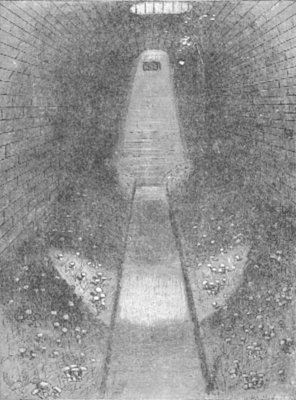
Cellars are under dwellings, barns, and often under other out-buildings.
These cellars are imperative for domestic purposes, for storing apples,
potatoes and other root crops and perishable produce; and for these uses
we need to make them frost proof and dry. These cellars are ideal
mushroom houses, and any one who has a good cellar can grow mushrooms in
it. In fact, our market gardeners who are making money out of mushrooms
find it pays them to excavate and build cellars expressly for growing
mushrooms. Indeed, some of our market gardeners who have never grown a
mushroom or seen one grown, but who know well that some of their
neighbors are making money out of this business, instinctively feel that
the first step in mushroom-growing is a cellar. It is almost incredible
how secretly the market growers guard everything in connection with
mushroom-growing from the outside world, and even from one another; in
fact, in some cases their next-door neighbors and life-long intimate
friends have never been inside their mushroom cellars.
If a cellar is to be wholly devoted to mushroom-growing it should be
made as warm as possible with double windows, and double doors, where
the entrance is from the outside, but if from another building single
doors will suffice. A chimney-like shaft or shafts rising from the
ceiling should be used as ventilators in winter, when we can not
ventilate from doors or windows; indeed, side ventilation at anytime
when the beds are in bearing condition is rather precarious. There
should be some indoor way of getting into the cellar, as by a stairway
from the building above it. Also an easy way of getting in fresh
materials for the beds, and removing the exhausted material. This is,
perhaps, best obtained by having a door that opens to the outside, or a
moderately large one from the building above.
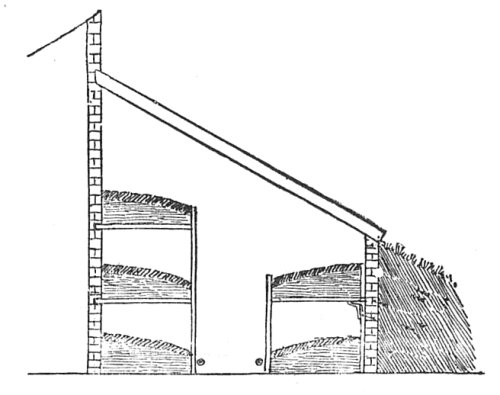
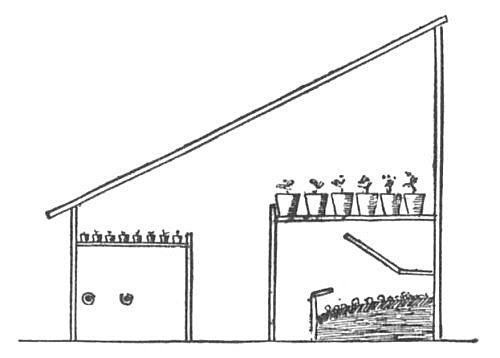
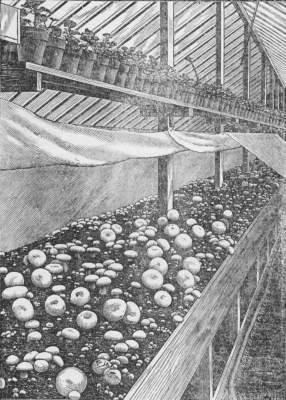
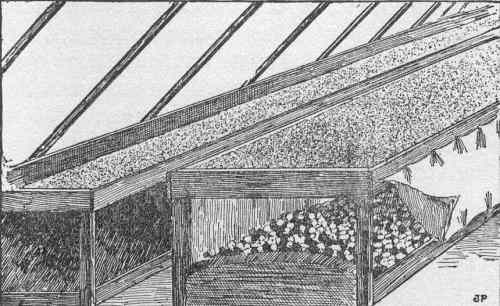
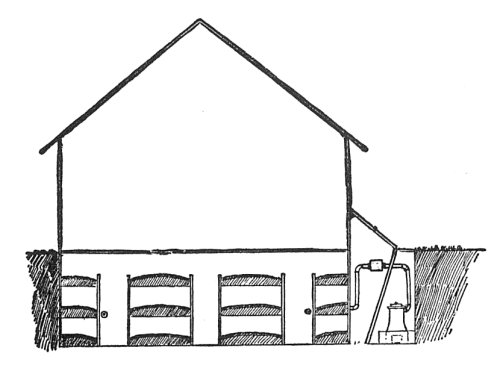 Fig. 1. Mushroom Cellar under a Barn.
The interior arrangement of the cellar is a matter of choice with the
grower, but the simplest way is to have beds three or four feet wide
around the inside of the walls, and beds six feet wide, with pathways
two, or two and one-half feet wide between them running parallel along
the middle of the cellar. Above these floor-beds, shelf-beds in tiers of
one, two, or three, according to the height of the cellar, may be
formed, always leaving a space of two and one-half or three feet between
the bottom of one bed and the bottom of the next. This is very
necessary, in order to admit of making and tending the beds and
gathering the crop, and emptying the beds when they are exhausted.
Provision should also be made for the artificial heating of these
cellars, and room given for the heating pipes wherever they are to run.
But wherever fire heat is used in heating these cellars, if practicable,
the furnace itself should be boxed off, by a thin brick wall, from the
main cellar, and the pipes only introduced. This does away with the dust
and noxious gas, and modifies the parching heat.
But in a snug, warm cellar, artificial heat is not absolutely necessary.
We can grow capital crops of mushrooms in such a cellar without any
furnace heat, simply by using a larger body of material in making the
beds,—enough to maintain a steady warmth for a long time. But this,
observe, is a waste of material, for no more mushrooms can be grown in a
bed two feet thick than in one a foot thick. In an unheated cellar the
mushrooms grow large and solid, but they do not come so quickly nor in
such large numbers as in a heated one. And a little artificial warmth
has the effect of dispelling that cold, raw, damp air peculiar to a
pent-up cellar in winter, and purifies the atmosphere by assisting
ventilation.
Instead of using box beds, some growers spread the bed all over the
floor of the cellar, and leave no pathway whatever, stepping-boards or
raised pathways being used instead. Of course, in these instances, no
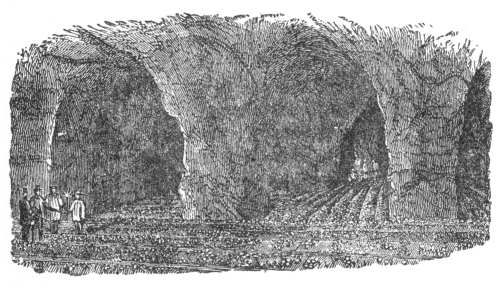
shelf beds are used. Others make ridge beds all over the cellar floor,
as the Parisians do in the caves. The ridges are two feet wide at
bottom, two feet high, and six or eight inches wide at top, and there
is a foot alley between them. Here, again, no shelf beds are used.
One of the chief troubles with flat-roofed mushroom cellars is the drip
from the condensed moisture rising from the beds, and this is more
apparent in unheated than in heated cellars,—the wet gathers upon the
ceiling and, having no slope to run off, drips down again. Oiled paper
or calico strung along Λ wise above the upper beds
protects them perfectly; whatever falls upon the passage-ways upon the
floor does no harm.
In any other outhouse cellar, as well as in one completely given over to
this use, we can make up beds and grow good mushrooms. Mr. James Vick
told me that at his seed farm near Rochester he raises many mushrooms in
winter in his potato cellars; and so can any one in similar places. Mr.
John Cullen, of South Bethlehem, Pa., a very successful cultivator,
tells me that his present mushroom cellar used to be a large underground
cistern, but with a little fixing, and opening a passage-way to it from
a neighboring cellar, he has converted it into an excellent cellar for
mushrooms, and surely the immense crops that I have seen in that cave of
total darkness justify his good opinion of it.
In Dwelling House.—The cellar of a dwelling house is a capital place
for mushroom beds, and can be used in whole or part for this purpose. In
the case of private families who wish to grow a few mushrooms only for
their own use it is not necessary to devote a whole cellar to it; but
partition off a part of it with boards and make the beds in this. Or
make a bed alongside of the wall anywhere and box it in to protect it
from cold and draughts, and mice and rats. You can have shelves above it
for domestic purposes, just as you would in any other part of the
cellar. Bear in mind that mushrooms thrive best in an atmospheric
temperature of from 50° to 60°, and if you can give them this in your
house-cellar you ought to get plenty of good mushrooms. But if such a
high temperature can not be maintained without impairing the usefulness
of the cellar for other purposes, box up the beds tightly, and from the
heat of the bed itself, when thus confined, there usually will be warmth
enough for the mushrooms, but if not spread a piece of old carpet or
matting over the boxing.
The beds may be made upon the floor, and flat, or ridged, or banked
against the wall, ten or twelve inches deep in a warm cellar, and
fifteen to twenty inches or more deep in a cool cellar, and about three
feet wide and any length to suit.
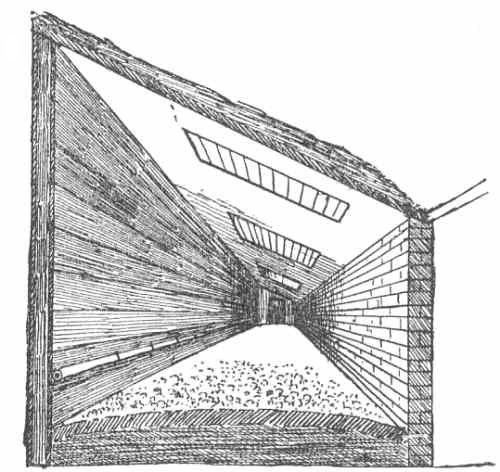
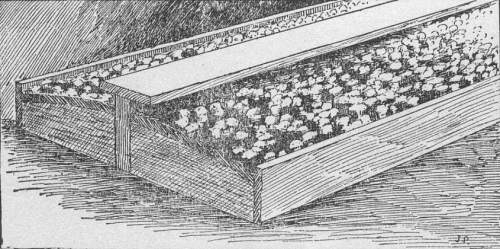
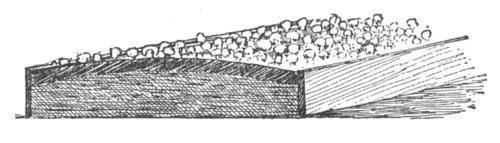
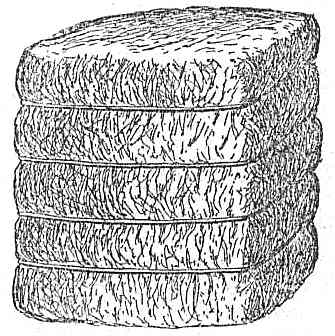
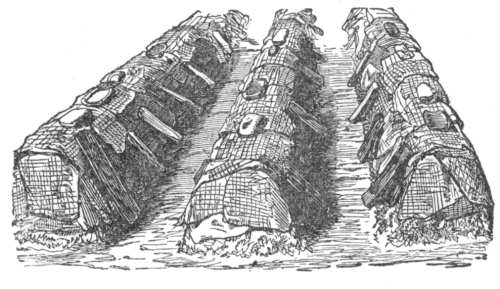
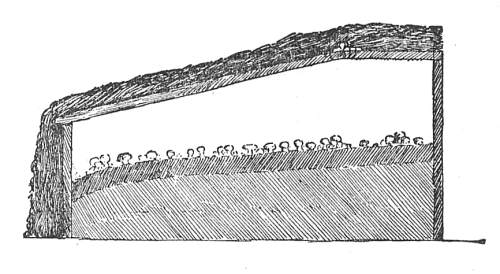 Fig. 2. Boxed-up Frame with Straw Covering.
The boxing may consist of any kind of boards for sides and ends, and be
built about six or ten inches higher than the top of the beds, so as to
give the mushrooms plenty headroom; the top of the boxing may be a lid
hung on hinges or straps, or otherwise arranged, to admit of being
easily raised or removed at will, and made of light lumber, say one-half
inch thick boards. In this way, by opening the lid, the mushrooms are
under observation and can be gathered without any trouble. When the lid
is shut they are secure from cold and vermin. Thus protected the cellars
can be ventilated without interfering with the welfare of the
mushrooms. A light wooden frame covered with calico or oiled paper
would also make a good top for the boxing, only it would not be proof
against much cold, or rats or mice. If desirable, in warm cellars, shelf
beds could be built above the floor beds, but in cool, airy cellars this
would not be advisable.
Manure beds in the dwelling-house cellar may seem highly improper to
many people, but in truth, when rightly handled, these beds emit no bad
odor. The manure should be prepared away from the house, and when ready
for making into beds it can be spread out thin, so as to become
perfectly cool and free from steam. When it has lain for two days in
this condition it may be brought into the cellar and made into beds.
Having been well sweetened by previous preparation, it is now cool and
free from steam, and almost odorless; after a few days it will warm up a
little, and may then be spawned and earthed over at once. Do not bury
the spawn in the manure, merely set it in the surface of the manure;
this saves the spawn from being destroyed by too great a heat, should
the bed become unduly warm. This, if the manure has been well prepared,
is not likely to occur. The coating of loam prevents the escape of any
further steam or odor from the manure.
On the 14th of January last, Mr. W. Robinson, editor of the London
Garden, in writing to me, mentioned the following very interesting
case of growing mushrooms in the cellar of a dwelling house: "I went out
the other day to see Mr. Horace Cox, the manager of the Field
newspaper, who lives at Harrow, near the famous school. His house is
heated by a hot-water system called Keith's, and the boiler is in a
chamber in the house in the basement. The system interested me and I
went down to see the boiler, which is a very simple one worked with coke
refuse. However, I was pleased to see all the floor of the room not
occupied by the boiler covered with little flat mushroom beds and
bearing a very good crop. Truth to tell, I used to fear growing
mushrooms in dwelling houses might be objectionable in various ways; but
this instance is very interesting, as there is not even the slightest
unpleasant smell in the chamber itself. The beds are small, scarcely a
foot high, and perfectly odorless; so that it is quite clear that one
may cultivate mushrooms in one's house, in such a case as this, without
the slightest offence."
Mr. Gardner's Method.—Mr. J. G. Gardner, of Jobstown, N. J., uses an
ordinary cellar, such as any farmer in the country has, and the little
that has been done to it to darken the windows and make them tight, so
as to render them better for mushrooms, any farmer with a hand-saw, an
ax, a hammer and a few nails and some boards can do. Mr. Gardner is a
market gardener, and has not the amount of fresh manure upon his own
place that he needs for mushroom-growing, but he buys it, common horse
manure, in New York, and it is shipped to him, over seventy miles, by
rail. And this pays; and if it will pay a man to get manure at such a
cost for mushroom-growing, how much more will mushroom-growing pay the
farmer who has the cellar and the manure as well? Mr. Gardner raises
mushrooms, and lots of them. When I visited him last November, instead
of trying to hide anything in their cultivation from me, he took
particular pains to show and explain to me everything about his way of
growing them. And he assures me that by adopting simple means of
preparing the manure and "fixing" for the crop, and avoiding all
complicated methods, one can get good crops and make fair profits.
His cellar is sixty feet long, twenty-four feet wide, and nine feet high
from floor to ceiling. The floor is an earthen one, but perfectly dry.
It is well supplied with window ventilators and doors, and in the
ceiling in the middle of the cellar opens a tall shaft or chimney-like
ventilator that passes straight up through the roof above. While the
beds are being made full ventilation by doors, windows and shaft is
given, but as soon as there is any sign of the mushrooms appearing all
ventilators except the shaft in the middle are shut and kept closed.
The bed occupies the whole surface of the cellar floor and was all made
up in one day. As a pathway, a single row of boards is laid on the top
of the bed, running lengthwise along the middle of the cellar from the
door to the farther end, and here and there between this narrow path and
the walls on either side a few pieces of slate are laid down on the bed
to step upon when gathering the mushrooms. Here is the oddest thing
about Mr. Gardner's mushroom-growing. He does not give the manure any
preparatory treatment for the beds. He hauls it from the cars to the
cellar, at once spreads it upon the floor and packs it solid into a bed.
For example, on one occasion the manure arrived at Jobstown, July 8th;
it was hauled home and the bed made up the same day, and the first
mushrooms were gathered from this bed the second week in
September,—just two months from the time the manure left the New York
or Jersey City stables. The bed was fifteen inches thick. In making it
the manure was first shaken up loosely to admit of its being more evenly
spread than if pitched out in heavy forkfuls, and it was then tramped
down firmly with the feet. The bed was then marked off into halves. On
one half (No. 1) a layer of a little over three inches of loam was at
once placed over the manure; on the other half (No. 2) no loam was used
at this time, but the manure on the surface of the bed—about three
inches deep—was forked over loosely. Twelve days after having been put
in the temperature of the bed No. 2, three inches deep, was 90°, and
then it was spawned. On the next day the soil from bed No. 1, spawned
four days earlier, was thrown upon bed No. 2, and then part of the soil
that was thrown on No. 1 was thrown back again on No. 2, so that now a
coating of loam an inch and a half deep covered the whole surface of the
bed. When finished the surface was tamped gently with a tamper with a
face of pine plank sixteen inches long by twelve inches wide. Mr.
Gardner does not believe in the alleged advantages of a hard-packed
surface on the mushroom bed, but is inclined to favor a moderately firm
one.
He uses the English brick spawn, which is sold by our seedsmen. He has
tried making his own spawn, but owing to not having proper means for
drying it, he has had rather indifferent success.
Almost all growers insert the pieces of spawn about two to three inches
under the surface of the manure, one piece at a time, and at regular
intervals of nine inches or thereabouts apart each way—lengthwise and
crosswise. But here, again, Mr. Gardner displays his individuality. He
breaks up the spawn in the usual way, in pieces one or two inches
square. Of course, in breaking it up there is a good deal of fine
particles besides the lumps. With an angular-pointed hoe he draws drills
eighteen inches apart and two and one-half to three inches deep
lengthwise along the bed, and in the rows he sows the spawn, as if he
were sowing peach stones, or walnuts, or snap beans, and covers it in as
if it were seeds.
Mr. Gardner regards 57° as the most suitable temperature for a mushroom
house or cellar, and, if possible, maintains that without the aid of
fire-heat. He has hot-water pipes connected with the contiguous
greenhouse heating arrangement in his cellar, but he never uses them for
heating the mushroom cellar except when obliged to. By mulching his bed
with straw he gets along without any fire-heat, but this is very
awkward when gathering the mushrooms.
After the bed has borne a little while it is top-dressed all over with a
half-inch layer of fine soil. Before using, this soil has been kept in a
close place—pit, frame, shed, or large box—in which there was, at the
same time, a lot of steaming-hot manure, so that it might become
thoroughly charged with mushroom food absorbed from the steam from the
fermenting material.
Should any portion of the bed get very dry, water of a temperature of
90° is given gently and somewhat sparingly through a fine-spraying
water-pot rose, or syringe. Enough water is never given at any one time
to penetrate through the casing into the manure below or the spawn in
the manure. But rather than make a practice of watering the beds, Mr.
Gardner finds it is better to maintain a moist atmosphere, and thus
lessen the necessity for watering.
Mr. Gardner firmly believes that the mushrooms derive much nourishment
from the "steam" of fermenting fresh horse manure, and by using this
"steam" in our mushroom houses we can maintain an atmosphere almost
moist enough to be able to dispense with the use of the syringe, and the
mushrooms are fatter and heavier for it. And he practices what he
preaches. In one end of his mushroom cellar he has a very large, deep,
open box, half filled with steaming fresh horse-droppings, and once or
twice a day he tosses these over with a dung-fork, in order to raise a
"steam," which it certainly does. It is also for this purpose that he
introduces the loam so soon when making the beds, so that it may become
charged with food that otherwise would be dissipated in the atmosphere.
There is a marked difference between the mushrooms raised from the
French flake spawn and those from the English brick spawn, but he has
never observed any distinct varieties from the same kind of spawn.
Sometimes a few mushrooms will appear that are somewhat differently
formed from those of the general crop, but this he regards as the result
of cultural conditions rather than of true varietal differences.
His last year's bed began bearing early in November, and continued to
bear a good crop until the first of May. After that time, no matter what
the crop may be, the mushrooms become so infested with maggots as to be
perfectly worthless, and they are cleared out. It is on account of the
large body of manure in the bed, and the low, genial, and equable
temperature of the cellar that the beds in this house always continue so
long in good cropping condition.
Some years ago the mushrooms were not gathered till their heads had
opened out flat, but nowadays the marketmen like to get them when they
are quite young and before the skin of the frill between the cup and the
stem has broken apart. A good market is found in New York, Philadelphia
and Boston.
Mr. Denton's Method.—Mr. W. H. Denton, of Woodhaven, L. I., is an
extensive market gardener about ten miles from New York. During the
summer months he grows outdoor vegetables for the New York and Brooklyn
markets, and in winter mushrooms in cellars. He has no greenhouses.
Under his barns he has two large cellars which he devotes entirely to
mushroom-growing in winter. The cellars are seven and one-half feet high
inside; the beds five feet wide, nine inches deep, two feet apart, and
run parallel to one another the whole length of the cellar. The beds are
three deep, that is, one bed is made upon the floor, and the other two,
rack or shelf fashion, are made above the floor bed, and two and
one-half feet apart from the bottom of the one bed to the bottom of the
one above it. The shelves altogether are temporary structures built of
ordinary rough scantling and hemlock boards, and the beds are all one
board deep.
A common iron stove and string of sheet iron smoke pipes are used for
heating the cellars. But he tells me the parching effect is very visible
on the beds, it dries them up on the surface very much, and he has to
sprinkle them frequently with water to keep them moist enough. During
the late summer and fall months, on his return trips from the Brooklyn
markets, Mr. Denton hauls home fresh horse manure from the City stables.
All that he can put on a wagon costs him about twenty-five cents; and
this is what he uses for mushrooms. He prepares it in a large open shed
just above the cellar, and when it is fit for use he adds about
one-third of its bulk of loam. The loam is the ordinary field soil from
his market garden. He tells me he has better success with beds made up
in this way than when manure alone is used. We all know how very heavily
market gardeners manure their land, also how vigorously most writers on
mushroom culture denounce the use of manure-fatted loam in mushroom
beds, but here is Mr. Denton, the most successful grower of mushrooms
for market in the neighborhood of New York, practicing the very thing
that is denounced! While he likes good lively manure to begin with he is
very careful not to use it soon enough to run any risk of overheating in
the beds. The loam in the manure counteracts this strong heating
tendency, also with the loam mixture the shelf-beds can be built much
more firmly than with plain manure on the springy boards. When the
temperature falls to 90° he spawns the beds.
He uses both French and brick spawn, but leans with most favor to the
latter, of which in the fall 1889 he used 400 lbs. He markets from 1700
to 2500 lbs. of mushrooms a year from these two cellars. Mr. Denton
believes emphatically in cleanliness in the mushroom cellar, and
ascribes his best successes to his most thorough cleaning. Every summer
he cleans out his cellars and limewashes all over.
Mr. Van Siclen's Method.—Mr. Abram Van Siclen, of Jamaica, L. I., also
grows mushrooms very extensively in underground cellars, whose
arrangements do not differ materially from those of Mr. Denton's, except
in his manner of heating. He runs an immense greenhouse
vegetable-growing establishment, as well as a summer truck farm, and
uses hot water heating apparatus, also smoke flues as employed
ordinarily in greenhouses, especially lettuce houses. The sheet iron
pipes, except in squash houses, he does not hold in much favor.
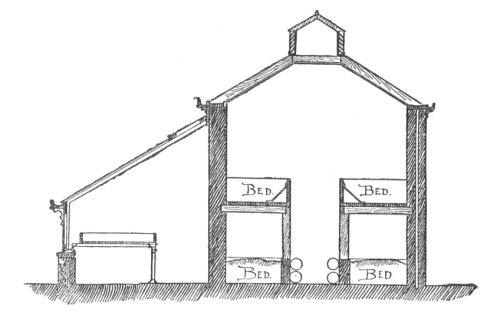
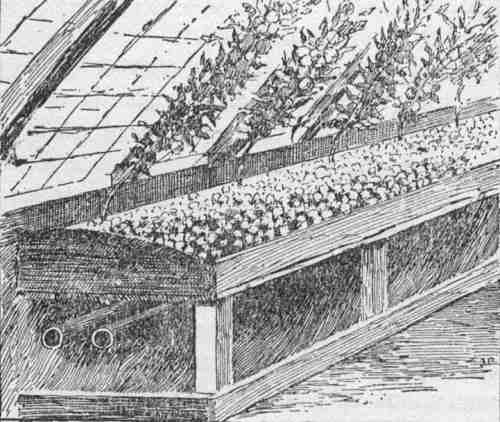
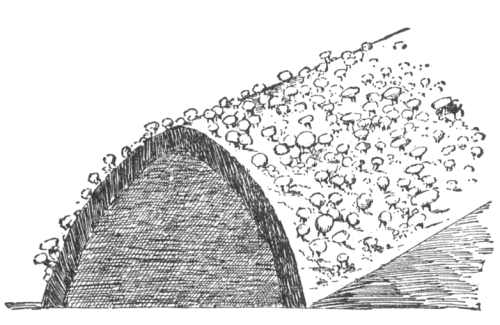
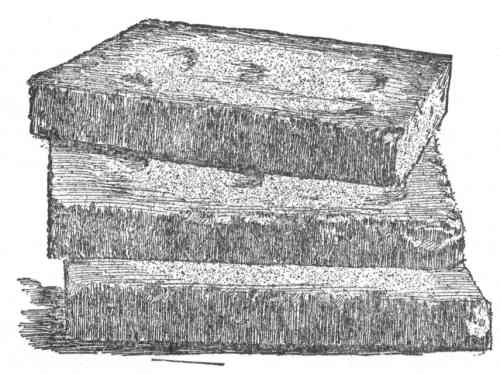
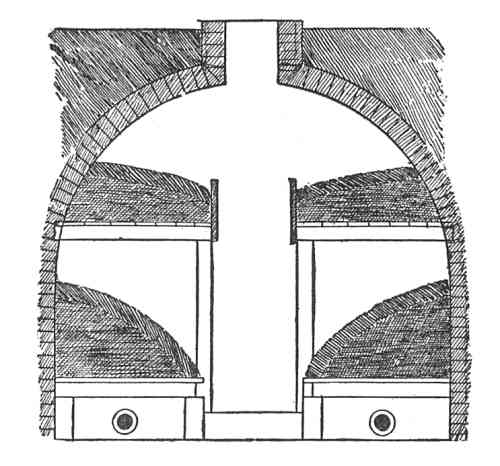 Fig. 3. Cross-section of the Dosoris Mushroom Cellar.
The Dosoris Mushroom Cellar.—This is a subterranean tunnel or cellar
that was excavated and arched some ten years ago, expressly for the
cultivation of mushrooms. It is situated in an open, sunny part of the
garden, and its extreme length from outside of end walls is eighty-three
feet; but of this space nine feet at either end are given up to
entrance pits and a heating apparatus; and the full length of the
mushroom cellar proper inside the inner walls is sixty-three feet. The
walls and arch are of brick, and the top of the arch is two and one-half
feet below the surface of the soil. This tunnel or arch is seven feet
high in the middle and eight feet wide within, but a raised
two-feet-wide pathway along the middle lessens the height to six and
one-half feet. Between this pathway and the sides of the building there
is only an earthen floor, but it is quite dry, as the cellar is
perfectly drained. Three ventilators sixteen feet apart had been built
in the top of the arch, but this was a mistake, as the condensation in
the cellar in winter from these ventilators always keeps the place under
them cold and wet and rather unproductive. One tall wooden chimney-like
shaft would have been a better ventilator than the three ventilating
holes now there, which are covered over with an iron and glass grating.
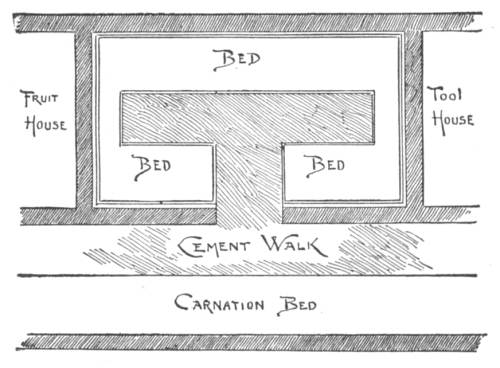
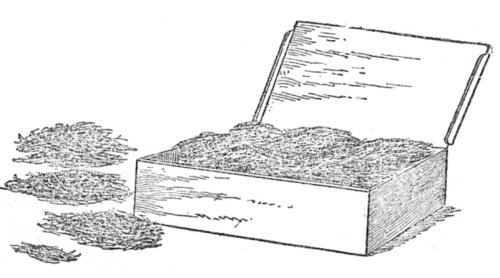
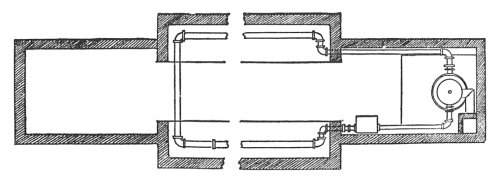 Fig. 4. Ground Plan of the Dosoris Cellar.
At one end of the house and behind the stairs descending into the pit is
the heating apparatus, from which a four-inch hot-water pipe passes
around inside the house near the wall and only four inches above ground.
A three-feet wide hemlock flooring for the bed to rest on is laid along
each side and about four inches above the pipe, leaving the aperture
between the earth floor and the bottom of the bed along the pathway open
for the escape of the artificial heat. One might think that the hot
water pipe under, and so near the bed, would dry it up and destroy it,
but such is not the case. In a cellar of this kind very little fire heat
is needed to maintain the required temperature, and I do not know where
else the pipes could be put where they would do the work any better and
be more out of the way.
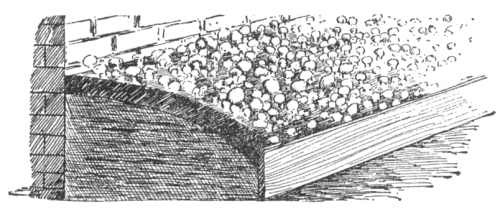
These beds, for convenience in building them, spawning them, molding
them over, gathering the crop and watering the beds, and removing the
manure after the beds are exhausted, are built against the wall and with
a rounded face, thus giving a three and one-half feet wide surface of
bed in place of one three feet wide, were it built flat. This gain in
superficial area is not so important as it might seem, for the part
immediately next to the edge of the pathway seldom yields very much.
Above these beds a string of shelf beds is arranged which runs the full
length of both sides of the cellar. From the floor of the under bed to
the floor of the top bed is three feet, and the upper beds are just as
wide as the lower ones. The shelves for the beds are temporary affairs,
put up and taken down every year. The cross-bars rest in sockets in the
wall made by cutting out half a brick every four feet along the wall,
and on upright strips or feet one and one-fourth by four inches wide, or
two by three inches, set under the inside ends of the cross-bars and
resting on the cement floor close up against the lower bed. By having
this foot end a quarter of an inch higher than the wall end the heavy
weight of the bed is thrown toward the wall. Loose hemlock boards set
close together form the flooring, for there is no need of nailing any of
them except the one next to the upright face board, which is ten inches
wide, and nailed along the front, by the pathway, to the posts and shelf
board. By tilting the weight to the wall the upright board is firm
enough to hold its place against any pressing out in building the beds.
The supporting legs of the shelves are also nailed to the face board of
the lower bed, and this holds them perfectly solid in place. The shelf
beds are eight inches deep at front, but can be made of any depth
desired against the walls at the back. The cold wall has no injurious
effect upon the bearing of the bed, and many fine mushrooms grow close
against the walls.
The entrance pits are nine and one-half feet deep from ground level,
three feet eight inches wide, nine feet long, and are covered over with
folding doors on strong hinges, and descended into by means of wooden
movable stairs. These dimensions are needed at the end where the heating
apparatus is placed, but at the other end, although it is convenient in
handling the manure, a space two or three feet less would have answered
just as well. A close door at either end of the mushroom cellar proper
separates it from the end pits. The cellar is divided in the middle by a
partition. This gives, when it is in full working order, eight beds,
each thirty-one and one-half feet long, or a continuous run of 252 feet
or 756 square feet of surface, and as the beds are renewed twice a year
this gives 504 running feet of bed, or 1512 square feet of surface. A
common average crop is three-fifths of a pound of mushrooms to the
square foot of bed, and a good fair average is four-fifths of a pound.
This would give over a thousand pounds of mushrooms a season from this
cellar when it is in full running capacity. But as the aim is to have a
steady supply of mushrooms from October until May, and not a flush at
any one time and a scarcity at another, only two beds are made at a
time, allowing a month to intervene between every two.
For the two beds, No. 1, preparing the manure begins in July, the beds
are made up in August, and gathering of the crop commences in October;
work on the two beds, No. 2, begins in August, the beds are made up in
September, and the mushrooms gathered in November; preparing for the two
beds, No. 3, begins in September, the beds are made up in October,
gathering commences in December; for the two beds, No. 4, work begins in
October, the beds are made up in November, and the crop is gathered in
January; for the two beds, No. 5 (No. 1 renewed), work begins in
November, the beds are made up in December, and the crop is gathered in
February; for the two beds, No. 6 (No. 2 renewed), work begins in
December, the beds are made up in January, and the crop is gathered in
March; for the two beds, No. 7 (No. 3 renewed), work begins in January,
the beds are made up in February, and the crop is gathered in April; for
the two beds, No. 8 (No. 4 renewed), work begins in February, the beds
are made up in March, and the mushrooms gathered in May. After this time
of year the summer heat renders mushroom-growing uncertain, and the
maggots destroy the mushrooms. This system allows each bed a bearing
period of two months. After yielding a crop for some seven to nine weeks
the beds are pretty well exhausted and hardly worth retaining longer.
They might drag along in a desultory way for weeks, but as soon as they
stop yielding a paying crop we clear them out and start afresh.
And when the mushroom season is closed we lift out and remove the
manure, clean the boards used in shelving, and give the cellar a
thorough cleaning,—whitewash its walls and paint its woodwork with
kerosene to destroy noxious insects and fungi.
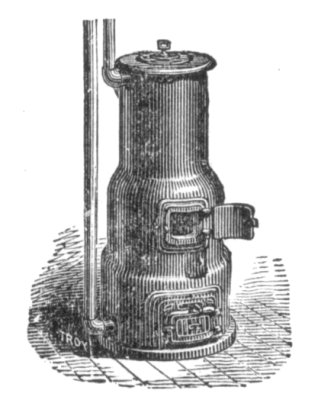 Fig. 5. Base-burning Water Heater.
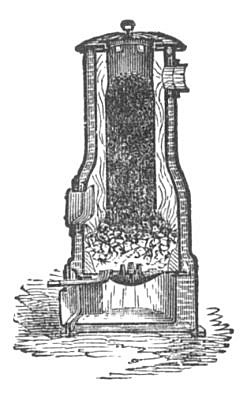 Fig. 6. Vertical Section.
The heating apparatus consists of one of Hitchings' base-burner boilers
with a four-inch hot-water pipe that passes around inside the cellar,
and it deserves special mention because of its economy, efficiency, and
the satisfaction it gives generally. This boiler needs no deep or
spacious stoke-hole. Here it is set under the stairway in a pit four
and one-half feet long, by three feet wide, by eighteen inches deep; it
is not in the way, and there is plenty of room to attend to it. The
heater, like a common parlor stove, has a magazine for the supply of
coal. It has a double casing with the water space between and down to
the bottom of it, so that when set in a shallow pit there is no
difficulty whatever about the circulation of the water in the pipes. The
hot water passes from the boiler to an open iron tank placed two feet
above it, as shown in the engraving, and thence down through a
perpendicular pipe till it reaches and enters the horizontal pipes that
pass around the cellar and, returning, enters the boiler again near its
base. The boiler and pipes are filled from this tank, which should
always be kept at least half full of water, and looked into every day
when in use, so that when the water gets lower than half full it may be
filled up again. About 134 running feet of four-inch pipe are included
inside the cellar (sixty-four feet on each side and six feet across at
further end); this gives 134 square feet of heating surface, or a
proportion of about a square foot of heating surface for every fifteen
cubic feet of air space in the cellar. This proportion is more than
ample in the coldest weather, but beneficial in so far that there is no
need to fire hard to maintain the proper temperature. A three-inch pipe
would have given heat enough, but the heat would not have been so
steady. Both nut and stove coal is used in this heater, and in the
severest winter weather it burns not more than a common hodful in
twenty-four hours. It is so easily regulated that the temperature of the
cellar day or night, or in mild or severe weather, never varies more
than three degrees, namely from 57° to 60°.
In a close underground cellar where the temperature in midwinter without
any artificial heat does not fall below 40° or 45° it is an easy matter,
with such a heater as this is, to maintain any desired temperature. If
the grates are renewed now and then, the heater should last in good
condition for twenty years. With the ordinary stove there is danger of
fire, of escaping gas and of sudden changes of temperature, and the evil
influence of a dry, parching heat—just what mushrooms most dislike—is
ever present. The first cost of a hot water apparatus may be more than
that of an old stove and sheet iron pipes, but where mushrooms are grown
extensively, as a matter of economy, efficiency, and convenience, the
advantages are altogether on the side of the hot water apparatus.
Furthermore, hot water pipes can be run where it would be unsafe to put
smoke pipes.