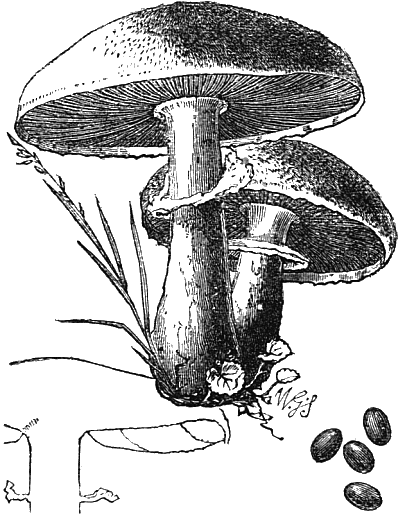
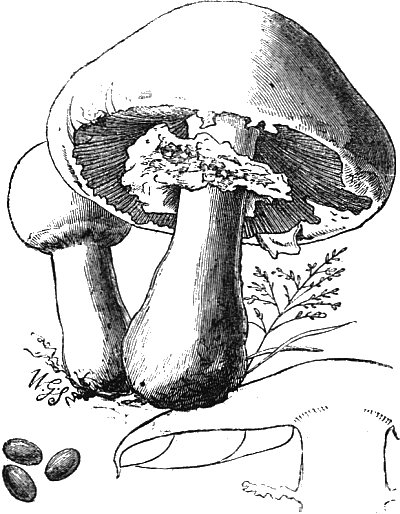
SOME OF THE MOST COMMON AND USEFUL EDIBLE FUNGI.
“Whole hundredweights of rich, wholesome diet rotting under the
trees; woods teeming with food, and not one hand to gather it; and
this, perhaps, in the midst of potato-blight, poverty, and all manner of
privations, and public prayers against imminent famine.”
Dr. Badham.
Valuable as is the common mushroom, it is indisputable
that not a few other kinds are also capable of affording
excellent food. Therefore, figures are given of
the most prevalent, useful, and easily recognised kinds of
edible fungi, as well as of the common mushrooms of our
gardens and markets. These figures have been admirably
drawn by Mr. W. G. Smith, and are accompanied by
what seemed the most satisfactory accounts of the
characters and properties that are obtainable. The spores
which accompany the figures are uniformly enlarged
seven hundred diameters.
Pileus smooth, fleshy, convex, subumbonate, generally
more or less compressed, tough, coriaceous, elastic,
wrinkled; when water-soaked, brown; when dry, of a
buff or cream-colour, the umbo often remaining red-brown,
as if scorched; gills free, distant, ventricose, of
the same tint as the pileus, but more pale; stem equal,
solid, twisted, very tough and fibrous, of a pale silky-white
colour.
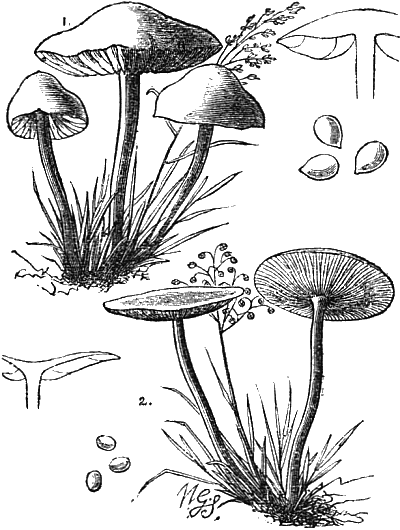 Fig. 30—1. Marasmius oreades (Fairy-ring Champignon). Pastures,
roadsides, and downs, in the autumn; colour, pale buff; gills broad
and far apart; diameter, 1 to 2 inches.
Fig. 30—1. Marasmius oreades (Fairy-ring Champignon). Pastures,
roadsides, and downs, in the autumn; colour, pale buff; gills broad
and far apart; diameter, 1 to 2 inches.
Fig. 30—2. Marasmius urens (False Champignon). Woods and pastures
in the autumn; colour, pale buff; gills narrow and crowded
together; diameter, ½ inch to 1½ inches.
The fairy-ring agaric is a valuable little fungus, and
common on almost every lawn. In hilly pastures it
generally appears in broad brown patches, either circular
or forming a portion of a circle.
M. urens, the most acrid of all allied funguses, usually
grows in woods, though sometimes in the fairy-ring.
However, its flat top and narrow crowded gills cause it
to be readily distinguished anywhere.
Opinions on the Merits of Marasmius oreades as an
edible Fungus.—“On the Continent this species has long
been considered edible, but on account of its coriaceous
texture it is dried and employed in the form of powder,
to season various made-dishes.”—Dr. Greville.
“The common fairy-ring champignon is the best of
all our funguses, yet there is scarcely one person in a
thousand who dare venture to use it. With common
observation no mistake need be made with regard to
it. It has an extremely fine flavour, and makes perhaps
the very best ketchup that there is.”—Rev. M. J.
Berkeley.
“An excellent flavour, as good as that of most funguses.”—Dr.
Badham.
Modes of Cooking Marasmius oreades.—General Use.—“Cut
in small pieces and seasoned it makes an excellent
addition to stews, hashes, or fried meats, but it
should only be added a few minutes before serving, as
the aroma is dissipated by over cooking. It is the
mushroom used in the French à la mode beef-shops in
London.”—Dr. Badham.
When stewed, the champignons require rather longer
time to ensure their being made perfectly tender. They
are readily dried by removing the stems from the fungus,
threading them on a string, and hanging them up in a
dry airy place. “When dried, it may be kept for years
without losing any of its aroma or goodness, which, on
the contrary, becomes improved by the process, so as, in
fact, to impart more flavour to the dish than would have
been imparted by the fresh fungus; though it is not to
be denied that the flesh then becomes coriaceous (or
tough), and less easy of digestion.”—Dr. Badham.
Champignon Powder.—Put the champignons in a stew-pan
with a little mace and a few cloves, and a sprinkling
of white pepper. Simmer, and shake constantly to prevent
burning, until any liquor that may exude is dried
up again. Dry thoroughly in a warm oven until they
will easily powder. Put the dried agaric, or the powder,
into wide-mouthed glass bottles, and store in a dry place.
It will keep any length of time. A tea-spoonful added
to any soup, or gravy, or sauce, just before the last boil
is given, will produce a very fine mushroom flavour.
Pickled Champignons.—Collect fresh buttons of the
fairy-ring agaric and use them at once. Cut off the
stems quite close and throw each one as you do so into a
basin of water in which a spoonful of salt has been put.
Drain them from it quickly afterwards, and place them
on a soft cloth to dry. For each quart of buttons thus
prepared, take nearly a quart of pale white wine vinegar,
and add to it a heaped tea-spoonful of salt, half an ounce of
whole white pepper, an ounce of ginger-root bruised, two
large blades of mace, and a fourth of a salt-spoon of
cayenne pepper tied in a small piece of muslin. When
this pickle boils throw in the agarics and boil them in it
over a clear fire moderately fast, from six to nine
minutes. When tolerably tender put them into warm
wide-mouthed bottles, and divide the spice equally
amongst them. When perfectly cold, cork well, or tie
skins and paper over them. Store in a dry place, and
keep out the frost.
Full-sized champignons may be pickled exactly in the
same way, but will require longer boiling, until indeed
they become tender.—Modified from Miss Acton.
Champignons quickly Pickled.—Place the prepared
buttons in bottles with a blade of mace, a tea-spoonful of
pepper-corns, and a tea-spoonful of mustard seed in each,
and cover with the strongest white wine pickling vinegar
boiling hot. Cork or tie down as before, but do not
expect them to keep above three months.
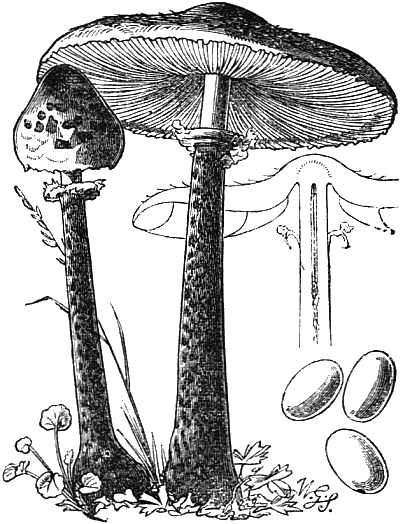 Fig. 31. Agaricus procerus (Scaly Mushroom). Pastures, &c., in
autumn; colour, pale brownish buff; diameter, 5 to 12 inches.
Fig. 31. Agaricus procerus (Scaly Mushroom). Pastures, &c., in
autumn; colour, pale brownish buff; diameter, 5 to 12 inches.
Pileus fleshy, ovate when young, then campanulate,
and afterwards expanded and umbonate (blunt pointed),
from three to seven inches across. Cuticle more or less
brown, entire over the umbo, but torn into patches, or
scales which become more and more separated as they
approach the margin. Flesh white. Gills unconnected
with the stem, fixed to a collar on the pileus surrounding
its top. Ring persistent, loose on the stem. Stem six
or eight inches high, tapering upwards from a pear-like
bulb at the root, hollow with a loose pith, whitish
brown, but more or less variegated with small and close-pressed
scales.
Whenever an agaric on a long stalk, enlarged at the
base, presents a dry cuticle more or less scaly, a darker
coloured umbonated top, a moveable ring, and white gills,
it must be Agaricus procerus, the parasol agaric, and
it may be gathered and eaten without fear. When the
whitish flesh of this agaric is bruised it shows a light
reddish colour.
There are but two other agarics that at all resemble
it, and both are edible. One about the same size is
Agaricus rachodes. It is not generally considered so
good in flavour as A. procerus. Mrs. Hussey, however,
says plainly, “If Agaricus procerus is the king of edible
funguses, Agaricus rachodes is an excellent viceroy.”
The other is the Agaricus excoriatus, a very much smaller
fungus, with a more slender habit, a shorter stem, and
no true bulb at the base. This elegant little fungus is
also very good eating.
The parasol agaric has a very wide range of growth.
It is a common fungus, and is in high request all over the
Continent.
Opinions on the Merits of Agaricus procerus as an
Edible Fungus.—“A most excellent mushroom, of a
delicate flavour, and it must be considered a most useful
species.”—The Rev. M. J. Berkeley.
“Were its excellent qualities better known here, they
could not fail to secure it a general reception into our
best kitchens, and a frequent place among our side
dishes at table.”—Dr. Badham.
“If once tried, it must please the most fastidious.”—Worthington
G. Smith.
There can be no question but that, when young and
quickly grown, the parasol agaric is a delicious fungus.
It has a light and delicate flavour without the heavy
richness which belongs to the ordinary field mushroom.
The writer has prevailed on many persons to try it; all
without exception have liked it, many have thought it
quite equal, and some have proclaimed it superior, to the
common mushroom.
Modes of Cooking the Agaricus procerus.—Broiled
Procerus.—Remove the scales and stalks from the
agarics, and broil lightly over a clear fire on both
sides for a few minutes; arrange them on a dish over
fresh-made, well-divided toast; sprinkle with pepper and
salt, and put a small piece of butter on each; set before
a brisk fire to melt the butter, and serve up quickly.
If the cottager would toast his bacon over the broiled
mushrooms, the butter would be saved.
Agarics delicately Stewed.—Remove the stalks and
scales from young half-grown agarics, and throw each
one as you do so into a basin of fresh water slightly acidulated
with the juice of a lemon, or a little good vinegar.
When all are prepared, remove them from the water, and
put them into a stew-pan with a very small piece of fresh
butter. Sprinkle with white pepper and salt, and add
a little lemon-juice; cover up closely, and stew for half
an hour. Then add a spoonful of flour, with sufficient
cream, or cream and milk, until the whole has the thickness
of cream. Season to taste, and stew again gently
until the agarics are perfectly tender. Remove all the
butter from the surface, and serve in a hot dish, garnished
with slices of lemon.
A little mace, nutmeg, or ketchup may be added; but
there are those who think that spice spoils the mushroom
flavour.
Cottager’s Procerus Pie.—Cut fresh agarics in small
pieces, and cover the bottom of a pie-dish. Pepper, salt,
and place them on small shreds of fresh bacon, then put in
a layer of mashed potatoes, and so fill the dish, layer by
layer, with a cover of mashed potatoes for the crust.
Bake well for half an hour, and brown before a quick fire.
A la Provençale.—“Steep for two hours in some salt,
pepper, and a little garlic; then toss in a small stew-pan
over a brisk fire, with parsley chopped, and a little lemon-juice.”—Dr.
Badham.
Agaric Ketchup.—Place agarics of as large a size as
you can procure, but which are not worm-eaten, layer
by layer, in a deep pan, sprinkling each layer as it is put
in with a little salt. The next day stir them well up
several times, so as to mash and extract their juice.
On the third day strain off the liquor, measure, and boil
for ten minutes, and then to every pint of the liquor
add half an ounce of black pepper, a quarter of an ounce
of bruised ginger-root, a blade of mace, a clove or two,
and a tea-spoonful of mustard-seed. Boil again for half
an hour; put in two or three bay leaves, and set aside
till quite cold. Pass through a strainer, and bottle;
cork well, and dip the ends in resin. A very little Chili
vinegar is an improvement, and some add a glass of port
wine, or a glass of strong ale to every bottle.
Care should be taken that the spice is not added so
abundantly as to overpower the true flavour of the agaric.
A careful cook will keep back a little of the simple
boiled liquor to guard against this danger: a good one
will always avoid it. “Doctors weigh their things,” said
a capital cook, “but I go by taste.” But then, like poets,
good cooks of this order must be born so; they are not
to be made.
Pileus cylindrical, obtuse, campanulate, fleshy in the
centre, but very thin towards the margin. The external
surface soon torn up into fleecy scales, with the exception
of a cap at the top. Gills free, linear, and crowded.
Quite white when young, becoming rose-coloured, sepia,
and then black, from the margin upwards. They then
expand quickly, curl up in shreds, and deliquesce into a
black inky fluid which stains the ground. Stem of a
pure white, four to five inches high, contracting at the
top, and bulbous at the base; hollow, fibrillose, stuffed
with a light cottony web. The bulb is solid and rooting,
the ring is movable.
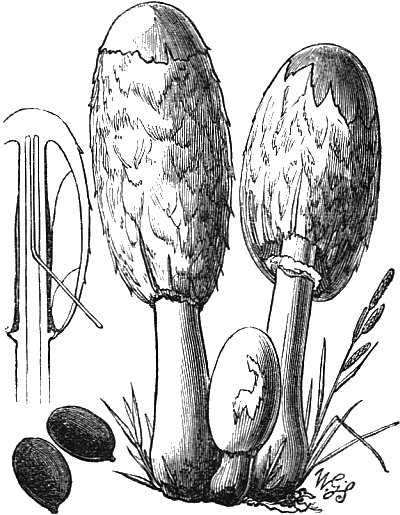 Fig. 32. Coprinus comatus (Maned Mushroom). Pastures, parks, and
roadsides, summer and autumn; colour, snow-white; height, 5 to 12
inches.
Fig. 32. Coprinus comatus (Maned Mushroom). Pastures, parks, and
roadsides, summer and autumn; colour, snow-white; height, 5 to 12
inches.
This very elegant agaric has also been called Ag. cylindricus,
Schœff; Ag. typhoides, Bull; and Ag. fimetarius,
Bolt. It is common throughout the summer and autumn
months, on road-sides, pastures, and waste places. It is
extremely variable in size. Its general appearance is so
distinct and striking, that it cannot possibly be mistaken
for any other agaric. It grows so abundantly on waste
ground in the dwellings and farm-yards that it may be,
says Dr. Bull, called the “agaric of civilization;” and for
both these reasons it is most valuable as an edible agaric.
If its merits were known, it would be eaten as freely as
the common field mushroom.
“The maned mushrooms,” Miss Plues has well said,
“grow in dense clusters, each young plant like an attenuated
egg, white and smooth. Presently some exceed
the others in rapidity of growth, and their heads get
above the ground, the stem elongates rapidly, the ring
falls loosely round the stem, the margin of the pileus
enlarges, and the oval head assumes a bell-shape; then
a faint tint of brown spreads universally or in blotches
over the upper part of the pileus, and the whiteness of
its gills changes to a dull pink. A few more hours and
the even head of the pileus has split in a dozen places,
the sections curl back, melt out of all form into an inky
fluid, and on the morrow’s dawn a black stain on the
ground will be all that remains. And so on with the
others in succession.”
Opinions on the Merits of Coprinus comatus as an
Edible Fungus.—“Esculent when young.”—Berkeley.
“Young specimens should be selected.”—Badham.
“No despicable dish, though perhaps not quite equal
to the common mushroom.”—M. C. Cooke.
“If I had my choice, I think there is no species I
should prefer before this one: it is singularly rich, tender,
and delicious.”—Worthington G. Smith.
Dr. M‘Cullough, Dr. Chapman, Elmes Y. Steele, Esq.,
and some other members of the Woolhope Club, hold
Mr. W. G. Smith’s opinion as the result of considerable
experience. It must be noted, however, that when too
young this agaric is rather deficient in flavour, and its
fibres tenacious. Its flavour is most rich, and its texture
most delicate when the gills show the pink colour with
sepia margins.
Modes of Cooking the Coprinus comatus.—The best and
simplest method is to broil it and serve on toast in the
ordinary way. It may be added also with great
advantage to steaks and made-dishes, to give flavour and
gravy.
Comatus Soup.—Take two quarts of white stock, and
put in a large plateful of the maned agaric roughly
broken out; stew until tender; pulp through a fine
sieve; add pepper and salt to taste; boil and serve up
hot. Two or three table-spoonfuls of cream will be a
great improvement.
The agarics for this soup should be young, in order
to keep its colour light and good. The maned agaric
is recommended on all sides for making ketchup, but
here, also, it should be quickly used, and the ketchup
quickly made.
Pileus thick and fleshy, convex at first, often lobed, becoming
undulated and irregular, expanding unequally; the
margin more or less involute, and at first flocculose; from
three to four inches across; of a light yellow colour in
the centre, fading to almost opaque white at the edges;
it is soft to the touch; more or less tuberculated, and
often presenting cracks. Gills yellowish-white, watery,
narrow, marginate, annexed to the stem with a little
tooth: they are very numerous and irregular, with many
smaller ones interposed, “lying over each other like the
plaits of a frill” (from 5 to 11, Vittadini). Stem firm,
solid and white, swelling at the base in young specimens;
but in older ones, though usually bulging, they are frequently
of even size, and when in long grass they
occasionally even taper downwards. This agaric is usually
nearly white, smooth, soft, and firm, like kid leather to
the touch, and, as Berkeley has happily said, “in appearance
it very closely resembles a cracknel biscuit.”
They grow in rings; have a strong smell, and appear
about St. George’s Day (April 23), after the rains which
usually fall about the third week in April. They continue
to appear for three or four weeks, according to
the peculiarities of the season. They are usually to be
found on hilly pastures in woodland districts.
The St. George’s mushroom cannot well be mistaken
for any other. The fact of its appearance at this early
season, and growing so freely in rings, when so very few
other funguses are to be found, is almost enough to distinguish
it. It has, however, very distinctive characters
in itself in the thickness of its pileus; the narrowness of
its gills, which are very closely crowded together; and
the solid bulging stem.
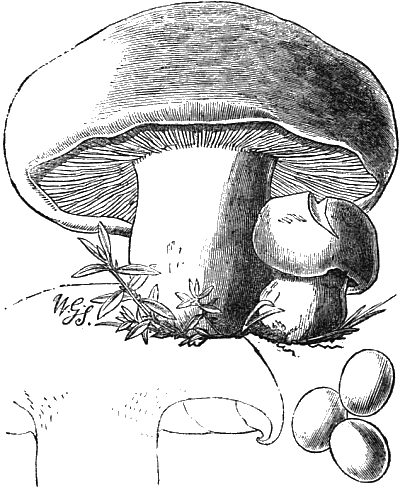 Fig. 33. Agaricus gambosus (St. George’s Mushroom). Pastures,
in the spring; colour, cream; diameter, 4 to 6 inches.
Fig. 33. Agaricus gambosus (St. George’s Mushroom). Pastures,
in the spring; colour, cream; diameter, 4 to 6 inches.
The St. George’s mushroom is not an uncommon
agaric in this country, and where it does appear it is
usually plentiful—a single ring affording generally a good
basket full. It should be gathered when young, or it
will be found grub-eaten, for no fungus is more speedily
and more voraciously attacked by insects than this
one.
Opinions on the Merits of Agaricus gambosus as an
Edible Fungus.—“This rare and most delicious agaric, the
mouceron of Bulliard, and the Agaricus prunulus of other
authors, abounds on the hills above the valley of Staffora,
near Bobbio, where it is called Spinaroli, and is in great
request; the country people eat it fresh in a variety of
ways, or they dry and sell it at from twelve to sixteen
francs a pound.”—Letter from Professor Balbi to Persoon.
“The most savoury fungus with which I am acquainted ... and
which is justly considered over almost
the whole continent of Europe as the ne plus ultra of
culinary friandise.
“The prunulus (gambosus) is much prized in the
Roman market, where it easily fetches, when fresh,
thirty baiocchi—i.e., fifteen pence per pound—a large
sum for any luxury in Rome. It is sent in little baskets
as presents to patrons, fees to medical men, and bribes
to Roman lawyers.”—Dr. Badham.
The Agaricus gambosus “is one that a person cannot
well make any mistake about. It sometimes attains a
large size, is excellent in flavour, and particularly wholesome.”—Rev.
M. J. Berkeley.
Mode of Cooking Agaricus gambosus.—“The best
mode of cooking Agaricus gambosus is either to
mince or fricassee it with any sort of meat, or in a vol-au-vent,
the flavour of which it greatly improves; or
simply prepared with salt, pepper, and a small piece of
bacon, lard, or butter, to prevent burning, it constitutes
of itself an excellent dish.”—Dr. Badham. “Served
with white sauce, it is a capital appendage to roast veal.”—Edwin
Lees. It may be broiled, stewed, or baked.
Breakfast Agaric.—Place some fresh-made toast,
nicely divided, on a dish, and put the agarics upon
it; pepper, salt, and put a small piece of butter
on each; then pour on each one a tea-spoonful of
milk or cream, and add a single clove to the whole
dish. Place a bell-glass, or inverted basin, over the
whole; bake twenty minutes, and serve up without
removing the glass until it comes to the table, so as to
preserve the heat and the aroma, which, on lifting the
cover, will be diffused through the room. It dries very
readily when divided into pieces, and retains most of its
excellence. A few pieces added to soups, gravies, or made-dishes,
give a delicious flavour.
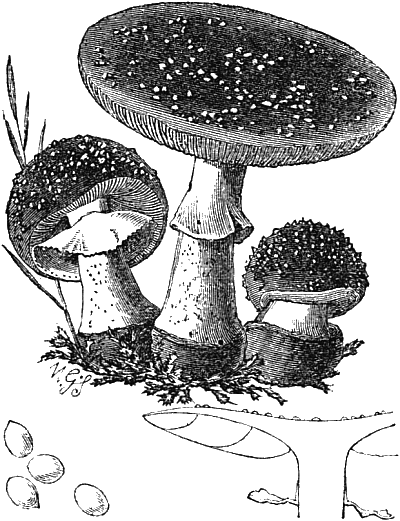 Fig. 34. Agaricus rubescens (Red-fleshed Mushroom). Woods, summer
and autumn; colour, sienna-brown; diameter, 4 to 10 inches.
Fig. 34. Agaricus rubescens (Red-fleshed Mushroom). Woods, summer
and autumn; colour, sienna-brown; diameter, 4 to 10 inches.
Pileus convex, then expanded, cuticle brown, scattered
over with warts varying in size. Margin striate. Gills
white, reaching the stem, and forming very fine decurrent
lines upon it. Ring entire, wide and marked with striæ.
Stem often scaly, stuffed, becoming hollow; when old,
bulbous. Volva obliterated. The whole plant has a
tendency to turn a sienna-red, or rust colour. This is
very distinctly shown some little time after it has been
bruised.
It is very common all through the summer and autumn
months; indeed, one of the most abundant mushrooms;
“and it is one of those species that a person with the
slightest powers of discrimination may distinguish accurately
from others.”—Badham.
Opinions on the Merits of Agaricus rubescens as an
Edible Fungus.—“A very delicate fungus, which grows
in sufficient abundance to render it of importance in a
culinary point of view.”—Badham.
“From long experience I can vouch for its being not
only wholesome, but, as Dr. Badham says, ‘a very delicate
fungus.’”—F. Currey, Editor of Dr. Badham’s “Esculent
Funguses.”
Modes of Cooking the Agaricus rubescens.—It may be
toasted, boiled, or stewed in the ordinary way.
Fried Rubescens.—Place the full-grown agarics in water
for ten minutes, then drain, and having removed the
warty skin, fry with butter, pepper, and salt. The ketchup
made from Agaricus rubescens is rich and good.
“As it grows freely, and attains a considerable size,
it is very suitable for that purpose, quantity being a
great desideratum in ketchup-making.”—Plues.
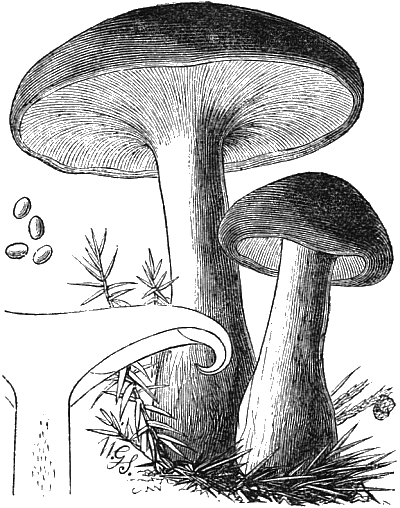 Fig. 35. Agaricus nebularis (Clouded Mushroom). Woody places, in
autumn; colour, cream, with slate-coloured top; diameter, 4 to 10
inches.
Fig. 35. Agaricus nebularis (Clouded Mushroom). Woody places, in
autumn; colour, cream, with slate-coloured top; diameter, 4 to 10
inches.
“Pileus from two and a half to five inches across; at
first depresso-convex; when expanded, nearly flat or
broadly subumbonate; never depressed; margin at first
involute and pruinose; occasionally somewhat waved and
lobed, but generally regular in form; smooth, viscid
when moist, so that dead leaves adhere to it; grey, brown
at the centre, paler towards the circumference. Flesh
thick, white, unchanging. Gills cream-colour, narrow,
decurrent, close, their margins waved, unequal, generally
simple. Stem from two to four inches long, from a
quarter of an inch to an inch thick; incurved at the base;
not rooting, but attaching by means of a floccose down
round its lower portion and for one-third of its length,
a large quantity of dead leaves, by which the plant is
held erect; subequal, more or less marked with longitudinal
pits, firm externally, within of a softer substance.
The odour strong, like that of curd cheese.”—Badham.
“Common in certain places, but very rare near
London. This species comes up late in the autumn on
dead leaves in moist places, principally on the borders
of woods. The gastronomic excellences of this species
are well known. When gathered, it has a wholesome
and powerful odour; and when cooked, the firm and
fragrant flesh has a particularly agreeable and palatable
taste.”—W. G. Smith.
“The Agaricus nebularis requires but little cooking;
a few minutes’ broiling (à la Maintenon is best), with
butter, pepper, and salt, is sufficient. It may also be
delicately fried with bread crumbs, or stewed in white
sauce. The flesh of this mushroom is perhaps lighter
of digestion than that of any other.”—Badham.
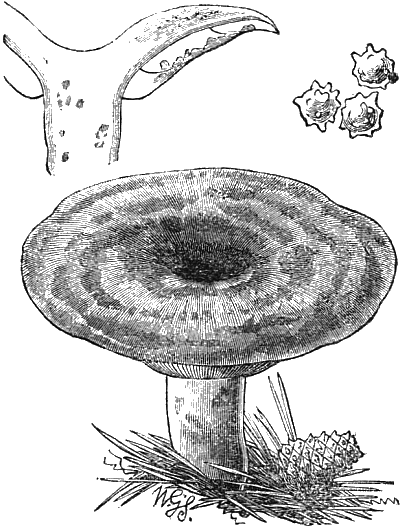 Fig. 36. Lactarius deliciosus (Orange-milk Mushroom). Under fir-trees,
in autumn; colour, brown-orange; milk at first orange, then
green; diameter, 3 to 10 inches.
Fig. 36. Lactarius deliciosus (Orange-milk Mushroom). Under fir-trees,
in autumn; colour, brown-orange; milk at first orange, then
green; diameter, 3 to 10 inches.
Pileus smooth, fleshy, umbilicate, of a dull rufous
orange, turning pallid from exposure to light and air,
but zoned with concentric circles of a brighter hue;
margin smooth, at first involute, and then becoming expanded;
from three to five inches across. Flesh firm
full of orange-red milk, which turns green on exposure
to the air, as does any part of the plant when bruised.
Gills decurrent, narrow, each dividing into two, three
several times from the stem to the edge of the pileus;
of a dull yellow by reflected light, but being translucent,
the red milk shines brightly through them. Stem from
one to three inches high, slightly bent and tapering
downwards; solid, becoming more or less hollow with
age; short hairs at the base; sometimes pitted (scrobiculate).
There is no possibility of mistaking this fungus. It
is the only one which has orange-red milk, and which turns
green when bruised. These properties distinguish it at
once from Lactarius torminosus or necator, the only
fungus which in any way resembles it.
This acrid fungus (Lactarius torminosus) is somewhat
similar in shape and size, and is also zoned. But the
involute edges of the pileus are bearded with close hairs.
It is of a much paler colour, and with gills of a dirty
white. The milk, also, is white, acrid, and unchangeable
in colour.
The Orange-milk agaric chiefly affects the Scotch fir-tree,
and is generally to be found beneath the drip of
the branches around the tree. It is also found in hedgerows
occasionally, but is most abundant in plantations of
Scotch fir or larch.
Opinions on the Merits of Lactarius deliciosus as an
Edible Fungus.—“This is one of the best agarics with
which I am acquainted, fully deserving both its name
and the estimation in which it is held abroad, it
reminds me of tender lambs’ kidneys.”—Dr. Badham.
“Very luscious eating, full of rich gravy, with a little
of the flavour of mussels.”—Sowerby.
“Cook them well, and you will have something better
than kidneys, which they much resemble both in flavour
and consistence.”—Mrs. Hussey.
Modes of Cooking Lactarius deliciosus.—“The rich
gravy it produces is its chief characteristic, and hence
it commends itself to make a rich gravy sauce, or
as an ingredient in soups. It requires delicate
cooking, for though fleshy it becomes tough if kept on
the fire till all the juice is exuded. Baking is perhaps
the best process for this agaric to pass through. It
should be dressed when fresh and pulpy.”—Edwin Lees.
Stewed Deliciosus.—“The tourtière (or pie-dish)
method of cooking suits Lactarius deliciosus best,
as it is firm and crisp in substance. Be careful to
use only sound specimens. Reduce them by cutting
across to one uniform bulk. Place the pieces in a
pie-dish, with a little pepper and salt, and a small
piece of butter on each side of every slice. Tie a
paper over the dish, and bake gently for three-quarters
of an hour. Serve them up in the same hot dish.”—Mrs.
Hussey.
Deliciosus Pie.—Pepper and salt slices of the agaric,
and place them in layers with thin slices of fresh
bacon, until a small pie-dish is full; cover with a crust
of pastry or mashed potatoes, and bake gently for three-quarters
of an hour. If with potato crust, brown nicely
before a quick fire.
Deliciosus Pudding.—Cut the agaric into small pieces;
add similar pieces of bacon, pepper, and salt, and a little
garlic or spice; surround with crust, and boil three-quarters
of an hour.
Fried Deliciosus.—Fry in slices, properly seasoned
with butter, or bacon and gravy; and serve up hot with
sippets of toast. A steak in addition is a great improvement.
Every one knows the Morel—that expensive luxury
which the rich are content to procure at great cost from
our Italian warehouses, and the poor are fain to do without.
It is less generally known that this fungus, though
by no means so common with us as some others (a circumstance
partly attributable to the prevailing ignorance
as to when and where to look for it, or even of its being
indigenous to England), occurs not unfrequently in our
orchards and woods, towards the beginning of summer.
Roques reports favourably of some specimens sent to him
by the Duke of Athol; and others, from different parts
of the country, occasionally find their way into Covent
Garden Market. The genus Morchella comprises very
few species, and they are all good to eat. Persoon
remarks, that though the Morel rarely appears in a
sandy soil, preferring a calcareous or argillaceous ground,
it frequently springs up on sites where charcoal has been
burnt, or where cinders have been thrown.
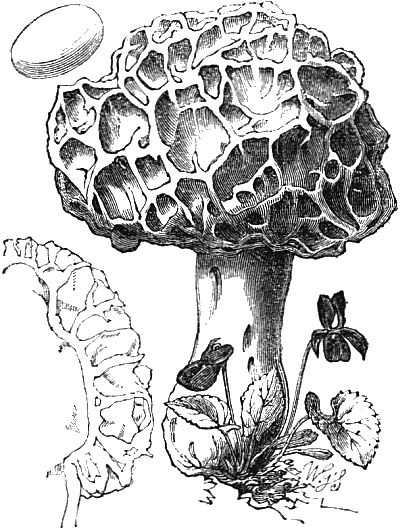 Fig. 37. Morchella esculenta (the Morel). Woods, &c., in the spring;
colour pale buff; height, 3 to 5 inches.
Fig. 37. Morchella esculenta (the Morel). Woods, &c., in the spring;
colour pale buff; height, 3 to 5 inches.
Pileus very various in shape and hue, the surface
broken-up into very little cells, made by folds or plaits
of the hymenium, which are more or less salient, and
constitute the so-called ribs. These ribs are very irregular,
and anastomose with each other throughout; the
pileus hollow, opening into the irregular stem. Spores
pale yellow. Neither of these funguses should be
gathered after rain, as they are then insipid and soon
spoil.
“M. Roques says the Morel may be dressed in a
variety of ways, both fresh and dry, with butter or in oil,
au gras or à la crême. The following receipts for cooking
them are from Persoon. 1st. Having washed and
cleansed them from the earth which is apt to collect
between the plaits, dry thoroughly in a napkin, and put
them into a saucepan with pepper, salt, and parsley,
adding or not a piece of ham; stew for an hour, pouring
in occasionally a little broth to prevent burning; when
sufficiently done, bind with the yolk of two or three
eggs, and serve on buttered toast. 2nd. Morelles à
l’Italienne.—Having washed and dried, divide them across,
put them on the fire with some parsley, scallion, chervil,
burnet, tarragon, chives, a little salt, and two spoonfuls
of fine oil. Stew till the juice runs out, then thicken
with a little flour; serve with bread-crumbs and a
squeeze of lemon. 3rd. Stuffed Morels.—Choose the
freshest and whitest morels, open the stalk at the bottom,
wash and wipe them well, fill with veal stuffing,
anchovy, or any rich farce you please, securing the ends,
and dressing between thin slices of bacon; serve with a
sauce like the last.”—Badham.
“Pileus convexo-plane, then turbinate, smooth, moist;
disc compact, gibbous; margin thin; stem stuffed, even,
attenuated downwards; gills deeply decurrent, arcuate,
thick, distant.”—Grev. t. 91; Huss. II. t. 40.
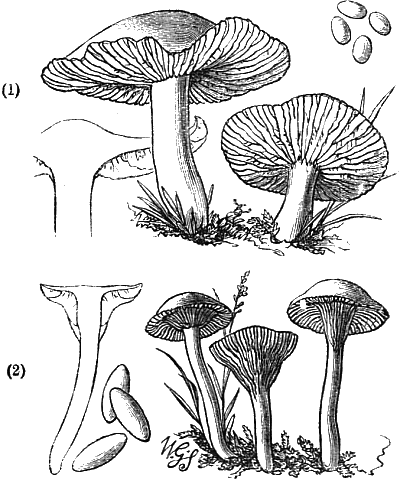 Fig. 38 (1). Hygrophorus pratensis. Pastures, in autumn; colour, full
buff; diameter, 2 to 3 inches.
Fig. 38 (1). Hygrophorus pratensis. Pastures, in autumn; colour, full
buff; diameter, 2 to 3 inches.
Fig. 38 (2). Hygrophorus virgineus (Viscid White Mushroom). Pastures,
in autumn; snow-white; diameter, ½ inch to 1½ inches.
“On downs and short pastures. Very common. Pileus
tawny or deep buff, sometimes nearly white, as in the
next. Probably esculent.”—Berkeley.
“Pileus fleshy, convexo-plane, obtuse, moist, at length
areolato-rimose; stem stuffed, firm, short, attenuated
at the base; gills decurrent, distant, rather thick.”—Grev.
t. 166. “On downs and short pastures. Extremely
common. Mostly pure ivory-white.”—Berkeley.
This species, exquisite in form and flavour, is one of
the prettiest ornaments of our lawns, downs, and short
pastures at the fall of the year. In these situations it
may be found in every part of the kingdom. It is essentially
waxy, and feels and looks precisely as if made of
the purest virgin wax. The stem is firm, stuffed, and
attenuated, and the gills singularly distant from each
other; it changes colour a little when getting old, at
which time it is unfit for culinary purposes.
A batch of fresh specimens, broiled or stewed with
taste and care, will prove agreeable, succulent, and flavorous
eating, and may sometimes be obtained when other
species are not forthcoming.
“Several allied species enjoy the reputation of being
esculent, notably H. niveus; and my friend Mr. F. C.
Penrose has eaten, and speaks favourably of H.
psittacinus—a highly ornamental yellow species, with
a green stem, sometimes common enough in rich
pastures (and said to be very suspicious).”—W. G.
Smith.
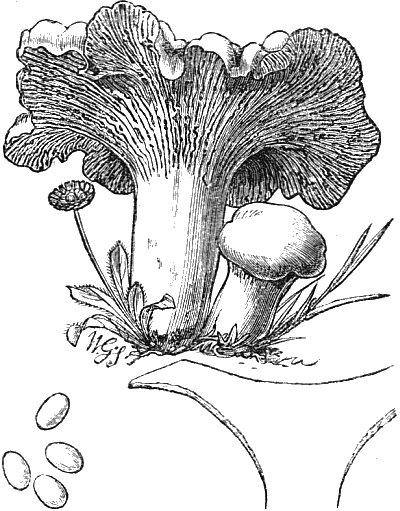 Fig. 39. Cantharellus cibarius (Chantarelle). Woods, autumn;
rich golden yellow; diameter, 2 to 4 inches.
Fig. 39. Cantharellus cibarius (Chantarelle). Woods, autumn;
rich golden yellow; diameter, 2 to 4 inches.
When young its stalk is tough, white, and solid;
but as it grows this becomes hollow and presently
changes to yellow; tapering below, it is effused into the
substance of the pileus, which is of the same colour with
it. The pileus is lobed, and irregular in shape; its
margin at first deeply involute, afterwards when expanded,
wavy. The veins or plaits are thick, subdistant,
much sinuated, running some way down the stalk. The
flesh is white, fibrous, dense, “having the odour of
apricots” (Purton) or of “plums” (Vitt.). “The colour
yellow, like that of the yolk of eggs, is deeper on the under
surface; when raw it has the pungent taste of pepper:
the spores, which are elliptic, are of a pallid ochre colour.”
(Vitt.) The Chantarelle grows sometimes sporadically,
sometimes in circles or segments of a circle, and may be
found from June to October. At first it assumes the
shape of a minute cone: next, in consequence of the
rolling in of the margin, the pileus is almost spherical,
but as this unfolds it becomes hemispherical, then flat,
at length irregular and depressed.
“This fungus,” observes Vittadini, “being rather dry
and tough by nature, requires a considerable quantity of
fluid sauce to cook it properly.” “The common people
in Italy dry or pickle, or keep it in oil for winter use.
Perhaps the best ways of dressing the Chantarelle are
to stew or mince it by itself, or to combine it with meat
or with other funguses. It requires to be gently stewed,
and a long time to make it tender; but by soaking it in
milk the night before, less cooking will be requisite.”—Badham.
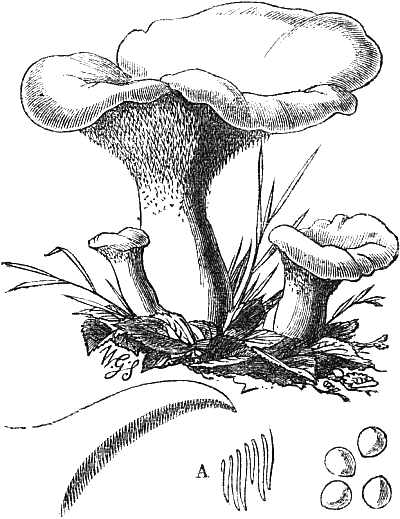 Fig. 40. Hydnum repandum (Spine-bearing Mushroom). Woods,
autumn; colour, pale buff; diameter, 2 to 5 inches.
Fig. 40. Hydnum repandum (Spine-bearing Mushroom). Woods,
autumn; colour, pale buff; diameter, 2 to 5 inches.
Pileus smooth, irregular in shape, depressed in the
centre, more or less lobed, and generally placed irregularly
on the stem (eccentric); of a pale buff or cinnamon
colour; from two to five inches in diameter. Flesh
firm and white; when bruised it turns slightly brown.
Spines crowded, awl-shaped, slanting, soft and brittle,
varying in size and length, and of a faint cinnamon tint.
Stem white, short, solid, crooked, and often lateral.
There is no possibility of mistaking the hedgehog
mushroom: when once seen it is always to be remembered.
Its awl-shaped spines are crowded beneath the pileus; its
size and colour are most marked; it resembles closely,
as has been said, a lightly-baked cracknel biscuit in colour.
“This fungus occurs principally in woods, and especially
in those of pine and oak; sometimes solitary, but more
frequently in company and in rings.”—Badham.
Opinions on the Merits of Hydnum repandum as an
Edible Fungus.—“The general use of this fungus throughout
France, Italy, and Germany, leaves no room for
doubt as to its good qualities.”—Roques.
“When well stewed it is an excellent dish, with a
slight flavour of oysters. It makes also a very good
purée.—Dr. Badham.
“A most excellent fungus, but it requires a little
caution in preparation for the table. It should be
previously steeped in hot water and well drained in a
cloth; in which case there is certainly not a more excellent
fungus.”—Berkeley.
“A wholesome fungus and not to be despised; but
not in the first class as to flavour, requiring the help of
condiments. It has the advantage, however, of growing
later than most funguses, and may be found up to the
middle of November.”—Edwin Lees.
“One of the most excellent fungi that grows; its
flavour very strongly resembles oysters.”—The Rev. W.
Houghton.
Modes of Cooking Hydnum repandum.—The hedgehog
mushroom is dense in structure, and in whatever way
it may be cooked, all authorities agree that it must
be done slowly at a low temperature until it is tender,
and with plenty of stock or white sauce to supply its
deficiency in moisture.
Stewed Hydnum.—“Cut the mushrooms in pieces and
steep for twenty minutes in warm water; then place in
a pan with butter, pepper, salt, and parsley; add beef or
other gravy, and simmer for an hour.”—Trans. from M.
Roques.
“Stew in a brown or white sauce.”—Mrs. Hussey.
“Cut up in bits about the size of a bean, and stew in
white sauce, when it will almost pass off as oyster sauce.”—The
Rev. W. Houghton, F.L.S.
Pileus thin, irregular, depressed in the centre, lobed,
with undulated borders, from two to three inches across.
In colour clear white, sometimes tinted with pale brown
on its prominences, and occasionally with a grey centre
or even lightly zoned with grey. Its surface is soft and
smooth to the touch, except in wet weather, when it
becomes soft and sticky. The flesh is soft, colourless,
and unchangeable. Gills crowded, decurrent, at first
nearly white, then pinkish grey, taking at length a light
brown tint. Spores pale brown. Stem smooth, solid,
short, decreasing in size; central when young, but
becoming eccentric from the pileus growing irregularly.
Odour pleasant, usually compared to that of fresh meal,
but Dr. Badham and others think it resembles more
closely the smell of cucumber or syringa leaf.
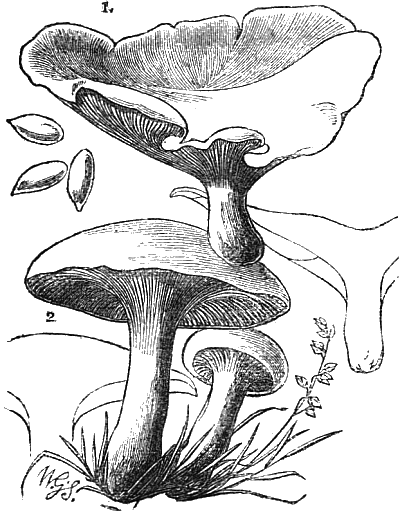 Fig. 41. (1) Agaricus orcella and (2) Agaricus prunulus (Plum Mushroom).
Woody places, in autumn; colour, snow-white, with pale
rose gills; diameter, 2 to 4 inches.
Fig. 41. (1) Agaricus orcella and (2) Agaricus prunulus (Plum Mushroom).
Woody places, in autumn; colour, snow-white, with pale
rose gills; diameter, 2 to 4 inches.
Pileus fleshy, compact, at first convex, then expanded,
becoming depressed in the centre, irregularly waved, and
slightly pruinose; from two to five inches broad; surface
dry, soft, white, or sometimes grey. The flesh thick,
white, and unchangeable. Gills crowded, deeply decurrent,
at first white, then a pale dull flesh-colour, or yellowish
brown. Spores pale brown. Stem white, solid,
firm, slightly ventricose, an inch or more long, and half
an inch thick; naked, often striate, and villose at the
base; often eccentric. Odour like that of new meal, but
usually too strong to be agreeable.
There has been considerable confusion, writes Dr. Bull,
between the two Agarics orcella and prunulus; some thinking
that we have only orcella in England (Dr. Badham);
and others only prunulus (the Rev. M. J. Berkeley), and
others again that they are both the same fungus, differing
only in size. Dr. Badham and some others again confuse
prunulus with gambosus, the fungus of early spring, and
this has arisen from the French term mousseron being
often applied to both these funguses; but they are so
essentially different as not to be liable in any way to be
mistaken for each other. Agaricus orcella and A.
prunulus are both placed on the same page in the illustration,
so that their close alliance may be seen at a
glance. Fries treats them as separate funguses, “in
deference to ancient authority, since their differences are
chiefly in degree.” These differences are, nevertheless,
so well marked, that they are kept separate here.
Orcella is a smaller and more delicate fungus than
prunulus. It is thinner and less fleshy, more undulated
in its borders, and has a lighter and more agreeable
odour. Orcella grows in more open glades than prunulus;
it is usually much whiter in colour, sometimes in high
situations white and glazed as an egg-shell, or even pottery.
Orcella grows more solitary than prunulus, in light, scattered
groups, showing an inclination for the neighbourhood
of oak-trees, and where it does grow it may be
found year after year in the same place, but seldom
more than two or three in a spot. Last year, 1869,
when orcella was pretty plentiful, prunulus was not to be
found in the situations where it grows usually most abundantly.
Prunulus is the reverse of all this. It prefers
more shaded places, is larger, more fleshy, and with a
strong odour rather heavy and overpowering. It grows
in greater quantities together, and not unfrequently in
crowded rings from four to six feet in diameter.
As edible funguses they should certainly be kept
distinct. Orcella is light and pleasant in odour, and
excellent in flavour: it is so tender and delicate as to
be termed, not inaptly, “vegetable sweetbread.” Prunulus,
on the other hand, though always good, is to
many people too strong in odour, and more coarse in
taste.
Opinions on the Merits of Agaricus orcella and A. prunulus.—“A
very delicate mushroom.”—Dr. Badham. “The
flavour of orcella is very delicate, and equal to anything
amongst fungi, or rather superior to the majority. The
same remarks apply to prunulus, which I think is the same
thing. It belongs to the first rank of edible fungi.”—Edwin
Lees.
Modes of Cooking Agaricus orcella and Agaricus prunulus.—Orcella
being usually found in small quantities, is
best, perhaps, when broiled and served on hot toast. Prunulus
will yield an abundance for broiling or stewing, or
both. “Orcella should be eaten the day it is gathered,
either stewed, broiled, or fried with egg and bread-crumbs
like cutlets.”—Dr. Badham. “However prepared, it is most
excellent; the flesh is firm and juicy, and full of flavour,
and whether broiled or stewed, it is a most delicious
morsel.”—Worthington G. Smith. “Orcella will dry, and
may be preserved in this way. It loses much of its volume,
but it acquires un aroma suavissimo.”—Vittadini. From
the Transactions of the Woolhope Naturalists’ Field Club.
Edible Fungi in America.—To give an idea of the rich
stores of fungi that spring up in some distant parts of the
earth, and in climes so different to ours that one would at
first sight suppose such fragile and fugacious bodies as
fungi would not abound in them, the following interesting
communication from Dr. Curtis, of South Carolina, to
the Rev. W. Berkeley is here given. It will prove well
worthy the attention of American readers:—
“You have asked me to give you my ‘experience with
the eatable mushrooms of America.’ This will be most
satisfactorily done, I presume, in pretty much the same
style in which I would narrate it to you at your own
fireside. My experience runs back only about twelve or
fifteen years. You may remember that previous to
this period I expressed a fear of these edibles, as I had
grown up with the common prejudices against them entertained
by most people in this country. Having
occasionally read of fearful accidents from their use, and
there being abundance of other and wholesome food
obtainable, I felt no inclination to run any risks in needlessly
enlarging my bill of fare. Thus I had passed middle
life without having once even tasted a mushroom.
“But as under your guidance and assistance my knowledge
of fungi increased, a confidence in my ability to
discriminate species grew up with it, and a curiosity
to test the qualities of these much-lauded articles got the
better of timidity; and now, I suppose, I can safely
say, that I have eaten a greater variety of mushrooms
than anyone on the American continent. I have even
introduced several species before untried and unknown.
From the beginning of my experiments, however, I have
exercised great caution, even with species long recognised
as safe and wholesome. In every case I began with only
a single mouthful. No ill effect following, I made a
second essay upon two or three mouthfuls, and so on
gradually until I made a full meal of them. Fortunately,
I have never blundered upon any kind that was mischievous,
although I have eaten freely of forty species.
This is due, perhaps, to my general acquaintance with
species that have been long used in Europe, and hence I
have made no experiments upon new species which had
not some affinity or analogy with them.
“For instance, A. campestris and A. arvensis being wholesome,
I did not doubt but that A. amygdalinus (a new
species closely allied to A. arvensis) might be safely attempted,
and it has proved equally safe and palatable.
Indeed, this may be regarded as the safest of all species
for gathering, as it can be discriminated from all others
even by a child or a blind person. Its taste and odour
are so very like those of peach kernels or bitter almonds,
that almost invariably the resemblance is immediately
mentioned by those who taste it crude for the first time.
This flavour is lost by cooking, unless the mushroom be
underdone. When thoroughly cooked I cannot myself
distinguish it from A. campestris. One or two persons
have expressed the opinion that they can distinguish it,
and that it is not quite so good. Others, again, are
equally positive that it is better. In the crude state I
deem it the most palatable of all mushrooms, as it leaves
a very agreeable aftertaste upon the palate, fully equal to
that of almonds. This is the thing I sent you some years
since for cultivation, but which failed to grow. I very much
wish it might be propagated in England, so that we might
ascertain whether it would undergo any change of qualities
in a different soil and climate. I have for some time
been entertaining the suspicion that such is the case with
many of our species. Thus, in European books the Morel
is described as possessing a peculiar flavour, that has
given its name to the Morello cherry. I can detect nothing
of the sort in our morel. You speak of A. Cæsareus
(in Introd. Crypt. Bot.) as being ‘perhaps the most delicious
of all fungi.’ This grows in great quantities in
our oak-forests, and may be obtained by the cartload in its
season; but to my taste, and that of all my family, it is
the most unpalatable of all our fungi, nor can I find
many of our most passionate mycophagists who will avow
that they like it. I have tried it in almost every mode of
cookery, but without success. There is a disagreeable
saline flavour that we cannot remove nor overlay.
“In the Tricholoma section, in which are several species
long known as edible, I did not hesitate to experiment
upon any that had the odour and taste of fresh flour. I
began with A. frumentaceus, not learning from books
whether it had been eaten in Europe. To this I subsequently
added three new American species belonging to
the same group. All are excellent when stewed, and are
especially valuable for their appearance in late autumn, even
during hard frosts, when other agarics are mostly out of
season.
“Again, there seemed such a similarity of texture
and habit between A. cæspitosus (Lentinus, Berk.) and
A. melleus, although the former belongs to Clitocybe, that
the temptation to a trial of it was irresistible. As it is
found here in enormous quantities, and a single cluster
will often contain fifty to a hundred stems, it might well
be deemed a valuable species in a time of scarcity. It
would not be highly esteemed where other and better
sorts can be had; but it is generally preferred to A.
melleus. I have found this species very suitable for drying
for winter use.
“Among the Boleti I ventured, in ignorance if it had
ever been eaten, to try B. collinitus, on account of its close
relationship with B. flavidus. I am not particularly fond
of Boleti, but this species has been pronounced delicious
by some to whom I have sent it.
“So among the Polypores, I had no fear of harm from
the use of a new American species (P. poripes, Fr.), on
account of its relation to P. ovinus, in its texture and its
flavour. The taste of the crude specimen is like that of the
best chestnuts or filberts. It has been compared even with
the cocoa-nut, and is certainly of very agreeable flavour. It
does not, however, make a superior dish for the table, being
rather too dry, but it is innocent and probably nutritious.
“Of the ‘Merisma’ group of Polypores, having already
tried P. frondosus, P. confluens, and P. sulfureus, I ventured,
after some hesitation, and with more than usual caution,
to test the virtues of a new American species (P. Berkelei,
Fr.), notwithstanding the intense pungency of the
raw material, which bites as fiercely as Lactarius piperatus.
When young, and before the pores are visible,
the substance is quite crisp and brittle, and in this state
I have eaten it with impunity and with satisfaction, its
pungency being all dissipated by stewing. I do not,
however, deem it comparable with P. confluens, which is
rather a favourite with me, as it is with some others to
whom I have introduced it. P. sulfureus is just tolerable;
safe, but not to be coveted when one can get better.
When I say safe, I mean not poisonous. I cannot recommend
it as a diet for weak stomachs, which should be
said of some other fungi of similar texture. I am here
reminded of an experience I had three or four years ago
with this species, which would have greatly alarmed me
had it happened at an earlier date in my experiments, and
which would probably have deterred anyone unused to
this kind of diet from ever indulging in it again. I had
a sumptuous dish of it on my supper-table, of which
most of my family, as well as a guest staying with us, partook
very freely. During the night I became exceedingly
sick, and was not relieved until relieved of my supper.
My first thought on the accession of my illness was of
Polyporus sulfureus; but as I remembered that inflammation
was one of the symptoms of fungus-poisoning, and I could
detect no indications of this in my case, I soon dismissed
the rising fear, did not send for the doctor, nor take any
remedy. Others, who had partaken of the fungus more
freely than myself were not at all affected; and I presume
my sickness was no more induced by the Polyporus than
by the bread and butter I had eaten. And yet, had I
alone partaken of the dish, or had one or two others been
affected in like manner, doubtless the night attack would
have been very confidently attributed by some to the
mushroom; or had this been my first trial of that article,
possibly I might ever after have regarded it with suspicion.
I learned a few days afterwards from one of our
physicians, that this kind of sickness was then somewhat
prevalent in the community, and could be attributed to
no known cause. For the credit of this species, therefore,
we were fortunately able to distinguish the post hoc from
the propter hoc.
“There are families in America that for generations
have freely and annually eaten mushrooms, preserving a
habit brought from Europe by their ancestors. In no case
have I heard of an accident among them. I have known
no instance of mushroom-poisoning in this country,
except where the victims rashly ventured upon the experiment
without knowing one species from another.
Among the families above mentioned, I have not met
with any whose knowledge of mushrooms extended beyond
the common species (A. campestris), called pink gill in this
country. Several such families live near me, but not one
of them was aware, until I informed them, that there
are other edible kinds. Everything but the pink gill,
which had the form of a mushroom, was to them a toadstool,
and poisonous. When I first sent my son with
a fine basket of Imperials (A. Cæsareus), to an intelligent
physician, who was extravagantly fond of the common
mushroom, the lad was greeted with the indignant exclamation,
‘Boy, I wouldn’t eat one of those things to
save your father’s head!’ When told that they were
eaten at my table, he accepted them, ate them, and has
eaten many a one since, with all safety and with no little
relish. Since that time our mycophagists eat whatever
I send them, without fear or suspicion.
“I have interested myself to extend the knowledge
of these things among the lovers of mushrooms, and also
their use among those who have not before tried them.
In the latter work I am not always successful, on account
of a strong prejudice against vegetables with such contemptible
names, and an unconquerable fear of accidents.
Yet, as in my own case, curiosity often conquers these
errors. When away from home I have frequently obtained
permission from a kind hostess to have cooked a
dish of mushrooms that I have found on her premises.
It has rarely occurred in such cases that the dish, then
tasted for the first time, was not declared to be delicious,
or the best thing ever put in the mouth. This latter
phrase was once used in reference to so indifferent an
article as A. salignus. Indeed, I have found several persons
who class this amongst the most palatable species.
To such persons a dish of fresh mushrooms need seldom
be wanting, as this one can be had every month of the
year in this latitude. I am induced to believe that the
quality of this species varies with the kind of wood it
grows from, and that it is better flavoured when gathered
from the mulberry, and especially from the hickory, than
when taken from most other trees. Its fitness for the
table seems also to depend much upon the rapidity of its
growth; those which grow slowly, as is the case with
some of our garden vegetables, being of tougher texture
and of less delicate flavour. A warm sun after heavy
rains brings them out in greatest perfection.
“I have several times been asked by persons eating
mushrooms for the first time, whether these things belong
to the vegetable or animal kingdom. There is certainly
a very noticeable resemblance in the flavour of some of
them to that of flesh, fish, or mollusc, so that the question,
as founded merely on taste, is not an unnatural one. But
I was much struck with its propriety when reading an
article in ‘Fraser’s Magazine,’ a few years since, written
by the late Mr. Broderip, who therein says that mushrooms
contain osmazome. If this be so, it accounts
both for their flavour and for their value as food. Of
this latter quality I had become so well convinced that,
during our late war, I sometimes averred, and I doubt
if there was much, if any, exaggeration in the assertion,
that in some parts of the country I could maintain a
regiment of soldiers five months of the year upon
mushrooms alone.
“This leads to a remark which should not be overlooked,
upon the great abundance of eatable mushrooms
in the United States. I think it is Dr. Badham who
boasts of their unusual number in Great Britain, stating
that there are thirty edible species in that kingdom. I
cannot help thinking that this is an under-estimate.
But if the Doctor is correct, there is no comparison
between the number in your country and this. I have
collected and eaten forty species found within two miles
of my house. There are some others within this limit
which I have not yet eaten. In the catalogue of the
plants of North Carolina, you will notice that I have
indicated one hundred and eleven species of edible fungi
known to inhabit this State. I have no doubt there are
forty or fifty more, as the alpine portion of the State,
which is very extensive and varied, has been very little
explored in search of fungi.
“In October, 1866, while on the Cumberland Mountains
in Tennessee, a plateau less than 1000 feet above the
valleys below, although having very little leisure for examination
during the two days spent there, I counted
eighteen species of edible fungi. Of the four or five
species which I collected there for the table, all who
partook of them, none of whom had before eaten mushrooms,
most emphatically declared them delicious. On
my return homeward, while stopping for a few hours at
a station in Virginia, I gathered eight good species
within a few hundred yards of the dépôt. And so it
seems to be throughout the country. Hill and plain,
mountain and valley, woods, fields, and pastures, swarm
with a profusion of good, nutritious fungi, which are
allowed to decay where they spring up, because people
do not know how, or are afraid, to use them. By those
of us who know their use their value was appreciated,
as never before, during our late war, when other food,
especially meat, was scarce and dear. Then such persons
as I have heard express a preference for mushrooms over
meat had generally no need to lack grateful food, as it
was easily had for the gathering, and within easy distance
of their homes if living in the country. Such was not
always the case, however. I remember on one occasion
during the gloomy period, when there had been a protracted
drought, and fleshy fungi were to be found only
in damp, shaded woods, and but few even there, I was
unable to find enough of any one species for a meal; so
gathering of every kind, I brought home thirteen different
kinds, had them all cooked together in one grand
pot pourri, and made an excellent supper. Among these
was the Chantarelle, upon which I would say a few
words in confirmation of what I have already said upon
the varying qualities of mushrooms in different regions
and localities. You have somewhere written of this
mushroom as being so highly esteemed a delicacy, that
it is much sought for when a dinner of state is given in
London. Can this be because it is a rarity? (for nothing
common and easily obtained is deemed a delicacy, I
believe), or because you have it of finer flavour in
England? Here, where it abounds, no one seems to
care at all for it, and some would forego mushrooms
entirely rather than eat this. It certainly varies much
in quality, as I have occasionally found it quite palatable,
and again, though cooked in the same mode, very indifferent.
I have been unable to ascertain whether this
difference is due to locality, exposure, shade, soil, moisture,
or temperature. That soil has much to do with the
flavour of some species of mushrooms I am well convinced.
In a parcel of pink gills I have sometimes
found one or two specimens, though perfectly sound, of
such unpleasant odour and taste as would spoil a whole
dish. So also with the snowball (A. arvensis), of which
I annually find a few beautiful specimens growing near
my residence, upon a grassy turf which covers a pile of
trash made up of decomposed sticks, leaves, and scrapings
from the adjoining soil. Their taste and odour are perfectly
detestable. I had one specimen cooked, but no
amount of seasoning could abate the offensiveness of the
odious thing; yet within a hundred yards of these I gather
specimens of the same identical species, which are of fine
flavour, equal to that of the best mushrooms. As I have
before intimated the varying flavour of mushrooms growing
on different kinds of wood, so here I suppose the
unpleasant qualities of some specimens of these two well-known
and favourite species, may be owing to something
in the soil where they grow which they cannot assimilate,
and so render a palatable and wholesome species totally
unfit for the table. Whether such specimens, if eaten,
would be poisonous or unwholesome, I do not feel any
temptation to prove. It is not probable that they will
ever do any mischief, for it is incredible that any human
being should so pervert his instincts as to swallow such
a villanous concoction.
“Experience and observations like these would perhaps
justify the inference that an innocent species may sometimes
be deleterious, on account of its taking up some
bad element from the soil. But as I have never known
a case of poisoning in families that are well acquainted
with the common mushroom or pink gill, that gather the
specimens for themselves, and have used this article of food
annually for many generations, I cannot agree with a suggestion
somewhere made by you, that perhaps all mushrooms
contain a poisonous element, but some of them in
such small quantity as to have no appreciable effect. Now,
had you seen the quantities of stewed mushrooms swallowed
at a single meal which I have seen thus devoured,
and with no more harm than from the same amount of
oyster or turtle soup, I think you would be forced to the
conclusion that such an amount, even of poisonous infinitesimals,
must have had some very unpleasant manifestations,
or else be a very innocent diet.
“It is said that the sale of the pink gill (A. campestris)
is forbidden in the Italian markets, because that
species has often proved to be poisonous. May not this
have been occasioned by ignorant and careless collectors
or by worthless inspectors? To us in America, who use
this species so freely and fearlessly, the Italian’s curse,
‘May he die of a Pratiolo!’ would have no more terror
than ‘May he die of aromatic pain.’
“Our best and standard mushrooms are the pink-gill
(A. campestris); snowball (A. arvensis); peach-kernel
(A. amygdalinus); nut (A. procerus); French (A. prunulus);
morel (M. esculenta); coral (Clavaria); and
omelette (Lycoperdon giganteum). These are almost
universally in high esteem. Yet tastes differ on these
things as on fruits and vegetables; some putting one,
some another, at the head of the list, though fond of all
and ever ready to use any of them—as one who
prefers a peach may yet relish an apple. There are some
among us who regard A. procerus as fully equal to
A. campestris, and I am almost of the same opinion. When
broiled or fried it truly makes a luscious morsel. I
mention in this connexion, that this species here bears
the name of nut mushroom, from a quality that I do
not find mentioned in the books which describe it. The
stem when fresh and young has a sweet nutty flavour,
very similar to that of the hazel nut. Is this the
case with you? Its flavour is so agreeable that I
am fond of chewing the fresh stems. From this peculiarity
in connexion with its movable ring, its form
and colours, I deem it a perfectly safe species to recommend
for collecting. We have no species likely to
be mistaken for it, except A. rachodes, and I fully tested
the innocence of this before commending the first to
others. This has been suspected by some, but I have
found it harmless. Though pretty well flavoured, it is
not comparable with A. procerus, and the flesh is so thin
and spongy that no one would choose it when those of
more compact texture are to be had. A. excoriatus, of
the same group, is a much preferable species.
“The Morel is one of my greatest favourites, but this
is not found in quantity except in calcareous districts.
A few days since (April 21) I had a dozen for supper,
the largest number I ever had at one time.
“The Lycoperdon giganteum is also a great favourite
with me, as it is, indeed, with all my acquaintances who
have tried it. It has not the high aroma of some others,
but it has a delicacy of flavour that makes it superior to
any omelette I have ever eaten. It seems, furthermore,
to be so digestible as to adapt it to the most delicate
stomachs. This is the South Down of mushrooms.
“In this latitude (about 36 degrees) we can find good
mushrooms for the table during nine or ten months of
the year. Including A. salignus, which some are quite
fond of, we can have them in every month, as this species
comes out during any warm spell in winter. A. campestris
makes its appearance here as early as March, but
is not in full crop until September. Several excellent
species of the Tricholoma group do not spring up until
after frost sets in, and continue into December. Such
is the case too with Boletus collinitus, which sometimes
emerges from the earth frozen solid.
“These observations and experiences are confined
chiefly to the Carolinas; though I presume, from casual
observations elsewhere, and from information derived
from correspondents in other States, that, making some
allowance for difference of climate and length of seasons,
what I have said is generally applicable to the whole
country.”
The following interesting paper from the Rev. J. D.
La Touche was read at a meeting of the Woolhope Naturalists’
Field Club:—
“It is said that at Rome, when a mortal is about to
be raised to the dignity of sainthood, the precaution is
taken of providing a ‘devil’s advocate,’ who, by pointing
out as strongly as he can all the faults of the candidate,
secures the fair discussion of both sides of the question,
and is a guarantee, moreover, that no unworthy aspirant
to such exalted honours should be rashly admitted to
them.
“On the present occasion I make bold to present myself
in this unamiable capacity. No member, indeed, of
this respected Club is seeking canonization, yet, a step
not less important is contemplated in the enrolment of a
hitherto despised and even abhorred member of the vegetable
kingdom among the list of its edible products; indeed,
some may consider such a step as of more importance
to our race than the apotheosis of a peccant mortal; and
therefore it would appear that, if in the one instance it is
desirable that all the peccadilloes of the candidate should
be exposed, a fortiori, it must be so in the other.
“Let me, then, first observe that these gentlemen at
the bar have actually a very bad character, and that it
is not likely that this would be the case unless they were
really great sinners.
“Here, some will exclaim, no doubt, ‘Prejudice, my
dear sir! vulgar prejudice is capable of the grossest injustice—ignorant
prejudice has driven from our tables a
delicious article of food, and deprived the poor of a wholesome
diet.’ It is often said that he was a brave man
who first ate an oyster, and truly a more uninviting
mouthful than it was could scarcely be imagined; and
yet the fact that it is good and wholesome soon disposed
of any prejudice against it. And is it not likely that
such would be the case, were the fungus tribe fit for
human food? Can we suppose any prejudice arising from
their leathery looks would not evaporate like mists before
the morning sun, were they really the nutritious and
delicious dainties they are described to be by their enthusiastic
advocates?
“I think it may be observed that the general character
which a man bears is, on the whole, a true one. That
big school, the world in which we live, contrives, in some
way or other, to hit off pretty accurately our average
merit and take our measure, and though it may make a
mistake now and then in some particular instance, its
general estimate is a fair one; and so with funguses.
There may be a too-sweeping condemnation of all kinds
of them: nay, it may be even probable that Agaricus
campestris is not the best that grows, and yet, after all,
the prevalent distrust of the tribe is well founded.
“When, e.g., some family in a parish is known to
have been poisoned by eating a wrong sort, it is not
surprising, nor can it be called stupid prejudice, if their
neighbours are ever after rather shy of the article of food
which produced that result. But it will be said that the
mischief arose from ignorance—had that family known the
marks that distinguish between the wholesome and the
poisonous kinds this would never have taken place. If ever
there was a case in which ignorance was bliss, surely this is
it. A short time ago, I accompanied a scientific friend in a
foray among the funguses, which we made with a special
view to the improvement of our intended repast, and was
on that occasion struck with the elaborate precautions
which seemed to be necessary to observe in discriminating
the good from the bad. It would almost seem that
Nature had purposely contrived a labyrinth of ingenious
stumbling-blocks to guard this mysterious product from
the insatiable appetites of mankind; and so it came to
pass after all, my good friend—who really seemed well
up in the subject, and who found at every turn some
well-known test of wholesomeness or otherwise to guide
him in the specimens we collected—wound up the day by
nearly poisoning a member of my family: for he had, it
appears, mistaken Boletus flavus, a violent poison, for
the very similar but wholesome and excellent Boletus
luteus—the only difference being that the pores of the
one are somewhat smaller and less angular than those
of the other. Surely, in this instance, knowledge (and
it was not in his case a little knowledge either) was a
dangerous thing.
“But still it may be said that there are species the
characters of which are sufficiently well-defined, and that
from these, at least, the stigma ought to be removed. But
even so, I would submit one or two questions to those
who may be inclined to admit this. 1st. Is it so clear
that a fungus which agrees with one person may not be
very injurious to another? One man has, to use a vulgar
expression, the stomach of a horse. Can I, an average
mortal, calculate on possessing such a treasure? I saw
with my own eyes my scientific friend eat and swallow
an entire Boletus flavus, raw, without any apparent bad
effects either that evening or the following day, whereas
a small portion of the same kind, cooked too (I cannot,
however, say secundum artem), produced violent sickness
on another individual, who, moreover, had never before
experienced sickness; indeed, this fact would seem to
suggest that the stomach may be ‘educated’ by long habit
to bear this noxious food, and, therefore, that its evil effects
(harmless upon organs well trained) happen when the experimentum
in corpore vili is tried. My friend assures me
that he has eaten the highly poisonous Boletus satanas
with no worse effect than a little indigestion the next
morning. Can, I would ask, the experience of such a
seasoned digestive apparatus as his be any guide to those
who have not gone through the course of training which
he has?
“Again, may it not be possible that the same kind of
fungus which in some instances is wholesome, may, if
grown under different circumstances, and supplied with
different nutriment, assume very different properties?
And again, are we competent to judge of the wholesomeness
of a particular article of food unless it is tried by
a very large number of persons—unless it be ‘exhibited,’
to use a medical term, on a great variety of constitutions?
Indeed, is there not some ground for thinking that such
an exhibition would be in many instances far from
satisfactory?
“On the whole, it would appear that the advice of an
eminent physician, an ardent admirer of the fungus, was
good and sound. When he heard of the escape my
family had on this occasion, he said that this article of
diet should be partaken of with ‘great caution.’ And
by the way, is not this itself a very suspicious expression?
‘Great caution!’ If I am introduced to a
gentleman, and told at the same time that I must conduct
myself towards him with ‘great caution’ or he will
probably do me some deadly mischief, it would hardly be
thought a very hearty and promising introduction; yet
here we are told that this excellent family to which we
are so warmly introduced has some members belonging
to it so villanously disposed, that possibly we may pay
for our acquaintance with our lives. This is not very
encouraging, and so the course adopted by a young lady
who indulges in these experiments, to whom I was speaking
the other day, would seem to be a very prudent one.
She says she never partakes of these dainties till she has
seen the effect they have had upon somebody else! But
even so, only picture the ghastly scene which a banquet
of this kind would present; each guest looking anxiously
into his neighbour’s face, awaiting in terror the contortions
which are to show that he has partaken of the fatal
dish.”
While Mr. La Touche’s paper should not deter us from
using and showing others the value of the quantities of
edible fungi now generally allowed to rot in our fields
and woods, and nowhere perhaps so abundant as in the
pleasure grounds and woods round country seats, yet, as
impressing the necessity of using due discrimination in
gathering, it may be read with advantage by all.
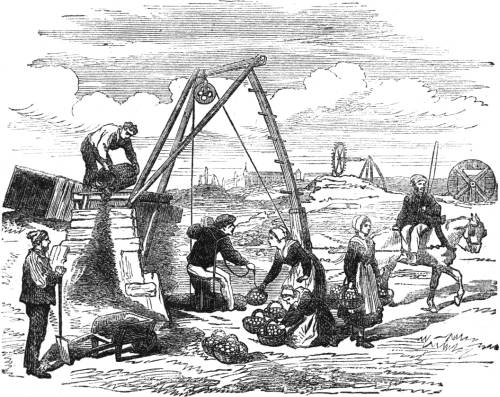 MOUTH OF MUSHROOM-CAVE NEAR PARIS
 BOTTOM OF SHAFT OF MUSHROOM-CAVE