The panic stricken Government did not rest content with the imprisonment
of the window breakers. They sought, in a blind and blundering fashion,
to perform the impossible feat of wrecking at a blow the entire militant
movement. Governments have always tried to crush reform movements, to
destroy ideas, to kill the thing that cannot die. Without regard to
history, which shows that no Government have ever succeeded in doing
this, they go on trying in the old, senseless way.
For days before the two demonstrations described in the last chapter our
headquarters in Clement's Inn had been under constant observation by the
police, and on the evening of March 5th an inspector of police and a
large force of detectives suddenly descended on the place, with warrants
for the arrest of Christabel Pankhurst and Mr. and Mrs. Pethick
Lawrence, who with Mrs. Tuke and myself were charged with "conspiring to
incite certain persons to commit malicious damage to property." When the
officers entered they found Mr. Pethick Lawrence at work in his office,
and Mrs. Pethick Lawrence in her flat upstairs. My daughter was not in
the building. The Lawrences, after making brief preparations drove in a
taxicab to Bow Street Station, where they spent the night. The police
remained in possession of the offices, and detectives were despatched
to find and arrest Christabel. But that arrest never took place.
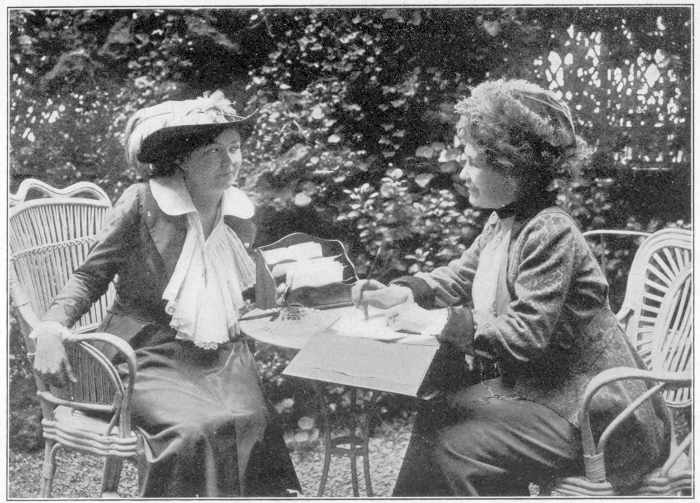
Christabel Pankhurst eluded the entire force of detectives and uniformed
police, trained hunters of human prey.
Christabel had gone home, and at first, on hearing of the arrest of Mr.
and Mrs. Pethick Lawrence, had taken her own arrest for granted. A
little reflection however showed her the danger in which the Union would
stand if completely deprived of its accustomed leadership, and seeing
that it was her duty to avoid arrest, she quietly left the house. She
spent that night with friends who, next morning, helped her to make the
necessary arrangements and saw her safely away from London. The same
night she reached Paris, where she has since remained. My relief, when I
learned of her flight, was very great, because I knew that whatever
happened to the Lawrences and myself, the movement would be wisely
directed, this in spite of the fact that the police remained in full
possession of headquarters.
The offices in Clement's Inn were thoroughly ransacked by the police, in
a determined effort to secure evidence of conspiracy. They went through
every desk, file and cabinet, taking away with them two cab loads of
books and papers, including all my private papers, photographs of my
children in infancy, and letters sent me by my husband long ago. Some of
these I never saw again.
The police also terrorised the printer of our weekly newspaper, and
although the paper came out as usual, about a third of its columns were
left blank. The headlines, however, with the ensuing space mere white
paper produced a most dramatic effect. "History Teaches" read one
headline to a blank space, plainly indicating that the Government were
not willing to let the public know some of the things that history
teaches. "Women's Moderation" suggested that the destroyed paragraph
called for comparison of the women's window breaking with men's greater
violence in the past. Most eloquent of all was the editorial page,
absolutely blank except for the headline, "A Challenge!" and the name at
the foot of the last column, Christabel Pankhurst. What words could have
breathed a prouder defiance, a more implacable resolve? Christabel was
gone, out of the clutches of the Government, yet she remained in
complete possession of the field. For weeks the search for her went
relentlessly on. Police searched every railway station, every train,
every sea port. The police of every city in the Kingdom were furnished
with her portrait. Every amateur Sherlock Holmes in England joined with
the police in finding her. She was reported in a dozen cities, including
New York. But all the time she was living quietly in Paris, in daily
communication with the workers in London, who within a few days were
once more at their appointed tasks. My daughter has remained in France ever since.
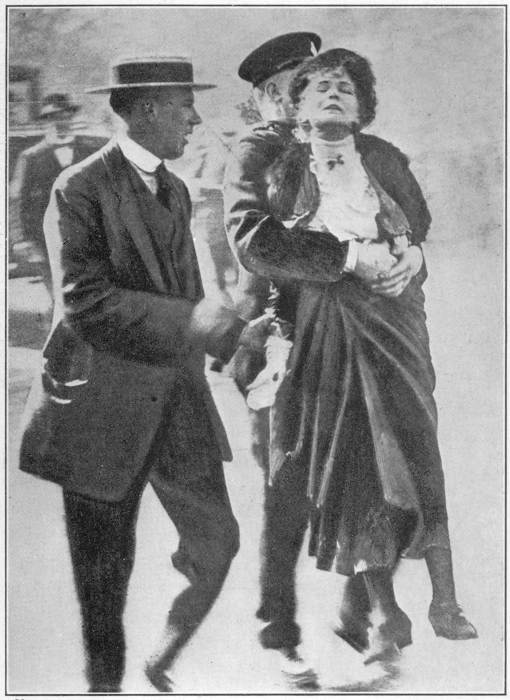
Meanwhile, I found myself in the anomalous position of a convicted
offender serving two months' prison sentence, and of a prisoner on
remand waiting to be charged with a more serious offence. I was in very
bad health, having been placed in a damp and unwarmed third division
cell, the result being an acute attack of bronchitis. I addressed a
letter to the Home Secretary, telling him of my condition, and urging
the necessity of liberty to recover my health and to prepare my case for
trial. I asked for release on bail, the plain right of a remand
prisoner, and I offered if bail were granted now to serve the rest of my
two months' sentence later on. The sole concessions granted me, however,
were removal to a better cell and the right to see my secretary and my
solicitor, but only in the presence of a wardress and a member of the
prison clerical staff. On March 14th Mr. and Mrs. Pethick Lawrence, Mrs.
Tuke and myself were brought up for preliminary hearing on the charge of
having, on November 1, 1911, and on various other dates "conspired and
combined together unlawfully and maliciously to commit damage, etc." The
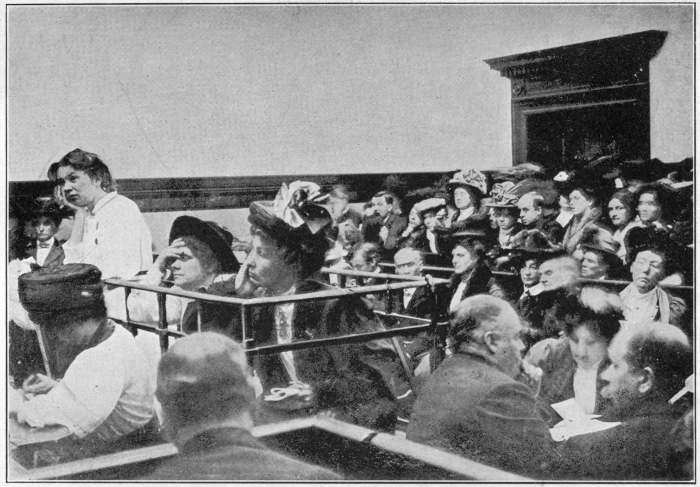
case opened on March 14th in a crowded courtroom in which I saw many
friends. Mr. Bodkin, who appeared for the prosecution, made a very long
address, in which he endeavoured to prove that the Women's Social and
Political Union was a highly developed organisation of most sinister
character. He produced much documentary evidence, some of it of such
amusing character that the court rocked with stifled laughter, and the
judge was obliged to conceal his smiles behind his hand. Mr. Bodkin
cited our code book with the assistance of which we were able to
communicate private messages. His voice sank to a scandalised half
whisper as he stated the fact that we had presumed to include the sacred
persons of the Government in our private code. "We find," said Mr.
Bodkin portentously, "that public men in the service of His Majesty as
members of the Cabinet are tabulated here under code names. We find that
the Cabinet collectively has its code word "Trees," and individual
members of the Cabinet are designated by the name, sometimes of trees,
but I am also bound to say the commonest weeds as well." Here a ripple
of laughter interrupted. Mr. Bodkin frowned heavily, and continued:
"There is one," he said solemnly, "called Pansy; another one—more
complimentary—Roses, another, Violets, and so on." Each of the
defendants was designated by a code letter. Thus Mrs. Pankhurst was
identified by the letter F; Mrs. Pethick Lawrence, D; Miss Christabel
Pankhurst, E. Every public building, including the House of Commons, had
its code name. The deadly possibilities of the code were illustrated by
a telegram found in one of the files. It read: "Silk, thistle, pansy,
duck, wool, E. Q." Translated by the aid of the code book the telegram
read: "Will you protest Asquith's public meeting to-morrow evening but
don't get arrested unless success depends on it. Wire back to Christabel
Pankhurst, Clements Inn."
More laughter followed these revelations, which after all proved no more
than the business-like methods employed by the W. S. P. U. The laughter
proved something a great deal more significant, for it was a plain
indication that the old respect in which Cabinet Ministers had been held
was no more. We had torn the veil from their sacro-sanct personalities
and shown them for what they were, mean and scheming politicians. More
serious from the point of view of prosecution was the evidence brought
in by members of the police department in regard to the occurrences of
March 1st and 4th. The policemen who arrested me and my two companions
in Downing Street on March 1st, after we had broken the windows in the
Premier's house, testified that following the arrest, we had handed him
our reserve stock of stones, and that they were all alike, heavy flints.
Other prisoners were found in possession of similar stones, tending to
prove that the stones all came from one source. Other officers testified
to the methodical manner in which the window breaking of March 1st and
4th was carried out, how systematically it had been planned and how
soldierly had been the behaviour of the women. By twos and threes March
4th they had been seen to go to the headquarters at Clement's Inn,
carrying handbags, which they deposited at headquarters, and had then
gone on to a meeting at the Pavillion Music Hall. The police attended
the meeting, which was the usual rally preceding a demonstration or a
deputation. At five o'clock the meeting adjourned and the women went
out, as if to go home. The police observed that many of them, still in
groups of twos and threes, went to the Gardenia restaurant in Catherine
Street, Strand, a place where many Suffragette breakfasts and teas had
been held. The police thought that about one hundred and fifty women
congregated there on March 4th. They remained until seven o'clock, and
then, under the watching eyes of the police, they sauntered out and
dispersed. A few minutes later, when there was no reason to expect such
a thing, the noise was heard, in many streets, of wholesale window
smashing. The police authorities made much of the fact that the women
who had left their bags at headquarters and were afterwards arrested,
were bailed out that night by Mr. Pethick Lawrence. The similarity of
the stones used; the gathering of so many women in one building,
prepared for arrest; the waiting at the Gardenia Restaurant; the
apparent dispersal; the simultaneous destruction in many localities of
plate glass, and the bailing of prisoners by a person connected with the
headquarters mentioned, certainly showed a carefully worked out plan.
Only a public trial of the defendants could establish whether or not the
plan was a conspiracy.
On the second day of the Ministerial hearing, Mrs. Tuke, who had been in
the prison infirmary for twenty days and had to be attended in court by
a trained nurse, was admitted to bail. Mr. Pethick Lawrence made a
strong plea for bail for himself and his wife, pointing out that they
had been in prison on remand for two weeks and were entitled to bail. I
also demanded the privileges of a prisoner on remand. Both of these
pleas were denied by the court, but a few days later the Home Secretary
wrote to my solicitor that the remainder of my sentence of two months
would be remitted until after the conspiracy trail at Bow Street. Mr.
and Mrs. Pethick Lawrence had already been admitted to bail. Public
opinion forced the Home Secretary to make these concessions, as it is
well known that it is next to impossible to prepare a defence while
confined in prison. Aside from the terrible effect of prison on one's
body and nerves, there is the difficulty of consulting documents and
securing other necessary data to be considered.
On April 4th the Ministerial hearing ended in the acquittal of Mrs.
Tuke, whose activities in the W. S. P. U. were shown to be purely
secretarial. Mr. and Mrs. Pethick Lawrence and myself were committed for
trial at the next session of the Central Criminal Court, beginning April
23rd. Because of the weak state of my health the judge was with great
difficulty prevailed upon to postpone the trial two weeks and it was,
therefore, not until May 15th that the case was opened.
The trial at Old Bailey is a thing that I shall never forget. The scene
is clear before me as I write, the judge impressively bewigged and
scarlet robed, dominating the crowded courtroom, the solicitors at their
table, the jury, and looking very far away, the anxious pale faces of
our friends who crowded the narrow galleries.
By the veriest irony of fate this judge, Lord Coleridge, was the son of
Sir Charles Coleridge who, in the year 1867, appeared with my husband,
Dr. Pankhurst, in the famous case of Chorlton v. Lings, and sought to
establish that women were persons, and as such were entitled to the
Parliamentary vote. To make the irony still deeper the Attorney General,
Sir Rufus Isaacs, who appeared as Counsel for the prosecution against
women militants, himself had been guilty of remarkable speeches in
corroboration of our point of view. In a speech made in 1910, in
relation to the abolition of the Lords' veto, Sir Rufus made the
statement that, although the agitation against privilege was being
peacefully conducted, the indignation behind it was very intense. Said
Sir Rufus: "Formerly when the great mass of the people were voteless
they had to do something violent in order to show what they felt; to-day
the elector's bullet is his ballot. Let no one be deceived, therefore,
because in this present struggle everything is peaceful and orderly, in
contrast to the disorderliness of other great struggles of the past." We
wondered if the man who said these words could fail to realise that
voteless women, deprived of every constitutional means of righting their
grievances, were also obliged to do something violent in order to show
how they felt. His opening address removed all doubt on that score.
Sir Rufus Isaacs has a clear-cut, hawk-like face, deep eyes, and a
somewhat world worn air. The first words he spoke were so astoundingly
unfair that I could hardly believe that I heard them aright. He began
his address to the jury by telling them that they must not, on any
account, connect the act of the defendants with any political agitation.
"I am very anxious to impress upon you," he said, "from the moment we
begin to deal with the facts of this case, that all questions of whether
a woman is entitled to the Parliamentary franchise, whether she should
have the same right of franchise as a man, are questions which are in no
sense involved in the trial of this issue.... Therefore, I ask you to
discard altogether from the consideration of the matters which will be
placed before you any viewpoint you may have on this no doubt very
important political issue."
Nevertheless Sir Rufus added in the course of his remarks that he feared
that it would not be possible to keep out of the conduct of the case
various references to political events, and of course the entire trial,
from beginning to end, showed clearly that the case was what Mr. Tim
Healey, Mrs. Pethick Lawrence's counsel, called it, a great State Trial.
Proceeding, the Attorney General described the W. S. P. U., which he
said he thought had been in existence since 1907, and had used what were
known as militant methods. In 1911 the association had become annoyed by
the Prime Minister because he would not make women's suffrage what was
called a Government question. In November, 1911, the Prime Minister
announced the introduction of a manhood suffrage bill. From that time on
the defendants set to work to carry out a campaign which would have
meant nothing less than anarchy. Women were to be induced to act
together at a given time, in different given places, in such numbers
that the police should be paralysed by the number of persons breaking
the law, in order, to use the defendant's own words, "to bring the
Government to its knees."
After designating the respective positions held by the four defendants
in the W. S. P. U., Sir Rufus went on to relate the events which
resulted in the smashing of plate glass windows valued at some two
thousand pounds, and the imprisonment of over two hundred women who
were incited to their deeds by the conspirators in the dock. He entirely
ignored the motive of the acts in question, and he treated the whole
affair as if the women had been burglars. This inverted statement of the
matter, though accurate enough as to facts, was such as might have been
given by King John of the signing of Magna Charta.
A very great number of witnesses were examined, a large number of them
being policemen, and their testimony, and our cross examination
disclosed the startling fact that there exists in England a special band
of secret police entirely engaged in political work. These men,
seventy-five in number, form what is known as the political branch of
the Criminal Investigation Department of the Police. They go about in
disguise, and their sole duty is to shadow Suffragettes and other
political workers. They follow certain political workers from their
homes to their places of business, to their social pleasures, into tea
rooms and restaurants, even to the theatre. They pursue unsuspecting
people in taxicabs, sit beside them in omnibuses. Above all they take
down speeches. In fact the system is exactly like the secret police
system of Russia.
Mr. Pethick Lawrence and I spoke in our own defence, and Mr. Healey M.
P. defended Mrs. Pethick Lawrence. I cannot give our speeches in full,
but I should like to include as much of them as will serve to make the
entire situation clear to the reader.
Mr. Lawrence spoke first at the opening of the case. He began by giving
an account of the suffrage movement and why he felt the enfranchisement
of women appeared to him a question so grave that it warranted strong
measures in its pursuit. He sketched briefly the history of the Women's
Social and Political Union, from the time when Christabel Pankhurst and
Annie Kenney were thrown out of Sir Edward Grey's meeting and imprisoned
for asking a political question, to the torpedoing of the Conciliation
Bill. "The case that I have to put before you," he said, "is that
neither the conspiracy nor the incitement is ours; but that the
conspiracy is a conspiracy of the Cabinet who are responsible for the
Government of this country; and that the incitement is the incitement of
the Ministers of the Crown." And he did this most effectually not only
by telling of the disgraceful trickery and deceit with which the
Government had misled the suffragists in the matter of suffrage bills,
but by giving the plain words in which members of the Cabinet had
advised the women that they would never get the vote until they had
learned to fight for it as men had fought in the past.
When it came my turn to speak, realising that the average man is
profoundly ignorant of the history of the women's movement—because the
press has never adequately or truthfully chronicled the movement—I told
the jury, as briefly as I could, the story of the forty years' peaceful
agitation before my daughters and I resolved that we would give our
lives to the work of getting the vote for women, and that we should use
whatever means of getting the vote that were necessary to success.
"We founded the Women's Social and Political Union," I said, "in 1903.
Our first intention was to try and influence the particular political
Party, which was then coming into power, to make this question of the
enfranchisement of women their own question and to push it. It took some
little time to convince us—and I need not weary you with the history of
all that has happened—but it took some little time to convince us that
that was no use; that we could not secure things in that way. Then in
1905 we faced the hard facts. We realised that there was a Press boycott
against Women's Suffrage. Our speeches at public meetings were not
reported, our letters to the editors, were not published, even if we
implored the editors; even the things relating to Women's Suffrage in
Parliament were not recorded. They said the subject was not of
sufficient public interest to be reported in the Press, and they were
not prepared to report it. Then with regard to the men politicians in
1905: we realised how shadowy were the fine phrases about democracy,
about human equality, used by the gentlemen who were then coming into
power. They meant to ignore the women—there was no doubt whatever about
that. For in the official documents coming from the Liberal party on the
eve of the 1905 election, there were sentences like this: 'What the
country wants is a simple measure of Manhood Suffrage.' There was no
room for the inclusion of women. We knew perfectly well that if there
was to be franchise reform at all, the Liberal party which was then
coming into power did not mean Votes for Women, in spite of all the
pledges of members; in spite of the fact that a majority of the House
of Commons, especially on the Liberal side, were pledged to it—it did
not mean that they were going to put it into practice. And so we found
some way of forcing their attention to this question.
"Now I come to the facts with regard to militancy. We realised that the
plans we had in our minds would involve great sacrifice on our part,
that it might cost us all we had. We were at that time a little
organisation, composed in the main of working women, the wives and
daughters of working men. And my daughters and I took a leading part,
naturally, because we thought the thing out, and, to a certain extent,
because we were of better social position than most of our members, and
we felt a sense of responsibility."
I described the events that marked the first days of our work, the scene
in Free Trade Hall, Manchester, when my daughter and her companion were
arrested for the crime of asking a question of a politician, and I continued:
"What did they do next? (I want you to realise that no step we have
taken forward has been taken until after some act of repression on the
part of our enemy, the Government—because it is the Government that is
our enemy; it is not the Members of Parliament, it is not the men in the
country; it is the Government in power alone that can give us the vote.
It is the Government alone that we regard as our enemy, and the whole of
our agitation is directed to bringing just as much pressure as necessary
upon those people who can deal with our grievance.) The next step the
women took was to ask questions during the course of meetings, because,
as I told you, these gentlemen gave them no opportunity of asking them
afterwards. And then began the interjections of which we have heard, the
interference with the right to hold public meetings, the interference
with the right of free speech, of which we have heard, for which these
women, these hooligan women, as they have been called—have been
denounced. I ask you, gentlemen, to imagine the amount of courage which
it needs for a woman to undertake that kind of work. When men come to
interrupt women's meetings, they come in gangs, with noisy instruments,
and sing and shout together, and stamp their feet. But when women have
gone to Cabinet Ministers' meetings—only to interrupt Cabinet Ministers
and nobody else—they have gone singly. And it has become increasingly
difficult for them to get in, because as a result of the women's methods
there has developed the system of admission by ticket and the exclusion
of women—a thing which in my Liberal days would have been thought a
very disgraceful thing at Liberal meetings. But this ticket system
developed, and so the women could only get in with very great
difficulty. Women have concealed themselves for thirty-six hours in
dangerous positions, under the platforms, in the organs, wherever they
could get a vantage point. They waited starving in the cold, sometimes
on the roof exposed to a winter's night, just to get a chance of saying
in the course of a Cabinet Minister's speech, 'When is the Liberal
Government going to put its promises into practice?' That has been the
form militancy took in its further development."
I went over the whole matter of our peaceful deputations, and of the
violence with which they were invariably met; of our arrests and the
farcical police court trials, where the mere evidence of policemen's
unsupported statements sent us to prison for long terms; of the
falsehoods told of us in the House of Commons by responsible members of
the Government—tales of women scratching and biting policemen and using
hatpins—and I accused the Government of making these attacks against
women who were powerless to defend themselves because they feared the
women and desired to crush the agitation represented by our organisation.
"Now it has been stated in this Court," I said, "that it is not the
Women's Social and Political Union that is in the Court, but that it is
certain defendants. The action of the Government, gentlemen, is
certainly against the defendants who are before you here to-day, but it
is also against the Women's Social and Political Union. The intention is
to crush that organisation. And this intention apparently was arrived at
after I had been sent to prison for two months for breaking a pane of
glass worth, I am told, 2s. 3d., the punishment which I accepted because
I was a leader of this movement, though it was an extraordinary
punishment to inflict for so small an act of damages as I had committed.
I accepted it as the punishment for a leader of an agitation
disagreeable to the Government; and while I was there this prosecution
started. They thought they would make a clean sweep of the people who
they considered were the political brains of the movement. We have got
many false friends in the Cabinet—people who by their words appear to
be well-meaning towards the cause of Women's Suffrage. And they thought
that if they could get the leaders of the Union out of the way, it would
result in the indefinite postponement and settlement of the question in
this country. Well, they have not succeeded in their design, and even if
they had got all the so-called leaders of this movement out of their way
they would not have succeeded even then. Now why have they not put the
Union in the dock? We have a democratic Government, so-called. This
Women's Social and Political Union is not a collection of hysterical and
unimportant wild women, as has been suggested to you, but it is an
important organisation, which numbers amongst its membership very
important people. It is composed of women of all classes of the
community, women who have influence in their particular organisations as
working women; women who have influence in professional organisations as
professional women; women of social importance; women even of Royal rank
are amongst the members of this organisation, and so it would not pay a
democratic Government to deal with this organisation as a whole.
"They hoped that by taking away the people that they thought guided the
political fortunes of the organisation they would break the organisation
down. They thought that if they put out of the way the influential
members of the organisation they, as one member of the Cabinet, I
believe, said, would crush the movement and get it 'on the run.' Well,
Governments have many times been mistaken, gentlemen, and I venture to
suggest to you that Governments are mistaken again. I think the answer
to the Government was given at the Albert Hall meeting held immediately
after our arrest. Within a few minutes, without the eloquence of Mrs.
Pethick Lawrence, without the appeals of the people who have been called
the leaders of this movement, in a very few minutes £10,000 was
subscribed for the carrying on of this movement.
"Now a movement like that, supported like that, is not a wild,
hysterical movement. It is not a movement of misguided people. It is a
very serious movement. Women, I submit, like our members, and women, I
venture to say, like the two women, and like the man who are in the dock
to-day, are not people to undertake a thing like this lightly. May I
just try to make you feel what it is that has made this movement the
gigantic size it is from the very small beginnings it had? It is one of
the biggest movements of modern times. A movement which is not only an
influence, perhaps not yet recognised, in this country, but is
influencing the women's movement all over the world. Is there anything
more marvellous in modern times than the kind of spontaneous outburst in
every country of this woman's movement? Even in China—and I think it
somewhat of a disgrace to Englishmen—even in China women have won the
vote, as an outcome of a successful revolution, with which, I dare say,
members of his Majesty's Government sympathise—a bloody revolution.
"One more word on that point. When I was in prison the second time, for
three months as a common criminal for no greater offence than the issue
of a handbill—less inflammatory in its terms than some of the speeches
of members of the Government who prosecute us here—during that time,
through the efforts of a member of Parliament, there was secured for me
permission to have the daily paper in prison, and the first thing I read
in the daily Press was this: that the Government was at that moment
fêting the members of the Young Turkish Revolutionary Party, gentlemen
who had invaded the privacy of the Sultan's home—we used to hear a
great deal about invading the privacy of Mr. Asquith's residence when we
ventured to ring his door bell—gentlemen who had killed and slain, and
had been successful in their revolution, while we women had never thrown
a stone—for none of us was imprisoned for stone throwing, but merely
for taking the part we had then taken in this organisation. There we
were imprisoned while these political murderers were being fêted by the
very Government who imprisoned us, and were being congratulated on the
success of their revolution. Now I ask you, was it to be wondered at
that women said to themselves: 'Perhaps it is that we have not done
enough. Perhaps it is that these gentlemen do not understand womenfolk.
Perhaps they do not realise women's ways, and because we have not done
the things that men have done, they may think we are not in earnest.'
"And then we come down to this last business of all, when we have
responsible statesmen like Mr. Hobhouse saying that there had never been
any sentimental uprising, no expression of feeling like that which led
to the burning down of Nottingham Castle. Can you wonder, then, that we
decided we should have to nerve ourselves to do more, and can you
understand why we cast about to find a way, as women will, that would
not involve loss of human life and the maiming of human beings, because
women care more about human life than men, and I think it is quite
natural that we should, for we know what life costs. We risk our lives
when men are born. Now, I want to say this deliberately as a leader of
this movement. We have tried to hold it back, we have tried to keep it
from going beyond bounds, and I have never felt a prouder woman than I
did one night when a police constable said to me, after one of these
demonstrations, 'Had this been a man's demonstration, there would have
been bloodshed long ago.' Well, my lord, there has not been any
bloodshed except on the part of the women themselves—these so-called
militant women. Violence has been done to us, and I who stand before you
in this dock have lost a dear sister in the course of this agitation.
She died within three days of coming out of prison, a little more than a
year ago. These are things which, wherever we are, we do not say very
much about. We cannot keep cheery, we cannot keep cheerful, we cannot
keep the right kind of spirit, which means success, if we dwell too much
upon the hard part of our agitation. But I do say this, gentlemen, that
whatever in future you may think of us, you will say this about us, that
whatever our enemies may say, we have always put up an honourable
fight, and taken no unfair means of defeating our opponents, although
they have not always been people who have acted so honourably towards us.
"We have assaulted no one; we have done no hurt to any one; and it was
not until 'Black Friday'—and what happened on 'Black Friday' is that we
had a new Home Secretary, and there appeared to be new orders given to
the police, because the police on that occasion showed a kind of
ferocity in dealing with the women that they had never done before, and
the women came to us and said: 'We cannot bear this'—it was not until
then we felt this new form of repression should compel us to take
another step. That is the question of 'Black Friday,' and I want to say
here and now that every effort was made after 'Black Friday' to get an
open public judicial inquiry into the doings of 'Black Friday,' as to
the instructions given to the police. That inquiry was refused; but an
informal inquiry was held by a man, whose name will carry conviction as
to his status and moral integrity on the one side of the great political
parties, and a man of equal standing on the Liberal side. These two men
were Lord Robert Cecil and Mr. Ellis Griffith. They held a private
inquiry, had women before them, took their evidence, examined that
evidence, and after hearing it said that they believed what the women
had told them was substantially true, and that they thought there was
good cause for that inquiry to be held. That was embodied in a report.
To show you our difficulties, Lord Robert Cecil, in a speech at the
Criterion Restaurant, spoke on this question. He called upon the
Government to hold this inquiry, and not one word of that speech was
reported in any morning paper. That is the sort of thing we have had to
face, and I welcome standing here, if only for the purpose of getting
these facts out, and I challenge the Attorney General to institute an
inquiry into these proceedings—not that kind of inquiry of sending
their inspectors to Holloway and accepting what they are told by the
officials—but to open a public inquiry, with a jury, if he likes, to
deal with our grievances against the Government and the methods of this agitation.
"I say it is not the defendants who have conspired, but the Government
who have conspired against us to crush this agitation; but however the
matter may be decided, we are content to abide by the verdict of
posterity. We are not the kind of people who like to brag a lot; we are
not the kind of people who would bring ourselves into this position
unless we were convinced that it was the only way. I have tried—all my
life I have worked for this question—I have tried arguments, I have
tried persuasion. I have addressed a greater number of public meetings,
perhaps, than any person in this court, and I have never addressed one
meeting where substantially the opinion of the meeting—not a ticket
meeting, but an open meeting, for I have never addressed any other kind
of a meeting—has not been that where women bear burdens and share
responsibilities like men they should be given the privileges that men
enjoy. I am convinced that public opinion is with us—that it has been
stifled—wilfully stifled—so that in a public Court of Justice one is
glad of being allowed to speak on this question."
The Attorney General's summing up for the prosecution was very largely a
defence of the Liberal Party and its course in regard to woman suffrage
legislation. Therefore, Mr. Tim Healey, in his defence of Mrs. Pethick
Lawrence, did well to lay stress on the political character of the
conspiracy charge and trial. He said:
"It is no doubt a very useful thing when you have political opponents to
be able to set the law in motion against them. I have not the smallest
doubt it would be a very convenient thing, if they had the courage to do
it, to shut up the whole of His Majesty's Opposition while the present
Government is in office—to lock up all the men of lustre and
distinction in our public forum and on our public platforms—all the
Carsons, F. E. Smiths, Bonar Laws, and so on. It would be a most
convenient thing to end the whole thing, as it would be to end women's
agitation in the form of the indictment. Gentlemen of the jury, whatever
words have been spoken by mutual opponents, whatever instructions have
been addressed, not to feeble females, but to men who boast of drilling
and of arms, they have not had the courage to prosecute anybody, except
women, by means of an indictment. Yet the Government of my learned
friend have selected two dates as cardinal dates, and they ask you to
pass judgment upon the prisoners at the bar, and to say that, without
rhyme or reason, taking the course suggested without provocation, these
responsible, well-bred, educated, University people, have suddenly, in
the words of the indictment, wickedly and with malice aforethought
engaged in these criminal designs.
"Gentlemen of the jury, the first thing I would ask in that connection
is this: What is there in the course of this demand put forward by women
which should have excited the treatment at the hands of His Majesty's
Ministers which this movement, according to the documents which are in
evidence before me, has received? I should suppose that the essence of
all government is the smooth conduct of affairs, so that those who enjoy
high station, great emoluments, should not be parties against whom the
accusation of provoking civic strife and breeding public turmoil should
be brought. What do we find? We find that, in regard to the treatment of
the demand which had always been put forward humbly, respectably,
respectfully, in its origin, by those who have received trade unionists,
anti-vaccinators, deceased wife's sisters, and all other forms of
political demand, and who have received them humbly and yielded to them,
we find that when these people advocating this particular form of civic
reform request an audience, request admission, request even to have
their petitions respectfully received, they have met, judicially, at all
events, with a flat and solemn negative. That is the beginning of this
unhappy spirit bred in the minds of persons like the defendants, persons
like those against whom evidence has been tendered—which has led to
your being empanelled in that box to-day. And I put it to you when you
are considering whether it is the incitement of my clients or the
conduct of Ministers that have led to these events—whether I cannot ask
you to say that even a fair apportionment of blame should not rest upon
more responsible shoulders, and whether you should go out of your way to
say that these persons in the dock alone are guilty."
In closing Mr. Healey reverted to the political character of the trial.
"The Government have undertaken this prosecution," he declared, "to
seclude for a considerable period their chief opponents. They hope there
will be at public meetings which they attend no more inconvenient cries
of 'Votes for Women.' I cannot conceive any other object which they
could have in bringing the prosecution. I have expressed my regret at
the loss which the shopkeepers, tradesmen and others have suffered. I
regret it deeply. I regret that any person should bring loss or
suffering upon innocent people. But I ask you to say that the law has
already been sufficiently vindicated by the punishment of the immediate
authors of the deed. What can be gained? Does justice gain?
"I almost hesitate to treat this as a legal inquiry. I regard it as a
vindictive political act. Of all the astonishing acts that have ever
been brought into a public court against a prisoner I cannot help
feeling the charge against Mr. Pethick Lawrence is the most astonishing.
He ventured to attend at some police courts and gave bail for women who
had been arrested in endeavouring, as I understand, to present petitions
to Parliament or to have resort to violence. I do not complain of the
way in which my learned friend has conducted the prosecution, but I do
complain of the police methods—inquiring into the homes and the
domestic circumstances of the prisoners, obtaining their papers, taking
their newspaper, going into their banking account, bringing up their
bankers here to say what is their balance; and I do say that in none of
the prosecutions of the past have smaller methods belittled a great
State trial, because, look at it as you will, you cannot get away from
it that this is a great State trial. It is not the women who are on
trial. It is the men. It is the system of Government which is upon its
trial. It is this method of rolling the dice by fifty-four counts in an
indictment without showing to what any bit of evidence is fairly
attributable; the system is on its trial—a system whereby every
innocent act in public life is sought to be enmeshed in a conspiracy."
The jury was absent for more than an hour, showing that they had some
difficulty in agreeing upon a verdict. When they returned it was plain
from their strained countenances that they were labouring under deep
feeling. The foreman's voice shook as he pronounced the verdict, guilty
as charged, and he had hard work to control his emotion as he added:
"Your Lordship, we unanimously desire to express the hope that, taking
into consideration the undoubtedly pure motives that underlie the
agitation that has led to this trouble, you will be pleased to exercise
the utmost clemency and leniency in dealing with the case."
A burst of applause followed this plea. Then Mr. Pethick Lawrence arose
and asked to say a few words before sentence was pronounced. He said
that it must be evident, aside from the jury's recommendation, that we
had been actuated by political motives, and that we were in fact
political offenders. It had been decided in English Courts that
political offenders were different from ordinary offenders, and Mr.
Lawrence cited the case of a Swiss subject whose extradition was refused
because of the political character of his offence. The Court on that
occasion had declared that even if the crime were murder committed with
a political motive it was a political crime. Mr. Lawrence also reminded
the judge of the case of the late Mr. W. T. Stead, convicted of a crime,
yet because of the unusual motive behind the crime, was allowed first
division treatment and full freedom to receive his family and friends.
Last of all the case of Dr. Jameson was cited. Although his raid
resulted in the death of twenty-one persons and the wounding of
forty-six more, the political character of his offence was taken into
account and he was made a first division prisoner.
They were men, fighting in a man's war. We of the W. S. P. U. were
women, fighting in a woman's war. Lord Coleridge, therefore, saw in us
only reckless and criminal defiers of law. Lord Coleridge said: "You
have been convicted of a crime for which the law would sanction, if I
chose to impose it, a sentence of two years' imprisonment with hard
labour. There are circumstances connected with your case which the jury
have very properly brought to my attention, and I have been asked by you
all three to treat you as first class misdemeanants. If, in the course
of this case, I had observed any contrition or disavowal of the acts
you have committed, or any hope that you would avoid repetition of them
in future, I should have been very much prevailed upon by the arguments
that have been advanced to me."
No contrition having been expressed by us, the sentence of the Court was
that we were to suffer imprisonment, in the second division, for the
term of nine months, and that we were to pay the costs of the prosecution.