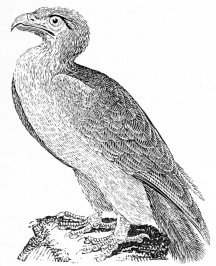
THE GOLDEN EAGLE. (Aquila chrysaëtos.)
“But who the various nations can declare,
That plough with busy wing the peopled air?
These cleave the crumbling bark for insect food,
Those dip the crooked beak in kindred blood:
Some haunt the rushy moor, the lonely woods;
Some bathe their silver plumage in the floods;
Some fly to man, his household gods implore,
And gather round his hospitable door,
Wait the known call, and find protection there
From all the lesser tyrants of the air.
The tawny Eagle seats his callow brood
High on the cliff, and feasts his young with blood.”
Barbauld.
The Golden Eagle is one of the largest and most powerful of all those
birds that have received the name of Eagle. It weighs above twelve
pounds. Its length, from the point of the beak to the end of the tail,
is about three feet; the breadth, when the wings are extended, is seven
or eight feet. The beak is horny, crooked, and very strong. The feathers
of the neck are of a rusty colour, and the rest dark brown. The feet are
feathered down to the claws, which have a wonderful grasp; the toes are
yellow, and the four talons are crooked and strong. As in all birds of
prey, the female is the larger, and more powerful.
Eagles are remarkable for their longevity, and their faculty of
sustaining a long abstinence from food. Of all birds the Eagle flies
highest; and from thence the ancients have given it the epithet of the
Bird of Heaven:
“Bird of the broad and sweeping wing,
Thy home is high in heaven,
Where wide the storms their banners fling,
And the tempest’s clouds are driven.
Thy throne is on the mountain top,
Thy fields the boundless air;
And hoary peaks, that proudly prop
The skies, thy dwellings are.”
This formidable bird may be considered among its own species what the
lion is among quadrupeds; and in many respects they have a strong
similitude to each other. Solitary, like the lion, he keeps the wilds to
himself alone; it is as extraordinary to see two pairs of Eagles in the
same mountain, as two lions in the same plain.
The Eagle is found in Great Britain and Ireland, in Germany, and nearly
all parts of Europe. It is carnivorous, and, when unable to obtain the
flesh of larger animals, feeds on serpents and lizards. The story of the
Eagle, brought to the ground after a severe conflict with a cat, which
it had seized and taken up into the air with its talons, is very
remarkable; Mr. Barlow, who was an eye-witness of the fact, made a
drawing of it, which he afterwards engraved. Two instances are said to
have occurred in Scotland of the Eagle having flown away with infants to
its nest; but in both cases it is added that the children were
recovered, without being materially injured. This bird has been often
tamed, but in this situation it still preserves an innate love of
liberty. The nest of the Eagle is composed of strong sticks, and
generally built on the point of an inaccessible rock, whence it darts
upon its prey with the rapidity of lightning. The period of incubation
is said to be thirty days; and when the young are hatched, both the male
and female exert all their industry to provide for their wants. In the
county of Kerry a peasant is said once to have formed the resolution of
plundering an Eagle’s nest built upon a small island in the beautiful
lake of Killarney. He accordingly swam to the island while the parents
were away; and, after robbing the nest of the young, was preparing to
swim back with the Eaglets tied in a string; but while he was yet up to
the chin in the water, the old Eagles returned, and, missing their
family, fell upon the invader with such fury, that, in spite of all his
resistance, they despatched him with their beaks and talons.
Another native of Kerry was more fortunate in his dealings with the
Eagles. During a season of scarcity he obtained sustenance for himself
and his family by plundering an Eagle’s nest of the food brought in by
the parents for their young ones: and he was so artful as to prolong the
supply by cutting the wings of the Eaglets so as to prevent their
flying, and thus compelled the old birds to continue their attention to
their progeny.
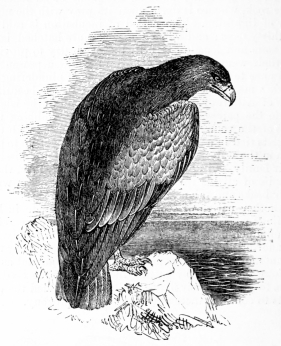
THE SEA EAGLE. (Haliaëtus albicilla.)
This bird, known also as the White-tailed Eagle, from the inside
feathers of its tail being white, differs from the golden eagle in the
greater length of its beak, in its sluggish and cowardly habits, and in
its coarser taste. It is a native of Great Britain, where it inhabits
the high rocks and cliffs that overhang the sea, and whence it pounces
on the birds, fish, or seals that it can procure for its prey. It is
smaller than the golden eagle, rarely reaching three feet in length; and
in young birds the tail feathers are brown.
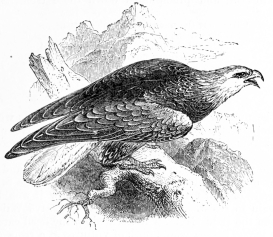
THE WHITE-HEADED, OR BALD EAGLE.
(Haliaëtus leucocephalus.)
This bird is about three feet long, and seven feet broad, measuring to
the tips of the extended wings. The bill resembles that of the golden
eagle, and from the chin hang some small hairy feathers like a beard. As
it is found alike in the frigid and the torrid zone, it is provided for
enduring rapid changes of temperature, and its whole body is clothed
under the feathers with a kind of down, white and soft like that of the
swan. This bird builds its nest on lofty cliffs by the sea-shore, and on
the banks of rivers or lakes, and feeds almost entirely upon fish.
It is generally regarded by the Anglo-Americans with peculiar respect,
as the chosen emblem of their native land. The great cataract of Niagara
is mentioned as one of its favourite places of resort, not merely as a
fishing station, where it is enabled to satiate its hunger upon its most
congenial food, but also in consequence of the vast quantity of
four-footed beasts, which, unwarily venturing into the stream above, are
borne away by the torrent, and precipitated down those tremendous
falls:
“High o’er the watery uproar silent seen,
Sailing sedate in majesty serene,
Now ’midst the pillar’d spray sublimely lost,
And now emerging, down the rapids toss’d,
Glides the Bald Eagle, gazing calm and slow
O’er all the horrors of the scene below;
Intent alone to sate himself with blood,
From the torn victim of the raging flood.”
The number of birds of prey of various kinds which assemble at the foot
of the rocks to glut themselves upon the banquet thus provided for them,
is said to be incredibly great, but they are all compelled to give place
to the Eagle when he deigns to feed on dead animals; and the crow and
the vulture submit without a struggle to the exercise of that tyranny,
which they know it would be in vain to resist. “We have ourselves,” says
Wilson, “seen the Bald Eagle, while seated on the dead carcase of a
horse, keep a whole flock of vultures at a respectful distance, until he
had fully sated his own appetite:” and he adds another instance, in
which many thousands of tree squirrels having been drowned, in one of
their migrations, in attempting to pass the Ohio, and having furnished
for some length of time a rich banquet to the vultures, the sudden
appearance among them of the Bald Eagle at once put a stop to their
festivities, and drove them to a distance from their prey, of which the
Eagle kept sole possession for several successive days.
These Eagles sometimes hunt in pairs in a manner which shows their great
sagacity. Aware that water-fowl have the power of eluding their grasp by
diving, they hover at a distance from each other over their prey. One of
them then darts towards it with great swiftness, but the water-fowl
easily avoids the first attack by diving. The pursuer then rises into
the air, and his mate resumes the attack just as the fowl is emerging to
breathe, and compels it to plunge again. The Eagles continue alternately
to proceed in this manner till their victim is so exhausted that it
falls an easy prey.
This Eagle also frequently attacks the Osprey or Fish Hawk, when he is
returning from a successful excursion loaded with a large fish, and
compels him to drop his prey; the Eagle then descends with wonderful
rapidity, and generally succeeds in seizing the fish before it reaches
the water.
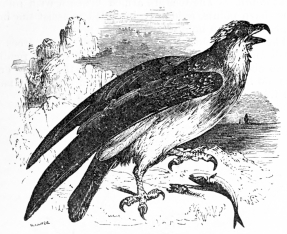
THE OSPREY, OR FISHING HAWK.
(Pandion haliaëtus.)
“True to the season, o’er our sea-beat shore
The sailing Osprey high is seen to soar
With broad unmoving wing; and circling slow,
Marks each loose straggler in the deep below;
Sweeps down like lightning, plunges with a roar,
And bears its struggling victim to the shore.”
This bird is always found on the sea-shore, or near rivers or lakes, as
it feeds entirely on fish. It is common in Great Britain, and also in
America, where large colonies of it are found, the birds living together
like rooks. “When looking out for its prey,” says Dr. Richardson, “it
sails with great ease and elegance, in undulating and curved lines, at a
considerable height above the water, till it perceives its prey, when it
pounces down upon it. It seizes the fish with its claws, sometimes
scarcely appearing to dip its feet in the water, and at others plunging
entirely under the surface with force sufficient to throw up a
considerable spray. It emerges again, however, so speedily, as to render
it evident that it does not attack fish swimming at any great depth.”
The toes are armed beneath with numerous sharp points, evidently
intended to assist the bird in getting a firm hold of its slippery prey.
The Osprey builds a large nest either on trees or rocks, and lays two or
three eggs, which have a reddish tinge, and are spotted with brown at
the larger end. The old birds feed the young ones even after they have
left the nest, and only rear one brood in the year.
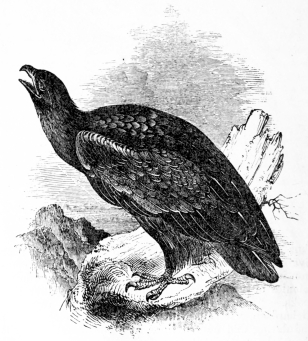
Some ornithologists suppose this to be merely the golden eagle in its
young state, but others make it a distinct species. It is about twice as
large as the raven. The parts about the beak and the eye are bare of
feathers, and somewhat reddish; the head, neck, and breast black; in the
middle of the back, between the shoulders, there is a large white spot,
dashed with red; a black streak sweeps along the feathers, and is
followed by a white one; the remaining part of the wing to the tip is of
a dark ash-colour. This bird has beautiful hazel eyes, full of
animation: his legs are feathered down a little below the tarsal joint,
the naked part being red; his talons are very long. He is found in
France, Germany, Poland, and delights in Alpine mountains, where he
makes the vales and woods resound with his incessant screamings when in
search of prey.
The Abbé Spallanzani had an eagle of this species, so powerful as to be
able to kill dogs that were much larger than itself. When a dog was
placed before it, the bird would ruffle up the feathers on its head and
neck, cast a dreadful look at its victim, take a short flight, and
immediately alight on its back. It held the head firmly with one foot,
and thus secured the dog from biting, and with the other grasped one of
his flanks, at the same time driving its talons into the body; and in
this attitude it continued, till the dog expired with fruitless outcries
and efforts.
The eyes of eagles are celebrated for their brilliancy and strength,
which has given rise to the popular opinion that they can gaze on the
sun without shrinking: though this, from the overhanging eyebrow of the
Eagle, would be an extremely difficult feat for the bird to perform. The
eyes of all birds are curiously constructed, so as to enable them to see
both distant objects and near ones with equal facility; and for this
purpose they are furnished with a membrane placed near the edge of the
crystalline lens of the eye, by which it can be moved at pleasure. The
orbit of the eye is formed of about twelve or sixteen bony plates, which
slide over each other when necessary. Birds are also furnished with an
additional eyelid, of extremely thin texture, with which they
occasionally appear to shade their eyes.
The first rank in the description of birds has been given to the eagle,
not on account of its size, but because it is nobler in its habits and
more delicate in its appetites. But it belongs to the falcon tribe, and
should be placed after the Vultures. The eagle, unless pressed by
famine, will not stoop to carrion; and generally devours only what he
has earned by his own pursuit. The Vulture, on the contrary, is
disgustingly voracious; and seldom attacks living animals when it can be
supplied with dead. The eagle meets and singly opposes his enemy: the
Vulture, if he expects resistance, calls in the aid of its kind, and
overpowers its prey by combination. Putrefaction, instead of deterring,
only serves to allure it. The Vulture seems among birds what the jackal
and hyæna are among quadrupeds, who prey upon carcases, and root up the
dead.
Vultures may be easily distinguished from eagles by the nakedness of
their heads and necks, which are without feathers, and only covered with
a very slight down, or a few scattered hairs; their eyes are more
prominent; those of the eagle being buried more in the socket, and
shaded by an overhanging eyebrow. Their claws are shorter and less
hooked. The inside of the wing is covered with a thick down, which is
different in them from all other birds of prey. Their attitude is not so
upright as that of the eagle, and their flight is more difficult and
heavy.
In this description we may include the Golden, the Ash-coloured, and the
Brown Vulture, which are inhabitants of Europe; the Spotted and the
Black Vulture of Egypt; the Bearded Vulture, the Brazilian Vulture and
the King of the Vultures, of South America. They all agree in their
nature, being equally indolent, rapacious, and unclean. The Condor also
belongs to the Vulture tribe.
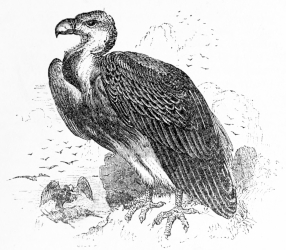
THE KING VULTURE. (Vultur, or Sarcorhamphus papa.)
The King Vulture, or King of the Vultures, is so called, because when he
makes his appearance amongst a whole company of other birds of his kind
engaged in a feast upon a dead carcase, they all retire before him and
wait respectfully at a little distance until this monarch has eaten his
fill. He is an inhabitant of South America.
The head and neck of this bird are without feathers; the body above,
reddish buff, beneath, yellowish white: quills greenish black; tail
black; craw pendulous, and orange-coloured. It is about the size of a
turkey; and is chiefly remarkable for the odd formation of the skin of
the head and neck; this skin, which is of an orange colour, arises from
the base of the bill, whence it stretches on each side of the head; the
eyes are surrounded by a red skin, and the iris has the colour and
lustre of pearl. Upon the naked part of the neck is a collar formed by
soft longish feathers. Into this collar the bird sometimes withdraws his
whole neck, and sometimes a part of its head, so that it looks as if it
had hidden its neck in its body.
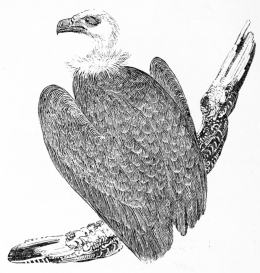
THE CONDOR. (Vultur gryphus.)
This bird measures three or four feet long, and its wings, when
expanded, from ten to twelve feet. Its bill and talons are exceedingly
large and strong; and its courage is equal to its strength. The throat
is naked, and of a red colour. The upper parts in some individuals (for
they differ greatly in colour) are variegated with black, gray, and
white, and the body is scarlet. Round the neck it has a white ruff of
loose hairy feathers. The feathers on the back are generally quite
black, and perfectly bright. These enormous birds, which are inhabitants
of South America, breed among the highest and most inaccessible rocks.
The female makes no nest, but lays two white eggs, somewhat bigger than
those of a turkey, on the bare rock. Some writers have affirmed that a
Condor can carry off a sheep in its claws, and others that it has
carried off children in the same manner; but these tales are manifestly
absurd, as the Condor’s feet and talons are not fitted for carrying any
great weight. Both the talons and the bill are indeed of extraordinary
strength, but they are intended for tearing objects to pieces; and
consequently we find that the Condor feeds chiefly on dead or dying
cattle, or horses, which he tears to pieces and devours where they lie.
When the Condor is gorged the hunters attack him, but his strength and
fierceness are so great, that one of Sir Francis Head’s companions, who
attempted to seize a gorged Condor, said he never had “such a battle in
his life;” though he had been a Cornish miner and was reckoned an
excellent wrestler in his own country.
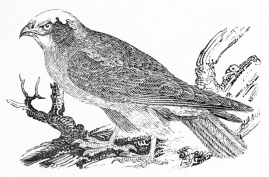
THE BUZZARD. (Falco Buteo, or Buteo vulgaris.)
“The noble Buzzard ever pleased me best;
Of small renown, ’t is true; for, not to lie,
We call him but a Hawk by courtesy.”
Hind and Panther.
This is a rapacious bird, of the hawk kind, and the most common of all
in England. It is of a sluggish, indolent nature, often remaining
perched on the same bough for the greater part of the day: as if,
indifferent either to the allurements of food or of pleasure, it were
doomed, like some of the human species, to pass its allotted span of
life in passive contemplation. It feeds on mice, rabbits, frogs, and
often on all sorts of carrion. Too idle to build itself a nest, it
frequently seizes upon the old habitation of a crow, which it lines
afresh with wool and other soft materials. In general this bird, whose
colour varies considerably, is brown varied with yellow specks; at a
certain age its head becomes entirely gray. The female generally lays
two or three eggs, which are mostly white, though sometimes spotted with
yellow. Its length is usually twenty-two inches, and its breadth upwards
of fifty.
The following anecdote, related by Buffon, will show that the Buzzard
may be so far tamed as to be rendered a faithful domestic. A Buzzard,
which had been caught in a snare, was brought to a gentleman, who
undertook to tame it. It was at first wild and ferocious, but by
depriving it of food he succeeded in constraining it to come and eat out
of his hand. By pursuing this plan he brought it to be very familiar;
and, after having shut it up about six weeks, he began to allow it a
little liberty, taking the precaution, however, to tie both pinions of
its wings. In this condition it walked out into his garden, and returned
when called to be fed; after some time, thinking he might trust to its
fidelity, he removed the ligatures, and fastened a small bell above its
talon, and also attached to its breast a bit of copper with his name
engraved on it. He then gave it entire liberty, which it soon abused;
for it took wing and flew into the forest of Belesme. The bird was given
up for lost; but four hours afterwards, it rushed into the gentleman’s
hall, pursued by five other Buzzards, which had driven it into its
former asylum. After this adventure it preserved its fidelity, coming
every night to sleep under the window. It soon became familiar, attended
constantly at dinner, sat on a corner of the table, and often caressed
its master with its head and bill, emitting a weak, sharp cry, which,
however, it sometimes softened. It had a singular propensity of seizing
from the head and flying away with the red caps of the peasants; and so
alert was it in whipping them off, that they found their heads bare
without knowing what was become of their caps; it even treated the wigs
of the old men in the same way, hiding its booty in the tallest trees.
Wilson says that one he shot in the wing lived with him several weeks:
but refused to eat. It amused itself by hopping from one end of the room
to the other, and sitting for hours at the window, looking down on the
passengers below. At first, he put himself in an attitude of defence
when approached; but after some time became quite familiar, permitting
himself to be handled. Though he lived so long without food, his stomach
was found on dissection to be enveloped in solid fat of nearly an inch
in thickness.
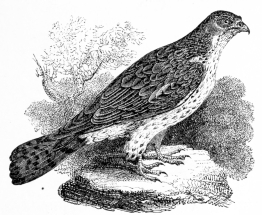
THE HONEY-BUZZARD. (Falco, or Pernis apivorus.)
This Buzzard eats lizards, frogs, and snails. It also feeds upon the
larvæ of bees and wasps, which form the chief food of the young birds.
Buffon says that in winter, when fat, it is good eating, a very rare
circumstance with birds of this genus. It seldom flies, excepting from
one bush to another; but, when on the ground, it runs with great
rapidity, like a domestic fowl.
Willoughby observes that it builds its nest with twigs, on which it
lays wool to receive its eggs. He saw one that took possession of an old
kite’s nest to breed in, and that fed its young with the larvæ of wasps,
for in the nest were found the combs of wasps’ nests, and, in the
stomachs of the young, fragments of wasp-maggots. In the nest were two
young ones, covered with white down, spotted with black. In the crop of
one of them were two lizards entire, with their heads lying towards the
mouth, as if they sought to creep out.
It would be highly interesting could we discover the manner in which
this bird conducts its attack on a wasps’ nest. The close feathering
round the base of the bill, is, no doubt, a protection against the
stings of the insects which they attack.
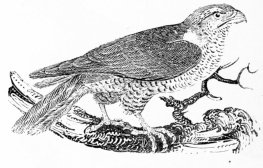
THE GOSHAWK, (Falco, or Astur palumbarius,)
Breeds in lofty trees in Scotland, and destroys a great quantity of
small game, which he seizes with his sharp and crooked talons, and
carries to his nest. He is of the hawk tribe, and somewhat larger than
the common buzzard; his bill is blue, and he has a white stripe over
each eye, and also a large white spot on each side of the neck. The
general colour of the plumage is deep brown; the breast and belly white,
transversely streaked with black; and the legs yellow. Buffon, who
brought up two young Goshawks, a male and a female, makes the following
observations: “The Goshawk, before it has shed its feathers, that is, in
the first year, is marked on the breast and belly with longitudinal
brown spots; but after it has had two moultings they disappear, and
their place is occupied by transverse bars, which continue during the
rest of its life.” He further observes that, “though the male was much
smaller than the female, it was fiercer and more vicious.” The Goshawk
is found in France and Germany; it is not common in England, but is more
so in Scotland. In former times the custom of carrying a Hawk or Falcon
on the hand was confined to men of high distinction; so that it was a
saying among the Welsh, “You may know a gentleman by his Hawk, horse,
and greyhound.” Even the ladies in those times were partakers of this
gallant sport, and have been represented in pictures with Hawks on their
hands. At present hawking is almost entirely laid aside in this country,
as the expense which attended it, being very considerable, confined it
to princes and men of the highest rank. In the time of James the First,
Sir Thomas Monson is said to have given a thousand pounds for a cast of
Hawks. In the reign of Edward the Third it was made felony to steal a
Hawk; to take its eggs, even in a person’s own grounds, was punishable
with imprisonment for a year and a day, together with a fine at the
king’s pleasure. Such was the delight our ancestors took in this royal
sport, and such were the means by which they endeavoured to secure it.
The Falcons, or Hawks, chiefly used in these kingdoms were the Goshawk,
the Peregrine Falcon, Iceland Falcon, and the Ger Falcon. The game
usually pursued were cranes, wild geese, pheasants, and partridges. The
Duke of St. Albans is still hereditary grand falconer of England, but
the office is not now exercised, except for the Duke’s own amusement.
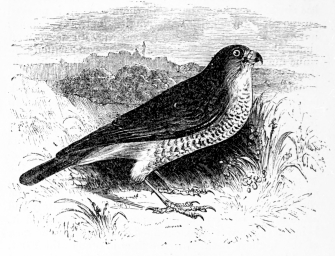
THE SPARROWHAWK. (Falco, or Accipiter nisus.)
The Sparrowhawk is a bold-spirited bird; the length of the male is
twelve inches, that of the female fifteen; the beak is short, crooked,
and of a bluish tint, but very black towards the tip; the tongue black,
and a little cleft; the eyes of a middling size. The crown of the head
is of a dark brown; above the eyes, in the hinder part of the head,
there are sometimes white feathers; the roots of the feathers of the
head and neck are white, the rest of the upper side, back, shoulders,
wings, and neck of a dark brown. The wings, when closed, scarcely reach
to the middle of the tail; the thighs are strong and fleshy, the legs
long, slender, and yellow; the toes also long, and the talons black. The
female lays about five eggs, spotted near the blunt end with brown
specks. When wild they feed only upon birds, and possess a boldness and
courage above their size; but in a domestic state they do not refuse raw
flesh and mice. They can be made obedient and docile, and readily
trained to hunt quails and partridges.
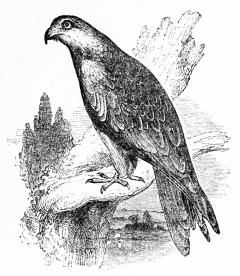
THE KITE. (Falco Milvus, or Milvus regalis.)
THE KITE. (Falco Milvus, or Milvus regalis.)
This bird, though it belongs to the falcon tribe, is called ignoble,
because it is never used in hawking. It is easily distinguished from
other birds of prey by its forked tail, and the slow and circular eddies
it describes in the air whenever it spies from the regions of the clouds
a young duck or a chicken which has strayed too far from the brood. When
this is the case, the Kite, pouncing on it with the rapidity of a dart,
seizes it in its talons, and carries it off to its nest. It is, however,
a great coward, and if the hen flies at it, which she always does if she
sees it, it will drop the chicken and fly off. It is larger than the
common buzzard; and though it weighs somewhat less than three pounds,
the extent of its wings is more than five feet. The head and neck are of
a pale ash colour, varied with longitudinal lines across the shafts of
the feathers; the back is reddish; the lesser rows of the wing feathers
are party-coloured, of black, red, and white; the feathers covering the
inside of the wings are red, with black spots in the middle. The eyes
are large, the legs and feet yellow, the talons black. It is a handsome
bird, and seems almost always on the wing. It rests itself on the air,
and does not appear to make the smallest effort in flying, but rather to
glide along with the gentlest breeze.
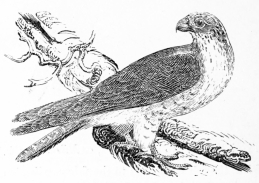
The Falcon is a predaceous bird, of which there are several species. Of
these the Gerfalcon (Falco Gyrfalco) is the largest, and is found in
the northern parts of Europe; and, next to the eagle, is the most
formidable, active, and intrepid of all voracious birds, and the most
esteemed for falconry. The bill is crooked and bluish; the irides of the
eye dusky; and the whole plumage of a whitish hue, marked with dark
lines on the breast, and dusky spots on the back.
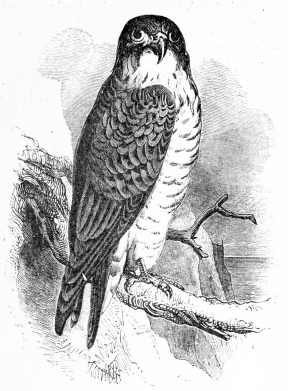
THE PEREGRINE FALCON. (Falco peregrinus.)
The Peregrine Falcon, which is the most common kind, is from fifteen to
eighteen inches in length. The bill is blue at the base, and black at
the point; the head, back, scapulars, and coverts of the wing are barred
with deep black and blue; the throat, neck, and upper part of the breast
are white, tinged with yellow; the bottom of the breast, belly, and
thighs are of a grayish white; and the tail is black and blue. Wilson
enumerates no less than ten varieties, dependent chiefly upon age, sex,
and country. It is found, more or less abundantly, throughout the whole
of Europe, principally in the mountain districts in North and South
America, dwelling in the clefts of rocks, especially such as are exposed
to the mid-day sun. It breeds upon the cliffs in several parts of
England, but appears to be more common in Scotland and Wales. Its food
consists principally of small birds; but it scruples not to attack the
larger species, and sometimes gives battle even to the kite. Falcons
rarely take their prey upon the ground, like the more ignoble birds of
the class to which they belong; but pounce upon it from aloft, in a
directly perpendicular descent as it flies through the air, bear it
downwards by the united impulse of the strength and rapidity of their
attack, and sticking their talons into its flesh, carry it off in
triumph to the place of their retreat. Like most predatory animals, they
are stimulated to action by the pressure of hunger alone, and remain
inactive and almost motionless while the process of digestion is going
on, until the renewed cravings of their appetite stimulate them to
further exertion. In different stages of its growth, the Peregrine
Falcon has been known by various English names. Its proper appellation
among falconers is the Slight Falcon, the term Falcon Gentle being
equally applicable to all the species when rendered manageable. In the
immature state, this Falcon is also called a Red Hawk, from the
prevailing colour of its plumage. The male is called a Tiercel, to
distinguish it from the female, which, in the Falcon tribe, is commonly
one-third larger than the male.
In China there is said to be a variety, which is mottled with brown and
yellow, and used by the emperor of China in his sporting excursions,
when he is usually attended by his great falconer, and a thousand of
inferior rank. Every bird has a silver plate fastened to its foot, with
the name of the falconer who has the charge of it, that, in case it
should be lost, it may be restored to the proper person; but if it
should not be found, the name is delivered to another officer, called
the guardian of lost birds, who, to make his situation known, erects his
standard in a conspicuous place among the army of hunters.
In Syria there is a species of Falcon, which the inhabitants call
Shaheen (Falco peregrinator), and which is of so fierce and courageous
a disposition, that it will attack any bird, however large or powerful,
which presents itself. “Were there not,” says Dr. Russel, in his Account
of Aleppo, “several gentlemen now in England to bear witness to the
fact, I should hardly venture to assert that, with this bird, which is
about the size of a pigeon, the inhabitants sometimes take large eagles.
This Hawk was in former times taught to seize the eagle under the
pinion, and thus depriving him of the use of one wing, both birds fell
to the ground together; but the present mode is to teach the Hawk to fix
on the back, between the wings, which has the same effect, only, that as
the bird tumbles down more slowly, the falconer has more time to come to
his Hawk’s assistance; but in either case, if he be not very
expeditious, the falcon is inevitably destroyed. I never saw the Shaheen
fly at eagles, that sport having been disused before my time; but I have
often seen him take herons and storks. The Hawk, when thrown off, flies
for some time in a horizontal line, not six feet from the ground; then
mounting perpendicularly, with astonishing swiftness, he seizes his prey
under the wing, and both together come tumbling to the ground.”
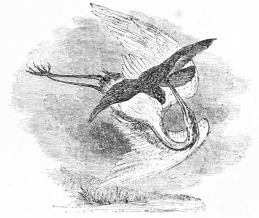
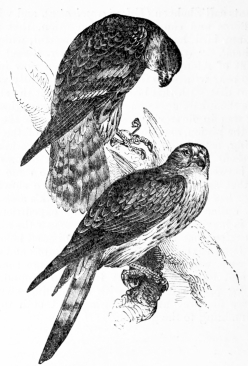
THE MERLIN, (Falco æsalon,)
Is the smallest British species of the Falcon tribe, and, as its name
implies, is not very different in size from the blackbird; the word
Merlin signifying in French a small merle, or blackbird. Though small
the Merlin is not inferior in courage to any of the other Hawks; it is
noted for its boldness and spirit, often attacking and killing at one
stroke a full-grown partridge or a quail; but it differs from the
Falcons and all the other rapacious kinds, in the male and female being
of equal size. The back of this bird is party-coloured, of dark blue and
brown; the quill feathers of the wings black, with rusty spots; the
tail is about five inches long, of a dark brown or blackish colour, with
transverse white bars: the breast is of a yellowish white, with streaks
of rusty brown pointing downwards; the legs are long, slender, and
yellow; the talons black. The head is encircled with a row of yellowish
feathers, not unlike a coronet. In the male the feathers on the rump,
next the tail, are bluer; a mark by which the falconers easily discern
the sex of the bird. The Merlin does not breed here, but visits us in
October: it flies low, and with great celerity and ease. In the days of
falconry, the Merlin was considered the lady’s hawk.
In ancient days—in ancient days,
When ladies took a strange delight
In hawks and hounds and sporting ways,
A Merlin was a pleasant sight.
“ ’T was gentle when, in trappings gay,
Upon its lady’s wrist it stood;
Till its hood was raised and it saw its prey,
When its eye betrayed the bird of blood.”
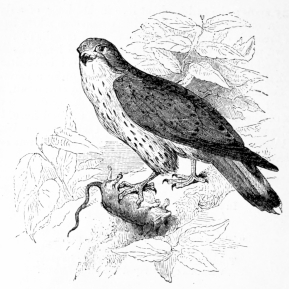
THE KESTREL, (Falco tinnunculus,)
Is the commonest of all the British Hawks, and may be seen in almost all
parts of the country hovering over the fields in search of mice and
other small animals. His flight is very peculiar. He advances only for a
short distance at a time, and then suspends himself in the air by very
short but quick movements of his wings. If no prey make its appearance
beneath him, he then goes on a little further, and again remains
stationary, but the moment a mouse or other small quadruped stirs
amongst the grass, his wings close, and he descends with the greatest
velocity. The Kestrel will also feed upon small birds and insects.
The Kestrel is a handsome little Hawk, from twelve to fifteen inches in
length, with a blue beak and yellow cere and feet. Its plumage is
reddish brown or fawn colour, elegantly marked with black spots and
bars. Its nest is built among rocks, or in the holes and corners of old
buildings and church towers, and the female lays four or five eggs,
which are reddish white, with brown spots.
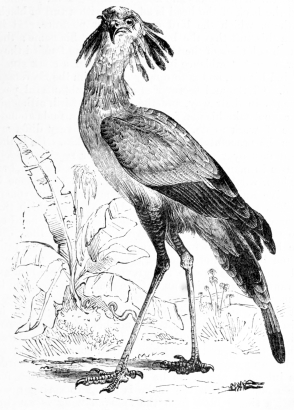
THE SECRETARY BIRD. (Serpentarius reptilivorus.)
This singular bird, which is a native of Southern Africa, differs from
all the other predaceous birds in the great length of its legs, which
are so long that some naturalists have placed it among the Wading Birds.
It stands between three and four feet high when erect, and is of a
bluish ash colour on the back and nearly white beneath; its tail is
long, and has the two middle feathers much longer than the others and
nearly reaching to the ground; and the back of the head is adorned with
a tuft of black feathers, which the bird can raise at pleasure. It is
from this tuft that the bird has obtained his name; the Dutch colonists
of the Cape of Good Hope fancied they saw some resemblance in it to the
pen of a clerk stuck behind his ear, and accordingly called him the
Secretary Bird. Clerks and secretaries are no doubt useful personages in
their way, and the Secretary Bird, although he cannot take his pen from
behind his ear, finds abundance of work to do, although of a kind very
different from the peaceful labours of his namesakes. He is the great
destroyer of the snakes and other reptiles which swarm in many parts of
Southern Africa, and which, but for him, would increase in numbers so as
to become a positive nuisance. And here we may call our young readers to
admire the wonderful manner in which the structure of a hawk has been
modified by the hand of the Creator to suit it for a particular mode of
life. As the bird advances to attack a snake his long legs, protected by
hard horny scales, elevate his body to a considerable height above the
ground, thus giving him an advantageous position, and at the same time
enabling it to move with great speed. One of the large and powerful
wings, armed at the end with a strong spur, is raised a little from the
body and held forward like a shield, but constantly shaken, as if to
distract the attention of the foe, and thus, like a skilful boxer
sparring up to his antagonist, the Secretary makes his way towards his
intended prey. As he approaches he watches for the moment when the snake
is about to spring upon him; a single blow from the spurred wing is
usually sufficient to lay the reptile writhing in the ground in a
helpless state; it is then soon despatched and as speedily swallowed.
Some idea of the quantity of reptiles destroyed by this bird may be
gained from Le Vaillant’s statement, that the crop of one of them
examined by him contained eleven lizards, three snakes as long as a
man’s arm, and eleven small tortoises, together with a good many
insects. The inhabitants of the Cape Colony are quite aware of the
services rendered to them by the Secretary Bird, and sometimes keep him
among their poultry to protect them from injurious animals; he is said
to behave with great propriety under these circumstances, rarely doing
any mischief to his companions, unless his supply of food has been
neglected.
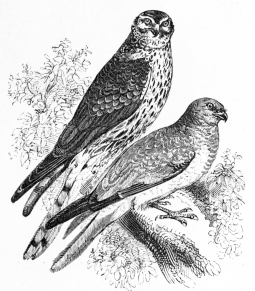
THE HEN HARRIER, (Circus cyaneus,)
Is seen about forests, heaths, and other retired places, especially in
the neighbourhood of marshy grounds, where it destroys vast numbers of
snipes, woodcocks, and wild ducks. It is about seventeen inches long,
and three feet wide; its bill is black, and cere yellow. The upper part
of its body is of a bluish gray; and the back of the head, breast,
belly, and thighs are white. The legs are long, slender, and yellow; and
the claws black.
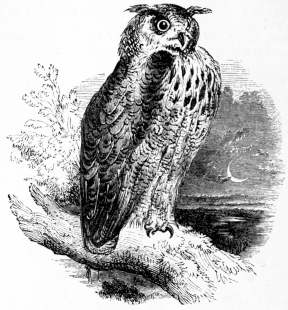
THE HORNED OWL, (Bubo maximus,)
Is one of the largest of the Owls, and has two long tufts growing from
the top of its head, above its ears, and composed of six feathers, which
it can raise or lay down at pleasure. Its eyes are large, and encircled
with an orange-coloured iris; the ears are large and deep, and the beak
black; the breast, belly, and thighs, are of a dull yellow, marked with
brown streaks; the back, coverts of the wings, and quill feathers, are
brown and yellow; and the tail is marked with dusky and red bars. It
inhabits the north and west of England, and Wales. The conformation of
the organ of sight in the Owl is so peculiar, and so much in its nature
resembling that of the feline kind, that it can see much better at dusk
than by daylight. The Barn Owl sees in a greater degree of darkness than
the others; and, on the contrary, the Horned Owl is enabled to pursue
his prey by day, though with difficulty. Owls are sometimes tamed by
persons in the country, who carefully rear them in a domestic state,
from their propensity to chase and devour mice and other vermin, of
which they clear the houses with as much address as cats. The Owl is a
solitary bird, and is said to retire into holes in towers and old walls
in the winter, and pass that season in sleep.
“The solitary bird of night,
Through the pale shade now wings his flight,
And quits the time-shook tower;
Where, shelter’d from the blaze of day,
In philosophic gloom he lay,
Beneath his ivy bower.” Carter.
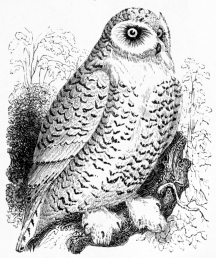
THE HARFANG, OR GREAT SNOWY OWL.
The Harfang, or Great Snowy Owl, (Surnia nyctea,) is another species
which takes its prey occasionally by daylight. It is seldom seen in
England, but frequently visits North Britain, particularly the Orkney
and Shetland Islands. It is one of the few Owls that feed on fish, into
which it strikes its talons while in the water, and carries them off to
its nest. These Owls are very common in the northern parts of North
America, and are eaten not only by the Indians, but by the Europeans
engaged in the fur trade.
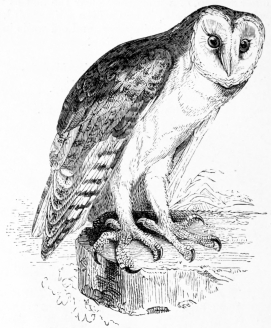
THE WHITE, BARN, OR SCREECH OWL.
(Srix flammea.)
“—— from yonder ivy-mantled tower,
The moping Owl does to the moon complain
Of such as, wandering near her secret bower,
Molest her ancient solitary reign.” Gray.
This bird is about the size of a large pigeon. Its beak, hooked at the
end, is more than an inch and a half long. There is a circle or wreath
of white, soft, and downy feathers, encompassed with yellow ones,
beginning from the nostrils on each side, passing round the eye and
under the chin, somewhat resembling the hood that women used to wear; so
that the eyes appear to be sunk in the middle of the feathers, and only
the tip of the beak projects from them. The breast and feathers of the
inside of the wings are white, and marked with a few dark spots; the
upper parts of the body are of a fine pale yellow colour, variegated
with black and white spots. The legs are covered with a thick down to
the feet, but the toes have only thin-set hairs around them.
In ancient mythology, another common species, the Brown Owl (Syrnium
aluco), was consecrated to Minerva, the goddess of wisdom; in allusion
to the lucubrations of wise men, who study in retirement and during the
night.
“Now the Hermit Owlet peeps
From the barn, or twisted brake;
And the blue mist slowly creeps,
Curling on the silver lake.”
Cunningham.
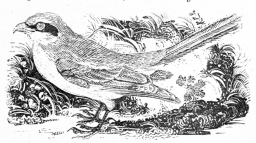
THE BUTCHER-BIRD, OR SHRIKE.
(Lanius excubitor.)
The Great Butcher-bird, or Shrike, is about as large as a thrush; its
bill is black, an inch long, and hooked at the end. It is only an
occasional visitor to this country, where it is generally found between
autumn and spring. “The Shrike,” says Mr. Yarrell, “feeds on mice,
shrews, small birds, frogs, lizards, and large insects. After having
killed its prey, it fixes the body in a forked branch, or upon a sharp
thorn, the more readily to tear off small pieces from it. It is from
their habit of killing and hanging up their meat, that the Shrikes are
called Butcher-birds.” The head, back, and rump are ash-coloured; the
chin and lower part of the body white; the breast and throat varied with
dark lines crossing each other; the tips of the feathers of the wings
are, for the most part, white; it has a black spot by the eye; the
outermost tail feathers of the male are all over white; the two
middlemost have only their tips white, the rest of the feathers being
black, as well as the legs and feet. It builds its nest among thorny
shrubs and dwarf trees, and furnishes it with moss, wool, and downy
herbs, where the female lays five or six eggs. A peculiarity belonging
to the birds of this kind is, that they do not, like most other birds,
expel the young ones from the nest as soon as they can provide for
themselves, but the whole brood live together in one family. The
Butcher-bird will chase all the small birds upon the wing, and will
sometimes venture to attack partridges, and even young hares. Thrushes
and blackbirds are frequently their prey: the Shrike fixes on them with
its talons, splits the skull with its bill, and feeds on them at
leisure. On this account Linnæus classed the Shrikes with the birds of
prey; but modern naturalists have placed them with the insect-eaters, as
insects are their principal food. It is easy to distinguish these birds
at a distance, not only from their going in companies, but also from
their manner of flying, which is always up and down, seldom in a direct
line, or obliquely.
The Little Butcher-bird (Lanius collurio), called in Yorkshire,
Flusher, is about the size of a lark, with a large head. About the
nostrils and corners of the mouth it has black hairs or bristles; and
round the eyes a large black longitudinal spot; the back and upper side
of the wings are of a rusty colour; the head and rump cinereous; the
throat and breast white, spotted with red. It builds its nest of the
stalks of plants, and the female lays six eggs, nearly all white, except
at the blunt end, which is encircled with brown or dark red marks. The
female is somewhat larger than the male; the head is of a rust colour,
mixed with gray; the breast, belly, and sides of a dirty white; the tail
deep brown; the exterior web of the outer feathers white. Its manners
are similar to those of the large Butcher-bird. It frequently preys on
young birds, which it takes in the nest; it likewise feeds on
grasshoppers, beetles, and other insects. During the period of
incubation, the female soon discovers herself at the approach of any
person by her loud and violent outcries.
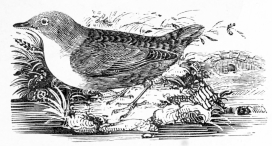
THE WATER OUZEL, OR DIPPER,
(Cinclus aquaticus,)
Is found in most parts of this island, and is about the size of the
common blackbird. It feeds upon aquatic insects and small fish. The head
and upper side of the neck are of a kind of umber colour, and sometimes
black with a shade of red; the back and coverings of the wings are a
mixture of black and ash-colour, the throat and breast perfectly white.
The Dipper is said to walk along the bottom of a lake or river as easily
as on land; but this is far from being the case, as, though it readily
plunges into the water, it appears to tumble about in a very
extraordinary manner, with its head downwards. Even on land the bird
walks awkwardly, as its feet are best adapted for the slippery stones on
which it passes the greater part of its life, watching for the insects
which it picks up on the edge of the water. Its movements under water
are really performed by means of the wings, the bird positively flying
through the water. When disturbed, it usually flirts up its tail, and
makes a chirping noise. Its song in spring is said to be very pretty. In
some places this bird is supposed to be migratory.
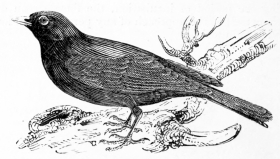
THE BLACKBIRD. (Turdus Merula.)
“The smiling morn, the breathing spring,
Invite the tuneful birds to sing;
And, while they warble from each spray,
Love melts the universal lay.”
Mallet.
This well-known songster does not soar up to the clouds, like the lark,
to make his voice resound through the air; but keeps to the shady
groves, which he fills with his melodious notes. Early at dawn, and late
at dusk, he continues his pleasing melody; and when incarcerated in the
narrow space of a cage, still cheerful and merry, he strives to repay
the kindness of his keeper by singing to him his natural strains; and
beguiles his irksome hours of captivity by studying and imitating his
master’s whistle. Blackbirds build their nests with great art, making
the outside of moss and slender twigs, cemented together and lined with
clay, and covering the clay with soft materials, as hair, wool, and fine
grass. The female lays four or five eggs, of a bluish green colour,
spotted all over with brown. The bill is yellow, but in the female the
upper part and point are blackish; the inside of the mouth, and the
circumference of the eyelids are yellow. The name of this bird is
sufficiently expressive of the general colour of his body. He feeds on
berries, fruit, insects, &c.
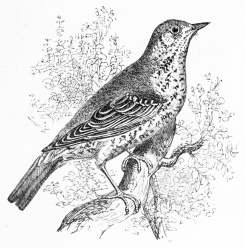
THE MISSEL THRUSH. (Turdus viscivorus.)
The Missel Thrush, so called from its feeding on the berries of the
misletoe, differs but little from the Song Thrush, except in size. He is
larger than the fieldfare, while the Throstle is smaller. The female
lays five or six bluish eggs, with a tint of green, and marked with
dusky spots.
The Song Thrush or Throstle, (Turdus musicus,) is one of the best
songsters of the evening hymn in the grove. His voice is loud and sweet;
the melody of his song is varied, and, although not so deep in the
general diapason of the woodland concert as that of the blackbird, yet
it fills up agreeably, and bursts through the inferior warblings of
smaller performers. His breast is of a yellowish white, spotted with
black or brown dashes, like ermine spots.
The term Merle for the Blackbird, and Mavis for the Thrush, are used
chiefly by the poets.
“Merry is it in the good green wood,
When the Mavis and Merle are singing,
When the deer sweeps by, and the hounds are in cry,
And the hunter’s horn is ringing.”
Scott.
“Take thy delight in yonder goodly tree,
Where the sweet Merle and warbling Mavis be.”
Drayton.
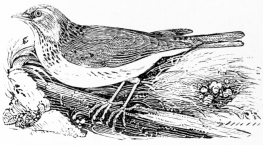
THE REDWING, (Turdus iliacus,)
Is rather less than the song thrush; but the upper part of the body is
of the same colour; the breast not so much spotted; the coverings of the
feathers of the under side of the wings, which in the thrush are yellow,
are of orange colour in this bird; by which marks it is generally
distinguished. The body is white, the throat and breast yellowish,
marked with dusky spots. It is migratory in this island, builds its nest
in hedges, and lays six bluish eggs. Like the fieldfare, it leaves us in
spring, for which reason its song is quite unknown to us; but it is
said to be very pleasing. It is delicate eating; and the Romans held it
in such estimation, that they kept thousands of them together in
aviaries, and fed them on a sort of paste made of bruised figs and
flour, to improve the delicacy and flavour of their flesh. Under this
management these birds fattened, to the great profit of their
proprietors, who sold them to Roman epicures for three denarii, or about
two shillings sterling each, which at that early period was a large
price.
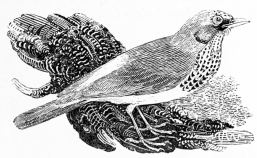
THE FIELDFARE, (Turdus pilaris,)
Is a well-known bird in this country. Fieldfares fly in flocks, together
with the redwing and starling, and change their haunts according to the
season of the year. They abide with us in winter, and disappear in
spring, so punctually, that after that time not one is to be seen. The
flesh is esteemed a great delicacy, and is highly prized in Germany,
where it is known as the Krammsvögel, and is sold in the markets of
Westphalia by the dozen. Their favourite food is the juniper-berry,
whence its German name. The head is ash-coloured, and spotted with
black: the back and coverts of the wings of deep chesnut colour; the
rump cinereous; and the tail black, except the lower part of the two
middle feathers, which are ash-coloured, and the upper sides of the
exterior feathers, which are white. They collect in large flocks; and it
is supposed they keep watch, like the crow, to mark and announce the
approach of danger. On any person approaching a tree that is covered
with them, they continue fearless, till one at the extremity of the
bush, rising on its wings, gives a loud and peculiar note of alarm. They
then all fly away, except one, which continues till the person
approaches still nearer, to certify, as it were, the reality of the
danger, and afterwards he also flies off, repeating the note of alarm.
Mr. Knapp, in his “Journal of a Naturalist,” says, that in the county of
Gloucestershire the extensive low-lands of the river Severn, in open
weather, are visited by prodigious flocks of these birds.
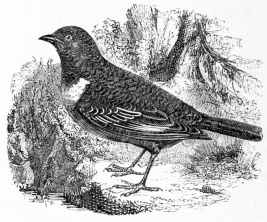
THE RING OUZEL. (Turdus torquatus.)
The Ring Ouzel differs from the fieldfare and redwing, to which it is
nearly allied, in being a summer visitor to the British islands, instead
of a winter one. It is found only in the wildest and most mountainous
districts; particularly among the Welsh mountains and on Dartmoor, in
Devonshire, where it has been known to breed.
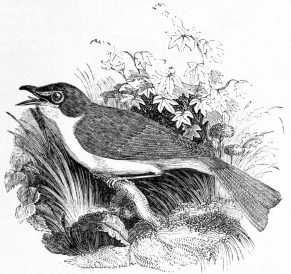 THE MOCKING BIRD, (Turdus polyglottus,)
Which is also a species, is found in both North and South America, and
in the West Indian islands. He has a beautiful song, which he varies by
imitating the notes of almost all other birds, so that a person passing
by his haunt is regaled with a complete ornithological concert, all by a
single performer. Unfortunately, the Mocking Bird’s taste is not equal
to his musical powers. His talent for imitation is so great that he
mimics every sound he hears, and as he introduces all his imitations
freely into his songs, he often interrupts the most delightful melody
with the scream of a hawk, the bark of a dog, the squalling of a cat, or
similar discordant noises.
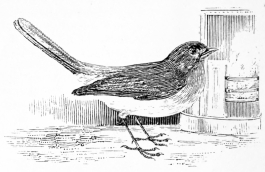
THE ROBIN, OR REDBREAST.
(Erythacus rubecula.)
“The Redbreast oft, at evening hours,
Shall kindly lend his little aid,
With hoary moss, and gathering flowers,
To deck the ground where thou art laid.”
Collins.
The Redbreast, or Robin, as he is popularly called, seems always to
have enjoyed the protection of man, more than any other bird. The
prettiness of his shape, the beauty of his plumage, the quickness of his
motions, his familiarity with us in winter, and, above all, the melody
and sweetness of his voice, claim our admiration, and have insured him
that security which he enjoys among us; though the aid of fable has also
been called in, to guard him from the assaults of thoughtless boys.
“Little bird with bosom red,
Welcome to my humble shed!
Courtly domes of high degree
Have no room for thee and me;
Pride and pleasure’s fickle throng
Nothing mind an idle song.
Daily near my table steal,
While I pick my scanty meal;
Doubt not, little though there be,
But I’ll cast a crumb for thee;
Well rewarded if I spy
Pleasure in thy glancing eye;
And see thee, when thou’st eat thy fill,
Plume thy breast, and wipe thy bill.”
Langhorne.
In the winter season, impelled by the potent stimulus of hunger, the
Redbreast frequents our barns, gardens, and houses, and often alights,
on a sudden, on the rustic floor; where, with his broad eye incessantly
open, and looking askew upon the company, he picks up eagerly the crumbs
of bread that fall from the table, and then flies off to the
neighbouring bush, where, by his warbling strains, he expresses his
gratitude for the liberty he has been allowed. He is found in most parts
of Europe, but nowhere so commonly as in Great Britain. His bill is
dusky; his forehead, chin, throat, and breast are of a deep
orange-colour, inclining to vermilion; the back of his head, neck, back,
and tail are of a pale olive-brown colour; the wings are somewhat
darker, the edges inclining to yellow; the legs and feet are the colour
of the bill. The female generally builds her nest in the crevice of some
mossy bank, near places which human beings frequent, or in some part of
a human dwelling. Robins have been known to build in a sawpit where men
worked every day, and in various other equally extraordinary places.
When the Crystal Palace at Sydenham was being fitted up, several Robins
built their nests in holes of the large roots used to raise the flower
beds within the building. So little fear did they exhibit that their
bright eyes might be seen glancing from holes close to which men were
passing every moment. The elegant poet of The Seasons gives us a very
exact and animated description of this bird in the following lines:
“—— —— Half afraid, he first
Against the window beats: then, brisk alights
On the warm hearth; then, hopping on the floor,
Eyes all the smiling family askance,
And pecks, and starts, and wonders where he is,
Till, more familiar grown, the table-crumbs
Attract his slender feet.”
An old Latin proverb tells us that two Robin Redbreasts will not feed
on the same tree; it is certain that the Redbreast is a most pugnacious
bird, and that he does not live in much harmony and friendship with
those of his own kind and sex. The male may be known from the female by
the colour of his legs, which are blacker.
The Redbreast attends the gardener when digging his borders; and will,
with great familiarity and tameness, pick out the worms almost close to
his spade.
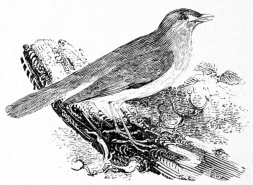
THE NIGHTINGALE. (Philomela luscinia.)
“Sweet bird, that shunn’st the noise of folly,
Most musical, most melancholy!
Thee, chantress, oft, the woods among,
I woo to hear thy even song.”
Milton.
The Nightingale has little to boast of in respect to plumage, which is
of a pale tawny colour on the head and back, dashed with a slight shade
of olive; the breast and upper part of the belly incline to a grayish
tint, and the lower part of the belly is almost white; the exterior web
of the quill feathers is of a reddish brown; the tail of a dull red; the
legs and feet ash-coloured; the irides hazel; and the eyes large,
bright, and staring. But it is hardly possible to give an idea of the
extraordinary power which this small bird possesses in its throat, as to
the extension of sound, sweetness of tone, and versatility of notes.
Its song is composed of several musical passages, each of which does not
continue more than the third part of a minute; but they are so varied,
the passing from one tone to another is so fanciful and so rapid, and
the melody so sweet and so mellow, that the most consummate musician is
pleasingly led to a deep sense of admiration on hearing it. Sometimes,
joyful and merry, it runs down the diapason with the velocity of
lightning, touching the treble and the base nearly at the same instant;
at other times, mournful and plaintive, the unfortunate Philomela
draws heavily her lengthened notes, and breathes a delightful melancholy
around. These have the appearance of sorrowful sighs; the other
modulations resemble the laughter of the happy. Solitary on the twig of
a small tree, and cautiously at a certain distance from the nest, where
the pledges of his love are treasured under the fostering breast of his
mate, the male fills constantly the silent woods with his harmonious
strains, and during the whole night entertains and repays his female for
the irksome duties of incubation. The Nightingale not only sings at
intervals during the day, but waits till the blackbird and the thrush
have uttered their evening call, even till the stock and ringdoves have,
by their soft murmurings, lulled each other to rest, and then pours
forth his full tide of melody:
“—— —— Listening Philomela deigns
To let them joy, and purposes, in thought
Elate, to make her night excel their day.”
Thomson.
It is a great subject of astonishment that so small a bird should be
endowed with such potent lungs. If the evening is calm, it is supposed
that its song may be heard above half-a-mile. This bird, the ornament
and charm of our spring and early summer evenings, as it arrives in
April, and continues singing till June, disappears on a sudden about
September or October, when it leaves us to pass the winter in the North
of Africa and Syria. Its visits to this country are limited to certain
counties, mostly in the south and east; as, though it is plentiful in
the neighbourhood of London, and along the south coast in Sussex,
Hampshire, and Dorsetshire, it is not found in either Cornwall or Wales.
As soon as the young are hatched, the song of the male bird ceases, and
he only utters a harsh croak, by way of giving alarm when any one
approaches the nest. Nightingales are sometimes reared up, and doomed to
the prison of a cage; in this state they sing ten months in the year,
though in their wild life they sing only as many weeks. Bingley says
that a caged Nightingale sings much more sweetly than those which we
hear abroad in the spring.
The Nightingale is the most celebrated of all the feathered race for its
song. The poets have in all ages made it the theme of their verses; some
of these we cannot resist giving:
“The Nightingale, as soon as April bringeth
Unto her rested sense a perfect waking,
Which late bare earth, proud of new clothing, springeth,
Sings out her woes——.”
Sir Philip Sidney.
“—— —— —— Beast and bird,
They to their grassy couch, these to their nests,
Were slunk; all but the wakeful Nightingale;
She all night long her amorous descant sung.”
Milton.
“And in the violet-embroidered vale,
Where the lovelorn Nightingale
Nightly to thee her sad song mourneth well.”
Milton.
“O Nightingale, that on yon bloomy spray
Warblest at eve, when all the woods are still,
Thou with fresh hope the lover’s heart dost fill,
While the jolly hours lead on propitious May,
Thy liquid notes that close the eye of day,
First heard before the shallow cuckoo’s bill,
Portend success in love. Oh, if Jove’s will
Have linked that amorous power to thy soft lay,
Now timely sing, ere the rude bird of hate
Foretell my hopeless doom in some grove nigh;
As thou from year to year hast sung too late
For my relief, yet hadst no reason why:
Whether the muse, or love, call thee his mate,
Both them I serve, and of their train am I.”
Milton.
“—— —— Now is the pleasant time,
The cool, the silent, save where silence yields,
To the night-warbling bird, that, now awake,
Tunes sweetest his love-laboured song.”
Milton.
“How all things listen while thy muse complains,
Such silence waits on Philomela’s strains,
In some still evening, when the whispering breeze
Pants on the leaves, and dies upon the trees.”
Pope.
“There’s a bower of roses by Bendemeer’s stream,
And the Nightingale sings round it all the year long;
In the days of my childhood, ’t was like a sweet dream
To sit in the roses, and hear the bird’s song.
“That bower and its music I never forget,
But oft when alone, in the bloom of the year,
I think, Is the Nightingale singing there yet?
Are the roses still bright by the calm Bendemeer?”
Moore.
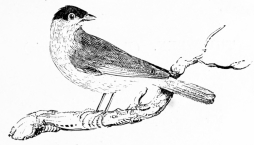
THE BLACK-CAP, (Curruca atricapilla,)
Is a very small warbler, not weighing above half-an-ounce. The top of
the head is black, whence he takes his name; the neck ash-coloured, the
back an ashy-brown, the wings of a dusky colour, the tail nearly the
same; the nether part of the neck, throat, and upper part of the breast
of a pale ash colour; the lower part of the belly white.
The Black-cap visits us about the middle of April, and retires in
September; it frequents gardens, and builds its nest near the ground.
The female lays five eggs of a pale reddish-brown, sprinkled with spots
of a darker colour. This bird sings sweetly, and so like the
nightingale, that in Norfolk it is called the mock nightingale. White
observes, that it has usually a full, sweet, deep, loud, and wild pipe,
yet the strain is of short continuance, and its motions desultory; but
when it sits calmly, and earnestly engages in song, it pours forth very
sweet but inward melody; and expresses a great variety of modulations,
superior perhaps to any of our warblers, the nightingale excepted. While
it sings, its throat is greatly distended.
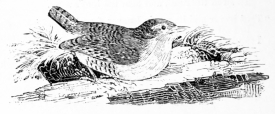
THE WREN. (Troglodytes vulgaris.)
“Fast by my couch, congenial guest,
The Wren has wove her mossy nest;
From busy scenes and brighter skies
To lurk with innocence she flies;
Her hopes in safe repose to dwell,
Nor aught suspects the sylvan cell.”
T. Warton.
The Wren is a very small bird; but, as if nature had intended to
compensate the want of size and bulk in the individuals, by multiplying
them to a greater extent, this little bird is one of the most prolific
of the feathered tribe, its nest containing often upwards of eighteen
eggs, of a whitish colour, and not much bigger than a pea. The male and
female enter by a hole contrived in the middle of the nest, and which,
by its situation and size, is accessible only to themselves. The Wren
weighs no more than three drachms. Its notes are very sweet, and rival
those of the robin redbreast, in the middle of winter, when the coldness
of the weather has condemned the other songsters to silence. Like the
redbreast, it frequently approaches the habitation of man, enlivening
the rustic garden with its song during the greater part of the year. It
begins to make a nest early in the spring, but frequently deserts it
before it is lined, and searches for a more secure place. The Wren does
not, as is usual with most other birds, begin to build the bottom of the
nest first. When against a tree, its primary operation is to trace upon
the bark the outline, and thus to fasten it with equal strength to all
parts. It then, in succession, closes the sides and top, leaving only a
small hole for entrance.
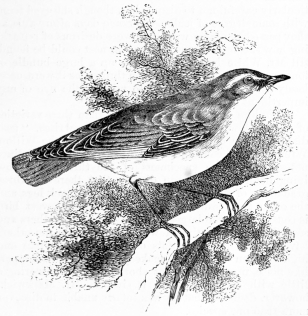
THE WILLOW WREN. (Sylvia trochilus.)
The Willow Wren is somewhat larger than the common Wren. The upper parts
of the body are of a pale olive-green; the under parts are pale yellow,
and a streak of yellow passes over the eyes. The wings and tail are
brown, edged with yellowish green; and the legs are inclined to yellow.
This bird is migratory, visiting us usually about the middle of April,
and taking its departure towards the end of September. The female
constructs her nest in holes at the roots of trees, in hollows of dry
banks, and other similar places. It is round, and not unlike the nest of
the Wren. The eggs are dusky white, marked with reddish spots, and are
five in number. A Willow Wren had built in a bank of one of the fields
of Mr. White, near Selborne. This bird, a friend and himself observed as
she sat in her nest, but were particularly careful not to disturb her,
though she eyed them with some degree of jealousy. Some days afterwards,
as they passed the same way, they were desirous of remarking how the
brood went on; but no nest could be found, till Mr. White happened to
take up a large bundle of long green moss, which had been thrown, as it
were, carelessly over the nest, in order to mislead the eye of any
impertinent intruder.
Mr. White distinguished no fewer than three varieties of the Willow
Wren. “I have now,” he writes, “past dispute, made out three distinct
species of the Willow Wrens, which constantly and invariably use
distinct notes.” “I have specimens of the three sorts now lying before
me, and can discern that there are three gradations of sizes, and that
the least has black legs, and the other two, flesh-coloured ones. The
yellowest bird is considerably the largest, and has its quill feathers
and secondary feathers tipped with white, which the others have not. The
last haunts only the tops of trees and high beechen woods, and makes a
sibilous grasshopper-like noise, now and then, at short intervals,
shivering a little with its wings when it sings.” Mr. Markwich, however,
declared that he was totally unable to discover more than one species.
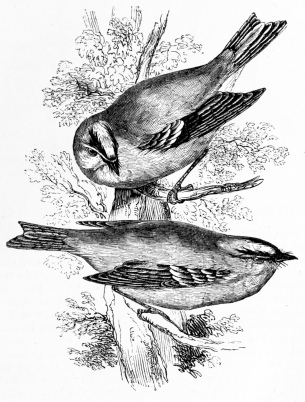
THE GOLDEN-CRESTED WREN, (Regulus cristatus,)
Is the smallest of British birds, measuring only three inches and a half
in length. It is of an olive colour, with a beautiful crest of golden
yellow feathers on its head. This charming little bird is generally
found in fir woods; it feeds on insects, and has a soft and pleasing
song.
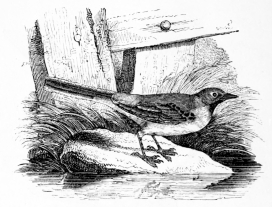
THE GREY WATER WAGTAIL. (Motacilla boarula.)
There is not a brook purling along two flowery banks, not a rivulet
winding through the green meadow, which is not frequented by this
beautifully coloured and elegantly shaped little creature. We even see
them in the streets of country towns, following with quick pace the
half-drowned fly or moth, which the road-side streamlet carries away.
Next to the robin redbreast and the sparrow, they are the boldest in
approaching our habitations. The Wagtails are much in motion; seldom
perch, and perpetually flirt their long and slender tails, (whence they
derive their name,) principally after picking up some food from the
ground, as if that tail were a kind of lever, or counterpoise, used to
balance the body on the legs. They are observed to frequent, more
commonly, those streams where women come to wash their linen; probably
not ignorant that the soap, the froth of which floats upon the water,
attracts those insects which are most acceptable to them.
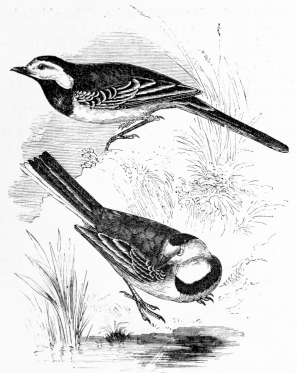
There are two common species of Wagtails, the Grey kind and the Pied
Wagtail. The Grey Wagtail is retiring in its habits, and much slower in
its motions; its breast is yellow, and its wings grayish, but the Pied
Wagtail, which is a very lively little bird, and seems always in a
bustle, is black, softening into ash-colour and white; it is also bold,
and will take the food thrown to it with as much confidence as a robin
redbreast.
The Yellow Shepherdess (Budytes flava) is another species of Wagtail.
The male is olive-green on the back, and yellow on the lower part of the
body, but the breast of the female is nearly white. These birds do not
frequent the banks of rivers, but are generally found walking among the
grass of meadows, and following sheep. They are summer visitors to
England.
White says, that “while the cows are feeding in the moist, low pastures,
broods of Wagtails, white and grey, run round them, close up to their
noses, and under their very bellies, availing themselves of the flies
that settle on their legs, and probably finding worms and larvæ that are
roused by the trampling of their feet. Nature is such an economist that
the most incongruous animals can avail themselves of each other.”
“Interest makes strange friendships!”
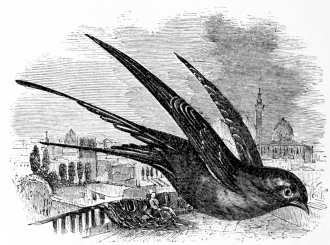
THE SWALLOW. (Hirundo rustica.)
“From the low-roof’d cottage ridge
See the chattering Swallow spring;
Darting through the one-arch’d bridge,
Quick she dips her dappled wing.”
Cunningham.
Swallows are easily distinguished from all other birds, not only by
their general structure, but by their twittering note and mode of
flying, or rather darting from place to place.
They appear in Britain in April, and build in some outhouse, or, in part
of a human dwelling, where they lay their eggs and hatch their young.
About August they disappear, and do not return till the following
spring. Swallows kept in a cage moult about Christmas, and seldom live
till spring.
There are several species of the Swallow: the general characters of
which are a small beak, but large, wide mouth, for the purpose of
swallowing flying insects, their natural food; and long forked tail and
extensive wings, to enable them to pursue their prey. The common Swallow
builds under the eaves of houses, or in chimneys, near their top; it is
frequently called the Chimney Swallow from its preference for the
last-mentioned rather singular situation; the Martin also builds under
eaves, and most commonly against the upper corner or side of our very
windows, and seems not afraid at the sight of man, yet it cannot be
tamed, or even kept long in a cage. The nature of the Swallow’s nest is
worthy of close observation: how the mud is extracted from the
sea-shores, rivers, or other watery places; how masoned and formed into
a solid building, strong enough to support a whole family, and to face
the “pelting storm,” are wonders which ought to raise our mind to Him
who bestowed that instinct upon them.
It is related that a pair of Swallows built their nest for two
successive years on the handle of a pair of garden shears, that were
stuck up against the boards of an outhouse; and, therefore, must have
had their nest spoiled whenever the implement was wanted. And what is
still more strange, a bird of the same species built its nest on the
wings and body of an owl that happened to hang dead and dry from the
rafter of a barn, and so loose as to be moved by every gust of wind.
This owl, with the nest on its wings, and with eggs in the nest, was
taken to the museum of Sir Ashton Leaver as a curiosity. That gentleman,
struck with the singularity of the sight, furnished the person who
brought it with a large shell, desiring him to fix it just where the owl
had hung. The man did so; and in the following year a pair of Swallows,
probably the same, built their nest in the shell and laid eggs.
Modern poets have not been unmindful of the Swallows; and our immortal
Shakspeare mentions the Martin, in Macbeth, in the following manner:
“This guest of summer,
The temple-haunting Martlet, does approve,
By his loved mansionry, that the Heaven’s
Breath smells wooingly here. No jutty, frieze,
Buttress, nor coigne of ’vantage, but this bird
Hath made his pendent bed and procreant cradle:
Where they most breed and haunt, I have observed,
The air is delicate.”
“The Swallow,” writes Sir Humphry Davy, “is one of my favourite birds,
and a rival of the nightingale, for he cheers my sense of seeing as much
as the other does my sense of hearing. He is the glad prophet of the
year, the harbinger of the best season—he lives a life of enjoyment
amongst the liveliest forms of nature—winter is unknown to him; and he
leaves the green meadows of England in autumn for the myrrh and orange
groves of Italy, and for the palms of Africa; he has always objects of
pursuit, and his success is secure. Even the beings selected for his
prey are poetical, beautiful, and transient. The ephemeræ are saved by
his means from a slow and lingering death in the evening, and killed in
a moment when they have known nothing but pleasure. He is the constant
destroyer of insects, the friend of man, and may be regarded as a sacred
bird. His instinct, which gives him his appointed season, and teaches
him when and where to move, may be regarded as flowing from a divine
source; and he belongs to the oracles of nature, which speak the awful
and intelligible language of a present Deity.”
The Chimney Swallow is, on the head, neck, back, and rump, of a shining
black colour, with purple gloss and sometimes with a blue shade; the
throat and neck are of the same colour; the breast and belly are white,
with a dash of red. The tail is forked, and consists of twelve
feathers. The wings are of the same colour with the back. Swallows feed
upon flies and other insects; and generally hunt their prey on the wing:
“Away! away! thou summer bird;
For Autumn’s moaning voice is heard,
In cadence wild, and deepening swell,
Of winter’s stern approach to tell.”
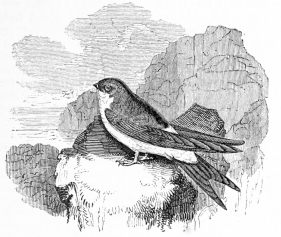
HOUSE MARTIN, OR WINDOW SWALLOW.
(Hirundo urbica.)
The Martin is something less than the swallow, with a comparatively
large head, and a wide mouth; the colour of the upper parts a bluish
black, the rump and all the under parts of the body white, the bill
black; the legs covered with short white down.
These birds begin to appear about the middle of April, and for some time
pay no attention to the business of nidification, but sport and play
about as if to recruit themselves from the fatigue of the journey.
Should the weather prove favourable, it begins to build early in May,
placing its nest generally beneath the eaves of a house, often against
a perpendicular wall: without any projecting ledge to support any part
of the nest, its utmost efforts are necessary to get the first
foundation firmly fixed, so as to carry the superstructure safely. On
this occasion, it not only clings with its claws, but partly supports
itself by strongly inclining its tail against the wall, making that a
fulcrum; and thus fixed, it plasters the materials into the face of the
brick or stone. But that this work may not, while soft, sink by its own
weight, the provident architect has the prudence and forbearance not to
proceed too fast; but by building only in the morning, and dedicating
the rest of the day to food and amusement, he gives it sufficient time
to dry and harden. By this method, in about ten days, the nest is
formed, strong, compact, and warm, and perfectly fitted for all the
purposes for which it is intended. But nothing is more common than for
the house-sparrow, as soon as the shell is finished, to seize on it,
eject the owner, and line it according to its own peculiar manner.
Sometimes, however, the Martins prove too clever for the sparrow; when
the intruder obstinately retained possession of the nest, the Martins
have been known to collect from all parts of the neighbourhood, each
bringing a pellet of mud, with which the orifice of the nest was soon
securely closed, and the unfortunate sparrow was then left to die of
starvation. The Martin will return for several seasons to the same nest,
where it happens to be well sheltered and secured from the injuries of
the weather. They breed the latest of all our swallows, often having
unfledged young ones even so late as Michaelmas.
The first hatch consists of five eggs, which are white, inclining to
dusky at the thicker end; the second, of three or four; and of a third,
of only two or three. While the young birds are confined to the nest the
parents feed them, adhering by the claws to the outside; but as soon as
they are able to fly they receive their nourishment on the wing, by a
quick and almost imperceptible motion.
“Welcome, welcome, feathered stranger,
Now the sun bids Nature smile;
Safe arrived and free from danger,
Welcome to our blooming isle.”
Franklin.
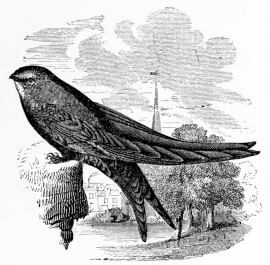
THE SWIFT, (Cypselus apus,)
Which is sometimes called the Black Martin, arrives in England later,
and takes its departure earlier than any of our swallows. The Swift is
the largest of the swallow tribe, and the most rapid in its flight. Its
nest, which is generally built in the crevices of old towers and
steeples, is constructed of dried grass, feathers, thread, and similar
materials, glued together by a sort of spittle, with which the bird is
provided. The bird collects them whilst on the wing, picking them up
with great dexterity. They seldom alight upon the ground, and if by
accident they fall upon a level surface, they recover themselves with
difficulty, owing to the shortness of their legs, and the length of
their wings. During the heat of the day they remain within their holes,
and at morning and evening sally out in quest of food. They may then be
seen in flocks, whirling round some lofty edifice, or describing in
mid-air an endless series of circles upon circles. Swifts fly higher,
and wheel with bolder wing than the swallows, with whom they never
intermingle.
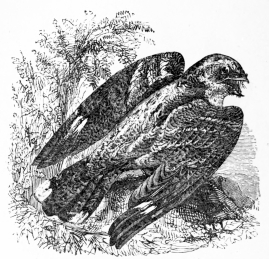
THE GOATSUCKER. (Caprimulgus Europæus.)
This curious bird, called also the Nightjar, and the Fern Owl, comes to
this country from Africa about the middle of May and usually leaves by
the end of August. These birds are generally found in low bushes, or
amongst tufts of large ferns, and generally fly at night: hence their
name of Fern Owl. The beak is furnished with bristles, and the middle
toe of each foot has a claw toothed like a comb. The female lays her
eggs upon the ground, without any nest, and lays only two. The name of
Goatsucker originated in an absurd idea that this bird sucked the goat’s
milk, from its habit of lying on the ground near cows or she goats, and
catching the flies that torment them by fixing on their udders. Mr.
Waterton, who is certainly the closest observer of nature who ever wrote
on Natural History, states, in one of his very interesting works, that
he has frequently seen the Goatsuckers catching insects in this manner,
and thus proving themselves the best of friends to the animals they are
accused of annoying.
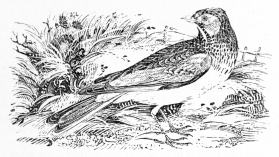
THE SKYLARK. (Alauda arvensis.)
“Go, tuneful bird, that gladd’st the skies,
To Daphne’s window speed thy way;
And there on quivering pinions rise,
And there thy vocal art display.”
Shenstone.
The Skylark is distinguished from most other birds by the long spur on
the back toe, the earthy colour of his feathers, and by singing as he
mounts in the air. These birds generally make their nest in meadows
among the high grass, and the tint of their plumage resembles so much
that of the ground, that the body of the bird is hardly distinguishable
as it runs along.
“The daisied lea he loves, where tufts of grass
Luxuriant crown the ridge: there, with his mate,
He founds their lonely house, of withered herbs,
And coarsest spear-grass; next the inner work,
With finer, and still finer fibres lays,
Rounding it curious with his speckled breast.”
Grahame.
Larks breed twice a year, in May and July, rearing their young in a
short space of time. They are caught in great quantities in winter, and
are considered choice and delicate food. It is a melancholy observation,
that man should feed upon, and indulge his sense of taste with those
very birds which have so often delighted his sense of hearing with their
songs, when they usher to the gladdened creation the return of their
best friend, the sun. The instinctive warmth of attachment which the
female Skylark bears towards her own species, even when not her
nestling, is remarkable. “In the month of May,” says Buffon, “a young
hen bird was brought to me, which was not able to feed without
assistance. I caused her to be reared; and she was hardly fledged, when
I received from another place a nest of three or four unfledged larks.
She took a strong liking to these newcomers, which were but little
younger than herself; she tended them night and day, cherished them
beneath her wings, and fed them with her bill. Nothing could interrupt
her tender offices. If the young ones were torn from her she flew to
them as soon as they were liberated, and would not think of effecting
her own escape, which she might have done a hundred times. Her affection
grew upon her; she neglected food and drink; she at length required the
same support as her adopted offspring, and expired at last, consumed
with maternal solicitude. None of the young ones long survived her. They
died one after another; so essential were her cares, which were equally
tender and judicious.”
The Lark mounts almost perpendicularly, and by successive springs, into
the air, where it hovers at a vast height. Its descent is in an oblique
direction, unless threatened by some ravenous bird of prey, or attracted
by its mate, when it drops to the ground like a stone. On its first
leaving the earth, its notes are feeble and interrupted; but, as it
rises, they gradually swell to their full tone. As the Lark’s flight is
always at sun-rise, there is something in the scenery that renders its
song peculiarly delightful: the opening morning, the landscape just
gilded by the rays of the returning sun, and the beauty of the
surrounding objects, all contribute to heighten our relish for its
pleasing melody.
“—— Up springs the Lark,
Shrill-voiced and loud, the messenger of morn,
Ere yet the shadows fly, he, mounted, sings
Amid the dawning clouds, and from their haunts
Calls up the tuneful nations.”
Thomson.
“Alas! it’s no thy neebor sweet,
The bonnie Lark, companion meet!
Bending thee ’mang the dewy weet!
Wi’ speckled breast,
When upward springing, blythe to greet
The purpling east.”
Burns.
“Early, cheerful, mounting Lark,
Light’s gentle usher, morning’s clerk,
In merry notes delighting.”
Sir John Davis.
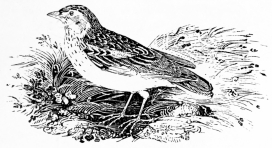
THE WOODLARK. (Alauda arborea.)
This species is smaller than the skylark, and its voice deeper; it has
also a circle of white feathers encompassing the head, from eye to eye,
like a crown or wreath, and the utmost feather of the wing is much
shorter than the second, whereas in the common lark they are nearly
equal. This bird sometimes emulates the nightingale; for which, when
pouring forth his sweet melody in the grove, during a silent night, he
is often mistaken. These birds sit and perch upon trees, unlike the
common lark, which always keeps to the ground. They build their nest at
the foot of a bush, near the bottom of a hedge, or in high dry grass.
The number of their eggs is about four, of a pale bloom colour,
beautifully mottled, and clouded with red and yellow. Like the skylark,
they assemble in large flocks during frosty weather. Their usual food
consists of small beetles, caterpillars, and other insects, as well as
the seeds of numerous kinds of wild plants.
“Bright o’er the green hills rose the morning ray,
The Woodlark’s song resounded on the plain,
Fair nature felt the warm embrace of day,
And smiled through all her animated reign.”
Langbourn.
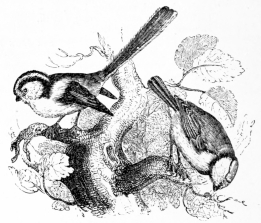
THE TITMOUSE, OR TOM-TIT. (Parus cæruleus.)
THE LONG-TAILED TIT. (Parus caudatus.)
The common Titmouse or Tom-tit is a very small bird, only four inches
and a half in length. He has a blue head, with white cheeks and a white
stripe over each eye; his back is greenish, his wings and tail blue, and
the lower surface of his body yellow. This bird, and all the species
related to it, live on insects, as well as on seeds. When kept in a
cage, it is really amusing to see with what quickness the Titmouse darts
at any fly or moth which comes imprudently within its reach. If this
kind of food be deficient, as generally happens in winter, it feeds upon
several kinds of seed, and particularly that of the sunflower, which it
dexterously holds upright between its claws and strikes powerfully with
its sharp little bill, till the black covering splits, and yields its
white contents to the persevering bird. Its general food consists of
insects, which it seeks in the crevices of the bark of trees, and when
thus engaged, clinging in every possible position to the branches, it
looks like a very diminutive blue parrot. In winter the Titmouse visits
our gardens and orchards, where he is often seen picking the buds of
fruit trees to pieces; but in doing this he inflicts little or no injury
upon the gardener, his object being the capture of insects which would
probably cause far more mischief in the ensuing summer. The nest of the
Titmouse is built in the hole of a tree or wall; the female lays usually
eight or ten eggs, and when sitting defends her nest with great courage,
pecking at the fingers of boys so vigorously that in some parts of the
country she is known by the name of Billy Biter. The Long-tailed Tit
is also a common bird about hedges, orchards, and plantations. He is an
active lively little fellow, and resembles the common Tit in his habits.
THE YELLOWHAMMER, OR YELLOW BUNTING.
(Emberiza
citrinella.)
This bird is somewhat larger than the sparrow. Its head is of a greenish
yellow, spotted with brown; the throat and belly are yellow; the breast
and sides, under the wings, mingled with red. These birds build their
nests on the ground, near some bush, where the female lays five or six
eggs. The Yellowhammer may be sometimes seen perched on the finger of
some poor man or woman in the streets of London, in a state of complete
tameness; but this is the transitory effect of intoxication, and soon
after the bird is bought and brought home, it dies, overcome by the
power of the laudanum that has been given it.
This bird feeds on seeds and various sorts of insects, and is common in
every lane, on every hedge, throughout the country, flitting before the
traveller, and about the bushes. Happily for him, we have not yet
acquired the taste of the natives of Italy, where the Yellowhammer falls
a daily victim to the delicacy of the table, and where its flesh is
esteemed very delicious eating. There he is often fattened, for the
purpose of gratifying the palate of epicures.
The Ortolan, (Emberiza hortulana,) which is another species of the
same genus, is common in the central and southern provinces of Europe,
where it is thought exquisitely flavoured as an article of food. When
first taken it is frequently very lean, but if supplied with abundance
of food, it is said to be so greedy, that it will eat till it dies of
repletion.
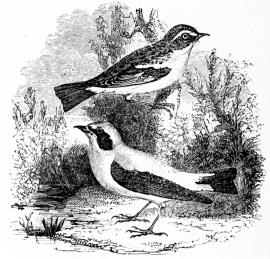
THE WHEATEAR, AND WHIN CHAT.
(Saxicola ænanthe and S. rubetra.)
The Wheatear is one of our earliest visitants, and may be found in every
part of Britain. In the North, it generally frequents heaps of stones,
ruins, or the dry stone walls of burial-grounds, and though it is a
very handsome bird, and in the early season sings sweetly, its haunts
have obtained it a bad name. The common alarm-note resembles the sound
made in breaking stones with a hammer, and as it utters that note from
the top of the heap which haply covers the bones of one who perished by
the storm, or his own hand, popular fancy has not unnaturally associated
the Wheatear with the superstition that belongs to the place of graves.
Beneath that heap of stones, or in some neighbouring fallow, its nest
may be discovered, formed of moss and dried grass, lined with hair,
feathers, or wool, and containing five or six eggs of a delicate bluish
white. These birds congregate on the southern downs about the middle of
July; they are then caught in vast numbers, in horse-hair nooses, which
are set between two pieces of turf turned against each other.
The Whin Chat is a beautiful bird, compact in form, with a rich and
elegant plumage. Its song, which is peculiarly soft and sweet, may be
heard in spring on the bushy margins and gorse of extensive heaths. Its
nest, constructed in thick tufts of grass and under bushes, is most
carefully concealed. It is usually approached by a labyrinth to which
the rising of the bird affords no clue, and it may long be sought in
vain, though perhaps not more than a yard distant all the time. The eggs
are bluish green, without any spots, and are never more than six in
number.
The following lines, addressed to the English Ortolan, or Wheatear, by
Mrs. Charlotte Smith, allude to the foolish timidity of that bird:
“To take you, shepherd boys prepare
The hollow turf, the wiry snare,
Of those weak terrors well aware,
That bid you vainly dread
The shadows floating over downs,
Or murmuring gale, that round the stones
Of some old beacon, as it moans,
Scarce moves a thistle’s head.
And if a cloud obscure the sun,
With faint and fluttering heart you run
Into the pitfall you should shun,
And only leave when dead.”
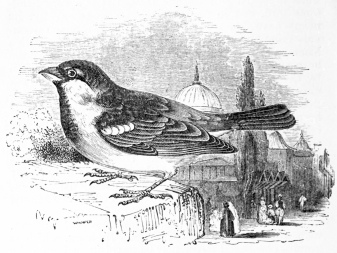
THE SPARROW. (Passer domesticus.)
This bird is, next to the robin redbreast, the boldest of the small
feathered tribe which frequent our barns and houses: he is a courageous
little creature, and fights undauntedly against birds ten times bigger
than himself. Sparrows are accused of destroying a great quantity of
corn, and in several counties the landlord or farmer puts a price on a
Sparrow’s head; but the farmer is the person most injured by the plan,
as the good Sparrows, in ridding land of caterpillars, more than
compensate for the loss of grain they destroy. Mr. Bradley, in his
Treatise on Husbandry and Gardening, shows, by a calculation, that a
pair of Sparrows, during the time they have their young ones to feed,
destroy on an average, every week, three thousand three hundred and
sixty caterpillars.
This bird is easily tamed, and will hop about the house, and on the
table with great familiarity. It will feed on anything, and is
particularly fond of meat cut into small pieces. The song of the
Sparrow, if we can so call its chirping, is far from agreeable: this
arises, however, not from want of powers, but from its attending solely
to the note of the parent bird. A Sparrow, when fledged, was taken from
the nest and educated under a linnet: it also heard by accident a
goldfinch; and its song was in consequence a mixture of the two. The
male is particularly distinguished by a jet-black spot under the bill
upon a whitish ground. Sparrows are found nearly in every country of the
world.
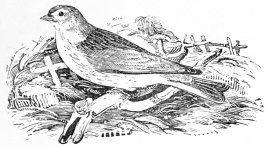
THE LINNET, (Fringilla linota or Linota cannabina.)
Is about the size of the goldfinch; and compensates, by an extremely
melodious voice, the want of variety in its plumage, which, except in
the red-breasted species, is nearly all of one colour. Its musical
talents are, like those of many other birds, repaid with captivity; for
it is kept in cages on account of its singing.
The Redpole (Fringilla linaria) is a small species of Linnet, little
more than four inches in length, distinguished by a deep blood-red spot
on the crown of his head. He visits Britain in the autumn and stays with
us during the winter, his favourite summer residence being far away in
the north. Redpoles are taken in great numbers by the bird-catchers in
the autumn. Their only song is a twittering note, but they are often
attached by a brace and chain to an open cage and trained to draw their
water in a bucket.
The Green Linnet is rather larger than the house sparrow. Its head and
back are of a yellowish-green, the edges of the feathers grayish; the
rump and breast more yellow. The plumage of the female is much less
vivid, inclining to brown. Its song is trifling, but in confinement it
becomes tame and docile, and will catch the notes of other birds.
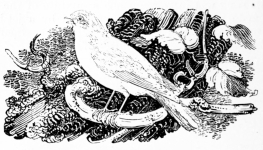
THE CANARY-BIRD. (Fringilla, or Carduelis canaria.)
As his name imports, this bird is a native of the Canary Islands; where,
in his wild state, he has a dusky gray plumage, and a much stronger
voice than when in a cage. In our northern countries his feathers
undergo a great alteration; and the bird often becomes entirely white or
yellow. Of this bird, Buffon says, “that if the nightingale is the
chantress of the woods, the Canary is the musician of the chamber; the
first owes all to nature, the second something to art. With less
strength of organ, less compass of voice, and less variety of note, the
Canary has a better ear, greater facility of imitation, and a more
retentive memory; and as the difference of genius, especially among the
lower animals, depends in a great measure on the perfection of their
senses, the Canary, whose organ of hearing is more susceptible of
receiving and retaining foreign impressions, becomes more social, tame,
and familiar; is capable of gratitude and even attachment; its caresses
are endearing, its little humours innocent, and its anger neither hurts
nor offends. Its education is easy; we rear it with pleasure, because we
are able to instruct it. It leaves the melody of its own natural note,
to listen to the melody of our voices and instruments. It accompanies
us, and repays the pleasure it receives with interest, while the
nightingale, more proud of his talent, seems desirous of preserving it
in all its purity, at least it appears to attach very little value to
ours, and it is with great difficulty that it can be taught any of our
airs. It despises them, and never fails to return to its own wild wood
notes. Its pipe is a masterpiece of nature, which human art can neither
alter nor improve; while that of the Canary is a model of more pliant
materials, which we can mould at pleasure; and therefore it contributes
in a much greater degree to the pleasures of society. It sings at all
seasons, cheers us in the dullest weather, and adds to our happiness, by
amusing the young and delighting the recluse, charming the tediousness
of the cloister, and gladdening the soul of the innocent and captive.”
It breeds generally twice a year when domesticated; and it sometimes
happens that the female lays her eggs for the second time before the
first brood is fledged. The male then good-naturedly takes her place on
the eggs while she feeds the young ones, and feeds them in his turn,
when she sits in the nest. They are very easily tamed, when brought up
with attention and kindness, and take their food out of the hand, often
perching on the shoulder of their mistress, and feeding out of her
mouth. The Canary-bird is sometimes, and with success, matched with the
linnet or the goldfinch; and the produce is a beautiful bird, partaking
of the talents and plumage of both.
Canary-birds live twelve or thirteen years in our climate, and sing well
to the end of their life.
The following curious anecdote of one of these birds is related by Dr.
Darwin: “On observing a Canary-bird at the house of a gentleman near
Tutbury, in Derbyshire, I was told it always fainted away when its cage
was cleaned; and I desired to see the experiment. The cage being taken
from the ceiling, and the bottom drawn out, the bird began to tremble,
and turned quite white about the root of the bill: he then opened his
mouth, as if for breath, and respired quick; stood up straighter on his
perch, hung his wings, spread his tail, closed his eyes, and appeared
quite stiff for half-an-hour; till at length, with much trembling and
deep respirations, he came gradually to himself.”
Some years ago, a Frenchman exhibited in London twenty-four
Canary-birds, many of which he said were from eighteen to twenty-five
years of age. Some of these balanced themselves, head downward, on their
shoulders, having their legs and tail in the air. One of them taking a
slender stick in its claws, passed its head between its legs, and
suffered itself to be turned round, as if in the act of being roasted.
Another balanced itself, and was swung backward and forward on a kind of
a slack rope. A third was dressed in military uniform, having a cap on
its head, wearing a sword and pouch, and carrying a firelock in one
claw: after some time sitting upright, this bird, at the word of
command, freed itself from its dress, and flew away to the cage. A
fourth suffered itself to be shot at, and falling down as if dead, was
put into a little wheelbarrow, and wheeled away by one of its comrades!
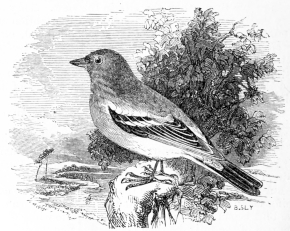
THE CHAFFINCH. (Fringilla cœlebs.)
The Chaffinch is of the same dimensions as the sparrow, but more
lightly and elegantly formed. Its nest, which is of the most beautiful
and elaborate construction, is composed of mosses and lichens,
interwoven and lined with wool, hair, and feathers. “Four or five eggs,”
says Mr. Waterton, “are the usual number which the Chaffinch’s nest
contains, and sometimes only three. The thorn, and most of the evergreen
shrubs, the sprouts on the boles of forest trees, the woodbine, the
whin, the wild rose, and occasionally the bramble, are this bird’s
favourite places for nidification. Like all its congeners, it never
covers its eggs on retiring from the nest, for its young are hatched
blind. There is something peculiarly pleasing to me in the song of this
bird. Perhaps association of ideas may add a trifle to the value of its
melody; for when I hear the first note of the Chaffinch, I know that
winter is on the eve of its departure, and that sunshine and fine
weather are not far off. The Chaffinch never sings when on the wing; but
it warbles incessantly on the trees, and on the hedgerows, from the
early part of February to the second week in July; and then (if the bird
be in a state of freedom) its song entirely ceases.”
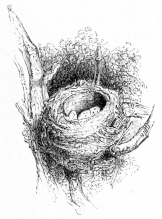
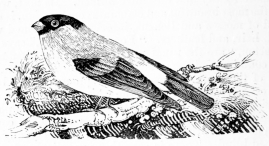
THE BULLFINCH. (Loxia pyrrhula.)
This is a very docile bird, and will nearly imitate the sound of a pipe,
or the whistle of man, with its voice, the mellowness of which is really
charming. It is, by bird-fanciers, considered to excel all other small
birds, except the linnet, in the softness of its tones, and in the
variety of its notes. In captivity, its melody seems to be as great a
solace to itself, as it is a pleasure to its master. By day, and even
when the evening has called for the artificial light of candles, the
Bullfinch pursues his melodious exertions, and if there be any other
birds in the apartment, awakes them gently to the pleasing task of
singing in concert with him. His notes are upon one of the lowest keys
of the gamut of birds.
The plumage of the Bullfinch is beautiful, though simple and uniform,
consisting only of three or four colours. In the male, a lovely scarlet
or crimson colour adorns the breast, throat, and jaws, as far as the
eyes; the crown of the head is black; the rump and tail are white; the
neck and back grey, or lead-coloured. The name of this bird originates
from its head and neck being, like those of the bull, very large in
proportion to the body. The female does not share with the male the
brightness of colours in the plumage. Bullfinches build their nests in
gardens and orchards, and particularly in places that abound in
fruit-trees, as they are passionately fond of fruit, which they often
destroy before it is ripe.
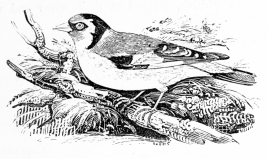
THE GOLDFINCH.
(Fringilla carduelis, or Carduelis elegans.)
This bird is also called the Thistlefinch, from his fondness for the
seeds of that plant. He is very beautiful, his plumage being elegantly
diversified, his form small, but pleasing, and his voice not loud, but
sweet. He is easily tamed, and often exhibited as a captive, with a
chain round his body, drawing up with trouble, but yet with amazing
dexterity, two small buckets, alternately, one containing his meat, the
other his drink. If he is old when caught, the Goldfinch, after a few
weeks, if well attended to, and gently treated, becomes as familiar as
if he had been brought up by the hand of his keeper. Some have been
taught to fire a small piece of artillery, and go through the drilling
exercise, to the great astonishment of the spectators; but the cruel and
severe treatment that animals undergo, when taught performances
altogether contrary to their nature, should prevent us from encouraging
such exhibitions.
This bird, as if conscious of the beauty of his plumage, likes to view
himself in a glass, which is sometimes fixed for this purpose in the
back of the cage. The art with which it composes and builds its nest is
really worthy of admiration; it is generally interwoven with moss, small
twigs, horsehair, and other pliant materials; the inside stuffed most
carefully with fine down, and tufts of cotton grass. There the female
deposits five or six eggs, which are whitish, marked at their upper end
with purple dots.
“The Goldfinch weaves, with willow down inlaid,
And cannach tufts, his wonderful abode;
And oft suspended at the limber end
Of plane-tree spray, among the broad-leaved shoots,
The tiny hammock swings to every gale.
Sometimes in closest thickets ’tis concealed;
Sometimes in hedge luxuriant, where the brier,
The bramble, and the plum-tree branch
Warp through the thorn, surmounted by the flowers
Of climbing vetch, and honeysuckle wild.”
Grahame.
The following lines were written by Cowper on a Goldfinch starved to
death in his cage. The Goldfinch speaks:—
“Time was when I was free as air,
The thistle’s downy seed my fare,
My drink the morning dew;
I perched at will on every spray,
My form genteel, my plumage gay,
My strains for ever new.
“But gaudy plumage, sprightly strain,
And form genteel were all in vain,
And of a transient date;
For caught and caged, and starved to death,
In dying sighs my little breath
Soon passed the wiry grate.
“Thanks, gentle author of my woes,
Thanks for this most effectual close
And cure of every ill.
Never your cruelty repress!
For I, if you had shown me less,
Had been your prisoner still.”
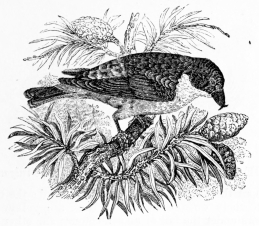
THE CROSSBILL. (Loxia curvirostra.)
The Crossbill is a native of the vast pine forests of northern Europe,
and is by no means abundant in England. The bill of this singular bird
is of considerable length, and the mandibles towards the point are very
sharp and strong, curved in opposite directions, so that when closed the
points cross each other, from which the bird derives his name. This
curious organization enables them to obtain their food, which chiefly
consists of the seeds of the cones of the fir, with the greatest
facility. These seeds, for a considerable time after they have ripened,
are so firmly enclosed within their ligneous scales, that the bill of no
ordinary bird could reach them. Fixing itself across the cone, the
Crossbill brings the mandibles of its beak immediately over each other,
and insinuates them between the scales, then forcing them laterally, the
scales open. The mandibles are again brought in contact, between the
scales, and the bird then picks out the seed with their tips. It is very
interesting to find that a structure so anomalous as that of the bill of
the Crossbill is really beneficial to the creature, and not, as was
formerly rather flippantly asserted, a defect or error of nature.
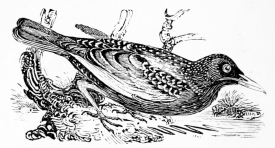
THE STARE, OR STARLING, (Sturnus vulgaris,)
Is about the size and shape of a blackbird; the tips of the feathers on
the neck and back are yellow; the feathers under the tail of an
ash-colour; the other parts of the plumage are black, with a purple or
deep blue gloss, changing as it is variously exposed to the light. In
the hen, the tips of the feathers on the breast and belly, to the very
throat, are white; which constitutes a material point in the choice of
the bird, as the female is no singer. She lays four or five eggs,
lightly tinctured with a greenish cast of blue. Starlings build in
hollow trees and clefts of rocks and walls, are very easily tamed, and
can add to their natural notes any words or modulations which they are
taught.
In the winter season Starlings collect in vast flocks, and may be known
at a great distance by their whirling mode of flight. The evening is the
time when they assemble in the greatest numbers, and betake themselves
to fens and marshes. Sterne has immortalized the Starling in his
“Sentimental Journey:” “The bird flew to the place where I was
attempting his deliverance, and thrusting his head through the trellis,
pressed his head against it, as if impatient.—‘I fear, poor creature,’
said I, ‘I can’t set thee at liberty.’—‘No,’ said the Starling, ‘I
can’t get out.’ ‘Disguise thyself as thou wilt, still, slavery,’ said I,
‘still thou art a bitter draught!’ ”
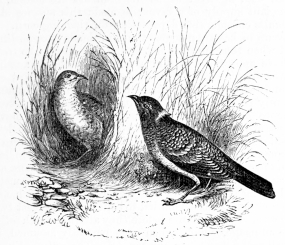
THE SATIN BOWER-BIRD.
(Ptilonorhynchus holosericeus.)
This singular bird was first brought before the notice of the public by
Mr. Gould, in his splendid work, the “Birds of Australia,” from which
the following extracts are given by permission of its author. The most
remarkable circumstance relating to this bird, is its construction of a
bower-like tenement, the object of which, it should seem, is a sort of
playing-ground, or hall of assembly.
“The Satin Bower-bird,” says Mr. Gould, “is not a stationary species,
but appears to range from one part of a district to another, either for
the purpose of varying the nature, or of obtaining a more abundant
supply of food. Judging from the many specimens I dissected, it would
seem that it is altogether granivorous and frugivorous; or, if not
exclusively so, that insects form but a small portion of its diet. The
brushes it inhabits are studded with enormous fig-trees, some of them
towering to the height of two hundred feet; among the lofty branches of
which the Satin Bower-bird finds, in the small wild fig with which the
branches are loaded, an abundant supply of a favourite food: this
species also commits considerable depredation on ripening corn. It
appears to have particular times in the day for feeding, and when thus
engaged among the low shrub-like trees, I have approached within a few
feet without creating alarm; but at other times I have found this bird
extremely shy, especially the old males, which not unfrequently perch on
the topmost branch of the loftiest tree, whence they can survey all
around, and watch the movements of the females and their young in the
brush below. Besides the loud liquid call peculiar to the male, both
sexes frequently utter a harsh, unpleasant, guttural note, indicative of
surprise or displeasure. The old black males are exceedingly few in
number, as compared with the females and young male birds in the green
dress, from which, and other circumstances, I am led to believe that at
least two, if not three years, elapse before they attain the rich
satin-like plumage, which, when once perfectly assumed, is, I believe,
never again thrown off. The extraordinary bower-like structures alluded
to above, are usually placed under the shelter of the branches of some
overhanging tree in the most retired part of the forest, and differ
considerably in size. The base consists of an extensive and rather
convex platform of stick, firmly interwoven, on the centre of which the
bower itself is built: this, like the platform on which it is placed,
and with which it is interwoven, is formed of sticks and twigs, but of a
more slender and flexible description, the tips of the twigs being so
arranged as to curve inwards and nearly meet at the top: in the interior
of the bower the materials are so placed, that the forks of the twigs
are always presented outwards, by which arrangement not the slightest
obstruction is offered to the passage of the birds. The interest of this
curious bower is much enhanced by the manner in which it is decorated at
and near the entrance with the most gaily-coloured articles that can be
collected, such as the blue tail-feathers of the Rose-bill and
Pennantian parrots, bleached bones, the shells of snails, &c.; some of
the feathers are stuck in among the twigs, while others with the bones
and shells are strewed about near the entrances. The propensity of
these birds to pick up and fly off with any attractive object, is so
well known to the natives, that they always search the runs for any
small missing article, as the bowl of a pipe, &c., that may have been
accidentally dropped in the brush. I myself found at the entrance of one
of them a small neatly-worked stone tomahawk, of an inch and a half in
length, together with some slips of blue cotton rags, which the birds
had doubtless picked up at a deserted encampment of the natives. For
what purpose these curious bowers are made is not yet, perhaps, fully
understood; they are certainly not used as a nest, but as a place of
resort for many individuals of both sexes, which, when there assembled,
run through and around the bower in a sportive and playful manner, and
that so frequently, that it is seldom entirely deserted.”
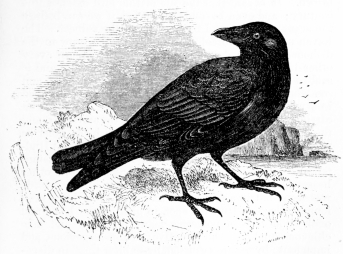
THE RAVEN. (Corvus Corax.)
“The Raven sits
On the raven-stone,
And his black wing flits
O’er the milk-white bone;
To and fro, as the night-winds blow,
The carcass of the assassin swings:
And there alone, on the raven-stone,
The Raven flaps his dusky wings.
The fetters creak—and his ebon beak
Creaks to the close of the hollow sound:
And this is the tune by the light of the moon,
To which the witches dance their round.”
Byron’s Manfred.
The Raven is about twenty-six inches in length, and his weight about
three pounds. The bill is strong, black, and hooked at the tip. The
plumage of the whole body of a shining black, glossed with deep blue;
the back of the lower part inclining to a dusky colour. He is of a
strong and hardy disposition, and inhabits all climates of the globe. He
builds his nest in trees; and the female lays five or six eggs of a
palish green colour, spotted with brown. It is said that the life of
this bird extends to a century; and even beyond that period, if we can
believe the accounts of several naturalists on the subject. The Raven
unites the voracious appetite of the crow to the dishonesty of the daw
and the docility of almost every other bird. He feeds chiefly on small
animals; and is said to destroy rabbits, young ducks, and chickens, and
sometimes even lambs, when they happen to be dropped in a weak state. In
the northern regions, he preys on carrion, in concert with the white
bear, the arctic fox, and the eagle. The faculty of scent in these birds
must be very acute; for in the coldest of the winter days, at Hudson’s
Bay, when every kind of effluvium is almost instantaneously destroyed by
the frost, buffaloes and other beasts have been killed, where not one of
these birds was seen; but in a few hours scores of them have been found
collected about the spot, to pick up the blood and offal. The Raven
possesses many diverting and mischievous qualities; he is active,
curious, sagacious, and impudent; by nature a glutton, by habit a thief,
in disposition a miser, and in practice a rogue. He is fond of picking
up any small piece of money, bits of glass or any thing that shines,
which he carefully conceals under the eaves of roofs, or in any other
inaccessible place. He is easily tamed; and, like the parrot and
starling, can imitate the human voice, in articulating words. At the
seat of the Marquis of Aylesbury, in Wiltshire, a tame Raven, that had
been taught to speak, used to ramble about in the park, where he was
commonly attended and beset with crows, rooks, and others of his
inquisitive tribe. When a considerable number of these were collected
round him, he would lift up his head, and with a hoarse and hollow voice
shout out Holloa! This would instantly put to flight and disperse his
sable brethren; while the Raven seemed to enjoy the fright he had
occasioned. When domesticated, the Raven is of great service, both as a
scavenger and in keeping watch, in the last of which he is more alert
and vigilant than almost any other animal. The Raven was the ensign of
the invading Danes, and the prejudice thereby engendered against the
bird is not yet quite extinct. Of its perseverance in the act of
incubation, Mr. White relates the following singular anecdote:
“In the centre of a grove near Selborne, there stood an oak, which,
though on the whole shapely and tall, bulged out into a large
excrescence near the middle of the stem. On this tree a pair of Ravens
had fixed their residence for such a series of years, that the oak was
distinguished by the title of ‘The Raven-tree.’ Many were the attempts
of the neighbouring youths to get at this nest: the difficulty whetted
their inclinations, and each was ambitious of surmounting the arduous
task; but when they arrived at the swelling, it jutted out so in their
way, and was so far beyond their grasp, that the boldest lads were
deterred and acknowledged the undertaking to be too hazardous. Thus the
Ravens continued to build, nest upon nest, in perfect security, till the
fatal day on which the wood was to be levelled. This was in the month of
February, when those birds usually sit. The saw was applied to the
trunk, the wedges were inserted into the opening, the wood echoed to the
heavy blows of the mallet, the tree nodded to its fall; but still the
dam persisted in sitting. At last, when it gave way, the bird was flung
from her nest; and though her parental affection deserved a better fate,
was whipped down by the twigs, which brought her dead to the ground!”
The croaking of the Raven was formerly considered a note of ill omen:
“The Raven croaked as she sat at her meal,
And the old woman knew what he said;
And she grew pale at the Raven’s tale,
And sickened and went to her bed.”
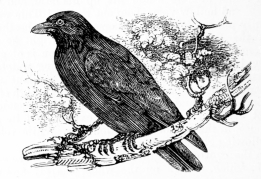
THE CARRION CROW. (Corvus corone.)
This bird is less in size than the raven. The bill is strong, thick, and
straight. The general colour is black, except the extremities of the
feathers, which are of a greyish tint. His delight is to feed upon
carcasses and dead animals, or malefactors exposed on the gibbet. He
roosts upon trees, and takes both animal and vegetable food. Crows, like
rooks, are gregarious, and often fly in large companies in the fields or
in the woods. On the upland moors, Crows occupy the place which rooks
fill in the low country; and as the Crow has a very coarse and uncouth
voice, the Lowlanders of Scotland are in the habit of saying that the
Highland rooks “speak Gaelic.” They are great destroyers of partridges’
eggs, as they often pierce them with their bills, and carry them in that
manner through the air to a great distance to feed their young. The
female lays five or six eggs.
Mr. Montagu states that he once saw a Crow in pursuit of a pigeon, at
which it made several pounces, like a hawk; but the pigeon escaped by
flying in at the door of a house. He saw another strike a pigeon dead
from the top of a barn. The Crow is so bold a bird that neither the
kite, the buzzard, nor the raven, can approach its nest without being
driven away. When it has young ones, it will even attack the peregrine
falcon, and at a single pounce sometimes bring that bird to the ground.
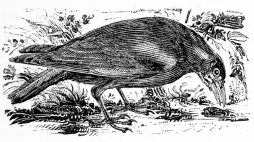
THE ROOK. (Corvus frugilegus.)
The cawing of these birds, on the tops of high trees near gentlemen’s
houses, and in the middle of cities, is not very pleasing; yet old
habits, to which we are reconciled, have as much influence upon us as if
they were productive of amusement. Hence it has been seldom attempted to
destroy a rookery; although the noise and other inconveniences that
accompany these birds render their vicinity often troublesome. They feed
entirely on corn and insects, and are little bigger than the common
crows. In Suffolk, and in some parts of Norfolk, the farmers find it
their interest to encourage the breed of Rooks, as the only means of
freeing their grounds from the grub, which produces the cockchafer, and
which in this state destroys the roots of corn and grass to such a
degree, that instances have been known where the turf of pasture land
might be turned up with the foot. The farmers in a northern county, a
good many years ago, waged a war of extermination against the Rooks, but
the very next year the crops were so completely cut up by grubs, that
the same proprietors were at considerable expense in getting Rooks back
again. Young Rooks are good eating, but should be skinned before they
are dressed. The colour is black, but brighter than that of the crow,
which the Rook resembles in shape. The female lays the same number of
eggs; and the male shares with her the trouble of fetching sticks, and
interweaving them to make the nest, an operation which is attended with
a great deal of fighting and disputing with the other Rooks.
New comers are often severely beaten by the old inhabitants, and are
even frequently driven quite away; of this an instance occurred near
Newcastle, in the year 1783. A pair of Rooks, after an unsuccessful
attempt to establish themselves in a rookery at no great distance from
the Exchange, were compelled to abandon the attempt, and take refuge on
the spire of that building; and, though constantly interrupted by other
Rooks, they built their nest on the top of the vane, and reared their
young ones, undisturbed by the noise of the populace below. The nest and
its inhabitants were of course turned about by every change of the wind!
They returned and built their nest every year on the same place, till
1793, soon after which year the spire was taken down. A small
copperplate was engraved, of the size of a watchpaper, with a
representation of the spire and the nest; and so much pleased were the
inhabitants and other persons with it, that as many copies were sold as
produced to the engraver a profit of ten pounds. The woodcut by Bewick,
in the title-page to his Select Fable gives, a view of the old Exchange,
with the Rook’s nest on the vane.
It is amusing to see Rooks coming at sunset as thick as a cloud hovering
over a grove, and, after several eddies described in the air, and
incessant cawings, each repairing to its own nest, and settling in a few
minutes to rest, till the dawn calls them up again to their pasture in
the neighbouring fields.
Dr. Darwin has remarked, that an instinctive feeling of danger from
mankind is much more apparent in Rooks than in most other birds. Any one
who has in the least observed them will see that they evidently
distinguish that the danger is greater when a man is armed with a gun,
than when he has no weapon with him. In the spring of the year, if a
person happened to walk under a rookery with a gun in his hand, the
inhabitants of the trees rise on their wings, and scream to the
unfledged young to shrink into their nests from the sight of the enemy.
The country people observing this circumstance so uniformly to occur,
assert that Rooks can smell gunpowder.
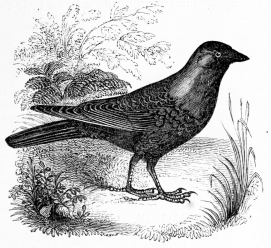
THE JACKDAW. (Corvus monedula.)
This bird is much less than the crow. He has a large head and long bill,
in proportion to the size of his body. The colour of the plumage is
black, but on some parts inclining to a bluish hue; the fore part of the
head is of a deeper black. The Jackdaw feeds upon nuts, fruits, seeds,
and insects; and builds in ancient castles, towers, cliffs, and all
desolate and ruinous places. The female lays five or six eggs, smaller,
paler, and marked with fewer spots than those of the crow.
Jackdaws are easily tamed, and may with little difficulty be taught to
pronounce several words. They conceal such parts of their food as they
cannot eat, and often, along with it, small pieces of money or toys,
frequently occasioning, for the moment, suspicions of theft in persons
who are innocent. In Switzerland there is found a variety of the
Jackdaw, which has a white ring round its neck. In Norway, and other
cold countries, they have been seen entirely white. In a state of
nature, jackdaws and rooks frequently feed together, and the Jackdaws
come to meet the rooks in the morning, and also accompany them for some
distance on their retreat at night.
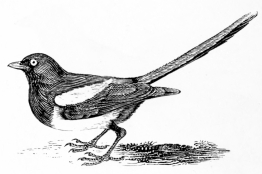
THE MAGPIE. (Pica caudata.)
“From bough to bough the restless Magpie roves,
And chatters as he flies.” Gisborne.
This bird resembles the daw, except in the whiteness of the breast and
wings, and the length of the tail. The black of the feathers is
accompanied with a changing gloss of green and purple. It is a very
loquacious creature, and can be taught to imitate the human voice as
well as any of the feathered creation.
Plutarch relates a singular story of a Magpie belonging to a barber at
Rome, which could imitate, to a wonderful extent, almost every noise
that it heard. Some trumpets happened one day to be sounded before the
shop; and for a day or two afterwards the Magpie was quite mute, and
seemed pensive and melancholy. This surprised all who knew it; and they
supposed the sound of the trumpets had so stunned the bird as to deprive
it at the same time of voice and hearing. This, however, was not the
case; for, says the writer, the bird had been all the time occupied in
profound meditation, and was studying how to imitate the sound of the
trumpets; accordingly, in the first attempt, it perfectly imitated all
their repetitions, stops, and changes. This new lesson, however, made it
entirely forget everything that it had learned before.
The Magpie feeds on everything; worms, insects, meat, cheese, bread,
milk, and all kinds of seeds, and also on small birds, when they come in
its way: the young of the blackbird and of the thrush, and even a
strayed chicken, often fall a prey to its rapacity. It is fond of hiding
pieces of money or wearing apparel, which it carries away by stealth,
and with much dexterity, to its hole. Its cunning is also remarked in
the manner of making its nest, which it covers all over with hawthorn
branches, the thorns sticking outward; within, it is lined with fibrous
roots, wool, and long grass, and then plastered all round with mud and
clay. The canopy above is composed of the sharpest thorns, woven
together in such a manner as to deny all entrance except at the door,
which is just large enough to permit egress and regress to the owners.
In this fortress the birds bring up their brood with security, safe from
all attacks, but those of the climbing schoolboy, who often finds his
torn and bloody hands too dear a price for the eggs or the young ones.
There are many superstitions respecting Magpies; and it is singular that
in all the southern and middle districts of England, two Magpies
together are thought to betoken luck; while in Lancashire, and other
northern counties, they are thought to betoken misfortune. The
chattering of Magpies was formerly supposed to foretell the arrival of
strangers.
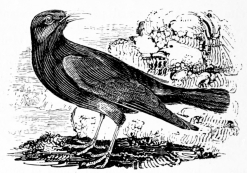
THE CORNISH CHOUGH, (Pyrrhcorax graculus,)
Is like the jackdaw in shape and colour, but somewhat larger. The bill
and legs are of a red colour, and hence the bird is frequently called
the red-legged Crow. It is an inhabitant of Cornwall, Wales, and all the
western coasts of England, and is generally to be found among rocks near
the sea, where it builds, as well as in old ruinous castles and churches
on the sea-side. The voice of the Chough resembles that of the jackdaw,
except that it exceeds it in hoarseness and strength.
Mr. Montagu describing a Chough in the possession of a friend, says,
“his curiosity is beyond bounds, never failing to examine everything new
to him: if the gardener be pruning, he examines the nail-box, carries
off the nails, and scatters the shreds about. Should a ladder be left
against the wall, he instantly mounts, and goes all round the top of the
wall: and if hungry descends at a convenient place, and immediately
travels to the kitchen window, where he makes an incessant knocking with
his bill, until he is fed or let in. If allowed to enter, his first
endeavour is to get up-stairs; and if not interrupted, goes as high as
he can, and gets into any room on the attic story; but his intention is
to get upon the top of the house. He is excessively fond of being
caressed, and would stand quietly by the hour to be smoothed; but
resents an affront with violence and effect, by both bill and claws, and
will hold so fast by the latter, that he is with difficulty
disengaged.”
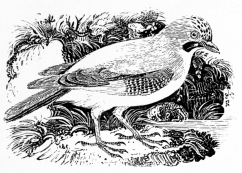
THE JAY, (Garrulus glandarius,)
Is less than the magpie, and resembles him more in the habits of his
life than in the shape and colour of his body. Like him he is talkative,
and ready to imitate all sounds, but boasts of ornamental colours, which
the magpie is deprived of. The ablest painter can produce no colour to
equal the brightness of the chequered tablets of white, black, and blue,
which adorn the sides of his wings. His head is covered with feathers,
which are moveable at will, and the motion of which is expressive of the
internal affections of the bird, whether he is stimulated by fear,
anger, or desire.
A Jay, kept by a person in the north of England, had learned at the
approach of cattle to set a cur dog upon them, by whistling and calling
him by his name. One winter, during a severe frost, the dog was by this
means excited to attack a cow that was big with calf, when the poor
thing fell on the ice, and was much hurt. The Jay was complained of as a
nuisance, and its owner was obliged to destroy it.
The hen lays five or six eggs, of a dull white colour, mottled with
brown.
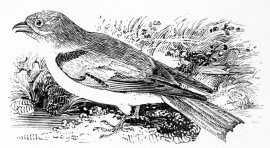
THE ROLLER, (Coracias garrula,)
Is about the size of the jay. Its bill is black, sharp, and somewhat
hooked. The head is of a dirty green, mingled with blue; of which colour
is also the throat, with white lines in the middle of each feather; the
breast is of a pale blue, like that of the pigeon; the middle of the
back, between the shoulders, is red; the rump and lesser coverts of the
wings are dark blue; the feet are short, and, like those of a dove, of a
dirty yellow colour.
The Roller is wilder than the jay, and frequents the thickest woods; it
builds its nest chiefly on birch-trees. It is a bird of passage, and
migrates in the months of May and September. In Africa, it is said to
fly in large flocks in the autumn, and is frequently seen on cultivated
grounds, with rooks and other birds, searching for worms, insects,
seeds, berries, roots, and in cases of necessity, small frogs.
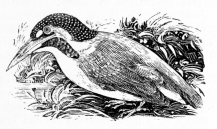
THE KINGFISHER, (Alcedo ispida,)
Is the Halcyon of the ancients, and his name recalls to our mind the
most lively ideas. It was believed, that, as long as the female sat upon
her eggs, the god of storms and tempests refrained from disturbing the
calmness of the waves, and Halcyon days were, for navigators of old,
the most secure times to perform their voyages:
“As firm as the rock, and as calm as the flood,
Where the peace-loving Halcyon deposits her brood.”
But although this bears analogy to a natural coincidence between the
time of breeding assigned to the Kingfishers and a part of the year when
the ocean is less tempestuous, yet Mythology would exercise her fancy,
and turn into wonders that which was nothing else than the common course
of nature.
This bird is nearly as small as a common sparrow, but the head and beak
appear proportionally too big for the body. The bright blue of the back
and wings claims our admiration, as it changes into deep purple or
lively green, according to the angles of light under which the bird
presents itself to the eye. It generally haunts the banks of rivers, for
the purpose of seizing small fish, on which it subsists, and which it
takes in amazing quantities, by balancing itself at a distance above the
water for a certain time, and then darting on the fish with unerring
aim. It dives perpendicularly into the water, where it continues several
seconds, and then brings up the fish, which it carries to land, beats
to death, and afterwards swallows. When it cannot find a projecting
bough, it sits on some stone near the brink, or even on the gravel; but
the moment it perceives the fish, it takes a spring upwards of twelve or
fifteen feet, and drops from that height upon its prey.
The Kingfisher lays its eggs, to the number of seven or more, in a hole
in the bank of the river or stream that it frequents. Dr. Heysham had a
female brought alive to him at Carlisle by a boy, who said he had taken
it the preceding night when sitting on its eggs. His information on the
subject was, that “having often observed these birds frequent a bank
upon the river Peteril, he had watched them carefully, and at last he
saw them go into a small hole in the bank. The hole was too narrow to
admit his hand; but, as it was made in soft mould, he easily enlarged
it. It was upwards of half a yard long; at the end of it the eggs, which
were six in number, were placed upon the bare mould, without the
smallest appearance of a nest.” The eggs were considerably larger than
those of the yellow-hammer, and of a transparent white colour. It
appears, from a still later account, that the direction of the holes is
always upward; that they are enlarged at the end, and have there a kind
of bedding formed of the bones of small fish, and some other substances,
evidently the castings of the parent animals. This bedding is generally
half an inch thick, and mixed with earth; and on it the female deposits
and hatches her eggs. When the young ones are nearly full-feathered they
are extremely voracious; and as the old birds do not supply them with
all the food they can devour, they are continually chirping, and may be
discovered by their noise.
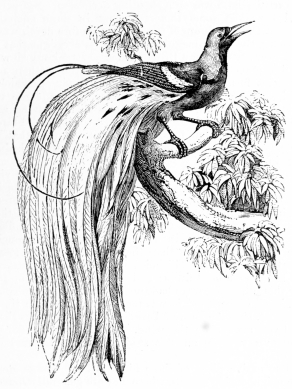
THE BIRD OF PARADISE. (Paradisea apoda.)
There are several distinct species of these birds, of which the best
known are the large and small Emerald Birds of Paradise, which are very
similar in appearance, and are both imported into Europe as ornaments
for ladies’ dress. Their appearance when flying in their native forests
is said to be most beautiful. M. Lesson, a French naturalist, gives the
following account:—“Soon after our arrival on this land of promise
(New Guinea) for the naturalist, I was on a shooting excursion. Scarcely
had I walked some hundred paces in those ancient forests, the daughters
of time, whose sombre depth was, perhaps, the most magnificent and
stately sight that I had ever seen, when a Bird of Paradise struck my
view: it flew gracefully and in undulations; the feathers of its sides
formed an elegant and aërial plume, which, without exaggeration, bore no
remote resemblance to a brilliant meteor. Surprised, astounded, enjoying
an inexpressible gratification, I devoured this splendid bird with my
eyes; but my emotion was so great that I forgot to shoot at it, and did
not recollect that I had a gun in my hand till it was far away.”
The head is small, but adorned with colours which vie with the brightest
hues of the feathered tribe; the neck is a beautiful fawn, and the body
very small, but covered with long feathers of a browner hue, tinged with
gold: the two middle feathers of the tail are little more than
filaments, except at the point and near the base. Although the body is
no larger than that of a thrush, the total length is two feet. This bird
has long been esteemed by ladies as a head-dress; and as those sent to
Europe for this purpose always had the legs cut off for the convenience
of packing, it was reported, and at one time believed, that the Bird of
Paradise had no legs, but that it lived always on the wing. Indeed, a
very fierce controversy arose on this subject among the earlier
naturalists.
The native place of these birds is New Guinea and the neighbouring
islands, where they are generally found in flocks of thirty and forty,
roosting on fig or teak trees. They always fly against the wind, that it
may not ruffle their light and spreading plumage, as, if the wind came
from behind, it would blow their long tails over their back. They take
shelter from storms in the most dense thickets, and feed principally on
figs, the berries of the teak, and insects. The note of the Bird of
Paradise is very unpleasant, and resembles the cawing of a raven; it is
chiefly heard in windy weather, when they dread being thrown on the
ground.
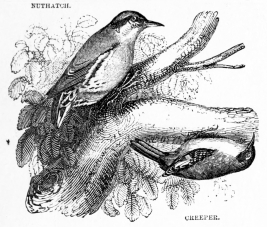
THE NUTHATCH, OR NUTJOBBER,
(Sitta Europæa,)
AND THE CREEPER, (Certhia familiaris,)
Is less than the chaffinch. The head, neck, and beak are of an
ash-colour; the sides under the wings red; the throat and breast of a
pale yellow; the chin white, and the feathers under the tail red, with
white tips. The Nuthatch feeds upon insects and also upon nuts, which he
hoards in the hollow part of a tree; and it is pleasing to see him fetch
a nut out of the hole, place it first in a chink, and standing above it
with his head downwards, striking it with all his might, break the
shell, and catch up the kernel. The hen is so attached to her brood,
that, when disturbed from her nest, she flutters about the head of the
depredator, and hisses like a snake. The Nuthatches are shy and solitary
birds, and like the woodpeckers frequent woods, and run up and down the
trees with surprising facility. They often move their tails in the
manner of the wagtail. They do not migrate, but during the winter
approach nearer to inhabited places, and are sometimes seen in orchards
and gardens. The female lays her eggs in holes of trees.
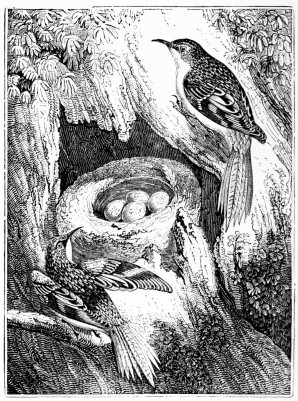
THE CREEPER. (Certhia familiaris.)
The Creepers are dispersed through most countries of the globe, and feed
chiefly on insects, in search of which they run in a spiral direction
round the stems and branches of trees, with great agility.
The Common Creeper is about five inches in length; its colour is tawny,
the quills being tipped with white or light brown. Its nest is formed of
dry grass and bark, and is placed in the hollow of some decayed tree.
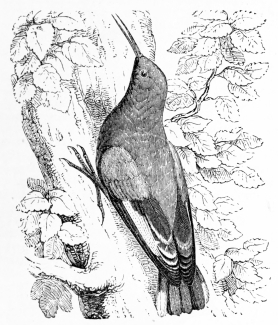
THE WALL CREEPER, OR SPIDER-CATCHER,
(Tichodroma muraria,)
Is larger than a house-sparrow. It has a long, slender, black bill; the
head, neck, and back are of an ash-colour, the front of the neck and
throat being a deep black; the breast is white; the wings a compound of
lead-colour and red. It is a brisk and cheerful bird, and has a pleasant
note. Clefts and crevices of rocks and the walls of old edifices are its
favourite haunts, and sometimes, but very rarely, the trunks of trees.
It feeds on insects, and is especially fond of spiders and their eggs.
The nest is made in clefts of the most inaccessible rocks, and in the
crevices of ruins, at a great height.
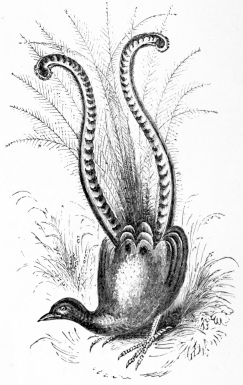
THE LYRE-BIRD OF AUSTRALIA.
(Menura superba.)
This bird is found in New South Wales, near Port Philip, but it is the
male only that possesses the splendid tail whence it derives its name.
It feeds on snails, and builds a nest like a magpie.
“Of all the birds I have ever met with,” says Mr. Gould, “the Menura is
by far the most shy and difficult to procure. While among the brushes, I
have been surrounded by these birds, pouring forth their loud and
liquid calls, for days together, without being able to get a sight of
them; and it was only by the most determined perseverance and extreme
caution that I was enabled to effect this desirable object; which was
rendered the more difficult by their often frequenting the almost
inaccessible and precipitous sides of gullies and ravines, covered with
tangled masses of creepers, and umbrageous trees: the cracking of a
stick, the rolling down of a small stone, or any other noise, however
slight, is sufficient to alarm it; and none but those who have traversed
these rugged, hot, and suffocating brushes, can fully understand the
excessive labour attendant on the pursuit of the Menura. Independently
of climbing over rocks and fallen trunks of trees, the sportsman has to
creep and crawl beneath and among the branches with the utmost caution,
taking care only to advance when the bird’s attention is occupied in
singing, or in scratching up the leaves in search of food: to watch its
actions, it is necessary to remain perfectly motionless, not venturing
to move even in the slightest degree, or it vanishes from sight, as if
by magic. Although I have said thus much on the cautiousness of the
Menura, it is not always so alert: in some of the more accessible
brushes through which roads have been cut, it may frequently be seen,
and even on horseback closely approached, the bird apparently evincing
less fear of those animals than of man. At Illawarra it is sometimes
successfully pursued by dogs trained to rush suddenly upon it, when it
immediately leaps upon the branch of a tree, and its attention being
attracted by the dog which stands barking below, it is easily approached
and shot. Another successful mode of procuring specimens is, by wearing
a tail of a full-plumaged male in the hat, keeping it constantly in
motion, and concealing the person among the bushes, when the attention
of the bird being arrested by the apparent intrusion of another of its
own sex, it will be attracted within the range of the gun: if the bird
be hidden from view by the surrounding objects, any unusual sound, as a
shrill whistle, will generally induce him to show himself for an
instant, by causing him to leap with a gay and sprightly air upon some
neighbouring branch to ascertain the cause of the disturbance:
immediate advantage must be taken of this circumstance, or the next
moment it may be half-way down the gully. So totally different is the
shooting of this bird to anything practised in Europe, that the most
expert shot would have but little chance, until well experienced in the
peculiar nature of the country, and the habits of the bird. The Menura
seldom, if ever, attempts to escape by flying; it easily eludes pursuit
by its extraordinary power of running. None are so efficient in
obtaining specimens as the naked black, whose noiseless and gliding
steps enable him to steal upon it unheard and unperceived, and with the
gun in his hand, he rarely allows it to escape, and in many instances he
will even kill it with his own weapons.
“The Lyre-bird is of a wandering disposition, and although it probably
keeps to the same brush, it is constantly engaged in traversing it from
one end to the other, from mountain-top to the bottom of the gullies,
whose steep and rugged sides present no obstacle to its long legs and
powerful muscular thighs: it is also capable of performing extraordinary
leaps; and I have heard it stated, that it will spring ten feet
perpendicularly from the ground. It appears to be of solitary habits, as
I have never seen more than a pair together, and these only in a single
instance; they were both males, and were chasing each other round and
round with extreme rapidity, apparently in play, pausing every now and
then to utter their loud shrill calls; while thus employed they carried
the tail horizontally, as they always do when running quickly through
the bush, that being the only position in which this great organ could
be conveniently borne at such times. Among its many curious habits, the
only one at all approaching to those of the Gallinacæa, is that of
forming small round hillocks, which are constantly visited during the
day, and upon which the male is constantly trampling, at the same time
erecting and spreading out his tail in the most graceful manner, and
uttering his various cries, sometimes pouring forth his natural notes,
at others mocking those of other birds, and even the howling of the
native dog, or dingo. The early morning and the evening are the periods
when it is most animated and active.”
There is another kind of Lyre-Bird, also found in New South Wales, to
which Mr. Gould has given the name of Menura Alberti, in honour of the
late Prince Consort.
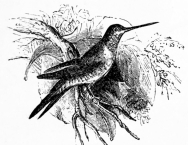
THE HUMMING-BIRD. (Trochilus colubris.)
There are numerous species of Humming-Birds, but that represented above,
is one of the most common. They are abundant in South America,
particularly in Brazil; and are so small and so brilliant in their
colours, that when seen fluttering about in the brilliant rays of a
tropical sun, they look like flying gems. They are extremely active,
darting about, and thrusting their long beaks and flexible tongues into
every flower they see, in search of food. Sometimes they will remain
suspended in the air for a long time together, vibrating their wings
with such velocity, that they cannot be seen distinctly, but appear like
a mist round the body of the bird, while they make that curious humming
noise from which the bird takes its name. Sometimes they quarrel, when
their little throats become distended, their crest, tails, and wings
expand, and they fight with inconceivable fury, till one of them falls
exhausted on the ground. The most common species is Trochilus
colubris, the Ruby-throated Humming-Bird, and one of them has been kept
alive in a cage for more than three months, by feeding it with sugar and
water. This species is found in North America, where it migrates to the
north in summer, and is there seen even in Canada and the country of
Hudson’s Bay.
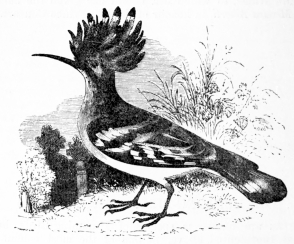
THE HOOPOE. (Upupa epops.)
This is a small bird, measuring no more than twelve inches from the
point of the bill to the end of the tail. The bill is sharp, black, and
somewhat bending. The head is adorned with a very beautiful, large
moveable crest, a kind of bright halo, the radiation of which places the
head nearly in the centre of a golden circle. This pleasing ornament,
which the bird sets up or lets fall at pleasure, is composed of a double
row of feathers, reaching from the bill to the nape of the neck, which
is of a pale red. The breast is white, with black streaks tending
downwards; the wings and back are varied with white and black
cross-lines. The food of the Hoopoe consists chiefly of insects, with
the remains of which its nest is sometimes so filled as to become
extremely offensive. This beautifully-crested bird is not at all common
in this country, and is solitary, two of them being seldom seen
together, while in Egypt, where Hoopoes are very common, they are often
seen in small flocks. The female generally constructs her nest in a
hollow tree, the materials employed, in addition to the remains of their
food, being very scanty, consisting in fact of a few dried grass stalks
and feathers. She lays from four to seven eggs at a time, of a pale
lavender grey, about an inch and a half long. The young are generally
hatched in June; it is said, however, that two or three broods are
produced in the course of the year. The name alludes to the note of the
bird, which resembles the word “hoop” repeated several times in a low
voice.
Though this bird is found occasionally both in England and Scotland, it
rarely breeds with us. It is common in Italy, where its strange
startling cry is often heard, without the bird being seen, as it keeps
itself concealed among trees. It is also not uncommon on the banks of
the Garonne in France, where it may be seen skimming along the ground
amongst the willows in search of the insects upon which it feeds.
There are several species of this magnificent family. The most brilliant
is undoubtedly the Upupa Superba, or Grand Promerops of New Guinea.
“There does not perhaps exist,” says Sonnerat, “a more extraordinary
bird. Its body is delicate and slender, and, although it is of an
elongated form, appears excessively small in comparison with the tail.
Nature seems to have pleased herself in painting this being, already so
singular, with her most brilliant colours. The head, the neck, and the
belly are a glittering green; the feathers which cover these parts have
the lustre and softness of velvet to the eye and to the touch; the back
is changeable violet; the wings are of the same colour, and appear,
according to the lights in which they are held, blue, violet, or deep
black, always however imitating velvet.” This bird is rare, and a
specimen is seldom seen even in the most complete collections.
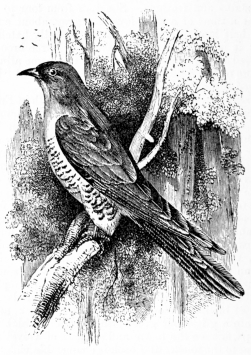
THE CUCKOO. (Cuculus canorus.)
“Hail, beauteous stranger of the wood,
Attendant on the spring!
Now Heaven repairs thy rural seat,
And woods thy welcome sing.
“Soon as the daisy decks the green,
Thy certain voice we hear;
Hast thou a star to guide thy path,
Or mark the rolling year?
“Delightful visitant! with thee
I hail the time of flowers,
When heav’n is fill’d with music sweet,
Of birds among the bowers.”
Logan.
The well-known notes of this bird, in spite of their monotony, are heard
with pleasure in spring, as a sure prognostic of fine weather. The
Cuckoo is generally first heard about the middle of April, and ceases
towards the end of June. This bird is so shy that he is seldom seen when
uttering his singular note. The female does not build a nest, but lays
her eggs in that of some other bird.
The Cuckoo is somewhat less than the magpie, his length being about
twelve inches from the tip of the bill to the end of the tail. He is
remarkable for his round prominent nostrils; the lower part of the body
is of a yellowish colour, with black transverse lines on the throat and
across the breast; the head and upper part of the body and wings are
beautifully marked with black and tawny stripes, and on the top of the
head there are a few white spots. The tail is long, and on the exterior
part, or edges of the feathers, there are several white marks; the
ground colour of the body is a sort of grey. The legs are short, and
covered with feathers, and the feet are composed of four toes, two
before and two behind.
We are indebted to the observations of Dr. Jenner for the following
account of the habits and economy of this singular bird in the disposal
of its eggs. He states that, during the time the hedge-sparrow is laying
her eggs, which generally occupies four or five days, the Cuckoo
contrives to deposit her egg among the rest, leaving the future care of
it entirely to the hedge-sparrow. This intrusion often occasions some
disorder; for the old hedge-sparrow, at intervals while she is sitting,
not only throws out some of her own eggs but sometimes injures them in
such a way that they become addled, so that it frequently happens that
not more than two or three of the parent bird’s eggs are hatched: but,
what is very remarkable, it has never been observed that she has either
thrown out or injured the egg of the Cuckoo. When the hedge-sparrow has
set her usual time, and has disengaged the young Cuckoo and some of her
own offspring from the shell, her own young ones and any of her eggs
that remain unhatched are soon turned out: the young Cuckoo then remains
in full possession of the nest, and is the sole object of the future
care of the foster parent. The young birds are not previously killed,
nor are the eggs demolished; but they are left to perish together,
either entangled in the bush that contains the nest, or lying on the
ground beneath it. On the 18th June, 1787, Dr. Jenner examined a nest of
a hedge-sparrow, which then contained a Cuckoo’s and three
hedge-sparrow’s eggs. On inspecting it the day following, the bird had
hatched: but the nest then contained only a young Cuckoo and one
hedge-sparrow. The nest was placed so near the extremity of a hedge,
that he could distinctly see what was going forward in it; and, to his
great astonishment, he saw the young Cuckoo, though so lately hatched,
in the act of turning out the young hedge-sparrow. The mode of
accomplishing this was curious; the little animal, with the assistance
of its rump and wings, contrived to get the bird upon its back, and
making a lodgment for its burden by elevating its elbows, climbed
backward with it up the side of the nest, till it reached the top;
where, resting for a moment, it threw off its load with a jerk, and
quite disengaged it from the nest. After remaining a short time in this
situation, and feeling about with the extremities of its wings, as if to
be convinced that the business was properly executed, it dropped into
the nest again. Dr. Jenner made several experiments in different nests,
by repeatedly putting in an egg to the young Cuckoo, which he always
found to be disposed of in the same manner. It is very remarkable that
nature seems to have provided for the singular disposition of the Cuckoo
in its formation at this period; for, different from other newly-hatched
birds, its back, from the scapulae downward, is very broad, with a
considerable depression in the middle, which seems intended for the
express purpose of giving a more secure lodgment to the egg of the
hedge-sparrow or its young one, while the young Cuckoo is employed in
removing either of them from the nest. When it is about twelve days
old, this cavity is quite filled up, the back assumes the shape of that
of nestling birds in general, and at that time the disposition of
turning out its companion entirely ceases. The smallness of the Cuckoo’s
egg, which in general is less than that of the hedge-sparrow, is another
circumstance to be attended to in this surprising transaction, and seems
to account for the parent Cuckoo’s depositing it in the nest of such
small birds only as these. If she were to do this in the nest of a bird
that produced a larger egg, and consequently a larger nestling, the
design would probably be frustrated, the young Cuckoo would be unequal
to the task of becoming sole possessor of the nest, and might fall a
sacrifice to the superior strength of its partners. Dr. Jenner observes,
that the egg of two Cuckoos are sometimes deposited in the same nest;
and gives the following instance which fell under his observation. Two
Cuckoos and a hedge-sparrow were hatched in the same nest; one
hedge-sparrow’s egg remained unhatched. In a few hours a contest began
between the Cuckoos for possession of the nest; and this continued
undetermined till the afternoon of the following day, when the one which
was somewhat superior in size, turned out the other, together with the
young hedge-sparrow and the unhatched egg. The contest, he adds, was
very remarkable; the combatants alternately appeared to have the
advantage, as each carried the other several times nearly to the top of
the nest, and again sank down oppressed by the weight of its burden;
till at length, after various efforts, the strongest of the two
prevailed, and was afterwards brought up by the hedge-sparrow.
The American Cuckoo, or Cow bird, is quite different in its habits to
the European Cuckoo, as it builds a nest for its eggs, and hatches its
young itself like other birds.
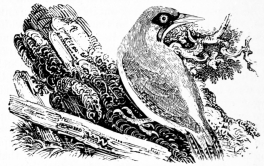
THE COMMON GREEN WOODPECKER,
(Picus viridis,)
Receives his name from his habit of pecking the insects from the chinks
of trees and holes in the bark. The bill is straight, strong, and
angular at the end; and in most of the species is formed like a wedge,
for the purpose of piercing the trees. The nostrils are covered with
bristles. The tongue is slender, and cylindrical in shape, and to the
touch is hard and bony. The Woodpecker, in common with the Humming Bird,
though for a different object, possesses the remarkable property of
being able to dart out its tongue and secure insects at a considerable
distance from its beak. For the purpose of effectually capturing the
stronger insects, the tongue is barbed at the end, and provided with
glutinous secretion. The toes of this bird are placed two forward and
two backward; and the tail consists of ten hard, stiff, and
sharp-pointed feathers. A Woodpecker is often seen hanging by his claws,
and resting upon his breast against the stem of a tree; when, after
darting his beak against the bark, with great strength and noise, he
runs round the tree with much alacrity, which manœuvre has made the
country people suppose that he goes round to see whether he has not
pierced the tree through, though the fact is, the bird is in search of
the insects, which he hopes to have driven out by his blow.
The following lines, from Moore’s beautiful song, allude to the noise
which the Woodpecker makes in searching for its food:
“I knew by the smoke that so gracefully curl’d
Above the green elms, that a cottage was near,
And I said, if there’s peace to be found in the world,
A heart that was humble might hope for it here.
Every leaf was at rest, and I heard not a sound,
But the Woodpecker tapping the hollow beech-tree.”
The fact is, that this beating against the bark is for no other purpose
than to rouse the insects which the chink contains, and to force them to
come out, which they do from their alarm at the noise, when the
Woodpecker turning round takes them unawares, and feeds upon them: if
the insects do not answer the delusive call, he darts his long tongue
into the hole, and brings out, by this means, his reluctant prey. The
plumage of this bird is a compound of red and green, two colours, the
approximation of which is always productive of harmony in the works of
nature. They nestle in the hollows of trees, where the female lays five
or six whitish eggs, without making any nest, trusting to the natural
heat of her body to hatch them.
The Green Woodpecker is seen more frequently on the ground than the
other kinds, particularly where there are ant-hills. It inserts its long
tongue into the holes through which the ants issue, and draws them out
in abundance. Sometimes with its feet and bill it makes a breach in the
nest, and devours the ants and their eggs at its ease. The young ones
climb up and down the trees before they are able to fly; they roost very
early, and repose in their holes till day. There are many different
kinds of Woodpecker, five of which are common to this country.
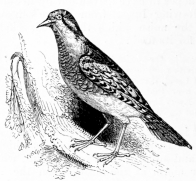
THE WRYNECK. (Yunx torquilla.)
This bird, Mr. Gould tells us, has received its English name from its
habit of moving its head and neck in various directions, and with an
undulating motion, like that of a snake; indeed, in some parts of
England it is called the snake-bird. When found in its usual retreat in
the hole of a tree, it makes a loud hissing noise, raises the feathers
of the crown, and writhing its head and neck towards each shoulder
alternately, with grotesque contortions, becomes an object of terror to
a timid intruder; and the bird, taking advantage of a moment of
indecision, darts with the rapidity of lightning from a situation where
escape appeared impossible.
The Wryneck deposits its eggs on fragments of decayed wood within a
hollow tree, and makes scarcely any nest. The birds when caught young
are easily tamed.
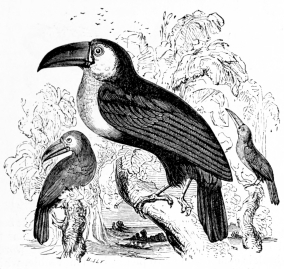
THE TOUCAN, (Rhamphastos tucanus,)
Is a native of South America, very conspicuous for the magnitude and
shape of its bill; which, in some of the species, is nearly as long and
as large as the body itself. The length of its body is about eighteen
inches (the size of the magpie); the head is large and strong, and the
neck short, in order the more easily to support the bulk of such a beak.
The head, neck, and wings are black; the breast of a most lovely orange
saffron colour; the lower part of the body and the thighs are vermilion;
the tail black. Mr. Gould’s specimen represents a narrow straw-coloured
belt across the centre of the breast, dividing the orange tint from the
vermilion. One of these birds that was kept in a cage was very fond of
fruit, which it held for some time in its beak, touching it with great
delight with the tip of its feathery tongue, and then tossing it into
its throat by a sudden upright jerk; it also fed on small birds,
insects, caterpillars, &c.
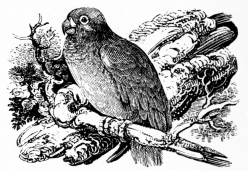
THE GREY PARROT. (Psittacus erythacus.)
The tongue of the Parrot is not unlike a black soft bean, and fills so
completely the capacity of its beak, that the bird can easily modulate
sounds and articulate words; the beak is composed of two pieces, both
moveable, which is a peculiarity belonging almost exclusively to this
tribe of birds. The bill of the Parrot is strongly hooked, and assists
it in climbing, catching hold of the boughs of the trees with it, and
then drawing its legs upwards; then again advancing the beak, and
afterwards the feet, for its legs are not adapted for hopping from bough
to bough, as other birds do. Several stories are told of the sagacity of
these birds, and of the aptitude of their interrogatories and answers,
but they have been no doubt the effect of chance.
Dr. Goldsmith says that a Parrot, belonging to King Henry the Seventh,
having been kept in a room next the Thames, in his palace of
Westminster, had learned to repeat many sentences from the boatmen and
passengers. One day, sporting on its perch, it unluckily fell into the
water. The bird had no sooner discovered its situation, than it called
out aloud, “A boat! twenty pounds for a boat!” A waterman, happening to
be near the place where the Parrot was floating, immediately took it up,
and restored it to the king; demanding, as the bird was a favourite,
that he should be paid the reward the bird had called out. This was
refused; but it was agreed that, as the Parrot had offered a reward, the
man should again refer to its determination for the sum he was to
receive. “Give the knave a groat,” screamed the bird the instant the
reference was made.
The memory of Parrots is very astonishing, and they can not only imitate
discourse, but can sing verses of songs, and mimic gestures and actions.
Scaliger saw one that performed the dance of the Savoyards at the same
time that it repeated their song. The song was well imitated, but when
the bird tried to caper, it was with the worst grace imaginable, as he
turned in his toes, and kept tumbling back in a most clumsy manner.
Willoughby tells us of a Parrot, which, when a person said to it,
“Laugh, Poll, laugh,” laughed accordingly, and the instant after
screamed out, “What a fool to make me laugh!” Another, which had grown
old with its master, shared with him the infirmities of age. Being
accustomed to hear scarcely anything but the words “I am sick;” when a
person asked it, “How do you do, Poll?” “I am sick,” it replied in a
doleful tone, stretching itself out, “I am sick.”
Parrots are very numerous in the East and West Indies, where they
assemble in companies, like rooks, and build in the hollows of trees.
The female lays two or three eggs, marked with little specks, like those
of the partridge. They never breed in our climate, though they live here
to a great age. They feed entirely upon vegetables, but, when tame, will
take from the mouth of their master or mistress any kind of chewed meat,
and chiefly eggs, of which they seem particularly fond. They bite or
pinch very hard, and some of them possess so much strength in their
beak, that they could easily break a man’s finger. The Parrot is
sensible of attachment, as well as of revenge; and if in their mimic
attitudes they show great pleasure at the sight of their feeders, they
also fly up with anger to the face of those who once have affronted or
injured them.
THE GREEN PARROT, (Psittacus amazonicus,)
Which is perhaps more commonly seen in England than the African Grey
Parrot, is a native of South America, and receives its name from the
great river Amazon, on the banks of which it is common. In its native
country it does much damage to the plantations, and indeed many of the
Parrots are as injurious in this respect as they are beautiful in their
plumage. The Green Parrot resembles the Grey species in its habits, and
may likewise be taught to speak with much distinctness.
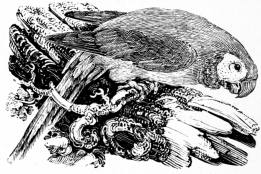
THE BLUE AND YELLOW MACAW, (Psittacus, or Macrocercus
aracanga,)
Is one of the largest of the parrot tribe, and painted with the finest
colours Nature can bestow. The beak is uncommonly strong; and the tail
proportionally longer than that of any of the parrot tribe. Its voice is
fierce and tremulous, sometimes sounding like the laugh of an old man;
and it seems to utter the word “Arara,” which occasions its bearing that
name in its native country.
When tame, it eats almost every article of human food, and is
particularly fond of bread, beef, fried fish, pastry, and sugar. It
cracks nuts with its bill, and dexterously picks out the kernels with
its claws. It does not chew the soft fruits, but sucks them by pressing
its tongue against the upper part of its beak: and the harder sort of
food, such as bread and pastry, it bruises, or chews, by pressing the
tip of the lower upon the most hollow part of the upper mandible.
The Scarlet Macaw (M. Macao) is another large species, of a bright
red colour, with some blue and yellow feathers on the wings, and blue
ones about the base of the tail. It was formerly common in the West
Indian Islands, but has now become rare there. Its voice is very loud
and harsh.
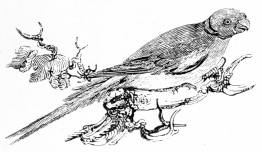
THE RING PAROQUET. (Palæornis Alexandri.)
This beautiful species, no less remarkable for the elegance of its form
than for its docility and imitative powers, is supposed to have been the
first of the parrot species known to the ancients, from the time of
Alexander the Great down to the age of Nero. It is about fifteen inches
long; its bill is thick and red; the head and the body a bright green;
the neck, breast, and the whole of the under side of a paler tint. It
has a red circle, or ring, which encompasses the neck, and is about the
breadth of a little finger at the back; but grows narrower by degrees
towards the sides, and ends under the lower bill. The lower part of the
body is of so faint a green, that it seems almost yellow. The tail also
is of a yellowish green, and the legs and feet ash-coloured.
Great numbers of Paroquets of different species are found in Australia,
and most of these live and seek their food upon the ground rather than
in trees. One of them is called the Ground Paroquet, as it is never
seen to perch upon trees, but is always running about among the grass
and herbage. The Warbling Grass Paroquet is a well known and beautiful
little Australian bird, of which considerable numbers have been imported
into this country of late years; it is deservedly a favourite, both on
account of its elegance, and from its possessing a gentle warbling note
very different from the harsh screaming of many species of its tribe. It
can, however, scream vigorously for its size. In the interior of
Australia these charming little birds occur in countless multitudes.
They feed chiefly on the seeds of grasses, which they pick up whilst
running upon the ground, but they perch in crowds upon the gum-trees for
shelter from the noon-day heat, and also before starting on an
expedition in search of water.
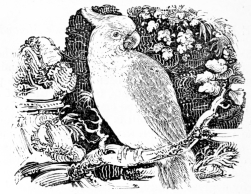
THE COCKATOO. (Plyctolophus galeritus.)
This bird is distinguished from the parrots, by a beautiful crest,
composed of a tuft of elegant feathers, which he can raise or depress at
pleasure. We meet with some of a beautiful white plumage, and the inside
feathers of the crest of a pleasing yellow, with a spot of the same
colour under each eye, and one upon the breast. The Cockatoos are
natives of the Indian Islands and Australia, where they are found in
great abundance. Their food consists of seeds and soft and stony fruits,
which last their powerful bill enables them to break with ease. They are
easily tamed when taken at an early age, after which they become
familiar and even attached, but their imitative powers seldom go beyond
a very few words added to their own cry of Cockatoo.
In a wild state they are shy, and cannot easily be approached. The flesh
of the young birds is accounted very good eating. The female is said to
make her nest in the rotten limbs of trees, using nothing more than the
accumulation of vegetable mould formed by the decayed parts of the
bough. The eggs are white, without spots; there are no more than two
young at a time. The natives first find the nest by the pieces of bark
and twigs which the old birds strip off the trees adjoining that in
which the nest is situated. It is a remarkable fact that the bark is
never stripped off the tree which contains the nest.
Mr. Bennet, in speaking of the large black Cockatoo of New Holland,
says, that if this bird observes on the trunk of a tree indications of a
larva being within, it diligently labours to get at it with its powerful
beak, and should the object of its pursuit be deep within the wood, as
often happens, the trunk becomes so extensively hacked, that a slight
gust of wind will lay the tree prostrate.
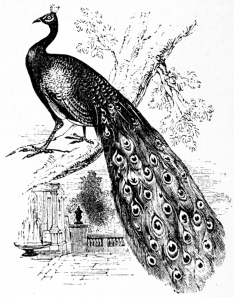
THE PEACOCK. (Pavo cristatus.)
Astonished at the unparalleled beauty of this bird, the ancients could
not help indulging their lively and creative fancy, in accounting for
the magnificence of his plumage. They made him the favourite of imperial
Juno, sister and wife to Jupiter; and not less than the hundred eyes of
Argus were pulled out to ornament his tail; indeed, there is scarcely
anything in nature that can vie with the transcendent lustre of the
Peacock’s feathers. The changing glory of his neck eclipses the deep
azure of ultramarine; and at the least evolution, it assumes the green
tint of the emerald, and the purple hue of the amethyst. His head, which
is small and finely shaped, has several curious stripes of white and
black round the eyes, and is surmounted by an elegant plume, or tuft of
feathers, each of which is composed of a slender stem and a small tuft
at the top. Displayed with conscious pride, and exposed under a variety
of angles to the reflections of light, the broad and variegated disks of
his train, of which the neck, head, and breast of the bird become the
centre, claim our admiration. By an extraordinary mixture of the
brightest colours, it displays at once the richness of gold, and the
paler tints of silver, fringed with bronze-coloured edges, and
surrounding eye-like spots of dark brown and sapphire. The hen does not
share in the beauty of the cock, and her feathers are generally of a
light brown. She lays only a few eggs at a time, generally at an
interval of three or four days; they are white and spotted, like the
eggs of the turkey. She sits from twenty-seven to thirty days.
The loud screamings of the Peacock are worse than the harsh croakings of
the raven, and a sure prognostic of bad weather; and his feet, more
clumsy than those of the turkey, make a sad contrast with the elegance
of his plumage:
“Though richest hues the Peacock’s plumes adorn,
Yet horror screams from his discordant throat.”
The spreading of the train, the swelling of the throat, neck, and
breast, and the puffing noise which they emit at certain times, are
proofs that the Turkey and the Peacock stand nearly allied in the family
chain of animated beings.
The flesh of the Peacock was anciently esteemed a princely dish; and the
whole bird used to be served on the table with the feathers of the neck
and tail preserved; but few people could now relish such food, as it is
much coarser than the flesh of the turkey. The Italians have given this
laconic description of the Peacock: “He has the plumage of an angel, the
voice of a devil, and the stomach of a thief.”
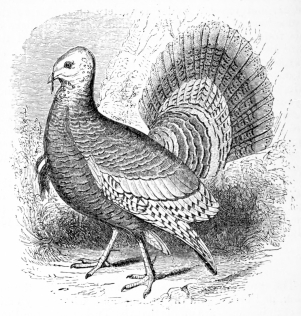
THE TURKEY, (Meleagris Gallo-Pavo,)
Was originally an inhabitant of America, whence he was brought to Europe
by some Jesuit missionaries, which accounts for his being called a
Jesuit in some parts of the continent. The general colour of the
feathers is buff and black; and turkeys have about the head, especially
the cock, naked and tuberous lumps of flesh of a bright red colour. A
long fleshy appendage hangs from the base of the upper mandible, and
seems to be lengthened and shortened at pleasure. The hen lays from
fifteen to twenty eggs, which are whitish and freckled. The chicks are
very tender, and require great care and attentive nursing, until they
are able to seek their food. In the county of Norfolk the breeding of
Turkeys, which is there a considerable branch of trade, is brought to
great perfection; and some weighing upwards of twenty pounds each have
been raised there. They appear to have a natural antipathy to everything
of a red colour.
Though extremely prone to quarrel among themselves, they are, in
general, weak and cowardly against other animals, and fly from almost
every creature that ventures to oppose them. On the contrary, they
pursue everything that appears to dread them, particularly small dogs
and children; and after having made these objects of their aversion
scamper, they evince their pride and satisfaction by displaying their
plumage, strutting about among their female train, and uttering their
peculiar note of self-approbation. Some instances, however, have
occurred, in which the Turkey-cock has exhibited a considerable share of
courage and prowess; as will appear from the following anecdote:—A
gentleman of New York received from a distant part a Turkey-cock and
hen, and with them a pair of bantams; which were put all together into
the yard with his other poultry. Some time afterwards, as he was feeding
them from the barn-door, a large hawk suddenly turned the corner of the
barn, and made a pounce at the bantam hen: she immediately gave the
alarm, by a noise which is natural to her on such occasions; when the
Turkey-cock, who was at the distance of about two yards, and without
doubt understood the hawk’s intention, flew at the tyrant, with such
violence, and gave him so severe a stroke with his spurs, as to knock
him from the hen to a considerable distance; by which means the bantam
was rescued from destruction.
The wild Turkey-cock is, in the American forests, an object of
considerable interest. It perches on the tops of the deciduous cypress
and magnolia:
“On the top
Of yon magnolia, the loud Turkey’s voice
Is heralding the dawn: from tree to tree
Extends the wakening watch-note far and wide,
Till the whole woodlands echo with the cry.”
Southey.
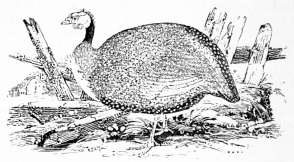
THE GUINEA FOWL, OR PINTADO.
(Numida Meleagris.)
This bird, which is also called the Pearled Hen, was originally
brought from Africa, where the breed is common, and seems to have been
well known to the Romans, who used to esteem the flesh of this fowl as a
delicacy, and admit it at their banquets. It went then by the name of
Numidian Hen, or Meleagris, because it was fabled that the sisters of
Meleager, who unceasingly deplored his death, were metamorphosed into
Guinea Hens by Diana. In fact, although they are now domesticated with
us, they still retain a great deal of their original freedom, and have a
stupid look. Their noise is very disagreeable: it is a creaking note,
which, incessantly repeated, grates upon the ear, and becomes very
teasing and unpleasant. They belong to the class of birds called
pulveratores; as they scrape the ground and roll themselves in the
dust like common hens, in order to get rid of small insects which lodge
in their feathers.
The Pintado is somewhat larger than the common hen; the head is bare of
feathers, and covered with a naked skin of a bluish colour; on the top
is a callous protuberance of a conical form. At the base of the bill on
each side hangs a loose wattle, red in the female and bluish in the
male. The general colour of the plumage is a dark bluish grey, sprinkled
with round white spots of different sizes, resembling pearls, from which
circumstance the epithet of pearled has been applied to this bird;
which at first sight appears as if it had been pelted by a strong shower
of hail.
If trained when young, these birds may easily be rendered tame. M. Bruë
informs us, that when he was on the coast of Senegal he received as a
present from an African princess two Guinea fowls. Both these birds were
so familiar that they would approach the table and eat out of his plate;
and, when they had liberty to fly about upon the beach, they always
returned to the ship when the dinner or supper bell rang.
In a wild state, it is asserted that the Pintado associates in large
flocks. Dampier speaks of having seen between two and three hundred of
them together in the Cape de Verd Islands. They were originally
introduced into our country from the coast of Africa somewhat earlier
than the year 1260.
In Jamaica, where they have run wild, and become very destructive to the
plantations, they are sometimes caught, Mr. Gosse tells us, by the
following stratagem:—A small quantity of corn is steeped for a night in
proof rum and is then placed in a shallow vessel, with a little fresh
rum, and the water expressed from a bitter cassava grated. This is
deposited within an enclosed ground to which the depredators resort. A
small quantity of the grated cassava is then strewed over it, and it is
left. The fowls eat the medicated food greedily, and are soon found
reeling about intoxicated, unable to escape, and content with thrusting
their heads into a corner. It is almost unnecessary to observe that in
this state they become an easy prey. Pigeons are sometimes caught in
this manner in Germany by the poachers.
This bird has, of late years, greatly increased in this country, and is
often seen hanging at the poultry shops and in the markets; the great
abundance of them has considerably reduced their value, and they now
sell, proportionally, like other fowls. The eggs are smaller and rounder
than those of the common hen, and of a speckled reddish-brown colour.
They are esteemed a very delicate food.
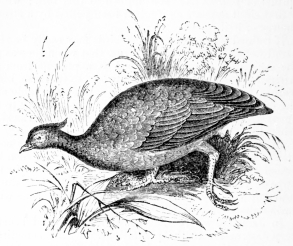
THE MOUND-BIRD OF AUSTRALIA.
(Megapodius tumulus.)
It is remarkable that this bird does not hatch its eggs by incubation.
It collects together a great heap of decaying vegetables as the place of
deposit of its eggs, thus making a hotbed, arising from the
decomposition of the collected matter, by the heat of which the young
are hatched. This mound varies in quantity from two to four cart-loads,
and is not the work of a single pair of birds, but is the result of the
united labour of many.
Mr. Gould, in his Birds of Australia, gives the following account of
the discovery of one of these nests by Mr. Gilbert:—
“I landed beside a thicket, and had not proceeded far from the shore,
ere I came to a mound of sand and shells, with a slight mixture of black
soil, the base resting on a sandy beach, only a few feet above
high-water mark; it was enveloped in the large yellow-blossomed
Hibiscus, and was of a conical form, twenty feet in circumference at the
base, and about five feet in height. On pointing it out to the native,
and asking him what it was, he replied, ‘Oooregoorga Rambal,’
Jungle-fowls’ house or nest. I then scrambled up the sides of it, and,
to my extreme delight, found a young bird in a hole about two feet deep;
it was lying on a few dry withered leaves, and appeared only a few days
old. So far I was satisfied that these mounds had some connection with
the bird’s mode of incubation; but I was still sceptical as to the
probability of these young birds ascending from so great a depth as the
natives represented, and my suspicions were confirmed by my being unable
to induce the native, in this instance, to search for the eggs, his
excuse being that he knew it would be no use, as he saw no traces of the
old birds having recently been there. I took the utmost care of the
young bird, intending to rear it if possible; I therefore obtained a
moderate-sized box, and placed in it a large portion of sand. As it fed
rather freely on bruised Indian corn, I was in full hopes of succeeding;
but it proved of so wild and intractable a disposition, that it would
not reconcile itself to such close confinement, and effected its escape
on the third day. During the period it remained in captivity, it was
incessantly occupied in scratching up the sand into heaps, and the
rapidity with which it threw the sand from one end of the box to the
other was quite surprising for so young and small a bird, its size not
being larger than that of a small quail.
“At night it was so restless, that I was constantly kept awake by the
noise it made in its endeavours to escape. In scratching up the sand it
only used one foot, and having grasped a handful, as it were, the sand
was thrown behind it, with but little apparent exertion, and without
shifting its standing position on the other leg: this habit seemed to be
the result of an innate restless disposition, and a desire to use its
powerful feet, and to have but little connection with its feeding; for
although Indian corn was mixed with the sand, I never detected the bird
in picking any of it up while thus employed.
“I continued to receive the eggs without having any opportunity of
seeing them taken from the mound until the 6th of February; when, on
again visiting Knocker’s Bay, I had the gratification of seeing two
taken from a depth of six feet, in one of the largest mounds I had then
seen. In this instance the holes ran down in an oblique direction from
the centre towards the outer slope of the hillock, so that, although the
eggs were six feet deep from the summit, they were only two or three
feet from the side. The birds are said to lay but a single egg in each
hole, and after the egg is deposited the earth is immediately thrown
down lightly, until the hole is filled up; the upper part of the mound
is then smoothed and rounded over. It is easily known when a Jungle-fowl
has been recently excavating, from the distinct impression of its feet
on the top and sides of the mound, and from the earth being so lightly
thrown over, that with a slender stick the direction of the hole may
readily be detected; the ease or difficulty of thrusting the stick down
indicating the length of time that has elapsed since the birds’
operations. Thus far it is easy enough; but to reach the eggs requires
no little exertion and perseverance. The natives dig them up with their
hands alone, and only make sufficient room to admit their bodies, and to
throw out the earth between their legs: by grubbing with their fingers
alone, they are enabled to fellow the direction of the hole with greater
certainty, which will sometimes, at a depth of several feet, turn off
abruptly at right angles, its direct course being obstructed by a clump
of wood, or some other impediment.”
In all probability, as Nature has adopted this mode of reproduction, she
has also furnished the tender birds with the power of sustaining
themselves from the earliest period; and the great size of the egg would
equally lead to this conclusion, since in so large a space it is
reasonable to suppose that the bird would be much more developed than is
usually found in eggs of smaller dimensions. The eggs are perfectly
white, of a long, oval form, three inches and three quarters long by two
inches and a half in diameter.
There are several other Australian birds which adopt the same singular
mode of hatching their eggs; one of these is called the Native Pheasant
(Leipoa ocellata), and another the Brush Turkey (Talegalla Lathami).
The latter has its head and neck covered with a naked skin, like the
turkey, but the lower part of this is much thickened, warty, and bright
yellow.
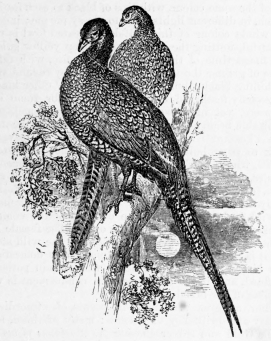
THE PHEASANT. (Phasianus colchicus.)
The name of this bird implies that he was originally a native of the
banks of the river Phasis, in Armenia; how and when he emigrated, and
began to frequent our groves, is unknown. He is of the size of the
common cock; the bill is of a pale horn colour; the nostrils arched; the
eyes yellow, and surrounded by a naked warty skin, of a beautiful
scarlet, finely spotted with black; immediately under each eye there is
a small patch of short feathers, of a dark glossy purple; the upper
parts of the head and neck are of a deep purple, varying to glossy
green and blue; the lower parts of the neck and breast are of a reddish
chesnut, with black indented edges; the sides and lower part of the
breast are of the same colour, with tips of black to each feather,
which, in different lights, vary to glossy purple; indeed, the whole
colour of this half-domesticated fowl is very beautiful, uniting the
brightness of deep yellow gold to the finest tints of the ruby and
turquoise, with reflections of green; the whole being set off by several
spots of shining black; but in this, as in every other kind of
gorgeously-feathered birds, Nature has for some wise purposes, yet
unknown to us, denied the female that admirable beauty of plumage which
belongs to the male. The Pheasant lives in the woods, which he leaves at
dusk to perambulate corn-fields and other sequestered places, where he
feeds with his females, upon acorns, berries, grain, and seeds of
plants, but chiefly on ants’ eggs, of which he is particularly fond. His
flesh is justly accounted better meat than any of the domestic or wild
fowls, as it unites the delicacy of the common chicken to a peculiar
taste of its own. The female lays eighteen or twenty eggs once a year,
in the wild state; but it is in vain that we have attempted to
domesticate this bird entirely, as she never will remain patiently
confined, and if she ever breeds in confinement is very careless of her
brood.
There are great varieties of Pheasants, of extraordinary beauty and
brilliancy of colours: many of these, such as the Gold and Silver
Pheasants (Phasianus pictus and P. Nycthemerus), brought from the
rich provinces of China, are kept in aviaries in this kingdom.
This beautiful bird is elegantly described in the following passage:—
“See! from the brake the whirring Pheasant springs,
And mounts exulting on triumphant wings;
Short is his joy; he feels the fiery wound,
Flutters in blood, and panting beats the ground:
Ah! what avails his glossy, varying dyes,
His purple crest, his scarlet-circled eyes,
The vivid green his shining plumes unfold,
His painted wings, and breast that flames with gold!”
Pope’s Windsor Forest.
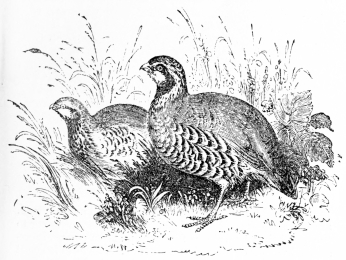
THE RED-LEGGED PARTRIDGE. (Perdix rufus.)
These Partridges are natives of Guernsey and Jersey; but are also very
frequently found on the adjoining coasts of France. Of late years they
have spread very rapidly in England; and as they are stronger and
fiercer than the common partridge, the latter becomes scarce wherever
the Red-legged Partridges are abundant. In the Western districts of
France they are very abundant, and their flesh is plump and juicy. In
England it is as white as in France, but more dry. The side-feathers are
very handsomely speckled, and there is a rich black mark beginning
behind the eye and forming a kind of gorget on the breast. The eyelids
are of a bright red, as are the bill and feet, and the claws are brown.
They build their nests on the ground; but are sometimes found perched on
trees, or on a fence or paling.
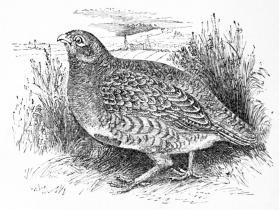
THE COMMON PARTRIDGE, (Perdix cinerea,)
Is in weight about fourteen ounces. The plumage, although it cannot
boast of gaudiness, is very pleasing to the eye, being a mixture of
brown and fawn-colour, interspersed with grey and ash-colour tints. The
head is small and pretty; the beak strong, but short, and resembling
that of all other granivorous birds. The female lays fifteen or eighteen
eggs, and leads her brood in the corn-fields with the utmost care. Young
Partridges are among the birds which run fleetly the moment they come
out of the shell, and may sometimes be found running with a piece of the
shell still remaining on their heads. The affection of Partridges for
their offspring is peculiarly interesting. Both the parents lead them
out to feed: they point out to them the proper places for their food,
and assist them in finding it by scratching the ground with their feet.
They frequently sit close together, covering the young ones with their
wings; and from this position they are not easily roused. If, however,
they are disturbed, most people acquainted with rural affairs know the
confusion that ensues. The male gives the first signal of alarm, by a
peculiar cry of distress; throwing himself at the same moment more
immediately into the way of danger, in order to mislead the enemy. He
flutters along the ground, hanging his wings, and exhibiting every
symptom of debility. By this stratagem he seldom fails of so far
attracting the attention of the intruder as to allow the female to
conduct the helpless unfledged brood into some place of security.
The nest is usually on the ground; but on the farm of Lion Hall, in
Essex, belonging to Colonel Hawker, a Partridge, in the year 1788,
formed her nest, and hatched sixteen eggs, on the top of a pollard
oak-tree! What renders this circumstance the more remarkable is, that
the tree had fastened to it the bars of a stile, where there was a
footpath; and the passengers, in going over, discovered and disturbed
her before she sat close. When the brood was hatched, the birds
scrambled down the short and rough boughs, which grew out all around the
trunk of the tree, and reached the ground in safety. It has long been a
received opinion among sportsmen, as well as among naturalists, that the
female Partridge has none of the bay feathers of the breast like the
male. This, however, is a mistake; for Mr. Montague happening to kill
nine birds in one day, with very little variation as to the bay mark on
the breast, he was led to open them all, and discovered five of them
were females. On carefully examining the plumage, he found that the
males could only be known by the superior brightness of colour about the
head; which alone, after the first or second year, seems to be the true
mark of distinction. They fly in coveys till about the third week in
February, when they separate and pair; but if the weather be very
severe, it is not unusual to see them collect together again. We are
told that a gamekeeper, in Dorsetshire, hearing a Partridge utter a cry
of distress, was attracted by the sound into a field of oats, when the
bird ran round him very much agitated; upon his looking among the corn,
he saw in the midst of her infant brood a large snake, which he killed;
and perceiving its body much distended, he opened it, when to his
astonishment two young Partridges ran from their prison, and joined
their mother; two others were found dead in its stomach. Partridges have
ever held a distinguished place at the tables of the luxurious: we have
an old distich:
“If the Partridge had the woodcock’s thigh,
’Twould be the best bird that e’er did fly.”
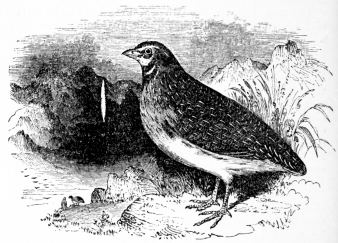
THE QUAIL, (Coturnix dactylisonans,)
Is a small bird, being in length no more than seven inches. The colour
of the breast is a dirty pale yellow, and the throat has a little
mixture of red: the head is black, and the body and wings have black
stripes upon a hazel-coloured ground. Its habits and manner of living
resemble those of the partridge, and it is either caught in nets by
decoy birds, or shot by the help of the setting-dog, its call being
easily imitated by tapping two pieces of copper one against another. The
flesh of the Quail is very luscious, and next in flavour to that of the
partridge. Quails are birds of passage, the only peculiarity in which
they differ from all other of the poultry kind; and such prodigious
numbers have sometimes appeared on the western coast of the kingdom of
Naples, that one hundred thousand have been caught in one day, within
the space of three or four miles. In some parts of the south of Russia
they abound so greatly, that at the time of their migration they are
caught by thousands, and sent in casks to Moscow and St. Petersburg. The
female seldom lays more than six or seven eggs.
The ancient Athenians kept this bird merely for the sport of fighting
with each other, as game-cocks do, and never ate the flesh. The Quail
was that wild fowl which God thought proper to send to the chosen people
of Israel as a sustenance for them in the desert.
The Chinese Quail is a beautiful little bird, and is often kept in cages
in China, for the singular purpose, as it is said, of warming people’s
hands in winter; as taking the soft, warm body of the bird in the hand
diffuses through it an agreeable warmth. It is also very pugnacious, and
is employed in fighting.
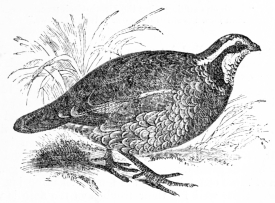
THE AMERICAN QUAIL, (Ortyx Virginianus,)
Is larger than the Common Quail, and is something between a Quail and a
Partridge.
The Californian Quail (O. Californicus) is distinguished by its
possession of a curious crest or tuft of feathers on the crown of the
head.
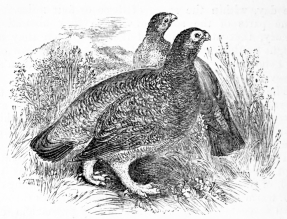
THE RED GROUSE. (Lagopus scoticus.)
“High on exulting wing the Heath-Cook rose,
And blew his shrill blast o’er perennial snows.”
Rogers.
This bird is called by some ornithologists the Moor Cock, and by
others Red Game. The beak is black and short; over the eyes there is a
bare skin of a bright red. The general colour of the plumage is red and
black, variegated, and intermixed with each other, except the wings,
which are brownish, spotted with red, and the tail, which is black; the
feet are covered with thick feathers down to the very claws. It is
common in the north of England, in Scotland, and in Wales; and not only
affords great diversion to the noblemen and gentlemen of those countries
who are fond of shooting, but also repays them well for their trouble,
as the flesh is very delicate, and holds on our table an equal place
with that of the partridge and the pheasant. The season of Grouse
shooting commences on the 12th of August. In winter they are found in
flocks of sometimes fifty to one hundred in number, which are termed by
sportsmen packs, and become remarkably shy and wild, seldom allowing
the sportsman to approach them within one hundred yards. They keep near
the summits of the heathy hills, and seldom descend to the lower
grounds. Here they feed on the mountain berries and on the tender tops
of the heath. The hen lays seven or eight eggs of a reddish black
colour.
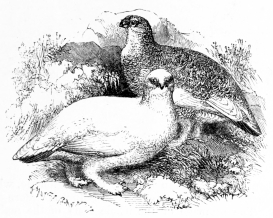
THE PTARMIGAN, OR WHITE GROUSE,
(Lagopus vulgaris,)
Is somewhat larger than a pigeon; its bill is black, and its plumage in
summer is of a pale brown colour, elegantly mottled with small bars and
dusky spots. The head and neck are marked with broad bars of black,
rust-colour, and white; the wings and belly are white. The White Grouse
is fond of lofty situations, where it braves the severest cold. It is
found in most of the northern parts of Europe and America, even as far
as Greenland. In this country it is only to be met with on the summits
of some of our highest hills, chiefly in Scotland, and in the Hebrides
and Orkneys, but sometimes in Cumberland and Wales. Its plumage becomes
pure white in winter, with the exception of the tail feathers, which
remain black.
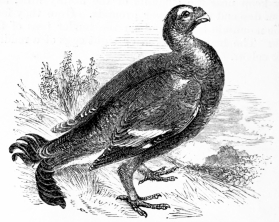
THE BLACK COCK, (Tetrao tetrix,)
Is about four pounds in weight; but the female, which is usually called
the Grey Hen, is often not more than two. The plumage of the whole body
of the male is black, and glossed over the neck and rump with shining
blue; the coverts of the wings are of a dusky brown, with the quill
feathers black and white. The tail is much forked in the male. These
birds never pair; but in the spring the males assemble at their
accustomed haunts on the tops of heathy mountains, where they crow and
clap their wings:
“And from the pine’s high top brought down
The giant Grouse, while boastful he display’d
His breast of varying green, and crow’d and clapp’d
His glossy wings.”
Gisborne.
The females, at this signal, resort to them. The males are very
quarrelsome, and fight together like game-cocks. On these occasions they
are so inattentive to their own safety, that two or three have sometimes
been killed at one shot; and instances have occurred of their having
been knocked down with a stick.
Like the Capercalzie, or Cock of the Woods, a larger species of this
genus, these birds are common in Russia, Siberia, and other northern
countries, chiefly in wooded and mountainous situations; and in the
northern parts of our own island on uncultivated moors.
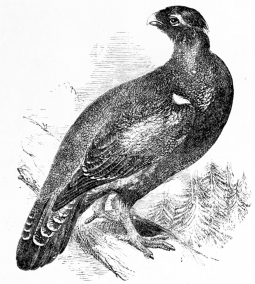
THE CAPERCALZIE, (Tetrao urogallus,)
Was also formerly an inhabitant of the forests of Scotland, but has been
extinct in Britain for many years. The male is as large as a good-sized
turkey, the female considerably smaller. Several attempts have been made
to rear the Capercalzie, and domesticate it in this country, but without
effect. They are now most numerous in Sweden, where they are much
esteemed as food. Of late years they have been brought to the English
market, and are considered very good eating.
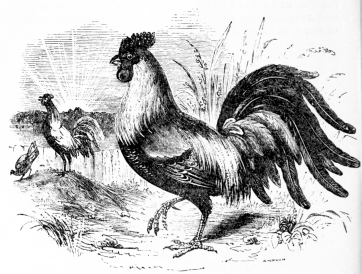
THE COMMON COCK. (Gallus domesticus.)
“While the Cock, with lively din,
Scatters the rear of darkness thin;
And to the stack, or the barn door,
Stoutly struts his dames before.” Milton.
This bird is so well known that it would be needless to say much of him.
His plumage is various and beautiful, his courage very great and
proverbial, and his intuitive knowledge of the period of sunrise has
baffled the most scrutinising researches of naturalists. When of a good
breed, and well taught to fight, he will die rather than yield to his
adversary. The hen lays a great number of eggs, and will hatch as many
as thirteen at one sitting; but this is considered the extreme number,
being as many as she can well cover. When in the secluded state of
incubation she eats very little; and yet is so courageous and strong
that she will rise and fight any men or animals that dare to approach
her nest. It is impossible to conceive how, with such a scanty
sustenance as she takes, she can, for twenty-one days, emit constantly
from her body as much heat as would raise Fahrenheit’s thermometer to
ninety-six degrees. The flesh of this bird is delicate and wholesome,
and universally relished as nourishing and agreeable food.
There are several varieties of families of this fowl. The Hamburg Cock
has a beautiful tuft of feathers about his ears and on the top of his
head; and the Bantam has his legs and toes entirely feathered, which is
more an impediment than an ornament to the bird.
The cruel sport of cockfighting may be traced back to the earliest
antiquity. The Athenians seem to have received it from India, where it
is even now followed with a kind of frenzy; and we are told that the
Chinese will sometimes risk not only the whole of their property, but
their wives and children, on the issue of a battle. The religion of the
Greeks could not see that game with pleasure, and therefore cockfighting
was allowed only once a year; but the Romans adopted the practice with
rapture, and introduced it into this island. Henry VIII. delighted in
this sport, and caused a commodious house to be built for the purpose,
which, although now applied to a very different use, still retains the
name of the Cockpit. The part of our ships so called, seems also to
indicate that in former times the diversion of cockfighting was
permitted, in order to beguile the tedious hours of a long voyage. The
Cock has been a subject of considerable interest with the poets; and has
been very commonly called by them “Chanticleer:”
“Within this homestead lived, without a peer
For crowing loud, the noble Chanticleer.” Dryden.
“The feathered songster, Chanticleer,
Had wound his bugle-horn,
And told the early villager
The coming of the morn.” Chatterton.
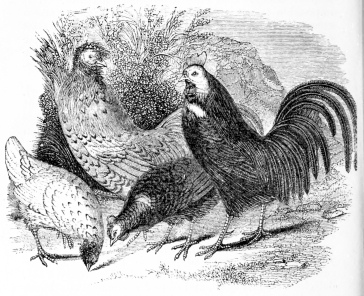
BANKIVA COCK.—JAGO COCK AND HEN.—SPANISH COCK AND HEN.
From the Bankiva fowl nearly all the various kinds of fowls found in
British poultry-yards are said to have sprung. It is a native of the
island of Java, and is characterised by a red indented comb, red
wattles, and ash-grey legs and feet. The cock has a thin indented or
scalloped comb, and wattles under the mouth. The feathers of the neck
are long, falling down, and rounded at the tips, and are of the finest
gold colour. The head and neck are fawn-coloured, the wing-coverts dusky
brownish and black; the tail and belly black. The hen is of a dusky
ash-grey and yellowish colour, and has a much smaller comb and beard
than the cock.
The wild species, termed by Marsden the Jago fowl, is a native of Java
and Sumatra, and is supposed by Temminck to be the original of this fine
breed, though little is known of the wild sort, further than that it is
double the size of the Bankiva, or common fowl. Marsden says he has seen
in the East a cock of this species tall enough to pick crumbs from a
dining-table. They are said to weigh from eight to ten pounds. The combs
of both the cock and hen are large, frequently double, of the form of a
crown, with a tufted crest of feathers, which is largest in the hen; the
voice is stronger and harsher than that of other fowls; but the most
singular peculiarity is, that they do not come into full feather till
about half grown. The Cochin-China fowls are said to be a variety of the
Jago fowls. There are numerous hybrids and varieties of the Jago fowl
found under different names in poultry-yards, but all of them lay fine
large eggs, and are highly esteemed for the excellent flavour of their
flesh. One of the most interesting of these varieties is called
THE SPANISH FOWL,
the body and tail feathers of which are of a rich black, with
occasionally a little white on the breast. The cock of this variety is a
most majestic bird; its deportment is grave and stately, and its eyes
are encircled with a ring of brown feathers, from which rises a black
tuft that covers the ears. There are other similar feathers behind the
comb and beneath the wattles. The legs and feet are of lead colour,
except the sole of the foot, which is yellowish.
THE BANTAM FOWL
is a small variety, with short legs, most frequently feathered to the
toes, so as sometimes to obstruct walking. Many Bantam fanciers prefer
those which have clear bright legs, without any vestige of feathers.
The full-bred Bantam cock should have a rose comb, a well-feathered
tail, full hackles, a proud lively carriage, and ought not to weigh more
than a pound. The nankeen coloured and the black are the greatest
favourites. If of the latter colour, the bird should have no feathers of
any other sort in his plumage. The nankeen bird should have his feathers
edged with black, his wings barred with purple, his tail feathers black,
his hackles slightly studded with purple, and his breast black, with
white edges to the feathers. The hens should be small, clean-legged, and
match in plumage with the cock.
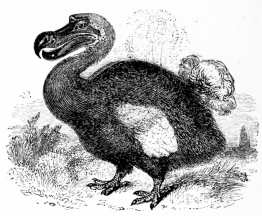
THE DODO. (Didus ineptus.)
Swiftness has generally been considered the attribute of birds, but the
Dodo appears never to have had any title to this distinction. Instead of
exciting the idea of swiftness by its appearance, in the drawings that
have been preserved of it, it strikes the imagination as a thing the
most unwieldy and inactive of all nature. Its body is massive, almost
round, and covered with grey feathers. It is just barely supported upon
two short thick legs, like pillars; while its head and neck rise from it
in a manner truly grotesque. The neck, thick and pursy, is joined to the
head, which consists of two immense jaws, opening far beyond the eye.
The Dodo formerly inhabited the Isle of France; but it has been long
extinct—so long, indeed, that the very fact of its ever having existed
at all has been a subject of dispute amongst naturalists and scientific
men. A great deal of evidence, in the form of old pictures as well as in
writings, has been brought forward to prove that the Dodo is not a
fabulous bird, and its reality is now generally admitted. In fact, we
have very reliable testimony that a single specimen was actually
exhibited publicly in London in the year 1638.
The Dodo was supposed by the earliest naturalists who described it, to
be a kind of turkey, as in the flavour of its flesh it resembled that
bird. Later naturalists supposed it to be a kind of swan, and this
opinion was followed by the celebrated Buffon. Others thought it was a
kind of vulture; and others, judging from the shortness of its wings,
placed it in the ostrich tribe. Modern naturalists, however, having
carefully examined the bones of the bird, which have been preserved, are
of opinion that it was a gigantic pigeon. An entire specimen existed
about a hundred years ago in the Ashmolean Museum at Oxford, but only
part of the bird and one of the feet remain; there is also a foot
preserved in the British Museum. There is a reference to this extinct
species in Humboldt’s Cosmos. (See Bohn’s edition, vol. i. page 29, and
a note on the Dodo, by Dr. Mantell, at the end of the volume.)
The Solitaire is another remarkable bird which was formerly found in
the Mauritius and the adjoining islands, but which has now become
extinct.
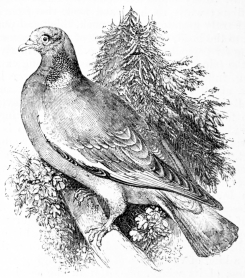
THE RINGDOVE, CUSHAT, OR WOOD PIGEON,
(Columba palumbus,)
Is the largest Pigeon found in our island, by which it may be
distinguished from all others; its weight is about twenty ounces, its
length eighteen inches, and its circumference about thirty. It is
usually known as the Wood Pigeon. This bird is of a bluish grey colour,
with the feathers of the sides of the neck tipped with white, forming
several imperfect rings; the breed is common in Britain. Its habits are
like those of other birds of the tribe, but it is so strongly attached
to its native freedom, that all attempts to domesticate it, with a few
rare exceptions, have hitherto proved ineffectual.
These birds build their nests chiefly on the pine, or holly, with dried
sticks thrown rudely together; and the eggs, which may frequently be
seen through the bottom of the nest, are larger than those of the
domestic Pigeon.
Mr. Montague bred up a curious assemblage of birds, which lived together
in perfect amity; it consisted of a common pigeon, a ringdove, a white
owl, and a sparrowhawk; the ringdove was master of the whole.
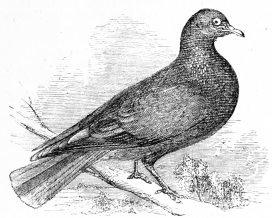
THE STOCKDOVE. (Columba ænas.)
“The Stockdove, recluse, with her mate,
Conceals her fond bliss in the grove,
And murmuring seems to repeat,
That May is the mother of love.” Cunningham.
This bird is called the Stockdove, because it builds in the stocks of
trees which have been headed down, and are become thick and bristly; and
not, as some have supposed, because it is the stock, or original, from
which all the tame pigeons have sprung. Sometimes these birds lay their
eggs in deserted rabbit-warrens, on the sod, without making any nest.
The colour of the Stockdove is generally of a deep slate or lead tint,
with rings of black about the feathers. While the beech woods were
suffered to cover large tracts of ground, these birds used to haunt them
in myriads, frequently extending above a mile in length, as they went
out in the morning to feed. They are still found in considerable
quantities in many parts of England, but never in Scotland, forming
their nests in the hollows of trees; not like the ringdove, on boughs.
Their murmuring strains, or cooings, in the morning and at dusk, are
highly pleasing, and throw an agreeable melancholy on the solitude of
the grove. The poet of the Seasons expresses this in the following
lines, with a beautiful instance of imitative harmony:
“—— the Stockdove breathes
A melancholy murmur through the whole.”
Spring.
Wordsworth also gives a pleasing description of the mournful cooing of
these birds:
“I heard a Stockdove sing or say
His homely tale this very day;
His voice was buried among trees,
Yet to be come at by the breeze;
He did not cease; but cooed and cooed;
And somewhat pensively he wooed;
He sang of love with quiet blending,
Slow to begin, and never ending;
Of serious faith and inward glee,
That was the song—the song for me.”
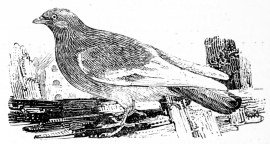
THE ROCKDOVE. (Columba livia.)
The shape of this bird, which is the original stock of our domestic
Pigeons, is well known, and the plumage of the wild birds is exactly
similar to that of the commonest kind seen in our
dove-cots—bluish-grey, with black bands across the wings. In its wild
state it inhabits the cavities of high rocks and cliffs on the sea
coast, where it is found abundantly in our own country. The female
Pigeon lays two eggs at a time, which produce generally a male and a
female. It is pleasing to see how eager the male is to sit upon the
eggs, in order that his mate may rest and feed herself. The young ones,
when hatched, are fed from the crop of the mother, who has the power of
forcing up the half-digested peas which she has swallowed to give them
to her young. The young ones, open-mouthed, receive this tribute of
affection, and are thus fed three times a day.
There are upwards of twenty varieties of the domestic Pigeon, and of
these the carriers are the most celebrated. They obtain their name from
being sometimes employed to convey letters or small packets from one
place to another. The rapidity of their flight is very wonderful.
Lithgow assures us that one of them will carry a letter from Babylon to
Aleppo (which, to a man, is usually thirty days’ journey) in forty-eight
hours. To measure their speed with some degree of exactness, a
gentleman, many years ago, on a trifling wager, sent a Carrier Pigeon
from London, by the coach, to a friend at Bury St. Edmunds, and along
with it a note, desiring that the Pigeon, two days after its arrival
there, might be thrown up precisely when the town clock struck nine in
the morning. This was accordingly done, and the Pigeon arrived in London
at half-past eleven o’clock on the same morning, having flown
seventy-two miles in two hours and a half. An instance of still greater
speed is mentioned by Mr. Yarrell, in which a Carrier flew from Rouen to
Ghent, a hundred and fifty miles in a straight line, in one hour and a
half. From the instant of its liberation, its flight is directed through
the clouds, at a great height, to its home. By an instinct altogether
inconceivable, it darts onward, in a straight line, to the very spot
whence it was taken, but how it can direct its flight so exactly will
probably for ever remain unknown to us.
“Led by what chart, transports the timid Dove,
The wreaths of conquest, or the vows of love?
Say through the clouds what compass points her flight?
Monarchs have gazed, and nations blessed the sight.
Pile rocks on rocks, bid woods and mountains rise,
Eclipse her native shades, her native skies:—
’Tis vain! through ether’s pathless wilds she goes,
And lights at last where all her cares repose.
Sweet bird, thy truth shall Harlem’s walls attest,
And unborn ages consecrate thy nest.” Rogers.
The Carrier Pigeon is easily distinguished from the other varieties by a
broad circle of naked white skin round the eyes, by the large fleshy
wattle at the base of its bill, and by its dark blue or blackish colour.
It would be as fruitless as unnecessary to attempt to describe all the
varieties of the Tame Pigeon; for human art has so much altered the
colour and figure of this bird, that pigeon-fanciers, by pairing a male
and female of different sorts, can, as they express it, “breed them to a
feather.” Hence we have the various names of Carriers, Tumblers,
Jacobins, Croppers, Pouters, Bunts, Turbits, Shakers, Fantails, Owls,
Nuns, &c., all of which may, at first, have accidentally varied from the
Rockdove, and these have been further improved by crossing, food, and
climate. An actual post system, in which pigeons were the messengers,
was established by the Sultan Noureddin Mahmoud, which lasted about a
century, and ceased in 1258, when Bagdad fell into the hands of the
Moguls.
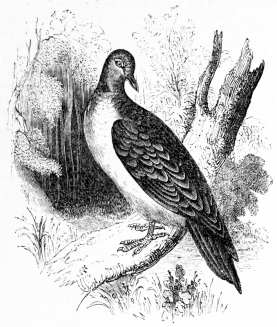
THE TURTLE DOVE. (Columba turtur.)
“Go, beautiful and gentle Dove,
And greet the morning ray;
For lo! the sun shines bright above,
And the rain is pass’d away.” Bowles.
This Dove brings to the heart and mind the most pleasing recollections;
its name is nearly synonymous with faithfulness and unvariable
affection. The male or female is so much attached to its respective mate
that it is said, perhaps with more poetry than truth, that if one die
the other will never survive; however, the author of these observations
was an eye-witness to the death of a female Turtle Dove, who was
unfortunately killed by a spaniel, in the absence of the male; the
disconsolate survivor, after having in vain searched everywhere for his
mate, came and mournfully perched upon the wonted trough, waiting
patiently for her to repair thither in order to get food; but, after two
days of unavailing expectation, he, by spontaneous abstinence, pined and
died on the place. Such examples are not common; and we believe that,
when not domesticated, the appearance of another female, in the time of
coupling, sets at defiance all natural propensity to constancy, and puts
an end to the much-famed disconsolate widowhood. Their general colour is
a bluish grey; the breast and neck of a whitish purple, with a ringlet
of beautiful white feathers with black edges about the sides of the
neck. Nothing can express the sensation which is excited in a feeling
mind when the tender and sweetly plaintive notes of the Turtle Dove
breathe from the grove on a beautiful spring evening:
“Deep in the wood, thy voice I list, and love
Thy soft complaining song, thy tender cooing;
Oh, what a winning way thou hast of wooing,
Gentlest of all thy race—sweet Turtle Dove!
Thine is a note which doth not pass away
Like the light music of a summer’s day;
Hushing the voice of mirth, and staying folly,
And waking in the breast a gentle melancholy.”
Inglis.
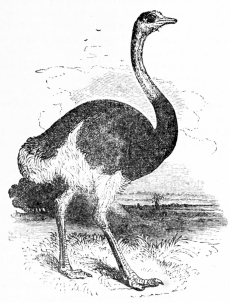
THE OSTRICH. (Struthio camelus.)
This bird is a native of Africa, and is so tall that when it holds up
its head it is seven or eight feet in height. The head is very small in
comparison with the body, being hardly bigger than one of the toes, and
is covered, as well as the neck, with a kind of down, or thin-set hair,
instead of feathers. The sides and thighs are entirely bare and
flesh-coloured. The lower part of the neck, where the feathers begin, is
white. The wings are very short in proportion to the size of the bird,
and in fact are too small to enable it to fly; but when it runs, which
it does with a strange jumping kind of motion, it raises its short
wings and holds them quivering over its back, where they seem to serve
as a kind of sail to gather the wind, and carry the bird onwards. The
speed which it will thus attain is enormous. The swiftest greyhound
cannot overtake it; and indeed an Arab on his horse cannot hope to
capture an ostrich without having recourse to stratagem. He dexterously
throws a stick between its legs as it runs, and so tripping it up, is
enabled to secure it.
In its flight it spurns the pebbles behind it like shot against the
pursuer. And this is not their only mode of annoyance. They have been
known to attack men with their claws, with which they are able to strike
with terrific force. The feathers of the back in the cock are coal
black, in the hen only dusky, and so soft that they resemble a kind of
wool. The tail is thick, bushy, and round; in the cock whitish, in the
hen dusky, with white tops. These are the feathers so generally in
requisition to decorate the head-dress of ladies and the helmets of
warriors.
The Ostrich swallows anything that presents itself, leather, glass,
iron, bread, hair, &c., but the old notion that the Ostrich could digest
metals is certainly incorrect. An Ostrich in the Zoological Gardens in
the Regent’s Park was killed by swallowing a lady’s parasol.
“O’er the wild waste the stupid Ostrich strays
In devious search, to pick a scanty meal,
Whose fierce digestion gnaws the temper’d steel.”
Mickle’s Lusiad.
They are polygamous birds, one male being generally seen with two or
three, and sometimes with five, females. The female Ostrich, after
depositing her eggs in the sand, trusts them to be hatched by the heat
of the climate; in the Book of Job there is a beautiful passage relating
to this habit of the Ostrich, “which leaveth her eggs in the earth, and
warmeth them in the dust; and forgetteth that the foot may crush them,
or that the wild beast may break them. She is hardened against her young
ones, as though they were not hers. Her labour is in vain; without
fear, because God hath deprived her of wisdom; neither has he imparted
to her understanding. What time she lifteth up her head on high, she
scorneth the horse and his rider.” It appears, however, that the female
Ostrich sits upon her eggs like other birds, although generally at night
only, and brings up her young. The eggs are as large as a young child’s
head, with a hard stony shell, and one has been known to weigh upwards
of three pounds. The time of incubation is six weeks. That Ostriches
have great affection for their offspring may be inferred from the
assertion of Professor Thunberg, who says that he once rode past the
place where a hen Ostrich was sitting in her nest, when the bird sprang
up and pursued him, evidently with a view to prevent his noticing her
eggs or young. Every time he turned his horse towards her she retreated
ten or twelve paces, but as soon as he rode on again she pursued him
till he had got to a considerable distance from the place where he had
started her. In the tropical regions, some persons breed Ostriches in
flocks, for they may be tamed with very little trouble. When M. Adanson
was at Podar, a French factory on the southern bank of the river Niger,
two young but full-grown Ostriches, belonging to the factory, afforded
him a very amusing sight. They were so tame that two little blacks
mounted both together on the back of the largest. No sooner did he feel
their weight than he began to run as fast as possible, and carried them
several times round the village, and it was impossible to stop him
otherwise than by obstructing the passage. This sight pleased M. Adanson
so much that he wished it to be repeated, and, to try their strength,
directed a full-grown negro to mount the smaller, and two others the
larger of the birds. This burden did not seem at all disproportioned to
their strength. At first they went at a tolerably sharp trot, but when
they became a little heated they expanded their wings, as though to
catch the wind, and moved with such fleetness that they scarcely seemed
to touch the ground. The foot of the Ostrich has only two toes, one of
which is extremely large and strong.
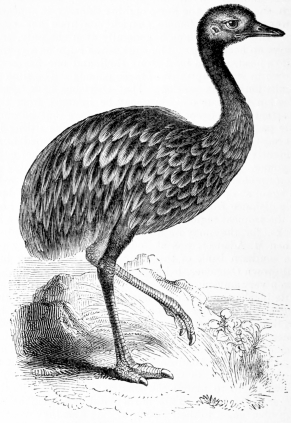
THE RHEA, (Rhea Americana,)
Or American Ostrich, is about half as big as the African species. It has
its head covered with feathers, and each of its feet consists of three
toes. It is found on the great plains of South America, and, like the
African Ostrich, is polygamous, but the curious part of the matter is
that the females often lay their eggs almost anywhere on the ground, and
the male takes the trouble of collecting them into a sort of nest, and
sitting on them until the young birds are hatched. When thus occupied,
the males often become very fierce, and will attack any one that
approaches them too closely.
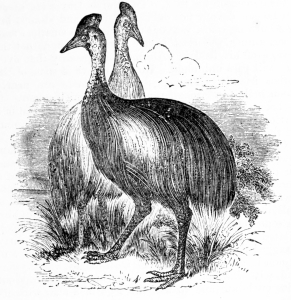
THE CASSOWARY, (Casuarius galeatus,)
Instead of the beautiful plumes of the ostrich, has his wings furnished
only with five stiff quills without barbs, which project curiously from
the feathers of the body. His plumage is black; his head is small and
depressed, with a horny crown or helmet, and covered with a naked red
skin; the head and neck are deprived of feathers; about the neck are
two protuberances of a bluish colour, in shape like the wattles of a
cock. The feathers consist of long, slender, separate barbs, which hang
down on each side of the body, so that at a distance he looks as if he
were entirely covered with the hairs of a bear rather than with the
plumage of a bird. His height is about five feet. The Cassowary is as
voracious as the ostrich, and eats indiscriminately whatever comes in
his way, and does not seem to have any sort of predilection in the
choice of his food. The Dutch travellers assert that he can devour not
only glass, iron, and stones, but even burning coals, without testifying
the smallest fear, or sustaining the least injury; and it is said that
the passage of his food is performed so speedily that even eggs will
pass unbroken. He is a native of some of the Indian islands. The eggs of
the female are nearly fifteen inches in circumference, of a greenish
colour. It has been said of the Cassowary that he has the head of a
warrior, the eye of a lion, the armament of a porcupine, and the
swiftness of a courser.
A Cassowary once kept in the menagerie of the museum at Paris, devoured
every day between three and four pounds weight of bread, six or seven
apples, and a bunch of carrots. In summer it drank about four pints of
water in the day, and in winter somewhat more. It swallowed all its food
without bruising it. This bird was sometimes ill-tempered and
mischievous, and much irritated when any person approached it of a dirty
or ragged appearance, or dressed in red clothes, and frequently
attempted to strike at them by kicking forward with its feet. It has
been known to leap out of its enclosure and to tear the legs of a man
with its claws.
The Cassowary is very vigorous and powerful; its beak being, in
proportion, much stronger than that of the ostrich, it has the means of
defending itself with great advantage, and of easily pulling down and
breaking in pieces almost any hard substance. It strikes in a very
dangerous manner with its feet either behind or before, not unlike the
kicking of a horse, at any object which offends it, and runs with
surprising swiftness.
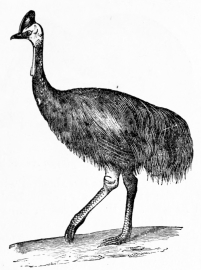
THE EMEU. (Dromaius Novæ Hollandiæ.)
The head of this bird is without any horny crest, and feathered, but the
cheeks and throat are nearly naked. The general colour is a dull brown,
mottled with a dingy grey, and the young are striped with black. In
appearance it closely resembles the ostrich, next to which it is the
tallest bird known, but is of a more thick-set and clumsy make, though
at the same time very swift and strong, and able to make a formidable
defence against its hunters and their dogs, by kicking in a very
vigorous and dangerous manner. It is, however, very docile, and if taken
young may be easily tamed. The flesh is considered excellent eating, and
is said to possess a flavour something between a sucking-pig and a
turkey. The only sound that this bird emits is a low drumming noise,
produced by means of a valve attached to the lungs. The female Emeu lays
her eggs in different places, but they are afterwards collected by the
male, by rolling them to one place, when he sits on them.
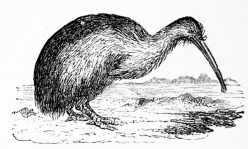
THE APTERYX. (Apteryx Australis.)
This curious bird, which has the shortest wings of any member of its
class, is found only in New Zealand, where it is called Kivi-Kivi by
the natives, in imitation of its cry. It is smaller than any of the
species of wingless birds just described, and its legs are short and
stout; it has three strong front toes on each foot, and a short hinder
toe armed with a very strong claw. The body of the Apteryx is something
like that of the cassowary in its form; the neck is rather long, and,
like the head, clothed with feathers; but the most singular part of the
bird is its bill, which is long, rather slender, and slightly curved,
and has the nostrils situated quite at its tip. This curious structure
of the bill is intended to enable the bird more readily to obtain the
worms and insects upon which it feeds, and which it drags out of their
holes in the ground. It runs quickly, but only at night, and when in
motion it might easily be mistaken for a small dusky-brown quadruped.
The plumage resembles that of the emeu in its texture, and the skins are
highly esteemed by the New Zealanders, who use them for making cloaks.
Among the many curious characteristics of this bird is its habit of
leaning, when at rest, upon the tip of its long bill. When hunted it
scrapes a hole in the sand with its powerful feet, in which it hides; or
it runs into some natural cavity, if there is any near, where access is
difficult for its pursuers, and often makes a valiant defence.
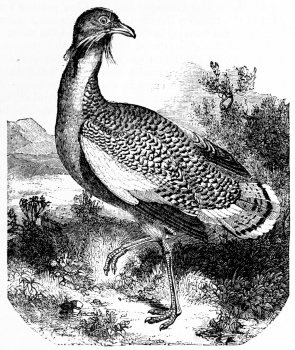
THE BUSTARD, (Otis tarda,)
Is a large and fine bird which was formerly common in some parts of
England, but has now become so rare here that the capture of a specimen
is looked upon as something remarkable. It is still abundant in some
parts of the continent of Europe. The male Bustard measures nearly four
feet in length, and has the head and neck greyish, the back buff or pale
chestnut, with a great many black bars, and all the lower part of the
body white. From each side of the chin there springs a tuft of slender
feathers about seven inches in length, standing out like a pair of stiff
moustaches. The female is a good deal smaller than the male, or about
three feet in length; she is also distinguished from her partner by the
want of the tufts on the chin, although in some cases these exist in the
female, but shorter than in the male.
The Bustard feeds on green vegetables and insects, and are also said to
kill and eat small quadrupeds and reptiles. They are polygamous, and
when the female has laid her two or three eggs in a slight depression of
the ground, and commenced the business of incubation, the male most
ungallantly deserts her, and retires to take his ease in some
neighbouring marsh. It was formerly supposed that the male Bustard paid
so much attention to his mates as to provide them with water, which he
was said to bring to them in a large pouch, capable of holding nearly a
gallon, situated under his throat. It is true that the female is without
this appendage; but modern naturalists all agree in stating that the
male bird is never seen in company with the female after she has begun
to sit. The use of this pouch is therefore still a subject of
controversy.
The female lays her eggs among clover, or more frequently in
corn-fields, the nest being merely a hollow scraped in the ground. The
eggs are two, or sometimes three, in number, and their colour is a
yellowish-brown, inclining to green.
A peculiarity of the Bustard, noticed by most naturalists, is the
extreme rapidity with which they can run. They skim along the ground,
raising the wings over the back in the same manner as the ostrich. It is
said that in former times, when the breed was commoner, it was a
practice to hunt the young birds, before they had acquired the power of
flying, with greyhounds.
As an article of food the flesh of the Bustard has always been held in
great estimation.
There are several other species peculiar both to Asia and Africa.
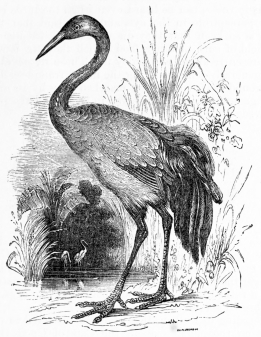
THE CRANE. (Grus cinerea.)
Cranes frequent marshy places, and live upon small fish and
water-insects. Their long beaks enable them to search the water and mud
for their prey, and their long necks prevent the necessity of their
stooping to pick up from between their feet the objects of their search.
The top of the head, the throat, and sides of the neck are of a blackish
hue; the back, the wings, and the body are ash-coloured. The tertial
feathers of the wings are very long, with loose webs, forming elegant
plumes, which fall over the sides of the tail. They used to be common in
the fen countries, Lincolnshire and Cambridgeshire, but are not now so
frequently seen in England as formerly. In their flight, Cranes mount
high in the air, but their voices can be heard even when the birds cease
to be perceptible to the eye, and it is said that their sight is so keen
that they discover at a great distance any field of corn or other food
which they are fond of, and presently alight and enjoy it. These
depredations they generally commit during the night, trampling down the
ground as if it had been marched over by an army. They generally form
themselves in the air in the shape of a wedge.
“—— —— Part more wise,
In common, ranged in figure, wedge their way,
Intelligent of seasons, and set forth
Their aëry caravan high over seas
Flying, and over lands, with mutual wing
Easing their flight. So steers the prudent Crane
Her annual voyage, borne on winds. The air
Floats as they pass, fann’d by unnumber’d wings.”
Milton.
This bird lives to a considerable age, and as it is easily tamed, it has
been ascertained that the Crane often reaches his fortieth year. Its
nest is usually built amongst the reeds and sedges of a marsh, but
sometimes upon a ruined building. The female lays two eggs, of a pale
brown colour, with darker spots.
According to Kolben, they are often observed in large flocks on the
marshes about the Cape of Good Hope. He says he never saw a flock of
them on the ground that had not some placed apparently as sentinels, to
keep a look out while the others are feeding, who on the approach of
danger immediately give notice to the rest. These sentinels stand on one
leg, and at intervals stretch out their necks, as if to observe that all
is safe. On notice being given of danger, the whole flock are in an
instant on the wing. Kolben also adds that in the night time each of the
watching Cranes, which rest on their left legs, hold in their right claw
a stone of considerable weight, in order that, if overcome by sleep, the
falling of the stone may awaken them.
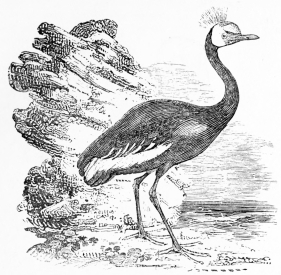
THE BALEARIC CRANE, OR CROWNED DEMOISELLE, (Balearica
pavonina,)
Is originally, as the name expresses, a native of Majorca and Minorca,
in the Mediterranean sea, which were formerly called the Balearic Isles,
but is chiefly found now in the Cape Verd Islands. The shape of its body
is not unlike that of the common Crane, but it has a principal and
distinctive mark on the head; which is, a tuft of hairs, or rather
strong greyish bristles, standing out like rays in all directions, from
which peculiarity this species takes its other name of the Crowned
Heron. They roost and feed in the manner of peacocks.
The Demoiselle, or Numidian Crane (Anthropoides virgo), is remarkable
for the grace and symmetry of its form, and the elegance of its
deportment. It is rather larger than the species above described, and is
a native of many parts of Africa. It frequents damp and marshy places,
in search of small fishes, frogs, &c., which are its favourite food. It
is easily domesticated.
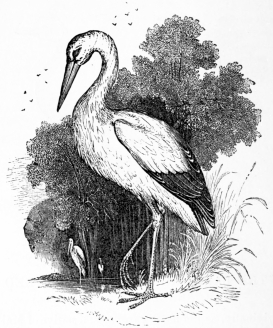
THE STORK. (Ciconia alba.)
The neck, head, breast, and body of this bird are white, the rump and
exterior feathers of the wings black; the eyelids naked; the tail white,
and the legs long, slender, and of a red colour. Storks are birds of
passage. When leaving Europe they assemble together on some particular
night, and all take their flight at once. As they feed on frogs,
lizards, serpents, and other noxious creatures, it is not to be expected
that man should be inimical to them, and therefore they have been
generally a favourite with the nations they visit. The Dutch have laws
against destroying them: they are therefore very common in Holland, and
build their nests and rear their young on the tops of houses and
chimneys in the middle of its most frequented and populous cities, and
may be seen by dozens familiarly walking about the markets, where they
feed on the offal. In some places, the stork is supposed to be a herald
of good fortune to the house on which it builds its nest, and the
inhabitants place boxes on their roofs to induce the birds to take up
their abode there.
The Stork much resembles the crane in its conformation, but appears
somewhat more corpulent. The former lays four eggs, whereas the latter
lays but two.
It is said that Storks visit Egypt in such abundance, that the fields
and meadows are white with them. The Egyptians, however, are not
displeased with the sight; as frogs are there generated in such numbers,
that did not the Storks devour them, they would overrun everything.
Between Belba and Gaza, the fields of Palestine are often rendered
desert on account of the abundance of mice and rats; and were they not
destroyed the inhabitants could have no harvest. The disposition of the
Stork is mild and placid; it is easily tamed, and may be trained to
reside in gardens, which it will clear of insects and reptiles. It has a
grave air, and a mournful aspect; yet, when roused by example, exhibits
a certain degree of gaiety; for it joins in the frolics of children,
hopping about and playing with them.
During their migrations, Storks are observed in vast quantities. Dr.
Shaw saw three flights of them leaving Egypt, and passing over Mount
Carmel, each of which appeared to be nearly half a mile in width; and he
says they were three hours in passing over.
The Stork, like the ibis, was an object of worship among the ancients,
and to kill them was a crime punishable with death. The Stork is
remarkable for its great affection towards its young. This was
remarkably evinced during the great conflagration of Delft, in Holland,
during which a female Stork was noticed using every endeavour to carry
off her young family, and continuing this labour of love until the smoke
and flames prevented her own escape, and she perished with her brood.
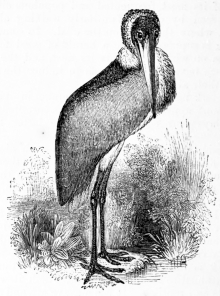
THE ADJUTANT, (Leptoptilus argala,)
Also called the Gigantic Crane, is a bird of the stork kind, and a
native of India, and other warm countries. The head and neck are bare of
feathers, as in the ostrich; the former looking as if made of wood; the
latter of a flesh-colour. The coverts of the wings and the back are
black, with a bluish cast; the under part of the body whitish; the legs
are long, without feathers, and of a greyish hue, as are the thighs,
which seem to be as slender as the leg. The bill is of enormous size,
and the bird is fond of clatting the two mandibles together. Under the
chin, there is a kind of bag or pouch which hangs down in front of the
neck, like the dewlap of a cow; in this the Adjutant stores away any
provisions that may fall in his way, after his immediate wants are
satisfied. He is a most voracious bird, and devours every kind of food,
and as he has no objection to carrion, his presence is encouraged in
towns, where he assists the vultures, crows, dogs, and jackals, in
performing the duties of scavengers. Indeed his rapacity is so great
that he swallows such innutritious substances as bone with such
eagerness and relish as to have received the name of “Bone-eater,” or
“Bone-taker.” When he comes about the houses he requires to be carefully
watched, as his power of swallowing is so great that a fowl, a rabbit,
or even a leg of mutton, is disposed of at a single mouthful. Sir E.
Horne states that in the stomach of an Adjutant were found a tortoise
nearly a foot long, and a large black cat; from, which we may see that
the Adjutant is by no means squeamish in his diet.
The Adjutant is indeed a very gigantic bird. Its wings often measure
fourteen or fifteen feet from tip to tip, and it is five feet high when
it stands erect.
Dr. Latham, in his “General History of Birds,” gives some very
interesting information about the habits of this bird. “One of them, a
young bird about five feet high, was brought up tame, and presented to
the chief of the Bananas, where M. Speakman lived; and being accustomed
to be fed in the great hall, soon became familiar, daily attending that
place at dinner-time, placing itself behind its master’s chair
frequently before the guests entered. The servants were obliged to watch
narrowly, and to defend the provisions with switches; but,
notwithstanding, it would frequently seize something or other, and even
purloined a whole boiled fowl, which it swallowed in an instant. Its
courage is not equal to its voracity, for a child of eight or ten years
old soon puts it to flight with a switch. Everything is swallowed whole,
and so accommodating is its throat that not only an animal as big as a
cat is gulped down, but a shin of beef broken asunder serves it but for
two morsels.”
Another species of Adjutant (Leptoptilus marabou) is found in tropical
Africa. It is even uglier than the Indian bird, which has not much
beauty to boast of, but is valuable not only as a scavenger, but from
its furnishing those beautiful plumes called marabout feathers, which
are so much used for ladies’ head-dresses.
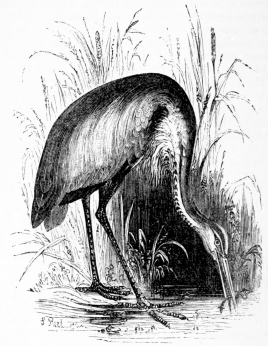
THE COMMON HERON. (Ardea cinerea.)
The habits of the Heron are peculiar. Perched on a stone, or the stump
of a tree, by the solitary current of a brook, his neck and long beak
half-buried between his shoulders, he will wait the whole day long,
patient and unmoved, for the passing of a small fish, or the hopping of
a frog; but his appetite is insatiable.
This bird is about four feet long from the tip of the bill to the end of
the claws; to the end of the tail about thirty-eight inches; its
breadth, when the wings are extended, is about five feet. The male is
distinguished by a crest or tuft of black feathers hanging from the
hinder part of his head, which in chivalrous times was of great value,
and held as a peculiar mark of distinction when worn above the plume of
ostrich feathers.
Virgil places the Heron among the birds that are affected by and
foretell the approaching storm:
“When watchful Herons leave their watery stand,
And mounting upward with erected flight,
Gain on the skies, and soar above the sight.”
Dryden.
The Heron, though living chiefly in the vicinity of marshes and lakes,
forms its nest on the tops of the loftiest trees. It resembles the rook
in its habits: a great number of Herons living together in what is
called a Heronry, as rooks do in a rookery. The female lays four large
eggs, of a pale green colour; the natural term of this bird’s life is
said to exceed sixty years.
In England, Herons were formerly ranked among the royal game, and
protected as such by the laws; and when falconry was in fashion, the
pursuit of the Heron was a favourite amusement.
“—— —— Now, like the wearied stag,
That stands at bay, the Hern provokes their rage;
Close by his languid wing in downy plumes
Covers his fatal beak, and cautious hides
The well-dissembled fraud. The falcon darts
Like lightning from above, and in her breast
Receives the latent death: down plumb she falls,
Bounding from earth, and with her trickling gore
Defiles her gaudy plumage. See, alas!
The falconer in despair, his favourite bird
Dead at his feet: as of his dearest friend,
He weeps her fate; he meditates revenge,
He storms, he foams, he gives a loose to rage;
Nor wants he long the means; the Hern fatigued,
Borne down by numbers, yields, and prone on earth
He drops; his cruel foes wheeling around
Insult at will.” Somerville.
It is extremely dangerous to go near a wounded Heron, and the utmost
caution is necessary in doing so. Though apparently almost dead, he will
yet dart at his enemy’s face, and sometimes inflict a most severe
wound.
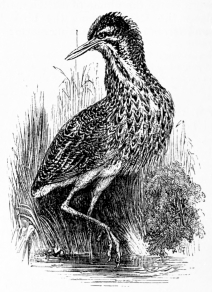
THE BITTERN, (Botaurus stellaris,)
Is not quite so large as the common heron; its head is small, narrow,
and compressed at the sides. The crown is black, the throat and sides of
the neck red, with narrow black lines, and the back of a pale red, mixed
with yellow. The claws are long and slender, the inside of the middle
one being serrated, the better to enable it to hold its prey. The bill
is about four inches in length. The most remarkable character in this
bird is the hollow and yet loud rumbling of his voice; his bellowing is
heard at the distance of a mile, at the time of sunset, and it is hardly
possible to conceive at first how such a body of sound, resembling the
lowing of an ox, can be produced by a bird comparatively so small. The
booming noise was formerly believed to be made while the bird plunged
its bill into the mud; hence Thomson:
“—— So that scarce
The Bittern knows his time, with bill ingulf’d
To shake the sounding marsh.”
And Southey also describes the peculiar noise of this bird in his poem
of Thalaba:
“And when at evening, o’er the swampy plain,
The Bittern’s boom came far,
Distinct in darkness seen—
Above the low horizon’s lingering light,
Rose the near ruins of old Babylon.”
Sometimes in the evening the Bittern soars on a sudden in a straight,
or, at other times, in a spiral line, so high in the air, that it ceases
to be perceptible to the eye. When attacked by the buzzard, or other
birds of prey, it defends itself with great courage, and generally beats
off such assailants; neither does it betray any symptoms of fear when
wounded by the sportsman, but eyes him with a keen, undaunted look; and,
when driven to extremity, will attack him with the utmost vigour,
wounding his legs, or aiming at his eyes with its sharp and piercing
bill. It was formerly held in much estimation at the tables of the
great, and is again recovering its credit as a fashionable dish. The
flesh is considered delicious. In autumn it changes its abode, always
commencing its journey at sunset. Its precautions for concealment and
security seem directed with great care and circumspection. It usually
sits in the reeds with its head erect; and thus, from its great length
of neck, sees over their tops, without itself being perceived by the
sportsman. The principal food of these birds, during summer, consists of
fish and frogs; but in autumn they resort to the woods in pursuit of
mice, which they seize with great dexterity, and always swallow whole.
About this season they usually become very fat.
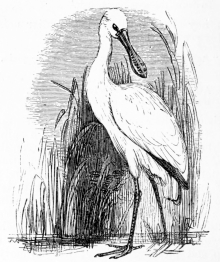
THE SPOONBILL, (Platalea leucorodia,)
Is a large bird; the colour of the whole body is white, and the
resemblance of the bill to a spoon has caused the denomination of the
bird. In some specimens the plumage inclines from white to pink colour.
On the hind part of the head is a beautiful white crest, reclining
backward. The legs and feet are black. The wisdom of Providence is most
conspicuous in the conformation of the bill, which is entirely adapted
to the habits and manner of feeding of these birds: the frogs and
fishes, which constitute the principal food of the Spoonbill, may often
escape the thin and narrow beak of the heron and other birds, but the
mandibles of this bird are so large at the end, that the prey cannot
slip aside. Like rooks and herons, Spoonbills build their nests on the
tops of high trees, and lay three or four eggs, which are white,
sprinkled with pale red, and the size of those of a hen. These birds are
very noisy during the breeding season. The Spoonbill migrates northward
in the summer, and returns to southern climes on the approach of winter;
and is found in all the intermediate low countries between the Faroe
Isles and the Cape of Good Hope.
The American or Roseate Spoonbill (Platalea Ajaja) is very
beautiful. Its colour is white, tinged with rose, which deepens in the
wings and tail into the richest carmine. The feet are half-webbed, and
the bird is generally found on the sea-coast, where it wades into the
sea in quest of the small shell-fish of different kinds, on which it
feeds.
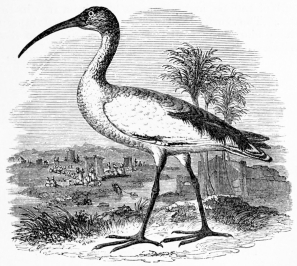
THE IBIS. (Ibis religiosa.)
The Ibis was regarded as a sacred bird by the ancient Egyptians, who
used to have these birds walking about in their temples, and embalmed
their bodies after death with as much care as those of their priests and
kings. The cause of this veneration is not clearly ascertained, some
authors supposing it to be due to the services rendered by the bird in
destroying serpents and other noxious creatures; others to a fanciful
resemblance between the bird and one of the moon’s phases; and others,
again, to the arrival of the birds in Egypt at or about the period of
the annual inundation of the Nile. The sacred Ibis has a long, stout,
curved black bill; the head and neck are black and naked, and the
plumage is white, with the tips of the wings black. Another species, the
Glossy Ibis (Ibis falcinellus), shared the veneration of the
Egyptians with the Sacred Ibis; it has a more slender bill than the
Sacred Ibis, and its plumage, which is beautifully glossy, is dark green
above and reddish-brown beneath. This bird is common in the south of
Europe, and specimens have been shot in England. The Scarlet Ibis
(Ibis rubra) is a beautiful species, which adorns the banks of the
great rivers of South America, in company with the Roseate Spoonbill.
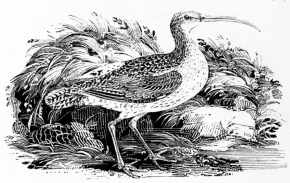
THE CURLEW. (Numenius arquatus.)
“Soothed by the murmurs of the sea-beat shore,
His dun-grey plumage floating to the gale,
The Curlew blends his melancholy wail
With those hoarse sounds the rushing waters pour.”
Miss Williams.
“Wild as the scream of the Curlew,
From rock to rock the signal flew.”
Sir Walter Scott.
The Curlew is a large bird, weighing about twenty-four ounces; and is
found in winter on the sea-shore on all sides of England. The middle
parts of the feathers of the head, neck, and back are black, the borders
or outsides ash-coloured, with a mixture of red; and the lower part of
the body white. The beak has a regular curve downward, and is soft at
the point. This bird’s flesh may challenge for flavour and delicacy that
of any other water-fowl, and the people of Suffolk say proverbially:
“A Curlew, be she white, be she black,
She carries twelve pence on her back:”
but it must be confessed that the quality and goodness of the flesh of
Curlews depend on their manner of feeding, and the season in which they
are caught. When they dwell on the sea-shore, they acquire a kind of
rankness, which is so strong, that, unless they are basted on the spit
with vinegar, they are not agreeable eating.
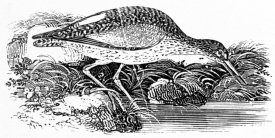
THE REDSHANK. (Totanus calidris.)
This bird has received its name from the colour of its legs, which are
of a crimson red. In size it is between the lapwing and the snipe, and
is sometimes called the Pool Snipe. The head and back are of a dusky
ash-colour, spotted with black, the throat party-coloured black and
white, the black being drawn down along the feathers. The breast is
whiter, with fewer spots. The Redshank delights in the fen countries,
and in wet and marshy grounds, where it breeds and rears its young. The
female lays four whitish eggs, with olive-coloured dashes, and marked
with irregular spots of black. Pennant and Latham say, that it flies
round its nest when disturbed, making a noise like a lapwing. It is not
so common on the sea-shore as several others of its kindred. We must
here observe, that this bird has often been mistaken for others. The
fact is, that several birds changing their plumage, and increasing or
diminishing their size according to their age, the season of the year,
and the climate they live in, set all nomenclators at defiance, and
confound all classifications.
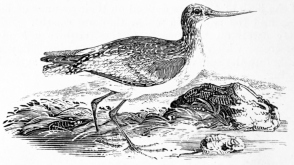
THE GODWIT, (Limosa ægocephala,)
Is met with in various parts of Great Britain, and is rather larger than
the woodcock, which it much resembles in appearance. In spring and
summer it resides in the fens and marshes, where it rears its young, and
feeds on small worms and insects; but in winter it seeks the salt
marshes and the sea-shore, where it feeds upon the shell-fish and marine
animals left by the retiring tide. A peculiarity belonging to this bird
is the shape of its bill, which is a little turned upwards. The head,
neck, and back are of a reddish brown; the under part of the body white;
the legs dusky, and sometimes black.
The Godwit is much esteemed by epicures as a great delicacy, and sells
very high. It is caught in nets, to which it is allured by a stale or
stuffed bird, in the same manner and in the same season as the ruffs and
reeves.
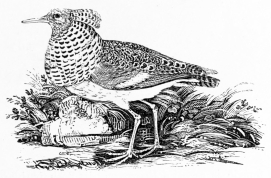
THE RUFF AND REEVE. (Machetes pugnax.)
It is curious to see, in our observation of natural objects, how the
creative power of Providence seems to have tried all forms and shapes in
the composition of species. In the cock bird of this species a circle or
collar of long feathers, somewhat resembling a ruff, encompasses the
neck under the head, whence the bird has received the name of Ruff. It
is about a foot in length, with a bill about an inch long. There is a
wonderful and almost infinite variety in the colours of the feathers of
the males; so that in spring there can scarcely be found two exactly
alike; but after moulting they become all alike again.
The males are sometimes called Fighters, on account of their quarrelsome
disposition. It is a bird of passage, and arrives in the fens of
Lincolnshire, and other similar places, in the spring. Mr. Pennant tells
us, that in the course of a single morning more than six dozen have been
caught in one net, and that a fowler has been known to catch between
forty and fifty dozen in a season.
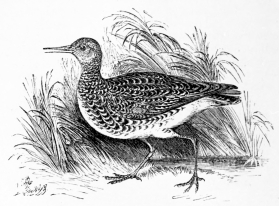
The female is called a Reeve, and its flesh is thought a great delicacy
for the table. They are smaller than the cocks, and their feathers
undergo no change. The Ruff and Reeve are taken in nets. They used to be
seen in vast numbers in many parts of England, especially in the Isle of
Ely and the Lincolnshire fens. The improvements in drainage and
cultivation that have been made during the present century have deprived
these birds of their accustomed haunts, and they are no longer common. A
writer of the last century said he had seen the ground so covered with
the nests and eggs of Plovers and Reeves that “one could scarce take a
step without stepping on them.” They are now most common on the shores
of southern Scotland and of Northumberland.
Reeves are fattened for the table by feeding them on boiled rice or
wheat, bread and milk, hemp seed, &c. They are obliged to be kept in a
dark room during the process, as the least gleam of light is the signal
for a furious battle.
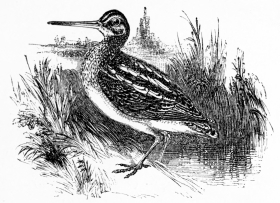
THE SNIPE. (Scolopax gallinago.)
“The Snipe flies screaming from the marshy verge,
And towers in airy circles o’er the wood;
Still heard at intervals; and oft returns,
And stoops as bent to alight; then wheels aloft
With sudden fear, and screams and stoops again,
Her favourite glade reluctant to forsake.” Gisborne.
The Snipe weighs about four ounces. A pale red line divides the head
longways; the chin under the bill is white; the neck is a mixture of
brown and red; the lower part of the body is almost all white. The back
and wings are of a dusky colour. The flesh is tender, sweet, and in
flavour ranks next to that of the woodcock. Snipes feed especially upon
small red worms, and insects, which they find in muddy and swampy
places, on the banks of rivulets and brooks, and on the clayey margin of
ponds. It is said that Snipes remain with us all the summer, and build
in moors and marshes, laying four or five eggs; but most of them are
migratory, and, when forced by severe frosts to sheltered springs, are
often seen in large flights. Mr. Daniel states that, about thirty years
ago, Snipes were so abundant in the fens of Cambridgeshire, that as many
were taken in Milton fen, by means of a lark-net, in one night, and by a
single man, as could be contained in a small hamper.
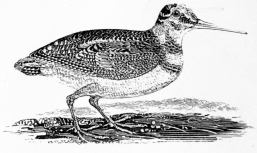
THE WOODCOCK, (Scolopax rusticola,)
Is somewhat less than the partridge. The upper side of the body is
party-coloured of red, black, and grey, and very beautiful. From the
bill almost to the middle of the head it is of a reddish ash-colour. The
lower part of the body is grey, with transverse brown lines; under the
tail the colour is somewhat yellowish; the chin is white, with a
tincture of yellow. Woodcocks are migratory birds, coming over into
Britain in autumn, and departing again in the beginning of spring; they
pair before they go, and are seen flying in braces.
The colours of this timid bird render it difficult to discern him among
the withered stalks and leaves of fern, sticks, moss, and grass, which
form the background of the scenery, by which he is sheltered in his
moist and solitary retreats. By habit only is the sportsman enabled to
discover him, and his leading marks are the full eye and glossy silver
white-tipped tail of the bird. The flesh is held in high estimation, and
hence he is eagerly sought after. It is hardly necessary to observe that
in dressing a Woodcock for the spit the entrails are not drawn, but are
allowed to drop upon slices of toasted bread, and are relished as a
delicious kind of sauce. By some late observations, it appears that
several individuals of the species remain with us the whole year. They
frequent especially wet and swampy woods, the thick hedges near
rivulets, and places affording them their allotted food, which consists
of very small insects found in the moist ground.
“The Woodcock’s early visit and abode
Of long continuance, in our temperate clime,
Foretell a liberal harvest.” Philips.
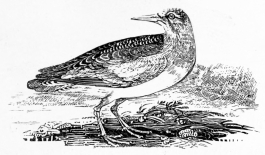
THE KNOT, (Tringa Canutus,)
Is a small bird, whose head and back are of a dusky ash-colour, or dark
grey; while the lower part of the body is pure white, or white varied by
black lines. The sides under the wings are spotted with brown. The bird
weighs about four ounces and a half, and generally makes its appearance
in Lincolnshire in the beginning of winter, and abides there for two or
three months, after which they fly off in flocks. They are caught in
great numbers by nets, into which they are decoyed by carved wooden
figures, painted to represent themselves, and placed within them, much
in the same way as the ruff. When the knot is fat, its flesh is
considered excellent food. It is also fattened for sale, and then
considered equal to the ruff in flavour. The season for taking it is
from August to November, after which the frost compels it to disappear.
This bird is said to have been a favourite dish with Canute the Great;
and Camden observes that its name is derived from his—Knute, or Knout,
as he was called—which, in process of time, has been changed to Knot.
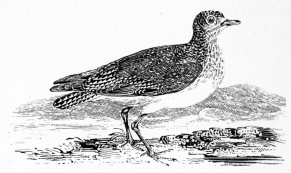
THE GREY PLOVER, (Squatarola cinerea,)
Is about twelve inches long and twenty-four across the wings: the head,
back, and coverts of the wings are black, with tips of a greenish white;
the chin white; the throat spotted with brown or dusky spots; the breast
and thighs white. The flavour of the flesh, when the bird is caught in
the proper season, is delicate and savory; at other times it is hard,
and has a strong and rank taste. This bird is generally found in small
packs, and is not nearly so common as the beautiful Golden Plover. The
male becomes entirely black on the lower surface in the spring, or black
interspersed with patches and spots of white.
The Grey Plover is found in the northern parts of Europe, and, it is
said, breeds in Egypt, Java, and Japan. Like the Ruff, it is an
exceedingly quarrelsome bird, and fights fiercely in the spring. The
young, when hatched, are covered with a thick, soft down, and
immediately begin to follow their parents about and search for food.
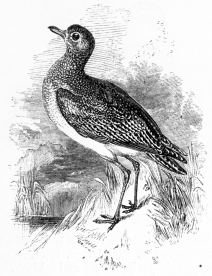
THE GOLDEN PLOVER, (Charadrius pluvialis,)
Is about the size of the former. The colour of the whole upper side is
black, thick set with yellowish green spots; the breast brown, with
spots as on the back; the body is white. The male of this species is
also black beneath in the spring. The flesh is sweet and tender, and
therefore esteemed a choice dish in this and other countries.
The Golden Plover feeds principally during the night, and during the day
time may be seen sitting or standing on the ground, asleep. The parent
birds are very careful in guarding their young. When any intruder
approaches their nest, they use all sorts of stratagems to divert his
attention.
The “Plover eggs,” frequently seen at the tables of the opulent and
luxurious, are not those of the Plover, but of the Lapwing.
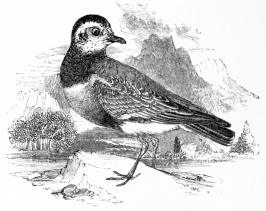
THE DOTTREL, (Charadrius morinellus,)
Is proverbially accounted a foolish bird, yet why so it is hardly
possible to say. Its length is about ten inches; the bill is not quite
an inch long, and is black. The forehead is mottled with brown and grey;
the top of the head is black; and over each eye there is an arched line
of white. The back and wings are a light brown; the breast is a pale
dull orange; the middle of the body is black, and the rest and the
thighs are of a reddish white. The tail is brown, black towards the end,
and tipped with white. This bird is migratory, and makes its appearance
in Lincolnshire, Cambridgeshire, and Derbyshire in April, but soon
leaves those counties and passes on towards the north, breeding in the
mountains of the north of England and Scotland. In April, and sometimes
in September, Dottrels are seen in Wiltshire and Berkshire. They are
generally caught, like other birds, by night; when, dazzled by the light
of a torch, they are at a loss to know where to fly for safety, the
whole place being in darkness, and generally select the very spot which
they should avoid. Many ridiculous stories have been propagated about
the gestures of this bird, and its endeavouring to imitate the actions
of the fowler, and thereby falling into the snare laid for him; but they
ought to be entirely disbelieved.
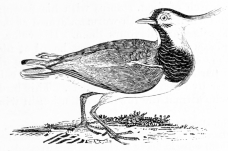
THE LAPWING, OR PEEWIT.
(Vanellus cristatus.)
This well-known bird is found in nearly all countries, and is of the
size of a common pigeon. The female lays four or five eggs, of a yellow
colour, varied all over with large black spots and strokes. Lapwings
build their nests on the ground in the middle of some field or heath,
open and exposed to view, laying only some few straws under the eggs: so
soon as the young are hatched, they instantly forsake the nest, running
away with the shell on their back, and following the mother, only
covered with a kind of down, like young ducks. The parents have been
impressed by nature with the most attentive love and care for their
offspring; for if the fowler, or any other enemy, should come near the
nest, the female, panting with fear, lessens her call to make her
enemies believe that she is much further off, and thereby deceives those
that search for her brood; she also sometimes pretends to be wounded,
and utters a faint cry as she limps away, to lead the fowler from her
nest. This bird is really beautiful, although it does not exhibit that
gaudiness of colours of which other species of the feathered tribe can
boast: it weighs about half-a-pound. The head, and the crest which
elegantly adorns it, is black; this crest, composed of unwebbed
feathers, is about four inches in length. The back is of a dark green,
glossed with blue shades; the throat is black; the hinder part of the
neck and the breast are white. The Lapwing, when in search of food,
stamps with his feet upon the ground, and when the earth-worms, alarmed
at the noise, appear, he seizes and devours them. His voice, on the
swampy places along the sea-shores, heard at night, resembles the sound
of peewit, or teewit, and hence his name in several parts of Great
Britain; he is also called the Great Plover by several ornithologists.
This bird is one of those who attract the fowler’s attention in winter:
“With slaughtering gun th’ unwearied fowler roves,
When frosts have whiten’d all the naked groves;
Where doves in flocks the leafless trees o’ershade,
And lonely woodcocks haunt the watery glade.
He lifts his tube, and levels with his eye;
Straight a short thunder breaks the frozen sky:
Oft, as in airy rings they skim the heath,
The clamorous Lapwings feel the leaden death:
Oft, as the mounting larks their notes prepare,
They fall, and leave their little lives in air.” Pope.
The following anecdote, from Bewick’s “History of Birds,” exhibits the
domestic nature of the Lapwing, as well as the art with which it
conciliates the regard of animals materially differing from itself, and
generally considered as hostile to every species of the feathered tribe.
Two Lapwings were given to a clergyman, who put them into his garden;
one of them soon died, but the other continued to pick up such food as
the place afforded, till winter deprived it of its usual supply.
Necessity soon compelled it to draw nearer to the house, by which it
gradually became familiarised to occasional interruptions from the
family. At length one of the servants, when she had occasion to go into
the back kitchen with a light, observed that the Lapwing always uttered
his cry of “pee-wit,” to obtain admittance. The bird soon grew more
familiar; as the winter advanced, he approached as far as the kitchen,
but with much caution, as that part of the house was generally occupied
by a dog and cat, whose friendship, however, the Lapwing at length
conciliated so entirely, that it was his regular custom to resort to the
fireside as soon as it grew dark, and spend the evening and night with
his two associates, sitting close by them, and partaking of the comforts
of a warm hearth. As soon as spring appeared, he discontinued his visits
to the house, and betook himself to the garden; but, on the approach of
winter, he had recourse to his old shelter and friends, who received him
very cordially. Security was productive of insolence; what was at first
obtained with caution, was afterwards taken without reserve; he
frequently amused himself with washing in the bowl which was set for the
dog to drink out of; and while he was thus employed, he showed marks of
the greatest indignation if either of his companions presumed to
interrupt him. He died in the asylum he had thus chosen, being choked
with something that he had picked up from the floor.
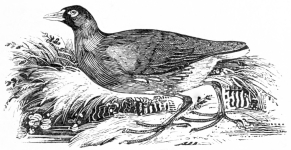
THE WATER-HEN, (Gallinula chloropus,)
Is also called the Moor-Hen, or Moor-Coot, and the Gallinule. The
breast is of a lead-colour, the lower part of the body inclining to
ash-colour, and the back dark olive brown. As she swims or walks, she
often flirts up her tail. Water-hens feed upon aquatic plants and roots,
and upon the small insects which adhere to them; they grow fat about the
latter end of September, and their flesh is then considered nearly equal
to that of the teal; yet it can seldom be entirely deprived of its
fishy taste. They build their nests amongst reeds, long grass, roots,
and stumps by the water-side, breeding twice or thrice in the course of
a summer; the eggs are white, with a tint of green, dashed with brown
spots.
There are very few countries in the world where these birds are not to
be found. They generally prefer the cold mountainous regions in summer,
and lower and warmer situations during winter.
“The fish are leaping, and the Water-hen
Dives up and down. A storm is coming on.”
Schiller.—William Tell.
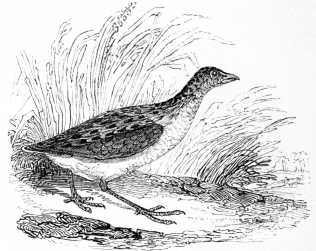
THE CORN-CRAKE, OR LAND-RAIL,
(Ortygometra crex,)
Is a migratory bird, appearing in England in April, and departing in
October. At the time of its arrival it is very lean, but becomes
excessively fat before it quits the island. Their favourite haunts are
cold and humid upland districts, corn-fields in the vicinity of water,
and marshy grass-lands. Their cry is a peculiar roll of short notes,
all in the same key and of the same length. The sound, crec, crec, crec,
has been compared to the noise made by drawing the finger along the
teeth of a comb. The legs of the Corn-Crake are unusually long for the
size of the bird, and hang down while it is on the wing. Its flesh is
greatly esteemed for its delicate flavour. This bird is never seen on
the wing in this country, and is extremely difficult to capture; they
cannot be made to rise like partridges and many other birds, nor is it
of much use to invade their cover. They glide through the corn, without
the least perceptible rustle, and with wonderful rapidity, considering
the size of the bird, and if the sportsman follows in the direction of
the sound, it ceases for a while, and then, perhaps, is heard far in the
rear; if he follows it again, it is not long before the sound is heard
setting in its former or some other direction.
It is said by some writers that the Corn-Crake is a sort of natural
ventriloquist, and can make his note appear to proceed from quite
another direction than the spot in which he lies hid. It is probable,
however, that the delusion arises from the astonishing swiftness with
which the bird passes through the covers, where it is usually found. And
as they can never be made to rise, the observer has very seldom the
means of deciding whether the bird was in the place its cry seemed to
proceed from or not.
The nest is made in a hole in the ground, and is lined with dead leaves,
moss, and other soft substances. There are generally ten, twelve, or
fourteen eggs. The peculiar cry by which the bird is recognised is only
uttered during the period of incubation.
Corn-Crakes are occasionally found to have a great fondness for water.
An anecdote is related by Craven, in his “Young Sportsman’s Manual,” of
a young bird of this species, in the possession of a Mr. Jervis, which
had a remarkable partiality for water, in which it would dive and
splash, as if unused to any other element. If the habits of this bird
could be watched more closely, perhaps we should find that this fondness
for water is not uncommon in its wild state.
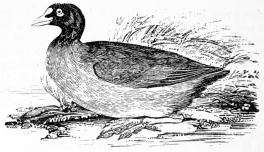
This bird has so many traits in its character, and so many features in
its general appearance like the rails and water-hens, that to place it
after them seems a natural and easy gradation; and accordingly this has
been done by Cuvier, though it was considered by Linnæus to belong to a
group distinct from those birds, and from the waders in general, on
account of its being fin-footed, and its constant attachment to the
waters, which, indeed, it seldom quits. The manner in which Coots build
their nest is very ingenious. They form it of interwoven aquatic weeds,
and place it among the rushes, in such a way that it may occasionally
rise with, but not be washed away by, the stream: and if ever this
accident happens, steady on her nest, the hen does not desert her brood,
but follows with them the destiny of their floating cradle. This bird,
in the figure and shape of its body, resembles the water-hen, and weighs
about twenty-four ounces. The feathers about the head and neck are low,
soft, and thick. The colour about the whole of the body is black, but of
a deeper hue about the head. The sere rises upon the forehead in a
peculiar manner, and appears as if Providence had designed it for a
means of defence. It changes its whitish colour to a pale red or pink in
the breeding season. Coots are very shy, and seldom venture abroad
before dusk. When attacked, they defend themselves with their feet, and
they do this so energetically, that sportsmen say, “Beware of a winged
Coot, or he will scratch you like a cat.”
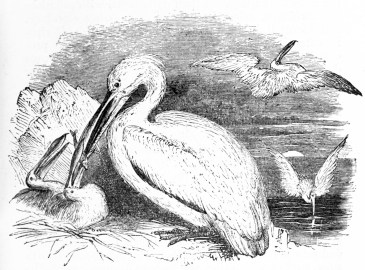
THE PELICAN, (Pelicanus onocrotalus,)
Is in size about equal to the swan; the colour of the body is white,
inclining to pink; the beak is straight and long, with a sharp hook at
the end; the skin of the lower mandible is so capable of distension,
that it may be dilated to contain fish in large quantities. This pouch
Providence has allotted to the bird, that he may bring to his eyrie
sufficient food for several days, and save himself the trouble of
travelling through the air, and watching and diving so often. The legs
are black, and the four toes palmated. It is a very indolent, inactive,
and inelegant bird, often sitting whole days and nights on rocks or
branches of trees, motionless and in a melancholy posture, till the
resistless stimulus of hunger spurs it on, and forces it to the sea in
search of nourishment; when thus excited to exertion, the Pelican flies
from the spot, and, raising itself thirty or forty feet above the
surface of the water, turns its head with one eye downward, and
continues to fly in that position till it sees a fish near the surface.
It then darts down with astonishing swiftness, seizes its prey with
unerring certainty, and stores it in its pouch. Having done this, it
rises into the air, and repeats the same action till it has procured a
sufficient stock. The Pelican is by no means destitute of natural
affection, either towards its young ones or towards others of its own
species. Clavigero, in his “History of Mexico,” says, that sometimes the
Americans, in order to procure, without trouble, a supply of fish,
cruelly break the wing of a live Pelican, and, after tying the bird to a
tree, conceal themselves near the place. The screams of the miserable
bird attract other Pelicans to the place, which, he assures us, eject a
portion of the provisions from their pouches for their imprisoned
companion. As soon as the men observe this, they rush to the spot, and
after leaving a small quantity for the bird, carry off the remainder.
In America, Pelicans are often rendered domestic, and are so trained,
that at command they go in the morning and return before night with
their pouches distended with prey, part of which they are made to
disgorge, while the rest is left them for their trouble. The bird is
said to live sometimes a hundred years.
Our forefathers attributed extraordinary affection to this bird, more
than is attested by any save heraldic evidence. Thus, in several crests,
it is represented in the act of feeding its young with its own blood,
which it procures by striking its breast with the sharp point of its
beak. And the ancients fully believed that in times of scarcity the
female Pelican resorted to this means of supporting her brood. The nest
of the Pelican is made with sedges and grass, close to the water’s edge;
the female lays two or three white eggs, and the male is said to supply
his partner with food while she is engaged in the work of incubation.
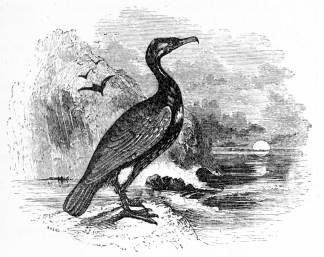
THE CORMORANT, (Phalacrocorax carbo,)
Is a large water-bird, nearly allied to the pelican, possessed with a
very voracious appetite, and consequently of a very rapacious
disposition. It lives upon all sorts of fish; the fresh water and the
briny waves of the sea both paying a large contribution to its craving
stomach. The bill is about five inches in length, and of a dusky colour;
the predominant tints of the body are black beneath, and dark brown
above; on each thigh there is a white patch. The smell of these birds
when alive is excessively rank and disagreeable; and their flesh is so
disgusting that even the Greenlanders, among whom they are very common,
will scarcely eat it. They were formerly tamed in England for the
purpose of catching fish, as falcons and hawks were for chasing the
fleet inhabitants of the air. This custom is still in practice in China.
The birds are taken to the water in a boat, with leather thongs tied
round their necks to prevent their swallowing the fish; at the word of
command they descend into the water, swim about, and dive in pursuit of
prey, and bring whatever they capture to their owner’s boat. Sometimes
two Cormorants will unite their efforts to capture a large fish; and if
any of the birds neglect their business the man will slap on the water
with a bamboo, as a schoolmaster does with his cane on the desk, to
recall the idlers to a sense of their duty. This bird, although of the
aquatic kind, is often seen, like the pelican, perched upon trees.
Milton tells us that Satan
“—— —— —— On the tree of life,
The middle tree, and highest there that grew,
Sat like a Cormorant.”
In the year 1793, one of them was observed sitting on the vane of St.
Martin’s steeple, Ludgate Hill, London, and was shot there in the
presence of a great number of people.
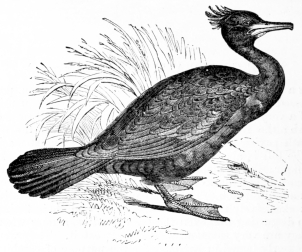
THE SHAG, OR CRESTED CORMORANT, (Phalacrocorax
graculus,)
Is of a dark green, with a singular tuft on the front of the head in the
spring. It breeds in rocky caves on the sea-coast.
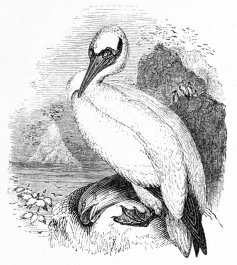
THE GANNET, OR SOLAN GOOSE. (Sula bassana.)
These birds are insatiably voracious, but are somewhat particular in
their choice of prey; disdaining, unless in great want, any food worse
than herrings or mackerel. No fewer than one hundred thousand Gannets
are supposed to frequent the rocks of St. Kilda; and of these, including
the young ones, at least twenty thousand are annually killed for food by
the inhabitants. The Gannet is somewhat more than three feet in length,
and weighs about seven pounds. The bill is six inches long, straight
almost to the point, where it is a little bent; its edges are jagged, to
enable it the better to secure its prey; and about an inch from the base
of the upper mandible there is a sharp process pointing forward. The
general colour of the plumage is a dingy white, with a greyish tinge.
Surrounding each eye there is a naked skin of a fine blue colour; from
the corner of the mouth a narrow slip of naked black skin extends to the
hind part of the head; and beneath the chin there is a pouch capable of
containing five or six herrings. The neck is long; the body flat, and
very full of feathers. On the crown of the head, and the back part of
the neck, is a small buff-coloured space. The quill-feathers, and some
other parts of the wings, are black; as are also the legs, except a fine
pea-green stripe in front. The tail is wedge-shaped, and consists of
twelve sharp-pointed feathers.
These birds chiefly resort to those uninhabited islands where man seldom
comes to disturb them. The islands to the north, Ailsa Craig, on the
west coast of Scotland, the Skelig Islands, off the coasts of Kerry in
Ireland, and those that lie in the North Sea off Norway, abound with
them. But it is on the Bass Bock, in the Frith of Forth, that they are
seen in the greatest abundance. “There is a small island,” says the
celebrated Harvey, “called the Bass, not more than a mile in
circumference; the surface is almost wholly covered during the months of
May and June with the nests of the Solan Geese, their eggs, and their
young. It is scarcely possible to walk without treading on them: the
flocks of birds upon the wing are so numerous as to darken the air like
a cloud; and their noise is such, that one cannot without difficulty be
heard by the person next to him. When one looks down upon the sea from
the precipice, its whole surface seems covered with infinite numbers of
birds of different kinds, swimming and pursuing their prey. If, in
sailing round the island, one surveys its hanging cliffs, in every crag
or fissure of the broken rocks may be seen innumerable birds, of various
sorts and sizes, more than the stars of heaven when viewed in a serene
night. If they are viewed at a distance, either receding or in their
approach to the island, they seem like one vast swarm of bees.”
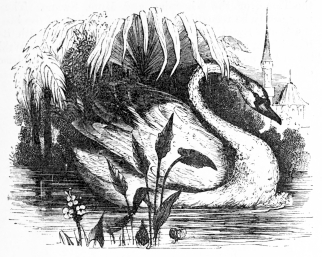
“Fair is the Swan, whose majesty prevailing
O’er breezeless water, on Locarno’s lake,
Bears him on, while, proudly sailing,
He leaves behind a moon-illumined wake:
Behold! the mantling spirit of reserve
Fashions his neck into a goodly curve—
An arch thrown back between luxuriant wings
Of whitest garniture, like fir-tree boughs.
To which, on some unruffled morning, clings
A flaky weight of winter’s purest snows!
Behold! as with a gushing impulse heaves
That snowy prow, and softly cleaves
The mirror of the crystal flood;
Vanish inverted hill, and shadowy wood,
And pendent rocks, where’er in gliding state
Winds the mute creature, without visible mate
Or rival, save the queen of night,
Showering down a silver light
From heaven upon her chosen favourite!”
Wordsworth.
The two best known species of this elegantly-formed and majestic bird
are commonly known as the Wild and the Tame, or the Whooping and Mute,
Swans. They may easily be recognised by the peculiarities of the bill:
the Tame Swan has the bill orange-coloured, with its base black, and
surmounted by a black knob; the Wild Swan has no knob, and it is the tip
instead of the base of the bill that is black.
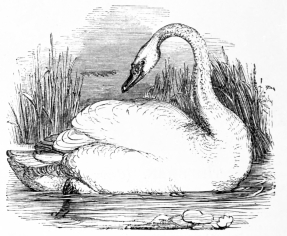
THE WILD SWAN, WHOOPING SWAN, OR WHISTLING SWAN, (Cygnus
ferus,)
Is also a fine bird, with beautifully white plumage; unlike the Tame
Swan, which is nearly mute, it has a loud and rather melodious voice,
which it utters frequently, as it flies along at a great height in the
air, during its migrations. It is found in England in the winter, but
resides all the year in the north of Scotland. Its favourite place for
breeding is in the extreme north. The Tame Swan is the largest of our
web-footed water-fowl, sometimes weighing about thirty pounds: the whole
body of the full-grown Swan is covered with a beautiful pure white
plumage, but the young ones are grey; under the feathers is a thick,
soft down, which is of very great use, and often employed as an
ornament. The elegance of form which this bird displays, when, with his
arched neck and half-displayed wings, he sails along the crystal surface
of a tranquil stream, which reflects, as he passes, the snowy beauty of
his dress, is worthy of admiration. Thomson describes the Swan in the
following beautiful manner:
“—— —— —— The stately sailing Swan
Gives out his snowy plumage to the gale,
And arching proud his neck, with oary feet,
Bears forward fierce, and guards his osier isle,
Protective of his young.”
Swans have for ages been protected on the river Thames as royal
property; and it continues at this day to be accounted felony to steal
their eggs: by this means their increase is secured, and they prove a
delightful ornament to that noble river. Latham says the estimation in
which they were held, in the reign of Edward IV., was such, that only
those who possessed a freehold of the clear yearly value of five marks
were permitted even to keep any. In those times, hardly a piece of water
was left unoccupied by these birds, as they gratified the palate as well
as the eye of their lordly owners of that period: but the fashion of
those days has passed away, and Swans are by no means as common now as
they were formerly, being by most people accounted a coarse kind of
food, and consequently held in little estimation: but the Cygnets (so
the young Swans are called) are still fattened for the table, and are
sold very high, commonly for a guinea each, and sometimes more; hence it
may be presumed they are better food than is generally imagined.
At Abbotsbury there was generally a noble Swannery, the property of the
Earl of Ilchester, where six or seven hundred birds were kept, but the
collection has of late been much diminished. The Swannery belonged
anciently to the abbot, and, previously to the dissolution of
monasteries, the Swans frequently amounted to double the above number.
From the whiteness of this bird, the expression of a “Black Swan” was
used in ancient times as equivalent to a nonentity; but a species nearly
entirely black has been lately discovered in Australia. This bird is as
large as the white Swan, and its bill is of a rich scarlet. The whole
plumage (except the primaries and secondaries, which are white) is of
the most intense black.
Swans are very long lived, sometimes attaining the great age of a
century and a half.
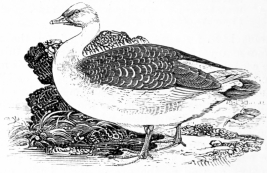
THE WILD GOOSE. (Anser ferus.)
“The farmer’s Goose, who in the stubble
Has fed without restraint or trouble,
Grown fat with corn, and sitting still,
Can scarce get o’er the barn-door sill;
And hardly waddles forth to cool
Her body in the neighbouring pool;
Nor loudly cackles at the door,
For cackling shows the Goose is poor.”
Swift.
The Goose is very different in outward appearance from the last-named
bird. Stupidity in her look, uncouthness in her walk, and heaviness in
her flight are her principal characteristics. But why should we dwell
upon these defects? they are not such in the great scale of the
creation. Her flesh feeds many, and is not disdained even by the great;
her feathers keep us warm; and even the very pen I hold in my hand was
plucked from her wing.
These birds are kept in vast quantities in the fens of Lincolnshire;
several persons there having as many as a thousand breeders. They breed
in general only once a year, but if well kept they sometimes hatch twice
in a season. During their sitting, the birds have spaces allotted to
each, in rows of wicker pens placed one above another; and the
Goose-herd, who has the care of them, drives the whole flock to water
twice a day, and bringing them back to their habitations, places every
bird (without missing one) in its own nest. It is scarcely credible what
numbers of Geese are driven from the distant counties to London for
sale, frequently two or three thousand in a drove; and, in the year
1783, one drove passed through Chelmsford, in its way from Suffolk to
London, that contained more than nine thousand. However simple in
appearance or awkward in gesture the Goose may be, it is not without
many marks of sentiment and understanding. The courage with which it
protects its offspring and defends itself against ravenous birds, and
certain instances of attachment, and even of gratitude, which have been
observed in it, render our general contempt of the Goose ill-founded.
The Goose was held in great veneration among the Romans, as having by
her watchfulness saved the Capitol from the attack of the Gauls. Virgil
says, in the seventh book of the Æneid,
“The silver goose before the shining gate
There flew, and by her cackle saved the state.”
Dryden.
The colour of this useful bird is generally white; though we often find
them of a mixture of white, grey, black, and sometimes yellow. The feet
which are palmated, are orange-coloured, and the beak is serrated. The
male of the Goose is called the Gander; and the young ones Goslings.
Geese are very long-lived, one is known to have lived above seventy
years.
The Wild Goose is the original of the tame one, and differs much in
colour from her, the general tint of its feathers being a greyish black.
Wild Geese fly by night in large flocks to more southern countries; and
their clang is heard from the regions of the clouds, although the birds
are out of sight.
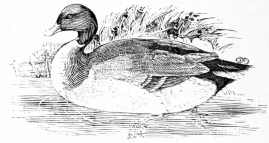
THE DUCK. (Anas boschas.)
The common Duck is of two kinds, the wild and the tame, the latter being
but the same species altered by domestication; the difference between
them is very trifling, save that the colour of the Mallard, or male wild
Duck, is constantly the same in all the individuals, whereas the Drakes,
or tame ones, are varied in their plumage. The females do not share with
the males in beauty of plumage: the admirable scarf of glossy green and
blue, which surrounds the neck of Drakes and Mallards, being an
exclusive prerogative of the male sex. There is also a curious and
invariable peculiarity belonging to the males, which consists of a few
curled feathers rising upon the rump.
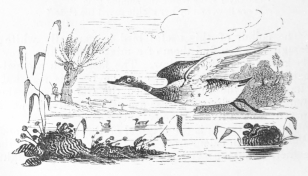
Wild Ducks are caught by decoys in the fen countries, and in such
prodigious numbers, that in only ten decoys in the neighbourhood of
Wainfleet, as many as thirty-one thousand two hundred have been caught
in one season. They do not always build their nests close to the water,
but often at a considerable distance from it; in which case the female
will take the young ones in her beak, or between her legs, to the water.
They have sometimes been known to lay their eggs in a high tree, in a
deserted magpie’s or crow’s nest; and an instance has been recorded of
one being found at Etchingham, in Sussex, sitting upon nine eggs in an
oak, at the height of twenty-five feet from the ground: the eggs were
supported by some small twigs laid cross-ways.
The tame Ducks, reared about mills and rivers, or wherever there is a
sufficient quantity of water for them to indulge their sports and to
search for food, become a branch of trade, which proves very profitable
to their owners.
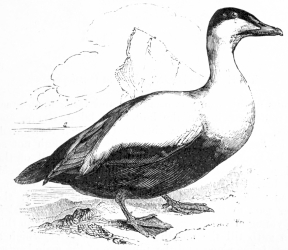
THE EIDER DUCK, (Sornateria mollissima,)
Which is found about the coasts of the north of England and Scotland,
becomes more numerous as we go further north, and is most abundant on
Iceland and the Arctic shores, both of Europe and America. This bird is
particularly valuable for the great quantity of down which it furnishes,
as this is so light and elastic that beds and quilts made from it are
preferable to any others. The birds line their nests with this beautiful
material plucked from their own bodies, and it is chiefly by plundering
the nests that the down is obtained. Each nest will furnish about half a
pound of down in the season, and it is worth about four dollars a pound.
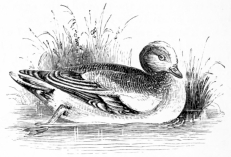
THE WIDGEON, (Mareca Penelope,)
Weighs about twenty-two ounces, and feeds upon grass and roots growing
at the bottom of lakes, rivers, and ponds. The plumage of this bird is
much variegated, and its flesh esteemed a great delicacy, though not so
highly praised as that of the teal. The bill of the Widgeon is black;
the head and upper part of the neck of a bright bay; the back and sides
under the wing waved with black and white; the breast purple; the lower
part of the body white, and the legs are dusky. The young of both sexes
are grey, and continue in this plain garb till the month of February;
after which a change takes place, and the plumage of the male begins to
assume its rich colourings, in which, it is said, he continues till the
end of July; and then again the feathers become dark and grey, so that
he is hardly to be distinguished from the female.
Widgeons commonly fly in small flocks during the night, and may be known
from other birds by their whistling note, while they are on the wing.
They quit the desert morasses of the north on the approach of winter,
and as they advance towards the ends of their destined southern journey,
they spread themselves along the shores, and over the marshes and lakes,
in various parts of the continent, as well as those of the British
isles; and it is said that some of the flocks advance as far south as
Egypt.
The Widgeon is easily domesticated in places where there is plenty of
water, and is much admired for its beauty, sprightly look, and busy,
frolicsome manners; yet it is generally asserted that they will not
breed in confinement, or at least that the female will not make a nest
and perform the act of incubation; but that she will lay eggs, which are
generally dropped into the water.
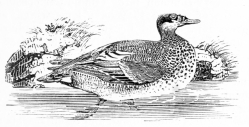
THE TEAL, (Querquedula crecca,)
Is the least of the duck tribe, weighing only twelve ounces. The lower
part of the body is of a dingy white, inclining to a grey tint. The back
and sides under the wings are curiously varied with lines of white and
black; the wings are all over brown, and the tail of the same colour.
This bird is common in England during the winter months, and it is still
uncertain whether it does not breed here as it does in France. Dr.
Heysham says it is known to breed in the neighbourhood of Carlisle. The
female makes her nest of reeds interwoven with grass; and, as it is
reported, places it among the rushes, in order that it may rise and fall
with the water. Their eggs are of the size of those of a pigeon, six or
seven in number, and of a dull white colour, marked with small brownish
spots; but it appears that they sometimes lay ten or twelve eggs, for
Buffon remarks that that number of young are seen in clusters on the
pools, feeding on cresses, chervil, and some other weeds, as well as
upon seeds and small insects that swarm in the water. The flesh of the
Teal is a great delicacy in the winter season, and has less of the fishy
flavour than any of the wild duck kind. It is known to breed and remain
throughout the year in various temperate climates of the world, and is
in the summer met with as far northward as Iceland.
The Gulls, of which there are a great many different kinds, are very
common birds around our coasts and at the mouths of rivers; they have
long wings, and fly with great rapidity and buoyancy. Their plumage is
thick, and they float very lightly on the surface of the water, but do
not dive. The Gulls are very voracious, and not only devour great
quantities of fishes, shell-fish, and other marine animals, but even
condescend to feed upon the dead bodies of animals which they find
floating on the water or cast up on the shore. Some of the smaller kinds
come inland, and catch insects on the wing, in the same way as the
Swallows.
The Common Gull is rather a large species, being more than eighteen
inches in length when full grown. Its plumage is pearly grey above and
white beneath; the largest wing feathers are black, with white tips and
white spots near the tip; and the bill and feet are greenish grey. This
bird breeds in the salt marshes or on the ledges of cliffs. The female
lays two or three eggs, which are olive brown, with dark brown and black
spots.
It is a very pretty sight to watch from the top of a lofty cliff the
multitudes of these birds that often haunt our coasts; gliding with
beautiful ease and swiftness through the air, skimming the surface of
the water in pursuit of their prey, or reposing upon its bosom. Even
their rather harsh and discordant cry is in harmony with the wild and
imposing heights on which they love to dwell. This, however, does not
protect them from the frequenters of our seaside towns, with whom
seagull shooting is a favourite amusement; an amusement the more to be
reprehended as the flesh of the bird is quite useless.
Gulls are frequently caught alive, and, after having their wings clipped
to prevent their escape, are kept to satisfy their voracious appetite on
snails, slugs, and other garden pests.
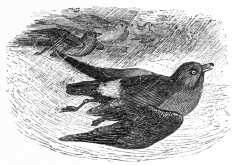
THE STORMY PETREL, OR MOTHER CARY’S CHICKEN.
(Thalassidroma pelagica.)
“O’er the deep! o’er the deep!
Where the whale, and the shark, and the sword-fish sleep,
Outflying the blast and the driving rain,
The petrel telleth her tale in vain;
For the mariner curseth the warning bird,
Who bringeth him news of the storm unheard!
Oh! thus does the prophet, of good or ill,
Meet hate from creatures he serveth still;
Yet he ne’er falters:—So, Petrel! spring
Once more o’er the waves on thy stormy wing.” Procter.
The Stormy Petrel is not larger than a swallow; and its colour is
entirely black, except the coverts of the tail, the tail itself, and the
vent-feathers, which are white: its legs are slender. Ranging over the
expanse of the ocean, and frequently at a vast distance from the land,
this bird is able to brave the utmost fury of the storms. Even in the
most tempestuous weather it is frequently observed by the mariners
skimming with almost incredible velocity along the billows, and
sometimes over their summits. They often follow vessels in great flocks,
to pick up anything that is thrown overboard; but their appearance is
looked upon by the sailors as the sure presage of stormy weather in the
course of a few hours. It seems to seek protection from the fury of the
wind in the wake of the vessels; and it is probable that for the same
reason it often flies between two surges. The nest of this bird is found
in the Orkney Islands, under loose stones, in the months of June and
July. It lives chiefly on small fish; and although mute by day, it is
very clamorous by night. The young of this bird are fed with an oily
matter or chyle, which is ejected from the stomachs of the parents.
Mudie, in his very entertaining work on British Birds, says that they
are called Petrels, or “little Petrels,” because they move along the
surface as if they were literally walking on the water. He also informs
us that they are at times very full of oil, and that the Faroese, taking
advantage of this circumstance, convert them into lamps, by fixing them
in an upright position and drawing a wick through their bodies, which
they light at the mouth.
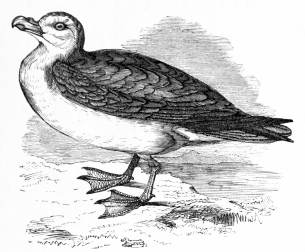
THE FULMAR, (Procellaria glacialis,)
Is a larger kind of Petrel, which is found not uncommonly on the British
coasts, and is exceeding abundant in the Arctic seas. Here it is a
regular attendant upon the whale-fishers when they are engaged in
cutting up a whale. Any fragments of blubber that happen to fall into
the water are immediately snapped by these greedy birds, which clamour
and squabble over the feast with so little regard to the vicinity of the
sailors, that they may be knocked on the head with a boat-hook. They are
in high estimation in the countries they inhabit, on account of the
large amount of oil they contain. It is only rarely they are seen in
England, nor do they regularly frequent any part of Great Britain,
except a few of the northernmost islands of Scotland. Like the other
Petrels, they feed their young with a sort of oil, which they have the
power of exuding at will.
Also resembles the diminutive Petrels in some respects; but instead of
being a pigmy it is a giant among birds. Its wings often measure as much
as fifteen feet in extent and are of corresponding power, as they have
to support the Albatross by the day together above the stormy waves of
the great Southern Ocean. Indeed, so enormous is their strength and
endurance, that they have been known to follow ships for whole days
together, without once resting upon the water. From time to time the
gigantic bird plunges down into the sea to capture the fishes with which
he satisfies his hunger; and it is said that where Albatrosses are
numerous they will even attack sailors who may happen to fall overboard.
From their abundance at the Cape of Good Hope they are often called by
mariners Cape sheep.
Albatrosses generally weigh from twenty to thirty pounds. The plumage is
white, except some narrow bars upon the back, and some of the long wing
feathers, which are black, and of the head, which is a reddish grey. The
beak is long and powerful, and curved at the end, and would be a most
terrible weapon if the owner were of a pugnacious disposition. It is,
however, quite inoffensive, and is even sometimes attacked by much
smaller birds, when it invariably takes to flight, and the immense power
of its wings generally enables it to distance its pursuers. The
Albatross, like most sea birds, has a most insatiable appetite, and
devours immense quantities, not only of fish, but of other
sea-animals,—such as molluscs. They are so greedy that they are caught
by a line baited with a piece of flesh, which the ever-hungry bird
swallows at a gulp, paying with his life for the dear repast. They are
taken by the natives of the countries they frequent, not for their
flesh, which is tough and insipid, but for the sake of their entrails,
which are very large and elastic, and are used for a number of useful
purposes.
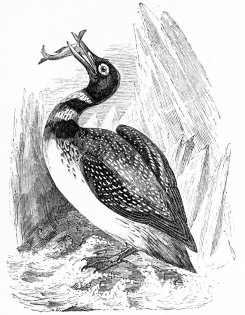
THE GREAT NORTHERN DIVER.
(Colymbus glacialis.)
The Great Northern Diver is found most abundantly in the Arctic seas,
but a considerable number of them dwell on the shores of Scotland. It
has a rather long, strong, and sharply pointed bill; its back and wings
are black, ornamented with numerous white spots; its lower surface is
greyish-white; and its head and neck are black, with a couple of white
collars across the front of the neck. The Great Northern Diver is a
large bird, measuring nearly three feet in length; its wings are small
in proportion to its size, but yet the bird is able to fly very rapidly.
It is, however, in the water that it is most active; it swims and dives
with the most remarkable ease, and even under water goes as fast as a
four-oared boat. Its food consists of fishes, and it breeds amongst the
herbage of the sea-shore, the female laying two or three eggs in a neat
nest made of grass.
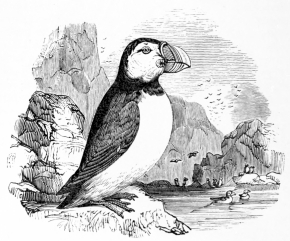
THE PUFFIN, (Fratercula arctica,)
Is another short-winged water bird, but, unlike the Northern Diver, it
visits us in the summer, and breeds on our shores. It is about a foot
long, and has the back and wings black, the cheeks and all the lower
parts of the body, except a band round the neck, white, and the feet
orange. Its bill is very curious, and has obtained for it the names of
Sea Parrot and Coulterneb in some places. This organ is large and
strong, but flattened at the sides; it is of a bluish colour, with three
grooves and four ridges of an orange colour. The Puffin flies swiftly,
and swims and dives almost as well as the Great Diver; it breeds
sometimes in crannies amongst the rocks, and sometimes in a hole which
it digs in the turf or in a rabbit-warren.
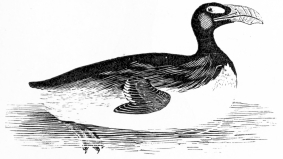
THE GREAT AUK, (Alca impennis,)
Which is sometimes called the Northern Penguin, is a large bird,
furnished with very small wings, which, although formed of regular
feathers, like those of other birds, are far too weak to raise their
owner into the air. They are, however, of use in another way. When the
Auk dives, which it frequently does, they serve as fins, and, with its
powerful webbed feet, enable it to swim underneath the water with even
greater rapidity than on the surface. This bird was formerly seen
occasionally on the northern coasts of Britain, and became more
plentiful towards the Arctic seas; but no specimens have now been met
with for many years, and there is reason to believe that the bird is
quite extinct on our coasts. In the water the Great Auk, like the Diver,
is wonderfully active, swimming on the surface or beneath the waves with
equal ease. Mr. Bullock, when in the Orkneys, pursued a male bird for
several hours in a six-oared boat without being able to kill him.
The Great Auk is generally about three feet long, and changes its
plumage in summer. The breeding-season is in June and July, when the
female lays one large egg, of a yellowish colour, marked with black
spots.
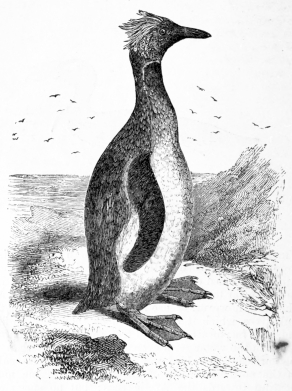
THE PENGUIN, (Speniscus demersus,)
Of which numerous species abound on the shores and islands of the great
Southern Ocean, is remarkable for its almost incredible agility in the
water; it swims and dives like a fish, and in fact is described as
coming to the surface for air, and descending again so suddenly as to
give rise to the impression that it is a fish jumping in sport. It is
found in vast numbers in hiding places, where the females are seen
sitting upright and holding their single egg between their legs.