O! fair and fresh the early spring
Her budding wreath displays,
To all the wide earth promising
The joy of harvest days;
Yet many a waste of wavy gold
Hath bent above the dead;
Then let the living share it too—
Give us our daily bread.
Of old a nation's cry shook down
The sword-defying wall,
And ours may reach the mercy-seat,
Though not the lordly hall.
God of the Corn! shall man restrain
Thy blessings freely shed?
O! look upon the isles at last—
Give us our daily bread.
The Founders of "Punch"
It is fitting that a chronicle of social life in England in the
Victorian age, drawn in its essentials from the pages of Punch, should
begin with the People. For Punch began as a radical and democratic
paper, a resolute champion of the poor, the desolate and the oppressed,
and the early volumes abound in evidences of the miseries of the "Hungry
'Forties" and in burning pleas for their removal. The strange mixture of
jocularity with intense earnestness which confronts us on every page
was due to the characters and antecedents of the men who founded and
wrote for the paper at its outset. Of at least three of them it might be
said that they were humanitarians first and humorists afterwards. Henry
Mayhew, one of the originators and for a short time joint-editor, was
"the first to strike out the line of philanthropic journalism which
takes the poor of London as its theme," and in his articles in the
Morning Chronicle and his elaborate work on London Labour and the
London Poor, which occupied him intermittently for the best part of
twenty years, showed himself a true forerunner of Charles Booth. His
versatility was amazing. The writer of the obituary notice of him in the
Athenæum observes that "it would not be difficult to show him as a
scientific writer, a writer of semi-religious biography, and an
outrageous joker at one and the same time." Another member of the
original staff was Gilbert à Beckett, who crowded an extraordinary
amount of work into his short life as leader-writer on The Times,
comic journalist, dramatist, Poor Law Commissioner and Metropolitan
Magistrate. It was à Beckett's report on the scandal connected with the
Andover Union—pronounced by the Home Secretary, Buller, to be one of
the best ever presented to Parliament—that led to important alterations
in the Statute book, and secured for him, at the age of thirty-eight,
his appointment as Metropolitan Police Magistrate. Thackeray's
references to "à Beckett the beak" are frequent and affectionate, and on
his death in 1856 a noble tribute was paid him in the pages of the
journal he had served from its opening number. "As a magistrate, Gilbert
à Beckett, by his wise, calm, humane administration of the law, gave a
daily rebuke to a too ready belief that the faithful exercise of the
highest and gravest social duties is incompatible with the sportiveness
of literary genius." These words were penned by Douglas Jerrold, who
died within a year of his friend, and was the most ardent and
impassioned humanitarian of the three. By the irony of fate Jerrold is
chiefly remembered for his sledge-hammer retorts: the industrious and
ingenious playwright is little more than a name; the brilliant publicist
and reformer, the friend and associate of Chartists, the life-long
champion of the underdog is forgotten. Gilbert à Beckett and Henry
Mayhew had both been at Westminster. Their people were well-to-do.
Douglas Jerrold had known both poverty and privation, and his education
was largely acquired in a printer's office. His brief service in the
Navy was long enough to make him a strenuous advocate of the claims of
the lower deck to more humane treatment. He did not believe that harsh
discipline and flogging were necessary to the efficiency of either
Service. As a boy he had seen something of the human wreckage of war,
and the spectacle had cured him for ever of any illusions as to
militarism. But his distrust of Emperors, Dictators and the "King
business" generally—always excepting Constitutional Monarchy—was so
pronounced that any interference on their part was enough to convert him
into a Jingo. How far he was from being a pacificist may be judged from
the temper of Punch in the Crimean War, its advocacy of ruthlessness
as the best means of shortening the hostilities, and its bitter
criticism of Lord Aberdeen and Mr. Gladstone, and above all of Cobden
and Bright, for their alleged pro-Russian sympathies. In the 'forties
Cobden and Bright were the leaders of that group of "middle-class men of
enthusiasm and practical sagacity" which directed the Free Trade
movement, and they had been supported by Punch in the campaign against
the Corn Laws. Douglas Jerrold was the spear-head of Punch's attacks
on Protection, Bumbledom, unreformed Corporations, Cant and Snobbery,
the cruelty, the inequality, the expense and the delays of the Law. He
might be described as being violently and vituperatively on the side of
the angels. The freedom of his invective, notably in the articles signed
"Q," is beyond belief. Compared with his handling of ducal landlords,
the most drastic criticisms of Mr. Lloyd George in his earlier days are
as water to wine. At all costs Jerrold was determined that the Tory dogs
should not have the best of it.
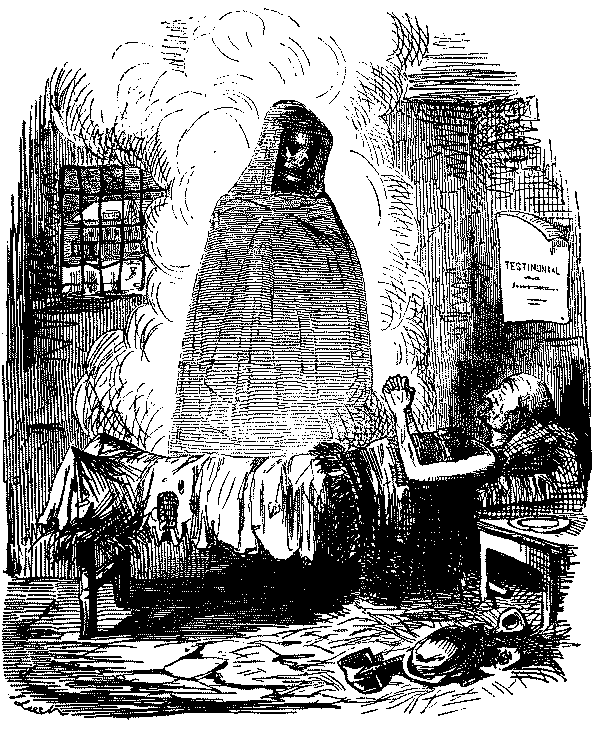
THE POOR MAN'S FRIEND
(The Hungry 'Forties)
Biographies of the Punch staff do not fall within the scope of this
chronicle, but some knowledge of the record and the temperament of the
men who gave the paper its peculiar quality for many years is essential
to a proper understanding of its influence on public opinion. They were
humorous men, but they could be terribly in earnest, and they had
abundant excuse for their seriousness. They could not forgive the Duke
of Wellington when on August 24, 1841, he declared that England was "the
only country in which the poor man, if only sober and industrious, was
quite certain of acquiring a competency." They regarded it as "a
heartless insult thrown in the idle teeth of famishing thousands, the
ghosts of the victims of the Corn Laws.... If rags and starvation put up
their prayer to the present Ministry, what must be the answer delivered
by the Duke of Wellington? 'Ye are drunken and lazy!'" A few days later
Mr. Fielden, M.P., moved "that the distress of the working people at the
present time is so great throughout the country, but particularly in the
manufacturing districts, that it is the duty of this House to make
instant inquiry into the cause and extent of such distress, and devise
means to remedy it; and at all events to vote no supply of money until
such inquiry be made." The motion was negatived by 149 to 41, and a Tory
morning paper complacently observed that "there has been for the last
few days a smile on the face of every well-dressed gentleman, and of
every well-to-do artisan, who wend their way along the streets of this
vast metropolis. It is caused by the Opposition exhibition of Friday
night in the House of Commons." The comment on this "spiteful
imbecility" is not to be wondered at: "Toryism believes only in the
well-dressed and the well-to-do. Purple and fine linen are the
instrumental parts of her religion. Her faith is in glossy raiment and a
full belly." The Home Secretary stated in reply to a question, about a
year later, that the keepers of St. James's Park were particularly
ordered "not to admit persons who wore fustian jackets," an order which
prompted Punch to remark that in Merry England "labour was ignominy,
and your only man the man with white hands and filbert nails." A writer
in the Examiner so recently as 1861 could remember the time when the
sentries in St. James's Park used, at the point of the bayonet,
according to their orders, to dismount women from their pattens, and
make them trudge on with them in their hands. It is an old story; as
old as the days of Ahasuerus, when "no one might enter the King's gate
clothed with sackcloth." Punch never wearied of bringing home to his
readers these abrupt contrasts of wealth and poverty. The people were
crying for bread and Parliament had been occupied in carrying the
Ventilation of the House Bill and the Royal Kitchen Garden Bill. The
amount voted for the Royal Stables at Windsor was considerably more than
three times what was obtained from Parliament for the education of the
poor. The Times of December 2, 1841, quoted from the Sporting
Magazine an account of the accommodation provided for the Prince
Consort's beagles and Her Majesty's dogs—sleeping beds, compartments
paved with asphalt, dry and clean, with roomy and healthy green yards;
and boiling and distemper houses detached from the other portions of the
building—and bracketed with it the sworn evidence of the late matron
and medical attendant at the Sevenoaks Union. The lying-in ward was
small and always looked dirty. "There had been six women there at one
time: two were confined in one bed. It was impossible entirely to shut
out the infection. I have known fifteen children sleep in two beds." Six
young girls, inmates of the Lambeth workhouse, were charged about the
same time with breaking several panes of glass. In their defence they
complained that they had been treated worse in the workhouse than they
would be in prison, and said that it was to cause their committal to the
latter place they broke the windows. Strange reading this in a comic
journal, yet paralleled by similar extracts week after week and month
after month. The birth of the Prince of Wales was chronicled in the same
issue of the daily papers which contained the "luscious history" of the
Lord Mayor's dinner:—
Fleshpots and Famine
Oh, men of Paisley—good folks of Bolton—what promise for ye is
here! Turkeys, capons, sirloins, asparagus, pheasants, pineapples,
Savoy cakes, Chantilly baskets, mince-pies, preserved ginger,
brandy cherries, a thousand luscious cakes that "the sense aches
at!" What are all these gifts of plenty but a glad promise that in
the time of the "sweetest young prince," on the birthday of that
Prince just vouchsafed to us, all England will be a large Lord
Mayor's table!
When the question of the title of the next King was discussed, Punch
boldly suggested Lazarus:—
Let Henry the Fifth have his Agincourt; let him, in history, sit
upon a throne of Frenchmen's skulls; our LAZARUS THE FIRST shall
heal the wounds of wretchedness—shall gather bloodless laurels in
the hospital and workhouse—his ermine and purple shall make
fellowship with rags of linsey-wolsey—he shall be a king enthroned
and worshipped in the hearts of the indigent!
LAZARUS THE FIRST! There is hope in the very sound for the
wretched! There is Christian comfort to all men in the very
syllables! By giving such a name to the greatest king of the earth,
there is a shadowing forth and a promise of glorification to the
beggars in eternity. Poverty and sores are anointed—tatters are
invested with regality—man in his most abject and hopeless
condition is shown his rightful equality with the bravest of the
earth—royalty and beggary meet and embrace each other in the
embrace of fraternity.
O ye thousands famished in cellars! O ye multitudes with hunger and
cold biting with "dragon's tooth" your very vitals! shout, if you
can find breath enough, "Long live Lazarus!"
In those days there was a "Pauper's Corner" in Punch, in which the cry
of the people found frequent and touching utterance. We have quoted from
"The Prayer of the People" as a heading to this chapter. Another short
poem deserves to be rescued from these old files, and added to the
lyrics inspired by the Anti-Corn Law movement:—
Disease and want are sitting by my hearth—
The world hath left me nothing of its good!
The land hath not been stricken by a dearth,
And yet I am alone and wanting food.
The sparrow on the housetops o'er the earth
Doth find its sustenance, and surely HE
Who gave the mighty universe its birth
Would never love the wild bird more than me.
Punch had no illusions as to the genuineness of the Chartist movement,
as may be gathered from his comments on the presentation of the Great
Petition in 1842. There might, he owned, be dangerous demagogues who
offered evil counsel, but the Chartists themselves had a degree of
intelligence, a power of concentration, a knowledge of the details of
public business, heretofore unknown to great popular combinations of
dissentients:—
There are among the Chartists hard-headed logicians—men keenly
alive to their sufferings, and what is more, soundly schooled as to
the causes of them. We grant that their petition presented to
Parliament contained many follies, very many extravagances—that it
prayed for what the timidity of poverty will call revolutionary
measures; but is it not an axiom in politics, that to get even a
little it is necessary to ask a great deal?
We only call upon Toryism, or Whiggism either, each to show us its
army of 3,000,000 of spotless politicians. But we contend that the
Chartists are foully maligned when they are branded as thieves and
spoilers. It is an old cry that property has its rights; it has
been added—and well added—that property has also its duties. To
these let us subjoin—property has also its cowardice.
Inquiries and investigations into the condition of agricultural
labourers and of artisans were already bringing to light many
disquieting facts. The physical destitution and spiritual forlornness of
the workers in the Midlands were painfully illustrated in the evidence
of Mr. Horne on the condition of the operatives of Wolverhampton:—
I have entered the houses and hovels of journeymen locksmiths and
keymakers indiscriminately and unexpectedly, and seen the utmost
destitution; no furniture in the room below but a broken board for
a table, and a piece of plank laid across bricks for a seat; with
the wife hungry—almost crying with hunger—and in rags, yet the
floor was perfectly clean. I have gone upstairs, and seen a bed on
the floor of a room seven feet long by six feet high at one side,
but slanting down to nothing, like a wedge, where a husband, his
wife and three children slept, and with no other article in the
room of any kind whatever except the bed.... William
Benton—"Thinks that's his name; can't spell it rightly. Age, don't
know justly—mother says he's turned eighteen. Can't read or write;
can tell some of his letters. Goes to a Sunday school sometimes. Is
of the Baptist school religion, whatever that is. Never heard of
Moses; never heard of St. Paul. Has heard of Christ; knows who
Jesus Christ was—he was Adam. Doesn't care much about going to
school if he could...."
You will find poor girls who have never sung or danced; never seen
a dance; never read a book that made them laugh; never seen a
violet or a primrose or other flowers; and others whose only idea
of a green field was derived from having been stung by a nettle.
The Song of the Shirt
The Commission which had been engaged in learning the exact conditions
of all the women and children employed in agriculture in England
suggested to Punch an imaginary report of an inquiry into the state of
the aristocracy, and the moral condition, employment, health, diet,
etc., of the residents in Belgrave Square, most of the ladies examined
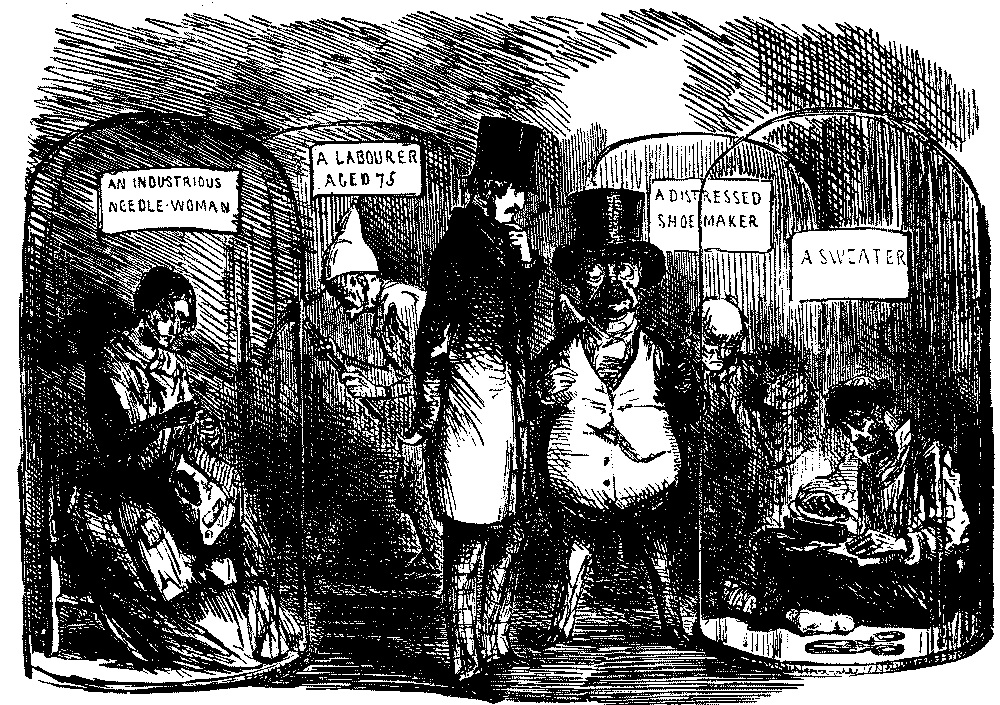
being overworked by violent dancing in overheated rooms. Sweating in the
cheap clothes trade was already attracting the notice of reformers, and
Punch was on the warpath when a Jew slop-seller prosecuted a poor
widow with two children for pawning articles which she had to make up
for him. She got 7d. a pair for making up trousers, and earned 7s. a
week. It was this episode, exposed in the verses "Moses and Co.," which
paved the way for Hood's immortal "Song of the Shirt," the greatest
poem, the most noble contribution that ever appeared in the pages of
Punch. It was printed in the Christmas number of 1843, and dwarfed all
the other contributions to insignificance:—
THE SONG OF THE SHIRT
With fingers weary and worn,
With eyelids heavy and red,
A woman sat in unwomanly rags,
Plying her needle and thread—
Stitch! stitch! stitch!
In poverty, hunger and dirt,
And still with a voice of dolorous pitch
She sang the "Song of the Shirt."
"Work! work! work!
While the cock is crowing aloof!
And work—work—work,
Till the stars shine through the roof!
It's O! to be a slave
Along with the barbarous Turk,
Where woman has never a soul to save,
If this is Christian work!
"Work—work—work
Till the brain begins to swim;
Work—work—work
Till the eyes are heavy and dim!
Seam and gusset and band,
Band and gusset and seam,
Till over the buttons I fall asleep,
And sew them on in a dream!
"O men, with sisters dear!
O men, with mothers and wives!
It is not linen you're wearing out,
But human creatures' lives!
Stitch—stitch—stitch,
In poverty, hunger and dirt,
Sewing at once, with a double thread,
A shroud as well as a shirt.
"But why do I talk of Death,
That phantom of grisly bone?
I hardly fear his terrible shape,
It seems so like my own—
It seems so like my own,
Because of the fasts I keep;
Oh God, that bread should be so dear,
And flesh and blood so cheap!
"Work—work—work!
My labour never flags;
And what are its wages? A bed of straw,
A crust of bread—and rags.
That shatter'd roof—and this naked floor—
A table—a broken chair—
And a wall so blank, my shadow I thank
For sometimes falling there!
"Work—work—work!
From weary chime to chime,
Work—work—work—
As prisoners work for crime!
Band and gusset and seam,
Seam and gusset and band,
Till the heart is sick and the brain benumb'd,
As well as the weary hand.
"Work—work—work
In the dull December light,
And work—work—work
When the weather is warm and bright;
While underneath the eaves
The brooding swallows cling
As if to show me their sunny backs
And twit me with the spring.
"Oh! but to breathe the breath
Of the cowslip and primrose sweet—
With the sky above my head,
And the grass beneath my feet;
For only one short hour
To feel as I used to feel,
Before I knew the woes of want
And the walk that costs a meal!
"Oh, but for one short hour!
A respite however brief;
No blessed leisure for love or hope,
But only time for grief!
A little weeping would ease my heart,
But in their briny bed
My tears must stop, for every drop
Hinders needle and thread!"
With fingers weary and worn,
With eyelids heavy and red,
A woman sat in unwomanly rags
Plying her needle and thread—
Stitch! stitch! stitch!
In poverty, hunger and dirt,
And still with a voice of dolorous pitch,
Would that its tone could reach the rich!
She sang this "Song of the Shirt."
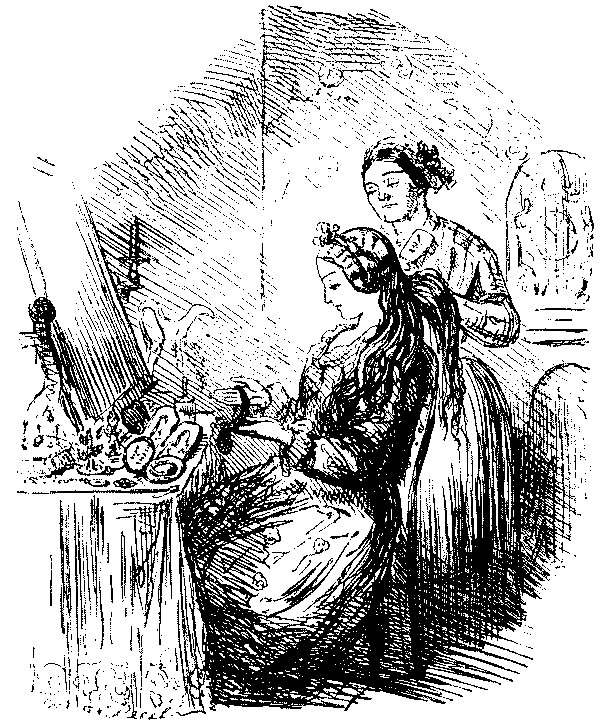
PIN MONEY
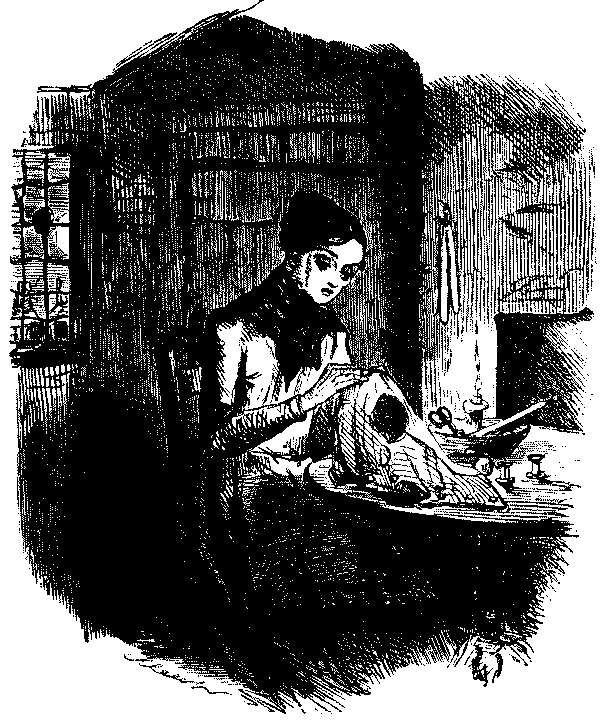
NEEDLE MONEY
Sir Robert Peel and Hood
The story of "The Song of the Shirt" is well told by Mr. M. H. Spielmann
in his History of "Punch". Mark Lemon proved himself a great editor
by deciding to publish the poem against the expressed opinions of his
colleagues, who thought it unsuitable for a comic journal, and also by
his omitting the one weak verse in the original MS. Strange to say, the
poem does not appear in the index. The sequel may be found in Peel's
correspondence, and does honour to a statesman who, while he lived,
received scant justice from Punch. Though the impact of Hood's burning
verses on public opinion was immense and abiding, Hood himself a year
later was dying in penury, of consumption. On November 16, 1844, Peel
wrote him a letter expressing admiration for his work, and offering him
a pension. "I am not conferring a private obligation upon you, but am
fulfilling the intentions of the Legislature, which has placed at the
disposal of the Crown a certain sum (miserable indeed in amount) in
recognition of public claims on the bounty of the Crown." All he asked
in return was that Hood would give him the opportunity of making his
personal acquaintance. That was impossible owing to the state of Hood's
health. Mrs. Hood wrote on January 14, 1845, to beg for prompt
assistance: Hood was dangerously ill and creditors were pressing. Peel
sent the £100 at once, and on February 17 Hood wrote to thank him "with
all the sincerity of a dying man" and to bid him a respectful farewell.
He could write no more, though he had wished to write one more paper.
Then follow these memorable words, even more needed now than they were
seventy-five years ago:—
Certain classes, at the poles of society, are already too far
asunder. It should be the duty of our writers to draw them nearer
by kindly attraction, not to aggravate existing repulsions and
place a wider moral gulf between rich and poor, with hate on one
side and fear on the other. But I am too weak for this task, the
last I had set myself. It is death that stops my pen, you see, not
a pension. God bless you, sir, and prosper all your measures for
the benefit of my beloved country.
Hood died on May 3, 1845, and was buried in Kensal Green, but more than
seven years later no tombstone marked his resting-place, and Punch was
moved to ask:—
If marble mark the soldier-statesman's grave,
If monuments adorn his place of sleep
Whose hand struck off the fetters from the slave,
And his who sought out woe in dungeons deep,
Did he not fight for Toil's sad sons and daughters?
Was not his voice loud for the worker's right?
Was he not potent to arrest the slaughters
Of Capital and Labour's desperate fight?
Eventually a tombstone was erected, bearing the words: "He sang the Song
of the Shirt," but the pension continued to his widow lapsed on her
death a year later. A sum of £800, collected by public subscription, was
all that was available for the children, Lord John Russell, then
Premier, having found himself unable to extend the pension for their
benefit, at a time when, as Punch reminded him, the Duchess of
Inverness, widow of the Duke of Sussex, was drawing a pension of £1,000
a year. "The Song of the Shirt" rang through the land, but it did not
end the hardships of the sweated sempstress. Within a year Punch was
moved to indignation by the story of Esther Pierce, paid 6d. for
embroidering eighty blossoms on a silk shawl, and charged with pawning
the goods of her employer. In 1848, under the heading "The Cheap Shirt
Market," we read of a woman prosecuted on a similar charge, who was paid
2s. 6d. a dozen for making up shirts, or 2½d. apiece, and on these
earnings supported herself, two children and a husband out of work. As
late as 1859 the sweated shirt makers were still receiving only 4s. 6d.
a dozen. No wonder is it that when the movement in favour of cottage
gardens was frowned upon in some quarters on the ground that flowers
here were "out of place," Punch retorted with the bitter jibe: "What
has the labourer to do with stocks but sit in them?"
The Duke of Norfolk's Panacea
No wonder again that a legal pillory of harsh sentences was a constant
feature of his pages in the 'forties and 'fifties. A humane magistrate
who refused in 1845 to hear a charge of wood-stealing from a hedge
brought against a man earning 7s. a week—the common rate at the time
for agricultural labourers—stated from the Bench that he knew of good
hands in Warwickshire who were earning only 3s. and 3s. 10d. a week.
Meat was a luxury: only the elders got bacon: the children potatoes and
salt: bread was 10d. a loaf. Yet this was the time when the Duke of
Norfolk seriously proposed that the poor should eke out their meagre
fare by the use of curry powder,[1] a suggestion that recalls the
historic comment of the French lady, shortly before the Revolution, on
hearing that the peasantry had no bread, "Then why don't they eat cake?"
Punch dealt faithfully with this ducal gaffe under the heading, "A
Real Blessing to Landlords":—
The genuine Anti-Appetitive Curry Powder, strongly recommended by
the Duke of Norfolk, is the labourer's only true substitute for
bread and meat. It possesses the singular property of deluding the
empty stomach into a sense of fullness, and is calculated to
relieve those distressing symptoms of vacuity which result from
living on seven shillings a week. It may be warranted to supersede
potatoes and bacon; containing in fact, in itself, the essence of
gammon; and one pinch dissolved in a tumbler of hot water is equal
to a pot of beer. Landed proprietors, not wishing to reduce their
rents, will find this preparation admirably calculated to reconcile
labourers with their present rate of wages by enabling them almost
entirely to dispense with food. Sold in pots, at from one shilling.
Agricultural societies supplied.
N.B.—A liberal allowance on taking a quantity.
In these years the Dukes were constantly in Mr. Punch's pillory; the
Duke of Marlborough for his harsh treatment of his tenantry in
connection with the Woodstock Election in 1844; the Duke of Buckingham
for prosecuting a rat-catcher, who was fined 18s. or fourteen days for
killing a leveret as big as a kitten, and about the same time for
prosecuting a poacher for damaging a fence to the amount of one penny;
the Duke of Sutherland, in the same year again, for the arbitrary rules
enforced on his estate, the whole county being parcelled out into
sheep-walks, which suggested to Punch that he should be dignified with
the Order of Mutton; the Duke of Richmond for apparently imagining that
agricultural troubles could be settled by the simple process of drinking
the health of the British labourer; the Duke of Atholl for closing Glen
Tilt. Even the Great Duke himself was not immune from criticism and
censure. He had done a great work in the past, but he was out of touch
with the times and lacking in sympathy with the people. His words
reflected his iron temperament: they were like tenpenny nails. In 1845
Punch made bold to suggest that the time for his going to grass had
arrived:—
The Times says "he is the leader of the aristocracy." Let him go
and lead the Dukes. He is fit for that, but not any longer for
governing us.... The old Duke should no longer block up the great
thoroughfare of civilisation—he should be quietly and respectfully
eliminated. For the future, let us have him and admire him—in
history.
Harsh Sentences on Children
Harsh sentences on juvenile delinquents and plebeian offenders under the
Game Laws and Sunday Trading Act, the harrying of vagrants, the
treatment of destitution as a crime, are a constant spur to Punch's
reforming zeal. The hard cases quoted from The Times and many
provincial papers include the flogging of a boy for accidentally killing
a leveret; the trial of a starving woman for the crime of stealing a
faggot worth a penny; the prosecution of two children, aged six and
twelve, for picking two handfuls of peas while walking in a field
through which there was a path, and the sending of the elder boy to gaol
for fourteen days in default of payment of a fine of 6d. and 13s. costs;
a sentence of six months' imprisonment for stealing a crab worth 1s.
6d.; the fining of a man 5s. by his vicar because his child, aged nine,
had sold a halfpenny worth of sweets to another child on Sunday—which
reminds Punch of Herod and the Innocents. In 1841 Lord Brougham, in
Parliament, during a discussion on prison discipline, stated that a man
"had been confined ten weeks, having been fined 1s., with 14s. costs,
because he was absent one Sunday from church." Then in 1846 we have the
case of a woman charged with "exciting charity," though she had not
solicited alms. As late as 1859 we read of a child of nine in Essex,
sent to prison for fourteen days and whipped for stealing 1\2-lb. of
butter. Small wonder is it that Punch was a fervent and convinced
anti-Sabbatarian, or that he wrote in 1846: "The State does not trouble
itself much with education in this country, but the most usual schools
for the young and destitute are the prisons." The alternatives of fine
or imprisonment heightened the evil, for while the poor delinquent went
to gaol the well-to-do offender escaped. Brutal assaults on women were
punished by a lenient fine, which the bully could generally pay;
fraudulent tradesmen were not deterred from repeating their offences by
a money penalty which they could easily afford; it was only the
penniless pilferer who was sure of prison. In 1844 we find Punch
tracing incendiarism in Suffolk to the greed of the farmers in keeping
wages down, and publishing Leech's famous cartoon "The Home of the Rick
Burner." Facit indignatio versum: here is the picture of "The Fine Old
English Gentleman of the Present Time"—in the middle of the Hungry
'Forties:—
I'll sing you a fine old song, improved by a modern pate,
Of a fine Old English Gentleman, who owns a large estate,
But pays the labourers on it a very shabby rate.
Some seven shillings each a week for early work and late,
Gives this fine Old English Gentleman, one of the present time.
In winter's cold, when poor and old for some assistance call,
And come to beg a trifle at the portals of his hall,
He refers them to the workhouse, that stands open wide for all;
For this is how the parish great relieve the parish small,
Like this fine Old English Gentleman, one of the present time.
Here is the portrait of the pauper:—
Houseless, famish'd, desp'rate man,
A ragged wretch am I!
And how, and when, and where I can,
I feed, and lodge, and lie.
And I must to the workhouse go,
If better may not be;
Ay, if, indeed! The workhouse! No!
The gaol—the gaol for me.
There shall I get the larger crust,
The warmer house-room there;
And choose a prison since I must,
I'll choose it for its fare.
The dog will snatch the biggest bone,
So much the wiser he:
Call me a dog—the name I'll own—
The gaol—the gaol for me.
The horror of the "Union" inspired some of the most moving pages in
Dickens' "Our Mutual Friend" some twenty years later. How deep and well
justified it was in the 'forties may be gathered from the scandal of the
Andover Union workhouse in '45, the habitual underfeeding of paupers,
and the frequent inquests at which verdicts of "natural death" were
returned on victims of neglect and even cruelty. The opposition to the
humane proposal to establish a lending library at the Greenwich
workhouse, following the example of Wandsworth, moved Punch to
indignant irony: "Food for a pauper's mind, indeed! It is quite enough
to have to find food for his body." In 1851 an inquiry into the
management of a workhouse near Leeds revealed that the inmates were fed
at a trough, six at a time. In 1857 the workhouse children at Bath were
not allowed to see the pantomime Jack and the Beanstalk. Owing to the
intervention of the Guardians, headed by a clergyman, the children were
actually stopped at the door of the theatre. But in "Dust from a
Bath-brick" Punch dusted the jackets of the Guardians in his best
style. Again and again we find him protesting against the regulation of
the new Poor Law which separated man and wife directly they entered the
workhouse. For professional mendicants he had no sympathy. Witness the
ironical lines on "The Jolly London Beggars":—
A fig for honest occupation,
Beggary's an easier trade;
Industry is mere starvation,
Mendicancy's better paid.
Bigamy or Divorce?
In the long campaign for the reform of the Marriage Laws Punch never
ceased to reiterate his conviction that cheap divorce was a better
remedy than the punishment of the brutal husband. Yet when Mr. Justice
Maule delivered his historic judgment in 1845, Punch hardly rendered
justice to that masterpiece of fruitful irony:—
WAGGERY OF THE BENCH
One Thomas Rollins, as poor as beggary, was arraigned as a
bigamist. His first wife had left him and become no better than one
of the wicked. Whereupon Rollins took another helpmate; and, for
such violation of the law, found himself face to face with Justice
Maule, who, as it will appear, happened to be in one of his
pleasantest humours. He told the culprit, and we doubt not with a
gravity of face worthy of the original Billy Lackaday, "that the
law was the same for him as it was for a rich man, and was equally
open for him, through its aid, to afford relief." In the like way
that turbot and champagne are the same to Lazarus as to Dives; if
Lazarus could only buy the taste of them. Beggar and rich man have
both the same papillary organs—a dignifying truth for the outcast
wanting a dinner! However, the droll Judge continued his
pleasantry:
"He (Rollins) should have brought an action against the man who
was living in the way stated with his wife, and he should have
obtained damages, and then should have gone to the Ecclesiastical
Court and obtained a divorce, which would have done what seemed to
have been done already, and then he should have gone to the House
of Lords, and, proving all his case and the preliminary
proceedings, have obtained a full and complete divorce; after
which he might, if he liked it, have married again."
There is a delicious vein of humour in this. It smacks of the grave,
earnest fun of Swift. How the jest increases in volume as we follow the
pauper from court to court—tarry with him awhile in the House of
Lords—and finally see him "married again." And then the Judge, in a
sustained spirit of drollery, observes:
"The prisoner might perhaps object to this, that he had not the
money to pay the expenses, which would amount to about £500 or
£600—perhaps he had not so many pence—but this did not exempt
him from paying the penalty for committing a felony, of which he
had been convicted."
Of course not. Therefore Thomas Rollins is in effect not punished for
marrying a second wife, but for the turpitude of wanting "about £500 or
£600," by means of which he might have rid himself of his first spouse.
In England the bonds of Hymen are only to be cut with a golden axe.
Assuredly there needs a slight alteration in the marriage service. "Whom
God hath joined, let no man put asunder," should be followed by these
words, "Unless paid about £500 or £600 to separate them."
Punch, we are afraid, was inclined, in those days at any rate, to
resent any attempt to usurp his functions as a public ironist, even by
those who were fighting on the same side as himself. Anyhow, he omitted
to mention that the judge sentenced Rollins to one day's imprisonment.
But later references to this famous judgment made it clear that Punch
recognized that the judge's irony was deliberate and animated by a
sincere desire for reform, not by mere irresponsible "waggery."
Against the Game Laws and their administration Punch waged a
continuous war. Squires were condemned for the damage done to land by
game kept up for the profit of the landlord, hares being fed at the
expense of the tenant farmer. John Bull worshipped rank and money, and
amongst his idols were hares, pheasants and partridges, with his "bold
peasantry" as their constant victims.
The Model Labourer
The Hon. Grantley Fitzhardinge Berkeley, M.P., who published a pamphlet
in 1845 defending the drastic treatment of poachers, was very roughly
handled for his calm assertion of the sacred rights of game; but perhaps
the most effective comment on the inequalities of life on the land is to
be found in the ironical portrait of "The Model Labourer" in the summer
of 1848:—
He supports a large family upon the smallest wages. He works from
twelve to fourteen hours a day. He rises early to dig in what he
calls his garden. He prefers his fireside to the alehouse, and has
only one pipe when he gets home, and then to bed. He attends church
regularly, with a clean smock frock and face, on Sundays, and waits
outside, when service is over, to pull his hair to his landlord,
or, in his absence, pays the same reverence to the steward. Beer
and he are perfect strangers, rarely meeting, except at Christmas
or harvest time; and as for spirits, he only knows them, like meat,
by name. He does not care for skittles. He never loses a day's work
by attending political meetings. Newspapers do not make him
discontented, for the simple reason that he cannot read. He
believes strongly in the fact of his belonging to the "Finest
Peasantry." He sends his children to school somehow, and gives them
the best boots and education he can. He attributes all blights, bad
seasons, failures, losses, accidents to the repeal of the Corn
Laws. He won't look at a hare, and imagines, in his respect for
rabbits, that Jack Sheppard was a poacher. He whitewashes his
cottage once a year. He is punctual with his rent, and somehow, by
some rare secret best known by his wages, he is never ill. He knows
absolutely nothing beyond the affairs of his parish, and does not
trouble himself greatly about them. If he has a vote, it is his
landlord's, of course. He joins in the cry of "Protection,"
wondering what it means, and puts his X most innocently to any
farmer's petition. He subscribes a penny a week to a Burial
Society. He erects triumphal arches, fills up a group of happy
tenants, shouts, sings, dances—any mockery or absurdity, to please
his master. He has an incurable horror of the Union, and his
greatest pride is to starve sooner than to solicit parish relief.
His children are taught the same creed. He prefers living with his
wife to being separated from her. His only amusement is the Annual
Agricultural Fat-and-Tallow Show; his greatest happiness if his
master's pig, which he has fattened, gets the prize. He struggles
on, existing rather than living, infinitely worse fed than the
beasts he gets up for the exhibitions—much less cared about than
the soil he cultivates; toiling without hope, spring, summer,
autumn and winter, his wages never higher—frequently less—and
perhaps after thirty years' unceasing labour, if he has been all
that time with the same landlord, he gets the munificent reward of
six-and-twopence, accompanied, it is true, with a warm eulogium on
his virtues by the President (a real Lord) for having brought up
ten children and several pigs upon five shillings a week. This is
the MODEL LABOURER, whose end of life is honourably fulfilled if he
is able, after a whole life's sowing for another, to reap a coffin
for himself to be buried in!
This is not an imaginary portrait, though some of the touches are
heightened by the artist. As for the vote, a good illustration is to be
found in the advertisement of the sale of the Earl of Ducie's domain in
1843, quoted by Punch on page 14 of Vol. v., including "the entire
village of Nymphfield, wherein are 66 houses and the Ducie Arms, with
political influence extending over 1,200 honest yeomen." As for the
exhibitions, with their rewards and prizes for the virtuous and
industrious poor, Punch was lavish of sarcasm at the expense of this
parsimonious and condescending benevolence, when the prizes represented
a miserable percentage on the profits which the recipients had earned
for their masters by special zeal. So we find him suggesting a prize of
£1 to the labourer who had lived the longest number of years on the
shortest commons, and during the same period Leech's cartoon of a show
where the prize pig is awarded £3 3s. and the prize peasant £2 2s. When
baby shows were introduced in the next decade, Lord Palmerston was drawn
with his prize agricultural baby, holding up a wizened old labourer with
the label "Prize, 30s. Labourer all his life and never wanted to improve
his condition." Punch's democratic distrust of Lords and Ladies
Bountiful was no doubt in part the cause of his hostility to the Young
England movement. From his account of the matter one might gather that
Disraeli identified himself with, if he did not actually originate, the
fashion of giving prizes to the working classes. Lord John Manners fell
an easy prey to "the Democritus of Fleet Street" (as the Daily
Telegraph called Punch in later years), when in "England's Trust and
other Poems" was penned the memorable cri de cœur:—
Though I could bear to view our crowded towns
Sink into hamlets or unpeopled downs;
Let wealth and commerce, laws and learning die,
But leave us still our old nobility.
Lord Shaftesbury
But "Young England" practised better than its poet preached. For proof
one need only turn to the history of the reform of the Factory Acts
which Punch unflinchingly supported, while rendering scant justice to
the man who started this "great campaign against the oppression of the
industrial poor" and carried it to a successful conclusion, or to some
of those who lent him most valuable assistance. Of Lord Ashley,
afterwards the seventh Earl of Shaftesbury, it has been said that if
there is a Seventh Heaven he is there. But he was a Tory, who had
opposed the Reform Bill of 1832, though he supported Catholic
Emancipation and resigned his seat for Dorset in 1846 in the belief that
the continuance of the Corn Laws was impracticable; he was an
aristocrat; he held pronounced Evangelical views and was a convinced
Sabbatarian. On all these grounds he was held suspect by Punch. Yet as
early as 1833 Lord Ashley was mainly instrumental in securing the
passage of a Factory Act, the scope of which was narrowed by the
hostility of Whigs, manufacturing capitalists and doctrinaire Radicals.
In 1840 he got a Commission appointed, whose report, published in 1842,
shocked the conscience of the nation and led to the introduction of a
Bill excluding women and children from mines. In the next phase of this
humane campaign, when Sir James Graham introduced a Government Bill to
regulate labour in factories, Disraeli and the "Young England" group
supported Ashley throughout against the refusal of the Government to
concede the ten-hour limit. But the Government, supported by Bright and
most of the Radical Free Traders, threw all its weight into the scale of
the millowners, carried the day against Ashley, "Young England" and most
of the official Whigs, and until 1847 the labour of boys from 13 to 18
years of age, and of girls and women to 21, stood at twelve hours a
day. The Act of 1847, which limited the hours of work for women and
children to ten hours, was imperfectly drafted, and the interpretation
placed upon it by the Courts enabled manufacturers to evade its
provisions. In 1850 the Government offered a compromise implying a
10½ hour day, which was reluctantly accepted by Lord Ashley. But
Disraeli supported Lord John Manners in protesting against this
compromise. As his biographers do well to remind us, he condemned it as
a breach of faith with the overworked population: the honour of
Parliament was concerned in not taking advantage of a legal flaw. The
Government again carried the day, but only for the moment; the objects
of its critics have long since been more than obtained. Disraeli's
speech on this occasion was "instinct with the spirit of Sybil"—his
finest and best constructed novel. Sybil was published in 1845, and
though in its essentials exhibiting a remarkable convergence with the
aims of Punch, was never mentioned by him at the time. Disraeli was a
Jew. Now Punch consistently supported the removal of Jewish
disabilities as an act of justice, and when rebuking the Exeter Hall
philanthropists for thinking that charity must begin abroad, and for
neglecting the starving sempstress for the apostate Jew, Chinese,
Hottentots, etc., gave them this excellent advice: "Ye who would convert
the Jews, first copy the Jews' great virtue; first take care of your own
poor; feed and clothe them, and then, if you will, with the superfluity
make converts of the Hebrews." But Punch was no lover of Jews, and
least of all of Disraeli. He soon recognized his abilities as a great
Parliamentary gladiator; he admitted his courage and tenacity. In the
main, however, Punch regarded him at this stage of his career as a
brilliant but undesirable alien, a flamboyant charlatan, an
untrustworthy and insincere patron of the agricultural interest. Yet
Sybil in its pictures of the inequalities and miseries of the social
and industrial system then prevailing, was conceived and executed
largely in the spirit of Hood's deathbed letter to Peel. Disraeli was
never more "on the side of the angels" than when he wrote the dialogue
between Egremont and the stranger. The stranger, after observing that
while Christianity teaches us to love our neighbours as ourselves,
modern society acknowledges no neighbour, adds that society, still in
its infancy, is beginning to feel its way. Egremont replies:—
The Two Nations
"Well, Society may be in its infancy; but, say what you like, our
Queen reigns over the greatest nation that ever existed." "Which
nation?" asked the younger stranger; "for she reigns over two." The
stranger paused. Egremont was silent, but looked inquiringly.
"Yes," resumed the younger stranger after a moment's interval, "two
nations; between whom there is no intercourse and no sympathy; who
are as ignorant of each other's habits, thoughts and feelings as if
they were dwellers in different zones, or inhabitants of different
planets; who are formed by a different breeding, and fed by a
different food, are ordered by different manners, and are not
governed by the same laws." "You speak of," said Egremont
hesitatingly,—"THE RICH AND THE POOR."
Disraeli's sumptuous upholstery, which Thackeray was so fond of
burlesquing, is occasionally apparent in Sybil, though one must not
forget his own explanation: "I write in irony, and they call it
bombast." For the rest the pictures of life in the agricultural and
industrial districts, the squalid wretchedness of cellar and hovel, the
evils of the truck system and the "tommy-shop" were never more luridly
painted by any Chartist writer than by Disraeli in Sybil. The details
are not exaggerated; they are borne out by sober historians such as S.
R. Gardiner in describing the conditions in Manchester, Bethnal Green
and Dorsetshire. Disraeli's inability to reproduce the speech of
artisans or peasants correctly is a negligible matter. He never made a
systematic tour in the slums as Lord Ashley did in preparation for his
campaign on behalf of Ragged Schools; he was not a literary realist; but
here he was in touch with realities, and we have his own word for it
that he wrote from personal observation. The heroes of the book are all
on the side of reform; Gerard, the people's leader; St. Lys, the
humanitarian parson; Egremont, an aristocrat converted from indifference
by contact with the poor; and the martyrs are the victims of the
existing system, agricultural labourers on 8s. a week and starving
hand-loom weavers. Disraeli has no use for the Lord Marneys and de
Mowbrays who complacently acquiesced in the serfdom of the slaves in
smock-frocks or even denied that they were badly off. They were not a
real aristocracy, a "corporation of the best and bravest," in Carlyle's
phrase. But for reasons already given Punch was not prepared to accept
Disraeli as an ally. He was too useful as a butt for satire and
ridicule, and his oriental personality was antipathetic to Punch's
eminently British mind. Moreover, in justice to Punch it must be
admitted that there were real divergences. Disraeli opposed the repeal
of the Corn Laws, though he lived to describe Protection as dead and
damned. The readjustment of the "Two Nations" which, as a leader of the
"Young England" movement, he proposed for the remedy and removal of the
distress and tumult and anger of the Hungry 'Forties, involved in his
view the strengthening of the Sovereign and the maintenance of the
leadership of the aristocracy. They were to be awakened to their
responsibilities and duties, but not shorn of their rights and
privileges. Punch was a thoroughgoing Free Trader and Corn Law
Repealer, a believer in measures rather than men, an unsparing critic of
Kings and Courts, and whenever he saw an aristocratic head, inclined to
hit it. "Young England" only served as a target for satire; Punch
refused to recognize the genuine idealism by which the best of the group
were animated. But, as one of their defenders has admitted, they were
not a real Party, and were concerned with principles rather than
specific measures of reform. Idealism which stopped short of immediate
action did not appeal to Punch. Though often a petulant and intolerant
critic, he was always on the look out for practical evidences of reform,
legislative, administrative or philanthropic. In 1842 he hailed the
decision to close the Fleet Prison, and when it was about to be
demolished, wrote in 1845: "Truly there are sermons in stones, and if
Beelzebub wanted to preach on the folly, cruelty, ignorance and
wickedness of men towards men, even he could not hit upon a more
suggestive text than is written—written in tears—on every stone of the
Fleet Prison." Of the efforts to bring justice within the reach of the
poor he was an impassioned advocate from the very first. When a police
magistrate expressed views of which he disapproved he did not hesitate
to describe him as "an insufferably ignorant, and therefore insolent,
magisterial cur"! That was in 1841. Four years later Punch
vociferously applauds a courageous magistrate who committed a
"gentleman" to the House of Correction for a brutal assault, and
welcomes a revolt against harsh sentences in the action of the Recorder
at the Central Criminal Court, who in 1847 refused to send a boy of
twelve to prison for stealing £4 12s. from his master "because if he
went to prison he might become an expert thief."
A Plot Against Prisons
In the year 1853 Punch discussed at length, under the title of "A Plot
against Prisons," and in the ironical vein which frequently exposed him
to misconception by his prosaic readers, "a dangerous conspiracy
organized for the purpose of defrauding the gallows and the hulks," and
initiated by one of the noblest of many noble Quaker philanthropists:—
The originator of the plot is one Joseph Sturge, who has founded an
establishment, called the Reformatory Institution, in Birmingham,
and placed it under the superintendence of another man named Ellis,
who formerly presided over a similar concern in London, being a
place of resort for young thieves, where they were inveigled, and
seduced into the abandonment of their dishonest calling. To this
end no pains were spared to render the paths of virtue seductive,
by blending as much amusement as possible with the particular
branch of industry the lads were instructed in. The man Ellis,
their enticer from the line of turpitude, is a shoemaker. He says
in his evidence, reported by the House of Commons:
"I used to go and sit with them for two or three hours a day, and I
used to tell them that they might, by governing their tongues,
their tempers and their appetites, and governing themselves
generally, be much more happy if they would put themselves in
harmony with the laws of their own physical nature; and I showed
them how wrong it was to break the social laws that bind society
together, and also the laws of God, and so forth. I considered that
my conversation with them for two or three hours had had a great
effect; and I provided them with wholesome food, and I gave them
clothes to wear, and I surrounded them with as many comforts as I
possibly could."
The Birmingham Institution, under the same management, has also
succeeded to such an extent that it is in contemplation to
establish another there on a larger scale; which, no doubt, will
most seriously tend to impair the utility of those magnificent
edifices, our gaols and bridewells, which everywhere afford such
vast but by no means empty accommodation. A meeting has been held,
Lord Calthorpe in the chair, to carry out the desired object, which
will tend to throw so many turnkeys out of employment, and to which
all persons are asked to subscribe who desire to rob Jack Ketch of
his livelihood, and the Government of convict labour, by
substituting prevention for cure—superseding prison discipline by
reformation.
High Life Below Stairs
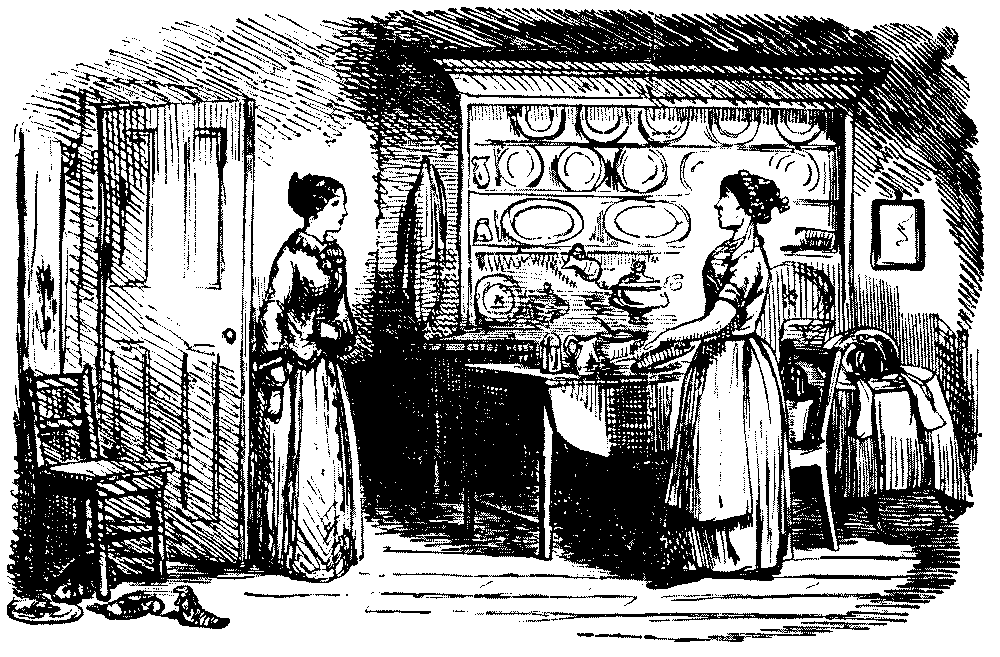
SERVANTGALISM
Cook: "Well, to be sure, Mum! Last place I were in Missis always knocked
at the door afore she come into the kitchen!!"
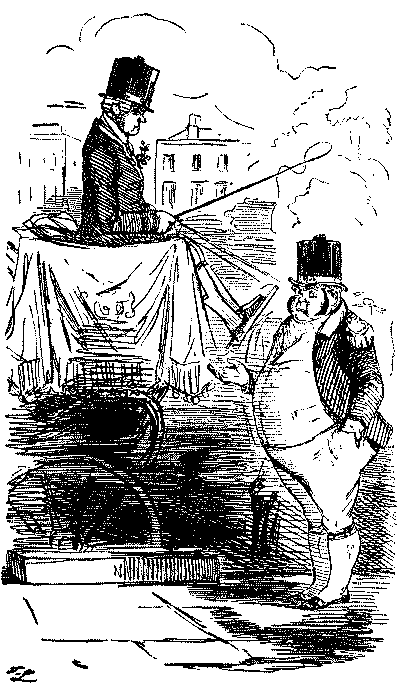
Coachman: "Why—what's the matter, John Thomas?"
Footman: "Matter enuff! Here's the marchioness bin and giv me notice
because I don't match Joseph, an' I must go, unless I can get my fat
down in a week!"
The relations of masters, mistresses and servants is a never ending
theme in the pages of Punch. His attitude was governed by the broad
principles that the labourer was worthy of his hire, and that those who
offered inadequate wages must expect neither character nor efficiency.
But he draws a clear distinction between the domestic slave and the
flunkey, holding that snobbery in employers was the chief cause of its
prevalence amongst highly paid servants. Punch was the champion of the
"slavey"—immortalized in Dickens's "Marchioness"—even of the
much-maligned charwoman; the relentless critic of Jeames, his plush and
powder and calves. As early as 1847 we find him supporting a reversal of
the old régime: the mistress must be approved by the servant, and
furnish a satisfactory character. The plea is not surprising, when
advertisements for a kitchen-maid, "wages £3 a year," appeared in a
fashionable paper and earned Punch's satire. Contrariwise, he never
spares the arrogance of "servantgalism" the assumption of "my lady the
housemaid." In this spirit Punch makes game of a school for servants
at Bristol, where lessons on the pianoforte were given, but if servant
girls and nurses were neglectful of their duties and their infant
charges, mistresses were equally to blame for their indolence and
disregard of parental responsibilities. But the keenest arrows in
Punch's quiver were reserved for "Jeames." He quotes from the columns
of The Times the advertisements of a footman, "tall, handsome, with
broad shoulders and extensive calves," who "prefers Belgravia or the
North Side of the Park," while a little later on another of this type
insists on "six months a year in town, and if in an unfashionable
neighbourhood, five guineas extra salary." If I refrain from quoting
from Thackeray's constant variations on this theme in the pages of
Punch, it is only because they are so familiar to readers of his
collected works. The etiquette of flunkeydom was peculiar. These
gorgeous and pampered menials had their grievances; they were "expected
to sit in church in a position from which the clergyman could neither be
seen nor heard," as Punch put it in 1851. Liveried servants were not
allowed in Rawstorne Street Chapel, Brompton, in 1846, and a protest was
made in the Press that at St. George's, Hanover Square, "the real
aristocracy of the land are separated from their liveried domestics by a
mere oak panelling." But in this war on flunkeyism "Jeames" was not the
real enemy; it was rather the genius of snobbery which Punch
impersonated in "Jenkins" of the Morning Post (or Morning Plush, as
he called it), whose fulsome and lyrical rhapsodies are held up to
ridicule in number after number. In this context two extracts may
suffice, from an account of the galaxy of rank and fashion at the Opera
which appeared in the Morning Post:
It is, above all, necessary that the middle classes and the poor
should see and feel that if the aristocracy has the monopoly of
titles and the lion's share of the dignities and offices of the
State, instead of hoarding, it nobly expends its revenues in those
luxuries which emanate from the ingenuity and labour of the
industrious.
And again—the italics and capitals are Punch's:—
Ever since the Italian lyrical drama crossed the Alps in the suites
of the tasteful Medicis, its vogue has daily increased, it has
become a ruling passion—it is the quintessence of all civilized
pleasures; and wherever its principal virtuosi hoist their
standard, there for the time is the CAPITAL OF EUROPE, where the
most illustrious, noble, elegant and tasteful members of society
assemble.
These ornaments of society are in general absent at the too early
opening of Her Majesty's Theatre; but on Saturday, as we surveyed
the house previous to the overture, most of those who constitute
society in England—those whom we respect, esteem or
love—rapidly filled the house.
Every seat in every part of it was occupied, and if those
objectionable spectators were there—those gentlemen of ambiguous
gentility, the fashionable couriers, valets, tailors and
shoemakers, who obtain admission to the pit on the strength of
knowing the measure of some actor or actress's foot—they and
their frowsy dames were so nailed to their benches as not to
offend the eye.
These effusions, and others equally unbridled in their assertion of the
divinity of kings and coronets, prompted Punch to adorn "Jenkins" with
the alias of Lickspittleoff. It was not a nice name, but Punch might
have retorted tâchez de ne pas le mériter.
The Underpaid Governess
From servants to governesses the transition in those days was only too
easy. Punch's study of the advertisements in this branch of the "slave
market" began early, and let us hope to good purpose, though as I write
the comparative rates of remuneration for cooks and teachers are still
open to criticism. In the autumn of 1843, commenting on an advertisement
in The Times, in which "S. S." offered a salary of £2 a month to "a
morning daily governess of ladylike manners for three or four young
female pupils, capable of imparting a sound English education, with
French, music and singing, dancing and drawing, unassisted by masters,"
Punch observes:—
How very much would it surprise the race of S.S.'s; what a look of
offended virtue would they put on were somebody to exclaim to them,
"It is such as you who help to fill our streets, and throng the
saloons of our theatres; it is such as you who make the Magdalen
indispensable." We have recently read the statistics of insanity,
and have found governesses to be in a frightful disproportion to
other educated classes. Can this be wondered at when we read such
offers as those of S.S.?
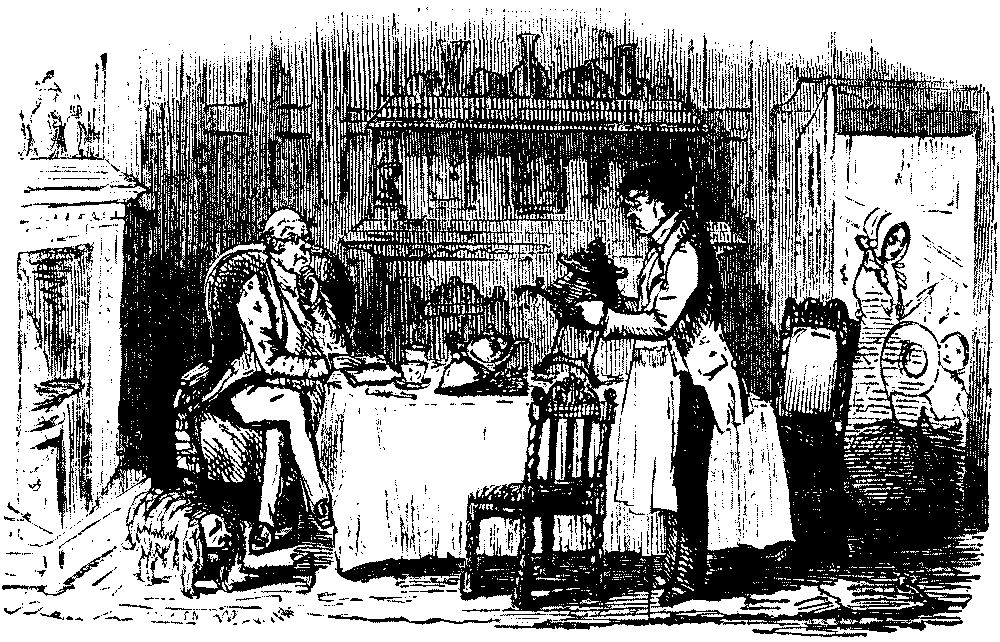
Thomas gives warning because his master has given up
reading prayers, and he can't bemean himself by "sayin' 'Amen' to a
governess."
The terms of £2 a month were, however, liberal compared with those
offered by other employers. An assistant in a ladies' school was
expected to teach English, French and music for £1 a quarter, while not
at all infrequently the offer of board and lodging was regarded as an
excuse for dispensing with a salary altogether. In dealing with the
problem of these "Sisters of Misery," Punch waxes ironical on the
results of their improvidence:—
If in the course of ten years, with a salary of, let us say, twenty
pounds a year, out of which she has only to buy clothes fit to keep
company with the children, the governess has not saved a
sufficiency for her declining age, it is but too painful to know
that she must have been a very profuse, improvident person. And
yet, I fear me, there are lamentable instances of such
indiscretion. I myself, at this moment, know a spendthrift creature
who, as I have heard, in her prime—that is, for the ten
years—lived in one family. Two of her pupils are now countesses.
Well, she had saved next to nothing, and when discharged she sank
lower and lower as a daily governess, and at length absolutely
taught French, Italian, and the harp to the daughters of small
tradesmen at eighteenpence a lesson. In time she, of course, got
too old for this. She now lives somewhere at Camberwell, and though
sand-blind, keeps a sixpenny school for little boys and girls of
the lower orders. With this, and the profits on her cakes, she
continues to eke out a miserable existence—a sad example, if they
would only be warned, to improvident governesses.
A Real Dotheboys Hall
Punch's attentive study of the curiosities of literature in
advertisements relating to education continued for many years. A batch
of them extracted from The Times appears in the issue of August 14,
1853, and pillories the meanness of ladies who wished to secure
governesses without salaries, or, as an alternative, to turn their
houses into boarding schools and get assistants without paying for them.
Already, some three weeks earlier, Punch had quoted from The Times
the advertisement of an academy for young gentlemen near Richmond, in
Yorkshire, where youths were "boarded, furnished with books, and
instructed in whatever their future prospects might require for twenty
and twenty-two guineas a year. No vacations unless desired." On this
"Dotheboys Hall" in real life Punch observes that while such a price
for a year's food for mind and body is a miracle of cheapness, "the age
of miracles has passed, and especially—after the publication of
Nicholas Nickleby—of such miracles as this." Yet an advertisement of
a school in Essex on almost precisely similar lines survived for at
least forty years after Punch's protest, as the present writer can
testify. Nor were the claims of the underpaid official forgotten. In his
"Penny Post Medal" Punch endeavoured to illustrate the triumph of
Rowland Hill, and waxed lyrical over his achievement, indignant over his
treatment:—
Beautiful, much more beautiful, to the eye of the philosopher
Punch, is the red coat of the Postman with his bundle of penny
missives than the scarlet coat of the Life Guardsman! For the
Postman is the soldier of peace—the humanizing, benevolent
distributor of records of hopes, affections, tenderest
associations. He is the philanthropic go-between—the cheap and
constant communicant betwixt man and man.
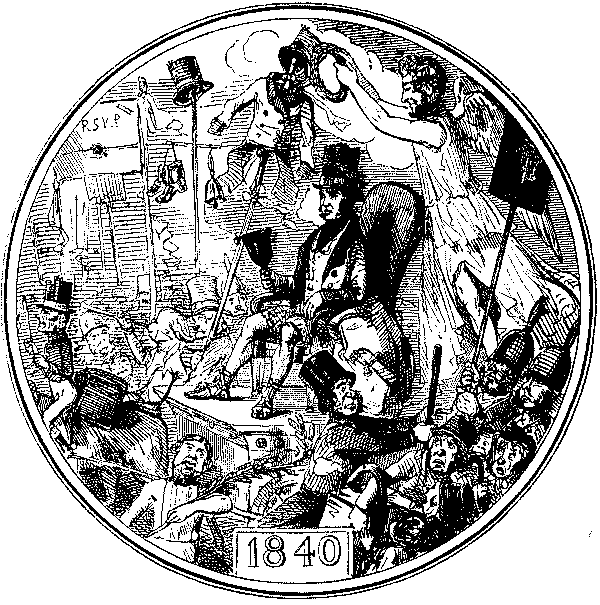
ROWLAND HILL'S TRIUMPHAL ENTRY INTO
ST. MARTIN'S-LE-GRAND
In the Penny Post Medal Punch has endeavoured to show the triumph
of Rowland Hill—no Greek or Roman triumph e'er so great—carried
in well-earned glory into the Post-office, Saint Martin's-le-Grand.
If the beholder have any imagination, he will hear huzzaing
shouts—he will hear all the street-door knockers of the kingdom
for that moment instinct with joyous life, loudly knock, knock,
knocking in thundering accord. Such is the triumph of Rowland Hill.
Rowland Hill's Reward
Turn we to the Obverse. It shows an old story; old as the
ingratitude of man—old as the Old Serpent. Sir Robert Peel, the
Tory Minister, no sooner gets into place than, in reward for the
services of Mr. Rowland Hill, he turns him from the Post Office!
or as it is allegorically shown, he, as Britannia, presents him
with—the sack.
After this, a subscription is set afoot to which Sir Robert, with
Magdalen penitence, subscribes ten pounds! Ten Pounds! It must be
owned a very small plaister to heal so cruel a cut!
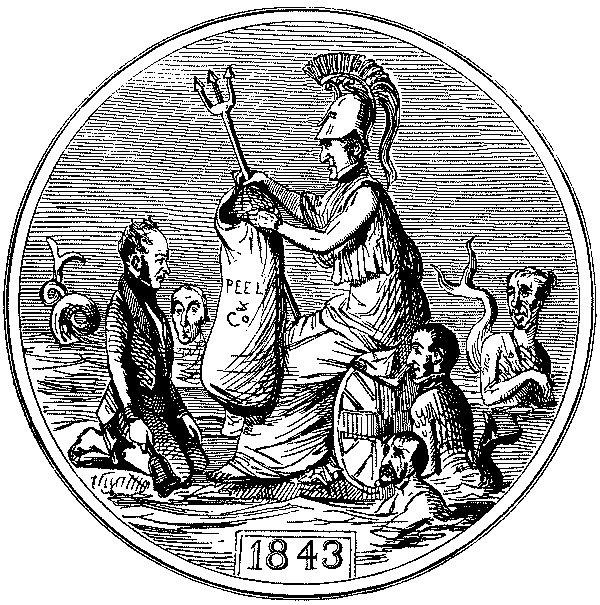
BRITANNIA PRESENTING ROWLAND HILL WITH THE SACK
But these beneficent "red-coated genii" were "cruelly ill-paid" for long
and arduous labour. "His walk in life is frequently such a walk that it
is a wonder he has a leg to stand upon; for he travels some twenty or
thirty miles a day, to the equal wear and tear of body and sole. For
this his salary is a guinea a week." Accordingly, when in 1848 Post
Office robberies were frequent, Punch, without excusing theft,
regarded it as the natural result of this miserable pittance.
Under-payment has always been a great incentive to dishonesty, and in
1848 we have Punch's assurance that the postmen were the worst paid of
all Government employees.
The long fight for early closing, for the Saturday half-holiday, and for
reasonable Sunday recreation, found unflinching support in Punch from
his earliest years. He did not, it is true, profess a burning sympathy
with the bank clerks in 1842 when they were agitating for a closure at 4
instead of 5 p.m., but he was wholeheartedly on the side of the shop
assistants, especially in the linendrapers' and milliners'
establishments. One of his earliest incursions into this controversy
took the form of a report of an imaginary meeting of duchesses at
Almack's, at which resolutions were passed deprecating, in a contrite
spirit, the overworking of milliners' assistants, and establishing an
association to persuade dressmakers to reduce the hours of work to eight
a day, abolish Sunday work, afford reasonable time to execute orders,
provide medical advice and change of air for the sick, and start a fund
to carry out these aims (May 27, 1843). These aims have long been
realized in all well-conducted shops, but they were something like
counsels of perfection in the year of "The Song of the Shirt." But
Punch's irony at the expense of inconsiderate shoppers in "Beauty and
Business versus Early Shops," and "Directions to Ladies for Shopping,"
not only tilts at femininity's little ways, but shows that human nature
has not materially changed in the last seventy-five years. Punch was
moved by the hardships of dressmakers and shop-girls, whom he compared
to convicts: "hard labour" was no worse than theirs. He frankly
advocated the boycotting of a money-grubbing hosier in Cheapside, who
kept his shop open until nine or ten o'clock, though all the other
hosiers in that thoroughfare had for two years closed theirs at
eight—for that was as far as early closing had reached in the 'fifties.
But Punch was always a moderate reformer, very far from being a
revolutionary, and he condemned with great asperity an attempt to launch
an experiment mildly foreshadowing modern syndicalism:—
Syndicalism in the 'Forties
Notwithstanding our desire to aid the assistant drapers in any
reasonable movement, we cannot encourage them in the foolery which,
according to a prospectus of the Metropolitan Assistant Drapers'
Company, they seem to contemplate. They are coolly asking the
public for £150,000 in 15,000 shares of ten pounds each, to start a
model establishment, in which the assistants shall be their own
masters, choose their own work, take their own time, and seize
"every opportunity for indulging in all healthy pursuits and
reasonable enjoyments." The prospectus then goes on to state, that
the assistants will become "free and happy, as they should be." If
a linendraper's shop is to be turned into a state of "freedom and
happiness" all day long, it may suit the shop-boys well enough, but
it will not be quite so agreeable to the customers.
Holding it to be his duty "to smash humbug of every description,"
Punch, after an examination of the financial proposals of the "free
and happy" linendrapers, pronounces them guilty of very gross humbug in
putting forward their prospectus. The control of industry by the workers
formed no part of his schemes for bettering their condition.
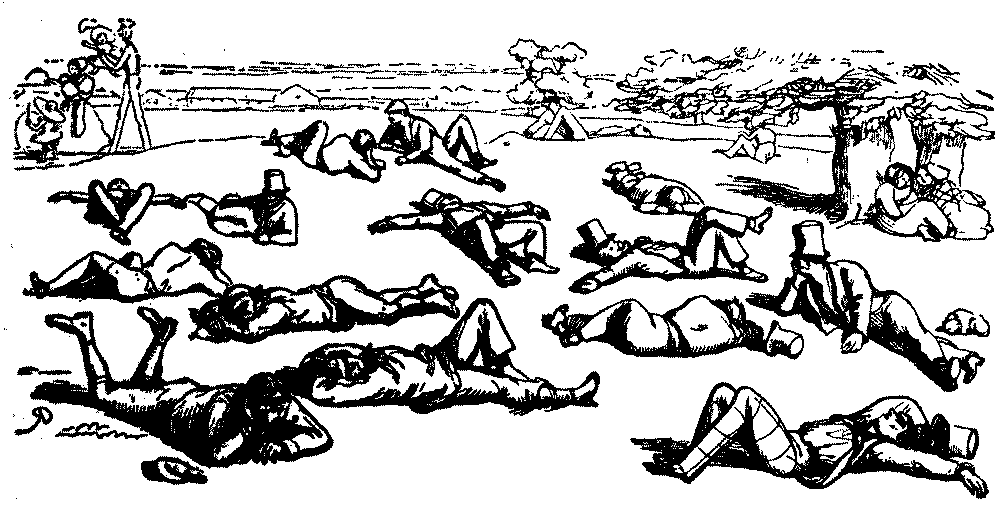
A View in Hyde Park, showing the proposed site for the
Exhibition of Industry.
SPECIMEN OF MR PUNCH'S INDUSTRIAL EXHIBITION OF 1850 (TO
BE IMPROVED IN 1851)
In the period under review Sunday was, speaking broadly, the only
holiday of the working classes. Punch's views on their recreations,
therefore, were necessarily governed by his views on Sunday observance,
Sunday trading and Sabbatarianism generally. Let it be noted at the
outset that he was no advocate of the Continental Sunday: he was all for
keeping Sunday quiet, even dull. But against any legal or other
restrictions, which thwarted poor people's innocent enjoyment and
recreation, he ranged himself as an uncompromising adversary. As we have
seen, he indignantly resented the fining of boys for playing cricket, or
children for selling sweets, on Sunday. He supported the opening of
museums and picture galleries on Sundays as early as August, 1842, and,
in recording the defeat of the motion in the Commons, ends his comments
on "The Pharisees' Sunday" with the remark: "The Museum and the National
Gallery are, for the present, closed on Sundays; so for a time there are
left for the people—the Eagle Tavern and the Red House at Battersea."
Punch vehemently assailed the snobbery which sought to exclude working
men and poor children from the parks. He welcomed the opening of the
Zoological Gardens to the public in 1848 at a low charge, without a
"Fellow's order," plus a shilling. But of all the movements which
inspired him with hope for the future, none offered brighter prospects
than the great Exhibition of 1851. It was Douglas Jerrold who coined the
name of the "Crystal Palace." Punch had some misgivings as to the
encroachment of the buildings on public amenities and rights, and warmly
espoused the cause of Ann Hicks, whose family for 118 years had held
possession of an apple stall in Hyde Park. Her grandfather, it was
alleged, had saved George II from drowning in the Serpentine! The stall
was removed and Ann Hicks allowed five shillings a week for one year,
but, largely owing to Punch's intervention, was assisted to emigrate
to Australia. And Punch was indignant at the suggested exclusion of
the public on the opening day, May 1, 1851, for fear of annoying the
Royal family. But these misgivings were happily removed, and the opening
of the Exhibition marked a turning point in the long campaign of
criticism, frank to the verge of discourtesy and indecorum, sometimes
justified, but often malicious, which Punch had
conducted against
the Court in general and the Prince Consort in particular. He made the
amende handsomely in his "own report of the opening of the great
Exhibition":—
At length a cheer without, and a flourish of trumpets within,
announce the arrival of the Queen—and the Prince, who, by the idea
of this Exhibition, has given to Royal Consortship a new glory, or,
rather, has rendered for ever illustrious, in his own case, a
position too often vibrating between the mischievous and the
insignificant. Prince Albert has done a great service to humanity,
and earned imperishable fame for himself by an idea, the greatness
of which, instead of becoming less, will appear still greater as it
recedes from us.... Beyond comparison, the most gratifying incident
of the day was the promenade of the Queen and Prince, holding by
the hand their two eldest children, through the whole of the lower
range of the building. It was a magnificent lesson for
foreigners—and especially for the Prussian princes, who cannot
stir abroad without an armed escort—to see how securely and
confidently a young female Sovereign and her family could walk in
the closest possible contact, near enough to be touched by almost
everyone, with five-and-twenty thousand people, selected from no
class, and requiring only the sum of forty-two shillings as a
qualification for the nearest proximity with royalty. Here was a
splendid example of that real freedom on the one hand, and perfect
security on the other, which are the result of our constitutional
monarchy, and which all the despotism and republicanism of the
world cannot obtain elsewhere, let them go on as long as they may,
executing each other in the name of order, or cutting each other's
throats in the name of liberty.
The only blot, as we thought, upon the whole proceedings were the
unnatural and crab-like movements of one of our wealthiest peers,
the Marquess of Westminster, and his fellow-official, the Lord
Chamberlain, whose part in the pageant consisted of the difficult,
but not very dignified, feat of walking backwards during the
progress of the procession. We hope the time is not far distant
when, among the other sensible arrangements of the present reign, a
wealthy nobleman may be released from the humiliation of having to
perform before the Sovereign and the public a series of awkward
evolutions, which not all the skill of the posture-master can
redeem from the absurdity attaching to the contortions of the
mountebank.
Punch could not resist having a dig at the aristocrat courtiers, but
he had nothing but praise for the Queen and the Prince Consort, and
especially for their practice of visiting the Exhibition on the
"shilling days." As he put it in the lines "Victoria Felix",:—
Heaven's duteous sunshine waits upon her going,
And with it blends a sunshine brighter still—
The loyal love of a great people, knowing
That building up is better than o'erthrowing;
That freedom lies in taming of self-will.
Punch's loyalty to the Sovereign, however, did not cause him to forget
the workers. He suggests to Prince Albert that a dinner should be given
to the workmen who erected the building. As for Paxton, the architect,
Punch agreed with the Examiner that a knighthood was not a
sufficient reward for his services, and suggested that he should be
given a share of the profits. But Punch was from the first concerned
with the future of the building; with the possibilities of transforming
it into a permanent People's Palace. So when Paxton asked "What is to
become of the Crystal Palace?" and answered his own question by saying
"Let the Crystal Palace become a winter park under glass," with rare
flowers and plants and a colossal aviary, Punch voted the suggestion
of the Crystal Magician "delightful and practicable," for, as he notes,
on the testimony of "the princely Devonshire, Mr. Paxton never failed in
anything he undertook." Nay, Punch went so far as to depict, in a
cartoon, John Bull contemplating the marvels of the winter garden. The
scheme lapsed, and in the spring of 1852 Punch was indignant at the
imminent sale of the Crystal Palace, and lavish of gibes at the "nobs
and snobs" who despised the masses:—
THE PEOPLE AND THEIR PALACE
The People! I weally am sick of the wawd:
The People is ugly, unpleasant, absawd;
Wha-evaw they go, it is always the case,
They are shaw to destwoy all the chawm of the place.
They are all vewy well in their own pwopa spheeaw,
A long distance off; but I don't like them neeaw;
The slams is the place faw a popula show;
Don't encouwage the People to spoil Wotten Wow.
It is odd that the Duke of Awgyll could pasue
So eccentric a cawse, and Lad Shaftesbuwy too,
As to twy and pwesawve the Glass House on its site,
Faw no weason on awth but the People's delight.
The Queen, in an excellent parody of "The May Queen," is credited with
the desire to keep up the Palace; Punch threw all his weight on the
side of Paxton in his efforts to defeat the obstructives, and when, in
June, 1852, the move to Sydenham was finally decided on, he prophesied a
great future for that favoured suburb. The "christening" took place in
August, and furnished Punch with an opportunity for answering the
reproach that "the English don't know how to amuse themselves":—
The great cause of Peace had every fitting honour paid to it on
Thursday last at Sydenham. In its train followed some of the
greatest celebrities of the day, all children of the people, who
had come to assist at the christening of their new Palace. The Arts
and Sciences, of course, were there, and gave the cause their
blessing, until such time when they could give it something, if not
more pure, at least more tangible. Literature, too, was there, and
promised to devote its best pen to the service of the new
principle, and Trade and Commerce had already sent off their ships
to collect treasure to pour into the lap of their beautiful, but
too long neglected child, as soon as the Palace was in a fit state
to receive them. And the Poor advanced, and, opening their hearts,
gave the cause their best wishes—and these were deposited with the
coins of the realm, and are to form the foundation of the new
building. Never was Palace begun upon so strong a foundation
before!
If only half the promises are fulfilled that were made at its
christening, this Palace of the People will be the grandest palace
ever constructed. And, in truth, it should be so! The people have
built palaces sufficiently for others; it is but proper now they
built one for themselves.
And when it is built it will be time enough to inquire if
Englishmen know how to amuse themselves. They have had hitherto so
few opportunities of learning, that it is ungracious to ask at
present. In the meantime we wish them every enjoyment in their new
playground at Sydenham. It will be the most beautiful playground in
the world.
Sabbatarian Solicitude
Punch's generous anticipations, in part illusory, were mingled
with wrath against militant Sabbatarians, over-zealous for the
souls of their fellow-creatures. A deputation, headed by the
Archbishop of Canterbury, the Bishops of London and Winchester, and
the Earl of Shaftesbury, lost no time in waiting on Lord Derby, in
order to urge upon the Prime Minister "the expediency of adopting
measures to prevent the Crystal Palace, or its grounds, being
opened to the public on Sundays." Punch is bitterly sarcastic
against this condescending solicitude on the part of peers and
prelates for the spiritual welfare of the vulgar cockneys, snips,
snobs, mechanics, shopmen, and their womenkind; creatures that not
only consume tea and shrimps, periwinkles, and ginger-beer, but
also smoke pipes and penny Pickwicks! The people must feel
flattered that they are thus, sympathized with by the superior
classes; only perhaps they would rather the sympathy were shown
otherwise than by excluding them from pure air and enjoyment—in
great tenderness for their immortal part, but with small
consideration for their perishable lungs.
But the attack was not solely based on religious grounds. The Morning
Herald scented revolution in the proposal, and Punch was moved to
address an ironical warning to the Home Secretary:—
A word in your ear, Mr. Walpole. There is treason, hydra-headed
treason hatching. Now, we are not joking. Were we inclined to be
droll, we would not cast our jokes before certain Home Secretaries.
Hush! This way. In a corner, if you please.
Do you ever see the Morning Herald? We thought so. Somehow, you
look as if you did. Still, we have brought a copy. Here it is. A
leader on the treasonous atrocities contemplated by the traitorous
projectors of the Crystal Palace in Penge Park! We will read
you—when we can get a good mouthful of breath—a few of the lines:
the dreadful lines. You see, the Palace is to be open on Sundays
after one o'clock. In that fact the Herald sees revolution,
anarchy, and perhaps—a future republic with John Cromwell Bright
in Buckingham Palace! Listen:
"'Go to mass on the Sabbath morning' is the Church of Rome's
command; 'then go to the park, the ball, or the theatre.' That is
the Sabbath of Paris, of Munich, of Vienna, and, we are sorry to
say, of Berlin also. And, as one natural result, a single month,
in 1848, saw the Sovereigns of Paris, of Vienna, of Munich, and of
Berlin fugitives before their rebellious subjects. The people of
England remained untouched by this sudden madness; they were loyal
to their Queen, because they feared their God!"
You will perceive, Right Honourable Sir, that had the Palace
existed in Penge Park in 1848, the British Throne would have gone
to bits like a smashed decanter. The Queen has only continued to
reign because there has been no People's Palace!
We see, Sir, you are moved, but let us go on.
"The Crystal Palace will be the main engine for introducing the
Continental Sabbath among us. The people may go to church, it will
be said, and then they may go down to Sydenham and enjoy a walk
in the Crystal Palace, and what harm can that do? Just all the
harm in the world. Open and naked profaneness would shock most
persons, but this mixture of religion and dissipation will ruin
myriads!"
Punch, on the contrary, believed that, in spite of the fulminations of
Exeter Hall, the Crystal Palace, with its art treasures, and the setting
provided by the wonder-working Paxton, would become the People's Sunday
School, and a monster extinguisher of gin palaces. So we find him
printing a mock protest from publicans against the desecration of the
Sabbath by the proposed opening of the Crystal Palace after morning
service.
Punch's views on temperance were eminently moderate. It is true that
in one of his early numbers he had depicted, in the cartoons of "The Gin
Drop" and "The Water Drop," the horrors of drunkenness in the vein of
Cruickshank; true also that he expressed admiration for the crusade of
Father Mathew. He condemned excess, but he was no enemy of conviviality.
Indeed he was up in arms against those who sought to "rob a poor man of
his beer." In his view the best antidotes to intemperance were to be
found in recreation and education, and in using Sunday to promote those
ends. He severely criticised in the autumn of 1845 the provisions of the
new Beer Bill, which prevented excursionists from obtaining needful
refreshment at an inn, not only at unreasonable, but at reasonable
hours, and protested against the closing of these hospitable portals
against them on Sunday, "and perhaps very soon on every other day, if
gentlemen, who can go to clubs, as well as to church, being blest with
affluence, and, therefore, belonging to the better classes, continue to
legislate in their present spirit for himself (the excursionist) and the
rest of the worse—that is the worse off."
Punch at the Palace
Meanwhile the Crystal Palace had been opened by the Queen on Saturday,
June 10, 1854. Punch describes the imaginary visit which he paid a few
days earlier to inspect the building and, by special command of the
Queen, to report as to its probable readiness for her reception on the
opening day. After being conducted through the building by Sir Joseph
Paxton, he explained that it was not his intention to be present at the
inaugural ceremony:—
He was the godfather of the edifice, having originally invented and
conferred upon it the title of the Crystal Palace; but he should
leave to his friend the Archbishop the entire solemnities of the
day, including an announcement which Dr. Sumner had most kindly
undertaken to make, namely, that at the special instance of the
Queen, arrangements would be at once effected for opening the
Palace on Sundays.
Fact is tempered with fancy in this account, as well as in his
optimistic report of the meeting of Crystal Palace shareholders; it
characterizes, too, the series of humorous handbooks to the Crystal
Palace, which appeared in the pages of Punch in the following months.
But we find in the remarks put into the mouth of Mr. Laing, the
chairman, a very good summary of his own views:—
On reflection it had been thought better that men, under the
crystal roof, should temperately refresh themselves—all mutually
sustaining one another even by their own self-respect of the
decencies of life, there and then in their own Crystal Palace—than
that, turned away hungering and athirst, they should be absorbed in
the holes and corners of surrounding public-houses.
The subsequent history of the Crystal Palace hardly fulfilled Punch's
sanguine expectations of its future as a great people's playground and
school. Intermittently it fulfilled this function, but as an educational
institution it served the needs of the suburban residents rather than
those of the great public; its entertainments were in the main supported
by the patronage of the middle and well-to-do classes. As years went on
the Crystal Palace, owing to its distance from London, suffered
seriously from the competition of the series of exhibitions at Earl's
Court. Yet one who is old enough, as the present writer is, to remember
visits in his school days in the early 'seventies—recurrent Handel
festivals from the days when Costa was conductor and Patti was in her
golden prime; flower and dog and cat shows; the glory of the
rhododendron shrubberies; pantomimes and firework displays; and, above
all, the admirable Saturday concerts, which drew musical London for some
forty years—such a one, and there must be many like him, will always
look back on the Crystal Palace with grateful affection, and hold in
reverence the names of Paxton and Ferguson, George Grove and August
Manns, and many other good men and true who laboured to realize
Punch's ideal.


