The pageant of the Victorian age reached its grand climacteric in the
period on which we now enter. As a "drum and trumpet chronicle" the
history of the eighteen years from 1874 to 1892 was void of any British
military operations on the grand scale. Of the names Kandahar, Maiwand,
Isandhlwana, Majuba, Khartoum and Tel-el-Kebir only the first and last
minister to our complacency. Yet the achievements of Lord Roberts in
the two Afghan campaigns were splendid examples of bold leadership
and British endurance, and Lord Wolseley's suppression of the revolt
of Arabi was more than efficient. In the mid 'seventies Germany came
perilously near forcing a fresh war on France; but the influence of
the British Crown and Government was largely instrumental in averting
the calamity. We were twice on the verge of war with Russia in 1878,
first in April after the Treaty of San Stefano at the close of the
Russo-Turkish war, and second in July over Russia's intervention in
Afghanistan. The country was divided, for while there had been a
revival of the old distrust of Russia, Gladstone had thrown the whole
weight of his influence into the campaign of protest against the
"Bulgarian atrocities." The Government, on the whole, steered a middle
course between the "Jingoes" and those who supported Gladstone's "bag
and baggage" policy towards the Turks. At the height of the Tory Press
campaign against Russia, Lord Salisbury, in a speech in the City,
observed: "It has been generally acknowledged to be madness to go to
war for an idea, but it is yet more unsatisfactory to go to war against
a nightmare." Punch, who was never pro-Russian, but at the moment was
strongly anti-Turk, interpreted this saying as a caution against Jingo
scaremongering.
In one of the earliest of his cartoons on the possibility of war over
the Eastern question, he represented Disraeli standing on the edge
of a precipice with Britannia, asking her to move "just a leetle
nearer." Britannia declines to move one inch farther, adding, "I'm a
good deal nearer than is pleasant already." But four months later, in
May, 1878, when he showed Britannia between two advisers, Disraeli
and Bright[1]—the former wearing a sword camouflaged with an olive
wreath—Punch supported neither, but applauded the third Voice, that
of Neutrality. Professorial intervention he resented strongly; and
severely rebuked Freeman, the historian, for a violent and unpatriotic
speech. In fine, he was equally down on the blatant bunkum of the
music-halls and the ill-considered agitation of fussy Pacificists; on
War-Donkeys and Peace-Donkeys; "Asses are asses, whether bound in Lion
or in Calf."
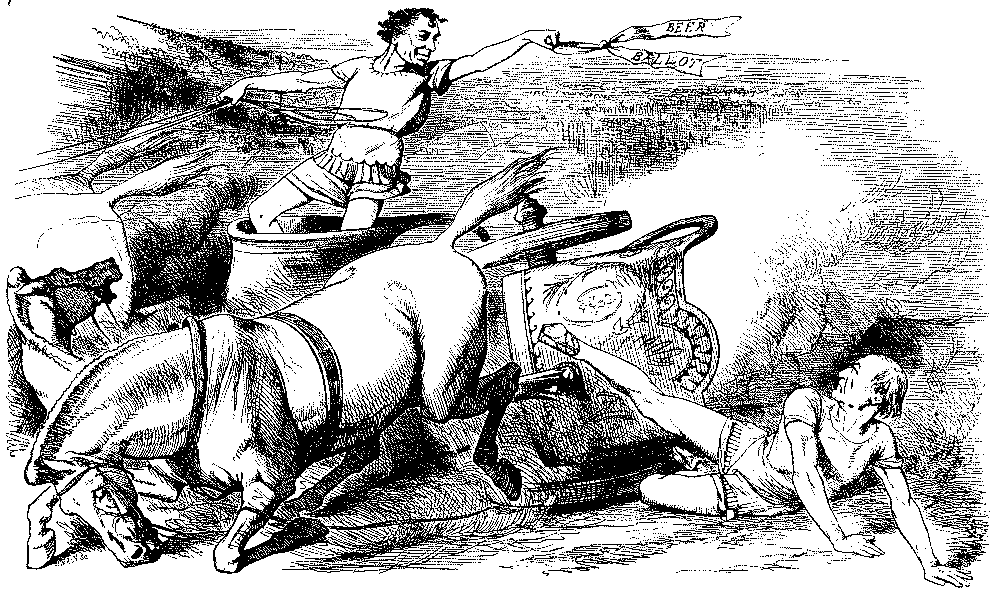
NATIONAL SPRING MEETING, 1874: THE FINAL HEAT
But if in Europe Great Britain never got beyond the stage of naval
demonstrations and the summoning of troops from India, these eighteen
years were not devoid of great as well as spectacular events. They
opened with the triumphant return to power of Disraeli, admirably
symbolized in Tenniel's great cartoon of the chariot driver and his
fallen rival, and with his efforts to translate into practical politics
his grandiose doctrines of Imperialism. He made the Queen Empress
of India, he riveted our hold on the Suez Canal by the opportune
purchase of the Khedive's shares in 1875; he claimed to have brought
back "Peace with Honour" from the Berlin Congress of 1878, the year
which marked the zenith of his power and the beginning of its decline.
The twelve years that followed Gladstone's success at the polls in
1880 were crowded with momentous events; the rise and ferment of the
new nationalities abroad; the advent of new champions and gladiators
in the political arena at home—Parnell and Randolph Churchill and
Chamberlain. In the sphere of domestic politics Ireland dominated
the scene. Parliamentary obstruction was raised to a high art; the
activities of the physical force extremists culminated in the tragedy
of the Phœnix Park murders, and the history of the next few years
is written in the two words Coercion and Conciliation, which split the
Liberal Party, brought back the Conservatives to power in 1886, and
under the Balfourian régime restored a certain measure of peace and
prosperity to Ireland. Lord Beaconsfield's "spirited foreign policy"
had been largely reversed under Gladstone, and the results did not
nourish our national pride. The handling of our frontier troubles in
India had at least the support of some of the wisest Anglo-Indian
experts, but our magnanimity to the Boers after Majuba was not merely
open to the charge of craven-spiritedness, it paved the way to further
troubles. It has been said that "any fool can annex"; but it needs
a wise man to know when to grant autonomy. Moreover, the loyalty
of Gladstone's supporters—including Punch—was strained to the
uttermost by the disastrous failure of the attempt to relieve Gordon
at Khartoum. The full knowledge now available makes it clear that
Gordon's appointment was a risky experiment—that his judgment was
not equal to his nobility of character—but the months and months of
procrastination and vacillation, and the inadequacy of the relieving
force when dispatched, cannot be explained away. It was just one of
those situations which warranted the old gibe against Gladstone's
"three courses." There were moments, and this was one of the most
searching, in which he was mentally incapable of "seeing his duty, a
dead sure thing" and going for it "there and then" in the way in which
plain men with plain minds would have done.
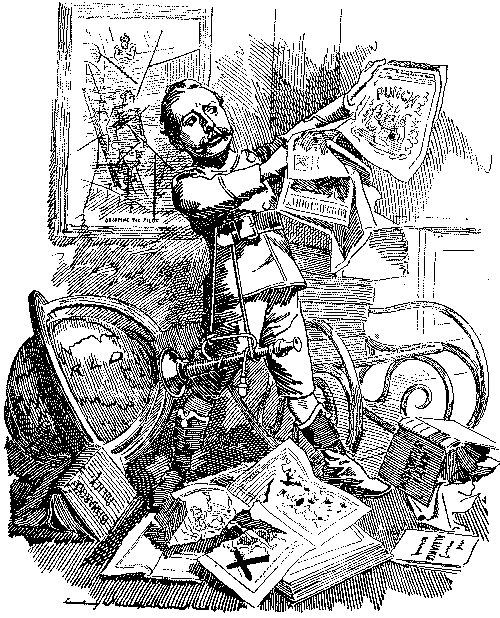
WILFUL WILHELM
An Imperial German Nursery Rhyme. (From the Very latest edition of
"Struwwelpeter.")
Wilful Wilhelm: "Take the nasty Punch away!
I won't have any Punch to-day!"
Young Wilhelm was a wilful lad,
And lots of "cheek" young Wilhelm had.
He deemed the world should hail with joy
A smart and self-sufficient boy,
And do as it by him was told;
He was so wise, he was so bold.
When we add to this brief summary the Jubilee of Queen Victoria in
1887, the passing of Lord Beaconsfield and Bright among the elder
statesmen, and the tragic eclipse of Parnell, it will be seen that
there was enough and more than enough to engage the pen and pencil of
Punch as a political and social chronicler. Mention has already been
made of our thorny relations with Russia. With regard to Germany, the
attitude of England might be described as one of reluctant admiration
punctuated by moments of misgiving. These moments were not infrequent
in the days of the old Emperor; they ceased during the brief reign of
his son, only to recur in a more acute form when Kaiser Wilhelm II
"dropped the pilot," made it clear that he intended not only to rule
but govern, and by his meteoric versatility and frequent references to
his divine mission and to the Germans as the chosen race, awakened the
world to the emergence of a new and formidable promoter of European
unrest. Our relations with France were correct rather than cordial;
her rapprochement with Russia did not make for popularity on this
side of the Channel; but in the main English observers read the inner
meaning of the Boulanger episode aright, and without exactly exulting
over his collapse, were relieved by his failure to revive a military
dictatorship.
By way of filling in this rough outline with more detail, we may note
that Gladstone's resignation of the Liberal leadership at the close
of 1874 was regarded by Punch as premature. In one of the first
cartoons in the next year Dizzy is shown saying good-bye to his great
antagonist: "Sorry to lose you! I began with books; you're ending
with them. Perhaps you're the wiser of the two." Perhaps he would have
been—in the ultimate verdict of posterity—had his decision been
final. But Punch was right in regarding Gladstone as an unspent
force, and in his regretful and affectionate farewell clearly indicates
a hope of his return:—
Will he who, from Llandudno's calm retreat
Late burst, at once, on battle and defeat,
Will he, though Harcourt gird, and Granville pray,
Himself the Leader's truncheon fling away,
Still in his prime of power, unbent by years,
Renounce the joy of battle with his peers,
Unmoved by Punch's counsel, or his prayer,
Nor to his realm relinquished name an heir?
The New Shepherd
Lord Hartington, moved by public spirit rather than ambition or
enthusiasm, undertook what in the circumstances was the far from
enviable task of leading the Liberals. Punch hit off the situation
truly enough in the cartoon in which Bright hands the crook of
leadership to the "New Shepherd"—and Hartington in his smock-frock
replies, "Hey, but Measter!—Where be the sheep?"
The parallel is followed up in the doggerel lines:—
The Marquis Bo-Peep
Herds the Liberal Sheep—
If he only knew where to find them.
Will they ever come home
And—please Home Rule and Rome—
Bring their Irish tails behind them?
Punch, always concerned with the dignity of the Mother of
Parliaments, was from the very outset exasperated by the increasing
levity and obstructiveness of the new House. The levity he satirized
in a series of burlesque entertainments with Mr. Whalley as call-boy
and Dr. Kenealy as gasman. Dr. Kenealy's efforts to re-open the
Tichborne case ended in absurdity—his motion being supported by only
two members, Mr. Whalley and Major O'Gorman, that gigantic playboy of
the West.[2] Obstruction, another and far more serious matter, was
soon organized into a science, and led to repeated scenes of which
more anon. Of the new Ministers, Mr. Ward Hunt, the First Lord, was
especially singled out for attack because of his cavalier treatment
of the loss of the Vanguard and the Admiralty's Fugitive Slave
Circulars. A propos of the former, Punch represented Neptune
warning Britannia that there would be a row if she did not rule the
waves properly. The Fugitive Slave question led to protracted debates
and much hostile criticism. In October, 1875, a cartoon shows a slave
crawling on board a British warship and clinging to the flagstaff,
while Ward Hunt, popping up from the companion, observes: "A runaway
slave, John. You'll have to give him up, you know! See our Circular of
July 31." John Bull retorts: "Give 'im up, yer Honour!! As well order
me to haul down that there flag at once!!!" A fortnight later Ward Hunt
is made to reply to his friend Punch:—
We haven't hauled down the British Flag
(See one of your recent productions),
But we've chosen the other alternative—
We've hauled down our Mis-instructions.
Punch's view, expressed in comments on the debate in the following
February, was that the matter should be left in the discretion of
captains—as it had been for thirty-six years. He declared, not without
reason, that both circulars were virtually dead, and that the country
would not stand them. Meanwhile the growth of the German Navy, which in
his earlier years Punch had persistently ridiculed and belittled, had
begun to excite attention and misgiving; Punch, though a Liberal, was
a "big Navy" man, and, early in 1875, was concerned with the dangers of
our falling behind in the race of naval armaments:—
RULE, GERMANIA!
The Times informs us that, of "iron-clad cruisers of the strongest
type, Germany will, in the present year, have seven built against five
of our own navy." The Pall Mall Gazette is of opinion that "the
Germans have too many irons in the political fire to give exclusive
attention to any one of them."
But very soon, unless we get beforehand with the Germans, will they
not have too many irons in the water, too?
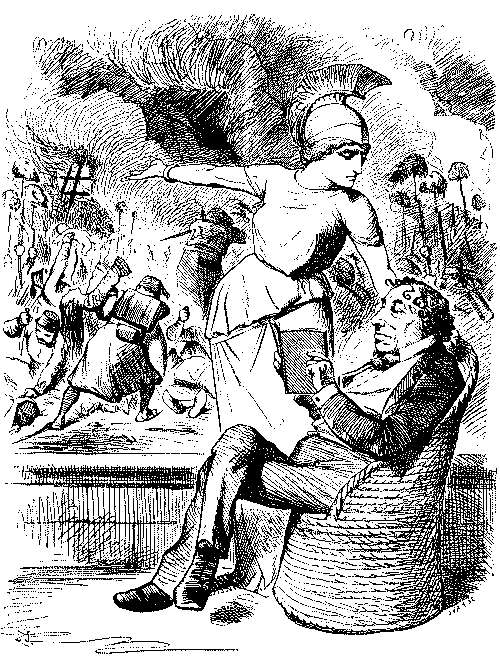
NEUTRALITY UNDER DIFFICULTIES
Dizzy: "Bulgarian Atrocities! I can't find them in the
Official Reports'!!!"
The restoration of the monarchy in Spain under Alfonso XII, in the same
year, also gave Punch occasion for serious thought. We may pass over
the cartoon representing John Bull's anxiety about Spanish bonds as a
satire on British commercialism. But there is shrewd political insight
in the picture of Alfonso between two fires—Bismarck and the Pope.
The German Chancellor makes his support conditional on the withdrawal
of the anti-Protestant edicts; while the Pope, on the other hand,
maintains the claims of his Church.
In 1876 the Queen assumed the title of Empress of India; Disraeli went
to the Lords as Earl of Beaconsfield, Sir Stafford Northcote succeeding
him as Leader of the House of Commons; and the "Bulgarian Atrocities"
proved the first phase in the conflict which made the Balkans the
cockpit of Europe for over forty years. Punch did not cavil at
Disraeli's earldom, though he thought his refusal of the Garter in 1878
well calculated rather than modest. He suggests, moreover, that Earl of
Coningsby would have been a better title; and in the cartoon headed,
"Empress and Earl, or One Good Turn deserves Another," shows Dizzy
kneeling to the Queen and saying, "Thank your Majesty! I might have had
it before! Now I think I have earned it!" More sympathetic are the
verses in which Punch describes the realization of Disraeli's triple
dream of success in Fashion, Letters and Politics—the dream that
inspired him when he was only an articled clerk and a Jew boy:—
After forty years' fighting, he steps from the fire
To the height scarcely scaled in his Old Jewry dream;
Adds a third to his two wreaths of boyish desire,
Though sore set against him the stress of the stream.
And all who can honour faith, patience, and power
And the strenuous purpose that runs a life through
Like a muscle of iron, are glad of the hour
That sees his hand close on the honour his due!
Mr. Gladstone was now employing his leisure by felling trees at
Hawarden, and the contrast lent point to one of Tenniel's happiest
cartoons—that of "The Earl and the Woodman"; Disraeli, in his earl's
robes and coronet, contemplates Gladstone arrayed à la Watteau, and
observes with emotion: "How happy is this blithe peasant, whilst I,
alas!—" (Dissembles.) Punch, however, was becoming more sceptical
of the genuineness of Gladstone's desire for retirement, and in a
parody of "You are old, Father William," scouts the notion of his
prematurely posing as a Nestor.
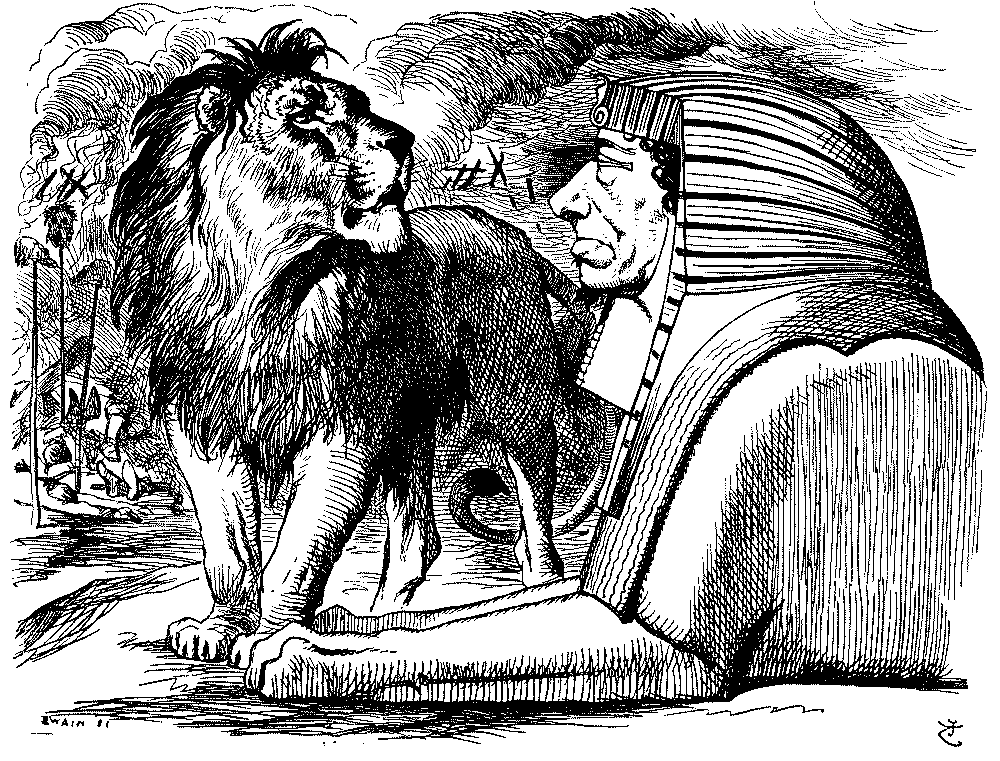
"NO MISTAKE"
The British Lion: "Look here! I don't understand you!—But
it's right you should understand me! I don't fight to uphold what's
going on yonder!!"
The Balkan trouble led to a violent conflict of public opinion in
which Punch sided whole-heartedly with Gladstone against those, and
they were many, who upheld the traditional view of the "Gentlemen's
party," that the Turk was the only "gentleman" in the Near East, and
that he might do what he liked with his own. Disraeli's scepticism;
his professed inability to find any "atrocities" in official reports;
and his dismissal as "coffee-house babble" of evidence brought by a
Bulgarian to a vice-Consul, roused Punch's indignation against the
Premier and his official informants. It was a "hideous subject" of
which Government had heard a good deal and was likely to hear a good
deal more:—
Let Punch speak his mind in this matter. Political partisanship and
party spirit are both at low, as well as lukewarm, water in England
just now; but, if anything will fire John Bull's blood to fever heat,
it is such horrors as have been perpetrated in Bulgaria—and part
of his wrath will assuredly be visited on those who have striven to
interpose official blinds or buffers between England and the sight
or shock of these horrors.... The head of Her Majesty's Opposition
asserted for the Newspaper Correspondents the credit which English
common sense and experience unite to claim for them.
Contemporary records—including the files of Punch—do not bear out
the statement about the lukewarmness of party spirit. The country was
acutely divided, and dissatisfaction with Sir H. Elliot, our Ambassador
at Constantinople, prompted Punch's retort, when Lord Beaconsfield
declared that the Bulgarian atrocities were "beyond recall," "Yes, but
your Ambassador isn't." Gladstone is rebuked for hiding in his tent;
but he made amends by launching his famous, though sadly premature,
phrase about clearing the Turk out of Europe, "bag and baggage."
Neutrality under Difficulties
Serbia's resistance was soon overcome, but the Powers forced Turkey to
grant her an armistice, and largely through Great Britain's influence,
a Conference was held at Constantinople where Lord Salisbury was our
representative. A short breathing-space was thus gained, but the
Conference was abortive, and war between Russia and Turkey broke out in
1877. Punch was in rather a delicate position: for while distinctly
anti-Turk, he had never trusted Russia. Thus, while assailing the
Daily Telegraph, Pall Mall Gazette and Morning Post for their
Chauvinism, and the Tory press generally for their campaign against
Russia and their support of the "veracious Turk," he was hardly less
severe in his strictures on the belligerent humanitarians who would
have welcomed pro-Russian intervention. Punch advocated neutrality,
but he was fully alive to the difficulties of the situation, and
expressed them in a cartoon in which the British Lion is exhibited in
a bothered mood, distrustful of Russia, and unable to make out what
the Government meant, or the Opposition either. In his comments on the
debate on Mr. Gladstone's resolution, Punch deplores the weakness and
dissensions of the Opposition and supports the bolder spirits. Many
years were to elapse before Lord Salisbury made his remarkable speech
about our having "backed the wrong horse," i.e. Turkey, in the Crimean
War. That speech proved that Punch was fully justified in seizing
on the caution which the same speaker had given nearly twenty years
earlier. For Lord Salisbury declared in 1897 that the defence of the
diplomacy of 1878 lay in its traditional character, not in its inherent
excellence, and that neither he nor Lord Beaconsfield was free from
misgivings as to its results. The music halls have not often enriched
the language with permanent additions, but they added "Jingo" and
"Jingoism" in 1877. Punch's comment on Macdermott's famous song is
instructive. It was inspired by a reference in the Paris Figaro:—
On the back page of the Figaro is given one verse in English, with
the music, of that "War Song" of the Music Halls, which just now
enjoys its share of popularity with "Nancy Lee," and "Jeremiah,
Blow the Fire," and a translation of the whole song into French, of
which the Figaro says apologetically, "Des vers français n'auraient
pu arriver à la sauvage énergie de l'original." The chorus of the
song, as sung by most of our London street-boys, instead of "They all
do it," and "Woa Emma," recently shelved, is this:—
"We don't want to fight, but by Jingo if we do," etc. And the
translation, which "n'aurait pu arriver à la sauvage énergie de
l'original," is:
"Nous ne voulons pas la guerre, mais, par Dieu! si nous combattons,"
etc.
If "par Dieu!" is not to an Englishman's thinking rather more
savagely energetic than "By Jingo!" then words are meaningless. If
"par Dieu!" is to be accepted as an equivalent, and as, after all,
rather a weak equivalent for "by Jingo!" then either the Frenchman
has a very low idea of the Englishman's religion, or his "Dieu"
means nothing more, ordinarily, than our "Jingo." But "Jingo" is not
a savagely energetic exclamation, nor is the true feeling of this
country to be gauged by the popularity of a Music-Hall song.
Punch was both right and wrong. The music halls are not a true index
of the political sagacity of the country; but he did not foresee that
the refrain of this particular song would survive, by virtue of its
very blatancy, as a terse summary of national complacency. At the same
time he paid homage to its merits by printing a neat Latin rendering
from the pen of an Etonian:—
Inviti quamquam saevo confligere bello,
Adsit opus, Jingo testamur Bellipotentem,
Sunt nobis nummi, sunt agmina, tela, carinae.
Indian Troops in Europe
The intervention of amateur diplomatists, clerical or professorial,
however well-meant, was firmly and impolitely discouraged when Turkey
and Russia were at death grips at Plevna. Early in 1878 Punch
endeavoured to turn such efforts into ridicule, as instances of
"self-election of the unfittest." Still the naval demonstration in
Besika Bay found Punch in his most pacific mood, applauding Lord
Carnarvon, who with Lord Derby had resigned, and condemning Lord
Beaconsfield's dangerous action and unconvincing explanations. The
calling out of the Reserves still further increased Punch's anxiety,
and inspired a "Proclamation" calling for self-restraint. When it was
announced that Carlyle had joined Bright and the Duke of Westminster
in signing a petition against war, Punch noted that the old sage
of Chelsea was anything but a lover of peace at any price. But the
incident which perturbed him and other critics of the Government more
than anything else was the bringing of a contingent of Indian troops to
Europe. Punch vigorously supported Gladstone, who held the action
of the Government to be not merely provocative but unconstitutional.
When the troops were re-shipped to India, he published a sarcastic
inscription, to be engraved on a monument on Primrose Hill
commemorating an exploit which had cost £750,000. It seems a little sum
to us with our profligate habit of thinking in millions, but the frugal
taxpayer of the 'seventies, as represented by Punch, thought it a
monstrous extravagance. The inscription is too long to quote in its
entirety, but we may give the peroration:—
So, having more than fulfilled
The Expectations of those who imported them
And who, after having transferred them to Cyprus,
Found themselves considerably embarrassed
What next to do with them,
They were re-shipped, quietly and unobtrusively,
To the general mystification of Europe
For the Land of their Birth;
Whence,
Though they have merited the Admiration of Some
And the Respect of Many,
And have left behind them
An Election Cry to All,
It is to be hoped that they will never again visit
The Western Dominions of their Imperial Mistress
Who, through the mouth of Punch
Gladly bids them Adieu!
Not Au Revoir.
Heu vatum ignarae mentes! But Punch, who printed this acid jeu
d'esprit on August 3, 1878, could hardly be expected to foresee the
need of August 4, 1914.
The year 1878 marked the zenith of Lord Beaconsfield's prestige,
for it was the year of the Berlin Congress—from which he claimed
to have brought back "Peace with Honour"—and of the annexation of
Cyprus. Punch, however, was always suspicious of Dizzy's phrases and
preferred to symbolize the results of the Congress in a Pas de Deux
by Lord Beaconsfield and Lord Salisbury, both Gartered, and in a rhymed
dialogue complacently referring to their egg-dance. The Afghan trouble
was assuming a menacing aspect, finely typified in Charles Keene's
cartoon, "The Shadow on the Hills." Punch applauded vigilance, but
distrusted the Government's intentions, deprecated the spirited policy
which involved "a vague and boundless adventure of annexation," and
showed Lord Beaconsfield leading John Bull by the nose in search of
a "scientific frontier"—another Disraelian phrase—and the Ameer of
Afghanistan, between the Bear and the Lion, exclaiming, "Save me from
my friends."
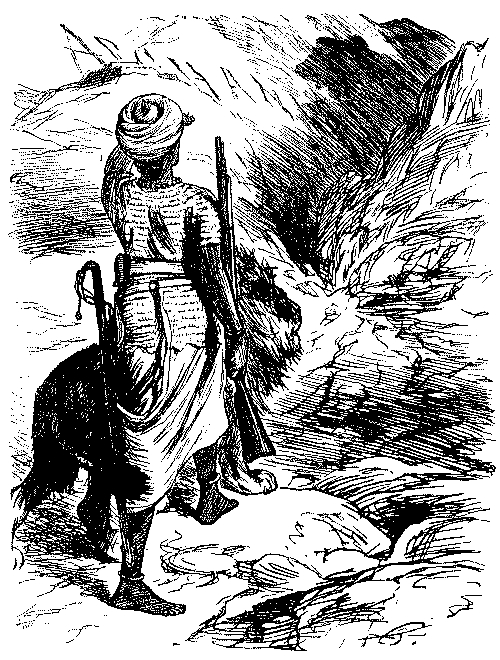
THE SHADOW ON THE HILLS
The Transvaal had been annexed by Sir Theophilus Shepstone in the
previous year, but Punch had received Lord Carnarvon's announcement
with acquiescence rather than enthusiasm.
Bismarck's Creed
On the other hand, the visit of the Australian cricket team in 1878
furnished him with an occasion for paying tribute to the progress and
enlightenment of the Colonies and acknowledging England's debt to their
loyalty.
The services of King Edward as a promoter of the Entente with
France date back to the same year, in which as Prince of Wales he
is represented in a Pas de Trois with the Republic and Marshal
MacMahon. Punch applauded the visit, but rebuked the flunkeyism of
the accounts given by the Paris correspondent of The Times. For
the moment Germany's home rather than her foreign policy engrossed
attention, for this was the time of the Kulturkampf and the campaign
against Socialism. Bismarck is shown in one cartoon squeezing down the
Socialist Jack-in-the-Box. These repressive measures were deprecated by
Punch, and a few months later he commented ironically on Bismarck's
rapprochement with the Papacy, the cartoon "Of one mind (for once!)"
showing Bismarck and the Pope barring the door against Socialism
and Democracy. The reminiscences of the notorious Dr. Busch had
appeared, and Punch based on them a bitter set of verses, "The Pious
Chancellor's Creed," adapted from one of Lowell's Biglow Papers:—
I do believe in subtle skill
Disguised as brutal frankness;
And the display of ruthless will
In rowdy Reiter-rankness.
As well shirk shedding blood for fear
Of staining God's pure daisies,
As strive to rule this lower sphere
By sentimental phrases.
I hold the great Germanic race
Is Heaven's favourite bantling,
Supreme in virile power and grace
And breadth of moral scantling.
The Franks are hounds, their women pigs
Gr-r-r! I the vain vile vermin hate!
I'd squelch them—but for pap-soul'd prigs
Who funk the word exterminate.
Bismarck was alive and formidable. Thiers and Pio Nono passed away in
1877 and 1878. The services of the French Statesman are tersely summed
up in the stanza:—
Monarchy loving much, he loved yet more
The realm, whoe'er its badge of headship wore;
And, waiving self, was willing to abide
That rule which Frenchmen would the least divide.
In the accompanying cartoon France is seen laying a wreath on the
tomb inscribed "Libérateur de la Patrie, 1872," while the shades of
monarchists and Communards are seen in the background. The tribute to
Pius IX is kindly but not uncritical. He had outlived the patriotic
Liberalism of his younger self:—
Happy that one thing he did not outlive,
The charitable soul, the kindly heart,
That rigid dogma's slaves could scarce forgive,
Fearing lest he might play them Balaam's part,
And bless whom he should curse; and so they drew
Their bonds about him closer day by day
Living or dying, till no will he knew
But theirs, and as they pointed, marked the way.
In Home Politics Ireland largely dominated the scene during the latter
half of the Beaconsfield administration. As early as 1876 Punch
had dealt faithfully with the plea advanced on behalf of political
prisoners in the following caustic argument:—
Killing is no murder if complicated with treason. That renders it
a mere misdemeanour. A military offence, simply capital, becomes a
minor offence when treasonable besides. Treason is an extenuating
circumstance of mutiny and murder, and its commission in committing
those crimes reduces murderers and mutineers to political offenders.
Therefore, instead of being hanged or shot, they ought, if punished at
all, and not, on the contrary, rewarded, to be condemned to nothing
worse than temporary seclusion, and should, all of them, after a
merely nominal imprisonment, be respectfully released.
Obstruction and the Remedy
This was a logical and ironical reductio ad absurdum; yet Punch
lived to see it translated into practical politics forty years later.
In 1877 the scientific obstruction practised by the Irish Party in the
House of Commons prompted a whole series of cartoons. In one Parnell,
Biggar and Callan appear as "Erin's Three Graces." In another a drove
of Irish pigs (including Whalley) are shown blocking the railway line
of Parliament. In a third Punch bids schoolmaster Northcote to take
down not the words, but something else of the obstructives. Commenting
on the twenty-six hours' sitting in July, 1877, in which the House was
held up by a group of obstructives that never rose above seven, Punch
observes:—
Four Chairmen—Raikes, Childers, Sir H. Selwin-Ibbetson, and W. H.
Smith—were used up in the night-watches, and the House was kept, by
relays, against the "Dauntless Three"—for Gray, Callan, Nolan and
Kirk are but recruits to the banner of Biggar, Parnell and O'Donnell,
the standard-bearers of Obstruction. All pretence of argument was
early abandoned; and it became a mere contest of endurance, varied
by episodes of more or less—generally less—lively squabbling and
chaff—if such a word may be used of anything that passes in the
august Temple of Legislation. All this while the new Standing Orders
seemed, by tacit consent, set aside; and Parnell, Biggar and O'Donnell
moved the Chairman out of the Chair, or report of progress, again and
again. And yet the Leader of the House had the rod of suspension in
his hand, though he forbore to use it, preferring the reductio ad
absurdum of such a night's match between the toughness of the House
and the tenacity of its Obstructives. Once only he went so far as
to threaten more summary proceedings, on which, they say, O'Donnell
collapsed. Of course, the great O denies it.
But why, Punch must again ask, allow debates to be degraded to
a farce, and the House to a bear-garden? Go to his Cartoon, ye
squeamish, and be wise. With the rod in the Speaker's hands, it is
not the Obstructives' words that Punch would have taken down. The
House sat from four o'clock on Tuesday till six on Wednesday.
The announcement of Mr. Gladstone's visit to Ireland later on in
the year prompted a burlesque account of what his omniscience and
omnivorous thirst for information would enable him to achieve. Nor
could Punch be moved to treat seriously O'Donovan Rossa's threat to
introduce osmic acid—a forerunner of tear-shells—into the House of
Commons. But it was beginning to be difficult to joke about Ireland,
and there was grim point in Keene's picture of the native reassuring
the English angler who hadn't a licence for salmon: "Sure ye might kill
a man or two about here an' nobody'd say a word t'ye."
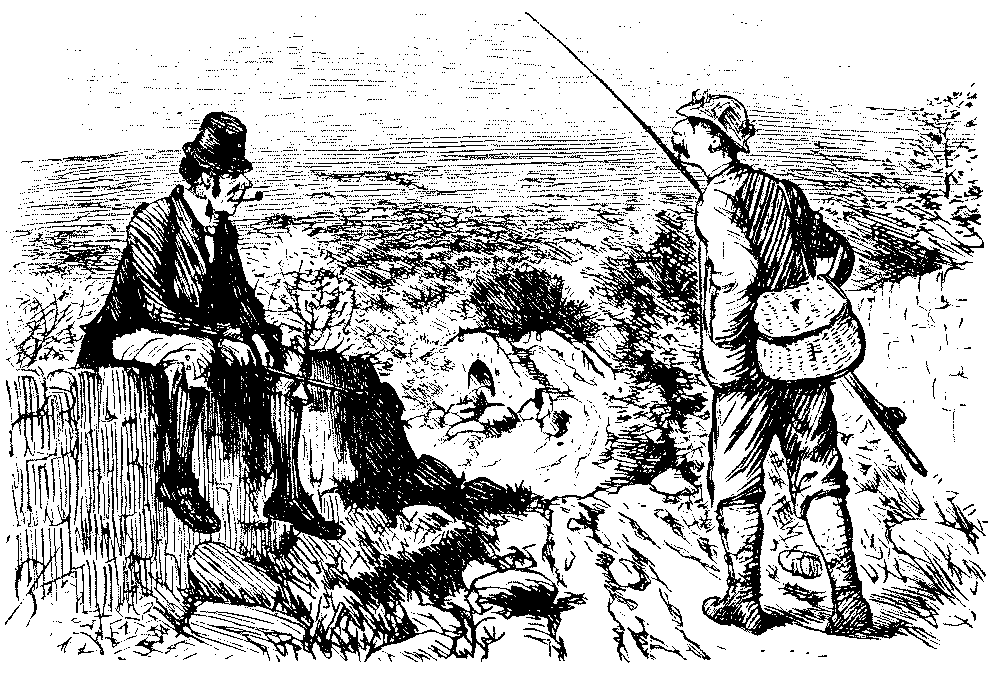
LIFE IN LEITRIM
Saxon Angler: "Oh, but I can't try for a salmon, I haven't got
a licence."
Native: "Is it a licence ye want to kill a fish? Sure ye might
kill a man or two about here an' nobody'd say a word t'ye."
The death of Isaac Butt in the spring of 1879 marked the final
close of the moderate stage of Parliamentary agitation; the reins
of leadership had already passed into the hands of a bolder, more
masterful and uncompromising chief—the "uncrowned King," as he was
called, till the days of Committee Room 15. Moreover, discontent was
aggravated by genuine distress in the South and West of Ireland, and
here, unfortunately, benevolence was hampered by party politics, for
the violent speeches made by Parnell in America at the close of 1879
were not exactly designed to assist the Duchess of Marlborough's
Relief Fund. According to Punch, however, in his comments on "Irish
Obstructives to Irish Aid," these speeches failed to influence the
American public:—
The Zulu War
Uncle Sam is showing his sense by sending his liberal contributions
in relief of Irish distress through all channels except the cruelly
warped ones of Messrs. Parnell and Dillon. The arch-agitator has the
impudence to accuse the Duchess of Marlborough's and all other relief
agencies, except his own, of political bias. This is the Gracchi
complaining of sedition with a vengeance! Pigs, we know, cut their
own throats in trying to keep their heads above water. This Irish
Mis-leader seems involuntarily to be imitating the short-sighted Irish
animal. If any man could have frozen the current of charity—in
New World and Old—it would be such a bitter and malignant advocate
of mutual hate, civil strife, anarchy, and insecurity of life and
property, as CHARLES STEWART PARNELL.
Ireland was only one of many embarrassments to the Beaconsfield
administration in its closing years. Early in that year Punch
published a cartoon on "Bull and his burdens"—John Bull as a patient
ox carrying Russia; the Ameer; the Turk; a Glasgow Bank Director
(commemorating a recent discreditable financial disaster); a striker;
and last of all a Zulu jumping on behind. For this was the year of the
unhappy Zulu war, which Punch described as "one of the costliest
blunders of modern times"—it cost ten millions—and again as "alike
unnecessary, costly, and disastrous." He saw in Isandhlwana not merely
a tragedy but a lesson, and enforced it in a cartoon showing a Zulu
warrior writing on a slate, "Despise not your enemy." The accompanying
verses, while deprecating rashness, assert that the dead must be
honoured and avenged. The heroes of Rorke's Drift, Chard and Bromhead,
are duly acclaimed, but Punch, true to an old and honourable
tradition, prints a letter on behalf of the non-combatant officers who
gallantly took part in the defence. As the only rampart which they
had was made of meal-bags, Punch ingeniously applies to them the
phrase, "Couvert de gloire et de farine," which Voltaire had used of
Frederick the Great, who spent his first battle sheltering in a mill
behind sacks of flour. Cetewayo, the Zulu chieftain, was subsequently
captured, brought to London and lionized, Punch observing that "the
great Farini [the impresario who introduced Zazel, the acrobat who
was shot from a cannon] suggests that he should be exhibited at the
Aquarium."
Throughout the war and afterwards Punch was a harsh and ungenerous
critic of the policy of Sir Bartle Frere, whom he regarded as a
prancing proconsul and nothing more. Nor was Punch much happier
in his treatment of the painful episode of the death of the Prince
Imperial who, whether owing to his own rashness or the negligence
or loss of nerve of his escort, fell to the assegais of the Zulus.
Punch's inveterate anti-Imperialism is betrayed even in the memorial
verses:—
Talk not of plots and plans that, ripening slow,
Are by this death struck down with blast and blight;
We have no thought but for that mother's woe,
The darkness of that childless widow's night.
Unfortunately, the raising of the question of a memorial to the
Prince in Westminster Abbey induced Punch to abandon his resolve of
reticence, and prompted other "thoughts," which he expressed with more
vigour than good taste. There is no proof that the suggestion emanated
from Dean Stanley, as Punch implies, though the Dean certainly
favoured a proposal for which a strong precedent could be found in the
burial in Henry VII's chapel of the Duc de Montpensier (the younger
brother of Louis Philippe) who died an exile in England in 1807.
Public opinion was divided, but democratic sentiment prevailed, and in
deference to a hostile vote in the Commons the scheme was withdrawn.
Turnerelli's "Tribute"
The waning splendours of the Beaconsfield régime were not revived
by the launching of one of the last of his phrases, "Imperium et
Libertas." Punch only saw in it "the catchword of a self-seeking
swaggerer." Great men suffer much at the hands of injudicious admirers,
and the "People's Tribute" to Lord Beaconsfield organized by an
amiable enthusiast, heavily weighted by the unpropitious name of Tracy
Turnerelli, must have been a sore trial to the Premier, while it
supplied Punch with food for mirth for the best part of a year. The
subscriptions of the million were invited to purchase a gold wreath,
but after a little while Mr. Turnerelli had to appeal for further funds
to clear off a deficit. Later on, when the Tribute had been finally
refused by Lord Beaconsfield, Mr. Turnerelli offered to hand over
the wreath to one of our great national museums, if a suitable case
were provided. He also suggested that he might be reimbursed for his
out-of-pocket expenses in getting up the Tribute. Punch recommended
that he should pocket the affront and hand over the "Tribute" to Madame
Tussaud's, where he had already appeared in wax. This is what actually
happened, and in November, 1879, Punch sardonically records the
fulfilment of his suggestion.
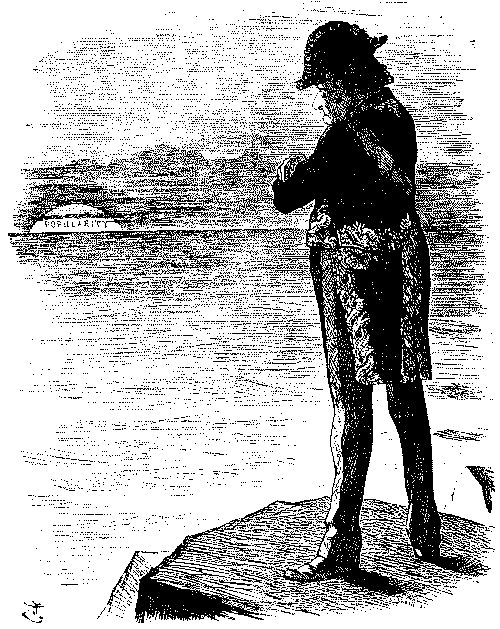
SUNSET
(After B. R. Haydon.)
The disquieting news from the Afghan frontier led to a serious attack
on the Government early in 1880, an attack in which Punch vigorously
joined, publishing a list of questions all animated by misgiving
and by distrust of Lord Beaconsfield's phrases and Lord Lytton's
policy and silence. The tension was relieved by Lord Roberts' famous
march to Kandahar, and on his return to England in the autumn Punch
represented him as snowed under by invitations to complimentary
banquets, and invoked the shade of Wellington to congratulate him on
his celerity. Meanwhile, however, Parliament had been dissolved in
March, and the verdict of 1874 completely reversed at the General
Election. Punch hailed Gladstone triumphing with his axe over Lord
Dalkeith, and borne aloft on a shield by Harcourt, Hartington, and
Bright, under the heading, "Hail to the Chief." As a pendant we have
the cartoons in which Lord Beaconsfield is eclipsed by the sun of
Liberalism or watches the sinking of the sun of Popularity, and the
verses in which the parting Sphinx soliloquizes on his methods of
leadership—appeals to sentiment and passion and the deft use and
reiteration of phrases which intoxicate the masses.
When the House reassembled, it was to find the Irish Question still
further complicated by the activities of the Land League and the No
Rent Campaign. There was also another burning question—that of the
Parliamentary Oath—which the return of Mr. Bradlaugh made a matter
of urgency. Punch, as the "sturdiest of Protestants, was perforce
the staunch supporter of the right of private judgment which is the
corner-stone of Protestantism." Also he frankly admitted that he had
no desire to see Mr. Bradlaugh made a martyr. His point of view is
developed with refreshing common sense in the following argument:—
The House has swallowed such a succession of camels, Quakers and
Separatists, Moravians and Jews, Latitudinarians and Platitudinarians,
Unitarians and Humanitarians, Anythingarians and Nothingarians, and
now it is straining over such a gnat as poor Mr. Bradlaugh, natural
representative of the Northampton Shoemakers, who object to the
immortality of the Sole, and spell the word indifferently with or
without a "u" and an "e."
Irish Troubles
The time has surely passed when the House should seek shelter against
objectionable beliefs or unbeliefs, behind such delusive defences as
oaths and tests. "Let the Swearers swear, and the Sayers say," the Law
has proclaimed, in all Courts. Why, then, not in the High Court of
Parliament—the Court of Courts—the very conduit and fountain-head of
Law?
Unluckily the collective wisdom of the House was slow to accept this
view, and the inevitable conclusion was only arrived at after a
great expenditure of time and a great loss of temper. Bradlaugh was
ejected and finally admitted; but the pacification of Ireland seemed
farther off than ever. Gladstone was anxious to proceed with the
further instalment of his policy of conciliation inaugurated by the
Disestablishment of the Irish Church in his previous administration,
but Punch summed up his difficulties pretty accurately in the
cartoon of November 20, 1880, in which Law tells Liberty to wait
until Ireland first learned to respect her. Punch regarded the Land
League as sheer anarchy; it was the League and not the Government
who practised Coercion. He summoned up the shade of Dan O'Connell to
condemn outrages and the tyranny of "Captain Moonlight." But posthumous
evocations are seldom of any avail; and O'Connell's was no longer
a name to conjure with. In the year 1880, "Boycott" ceased to be a
surname, and became an engine of political intimidation, while in the
House obstructionist methods continued, culminating in the suspension
of some thirty Irish M.P.s en masse early in 1881. Irish "scenes"
were frequent and only excited Punch's disgust. At the same time he
administered a severe rap over the knuckles to the "Honourable the
Irish Society of London" for maladministering their funds, pauperizing
prosperous towns and neglecting to subsidize deserving poverty or
encourage Irish industries. The appeal to the Queen, the Prince and
Princess of Wales and the Duke of Connaught to visit Ireland, signed,
"Larry Doolan of the Irish Jaunting Car," is shorn of all its cogency
by the Transpontine Donnybrook Fair language in which it is couched.
Punch has been a frequent offender in this respect; and also in his
representations of the Irish peasant. It did not really help the cause
of Unionism to portray Fenians and Land Leaguers with baboon-like
faces. Dan O'Connell, whom Punch again evoked from the shades, this
time to play Virgil to Gladstone's Dante in the Irish "Inferno," though
he was a potato-faced Irishman, would have resented this method of
criticism. As a matter of fact, Punch was so seriously remonstrated
with for his Irish cartoons that he published a long article in
self-defence and justification of his methods, maintaining that he
never hit the weaker side because it was the weaker side, but because
that side at the time appeared to be in the wrong:—
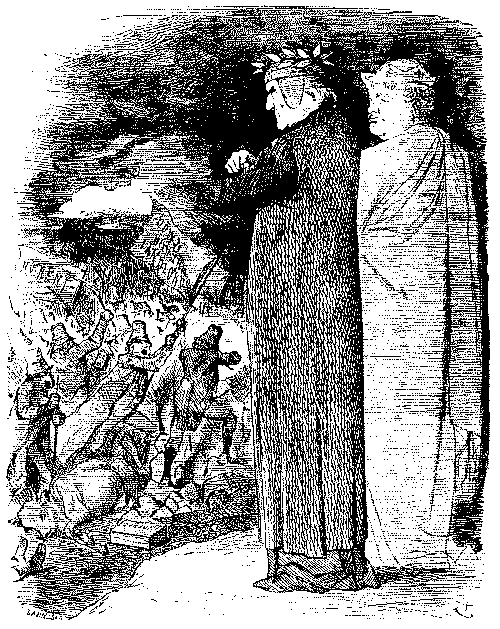
THE IRISH "INFERNO"
"Death, violent death, and painful wounds upon his neighbour he
inflicts; and wastes, by devastation, pillage, and the flames, his
substance."—Dante, Canto XI.
Punch and Ireland
The Ogreish character is the embodiment of the spirit of Lawlessness,
of Anarchy, and of that Communism which, by its recent No Rent
manifesto, has now drawn down upon itself the just condemnation
of such men as the Archbishops of Dublin and Cashel. Houghing
and mutilating dumb animals, maiming men and women, and shooting
defenceless victims, are ugly crimes, and the embodiment of them in
one single figure cannot be made too hideous or too repulsive. On the
other hand, Punch has consistently and persistently kept before the
public his ideal classic figure of Hibernia, graceful, gentle, tender,
loving but "distressful," as being more or less in fear of that Ogre,
her evil genius, from whose bondage may she soon be free; and then,
mistress of herself, with peace and plenty in her land, blessed with
wise Administration and Local Government, in happy and unbroken union
with her sister, England, with a regal residence in her midst, may she
see the emerald gem of the Western World set glittering in the crown
of one who will be no longer a stranger.
Punch was moved to return to the subject in September, 1882, in order
to repel the attacks made on him by the Spectator and the Nineteenth
Century. The latter had not been sparing of rebuke:—
"No savages have ever been so mercilessly held up to loathing mockery
as the Irish peasants by the one comic paper in Europe which has been
most honourably distinguished for its restraint and decorum and good
nature."
Here the defence takes the form of an imaginary trial before L.J.
Public Opinion, in which Hibernia gives evidence in Punch's favour
on the strength of cartoons published from 1844 onwards. Of course,
Punch is acquitted and pronounced to have triumphantly refuted a
calumnious attack. This much, however, must be admitted to Punch's
credit, that he did not regard the campaign of outrage and defiance of
the Law in Ireland as a reason for withholding remedial legislation,
but supported Gladstone's measures designed to promote a settlement of
the Land question.
Over the war with the Transvaal in 1881 Punch found it hard to find
the justum medium. The true estimate of the situation was no more
to be found in the view of the "excellent law-abiding people who
would send off a British army of 15,000 men to crush out a rebellious
enterprise," than in the demands of the enthusiastic humanitarians who
would give "a struggling community their legitimate liberty." Punch
frankly admitted that the Boers had been brutal to the natives, had
shown an inability to govern themselves, and by their unfitness either
to establish or extend civilization had almost jeopardized the hold of
the white man on South Africa altogether. Yet he supported the Boers in
their contention that the Proclamation of Sir Theophilus Shepstone in
1877 was invalid. There was wrong and right upon both sides. Writing
in January, 1881, he expressed the hope that a pacific settlement
might be arrived at by a Cabinet "not deficient either in the ready
pluck which deals with pressing danger or the quieter courage that
is not afraid of timely compromise." These hopes were not fulfilled,
and Punch's confidence in the pluck and courage of the Gladstone
Cabinet was severely shaken in 1884 and 1885. In 1881 he was hardly a
true interpreter of public opinion in his comments on the disaster of
Majuba, when he excused the British defeat by the valour of the Boers.
The cartoon, "Fas est et ab Hoste," and the verses on the inadequacy
of our military training, rubbed in the lessons of the war with more
point than consideration. The sequel of Majuba humiliated the majority
of Englishmen: and the policy of compromise and concession failed to
achieve a lasting settlement.
Lord Beaconsfield died in the spring, but Punch, though respectful
and appreciative, added little in his memorial tribute to what he had
said on many previous occasions in the way of criticism and eulogy. The
insecurity of Russian rule had a year previously been recognized in a
cartoon representing Nihilism lighting a torch in a cavern beneath the
throne. The assassination of the Tsar Alexander II prompts an appeal
to the "Northern Terror." Ordered Liberty must disown such fiendish
methods. Punch, no lover of autocracy, admits that the Tsar was
"the gentlest of his line," and implores the Russians to put manhood
in their wrath, and "not foul the work they call divine with demon
ruthlessness," an appeal that still remains unanswered. This was the
year in which another, but an uncrowned Head, was laid low in President
Garfield, and the loss of the United States is recognized as a common
sorrow.
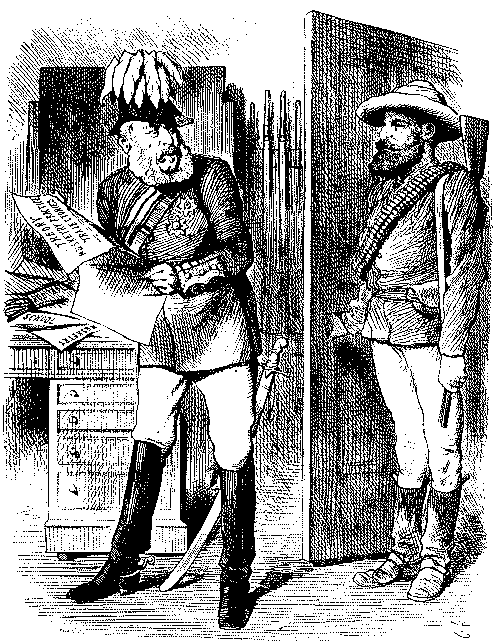
THE SCHOOL OF MUSKETRY
Boer (to F.-M. H.R.H. the Commander-in-Chief): "I say, Dook!
You don't happen to want a practical 'musketry instructor,' do you?"
In Home politics no one is more frequently or unflatteringly referred
to than Lord Randolph Churchill. Sambourne's "Fancy Portrait"
represents him as a midge: in verse, bitter and derisive, he is dubbed
"the coming mannikin." On the other hand, Mr. Balfour is welcomed as an
accession of strength to his party, and his wit is commended as being
no less pretty than his uncle's, though less explosive in its flashing
forth. To this year also belongs the reaction of "Fair" against "Free"
Trade; and the adoption of the new cry by Lord Randolph and Mr. James
Lowther, amongst others, is alluded to in a parody of a once popular
drawing-room song, "O Fair Dove, O Fond Dove." But these amenities
and trivialities were soon forgotten. In May, 1882, came the terrible
tragedy of the Phœnix Park murders—the first deliberate political
assassinations that had stained our history for centuries—and if
Punch's references in prose and verse seem perfunctory and laboured,
it may be pleaded in the words of the classic aphorism: "small cares
are vocal, mighty woes are dumb." Better justice was rendered to the
event in the cartoon of the "Irish Frankenstein" in which Parnell
crouches horrified before the monster of his own creation. Punch did
not, however, despair of conciliation, and a fortnight later supported
the Arrears of Rent Bill as "a gift badly wanted," though his support
was tempered by the observation that "Ireland is to have a clean slate,
and, as usual, at the expense chiefly of the British taxpayer. That
patient Jackass is to be saddled with another burden."
In the latter half of 1882 Ireland gave place to Egypt as a
storm-centre. Arabi's revolt, which involved us in another of our small
wars, was speedily suppressed, after Alexandria had been bombarded by
Admiral Sir Beauchamp Seymour, and the rebel forces on land had been
routed at Tel-el-Kebir by Sir Garnet Wolseley, "our only General," as
he was then called. Punch celebrated his success and his peerage
in an "Idyll of the Queen," beginning, "Garnet the brave, Garnet the
fortunate." But he also recognized the strained relations with France
which the campaign brought about, and uncompromisingly maintained our
position in his cartoon, "The Lion's Just Share." Here the claims of
all the other Powers are made ridiculous in comparison with those of
Britain, France figuring as a poodle, Turkey as a fox, Spain as a
mule, and Italy as a toy greyhound. It is not a conciliatory picture;
Punch was on safer ground in emphasizing the intrigues of Abdul Hamid
and the unpatriotic sympathies of Mr. Wilfrid Blunt.
Parnell and his Monster
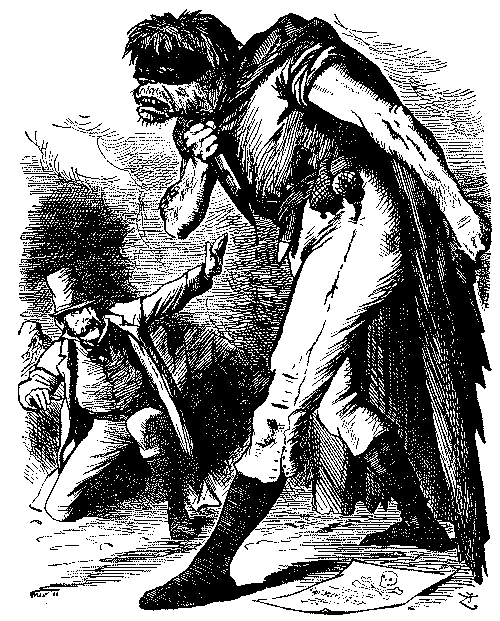
THE IRISH FRANKENSTEIN
"The baneful and blood-stained Monster ... yet was it not my Master to
the very extent that it was my Creature?... Had I not breathed into it
my spirit?" ... (Extract from the Works of C. S. P-rn-ll, M.P.)
Ireland resumed the first place as a preoccupying factor in British
politics in 1883, when the capture of Monaghan by the Parnellites
inspired Punch to depict him as cutting a bit off a coat labelled
Ulster. Another cartoon, "Crowning the O'Caliban," prompted by the
Irish leader's talk of the "moderation" of the Land League, shows him
crowning a hideous figure, sitting on a barrel labelled Anarchy,
Rebellion and Murder, and receiving from him a bag containing
£40,000—in reference to the "Parnell Tribute" presented to the Irish
leader in that year.
Lord Randolph is easily the chief butt of the year. He is the
"bumptious boy," the 'Arry of the hunting field, disregarding the
old whip, Stafford Northcote. Yet amid all this derision there is an
uneasy consciousness that this aggressive and ill-mannered young man
may yet "arrive." In another cartoon Lord Randolph is drawn as a small
boy looking at Lord Beaconsfield's statue and saying, "Ah! They'll
have to give me a statue—some day." The twenty-fifth anniversary
of John Bright's election for Birmingham, which fell in June, 1883,
is treated in a very different spirit. Punch disagreed with Bright
over the Egyptian war, but strikes no jarring note in the verses on his
political silver wedding:—
Mellower voice has never rung
Round the lists of Party fray:
Sharper scorn has seldom stung.
Yet your Silver Wedding Day
Wakes good wishes near and far
E'en from fighters who have gone
Dead against you in the war.
Here's a health to you, Friend John.
That "annual blister, Marriage with deceased Wife's sister," as Gilbert
called it, found Punch still faithful to the cause of relief, and
exceedingly and impartially wroth against clerical obstructors,
Anglican or Roman Catholic, to the extent of depicting Cardinal Manning
and Archbishop Benson in the guise of old women. Where the Liquor
Laws were concerned, however, Punch was frankly reactionary. In a
"Look into Limbo" in July, 1883, he forecasts a general revolt against
crotcheteers and faddists, his pet aversion being Local Option, which
he defines as "a scheme for giving the six, who love spouting, supreme
control over the liberty of the sixty or six hundred who dislike noise,
and so hold their tongues until, in self-defence, they are compelled to
use them."
German Militarism
Foreign politics do not obtrude themselves much on Punch's vision
during the Gladstonian administration. But he was alive to the menace
of militarism contained in a characteristic speech by Marshal von
Manteuffel, the sentiment of which curiously resembles some of the
utterances of the ex-Crown Prince William:—
THE PSALM OF DEATH
"Gentlemen, I am a soldier, and war is the soldier's element; and well
I should like again to experience the elevated feeling of commanding
in a pitched battle, knowing that the balls of the enemy are every
instant summoning men before the judgment seat of God."—Marshal von
Manteuffel to the Provincial Committee of Alsace-Lorraine.
What the heart of the young Teuton said to the old Marshal is summed up
as follows:—
Tell me not in mournful numbers
Death is shocking. Not at all!
Death clears off the scum that cumbers
This o'er-populated ball.
Death is stirring, Death is splendid,
(Death of other men, not mine)
And its spreading is attended
By a feeling great—divine.
Let us then be up and fighting
(A la Marshal von Manteuffel)
Set the Mob to mutual smiting,
While we sing Death's O be joyful!
Gambetta's brief and stormy career had closed at the beginning of
the year, and Punch acknowledged the debt which France owed to his
passionate patriotism and "wild strength" in a cartoon showing the
Republic leaning sadly against his memorial bust while Bismarck, with
arms folded, stands in the background.
Punch had for some twenty years been, on the whole, a consistent
supporter of Mr. Gladstone, but his loyalty was more severely tested in
the years 1884 and 1885 than at any other time in the Liberal leader's
career. Indeed, there were moments when it might be said to have broken
down, and respect gave place to something like contempt. This mood
was revealed in the very first of the Gordon cartoons early in 1884.
Gordon is seen ploughing along through Egyptian difficulties with
Gladstone, "The Grand Old Man of the (Red) Sea," complacently smirking
on his back. In February Punch demands instant action. An angry John
Bull bids Gladstone unmuzzle the British Lion at once, and Punch
comments severely on the Premier's word-jugglery and sophistry. Later
on we see Gladstone in the desert "after the Simoom," leading a camel.
"Mirage" shows Gordon looking anxiously for relief from the battlements
of Khartoum. A burlesque correspondence between a British Hero and
the British Government pours satire on the cheap sympathy and lax
opportunism of the Government, who are only concerned with saving their
skin and their faces. The Premier's preoccupation with trivial home
legislation comes in for indignant rebuke, and the Trelawny quatrain
is adapted for the benefit of Gordon. The two cartoons in May are
especially bitter. Mr. Gladstone, on the Treasury Bench, as Micawber,
declares, "I am delighted to add that I have now an immediate prospect
of something turning up. I am not at liberty to say in what direction."
A fortnight later the Liberal Majority (or Mrs. Micawber) protests she
will never desert Mr. Micawber—referring to the result of the Vote of
Censure.
Punch, however, had no intention of crossing the floor of the
House. The Conservative opposition to the Franchise Bill rekindled
his Liberalism. Lord Salisbury's attitude in particular excited his
hostility. He figures in verse as "The Losing Leader" (after Browning),
and in a cartoon as the bell-wether followed into the pit by a flock of
coroneted sheep. It was "no Curtius leap, but mutton madness," and the
hotheads are compared to the Gadarene swine. Punch heaped laboured
ridicule on the great Hyde Park Demonstration, printed burlesque
advertisements suggesting employment for peers after the abolition of
the House of Lords, and indulged in prophetic forecasts of "What it may
come to."
The Franchise Bill
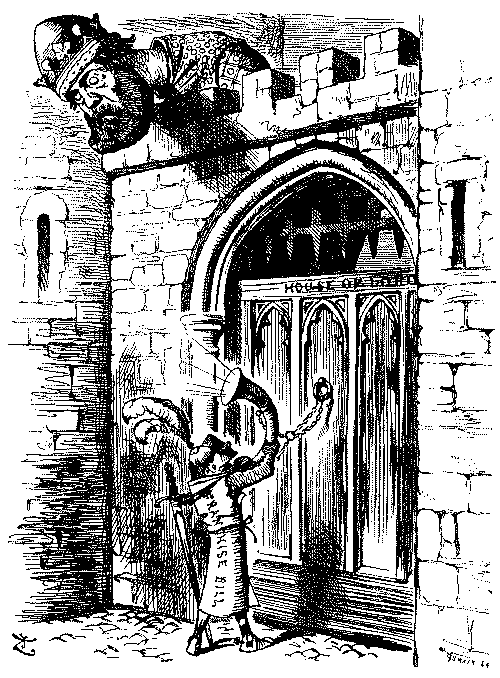
"BILL" THE GIANT-KILLER
The Opposition suffered from the defection or lukewarmness of some of
the wiser peers—Cranbrook, Cairns and Wemyss—and finally withdrew
on the unofficial but opportune publication in the Standard of the
outline of the Government's Redistribution Scheme. Punch gives his
own account of the incident, according to which the whole Cabinet
was mesmerized into revealing the Government plans, and summed up
the whole business in his cartoon, "'Bill' the Giant-killer." The
little Franchise Bill is seen blowing his horn before a castle (the
House of Lords) with Lord Salisbury, as a huge Ogre, looking over the
battlements and dismayed to find that his castle is not impregnable
against Truth. In this context we may note that the payment of members
was foreseen by Punch in a burlesque "Thumb-nail Summary for 1884,"
printed in the first issue of that year. Under July we read:—
Newly elected Parliament meets for the first time, and commences a
campaign of active legislative reform by abolishing the Speaker.
The "Payment of Members Bill," involving a State income of £2,000
a year, the right to a stall at West End Theatres on first nights,
family railway tourist-tickets during the summer season, and free
dining for self and friend at the Holborn Restaurant while Parliament
is in Session, carried without a division.
The "Payment of Members Bill," being thrown out by the Peers, the
House of Lords is abolished by a short comprehensive Act, framed for
the purpose, in one sitting.
Much aristocratic distress prevails towards the end of the month,
and gangs of hungry Peers infesting the public thoroughfares are
prosecuted daily by the Secretary of the Charity Organisation Society,
and ultimately shipped to a Coral Island in the Pacific.
Mr. Gladstone's seventy-fifth birthday on December 29, 1884, was
welcomed in a set of verses in which the eulogy is only tempered by a
faint reserve as to his lack of youthful resolution and his excess of
caution. Had the anniversary fallen a few weeks later, Punch might
have found it harder to pay such generous homage, for on February
7 appeared the unlucky cartoon which assumed that Gordon had been
relieved. Yet even then, when the truth became known and while raising
the cry of "Too late," Punch, though condemning delay and caution,
deprecated party rancour:—
Not this the hour to echo faction's cry
Of half-exultant chiding, or to ply
The Party-phraser's venomed word-lash. No!
But laggard wills, counsels confused and slow
Should need no sharper spur, no keener goad
Than this to urge them on plain Honour's road.
The Tragedy of Khartoum
Punch's contribution to the Gordon "Memorial" was an ode from which
we may quote one stanza:—
Gordon! A name to gild our island story,
Opulent yet in many a noble name,
With lustre brighter than mere statecraft's fame,
More radiant than the warrior's glittering glory.
Such lesser lights eclipse them in the fine
Sun-glow of selfless valour such as thine,
Soldier whose sword, like Galahad's, was not used
To hew out honour, but to champion right;
Plan-shaper who, in council as in fight,
Wast endlessly resourceful, yet refused,
Death-snared, an easy flight!
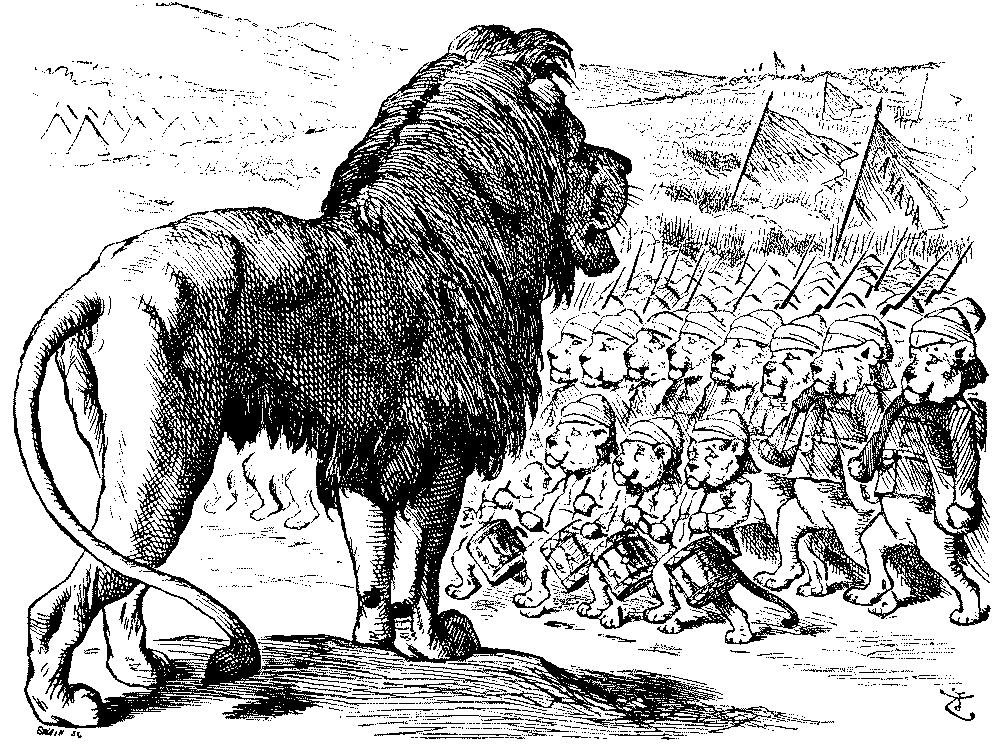
"MY BOYS!"
Other pens were busy over this episode, which inspired perhaps the most
scarifying epigram of our times:—
Judas despairing died, his guilt confessed,
But had he lived in this our age and city,
He surely would have figured with the best
Upon a Christ Memorial Committee.
The disaster, however, had one heartening result in the offer of
military assistance from Canada, Victoria and New South Wales, duly
recorded by Punch in his cartoon of the Lion and the Colonial
cubs. The year 1885 had opened with a sinister display of activity by
dynamiters, and Punch rebuked Sir William Harcourt for his alleged
apathy and imperious resentment of criticism by calling him the
"Not-at-Home Secretary." America promptly took legislative action,
refusing sanctuary to dynamiters, and was loudly applauded, while
Mr. Parnell, in Punch's opinion, missed a golden opportunity for
disavowing and condemning these outrages. In "What Mr. Parnell might
have said" Punch printed the speech which he did not make but ought
to have made, "as a man, an Irishman and a Christian."
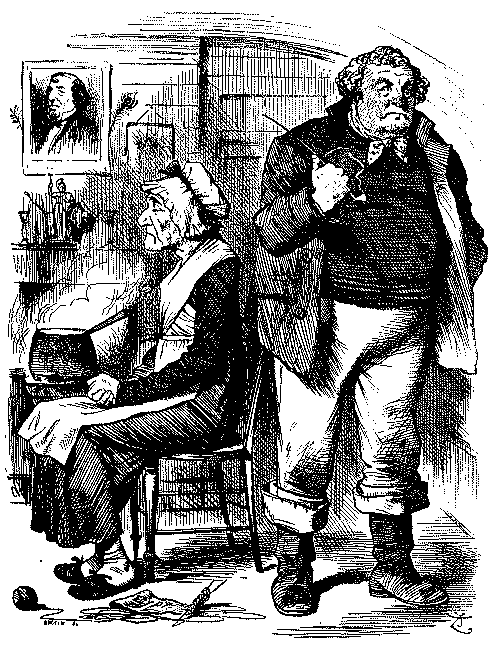
THE POLITICAL "MRS. GUMMIDGE"
Mrs. Gummidge-Gladstone: "I ain't what I could wish myself to
be. My troubles has made me contrairy. I feel my troubles, and they
make me contrairy. I make the house uncomfortable. I don't wonder at
it!!!"
John Peggotty-Bull (deeply sympathizing aside): "She's been
thinking of the old 'un!"—David Copperfield.
The days of the Gladstone administration were numbered, and the motion
in favour of Proportional Representation excited but a languid and
academic interest. Punch thought the system far too complicated,
and sought to reduce it to absurdity by a practical illustration. He
was much more serious in his resentment at the hectoring attitude of
Bismarck à propos of a recent speech of the Imperial Chancellor. In
"Lecturing a Lecturer—a Friendly Tip to the Teuton Titan," he showed
Bismarck standing in a truculent pose before a map of Europe while
Punch looks on in amusement. The point of the accompanying verses is
that Britain was not to be scared or scolded into submission:—
Orbilian Colossus,
You'd chide us and spank us and goad us and toss us,
But when Polyphemus world-wigging would try
He may—pardon the argot—get "one in the eye."
And Punch, Herr Professor, whose point seldom misses,
Is ready if needful to play the Ulysses.
The attempt to represent Bismarck as a professor might not seem to show
a very acute reading of the facts were it not that German professors
proved the chief inflamers of militarism. It must be added that, as a
set off to this expostulation, Punch indited a remarkably genial poem
to Bismarck a couple of weeks later on the occasion of his seventieth
birthday. But this can hardly have atoned for the extremely acid and
acute satire on the Spirit of German Colonization published about the
same time. Here Germania declares her intentions to the native races
in language which the treatment of the Herreros in German South-West
Africa proved to be well within the mark:—
I haf brought you German culture for the poddy and the mind,
Die erhabene Kultur of efery sort and efery kind;
All the pessimistic dogtrines of the Schopenhauer school
And the blessings of a bureaucratish-military rule.
I shall teach you shplendit knowledge, vot you hitherto haf lacked,
That religion is a fantasy, vhilst sausage is a fact;
Ja, the mysteries of sauerkraut to you shall be made clear,
And your souls shall learn to float on foaming waves of Lager-Bier!
I do not intend to long-while you mit missionary rant,
But to brighten up your intellects mit Hegel and mit Kant.
Mit our Army-Service system I'll begift you by-and-by,
And mit all the priceless blessings of our Hohe Polizei.
Ach! I lofes you as a moder, and your happiness, I shwear,
Shall forefer be the von surpassing object of my care.
I'll civilize you, Kinder, mid dem edlen Gerstenbrei,
And mit discipline, Potztausend!—or I'll know the reason vhy!
And then die hehre Göttin, hof'ring in the aether blue,
Vill summon up her gunboats and her Pickelhauben too,
Her bearded brawny varriors, vot nefer knew no fear,
And troops of learned bureaucrats, all buttoned-up to here.
Then if the shtupit natifes don't attend to vot she said,
And makes themselves unpleasant, they must all be shooted dead;
For trifles in the vay of German culture must not shtand—
Hoch soll der Bismarck leben! I drinks, "Our Fatherland!"
Lord Randolph Churchill
When the Government was defeated in June "on the Budget Stakes," as
Punch put it, he went so far as to accuse Gladstone of "riding to
lose," and resented this action as not quite on the square. A month
earlier he had shown Gladstone as the political Mrs. Gummidge, the
"Old 'un" being Disraeli, whose portrait hangs on the wall. There
was a rumour of Mr. Gladstone going to the Lords, and Punch had
a picture of Tennyson, in his robes in the "gay garden of elegant
earls," inviting W. E. G. to "come into the garden," but Mr. Gladstone
declines, preferring to paddle his own canoe. Lord Randolph was
included in the Salisbury administration, which held office for six
months, as Secretary of State for India, but his elevation to Cabinet
rank did not appease Punch's distrust—rather the reverse. He was
not really an undersized man, but he invariably appears in Punch
about this time as a boy, a mannikin or some diminutive pest, while
the vehemence of his language is resented in bitter criticism of his
"mud-spattering" abuse, vulgar invective, and "Billingsgate Babel."
In particular a speech which he delivered at a Conservative gathering
at Canford Manor, Wimborne, excited Punch's wrath, and prompted
the picture of "Funny Little Randolph," as a "star comique" singing
a topical song, "I don't care a rap," and exulting in his grimaces
and bad manners. In the previous year Punch had fallen foul of the
"windy ravings of Loyalist Speakers" in Ireland, "the Loyalist Cæsar,
and the Nationalist Pompey seem 'very much alike' indeed—in the
matter of noisy mischief.... One feels that the Orange Champions would
not hate 'disloyalty' so much did they not hate their 'Green' fellow
countrymen more."
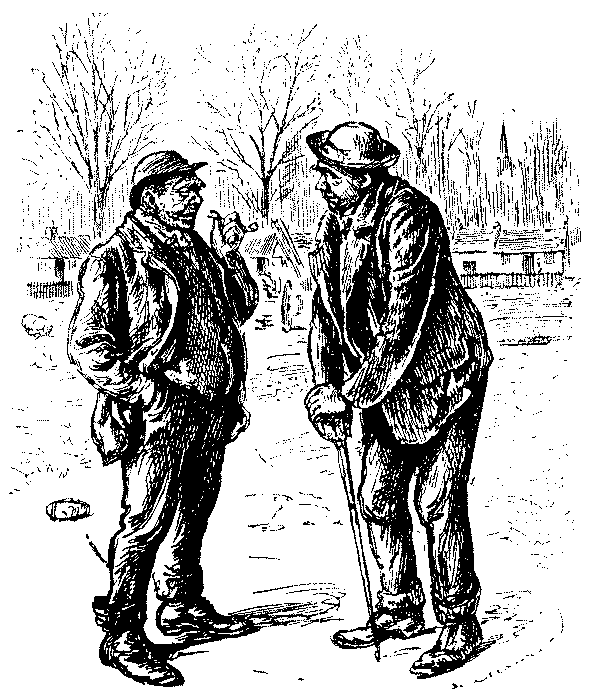
SAUCE FOR THE GOOSE
Dick: "I've chose my Three Acres—next to the Parson's. I mean
to dig and grow 'Taters. Where 'ave you chose yours?"
Harry: "I ain't chose no Land. I shan't grow no 'Taters. I
shall take your 'Taters!"
Yet in the autumn of 1885, when Lord Carnarvon was Viceroy, Punch
developed a strong distrust of the conciliatory policy of the
Conservatives. In one cartoon he shows Captain Moonlight masked
and armed at an open door, the bar of the Crimes Act having been
removed. In October he wrote, "when Tyranny alone is free where is the
safety—save for slaves." In another cartoon he showed the National
League as the Irish Vampire, hovering over Hibernia in her uneasy
sleep, and bade her awake and banish the hideous monster that was
sapping her strength. Mr. Punch's "Political Address," issued shortly
before the resignation of the Salisbury Cabinet, claimed that he was
the only real Independent Candidate, the nominee of no party, section,
or sect; bound to no programme, but "all for the four P's—Principle,
Progress, Patriotism and Peace"—in fine, "whichever Party he returned
to office, Mr. Punch, the non-partisan Member for Everywhere, will be
in power." The new cry of "Three Acres and a Cow" raised at the close
of 1885 left him cold, witness Du Maurier's "Sauce for the Goose."
The verses in the same number on "New Words and Old Songs" imply that
it was a mere vote-catching device, and at the same time mock at the
cadging tactics of the Knights and Dames of the Primrose League founded
in 1884.
Home Rule Rejected
On the resignation of the Salisbury Cabinet, Mr. Gladstone returned
to power with Mr. Morley as Chief Secretary for Ireland. The story of
his conversion to Home Rule, his failure to convert his colleagues,
the split in the Cabinet and the introduction and rejection of the
Home Rule Bill of 1886 is well told in the series of cartoons which
begin with "At the Cross Roads" in February. There Gladstone is shown
hesitating between Land Purchase and Home Rule, while Chamberlain as
the cowboy advises the former. In "The Thanes fly from me" we see
Gladstone as Macbeth asking Morley (Seyton) to give him his armour:
"This push will cheer me ever or disseat me now." The Home Rule Bill
is typified as the "Divided Skirt." Gladstone as the Grand Old Man
Milliner is trying in vain to reconcile Britannia to her new dress. The
sequel is shown in the "Actæon" cartoon in which Gladstone is pulled
down by his own hounds—Chamberlain, Hartington, Goschen—and in the
adaptation of Meissonier's "Retreat from Moscow," where Gladstone
figures as the defeated Napoleon. It is rather curious, by the way, to
note that during the debates Punch, in his "Essence of Parliament,"
describes Sir Henry Campbell-Bannerman and Mr. Labouchere as the "two
drolls of the House" at Question time.
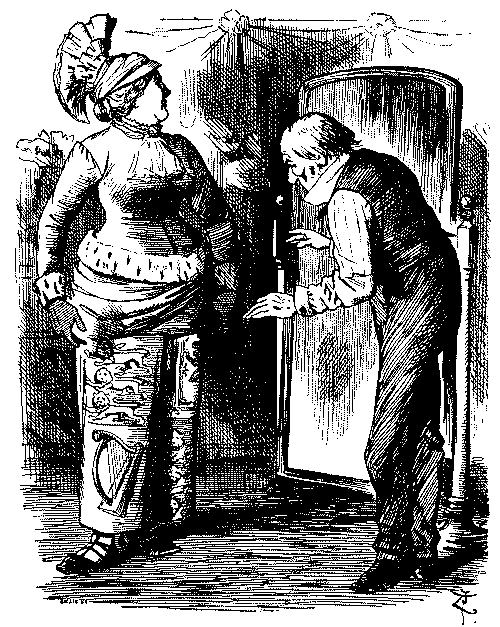
THE "DIVIDED SKIRT"
Grand Old Man-Milliner (persuasively): "Fits beautifully,
Madam! A little alteration here and there!"
Mrs. Britannia: "It's very uncomfortable, and I'm sure it
isn't becoming. I shall never get along with it as it is!!"
On the merits of Home Rule Punch is rather non-committal, and speaks
with more than one voice. The secession of the Liberal Unionists
impressed him greatly; but he was bitterly antagonistic to the Ulster
extremists, witness this epigram printed in May:—
Lucus a non Lucendo
Loyal? Nay, Ulster, you, for very shame
Should cede your long monopoly of that name.
Loyal—to whom—to what? To power, to pelf,
To place, to privilege, in a word, to self.
They who assume, absorb, control, enjoy all,
Must find it vastly pleasant to be "loyal."
Lord Randolph Churchill's famous jingle: "Ulster will fight. Ulster
will be right," inspired a prophetic forecast of the result of such
action, in which Ulster does fight and is defeated:—
The battle had been severe, but it was over at last. Belfast was
taken. Derry was in ruins. Everywhere the Orange faction had been
outnumbered and worsted. The reverse was crushing and complete. "We
shall now," said the General commanding the National forces, "be
suffered, perhaps, to hold our Parliament on College Green in peace."
He turned to a batch of captured officers as he spoke. They were a
motley crew. Among them figured several wearing the Queen's uniform,
while here and there stood some distinguished sympathizer with the
beaten cause, who had thrown in his lot to support rebellion against
Queen and Empire. Among these latter a scion of a Ducal House and
former well-known Member of the House of Commons, was weeping over
a broken drumhead. The General singled him out, and beckoned him
to approach. He drew near, surlily: "Well, my Lord," continued the
Commander, in a tone of banter. "How about your prophecy? Ulster will
fight. Ulster will be right. Ulster has fought. Ha! Ha!"
"And she has been wrong!" was the submissive and humble reply.
Lord Randolph at the Tresury
This squib was written before the rejection of the Home Rule Bill, a
result which Punch, or the writer, probably did not anticipate. The
accuracy of the forecast, however, remains still to be tested.
The Elections went against the Government, and Lord Salisbury was
returned to power, with Lord Randolph as Chancellor of the Exchequer
and Leader of the House of Commons. The verses which accompany and
expand the cartoon of "The Grand Young Man" with the shade of Dizzy
looking on, almost deviate into geniality. Punch fancies that
Randolph, in spite of his defects of taste and manners, is "more
than a mere mime," but, in contrasting his career with that of Lord
Beaconsfield, points out that he was born in the purple and that his
rise to power was easier and quicker. This comparatively friendly mood
soon gave way to the old distrust, and by October, in "Swag, or the
political Jack Sheppard," we see Lord Randolph, anxious to eclipse
Dizzy as a Tory Turpin and "disher" of the Whigs, rifling a chest
labelled "Liberal Measures," while Mr. Gladstone peers into the room at
the back. Punch's distrust was partly justified by Lord Randolph's
impetuous resignation in December. What might have been a great career
was wrecked by an impatient temper. Immense ability, industry, courage
and reforming zeal were there, and it was hardly fair to represent him
as a modern Curtius leaping into the pit of Popularity. The Treasury
was not the only Government Office in which reform was thwarted by
obstruction and mismanagement. Punch attacked the War Office in the
autumn of 1886 for setting its face "not merely against change, but
against experiments pointing to change," and scouting all inventors as
nuisances. He simultaneously proposed the foundation of an official
organ of the Admiralty to be called "Dowb," the burlesque prospectus
of which obliquely satirizes the abuse of perquisites, bad stores,
muddled finance, futile commissions of inquiry and general incompetence
in high places. Home politics engrossed attention throughout the year,
but Punch did not fail to note the gathering clouds in the Balkans,
when Prince Alexander of Battenberg, the hero of Slivnitza, a gallant
and picturesque figure, had abdicated the throne of Bulgaria, Russian
jealousy having rendered his position untenable. In the cartoon of
"The Vanishing Lady," the Tsar is shown as a juggler using the cloak
of diplomacy to extinguish the freedom of the country he had helped to
emancipate. The same year which witnessed the disappearance from the
political scene of Prince Alexander was marked by the birth of Alfonso
XIII of Spain, and Punch offered his ceremonial greeting to one of
the few sovereigns who survived the monarchical débâcle of the Great
War of 1914.
The Victorian age reached its grand climacteric in 1887, the year of
the Queen's Golden Jubilee and the gathering of the Kings and Captains.
Of the celebrations we speak elsewhere. Punch, no longer anti-Papist,
linked them with those at the Vatican—in honour of Leo XIII, who had
been ordained priest in 1837—in his lines on "Two Jubilees":—
St. Peter's and St. James's face to face
Exchanging with a more than courtly grace
Their mutual gifts and greetings!
A sight to stir the bigot; but the wise
Regard with cheerful and complacent eyes
This pleasantest of meetings.
And so on with praise of the Good Queen and Holy Father, Punch, as a
"true freeman unfettered by servile fear or hate's poor purblind heat,"
being free to celebrate them both.
It was also the Centenary year of the United States, welcomed by
Punch in John Bull's song on Miss Columbia's Hundredth birthday to
the air of "I'm getting a big boy now." Mr. Gladstone was invited to
the celebrations but did not cross the Atlantic. John Bull abounds
in professions of good-will, but there is a slight sting in the last
chorus:—
You are getting a great girl now,
May you prosper, and keep out of row;
Shun Bunkum and bawl
All that's shoddy and small,
For you're getting a great girl now.
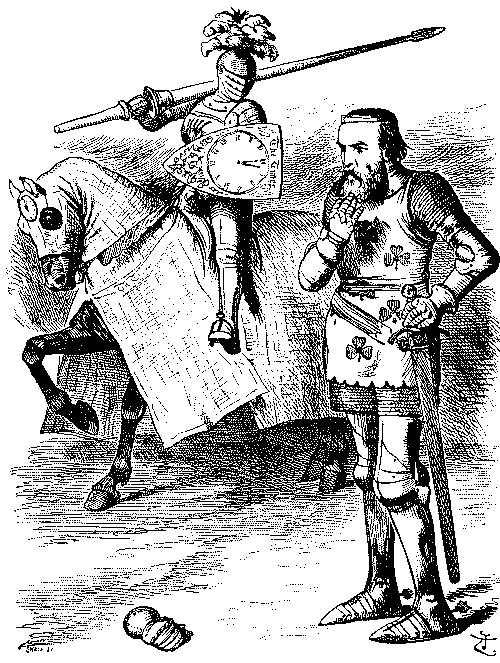
THE CHALLENGE
The Salisbury Cabinet was strengthened by the inclusion of Mr. Goschen
as Chancellor of the Exchequer—Mr. Goschen whom Lord Randolph
"forgot," and whom Punch styled the "Emergency man," a phrase now
also forgotten, but then applied to the volunteers who assisted
boycotted farmers and loyalists in Ireland. Mr. Balfour was at the
Irish Office, the scene of his greatest administrative successes,
and the Crimes Act and the Land Act were the two principal measures
of the Session. In those days The Times was the great champion of
the Unionist policy, and in the summer of 1887 is shown prodding on
Lord Salisbury and Mr. Balfour, armed with Crimes Act blunderbusses,
in their attack on the Land League wild boar. The Land League was
"proclaimed" in August; and already the controversy had begun between
Mr. Parnell and The Times over the former's alleged participation
in the responsibility for the Phoenix Park murders. The question was
raised in a series of articles on "Parnellism and Crime"; but the
charges were not made specific until the following year. John Bright's
secession from the Gladstonian Liberals had been a serious blow, and
his contributions to the Unionist armoury were so vigorous and pointed,
that it is rather strange to find Punch assailing him in March, 1887,
for his pacificist tendencies:—
The white flag, John, may bid all battle cease,
Not the white feather! In defence of right,
Despite your dogmas, men perforce must fight
With swords as well as words: be it their care
With either, to heed honour, and fight fair.
You would "speak daggers" only; be it so;
But a word-stab may be a felon blow.
John Bright certainly spoke daggers against those who, in his own
phrase, kept the rebellion pot always on the boil.
Germany's Momentous Year
The Earl of Iddesleigh, better known as Sir Stafford Northcote, died
in January. There is an unmistakable reference to Lord Randolph
Churchill's treatment of his one-time leader in the verses in which
Punch paid homage to a statesman "worn yet selfless, disparaged and
dispraised," yet a "pattern of proud but gentle chivalry":—
So the arena's coarser heroes mocked
This antique fighter. And his place was rather
Where Arthur's knights in generous tourney shocked
Than where swashbucklers meet or histrions gather:
Yet—yet his death has touched the land with gloom;
All England honours Chivalry—at his tomb.
Here the reference to Lord Randolph is inferential though unmistakable.
But an opportunity for having a dig at him is never missed. When the
Bulgarian throne was offered to Prince Ferdinand, and his cautious and
diplomatic tactics resulted in long delays, Punch in pure malice
suggested that the crown should be offered to Lord Randolph. He may be
forgiven, however, in view of the remarkably accurate estimate which
he formed of the slyness, timidity and meanness of "Ferdinand the
Fox," and the alternations of servility and insolence in his attitude
towards Russia. Bismarck again comes in for honorific notice this year
in the guise of Sintram, accompanied and menaced by Socialism (the
Little Master), but confidently riding along on his steed Majority. But
1888 was a momentous year for Germany—the year in which two Kaisers
died and a third succeeded to the heritage of the Hohenzollerns. The
old Emperor Wilhelm, the "Greise Kaiser," died on March 9; within a
hundred days his son, the "Weise Kaiser," had fallen to the fatal
malady which had sapped his splendid physique, to be succeeded in turn
by the "Reise Kaiser," the nickname bestowed on Wilhelm II for his
passion for movement and travel. At the moment of his accession Punch
was not inclined to be critical. The cartoon of "The Vigil" in June of
that year expresses no misgivings, but only sympathy for one called
to bear so heavy a burden. And this view is amplified in the verses
in which the lessons of the past are used to fortify the hopes of the
future:—
THE VIGIL
"Verse-moi dans le cœur, du fond de ce tombeau
Quelque chose de grand, de sublime et de beau!"
Hernani, Act iv, Scene 2.
The prayer of Charles, that rose amidst the gloom
Of the dead Charlemagne's majestic tomb,
Might fitly find an echo on the lips
Of the young Prince, whose pathway death's eclipse
Hath twice enshadowed in so brief a space.
Grandsire and Sire! Stout slip of a strong race,
Valiant old age and vigorous manhood fail,
And leave youth, high with hope, with anguish pale,
In vigil at their tomb! Watch on, and kneel,
Those clenched hands crossed upon the sheathèd steel.
Not lightly such inheritance should fall.
Hear you not through the gloom the glorious call
Of Valour, Duty, Freedom?
............ And youth must face
What snowy age and stalwart manhood found
A weight of sorrow, though with splendour crowned.
Young Hohenzollern, soldierly of soul,
Heaven fix your heart on a yet nobler goal
Than sword may hew its way to. Those you mourn
Heroes of the Great War when France was torn
With Teuton shot, knew that the sword alone
May rear, but shall not long support a throne.
William has passed, bowing his silver crest,
Like an old Sea King going to his rest;
Frederick, in fullest prime, with failing breath,
But an heroic heart, has stooped to death:
Here, at their tomb, another Emperor keeps
His vigil, whilst Germania bows and weeps.
Heaven hold that sword unsheathed in that young hand,
And crown with power and peace the Fatherland!
Only a fortnight before the death of the old Emperor, Bismarck's Army
Bill had awakened Punch's misgivings. He reluctantly admired the
strength of the lion combined with the shrewdness of the fox; and put
into Bismarck's mouth the sonorous couplet:—
I speak of Peace, while covert enmity
Under the smile of safety wounds the world.
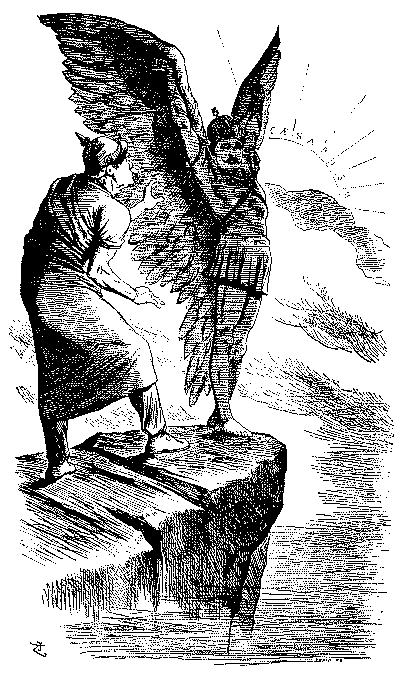
A WISE WARNING
(Founded on the first part of an old Fable of Dædalus and Icarus, the
Sequel of which Mr. Punch trusts may never apply.)
But by September it was the young Kaiser, not Bismarck, who invited
"A Word in Season." The counsel was prompted by a speech in which he
declared, "It is the pride of the Hohenzollerns to reign at once over
the noblest, the most intellectual and most cultured of nations," a
sentiment mild when compared with later utterances, yet sufficiently
thrasonic to earn a rebuke for indulging in demagogic flattery,
coupled with the advice to read Lord Wolseley's article in the
Fortnightly on Marlborough, Wellington and Napoleon, and to emulate
the reticence of Moltke. In less than a month the inevitable cleavage
between the Kaiser and his Chancellor is foreshadowed in the splendid
cartoon reproduced, where Bismarck as Dædalus warns Wilhelm as Icarus,
in a paraphrase of Ovid:—
My son, observe the middle path to fly,
And fear to sink too low, or rise too high.
Here the sun melts, there vapours damp your force,
Between the two extremes direct your course.
Nor on the Bear, nor on Boötes gaze,
Nor on sword-arm'd Orion's dangerous rays;
But follow me, thy guide, with watchful sight,
And as I steer, direct thy cautious flight.
Metamorphoses, Book VIII, Fable iii.
For the establishment of the Triple Alliance Punch held Bismarck
responsible. The three high contracting Powers become the "Sisters
Three," Italy as Atropos, Austria as Lachesis, and Germany as Clotho.
The policy is expounded in "a Bismarckian version of an old classical
myth." Bismarck claims to be working for peace so long as he is the
cloud compeller. While he is in power it will be all well with Germany.
Of Austria he is less certain, owing to the precariousness of her
crown, but he counts confidently on Italy, and ends on an optimistic
note, dwelling on the pacific aims of this new political pact. It is
hard to tell whether this is irony on the part of Punch or a genuine
approval of the Triple Alliance. But there is no doubt of his mistrust
of Germany's ulterior motives in undertaking to co-operate with England
in suppressing the Slave Trade in Africa—a mistrust expressed in the
quatrain:—
When Fox with Lion hunts,
One would be sorry
To say who gains, until
They've shared the quarry.
Boulanger's Bid for Dictatorship
The sequel justified the suspicion, and less than a year later Punch
published a companion cartoon in which the Lion, coming round the
corner, finds the Fox has pulled down the notice "Down with Slavery"
and is about to put up a Proclamation in which "Up" takes the place of
"Down."
Bismarck's hostility to the Empress Frederick was notorious. In her
husband's brief reign there was a question of their daughter, Princess
Victoria, marrying Prince Alexander, ex-sovereign of Bulgaria. Punch
represented Bismarck forbidding the banns, and putting an extinguisher
labelled "Policy" on Cupid. It was stated that Bismarck threatened
to resign if the marriage plan were proceeded with; Punch, the
sentimentalist, believed that love would find out a way, and it did,
but in a different direction. The Prince married, but the lady was not
of royal or even noble birth, and as Count Hartenau he remained in
obscurity and died while still a young man.
France also had her troubles in 1888, for this was the year of
Boulanger, the brav' Général, who captivated the mob for a while,
seemed at one moment to be within an ace of overthrowing the Republic
and establishing a stratocracy, but collapsed ignobly in the testing
hour. Punch recognized the danger in his cartoon of France ruefully
balancing the Cap of Liberty on her finger. But even in L'Audace,
where Boulanger is shown climbing up a steep cliff, with "Deputy" at
the bottom, "President" and "Dictator" at the top, and the Imperial
Eagle peering over the summit—we are made to feel that the climber is
not equal to the task. The conditions are exactly reproduced in the
companion picture, "Many a Slip," only that Boulanger is shown rolling
down the precipice.
New South Wales celebrated her Centenary on January 26, 1888, and
Punch added his tribute in a happily-worded greeting under the
familiar heading, "Advance, Australia!":—
A hundred years! At Time's old pace
The merest day's march, little changing;
But now the measure's new, the race
Fares even faster, forward ranging.
What cycle of Cathay e'er saw
Your Century's wondrous transformation?
From wandering waifs to wards of Law!
From nomads to a mighty nation!
Belated dreamers moan and wail;
What scenes for croakers of that kidney,
Since first the Sirius furled her sail
Where now is Sydney!
A hundred years! Let Fancy fly—
She has a flight that nothing hinders,
Not e'en reaction's raven cry—
Back to the days of Matthew Flinders,
Stout slip of Anglo-Saxon stock
Who gave the new-found land its nomen.
Faith, memory-fired, may proudly mock
At dismal doubt, at owlish omen.
Five sister-colonies spread now
Where then the wandering black-fellow
Alone enjoyed day's golden glow,
Night's moonlight mellow.
"The Island-Continent! Hooray!"
Punch drinks your health in honest liquor
On this your great Centennial day,
Whose advent makes his blood flow quicker.
We know what you can do, dear boys
In City-founding—and in Cricket.
A fig for flattery!—it cloys;
Frank truth, true friendship—that's the ticket!
Land of rare climate, stalwart men,
And pretty girls, and queer mammalia,
All England cries, through Punch's pen,
"Advance, Australia!"
The same year witnessed the starting of the Australian navy. "Naturally
the biggest island in the world has the biggest coast-line, and so
needs the biggest fleet." The lead was taken by Victoria. Punch saw
nothing but healthy rivalry between the different colonies as the
outcome of the movement, but looked to Federation as the true means
to prevent the different Australian Colonies from being at "Southern
Cross-purposes" when they all had their navies. The trouble in the
Soudan prompts a warning from the Shade of Gordon: "If you mean to send
help, do it thoroughly and do it at once," but anxiety was allayed by
the success of General Grenfell at Suakin, an example of prompt action
worthy of the attention of "long-halting statesmen."
Parnell and "The Times"
The most important measure of the Session at Westminster was the Local
Government Bill establishing County Councils. Punch made considerable
capital out of Mr. Chamberlain's rapprochement to the Tory interests.
At a meeting of the National Society, Archbishop Benson had referred
amid cheers to the words of Mr. Joseph Chamberlain at the opening of
a School Board in Birmingham, and his acknowledgment of the fact that
Voluntary Schools must have their place in the education of the people
recognized. Mr. Chamberlain's views on the Liquor question had shown
a similar concession to the demands of the brewing trade. So Punch
represents the "Artful Joe" walking arm-in-arm with the Archbishop
and "Bung," and observing, "What a lot of nice friends I'm making."
Mr. Chamberlain is already acknowledged to be "incomparably the best
debater in the House"; Punch rendered full justice to his ability,
but his chief cartoonist, Tenniel, though still capable of splendid
work, never managed to seize and reproduce the alert vivacity of Mr.
Chamberlain's features. The progress of the controversy between Mr.
Parnell and The Times impelled Punch as an amicus curiæ to
suggest that one or other of the disputants should wake up the Public
Prosecutor in preference to the appointment of a Special Commission.
The latter method of procedure, however, was adopted. The course of
the inquiry was followed by Punch in a series of articles, and when
Parnell was exculpated on the chief count by the breakdown of The
Times witness Pigott, who confessed to forgery, fled the country and
committed suicide, Punch exhibited the Clock-face doing penance in
a white sheet with the lines, "His honour rooted in dishonour stood,
etc." But when the Report of the Commission was finally published,
Punch found it a veritable chameleon, which disappointed both sides,
because most of those interested wore party-coloured spectacles or else
were colour-blind.
England was visited in 1889 by two of the most perturbing personalities
in European politics, the Kaiser Wilhelm II and General Boulanger.
Punch, however, resolutely and, as it turned out, rightly refused to
take the brav' Général seriously, though he found in him plenty of
food for disparaging satire as a shoddy hero on his prancing steed,
as a "General Boum" in real life (recalling the grotesque figure in
La Grande Duchesse), and as an uninvited guest, whose unwelcome
arrival John Bull took as an occasion for going off to the French
Exhibition. In a burlesque cartoon on France's embarrassments in
choosing the right form of Government, Punch exhibited President
Carnot, the Comte de Paris, Prince Jerome Bonaparte ("Plon-Plon") and
General Boulanger dancing a grotesque pas de quatre before the French
Electorate. But Boulanger was already ended, though his death, by his
own hand, did not take place till the autumn of 1891. His histrionic
equipment was perfect, and the French, though the most logical of
people, are often carried away by their theatrical sense. He had served
with some distinction in the army, and he was a fine figure on a
horse. But he lacked the inflexible will, the iron resolution and the
ruthlessness which make Cæsars and Napoleons; and Punch's epitaph is
a closely-packed summary of the forces and influences which conspired
to his undoing:—
So high he floated, that he seemed to climb;
The bladder blown by chance was burst by time.
Falsely-earned fame fools bolstered at the urns;
The mob which reared the god the idol burns.
To cling one moment nigh to power's crest,
Then, earthward flung, sink to oblivion's rest
Self-sought, 'midst careless acquiescence, seems
Strange fate, e'en for a thing of schemes and dreams;
But Cæsar's simulacrum, seen by day,
Scarce envious Casca's self would stoop to slay,
And mounting mediocrity, once o'erthrown,
Need fear—or hope—no dagger save its own.
The Kaiser's visit to attend the Naval Review at Spithead is treated
in a somewhat jocular and cavalier spirit in the cartoon, "Visiting
Grandmamma":—
Grandma Victoria: "Now, Willie dear, you've plenty of
soldiers at home; look at these pretty ships—I'm sure you'll be
pleased with them!"
Mistrust of the Kaiser
The Kaiser is shown with a toy spade making sand castles for his
soldiers. Yet these soldiers were giving ground for anxiety—witness
the cartoon in January on the armed peace of Europe with Peace holding
out the olive in one hand, with the other on a sword hilt. The
inevitable verses allude to the "truculent Kaiser" and evince mistrust
of one who comes in such equivocal guise. Punch credited Bismarck
with exerting a restraining influence on the warlike activities of
the Triple Alliance. He showed him in the spring playing Orpheus to
this Cerberus, and lulling it to sleep. But the Kaiser inspired no
such confidence, and at the close of the year he is shown posing as a
peacemaker but preparing for war—fondling the dove on his hand, while
behind is the eagle, with bayonets for feathers, feeding on the Army
estimates.
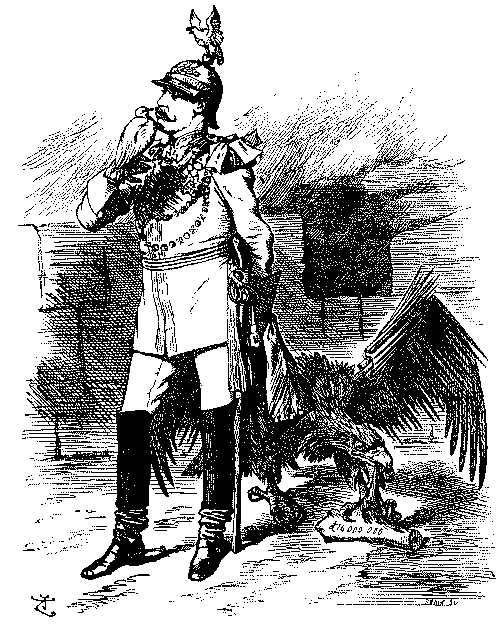
THE RIVAL PETS; OR, FONDLING AND FEEDING
Another sovereign whom Punch failed to read with the same
penetration was King Leopold II of the Belgians. On the occasion of
the International Anti-Slavery Congress at Brussels in November, 1889,
Punch, while very properly applauding the occasion as tending to the
overthrow of "the demon of the shackle and the scourge," acclaimed
Leopold II as a "magnanimous King." Cecil Rhodes, some years later,
after an interview with the same monarch, said that he felt just as if
he had been spending the morning in the company of the Devil.
Punch, like other critics, was happier in dealing with the dead than
the living, and the death of John Bright in March inspired a generous
though discriminating tribute to the memory and achievements of
"Mercy's sworn militant, great Paladin of Peace":—
For Peace, and Freedom, and the People's right,
Based on unshaken Law, he stood and fought;
If not with widest purview, yet with sight
Single, sagacious, unobscured by aught
Of selfish passion or ambitious thought;
Seeing day's promise in the darkest night,
Hope for the weak 'midst menaces of Might:
Careless of clamour as of chance-blown dust,
Stern somewhat, scornful oft, and with the stark
Downright directness of a Roundhead's stroke,
Who drew a Heaven-dedicated sword
Against the foes of Freedom's sacred ark,
The friends of the oppressor's galling yoke,
All fierce assailants of the Army of the Lord.
These memorial verses, however, if I may say so without incurring the
charge of unfilial disrespect—suffer throughout this period from
prolixity. The writer says excellently, but diffusely, in ninety lines
what is summed up in the majestic quatrain of Scott which stands at
their head:—
Now is the stately column broke,
The beacon-light is quench'd in smoke,
The trumpet's silver sound is still,
The warder silent on the hill!
Dropping the Pilot
Mr. Gladstone's golden-wedding day in July furnished the theme for
friendly and affectionate congratulations to a couple who stood for
"Darby and Joan" in excelsis. Mr. Gladstone's domestic happiness was
unclouded, but he was subjected to a painful ordeal in 1890 by the
disclosures of the Parnell-O'Shea divorce case and the split in the
Irish Party which followed. Punch supported Gladstone in his breach
with the Irish leader. He is shown in one cartoon refusing to give his
hand to Parnell:—
The hand of Douglas is his own
And never shall in friendly grasp
The hand of such as Marmion clasp.
Gladstone is acquitted of "mere Pharisaic scorn." But an element
bordering on the ridiculous enters into the succeeding cartoon of
Gladstone and Morley as the Babes in the Wood, while Parnell and Healy
as the wicked uncles are seen fighting in the background. The further
developments of the struggle are shown in an adaptation of Meissonier's
famous "La Rixe," in which Parnell is held back by Dillon and O'Brien
from Healy, who is restrained by Justin McCarthy. Parnell's sun was
setting in gloom and storm, but a greater than Parnell was passing
from the stage of high politics in 1890. For this was the year of the
dismissal of Bismarck by the Kaiser, commemorated in the issue of March
29 by Tenniel's famous "Dropping the Pilot" cartoon. Punch saw no
good in the change; he indulges in ominous speculations. Was Bismarck
animated by faith or fear of the future in quitting his post? Would
the new Pilot strike on sunken shoals or "wish on the wild main, the
old Pilot back again"? The Kaiser's gifts are seen to be no solace for
the wound of dismissal. As a matter of fact, Bismarck never used the
ducal title of Lauenburg conferred on him. In little more than a month
the Kaiser is shown as the Enfant Terrible of Europe, "rocking the
boat," while France, Italy, Austria and Spain all appeal to him to be
more careful and not tempt fate. The Kaiser's dabbling in industrial
problems, in the hope of propping his rule by concessions to Socialism,
meets with no sympathy. But a more serious ground for discontent
arose over the cession of Heligoland. Punch waxes indignantly
sarcastic over Lord Salisbury's deal in East Africa by which Germany
gained Heligoland as a bonus. It was "given away with a pound of tea";
Salisbury's weakness was worse than Gladstone's scuttle and surrender,
and Punch ruefully recalls the verses he printed nineteen years
earlier:—
TIME THE AVENGER!
On June 24, 1871, Mr. Punch sang, à propos of the Germans desiring
to purchase Heligoland:
Though to rule the waves, we may believe they aspire,
If their Navy grows great, we must let it;
But if one British island they think to acquire,
Bless their hearts, don't they wish they may get it?
And they have got it!
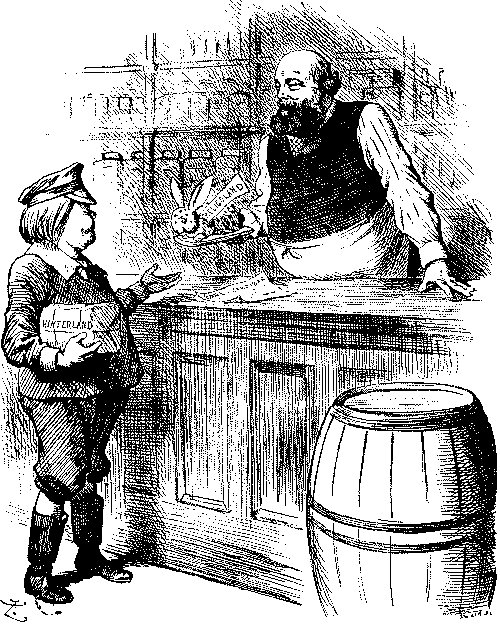
"GIVEN AWAY WITH A POUND OF TEA!!!"
The Surrender of Helgoland
But the fashionable world went on its way unheeding. Du Maurier
satirized this indifference in a picture in which one lady asks
another: "Where is this Heligoland they're all talking so much
about?" and her friend replies, "Oh, I don't know, dear. It's one of
the places lately discovered by Mr. Stanley."
Russia, it may be added, also incurred Punch's censure in 1890, the
legalized persecution of Jews forming the theme of a prophetic cartoon
in August, in which the shade of Pharaoh warns the Tsar, as he stands
with a drawn sword and his foot on a prostrate Hebrew: "Forbear! That
weapon always wounds the hand that wields it."
In 1891 the new "orientations" of the European Powers attract a good
deal of notice. The Franco-Russian entente is symbolized by the Bear
making France dance to the tune of the Russian loan. Punch's distrust
of Russia—semi-Asiatic and half-Tartar—dated from the 'forties. The
tightening of the Franco-Russian Entente in 1891 gave him no pleasure.
He quotes with manifest approval the comment of a daily paper on the
infatuation of France:—
The success of a Russian Loan is not dearly purchased by a little
effusion, which, after all, commits Russia to nothing. French
sentiment is always worth cultivating in that way, because unlike the
British variety, it has a distinct influence upon investments.
The cartoon of President Carnot embracing, and being hugged by, the
Bear was founded on an episode at Aix-les-Bains where he kissed
a little girl in Russian dress who gave him a bouquet, saying:
"J'embrasse la Russie." Punch's verses represent Carnot as fully
conscious of his blague, yet with an uneasy consciousness that the
Bear is going to squeeze him. Russia's religious intolerance again
comes in for strong condemnation. The Tsar is shown wielding the knout
on an aged Jew while the Emperor of China greets a Christian priest.
This contrast was based on the issue of a decree in which the Chinese
Government condemned anti-Christian excesses. In another cartoon the
Tsar bids his minions remove another aged Jew on the familiar ground
that Jews were always to the fore in Nihilist plots. The European
Powers, it should be added, were not satisfied by China's official
tolerance. The treatment of foreigners had provoked a collective
protest, from which Russia abstained. So when John Bull, as a sailor,
asks Russia to take a hand in controlling the Chinese Dragon, Russia
replies: "Well, I don't know—you see, he's a sort of relation of mine!"
The admiration which Punch had so often if reluctantly expressed for
Bismarck in office yielded to something like disgust at his undignified
bitterness in retirement, above all at his use of the "reptile press"
as a means of attacking the Imperial policy and Caprivi, his successor
as Chancellor. This feeling animates the "Coriolanus" cartoon in
February, where Bismarck is shown with the Hamburger Nachrichten in
his hand. The death of Moltke a couple of months later is duly recorded
in a versified tribute making all the usual points—on his taciturnity,
composure, foresight and strategy. With his death Bismarck became
the lonely survivor of "the Titanic three, Who led the Eagles on to
Victory." Moltke died full of years and honours. It was otherwise with
Parnell who at forty-five fell,
not as leaders love to fall,
In battle's forefront, loved and mourned by all;
But fiercely fighting, as for his own hand,
With the scant remnant of a broken band;
His chieftainship, well-earned in many a fray,
Rent from him—by himself!
None did betray
This sinister strong fighter to his foes;
He fell by his own action, as he rose.
He had fought all—himself he could not fight,
Nor rise to the clear air of patient right.
The Passing of Parnell
Punch notes his coldness, his impassive persistence as an agitator,
but says nothing of the ill-concealed contempt he showed for his
followers, and the entire lack of geniality, bonhomie, and humour,
which partly explained the mercilessness with which he was pursued
once his power was shaken. As he had never won or tried to win their
affection, he could not expect to find magnanimity in mean souls.
The wheels of the Parliamentary chariot drove heavily over the Land
Purchase Bill. Punch showed Mr. Balfour leading the poor tired little
Bill through a maze of amendments. A propos of its complicated nature
and endless, obscure sub-sections, which aroused much hostile criticism
in The Times, Mr. Balfour is made to say:—
The Times, too, may gird, and declare 'tis absurd not to know one's own Labyrinth better;
The Times is my friend, but a trifle too fond of the goad and the scourge and the fetter.
This, of course, was in the days when The Times was ultra-Unionist.
However, the Bill finally passed through its various stages, and Mr. W.
H. Smith exhibits it with the fruits of the Session in June, 1891, as
a gigantic strawberry. The choice of this particular fruit as a symbol
was dictated by the fact that both he and Lord Salisbury had exhibited
strawberries at the Horticultural Show.
The relations of Canada with England and the United States provoked
much discussion in 1891. Punch expressed confidence in Canada's
loyalty, and simultaneously published a burlesque "Canadian Calendar
(to be hoped not prophetic)," foretelling complete absorption in the
United States. It begins with Reciprocity with the U.S.A., and goes on
with the dying out of trade with and emigration from the old country,
the increase of improvident Irish, the request of Canada to be annexed
to America, and finally her decline into a tenth-rate Yankee state. On
the death of the Canadian premier, Sir John Macdonald, "old To-morrow"
as he was nicknamed from his habit of procrastination, Punch
overlooked the thrasonical magniloquence criticized in an earlier poem,
and only dwelt on his long services to the Dominion.
Earlier in the year Punch had typified the Federation of the
Australian Colonies in a boating cartoon, the British Lion from the
bank applauding a racing eight, manned by cubs and coxed by a kangaroo,
and bidding them swing together.
On the death of the old Duke of Devonshire at the close of 1891, and
the accession of Lord Hartington to the title, Mr. Chamberlain became
leader of the Liberal-Unionists in the Commons. Mr. Chamberlain, in
spite of the rapprochement already noted, was still looked upon in
some quarters as a somewhat dangerous Radical, and in January, 1892,
Punch represented the clock-faced Times lecturing him on his
responsibilities. Mr. Balfour succeeded Mr. W. H. Smith on the death of
that unselfish, honest and capable statesman, as Leader of the House of
Commons. The shades of Dizzy and Pam are friendly in the cartoon which
records the promotion; slightly anxious on the score of Mr. Balfour's
youth—he was then forty-four—but on the whole inclined to think
that he will do. Parliament was dissolved in June, the Liberals were
returned at the Elections, and the new House met on the now ominous
date of August 4.
NATIONAL DEFENCE
"Scuttle" and "Grab"
In the 'seventies Punch, as we have seen, was decidedly
non-interventionist. By the middle 'eighties he found it harder
to preserve a middle course between the extremes of Jingoism and
Pacificism, though he bestows impartial ridicule on both "Scuttle and
Grab" in his burlesque forecast of the alternate foreign policies of
the ultra-Imperialists and the ultra-Radicals. This was published early
in 1885, when the Liberals were in power, and though deliberately
fantastical and even farcical, shows how the wildest anticipations are
sometimes verified by fact. Four periods are chosen. In 1890 the Grab
Party inaugurate a forward policy all round by spending fifty millions
upon the Army and Fleet, and are turned out by John Bull when it is
found that their schemes involve:—
The seizure of sixteen islands, conquest of five native races,
absorption of fifty thousand square miles of—useless—new territory,
seven small wars, two large ones, four massacres, and an Income-tax of
five shillings in the pound.
The Scuttle Party is installed in power in 1895 with a big majority and
bigger promises:—
Finishes off all wars by caving in all round, retiring everywhere
and relinquishing everything. Cuts down Army, and resolves to sell
half the Ironclad Fleet as old metal. Power which buys it immediately
utilizes it against us. Another Fleet has to be ordered at once at
fancy prices in response to Press clamour. Scuttle Party, in cleft
stick, halts between two opinions; in pursuit of peace is found
fighting all over the world, and after frantic efforts at economy,
runs up Income-tax to six shillings in the pound. John Bull turns out
Scuttle Party.
Then we jump to A.D. 2000, but even then the wildest stretch of
Punch's imagination does not exceed the establishment of conscription
and the raising of the Army to a million men. Finally in his last
forecast Punch is reduced to solving the problem by an insurrection
under a popular soap-boiler, the seizure of the leaders of the two
parties, and the banishing of both "Scuttle" and "Grab" from the
political dictionary.
With the return of the Conservatives to power, we find that Punch,
so far from rebuking the Government for their expenditure on bloated
armaments, develops into something like an alarmist on the subject
of national preparedness and the folly of "cheap defences." The
inefficiency of the Army and Navy is a constant theme from 1887
onwards. The bursting of big naval guns, the badness of munitions
and designs for battleships are dealt with in bitter satirical
verses: while the damaging report of the Parliamentary Committee
on Army equipment and stores prompts a series of advertisements of
the "Benevolent Bayonet," the "Blazing Breech-loader," the "Comic
Cartridge," and so on. Dishonest contractors and incompetent officials
are attacked as "the Vultures of Trade" and "the Vermin of Office and
Mart." The persistent discouragement of volunteers by the military
authorities was an old grievance of Punch's, and it crops up in this
year in connexion with the removal of the camp from Wimbledon by order
of "George Ranger." Indeed, the bitterness of Punch's attack on the
Duke of Cambridge revives the memories of the 'forties, when a duke,
royal or otherwise, was his favourite cockshy:—
Snubbing the Volunteers
Some prate of patriotism, and some of cheap defence,
But to the high official mind that's all absurd pretence;
For of all the joys of snubbing, there's none to it so dear,
As to snub, snub, snub, snub, snub, snub, snub the British Volunteer!
A patriotic Laureate may bid the Rifles form,
And Citizens may look to them for safety in War's storm;
But Secretaries, Dooks, and such at this delight to jeer,
And to snub, snub, snub, snub, snub, snub, snub the British Volunteer!
A semi-swell he may be, but he may be a mere clerk,
And he's an interloper, and to snub him is a lark.
Sometimes he licks the Regulars, and so our duty's clear,
'Tis to snub, snub, snub, snub, snub, snub, snub the British Volunteer!
He hankers for an increase in his Capitation Grant,
It's like his precious impudence, and have the lift he shan't.
What, make it easier for him to run us close? No fear!
We'll snub, snub, snub, snub, snub, snub, snub the British Volunteer!
He has a fad for Wimbledon, but that is just a whim,
And as eviction's all the go, we'll try it upon him.
He's not an Irish tenant, so no one will interfere,
When once more we snub, snub, snub, snub, snub the British Volunteer!
His targets and his tents and things are nuisances all round,
As Jerry-Builders, Dooks, and other Toffs have lately found,
Compared with bricks and mortar and big landlords he's small beer,
So we'll snub, snub, snub, snub, snub, snub, snub the British Volunteer!
The Common's vastly handy, there's no doubt, to chaps in town,
And crowds of Cockneys to the butts can quickly hurry down;
But what are all Town's Cockneys to one solitary Peer?
No; let us snub, snub, snub, snub, snub, snub the British Volunteer!
Your Citizen who wants to play at soldiers need not look
To have his little way as though he were a Royal Dook;
With building-leases—sacred things!—he must not interfere,
So let us snub, snub, snub, snub, snub the British Volunteer!
If he must shoot his annual shoot somewhere, why, let him go
To Pirbright or to Salisbury Plain, or e'en to Jericho.
But out from his loved Wimbledon he'll surely have to clear,
A final snub, snub, snub, snub, snub to the British Volunteer!
Punch was not generous or just in representing the Duke of Cambridge
as a mere obstructive; and the sequel has not verified his forecast.
Wimbledon Common remains a great playground of the people, and the
annual meetings of the National Rifle Association, held at Wimbledon
from 1860 to 1888, have not suffered in prestige or value since the
move to Bisley in 1890.
References to the inadequate state of the national defences reach their
highest frequency in 1888. We have the duel between Lord Randolph
Churchill preaching retrenchment and Lord Charles Beresford advocating
expenditure on an increased Navy. This is followed up by Punch's
"Alarmist Alphabet" dedicated to our naval and military experts, to
whose warnings our rulers attach no particular importance:—
A's the Alarm that the Country's defenceless.
B's the Belief such assertions are senseless.
C's the Commission that sits with regard to them;
D's our Defences—the one topic barred to them!
E's the Expense—it's supposed we shall grudge it!
F is the Fear of increasing the Budget.
G stands for Guns, which we thought we had got.
H is the Howl when we hear we have not.
I's the Inquiry, abuses to right meant;
J is the Judgment (a crushing indictment!);
K is the Knot of red tape someone ties on it;
L's Limbo—where no one will ever set eyes on it!
M is the Murmur, too quickly forgotten.
N is our Navy, which some say is rotten.
O's the Official who bungles with bonhomie.
P's Party-Government—all for Economy.
Q is the Question engrossing our Statesmen.
R is Retrenchment, which so fascinates men.
S stands for Services, starved (out of Policy).
T is the Time when—too late!—we our folly see.
U is the Uproar of Struggle Titanic;
V is the Vote we shall pass in a panic.
W's War—with the Capture of London.
X our Xplosions of fury, when undone.
Y is the Yoke we shall have to get used to.
Z is the Zero our Empire's reduced to!
The Race of Armaments
Simultaneously Britannia figures in a cartoon as the "Unprotected
Female" surrounded by a litter of burst guns, broken contracts, broken
blades, unfinished ships, etc. Then we find Punch suddenly appearing
at Downing Street at "the first meeting of the Inner Cabinet," and
shattering the complacent satisfaction of the Premier and the War
Secretary by a peremptory and menacing demand for speeding-up in the
supply of rifles and more energetic recruiting. In July, under the
heading of "Punch's Parallels," the tercentenary of the Armada is
celebrated in a satiric perversion of the famous game of bowls into "a
nice little game of Ducks and Drakes—with the public money," in which
Lord George Hamilton, the First Lord of the Admiralty, is attacked as a
lethargic aristocrat. Another cartoon shows Moltke rebuking the Duke of
Cambridge for persistently discouraging the volunteer movement; while
the enforced expense of life in the regular army is condemned in "The
Pleasant Way of Glory." Commenting on the swamping of the subaltern's
pay by compulsory but unnecessary outlay, Punch remarks that "the
life of the British officer, as thus revealed, seems to resolve itself
into a prolonged struggle to keep up a false position on insufficient
means"; and he regrets that Lord Wolseley seemed to acquiesce in the
evil instead of encouraging British officers to be more frugal. Such
criticisms are not unfamiliar even to-day, for the old traditions die
hard. On the general question of national and especially naval defence,
Punch was not by any means a voice crying in the wilderness. Public
opinion had been worked up by other powerful advocates, amongst whom
Punch rightly mentions Mr. W. T. Stead. The debate on the Address
in the session of 1889 was prolonged and acrimonious. Early in March,
however, Lord George Hamilton moved a resolution, on which the Naval
Defence Bill was founded, authorizing an expenditure of £21,500,000 on
the Navy. The measure, of course, met with some opposition from various
quarters, but public opinion was manifestly in its favour, and it
received the Royal Assent before the end of May.
Throughout this campaign it is interesting to note how the personality
of the German Emperor obtrudes itself as a disquieting factor in the
international race in armaments. At the close of 1891 a lady with
alleged abnormal "magnetic" power was giving performances at the
Alhambra, and Punch adapts the incident in a cartoon suggested by the
Kaiser's dictum—inscribed in the Visitors' Book of the City Council
at Munich—Suprema Lex Regis Voluntas. The accompanying verses
on "The Little Germania Magnate" are derisive, not to say abusive,
with their references to "Behemoth Billy," "Panjandrum-plus-Cæsar,"
"Thraso" and "Vulcan-Apollo." Punch was evidently inclined to regard
the German Emperor as one of those "impossible people" who, as The
Times had suggested in a happy phrase, ought to "retire into fiction."
Unfortunately he remained a fact, and was not to be killed by Punch's
mouth.