Turning from England's international outlook to home affairs, we are
confronted in the earlier stages of the period under review by the
powerful negative influence of Lord Palmerston. A great Foreign
Minister, a capable and humane administrator when he was at the Home
Office, he had little belief in legislative remedies, and his refusal to
grapple with Reform became progressively distasteful to his Liberal
supporters. The old party system had been confused and shattered by the
secession of the Peelites, as the result of the Repeal of the Corn Laws,
and Palmerston was maintained in power in fact, if not in name, by a
coalition. His death ended the régime of masterly inactivity and
cleared the way for the reconstruction of parties and the prolonged duel
between the two great protagonists—Disraeli and Gladstone.
The Reform Bill of 1867, the chief constructive achievement of
Disraeli's first Premiership, was a great advance on that of 1832, but
the boon was robbed of much of its grace by the party strategy which was
summed up in Lord Derby's famous phrase about "dishing the Whigs."
Meanwhile Ireland had been forced into prominence by the outbreak of
Fenianism, the Liberals had been reunited under Gladstone by his Irish
Church policy and on his accession to power in 1868, we enter on the
golden age of Gladstonian finance, with a low income tax—it dropped to
3d. in the year 1873—high wages and industrial prosperity.
Labour and Intervention
It was also, as we have seen, the age of non-intervention in foreign
politics. Strange to say the strongest appeal to the Government to
interfere by force of arms in a foreign quarrel was made by a deputation
of working men, introduced by Professor Beesly, in May, 1863, with a
view to expounding to the Prime Minister the resolutions in favour of
Poland voted by a Trade Union Meeting in St. James's Hall:—
One of the deputation, Mr. Cremer, a joiner, after Pam had given
the deputation the requisite sympathetic and evasive answer,
jovially observed, in plain English:—
"We are men of action, my Lord, and have come to the conclusion
that the only way to aid the Poles is to call on Russia to desist
from her present conduct, and if she will not attend to that call,
thrash her into compliance."
We append Punch's comments because they are typical of his gradual
adoption of a more critical attitude towards the working man. It should
be remembered that there was no Labour Party in the House of Commons
until 1884. Before that time working men like Mr. Burt and Mr.
MacDonald, the two miners returned in 1874, were returned by an
arrangement with the Liberals and sat on the Liberal benches:—
If the honest working men were so thoroughly well represented as to
command a majority in the House of Commons, they would not, of
course, want to thrash foreign powers into compliance with their
demands, and tax others to pay the expense of their own war. Would
they subject their wages, one and all, to Schedule D, then, in
order to thrash Russia into liberating Poland? If so, they are fine
fellows. If not, the parts performed by the handicraftsmen who
joined in the deputation to Lord Palmerston are about on a par with
those of Quince, the carpenter; Snug, the joiner; Bottom, the
weaver; Flute, the bellows mender; Snout, the tinker; and
Starveling, the tailor, in A Midsummer Night's Dream; our British
carpenters, joiners, and other working men partake in a very
delusive dream in the expectation that England is going to fight
for the Poles. The income-tax makes cowards of us all, except the
working men who do not pay it.
Many of the abuses and evils at which Punch had tilted so vigorously
had been removed and remedied. The Corn Laws had been repealed; the
Factory Acts had improved the conditions of labour. Obsolete and
barbarous laws had been removed from the Statute Book. The Game Laws had
been modified, and the administration of justice was marked by a humaner
spirit. The principle that property had its duties as well as its rights
was being steadily enforced, and, at the close of the period under
review, class privilege was curtailed by the institution of open
competition in the Civil Service and the abolition of purchase in the
Army.
This brief and imperfect list may help to explain the conversion of
Punch, the strenuous and impassioned advocate of the masses during the
'forties and 'fifties into the champion of the middle classes, and the
very candid friend of the working man and Trade Unions as revealed in
the later 'sixties and early 'seventies.
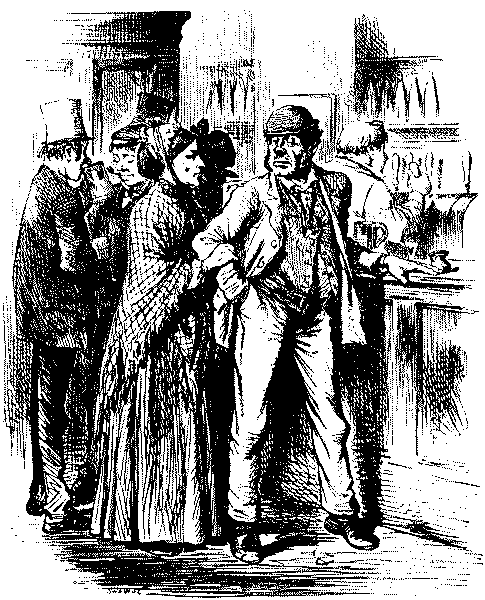
THE SUNDAY QUESTION:
The Public House
The Gang System
Life on the land showed little signs of progress in the opening years of
this period as illustrated by Punch's legal pillory. But the vagaries
of clerical and aristocratic magistrates, culled with chapter and verse
from provincial newspapers, which excited his wrath in 1858, almost
disappear in the 'sixties, no doubt in consequence of a more humane
interpretation of the Sunday Observance Act. In 1869, the debate on "The
Recreation of the People" at the Church Congress revealed a growth of
clerical tolerance and common sense which extorted the high approval of
Punch. Still, the "Sunday Question" was far from being solved when it
impelled the convivial Punch to print in the same year the companion
cartoons contrasting his vision of what might be with the squalid
reality of what was.
The incubus of Sabbatarianism, so far as it affected farmers and
labourers, was at any rate much lightened in these years. But a far more
serious evil was the gang system, under which a gang, chiefly of
children, some as young as five, but mostly boys and girls under
fourteen, were hired by a gang-master, who made as much as he could by
taking them about the country and letting out their labour to farmers.
It was not until 1867 that the good Lord Shaftesbury carried the
Agricultural Gangs Act by the provisions of which no child under eight
might be employed in an agricultural gang, and girls were placed under
the protection of a licensed female gang-master. It was a modest
instalment of reform, long since extended by our Elementary Education
Acts; it is to the credit of Punch that he hailed it as placing a
check on "a system so abominable that nothing but the intensest
hypocrisy can call this a Christian nation while it exists." Against
those who deliberately perpetuated ignorance by enslaving the young he
carried on a truceless war. He was slower to condemn the ignorance of
rural superstition when it could be paralleled by the credulity of the
educated, and his observations on the sentence passed on a Devonshire
shoemaker may be taken to heart fifty years later:—
A paragraph in a contemporary, headed "Superstition in Devonshire,"
contains the following defence, addressed by an old shoemaker named
Burch to the Barnstaple magistrates, before whom he was charged
with assaulting an old woman by scratching her on the
arm:—"Gentlemen, I have suffered five years' affliction from her.
I have been under her power, and more than a hundred people advised
me to fetch blood of that woman to destroy the spell. I have lost
fourteen canaries, and from forty to fifty goldfinches; as fast as
I got them they died, and I have had five complaints brought upon
me at once."
On hearing this declaration:—
"The Mayor said that it was most extraordinary that such ignorance
and superstition should prevail in the present enlightened age."
In the present enlightened age persons of position in society and
of education believe that they shake hands with spirits at dark
séances. His Worship the Mayor of Barnstaple cannot have known
that, or he would not have called the belief in witchcraft
ignorance and superstition. If spiritualism is true, sorcery is
possible, and, as there is no legal remedy against it, old Burch
may be considered to have been justified in taking the law into his
own hands for self-protection. Accordingly, since he was fined 2s.
6d. and costs, and, as he couldn't pay the money, sent to prison,
perhaps a subscription to get him out of gaol, and make him amends
for the trouble he has got into, will be raised among affluent and
superior "spirit circles." For if one medium can float about a
room, why may not another ride upon a broomstick?
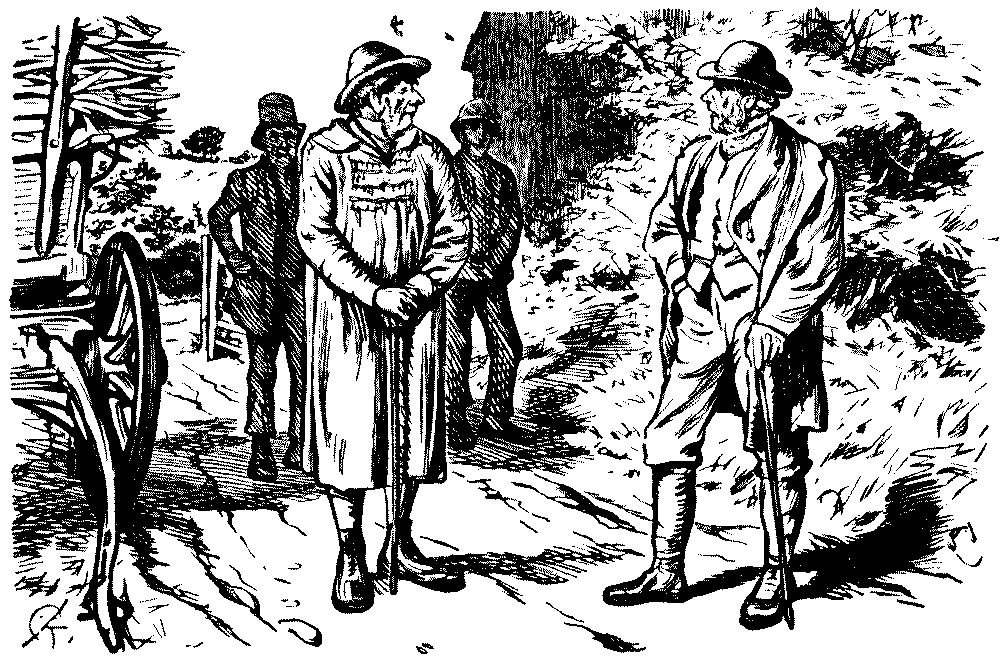
"SMALL BY DEGREES"
Suffolk Farmer: "Two shill'ns a week more? Never! That'll never do! Out
of the question!"
Suffolk Ploughman: "You're right there, Mas'r Wuzzles, sart'n sure! It
'on't dew. Our Sal sahy there'll be eight shillin' and threepence for
bread, three and sixpence for rent and coal, and half-a-crown for club,
clothes, boots and shoes for the owd 'oman, five kids, and me. No, that
'on't dew—that, that 'on't, b'um by. But it'll be enow to begin with!"
The Old Man and the New Rich
Though no friend of feudalism, it is curious to note that in the
vehement protest against enclosures, the closing of rights of way, etc.,
which he published in 1869, Punch is careful to distinguish between
the old and the new rich. The closing of Nightingale Wood, between
Southampton and Romsey, which "from time immemorial had been open by
gracious permission to rural ramblers," was the occasion for an outburst
culminating in the statement that "the brutes now fast closing the
sylvan scenery of England to Englishmen, are, with the exception of an
ignoble duke or two, rich rogues of speculators and financiers, who have
ousted the old territorial aristocrats and squires, having bought fields
and forests with the reward of their rascality."
In the selfishness of the "profiteer," as we now call him, Punch sees
a sure provocative of Communism. He would clearly have applauded the
distinguished but eccentric judge who in a later day erected on his
country estate boards with the notice "Trespassers will not be
prosecuted."
It remains to be added that the grievances of tenants and farm
labourers, though far less frequently mentioned than in earlier years,
did not altogether escape the vigilance of Punch. In 1861 he printed
an ironic petition from a tenant to his landlord asking to be as
comfortably housed as his horses. In 1868 he alludes to the scandalous
housing conditions on the estate of a noble landlord in Essex—an estate
which of recent years has been noted for its humane and liberal
management.
Prison v. Workhouse
Far more space, however, is devoted to the administration of the Poor
Law, the economics and evils of Industrialism in the manufacturing
centres, and the efforts of practical philanthropy. Throughout the
'sixties and right on into the early 'seventies Punch never wearies of
insisting on the folly of making life in prison more comfortable than
that in the workhouse. His campaign begins with an onslaught on the
guardians of the Durham Union, who appeared to think that there "ought
to be a correspondence between the spiritual nutriment of paupers and
their material diet":—
Under this impression it evidently was that they advertised the
other day for a chaplain, offering the salary of £20 a year. Their
advertisement was answered by a tender from one John Smart, who
turned out to have been a clergyman's footman, and conceived that
he had learned to exercise the functions of a parson from his
master. He had, he said, "had a good deal of private practice, but
not public."
It is painful to find a respectable man-servant reduced to apply
for employment in the capacity of a Workhouse chaplain. Cannot an
inferior class of clergyman be ordained on purpose to administer to
paupers a coarser kind of spiritual food? Deep indeed must be the
humiliation experienced by a footman in exchanging plush and gold
lace for the canonicals of a chaplain whose salary is £20 a year.
It was the time of the garrotting scare. Hence the point of Punch's
comment:—
The frying pan as compared with the fire is much less comfortable
than the Model Prison in proportion to the Union-Workhouse.
The former of those two establishments relatively to the latter is
considerably milder than Purgatory may be imagined to be, in
contrast with the other place which the prisoners mentioned. Quod,
in comparison with the Abode of Want, is quite a tolerable sort of
Limbo. What is the moral of this arrangement, in the apprehension
of the classes who have to live by their own exertions? Whatever
you do, keep out of the Workhouse. Garrotte anybody rather than
apply to the Union.
Punch still disapproved of the gallows; the strongest argument in its
favour was the manifest truth that the cheapest thing you could do with
a worthless rascal was to hang him. But he saw a better way in rendering
penal servitude exemplary:—
At any rate, for the prevention of garrotte robberies and all other
crimes, one step might be taken somewhat analogous to the treatment
proverbially recommended for that other complaint, the influenza,
which is just now likewise so prevalent. "Stuff a cold," says the
popular adage, "and starve a cough." At present the moral reverse
of this rule is observed in penal economy. You stuff a convict and
starve a pauper. Wouldn't it probably answer better to allow
paupers sufficient food and put criminals on low diet? Thus you may
be enabled to get on without the gallows.
It was stated, and accepted by Punch in 1860, that since 1856 there
had been a decrease in crime of 25 per cent. owing to the establishment
of Reformatories. But the series of papers in the Morning Post in 1863
on the Middlesex Industrial School at Feltham—where the boys were
subjected to a devotional drill, made to lift and lower their hands in
prayer and sing grace "to the sharp order of a master," and mercilessly
caned and birched by a tall, muscular drill master for acts of
insubordination—gave Punch furiously to think:—
The Middlesex Model School at Feltham is an institution for the
reformation of young thieves, but its arrangements for developing
the religious sentiment in the youthful mind appear to be such as
may be conceived to have been devised for mutual edification by the
inmates of an asylum for idiots.
Flogging is a fine thing; but how strange that its application is
limited to boys and soldiers and sailors: to children of tender
age and members of an honourable profession! Wouldn't it be at
least as suitable to garrotters, and even to cruel swindlers, whose
exemplary torture, in comparison with the misery caused by their
crimes, would be the lesser evil of the two?
The painful disclosures resulting from inquiries into workhouse
conditions are repeatedly referred to and make strange reading in a
comic journal. At a meeting held in Willis's Rooms by the Earl of
Carnarvon and the Archbishop of York early in 1866, the brutalities to
which the sick poor were subject in the infirmaries of most of the
London workhouses were illustrated in such hideous detail, that Punch
declared "it would be cheaper to put paupers out of their misery than it
was to let them die in misery, and it would at least be just as moral."
The parsimony, the self-indulgence and the barbarous procrastination of
the guardians of St. Pancras are castigated a few months later, when a
motion to postpone the consideration of the appointment of an extra paid
nurse for three months was carried by six votes to five. There were
forty guardians; but most of them were absent at the quarterly dinner of
the Burial Board. Punch, therefore, had good excuse for saying that
"these nine-and-twenty parochial humbugs, instead of minding their
business, were engaged in stuffing their most ungodly digestive organs
with funeral baked meats."
Ignorant Guardians
The Derby-Disraeli administration had come into power in the previous
month. So when Mr. Gathorne Hardy had succeeded Mr. C. P. Villiers as
President of the Poor Law Board, the alteration in the methods of
procedure in regard to investigating workhouse abuses provoked a
well-timed and damaging attack on the attempt to whitewash Bumbledom. It
is a dreary subject, but the principles which ought to govern a
Departmental inquiry could not be better expressed. And Punch was
happily able to fortify his humanitarian zeal with ridicule when, in
quoting from the description of the horrors of Walsall Workhouse given
by the Lancet, he gives two stories showing that workhouse
mismanagement in those days, at any rate, was largely the result of
crass ignorance:—
It was suggested in one workhouse board-room that a bath ought
unquestionably to be supplied, when a guardian got up and stated
"he were agin it." He never had one in his house in his life, and
he didn't see why a pauper should enjoy what he didn't want. On
another occasion the absence of a proper light at the entrance door
was dwelt upon, and a gas-lamp was proposed. This was seconded by
another worthy, who, approving of the gas-lamp, said, "and I'd have
it lighted with ile."
Now the first of these gentlemen may be a regular saint. He never
bathed, and he regarded his neighbour as himself. To be sure, if he
was a saint he was also a pig; but swinishness has not seldom been
combined with sanctity. The other guardian, who didn't know better
than that a gas-lamp could be lighted with "ile," was himself so
destitute of all enlightenment that he may be excused as a simply
irresponsible clown.
The euphemisms of Poor Law inspectors, who used colourless words such as
"inadequate" and "insufficient" when "barbarous," "brutal" and
"horrible" would have been nearer the mark, had been exposed by the
British Medical Journal in 1868. If destitution was not a crime, why,
asked Punch, was the pauper treated worse than the criminal? These
abuses, in the exposure of which he joined hands with serious medical
journals, explain and justify the intense and even passionate desire of
self-respecting poor people to avoid the Union.
Though no lover of Jews, Punch in 1869 contrasts Jewish guardians
favourably with their so-called Christian brother officials. Dickens's
picture of old Betty in Our Mutual Friend is hardly overdrawn, and a
year after Dickens's death Punch was still contrasting the comforts of
prison life with the usual conditions of life amongst the submerged
poor.
The State had not yet awakened to a sense of its responsibilities to the
"legal poor." Much was being done by practical philanthropy, and it may
be fairly said that no appeal to Punch for assistance or encouragement
was left unanswered. Wholehearted in his support of Ragged Schools, he
comes forward in 1858 to plead the cause of their logical
corollary—Ragged Playgrounds:—
Deprive a boy of healthy, fair and open games, and you drive him to
resort to unwholesome, foul and sneaking ones. Deny him any
playground but a hole-and-corner court, and you'll find that he'll
betake himself to hole-and-corner games in it. In default of
wholesome cricket, he'll become a dab at chuck-farthing; and will
get from pitch and toss to still worse kinds of time-slaughter.
If we mean then to teach the ragged young idea, we must give heed
somewhat to the ragged body likewise. And the first thing to be
done is to provide it with proper play space.
Punch, therefore, may be regarded as one of the pioneers of the
admirable "Play Centres" movement. In the same year we find him
applauding the conversion of an old thieves' public house in Westminster
into the headquarters of the Ragged Schools, and appealing for funds to
maintain it. Drinking fountains had been established in Manchester and
Liverpool, and Punch expresses a desire to see them introduced into
London. Here, at any rate, he was prepared to welcome the saying that
what Lancashire thinks to-day, England will think to-morrow.
In the domain of social reform Punch's great bugbears were patronage,
condescension and misplaced missionary efforts. Towards Exeter Hall
philanthropy the old and rooted hostility remains throughout this
period, and in 1865 we find Punch pleading vigorously for a greater
interest in social reform at home to supplement the fashionable
enthusiasm for foreign missions. For missionaries of the type of
Livingstone he had nothing but praise, but that "perfect Christian
gentleman," as Sir Bartle Frere described him, had severed his connexion
with the London Missionary Society in 1857, and thenceforth had been
subjected to "much hostile criticism from narrow-minded people."
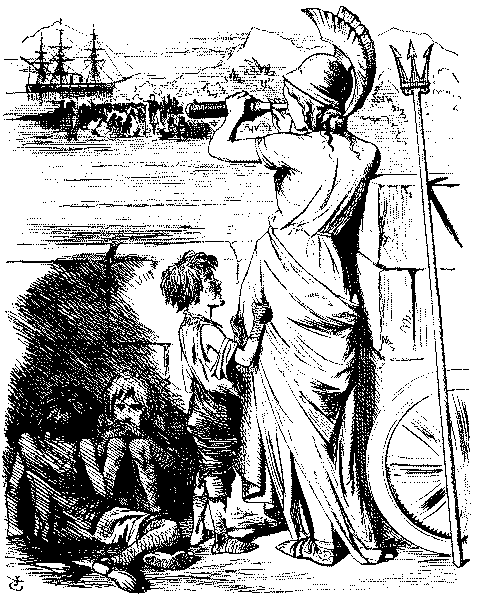
TELESCOPIC PHILANTHROPY
Little London Arab: "Please 'm, ain't we black enough to be cared for?"
(With Mr. Punch's compliments to Lord Stanley.)
The benefactions of George Peabody roused Punch's interest from the
very first. In 1862 and 1863 his pages abound in questions as to what
was being done with the Peabody Fund. But in 1864 the first block of
"Peabody dwellings" was opened in Spitalfields, soon followed by others
in Chelsea, Bermondsey, Islington and Shadwell; and in 1866, on learning
that Mr. Peabody had increased his gift to the London poor from £150,000
to a quarter of a million, Punch was ashamed at the lack of public
recognition of his generosity. The letter from a "London correspondent"
is more than an expression of gratitude—it is a valuable contribution
to the study of Victorian sociology.
MR. PEABODY'S GIFT.
"I will confess to you that I indulged myself with the thought that
it would be a graceful conclusion to the reference sure to be made
to American affairs in the Queen's speech, if a few words of
cordial recognition were devoted to the munificence of this great
American citizen. Of course, I was immediately ashamed of myself
for thinking such a thing possible; and I hope you will overlook
the ignorance of etiquette, routine and precedent—the shadowy
creatures that hold us back when we are yearning to obey some noble
impulse—betrayed by such a disordered fancy. When I read the
Speech, all feelings of disappointment about Mr. Peabody
evaporated, for I found that from the beginning to the end of the
Royal oration there was not a line to commemorate the name and the
fame of the Great Minister [Lord Palmerston] lying so near in the
sacred silence of the Abbey. The shadowy creatures were again
appalled by my audacious expectation, and held out menacingly a
noose of ruddy tape.
"I then waited to see whether Mr. Childers, in proposing a public
loan in aid of the erection of houses for the labouring poor, would
introduce Mr. Peabody's name. He did, and handsomely; and I am not
without hope that before the vessel of State gets into the chopping
seas that lie in its track, the captain, or perhaps the first
lieutenant, may say something on this American question which would
give unqualified satisfaction on both sides of the Atlantic. You
will not misunderstand me. You will not suppose that when I speak
of thanking Mr. Peabody, I am thinking of gold boxes, or addresses
beautifully engrossed on vellum and enclosed in polished caskets,
or public banquets, or services of plate. His gift towers above all
ordinary gifts, as St. Paul's rises over all meaner edifices; but
it does seem to me that it should be acknowledged and gratefully
recorded by the voice of the eloquent speaker and the pen of the
eloquent writer, be it in Parliament or in the pulpit, from the
public platform or in the columns of the omnipotent Press. To some
extent this has been done, but not commensurate with the magnitude,
the rarity, and the disinterestedness of the gift.
"When I read the unprofitable proceedings of Convocation, the
discussions about canons and catechisms, rubrics and conscience
clauses, I think to myself that Mr. Peabody may be doing more for
the souls of the poor, by providing for their bodies, than both
Houses of Convocation will do, though they should sit to the end of
the century, and enjoy a fresh gravamen at each sitting.
"If I were the Bishop of London, out of the fund with which his
name will be imperishably associated, in every district containing
a Peabody block of buildings, or dwellings for the poor, such as
Alderman Waterlow understands how to build, I would provide a
working clergyman, sure that he would find eager listeners in men
and women, translated from styes of filth and disease, and
degradation, to homes abounding in cleanliness, and health, and
comfort, through the direct bounty or beneficent example of the man
who has arisen to the rescue and deliverance of the poor of
London—George Peabody.
"Perhaps the best commemoration of their benefactor by the Peabody
settlements would be a day's holiday in the country every summer, on his
birthday, if it falls in one of the leafy months."
The neglect of which Punch complains cannot be laid to the door of the
Queen. When Mr. Peabody was about to return to America in March, 1866,
she acknowledged his munificence in an autograph letter, saying how
gladly she would have conferred upon him either a baronetcy or the Grand
Cross of the Bath (both of which he declined), and asking his acceptance
of a miniature portrait of herself.
Peabody's gifts to London amounted in all to £500,000, and set an
example which native millionaires have done well to follow. But he was
an even more munificent benefactor to his own country, where he gave at
least a million to education. When he died in London in 1869 Punch, in
his memorial verses, contrasted the feelings aroused in the two nations
with those of the "mourners" of most rich men:—
No common mourners here such office fill—
A mother and a daughter, grand of frame,
Albeit one in blood, oft twain in will,
And jealous either of the other's fame.
But by this bier they pause from jar and boast,
Urged by no rivalry but that which strives
Him that lies here to love and honour most,
Ranking his life highest among the lives.
Of men that in their tongue and blood claim part:
And well may child and mother mourn for one
Who loved mother and child with equal heart,
Nor left, for either, Love's best works undone.
The beneficent use of great wealth on a great scale seldom evades
ultimate acknowledgment. Punch said no more in his tribute to Peabody
than that great and humane American deserved. But minor endeavours were
not overlooked, even where they led to no immediate results. Such, for
example, was the proposal of F. D. Maurice and others to found a Working
Women's College in 1864. Classes for women had been held at the Working
Men's College from 1855 to 1860. The larger scheme was not realized, but
has been revived within the last year by the establishment of the
Working Women's College at Beckenham. Such again was the establishment
of the London Dressmaking Company in 1865, under the patronage of Lord
Shaftesbury and the Bishops of London and Oxford, to which Punch gave
a vigorous puff-preliminary in his editorial columns.
In 1858 the fate of Emily Druce had shown that the plea of Hood's "Song
of the Shirt" was in danger of being forgotten. But sweated labour was
not confined to the cheap clothing trade. In 1863 West-End milliners
came under the microscope of Parliament and Mr. Punch:—
Public indignation has been excited by the accounts of the death of
Mary Anne Walkley, a girl employed by Madame Elise, of Regent
Street, wife of one Isaacson, and a notorious dressmaker. "Long
hours in an overcrowded room and sleeping in an ill-ventilated
bedroom," said Sir George Grey, "caused the young girl's death."
What is to be done? Lord Shaftesbury in the Lords, and Mr. Bagwell
in the Commons, called attention to the system under which such
girls are killed; and the man Isaacson, who seems to fill a similar
office to that of Mr. Mantalini, and who writes English of which
that gent would be proud, issued a letter full of impertinence and
bad grammar, in defence of Mrs. Isaacson's place. Thereupon the
parish requested other testimony, and Dr. Lankester examined the
premises, and found the dormitories rather better and the workroom
rather worse than had been expected.
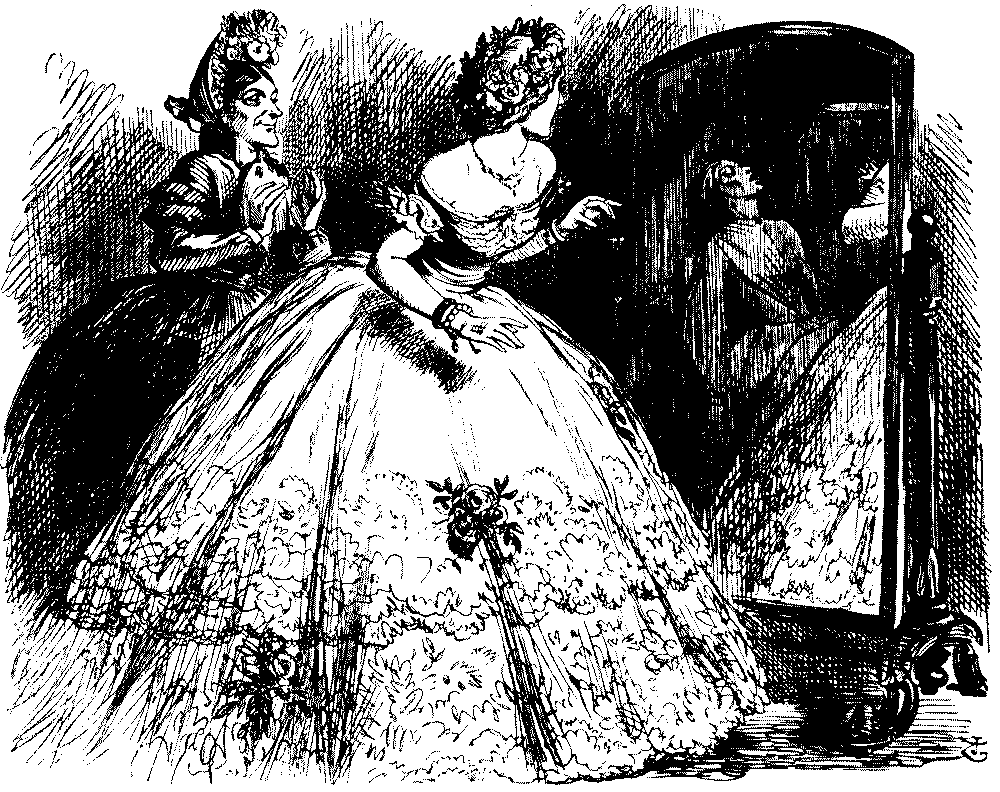
THE HAUNTED LADY, OR THE GHOST IN THE LOOKING-GLASS
Madame La Modiste: "We would not have disappointed your Ladyship, at any
sacrifice, and the robe is finished à merveille."
These tragedies and the efforts which they prompted serve as a
convenient transition to a more general survey of Labour problems,
Labour legislation, and Labour organization and representation as they
are revealed and discussed in the pages of Punch from 1857 to 1874.
Under the recently established and rapidly extending joint reign of
steam and coal, it was only natural that rural life should recede into
the background. Railway construction had drawn off many labourers from
agriculture, and the influx of labour into the manufacturing districts
continued apace. In the prospectus of the Dressmaking Company given
above, the work-hours are given as ten. But in 1859 the movement among
working-men for a nine-hours' day had already been started. Strikes were
common, but Punch discourages them on the ground that the men always
lost in the long run, and that the "agitators"—the name "Labour
Leaders" had not yet emerged—were the real criminals. The Examiner
took the same line in 1861 when it wrote "the submission of workmen to
the tyranny of their Unions is at once one of the most curious and
lamentable phenomena of our time." Yet the existence of genuine distress
is not denied, and in a little parable in verse entitled "Men and Bees,"
profit-sharing between masters and men is recommended as the true
solution.
On what was still, in spite of Factory Acts and other measures, the
greatest blot on our industrial system—the employment of child
labour—Punch spoke with no uncertain voice. Early in 1860 he gives
Lord Brougham a good mark for taking up the question in the Lords:—
Lord Brougham, always true to his humane instincts, brought before
the Lords the case of the young children employed in Bleach Works.
It is a cruel one. Infants of seven and eight years old are at work
for eighteen hours, and are sometimes four nights without sleep.
The brutalities by which the poor little children are kept
sufficiently awake for the purposes of their task-masters are
shocking. Years ago, when the cruelties of the climbing-boy trade
were exposed in the Lords, a noble Lord told a good story, made
their Lordships laugh, and by getting the Bill thrown over for a
year, left a new batch of children to the mercies of the Sweep.
There was nothing of this kind to-night, and Lord Granville
promised information. He will be good enough to remember that Lord
Brougham has tendered information, which proves that our friend
Mammon is, as usual, doing the work of Moloch.
Climbing Boys and Girls
Here, at any rate, there is no sympathy for the greedy capitalist, who
comes off as badly as the "agitator." The mention of the chimney-sweeps
is timely. In 1864 the employment of the climbing boys had been
prohibited by Act of Parliament for twenty years. Yet the Act had been
so systematically evaded that in that year more than 3,000 children were
still kept at labour in that filthy and unhealthy form of slavery. The
subject was brought up in the House of Commons in April by Mr. Digby
Seymour, and furnished Punch with an excuse for assailing those
"sentimental and pious ladies" who "prefer subscribing to societies for
converting little Hottentots to using influence to suppress the
atrocities committed upon little white children at home." A month later
Lord Shaftesbury intervened in the Lords: the details which he brought
forward were too shocking for reproduction, but "fine ladies who mew
over the sorrows of the Circassians, and devout ladies who send
missionaries to the Chinese, had better know what is done in their own
houses, and within a few feet of their own beds, with the children of
white English folk."
The kidnapping of little boys had been revived, and at a meeting held in
York the following agreement was signed by the assembled sweeps:—
"We, the undersigned Master Sweeps of the City of York, mutually
agree, from and after this date, not to employ Climbing Boys and
Girls in our business; that the Act of Parliament on their behalf
made should be strictly complied with; and that we ought no longer
to risk the heavy penalties it prescribes, both against
householders and ourselves."
It thus appears that, in York at least, the employment of climbing girls
had become almost or quite as common as that of climbing boys.
Lord Shaftesbury's "Chimney Sweepers Regulation Act" (1864) provided
that a chimney sweeper convicted of causing or allowing any person under
the age of twenty-one to ascend or descend a chimney or enter a flue for
the purpose of sweeping it or extinguishing a fire might be sent to
prison for a term not exceeding six months with or without hard labour.
But master chimney sweeps still continued to "snap their sooty fingers
at the law." In the issue of March 2, 1867, Punch reproduces the
following business "card":—
"William Burges, Chimney Sweeper, No. 36 Bolton Street, Chorley,
flatters himself with having boys of the best size for such
branch of business suitable for a Tunnel or Chimney, and that it is
now in his power to render his assistance in a more extensive
manner than he usually has done. He also carries his boys from room
to room occasionally, to prevent them staining or marking any room
floor with their feet."
In short, there was good ground for the complaint that while a great
deal had been said about our working men, but little notice had been
taken of our working children. A discussion of the "half-time system" at
a working men's club in which another enlightened and benevolent peer,
Lord Lyttelton, took part, is accordingly welcomed as sensible and
opportune:—
"By this system," said Lord Lyttelton, "which compelled every
parent who chose to send his child to work also to send him or her
half the day to school, a very useful compromise had been effected
between the demands of labour and education.... This system, as
carried out in the manufacturing towns of Lancashire and Yorkshire,
had resulted in the increased education, and consequent improved
life and conduct, of their inhabitants, as had been manifested
during the late cotton famine, and in many other ways."
Gentlemen of England who live at home at ease perhaps have little
notion of how hard some children work, and how needful it appears
to make some effort to relieve them. From a Blue-Book he produced
at the meeting we have mentioned, Lord Lyttelton
"Gave an instance of a little girl engaged in a brickyard near
Birmingham from 6 a.m. to 8 p.m., only having fifteen minutes for
breakfast, and thirty minutes for dinner, no time for tea, and
during one day she would have to catch and throw to her neighbour
fifteen tons of bricks."
What a mercy it would be to such poor little working children if their
fathers were compelled to send them every day to school!
White Slaves in the Black Country
Towards the end of the same year the Town Council of Sheffield met to
consider the report of the Children's Employment Commission relative to
the overworking of children in the trades of that town:—
According to that Report, a boy, only nine years old, living at
Wadsley, four or five miles from Sheffield, was obliged by his
father to work as cellar-boy in one of the furnaces, on most days
of the week from six in the morning to six or seven in the evening,
and on Saturdays from three in the morning till three in the
afternoon. This enforced labour at a high temperature would, if
only occasional, appear to be equivalent to a somewhat long
compulsory innings in the Turkish bath. Imposed nearly every day,
it may be considered by some who do not consider too deeply, to
constitute a combination of the Turkish bath with Turkish tyranny,
and tyranny about as barbarous as ever was practised in Turkey.
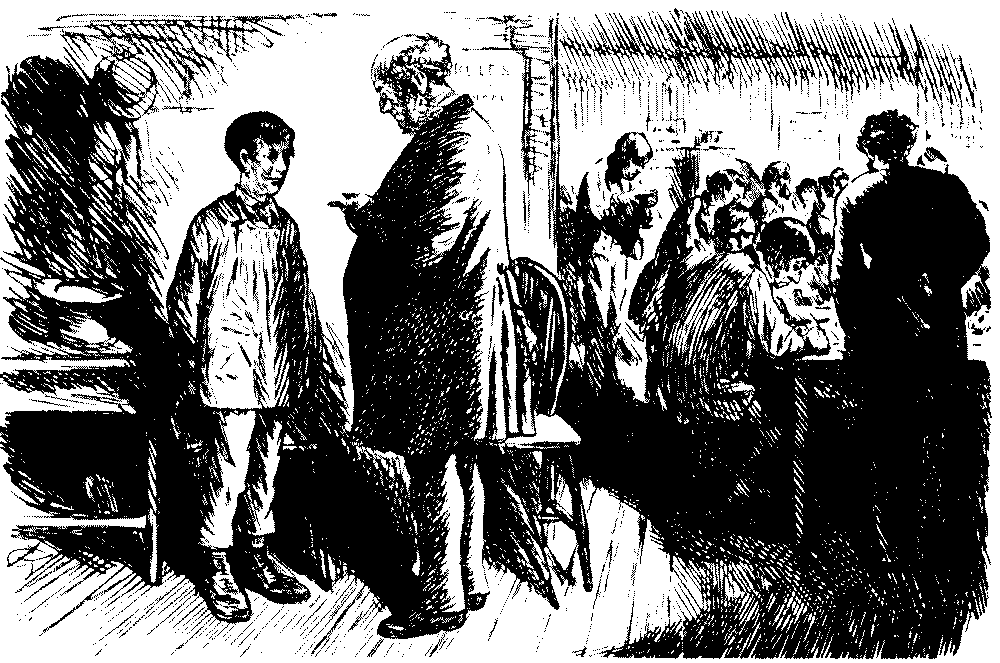
A DISTINCTION
The "Good Parson" (to applicant for instruction in the Night School):
"Have you been confirmed, my boy?"
Boy (hesitating): "Please, sir—I—don't know."
Parson: "You understand me; has the Bishop laid his hands on you?"
Boy: "Oh, no, sir, but his Keeper have, sir—very often, sir!"
Naturally, such outspoken comments gave offence, and in 1866 and again
in 1868 Punch was very much in the black books of the Black Country
for what he said on the state of morals, manners and education among the
workers of that region of coal and iron. The controversy began with some
lines, "The Queen in the Black Country," which were inspired by the
inauguration of Prince Albert's statue at Wolverhampton. These gave pain
to certain susceptible inhabitants of that town. Punch's reply was to
quote from the report of the Children's Employment Commission of 1864 on
the trades in the Wolverhampton district, showing that all the large
employers lived far away from the workpeople they employed; that a few
ministers of religion were almost the only representatives of the upper
class resident in the "Black Country"; that large numbers of children,
youths, young persons and women worked the same long hours as the men,
from 6 or 7 a.m. to 9, 10 and 11 p.m.; that among them little girls were
often kept bellows-blowing fourteen hours a day.
Laws to Protect Children
In January, 1868, Punch was accused of being a Rip Van Winkle, who had
been asleep for half a century, because when Bishop Selwyn was
translated from New Zealand to Lichfield he had published some verses
ending up with the question, "What's the savage o'er sea to the savage
at home?" His answer was to say that he wished he could, like Rip Van
Winkle, fall asleep not over the Black Country only, but over every
manufacturing district of England, to wake in fifty years and find
education for ignorance, thrift and comfort for improvidence and
squalor, gentleness and refinement for coarseness and brutality among
men and women; health and happiness for sickliness and suffering,
premature decrepitude and deadening of mind among children. But the
facts were too strong for him:—
We never said, or meant to say, that things were as bad in the
Black Country now as they were fifty, forty, or twenty years ago.
We are quite ready to believe, with a more courteous and kindly
Black Country correspondent than Mr. Lawley, that much has been
done, and that much is doing, for religion, education and
civilization in that region as everywhere else.
If Mr. Punch has been unfair to the Black Country, he has, at least,
been sinning in good company. Hear what Mr. Justice Keating spoke from
the Bench, in a Black Country case, not three weeks ago:—
"I cannot help noticing the most deplorable state of matters shown
by the evidence of these girls. We call ourselves a Christian
people and pride ourselves upon being a civilized nation. These two
girls have said that they could neither read nor write; that they
had never in their lives been at school, church or chapel; that
they had never heard of the Bible; and, as the learned counsel had
suggested, in all probability they had never heard of a Divine
Being. We send out missionaries to the heathen, but what avails all
this when we see such a state of things at home?"
The introduction of the Metalliferous Mines Bill in the Lords in July,
1872, prompted Punch to express his ironic satisfaction:—
Would you be surprised to hear that we already protect women and
children to this extraordinary extent? No children under 15 are
sent down into the mines, and women are not worked more than twelve
hours, and—will you believe it?—not at all on Sundays.
In the same month the Lords read a second time the Bill for protecting
children against those who cruelly train them to become acrobats. There
is hardly a single mention throughout all these years of efforts to
secure humane treatment for working children in which the honoured name
of Lord Shaftesbury is not prominent, as it was in this debate. There
was, as Punch says, no sentimentality about this interference, and we
ought not to leave children to be tortured for the delectation of the
lower class of folks, well-dressed or not, who are pleased by unnatural
acrobatic feats.
It gave Punch no pleasure to write sermons on Blue Books, least of all
when the Blue Books only gave him the blues. He usually abstained from
the discussion of merely painful subjects. But just indignation often
forced him to make exceptions. Thirty years after the passage of the
first, and nine after the passage of the second Chimney Sweepers
Regulation Act, a very bad case of evasion occurred in the North of
England:—
We take this paragraph from the Pall Mall Gazette:—
"Chimney-sweeps, who continue, in defiance of the law, to employ
'climbing boys' may take warning from a case which has been tried
at Durham. A Gateshead chimney-sweeper was sentenced to six months'
imprisonment for the manslaughter of an unhappy little lad who was
suffocated in attempting to carry out his orders in clearing a
flue."
Apart from the individual ruffianism in this case, Mr. Punch asks
whether the Act which was intended to deliver little children from
the most hideous cruelties is becoming a dead letter in any part of
the kingdom. Is there any other place than Gateshead where
little lads are rammed into foul flues to be suffocated? The
present generation may not remember the struggle that had to be
fought out, over and over, before the children could be protected.
It had to be waged against habit, prejudice, greed, ridicule; but
the victory was won. James Montgomery,[1] the poet, with one
ghastly but damaging volume, The Chimney Sweep's Magazine and
Climbing Boy's Album, gave thousands a nightmare that lasted for
years, but he carried the Act. There was a poem in the book, too,
by Blake, the painter, that did yeoman's service. We got the Act,
and believed that the system of atrocious cruelty was at an end.
But the above paragraph wakes painful doubts.
We should call the sentence on the fellow who killed the child
ridiculously mild, could anything ridiculous connect itself with such a
theme. We wish that this master chimney-sweeper of Gateshead could have
been sentenced to two years' imprisonment, varied by twenty sound lashes
with the cat every quarter day, except the last, when he should have had
fifty, as a parting testimonial of the public sense of his character.
A Child Heroine
This was written in the issue of March 15, 1873. Just a year later, at
the close of the Ashanti campaign, an appeal was made, and not in vain,
to Punch to recognize the heroism of another working child:—
A TEN-YEAR-OLD MARTYR
"Dear Mr. Punch,
"There will be a great deal of war-paint going round soon, in the
shape of titles, honours, and decorations, official rewards for
'killing, slaying and burning.' Will you give a decoration to the
little motherless girl of ten, Louisa Row,[2] who 'undertook the
cooking' for her father, 'a labourer,' and his family, and died in
the execution of her duty?
"She has not killed anyone, black or white, except herself; she has
not burned anyone's huts, or anyone's villages—she has only burned
herself. She will get no glory, unless you, with a stroke of your
pen, will put one little star of honour upon her unknown grave.
"The Author of Olive Varcoe."
Will our correspondent accept this inscription for her poor little
martyr's tombstone?
Duty's small Servant, without prize or praise,
How soon on thy hard life hath death come down!
Take this brief record of thy childish days—
Gold, tried with fire, makes the best Martyr's Crown.
Punch's record as the champion of the working children leaves little
room for criticism. And we have seen in several of the extracts given
above that his severest censures are directed against the employers of
labour, the greed of gain, the worship of Mammon. But if he cannot be
convicted of partiality to capital, he was not always fair to labour.
Even in his most democratic days he showed a distrust of "delegates."
The working man's grievances were admitted, but his salaried spokesmen,
when they were drawn from his own order, were condemned, with very few
exceptions, as untrustworthy mischief-makers. How acute this distrust
had now become may be gathered from the acrimonious article which
appears in 1861 under the heading "A Dig at the Delegates":—
A Delegate is generally a lazy, idle lout, who likes to sit and
talk much better than to work; and who, considering himself as
being "gifted with the gab," tries to foster small dissensions and
causes of dispute, that he may have the pleasure of hearing himself
prate about them. In other words, he is a drone that goes buzzing
about the beer-shops, and living upon the honey that the working
bees have toiled for. His business is to set a man against his
master, and to keep afloat the Unions that tend to nurture Strikes,
by giving men a false idea of their own strength, and underrating
the resources and resistance of employers. Having duped the
shallow-pated to elect him as their mouthpiece and being paid by
them to lead a lazy life in looking to what he is pleased to call
their interests, the Delegate grows fat on their starvation and
their Strikes, and what is death to them becomes to him the means
of life. Fancied grievances and most unreasonable demands the
Delegate endeavours to encourage and support, for squabbling brings
him into notice and his tongue into full play, and raises his
importance in the pothouse-haunting world. A claim for ten hours'
pay for only nine hours' work is just the sort of trade demand that
a Delegate delights in; for he knows that its injustice must
prevent its being listened to, and he will have the chance of
swigging nightly, gratis, pots of beer while denouncing the
iniquity of rapacious masters, in all the frothy eloquence of a
public-house harangue.
As nobody but a fool would submit to have his earnings eaten into by a
sloth, it is the business of the Delegate to clap a stop on cleverness,
and keep the brains of working men down to the muddle-pated level of
those who are his tools. He, of course, fears the quick sight of any
workman of intelligence, lest it may see through his iniquitous designs.
He, therefore, gets the best hands marked on the Black List, and does
the utmost in his power to reduce the active, skilful and industrious
working man to the standard of the stupid, slothful, sluggish sot.
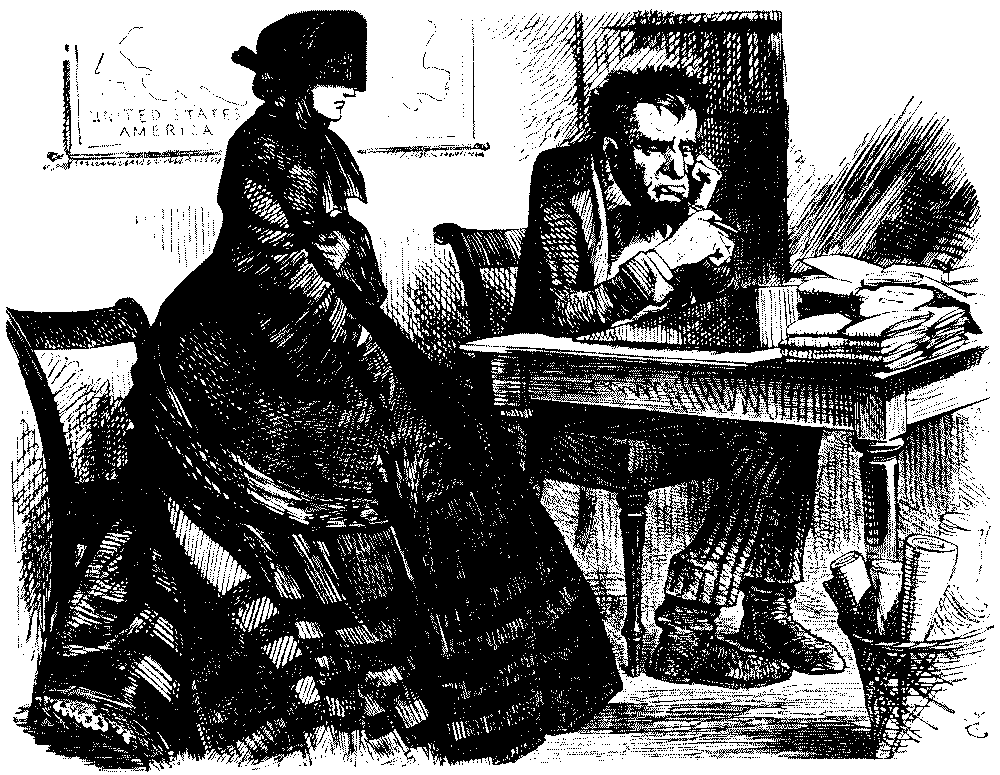
MRS. NORTH AND HER ATTORNEY
Mrs. North: "You see, Mr. Lincoln, we have failed utterly in our course
of action; I want peace, and so, if you cannot effect an amicable
arrangement, I must put the case into other hands."
There have always been people who trade on discontent, and would find
their occupation gone were it removed. But to represent such motives as
animating the majority of Trade Union delegates was a gross
exaggeration; and it was both unfair and unjust to draw so hard and fast
a distinction between the rank and file of the working classes and those
whom they chose to represent them. The weakness of Punch's position
was severely tested during the war of North and South in America and the
Lancashire cotton famine, of which that war was the cause. Just as
Punch failed to recognize the existence of idealism in the leaders of
the North, and consistently maligned and misrepresented Lincoln until
his death, so he failed to render justice to the idealism of the cotton
operatives, who espoused a cause which was not only unpopular and
unfashionable, but the promotion of which entailed the maintenance of
that blockade which caused widespread distress and misery in Lancashire.
Punch's attitude towards America in the earlier stages of the conflict
showed a complete inability to comprehend the great issues involved, and
an impartial dislike of both sides tempered by a sentimental leaning
towards the South. It must be remembered that at this time the cause of
the South was favoured by nearly all classes, that it appealed to Mr.
Gladstone; that the Duke of Argyll and John Bright were almost the only
statesmen who backed the North; and that amongst London newspapers of
any weight the Spectator stood almost alone on that side. Punch's
reading of the war at the close of 1861 is shown in the cartoon which
represents King Cotton as Prometheus, bound with the chains of Blockade,
and with the American Eagle preying on his vitals. The verses which
accompany the picture emphasize the suicidal folly of the eagle, but the
question of slavery or the Union is not even mentioned. A fortnight
later the point of the "other [Cotton] Kings" is explained by another
cartoon in which John Bull, addressing the combatants, says, "If you
like fighting better than business, I shall deal at the other shop."
Here the verses drive home the argumentum ad pocketum in the crudest
way. Cousin Jonathan is told not to be an ass, or "bid Mrs. Britannia
stop ruling the wave":—
We'll break your blockade, Cousin Jonathan, yet,
Yes, darn our old stockings, C. J., but we will.
And the cotton we'll have, and to work we will set
Every Lancashire hand, every Manchester mill.
We're recruiting to do it—we'll make no mistakes:
There's a place they call India just over the way;
There we're raising a force which, Jerusalem, snakes!
Will clean catawampus your cruisers, C. J.
"Distressed Millionaires"
Events entirely failed to justify these truculent words. A year later
the cotton famine was at its height, and an appeal for funds is headed
"Welly Clamming," with the explanation, "Everywhere we hear this, the
Lancashire Doric for 'nearly starving.'" Punch applauds the zeal of
the Quakers in relieving the distress caused by famine, fever and frost,
and simultaneously reproduces this extraordinary advertisement from the
Manchester Guardian:—
Travel: A gentleman, whose son, aged 17, is thrown out of
occupation by the Cotton Famine, would be glad to meet with one or
two other young gentlemen to accompany his son on a Tour, for five
or six months, in the Mediterranean or elsewhere.
Address F. 127 at the Printers.
The advertiser, according to Punch, appears to be "one of those
distressed millionaires who, because their mills have ceased working,
declare themselves destitute mill-owners, and devolve on the squires and
farmers and the British public the duty of rescuing their unemployed
workpeople from starvation."
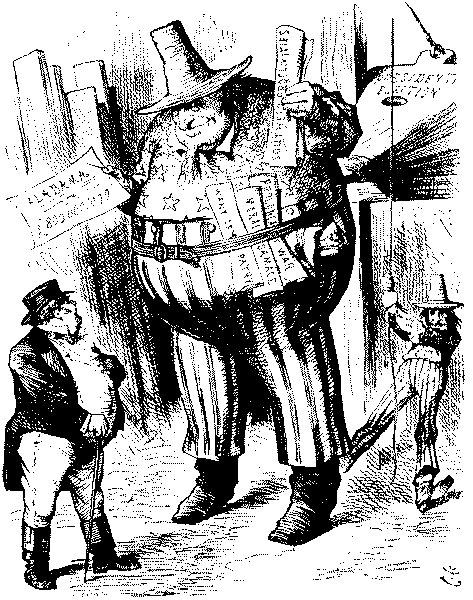
"A STILL BIGGER CLAIMANT"
When a ship was sent to Liverpool bearing the contributions of the
United States to the relief of Lancashire in February, 1863, Punch
welcomed the gift without reserve, as linking the two worlds anew by the
chain of fraternal goodwill. But a very different spirit is shown in his
acid comments on the debate in the House of Commons initiated by W. E.
Forster, who attacked the Government for not interfering to prevent
ships of war being supplied by our builders to the Confederates, and
said that we incurred great danger of war. The facts and the sequel
fully justified Forster's protest, but Punch was not content with
backing up Palmerston's defence of the Government, and treated with
contempt and ridicule Bright's insistence on the sympathy of the working
classes with the North:—
Here it may be mentioned that Mr. Bright[3] alluded in his speech
to a meeting held the day before at the St. James's Hall, where he
had been in the chair, and a crowded assembly of workmen testified
the utmost sympathy with the North. This meeting is grandiloquently
described by the Yankee organ here, but shall describe itself for
Mr. Punch's readers. It was chiefly composed of Trade Union men,
and when a person who had chosen to be free and act for himself
ventured to speak, although on the same side as the other orators,
these lovers of liberty interrupted him with cries of "He's not a
Society man!" Mr. Bright made a fervid and eloquent speech in
favour of the North, and a shoemaker came next, who abused Mr.
Punch, said "that a monster in human shape had been guest of the
Lord Mayor," and that "the Devil, in the shape of The Times
newspaper, was carrying out an infernal purpose." A joiner then
called Lord Palmerston a liar, and a Professor Beestley, or some
such name, attacked the "wicked press," meaning the respectable
journals. An address to Mr. Lincoln was agreed to, assailing the
"infamous Times," the "arrogant aristocracy," the "diabolical"
South, our "unscrupulous moneyocracy," and the "infamous
rebellion," and terminating with some gushing bosh about the
vivifying Sun of Liberty. This document is penned in New York
Herald style, and probably owes its origin to Yankee inspiration.
To this kind of meeting, and this kind of language, Mr. Bright
referred, complacently, in the House of Commons. The North must be
in a bad way when such allies are coveted.
Libelling Lincoln
The South was in a much worse way when a "respectable journal" was
reduced to explaining away the undoubted and disinterested support of
the North by Lancashire cotton spinners and other British working men as
Trade Union tyranny, to say nothing of that worst infirmity of political
controversy—the vulgar perversion of an opponent's name. Punch was on
stronger ground in criticizing the spread-eagling of the northern Press,
as when the New York Herald declared that:—
They (the American people) know that when this rebellion began the
aristocrats of England took advantage of the chance to destroy us,
and joined heart and hand with the slaveholding rebels. They know
that this rebellion was born in Exeter Hall, nurtured by the
English aristocracy, armed from English arsenals, and supported by
English sympathy and assistance.
Punch, though no lover of Exeter Hall, could not refrain from
ironically vindicating its innocence, and makes for the rest some good
debating points against the Herald. But there is little "neutrality"
in his statement that Southern loyalty was as staunch as that of the
North, "though not so truculent or atrocious"; and when he falls foul of
the Yankees—a word invariably used in a disparaging sense—for calling
the confederates "rebels," he did not know that the magnanimous Lincoln
would never allow them to be called by that name in his presence. He is
made to do so, however, in Punch's parody of one of Lincoln's
speeches—a truly lamentable performance, in which the President claims
dictatorial powers, calls for whipcord to whip the rebels, abuses the
"rotten old world," talks with the utmost cynicism of the blacks, and in
general behaves like a vulgar buffoon. The true Lincoln is to be found
in the immortal Second Inaugural delivered on March 4, 1865.
As for the British working men, though Punch had undoubtedly
endeavoured to discount the strength of the tide of feeling which
continued to run strongly against the slave power, in spite of the
terrible suffering brought about by the blockade, he quoted with
approval Lord Palmerston's formidable and damaging indictment of the
manufacturers in the House of Commons on July 30:—
"We know," he said, "that in the county most fortunes have been
made by the manufacturers. I do not agree with the Hon.
Member for Stockport that it has all been invested in the mills. On
the contrary they have accumulated much more than their mills could
have cost. There are enormous capitalists in the county, some of
whom, I am sorry to say, though they have starving populations at
their gates, and anticipate worse distress as coming, have
actually, for the sake of profit, sold and sent out of the country
the cotton which they ought to have used for the employment of the
people. I say, why are these people to be exempt, and not to be
made to contribute to the distress which they see around them?"
This speech, Punch observes, enraged Cobden, who was furious with
Palmerston for his unjust, reckless and incorrect charge; but his reply
was inconclusive, as he could only say that a large proportion of
Lancashire mill-owners had not sold their stocks of unsold cotton to
foreigners for the sake of the high prices which the fibre commanded.
Cobden returned to the charge a couple of days later in a speech which
is a most extraordinary prospective plagiarism of the election address
of any anti-waste Independent Liberal candidate in the year 1921, as may
be judged from Punch's summary:—
The present is the most extravagant government that ever existed in
peace time.
This is all Lord Palmerston's fault.
He is always interfering and getting up sensations.
If the Liberals do not disentangle themselves from this system they
will "rot out of existence."
The Tories keep Lord Palmerston in Office and have more confidence
in him than in their own chief.
He is puffed by a clever and noisy claque.
All the questions dear to Radicals and Dissenters have gone back
under his leadership.
This sort of thing must not go on next year.
Our Noble Selves
The honours of the debate, which did not enhance Cobden's reputation,
rested with Palmerston, but apart from his extreme frankness in dealing
with the Lancashire mill-owners, he owed his triumph to his unrivalled
Parliamentary opportunism. The Governments of neutral states cannot play
heroic rôles in a great war. More scope is left to opposition leaders.
Lord Derby distinguished himself by his liberality and energy in
organizing relief measures, but the Lancashire working man was the most
heroic figure in English public life from 1861 to 1865, though Punch
had only a glimmering of the truth. The note of complacent satisfaction
over the tranquillity and prosperity of England as compared with the
disturbed state of Europe is frequently sounded, and the Exhibition of
1862 is taken as the occasion to blow the national trumpet in "Our Noble
Selves":—
All the world we invite to behold a grand sight
Of not only goods, chattels, and treasures,
But of law that's obeyed because mended or made
By men who bring forward good measures.
Let them come then, and see what a people are we,
Steady-going, not headlong and skittish.
What a world this of ours would be, O foreign Powers,
If all nations behaved like the British!
This is Liberty Hall; no restriction at all
On the freedom of speaking and writing;
The result is that, say any fool what he may,
Foolish language occasions no fighting.
'Tis the easiest job to disperse any mob,
Without being so much as pumped on
By a fire-engine hose, off the multitude goes,
Mind, Order reigns bloodless at Brompton.
This mood is, however, tempered by moments of self-criticism. The social
millennium had not arrived when in 1862 a statue was erected in Bolton
to its benefactor Crompton, the inventor of the spinning-mule, while his
descendants were living in destitution:—
The spinning mule made Bolton. Samuel Crompton made the spinning
mule.... He died in 1827, at the age of 74, and now Bolton, whose
master-manufacturers cheated him living, honours him dead with a
statue.... But Samuel Crompton left more behind him than the great
invention and the memory of his wrongs and struggles. He begat sons
and daughters as well as invented mules. He died a pauper, and they
have fared as the children of those who die paupers are apt to
do.... One of his sons is living dependent on charity, as his
father died. Somebody bought him a suit of clothes that he might
make a decent appearance at the inauguration of his father's
statue. Besides this son, there are living some half a dozen
grandchildren, some dozen great-grandchildren, of the
inventor—all, with one exception, in poverty of the meanest, most
pinching kind. Not one of them, son, grandchildren, or
great-grandchildren, was invited to the inauguration of Samuel
Crompton's statue.
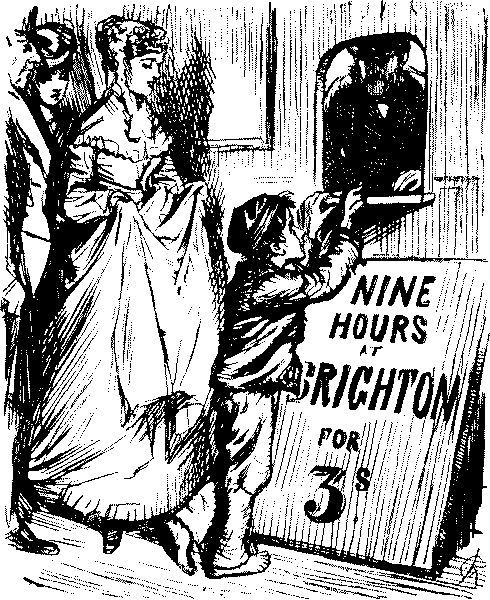
IN FORMA PAUPERIS
London Arab: "Please, sir, can't I have a shill'n's 'orth?]
A sum of £2,000 had been collected for the statue: a few weeks after its
inauguration Lord Palmerston sent £50 to the surviving son. Assuredly
there have been few more remarkable examples of asking for bread and
being given a stone. And mill-owners were not the only masters whose
methods exposed them to criticism. When in 1863 the engine-driver and
fireman of a luggage train were fined 15s. each at the Oxford City Court
for being found drunk and incapable on their engine, Punch admits the
moderation of the punishment, but asks his readers to ponder the story
told by the delinquents, and put the saddle on the right horse:—
They declared in the presence of the Company's Officers and without
contradiction, that their day was fourteen hours, and that owing to
extra pressure, they had only had seventeen hours sleep the whole
of last week.... On whom should fall the blame and punishment? On
the men, outworn, and driven to stimulants as a substitute for
sleep or a support under exhaustion, or on the managers of the
Company, who thus overwork, or, in other words, underpay their
servants?
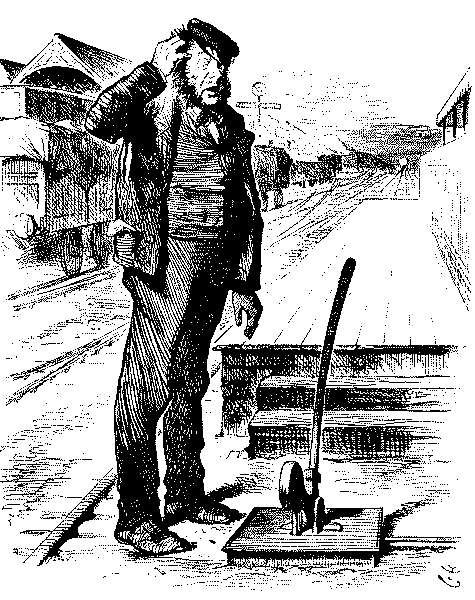
MUDDLEBY JUNCTION
Overworked Pointsman (puzzled): "Let's see! There's the 'scursion' were
due at 4.45, and it ain't in; then, afore that were the 'mineral'—no!
that must ha' been the 'goods,' or the 'cattle.' No! that were
after—cattle's shunting now. Let's see. Fast train came through
at—con-found!—and here comes 'the express' afore its time, and blest
if I know which line she's on!
The cartoon published nine years later, in 1872, showed that Punch was
still dissatisfied with the conditions of railway servants. A propos
of the railways, it is worth recording that in 1860 there were cheap
excursions to Brighton and back for 3s. Also that in 1868 Punch
commits himself to the view that an increase in railway fares means less
revenue—an interesting parallel to the recent controversy.
In 1865 the cattle plague led to a sharp rise in the price of meat; but
the attempt to introduce and popularize cheap jerked (or charqued) beef
from South America—sold at threepence a pound—was not successful,
though Punch appealed to the public to give it a fair chance in a set
of verses with the refrain:—
Oh, the jerked beef of La Plata,
A platter give me of jerked beef.
"Progress at high prices," in Punch's opinion, was dearly bought. When
two demonstrations were held by working men at Worcester this summer to
protest against the high price of meat which was attributed to a
monopoly amongst the farmers and butchers, and a resolution was adopted
to abstain from the consumption of meat for a certain time, Punch saw
in this move a tacit acknowledgment that the high price was owing to
demand, and cordially endorsed the comments of The Times:—
There can be no doubt that the present high price of meat is mainly
to be traced to the fact that the consumption on the part of the
working classes has of late years enormously increased, owing to
their prosperous condition, good wages, and cheap bread. A general
resolution on their part to limit the consumption would soon bring
down the price.
Honest Fault-finding
The strike against the butchers was one in which the working classes
might safely combine to turn out. "They will not injure themselves, nor
hurt their wives and families: on the contrary, all the while the strike
lasts they will be putting by money. The public will support instead of
discouraging them." But it is impossible to take the commendation
seriously in view of the last sentence; "whilst others, I trust, are
endeavouring, by total abstinence from butchers' meat, to reduce the
butchers to reason, I remain medicinally, of course, always 'A
Beefeater.'" Much more effective, because untainted by irony, are the
plain-spoken verses on the British workman as painted by his flatterers,
his detractors and his candid friends:—
While Democrat orators praise him and puff him
As the land's bone and sinew, and Nature's own nob:
Aristocrat talkers calumniously cuff him,
As shiftless, and soulless, sot, spendthrift, and snob.
'Twixt the daub of his bully, the daub of his backer,
The true British Workman's been able to stand,
And at once to disclaim both the brighter and blacker,
As alike wide of truth, from the right and left hand.
The success of "Tom Brown" (Tom Hughes), who was elected for Lambeth in
1865, encouraged the enthusiastic friends of the British workman in the
hope that he would now be painted without fear or favour, but Tom
Brown's honest unvarnished portraiture was more than his sitter could
stand:—
While a fact is a fact 'twill do no good to blink it,
Put up with the shadows Tom Brown dares to show,
Your face may be darker than you like to think it,
If the shadows ain't fast, wash, and let's see them go.
While your Union pickets still waylay and "ratten"
The knob-sticks, who work on their own honest hook,
While on your hard earnings strike-delegates batten,
And machines and machine-work are in your black book;
While men who earn more by the week than their curate
Are content in one room of a hovel to pig;
While shop-drinks and Saint Monday their old rate endure at,
And the wife and the young 'uns come after the swig;
While limb's rest and soul's light to your infants begrudging,
You drive them to workshop, to mine, loom or wheel,
To drag through long years of unnatural drudging
As though minds could die out, and yet bodies not feel;
While such are the shadows your features that darken,
Needs must that the blacks in your picture appear;
And they're no friends who bid you your own praises hearken,
When an honest fault-finder is craving your ear!
Later on, however, Tom Brown was himself taken to task for flattering
the working man.
On the question of housing and sanitation Punch refused to believe
that landlords were altogether to blame. Social reformers and
legislators found themselves up against stubborn facts, and none were
more stubborn than the Briton's prejudices in favour of vested rights
and a man's house being his own castle, wherein he is free to do what he
likes with his own:—
These stubborn facts are, no doubt, at the bottom of much that is
worthy of respect in John Bull's character. They have not a little
to do with his Magna Charta and his Habeas Corpus. But they
occasionally stop the way all the same; obstruct the efforts of the
Local Board or Nuisance Removal Committee, crouch like lions in the
path of the Officer of Health, trip up the heels of the Inspector
of Nuisances, and crop out in back slums, by-lanes, and blind
alleys for district visitors and zealous clergymen to break their
shins over.
Village Sanitation in 1865
These remarks form the preface to a series of extracts from the verbatim
report of a Visiting Committee appointed in 1865 to inspect a little
seaside village. The name of the place is withheld, but Punch pledges
his word for the absolute veracity of the reporter, adding that what the
Committee found in the way of stinks, putrid wells, foul accumulations,
and purblind or pig-headed people was to be found in nineteen out of
every twenty English villages, seaside or inland, rural or suburban. The
houses in a sample street were occupied by an old gardener, a small pork
butcher, three pilots, three sailors' wives, and two coast-guardsmen.
The description of the well in the pork butcher's house is enough, in
Dickens's phrase, to sicken a scavenger. But the complacent fatalism
which marked all these householders rises to a pitch of sublimity in the
immortal phrase of the first coast-guardsman:-
"Had the cholera in '44: ain't afeared of it. Considers as it's a
natural went for the overplush of mankind. When his time comes,
knows as he 'as got to go. Considers as his time wasn't come in
'44. Always keeps his house very clean: does all the scrubbing
himself, and paints his bedsteads and chests of drawers with red
lead and turps twice a year."
According to the local doctor, all the inhabitants of these houses were
drinking water strongly impregnated with lead, but "they appear to like
it so I can't help it, especially as the landlord refuses to alter the
pumps." The first pilot considered that he had a right to drink his own
sewage if he liked it. The second coast-guardsman "couldn't abear
chloride of lime," and, in general, disinfectants were dreaded more than
bad drains. An optimistic speaker on Social Science in October, 1859,
had declared that the advance of education was certainly very marked.
"Classes once illiterate now show a love of literature, the taste for
which has even reached our cabmen, who in demeanour and civility are not
the men they were." Punch was sceptical about the cabman and printed
an ironical poem on his progress modelled on "She wore a wreath of
roses." The passages we have quoted show that six years later pork
butchers, pilots and coast-guardsmen left a good deal to be desired in
their knowledge of practical hygiene. But Punch does not acquit the
landlords or Government officials, and, though no lover of despotism
abroad or at home, there were moments when he felt that a little more
"paternal government" would not be a bad thing. As he put it a little
later: "when Mr. Punch is reminded of tanks, cisterns, bins and butts
for miles along a tainted shore being overlooked by a mythical Inspector
of Nuisances instead of being looked into, in his utter bewilderment he
is tempted to exclaim, Wanted a Bismarck."
With the death of Palmerston the question of organic reform re-emerged,
but the Russell administration, hampered by the disaffected Adullamite
Liberals—brilliantly led by Lowe—and restrained by Whig caution,
handled their Bill in a half-hearted spirit which courted defeat.
Russell resigned at the end of June, 1866, and was succeeded by Lord
Derby with Disraeli again as Chancellor of the Exchequer. It is on
record that Gladstone, shortly after Palmerston's death, agreed with
Denison, the Speaker, that there was no strong feeling for reform in the
country. Yet within a few months the diagnosis was completely falsified.
Immediately after the fall of the Russell administration came the
historic Hyde Park riots and a vigorous agitation throughout the
country. "The artisans, who had seemed apathetic towards the franchise
when it was dangled before them, became angry when it was refused."
Punch's account of the rioting and its sequel is liberal of censure,
but cannot be regarded as either impartial or judicial or as
appreciative of the significance of the episode:—
Monday, July 23.—It did not seem to suit the Fates that our
friends the Conservatives should slide into the recess quite so
quietly as had been anticipated. Sir George Grey, the late Home
Secretary, had ordained that the proposed Reform Demonstration
should not be allowed to take place in Hyde Park, but his Ministry
went out in time to save him any further trouble in the matter. Mr.
Walpole had to vindicate the law, and his gentle soul has been a
good deal perturbed by events. One Beales insisted on holding the
meeting, and Sir Richard Mayne locked the Park Gates. The result
was inevitable. The artisan class attended in large numbers, and of
course behaved perfectly well; but, equally of course, the
processions were supplemented by a vast mass of Roughs, who behaved
perfectly ill. Mr. Punch is unable to compliment the Reform
League, inasmuch as its acts tended to violate order, and its
"experiment of right" could have been tried with a hundred men
instead of with thousands. Nor can we compliment the authorities
who endeavoured to defend an untenable post, inasmuch as law could
have been asserted by the arrest of a few individuals. He does not
make a great noise about the breaking down of some railings, and
the destruction by some roughs of trees and shrubs, nor would he
put London in a state of siege because a good many windows have
been broken, but all this sort of thing is really the fault of one
Beales, who knew that a mob would follow the working man. Rough and
Bludgeon came largely into contact, to the discomfort of the
former, and the Beaks looked to the rest, Mr. Knox having
especially distinguished himself by firmness and moderation, coming
down sternly on ruffians and being lenient to mere fools.
But Mr. Walpole had to defend himself in the House, and also had to
see a Reform deputation, before whom he wept, and some of whom
managed to misunderstand him, or pretended to do so, whereby there
was another meeting summoned, as if with Government sanction, but
after explanations, in and out of the House, the idea was given up.
So ended the campaign, and Mr. Punch is almost ashamed of the
fuss which has been made over an affair of broken heads, while two
great nations are mourning over slaughtered myriads.
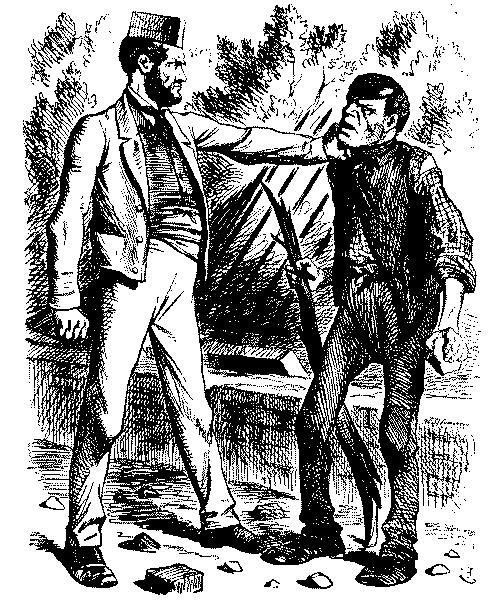
NO ROUGH-IANISM
Working Man: "Look here, you vagabond! Right or wrong, we won't have
your help."
"One Beales"
"One Beales," as Punch contemptuously describes him, was a political
agitator, but of a very different type from the "delegate" as depicted
in a previous page. He was an Etonian, a scholar of his college at
Cambridge, a barrister of the Middle Temple, and a revising barrister
for Middlesex, who died in the odour of legal sanctity as a County Court
Judge. But as a member of the Emancipation Society in the Civil War, a
member of Mill's Jamaica Committee in connexion with the case of General
Eyre, and above all as President of the Reform League, and advocate of
Manhood Suffrage and the right of public meeting, he had incurred
Punch's unremitting hostility. "Beales and his Bubbly-jocks" were
constantly held up to ridicule. But they were very far from being
ridiculous. The League served as a spear-head for the discontent aroused
by the failure of Russell's Reform Bill, which it had cordially
supported. The meeting in Trafalgar Square on July 2, 1866, had been
prohibited, but Sir Richard Mayne, the first Commissioner of Police,
withdrew the prohibition, and the meeting, attended by nearly 70,000
persons, passed off quietly. Beales is declared to have shown great
courage and coolness on July 23. The meeting assembled near the gates of
Hyde Park; the invasion of the Park and the pulling down of the railings
occurred as the crowd were returning to Trafalgar Square, but the
leaders were in no way responsible. The police were roughly handled and
had to be reinforced by the Guards before the crowd was driven out; but
an amicable arrangement was reached between Beales and Walpole next day
as to the discontinuance of any further meetings except by arrangement
with the government. The Reform League had done its work; its mission
was virtually ended when Disraeli's Reform Bill passed in 1867 and it
was formally dissolved in March, 1869, three days after Beales had
resigned the presidency. No amount of belittling of Beales can disguise
the fact that he and his League gave a great impetus to the Reform
movement—the Lord Mayor of London actually presided over one of its
meetings in the sacred precincts of the Guildhall—and forced on the
introduction of the Bill of 1867. During its progress through Parliament
another great meeting convened by the Reform League was held in Hyde
Park in May, 1867. The Home Secretary issued a notice warning all
persons against attending it, but was practically over-ruled by the
Prime Minister, who announced that nothing would be done to hinder it.
The meeting, attended by 200,000 people, passed off without any
disturbance or untoward incident, and Walpole soon afterwards retired.
As Walpole, in consequence of his Hyde Park associations, had become one
of Punch's regular butts, it is only fair to his memory to say that
the story of his having broken down and wept before a deputation is
denied by the D.N.B. Punch's review of the episode quoted above is
thoroughly typical of his temper in this period of transition; of his
independence, his readiness to acknowledge the moderation and sanity of
British working men, his anxiety to distinguish between them and the
hooligan fringe; and at the same time of his distrust of their leaders
and of any organization which in his view savoured of extremism. There
were "bubbly-jocks" in Beales's following, but he was no bubbly-jock, as
Wilkes was no Wilkesite, and in many ways though by different means was
working towards the same end as Punch himself. Beales had no gifts as
a mob-orator. His real strength lay in his knowledge of the law; and it
was on the legal ground that he worsted Lord Derby and Walpole. There
are some who think that modern democracy was born on July 23, 1866. Be
that as it may, the Hyde Park riot was a great landmark in our political
history.
The Future of Coal
It is pleasant to turn from Punch's not very happy handling of the
Hyde Park incident to his wiser, if fanciful comment on the warnings of
the philosophical alarmists who predicted the speedy exhaustion of our
coal supplies, and asked What, then, would Posterity do for force and
for fuel? Punch suggests another conceivable fear to balance that of
the coal pessimists. If our population continued to increase at the same
rate, not only would the bowels of the land be consumed, but its entire
face be covered up with towns and factories. For his part he feared
neither the one nor the other event:—
If the coal ever runs out, something equivalent to it will
doubtless turn up, or else turn down. Somebody will discover a
cheap way to set the Thames on fire, or to draw below, and store,
atmospheric electricity. By a system of vertical elevation instead
of lateral extension, our architecture will be adapted to our area,
and our cities, no longer expanding, will continue to ascend. The
higher they rise the less will Posterity be troubled with any
amount of smoke which it may be unable to consume. The future of
England will then be as fresh as a daisy, still as familiar a
flower as ever.
The growth of industrialism was not to be dreaded if it was humanely and
wisely controlled and directed. That is the moral which Punch draws
from the opening of the new docks at Barrow-in-Furness in September,
1867. The occasion was indeed "worth a crowd and a crow":—
A Barrow that has grown, one may say, from a barrow into a
coach-and-four in ten years! A Barrow that has swelled almost
within the memory of the youngest inhabitant from the quiet
coast-nest of some five score fishermen into the busy, bustling,
blazing, money-making, money-spending, roaring, tearing, swearing,
steaming, sweltering seat of twenty thousand iron workers, and the
crime and culture, the dirt and disease, the hard-working and
hard-drinking, the death and life, the money and misery they bring
along with them!! A Barrow out of which they are tipping 600,000
tons of iron every year!!! A Barrow big enough to hold a
Monster-Iron-Mining-and-Smelting Company, with two Dukes among its
directors, to say nothing of Lord knows who, in the way of Lords,
and Lord knows how many millionaires!!!!
The two Dukes—one of them, Devonshire, a Second Wrangler into the
bargain—were both present, and also the first of living orators, Mr.
Gladstone. But the person who interested Mr. Punch most was the
master-spirit of the great iron company, "one Schneider," and he is not
slow to improve the occasion:—
He has hitherto been known to fame among public men chiefly as an
ex-M.P., turned out of his seat at Lancaster for gross and
shameless bribery. He has seen so much done by energy and money
that he probably thought the one as legitimate a lever into
Parliament as the other. But he has been punished for his mistake.
He has now an opportunity to repair it. His name is the same as
that of the President of the French Legislative Assembly, the
energetic, far-sighted M. Schneider, whom Mr. Punch has already
honoured as the head and heart of the admirably-conducted firm
which has made the iron manufacturing district of Le Creusot, a
model as yet to be imitated among the great English industries of
the same kind....
And now for Mr. Punch's proposition. Suppose M. Schneider were to
set himself in real earnest to wipe out the recollection of
Lancaster by the redemption of Barrow? What if he were to prove
himself the ditto of M. Schneider of Le Creusot, not in name only
but in deed, and to make Barrow-in-Furness the Creusot of England,
in morals, manners, civilization, education, domestic comfort and
culture, as well as in industry, energy and money-making? Here is a
work worthy of the noblest ambition, the most determined energy,
the highest intelligence, and certain of the richest reward—a
reward not to be gauged by dividends, it is true, but beyond the
measure of millions. Let there be two Schneiders known in the world
for their noble conception and perfect discharge of the duties of a
great captain of industry, and let one of them be an Englishman.
Reform Bill of 1867
Henry William Schneider, who started the Barrow Steel Works and was for
many years one of the directors, died in 1887. His namesakes of Le
Creusot still continue their dynasty. Early in 1870, the year of the
Franco-Prussian war, Punch again repeats his comparison of Le Creusot
with the greatest and best managed English iron-works to the advantage
of the former, on the basis of statistics which had not been
contradicted by M. Rochefort or any other of M. Schneider's bitterest
enemies.
Divergent contemporary opinions on the Reform Bill of 1867 found vent in
a number of famous phrases. Disraeli, who had guided its passage through
the House, claimed to have "educated his Party"; while Lord Cranborne
(afterwards Lord Salisbury) described the measure as "a political
betrayal which has no parallel in our annals." Lord Derby's
contributions to political phrase-making were threefold. The Bill was a
"great experiment," a "leap in the dark" (commemorated in one of
Punch's most-famous cartoons), and he had "dished the Whigs." Lowe's
advice that we must now set to work "to educate our future masters" was
the weightiest of all. In view of the compromises and manoeuvring by
which the passage of the Bill was secured, there is good warrant for the
verdict of later historians:—
Even in English politics few great changes have come about with
less evidence of principle or conviction on the part of those
mainly concerned in it, with more appearance of mere opportunism
and concession to the expediencies of the moment. It was difficult
to be enthusiastic over a Reform Bill framed by a ministerial party
which did not want reform, under pressure from an opposition which
did not want the Bill.[4]
Working Men Candidates
Punch, whose attitude towards Disraeli on his return to power had
turned from satirical distrust to reluctant admiration of his commanding
ability, welcomed Reform, but his welcome was accompanied by grave
misgivings as to the growing strength of the Trade Union movement, and
throughout 1867 cartoons and comments in prose and verse abound in
condemnation of the intimidation practised at Sheffield by trade union
agents. The report of the Royal Commission appointed in January, 1867,
proved the existence of terrorism, but exculpated forty-eight out of the
sixty trade unions in Sheffield from complicity in outrage, and showed
that it had been denounced by the principal trade union leaders.
Picketing, even when "peaceful," had been pronounced illegal, and trade
unions had no protection against embezzlement by their own officials on
the ground that their rules were in restraint of trade. On the other
hand Lord Elcho's Master and Servant Act had placed the workman on a
level with his employer in regard to breaches of contract, and rendered
the remedy mutual. It cannot be said that the successes of the trade
unions in the legislative field were greeted with enthusiasm by Punch.
Nor did he show much sympathy with the efforts to secure direct
representation of Labour in Parliament. Mr. George Odger is
congratulated on retiring from the contest at Chelsea at the end of
1868, in compliance with the decision of the arbitrators to whom he and
his Committee referred the question whether it was better for the
Liberal cause in Chelsea that he or Sir H. Hoare should quit the field.
The arbitrators were Mr. James Stansfeld, Tom Hughes, and Mr. Peter
Taylor. But when the chairman of Mr. Odger's Committee declared that "it
was the old story over again, that working men acted with undue faith in
those they considered they might trust," Punch felt called upon to
address "a serious word to working men." The arbitrators were all men of
the most advanced Liberal principles, the highest character, and the
strongest fellow feeling with working men. Their impartiality was above
suspicion. So Punch proceeds in his most magisterial vein:—
The fault of working men has been, not the putting "undue faith" in
friends of this kind, but the not putting faith enough in them; and
the tone in which the Chairman of Mr. Odger's Committee,
and—Punch is sorry to see—Mr. Odger himself, comment on the
decision of Messrs. Stansfeld, Hughes and Taylor, confessing at the
same time that they are not informed of the grounds of it, is a
striking illustration of this fault. There is nothing so hard in
the practical education of working men as the teaching them to
prefer disagreeable truth to flattering falsehood, and not to turn
from the friends who have the pluck to tell them such truth to the
schemers who mislead them by such falsehood. It is this difficulty
which has wrecked more working men's movements, co-operative,
educational, self-helping, than any other—the difficulty of
getting working men to know their true friends from their sham
ones, and to trust the former, even when their vanity is fretted,
or their wish or whim of the moment thwarted, for any reason,
however weighty, or in any cause, however sacred.
If Mr. Odger, as Punch averred, had marred the grace of his withdrawal
by the manner of it, so Punch marred his candour by asperity. Tom
Hughes here decided against Mr. Odger. Little more than a year later he
supported Mr. Odger as the "working-man candidate" for Southwark, and
provoked a vehement protest from Punch against the "mischievous
nonsense" he had talked at an election meeting. This open letter begins
with a handsome acknowledgment of the services of his old friend, the
author of "the truest and manliest book extant on English public-school
life"; and of his pluck and straightforwardness and recognition that
men, "whether gentle or simple, are, on the whole, made of the same
clay, pulled by the same strings, worthy of the same rights, and liable
to the same duties"; of "his courage in telling necessary if unpalatable
and unpopular truths." None the less "the working-man candidate" sticks
in Punch's gizzard.
He had no objection to working men standing for Parliament, but "they
should be very careful in their choice of fighting-ground." At
Maidstone, in 1870, "they chose it as badly as possible":—
It is true that Mr. Applegarth, the working man's candidate, retired
before the final struggle, finding—according to his own
statement—"that he was too late in the field to make headway
against the popular feeling in Sir John Lubbock's favour!" He had
better have said, "Finding that he had no business ever to have come
forward." What right, Punch asks him, had he, or any man who
wishes to see the best wisdom of England in the House of Commons, in
the field which Sir John Lubbock had occupied in advance of him? All
working men who are worth their salt must admit that no claims that
could be set up on behalf of their order could stand a moment's
comparison with those of Sir John Lubbock on the support of the best
and broadest Liberalism. Let them choose constituencies where they
will have to fight pseudo-Liberalism and genuine Toryism, and
welcome. But in the name of their cause and ours, don't let them put
stumbling blocks in the Parliamentary path of such men as Sir John
Lubbock, or they will only do what they have more than once done
already—make way for the fox, while the lion and the bear are
worrying each other.
The underlying assumption that "the best and broadest Liberalism"
sufficed for the needs of the working classes has long since gone by the
board. Here at any rate Punch failed to foresee the inevitable march
in representation summed up in the three stages: Liberal, "Lib.-Lab.,"
Labour. There is, however, a considerable advance on the views expressed
in his letter to Tom Hughes in his welcome to Messrs. Burt and Macdonald
on their election in 1874:—
Earliest among the early birds, Punch was glad to hail his
friends, Messrs. Burt and Macdonald, representatives of Underground
Britain, Members for the Mine, sample black diamonds, "picked
Wallsends." They have sought and found the fairest audience in the
world. Punch will take his Davy that any light theirs can throw
on dark places will be gladly received; that all they have to say
to the purpose will be attentively—nay, respectfully—listened to,
and weighed as carefully as was ever corve at pit-bank. And really
these pioneers of the pick—hewers, we presume, of a way for other
Working-men Representatives, equally stout and worthy—are about
the only novelty, as far as Punch can presage, of the new
Parliament, always except the Parliament itself, with its sudden
swap of sides and strangely altered balances of Power.
Truckling to the Working Classes
This friendly greeting, anticipating without misgiving the extension of
Labour representation, must not blind us to the fact that throughout the
period under review Punch was gradually becoming more and more
confirmed in his championship of the middle class as the backbone of the
country, the real power of the nation. The appeal in support of the
funds raised to support the children of Ernest Jones, the Chartist poet,
who died in 1868, is generously worded. But Chartism was long extinct,
and Jones, a man of good family, had quarrelled with most of the other
leaders on his release from gaol in 1850, and his former colleagues had
"freely denied both his disinterestedness and his sincerity." Landor had
pronounced his verses noble, and Punch appealed to both Conservatives
and Liberals on the broad ground that a brave man had died poor.
The well-deserved rebuke administered to "van-demons," "persons whose
only notion of enjoyment consists in getting drunk, and then howling
songs and playing horns as they drive homeward from their
drinking-bout," can be paralleled from the protests repeatedly uttered
in 1920 against the char-à-banc nuisance with its attendant "bellowing
and braying." But a much more combative note is struck in the verses on
the tendency to kow-tow to the working man published in 1872, at a time
when the rise in prices, especially in that of coal, and the hardships
of the middle classes and the small income-tax payer coincided with
unusual prosperity among the working classes and particularly amongst
the miners:—
"WHY SHOULD THE POOR BE FLATTERED?"
Hamlet, Act v., Sc. 1.
"Why should the Poor be flattered?"
Art foolish, Hamlet, trow?
All else are torn and tattered,
None else are flattered now.
Your Clown, our race accusing,
Declared our wits astray:
We beat him at abusing
Ourselves. Behold our way!
Our Queen mis-spends her income,
Her Court's all fashion's slaves,
The Lords are feeble Ninkum-
Poops, and the Commons, knaves.
Our soldiers are no fighters,
Our sailors cannot sail,
Our bishops shame their mitres,
Our merchants cheat and fail.
Our architects are Vandals,
Unfit to rear a stone;
Our music-writers Handels
To no ears but their own.
Only the so-called Worker,
The Stalwart Son of Toil,
Never from that a shirker,
Never in brawl or broil.
That sober, saving Being,
The nation's "heart and core,"
Him we are all agreeing
To flatter—and much more.
"Why should the poor be flattered?"
You pause for a reply—
But, if our brains are battered,
Dear Hamlet, don't ask why.
When critics complained of the extravagance of the rich in their
entertainments and house-decoration and found in the newspaper accounts
of this luxury an explanation of industrial discontent and strikes for
higher wages, Punch did not hesitate to fall back on the disputable
argument that the consumption of luxuries involved the profitable
employment of those who produce them:—
Suppose, instead of flowers and dessert at £200, including peaches
at a guinea a-piece; suppose, instead of a house decorated by Mr.
Owen Jones, and a set of aluminium plate, millionaires were to
spend their money in founding schools and scholarships, for
instance, and in educating their poor relations' children, and
sending them to the Universities; even suppose they expended it in
almshouses, and Peabodying the destitute, the mechanical
working-classes would have far less cause to be satisfied with them
than they are now. It may be that there is a wiser and a better use
for riches than lavish expenditure on the productions of
market-gardening and decorative art; but the consumption, at any
rate, benefits producers, and enables employers in those lines of
business to pay the artisans and labourers the higher wages. So the
working-classes, at least, need not grumble.
PROSPEROUS JOHN
The complaints of the income-tax payer, when it stood at 3d. or 4d.,
leave us cold, and envy rather than compassion is excited by the bitter
cry of the consumer who had to pay 30s. or even 36s. a ton for coal or
1s. 3d. for meat. Otherwise there is an extraordinary similarity in the
comments and protests which fill the pages of Punch in the years
1871-1873 to those which have been so painfully familiar since November,
1918. The prosperity and extravagance of the miners is constantly
referred to. They are accused of being overpaid and, in consequence, of
not working steadily. The "vicious circle" is neatly summarized in a
doggerel verse:—
Strikes follow strikes; the reason why,
High wages rendered prices high;
Then Working-Men for wages higher
Struck, and to still more pay aspire.
Such aspiration what will crown?
It is "Excelsior!" upside down.
When Lord Lyttelton, at a harvest festival at Hagley, compared the
conduct of the agricultural labourers with the extravagance of the
workmen in the Black Country, Punch, disavowing all criticism of the
Black Country as dangerous, made bold to ask how it was possible for a
Northern pitman to save his means:—
He has only a house found him, rent-free, all the coals he
requires, medical attendance and medicine when he or any member of
his family is ill, and, at the lowest, seven shillings a day. For
this miserable wage, and for these trumpery advantages, the artisan
of the pit is expected to do, actually, six hours' work daily. How,
thus crushed and starved, can he save anything? If a malignant
aristocrat suggests that many an educated gentleman manages on far
less, working, moreover, twice as hard, bringing up a family in the
right way, and even paying for life assurance, Mr. Punch scorns
to argue with a bloated Dives, who would compare a white-handed
swell with Nature's nobleman, the hardy son of toil, and the real
strength and glory of the nation. Heave a coal at the head of the
insolent cynic.
In 1873 the wages in some collieries had gone up to 10s. or 15s. a
day:—
Victims of the Income Tax
To be content with from 10s. to 15s. a day is to be satisfied with,
say, some £234 a year. If that is to be earned by mining here,
there can be no inducement for any skilled miner to betake himself
to gold or diamond diggings. He can live in clover, on enough to
satisfy all his wants, by raising black diamonds at home. For a
miner, an income of the above amount is a salary much more adequate
than £5,000 for a Law Officer of the Crown. The miner has no
appearances to keep up in a mine. He need not incur any expenses
but those which are necessary for his personal wants and pleasures,
including champagne and dog-fighting; which, the former luxury as
well as the latter amusement, he can manage to afford well enough
by a judicious economy above-ground, of lodgings, furniture, and
clothes.
Coals went up to 50s. a ton in London this year and the cry of the
middle classes, of whom Punch was now the great champion, was echoed
with great fervour in an article on a speech by Sir William, then Mr.
Vernon Harcourt:—
Mr. Vernon Harcourt, in some of his late speeches, has placed
himself in striking contrast with most of the other leading
politicians, both Liberal and Conservative, by speaking the truth.
For example, at the Druids' Dinner the other day, in discussing the
impost by which the incomes of a part of the people are taxed to
pay the expenses of the whole, instead of attempting to defend
confiscation with sophistry, and to stifle complaint with sneers,
he condemned the false and dishonest apology, alleged by financial
swindlers' advocates on behalf of the Income-tax, that it weighs
only on the rich who are well able to pay it, and he maintained
that, on the contrary, it falls "with the greatest severity on the
poorest of all the classes of the community—that which, upon
limited means and small profits, has to keep up a state of
respectability." The lie which Mr. Vernon Harcourt refuted is one
of those lies which Statesmen are very apt to tell in talking to
simpletons; lies coupled with truths, from which the generality of
people at public meetings have not sense enough to disentangle
them. It is quite true that the rich are well able to pay the
Income-tax; but to say that the Income-tax weighs only on them is
telling a falsehood which transcends common lying. The rich, as a
rule, can afford to live up to their incomes, and it matters
nothing to wealthy people whether their incomes are taxed, or
duties are imposed upon the luxuries on which they expend them. The
class rightly described by Mr. Harcourt as the poorest of the
country consists of persons under the necessity of living as much
within their incomes as possible. They need to make all the
provision that ever they can against ruin constantly staring them
in the face. The Income-tax, substituted for indirect taxation,
wrings from them the savings they ought to put by, and, by way of
compensation, offers them the advantage of buying cheapened
superfluities, which, how cheap soever, are too dear for them at
any price. Thus are their slender incomes in large measure
confiscated by the Chancellor of the Exchequer, and amends are made
them with facilities to squander the rest.
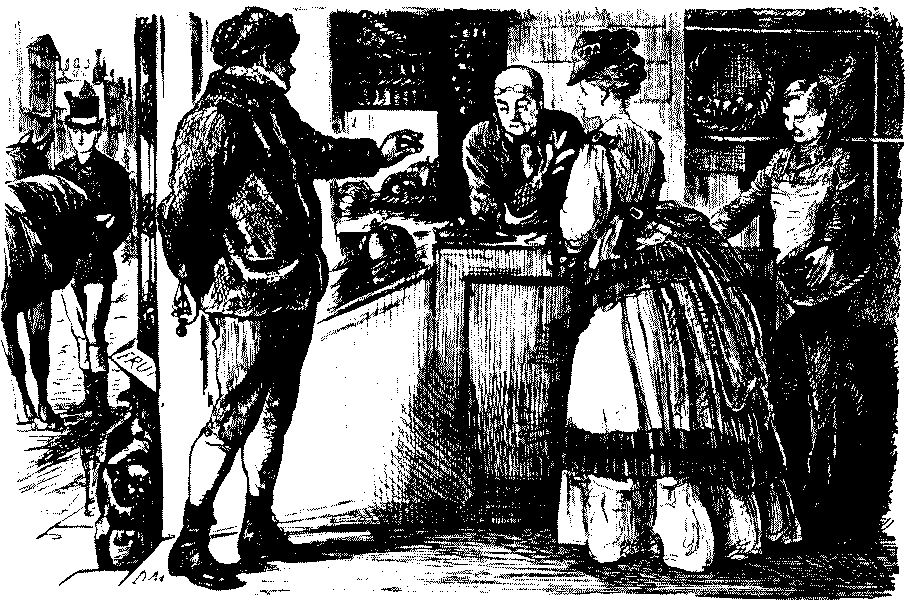
FROM THE COAL DISTRICTS
My Lady: "I'm afraid I must give up the pine-apple, Mr. Green! Eight
shillings is really too much!"
Successful Collier: "Just put 'un up for me, then, Master. 'Ere's 'arf
a sovereign; and look 'ere—yer may keep the change if yer'll only tell
us 'ow to cook 'un!"
Colliers and Cormorants
References to the champagne-habit among the miners abound throughout
this year. A picture shows a miner buying a pine-apple which a lady
could not afford. Their practice of travelling first-class is also
reprobated. But the bitterest explosion of Punch's wrath against the
pampered aristocrats of industry was provoked by a speech in which John
Bright complacently dwelt on "the growth of material prosperity and
comfort in every class." To this Punch vehemently demurred:—
Clerks of all kinds, Civil servants, fund-holders and annuitants
with fixed incomes, landowners, doctors, lawyers, and professional
men in general, is that so? Do you find it so?
When Mr. Bright said "every class," did he not mean to say, or, at
least, should he not have said "certain classes"? It is quite true
that the shoddy class, and the class of great speculators, have
prospered exceedingly, to as great an increase of their material
comfort as increasing wealth could procure them. A proportionate
growth of material comfort and prosperity has obviously been
experienced by the operatives and mechanics, otherwise called the
Working Classes—although there are classes who may be said to do
some little work, other than manual labour, to be sure. Do not
coal-miners for a fair day's work obtain at least a full two days'
wages; do they not drink champagne; and have not they and the rest
of our flesh-and-blood amongst them, drunk us out of the Alabama
difficulty? They have grown in content too—the Striking Classes.
They and the other classes that grasp with one hand and squander
with the other, and go on grasping and squandering, and thereby
raising prices higher and higher every day, they, all of them,
indeed are without doubt increasingly prosperous and comfortable,
but they are not everybody. There are a very great many other
people besides, who constitute everybody else, and these, so far
from being more prosperous and comfortable than they once were, can
now no longer afford the luxuries, or even the necessaries, they
then could, but have to go without.
The ugly phrase about the Alabama claims was not Punch's own coinage,
but he was not in a mood to mince his words where the miners were
concerned. The charges against overpaid workmen and profiteers have a
strangely familiar ring. And so has the reference, though not under the
now familiar name, to the practice of "Ca' Canny," which, however, had
been in occasional use for many years before Punch suggested, in 1874,
that it might be met by reprisals:—
COLLIERS AND CORMORANTS
The Sheffield Daily Telegraph informs consumers, already
subjected by producers to excessive extortion, that at
Motherwell:—
"At a mass meeting of Scotch miners on Thursday, 3,000 colliers
resolved to work only four days per week, and only eight hours per
day, in order to reduce the output, and to keep up prices."
But suppose the butchers and poulterers combined against them, as
they combine against the public, what then? And could not
the vintners agree to raise "these rapacious colliers' Champagne to
some four or five pounds a bottle? Perhaps they will try.
Already Lord Shaftesbury had spoken plainly on the results of that
"enormous increase of wages which had lately taken place in nearly every
class of working men," even going to the length of endorsing the view
that high wages, when unaccompanied by self-control, were the curse of
the working classes:—
Of course, where economy and prudence were practised the condition
of the Working Man should be improved by higher wages; but there
was recklessness and improvidence. The sudden increase of money had
been productive of the greatest possible mischief, and so long as
these habits continued he could not but think that an increase of
wages was a positive infliction to the Working Man, his wife, and
his children.
This bold statement prompted Punch to reduce the argument to an
absurdity, or something near it, by suggesting that the true way of
planting the spirit of self-control in the minds of the people would be
simply to lower their wages to the requisite standard. Simultaneously he
vindicates the character of the working classes for thrift and sobriety
in the following ironical eulogium:—
The Working Classes, it is surely not too much to say, spend every
little increase of wages they obtain by their harmless strikes
chiefly in the education of their children, and in the purchase of
the appliances needful to make home happy. If they are at all
extravagant is it not in books, and in the dress which some of them
are a little too apt to lavish on their wives? For the vast
improvement evident in their habits we have to thank not only the
Licensing Act, but also the Trades' Unions Act; and moreover the
Conservative Reform Bill, which has rendered them, as Mr. Lowe
said, our masters—if not their own.
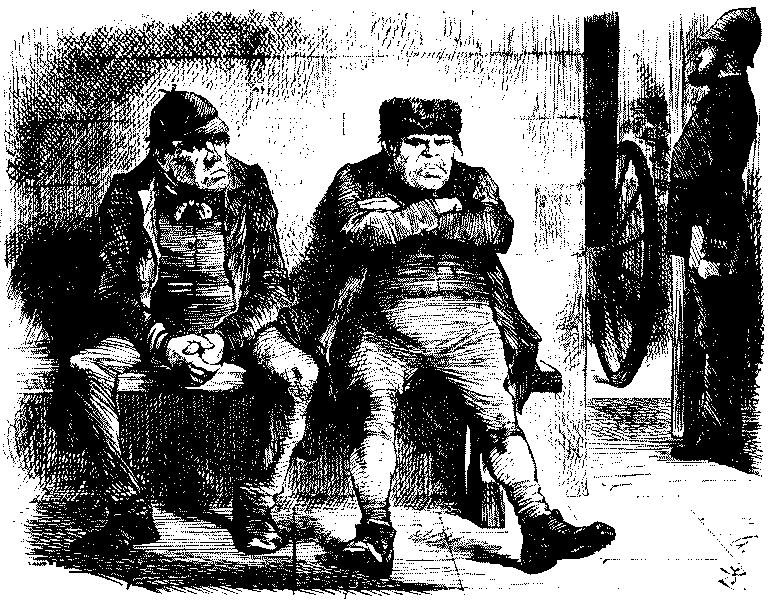
ONE-HANDED JUSTICE
First Ruffian: "Wot was I hup for, and wot 'ave I got? Well, I floor'd a
woman and took 'er watch, and I've got two years and a floggin'."
Second Ruffian: "Ha! I flung a woman out o' the top floor winder; an'
I've on'y got three months!"
First Ruffian: "Ah, but then she was yer wife!"
Punch and Capital Punishment
The reference to working men's wives is especially ironical, for Punch
was at this time engaged in a vigorous campaign of protest against the
very lenient sentences passed on men for brutal assaults on their wives.
References to this subject abound in these years in prose and verse and
cartoons, culminating in the year 1874. He strongly supported resort to
flogging in such cases. We have already noticed the modification, indeed
the practical abandonment, of his old hostility to capital punishment.
The cause of this conversion is curious. It is hardly too much to say
that it was largely the result of a remarkable speech made by John
Stuart Mill—a true humanitarian if ever there was one—on the measure
introduced in April, 1868, to make executions private. Punch, though
he often differed from Mill, had the greatest respect for his fearless
independence and integrity, and was evidently profoundly impressed by
Mill's speech[5] in reply to Mr. Charles Gilpin (the Member for
Northampton), who had argued in favour of
the abolition of capital punishment, and we find the following admirable
summary of it in his "Essence of Parliament":—
The speech of the night was that of Mr. Mill, who approved of many
of the labours of the "philanthropists," but said that they ought
to know when to stop. To deprive a criminal of the life of which he
had proved himself unworthy—solemnly to blot him out from the
fellowship of mankind, and from the catalogue of the living—was
the most appropriate and the most impressive mode in which society
could deal with so great a crime as murder. Imprisonment would be
far more cruel, and less efficacious. None could say that this
punishment had failed, for none could say who had been deterred,
and how many would not have been murderers but for the awful idea
of the gallows. Do not bring about an enervation, an effeminacy in
the mind of the nation; for it is that to be more shocked by taking
a man's life than by taking all that makes life valuable. Is death
the greatest of all earthly ills? A manly education teaches us the
contrary; if an evil at all, it is one not high in the list of
evils. Respect the capacity of suffering, not of merely existing.
It is not human life only, not human life as such, but human
feelings, that should be held sacred. Moreover, taking life for
murder no more implies want of respect for life than fining a
criminal shows want of respect for property. In countries where
execution is morbidly disliked there is no abhorrence of the
assassin. Mr. Mill added that we had been in danger of reducing all
our punishments to nothing; and, though that disposition had
stopped, our penalties[6] for brutal crimes (for which he earnestly
recommended the Scourge) were ridiculously light, and ought to be
strengthened.
The Organ Grinder Nuisance.
It will be noted that Mill here met the argument which Punch had
advanced in earlier years as to the relative severity of long
imprisonment and capital punishment, and answered it on the humanitarian
ground that the former was more cruel as well as less efficacious. Mill,
as we notice elsewhere, had more than anyone else shaken Punch's
hostility to woman suffrage, but the effect of his speech on capital
punishment was even greater. It must not be forgotten, however, that
Mill had been in the forefront of the movement for securing the
prosecution of General Eyre for his drastic suppression of the riots in
Jamaica. Punch supported General Eyre throughout, and it may well have
been that on the question of capital punishment he was influenced by the
principle fas est et ab hoste doceri, even though the opponent was
undermining his own position. On more general grounds one can well
understand that Punch, as an independent observer and thinker, would
admire and be impressed by the candour and detachment from party ties
which marked Mill's political career.
The change in Punch's views on the claims of Labour, especially
organized labour, has already been sufficiently illustrated. But it did
not prevent his espousing the cause of workers where the conditions were
bad, the hours long and the pay inadequate. Punch's protracted
campaign against the organ grinders was no doubt to a considerable
extent due to Leech's sensitive nerves, and to sympathy with
brain-workers such as Babbage, the mathematician, who declared that "one
quarter of his entire working power had been destroyed by audible
nuisances," but his support of Mr. Bass's Bill in 1864 was largely based
on the fact that the business was conducted by undesirable aliens, and
that the Italian padrone was an employer of sweated labour. In 1871
there is a cartoon satirizing the strong measures taken by the police
against a demonstration of child match-makers at a time when adult
agitators were allowed to preach Revolution and Communism in Hyde Park,
and in the same year and month, when a post-mistress was convicted of
theft and forgery, the evil is traced to the temptation to which
underpaid officials were subjected. Punch had already predicted that
in any national emergency the patriotism of the mercantile marine could
be implicitly relied on, a prophecy splendidly realized in the Great
War, and in 1873 he lent a vigorous helping hand to Samuel Plimsoll in
his campaign against the "Coffin-Ships":—
Let horrified shipowners never so oft
His charges, indignant, fling back,
I call him the cherub who sits up aloft
To keep watch for the life of Poor Jack!
Simultaneously Punch printed a cartoon assuming that "Jack" would
never again be sent to sea in one of "Davy Jones's decoy ducks." This
was rather premature, as Plimsoll's campaign to secure the compulsory
load-line which began in 1870, and in which he showed more zeal than
discretion, did not lead to legislation until 1876. But with all his
faults Plimsoll earned his title of "The Sailor's Friend" and justified
Punch's salutation.
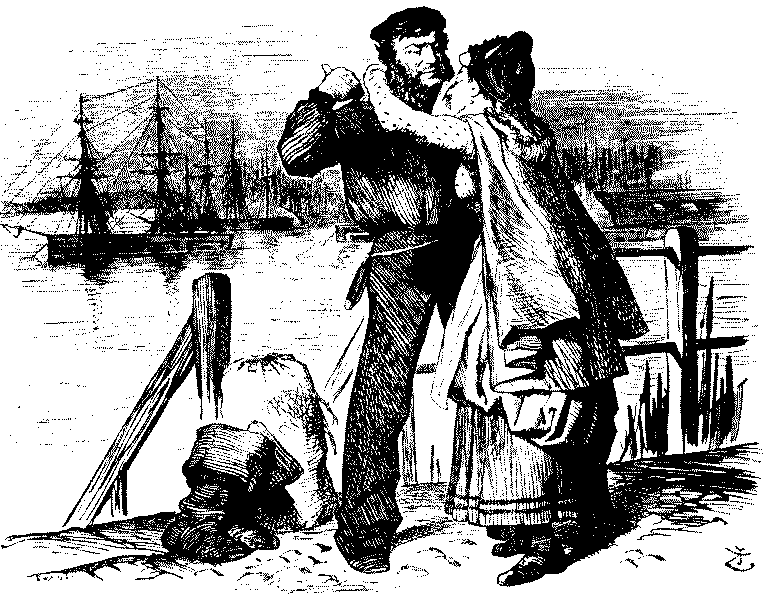
THE COFFIN-SHIPS
Polly: "Oh, dear Jack! I can't help crying, but I'm so happy to think
you're not going in one of those dreadful ships!"
Jack: "What, Davy Jones's decoy ducks! No, no, lass—never more. Thanks
to our friend Master Plimsoll, God bless him!"


