When we came to Amsterdam, we determined,
Pashley, Shirtliff and I, that we would take the
earliest opportunity of seeing Marken. Wonderful
place, by all accounts. Little island, only two
miles from mainland, full of absolutely unsophisticated
inhabitants. Most of them have never left
Marken—no idea of the world beyond it! Everybody
contented and equal; costumes quaint;
manners simple and dignified. Sort of Arcadia,
with dash of Utopia.
And here we are—actually at Marken, just
landed by sailing-boat from Monnickendam.
All is peaceful and picturesque. Scattered
groups of little black cottages with scarlet roofs,
on mounds. Fishermen strolling about in baggy
black knickerbockers, woollen stockings, and
wooden shoes.
Women and girls all dressed alike, in crimson
bodice and embroidered skirt; little cap with one
long brown curl dangling coquettishly in front of
each ear. Small children—miniature replicas of
their elders—wander lovingly, hand in hand. A
few urchins dart off at our approach, like startled
fawns, and disappear amongst the cottages.
Otherwise, our arrival attracts no attention.
The women go on with their outdoor work,
cleaning their brilliant brass and copper, washing
and hanging out their bright-hued cotton and linen
garments, with no more than an occasional shy
side-glance at us from under their tow-coloured
fringes. "Perfectly unconscious," as Shirtliff
observes, enthusiastically, "of how unique and
picturesque they are!"
All the more wonderful, because excursion
steamers run every day during the season from
Amsterdam.
We walk up and down rough steps and along
narrow, winding alleys. Shirtliff says he "feels
such a bounder, going about staring at everything
as if he was at Earl's Court." Thinks the
Markeners must hate being treated like a show.
We shouldn't like it ourselves!
That may be, but, as Pashley retorts, it's the
Markeners' own fault. They shouldn't be so
beastly picturesque.
Fine buxom girl approaches, carrying pail. On
closer view, not precisely a girl—in fact, a matron
of mature years. These long, brown side-curls
deceptive at a distance; impression, as she passes,
of a kind of Dutch "Little Toddlekins"; view of
broad back and extensive tract of fat, bare neck
under small cap. She turns round and intimates
by expressive pantomime that her cottage is close
by, and if we would care to inspect the interior,
we are heartily welcome. Uncommonly friendly
of her. Pashley and I are inclined to accept, but
Shirtliff dubious—we may have misunderstood
her. We really can't go crowding in like a parcel
of trippers!
Little Toddlekins, however, quite keen about it;
sees us hesitate, puts down pail and beckons us on
round corner with crooked forefinger, like an
elderly Siren. How different this simple, hearty
hospitality from the sort of reception foreigners
would get from an English fishwife! We can't
refuse, or we shall hurt her feelings. "But
whatever we do," urges Shirtliff, "we mustn't
dream of offering her money. She'd be most
tremendously insulted."
Of course, we quite understand that. It
would be simply an outrage. We uncover, and
enter, apologetically. Inside,
an elderly fisherman is sitting by the hearth mending
a net; a girl is leaning in graceful, negligent
attitude against table by window. Neither of them
takes the slightest notice of us, which is embarrassing.
Afraid we really are intruding. However, our
hostess—good old soul—has a natural tact and
kindliness that soon put us at our ease. Shows us
everything. Curtained recesses in wall, where they
go to bed. "Very curious—so comfortable!" Delft
plates and painted shelves and cupboards. "Most
decorative!" Caps and bodices worn by females
of the family. "Charming; such artistic colour!"
School copybooks with children's exercises.
"Capital; so neatly written!" What is she trying
to make us understand? Oh, in winter, the
sea comes in above the level of the wainscot.
"Really! How very convenient!" We don't
mean this, but we are so anxious to please and be
pleased, that our enthusiasm is degenerating into
drivel. Girl by the window contemplates us with
growing contempt; and no wonder. High time
we went.
Little Toddlekins at the end of her tether;
looks at us as if to imply that she has done her
part. Next move must come from us. Pashley
consults us in an undertone. "Perhaps, after all
she does expect, eh? What do we think? Would
half a gulden—— What?"
Personally, I think it might, but Shirtliff won't
hear of it, "Certainly not. On no account!
At all events he'll be no party to it. He will
simply thank her, shake hands, and walk out."
Which he does. I do the same. He may be
right, and anyhow, if one of us is to run the risk
of offending this matron's delicacy by the offer
of a gratuity, Pashley will do it better than I.
Pashley overtakes us presently, looking distinctly
uncomfortable. "Did he tip her?" "Yes, he tipped
her." "And she flung it after you!" cries Shirtliff,
in triumph. "I knew she would! Now I hope
you're satisfied!"
"If I am, it's more than she was," says Pashley.
"She stuck to it all right, but she let me see it was
nothing like what she'd expected for the three
of us."
Shirtliff silent but unconvinced. However, as
we go on, we see a beckoning forefinger at almost
every door and window. Every Markener anxious
that we should walk into his little parlour—and pay
for the privilege. All of them, as Pashley disgustedly
observes, "On the make"; got some
treasured heirloom that has been in the family
without intermission for six months, and that they
would be willing to part with, if pressed, for a
consideration. We don't press them; in fact, we
are obliged at last to decline their artless invitations—to
their unconcealed disgust. Nice people,
very, but can't afford to know too many of them.
"At least the children are unspoilt," says Shirtliff,
as we come upon a couple of chubby infants,
walking solemnly hand in hand as usual. He
protests, when Pashley insists on presenting them
with a cent, or one-fifth of an English penny,
apiece. "Why demoralise them, why instil the
love of money into their innocent minds?" Shirtliff
wants to know.
He is delighted when they exhibit no sort of
emotion on being thus enriched. It shows, he
says, that, as yet, they have no conception what
money means.
The pair have toddled off towards a gathering
of older children, and Pashley, who has brought a
Kodak, wonders if he can induce them to stay as
they are while he takes a snapshot. Shirtliff
protests again. Only spoil them, make them
conceited and self-conscious, he maintains.
But the children have seen the Kodak, and are
eager to be taken. One of them produces a baby
from neighbouring cottage, and they arrange themselves
instinctively in effective group by a fence.
Pashley delighted. "Awfully intelligent little
beggars!" he says. "They seem to know exactly
what I want."
They also know exactly what they want, for the
moment they hear the camera click, they make a
rush at us, sternly demanding five cents a head
for their services.
Shirtliff very severe with them; not one copper
shall they have from him; not a matter of pence,
but principle, and they had better go away at
once. They don't; they hustle him, and some of
the taller girls nudge him viciously in the ribs
with sharp elbows, as a hint that "an immediate
settlement is requested." Pashley and I do the
best we can, but we soon come to the end of our
Dutch coins. However, no doubt English pennies
will—— Not a bit of it! Even the chubby
infants don't consider them legal tender here, and
reject them with open scorn.
Fancy we have compromised all claims at last.
No; Marken infantry still harassing our rear.
What more do they want? It appears that we
have not paid the baby, which is an important
extra on these occasions, and which they carry
after us in state as an unsatisfied creditor and a
powerful appeal to our consciences. Adult
Markeners come out, and seem to be exchanging
remarks (with especial reference to Shirtliff, who is
regarded as the chief culprit) on the meanness
that is capable of bilking an innocent baby.
"What I like about Marken," says Pashley,
when we are safely on board our sailing boat, to
which we have effected a rather ignominious
retreat, "what I like about Marken is the beautiful
simplicity and unworldliness of the natives.
Didn't that strike you, Shirtliff?"
We gather from Shirtliff's reply that he failed to
observe these characteristics.
At Munich.—Mr. Joddletop (to travelling companion
at Bierhalle). What they call this larger
beer for I'm blessed if I know! Why, it's thinner
than the Bass I drink at home!
Mrs. Tripper (examining official notice on the walls
of Boulogne). What's that mean, Tripper, "Pas
de Calais"?
Tripper (who is proud of his superior acquaintance
with a foreign language). It means—"Nothing
to do with Calais," my dear. These rival ports
are dreadfully jealous of one another!
Very Much Abroad.—Brown. I say, Smith,
you've been here before. Tell me where I can get
a first dish of Tête de veau?
Smith. Tête de veau? Let's see, that's "calf's
head," isn't it? Well, I heard of a place where
they ought to have it good, as they call it the Hôtel
de Veal.
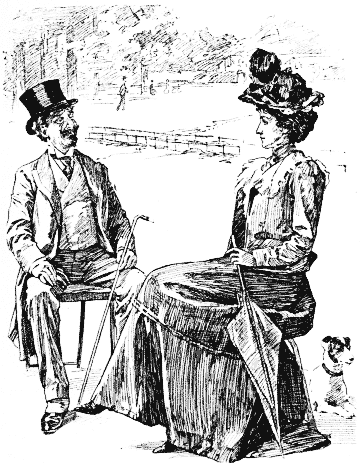
He. "You climed ze Matterhorn? Zat was a great foot."
She. "Great feat, you mean, count."
He. "Ah! Zen you climed him more as once!"


