Novice.—(a) Don’t, unless you want penal
servitude for life. (b) Any respectable burglar.
(c) We do not answer questions on chiropody
in this column.
Hard Up.—Brougham on Conveyances will
explain whether your contract to purchase
the motor-car is binding or not.
Farmer.—It is either an “escrow” or a scarecrow;
impossible to state definitely without
further information.
B. and S.—There is no reduction (of the fine)
in taking a quantity—generally the reverse.
Traveller.—By travelling in the manner you
describe, viz., under the seat, you render yourself
liable to “stoppage in transitu,” and to completing
the rest of your journey on foot “in
custodia legis.” The authorities on this point are
very clear. See Constable’s Reports, P.C. X. Y. Z.,
Vol. XIV., pages 72-85.
Justice.—If the defendant lost, you, being plaintiff
would win, and vice versâ. Consult a
solicitor.
Student.—Can only spare space for half your
questions. “Aggravated assault” explains itself,
an assault which aggravates or annoys you.
“Damage fesant,” a badly shot pheasant.
“Simple larceny,” taking an empty purse out
of a pocket in which a sovereign is lying loose.
“Misdemeanour” is of course the demeanour of
an unmarried woman, or in plainer language, the
airs she gives herself.
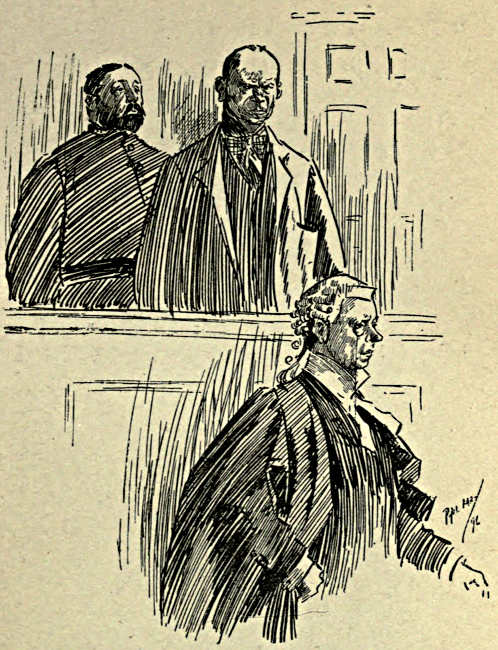
“Gentlemen, I am ready to admit that his career in the
past has not been free from blemish——”
A Brief Existence.—A barrister’s.
The Letter of the Law.—The “letter of
the law” must be x. It expresses a quantity that
is unknown.
A Law Suit.—Wig, gown, and bands.
How to make use of “the Block in the
Law Courts.”—Try wigs on it.
Good Legal Securities.—De-Benchers of
Lincoln’s Inn.
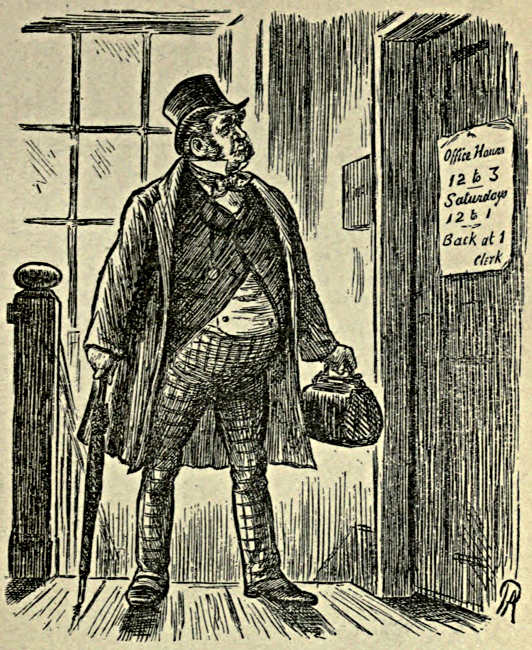
“WHEN THE CAT’S AWAY”——
Mr. Blazer, K.C., returns unexpectedly to his chambers in
the middle of vacation.
I am watching, I am waiting,
And my hair is growing grey,
For it is exasperating,
That no business comes my way.
Other men in briefs may revel
When successfully they plead,
I am only a poor “devil,”
Often worked but never fee’d.
E’en the bank-clerk in the city
Has a salary that’s small,
But we juniors, more’s the pity,
Don’t make anything at all.
Living still on false pretences,
Since the truth we dare not own,
Some not earning their expenses
If the facts were truly known.
And meantime the years are flying,
Bringing changes p’raps for some,
Not for me tho’; I’m relying
On the practice that’s to come.
Legal Mem.—A barrister is only invited to
sit on the Bench when he has had some considerable
amount of standing at the Bar.
“A Winding-up Case.”—A watch’s.
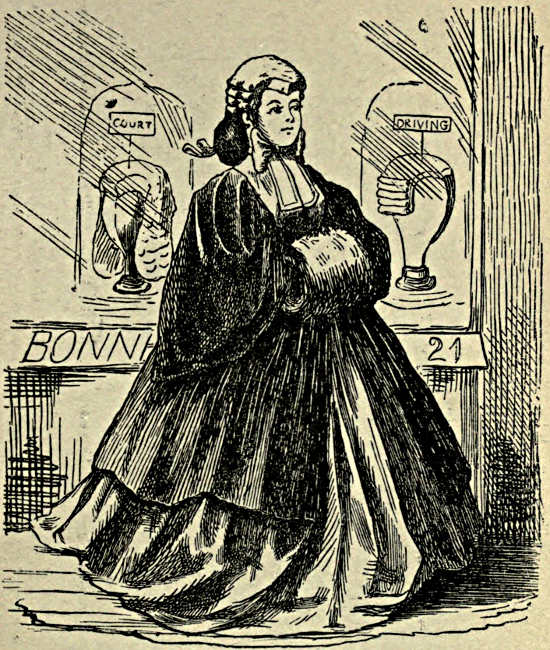
PROBABLY THE NEXT ABSURDITY
In ladies’ winter costumes.
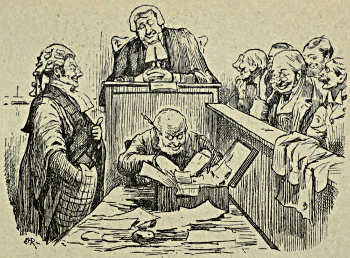
“Never miss a chance of ingratiating yourself with the jury, even at the expense of the judge.”
(An opportunity often occurs after lunch.)
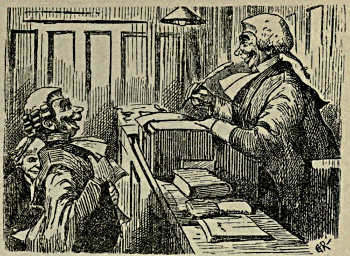
“Always laugh at the judge’s jokes. It is not upon such an
occasion that his lordship observes that he will not have the court
turned into a theatre.”
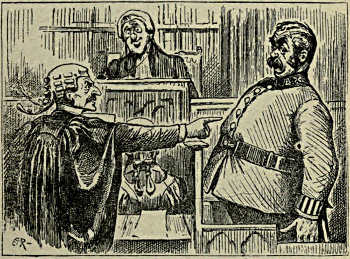
“Show no mercy to the police; they have few friends.”
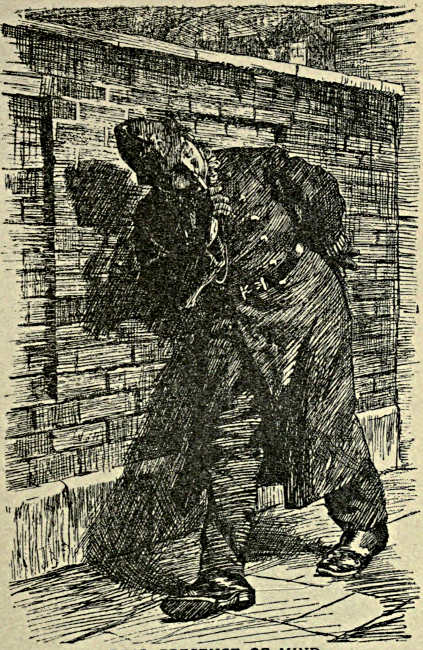
REAL PRESENCE OF MIND
Policeman X 24, drunk and almost incapable, is just able to blow
his whistle for help!
The sons of lawyers, who are intended for their fathers’
profession, cannot too early become familiar with legal
phrases and their meanings. Old nursery rhymes might
easily be adapted for this purpose. For instance—
I.
Alibi, baby, on the tree top,
Proved ’gainst your foes,
The case it will stop;
When we suppose
The evidence fall,
Down goes the alibi, baby, and all.
II.
Dickory, dickory, dock,
The burglar picks a lock,
Police come down,
Case for Crown,
Dickory, dickory, dock.
III.
Goosey, Goosey, Gander,
Whither do you wander?
Up-stairs and down-stairs into Judges’ Chambers.
Old Baron Longwigs,
Finished his affairs,
Puts him out his left leg,
Puts him out his right leg,
Puts him out his both legs and walks down-stairs.
IV.
Taffy was a Welshman,
Taffy was a thief,
Taffy came to my house,
And stole a leg o’ beef.
P’liceman went to Taffy’s house,
Taffy wouldn’t own;
Took him up to my house,
V.
Ride a cab horse,
Beyond Charing Cross,
To see any lady get a divorce;
Ring on her finger
Still dully shows;
Will she have music wherever she goes?
(Left in the Hall of the Law Courts.)
The gentle genius of the night,
Of course I mean Diana,
Made me dilate with rapt delight
To you, my fair Susanna.
But please don’t think my words were true
The moon played me a sorry trick,
Beneath the sun I write to you,
I merely was a lunatic.
You’ve mulcted me to a pretty tune,
I’ll have revenge—I’ll shoot the moon!
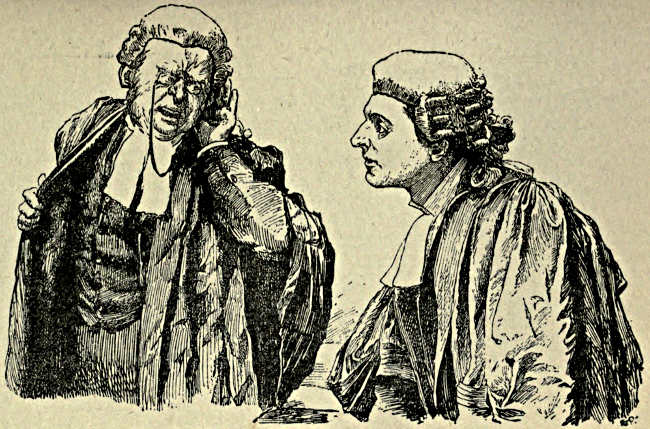
The Trials of an Anxious “Junior.”—Prompting a deaf and testy “chief” in open court is not
his idea of perfect bliss.
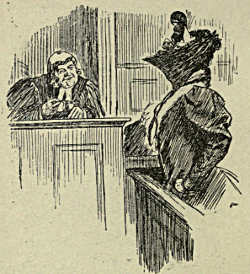
THINGS ARE NOT ALWAYS
His Honour. “H’m! Will you kindly raise your veil.
I find it extremely difficult to—h’m—hear anyone distinctly
with those thick veils——”
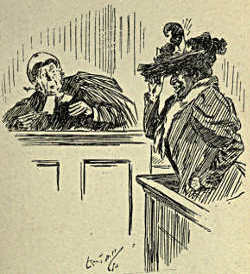
WHAT THEY SEEM
“Er—er—thank you! Silence! I will not have this
court turned into a place of amusement!”
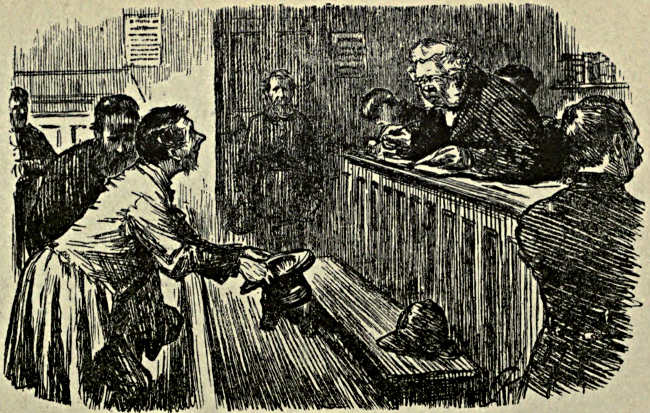
“The Meshes of the Law!”—Rural Magistrate. “Prisoner, you are charged with—ah—loitering
about in a suspicious manner, without any ostensible employment. How do you obtain a
living?”
Prisoner. “Your wusship, I’m engaged in the manufacture of smoked glasses for
observing eclipses—an ‘industry’”—(solemnly)—“an ‘industry,’ your wusship, which involves protracted
periods of enforced leisu-are!!”
Discharged with a caution!
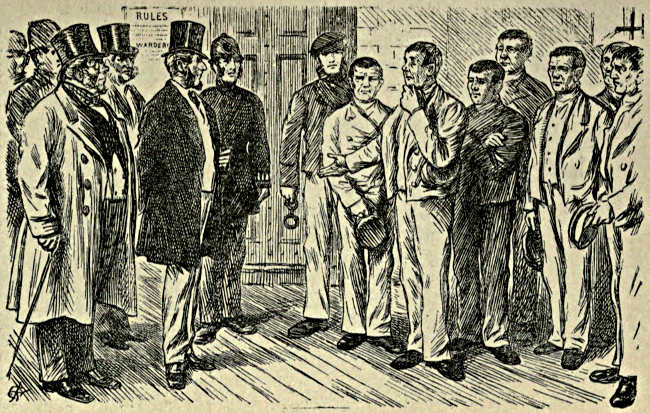
Pity the Poor Prisoners!—Scene—County Prison: Visiting Justices on Inspection.
Visiting Justice. “Any complaints?”
Prisoner. “Yes, your Honour. We’re guv on’y one bucket at
shavin’ time, so we’ve all got to dip our razors in the same water, and who knows wot skin diseases
a cove might ketch!”
The Barrister’s Favourite Hymn.—“‘Brief’
life is here our portion.”
Legal Query. (From an Earnest Enquirer.)—“Sir,
I have often heard of ‘The Will of the
Wisp.’ Was this will ever proved? Who was ‘the
Wisp’? Why so called? Because he was a man
of straw? Wisper your answer to me, and oblige
yours,
“Colney Hatcher, E. I.”
The Gas Companies’ Lawyer.—Coke.
Two Sorts of Police.—The Detective—and
the Defective.
Criminal Query.—Can a prisoner who commits
himself, also form his own conviction?
The Legal Fraternity.—Brothers-in-law.
Legal Question.—What are the “Benchers”
of our Inns of Court?
Persons so called from their persistent adherence
to legal forms.
Legal “Instruments.”—“Soft recorders.”
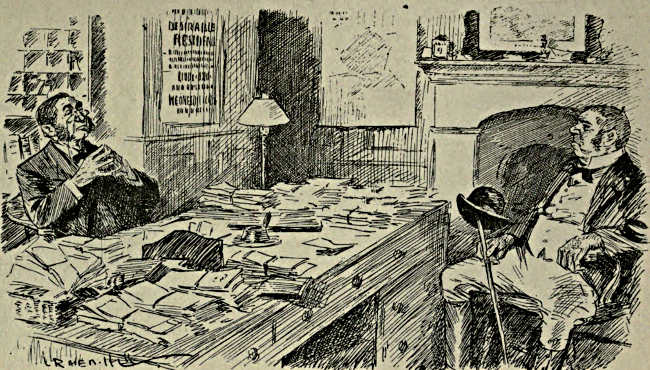
Solicitor. “Now, as a matter of fact, when expressing your opinion of your opponent, you
did use a leetle strong language?”
Client. “Wull, I don’t know as I forgot anything!”
Old Saying (By our own Detective).—Professional
thieves are notoriously dense, hence
the proverbial expression, “Thick as thieves.”
When a leading barrister gets someone to
“devil” for him, may the latter’s occupation be
correctly described as “devilry”?
The result of going out for a “lark” very
generally is, that the last part of the lark you see
is the beak.
Sittings in Error.—A pew in a Mormonite
chapel.
Law and Time.—A “watching brief” must
have much to do with second-hand information.
Cause Without Effect.—An action resulting
in a farthing’s damages.
A “Counter-Case.”—Shop-lifting.
Diamonds of the Cape.—Intelligent policemen.
Information Wanted.—At what time in the
morning are barristers called?
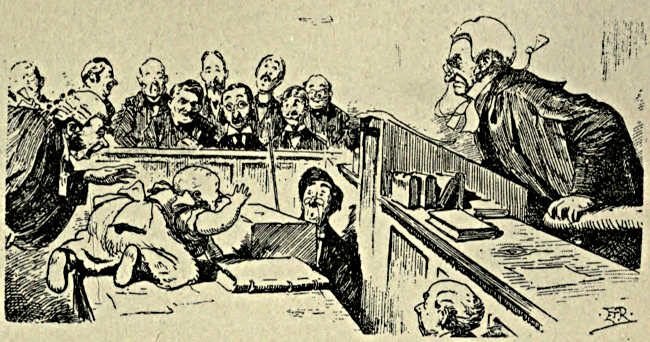
MR. PUNCH’S ILLUSTRATED LAW REPORTS
“Alleged contempt of court by an infant”
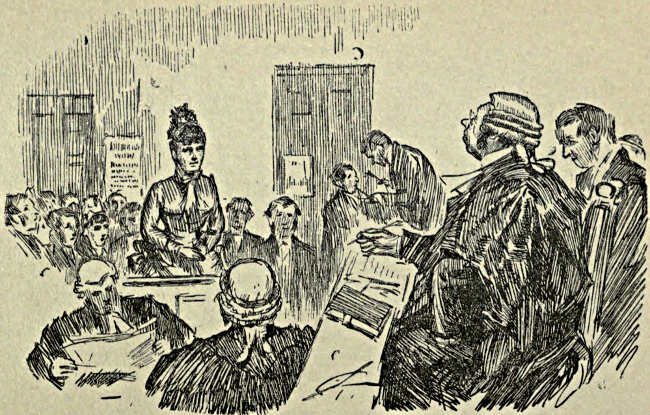
Compliments.—“The Court” (thinking aloud). “Hu—m—’markably fine young wom——.”
The Witness (overhearing). “Excellent judge!!”
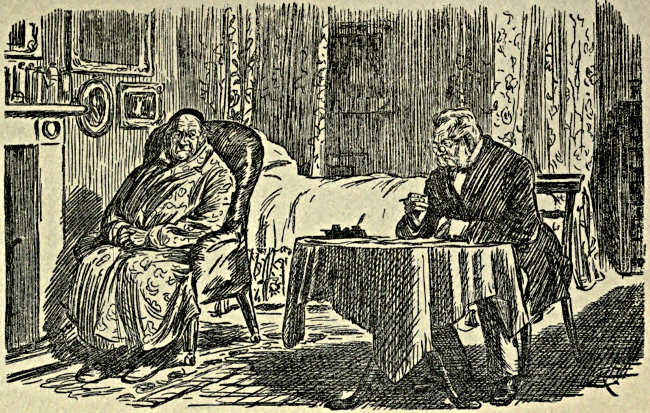
Cantankerous.—Legal Adviser (drawing up the old gentleman’s will). “Um—seems a pity you should
cut off your son with a shilling. But, if you’re determined—hem!—what about the pictures? You have a
very valuable collection, sir?——”
Crusty Invalid. “Oh, drat the pictures! Leave ’em to the Blind
Asylum!!”
O poor jury, boxed, poor jury,
Three weeks odd, each day but one;
Rose impatience not to fury
Ere your weary task was done?
You were special, picked and chosen
For the nonce, were you, indeed.
But had one among your dozen,
Business of his own to heed?
Put an artist on an action,
Or a scribe as juror bind,
How shall that man help distraction,
From his duty, of his mind?
Thoughts of lost employment pressing
He can chase not, nor control
Fell anxiety, distressing,
If it were to save his soul.
If your case needs comprehension,
Litigants, your jury, then,
Must, to give it due attention,
Be composed of leisured men.
Swells in yachts life idly leading,
Fishing, hunting, shooting, who
Might, to work for bread not needing,
Sing, “We’ve got no work to do.”
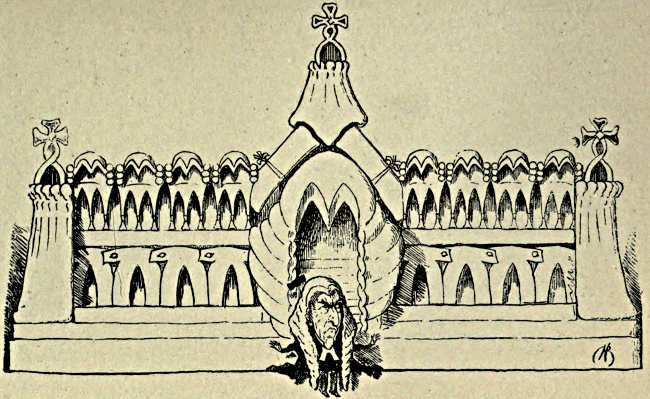
THE REJECTED DESIGN FOR THE NEW LAW COURTS
“One anonymous architect has sent in a frantic design, which the commissioners have not
chosen to exhibit.”—Times, Feb. 11, 1867.
Maritime Law.—The law of libel does not
apply to a “running down” case. The parties are
not in the same boat.
Question.—Can a process server legally be
said to be a writualist?
Question every Magistrate ought to
ask himself before going to Sleep.—“I
wonder if I have committed myself in any way
to-day?”
How to Prevent a Conspiracy from
Leaking Out.—Let the plot thicken.
A Moral Phenomenon.—A barrister returning his fee.
Briefless Theory.—’Tis practice makes the
barrister perfect.
“After you,” as the policeman ought to be
allowed to say to the bubble-bank director.
Legal Quibble.—A barrister should cultivate
a good temper, if he would succeed as a cross-examiner.
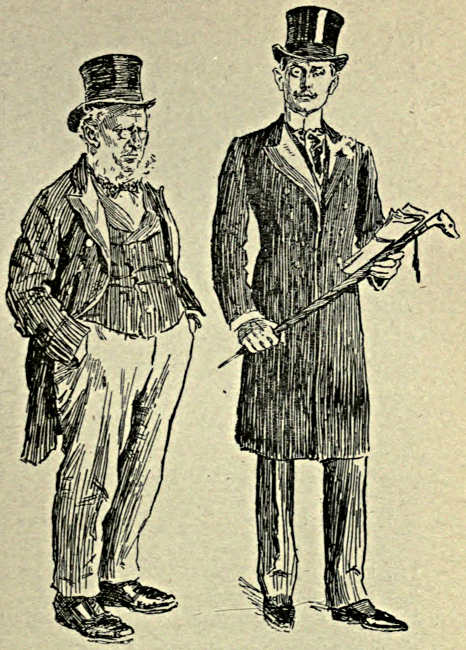
A CONTRAST
Mr. Bigwig, the eminent K.C., and his clerk.
In a County Court.—Judge (to Mr. Pettiphog,
plaintiff’s solicitor). I really cannot see that you
have proved the defendant’s means.
Mr. P. (excitedly, to defendant). No means!
How did you get here, sir?
Defendant. I walked.
Mr. P. Where did you get the boots to walk
in?
Defendant. I borrowed them.
Mr. P. (triumphantly). On what security, sir,
on what security?
Defendant. On the fact that you had taken up
the case against me.
[General merriment. No order.
Brief “Bags.”—Short trousers.
Drink for Lawyers.—The Wool-sack.
The Policeman’s Lady-Love.—Ar(e)abella.
The Jury Starvation System.—Q. What
foreign institution does starving a jury approach
the nearest to?
A. The Diet of Hungary.
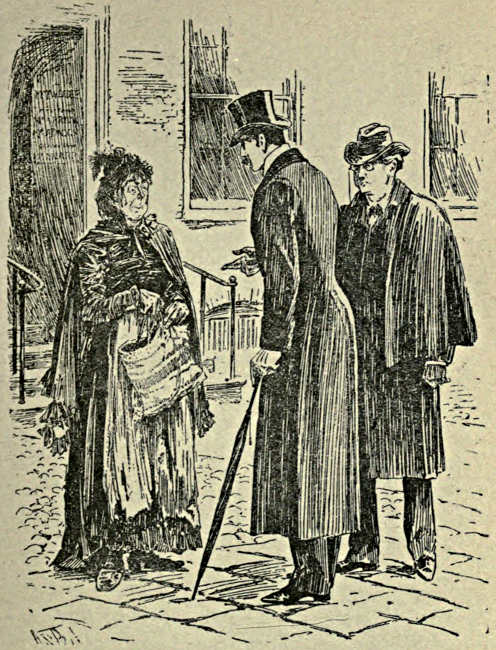
A Case of Self-sacrifice.—Mrs. Grimes. “No, sir, Mr. Smith
ain’t a-bin in ’is chambers not for a week, sir.”
Mr. Brown. “Oh! You’re sure now you know the gentleman I mean—Mr.
Meldon Smith?”
Mrs. Grimes. “Hi knows ’im right enough.
Wy, I does all ’is washin’ and mendin’ for ’im!”
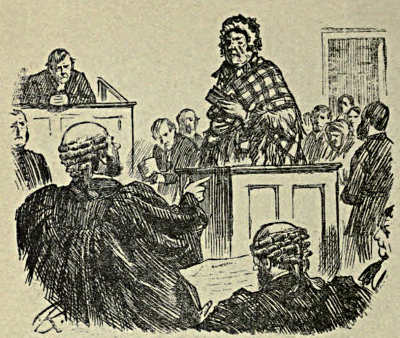
AT THE SESSIONS
Counsel. “Do you know the nature of an oath, my good
woman?”
Witness (with a black eye). “I did ought to, sir! Which
my ’usban’ ’s a Covin’ Garden porter, sir!”
An Expensive Call to Pay.—A call to the
Bar.
Legal Inquiry.—If I buy a pair of trousers
warranted to wear well, and they turn out a failure,
should I, on bringing an action for damages, be
“non-suited,” or could I counterclaim damages for
“breeches of promise”?
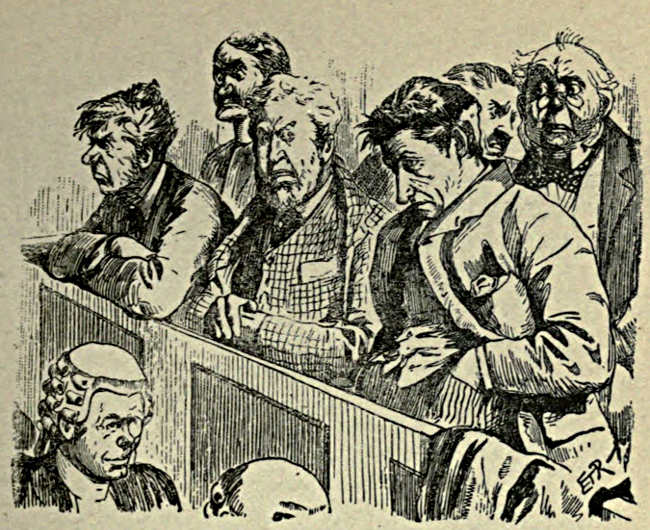
THE DELIGHTS OF TRIAL BY JURY
These gentlemen are expected to be in a judicial frame
of mind after hanging about the precincts of the court for
several days, under penalty of a heavy fine, while their
private business in the city and elsewhere is going to the
dogs. (Why should not half-pay officers do the work, and
relieve busy men?)
Brief Authority.—A barrister’s.
The Division List.—Divorce Court causes.
Centre of Gravity.—A judge in court.
The Block of Legal Business.—The wig
block.
(“The first lady barrister has just taken the oath at
Paris.”—Daily paper).
O Portia, many maids there are,
Who wear their wigs as gaily
As thou, appearing at the bar
To take refreshers daily;
They rustle too, in silk like thee
With oft a clerk resplendent
And, not infrequently you see,
Solicitors attendant.
Their trade is legal—so is thine,
Yet not their craft thou pliest,
For they are in the liquor line
And thou in law—the driest.
But welcome, bar maid! hail to thee!
Bright be thy lot and griefless!
And may thy portion never be,
Like this poor writer’s, briefless.
The Eye of the Law.—Policeman’s bull’s-eye.
More than a Miracle.—When a prisoner is
“taken from the dock unmoved.”
Song for Magistrates.—“Let us speak of a
man as we’ve fined him.”
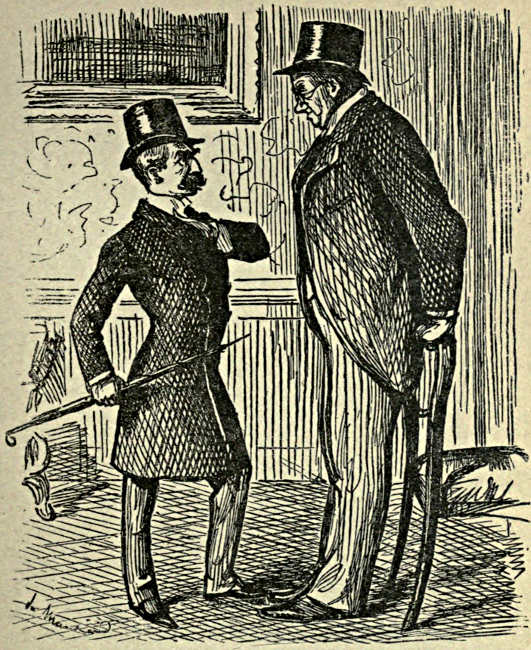
THE FINE OLD SPIRIT
“But if you really think Jones has injured you, my dear fellow,
why not consult some clever lawyer?”
“Lawyer, indeed! With men of my stamp, the only possible
reply to a man of Jones’s, is the horsewhip, since it can no longer
be the sword!”
Where there’s a will there’s a law suit.
The successful lawyer is a man of actions.
Look before you leap into litigation.
The wise man keeps his own counsel, and the
wise counsel keeps his own man.
Many a muddle makes a muckle for the lawyers.
No suit lasts longer than a suit in Chancery.
A conveyancer is never afraid of drafts.
A brief in the hand is worth two in a solicitor’s
office.
’Tis better to have fought and lost than to have
had no case at all.
Little plaintiffs have large fears.
The good solicitor is known by his good deeds.
Two heads, a leader and a junior, are better
than one.
Law for Ladies.—Why ought every lady
nowadays to learn the legal doctrine concerning
“wrong to the person”?
Ans. They ought to learn it because it’s tort.
(Ask any barrister!)
[“A Policeman’s Conscience.—Police-Superintendent Roberts,
of Torquay, has won a splendid reputation for impartiality. He even
punishes himself for breaches of the law. The other night while
cycling home from Brixham his lamp went out, and yesterday he
appeared before the magistrate, in response to a summons issued
by himself against himself. He said a clergyman spoke to him
on the subject, and this brought the offence to his notice. He
was fined 5s.”—Daily Telegraph.]
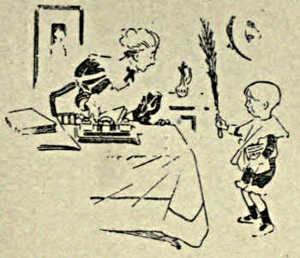
Master Bob. “Please, ma,
will you kindly chastise
me? I’ve been at the jam
again!”
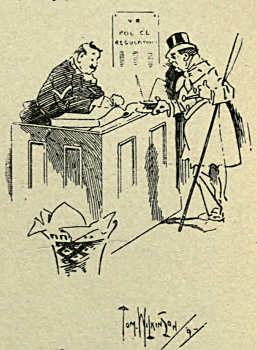
Cabby (at police-station).
“’Ere, I’ve
just charged a fare
sixpence too much, and
I want a summons out
aginst meself.”
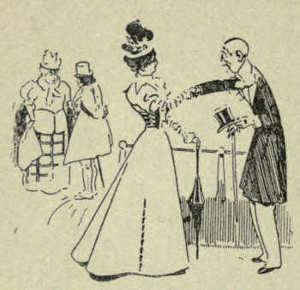
Miss Candid. “Oh,
Mr. De Tiring, I was
at home yesterday
when you called; but
you are such an awful
bore, you know, I was
compelled to send
you away.”
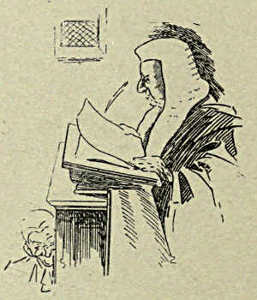
Learned Judge.
“Before adjourning
the court to-day, I
wish to state that I
have been guilty of
betting, at a ‘place’
within the meaning
of the Act. I therefore
fine myself a sum
of twenty pounds and
costs, coupled with a
severe reprimand.”
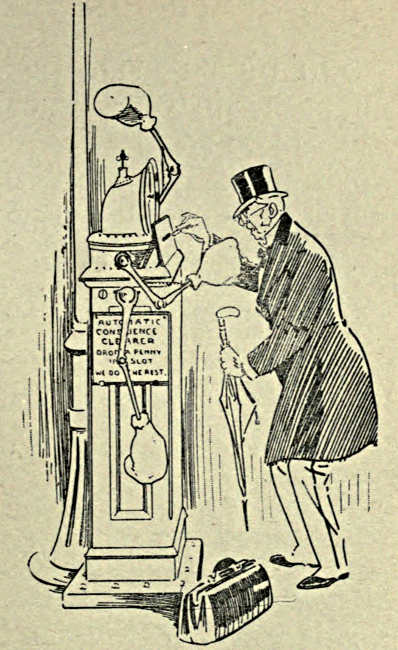
Of course, the “Automatic Conscience Clearer” for
minor offences would soon be immensely popular. We
beg to offer the above suggestion. N.B.—The inventor
has been provisionally protected.
Oh, where, and oh where is my learned counsel gone?
He’s gone to the Queen’s Bench where a case is coming on,
And it’s oh, in my heart, that I wish my case his own.
What fee, and what fee did your learned counsel clutch?
Five guineas on his brief he did not think too much;—
And it’s oh! if he’s a barrister, I wish he’d act as such.
In what court, in what court is your learned counsel found?
I cannot catch him anywhere, of all he goes the round;—
And it’s oh! in my heart, that to one I wish him bound.
What excuse, what excuse can your learned counsel make?
None at all, none at all, but his head he’ll gravely shake,
And it’s oh! in my heart, that the fee he’s sure to take.
Conversation in Chancery Lane.—Dull
Youth. I say, what’s a legal digest?
Bright Youth. Why, you fool, it forms part of
the legal course—for instance, every barrister, after
he has eaten his terms, has to go through his
digest!
A Firm Conviction.—Transportation for
life.
Bar Gold.—Fees to counsel.
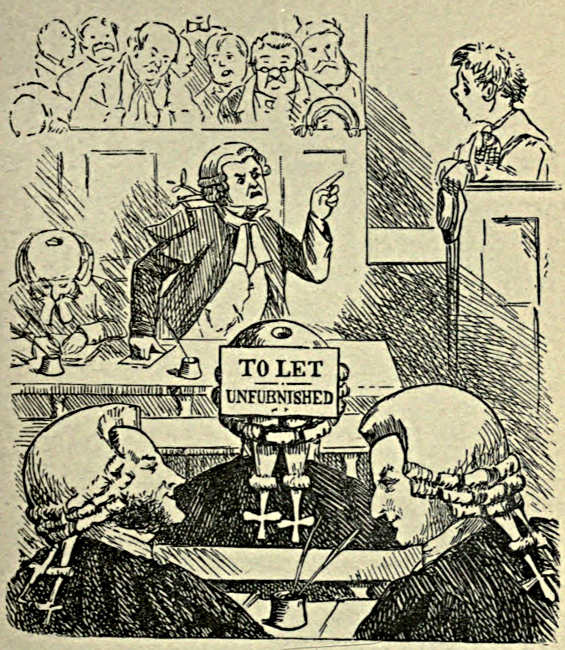
It was rather too bad, you know, that Larkins serving poor
Jones like this! And his first circuit, too!
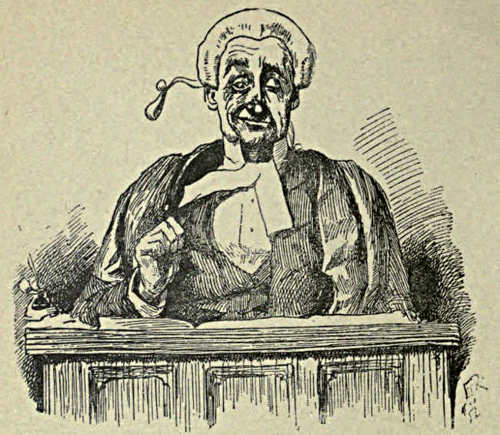
LEGAL IMPROVEMENTS
In order to husband our judicial staff, in future a judge
will be expected to hear two cases at the same time.
Portrait of a judge trying a theatrical cause célèbre,
and a nice question as to a “remainder-man” and a
“tenant in tail male.”
The Best Game for Junior Barristers
to Play.—Follow my leader.
Waiting for an Answer.—What is the
difference between eating your words and eating
your terms.
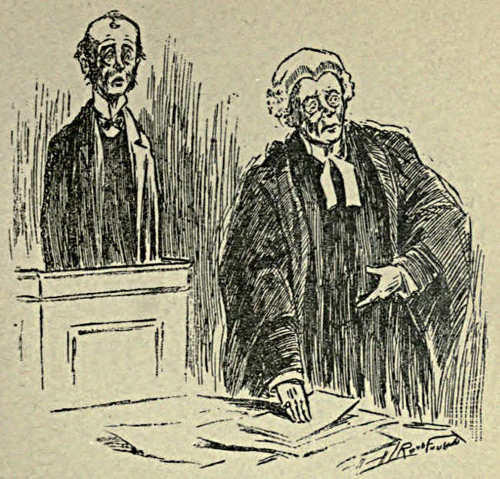
“May it please your ludship, I ask that the witness be
forced to produce the papers that were burnt!”
A Knowing Beggar.—A beggar posted
himself at the door of the Chancery Court,
and kept saying: “A penny please, sir! Only
one penny, sir, before you go in!” “And why,
my man?” inquired an old country gentleman.
“Because, sir, the chances are, you will not have
one when you come out,” was the beggar’s reply.
INTRODUCTORY QUESTIONS.
Q. Mention some of the principal law books
which you have studied?—A.. Hoyle’s Laws of
Whist, Cribbage, &c. The Rules of the Cricket
Club; ditto of the Jockey Club.
Q. Have you attended any, and what, law
lectures?—A. I have attended to many legal
lectures, when I have been admonished by police
magistrates for kicking up rows in the streets,
pulling off knockers, &c.
COMMON LAW.
Q. What is a real action?—A. An action
brought in earnest, and not by way of a joke.
Q. What are original writs?—A. Pothooks and
hangers.
EQUITY AND CONVEYANCING.
Q. What are a bill and answer?—A. Ask my
tailor.
Q. How would you file a bill?—A. I don’t
know, but would lay a case before a blacksmith.
Q. What steps would you take to dissolve an
injunction? A. I should put it into some very
hot water, and let it remain there until it was
melted.
Q. What are post-nuptial articles?—A. Children.
CRIMINAL LAW AND BANKRUPTCY.
Q. What is simple larceny?—A. Picking a
pocket of a handkerchief, and leaving a purse of
money behind.
Q. What is grand larceny.—A. The income-tax.
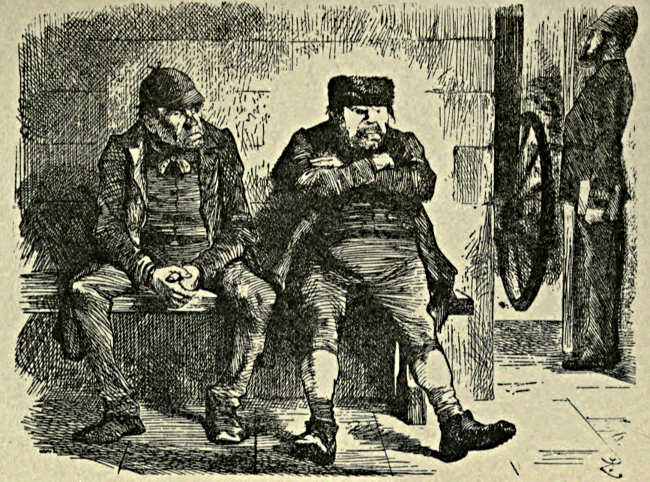
Odd-handed Justice.—First Ruffian. “Wot was I hup for, and wot ’ave I got?
Well, I floor’d a woman and took ’er watch, and I’ve got two years and a floggin’.”
Second Ruffian. “Ha!—I flung a woman out o’ the top floor winder; an’ I’ve on’y got
three months!”
First Ruffian. “Ah, but then she was yer wife!!”
The days are gone when I used to seek
Refreshment and fun in the Henley Week,
But now all that is a thing of the past,
The pace at the time was too good to last.
Farewell to the straws and the flannel shirts,
Farewell to the house-boats, launches, and flirts,
Farewell to champagne cups and cigarettes,
To the gloves and the sweet things lost in bets;
In chambers, alas! I sit and groan,
Slaving, and writing, and waiting alone.
On parchment and paper with pen and ink
I draw the draughts that I cannot drink.
I’ll see if my chief is here … I’ll try.…
He’s off! To Henley?… hem!—So am I!!
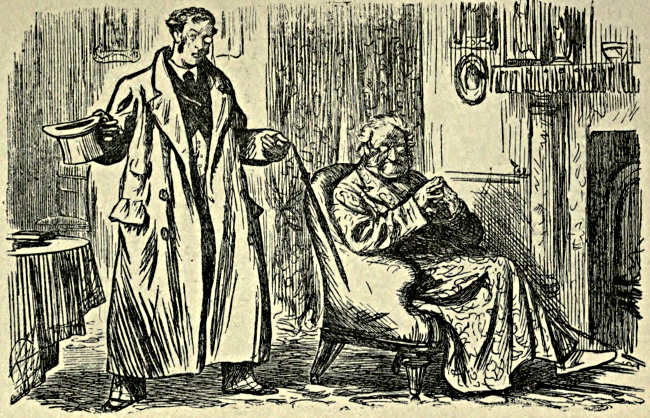
A Testamentary Disposition.—Pater. “Now, my boy, I’ve been making my will, and I’ve
left a very large property in trust for you. I merely wish to ask you if you’ve any suggestion to
offer?”
Son. “Well, I don’t know that I have, sir—unless—hum”—(ponders)—“Quesh’n is—as
things go nowadays, wouldn’t it be better to leave the property to the other f’llar, and—ah—’ppoint
me the trustee?!!”
(Fragment from a Criminal Romance)
The burglar had so far been successful. He
had broken open the safe and transferred its contents
to his pocket without disturbing the household.
He had come down the creaking stairs with
less than the customary noise. He was in sight of
the street door, which, once opened, passed, and
closed, would lead to freedom.
It was a pleasant prospect.
“It will delight my wife and little ones,” he
murmured. “With the proceeds of this night’s
work I shall be able to take them a trip to the
Continent.”
Then he walked forward and opened the street
door. In a moment he was seized by mechanical
hands, and found himself manacled.
“Confound it!” he cried; “I had forgotten that
recently patented novelty—the automatic policeman!”
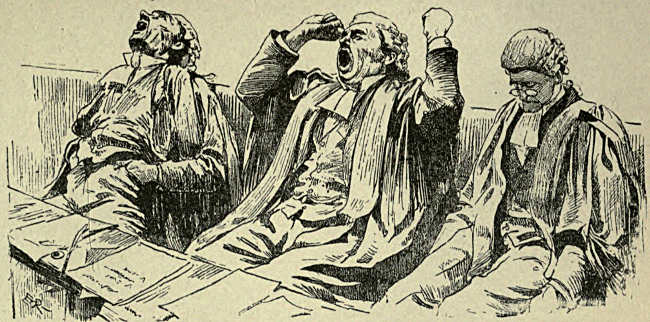
MANNERS OF THE BAR
A sketch in the law courts, showing the patient and respectful attention of the counsel for
the plaintiff during the speech of counsel for defendant.
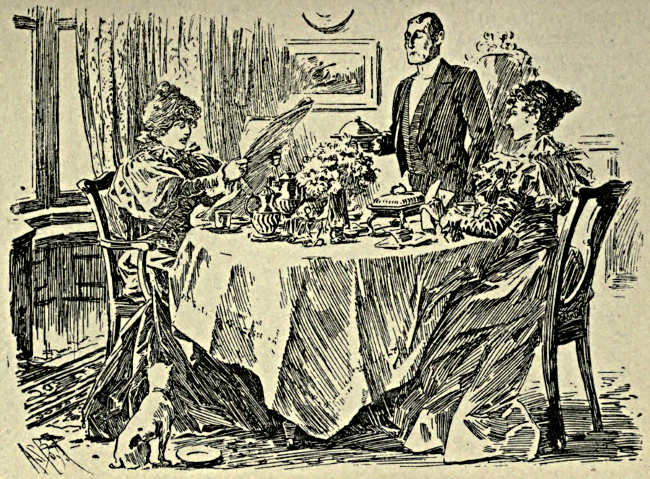
Her “Court” Dress.—Fair Defendant in Cause Célèbre (reading report of yesterday’s
proceedings). “The idiots! There’s no trusting one’s reputation with these newspapers. They
describe my heliotrope poplin as puce alpaca with a muslin frill!”
Dear Mr. Punch,
A writer in the St. James’s Gazette, dealing with
the subject of the Divorce Laws, calmly proposes
that in any revision of the code, which he strongly
advocates, “women should be placed on the same
footing with men.” Such a pestilent heresy of
course provoked correspondence, and, as I have
made a careful study of the subject, I beg to submit
to you, sir, a few reasonable grounds for
divorce, which this reformer will, I hope, include in
his precious revised code.
A man should be allowed to obtain a divorce
from his wife on all or any of the following
grounds:—
1. If he sees anyone he likes better than his
wife.
2. If his mother-in-law comes too often.
3. If his wife’s brother borrows money of him.
4. If she objects to his going to Paris without
her.
5. If, knowing that he prefers the tops of the
muffins at breakfast, she eats any of them.
6. If she hears him come in at four in the
morning, when he has considerately taken off his
boots to do so quietly.
7. If she refers to it.
8. If she ever says, “My dear, I think we’ve
heard that story before.”
9. If she does not laugh consumedly whenever
he tells a comic story.
10. If she objects to smoking.
11. If she is not civil to all his male friends.
12. And female ones.
There, sir, you have a dozen suggestions which
I would commend to the attention of this law-reformer.
You will observe I have not included
any trivial reasons for divorce, and the procedure,
as the St. James’s Gazette says, “should be as
expeditious and inexpensive as possible.”
Yours faithfully,
A Tender Husband.
Turtle-Dove Terrace.
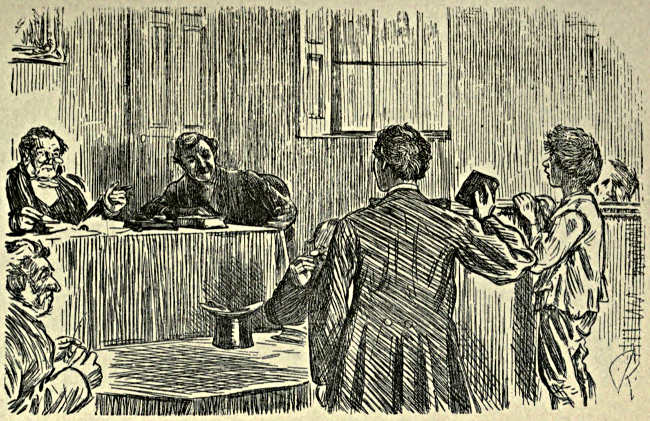
“Live and Learn.”—Magistrate. “Do you know the nature of an oath, my boy?”
Witness (promptly):
“Yess, sir. Must take it, sir—’relse I can’t be ’memb’r o’ Parl’ment, sir!”
If Faraday’s or Liebig’s art
Could crystallise this legal treasure,
Long might a pleader, near his heart,
The jewel wear with chuckling pleasure.
The native brilliant, ere it fell,
A squeeze produced in Walker’s eye,
Which, winking, dropped the liquid “sell,”
The spring of plausibility.
Nice drop of rich and racy light,
In thee the rays of humour shine;
Almost as queer, all but as bright,
As any gem or joke of mine.
Thou fine effusion of the soul!
That never fail’st to gain relief,
Which barristers can ne’er control,
When thou art like to help their brief.
The farce-wright’s and the jester’s theme
In many a joke, on many a stage,
Thou moisten’st Chitty’s arid theme,
And Blackstone’s dry and dreary page.
That very lawyer, who a tear
Can shed, as from the bosom’s source,
With feeling equally sincere,
Could weep on t’other side—of course.
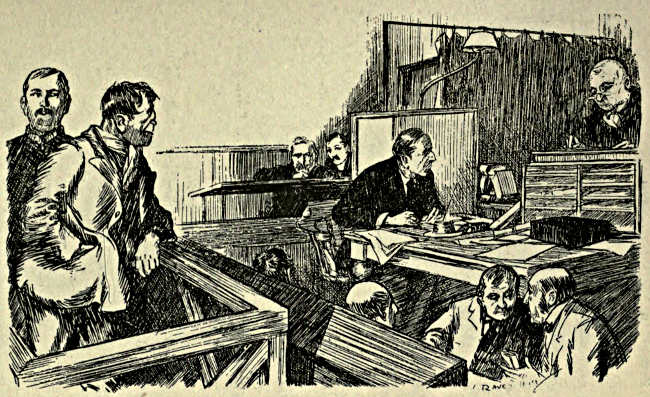
QUITE UNNECESSARY QUESTION
Newly-appointed Magistrate. “Any previous convictions against the prisoner?”
What our Articled Clerk said.—The
chief lawyer of Turkey can never be a weak man,
since every new law there is established by a
firman.
[We have transferred our A. C. to a provincial firm.
“Pendente Lite.”—A chandelier.
The Greatest of the “Great Unpaid.”—The
National Debt.
Advice to Crown Lawyers.—Employ a
hydropathic doctor, if you want to pack a jury.
Heirs-at-Law.—Barristers’ wigs.
Proper Decoration for a “Blocked”
Law Court.—Bar-relief.
Sunday Observances.—See the Monday
charges at the police courts.
“A Bolt from the Blue.”—Running away
from a policeman.
Proof of the Integrity of the Law.—The
return of the Lent Assizes.
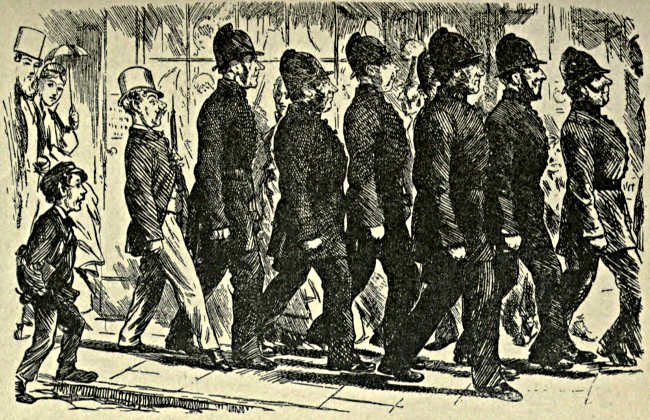
MARTIAL ARDOUR
Little Spadgett never can resist his military instincts under these circumstances.
Lovesuit and Lawsuit.—Promise of marriage
is like precious china—a man has so much to pay
for its breakage.
Police!—What tune would a person whistle
who had been stealing milk? “Robin Adair,” eh?
(Robin’ a dairy!!!)
The Force of Contradiction can no
further go.—To make a will is the wont of
every prudent man.
Definition of the Bar (by an unlucky suitor).—Silk,
stuff, and nonsense.
Litigation—
To the lawyers brings elation,
To the clients consternation,
To the counsel animation,
To the “devil” reputation,
To the usher agitation,
To the jury aggravation,
To the witness indignation,
To the judge consideration,
To reporters expectation,
To the loser lamentation,
To the winner exultation,
To the public information.
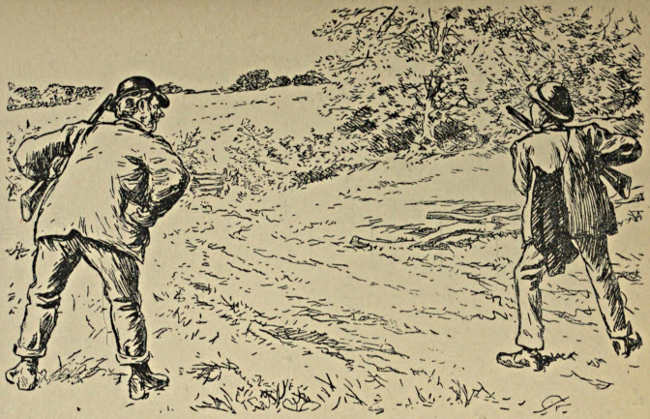
Professional Caution.—Mr. Bluebag (out for a day’s shooting with his articled clerk). “Stop
a minute—don’t fire!—let’s see if that bird’s in the schedule!!”
Legal Intelligence.—A smart young articled
clerk, hearing it stated by a lecturer that “man is
merely a machine,” remarked, “Then I suppose
an attorney may be said to be a suing machine.”
A Case to which a Barrister objects.—A
fee-nominal one.
“A Bar Mess.”—Recent difficulties about
latitude of counsel in cross-examination.
The real Nine Points of the Law.—Costs.
Open to Conviction.—A prisoner at the
bar.
Definition of “Stuff and Nonsense.”—A
junior urging a ridiculous plea.
The Wheel of Misfortune.—The treadmill.
“Contempt of Court.”—Neglecting to attend
a Levée.
A Safe Precaution.—No boating party should
be without a lawyer. In case of accident, he is
the man for ba(i)ling out the water.
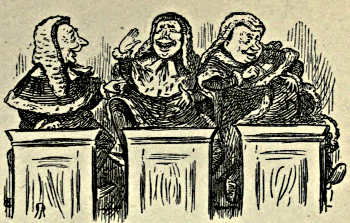
Hilary Term commences January 11.
Playing at Draughts.—The ventilation of
our Law Courts.
The most lasting Stuff for a Silk Gown.—A
Chancery suit.
A Bar’s Rest.—The Long Vacation.
The only Profession where there isn’t
“The ‘Devil’ to Pay.”—The legal.
Faculty of Advocates.—Speech.
A Legal Conveyance.—The police van.
A junior who will wear his gown straight, and
not pretend that intense preoccupation over dummy
briefs prevents him from knowing that it is off one
shoulder.
A judge who can resist the temptation to utter
feeble witticisms, and to fall asleep.
A witness who answers questions, and incidentally
tells the truth.
A jury who do not look extremely silly, and
ridiculously self-conscious, when directly addressed
or appealed to by counsel; or one that really
understands that the judge’s politeness is only
another and subtle form of self-glorification.
A K.C. who is not “eminent,” who does not
behave “nobly,” and who can avoid the formula
“I suggest to you,” in cross-examination; or one
that does not thunder from a lofty and inaccessible
moral altitude so soon as a nervous witness blunders
or contradicts himself.
An usher who does not try to induce the general
public, especially the female portion thereof, to
mistake him for the Lord Chancellor.
A solicitor who does not strive to appear coram
populo on terms of quite unnecessarily familiar
intercourse with his leading counsel.
An articled clerk who does not dress beyond
his thirty shillings a-week, and think that the
whole court is lost in speculation as to the identity
of that distinguished-looking young man.
An associate who does not go into ecstasies of
merriment over every joke or obiter dictum from the
Bench.
Anybody who does not give loud expression to
the opinion, at the nearest bar when the court
rises, that he could have managed the case for
either or both sides infinitely better than the counsel
engaged.
A court-house whose atmosphere is pleasant and
invigorating after the court has sat for fifteen
minutes.
(Anyone concerned who, on reading these
remarks in print, will think that the cap can, by
any scintilla of possibility, fit himself.)
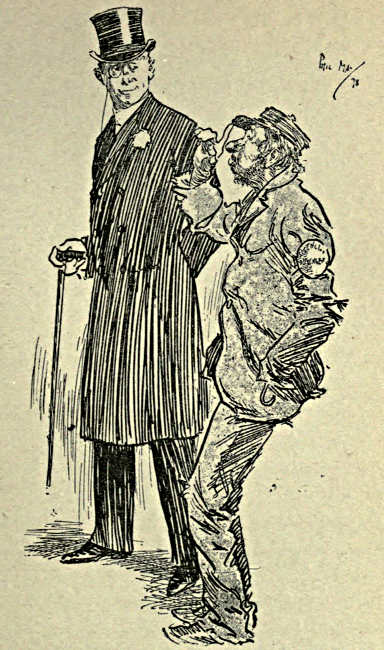
Wretched-looking Messenger. “Beg pardon, Mr. Brown, it’s come
at larst! I’m entirely dependent on myself. My wife’s been and got
a separation order!”
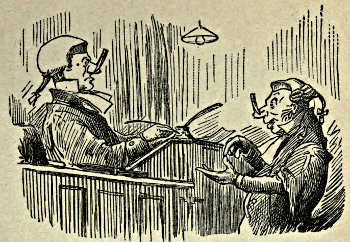
In order to deaden the sense of smell, second-hand clothes-pegs will
be used by the bench and the bar.
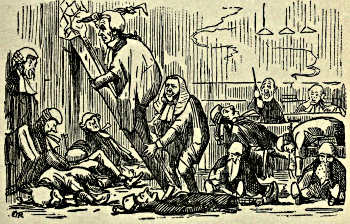
Lords Justices Bowen and Fry prepared to break the windows of the
court, and relieve the asphyxiated bar.
OLD LAW COURT MEMORIES
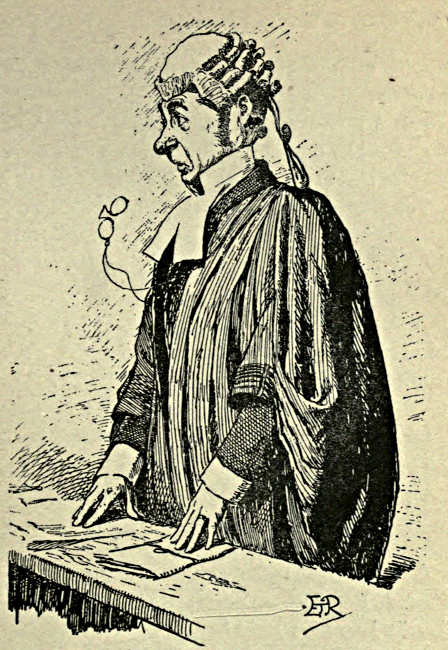
HUMAN NATURE REBELS
Poor Mr. Wiggles has just been described by a facetious
witness of the lower orders as “that there h’old bloke wiv
a choker, an’ a cauliflower on ’is ’ed”!!!
There seems to be at present a very considerable
difference of opinion among the gentlemen
of the Bar as to what may or may not be
done by a barrister. We had some idea of
publishing a small hand-book of etiquette for the
exclusive use of the gentlemen of the long robe;
but as what is etiquette to-day may not be etiquette
to-morrow, we feared the work would not possess
the permanent utility which alone would recompense
us for the labour of writing it. We have,
however, drawn up a few general rules founded on
our own observation as to what a barrister may do,
and what he may not do, consistently with his
professional dignity:—
1st. A barrister may be employed in inducing
Members of Parliament to vote in favour of railway
bills; but he may not report for a newspaper.
2nd. A barrister may practise the “artful dodge”
for the purpose of defeating the ends of justice;
but he must not enter an assize town in an
omnibus.
3rd. A barrister may tout for a small judgeship;
but he will be very properly disbarred if he advertises
his readiness to plead the cause of clients.
4th. A barrister may libel a rival candidate for
an office in a “private and confidential” circular;
but he must not degrade himself by asking an
attorney to dine with him on the circuit.
5th. A barrister may take a fee when he knows
he cannot attend to the cause; but he may not
return the money, for his doing so would be very
unprofessional.
6th, and lastly. A barrister may be a very honourable
man; but many things which professional
etiquette allows him to do, would be thought disgraceful
and dishonest among ordinary people.
A Delicate Distinction.—Cross-examining
Counsel (to fair witness). And is your name
Aurelia Jessamine Jones?
Fair Witness (after a pause). No, sir; but it
ought to have been, only my god-parents were so
ill-chosen.
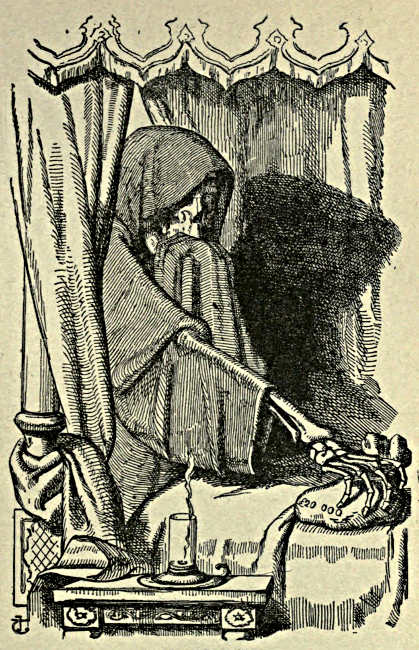
MORTMAIN
Important Suitors in Chancery.—Having
occasion the other day to visit the Chancery Offices,
we discovered an announcement which we are surprised
has not been more generally noticed, and we
take no little credit to ourselves for being the first
to give extended publicity to the important public
directions to the unhappy suitors, who may have
been wandering in the Court so many years. The
information is contained in the following short
announcement—“The Way Out”—which we can
assure our readers we have copied from an official
notice stuck up in that Court.
An Immediate Landlord.—One who will not
wait for his rent.
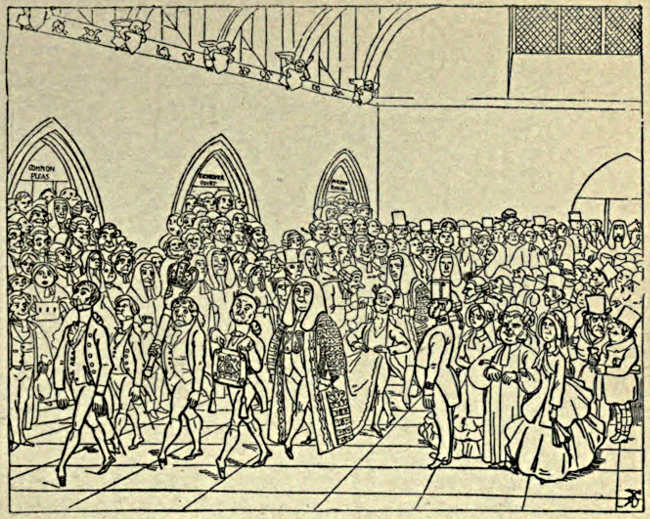
MANNERS AND CUSTOMS OF YE ENGLISH IN 1849
Westminster Hall. Showynge ye ceremonye of openynge
terme.
Legal Nomenclature.—Occasionally we hear
of “running down cases” being tried. The unlearned
in the law naturally inquire if these are
actions for slander.
Prison Thought.—“When’s a Christian,” said
a poacher in gaol to himself, “sarved the same as
a hare?—When he’s jugged like I be.”
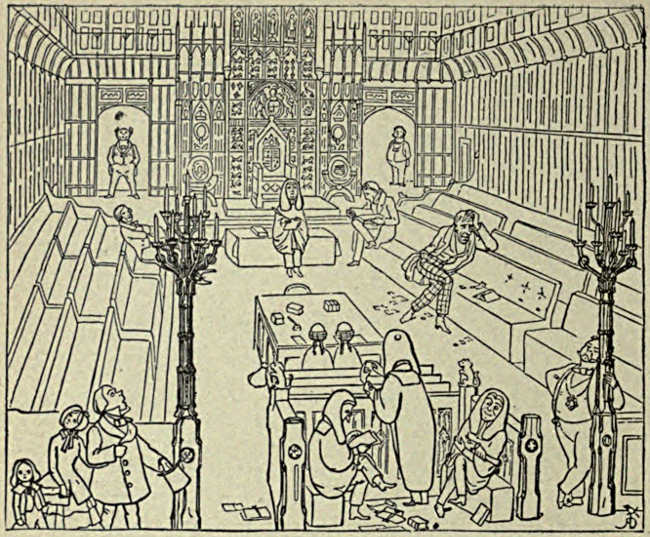
MANNERS AND CUSTOMS OF YE ENGLISH IN 1849
Hyghest court of law in ye kyngdom. Ye Lords hearyng
appeals.
An Under Tenant.—One who occupies a
cellar.
Happy Release.—Paying off a mortgage.
In Two Words.—Our police system and the
housebreaker’s system—Bunglery and burglary.
“Letters of Request.”—Begging epistles.
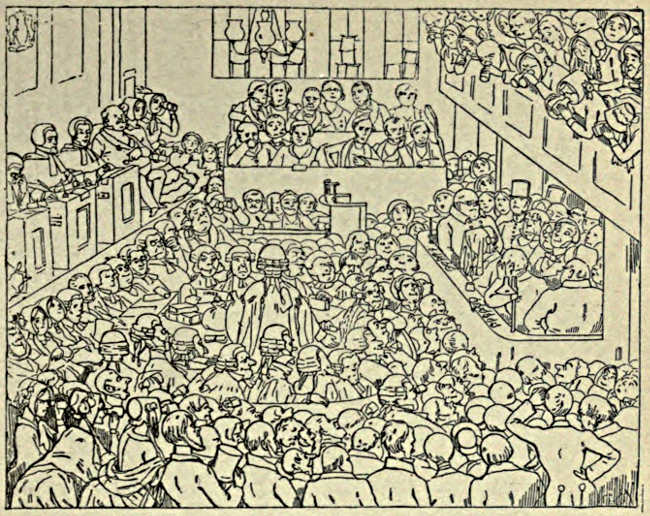
MANNERS AND CUSTOMS OF YE ENGLISH IN 1849
Appearance of ye crymynyal covrte dvryng an
“interestyng” tryal for mvrder.
Outside the County Court.—Jenkins (to
Jorkins, a debtor). What, only five bob a month!
How did you manage it?
Jorkins. Why, always addressed the judge as
“My Lord,” of course.
Pope asks: “Is there no bright reversion in
the sky?” This is, clearly, a question which
only a lawyer can answer.
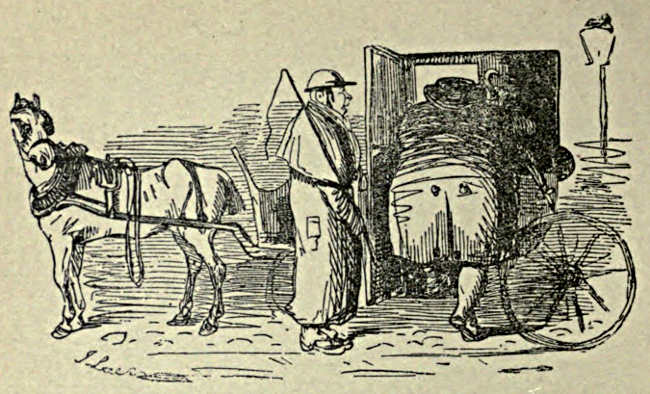
GROSS INJUSTICE
We beg to solicit the attention of our innumerable readers
to the state of the law respecting cruelty to animals.
From Circuit to Circuit, although we may roam,
Be it ever so briefless, there’s none like the Home;
A fee from the skies p’rhaps may follow us there,
Which, seek through the courts, is ne’er met with elsewhere.
Home, Home, sweet sweet Home,
There’s none of the Circuits can equal the Home.
When out on the Home, lodgings tempt you in vain,
The railroad brings you back to your chambers again:
On the Home the expenses for posting are small;
Give me that—’tis the Circuit, the cheapest of all.
Home, Home, sweet sweet Home,
There’s none of the Circuits can equal the Home.
Legal Pugilism.—The Chancery Bar has been
lately occupied with a question relating to a patent
for pins’ heads. The costs are estimated at £5,000.
The lawyers are the best boxers, after all. Only
let them get a head in chancery, even a pin’s, and
see how they make the proprietor bleed.
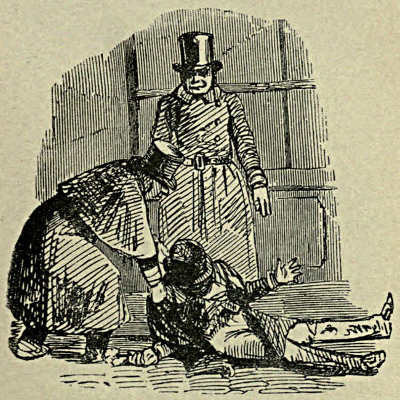
“Let us speak of a man as we find him.”
And did you not hear of a jolly young barrister,
At the Old Bailey who used for to ply?
He made out his case with such skill and dexterity,
Twisting each fact, while he glozed o’er each lie.
He stuck at nothing; and that so steadily,
The felons all sought his aid so readily,
And he saved from conviction so many a thief,
That this barrister ne’er was in want of a brief.
What sights of fine rogues he got off by his blarney;
His tongue was so glib, and so specious withal,
He was always retained by the great City forgers
To Newgate from Mansion House sent, or Guildhall.
And often the Press would be gibing and jeering,
But ’twas all one to him, its carping and sneering;
He’d swear black was white in behalf of a thief,
So this barrister ne’er was in want of a brief.
And yet, only think what strange morals have lawyers,
The bar of such conduct think nothing at all;
Whilst should any poor counsel report for a paper,
“To Coventry with him!” that instant they call;
From their mess they’ll expel him, he’ll find, to his sorrow;
But they’ll dine with the housebreaker’s hireling to-morrow!
Then hurrah!—though his client be swindler or thief,—
For the barrister never in want of a brief.
Song for Detectives.—“Let us speak of a
man when we find him.”
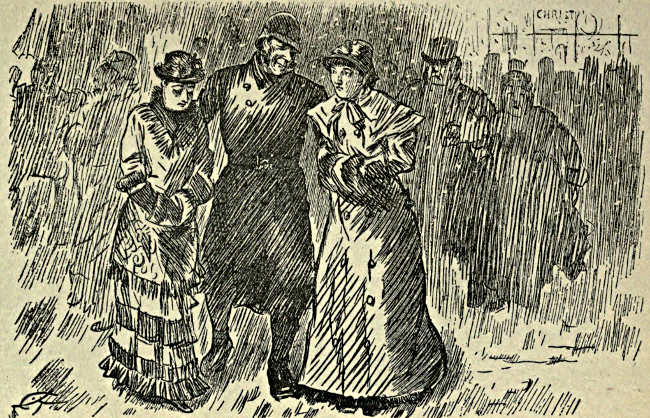
“Linked Sweetness long Drawn out.”—Country Lass (to policeman who takes them over the road at
Oxford Street Circus). “I’m so much obliged to you for taking the trouble——”
Gallant Constable. “Lor’ bless yer, miss, I wish the crossin’ was twice as long!”
I’m a little barrister, taking little fees;
Raising knotty little points, and signing little pleas;
Making little motions in a little court;
Causing by my speeches not a little sport.
I’m a little barrister, in my little wig,
Feeling rather little, when looking very big;
No one knows my modesty—but my little self,
For I feel I’m little more than on a little shelf.
I’m a little barrister, in my little gown,
Getting now, I must avow, not a little brown:
As I’m called a junior you would little guess,
I’m fifty and a little more—rather than little less,
I’m a little barrister, in my little home,
Up to which at Camden Town I from chambers roam;
With my little children climbing up my knee,
As with a mutton chop I make a dinner of my tea.
Though annoyed with little notes demanding little bills,
I do my little utmost to conquer little ills;
But often to my countenance there comes a little smile,
As I think that all our troubles last a very little while.
Legal Query.—Is there any precedent for a
good practical farmer being styled one of the
judges of the land?
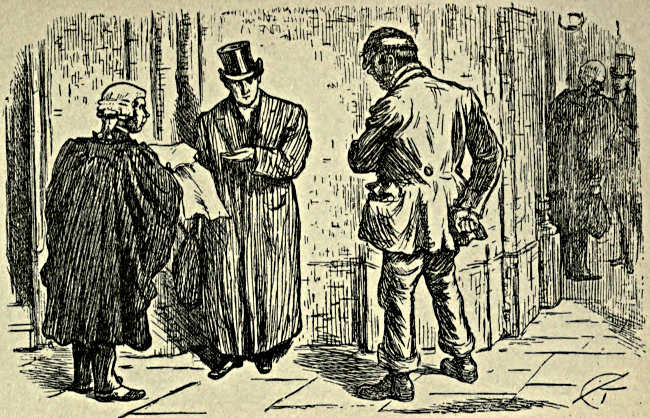
Depreciative.—Defendant (on bail). “’Im my counsellor! Then blowed if I don’t conduct
my own case in pusson!”
Q. What are first fruits?
A. Rhubarb and little green gooseberries.
Q. When is it necessary to commence a fresh
suit?
A. When the other has become too ventilating
or seedy.
Q. What is a release?
A. To exchange the society of your ugly aunt
for that of your pretty cousin.
Q. What is a clerical error?
A. Preaching a three hours’ sermon.
Q. What is a settlement of a conveyance?
A. When an omnibus smashes a cab.
Q. What is the master’s general report?
A. That wages are too high.
Q. Is “What’s that to you,” deemed a sufficient
answer?
A. It may be, or may not; but it is likely to be
excepted to for impertinence.
Q. Describe the meaning of the term Nunc pro
Tunc.
A. It is the general exclamation you make when
you are run against by a clumsy person. It
generally has the word “stupid” added—ex. gr.,
“Now then, stupid!”
Q. Give an instance of a “similiter”?
A. You’re another!
Q. What is the meaning of “putting yourself
upon the country?”
A. Going to the workhouse.
Q. Where is the Great Seal kept?
A. In the Arctic Ocean. A small specimen
may be seen at the Zoological Gardens.
Q. What are “breaches of trust”?
A. Trousers procured on tick.
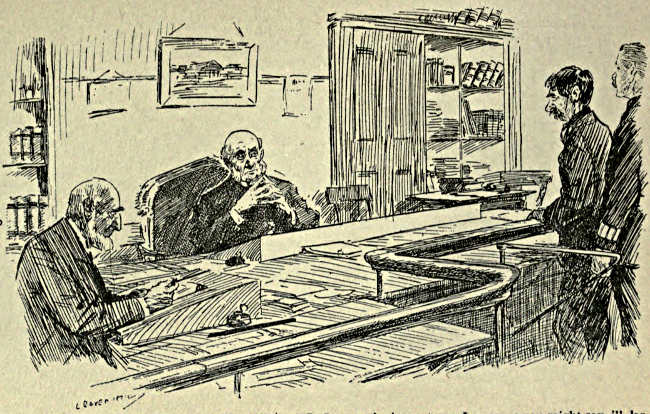
Offender (in the course of lengthy explanation). “So I ses to the inspector as I were, as you might say, ill, ’an
demanded to be examined by Doctor Jones, an’ the inspector ’e ses as ’ow I must see Doctor Smith, the police
doctor. ‘No,’ I ses, ‘you may run me in,’ I ses, ‘but you ain’t goin’ to make me change my medical adviser!’”
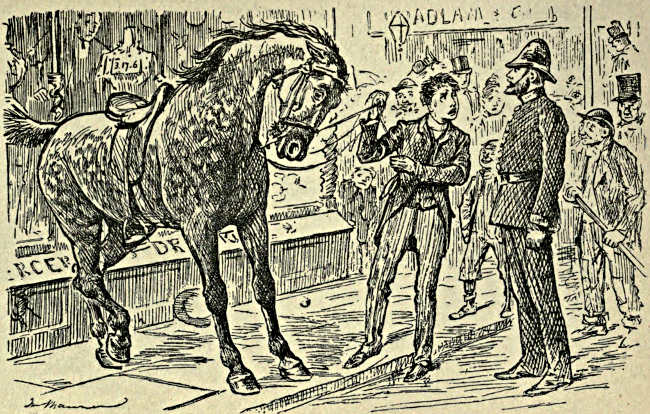
Happy Thought.—Nervous Rider. “Look here, policeman! I give this horse in charge!”
[Puts rein in policeman’s hand, and bolts.
ON THE APPROACH OF SPRING
Whereas, on certain boughs and sprays
Now divers birds are heard to sing,
And sundry flowers their heads upraise;
Hail to the coming on of Spring!
The songs of those said birds arouse
The memory of our youthful hours,
As green as those said sprays and boughs,
As fresh and sweet as those said flowers.
The birds aforesaid—happy pairs—
Love, ’mid the aforesaid boughs, enshrines
In freehold nests: themselves, their heirs,
Administrators and assigns.
Oh, busiest term of Cupid’s Court,
Where tender plaintiffs actions bring—
Season of frolic and of sport,
Hail, as aforesaid, coming Spring!
Life, we are told, is a trial, but the worst of
it is there is no Court of Appeal we can go to
in the event of our not being satisfied with the
result of it. For myself, I should like uncommonly
to move for a new trial.
Briefless Barrister.
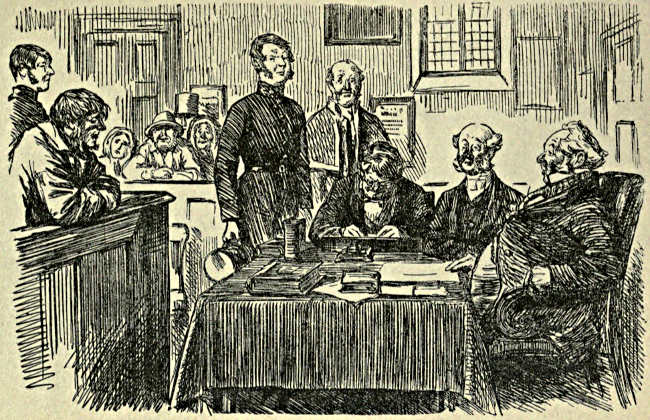
Wit at a Disadvantage.—“Well, Jackson, you are always here for being drunk, so I shall fine
you five shillings.”
“Not got a penny, your worshup.”
“Not a penny, sir!”
“I got only
coppers,—‘hot coppers,’ your worshup.”
[He was most promptly and most properly locked up.
The Rule of the Road.—Query (from a
correspondent).—When a street runs into another
street, what is the remedy at law?
The Answer.—Consult a solicitor.
Conscientious Lawyer’s Advice.—Do right;
don’t write.
A Juryman of a Size.—A Welsh publican
who weighs thirty stone has lately been informed
that his bulk will not invalidate him from sitting
on juries. “Squashing the verdict” is likely to
become a popular feature of the Welsh Assizes.
Motto for the Opponents of Capital
Punishment. No noose is good news!
Called to the “Ba.”—The shepherd’s dog.
The Ends of Justice.—A cat-o’-nine-tails.
More judges required. We don’t want to hear
so much of Chancery Division as of Chancery
multiplication.
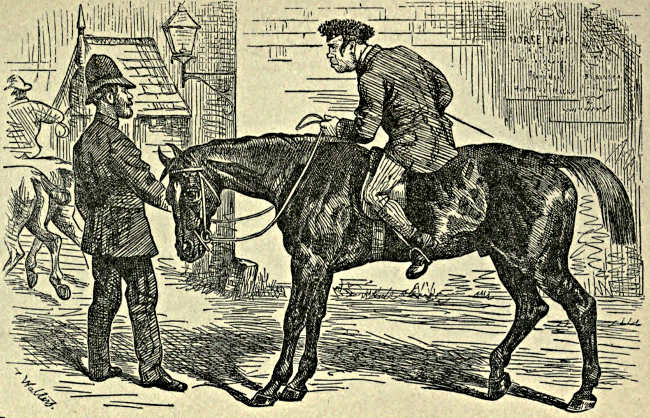
Shows his Breeding.—Equestrian (to policeman on the look-out for a stolen horse). “‘How did
I come by ’im?’ Why, bred ’im myself, to be sure—down at a little place o’ my own.”
I. The Fox who lost his Tail in the Gin.
The Fox stood seized of an estate in trap, and
by a device duly executed he left his hairs a
remainder in tail.
II. The Fox and Crow.
In this case the Crow was evidently seized of a
piece of cheese, with contingent remainder to the
Fox, in case she opened her mouth, which, on her
doing so, instantly descended to the Fox, who
became seized of it.
Prevention of Burglary.—Prospect of a dog
and certainty of “the cat.”
Lock the jury up together,
Lock them up the live-long night,
Even in the closest weather!
Is it rational? is it right?
What pretence can lawyers put up
For a rusty rule, but fudge?
Why, a jury when you shut up,
Not as well shut up the judge?
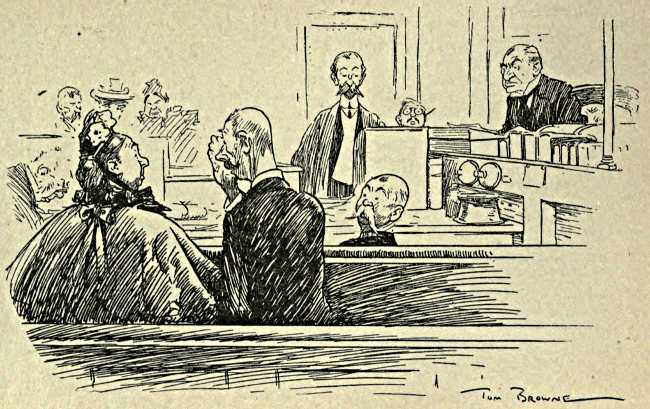
Her First Visit to a Police-court.—Old Lady. “What a villainous-looking man the
prisoner is!”
Friend. “Hush! That’s not the prisoner. That’s the magistrate!”
Burglar’s Ballad. Air—“Those Evening Bells.”
Those silent boots! Those silent boots!
When out upon our gay galoots,
’Twill give us coves the bloomin’ jumps,
If we carn’t hear the copper’s clumps!
’Ave bobby’s bluchers passed away?
That there will bust the burglar’s lay!
Wot, silent “slops”—like evening swells?
It’s wus than them electric bells!
No, no! I ’opes, till I am gone,
The bobby’s boots will still clump on.
Their warnin’ sound our bizness soots,
But bust the thought o’ silent boots!
“The Windy Side of the Law.”—Which
side is this? Go into a solicitor’s office: you’ll
soon be able to answer the question when you get
near a draught.
The only Company not Limited by Act of
Parliament.—Bad company.
Note by our own Irrepressible One.—A
solicitor who is struck off the rolls has generally
been eating someone else’s bread.
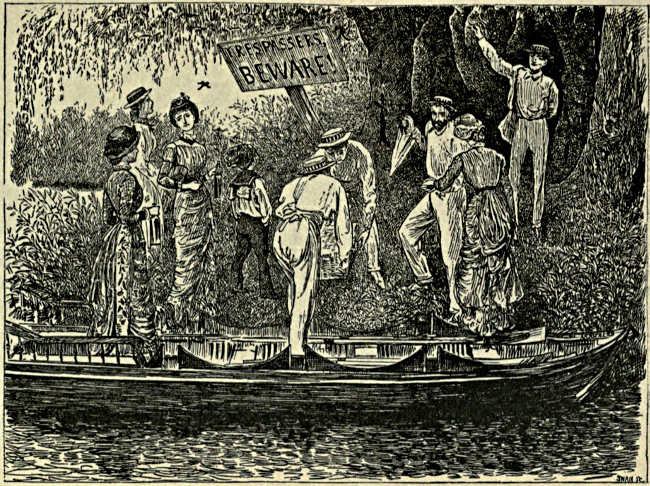
THE TERRORS OF THE LAW
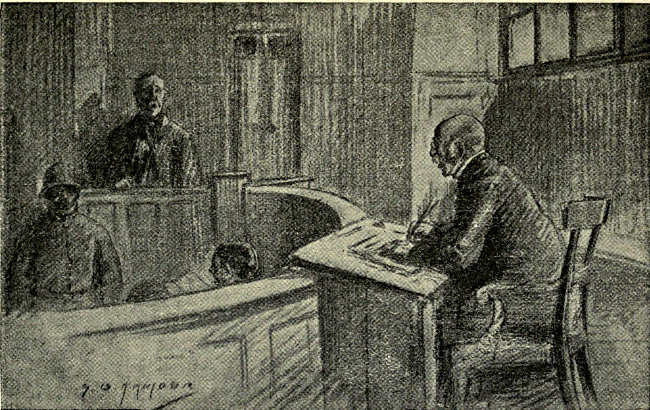
The New Act again. Different Points of View.—Magistrate. “You are charged with having
been drunk when in charge of a child under the age of seven years.”
Prisoner. “Please, your worship,
she was a-takin’ me ’ome.”
Scene—The Central Criminal Court. The usual
company assembled, and the place wearing its
customary aspect. “Standing room only”
everywhere, except in the jury box, which is
empty. Prisoner at the bar.
Judge. This is most annoying! Owing to the
refusal of the jury to serve, the time of the Bar,
the Bench, and I may even add, the prisoner, is
wasted! I really don’t know what to do! Mr.
Twentybob, I think you appear for the accused?
Counsel for the Defence. Yes, my Lord.
Judge (with some hesitation). Well, I do not for
a moment presume to dictate to you, but it certainly
would get us out of a serious difficulty if
your client pleaded guilty. I suppose you have
carefully considered his case, and think it advisable
that he should not withdraw his plea?
Counsel for the Defence. No, my lord, I certainly
cannot advise him to throw up his defence. It is a
serious—a deeply serious—matter for him. I do
not anticipate any difficulty in establishing his
innocence before an intelligent jury.
Judge. But we can’t get a jury—intelligent or
otherwise.
Counsel for the Defence. If no evidence is
offered, my client should be discharged.
Counsel for the Prosecution. I beg pardon, but
I must set my friend right. Evidence is offered in
support of the charge, my lord.
Judge. Yes; but there is no properly constituted
body to receive and decide upon its credibility.
I am glad that the grand jury (to whom
I had the privilege of addressing a few observations
upon our unfortunate position) have ignored a
larger number of bills than usual; still, the present
case is before the court, and I must dispose of it.
Can you assist us in any way, Mr. Perplebagge?
Counsel for the Prosecution (smiling). I am
afraid not, my lord.
Judge. Well, I suppose I have no alternative
but to order the prisoner to be taken back to——
Prisoner. To the place I was in last night?
No thankee!—not me! Look here, gemmen all,
we knows one another, don’t we? Well, just to
oblige you—as Dartmoor ain’t ’arf bad in the
summer, and as in course I did do it—I plead
guilty!
Judge (with a sigh of relief). Prisoner at the
bar; we are infinitely beholden to you!
[Passes regulation sentence with grateful courtesy.
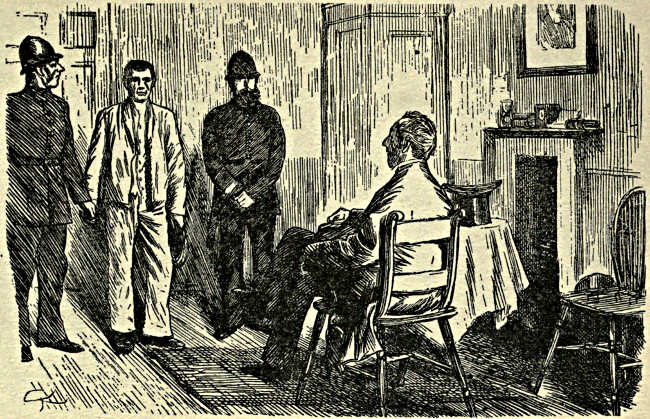
The Ruling Passion.—Prison Chaplain (charged to report on convict’s religious knowledge). “Do you
know the Commandments?”
Prisoner. “Yes, Sir.”
Prison Chaplain. “Say the eighth.”
Prisoner (promptly). “Thou shalt do no manner of work; thou, nor thy son, nor thy daughter.” &c.
Habes Confitentem Reum.—Suitors write
to the papers to complain of the “block in
Chancery.” Who but a block (we must ask) would
be in Chancery?
The Thief’s Motto.—“Take things quietly.”
Spring Assizes.—Trying weather.
Query.—Would an ideal barrister be a counsel
of perfection?
A Proverb Revised.—Too many cooks spoil
the—police.
Saying of Solicitors.—November is at best
a pettifogger.
An Equity Draftsman.—A lawyer who
sketches.
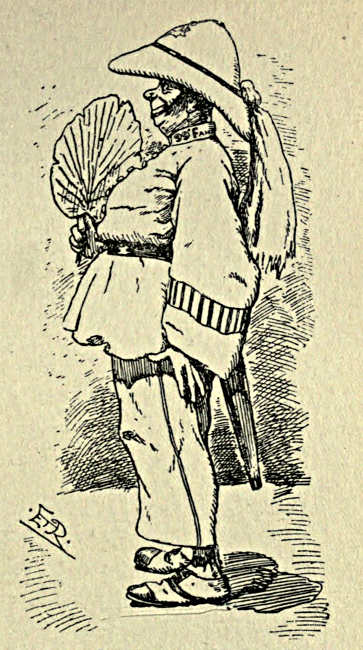
Improved costume for the Metropolitan Police during the
great heat of 1893.
THE LAWYER.
Spinster of the Saxon beauty,
At the Grainthorpe Manor mill,
Of this heart you’ve had possession
Since I made my uncle’s will:
Yours the image all engrossing
When I try to read reports,
You, my Amy, am I drawing,
Even in the Chancery Courts.
Ah! that brow as smooth as—vellum—
Ah! those lips vermilion red—
Kisses wherewith I have sealed them
No one ever witnessèd:
I would sue the man who ventured
To deny you dressed with taste,
I would tax his costs who hinted
An “impeachment” of your waist.
Soon the long vacation’s coming,
Soon the weary term will end;
No more writs and affidavits,
No more actions to defend:
I shall take the first conveyance—
Train at five p.m.—express—
I shall count the sluggish moments—
Forty minutes, more or less.
Meet me, cousin, at the station
With the trap that’s duty free,
It can take my rods and gun-case,
We will walk, prochein Amy,
Past the glebe and old inclosure,
Past the deeply mortgaged inn,
On to where the freeholds finish
And the copyholds begin.
There I’ll make my declaration,
There I’ll pause and plead my suit;
Do not let it be “in error,”
Do not be of malice mute;
But “surrender” to your cousin
In the customary way,
And become the donee, dearest;
Of an opal negligée.
I’ve a messuage—recent purchase—
Sixty-eight in Mortmayne Row,
Title good, and unencumbered,
Gas and water laid below;
Come and share it, undisputed
Owner of this heart in fee,
Come and be my junior partner,
And in time we both may see,
Girls, fair copies of their mother,
Boys, the counterpart of me.
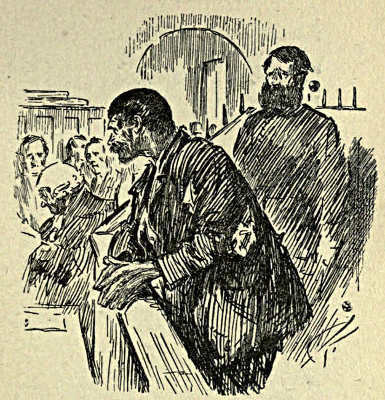
“A CLEAN BREAST OF IT”
The Magistrate. “Oh!—you admit making counterfeit
money then?”
Prisoner (airily). “Well, the fact is, your washup, the
supply o’ the genuine article is so extremely limited, and
things generally are so very tight commercially, that a
poor fellow must do something these times to turn an
honest penny!”
“Brief let it be”—as the barrister said in his
conference with the attorney.
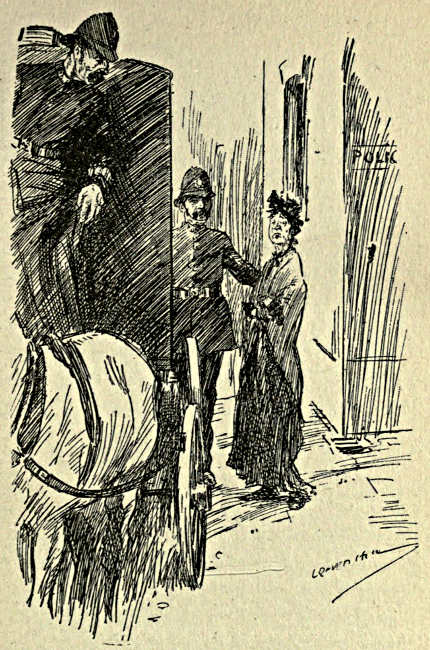
Dignity under Difficulties.—Puffec’ Lidy (retiring from the
public gaze for the 150th time). “Home, John!”
(Suggestions for alteration and adaptation to Modern
Manners and Customs, after the Jackson decision
by the Court of Appeal.)
Common Law.—“The tradition of ages shall
prevail,” save when it runs counter to the opinions
of a leader-writer of a daily-paper.
Equity.—(1.) “No right shall be without a
remedy,” save when it is sentimentally suggested
that somebody’s right may be somebody else’s
wrong.
(2.) “Equity follows the law,” at such a distance
that it never comes up with it.
(3.) “Equity is equality,” save when a man’s
wife is literally his better half.
(4.) “Where there is equal equity the law must
prevail,” in any view it pleases to take at the
instance of the Lord Chancellor for the time being.
(5.) “Where the equities are equal the law
prevails,” in any course it likes to pursue.
(6.) “Equity looks upon that as done which is
agreed to be done,” especially when, after obtaining
legal relief, the suitor ultimately finds himself
sold.
Contracts.—(1.) “All contracts are construed
according to the intentions of the parties,” save
where one of them subsequently changes his mind.
(2.) “The construction should be liberal” enough
to suit the fancy of the Judge who enforces it.
(3.) “It should be favourable” to a long and
angry correspondence in all the principal newspapers.
(4.) “The contract should in general be construed
according to the law of the country where
made,” but certainly not in particular.
(5.) “That testimony cannot be given to vary,
but may to explain a written contract,” save when
someone suggests that this practice shall be
reversed.
(6.) “He who employs an agent does it himself,”
unless it is considered advisable to take an
opposite view of the matter.
Parent and Child.—“A father shall have the
custody of his children,” except when they get
beyond his control and defy his authority.
Landlord and Tenant.—“A landlord has a right
to receive his rent,” if the tenant does not spend
the money on something else.
Husband and Wife.—“A man has a right to the
society of his wife,” when she does not prefer to
give her company elsewhere.
Birthright of an Englishman. (Popular traditionally,
but strictly speaking supplementary.)—“An
Englishman’s house is his castle,” but only the
pied à terre of the lawfully wedded sharer of his
income.
Old Father Antic.
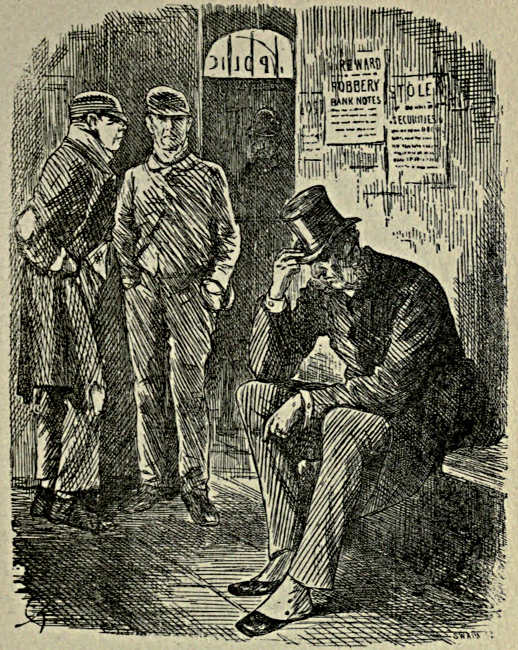
At the Head of the Profession.—Scene: Prisoners’ waiting
room adjoining police-court. (Eminently respectable director awaiting
examination.)
Artful Dodger (to Charley Bates). “You’ve been
copped for a till—and me for a cly. But ’e’s been copped for a bank—shared
somethin’ like six million swag among the lot!”
Charley
Bates (in a tone of respectful admiration). “Lor!”
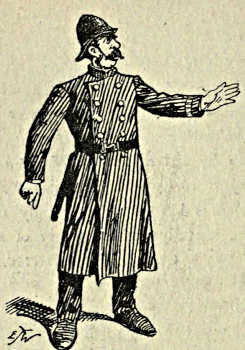
“On there! Pass along!” (Exeunt.)
Antony and Cleopatra, Act III., Sc. 1.
We scoff at
savages who
bow down before
strange
idols, yet we invariably
“worship”
the bench.
“It is very
odd,” said Serjeant
Channell
to Thessiger,
“that Tindal
should have decided
against
me on that
point of law which, to me, seemed as plain as
A B C.” “Yes,” replied Thessiger, “but of what
use is it that it should have been A B C to you,
if the judge was determined to be D E F to it?”
A Thought in the Divorce Court.—There
is a wide difference between the judge ordinary
and an ordinary judge.
Prospectus
(Private and Confidential)
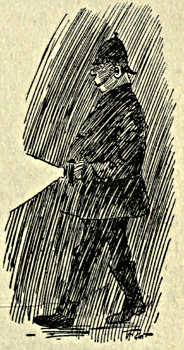
“Doom’d for a certain
term to walk the night.”—Hamlet,
Act I., Sc. 5.
It being considered in accordance with the spirit
of the age, the march of intellect, and the principles
of progress, that those persons
who are unfortunate
enough to come under the
unfavourable notice of tribunals
established in unenlightened
times, should be
enabled to avail themselves
of systematic arrangements
for defeating the coarse and
selfish tyranny of the many,
an association is in course
of formation with the following
objects:—
To defend, in the best
and most costly manner, all
persons who, being assured
in the projected society, shall be afflicted by
prosecutions.
To supply, with the aid of practised writers,
sensation articles to such newspapers as can be
induced to accept them, such articles being framed
in favour of convicted persons, and designed to
produce a popular impression in their favour, by
attacking the witnesses against them, vilifying
hostile counsel, and ridiculing jurymen.
To procure other articles, in a graver tone, in
which every mistake previously made by what is
called justice shall be held up as an awful warning,
and in which intimidation shall be freely directed
against judges, Home Secretaries, and all who are
charged with carrying the laws into effect.
To collect, after verdicts have been given, every
kind of gossip, rumour, or invention that can discredit
the case for the prosecution, and to circulate such
things as largely as possible by means of the
Press.
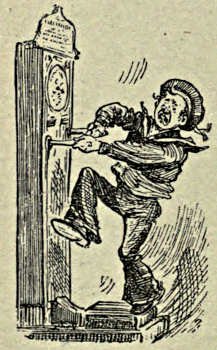
A salt and battery
To get up petitions in favour of the convicted
persons, some of such petitions to be framed so as
to command the approbation of those who object
to the special form of punishment that may have
been awarded, and without reference to the innocence
or guilt of the convicted parties.
It is believed, and experience warrants the belief,
that by the irregular use of these and similar means
a criminal trial will speedily be deprived of its
antiquated solemnity and terror, and that the odds
in favour of the ultimate escape of the assured will
be very heavy indeed.
To the objection of the prejudiced, that such a
system is unconstitutional, and tends to the subversion
of the rules by which society is now protected,
the promoters
would reply, that the
march of intellect, the
spirit of the age, and the
principles of progress,
render such a cavil futile
in the extremest degree.
A more detailed prospectus
will speedily be
issued with assurance
tables prepared for the
information of those who,
with a wise forethought,
look forward to their probably coming into collision
with conventional arrangements, but who,
owing to the uncertainties of life, may not be
aware whether such collision will be occasioned
by murder, manslaughter, burglary, highway
robbery, garrotting, embezzlement, theft, or any
other departure from ordinary rules. The rates
will be carefully calculated, and brought within
the means of all.
Further information may be obtained either of
Jonathan Wild, Esq., Solicitor, Field Lane; or of
Messrs. Alibi, Dodge, & Crammer, Private Inquiry
Office, Spy Corner, Dirtcheap.
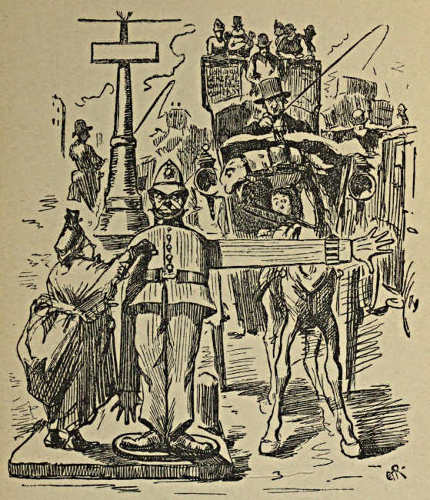
THE AUTOMATIC POLICEMAN
Put a penny in the slot, and he stops the traffic.
CANDID
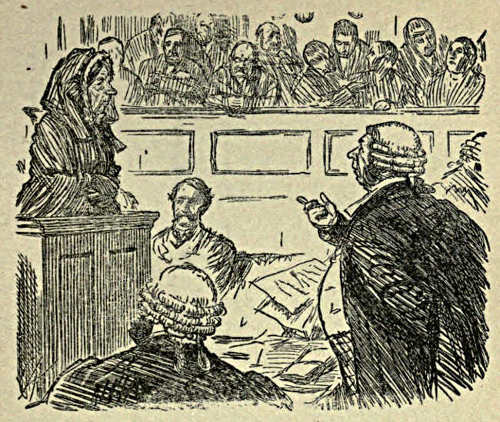
Counsel. “Why are you so very precise in your statement?
Are you afraid of telling an untruth?”
Witness (promptly). “No, sir!”
The Lawyer’s Prayer.—The learned gentleman
prayed a tales.
Truly Sweet.—“When I am in pecuniary
difficulties,” said a pensive bankrupt, “my garden,
my flowers, all fresh and sparkling in the morning,
console my heart.” “Indeed!” asked his sympathising
friend. “I should have thought they would
remind you of your trouble, for, like your bills,
they are all over dew.”
Unfair!—The overcrowded state of our law
courts necessitates in almost every case a well
packed jury.
Written agreements should be drawn up as
shortly as possible; for parties are sure to agree
best between whom there are the fewest words.
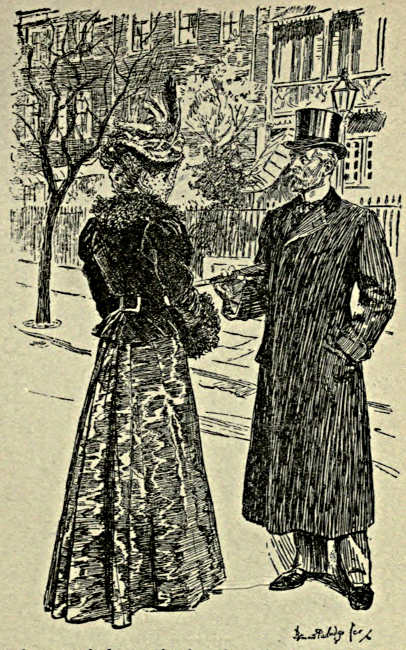
“I hear you had an action brought against you by a man who
broke his collar-bone on your doorstep. How did the case go?”
“Met the same fate as he did.”
“How do you mean?”
“Slipped upon appeal!”
(A long way after “The Throstle”)
Vacation is over, vacation is over,
I know it, I know it, I know it.
Back to the Strand again, home to the Courts again,
Come counsel and clients to go it.
Welcome awaits you, High Court of Justice,
Thousands will flock to you daily.
“You, you, you, you.” Is it then for you,
That we forget the Old Bailey?
Jostling and squeezing and struggling and shoving,
What else were the Courts ever made for?
The Courts ’twixt the Temple and grey Lincoln’s Inn,
They’re not yet entirely paid for!
Now till next year, all of us cry,
We’ll say (for a fee) what we’re bidden.
Vacation is over, is over, hurrah!
And all past sorrow is hidden.
The Female Prerogative Court.—A woman’s
will knows no codicil.
The best place for a Police-office.—Beak
Street.
Criminal.—Why is a prisoner’s time like an
abominable joke? Because it’s past in durance.
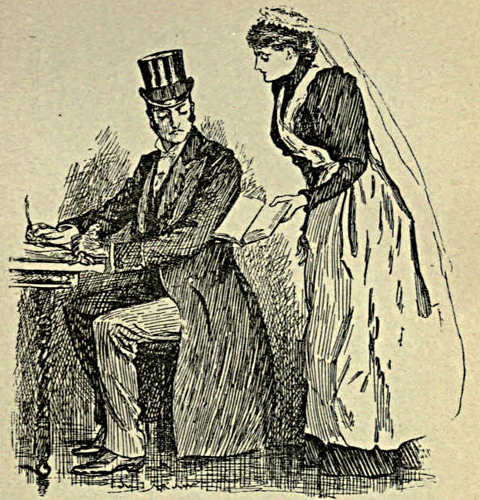
HOW THINGS WILL OUT
(The judge is not at home, and Brown, Q.C., asks permission
to write him a note)
Mary Elizabeth Jane. “Would you like this book, sir?
Master always uses it when he writes letters!”
[Heavens! it’s an English dictionary!
“Mr. Pickwick envied the facility with which Mr. Peter
Magnus’ friends were amused.”—Dickens.
Scene—Any Court. Time—Any Trial.
Q. C. What sort of a night was it?
Witness. It was dark. (Laughter.)
Judge. My learned friend hardly expected the
night to be light, I should think. (Laughter.)
Junior. Perhaps m’lud, the learned counsel
was thinking of a nightlight. (Roars of laughter.)
Q. C. Well, we’ll take it that it was a dark night.
You went out for a stroll?
Witness. No, I went for a walk.
Judge. At any rate the witness was walking
about.
Witness. No, my lord, I wasn’t walking a
“bout.” I was walking fast. (Great Laughter.)
Q. C. You were walking fast. Now did you
see anything?
Witness. I saw the prisoner.
Q. C. Well, tell us what he was doing.
Witness. He was doing nothing. (Laughter.)
Judge. How did he do it? (Renewed Laughter.)
Witness. Very busily, my lord. (Laughter.)
Junior. Like a briefless barrister, m’lud.
(Roars of laughter.)
Q. C. Did he continue to do nothing long?
Witness. No; he soon seemed to get tired of it.
Q. C. What did he do then?
Witness. He went into a public-house.
Q. C. What for?
Judge. What does my learned friend go into a
public-house for? (Great Laughter.)
Q. C. Will you answer my question?
Witness. He went for some rum-shrub.
Q. C. (proud of his acquaintance with slang, and
with a knowing look towards the Junior Bar). It
was a very “rum plant” the prisoner was engaged
on.
[Shrieks of laughter, during which the Court rose,
being too convulsed to transact any further
business.
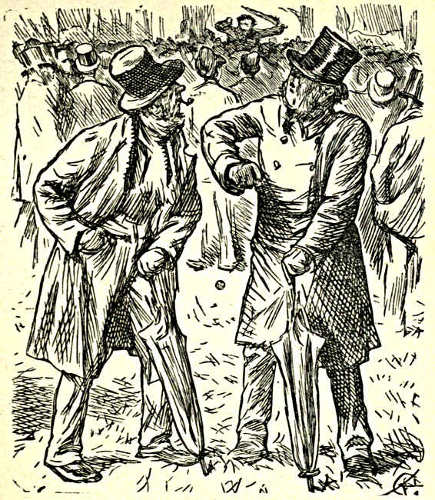
NOTHING LIKE LOGIC
(An echo of the Tichborne case)
Orton Demonstrator. “I don’ care whether he’s Orton
or Tishbo’n or Cashtr’ or who he is, bu’ I don’ like t’ see a
po’r man kep’ out of ’s prop’ty!!”
Second Orton Demonstrator. “Jesh sho!”
[They retire to refresh.
No Costs.—If you want to enjoy the luxury of
law for nothing, all you have to do is to prosecute
an inquiry.
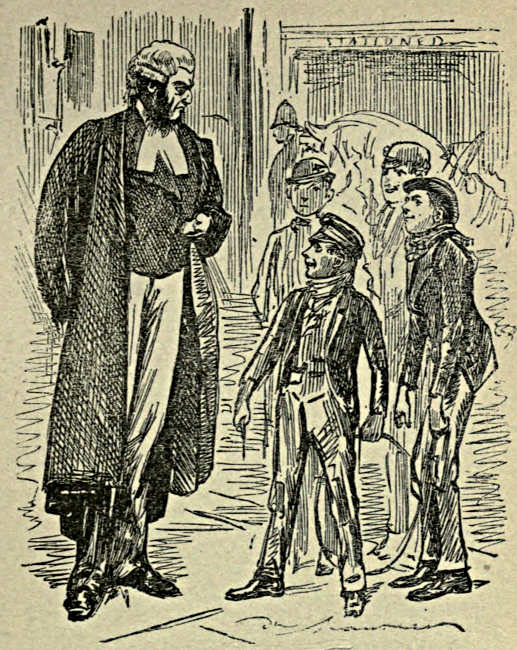
THE LAST SELL
“Oh sir, please sir, is this Chancery Lane!”
“It is.”
“Ah! I knowed it was!”
“Then why did you ask?”
“’Cos I wanted to have counsel’s opinion!”
When you, my first brief, were delivered,
Every fibre in me quivered
With delight. I seemed to see
Myself admitted a K.C.;
Piles of briefs upon the table,
More work to do than I was able;
Clients scrambling for advice,
Then Lord Chancellor in a trice.
I seized my virgin pencil blue,
Marked and perused you through and through
The story brief, instructions short,
Defendant in a county court,
It needed not an ounce of sense
To see that you had no defence.
But, erudite in English law,
I fashioned bricks without the straw.
Around my chamber-floor I sped,
Harangued the book-case on each head;
Demosthenes and Cicero
On hearing me had cried a go.
Then I must own that I was nettled—
Out of court the case was settled.
All my points were left unmade,
And the fee is left unpaid.
When may a lawyer’s clerk be considered most
captivating? When he’s engrossing.
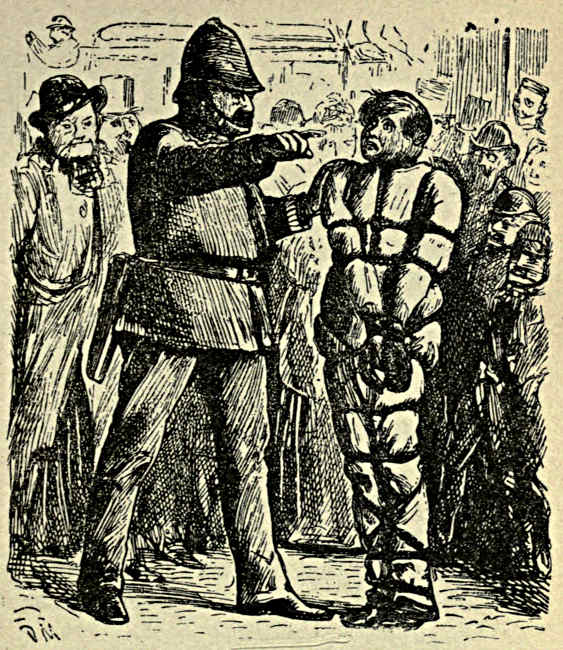
RATHER INCONSIDERATE
Policeman (suddenly, to street performer). “Now, then! just
you move on, will yer?”
(By one of the Briefless)
Member of the Upper Bar (perusing Assize List).
Shall I go round this time? Hum. Let me see.
“Muddeford”—can get a day’s hunting there, I
think. “Wandsbury”—go over to the Chilstons
for Sunday, and have a jolly afternoon with Lily.
“Swanston”—wouldn’t do any harm to go and
look up Uncle George. “Leamouth”—excellent
quarters at hotel there; fair dinner, too. “Deddingham”—good
murder case; shouldn’t like to
miss it. Yes, I think I’ll go round as far as that,
and get back to town in time for the boat-race.”
Reform of the Law.—Chancellors, ex-Chancellors,
and King’s Counsel, are members of a
society for the reform of the law. They meet and
denounce the wickedness of costs, and then hie
away to practice. This reminds us of a passage in
Borrow’s Gipsies of Spain:—“And now, my dears,”
says the head of the family to the younger branches—“now
you have said your prayers, go out and
steal.”
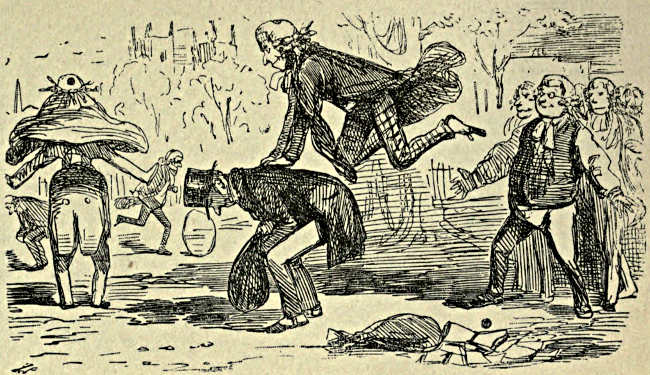
LONG VACATION
“Now then, Latitat, tuck in your six-and-eightpenny!”
(A report of the future)
The report that the Flashaway divorce suit is
postponed is unfounded. It will commence on
Tuesday as advertised. There are still a few
gallery seats to be obtained at five guineas each.
At Bow Street yesterday, John Jones, a costermonger,
was summoned for having obstructed the
crowd waiting outside the pit of the Divorce Court.
Lady Hightone having given evidence in support of
the charge, the defendant explained that he was
merely trying to get his barrow through the crowd
on his way from Covent Garden.
The magistrate said that the pleasure-seeking
public must be protected, and fined him five pounds
and costs.
At the same court, the Earl of Blankley was
charged with having driven a motor car to the
public danger, and further with having run down
a boy with fatal result.
His lordship explained that he was co-respondent
in a divorce suit, and was on his way to the
Law Courts when the accident occurred. The
speed may have been a little excessive.
The magistrate said, that bearing in mind the
public character of the business on which the defendant
was engaged, he would discharge him on
payment of half-a-crown and the funeral expenses.
The fine was at once paid.
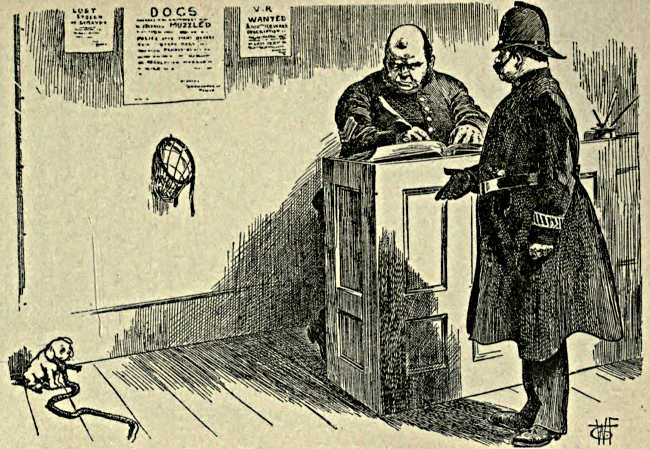
THE MUZZLING REGULATIONS
Another culprit.
At the New Law Courts.—The cry of the
solicitor who has to go to the top story to transact
business is, “Please give us a lift.” The solicitor’s
lift, if introduced, will be called a conveyancer.
A Very Bad Judge.—The man who tries his
friends.
Motto for a Man Reprieved from the
Gallows.—No noose is good news.
Strange Sort of Business.—Lawyers sometimes
take a different view of things from other
persons; so perhaps they may understand how a
stationer can think it is to his advantage to give
this public notice in his window,—“Deeds
abstracted.”
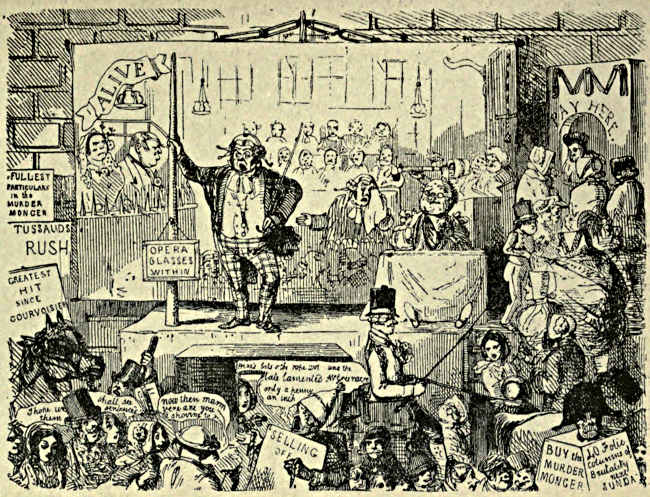
“All in! all in! walk up, ladies!—just a going to begin! None of your shams here,
but real bullet-headed murderers! All in! all in!”
The barristers of England, how hungrily they stand
About the Hall of Westminster, with wig, and gown, and band;
With brief bag full of dummies and fee book full of oughts,
Result of the establishment of the new county courts.
The barristers of England, how listlessly they sit,
Expending on each other a small amount of wit:
Without the opportunity of doing something worse,
By talking nonsense at the cost of some poor client’s purse.
The barristers of England, how when they get a cause,
They (some of them) will disregard all gentlemanly laws;
And bullying the witnesses upon the adverse side.
Will do their very utmost the honest truth to hide.
The barristers of England, how with sang froid sublime,
They undertake to advocate two causes at one time;
And when they find it is a thing impossible to do,
They throw one client overboard, but take the fees of two.
The barristers of England, how rarely they refuse,
The party they appear against with coarseness to abuse;
Feeling a noble consciousness no punishment can reach
The vulgar ribaldry they call the “privilege of speech.”
The barristers of England, how often they degrade
An honourable calling to a pettifogging trade,
And show how very slight the lines of separation are,
Between the cabman’s licence, and “the licence of the bar.”
The barristers of England, how, if they owe a grudge,
They try with insolence to goad a poor assistant-judge;
And after having bullied him, their bold imposture clench,
By talking of their high respect for the judicial bench.
The barristers of England, how sad it is to feel
That rant will pass for energy, and bluster goes for zeal;
But ’tis a consolation that ’mid their ranks there are
Sufficient gentlemen to save the credit of the bar.
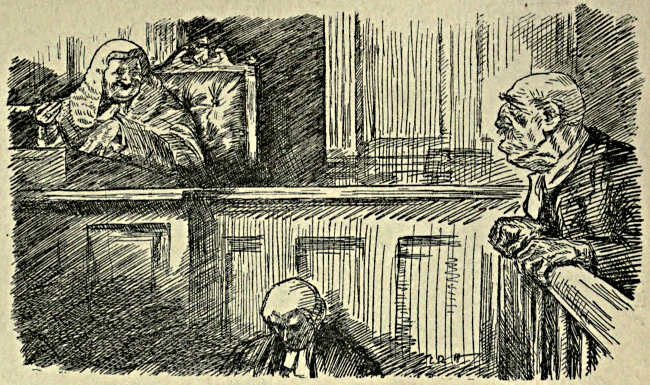
Aged Criminal (who has just got a life sentence). “Oh, me lud, I shall never live to do it!”
Judge (sweetly). “Never mind. Do as much of it as you can!”
LEGAL EXAMINATION QUESTION.
Q. What is a feme sole?
A. A lady’s boot that has lost its fellow.
From Scotland Yard.—Our police force, it
has been observed, is deficient in height. The
reason is plain. Tall policemen are discouraged,
because they might look over things.
A Tight Fit.—A state of coma, which bobbies
are too apt to confound with apoplexy.
A Special Plea.—A young thief who was
charged the other day with picking pockets,
demurred to the indictment, “for, that, whereas he
had never picked pockets, but had always taken
them just as they came.”
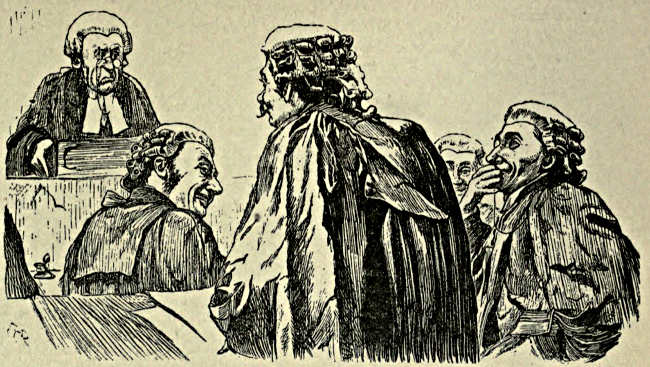
Drawing the Line.—Judge. “Remove those barristers. They’re drawing!”
Chorus of Juniors. “May it please your ludship, we’re only drawing—pleadings.”
[“Mr. Justice Denman said that he saw a thing going on in court that he could not sanction. He saw
gentlemen of the bar making pictures of the witness. Let it be understood that he would turn out any
gentleman of the bar who did so in future.”—Daily Paper.]
Oh! take away my wig and gown,
Their sight is mock’ry now to me:
I pace my chambers up and down,
Reiterating “Where is he?”
Alas! wild echo, with a moan,
Murmurs above my fever’d head:
In the wide world I am alone;
Ha! ha! my only client’s—dead.
In vain the robing room I seek;
The very waiters scarcely bow;
Their looks contemptuously speak,
“He’s lost his only client now.”
E’en the mild usher, who of yore,
Would hasten when his name I said,
To hand in motions, comes no more,
He knows my only client’s dead.
Ne’er shall I, rising up in court,
Open the pleadings of a suit:
Ne’er shall the judges cut me short,
While moving them for a compute.
No more with a consenting brief
Shall I politely bow my head;
Where shall I run to hide my grief?
Alas! my only client’s dead.
Imagination’s magic power
Brings back, as clear as clear can be,
The spot, the day, the very hour,
When first I sign’d my maiden plea.
In the Exchequer’s hindmost row,
I sat, and some one touch’d my head,
He tendered ten-and-six, but oh!
That only client now is dead.
In vain, I try to sing—I’m hoarse:
In vain I try to play the flute,
A phantom seems to flit across,—
It is the ghost of a compute.
I try to read—but all in vain;
My chambers listlessly I tread;
Be still, my heart; throb less, my brain;
Ho! ho! my only client’s dead.
I think I hear a double knock;
I did—alas! it is a dun.
Tailor—avaunt! my sense you shock;
He’s dead! you know I had but one!
What’s this they thrust into my hand?
A bill returned!—ten pounds for bread!
My butcher got a large demand;
I’m mad! my only client’s dead.
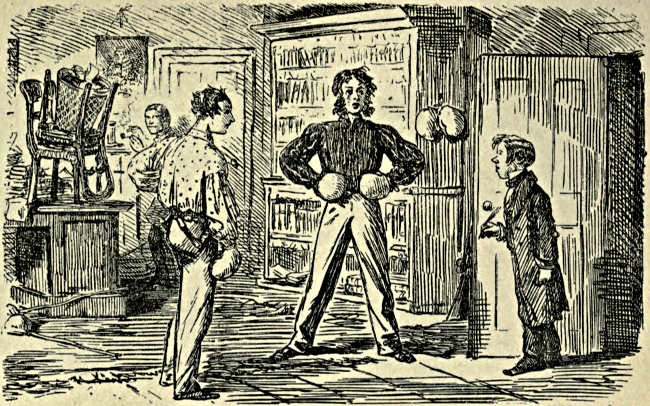
Chamber Practice.—Messenger (from studious party in the floor below). “If you please,
sir, master’s compliments, and he says he’d be much obliged if you’d let him know when the
repairs will be finished, for the knocking do disturb him so!”
Reform your Lawyers’ Bills.—There is one
consolidation of the statutes that would be very
useful—to make them so solid that no lawyer could
drive a coach-and-six through them.
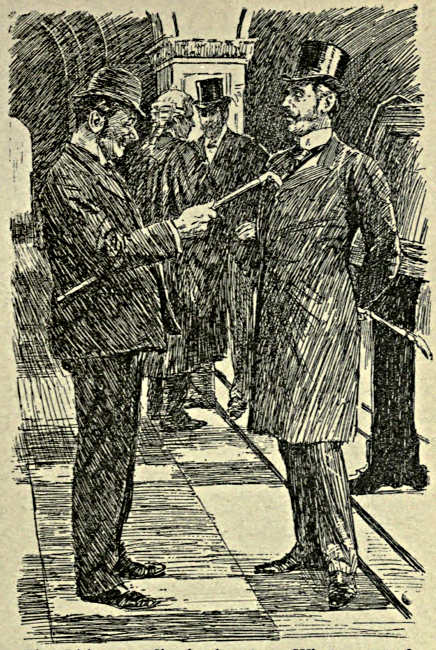
First Litigant. “I’m bankruptcy. What are you?”
Second L. “I’m divorce.”
First L. “Then you stand lunch!”
(Fragment from a romance not entirely imaginary)
Scene.—A corridor in the Royal Courts. Eminent
counsel in conversation with estimable solicitor
and respected client.
Client. I am rather sorry, sir, that you could not
conduct my case in person.
Coun. So am I. I took a deal of trouble in
preparing the argument I proposed to advance,
and it was a great disappointment to me that I
was unable to deliver it in person.
Solic. But your junior, sir, represented you to
perfection.
Coun. I am rejoiced to hear it. I give every
credit to my young and learned friend, and am
pleased to think that when we met in consultation
I was able to choose the right line of policy.
Solic. Besides, if you were not with us, your
retainer prevented you from being against us. And
that was a distinct advantage.
Coun. You are most flattering, and too kind.
Solic. Not at all; and I am sure my client
agrees with me?
Client. Well, of course I would rather have had
the assistance of silk, although your junior no
doubt did his best.
Coun. I am sure he did. And now, gentlemen,
is there anything further I can do for you?
Solic. Thank you very much—I think not.
You got up your case, consulted with your junior
and if you were prevented from putting in an
appearance in the Court itself, were there in spirit.
Besides, I repeat it was a good thing for us that
you did not join the Bar of the other side. Thank
you very much indeed, sir. Good day.
Coun. Good day. (He prepares to walk off,
when, noticing a movement of the solicitor, he
stops.) You are sure I can do nothing more for
you?
Solic. Oh, it’s scarcely worth mentioning.
But perhaps you would not mind returning your
fee.
Coun. With the greatest pleasure! (Hands over
a bag of gold and exit.)
Client. Well, really, that seems to me very
generous! Isn’t it rather unusual?
Solic. Unusual! Oh dear no! Why, it’s the
practice of the whole profession!
Curtain.
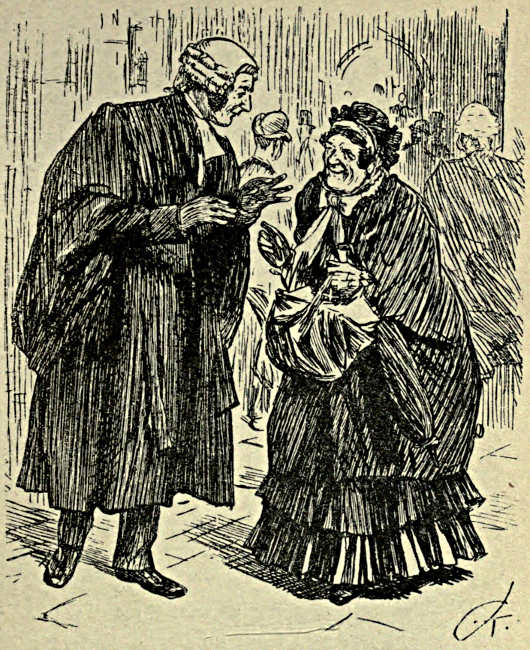
A Rising Junior.—Old Lady (at the Law Courts). “Could
you kindly direct me, sir, to——”
Young Briefless. “My
dear madam, I’m a perfect stranger myself—don’t think
I’ve been in a court for the last twenty years!”
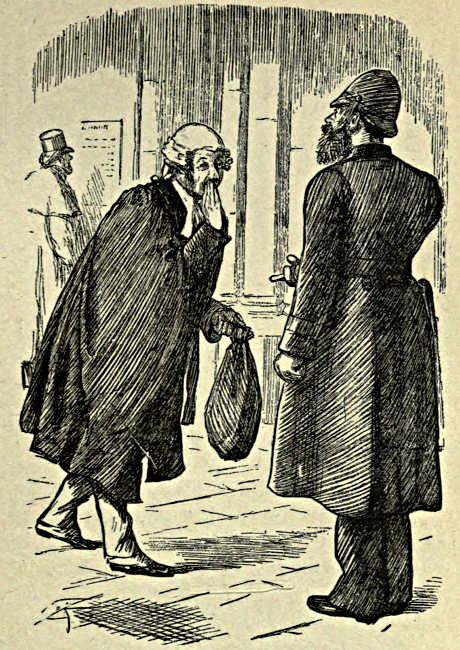
His First!—Constable (suspiciously). “That bag, sir—does
it contain——?”
Little Barrister. “My brief!”
Sir,—A “Barrister” who lately wrote to the
Times, in order to draw public attention to the
existing anomalies in the Law of Divorce, omitted
all mention of one of its most glaring absurdities.
Allow me to state a case in point. Mr. A. runs
away with Mrs. B., very good, I mean, of course
very bad; well, Mrs. A. sues for a divorce from
Mr. A., and obtains an order for alimony pendente
lite. Mr. A. objects to pay this amount for the
support of his wife, whereupon the Judge “orders
an attachment to issue.” Now, sir, if it be, as it
certainly is, in the power of the Judge Ordinary to
order Mr. A.’s attachment to Issue, why should he
not be able judicially to order Mr. A.’s attachment
to Wife? I remain, sir, yours thoughtfully.
A Revising Barrister.
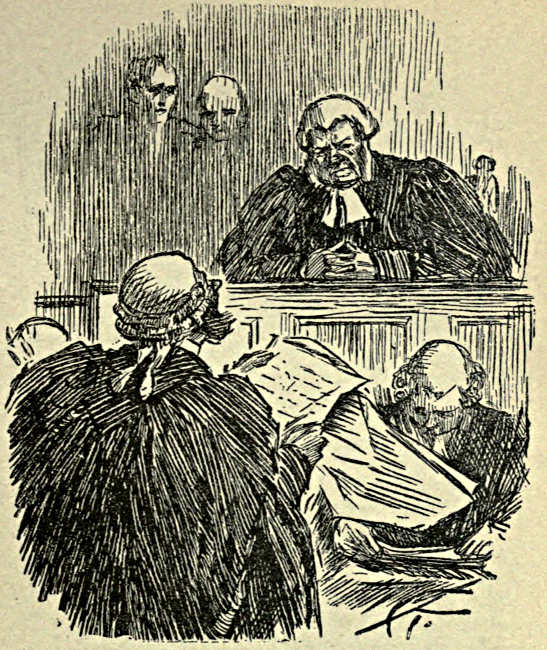
“COUNSEL’S OPINION”
Judge (testily, to persistent junior). “Sir, if you don’t
know how to behave as a gentleman in court, I can’t teach
you!”
Junior (pointedly). “Quite so, my lud, quite so!”
[Proceeds.
Among the cheap furniture projects, is a tempting offer
to supply everything necessary for a barrister’s chambers
for five pounds. We have made a rough calculation in our
minds of the meubles; and the following, we should say, is
about the estimate that the advertisers form of
EVERYTHING NECESSARY FOR A BARRISTER’S CHAMBERS.
| £ | s. | d. |
| A mahogany chair, stuffed with hay, for the learned barrister | 0 | 10 | 0 |
| A japan chair, for the learned barrister’s clerk | 0 | 3 | 0 |
| A table to hold a plate and a mug, for the learned barrister | 0 | 8 | 0 |
| A foot-and-a-half wide by five-feet-six long French bedstead | 0 | 13 | 0 |
| A hay mattress for ditto | 0 | 5 | 0 |
| A superior feather-bed, warranted best damaged quills | 1 | 5 | 0 |
| Two blankets in one | 0 | 7 | 0 |
| A superior brown quilt | 0 | 3 | 0 |
| Six yards of calico, to fold into a pair of sheets | 0 | 5 | 0 |
| A yard of matting for the learned barrister’s sitting-room | 0 | 4 | 0 |
| A pint tea-kettle | 0 | 0 | 6 |
| A wig-box, the wig to be hired when wanted | 0 | 4 | 0 |
| Two yards of black stuff, to hang up to look like a gown | 0 | 3 | 0 |
| A pair of endorsed dummies, as briefs | 0 | 1 | 6 |
| A blue bag and white stock | 0 | 2 | 0 |
| A fender and one fire-iron | 0 | 4 | 0 |
| A coal-scoop | 0 | 1 | 0 |
| A set of backs of old books, labelled “Reports” | 0 | 1 | 0 |
| Sundries | 0 | 0 | 6 |
| —— | —— | —— |
| £5 | 0 | 0 |
Motto for the Long Firm.—“Order is
heaven’s first law.”
(IN TWO TONGUES)
The French Method, reported in a Paris Paper.
Close of the Thirteenth Day.
The prisoner was admitted. He was self-possessed,
grand, mysterious. He glanced round
him with a air of disdain, and jeeringly bowed to
the president, who regarded him with hatred.
Then the president put questions to him.
The President. You are a thief, a scoundrel, an
assassin! You know you committed the crime of
which you are accused. You are a villain!
The Prisoner. And you—polite.
[General assent.
The President (with indignation). I will not
have you say so! I tell you that I know you
entered the room with the pistol. I know that
you fired at the deceased. You know you did!
Tell me, did you not kill the deceased?
The Prisoner. Why should I tell you? Is not
your head of wood, M’sieur le Président.
[General laughter.
The President (with anger). You shall pay
dearly for this! You have insulted me—you have
insulted the son of my mother—and insulting her
son, you have also insulted my mother!
[A deep murmur.
The Prisoner (shuddering). Oh, no! I deny
it! I am not so base!
The President. But I tell you you are! I tell
you that there is no more wicked man in the world
than yourself! You are a poltroon!
[Murmurs.
The Prisoner. And you call the father of my
innocent child a poltroon? It is an outrage!
[General assent.
The President. Your appeal to your innocent
babe will avail you nothing. Your innocent babe
would be better without such a father! (General
Shuddering.) Yes, I mean what I say—you are a
craven!
The Prisoner. This is too much! I am no
craven! I love my country as a mother loves her
son.
[General assent.
M. le Président. You insult France when you
call yourself her son! You insult the Republic.
[Loud murmurs.
The Prisoner. It is not for you to judge! I
know you, M’sieur le Président. Forty years ago
you were in the service of the King!
M. le Président (with a cry). You shall be
gagged if you utter such calumnies! You are a
knave, a vagabond, a cut-throat! And now it is
for the jury to decide. Have you anything to say
in your defence?
The Prisoner (to the Jury). I have nothing to
say, save that I brand this man as a traitor! As
for me I ask for liberty in the name of my infant—in
the name of my child! I confess I am no
saint, and if I have murdered, why in the name of
my innocent babe I beg of you to stretch out your
hands to me and save me from the scaffold. I
wish to return to the world to watch by the side of
a cradle!
The jury, who were deeply affected, then retired,
and, after two hours’ absence, returned a verdict of
Guilty.
The English Method, reported in a London Paper.
End of the First Day.
The prisoner, who was ably represented by
counsel, appeared to be deeply sensible of his
position. He kept his eyes on the jury during the
brief summing up.
His Lordship said that he trusted the jury would
give the benefit of any doubt they might feel in
the prisoner’s favour. In so serious a case they
must not convict unless they were convinced of
his guilt. The facts had been carefully laid before
them, and he would not say a word to bias them
one way or the other. He entreated them to
remember that the life of a fellow creature was at
stake, and to let that recollection make them
desirous to record only what was proper and just.
The jury then retired, and, after five minutes’
absence, returned a verdict of Guilty.
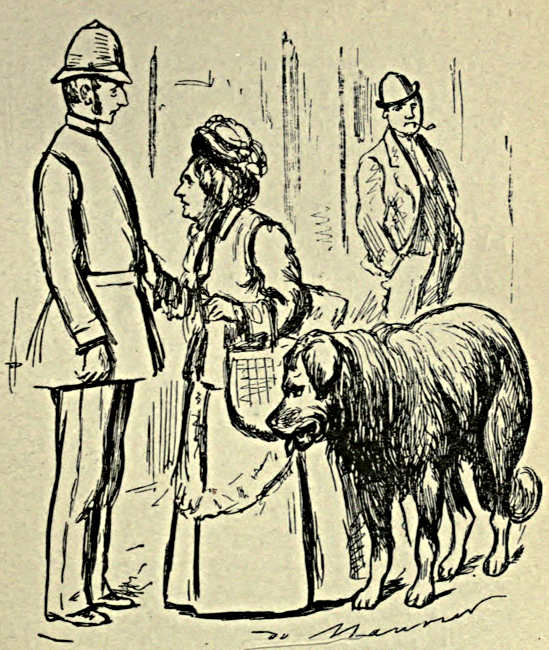
THE LETTER OF THE LAW
Nervous Old Lady. “O, policeman! policeman! there’s a strange
dog that will stick to me, and won’t leave me, and I can’t get rid of
him! Couldn’t you take him in charge or something?”
Policeman (who doesn’t like the job). “Very sorry, ma’am,—but
we can’t interfere with any dog so long as he’s a follerin’ o’
somebody!”
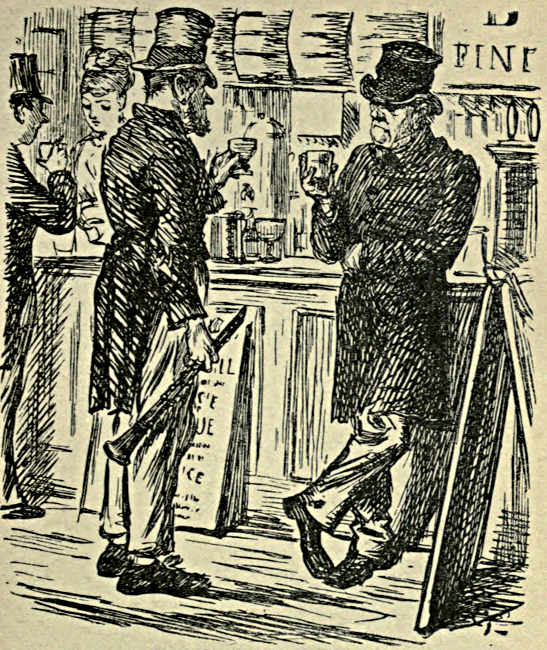
“VICISSITUDES OF FAMILIES”
Ragged Party. “Ah! I should never a’ been redooced like this
’ere if it hadn’t been for the lawyers!”
Raggeder Ditto. “And look at me! All through my title-deeds
bein’ made into banjos an’ such like! Why, I spent a small fortun’
advertisin’ for one tambourine as was supposed to a’ been made out
o’ my grandmother’s marriage-settlement!!!”
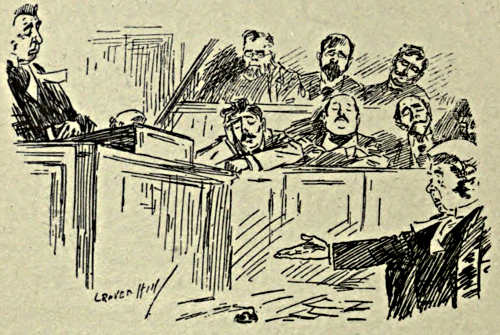
Dreary Counsel (in the course of an hour’s oration).
“Gentlemen, you cannot close your eyes—my lord cannot
close his—to this important fact!”
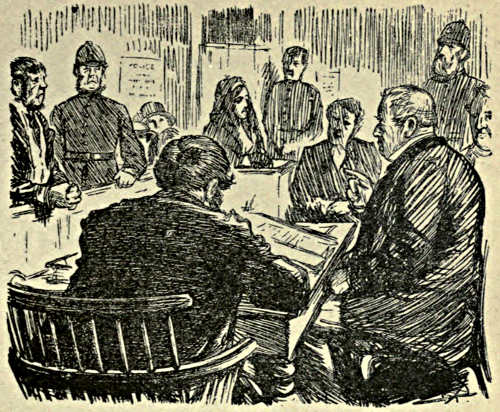
A NARROW ESCAPE
Country Magistrate. “Prisoner, you’re discharged this
time with a caution; but if we see you here again, you’ll
get twice as much!!”
New Legal Definition.—A Copyholder.—A
compositor.
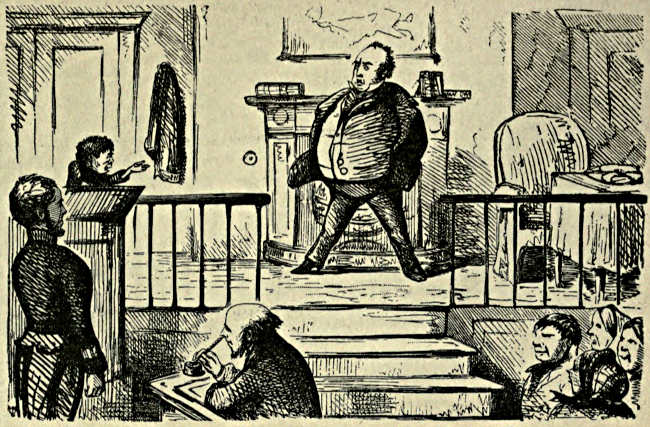
Limited Liability.—Worthy Magistrate. “Prisoner, you hear what the policeman says, that you,
and some ten or twelve other boys not yet in custody, were seen in the act of demolishing a street lamp;
now what have you to say for yourself?”
Prisoner. “So please yer worshop, as there was more
nor ten of us engaged in the transagtion, why I pleads limited liability.”
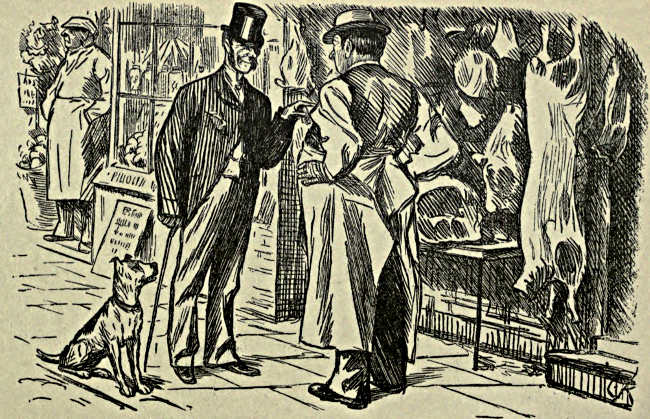
“TURNING HIS FLANK”
(See opposite page.)
Legal Distinction.—Q. What is the difference
between attorney and counsel?
A. One is a lawyer, and the other a jawyer.
Mr. Brisket (the butcher). “Good morning, Mr.
Chattles! You’re a lawyer, and I want your advice.
What can I do with a man whose dog steals some meat
from my shop?”
Mr. Chattles (the lawyer). “Demand the value, or
summon the owner.”
Mr. Brisket (triumphantly). “Then I want six-and-sixpence
from you, sir, or else I’ll summons yer! Your
dog there ran away with a piece of mutton o’ that valley
from these premises last night!”
Mr. Chattles. “Hum—ah—h’m! Then if you’ll hand
me over twopence, we shall just be square, Mr. Brisket—as
my fee for consultation is six-and-eightpence!!”
(Respectfully dedicated to the Incorporated Law
Society and the Bar Committee)
Scene—Interior of the Duke of Ditchwater’s
Study. Time—The near Future. Present—His
Grace and Mr. Kosts, the Family
Solicitor.
The Duke (finishing a long business talk). And
I suppose we had better be represented by Mr.
Silvertongue, the Queen’s Counsel?
Mr. Kosts (hesitating). Certainly, your Grace,
if it is your express wish.
The Duke (surprised). Why, Mr. Kosts, you
surely know of no better representative?
Mr. Kosts (hurriedly). Oh no, your Grace.
Mr. Silvertongue is a most eloquent advocate, and
has the law at his fingers’ ends; but——
The Duke. Well? Surely we may entrust
ourselves in his hands with perfect confidence?
Do you not think so?
Mr. Kosts. Oh, certainly, your Grace, certainly.
(Hesitating.) But matters have changed a little
lately. There has been an alteration in the law.
The Duke. Indeed!
Mr. Kosts. Yes, your Grace. The fact is,
that the two branches of the legal profession have
been amalgamated.
The Duke. I don’t quite understand.
Mr. Kosts. Why, your Grace, there is now no
real distinction between solicitors and barristers,
except in name. So I thought, your Grace, that
as I could do the work as well, that perhaps I
might replace Mr. Silvertongue, and—— You see,
it is simply a matter of business.
The Duke (interrupting). Certainly, certainly,
Mr. Kosts. No doubt you could represent me
admirably. But you see I am afraid Mr. Silvertongue
might be a little offended. You know he
is a personal friend of mine, and——
Mr. Kosts (promptly, with a bow). I trust your
Grace will not give the matter another thought—Mr.
Silvertongue shall be instructed. (Preparing
to go.) Of course, your Grace’s young relative, the
Honourable Charles Needy, will act as junior?
The Duke. Certainly, Mr. Kosts. Give Charley
as much of my work as possible. My wife’s
cousin, I am afraid, is not overburdened with
briefs.
Mr. Kosts. I am afraid not, your Grace. And
yet Mr. Needy is a sharp and clever young
gentleman. Good day, your Grace!
The Duke (after a moment’s thought, suddenly).
One moment, Mr. Kosts. Did I understand you
to say that the two branches of the legal profession
were amalgamated?
Mr. Kosts. To all intents and purposes, your
Grace. You see we can now do all the work of
the Bar.
The Duke. And I suppose barristers can act as
solicitors—I mean, undertake the same kind of
business?
Mr. Kosts (laughing). There is nothing to
prevent them, your Grace, save their incapacity.
The Duke (with dignity). No relative of the
Duchess, Mr. Kosts, can be incapable!
Mr. Kosts (puzzled). I beg your Grace’s pardon.
I do not quite understand——
The Duke. Then I will explain. You tell me
that barristers can now act as solicitors. Well,
you know the old adage, that “blood is thicker
than water.” It is, Mr. Kosts; it is. You will
pardon me, I am sure, if I suggest that the connection
of your firm with my family has not been
unlucrative.
Mr. Kosts. On the contrary, your Grace! I
may fairly say that the connection is worth many
hundreds a-year to us. We cannot be sufficiently
grateful.
The Duke. Pray desist, Mr. Kosts. The matter
is one of pure business. It really is not at all a
question of gratitude. Well, as I understand you
to say that Mr. Needy is quite qualified to undertake
solicitor’s work——
Mr. Kosts (blankly). Theoretically, your Grace;
theoretically.
The Duke (haughtily). Any relative of the
Duchess can reduce theory to practice.
Mr. Kosts (bowing). No doubt, your Grace; no
doubt.
The Duke. Well, as I now find that Charley
can do the work I have hitherto given to you,
Mr. Kosts, I feel that some alteration must be
made. Charley is poor, and my relative. So I
am sure you will not be offended when for the
future I give him the whole of the legal work I
used to give to you. You see, after all (as you
explained to me just now) it is purely a matter of
business!
[Scene closes in upon Mr. Kosts’ discomfiture.
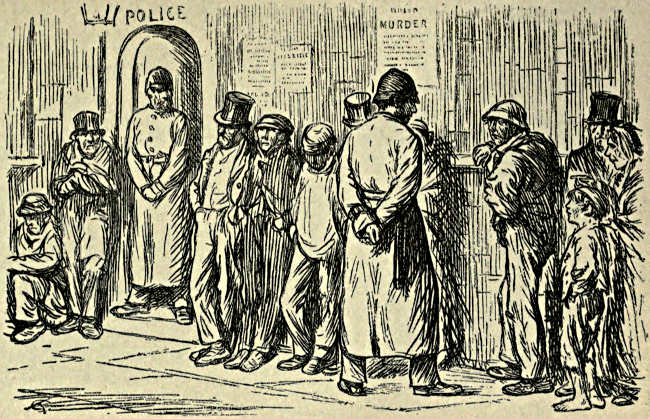
Police Tyranny.—Policeman (to obtrusive tramp). “Now then, what d’ye mean by shoving yourself
in before these poor people out o’ your turn? You stand back or—(thinking deeply)—you shall have such
a wash!!”
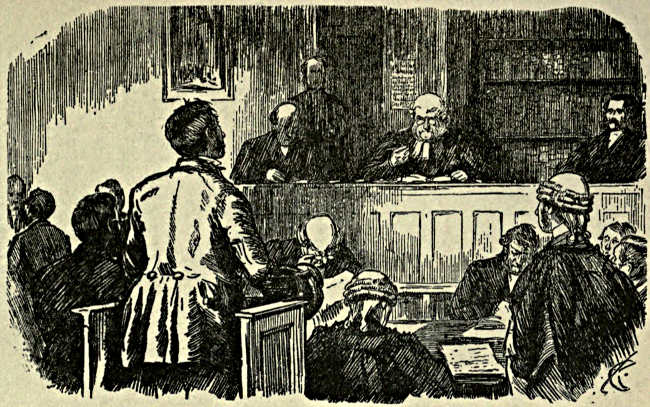
Impracticable.—Judge (to witness). “Repeat the prisoner’s statement to you, exactly in his own
words. Now, what did he say?”
Witness. “My lord, he said he stole the pig——”
Judge. “Impossible! He couldn’t have used the third person.”
Witness. “My lord, there was no third person!”
Judge. “Nonsense! I suppose you mean that he said, ‘I stole the pig’!”
Witness (shocked). “Oh, my lord! he never mentioned your lordship’s name!”
[Dismissed ignominiously.
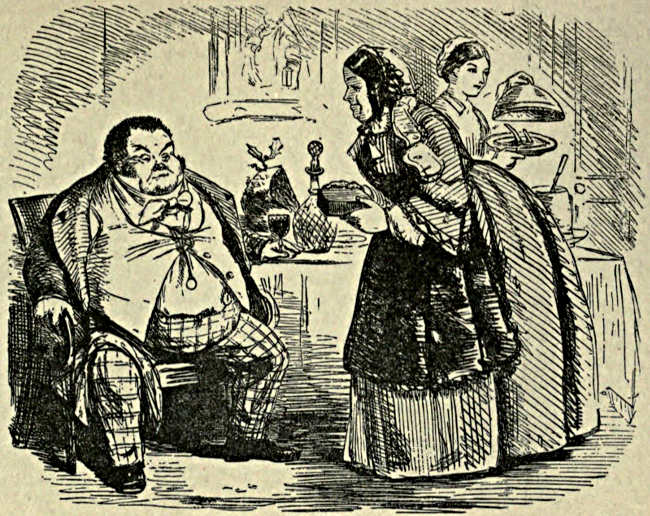
The British Juryman Preparing for the Worst.—Wife of his
Bussum. “There, my love, I think with what you have had, and this box
of concentrated luncheon, you may hold out against any of ’em!”
New Legal Work. (By the author of “In
Silk Attire.”)—“The briefless junior; or, plenty of
stuff to spare.”
Musical Law.—“Bar’s rest.” Long vacation.
A Laborious Occupation.—Shop-lifting.
A Lawsuit now pending in Tennessee between
two families has run for such a length of time, that
it takes six men of the strongest memories in the
State to remember when it was begun.
(By A. Briefless, Junior)
“Here is something for you, sir,” said a sharp-looking
youth, suddenly thrusting into my hand a
document.
I quietly put the paper into my pocket without
comment (I had no wish to bandy words with the
process-server), and reflected that some half-forgotten
tailor, or too-long-neglected hatter, was a
person of no real delicacy of feeling.
“And will you see to the matter at once?” continued
the sharp-looking youth, “as they can’t
wait.”
“Certainly,” I replied, with a dignity which I
intended should suggest that I had a perfectly
fabulous account at Coutts’s. My account at the
celebrated banking firm referred to is perfectly
fabulous.
“All right, sir. I suppose we shall see you in
the morning.”
The youth disappeared, and I journeyed home.
As I walked along the Thames Embankment I
pondered over the alterations made in our law by
the Judicature Acts.
“When I was a younger man,” I murmured to
myself, “a copy of a writ, when considered entirely
without prejudice, was rather a handsome instrument
than otherwise. The direct message from
the Sovereign, for instance, used to be very far
from ungratifying, although perhaps it would have
been better had the greeting been joined to a
matter a little less embarrassing, say, than an
unsatisfied claim for the value of certain shirts.
But nowadays the neat crisp document of the olden
time seems to be abandoned for a far more bulky
paper—for the packet I have in my pocket!”
However, I threw off my cares, and thought no
more of the affair until the next morning, when,
putting on my overcoat, I discovered, to my
intense astonishment, to my overwhelming joy,
that what I had believed to be a writ was actually
a brief. I had to sit down on the hall-chair for
five minutes to compose myself. My emotion was
perfectly painful—it was my first, my maiden
brief! The news spread like wildfire through
the household, and the distant strains of “Rule,
Britannia!” were heard coming from the nursery.
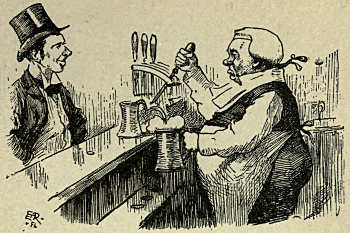
There was but one thing to be done, and I did
it. I hurriedly collected all the law-books I possess
(Shearwood’s “Abridgment of Real Property,” an
odd volume of Stephen’s “Commentaries,” and an
early edition of “The Comic Blackstone”), jumped
into a hansom, and rattled down to Pump-Handle
Court. Arrived there, I handed my brief to my
clerk (the sharp-looking youth who had given me
the paper turned out to be my clerk), and instructed
him to put it in a prominent position in his
own room, so that my client, when he arrived,
might see it, and conclude that I had so many
matters just then in hand that I had not had as
yet time to look into his case, which was waiting
its turn for consideration with numerous others.
I was ashamed to give these instructions, but
reflected that it was important, having regard to
my professional prospects, that my expected visitor
should be kept as long as possible in ignorance of
the fact that he was my solitary employer.
“All right, sir,” said my clerk, with a facial
gesture which I regret to say savoured of a wink.
“He will be here by eleven.”
I now entered my own room. It was rather in
disorder. I share my chambers with an intimate
friend, and as I am very often away, he sometimes
uses my sanctum (entirely with my consent) as a
receptacle for empty packing-cases, old cigar-boxes,
superfluous window-curtains, and worn-out
boots. With the assistance of my clerk, who
followed me in, I soon set things to rights, putting
on the month-indicator from October to March,
filling the inkstand with copying fluid, and removing
somebody’s pot-hat from the brows of my bust
of the late Lord Chancellor Brougham.
“There, sir, I think that will do now,” said my
clerk, with a look of satisfaction, and he left me
seated at my desk turning over some dusty brief
paper which I had found knocking about in one of
the drawers.
My room is a semi-subterranean apartment in a
circular tower. I have two small casements looking
out upon some gardens, but as I occupy the
basement, I can only see the ankles of the passers-by,
and am myself free from observation save when
some more than usually unruly urchin brings his
head level with mine, and makes faces at me
through the window.
I repeat I was turning over the dusty brief-paper,
and toying with Mr. Shearwood’s very
excellent “Abridgment,” when the door was thrown
open and my clerk announced, “Someone to see
you, sir.”
“You will pardon me,” I said, without looking
up, consulting in the meantime the hand-book
before me with knitted brows, “but I am engaged
for a few moments. I will attend to you directly.”
“Oh, certainly, sir,” replied the new-comer, in the
most deferential tone possible; and he took a seat.
I jotted down the incidents of Borough English,
frowned as if engaged in deep thought, and then
smilingly turned to my visitor, and asked him how
I could be of service to him.
“I want you to look into this case, sir,” he began,
with a timidity that was as unexpected as it was
gratifying—his nervousness gave me confidence.
“By all means,” I responded heartily, dipping a
pen into the ink, and putting a fresh sheet of brief-paper
over the page I had already used for the
incidents of Borough English and a freehand
sketch of a British Grenadier, “I shall be glad to
hear all about it.”
“I must apologise for intruding upon you, knowing
how busy you are, but I thought you would be
interested in what I have to place before you.”
“Pray do not apologise,” I hastened to say; and
then added, with a little laugh, “I certainly have
taken you out of your turn, but then this is our
first transaction. I hope it will not be the last.”
“I hope so, too,” replied my client, fervently.
“If you will allow me, I will often place things like
this before you. I should have come to you earlier
only so many gentlemen object to seeing me.”
“Dear me!” I replied, a little surprised. “I
suppose some men don’t care to jeopardise their
professional reputation by failure. And now, with
your permission, I will look into your case.”
“It is here, sir,” he answered, opening a rather
large portfolio. “You will notice that these are
very beautiful engravings.”
“Certainly,” I returned, making a note on the
paper before me; “as you say, most beautiful. No
doubt of very considerable value.”
“I am glad you like them, sir. They are forced
to be got rid of at an enormous sacrifice.”
“Indeed!” I ejaculated, continuing my notes.
“Yes, sir. They are being sold at something
less than cost-price.”
“Really!” And again I jotted down the particulars.
Then I said, to show that I comprehended
the affair at a glance, “I suppose there has been a
dispute about the copyright?”
“No, sir, that’s all right.”
“Ah, to be sure—then there has been a breach of
contract?” But finding that this also was not the
case, I said, with hearty bonhomie, “Well, my dear
sir, as I have made two bad guesses, perhaps you
had better tell me what I can do for you.”
My client coughed deferentially, and then produced
a paper.
“I beg your pardon, sir, but would you mind
signing this?”
I read the document—it ran as follows:—
“To Messrs. Scamp and Vamp.—I hereby agree
to purchase one copy of your ‘Pillars of the Law
from the Earliest Ages,’ profusely illustrated, in one
hundred and fifty-seven monthly parts, at seven
shillings and sixpence a part. I further agree to pay
for this work annually, at the rate of twelve parts in
advance.”
There was a solemn and awful pause. Then I
drew myself up to my full height, and in a voice of
thunder ordered him out! I know not how he disappeared—in
a moment he had vanished, portfolio
and all!
Rather fatigued after my late exertions, I called
to my clerk, and with weary haughtiness desired
him to bring me my brief, as I wished to “glance
through the papers.”
“Your brief, sir?” he returned. “Oh, I should
have told you, sir, that, while you were talking to
the man with the engravings, they called to see
you. They said they were in a hurry, and as you
were engaged, they would take it to some one
else.”
“Take it to some one else!” My maiden brief!
At this point I must pause—for the moment, I
can write no more!
A. Briefless, Junior.
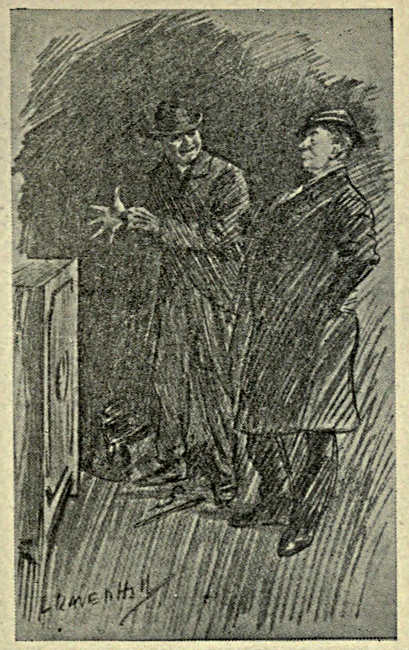
HISTORY REPEATS ITSELF. DICKENS UP TO DATE
[“Two burglars, charged with burglary, frankly admitted that the
reason they wore gloves was because they didn’t want to leave their
finger impressions for identification purposes.”—Daily Paper.]
First Cultured Safe-Breaker. “Harris.”
Second C. S.-B. “Sir.”
First C. S.-B. “Have you got your gloves on?”
Second C. S.-B. “Yes, sir.”
First C. S.-B. “Then take the kiver off!”
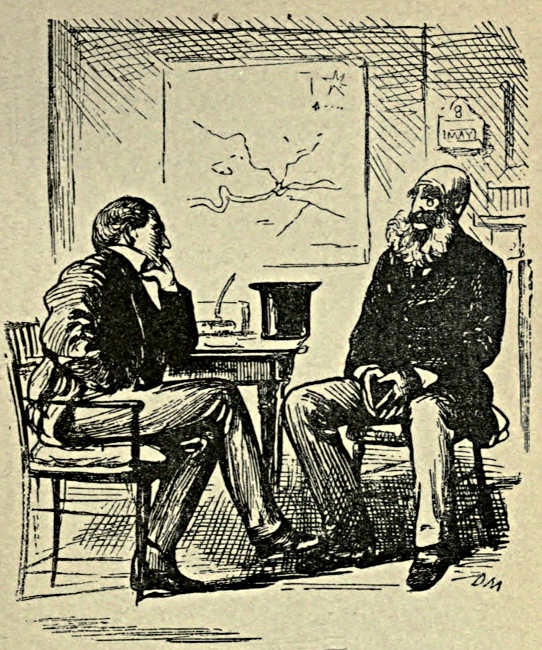
MISSING THE POINT
Legal Adviser (speaking technically). “In short, you want
to meet your creditors.”
Innocent Client. “Hang it, no! Why, they’re the very
people I’m most anxious to avoid!”
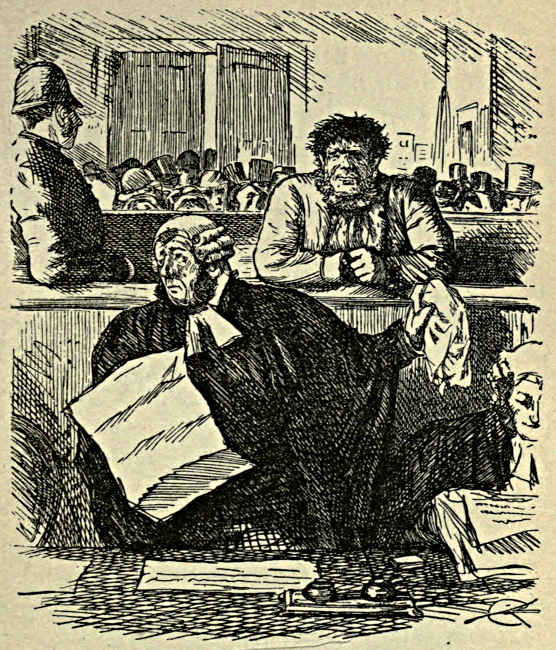
A FINAL APPEAL
“Now, gentlemen of the jury, I throw myself upon your
impartial judgment as husbands and fathers, and I confidently
ask, does the prisoner look like a man who would
knock down and trample upon the wife of his bosom?
Gentleman, I have done!”
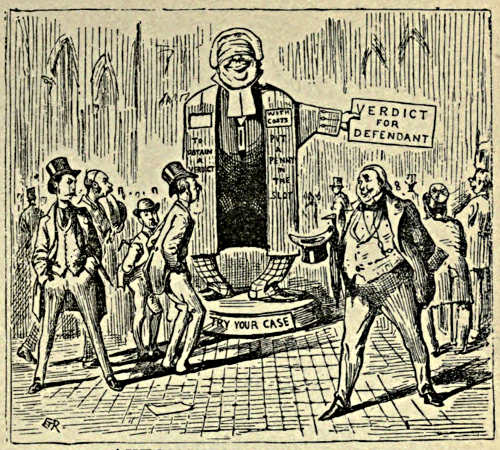
AUTOMATIC ARBITRATION
No more exorbitant fees! No more law! No more trials!
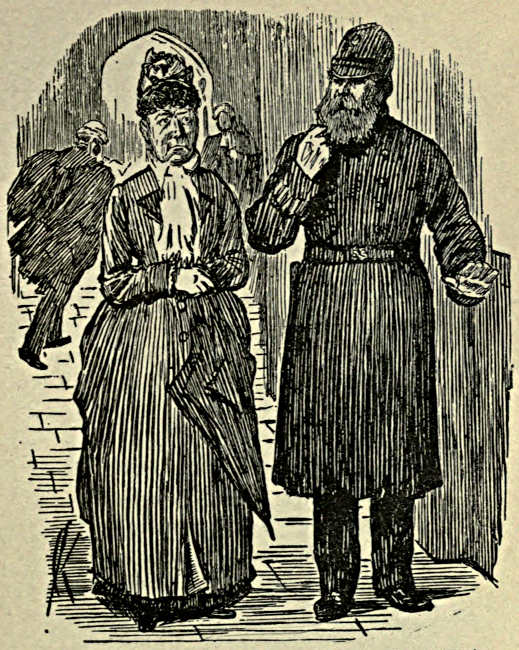
Exclusion.—Policeman (at the Law Courts). “Strict
orders to-day, m’m. No one to be admitted unless they’re
in wig an’—that is—beg pardon, m’m—barristers, m’m—only
barristers!”
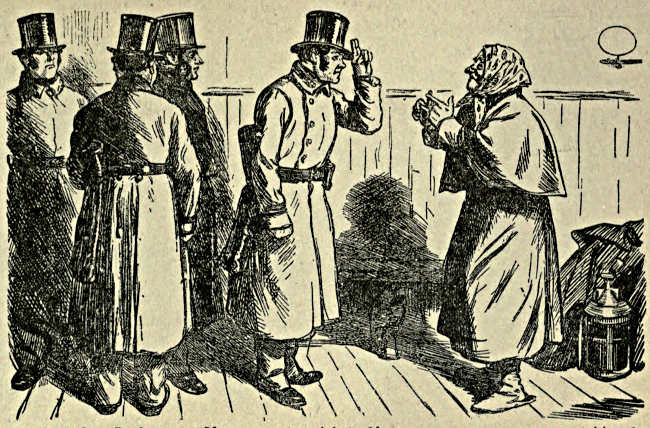
Sir Joshua Dogberry. “If you meet a ticket-of-leave man, you may suspect him, by
virtue of your office, to be no true man; and, for such kind of men, the less you meddle or
make with them the better for your honesty.”—Much Ado about Nothing.
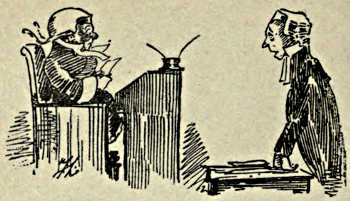
NEWS FROM THE LAW COURTS
Cold but in-vig-orating.
Old Style.—Nervous Witness about to leave the
box, when his progress is arrested by Counsel
on the other side.
Counsel (sharply). Now, sir, do know the value
of an oath?
Witness (taken aback). Why, yes—of course.
Coun. (pointing at him). Come, no prevarication!
Do you understand the value, or do you not?
Wit. (confused). If you will allow me to
explain——
Coun. Come, sir, you surely can answer yes or
no—now which is it?
Wit. But you will not let me explain——
Coun. Don’t be impertinent, sir! Explanation
is unneeded. Mind, you have been sworn, so if
you don’t know the value of an oath, it will be the
worse for you.
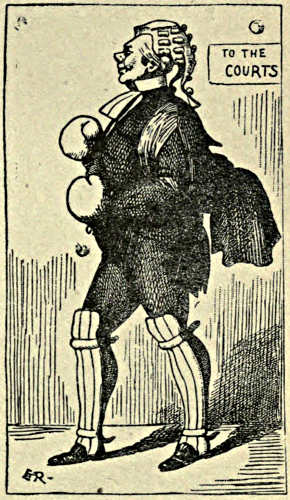
“DEFENCE, NOT DEFIANCE”
“In these days of conflicts between
counsel, I propose to make a few
additions to my usual forensic costume.”—Extract
from a Letter of Mr.
Welnown Kaysee, K.C., to a young
friend.
Wit. But you
won’t let me
speak.
Coun. Won’t
let you speak!
Why, I can’t get
a word out of you.
Now, sir, in plain
English—are you
a liar or not?
Wit. (appealing
to Judge). Surely,
my lord, he has
no right to speak
to me like this?
Judge. Be good
enough to answer
the counsel’s
questions. I have
nothing to do
with it.
Coun. Now sir—once more; are you a liar, or
are you not?
Wit. I don’t think that’s the way you would
speak to me——
Coun. Don’t bully me, sir! You are here to
tell us the truth; or as much of it as you can.
Wit. But surely you ought to——
Coun. Don’t tell me what I ought to do, sir.
Again, are you a liar, or are you not?
Wit. Please tell me how I am to reply to such
a question?
Coun. You are not there to ask me questions,
sir, but to answer my questions to you.
Wit. Well, I decline to reply.
Judge (to Witness). Now you had better be
careful. If you do not answer the questions put to
you, it will be within my right to send you to gaol
for contempt of court.
Coun. Now you hear what his lordship says, and
now, once more, are you a liar or are you not?
Wit. (confused). I don’t know.
Coun. (to Jury). He doesn’t know! I need ask
nothing further!
[Sits down.
Foreman (to Judge). May we not ask, my lord,
how you consider this case is being conducted.
Judge. With pleasure, gentlemen! I will repeat
what I remarked to the Master quite recently. I
think the only word that will describe the matter
is “noble.” Distinctly noble!
[Scene closes in upon despair of Witness.
New Style.—Arrogant Witness about to leave
the box, when his progress is arrested by
Counsel on the other side.
Coun. I presume, sir, that——
Wit. (sharply). You have no right to presume.
Ask me what you want, and have done with it.
Coun. (amiably). I think we shall get on better—more
quickly—if you kindly attend to my
questions.
Wit. Think so? Well, it’s a matter of opinion.
But, as I have an engagement in another place, be
good enough to ask what you are instructed to ask
and settle the matter off-hand.
Coun. If you will allow me to speak——
Wit. Speak!—I like that! Why, I can’t get a
rational word out of you!
Coun. (appealing to Judge). Surely, my lord, he
has no right to speak to me like this?
Judge. Be good enough to attend to the witness.
I have nothing to do with it.
Wit. (impatiently). Now, sir, am I to wait all
day?
Coun. (mildly). I really venture to suggest that
is not quite the tone to adopt.
Wit. Don’t bully me, sir! I am here to answer
any questions you like to put, always supposing
that you have any worth answering.
Coun. But come—surely you ought to——
Wit. I am not here to learn my duty from you,
sir. You don’t know your subject, sir. How long
have you been called?
Coun. I decline to reply.
Judge (to Counsel). Now you had really better
be careful. I wish to treat the Bar with every
respect, but if you waste any more time I shall
feel strongly inclined to bring your conduct before
your Benchers.
Wit. You hear what his lordship says. What
are you going to do next?
Coun. (confused). I don’t know.
Wit. (to Jury). He doesn’t know! I needn’t
stay here any longer.
[“Stands” down.
Judge (to Jury). May I ask you, gentlemen, how
you consider this case is being conducted?
Foreman of the Jury. With pleasure, my lord.
We were all using the same word which exactly
describes the situation. We consider the deportment
of the witness “noble.” Distinctly noble.
[Scene closes in upon despair of Counsel.
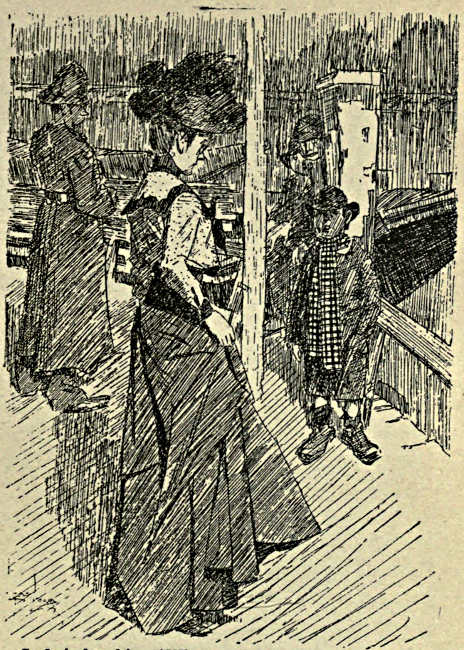
Lady (solemnly). “When you see a boy always loafing
round street corners, what place in life do you suppose he
is fitting himself for?”
Boy. “To be a policeman, mum!”
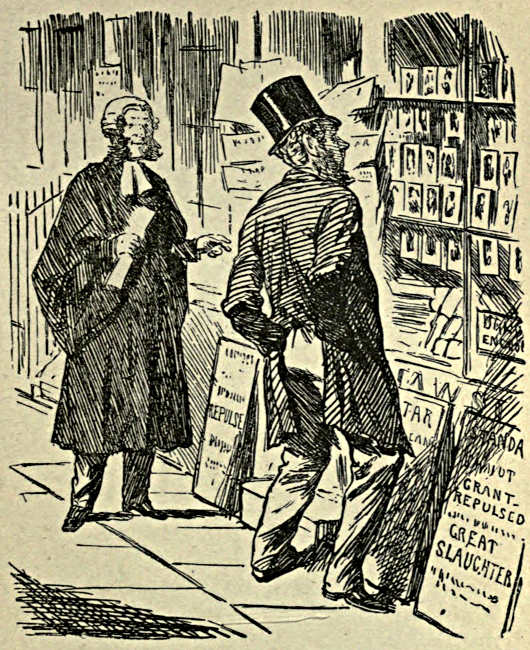
Tomkins looking too long at the cartes de visite of the lawyers in
Chancery Lane, is seized with a sudden involuntary panic. “Don’t
be alarmed, my boy,” said his friend Wigsby, who happened to be
passing at the time, “Your coat pockets are quite safe; we don’t do
it that way!”
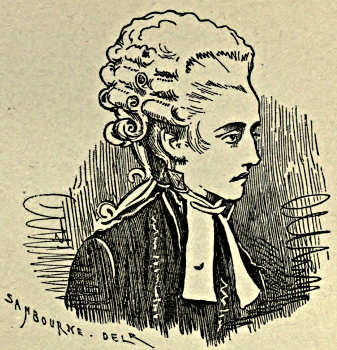
NOVELTY IN COIFFURES
Suitable for ladies called to the bar (as they soon will be,
of course).
Air—“The Sea! the Sea!”
The Fee! the fee! the welcome fee!
The new! the fresh! the scarce to me!
Without a brief, without a pound,
I travel the circuit round and round.
I draw with the pens at each assize,
If ink before me handy lies.
I’ve got a fee! I’ve got a fee!
I’ve got what I so seldom see;
With the judge above, and the usher below,
I wait upon the last back row.
Should a silk gown come with argument deep,
What matter! I can go to sleep.
I love (oh, how I love) to bide
At some fierce, foaming, senior’s side.
When every mad word stuns the court,
And the judges wish he’d cut it short,
And tell him the case of So-and-So,
His argument doth to atoms blow.
I never hear Chancery’s dull, tame jaw,
But I love the fun of the Common Law,
And fly to the Exchequer, Bench and Pleas,
As a mouse flies back to a Cheshire cheese!
For the cheese it always seem’d to me,
Especially if I got a fee!
My whiskers are white, my head is bald,
Since the dreary hour when I was call’d.
The Steward he whistled as out he told
The fees at my call from a packet of gold.
And never was heard of a step so wild
As took to the bar the briefless child.
I’ve liv’d since then, in term and out,
Some thirty years, or thereabout;
Without a brief, but power to range
From court to court by way of change.
And death, whenever he comes to me,
Will find me most likely without a fee.
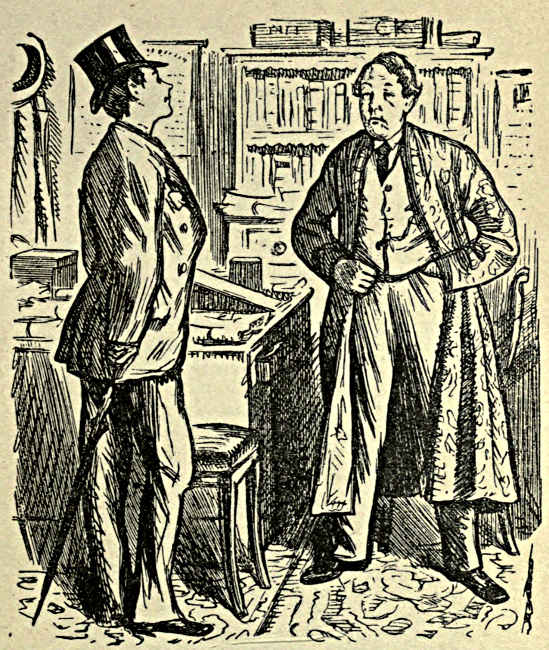
A Sore Point.—First Articled Clerk. “Well how did
your private theatricals go off?”
Second Ditto. “Pre’y
well. My moustache went off at once, but nothing would
induce the pistol to go off in the duel scene!”—(Dropping
the subject.)—“How’s your mother?”
Song for the Burglar to his “Pal”
who “Peached.”—“Never again with you,
Robbin’.”
Suitors’ Sufferings.—As law is to rheumatism,
so is equity to gout. The fusion of law and
equity may be said to form the counterpart of
rheumatic gout.
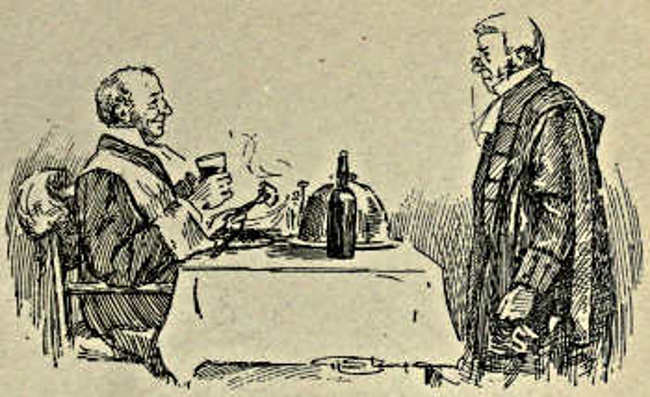
“Behind the Scenes.”—First Judge. “Breach of
promise still running?”
Second Judge. “Going wonderfully.
No standing room. “What are you doing?”
First Judge. “A building contract. Wretched business:
not a soul in the place!”
A Spring Circuit.—Jumping through the
hoops held for the riders round a circus.
Suitable Site for a Police “Court.”—The
area.
At the top of the street many lawyers abound,
Below, at the bottom, the barges are found:
Fly, honesty, fly to a safer retreat,
For there’s craft in the river, and craft in the street.
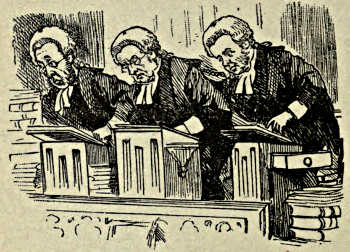
AU REVOIR!
BRADBURY AGNEW & CO LD. PRINTERS, LONDON AND TONBRIDGE.