Huntingthorpe Hall.
My Dear Jack,—I want
you to come down on
Monday and stay a couple
of days with me. My wife
will be delighted, as you can
help her with a children’s
party, and also play Pantaloon
in a little thing being
got up by the young people.
I will mount you on the
Tuesday with our Stag hounds,
as I know you are
fond of a day’s hunting.
No, don’t thank me, my dear chap—I shall be only
too glad if you will go, as the horse I am intending
to put you on is a rank brute, and when he doesn’t
refuse his fences—which is a rare occurrence—he
invariably falls into them. However, you won’t
mind that, will you?
You will have to put up with real bachelor
accommodation, I am afraid, as the house is
crammed. The best I can do for you is a half
share of one of the attics. Our cook has left us,
all unexpectedly, so this places her room at our
disposal for two of you. The kitchen-maid is
doing her best to keep us from starving; but,
though she means well, I can hardly class her as a
cordon bleu.
Louise Dearlove, that pretty little girl you were
so sweet upon last season, is unable to come; but
her brother—the red-headed youth who was always
trying to pick a quarrel with you—will be here.
I am so short of horses that I fear I must ask
you to cab the four miles up from the station; but
I am sure you won’t mind taking the rough with
the smooth.
Yours ever,
John Jostler.
As the recipient of the above invitation, I ask
which is “the smooth”?
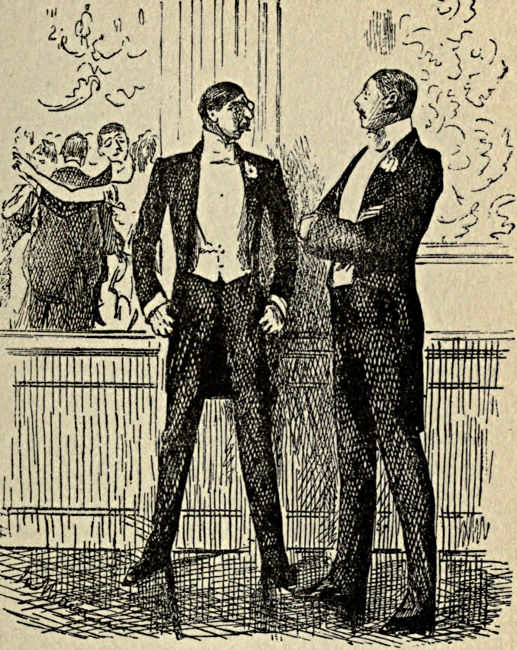
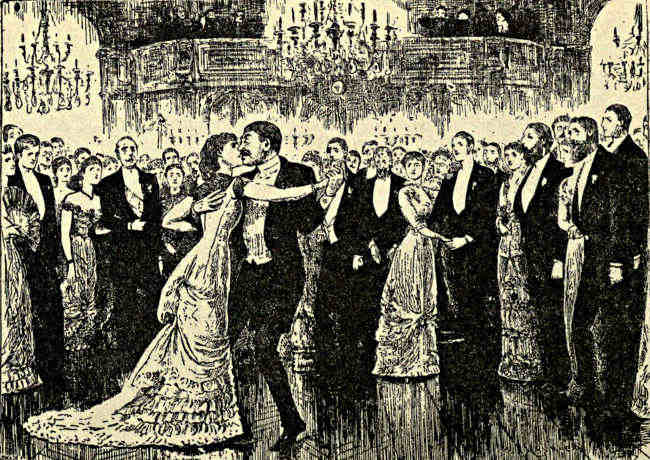
WHAT THE DANCING MAN HAS COME TO
“Not dancing any more to-night, Fred?”
“No; and, what’s more, I’ll never put my foot in this
house again! Why, I’ve been introduced three times!”
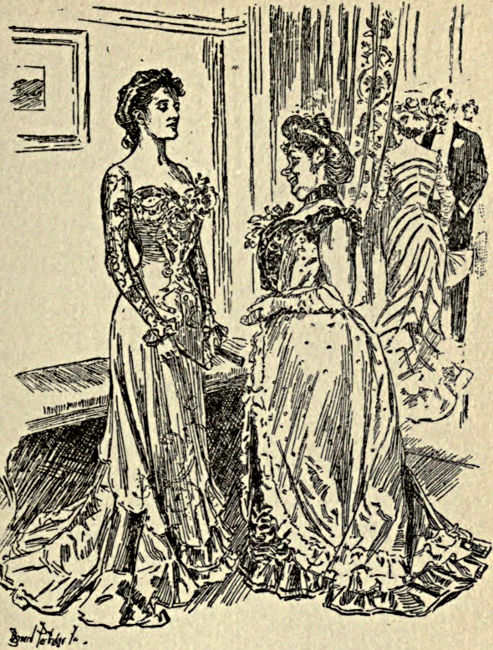
THE TERRORS OF SOCIAL LIFE
Stout Lady (at a charity ball). “Excuse me, Lady Godolphin,
but I should so like to make some notes of your
charming costume—may I?”
Lady Godolphin. “Pardon me, but really I’m afraid I
haven’t the pleasure of——”
Stout Lady. “Oh, I’m sure you won’t mind: I’m ‘Girlie,’
you know—I do the fashion article for Classy Bits!”
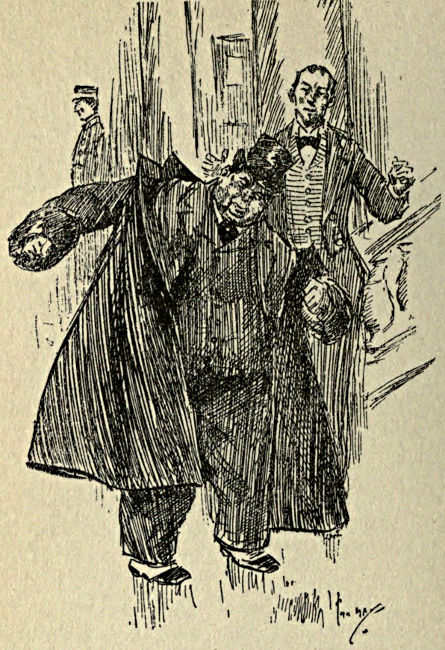
Club Attendant (to stout party, who is struggling into overcoat).
“Allow me, sir.”
Stout Party. “No, don’t trouble! This is the only
exercise I ever take!”
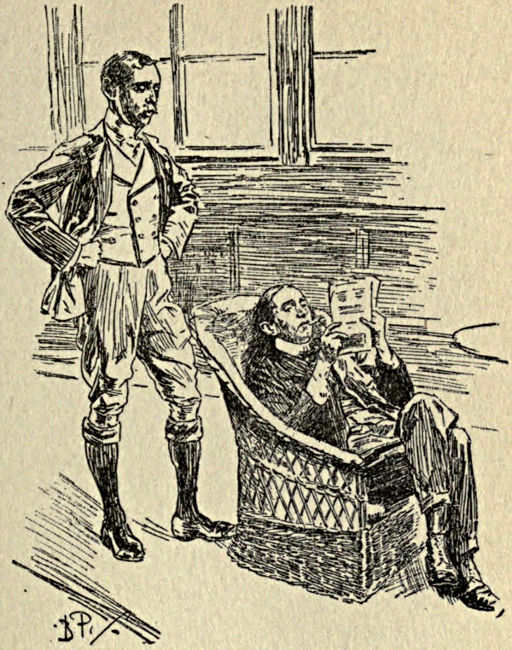
ENGLISH AS SHE IS SPOKE!!
Future Duke. “What are you goin’ to do this mornin’
eh?”
Future Earl. “Oh, I dunno. Rot about, I s’pose, as
usual.”
Future Duke. “Oh, but I say, that’s so rotten.”
Future Earl. “Well, what else is there to do, you
rotter?”
Scene—The Drawing-rooms of No. 1 and No. 2,
Upperten Mansions, S.W.
First Lady (entering). Here I am! I am sure
you won’t guess who I am. See, the American
Banner and the Union Jack. I represent “Under
Two Flags.”
First Hostess. Oh, how clever! But we shall
have Mr. Smith here presently, and he is sure to
come in something quite new.
Second Lady (entering). Here I am. Now you
will never know what book I represent. Stars and
stripes on one shoulder, the white ensign on the
other! “Under Two Flags.” Eh?
First Hostess. Wonderful! We shall have Mr.
Smith here by and by. He is sure to amuse us.
Third Lady (entering). I promised to come and
here I am. The Star Spangled Banner and our
own Royal Standard. “Under Two Flags.”
There, isn’t it good?
First Hostess. Quite too good! So pleased you
have come. We are waiting for Mr. Smith. He’s
sure to make us all laugh, as he’s so original!
Fourth Lady. Up to my time! And I have
come as a well-known book. See, a dear little
American banner on one side of my head, and a
weeny, weeny Union Jack on the other. “Under
Two Flags.” I thought I would surprise you!
First Hostess. I knew you would. Mr. Smith
is coming! He’s sure to be funny.
Mr. Smith (entering). Now you must guess. I
won’t take off my cloak until I have shown you
these two dolls. Here they are, soldiers of the
time of Louis XIV. And now you shall see me.
(Throws off his cloak and appears in gorgeous costume.)
I represent, with the help of my companions,
“The Three Musketeers.”
Second Hostess (rigidly). I think there is some
mistake. This is a meeting of the Distressed Charwomen’s
Food Fund Association. I think you
must have wanted to attend my neighbour next
door’s Book Tea.
Mr. Smith (hastily resuming his cloak). Oh, I
beg your pardon.
[Exit in confusion.
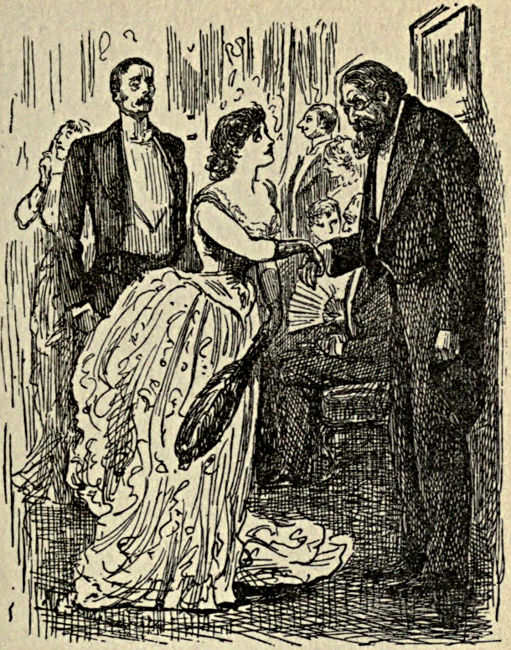
DISADVANTAGE OF RESEMBLING A CELEBRITY
She. “Oh, how do you do, dear Mr. Lyon. Have you forgiven me
for cutting you at Mrs. Leo Hunter’s last night? I was actually
stupid enough to take you for that horrid bore, Mr. Tetterby Thompson,
whom you’re said to be so like. It’s a horrid libel—you’re not
like him a bit.”
He. “A—a—I wasn’t at Mrs. Leo Hunter’s last night—a—a—a—and
my name is Tetterby Thompson!”
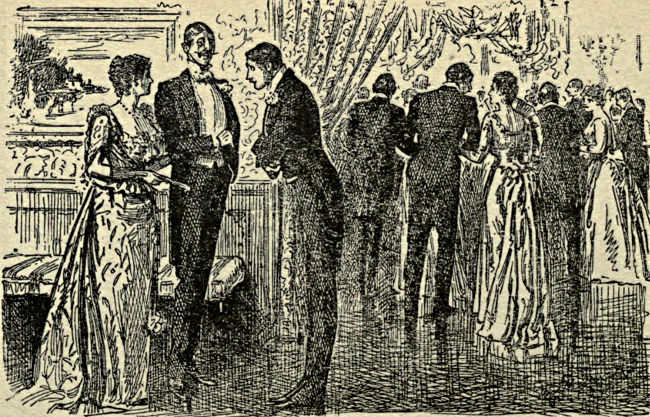
SPEECHES TO BE LIVED DOWN—IF POSSIBLE
Digby. “I had hoped for the pleasure of taking you down to supper, Mrs. Masham!”
Rigby. “Too late, my dear fellow! It’s the early bird that catches the worm!”
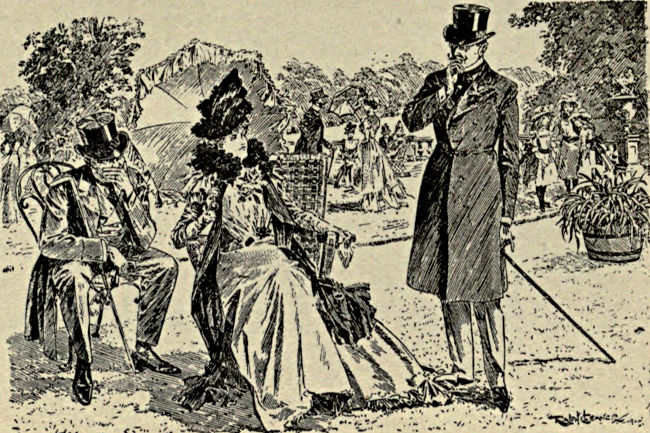
SPEECHES TO BE LIVED DOWN—IF POSSIBLE
Mr. Marsh. “I’ve just had quite a long chat with your three charming little girls, Mrs. Roope.”
Mrs. Roope. “Not mine, Mr. Marsh. I have no children.”
Mr. Marsh (very surprised). “No chil—— Are you sure?”
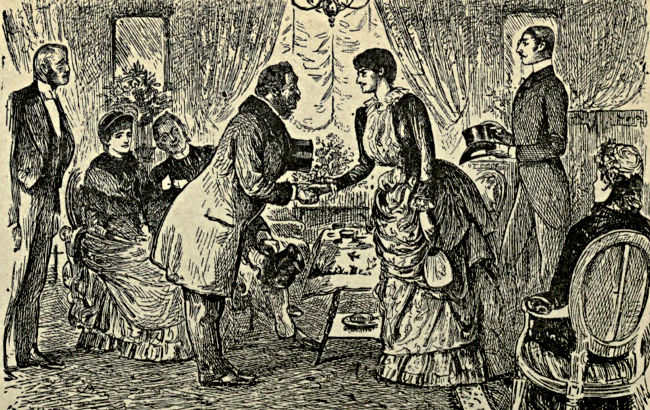
THINGS ONE WOULD RATHER HAVE LEFT UNSAID
I
[See page 19
I
Enter Mr. Chesterfield Grandison Potts. “How
d’ye do, my dear Mrs. Pettifer? I’ve come to congratulate
you on your performance of the Lady of
Lyons, at Mrs. Tomkyns’s. It was simply perfect!”
Distinguished Lady Amateur. “Oh, far from
perfect, I fear! To be perfect, alas! the part of
Pauline requires that one should be young and
lovely, you know!”
Mr. C. G. Potts (who piques himself on his old-fashioned
courtesy). “My dear lady, you are a
living proof to the contrary!”
II
“Oh, how d’ye do, Sir Bruin? And so you’re
leaving England for good, and we shall never
see you again!”
“Nothing of the kind! Who says so?”
“Oh, I saw it in one of the papers. But the
papers don’t always tell the truth, I’m sorry to say!”
III
Enthusiastic Lady Visitor (at winter health resort).
“What a delightful place this is, Professor.
And the baths, how perfect! I could bathe all
day—couldn’t you?”
The Professor. “Well, you see, I’m a resident,
and that makes a difference!”
Lady Visitor. “Ah! to be sure. I suppose you
never even think of taking a bath!”
IV
Love-lorn Middy (about to join his ship). “I’ve
come to say good-bye, Amy!”
Cousin Amy. “Good-bye, Johnny. When we
see you next, I hope you’ll be an Admiral!”
V
“I was so sorry not to be at home when you
called, Mr. Binks!”
“Oh, pray don’t mention it! It didn’t matter
in the least, I can assure you!”
VI
Hostess. “What, must you go already, Professor?”
The Professor. “My dear madam, there is a
limit even to my capacity of inflicting myself on
my friends!”
Hostess. “Oh no—not at all—I assure you!”
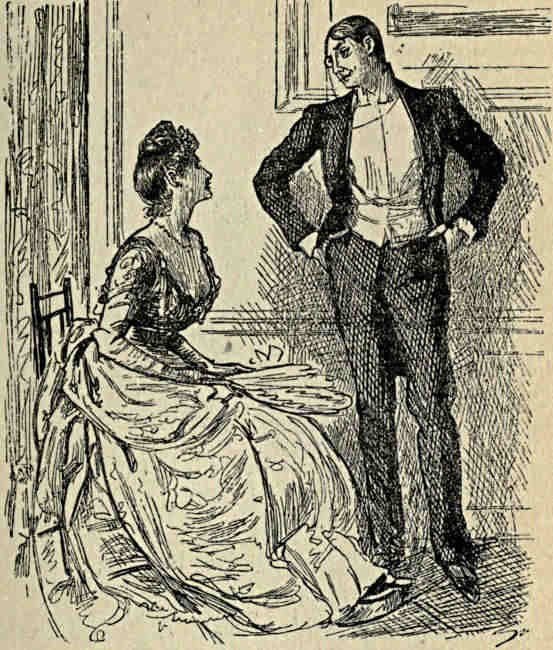
VII
Miss Bugge. “Oh, but mine is such a horrid name!”
Young Brown. “Ah—a—um—I’m afraid it’s too late to alter it
now!”
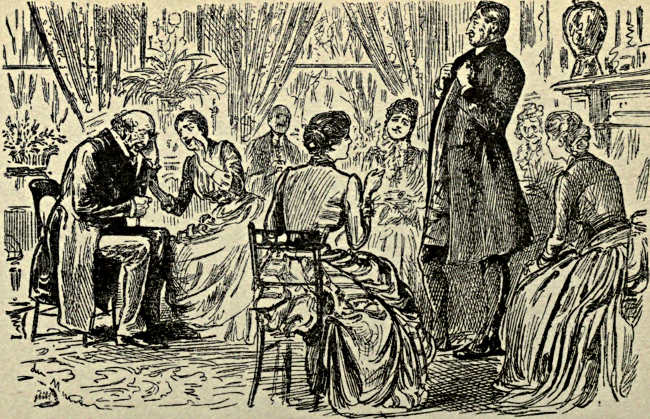
VIII
Deaf Old Gentleman. “The conversation seems very amusing, my dear. What is it all about?
Hostess (fortissimo). “When they say anything worth repeating, grandpapa, I’ll tell you!”
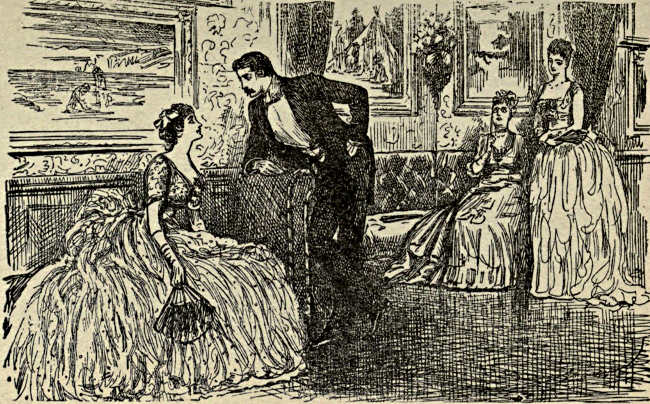
IX
She. “No! I can’t give you another dance. But I’ll introduce you to the prettiest girl in the room!”
He. “But I don’t want to dance with the prettiest girl in the room. I want to dance with you!”
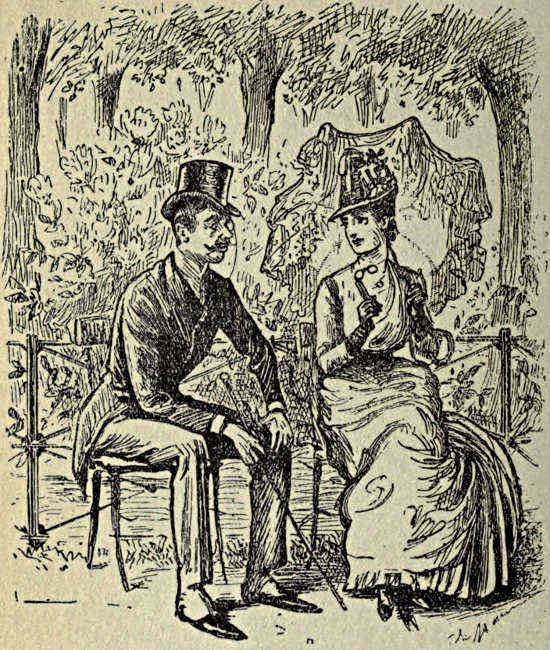
X
He. “Everybody will be leaving Town now that Parliament is
dissolved.”
She. “Yes. Indeed I think all the nice people have left already!”
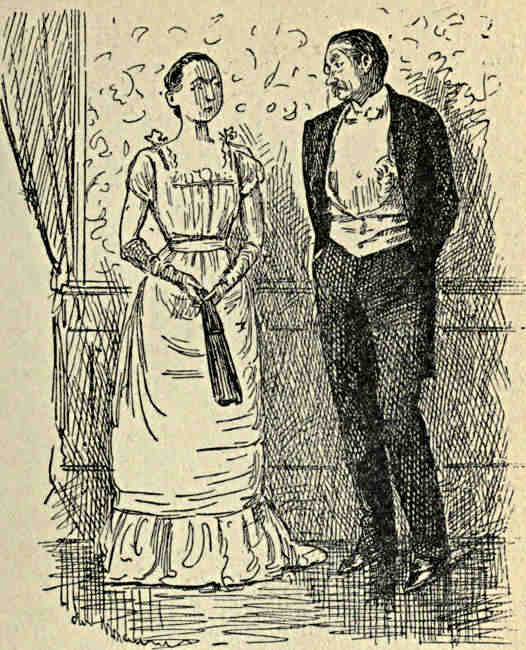
XI
Jones (under the impression that he is making himself agreeable).
“I don’t care a bit for a pretty woman, myself!
They have no conversation. I like a plain woman, who has
plenty to say for herself!”
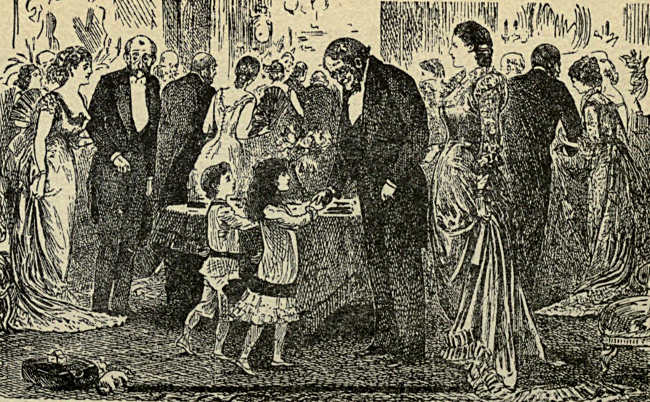
XII
(Dinner has just been announced)
Hester and Billy (sadly). “Good night, sir. We’ve got to go to bed.”
Distinguished Professor (who is taking down the Hostess). “Ah, my dears, that’s where we’re all
wishing we were!”
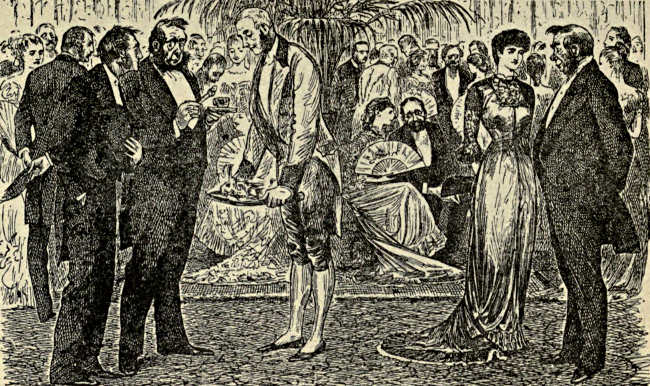
XIII
Nervous Person (speaking at last to his Neighbour). “Do you know who that remarkably ugly person is just
opposite—talking to the black-haired lady, you know—um—eh?”
Neighbour. “That, sir, is my brother!”
Nervous Person. “Yes? I—I—I beg your pardon—I—I—Stupid of me not to have seen the family
likeness—a—a—a——”
[Collapses and disappears.
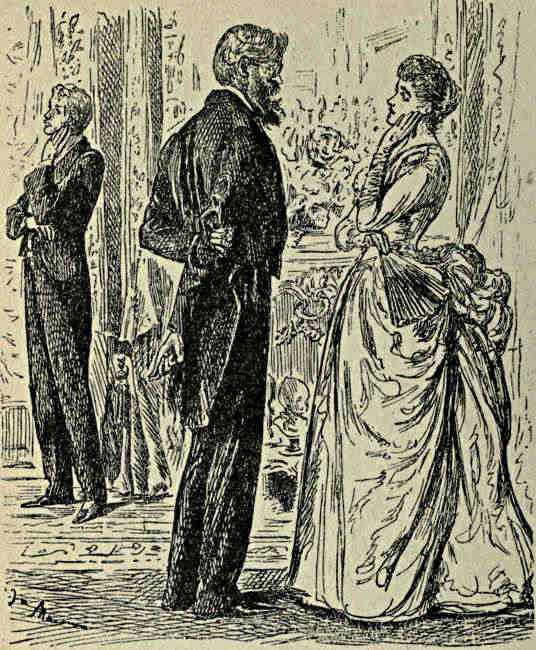
XIV
The Professor. “How singularly you and your brother resemble
each other, Miss Angelina!”
Miss Angelina. “Is that a compliment to my brother, or a
compliment to me?”
The Professor. “Oh, a compliment to neither, I assure you!”
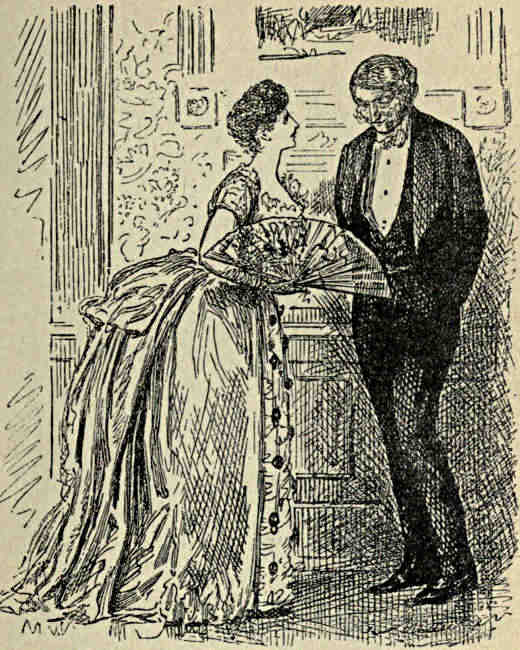
XV
He. “What a pretty fan!”
She. “Yes; I had it given to me when I first came out!”
He. “Really! It has worn well!”
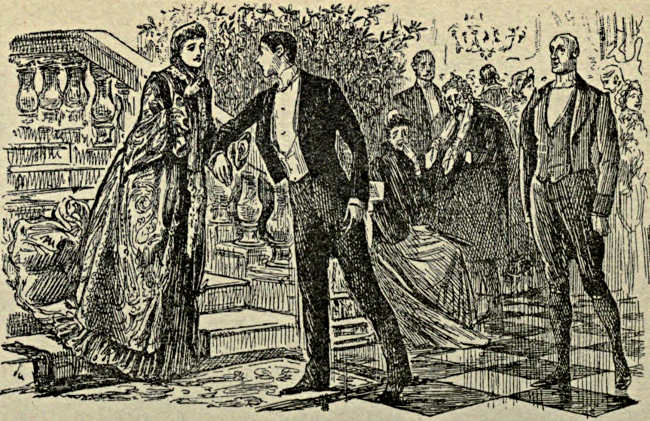
XVI
Servant. “Lady Glitter’s carriage!”
Son of the House (tenderly, as he hands her Ladyship out). “Ah! I’ve been waiting
for this moment all the evening!”
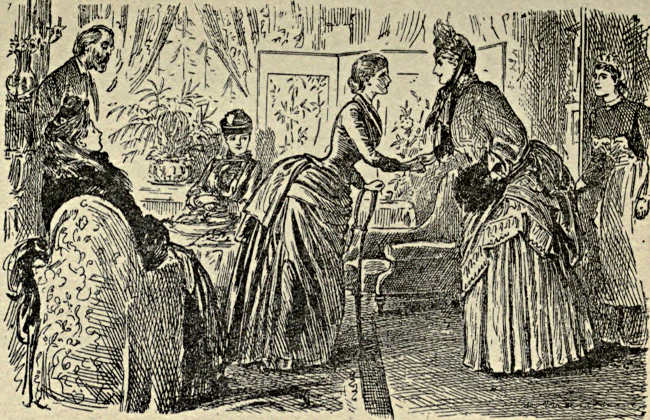
XVII
Caller. “Only fancy, Mrs. Dowderley, I was very nearly calling on your neighbour,
Lady Masham, whose day at home it is too! when I suddenly remembered I wasn’t
dressed for paying calls!”
XVIII
Hostess. “What, leaving already, Mr. Mivers!
I’ve scarcely seen anything of you the whole
evening!”
Mr. Mivers (who goes in for the Courteous Manners
of the Olden Time). “That, madam, is entirely
my fault!”
[Exit gracefully, but remembers as he goes downstairs
that he meant to say “misfortune,” not
“fault.”
I
Visitor (who has accepted an invitation to a
local concert). “Is it evening dress?”
Hostess. “Oh, no; just as you are dressed now—or
worse, if you have it.”
II
Lady Guest (to Host, who hates getting up early).
“I’m so awfully sorry to have dragged you up at
this unearthly hour, but I had to catch the 8.30
train.”
Host. “Not at all. I’m only too glad to be
able to see you off!”
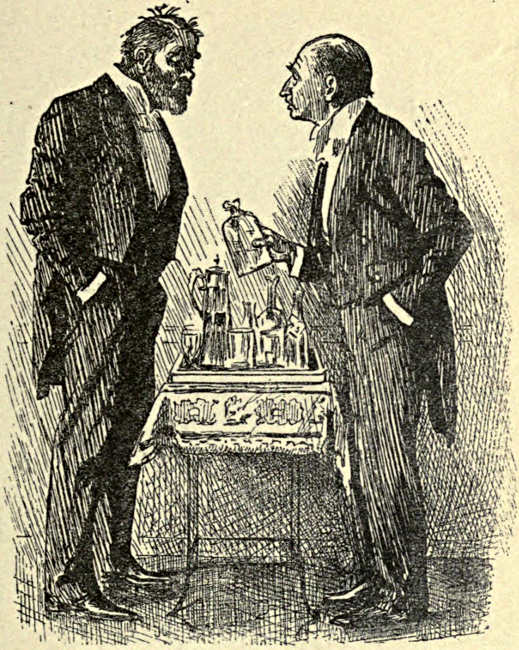
III
Host. “Take a little whiskey before you go, Jones?”
Jones (after helping himself). “Thanks! May I pour you
out some?”
Host. “Please—not too much—just about half what
you’ve given yourself!”
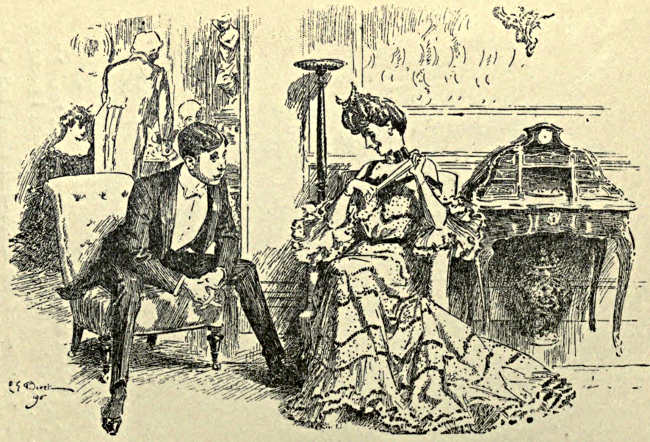
IV
Gushing Lady. “Oh but, Mr. Jones, I should love to be beautiful—even if for only half-an-hour!”
Jones. “Yes; but you wouldn’t like the coming back again!”
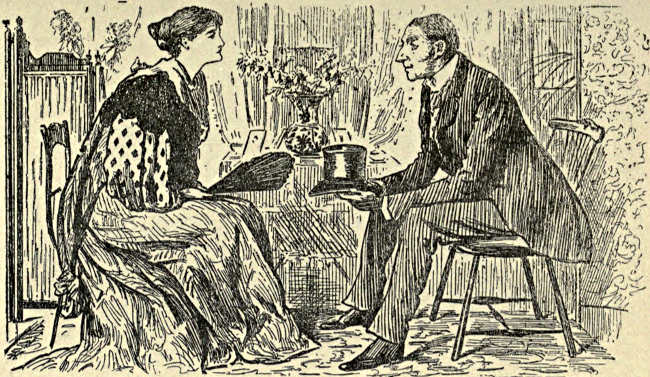
V
He. “I suppose, now that the London Season is coming to an end, that you’ve been
very gay?”
She. “Oh, yes—I haven’t had a dull moment since I saw you last!”
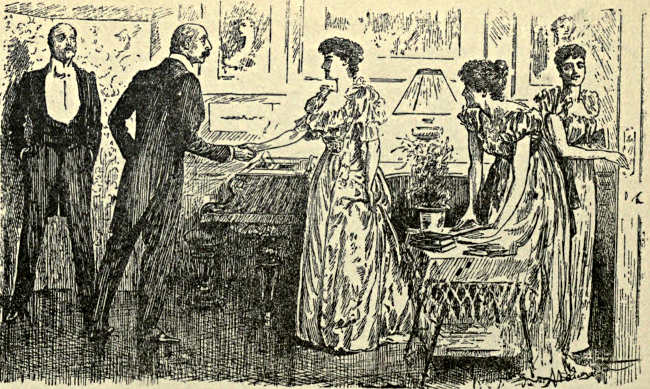
VI
Fair Hostess. “Good-night, Major Jones; we’re supposed to breakfast at nine; but we’re
not very punctual people. Indeed, the later you appear to-morrow morning, the better
pleased we shall all be!”
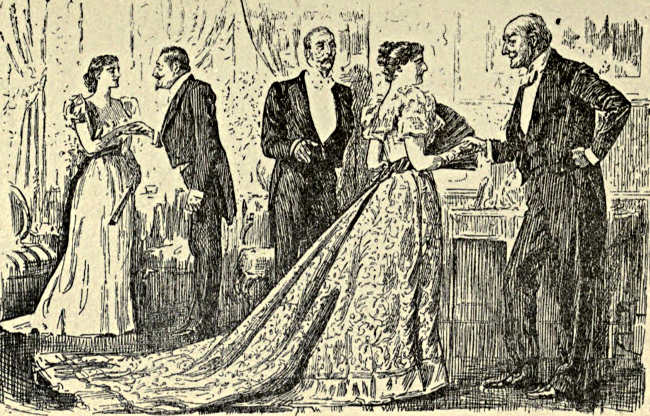
VII
The Professor (to Hostess). “Thank you so much for a most delightful evening! I
shall indeed go to bed with pleasant recollections,—and you will be the very last person
I shall think of!”
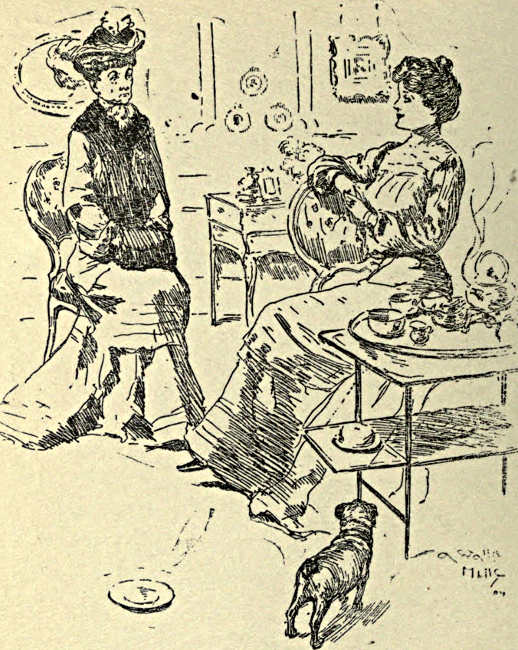
VIII
Elderly Party (who fancies herself young). “Ah, Mildred,
you and I must one day lose our youth and beauty!”
Mildred. “Oh, you mustn’t be down-hearted. You have
worn so wonderfully well!”
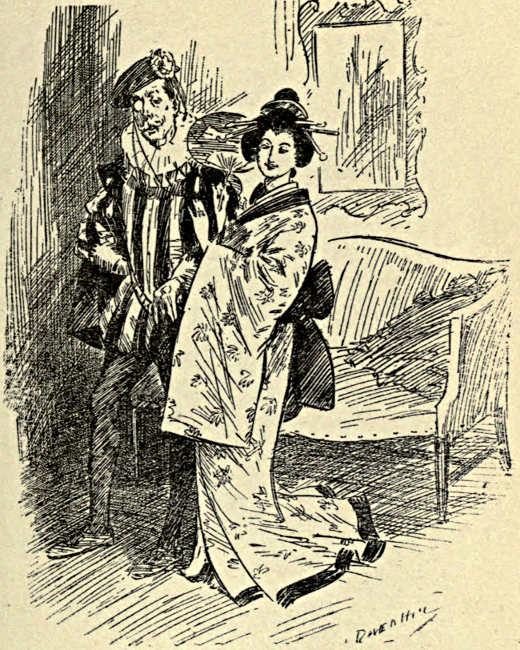
IX
Captain Sawney (at a Mi-Carême fancy dress ball, perfectly
satisfied that he is saying a happy thing and paying a very
great compliment). “Well, you do look delightful! Fascinating!
Too charming for words! What an awful pity it
is you are not always like that!”
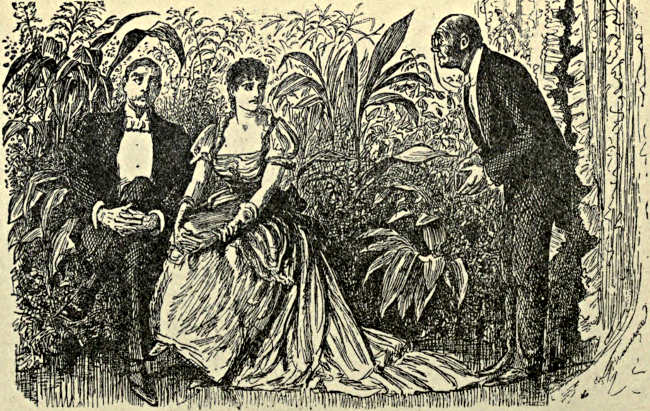
X
Jones (nervously conscious that he is interrupting a pleasant tête-à-tête). “A—I’m sorry to
say I’ve been told to take you in to supper, Miss Belsize!”
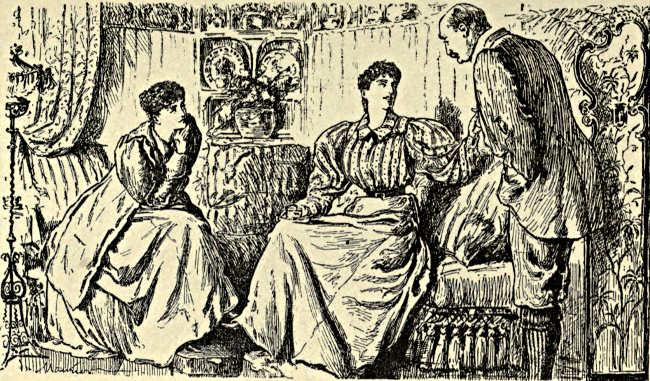
XI
Hostess. “This is good of you, Major Grey! When I wrote I never expected for a moment
that you would come.”
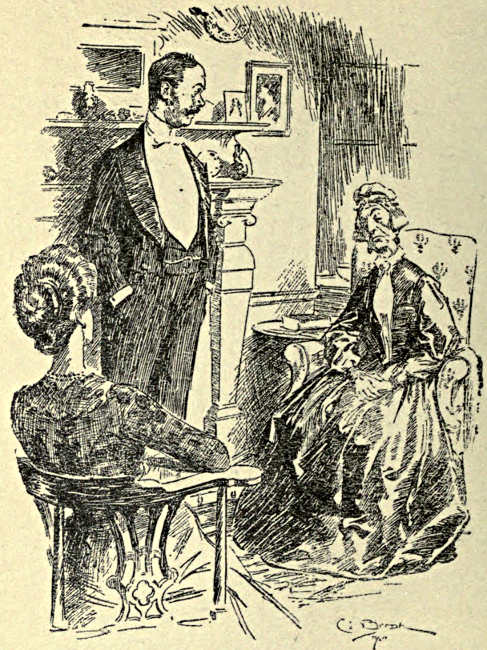
XII
Old Aunt (despondently). “Well, I shall not be a nuisance
to you much longer.”
Nephew (reassuringly). “Don’t talk like that, aunt. You
know you will!”
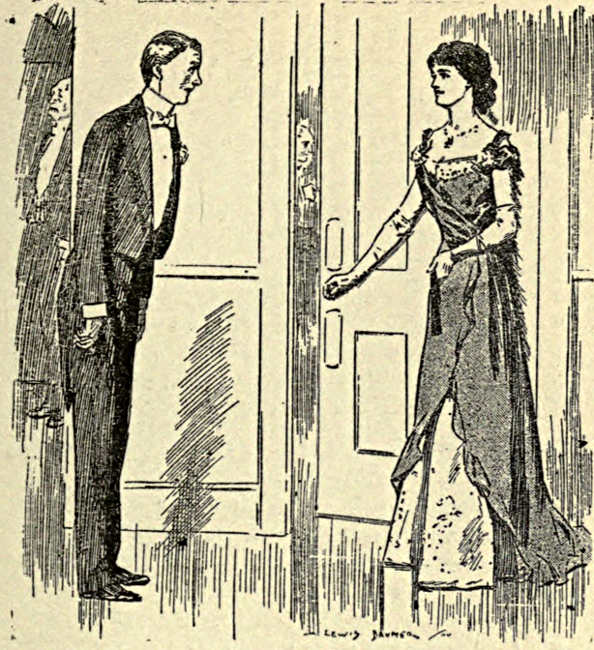
XIII
“Well, good-bye, Mr. Green. It was so nice of you to
come. It does father such a lot of good to have someone
to talk to.”
“I was delighted to come, Miss Brown, but I’m afraid
I’m not much of a conversationalist.”
“My dear Mr. Green, don’t let that trouble you. Father’s
ideal listener is an absolute idiot, with no conversation whatever,
and I know he has enjoyed himself tremendously
to-night!”
[A contemporary complains that most people in Society
consider it necessary to address one another in shrill, high-pitched
voices.]
You’re pretty, Miss Kitty, and dainty and slim,
And graceful indeed is your mien;
Your eyes are as bright and your ankle as trim
As any the writer has seen.
Your curly brown locks, which invite a caress,
Would make any artist rejoice;
But you’ve one little fault, even I must confess,
And that’s your Society voice.
When I asked you to wed me a fortnight ago
At Mrs. De Jenkynson’s ball,
I never expected you, Kit, to say “No”
In tones that would ring through the hall.
You dreamt not—how should you, of course?—that the sound
Of your voice would be heard far and wide,
But I did feel a fool when a titter went round
As we walked to your chaperon’s side.
A beautiful maiden was never yet won,
’Tis said, by a faint-hearted swain;
And so, Mistress Kit, ere the season is done
I am sure to approach you again.
And oh! if your feelings should leave you no choice
But to utter the verdict I dread,
Pronounce not my doom at the top of your voice,
But speak in a whisper instead.
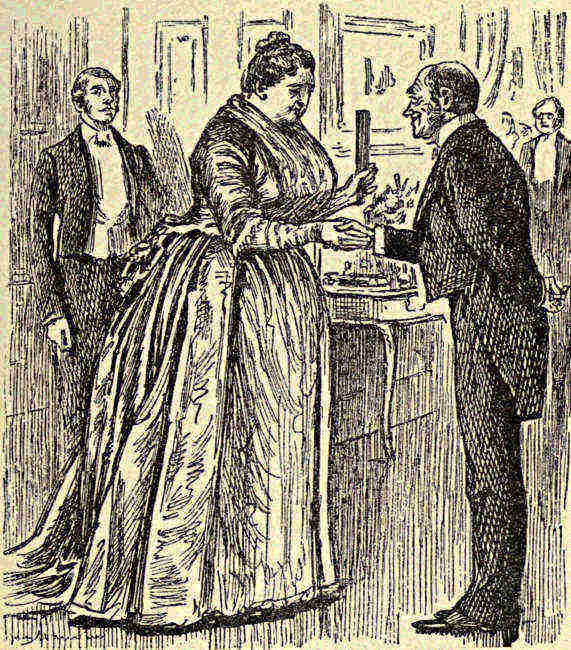
INFELICITOUS QUOTATIONS
Fair Authoress. “So sorry to be so late. I’m afraid I’m
last!”
Genial Host. “‘Last—but not least!’”
Our Money Lender.—From Borrowdale.
Our Standing Counsel.—From the Giant’s
Causeway.
Our Butcher.—From the Chops of the Channel.
Our Dentist.—From the Mouth of the Thames.
Our Doctor.—From Lancing.
Our Confectioner.—From Bakewell.
Our Beekeeper.—From Honeybourne.
Our Flirting Friend.—From Florence, Constance
Nancy, Nora, and Sophia.
Our Pewopener.—From Hassock’s Gate.
Our Undergraduate.—From Reading.
Our Tailor.—From the New Cut.
Our Own Correspondent.—From Penmaenmawr.
And our Darlings.—From Archangel and the
Coast of Bonny.
Front and Side.—She. “What an enormous
expanse of shirt-front Major Armstrong has!”
He. “H’m—it isn’t his front I object to. It’s
his side!”
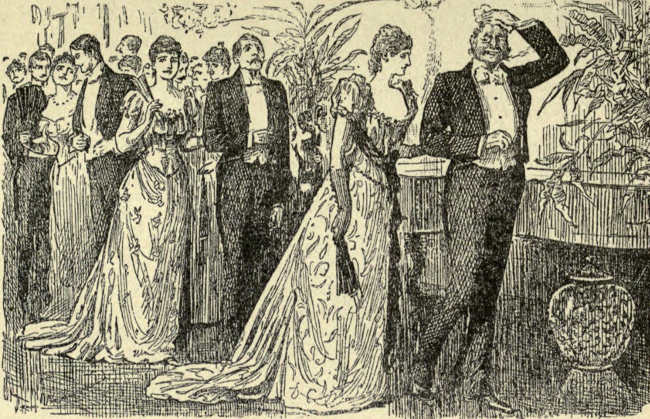
INFELICITOUS QUOTATIONS
Jones (after a delightful waltz). “And now, Miss Brown, let us go and seek some
‘Refreshment for Man and Beast!’”
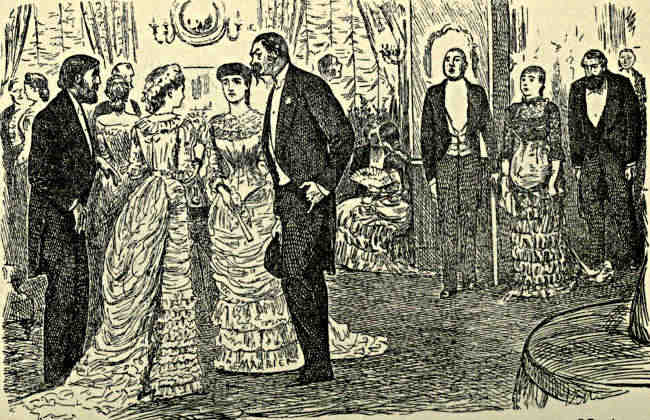
SOCIAL AGONIES
[See p. 49
Social Agonies.—(Scene—Mrs. Montgomery
Morris’s Drawing-room just before Dinner.)—Mrs.
Sidney Mountjoy (to Hostess). “Oh yes, Biarritz
was all very well, but we got into a quarrel with
some people there—a dreadful couple, who behaved
most shamefully! I’m told the husband, a certain
Mr. Hamilton Allsop, means to pull Sidney’s nose
whenever and wherever he meets him, and his
horrid wife actually declares she’ll——”
Footman. “Mr. and Mrs. ’Amilton Hallsop!”
A Frugal Mind.—She. “And don’t forget
to order six dozen of the very driest champagne
you can get, for our dance on Tuesday next.”
He. “But the ladies, as a rule, don’t like very
dry champagne.”
She. “No, love, they don’t. Neither do the
waiters!”
Le Monde où l’on s’amuse.—She. “I want
you to come and dine with me, but I suppose
you are so much engaged just now. How many
deep?”
He. “I really don’t know. Sufficient for the
day is the evil thereof.”
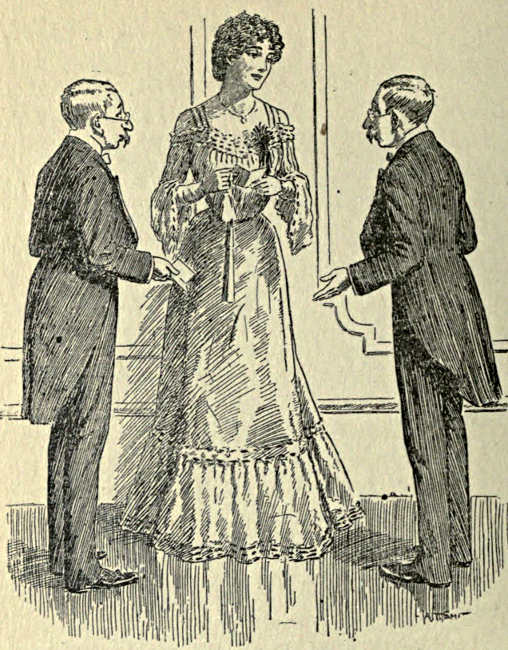
THE TRIALS OF A DEBUTANTE
The Twin Muddletons (both claiming the dance, after much
argument, simultaneously). “Well, we leave it to you, Miss
Brown. You must know whom you gave this dance to!”
[Miss Brown, never having seen them before this, her first
ball, and quite unable to tell t’other from which,
has no views on the question.
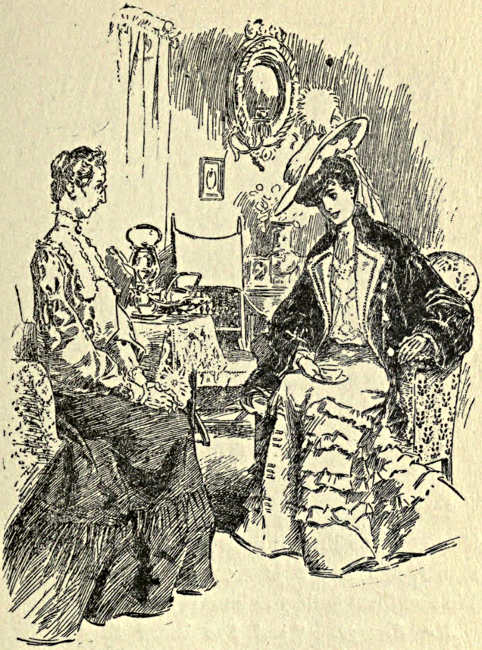
Miss Griffin. “I’m sure it must be Mrs. Jones’s fault that
she can’t manage Mabel. The child is most affectionate.”
Polite Visitor (eager to agree). “Yes, the way she gets on
with you shows that!”
(For the Children of “Smart People”)
Ding-a-dong, ding-a-dong, what do I care!
I’ll sing you a nice little song of May Fair—
Five hundred people invited to meet
In a wee little house, in a wee little street—
Five hundred people all huddled together,
Discussing the faults of their friends and the weather—
One little pianist strumming an air,
No one to listen and no one to care—
One little lady attempting to sing,
Tears in the eyes of that poor little thing:
Up gets a man, sings, “Two lovely black eyes!”—
You might hear a pin drop—“Oh! what a surprise!”
For that is the music they like in May Fair.
Ding-a-dong, ding-a-dong, what do I care!
Social Economy.—Mrs. Scrooge. “I’m writing
to ask the Browns to meet the Joneses here at
dinner, and to the Joneses to meet the Browns.
We owe them both, you know.”
Mr. Scrooge. “But I’ve heard they’ve just
quarrelled, and don’t speak!”
Mrs. Scrooge. “I know. They’ll refuse, and we
needn’t give a dinner party at all!”
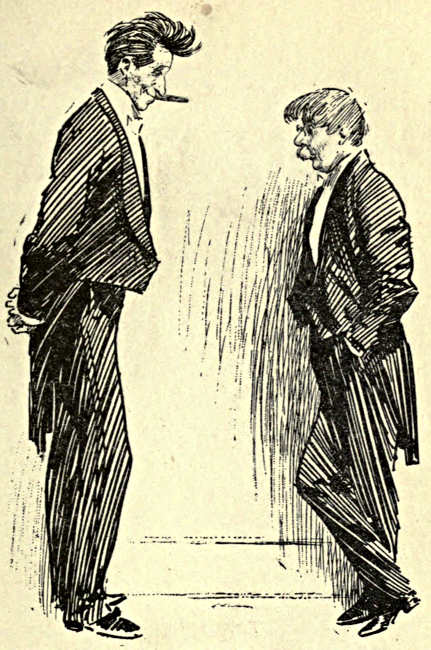
First Genius to Second Genius. “Why on earth do you do
your hair in that absurd fashion, Smith?”
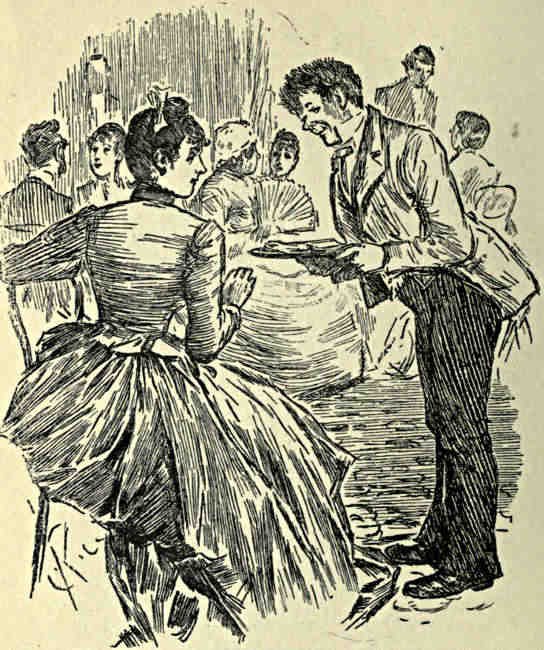
TANGIBLE
Second Groom (waiting at tea for the nonce, and handing thin
bread-and-butter—sotto voce). “Clap two or three bits
together, miss, then you’ll get a bite!”
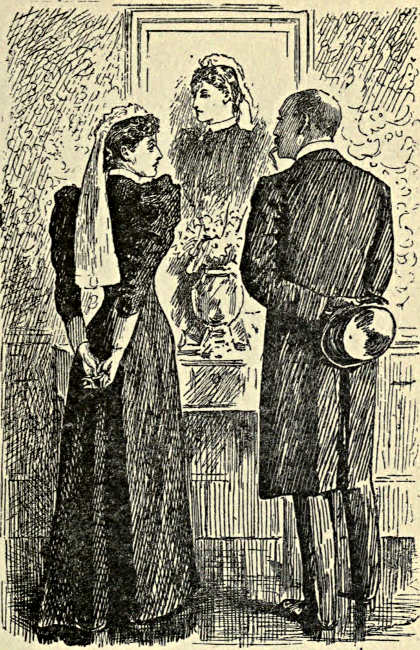
A POST-OBIT
“There, Major, it’s the best likeness I ever had taken of
me—and poor Fred never saw it!”
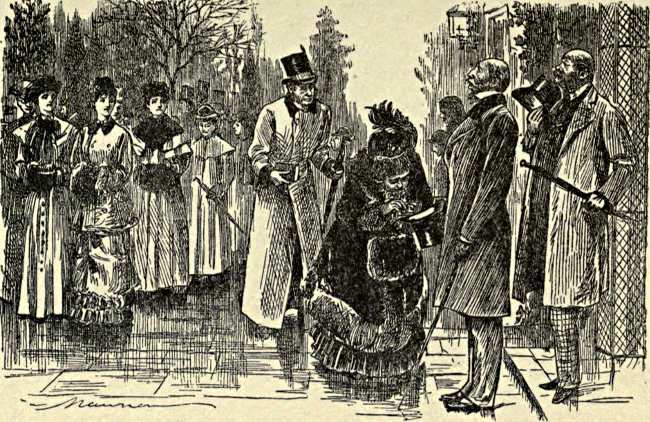
On coming out of church, General Sir Talbot de la Poer Sangrazul is so struck by the beauty of the
afternoon sky, that he forgets to put on his hat, and Lady Jones (who is rather near-sighted) drops
a penny into it!
(A Dialogue of the Present Day)
Scene—Mrs. Featherston’s Drawing-room. Mrs.
Thistledown discovered calling.
Mrs. Thistledown (taking up a novel on a side-table).
“The Romance of a Plumber,” by Paul
Poshley. My dear Flossie, you don’t mean to
tell me you read that man?
Mrs. Featherston. I haven’t had time to do
more than dip into it as yet. But why, Ida?
Oughtn’t I to read him?
Ida. Well, from something Mr. Pinceney told
me the other day—but really it’s too bad to repeat
such things. One never knows, there may be
nothing in it.
Flossie. Still, you might just as well tell me,
Ida! Of course I should never dream——
Ida. After all, I don’t suppose there’s any secret
about it. It seems, from what Mr. Pinceney says,
that this Mr. Poshley—you must promise not to say
I told you——
Flossie. Of course—of course. But do go on,
Ida. What does Mr. Poshley do?
Ida. Well, it appears he splits his infinitives.
Flossie (horrified). Oh, not really! But how
cruel of him! Why, I met him at the Dragnetts’
only last week, and he didn’t look at all that kind
of person!
Ida. I’m afraid there’s no doubt about it. It’s
perfectly notorious. And of course any one who
once takes to that——
Flossie. Yes, indeed. Quite hopeless. At least,
I suppose so. Isn’t it?
Ida. Mr. Pinceney seemed to think so.
Flossie. How sad! But can’t anything be done,
Ida? Isn’t there any law to punish him? By the
bye, how do you split—what is it?—infinitudes?
Ida. My dear, I thought you knew. I really
didn’t like to ask any questions.
Flossie. Well, whatever it is, I shall tell Mudies
not to send me anything more of his. I don’t think
one ought to encourage such persons.
Two Very Different Personages.—“A
society man” and “a secret society man.”
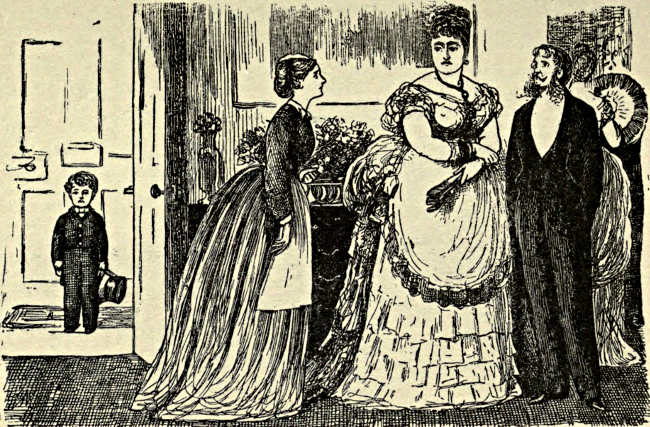
A PROTECTOR
“If you please, Miss Lilian, your mamma has sent the footman to see you home!”
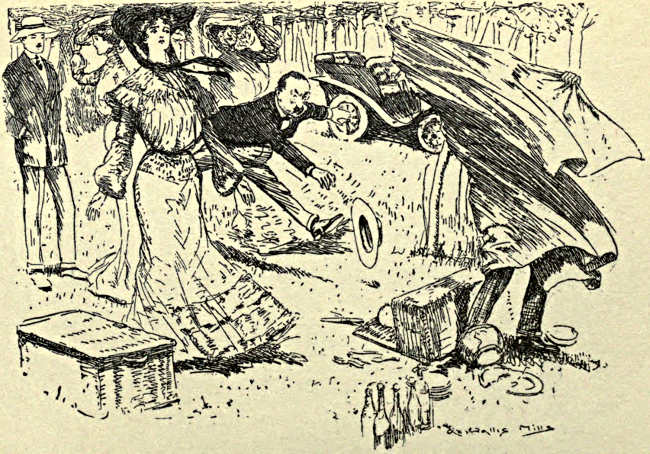
EASIER SAID THAN DONE
Wife (to FitzJones, who, in trying to lay the cloth for the picnic on a windy day, has
got among the crockery). “Just look what you’re doing, Archibald!”
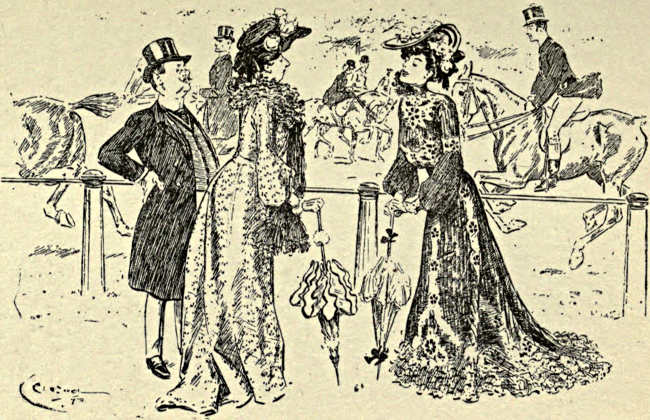
EQUIVOCAL
Mrs. Blobbs. “I quite thought you had forgotten us, Miss Gusher.”
Miss Gusher. “Well, I have a bad memory for faces as a rule, but I should not be likely to
forget yours!”
Time was, not very long ago,
When Mabel’s walking-skirt
Trailed half-a-yard behind to show
How well she swept the dirt.
But “short and sweet” are in again;
No more the grievance rankles,
For Mabel’s now curtailed her train
And shows her dainty ankles.
But Mabel has a thrifty mind.
To supplement her charms,
The frills that once she wore behind
She fastens on her arms.
Her sleeves are made in open bags
Like trousers in the Navy;
No more she sweeps the streets, but drags
Her sleeve across the gravy.
Lenten non lent-’em.—Fräulein von Under
Standt. “How very plainly zat dear Lady Churchleigh
is dressed!”
Friend. “Yes, indeed. But, you must remember,
it is Lent.”
Fräulein. “Ach no! You do not mean to tell
me really and truly zat she borrows her dresses?”
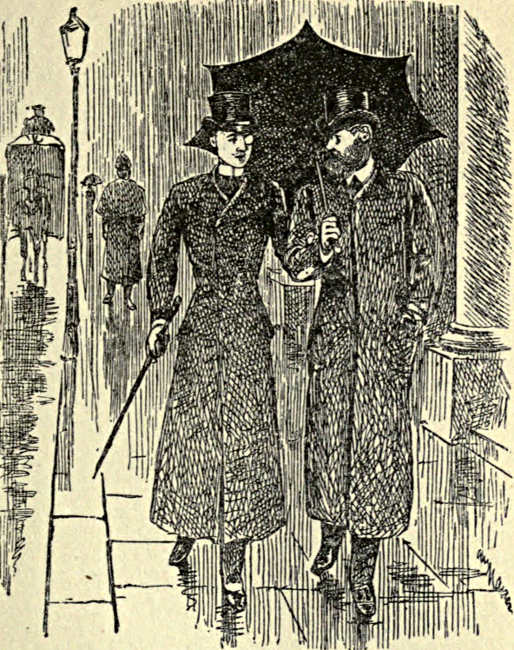
“Hang it, you’ve got an umbrella of your own. Why
the deuce don’t you stick it up?”
“Not if I know it, old man! This umbrella was done up
last May by Monty Brabazon, and has never been opened
since!”
“Monty Brabazon? Who’s he?”
“Not know Lord Montague Brabazon? Why, he’s
about the only man in London who really knows how to do
up an umbrella!”
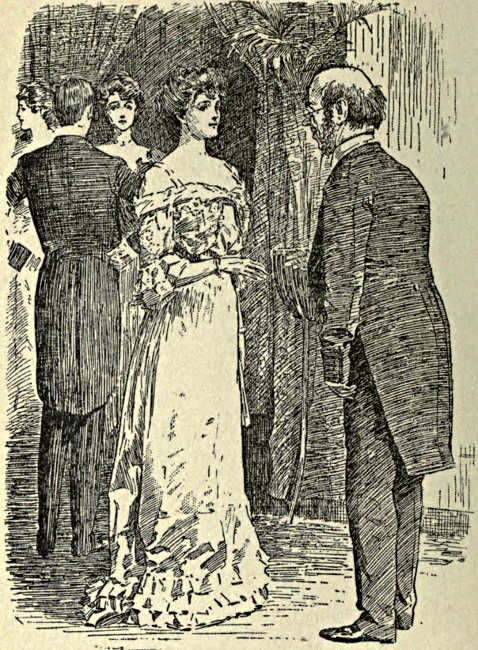
Hostess. “You’re not going already, Professor, surely!”
The Professor. “I’m sorry to, my dear lady, but I have
been working so late all the week I feel I must have my
beauty sleep to-night.”
Hostess. “Then I mustn’t keep you. I’m sure you need
it, poor thing!”
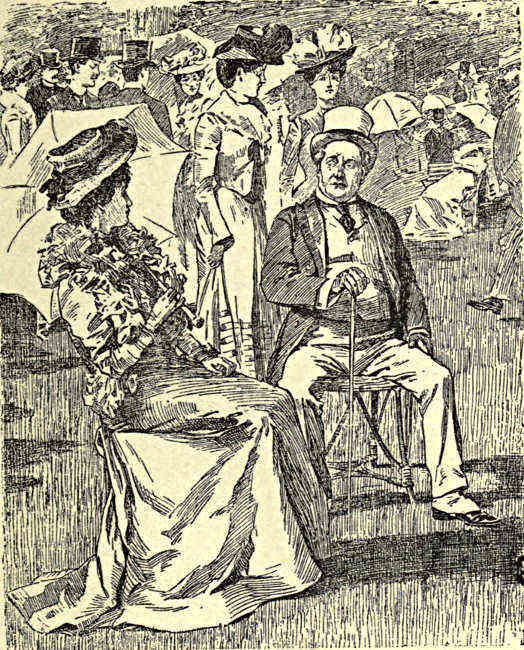
She. “I love this excessively hot weather! Don’t you,
Mr. Boreham?”
He. “No! I can’t stand it. I shall go away if it
continues!”
She. “I do hope it will!”
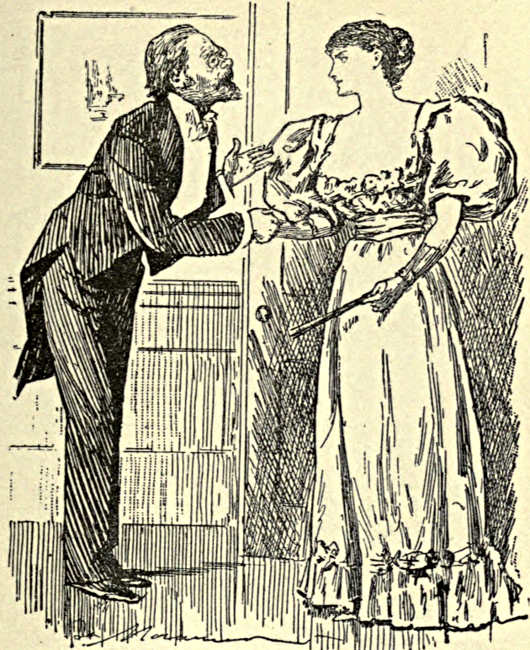
A FRIENDLY REBUKE
“Thanks for a very pleasant evening, and good-night,
Herr Professor. I’m sorry to have to leave you so early!”
“Ach! Fräulein, when you come to see us, your stays
are always so short!”
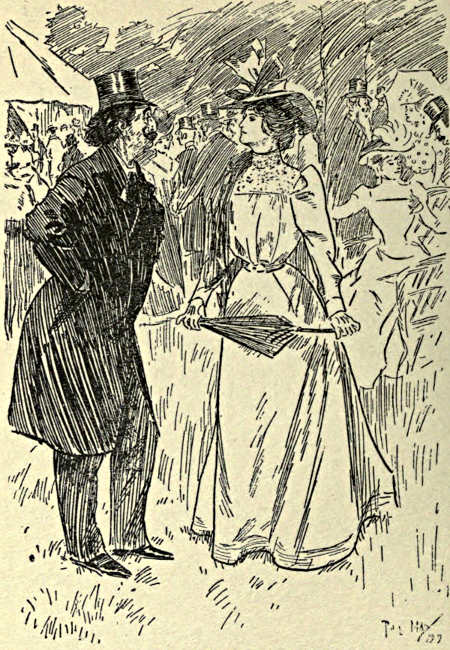
AT A GARDEN PARTY
Lady Vere de Vere (to distinguished foreigner). “You must
excuse me. I know it’s awfully silly of me. I know your
name so well, but I can’t remember your face!”
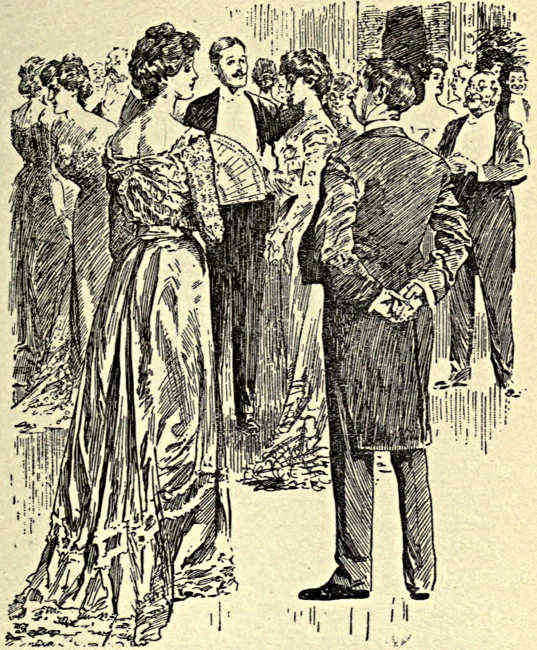
She. “I haven’t seen any of your people here to-night,
Mr. Carter. I hope they are well?”
Mr. Carter. “No. They’ve all got colds. I was the
only one of the family able to come.”
She. “Oh! I am sorry.”
(According to Mr. Sheldon)
[“The Rev. Charles M. Sheldon has just aroused the
wrath of the ladies of Topeka by his views on the servant-girl
problem. He advocated from the pulpit ‘the hired
girl’ should be treated as one of the family and cherished,
not chided.”—Pall Mall Gazette.]
Lord Doubleshire entertained a small party
of friends at his town house last evening. After
dinner the servants mingled freely with the guests,
and the Marchioness of Stoke Newington was
presented to the second stair-maid, Miss Elizabeth
Wilkins, whose acquaintance she made.
Among the smart “bridge” parties last week
must be numbered Mrs. Algey Bounceby’s. Her
butler, Thomas Scraggs, who paired for the first
rubber with the Duke of Dunkirk, is fast proving
his claim to be one of the finest exponents of this
fashionable card game.
We understand that the Countess of Crumbleton
has issued cards to a distinguished but select few
to meet her coachman, Mr. John Jenkins.
At the theatre the other evening, conspicuous
among a remarkably well-dressed set of people, we
noticed Lord Loughboro, the Hon. Misses Loughboro,
and the head gardener, Ezekiel Jilks. The
latter gentleman wore the famous silver Albert
watch-chain, a Christmas present, it is understood,
from Miss Gwendolen Loughboro, the bestowal of
which gift has aroused so much comment in
aristocratic and horticultural circles.
Half-a-dozen dissatisfied members of Brooks’s
club are talking of resigning if Lord Livewell’s
groom is not black-balled. He was of course put
up by Lord Livewell himself and seconded by his
uncle, Earl Gothepace. One or two rumours have
certainly reached us reflecting on the temperance
of Bob Whippet, the handsome groom. But for
the old-fashioned prejudices which evidently animate
the action of the discontented six, we have
nothing but the severest reproof.
Owing to the severe illness of Miss Madeline
Marrowby, the stall at the forthcoming Bazaar will
be taken by her maid Ellen Cripps. As previously
arranged, the stall-holders will be presented
individually to the Royal Visitors.
In the forthcoming golf competition, at Hoylake,
Miss Susan Bates, the scullery-maid to Hon. Miss
Fitzwinter, is looked on as a likely prize winner.
Her handicap playing has shown a wonderful improvement
lately, so much so that her considerate
mistress has given her permission to forego her
ordinary duties of washing up the dishes and filling
the coal scuttles, in order that she may get in
a good morning’s practice on the links.
Among the presentations for the next Drawing-room
we are glad to notice the name of Kate
Briggs, the pretty second parlour-maid of Lord
and Lady Wigmore. It will be remembered that
their head butler attended the last levée. A full
description of Miss Briggs’s presentation costume
appears elsewhere.
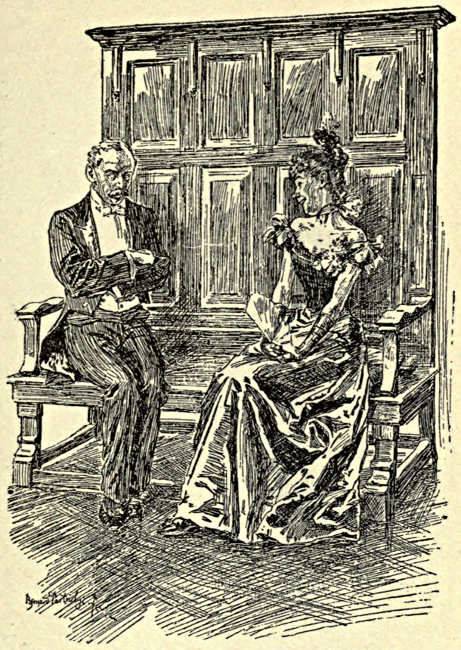
Miss Gushington. “Well, you know, dear Mr. Robinson,
for my part, I must say I enjoy excellent health as a rule,
only I do suffer so at times from fits of giddiness!”
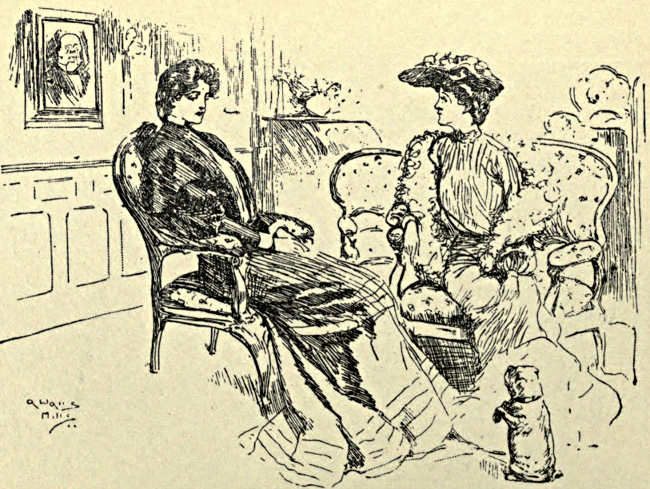
Lady Visitor. “I see you still have poor old Bingo.”
Fair Widow. “Yes. I wouldn’t part with him on any account. I never
look at him without thinking of poor dear Marmaduke!”
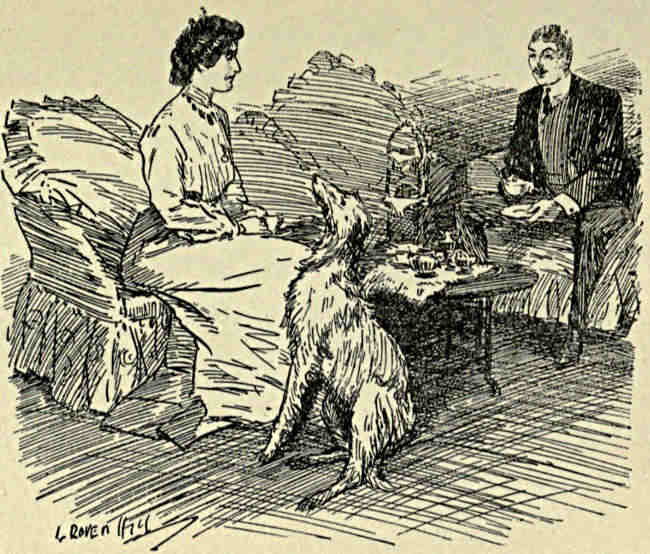
He. “And so, as I didn’t know what the leopard would be up to next, I shot him
on the spot.”
She. “How very exciting! And which spot did you shoot him on?”
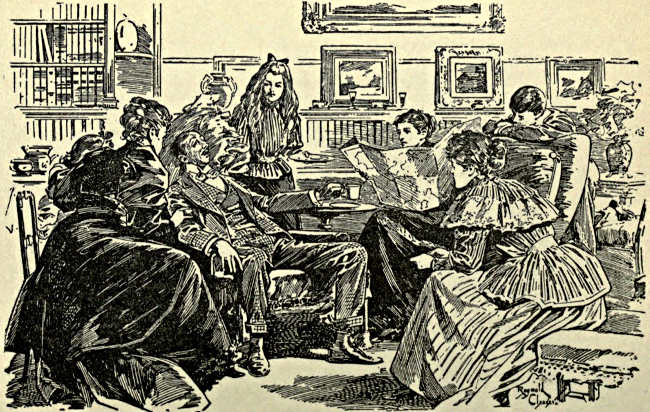
THE LION AT HOME
[See p. 75
The Lion at Home.—The Hope and Pride of
the Family (just home from the grand tour). “Oh,
really, you know, the men one meets in some of
those places out west! I said to myself every
night, ‘Well, thank Heaven I haven’t shot anybody!’”
Fond and Nervous Mother. “You mean, thank
Heaven nobody shot you, don’t you, dear?”
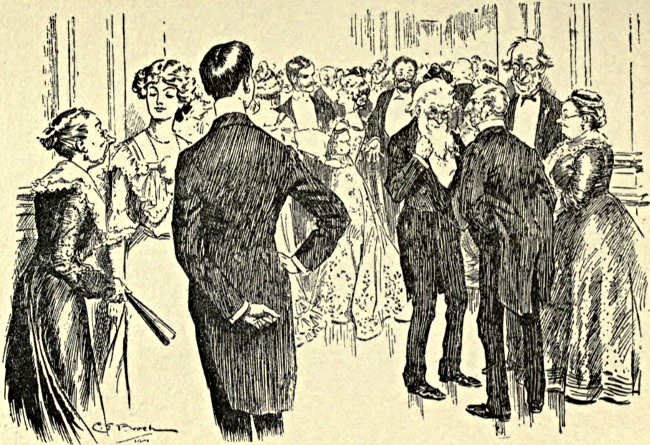
AT A CONVERSAZIONE
Young Lady. “I suppose you know everybody here, Miss Oddie?”
Miss Oddie. “Oh, I know most of them. But there are several strange faces over there!”
In youth I never cared for sport;
Fresh air was not a passion to me;
Athletic feats of any sort
Sent unresponsive shudders through me;
I had, in fact, a sedentary mind,
And hated exercise of any kind.
And so, when others smote the sphere
With bat or mallet, boots or putter,
I charmed (with song) the female ear,
And made the female bosom flutter.
I also played the zither and recited
Poems of young loves, prematurely blighted.
I sang, as I have said: I had
That kind of voice that folks call “fluty”;
I trilled of “Memories strangely sad,”
Of “Pansies” and the “Eyes of Beauty.”
Not more divinely does the early bird
Sing when the worm has recently occurred.
At that delightful hour of gloom,
Slightly anterior to tea-time,
I paralysed the drawing-room
With trifles of my own in three-time,
Till all the air was heavy with Desire,
And prostrate matrons begged me to retire.
Just then a vogue for High Romance
Prevailed, and I’d a pent-up yearning;
The hollow cheek, the hungry glance,
Betrayed the fever inly burning;
At inconvenient times the thing would out,
Especially when ladies were about.
Somehow the care of female hearts
At that time always fell to my lot;
Within the maze of Cupid’s arts
I was their guiding star, their pilot;
Not to have loved me with a blinding passion
Was, broadly speaking, to be out of fashion.
But latterly, I don’t know why,
That star has waned, until at last I’m
Left in the lurch while maidens fly
Towards the ruder forms of pastime;
And now their talk is all of tennis courts,
Of golf, gymkhanas and athletic sports.
I don’t complain. I know there’ll be
One of these days a mild renaissance
In the exclusive cult of ME:
I view the fact with some complaisance;
One day there’ll come an era of the Brain,
And Theodore will be himself again.
Manners.—In the dining-room of respectable
society it is not considered correct to put your
fingers into the plate before you. But at church,
into the plate that is set before you, all are
expected to put their alms.
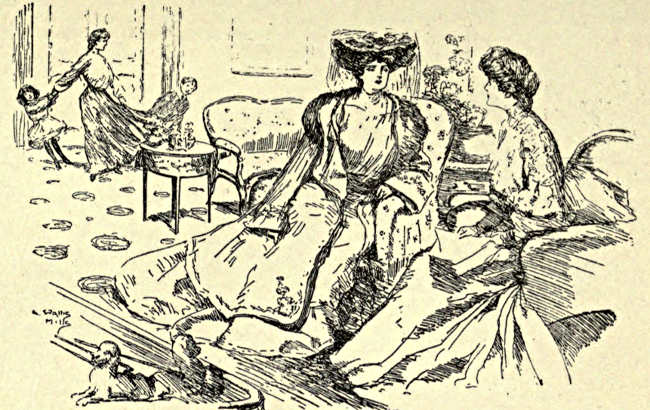
FEMININE AMENITIES
Visitor. “Your governess seems very good-natured.”
Lady of the House. “Yes, poor thing, her father lost a lot of money, so I took
her as governess for the children.”
Visitor. “Poor, poor thing! Isn’t it terrible how unfortunate some people are!”
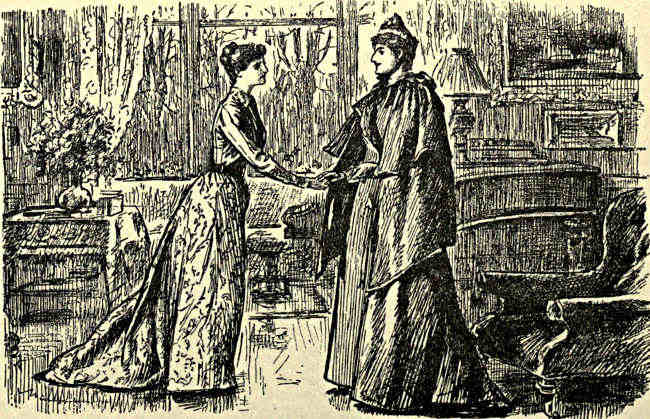
FELINE AMENITIES
“How kind of you to call—I’m so sorry to have kept you waiting!”
“Oh, don’t mention it—I’ve not been at all bored! I’ve been trying to imagine what I should do to
make this room look comfortable if it were mine!”
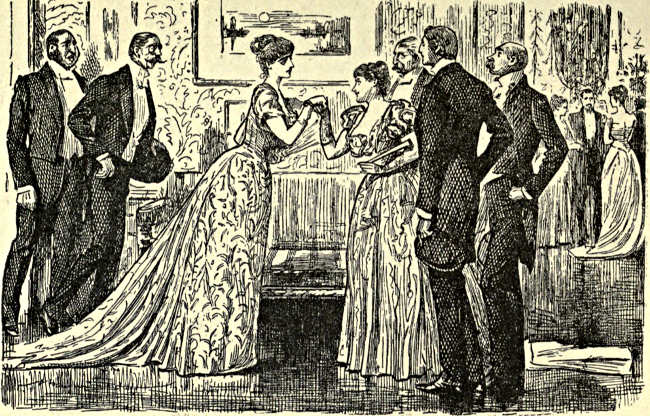
Fair Hostess (to Mrs. Masham, who is looking her very best). “Howdydo, dear? I hope you’re not so tired
as you look!”
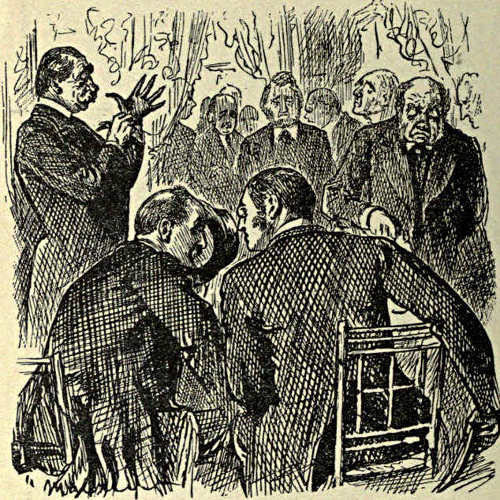
THE LIFE OF THE PARTY
“I say, Brown, let’s try and get into the same mourning-coach
as Major Bardolph. He always comes out so jolly
on these occasions!”
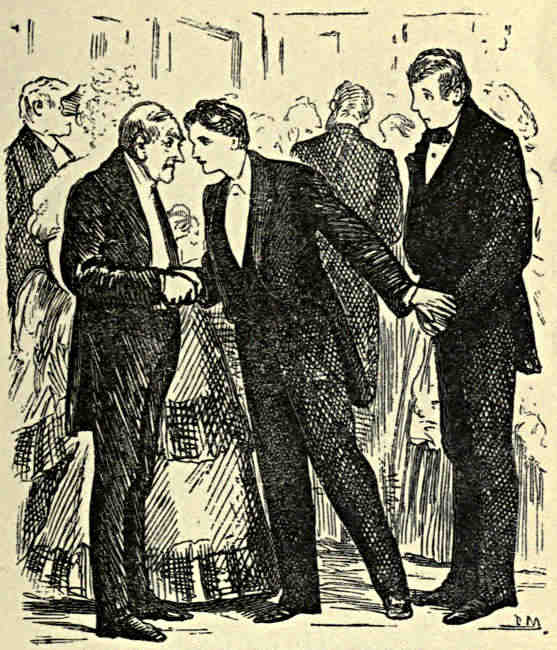
A VALUABLE ACQUISITION
Dutiful Nephew. “Oh, uncle, I thought you wouldn’t
mind my bringing my friend Grigg, from our office. He
ain’t much to look at, and he can’t dance, and he don’t
talk, and he won’t play cards—but he’s such a mimic!!
To-morrow he’ll imitate you and Aunt Betsy in a way that’ll
make all the fellows roar!!!”
A Drama of the Drawing-room.—By means
of his face and attitude, Jones flatters himself he
can express the deepest interest in the conversation
of a bore, while in reality his attention is fixed
on what is going on in some other part of the
room.
Just at present, old Mrs. Marrable is relating to
Jones the harrowing details of her late lamented’s
last illness—while Captain Spinks is popping
the question to Clara Willoughby behind one of
Chopin’s Mazurkas—and Jones has no doubt but
that his face and attitude are all Mrs. M. could wish.
London Idylls.—Algernon (the heir). “Awfully
kind of Mrs. Masham to give us a lift. But it
was rather a squeeze, eh?”
Jack the Detrimental (his younger brother).
“Yes. By the way, talking of squeezes, it struck
me very forcibly, driving along, that you’d got
hold of one of Miss Laura Masham’s hands!”
Algernon. “Well, you meddling young idiot!
what if I had?”
Jack. “Oh, nothing. Only I’d got hold of the
other, you know!”
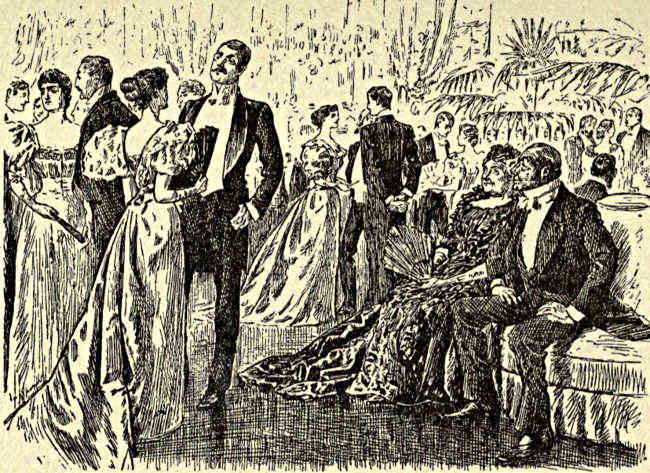
THE RISING GENERATION
Host. “What a smart set of people we’ve got to-night, deary!”
Hostess. “Yes. How I wish one of our dear girls would come and sit by us, and tell us
who everybody is!”
Scene—A Ball Room. Edwin leads out Angelina
as arranged earlier in the evening, to dance
a promised “square.” They walk through the
first figure. A pause.
Edwin. Been to the Academy, of course?
Angelina. O yes. Been several times. So fond
of Miss Thompson’s picture, you know. I like the
group of the dying soldier and the boy laughing at
having killed a Frenchman, awfully. So awfully
clever, you know.
Edwin. O awfully! The wounds are so awfully
true to nature, you know. Do we begin?
They walk through the second figure. A pause.
Edwin. Been to see Salvini?
Angelina. Of course. Isn’t he awfully nice?
I think he is perfectly charming in Othello. His
face quite reminds me, in the Jealousy Scene, of
dear Mr. Irving in the last Act of The Bells. His
suicide at the end of the piece, you know, is really
quite too awfully clever. Isn’t it?
Edwin. You mean the throat-cutting affair, eh?
When he falls on his back and dies quivering, eh?
O yes, awfully clever. It’s our turn, I think.
They walk through the third figure. A pause.
Edwin. Read any novels lately?
Angelina. Just read an awfully nice book, “The
Law and the Lady.” One of the heroes is a monstrosity
without legs, Miserrimus Dexter, don’t you
know. Awfully clever.
Edwin. O yes. Read the book myself. Clever
notion, the idiotic man-woman, eh, wasn’t it?
Angelina. O yes, awfully good. I think they
are waiting for us.
They walk through the fourth figure. Promenade.
Edwin. Did you go to Stafford House to see
the coffins?
Angelina. O yes, we all went—Mamma, Papa,
and the children, don’t you know. Met everybody
there. Such an awful crush.
Edwin. Like the coffins?
Angelina. O so much. They looked awfully
nice. So deliciously cool, don’t you know.
Edwin. Cool! You like that kind of thing
cool, eh?
Angelina. Yes, I think so.
Edwin. Ah, then you must be against cremation?
Angelina (hesitating). Well—yes—perhaps.
(After consideration.) Yes, I think so. Yes, I
think I like the baskets best.
[Fans herself.
Edwin. À propos—may I get you an ice?
Angelina. O, thanks so much. Yes, Grandpapa
was awfully delighted with the wicker coffins, and
has ordered a couple lined with charcoal, for himself
and Grandmamma. I am going to the shop
to-morrow to choose them for him. Thanks—strawberry,
please.
[They retire into the Refreshment-room, with a
view to getting cool.
“Noblesse Oblige.”—Old Friend. “Hullo,
Dick? How are you? I wish you’d come and
dine with me to-night. But now you’re a lord, I
suppose I mustn’t call you Dick any longer, or
even ask you to dinner?”
Noble Earl (who has just come into his title).
“Lord be blowed! Lend me a fiver, and you
may call me what you like—and I’ll dine with
you into the bargain!”
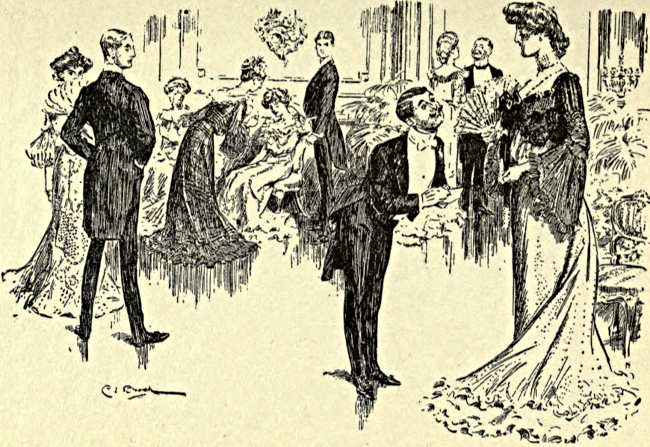
Little Dobbs (who is a good dancer, but has let his partner down with a crash).
“That was my very first accident. Will you give me a dance?”
She (majestically). “Certainly, with pleasure. I never let a man down in my life!”
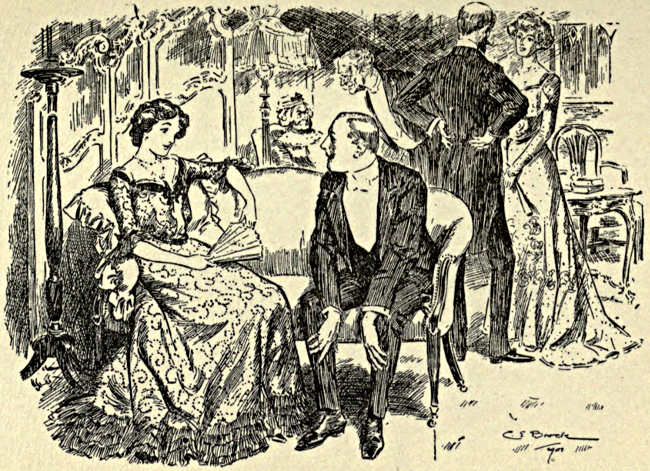
He (who has failed to catch his companion’s name, and wishes to find it out indirectly).
“By the way, how do you spell your name?”
She. “J-O-N-E-S.”
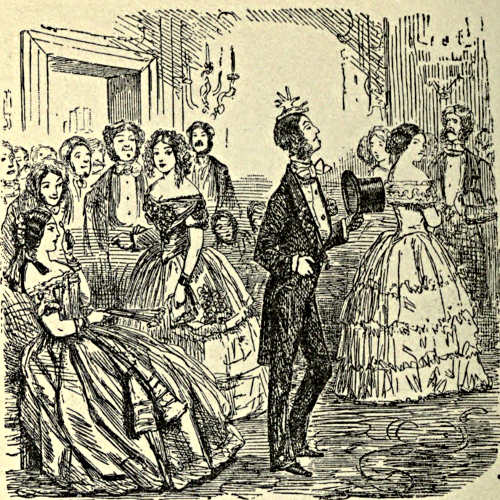
NEVER CARRY YOUR GLOVES IN YOUR HAT
Mr. Poffington flatters himself he is creating a sensation.
(Perhaps he is.)
Our Whist Party.—Major MacFlush (at close
of rubber, to partner). “Didn’t ye see me call for
trumps?”
Partner (a new hand). “You may have called,
major, but I never heard you!”
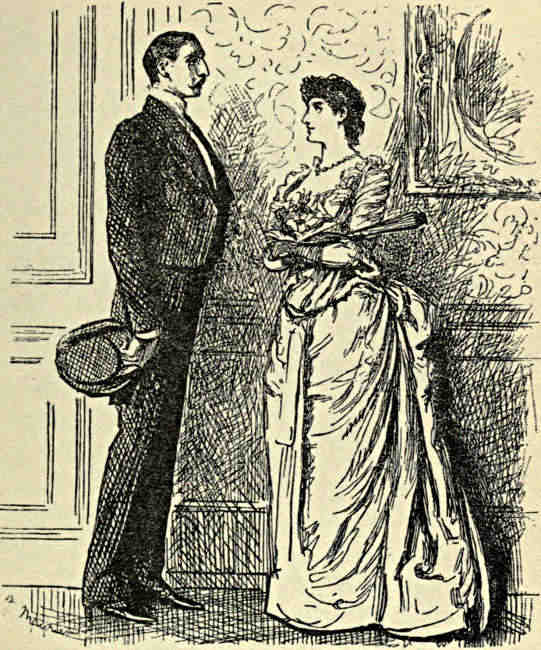
THE HEIGHT OF EXCLUSIVENESS
She. “I believe you know my neighbours, the Chesterfield
Browns?”
He. “Haw—well—a—I go to the house, don’tcherknow,
and dine with ’em occasionally, and all that—but I’m not
on speaking terms with ’em!”
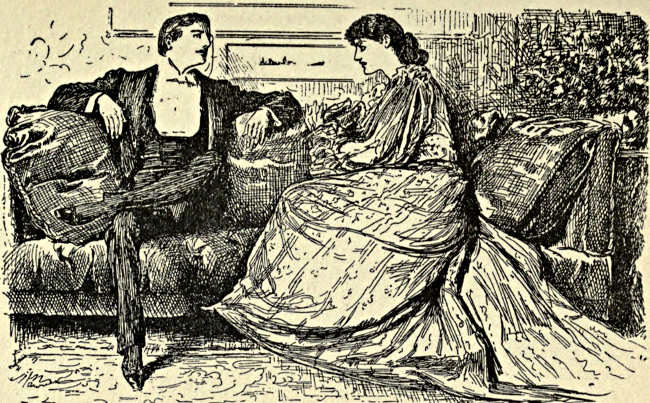
DRAWING-ROOM INANITIES
He. “I live in Hill Street. Where do you live?”
She. “I live in Hill Street, too.”
He (greatly delighted to find they have something in common). “Really!” (After a moment’s hesitation.)
“Any particular number?”
(Latest Bulletins)
[“A person writing to the Daily Dispatch says the
Marquess of Anglesey’s wonderful polyglot parrot is not
ill, but on the contrary was laughing and chatting very
heartily on Monday.”]
We are glad to be able to state that Lord Mount
Sorrel’s favourite monkey, which has been suffering
lately from phlebitis, is well on the way to recovery.
No further bulletins will be issued.
The report that Lady Agatha Fitzhunter’s pet
pony was confined to the stable with bronchitis is
grossly exaggerated. The pony merely complained
of being a little horse. The joke, of course,
like its maker, was a chestnut.
Mrs. Martin Bradley’s French poodle is rapidly
re-covering. It is admitted on all hands, however,
that it was a remarkably close shave.
The alarming rumour that Lord Barndore’s
famous owl (which had been suffering from insomnia
lately) had committed suicide on Tuesday night, is
happily contradicted this morning. It appears that
the owl had merely left the house for a few hours
for a special purpose-to wit, to woo!
Lord Raspberry’s prize turkey, which a short
time ago had a painful operation performed on its
neck, was able to appear at dinner last night and
received a cordial welcome from those present.
The absurd tale that Lady Hopton Wood’s
pretty little Manx cat was suffering from diseased
liver has no foundation in fact. The liver was
perfectly good, and similar to that usually supplied.
A Distinction and a Difference.—Gorgius
Midas Junior (a crack dancer in his own set) gets a
card for a dance at Stilton House, and waltzes with
Mrs. Ponsonby de Tomkyns, the only lady he knows
there, and who has often been his partner under the
paternal roof. Proudly conscious of creating a sensation,
he is dancing his very best, when—
Mrs. Ponsonby de Tomkyns (suddenly). “We’d
better stop, Mr. Midas! This form does very well
at Midas Towers, but it doesn’t do here!”
[G. M’s “form,” which is not restricted to himself,
consists in holding his partner like a banjo, and
hopping slowly around her beneath a chandelier.
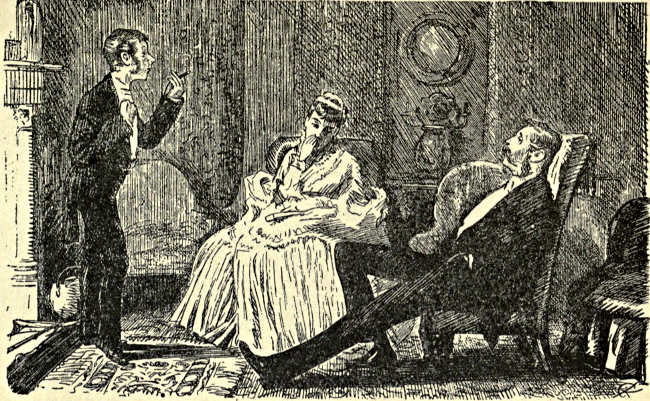
“The Last Feather” (Time—4 a.m.)—Little Twister (to his Host, lighting his tenth cigar, and having
exhausted “The Spanish Crisis,” “Dissolution of Parliament,” “Voyage of Challenger,” &c.) “By th’by,
Bloker, it strikes me there are several points in this Tichborne case that——”!!
[All we know further is, that about this hour a short gentleman was seen to leave a house in Gravelotte
Crescent hastily, without his hat, which was thrown after him!
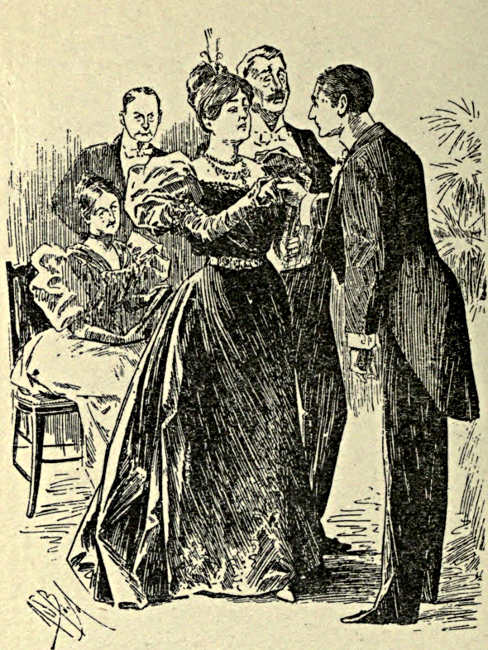
NOT A PLEASANT WAY OF PUTTING IT
Hostess. “I’m afraid we are going to be a very small
party to-night. The fog seems to have kept away all our
best people!”
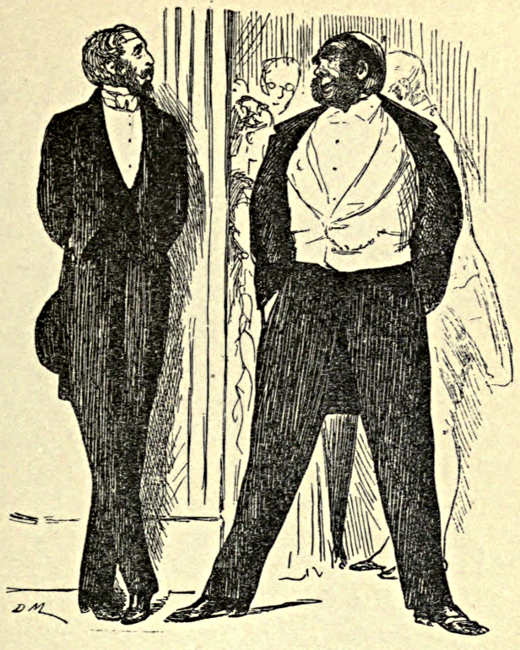
EXCLUSIVENESS
Host. “Nice party, ain’t it, Major Le Spunger? ’Igh
and low, rich and poor,—most people are welcome to this
’ouse! This is ‘Liberty ’All,’ this is! No false pride or
’umbug about me! I’m a self-made man, I am!”
The Major. “Very nice party, indeed, Mr. Shoddy! How
proud your father and mother must feel! Are they here?”
Host. “Well, no! ’Ang it all, you know, one must draw
the line somewhere!”
“A smartish affair this,” I said to the little
man with the pale-blue eyes, who leant disconsolately
against the wall.
He laughed nervously. I felt drawn to him,
somehow. He appeared to know no one, and I
knew very few intimately, and hadn’t succeeded
yet in discovering the host and hostess.
“But I should say,” I went on, drawing inspiration
from my new acquaintance’s sympathetic
attention, “I should say it cost our host Sir Tumnal
Tintz a pretty penny. The champagne is exactly
up to par, and no stint.”
“Really, I’m glad to hear you say so.”
“Reassuring, isn’t it?”
From our point of vantage we could command a
full view of the ball-room. The melody of the
waltz, the perfume, and the frou-frou of Parisian
and Viennese confections had lulled the little man
into a delicious reverie.
“There,” I said, “you see that old chap who looks
as if he had stolen the Eastern Hemisphere and
put it under his waistcoat—that explains the fizz!”
My friend looked exceedingly puzzled.
“That’s Gootzegog—the chap who supplied the
wine. Oh, everybody knows Sir Tumnal runs
things a bit above his income. Lady Tintz has
social ambitions. What’s the consequence? Bills
are paid by invitations to meet all the exclusive
and celebrated, instead of by coin of the realm.
Gootzegog accepted with pleasure—on the back
of a receipted bill for six dozen ‘bottles of the
boy.’”
“Really, this is exceedingly unpl——”
“Social sins,” I said. “You’ll know them all by
heart by and by. It’s only a question of time.
Now, you see that woman hop-waltzing. There,
just passed us, high-pitched voice, pearls——”
“Yes, yes, but——”
“That is Mrs. Grinburger, known in Chatham
Street as Juliette & Cie., swagger dressmakers,
where Lady Tintz can make up her betting-book,
and hedge—by patronising the Grinburger.”
“Upon my word!” in astonishment.
“Scandalous having to meet these people. And
that thin woman bare-ly clothed—ha! ha! excuse
my little quip.”
“I know——”
“Mdlle. Sembrach—bonnets; supplies the Tintz
girls with headgear, and is allowed to pass as a
friend of the family because she forgets to send in
the bill. Convenient, isn’t it? She looks like
making a match—or a breach of promise——”
“It is incredible,” almost vociferated my little
friend, whose eyes I was evidently opening as to
the ways and means of a certain, or rather uncertain,
class of society. “It is incredible,” he said,
“that you should tell me all these scandalous tales
in the house where you are privileged——”
“Quite so, quite so,” I said, fearing I may have
wounded his sensibilities. “One only does this
sort of thing when the function is a fizzle. But
you appeared to know no one.”
“You appear to know everyone——”
“A good many. Come, let us have a stroll
round and try and find the host.”
The little man blinked nervously.
“Have you any idea what the Johnny’s like?”
I enquired.
“Exactly like me,” said the little man. “I am
Sir Tumnal Tintz!”
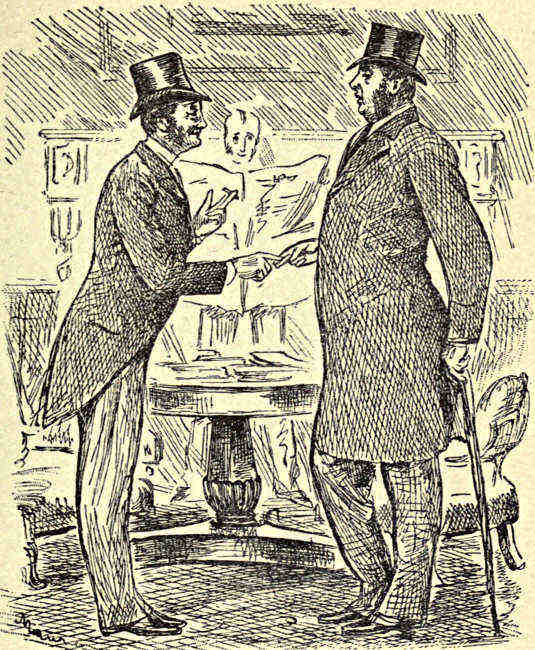
A HINT
Sir Pompey Bedell. “Oh—er—Mr. Grigsby, I think! How d’ye
do?”
Grigsby. “I hope I see you well, Sir Pompey. And next time
you give me two fingers, I’m blest if I don’t pull ’em off!”
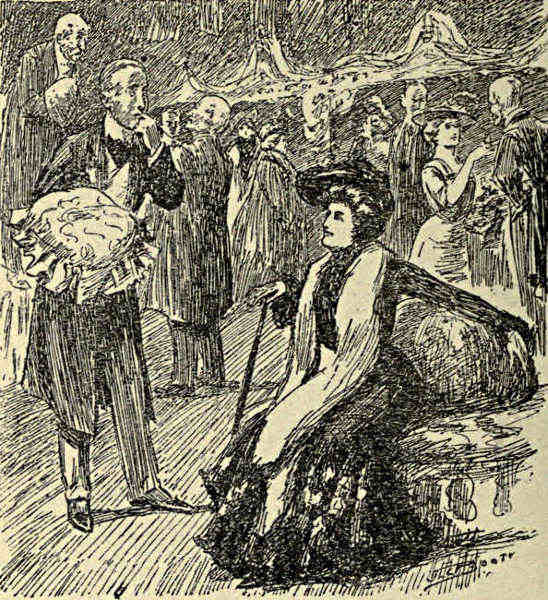
TRUTH AT ALL HAZARDS
Footinitt (energetically helping at bazaar). “Won’t you
put in for a raffle for this cushion?”
Visitor. “Oh, no, thanks.”
Footinitt. “Of course it’s rather useless and gaudy, and
so forth; and personally I think the design’s rotten. But
do put in for it.”
Visitor. “No, thanks. I made it!”
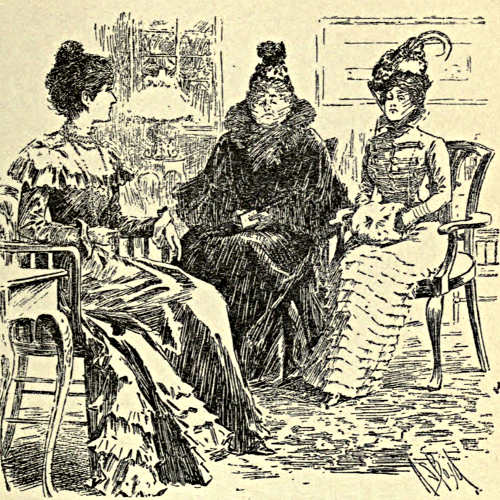
MOST CONSIDERATE
Mrs. Snobbington. “We had meant to call long before
this, really, but with the best intentions, somehow, we
always kept putting off the evil day.”
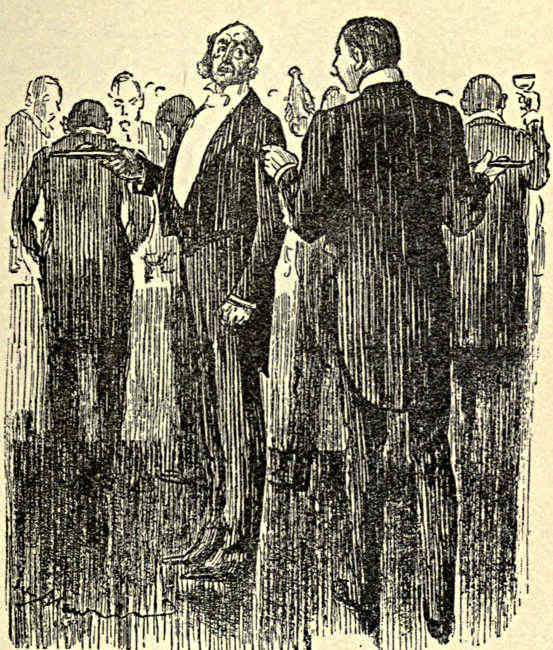
INCONVENIENCE OF MODERN MALE ATTIRE
First Stranger. “Here—hi! I want a knife and fork, please!”
Second Stranger. “Con-found you—so do I!”
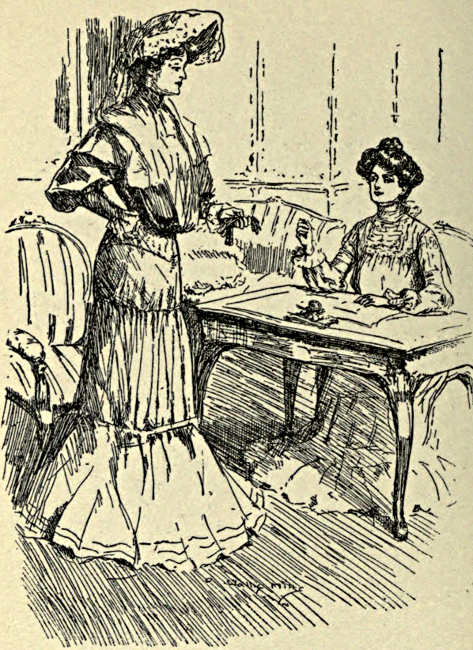
Visitor. “I’ve just been to make my first call on Mrs.
Johnson.”
Lady of the House. “So glad, dear. Poor thing, she’s
glad to know anyone!”
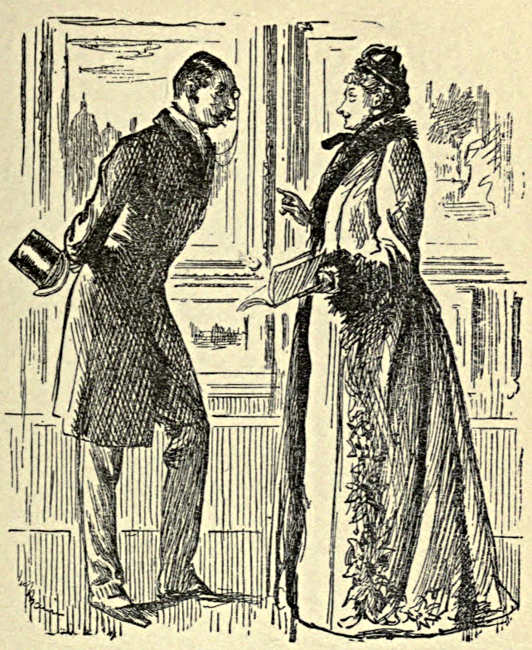
“Oh yes, Sir Gus, my husband’s as well as ever, thank
you, and hard at work. I’ve had to copy out his pamphlet
on Bi-metallism three times, he alters it so! Ah, it’s no
sinecure to be married to a man of genius. I often envy
your dear wife!”
[“Among upper-class women the use of bad language is
awful; not only do elderly dowagers say ‘D—n!’ but girls
of seventeen make use of that deplorable expression.”—A
correspondent to the Daily Express.]
The age is unmistakably profane;
Morality, like trade, is on the wane:
Of late with most profound regret I’ve heard
How that a certain naughty little word,
Quite impolite, and quite unparliament’ry too,
Once vulgar, now’s affected by the gentry too.
From common oaths my tender spirit shrinks,
I foozle when I hear them on the links;
The cabby’s curse my moral system shocks,
I shudder when I hear it from the box;
But that which on the raw more sorely touches is
The swear that’s used by dowagers and duchesses.
When in the case of nobly-bred adults
Age and experience yield these sad results,
What wonder if their daughters (pretty lambs!)
Indulge at times in copying their dams?
(A “play ’po’ words” which serves to render printable
That which, writ otherwise, would be but hintable.)
Is this profanity a passing phase
Like Pigs-in-clover, or the Ping-pong craze?
Will it revert to “Goodness me!” or “Blow!”?
I cannot tell you, for I do not know;
This I do know: a nation grave disaster risks
That lets its women talk in ——s and * * *
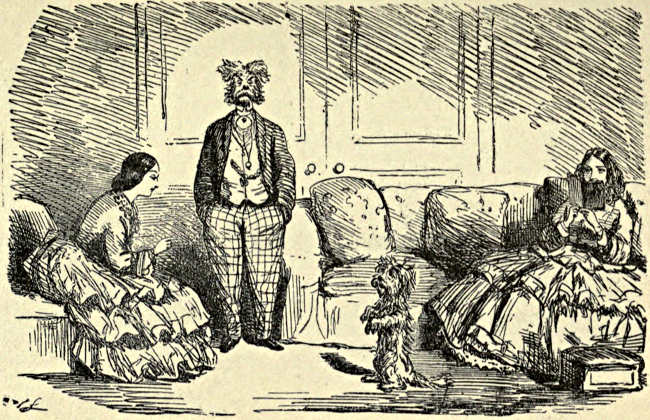
Party (who, of course, doesn’t think himself good-looking). “Really, Clara, I can’t think
how you can make a pet of such an ugly brute as an Isle of Skye terrier!”
“Ready! Aye Ready!”—Mrs. Ponsonby de
Tomkyns. “That lady was evidently intended by
nature for a Chinese, Sir Charles! I wonder who
she can be?”
Sir Charles. “She happens to be my sister,
Lady Plantagenet de la Zouche. May I ask why
you think nature intended her for a Chinese?”
Mrs. P. de T. (equal, as usual, to the emergency).
“She struck me as having such exquisitely small
feet!”
Dreadful State of Affairs at Market
Harborough.—Lord Charles Highflyer (despondently).
“There’s too much frost to hunt, and not
enough ice to skate; all the horses are coughing;
the gov’nor writes to say that he’s going to endow
a new church; Bingo wires that all seats are
booked for a fortnight at any theatre worth going
to; Fanny Canterly is engaged to that ass
Blinkers; I’ve a bill overdue on Tuesday;
Hummingbirdie Belleville threatens an action
for breach of promise; Aunt Genista hasn’t
weighed in as usual; and some idiot has sent me
a card with a robin on it, wishing me ‘All the
Compliments of the Season!’”
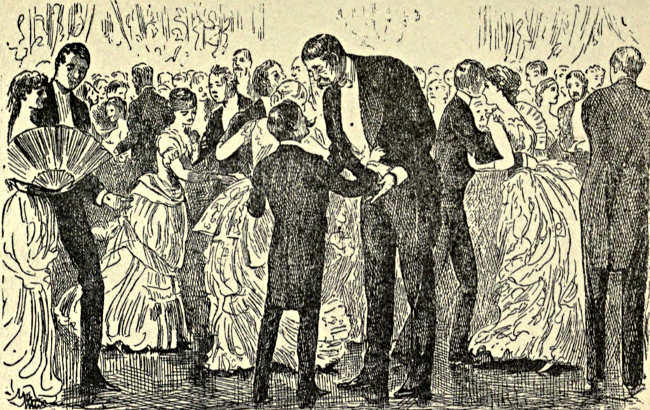
A FRIEND IN NEED
Bobby Short. “I say—I can’t find my partner, Miss Wilson! Have you seen her?”
Tommy Long. “Don’t know her by sight, even! But, if you like, I’ll lift you up, and
you can hunt for yourself!”
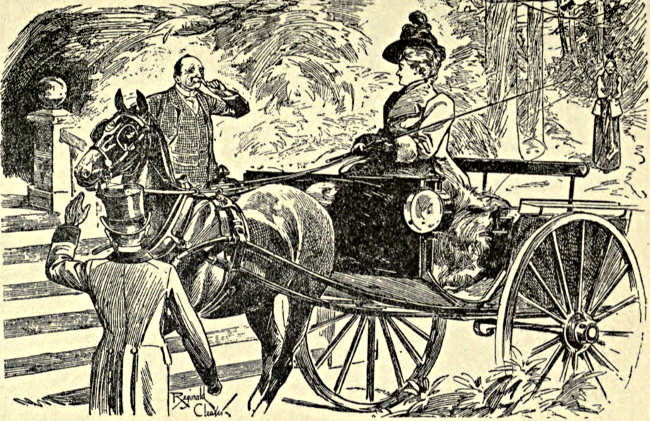
Mrs. Gusher. “Oh, good-bye, Sir John. So sorry not to have found your most charming wife at home.”
Sir John. “Thanks—thanks! By the way, let me assure you I’ve only got one,—and——”
[Thinks that the remainder of the sentence is “better understood than expressed.”
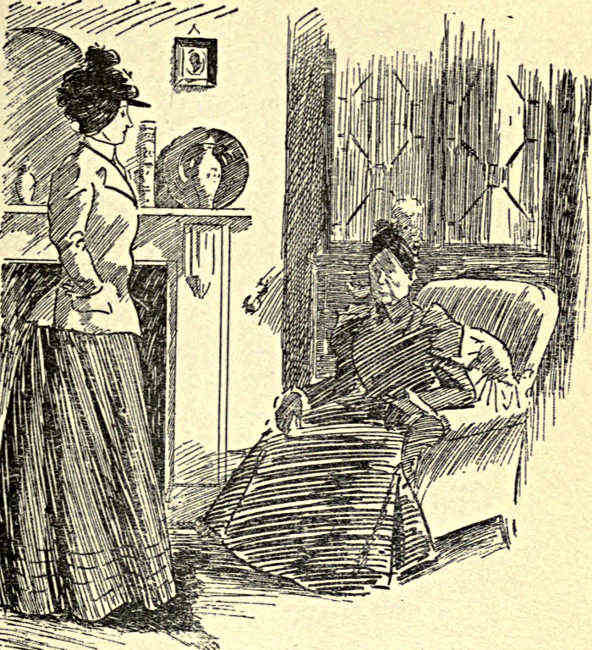
Lady of the House (to Bore, who generally calls just as she is
about to go shopping). “Won’t you let me ring for a little
refreshment for you?”
Bore. “I think I’ll take a little something just before
I go.”
Lady of the House. “Oh, then, do have it now!”
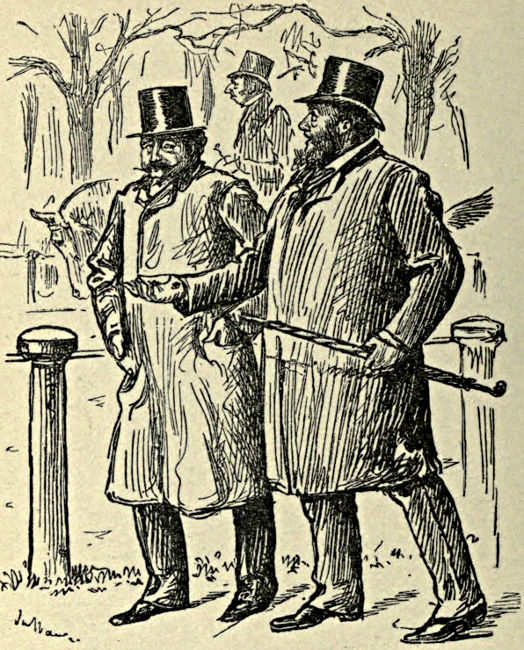
THE BRITISH PASSION FOR INEQUALITY.
Sturdy Briton. “It’s all very well to turn up your nose at your
own beggarly Counts and Barons, Mossoo. But you can’t find fault
with our nobility! Take a man like our Dook o’ Bayswater, now!
Why, he could buy up your foreign Dukes and Princes by the dozen!
and as for you and me, he’d look upon us as so much dirt beneath his
feet! Now, that’s something like a nobleman, that is! That’s a kind
o’ nobleman that I, as an Englishman, feel as I’ve got some right to
be proud of!”
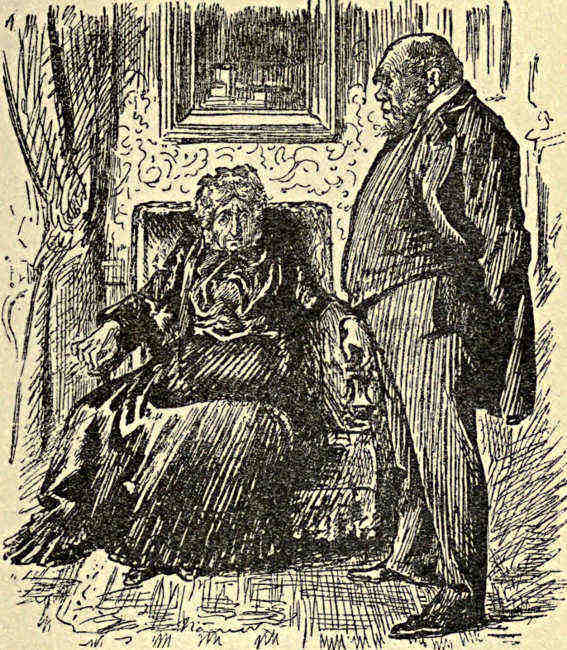
THE SERPENT’S TOOTH
“Didn’t I send ’im to Heton an’ Hoxford? Didn’t I send ’im into
the Harmy, along o’ some o’ the biggest nobs in all Hengland, with
an allowance fit for a young Hearl? And what’s the hupshot of it
all? Why, he gives dinners to Dooks and Royal ’Ighnesses, an’ don’t
even harsk ’is pore old father to meet ’em. ’Ighnesses, indeed! I
could buy up the ’ole blessed lot! And, what’s more, I wouldn’t mind
tellin’ ’em so to their faces, for two pins!—Ah! just as soon as look at
em—and ’e knows it!”
I have been so bothered for coppys of my Romanse, as
I read at the Cook’s Swarry some time back, that I have
detummined to publish it, and here it is. In coarse, all
rites is reserved.
Robert.
THE MYSTERY OF MAY FARE
(By One Behind the Seens)
Chapter I.—Despare!
It was Midnite! The bewtifool Countess of
Belgravier sat at the hopen winder of her Boodwar
gazing on the full moon witch was jest a rising
up above the hopposite chimbleys. Why was that
evenly face, that princes had loved and Poets sillybrated,
bathed in tears? How offen had she, wile
setting at that hopen winder, washed it with Oder
Colone, to remove the stanes of them tell tail
tears? But all in wane, they wood keep running
down that bewtifool face as if enamelled with its
buty; and quite heedless of how they was a spiling
of her new ivory cullered sattin dress that Maddam
Elise’s yung ladies had been a workin on up to
five a clock that werry arternoon.
She had bin to the great ball of the Season, to
be washupped as usual by the world of Fashun,
but wot had driven her home at the hunerthly hour
of harf-parst Eleven? Ah, that cruel blo, that
deadly pang, that despairin shok, must be kep for
the nex chapter.
CHAPTER II.—The Helopemeant!
Seated in the Housekeeper’s own Room at the
Dook of Surrey’s lovely Manshun, playfoolly
patting his fatted calves, and surrounded by his
admiring cirkle, sat Charles, the ero of my Tale.
Charles was the idle of that large establishment.
They simply adored him. It was not only his
manly bewty, tho that mite have made many an
Apoller envy him. It was not only his nolledge
of the world, tho in that he was sooperior to
menny a Mimber of Parlyment from the Sister
Oil, but it was his style, his grace, his orty demeaner.
The Housekeeper paid him marked
attenshuns. The Ladies Maid supplyed him with
Sent for his ankerchers. The other Footmen
looked up to him as their moddel, and ewen the
sollem Butler treated him with respec, and sumtimes
with sumthink else as he liked even better.
The leading Gentlemen from other Doocal establishments
charfed him upon his success with the
Fare, ewen among the werry hiest of the Nobillerty,
and Charles bore it all with a good-natured larf
that showed off his ivory teeth to perfecshun. Of
course it was all in fun, as they said, and probberly
thort, till on this fatal ewening, the noose spread
like thunder, through the estonished world of
Fashun, that Charles had heloped with the
welthy, the middle-aged, but still bewtifool,
Marchioness of St. Bendigo.
Chapter III.—The Dewell.
The pursoot was rapid and sucksessful, and the
Markiss’s challenge reyther disterbed the gilty
pair at their ellegant breakfast. But Charles
was as brave as he was fare, and, having hired his
fust Second for twenty-five francs, and made a few
other erangements, he met his hantigginest on the
dedly field on the follering day at the hunerthly
hour of six hay hem. Charles, with dedly haim,
fired in the hair! but the Markiss being bald, he
missed him. The Markiss’s haim was even more
dedly, for he, aperiently, shot his rival in his hart,
for he fell down quite flat on the new-mown hay,
and dishcullered it with his blud!
The Markiss rushed up, and gave him one
look of orror, and, throwing down a £1,000 pound
note, sed, “that for any one who brings him two,”
and, hurrying away to his Carridge, took the next
train for Lundon. Charles recovered hisself
emediately, and, pocketing the note, winked his
eye at the second second, and, giving him a
hundred-franc note for hisself, wiped away the
stains of the rouge and water, and returned to
breakfast with his gilty parrer-mour.
Chapter IV.—The End.
The poor Markiss was so horryfied at his
brillyant sucksess, that Charles’s sanguinery
corpse aunted his bed-side, and he died within a
month, a leetle munth, as Amlet says, of the dredful
ewent, and Charles married his Widder. But,
orful to relate, within a werry short time Charles
was a sorrowin’ Widderer, with a nincum of sum
£10,000 a year; and having purchased a Itallien
titel for a hundred and fifty pound, it is said as he
intends shortly to return to hold Hingland; and
as the lovely Countess of Belgravier is fortnetly
becum a Widder, and a yung one, it is thought
quite posserbel, by them as is behind the seens,
like myself, for instance, that before many more
munce is past and gone, there will be one lovely
Widder and one andsum Widderer less than there
is now; and we is all on us ankshushly looking
forred to the day wen the gallant Count der
Wennis shall lead his lovely Bride to the halter
of St. George’s, Hannower Squeer, thus proving
the truth of the Poet’s fabel,—
“The rank is but the guinny’s stamp,
The Footman’s the man for a’ that.”
Awkward.—Miss Fillip (to Young Gentleman,
who has taken her in to dinner at Olympia Manor).
“You say that you don’t shoot, hunt, fish, drive, or
ride, and that you hate cycling. Now, what on
earth are you staying here for?”
Young Gentleman (languidly). “Because I can’t
afford to live anywhere else in the winter.”
[Then it flashes across Miss F. that she is talking to a younger son of the house.
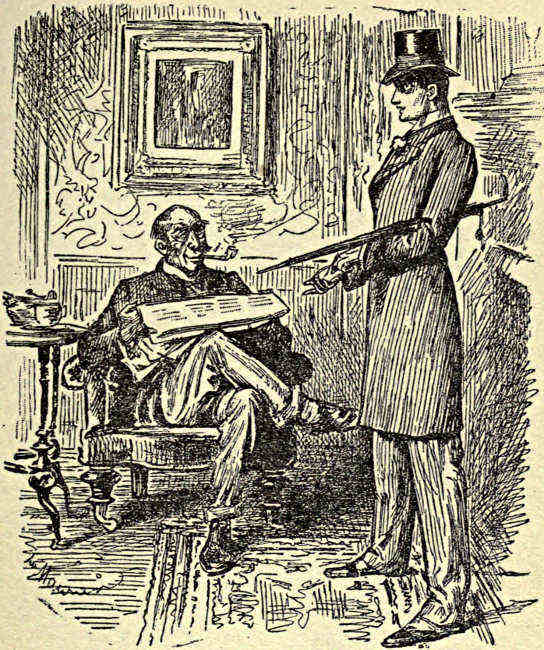
FORM!
“Good Heavens! What a swell! What is it? Tea
fight? Wedding breakfast?”
“Oh no; only going to my tailor’s. Must be decently
dressed when I go to see him. He’s so beastly critical!”
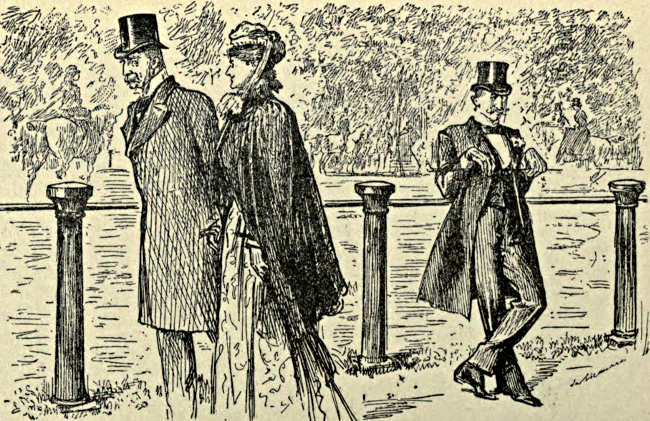
EN PASSANT
He. “That’s that ass, Bounderson, isn’t it? He should have been drowned as a puppy!”
She. “There’s time enough yet, isn’t there?”
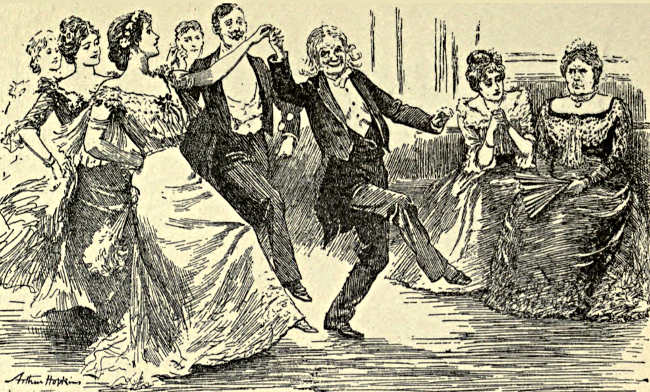
Fair Girl (on sofa, to her neighbour during New Year’s Eve Festivity). “How delightful it
must be for you, Mrs. Featherstone, to hear all the dear Professor’s lectures!”
Mrs. Featherstone. “Oh, I never hear his lectures. But he’ll have to hear one of mine
to-night!”
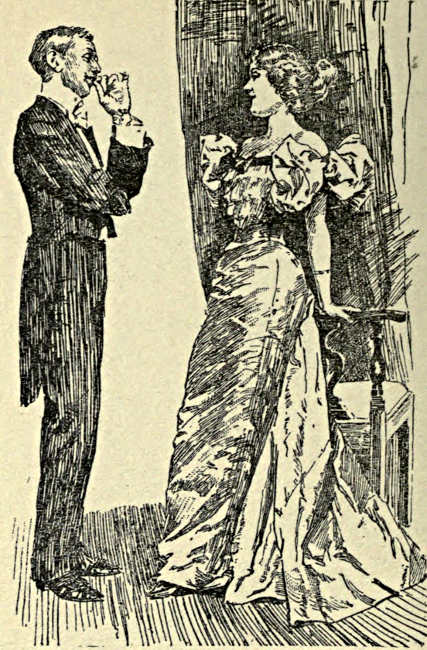
A TERRIBLE VENGEANCE
“Well, Mr. Softley, did you revenge yourself on Algy since that
quarrel you had with him?”
“Yes, indeed. I ordered my man to be wude to his man when he
meets him.”
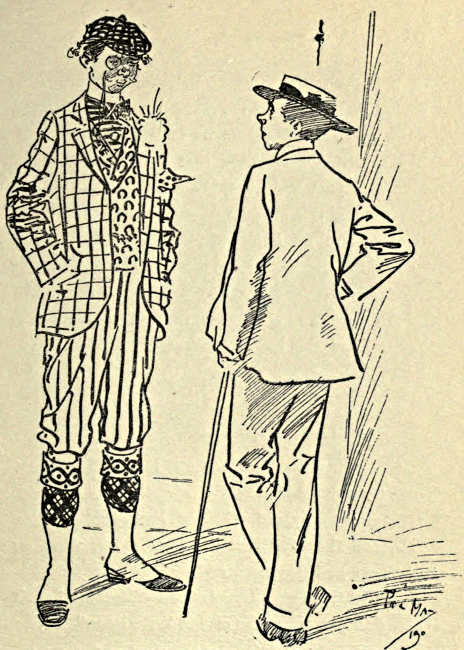
Little Timkins (to gorgeous chappie). “Excuse me, old
boy, but who are you in mourning for?”
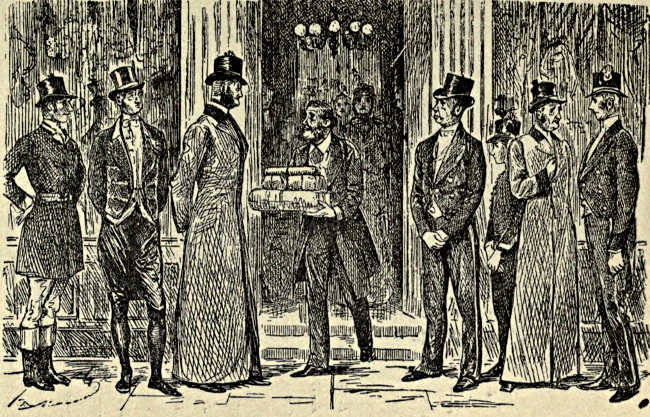
REFLECTED GLORY
Shopman. “Here! Hi! Are you his Grace the Duke of Bayswater?”
Magnificent Flunkey. “I ham!”
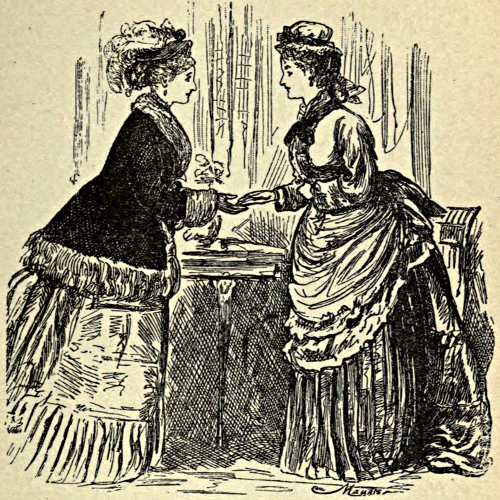
A REASON FOR CALLING
Visitor (naïvely). “Well, I certainly never dreamt I should find
you at home on such a lovely afternoon as this!”
Scene—The Park. Time—The Fashionable
Morning Hour. Lui and Elle discovered
enjoying a causerie.
Elle. Oh, it will be quite gay! Admission five
guineas and ten pounds a seat at the tea-tables.
The Organising Committee have rented the
Anthropological Gardens.
Lui. Any kind of entertainment?
Elle. Oh, yes. We have got Mr. Barnstormer
for a recitation and Di Flop for one of her great
songs with a chorus for nothing, and Scrapini, the
violinist, is to bring his violin.
Lui. Also for nothing?
Elle. Of course. Such an excellent advertisement
for them. And then there are to be lamps
on the artificial lake and fireworks—small ones that
won’t frighten the horses outside—on the terrace.
Two guineas a seat for places in front of the fireworks,
and five shillings entrance-fee to the avenue
of Japanese lanterns.
Lui. Well, you ought to rake in the shekels.
And what is it for? What’s the name of the
Charity?
Elle. I quite forget. But you will find it on the
tickets.
[The talk drifts to other topics.
“What a lot of people there were at the
Wortleburys’ last week—and yet how dull it
was!”
“Yes, dear. But it was much brighter after you
left.”
She. “Oh, Mr. Sorney, I am so grateful to you
for your thoughtfulness in writing so promptly to
tell me of poor Harry’s accident!”
He. “Pray don’t mention it—I was very glad
indeed to have the opportunity of doing it!”
Host. “You’ll have a nice drive home!”
Guest. “Yes; that’s the best of it!”
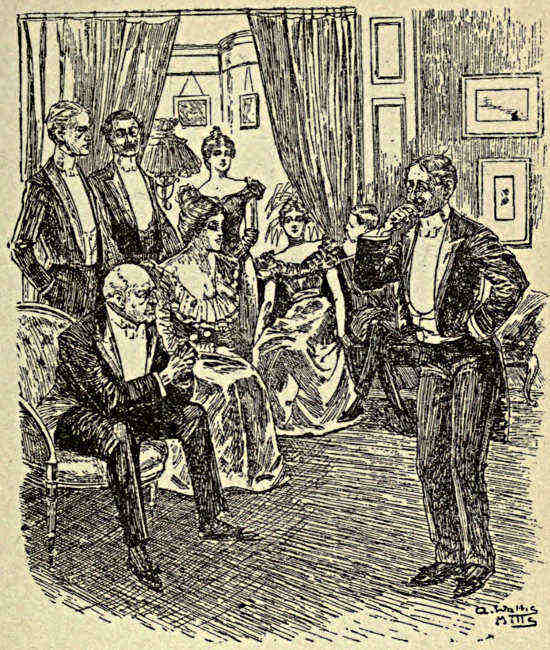
Horrible position of little Biffin, who proposes a new round
game. But when he has to explain, he finds he cannot recollect
anything at all about it!
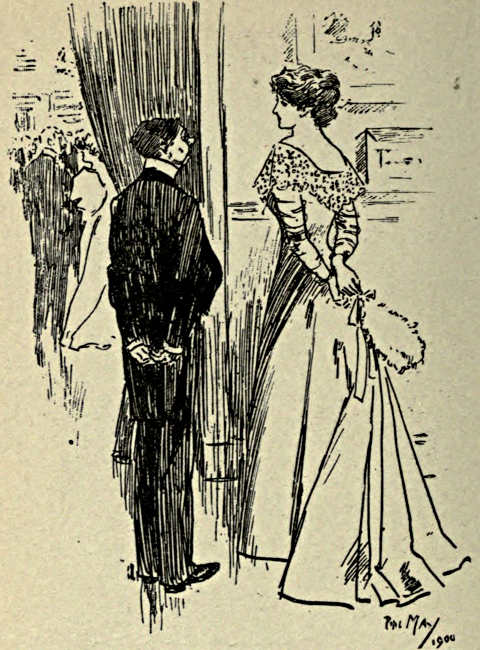
RATHER DIFFICULT FOR HIM
Jones. “I am never at a loss in conversation.”
His Fair Hostess. “But surely, Mr. Jones, there must be
some subjects you don’t understand. What do you do then?”
Jones. “Oh, then—I say nothing, and look intelligent.”
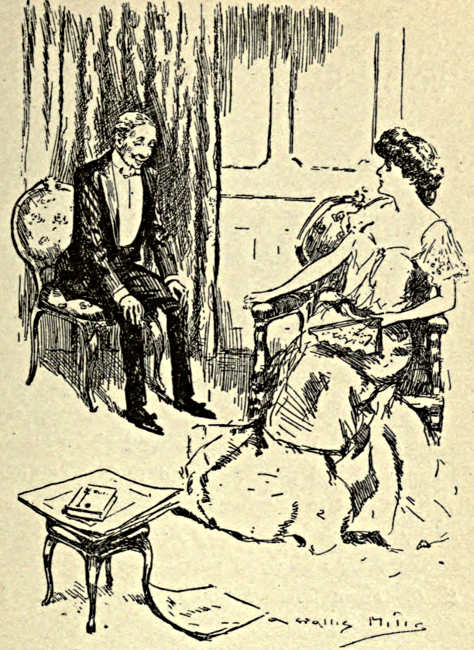
INGRATITUDE
Nervous Youth (to charming girl, who has been trying to set
him at his ease). “He, he! I always—ha—feel rather shy
with pretty girls, y’know, but I’m quite at home with you!”
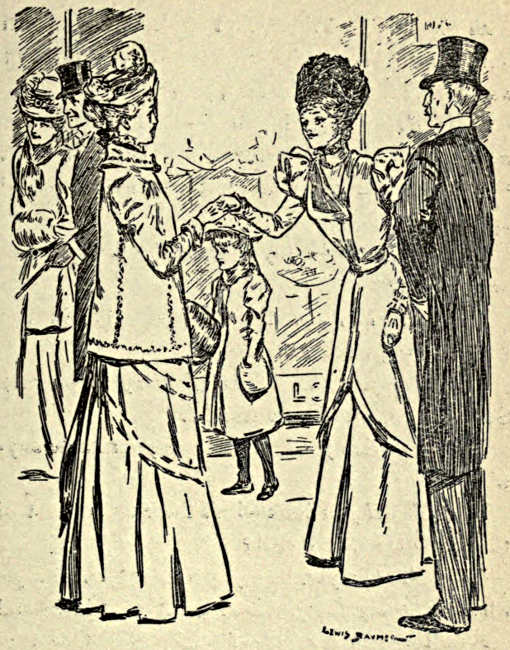
“Oh, Miss Brown, I was so sorry I didn’t see you when
you called the other day. I had such a dreadful headache
that I had to tell my maid I was not at home to any of my
friends. But of course I should have seen you!”
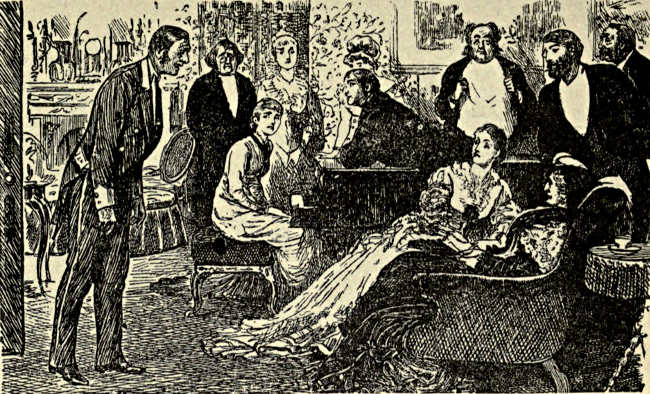
The New Footman (stentoriously). “Mrs. Montgomery Jenkins’s carriage!”
Mrs. Montgomery Jenkins. “A—tell the coachman to wait.”
New Footman. “Please, ma’am, he says he can’t. He says he’s got another job at
twenty minnits past eleven!”
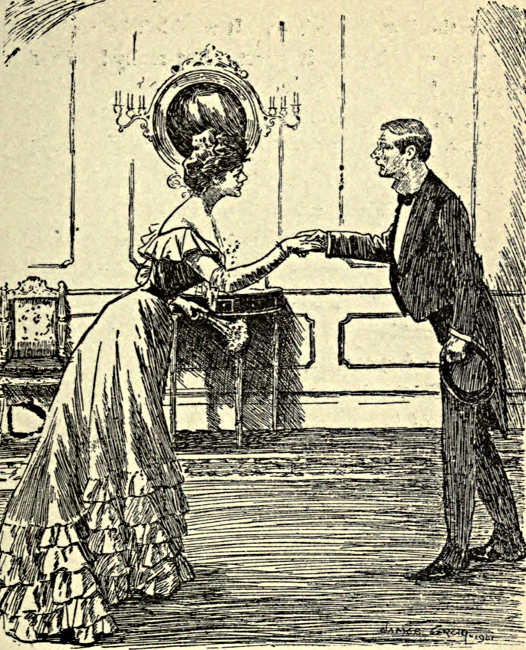
“I’ve just left Mr. Brayne, and it’s quite a relief to meet you.
He is so intellectual, you know!”
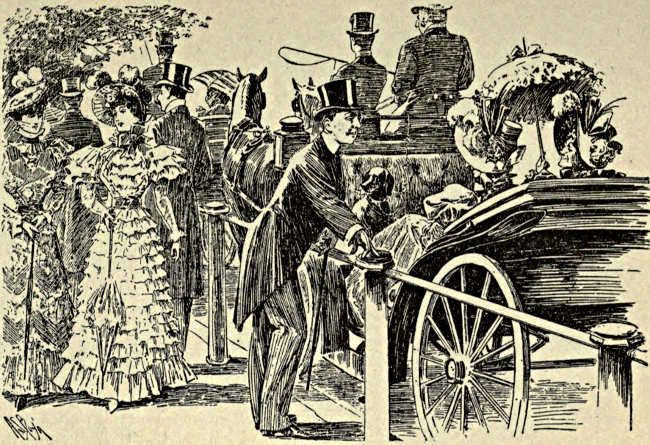
ANCIENT HISTORY
The Frumps (who rather fancy themselves in this style). “It’s called the Early Victorian bonnet.”
Guileless Youth (under the impression that he is paying a graceful compliment). “Oh yes. I suppose
you wore them when you were quite girls.”
Lady Angleby (mother of pretty débutante).
Really! It’s positively painful. It ought to be
stopped.
Elderly Countess (with no daughters). Eh, what?
Tooth hurtin’? Have it out, my dear. Or try
mind healin’. It’s very expensive, but Susan
Southwater tells me——
Lady A. Oh, Susan! She’s always got some
bee in her bonnet. Though how any self-respecting
bee could! But I wasn’t talking about teeth.
It’s this wretched paper. Listen to this. “One
of the prettiest débutantes I saw was Miss Nora
Angleby, whose mother, Lady Angleby, was wearing
nothing but a string of pearls——”
E. C. Have ’em up for libel, my dear. I
wouldn’t stand it.
Lady A. “—nothing but a string of pearls
with her white frock, and looking so delightfully
young. Everyone was saying that they might be
sisters.” Isn’t it too silly?
E. C. H’m! I dunno. You do look youngish
sometimes. As for the frock—don’t you think it
was a leetle too—for the part, you know?
Lady A. Oh, did you think so? It’s the
way they are cutting them this year for girls.
But don’t you think they ought to be pulled
up?
E. C. The frocks, my dear, or the dressmakers,
or the girls?
Lady A. No, no, the editors. I’m in this
wretched rag week after week.
Mrs. Thrope (also mother of pretty débutante).
So am I. It’s a perfect scandal.
Lady A. Are you? I don’t see your name anywhere.
Mrs. T. If you look—isn’t there an account of
the Hersham House Ball?
Lady A. Oh, yes, here you are. “Mrs. Thrope,
who goes everywhere, was in great good looks and
her well-known magenta frock.” You’ll have to
get a new one, darling, after that. “She was
chaperoning her daughter, Miss Anne Thrope,
another débutante, who was quite the beauty of
the——” Well, really! What can it matter to
anyone whether Anne’s a beauty or not, poor
darling!
Mrs. T. She did look rather sweet, didn’t she?
Lady A. What? Oh, ah, yes. Quite pretty, I
thought. But to have it put in print like that for
any Dick, Tom, or Harry to read! It does away
with all the privacy of life.
E. C. Who does read it—besides you two?
Mrs. T. Who? The suburbs, of course.
Susan tells me the circulation in Bayswater is
perfectly enormous. Of course I only get it to
read her things.
Lady A. So do I. Not that they are worth
reading. They always seem to me to be so
banale.
Mrs. T. Yes, aren’t they? And so absolutely
without point.
E. C. What makes ’em print ’em, then?
Lady A. Oh, money, of course. Her money.
It’s the root of all her idylls. She’d pay anything
they asked to get them published.
E. C. H’m! Did she tell you so?
Lady A. My dear, of course not. But I happen
to—oh, do listen to this. I do think they might
draw the line somewhere. It wouldn’t be so bad
if they would keep it select. But really! That
woman!
E. C. Well, who is it?
Lady A. Mrs. Judesheim! A whole paragraph
about her and her diamonds. Her diamonds!
Mrs. T. Not the Bridge woman?
Lady A. Positively, my dear, though one
would have thought after that last little exposé——
Mrs. T. Well, really! I wonder who they’ll
put in next!
E. C. Anyone, my dear Edith—anyone who’ll
pay. That’s the way it’s done. Susan wants to
dispose of her articles, and, accordin’ to you, she
pays, and in they go. Mrs. Whatshername has
got daughters and she wants to dispose of them.
So, she pays, and in they go. Quite simple, ain’t
it?
Lady A. Oh, but I’m sure you are wrong.
Mrs. T. I don’t think you can be right. We
haven’t come to that yet.
E. C. You haven’t, my dear, of course. You
buy the paper because you—have to read Susan’s
articles. Never do myself. Hate readin’ articles,
specially by people I know. But that’s just the
difference between you two and this Judesheim
woman. She likes to see her name in print. And
then, her husband’s a business man, and she knows
the value of a good advertisement.
Lady A. I can’t believe it.
E. C. Well, we’ll ask Susan when she comes.
She knows all about it. She ought to be—ah, here
she is. How do, my dear?
Lady Susan Southwater (enters hurriedly). You
dear people. I am so ashamed. I simply had to
finish my article for next week, and it wouldn’t
come.
Lady A. We were just talking about your
articles. I particularly liked that last one in
to-day’s paper.
Mrs. T. So did I. But I think—no, I don’t
like it quite as well as the one last week. That
was too delightful. So witty.
Lady S. Glad you liked it. Well, are we
going to cut for partners?
E. C. In a minute. But we want to ask you
about this old rag of yours. Do people pay to
have their names in it?
Lady S. Tradespeople? They do, of course.
E. C. No, no. Ordinary people like us.
Lady S. Oh, well—but what makes you ask?
Lady A. Well, the fact is, Edith and I don’t
like the way they will put our names in, and we
were just saying that; and then to read a paragraph
about that Mrs. Judesheim actually, and
the whole thing seemed so vulgar, and we were
wondering whether anyone really did pay.
Lady S. Oh, but my dear, of course they do,
though only the Editor knows who. But if you
like I’ll talk to him about you two, and say that
you would prefer not to have your names——
Lady A. Oh, please no, it really isn’t worth it.
No, as far as I am concerned personally——
Mrs. T. It seems to me it would be a pity
to make a fuss about it. After all, it doesn’t
do one any harm. So please don’t trouble,
darling.
Lady S. My dear, it’s no trouble. I shall be
seeing him this evening, anyhow. So I’ll just tell
him——
Lady A. I beg that you will do nothing of the
kind. I particularly dislike asking favours from
people of that class. Don’t you think we might
begin our rubber?
Lady S. Perhaps that would be the best solution.
Unless you like to pay him not to put your names
in. You might do that, you know—for a change.
Lady A. You don’t mean to imply——
Lady S. My dear, not for worlds! Some
do, and some don’t. But of course you and
Edith——
E. C. Don’t! Let’s cut.
[They cut for partners in silence.
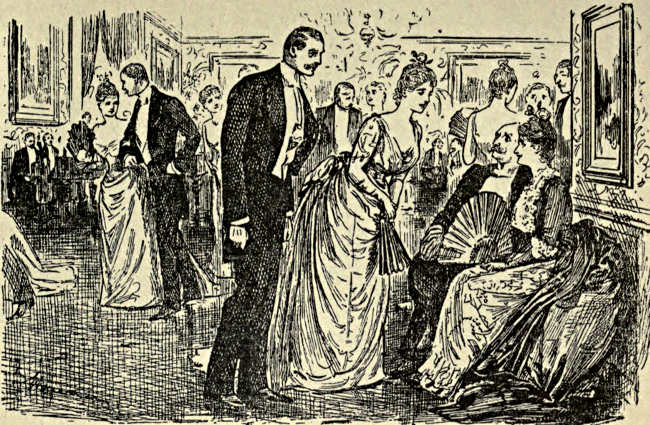
HAVING A GOOD TIME
Mamma. “It’s very late, Emily. Has anybody taken you down to supper?”
Fair Débutante (who has a fine healthy appetite). “Oh yes, mamma—several people!”
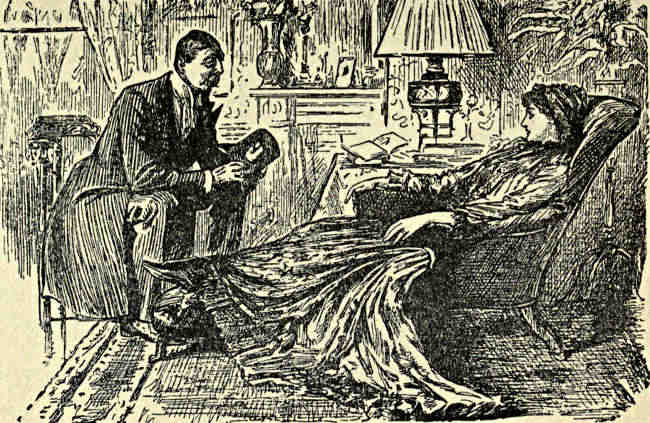
Hostess. “I’ve got such a cold to-day. I feel quite stupid!”
Prize Idiot (calling). “I’ve got a bad cold too; but I don’t feel particularly stupid!”
Hostess. “Ah, I see you’re not quite yourself!”
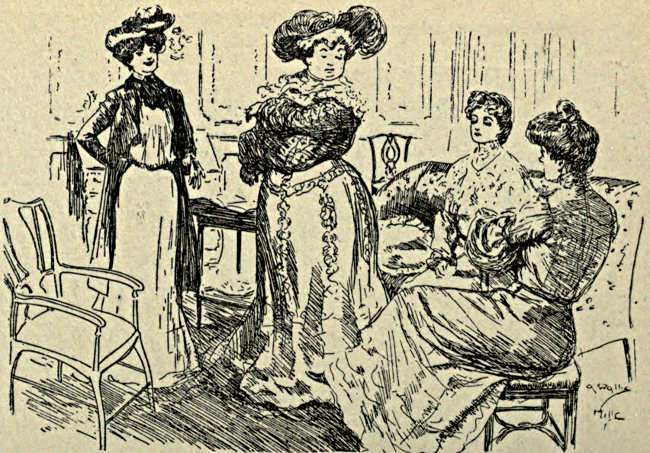
“FLATTERING UNCTION”
Mrs. Noovoriche. “Yes, my dears, I gave a hundred guineas for this gown! Pretty figure,
isn’t it?”—Chorus (after due inspection). “Simply awful!”
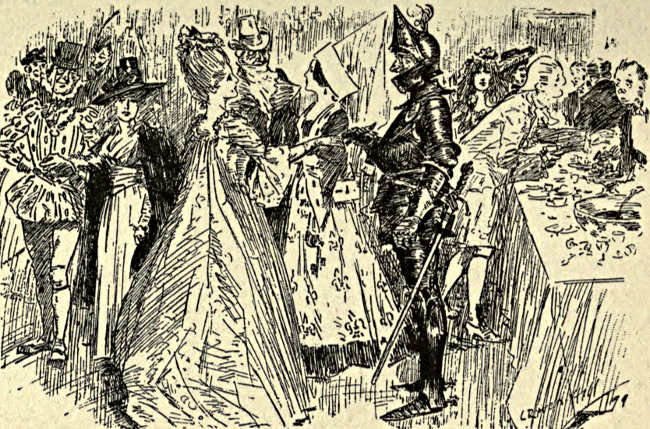
Fitz-Noodle (who rather fancies himself as the “Black Prince”). “By Jove,
Miss Renneslaer, how awfully charming!”
Fair American. “My! What are you? Canned Lobster?”
The Height of Magnificence—Sir Gorgius
Midas. “Hullo! where’s all the rest of yer gone
to?”
Head Footman. “If you please, Sir Gorgius, as
it was past two o’clock, and we didn’t know for
certain whether you was coming back here, or
going to sleep in the City, the hother footmen
thought they might go to bed——”
Sir Gorgius. “‘Thought they might go to bed,’
did they? A pretty state of things, indeed! So
that if I’d a’ ’appened to brought ’ome a friend,
there’d a’ only been you four to let us hin, hay!”
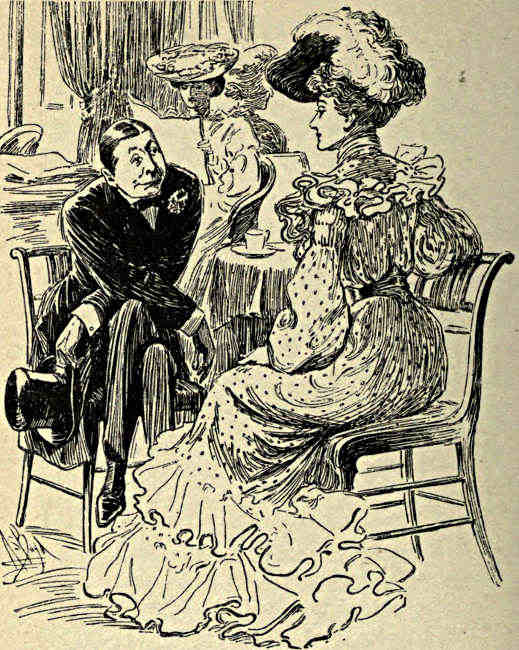
AT A LADIES’ CLUB
Guest (who rather fancies himself as a fascinator). “But although
you are all known as men-haters, aren’t there now and again occasions
when you find it very hard to live up to your reputation?”
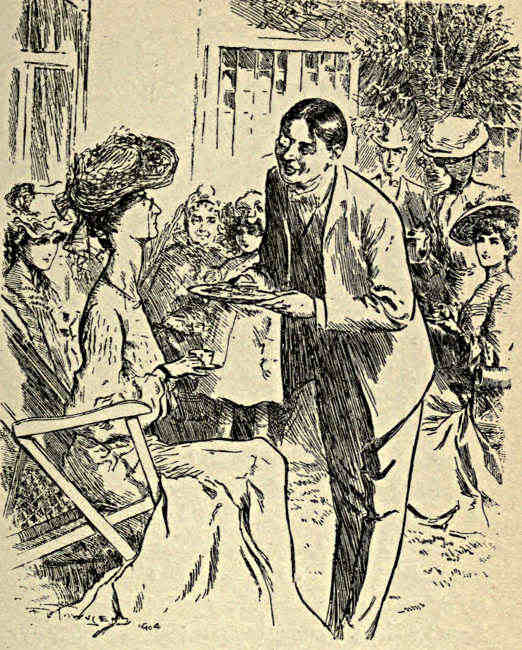
KINDLY MEANT
Young Noodle. “Oh, do have another sandwich, Miss
Swan. You have such a long way to eat—I mean such a
long way to go!”
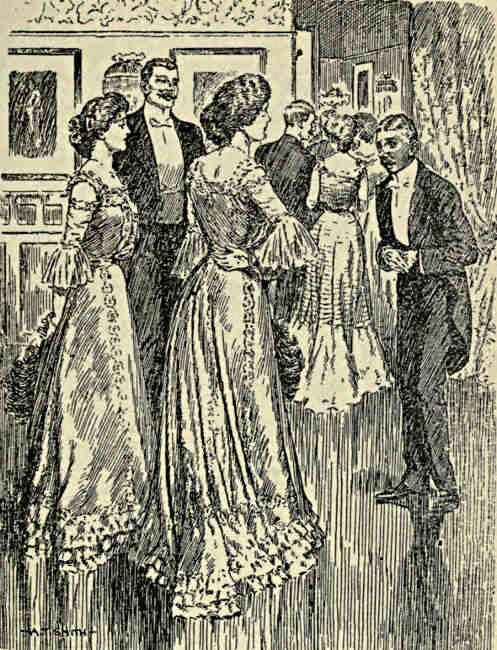
Little Titmuss (just told off to take the younger Miss Long
in to supper, quite forgets which of the two is the younger).
“Er—er—may I have the pleasure—er—of—er—taking the
longer Miss Young—I mean-the lunger Miss Yong—that
is——”
[Becomes incoherent.
(A Young Blood, in trouble about his legs, soliloquises before his
pier-glass)
Well now, this is a doosid nuisance, what?…
S’pose I’ve got to face the question, now that all
the rest of our set have made up their minds.…
Hate havin’ to make up my mind! It’s rotten,
simply rotten—I don’t mean my mind, but havin’
to worry over things like this—I never was so
dreadfully worried, except perhaps over the shape
of that tie last season, what?… Why can’t they
put it off a little while longer? But no, they’re
all goin’ to wear them next Friday at that supper
at the Carlton, and Stella Pardedew’s comin’
too—wish I hadn’t asked her, she can be so cuttin’,
when she likes … I’m sure, if I’ve measured
myself once, I’ve measured myself fifty times, and
I can’t make ’em more than ten and three-eighths
round the calf.… I know she’ll ask whether it’s
three calves or one, when she sees me comin’
along … rotten joke, too!… Here, let me try
once more—where’s that tape?… No, I don’t
seem to spring to ten and a-half inches, anyhow,
and I walked the whole length of Bond Street this
afternoon, what?… They don’t look so bad in
gaiters and ridin’-breeches, or under a motor-coat,
and when I’m golfin’, too, I can double the thick
top ends of my stockin’s down and make quite a
decent show, but these silk things, what!…
They’ll be sayin’ somethin’ about advertisements
for Anti-fat—that rotter Bertie will, I know, just
because his are fifteen inches round.…
De Gustibus non Disputandum.—Adonis
(after his guests have departed). “By Jove, Maria,
what a handsome woman Mrs. Jones is! She
looks better than ever!”
His Wife. “Ahem! Well, it may be my bad
taste, but I own I have hitherto failed to detect the
beauty of Mrs. Jones. Now, Mr. Jones is good-looking,
if you like!”
Adonis. “Jones good-looking! Come—hang it,
Maria, Jones is a very good fellow, and all that;
but I must say I’ve never perceived his good
looks!” &c., &c.
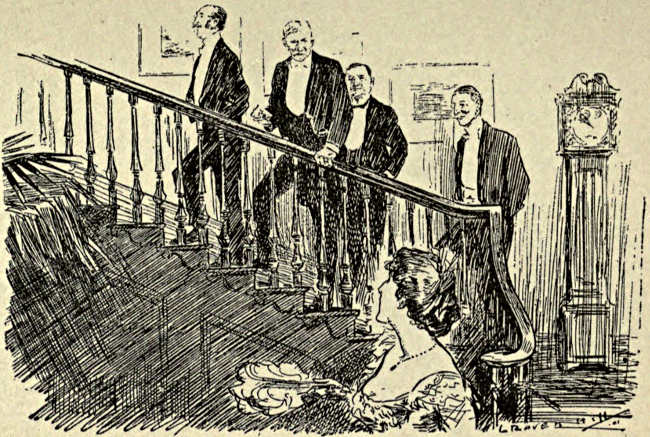
Hostess. “I thought you were going to play ‘Bridge’!”
Host. “So we are, but they are playing ‘ping-pong’ in the dining-room, and ‘fires’ in
the billiard-room, Jack’s trying to imitate Dan Leno in the drawing-room, and Dick’s got
that infernal gramophone of his going in the hall, and they are laying supper in the
smoking-room, so we’re going to the nursery!”
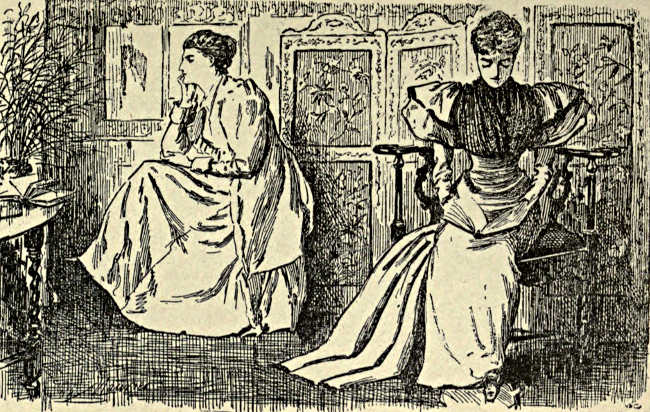
THE WORST OF HAVING “A DAY”
Edith. “Here come those dreadful bores, the Brondesbury-Browns! How tactless of them, to come
and see us on the only day in the week we’re at home!”
Scene—A salon anywhere. Time—Afternoon tea.
Hostess addressing her guests.
Hostess. Yes, I think this is so much more
amusing than “Books,” and “Songs.” One gets
so tired of a lady with toy banners in her hair
calling herself “Under Two Flags,” and a man
insisting that he is perfectly made up for “The
Absent-Minded Beggar” when he wears a label of—“Quite
blind. Give me a penny,” and keeps
his eyes open.
First Lady Friend. Certainly. Well, do you
think my “Curiosity” was good? An old boot
belonging to my great grandfather.
Hostess. Perfectly delightful. So nice to have
a great grandfather, and one who wore boots.
Second Lady Friend. Well, my “Curiosity” is
not quite so personal. This is an old work-box
that has been in our family for the last hundred
years.
Chorus. How interesting!
Second Lady Friend. And it was bought, so I
have been told, at the Exhibition of 1851.
Professor Grumbles (interposing). Dear lady, I
fancy you have made a mistake in your dates.
Now, if the box was in your family a century, and
it came from the Exhibition of 1851, it must——
Hostess (interposing). Oh, my dear Professor,
pray don’t worry us with statistics. Now, what
have you got?
Professor Grumbles (producing a bag). Well
dear lady, my little contribution to the general
hilarity of the occasion will be caused by my friend
in the bag. It is a specimen—a very rare specimen—of
the South African puff-adder. Most doctors
will tell you that the sting of this reptile is dangerous.
(He produces from the bag a black, vicious-looking
snake.) In fact, most people will say that
the sting, or rather a bite, is certain death. But be
reassured, my good friends. In spite of this universal
belief, I may say that, without expressing
an absolutely definite opinion, I don’t think so!
[“Curiosity” tea disperses rapidly and in some confusion.
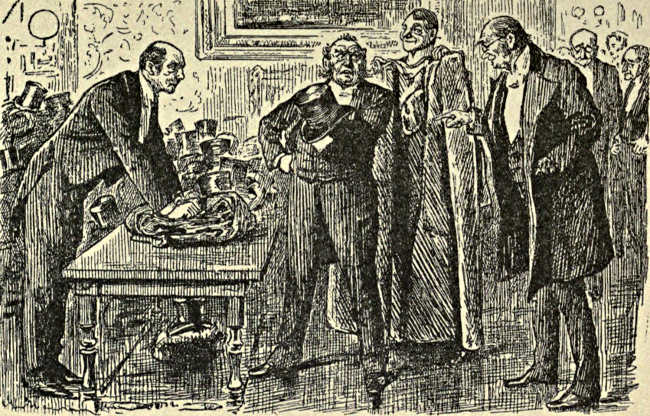
CONFUSION WORSE CONFOUNDED
Jones. “Con-found it all! Somebody’s taken my hat, and left this filthy,
beastly, shabby old thing instead!”
Brown. “A—I beg your pardon, but that happens to be MY hat!”
About Town.
Several ladies have chosen this week for taking
walks. As I was popping down Bond Street a
few days ago I nearly ran into sweet Lady
B., who was dressed in the softest brown, with a
dear little robin redbreast perched lovingly in her
toque, which was a veritable dernier cri. There is
a beautiful story in connection with the little
dickey, as Lady B. believes that it is the same little
feathered darling she used to feed with crumbs on
her window-sill last winter! It is such a joy to
her tender heart to feel that her little pensioner
will now never be parted from his benefactress—while
the toque lasts.
A few minutes later, while I was returning the
Countess of A.’s bow, I caught my foot in the
marabout of one of our most unconventional and
witty American visitors, who is, by the way, the
heroine of the following delightful little story.
While staying at a country house, not a hundred
miles from a certain little white village with red
roofs, the house party was taken to a local flower
show. At dinner that evening, charming Miss X.,
who was a member of the party, was asked by
her partner if she took an interest in gardening.
“I guess I’m only interested in strawberry
leaves!” was the witty answer.
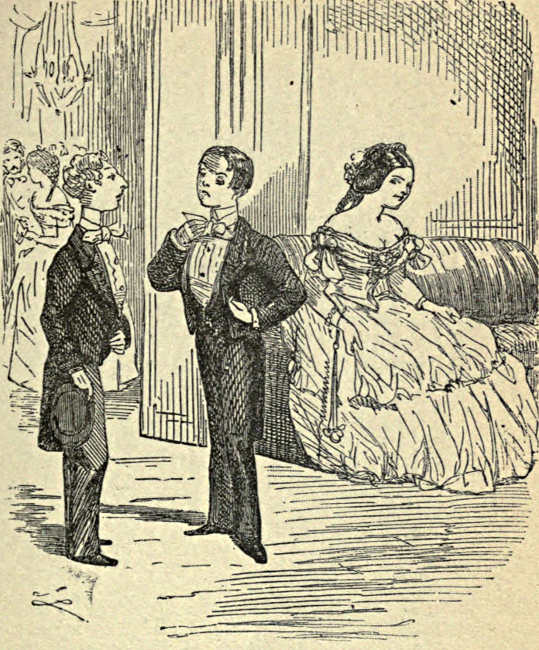
OFFENDED DIGNITY
Small Swell (who has just finished a quadrille). “H’m,
thank goodness, that’s over! Don’t give me your bread
and butter misses to dance with. I like your grown women
of the world!”—(N.B. The bread and butter miss has asked
him how old he was, and when he went back to school.)
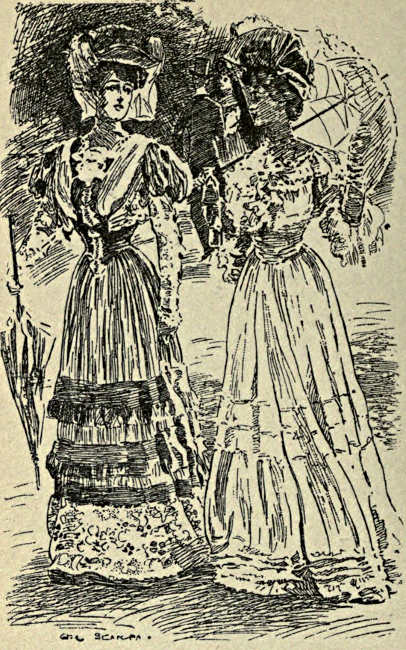
QUITE ANOTHER THING
“You must remember her. I introduced you at my ‘At Home.’”
“You introduced me to so many people, how can I remember?”
“But she was wearing——” (Describes the costume minutely.)
“Oh, was that she? Of course I remember her perfectly!”
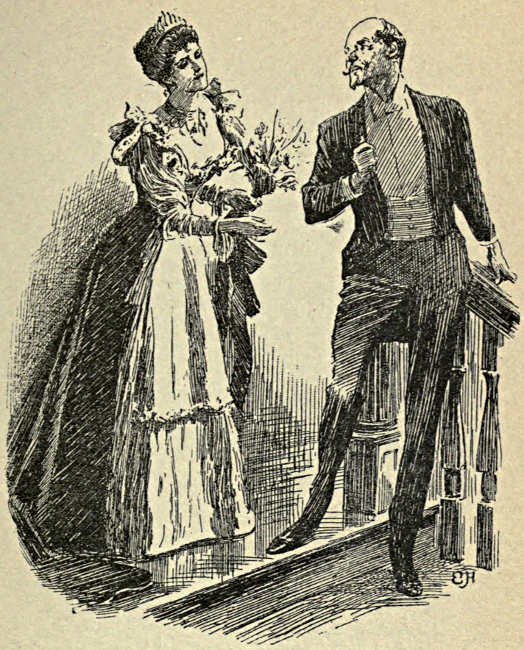
THOUGHT TRANSFERENCE
Hostess. “Good night, General! So kind of me to have asked
you.”
Guest. “Not at all. So kind of me to have come!”
All lovers of literature will be delighted to hear
that Miss Cumberland Smith’s latest work,
“Chained by Circumstance,” is to be issued in tooled
green leather to match the dainty little belts
which are being shown this week by Mr. Peter
Jay. This book would look particularly well with
a white satin Liberty robe, a stole of Indian work,
and the hair coiffured in the mode retroussé, which
is now, we are glad to see, once more with us.
Another little gem for book lovers is certainly
Lady M.’s wonderfully realistic “Revelations of
Revolt,” bound in crimson and black. No brunette
should be without it. To go with this beautiful
volume we should strongly recommend a simple
Empire costume of crimson panne, with deep frills
of accordion-pleated white chiffon, edged with black
ruching, with sprays of crimson chrysanthemums
falling to the feet.
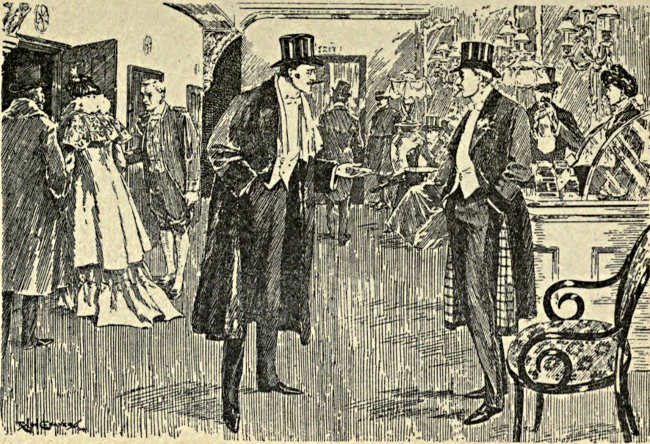
Algy (suddenly taking the change out of his pocket and examining it). “I say, old man, what
do you think? I gave our cabby a sovereign and a sixpence for bringing us here from the club!”
Freddie. “My dear f’lla, you’re always overdoin’ it. A sovereign would have been ample!”
Making Conversation.—He. “I suppose you
have been everywhere during the season?”
She. “No season. Nothing to read. Nothing
to see.”
He. “Then there is nothing to talk about?”
She. “No, nothing. Can’t you suggest a
novelty?”
He (brightening up). “Yes—the weather.”
[Left talking.
A Forlorn Hope.—The Dowager. “Now,
you’ve got all the girls off your hands so successfully,
except poor Maria, you ought to give her a
chance.”
My Lord. “Yes—a—give a ball—a—or a
garden party—a——”
My Lady. “Oh, poor Maria’s not worth a ball—nor
even a garden party. We might give an
afternoon tea!”
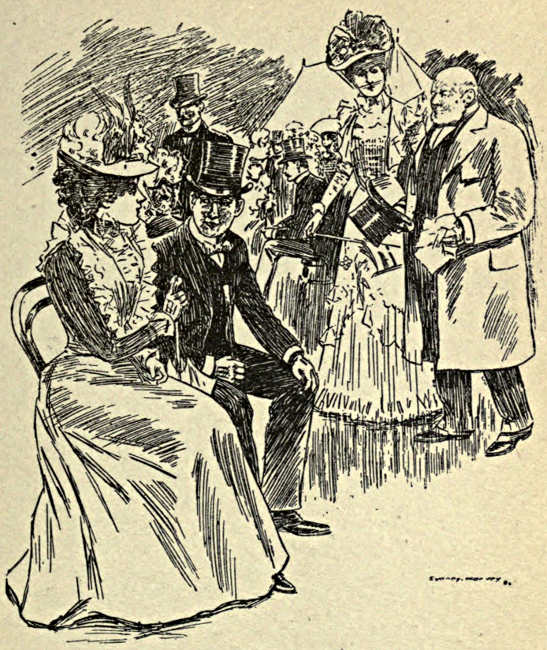
“I say, Nell, the Dad says that he remembers that old
boy when he hadn’t a shirt to his back, and now he has
thousands.”
“Good gracious, how extravagant! And how hot!!”
Country-House Pets (The morning-room at
Glen-Dimity Castle, after lunch. Mr. Belamy Tabby
is singing “Hi tiddley hi ti, hi, ti, hi!”).—The
Duchess. “How clever and amusin’ your friend,
Mr. Whatshisname is!—Tabby, isn’t it! So good-lookin’
and gentlemanlike too! Quite a godsend
on a rainy day like this, when all the men are out
shootin’ or fishin’, or something! Is he married?”
Noble Hostess. “Oh yes; but what’s so nice about
him, he doesn’t mind bein’ asked without his wife.
Those sort of persons so often expect their wives to
be asked too, and that’s such a bore, you know!”
Her Grace. “Yes; how sensible of him! I
must get him to come to us at Brasenose Towers!”
An Unselfish Man.—Colonel Slyboots, M.P.
“So sorry to leave you all alone at Mudboro’, my
love; but duty will compel me to be at my post
at Westminster for the Autumn Session, you know.
So dull in town without you, too.”
Mrs. S. “Poor dear! Then I’ll accompany you,
my angel!”
Colonel S. “Oh, on no account. Wouldn’t hear
of it!”
Society Small Talk.—“On the young lady’s
exclaiming ‘How well these rooms are lighted!’
the young man might reply, ‘Yes, by the light of
Beauty’s eyes, and you are lending your share,
which is not a small one, to the general illumination,
the brilliancy of which is almost too dazzling
to a poor mortal like myself, to whom it is well that
moments such as these are brief, else the reaction
would be destructive to my peace of mind, if not
altogether fatal to it.’”
Young Peter Piper has got his lesson well by heart,
and is only waiting, to begin, for the lovely Miss
Rippington to exclaim, “How well these rooms are
lighted!” which, unfortunately for him, they are
NOT.
Honours Divided.—Mr. Goodchild. “Yes, I
do feel in good spirits this evening. My boy has
passed his examination!”
The Earl. “Well, I don’t see anything in that.
So has mine.”
Mr. Goodchild. “Er—Indian Civil?”
The Earl. “No—Bankruptcy!”
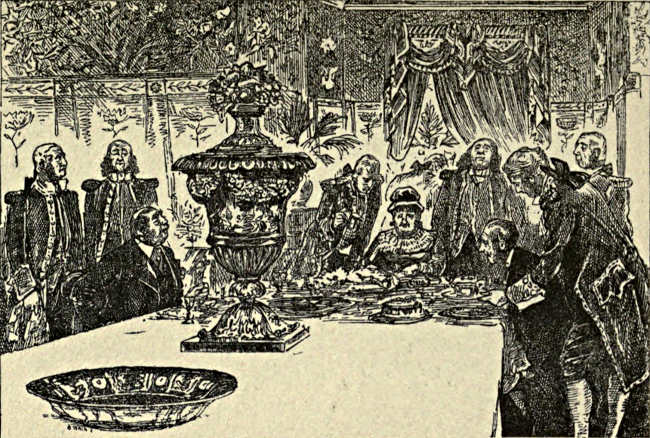
The Rev. Lazarus Jones (who has been honoured by an invitation to lunch with that great
man, Sir Gorgius Midas, just returned from America). “I suppose you are glad to get back
to your comfortable house again, Sir Gorgius?”
Sir Gorgius Midas (who perhaps does not like his palatial residence to be called a “comfortable
house”). “Yes, Jones! Be it ever so ’umble, Jones, there’s no place like ’ome!”
Mrs. Boreham at Home (Amateur Theatricals).—Sir
Pompey Bedell. “Allow me to congratulate
you, Mrs. Boreham, on a most successful entertainment!
I have never set foot inside a theatre
myself, I am proud to say, nor attended even private
theatricals before—such things are not in my line!
But I can honestly assure you that I have rarely
seen histrionic ability more consummate, or a
dramatic performance more exceptionally complete
in every respect, than that which it has been our
truly enviable privilege to witness this evening!”
An Amendment.—Vera. “What must I do
about the Billsomes’ dance? I dislike the Billsomes,
and I don’t want to go.”
Phillis. “Well, say you regret you are unable.”
Vera. “Wouldn’t it be more truthful to say I
am unable to regret?”
It’s an East Wind that blows Nobody
Good.—“Here comes the carriage, Maud! Fancy
having to go and pay calls in such weather! It’s
enough to give one one’s death of cold!”
“Worse than that, mother! Everybody’s sure
to be in!”
One Way of Fasting.—Miss Kate (to Mr.
Joskin). “You don’t know how glad I am that
Lent has begun.”
Mr. Joskin. “Why?”
Miss Kate. “Because there are no more stupid
dinner-parties and balls. We only go to theatres
and restaurants now.”
Not THE Word.—Young Lady (in the drawing
room). “Just listen! I can hear the gentlemen
laughing. I believe they tell all their good stories
directly we’re out of the dining-room.”
Experienced and rather severe Matron. “Good
stories, dear! No—‘good’ is not the word.”
An Eye for Essentials.—Mamma (house-hunting
for the Season). “It’s a good house for a
dance, Emily!”
Emily. “The rooms are rather small, aren’t
they?”
Mamma (who knows how matches are made).
“Yes; but what a capital staircase!”
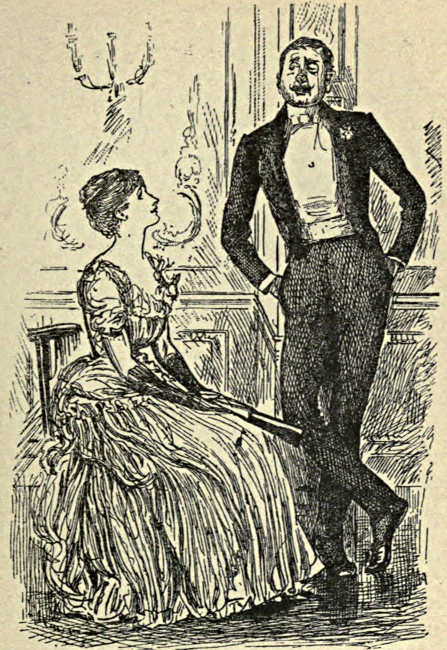
Snookson. “Yes; Hastings is a charming place, and has
quite a peculiar—a—and half-melancholy interest for me.
We came over with the Conqueror, you know!”
Fair Bostonian (late from Paris). “Ah, that must have
been very trying! We came over with the Calais-Douvres.”
[S. tries not to look foolish.
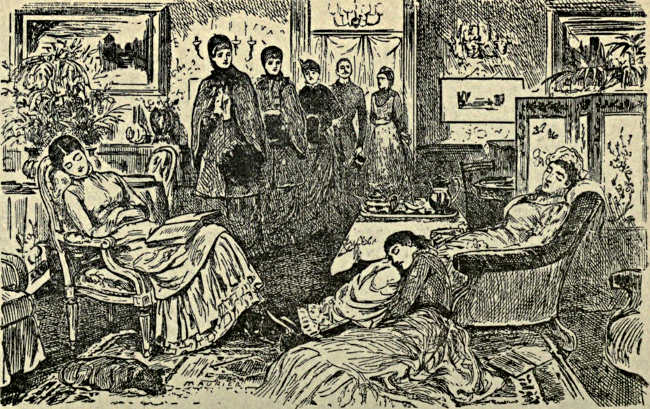
ANNALS OF A RETIRED SUBURB
Mrs. Boultby Smith and her daughters have been “at home” to their London friends every
Wednesday afternoon for the last seven years. Last Wednesday some visitors actually came!
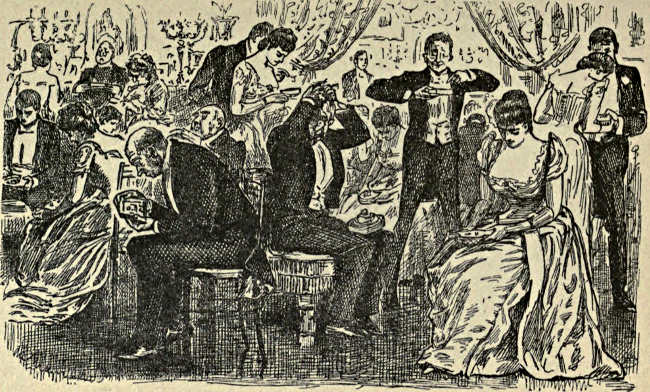
ANNALS OF A QUIET NEIGHBOURHOOD
Mrs. De Vere Tomlinson at home. Puzzles. Small and early.
Prig-sticking.—Little Prigson. “Oh! as for
Grigson, he’s distinctly the most objectionable little
prig in all England; but his sistah’s quite the nicest
girl I ever met.”
Aunt Eliza. “Dear me! What sweeping
assertions! You might have had the decency
just to make the traditional exception in favour of
present company!”
Cousin Maud. “Yes; in both cases, you know!”
Some Distinctions and a Difference.—Hostess
has just been showing Guest the picture
gallery and other glories of the ancient Baronial
Halls, at the same time discoursing of the family
greatness. Guest (pointing to row of busts). “And
are these celebrities or just relations?”
Limited.—She. “Yes; that stupid man who
came with the Smiths trod on the duchess’s train,
and it tore right across, and the dear old thing
never said a word. Wasn’t it sweet of her?”
He. “Well, there was only one word she could
have said!”
CONVERSATIONAL TEAS twice a week OFFERED
by a Lady of high social position at her home to
strangers, Americans, Colonials and foreigners, for whom
pleasant introductions are desirable; private interviews
given to ladies who desire coaching on matters of high
English etiquette and fashion.—Advertisement in morning
paper.
This seems to be a new variation. We all
know the blameless A.B.C. tea patronised by
country cousins after a hard day’s work shopping
or matinéeing in town.
There is the institution known as a “high tea”
(why high?) for those whose indigestion is robust
enough to negotiate six o’clock beef and tannin
from the pot.
A year or two ago we were deluged with
“book teas” and “play teas,” or “song teas,” and
other nursery devices for educating the middle-aged
and teaching the old idea how to make wild
shots at far-fetched rebuses.
For dipsomaniacs there is, we regret to say, the
D. T.; and the strict Q. T. for persons of a
secretive turn of mind.
And now a lady of high social position is in the
market with bi-weekly “Conversational Teas.” Is
the accent on the conversation or the tea, we
would ask? Are there any gratuities expected? Is
anything given away with a pot of tea? Do you
bring your own mug? Does the lady-autocrat at
the tea-table give marks for good behaviour? Does
she “turn” you if you have failed to learn your
small-talk correctly? Do you get a diploma (or a
degree) at the end of the course if you pass the
cake with honours? And is the “colonial” who
comes out at the bottom of the tea-class rewarded
with a wooden spoon? All these, and many
other questions, present themselves to would-be
students of “high English etiquette.”
Guesses at truth.—Mr. Laidislaw. “Handsome
woman our hostess—don’t you think? By
the bye, what do you suppose her age is?”
Miss St. Cyr. “Well, I should fancy, what the
illustrated biographies call ‘Present Day!’”
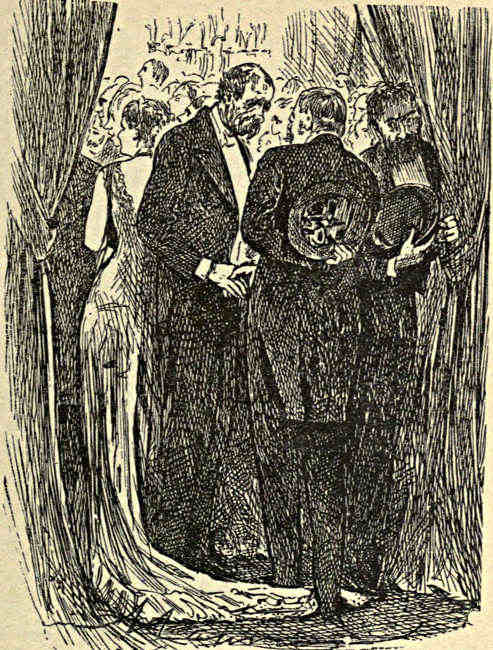
SOCIAL SUCCESSES
Mrs. Ponsonby de Tomkyns at Home—Small and Early.
Brown (who is fighting his way in—to Friendly Party, who holds out
his hand). “Ah, how d’y’do, Mr.—er—I seem to know your face.
Often met you here before, I fancy, hav’n’t I?”
Friendly Party. “Very likely. My name’s Ponsonby de Tomkyns!”
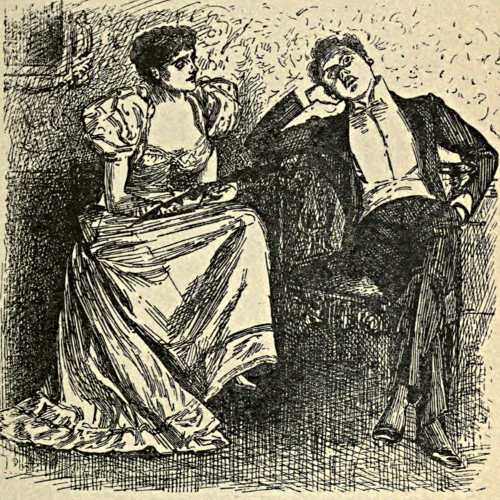
A TERRIBLE TURK
Little Spinks. “Ah! once I was as innocent as a little
child! What I am now, your sex has made me!”
“L’invitation à la Valse.”—She. “But
you don’t know my name! What have you put
down on your cuff?”
He. “Oh, I’ve put down ‘Pearl Necklace.’”
She. “But there are lots of pearl necklaces
here!”
He. “Yes; but I’ve also put down ‘Small and
rather tight’—I mean the necklace, you know!”
The Old Order Changeth.—Todeson (who
has grown his moustache, dropped his G’s, and got
into Society again). “Fact is Society’s gettin’
much too mixed, Duchess. It’s not amusin’, after
spendin’ a pleasant evenin’, to find you’ve been
hobnobbin’ with a shopkeeper, or sittin’ next his
wife at dinner, you know!”
Her Grace. “Oh, dear me! Why, my husband’s a shopkeeper, Mr. Todeson. He keeps that great
bric-à-brac warehouse in Conduit Street!—and the
toy-shop at the corner, that’s mine!—and the
confectioner over the way, that’s my mother, the
Duchess of Hautcastel!”
[Todeson feels he has been puttin’ his foot in it.
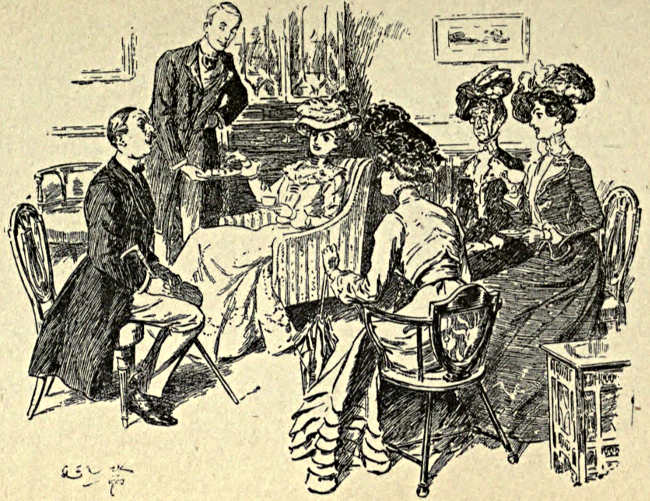
De Smythe. “She was the ugliest woman I ever met—er—er—present company
excepted, of course!”
Of the World Worldly.—“There go the
Spicer Wilcoxes, mamma! I’m told they’re dying
to know us. Hadn’t we better call?”
“Certainly not, dear. If they’re dying to know
us, they’re not worth knowing. The only people
worth our knowing are the people who don’t want
to know us!”
Breaking the Ice.—He. “I’ve got to take
you in to dinner, Miss Travers—and I’m rather
afraid of you, you know! Mrs. Jollibois tells me
you’re very clever!”
She (highly amused). “How absurd! I’m not
a bit clever!”
He (with sigh of relief). “Well, do you know, I
thought you weren’t!”
A Subtle Distinction.—Jones (who is of an
inquiring mind). “Ain’t you getting tired of
hearing people say, ‘That is the beautiful Miss
Bellsize!’?”
Miss Bellsize (a professional beauty). “Oh, no.
I’m getting tired of hearing people say, ‘Is that
the beautiful Miss Bellsize?’”
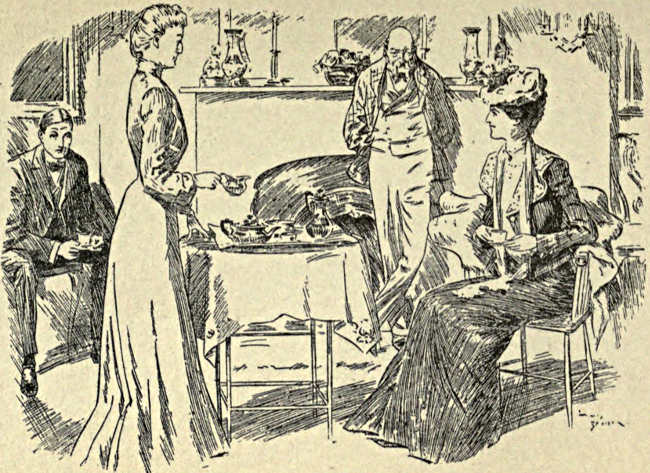
Hostess (to guests, who have come to spend a few days). “We’re so glad you’ve been able to
come, Mrs. Gushington; but I do hope we are going to have rather better weather, or I am
afraid you won’t enjoy yourselves much.”—Mrs. Gushington. “Oh, but, my dear Lady
Boreham, we didn’t come here to enjoy ourselves. We came to see you!”
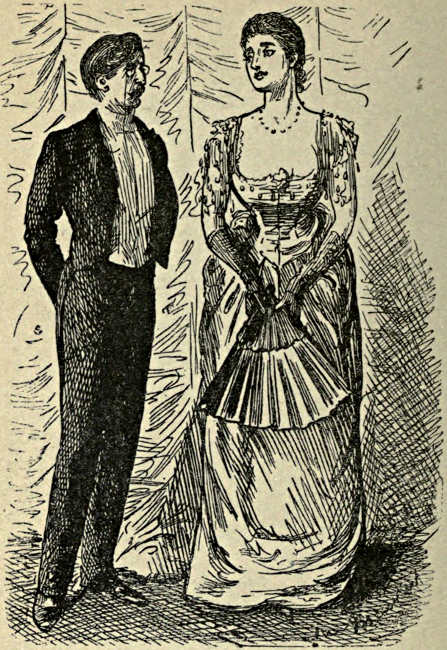
Fubsby. “A—everybody’s getting too clever nowadays.
I assure you, my chief object in society is to conceal my
ignorance, and prevent people from finding out what an
abject fool I really am!”
Miss Towers. “And do you succeed?”
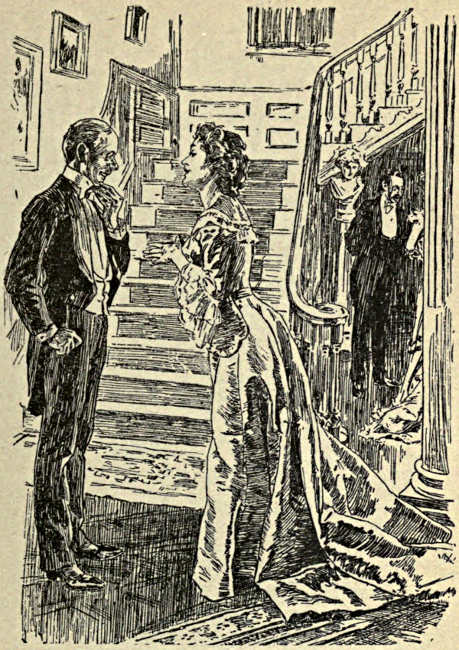
Hostess. “Why, Mr. Smith, I’ve hardly seen you all the
evening! Now I particularly want you to come and hear a
whistling solo by my husband.”
Smith (whose hearing is a trifle indistinct). “A whisky and
soda with your husband? Well, thanks, I don’t mind if I
do have just one!”
An Equivocal Compliment.—“I’m so glad
to meet you here, Captain Spinks—and so glad
you’re going to take me in to dinner.” (Captain
S. is delighted.) “You’re about the only man
in the room my husband isn’t likely to be
jealous of!”
[Captain Spinks’s delight is no longer unmixed.
BRADBURY, AGNEW, & CO. LD., PRINTERS, LONDON AND TONBRIDGE