CHAPTER I
25
A GOOD-HUMOURED CHRISTMAS CHAPTER, CONTAINING
AN ACCOUNT OF A WEDDING, AND
SOME OTHER SPORTS BESIDE, WHICH ALTHOUGH
IN THEIR WAY, EVEN AS GOOD
CUSTOMS AS MARRIAGE ITSELF, ARE NOT
QUITE SO RELIGIOUSLY KEPT UP, IN THESE
DEGENERATE TIMES.
As brisk as bees, if not altogether as light
as fairies, did the four Pickwickians assemble
on the morning of the twenty-second
day of December, in the year of grace in which
these, their faithfully-recorded adventures, were
undertaken and accomplished. Christmas was
close at hand, in all his bluff and hearty honesty;
it was the season of hospitality, merriment,
and open-heartedness; the old year was preparing,
like an ancient philosopher, to call his
26friends around him, and amidst the sound of
feasting and revelry to pass gently and calmly
away. Gay and merry was the time; and right
gay and merry were at least four of the numerous
hearts that were gladdened by its coming.
And numerous indeed are the hearts to which
Christmas brings a brief season of happiness
and enjoyment. How many families whose
members have been dispersed and scattered far
and wide, in the restless struggles of life, are
then reunited, and meet once again in that
happy state of companionship and mutual good-will,
which is a source of such pure and unalloyed
delight, and one so incompatible with
the cares and sorrows of the world, that the
religious belief of the most civilised nations, and
the rude traditions of the roughest savages, alike
number it among the first joys of a future state
of existence, provided for the blest and happy!
How many old recollections, and how many dormant
sympathies, does Christmas time awaken!
We write these words now, many miles distant
27from the spot at which, year after year, we
met on that day, a merry and joyous circle.
Many of the hearts that throbbed so gaily then,
have ceased to beat; many of the looks that
shone so brightly then, have ceased to glow; the
hands we grasped, have grown cold; the eyes
we sought, have hid their lustre in the grave;
and yet the old house, the room, the merry
voices and smiling faces, the jest, the laugh, the
most minute and trivial circumstance connected
with those happy meetings, crowd upon our
mind at each recurrence of the season, as if
the last assemblage had been but yesterday.
Happy, happy Christmas, that can win us back
to the delusions of our childish days, that can
recall to the old man the pleasures of his youth,
and transport the sailor and the traveller, thousands
of miles away, back to his own fireside
and his quiet home!
But we are so taken up, and occupied, with
the good qualities of Christmas, who, by the
way, is quite a country gentleman of the old
28school, that we are keeping Mr. Pickwick and
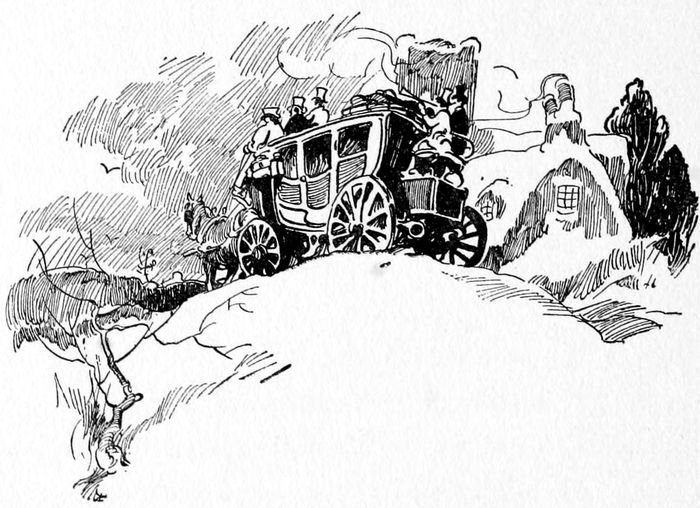
his friends waiting in the cold, on the outside
of the Muggleton coach, which they have just
attained, well wrapped up, in great-coats,
shawls, and comforters. The portmanteaus and
carpet-bags have been stowed away, and Mr.
Weller and the guard are endeavouring to insinuate
into the fore-boot a huge cod-fish several
sizes too large for it, which is snugly packed up,
in a long brown basket, with a layer of straw
over the top, and which has been left to the
last, in order that he may repose in safety on
the half-dozen barrels of real native oysters, all
the property of Mr. Pickwick, which have been
arranged in regular order, at the bottom of the
receptacle. The interest displayed in Mr. Pickwick’s
countenance is most intense, as Mr.
Weller and the guard try to squeeze the cod-fish
into the boot, first head first, and then tail
first, and then top upwards, and then bottom
upwards, and then sideways, and then longways,
all of which artifices the implacable cod-fish
29sturdily resists, until the guard accidentally
hits him in the very middle of the basket,
whereupon he suddenly disappears into the
boot, and with him, the head and shoulders of
the guard himself, who, not calculating upon so
sudden a cessation of the passive resistance of
the cod-fish, experiences a very unexpected
shock, to the unsmotherable delight of all the
porters and bystanders. Upon this, Mr. Pickwick
smiles with great good humour, and drawing
a shilling from his waistcoat pocket, begs
the guard, as he picks himself out of the boot,
to drink his health in a glass of hot brandy
and water, at which, the guard smiles too, and
Messrs. Snodgrass, Winkle, and Tupman, all
smile in company. The guard and Mr. Weller
disappear for five minutes, most probably to
get the hot brandy and water, for they smell
very strongly of it, when they return, the coachman
mounts to the box, Mr. Weller jumps up
behind, the Pickwickians pull their coats round
their legs, and their shawls over their noses; the
30helpers pull the horse-cloths off, the coachman
shouts out a cheery “All right,” and away
they go.
They have rumbled through the streets, and
jolted over the stones, and at length reach the
wide and open country. The wheels skim over
the hard and frosty ground; and the horses,
bursting into a canter at a smart crack of the
whip, step along the road as if the load behind
them, coach, passengers, cod-fish, oyster barrels,
and all, were but a feather at their heels.
They have descended a gentle slope, and enter
upon a level, as compact and dry as a solid
block of marble, two miles long. Another crack
of the whip, and on they speed, at a smart
gallop, the horses tossing their heads and rattling
the harness as if in exhilaration at the rapidity
of the motion, while the coachman, holding
whip and reins in one hand, takes off his hat
with the other, and resting it on his knees, pulls
out his handkerchief, and wipes his forehead,
partly because he has a habit of doing it, and
31partly because it’s as well to shew the passengers
how cool he is, and what an easy thing
it is to drive four-in-hand, when you have had
as much practice as he has. Having done this
very leisurely (otherwise the effect would be
materially impaired), he replaces his handkerchief,
pulls on his hat, adjusts his gloves,
squares his elbows, cracks the whip again, and
on they speed, more merrily than before.
A few small houses, scattered on either side
of the road, betoken the entrance to some town
or village. The lively notes of the guard’s key-bugle
vibrate in the clear cold air, and wake up
the old gentleman inside, who carefully letting
down the window-sash half way, and standing
sentry over the air, takes a short peep out,
and then carefully pulling it up again, informs
the other inside that they’re going to change
directly; on which the other inside wakes himself
up, and determines to postpone his next
nap until after the stoppage. Again the bugle
sounds lustily forth, and rouses the cottager’s
32wife and children, who peep out at the house-door,
and watch the coach till it turns the
corner, when they once more crouch round the
blazing fire, and throw on another log of wood
against father comes home, while father himself,
a full mile off, has just exchanged a
friendly nod with the coachman, and turned
round, to take a good long stare at the vehicle
as it whirls away.
And now the bugle plays a lively air as the
coach rattles through the ill-paved streets of a
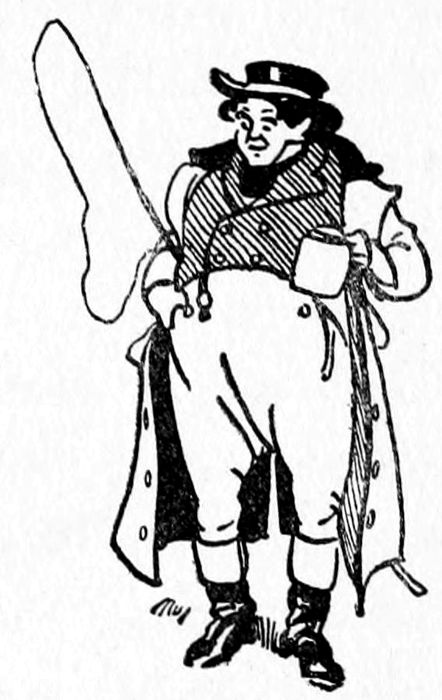
country town; and the coachman, undoing the
buckle which keeps his ribands together, prepares
to throw them off the moment he stops.
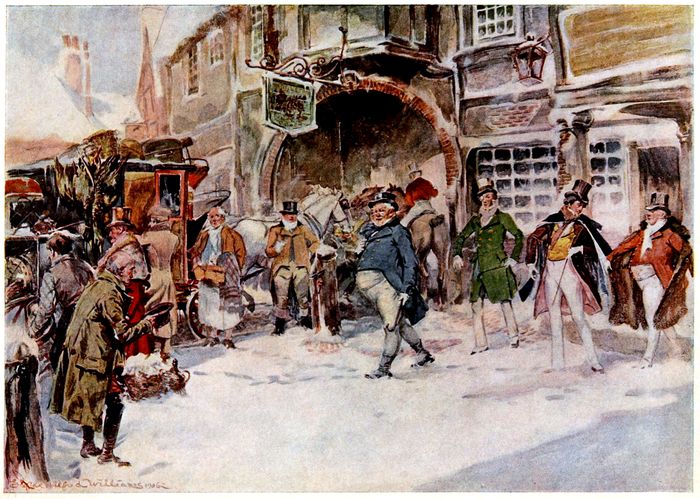
Mr. Pickwick emerges from his coat collar,
and looks about him with great curiosity; perceiving
which, the coachman informs Mr. Pickwick
of the name of the town, and tells him it
was market-day yesterday, both which pieces
of information Mr. Pickwick retails to his fellow-passengers,
whereupon they emerge from their
coat collars too, and look about them also. Mr.
33Winkle, who sits at the extreme edge, with one
leg dangling in the air, is nearly precipitated
into the street, as the coach twists round the
sharp corner by the cheesemonger’s shop, and
turns into the market-place; and before Mr.
Snodgrass, who sits next to
him, has recovered from his
alarm, they pull up at the
inn yard, where the fresh
horses, with cloths on, are
already waiting. The coachman
throws down the reins
and gets down himself, and
the other outside passengers
drop down also, except those
who have no great confidence in their ability
to get up again, and they remain where they
are, and stamp their feet against the coach to
warm them; looking with longing eyes and red
noses at the bright fire in the inn bar, and the
sprigs of holly with red berries which ornament
the window.
34But the guard has delivered at the corn-dealer’s
shop, the brown paper packet he took
out of the little pouch which hangs over his
shoulder by a leathern strap, and has seen the
horses carefully put to, and has thrown on the
pavement the saddle which was brought from
London on the coach-roof, and has assisted in
the conference between the coachman and the
hostler about the grey mare that hurt her off-fore-leg
last Tuesday, and he and Mr. Weller
are all right behind, and the coachman is all
right in front, and the old gentleman inside,
who has kept the window down full two inches
all this time, has pulled it up again, and the
cloths are off, and they are all ready for starting,
except the “two stout gentlemen,” whom
the coachman enquires after with some impatience.
Hereupon the coachman, and the
guard, and Sam Weller, and Mr. Winkle, and
Mr. Snodgrass, and all the hostlers, and every
one of the idlers, who are more in number than
all the others put together, shout for the missing
35gentleman as loud as they can bawl. A distant
response is heard from the yard, and Mr. Pickwick
and Mr. Tupman come running down it,
quite out of breath, for they have been having
a glass of ale a-piece, and Mr. Pickwick’s fingers
are so cold that he has been full five minutes
before he could find the sixpence to pay for it.
The coachman shouts an admonitory “Now,
then, gen’lm’n,” the guard re-echoes it—the
old gentleman inside, thinks it a very extraordinary
thing that people will get down when
they know there isn’t time for it—Mr. Pickwick
struggles up on one side, Mr. Tupman on
the other, Mr. Winkle cries “All right,” and off
they start. Shawls are pulled up, coat collars
are re-adjusted, the pavement ceases, the houses
disappear; and they are once again dashing
along the open road, with the fresh clear air
blowing in their faces, and gladdening their
very hearts within them.
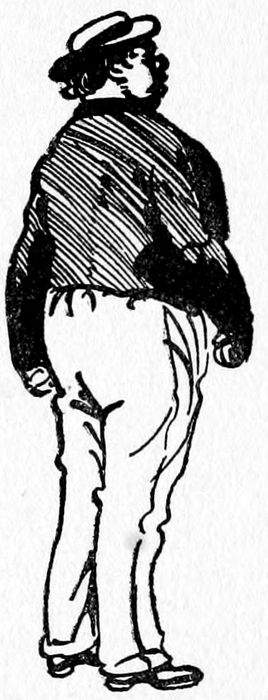
Such was the progress of Mr. Pickwick and
his friends by the Muggleton Telegraph, on
36their way to Dingley Dell; and at three o’clock
that afternoon, they all stood, high and dry,
safe and sound, hale and hearty, upon the steps
of the Blue Lion, having taken on the road quite
enough of ale and brandy, to
enable them to bid defiance to
the frost that was binding up
the earth in its iron fetters, and
weaving its beautiful net-work
upon the trees and hedges. Mr.
Pickwick was busily engaged in
counting the barrels of oysters,
and superintending the disinterment
of the cod-fish, when he
felt himself gently pulled by the
skirts of the coat; and looking
round, he discovered that the individual who
resorted to this mode of catching his attention,
was no other than Mr. Wardle’s favourite page,
better known to the readers of this unvarnished
history by the distinguishing appellation of the
fat boy.
37“Aha!” said Mr. Pickwick.
“Aha!” said the fat boy.
And as he said it, he glanced from the cod-fish
to the oyster barrels, and chuckled joyously.
He was fatter than ever.
“Well, you look rosy enough, my young friend,”
said Mr. Pickwick.
“I’ve been asleep, right in front of the tap-room
fire,” replied the fat boy, who had heated
himself to the colour of a new chimney-pot, in the
course of an hour’s nap. “Master sent me over
with the chay-cart, to carry your luggage up to
the house. He’d ha’ sent some saddle horses, but
he thought you’d rather walk, being a cold day.”
“Yes, yes,” said Mr. Pickwick, hastily, for
he remembered how they had travelled over
nearly the same ground on a previous occasion.
“Yes, we would rather walk. Here, Sam.”
“Sir,” said Mr. Weller.
“Help Mr. Wardle’s servant to put the packages
into the cart, and then ride on with him.
We will walk forward at once.”
38Having given this direction, and settled with
the coachman, Mr. Pickwick and his three
friends struck into the footpath across the fields,
and walked briskly away, leaving Mr. Weller
and the fat boy confronted together for the first
time. Sam looked at the fat boy with great
astonishment, but without saying a word; and
began to stow the things rapidly away in the
cart, while the fat boy stood quietly by, and
seemed to think it a very interesting sort of thing
to see Mr. Weller working by himself.
“There,” said Sam, throwing in the last carpet
bag. “There they are.”
“Yes,” said the fat boy, in a very satisfied
tone, “there they are.”
“Vell, young twenty stun,” said Sam, “you’re
a nice specimen of a prize boy, you are.”
“Thankee,” said the fat boy.
“You ain’t got nothin’ on your mind, as
makes you fret yourself, have you?” inquired
Sam.
“Not as I knows on,” replied the boy.
39“I should rayther ha’ thought, to look at you,
that you was a labourin’ under an unrequited
attachment to some young ’ooman,” said Sam.
The fat boy shook his head.
“Vell,” said Sam, “I’m glad to hear it. Do
you ever drink anythin’?”
“I likes eating, better,” replied the boy.
“Ah,” said Sam, “I should ha’ s’posed that;
but what I mean is, should you like a drop of
anythin’ as’d warm you? but I s’pose you never
was cold, with all them elastic fixtures, was
you?”
“Sometimes,” replied the boy; “and I likes a
drop of something, when it’s good.”
“Oh, you do, do you?” said Sam, “come this
vay, then.”
The Blue Lion tap was soon gained, and the
fat boy swallowed a glass of liquor without so
much as winking,—a feat which considerably
advanced him in Mr. Weller’s good opinion. Mr.
Weller having transacted a similar piece of business
on his own account, they got into the cart.
40“Can you drive?” said the fat boy.
“I should rayther think so,” replied Sam.
“There, then,” said the fat boy, putting the
reins in his hand, and pointing up a lane, “It’s
as straight as you can go; you can’t miss it.”
With these words, the fat boy laid himself
affectionately down by the side of the cod-fish,
and placing an oyster-barrel under his head for
a pillow, fell asleep instantaneously.
“Vell,” said Sam, “of all the cool boys ever I
set my eyes on, this here young gen’lm’n is about
the coolest. Come, vake up, young dropsy.”
But as young dropsy evinced no symptoms of
returning animation, Sam Weller sat himself down
in front of the cart, and starting the old horse
with a jerk of the rein, jogged steadily on, towards
Manor Farm.
Meanwhile, Mr. Pickwick and his friends having
walked their blood into active circulation,
proceeded cheerfully on; the paths were hard, the
grass was crisp and frosty, the air had a fine,
dry, bracing coldness, and the rapid approach of
41the grey twilight (slate-coloured is a better term
in frosty weather) made them look forward with
pleasant anticipation to the comforts which awaited
them at their hospitable entertainer’s. It was the
sort of afternoon that might induce a couple of
elderly gentlemen, in a lonely field, to take off
their great coats and play at leap-frog in pure
lightness of heart and gaiety; and we firmly believe
that had Mr. Tupman at that moment proffered
“a back,” Mr. Pickwick would have accepted his
offer with the utmost avidity.
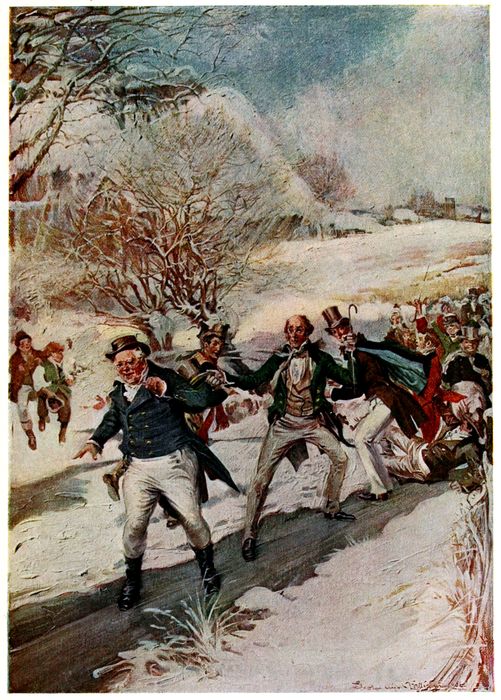
However, Mr. Tupman did not volunteer any
such personal accommodation, and the friends
walked on, conversing merrily. As they turned
into a lane which they had to cross, the sound of
many voices burst upon their ears; and before they
had even had time to form a guess as to whom
they belonged, they walked into the very centre
of the party who were expecting their arrival—a
fact which was first notified to the Pickwickians,
by the loud “Hurrah,” which burst from old
Wardle’s lips, when they appeared in sight.
42First, there was Wardle himself, looking, if that
were possible, more jolly than ever; then there
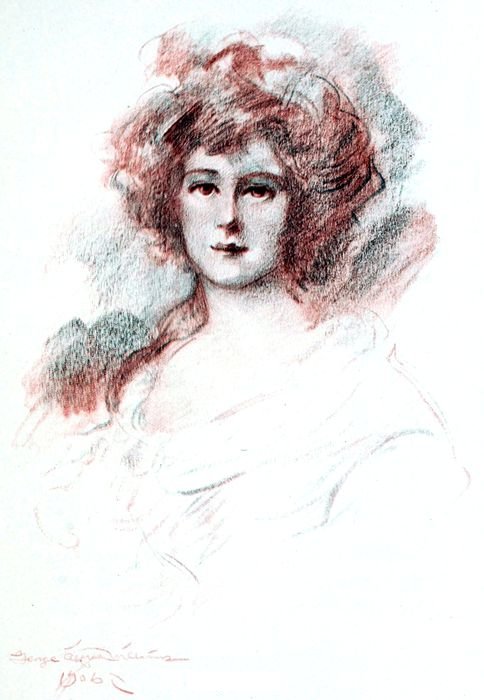
were Bella and her faithful Trundle; and, lastly,
there were Emily and some eight or ten young
ladies, who had all come down to the wedding
which was to take place next day, and were in
as happy and important a state as young ladies
usually are, on such momentous occasions; and
they were, one and all, startling the fields and
lanes far and wide with their frolic and laughter.
43
45
The ceremony of introduction, under such circumstances,
was very soon performed, or we
should rather say that the introduction was soon
over, without any ceremony at all; and in two
minutes thereafter, Mr. Pickwick was joking with
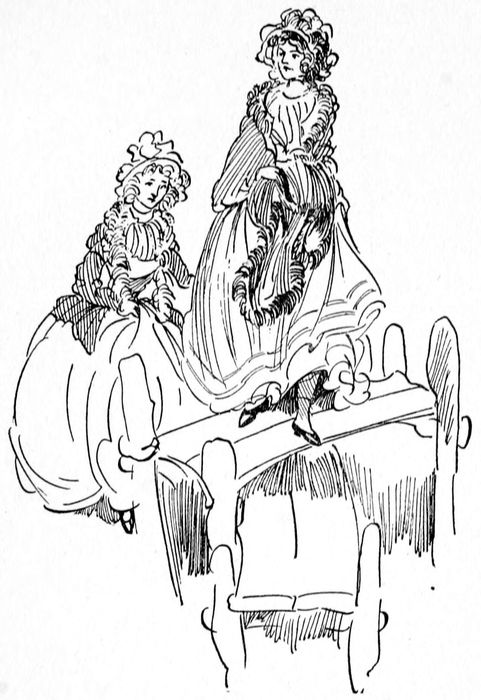
the young ladies who wouldn’t come over the stile
while he looked, or who, having pretty feet and
unexceptionable ankles, preferred standing on the
top-rail for five minutes or so, and declaring that
they were too frightened to move, with as much
ease and absence of reserve or constraint, as if
he had known them for life. It is worthy of
remark too, that Mr. Snodgrass offered Emily far
more assistance than the absolute terrors of the
stile (although it was full three feet high, and
46had only a couple of stepping-stones) would seem
to require; while one black-eyed young lady in a
very nice little pair of boots with fur round the
top, was observed to scream very loudly, when
Mr. Winkle offered to help her over.
All this was very snug and pleasant: and when
the difficulties of the stile were at last surmounted,
and they once more entered on the open field,
old Wardle informed Mr. Pickwick how they had
all been down in a body to inspect the furniture
and fittings-up of the house, which the young
couple were to tenant, after the Christmas holidays;
at which communication Bella and Trundle
both coloured up, as red as the fat boy after the
tap-room fire; and the young lady with the black
eyes and the fur round the boots, whispered something
in Emily’s ear, and then glanced archly at
Mr. Snodgrass, to which Emily responded that
she was a foolish girl, but turned very red, notwithstanding;
and Mr. Snodgrass, who was as
modest as all great geniuses usually are, felt the
crimson rising to the crown of his head, and
47devoutly wished, in the inmost recesses of his
own heart, that the young lady aforesaid, with
her black eyes, and her archness, and her boots
with the fur round the top, were all comfortably
deposited in the adjacent county.
But if they were social and happy, outside the
house, what was the warmth and cordiality of
their reception when they reached the farm! The
very servants grinned with pleasure at sight of
Mr. Pickwick: and Emma bestowed a half-demure,
half-impudent, and all pretty look of
recognition on Mr. Tupman, which was enough
to make the statue of Bonaparte in the passage,
unfold his arms, and clasp her within
them.
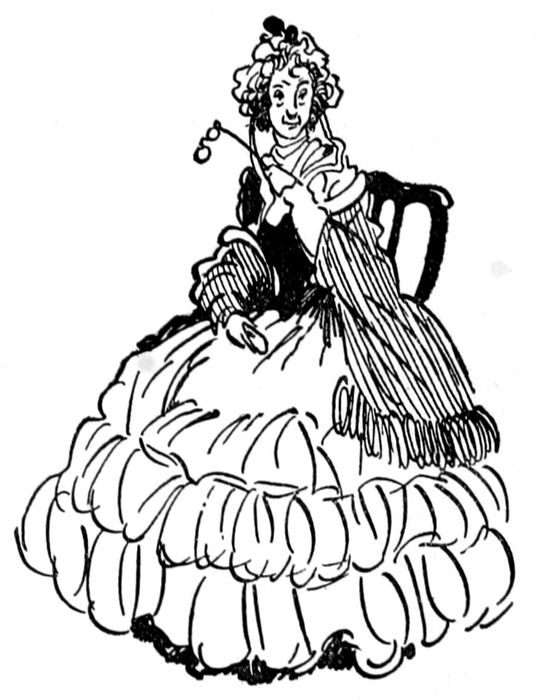
The old lady was seated in customary state in
the front parlour, but she was rather cross, and
by consequence, most particularly deaf. She
never went out herself, and like a great many
other old ladies of the same stamp, she was apt
to consider it an act of domestic treason, if any
body else took the liberty of doing what she
48couldn’t. So, bless her old soul, she sat as upright
as she could, in her great chair, and looked
as fierce as might be—and that was benevolent
after all.
“Mother,” said Wardle, “Mr. Pickwick. You
recollect him.”
“Never mind,” replied the old lady with great
dignity. “Don’t
trouble Mr. Pickwick
about an old
creetur like me.
Nobody cares
about me now, and
it’s very nat’ral
they shouldn’t.”
Here the old lady
tossed her head,
and smoothed
down her lavender-coloured
silk dress, with trembling hands.
“Come, come, Ma’am,” said Mr. Pickwick, “I
can’t let you cut an old friend in this way. I have
49come down expressly to have a long talk, and
another rubber with you; and we’ll show these
boys and girls how to dance a minuet, before
they’re eight-and-forty hours older.”
The old lady was rapidly giving way, but she
did not like to do it all at once; so she only said,
“Ah! I can’t hear him.”
“Nonsense, mother,” said Wardle. “Come,
come, don’t be cross, there’s a good soul. Recollect
Bella; come, you must keep her spirits up,
poor girl.”
The good old lady heard this, for her lip quivered
as her son said it. But age has its little
infirmities of temper, and she was not quite brought
round yet. So, she smoothed down the lavender-coloured
dress again, and turning to Mr. Pickwick
said, “Ah, Mr. Pickwick, young people was very
different, when I was a girl.”
“No doubt of that, Ma’am,” said Mr. Pickwick,
“and that’s the reason why I would make much
of the few that have any traces of the old stock,”—and
saying this, Mr. Pickwick gently pulled
50Bella towards him, and bestowing a kiss upon her
forehead, bade her sit down on the little stool at
her grandmother’s feet. Whether the expression
of her countenance, as it was raised towards the
old lady’s face, called up a thought of old times,
or whether the old lady was touched by Mr.
Pickwick’s affectionate good nature, or whatever
was the cause, she was fairly melted; so, she
threw herself on her grand-daughter’s neck, and
all the little ill-humour evaporated in a gush of
silent tears.
A happy party they were, that night. Sedate
and solemn were the score of rubbers in which
Mr. Pickwick and the old lady played together;
and uproarious was the mirth of the round table.
Long after the ladies had retired, did the hot elder
wine, well qualified with brandy and spice, go
round, and round, and round again; and sound
was the sleep, and pleasant were the dreams that
followed. It is a remarkable fact, that those of
Mr. Snodgrass bore constant reference to Emily
Wardle; and that the principal figure in Mr.
51Winkle’s visions, was a young lady with black
eyes, an arch smile, and a pair of remarkably
nice boots, with fur round the tops.
Mr. Pickwick was awakened early in the morning,
by a hum of voices and pattering of feet,
sufficient to rouse even the fat boy from his heavy
slumbers. He sat up in bed, and listened. The
female servants and female visitors were running
constantly to and fro; and there were such multitudinous
demands for warm water, such repeated
outcries for needles and thread, and so many half-suppressed
entreaties of “Oh, do come and tie
me, there’s a dear,” that Mr. Pickwick in his
innocence began to imagine that something dreadful
must have occurred, when he grew more
awake, and remembered the wedding. The occasion
being an important one, he dressed himself
with peculiar care, and descended to the breakfast
room.
There were all the female servants in a bran
new uniform of pink muslin gowns with white
bows in their caps, running about the house in a
52state of excitement and agitation, which it would
be impossible to describe. The old lady was
dressed out, in a brocaded gown, which had not
seen the light for twenty years, saving and excepting
such truant rays as had stolen through the
chinks in the box in which it had been laid by,
during the whole time. Mr. Trundle was in high
feather and spirits, but a little nervous withal.
The hearty old landlord was trying to look very
cheerful and unconcerned, but failing signally in
the attempt. All the girls were in tears and white
muslin, except a select two or three, who were
being honoured with a private view of the bride
and bridesmaids, up stairs. All the Pickwickians
were in most blooming array; and there was a
terrific roaring on the grass in front of the house,
occasioned by all the men, boys, and hobbledehoys
attached to the farm, each of whom had got
a white bow in his buttonhole, and all of whom
were cheering with might and main: being incited
thereto, and stimulated therein, by the precept
and example of Mr. Samuel Weller, who had
53managed to become mighty popular already, and
was as much at home as if he had been born on
the land.
A wedding is a licensed subject to joke upon,
but there really is no great joke in the matter
after all; we speak merely of the ceremony, and
beg it to be distinctly understood that we indulge
in no hidden sarcasm upon a married
life. Mixed up with the pleasure and joy of
the occasion, are the many regrets at quitting
home, the tears of parting between parent and
child, the consciousness of leaving the dearest
and kindest friends of the happiest portion of
human life, to encounter its cares and troubles
with others still untried, and little known—natural
feelings which we would not render this
chapter mournful by describing, and which we
should be still more unwilling to be supposed
to ridicule.
Let us briefly say, then, that the ceremony
was performed by the old clergyman, in the
parish church of Dingley Dell, and that Mr.
54Pickwick’s name is attached to the register, still
preserved in the vestry thereof; that the young
lady with the black eyes signed her name in a
very unsteady and tremulous manner; and that
Emily’s signature, as the other bridesmaid, is
nearly illegible; that it all went off in very admirable
style; that the young ladies generally,
thought it far less shocking than they expected;
and that although the owner of the black eyes
and the arch smile informed Mr. Winkle that
she was sure she could never submit to anything
so dreadful, we have the very best reasons for
thinking she was mistaken. To all this, we
may add, that Mr. Pickwick was the first who
saluted the bride: and that in so doing, he threw
over her neck, a rich gold watch and chain,
which no mortal eyes but the jeweller’s had ever
beheld before. Then the old church bell rang
as gaily as it could, and they all returned to
breakfast.
“Vere does the mince-pies go, young opium
eater?” said Mr. Weller to the fat boy, as he
55assisted in laying out such articles of consumption
as had not been duly arranged on the previous
night.
The fat boy pointed to the destination of the
pies.
“Wery good,” said Sam, “stick a bit o’ Christmas
in ’em. T’other dish opposite. There; now
ve look compact and comfortable, as the father
said ven he cut his little boy’s head off, to cure
him o’ squintin’.”
As Mr. Weller made the comparison, he fell
back a step or two, to give full effect to it, and
surveyed the preparations with the utmost satisfaction.
“Wardle,” said Mr. Pickwick, almost as soon
as they were all seated, “a glass of wine, in
honour of this happy occasion!”
“I shall be delighted, my boy,” said Wardle.
“Joe—damn that boy, he’s gone to sleep.”
“No, I ain’t, Sir,” replied the fat boy, starting
up from a remote corner, where, like the patron
saint of fat boys—the immortal Horner—he
56had been devouring a Christmas pie, though not
with the coolness and deliberation which characterised
that young gentleman’s proceedings.
“Fill Mr. Pickwick’s glass.”
“Yes, sir.”
The fat boy filled Mr. Pickwick’s glass, and
then retired behind his master’s chair, from
whence he watched the play of the knives and
forks, and the progress of the choice morsels,
from the dishes, to the mouths of the company,
with a kind of dark and gloomy joy that was
most impressive.
“God bless you, old fellow,” said Mr. Pickwick.
“Same to you, my boy,” replied Wardle; and
they pledged each other, heartily.
“Mrs. Wardle,” said Mr. Pickwick, “we old
folks must have a glass of wine together, in honour
of this joyful event.”
57
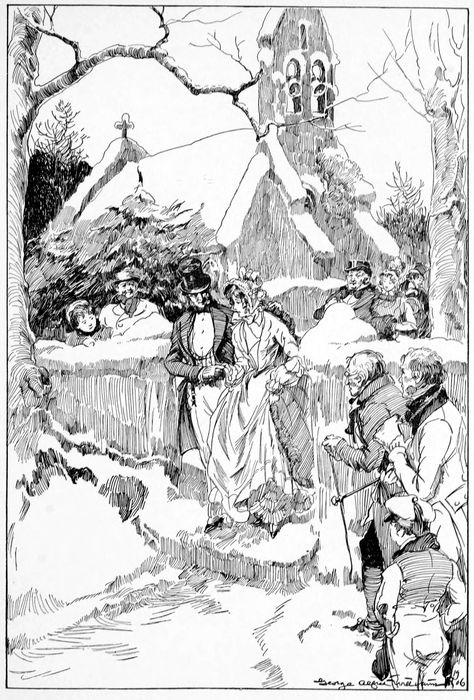
Then the old church bell rang ... and they all returned to breakfast.
59The old lady was in a state of great grandeur
just then, for she was sitting at the top of the
table in her brocaded gown, with her newly-married grand-daughter on one side, and Mr.
Pickwick on the other, to do the carving. Mr.
Pickwick had not spoken in a very loud tone,
but she understood him at once, and drank off
a full glass of wine to his long life and happiness;
after which the worthy old soul launched
forth into a minute and particular account of
her own wedding, with a dissertation on the
fashion of wearing high-heeled shoes, and some
particulars concerning the life and adventures
of the beautiful Lady Tollimglower, deceased,
at all of which the old lady herself laughed very
heartily indeed, and so did the young ladies too,
for they were wondering among themselves what
on earth grandma was talking about. When
they laughed, the old lady laughed ten times
more heartily: and said that they always had
been considered capital stories, which caused
them all to laugh again, and put the old lady
into the very best of humours. Then the cake
was cut, and passed through the ring; and the
young ladies saved pieces to put under their
60pillows to dream of their future husbands on;
and a great deal of blushing and merriment was
thereby occasioned.
“Mr. Miller,” said Mr. Pickwick to his old
acquaintance, the hard-headed gentleman, “a
glass of wine?”
“With great satisfaction Mr. Pickwick,” replied
the hard-headed gentleman, solemnly.
“You’ll take me in?” said the benevolent old
clergyman.
“And me,” interposed his wife.
“And me, and me,” said a couple of poor
relations at the bottom of the table, who had
eaten and drank very heartily, and laughed at
every thing.
Mr. Pickwick expressed his heartfelt delight
at every additional suggestion; and his eyes
beamed with hilarity and cheerfulness.
“Ladies and gentlemen,” said Mr. Pickwick,
suddenly rising—
“Hear, hear! Hear, hear! Hear, hear!” said
Mr. Weller, in the excitement of his feelings.
61“Call in all the servants,” cried old Wardle,
interposing to prevent the public rebuke which
Mr. Weller would otherwise most indubitably
have received from his master. “Give them a
glass of wine each, to drink the toast in. Now,
Pickwick.”
Amidst the silence of the company, the whispering
of the women servants, and the awkward
embarrassment of the men, Mr. Pickwick proceeded.
“Ladies and gentlemen—no, I won’t say
ladies and gentlemen, I’ll call you my friends,
my dear friends, if the ladies will allow me to
take so great a liberty”—
Here Mr. Pickwick was interrupted by immense
applause from the ladies, echoed by the
gentlemen, during which the owner of the eyes
was distinctly heard to state that she could kiss
that dear Mr. Pickwick, whereupon Mr. Winkle
gallantly inquired if it couldn’t be done by deputy,
to which the young lady with the black eyes replied,
“Go away”—and accompanied the request
62with a look which said as plainly as a look
could do—“if you can.”
“My dear friends,” resumed Mr. Pickwick, “I
am going to propose the health of the bride and
bridegroom—God bless ’em (cheers and tears).
My young friend Trundle, I believe to be a very
excellent and manly fellow; and his wife I know
to be a very amiable and lovely girl, well qualified
to transfer to another sphere of action the
happiness which for twenty years she has diffused
around her, in her father’s house. (Here, the
fat boy burst forth into stentorian blubberings,
and was led forth by the coat collar, by Mr.
Weller.) I wish,” added Mr. Pickwick, “I wish
I was young enough to be her sister’s husband,
(cheers), but, failing that, I am happy to be old
enough to be her father; for, being so, I shall
not be suspected of any latent designs when I
say, that I admire, esteem, and love them both
(cheers and sobs). The bride’s father, our good
friend there, is a noble person, and I am proud
to know him (great uproar). He is a kind,
63excellent, independent-spirited, fine-hearted, hospitable,
liberal man (enthusiastic shouts from the
poor relations, at all the adjectives; and especially
at the last two). That his daughter may enjoy
all the happiness, even he can desire; and that he
may derive from the contemplation of her felicity
all the gratification of heart and peace of mind
which he so well deserves, is, I am persuaded,
our united wish. So, let us drink their healths,
and wish them prolonged life, and every blessing.”
Mr. Pickwick concluded amidst a whirlwind
of applause; and once more were the lungs of
the supernumeraries, under Mr. Weller’s command,
brought into active and efficient operation.
Mr. Wardle proposed Mr. Pickwick; and
Mr. Pickwick proposed the old lady. Mr. Snodgrass
proposed Mr. Wardle, and Mr. Wardle
proposed Mr. Snodgrass. One of the poor relations
proposed Mr. Tupman, and the other
poor relation proposed Mr. Winkle; and all was
happiness and festivity, until the mysterious disappearance
of both the poor relations beneath
64the table, warned the party that it was time to
adjourn.
At dinner they met again, after a five and
twenty mile walk, undertaken by the males at
Wardle’s recommendation, to get rid of the effects
of the wine at breakfast; the poor relations had
lain in bed all day, with the view of attaining the
same happy consummation, but, as they had
been unsuccessful, they stopped there. Mr. Weller
kept the domestics in a state of perpetual hilarity;
and the fat boy divided his time into small
alternate allotments of eating and sleeping.
The dinner was as hearty an affair as the
breakfast, and was quite as noisy, without the
tears. Then came the dessert and some more
toasts. Then came the tea and coffee; and then,
the ball.
65
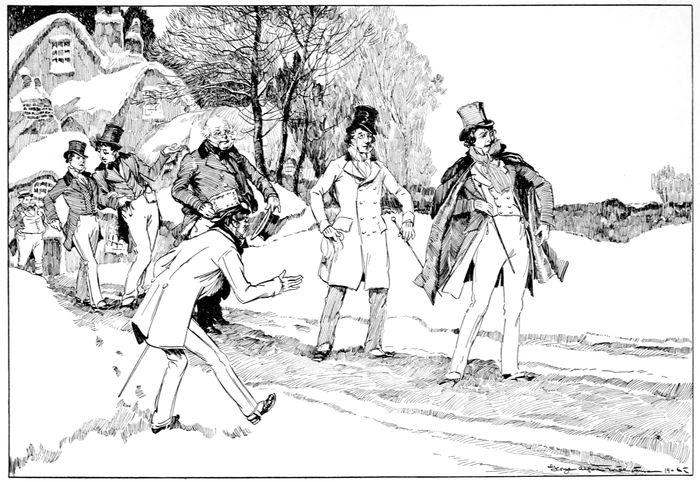
A five and twenty mile walk, undertaken by the males at Wardle’s recommendation.
67The best sitting room at Manor Farm was a
good, long, dark pannelled room with a high
chimney piece, and a capacious chimney, up
which you could have driven one of the new
patent cabs, wheels and all. At the upper end
of the room, seated in a shady bower of holly
and evergreens, were the two best fiddlers, and
the only harp, in all Muggleton. In all sorts
of recesses, and on all kinds of brackets, stood
massive old silver candlesticks with four branches
each. The carpet was up, the candles burnt
bright, the fire blazed and crackled on the hearth;
and merry voices and light-hearted laughter rang
through the room. If any of the old English
yeomen had turned into fairies when they died,
it was just the place in which they would have
held their revels.
If any thing could have added to the interest
of this agreeable scene, it would have been the
remarkable fact of Mr. Pickwick’s appearing without
his gaiters, for the first time within the memory
of his oldest friends.
“You mean to dance?” said Wardle.
“Of course I do,” replied Mr. Pickwick, “Don’t
you see I am dressed for the purpose?” and Mr.
Pickwick called attention to his speckled silk
stockings, and smartly tied pumps.
68“You in silk stockings!” exclaimed Mr. Tupman,
jocosely.
“And why not Sir—why not?” said Mr. Pickwick,
turning warmly upon him.
“Oh, of course there is no reason why you
shouldn’t wear them,” responded Mr. Tupman.
“I imagine not Sir—I imagine not,” said Mr.
Pickwick in a very peremptory tone.
Mr. Tupman had contemplated a laugh, but
he found it was a serious matter; so he looked
grave, and said they were a very pretty pattern.
“I hope they are,” said Mr. Pickwick fixing
his eyes upon his friend. “You see nothing extraordinary
in these stockings, as stockings, I
trust Sir?”
“Certainly not—oh certainly not,” replied Mr.
Tupman. He walked away; and Mr. Pickwick’s
countenance resumed its customary benign expression.
“We are all ready, I believe,” said Mr. Pickwick,
who was stationed with the old lady at the
69top of the dance, and had already made four false
starts, in his excessive anxiety to commence.
“Then begin at once,” said Wardle. “Now.”
Up struck the two fiddles and the one harp,
and off went Mr. Pickwick into hands across,
when there was a general clapping of hands, and
a cry of “Stop, stop.”
“What’s the matter?” said Mr. Pickwick, who
was only brought to, by the fiddles and harp
desisting, and could have been stopped by no
other earthly power, if the house had been on
fire.
“Where’s Arabella Allen?” said a dozen voices.
“And Winkle!” added Mr. Tupman.
“Here we are!” exclaimed that gentleman,
emerging with his pretty companion from the
corner; and, as he did so, it would have been
hard to tell which was the redder in the face, he
or the young lady with the black eyes.
“What an extraordinary thing it is, Winkle,”
said Mr. Pickwick, rather pettishly, “that you
couldn’t have taken your place before.”
70“Not at all extraordinary,” said Mr. Winkle.
“Well,” said Mr. Pickwick, with a very expressive
smile, as his eyes rested on Arabella,
“well, I don’t know that it was extraordinary,
either, after all.”
However, there was no time to think more
about the matter, for the fiddles and harp began
in real earnest. Away went Mr. Pickwick—hands
across, down the middle to the very end
of the room, and half way up the chimney, back
again to the door—poussette everywhere—loud
stamp on the ground—ready for the next couple—off
again—all the figure over once more—another
stamp to beat out the time—next couple,
and the next, and the next again—never was
such going; and at last, after they had reached
the bottom of the dance, and full fourteen couple
after the old lady had retired in an exhausted
state, and the clergyman’s wife had been substituted
in her stead, did that gentleman, when there
was no demand whatever on his exertions, keep
perpetually dancing in his place, to keep time to
71the music, smiling on his partner all the while
with a blandness of demeanour which baffles all
description.
Long before Mr. Pickwick was weary of dancing,
the newly-married couple had retired from
the scene. There was a glorious supper down
stairs, notwithstanding, and a good long sitting
after it; and when Mr. Pickwick awoke, late the
next morning, he had a confused recollection of
having, severally and confidentially, invited somewhere
about five-and-forty people to dine with
him at the George and Vulture, the very first
time they came to London; which Mr. Pickwick
rightly considered a pretty certain indication of
his having taken something besides exercise, on
the previous night.
“And so your family has games in the kitchen
to-night, my dear, has they?” inquired Sam of
Emma.
“Yes, Mr. Weller,” replied Emma; “we always
have on Christmas eve. Master wouldn’t neglect
to keep it up on any account.”
72“Your master’s a wery pretty notion of keepin’
anythin’ up, my dear,” said Mr. Weller; “I never
see such a sensible sort of man as he is, or such
a reg’lar gen’l’m’n.”
“Oh, that he is!” said the fat boy, joining in the
conversation; “don’t he breed nice pork!” and
the fat youth gave a semi-cannibalic leer at Mr.
Weller, as he thought of the roast legs and
gravy.
“Oh, you’ve woke up, at last, have you?” said
Sam.
The fat boy nodded.
“I’ll tell you what it is, young boa constructer,”
said Mr. Weller, impressively, “if you don’t sleep
a little less, and exercise a little more, ven you
comes to be a man you’ll lay yourself open to the
same sort o’ personal inconwenience as was inflicted
on the old gen’lm’n as wore the pig-tail.”
“What did they do to him?” inquired the fat
boy, in a faltering voice.
“I’m a goin’ to tell you,” replied Mr. Weller;
“he was one o’ the largest patterns as was ever
73turned out—reg’lar fat man, as hadn’t caught a
glimpse of his own shoes for five-and-forty years.”
“Lor!” exclaimed Emma.
“No, that he hadn’t, my dear,” said Mr. Weller,
“and if you’d put an exact model of his own legs
on the dinin’ table afore him, he wouldn’t ha’
known ’em. Well, he always walks to his office
with a wery handsome gold watch-chain hanging
out, about a foot and a half; and a gold watch in
his fob pocket as was worth—I’m afraid to say
how much, but as much as a watch can be—a
large, heavy, round manufacturer, as stout for a
watch, as he was for a man, and with a big face
in proportion. ‘You’d better not carry that ’ere
watch,’ says the old gen’l’m’n’s friends, ‘you’ll
be robbed on it,’ says they. ‘Shall I?’ says he.
‘Yes, will you,’ says they. ‘Vell,’ says he, ‘I
should like to see the thief as could get this here
watch out, for I’m blessed if I ever can; it’s such
a tight fit,’ says he, ‘and venever I vants to know
what’s o’clock, I’m obliged to stare into the
bakers’ shops,’ he says. Well, then he laughs as
74hearty as if he was a goin’ to pieces, and out he
walks agin’ with his powdered head and pig-tail,
and rolls down the Strand vith the chain hangin’
out furder than ever, and the great round watch
almost bustin’ through his grey kersey smalls.
There warn’t a pickpocket in all London as didn’t
take a pull at that chain, but the chain ’ud never
break, and the watch ’ud never come out, so they
soon got tired o’ dragging such a heavy old
gen’l’m’n along the pavement, and he’d go home
and laugh till the pig-tail wibrated like the penderlum
of a Dutch clock. At last, one day the
old gen’l’m’n was a rollin’ along, and he sees a
pickpocket as he know’d by sight, a-comin’ up,
arm in arm vith a little boy vith a wery large
head. ‘Here’s a game,’ says the old gen’l’m’n to
himself, ‘they’re a goin’ to have another try, but
it won’t do.’ So he begins a chucklin’ wery
hearty, ven, all of a sudden, the little boy leaves
hold of the pickpocket’s arm, and rushes headforemost
straight into the old gen’l’m’n’s stomach,
and for a moment doubled him right up vith
75the pain. ‘Murder!’ says the old gen’l’m’n. ‘All
right, Sir,’ says the pickpocket, a whisperin’ in
his ear. And ven he come straight agin’, the
watch and chain was gone, and what’s worse
than that, the old gen’l’m’n’s digestion was all
wrong ever artervards, to the wery last day of
his life; so just you look about you, young feller,
and take care you don’t get too fat.”
As Mr. Weller concluded this moral tale, with
which the fat boy appeared much affected, they
all three wended their way to the large kitchen,
in which the family were by this time assembled,
according to annual custom on Christmas eve,
observed by old Wardle’s forefathers from time
immemorial.
From the centre of the ceiling of this kitchen,
old Wardle had just suspended with his own
hands a huge branch of mistletoe, and this same
branch of mistletoe instantaneously gave rise to a
scene of general and most delightful struggling
and confusion; in the midst of which Mr. Pickwick
with a gallantry which would have done honour
76to a descendant of Lady Tollimglower herself,
took the old lady by the hand, led her beneath
the mystic branch, and saluted her in all courtesy
and decorum. The old lady submitted to this
piece of practical politeness with all the dignity
which befitted so important and serious a solemnity,
but the younger ladies not being so thoroughly
imbued with a superstitious veneration of
the custom, or imagining that the value of a salute
is very much enhanced if it cost a little trouble
to obtain it, screamed and struggled, and ran into
corners, and threatened and remonstrated, and
did every thing but leave the room, until some of
the less adventurous gentlemen were on the point
of desisting, when they all at once found it useless
to resist any longer, and submitted to be kissed
with a good grace. Mr. Winkle kissed the young
lady with the black eyes, and Mr. Snodgrass
kissed Emily; and Mr. Weller, not being particular
about the form of being under the mistletoe,
kissed Emma and the other female servants, just
as he caught them. As to the poor relations, they
77kissed everybody, not even excepting the plainer
portion of the young-lady visitors, who, in their
excessive confusion, ran right under the mistletoe,
directly it was hung up, without knowing it!
Wardle stood with his back to the fire, surveying
the whole scene, with the utmost satisfaction; and
the fat boy took the opportunity of appropriating
to his own use, and summarily devouring, a particularly
fine mince pie, that had been carefully
put by, for somebody else.
Now the screaming had subsided, and faces
were in a glow and curls in a tangle, and Mr.
Pickwick, after kissing the old lady as before-mentioned,
was standing under the mistletoe,
looking with a very pleased countenance on all
that was passing around him, when the young
lady with the black eyes, after a little whispering
with the other young ladies, made a sudden dart
forward, and, putting her arm round Mr. Pickwick’s
neck, saluted him affectionately on the
left cheek; and before Mr. Pickwick distinctly
knew what was the matter, he was surrounded
78by the whole body, and kissed by every one of
them.
It was a pleasant thing to see Mr. Pickwick in
the centre of the group, now pulled this way, and
then that, and first kissed on the chin and then
on the nose, and then on the spectacles, and to
hear the peals of laughter which were raised on
every side; but it was a still more pleasant thing
to see Mr. Pickwick, blinded shortly afterwards,
with a silk-handkerchief, falling up against the
wall, and scrambling into corners, and going
through all the mysteries of blind-man’s buff,
with the utmost relish for the game, until at last
he caught one of the poor relations; and then had
to evade the blind-man himself, which he did with
a nimbleness and agility that elicited the admiration
and applause of all beholders. The poor
relations caught just the people whom they thought
would like it; and when the game flagged, got
caught themselves. When they were all tired of
blind-man’s buff, there was a great game at snapdragon,
and when fingers enough were burned
79with that, and all the raisins gone, they sat down
by the huge fire of blazing logs to a substantial
supper, and a mighty bowl of wassail, something
smaller than an ordinary wash-house copper, in
which the hot apples were hissing and bubbling
with a rich look, and a jolly sound, that were
perfectly irresistible.
“This,” said Mr. Pickwick, looking round him,
“this is, indeed, comfort.”
“Our invariable custom,” replied Mr. Wardle.
“Everybody sits down with us on Christmas eve, as
you see them now—servants and all; and here we
wait till the clock strikes twelve, to usher Christmas
in, and wile away the time with forfeits and
old stories. Trundle, my boy, rake up the fire.”
Up flew the bright sparks in myriads as the
logs were stirred, and the deep red blaze sent
forth a rich glow, that penetrated into the furthest
corner of the room, and cast its cheerful tint on
every face.
“Come,” said Wardle, “a song—a Christmas
song. I’ll give you one, in default of a better.”
80“Bravo,” said Mr. Pickwick.
“Fill up,” cried Wardle. “It will be two hours
good, before you see the bottom of the bowl
through the deep rich colour of the wassail; fill
up all round, and now for the song.”
Thus saying, the merry old gentleman, in a
good, round, sturdy voice, commenced without
more ado—
I care not for Spring; on his fickle wing
Let the blossoms and buds be borne:
He woos them amain with his treacherous rain,
And he scatters them ere the morn.
An inconstant elf, he knows not himself,
Or his own changing mind an hour,
He’ll smile in your face, and, with wry grimace,
He’ll wither your youngest flower.
Let the Summer sun to his bright home run,
He shall never be sought by me;
When he’s dimmed by a cloud I can laugh aloud,
And care not how sulky he be;
For his darling child is the madness wild
That sports in fierce fever’s train;
And when love is too strong, it don’t last long,
As many have found to their pain.
83A mild harvest night, by the tranquil light
Of the modest and gentle moon,
Has a far sweeter sheen for me, I ween,
Than the broad and unblushing noon.
But every leaf awakens my grief,
As it lieth beneath the tree;
So let Autumn air be never so fair,
It by no means agrees with me.
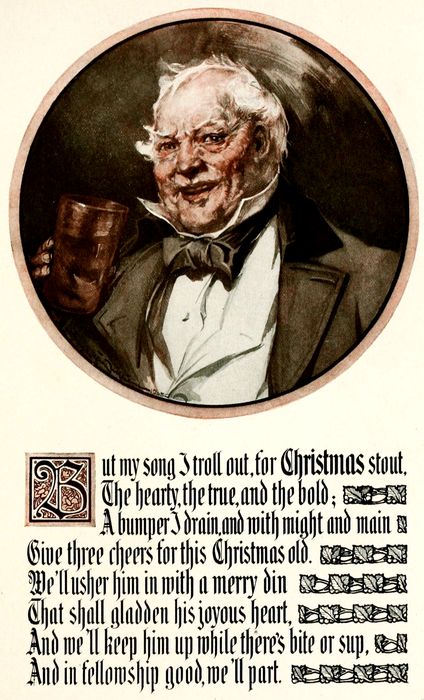
But my song I troll out, for Christmas stout,
The hearty, the true, and the bold;
A bumper I drain, and with might and main
Give three cheers for this Christmas old.
We’ll usher him in with a merry din
That shall gladden his joyous heart,
And we’ll keep him up while there’s bite or sup,
And in fellowship good, we’ll part.
In his fine honest pride, he scorns to hide
One jot of his hard-weather scars;
They’re no disgrace, for there’s much the same trace
On the cheeks of our bravest tars.
Then again I sing ’till the roof doth ring,
And it echoes from wall to wall—
To the stout old wight, fair welcome to-night,
As the King of the Seasons all!
This song was tumultuously applauded, for
friends and dependents make a capital audience;
and the poor relations especially were in perfect
84extasies of rapture. Again was the fire replenished,
and again went the wassail round.
“How it snows!” said one of the men, in a
low tone.
“Snows, does it?” said Wardle.
“Rough, cold night, Sir,” replied the man;
“and there’s a wind got up that drifts it across
the fields, in a thick white cloud.”
“What does Jem say?” inquired the old lady.
“There ain’t any thing the matter, is there?”
“No, no, mother,” replied Wardle; “he says
there’s a snow-drift, and a wind that’s piercing
cold. I should know that, by the way it rumbles
in the chimney.”
“Ah!” said the old lady, “there was just such
a wind, and just such a fall of snow, a good
many years back, I recollect—just five years
before your poor father died. It was a Christmas
eve, too; and I remember that on that very
night he told us the story about the goblins that
carried away old Gabriel Grub.”
“The story about what?” said Mr. Pickwick.
85“Oh, nothing—nothing,” replied Wardle.
“About an old sexton, that the good people
down here suppose to have been carried away
by goblins.”
“Suppose!” ejaculated the old lady. “Is there
any body hardy enough to disbelieve it? Suppose!
Haven’t you heard ever since you were a
child, that he was carried away by the goblins,
and don’t you know he was?”
“Very well, mother, he was, if you like,” said
Wardle, laughing. “He was carried away by
goblins, Pickwick; and there’s an end of the
matter.”
“No, no,” said Mr. Pickwick, “not an end of
it, I assure you; for I must hear how, and why,
and all about it.”
Wardle smiled, as every head was bent forward
to hear; and filling out the wassail with no
stinted hand, nodded a health to Mr. Pickwick,
and began as follows—
But bless our editorial heart, what a long
chapter we have been betrayed into! We had
86quite forgotten all such petty restrictions as
chapters, we solemnly declare. So here goes,
to give the goblin a fair start in a new one. A
clear stage and no favour for the goblins, ladies
and gentlemen, if you please.