“To-morrow” has come. The outside
world seems glad to be alive. I—the
Editor—accustomed to mental ease and
physical comfort, am confronted with perplexing
duties. My bills are paid, my health is
good, and my mind is clear, but, confound the
idea of work! I never liked work, and I fear
even custom will not reconcile me to drudgery.
But duty calls, and, so far, duty has
never called upon me in vain.
I—the Editor, remember—am ashamed
that I forgot Leo Bergin for two long years;
I am more ashamed that I so nearly forgot
the package, the contents of which may bring
pleasure to many a curious and careworn soul,
for, as a fact, I feel rebuked even by the
presence of this evidence of sturdy resolve,
so wanting in myself. As a fact, I know, when
I care to be serious, that Leo Bergin, with
his restless ambition, his tireless industry, his
dauntless courage, his reckless love of adventure,
and his almost insane determination to
turn on a little more light, with all his faults,
was worth to his kind, more than a legion of
happy idlers, who, like myself, were born in
wealth, and indolently dallied in the soft lap of
luxury, careless alike to the sorrows and the
joys of common humanity.
Well, as a compromise with my conscience—I
think it must be conscience, for the sensation
is new to me—I am determined to unravel
the mystery of Leo Bergin’s absence,
and, if in the mass of labored matter, there is
one thought or fact or idea worthy of his fine
attainments and insane strife, the world shall
find some compensation for his many errors.
With comfortable surroundings, cheerful fire,
easy chair, convenient desk and table, fine
cigars, ample library, a new found sense of
duty, an industry aroused by remorse, and with
a sense of deep responsibility I begin my
work, feeling that the suggestion from the
dying author to “boil it down” has vastly
augmented the difficulties that confront me.
I am abundantly aware that the age is
athirst for fiction, whereas I have for its
patience but a plain unvarnished tale. I know
the taste for graceful periods, while I can give
but labored phrase, and I know the critics want
only the “meat,” while I must crave the indulgence
of an occasional flourish.
For the present, at least, I shall “boil down”
the matter contained in Leo Bergin’s copious
notes. In this I may do him an injustice, but
I shall save myself much toil and mental worry.
Of Leo Bergin I shall speak well. He is
dead—and by the world’s philosophy, we should
speak kindly of the dead. What a vile philosophy!
Why not speak kindly of the living?
Why do we taunt, and harpoon, and revile the
erring soul, until it drops into senseless dust,
and then, when our poisoned shafts no longer
sting, feel constrained to “speak kindly of the
dead!”
Oh! my brothers, be good to me while I am
alive; you may encourage me, aid me, save me, and
when I am dead, you have a standing invitation
to my funeral, and your tongues will not grieve me.
But, goodbye, indolent reverie, goodbye
dreamy speculation, goodbye ease and careless
waste of precious hours, and welcome toil, for
I am going to do penance, so welcome wearisome
work, and welcome thou confused mass
of spoiled and rumpled paper, for I long to
release the winged words, held so sacredly in
your perishable grasp.
’Tis a strange mystery, the power of
words. Life is in them, and death. A word
may send the crimson current hurrying to the
cheek, hurrying with many meanings, or may
turn it, cold and deadly, to the heart. And
yet, a word is but a breath of passing air.
This is pretty—I hope it is original, but I fear
it is not—but here begins the diary, a full record
of the doings and observations of Leo Bergin
for two eventful years. Where is number one?
Ah! here it is, a few little old crumpled sheets
I had not seen. No. 1 plain enough. He
began on these, and laid in his supply of paper
later. I will quote verbatim the first few pages,
as they may furnish the key to the whole.
Well, then, this is the starting of that career,
I hope an interesting one. It begins:—
“At sea, on board steamer Irene,
“Off coast Spain,
“October 5th, 1898.
“Terrible storm! The purser said we were
in ‘imminent danger.’ Danger! how thrilling!—if
a fellow were not so sick. Terrible storm!
But, as compared with my tempestuous soul, the
angry Mediterranean is still.
“I regret having met Sir Marmaduke. He
did me a kindness; I served Folder well; Lucile,
and I—a poor adventurer—became friends. The
Times wanted me to go to Armenia; I borrowed
the money from young Folder in his father’s
absence; young Folder, it seems, took the
money from the firm’s safe; he fell into disgrace
with his father, accused me, and—well, Folder
and Sir Marmaduke and dear Lucile, all think
me a thief. Let the old Mediterranean howl,
let her mountainous waves plough the ground,
until all the bones of all she has slain are
washed up and cast on the shores of bloody
Spain, and until the Pillars of Hercules are
torn from their base, and I will laugh at
raving Nature’s petulant moods, and go down
smiling with the wreckage to death and eternal
night. But confound young Folder! and, but
for Lucile, I would teach him a sense of proportion.
Sir Marmaduke shall sometime know
that he was not mistaken in me—and Lucile—well,
maybe she’d rather think me a villain,
than to know her brother was one.”
Well, well! “Oh, my prophetic soul!”
Leo Bergin, forgive! Then, Leo was not a
thief, and I, like a common fool, now that the
truth is out should have known that Leo
Bergin, with his fine attainments, his superb
vanity, and his indifference to wealth, could
not stain his hands with dishonor. Surely it
was a foolish proceeding at such a juncture
for Leo Bergin to die. What fine material
for a romance! But we never romance. He
continues:—
“This morning I discovered that I had a
strange cabin mate. Physically, he is the finest
type of manly beauty I ever beheld; and, mentally,
he seems above our common human nature.
That he is no fool is certain, that he is not insane,
I am fairly well persuaded, and that he is mistaken
seems hardly credible, yet as measured by
all the supposed knowledge of our generation,
by the demonstrations of science and the
calculations of thinkers, he talks the most
arrant nonsense. His splendid personality, his
easy graceful manners, and his general intelligence
interests one; his ‘sublime gift of
eloquent gab,’ his seeming logic, and his insinuating
ideas are charming, but the seeming
boldness, not to say audacity of his statements
astonishes one. But to me, he is resistless;
and for good or ill, success or failure, life or
death, I have cast my lot with him.
“Evening, later. Strange experience this—the
storms have no terror for me. Strange!
but this mysterious cabin mate has captivated
me. I was so bewildered with his impossible
statements and extravagant claims, and with all
his absolute indifference as to our incredulity,
that I sought refuge in the captain’s room,
and here, listening to an interesting recital, I
spent four of the most thrilling hours of my
life.
“The captain is certainly a gentleman of
superior parts. He has a fine knowledge of
astronomy, he is a master of geography, and
is deeply read in the broader and more general
physical sciences, and yet, in the presence of
this stranger, as he seems not of our world
in any sense common to our understanding,
he is dumb with astonishment.
“This strange being, surely a man, for he
eats and drinks and smokes, and worse, he
snores, says he is Amoora Oseba, that he lives
in a great city called Eurania, in a country
called Cavitorus, and that his people are called
Shadowas. Save that the mind wanders with
an unconscious effort to locate this country,
city, and people, this statement seems but commonplace.
“But where is Cavitorus? Where is the
City of Eurania? and who the de’il are the
Shadowas? Save that he might be regarded
as a superior sample, this Amoora Oseba—which
sounds Arabian—might be taken easily
for a Russian, a Dane, a Scot, or a Yankee.
But whence came he? Let him tell us.
“At the captain’s suggestion, I invited him
to the fore-cabin, where, seated around a table,
our host, the chief engineer, a merchant from
Boston, a parson, my cabin mate and myself,
were met for interesting inquiry.
“The instruments having been brought and
the glasses filled, the captain looked in the
face of Mr. Oseba, and said in manly business
tones, ‘We have become interested in you, Mr.
Oseba, and while your statements seem most
astounding to us, we have invited you to my
cabin, that we might persuade you to give us
some explanation of your strange theories; and
as an introduction of the subject, I beg to inquire
from what country you hail, and what is
your destination?’
“The question seemed rational, and to most
men, how easily answered! But here was a
new experience. All eyes were turned on the
handsome, intelligent, earnest face of my new-made
friend and fellow-passenger, and he said:
‘Mystery lies just beyond the visible horizon of
the knowable. Because I have explored the
realms of your mental and visible horizon,
either of you could easily answer me such a
question, and to the satisfaction of all; but as
my country lies beyond both your mental and
visible horizon, I can only answer by an explanation,
moving or advancing such lines.’
“Here Amoora Oseba took a globe in his
hand, and remarked that as educated men they
regarded this as a ‘counterfeit presentment’ or
model of the world they inhabited. He explained
that for millions of years, our ancestors
remained indifferent, and then disputed about
the shape or form of the world they inhabited;
that in comparatively recent times loving men
cooked one another for believing the world to
be round, and that in times really but yesterday,
the most advanced people had nothing
like a correct conception of the construction
of the Universe.
PREMIER SEDDON AND HIS POLITICAL FAMILY.
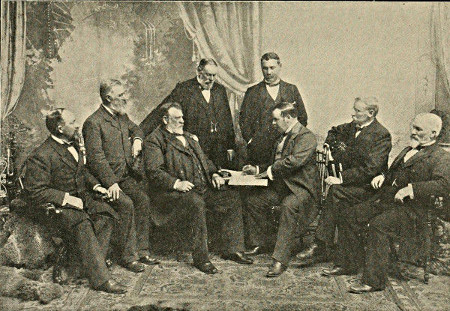
From left—The Honorables C. H. Mills, W. C. Walker, C.M.G., R. J. Seddon, P.C. LL.D.,
T. Duncan, J. Carroll, Sir J. G. Ward, K.C.M.G., W. Hall-Jones, J. McGowan.
“‘In old, old times,’ he said, ‘our ancestors
believed the world to be flat. That question
for thousands of years was considered settled.
For a comparatively brief time the world has
been considered to be round, a solid sphere.
This, for this short period, has been the
“settled” notion.’
“But he assured us that the propositions
were equally fallacious. The whole
party was inclined to laugh, but he continued.
He reminded us that we all believed in the
nebular theory, that our earth, with the other
planets, had been thrown off by the sun’s rapid
rotary motion; that in rapid revolution these
masses had assumed forms peculiar to their
revolutionary velocity, that planets had in turn
thrown off masses that had become satellites,
and that form was a result of motion, mass,
and volume. He reminded us of the natural
tendency of matter to fly from the surface of
a rapidly revolving wheel, cylinder, or globe.
“This was the case with our earth. While
yet a yielding or molten mass, it whirled very
rapidly on its axis, the surface cooled and
became rigid, and the molten matter contracted.
During this process, the plastic interior
moved towards the crust, the cooling
mass requiring less and less space. Thus
the centre parted, and our earth became, not
a solid globe, as you were taught to believe,
but an oval ring, a hollow ball, revolving
rapidly as do the rings of Saturn, formed
under the same law, but owing to the mass
in her case being greater, the gravitation of
the interior held the central mass together as
a planet. ‘As a fact,’ he said, taking a large
apple in his hand, ‘if the core of this apple
were removed with a care that would preserve
the proper curvature, I will venture to say
“ovality,” it would present an exact model of
our world. Then the world is hollow, not solid,
and it is habitable and inhabited over the oval.’
“The members of the party looked at each
other with amused curiosity. ‘Symmes!’ said
the captain; ‘Hurra for old Kentuck!’ said the
Yankee; ‘Logic!’ said the engineer.
“‘You smile,’ said Oseba, ‘but a man may smile
and smile, he may even sneer, and still be wrong.’
“He looked so undisturbed, so dignified and
earnest, that levity ceased, and he said ‘As a
rule, men accept their opinions ready made, and
they only search for corroborating evidence.
When Galileo proclaimed a new truth, he was
silenced, by the frowns of authority. Who was
right? When Bruno proclaimed a great truth,
he was cooked, by authority. Who was right?
All your schoolboys of to-day know.’
“‘But when Symmes advanced a new theory,
because the world had grown more tolerant or
less earnest, he was laughed out of court, while
those who imprisoned Galileo, and cooked
Bruno, and ridiculed Columbus and Magellan,
having grown careless, amused themselves
by writing of Symmes’ northern regions as
“Symmes’ Hole.”’
“‘Well, gentlemen,’ said Mr. Oseba, ‘I am
from over the Oval, from “Symmes’ Hole,” and
after five years of constant travel and hard
study among the people of the outer world,
whom we call Outeroos, I am returning to
“Symmes’ Hole,” and this young man,’ turning
to me, ‘is going with me to report.’
“There was no mirth, the captain drumming
on the table said, ‘Ahem!’ The Yankee
said, as he looked quizzically at me, ‘Well, I
guess he’ll have to muffle himself up pretty
good, and I think our house could give him a
proper outfit,’ and the engineer said to me,
‘raising the curtain is the most interesting part
of the performance.’
“‘But this is so far outside of our experience
and our observations,’ said the good-natured
skipper.
“‘Pardon,’ said the calm Oseba, ‘the observations
of your men of experience have but
confirmed our contentions, though the evidence
so far, has not disturbed the hypotheses of your
theorists. But what are the observations of
your men of hard experience? This leads to
another line of inquiry.’
“Save by an occasional question, the silence
of the listeners had been unbroken from the
start. The subject had been profoundly discussed,
and as the hour was growing late, it
was agreed that the party meet at once after
dinner on the following evening. All faces
now looked serious. The captain thanked the
stranger, and said, ‘We met to scoff, we remained
in rapt attention, we retire to meditate.
To-morrow evening,’ said he, ‘we will question
you, our worthy guest, with a different feeling.
Good night.’
“What a unique experience! How I would
like to have had Sir Marmaduke with us. But
Sir Marmaduke thinks I am a thief and unworthy
of his presence.
“Well, goodbye old day,
I’ll throw me down and sleep my cares away.”
By George! that is striking. The man
from “Symmes’ Hole.” Ha! Ha! Well, I
wish I had been there. But Leo Bergin does
me an injustice, for I was too careless to think
about his crime, or alleged crime, for, as a fact,
I liked him when I met him, and in his absence,
I never thought either of him or his folly.
“What fools we mortals be!” We are
eternally worrying about what others think of
us, when, in fact, each of all the “others” is
quite engaged with his or her own affairs. What
“everybody says” is usually only what some
idle meddler says, the busy world having no
thought or care on the matter. But Leo Bergin
thought of me, well—
“I’d give the lands of Deloraine,
If Musgrove were alive again.”
But,—“Never, never more.”
Let us see what follows, for this is more
interesting far, than a courtship. Let’s see—the
next day I left the ship at Lisbon, in
response to mail from Hamburg. Let’s see
if I am forgotten as easily as he was, and what
the man from Symmes’ Hole had to say at the
adjourned meeting. By my soul, this is rich!
The notes read:—
“At sea, on board S.S. Irene,
“Off coast of Portugal,
“October 7th, 1898.
“’Tis midnight’s holy hour, and silence now
is brooding o’er a still and pulseless world.
“What an eventful day! In old Lisbon a
few hours, made a few purchases—paper to
hold stuff enough to startle the world—saw
Sir Marmaduke on the steps of the Cathedral;
he did not answer my salute. If I live, he
shall know me better. If—oh, that terrible
‘if’! that brief halt, that in all our hopes
arises to console us, that brief halt that excuses
impotency for failure, chills me.
“Had a long chat with my chief, Oseba, re
our polar journey. Strange, I speak of this
with candour, and make my plans as if it were
actual, and yet my judgment scoffs at my
foolish dreams, for, as a fact, it must be the
delusion of a madman. So I thought at 4 p.m.—
“Later.
“Promptly at eight, the party of last
evening re-assembled in the captain’s cabin.
All seated at the table, Amoora Oseba handed
round some fine cigars, the glasses were filled,
and the skipper said, ‘Now, Mr. Oseba, we
would like to hear further from you, for if you
are insane, there seems to be method in your
madness. If you are a joker, you are a most
charming entertainer, but if you are sane and
candid, for the world’s good you should remain
quiet, only when necessary to refresh yourself
for further effort.’
“The captain had prepared a six-inch globe
by removing the axial core, and paring down
the outer openings so as to leave it oval with the
outer curves for Mr. Oseba’s convenience in
making his illustrations—this was Oseba’s
‘apple,’ the core removed.
“On rising, Mr. Oseba thanked the captain
for his courtesy, and raising the globe, he reminded
the party that he was to review the
observations of experienced men in support
of what to him was more than a theory. He
asked his friends to fix in their minds the new
form of our globe, for that was important.
“He first called attention to the fact that all
the extreme North Polar regions were rich with
the waste or remains of animal and vegetable
life. This was ‘settled.’ ‘All navigators
agree,’ he said, ‘that hibernating animals,
say above 80 or even 78°, go north to
winter; and that driftwood comes from the
north with flowers unknown to botanists. In
high latitudes birds and swarms of insects come
from the north in spring, and Tyson’s men
killed many of these migrating birds for food
for his crew. In the craws of these birds there
were found undigested grains of wheat, some of
which were planted and grew in California.
The kernel of this wheat was three times the
common size, and California seasons were too
short for its ripening. Now, whence came the
birds, the wheat, and the insects? Plainly,
from “Symmes’ Hole.” Greely found the ice
but four feet thick at 82°, and less than
two feet at 84°, so the ice would not bear the boats, and many navigators report an open
polar sea, and greatly agitated waters at high
latitudes.
“‘By the old theory, it must be known that,
at the poles, the North Star would be—must be—directly
overhead, or in the zenith. But, as a
fact, all polar explorers know that the pole star
is in the zenith at about 80°, and that, at 83-4°,
it is seen far towards the stern of the ship. If
the old theory were true, this phenomenon seen
at 84° would only appear after a ship had sailed
past the Pole some ten or twelve degrees.
“‘The fact is,’ said he, ‘sailing north at
84°, the verge is past, the curvature is sharper,
and the ship is dipping into “Symmes’ Hole.”
Further, at 82° north, the horizon very sensibly
contracts to the north and south, and
enormously lengthens east and west. This is
on the verge, at the point of sharpest curvature.’
“While these arguments were not entirely
new to the captain, they struck him with a new
force, and the party remained silent. Assuming
that he had made out his case, the Sage assured
us confidently that the earth was hollow, with
openings at the Poles; that the equatorial sides
are about 3000 miles thick; that the surface of
the interior world, like that of the outside, has
mountains and plains, rivers and lakes; that
it has proportionately less habitable lands, an
equatorial zone of some 2000 miles being quite
uninhabitable; that on either side of this there
is a habitable belt of variable width; that from
the sun and its reflections, and electrical phenomena,
there are ample light and heat; and
that about 3000 miles north of the equator, just
under and opposite the Greenwich meridian,
stands the City of Eurania—the most beautiful
and opulent on this planet—the capital of a
great and wealthy country.
“Silence reigned for a few moments, when
the deeply interested Boston man, in the most
inquisitive and earnest tones said, ‘But, my
dear Sir, as we are evidently of about the same
class of goods, and were probably turned out
of the same mill, how the de’il did you fellows
get down there? and how the de’il did you get
out?’
“This discussion, so learned, so full, so
logical, so eloquent, and so earnest, should be
preserved, even to the tones and expression, but
I am weary, and it is late, and if—there is
that ‘if’ again—if I live, nothing of that scene
shall perish; and if I don’t—and, I won’t—I
will have spent time enough on it, for all will
probably be lost, so I will ‘boil it down.’
“Well, in answer, Amoora Oseba said that
it was now a well-settled theory that, probably
owing to periodic oscillations of the earth,
the course and character of which were not yet
understood, there had been great changes in the
temperature of the polar regions. The moving
down and the receding of the polar ice limits,
in no distant geological times in the past are
abundantly evident. The temperature at the
so-called Poles had materially varied, the ice-belt
so oscillating that at times animal and
higher vegetable life flourished at high latitudes,
as is known by the abundant remains of
undecayed animals still found in the ice fields.
“Then he related a tradition among his
people, reciting that in the far distant past—at
a time probably when the polar regions were
rather temperate, and most of the human race
were yet in barbarism—a small tribe of peacefully
disposed people inhabited a fertile region
in an open world, where the horizon stretched
away alike in all directions.
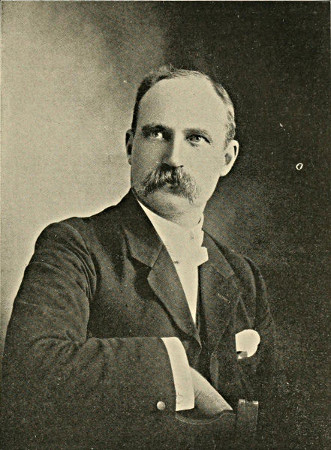
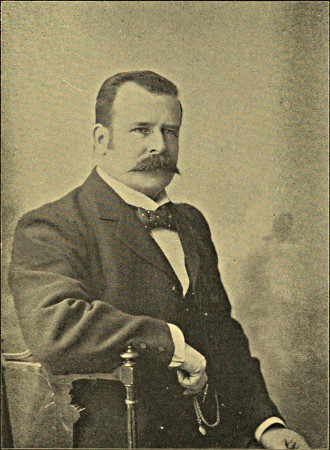
Mr. T. E. Donne, Superintendent of Tourist and Health Resorts; Secretary
of Department of Industry and Commerce; Secretary for
New Zealand Commercial Intelligence Department of the British
Board of Trade; Representative St. Louis Exposition. By his
industry, ability and modest candour, and the merits of his
“enterprise,” Mr. Donne is becoming one of the best known
Tourist Agents on the globe, and he is one of the most competent
and trusted of Sir Joseph Ward’s carefully selected staff.
“The chief of these amiable people was an
attractive and commanding personality named
Olif. This Olif had a most beautiful daughter,
whose mother, while gathering flowers for her
child, had been strangled by the orders of an
envious and childless queen. The name of the
daughter was Eurania, which means “Sunbeam.”
But as she grew to womanhood she so strongly
resembled her father, and was so constantly
at his side, that the two beings seemed a
double—but a single soul—and soon the people
idolised the damsel under the name of Oliffa.
Olif and Oliffa, the chief and his daughter, as
guardian spirits, held supreme authority.
“At a great festival, in which many kindred
tribes and nations met to celebrate an historic
event, a grim chieftain of a warlike tribe
became enamoured of Oliffa. He demanded her
as one of his wives. Oliffa declined—there was a
rush to arms, and many of Olif’s people were slain.
“The great King Oonah took sides with his
warlike chief. Oliffa was taken by force, she
was led to an altar in sight of her people, her
ankles were loaded with fetters, her whole tribe
were condemned to extinction, and preparations
were being made for the general massacre.
When the King, beholding Oliffa that she was
stately, beautiful, and wise withal, said:
“‘Let not Olif and his tribe be slain, but
banished—banished; for ‘tis not well that so
goodly a people should perish from the earth.
I have spoken.’
“But Olif and his followers gathered themselves
together, and the warriors, joining in one
defiant voice, answered:
“‘While we may not hope to resist the force
of your savage chieftains who would expel us,
we will fight here until we all die, under the
gaze of Oliffa; and,’ said they in thunderous
tones, ‘we have spoken.’
“Oliffa, heroic in her despair, raised herself
to her full height, and, lifting her hands
imploringly to the National Gods, in a clear
and earnest voice that made the chieftain quail,
said:
“‘No, my father and my people, die not, but
live for Oliffa—save a remnant of the tribe of
Olif. I am Oliffa—human virtue is greater
than kings or death. Go to the north, dwell in
the hollow of my hand, and, in the fulness of
time, thou shalt return to embrace me.’ She
had finished.
“With bowed head and in sorrow, Olif and
his followers withdrew, and slowly wended their
way towards the unknown regions of the north.
But a party, with the angry chief Sawara,
pursued, and coming to the verge of the land,
Olif and his band took refuge on what seemed
to be a small island. Here they repelled their
pursuers, and soon they saw the channel that
separated them from the mainland widen, and
they thanked their deities for their deliverance.
“But, alas! they soon discovered that they
were on an ice-floe, and were moving north
toward the open sea. Provisions soon gave out,
they prayed to their gods, they floated and
suffered, and as the weaker perished, cannibalism
was resorted to—for madness possessed
the despairing party. Days and weeks passed,
an impenetrable fog enveloped them, and they
gave themselves up to utter hopelessness.
“However, soon the atmosphere became
milder, the distant breakers were heard, the fog
rose like a curtain, and behold! land was near.
Nearer yet they floated. Night came, the full
moon shone, but it moved not up from, but
along the rim of the horizon. Morning came,
bright and balmy. The floe had entered a
strange harbor, and soon the shores were
reached. It seemed a ‘goodly land’ with
fertile soil and genial climate.
“‘But a remnant of the peaceful tribe of
Olif,’ he said, ‘were saved—nine men, thirteen
women and five children. They cut boughs and
built an habitation, and they said: “This shall
be our dwelling place. Our city shall be called
Eurania, in honor of our lost one, and here we
will tarry until we return to the goddess Oliffa.”’
“‘This country,’ said Oseba, ‘was Cavitorus.
These people were the ancestors of my people,
the Shadowas, and on the banks of a charming
harbour they built the City of Eurania, the most
beautiful to-day on this planet.’
“‘Through all the ages, from barbarism to
the present,’ said Oseba, ‘there has been a
lingering tale, a faint tradition among the people
as related, and a vague idea that they dwelt in
a shadow, in the hollow of a hand, and that
some time in after ages, or in after life, they
would return to an upper world, called in nursery
tales and by the superstitious, Oliffa, where
the inhabitants are called Outeroos—because
they dwell on the outer world.’
Leo Bergin soliloquizes:—
“What astounding folly! and yet, I am on
my way over the limitless fields of ice and snow
and dead men’s bones, to this phantom city,
Eurania. Courage! who knows, for—
‘There are more things in heaven, and earth, Horatio,
Than are dreamt of in your philosophy.’”
“‘Well,’ said Oseba, ‘these few people were
of an amiable race, and a common danger, and
a common sorrow, had made them brethren.
Then the animals of this country were many,
strong, amiable, and easily tamed; the mountains
were accessible, the climate genial, and
the soil so fruitful that there was nothing to
suggest savagery. All nature smiled, and man
progressed peacefully.’
“‘The people,’ he continued, ‘increased, they
were prosperous and happy. They had no foes—so
war was unknown. The animals of the
chase were tamed, and agriculture became an
early occupation.’
“Traditions had been broken; back of the
people there were but dead walls. Interminable
ice and snow, as well as time, separated them
from the past. With prosperous industry the
population increased. Colonies were planted
along the interior sea shores, and commerce was
developed. There were no despots to despoil,
no superstition to blight, no wars to devastate,
no idleness to waste, and wealth, such as the
Outeroos never dreamed of, followed as a result.
“The lands were held for the people, but the
lands were limited, and as the centuries came
and went, and went and came, the population
became very dense. Civilisation and Science
had come, but the population began to press
upon the means of subsistence. Opulent nations
arose, accumulated wealth was great, but room
was becoming scarce. For a time, inventive
genius helped to solve the problem, but the
sorrows multiplied as the struggle was made
more easy. Soon necessities suggested remedies
for growing evils, which not to use meant
universal destruction.
“The population crowded and the weak and
deformed were ‘removed.’ The remedy was but
tentative, and gradually the pressure grew still
stronger. As the centuries passed, all the weak,
the worthless, and the unfit were sterilised.
The pressure still increased. The State then
provided for taking charge of all the children,
and only the most fit were allowed to become
parents.
“Under this policy, and under wise management,
the State became the ‘universal mother.’
Parents knew not their offspring, nor the offspring
their parents, and the love of humanity
and public duty became the inspiring motives of
human action. Under this policy, too, have the
leading nations of Cavitorus, with the Shadowas
in the lead, developed their present civilisation.
Under such a policy they have been able to
adjust the population to the possibilities of the
land, and thus while they have been building
their opulent present, they have developed the
finest type of people mentally, morally and
physically, that ever inhabited this planet.
“Oseba explained the quickness of the soil
in Cavitorus, the length of the seasons and of
the days, with their peculiar irregularities. He
described the movements of the sun, its appearance
at various seasons of the year, and why
it was never entirely dark in those regions.
“Then he recited a further tradition, relating
that at the time the people reached Cavitorus,
the bright star Oree was the ‘Pole Star,’ that it
had moved gradually away, but that in about
twenty thousand years it was to return to its
old position. Further, that on the return of
Oree—the tradition ran—the Shadowas would be
released from their seeming isolation, and
be reunited with their brethren of the outer
world to the presence, or on the surface of,
Oliffa.
“‘You see,’ said Oseba, ‘in the development
of all people their myths and their heroes
are strongly allied to, if they are not the actual
forces of, Nature, and all have a seasoning of
truth as a basis.
“‘The people had watched Oree; were waiting
his return, and were alert for signs of the
coming change, or, as they put it, for a
“deliverer.” They believed from this tradition,
that they had been in Cavitorus twenty thousand
years, and a confidence in their future deliverance
was a deep-seated superstition, a real faith
and hope.
“‘Well, Oree, as seen from the spot where
the first “pilgrims landed,” as indicated by a
peak on a distant mountain, appeared some
twenty-five years ago, and, as on the very night
the observations were taken a portion of a
wrecked vessel was cast upon our shores, no
wonder the long-deferred hope found expression
in a movement for inquiry and exploration.
“‘Later, a tame dog with a brass collar on
his neck was taken from an ice-floe. Later still,
by a few months, a small box and a snow-shoe
drifted ashore. In your year 1890, the corpse
of a white man, clothed in furs, was found
on the beach, and the next morning two bodies
of what are now known to have been Esquimaux,
were found. As we lived on the ocean
front, we knew whence these came. At this
the State took up the work, made an appropriation,
organised a party, and, well,’ said
he, ‘they abundantly equipped an expedition,
put me in charge, and I am here on my return
to Cavitorus, after a five years’ tour, covering
the countries of all the outer globe.’”
What masterly logic! What skill in the
marshalling of details!
“Well,” adds Leo Bergin, soliloquizing, “if
it is true, and it must be, for I am going there,
how much stranger than fiction!”
The notes continue:—
“The captain inquired about the harbors
along the coast of Cavitorus; the Boston man
inquired if there were any gold mines; the
parson, how high the Shadowas built their
church spires; and the engineer, what motive
power was used in their transportation.
“To these Mr. Oseba answered: ‘I fear,
if I should tell you one half the truth about
these things we should be “discovered,” to our
sorrow.’
“The hour was late, and as all seemed
dazed by the recital, the party dispersed, to
bed,—
‘To sleep: perchance to dream: ay, there’s the rub.’”
Well, that is rich! Leo had to cut it short,
but he saved me a lot of trouble. Let’s see.
Here is a lot of interesting details—interesting
if life were not so short—but I’ll have to “boil
it down,” for “spice” is the word.
The two adventurers left the Irene at Amsterdam,
ran to Hamburg, where they remained
over winter, and being joined by Oseba’s fellow-adventurers,
they took a small steamer sent as
a supply ship for a polar party “frozen up” in
the seas north of Spitzbergen. Disembarking,
they joined a party for the journey further
north, intending to strike the open sea at a
known point. As would be expected, “the
cold was intense,” but the party was splendidly
equipped, and progress, for polar travel,
was rapid.
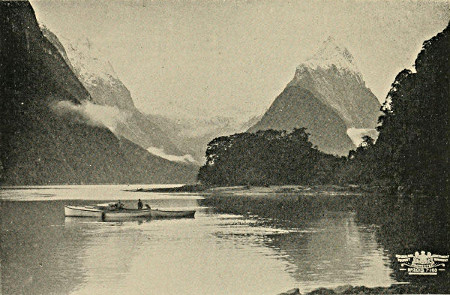
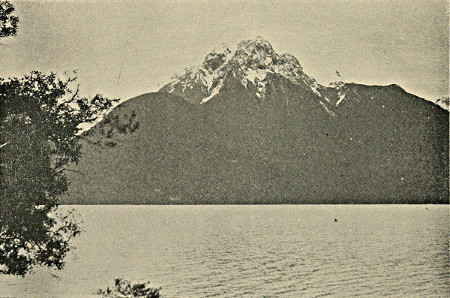
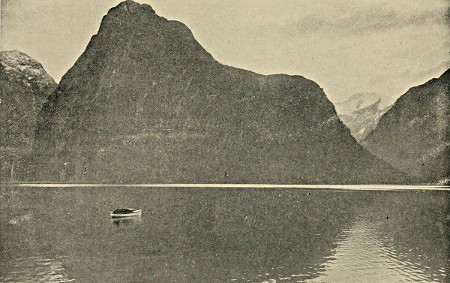
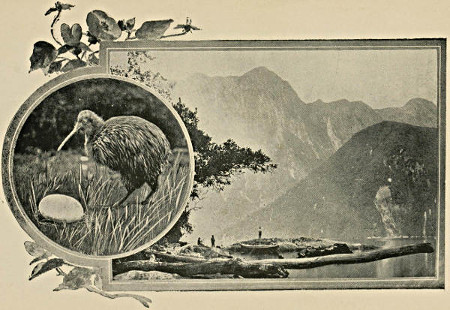
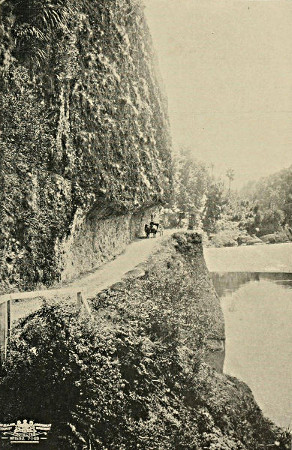
Mitre Peak, Milford Sound
“Oseba,” say the notes, “had recourse to
a magazine he had supplied for the purpose
on his outward journey. Here were supplies
of condensed food, articles of raiment that bid
defiance to cold, instruments which by reflection
converted light into warmth, and various scientific
appliances, some that practically rendered
the party immune from cold, and others that
aided them in meeting many dangers.”
Leo Bergin had not a reputation for underestimating
the trials of any adventure in
which he embarked, but taking all in all, it
seems from his report that, under the lead of
this wizard from “Symmes’ Hole,” a visit to the
jumping-off place at the north could be made
with little inconvenience or risk to life or health.
Only once in fifty pages of notes does Leo
Bergin complain of hardship. Not once does
he express any regrets, and he never once loses
faith in his master. Only once does he say
“the hardships are severe,” and then he adds,
“but the genius of Oseba has made us so
immune from Nature’s blasts, that, on the
main point, we are almost comfortable.”
There were seven of the returning party,
five of the nine friends, who, five years before,
had crossed these frozen plains with Oseba, and
the two “star” adventurers.
Considering the tales written by North Pole
hunters, the incidents of this journey, from 80°
over the “oval” or verge, to 60° inside, are
hardly worthy of extensive comment. So I’ll
throw the whole journey across these trackless
fields of ice and snow into the waste-paper
basket, or, better still, leave them here, consigned
to more certain oblivion.
Had Leo Bergin been a jester, a thousand
richer tales than were ever written by those
who, in search of fame, have joined the throngs
that left their bones in the unknown regions
of the North, could have been found in these
candid notes,
“But Truth is a jewel so rich and so rare,
When found should be cherished with martyr-like care.”
So I shall metaphorically skip some fifty of Leo
Bergin’s pages, and take up the story where
the party arrived in the small but picturesque
harbor, on the shores of which stands the City
of Eurania, the capital of Cavitorus—just over
the “oval.”
Over five long years had passed, since the
sage Oseba, the idol of Cavitorus, and his nine
brave friends had been commissioned to explore
the outer world, in search of truth, in search of
laws or customs by which the Shadowas might
be more wisely guided, or to find a country to
which it might be possible, wise and well, to
send a colony of their children. Four had perished,
and these were to be fittingly mourned;
but “the conquering heroes come,” and they
were to be fittingly welcomed, and as their approach
had been heralded, thousands of richly-dressed
people thronged the “water front,” and
the beautiful city was in gala-day attire. The
description of the streets, and fountains, and
parks, and statues of gold, and other eye-ravishing
objects, are dwelt upon in lavish detail,
but “want of space,” and the love of ease,
admonish me to “blue pencil” many pages of
this fancy fabric.
The superb personality and the gorgeous
attire of the people, amazed the practical Leo
Bergin. I will here venture a quotation, then
again “boil it down.”
He says:—
“The appearance of the people, as they
crowd without confusion along and away back
the shore line, is most striking. They seem
over-tall and very symmetrical in form, and
they move as gracefully as trained actors.
They have finely-chiselled features, deep, rather
large and expressive eyes, slightly bronzed complexions,
and in every curious look, gaze, or expression,
there is an easy, modest dignity, such
as I have never before seen, even among the
rarest few. In every face there is a deep and
real joy; but of enthusiasm, emotionalism, or
sensationalism, there is really none. This passion
of the animal has gone, and the pleasures
of the intellect have re-moulded the countenance.
The face has become the mirror of an
exalted soul. On no countenance is there seen
gravity, on none hilarity.
“Seeing no sadness, I said, ‘Where are the
friends of the four who perished?’
“Alas! under their system none can know
father or mother, sister or brother, son or
daughter. All are children of the State. In
the success of any one, there can be but a
common joy; in failure, but a common sorrow.”
What nonsense, to talk of such a society!
People who forget their own children? But
Herbert Spencer tells us of a people among
whom the men had more affection for the children
of their sisters than for those of their own
wives! Mayhap, Herbert was wrong, for this
seems unnatural. Mayhap, Herbert was right,
for what we call “natural” is really but custom.
However, “maybe” there were “reasons” in
that case—experience.
Leo continues:—
“The attire, too, of these people was ‘gorgeous
beyond description.’ Array all the royalties,
all the nobility, all the Popes and the Cardinals,
with all the courtly favorites and all the Rajahs
and robber chieftains of all the Indies, and all
the flunkies, the fops and the fools of all the
capitals, great and small, of the pretentious
upper world, and marshal them for comparison
in ranks facing these, and they of the upper
world would seem but a pitiable show, or at best
an amusing burlesque.
“Silks and splendid fabrics, not loud and
gay, but rich and rare; jewels resplendent with
Nature’s lustre, but worn as modestly as to
seem but articles of common use, were present
in enormous profusion. For jewels, for articles
of personal adornment, for ornaments or trimmings
of wearing apparel, gold was too common,
cheap and vulgar. In carriages, in furniture, in
statuary, in architectural adornments, it was in
use by the ton—yes, by the cord. Ye gods, if
the Americans knew this!
“Here, as superstition has not blighted,
monopoly has not diverted, despotism has not
robbed, war has not wasted, vice has not
withered, wealth has grown with the ages.
“As our whole party were attired in very
modest European dress, we must have appeared
rather uncouth to the people, but the absence of
apparent curiosity or inquisitiveness, was surprising.”
The notes continue:—
“These people must be adepts in electrical
science, for the air was full of ‘floaters,’ or
flying machines, each seating one or more
persons. They were as thick as blackbirds
in a Missouri cornfield.”
He noticed an entire absence of children
from the throngs of people, but soon an open
space was formed by the crowd falling back,
when several thousand “youngsters” of both
sexes, and all the tender ages, came marching
down the wharf, in charge of a few modest-looking
superintendents. As they came to a
halt, the people raised their hats in salutation,
when the children, seemingly all of one accord,
bent a knee in acknowledgment.
The notes, observations, and running comments
of the observing Leo are worthy of full
perusal, and indeed of preservation, but as I am
hurrying on to a definite purpose, brevity seems
to be a necessity.
The reception of the party by the City
Council and a joint committee from the great
college, of which Leo learned that Amoora
Oseba was the head, was most impressive, and
when the master of ceremonies waved his hand
as a signal, there was an unanimous shout of
“Welcome home, Oseba! Welcome back to
Eurania!”
This was the only noisy demonstration.
“Every face,” says the chronicler, “looked
respectful, grateful, gratified, and happy, but
there were no fire-crackers or bad breath.”
Is not that marvellous? Think of such a
people! Think of an occasion of like character
in London, New York—ah, ye gods!—in
Paris or Berlin! I wonder if this fellow was
not spreading it on rather thick?
But, listen:—
“We were escorted to our carriages, one
hundred gorgeous electro-motors, literally made
of gold and ivory, and adorned with what
appeared to be precious stones, but what proved
to be common, indeed. We were driven to
the temple—and such a temple! The Palace
of Westminster, the Vatican, or the Washington
Capitol would be ‘nowhere.’”
But I must “boil it down.” He tells us
that the ceremony at the temple was “splendid,
but brief”; that the reception of Amoora Oseba
was sincere, and that the proceedings of the
meeting of over five years previous, commissioning
him for the perilous journey, were
read.
“Resolutions of regret” for the loss of members
of the party were passed, and a meeting
was appointed at which Amoora Oseba should
make his report to a select committee, and
through such committee to the people of
Eurania and Cavitorus.
Speaking in much praise of the almost
depressing dignity of the ceremony, the notes
record that at the close of the announcement,
the chairman read the commission under which
Oseba had acted, and on the performance of
which authorised duty he was to report. It
read as follows:—
“City of Eurania, Cavitorus,
“Year 20993, P.C.
“To the well-beloved Amoora Oseba, Chief, National
Academy of Science.
“We, the representatives of the State, on behalf of all
the Shadowas, believing that the time is approaching when,
according to our traditions, we are to be reunited with our
brethren of the outer world, and recognising the necessity
of discovering a broader field for the expansion of our race,
hereby authorise you to proceed to the discovery of any
country, to study the condition of any people on this or any
other world, to learn lessons of wisdom whereby we may be
better governed, or ‘spy out’ a land to which, if possible,
we may desire to send a colony of our surplus population,
and to report at your discretion. The time, the necessary
means, the associates, and all other matters pertaining to
this unique enterprise, will be granted by the State at
your discretion, and may the gods favor your undertaking,
and send you back to us with improved health, increased
knowledge, and hopes that may guide the Shadowas in
their future struggles for social progress.
“Signed by a hundred of the National Committee.”
My word! pretty good billet had this
Amoora Oseba. No wonder Leo Bergin was
captivated by the fellow. But that journey
over the “oval,” as he calls it—excuse me—it
makes me shiver.
Well, according to the notes, it’s a week
before that meeting takes place, a week to be
thrown away, to wait. Queer, it seems almost
as though I was there. Let’s see if there is
anything in his notes to bridge the time.
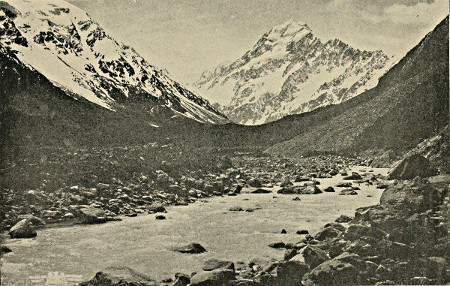
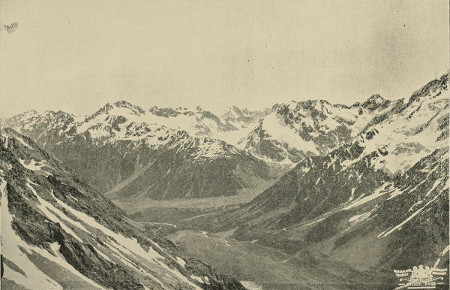
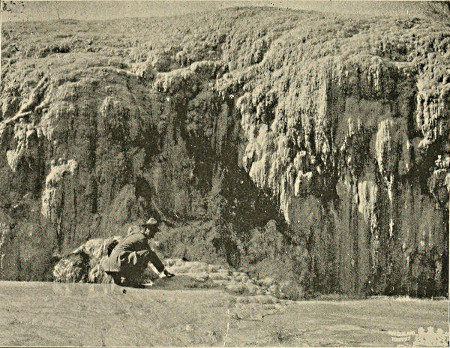
Mount Cook, Mueller Valley.
Yes, here he relates what a thrilling adventure
he had in a “soar” over the fifty-story
houses in an electric air motor; that the
buildings are made of indestructible material;
how their steel does not rust; how light their
machinery; how beautiful the girls. Ah, yes!
And then he says: “It might be nice not to
have to ‘ask papa,’ for here no girl has a
father, a big brother, or a pretty sister—which
may be convenient.” But from the luxury of
a mother-in-law, the Shadowas are forever cut
off.
“The freedom of association between the
sexes,” he says, “is surprising, but the social
dignity and decorum are even more surprising.
The country, with every inch cultivated, is
beautiful, and the aspect of Nature, especially
in the night, with the moon sweeping along the
opposite rim of the earth, the sweeping of the
sun along the horizon, the reflection of light
from unknown sources, the wonderful play of
electric phenomena, are too awe-inspiring for
description.
“Gold is more plentiful than iron is
with us, and platinum more plentiful than
silver;” and he accounts for the great quantity
of these heavy metals on scientific theories.
“As for diamonds and other precious stones,
it is only a matter of ‘grinding;’ but the ‘brilliants’
are more beautiful than with us, owing
to the peculiarities of the light.”
What fairy tales! And yet we don’t “know.”
Nature tells some strange stories. Yes, and so do
people. There is something amusing or interesting
in the notes of every day, but let the
week slide, for we want to hear the report—we
want to hear what Amoora Oseba thinks of the
people of the “upper crust.”
“Oh! wad some power the giftie gie us,
To see oursels as ithers see us,
It wad frae monie a blunder free us.”
Possibly.
Here we come to that great meeting. Let’s
get down to date again, and Leo Bergin’s notes.
He says:—
“Eurania, Cavitorus,
“October 5th.
“‘To-morrow,’ yes.
“‘To-morrow, and to-morrow, and to-morrow,
Creeps in this petty pace from day to day,
To the last syllable of recorded time,
And all our yesterdays have lighted fools
The way to dusty death.”
“To-morrow! the great event opens. How
like a dream it all seems. But,
“Dreams in their development have breath,
And tears and tortures, and the touch of joy.
They leave a weight upon our waking thoughts,
They take a weight from off our waking toils.
... They speak,
Like symbols of the future.’
“Ah, this dreamy reverie! It brings back
the vanished years, for
‘’Twas just one year ago to-day,
That I remember well,’
when I began this record, at sea, on board the
S.S. Irene. I wonder if Sir Marmaduke ever
thinks of me. If he does, he thinks me—well,
it doesn’t much matter now. He was a good
sort, however, and I will never forget him.”
Kind of you, Leo Bergin. By golly! that
fellow has a heart, and a head, too, for that
matter, for he is rarely far wrong. He continues:—
“Yes, he was a generous old soul. Rich,
good-natured and careless, but just. He read
everything, but—well, perhaps if I had read as
much as he, I would have thought and known
as little.”
Leo Bergin, I swear I had rather you had
forgotten me. That’s a nice way to speak of
an absent friend. There is evidently a coolness
between us. Yes, a cool belt, so I will keep my
temper.
Proceed, Leo:—
“Had a note from Venesta to-day, and I
don’t know whether it gives me more pleasure
or sadness. Think of courting a girl, who never
had a father or a mother, a sister or a brother!
Daughter of the State! Marry the daughter of
the State! Ye gods, what a mother-in-law!
“I have idled away the day, and how can
I make amends, save by confession and the
forming of new resolutions? Well,
“‘I resolve! yes, I resolve!
And then I sit me down
And watch that resolution die.
But, “To-morrow”—’
“Eurania, Cavitorus,
“October 6th.
“How balmy the air! How grandly the old
sun sweeps along the rim of this great world!
For one such scene New York would give
a ‘million,’ and every eye would dim with
watching the face of the flaming wheel, and
every neck would ache, and every soul would
shudder with awe. But, would not the
Shadowas like to see Old Sol passing over
their heads every twenty-four hours, and give
them three-hundred and sixty-five days during
the year, instead of having him whirl about
their heads, hip high, giving one night seven
months long, and but a hundred and sixty days
of variable length? But it’s all in being used
to things.
“Well, I must off to the meeting. I am invited
to the platform, and I shall have plenty to
record this evening, for to-day is nineteen hours
long. Oh, how weird!
“Later, evening.
“What o’clock is it? I don’t know. I
know it was nineteen hours after the old sun
first flitted around Mt. Lena, that it finally
retired, and how can a ‘new chum’ keep track
of his running on such erratic lines? To make
it more confusing, this is the self same old sun
that mine eyes have been looking upon for, lo!
these thirty wasted years. Who would have
thought that sedate old watchman could ever
play such pranks? Then, too, on the same
little old world! Am I waking? Am I sane,
or is this but a hideous delirium?
“I feel sure that all is unreal, that I am the
sport of some jesting destiny—but I will play
my part; then, if the vision be not a mockery,
I will not have wasted too much time.
“What an eventful day! Yet, as long as
it has been, or even seems to have been,
every hour has been crowded with bewildering
incidents—only bewildering to me, however,
for how unlike the hurry, the confusion, the
bustle, the noise and hilarity seen on such
occasions on the upper crust! How different
from a horse-race in England, an election-day
in France, or a Fourth of July in
America!
“What a happy, orderly, handsome, and
amiable people, these. Even their Deities are
amiable. Their temples of worship breathe,
not only hope for the future, but appreciation
for the blessings of to-day. With them, it is
not a crown of glory afterwhile, but a living joy.
Without the sorrow of Gautama, the gods of
this under-world are as loving and as amiable.
But why should not the Deities be amiable?
“‘God made man,’ the preacher saith,
‘From a handful of dust, by a whiff of breath.’
‘No,’ say the sages, ‘man made God,
From nothing at all, by creative nod;
Organ for organ, and limb for limb,
In the image of man, created he Him.
“These people evidently made their Gods,
for they admit it. I wonder if we made ours?”
Careful Leo!
“What a wonderful city is Eurania! What
a wonderful country is Cavitorus! What a
wonderful people are the Shadowas!
“But that meeting! The calm dignity of
those four hundred Councillors of State was
amazing. What marvellous dispassionate interest
is taken by the enormous throngs of
people, who occupy the main body and galleries
of the Temple.
“Proud Oseba! Well may I call thee
‘master.’ Oh! how I wish the appreciative
Sir Marmaduke were here.”
Yes, Leo, I would like to have been with you,
but, maybe, that would have meant that I would
be with you now, out of the cold, poor fellow!
But here the fellow strings it out as though
our days were also nineteen hours long, and our
lives a thousand years. He keeps us on so high
a key, that we begin to wonder what there is in
it for him. I will “blue pencil.” For the once
impatient Leo Bergin has forgotten, I fear, the
customs of this upper world, and that every ear
is attuned to the popular rush.
If you’ve something good to say,
Get a move!
If you’d have us go your way,
Get a move!
If it’s goods, fling out your sample,
If religion, show it’s ample,
But—Get a move.
’Pon my word! Leo’s “borrowed lines”
inspire me with a poetic vein. But Leo is
becoming as tedious as an Australian drought, a
West Coast “wet spell,” or a debate on a
“no-confidence motion,” so I shall here draw
my critical pencil through many lines. Leo
Bergin is clearness itself, and from his language
there flows, to the intelligent brain, a true conception
of the situation; but for the sake of
brevity—from vanity, maybe—I shall condense,
in my own language.
Well, at the appointed time and place the
people assembled. The four-hundred members
of the Council of State occupied favoured seats
in front of the platform, while many thousands
of the citizens filled the stalls and ample
galleries. It was an impressive scene. The
meeting once called to order, “Music, such as
heard outside of Eurania or heaven was never,
burst upon the ear.”
That’s Leo’s, but I shall be more prosy and
more brief.
When the last strains of music had died
away, and the applause ceased, the chairman
arose, and after giving a brief but comprehensive
review of the national traditions, the
discoveries and events that led to these
unparalleled adventures, he re-read the commission
under which Amoora Oseba acted, and
impressed upon the audience the importance of
the report from the lips of Eurania’s most gifted
son, and the world’s most intrepid explorer.
The chairman said, in opening the proceedings,
that while little real attention had
been given to the vague traditions that had
floated down the centuries, there had always
been a feeling among the Shadowas that they
were in a most peculiar situation, and that
science would some time solve the mystery
that seemed to hang over them.
He said, since the dawn of civilisation there
was an “absolute knowledge” that they were
on the inner surface of a hollow planet, and
there was a vague belief that there were like
beings on the outer surface.
He explained that, through the enterprise
of the Council of State, and the intrepidity
of Amoora Oseba and his brave comrades,
that question, the most momentous in the
long history of Cavitorus, it was hoped, had
been solved, and they had met to hear a report
on that most interesting matter.
He said, as the Committee had given the
most careful attention to the books, maps, charts,
and globes brought by the returned party, and
having had the generous assistance of Oseba
himself, and Leo Bergin, a native of the upper
world, they had familiarized themselves somewhat
with the geography, history, customs and
manners of the various nations of the upper
world, by the assistance of the views to be
presented, a fair understanding would be easily
reached. Then, too, as the press had been
generous and enterprising, he thought the
people were quite prepared for an intelligent
appreciation of the gifted traveller’s oration.
“Mr. Oseba, the father of the new philosophy,”
said he, “will now speak to us, as to his
children.”
However, as the people had requested that
the poetess Vauline be permitted to ask for
occasional explanations, this was provided for.
Here the record tells us—I have boiled out
twenty pages of delightful “toffy”—that the
chairman introduced Amoora Oseba as: “The
most intrepid explorer the world ever knew,”
at the same time inviting Leo Bergin and the
other members of the returned party to the
platform.
Of this episode of the ceremony, the modest
Leo Bergin says: “I was embarrassed.”
A fine canvas, some sixty feet square, had
previously been raised at the end of the hall,
and, with the assistance of attendants, a large
instrument, from which could be thrown moveable
views of the earth’s surface, was properly
adjusted. With an explanation all too brief, as
Leo himself thinks, the first picture was thrown
on the wall. It was our planet, represented by
a globe forty feet in diameter, revolving slowly
on its axis. It was a true model of our globe,
on Symmes’ theory, the angle to the axis
being 23°, with the north opening plainly
visible, and Cavitorus was easily located.
This, we are told, was entirely novel, even
to the Committee; but so skilful are the
mechanics of Eurania, that from a small
model or instrument taken across by the
party, this wonderful piece of complicated
mechanism was perfected.
What a revelation this must have been,
bursting so unexpectedly upon the astonished
gaze of these strange people!
But as in the magic hand of the “loved and
lost” Leo Bergin there are both pen and brush,
I here invoke his genius, for my pen falters.
He says:—
“As the vast assembly gazed in almost
breathless awe, the master said: ‘This is
Oliffa, our own planet, as it is hurled through
space at 68,000 miles an hour, with this brief
forty feet expanded to 8,000 miles.’
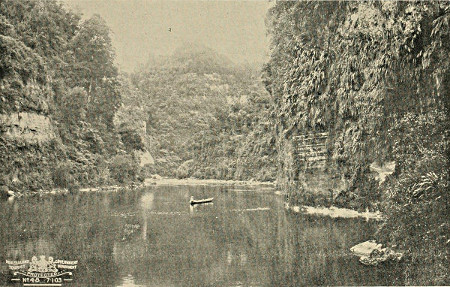
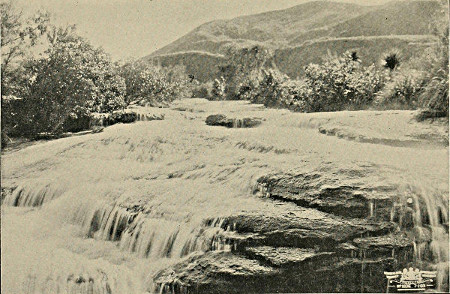
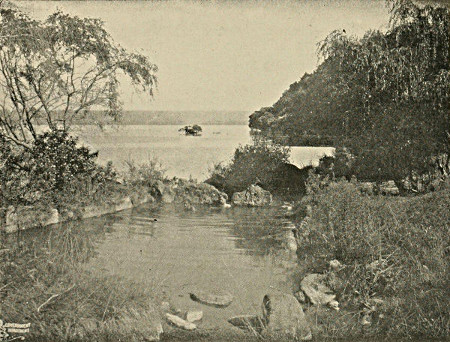
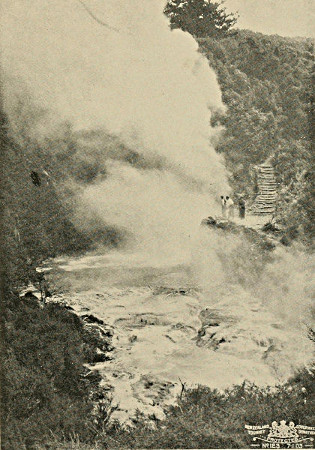
The Drop Scene, Wanganui River.
“I looked into the faces of the most intellectual,
the least emotional, and most observing
people I have ever seen, and yet no pen, no
brush, no imagination could reproduce that
scene. Considering the intelligence and the
unemotional character of this vast audience,
the evidence of surprise was really alarming.
For once, these people acted almost like we
fools of the ‘upper crust.’”
Humph! it makes me crawl.
“The sitting was adjourned.”
I’m glad of it, for it makes me shiver. But it
seems to me, considering the cool intellectuality
of the Shadowas, that Leo Bergin is drawing
that rather long. Let’s see! These Shadowas
are a very intellectual, a very thoughtful, a very
cultivated and civilised people. But let us reason
this out. They were utilitarian; amiable as
their environment, and learned, in what was
necessary for their happiness, or within their
reach. Yes, but nine-tenths of the universe—of
the outer world—was shut off from them.
They, for 21,000 years, had been on one side—the
inside—of a great tube. Practically back
of them, the world lifted abruptly up; front
of them, they could but see above the rim
of the bowl of which they were well toward
the bottom.
The field of observation was narrow, the
visible facts of Nature were few. At the near
opening of the “tube” there was eternal ice
and snow, an endless expanse of frozen mystery;
while at the other, there could sometimes
be seen many weird clusters of stars,
but, usually, only clouds and storms, and
desert and mountains, and dangerous whirlpools.
They had no telescopes; their point of view
was too narrow for the study of astronomy, and,
as all thoughts, all ideas, all conceptions of all
natural objects must be formed from observation—from
sensuous impressions—how could
they draw anything like correct conclusions
regarding the outside worlds? Intellectuality
does not always, if ever, mean universal, or
even very great, knowledge.
Well, then, maybe Leo was even drawing it
mildly. Maybe, a vision so strange, a view of
a known thing from so surprisingly unexpected
a standpoint, at a time, too, when the public
imagination was at a high tension, presenting so
strange a phenomenon, would affect the fine but
impressive mind more than it would the less
thoughtful. Maybe, I say, Leo is right, but it
seems a little lofty.
But let’s back to Leo’s notes. He
says:—
“After lunch”—that sounds familiar—“the
meeting recommenced, and the people, having
conversed fully and freely over the matter,
seemed in their normal condition.
“Oseba turned the globe slowly, explained
the nature of the earth and of the sun, why the
days were ‘thusly’; then the ‘outside’ conditions,
and why it was not all eternal frost, as
they had imagined. He showed the map of
land and water, how there were on the outside
of our planet, or Oliffa, 1,400,000,000 of people—a
few of them very decent fellows—and
suggested the enormous importance of communicating
with them.
“Then he showed a globe, with continents,
islands, seas, rivers, and the geographical
divisions of the land as claimed by nations,
empires, states, and communities, making suitable
remarks, that his impressions might lack
nothing in clearness.
“He explained that the varied blocks and
patches, distinguished by colored lines, marked
the ‘possessions’ and claims of various races,
nations, or political communities. He here
described the enormous waste of water, and
mountains, and uninhabitable land, and how
little really desirable country there was on
the outer surface of Oliffa. Yet, he told his
audience that the Outeroos did not dwell in
peace together, but divided the land according
to might, and lived isolated in semi-hostile
communities. ‘These,’ said he, ‘are the lands, the
countries, and the peoples I have “discovered.”’
“But, he said, while the nature and necessity,
the hopes, the aspirations, and the desires of all
men were much the same, there existed on the
outer surface of Oliffa such a variety in customs
and manners adopted for the accomplishment
of desired ends, that only by a visit
to, and a study of, all countries, could the
object of his mission be fulfilled, so for five
years he and his companions had wandered,
observed, and taken notes, and now it was only
by reviewing the situation with some detail that
an intelligent understanding could be conveyed.
“Here he pointed out on the maps the
localities of the various countries, briefly describing
the climate, soil, and style of government
in general, and said he would now discuss
a little more fully the merits of the various
countries and peoples—with his conclusions
from the inquiry—for his discoveries had been
important and many.
“He reminded his audience of the prime purpose.
His mission was to gain from the outer
world a knowledge that might aid them in the
better management of their domestic affairs; to
discover, if possible, a country to which they
might send a colony of the surplus population,
and to find a people with whom they could
open communications, that they might become
co-workers to the mutual happiness of the
newer and the older inhabitants of the world.
“Oseba,” says the record, “re-arranged his
instruments, saying that he would show us, as
occasion required, the globe as a whole or a
sectional map. He would begin his review with
a country, probably the oldest settled, and certainly
the most populous, on the outer surface of
Oliffa—that of the Chinese Empire.”
Here, I may remark that I have carefully
studied the notes of poor Leo Bergin. They
are full, carefully revised, and show a masterly
understanding of the situation, but they are too
copious for even extensive quotation. From
many closely and well-written pages, the notes
report Oseba’s orations, with hardly a break or
comment. For the sake of brevity, I shall
appropriate Oseba’s story, and, save by a few
pointed quotations, I shall use my own language
in the review of the next scene. I realise that
by this method the story will be marred, the
language will be less picturesque and expressive,
and probably less correct, but it will be economy
of space, and, what is of importance to me,
“economy” in the expenditure of intellectual
force. That is worthy of consideration!
The imaginative Leo seemed to be absorbed
in the changing scenes of the unique situation.
During a lull in the proceedings he notes:—
“How like a dream! Oh, my soul, how
I do hope!”
But, probably being again confronted by
that “if,” he seems to hang his head, halt, and
ponder, for he writes:—
“Hopes, like joys and promising children,
grow into regrets, or wither and die.”