Barclay slowly guided his horse through the mounted throng to the
spot where Mr. Carteret was sitting on a chestnut thoroughbred horse
watching hounds as they came straggling out of the spinney. They had
drawn blank. The fox was not at home. When Barclay reached his friend
he pulled up casually as if he had come for no express purpose, and
said nothing. After a few moments he began, as if an idea had just come
to him:
“It has occurred to me, Carty,” he said, “that if we brought American
horses to England, we could make a lot of money.”
“That idea has occurred to others,” replied Mr. Carteret, without
turning his head. He was absorbed in the enjoyable discovery that the
scene before him was like a hunting-print. The browns of the wood and
bracken, the winter green of the hill pastures, the scarlet coats, the
gray sky of the English winter, were all happily true to art. “As I
say,” he went on, “the idea has occurred to others, but I have never
heard that any one made money.”
“That is because they haven’t sent over good horses,” said Barclay.
“Suppose we brought over only such thoroughbred horses as we raise on
the Wyoming ranch.”
“I don’t think it would make any difference,” said Mr. Carteret. “There
is a prejudice against American horses.”
“Exactly,” said Barclay; “and the way to meet it would be to have them
ridden and handled by a well-known Englishman. In fact, I have the man
in mind.”
“Who?”
“Young Granvil,” was the answer.
Why Barclay should be interested in making money out of a horse
business or in any other way had perplexed Mr. Carteret, for it was not
according to his habits of mind. Now it became clear to him, and he
suppressed a cynical smile. “I don’t suppose Lady Withers has discussed
this matter with you,” he observed.
“In a general way, yes,” replied Barclay; “but it was my suggestion.”
“Of course,” said Mr. Carteret.
Barclay paused awkwardly for a moment, then he said: “Why shouldn’t I
talk it over with Lady Withers? She is a very intelligent woman, and a
good judge of a horse.”
“An excellent judge of almost everything,” said his friend, “and
especially of young men. My son,” he continued (Barclay was five years
his junior), “it is commendable of Lady Withers to provide for the
Hon. Cecil James Montague Granvil. He is her nephew and flat broke,
and he needs people to look after him because he is almost less than
half-witted. But that is no reason why you should be the person to look
after him.”
“You are unjust to Cecil,” said Barclay, “and most unkind in your
insinuations as to Lady Withers. This was my own idea entirely, and I
think it would be profitable for both of us. You know you are always
complaining because I don’t take more interest in the ranches.”
“If I have been unkind to Lady Withers,” said Mr. Carteret, “I am going
to be much more so.”
Barclay looked challengingly. “What do you mean?” he demanded.
“Lady Withers,” said Mr. Carteret, “is a widow, aged forty-four,—you
can verify that in Burke,—a man-eater by temperament and habit. You
are twelve years younger than she, with a great deal more money than is
good for you. Whether she intends to marry you I don’t pretend to know,
but it is not unlikely. At any rate, you are unquestionably on the list
as a source of income and supply.”
Somewhat to Mr. Carteret’s surprise, Barclay listened calmly.
“Do you really think Lady Withers considers me eligible?” he asked.
“She does, if she has any true conception of your securities.”
Barclay smiled a pleased smile. “I shall not stop to discuss Lady
Withers’s age,” he said. “Have you any objections to her aside from
that?”
Mr. Carteret looked at him with outward calm, but inwardly he was
filled with horror. “Are you engaged to her?” he asked.
“I am not,” said Barclay.
“Then I shall tell you,” he went on, “that I have objections. Their
nature I have no time to disclose at present further than to say that
any woman who puts a nice girl like her niece upon the horse she is
riding to-day is a bad lot.”
Barclay’s expression changed. “What is the matter with the horse?” he
demanded.
“I’m not sure that I know all that is the matter with him,” said
Carty, “but I wouldn’t ride him over a fence for the Bank of England.”
“Do you know that, or are you just talking?” said Barclay.
“I ought to know,” said the other. “I owned him. After what he did to
me, I ought to have shot him. We’d better jog along,” he added, “or we
shall get pocketed and never get through the gate.”
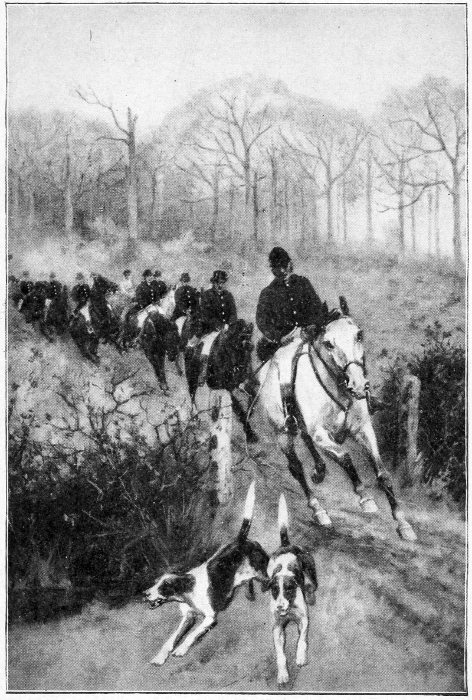
The huntsman had called his hounds and was carrying them to the next
cover, and Mr. Carteret set his horse to a trot and struggled for a
place in the vast scarlet-coated throng that surged toward the gate
leading out of the meadow. At the same time Barclay disappeared.
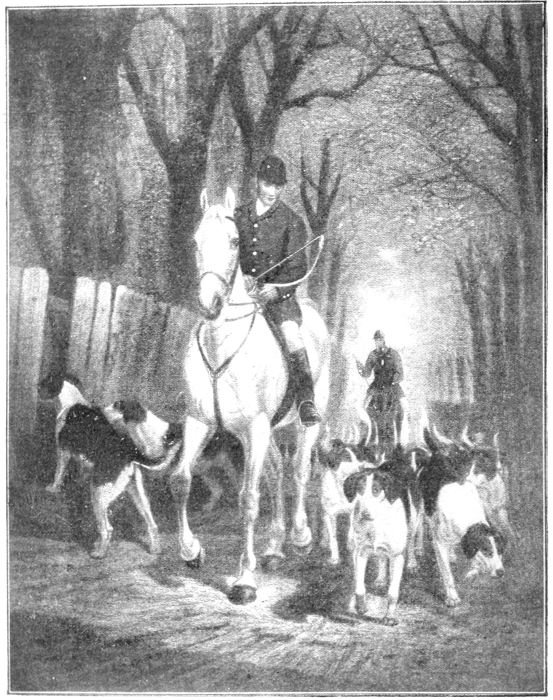
The vast scarlet-coated throng that surged toward the gate
“I hope he tells Lady Withers about the horse,” said Mr. Carteret to
himself. “If she doesn’t keep her hands off him, I shall tell her
several things myself.”
Just at that moment the eddying currents of the human maelstrom brought
him alongside a slender little figure in a weather-beaten habit and a
bowler hat jammed down to her ears over a mass of golden hair. Although
the knot of hair was twisted cruelly tight, and although the hat did
its best to cover it, even a man’s eye could see that it was profuse
and wonderful. It was unnecessary for him to look at the horse. He knew
that he was beside Lady Mary Granvil, Lady Withers’s niece. “Good
afternoon,” he said and she turned toward him. It was a sad rather
than a pretty face, but one’s attention never rested long upon it, for
a pair of gray eyes shone from under the brows, and after the first
glance one looked at the eyes.
“Good afternoon,” he said again. The eyes rather disconcerted him. “Do
you happen to know anything about that horse you’re riding?”
“It’s one that my aunt bought quite recently,” said the girl. “She and
Cecil wished me to try it.”
“I hope you won’t think me rude,” said Mr. Carteret, “but I once owned
him, and I think you’ll find this horse of mine a much pleasanter beast
to ride. I’ll have the saddles changed.”
Lady Mary looked at him, and a light flashed in her gray eyes. “You are
very good,” she said, “but this is my aunt’s horse, and my brother told
me to ride it.” She forged ahead, and disappeared in the currents of
the crowd.
“I did that very badly,” Mr. Carteret said to himself, and fell into
the line and waited for his turn at the gate.
He and Barclay, Lady Withers, and many other people were stopping
the week-end at Mrs. Ascott-Smith’s, who had Chilliecote Abbey, and
when he got home that afternoon he went at once to the great library,
where the ceremony of tea was celebrated. The daylight was fading from
the mullioned windows as it had faded on winter afternoons for three
hundred years. Candles burned on the vacant card-tables, while the
occupants of the room gathered in the glow of the great Elizabethan
fireplace and conversed and ate. As he approached the circle, Lady
Withers put down her tea cup.
“Did you have another run after we pulled out?” she asked.
“Yes,” said Mr. Carteret; “rather a good one.”
Suddenly her eyes began to beam. There was a display of red lips and
white teeth, and a sort of general facial radiation. It was an effort
usually fatal to guardsmen, but it affected Mr. Carteret like the
turning on of an electric heater, and he backed away as if he felt the
room were warm enough. “I am so glad,” she said.
“Tell me,” she went on in her soft, delightfully modulated voice,
“aren’t you interested with Mr. Barclay in some farms?”
“We own two ranches together,” said Mr. Carteret.
“Yes, that was it,” said Lady Withers; “and you raise horses on them?”
Mr. Carteret apprehended what was coming. “Yes; ranch horses,” he said
dryly.
“And such good ones, as Mr. Barclay was telling me,” said Lady Withers.
“He made me quite enthusiastic with his account of it all, and he is
so anxious to have dear Cecil manage them in England; but before Cecil
decides one way or the other I want your advice.”
Mr. Carteret looked at her and stroked his mustache. His opportunity
to save Barclay had come. “My advice would be worth very little,” he
said; “but I can give you all the facts, and of course Barclay—well,
he can’t.”
A shade of apprehension crossed Lady Withers’s face. “And why not?” she
demanded.
“I should rather not go into that,” said Mr. Carteret. “Of course the
great objection to the scheme is that it would be unprofitable for Mr.
Granvil, because no one would buy our horses.”
“But wouldn’t they,” said Lady Withers, “if they were good ones?”
“Major Hammerslea can answer that question better than I,” said Mr.
Carteret. He looked toward that great man and smiled. The Major was the
author of “Schooling and Riding British Hunters,” and Mr. Carteret knew
his views.
“No one,” said the Major, impressively, “would buy an American horse if
he desired to make or possess a really good hunter.”
“But why advertise that they were American?” observed Lady Withers,
blandly.
“How could you hide it?” said the Major.
“Exactly,” said Mr. Carteret.
“Furthermore,” observed the Major, his interest in the controversy
growing, “the output of a single breeding institution would scarcely
make it worth Cecil’s while to manage an agency for their distribution.”
“I think you don’t understand,” said Lady Withers, “that Mr. Carteret
has a large place.”
“My friend the Duke of Westchester,” began the Major, “has in his
breeding farm eight thousand acres—”
“But I’ve no doubt that Mr. Carteret’s is very nearly as large,”
interrupted Lady Withers.
“I don’t think size has anything to do with it,” said Mr. Carteret,
uneasily. “The fact is, we don’t raise the kind of horse that English
dealers would buy.”
“I think size has much to do with it,” replied the Major.
“I wish,” said Lady Withers, “that you would tell Major Hammerslea
exactly how large your farms are.”
“I don’t know exactly,” said Mr. Carteret, uneasily.
“But, about how large?” insisted Lady Withers.
“There is something over a million acres in the Texas piece,” said Mr.
Carteret, with some embarrassment, “and something under six hundred
thousand in Wyoming.”
Lady Withers and the Major both looked at him with eyes of amazement.
But Lady Withers’s amazement was admiring.
“I thought so,” said she, calmly. The Major in silence walked over to
the table and took a cigar. “Looking at it from all points of view,”
she continued, “it would be just the thing for Cecil. He is intelligent
with regard to horses.”
“But I don’t wish to go to Texas,” said the Hon. Cecil, who had joined
the group. “They say the shootin’ ’s most moderate.”
“It isn’t necessary yet for you to go to Texas,” said Lady Withers,
coldly. “Mr. Carteret and I are arranging to employ your talents in
England.”
“Of course another objection,” said Mr. Carteret, “is that Granvil is
too good a man to waste on such an occupation. The horse business is
very confining. It’s an awful bore to be tied down.”
“You are absolutely right about that,” said the Hon. Cecil, with a
burst of frankness. “You don’t know what a relief it is to be out of
the Guards. Awfully confining life, the Guards.”
“I think,” said Lady Withers, apparently oblivious to the views of her
nephew, “that Mr. Barclay takes rather the more businesslike view of
these matters. It is he, I fancy, who looks after the affairs of your
estates; and I should judge,” she continued, “that, after all, his
advice to a young man like Cecil with a very moderate income would be
wiser. I believe very much in an occupation for young men.”
Mr. Carteret saw that his time had come. He looked at Lady Withers and
smiled sadly. “Of course I’m very fond of Barclay,” he said in a lower
tone, “and of course he is an awfully charming, plausible boy—” Then
he stopped, apparently because Major Hammerslea was returning with his
cigar.
“What do you mean?” asked Lady Withers.
Mr. Carteret made no direct reply, but moved toward the piano, and Lady
Withers followed. “It is best to speak plainly,” he said, “because,
after all, business is business, as we say.”
“Exactly,” said Lady Withers. Her teeth had ceased to gleam. The
radiance had left her face, though not the bloom upon it. Her large,
beaming eyes had contracted. She looked twenty years older.
“The fact is,” said Mr. Carteret, steadily, “that Barclay is not the
business manager of our ranches. He is not a business man at all. It is
true that he still retains a certain interest in the ranch properties
but he has been so unbusinesslike that everything he’s got is in the
hands of a trustee. He gets his income monthly, like a remittance-man.
He is not in actual want; but—”
“I see,” said Lady Withers, coldly. “I had misunderstood the
situation.” She turned and crossed to one of the card-tables and sat
down.
After she had gone, Mr. Carteret lighted a cigarette and went out. It
was his intention to go to his room, have his tub, and change. His mind
was relieved. He had no fear that Lady Withers would either beam or
radiate for a young man whose fortune was in captivity to a trustee.
He had saved Barclay, and he was pleased with himself. As he passed
through the twilight of the main hallway, the front door opened, and
Lady Mary Granvil and Barclay entered side by side. It was the girl’s
voice that he heard first.
“Please have it dressed at once,” she was saying.
“But there’s no hurry,” said Barclay.
“Please, at once,” said the girl. There was something in her tone that
made Mr. Carteret turn from the stairs and go forward to meet them.
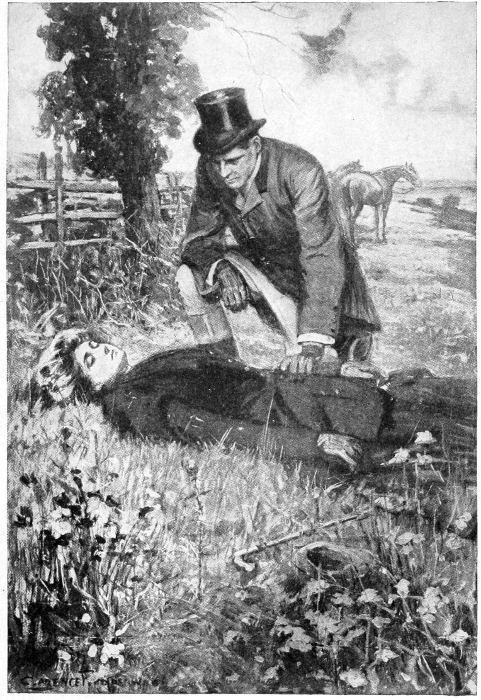
“I’ve snapped my collar-bone,” said Barclay. “It’s nothing.”
The girl drew back a step into the heavy shadow of the corner, but
Mr. Carteret did not notice it. “So old True Blue has put you down at
last,” he said.
“Yes,” said Barclay evasively; “that is—”
“He was not riding True Blue,” said Lady Mary resolutely. “He was
riding my horse. Mr. Barclay changed with me.”
“The horse was all right,” said Barclay, hurriedly. “It was my own
fault. I bothered him at a piece of timber. It wasn’t the horse you
thought it was,” he added rather anxiously. “It was one they got from
Oakly, the dealer.”
Now, Mr. Carteret had sold the horse in question to Oakly, yet he
said nothing, but stood and looked from one to the other. Disturbing
suspicions were springing up in the depths of his mind.
The girl broke the silence. “You ought to get it set without any more
delay,” she said; “you really ought. It will begin to swell. Go up, and
I shall have them telephone for the doctor.”
“You are quite right,” said Mr. Carteret; “but I’ll see about the
doctor.”
He turned and started toward the end of the long hall, searching for
a bell that he might summon a servant. Presently it occurred to him
that he had no idea of the doctor’s name, and that there might be
several doctors. He stopped, turned, and came back noiselessly upon the
heavy rug and all but invisible in the dusk of the unlighted hallway.
Suddenly he stopped. The girl had been watching Barclay as he went up
the stairs. As he passed out of sight, she turned and dropped into a
chair with a little sigh, like one who has been under a strain. On the
table beside her lay the silk muffler in which his arm had been tied.
She took it up and began folding it. Then she smoothed it with curious
little strokings and touches, and then suddenly pressing it to her
cheek, put it down and disappeared through the morning-room doorway in
a confusion in which she had surprised herself. Mr. Carteret stepped
back behind a curtain, and when he was sure that Lady Mary was not
coming back, instead of ordering the doctor, he went to Barclay’s room.
“I should like to know,” he began, “how it was that you were riding
Mary Granvil’s horse?”
Barclay met his look steadily. “I wanted to try it with a view to
purchase,” he answered. “You know Lady Withers had said she wished to
sell it.”
“Excuse me for being plain,” said Mr. Carteret, “but my opinion is that
no man would have ridden that horse when hounds were running unless
he wanted to marry either the woman who owned it or the woman who was
riding it.”
“Well?” said Barclay.
“Well,” said Mr. Carteret, “is it Lady Withers?”
“No,” said Barclay decisively; “it isn’t Lady Withers.”
Mr. Carteret looked at his young friend with outward indifference.
Inwardly he was experiencing much relief. “When are you going to
announce your engagement?” he asked.
Barclay shook his head grimly. “I wish I knew,” he said. “I’m up
against it, I fancy.”
“It’s not my business,” said Mr. Carteret, “but I should like to know
what you mean.”
“Why, in a word, Carty,” said Barclay, “I’m not it, that’s all, and
the situation is such that I don’t see what I can do to make her change
her mind.”
Mr. Carteret looked perplexed. What he had seen in the hall gave him a
feeling of guilt. “When did she refuse you?” he asked at last.
“She hasn’t refused me,” answered Barclay. “You don’t ask a woman to
marry you when you know that she cares for some one else.”
“So she cares for some one else?” observed Mr. Carteret.
“You could guess whom,” said Barclay.
“Supposing she does like Brinton a bit,” said Mr. Carteret, “what’s to
prevent you from getting into the race?”
“Can’t you see!” exclaimed Barclay. “If Lady Withers thought I wanted
to marry her,—you know what she’d do.”
“Well,” said Mr. Carteret, “if she isn’t forced to marry your money,
she’ll have to marry Tappingwell-Sikes’s, and, on the whole, I think
she’d prefer your railroads to his beer.”
“What Sikes may do,” said Barclay, “is not my business; but I want no
woman to marry me if she doesn’t want to.”
“Your sentiments are not discreditable,” observed his friend; “but,
after all, she may want to. You can’t be sure until you ask her.”
“Yes, I can,” said Barclay. “Besides,” he went on, “am I anything
wonderful that she should jump at me?”
“That is not an original suggestion,” said Mr. Carteret, thoughtfully,
“yet it may be in point. However, it is a great mistake to act upon it
when you are making love.”
“In the second place,” Barclay continued, “Captain Brinton has the
inside track.”
“I don’t think so,” said Mr. Carteret, decisively; “they’re too much
together in public.”
Barclay shook his head dismally. “Over here it means they’re engaged,”
he said.
“Well, what do you mean to do about it?” asked Mr. Carteret after a
pause.
“What is there to do?” answered Barclay. “Nothing but wait.”
“My boy,” said the older man, “I’m not surprised that you’re in love
with Mary Granvil; I am myself, and, what’s more, I’m not going to
have her thrown away on a bounder like Tappingwell-Sikes. If you don’t
propose to her, I shall. I’ll keep my hands off for three weeks, and
then look out.”
Barclay smiled. “You don’t frighten me very much,” he said.
“But I’m in earnest,” said Mr. Carteret. “It’s time for me to get
married. I’m not the kind for a grand passion, and that’s all in my
favor when it comes to making love. In fact, my indifference to women
is what makes me so attractive.”
“Perhaps it is,” said Barclay. “Generally speaking, I’m indifferent to
women myself. But—”
“I’m not going to discuss it with you,” said Mr. Carteret interrupting.
“I’m going to propose to Mary Granvil.”
He examined the broken collar-bone, sent a servant to telephone for the
doctor, and left the room. “Now,” he said to himself, “I’ve got to go
to Lady Withers and unsave Barclay.” And he went back to the library
where they were still having tea.
It was Lady Withers’s dummy, and the cards being excessively bad, she
had risen and was walking about. As Mr. Carteret entered, she glanced
at him coldly; but as he continued to approach, she held her ground.
“I have just had an idea,” he began with an air of mystery.
“How very interesting!” observed Lady Withers. She neither beamed nor
gleamed nor radiated.
“Yes,” he went on, “it suddenly dawned upon me that what you really
wanted was that Cecil should have something to do.”
“Really?” said Lady Withers.
“Exactly,” said Carteret. He was making heavy weather, but he kept on.
“You see, my first idea was that you were merely interested in bringing
American horses to England, as it were, don’t you see, for the humor
of the thing—Haw! haw!”—he laughed painfully,—“and so, you see, I
took Cecil’s very natural view of the matter, that it would be a great
bore, don’t you see, not realizing in the least that you wished it for
his own good. Now I think, if you are serious about it, which of course
I never fancied, that Cecil would be just the man to manage an agency
and see that the horses were broken and schooled and got ready for the
dealers to buy; and more than that, I think he ought to have a large
share of the profits, don’t you?”
As Mr. Carteret talked on Lady Withers had obviously melted, though she
had not yet begun to beam. “I must say,” she said frankly, “that I do
think he ought to have a large share of the profits.”
“And I think,” he continued, “that he ought to have a salary besides.”
“It seems only reasonable,” she replied, “when you think of Cecil’s
influence and that sort of thing, to say nothing of his experience with
horses. I happen to know that Lord Glen Rossmuir got five thousand
pounds merely for going upon the board of the United Marmalade and Jam
Company, and he gets a salary besides.”
“And Cecil is far abler than Glen Rossmuir,” said Mr. Carteret.
“Far,” said Lady Withers.
“And one more thing,” said Mr. Carteret; “what I said about Barclay’s
trustee was somewhat misleading, because, don’t you see, the trust
comes to an end in six weeks.”
“And then,” said Lady Withers, “do I understand that he will have
control of his own fortune?”
“Unconditionally,” said Mr. Carteret. “And I may say that he is so
awfully rich that to avoid beggars and anarchists he keeps his name
out of the telephone-book, which in New York is something like the
equivalent of being a duke in England.”
“When will the first ship-load of the horses arrive?” asked Lady
Withers.
Mr. Carteret was taken aback, but an idea came to him. “It has just
occurred to me,” he said, “that a neighbor of ours in Wyoming is
sending over some horses in the course of the next few days. I could
wire him and have him bring over two or three for samples—patterns,
you call them; and then, if they are what you approve of, we shall have
a ship-load come over.”
“Excellent!” said Lady Withers. “Wire him at once, and you also had
better wire your manager, so that there may be no delay.”
“I will,” said Mr. Carteret. “And, by the way,” he added, “if Cecil
should need an assistant, do you think Captain Brinton would do?”
Lady Withers thought a moment, and looked doubtful. “He’s a nice
boy,” she said, “and without a penny; but he’s so mad about Christina
Dalrymple that he would be good for nothing in the way of an assistant
to lighten Cecil’s duties. He bores poor dear Mary nearly to death
confiding his love-affairs to her.”
“Then we can leave the position of assistant manager open,” said Mr.
Carteret.
“It would be better,” said Lady Withers. She began to beam again. “In
fact, I have another nephew; but I must play,” she added, and went
back to the card-table. “Cecil,” she observed, before the hand began,
“there will be some of Mr. Barclay’s horses delivered at the Hall in
a fortnight from now. Will you make your plans to be there for a few
days?”
The Hon. Cecil was dealing, but he stopped. “I tell you it’s all
rubbish, these American horses,” he said petulantly. “And besides, they
buck like devils. It’s an awful bore.”
“Not any more than any young thoroughbred horses might buck,” said Mr.
Carteret. “They may kick and play, but it’s nothing.”
“Cecil is only joking about the bucking,” said a soft voice from the
chimney-corner. It was Lady Mary. “Cecil can ride anything that was
ever saddled,” she added.
“Still, it is a bore,” said the Hon. Cecil, only partly mollified by
the sisterly compliment.
“One word,” said Mr. Carteret in an undertone to Cecil. “Please tell
Lady Withers that I’m going to buy that horse your sister was riding.”
“Good horse,” said the Hon. Cecil, and he went on with his dealing.
Mr. Carteret did not add that he was going to have him shot and fed to
the hounds. Instead, he went back to the fireplace, where the gray eyes
were gleaming in the firelight.
“You mustn’t keep Mr. Carteret from cabling,” Lady Withers called from
the bridge-table; “and while I think of it,” she added, “won’t you and
Mr. Barclay come to Crumpeton for a week as soon as the horses arrive?
I shall write you. Do you think that Mr. Barclay will be able to come?”
“I think it probable,” said Mr. Carteret.
The firelight suddenly ceased to gleam upon the gray eyes. They were
turned toward the floor.
“That is very nice,” said Lady Withers, arranging her cards; “but you
mustn’t let me detain you. You know they might just miss a steamer.”
“I’m off,” said Mr. Carteret, and he left the room.
The party at Mrs. Ascott-Smith’s dispersed next day. Mr. Carteret went
back to his own house, which he had done over in the American manner,
to get warm, and to have a bath in a porcelain tub. Barclay returned
with him to nurse his collar-bone. As he was unable to hunt, he went
to the meets in a motor, and watched for the slim little figure in the
weather-beaten habit. What he saw neither cheered nor reassured him.
“It is very natural,” he said gloomily to Mr. Carteret, “but there
are at least a dozen men after her. Besides Sikes, there were four
guardsmen who rode to cover with her, and then old Lord Watermere
butted in. He’s looking for a third wife. You know yourself that when
a man pays any attention to a woman out hunting it’s because he likes
her.”
“I don’t know what their intentions are,” said Mr. Carteret; “but as
far as I am concerned, you have three weeks less one day in which to
propose to her. I want to do the fair thing,” he continued, “and I
advise you that the psychological moment would be while the collar-bone
is a novelty. There is an American buggy in the stable, and an American
trotting horse that drives with one hand. Verb sap.”
“But it isn’t done in England,” said Barclay.
“Buggy-riding,” said Mr. Carteret, “or its equivalent, is done wherever
there is a man of spirit and a young lady with intuitions. The trouble
with you,” he went on, “is that you are too modest on the one hand and
too self-important on the other. If you are not good enough for the
girl, you needn’t fear that Lady Withers will give you the preference
over Sikes. This is the last advice I’m going to give. Henceforth I
act on my own account.”
Barclay smiled doubtfully, but said nothing.
“I mean it,” said Mr. Carteret.
That afternoon at tea a telegram arrived from which Barclay gathered
that his mother was in Paris, afflicted with a maid with chicken-pox,
and that she was frantic with the sanitary regulations of the French
government.
“Couldn’t I go?” said Mr. Carteret.
“No,” said Barclay, “there are twenty-eight words in this dispatch. It
is a hurry-call for me.” He took the night train.
Three weeks later he came back. He arrived late in the afternoon and
found his host before the fire looking thoughtfully at a note which he
held in his hand. “I’m glad to see you back,” said Mr. Carteret. “Have
you proposed to Mary Granvil?”
“I?” said Barclay. “No. How could I in Paris? Why?” There was an
anxiety in his manner which suggested that he was not as resigned as he
said he was.
“If you haven’t been bungling,” said Mr. Carteret, “blessed if I know
what has happened.”
“Is it announced?” asked Barclay. “Is it Sikes?”
“Read Lady Withers’s note,” said Mr. Carteret.
Barclay took the note and read:
Dear Mr. Carteret:
You will doubtless not be surprised at my request that you remove
your horses at once from my stables. It is a disappointment to me
that an unforeseen change in my plans makes it impossible for me
to have you and Mr. Barclay at Crumpeton this week.
Sincerely yours,
Constantia Granvil Withers.
“It’s Sikes,” said Barclay.
“It may be,” said Mr. Carteret. “I ought to have taken the matter into
my own hands a week ago.”
“You don’t mean you are in earnest?” said Barclay.
“You will very soon find out,” said Mr. Carteret. “I have no false
delicacy about proposing to a lady merely because I’m not sure she’s in
love with me.”
At ten o’clock the next morning he and Barclay were sitting in the
motor in front of Crumpeton, while a footman explained that the ladies
were at the stables and Major Hammerslea was with them. Mr. Carteret
told the chauffeur to go to the stables, and there they got out.
Standing saddled on the floor of an open box-stall was a showy-looking
chestnut thoroughbred horse. As was only natural, the occupants of the
motor stopped to examine him, and Mr. Carteret gave an exclamation of
surprise. “If I am not mistaken,” he said, “that is one of our Prince
Royal colts.” He looked carefully at the inside of the foreleg just
below the armpit, and found a small brand. “It is,” he announced. “By
Jove! he is a good-looker!”
While he was doing this, Lady Withers’s stud groom, Tripp, came out and
touched his cap. “’E’s a nice one, sir,” said Tripp.
“He is,” said Mr. Carteret. “Is the other one as good?”
“Other one, sir?” said Tripp. “Wot other?”
“The other American horse that came with him,” said Mr. Carteret.
“This one only come ’alf an hour ago,” said Tripp. “’E’s Major
Hammerslea’s ’oss. ’E bought ’im last week at Tattersalls.”
“You must be mistaken, Tripp,” said Barclay; “this is one of the horses
that we had sent out to Mr. Cecil.”
“Beggin’ your pardon, sir,” said Tripp; “this is not one of the
’osses sent out to Mr. Cecil; this is Major Hammerslea’s ’oss. The
hanimals that arrived from America are in the lower stables.”
“Thank you,” said Mr. Carteret; and they passed on in the direction
indicated by Tripp. “There is no use wasting breath on that blockhead,”
he said to Barclay.
In the court of the lower stables they came upon Lady Withers and the
Major inspecting some two-year-olds.
“Good morning,” said Mr. Carteret. “I gathered from your note that you
are dissatisfied with the horses. Would it be too much to tell me why?”
“It was my idea,” said Lady Withers coldly, “that Cecil should
undertake the management of a horse agency, not a zoo.”
“I am still in the dark,” said Mr. Carteret, “but you speak as if they
had given you some trouble.”
“My dear fellow,” said the Major, “it has turned out precisely as I
said it would.”
“But it can’t be anything very serious,” said Mr. Carteret.
“Oh, no—it is nothing serious,” said Lady Withers, “to have two grooms
in the hospital with fractured limbs, and to have no insurance upon
them, to have Cecil bitten in the shoulder, to have my breaking harness
torn to pieces and Tripp giving me notice. No one would consider that
serious.”
“There must be some mistake about this,” said Mr. Carteret blankly. “As
I told you, these horses were apt to buck playfully, but, if properly
handled, would cause no trouble.”
“It may be playfulness,” said Lady Withers; “I saw one of them buck the
saddle over his forelegs and head.”
“That is a fact,” said the Major. “I had read of such a thing, but had
never believed it possible.”
“It is possible,” said Mr. Carteret, “but not with our horses.”
“My dear sir,” said the Major, “as I was saying to Lady Withers, your
horses may be very good horses in their own place in America, but they
are not at all according to English ideas.”
“At the same time,” observed Mr. Carteret with some heat, “I noticed
that you are riding one of them.”
The Major looked at him in amazement. “I ride an American horse! What
do you mean, sir?” he demanded.
“The chestnut horse,” began Mr. Carteret, with a gesture toward the
upper stable.
“The chestnut horse,” said the Major, “I bought at Tattersalls three
days ago. I know nothing about him except that he was quite the image
of Prince Royal, a great sire that I once owned.”
“That is hardly surprising,” said Mr. Carteret; “Prince Royal is his
father. I’m certain about it because he’s marked with our Prince Royal
brand.”
The Major and Lady Withers looked at Mr. Carteret, and then at each
other. Their eyes seemed to say, “We must humor this person until
attendants from the madhouse can be brought to secure him.”
“Perhaps,” said Lady Withers, “you would care to see your horses.”
“I should like to see the other one,” he answered stubbornly, and they
went into the stable.
Lady Withers paused before a box-stall which was boarded up to the
ceiling. She cautiously opened the upper half of the door, and
peered through the grating. Inside was a strange, thick-shouldered,
goose-rumped, lop-eared brown creature covered with shaggy wool. It
stood on three legs, and carried its head low like a member of the cat
family.
“To me,” said Lady Withers, “it looks like a bear; but I am assured
that it is a horse. I would advise you not to go near it. This is the
one that bit dear Cecil.”
The two Americans gazed in amazement.
“A charming type of hunter!” observed Lady Withers.
Mr. Carteret made no reply. He was trying to think it out, but was
making no headway. While thus engaged his eyes wandered down the stable
passage, and he saw one of his own grooms approaching. Almost anything
was pleasanter than contemplating the creature in the box-stall, so he
watched the man approach. “I beg pardon, sir,” said the man, “but the
butler sent me to find you, sir, with a telegram that came just after
you had left.”
Mr. Carteret tore open the envelop and read the message, which was a
long one. As he finished a slight sigh escaped him. “This may interest
the Major,” he observed, “and possibly explain various things.” He
handed the despatch to Lady Withers, who opened her lorgnette and began
to read it to the Major.
Police have Jim Siddons, one of our horse foremen. Has been drunk
for week. Confesses he sold your horses at auction, but don’t know
where. Believes he shipped you two outlaws. “Smallpox,” brand,
“arrow V,” and “Hospital,” brand, “bar O.” Hospital dangerous
horse. Killed three men. Look out. Very sorry.
Reilly.
“Who is Reilly?” asked Lady Withers.
“Reilly,” said Mr. Carteret, “is the horse superintendent of Buffalo
Bill’s show. You see Buffalo Bill is the neighbor to whom I cabled.”
“Then—” began Lady Withers, but the Major interrupted her.
“Does this mean,” he demanded, “that I have bought a stolen horse?”
“It means,” said Mr. Carteret, “that if you will accept an American
horse from Mr. Barclay and myself, we shall be very much flattered.”
“Really,—” said the Major. He began to enter upon one of his
discourses, but stopped as he saw that neither Mr. Carteret nor Barclay
was listening. Instead, they were trying to make out the brand on the
creature in the box-stall.
“I can see the end of the arrow,” said Mr. Carteret. “This is Smallpox.
Where is the bad one—Hospital?”
“Where is the other one?” asked Lady Withers of a stable-boy.
“In the back stable yard, your Ladyship,” said the boy. “Lady Mary is
riding him.”
Each one of the four looked at the other speechless with horror.
“Lady Mary!” gasped the Major.
Mr. Carteret and Barclay started for the back stable yard, but Barclay
got there first. As he was opening the gate, Mr. Carteret caught
up. “Keep your head,” he observed. There were sounds of hoof-beats,
exclamations from grooms and other indications of battle. They went in
and saw Lady Mary sitting on the back of a creature rather more hairy
and unpleasant-looking than Smallpox. Her face was pink with exertion,
but otherwise she looked as neat, unruffled, and slim as she always did
in the saddle. Hospital had paused, panting, and was trying to look at
her out of the back of his eyes in sour wonder. He was not defeated. He
was merely surprised that his preliminary exhibition had not left him
alone with the saddle. When there was only the saddle to get rid of he
usually got down to business and “bucked some,” as they say in Western
regions.
Lady Mary nodded as they entered, and her lips parted in a little smile.
“Good morning,” said Mr. Carteret. He saw that the situation was
serious and fraught with difficulties. And there was no time to be
lost. “I’ve something extremely important to tell you,” he said in a
matter-of-fact tone. “Will you be good enough to get your leg well
clear of the pommel and slip off that horse?”
“Well, really,” said the girl, laughing, “it is so unpleasant getting
on that I should rather you told me as I am.”
“I will explain afterward,” said Mr. Carteret, “but you would oblige me
very much by slipping off that horse immediately.”
The girl looked at him. “I see through you,” she said, “you are afraid
I’ll get bucked off.”
“It would be no disgrace,” he answered; “you are not sitting on a
horse, but on an explosion.”
“It would be a disgrace to get off because you were afraid,” said
the girl. “Besides,” she continued in a lower voice, “I’m very sorry
for the way in which my aunt and Cecil have acted in this matter.
You warned them that the horses might buck playfully. You know the
Granvils are supposed to ride.” She broke off and spoke to the horse,
for Hospital had satisfied his curiosity as to the newcomers, and was
walking sidewise, deciding whether he would buck some more or roll over.
Barclay started for the brute’s head, but his good arm was seized and
he was thrust back. “My dear girl,” said Mr. Carteret, going a step
closer, “if you have any feelings of humanity,”—he looked very grave,
but there was a smile in his eyes, and he spoke in a low voice, which
nevertheless was plainly audible to Barclay,—“I say, if you have any
feelings of humanity,” he repeated, “or any sense of the fitness of
things, get off that horse at once. Here is a young man with a bad arm
and something extremely important on his mind that is for your ear
alone, and he’ll unquestionably get killed if he goes near enough that
horse to tell you about it. Be a good girl,” he added in a whisper,
“and be kind to him. Perhaps he’s worth it.” A quick flush came into
the girl’s face. And Mr. Carteret, without glancing back, hurried out
of the paddock.
Just outside the gate he ran into Lady Withers, the Major, and Mr.
Tappingwell-Sikes, who had just arrived. They had been following as
fast as they could.
“What has happened?” demanded the Major, much out of breath.
“I don’t know,” said Mr. Carteret; “but we’ll all know in a few
minutes.”
Lady Withers looked at him in amazement, and tried to brush past; but
he barred the way. “There is nothing you can do,” he said. “If she
chooses to stay on Hospital, it’s too late to get her off without a
breeches-buoy. If she got down, these are moments when she mustn’t be
interrupted.”
“Are you mad?” said Lady Withers, “or am I?”
“Neither of us is mad,” said Mr. Carteret, “but I have just proposed to
Lady Mary, and I am anxious to see what she is going to do about it.”
Lady Withers’s mouth half opened in astonishment.
“You have proposed!” she exclaimed, but that was all. She looked at Mr.
Tappingwell-Sikes, and then again at Mr. Carteret.
“Perhaps,” said the Major, “it would be well for Mr. Sikes and me to
withdraw.”
“Your presence is very agreeable at all times,” said Mr. Carteret;
“but really there is nothing that you can do.” The Major and Mr.
Tappingwell-Sikes withdrew.
“But I didn’t know that you were interested in Mary,” said Lady
Withers, coming to her senses. “Perhaps I had better have a word with
her. The dear child is so young that she may not know her own mind.”
“I think she does by this time,” he replied. The gate opened, and
Barclay and Mary Granvil stood in the gateway. “I’m rather sure of it,”
he added. “You can see for yourself.”
“But—” said Lady Withers, looking accusingly at Mr. Carteret. She was
fairly dumfounded.
“It was I that proposed,” said Mr. Carteret, “but the beneficiary is
apparently Barclay.”
“It is,” said Barclay.
All Lady Withers could do was to gasp hysterically, “How very American!”
“Not at all,” said Mr. Carteret. “The vicarious proposal is essentially
European. I think,” he added, “all that remains for you to do is to
confer your blessing.”
As Lady Withers gazed at her niece she saw in those gray Granvil eyes
the magical light that is so sad to those that are without it, and she
saw in her face the loveliness and other consequences of being sweet.
The ghosts of what she herself might have had and what she herself
might have been thronged back to her. Her hard, world-scarred heart
trembled; tears stood in her eyes, and without speaking and without a
single false beam or sparkle she took the girl to her breast and kissed
her.
Mr. Carteret turned away and followed the Major and Tappingwell-Sikes.
There was something in his throat that he felt would make it difficult
for him to contribute anything illuminating to the situation.
MR. CARTERET’S ADVENTURE WITH A LOCKET