Larger versions of most illustrations may be seen by right-clicking them
and selecting an option to view them separately, or by double-tapping and/or
stretching them.
New original cover art included with this eBook is granted
to the public domain. It includes an illustration taken
from the original book and part of the book's Title page.
MR. BELLOC OBJECTS TO “THE OUTLINE OF HISTORY”
—B—
PRINTED IN THE UNITED STATES OF AMERICA
FOREWORD
In the autumn of 1925 and the spring and summer
of 1926 there was published a revised and
illustrated version of the Outline of History, by
Mr. H. G. Wells. There followed a series of articles
by Mr. Belloc attacking this Outline and
Mr. Wells. These articles were published in the
Catholic Universe, in the Southern Cross of Cape
Colony, in the American Catholic Bulletin, and
possibly elsewhere. Every fortnight, keeping
pace with the issue of the Outline, these attacks
appeared; in all, twenty-four voluminous articles.
They were grossly personal and provocative in
tone, and no doubt a great joy and comfort to the
faithful. Mr. Wells prepared a series of articles
in reply; and as no one outside the public of these
Catholic journals seemed to have heard of Mr.
Belloc’s attacks, he offered them to the editors
concerned, proposing, if necessary, to give the use
of this interesting matter to them without payment.
Six articles he asked to have published—in
reply to twenty-four. This offering was declined
very earnestly by these editors. To the
editor of the Catholic Universe Mr. Wells protested
in the terms of the following letter:—
My Dear Sir,
I am sorry to receive your letter of May
19th. May I point out to you that Mr. Belloc
has been attacking my reputation as a
thinker, a writer, an impartial historian, and
an educated person for four-and-twenty
fortnights in the Universe? He has misquoted;
he has misstated. Will your Catholic
public tolerate no reply?
Under the stimulus of this remonstrance, the
editor of the Universe, after a month’s delay and
various consultations with Mr. Belloc and the directors
of his paper, offered Mr. Wells the “opportunity
of correcting definite points of fact
upon which he might have been misrepresented,”
but declined to allow him to defend his views or
examine Mr. Belloc’s logic and imputations in his
columns. Mr. Wells was disinclined for a series
of wrangles upon what might or might not be a
“point of fact.” He then offered his articles to
various non-Catholic papers, but, with one accord,
they expressed their lack of interest in either
Mr. Belloc himself or in his exposition of Catholic
ideas about natural selection, the origin of
man, and the general course of history. Yet it
seems to Mr. Wells that, regarded as a mental
sample, Mr. Belloc is not without significance,
and that the examination of the contemporary
Catholic attitude towards the fundamental facts
of history is a matter of interest beyond Catholic
circles. Accordingly he has decided to issue these
articles in the form of a book, and he has urged
the publishers to advertise them, as freely as may
be permitted, in the Catholic press. He has retained
the “cross-heads” customary in journalistic
writing.
CONTENTS — MR. BELLOC OBJECTS TO “THE OUTLINE OF HISTORY”
I MR. BELLOC’S ARTS OF CONTROVERSY — Disconcerting Pose of Mr. Belloc — Remarkable Portrait of Mr. Wells — Gathering Courage of Mr. Belloc — Reflections upon the Real Mr. Belloc — The Clue to Mr. Belloc’s Disconcerting Pose — Graceful Concessions to Mr. Belloc
I am the least controversial of men. Public
disputations have rarely attracted me. For
years I have failed to respond to Mr. Henry
Arthur Jones, who long ago invented a set of
opinions for me and invited me to defend them
with an enviable persistence and vigour. Occasionally
I may have corrected some too gross
public misstatement about me—too often I fear
with the acerbity of the inexperienced. But now,
in my sixtieth year, I find myself drawn rather
powerfully into a disputation with Mr. Hilaire
Belloc. I bring an unskilled pen to the task.
I am responsible for an Outline of History
which has had a certain vogue. I will assume
that it is known by name to the reader. It is a
careful summary of man’s knowledge of past
time. It has recently been reissued with considerable
additions in an illustrated form, and Mr.
Belloc has made a great attack upon it. He declares
that I am violently antagonistic to the
Catholic Church, an accusation I deny very earnestly,
and he has produced a “Companion” to
this Outline of mine, following up the periodical
issue, part by part, in the Universe of London,
in the Catholic Bulletin of St. Paul, Minnesota,
in the Southern Cross of Cape Colony, and possibly
elsewhere, in which my alleged errors are
exposed and confuted.
In the enthusiasm of advertisement before the
“Companion” began to appear, these newspapers
announced a work that would put Mr. Belloc
among the great classical Catholic apologists, but
I should imagine that this was before the completed
manuscript of Mr. Belloc’s work had come
to hand, and I will not hold Catholics at large
responsible for all Mr. Belloc says and does.
It is with this Companion to the Outline of
History that I am to deal here. It raises a great
number of very interesting questions, and there
is no need to discuss the validity of the charge
of Heresy that is levelled against me personally.
I will merely note that I am conscious of no
animus against Catholicism, and that in my Outline
I accept the gospels as historical documents
of primary value, defend Christianity against
various aspersions of Gibbon’s, and insist very
strongly upon the rôle of the Church in preserving
learning in Europe, consolidating Christendom,
and extending knowledge from a small privileged
class to the whole community. I do not
profess to be a Christian. I am as little disposed
to take sides between a Roman Catholic and a
Protestant. Mr. Belloc will protest against that
“Roman,” but he must forgive it; I know no
other way of distinguishing between his Church
and Catholics not in communion with it, as I am
between a pterodactyl and a bird.
In this art of controversy it is evident that
great importance attaches to pose. This is plain
from the very outset of Mr. Belloc’s apologia.
From the beginning I have to be put in my place,
and my relationship to Mr. Belloc has to be defined.
Accustomed as I am to see Mr. Belloc
dodging about in my London club, and in Soho
and thereabouts, and even occasionally appearing
at a dinner-party, compactly stout, rather breathless
and always insistently garrulous, I am more
than a little amazed at his opening. He has suddenly
become aloof from me. A great gulf of
manner yawns between us. “Hullo, Belloc!” is
frozen on my lips, dies unuttered. He advances
upon me in his Introduction with a gravity of utterance,
a dignity of gesture, rare in sober, God-fearing
men. There is a slow, formal compliment
or so. I have, I learn, “a deservedly popular
talent in fiction.” I am sincere, an honest soul.
My intentions are worthy. But the note changes;
he declares I am a “Protestant writing for Protestants,”
and there is danger that my Outline
may fall into Catholic hands. Some Catholics
may even be infected with doubt. His style
thickens with emotion at this thought, and he
declares: “One Catholic disturbed in his faith is
more important than twenty thousand or a hundred
thousand or a million of the average reading
public of England and America.” That is
why he is giving me his attention, syndicating
these articles and swelling himself up so strongly
against me. That is why he now proposes to
exhibit and explain and expose me in the sight
of all mankind. It is controversy, and everyday
manners are in abeyance.
The controversial pose reveals itself further.
The compliments and civilities thin out and vanish.
Mr. Belloc becomes more magisterial, relatively
larger, relatively graver, with every paragraph.
He assumes more definitely the quality of
a great scholar of European culture and European
reputation, a trained, distinguished, universally
accepted historian. With what is evidently
the dexterity of an expert controversialist
and with an impressiveness all his own, he seems
to look over and under and round the man he
knows, and sketches in the man he proposes to
deal with, his limitations, his pitiful limitations,
the characteristics, the disagreeable characteristics,
that disfigure him. It is a new Wells, a most
extraordinary person. I learn with amazement
the particulars with which it is necessary to instruct
that Catholic soul in danger before the
matter of my book can be considered. I see myself
in the lurid illumination of Catholic truth.
To begin with, I am “an intense patriot.” This
will surprise many readers. I dread its effect on
Mr. Henry Arthur Jones, whose favourite tune
upon the megaphone for years has been that I
am the friend of every country but my own. Will
he intervene with a series of articles to “My dear
Belloc”? I hope not. I might plead that almost
any chapter of the Outline of History could be
quoted against this proposition. But Mr. Belloc
is ruthless; he offers no evidence for his statement,
no foothold for a counter-plea. He just
says it, very clearly, very emphatically several
times over, and he says it, as I realise very soon,
because it is the necessary preliminary to his next
still more damaging exposures.
They are that I am an Englishman “of the
Home Counties and London Suburbs”—Mr. Belloc,
it seems, was born all over Europe—that my
culture is entirely English, that I know nothing
of any language or literature or history or science
but that of England. And from this his creative
invention sweeps on to a description of this new
Wells he is evoking to meet his controversial
needs. My admiration grows. I resist an impulse
to go over at once to Mr. Belloc’s side.
This, for example, is splendid. This new Wells,
this suburban English Protestant, has written his
Outline of History because, says Mr. Belloc, “he
does not know that ‘foreigners’ (as he would call
them) have general histories.”
That “as he would call them” is the controversial
Mr. Belloc rising to his best.
Mr. Belloc, I may note in passing, does not cite
any of these general histories to which he refers.
It would surely make an interesting list and help
the Catholic soul in danger to better reading.
The American reader, at whose prejudices this
stuff about my patriotism is presumably aimed,
would surely welcome a competing Outline by a
“foreigner.” Mr. Belloc might do worse things
than a little translation work.
Then the Royal College of Science shrivels at
his touch to a mechanics’ institute, and the new
Wells, I learn, “does really believe from the bottom
of his heart all that he read in the text-books
of his youth.” The picture of this new Wells,
credulous, uncritical devourer of the text-books
supplied by his suburban institute, inveterate
Protestant, grows under the pen of this expert
controversialist. I have next to be presented as
a low-class fellow with a peculiar bias against the
“Gentry of my own country,” and this is accordingly
done. “Gentlemen” with whom I have
quarrelled are hinted at darkly—a pretty touch
of fantasy. A profound and incurable illiteracy
follows as a matter of course.
Mr. Belloc’s courage gathers with the elaboration
of his sketch. He is the type to acquiesce
readily in his own statements, and one can see
him persuading himself as he goes along that this
really is the Wells he is up against. If so, what
is there to be afraid of? If there is a twinge of
doubt, he can always go back and read what he
has written. The phraseology loses its earlier
discretion, gets more pluckily abusive. Presently
words like “ignorance” and “blunders” and “limited
instruction” come spluttering from those
ready nibs. Follows “childish” and “pitiable”
and “antiquated nonsense.” Nothing to substantiate
any of it—just saying it. So Mr. Belloc
goes his way along the primrose path of controversy.
He takes a fresh sip or so from his all too
complaisant imagination. New inspirations come.
I have “copied” things from the “wrong” books.
That “copied” is good! One can see that base
malignant Wells fellow, in his stuffy room all
hung with Union Jacks, with the “wrong,” the
“Protestant” book flattened out before him, copying,
copying; his tongue following his laborious
pen. Presently I read: “It is perhaps asking too
much of our author to adopt a strictly scientific
attitude.” This, from an adept in that mixture
of stale politics and gossip which passed for history
in the days of Mr. Belloc’s reading, to even
the least of Huxley’s students, is stupendous!
Still he swells and swells with self-importance
and self-induced contempt for his silent and invisible
antagonist. The pen runs on, for does not
the Catholic press wait for its latest great apologist?
The thin film of oily politeness in the opening
paragraphs is long since gone and done with,
and Mr. Hilaire Belloc is fully himself again and
remains himself, except for one or two returns
to patronising praise and the oil squirt, for the
rest of these remarkable papers.
His are, I suppose, the accepted manners of
controversy—and what wonderful manners they
are! I note them, but I cannot emulate them.
There is, however, one reference to the unlettered
suburbanism of this ideal Wells too good to
lose. I had almost let it slip by. It is an allusion
to a certain publication in French. “There may
be no translation,” Mr. Belloc throws out superbly
at the height of his form, “but Mr. Wells ought
to have heard of”—the out-of-date monograph in
question. “There may be no translation...”!
How feeble sounds my protest that for all practical
purposes I read French as well as I do English,
and that in all probability if it came to
using a German, Spanish, Portuguese, or Italian
scientific work I could give Mr. Belloc points and
a beating.
But I have said enough to justify incidentally
my habitual avoidance of the arts of controversy.
I cannot inflate myself in this fashion. I cannot
do the counter to this attitude. I was born and
I shall die “familiar.” What seems to make Mr.
Belloc feel brave and happy would make me feel
sick. On this he has presumed overmuch. There
are limits to my notorious gentleness and modesty,
and they have been reached by Mr. Belloc
in these articles. His skill is undeniable; no other
writer could better his unpremeditated condescension,
his apparently inadvertent insults. And
yet the facts beneath all this insolent posturing
are quite well known and easily verifiable. I cannot
imagine whom it is intended to deceive for
any length of time.
Mr. Belloc is a man four years my junior, and
his academic career was briefer and not more
brilliant than mine. Since he came down from
Oxford to the world of London thirty years ago,
he has done no original historical work of any distinction.
He has been a popular writer as I have
been a popular writer, and he is no more if no less
a scholar than I am. There has been much incidental
and inconsequent brightness in his discursive
career—funny verses and stories, an
amusing rather than a serious period in Parliament,
much pamphleteering, lecturing and speaking;
he has been active and erratic; now he would
be urging on an anti-Semitic campaign; now, in
association with Horatio Bottomley, attempting
to hound Masterman, his old friend and rival, out
of politics; the war made him the most confident
of military “experts,” and he has done quite a
number of clever revivifications of this or that
historical event. That is his record. It gives
him a respectable position in the republic of letters,
in which also my position is respectable.
No doubt he has every right and very considerable
qualifications for the criticism of such a
popular work as my Outline. But there is nothing
in his career and nothing in his quality to
justify this pose of erudition and insolent superiority
he assumes towards me, and which he
has made an integral part of his attack. He has
assumed it entirely in relation to this controversy.
He has thrown ordinary courtesy and good manners
to the winds because only in that way can
he hope for a controversial advantage over me.
This disconcerting pose is part of his attack.
That is why I am obliged to discuss it here. Upon
many points the attack is almost pure pose; there
is no tangible argument at all. It is very important
to note that and bear that in mind. It has
to be borne in mind when Mr. Belloc is accused
of inordinate vanity or of not knowing his place
in the world. I doubt even if he is really very
vain. I realised long ago that his apparent arrogance
is largely the self-protection of a fundamentally
fearful man. He is a stout fellow in a
funk. He is the sort of man who talks loud and
fast for fear of hearing the other side. There
is a frightened thing at the heart of all this burly
insolence. He has a faith to defend, and he is not
sure of his defence. That mitigates much of his
offence, even if it mitigates little of his offensiveness.
Let me say a word or so more of excuse and explanation
for him. These personalities of his are,
so to speak, not a personal matter. There is more
in them than that. Mr. Belloc’s attack upon my
Outline does not stand alone among his activities;
it is part of a larger controversy he wages against
the modern, the non-Catholic vision of the world.
He has carried on that controversy since his
Balliol days. The exigencies that oblige him to
pretend, against his better knowledge and common
civility, that I am petty and provincial and patriotic
and wilfully ignorant and pitifully out-of-date,
oblige him to pretend as much about most of those
who stand for modern science and a modern interpretation
of history. He would pretend as hard
about Sir Ray Lankester, for example, or about
Professor Gilbert Murray or Sir Harry Johnston
or Professor Barker, as he does about me. It is a
general system of pretence. It is a necessary part
of—I will not say of the Catholic attitude, but of
his Catholic attitude towards modern knowledge.
The necessity for a pose involving this pretence
is not very difficult to understand. Long before
Mr. Belloc embarked upon the present dispute he
had become the slave of a tactical fiction, which reiteration
had made a reality for him. He evoked
the fiction as early, I believe, as his Oxford days.
It may have been very effective at Oxford—among
the undergraduates. Then perhaps it was
consciously a defensive bluff, but certainly it is
no longer that. He has come at last to believe
absolutely in this creature of his imagination. He
has come to believe this: that there is a vast
“modern European” culture of which the English-speaking
world knows nothing, of which the non-Catholic
world knows nothing, and with which he
is familiar. It is on his side. It is always on his
side. It is simply and purely Belloccian. He certainly
believes it is there. It sustains his faith. It
assuages the gnawing attacks of self-criticism
that must come to him in the night. Throughout
these papers he is constantly referring to this
imaginary stuff—without ever coming to precisions.
Again and again and again and again—and
again and again and again, he alludes to this
marvellous “European” science and literature,
beyond our ken.
He does not quote it; it does not exist for him
to quote; but he believes that it exists. He waves
his hand impressively in the direction in which it
is supposed to be. It is his stand-by, his refuge,
his abiding fortress. But, in order to believe in
it, it is necessary for him to believe that no other
English-speaking men can even read French, and
that their scepticism about it is based on some
“provincial” prejudice or some hatred of Catholics,
or southern people, or “Dagoes,” or “foreigners,”
or what you will. That is why Nature
wilfully ignores the wonderful science of this
“Europe”; and why our Royal Society has no
correspondence with it. But he has to imagine
it is there and make his readers imagine it is
there, and that there is this conspiracy of prejudice
to ignore it, before he can even begin to put
up any appearance of a case against such a résumé
of current knowledge as the Outline of History.
All this rough and apparently irrelevant stuff
about his own great breadth and learning and my
profound ignorance and provincialism, to which
he has devoted his two introductory papers, is
therefore the necessary prelude to putting over
this delusion. That stream of depreciation is not
the wanton personal onslaught one might suppose
it to be at the first blush. If he has appeared to
glorify himself and belittle me, it is for greater
controversial ends than a mere personal score.
We are dealing with a controversialist here and a
great apologist, and for all I know these may be
quite legitimate methods in this, to me, unfamiliar
field.
Few people will be found to deny Mr. Belloc a
considerable amplitude of mind in his undertaking,
so soon as they get thus far in understanding
him. Before he could even set about syndicating
this Companion to the Outline of History he had
to incite a partisan receptivity in the Catholic
readers to whom he appeals, by declaring that a
violent hatred for their Church is the guiding
motive of my life. He had to ignore a considerable
array of facts to do that, and he has ignored
them with great courage and steadfastness. He
had to arouse an indifferent Catholic public to a
sense of urgent danger by imposing this figure of
a base, inveterate, and yet finally contemptible
enemy upon it. His is a greater task than mere
dragon-slaying. He had to create the dragon
before he could become the champion. And then,
with his syndication arrangements complete, while
abusing me industriously for ignorance, backwardness,
and general intellectual backwoodism, he
had to write the whole of these articles without
once really opening that Humbert safe of knowledge
which is his sole capital in this controversy.
Time after time he refers to it. Never once does
he quote it. At most he may give us illusive
peeps....
Now and then as we proceed I shall note these
illusive peeps.
I can admire great effort even when it is ill-directed,
and to show how little I bear him a
grudge for the unpleasant things he has induced
himself to write about me, and for the still more
unpleasant things he tempts me—though I resist
with a success that gratifies me—to write about
him, I contemplate a graceful compliment to Mr.
Belloc. In spite of the incurable ignorance of
French and that “dirty Dago” attitude towards
foreigners Mr. Belloc has so agreeably put upon
me, it is my habit to spend a large part of the
winter in a house I lease among the olive terraces
of Provence. There is a placard in one corner of
my study which could be rather amusingly covered
with the backs of dummy books. I propose to
devote that to a collection of Mr. Belloc’s authorities.
There shall be one whole row at least of
the Bulletins of the Madame Humbert Society,
and all the later researches of the Belloc Academy
of Anonymous Europeans, bound in bluff
leather. There will be Finis Darwinis by Hilario
Belloccio, and Hist. Eccles. by Hilarius Belloccius.
I may have occasion to refer to other leading
authorities in the course of this controversy. I
shall add to it as we proceed.
And so, having examined, explained, disposed
of, and in part apologised for, Mr. Belloc’s personalities
and the pervading inelegance of his
manners, I shall turn with some relief from this
unavoidably personal retort to questions of a more
general interest. I propose as my first study of
these modern Catholic apologetics, so valiantly
produced by Mr. Belloc and so magnificently published
and displayed by the Catholic press, to follow
our hero’s courageous but unsteady progress
through the mysteries of Natural Selection. And
after that we shall come to Original Sin and Human
Origins in the light of Mr. Belloc’s science
and the phantom science of those phantom naturalists
and anthropologists he calls to his assistance.
II THE THEORY OF NATURAL SELECTION STATED — Natural Selection is Pure Common-Sense — Natural Selection Has Nothing to Do with the Origin of Variations — Testing the Theory — Some Irrelevant Questions
My first article upon Mr. Belloc’s Companion
to the Outline of History dealt, much against
my inclination and as charitably and amiably as
possible, with the oddities of Mr. Belloc’s manner
and method, and those remarkable non-existent
“European authorities” to whom he appeals
habitually in moments of argumentative stress.
I do not propose to go on thus girding at Mr.
Belloc. He is a Catholic apologist, endorsed by
Catholic authorities, and there is matter of very
great importance for our consideration in what he
has to say about the history of life and mankind.
After his second paper is finished his abuse of
me becomes merely incidental or indirect. He
goes on to a staggering rush at Natural Selection.
Let us see to where Catholic thought has got—if
Mr. Belloc is to be trusted—in relation to this
very fundamental matter.
It is Mr. Belloc’s brilliant careless way to begin
most of his arguments somewhere about the middle
and put the end first. His opening peroration,
so to speak, is a proclamation that this “Natural
Selection”—whatever it is—is “an old and done-for
theory of Darwin and Wallace.” It is “a
laughing-stock for half a generation among competent
men.” Mr. George Bernard Shaw does not
believe in it! G. B. S. among the Fathers! That
wonderful non-existent “latest European work”
which plays so large a part in Mr. Belloc’s dialectic
is summoned briefly, its adverse testimony is
noted, and it is dismissed to the safe again. And
then there is a brief statement of how these two
vile fellows, Darwin and Wallace, set out upon
this reprehensible theorising. What a ruthless
exposé it is of the true motives of scientific people!
“The process of thought was as follows:
“‘There is no Mind at work in the universe;
therefore changes of this sort must
come from blind chance or at least mechanically.
At all costs we must get rid of the
idea of design: of a desired end conceived
in a Creative Mind. Here is a theory which
will make the whole process entirely mechanical
and dead, and get rid of the necessity
for a Creator.’”
And so having invented and then as it were
visited and spat upon the derided and neglected
tomb of Natural Selection and assured us that
God, Mr. Shaw, “European opinion,” and all good
Catholics are upon his side, Mr. Belloc plucks up
courage and really begins to write about Natural
Selection.
What is this Natural Selection which has been
dead for half a century, but which Mr. Belloc still
exerts himself industriously through four long
papers to kill all over again? It is the purest
common-sense, the most obvious deduction from
obvious facts. I have set out the idea as plainly
as I could in the Outline of History Mr. Belloc
is attacking. It is put so plainly there that,
before he can begin to argue against it, he has to
misstate it; he has to tell the story all over again
in his own words and get it suitably askew.
It was quite open to him to quote from my account,
but he preferred to compile his own misstatement.
Indeed, in all this argument against
Natural Selection he never once quotes my actual
words. He paraphrases throughout. He has put
some words between inverted commas in one place,
so as inadvertently to produce the impression that
they are mine, but they are not mine.
Now the facts upon which the idea of Natural
Selection rests are matters of universal knowledge.
“Every species of living thing is continually
dying and being born again as a multitude
of fresh individuals”; that is the primary fact.
No species seems to be perfectly adapted to its
conditions, and even the happiest species tends to
multiply until it is in a state of need and pressure.
So far surely we are dealing with things beyond
dispute. And next comes the fact of individuality.
Every living unit is individual with a difference
of its own. Every individual has its own distinctive
differences, and each of these differences
may or may not be an advantage or a disadvantage.
Individuals with advantageous differences
will generally get on better in life, prosper and so
be able to breed more freely, than those with disadvantageous
differences. Offspring have a tendency
to repeat the distinctive differences of their
parents. Therefore, taking a species as a whole
by the million or billion or million billion—for
few species of animals or plants are represented
by fewer individuals than a million—there will
be in each successive generation a greater number
of individuals with the differences that are advantageous
relative to the number with disadvantages.
In other words, the average of the
species will have moved more or less in the direction
of the advantageous differences, whatever
they may be, and however numerous they may be.
If, for example, the species is chased and has to
climb or run for it, there will be rather more good
climbers and sprinters in the new generation.
There may be other dangers and other needs;
they will not affect the premium set on quickness
and the fate of the slow. And if the circumstances
of the species continue to press in the same direction,
the movement of the average will be in the
same direction in this respect for so long as they
continue to press. Over a few score or even a few
hundred generations, and under conditions not
very strenuous, a species may not change very
much. It may seem to be fixed in its general
characteristics, just as the continents seem to be
fixed in their general outline. But, as the range
of time extends and the pressure of necessity
continues, the change becomes more striking.
That is the process of Natural Selection, the
“laughing-stock” of Mr. Belloc’s mysterious conclave
of “European” savants. Natural Selection
has nothing to do with the reason for the differences
between individuals. It has no more to do
with those than gravitation has to do with the
differences in the heaviness of different substances.
But it is necessary to state as much here,
because in some queer muddled way Mr. Belloc
seems to be persuaded that it has. These differences
may arise by pure chance; they may come
about through the operation of complex laws,
they may come in shoals and have their seasons.
These things have nothing to do with Natural
Selection.
Now, Wallace and Darwin were two excellent
Europeans who happened to be interested in natural
history. In spite of the sinister motives invented
for them by Mr. Belloc, I doubt if any
Catholic sufficiently educated to have read their
lives will agree that they had even a latent animus
against Catholic truth or even a subconscious desire
to “get rid of a Creator” in their minds.
They no more thought of “getting rid of a Creator”
when humbly and industriously they gathered
their facts and put fact to fact than an honest
bricklayer thinks of “getting rid of a Creator”
when he lays his bricks with care and builds a
sound piece of wall. They went about the world
studying natural history. They considered life
with a patience and thoroughness and freedom
from preconceptions beyond the imagination of a
man of Mr. Belloc’s habits. They found no such
“fixity of species” as he is inspired to proclaim.
They found much evidence of a progressive change
in species, and they saw no reason to explain it
by a resort to miracles or magic. A Catholic
priest of the Anglican communion named Malthus
had written a very interesting and suggestive book
upon over-population and the consequent struggle
for existence between individuals. It turned the
attention of both these diligent and gifted observers
to just that process of Natural Selection I
have stated. Independently both of them came to
the conclusions that species changed age by age
and without any necessary limits, and mainly
through the sieve of Natural Selection, and that,
given a sufficient separation to reduce or prevent
interbreeding and a sufficient difference in the
selective conditions at work, two parts of the same
species might change in different directions, so as
at last to become distinct and separate species.
Darwin’s book upon the subject was called The
Origin of Species. It was a very modest and
sufficient title. He did not even go to the length
of calling it the origin of genera or orders or
classes. He did not at first apply it to man.
This is the theory of the origin of species
through Natural Selection. It was not pretended
by either of these pioneers that Natural Selection
was the sole way through which the differences
of species came about. For example, Darwin devoted
a considerable part of his working life to
such collateral modes of differentiation as the
hypothesis that Sexual Selection also had its share.
Criticism has whittled down that share to practically
negligible proportions, but I note the hypothesis
here because it absolutely disposes of the
assertion which Mr. Belloc hammers on the table,
that the Theory of Natural Selection excludes any
other modes of specific differentiation.
Very rapidly this conception of Natural Selection
was extended by naturalists until it came to
be regarded as the general process of life. They
came to realise that all species, all genera, all
classes of life, whatever else may be happening
to them, are and always have been varying
through the process of Natural Selection, some
rapidly, some slowly; some so slowly as hardly
to change at all through vast ages. I have stated
the a priori case by which, given birth and death
and individuality and changing conditions and
sufficient time, it appears logically inevitable that
the change and differentiation of species must occur,
and must be now going on. If we had no
material evidence at all it would still be possible
to infer the evolution of species.
That a priori case has never been answered, and
it seems to me unanswerable. But scientific men,
with their obstinate preference for observation
and experiment over mere logical gymnastics,
rarely rest their convictions on a priori cases. A
sustaining scepticism is a matter of conscience
with them. To them an a priori case is merely a
theory—that is to say, a generalisation under
trial. For nearly three-quarters of a century,
therefore, biologists have been examining whatever
instances they could discover that seemed to
contradict this assumption that the process of
specific change under Natural Selection is the
general condition of life. To this day this view is
still called the Theory of Natural Selection,
though to a great number it has come to have the
substantial quality of an embracing fact.
It would have been amusing if Mr. Belloc had
told us more of his ideas of the scientific world.
Apparently he knows scarcely anything of museums
or laboratories or the spirit and methods
of research. And manifestly he has not the faintest
suspicion of the way in which the whole world
of vital phenomena has been ransacked and
scrutinised to test, correct, supplement, amplify,
or alter this great generalisation about life. He
probably shares the delusion of most other men in
the street, that scientific theories are scientific
finalities, that they are supposed to be as ultimate
as the dogmas of some infallible religion. He
imagines them put over chiefly by asseveration,
just as the assertions of a polemical journalist
are put over. He has still to learn that theories
are trial material, testing targets, directives for
research. Shooting at established theories is the
normal occupation of the scientific investigator.
Mr. Belloc’s figure of the scientific investigator is
probably a queer, frowsty, and often, alas! atheistical
individual, poking about almost aimlessly
among facts in the hope of hitting upon some
“discovery” or “getting rid of a God.” He does
not understand the tense relevance of the vast
amount of work in progress. But for three-quarters
of a century the thought and work of myriads
of people round and about the world have borne
directly or almost directly upon the probing,
sounding, testing, of the theory of Natural Selection.
It stands clarified and, it would seem,
impregnable to-day.
Among questions bearing upon it but not directly
attacking it has been the discussion of the
individual difference. For example, are differences
due to individual experiences ever inherited?
Or are only inherent differences transmissible?
What rôle is played by what one might call “normal,”
relatively slight differences, and what by
the “sports” and abnormal births in specific
change? Do species under stress, and feeding on
strange food or living in unaccustomed climates,
betray any exceptional tendency to produce abnormality?
Have there been, so to speak, storms
and riots of variation in some cases? Can differences
establish themselves while outer necessity
remains neutral? Can variations amounting to
specific differences in colour and form arise as a
sort of play of the germ plasm and be tolerated
rather than selected by nature? In what manner
do normal differences arise? What happens to
differences in cases of hybridisation? Here are
sample questions that have been the seeds of
splendid work and great arguments. Some of
them were already under discussion in Darwin’s
time; he was a pioneer in such explorations; many
ideas of his have stood the test of time, and
many suggestions he threw out have been disproved.
When some casual “may be” of Darwin’s
is examined and set aside, it is the custom
of polemical journalists to rush about and proclaim
to all who may be sufficiently ill-informed
to listen that Darwin is “exploded.” Such explosions
of Darwin are constantly recurring like
gun-fire near a garrison town, and still he remains.
None of these subsidiary questions affect
the stability of this main generalisation of biology,
the Theory of Natural Selection.
The actual attack and testing of the Theory of
Natural Selection have yielded negative results.
The statement of the theory may have been made
finer and exacter, that is all. And yet the conditions
of its survival have been very exacting. If
the theory is to stand, the whole of plant and animal
life in time and space must be arranged in a
certain order. It must be possible to replace
classification by a genealogical tree. Every form
must fall without difficulty into its proper place in
that tree. If it is true that birds are descended
from reptiles or men from apes, then there must
be no birds before the reptiles appear, and no men
before apes. The geological record is manifestly
a mere fragmentary history, still for the most
part unread, but, however fragmentary it is, it
must be consistent. One human skull in the coal
measures blows the whole theory to atoms. The
passage from form to form must be explicable by
intermediate types capable of maintaining themselves;
there may be gaps in the record, but there
must be no miraculous leaps in the story. If an
animal living in the air is to be considered as a
lineal descendant of some animal living in the
water, then the structure of the former bit by bit
and step by step must be shown to be adapted,
modified, changed about from that of the latter;
it must have ears for water-hearing modified for
air-hearing, and its heart and breathing arrangements
must be shown to be similarly changed
over, and so on for all its structure. All these
requirements will follow naturally from the necessities
of a process of Natural Selection. They follow
logically upon no other hypothesis. They are
not demanded, for example, by the idea of a
Creator continually interfering with and rectifying
some stately, unaccountable process of “Evolution,”
which seems to be Mr. Belloc’s idea—so
far as he ventures to display any idea of his own—in
the matter. Such things as vestigial structures
and a number of odd clumsinesses in living
things—many still very imperfect adaptations to
an erect position, for example—become grotesque
in relation to such a view. A Creator who put
needless or inconvenient fish structures into the
anatomy of a land animal and made the whole
fauna and flora of the land a patch-up of aquatic
forms of life must be not so much a Divinity as a
Pedant. But it is the burthen of the whole beautiful
science of comparative anatomy that the structure
of animals and plants, and their succession in
time, fall exactly into the conditions defined by the
Theory of Natural Selection. In the most lovely
and intricate detail, in a vast multitude of examples,
in plants and in animals alike, this theme
of the adaptation of pre-existing structure is
worked out.
We should in accordance with the Theory of
Natural Selection expect to find traces of the
ancestral form, not only in the lay-out of the adult
animal, but in every phase of its life history, and
that, in fact, is just what we do find. There is no
more fascinating branch of comparative anatomy
than embryology. Each life cycle we discuss
tends to repeat the ancestral story, and only under
the stress of necessity does it undergo modification
at any point. There is little toleration in
the life process for unnecessary divergencies.
Economies are effected by short cuts and reductions,
and special fœtal structures are granted
reluctantly. So that even in man we find peeping
through the adaptations imposed upon the human
type by its viviparous necessities, and in spite of
the advantage of every economy of force, memories,
for example, of the gill slits, of the fish
heart and kidney, of the reptilian skull, of the
mammalian tail. I mention this fact in the Outline,
and upon it Mr. Belloc comments in a manner
that leaves one’s doubts poised between his
honesty and his intelligence. He declares, which
is totally untrue, that I “repeat the old Victorian
tag”—I doubt if there ever was such a tag—that
the embryo “climbs up the family tree.” He
puts these words in inverted commas as though I
have really adopted and used them, and for the
life of me it is only by straining my charity to
the utmost that I can accept that this was an accident.
Of course every text-book of embryology
for the last forty years has made it perfectly plain,
as I have stated here, that the life cycle can be and
is modified at any point, and that an embryo has
much more serious work in hand than reciting its
family history. It betrays its ancestral origins to
analysis; but that is an altogether different matter.
Mr. Belloc, however, is so densely ignorant
himself upon these questions that he can imagine,
or think it worth while to pretend to imagine and
attempt to persuade his readers by the expedient
of these inverted commas, that I entertain such a
view. And then follow this, which I quote that
the reader may the better understand a certain
occasional acerbity in my allusions to Mr.
Belloc:—
“He doesn’t know that Vailleton of Montpellier
has knocked the last nail into the coffin
of that facile and superficial Victorian shortcut
(and blind alley). He has probably never
heard of Vailleton, and when he does he will
suspect him for a foreigner. That is what I
mean by being provincial and not abreast of
one’s time.”
It is perfectly true that I have never heard of
any Vailleton in biological science. Nor has anyone
else. There is “no sich person.” Perhaps
Mr. Belloc has not been able to read the manuscript
of some adviser, or his memory may have
played a trick upon him. Possibly he has in mind
that eminent Victorian embryologist, Vialleton,
who, so far from being the very newest thing in
“European” biology, must now be getting on for
seventy. He is half-way back to Haeckel, the
originator of the family-tree idea, a German embryologist
and not, as a matter of fact, the Victorian
English Protestant Mr. Belloc supposes
him to be. Possibly years and years ago some
French student may have run away with the idea
that embryos conscientiously repeat their phylogeny,
and Professor Vialleton may have thought
it well to discuss this idea in one of his books. It
is not an idea I have ever entertained, much less
stated, and its only interest here is that it gives
Mr. Belloc a chance of showing how rudely he can
set out his inaccuracies and his misconceptions.
But this is an incidental comment. I will reserve
for my next section a consideration of the
remarkable arguments—“crushing arguments”
the enthusiastic cross-heads of his editor declare
them to be—that Mr. Belloc produces against this
view of life as being in a state of change under
the action of Natural Selection, that I have put
here before the reader.
III MR. BELLOC AS A SPECIMEN CRITIC OF NATURAL SELECTION — Mr. Belloc’s Mental Indigestion — Mr. Belloc’s Bird-Lizard — Troubles of Mr. Belloc as a Matrimonial Agent — Mr. Belloc Comes to His Evidence — Mr. Belloc a Fixed Type — Triumphant Demand of Mr. Belloc — A Magnificent Generalisation
The chief arguments against the Theory of
Natural Selection with which Mr. Belloc has
favoured us are neatly set out by him in two
triads. His passion for orderly arrangement is
greater than his logic, and we shall find that the
second and third arguments of his second triad
are substantially the same. He is rather exceptionally
ignorant of modern scientific literature,
and his arguments do not cover all the countervailing
considerations upon which systematic observation
and research work have been based—the
speculations of Dr. Fairfield Osborn would have
been a godsend for him—but the things he has to
say are conveniently simple; they embody some
prevalent misconceptions, and they will be useful
in accentuating the more salient points in my account
of the theory given in my second paper.
He produces first certain remarkable a priori
arguments—his “three a prior arguments.” The
first is beautifully absurd. It is difficult to believe
it is advanced in anything but a spirit of burlesque.
He says that an advantage is not an advantage.
He says that an advantage does not
give an advantage unless it is combined with other
advantages. You will think I am misrepresenting
him. Then please read this:—
“(1) The advantageous differences making
for survival are not of one kind in any particular
case, but of an indefinitely large number
(e.g., climate getting colder needs not only
warmer coat, but power to digest new food,
protective colouring so as not to show dark
against snow, etc., an indefinitely large number
of qualities). Now the chance of all being
combined (and co-ordinated) in a single individual,
without design, accidentally, let
alone of their thus appearing in many individuals
accidentally and without design,
approximates to zero.”
This is, so to speak, the short uncompleted form
of the first argument. It is expanded later to a
copiousness too great to admit of quotation. This
expansion carries the statement right to its conclusion,
that only an individual possessing all the
possible differences that are advantageous at any
particular time can survive. Otherwise its differences
have no “survival value.” They may be
advantages, but not sufficient advantages to score
an advantage. I know this sounds tipsy, but there
it is in black and white in Mr. Belloc’s wonderful
Article V for any one to consult. It follows
plainly that, except for a miracle, every species
must be exterminated in every generation. I can
see no other way out of it. No individual, he declares,
can survive without the full set of advantageous
differences, and the chance of any
individual having the full set of advantageous
differences, he declares after some abstruse verbal
gestures, is zero. There is Mr. Belloc with his
unfailing logic, his clear mathematical demonstration,
and all the rest of it. There is the lucid
Latin mind shining above my Nordic fog! Yet
the previous generation got along without any
of the set! And species do survive.
Did Mr. Belloc imagine he was saying something
else? It is not for me to speculate. Helping
out an antagonist in a controversy is apt to
be resented. He has, I think, simply got into a
muddle here, and he is not sufficiently self-critical
to get out of it again. So he tries to muddle
through. It is quite reasonable to say that when
a species is under stress of changing conditions
it is usual for the need for adaptation to be felt
upon a number of points and not simply upon one,
and that, since every advantage counts, the individuals
with the greatest combination of advantageous
differences have the best chances. But
that does not alter the fact that even a single advantage
is an advantage. What happens in nature
is not an extermination of all who are not
completely in the fashion of the new differences.
That seems to be Mr. Belloc’s idea, but it is a
wrong idea. What does happen is a diminution
in each generation of the number of the disadvantaged
in relation to the number of the advantaged.
That is quite another affair. Mr. Belloc has not
grasped this. His third a priori argument shows
as much even more plainly than his first, and to
that I shall presently come.
I fancy this stuff he has written here is an outcome
of an indigestion of Samuel Butler by Mr.
Belloc. I should not have thought Mr. Belloc had
read Samuel Butler, and I doubt if he has read
him much. But there is a decided echo of Luck or
Cunning in the one indistinct paragraph in which,
without committing himself too deeply, Mr. Belloc
seems to convey his own attitude towards the procedure
of Evolution. “Design,” whatever that is,
is at work, and Natural Selection is not. “There
is an innate power possessed by the living thing
to attempt its own adaptation.” It is quite a delusion
apparently that rabbits that cannot run or
sparrows that are not quick on the wing are killed
off more frequently than the smarter fellows.
That never happens, though to the atheistically
minded it may seem to happen. If it happens, it
would “get rid of a God.” But there are rabbits
which, unlike Mrs. Micawber, do make an effort.
You must understand that all creation, inspired
by design, is striving. The good fungus says to
itself, “Redder and more spots will benefit me
greatly,” and tries and tries, and presently there
are redder hues and more spots. Or a happily inspired
fish says: “There is a lot of food on land
and the life is more genteel there, so let me get
lungs.” And presently it gets lungs. Some day
Mr. Belloc must take a holiday in Sussex and flap
about a bit and get himself some wings and demonstrate
all this. But perhaps this is caricature,
and Mr. Belloc when he talks about that “innate
disposition” just means nothing very much—just
an attempt or something. I will not pretend to
understand Mr. Belloc fully upon this point.
I will return to the essential misconception of
the Theory of Natural Selection betrayed in this
first a priori when I consider Mr. Belloc’s third
feat of logic. But first let me glance at his second.
In this he says, very correctly, that every stage in
the evolution of a living creature must be a type
capable of maintaining itself and every change
must be an advantageous change. I have noted
this very obvious point already in my second
paper. But then Mr. Belloc instructs us that the
chances of its being so are, for no earthly reason,
zero—that fatal zero again!—and goes on to a
passage so supremely characteristic that it must
be read to be believed:—
“A bird has wings with which it can escape
its enemies. If it began as a reptile without
wings—when, presumably, it had armour or
some other aid to survival—what of the interval?
Natural Selection sets out to change
a reptile’s leg into a bird’s wing and the
scales of its armour into feathers. It does so
by making the leg less and less of a leg for
countless ages, and by infinite minute gradations,
gradually turning the scales into
feathers.
“By the very nature of the theory each
stage in all these millions is an advantage
over the last towards survival! The thing
has only to be stated for its absurdity to appear.
Compare the ‘get away’ chances of a
lizard at one end of the process or a sparrow
at the other with some poor beast that had to
try and scurry off on half-wings! or to fly
with half-legs!
“Postulate a design, say, ‘Here was something
in the making,’ and the process is explicable,
especially if fairly rapid so as to
bridge over the dangerously weak stage of
imperfection. Postulate Natural Selection
and it is manifestly impossible.”
Let us note a few things of which Mr. Belloc
shows himself to be unaware in this amusing display
of perplexity. In the first place he does not
know that the Mesozoic reptiles most closely resembling
birds were creatures walking on their
hind-legs, with a bony structure of the loins and a
backbone already suggestive of the avian anatomy.
Nor is he aware that in the lowliest of living
birds the fore-limbs are mere flappers, that
the feathers are simpler in structure than any
other bird’s feathers, and that the general development
of a bird’s feather points plainly to the
elongation of a scale. He has never learnt that
feathers came before wings, and that at first they
had to do, not with flying, but with protection
against cold. Yet all this was under his nose in
the Outline of History in text and picture. The
transition from a quilled to a feathered dinosaur
presents indeed no imaginative difficulties, and
the earliest birds ran and did not fly. One of the
earliest known extinct birds is Hesperornis, a
wingless diving bird. It is figured on page 30,
and there is another bird on page 34 that Mr.
Belloc might ponder with advantage. A whole
great section of living birds, like the ostrich and
the emu, have no trace in their structure of any
ancestral flying phase; their breast-bones are incapable
of carrying the necessary muscular attachments.
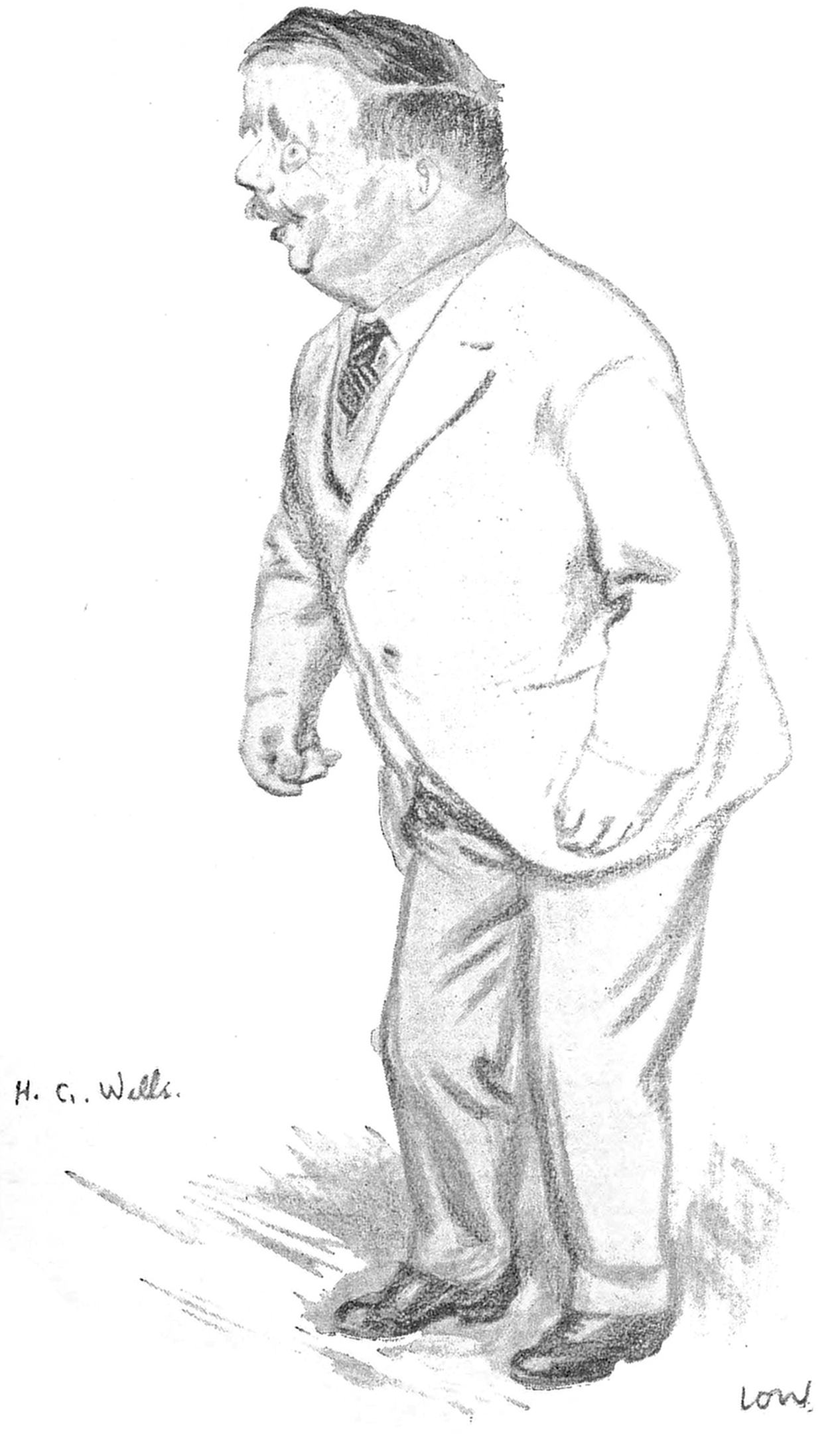
H. G. Wells.
Low
But after the feather was fully developed it
opened up great possibilities of a strong and light
extension of the flapper, helpful in running or useful
in leaps from tree to tree. Archæopteryx, another
early bird, which is also figured in the Outline,
has a sort of bat-wing fore-limb with feathers
instead of membrane. It was a woodland creature,
and flew as a flying fox or a flying lemur or
even a bat flies. All these facts are widely known,
and all that trouble about the half-leg, half-wing,
dissolves before them. But consider what a hash
they make of Mr. Belloc’s argument, and how
pitifully it scurries off before them on its nondescript
stumps of pretentious half-knowledge, half-impudence!
So much for zero the second.
The final of this wonderful trinity of a prioris
is a repetition of an argument advanced ages ago
by Queen Victoria’s Lord Salisbury, when he was
President of the British Association. Even then
it struck people that he had been poorly coached
for the occasion. Assuming that one or two individuals
have got all these “survival value”
differences in the correct proportions—against
which the chances are zero—how by any theory of
Natural Selection are we to suppose they will
meet, breed, and perpetuate them? So this argument
runs. The chances are again declared to be
zero, the third zero, and Mr. Belloc, I gather, calls
in Design again here and makes his Creative
Spirit, which has already urged these two individuals,
lions, or liver flukes or fleas or what
not, to make an effort and adapt themselves, lead
them now to their romantic and beneficial nuptials,
while the Theory of Natural Selection grinds its
teeth in the background and mutters “Foiled
again.”
But this third argument reinforces the first, in
showing what is the matter with Mr. Belloc’s ideas
in this group of questions. He has got the whole
business upside down. I rather blame the early
Darwinians in this matter for using so inaccurate
a phrase as the “Survival of the Fittest.” It is
to that phrase that most of Mr. Belloc’s blunderings
are due. Yet he ought not to have been misled.
He had a summary of modern views before
him. He criticises my Outline of History, he
abuses it, and yet he has an extraordinary trick of
getting out of its way whenever it swings near
his brain-case. I warn the readers of that modest
compendium expressly (and as early as page 16)
that the juster phrase to use is not the Survival of
the Fittest, but the Survival of the Fitter. I do
what I can throughout to make them see this question
not in terms of an individual, but in terms of
the species.
Yet Mr. Belloc insists upon writing of “the
Fittest” as a sort of conspicuously competitive
prize boy, a favourable “sport,” who has to meet
his female equivalent and breed a new variety.
That is all the world away from the manner in
which a biologist thinks of the process of specific
life. He sees a species as a vast multitude of individuals
in which those without individual advantages
tend to fail and those with them tend to
be left to continue the race. The most important
fact is the general relative failure of the disadvantaged.
The fact next in order of importance
is the general relative survival of the advantaged.
The most important consequence is that the average
of the species moves in the direction of advantageous
differences, moving faster or slower
according to its rate of reproduction and the urgency
of its circumstances—that is to say, to the
severity of its death-rate. Any one particular individual
may have any sort of luck; that does not
affect the general result.
I do not know what Mr. Belloc’s mathematical
attainments are, or indeed whether he has ever
learnt to count beyond zero. There is no evidence
on that matter to go upon in these papers. But
one may suppose him able to understand what an
average is, and he must face up to the fact that
the characteristics of a species are determined by
its average specimens. This dickering about with
fancy stories of abnormal nuptials has nothing to
do with the Theory of Natural Selection. We are
dealing here with large processes and great numbers,
secular changes and realities broadly viewed.
I must apologise for pressing these points
home. But I think it is worth while to take this
opportunity of clearing up a system of foggy misconceptions
about the Theory itself that may not
be confined altogether to Mr. Belloc.
And now let us come to Mr. Belloc’s second
triad of arguments—his arguments, as he calls
them, “from Evidence.” The sole witness on
Evidence called is his own sturdy self. He calls
himself into the box, and I will admit he gives
his testimony in a bluff, straightforward manner—a
good witness. He says very properly that the
theory of Natural Selection repudiates any absolute
fixity of species. But we have to remember
that the rate of change in any species is dependent
upon the balance between that species and its conditions,
and if this remains fairly stable the
species may remain for as long without remarkable
developments, or indulge in variations not
conditioned by external necessities. The classical
Lingula of the geological text-books, a warm-water
shell-fish, has remained much the same
creature throughout the entire record, for hundreds
of millions of years it may be. It was suited
to its submarine life, and hardly any variation
was possible that was not a disadvantage. It
swayed about within narrow limits.
This admission of a practical stability annoys
Mr. Belloc; it seems to be a mean trick on the
part of the Theory of Natural Selection. He
rather spoils his case by saying that “according
to Natural Selection” the swallow ought to go on
flying “faster and faster with the process of
time.” Until it bursts into flames like a meteor
and vanishes from our world? And the Lingula
ought to become more and more quiescent until it
becomes a pebble? Yet plainly there is nothing in
the Theory of Natural Selection to make the swallow
fly any faster than its needs require. Excess
of swiftness in a swallow may be as disadvantageous
as jumping to conclusions can be to a controversialist.
But here is a statement that is spirited and yet
tolerably fair:—
“If Natural Selection be true, then what we
call a Pig is but a fleeting vision; all the past
he has been becoming a Pig, and all the future
he will spend evolving out of Pigdom, and
Pig is but a moment’s phase in the eternal
flux.”
This overlooks the melancholy possibility of an
extinction of Pigs, but it may be accepted on the
whole as true. And against this Mr. Belloc gives
us his word, for that upon examination is what
his “Evidence” amounts to—that Types are
Fixed. He jerks in capitals here in a rather convincing
way. It is restrained of him, considering
how great a part typography plays in his rhetoric,
that he has not put it up in block capitals or had
the paper perforated with the words: Fixed
Types.
“We have the evidence of our senses that
we are surrounded by fixed types.”
For weeks and months it would seem Mr. Belloc
has walked about Sussex accumulating first-hand
material for these disputations, and all this time
the Pigs have remained Pigs. When he prodded
them they squealed. They remained pedestrian
in spite of his investigatory pursuit. Not one did
he find “scuttling away” with a fore-limb, “half-leg,
half-wing.” He has the evidence of his
senses also, I may remind him, that the world is
flat. And yet when we take a longer view we find
the world is round, and Pigs are changing, and
Sus Scrofa is not the beast it was two thousand
years ago.
Mr. Belloc is conscious of historical training,
and I would suggest to him that it might be an
improving exercise to study the Pig throughout
history and to compare the Pigs of the past with
the Pigs of a contemporary agricultural show. He
might inform himself upon the bulk, longevity,
appetites, kindliness, and general disposition of
the Pig to-day. He might realise then that the
Pig to-day, viewed not as the conservative occupant
of a Sussex sty, but as a species, was something
just a little different as a whole, but different,
definably different, from the Pig of two thousand
or five thousand years ago. He might retort
that the Pig has been the victim of selective
breeding and is not therefore a good instance of
Natural Selection, but it was he who brought Pigs
into this discussion. Dogs again have been
greatly moulded by man in a relatively short time,
and, again, horses. Almost all species of animals
and plants that have come into contact with man
in the last few thousand years have been greatly
modified by his exertions, and we have no records
of any detailed observations of structure or habits
of creatures outside man’s range of interest before
the last three or four centuries. Even man
himself, though he changes with relative slowness
because of the slowness with which he comes to
sexual maturity, has changed very perceptibly in
the last five thousand years.
Mr. Belloc says he has not (“Argument from
Evidence”). He says it very emphatically
(“Crushing Argument from Evidence”—to adopt
the phraseology of his cross-heads). Let me refer
him to a recent lecture by Sir Arthur Keith
(Royal Society of Medicine, Nov. 16, 1925) for a
first gleam of enlightenment. He will realise a
certain rashness in his statement. I will not fill
these pages with an attempt to cover all the
changes in the average man that have gone on in
the last two or three thousand years. For example,
in the face and skull, types with an edge-to-edge
bite of the teeth are giving place to those
with an overlapping bite; the palate is undergoing
contraction, the physiognomy changes.
And so on throughout all man’s structure. No
doubt one can find plentiful instances to-day of
people almost exactly like the people of five thousand
years ago in their general physique. But
that is not the point. The proportions and so
forth that were exceptional then are becoming
prevalent now; the proportions that were prevalent
then, now become rare. The average type
is changing. Considering that man only gets
through about four generations in a century, it is
a very impressive endorsement of the theory of
Natural Selection that he has undergone these
palpable modifications in the course of a brief
score of centuries. Mr. Belloc’s delusion that no
such modification has occurred may be due to his
presumption that any modification would have to
show equally in each and every individual. I
think it is. He seems quite capable of presuming
that.
Mr. Belloc’s next Argument from Evidence is a
demand from the geologist for a continuous
“series of changing forms passing one into the
other.” He does not want merely “intermediate
forms,” he says; he wants the whole series—grandfather,
father, and son. He does not say
whether he insists upon a pedigree with the bones
and proper certificates of birth, but I suppose it
comes to that. This argument, I am afraid, wins,
hands down. Mr. Belloc may score the point.
The reprehensible negligence displayed by the
lower animals in the burial of their dead, or even
the proper dating of their own remains, leaves the
apologist for the Theory of Natural Selection
helpless before this simple requisition. It is true
that we now have, in the case of the camels, the
horses, and the elephants, an extraordinary display
of fossil types, exhibiting step by step the
development and differentiation of species and
genera. But this, I take it, rather concerns his
Third than his Second Argument from Evidence.
The third argument is essentially a display of
Mr. Belloc’s inability to understand the nature of
the record of the rocks. I will assume that he
knows what “strata” are, but it is clear that he
does not understand that any uniform stratum
indicates the maintenance of uniform conditions
while it was deposited and an absence of selective
stresses, and that when it gives place to another
different stratum, that signifies a change in conditions,
not only in the conditions of the place
where the stratum is found, but in the supply of
material. An estuary sinks and gives place to
marine sands, or fresh water brings down river
gravels which cover over an accumulation of
shingle. Now if he will think what would happen
to-day under such circumstances, he will realise
that the fauna and flora of the stratum first considered
will drift away and that another fauna
and flora will come in with the new conditions.
Fresh things will come to feed and wade and
drown in the waters, and old types will no longer
frequent them. The fossil remains of one stratum
are very rarely directly successive to those below
it or directly ancestral to those above it. A succession
of forms is much more difficult and elusive
to follow up, therefore, than Mr. Belloc imagines.
And then if he will consider what happens to the
rabbits and rats and mice on his Sussex estate,
and how they die and what happens to their
bodies, he may begin to realise just what proportion
of the remains of these creatures is ever
likely to find its way to fossilisation. Perhaps
years pass without the bones of a single rabbit
from the whole of England finding their way to
a resting-place where they may become fossil.
Nevertheless the rabbit is a very common animal.
And then if Mr. Belloc will think of palæontologists,
millions of years after this time, working at
the strata that we are forming to-day, working at
a gravel or sand-pit here or a chance exposure
there, and prevented from any general excavation,
and if he will ask himself what proportion
of the rare few rabbits actually fossilised are
likely to come to light, I think he will begin to
realise for the first time in his life the tremendous
“gappiness” of the geological record and how
very childish and absurd is his demand for an
unbroken series of forms. The geological record
is not like an array of hundreds of volumes containing
a complete history of the past. It is much
more like a few score crumpled pages from such
an array, the rest of the volumes having either
never been printed, or having been destroyed or
being inaccessible.
In his Third Argument from Evidence Mr.
Belloc obliges us with a summary of this record
of the rocks, about which he knows so little. I
need scarcely note here that the only evidence
adduced is his own inspired conviction. No
“European” palæontologist or biologist is brought
out of the Humbert safe and quoted. Here was
a chance to puzzle me dreadfully with something
“in French,” and it is scandalously thrown away.
Mr. Belloc tells us, just out of his head, that instead
of there being that succession of forms in
the geological record the Theory of Natural Selection
requires, there are “enormously long periods
of stable type” and “(presumably) rapid periods
of transition.” That “presumably” is splendid;
scientific caution and all the rest of it—rapid
periods when I suppose the Creative Spirit got
busy and types woke up and said, “Turn over;
let’s change a bit.”
There is really nothing to be said about this
magnificent generalisation except that it is pure
Bellocking. Wherever there is a group of strata,
sufficiently thick and sufficiently alike to witness to
a long-sustained period of slight alterations in
conditions, there we find the successive species approximating.
This is not a statement à la Belloc.
In spite of the chances against such a thing occurring,
and in defiance of Mr. Belloc’s assertion that
it does not occur, there are several series of
forms in time, giving a practically direct succession
of species. Mr. Belloc may read about it
and at the same time exercise this abnormal linguistic
gift which sits upon him so gracefully, his
knowledge of the French language, in Deperet’s
Transformations du Monde Animal, where all
these questions are conveniently summarised.
There he will get the results of Waagen with a
succession of Ammonites and also of Neumayr
with Paludina, and there also he will get information
about the sequence of the species of Mastodon
throughout the Tertiary age and read about the
orderly progress of a pig group, the Brachyodus
of the Eocene and Oligocene. There is a touch
of irony in the fact that his own special protégé,
the Pig, should thus turn upon him and rend his
Third Argument from Evidence.
More recondite for Mr. Belloc is the work of
Hilgendorf upon Planorbis, because it is in German;
but the drift of it is visible in the Palæontology
wing of the London Natural History Museum,
Room VIII. A species of these gasteropods was,
during the slow processes of secular change,
caught in a big lake, fed by hot springs. It underwent
progressive modification into a series of
successive new species as conditions changed
through the ages. Dr. Klähms’ specimens show
this beautifully. Rowe’s account of the evolutionary
series in the genus Micraster (Q.J.M.S., 1899)
is also accessible to Mr. Belloc, and he will find
other matter to ponder in Goodrich’s Living Organisms,
1924. The finest series of all, longer in
range and completer in its links, is that of the
Horse. There is an excellent little pamphlet by
Matthew and Chubb, well illustrated, The Evolution
of the Horse, published by the American
Museum of Natural History, New York, so plain,
so simple, so entirely and humiliatingly destructive
of Mr. Belloc’s nonsensical assertions, that I
pray him to get it and read it for the good of his
really very unkempt and neglected soul.
Thus we observe that Mr. Belloc does not know
the facts in this case of Natural Selection, and
that he argues very badly from such facts as he
misconceives. It is for the reader to decide which
at the end is more suitable as a laughing-stock—the
Theory of Natural Selection or Mr. Belloc.
And having thus studied this great Catholic apologist
as an amateur biologist and arrived at the result,
we will next go on to consider what he has
to say about the origins of mankind—and Original
Sin.
IV MR. BELLOC’S ADVENTURES AMONG THE SUB-MEN: MANIFEST TERROR OF THE NEANDERTHALER — Mr. Belloc as Iconoclast — Mr. Belloc Discovers a Mare’s-Nest — The Chasing of Mr. Belloc Begins — Where Was the Garden of Eden?
From Mr. Belloc’s feats with Natural Selection
we come to his adventures among his
ancestors and the fall of man. These are, if possible,
even more valiant than his beautiful exposure
of the “half-educated assurance” of current
biological knowledge. He rushes about the
arena, darting from point to point, talking of my
ignorance of the “main recent European work in
Anthropology,” and avoiding something with
extraordinary skill and dexterity. What it is he
is avoiding I will presently explain. No one who
has read my previous articles need be told that not
a single name, not a single paper, is cited from
that galaxy of “main recent European” anthropology.
With one small exception. There is a
well-known savant, M. Marcellin Boule, who wrote
of the Grottes de Grimaldi in 1906. Some facetious
person seems to have written to Mr. Belloc
and told him that M. Boule in 1906 “definitely
proved the exact opposite” of the conclusions
given by Mr. Wright in his Quaternary Ice Age
(1914), and quoted in my Outline. Mr. Belloc
writes this down, elevates M. Boule to the magnificence
of “Boule” simply and follows up with
the habitual insults. By counting from his one
fixed mathematical point, zero in some dimension
unknown to me, he concludes that I must be twenty
years out of date, though the difference between
1906 and 1914, by ordinary ways of reckoning,
is really not minus twenty but plus eight.
The same ungracious humorist seems to have
stuffed up Mr. Belloc with a story that for the
last twenty years the climate of the earth has
ceased to vary with the eccentricity of the earth’s
orbit, and that any natural consequences of the
precession of the equinoxes no longer occur; that
climate has, in fact, cut loose from astronomical
considerations, and that you can find out all about
it in the Encyclopædia Britannica. You cannot.
Mr. Belloc should have tried. Some day he must
find time to puzzle out M. Boule’s curve of oscillation
of the Mediterranean and correlate it with
Penck’s, and go into the mystery of certain Moustierian
implements that M. Boule says are not
Moustierian; and after that he had better read
over the little discussion about changes of climate
in the Outline of History—it is really quite simply
put—and see what it is I really said and what his
leg-pulling friend has been up to with him in that
matter. It may be kinder to Mr. Belloc to help
him with a hint. Croll made an excellent book
in which he pointed out a number of astronomical
processes which must produce changes of climate.
He suggested that these processes were sufficient
to account for the fluctuations of the glacial age.
They are not. But they remain perfectly valid
causes of climatic variation. Croll is no more
done for than Darwin is done for. That is where
Mr. Belloc’s friend let Mr. Belloc down.
But Mr. Belloc does not always work on the information
of facetious friends, and sometimes one
is clearly in the presence of the unassisted expert
controversialist. When, for example, I say that
the Tasmanians are not racially Neanderthalers,
but that they are Neanderthaloid, he can bring
himself to alter the former word also to Neanderthaloid
in order to allege an inconsistency. And
confident that most of his Catholic readers will
not check him back by my book, he can ascribe to
me views about race for which there is no shadow
of justification. But it is disagreeable to me to
follow up such issues, they concern Mr. Belloc
much more than they do the living questions under
discussion, and I will not even catalogue what
other such instances of unashamed controversy
occur.
In the course of the darting to and fro amongst
human and sub-human pre-history, Mr. Belloc
criticises me severely for quoting Sir Arthur
Keith’s opinion upon the Piltdown remains. I
have followed English authorities. All these remains
are in England, and so they have been
studied at first hand mostly by English people.
No one can regret this insularity on the part of
Eoanthropus more than I do, but it leaves Mr.
Belloc’s “European opinion on the whole” rejecting
Sir Arthur Keith as a rather more than
usually absurd instance of Mr. Belloc’s distinctive
method. “What European opinion?” you ask.
Mr. Belloc does not say. Probably Belloking of
Upsala and Bellokopoulos of Athens. Mr. Belloc—forgetting
that in an earlier edition of the Outline
I give a full summary of the evidence in this
case, up-to-date—informs his Catholic audience
that I have apparently read nothing about the
Piltdown vestige but an “English work.” And
then he proceeds to fall foul of the “restoration”
of Eoanthropus. It is an imaginary picture of
the creature, and I myself think that the artist
has erred on the human side. Mr. Belloc objects
to all such restorations.
Well, we have at least a saucerful of skull fragments
and a doubtful jawbone to go upon, and
the picture does not pretend to be, and no reader
can possibly suppose it to be, anything but a
tentative restoration. But why a great Catholic
apologist of all people, the champion of a Church
which has plastered the world with portraits of
the Virgin Mary, of the Holy Family, and with
pictures of saints and miracles in the utmost profusion,
without any warning to the simple-minded
that these gracious and moving figures to which
they give their hearts may be totally unlike the
beings they profess to represent—why he should
turn iconoclast and object to these modestly propounded
restorations passes my comprehension.
At Cava di Tirrene near Naples I have been privileged
to see, in all reverence, a hair of the Virgin,
small particles of St. Peter, and other evidences of
Christianity; and they did not seem to me to be so
considerable in amount as even the Eoanthropus
fragments. And again, in this strange outbreak
of iconoclastic rage, he says:—
“Again, we have the coloured picture of a
dance of American Red Indians round a fire
solemnly presented as a ‘reconstruction’ of
Palæolithic society.”
He has not even observed that the chief figures
in that picture are copied directly from the actual
rock paintings of Palæolithic men although this is
plainly stated.
And yet he must have looked at the reproductions
of these rock paintings given in the Outline.
Because in his ninth paper he comes out with the
most wonderful of all the mare’s-nests he has discovered
in the Outline of History, and it concerns
these very pictures. You see there is an account
of the Reindeer men who lived in France and
North Spain, and it is said of them that it is doubtful
if they used the bow. Mr. Belloc declares that
it is my bitter hatred of religion that makes me
say this, but indeed it is not. It is still doubtful
if the Reindeer hunters had the bow. The fires
of Smithfield would not tempt me to say certainly
either that they had it or that they did not have
it, until I know. But they seem to have killed the
reindeer and the horse and bison by spearing
them. Mr. Belloc may have evidence unknown to
the rest of mankind in that Humbert safe of his,
otherwise that is the present state of our knowledge.
But, as I explain on pages 56 and 57 in
language that a child might understand, simultaneously
with that reindeer-hunting life in the
north there were more advanced (I know the word
will disgust Mr. Belloc with its horrid suggestion
of progress, but I have to use it) Palæolithic people
scattered over the greater part of Spain and
reaching into the South of France who had the
bow. It says so in the text: “Men carry bows”
runs my text, describing certain rock pictures reproduced
in my book. I wrote it in the text; and
in the legends that are under these pictures,
legends read and approved by me, the statement
is repeated. The matter is as plain as daylight
and as plainly stated. Mr. Belloc will get if he
says over to himself slowly: “Reindeer men, bows
doubtful; Azilian, Capsian men to the south, bows
certainly.” And now consider Mr. Belloc, weaving
his mare’s-nest:—
“Upon page 55 he writes, concerning the
Palæolithic man of the cave drawings, this
sentence: ‘it is doubtful if they knew of the
bow.’
“When I first read that sentence, I was so
staggered, I could hardly believe I had read
it right.
“That a person pretending to teach popular
prehistorical science in 1925 should tell us
of the cave painters that it was ‘doubtful if
they knew of the bow’ seemed to me quite out
of nature.
“It was the more extraordinary because
here before me, in Mr. Wells’s own book,
were reproductions of these cave paintings,
with the bow and the arrow appearing all
over them! Even if he did not take the
trouble to look at the pictures that were to
illustrate his book, and left that department
(as he probably did) to hack work, he ought,
as an ordinary educated man, to have known
the ultimate facts of the case.
“Palæolithic man was an archer, and an
archer with an efficient weapon.
“The thing is a commonplace; only gross
ignorance can have overlooked it; but, as I
have said, there is a cause behind that ignorance.
Mr. Wells would not have made this
enormous error if he had not been possessed
with the necessity of making facts fit in
with his theology.”
There is a real splendour in these three almost
consecutive passages. And note incidentally how
this facile controversialist bespatters also my
helpers and assistants. They do “hack work.”
Palæolithic man, speaking generally, was not an
archer. Only the later Palæolithic men, dealing
with a smaller quarry than the reindeer, seem to
have used the bow. Manifestly it is not I who am
fitting my facts with my theology here, but Mr.
Belloc. He is inventing an error which is incredible
even to himself as he invents it, and he is
filling up space as hard as he can with indignation
at my imaginary offence.
Why is he going on like this? In the interests
of that Catholic soul in danger? Possibly. But
his pen is running so fast here, it seems to me,
not so much to get to something as to get away
from something. The Catholic soul most in danger
in these papers of Mr. Belloc’s is Mr. Belloc’s,
and the thing he is running away from through
these six long disputations is a grisly beast,
neither ape nor true man, called the Neanderthaler,
Homo Neanderthalensis. This Homo Neanderthalensis
is the real “palæolithic” man.
For three-quarters of the “palæolithic” age he
was the only sort of man. The Reindeer men,
the Capsian men, are “modern” beside him. He
was no more an archer than he was an electrical
engineer. He was no more an artist than Mr.
Belloc is a man of science.
Instead of bothering with any more of the poor
little bits of argey-bargey about this or that detail
in my account of the earlier true men that
Mr. Belloc sees fit to make—instead of discussing
whether these first human savages, who drew and
painted like Bushmen and hunted like Labrador
Indians, did or did not progress in the arts of life
before they passed out of history, let me note now
the far more important matters that he refuses
to look at.
Mr. Belloc makes a vast pother about Eoanthropus,
which is no more than a few bits of bone;
he says nothing of the other creature to whom I
have devoted a whole chapter: the man that was
not a man. Loud headlines, challenging section
headings, appeal in vain to Mr. Belloc’s averted
mind. Of this Neanderthal man we have plentiful
evidence, and the collection increases every
year. Always in sufficiently old deposits, and always
with consistent characteristics. Here is a
creature which not only made implements but
fires, which gathered together ornamental stones,
which buried its dead. Mr. Belloc says burying
the dead is a proof of a belief in immortality.
And this creature had strange teeth, differing
widely from the human, more elaborate and less
bestial; it had a differently hung head; it was
chinless, it had a non-opposable thumb. Says M.
Boule, the one anthropologist known to Mr. Belloc:
“In its absence of forehead the Neanderthal
type strikingly resembles the anthropoid apes.”
And he adds that it “must have possessed only a
rudimentary psychic nature ... markedly inferior
to that of any modern race.” When I
heard that Mr. Belloc was going to explain and
answer the Outline of History, my thought went
at once to this creature. What would Mr. Belloc
say of it? Would he put it before or after
the Fall? Would he correct its anatomy by wonderful
new science out of his safe? Would he
treat it like a brother and say it held by the most
exalted monotheism, or treat it as a monster made
to mislead wicked men?
He says nothing! He just walks away whenever
it comes near him.
But I am sure it does not leave him. In the
night, if not by day, it must be asking him: “Have
I a soul to save, Mr. Belloc? Is that Heidelberg
jawbone one of us, Mr. Belloc, or not? You’ve
forgotten me, Mr. Belloc. For four-fifths of the
Palæolithic age I was ‘man.’ There was no other.
I shamble and I cannot walk erect and look up at
heaven as you do, Mr. Belloc, but dare you cast
me to the dogs?”
No reply.
The poor Neanderthaler has to go to the dogs, I
fear, by implication, for Mr. Belloc puts it with
all the convincing force of italics, that “Man is
a fixed type.” We realise now why he wrote the
four wonderful chapters about Natural Selection
that we have done our best to appreciate. It was
to seem to establish this idea of fixed types. Man
had to be shown as a “Fixed Type” for reasons
that will soon be apparent. Apart from Mr. Belloc’s
assertion, there is no evidence that man is
any exception to the rest of living creatures. He
changes. They all change. All this remarkable
discourse about bows or no bows and about the
high thinking and simple living of these wandering
savages of twenty or more thousand years
ago, which runs through half a dozen papers,
seems to be an attempt to believe that these early
men were creatures exactly like ourselves; and an
attempt to believe that the more animal savages
of the preceding hundred thousand years did not
for all practical purposes exist at all. An attempt
to believe and induce belief; not an attempt to
demonstrate. Mr. Belloc emerges where he went
in, with much said and nothing proved, and the
Outline undamaged by his attack. And emerging
he makes a confession that he never was really
concerned with the facts of the case at all. “Sympathy
or antagonism with the Catholic faith is
the only thing of real importance in attempting
to teach history”—and there you are! All these
argumentative gesticulations, all these tortured
attempts to confute, are acts of devotion to Mr.
Belloc’s peculiar vision of the Catholic faith.
I am afraid it is useless for me to suggest a
pilgrimage to Mr. Belloc, or I would ask him to
visit a popular resort not two hours by automobile
from the little corner of France in which I
am wont to shelter my suburban Protestantism
from the too bracing English winter. That is the
caves at Rochers Rouges, at which, as it happens,
his one quoted authority, M. Boule, worked for
several years. There in an atmosphere entirely
“Latin” and “continental,” under the guidance
of Signor Alfredo Lorenzi, he can see for himself
his Fixed Type Man at successive levels of
change. No northern man need be with him when
he faces the facts of these caves; no Protestant
shadow need dog his steps; his French, that rare
distinguished gift, will be understood, and he may
even air such Provençal or Italian as he is master
of. The horrid Neanderthaler is not in evidence.
But there, protected by glass covers, he
will be able to see the skeletons of Cro-Magnon
man and Grimaldi man lying in the very positions
in which they were discovered. He will see for
himself the differences of level at which they were
found and have some help in imagining the ages
that separate the successive types. He will note
massiveness of skull and protrusion of jaw. He
will see the stone implements they used, the ashes
of their fires, and have some material for imagining
the quality of their savagery. He can hunt
about for arrow-heads to bear out his valiant assertion
that Palæolithic man was “an archer with
an efficient weapon.” He will hunt until stooping
and the sunshine make him giddy, in vain.
And then, with these bones fresh in his mind, he
should go to the Museum at Monaco and see the
skeleton of a modern human being. He will find
no end of loud talk and valiant singing and good
red wine necessary before he can get back to his
faith in man as a Fixed Type.
It is extremely difficult to find out what Mr.
Belloc, as a representative Catholic, believes
about human origins. I was extremely curious
to get the Catholic view of these matters, and I
heard of the advent of these articles with very
great pleasure, because I thought I should at last
be able to grasp what I had hitherto failed to understand
in the Catholic position. But if Mr.
Belloc has said all that there is to say for Catholicism
upon these points, Catholicism is bankrupt.
He assures me that to believe in the Biblical account
of the Creation is a stupid Protestant tendency,
and that Catholics do not do anything of
the sort. His attitude towards the Bible throughout
is one almost of contempt. It is not for me
to decide between Christians upon this delicate
issue. And Catholics, I gather, have always believed
in Evolution and are far above the intellectual
level of the American Fundamentalist. It
is very important to Catholic self-respect to keep
that last point in mind. Catholic evolution is a
queer process into which “Design” makes occasional
convulsive raids; between which raids species
remain “fixed”; but still it is a sort of Evolution.
My peasant neighbours in Provence, devout
Catholics and very charming people, have not the
slightest suspicion that they are Evolutionists,
though Mr. Belloc assures me they are.
But, in spite of this smart Evolutionary town
wear of the Church, it has somehow to be believed
by Catholics that “man” is and always has been
and will be the same creature, “fixed.” That
much Mr. Belloc gives us reiteratively. A contemporary
writer, the Rev. Morris Morris, has
written an interesting book, Man Created During
Descent, to show that man’s immortal soul was
injected into the universe at the beginning of the
Neolithic period, which makes those Azilians and
Capsians, with their bows and carvings, mere animals.
The new Belloc-Catholic teaching is similar,
but it puts the human beginnings earlier.
Somewhen after the Chellean and Moustierian
periods, and before the Reindeer men, I gather
that “man” appeared, according to Catholic doctrines,
exactly what he is now. Or rather better.
He was clad in skins and feathers, smeared with
paint, a cave-hunting wanderer with not even a
dog at his heels; but he was, because Mr. Belloc
says so, a devout monotheist and had a lucid belief
in personal immortality. His art was pure
and exalted—there were little bone figures of
steatopygous women in evidence. He had no connection
with the Neanderthal predecessor—or
else he had jumped miraculously out of the Neanderthaler’s
bestial skin. Sometimes it seems to
be one thing and sometimes the other. But all
that stuff about Adam and Eve and the Garden
and the Tree and the Serpent, so abundantly figured
in Catholic painting and sculpture, seems to
have dropped out of this new version of Catholic
truth.
Yet those pictures are still shown to the faithful!
And what the Fall becomes in these new
revelations of Catholicism, or whether there was
a Fall, historically speaking, Mr. Belloc leaves in
the densest obscurity. I have read and re-read
these articles of his, and I seek those lucid Latin
precisions he has promised me in vain. Was and
is that Eden story merely symbolical, and has
the Church always taught that it is merely symbolical?
And if so, what in terms of current
knowledge do these symbols stand for? Is it
symbolical of some series of events in time or is
it not? If it is, when and what were the events
in time? And if it is not, but if it is symbolical
of some experience or adventure or change in the
life of each one of us, what is the nature of that
personal fall? What is the significance of the
Garden, the Innocence, the Tree, the Serpent?
To get anything clear and hard out of Mr. Belloc’s
papers in reply to these questions is like
searching for a diamond in a lake of skilly. I
am left with the uncomfortable feeling that Mr.
Belloc is as vague and unbelieving about this fundamental
Catholic idea as the foggiest of foggy
Protestants and Modernists, but that he has
lacked the directness of mind to admit as much
even to himself. Yet surely the whole system of
salvation, the whole Christian scheme, rests upon
the presumption of a fall. Without a fall, what
is the value of salvation? Why redeem what has
never been lost? Without a condemnation what
is the struggle? What indeed, in that case, is the
Catholic Church about?
What modern thought is about is a thing easier
to explain. In the Outline of History, against
which Mr. Belloc is rather carping than levelling
criticism, there is set out, as the main form of that
Outline, a progressive development of conscious
will in life. It is not a form thrust upon the
massed facts by any fanatical prepossession; it
is a form they insisted upon assuming under my
summarising hand. What is going on in this
dispute is not that I am beating and putting over
my ideas upon Mr. Belloc or that he is beating
and putting over his ideas upon me, but that the
immense increase of light and knowledge during
the past century is imposing a new realisation of
the quality and depth and import of life upon us
both, and that I am acquiescent and he is recalcitrant.
I judge his faith by the new history, and
he judges the new history by his faith.
V FIXITY OR PROGRESS — The Idea of Fixed Humanity — The Fundamental Issue — The Idea of Progressive Humanity — The New Thought and the Old — Old Wine in New Bottles
I am glad to say that we are emerging now
from the worst of the controversial stuff, irritating
and offensive, in which Mr. Belloc is so
manifestly my master, and coming to matters of
a more honest interest.
I have stuck to my argument through the cut
and slash, sneer and innuendo of Mr. Belloc’s first
twelve papers. I have done my best to be kind
and generous with him. I have made the best excuses
I can for him. I have shown how his oddities
of bearing and style arise out of the difficulties
of his position, and how his absurd reasonings
about Natural Selection and his deliberate
and tedious bemuddlement of the early Palæolithic
sub-men with the late Reindeer men and the
Capsian men are all conditioned by the necessity
he is under to declare and believe that “man” is,
as he puts it, a “Fixed Type,” the same in the
past and now and always. He is under this necessity
because he believes that otherwise the
Christian faith cannot be made to stand up as a
rational system, and because, as I have shown by
a quotation of his own words, he makes their compatibility
with his idea of Catholic teaching his
criterion in the acceptance or rejection of facts.
I will confess I do not think that things are as
bad as this with Christianity. I believe a far better
case could be made for Catholicism by an insistence
that its value and justification lie in the
change and in the direction of the human will, in
giving comfort and consolation and peace, in producing
saints and beautiful living; and that the
truth of the history it tells of space and time is
entirely in relation to the development of these
spiritual aspects, and has no necessary connection
whatever with scientific truth. This line of
thought is no novelty, and I do not see why Catholics
should not keep to it and leave the outline of
history alone. I do not say that it is a line of
apologetics that would convince me altogether,
but it is one that would need far more arduous
discussion and merit, far more respect than Mr.
Belloc’s a priori exploits, his limping lizards and
flying pigs.
But it is not my business to remind Catholics
of their own neglected philosophers, and clearly
the publication of Mr. Belloc’s articles by the
Universe, the Catholic Bulletin, and the Southern
Cross shows that the Catholic world of to-day is
stoutly resolved to treat the fall of man and his
unalterable nature as matters of fact, even if they
are rather cloudy matters of fact, and to fight the
realities of modern biology and anthropology to
the last ditch.
So the Catholics are pinned to this dogma of
the fixity of man and thereby to a denial of progress.
This vale of tears, they maintain, is as a
whole a stagnant lake of tears, and there is no
meaning to it beyond the spiritual adventures of
its individual lives. Go back in time or forward,
so long as man has been or will be, it is all the
same. You will find a world generally damned,
with a select few, like Mr. Belloc, on their way to
eternal beatitude. That is all there is to the spectacle.
There is, in fact, no outline of history;
there is just a flow of individual lives; there is
only birth and salvation or birth and damnation.
That, I extract from Mr. Belloc and other contemporary
writers, is the Catholic’s vision of life.
And it is not only the Catholic vision of life.
It is a vision far more widely accepted. I would
say that, if we leave out the ideas of damning or
beatitude, it is the “common-sense” vision of
the world. The individual life is, to common-sense,
all that matters, the entire drama. There
is from this popular and natural point of view
no large, comprehensive drama in which the individual
life is a subordinate part. Just as to the
untutored mind the world is flat, just as to Mr.
Belloc during his biological research work in Sussex
the species of pig remained a “fixed type,”
so to the common intelligence life is nothing more
or less than “Me,” an unquestioned and unanalysed
Me, against the universe.
The universe may indeed be imagined as ruled
over and pervaded by God, and this world may
be supposed to have extensions of hell and
heaven; all sorts of pre-natal dooms and debts
may affect the career of the Me, but nevertheless
the Me remains in the popular mind, nobbily integral,
one and indivisible, and either it ends and
the drama ends with it, or it makes its distinct
and special way to the Pit, or, with Belloc and
the Catholic community, to the beatitude he anticipates.
The individual self is primary to this natural,
primitive, and prevalent mode of thinking. But
it is not the only way of thinking about life. The
gist of the Outline of History is to contradict this
self-centred conception of life and show that this
absolute individualism of our thought and destinies
is largely illusory. We do not live in ourselves,
as we so readily imagine we do; we are
contributory parts in the progress of a greater
being which is life, and which becomes now conscious
of itself through human thought.
Now here I think we get down, beneath all the
frothings and bespatterings of controversy, to the
fundamental difference between Mr. Belloc and
myself. It is this which gives our present controversy
whatever claim it can have to attention.
Neither Mr. Belloc nor myself is a very profound
or exhaustive philosopher. In ourselves we are
very unimportant indeed. But we have this in
common, that we can claim to be very honestly
expressive of the mental attitudes of clearly defined
types of mind, and that we are sharply antithetical
types.
By nature and training and circumstances Mr.
Belloc stands for the stout sensible fellow who
believes what he sees; who considers that his sort
always has been and always will be; who stands
by accepted morals and time-honoured ways of
eating and drinking and amusement; who loves—and
grips as much as he can of—the good earth
that gives us food for our toil; who begets children
honestly by one beloved wife until she dies
and then repeats the same wholesome process
with the next; who believes in immortality lest
he should be sorry to grow old and die; who trusts
in the Church and its teaching because visibly the
Church is a great and impressive fact, close at
hand and extremely reassuring; who is a nationalist
against all strangers because, confound it!
there are nations, and for Christendom against
all pagans; who finds even Chinamen and Indians
remote and queer and funny. I do not think that
is an unfair picture of the ideals of Mr. Belloc
and of his close friend and ally, Mr. Chesterton,
as they have spread them out for us; and I admit
they are warm and rosy ideals. But they are
ideals and not realities. The real human being
upon this swift-spinning planet is not that stalwart,
entirely limited, fixed type resolved to keep
so, stamping about the flat world under God’s
benevolent sky, eating, drinking, disputing, and
singing lustily, until he passes on to an eternal
individual beatitude with God and all the other
blessed ones. He is less like that every day, and
more and more conscious of the discrepancy.
I have read and admired and sympathised with
the work of Mr. Belloc and Mr. Chesterton since
its very beginnings, but I find throughout it all a
curious defensive note. It may be I attribute
distresses to them that they do not feel. But it
seems to me they are never quite sure in their
minds about this “fixed” human being of theirs—the
same yesterday, now, and for ever. Mr. Belloc
must be puzzled not a little by that vast parade
of Evolution through the immeasurable ages
which he admits has occurred—a parade made by
the Creative Force for no conceivable reason,
since a “fixed type” might just as well have been
created straight away. He must realise that if
man is the beginning and end of life, then his
Creator has worked within fantastically disproportionate
margins both of space and time. And
in his chapters upon animal and human origins
Mr. Belloc’s almost obstinate ignorance of biological
facts, his fantastic “logic,” his pathetic
and indubitably honest belief in his non-existent
“European authorities,” his fumbling and evasion
about Palæolithic man, and above all his
petty slights and provocations to those whose
views jar upon him, have nothing of the serenity
of a man assured of his convictions, and all the
irritability and snatching at any straw of advantage
of a man terribly alarmed for his dearest
convictions. When Mr. Belloc gets to his beatitude
he will feel like a fish out of water. I believe
Mr. Belloc and his friend Mr. Chesterton
are far too intelligent not to be subconsciously
alive to the immense and increasing difficulties of
their positions, and that they are fighting most
desperately against any conscious realisation of
the true state of affairs.
It happens that my circumstances, and perhaps
my mental temperament, have brought my mind
into almost dramatic opposition to that of Mr.
Belloc. While his training was mainly in written
history, the core of mine was the analytical exercises
of comparative anatomy and palæontology.
I was brought up upon the spectacle of life in
the universe as a steadily changing system. My
education was a modern one, upon material and
questionings impossible a hundred years ago.
Things that are fundamental and commonplaces
to me have come, therefore, as belated, hostile,
and extremely distressing challenges to the satisfactions
and acceptances of Mr. Belloc.
Now, this picture of a fixed and unprogressive
humanity working out an enormous multitude of
individual lives from birth to either eternal beatitude
or to something not beatitude, hell or destruction
or whatever else it may be that Mr.
Belloc fails to make clear is the alternative to
beatitude—this picture, which seems to be necessary
to the Catholic and probably to every form
of Christian faith, and which is certainly necessary
to the comfort of Mr. Belloc, has no validity
whatever for my mind. It is no more possible in
my thought as a picture of reality than that ancient
cosmogony which made the round earth rest
upon an elephant, which stood upon a tortoise,
which stood upon God-knows-what.
I do not know how the universe originated, or
what it is fundamentally; I do not know how material
substance is related to consciousness and
will; I doubt if any creature of my calibre is
capable of knowing such things; but at least I
know enough to judge the elephant story and the
fixed humanity story absurd. I do not know any
convincing proof that Progress must go on; I
find no invincible imperative to progressive
change in my universe; but I remark that progressive
change does go on, and that it is the
form into which life falls more and more manifestly
as our analysis penetrates and our knowledge
increases. I set about collecting what is
known of life and the world in time and space,
and I find the broad outline falls steadily and
persistently into a story of life appearing and increasing
in range, power, and co-operative unity
of activity. I see knowledge increasing and
human power increasing, I see ever-increasing
possibilities before life, and I see no limits set to
it all. Existence impresses me as a perpetual
dawn. Our lives, as I apprehend them, swim in
expectation. This is not an outline I have thrust
upon the facts; it is the outline that came naturally
as the facts were put in order.
And it seems to me that we are waking up
to the realisation that the individual life does not
stand alone, as people in the past have seemed to
imagine it did, but that it is far truer to regard
it as an episode in a greater life, which progresses
and which need not die. The episode begins and
ends, but life goes on.
Mr. Belloc is so far removed from me mentally
that he is unable to believe that this, clearly and
honestly, is how I see things; he is moved to explain
it away by saying that I am trying to “get
rid of a God,” that I am a rotten Protestant, that
this is what comes of being born near London,
that if I knew French and respected the Gentry
all this would be different, and so on, as the attentive
student of his great apology for Catholicism
has been able to observe. But all the while
he is uncomfortably on the verge of being aware
that I am a mere reporter of a vast mass of gathered
knowledge and lengthened perspectives that
towers up behind and above his neat and jolly
marionette show of the unchanging man and his
sins and repentances and mercies, his astonishing
punishments, and his preposterous eternal reward
among the small eternities of the mediæval imagination.
I strut to no such personal beatitude. I
have no such eternity of individuation. The life
to which I belong uses me and will pass on beyond
me, and I am content.
Mr. Belloc is completely justified in devoting
much more than half his commentary to these fundamental
issues and dealing with my account of
the appearance of Christianity and the story of
the Church much more compactly. It is this difference
at the very roots of our minds which matters
to us, and it is the vital question we have
to put before the world. The rest is detail. I
do believe and assert that a new attitude to life,
a new and different vision of the world, a new
moral atmosphere and a different spirit of conduct,
is coming into human affairs, as a result
of the scientific analysis of the past hundred
years. It is only now reaching such a clearness
of definition that it can be recognised for what
it is and pointed out.
The essential distinction of the newer thought
in the world is in its denial of the permanence
of the self and in its realisation of the self’s comparative
unimportance. Even in our individual
lives we are increasingly interested in common
and generalised things. The older commoner life,
the religious life just as much as the most worldly
life, seems to us excessively self-conscious. The
religious life, its perpetual self-examination for
sin and sinful motives, its straining search after
personal perfection, appears in the new light
as being scarcely less egotistical than a dandy’s.
And this new way of living and thinking is
directly linked on to the idea of progress,
which makes life in general far more interesting
than any individual life can be, just as the self-centred
life, whether it be religious and austere
or vain or self-indulgent, is directly connected
with the old delusions of permanence which rob
life in general of any sustained interest. When
one is really persuaded that there is nothing new
under the sun, then there is nothing worth living
for whatever outside the personal adventure, the
dance between permanent individual beatitude or
permanent individual damnation.
As this modern conception of life as a process
of progressive change in which individuality of
our order can be sometimes excessively exaggerated
as it has been in the past and sometimes
minimised as is happening now—as this conception
establishes itself, it changes the spirit of living
and the values of our general ideas about living
profoundly. Lit only by a very bright light
held low, an ordinary road becomes a tangle of
vivid surfaces and black shadows, and you cannot
tell a puddle or a gutter from a ditch or a precipice.
But in diffused daylight you can see the
proportions of every irregularity. So too with
changing illumination our world alters its aspects,
and things that once seemed monstrous and final
are seen to be mere undulations in a practicable
progress. We can realise now, as no one in the
past was ever able to realise it, that man is a
creature changing very rapidly from the life of
a rare and solitary great ape to the life of a social
and economic animal. He has traversed most
of this tremendous change of phase in something
in the nature of a million years. His whole being,
mind and body alike, betrays the transition. We
can trace the mitigations of his egotism through
the development of religious and customary restraints.
The recent work of the psycho-analyst
enables us to understand something of the intricate
system of suppressions and inhibitions
that this adaptation to a more and more complex
social life has involved. We begin to realise how
man has symbolised and personified his difficulties,
and to comprehend the mechanisms of his
uncongenial but necessary self-restraint.
The disposition of those who apprehend this
outline of history that modern science has made
plain to us, and who see all life as a system of
progressive change, is by no means antagonistic
to religion. They realise the immense importance
and the profound necessity of religion in this last
great chapter of the story, the evolution of human
society. But they see religion within the frame
of fact; they do not, like Mr. Belloc, look through
religion at fact. Man has accommodated his originally
fierce and narrow egotism to the needs of
an ever wider and more co-operative social life,
very largely through the complex self-subjugations
that religion has made possible. Within the
shell and cover of religion the new less self-centred
habits of mind have been able to develop.
An immense mass of imaginative work, of mythology,
of theology, that now seems tortuous, mystical,
and fantastic, was necessary for the casting
of the new moral being of socialised man. We
seem to be entering upon a phase in which moral
and intellectual education may be able to free
themselves from the last vestiges of the mythology
in which that new moral being was
moulded; but it is ungracious and false to the
true outline of history to deny the necessary part
that the priest, the sacrifice, the magic ceremonial
for tribal welfare, the early tribal religions, have
played in this transfiguration of the sub-human
into the modern human mind, upon which all our
community rests to-day.
It is because of our sense of this continuity of
our present dispositions with the religions upon
which they are founded that so many of us are
loth to part with all the forms and phrases of
the old creeds and all the disciplines of time-honoured
cults. Perhaps some of us (the present
writer in the crowd among others) have been over-eager
to read new significances into established
phrases, and clothe new ideas in the languages of
the old scheme of salvation. It may be we have
been pouring new wine into old bottles. It may
be better to admit frankly that if man is not fixed
Christianity is, and that mankind is now growing
out of Christianity; that indeed mankind is
growing out of the idea of Deity. This does not
mean an end to religion, but it means a fresh
orientation of the religious life. It means a final
severance with those anthropomorphic conceptions
of destiny, that interpretation of all things
in terms of personality and will with which religion
began. For many of us that still means a
wrench and an effort. But the emphatic assertions
of Mr. Belloc, the stand that Catholicism,
as he expounds it, makes against any progressive
adaptation to the new spirit in human life, may
render that effort easier.
Transcriber’s Notes
In this examination of Mr. Belloc’s opening and
more fundamental attacks upon the Outline of
History I have shown sufficiently that Mr. Belloc
is incapable of evidence or discussion, that he
imagines his authorities, that he is careless and
ignorant as to his facts and slovenly and tricky
in his logic. I have dealt kindly but adequately
with his atrocious bad manners and his insolence
and impudence. I do not think it is worth while
to go on through the second half of his outpourings
with any particularity. It is exactly the
same kind of thing, but upon more familiar
ground and less fundamental issues. Mr. Belloc
quibbles. He falsifies. For example, he imagines
traditions to reinforce the Gospel account of
Christ’s teaching and to show that the founder of
Christianity was aware of his godhead and taught
the doctrine of the Trinity; he declares—just out
of his head—that I do not know it was the bull
and not Mithra who was sacrificed in the system
of Mithraism, though I state that quite plainly in
a passage he has ventured to ignore. And so on.
The wonderful methods of the Palæolithic bow
story repeat themselves with variations, time
after time. Why should I trouble to repeat the
exposure in every case? I have done enough to
demonstrate the quality of this effort to bluff and
bawl away accepted knowledge and manifest fact,
and that is all that I set out to do.
And this apparently is the present state of
Catholic teaching. This stuff I have examined is
the current utterance
of organised Christianity, so far as there is
any utterance, upon the doctrines of the Creation
and the Fall—doctrines upon which rest the whole
scheme of Christian salvation and the entire fabric
of a Christian’s faith.
Punctuation, hyphenation, and spelling were made
consistent when a predominant preference was found
in the original book; otherwise they were not changed.
Simple typographical errors were corrected; unbalanced
quotation marks were remedied when the change was
obvious, and otherwise left unbalanced. Several apparent misspellings
may be intentional, and have not been changed.
Illustrations in this eBook have been positioned
between paragraphs and outside quotations.
Page 69: Page 69: “Mr. Belloc will get if he says”
probably is missing an “it” after “get”.
Page 95: Part of the last paragraph was
misprinted. Transcriber has attempted to
correct that error. The original text was:
And this apparently is the present state of
Catholic teaching. This stuff I have examined is
ance of organised Christianity, so far as there is
representative stuff. This is the current utter-
ance of organised Christianity, so far as there is
any utterance, upon the doctrines of the Creation
and the Fall—doctrines upon which rest the whole
scheme of Christian salvation and the entire fabric
of a Christian’s faith.
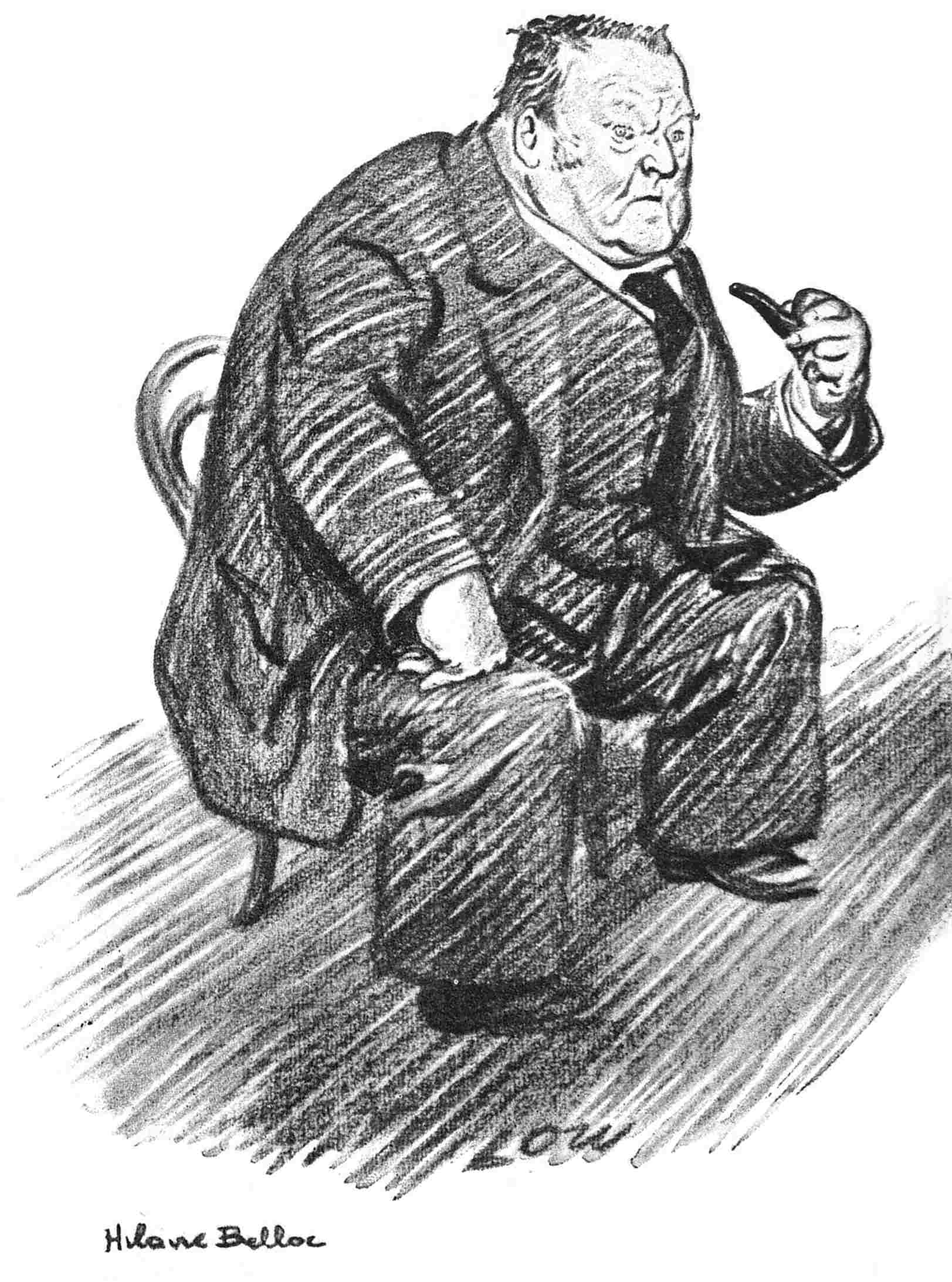
 YORK