This certifies that four hundred and fifty copies only, all on
hand-made Holland paper and printed from types, of this edition
of Moxon’s “Mechanick Exercises,” in two volumes, were completed
in August, 1896, and that the types have been distributed.
Joseph J. Little.
S. P. Avery.
Walter Gilliss.
Douglas Taylor.
Theo. L. DeVinne.
David Williams.
W. W. Pasko.
Committee of the Typothetæ.
MOXON’S MECHANICK EXERCISES
MOXON’S
MECHANICK EXERCISES
The true Effigies of Laurenz Ians Kofter Delineated from his Monumentall Stone Statue, Erected at Harlem.
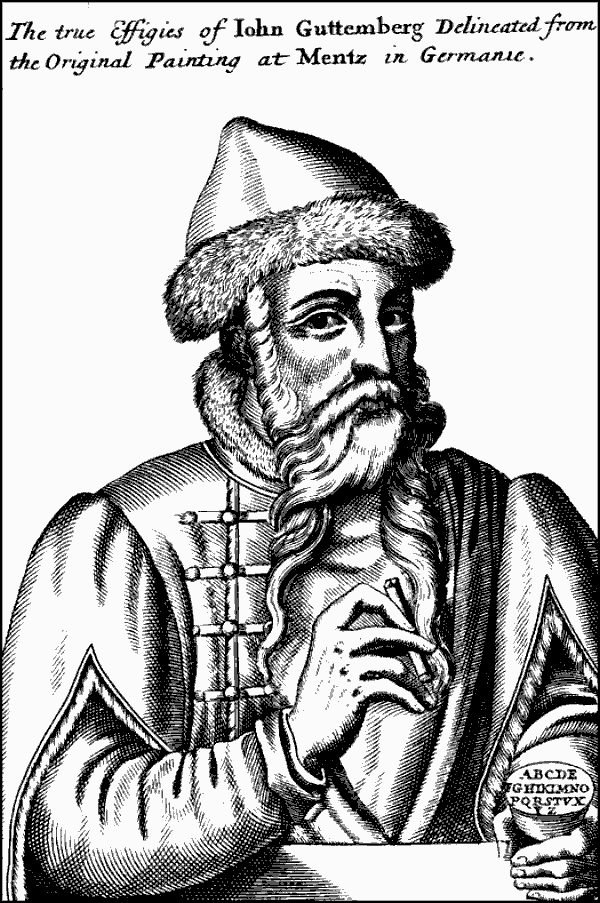
The true Effigies of Iohn Guttemberg Delineated from the Original Painting at Mentz in Germanie.
OR THE DOCTRINE OF HANDY-WORKS
APPLIED TO THE ART OF
PRINTING
A LITERAL REPRINT IN TWO VOLUMES OF
THE FIRST EDITION PUBLISHED IN THE YEAR 1683
WITH PREFACE AND NOTES BY
THEO. L. DE VINNE
VOLUME I
NEW-YORK
THE TYPOTHETÆ OF THE CITY OF NEW-YORK
MDCCCLXXXXVI
PREFACE
JOSEPH MOXON was born at Wakefield in
Yorkshire, England, August 8, 1627. There
is no published record of his parentage or his
early education. His first business was that of a
maker and vender of mathematical instruments, in
which industry he earned a memorable reputation
between the years 1659 and 1683. He was not
content with this work, for he had leanings to other
branches of the mechanic arts, and especially toward
the designing of letters and the making of
printing-types.
In 1669 he published a sheet in folio under the
heading of “Prooves of the Several Sorts of Letters
Cast by Joseph Moxon.” The imprint is “Westminster,
Printed by Joseph Moxon, in Russell
street, at the Sign of the Atlas, 1669.” This specimen
of types seems to have been printed, not to
show his dexterity as a type-founder, but to advertise
himself as a dealer in mathematical and scientific
instruments. The reading matter of the sheet
describes “Globes Celestial and Terrestrial, Large
Maps of the World, A Tutor to Astronomie and to
Geographie”—all of his own production. Reed
flouts the typography of this sheet: “It is a sorry
performance. Only one fount, the Pica, has any
pretensions to elegance or regularity. The others
are so clumsily cut or badly cast, and so wretchedly
printed, as here and there to be almost undecipherable.”[1]
The rude workmanship of these early
types proves, as he afterward admitted, that he had
never been properly taught the art of type-founding;
that he had learned it, as he said others had,
“of his own genuine inclination.”
It was then a difficult task to learn any valuable
trade. The Star Chamber decree of 1637 ordained
that there should be but four type-founders for the
kingdom of Great Britain, and the number of their
apprentices was restricted. When the Long Parliament
met in 1640, the decrees of the Star Chamber
were practically dead letters, and for a few years
there was free trade in typography. In 1644 the
Star Chamber regulations were reimposed; in 1662
they were made more rigorous than ever. The importation
of types from abroad without the consent
of the Stationers’ Company was prohibited. British
printers were compelled to buy the inferior types of
English founders, who, secure in their monopoly, did
but little for the improvement of printing.[2]
It is probable that the attention of Moxon was
first drawn to type-founding by the founders themselves,
who had to employ mechanics of skill for
the making of their molds and other implements of
type-casting. In this manner he could have obtained
an insight into the mysteries of the art that
had been carefully concealed. He did not learn
type-making or printing in the usual routine. The
records of the Company of Stationers do not show
that he was ever made a freeman of that guild, yet
he openly carried on the two distinct businesses of
type-founding and printing after 1669. It is probable
that he had a special permit from a higher
authority, for in 1665 he had been appointed hydrographer
to the king, and a good salary was given
with the office. He was then devoted to the practical
side of scientific pursuits, and was deferred to
as a man of ability.
He published several mathematical treatises between
the years 1658 and 1687; one, called “Compendium
Euclidis Curiosi,” was translated by him
from Dutch into English, and printed in London in 1677. Mores
supposes that he had acquired a knowledge of Dutch by residence in
Holland, but intimates that he was not proficient in its grammar.[3]
In 1676 he published a book on the shapes of
letters, with this formidable title: “Regulæ Trium
Ordinum Literarum Typographicarum; or the Rules
of the Three Orders of Print Letters, viz: the Roman,
Italick, English—Capitals and Small; showing
how they are Compounded of Geometrick Figures,
and mostly made by Rule and Compass.
Useful for Writing Masters, Painters, Carvers, Masons
and others that are Lovers of Curiosity. By
Joseph Moxon, Hydrographer to the King’s Most
Excellent Majesty. Printed for Joseph Moxon on
Ludgate Hill, at the Sign of Atlas, 1676.” He then
dedicated the book to Sir Christopher Wren, “as a
lover of rule and proportion,” or to one who might
be pleased with this attempt to make alphabetical
letters conform to geometric rules.
There is no intimation that the book was intended
for punch-cutters. It contains specific directions
about the shapes of letters, covering fifty-two pages,
as proper introduction to the thirty-eight pages of
model letters that follow, rudely drawn and printed
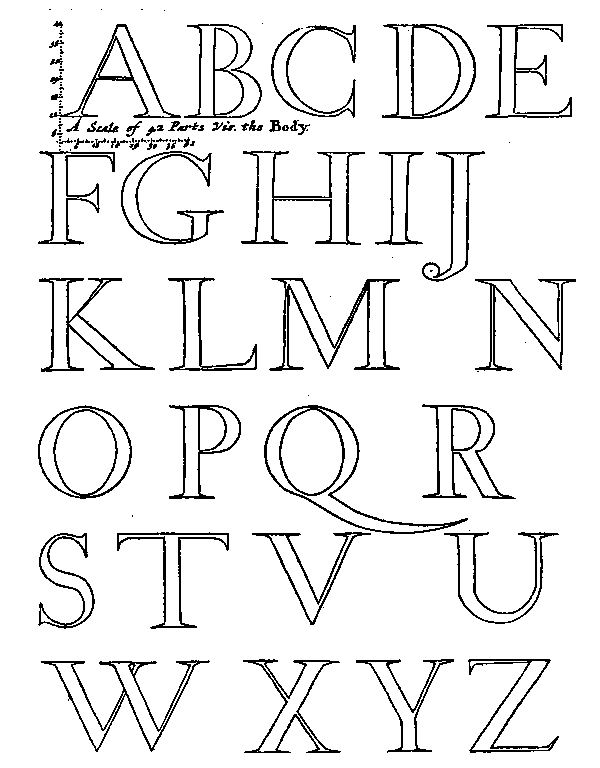
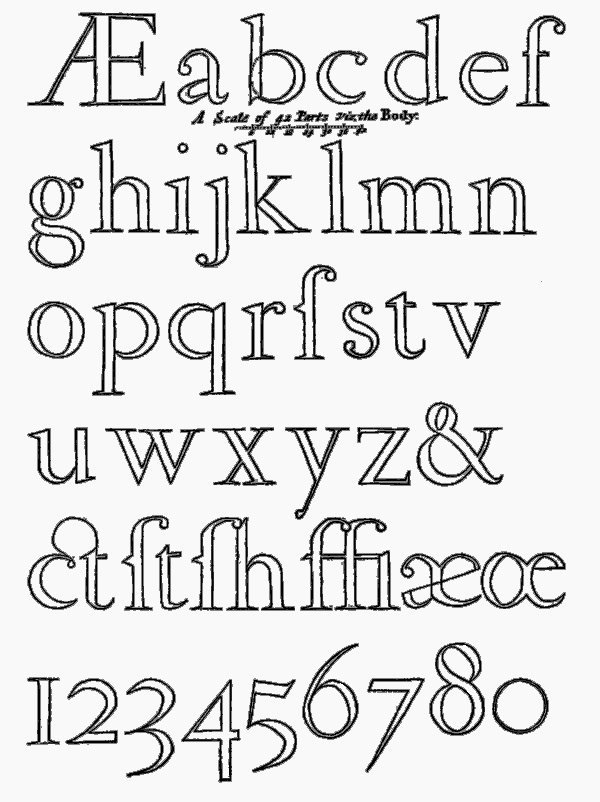
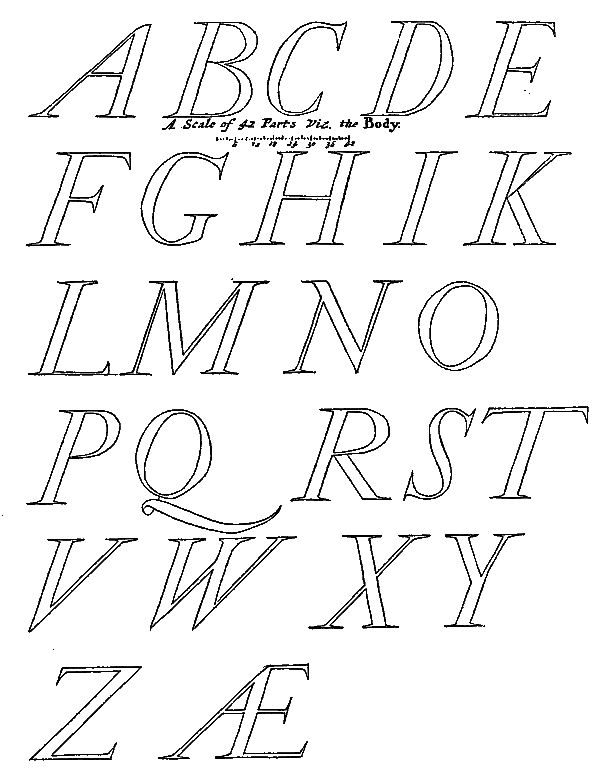
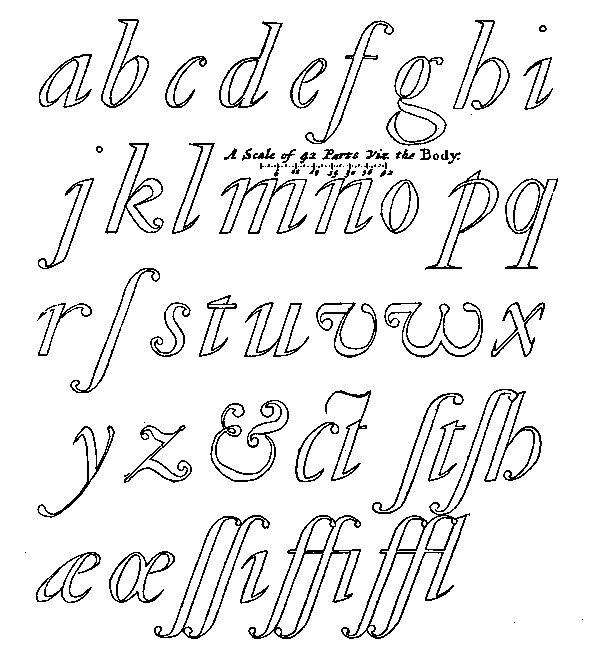
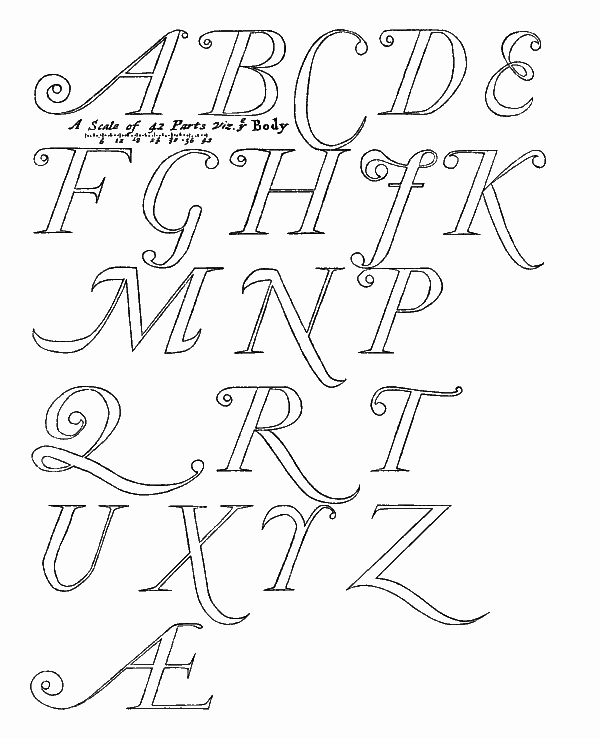
from copper plates. Moxon says that these model
letters are his copies of the letters of Christopher Van Dijk, the
famous punch-cutter of Holland. He advises that each letter should be
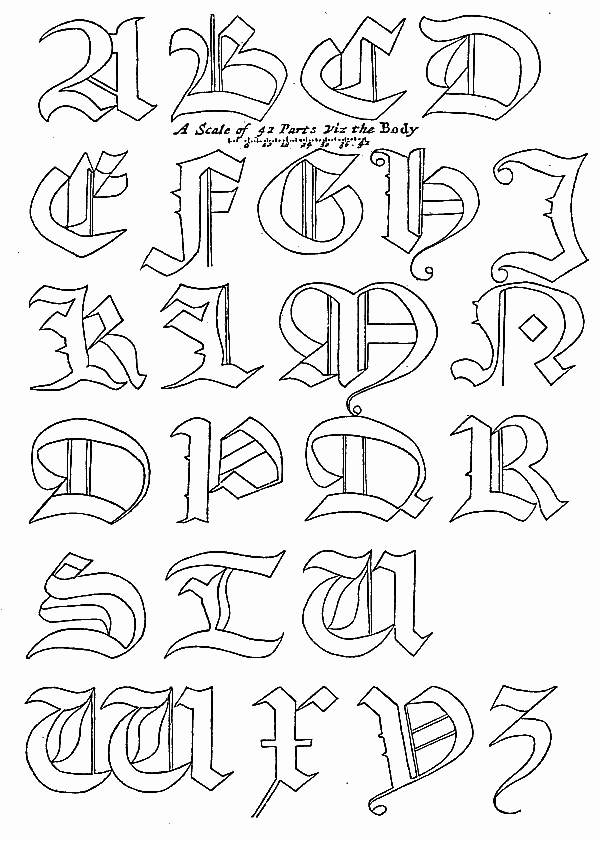
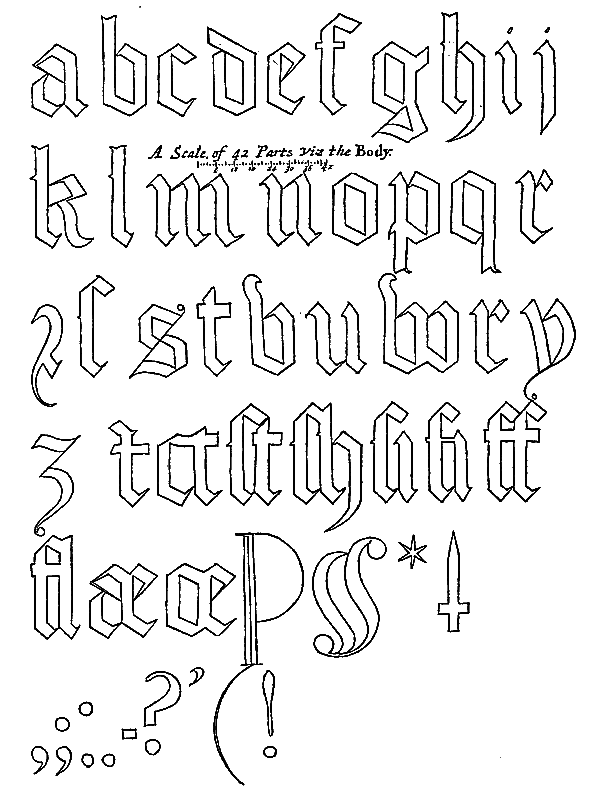
plotted upon a framework of small squares—forty-two squares in height
and of a proportionate width, as is distinctly shown in the plates
of letters in this book.[4] Upon these squares the draftsman should draw
circles, angles, and straight lines, as are fully set forth in the
instructions.
These diagrams, with their accompanying instruction,
have afforded much amusement to type-founders.
All of them unite in saying that the forming of letters
by geometrical rule is absurd and impracticable.
This proposition must be conceded without debate,
but the general disparagement of all the letters, in
which even Reed joins, may be safely controverted.
It is admitted that the characters are rudely drawn,
and many have faults of disproportion; but it must
not be forgotten that they were designed to meet
the most important requirement of a reader—to be
read, and read easily. Here are the broad hair-line,
the stubby serif on the lower-case and the bracketed
serif on the capitals, the thick stem, the strong
and low crown on letters like m and n, with other
peculiarities now commended in old-style faces and
often erroneously regarded as the original devices
of the first Caslon. The black-letter has more merit
than the roman or italic. Some of the capitals are
really uncouth; but with all their faults the general
effect of a composition in these letters will be found
more satisfactory to the bibliophile as a text-type
than any form of pointed black that has been devised
in this century as an improvement.
Moxon confesses no obligation to any one for his
geometrical system, but earlier writers had propounded
a similar theory. Books on the true proportions
of letters had been written by Fra Luca
Paccioli, Venice, 1509; Albert Dürer, Nuremberg,
1525; Geofroy Tory, Paris, 1529; and Yciar, Saragossa,
1548. Nor did the attempt to make letters
conform to geometrical rules end with Moxon. In
1694, M. Jaugeon, chief of the commission appointed
by the Academy of Sciences of Paris, formulated
a system that required a plot of 2304 little
squares for the accurate construction of every full-bodied
capital letter. The manuscript and diagrams
of the author were never put in print, but
are still preserved in the papers of the Academy.
This essay on the forms of letters seems to have
been sent out as the forerunner of a larger work on
the theory and practice of mechanical arts. Under
the general title of “Mechanick Exercises,” in 1677,
he began the publication, in fourteen monthly numbers,
of treatises on the trades of the smith, the
joiner, the carpenter, and the turner. These constitute
the first volume of the “Mechanick Exercises.”
The book did not find as many buyers as had been
expected. Moxon attributed its slow sale to political
excitement, for the Oates plot put the buying and
study of trade books away from the minds of readers.
He had to wait until 1683 before he began
the publication of the second volume, which consists
of twenty-four numbers, and treats of the art
of printing only. It is this second volume that is
here reprinted, for the first volume is of slight interest
to the printer or man of letters.
Moxon’s book has the distinction of being not
only the first, but the most complete of the few
early manuals of typography. Fournier’s “Manuel
Typographique” of 1764 is the only book that can
be compared with it in minuteness of detail concerning
type-making, but he treats of type-making
only. Reed says: “Any one acquainted with the
modern practice of punch-cutting cannot but be
struck, on reading the directions laid down in the
‘Mechanick Exercises,’ with the slightness of the
changes which the manual processes of that art
have undergone during the last two centuries. Indeed,
allowing for improvements in tools, and the
greater variety of gauges, we might almost assert
that the punch-cutter of Moxon’s day knew scarcely
less than the punch-cutter of our day, with the accumulated
experience of two hundred years, could
teach him.... For almost a century it remained
the only authority on the subject; subsequently it
formed the basis of numerous other treatises both at home and
abroad; and to this day it is quoted and referred to, not only by
the antiquary, who desires to learn what the art once was, but by
the practical printer, who may still on many subjects gather from
it much advice and information as to what it should still be.”[5]
During his business life, Moxon stood at the head of the trade in
England. He was selected to cut a font of type for an edition of the
New Testament in the Irish language, which font was afterward used for
many other books. He cut also the characters designed by Bishop John
Wilkins for his “Essay towards a Real Character and a Philosophical
Language,” and many mathematical and astronomical symbols. Rowe Mores,
who describes him as an excellent artist and an admirable mechanic,
says that he was elected a Fellow of the Royal Society in 1678.[6]
There is no known record of the date of his death. Mores gives the year
1683 as the date of his relinquishment of the business of type-making,
but he was active as a writer and a publisher for some years after.
The first volume of the “Mechanick Exercises,”
concerning carpentry, etc., went to its third edition
in 1703, but the second volume, about printing, has
been neglected for two centuries. During this long
interval many copies of the first small edition of five hundred copies
have been destroyed. A perfect copy is rare, and commands a high price,
for no early book on technical printing is in greater request.[7]
The instruction directly given is of value, but bits
of information indirectly furnished are of greater
interest. From no other book can one glean so
many evidences of the poverty of the old printing-house.
Its scant supply of types, its shackly hand-presses,
its mean printing-inks, its paper-windows
and awkward methods, when not specifically confessed,
are plainly indicated. The high standard of
proof-reading here exacted may be profitably contrasted
with its sorry performance upon the following
pages. The garments worn by the workmen
are shown in the illustrations. Some of the quainter
usages of the trade are told in the “Customs of the
Chappel,” and those of the masters, in the ceremonies
of the Stationers’ Company, and in the festivals in
which masters and workmen joined. To the student
of printing a reading of the book is really necessary
for a clear understanding of the mechanical side of
the art as practised in the seventeenth century.
NOTE BY THE PRINTER
This edition of the “Mechanick Exercises” is a line-for-line and
page-for-page reprint of the original text. The only suppression
is that of the repetition of the words “Volume II” in the running
title and the sub-titles, which would unnecessarily mislead the
reader, and of the old signature marks that would confuse the
bookbinder. Typographic peculiarities have been followed, even
to the copying of gross faults, like doublets, that will be readily
corrected by the reader. The object of the reprint is not merely
to present the thought of the author, but to illustrate the typographic
style of his time with its usual defects. A few deviations
from copy that seemed to be needed for a clearer understanding
of the meaning of the author have been specified at
the end of the second volume. The irregular spelling and punctuation
of the copy, its capricious use of capitals and italic, its
headings of different sizes of type, have been repeated. At this
point imitation has stopped. Turned and broken letters, wrong font
characters, broken space-lines, and bent rules have not been
servilely reproduced. These blemishes, as well as the frequent
“monks” and “friars” in the presswork, were serious enough to
prevent an attempt at a photographic facsimile of the pages.
The two copies of Moxon that have served as “copy” for this
reprint show occasional differences in spelling and punctuation.
Changes, possibly made in the correction of batters, or after the
tardy discovery of faults, must have been done while the form was
on press and partly printed. The position of the plates differs
seriously in the two copies; they do not follow each other in the
numerical order specified. In this reprint the plates that describe
types and tools have been placed near their verbal descriptions.
The type selected for this work was cast from matrices struck
with the punches (made about 1740) of the first Caslon. It is of
the same large English body as that of the original, but a trifle
smaller as to face, and not as compressed as the type used by
Moxon; but it repeats many of his peculiarities, and fairly
reproduces the more important mannerisms of the printing of
the seventeenth century.
The portraits have been reproduced by the artotype process of
Bierstadt; the descriptive illustrations are from the etched plates
of the Hagopian Photo-Engraving Company.
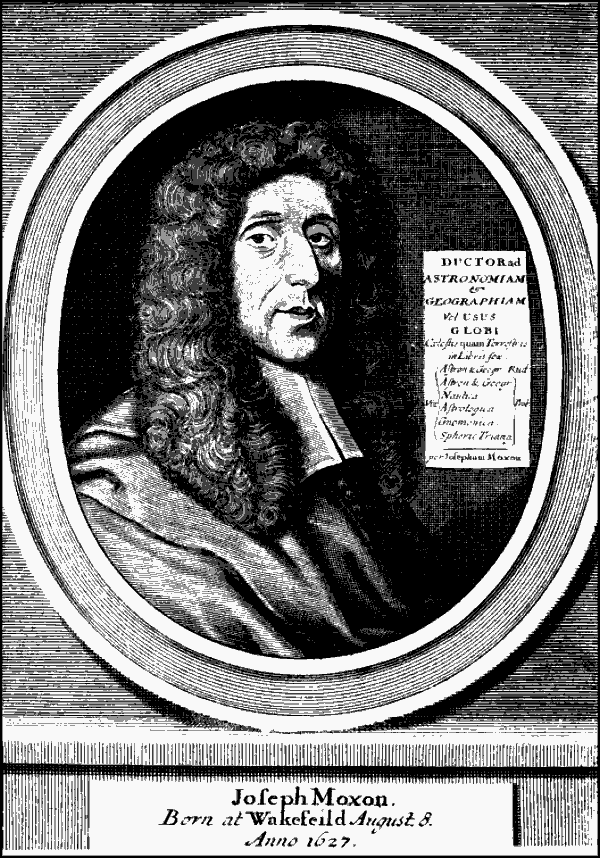
Joseph Moxon. Born atWakefeildAugust. 8. Anno 1627.
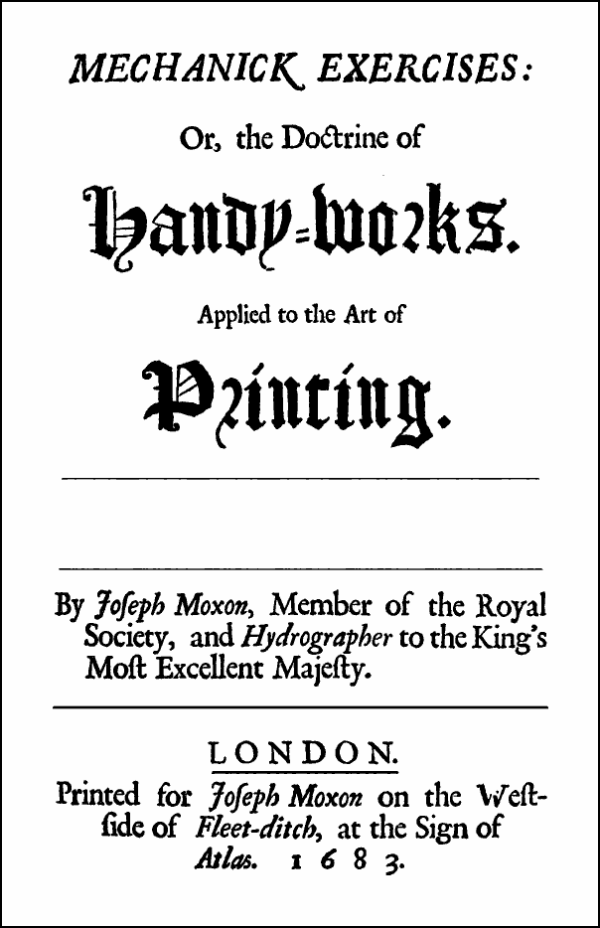
MECHANICK EXERCISES:
Or, the Doctrine of Handy-works.
Applied to the Art of Printing.
By Joseph Moxon, Member of the Royal
Society, and Hydrographer to the King’s
Most Excellent Majesty.
LONDON.
Printed for Joseph Moxon on the Westside
of Fleet-ditch, at the Sign of Atlas.
1 6 8 3.
To the Right Reverend Father in GOD,
JOHN Lord Bishop of Oxford, and
Dean of Christ-Church; And to the
Right Honourable Sir LEOLINE
JENKINS Knight, and Principal
Secretary of State; And to the Right
Honourable Sir JOSEPH WILLIAMSON
Knight; and one of His Majesties
most Honourable Privy-Council.
Right Honourable.
YOur ardent affections to promote
Typographie has eminently appeared
in the great Charge you
have been at to make it famous
here in England; whereby this Royal Island
stands particularly obliged to your Generous
and Publick Spirits, and the whole Common-Wealth
of Book-men throughout the World,
to your Candid Zeal for the promulgation of
good Learning.
Wherefore I humbly Dedicate this Piece
of Typographie to your Honours; and
as it is (I think) the first of this nature,
so I hope you will favourably excuse
small Faults in this Undertaking; for great
ones I hope there are none, unless it be in this
presumptuous Dedication; for which I humbly
beg your Honours pardon: Subscribing
my self, My Lord and Gentlemen,
Your Honours most Humble
and Obedient Servant.
Joseph Moxon.
Footnotes.
[1]
“A History of the Old English Letter Foundries, with Notes
Historical and Biographical on the Rise and Progress of English
Typography.” By Talbot Baines Reed, London, 1887, p. 181.
[2]
The four founders appointed by the Star Chamber did not thrive. One
of them, Arthur Nicholls, said of himself: “Of so small benifitt hath
his Art bine that for 4 yeares worke and practice he hath not taken
above 48£, and had it not bine for other imploymente he might have
perrisht.” Reed, p. 168.
[3]
“A Dissertation upon English Typographical Founders and
Founderies.” By Edward Rowe Mores, A. M. & A. S. S. [London], 1778.
8vo, p. 43.
[7]
Hansard says (“Typographia,” p. vii): “I have never been able to
meet with more than two copies of this work—one in the Library of the
British Museum—the other in the Library of the Society of Arts.” The
writer knows of but three copies in America: one in the Library Company
of Philadelphia; one in the Library of the Typothetæ of New-York; one
in his own collection.
MECHANICK EXERCISES:
Or, the Doctrine of Handy-works.
Applied to the Art of Printing.
PREFACE.
BEfore I begin
with Typographie, I shall say somewhat of its Original
Invention; I mean here in Europe, not of theirs in China
and other Eastern Countries, who (by general assent) have had it for
many hundreds of years, though their Invention is very different from
ours; they Cutting their Letters upon Blocks in whole Pages or Forms,
as among us our Wooden Pictures are Cut; But Printing with
single Letters Cast in Mettal, as with us here in Europe, is an
Invention scarce above Two hundred and fifteen years old; and yet an
undecidable Controversie about the original Contriver or Contrivers
remains on foot,
between the Harlemers of Holland, and those of Mentz
in Germany: But because the difference cannot be determin’d
for want of undeniable Authority, I shall only deliver both their Pleas
to this Scientifick Invention.
The Harlemers plead that Lawrensz Jansz Koster of
Harlem was the first Inventer of Printing, in the year of our
Lord 1430. but that in the Infancy of this Invention he used
only Wooden Blocks (as in China, &c. aforesaid)
but after some time he left off Wood, and Cut single Letters in
Steel, which he sunck into Copper Matrices, and fitting them
to Iron Molds, Cast single Letters of Mettal in those Matrices.
They say also, that his Companion, John Gutenberg, stole his
Tools away while he was at Church, and with them went to Mentz
in Germany, and there set his Tools to work, and promoted
His claim to the first Invention of this Art, before Koster did
His.
To prove this, they say that Rabbi Joseph (a Jew)
in his Chronicle, mentions a Printed Book that he saw in Venice,
in the year 5188. according to the Jewish Account, and by
ours the year 1428. as may be read in Pet. Scriverius.
They say much of a Book intituled De Spiegel, Printed
at Harlem in Dutch and Latin; which Book is yet
there to be seen: and they alledge that Book the first that ever was
Printed: But yet say not when this Book was Printed.
Notwithstanding this Plea, I do not find (perhaps because
of their imperfect Proofs) but that Gutenberg of
Mentz is more generally accepted for the first Inventer of
Printing, than Koster of Harlem.
The Learned Dr. Wallis of Oxford, hath made an
Inquiry into the original of this Invention, and hath in brief sum’d up
the matter in these words.
About the year of our Lord 1460. The Art of Printing began
to be invented and practised in Germany, whether first at
Mentz or first at Harlem it is not agreed: But it seems
that those who had it in consideration before it was brought to
perfection, disagreeing among themselves, did part Company; and some of
them at Harlem, others at Mentz persued the design at the
same time.
The Book which is commonly reputed to have been first Printed
is, Tullies Offices, of which there be Copies extant (as a
Rarity) in many Libraries; which in the close of it is said to be
Printed at Mentz, in the year of our Lord 1465. (so says
that Copy in the Bodleyan Library) or 1466. (so
that in the Library of Corpus Christi.) The words in the close
of that in Corpus Christi Colledge Oxon are these,
Præsens Marcij Tullij Clarissimum opus, Johanes Hust,
Moguntinus Civis, non Atrimento, plumali canna, neq; ærea, sed Arte
quadam perpulchra, Petri manu Petri de Geurshem
pueri mei, feliciter effeci, finitum Anno M CCCC LX VI quarto die
Mensis Februarij.
The like in the Bodleyan Library; save there the
Date is only thus, Finitum Anno M CCCC LX V. In the same
Book there are these written Notes subjoyned: Hic eft ille
Johannes Faustus, coadjutor Johannes Gutenbergij
primi Typographiæ inventaris, Alter coadjuto erat Petrus
Schœfer, i. Opilio. Quovix.
Cælando promptior alter erat, inquit Johan. Arnoldus in
Libello de Chalcographiæ inventione, Scheffer primas finxit quas
vocant Matrices. Hi tres exercuerunt artem primo in communi. mox
rupto fœdere seorsim sibi quisq; privatim.
And again (in a later hand) Inventionem artis
Typographicæ ad Annum 1453. aut exerciter referunt Sabillicus
En. 10.lib.6. & Monsterus. Alij ad Annum 1460. Vide
Polid. Virg.lib. 2. de Invent. Rerum, Theod. Bibland. de
Ratione communis linguarum. cap. de Chalcographia.
At Harlem and some other places in Holland, they
pretend to have Books Printed somewhat ancienter than this; but
they are most of them (if not all) done by way of
Carving whole Pages in Wood, not by single Letters Cast in Mettal,
to be Composed and Distributed as occasion serves, as is now the
manner.
The chief Inventer at Harlem is said to be Laurens
Jansz Koster.
After these two places (Mentz and Harlem) it
seems next of all to have been practised at Oxford: For by
the care, and at the charge of King Henry the 6th, and
of Thomas Bourchier then Arch-Bishop of Canterbury (and
Chancellour of the University of Oxford) Robert Turner Master of
the Robe, and William Caxton a Merchant of London were
for that purpose sent to Harlem, at the charges partly of the
King, partly of the Arch-Bishop, who then (because these of
Harlem were very chary of this secret) prevailed privately
with one Frederick Corseles an under-Workman, for a sum of
Money, to come over hither; who thereupon did at Oxford set
up the Art of Printing, before it was exercised any where
else in England, or in France, Italy, Venice, Germany,
or any other place, except only Mentz and Harlem
(aforementioned): And there be several Copies yet extant (as
one in the Archives of the University of Oxford, another in the
Library of Dr. Tho. Barlow, now Bishop of Lincoln) of a
Treatise
of St. Jerome (as it is there called (because found among
St. Jerom’s Works) or rather Ruffinus upon
the Creed, in a broad Octavo) Printed at Oxford in the
year 1468. as appears by the words in the close of it.
Explicit expositio Sancti Jeronimi in sembolo Apostolorum ad
papam Laurentium Impressi Oxonie & finita Anno Domini M CCCC
LX VIII. xvij die Decembris.
Which is but three years later than that of Tullies Offices
at Mentz, in 1465. and was perhaps one of the
first Books Printed on Paper; (that of Tully being
on Vellom.) And there the excercise of Printing hath
continued successively to this day.
Soon after William Caxton (the same I suppose who first
brought it to Oxford) promoted it to London also,
which Baker in his Chronicle (and some others)
say to have been about the year 1471. but we have scarce any
Copies of Books there Printed remaining (that I have seen)
earlier than the year 1480. And by that time, or soon after,
it began to be received in Venice, Italy, Germany, and other
places, as appears by Books yet extant, Printed at divers places in
those Times. Thus far Dr. Wallis.
But whoever were the Inventers of this Art, or (as some
Authors will have it) Science; nay, Science of Sciences
(say they) certain it is, that in all its Branches it can be
deemed little less than a Science: And I hope I say not to much of
Typographie: For Dr. Dee, in his Mathematical Preface to
Euclids Elements of Geometrie, hath worthily taken pains to make
Architecture a Mathematical Science; and as a vertual Proof of his
own Learned Plea, quotes two Authentique Authors, viz.
Vitruvius and Leo Baptista, who both give their descriptions
and applause of Architecture: His Arguments are somewhat
copious, and the Original easily procurable in the English Tongue;
therefore instead of transcribing it, I shall refer my Reader to the
Text it self.
Upon the consideration of what he has said in behalf of
Architecture, I find that a Typographer ought to be equally
qualified with all the Sciences that becomes an Architect, and
then I think no doubt remains that Typographie is not also a
Mathematical Science.
For my own part, I weighed it well in my thoughts, and find all
the accomplishments, and some more of an Architect necessary
in a Typographer: and though my business be not Argumentation,
yet my Reader, by perusing the following discourse, may perhaps
satisfie himself, that a Typographer ought to be a man of
Sciences.
By a Typographer, I do not mean a Printer, as he is
Vulgarly accounted, any more than Dr. Dee means a Carpenter
or Mason to be an Architect: But by a Typographer,
I mean such a one, who by his own Judgement, from solid reasoning
with himself, can either perform, or direct others to perform from
the beginning to the end, all the Handy-works and Physical Operations
relating to Typographie.
Such a Scientifick man was doubtless he who was the first
Inventer of Typographie; but I think few have succeeded him in
Science, though the number of Founders and Printers be
grown very many: Insomuch that for the more easie managing of
Typographie, the Operators have found it necessary to devide it into
several Trades, each of which (in the strictest sence) stand no
nearer related to Typographie, than Carpentry or
Masonry, &c. are to Architecture. The several devisions
that are made, are,
First The Master-Printer, who is as the Soul of
Printing; and all the Work-men as members of the Body governed by
that Soul subserveient to him; for the Letter-Cutter would
Cut no Letters, the Founder not sinck the Matrices, or
Cast and Dress the Letters, the Smith and Joyner not
make the Press and other Utensils for Printing, the
Compositer not Compose the Letters, the Correcter not read
Proves, the Press-man not work the Forms off at the Press,
or the Inck-maker make Inck to work them with, but by
Orders from the Master-Printer.
Secondly, The Letter-Cutter,
}
Thirdly, The Letter-Caster,
}
Founders.
Fourthly, The Letter-Dresser.
}
But very few Founders exercise, or indeed can perform all
these several Trades; though each of these are indifferently called
Letter-Founders.
Fifthly, The Compositer,
}
Sixthly, The Correcter,
} Printers.
Seventhly, The Press-man,
}
Eighthly, The Inck-maker.
}
Besides several other Trades they take in to their Assistance; as
the Smith, the Joyner, &c.
ADVERTISEMENT.
The continuation of
my setting forth Mechanick Exercises having been obstructed
by the breaking out of the Plot, which took off the minds of my few
Customers from buying them, as formerly; And being of late much
importun’d by many worthy Persons to continue them; I have promised
to go on again, upon Condition, That a competent number of them may
be taken off my hand by Subscribers, soon after the publication of
them in the Gazet, or posting up Titles, or by the Mercurius
Librarius, &c.
Therefore such Gentlemen or others as are willing to promote the
coming forth of these Exercises, are desired to Subscribe their
Names and place of abode: That so such Persons as live about this City
may have them sent so soon as they come forth: Quick Sale being the
best encouragement.
Some Gentlemen (to whom they are very acceptable) tell me they will
take them when all Trades are finish’t, which cannot reasonably
be expected from me (my Years considered) in my life-time; which
implies they will be Customers when I’me dead, or perhaps by that time
some of themselves.
The price of these Books will be 2d. for each Printed Sheet.
And 2d. for every Print taken off of Copper Cuts.
There are three reasons why this price cannot be thought dear.
1. The Writing is all new matter, not Collected,
or Translated from any other Authors: and the drafts of the Cuts all
drawn from the Tools and Machines used in each respective Trade.
2. I Print but 500 on each Sheet, And those upon
good Paper: which makes the charge of Printing dear, proportionable to
great numbers.
3. Some Trades are particularly affected by some
Customers, (who desire not the rest,) and consequently sooner sold off,
which renders the remainder of the un-sold Exercises unperfect,
and therefore not acceptable to such as desire all: so that they will
remain as waste-Paper on my hands.
JOSEPH MOXON.
MECHANICK EXERCISES: — §. 2. Of the Office of a Master -Printer. — ¶. 2. Of Letter. — §. 3. Of Cases. — §. 4. Of Frames to set the Cases on . — §. 5. Of the Galley. — §. 6. Of the Correcting-stone. — §. 7. Of Letter-Boards, and Paper-Boards. — §. 8. Of Furniture, Quoyns, Scabbord, &c. — §. 9. ¶. 1. Of the Mallet, Shooting-stick and Dressing-Block, Composing-sticks, Bodkin, and Chase. &c. — ¶. 2. Of the Shooting-stick. — ¶. 3. Of the Dressing-Block. — ¶. 4. Of the Composing-stick. — ¶. 5. Of the Bodkin. — ¶. 6. Of Chases, marked G on the Correcting-Stone, Plate 2.
Or, the Doctrine of Handy-works.
Applied to the Art of Printing.
I Shall begin with the
Office of a Master-Printer, because (as aforesaid) he is the
Directer of all the Work-men, he is the Base (as the Dutchmen
properly call him) on which the Workmen stand, both for providing
Materials to Work withal, and successive variety of Directions how and
in what manner and order to perform that Work.
His Office is therefore to provide a House, or
Room or Rooms in which he is to set his Printing-House.
This expression may seem strange, but it is
Printers Language: For a Printing-House may admit
of a twofold meaning; one the Vulgar acceptance,
and is relative to the House or Place wherein Printing
is used; the other a more peculiar Phrase Printers
use among themselves, viz. only the Printing Tools,
which they frequently call a Printing-House: Thus
they say, Such a One has set up a Printing-House,
when as thereby they mean he has furnish’d a House
with Printing Tools. Or such a one has remov’d his
Printing-House, when thereby they only mean he
has remov’d the Tools us’d in his former House.
These expressions have been used Time out of mind,
and are continued by them to this day.
But to proceed, Having consider’d what number
of Presses and Cases he shall use, he makes it his business
to furnish himself with a Room or Rooms well-lighted,
and of convenient capacity for his number
of Presses and Cases, allowing for each Press about
Seven Foot square upon the Floor, and for every
Frame of Cases which holds Two pair of Cases, viz.
one pair Romain and one pair Itallica, Five Foot and
an half in length (for so much they contain) and
Four Foot and an half in breadth, though they contain
but Two Foot and Nine Inches: But then room
will be left to pass freely between two Frames.
We will suppose he resolves to have his Presses and
Cases stand in the same Room (though in England it
is not very customary). He places the Cases on that
side the Room where they will most conveniently
stand, so, as when the Compositer is at work the Light
may come in on his Left-hand; for else his Right-hand
plying between the Window-light and his Eye might
shadow the Letter he would pick up: And the Presses
he places so, as the Light may fall from a Window
right before the Form and Tinpan: And if scituation
will allow it, on the North-side the Room, that
the Press-men, when at their hard labour in Summer
time, may be the less uncommoded with the heat of
the Sun: And also that they may the better see by the
constancy of that Light, to keep the whole Heap of
an equal Colour.
He is also to take care that his Presses have a solid
and firm Foundation, and an even Horizontal Floor
to stand on, That when the Presses are set up their
Feet shall need no Underlays, which both damage a
Press, are often apt to work out, and consequently
subject it to an unstable and loose position, as shall
further be shewn when we come to the Setting up of
the Press.
And as the Foundation ought to be very firm, so
ought also the Roof and Sides of the Press Room to
be, that the Press may be fastned with Braces overhead
and on its Sides, as well and steddy as under
foot.
He is also to take care that the Room have a clear,
free and pretty lofty Light, not impeded with the
shadow of other Houses, or with Trees; nor so low
that the Sky-light will not reach into every part of
the Room: But yet not too high, lest the violence of
Winter (Printers using generally but Paper-windows)
gain too great advantage of Freesing the Paper and
Letter, and so both Work and Workman stand still.
Therefore he ought to Philosophize with himself, for
the making the height of his Lights to bear a rational
proportion to the capacity of the Room.
Here being but two sides of the Room yet used,
he places the Correcting-stone against a good Light, and
as near as he can towards the middle of the Room,
that the Compositers belonging to each end of the
Room may enjoy an equal access to it. But sometimes
there are several Correcting-stones plac’d in several
parts of the Room.
The Lye-Trough and Rincing-Trough he places towards
some corner of the Room, yet so as they may
have a good Light; and under these he causes a Sink
to be made to convey the Water out of the Room: But
if he have other conveniencies for the placing these
Troughs, he will rather set them out of the Room
to avoid the slabbering they cause in.
About the middle of the Room he places the Destributing-Frame
(viz. the Frame on which the Forms
are set that are to be Destributed) which may stand
light enough, though it stand at some considerable
distance from the Window.
In some other empty place of the Room (least
frequented) he causes so many Nest-Frames to be
made as he thinks convenient to hold the Cases that
may lye out of present use; and the Letter-boards with
Forms set by on them, that both the Cases and the
Forms may be the better secured from running to
Pye.
Having thus contrived the several Offices of the
Room, He furnishes it with Letters, Presses, Cases,
Chases, Furniture, &c. Of each of which in Order.
He provides a Fount (properly a Fund) of Letter
of all Bodies; for most Printing-Houses have all except
the two first, viz.Pearl, Nomparel, Brevier, Long-Primmer,
Pica, English, Great-Primmer, Double-Pica,
Two-Lin’d-English, Great-Cannon.
These are the Bodies most of use in England; But
the Dutch have several other Bodies: which because
there is little and almost no perceivable difference
from some of these mentioned, I think they are not
worth naming. Yet we have one Body more which
is sometimes used in England; that is a Small Pica, but
I account it no great discretion in a Master-Printer to
provide it; because it differs so little from the Pica,
that unless the Workmen be carefuller than they
sometimes are, it may be mingled with the Pica, and
so the Beauty of both Founts may be spoil’d.
These aforesaid Bodies are commonly Cast with a
Romain, Italica, and sometimes an English Face. He
also provides some Bodies with the Musick, the Greek,
the Hebrew, and the Syriack Face: But these, or some
of these, as he reckons his oppertunities may be to
use them.
And that the Reader may the better understand
the sizes of these several Bodies, I shall give him this
Table following; wherein is set down the number
of each Body that is contained in one Foot.
Pearl,
184
}
Nomparel,
150
}
Brevier,
112
}
Long-Primmer,
92
}
Pica,
75
}
contained in one Foot.
English,
66
}
Great-Primmer,
50
}
Double-Pica,
38
}
Two-Lin’d English,
33
}
Great-Cannon.
17½
}
His care in the choice of these Letters are,
First, That the Letter have a true shape: Which
he may know, as by the §. of Letter-Cutting.
I confess this piece of Judgement, viz. knowing
of true Shape, may admit of some controversy, because
neither the Ancients whom we received the
knowledge of these Letters from, nor any other authentick
Authority have delivered us Rules, either to
make or know true shape by: And therefore it may
be objected that every one that makes Letters but
tolerably like Romain, Italick, &c. may pretend his
to be true shap’d.
To this I answer, that though we can plead no
Ancient Authority for the shape of Letters, yet
doubtless (if we judge rationally) we must conclude
that the Romain Letters were Originally invented and
contrived to be made and consist of Circles, Arches
of Circles, and straight Lines; and therefore those
Letters that have these Figures, either entire, or else
properly mixt, so as the Course and Progress of the
Pen may best admit, may deserve the name of true
Shape, rather than those that have not.
Besides, Since the late made Dutch-Letters are so generally,
and indeed most deservedly accounted the
best, as for their Shape, consisting so exactly of Mathematical
Regular Figures as aforesaid, And for the
commodious Fatness they have beyond other Letters,
which easing the Eyes in Reading, renders them
more Legible; As also the true placing their Fats
and their Leans, with the sweet driving them into
one another, and indeed all the accomplishments
that can render Letter regular and beautiful, do
more visibly appear in them than in any Letters
Cut by any other People: And therefore I think
we may account the Rules they were made by, to
be the Rules of true shap’d Letters.
For my own part, I liked their Letters so well, especially
those that were Cut by Christophel Van Dijck
of Amsterdam, that I set my self to examine the
Proportions of all and every the parts and Members
of every Letter, and was so well pleased with the
Harmony and Decorum of their Symetrie, and
found so much Regularity in every part, and so good
reason for his Order and Method, that I examined
the biggest of his Letters with Glasses, which so
magnified the whole Letter, that I could easily distinguish,
and with small Deviders measure off the
size, scituation and form of every part, and the proportion
every part bore to the whole; and for my
own future satisfaction collected my Observations into
a Book, which I have inserted in my Exercises
on Letter-Cutting. For therein I have exhibited to
the World the true Shape of Christophel Van Dijcks
aforesaid Letters, largely Engraven in Copper Plates.
Whence I conclude, That since common consent
of Book-men assign the Garland to the Dutch-Letters
as of late Cut, and that now those Letters are reduced
unto a Rule, I think the Objection is Answered;
And our Master-Printers care in the choice of good
and true shap’d Letters is no difficult Task: For if
it be a large Bodied Letter, as English, Great-Primmer
and upwards, it will shew it self; and if it be small,
as Pearl, Nomparel, &c. though it may be difficult
to judge the exact Symetry with the naked Eye, yet
by the help of a Magnifying-Glass or two if occasion
be, even those small Letters will appear as large as
the biggest Bodied Letters shall to the naked Eye:
And then it will be no difficult Task to judge of the
Order and Decorum even of the smallest Bodied Letters.
For indeed, to my wonder and astonishment,
I have observ’d V. Dijcks Pearl Dutch Letters in Glasses
that have Magnified them to great Letters, and
found the whole Shape bear such true proportion to
his great Letters, both for the Thickness, Shape, Fats
and Leans, as if with Compasses he could have measur’d
and set off in that small compass every particular
Member, and the true breadth of every Fat and
Lean Stroak in each Letter, not to exceed or want
(when magnified) of Letter Cut to the Body it was
Magnified to.
His second care in the choice of Letters is, That
they be deep Cut; for then they will Print clear the
longer, and be less subject to entertain Picks.
His third care, That they be deep sunck in the
Matrices least the bottom line of a Page Beard. Yet
though they be deep sunk, His care ought to be
to see the Beard also well cut off by the Founder.
And a Fourth Care in the choice of Letter is,
That his Letter be Cast upon good Mettal, that it
may last the longer.
Of each Body he provides a Fount suitable to
such sorts of Work as he designs to do; But he
provides not an equal weight of every Fount; Because
all these Bodies are not in equal use: For the
Long-Primmer, Pica and English are the Bodies that
are generally most used; And therefore he provides
very large Founts of these, viz. of the Long-Primmer
in a small Printing-House, Five hundred
Pounds weight Romain and Italica, whereof One
hundred and fifty Pounds may be Italica. Of the
Pica and English, Roman and Italica, Eight, Nine
hundred, or a Thousand Pounds weight: when as
of other Founts Three or Four hundred Pounds
weight is accounted a good Fount: And of the Cannon
and Great-Cannon, One hundred Pounds or
somewhat less may serve his turn; Because the common
use of them is to set Titles with.
Besides Letters he Provides Characters of Astronomical
Signs, Planets, Aspects, Algebraical Characters,
Physical and Chimical Characters, &c. And these of
several of the most used Bodies.
He Provides also Flowers to set over the Head of
a Page at the beginning of a Book: But they are
now accounted old-fashion, and therefore much out
of use. Yet Wooden-Borders, if well Drawn, and neatly
Cut, may be Printed in a Creditable Book, As
also,
Wooden-Letters well Drawn and neatly Cut may be
used at the beginning of a Dedication, Preface, Section,
&c. Yet instead of Wooden Letters, Capitals Cast
in Mettal generally now serves; because but few or
good Cutters in Wood appear.
He also provides Brass-Rules of about Sixteen
Inches long, that the Compositer may cut them into
such Lengths as his Work requires.
In the choice of his Brass-Rules, he examines that
they be exactly Letter high; for if they be much too
high, they may cut through Paper, Tinpan and Blankets
too; And if they be but a little too high, not
only the Sholder, or Beard, on either side them will
Print black; but they will bear the Plattin off the
Letters that stand near them, so that those Letters will
not Print at all: And if they be too low, then the
Rules themselves will not Print.
It sometimes happens through the unskilfulness of
the Joyner, (for they commonly, but unproperly, imploy
Joyners to make them) that a Length shall be
hollow in the middle both on the Face and Foot,
and shall run driving higher and higher towards both
ends: Hence it comes to pass, that when the Compositer
cuts a piece of Rule to his intended Length,
the Rule shall Print hard at one end, and the other
shall not Print at all; So that he shall be forced to
knock up the foot of the low end, as shall be shewn
in its proper place.
But the careful Master-Printer having found that
his Brass-Rules is Letter high all the whole Length,
will also examine whether it be straight all the
whole Length, which he does by applying both the
Face and Foot to the surface of the Correcting-stone;
And if the Face and Foot comply so closely with the
Correcting-stone, that light cannot be seen between
them, he concludes the Brass-Rule is straight.
Plate 1.
Then he examines the Face or Edge of the Rule,
whether it have an Edge of an equal breadth all the
whole Length, and that the Edge be neither too thick
nor too fine for his porpose.
He should also take care that the Brass, before it
be cut out, be well and skilfully Planish’t, nor would
that charge be ill bestowd; for it would be saved
out of the thickness of the Brass that is commonly
used: For the Joyners being unskilful in Planishing,
buy Neal’d thick Brass that the Rule may be strong
enough, and so cut it into slips without Hammering,
which makes the Rule easily bow any way and stand
so, and will never come to so good and smooth an
Edge as Planish’t Brass will. Besides, Brass well Planish’t
will be stiffer and stronger at half the thickness
than unplanish’t Brass will at the whole: As I shall
further shew when I come to Exercise upon Mathematical
Instrument-making.
Next he provides Cases. A Pair of Cases is an Upper-Case
and a Lower-Case.
The Upper-Case and the Lower-Case are of an equal
length, breadth and depth, viz. Two Foot nine Inches
long, One Foot four Inches and an half broad, and
about an Inch and a quarter deep, besides the bottom
Board; But for small Bodied Letters they are made
somewhat shallower, and for great Bodies deeper.
Long-Primmer and downwards are accounted small
Bodies; English and upwards are accounted great
Bodies.
The conveniencies of a shallow Case is, that the
Letters in each Box lye more visible to the last, as
being less shadowed by the sides of the Boxes.
The conveniencies of a deep Case is, that it will
hold a great many Letters, so that a Compositer needs
not so often Destribute. 2dly. It is not so soon Low,
(as Compositers say when the Case grows towards empty)
and a Low Case is unconvenient for a Compositer
to work at, partly because the Case standing shelving
downwards towards them, the Letters that are in
the Case tend towards the hither-side of the Case,
and are shadowed by the hither side of that Box they
lye in, so that they are not so easily seen by the Eye,
or so ready to come at with the Fingers, as if they
lay in the middle of the Box.
These Cases are encompassed about with a Frame
about Three quarters of an Inch broad, that the ends
of the several partitions may be let into the substance
of the Frame: But the hithermost side of the
Frame is about half an Inch higher than the other
sides, that when either the Galley or another pair of
Cases are set upon them, the bottom edge of the Galley,
or of those Cases may stop against that higher
Frame, and not slide off.
Both the Upper and the Lower-Case have a thick
Partition about three quarters of an Inch broad,
Duff-tail’d into the middle of the upper and under
Rail of the Frame. This Partition is made thus broad,
that Grooves may be made on either side of it to receive
the ends of those Partitions that devide the
breadth of the Case, and also to strengthen the whole
Frame; for the bottom Board is as well nailed to this
thick Partition as to the outer Frame of the Case.
But the devisions for the several Boxes of the Upper
and Lower-Cases are not alike: for each half of
the whole length of the Upper-Case is devided into
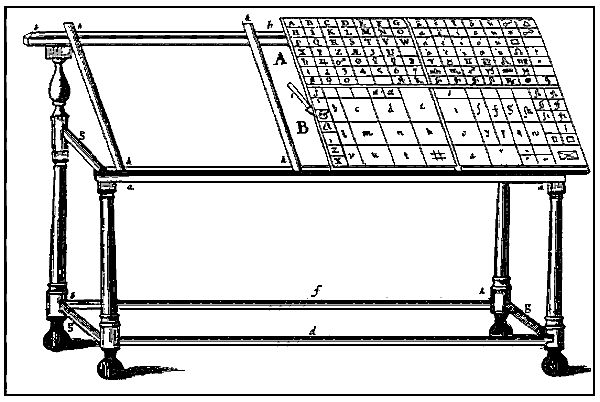
seven equal parts, as you may see in Plate 1. at A,
and its breadth into seven equal parts, so that the
whole Upper-Case is divided into Ninety eight square
Boxes, whose sides are all equal to one another.
But the Two halfs of the length of the Lower-Case
are not thus devided; for each half of the length
of the Lower-Case is devided into Eight equal parts,
and its breadth into Seven; but it is not throughout
thus devided neither; for then the Boxes would be all
of equal size: But the Lower-Case is devided into four
several sizes of Boxes, as you may see in Plate 1. B.
The reason of these different sizes of Boxes is,
That the biggest Boxes may be disposed nearest the
Compositers hand, because the English Language, and
consequently all English Coppy runs most upon such
and such Sorts; so that the Boxes that holds those
Sorts ought to be most capacious.
His care in the choice of these Cases is, That the
Wood they are made of be well-season’d Stuff.
That the Partitions be strong, and true let into one
another, and that the ends fill up and stand firm in the
Grooves of the Frame and middle Rail of the Case.
There is an inconvenience that often happens, these
thin Partitions, especially if they be made of unseason’d
Stuff, viz. as the Stuff dries it shrinks in the
Grooves of the Frame, and so not only grows loose,
but sometimes starts out above the top of the Frame.
To prevent this inconvenience, I have of late caused
the ends of these thin partitions to be made Male-Duf-tails,
broadest on the under-side, and have them
fitted into Female-Duf-tails in the Frame of the Case,
and middle Rail before the bottom Boards are nailed on.
That the Partitions be full an English Body thick.
That the Partitions lye close to the bottom of the
Case, that so the Letters slide not through an upper
into an under Box, when the Papers of the Boxes
may be worn.
Frames are in most Printing-Houses made of thick
Deal-board Battens, having their several Rails Tennanted
into the Stiles: but these sorts of Frames are, in
respect of their matter (viz.Fir) so weak, and in respect
of their substance (viz. little above an Inch thick) so
slight, that experience teaches us, when they are even
new made, they tremble and totter, and having lasted
a little while, the thinness of their Tennants being a
little above a quarter of an Inch thick, according to
the Rules of Joynery, as I have shewn in Numb. 5.
§. 17. They Craze, their Tennants break, or Mortesses
split, and put the Master-Printer to a fresh Charge.
It is rationally to be imagined that the Frames should
be designed to last as long as the Printing-house; and
therefore our Master-Printer ought to take care that
they be made of matter strong enough, and of substance
big enough to do the Service they are intended
for; that they stand substantial and firm in their place,
so as a small Jostle against them shake them not,
which often reiterated weakens the Frame-work, and
at that present is subject to shake the Letter in the
Galley down.
I shall not offer to impose Rules upon any here,
especially since I have no Authority from Prescript
or Custom; yet I shall set down the Scantlings that
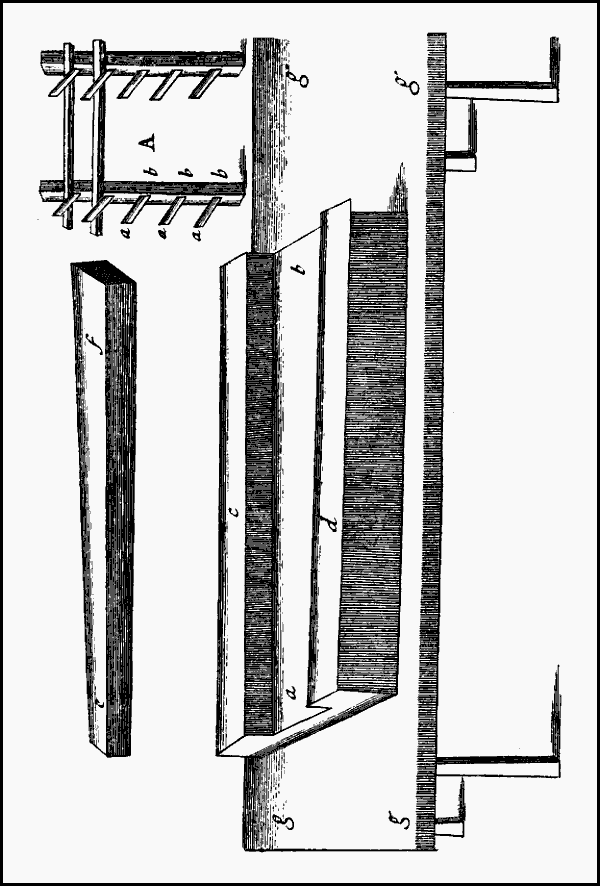
I my self thought fit to use on this occasion. A Delineation
of the Frames are in Plate 1. at C.
a a a a The Fore-Rails.
b b b b The Hind-Rails.
c The Top Fore-Rail.
d The Bottom Fore-Rail.
e The Top Hind-Rail.
f The Bottom Hind-Rail.
g g g g The End-Rail.
h h h h Cross-Bearers.
I made the Rails and Stiles of well-seasoned fine
Oak, clean, (that is free from Knots and Shakes) the
Stiles and Rails two Inches and an half square, the
Top and Bottom Fore-Rails and the Bottom Hind-Rail
four Foot three Inches long, besides their Tennants;
And the Top Hind-Rail five Foot three Inches
long. The two Fore-Rails and Bottom Hind-Rail had
Iron Female-Screws let into them, which, through
an hole made in the Stiles, received a Male-Screw
with a long shank, and a Sholder at the end of it to
screw them tight and firm together, even as the
Rails of a Bedsted are screwed into the Mortesses of a
Bed-Post.
Each Back-Stile was four Foot one Inch and an half
high besides their Tennants, and each Fore-Stile three
Foot three Inches high, each Fore and Back-Stile had
two Rails one Foot seven Inches long, besides their
Tennants Tennanted and Pin’d into them, because not
intended to be taken assunder.
It must be considered, that the Fore-stiles be of a
convenient height for the pitch of an ordinary Man
to stand and work at, which the heighth aforesaid is;
And that the Hind stiles be so much higher than the
Fore-stiles, that when the Cross-Bearers are laid upon
the upper Fore and Hind-Rail, and the Cases laid on
them, the Cases may have a convenient declivity from
the upper-side the Upper-Case, to the lower side the
Lower-Case.
The Reason of this declivity is, because the Cases
standing thus before the Workman, the farther Boxes
of the Upper-Case are more ready and easie to come
at, than if they lay flat; they being in this position
somewhat nearer the hand, and the Letters in those
Boxes somewhat easier seen.
If the Workman prove taller than Ordinary, he
lays another or two pair of Cases under the Cases he
uses, to mount them: If the Workman be short, as
Lads, &c. He lays a Paper-board (or sometimes two)
on the floor by the Fore-side of the Frame, and standing
to work on it, mounts himself.
The Bearers are made of Slit-Deal, about two Inches
broad, and so long as to reach from the Fore-Rail
through the Upper-Rail, and are let in, so as to lye
even with the superficies of the Fore and Hind-Rail,
and at such a distance on both the Rails, as you may
see in the Figure.
Plate 2.
On the Superficies of the Fore-Rail, even with its
Fore-Edge is nailed a small Riglet about half an Inch
high, and a quarter and half quarter of an Inch
thick, that the Cases set on the Frame having the
aforesaid declivity, may by it be stop’t from sliding
off.
Our Master-Printer is also to provide Galleys of different
sizes, That the Compositer may be suited with
small ones when he Composes small Pages, and with
great ones for great Pages.
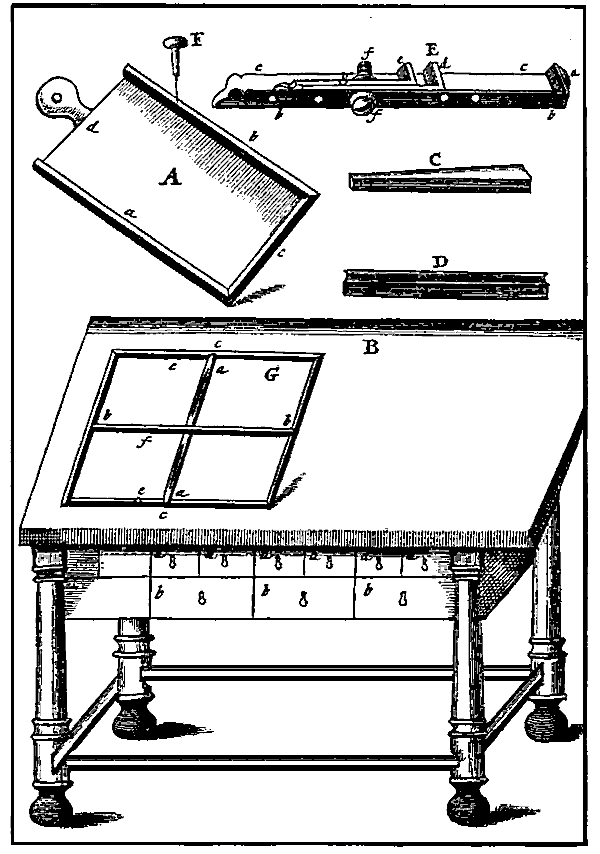
The Galley is marked A in Plate 2.
a b c The Sides or Frame of the Galley.
d The Slice.
These Galleys are commonly made of two flat
Wainscot Boards, each about a quarter and half quarter
of an Inch thick, the uppermost to slide in
Grooves of the Frame, close down to the undermost,
though for small Pages a single Board with two sides
for the Frame may serve well enough: Those Wainscot
Boards are an Oblong Square, having its length
longer than its breadth, even as the form of a Page
hath. The three Sides of the Frame are fixed fast
and square down on the upper Plain of the undermost
Board, to stand about three fifth parts of the
height of the Letter above the superficies of the Slice.
The Sides of the Frame must be broad enough to admit
of a pretty many good strong Oaken Pins along
the Sides, to be drove hard into the Bottom Board,
and almost quite through the Sides of the Frame,
that the Frame may be firmly fixed to it: But by no
means must they be Glewed on to the Bottom Board,
because the Compositer may sometimes have occasion
to wet the Page in the Galley, and then (the Galley
standing aslope upon the Case) the Water will soak
between the sides of the Frame, and under Board, and
quickly loosen it.
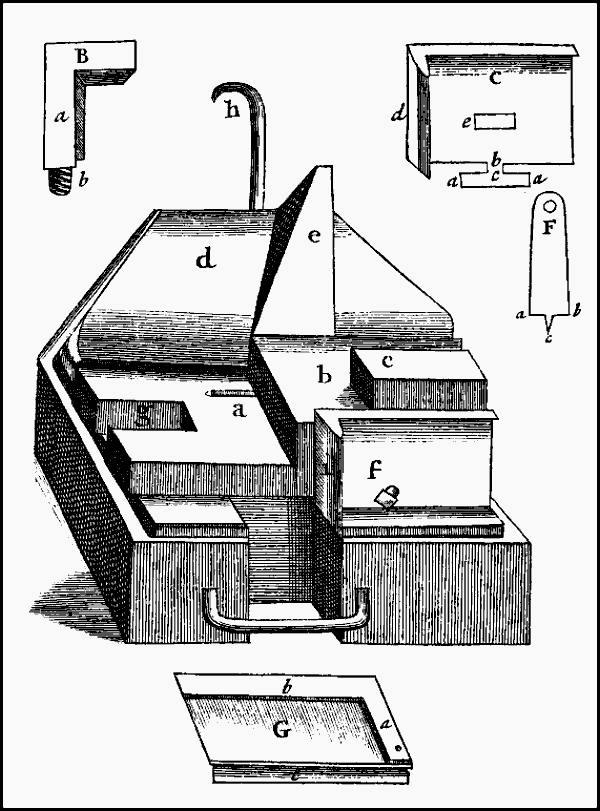
The Correcting-Stone marked B in Plate 2. is made
of Marble, Purbeck, or any other Stone that may be
made flat and smooth: But yet the harder the Stone
is the better; wherefore Marble is more preferable
than Purbeck. First, Because it is a more compact
Stone, having fewer and smaller Pores in it than Purbeck.
And Secondly, because it is harder, and therefore
less subject to be prick’d with the corners of a
Chase, if through carelessness (as it sometimes happens)
it be pitch’d on the Face of the Stone.
It is necessary to have it capacious, viz. large enough
to hold two Chases and more, that the Compositer
may sometimes for his convenience, set some
Pages by on it ready to Impose, though two Chases lye
on the Stone: Therefore a Stone of about Four Foot
and an half long, and Two Foot broad is a convenient
size for the generality of Work.
This Stone is to be laid upon a strong Oaken-wood
Frame, made like the Frame of a common Table, so
high, that the Face of the Stone may lye about three
Foot and an Inch above the Floor: And under the
upper Rail of the Frame may be fitted a Row or
two of Draw-Boxes, as at a a a a a a and b b b on
each of its longest Sides to hold Flowers, Brass-Rules,
Braces, Quotations, small Scabbords, &c.
Letter-Boards are Oblong Squares, about two
Foot long, eighteen Inches broad, and an Inch and a
quarter thick. They ought to be made of clean and
well-season’d Stuff, and all of one piece: Their upper-side
is to be Plained very flat and smooth, and their
under-side is Clamped with pieces about two Inches
square, and within about four Inches of either end,
as well to keep them from Warping, as to bear them
off the Ground or any other Flat they stand on, that
the Fingers of the Compositer may come at the bottom
of the Board to remove it whither he will:
They are commonly made of Fir, though not so
thick as I have mentioned, or all of one Piece: Deal-Boards
of this breadth may serve to make them of;
but Joyners commonly put Master-Printers off with
ordinary Deal-Boards, which not being broad enough,
they joyn two together; for which cause they frequently
shrink, so as the joynt comes assunder, and
the Board becomes useless, unless it be to serve for a
Paper-Board afterwards: For small and thin Letters
will, when the Form is open, drop through, so as
the Compositer cannot use the Board.
I us’d to make them of Sugar-Chest; That Stuff being
commonly well-season’d, by the long lying of the
Sugar in it, and is besides a fine hard Wood, and
therefore less subject to be injured by the end of the
Shooting-Stick when a Form is Unlocking.
Paper-Boards are made just like the Letter-Boards,
though seldom so large, unless for great Work: Nor
need such strict care be taken in making them so exactly
smooth: their Office being only to set Heaps of
Paper on, and to Press the Paper with.
By Furniture is meant the Head-sticks, Foot-sticks,
Side-sticks, Gutter-sticks, Riglets, Scabbords and Quoyns.
Head-sticks and all other Furniture, except Scabbord,
are made of dry Wainscot, that they may not shrink
when the Form stands by; They are Quadrat high,
straight, and of an equal thickness all the length:
They are made of several thicknesses for several
Works, viz. from a Brevier which serves for some
Quarto’s to six or eight Pica thick, which is many
times us’d to Folio’s: And many of the Head-sticks
may also serve to make Inner Side-sticks of; for the
Master-Printer provides them of lengths long enough
for the Compositer to cut to convenient Scantlins or
Lengths, they being commonly about a Yard long
when they come from the Joyners. And Note, that
the Head and Side-sicks are called Riglets, if they
exceed not an English thick.
Outer Side-sticks and Foot-sticks marked C in Plate
2. are of the same heighth of the Head-sticks, viz.Quadrat high, and are by the Joyner cut to the given
length, and to the breadth of the particular Pages
that are to be Imposed: The Side-sticks are placed
against the outer-side of the Page, and the Foot-sticks
against the foot or bottom of the Page: The outer-sides of
these Side and Foot-sticks are bevil’d or sloped from the
further to the hither end.
Gutter-sticks marked D in Plate 2. are as the former,
Quadrat high, and are used to set between Pages
on either side the Crosses, as in Octavo’s, Twelves,
Sixteens, and Forms upwards; They are made of
an equal thickness their whole length, like Head-sticks;
but they have a Groove, or Gutter laid on the
upper-side of them, as well that the Water may
drain away when the Form is Washed or Rinced, as
that they should not Print, when through the tenderness
of the Tinpan, the Plattin presses it and the
Paper lower than ordinary.
Scabbord is that sort of Scale commonly sold by
some Iron-mongers in Bundles; And of which, the
Scabbords for Swords are made: The Compositer cuts
it Quadrat high, and to his Length.
The Master-Printer is to provide both Thick and
Thin Scabbord, that the Compositer may use either when
different Bodied Letter happens in a Page, to justifie
the Page to a true length; And also that the Press-man
may chuse Thick or Thin to make truer Register,
as shall be shewed in proper place.
Quoyns are also Quadrat high, and have one of
their sides Bevil’d away to comply with the Bevil
of the Side and Foot-sticks; they are of different
Lengths, and different Breadths: The great Quoyns
about three Inches square, except the Bevil on one
side as aforesaid; and these sizes deminish downwards
to an Inch and an half in length, and half an Inch
in breadth.
Of these Quoyns our Master-Printer provides several
hundreds, and should provide them of at the least
ten different Breadths between the aforesaid sizes,
that the Compositer may chuse such as will best fit the
Chase and Furniture.
The Office of these Quoyns are to Lock up the
Form, viz. to wedge it up (by force of a Mallet
and Shooting-stick) so close together, both on the
sides and between Head and Foot of the Page, that
every Letter bearing hard against every next Letter,
the whole Form may Rise; as shall be shewed hereafter.
Their farther Office is to make Register at the
Press.
Printers Mallets have a Cilindrick Head, and a
round Handle; The Head somewhat bigger, and the
Handle somewhat longer than those Joyners commonly
use; Yet neither shape or size different for
any reason to be given: But only a Custom always
used to have them so. The Head is commonly made
of Beech.
The Shooting-stick must be made of Box, which
Wood being very hard, and withal tough, will best
and longest endure the knocking against the Quoyns.
Its shape is a perfect Wedge about six Inches long,
and its thicker end two Inches broad, and an Inch
and an half thick; and its thin end about an Inch
and an half broad, and half an Inch thick.
The Dressing-Block should be made of Pear-tree,
Because it is a soft wood, and therefore less subject
to injure the Face of the Letter; it is commonly about
three Inches square, and an Inch high. Its Office
is to run over the Face of the Form, and whilst
it is thus running over, to be gently knock’t upon
with the Head of the Shooting stick, that such Letters
as may chance to stand up higher than the rest may
be pressed down.
Our Master-Printer must also provide a pair of
Sheers, such as Taylors use, for the cutting of Brass-Rules,
Scabbords, &c.
A large Spunge or two, or more, he must also
provide, one for the Compositers use, and for every
Press one.
Pretty fine Packthread to tye up Pages with; But
this is often chosen (or at least directed) by the Compositer,
either finer or courser, according to the great
or small Letter he works upon.
Though every Compositer by Custom is to provide
himself a Composing-stick, yet our Master-Printer ought
to furnish his House with these Tools also, and such a
number of them as is suitable to the size of his House;
Because we will suppose our Master-Printer intends to
keep some Apprentices, and they, unless by contract
or courtesie, are not used to provide themselves Composing-sticks:
And besides, when several Compositers work
upon the same Book, their Measures are all set alike,
and their Titles by reason of Notes or Quotations
broader than their common Measure, So that a Composing-stick
is kept on purpose for the Titles, which
must therefore be common to all the Compositers that
work upon that Work; And no one of them is obliged
to provide a Composing-stick in common for them
all: Therefore it becomes our Master-Printers task
to provide them.
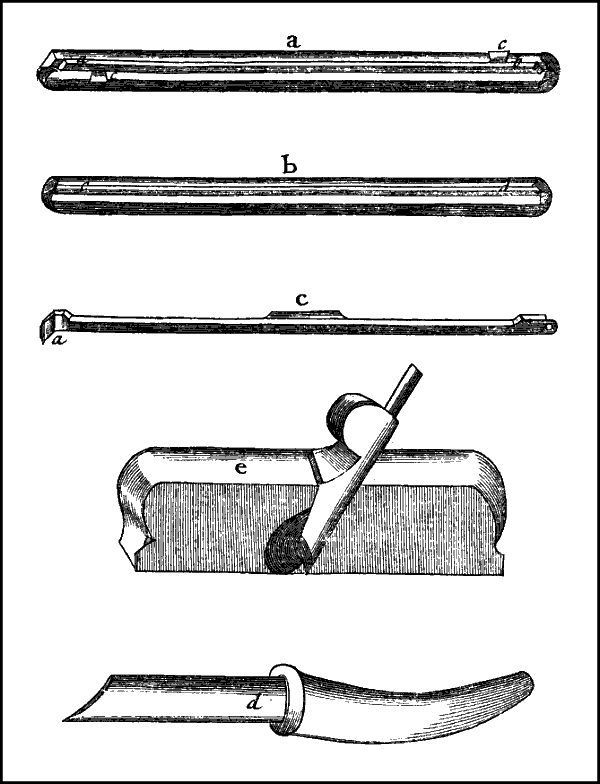
It is delineated in Plate 2. at E.
a The Head.
b b The Bottom.
c c The Back.
d The lower Sliding-Measure, or Cheek.
e The upper Sliding-Measure, or Cheek.
f f The Male-Screw.
g The Female-Screw.
These Composing-sticks are made of Iron Plate about
the thickness of a thin Scabbord, and about ten
Inches long doubled up square; so as the Bottom
may be half an Inch and half a quarter broad,
and the Back about an whole Inch broad. On the
further end of this Iron Plate thus doubled up, as
at a is Soldered on an Iron Head about a Long-Primmer
thick; But hath all its outer-edges Basil’d
and Fil’d away into a Molding: This Iron Head must
be so let into the Plate, and Soldered on to it, that
it may stand truly square with the bottom, and also
truly square with the Back, which may be known
by applying the outer-sides of a square to the Back
and Bottom; as I shewed, Numb. 3. Fol. 38, 39.
About two Inches from the Head, in the Bottom, is
begun a row of round holes about an Inch assunder,
to receive the shank of the Male-Screw that screws
the Sliding-Measures fast down to the Bottom; so that
the Sliding-Measures may be set nearer or further
from the Head, as the Measure of a Page may require.
The lower Sliding-Measure marked d is an Iron
Plate a thick Scabbord thick, and of the Breadth of
the inside of the Bottom; It is about four Inches
long, and in its middle hath a Groove through it
within half an Inch of the Fore-end, and three quarters
of an Inch of the hinder end. This Groove is so
wide all the way, that it may receive the Shank of the
Screw. On the Fore-end of this Plate stands square upright
another Iron Head about a Brevier thick, and
reaches so high as the top of the Back.
The upper Sliding-Measure is made just like the
lower, only it is about three quarters of an Inch
shorter.
Between these two Sliding-Measures, Marginal Notes
are Composed to any Width.
Compositers commonly examine the Truth of their
Stick by applying the head of the Sliding-Measure to
the inside of the Head of the Stick; and if they comply,
they think they are square and true made: But this Rule
only holds when the Head it self is square. But if it
be not, ’tis easy to file the Sliding-Measures to comply
with them: Therefore, as aforesaid, the square
is the only way to examine them by.
The Bodkin is delineated in Plate 2. at F Its Blade
is made of Steel, and well tempered, its shape is
round, and stands about two Inches without the Shank
of the Handle. The Handle is turned of soft wood
as Alder, Maple, &c. that when Compositers knock
the Head of the Bodkin upon the Face of a Single
Letter when it stands too high, it may not batter the
Face.
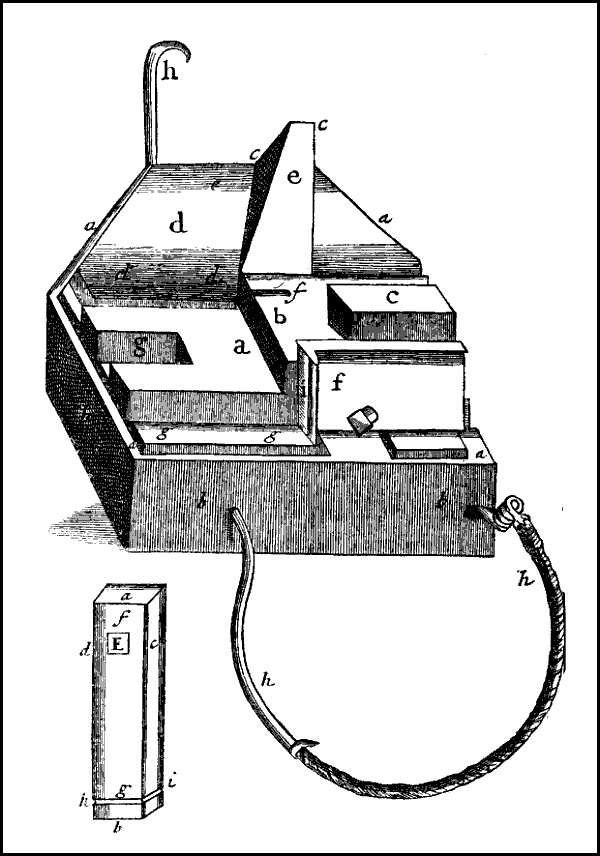
A Chase is an Iron Frame about two and twenty
Inches long, eighteen Inches broad, and half Inch
half quarter thick; and the breadth of Iron on every
side is three quarters of an Inch: But an whole Inch
is much better, because stronger. All its sides must
stand exactly square to each other; And when it is
laid on the Correcting-Stone it must lye exactly flat,
viz. equally bearing on all its sides and Angles: The
outside and inside must be Filed straight and smooth.
It hath two Crosses belonging to it, viz. A Short-Cross
marked a a and a Long-Cross marked b b: These
two Crosses have on each end a Male Duftail Filed
Bevil away from the under to the upper-side of the
Cross, so that the under-side of the Duftail is narrower
than the upper-side of the Duftail. These Male-Duftails
are fitted into Female-Duftails, Filed in the
inside of the Chase, which are also wider on the upper
side of the Chase than on the under-side; because
the upper-side of the Cross should not fall through
the lower side. These Crosses are called the Short and
the Long-Cross.
The Short-Cross is Duftail’d in as aforesaid, just in
the middle of the Chase as at c c, and the Long-Cross in
the middle of the other sides the Chase, as at d d. The
Short-Cross is also Duftail’d into Female-Duftails, made
as aforesaid, about three Inches and an half from the
middle, as at e e: So that the Short-Cross may be
put into either of the Female-Duftails as occasion
serves. The middle of these two Crosses are Filed
or notched half way through, one on its upper, the
other on its under-side to let into one another, viz.
the Short-Cross is Filed from the upper towards the
under-side half way, and the Long-Cross is Filed from
the lower towards the upper-side half way: The
Crosses are also thus let into each other, where they
meet at f, when the Short-Cross is laid into the other
Female-Duftails fitted to it at e e.
In the middle, between the two edges of the upper
side of the Short-Cross, is made two Grooves parallel
to the sides of the Cross, beginning at about
two Inches from each end, and ending at about seven
Inches from each end: It is made about half an
Inch deep all the way, and about a quarter of an
Inch broad, that the Points may fall into them. The
Short-Cross is about three quarters of an Inch thick,
and the Long-Cross about half that thickness. All
their sides must be Fil’d straight and smooth, and
they must be all the way of an equal thickness.
Hitherto our Master-Printer hath provided Materials
and Implements only for the Compositers use; But
he must provide Machines and Tools for the Press-mans
to use too: which (because I am loath to discourage
my Customers with a swelling price at the
first reviving of these Papers) I shall (though against
my interest) leave for the subject of the next succeeding
Exercises.
ADVERTISEMENTS.
THe first Volumne of Mechanick Exercises,
Treating of the Smiths, the Joyners, the Carpenters,
and the Turners Trades, containing 37½
sheets, and 18 Copper Cuts, are to be had by the Author.
Joseph Moxon. Price 9s. 3d.in Quires.
THe first Volumne
of the Monthly Collection of Letters for Improvement of Husbandry and
Trade, containing Twenty four Sheets with an Index, is now finished,
and the second is carrying on:
By John Haughton, Fellow
of the Royal Society.
Plate 3.
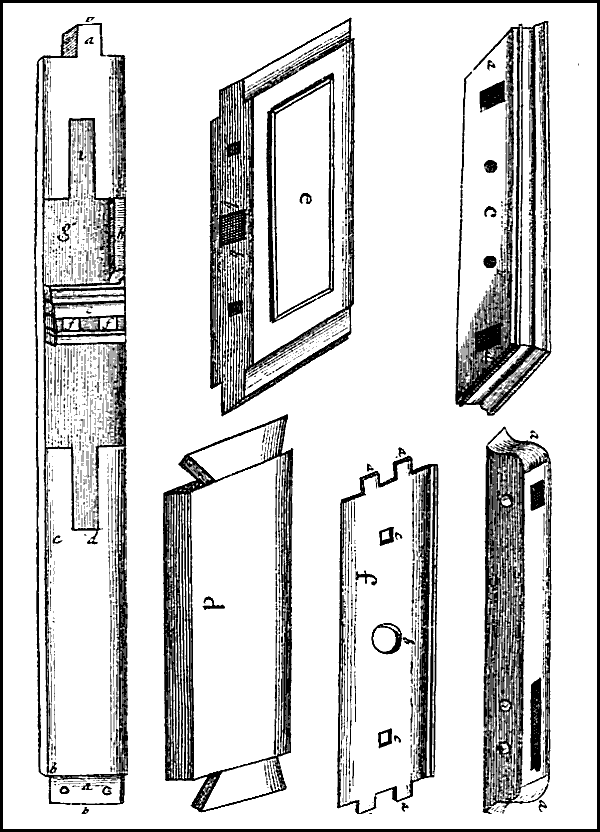
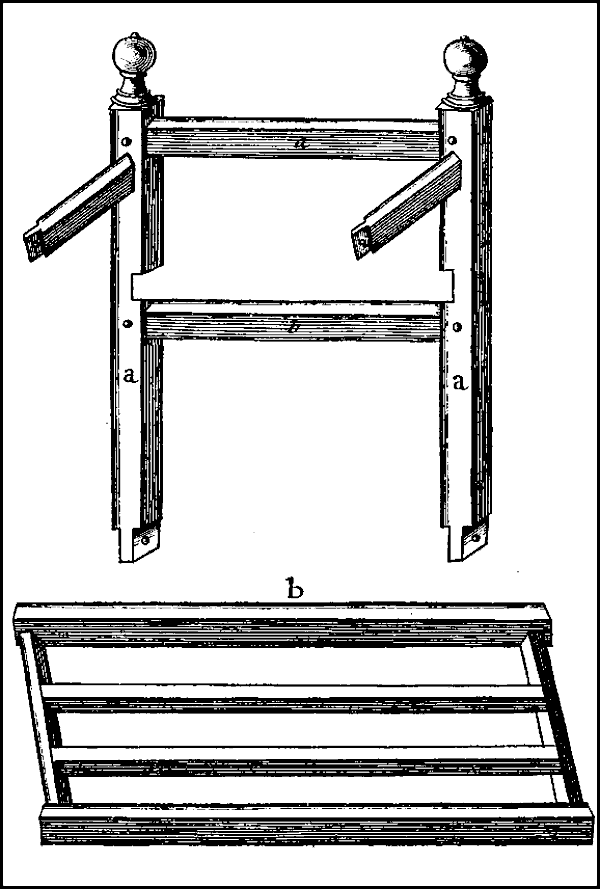
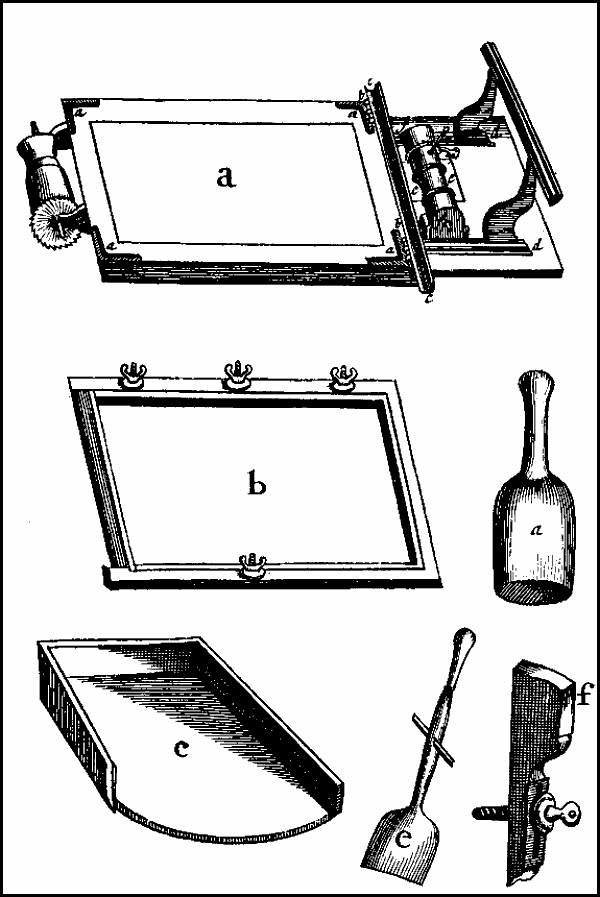
MECHANICK EXERCISES: — §. 10. Of the Press. — ¶. 1. Of the Feet. — ¶. 2. Of the Cheeks. — ¶. 3. Of the Cap marked c in Plate 5. — ¶. 4. Of the Winter marked d in Plate 5. — ¶. 5. Of the Head marked e in Plate 5. — ¶. 6. Of the Till, marked f in Plate 5. — ¶. 7. Of the Hind-Posts marked a a in Plate 6. — §. 4. the Fore and Back-Rails of the Case-Frames was. — ¶. 8. Of the Ribs marked b in Plate 6. — ¶. 9. Of the Carriage, Coffin and its Planck, marked a in Plate 7. — ¶. 10. Of the Tympan and Inner-Tympan, marked b in Plate 7. — ¶. 11. Of the Inck-Block, Slice, Brayer, and Catch of the Bar, marked c d e f in Plate 7. — ¶. 12. Of the Iron-work, and first of the Spindle marked A in Plate 8. — §. 11. Of the Worms of the Spindle. — ¶. 1. The Worms for Printing-Press Spindles must be projected with such a declivity, as that they may come down at an assigned progress of the Bar . — ¶. 13. Of the Bar marked B in Plate 8. — ¶. 14. Of the Hose, Garter, and Hose-Hooks. — ¶. 15. Of the Ribs, and Cramp-Irons. — ¶. 16. Of the Spindle for the Rounce, described in Plate 9. at a. — ¶. 17. Of the Press-Stone. — ¶. 18. Of the Plattin marked d in Plate 9. — ¶. 19. Of the Points and Point-Screws. — ¶. 20. Of the Hammer, described at h, and Sheeps-Foot described at i in Plate 9. — ¶. 21. Of the Foot-step, Girts, Stay of the Carriage, Stay of the Frisket, Ball-Stocks, Paper-Bench, Lye-Trough, Lye-Brush, Lye-Kettle, Tray to wet Paper in , Weights to Press Paper, Pelts, or Leather, Wool or Hair, Ball-Nails or Pumping-Nails. — ¶. 22. Of Racks to Hang Paper on, and of the Peel. — ¶. 23. Of Inck.
Or, the Doctrine of Handy-works.
Applied to the Art of Printing.
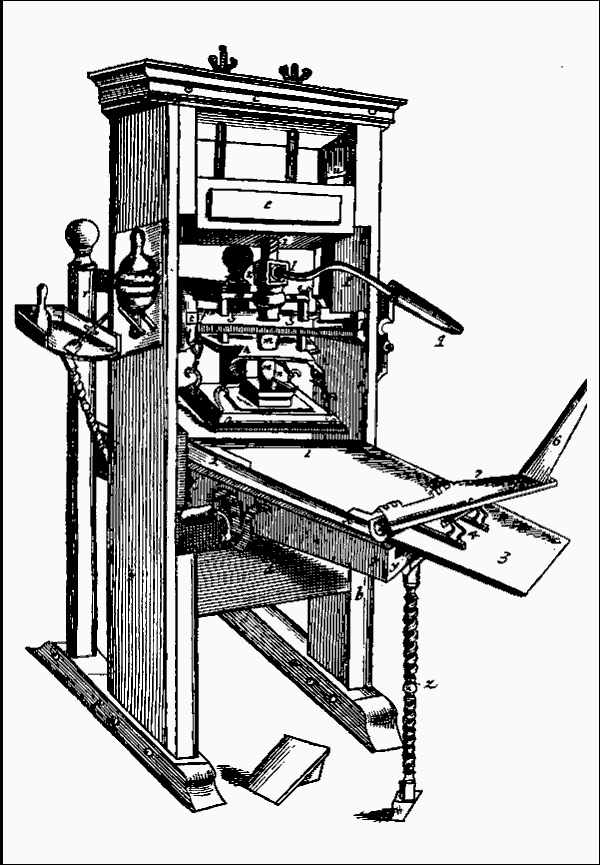
THere are two sorts of Presses in use, viz.
the old fashion and the new fashion;
The old fashion is generally used here
in England; but I think for no other
reason, than because many Press-men
have scarce Reason enough to distinguish between an
excellently improved Invention, and a make-shift
slovenly contrivance, practiced in the minority of
this Art.
The New-fashion’d Presses are used generally
throughout all the Low-Countries; yet because the
Old-fashion’d Presses are used here in England (and
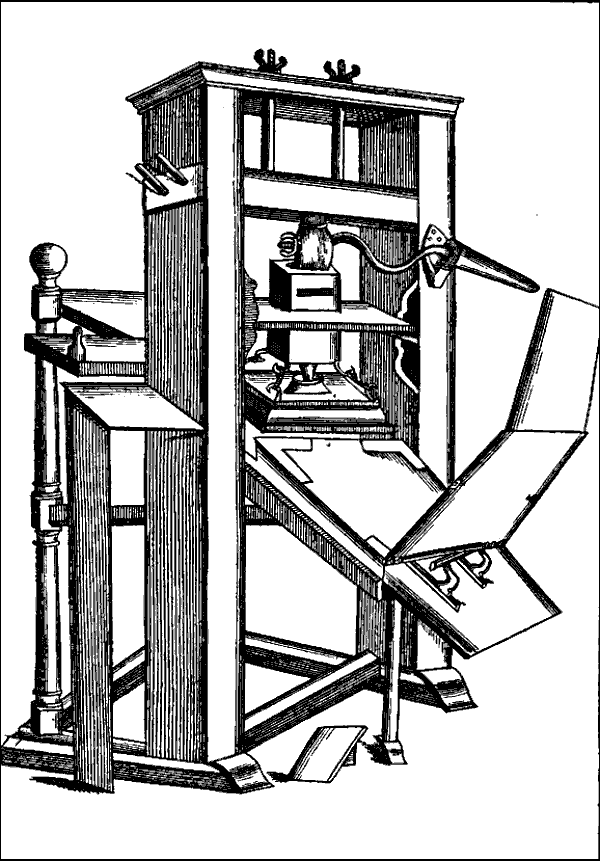
for no other Reason) I have in Plate 3. given you a
delineation of them; But though I give you a draft
of them; yet the demensions of every particular Member
I shall omit, referring those that think it worth
their while, to the Joyners and Smiths that work to
Printers: But I shall give a full description of the
New-fashion’d Press, because it is not well known
here in England; and if possible, I would for Publick
benefit introduce it.
But before I proceed, I think it not amiss to let
you know who was the Inventer of this New-fashion’d
Press, accounting my self so much oblig’d to
his Ingeniety for the curiosity of this contrivance,
that should I pass by this oppertunity without nameing
him, I should be injurious to his Memory.
It was Willem Jansen Blaew of Amsterdam: a Man
as well famous for good and great Printing, as for his
many Astronomical and Geographical exhibitions to
the World. In his Youth he was bred up to Joynery,
and having learn’d his Trade, betook himself (according
to the mode of Holland) to Travel, and his
fortune leading him to Denmark, when the noble Tycho
Brahe was about setting up his Astronomical Observatory,
was entertain’d into his service for the
making his Mathematical-Instruments to Observe
withal; in which Instrument-making he shew’d himself
so intelligent and curious, that according to the
general report of many of his personal acquaintance,
all or most of the Syderal Observations set forth in
Tycho’s name, he was intrusted to make, as well as
the Instruments.
Plate 4.
And before these Observations were publish’d to
the World, Tycho, to gratify Blaew, gave him the
Copies of them, with which he came away to Amsterdam,
and betook himself to the making of Globes, according
to those Observations. But as his Trade increased,
he found it necessary to deal in Geographical
Maps and Books also, and grew so curious in Engraving,
that many of his best Globes and Maps were Engraved
by his own Hands; and by his conversation in
Printing of Books at other Printing-houses, got such
insight in this Art, that he set up a Printing-house of
his own. And now finding inconveniencies in the
obsolete Invention of the Press, He contrived a remedy
to every inconvenience, and fabricated nine
of these New-fashioned Presses, set them all on a
row in his Printing-house, and call’d each Press by the
name of one of the Muses.
This short History of this excellent Man is, I
confess forraign to my Title; But I hope my Reader
will excuse the digression, considering it tends only
to the commemoration of a Person that hath deserved
well of Posterity, and whose worth without
this small Monument, might else perhaps have slid
into Oblivion.
The Press is a Machine consisting of many Members;
it is delineated in Plate 4.
a a The Feet.
b b The Cheeks.
c The Cap.
d The Winter.
e The Head.
f The Till.
g g The Hose. In the Cross-Iron of which, encompassing the Spindle, is the Garter.
h h h h The Hooks on the Hose the Plattin hangs on.
i k l m n The Spindle.
i Part of the Worm below the Head, whose upper part lies in the Nut in the Head.
k l The Eye of the Spindle.
m The Shank of the Spindle.
n The Toe of the Spindle.
o o o o The Plattin tyed on the Hooks of the Hose.
p The Bar.
q The Handle of the Bar.
r r The Hind-Posts.
s s The Hind-Rails.
t t The Wedges of the Till.
u u The Mortesses of the Cheeks, in which the Tennants of the Head plays.
x x x x y y The Carriage.
x x x x The outer Frame of the Carriage.
y y The Wooden-Ribs on which the Iron-Ribs are fastned.
z The Stay of the Carriage, or the Stay.
1. The Coffin.
2. The Gutter.
3. The Planck.
4. The Gallows.
5. The Tinpans.
6. The Frisket.
7. The Points.
8. The Point-Screws.
All these several Members, by their Matter, Form
and Position, do particularly contribute such an assistance
to the whole Machine, that it becomes an
Engine managable and proper for its intended purpose.
But because the smallness of this altogether-Draft
may obscure the plain appearance of many of these
Parts; Therefore I shall give you a more particular
description, and large delineation of every Member in
the Press: And first of the Wooden-work: Where,
Note, that all the Fram’d Wooden-work of a Press is
made of Good, Fine, Clean, Well-season’d Oak.
The Feet (marked a a in Plate 5.) are two Foot
nine Inches and an half long, five Inches deep; and
six Inches broad, and have their outsides Tryed to a
true square, as was taught, Numb. 5. §. 15. It hath
(for ornament sake) its two ends bevil’d away in a Molding,
from its upper-side to its lower, about four Inches
within the ends; about four Inches and three quarters
within each end of each Foot is made in the
middle of the Breadth of the upper-side of the Foot
a Mortess two Inches wide, to receive the Tennants
of the lower end of the Cheek, and the Tennant of
the lower end of the Hind-Post: The Mortess for
the Cheek is eight Inches long, viz. the Breadth of
the Cheek: And the Mortess for the Hind-Post is four
Inches long, viz. the square of the Hind-Post.
The Cheeks (marked b b in Plate 5.) are five Foot
and ten Inches long (besides the Tennants of the top
and bottom) eight Inches broad, and four Inches and
an half thick. All its Sides are tryed square to one another.
It hath a Tennant at either end, its lower
Tennant marked a to enter the Fore-end of the Foot,
runs through the middle of the Breadth of the Cheek,
which therefore is made to fit the Mortess in the Foot,
and is about four Inches long, and therefore reaches
within an Inch of the bottom of the Foot; But the
Tennant at the upper end of the Cheek marked a, is
cut athwart the breadth of the Cheek, and therefore
can have but four Inches and an half of Breadth, and
its thickness is two Inches, Its length is four Inches;
so that it reaches into the Mortess in the Cap, within
half an Inch of the Top.
In the lower end-Tennant is two holes bored, within
an Inch and an half of either side, and within an
Inch and an half of the Sholder, with a three quarter
Inch Augure, to be pin’d into the Feet with an Iron
Pin.
In the middle of the upper Tennant, and within
an Inch and an half of the Sholder, is bored another
hole, to Pin the Tennant into the Cap, also with an Iron
Pin.
Between b c two Foot and half an Inch, and
three Foot seven Inches of the Bottom-Sholder of the
Tennant, viz. from the top of the Winter to the under
Sholder the Till rests upon, is cut flat away into the
thickness of the Cheek, three Inches in the Inside
of the Cheek; so that in that place the Cheek remains
but an Inch and an half thick: And the Cheeks are thus
widened in this place, as well because the Duftail Tennants
of the Winter may go in between them, as also
that the Carriage and Coffin may be made the wider.
Even with the lower Sholder of this flat cutting-in,
is made a Duftail Mortess as at d, to reach eight
Inches and an half, viz. the depth of the Winter below
the said Sholder. This Mortess is three Inches
wide on the inside the Cheek, and three Inches deep;
But towards the inside the Cheek, the Mortess widens
in a straight line from the said three Inches to five
Inches, and so becomes a Duftail Mortess. Into this
Duftail Mortess is fitted a Duftail Tennant, made at
each end of the Winter.
Two Inches above the aforesaid Cutting-in, is another
cutting-in of the same depth, from the Inside
the Cheek as at e. This cutting-in is but one Inch
broad at the farther side the Cheek, and an Inch and
a quarter on the hither-side the Cheek. The under-side
of this Cutting-in, is straight through the Cheek,
viz. Square to the sides of the Cheek: But the
upper-side of this Cutting-in, is not square through
the Cheeks, But (as aforesaid) is one quarter of an Inch
higher on the fore-side the Cheek than it is on the
further side; So that a Wedge of an Inch at one
end, and an Inch and a quarter at the other end may fill
this Cutting-in.
At an Inch within either side the Cheek, and an Inch
below this Cutting-in, as at f f, is made a small
Mortess an Inch and an half wide, to which two Tennants
must be fitted at the ends of the Till, so that
the Tennants of the Till being slid in through the
Cutting-in aforesaid, may fall into these Mortesses,
and a Wedge being made fit to the Cutting-in, may
press upon the Tennants of the Till, and force it
down to keep it steddy in its place.
Here we see remains a square Sholder or substance
of Wood between two Cuttings-in; But the under
corner of this square Sholder is for Ornament sake
Bevil’d away and wrought into an Ogee.
At two Inches above the last Cutting-in, is another
Cutting-in, but this Cutting-in goes not quite
through the breadth of the Cheek, but stops at an
Inch and an half within the further side the Cheek;
So that above the Till and its Wedge is another Sholder
or substance of Wood, whose upper Corner is also
Bevil’d away, and wrought to a Molding as the former.
The last Cutting-in is marked g, and is eight Inches
and a quarter above the Sholder of the Till, that
it may easily contain the depth of the Head; The
substance remaining is marked h. This Cutting-in is
made as deep into the thickness of the Cheek as the
former Cuttings-in are, viz. three Inches; and
the reason the Cheek is cut in here, is, that the Cheeks
may be wide enough in this place to receive the Head,
and its Tennants, without un-doing the Cap and Winter.
Just above this Cutting-in is made a square Mortess
in the middle of the Cheek, as at i, it is eight Inches
long, and two Inches and an half wide, for the
Tennant of the Head to play in.
Plate 5.
Upon the fore-side of the Cheek is (for Ornament
sake) laid a Molding through the whole length of
the Cheek (a square at the Top and Bottom an Inch
deep excepted) it is laid on the outer side, and therefore
can be but an Inch broad; Because the Cuttings-in
on the inside leaves the substance of Stuff but an
Inch and an half thick, and should the Moldings be
made broader, it would be interrupted in the several
Cuttings in, or else a square of a quarter of an
Inch on either side the Molding could not be allowed,
which would be ungraceful.
The Cap is three Foot and one Inch long, four Inches
and an half deep, and nine Inches and an half broad;
But its fore-side is cut away underneath to eight Inches,
Viz. the breadth of the Cheeks. Three quarters
of an Inch above the bottom of the Cap, is a small
Facia, which stands even with the thickness of the
Cheeks; Half an Inch above that a Bead-Molding,
projecting half an Inch over the Facia. Two Inches
above that a broad Facia, also even with the thickness
of the Cheeks; and an Inch and a quarter above
that is the upper Molding made projecting an Inch
and an half over the two Facia’s aforesaid, and the
thickness of the Cheeks.
Each end of the Cap projects three Inches quarter
and half quarter over the Cheeks, partly for Ornament,
but more especially that substance may be
left on either end beyond the Mortesses in the Cap;
and these two ends have the same Molding laid on
them that the fore-side of the Cap hath.
Within two Inches and half quarter of either end,
on the under-side the Cap is made a square Mortess
two Inches wide, and four Inches and an half long,
viz. the thickness of the Cheek inwards, as at a a, to
receive the Top Tennants of the Cheeks; which Top
Tennants are with an Iron Pin (made tapering of about
three quarters of an Inch thick) pin’d into the Mortess
of the Cap, to keep the Cheeks steddy in their position.
The Length of the Winter besides the Tennants, is
one Foot nine Inches and one quarter of an Inch;
The Breadth of the Winter eight Inches, viz. the
Breadth of the Cheek, and its depth nine Inches; all
its sides are tryed square; But its two ends hath each
a Duftail-Tennant made through the whole depth
of the Winter, to fit and fall into the Duftail Mortesses
made in the Cheeks: These Duftail-Tennants are intended
to do the Office of a Summer, Because the
spreading of the ends of these two Tennants into the
spreading of the Mortesses in the Cheeks, keeps the
two Cheeks in a due distance, and hinders them from
flying assunder.
But yet I think it very convenient to have a Summer
also, the more firmly and surer to keep the Cheeks
together; This Summer is only a Rail Tennanted, and
let into Mortesses made in the inside of the Cheeks,
and Screwed to them as the Rails described, Numb.
15. §. 4. are Screwed into the Stiles of the Case-Frame;
Its depth four Inches and an half, and
its breadth eight Inches, viz. the breadth of the
Cheeks.
The length of the Head besides the Tennant at
either end, is one Foot nine Inches and one quarter
of an Inch; The breadth eight Inches and an half,
and its depth eight Inches. The Top, Bottom and
Hind-sides are tryed Square, but the fore-side projects
half an Inch over the Range of the fore-sides of the
Cheeks; in which Projecture is cut a Table with a
hollow Molding about it, two Inches distant from all
the sides of the fore-side of the Head: Its Tennants
are three Inches Broad, and are cut down at either
end, from the top to the bottom of the Head,
and made fit to the Mortesses in the Cheeks, that they
may slide tight, and yet play in them.
In the under-side of the Head is cut a square Hole,
(as at a,) about four Inches square, and three Inches and
an half deep, into which the Brass-Nut is to be fitted:
And to keep this Nut in its place (lest the weight of it
should make it fall out) is made on either side the square
hole, at about half an Inch distance from it, (as at b b)
a square Hole quite through the Top and Bottom of
the Head about three quarters of an Inch wide; and
into this square Hole is fitted a square piece of Iron
to reach quite through the Head, having at its under-end
a Hook turned square to claspe upon the under-side
of the Nut; and on its upper end a Male-Screw
reaching about an Inch above the upper-side of the
Head, which by the help of a Female-screw made
in an Iron Nut, with Ears to it to turn it about
draws the Clasp at the bottom of the Iron Shank
close against the Nut, and so keeps it from falling out.
In the middle of the wide square Hole that the
Nut is let into, is bored a round Hole through the
top of the Head, of about three quarters of an Inch
wide, for the Press-man to pour Oyl in at so oft as the
Nut and Spindle shall want Oyling.
At three Inches from either end of the Head (as at
c c) is bored a Hole quite through the top and bottom
of the Head, which holes have their under ends
squar’d about two Inches upwards, and these squares are
made so wide as to receive a square Bar of Iron three
quarters of an Inch square; But the other part of these
Holes remain round: Into these Holes two Irons are
fitted called the Screws.
The Shanks of these Screws are made so long as
to reach through the Head and through the Cap: At
the upper end of these Shanks is made Male-screws,
and to these Male-screws, Iron Female-screws are fitted
with two Ears to twist them the easier about.
So much of these Iron-Shanks as are to lye in the
square Hole of the Head aforesaid, are also squared
to fit those square Holes, that when they are fitted
and put into the Holes in the Head; they may not
twist about.
To the lower ends of these Iron-Shanks are made
two Square, Flat Heads, which are let into and buried
in the under-side of the Head; And upon the Sholders
of those two Flat Heads, rests the weight of the Head
of the Press; And by the Screws at the upper end
of the Shanks are hung upon the upper-side of the
Cap, and Screwed up or let down as occasion requires.
Plate 6.
The Till is a Board about one Inch thick, and is as
the Head and Winter, one Foot nine Inches and a quarter
long, besides the Tennants at either end; Its Breadth
is the Breadth of the Cheeks, viz. eight Inches; It
hath two Tennants at either end as at a a a a, each
of them about an Inch and an half long, and an Inch
and an half broad, and are made at an Inch distance
from the fore and Back-side, so that a space of two
Inches is contained in the middle of the ends between
the two Tennants; these Tennants are to be laid in the
Mortesses in the Cheeks delineated at f f in Plate 5.
and described in this §. 10. ¶. 2.
In its middle it hath a round Hole about two Inches
and an half wide, as at b, for the Shank of the Spindle
to pass through.
At seven Inches and a quarter from either end, and
in the middle between the fore and Back-side, is made
two square Holes through the Till, as at c c, for the
Iron Hose to pass through.
At one Foot distance from the Hind-sides of the
Cheeks are placed upright two Hind-Posts, they are
three Foot and four Inches long besides the Tennants,
which Tennants are to be placed in the Mortesses in
the hinder-ends of the Feet; Their thickness is four
Inches on every side, and every side is tryed square;
But within eight Inches of the top is turned a round
Ball with a Button on it, and a Neck under it, and
under that Neck a straight Plinth or Base: This turn’d
work on the top is only for Ornament sake.
There are six Rails fitted into these Hind-Posts, two
behind marked a b, one of them standing with its
upper-side at two Inches below the turned Work, the
other having its upper-side lying level with the upper-side
of the Winter.
These two Rails are each of them Tennanted at
either end, and are made so long, that the outsides
of the Hind-Posts may stand Range or even with the
outer-sides of the Cheeks; These Tennants at either
end are let into Mortesses made in the insides of the
Hind-Posts, and Pin’d up with half Inch wooden Pins,
Glewed in, as was shewn Vol. 1. Numb. 5. §. 17. Because
the two Hind-Posts need not be separated for any alteration
of the Press.
The two Side-Rails on either side the Press are
Tennanted at each end, and let into Mortesses made
in the Cheeks and Hind-Posts, so as they may stand
Range with the outer-sides of the Cheeks and Hind-Posts;
But the Tennants that enter the Mortesses in
the Cheeks are not pin’d in with Wooden Pins, and
Glewed, because they may be taken assunder if need
be; But are Pin’d in with Iron Pins, made a little tapering
towards the entring end, so as they may be
driven back when occasion serves to alter the Press:
And the Tennants that enter the Mortesses in the Hind-Posts
are fastned in by a Female-screw, let in near the
end of the Rail, which receives a Male-screw thrust
through the Hind-Posts, even as I shew’d in
The Ribs lye within a Frame of four Foot five
Inches long, one Foot eleven Inches broad; its two
End-Rails one Inch and an half thick, its Side-Rails
two Inches and an half thick; and the breadth of the
Side and End-Rails two Inches and an half. But the
Side-Rails are cut away in the inside an Inch and
an half towards the outer-sides of the Rails, and an
Inch deep towards the Bottom sides of the Rails, so
that a square Cheek on either Side-Rail remains. This
cutting down of the Outer-Rails of the Frame is made,
because the Planck of the Carriage being but one
Foot eight Inches and an half broad, may easily slide,
and yet be gaged between these Cheeks of the Rail,
that the Cramp-Irons Nailed under the Carriage Planck
joggle not on either side off the Ribs, as shall more
fully be shewn in the next §.
Between the two Side-Rails are framed into the
two End-Rails the two Wooden-Ribs two Inches and an
half broad, and an Inch and an half thick; they are
placed each at an equal distance from each Side-Rail,
and also at the same distance between themselves. Upon
these two Ribs are fast Nailed down the Iron-Ribs,
of which more shall be said when I come to speak of the Iron-work.
The Planck of the Carriage is an Elm-Planck an
Inch and an half thick, four Foot long, and one Foot
eight Inches and three quarters broad; upon this
Planck at its fore-end is firmly Nailed down a square
Frame two Foot four Inches long, one Foot ten
Inches broad, and the thickness of its Sides two Inches
and an half square; This Frame is called the Coffin,
and in it the Stone is Bedded.
Upon each of the four Corners of this Coffin is let
in and fastned down a square Iron Plate as at a a a a,
with Return Sides about six Inches long each side,
half a quarter of an Inch thick, and two Inches and
a quarter broad; upon the upper outer-sides of each
of these Plates is fastned down to them with two or
three Rivets through each side, another strong Iron
half an Inch deep, and whose outer Angles only are
square, but the Inner-Angles are obtuse, as being
sloped away from the Inner-Angle towards the farther end
of each inner-side, so as the Quoins may do
the Office of a Wedge between each inner-side and
the Chase.
Plate 7.
The Plates of these Corners (as I said) are let in
on the outer Angles of the upper-side of the Frame
of the Coffin, so as the upper-sides of the Plates lye
even with it, and are Nailed down, or indeed rather
Rivetted down through the bottom and top-sides
of the Frame of the Coffin, because then the upper-sides
of the Holes in the Iron Plates being square
Bored (that is, made wider on the upper-side of the
Plate, as I shall shew when I come to the making
of Mathematical Instruments) the ends of the Shanks
of the Iron Pins may be so battered into the Square-boring,
that the whole Superficies of the Plate when
thus Rivetted shall be smooth, which else with the
exturberancies of Nail-heads would hinder the free
sliding of the Quoins.
At the hinder end of the Frame of the Coffin are
fastned either with strong Nails, Rivets, or rather
Screws, two Iron Half-Joynts, as at b b, which having
an Iron Pin of almost half an Inch over put
through them, and two Match-half-Joynts fastned on
the Frame of the Tympan, these two Match-half-Joynts
moving upon the Iron Pin aforesaid, as on an Axis,
keeps the Tinpan so truly gaged, that it always falls
down upon the Form in the place, and so keeps Register
good, as shall further be shewed in proper place.
Behind the Coffin is Nailed on to its outside, a
Quarter, as at c c this Quarter is about three Inches
longer than the breadth of the Coffin, it hath all its
sides two Inches over, and three of them square;
but its upper-side is hollowed round to a Groove or
Gutter an Inch and an half over. This Gutter is so
Nailed on, that its hither end standing about an Inch
higher than its further end, the Water that descends
from the Tympan falling into it is carried away on
the farther side the Coffin by the declivity of the
farther end of the Gutter, and so keeps the Planck of
the Carriage neat and cleanly, and preserves it from
rotting.
Parallel to the outer-sides of the hind part of the
Planck of the Carriage, at three Inches distance from
either side, is Nailed down on the upper-side of the
Planck two Female-Duftail Grooves, into which is
fitted (so as they may slide) two Male-Duftails made
on the two Feet of the Gallows (as at d d) that the
Tinpan rests upon; and by the sliding forward or
backward of these Duftail Feet, the heighth of the
Tinpan is raised or depressed according to the Reason
or Fancy of the Press-man.
At three Inches from the hinder Rail of the Coffin,
in the middle, between both sides of the Planck, is
cut an Hole four Inches square (as at e e) and upon
the hither and farther side of this Hole is fastned
down on each side a Stud made of Wood (as at
f f) and in the middle of these two Studs is made a
round Hole about half an Inch over, to receive the
two round ends of an Iron Pin; which Iron Pin,
though its ends be round, is through the middle of
the Shank square, and upon that square is fitted a
round Wooden-Rowler or Barrel, with a Shoulder on
either side it, to contain so much of the Girt as shall
be rowled upon it; And to one end of the Rowler is
fastned an Iron Circle or Wheel, having on its edge
Teeth cut to stop against a Clicker, when the Rowler
with an Iron Pin is turned about to strain the Girt.
The Tympan is a square Frame, three sides whereof
are Wood, and the fourth Iron. Its width is one
Foot eight Inches, its length two Foot two Inches;
the breadth of the wooden Sides an Inch and an half,
and the depth one Inch.
On its short Wooden-side, viz. its Hind-end, at the
two Corners is Rivetted an Iron Match-Joynt, to be
pinned on to another Half-joynt fastned on the Hind-Rail
of the Coffin.
The other end, viz. the Fore-end of the Tympan is
made of Iron, with a square Socket at either end for
the Wooden ends of the Tympan to fit and fasten into.
This Iron is somewhat thinner and narrower than an
ordinary Window-Casement.
Upon the outer edge of this Iron, about an Inch
and an half off the ends of it, is made two Iron Half-joynts
to contain a Pin of about a quarter of an Inch
over, which Pin entring this half-joynt, and a match
Half-joynt made upon the Frisket, serves for the Frisket
to move truly upon.
In the middle of each long Rail of the Tympan, is
made through the top and bottom an Hole half an
Inch square, for the square Shanks of the Point-Screws
to fit into.
The like Holes are also made in the Tympan, at one
third part of its length from the Fore-end or Frisket-joynt,
to place the Point Screws in; when a Twelves,
Eighteens, &c. is wrought.
Into the Inner-side of this Tympan is fitted the Inner-Tympan,
whose three sides are also made of Wood, and
its fourth side of Iron, as the Tympan, but without joynts;
it is made so much shorter than the Outer-Tympan, that
the outer edge of the Iron of the Inner-Tympan may
lye within the inner edge of the Iron on the Outer-Tympan;
and it is made so much narrower than the inside
of the Tympan, that a convenient room may be allowed
to paste a Vellom between the inside of the Tympan,
and the outside of the Inner-Tympan.
About the middle, through the hither-side of the
Inner-Tympan, is let in and fastned an Iron Pin about
a quarter of an Inch over, and stands out three quarters
of an Inch upon the hither outside of the Inner-Tympan,
which three quarters of an Inch Pin fits into
a round hole made in the inner-side of the Tympan, to
gage and fit the Inner-Tympan right into the Tympan;
for then by the help of an Iron turning Clasp on the
further side the Tympan, the Inner-Tympan is kept firmly
down and in its position.
To the Rail between the hither Cheek and Hind-Post
is fastned the Inck-Block, which is a Beechen-board
about thirteen Inches long, nine Inches broad, and
commonly about two Inches thick, and hath the
left-hand outer corner of it cut away; it is Railed in
on its farther and hinder-sides, and a little above half
the hither-side, with Wainscot-Board about three
quarters of an Inch thick, and two Inches and an
half above the upper-side the board of the Inck-Block.
It is described in Plate 7. at c.
The Brayer marked a is made of Beech: It is turned
round on the sides, and flat on the bottom, its length
is about three Inches, and its diameter about two Inches
and an half; it hath an Handle to it about four
Inches long. Its Office is to rub and mingle the Inck
on the Inck-Block well together.
The Slice is a little thin Iron Shovel about three or
four Inches broad, and five Inches long; it hath an
Handle to it of about seven Inches long. Near the
Shovel through the Handle is fitted a small Iron of about
two Inches long standing Perpendicular to both
the sides of the Handle, and is about the thickness of
a small Curtain-Rod. It is described at e.
The Catch of the Bar described at f is a piece of
Wood two Inches thick, four Inches broad, and ten
Inches long; The top of it is a little Bevil’d or Slop’d
off, that the Bar may by its Spring fly up the Bevil till
it stick. This Bevil projects three Inches over its
straight Shank, which reaches down to the bottom;
in the middle of this Shank, through the fore and
back-side, is a Mortess made from within an Inch of
the Rounding to an Inch and an half of the bottom;
This Mortess is three quarters of an Inch wide, and
hath an Iron Pin with a Shoulder at one end fitted
to it, so as it may slide from one end of the Mortess
to the other. At the other end of the Iron Pin is
made a Male-Screw which enters into a Female Iron
Screw let into the further Cheek of the Press; so
that the Catch may be Screwed close to the Cheek, as
shall further be spoken to hereafter.
From the Top to the Toe of the Spindle, viz. from
a to b is sixteen Inches and a half, the length of the
Cilinder the Worms are cut upon is three Inches and a
quarter, and the diameter of that Cilinder two Inches
and a quarter; between the bottom of the Worms
and top of the Cube one Inch and an half; the Cube
marked c c c c is two Inches and three quarters, the
square Eye at d in the middle of the Cube is an Inch
and a quarter through all the sides of the Cube; one
Inch under the Cube at e is the Neck of the Spindle,
whose diameter is two Inches, It is one Inch between
the two shoulders, viz. the upper and under shoulders
of the Neck at e e, so that the Cilinder of the
Neck is one Inch long; the very bottom of the Spindle
at b is called the Toe, it is made of an Hemispherical
form, and about one Inch in diameter; This Toe
should be made of Steel, and well Temper’d, that
by long or careless usage, the point of pressure wear
not towards one side of the Toe, but may remain in
the Axis of the Spindle.
Plate 8.
I promised at the latter end of Numb. 2. to give a
more copious account than there I did of making
Worms, when I came to exercise upon Printing-Press
Spindles; and being now arrived to it, I shall here
make good my promise.
The assigned progress may be various, and yet the
Spindle do its office: For if the Cheeks of the Press
stand wide assunder, the sweep or progress of the
same Bar will be greater than if they stand nearer
together.
It is confirm’d upon good consideration and Reason
as well as constant experience, that in a whole Revolution
of the Spindle, in the Nut, the Toe does and
ought to come down two Inches and an half; but
the Spindle in work seldom makes above one quarter
of a Revolution at one Pull, in which sweep it comes
down but half an Inch and half a quarter of an Inch;
and the reason to be given for this coming down, is
the squeezing of the several parts in the Press, subject
to squeeze between the Mortesses of the Winter
and the Mortesses the Head works in; and every
Joynt between these are subject to squeeze by the
force of a Pull. As first, The Winter may squeeze
down into its Mortess one third part of the thickness
of a Scabbord. (Allowing a Scabbord to be half a Nomparel
thick.) Secondly, The Ribs squeeze closer to
the Winter one Scabbord. Thirdly, The Iron-Ribs
to the Wooden Ribs one Scabbord. Fourthly, The
Cramp-Irons to the Planck of the Coffin one Scabbord.
Fifthly, The Planck it self half a Scabbord. Sixthly,
The Stone to the Planck one Scabbord. Seventhly,
The Form to the Stone half a Scabbord. Eighthly,
The Justifyers in the Mortess of the Head three Scabbords.
Ninthly, The Nut in the Head one Scabbord.
Tenthly, The Paper, Tympans and Blankets two
Scabbords. Eleventhly, Play for the Irons of the Tympans
four Scabbords. Altogether make fifteen Scabbords
and one third part of a Scabbord thick, which
(as aforesaid) by allowing two Scabbords to make a
Nomparel, and as I shewed in Vol. 2. Numb. 2. §. 2.
One hundred and fifty Nomparels to make one Foot,
gives twelve and an half Nomparels for an Inch, and
consequently twenty five Scabbords for an Inch;
so by proportion, fifteen Scabbords and one third part
of a Scabbord, gives five eighth parts of an Inch,
and a very small matter more, which is just so much
as the Toe of the Spindle comes down in a quarter of
a Revolution.
This is the Reason that the coming down of the
Toe ought to be just thus much; for should it be less,
the natural Spring that all these Joynts have, when
they are unsqueez’d, would mount the Irons of the
Tympans so high, that it would be troublesom and tedious
for the Press-man to Run them under the Plattin,
unless the Cheeks stood wider assunder, and consequently
every sweep of the Bar in a Pull exceed a
quarter of a Revolution, which would be both laborious
for the Press-man, and would hinder his usual
riddance of Work.
I shew’d in Numb. 2. fol. 31, 32, 33, 34, 35. the
manner of making a Screw in general; but assigned
it no particular Rise; which for the aforesaid reason,
these Printing-Press Screws are strictly bound to have:
Therefore its assigned Rise being two Inches and an
half in a Revolution, This measure must be set off
upon the Cilindrick Shank, from the top towards
the Cube of the Spindle, on any part of the Cilinder,
and there make a small mark with a fine Prick-Punch,
and in an exact Perpendicular to this mark make another
small mark on the top of the Cilinder, and
laying a straight Ruler on these two marks, draw a
straight line through them, and continue that line
almost as low as the Cube of the Spindle. Then devide
that portion of the straight line contained between
the two marks into eight equal parts, and set
off those equal parts from the two Inch and half
mark upwards, and then downwards in the line so
oft as you can: Devide also the Circumference of
the Shank of the Cilinder into eight equal parts, and
draw straight lines through each devision, parallel to
the first upright line; and describe the Screw as you
were directed in the afore-quoted place; so will you
find that the revolution of every line so carried on
about the Shank of the Cilinder, will be just two
Inches and an half off the top of the Shank: which
measure and manner of working may be continued
downward to within an Inch and an half of the Cube
of the Spindle. This is the Rule and Measure that
ought to be observ’d for ordinary Presses: But if for
some by-reasons the aforesaid Measure of two Inches
and an half must be varied, then the varied Measure
must be set off from the top of the Cilinder, and
working with that varied Measure as hath been directed,
the Toe of the Spindle will come down lower
in a revolution if the varied Measure be longer, or
not so low if the varied Measure be shorter.
There is a Notion vulgarly accepted among Workmen,
that the Spindle will Rise more or less for the
number of Worms winding about the Cilinder; for
they think, or at least by tradition are taught to say,
that a Three-Worm’d Spindle comes faster and lower
down than a four-Worm’d Spindle: But the opinion
is false; for if a Spindle were made but with a Single-Worm,
and should have this Measure, viz. Two
Inches and an half set off from the top, and a Worm
cut to make a Revolution to this Measure, it would
come down just as fast, and as low, as if there were
two, three, four, five or six Worms, &c. cut in the
same Measure: For indeed, the numbers of Worms
are only made to preserve the Worms of the Spindle
and Nut from wearing each other out the faster; for
if the whole stress of a Pull should bear against the
Sholder of a single Worm, it would wear and shake
in the Nut sooner by half than if the stress should
be borne by the Sholders of two Worms; and so proportionably
for three, four, five Worms, &c.
But the reason why four Worms are generally made
upon the Spindle, is because the Diameters of the Spindle
are generally of this propos’d size; and therefore a
convenient strength of Mettal may be had on this
size for four Worms; But should the Diameter of the
Spindle be smaller, as they sometimes are when the
Press is designed for small Work, only three Worms
will be a properer number than four; because when
the Diameter is small, the thickness of the Worms
would also prove small, and by the stress of a Pull
would be more subject to break or tear the Worms
either of the Spindle or Nut.
And thus I hope I have performed the promise here
I made at the latter end of Numb. 2. Whither I refer
you for the breadth, and reason of the breadth of
the Worm.
This Bar is Iron, containing in length about two
Foot eight Inches and an half, from a to b, and its
greatest thickness, except the Sholder, an Inch and a
quarter; The end a hath a Male-Screw about an Inch
Diameter and an Inch long, to which a Nut with a
Female-Screw in it as at C is fitted. The Iron Nut
in which this Female-Screw is made, must be very
strong, viz. at least an Inch thick, and an Inch and
three quarters in Diameter; in two opposite sides
of it is made two Ears, which must also be very
strong, because they must with heavy blows be knock’t
upon to draw the Sholder of the square shank on the
Bar, when the square Pin is in the Eye of the Spindle
close and steddy up to the Cube on the Spindle. The
square Pin of the Bar marked c is made to fit just
into the Eye, through the middle of the Cube
of the Spindle, on the hither end of this square Pin
is made a Sholder or stop to this square Pin, as at d.
This Sholder must be Filed exactly Flat on all its four
insides, that they may be drawn close and tight up
to any flat side of the Cube on the Spindle; It is two
Inches square, that it may be drawn the firmer, and
stop the steddyer against any of the flat sides of the
said Cube, when it is hard drawn by the strength
of the Female-Screw in the aforesaid Nut at C. The
thickness from d to e of this Sholder is about three
quarters of an Inch, and is Bevil’d off towards the
Handle of the Bar with a small Molding.
The substance of this Bar, as aforesaid, is about an
Inch and a quarter; but its Corners are all the way
slatted down till within five Inches of the end: And
from these five Inches to the end, it is taper’d away,
that the Wooden-Handle may be the stronger forced
and fastned upon it.
About four Inches off the Sholder, the Bar is bowed
beyond a right Angle, yet not with an Angle, but a
Bow, which therefore lies ready to the Press-man’s
Hand, that he may Catch at it to draw the Wooden-Handle
of the Bar within his reach.
This Wooden-Handle with long Working grows oft
loose; but then it is with hard blows on the end of
it forced on again, which oft splits the Wooden-Handle
and loosens the square Pin at the other end of the Bar,
in the Eye of the Spindle: To remedy which inconvenience,
I used this Help, viz. To weld a piece of
a Curtain-Rod as long as the Wooden-Handle of the
Bar, to the end of the Iron Bar, and made a Male-screw
at the other end with a Female-screw to fit it;
Then I bored an hole quite through the Wooden-Handle,
and Turn’d the very end of the Wooden-Handle
with a small hollow in it flat at the bottom, and deep
enough to bury the Iron-Nut on the end of the Curtain-Rod,
and when this Curtain-Rod was put through
the Hollow in the Wooden-Handle and Screwed fast to
it at the end, it kept the Wooden-Handle, from flying
off; Or if it loosened, by twisting the Nut once or
twice more about, it was fastned again.
The Hose are the upright Irons in Plate 8. at a a,
They are about three quarters of an Inch square, both
their ends have Male-screws on them; The lower
end is fitted into a square Hole made at the parting
of the Hose-Hooks, which by a square Nut with a Female-screw
in it, is Screwed tight up to them; Their
upper ends are let into square Holes made at the ends
of the Garter, and by Nuts with Female-Screws in
them, and Ears to turn them about as at l l are
drawn up higher, if the Plattin-Cords are too loose;
or else let down lower if they are too tight: These upper
Screws are called the Hose-Screws.
The Garter (but more properly the Coller) marked
b b, is the round Hoop incompassing the flat Groove
or Neck in the Shank of the Spindle at e e; This
round Hoop is made of two half-round Hoops, having
in a Diametrical-line without the Hoop square Irons
of the same piece proceeding from them, and standing
out as far as g g, These Irons are so let into each
other, that they comply and run Range with the
square Sholders at both ends, wherein square Holes
are made at the ends of the Hose. They are Screwed
together with two small Screws, as at h h.
The four Hose-Hooks are marked i i i i, They proceed
from two Branches of an Iron Hoop at k encompassing
the lower end of the Spindle, on either
Corner of the Branch, and have notches filled in their
outer-sides as in the Figure, which notches are to contain
several Turns of Whip-cord in each notch, which
Whip-cord being also fastned to the Hooks on the Plattin,
holds the Plattin tight to the Hooks of the Hose.
The Ribs are delineated in Plate 8. at E, they
are made of four square Irons the length of the Wooden-Ribs
and End-Rails, viz. four Foot five Inches
long, and three quarters of an Inch square, only one
end is batter’d to about a quarter of an Inch thick, and
about two Inches and an half broad, in which battering
four or five holes are Punch’t for the nailing
it down to the Hind-Rail of the Wooden-Ribs. The
Fore-end is also batter’d down as the Hind-end, but
bound downwards to a square, that it may be nailed
down on the outer-side of the Fore-Rail of the Wooden-Ribs.
Into the bottom of these Ribs, within nine Inches
of the middle, on either side is made two Female-Duftails
about three quarters of an Inch broad, and
half a quarter of an Inch thick, which Female-Duftails
have Male-Duftails as at a a a a fitted stiff into
them, about an Inch and three quarters long; and
these Male-Duftails have an hole punched at either
end, that when they are fitted into the Female-Duftails
in the Ribs, they may in these Holes be Nailed
down the firmer to the Wooden-Ribs.
Plate 9.
These Ribs are to be between the upper and the
under-side exactly of an equal thickness, and both
to lye exactly Horizontal in straight lines; For irregularities
will both Mount and Sink the Cramp-Irons,
and make them Run rumbling upon the Ribs.
The upper-sides of these Ribs must be purely
Smooth-fil’d and Pollish’d, and the edges a little Bevil’d
roundish away, that they may be somewhat
Arching at the top; because then the Cramp-IronsRun more easily and ticklishly over them.
The Cramp-Irons are marked F in Plate 8. They
are an Inch and an half long besides the Battering
down at both ends as the Ribs were; They have
three holes Punched in each Battering down, to Nail
them to the Planck of the Coffin; They are about
half an Inch deep, and one quarter and an half thick;
their upper-sides are smoothed and rounded away as
the Ribs.
The Axis or Spindle is a straight Bar of Iron about
three quarters of an Inch square, and is about three
Inches longer than the whole breadth of the Frame of
the Ribs, viz. two Foot two Inches: The farther end of
it is Filed to a round Pin (as at a) three quarters of
an Inch long, and three quarters of an Inch in Diameter;
the hither end is filed away to such another
round Pin, but is two Inches and a quarter long (as
at b); at an Inch and a quarter from this end is Filed
a Square Pin three quarters of an Inch long, and
within half an Inch of the end is Filed another round
Pin, which hath another Male-Screw on it, to which
is fitted a square Iron Nut with a Female-Screw in it.
On the Square Pin is fitted a Winch somewhat in
form like a Jack-winch, but much stronger; the Eye
of which is fitted upon the Square aforesaid, and
Screwed up tight with a Female-Screw. On the
straight Shank of this Winch is fitted the Rounce,
marked e.
The round ends of this Axis are hung up in two
Iron-Sockets (as at c c) fastned with Nails (but
more properly with Screws) on the outside the Wooden
Frame of the Ribs.
The Girt-Barrel marked d is Turned of a Piece of
Maple or Alder-wood, of such a length, that it may
play easily between the two Wooden Ribs; and of
such a diameter, that in one revolution of it, such a
length of Girt may wind about it as shall be equal
to half the length contained between the fore-end
Iron of the Tympan, and the inside of the Rail of the
Inner-Tympan; because two Revolutions of this Barrel
must move the Carriage this length of space.
This Barrel is fitted and fastned upon the Iron Axis,
at such a distance from either end, that it may move
round between the Wooden Ribs aforesaid.
The Press-Stone should be Marble, though sometimes
Master Printers make shift with Purbeck, either
because they can buy them cheaper, or else because
they can neither distinguish them by their appearance,
or know their different worths.
Its thickness must be all the way throughout equal,
and ought to be within one half quarter of an
Inch the depth of the inside of the Coffin; because
the matter it is Bedded in will raise it high enough.
Its length and breadth must be about half an Inch less
than the length and breadth of the inside of the Coffin:
Because Justifiers of Wood, the length of every
side, and almost the depth of the Stone, must be thrust
between the insides of the Coffin and the outsides of
the Stone, to Wedge it tight and steddy in its place,
after the Press-man has Bedded it. Its upper-side, or
Face must be exactly straight and smooth.
I have given you this description of the Press-Stone,
because they are thus generally used in all Printing-Houses:
But I have had so much trouble, charge and
vexation with the often breaking of Stones, either
through the carelesness or unskilfulness (or both)
of Press-men, that necessity compell’d me to consider
how I might leave them off; and now by long experience
I have found, that a piece of Lignum-vitæ
of the same size, and truly wrought, performs the
office of a Stone in all respects as well as a Stone,
and eases my mind, of the trouble, charge and vexation
aforesaid, though the first cost of it be greater.
The Plattin is commonly made of Beechen-Planck,
two Inches and an half thick, its length about fourteen
Inches, and its breadth about nine Inches. Its
sides are Tryed Square, and the Face or under-side of
the Plattin Plained exactly straight and smooth.
Near the four Corners on the upper-side, it hath
four Iron Hooks as at a a a a, whose Shanks are
Wormed in.
In the middle of the upper-side is let in and fastned
an Iron Plate called the Plattin-Plate, as b b b b,
a quarter of an Inch thick, six Inches long, and four
Inches broad; in the middle of this Plate is made a
square Iron Frame about half an Inch high, and half
an Inch broad, as at c. Into this square Frame is
fitted the Stud of the Plattin Pan, so as it may stand
steddy, and yet to be taken out and put in as occasion
may require.
The Stud marked d, is about an Inch thick, and
then spreads wider and wider to the top (at e e e e)
of it, till it becomes about two Inches and an half
wide; and the sides of this spreading being but about
half a quarter of an Inch thick makes the Pan. In
the middle of the bottom of this Pan is a small Center
hole Punch’d for the Toe of the Spindle to work in.
The Points are made of Iron Plates about the
thickness of a Queen Elizabeth Shilling: It is delineated
at e in Plate 9. which is sufficient to shew the
shape of it, at the end of this Plate, as at a, stands
upright the Point. This Point is made of a piece of
small Wyer about a quarter and half quarter of an
Inch high, and hath its lower end Filed away to a small
Shank about twice the length of the thickness of the
Plate; so that a Sholder may remain. This small
Shank is fitted into a small Hole made near the end
of the Plate, and Revetted on the other side, as was
taught Numb. 2. Fol. 24. At the other end of the
Plate is filed a long square notch in the Plate as at b c
quarter and half quarter Inch wide, to receive the
square shank of the Point-Screws.
The Point-Screw marked f is made of Iron; It
hath a thin Head about an Inch square, And a square
Shank just under the Head, an Inch deep, and almost
quarter and half quarter Inch square, that the square
Notch in the hinder end of the Plate may slide on
it from end to end of the Notch; Under this square
Shank is a round Pin filed with a Male-Screw upon
it, to which is fitted a Nut with a Female-Screw in
it, and Ears on its outside to twist about, and draw
the Head of the Shank close down to the Tympan,
and so hold the Point-Plate fast in its Place.
The Hammer is a common Hammer about a quarter
of a Pound weight; It hath no Claws but a Pen,
which stands the Press-man instead when the Chase
proves so big, that he is forced to use small Quoins.
The Figure of the Sheeps-Foot is description sufficient.
Its use is to nail and un-nail the Balls.
The Sheeps-Foot is all made of Iron, with an Hammer-head
at one end, to drive the Ball-Nails into the
Ball-Stocks, and a Claw at the other end, to draw
the Ball-Nails out of the Ball-Stocks.
The Foot-Step is an Inch-Board about a Foot broad,
and sixteen Inches long. This Board is nailed upon a
piece of Timber about seven or eight Inches high,
and is Bevil’d away on its upper-side, as is also the
Board on its under-side at its hither end, that the
Board may stand aslope upon the Floor. It is placed
fast on the Floor under the Carriage of the Press.
Its Office shall be shewed when we come to treat of
Exercise of the Press-man.
Girts are Thongs of Leather, cut out of the Back
of an Horse-hide, or a Bulls hide, sometimes an
Hogs-hide. They are about an Inch and an half,
or an Inch and three quarters broad. Two of them
are used to carry the Carriage out and in. These
two have each of them one of their ends nailed to
the Barrel on the Spindle of the Rounce, and the other
ends nailed to the Barrel behind the Carriage in the
Planck of the Coffin, and to the Barrel on the fore-end
of the Frame of the Coffin.
The Stay of the Carriage is sometimes a piece of the
same Girt fastned to the outside of the further Cheek,
and to the further hinder side of the Frame of the
Carriage. It is fastned at such a length by the Press-man,
that the Carriage may ride so far out, as that the Irons
of the Tympan may just rise free and clear off the fore-side
of the Plattin.
Another way to stay the Carriage is to let an Iron
Pin into the upper-side of the further Rail of the
Frame of the Ribs, just in the place where the further
hinder Rail of the Carriage stands projecting over the
Rib-Rail, when the Iron of the Tympan may just rise
free from the Fore-side of the Plattin; for then that
projecting will stop against the Iron Pin.
The Stay of the Frisket is made by fastning a Batten
upon the middle of the Top-side of the Cap, and
by fastning a Batten to the former Batten perpendicularly
downwards, just at such a distance, that the
upper-side of the Frisket may stop against it when
it is turned up just a little beyond a Perpendicular.
When a Press stands at a convenient distance from a
Wall, that Wall performs the office of the aforesaid Stay.
Ball-Stocks are Turn’d of Alder or Maple. Their Shape
is delineated in Plate 9. at g: They are about seven Inches
in Diameter, and have their under-side Turned hollow,
to contain the greater quantity of Wool or Hair,
to keep the Ball-Leathers plump the longer.
The Lye-Trough (delineated in Plate 9. at k) is a
Square Trough made of Inch-Boards, about four
Inches deep, two Foot four Inches long, and one Foot
nine Inches broad, and flat in the Bottom. Its inside
is Leaded with Sheet-Lead, which reaches up over
the upper Edges of the Trough. In the middle of
the two ends (for so I call the shortest sides) on the
outer-sides as a a, is fastned a round Iron Pin, which
moves in a round hole made in an Iron Stud with a
square Sprig under it, to be drove and fastned into a
Wooden Horse, which Horse I need not describe, because
in Plate aforesaid I have given you the Figure of it.
The Paper-Bench is only a common Bench about
three Foot eight Inches long, one Foot eight Inches
broad, and three Foot four Inches high.
The Lye-Brush is made of Hogs-Bristles fastned into
a Board with Brass-Wyer, for durance sake: Its
Board is commonly about nine Inches long, and four
and an half Inches broad; and the length of the
Bristles about three Inches.
To perform the Office of a Lye-Kettle (which
commonly holds about three Gallons) the old-fashion’d
Chafers are most commodious, as well because
they are more handy and manageable than Kettles
with Bails, as also because they keep Lye longer hot.
The Tray to Wet Paper in is only a common Butchers
Tray, large enough to Wet the largest Paper in.
The Weight to Press Paper with, is either Mettal, or
Stone, flat on the Bottom, to ly steddy on the Paper-Board:
It must be about 50 or 60 pound weight.
For Pelts or Leather, Ball-Nails or Pumping-Nails,
Wool or Hair, Vellom or Parchment or Forrel, the Press-man
generally eases the Master-Printer of the trouble of
choosing, though not the charge of paying for them:
And for Paste, Sallad Oyl, and such accidental Requisites
as the Press-man in his work may want, the Devil
commonly fetches for him.
Our Master-Printer must provide Racks to hang
Paper on to Dry. They are made of Deal-board Battens,
square, an Inch thick, and an Inch and an half deep,
and the length the whole length of the Deal, which
is commonly about ten or eleven Foot long, or else
so long as the convenience of the Room will allow:
The two upper corners of these Rails are rounded
off that they may not mark the Paper.
These Racks are Hung over Head, either in the
Printing-House, or Ware-house, or both, or any other
Room that is most convenient to Dry Paper in; they
are hung athwart two Rails an Inch thick, and about
three or four Inches deep, which Rails are fastned to
some Joysts or other Timber in the Ceiling by Stiles
perpendicular to the Ceiling; These Rails stand
so wide assunder, that each end of the Racks may
hang beyond them about the distance of two Foot,
and have on their upper edge at ten Inches distance
from one another, so many square Notches cut into
them as the whole length of the Rail will bear; Into
these square notches the Racks are laid parallel to
each other with the flat side downwards, and the
Rounded off side upwards.
The Peel is described in Plate 9. at l, which Figure
sufficiently shews what it is; And therefore I
shall need say no more to it, only its Handle may be
longer or shorter according as the height of the Room
it is to be used in may require.
The providing of good Inck, or rather good Varnish
for Inck, is none of the least incumbent cares upon
our Master-Printer, though Custom has almost
made it so here in England; for the process of making
Inck being as well laborious to the Body, as noysom
and ungrateful to the Sence, and by several odd
accidents dangerous of Firing the Place it is made
in, Our English Master-Printers do generally discharge
themselves of that trouble; and instead of having
good Inck, content themselves that they pay an Inck-maker
for good Inck, which may yet be better or
worse according to the Conscience of the Inck-maker.
That our Neighbours the Hollanders who exhibit
Patterns of good Printing to all the World, are careful
and industrious in all the circumstances of good
Printing, is very notorious to all Book-men; yet
should they content themselves with such Inck as we
do, their Work would appear notwithstanding the other
circumstances they observe, far less graceful
than it does, as well as ours would appear more
beautiful if we used such Inck as they do: for there
is many Reasons, considering how the Inck is made
with us and with them, why their Inck must needs
be better than ours. As First, They make theirs all
of good old Linseed-Oyl alone, and perhaps a little Rosin
in it sometimes, when as our Inck-makers to save
charges mingle many times Trane-Oyl among theirs,
and a great deal of Rosin; which Trane-Oyl by its grossness,
Furs and Choaks up a Form, and by its fatness
hinders the Inck from drying; so that when the Work
comes to the Binders, it Sets off; and besides is dull,
smeary and unpleasant to the Eye. And the Rosin if
too great a quantity be put in, and the Form be not
very Lean Beaten, makes the Inck turn yellow: And
the same does New Linseed-Oyl.
Secondly, They seldom Boyl or Burn it to that consistence
the Hollanders do, because they not only save
labour and Fewel, but have a greater weight of Inck
out of the same quantity of Oyl when less Burnt away
than when more Burnt away; which want of
Burning makes the Inck also, though made of good
old Linseed-Oyl Fat and Smeary, and hinders its Drying;
so that when it comes to the Binders it also Sets off.
Thirdly, They do not use that way of clearing
their Inck the Hollanders do, or indeed any other way
than meer Burning it, whereby the Inck remains
more Oyly and Greasie than if it were well clarified.
Fourthly, They to save the Press-man the labour of
Rubbing the Blacking into Varnish on the Inck-Block,
Boyl the Blacking in the Varnish, or at least put the
Blacking in whilst the Varnish is yet Boyling-hot, which
so Burns and Rubifies the Blacking, that it loses much
of its brisk and vivid black complexion.
Fifthly, Because Blacking is dear, and adds little to
the weight of Inck, they stint themselves to a quantity
which they exceed not; so that sometimes the
Inck proves so unsufferable Pale, that the Press-man is
forc’d to Rub in more Blacking upon the Block; yet
this he is often so loth to do, that he will rather hazard
the content the Colour shall give, than take the
pains to amend it: satisfying himself that he can
lay the blame upon the Inck-maker.
Having thus hinted at the difference between the
Dutch and English Inck, I shall now give you the Receipt
and manner of making the Dutch-Varnish.
They provide a Kettle or a Caldron, but a Caldron
is more proper, such an one as is described in Plate
9. at m. This Vessel should hold twice so much Oyl
as they intend to Boyl, that the Scum may be some
considerable time a Rising from the top of the Oyl to
the top of the Vessel to prevent danger. This Caldron
hath a Copper Cover to fit the Mouth of it,
and this Cover hath an Handle at the top of it to
take it off and put it on by. This Caldron is set upon
a good strong Iron Trevet, and fill’d half full of old
Linseed-Oyl, the older the better, and hath a good
Fire made under it of solid matter, either Sea Coal,
Charcoal or pretty big Chumps of Wood that will
burn well without much Flame; for should the Flame
rise too high, and the Oyl be very hot at the taking
off the Cover of the Caldron, the fume of the Oyl
might be apt to take Fire at the Flame, and endanger
the loss of the Oyl and Firing the House: Thus they
let Oyl heat in the Caldron till they think it is
Boyling-hot; which to know, they peel the outer
Films of an Oynion off it, and prick the Oynion
fast upon the end of a small long Stick, and so
put it into the heating Oyl: If it be Boyling-hot,
or almost Boyling-hot, the Oynion will put the
Oyl into a Fermentation, so that a Scum will gather
on the top of the Oyl, and rise by degrees, and that
more or less according as it is more or less Hot: But
if it be so very Hot that the Scum rises apace, they
quickly take the Oynion out, and by degrees the Scum
will fall. But if the Oyl be Hot enough, and they
intend to put any Rosin in, the quantity is to every
Gallon of Oyl half a Pound, or rarely a whole Pound.
The Rosin they beat small in a Mortar, and with an
Iron Ladle, or else by an Handful at a time strew it
in gently into the Oyl lest it make the Scum rise too
fast; but every Ladle-full or Handful they put in so
leasurely after one another, that the first must be
wholly dissolv’d before they put any more in; for
else the Scum will Rise too fast, as aforesaid: So that
you may perceive a great care is to keep the Scum
down: For if it Boyl over into the Fire never so little,
the whole Body of Oyl will take Fire immediately.
If the Oyl be Hot enough to Burn, they Burn it,
and that so often till it be Hard enough, which sometimes
is six, seven, eight times, or more.
To Burn it they take a long small Stick, or double up
half a Sheet of Paper, and light one end to set Fire to
the Oyl; It will presently Take if the Oyl be Hot
enough, if not, they Boyl it longer, till it be.
To try if it be Hard enough, they put the end of
a Stick into the Oyl, which will lick up about three or
four drops, which they put upon an Oyster-shell, or
some such thing, and set it by to cool, and when it is
cold they touch it with their Fore or Middle-Finger
and Thumb, and try its consistence by sticking together
of their Finger and Thumb; for if it draw stiff
like strong Turpentine it is Hard enough, if not, they
Boyl it longer, or Burn it again till it be so consolidated.
When it is well Boyled they throw in an Ounce of
Letharge of Silver to every four Gallons of Oyl to Clarifie
it, and Boyl it gently once again, and then take
it off the Fire to stand and cool, and when it is cool
enough to put their Hand in, they Strain it through
a Linnen Cloath, and with their Hands wring all the
Varnish out into a Leaded Stone Pot or Pan, and keeping
it covered, set it by for their use; The longer
it stands by the better, because it is less subject to
turn Yellow on the Paper that is Printed with it.
This is the Dutch way of making Varnish, and the
way the English Inck-makers ought to use.
Note, First, That the Varnish may be made without
Burning the Oyl, viz. only with well and long
Boyling it; for Burning is but a violent way of Boyling, to
consolidate it the sooner.
Secondly, That an Apple or a Crust of Bread, &c. stuck upon
the end of a Stick instead of an Oynion will also make the
Scum of the Oyl rise: For it is only the Air contained in the
Pores of the Apple, Crust or Oynion, &c. pressed or forced out
by the violent heat of the Oyl, that raises the many Bubbles
on the top of the Oyl: And the connection of those Bubbles
are vulgarly called Scum.
Thirdly, The English Inck-makers that often make Inck, and
that in great quantities, because one Man may serve all England,
instead of setting a Caldron on a Trevet, build a Furnace
under a great Caldron, and Trim it about so with Brick, that it
Boyls far sooner and more securely than on a Trevet; because
if the Oyl should chance to Boyl over, yet can it not
run into the Fire, being Fenced round about with Brick as aforesaid,
and the Stoking-hole lying far under the Caldron.
Fourthly, When for want of a Caldron the Master-Printer
makes Varnish in a Kettle, He provides a great piece of thick
Canvass, big enough when three or four double to cover the
Kettle, and also to hang half round the sides of the Kettle: This
Canvass (to make it more soluble) is wet in Water, and the
Water well wrung out again, so that the Canvass remains
only moist: Its use is to throw flat over the Mouth of the
Kettle when the Oyl is Burning, to keep the smoak in, that it
may stifle the Flame when they see cause to put it out. But
the Water as was said before, must be very well wrung out of
the Canvass, for should but a drop or two fall from the sides of
it into the Oyl when it is Burning, it will so enrage the Oyl,
and raise the Scum, that it might endanger the working over
the top of the
Kettle
.
Having shewn you the Master-Printers Office, I account it
suitable to proper Method, to let you know how the Letter-Founder
Cuts the Punches, how the Molds are made, the Matrices
Sunck, and the Letter Cast and Drest, for all these Operations
precede the Compositers Trade, as the Compositers does the Press-mans;
wherefore the next Exercises shall be (God willing)
upon Cutting of the Steel-Punches.
MECHANICK EXERCISES: — §. 12. ¶. 1. Of Letter-Cutters Tools. — ¶. 2. Of the Using-File. — ¶. 3. Of the Flat-Gage. — ¶. 4. Of the Sliding-Gage. — ¶. 5. Of the Face-Gages, marked C in Plate 10. — ¶. 6. Of Italick, and other Standing Gages. — ¶. 7. Of the Liner. — ¶. 8. Of the Flat-Table. — ¶. 9. Of the Tach. — ¶. 10. Of Furnishing the Work-Bench. — §. 13. ¶. 1. Of Letter-Cutting. — ¶. 2. Of Counter-Punches. — ¶. 3. Of Sinking the Counter-Punches. — ¶. 4. Of Graving and Sculping the Insides of Steel Letters. — ¶. 5. Some Rules he considers in using the Gravers, Sculptors, Small Files, &c. — §. 14. ¶. 1. Some Rules to be observed by the Letter-Cutter, in the Cutting Roman, Italick, and the Black English Letter. — ¶. 2. Of Terms relating to the Face of Letters, and their Explanation.
Or, the Doctrine of Handy-works.
Applied to the Art of Letter-Cutting.
PREFACE.
LEtter-Cutting is a Handy-Work hitherto kept so
conceal’d among the Artificers of it, that I cannot
learn any one hath taught it any other; But every
one that has used it, Learnt it of his own Genuine Inclination.
Therefore, though I cannot (as in other Trades)
describe the general Practice of Work-men, yet the Rules
I follow I shall shew here, and have as good an Opinion
of these Rules, as those have that are shyest of discovering
theirs. For, indeed, by the appearance of some Work done,
a judicious Eye may doubt whether they go by any Rule at
all, though Geometrick Rules, in no Practice whatever,
ought to be more nicely or exactly observed than in this.
The making of Steel-Punches is a Branch of
the Smith’s Trade: For, as I told you in the
Preface to Numb. 1. The Black-Smith’s Trade comprehends
all Trades that use either Forge or File,
from the Anchor-Smith, to the Watch-maker: They
all working by the same Rules, though not with
equal exactness; and all using the same Tools,
though of different Sizes from those the Common
Black-Smith uses; and that according to the various
purposes they are applied, &c. Therefore, indeed,
a Letter-Cutter should have a Forge set up, as by
Numb. 1. But some Letter-Cutters may seem to scorn
to use a Forge, as accounting it too hard Labour,
and Ungenteel for themselves to officiate at. Yet
they all well know, that though they may have a
common Black-Smith perform their much and heavy
Work, that many times a Forge of their own at
Hand would be very commodious for them in several
accidental little and light Jobs, which (in a Train
of Work) they must meet withal.
But if our Letter-Cutter will have no Forge, yet
he must of necessity accommodate himself with a
Vice, Hand-Vice, Hammers, Files, Small and Fine
Files (commonly called Watch-makers Files) of these
he saves all, as they wear out, to smooth and burnish
the Sides and Face of his Letter with, as shall
be shewed; Gravers, and Sculpters of all sorts, an
Anvil, or a Stake, an Oyl-stone, &c. And of these,
such as are suitable and sizable to the several Letters
he is to Cut. These, or many of these Tools, being
described in Numb. 1. I refer my Reader thither,
and proceed to give an account of some Tools peculiar
to the Letter-Cutter, though not of particular
use to the Common Black-Smith.
Plate 10.
This File is about nine or ten Inches long, and
three or four Inches broad, and three quarters of
an Inch thick: The two broad sides must be exactly
flat and straight: And the one side is commonly
cut with a Bastard-Cut, the other with a Fine or
Smooth Cut. (See Numb. 1. Fol. 14, 15.) Its use is
to Rub a piece of Steel, Iron, or Brass, &c. flat and
straight upon, as shall be shewed hereafter.
In chusing it, you must see it be exactly Flat and
Straight all its Length and Breadth: For if it in any
part Belly out, or be Hollow inwards, what is Rubbed
upon it will be Hollow, Rubbing on the Bellying
part; and Bellying, Rubbing on the Hollow
part. You must also see that it be very Hard; and
therefore the thickest Using-Files are likeliest to
prove best, because the thin commonly Warp in
Hardning.
The Flat-Gage is described in Plate 10. at A. It
is made of a flat piece of Box, or other Hard Wood.
Its Length is three Inches and an half, its Breadth two
Inches and an half, and its Thickness one Inch and
an half. This is on the Flat, first made Square, but
afterwards hath one of its Corners (as h) a little
rounded off, that it may the easier comply with
the Ball of the Hand. Out of one of its longest
Sides, viz. that not rounded off, is Cut through the
thickness of it an exact Square, whose one side b f,
c g is about an Inch and three quarters long; and
its other side b d, c e about half an Inch long. The
Depth of these Sides and their Angle is exactly Square
to the top and bottom of the upper and under Superficies
of the Flat-Gage.
Its Use is to hold a Rod of Steel, or Body of a Mold,
&c. exactly perpendicular to the Flat of the Using-File,
that the end of it may rub upon the Using-File,
and be Filed away exactly Square, and that to the
Shank; as shall more at large be shewed in §. 2. ¶. 3.
The Sliding-Gage is described in Plate 10. at Fig.
B. It is a Tool commonly used by Mathematical
Instrument-Makers, and I have found it of great use
in Letter-Cutting, and making of Molds, &c.a a the
Beam, b the Tooth, c c the Sliding Socket, d d d d
the Shoulder of the Socket.
Its Use is to measure and set off Distances between
the Sholder and the Tooth, and to mark it off from
the end, or else from the edge of your Work.
I always use two or three of these Gages, that I
need not remove the Sholder when it is set to a Distance
which I may have after-use for; as shall in
Working be shewed more fully.
The Face-Gage is a Square Notch cut with a File
into the edge of a thin Plate of Steel, Iron, or Brass,
the thickness of a piece of common Latton, and the
Notch about an English deep. There be three of
these Gages made, for the Letters to be cut on one
Body; but they may be all made upon one thin Plate,
the readier to be found, as at D. As first, for the Long
Letters; Secondly, for the Assending Letters; And
Thirdly, for the Short-Letters. The Length of these
several Notches, or Gages, have their Proportions
to the Body they are cut to, and are as follows. We
shall imagine (for in Practice it cannot well be perform’d,
unless in very large Bodies) that the Length
of the whole Body is divided into forty and two
equal Parts.
The Gage for the Long-Letters are the length of
the whole Body, viz. forty and two equal Parts.
The Gage for the Assending Letters, Roman and Italica,
are five Seventh Parts of the Body, viz. thirty
Parts of forty-two, and thirty and three Parts for
English Face. The Gage for the Short-Letters are
three Seventh Parts of the whole Body, viz. eighteen
Parts of forty-two for the Roman and Italica, and
twenty two Parts for the English Face.
It may indeed be thought impossible to divide a
Body into seven equal Parts, and much more difficult
to divide each of those seven equal Parts into
six equal Parts, which are forty-two, as aforesaid,
especially if the Body be but small; but yet it is
possible with curious Working: For seven thin Spaces
may be Cast and Rubb’d to do it. And for dividing
each of the thin Spaces into six equal Parts,
you may Cast and Rub Full Point . to be of the
thickness of one thin Space, and one sixth part of a
thin Space: And you may Cast and Rub : to be
the thickness of one thin Space, and two sixth parts
of a thin Space: And you may Cast and Rub , to
be the thickness of one thin Space, and three sixth
parts of a thin Space: And you may Cast and Rub
- to be the thickness of one thin Space, and four
sixth parts of a thin Space: And you may Cast and
Rub ; to be the thickness of one thin Space, and
five sixth parts of a thin Space.
The reason why I propose . to be Cast and
Rubb’d one sixth part thicker than a thin Space, is
only that it may be readily distinguished from : , - ;
which are two sixth parts, three sixth parts, four
sixth parts, five sixth parts thicker than a thin Space.
And for six sixth parts thicker than a thin Space, two
thin Spaces does it.
The manner of adjusting these several Sixth Parts
of Thicknesses is as follows. You may try if six .
exactly agree, and be even with seven thin Spaces;
(or, which is all one, a Body) for then is each of
those six . one sixth part thicker than a thin Space,
because it drives out a thin Space in six thin Spaces.
And you may try if six : be equal to a Body and
one thin Space; for then is each : two sixth parts
thicker than a thin Space. If six , be equal to
nine thin Spaces, then each , is three sixth parts
of a thin Space thicker than a thin Space. If six -
be equal to ten thin Spaces, then each - is four
sixth parts of a thin Space thicker than a thin Space.
If six ; be equal to eleven thin Spaces, then each
; is five sixth parts of a thin Space thicker than a
thin Space.
Now, as aforesaid, a thin Space being one seventh
part of the Body, and the thin Space thus divided,
you have the whole Body actually divided
into forty and two equal parts, as I have divided
them in my Drafts of Letters down the Sides, and
in the Bottom-Line.
Though I have thus shewed how to divide a thin
Space into six equal Parts, yet when the Letter to
be Cut proves of a small Body, the thin Space divided
into two equal Parts may serve: If it prove
bigger, into three or four equal Parts: And of the
largest Bodies, they may be divided into six, as
aforesaid.
If now you would make a Gage for any number
of thin Spaces and Sixth Parts of a thin Space, you
must take one thin Space less than the number of
thin Spaces proposed, and add . : , - ; according
as the number of sixth Parts of a thin Space require;
and to those complicated Thicknesses you may file
a square Notch on the edge of the thin Plate aforesaid,
which shall be a standing Gage or Measure for
that number of thin Spaces and sixth Parts of a thin
Space.
All the Exception against this way of Measuring
is, that thin Spaces cast in Metal may be subject to
bow, and so their Thicknesses may prove deceitful.
But, in Answer to that, I say, you may, if you will,
Cast I for two thin Spaces thick, e for three
thin Spaces thick, S for four thin Spaces thick,
L for five thin Spaces thick, D for six thin Spaces
thick, or any other Letters near these several
Thicknesses, as you think fit; only remember, or
rather, make a Table of the number of thin Spaces
that each Letter on the Shank is Cast for. And by
complicating the Letters and Points, as aforesaid,
you will have any Thickness, either to make a Gage
by, or to use otherwise.
On the other Edge of the Face-Gage you may file
three other Notches, of the same Width with those
on the former Edge, for the Long, the Assending,
and Short-Letters. But though the two sides of
each of these Notches are parallel to each other, yet
is not the third side square to them, but hath the
same Slope the Italick hath from the Roman; as you
may see in the Figure at b b b.
These Gages are to measure (as aforesaid) the
Slope of the Italick Stems, by applying the Top and
Bottom of the Gage to the Top and Bottom Lines
of the Letters, and the other Side of the Gage to
the Stem: for when the Letter complies with these
three sides of the Gage that Letter hath its true
Slope.
The manner of making these Gages (and indeed
all other Angular Gages) is thus.
Place one Point of a Pair of Steel Dividers upon
the thin Plate aforesaid, at the Point c or d (in
Fig. D in Plate 10.) and with the other Point describe
a small fine Arch of a Circle; as, e f or g h.
In this Arch of the Circle must be set off on the Gagea 110 Degrees, and on the Gageb 70 Degrees,
and draw from the Centres c and d two straight
Lines through those numbers of Degrees: Then
Filing away the Plate between the two Lines, the
Gages are finished.
To find the Measure of this, or any other number
of Degrees, do thus; Describe a Circle on a
piece of Plate-Brass of any Radius (but the larger
the better) draw a straight Line exactly through
the Centre of this Circle, and another straight Line
to cut this straight Line at right Angles in the Centre,
through the Circle; so shall the Circle be divided
into four Quadrants: Then fix one Foot of your
Compasses (being yet unstirr’d) in one of the Points
where any of the straight Lines cuts the Circle, and
extend the moving Foot of your Compasses where
it will fall in the Circle, and make there a Mark,
which is 60 Degrees from the fixed Foot of the
Compasses: Then fix again one Foot of your Compasses
in the Intersection of the straight Line and
Circle that is next the Mark that was made before,
and extend the moving Foot in the same Quadrant
towards the straight Line where you first pitch’d the
Foot of your Compasses, and with the moving Foot
make another Mark in the Circle. These two Marks
divide the Quadrant into three equal Parts: The same
way you may divide the other three Quadrants; so
shall the whole Circle be divided into twelve equal
Parts; and each of these twelve equal parts contain
an Arch of thirty Degrees: Then with your
Dividers divide each of these 30 Degrees into three
equal Parts, and each of these three equal Parts into
two equal Parts, and each of these two equal Parts
into five equal Parts, so shall the Circle be divided
into 360 equal Parts, for your use.
To use it, describe on the Centre of the Circle an
Arch of almost a Semi-Circle: This Arch must be
exactly of the same Radius with that I prescribed to
be made on the Gagesa b, from e to f and from g
to h; then count in your Circle of Degrees from
any Diametral Line 110 Degrees; and laying a
straight Ruler on the Centre, and on the 110 Degrees
aforesaid, make a small Mark through the
small Arch; and placing one Foot of your Compasses
at the Intersection of the small Arch, with the
Diametral Line, open the other Foot to the Mark
made on the small Arch for 110 Degrees, and transfer
that Distance to the small Arch made on the
Gage: Then through the Marks that the two Points
of your Compasses make in the small Arch on the
Gage, draw two straight Lines from the Centre c:
and the Brass between those two straight Lines being
filed away, that Gage is made. In like manner
you may set off any other number of Degrees, for
the making of any other Gage.
In like manner, you may measure any Angle in
the Drafts of Letters, by describing a small Arch on
the Angular Point, and an Arch of the same Radius
on the Centre of your divided Circle: For then,
placing one Foot of your Compasses at the Intersection
of the small Arch with either of the straight
Lines proceeding from the Angle in the Draft, and
extending the other Foot to the Intersection of the
small Arch, with the other straight Line that proceeds
from the Angle, you have between the Feet of
your Compasses, the Width of the Angle; and
by placing one Foot of your Compasses at the Intersection
of any of the straight Lines that proceed
from the Centre of the divided Circle, and the small
Arch you made on it, and making a Mark where the
other Foot of your Compasses falls in the said small
Arch, you may, by a straight Ruler laid on the
Centre of the divided Circle, and the Mark on the
small Arch, see in the Limb of the Circle the number
of Degrees contained between the Diametral,
or straight Line and the Mark.
If you have already a dividing-Plate of 360 Degrees,
of a larger Radius than the Arch on your
Gage, you may save your self the labour of dividing
a Circle (as aforesaid,) and work by your dividing-Plate
as you were directed to do with the Circle
that I shewed you to divide.
In these Documents I have exposed my self to a
double Censure; First, of Geometricians: Secondly,
of Letter-Cutters. Geometricians will censure me for
writing anew that which almost every young Beginner
knows: And Letter-Cutters will censure me for
proposing a Rule for that which they dare pretend
they can do without Rule.
To the Geometricians I cross the Cudgels: yet I
writ this not to them; and I doubt I have written
superfluously to Letter-Cutters, because I think few of
them either will or care to take pains to understand
these small Rudiments of Geometry. If they do, and
be ingenious, they will thank me for discovering this
Help in their own Way, which few of them know.
For by this Rule they will not only make Letters
truer, but also quicker, and with less care; because
they shall never need to stamp their Counter-Punch
in Lead, to see how it pleases them; which they
do many times, before they like their Counter-Punch,
(be it of A A V v W w VW, and several other Letters)
and at last finish their Counter-Punch but with
a good Opinion they have that it may do well,
though they frequently see it does not in many Angular
Letters on different Bodies Cut by the same
Hand. And were Letter-Cutting brought to so common
Practice as Joynery, Cabinet-making, or Mathematical
Instrument-making, every young Beginner
should then be taught by Rules, as they of these
Trades are; because Letter-Cutting depends as much
upon Rule and Compass as any other Trade does.
You may in other places, where you find most
Convenience (as at i) make a Square, which may
stand you in stead for the Squaring the Face and
Stems of the Punch in Roman Letters, and also in
many other Uses.
And you may make Gages, as you were taught
before to try the Counter-Punches of Angular Letters;
as, A K M N V X Y Z, Romans and Italicks, Capitals
and Lower-Case. But then, that you may know
each distinct Gage, you may engrave on the several
respective Gages, at the Angle, A A 4 &c. For by
examining by the Drafts of Letters, what Angle
their Insides make, you may set that Angle off, and
make the Gage as you were taught before, in the
Gage for the Slope of Italicks.
The Liner is marked E in Plate 10. It is a thin
Plate of Iron or Brass, whose Draft is sufficient to
express the Shape. The Use of it is on the under-edge
a b (which is about three Inches long) and is
made truly straight, and pretty sharp or fine; that
being applied to the Face of a Punch, or other piece
of Work, it may shew whether it be straight or no.
The Flat-Table at F in Plate 10. The Figure is
there sufficient. All its Use is the Table F, for that
is about one Inch and an half square, and on its Superficies
exactly straight and flat. It is made of
Iron or Brass, but Brass most proper. Its Use is to
try if the Shank of a Punch be exactly Perpendicular
to its Face, when the Face is set upon the Table;
for if the Shank stand then directly upright to the
Face of the Table, and lean not to any side of it, it
is concluded to be perpendicular.
It hath several other Uses, which, when we come
to Casting of Letters, and Justifying of Matrices, shall
be shewn.
The Tach is a piece of Hard Wood, (Box is very
good) about three Inches broad, six Inches long,
and three quarters of an Inch thick. About half its
Length is fastned firm down upon the Work-Bench,
and its other half projects over the hither Edge of
it. It hath three or four Angular Notches on its
Fore-end to rest and hold the Shank of a Punch steady
when the End of the Punch is screwed in the
Hand-Vice, and the Hand-Vice held in the left hand,
while the Workman Files or Graves on it with his
Right Hand.
Instead of Fastning the Tach to the Bench, I Saw a
square piece out of the further half of the Tach, that
it may not be too wide for the Chaps of the Vice to
take and screw that narrow End into the Chaps of
the Vice, because it should be less cumbersome to
my Work-Bench.
The Workman hath all his great Files placed in
Leather Nooses, with their Handles upwards, that
he may readily distinguish the File he wants from
another File. These Nooses are nailed on a Board
that Cases the Wall on his Right Hand, and as near
his Vice as Convenience will admit, that he may the
readier take any File he wants.
He hath also on his Right Hand a Tin Pot, of
about a Pint, with small Files standing in it, with
their Handles downwards, that their Blades may be the readier
seen. These small Files are called Watch-makers Files,
and the Letter-Cutter hath occasion to use these of all
Shapes, viz.Flat, Pillar, Square,
Triangular, Round, Half-Round, Knife-Files,
&c.
He also provides a shallow square Box, of about
five Inches long, and three Inches broad, to lay his
small Instruments in; as, his Gages, his Liner, some
common Punches, &c. This Box he places before
him, at the further side of the Work-Bench.
He also provides a good Oyl-Stone, to sharpen his
Gravers and Sculpters on. This he places at some
distance from the Vice, on his left hand.
The Letter-Cutter does either Forge his Steel-Punches,
or procures them to be forged; as I shewed,
Numb. 1. Fol. 8, 9, 10. in Vol. I. &c. But great care must
be taken, that the Steel be sound, and free from
Veins of Iron, Cracks and Flaws, which may be
discerned; as I shewed in Numb. 3. Vol. I. For if
there be any Veins of Iron in the Steel, when the
Letter is Cut and Temper’d, and you would Sink
the Punch into the Copper, it will batter there: Or
it will Crack or Break if there be Flaws.
If there be Iron in it, it must with the Chissel be
split upon a good Blood-Red-Heat in that place,
and the Iron taken or wrought out; and then with
another, or more Welding Heat, or Heats, well
doubled up, and laboured together, till the Steel
become a sound entire piece. This Operation Smiths
call Well Currying of the Steel.
If there be Flaws in it, you must also take good
Welding Heats, so hot, that the contiguous sides of
the Flaws may almost Run: for then, snatching it
quickly out of the Fire, you may labour it together
till it become close and sound.
Mr. Robinson, a Black-Smith of Oxford, told me
a way he uses that is ingenious, and seems rational:
For if he doubts the Steel may have some small
Flaws that he can scarce discern, he takes a good
high Blood-Red Heat of it, and then twists the
Rod or Bar (as I shewed, Numb. 3. Vol. I.) which
Twisting winds the Flaws about the Body of the
Rod, and being thus equally disposed, more or less,
into the Out-sides of the Rod, according as the Position
of the Flaw may be, allows an equal Heat on
all sides to be taken, because the Out-sides heat faster
than the Inside and therefore the Out-sides of the
Steel are not thus so subject to Burn, or Run, as if it
should be kept in the Fire till the Middle, or Inside
of it should be ready to Run. And when the Steel
is thus well welded, and soundly laboured and
wrought together with proper Heats, he afterwards
reduces it to Form.
Now, that I may be the better understood by
my Reader as he reads further, I have, in Plate 10.
at Fig. G described the several Parts of the Punch;
which I here explain.
G The Face.
a a, b b The Thickness.
a b, a b The Heighth.
a c, b c, b c The Length of the Shank, about an
Inch and three quarters long.
c c c The Hammer-End.
This is no strict Length for the Shank, but a convenient
Length; for should the Letter Cut on the
Face be small, and consequently, the Shank so too,
and the Shank much longer, and it (as seldom it is)
not Temper’d in the middle, it might, with Punching
into Copper, bow in the middle, either with the
weight of the Hammer, or with light reiterated
Blows: And should it be much shorter, there might
perhaps Finger-room be wanting to manage and
command it while it is Punching into the Copper.
But this Length is long enough for the biggest Letters,
and short enough for the smallest Letters.
The Heighth and Thickness cannot be assign’d in
general, because of the diversity of Bodies, and
Thickness of Letters: Besides, some Letters must be
Cut on a broad Face of Steel, though, when it is
Cut, it is of the same Body; as all Letters are,
to which Counter-Punches are used; because the
Striking the Counter-Punch into the Face of the
Punch will, if it have not strength enough to contain
it, break or crack one or more sides of the
Punch, and so spoil it. But if the Letter be wholly
to be Cut, and not Counter-Punch’d, as I shall hereafter
hint in general what Letters are not, then the
Face of the Punch need be no bigger, or, at least,
but a small matter bigger than the Letter that is to
be cut upon it.
Now, If the Letter be to be Counter-punch’d,
the Face of the Punch ought to be about twice the
Heighth, and twice the Thickness of the Face of the
Counter-Punch; that so, when the Counter-Punch is
struck just on the middle of the Face of the Punch, a
convenient Substance, and consequently, Strength
of Steel on all its Sides may be contained to resist
the Delitation, that the Sholder or Beard of the
Counter-Punch sinking into it, would else make.
If the Letter-Cutter be to Cut a whole Set of
Punches of the same Body of Roman and Italica, he
provides about 240 or 260 of these Punches, because
so many will be used in the Roman and ItalicaCapitals and Lower-Case, Double-Letters, Swash-Letters,
Accented Letters, Figures, Points, &c. But this number
of Punches are to have several Heighths and
Thicknesses, though the Letters to be Cut on them
are all of the same Body.
What Heighth and Thickness is, I have shewed
before in this §, but not what Body is; therefore I
shall here explain it.
By Body is meant, in Letter-Cutters, Founders and
Printers Language, the Side of the Space contained
between the Top and Bottom Line of a Long-Letter.
As in the Draft of Letters, the divided Line on the
Left-Hand of A is divided into forty and two equal
Parts; and that Length is the Body, thus: J being
an Ascending and Descending Letter, viz. a long
Letter, stands upon forty-two Parts, and therefore
fills the whole Body.
There is in common Use here in England, about
eleven Bodies, as I shewed in §. 2. ¶. 2. of this Volumne.
I told you even now, that all the Punches for the
same Body must not have the same Heighth and
Thickness: For some are Long; as, J j Q, and several
others; as you may see in the Drafts of Letters:
and these Long-Letters stand upon the whole
Heighth of the Body.
The Ascending and Descending Letters reach
from the Foot-Line, up to the Top-Line; as all the
Capital Letters are Ascending Letters, and so are
many of the Lower-Case Letters; as, b d f, and several
others. The Descending Letters are of the
same Length with the Ascending Letters; as, g p q
and several others. These are contained between
the Head-Line and the Bottom-Line. The Short
Letters are contained between the Head-Line and
the Bottom-line. These are three different Sizes of
Heighth the Punches are made to, for Letters of the
same Body. But in proper place I shall handle this
Subject more large and distinctly.
And as there is three Heighths or Sizes to be considered
in Letters Cut to the same Body, so is there
three Sizes to be considered, with respect to the
Thicknesses of all these Letters, when the Punches
are to be Forged: For some are m thick; by m
thick is meant m Quadrat thick, which is just so thick
as the Body is high: Some are n thick; that is to
say, n Quadrat thick, viz. half so thick as the Body
is high: And some are Space thick; that is, one
quarter so thick as the Body is high; though Spaces
are seldom Cast so thick, as shall be shewed when
we come to Casting: and therefore, for distinction
sake, we shall call these Spaces, Thick Spaces.
The first three Sizes fit exactly in Heighth to all
the Letters of the same Body; but the last three Sizes
fit not exactly in Thickness to the Letters of the
same Body; for that some few among the Capitals
are more than m thick, some less than m thick, and
more than n thick; and some less than n thick, and
more than Space thick; yet for Forging the Punches,
these three Sizes are only in general Considered,
with Exception had to Æ ÆQ, and most of the
Swash-Letters; which being too thick to stand on
an m, must be Forged thicker, according to the
Workman’s Reason.
After the Workman has accounted the exact
number of Letters he is to Cut for one Set, he considers
what number he shall use of each of these several
Sizes in the Roman, and of each of these several
Sizes in the Italick; (for the Punches of Romans
and Italicks, if the Body is large, are not to be Forged
to the same shape, as shall be shewed by and by)
and makes of a piece of Wood one Pattern of the several
Sizes that he must have each number Forged
to. Upon every one of these Wooden Patterns I
use to write with a Pen and Ink the number of
Punches to be Forged of that Size, lest afterwards I
might be troubled with Recollections.
I say (for Example) He considers how many long
Letters are m thick, how many Long-Letters are n
thick, and how many Long-Letters are Space thick,
in the Roman; and also considers which of these
must be Counter-punch’d, and which not: For (as
was said before) those Letters that are to be Counter-punch’d
are to have about twice the Heighth and
twice the Thickness of the Face of the Counter-Punch,
for the Reason aforesaid. But the Letters not
to be Counter-punch’d need no more Substance but
what will just contain the Face of the Letter; and
makes of these three Sizes three Wooden Patterns,
of the exact Length, Heighth and Thickness that the
Steel Punches are to be Forged to.
He also counts how many are Ascendents and
Descendents, m thick, n thick, and Space thick;
still considering how many of them are to be Counter-punch’d,
and how many not; and makes Wooden
Patterns for them.
The like he does for short-letters; and makes
Wooden Patterns for them, for Steel Punches to be
Forged by.
And as he has made his Patterns for the Roman, so he
makes Patterns for the Italick Letters also; for the same
shap’d Punches will not serve for Italick, unless he
should create a great deal more Work to himself than he need do: For
Italick Punches are not all to be Forged with their sides
square to one another, as the Romans are; but only the highest
and lowest sides must stand in Line with the highest and lowest sides
of the Roman; but the Right and Left-Hand sides stand not
parallel to the Stems of the Roman, but must make an Angle of
20 Degrees with the Roman Stems: so that the Figure of the Face
of the Punch will become a Rhomboides, as it is called
by Geometricians, and the Figure of this Face is the Slope
that the Italick Letters have from the Roman, as in
proper place shall be further shewed. Now, should the Punches
for these Letters be Forged with each side square to one another, the
Letter-Cutter would be forced to spend a great deal of Time, and
take great pains to File away the superfluous Steel about the Face of
the Letter when he comes to the Finishing of it, especially in great
Bodied Letters. Yet are not all the Italick Letters to be Forged
on the Slope; for the Punches of some of them, as the
m n, and many others, may have all, or, at least,
three of their sides, square to one another, though
their Stems have the common Slope, because the
ends of their Beaks and Tails lie in the same, perpendicular
with the Outer Points of the Bottom and
Top of their Stems, as is shewed in the Drafts of
Letters.
Though I have treated thus much on the Forging
of Punches, yet must all what I have said be understood
only for great Bodied Punches; viz. from
the Great-Primer, and upwards. But for smaller Bodies;
as English, and downwards, the Letter-Cutter
generally, both for Romans and Italicks, gets so many
square Rods of Steel, Forged out of about two
or three Foot in Length, as may serve his purpose;
which Rods he elects as near his Body and Sizes as
his Judgment will serve him to do; and with the
edge of a Half-round File, or a Cold-Chissel, cuts
them into so many Lengths as he wants Punches.
Nay, many of these Rods may serve for some of the
small Letters in some of the greater Bodies; and also,
for many of their Counter-Punches.
Having thus prepared your Punches, you must
Neal them, as I shewed in Numb. 3. Vol. I.
The Counter-Punches for great Letters are to be
Forged as the Letter-Punches; but for the smaller
Letters, they may be cut out of Rods of Steel, as
aforesaid. They must also be well Neal’d, as the
Punches. Then must one of the ends be Filed away
on the outside the Shank, to the exact shape of the
inside of the Letter you intend to Cut. For Example,
If it be A you would Cut; This Counter-Punch
is easie to make, because it is a Triangle; and
by measuring the Inside of the Angle of A in the
Draft of Letters, as you were taught, §. 12. ¶. 6.
you may make on your Standing Gage-Plate a Gage
for that Angle: So that, let the Letter to be Cut be
of what Body you will, from the least, to the biggest
Body, you have a Standing Gage for this Counter-Punch,
so oft as you may have occasion to Cut A.
The Counter-Punch of A ought to be Forged
Triangularly, especially towards the Punching End, and Tryed by the
A-Gage, as you were taught to use the Square, Numb. 3.
Vol. I. Yet, for this and other Triangular Punches,
I commonly reserve my worn- out three square Files, and make my
Counter-Punch of a piece of one of them that best fits the Body
I am to Cut.
Having by your A-Gage fitted the Top-Angle and
the Sides of this Counter-Punch, you must adjust its
Heighth by one of the three Face-Gages mentioned
in §. 12. ¶. 5. viz. by the Ascending Face-Gage;
for A is an Ascending Letter. By Adjusting, I do
not mean, you must make the Counter-Punch so high,
as the Depth of the Ascending Face-Gage; because
in this Letter here is to be considered the Top and
the Footing, which strictly, as by the large Draft
of A, make both together five sixth Parts of a thin
Space: Therefore five sixth Parts must be abated in
the Heighth of your Counter-Punch, and it must be
but four thin Spaces, and one sixth part of a thin
Space high, because the Top above the Counter-Punch,
and the Footing below, makes five sixth Parts
of a thin Space, as aforesaid.
Therefore, to measure off the Width of four thin
Spaces and one sixth Part of a thin Space, lay three
thin Spaces, or, which is better, the Letter e, which
is three thin Spaces, as aforesaid; and . which is
one thin Space and one sixth part of a thin Space,
upon one another; for they make together, four
thin Spaces, and one sixth part of a thin Space; and
the thickness of these two Measures shall be the
Heighth of the Counter-Punch, between the Footing
and the Inner Angle of A. And thus, by this Example,
you may couple with proper Measures either
the whole forty-two, which is the whole Body, or
any number of its Parts, as I told you before.
This Measure of four thin Spaces and one sixth
part of a thin Space is not a Measure, perhaps, used
more in the whole Set of Letters to be Cut to the
present Body, therefore you need not make a Standing
Gage for it; yet a present Gage you must have:
Therefore use the Sliding-Gage (described in §. 12.
¶. 4. and Plate 10. at B.) and move the Socket c c
on the Beam a a, till the Edge of the Sholder of the
Square of the Socket at the under-side of the Beam
stands just the Width of four thin Spaces and one
sixth part of a thin Space, from the Point of the
Tooth b; which you may do by applying the Measure
aforesaid just to the Square and Point of the
Tooth; for then if you Screw down the Screw in
the upper-side of the Sliding Socket, it will fasten
the Square at that distance from the Point of the
Tooth. And by again applying the side of the
Square to the Foot of the Face of the Counter-Punch,
you may with the Tooth describe a small race,
which will be the exact Heighth of the Counter-Punch
for A. But A hath a Fine stroak within it,
reaching from Side to Side, which by the large
Draft of A, you may find that the middle of this
cross stroak is two Thin Spaces above the bottom
of this Counter-Punch; and with your common Sliding-Gage
measure that distance as before, and set
off that distance also on the Face of your Counter-Punch.
Then with the edge of a Fine Knife-File,
File straight down in that race, about the depth of
a Thin Space, or somewhat more; So shall the
Counter-Punch for A be finisht. But you may if you
will, take off the Edges or Sholder round about
the Face of the Counter-Punch, almost so deep as
you intend to strike it into the Punch: for then the
Face of the Counter-Punch being Filed more to a Point,
will easier enter the Punch than the broad Flat-Face.
But note, That if it be a very Small Bodied A
you would make, the Edge of a Thin Knife-File
may make too wide a Groove: In this case you
must take a peece of a well-Temper’d broken Knife,
and strike its Edge into the Face of the Counter-Punch,
as aforesaid.
Having thus finisht his Counter-Punch, he Hardens
and Tempers it, as was taught Numb. 3. fol. 57, 58.
Vol. I. And having also Filed the Face of his Punch
he intends to cut his A upon, pretty Flat by guess,
he Screws the Punch upright, and hard into the
Vice: And setting the Face of his Counter-Punch as
exactly as he can, on the middle of the Face of his
Punch, he, with an Hammer suitable to the Size of
his Counter-Punch, strikes upon the end of the
Counter-Punch till he have driven the Face of it
about two Thin Spaces deep into the Face of the
Punch. So shall the Counter-Punch have done its Office.
But if the Letter to be Counter-Puncht be large,
as Great-Primmer, or upwards, I take a good high
Blood-red Heat of it, and Screw it quickly into the
Vice; And having my Counter-Punch Hard, not
Temper’d, because the Heat of the Punch softens
it too fast: And also having before-hand the Counter-Punch
Screwed into the Hand-Vice with its Shank
along the Chaps, I place the Face of the Counter-Punch
as before, on the middle of the Face of the Punch,
and with an Hammer drive it in, as before.
Taking the Punch out of the Vice, he goes about
to Flat and Smoothen the Face in earnest; for it
had been to no purpose to Flat and Smoothen it exactly
before, because the Sinking of the Counter-Punch
into it, would have put it out of Flat again.
But before he Flats and Smoothens the Face of
the Punch, He Files by guess the superfluous Steel
away about the Face of the Letter, viz. so much,
or near so much, as is not to be used when he comes
to finish up the Letter, as in this present Letter A,
which standing upon a Square Face on the Punch,
meets in an Angle at the Top of the Letter. Therefore
the Sides of that Square must be Filed away
to an Angle at the Top of the Face of the Punch. But
great care must be taken, that he Files not more away
than he should: For he considers that the left-hand
Stroak of A is a Fat Stroak, and that both the
left-hand and the right-hand Stroak too, have Footings,
which he is careful to leave Steel enough in
their proper places for.
The reason why these are now Fil’d thus away,
and not after the Letter is finisht, is, Because in the
Flatting the Face there is now a less Body of Steel
to File away, than if the whole Face of the Punch
had remain’d intire: For though the following ways
are quick ways to Flatten the Face, yet considering
how tenderly you go to Work, and with what
Smooth Files this Work must be done, the riddance
made will be far less when a broad Face of Steel is
to be Flatned, than when only so much, or very
little more than the Face of the Letter only is to be
Flatned.
To Flat and Smoothen the Face of the Punch,
he uses the Flat-Gage, (described §. 12. ¶. 3. and
Plate 10. at A.) thus, He fits one convex corner of
the Shank of the Punch, into the Concave corner
of the Flat-Gage, and so applies his Flat-Gage-Punch
and all to the Face of the Using-File, and
lets the Counter-Puncht end, viz. the Face of the
Punch Sink down to the Face of the Using-File:
And then keeping the convex Corner of the Shank
of the Punch close and steddy against the Concave
corner of the Flat-Gage, and pressing with one of his
Fingers upon the then upper end of the Punch, viz.
the Hammer-end, he also at the same time, presses
the lower end of the Punch, viz. The Face against
the Using-File, and thrusts the Flat-Gage and Punch
in it so oft forwards, till the extuberant Steel on
the Face, be Rub’d or Fil’d away: which he knows
partly by the alteration of colour and Fine Furrows
made by the Using-File on the Face of the
Punch, and partly by the falling away of the parts
of the Face that are not yet toucht by the Using-File:
So that it may be said to be truly Flat: which
he knows, when the whole Face of the Punch
touches upon the Flat of the Using-File, or at least,
so much of the Face as is required in the Letter:
For all Counter-Puncht-Letters, as aforesaid, must
have a greater Face of Steel than what the bare
Letter requires: for the reason aforesaid.
Another way I use is thus. After I have Fil’d the
Face as true as I can by guess, with a Rough-Cut-File,
I put the Punch into an Hand-Vice, whose Chaps
are exactly Flat, and straight on the upper Face, and
sink the Shank of the Punch so low down in the
Chaps of the Hand-Vice, that the low side of the
Face of the Punch may lye in the same Plain with
the Chaps; which I try with the Liner. For the
Liner will then shew if any of the Sides stand higher
than the Plain of the Chaps: Then I Screw the
Punch hard up, and File off the rising side of the
Punch, which brings the Face to an exact Level:
For the Face of the Chaps being Hard Steel, a File
cannot touch them, but only take off the aforesaid
Rising parts of the Face of the Punch, till the
Smooth-File has wrought it all over exactly into the
same Plain with the Face of the Chaps of the Hand-Vice.
Some Letter-Cutters work them Flat by Hand,
which is not only difficult, but tedious, and at the
best, but done by guess.
The inconvenience that this Tool is subject to, is,
That with much using its Face will work out of Flat.
Therefore it becomes the Workman to examine it
often, and when he finds it faulty to mend it.
When they File it Flat by Hand, they Screw the
Shank of the Punch perpendicularly upright into
the Chaps of the Vice, and with a Flat-Bastard-Cut-File,
of about Four Inches long, or if the
Punch be large, the File larger, according to discretion,
and File upon the Face, as was shewn
Numb. I. fol. 15, 16. Then they take it out of the
Vice again, and holding up the Face Horizontally
between the Sight and the Light, examine by nice
observing whether none of its Angles or Sides are
too high or too low. And then Screwing it in the
Vice again, as before, with a Smooth-Cut-File, he at
once both Files down the Higher Sides or Angles,
and Smoothens the Face of the Punch. But yet is
not this Face so perfectly Flatned, but that perhaps
the middle of it rises more or less, above the
Sides: And then he Screws it in his Hand-Vice, and
leans the Shank of the Punch against the Tach,
pretty near upright, and so as he may best command
it, and with a Watch-Makers Half-Round-Sharp-Cut-File,
Files upon it with the Flat-Side of his File;
But so that he scarce makes his forward and backward
Stroaks longer than the breadth of the Face
of his Punch, lest in a long Stroak, the hither or
farther end of his File should Mount or Dip, and
therefore keeps his File, with the Ball of his Finger
upon it, close to the Face of the Punch. Then with
the Liner he examines how Flat the Face of the
Punch is, and if it be not yet Flat, as perhaps it
will not be in several Trials, he again reiterates the
last process with the Small-Half-Round-File, till it
be Flat. But he often Files cross the Furrows of
the File, as well because it makes more riddance,
as because he may better discern how the File bears
on the Face of the Punch.
When it is Flat, he takes a Small well-worn
Half-Round-File, and working (as before) with the
Sharp-Cut-File, he Smoothens the Face of the
Punch.
Having thus Flatted the Face of the Punch, and
brought the Letter to some appearance of Form,
He Screws the Punch in the Hand-Vice, but not
with the Shank perpendicular to the Chaps, but so
as the Side he intends to File upon may stand upwards
and aslope too, and make an Angle with
the Chaps of the Hand-Vice. And holding the
Hand-Vice steddy in his left hand, he rests the
Shank of the Punch pretty near its Face upon the
Tach: and then with a small Flat-File, called a
Pillar-File, in his right hand, holding the Smooth
Thin Side of it towards the Footing of the Stem,
he Files that Stem pretty near its due Fatness, and
so by several reiterated proffers, lest he should File
too much of the Stem away, he brings that Stem
at last to its true Fatness. Then he measures with
the Ascending Face-Gage, the Heighth of the Letter:
For though the Counter-Punch was imagin’d
(as aforesaid) to be made to an exact Heighth for
the inside of the Letter; yet with deeper or shallower
Sinking it into the Punch, the inside oft
proves higher or lower: Because, as aforesaid, the
Superficies of the Face of the Counter-Punch is less
than the true measure. But as it runs Sholdering into
the Shank of the Counter-Punch the Figure or
Form of the inside becomes bigger than the inside
of the Letter ought to be. Therefore the deeper
this Sholdering Shank is sunk into the Face of the
Punch, the higher and broader will the Form of the
inside of the Letter be, and the shallower it is
Sunk in, the Shorter and Narrower by the Rule of
Contraries.
He measures, as I said, with the Assending Face-Gage,
and by it finds in what good Size the Letter
is. If it be too high, as most commonly it is, because
the Footing and Top are yet left Fat, then
with several proffers he Files away the Footing and
Top, bringing the Heighth nearer and nearer still,
considering in his Judgment whether it be properest
to File away on the Top or Footing, till at last
he fits the Heighth of the Letter by the Assending
Face-Gage.
But though he have fitted the Heighth of the
Letter, yet if the Counter-Punch were made a little
too little, or Sunk a little too shallow, not only the
Footing will prove too Fat, but the Triangle above
the Cross-stroke of A will be too small; or if too
big, the Footing and part of the Top will be Filed
away, when it is brought to a due Heighth, and
then the Letter is Spoil’d, unless it be so deep Sunk,
that by working away the Face, as aforesaid, he
can regain the Footing and Top through the
Slope-sholdering of the Counter-Punch, and also keep
the inside of the Letter deep enough.
But if the Footing be too Fat or the Triangle of
the Top too little in the Inside, he uses the Knife-backt
Sculpter, and with one of the edges or both,
that proceeds from the Belly towards the Point of
the Sculpter (which edges we will for distinction
sake call Angular edges) he by degrees and with
several proffers Cuts away the Inside of the Footing,
or opens the Triangle at the Top or both, till
he hath made the Footing lean enough, and the
Triangle big enough.
But if he works on the Triangle of the Top, he
is careful not to Cut into the Straight of the Inside
lines of the Stems, but to keep the Insides of that
Triangle in a perfect straight line with the other
part of the Inside of the Stem.
The small arch of a Circle on the Top of A is
Fil’d away with a Sizable Round-File. And so for
all other Letters that have Hollows on their Outsides;
he fits himself with a small File of that shape
and Size that will fit the Hollow that he is to work
upon: For thus the Tails of Swash-Letters in Italick
Capitals are Fil’d with half-Round Files Sizable to the
Hollows of them. But I instead of Round or Half-Round
Files, in this Case, bespeak Pillar Files of several
Thicknesses, and cause the File-maker to Round and
Hatch the Edges: which renders the File strong and
able to endure hard leaning on, without Breaking,
which Round or Half-Round Files will not Bear.
I need give no more Examples of Letters that are
to be Counter-punched: And for Letters that need
neither Counter-punching or Graving, they are
made as the Out-sides of A, with Files proper to the
shapes of their Stroaks.
The Letter-Cutter elects a Steel Punch or Rod, a
small matter bigger than the Size of the Letter he is
to Cut; because the Topping or Footing Stroaks
will be stronger when they are a little Bevell’d from
the Face. The Face of these Letters not being to
be Counter-punched are first Flatned and Smoothed,
as was shewed, ¶. 3. Then with the proper Gage,
viz. the Long, the Ascending, or else the Short
Face-Gage, according as the Letter is that he intends
to Cut, He measures off the exact Heighth of the
Letter, Thus; He first Files one of the Sides of the
Face of the Punch (viz. that Side he intends to
make the Foot of his Letter) exactly straight; which
to do, he screws his Punch pretty near the bottom
end, with its intended Foot-side uppermost, aslope
into one end of the Chaps of his Hand-Vice. So that
the Shank of the Punch lies over the Chaps of the
Hand-Vice, and makes an Angle of about 45 Degrees
with the Superficies of the Chaps of it: Then
he lays the under-side of the Shank of his Punch aslope
upon his Tache, in one of the Notches of it, that will
best fit the size of his Punch, to keep it steady; and
so Files the Foot-Line of the Punch.
But he Files not athwart the sides of his Punch;
for that might make the Foot-Line Roundish, by a
Mounting and Dipping the Hand is prone to; as I
shewed, Vol. I. Fol. 15, 16. But he holds his File
so as the Length of it may hang over the Length of
the Shank of the Punch, and dip upon it at the Face
of the Punch, with a Bevel, or Angle, of about 100
Degrees with the Face of the Punch. This Angle
you may measure with the Beard-Gage, described
in Plate 10. Fig. C. at k. Then Filing with the File
in this Position, the Foot-Line will be made a true
straight Line. But yet he examines it too by applying
the Liner to it; and holding the Punch and Liner
thus to the Light; If the Liner touches all the way
on the Foot-Line, he concludes it true; if not, he
mends it till it do.
Then he uses his proper Steel-Gage, and places the
Sholder of it against the Shank of the Punch at the
Foot-Line; and pressing the Sholder of the Steel-Gage
close against the Foot-Line, he, with the Tooth
of the Gage makes a Mark or Race on the side of
the Face, opposite to the Foot-line: And that Mark
or Race shall be from the Foot-Line, the Bounds of
the Heighth of that Letter.
Then on the Face he draws or marks the exact
shape of the Letter, with a Pen and Ink if the Letter
be large, or with a smooth blunted Point of a
Needle if it be small: Then with sizable and proper
shaped and Pointed Sculptors and Gravers, digs or
Sculps out the Steel between the Stroaks or Marks
he made on the Face of the Punch, and leaves the
Marks standing on the Face.
If the Letter be great he is thus to Sculp out, he
then, with a Graver, Cuts along the Insides of the
drawn or marked Stroaks, round about all the Hollow
he is Cutting-in. And having Cut about all the
sides of that Hollow, he Cuts other straight Lines
within that Hollow, close to one another (either parallel
or aslope, it matters not) till he have filled the
Hollow with straight Lines; and then again, Cuts
in the same Hollow, athwart those straight Lines,
till he fill the Hollow with Thwart Lines also.
Which straight Lines, and the Cuttings athwart
them, is only to break the Body of Steel that lies on
the Face of the Punch where the Hollow must be;
that so the Round-Back’d Sculptor may the easier
Cut through the Body of the Steel, in the Hollow,
on the Face of the Punch; even as I told you, Numb.
4. Vol. I. §. 2. the Fore-Plain makes way for the
Fine Plains.
The Letter-Cutter does not expect to perform this
Digging or Sculping at one single Operation; but,
having brought the Inside of his Letter as near as he
can at the first Operation, he, with the flat side of
a Well-worn, Small, Fine-Cut, Half-round File, Files
off the Bur that his Sculptors or Gravers made on
the Face of the Letter, that he may the better and
nicelier discern how well he has begun. Then he
again falls to work with his Sculptors and Gravers,
mending, as well as he can, the faults he finds; and
again Files off the Bur as before, and mends so oft,
till the Inside of his Letter pleases him pretty well.
But before every Mending he Files off the Bur, which
else, as aforesaid, would obscure and hide the true
shape of his Stroaks.
Having well shaped the Inside Stroaks of his Letter,
he deepens the Hollows that he made, as well
as he can, with his Sculptors and Gravers: And the
deeper he makes these Hollows, the better the Letter
will prove. For if the Letters be not deep enough,
in proportion to their Width, they will, when the
Letter comes to be Printed on, Print Black, and
so that Letter is spoiled.
How deep these Hollows are to be, cannot be
well asserted, because their Widths are so different,
both in the same Letter, and in several Letters:
Therefore he deepens them according to his Judgment
and Reason. For Example, O must be deeper
than A need be, because the Hollow of O is wider
than the Hollow of A; A having a Cross Stroak in
it; and the wider the Hollow is, the more apt will
the wet Paper be to press deeper towards the bottom
in Printing. Yet this in General for the Depth
of Hollows; You may make them, if you can, so
deep as the Counter-Punch is directed to be struck
into the Face of the Punch. See ¶. 3. of this §.
Having with his Gravers and Sculptors deepned
them so much as he thinks convenient, he, with a
Steel Punch, pretty near fit to the shape and size of
the Hollow, and Flatted on its Face, Flattens down
the Irregularities that the Gravers or Sculptors made,
by striking with a proper Hammer, upon the Hammer-end
of the Punch, with pretty light blows. But
he takes great care, that this Flat-Punch be not at
all too big for the Hollow it is to be struck into, lest
it force the sides of the Stroaks of the Letter out of
their shape: And therefore also it is, that he strikes
but easily, though often, upon the end of the Flat-Punch.
Having finished the Inside, he works the Outsides
with proper Files; as I shewed before, in Letter A;
and smoothens and Pollishes the Outside Stroaks
and Face with proper worn-out small Watch-makers
Files.
The Inside and Outside of the Face thus finished,
he considers what Sholdering the Shank of the Punch
makes now with the Face, round about the Letter.
For, as the Shank of the Letter stands farther off the
Face of any of the Stroaks, the Sholdering will be
the greater when the Letter is first made; because
the Outsides of the Letter, being only shaped at first
with Fine Small Files, which take but little Steel off,
they are Cut Obtusely from the Shank to the Face,
and the Steel of the Shank may with Rougher Files
afterwards, be Cut down more Tapering to the
Shank. For the Sholder of the Shank, as was said
before in this ¶, must not make an Angle with the
Face, of above 100 Degrees; because else they
would be, first, more difficult to Sink into Copper;
And Secondly, The broad Sholders would more or
less (when the Letter is Cast in such Matrices) and
comes to the Press, be subject, and very likely to
be-smear the Stroaks of the Letter; especially, with
an Hard Pull, and too wet Paper; which squeezes
the Face of the Letter deep into the Paper, and so
some part of the Broad Sholdering of the Letter,
receiving the Ink, and pressing deep into the Paper,
slurs the Printed Paper, and so makes the whole
Work shew very nasty and un-beautiful.
For these Reasons it is, that the Shank of the
Punch, about the Face, must be Filed away (at least,
so much as is to be Sunk into Copper) pretty close
to the Face of the Letter; yet not so as to make a
Right Angle with the Face of the Letter, but an
Obtuse Angle of about 100 Degrees: For, should
the Shank be Filed away to a Right Angle, viz. a
Square with the Face, if any Footing or Topping be
on the Letter, these fine Stroaks will be more subject
to break when the Punch is Sunk into Copper,
than when the Angle of the Face and Shank is augmented;
because then those fine Stroaks stand upon
a stronger Foundation. Therefore he uses the Beard-Gage,
and with that examines round about the Letter,
and makes the Face and Shank comply with
that.
Yet Swash-Letters, especially Q, whose Swashes
come below the Foot-Line, and whose Length
reaches under the Foot-Line of the next Letter, or
Letters in Composing, ought to have the Upper
Sholder of that Swash Sculped down straight, viz.
to a Right Angle, or Square with the Face; at least,
so much of it as is to be Sunk into Copper: Because
the Upper Sholder of the Swash would else be so
broad, that it would ride upon the Face of the next
Letter. Therefore the Swash-Letters being all Long
Letters, the lower end of the Swashes reach as low
as the Bottom-Line; which cannot be Filed Square
enough down from the Head-Line, unless the Steel
the Swash stands on, should be Filed from end to
end, the length of the whole Shank of the Punch,
which would be very tedious; and besides, would
make that part of the Shank the Swash stands on so
weak, that it would scarce endure Striking into the
Copper. Therefore, as I said before, the Upper
Sholder of the Swash ought to be Sculped down:
Yet I never heard of any Letter-Cutters that had the
knack of doing it; but that they only Filed it as
straight down as they could, and left the Letter-Kerner,
after the Letter was Cast, to Kern away
the Sholdering. Yet I use a very quick way of doing
it; which is only by Resting the Back of a Graver
at first, to make way; and afterwards a Sculptor,
upon the Shank of the Punch, at the end of the
Swash, one while; and another while on the Shank,
at the Head, that the Swash may be Sculped down
from end to end: and Sculping so, Sculp away
great Flakes of the Steel at once, till I have Cut it
down deep enough, and to a Right Angle.
Then he Hardens and Tempers the Punch; as
was shewed, Numb. 3. Vol. I. Fol. 57, 58.
But though the Punch be Hardned and Temper’d,
yet it is not quite finished: for, in the Hardning,
the Punch has contracted a Scurf upon it; which
Scurf must be taken off the Face, and so much of the
sides of the Shank as is to be Sunk into Copper. Some
Letter-Cutters take this Scurf off with small smooth
Files, and afterwards with fine Powder of Emerick.
The Emerick they use thus. They provide a Stick
of Wood about two Handful long, and about a
Great-Primer, or Double-Pica thick: Then in an
Oyster-shell, or any sleight Concave thing, they
powr a little Sallad-Oyl, and put Powder of Emerick
to it, till it become of the Consistence of Batter
made for Pan-cakes. And stirring this Oyl and Emerick
together, spread or smear the aforesaid Stick
with the Oyl and Emerick, and so rub hard upon
the Face of the Punch, and also upon part of the
Shank, till they have taken the Scurf clean off.
Mr. Walberger of Oxford uses another way. He
makes such an Instrument as is described in Plate 10.
at H, which we will, for distinction sake, call the
Joynt-Flat-Gage. This Instrument consists of two
Cheeks about nine Inches long, as at b, and are fastned
together at one end, as the Legs of a Carpenter’s
Joynt-Rule are in the Centre, as at c, but with a
very strong Joynt; upon which Centre, or Joynt,
the Legs move wider, or closer together, as occasion
requires. Each Leg is about an Inch and a quarter
broad, and an Inch and three quarters deep; viz.
so deep as the Shank of the Punch is long. At the farther
end of the Shank b (as at d) is let in an Iron
Pin, with an Head at the farther end, and a square
Shank, to reach almost through a square Hole in the
Shank b, that it twists not about; and at the end
of that Square, a round Pin, with a Male-Screw
made on it, long enough to reach through the
Shank a, and about two Inches longer, as at e; upon
which Male-Screw is fitted a Nut with two Ears,
which hath a Female-Screw in it, that draws and
holds the Legs together, as occasion requires a bigger
or less Punch to be held in a proper Hole.
Through each of the adjoyning Insides of the Legs
are made, from the Upper to the Lower Side, six,
seven, or eight Semi-Circular Holes (or more or
less, according to discretion) exactly Perpendicular
to the upper and under-sides of each Leg, marked
a a a a, b b b b. Each of these Semicircular Holes is,
when joyned to its Match, on the other Leg to
make a Circular Hole; and therefore must be made
on each Leg, at an equal distance from the Centre.
These Holes are not all of an equal Size, but different
Sizes: Those towards the Centre smallest, viz.
so small, that the Punch for the smallest Bodied Letters
may be pinched fast in them; and the biggest
Holes big enough to contain, pinch and hold fast
the Punches for the great Bodied Letters. The upper
and under-sides of this Joynt-Flat-Gage is Faced
with an Iron Plate, about the thickness of an Half
Crown, whose outer Superficies are both made exactly
Flat and Smooth.
When he uses it, he chuses an Hole to fit the Size
of the Punch; and putting the Shank of the Punch
into that Hole, Sinks it down so low, till the Face
of the Punch, stands just Level, or rather, above
the Face of the Joynt-Flat-Gage: Then with a piece
of an Hone, wet in Water, rubs upon the Face of
the Punch, till he have wrought off the Scurf. At
last, with a Stick and Dry Putty, Polishes it.
I like my own way better than either of the former:
For, to take off the Scurf with Small Files
spoils the Files; the Face of the Punch being Hard,
and the Scurf yet Harder: And besides, endangers
the wronging the Face of the Punch.
The Joynt-Flat-Gage is very troublesome to use,
because it is difficult to fit the Face of the Punch, to
lie in the Plain of the Face of the Gage; especially,
if, in making the Letter, the Shank be Filed Tapering,
as it most times is. For then the Hammer-end of the Punch being
bigger than the Face-end, it will indeed Pinch at the Hammer-end,
whilst the Face-end stands unsteady to Work on. But when the
Punch is fitted in, it is no way more advantagious for Use, than
the Chaps of the _Hand-Vice_ I mentioned in ¶. 3. of this §.
Wherefore, I fit the Punch into the Chaps of the
Hand-Vice, as I shewed in the aforesaid ¶. and with
a fine smooth Whet-stone and Water, take the Scurf
lightly off the Face of the Punch; and afterwards,
with a fine smooth Hone and Water, work down
to the bare bright Steel. At last, drying the Punch
and Chaps of the Hand-Vice with a dry Rag, I pollish
the Face of the Punch with Powder of Dry Brick
and a Stick, as with Putty.
1. When he is Graving on the Inside of the Stroak,
either to make it Finer or Smoother, he takes an
especial care that he place his Graver or Sculptor so,
as that neither of its Edges may wrong another
Stroak of the Letter, if they chance (as they often
do) to slip over, or off an extuberant part of the
Stroak he is Graving upon. And therefore, I say,
he well considers how he is to manage the edges of
his Graver. For there is no great danger of the
point of his Graver after the inside Stroaks are
form’d, and the Hollows of the Letter somewhat
deepned; but in the edges there is: For the point
in working lies always below the Face of the Letter,
and therefore can, at most, but slip below the
Face, against the side of the next Stroak; but the
edges lying above the Face of the Letter, may, in a
slip, touch upon the Side and Face of the next Stroak,
and wrong that more or less, according as the force
of the Slip was greater or smaller. And if that Stroak
it jobs against were before wholly finished, by that
job the whole Letter is in danger to be spoiled; at
the best, it cannot, without Filing the Letter lower,
be wrought out; which sometimes is a great part of
doing the Letter anew: For he takes special care
that neither any dawk, or the least extuberant bunching
out be upon the inside of the Face of the Stroak,
but that the inside of the Stroak (whether it be Fat
or Lean) have its proper Shape and Proportion, and
be purely smooth and clean all the way.
If on the inside of the Stroak the Graver or Sculptor
have not run straight and smooth on the Stroak,
but that an Extuberance lies on the Side, that Extuberance
cannot easily be taken off, by beginning to
Cut with the Edge of the Graver or Sculptor just
where the Extuberance begins: Therefore he fixes
the Point of his Graver or Sculptor in the Bottom of
the Hollow, just under the Stroak where the Extuberance
is, and leans the Edge of his Graver or Sculptor
upwards; so as in forcing the Point of the Graver
or Sculptor forwards, at the Bottom of the Hollow,
the Edge of the Graver or Sculptor may slide
tenderly along, and take along with it a very small,
nay, invisible Chip of the most Prominent Part of
the Extuberance; and so, by this Process reitterated
often, he, by small Degrees, Cuts away the Extuberant
part of the Stroak.
2. He is careful to keep his Gravers and Sculptors
always Sharp, by often Sharpning them on the Oyl-Stone,
which for that purpose he keeps ready at hand,
standing on the Bench: For if a Graver or Sculptor
be not sharp, it will neither make riddance, or Cut
smooth; but instead of Cutting off a small Extuberancy,
it will rather stick at it, and dig into the Side of
the Stroak.
3. He Files very tenderly with the Small Files,
especially with the Knife-Files, as well because they
are Thin and Hard, not Temper’d, and therefore
would snap to pieces with small violence; as also,
lest with an heavy hand he should take away too
much at once of that Stroak he is working upon.
1. The Stem and other Fat Stroaks of Capital
Romans is five Parts of forty and two (the whole
Body:) Or, (which is all one) one sixth part of the
Heighth of an Ascending Letter (as all Capitals are
Ascendents) as has been said before. Albertus Dürer
took his Measure from the Heighth of Capitals, and
assigned but one tenth part for the Stem.
2. The Stem, and other Fat Stroaks of Capitals
Italick, is four parts of forty and two, (the Body.)
3. The Stem, and other Fat Stroaks of Lower-Case
Roman, is three and an half parts of forty and
two, (the Body.)
4. The Stem, and other Fat Stroaks of Lower-Case
Italick, is three parts of forty and two, (the
Body.)
5. Of English, the Short-Letters stand between
nine parts of the Bottom-Line, and nine parts from
the Top-Line; viz. upon three and thirty parts of
forty and two, (the Body.)
6. The Stem of English Capitals is six parts of forty
and two, (the Body.)
7. The Stem of English Lower-Case Letters is four
parts of forty and two, (the Body.)
The Parts of a Punch are already described in
§. 13. ¶. 1. of this Volumne; and so is the Body:
But the several Terms that relate to the Face of Letters
are not yet defined. Now therefore you must
note, that the Body of a Letter hath four principal
Lines passing through it (or at least imagined to pass
through it) at Right Angles to the Body; viz. The
Top-Line, The Head-Line, The Foot-Line, and
The Bottom-Line.
Between two of these Lines is contained the
Heighth of all Letters.
These are called Lines, because the Tops, the
Heads, the Feet and the Bottoms of all Letters
(when Complicated by the Compositor) stand ranging
in these imagin’d Lines, according as the Heighth
and Depth of each respective Letter properly requires.
The Long-Letters are (as I told you in §. 13. ¶. 1.
of this Volumne) contained between the Top and
Bottom-Lines, The Ascending Letters are contained
between the Top and Foot-Lines, The Descending
Letters are contained between the Head and Bottom-Lines,
and The Short-Letters are contained between
the Head and Foot-Lines.
Through what Parts of the Body all these Lines
pass, you may see by the Drafts of Letters, and the
following Descriptions.
What the Long-Letters, Ascending Letters, and
Short-Letters are, I shewed in the afore-cited ¶.
Therefore I shall now proceed to particular Terms
relating to the Face. As,
1. The Topping, is the straight fine Stroak or
Stroaks that lie in the Top-Line of Ascending Letters:
In Roman Letters they pass at Right Angles
through the Stems; but in Italicks, at Oblique
Angles to the Stems; as you may see in the Drafts of
Letters, B, B, H, H, I, I, &c.
2. The Footing, is the straight fine Stroak or
Stroaks that lie in the Foot-Line of Letters, either
Ascending or Descending. In Romans they pass at
Right Angles through the Stem, but in Italicks, at
Oblique Angles; as you may see in B, B, H, H,
I, I, &c.
3. The Bottom-Footing, is the straight fine Stroaks
that lie in the Bottom-Line of Descending Letters.
In Romans they pass at Right Angles through the
Stem; but in Italicks at Oblique Angles; as you
may see p, p, q, q.
4. The Stem is the straight Fat Stroak of the Letter:
as in B, B, the straight Stroak on the Left-Hand
is the Stem; and I, I, is all Stem, except the Footing
and Topping.
5. Fat Stroaks. The Stem or broad Stroak in a
Letter is called Fat; as the Right Hand Stroak in
A, and part of the great Arch in B, are Fat Stroaks.
6. Lean Stroaks, are the narrow fine Stroaks in a
Letter; as the Left-Hand Stroak of A, and the
Right Hand Stroak of V are Lean.
7. Beak of Letters, is the fine Stroak or Touch
that stands on the Left-Hand of the Stem, either in
the Top-Line, as b d h, &c. or in the Head-Line,
as i, m, n, &c. Yet f, g, [s], f, g, [s] have Beaks on the
Right Hand of the Stem.
8. Tails of Letters, is a Stroak proceeding from
the Right-Hand Side of the Stem, in the Foot-Line;
as a d t u: and most Italick Lower-Case Letters
have Tails: As also have most Swash-Letters. But
several of their Tails reach down to the Bottom-Line.
9. Swash-Letters are Italick Capitals; as you see
in Plate 15.
Thus much of Letter-Cutting. The next Exercises
shall (God willing) be upon Making Matrices, Making
Molds, Casting and Dressing of Letters, &c.
FINIS.
ADVERTISEMENT.
NUmb. 4. of the Second Volumne of Collections of
Letters for Improvement of Husbandry and
Trade, is now extant; being Enquiries relating to
Husbandry and Trade: drawn up by the Learned Robert
Plot, L. L. D. Keeper of the Ashmolean Musæum,
and Professor of Chymistry in the University of
Oxford, and Secretary of the Royal Society of London.
An Account of the manner of making Brunswick-Mum.
An Account of a great Improvement of Mossy
Land by Burning and Liming; from Mr. Adam Martindale
of Cheshire.
To be had at the Angel in Cornhil, and several
other Booksellers.
Plate 11.
Plate 12.
Plate 13.
Plate 14.
Plate 15.
Plate 16.
Plate 17.
MECHANICK EXERCISES: — §. 15. ¶. 1. Of making the Mold. — ¶. 2. Of the Bottom-Plate. — ¶. 3. Of the Carriage. — ¶. 4. Of the Body. — ¶. 5. Of the Male-Gage. — ¶. 6. Of the Mouth-Piece. — ¶. 7. Of the Register. — ¶. 8. Of the Nick. — ¶. 9. Of the Bow or Spring . — ¶. 10. Of the Hooks, or Haggs. — ¶. 11. Of the Woods of the Mold. — §. XVII. ¶. 1. Of Sinking the Punches into the Matrices. — ¶. 2. Justifying the Matrices. — ¶. 3. Of Botching-Matrices, to make them serve the better . — Sect. XVIII, Of setting up the Furnance. — ¶. 2. Of making Mettal. — ¶. 3. Of Letter-Ladles. — §. XIX. ¶. 1. Of Casting, Breaking, Rubbing, Kerning, and setting up of Letters. — ¶. 2. Some Rules and Circumstances to be observed in Casting. — ¶. 3. Of Breaking off Letters. — ¶. 4. Of Rubbing of Letters. — ¶. 5. Of Kerning of Letters. — ¶. 6. Of Setting up, or Composing Letters. — ¶. 7. Some Rules and Circumstances to be observed in Setting up Letters. — §. 20. ¶. 1. Of Dressing of Letters. — ¶. 2. Of the Dressing-Sticks. — ¶. 3. Of the Block-Grove, and its Appurtenances. — ¶. 3. Of the Dressing-Hook. — ¶. 4. Of the Dressing-Knife. — ¶. 5. Of the Plow. — §. 21. ¶. 1. Of Dressing of Letters. — ¶. 2. Some Rules and Circumstances to be observed in Dressing of Letters.
Or, the Doctrine of Handy-works.
Applied to the ART of Mold-Making, Sinking the Matrices,
Casting and Dressing of Printing-Letters.
The Steel-Punches being thus finish’d,
as afore was shewed, they are to be
sunk or struck into pieces of Copper, about
an Inch and an half long, and one
quarter of an Inch deep; but the thickness
not assignable, because of the different thicknesses
in Letters, as was shewed in §. 2. and shall further
be shewed, when I come to the sinking and justifying
of Matrices. But before these Punches are
sunk into Copper, the Letter-Founder must provide a
Mold to justifie the Matrices by: And therefore it is
proper that I describe this Mold to you before I proceed
any farther.
I have given you in Plate 18. at A, the Draft of
one side or half of the Mold; and in Plate 19. at B,
its Match, or other half, which I shall in general thus
describe.
Every Mold is made of two parts, an under, and
an upper Part; the under part is delineated at A, in
Plate 18, the upper part is marked B, in Plate 19,
and is in all respects made like the under part, excepting
the Stool behind, and the Bow, or Spring also behind;
and excepting a small roundish Wyer between
the Body and Carriage, near the Break, where the
under part hath a small rounding Groove made in the
Body. This Wyer, or rather Half-Wyer in the upper
part makes the Nick in the Shank of the Letter, when
part of it is received into the Grove in the under part.
These two parts are so exactly fitted and gaged into
one another, (viz. the Male Gage, marked C in
Plate 19, into the Female-Gage marked g, in Plate
18.) that when the upper part of the Mold is properly
placed on, and in the under part of the Mold
both together, makes the entire Mold, and may be
slid backwards for Use so far, till the Edge of either
of the Bodies on the middle of either Carriage comes
just to the Edge of the Female-Gages, cut in each Carriage:
And they may be slid forwards so far, till the
Bodies on either Carriage touch each other. And the
sliding of these two parts of the Mold backwards,
makes the Shank of the Letter thicker, because the
Bodies in each part stand wider asunder; and the sliding
them forwards makes the Shank of the Letter
thinner, because the Bodies on each part of the Mold
stand closer together.
Plate 18. The Under
half of the
Mold
This is a general Description of the Mold; I come
now to a more particular Description of its parts.
a The Carriage.
b The Body.
c The Male-Gage.
d e The Mouth-Piece.
f i The Register.
g The Female-Gage.
h The Hag.
a a a a The Bottom-Plate.
b b b The Wood the Bottom-Plate lies on.
c c e The Mouth.
d d The Throat.
e d d The Pallat.
f The Nick.
g g The Stool.
h h g The Spring or Bow.
I have here given you only the Names of the parts
of the Mold, because at present I purpose no other
Use of it, than what relates to the sinking the Punches
into the Matrices: And when I come to the casting
of Letters, You will find the Use and Necessity
of all these Parts.
The Bottom-Plate is made of Iron, about two Inches
and three quarters long, and about the same breadth;
its thickness about a Brevier: It is planisht exactly
flat and straight: It hath two of its Fore-Angles, as a a
cut off either straight or rounding, according to the
pleasure of the Workman.
About the place where the middle of the Carriage
lies, is made a Hole about a Great-Primmer square, into
which is rivetted on the upper-side a Pin with a
Sholder to it, which reaches about half an Inch through
the under-side of the Bottom-Plate. This Pin on the
under-side the Bottom-Plate is round, and hath a Male-Screw
on its end. This Pin is let through a Hole
made in the Wood of the Mold to fit it; so that when
a square Nut, with a Female-Screw in it, is turned on
the Male-Screw, it may draw and fasten the Half
Mold firm to the Wood.
The Hind-side of the Carriage lies on this Bottom-Plate,
parallel to the Hind-side of it, and about a
Two-Lin’d-English within the Hind Edge of it; and
so much of this Bottom-Plate as is between the Register
and the left-hand end of the Carriage (as it is posited
in the Figure) is called the Stool, as g g in the
under half of the Mold, because on it the lower end
of the Matrice rests; but on the upper half of the
Mold is made a square Notch behind in the Bottom-Plate,
rather within than without the Edge of the
Carriage, to reach from the Register, and half an Inch
towards the left-hand (as it is posited in the Figure)
that the upper part of the fore-side of the Matrice
may stand close to the Carriage and Body.
On the Bottom-Plate is fitted a Carriage, (as a) This
Carriage is almost the length of the Bottom-Plate, and
about a Double-Pica thick, and its Breadth the length
of the Shank of the Letter to be cast.
This Carriage is made of Iron, and hath its upper
side, and its two narrow sides filed and rubed upon
the using File, exactly straight, square and smooth,
and the two opposite narrow sides exactly parallel to
each other.
On one end of the Carriage, as at g, is made a
long Notch or Slit, which I call the Female-Gage:
It is about a Double-Pica wide, and is made for the
Male-Gage of the other part of the Mold to fit into,
and to slide forwards or backwards as the thickness
of the Letter to be cast may require.
Upon the Carriage is fitted the Body, as at b. This
Body is also made of Iron, and is half the length of
the Carriage, and the exact breadth of the Carriage;
but its thickness is alterable, and particularly made
for every intended Body.
About the middle of this Body is made a square
Hole, about a Great-Primmer, or Double-Pica square;
and directly under it is made through the Carriage
such another Hole exactly of the same size.
Through these two Holes, viz. That in the Body,
and that in the Carriage, is fitted a square Iron Shank
with a Male-Screw on one End, and on the other
End an Head turning square from the square Shanck
to the farther end of the Body, as is described at c;
but is more particularly described apart at B in
the same Plate, where B may be called the Male-Gage:
For I know no distinct Name that Founders
have for it, and do therefore coyn this:
a The square Shanck.
b The Male-Screw.
This square Shanck is just so long within half a Scaboard
thick as to reach through the Body, Carriage, and
another square Hole made through the Bottom-Plate,
that so when a square Nut with a Female-Screw in it
is turned on that Pin, the Nut shall draw and fasten
the Body and Carriage down to the Bottom-Plate.
The Office of the Male-Gage is to fit into, and slide
along the Female-Gage.
Plate 19. The Upper half of the Mold
Close to the Carriage and Body is fitted a Mouth-Piece
marked d e. Letter-Founders call this altogether
a Mouth-Piece: But that I may be the better understood
in this present purpose, I must more nicely
distinguish its parts, and take the Freedom to elect
Terms for them, as first,
c c e The Mouth.
d The Palate.
c c e d The Jaws.
d d The Throat.
Altogether (as aforesaid) the Mouth-Piece.
The Mouth-Piece hath its Side returning from the
Throat filed and rubb’d on the Using-File exactly
straight and square to its Bottom-side, because it is to
joyn close to the Side of the Carriage and Body; but
its upper-side, viz. the Palate is not parallel to the
Bottom, but from the Side d d, viz. the Throat falls
away to the Mouth e, making an Angle greater or
smaller, as the Body that the Mold is made for is bigger
or less: For small Bodies require but a small Mouth,
because small Ladles will hold Metal enough for small
Letters; and the smaller the Ladle, the finer the Geat
of the Ladle is; and fine Geats will easier hit the
Mouth (in a Train of Work) than the course Geats of
Great Ladles: Therefore it is that the Mouth must
be made to such a convenient Width, that the Ladle
to be used and its Geat, may readily, and without
slabbering, receive the Metal thrown into the Mold.
But again, if the Mouth-Piece be made too wide,
viz. the Jaws too deep at the Mouth, though the
Geat of the Ladle does the readier find it, yet the
Body of the Break of the Letter will be so great, that
first it heats the Mold a great deal faster and hotter;
and secondly, it empties the Pan a great deal sooner
of its Metal, and subjects the Workman sometime
to stand still while other Metal is melted and hot:
Therefore Judgment is to be used in the width of
the Mouth; and though there be no Rule for the
width of it; yet this in general for such Molds as I
make, I observe that the Orifice of the Throat may
be about one quarter of the Body for small Bodies;
but for great Bodies less, according to Discretion,
and the Palate about an Inch and a quarter long from
the Body and Carriage. The reason that the Orifice
of the Throat is so small, is, because the Substance at
the end of the Shanck of the Letter ought also to be
small, that the Break may easier break from the Shanck
of the Letter, and the less subject the Shanck to bowing;
for the bowing of a Letter spoils it; and the
reason why the Palate is so long, is, that the Break
being long, may be the easier finger’d and manag’d
in the breaking.
If it be objected, that since the smalness of the
Break at the end of the Shanck of the Letter is so approvable
and necessary for the reason aforesaid, then
why may not the Break be made much more smaller yet?
The Answer will be, No; because if it be much smaller
than one quarter of the Body, Metal enough will
not pass through the Throat, to fill both the Face and
Shanck of the Letter, especially if the Letter to be cast
prove thin.
Near the Throat and Jaw is made straight down
through the Palate a square Hole (as at k.) This square
Hole hath all its Sides on the Upper-Plain of the Palate
opened to a Bevel of about 45 Degrees, and about the
depth of a thick Scaboard. Into this square Hole is fitted
a square Pin to reach through it; and within half a
Scaboard through a square Hole, made just under it
in the Bottom-Plate which the Mouth-Piece lies upon.
On the upper end of this square Pin is made a square
Sholder, whose under-sides are filed Bevil away, so as
to comply and fall just into the Bevil made on the
Palate aforesaid, and on the under end of the Pin is
made a Male-screw long enough to contain a square
Nut, with a Female-screw in it about a Pica or English
thick, which Nut being twisted about the Pin
of the Male-screw, draws and fastens the Mouth-piece
close down to the Bottom-Plate, and also close to the
Carriage and Body of the Mold.
Note, that the square Hole made in the Bottom-Plate
to receive the square Shanck of the Pin, must be made
a little wider than just to fit the square Shanck of the
Pin, because the Mouth-piece must be so placed, that
the end of the Jaw next the Throat must lie just even
with the Body it is to be joyned to; and also that the
Throat of the Mouth-piece may be thrust perfectly close
to the Sides of the Carriage and Body: And when Occasion
requires the Shanck of the Letter to be lengthned,
it may be set farther off the Carriage, that an
Asidue, or sometimes a thin Plate of Brass may be fitted
in between the Carriage and the Throat of the
Mouth-piece, as shall farther be shewed when I come
to justifie the Mold.
Behind the Mold is placed the Register, as at f i h,
which I have also placed apart in the aforesaid Plate,
as at C, that it may the more perspicuously be discerned,
and a more particular account of its parts be
given, which are as follows:
C a a b c d e The Register.
a a The Sholders.
b c The Neck.
d The Cheek returning square from the Plate of the
Register, and is about an English thick.
e The Screw Hole.
It is made of an Iron Plate about a Brevier thick;
its upper-side is straight, but its under-side is not:
For at a a projects downwards a small piece of the same
Plate, which we may call the Sholders, of the Form
you see in the Figure. These Sholders have two small
Notches (as at b c) filed in them below the Range on
the under-side of the Register, which we will call the
Neck, and is just so wide as the Bottom-Plate is thick.
This Neck is set into a square Notch, filed so far into
the Bottom-Plate, that the flat inside of the Register
may stand close against the hind-side of the Carriage
and Body; and this Notch is filed so wide on the left
Hand, that when the side b of the Neck stands close
against the left-hand-side of this Notch (as it is posited
in the Figure) the Cheek of the Register stands just even
with the Edge of the Body. And this Notch is also
filed so wide on the right-Hand-side, that when
the Neck at c stands close against the right-hand Side
of the Notch, the Cheek of the Register may remove
an m, or an m and an n from the edge of the Body
towards the right hand: And the Sholders a a are
made so long, that when either Side of the Neck is
thrust close against its corresponding side in the Notch
of the Bottom-Plate, the upper Edge of the opposite
Sholder shall hook or bear against the under-side of
the Bottom-Plate, and keep the whole Register steady,
and directly upright to the Surface of the Bottom-Plate.
In the Plate of the Register, is made a long square
Hole, as at e, just wide enough to receive the Pin of
a Male-screw, with a Sholder to it, which is to fit into
a Female-screw, made in the Edge of the Carriage,
that when the Male-screw is turned about in the Female-screw
in the Carriage, it shall draw the Sholder
of the said Male-screw hard against the upper and under
Sides of the square Hole in the Plate of the Register,
close to the side of the Carriage and Body.
The reason why the Hole in the Plate of the Register
is made so long, is that the Cheek of the Register
may be slid forwards or backwards as occasion requires;
as shall be shewn when I come to justifying
the Mold.
In the upper half of the Mold, at about a Pica distance
from the Throat, is fitted into the under-side
of the Body the Nick: It is made of a piece of Wyer
filed flat a little more than half away. This Nick is
bigger or less, as the Body the Mold is made for is
bigger or less; but its length is about two m’s. It is
with round Sculptors let exactly into the under-side
of the Body.
In the under half of the Mold, is made at the same
distance from the Throat, on the upper-side of the
Body, a round Groove, just fit to receive the Nick in
the upper half.
This is a long piece of hard Iron Wyer, whose Diameter
is about a Brevier thick, and hath one end fastned
into the Wood of the under half of the Mold,
as at h; but it is so fastned, that it may turn about in
the Hole of the Wood it is put into: For the end of
it being batter’d flat, a small Hole is drilled through
it, into which small Hole the end of fine Lute-string
Wyer, or somewhat bigger is put, and fastned by twisting
about half an Inch of the end of the Lute-string
to the rest of the Lute-string: For then a considerable
Bundle of that Wyer, of about the Size of a Doublet
Button, being wound behind the Hole, about the
end of the Spring, will become a Sholder to it, and
keep the end of the Spring from slipping through the
Hole in the Wood: But this Button or Sholder must
also be kept on by thrusting another piece of Wyer
stiff into the Hole made on the end of the Spring,
and crooking that Wyer into the Form of an S, that
it slip not out of the Hole.
The manner how the Spring is bowed, you may
see in the Figure: But just without the Wood is
twisted upon another Wyer about an English thick
five or six turns of the Wyer of the Spring, to make
the whole Spring bear the stronger at its point: For
the Office of the Spring is with its Point at g, to thrust
the Matrice close against the Carriage and Body.
These are Iron Wyers about a Long-Primmer thick:
Their Shape you may see in the Figure: They are so
fastned into the Wood of the Mold, that they may
not hinder the Ladle hitting the Mouth. Their Office
is to pick and draw with their Points the Break
and Letter out of the Mold when they may chance to
stick.
All the Iron Work aforesaid of the Mold is fitted
and fastned on two Woods, viz. each half one, and
each Wood about an Inch thick, and of the shape of
each respective Bottom-Plate. The Wood hath all its
Sides except the hind-side, about a Pica longer than
the Bottom-Plate; but the hind-side lies even with
the Bottom-Plate. The Bottom-Plate, as afore was said
in ¶. 2. of this §. hath an Iron Pin on its under-side,
about half an Inch long, with a Male-screw on its end,
which Pin being let fit into an Hole in the Wood
does by a Nut with a Female-screw in it draw, all the
Iron Work close and fast to the Wood.
But because the Wood is an Inch thick, and the
Pin in the Bottom-Plate but half an Inch long, therefore
the outer or under-side of the Wood (as posited
in the Figure) hath a wide round Hole made in it flat
at the Bottom, to reach within an English, or a Great
Primmer of the upper-side of the Wood. This round
Hole is wide enough to receive the Nut with the Female-screw
in it; and the Pin being now long enough
to receive the Female-screw at the wide Hole, the
Female-screw may with round nosed Plyers be turned
about the Male-screw on the Pin aforesaid, till it draw
all the Iron Work close to the Wood.
The Wood behind on the upper half is cut away
as the Bottom-Plate of that half is; and into the thickness
of the Wood, close by the right and left-hand
side of this Notch is a small square Wyer-staple driven,
which we may call the Matrice-Check; for its Office
is only to keep the Shanck of the Matrice from flying
out of this Notch of the Mold when the Caster is at
Work. And the Nuts and Screws of the Carriage and
Mouth-piece, &c. that lie under the Bottom-Plate, are
with small Chissels let into the upper-side of the Wood,
that the Bottom-plates may lie flat on it.
Sect. XVI. Of justifying the Mold.
Although the Mold be now made; nay, very well
and Workman-like made, yet is it not imagin’d
to be fit to go to work withal; as well because it will
doubtless Rag (as Founders call it; for which Explanation
see the Table) as because the Body, Thickness,
Straightness, and length of the Shanck must be
finisht with such great Nicety, that without several
Proofs and Tryings, it cannot be expected to be perfectly
true.
Therefore before the sinking and justifying the
Matrices, the Mold must first be Justified: And first,
he justifies the Body, which to do, he casts about
twenty Proofs or Letters, as they are called, though it
matters not whether the Shancks have yet Letters
on them or no. These Proofs he sets up in a Composing-stick,
as is described in §. 17. ¶. 2. Plate 19. at G,
with all their Nicks towards the right Hand, and
then sets up so many Letters of the same Body, (which
for Distinction sake we will call Patterns) that he
will justifie his Body too, upon the Proofs, with all
their Nicks also to the right Hand, to try if they agree
in length with the same Number of Letters that
he uses for his Pattern; which if they do not, for very
seldom they do, but by the Workman’s fore-cast
are generally somewhat too big in the Body, that
there may be Substance left to Justifie the Mold, and
clear it from Ragging. Therefore the Proofs may
drive-out somewhat, either half a Line (which in
Founders and Printers Language is half a Body) or a
whole Line. (more or less.)
He also tries if the two sides of the Body are parallel,
viz. That the Body be no bigger at the Head than
at the Foot; and that he tries by taking half the number
of his Proofs, and turning the Heads of them
lays them upon the other half of his Proofs, so that
if then the Heads and Feet be exactly even upon
each other, and that the Heads and Feet neither drive
out, nor get in, (Founders and Printers Language, for
which see the Table) the two sides of the Body are
parallel; but if either the Head or Foot drives
out, the two sides of the Body are not parallel, and
must therefore be mended.
And as he has examin’d the Sides of the Body so also
he examines the thickness of the Letter, and tries
if the two Sides of the thickness be also parallel, which
to do, he sets up his Prooves in the Composing-stick
with their Nicks upwards. Then taking half of the
Prooves, he turns the Heads and lay the Heads upon
the Feet of the other half of his Prooves, and if the
Heads and Feet lies exactly upon each other and neither
drive out or get in the two Sides of the thicknesses
are parallel. But if either the Head or Footdrive-out the two Sides of the thicknesses are not parallel;
and must therefore be mended.
Next, he considers whether the sides of the Body
be straight, first by laying two Letters with their
Nicks upwards upon one another, and holding them
up in his Fingers, between his Eye and the Light,
tries if he can see Light between them: For if the
least Light appear between them, the Carriage is not
straight. Then he lays the Nicks against one another,
and holds them also against the Light, as before:
Then he lays both the Nicks outward, and examines
them that way, that he may find whether either or
both of the Carriages are out of straight.
But we will suppose now the Body somewhat too
big, and that it drives out at the Head or Foot; and
that the thickness drives out at the Head or Foot and
that the Sides of the Body are not straight. These
are Faults enough to take the Mold asunder: but yet
if there were but one of these Faults it must be taken
asunder for that; by unscrewing the Male-Gage,
to take the Body off the Carriage, and the Carriage
off the Bottom-Plate.
Having found where the Fault of one or both sides
of the Body is, he lays the Body down upon the Using
File; and if the Fault be extuberant, he rubs the
Extuberancy down, by pressing his Finger or Fingers
hard upon the opposite side of the Body, just over
the extuberant part; and so rubbing the Body
hard forwards on the Using-File, and drawing it lightly
backwards, he rubs till he has wrought down the
extuberancy, which he examins by applying the
Lyner to that side of the Body, and holding it so
up between his Eye and the Light, tries whether
or not the Lyner ride upon the part that was extuberant;
which if it do, the extuberancy is not sufficiently
rub’d off, and the former Process must
again begin and be continued till the extuberancy
be rub’d off. And if the Body were too big, he by
this Operation works it down: Because the extuberancy
of the Body rid upon the Carriage, and bore
it up.
And if the fault be a Dawk, or Hollow in the Body,
then he Works the rest of that side of the Body
down to the bottom of the Dawk, which by applying
the Lyner (as afore) he tryes, and this also lessens
the Body.
If the Body drive-out at Head or Foot, he lays
the weight of his Fingers heavy at that side or end
of the Body which is too thick, and so rubs that
down harder.
If the thickness of the Letter, drive-out at
Head, or Foot, he Screws the Body into the Vice,
and with a flat sharp File, files the Side down at
the Head, or Foot. At the same time, if the Shanck
of the Letter be not Square, he mends that also, and
smooth-files it very well.
Then he puts the Mold together again: And
melting, (or laying aside) his first Proofs, lest they
should make him mistake, he again Casts about
twenty New Proofs, and examins by them as before,
how well he has mended the Body, and how
near he has brought the Body to the size of the Pattern:
For he does not expect to do it the First,
Second, or Seventh time; but mends on, on, on,
by a little at a time, till at last it is so finisht.
If the Body prove too small, it is underlaid with a
thick or a thin Asidue; or sometimes a thin Plate of
Brass.
Then he examins the Mouth-piece, and sees that
the Jaws slide exactly true, upon every part of the
Pallat without riding.
If the Throat of the Mouth-piece lie too low, as most
commonly it is designed so to do; Then a Plate
of Brass of a proper thickness is laid under it to
raise it higher.
He also Justifies the Registers, making their Cheeks
truly Square. And Screwing them about an n from
the Corner of the Body.
He tryes that the Male and Female-Gages fit each
other exactly, and lie directly straight along, and
parallel to both the Sides of the Carriage.
All this thus performed he needs not (perhaps)
take the Mold assunder again. But not having yet
consider’d, or examin’d the length of the Shanck of
the Letter, he now does; and if it be somewhat too
long (as we will suppose by forecast it is) then the
Body and Carriage being Screwed together, and both
the Halves fitted in their Gages, the Edges of the
Carriage and Body are thus together rub’d upon the
Using-File, till the Carriage be brought to an exact
length.
Having thus (as he hopes) finisht the justifying
of the Mold; and put it together, and Screwed it fast
up, he puts the two Halves together, and then
Rubs or Slides them hard against one another, to
try if he can perceive any little part of the Body Ride
upon the Carriage, or Carriage ride upon the Body:
To know which of them it is that Rides, or is extuberant,
he uses the Liner; applying it to both the Places,
as well of the Body as the Carriage: where he sees
they have Rub’d or bore upon one another: And
which of them that is extuberant, the Edge of the Liner
will shew, by Riding upon it: And that part he Files
upon with a small flat and very fine File, by little
and little, taking off the extuberancy, till the Bodies
and Carriages lie exactly flat upon, and close to one
another: Which if they do not, the Mold will be sure
to Rag.
That the Matrice, and all its parts may be the
better understood, as I shall have Occasion
to Name them, I have given you a Draft of the Matrice
in Plate, 18 at E. and shall here explain its parts.
E The Matrice, wherein is Punched E, the Face of the Letter.
a The Bottom of the Matrice.
b The Top of the Matrice.
c The Right-side of the Matrice.
d The Left Side of the Matrice.
f g The Face of the Matrice.
h i The Leather Grove of the Matrice.
In the Back or Side behind the Matrice, just behind
E is filed in athwart the Back, from the right
to the left Side a Notch, to settle and hold the point
of the Spring or Wyer of the Mold in, that the Matrice
fly or start not back when it is at Work.
As I told you (in §. 11. ¶. 1.) that the Punches are
to be made of several Thicknesses, for reasons there
shewed; and that therefore the Letter-Cutter makes
Wooden Patterns for his several Sizes of Thicknesses
as well as Heights; so now I am come to the Sinking
of the Punches into the Matrices, I must tell you
again that the Letter-Cutter or else the Founder, (either
of which that Sinks them; for sometimes it is
a Task Incumbent on each of them) considers the
Thicknesses of all the Punches he has to Sink, though
Heighth he need not consider in Sinking the Matrices:
For the Matrices, by reason of their length in Copper
upwards and downwards, have Substance enough
and to spare, for the longest Letters to be Sunk into
them: Therefore I say, he only considers the several
Thicknesses of all the Punches, and makes Wooden
Patterns for them, marking with a Pen and Inck
the number of each size, on the Pattern as before he
did for the Steel-Punches: But the Patterns he made
for the Steel-Punches will be too Thin for the Copper
Matrices: Because the Steel-Punches by Sinking into
the Matrices, stretch and force the Sides of the Copper
out, and sometimes crack them for want of Substance;
and at other times carry or force the Substance
of the Matrice so low with their Sholder if the
Letter be broad, that it creates a great Trouble to rub
them Flat, (as it is called) because it is done upon
the Using-File.
Therefore he makes Wooden Patterns for every
of the former siz’d Punches, so thick or rather an
n thicker at the least, then he made the WoodenPatterns, that the Steel-Punches were made to be
Forged by, that there may be Substance enough
on each side the Copper to bear the dilating that
the sinking of the Punch into it will make, because
the Counter-Puncht-Letters are Thicker by their
Stems and Footing or Topping than the Counter-Punches
made for them need be.
Therefore (as before) for three sizes of Punches
to be Counter-Puncht, he made three several
siz’d Patterns; so now for the several siz’d Punches
that are to be Sunk into Matrices, he makes
three several siz’d Patterns of Wood for the Copper-Smith
to draw out Rods of Copper of those several
Sizes by, and each of them (as aforesaid) an n, and
for the Thick Letters an m (at least) Thicker than
the Patterns were made, for the Steel-Punches to
be Forged to a size by.
In the Forging of these Copper-Rods, he instructs
the Copper-Smith to make Choice of the
softest Copper he can get, that the Steel-Punches
may run the less hazzard of breaking; and
sometimes (if too soft Temper’d) battering their
Stroaks.
The Rose Copper is commonly accounted the softest:
But yet I have many times Sunk Punches indifferently
into every sort of Copper. Nay, even cast Copper, which
is generally accounted the Hardest: Because Copper,
as well (as some other Mettals) Hardens with
Melting.
These Rods of Copper are (as I told you in §. III.
¶. 1.) to be Cut into small Lengths, each about an
Inch and an half long, and a Great-Primmer or
Double-Pica deep; and for great Bodyed Letters a
Two-lin’d-English deep; But their Thickness not
assignable, because of the Different Thicknesses in
Letters, both of the same and other Bodies, as in part
I shewed, in §. II. and more fully in this present §.
and ¶.
The reason why the Copper-Rods are Forg’d so
deep, is, That the more substance of Copper may
lie under the Face of the Punch: For if the Rod
have not a convenient depth, the Face of the Punch
in Sinking, does the sooner ingage with the Hardness
of the Face of the Stake it is Sunk upon: And
having with a few Blows of the Hammer, soon
hardned the Copper just under the Face of the Punch,
as well the hardness of the small (thus hardned)
Body of Copper just under the Face of the Punch, as
the Hardness of the Face of the Stake contribute
a complycated assistance to the breaking or battering
the Face of the Punch. But if the Rod be deep,
the Substance of Copper between the Face of the Punch
and the Stake is less hardned, and consequently the
Punch will Sink the easier, and deeper with less
Violence.
But sometimes it has happ’ned that for the Sinking
one Matrice or two, I have been loath to trouble
my self to go to the Copper-Smiths, to get one
Forg’d: and therefore I have made shift with such
Copper as I have had by me. But when it has not
been so deep as I could have wisht it, I have just entred
the Punch into the Matrice upon the Stake, and
to Sink it deep enough, I have laid it upon a good
thick piece of Lead, which by reason of its softness
has not hardned the Copper just under the Face of the
Punch; but suffered the Punch to do its Office with
good Success.
Having cut the Copper-Rods, into fit Lengths with
a Cold Chissel, He files the end that is to stand
upon the Stool of the Mold exactly square, and the
Right-side of the Matrice, that stands against the
Carriage and Body, also exactly Square and smooth
upon the Using-File. Then he places the filed end,
or Bottom upon the Stool, with the Face of the Matrice
towards the Carriage and Body, and the Right
side of the Matrice, close against the Register: Then
if the Punch to be sunck be an ascending Letter. He
with a fine pointed Needle, makes a small Race by
the upper-side of the Carriage upon the Face of the
Matrice, and that Race is a mark for him, to set the
top of the Ascending Letter at, when he Sinks it into
the Matrice: So that then placing the Punch upright
upon the middle of the Thickness of the Matrice,
the Matrice lying solid on the Stake: He with
the Face of an Hammer sizable to the bigness of
his Punch, cautiously knocks upon the Hammer-end
of the Punch, with reiterated Blows, till
he have driven the Punch deep enough into the
Matrice.
But if it be a short Letter, or a Descending Letter,
and not Ascending also: Then he elects any
Cast-Letter of the Thickness of the Beard, (as Founders
and Printers call it) For which Explanation
see the Table, and he lays that Letter upon the Surface
of the Carriage, and then placing the Bottom
of the Matrice to be Sunk as before, on the Stool,
and against the Register, He draws with a Needle
as before, a race above the Surface of that Letter,
against the Face of the Matrice, and that race is a
Mark for him to place the Head of the Letter by.
Then managing the Punch and Hammer as before
was shewed, he Sinks the Punch into the Matrice.
But here arises a Question, viz. How deep the
Punches are to be Sunk into the Matrices? The
Answer is, a Thick Space deep, though deeper even
to an n would be yet better: Because the deeper the
Punches are Sunk, the lower does the Beards stand
below the Face, and those Beards when the Cast
Letter comes into the Printers Hands to be used, are
the less subject to Print, as too oft they do both at
Head or Foot of a Page, than when they lie so high
that the softness of the Blankets, and Hardness of a
Pull, or else carelesness of Running the Carriage of
the Press to a considered Mark they would be. But
they are seldom Sunk any deeper then a thick Space:
and the reason is, because the breaking or battering
the Face of the Punch should not be too much hazarded.
The many Punches to be Sunk into Matrices for
the same Body, are difficult to be Sunk of an equal
depth. Therefore I always make a Beard-Gage, as is
described in Plate 19 at F, where a b is a Sholder
that rests upon the Face of the Matrice, c is the
Point or Gage that measures the depth of the Sunken
Punch. So that when the Pointc just touches
the Bottom, and both the Sholdersa b the Face
of the Matrice, the Punch may be accounted well
Sunk as to depth.
But though it be accounted well Sunk for a
first Essay, yet can it not be reasonably imagined
it is well Sunk for good and all; as well because in
Sinking the Punches it has carryed some part of
the Surface of the Matrice down below the Face of
the Matrice into the Body of the Copper, as because
both the Sides are doubtless extorted, and one Side
or Part of the Punch Sunk more or less deeper than
the other. Wherefore I now come to
Justifying of Matrices is, 1. to make the Face of
the Sunken Letter, lie an exact designed depth below
the Face of the Matrice, and on all its sides
equally deep from the Face of the Matrice. 2. It is
to set or Justifie the Foot-line of the Letter exactly
in Line. 3. It is to Justifie both the sides, viz.
the Right and left sides of a Matrice to an exact
thickness.
Therefore to proceed Methodically, he first slightly
Files down the Bunchings out that the Punch
made in the Sides of the Matrice; And then slightly
Files down all the Copper, on the Face of the Matrice,
till the Hollow the Punch made becomes even
with the whole Face of the Matrice.
Then he Casts a Proof-Letter or two, and Rubs
them: And with the Edge of a Knife cuts out
what may remain in the bottom of the Shanck
by reason of the un-even breaking, off of the
Break that the square bottom of the Shanck may
not be born off the Bottom-Ledge of the Lining-Stick.
But having till now said nothing of the Lining-Stick,
it is proper before I proceed, to give a Description
of it: It is delineated in Plate 19 at G.
Where G is the Plain, a the Side-Ledge, b the Bottom-Ledge,
c the Stilt, all made of Brass.
The Plain is exactly flat, Straight, and Smooth, that
the Shancks of the Letter being likewise so, may lie
flat and solidly on it. Its depth between the Bottom-Ledge,
and the fore edge is about the length of the
Shanck of the Letter: But the whole Plain of Brass
is yet deeper; Because the Bottom-Ledge is fastned
on it. The Lining-Stick is about two Inches
long for small Letters; but longer for Big-BodyedLetters.
Both Bottom and Side-Ledge, is a thin piece of Brass,
from a Scaboard to a Pica thick, according as the Body
whose Face and Foot-line is to be Justified in it is
bigger or less. These two Ledges is an Inside Square
exactly wrought, and with small Rivets fastned on
the Side edge, and on the Bottom edge.
The Stilt is a thin flat piece of Brass-Plate about
a Scaboard thick, and a Double-Pica broad:
One of its edges is Soldered to the under-side of
the Plain, about a Double-Pica within the fore-edge
of the Plain, that the Lining-Stick (when set
by with Proof-Letters in it) may not lie flat on
its Bottom; but have its fore edge Tilted up, that
the Letters in it may rest against the Bottom-Ledge.
Having cut the Notch in the Break of the Letters
as aforesaid, He Rubs every side of them on the
Stone, with two or three hard Rubs, to take off the
small Rags that may happen on the Shanck of the Letter,
notwithstanding the Mold is imagined to be very truly
made and Justified.
The Stone is commonly a whole Grind-Stone, about
eighteen Inches diameter, having both its sides truly
Rub’d flat and smooth, by Jostling it (as Masons
call it) upon another broad long and flat Stone
with Sand and Water. It must have a fine, but very
sharp Greet. Now to return.
He places a Quadrat of the same Body, on the
Plain of the Lining-stick, and against the Side-Ledge
of it He sets up three or four old m’s of the same
Body: Then sets up his Proof-Letter or Letters, and
after his Proof-Letter three or four old m’s more of
the same Body; and being very careful that the Foot
of the Shanck of the Letter stands full down against
the Bottom-Ledge of the Lining-stick, He applies the
edge of the Liner to the Faces of all these Letters:
And if he finds that the edge of the Liner just touch
(and no more) as well all the parts of his Proof-Letters
as they do upon his old Letters, He concludes
his Matrice is Sunk to a true Height against
Paper.
But he seldom hopes for so good luck; but does
more likely expect the Matrice is Sunk too deep or
too shallow, and awry on the right and left side,
or on the top or bottom of the Line, for all or any
of these Faults the Liner will easily discover. Therefore
I shall shew you how he Justifies a Matrice that is
too High against Paper.
We will suppose the Face of the Punch is Sunk
flat and straight down into the Matrice; but yet it
is a little too deep Sunk. Therefore he considers
how much it is too deep: If it be but a little too deep,
perhaps when the Face of the Matrice shall be made
exactly flat (for yet it is but Rough-Filed) it may
be wrought down to be just of an Height against Paper.
But if the Punch be Sunk so much too deep
that the smoothing the flat of the Face on the Using-File
will not work it low enough; then with a
Bastard-cut flat-File, he takes off (according to his
Discretion) so much Copper from the Face of the
Matrice as will make it so much nearer as he thinks
it wants to the Face of the Letter. But yet considers
that the Face of the Matrice is yet to smoothen on
the Using-File, and therefore he is careful not to
take too much off the Face of the Matrice with the
Rough-File.
He is also very careful that when he is to File upon
the Face of the Matrice, to Screw the Face of it
Horizontally flat in the Vice: And that in Filing
upon it, he keeps his File directly Horizontal, as
was shewed, Numb. 1. Fol. 15, 16. Vol. 1. For if
he let his right or left hand dip, the File will in
its Natural Progress take too much off the side it dips
upon, and consequently the Face of the Letter on
that side will lie shallower from the Face of the
Matrice then it will on the opposite side. The like
caution he makes, in Filing between the Top and
Bottom of the Matrice on the Face. For if he Files
away too much Copper toward the Top or Bottom, the
Face of the Letter on its Top or Bottom-Line, will
lie on that end shallower from the Face of the
Matrice.
Then he considers by his Proof-Letters how
much too thick the right or left side of the Matrice
is.
I told you in §. 11. ¶. 4. that the Angle the Sholder
made with the Face of the Letter, is about 100
Degrees, which is 10 Degrees more then a right Angle
or Square. So that if a Letter be Cast and Rub’d
just so thick that the Liner when applied to the
Shanck of the Letter reaches just to the Sholder, there
will be an Angle of 10 Degrees, contained between
the edge of the Liner and the Straight Line
that proceeds from the Sholder at the Shanck, to
the outer-edge of the Face of the Letter. And if two
Letters be thus Cast and Rub’d and Set together, the
Angle contained between their Shancks, and the
outer-edge of the Face of the Letter will be 20 Degrees,
which is too wide by half for the Faces of two
Letters to stand assunder. Therefore the sides of the
Matrice must be so Justified, that when the Shancks
of two Letters stand close together, the Angle between
both the Shancks, and the adjacent outer-edges
of the Faces of the Letters may both make
an Angle of about 10 Degrees as aforesaid, which
is a convenient distance for two Letters to stand
assunder at the Face. But to do which, If the right-side
be too thick, the Register of the under-half of
the Mold, being (as I said) hard screw’d, so as to stand
about an n off the edge of the Body towards the right
hand; He places the Foot of the Matrice on the
Stool, and the right-side of the Matrice close against
the Register, and observes how much too thick that
side of the Matrice is: For so much as the right-hand
edge of the Orifice of the Matrice stands on the
left-hand side of the Body, so much is the Right-side
of the Matrice too thick, and must by several offers
be Filed away with a Bastard-Cut-File, not all
at once, least (ere he be aware) he makes that side of
the Matrice too thin, which will be a great dammage
to the Matrice, and cannot be mended but with a
Botch, as shall in proper place be shewed.
Having by several proffers wrought the right-side
of the Matrice thus near its thickness, he proceeds
to Justifie the left side also. But this side
must be Justified by the upper half of the Mold;
By turning the top of the Matrice downwards,
and placing the left side of it (now the right-side)
against the Register, and works away the
left side in all respects as he did the right-side; still
being very cautious he takes not to much Copper away
at once.
To Justifie the Letter in Line he examins the Proof-Letter
(yet standing in the Lining-Stick) and applies
the Liner to the Foot-line: And if the Liner touch
all the way upon the Foot-line of the Proof-Letter
and the Foot-Line of all the old m’s, that Matrice
is Justified in Line. But this also very rarely
happens at first, for by design it is generally made
to stand too low in Line: Because the Bottom of
the Matrice may by several proffers be Filed away
till the Letter stand exactly in Line. But should
he take too much off the Bottom of the Matrice,
it cannot be made to stand lower without another
Botch.
Nor does he reckon that this first Operation, or
perhaps several more such, shall Justifie the Matrice
in Line. But after bringing both the sides
of the Matrice thus near, and also bringing the
Matrice thus near the Line. He Casts another Proof-Letter
or two, and Rubbing all the sides of their
Shancks, as before was shew’d, he tries by Rubbing
the Letters how near he has brought the thickness
of both the sides: For when the sides of the Matrice
are brought just to such a thickness, that the
Shanck of the Letter (Cast in the Mold) Rubs flat half
way up beyond the Beard towards the Face of the
Letter, the Matrice is of a convenient thickness, and
there the Angle from the Beard of the Shanck, to the
outer-edge of two Letters set together, will make an
Angle of about 10 degrees as aforesaid, which being
about one third part of a thin Space is a convenient
distance for the adjacent edges of two Letters to
stand assunder: But yet Founders sometimes to Get in
or drive-out, Cast the Letters thinner or thicker, and
consequently their Faces stand closer or wider assunder,
which is unseemly when the Letter comes to be
Printed.
Then he sets the Proof-Letters in the Lining-Stick,
between four or five old m’s as before, and with the
Liner examins again how well these Proof-Letters
stand in Line with the old m’s, which if they do
not, he Reiterates the former Operations so oft, till
the sides and Line of the Matrice is Justified, and at
every Operation Casts new Proof-Letters to examine
the thickness of both the Sides, and how
well the Matrice is Justified to Stand in Line.
The Matrice being now Justified, he Files a Leather-Groove
round about it, viz. a Notch (made properest
with a three square File) within about a thick
Scaboard of the top of the Matrice, to tie the Leather
fast to.
He also Files another Notch in the back-side of the
Matrice athwart it, to rest the point of the Wyer or
Spring in. But this Notch must by no means be made
before the Matrice be Justified to its true Height
against Paper: Because when this Notch is made, the
Punch cannot again be struck in the Matrice; For
that the Matrice will not lie solid on the Stake in that
place.
Matrices are sometimes either through a careless, or
sometimes through an unlucky stroak or two of the
File made too thin. And sometimes the Foot of the
Matrice is too much taken away, and the Letter by
that means stands too high in Line: And sometimes
the Face of the Matrices is too much taken away;
So that the Letter will not stand High enough against
Paper.
To remedy all or any part of these inconveniencies,
Founders are forced to make Botches on the Matrice:
As first, If the Matrice be too thin on the right
or left-ide, or both; They prick up that side, by
laying the Matrice flat on the Work-Bench, with the
thin side upwards, and holding the point of a Punch-Graver
aslope upon the thin side, with an Hammer
drive the point into the thin side of the Matrice, and
so raise a Bur upon that side; which Bur (though it
thicken not the Matrice, yet it) makes the side of the
Matrice stand off the Register, and consequently is equevalent
to thickning it.
The higher this Bur is raised, the better is the Matrice
Botcht; because the thin fine points thus raised
(if not pretty well flatted into the Substance of the
Bur) will quickly either wear off by the pressure of
the Register against them, or else flatten into the Body
of the Bur, and both ways makes the Matrice again
too thin.
Sometimes they do not Botch the Matrice thus for
this fault; but only Paste a piece of Paper, or a Card,
(according as it may want thickness) against the thin
side of the Matrice and so thicken it.
But to mend the sides I use another Expedient,
viz. by Soldering a piece of Plate-Brass against its
thin side or sides, which is much better than Botching
it.
Secondly, If the Matrice be filed away too much
at the Foot, they knock it up with the Pen of
the Hammer; and stretch it between the Foot and
the Orifice of the Matrice, and then Justifie it again
in Line. Or a piece may be Soldered under
the Foot.
Thirdly, If the Face of the Matrice be too much
taken away, and either the Punch spoiled or the
Notch in the back of the Matrice made so, as it
cannot be Sunken deeper, they raise a Bur on the
Face, as they did on the thin sides, to keep the
Matrice off the Carriages and Bodies which Lengthens
the height of the Letter against Paper so
much as is the height of the raised Bur. But of
all the Botches this is the worst, because the Beard
lies now nearer the Face: And the hollow standing
off of the Face of the Matrice from the Carriages
and Bodies, subjects the Mettal to run between
them, and so pesters the Workman to get the Letter
out of the Mold and Matrice.
HAving Justified the Mold and Matrice, we come
now to Casting of Letters: But yet we have
neither Furnance, Mettal, or Ladle. Wherefore it is the
Founders care, first to provide these.
The Furnance I have described in Plate 20. It is
built of Brick upright, with four square sides and a
Stone on the top, in which Stone is a wide round
hole for the Pan to stand in.
a b c d The square Stone at the top, covering
the whole Furnance. This is indeed the Furnance.
a d, b c The breadth two Foot and one Inch.
a b, c d The Length two Foot three Inches. Into
the Breadth and Length about the whole Stone,
is let in even with the top of the Stone a square Iron
Band two Inches deep, and a quarter and half quarter
of an Inch thick to preserve the Edges of the Stone
from battering.
e The round hole the Pan stands in, which hath
an Iron Plate let into it eight Inches diameter, an
Inch and half broad and one quarter of an Inch
thick.
This Iron-Plate fits the inside of the Hole so far as
it is Circular, and consequently is a Segment of a
Circle. But where the Smoak-vent breaks off the
Circularity of the Stone, there ends this Plate of Iron,
that the Smoak may have the freer vent. Its Office
also is to preserve the Edge of the Hole from battering,
with the oft taking out and putting in the Iron
Pan.
f The Funnel seven Inches high, and five Inches
wide.
g The Stoke-Hole four Inches wide, and six Inches
long.
h h The height of the Furnance two Foot ten
Inches.
i The Air-Hole just underneath the Hearth to let
in Air that the Fire may burn the freer.
k The Ash-Hole where the Ashes that fall from the
Hearth are taken away.
l m n o The Bench two Foot broad, three Foot
long, and two Foot eight Inches high. The Bench
is to empty the Letters out of the Mold upon, as the
Founder Casts them.
The Hearth lies seven Inches below the top of the
round Hole, and hath under it another round Iron-Ring
of the same demensions with the first, on which
straight Iron-Bars are fastened that the Fire is laid
on.
In the round Iron-Ring (or rather Segment) on the
top of the Furnance is set the Pan, which is either
a Plate Ladle, or a small Cast-Iron Kettle that sinks
into it within two Inches of the Brims of the
Pan.
The Mettal Founders make Printing-Letters of, is
Lead hardned with Iron: Thus they chuse stub-Nails
for the best Iron to Melt, as well because they are asured
stub-Nails are made of good soft and tough Iron,
as because (they being in small pieces of Iron) will Melt
the sooner.
To make the Iron Run, they mingle an equal
weight of Antimony (beaten in an Iron-Morter into
small pieces) and stub-Nails together. And preparing
so many Earthen forty or fifty pounds Melting-Pots
(made for that purpose to endure the Fire)
as they intend to use: They Charge these Pots with
the mingled Iron and Antimony as full as they will
hold.
Every time they Melt Mettal, they build a new
Furnance to melt it in: This Furnance is called an
Open Furnance; because the Air blows in through
all its sides to Fan the Fire: They make it of Bricks in a
broad open place, as well because the Air may have
free access to all its sides, as that the Vapours of the
Antimony (which are Obnoxious) may the less offend
those that officiate at the Making the Mettal:
And also because the Violent Fire made in the Furnance
should not endanger the Firing any adjacent
Houses.
They consider before they make the Furnance how
many Pots of Mettal they intend to Melt, and make
the Furnance sizable to that number: We will suppose
fivePots. Therefore they first make a Circle
on the Ground capable to hold these five Pots, and
wider yet by three or four Inches round about:
Then within this Circle they lay a Course of Bricks
close to one another to fill the Plain of that Platform,
with their broad or flat sides downwards, and
their ends all one way, and on this Course of Bricks
they lay another Course of Bricks as before, only
the Lengths of this Course of Bricks lies athwart
the Breadths of the other Course of Bricks: Then
they lay a third Course of Bricks with their
lengths cross the Breadth of the second Course of
Bricks.
Having thus raised a Platform, they place these
five Pots in the middle of it close to one another,
and then on the Foundation or Platform raise the
Furnance round about by laying the Bricks of the
first Lay end to end and flat, close to one another:
On the second Lay, they place the middle of a Brick
over a Joynt (as Brick-layers call it) that is where
the ends of two Bricks joyn together, and so again
lay Bricks end to end till they Trim round the Platform.
Then they lay a third Lay of Bricks, covering
the Joynts of the second Lay of Bricks as before: So
is the Foundation finisht.
Then they raise the Walls to the Furnance on this
Foundation; But do not lay the ends of their Bricks
close together. But lay the ends of each Brick about
three Inches off each other, to serve for Wind-holes
till they Trim round about: Then they lay another
Lay of Bricks leaving other such Wind-holes over the
middle of the last Lay of Bricks, and so Trim as
they work round either with half Bricks or Bats that
the Wind-holes of the last Lay may be covered:
And in this manner and order they lay so many Lays
till the Walls of the Furnance be raised about three
Bricks higher than the Mouths of the Melting-Pots,
still observing to leave such Wind-holes over the
middle of every Brick that lies under each Lay.
Then they fill the sides of the Furnance round about
the Melting-Pots, and over them with Charcoal,
and Fire it at several Wind-holes in the bottom till
it burn up and all over the Furnance, which a moderate
Wind in about an Hours time will do: And
about half an Hours time after they lay their Ears
near the Ground and listen to hear a Bubling in the
Pots; and this they do so often till they do hear it.
When they hear this Bubling, they conclude the Iron
is melted: But yet they will let it stand, perhaps
half an hour longer or more, according as they guess
the Fire to be Hotter or Cooler, that they may be
the more assured it is all throughly Melted. And
when it is Melted the Melting Pot will not be a quarter
full.
And in or against that time they make another
small Furnance close to the first, (to set an Iron-Pot
in, in which they Melt Lead) on that side from
whence the Wind blows; Because the Person that
Lades the Lead out of the Iron-Pot (as shall be shewed
by and by) may be the less annoyed with the
Fumes of the Mettal, in both Furnances. This Furnance
is made of three or four Course of Bricks open
to the windward, and wide enough to contain the
designed Iron-Pot, with room between it and the
sides to hold a convenient quantity of Charcoal under
it, and about it.
Into this Iron-Pot they put for every three Pound
of Iron, about five and twenty pounds of Lead. And
setting Fire to the Coals in this little Furnance they
Melt and Heat this Lead Red-hot.
Hitherto a Man (nay, a Boy) might officiate all
this Work; But now comes Labour would make
Hercules sweat. Now they fall to pulling down so
much of the side of the open Furnance as stands above
the Mouth of that Melting-Pot next the Iron-Pot,
And having a thick strong Iron Ladle, whose Handle
is about two Yards long, and the Ladle big enough
to hold about ten Pounds of Lead, and this Ladle
Red-hot that it chill not the Mettal, they now I say
with this Ladle fall to clearing this first Melting-Pot
of all the Coals or filth that lie on the top of the
Melted Mettal: while another Man at the same time
stands provided with a long strong round Iron Stirring
Poot; the Handle of which Stirring Poot is also
about two Yards long or more, and the Poot it
self almost twice the length of the depth of the Melting
Pot. This Poot is nothing but a piece of the
same Iron turned to a square with the Handle:
And this Poot is also in a readiness heated Red-hot.
Now one Man with the LadleLades the Lead out
of the Iron-Pot into the Melting Pot, while the other
Man with the Poot stirs and Labours the Lead
and Mettal in the Melting Pot together till they think
the Lead and Mettal in the Melting Pot be well
incorporated: And thus they continue Lading
and Stirring till they have near filled the Melting
Pot.
Then they go to another next Melting-Pot, and
successively to all, and Lade and stir Lead into them
as they did into the first. Which done the Mettal
is made: And they pull down the Walls of the Open
Furnance, and rake away the Fire that the Mettal may
cool in the Pots.
Now (according to Custom) is Half a Pint of Sack
mingled with Sallad Oyl, provided for each Workman
to Drink; intended for an Antidote against
the Poysonous Fumes of the Antimony, and to restore
the Spirits that so Violent a Fire and Hard Labour
may have exhausted.
Plate 20.
Letter-Ladles differ nothing from other common
Ladles, save in the size: Yet I have given you a
Draft of one in Plate 20 at A. Of these the Caster
has many at Hand, and many of several sizes that
he may successively chuse one to fit the several sizes
of Letters he has to Cast; as well in Bodies as in
Thicknesses.
BEfore the Caster begins to Cast he must kindle
his Fire in the Furnance, to Melt the Mettal
in the Pan. Therefore he takes the Pan out of
the Hole in the Stone, and there lays in Coals and
kindles them. And when it is well kindled, he sets
the Pan in again, and puts Mettal into it to Melt.
If it be a small Bodyed-Letter he Casts, or a thin Letter
of Great Bodies, his Mettal must be very hot; nay,
sometimes Red-hot to make the Letter Come. Then
having chose a Ladle that will hold about so much
as the Letter and Break is, he lays it at the Stoking-hole,
where the Flame bursts out to heat. Then he
ties a thin Leather cut into such a Figure as is described
in Plate 20 at B with its narrow end against
the Face to the Leather-Groove of the Matrice, by
whipping a Brown Thread twice about the Leather-Groove,
and fastning the Thread with a Knot. Then
he puts both Halves of the Mold together, and puts
the Matrice into the Matrice Cheek, and places the
Foot of the Matrice on the Stool of the Mold, and
the broad end of the Leather upon the Wood of the
upper half of the Mold, but not tight up, lest it might
hinder the Foot of the Matrice from Sinking close
down upon the Stool in a train of Work. Then laying
a little Rosin on the upper Wood of the Mold,
and having his Casting Ladle hot, he with the bolling
side of it Melts the Rosin; And when it is yet
Melted presses the broad end of the Leather hard
down on the Wood, and so fastens it to the Wood. All
this is Preparation.
Now he comes to Casting. Wherefore placing the
under-half of the Mold in his left hand, with the Hook
or Hag forward, he clutches the ends of its Wood
between the lower part of the Ball of his Thumb
and his three hind-Fingers. Then he lays the upper
half the Mold upon the under-half, so as the
Male-Gages may fall into the Female-Gages, and at
the same time the Foot of the Matrice place it self
upon the Stool. And clasping his left-hand Thumb
strong over the upper half of the Mold, he nimbly
catches hold of the Bow or Spring with his right-hand
Fingers at the top of it, and his Thumb under
it, and places the point of it against the middle of
the Notch in the back-side of the Matrice, pressing it
as well forwards towards the Mold, as downwards
by the Sholder of the Notch close upon the Stool,
while at the same time with his hinder-Fingers as aforesaid,
he draws the under-half of the Mold towards
the Ball of his Thumb, and thrusts by the
Ball of his Thumb the upper part towards his Fingers,
that both the Registers of the Mold may press
against both sides of the Matrice, and his Thumb
and Fingers press both Halves of the Mold close
together.
Then he takes the Handle of his Ladle in his right
Hand, and with the Boll of it gives a stroak two or
three outwards upon the Surface of the Melted Mettal
to scum or clear it from the Film or Dust that
may swim upon it. Then takes up the Ladle full
of Mettal, and having his Mold as aforesaid in his
left hand, he a little twists the left side of his Body
from the Furnance, and brings the Geat of his Ladle
(full of Mettal) to the Mouth of the Mold,
and twists the upper part of his right-hand towards
him to turn the Mettal into it, while at the same
moment of Time he Jilts the Mold in his left hand
forwards to receive the Mettal with a strong Shake
(as it is call’d) not only into the Bodies of the Mold,
but while the Mettal is yet hot, running swift and
strongly into the very Face of the Matrice to receive
its perfect Form there, as well as in the
Shanck.
Then he takes the upper half of the Mold off the
under-half, by placing his right-Hand Thumb on the
end of the Wood next his left-Hand Thumb, and his
two middle-Fingers at the other end of the Wood,
and finding the Letter and Break lie in the under-Half
of the Mold (as most commonly by reason of
its weight it does) he throws or tosses the Letter
Break and all upon a Sheet of Waste-Paper laid for
that purpose on the Bench just a little beyond his left hand,
and is then ready to Cast another Letter as before,
and also the whole number that is to be Cast
with that Matrice.
But sometimes it happens that by a Shake, or too
big a Ladle, the Mettal may spill or slabber over the
Mouth of the upper Half of the Mold, so that the
spilt Mettal sticking about the outsides of the Mouth,
may lift the Letter off the under-half of the Mold, and
keep it in the upper half. Therefore he with the
point of the Hag in the Wood of the under-half of
the Mold, picks at the hollow in the fore part of the
Break made by the Shaking out of the Mettal, and
draws Break and Letter both out. It sometimes sticks
in the under-half of the Mold by the same cause,
and then he uses the point of the Hag in the
upper half of the Mold, to pick or hale it out, as
before.
It also sometimes sticks when any of the Joynts
of the Mold open never so little, the Mettal thus getting
in between those Joynts: But this fault is not to
be indured, for before he can Cast any more, this fault
must be mended.
But besides Letters, there is to be Cast for a perfect
Fount (properly a Fund) Spaces Thick and Thin,
n Quadrats, m Quadrats and Quadrats. These are
not Cast with Matrices but with Stops (as we may
call them) Because when these are Cast they are all
shorter than the Shanck of the Letter, that they may
not Print. Therefore they take off the Register of
the under-Half Mold, and fit a piece of Plate-Brass
about a Brevier Thick and a Brevier longer than to
reach to the edge of the Body in the place of the Register,
and drill a hole in this Plate-Brass right against
the Hole in the Carriage that the Female-Screw lies
in: This Hole is made so wide that the Male-Screw
which screwed the Register close to the Carriage and
Body may enter in at it, and screw this Plate-Brass
close to them, as it did the Register: Then they make
a mark with the point of a Needle on the Plate-Brass
just against the side of the Edge of the Body, and at
this mark they double down the end of the Plate-Brass
inwards to make a perfect Square with the inside
of the whole Plate. This doubling down is called
the Stop aforesaid, and must be made just so thick
as they design the Thin or Thick Space to be, and
must have its Upper and Under-Edges filed so exactly
to the Body, that it may lie close upon the
Under-Carriage, and just even so high as the upper-side
of the Body. So that when the Upper half of
the Mold is placed on the under-Half, and Mettal
Cast in at the Mouth (as before) the Mettal shall descend
no deeper between the two Bodies then just
to his Stop: You must note that this Stop must be
filed exactly true as to Body and Thickness: For if
it be never so little too big in Body, the Carriage of
the Mold will ride upon it and make the Body of
the Space bigger. Or if the Body be never so little
too little, the Hot Mettal will run beyond the Stop;
both which Miscarriages in making the Stop, spoil the
Space.
If the Space be too short, they File the end of the
Stop shorter.
This Brevier thick Plate will be thick enough for
Stops for the Thin or Thick Spaces of any Body
though of Great-Cannon, and for the n Quadrat Stop
of any Body under a Great Primmer. And for the
m Quadrat Stop of all to a Brevier and all Bodies under
it. But for Stops that require to be Thicker
then a Brevier, instead of doubling the Stop inwards
on the Plate, I Solder on the inside of that end of
the Plate a Stop full big enough in Body, and big
enough in Thickness for the Quadrat I intend to
make, and afterwards file and fit the Stop exactly as
before.
When they Cast these Spaces or Quadrats, this Stop
is always screwed fast upon the Carriage of the under-Half
Mold as aforesaid. So that they only fit
the upper half Mold on the under, and Cast their
Number almost twice as quick as they do the Letters
in Matrices.
It is generally observed by Work-men as a Rule,
That when they Cast Quadrats they Cast them exactly
to the Thickness of a set Number of m’s or Body,
viz. two m’s thick, three m’s thick, four m’s thick,
&c. And therefore the Stops aforesaid must all be
filed exactly to their several intended thicknesses,
The reason is, that when the Compositer Indents any
Number of Lines, he may have Quadrats so exactly
Cast that he shall not need to Justifie them either with
Spaces or other helps.
1. If the Letter be a small Body, it requires a
Harder Shake than a great Body does: Or if it be
a thin Letter though of a greater Body, especially
small i, being a thin Letter its Tittle will hardly Come;
So that sometimes the Caster is forced to put a little
Block-Tin into his Mettal, which makes the Mettal
Thinner, and consequently have a freer flux to the
Face of the Matrice.
2. He often examines the Registers of the Mold,
by often Rubbing a Cast Letter: For notwithstanding
the Registers were carefully Justified before,
and hard screwed up; yet the constant thrusting
of both Registers against the sides of the Matrice,
may and often do force them more or less to drive
backwards. Or a fall of one half or both Halfs of
the Mold, may drive them backwards or forwards:
Therefore he examins, as I said, how they Rub, whether
too Thick or too Thin. And if he see Cause, mends
the Registers, as I shew’d §. 5. ¶. 2.
Or if the Matrice be Botcht, as I shew’d you §. 5.
¶. 3. then those Botches (being only so many fine
points rising out of the Body of the Copper of the
Matrice) may with so many reiterated pressures of
the Registers against them, flatten more and more,
and press towards the Body of the Matrice, and consequently
make the Letter Thinner: Which if it do,
this must be mended in the Matrice by re-raising it to
its due Thickness.
3. He pretty often examins, as I shew’d in §. 5.
¶. 2. how the Letters stand in Line: For when great
Numbers are Cast with one Matrice, partly by pressing
the point of the Wyer against the Bottom-Sholder
of the Notch in the back-side of the Matrice, and
partly by the softness of the matter of his Matrice and
hardness of the Iron-stool, the Foot of the Matrice (if
it wear not) may batter so much as to put the Letter
out of Line. This must be mended with a Botch,
viz. by knocking up the Foot of the Matrice, as I
shew’d §. 5. ¶. 3.
A Workman will Cast about four thousand of these
Letters ordinarily in one day.
Breaking off is commonly Boys-work: It is only
to Break the Break from the Shanck of the Letter.
All the care in it is, that he take up the Letter by its
Thickness, not its Body (unless its Thickness be equal
to its Body) with the fore-inger and Thumb of
his right Hand as close to the Break as he can, lest if
when the Break be between the fore-Finger and
Thumb of his left hand, the force of Breaking
off the Break should bow the Shanck of the Letter.
Rubbing of Letters is also most commonly Boys-work:
But when they do it, they provide Finger-stalls
for the two fore-Fingers of the right-Hand:
For else the Skin of their Fingers would quickly rub
off with the sharp greet of the Stone. These Finger-stalls
are made of old Ball-Leather or Pelts
that Printers have done with: Then having an heap
of one sort of Letters lying upon the Stone before
them, with the left hand they pick up the Letter to
be Rub’d, and lay it down in the Rubbing place with
one of its sides upwards they clap the Balls of the
fore-Finger and middle-Finger upon the fore and
hinder-ends of the Letter, and Rubbing the Letter
pretty lightly backwards about eight or nine Inches,
they bring it forwards again with an hard pressing
Rub upon the Stone; where the fore-Finger
and Thumb of the left-Hand is ready to receive
it, and quickly turn the opposite side of the Letter,
to take such a Rub as the other side had.
But in Rubbing they are very careful that they
press the Balls of their Fingers equally hard on
the Head and Foot of the Letter. For if the Head
and Foot be not equally prest on the Stone, either
the Head or Foot will drive-out when the Letters come
to be Composed in the Stick; So that without Rubbing
over again they cannot be Drest.
Amongst the Italick-Letters many are to be Kern’d,
some only on one side, and some both sides. The
Kern’d-Letters are such as have part of their Face
hanging over one side or both sides of their Shanck:
These cannot be Rub’d, because part of the Face
would Rub away when the whole side of the Shanck
is toucht by the Stone: Therefore they must be Kern’d,
as Founders call it: Which to do, they provide
a small Stick bigger or less, according as the Body of
the Letter that is to be Kern’d. This Kerning-stick
is somewhat more than an Handful long, and
it matters not whether it be square or round:
But if it be square the Edges of it must be pretty
well rounded away, lest with long usage and hard
Cutting they Gall the Hand. The upper-side of this
Kerning-Stick is flatted away somewhat more than
the length of the Letter, and on that flat part is
cut away a flat bottom with two square sides like
the Sides or Ledges of the Lining-stick to serve for
two Sholders. That side to be Kern’d and scrap’d, is
laid upwards, and its opposite side on the bottom of
the Kerning-stick with the Foot of the Letter against
the bottom Sholder, and the side of the Letter against
the side Sholder of the Kerning-stick.
He also provides a Kerning-Knife: This is a pretty
strong piece of a broken Knife, about three Inches
long, which he fits into a Wooden-Handle: But
first he breaks off the Back of the Knife towards the
Point, so as the whole edge lying in a straight line
the piece broken off from the back to the edge may
leave an angle at the point of about 45 Degrees,
which irregular breaking (for so we must suppose
it) he either Grinds or Rubs off on a Grind-stone.
Then he takes a piece of a Broom-stick for his Handle,
and splits one end of it about two Inches long
towards the other end, and the split part he either
Cuts or Rasps away about a Brevier deep round about
that end of the Handle. Then he puts about
an Inch and an half of his broken blade into the
split or slit in the Handle, and ties a four or five
doubled Paper a little below the Rasped part of
the Handle round about it, to either a Pica or
Long-Primmer thick of the slit end of the Handle.
This Paper is so ordered that all its sides
round about shall stand equally distant from all
the Rasped part of the Handle: For then setting
the other end of the Handle in Clay, or otherwise
fastening it upright, when Mettal is poured
in between the Rasped part of the Handle and
the Paper about it, that Mettal will make a strong
Ferril to the Handle of the Knife. The irregularities
that may happen in Casting this Ferril
may be Rasped away to make it more handy and
Handsome.
Now to return again where I left off. Holding
the Handle of the Kerning-stick in his left hand,
He lays the side of the Letter to be Kern’d upwards
with the Face of the Letter towards the
end of the Kerning-stick: the side of the Letter
against the side Sholder of the Kerning-stick, and
the Foot of the Letter against the bottom Sholder
of the Kerning-stick, and laying the end of the
Ball of his left-Hand Thumb hard upon the Shanck
of the Letter to keep its Side and Foot steddy
against the Sholders of the Kerning-stick, he with
the Kerning-Knife in his right-Hand cuts off about
one quarter of the Mettal between the Beard of
the Shanck and the Face of the Letter. Then turning
his Knife so as the back of it may lean towards
him, he scrapes towards him with the edge of
the Knife about half the length of that upper-side,
viz. about so much as his Thumb does not cover:
Then he turns the Face of the Letter against the
lower Sholder of the Kerning-stick, and scraping
fromwards him with a stroak or two of his Knife
smoothens that end of the Letter also.
If the other side of the Letter be not to be Kern’d
it was before Rub’d on the Stone, as was shewed
in the last ¶: But if it be to be Kern’d, then he
makes a little hole in his Kerning-stick, close to the
lower Sholder of it and full deep enough to receive
all that part of the Face of the Letter that hangs over
the Shanck, that the Shanck of the Letter may lie
flat and solid on the bottom of the Kerning-stick,
and that so the Shanck of the Letter bow not when
the weight of the hand presses the edge of the
Kerning-Knife hard upon it. Into this hole he puts
(as before said) so much of the Face of the Letter
as hangs over the side of the Shanck, and so
scrapes the lower end of the Letter and Kerns
the upper end, as he did the former side of the
Letter.
I described in §. 5. ¶. 2. the Lining-stick, But
now we are come to Setting up, or Composing of
Letters. The Founder must provide many Composing-Sticks;
five or six dozen at the least. These
Composing-sticks are indeed but long Lining-sticks,
about seven or eight and twenty Inches long Handle
and all: Whereof the Handle is about three
Inches and an half long: But as the Lining-stick
I described was made of Brass: So these Composing-sticks
are made of Beech-Wood.
When the Boy Sets up Letters (for it is commonly
Boys-Work) The Caster Casts about an hundred
Quadrats of the same Body about half an Inch
broad at least, let the Body be what it will, and of
the length of the whole Carriage, only by placing
a flat Brass or Iron Plate upon the Stool of the Mold
close against the Carriage and Body, to stop the Mettal
from running farther.
The Boy (I say) takes the Composing-stick by
the Handle in his left hand, clasping it about
with his four Fingers, and puts the Quadrat first
into the Composing-stick, and lays the Ball of his
Thumb upon it, and with the fore-Finger and Thumb
of his right-Hand, assisted by his middle-Finger to
turn the Letter to a proper position, with its Nick upwards
towards the bottom side of the Composing-stick;
while it is coming to the Stick, he at the same time
lifts up the Thumb of his left-Hand, and with it receives
and holds the Letter against the fore-side of
the Quadrat, and after it, all the Letters of the same
sort, if the Stick will hold them, If not he Sets them
in so many Sticks as will hold them: Observing to
Set all the Nicks of them upwards, as aforesaid.
And as he Set a Quadrat at the beginning of the
Composing-stick, so he fills not his Stick so full, but
that he may Set another such Quadrat at the end
of it.
1. If they Drive a little out at Head or Foot, so
little as not to require new Rubbing again, then
he holds his Thumb harder against the Head or Foot,
so as to draw the Driving end inward: For else when
they come to Scraping, and Dressing the Hook of the
Dressing-Hook drawing Square, will endanger the
middle or some other part of Letters in the Stick
to Spring out: And when they come into the Dressing-block,
the Knots of the Blocks drawing also
square subject them to the same inconvenience. And
if they Drive out at the Head, the Feet will more or
less stand off one another: So that when the Tooth
of the Plow comes to Dress the Feet, it will more or
less job against every Letter, and be apt to make a
bowing at the Feet, or at least make a Bur on their
sides at the Feet.
2. When Short-Letters are begun to be Set up in a
Stick, the whole Stick must be fill’d with Short-Letters:
Because when they are Dressing, the Short
Letters must be Bearded on both sides the Body:
And should Short-Letters or Ascending or Descending
or Long stand together, the Short cannot be Bearded
because the Stems of the Ascending or Descending
or Long-Letters reach upon the Body to the Beard:
So that the Short-Letters cannot be Bearded, unless
the Stems of the other Letters should be scraped
off.
3. When Long-Letters are begun to be Set up in the
Stick, none but such must fill it, for the reason aforesaid.
4. If any Letters Kern’d on one side be to be
Set up, and the Stems of the same Letters reach
not to the opposite Beard as s or f, in Setting up
these or such like Letters, every next Letter is turned
with its Nick downwards, that the Kern of
each Letter may lie over the Beard of its next. But
then they must be all Set up again with a
Short-Letter between each, that they may be Bearded.
Plate 21.
As every Stick-full is set up, he sets them by upon
the Racks, ready for the Dresser to Dress, as shall be
shewed in the next §.
The Racks are described in Plate 21. at A. They are
made of Square Deal Battens about seven Inches and
an half long, as at a b a b a b, and are at the ends b
b b let into two upright Stiles, standing about sixteen
Inches and an half assunder, and the fore-ends
of the Racks mounting a little, that when
Sticks of Letters is Set by on any two parallel
Racks, there may be no danger that the Letters
in them shall slide off forward; but their Feet
rest against the Bottom-Ledges of the Composing-sticks.
They set by as many of these Sticks with
Letter in them, as will stand upon one another between
every two Rails, and then set another pile
of Sticks with Letter in them before the first, till
the length of the Rail be also filled with Sticks
of Letter before one another. They set all the
Sticks of Letters with their ends even to one another
with the Faces of the Letter forwards.
This Frame of Racks is always placed near the
Dressing-Bench, that it may stand convenient to the
Letter-Dressers Hand.
THere be several Tools and Machines used to
the Dressing of Letters: And unless I should
describe them to you first, you might perhaps
in my following discourse not well understand
me: Wherefore I shall begin with them: They
are as follows.
1. The Dressing-Sticks.
2. The Bench, Blocks and its Appurtenances.
3. The Dressing-Hook.
4. The Dressing-Knife.
5. The Plow.
6. The Mallet.
Of each of these in order.
I need give no other Description of the Dressing-sticks,
than I did in the last §. and ¶. of the Composing-Sticks:
Only they are made of hard Wood, and of
greater Substance, as well because hard Wood will
work smoother than soft Wood, as because greater
Substance is less Subject to warp or shake than smaller
Substance is. And also because hard Wood is
less Subject to be penetrated by the sharpness of
the Bur of the Mettal on the Letters than the
soft.
The Block-Grove is described in Plate 21. a b. The
Groove in which the Blocks are laid, two Inches
deep, and seven Inches and an half wide at one end,
and seven Inches wide at the other end: One of the
Cheeks as c is three Inches and an half broad at
one end, and three Inches broad at the other
end, and the other Cheek three Inches broad the whole
Length: The Length of these Cheeks are two and
twenty Inches.
Plate 22.
The Wedgee f is seven and twenty Inches and an
half long, two Inches broad at one end, and three
Inches and an half broad at the other end; And two
Inches deep.
g g g g The Bench on which the Dressing-Blocks
are placed, are about sixteen Inches broad, and two Foot ten Inches
high from the Floor. The Bench hath its farther Side, and both
ends, railed about with slit-Deal about two Inches high, that the
Hook, the Knife, and Plow, &c. fall not off
when the Workman is at Work.
The Blocks are described in Plate 21 at a b:
They are made of hard Wood. These Blocks are six
and twenty Inches long, and each two Inches square.
They are Male and Female, a the Male, b the Female:
Through the whole Length of the Male-Block
runs a Tongue as at a b, and a Groove as at
c d, for the Tongue of the Plow to run in; This
Tongue is about half an Inch thick, and stands out
square from the upper and under-sides of the Block.
About three Inches within the ends of the Block is
placed a Knot as at c c: These Knots are small square
pieces of Box-wood, the one above, and the other below
the Tongue.
The Female Block is such another Block as the
Male Block, only, instead of a Tongue running
through the length of it a Groove is made to receive
the Tongue of the Male-Block, and the Knots in
this Block are made at the contrary ends, that when
the Face of a Stick of Letter is placed on the
Tongue the Knot in the Male-Block stops the Stick of
Letter from sliding forwards, while the other Knot
in the Female-Block at the other end, by the knocking
of a Mallet on the end of the Block forces the
Letter between the Blocks forwards, and so the
whole Stick of Letters between these two Knots are
screwzed together, and by the Wedgee f in Plate
21 (also with the force of a Mallet) Wedges the
two Blocks and the Stick of Letter in them also
tight, and close between the sides of the two Blocks;
that afterwards the Plow may more certainly do its
Office upon the Foot of the Letter; as shall be shewed
hereafter.1
The Dressing-Hook is described in Plate 21 at c.
This is a long square Rod of Iron, about two Foot
long and a Great-Primmer square: Its end a is about
a two-Lin’d-English thick, and hath a small Return
piece of Iron made square to the under-side of the
Rod, that when the whole Dressing-Hook is laid
along a Stick of Letter, this Return piece or Hook may,
when the Rod is drawn with the Ball of the Thumb,
by the Knot on the upper-side of it at c, draw
all the Letter in the Stick tight and close up together,
that the Stick of Letter may be Scraped, as
shall be shewed.
The Dressing-Knife is delineated at d in Plate 21. It
is only a short piece of a Knife broken off about
two Inches from the Sholder: But its Edge is Basil’d
away from the back to the point pretty suddenly to
make it the stronger: The Sprig or Pin of the Handle
is commonly let into an Hole drilled into a
piece of the Tip of an Harts-horn, as in the Figure
and is fastned in with Rosen, as other Knives are into
their Handles.
The Plow is delineated in Plate 21 at e: It is almost
a common Plain (which I have already described
in Vol. 1. Numb. 4. Plate 4. and §. 2 to 9.)
only with this distinction, that through the length
of the Sole runs such a Tongue, as does through the
Male-Block to slide tight and yet easily through the
Groove made on the top of the Male-block: Its
Blade makes an Angle of 60 Degrees with the Sole
of it.
The Letter-Dresser hath (as I told you before)
his Letter Set up in Composing-sticks, with their
Nicks upwards, and those Sticks set upon the Racks:
Therefore he takes one Stick off the Racks, and placing
the Handle of the Composing-stick in his left hand,
he takes the contrary end of the Dressing-stick in
his right-hand, and laying the Back of the Dressing-stick
even upon or rather a little hanging over
the Back of the Composing-stick, that the Feet of the
Letter may fall within the Bottom-Ledge of the Dressing-stick;
He at the same time fits the Side-Ledge of
the Dressing-stick against the farther end of the Line
of Letters in the Composing-stick: And holding then
both Sticks together, his left hand at the Handle-end
of the Composing-stick, and his right-Hand within
about two Handfuls of the Handle-end of the Dressing-stick,
He turns his Hands, Sticks and all, outward
from his left hand, till the Composing-stick lies
flat upon the Dressing-stick, and consequently the
Letters in the Composing-stick is turned and laid upon
the Dressing-stick.
Then he goes as near the Light as he can with
the Letters in his Dressing-stick, and examins what
Letters Come not well either in the Face or Shanck:
So that then holding the Dressing-stick in his left hand,
and tilting the Bottom-Ledge a little downward,
that the Feet of the Letter may rest against
the Bottom-Ledge, and laying the Ball of his Thumb
upon any certain Number of Letters between his
Body and the Letter to be Cast out, He with the
Foot of a Space or some thin Letter, lifts up the Letter
to be Cast out, and lets it fall upon the Dressing-Bench:
and thus he does to all the Letters in that Stick
that are to be Thrown out.
Then taking again the Dressing-Stick in his left hand
at or near the handle of it, he takes the Dressing-Hook
at the Knot, between the fore-Finger and
Thumb of his right-Hand, and laying the Hook over
the edge of the Quadrat at the farther end of the
Dressing-stick, near the bottom-Ledge of it, he slips
his right-Hand to the Handle of the Dressing-stick,
and his left hand towards the middle of the Dressing-stick,
so as the end of the Ball of his Thumb
may draw by the farther end of the Knot on the
Dressing-Hook the whole Dressing-Hook, and the Hook
at the end of it the whole Stick of Letter close together
towards him; While at the same time he with
his Fingers clutched about the Stick and Letter, and
the Thumb-ball of his hand presses the under flat of
the Hooking-stick close against the Letter and Dressing-stick,
that the Letter in the Stick may lie fast and manageable.
Then he takes the Handle of the Dressing-Knife
in his right-Hand, and inclining the back of it towards
his Body, that its Basil-edge may Cut or Scrap
the smoother, He Scrapes twice or thrice upon so
much of the whole Line of Letters as lies between
the outer-side of the Dressing-Hook and the Face of
the Letter.
But if twice or thrice Scraping, have not taken all
the Bur or irregularities off so much of the Letter as
he Scraped upon, he Scrapes yet longer and oftner
till the whole number of Letters in the Dressing-stick
from end to end seems but one intire piece of
Mettal.
Thus is that side of the fore-part (viz. that
part towards the Face) of the Shanck of the Body
finisht.
To Scrape the other end of that side of the Letter,
viz. that towards the Feet; He turns the Handle
of the Stick from him, and removing the Dressing-Hook
towards the Face of the Letter which is
already Scraped, he places his Thumb against the
Knot of the Dressing-Hook, and presses it hard from
him, that the Hook of the Dressing-Hook being now
towards him, may force the whole Stick of Letter forwards
against the Side-Ledge of the Dressing-stick; that
so the whole Line in the Stick may lie again the faster
and more manageable: Then he Scrapes with the Dressing-Knife
as before, till the end of the Shanck of the
Letter towards the Feet be also Drest.
Then he lays by his Dressing-Hook, and keeping
his Dressing-stick of Letter still in his left hand,
he takes a second Dressing-stick, with its Handle in
his right-Hand, and lays the Side-Ledge of it against
the hither-side of the Quadrat at the hither end of
the Dressing-stick, and the bottom-Ledge of the second
Stick hanging a little over the Feet of the Letter, that
they may be comprehended within the bottom-Ledge
of the second Dressing-stick; and so removing his left hand
towards the middle of both Dressing-sticks, and
clasping them close together, he turns both Hands
outwards towards the left, till the Letter in the first
Dressing-stick lie upon the second Dressing-stick, and
then the Face of the Letter will lie outwards toward
the right-Hand, and the Nicks upwards. Then he
uses the Dressing-Hook and Dressing-Knife to Scrape
this side the Line of Letter, as he did before to the other
side of the Line of Letter: So shall both sides be Scraped
and Drest.
Having thus Scraped both the sides, He takes the
Handle of the Dressing-stick into his left hand, as before,
and takes the Male-block into his right-Hand,
and placing the Tongue of the Block against the Face
of the Letter in the Dressing-stick, he also places the
Knot of the Block against the farther side of the
Quadrat at the farther end of the Stick, and so placing
his right-Hand underneath the middle of the
Dressing-stick and Block, he turns his Hand outwards
towards the left, as before, and transfers the
Letter in the Dressing-stick to the Male-Block: Yet he
so holds and manages the Block that the Shanck of
the Letter may rest at once upon the side of the Block
the Knot is placed in, and the Face of the Letter upon
the Tongue.
When his Stick of Letters is thus transfer’d to the
Male-Block, He claps the middle of the Male-Block
into his left hand, tilting the Feet of the Letter a little
upwards, that the Face may rest upon the Tongue,
and then takes about the middle of the Female-Block
in his right-Hand, and lays it so upon the Male-Block,
that the Tongue of the Male-Block may fall into the
Tongue of the Female-Block, and that the Knot at
the hither end of the Female Block may stand against
the hither-side of the Quadrat at the hither end of
the Line of Letters: So that when the Knot of the
Male-Block is lightly drawn towards the Knot of the
Female-Block, or the Knot of the Female-Block
lightly thrust towards the Knot of the Male-Block,
both Knots shall squeeze the Letter close between
them.
Then he grasps both Blocks with the Letter between
them in both his Hands, and lays them in
the Block-Groove, with the Feet of the Letter upwards,
and the hither-side of the hither Block against the
hither Cheek of the Block-Groove. And putting the
Wedge into the vacant space between the Blocks and
the further Cheek of the Block-Groove, he lightly
with his right-Hand thrusts up the Wedge to force the
Blocks close together, and pinch the Letter close between
the Blocks.
Then with the Balls of the Fingers of both his
Hands, he Patts gently upon the Feet of the Letter,
to press all their Faces down upon the Tongue; which
having done, he takes the Mallet in his right-Hand,
and with it knocks gently upon the head of the
Wedge to pinch the Letter yet closer to the insides
of the Blocks. Then he Knocks lightly and successively
upon the Knot-ends of both the Blocks, to force
the Letters yet closer together. And then again
knocks now pretty hard upon the head of the
Wedge, and also pretty hard upon the Knot-ends
of the Blocks, to Lock the Letter tight and close
up.
Then he places the Tongue of the Plow in the upper
Groove of the Block; And having the Tooth of the Iron fitted
in the Plow, so as to fall just upon the middle of
the Feet of the Letter, he grasps the Plow in his right-Hand,
placing his Wrist-Ball against the Britch of it,
and guiding the fore-end with his left hand, slides the
Plow gently along the whole length of the Blocks;
so as the Tooth of the Iron bears upon the Feet of
the Letter: And if it be a small Letter he Plows upon,
the Tooth of the Iron will have cut a Groove deep enough
through the length of the whole Block of Letters:
But if the Body of the Letter be great, he reiterates
his Traverses two three or four times according
to the Bigness of the Body of the Letter, till
he have made a Groove about a Space deep in the Feet
of the Shancks of the whole Blocks of Letter, and
have cut off all the irregularities of the Break.
Then with a small piece of Buff or some other soft
Leather, he rubs a little upon the Feet of the Letter to
smoothen them.
Then he unlocks the Blocks of Letter, by knocking
with the Mallet upon the small end of the Wedge,
and first takes the Wedge from between the Blocks and
Cheeks, and lays it upon the farther Cheek, and afterwards
takes the Blocks with Letter in it near both ends
of the Blocks between the Fingers and Thumbs of
both his Hands, and turns the hithermost Block upon
the hithermost Cheek, and with his Fingers and
Thumbs again lifts off the upper Block, leaving the Letter
on the undermost Block with its Face against the
Tongue.
Then taking the Block with Letter in it in his left hand,
he places the Knot-end from him, and takes
the Handle of the Dressing-stick in his right-Hand, and
lays the Side-Ledge of it against the hither-side of the
Quadrat at the hither end, and the Bottom-ledge against
the Feet of the Letter, he grasps the Handle of
the Dressing-stick Block and all in his left hand, and
lays his right-Hand Thumb along the under-side of
the Dressing-stick about the middle, and with the
Fingers of the same Hand grasps the Block, and
turning his Hands, Block, and Dressing-stick to the
right, transfers the Letter in the Block upon the Dressing-stick.
Then grasping the Dressing-stick by the Handle
with his left hand, he with his right-Hand takes the
Dressing-Hook by the Knot, and lays the inside of
the Hook of it against the farther side of the Quadrat
at the farther end of the Stick, and drawing the Hook
and Letter in the Dressing-stick with his left Thumb
by the Knot close up toward him, he resting the
Stick upon the Dressing-bench that he may Scrape the
harder upon the Beard with the Edge of the Dressing-Knife,
Scrapes off the Beard as near the Face as
he dares for fear of spoiling it, and about a Thick
Space deep at least into the Shanck.
If the Bottom and Top are both to be Bearded,
He transfers the Letter into another Dressing-stick,
as hath been shewed, and Beards it also as before.
1. The Letter-Dresser ought to be furnisht with
three or four sorts of Dressing-sticks, which differ nothing
from one another save in the Height of their
Ledges. The Ledges of one pair no higher than a
Scaboard. This pair of Sticks may serve to Dress,
Pearl, Nomparel, and Brevier. Another pair whose
Ledges may be a Nomparel high. And this pair of
Dressing-sticks will serve to DressBrevier, Long-Primmer,
and Pica: Another pair whose Ledges may be
a Long-Primmer high: And these Dressing-sticks may
serve to DressPica, English, Great-Primmer, and
Double-Pica. And if you will another pair of DresDressing-sticks,
whose Ledges may be an English
High: And these Dressing-sticks may serve to
Dress all big Bodyed Letters, even to the Greatest.
2. As he ought to be furnisht with several sorts of
Dressing-sticks as aforesaid: So ought he also to be
furnisht with several Blocks, whose Knots are to correspond
with the Sizes of the Ledges of the Dressing-sticks,
for the Dressing of several Bodies as aforesaid.
3. He ought to be furnisht with three or four Dressing-Hooks,
whose Hooks ought to be of the several
Depths aforesaid, to fit and suit with the several Bodyed-Letters.
4. He must have two Dressing-Knives, one to lie
before the Blocks to Scrape and Beard the Letter in the
Sticks, and the other behind the Dressing-blocks to
use when occasion serves to Scrape off a small Bur, the
Tooth of the Plow may have left upon the Feet of the
Letter. And though one Dressing-Knife may serve
to both these uses: Yet when Work-men are in a Train
of Work they begrutch the very turning the Body
about, or stepping one step forward or backward;
accounting that it puts them out of their Train, and
hinders their riddance of Work.
5. For every Body of Letter he is to have a particular
Plow, and the Tooth of the Iron of each Plow
is to be made exactly to a set bigness, the measure of
which bigness is to be taken from the size of the Break
that is to be Plowed away. For Example, If it be
a Pearl Body to be Plowed, the breadth of the Tooth
ought not to be above a thin Scaboard: Because the
Break of that Body cannot be bigger, for Reasons I
have given before; But the Tooth must be full broad
enough, and rather broader than the Break, lest any
of the irregularity of the Break should be left upon
the Foot of the Letter. And so for every Body he
fits the Tooth of the Iron, full broad enough and a
little broader than the size of the Break. This is one
reason why for every particular Body he ought to
have a particular Plow. Another reason is.
The Tooth of this Plow must be exactly set to a punctual
distance from the Tongue of the Plow: For if
they should often shift Irons to the several Stocks of
the Plow, they would create themselves by shifting
more trouble than the price of a Stock would compensate.
A Fount of Letter being new Cast and Drest, the
Boy Papers up each sort in a Cartridge by it self, and
puts about an hundred Pounds weight, viz. a Porters
Burthen into a Basket to be sent to the Master-Printers.
The Steel-Punches being now Cut, the Molds made,
the Matrices Sunk, the Letters Cast, and Drest, the
application of these Letters falls now to the task of the
Compositer; whose Trade shall be (God willing) the
Subject of the next Exercises.
FINIS.
Transcriber’s Notes.
1. Retained anachronistic and non-standard spellings as printed.
2. Silently corrected typographical errors.
3. Page 70. “§. 19.” changed to “¶. 19.”.
4. The paragraph symbol “¶” has been standardised as “¶.”.
5. The section symbol “§” has been standardised as “§.”.