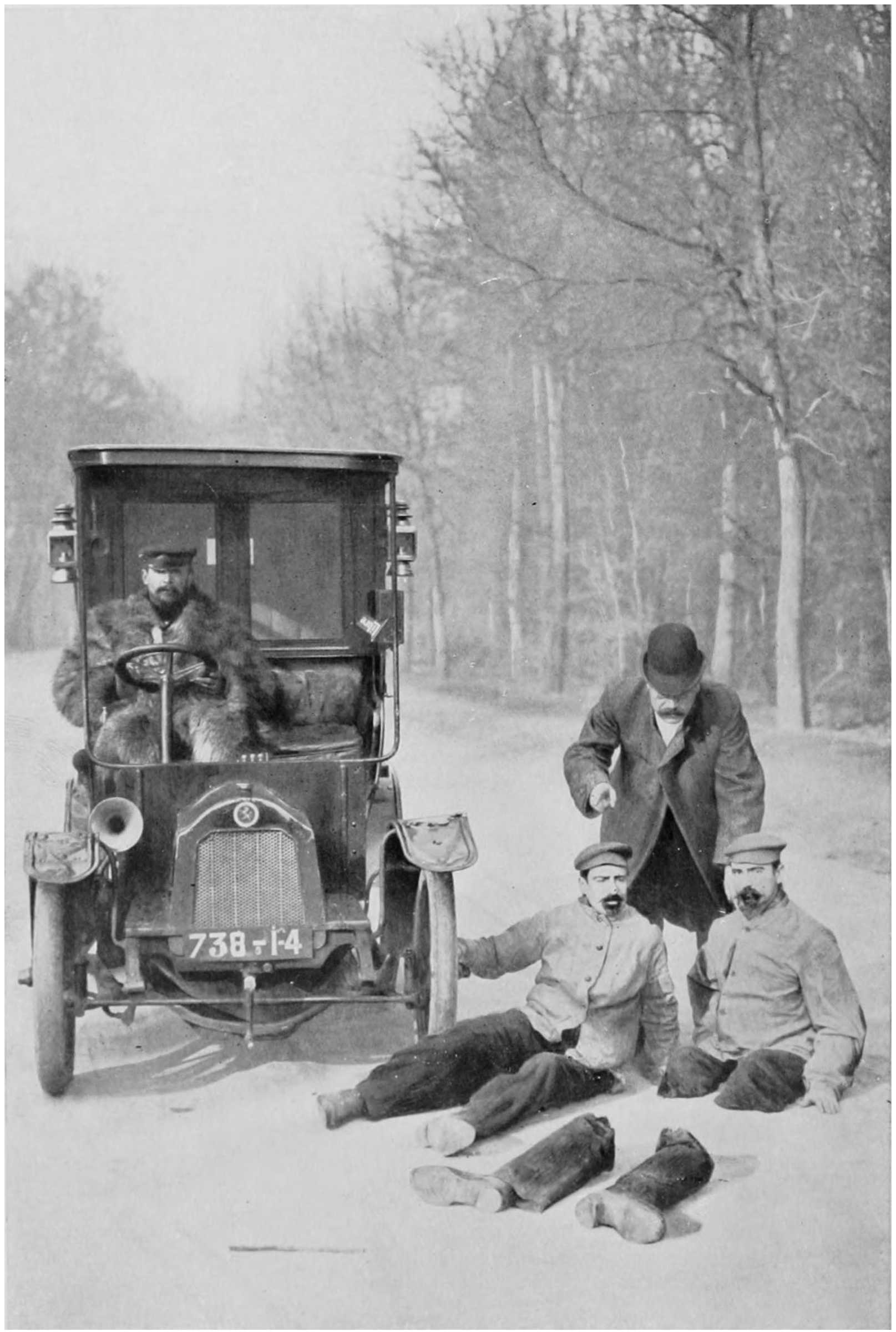
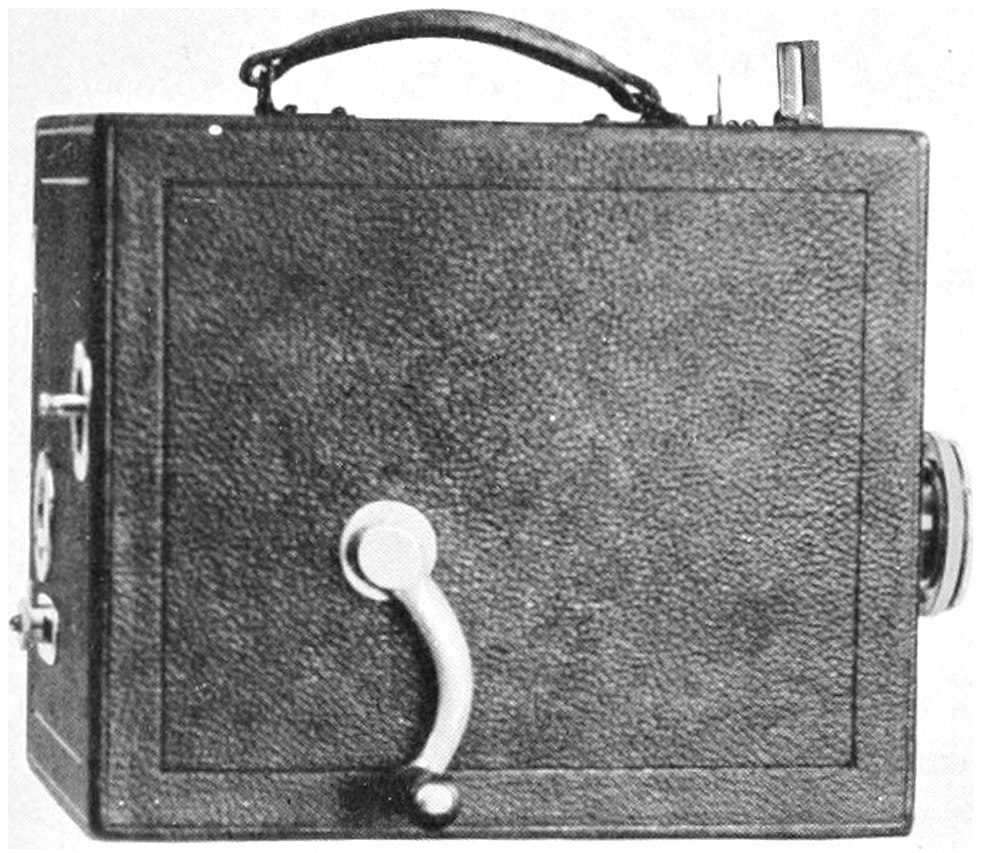
PREFACE
The marvellous, universal popularity of moving pictures
is my reason for writing this volume. A vast industry has
been established of which the great majority of picture-palace
patrons have no idea, and the moment appears
timely to describe the many branches of the art.
I have endeavoured to deal with the whole subject in a
popular and comprehensive manner. I have been assisted
by several friends, who have enabled me to throw considerable
light upon the early history of motion photography
and the many problems that had to be mastered
before it met with public appreciation:—MM. Weiss and
Bull, the Director and Assistant-Director respectively of
the Marey Institute in Paris; M. Georges Demeny;
Messrs. Frank L. Dyer, the President of Thomas A.
Edison, Incorporated; W. F. Greene, Robert W. Paul,
James Williamson, Lumière & Sons, Richard G. Hollaman,
the Eastman Kodak Company, Dr. J. Comandon,
F. Percy Smith, Albert Smith, and the numerous firms
engaged in one or other of the various branches of the
industry.
I am indebted especially to the editor of L’Illustration,
the well-known Parisian illustrated weekly newspaper, in
conjunction with the Société des Établissements Gaumont,
for permission to publish the photographs illustrating
Chapters XIX., XX., and XXI., as well as the frontispiece;
also to Mr. A. A. Hopkins, the author of
“Magic,” and to Messrs. Munn & Co., the proprietors of
The Scientific American, of New York, U.S.A.
The book makes no claim to being a practical manual,
because thereby intricate technicalities would have been
unavoidable. The information respecting the various
mechanical aspects of cinematography are set forth in a
readable manner, so that the broad principles may be
understood.
While the most popular features of motion photography
are described fully, I have not omitted to introduce the
reader to the educational and scientific developments,
which are more wonderful and fascinating. Indeed,
the cinematograph will probably achieve greater triumphs
in these fields than it has accomplished already as a source
of amusement.
FREDERICK A. TALBOT.
CHAPTER I WHAT IS ANIMATED PHOTOGRAPHY?
From the day when it was found possible (by the aid of
sunlight) to fix a permanent image of an object upon a
sensitised surface, inventors steadily applied their ingenuity
to the problem of instantaneous photography. In other
words, they strove to realise the possibility of photographing
an object in motion.
In our days the idea of “snap-shot” photography is such
a commonplace that we can no longer realise the proportions
of the task which confronted the early inventors.
Probably most of us are unacquainted with the conditions
under which the first photographs were taken. The writer
has often heard a member of his family relate the amusing
story of an ordeal which, as a lad, the latter underwent
at the hands of the Frenchman, Daguerre. He was seized
upon by the inventor as an experimental subject and
was forced to sit in the brilliant sunlight for a long time.
It seems incredible, but it is true, that when photography
was in its infancy, an exposure of six hours was required
to secure a recognisable impression of an object—a circumstance
which left practically nothing but still life as feasible
subjects for photography.
The problem which confronted the pioneers of instantaneous
photography was the reduction of the period of
exposure from about 20,000 seconds to a mere fraction of
a second. Considering the magnitude of this difficulty,
it is not surprising that the average person was sceptical
as to its solution. The possibility of fixing a horse in
the act of jumping, a bird in the act of flying, or an
orator’s lips at the moment of uttering a word, must have
seemed nearly as remote as the discovery of the
Philosopher’s Stone. It is interesting to imagine the
sensations of the sceptic of one hundred years ago, to whom
instantaneous photography appeared a chimerical idea,
should he be recalled to life to-day and be shown first a procession
passing down the street, and a few hours afterward
the same procession repeating itself before his eyes upon
a screen in a darkened room, with all the semblance of
reality in colour and animation.
In the end, it was the chemist who solved the problem
of instantaneous photography, without which animated
photography as we know it to-day would never have been
even conceivable. He carried out innumerable laboratory
experiments for the purpose of rendering the sensitised
surface more and more susceptible to light—accelerating
its actinic speed, as it is called—until at last he revolutionised
photography, as he has changed nearly every
other field of our modern industrial life. He succeeded
in preparing a surface, or emulsion, so sensitive to
light that it can take a picture clear, distinct, and full of
detail, not merely in the space of one second, but in less
than a thousandth part of a second—a picture equal, if not
superior, to those which in the early days of photography
required an exposure 20,000,000 times as long!
The wonderful achievement of instantaneous photography
assumed at first a scientific rather than a commercial
value. Many a “snap-shot” is taken which does not
betray whether the plate has been exposed for six hours
or only one-thousandth of a second; but, on the other
hand, a “snap-shot” of a quickly moving subject may
seize upon and fix an interesting or characteristic motion.
It was this fact which led certain ingenious minds to
perceive in instantaneous photography a valuable means
of analysing motion. If a single photograph reproduced
the exact posture of a moving subject at any given instant
of time, they argued that a series of such photographs, if
taken in sufficiently rapid succession, would form a complete
record of the whole cycle of movements involved,
for instance, in the jump of a horse or the flap of a bird’s
wing.
Here, again, the inventor encountered a difficulty almost
as great as the initial one of instantaneous photography.
Not only had the chemist to devise a new sort of sensitised
plate with a gelatine coating better and more convenient
to handle than the medium before employed, but the
mechanical engineer, the optical instrument maker, and
the lens maker had to co-operate on a special sort of camera
which should minimise the interval between successive
exposures.
As earlier inventors had reduced the duration of the
period of exposure, modern ones have succeeded in their
turn in reducing the interval between exposures to a minute
fraction of a second. When this result was achieved
animated photography became a reality.
It was possible to secure a long series of consecutive
snap-shots, or instantaneous pictures depicting motion,
recorded at such brief intervals that when they were passed
swiftly before the eyes they produced the illusion of movement.
At this point it is best to consider the physiological basis
upon which animated photography rests. The word
illusion, as used above, correctly describes what takes
place. The eye sees a swift succession of instantaneous
photographs; but it is deluded into believing that it sees
actual movement.
We have all marvelled at the magician who causes
bottles, eggs, birds, and animals to appear and disappear
mysteriously before our very eyes. We know that it is
trickery, pure and simple: that the eye is being deceived.
The camera is a far more perfect trickster than the most
accomplished illusionist that has ever lived, and moving
pictures are the most cunning illusion that has ever been
devised.
In order to convey this delusion, the photographer has
taken advantage of one deficiency of the human eye.
This wonderful organ of ours has a defect which is known
as “visual persistence.” Briefly defined, this means that
the brain persists in seeing an object after it is no longer
visible to the eye. I will make this clear by further
explanation.
The eye is in itself a wonderful camera. The imprint of
an object is received upon a nervous membrane which is
called the retina. This is connected with the brain, where
the actual conception of the impression is formed, by the
optic nerve. The picture therefore is photographed in the
eye and transmitted from that point to the brain. Now
a certain period of time must elapse in the conveyance of
this picture from the retina along the optic nerve to the
brain, in the same manner that an electric current flowing
through a wire, or water passing through a pipe, must
take a certain amount of time to travel from one point to
another, although the movement may be so rapid that the
time occupied on the journey is reduced to an infinitesimal
point and might be considered instantaneous. When the
picture reaches the brain a further length of time is
required to bring about its construction, for the brain is
something like the photographic plate, and the picture
requires developing. In this respect the brain is somewhat
sluggish, for when it has formulated the picture imprinted
on the eye, it will retain that picture even after the reality
has disappeared from sight.
This peculiarity can be tested very easily. Suppose the
eye is focussed upon a white screen. A picture suddenly
appears. The image is reflected upon the retina of the eye,
and transmitted thence to the brain along the optic nerve.
Before the impression reaches the brain the picture has
vanished from the sight of the eye. Yet the image still
lingers in the brain; the latter persists in seeing what is
no longer apparent to the eye, just as plainly and as
distinctly as if it were in full view. When the image does
disappear, it fades away gradually from the brain.
True, the duration of this continued impression in the
brain is very brief. In the average person it approximates
about 2/48ths of a second, which appears so short as not
to be worth consideration. Still, in a fraction of time a
good deal may happen, and in the case of animated
photography it suffices to bring a second picture before
the eye ere the impression of the preceding image has
faded from the brain. The result is that the second picture
becomes superimposed in the brain upon the preceding
image; and being stronger and more brilliant, it causes
the disappearing impression to merge or dissolve into
itself.
Indeed, one might go farther, and say that the brain
acts in the same manner as a dissolving lantern. This
apparatus is very familiar to us all, and in its most
approved type one view is dissolved into another. For the
purpose two lanterns are required, placed either side by
side or one above the other, and both focussed upon the
screen. For the purpose of illustrating our complex point
we will consider that they are one above the other. A slide
is projected brilliantly from the uppermost lantern.
Presently the moment arrives to change the slide. If the
operator withdrew it from the upper lantern and inserted
another there would be a defined break or blank interval
upon the screen betraying the change. So he inserts
the new slide in the lower lantern, at the same time
increasing the volume of light emitted from that lantern,
and diminishing the volume thrown from the upper lantern.
The result is that the picture projected from the upper
lantern becomes fainter and fainter, while that shown by
the lower lantern becomes stronger and stronger, until
only the latter is seen upon the screen—the former has
merged or dissolved into the latter.
The same action takes place in the brain in connection
with cinematography. A picture is thrown upon the
screen, and remains visible for 1/32nd part of a second.
It is then eclipsed by the shutter, and—supposing that the
photographs are taken at the rate of sixteen pictures per
second—for the next 1/32nd part of a second the screen
is darkened owing to the passage of the shutter. This
division of time is not strictly correct, as we shall see later,
but for present purposes I have considered the intervals of
exposure and eclipse to be of equal duration.
Now as a picture will linger in the brain for 2/48ths of
a second after it has vanished from the sight of the eye,
the brain retains the impression during 1/32nd part of a
second, while the shutter is passing across the lens. The
second picture now comes before the eye, and although the
previous picture still will remain in the brain for another
1/96th part of a second—the difference between 1/32nd
and 2/48ths—the new picture, being the more brilliant,
becomes superimposed upon that already obtained, and
consequently causes the former dying image to merge into
the later and brighter impression. This successive dissolution
of one picture into the other continues until the
whole string of snap-shots is exhausted. It will be noticed
that every picture remains on the screen for 1/32nd of a
second, followed by a period of darkness of nearly equal
duration, the pictures thus being projected at the rate of
sixteen per second.
The illusion of movement is enhanced by the fact that
all fixed and stationary objects retain their relative positions
in each succeeding image. Suppose, for instance, that a
series of pictures, depicting a man walking along a street,
are being shown upon a screen. In the first picture the
man is shown with his left foot in the air. This remains
in sight for 1/32nd of a second, and then disappears
suddenly. Though the picture has vanished from the eye,
the brain still persists in seeing the left foot slightly raised.
One thirty-second part of a second later the next picture
shows the man with his left foot on the ground. The
shops, houses, and other stationary objects in the second
image occupy the positions shown in the first picture, and
consequently the dying impression of these objects is
revived, while the brain receives the impression that the
man has changed the position of his foot in relation to
the stationary objects, and the left foot which was raised
melts into the left foot upon the ground. The eye imagines
that it sees the left foot descend. Another 1/32nd part
of a second passes, and the right foot is seen elevated, but
the fixed objects retain their positions still, and so on.
The brain only notices the difference in the position of the
moving objects, and thus secures an illusory idea that
movement is taking place. I have taken a very simple
example to illustrate the idea. As a matter of fact, moving
pictures of men walking are seldom perfectly successful,
generally having a jerky movement.
Thus we have seen what we describe as animated photography
is not animation at all. All that happens is that
a long string of snap-shot photographs, taken at intervals
of 1/24th or 1/32nd part of a second, are passed at
rapid speed before the eye. If the pictures are projected
at the rate of one per second they resemble
ordinary magic lantern projections. As the operator slowly
and gradually increases the speed, the figures shown in
the pictures assume a spasmodic motion, as if their limbs
were moved jerkily by means of strings; this action
becoming less and less pronounced as the speed is
accelerated, until, at last, when the operator gains the
requisite rate of projection, the jerky movement becomes
resolved into steady rhythmic action.
In the early days it was difficult to convey the impression
that motion was being shown, because the movement of
the shutter cutting off the picture was so emphasised as
to convey a distinct sense of blankness between the successive
images. This regular intermittent occurrence of
invisibility, described as “flicker,” caused tremendous
strain to the eyes, and provoked nauseating headache.
When the flicker was eliminated the strain ceased; the
illusion was rendered more perfect as well.
In order to satisfy one’s self that the semblance of
animation is an illusion, one has only to compare the projection
of a moving object upon the screen, and its
appearance in the camera obscura. In the latter case
absolute continuous motion is shown. It may be said that
complete animation by photography is quite out of the
question with the single camera and projector. How it
can be avoided and a more perfect camera obscura effect
produced upon the screen is described later. Mechanical
ingenuity has not succeeded yet in achieving such a result
by means of a single lens.
As a matter of fact, only one-half or less of the movement
that actually takes place is recorded upon the film.
What is lost occurs during the period the shutter is closed
after exposure, in order to permit a fresh area of sensitised
surface to be brought into position behind the lens. However,
the lapses are equal in point of time; and when
sixteen pictures are taken per second, the interruption in
the movement is not detected by the brain.
It may be asked why the operator confines himself to
photographing at a speed of about sixteen pictures per
second. This question is governed for the most part by
economical motives. Film is expensive, and therefore the
obvious point is to consume the minimum of material to
secure the illusion. When Edison produced the kinetoscope,
at least thirty pictures per second were necessary
to bring about the illusion, but Messrs. Lumière and Paul,
by means of their apparatuses, which were the first commercial
cinematographs, reduced the number to sixteen
pictures per second. If twenty-four photographs were
taken and projected per second the result would be practically
no better than when only sixteen pictures were made
in the same period, so that the additional eight pictures
and their requisite length of film represent so much wasted
effort and material.
This law in regard to visual persistence concerning the
number of pictures per second holds good only so long
as pictures are taken and projected in monochrome or black
and white. When animation in colour is introduced,
the illusory effect produced upon the brain becomes disturbed,
as is explained in the chapter dealing with this
latter development of the art.
An interesting illustration of the fact that the eye is
deceived may be narrated. A film of a train passing
through a tunnel was required. Two trains were secured
for the purpose, and at the rear of the leading train the
camera was mounted in order to photograph the one following,
care being observed to keep them an equal distance
apart. In the darkness of the tunnel the question of
illumination for the purposes of the exposures was somewhat
perplexing. Various expedients were attempted, but
all to no avail, and it appeared as if the task would have
to be abandoned.
One of the party thereupon suggested a novel solution
of the difficulty. A section of the track was marked off,
and subdivided into short sections. The train was brought
to the first mark and there stopped, when a flashlight
photograph was made. It was then advanced to the next
mark, and another flashlight instantaneous picture was
secured. This process was repeated several times, the
train being moved forward about eighteen inches between
each exposure. About fifty exposures were made in this
manner, and the length of exposed film thus obtained
was multiplied to form a continuous picture of great length.
When projected on the screen several hundred photographs
were passed before the audience at the speed of sixteen
pictures per second, and the semblance of motion was
perfect, the train having the appearance of travelling
through the tunnel at express speed.
This is one of the most interesting examples known to
me of illusion by animated photography, and although it
was not motion at all that was recorded, still it sufficed to
convey the impression of movement to the public. In the
course of the following chapters, however, various successful
illusions caused by this means are described,
especially in regard to “trick pictures.”
CHAPTER II THE FIRST ATTEMPTS TO PRODUCE MOVING PICTURES
The idea of producing apparent animation by means of
pictures is by no means new. The origin of the most
primitive form of moving picture device is lost in the mists
of antiquity; but it is certain that long before photography
was conceived animated pictures were in vogue, and constituted
a source of infinite amusement among children.
The illusion was secured by a simple device known as the
Zoetrope or the “Wheel of Life.” It consists of a small
cylinder, mounted on a vertical spindle in such a way
that it is free to revolve horizontally. A band of thin
cardboard, or thick paper, on which is painted a series of
pictures, generally in colour, depicting successive stages
in a particular movement, such as a horse jumping, a child
swinging, or two youngsters playing see-saw, is placed
horizontally around the inside of the lower half of the
cylinder. The upper half is pierced at regular intervals
by long narrow slits or vertical openings, which come
opposite the pictures and extend only about half-way down
the length of the wall. When the cylinder is rotated
sharply and one looks through the slits, the pictures
portray apparent motion—the horse rises and falls in the
jump, the swing moves to and fro, and the see-saw goes
up and down—in accordance with the laws of visual
persistence.
Each successive picture, it must be pointed out, is interrupted
by the space in the surface of the wall between two
consecutive slits through which one peeps into the cylinder.
We have, in fact, a cinematograph in the most primitive
form; the space between the apertures corresponding to
the opaque sector of the shutter of the camera and the
projector, whereby one picture is eclipsed from view on
the screen to permit the next to be brought before the lens.
Indeed, one can easily convert the zoetrope into a cinematograph
if, instead of painted pictures, prints of a cinematograph
film are mounted in the same way. As a matter
of fact, some ingenious person followed this practice years
ago, thus unconsciously producing the first animated
pictures by photography, and in a crude way anticipating
the kinetoscope.
From time to time the zoetrope was modified and revived
in the praxinoscope, phenakistoscope, zoopraxinoscope,
and a number of other forms with awe-inspiring names. In
every instance, however, it was merely our old friend in
a new guise. One of these modifications created a flutter
of excitement in France in 1877. It was called the
“praxinoscope,” and its creator, M. Reynaud, for the first
time enabled a large audience to see animation upon the
screen.
In this case projection was carried out in a highly novel
manner. The front, or proscenium opening, of the stage
was occupied by a large white screen, such as is used for
magic lantern projection, the operator and his apparatus
being on the stage behind, out of sight. Accordingly the
audience saw the picture through the sheet. At the back
of the stage a limelight lantern was set up, from which a
still life picture was thrown, filling the greater part of the
surface of the screen. The picture thus shown formed
as it were the setting for the animated picture, in just the
same way as the scenery comprises the environment for a
stage play.
Below the level of the stage was a large rectangular table,
at each corner of which were placed small vertical rollers.
At one end of the table were two large spools, fitted with
handles which were revolved horizontally. One spool
carried a long band of transparent material, on which were
painted at regular intervals silhouette figures in colour in
successive stages of movement. The band led from this
spool round the vertical roller immediately adjacent, then
along the side of the table to the next corner, on to the
next corner, on to the third corner, back to the fourth
corner, and then to the empty reel, on which it was wound.
By simultaneously rotating the loaded spool with the left
hand, and the second reel with the right hand, the
transparent picture band was passed round the table from
one spool to the other.
Centrally with the sheet, and on a level with the table,
there was a second limelight lantern, the back of which
was towards the audience. This lantern threw its rays
upward at an angle of forty-five degrees or so. As the
band of pictures travelled along the table edge from the
first to the second corner roller, it was passed through this
second lantern, which projected the silhouette picture into
a mirror hung overhead at the back of the stage, which in
turn reflected the image on the screen. The figures on
the band thrown from the second lantern appeared in the
scene of the slide shown by the first lantern. As the band
was moved forward, bringing successive phases of action
upon the screen, apparent motion was produced. In fact,
animated pictures were shown, and it was possible with a
number of spools of painted bands to produce a comedy,
tragedy, or other stage play in pictures. This crude
apparatus was the first attempt to portray moving pictures
upon a sheet before a large audience.
As instantaneous photography developed and efforts were
made to adapt photographic records instead of painted pictures
to the praxinoscope, great difficulty was experienced
in securing the consecutive pictures sufficiently close to one
another so as to reduce the loss of action between two
successive pictures to the minimum. The cameras available
were not suited to this work. Too much time was
lost in removing the exposed sensitised surface to permit
another unexposed area to be brought before the lens.
About 1872 Mr. Muybridge, an ingenious Englishman,
resident in San Francisco, conceived a novel means of
obtaining snap-shot photographs in rapid succession. He
maintained that such photographs taken at regular
intervals, reproduced in such a manner as to simulate
natural animation, would reveal the peculiar attitudes of
animals in motion and would prove of invaluable service
to artists. He approached Governor Stanford and unfolded
his scheme. Stanford was so impressed that he
placed every facility at Muybridge’s disposal for the completion
of the experiment, including the use of his valuable
stud of horses and exercising track.
As it was impossible to secure the desired end with a
single camera, Muybridge built a studio beside the track,
in which twenty-four cameras were placed side by side in a
row. On the opposite side of the track, facing the studio,
he erected a high fence, painted white, while across the
track between the studio and the screen twenty-four threads
were stretched, each of which was connected with a powerful
spring, which held in position the shutter of a camera.
When all was ready, a horse was driven over this length
of track at a canter, gallop, trot, or walk, as desired, and
as the animal passed each camera, it broke the thread
controlling its shutter, so that the horse photographed itself
in its progress. In these experiments, however, Muybridge
made no effort to secure detail. The photographs were
taken in brilliant sunlight, and the white screen threw a
dazzling reflection, causing the objects to stand out in bold
relief, so that the record appeared in silhouette. As these
photographs were taken for a specific purpose—the analysis
of movement—the screen was subdivided into panels,
whereby it was possible to determine the distance between
each successive picture. (Fig. 1.)
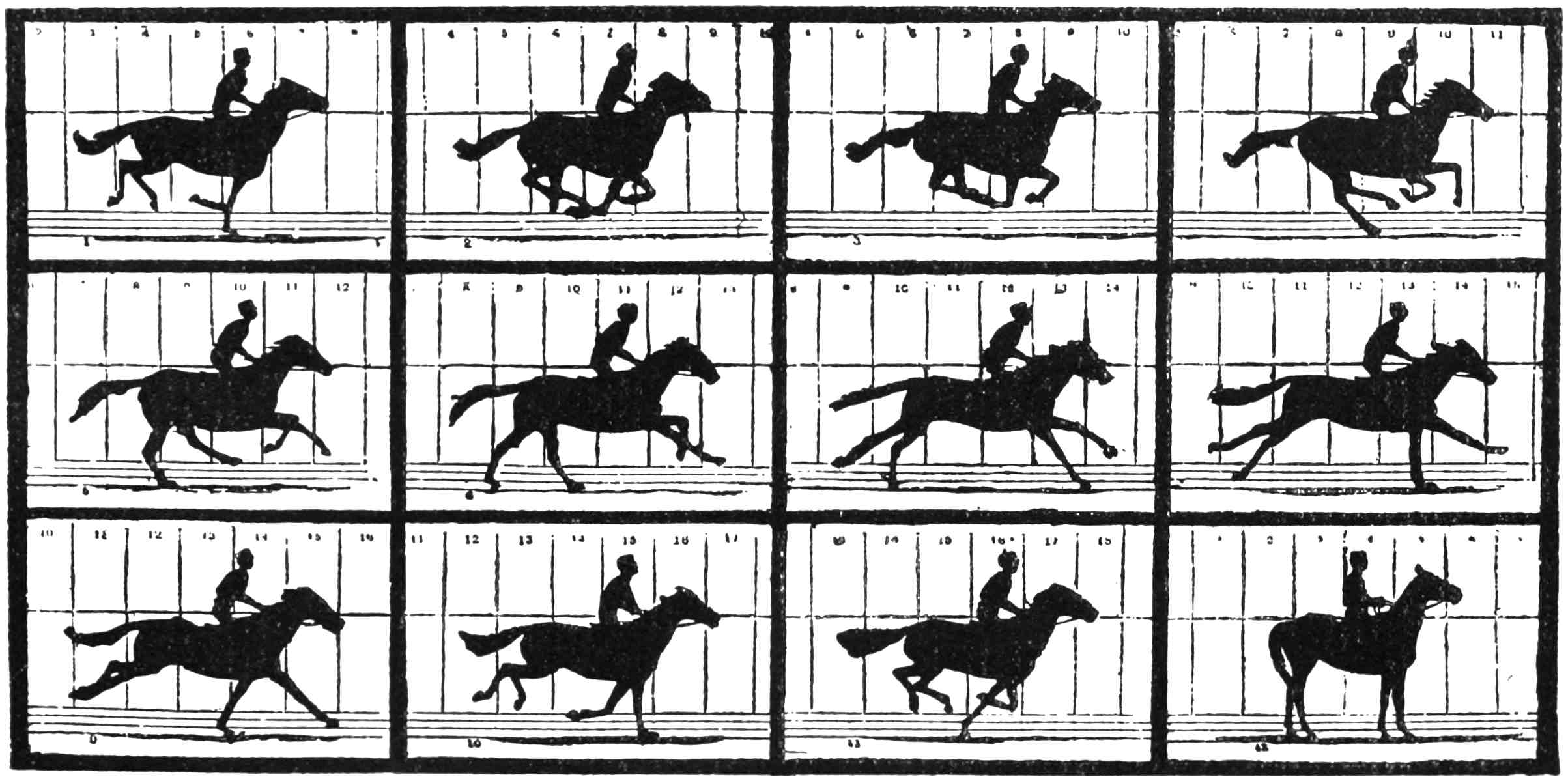
[By Permission of “The Scientific American.”
Fig. 1.—The First Moving Pictures.
Twelve successive photographs, by Mr. Muybridge, of a horse in full gallop. In the last figure the horse is seen standing still. The speed
of the horse was about 1,142 metres (3,746 feet) per minute.
As Muybridge’s experiments were carried out upon a
somewhat private basis, the information about them that
reached Europe was of a very meagre description. In
France, however, they aroused a strong curiosity and
peculiar interest, especially in artistic and scientific circles.
They appealed especially to one man—Meissonier. The
great artist, whose accuracy in the most minute detail was
proverbial, was fascinated. He had observed very closely
the curious attitudes that horses assume when in rapid
motion, and had committed the observations to his canvases,
only to meet with strenuous hostile criticism from his
colleagues and the public. So when Governor Stanford,
while visiting Paris, displayed some of Muybridge’s photographs,
the great painter spent hours in studying them,
and characterised them as an incalculable aid to art.
Through Governor Stanford, he extended an invitation to
Muybridge.
In the following year the Anglo-American experimenter—who
might be described as the father of animated photography—visited
the French capital, and received a warm
greeting by Meissonier. The artist had been criticised
for his views concerning muscular action, as displayed by
the animals on his canvases, yet here was a man who could
demonstrate, by the conclusive evidence of photography,
that his views were correct. Meissonier arranged a private
demonstration, which ranked as one of the most important
social events of the year in Paris. Among those who
accepted the invitation to witness the new wonder were
Gerome, Goupil, Steinheil, Detaillé, Alexander Dumas,
and Dr. Mallez. Muybridge had brought a representative
collection of photographs with him, showing horses in
movement, dogs, deer, and other animals running and
jumping, as well as men wrestling, leaping, and performing
other athletic exercises.
The pictures were examined at great length individually.
Then by means of the zoopraxoscope, a form of the wheel
of life, whereby pictures in action could be thrown upon
the screen, they were displayed in animation, thereby conclusively
demonstrating the fact that what appeared so
incredibly singular an attitude in a painting or an individual
photograph was in reality part of a graceful
harmonious natural movement.
There was one feature of Muybridge’s work which must
not be overlooked, and which decidedly restricted its
application. A battery of cameras had to be employed,
placed side by side. It was as if a number of
photographers, standing in a row, pressed a button the
instant the object in motion was opposite their respective
cameras. All the photographs were broadside views, and
taken from the same relative position. The results were
not as the following eye of one person saw them, but as
the eyes of twenty or thirty persons standing side by side
grasped a glimpse of motion during the five-thousandth
part of a second. If Muybridge had attempted to take
900 photographic impressions, such as the cinematograph
camera records in the space of a minute to-day, he would
have required nine hundred cameras for the purpose.
Of course, such a plan had no commercial possibilities.
Its real value lay in the fact that it stimulated the ingenuity
of a host of inventive brains towards the solution of
animated photography. One and all were bent upon
securing the same result that Muybridge had achieved, but
with a single camera and from one point of view. Among
these experimenters the names of Greene and Evans, Acres
and Paul stand pre-eminent in Great Britain, while France
and the United States had an equal number of contemporaneous
investigators engaged upon the problem. Even
Muybridge himself attempted its solution, for he realised
only too well that a battery of cameras was impracticable
to ensure the commercial success of animated photography.
It appears to be a sorry trick of fortune that every great
invention, or development, should produce a bevy of
claimants for the honour of being the “original inventor.”
The word “original” is somewhat obscure and ambiguous,
but it is employed frequently. As a matter of fact, it is a
wise invention that can single out its creator. Animated
photography has been no exception to the rule. Lawyers
and the courts have reaped a rich harvest from protracted
litigation in the effort to settle the question once and for
all, with the inevitable result—the law has left the matter
in a more hazy condition than ever.
The claim to the discovery of animated photography can
scarcely be sustained by any one man. Desvignes devised
an apparatus in 1860; Du Mont formulated the first tangible
scheme of chronophotography, as it is called, in 1861,
which Donisthorpe put into practice in 1876, while a host
of other experimenters contributed to the problem in some
particular detail. It was not invention, for the simple
reason that there was nothing to invent; it was merely
evolution and the perfection of details. As we have seen,
what the experimenters had to accomplish was the reduction
of the length of time occupied in bringing one sensitised
surface before the lens after the preceding sensitised
surface had been exposed. This was a matter of mechanical
detail, for the chemist accelerated the speed of the sensitised
surface more and more, and finally evolved the celluloid
film. Various means of bringing successive sections of a
sensitised surface before the lens were evolved, and produced
a plethora of patents; but the perfection of details
does not affect the fundamental principle of animated
photography. In Great Britain many investigators were
energetic in the quest, but the great majority never succeeded
beyond the model stage; that is to say, their
apparatuses never possessed any practical value, and only
served to emphasise once more the truth of the well-worn
axiom that there is a great gulf between the creative mind
of the inventor and the commercial world with its enormous
capacity for development and exploitation.
Among the early British experimenters was W. F.
Greene, who, like others, was handicapped by having to
make use of glass plates. In 1885 he displayed his first
apparatus for taking and producing moving pictures, and
two years later exhibited some pictures taken on glass in
the window of his premises in Piccadilly. This unusual
display created such interest, and the curiosity-provoked
public so crowded the pavement that traffic was impeded,
and the police called upon Greene to remove his pictures.
In France even greater things were being accomplished.
Dr. E. J. Marey took up Muybridge’s work at the point
where the Anglo-American abandoned it. Marey followed
rather the lines laid down by the astronomical investigator
Jansen, who in 1874 evolved a photographic revolver to
secure records at short intervals of the transit of Venus
across the sun’s disc. Marey constructed a photographic
gun in 1882, with which he studied the flight of birds, and
which worked on the principle elaborated by Jansen eight
years before. The object of his quest was the analysis of
motion. It will be seen, therefore, that in its very earliest
stages the value of animated photography was conceded to
be rather in the field of science than that of amusement.
This celebrated French experimenter realised the inestimable
value of “chronophotography” for the study and
investigation of moving bodies, the rapidity in the changes
of the position or form of which was impossible to follow
otherwise. Marey, however, made no effort towards
synthesis or reproduction of the motion thus obtained; he
did not seek projection upon a huge scale upon the screen,
but regarded chronophotography rather as a means of
enabling photographic results to be resolved into diagrams
for examining and elucidating obscure points incidental to
motion.
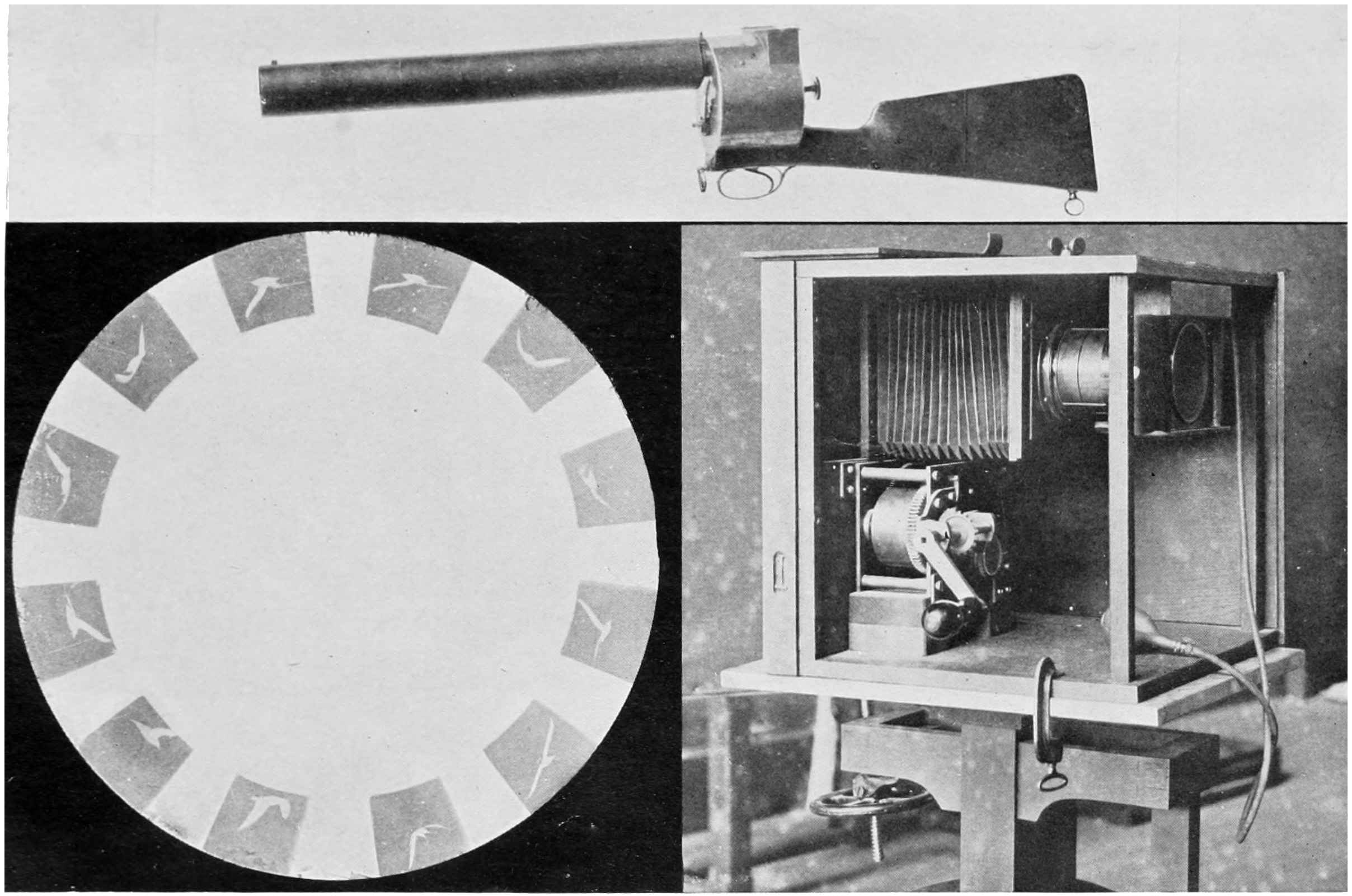
DR. E. J. MAREY’s FAMOUS EXPERIMENTS IN CINEMATOGRAPHY.
1. Photographic gun of 1882, to photograph birds in flight. 2. Consecutive pictures of a gull flying, taken with the photographic gun.
3. Chronophotographic apparatus for taking consecutive pictures upon a single glass plate, showing mechanism.
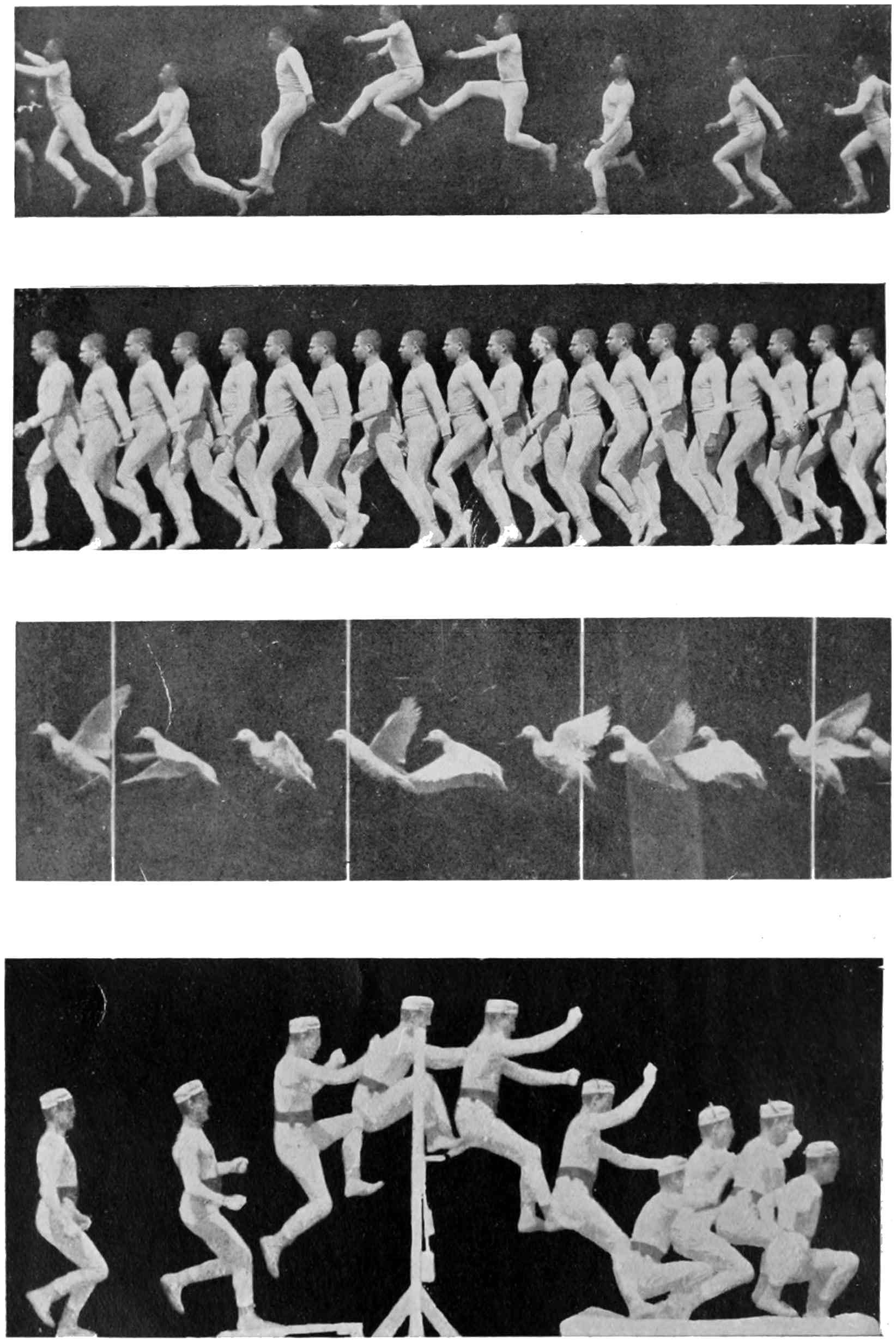
DR. MAREY’S ANIMATED PICTURES MADE IN 1884–86 FOR THE ANALYSIS OF
MOTION.
1. A man jumping. 2. A man walking. 3. A duck flying. 4. A man leaping.
The objects, clothed in white, passed before a black screen, and the exposures averaged
about 1/200 of a second.
Special apparatus was evolved and was set up at the
Physiological Station in Paris, and some wonderful results
were communicated by this industrious scientist to the
French Association for the Advancement of Science at
Nancy in 1886. Investigations were being carried out
upon a large and advanced scale in France while the
English were merely dabbling with the idea. Marey
secured records of action intermittently from a single point
of view by the revolution of a handle, and to a pronounced
degree anticipated the present-day cinematograph.
Marey’s camera was successful in its details, especially
considering the extreme difficulties attending the use of
glass plates. He ascertained that in order to secure continuous
motion it was imperative to cut off the light from
the plate at regular intervals; and he accomplished this
interruption by rotating an opaque disc, pierced with small
radial slots, which permitted the light to reach the plate
only intermittently. The general design of Marey’s camera
is shown in Fig. 2. The camera, of the ordinary bellows
type, was mounted in the upper part of a wooden frame
clamped to a special support. Beneath was the handle,
which rotated the shutter through gearing. This shutter
moved at the back of the bellows, occupying the same
position relatively as the focal plane shutter used in very
rapid still-life instantaneous photography. By means of
this shutter, the passage of a body across the field of the
lens was split up into a number of consecutive units. The
interval between two successive images, and the time of
the exposure, could be altered merely by varying the
revolving speed of the shutter. As a rule, the exposures
were made at the rate of ten per second, but in some cases
the length of the exposure was only 1/2,000th part of a
second, with an interval of one-fifth second between two
consecutive pictures. Marey used a black background, and
his figures were clothed in white.
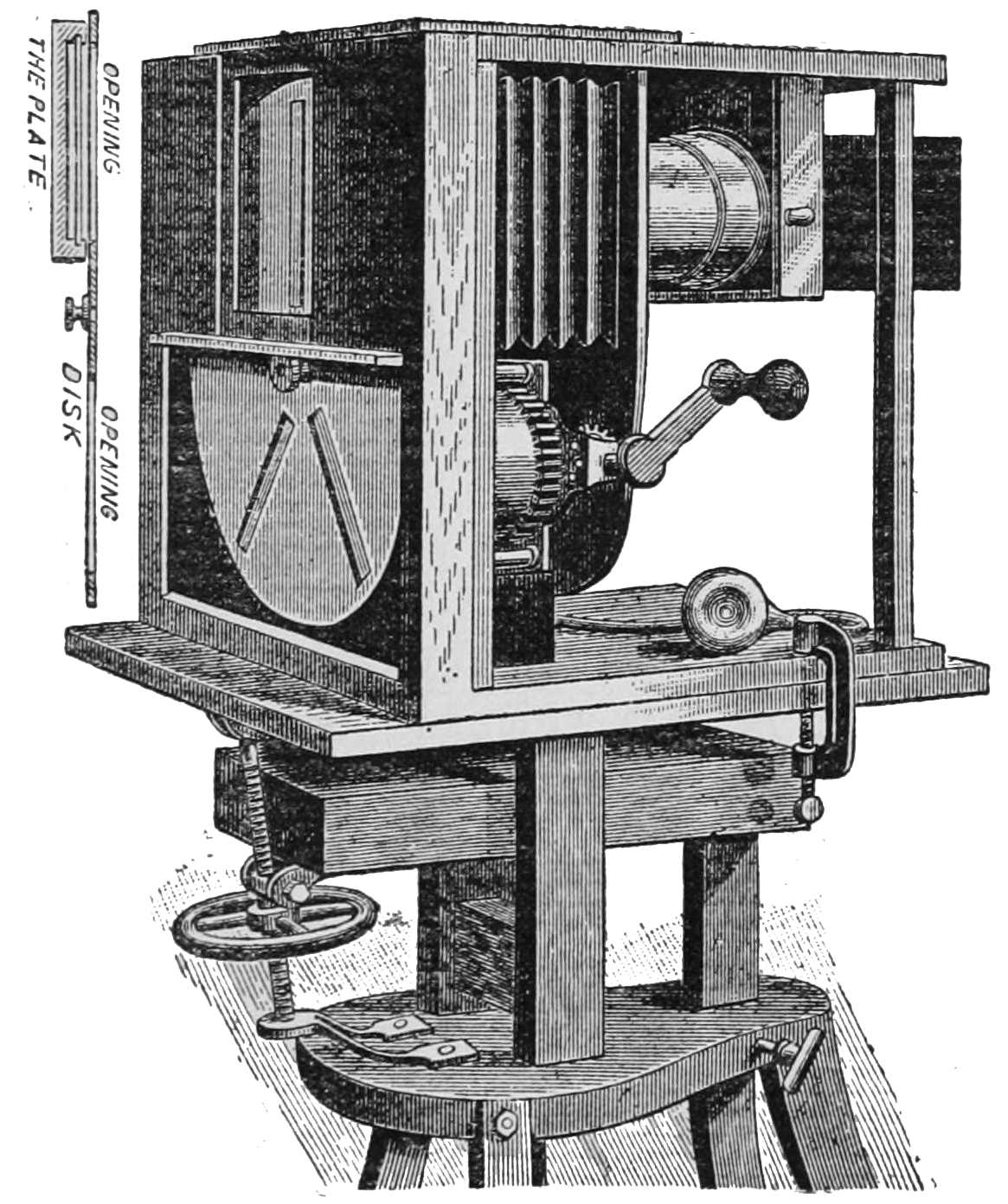
Fig. 2.—Marey’s Camera, Showing Shutter with
Radial Slots.
There was an important reason for this reversal of
Muybridge’s procedure. In the latter the shutter of each
camera had to be opened as the horse or other object
passed the lens. In Marey’s system the sensitised surface
of the plate is directed against a dead black screen, and
the lens may be left open without exercising any ill effect
upon the photographic plate, because the latter receives
no light. When a man clothed in white passed across this
black surface in full sunlight, only his figure was recorded
upon the sensitised surface, and thus was thrown in strong
relief against the black background.
Special arrangements, however, had to be made to ensure
the success of the result. A flat plane black background
did not suffice, as a certain amount of light was reflected
therefrom into the lens, resulting in the plate becoming
fogged. The black screen employed was in reality a black
cavity, known as “Chevreul’s black.” The cavity may be
likened to a shed, the front wall of which is removed, and
the whole interior blackened. In the screen used by Marey
at the Physiological Station in Paris, the back of the shed
was hung with black velvet, the floor was covered with
pitch, while the sides and ceiling were treated with a dead
black medium.
These arrangements enabled Marey to secure more useful
results than were possible to Muybridge. From the
scientific point of view they proved of incalculable value.
His marvellous pictures widened our knowledge of animal
motion to a remarkable extent, and provided incontrovertible
records of action. Professor Marey ultimately
recorded the sum of his experiments in a volume, Movement,
which is now regarded universally as a classic in
physiological science, and even to-day is consulted freely
for the purpose of elucidating complex and obscure phases
of motion.
Other investigators at about this time were General
Sebert, M. L. Soret of Geneva, and Ottomar Anschütz of
Berlin. Soret succeeded in analysing some very intricate
movements, while Anschütz produced a curious “wheel of
life,” which was called the “electrical tachyscope.” A
special camera was evolved whereby photographs were
taken in rapid succession. From these negatives glass
transparencies similar to lantern slides were produced, and
mounted in sequence around the rim of a large wheel, which
had to be of sufficient diameter to contain the whole series
of pictures. It was mounted upon a massive iron pedestal,
and was revolved from the rear by means of a
handle.
Behind the wheel, and at the highest point, which corresponded
to the level of the eyes of the average person
while standing, a small box was placed. The front of this
box was open, the size of this aperture corresponding
exactly to the dimensions of the transparency. It was
fitted with a small electric light—a Geissler tube, in fact,
through which a current was passed from a Rhumkorff
coil—and this light was switched on and off by each
picture as it passed before the front of the lamp box. As
each picture came into position before the aperture a contact
was established, and an impulse of electricity was discharged
through the lamp. It was a mere flash, but it
served to illuminate the transparency immediately in front,
so that the people gazing at the wheel received a brilliant
and well-defined impression of the picture, which was shown
in an apparently stationary position, though, in fact, the
wheel was revolving continuously. When the wheel was
rotated with sufficient speed, the flashes occurred in such
rapid sequence that, in accordance with the phenomena of
visual persistence, the illusion of animation was secured.
This was an extremely ingenious apparatus, but was too
complicated, expensive, and elaborate to command any
commercial value. It was regarded generally as a scientific
toy. It was on view in London, in the Strand near
Chancery Lane, for a little while, but failed to arouse very
marked enthusiasm. However, the “inventor’s fiddle,”
as the Anschütz tachyscope was popularly called, was
adopted by several other inventors with certain modifications,
but its application was naturally extremely limited.
Comparatively speaking, only a very few pictures could be
carried in the rim of the wheel, and as the travelling speed
was somewhat high in order to convey a tangible impression
of continuous motion, a subject was exhausted in a few
seconds.
Associated with Dr. Marey in his experiments was
another indefatigable spirit, M. Georges Demeny. He
displayed considerable ingenuity in breaking down the
peculiar difficulties associated with this work. Unfortunately
the value of M. Demeny’s efforts have never been
appreciated; but he brought his mind to bear upon the
subject at a critical period, and devoted all his energies,
time, and thought to the solution of complicated problems
that defied contemporary experimenters. He proved an
indispensable colleague to Professor Marey, which the
author of Movement did not fail to acknowledge. So
far as France is concerned, he rightly deserves to be
regarded as the pioneer in cinematography. He not only
photographed motion, but he reproduced it upon the screen,
and devised an ingenious camera and projector to achieve
his end.
M. Georges Demeny was forestalled in Great Britain
by Messrs. Greene and Evans, who produced a chronophotographic
apparatus which they patented in June, 1889,
wherein the film was drawn intermittently before the lens
for exposure. Two months previously, in April, 1889,
another inventor, Stern, had filed a patent also, and these
constitute the first intimation at the British Patent Office
of the pending developments in cinematography. Neither
issued beyond the experimental and model stage, for the
simple reason that they were not reliable in their operation.
There was no satisfactory mechanical means for moving
the sensitised surfaces forward an equal distance after each
exposure, and this omission of an indispensable feature
proved fatal to their success.
CHAPTER III THE SEARCH FOR THE CELLULOID FILM
In the struggle towards the perfection of animated
photography the use of glass plates was a great hindrance.
Investigators were hampered very seriously; they were
thwarted at every turn. True, the appearance of the dry
plate somewhat facilitated their efforts, but nevertheless
the inevitable glass was bulky, heavy, fragile, and awkward
to handle. Finally, the number of pictures obtainable
upon a single surface was limited.
Realising the restrictions incidental to this sensitised
medium, the energies of many investigators were devoted
to the discovery of a less bulky, lighter, and more convenient
substitute. Gelatine appeared promising at first
sight, but failed to give the anticipated results because it
lacked stability, and when immersed in the developing
solution precipitated a variety of unexpected disasters
which placed it out of court completely. The next expedient
was the use of transparent paper, similar to what we
call grease-proof paper, covered with the gelatine emulsion,
invented by Morgan and Kidd, of Richmond. When the
exposures were made, the paper was opaque and resembled
ordinary bromide paper, the essential transparent effect
being secured by an operation after development and
fixing. This failed to give a clear, distinct positive, and
the grain of the paper so broke up the resultant picture
that this alternative was abandoned. A suggestion advocated
by the Rev. W. Palmer also was attempted. The
picture, after development and fixing, was stripped from
its opaque support, and attached to a stiff sheet of insoluble
gelatine. This gave a somewhat better effect, but it was
a round-about method, and the stripping operation was
one of great delicacy, involving extreme care, and uncertain
in its results.
These substitutes failing one after another, the hopes of
the experimenters became centred upon celluloid, which
from every point of view appeared the most suitable
medium. The application of celluloid to photographic
purposes had been advocated many years previously, but
there were many obstacles of a technical character which
prevented its use at the time. The investigator, however,
continued the struggle towards bringing the celluloid film
into the realm of practicability.
He was baffled in one particular direction. Celluloid
could not be employed with the collodion process, for the
collodion which constituted the sensitive surface in the old
wet process with glass plates, and which in itself is a
solution of pyroxyline, a kind of gun-cotton—one of the
basic constituents of celluloid—dissolved the celluloid which
was coated with it. The perfection of the gelatino-bromide
process removed this defect.
Then another difficulty loomed up. Celluloid at that
time was not made in sheets sufficiently thin to render it
applicable to photography, and the manufacturers of the
commodity could not be prevailed upon to prepare the
substance in this form. They argued that there was no
promise of a sufficiently remunerative market to warrant
the design of special machinery for the manufacture of such
a product. Consequently, the experimenters were forced
to prepare their own film bases.
The experiences of those who grappled with this question
and faced trials and tribulations innumerable in this particular
phase of operations make interesting reading. One
reduced the celluloid to a liquid consistency and poured
the plastic mass over large glass plates, rolling it out to
form a thin skin. The surface of the glass previously was
cleaned carefully to prevent the mixture adhering thereto.
The pouring had to be carefully done so as to secure an
even thickness, and to avoid the formation of air bubbles.
In this way a thin sheet was secured—a decided forward
step. In the dark room this “base,” as it is called, had
next to be covered with a thin layer of sensitised emulsion,
and the whole left to dry. Afterwards the sheet was cut
into strips of the width required for the camera and
apparatus. Unfortunately, in drying, the celluloid was
found to play many sorry tricks. It buckled, twisted, and
shrank into strange contortions, and the films thus produced
were still somewhat too substantial, being, in fact,
very similar to those used in the pack-film camera of to-day.
Another worker was more fortunate. By dint of importunity
he succeeded in inducing one manufacturing firm
to produce sheets of celluloid no thicker than drawing
paper for his experiments. But when the sheets were
delivered they were far from being satisfactory, being
deficient in uniformity of thickness. Before the surface
could be coated with sensitised emulsion a tedious task had
to be performed. The inequalities had to be scraped and
pared off, and finally the whole sheet had to be made
thinner by being rubbed down with emery cloth and sandpaper.
Hours were occupied in this process, and often a
maddening accident happened in the final stages which
irreparably injured the sheet and wasted not only time, but
costly material. Even when sensitising was carried out
successfully, it was found extremely difficult to keep the
material flat. It is not surprising that after a prolonged
experience of these disadvantages, this particular investigator
abandoned his experiments for a time.
In the majority of these efforts the pictures obtained were
about four inches in width by three inches deep, while the
modern cinematograph film is only 1⅜ of an inch in width
by three-quarters of an inch deep, and almost as thin as a
shaving. The celluloid made at that time was not very
transparent, and as the pictures were somewhat dense, the
results were far from being satisfactory.
It began to look as though celluloid were doomed to
follow in the wake of the other expedients that had been
tested and found wanting. Such would have been the case
but for the indefatigable efforts of one man who persevered
with his experiments in the face of heartrending failures
and disappointing results. This was Mr. Eastman, of
Rochester, in the State of New York, who worked in conjunction
with Mr. Walker. These two gentlemen had
established a dry photographic plate manufacturing
process, which had developed into a conspicuous success,
and become known as the Eastman Dry Plate Company,
now familiar as the Eastman Kodak Company.
The story of their innumerable experiments and ultimate
success constitutes a fascinating chapter in the story of
animated photography. As early as 1884 Mr. Eastman
realised that a substitute for glass was in demand to facilitate
ordinary photography. Accordingly he set out to
discover a system of photographing on films. As he
admits himself, it was by no means a new idea. From time
to time spasmodic attempts in the same direction had been
made by enterprising inventors, the earliest known dating
back as far as 1854, a year or two before the invention of
Parkesine, now known as celluloid, by Mr. A. Parkes, of
Birmingham. All of these experimenters, however, had
been baffled by the technical difficulties confronting their
quest, and Mr. Eastman had no tangible assistance to aid
him in his work of research. He was compelled to create
the foundation upon which to carry out his developments,
and to reap success from mortifying failures.
In 1884, when Messrs. Eastman and Walker commenced
operations, the problem to be solved in the production of a
suitable film, and the evolution of the means to handle it
in the camera, were formidable obstacles. The mechanical
part of the work proved the easier, and in 1885 roller
photography, which has revolutionised the art of photography,
at any rate from the amateur point of view, was
invented and put on the market. This principle is now
well known. A length of film, wound upon one roller, is
passed behind the lens in sections for exposure, and then
rolled up on a second roller, until the whole has been
exposed. The device simplified the process very appreciably,
and it may fairly be accused of being the parent of
the modern “Kodak fiend.”
Though the mechanical part of the problem had thus
been solved successfully, the film question was perfected
only partially at this time. The film itself was far from
satisfactory, but it sufficed to meet the requirements of the
day, and to enable roller photography to come into vogue.
To meet the peculiar demands of roller photography,
Mr. Eastman had set himself the task of producing a
transparent base or support for the sensitised emulsion.
That is to say, he sought and produced a stable substitute
for the glass plate upon which the sensitised emulsion to
record the image could be mounted. It was no easy search,
as he speedily found to his cost, for it involved scores of
experiments, one after the other, all of which resulted in
heartrending failure. He sought to build up such a base
as he had in mind by means of successive layers of
collodion and rubber, but the result did not possess sufficient
substance and strength.
Then he had recourse to paper, which he used merely
as a temporary support. The roll of paper was first coated
with soluble gelatine, and afterwards with the sensitised
emulsion, which was rendered insoluble in itself by the
addition of chrome alum. This produced a substantial
film which was exposed by means of the roll holder
attached to the ordinary camera. The image was developed
and fixed. Then, still attached to the paper,
the film was placed while wet, immediately after washing,
upon a piece of glass coated with a thin solution of
rubber.
As soon as the surface had dried, hot water was applied
to the paper, which as the gelatine dissolved became
detached, leaving the film adhering to the surface of the
rubber-coated glass. In place of the paper a moistened
thin sheet of gelatine was substituted. When the whole
had dried thoroughly it was detached from the glass, and
the result was a perfectly transparent negative.
The process was necessarily somewhat intricate and
occupied some time, but the results obtained were sufficiently
practicable to render it commercially exploitable.
Mr. Eastman, however, soon recognised the fact that the
trouble of transferring the image from the temporary paper
base to the gelatine support decreased the practical value
of the process. He decided to dispense with the paper
support entirely, and in his search for a suitable substitute
his thoughts turned toward celluloid. He communicated
with the various manufacturers of that material, but not
one was prepared to supply him with the substance in
sheets of sufficient size and thinness. Consequently he
was compelled to devise ways and means to supply the
deficiency; and this was achieved partially by accident.
In the early part of 1889 some experiments were being
made to discover a varnish to take the place of the gelatine
sheets. One of his chemists drew Mr. Eastman’s attention
to a thick solution of gun-cotton in wood alcohol. It
was tested to prove its suitability to take the place of the
gelatine, but was found wanting in practical efficiency.
However, Mr. Eastman recognised the solution as one
which might prove to be the film base for which he had been
searching. He had had such a medium in mind when
engaged in his first experiments in 1884, which resulted
in the production of the stripping film. He decided to
utilise this solution of gun-cotton in wood alcohol and to
fashion it into the foundation for the sensitised emulsion,
so that stripping and other troublesome operations of a
like nature might be avoided. He was moved to this
experiment because this solution could be made almost
as transparent practically as glass. Accordingly he set
to work to devise a machine to prepare thin sheets such
as he required from this mixture. Success crowned his
efforts, and in 1889 the first long strip of celluloid film
suited to cinematograph work appeared in the United
States.
Messrs. Eastman and Walker had not been alone in
their quest. In England experiments were being carried
out in the same field. Curiously enough, the main idea
in this instance was to evolve a form of roller photography,
the British experimenter being Mr. Blair. He likewise
met with success; and the film was manufactured at St.
Mary Cray in Kent. Though this film was far from being
perfect, showing considerable variation in thickness, it
served to assist the experiments in animated photography
to a marked degree. The celluloid strip thus produced
was about twice the width of that now used in cinematography,
and as in the early attempts towards moving
pictures, no effort was being made towards projection—the
illusion was received by looking into an instrument
through which the film travelled, and behind
which a light was placed—it was made with a matt surface,
so that it closely resembled ground glass, upon which the
images stood out distinctly and brilliantly. The width
of the film was gradually decreased; but this film-manufacturing
industry never got a firm foothold in
England. The Blair company was merged in that of the
Eastman company in America, and it was not until many
years had passed that another bid for participation in the
manufacture of celluloid film for moving picture purposes
was made by a British firm.
So soon as it leaked out in America in 1889 that Mr.
Eastman had succeeded in his difficult search, and that
a film with a transparent rigid support which was no more
difficult to handle than a glass plate, and yet which was
flexible and free from fragility, was commercially available,
another experimenter appeared on the scene. He
had been labouring in the field for some years, but,
realising the futility of glass plates, had postponed his
investigations until such time that a substitute could
be obtained. His apparatus was ready, but the film
was the missing link. Immediately it was available he
secured some of the material and completed his apparatus.
That man was Thomas Alva Edison, and his “Kinetoscope,”
was the first commercial appliance to show
pictures in natural movement. Animated photography
was lifted from the realm of experiment into that of
commercial practicability.
CHAPTER IV THE KINETOSCOPE: THE ANIMATOGRAPH: THE CINEMATOGRAPH — The Kinetoscope — The Animatograph — The Cinematograph.
The World’s Fair at Chicago drew huge crowds from
all parts of the world in 1893. The innumerable and
varied side-shows evinced keen rivalry to obtain popular
patronage. But there was one building sheltering a small
instrument which made a particularly bold bid for public
favour. It was a novelty, something that the man in the
street had never seen before.
The announcement ran that “Edison’s Kinetoscope,
showing photographs in motion, was to be seen for the
first time.” It worked automatically, and to investigate
the new wonder the curiosity-provoked sightseer dropped
a nickel—a coin equal in value to 2½d.—into the slot, and
applied his eye to the peep-hole, when he was treated to
a new sensation for about 30 seconds. He saw photographic
pictures flit before his gaze in such rapid succession
that they appeared to be imbued with life. Children
skipped, the lips of an orator moved in speaking, and so
on. It certainly was a marvellous device, and those who
availed themselves of the opportunity to see it in operation
by means of the nimble nickel, expressed undisguised
wonderment; to many it appeared uncanny.
The Kinetoscope, Fig. 3, was housed in a wooden
cabinet with a hinged door at one side. Within was a
wooden frame A, which carried a series of small reels B
and B¹ arranged in two horizontal rows at either edge of the
frame. At the top of the frame there were two larger
wheels C, between which was a magnifying lens D.
Behind the latter there was a small electric lamp and
reflector F. In front of the magnifying lens there was a
disc having a narrow radial slot near its edge, which constituted
the shutter. This was rotated continuously, and
completed one revolution during the passage of each image
across the eye-piece or magnifying lens.
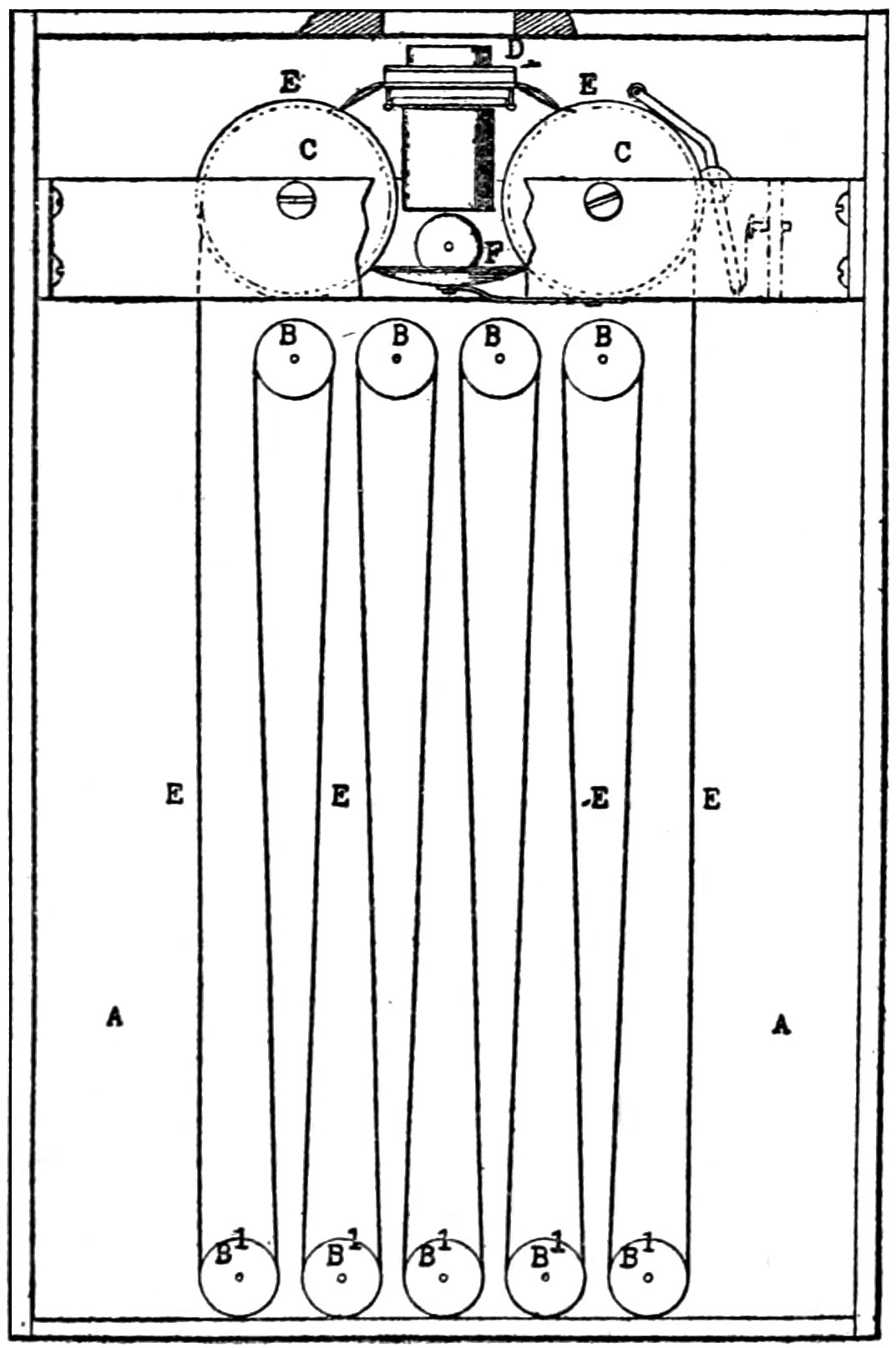
Fig. 3.—Edison’s First Kinetoscope.
The ribbon of pictures, printed as transparencies upon a
strip of celluloid film, somewhat dense so as to bring out
the detail, formed an endless band E, 40 feet in length.
This was threaded over the various reels in the manner
shown in the illustration, and finally passed over the first
large wheel C, thence to the second large wheel C, and back
once more on to the reels B B¹. Though 40 feet constituted
the average length of film employed, longer ones
could be used within certain limits, by increasing the
number of reels on the frame. As the film passed from
one of the large wheels C to the other, it had to
traverse the field of the magnifying lens, and the light,
striking through the transparency, gave the person looking
through the eye-piece a slightly magnified view of the
picture.
The cabinet stood on end, so that one had to bend over
the instrument to peer through the small eye-piece. When
the coin dropped into the slot, an electric motor was
started, setting the film and shutter in motion. The film
travelled from left to right, while the shutter rotated in
the opposite direction, cutting up the band of pictures into
separate images, so that only one was seen at a time.
The band travelled continuously, and each image was
momentarily rendered visible by the light flashing through
the radial slot in the shutter, the effect being the same as
if the electric incandescent lamp were extinguished and
relighted intermittently, at very brief intervals.
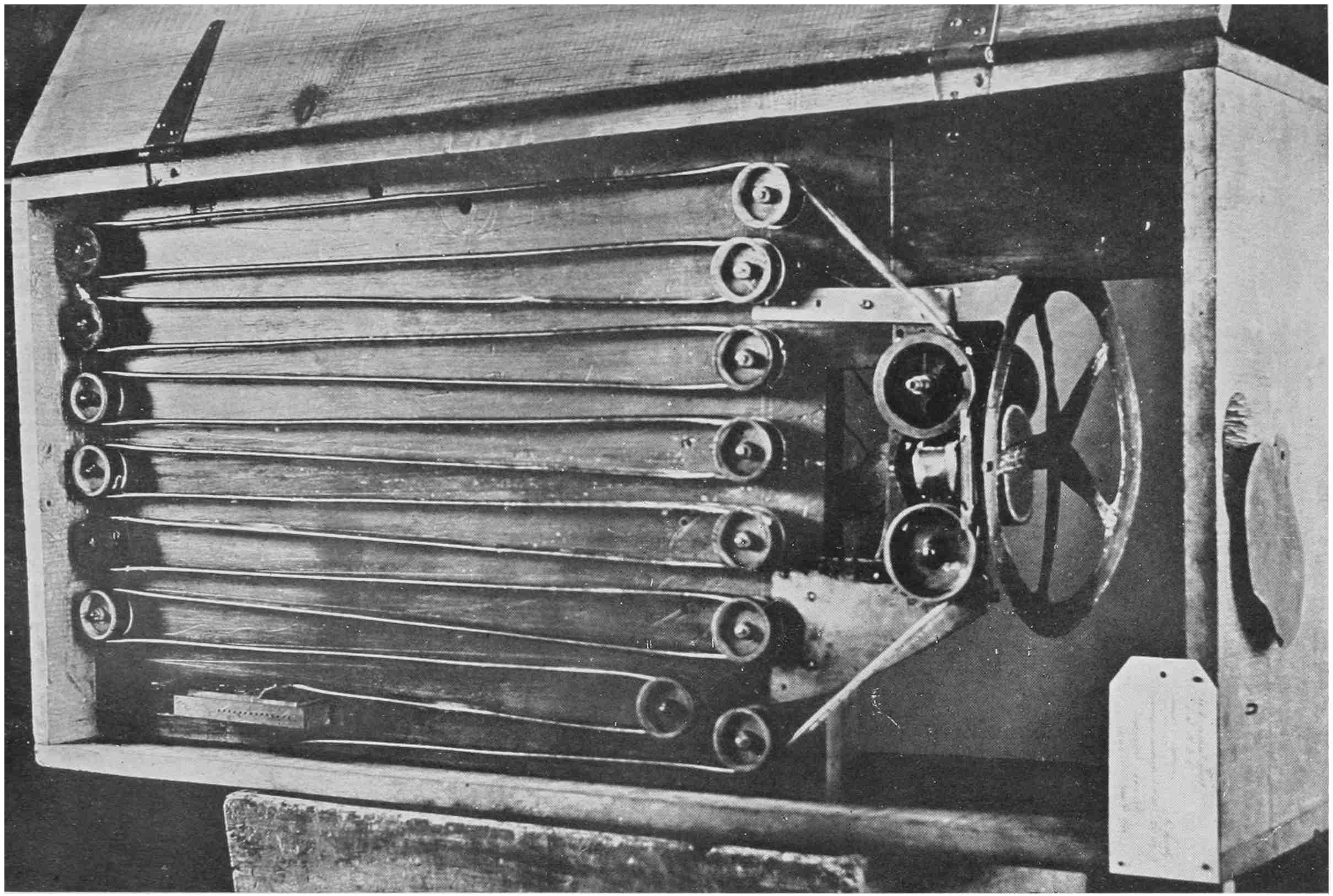
EDISON’S FIRST KINETOSCOPE.
This machine, completed about 1890, was very crude. It was known as the “peep-hole,” because one peered into the cabinet through
the eye-piece at side.
The shutter had to be revolved at sufficient speed to
bring the radial slot near its edge centrally over an image;
in other words, the shutter had to complete its revolution
with sufficient speed to bring the opening over the picture
at the moment the latter on the travelling celluloid film
came into the centre of the field of the lens. When this
operation was carried out with sufficient velocity, the images
were seen in such rapid succession as to convey the idea
of continuous motion, by virtue of the principle of visual
persistence.
One point must be borne in mind. The band of pictures
travelled continuously. It did not, as in the machine of
to-day, make a momentary pause as it came between the
light and the lens. The movement to-day is intermittent,
not continuous, though, curiously enough, all the
early experimenters strove first towards the perfection of
the latter arrangement. Continuous motion of the film
has proved to be impossible, because the shutter must
revolve at such a speed that the illumination is not sufficient
to produce a bright impression upon the screen.
In order to prevent the film slipping in any way while
travelling over the smooth reels by friction, a toothed
sprocket was introduced to ensure the film being fed
regularly and steadily before the lens; and to secure a
purchase upon the film the latter was perforated uniformly
along the margin to engage with the sprocket teeth.
Edison found, as a result of his experiments, that four
perforations per picture, on either side of the film, gave
the best results, though in his earliest investigations he
confined himself to perforating only one edge in this
manner.
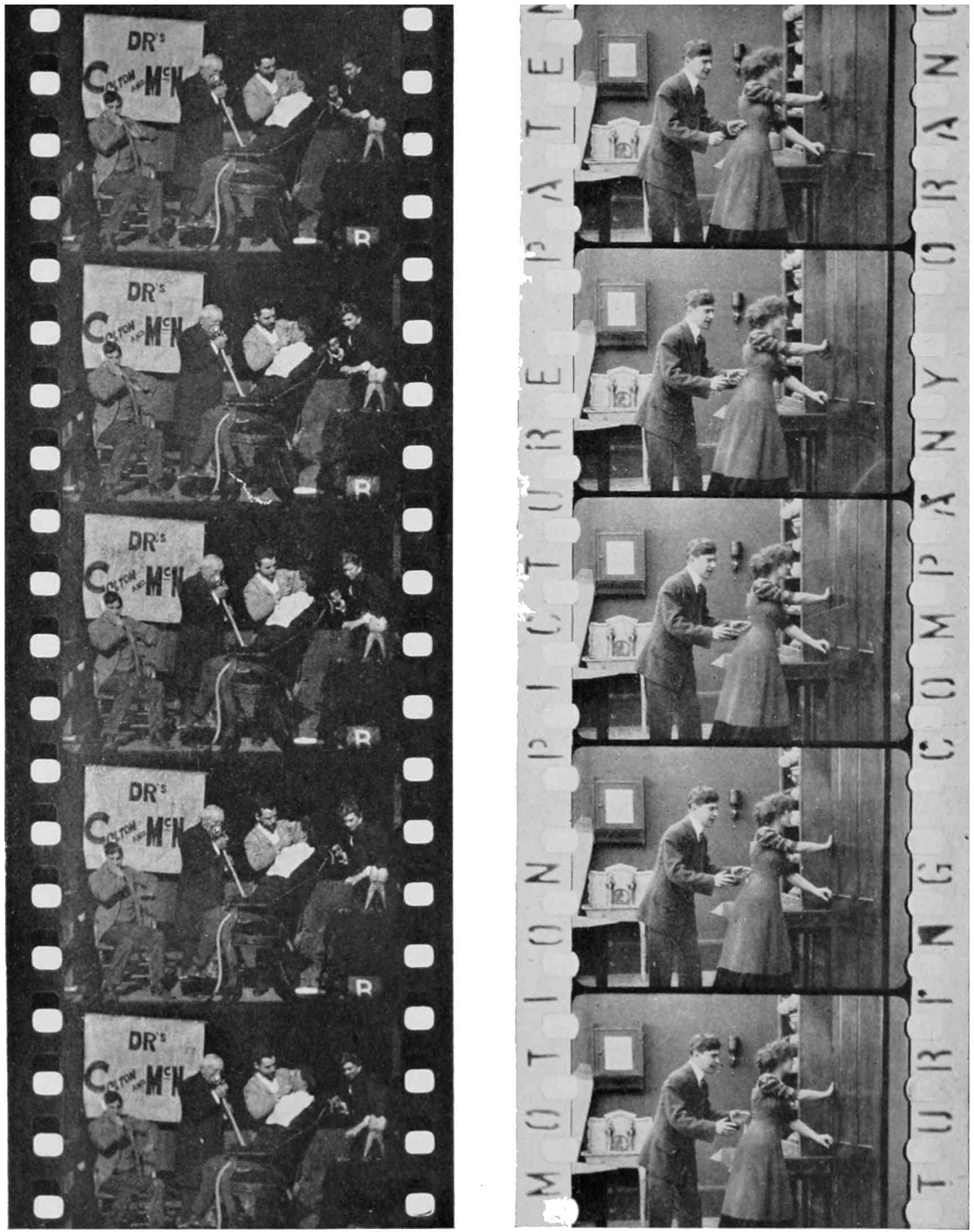
Edison Film made about 1891 for
the kinetoscope.
Edison Film made in 1911 for
the cinematograph.
TWENTY YEARS’ HISTORY OF MOVING PICTURES IN FILMS.
The only difference between the two films is that the kinetoscope film had to be made
very dense. The size of the picture, 1-inch wide by ¾-inch deep, and perforation gauge,
are identical.
Although many years have passed since the Kinetoscope
first startled the public, the film has undergone but little
change. The width remains the same; the dimensions of
the picture are identical; and the perforation gauge has
never been revised in regard to the number of holes per
picture. The only salient difference between two Edison
films, taken at intervals of twenty years, relates to the
density of the picture, which nowadays, being projected
upon a screen instead of being followed through a magnifying
glass at short range, is thinner and lighter.
Brilliant as the Kinetoscope was, it made no great impression
upon the public. It became known as the
“peep-hole machine,” and was regarded, like the telephone
in its early days, as a scientific toy. Edison appears to
have failed to grasp its possibilities and the important part
it was destined to play in our complex life, for he did not
patent it in Great Britain.
Among those who saw the instrument at the World’s
Fair were two Greek visitors from London. One was a
greengrocer, the other a toy-maker. With shrewd business
instinct they perceived here an opportunity to make
a fortune in England. The Kinetoscope was known only
by name in London, and the search for novelty in regard
to new forms of amusement inevitably brings a rich reward
to the ingenious exploiter. The two men acquired a
machine and brought it home with them, their intention
being to make duplicates and instal them in public places,
to work upon the penny-in-the-slot principle.
The two Greeks evidently were not animated by very
lofty ideas of business integrity, for they did not trouble
to ascertain if the Kinetoscope were patented in Great
Britain.
Upon arrival in London they sought for a man who
could duplicate the machine they had brought with them;
and they approached Mr. Robert W. Paul, an electrical
engineer and scientific instrument maker, who at that time
had his workshops in Hatton Garden. They brought the
Kinetoscope to him. He had never seen it before, and
was deeply interested in its operation. When, however,
they suggested that he should produce copies of it to their
order, he declined, for he felt sure that Edison never would
have omitted to secure its protection in Great Britain. He
pointed out to the Greeks that reproduction would probably
be illegal, and that both he and they would expose
themselves to litigation and heavy damages for infringing
a patent.
His clients expressed dissatisfaction at this decision and
departed with the instrument. After they had gone, Paul
was prompted to make a search at the Patent Office, and
to his intense surprise he found that Edison had not protected
his invention by taking out British patents. He
was thus at liberty to build as many machines as he
desired, and forthwith he set to work, not only for his
Greek visitors, but also for his own market.
The experience with the Kinetoscope in the United
States was duplicated in Great Britain, as, indeed, it was
in every other country where it was placed on exhibition.
Several machines were set up at apparently suitable points,
but the public failed to respond. Two factors contributed
to this result. In the first place, the machines were
weighty, and as the electricity for driving the motor and
lighting the incandescent electric lamp was drawn from
accumulators, the whole apparatus was somewhat bulky
and awkward to move from place to place. Besides, it
was difficult to secure the necessary films; sufficient variety
could not be supplied for the machines. Only one company
was engaged at the time in their production—the
American Kinetoscope Company—and the only studio in
operation was at Orange in New Jersey, the output of
which was relatively small. Under these circumstances
public curiosity could not be sustained.
The difficulty with the film supply presently became still
more acute. The American company learned that the
Kinetoscope was being manufactured in England, and
that American films were being used with English
machines. As manufacture could not be prevented, owing
to Great Britain being an open market, and as, consequently,
Paul was perfectly justified in his action, the
American company decided on a novel method of frustrating
Mr. Paul’s efforts. Two agents, Maguire and
Baucus, came to London and endeavoured to corner the
English market. They secured the output of Kinetoscope
films from America, and declined to sell them to anyone
in Great Britain who did not possess an American-built
machine. The result was that all the purchasers of the
Paul Kinetoscopes found themselves unable to secure
further films; even Paul himself could not obtain supplies.
The Americans regarded the outlook with complete self-satisfaction.
They believed that the English market was
within their grasp. But they reckoned without their host.
Paul was determined not to be vanquished so easily,
especially as he had sold Kinetoscopes to customers in all
parts of the world, and had a steady stream of buyers
flocking to his workshops from points as remote as Tokio,
South America, and New Zealand. Many of these early
purchasers of the British-built Kinetoscopes have since
become famous in the world of cinematography either as
producers or manufacturers, notably Monsieur Charles
Pathé, the founder of the celebrated French cinematograph
film manufacturing establishment, who was one of Paul’s
first customers.
Now although Paul had manufactured several Kinetoscopes,
he realised the disadvantages of the instrument.
Only one person at a time could see the picture in animation.
What was required in order to popularise moving
pictures was to devise a way to enable several hundreds,
or even thousands, of people to witness the same subject
simultaneously.
Paul’s first idea was to convert the ordinary Kinetoscope
into a projecting apparatus. While he was quietly considering
the feasibility of this scheme he was introduced
to another inventor Mr. Birt Acres, at that time in the
employment of a firm engaged in the manufacture of dry
plates and bromide papers. Acres had conceived a
mechanical means of printing on bromide paper from glass
negatives a number of copies of a subject at a very rapid
rate, and had committed to paper his crude suggestion.
He submitted his drawing to Paul. The negative was to
be set in a frame, beneath which the bromide paper
travelled over rollers in a continuous length. The coil of
paper was to move a certain distance—the length of the
negative, in fact—and then to pause; when a flat pad,
carried at the end of a lever beneath the paper, was to rise
up and press the latter flatly and tightly against the negative.
When the exposure had been made the clamping
device, as it was called, fell back, and permitted the paper
to travel another short distance to bring a fresh unexposed
surface beneath the negative, when the same cycle of
operations was repeated.
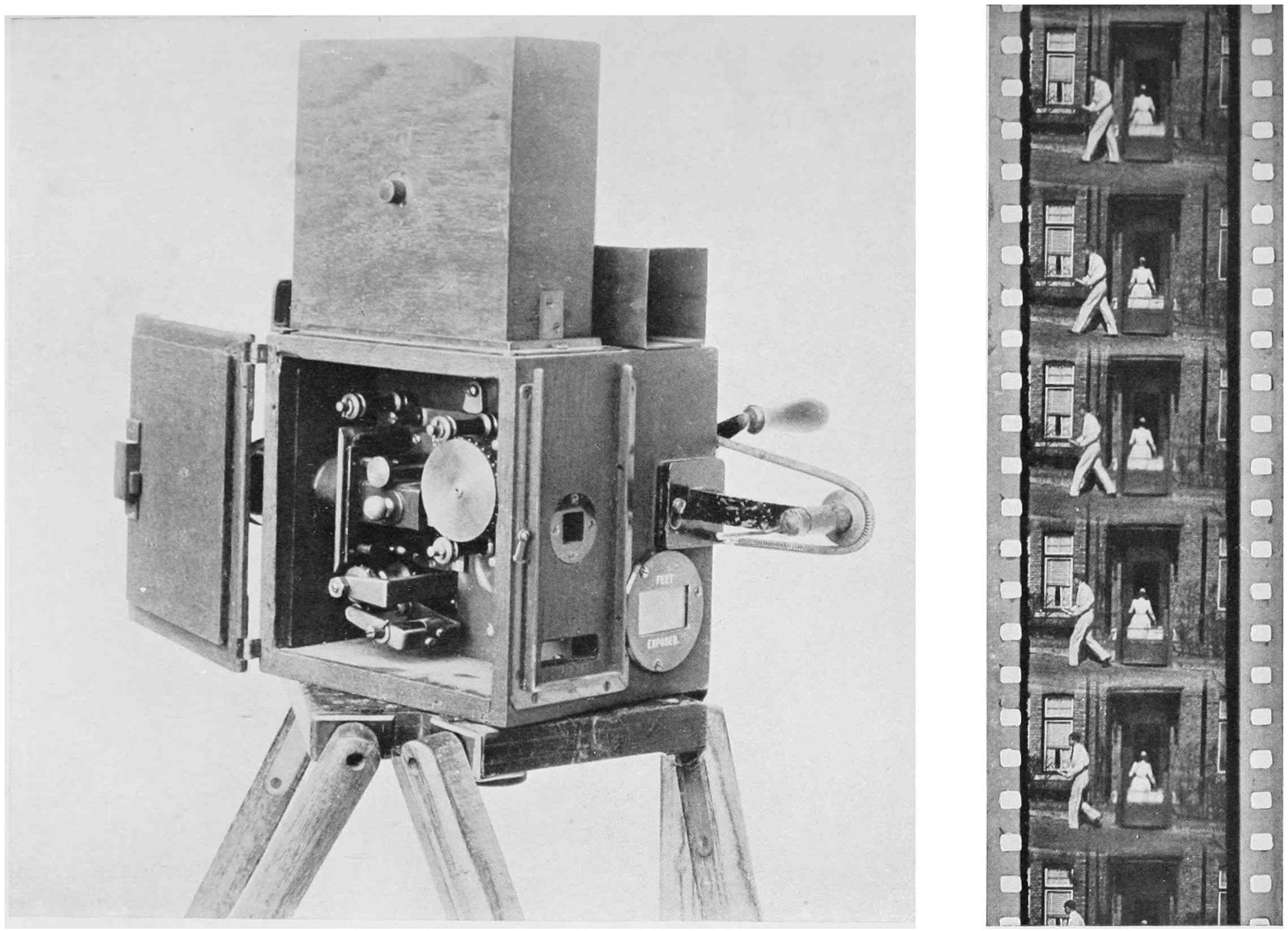
PAUL’S CAMERA SHOWING MECHANISM FOR MOVING THE
FILM INTERMITTENTLY PAST THE LENS. THE FILM WAS
CARRIED IN DETACHABLE DARK BOXES.
THE FIRST
KINETOSCOPE FILM
MADE IN ENGLAND.
The manufacture of films was commenced in England by Robert Paul to thwart the American attempt to corner the British market.
When Acres brought his sketch to Paul, the latter was
wrestling with the problem of photographing objects in
motion. It was imperative to perfect a camera in order
to defeat the machinations of the Americans bent upon
the capture of the English film market. In this task,
however, the most satisfactory means of securing intermittent
motion was the stumbling block. He thought for
a time that Acres’s ingenious method of printing bromide
prints might offer a clue. Being a mechanical engineer,
Paul recognised the inefficiency of Acres’s ideas as far as
its application to cinematography was concerned, because
the clamping device was not actuated by a positive drive.
But the rough drawing which Acres had made of his
bromide printing process set Paul thinking, and gave birth
in the end to an entirely different project.
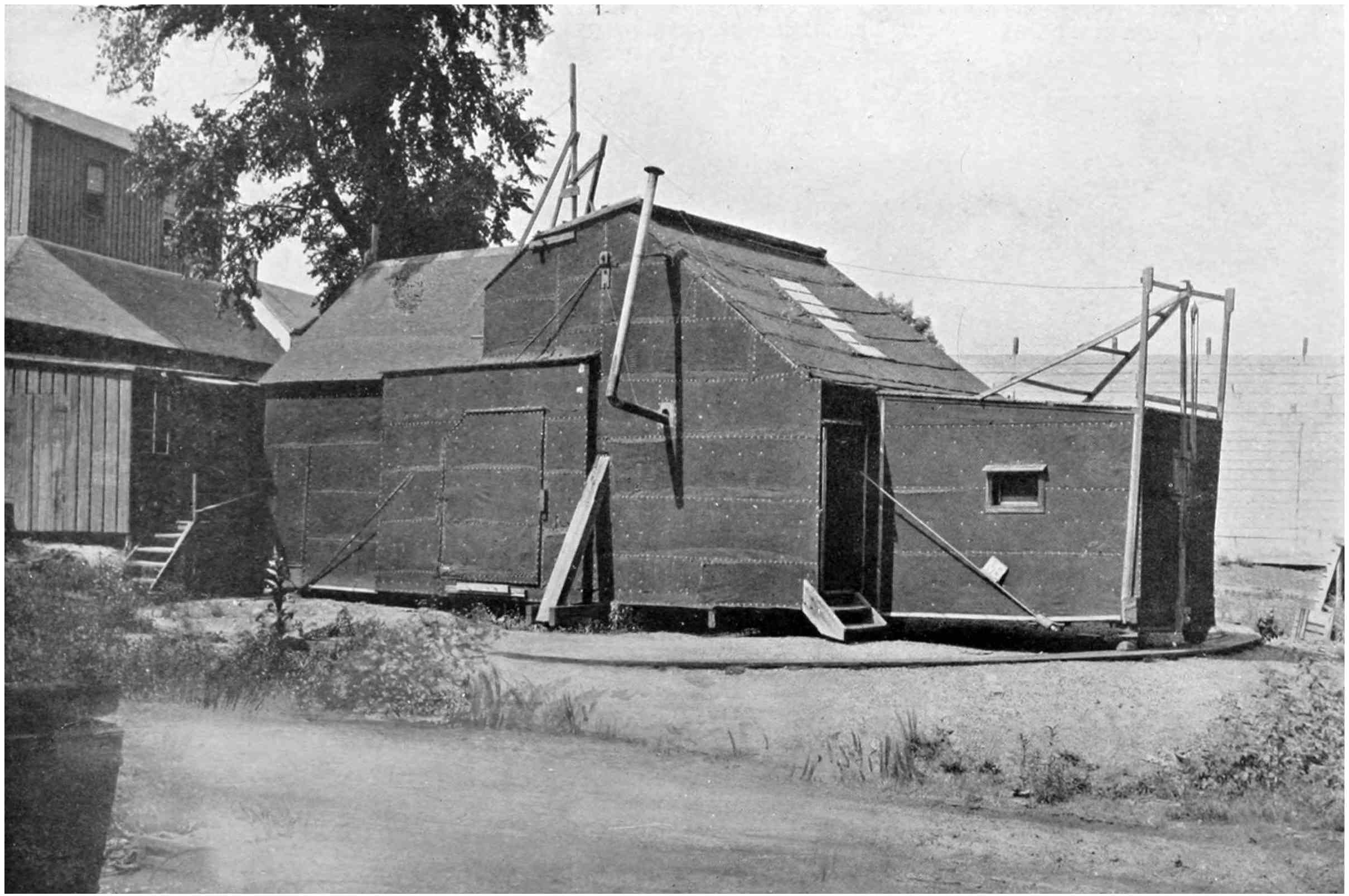
THE “BLACK MARIA,” THE FIRST EDISON STUDIO FOR MAKING KINETOSCOPE FILMS.
It was a rambling building of cheap construction mounted centrally upon a pivot. It revolved upon a circular track to face the sun.
See page 105.
His efforts were accelerated by the tactics of Maguire
and Baucus, and it was not long before he produced a
camera working with an intermittent motion. With this
camera some excellent films were obtained, and in the first
instance these were employed with the Kinetoscope. The
purchasers of the Paul machines consequently experienced
no difficulty whatever in getting all the films they wanted,
and the American product was ignored. It was not comparable
with the English films in excellence or variety,
and Maguire and Baucus retired from the scene completely
discomfited. The attempt to obtain possession of the
English market was a dismal failure owing to the unexpected
enterprise of Robert Paul.
Paul had already attempted to apply the principle
governing the operation of the Kinetoscope to the projection
of a picture upon the screen. He had contrived a
special lantern through which the film was run continuously,
the revolution of the shutter serving to cut out each
picture on the film, and throw it individually upon the
sheet, thereby bringing it into a stationary position for a
minute fraction of a second. But the projecting efforts
were somewhat disheartening. The illusory effect was
produced; but the picture was so faint as to render the
result of no commercial value. The conditions attending
the watching of the pictures at a range of about six or
eight inches, as in the Kinetoscope, and at one of ten
times as many feet, when thrown upon a whitened wall or
screen, were vastly different. The shutter had to revolve
at such a rapid rate to prevent blurring that a sufficient
volume of light could not be passed through each picture
in the short interval the shutter was open—less than
1/1,000th of a second—so the resultant image was faint
and ill-defined.
It was evident that the film would have to be brought
momentarily, by some means or other, into a fixed position
behind the lens, so as to enable sufficient light to pass
through to the screen, to yield a picture comparing with
that of a slide projected from a magic lantern; and,
further, that the picture would have to be moved during
its eclipse by the shutter, in order to allow the next image
to be brought into place. In other words, instead of the
film moving forwards continuously, it would have to
advance with a jerky or intermittent motion while the
shutter was passing across the lens, and cutting off the
light from the screen.
Paul concentrated his energies upon this problem. It
was by no means a simple undertaking, for there were no
previous efforts in the same direction to assist him. The
great point was how to bring successive pictures into position
before the lens. He thought out a clamping device,
which is known as the “gate,” and which he attached
behind the lens. This gate was formed of two parts, one
fixed and the other having a swinging or opening movement.
The fixed part was pierced with an aperture which
could be reduced by a sliding diaphragm. The aperture
of the second part was of the same shape and dimensions
as the picture on the film. The film was wound on a spool,
and from this it passed through the gate and thence over a
sprocket, the teeth of which engaged with the perforations
in the edge of the celluloid band.
The sprocket had to move intermittently, in such a way
that a length of film corresponding to the depth of a
picture was drawn through the gate at each movement,
while the shutter momentarily cut off the light, otherwise
there would have been a confusion of two consecutive
pictures projected at the same time. How this movement
was evolved is described in Chapter VII. It seems a
simple task, but it proved exasperatingly difficult to secure
accuracy, smoothness of motion, and the steadiness of the
picture when thrown on the screen.
About three o’clock one morning, in the early months
of 1895, the quietness of Hatton Garden was disturbed by
loud and prolonged shouts. The police rushed hurriedly
to the building whence the cries proceeded, and found
Paul and his colleagues in their workshop, giving vent to
whole-hearted exuberance of triumph. They had just
succeeded in throwing the first perfect animated pictures
upon a screen. To compensate the police for their fruitless
investigation, the film, which was 40 feet in length
and produced a picture 7 feet square, was run through
the special lantern for their edification. They regarded
the strange spectacle as ample compensation, and had the
satisfaction of being the first members of the public to see
moving pictures thrown upon the screen.
In February, 1896, the first public demonstration with this
projection apparatus, described as the “Theatrograph,”
was given at the Finsbury Technical College, and it caused
a thrill of excitement and interest. A few days later, on
February 28th, 1896, the apparatus was shown in the
library of the Royal Institution. Again it stirred enthusiasm,
and Mr. Robert Paul was congratulated warmly
upon the success of his work by many of the leading
British scientists of the day. This was the first demonstration
of animated photography before a scientific institution
in Great Britain. The films displayed were those
which had been taken by the patient experimenter and his
collaborators for the Kinetoscope, and included, among
other things, a “Shoeblack at work in a London street,”
and of “A Rough Sea at Dover.”
The fact that the display was given before one of the
foremost scientific bodies in the world stamped it as being
a development of signal importance. The interest it
created was universal. Among those who saw the demonstration
was Lady Harris, the wife of the famous
impresario, Sir Augustus Harris, who evinced the keenest
enthusiasm in the apparatus, and who plied the experimenter
with searching questions as to how the apparent
animation was obtained.
Next morning Paul received an urgent invitation from
Sir Augustus Harris to join him at breakfast. The latter
had heard from Lady Harris all about the remarkable
exhibition at the Royal Institution, and, with a showman’s
keen instinct, desired to glean further details without delay.
He said that he had heard in Paris of a French invention
similar to Paul’s. This took the English experimenter
by surprise, for he had been labouring in absolute ignorance
that other men were at work in the same field.
However, the impresario was on business bent. He saw
the possibilities of the Theatrograph as a form of amusement,
and Paul was asked if he were willing to permit
its being exploited at Olympia, which Harris had
acquired.
“Well, I don’t know,” rejoined the experimenter. “I
have no idea of its value from the public point of view.”
He thought that the indifference of the British public to
the Kinetoscope did not augur well for the new development.
“Now look here,” continued Sir Augustus Harris. “It
won’t draw the public for more than a month. They soon
get tired of these novelties. Are you prepared to come in
on sharing terms, say, 50 per cent. of the receipts? Do
you agree?”
Paul was somewhat doubtful of the results, but he
acquiesced, and the agreement was drawn up there and
then. The sequel showed how ill-founded his apprehensions
had been. The Theatrograph caught the popular
fancy, and proved the most powerful amusement-magnet
at Olympia. It was the first picture palace in the world,
that is to say, the first establishment devoted exclusively
to the projection of moving pictures as a complete entertainment.
From it the whole modern development of
cinematography may be said to have sprung.
Indeed, it is difficult to realise the effect produced upon
the world at large, through the skill and industry of
Robert W. Paul. So far as Great Britain is concerned, he
certainly fathered the enterprise of animated photography,
as is evidenced by the fact that in British cinematographic
circles he is known popularly as “Daddy Paul.” The
lapse of time has not effected any essential change in the
construction of the apparatus. The camera and projector
as used to-day are fundamentally the same as those Paul
first employed. Modifications have been made in details
of the mechanism, but they are of slight importance.
When the outcry against the danger of the cinematograph
was raised in the early days of the industry, as a result of
the fire at the Charity Bazaar in Paris, it was found that
Paul had realised the danger and had endeavoured to
guard against it, though his idea, being somewhat premature,
was disregarded at the time.
The success of the “Theatrograph” at Olympia caused
a wholesale demand for the new marvel. People wanted
to attach the device to existing magic lanterns, so that
animated pictures could be produced upon the screen
whenever desired. Paul still cherished such little faith
in his invention that he sold the projector attachment for
the small sum of £5 ($25), and it could be fixed to any
lantern. He was inundated with orders from all parts of
the world. Many enthusiasts acquired a complete projecting
outfit, the price of which at that time was about
£80 ($400). The capacity of the workshop in Hatton
Garden proved quite inadequate to the demand. The men
worked night and day turning out the projecting apparatus,
and the sale aggregated several hundreds sterling
per week during the years 1896 and 1897. Provincial
showmen lost no time in acquiring the novelty, or arranged
with the inventor to provide such an item in their programmes.
Within a short time twenty machines were
being operated under Paul’s personal direction in the
provinces.
London was by no means backward in following up the
development. The first to introduce moving pictures to a
metropolitan vaudeville audience was Mr. Moul, the energetic
manager of the Alhambra Theatre. Like Sir Augustus
Harris, however, he regarded it merely as a nine-days’
wonder, and did not think that the sensation it had created
could be sustained for more than a week or so, which
shows how even the most astute showman may sometimes
err in gauging the public taste, and also parenthetically
the professional estimation of the idea. An arrangement
was made whereby Paul undertook to give a display with
the “Animatograph”—this name had been substituted for
the original “Theatrograph”—at the Alhambra Theatre,
for a fortnight from March 25th, 1896. According to the
terms of the contract, if the display proved popular, it was
to be prolonged upon the same terms until moving pictures
fell from public favour. That engagement of fourteen
days grew into one of four years! For over 1,000 nights
Paul personally superintended his moving pictures at the
Alhambra; and then retired only because of pressure of
work in other directions. Of course, other music halls
in the metropolis acquired the apparatus. Operators were
scarce, and they could not be trained rapidly enough to
meet the demand. As a rule, men manipulating the limelight
in the theatres were found to be the most suitable
for the purpose, and they readily accepted an opportunity
to earn £4 ($20) per week for a few minutes’ work
every day. Times have changed since then, and to-day
operators can be secured for about half that sum as weekly
wage.
At one time in the early days Paul had no less than
eight theatres in London demanding his personal attendance,
involving a nightly journey of twenty miles. It is
significant of the tremendous enthusiasm that was aroused
by the moving pictures that the managers of the various
halls had to arrange their programmes to suit the convenience
of the operator, so that there might be no interference
with his carefully prepared time-table of his evening’s
movements from one place to another.
The exigencies of the manufacture of apparatus and films
became at last of such a character that Paul found the
strain of operating to be intolerable, so he retired from
active work in the projecting world. His film manufacturing
business attained considerable proportions, and this
was continued until the latter part of 1908, when he abandoned
all active participation in the industry he had
initiated, to devote himself to his work on precision instruments
for electrical measurements. His association with
cinematography to-day is very slight, being confined
mostly to collaboration with eminent physicists and
scientists in illustrating scientific subjects by the aid of
motion photography.
While Robert W. Paul was busy in his laboratory,
problems identical with his own were engaging the attention
of French experimenters, and notably of Messrs.
Lumière and Sons, of Paris and Lyons, a firm famous in
the manufacture of photographic apparatus, dry plates, and
paper, whose efforts to solve the problem of natural colour
photography are well known to the world. Their attention,
like Paul’s, was first directed to this new field by the
Kinetoscope, which made its appearance in France about
1893. Messrs. Lumière instantly realised its drawbacks
and limitations, the greatest of which, from their point of
view, was the fact that the long ribbon of instantaneous
pictures was visible to one person only. Then again they
considered the number of pictures shown per second—thirty—to
be too high.
They sought to devise an apparatus operating with an
intermittent action, whereby a short length of film corresponding
to the depth of a picture was jerked into position
behind the lens while the light was eclipsed by the shutter,
and afterwards to project the same pictures by a similar
mechanism.
With the Kinetoscope as a basis they set to work, and,
by means of a reciprocating motion given to a hook frame
under the movement of a triangular piece of mechanism,
they succeeded in stopping and starting the film alternately
with such a degree of nicety that the successive sections
of film were brought into position before the lens without
damaging the guiding perforating holes or films. This
constituted the salient feature of the Lumière device and the
fundamental principle of the patent.
The Lumière camera was distinctly ingenious, simple
and positive in its action, as well as being light and compact.
The mechanism whereby the film was jerked down
sufficiently after each exposure to bring another section
of sensitised surface before the lens, may be likened
to two projecting fingers which engaged with a hole on
either side of the film. These two pins, or hooks, by the
revolving action of a triangular eccentric, were brought
forward towards the film and engaged with the perforations.
When the shutter swung across the lens, thus
cutting off the light, this pair of fingers dropped down,
smartly jerking the film with them. The latter was then
gripped and held firmly in position during the next
exposure, when the two fingers withdrew from the perforations,
rose sharply upwards, and clutched the film once
more by the next pair of perforations.
While the Lumière experimenters adopted the width of
film used in the Kinetoscope and secured pictures of the
same dimensions, yet they made an important deviation
from Edison’s idea. Instead of making four perforations
per picture on either side of the film at regular intervals,
they made just one round hole on each side of the image.
These perforations were placed 20 millimetres—approximately
4/5 inch—apart. The reason for this deviation
from the Edison method was that they had refrained from
the use of toothed sprockets such as Edison and Paul had
adopted, and which had to mesh with the film so as to feed
it regularly and steadily forward before the lens in both
the camera and the projector. From the mechanical point
of view theirs was a preferable method, inasmuch as the
comparative closeness of the perforations in the Edison
gauge somewhat weakens the strength of the film, and can
easily result in tearing.
There is every reason to believe that Messrs. Lumière
were in ignorance of the efforts of Paul, in just the same
way as the British investigator was oblivious of the work
of the Frenchmen. In France the Kinetoscope failed, as
it did in England and the United States. From the
French point of view a unique opportunity existed to establish
a new industry; accordingly they manufactured several
films upon their principle.
The original bands of pictures were 17 metres—nearly
56 feet—in length. Unfortunately for the Lumière firm,
the Kinetoscope had, thanks to Paul, been purchased more
generally than was at first thought possible; while Paul
had marketed in England a considerable number of films
carrying the Edison standard perforation. The result was
that they could not dispose of their films to people who
were already possessed of the moving picture machine, and
who demanded films of the Edison gauge. Messrs.
Lumière ultimately abandoned the single perforation on
either side of the picture in favour of that which had come
into vogue through the Kinetoscope and the work of Paul.
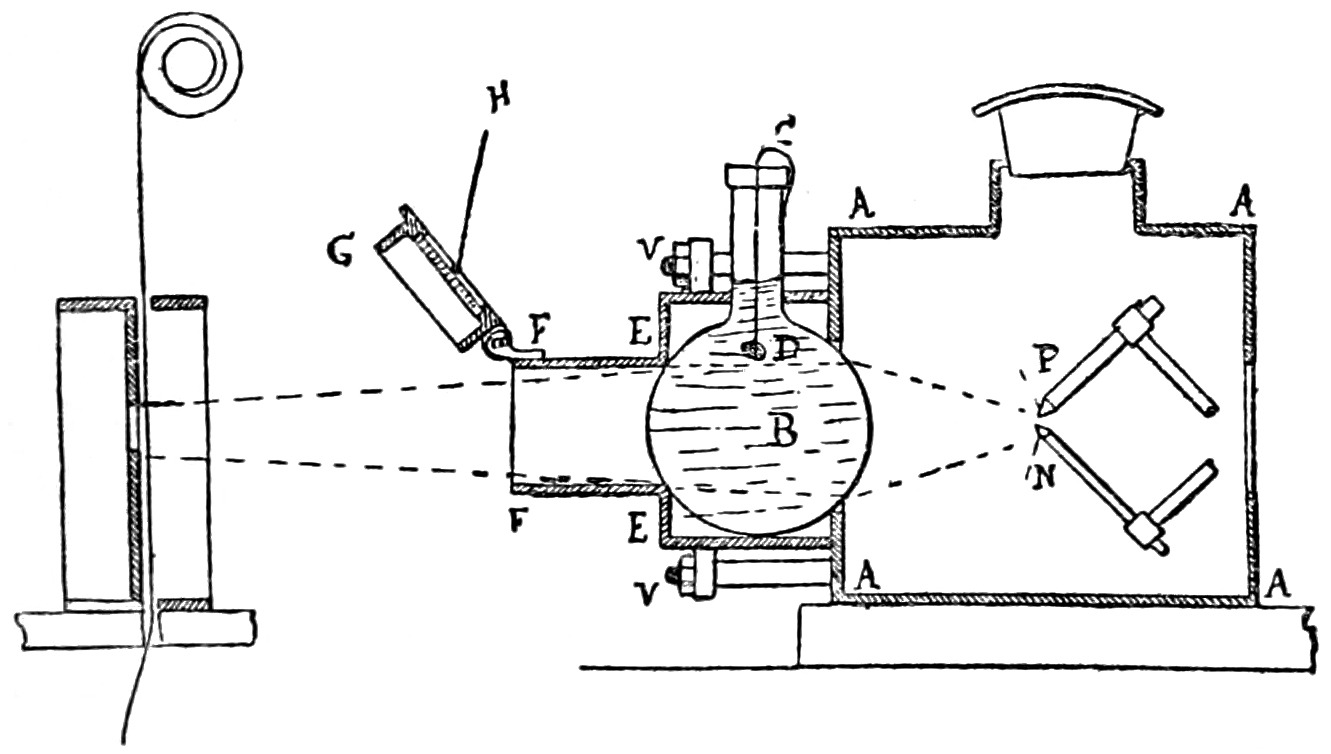
Fig. 4.—The Early Lumière Projecting System Showing Water
Condenser B.
The early Lumière projector was very interesting.
Realising the high inflammability of the celluloid film,
and the intense heat produced by the focussing of the
electric arc light through the condenser upon the film,
the experimenters sought to remove the danger of fire by
counteracting the heat production of the rays of light. A
spherical bottle, filled with water, was placed between the
electric arc and the lens to act as condenser, Fig. 4. The
bottle B was encased in a metal cylinder E, fixed to the
front of the lantern A by four rods, each terminating in
a screw V. The metal cylinder E was continued forwards
in the form of a tube F, the end of which was fitted with
a hinged shutter G carrying a small piece of ground glass
H. When the film was set in motion this hinged shutter
was lifted and laid back upon the top of the tube to which
it was attached.
The spherical bottle, which was filled with distilled
water to which a few drops of acetic acid were added, acted
in exactly the same way as the glass condenser of to-day.
But it possessed this advantage. The luminous rays were
concentrated, and there was no loss of luminous light;
only the heat rays were absorbed almost entirely by the
water. Another beneficial result was that the light thrown
through the picture, and thence on to the screen, was
whiter, because the condenser glass is greenish, and imparts
that tint to the light passing through it.
In the course of about 30 or 40 minutes the water under
the action of the heat rays commenced to boil, but no
inconvenience resulted. A piece of coke D, attached to a
short length of wire C, was suspended in the decanter and
placed just below the surface of the water, thus causing it
to boil with complete evenness; there was no spurting of
the contents, and no bubbling to interfere with the light.
If the sphere of water were removed or broken during the
operation of the lantern, as the condensation of the light
rays immediately ceased there was no danger of the film
being set alight. It may be pointed out, in passing, that
Edison introduced a bulb of alum water between the electric
lamp and the film as a heat absorbent in his
Kinetoscope.
Although highly efficient, this expedient possessed certain
drawbacks, and consequently in the course of time it
was superseded by the glass condenser. Mechanical
ingenuity succeeded in devising a means of minimising the
danger of combustion or provided some method of smothering
it in its incipient stage.
Although the Lumière invention proved a great success
in France, and was the first commercial apparatus produced
in that country, it did not get a foothold in Great
Britain, owing to the contemporaneous work of Paul.
The Lumière apparatus was a well-built mechanism,
typical of French workmanship, but if anything rather
too light for general wear and tear. It was introduced
to the English public by Professor Treuwé, the famous
French conjurer, at the Regent Street Polytechnic in 1896,
but failed to provoke a sensation, because Paul’s “Theatrograph”
had already been seen at Olympia and held first
place in public esteem. On the other hand, it created
widespread interest in the United States, where, at the
time of its arrival, projection upon the screen was
unknown. Paul’s machine had not penetrated to North
America, because the British market demanded his whole
attention. It is a curious irony of fate that, although
animated photography was first made possible in America
by the ingenuity of an American inventor, and the only
films then available were the product of the Edison “Black
Maria” at Orange, yet it was a French apparatus which
laid the foundations of the cinematograph industry in the
United States. The product of Messrs. Lumière was introduced
mainly through the enterprise of one man, Mr.
Richard G. Hollaman, the energetic president of the Eden
Musée Company.
Mr. Hollaman saw the Kinetoscope at the Chicago
World’s Fair in the summer of 1893, but as it was crude
and did not arouse great enthusiasm, he took no especial
interest in it. In the following year, however, he acquired
an improved Kinetoscope from Berlin, which had been
made by the celebrated electrical engineering firm, Siemens
and Halske. This machine was circular in shape, and
showed the pictures in movement in much the same way
as Edison’s contrivance. Two of the machines were installed
in the Eden Musée and remained there for six
months. At the end of that time they were abandoned for
the reason that no new films could be obtained.
In the spring of 1896 an exhibition was given in a shop
in Park Row, New York City. In this instance the pictures
were thrown upon the screen. The machine had
been devised and built by an experimenter named Latham,
but it was exceedingly faulty. The pictures shown depicted
two prize fighters, but the images vibrated so
violently on the screen, and were so scratched and imperfect,
that the eyes of spectators were subjected to a fearful
strain, and the apparatus was commercially valueless. Mr.
Hollaman sought out the inventor with a view to the
perfection of the device for his theatre, but learned that
lack of capital prevented Latham from perfecting his
apparatus.
A little later the president of the Eden Musée received
a communication from a firm named Raff and Gammon.
They offered him the State rights for a moving picture
machine which had been designed by Edison, and of which
they were empowered to dispose on his behalf. They
invited Mr. Hollaman to a demonstration at Koster and
Bial’s theatre, where they threw a picture upon the screen
which measured about 10 feet in width by 6 feet in depth.
Mr. Hollaman has told me that he recalled very vividly
two of the films he saw there. One depicted “Mammy
washing her child,” while the other was “The Gardener
playing the Hose.” Both these films were made by
Lumière and Sons at Lyons.
In the autumn of 1896 the Lumière apparatus appeared
in the United States. It was introduced by Mr. Hurd,
acting as agent for the French manufacturers, and this
was the first practical cinematograph apparatus to be seen
in North America. A demonstration was given, and Mr. Hollaman,
realising the tremendous strides it represented
in the projection of moving pictures, made a contract for
its installation at the Eden Musée. The picture thrown
on the screen by this projector measured 22 by 16 feet.
From the day the “Cinematographe” was first shown to
the public in the Eden Musée in 1896, it has constituted
a permanent feature of the place. In fact, Mr. Hollaman
has been the pioneer of all developments in the field of
cinematography in North America. The French machines
had been in use for some time, when Lumière’s agent,
who had let them out on lease, suddenly called in all the
projectors and retired from active operations in the United
States. Another machine had to be secured for the Eden
Musée, and for three months a Joli instrument was used,
followed by an American apparatus operated by its maker,
Eberhard Schneider.
Another change was made in September, 1897, when
Mr. Charles Urban, now identified with Kinemacolor,
but at that time acting as salesman for Maguire and
Baucus, who had endeavoured in vain to oust Paul in
London and who had retired from the scene after meeting
with failure, approached the Eden Musée with a new
projector, which was installed. Some time later Urban
introduced a new machine which he had made himself,
and as it possessed several improvements it was adopted.
This was the first “Bioscope,” as it was called, that was
ever shown to the public.
Shortly afterwards Maguire and Baucus, in company
with Urban, left the United States for London, to establish
an English cinematograph firm under the name of the
Warwick Trading Company. In 1900 Mr. Hollaman
secured the services of Frank Cannock, an expert operator
and mechanician, for his cinematograph department,
which had now become of paramount importance; and
since that date the latter has manufactured all the machines
required by the Eden Musée.
I have given a brief outline of the most interesting
chapter in the story of cinematography, the epoch in which
experimenters in different countries were struggling to
perfect the same idea, independently of one another, and
by different methods. Several other investigators were
engaged in the quest, but their work was not of such
importance as that of Edison, Paul, or Lumière. The
first evolved the crude idea, and the latter two, in their
respective countries, produced successful apparatuses entirely
different from one another. The work of Robert
Paul should command the greatest appreciation; for the
Bioscope, which amuses the multitude from morning to
night every day between the two Poles, is fundamentally
the same as that which he introduced to the theatrical
world for the first time on March 25th, 1896.
CHAPTER V HOW THE CELLULOID FILM IS MADE
I have already shown how the perseverance and ingenuity
of Eastman and Walker aided in solving the
problem of animated photography. Their film was used
for the first time experimentally in the United States as
far back as 1889, although it did not enter the general
market until about two years later. From that time there
was an increasing demand from the host of experimenters
for large quantities of the narrow, thin sensitised strip of
celluloid. As the demand increased the chemists associated
with the subject redoubled their efforts; their
product was still far from perfection, and even to-day they
will admit that many abstruse problems remain to be
unravelled.
Although the present-day consumption of celluloid film
for cinematograph purposes is enormous, aggregating
several million feet per week, the manufacturing process
is of such a peculiar character that the number of firms
identified with its production can be counted upon the
fingers of one hand. In the United States it is controlled
by the Eastman Kodak Company, who have extensive
factories at Rochester in the State of New York, and a
large establishment at Harrow in England. In France
Messrs. Lumière and Sons, and in Germany the Gaevert
firm, have large factories. British effort is represented by
the Austin-Edwards Company, which produces an excellent
film, but the home industry is in its infancy. The
three first-named firms supply almost the entire demand.
The Eastman firm has the largest output, about 3,500,000
feet per week, which is due to the fact that in the
United States there are over 14,000 picture palaces open
every day from morning until midnight, and many large
firms engaged in the preparation of the film subjects.
Most of the Eastman supply is used in the United States
and Great Britain. Aside from it and the French and
German products, some of the large European film producers
prepare their own stock, as the celluloid base is
called. If all these totals were added together, the sum
of them would show something like 6,000,000 feet of film,
in both negatives and positives, consumed every week.
Each country has millions of pounds invested in the
enterprise. It is difficult to gauge the proportions of the
entire industry. If all its varied branches are taken into
consideration, it probably ranks as one of the largest in
the world. And the whole of this development has taken
place within twenty years.
In order to gain an idea of one branch of the industry,
the manufacture of the film, one must pay a visit to the
extensive works of the Eastman Company, the plant of
which is able to turn out no less than 7,200,000 lineal feet
of film for moving pictures every week—truly a tremendous
output. This capacity has not been taxed to the utmost
yet, but when the requisite machinery was laid down, the
company decided to anticipate the future. Should the
present pace of development be maintained, there is no
doubt that, before the end of another twenty years, this
firm will find its present installation barely sufficient to
meet the demand. Continued chemical research and
improvement of processes is tending to reduce the cost of
the material, and while at the same time the moving picture
business itself is expanding on all sides, fresh markets are
constantly being opened up for the products of the manufacturers.
At the Eastman works is to be seen a striking illustration
of the growth in the manufacture of celluloid film.
In the room where the ingredients are mixed together there
is a small barrel, which will hold 500 pounds of the film
mixture. This little barrel, together with another of the
same capacity, sufficed to meet all requirements in the
year 1891. In the same building is a battery of fifty huge
barrels, each with eight times the capacity of the small
one, and these are run night and day to meet the present
demand for the material. The little barrel is no longer
used; but it is preserved as an honoured relic of the past
and an eloquent witness of the tremendous growth of the
film-manufacturing industry for cinematography.
The ingredients for the film are gun-cotton, known
technically as pyroxylin, and wood alcohol. The
pyroxylin is prepared by treating cellulose devised from
such vegetable materials as flax or cotton waste, with a
mixture of sulphuric and nitric acids. The ingredients are
associated in large cylindrical tanks ranged in long rows
upon the upper floor, and discharged through trap doors
into the barrels beneath. The gun-cotton is then dissolved
in the alcohol by mechanically rotating the huge barrels.
It is possible to treat in this way some 200,000 pounds of
material at one time. The mixing process reduces the
gun-cotton and wood alcohol to a viscous liquid of the
consistency of extracted honey, which substance forms the
base of the film, or support for the sensitive emulsion, and
is known technically as cellulose-nitrate.
When the gun-cotton has been dissolved to the requisite
degree, the syrup-like mixture is drawn from the barrels
and stored in cylindrical tanks.
The next step is the conversion of the mixture into sheets
of the requisite thinness. It is not rolled out, but poured
upon suitably polished supports, and spreads out, like
varnish, in a thin film. The Eastman patent specifies three
distinct kinds of receptacle for the pouring process: a long
sheet of polished glass, an endless polished metallic belt,
and a revolving drum having a highly polished surface.
Any of the three will produce the result; and in each case
the deposit has to be permitted to dry to a certain degree.
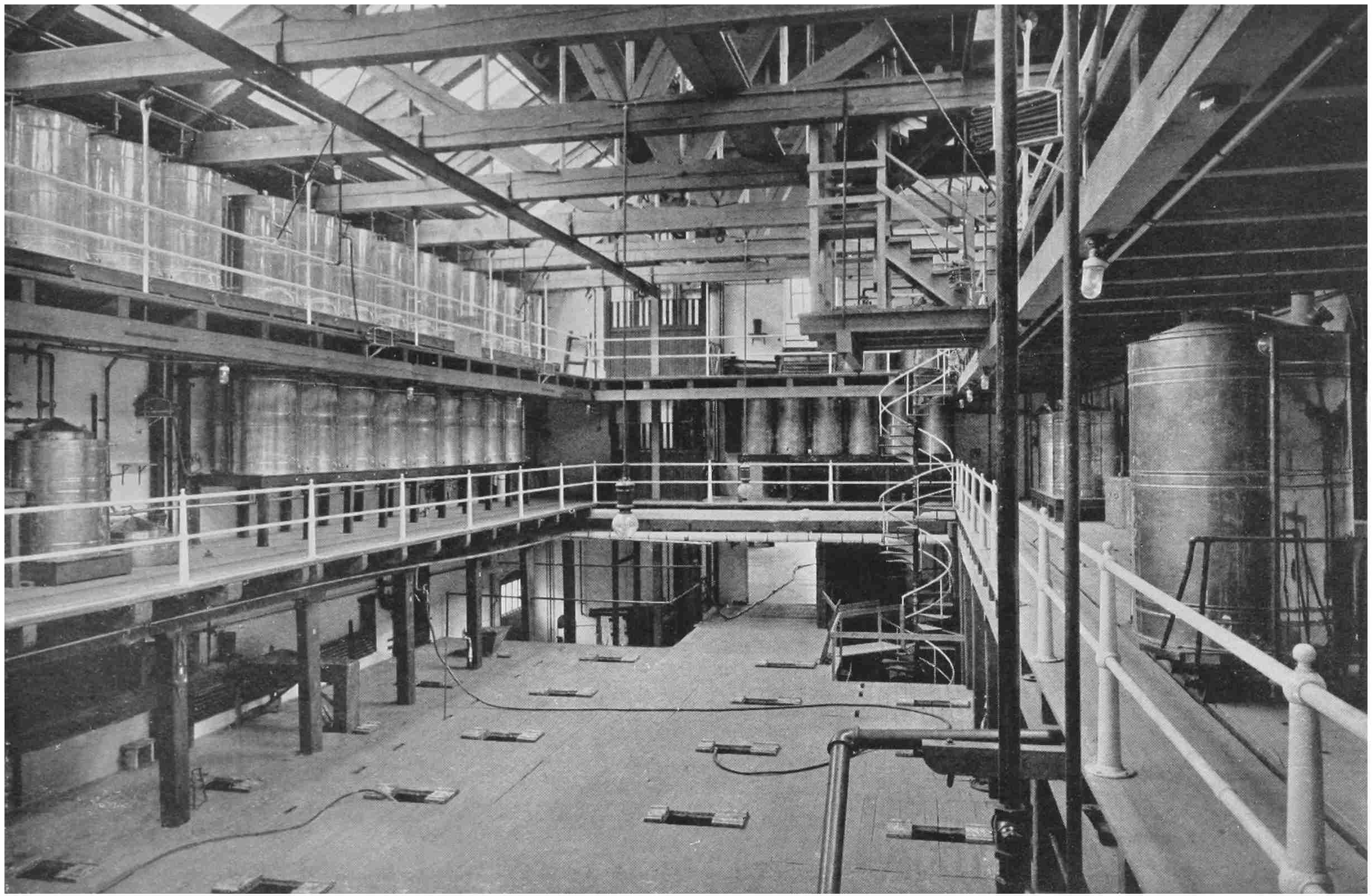
[By permission of the Eastman Kodak Company.
THE DISSOLVING ROOM.
The ingredients for the celluloid film are dissolved in large tanks. The liquids are drawn off and led through the trap doors into
in-mixing barrels.
When the drying is achieved, the thin coating of transparent
flexible material, resembling a skin, is stripped
from its support and coated with the sensitive emulsion.
The latter is of two degrees of sensitiveness, according to
whether the film is to be used as a negative or a positive.
The former is of the very highest sensitiveness to light that
it is possible to obtain, since under normal circumstances
it is only exposed for the fraction of a second; while
the film required for the positive, which is used for projection,
is rendered less sensitive, as it can be given a
longer exposure in the printing operation.
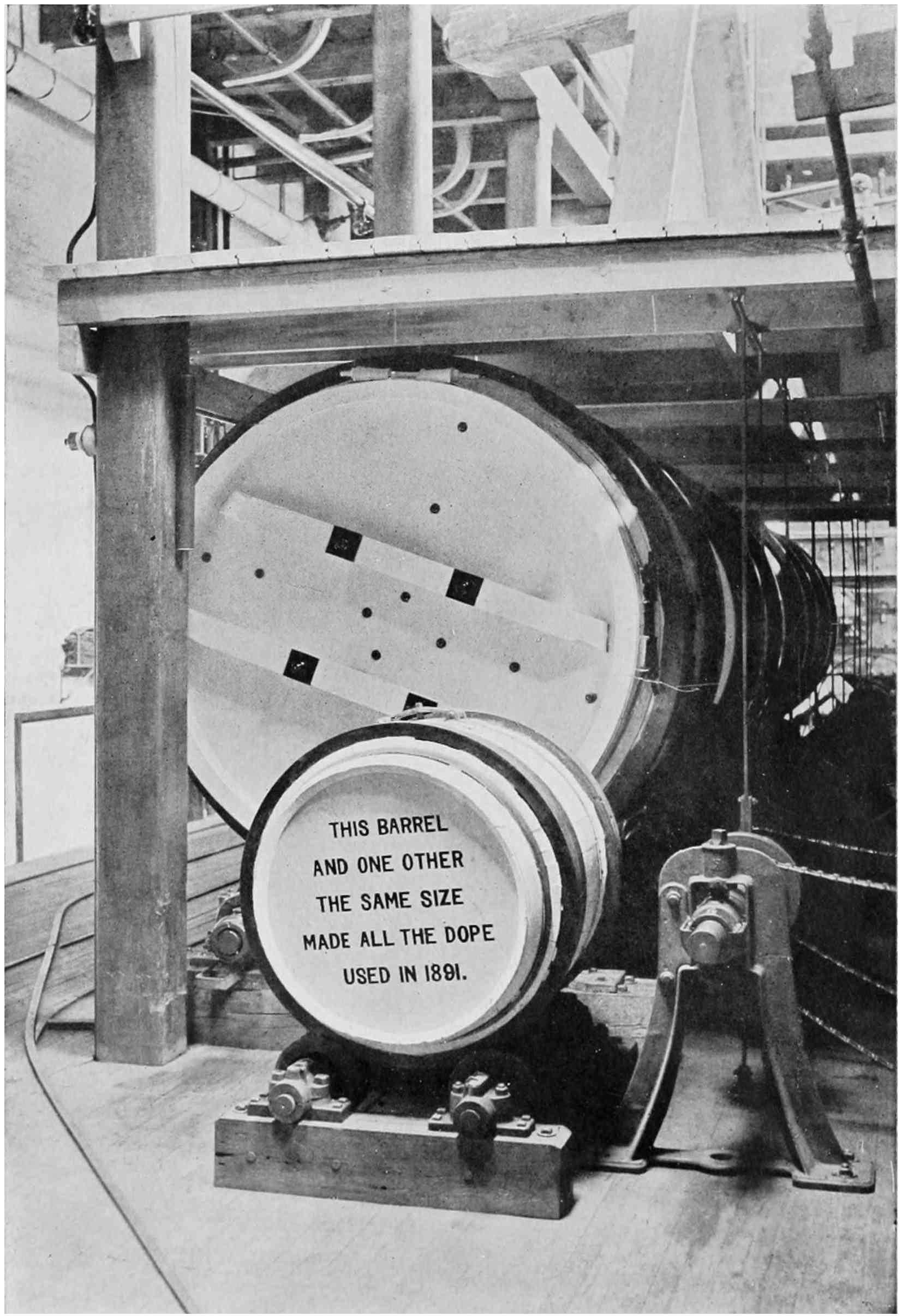
[By permission of the Eastman Kodak Company.
THE MIXING BARREL.
This picture conveys a striking impression of the growth of the film manufacturing industry.
Two small barrels, each holding 500 pounds, made all the film base or “dope,” as it is
called, in 1891. The larger barrel behind holds 4,000 pounds.
The base, with its sensitised coating, is now permitted
to become dry and hard. At the conclusion of this operation
the length of thin celluloid sheeting, technically called
a web, which is about 3½ feet wide, is slit into strips of the
standard width now used in all cinematograph cameras
and projectors—1⅜ inches wide.
Extreme care has to be taken to secure a uniform thickness.
The plant at the Rochester works has reached such
a degree of accuracy that the thickness of the film which
is taken from the polished rolls, although the web measures
2,000 feet in length, does not vary above the standard by
more than 1/4,000th part of an inch.
As I have already said, however, after all this care, the
product is far from being perfect, and it sometimes displays
strange caprices. They are most pronounced in the
tropics. Owing to the volatile character of the ingredients
employed in its manufacture, the film undergoes considerable
shrinkage in hot climates owing to evaporation. I
have seen film shrunk so much that it failed to conform
with the standard gauge, and the teeth of the sprocket in
the printing machine, instead of engaging with the holes,
played upon the outer smooth edges of the film. To maintain
the prime condition of the film it is necessary to keep
it somewhat moist, and accordingly the packing boxes
carry a certain amount of damped material. But in
tropical countries where the heat is intense, it is by no
means a simple matter to keep the film in condition; and
for this reason it is often difficult to secure satisfactory
pictures of scenes in tropical countries. A firm which dispatched
an operator to Central America to secure a series of
scenic and industrial films failed to obtain a single length of
pictures worth showing. I saw the results of the expedition.
The film was badly distorted, and the pictures in
some instances were so thin or indistinct as to defy projection.
£500 ($2,500) had been expended without result.
There is another eccentricity displayed occasionally by
some films in tropical climes, which is difficult to explain.
An operator will expose several hundred feet of film, which,
when developed, fails to show the slightest sign of exposure.
I have seen the results of a first-class cinematographer
working between the limits of Capricorn and Cancer. His
films when developed were as clear as if they had never
been exposed to the action of light. The firm took one
section of the exposed film and re-exposed it on a London
street. It showed on development the image of London
traffic, being as bare of any other image as if it had never
seen the jungle. Heat and dry atmosphere seem to
exercise some obscure chemical action, which prevents the
sensitive surface of the films from being affected by
exposure; yet when the film is returned to a naturally
moist climate, like that of England, it appears to recover
its original qualities.
As the component parts of a cinematograph film are of
an inflammable nature, the resultant fabric is naturally
also highly inflammable. This danger in the early days
severely menaced the development of the industry, especially
since those occupied in projection were careless of the
most elementary precautions. The film, after passing
through the lantern, fell a dishevelled mass into a
basket, where it formed a tangled heap of thin combustible
material, as inflammable as petrol-soaked shavings.
Celluloid emits a vapour of an explosive nature, and it is
always dangerous to use a naked light in its close
proximity. Yet custom rendered the operator heedless of
the danger. The outcome was inevitable. Legislation
stepped in and ordained that the projector should be encased
in a steel fire-proof chamber for the protection of the
public. The result was that the cinematograph was barred
from many places where the magic lantern was used.
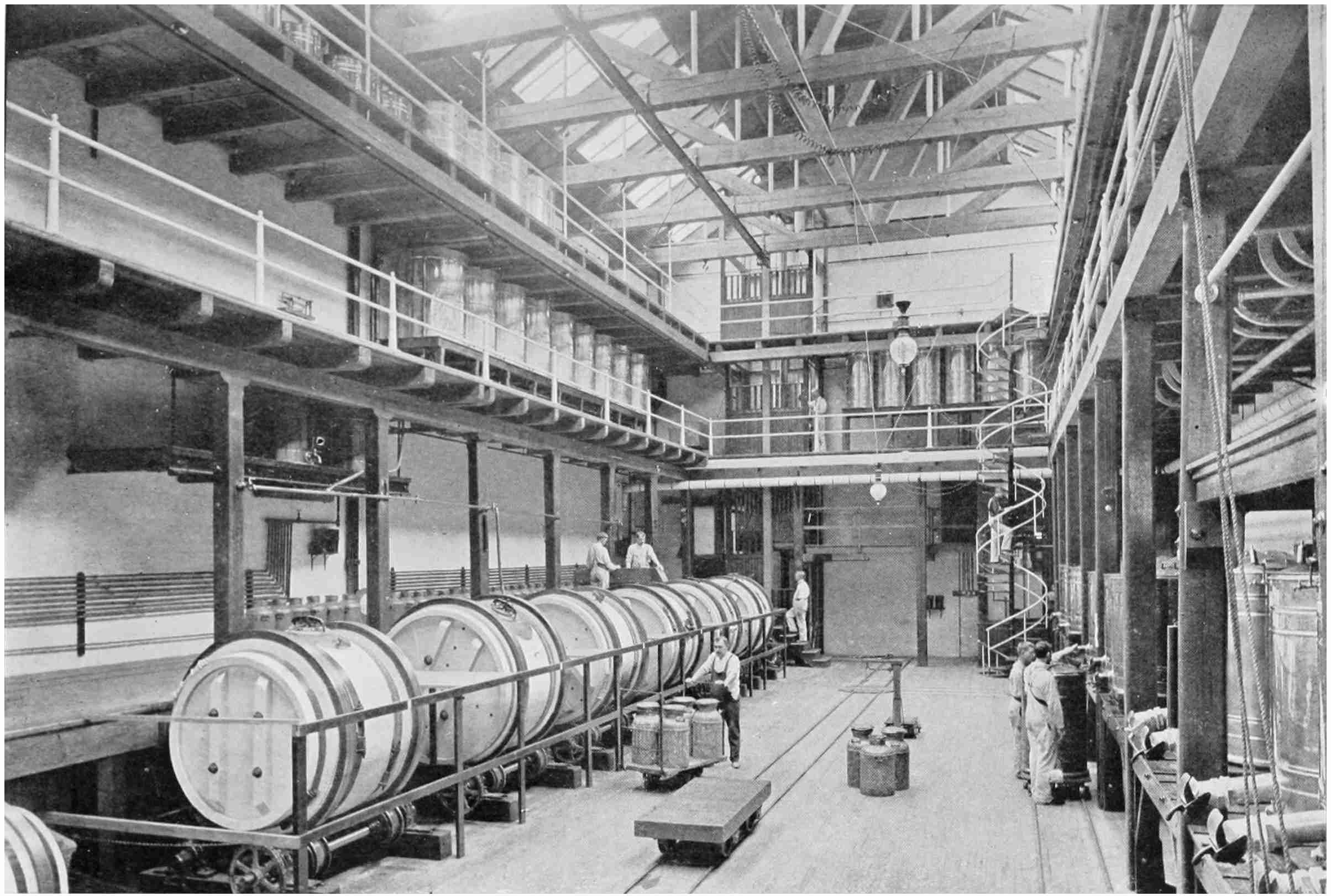
[By permission of the Eastman Kodak Company.
A BATTERY OF CELLULOID MIXERS.
Fifty barrels, holding 200,000 pounds of the “dope,” are run continually day and night.
Moving pictures could not be shown at such establishments
as schools, merely because they did not possess a
fire-proof chamber in which to operate them. A non-inflammable
film was, of course, the next demand. To
attempt to render celluloid non-combustible was akin to
rendering gunpowder non-explosive. An absolutely new
film-base had to be found. Cellulose as a basic constituent
could not be dispensed with—in fact, chemical
research has not yet succeeded in discovering an
efficient substitute. Efforts were concentrated upon the
treatment of the cellulose in such a manner as to prevent
it being readily combustible, with the resultant production
of the preparation known as cellulose-acetate, which
is practically non-inflammable. But while this substance
complies with the letter of the law and does not burst
into flame, it does melt, however, under the influence of
heat, and in so doing sometimes emits copious clouds of
smoke, which are capable of producing panic in an
audience quite as readily as an outburst of flame.
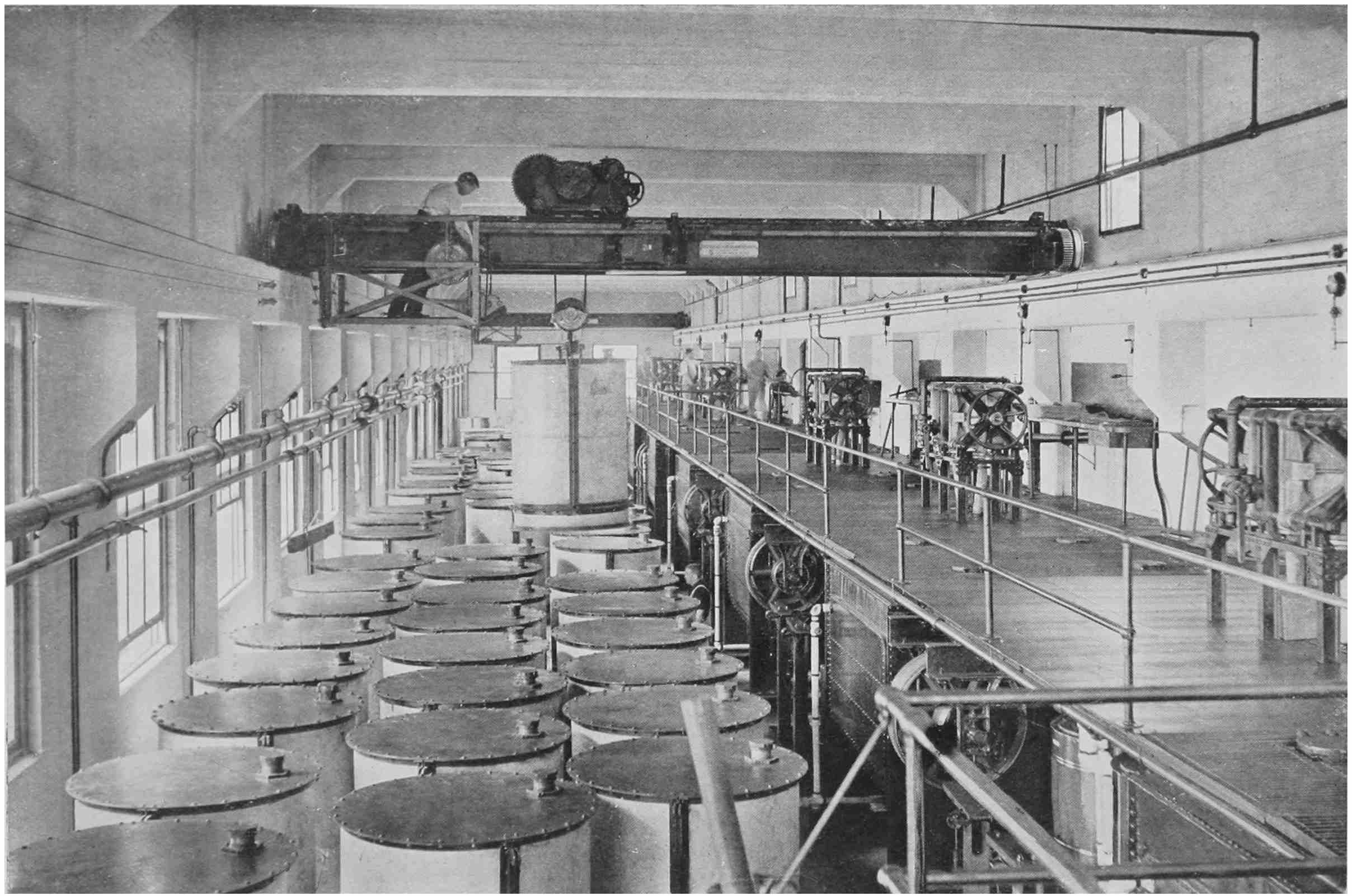
[By permission of the Eastman Kodak Company.
THE LIQUID CELLULOID STORAGE ROOM.
When the ingredients are mixed thoroughly the syrup-like mass is stored in cylindrical tanks until required by the machines to be made
into the film. Each vessel is of five tons capacity.
Under ordinary circumstances, this non-inflammable
film is quite safe to handle, and from that point of view
is adapted for the purpose of exhibiting in buildings where
a special chamber is not provided. The heat produced by
the focussed rays in the lantern, or the inadvertent contact
of a naked light, do not promote combustion. The
cellulose-acetate merely chars or melts, the action being
purely local.
The celluloid film is supplied generally in lengths of
165 feet, which is approximately the capacity of the
average film box. The actual picture itself upon the film
measures one inch in width by ¾ of an inch in depth.
The question naturally arises as to what becomes of
the films which have passed through their allotted span of
life. When the celluloid film was first placed on the
market this material was of a certain value. The sensitised
gelatine emulsion was stripped off, and the base was
converted into varnish. But this practice has fallen into
disuse. Practically speaking, old films have no economic
value. As a rule they are burned. If the junk film is
obtained in sufficiently large quantities, a slightly remunerative
by-product can be obtained in the form of
metallic silver from the ashes, but the yield is so small
and silver is so cheap that the trouble involved does not
pay unless the waste is destroyed in tremendous bulk.
This is the era of the profitable utilisation of waste
products, and no doubt a large fortune is awaiting the
chemist who succeeds in evolving a cheap process for
turning the useless cinematograph film to commercial
account. Newspapers, old iron, and other metals, rubber,
sawdust, and even garbage, possess a certain economic
value, and there is no reason to suppose that used celluloid
film is an exception to this general rule of utilising waste
products. One by-product, as we have pointed out, is
certain of reclamation—the silver—but the other constituents
might prove just as valuable if a cheap, inexpensive
method were contrived for their commercial reclamation.
CHAPTER VI THE STORY OF THE PERFORATION GAUGE
We have seen that before the film can be used in the
camera it has to be perforated on either side in order that
successive areas of film ¾ of an inch deep—the equivalent
of a picture—can be seized and brought into position
behind the lens. This perforation has become standardised
in accordance with what is known as the “Edison
Standard Gauge,” which is 64 perforations per foot on
either side. This perforation is of an elongated form,
measuring about ⅛ of an inch in width by approximately
1/16th of an inch in depth.
The preliminary operation is carried out with a machine,
which stamps the holes by means of specially hardened
steel punches. Extreme care has to be taken to carry out
the task with mathematical accuracy, in order that the film
may be used with any type of camera and projector.
Without it steadiness of the picture upon the screen is
absolutely impossible.
It seems strange that all films should have to be perforated
according to the Edison system, when it is remembered
that the first commercial cinematographic apparatuses
for the projection of pictures upon a screen were made, not
by Edison, but by Paul and Lumière, who, one might
think, would have established their own gauges. This
important point involves an interesting little story.
In the very earliest days of cinematography, when a
film of greater width was used than at present, it was
advanced by friction. Rollers, or clutches, gripped the
edges of the film tightly, and moved it forward the desired
extent. But their action was uncertain. Sometimes the
rollers became slack and the film slipped, the celluloid
ribbon varied in thickness or was a trifle slippery, with
the result that the forward movement was irregular, and
the pictures did not appear in rhythmic succession. Some
were askew, others were overlapped by the preceding
or succeeding image, or a wide gap was left between
consecutive pictures.
In order to overcome the drawback, attempts were made
to devise a system of moving the film forward by the aid
of pins engaging with holes in the sides. But the apparatus
employed was mechanically defective. The film
dragged, and the holes were either torn or became so worn
that they did not engage accurately. Square holes were
first tried, but the wear and tear set up by the pins or
sprocket teeth soon gave them a circular or elongated
shape. Then circular perforations were adopted, but they
soon became elliptical. The number of perforations per
picture was varied also in the hope of securing steadiness
of the film both in the camera and more especially in projection,
but every effort appeared to refuse to remove the
difficulty.
One of the early investigators was discussing the subject
one night with Lord Kelvin. The eminent scientist
became deeply interested in this trouble with regard to the
perforations, and the disadvantages of the respective
shapes shown to him. After a few minutes’ reflection, he
remarked, “Why not use perforations of triangular form?
They will not wear round or square. They will always
retain their shape more or less, and at all events will give
improved steadiness in running.” The advice of Lord
Kelvin was followed, and the triangular holes were found
to give the best results achieved up to that time.
Meanwhile the shape of the perforations and the gauge
had settled itself in a curious manner. The kinetoscope
appeared with small rectangular perforations, numbering
four to each picture, on either side of the film. Edison
had settled on this plan for his apparatus, finding that
it afforded him the best results. The machines were made
and despatched to various parts of the world. To maintain
the interest in the novelty, a number of films were
prepared and sold to various customers possessing the
kinetoscope.
When Messrs. Lumière brought out their projecting
apparatus, only one brand of film available for demonstration
purposes was on the market—that made for the
kinetoscope. When Paul first entered the manufacturing
field, he, of course, prepared films for use with the
kinetoscope of his own manufacture, and he naturally
adopted Edison’s gauge. As already narrated, Lumière
made an attempt to set up an independent gauge,
with one hole each side per picture, but the Edison and
Paul films with an identical gauge had become too firmly
established, especially as the famous American inventor
commanded the situation in the United States. There
was no market for either machines or films deviating from
Edison’s gauge. Exhibitors who had bought kinetoscopes
and films, when they acquired a Lumière projector,
demanded that it should be so designed as to use the
films which they owned already, and which were highly
expensive. When other film-picture manufacturers entered
the arena they followed in Edison’s footsteps, because
there was no market for their wares if they did otherwise.
Consequently the Edison perforation gauge became more
and more firmly established as time progressed, until at
last it became regarded as the standard. It must be
pointed out that this result was largely attributable to
Paul, who became the largest manufacturer of kinetoscope
films in the world.
Yet it must not be thought that the settlement came
about smoothly. There has been a battle of the gauges
in the cinematographic as in the railway world. The
Edison standard gauge has its admitted drawbacks, the
greatest of which is that there are too many holes per
picture, which weaken the film and tend to precipitate
tearing. Two, or even one, hole per picture on either side
would suffice, as demonstration has conclusively proved.
An American rival attempted to swerve from the
standard in another direction, using a film 2¾ inches wide—double
the width of the kinetoscope film. He eventually
abandoned the wide band, partly on economic grounds,
as a ribbon half the width produced pictures in every
respect equal to those obtained from the wider film. On
one or two occasions the gauge has been revised slightly,
but the variations merely affected the dimensions of the
hole to a microscopic degree. Fundamentally, the gauge
as set by Edison for the first commercial apparatus for
showing photographs in motion prevails to-day, and is
universally accepted.
The film is received from the manufacturers in a plain
ribbon, and the perforation has to be done shortly before
the film is taken in hand for exposure. The film manufacturers
cannot possibly supply it perforated, because the
celluloid base undergoes continuous physical change while
in storage. Under varying climatic conditions it shrinks
and expands to an extent which may not be observable to
the eye, but becomes pronounced when the picture is projected
upon the screen.
The necessity for mathematical precision in the matter
of perforating is somewhat obscure to the uninitiated, but
its effects may be demonstrated very easily. Compare the
vibrating or oscillating flickering picture of 1896 with that
shown upon the screen to-day, in which the effect produced
comes very close to that of the camera obscura. If the
perforation errs the hundredth part of an inch, steadiness
in the picture is forfeited. The films have to be punctured
with the same mathematical accuracy that goes to the production
of a tiny screw intended for the most delicate piece
of mechanism.
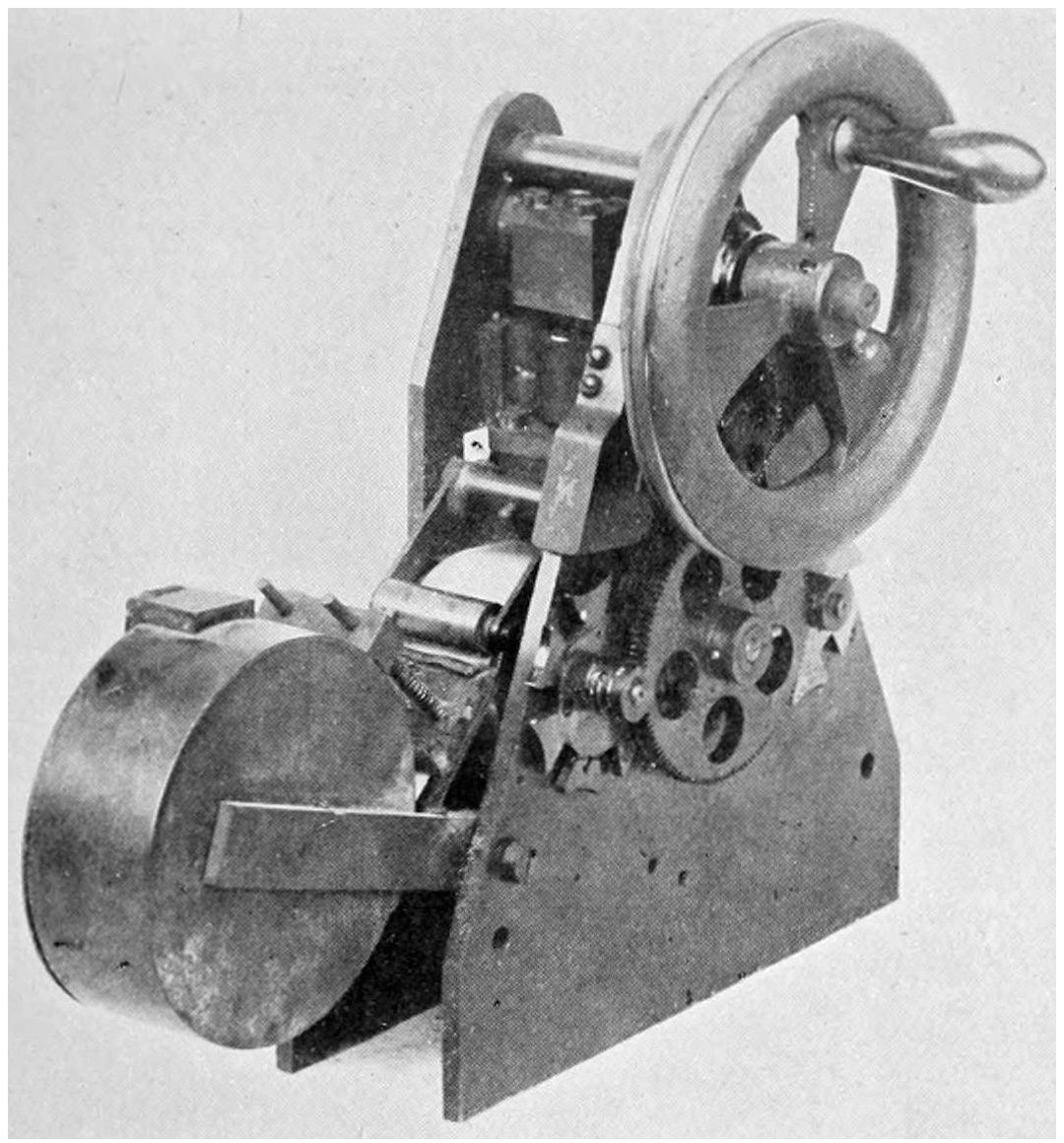
PAUL’S ROTARY PERFORATOR.
To punch the holes in the margins of the film before it is exposed.
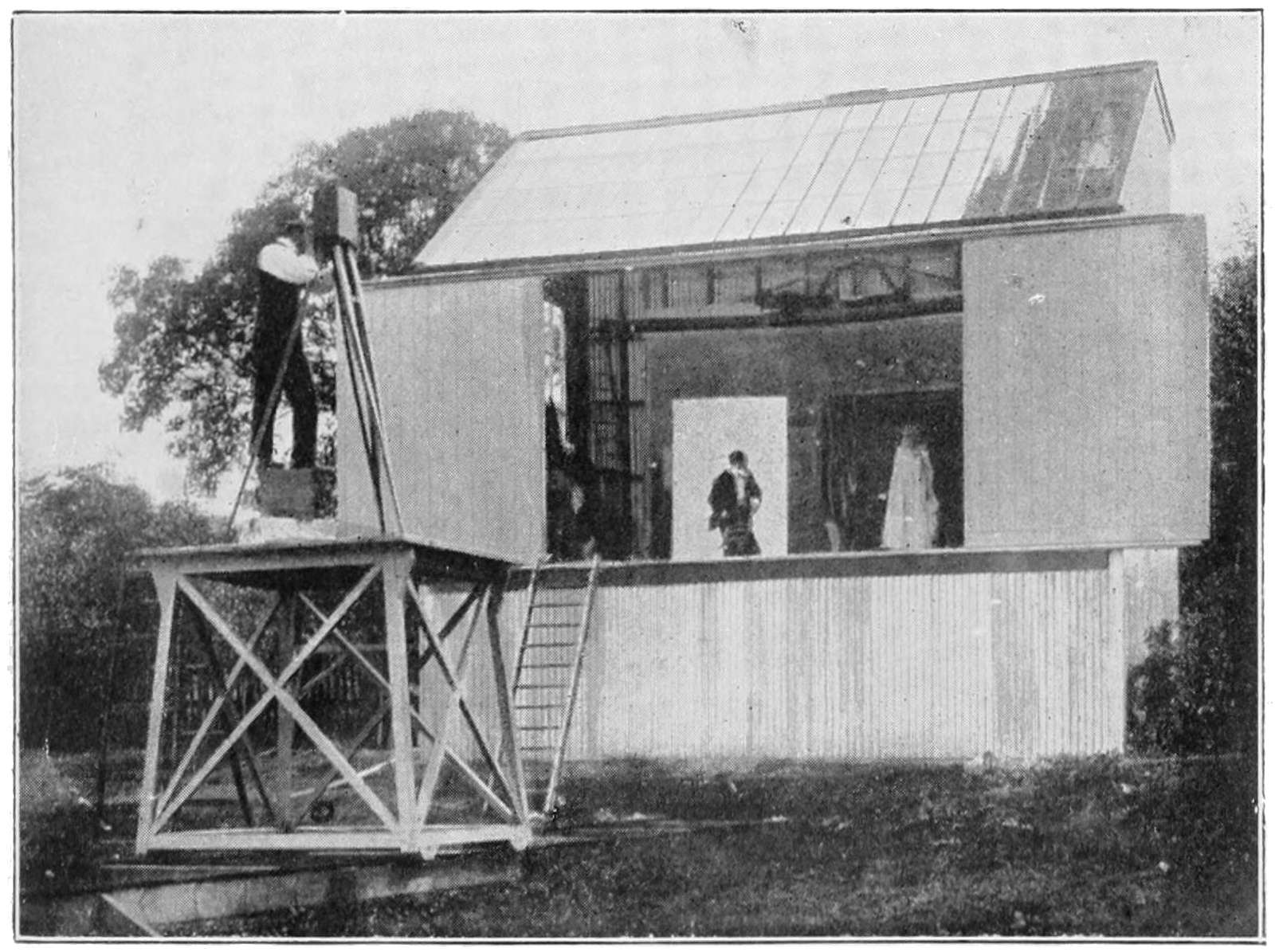
THE FIRST CINEMATOGRAPH STUDIO-STAGE.
Built by Robert Paul, at New Southgate, London. It faced north. The camera and
operator were mounted on a platform which travelled upon rails.
See page 104.
This is especially the case in regard to the perforation
of the negative film. If this is not absolutely true to
gauge, the existing error will be magnified in the passage
of the film through the camera; and should the latter be
ever so slightly at fault, the defect becomes intensified still
more. By the time the picture reaches the projector the
infinitesimally small defect in the first instance becomes
increased fourfold or even more. The picture will jump
and flutter in the most distressing manner, and no matter
how dexterous the operator may be, and despite the excellence
of his projector, he cannot by any means rectify or
mitigate very appreciably defects arising from indifferent
perforation.
The contribution of imperfect perforation to unsteadiness
in projection was recognised in the earliest days; and
great technical skill was devoted to the elaboration of
machines to puncture the film with scientific precision.
Marvellous appliances have been produced for this purpose;
but despite the infinite labour bestowed upon their
production the possibility of error is ever present. Still,
it has been reduced to infinitesimal proportions, and, given
a careful operator, a film can be perforated with the holes
varying not a thousandth part of an inch from the gauge.
The very earliest type of perforating machine was known
as the “Rotary Perforator,” Paul leading the way in this,
as in several other ramifications of the industry. The
machine was driven by a mechanism identical with that
utilised in the camera and projector; because the film had
to be advanced intermittently beneath the punches, which
were provided with an oscillating movement. This type
of machine is shown in the illustration. Paul’s first
appliance has always ranked as more simple, efficient, and
reliable than any other.
During recent years the rotary perforator has fallen from
favour, on the plea that it soon becomes imperfect in
working; but such an accusation cannot fairly be brought
against Paul’s machine, since its designer used it continuously
for four years, during which time it punched
millions of holes, and to-day is as correct in its work as
when first used.
It is impossible within the scope of this book to describe
all the various types of perforation apparatus now in vogue,
more especially as their interest lies mainly in highly
technical details. I will content myself with describing
three machines which exemplify the three most important
methods of perforation.
As this operation has to be carried out in the dark room
in the dim light of a ruby lamp, it is imperative that the
machines should be of the most simple design and operation,
demanding the minimum of labour on the part of
the operator.
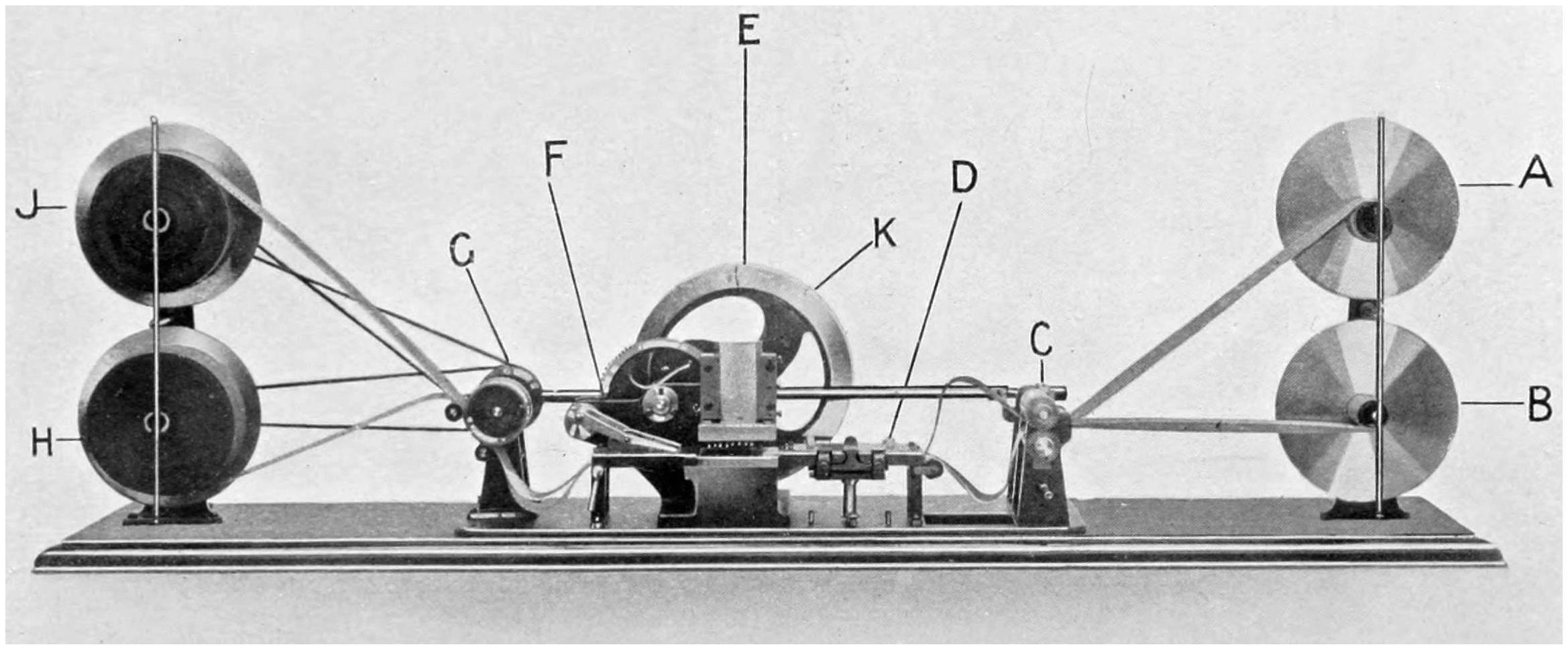
THE WILLIAMSON FILM PERFORATOR.
For explanation of design and operation see page 62.
In the Williamson perforator, four holes on either side
of the film are punched at one time, and two films are
perforated simultaneously, the sensitised surfaces being
face to face. This arrangement obviates the danger of
scratching or rubbing the sensitised surface during the
operation. One coil of plain film is mounted on the spool
A, and another on the lower spool B. The leads from
these two spools are taken between the rollers C on to a
small platform or guide gate D, where the two superimposed
films are brought accurately together to pass
under the punches. These are mounted in two rows, the
requisite distance apart, in a moving head piece E, which
descends at the critical moment, the punches piercing the
films cleanly and sharply, the pieces of detached celluloid
falling into a receptacle on the floor beneath.
When the head containing the punches rises, the two
hooked fingers or claws F engage a hole on either side of
the films, and pull them forward ready for the punching of
the next four pairs of holes. In addition to carrying four
pairs of punches, the head E carries four pairs of projecting
pins, set to the same gauge, and before the punch
descends these guide pins engage with the four preceding
pairs of holes, so that the distance between the sets of four
holes on either side is bound to be exactly the same as
between any two consecutive holes made simultaneously.
The result is that the holes are perforated with absolute
mathematical accuracy.
As the film emerges from the perforator proper, it is
passed between two guide rollers and a toothed sprocket
G, which meshes with the perforations, and thence the
lower film passes to the re-winding spool H, and the upper
film to the spool J. Between the perforating plate and
the respective rollers C and G, small loops will be
observed. These are provided for the purpose of obviating
any pull upon the film while in the guide gate, and beneath
the punches, which might otherwise destroy the alignment
and accuracy of the gauge. These loops remain constant,
but they can be altered at will while the machine is running
without disturbing the actual perforation. The Williamson
perforator can be run under power at a relatively high
speed, the wheel K being capable of 400 revolutions per
minute without impairing the accuracy of the work in the
slightest degree.
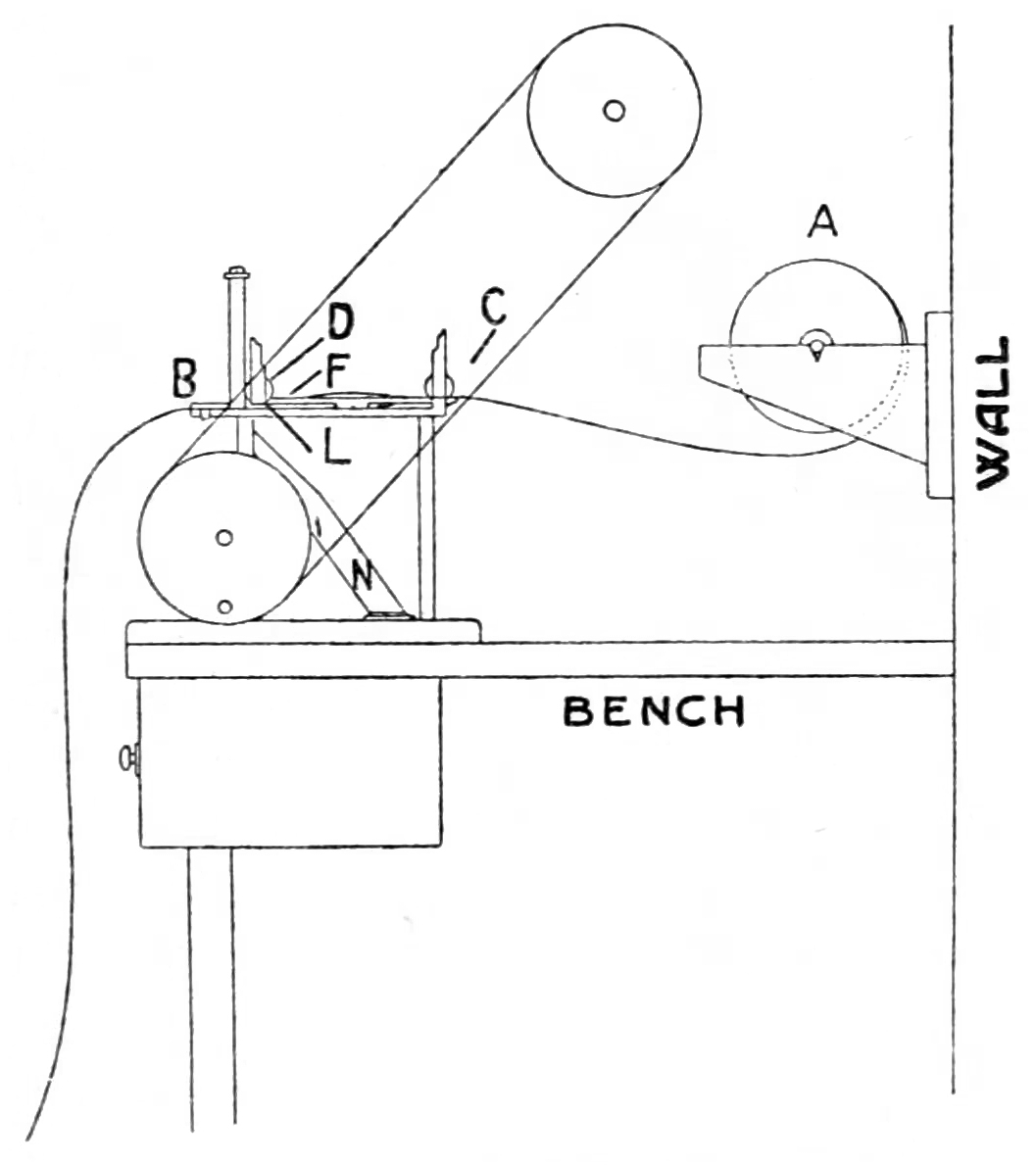
Fig. 5.—The N.S. Film Perforator.
A different type of machine is represented in the “N.S.”
perforator, Fig. 5. In this instance the coil of plain film A is
set up in a convenient position away from the machine, but
in such a manner that the feed thereto is in an easy curve.
The film enters the machine through two roller guides,
C and D, to a channel F, and then under the dies in the
top plate L. The punctured pieces of film fall away clear
of the instrument through the tube N, so that there is no
probability of such particles fouling the mechanism and
thus possibly upsetting the accurate working of the
apparatus. After being perforated the film is moved
forward by means of guide pins, and finally issues through
a guide B to be re-coiled. This apparatus is very convenient
for driving by power, is simple, efficient in its
operation, and owing to the solidity of its construction
there is little possibility of the precision of the gauge being
upset by wear and tear, or by other external influences.
The gauge, moreover, can be altered, if desired, to as
small a degree as 1/100th of an inch per foot. As the
positive film shrinks somewhat after development, it is an
advantage to be able to compensate for the contraction
when perforating. When the film is dry, although it may
have shrunk a trifle, it is found that the gauge is perfectly
accurate.
In the Urban-Joy perforator, only a single pair of holes
is punched at a time—one on either side of the film. At
first sight this method appears somewhat slow, but there
is the distinct advantage that the holes are made with
incontestable scientific precision, and after all this is the
all-important factor. This machine is capable of the very
finest adjustment, it being possible to vary the stroke of
the punch to the millionth part of an inch. Its simplicity
of operation is another distinct point. All strain upon the
film is avoided for the simple reason that it is passed
through the machine by the pendulum action of the
punches. When these are disengaged the film is held in
position by a clamp working in opposite step to the action
of the punches.
Years of labour have been expended upon the evolution
of the perforator. The fruit of these efforts, however, is
a material improvement in the steadiness of the picture
upon the screen.
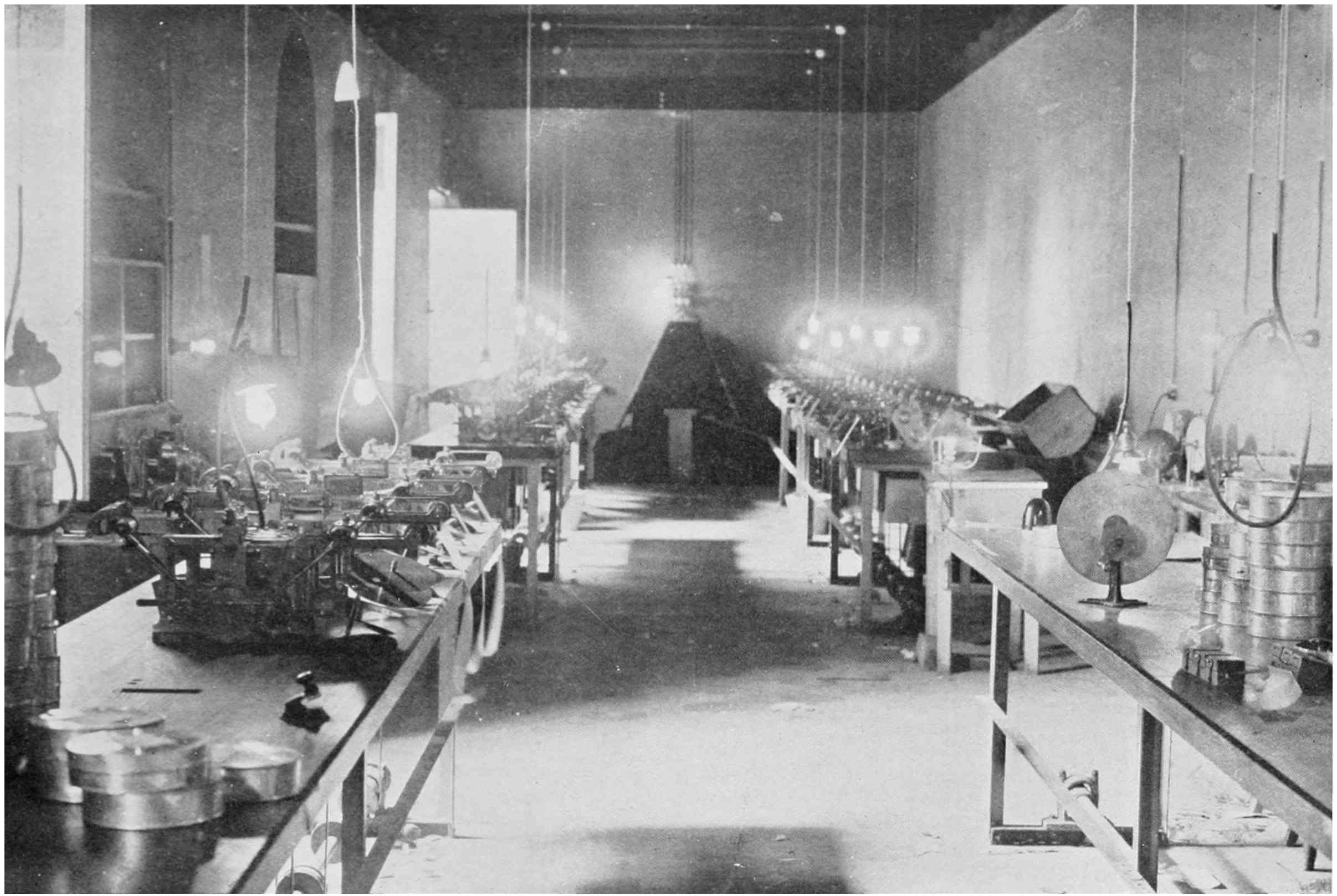
THE PERFORATING ROOM OF THE CINES COMPANY IN ROME.
The operation has to be carried out in ruby light.
CHAPTER VII THE MOVING PICTURE CAMERA, ITS CONSTRUCTION, AND OPERATION
Although it was as far back as 1894 that the first
commercial moving picture camera appeared in Great
Britain, the years have not produced many marked
departures from the design as elaborated by Paul. Time
has proved his plan to be the most reliable and efficient.
But as the art has developed and many minds have been
concentrated upon the apparatus, it has undergone modification
and improvement in minor details, all tending
towards greater excellence in the ultimate results.
Paul’s camera was a small wooden cabinet, measuring
only about six inches each way. It contained merely the
requisite intermittent mechanism to bring successive depths
of the film before the lens, and the tube to enable focussing
to be carried out easily from the back, and in such a way
that it was impossible for the film to become fogged when
the tube was left open inadvertently.
This instrument was a model of simplicity, compactness,
portability and convenience. The film was carried in
separate dark boxes of a size to hold 160, 350, or 700 feet,
according to requirements. These were detached from
the camera itself, the box of unexposed film slipping into
a device on top of the camera in such a way as to ensure
a light-tight joint, and locked into position to prevent
accidental detachment. From this box the film was led
through the camera mechanism, past the lens and into a
second box, similarly detachable. The apparatus therefore
was resolved into three main parts—the camera, and
the unexposed and exposed film boxes.
The modern cinematograph camera is completely self-contained;
the film boxes are incorporated within the case
that carries the mechanism for moving the film forward.
Further improvement is hard to imagine. Bulk and
dimensions are reduced to the minimum, with, at the
same time, the maximum of efficiency.
The cinematograph camera, unlike most machinery, is
called upon to face exigencies, and to perform exceedingly
hard work under the most adverse conditions. To-day it
may be in the broiling sun on a tropical desert; a few
weeks hence it is plunged into the extreme cold of the
Arctic circle; a little later it is well-nigh submerged in a
reeking swamp or vapour bath. Such varying conditions
subject the material and workmanship of the instrument
to a supreme ordeal. Consequently the greatest care has
to be exercised in the selection of material, the fashioning
of the component parts, and their fitting together. Only
the best seasoned mahogany can be utilised to withstand
the strains of warping, shrinking, and expansion under
extremes of heat and cold, and climatic fluctuations.
In the ordinary stand camera used for still-life work,
there is a bellows which can be racked to and fro to enable
the subject to be focussed sharply upon the ground glass
screen. The cinematograph camera has no bellows, and
there is no fixed screen for focussing purposes. In the
simpler and cheaper cameras, suited to amateur use, the
operator is not troubled with focussing details at all, the
lens being of a fixed focus as in certain types of snap-shot
hand cameras; but in the more expensive instruments,
designed for producing the finest classes of work, focussing
facilities are incorporated.
In order to grasp the operation of the camera, we will
open the hinged door with which it is provided on one
side, and gain access to its interior mechanism. It would
be invidious to select any special type of camera, inasmuch
as they all work more or less upon the same principle, the
differences being only in minor details.
By reference to the illustration it will be seen that
the apparatus is in three main parts. The rear half of
the cabinet carries two square compartments, A and B,
one above the other. These are for the two film boxes,
A carrying the unexposed, and B the exposed film. It
will be noticed that the cinematograph works upon the
system of roller photography. Indeed, it might be
described almost as a semi-automatic application of the
familiar snap-shot camera using roll-films.
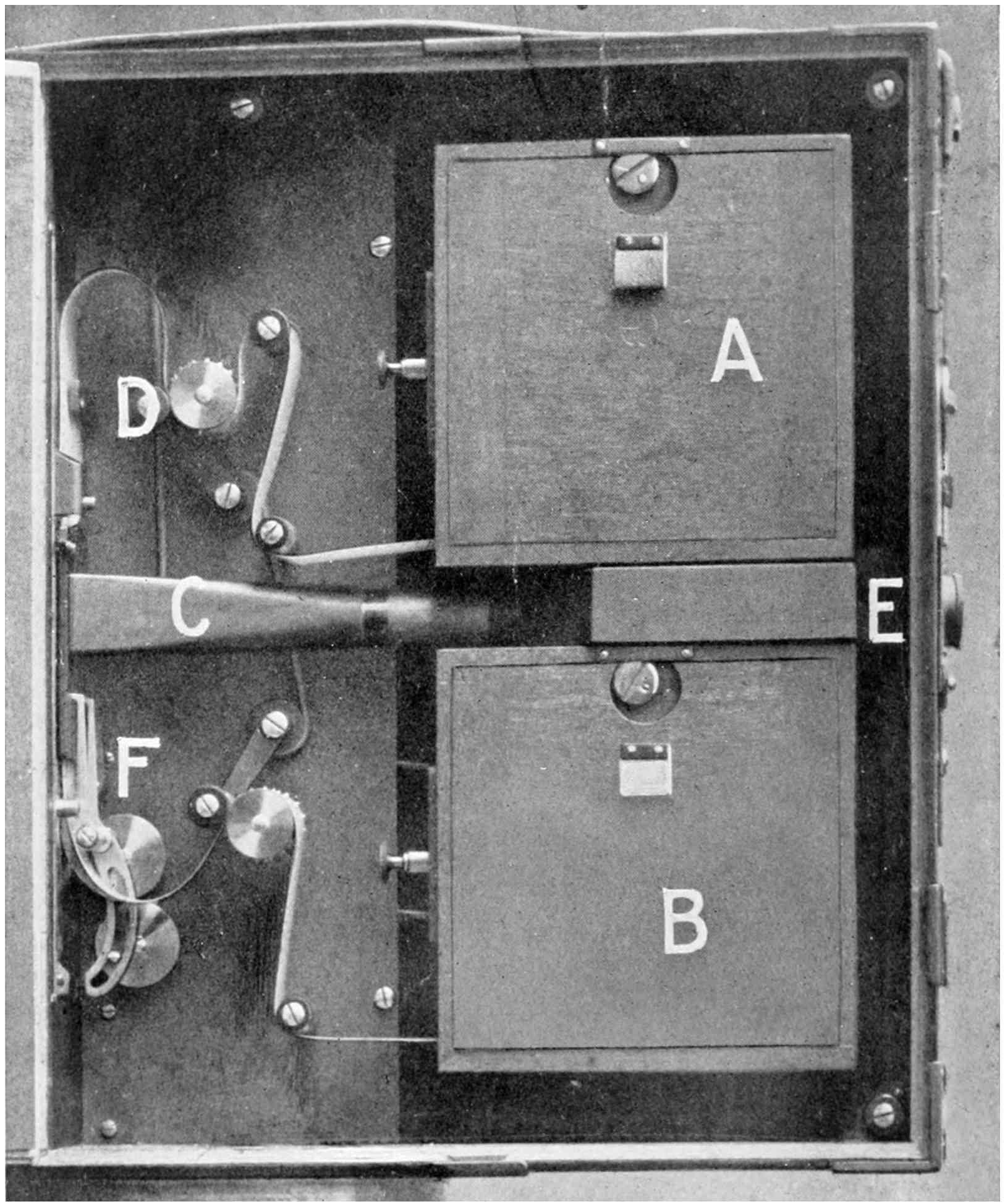
THE FILM-MOVING MECHANISM OF A CINEMATOGRAPH CAMERA.
The spool of unexposed film is carried in dark box A. From this it is led over sprocket
D, through the “gate” between the lens and the focussing tube C, where it is exposed.
The film is then jerked down the depth of a picture through the gate by claws F, over
sprocket and into exposed film box B, where it is wound on a bobbin. E is the eye-piece
of the focussing tube.
The lens is set centrally in the front face of the camera,
and carries a screw, by means of which focussing is
effected by moving the lens itself to and fro a short distance
within a horizontal tube, which corresponds to the
bellows in the ordinary camera. In addition it is fitted
with stopping facilities working upon the well-known Iris
principle, whereby the size of the aperture may be increased
or diminished by a rectilinear movement. Behind the
lens, and on a line with it in the interior, a tubular connection
C extends transversely through the width of the
camera to the rear, and through the outer wall to the
external face of the case. This is the focussing tube, into
which the operator looks through the small circular orifice
E in the back face of the camera, known as the eye-piece.
The mechanism by which, with an intermittent motion,
the film is jerked forward three-quarters of an inch
after each exposure, is of the simplest design. The
film as it issues through a narrow slit from the unexposed
film box A, is passed under a small guide
roller, having a smooth face. Thence it passes upwards
over a second roller and down under the sprocket
wheel, the teeth of which engage with the perforations
in the edges of the film, and thus guide it forward. As
the film passes upwards from the sprocket wheel, it is kept
in mesh by another guide roller, which maintains an
easy pressure upon the film to keep it in contact with
the wheel, this grip being ensured under the tension of a
spring. The roller is mounted on the end of a small
lever, which can be moved slightly so as to release the
grip upon the sprocket wheel in order to insert the film.
The arrangement adopted enables the contact roller to
ride over any variations in the thickness of the films should
such exist—a remote possibility in view of the wonderful
mathematical accuracy with which the films are made
to-day. It is impossible for the film to jump the sprocket
wheel, even when the machine is run at a very high speed.
The contact roller is so mounted, however, that it offers
no resistance to the free passage of the film.
The film now passes behind the lens for exposure,
travelling through what is known as the “gate,” which
consists of two parts, one fixed and rigid, the other having
a slight swinging movement. By means of the gate the
film is guided evenly into position, and held rigidly behind
the lens during exposure. The swinging part of the gate
is clamped to the fixed section by means of a spring catch,
so that when the gate is closed the film is imprisoned
between two sheaths which hold it firmly, and keep the
surface flat and even during exposure. The end of the
focussing tube C presses against the moving part of the
gate and tends to hold it rigid.
The film is pulled through the gate by an ingenious
plan. There are two claws or hooks F, the points of which
engage with a perforation on either side of the film. These
two fingers are controlled by an up-and-down cam movement
attached to the bottom sprocket. As the latter
revolves, the hooks are lifted and carried upward. Reaching
the limit of their upward travel, they drop upon the
film, clutching it by the perforations, and as the claw
action has a sharp downward movement, the gripped film
is pulled down suddenly and smartly through the gate
three-quarters of an inch at a time. The extent of the
downward travel reached, the claws are lifted so as to
disengage with the film, are swung upwards once more,
and the same cycle of operations is repeated until the whole
length of film has been exposed.
After the exposure is made, the film passes downwards
and through mechanism which is almost a duplicate of
that immediately above the lens. It passes under the
rocking contact roller, which keeps the perforations
meshed with the teeth on the sprocket wheel, after passing
round which it continues under a guide roller, and
enters the lower film box B, where it is wound on a
bobbin.
Action is imparted by the rotary movement produced
by the turning of the handle through suitable mechanism,
which is carried in a small space on the opposite
side of the camera to that containing the film. The
handle, however, not only supplies the drive to the intermittent
film moving action, but also rotates the
shutter steadily and continuously, through gearing. The
shutter is mounted in a small special compartment behind
the lens and in front of the film. It is adjustable; that is,
the opaque sector can be increased or reduced in area so
as to increase or diminish the size of the opening; thus the
period of exposure can be varied according to the light,
and as a supplement to the stopping down of the lens.
The gearing is practically the same in all English cinematograph
cameras, namely, 8 to 1, and the turning speed
should be two revolutions per second, which is practically
the slowest speed permissible.
The preparation of the camera for exposure is as follows.
The operator has selected his working position, and the
camera has been set up rigidly and firmly on its tripod,
so that no oscillation can occur during exposure. The
side of the camera is opened, and the loaded film box, from
the slit in the bottom of which the end of the film protrudes,
is slipped into the upper compartment.
Next the subject is focussed. The eye-piece of the
focussing tube is made telescopic, as a rule, so that it can
be extended a slight distance from the back face of the
camera case to facilitate focussing; it is fitted invariably
with a light-tight screw cap or gravity fall shutter, which
closes over the eye-piece so that no light may enter through
the tube to fog the film. For focussing purposes a piece
of transparent film with a rough “Matt” surface is used.
This is inserted in the film gate to act in the same way as
the ground glass screen in the ordinary stand camera. The
object is focussed by turning the screw, which racks the
lens forward or backward as desired. When the picture
appears sharp and clearly defined the matt film is removed,
the cap is replaced on the eye-piece, and the latter is
pushed home flush with the surface of the wood casing.
The film is now threaded. It will be observed that a
slight loop is made at either end of the gate. This is
necessary in order to give sufficient play to the film to
enable the latter to be jerked down without any strain with
each movement of the hook-claws behind the lens. If
it were pulled directly off the top sprocket the film would
be torn. The loops are kept constant, the upper being
connected to the lower sprocket through mechanism so
that they revolve simultaneously. Consequently three-quarters
of an inch of film is fed into the top loop gate
at the same time as three-quarters of an inch of film is
jerked through the lower side of the gate.
In loading, care must be taken that the sensitised surface
is brought towards the lens, and that the object is not
taken through the thickness of the celluloid base. In
order to thread the film through the gate the focussing
tube is pushed back slightly—it is made telescopic for the
purpose—the spring catch of the gate is released, and the
moving part swung back. The film is now slipped into
the gate, care being taken to see that the hooks of the
device whereby it is intermittently pulled down after each
exposure engage with the perforations. The gate is now
closed, and the focussing tube under the action of a spring
returns to its original position. Finally the film is led
into the unexposed film box, where it is secured by a clip
to the spindle of the reel. The box is shut, the handle is
given a turn to make sure that the mechanism runs evenly
and smoothly, and then the camera is closed, all being
ready for taking the pictures.
There is a popular impression that the operation of the
cinematograph camera is as simple as turning a coffee-mill
or a barrel-organ, and that the cinematographer has
nothing else to do but to revolve the crank. Never was
there a greater fallacy.
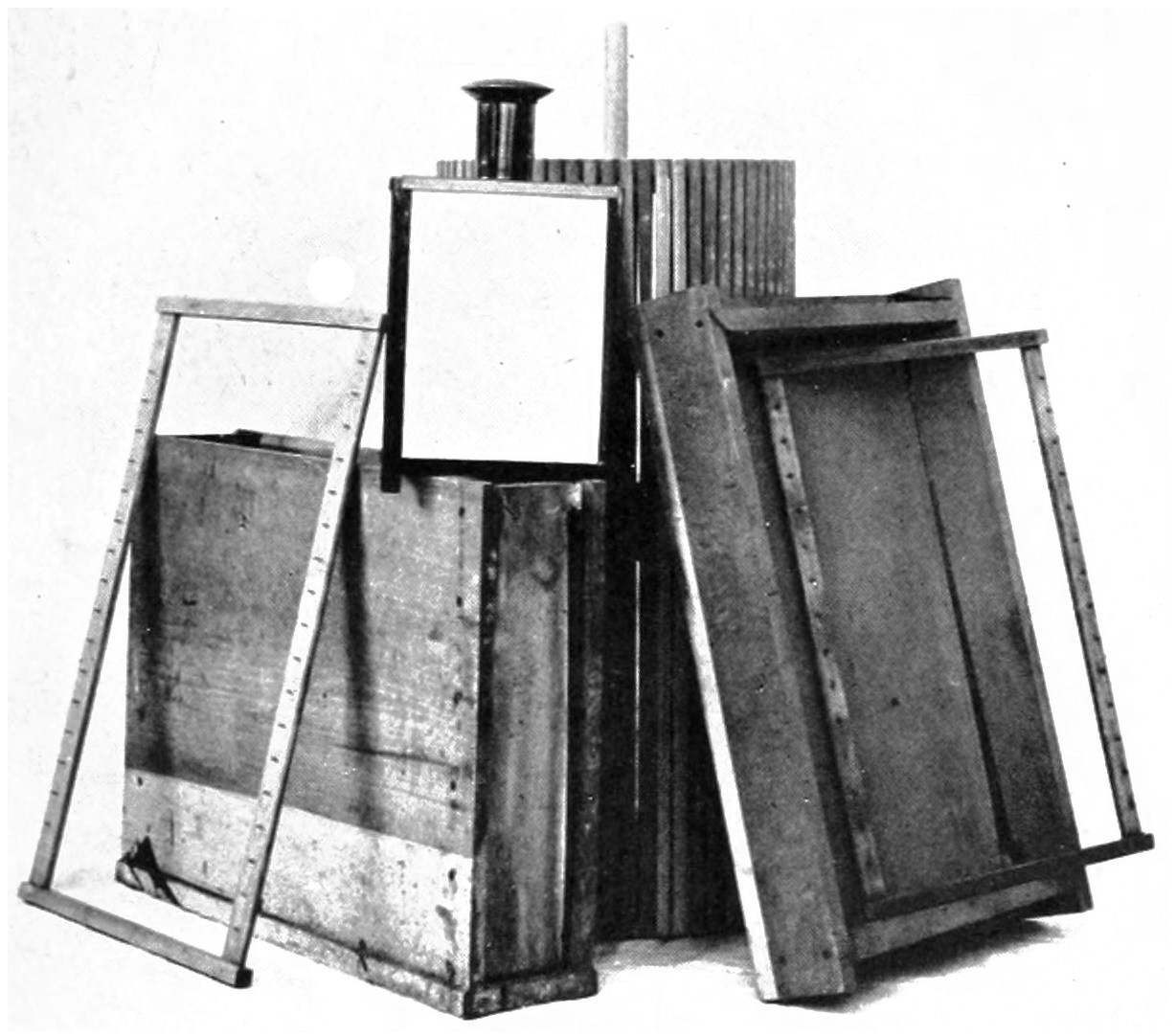
PAUL’S COMPLETE DEVELOPING, PRINTING AND DRYING OUTFIT.
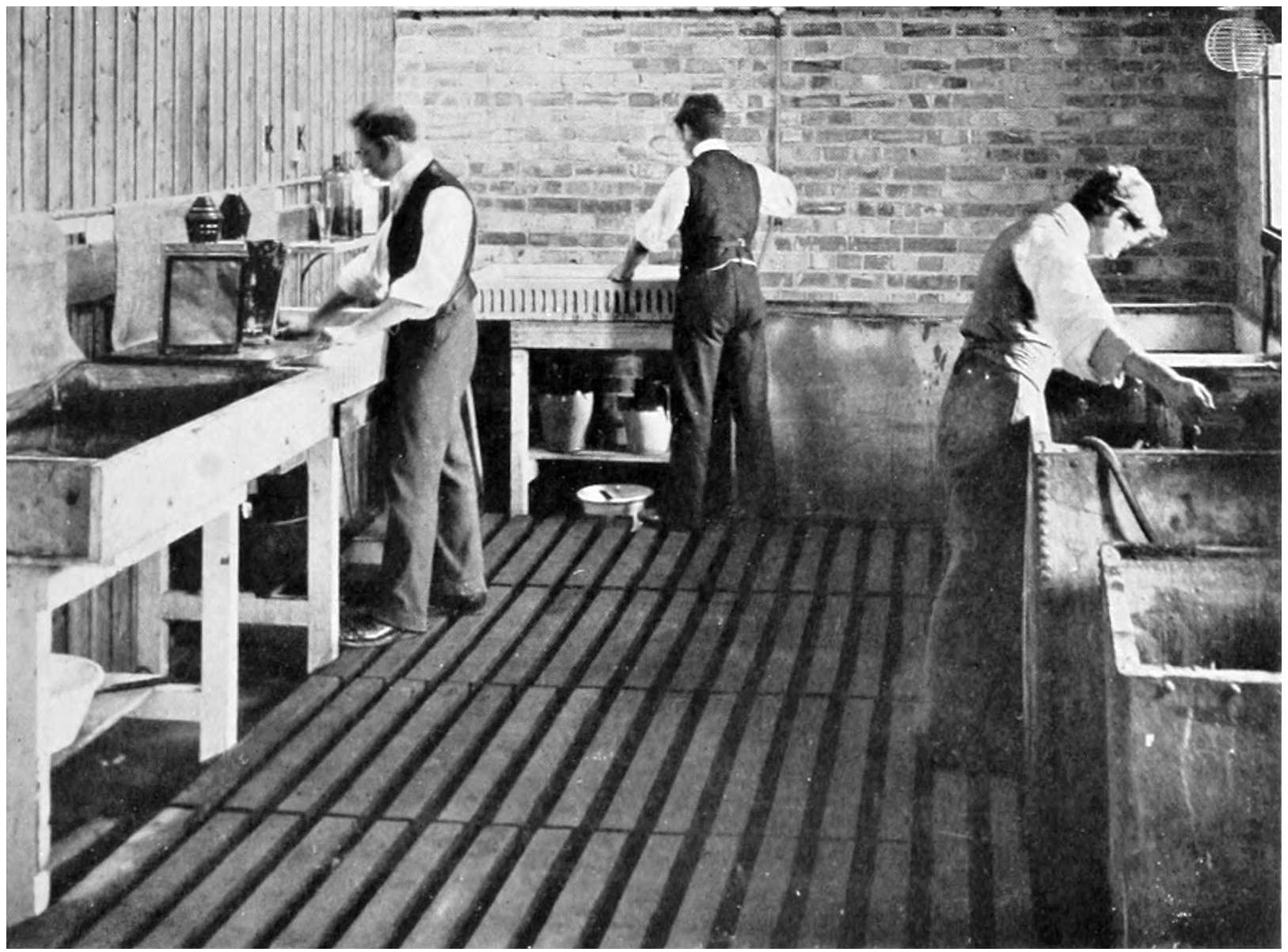
THE FIRST DEVELOPING ROOM IN GREAT BRITAIN, AT ROBERT
PAUL’S PIONEER FILM MANUFACTORY.
See page 77.
Turning the handle appears remarkably easy at first
sight, but a short trial proves that appearances are deceptive.
It is essential that the handle should be rotated at
uniform speed, and occasionally it is no easy matter to
resist the desire to slow down. For instance, when a
funeral is passing, there is an almost irresistible inclination
to slacken speed. The amateur responds to this desire,
and is astonished at the dislocated character of his pictures
when projected upon the screen. As a matter of fact, the
slowest funeral procession has to be taken with the same
number of revolutions per second, and the same number
of exposures—sixteen pictures per second—as an express
train travelling at 60 miles an hour; the crawl of the
tortoise has to be photographed just as rapidly as a horse
race, in order to secure natural motion. If a subject has
been photographed too slowly it cannot be corrected by
accelerating the speed in projection. The judgment of
the actinic value of the sunlight, and the requisite stop for
the lens, as well as the adjustment of the shutter, are factors
which only can be determined from experience.
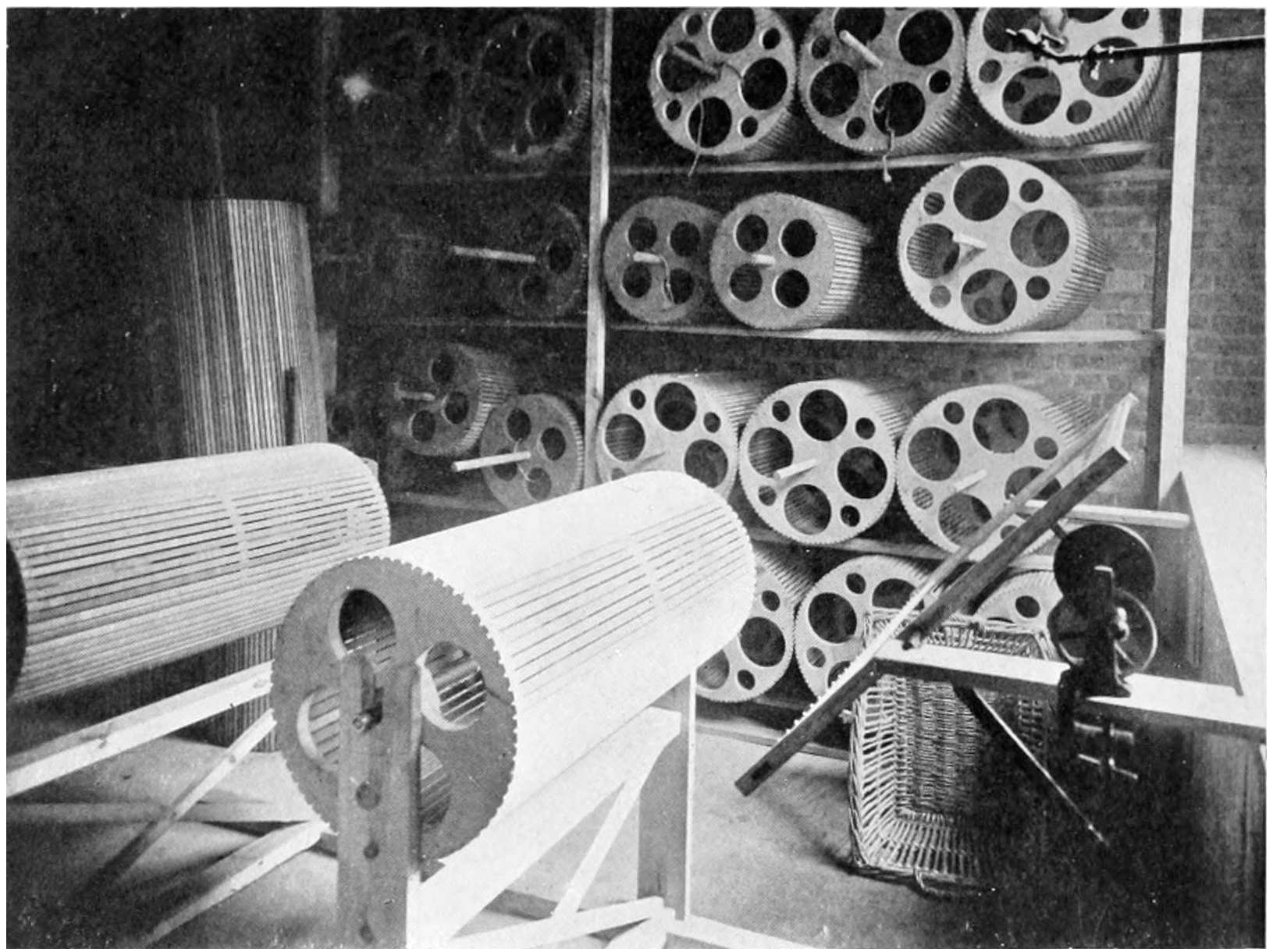
AFTER DEVELOPMENT AND WASHING THE FILMS WERE TRANSFERRED
FROM THE RACKS TO THE CYLINDERS.
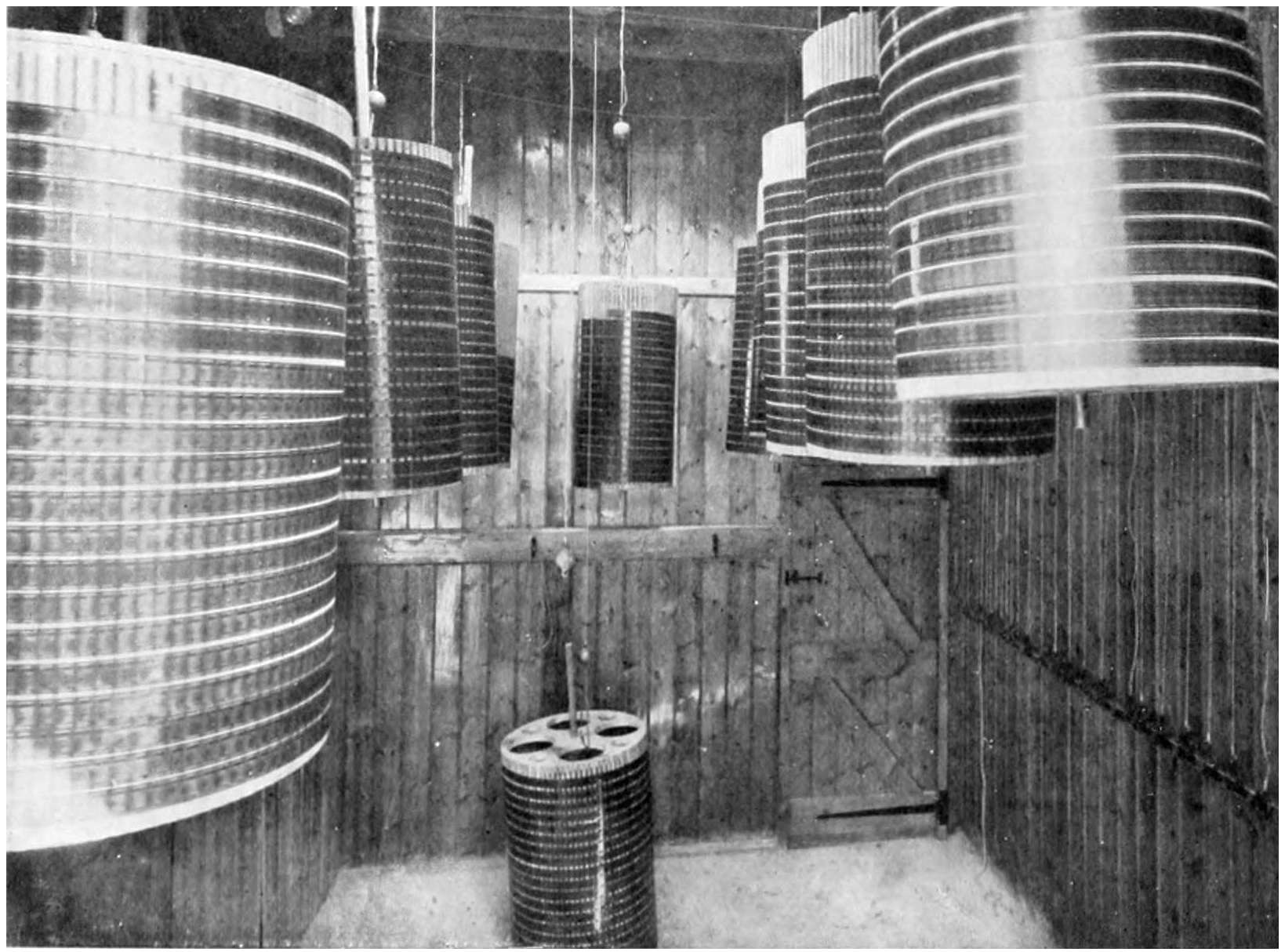
[Photos by permission of Robert Paul.
THE DRYING ROOM, SHOWING FILMS WOUND ON THE DRYING
DRUMS.
See page 77.
Possibly the box A contains a roll of film measuring
300 feet, whereas the subject photographed only demands
the exposure of 60 or 100 feet. Then one makes a few
punch marks on the film by the manipulation of a small
brass knob projecting from the outside of the camera, and
marked “film punch.” When the film reaches the developing
room, the operators working in the ruby light
can tell by these marks the ends of a series of exposures.
When the upper box has been exhausted of film, the
lower box, now charged with exposed film, is removed,
the empty upper box is slipped out of its compartment
and re-inserted into the lower recess, to serve in turn as
a receptacle for film after exposure, and a fresh loaded
film-box is placed in the upper space, the mechanism being
threaded as before. The operator can ascertain at a
glance how much film still remains to be used, because
on the outside of the case is a dial which registers in feet
the amount of film exposed, and which is set to zero
whenever a fresh box of film is inserted.
The task of the operator is increased in difficulty where
the subject being taken is moving at great speed horizontally
and vertically at the same time, when the object
passes in a very short while beyond the field of the lens,
and in order to secure a good record the operator must
follow the movements steadily and smoothly in such a way
as to keep the object near the centre of the picture. The
development of aviation has taxed the capabilities of the
cinematographer to a supreme degree; for in photographing
moving objects in the air the camera has to be trained
in two directions at the same time.
For this work a special tripod is required. It has a flat
table, but by means of two gear wheels the camera can
be swung round panoramically, that is, in a horizontal
direction, while another wheel will move it up or down
through as large a vertical arc as required. Rigidity and
freedom from oscillation are essential to secure sharp, well-defined
pictures, and consequently this moving table has
to be of massive construction, while the worm and wheel
gearing has to be heavy to ensure steady movement. The
camera is fitted with a direct view finder, whereby the
operator can train his instrument so as to keep the subject
well in the picture. Both horizontal and vertical training
movements are carried out by means of hand-wheels.
One of the finest examples of the operator’s skill that
I have ever seen was a film of Wilbur Wright’s flying
exploits in France, on the occasion of his first visit to
Europe. The camera was manipulated by two men. One
concentrated his energies on the revolution of the photographing
handle, while the other, with his eyes glued to
a special direct view-finder devised for this particular
operation, kept the camera steadily and regularly trained
both horizontally and vertically upon the aviator as he
described his evolutions in the air. Their joint efforts
were so successful that they produced a film free from that
dislocated or jerky action which as a rule characterises
the lateral or vertical movement of the camera while
exposures are being made; the results were just as if the
camera had been kept stationary during the whole time.
The ordinary tripod is used generally for outdoor work.
Many American and Continental film producers, however,
resort to a special type of support for the camera in the
studio or for indoor operations, such as the filming of
plays. This is a solid metal pillar, recalling a machine-gun
mounting, fitted with wheels to facilitate movement
from point to point, and other adjusting devices. It is
an excellent support for indoor work, as it ensures a solid
foundation for the camera, free from vibration. In many
instances the camera is driven by an electric motor.
It is sometimes desirable to secure two negative records
of an important event or subject, so that, should one film
prove defective, the mechanism break down, or the film be
damaged or destroyed, the duplicate is available and prevents
a total loss. For this purpose the camera is in
duplicate, though contained within a single case, with two
lenses mounted side by side as in a stereoscopic camera.
Both sets of mechanism are operated by the single handle,
and one person suffices for the operation of the instrument.
Within a few years, cinematography has widened its
sphere of usefulness in a novel and unexpected way.
Forty years ago no expedition of importance set out without
some member who possessed artistic ability, that
pictorial records of the life and character of the new country
might be brought back to civilisation. As photography
developed, the artist of palette and brush was superseded
by a man armed with a camera. To-day the latter gives
way in his turn to the cinematographer, who brings back
to us marvellous animated pictures of the remote and
unknown corners of the globe.
An ingenious camera has been devised for this especial
field of enterprise. It contains a unique feature that had
not been previously applied to the art. Two investigators,
Newman and Sinclair, by dint of considerable experiment
and labour, have succeeded in producing a moving-picture
camera with a reflex attachment, and this without increasing
the size of the case, or interfering with the action of
the short-focus lenses. By means of this apparatus
focussing can be accomplished in fifteen seconds, without
disturbing the film in the gate, which is threaded up,
ready for use, before the camera is taken from the dark
room. In this way the camera can be operated in much
less time than is possible by means of the ordinary cinematographic
apparatus.
As may be seen from the diagram, Fig. 6, the internal
mechanism of this handy little camera differs radically
from the description given in the first part of the present
chapter. The two film boxes are placed side by side
instead of one above the other. The film goes into and
out of them through narrow mouths, which, when the
camera is closed and light-tight, are automatically increased
in size to facilitate the passage of the film, and
automatically decreased again when the camera is re-opened.
In order to see, arrange, and focus the picture,
it is only necessary to raise a knob on the top of the
camera, which renders the image visible by means of a
magnifying eye-piece without disturbing the film. The
shutter is also adjusted from the outside of the camera, and
can be closed to give an exposure of 1/100th of a second.
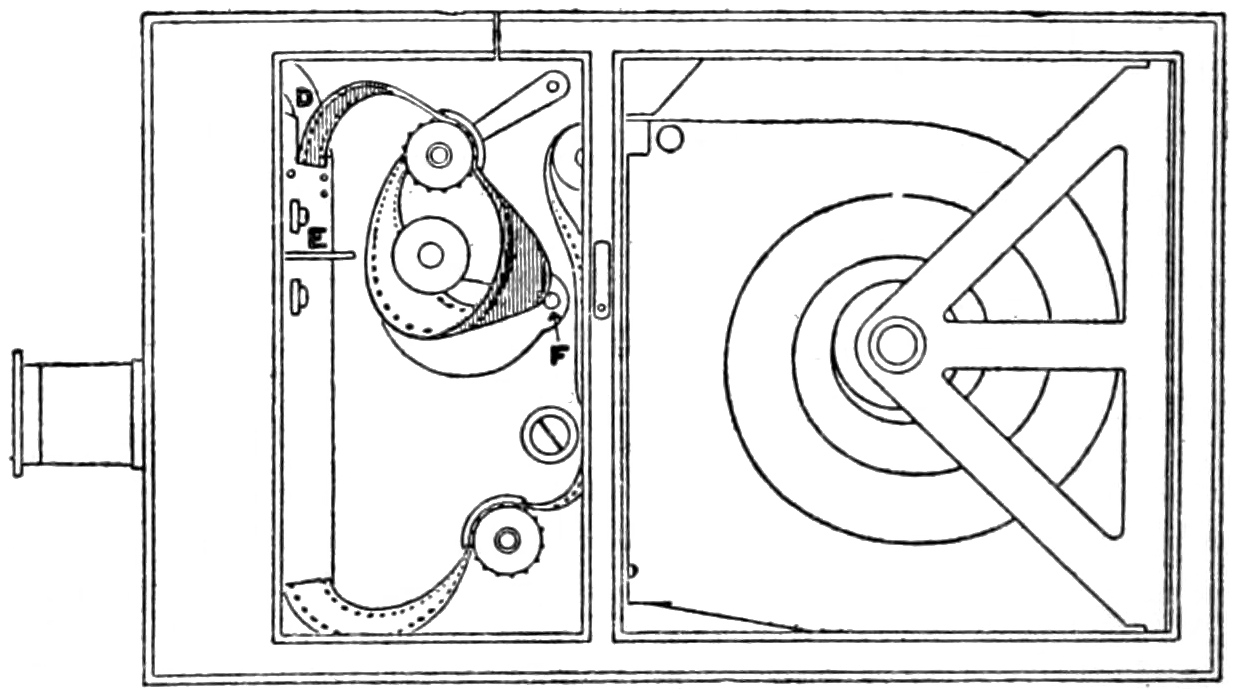
Fig. 6.—The Newman-Sinclair Reflex Moving Picture
Camera.
This camera is one of the most compact, portable, and
lightest cinematograph instruments yet evolved for the
purposes of hard work. It is designed to carry either
400 or 500 feet of film, and, when a picture is finished, the
end of the subject on the film is indicated by a device
which cuts a tongue-shaped opening in the film, and
which can be readily detected by touch when the film is
uncoiled in the dark room. It is an ideal instrument for
travellers, explorers, scientists, and others to whom quick
work is imperative. Its many excellent qualities received
recognition from Captain R. Scott, R.N., who included it
in the scientific equipment for the latest British Antarctic
expedition.
For special work, the usual form of camera is altered in
certain details, or equipped with special devices. Such
modification is emphasised particularly for the purpose of
taking trick pictures, to which subject reference is made
in subsequent chapters.
CHAPTER VIII DEVELOPING AND PRINTING THE PICTURES
The history of the cinematograph impresses upon us at
every turn the necessity which experimenters were under
of devising special facilities and improved apparatus in
all of the numerous fields that impinged upon their work.
They were obliged to break ground in every direction.
For instance, besides securing the right kind of film, they
had also to find the best means of developing it. A thin,
narrow ribbon of pictures 40 feet in length is a vastly
different thing to handle from a rigid glass plate. Its flexibility
presented many perplexing obstacles which had to be
overcome. Those who used the old roll film with the snap-shot
hand-camera of the early days, can relate pathetic and
humorous stories of the trials and tribulations they suffered
in passing the awkward length of film through the developing
and other baths. When it was unwound from
the roller preparatory to immersion in the developing solution,
it persisted in buckling and twisting into strange
contortions. Development was carried out in an uneven
or patchwork manner, some parts of the film being fully
developed before others had betrayed the slightest sign of
yielding the latent image.
The plight of the animated photographer was even more
unenviable; the handling of sensitised celluloid about as
thick as a substantial wooden shaving, was infinitely more
exasperating than that used in the ordinary hand camera,
for the latter was wider, thicker, and far shorter.
The developing methods at first advocated were of the
crudest nature possible. Messrs. Lumière tried to assist
the tyro by comprehensive explanation of a very simple
way to carry out the task. They suggested suspending
the coil of exposed film upon a rod slipped through the
centre of the bobbin to form a kind of spindle, upon which
the coiled film was free to revolve over the bath. The
operator was then told to unwind the coil very rapidly by
hand, passing it into the bath between the fingers, which
acted as a guide.
It appeared an absurdly simple operation, but without
considerable practice it defied success. One had to be
extremely careful not to damage the delicate sensitised
emulsion of the film while uncoiling it; that no greasy
matter, such as perspiration from the fingers, might come
into contact with the gelatine surface; and no bubbles must
be produced while feeding the slippery strip into the bath.
Mr. Robert Paul experienced these troubles, and displayed
considerable ingenuity in the evolution of special means
to avoid them. The efficiency of his method is proven by
the fact that in the main it is practised to this day.
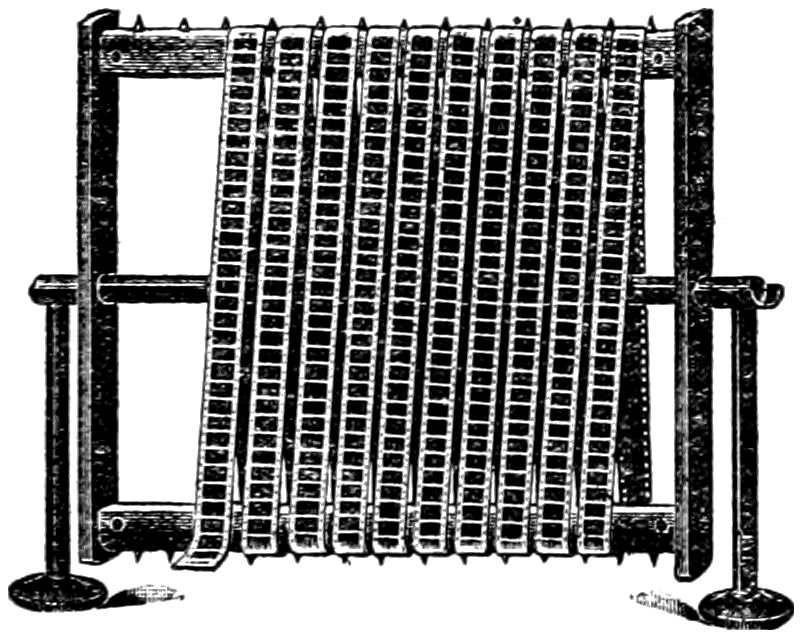
By courtesy of Messrs. Butcher & Sons, Ltd.
Fig. 7.—How the Film is Wound upon the
Wooden Frame for Developing.
His solution of the problem was simple, safe, and satisfactory
from every point of view. He took a light, square
wooden frame, similar to that in Fig. 7, which rested
loosely upon two uprights in such a way that it could
revolve. The free end of the film was fixed to one side of
the frame, and the film was then passed from one side to
the other, as if being wound upon a wheel, as it was
uncoiled from the spool, the inner end of the film being
likewise secured to the frame. This rack was dipped
first into a vertical tank to soak the film, and then was
placed in a flat tank or trough to be developed in the same
way as an ordinary glass plate. By this means every part
of the exposed surface was developed equally. Development
carried to the requisite degree, the frame was withdrawn,
washed, and finally immersed in the fixing tank,
which was of the same horizontal design. When the
image was fixed it was placed in another tank and received
a thorough washing, to remove all traces of the fixing
solution, as in the ordinary developing process. This task
completed, the film was uncoiled from the flat rack to be
re-coiled upon a wooden drum, which was suspended from
the ceiling in the drying chamber, until the film was dry
and hard.
As may be supposed, different factories practise different
methods of carrying out this operation. Nowadays a film
may be as much as 300 or 400 feet in length, and consequently
special methods have to be employed. I have been
in some establishments where development is carried out
upon an extensive scale, in which the films, as withdrawn
from the camera film box, are wound at once upon a large
wooden reel, seven feet or so in length, suspended upon
brackets above the developing bath. When the drum has
received its full length of film it is lowered into a deep
tank containing the desired solution, and there kept revolving
slowly and steadily until the treatment has been
completed. Then the reel is withdrawn by two men and
lowered into the next bath; and so on until at last the reel
finds its way into the drying room, where the film is
uncoiled from the developing drum and re-wound upon
the drying reel. The disadvantage of this process is that
two men are required to handle the reel, whereas, when a
frame is used, one pair of hands is sufficient.
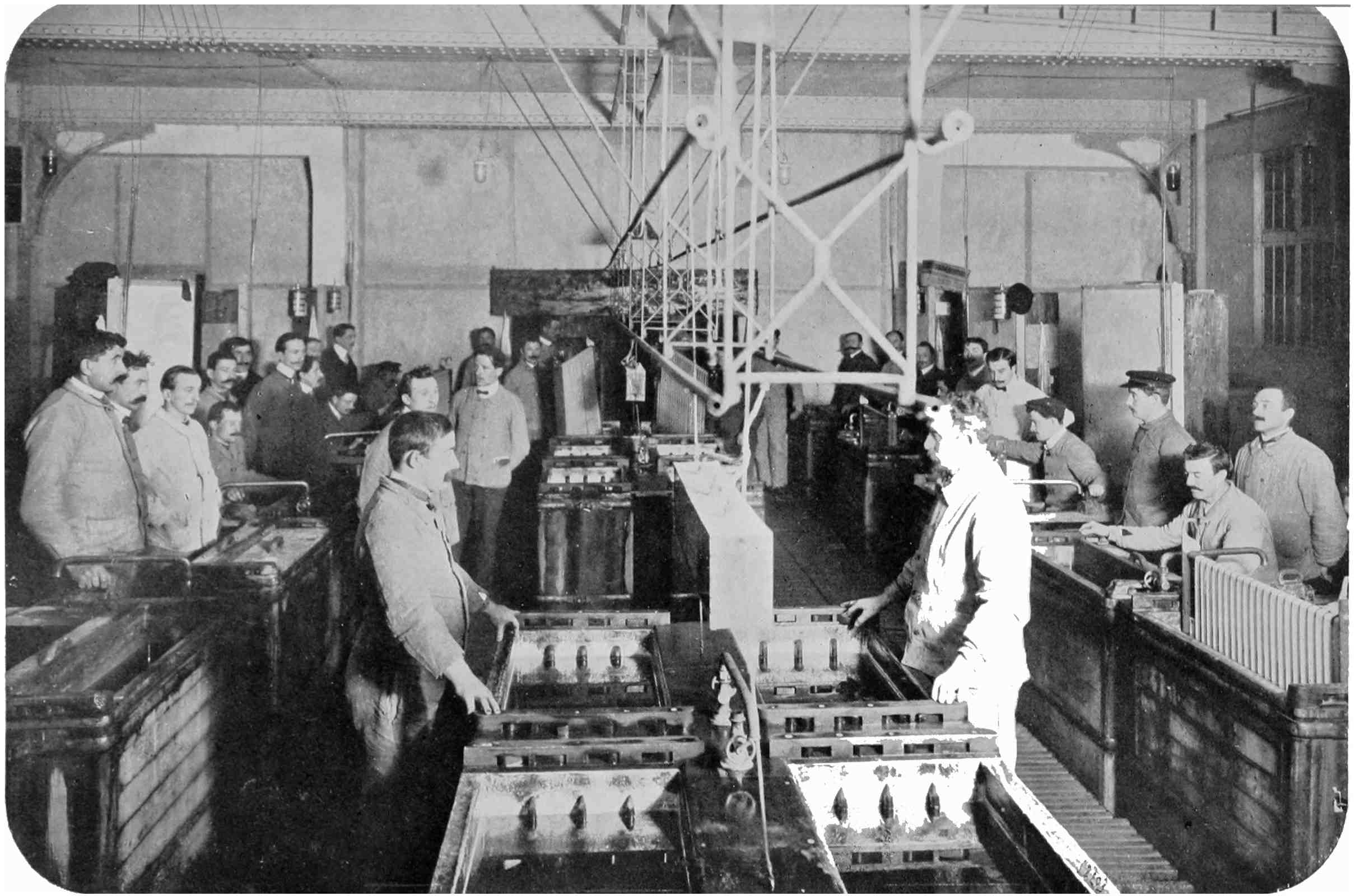
THE DEVELOPING ROOM AT THE PATHÉ WORKS.
The films are wound upon wooden frames and immersed in large tanks containing the various solutions.
The developing and printing rooms in a large film-picture
factory are highly interesting hives of activity.
Large troughs and tanks containing the various solutions
are on every hand, together with adequate supplies of
running water. Everything, of course, is carried out in
semi-darkness, the only light available being that emitted
from ruby lamps. The fixing solution after it has served
its purpose is not thrown away, but is subjected to a
chemical treatment to recover the bromide of silver which
the hyposulphite of soda has dissolved from the sensitised
emulsion on the film. The silver in suspension is precipitated
by chemical action in a thick sediment. In large
works this recovery process is profitable, several pounds
of this metallic silver being secured every week.
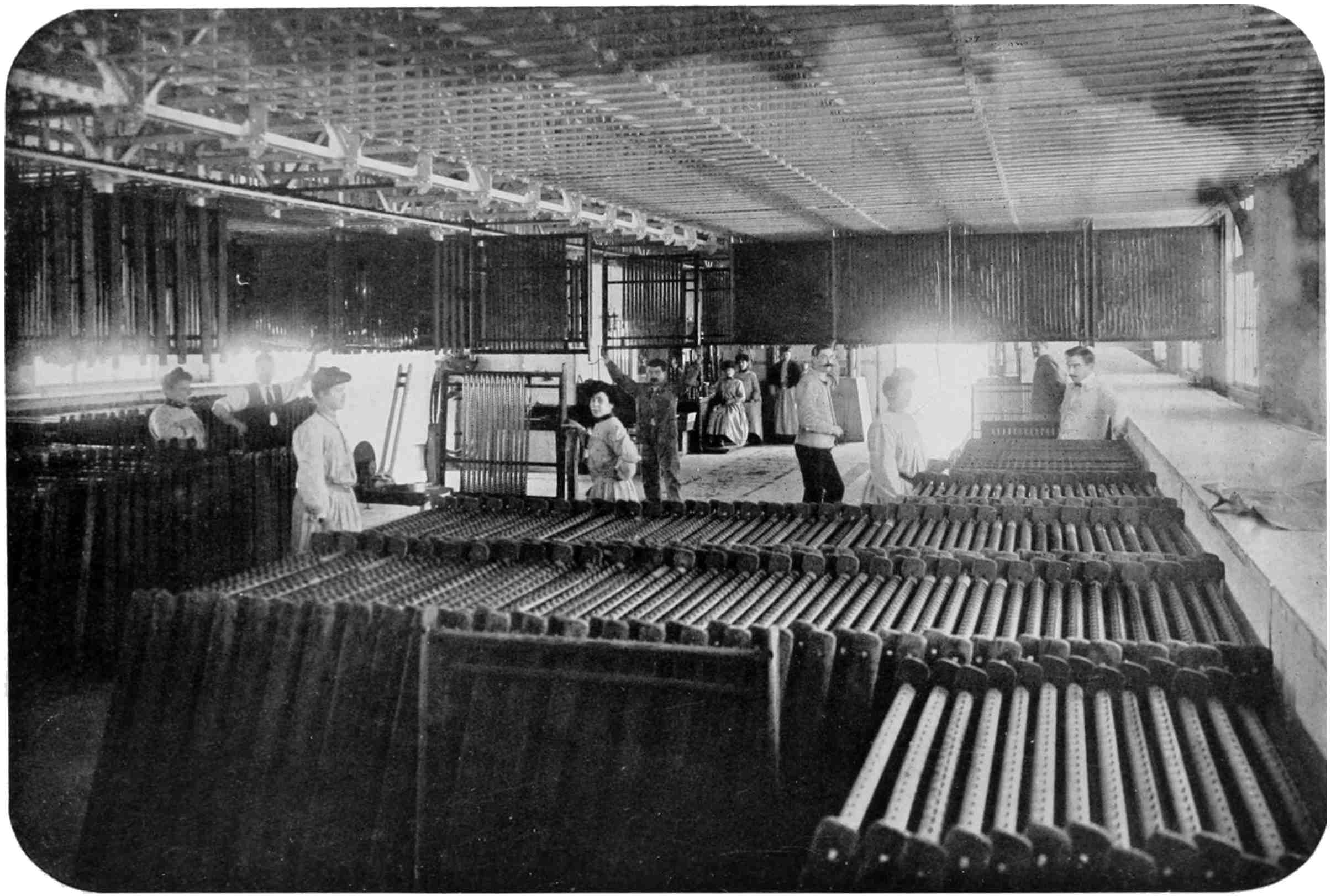
THE DRYING ROOM AT THE PATHÉ WORKS.
This illustration shows the wooden frames upon which the lengths of film are wound and the overhead racks from which they
are suspended.
The solution employed for development is either a combination
of hydroquinone and metol, or a bath of rodinal,
developing agents which are familiar to the amateur
photographer, while the fixing bath is a solution of hyposulphite
of soda. The developing formula is modified by
various firms as a result of individual investigation. The
drying operation is one that has to be carried out very
carefully; the temperature of the chamber must be evenly
maintained, and the air which is circulated through the
room must be filtered before admission, in order to arrest
all particles of dust which otherwise might settle upon the
gelatine surface and wreak appreciable damage.
In the early days the fickle character of the film was a
serious difficulty. If it were dried too rapidly it evinced
a tendency to curl, and severe shrinkage often ensued. To
guard against this trouble the film was glycerined before
being dried, by being passed through a bath containing
a solution of glycerine and alcohol. The improvements
effected in the manufacture of the film, however, have
enabled this subsidiary treatment to be dispensed with. In
cases where a topical film must be rushed out quickly to
catch the public in the height of its interest, however,
drying is accelerated by subjecting the film to a bath of
alcohol in some form or other.
Although a spool of film, measuring perhaps 300 feet
in length, is handed over for development, possibly that
300 feet carries two, four, or more exposures, i.e., different
sections were exposed at different times, on different days,
or under different conditions of light, &c. The camera
operator has indicated the end of each exposure by means
of the camera punch. When the developing operator
receives the spool, he first searches for such marks as he
uncoils the film, and the latter is severed at those points,
and each exposure is developed separately. When the
developing process is completed, therefore, the film relating
to one subject is in a fragmentary condition. These odds
and ends have to be sorted out, all useless parts cut away,
and then arranged in sequence and joined together to
form a continuous band containing, in the ordinary case,
the whole subject. If the series of pictures runs into two
or three thousand feet, the aggregate will be divided into
1,000 feet sections, which is the approximate capacity of
the spool mounted on the projector. The sections are
united by means of a transparent cement, known as amyl-acetate.
When the negative is dry and the gelatine surface has
hardened enough to permit the sections to be handled and
joined together, the next stage is taken in hand. This is
printing the positive. Obviously a printing frame, such
as the amateur uses for printing from a single glass plate,
is quite out of the question with a negative several hundred
feet in length. Invention born of necessity has met this
question in a novel manner, and the printing process is
one of the most interesting phases in the preparation of a
picture. Considerable mechanical ingenuity has been displayed,
and various types of printing machines produced;
but for the purposes of explaining the subject most lucidly
and comprehensively two typical machines will suffice.
Before printing, however, the raw film or stock intended
for the purposes of the positive or transparency must be
perforated, an operation which is similar to that followed
in perforating the negative film.
Printing is carried out by contact; that is to say, the
sensitised surface of the positive film is pressed tightly
against the emulsion side of the negative film at the instant
the exposure is made. One image is printed at one time.
The two films are given an intermittent action, the consecutive
images on the negative film and the corresponding
sections of sensitised surfaces on the positive film being
brought before the illuminant during the brief period that
the light is cut off from the printing box by the passage
of the shutter.
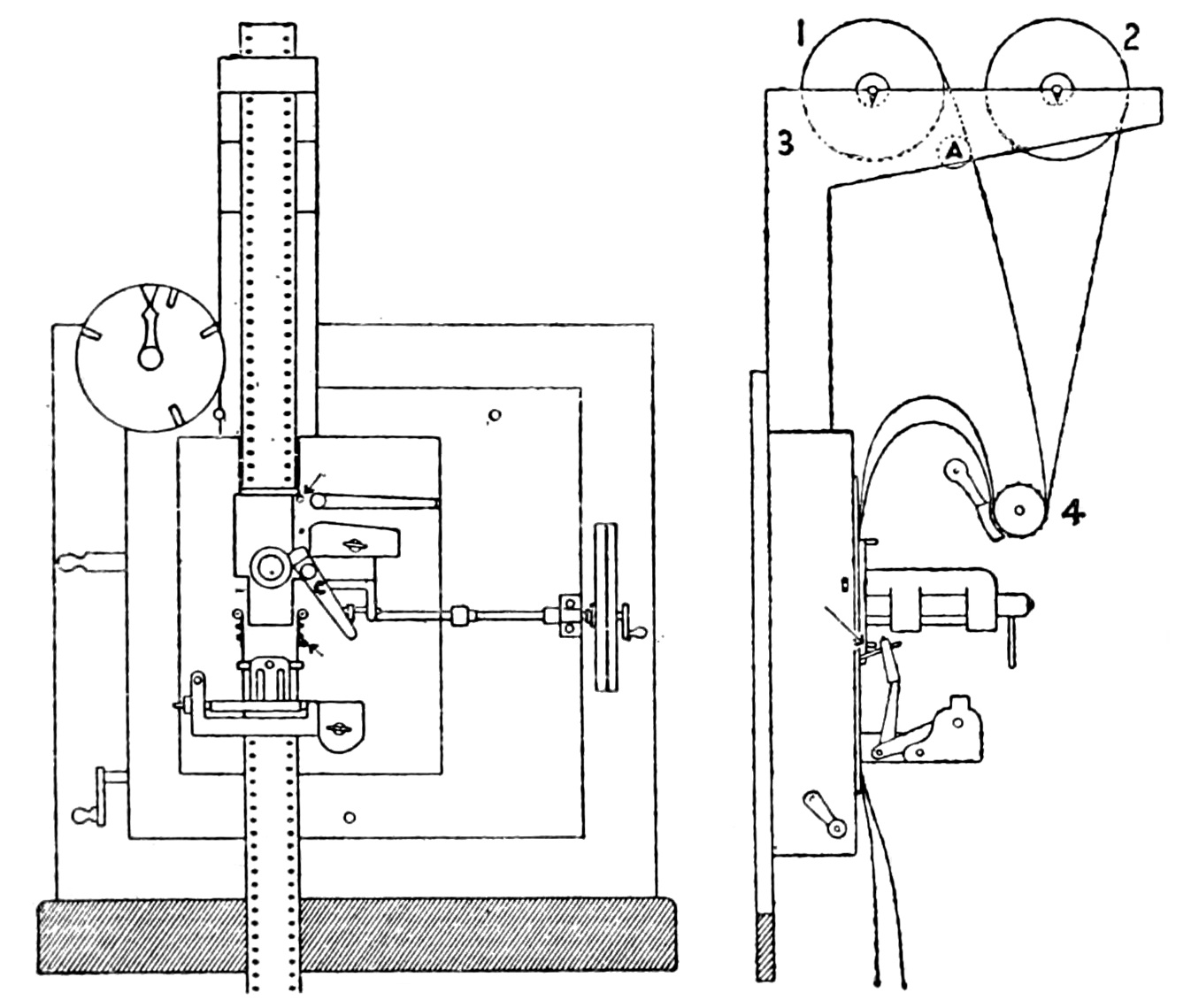
Fig. 8—Front and Side Views of Newman-Sinclair
Printing Apparatus.
In the Newman-Sinclair apparatus, Fig. 8, the negative film
is wound upon spool 1, while the positive film is
carried on spool 2, both being supported upon the projecting
bracket 3. The negative passes over the guide roller
A, and descends with the positive film to the toothed
sprocket 4. At this point the two films are brought together
with the gelatine surfaces inside, while the teeth of the
sprocket mesh with the perforations in each. The two films
pass from this sprocket, form a loop, and together enter the
gate, which clamps them tightly and flatly together, with
their respective perforations exactly coinciding.
At the point where the two films come opposite the
aperture through which passes the light from the lamp,
there is a mask, by which the position of the picture relative
to the exposure hole is corrected. The mask also determines
the shape of the positive picture. It may be rectangular,
oval, circular, or have rounded corners as desired. Immediately
behind the film, in line with the exposing aperture,
is a red screen, over which a shutter slides. When this
shutter is opened, the operator can see the negative image
through the positive film, and thus can ascertain that the
position of the picture is correct in relation to the exposure
aperture, and also that the perforations on the two films
are in synchrony. The light by which the exposure is
made is contained in a light-tight box, or may be placed on
the outside of the wall of the printing room, an aperture
being cut in the partition to admit the light to the printing
apparatus, which is screwed to the wall. Between the light
and the film there is a revolving shutter, as in the camera,
which cuts off the light intermittently, enabling the succeeding
negative image and area of positive film to be
brought into position before the exposure orifice.
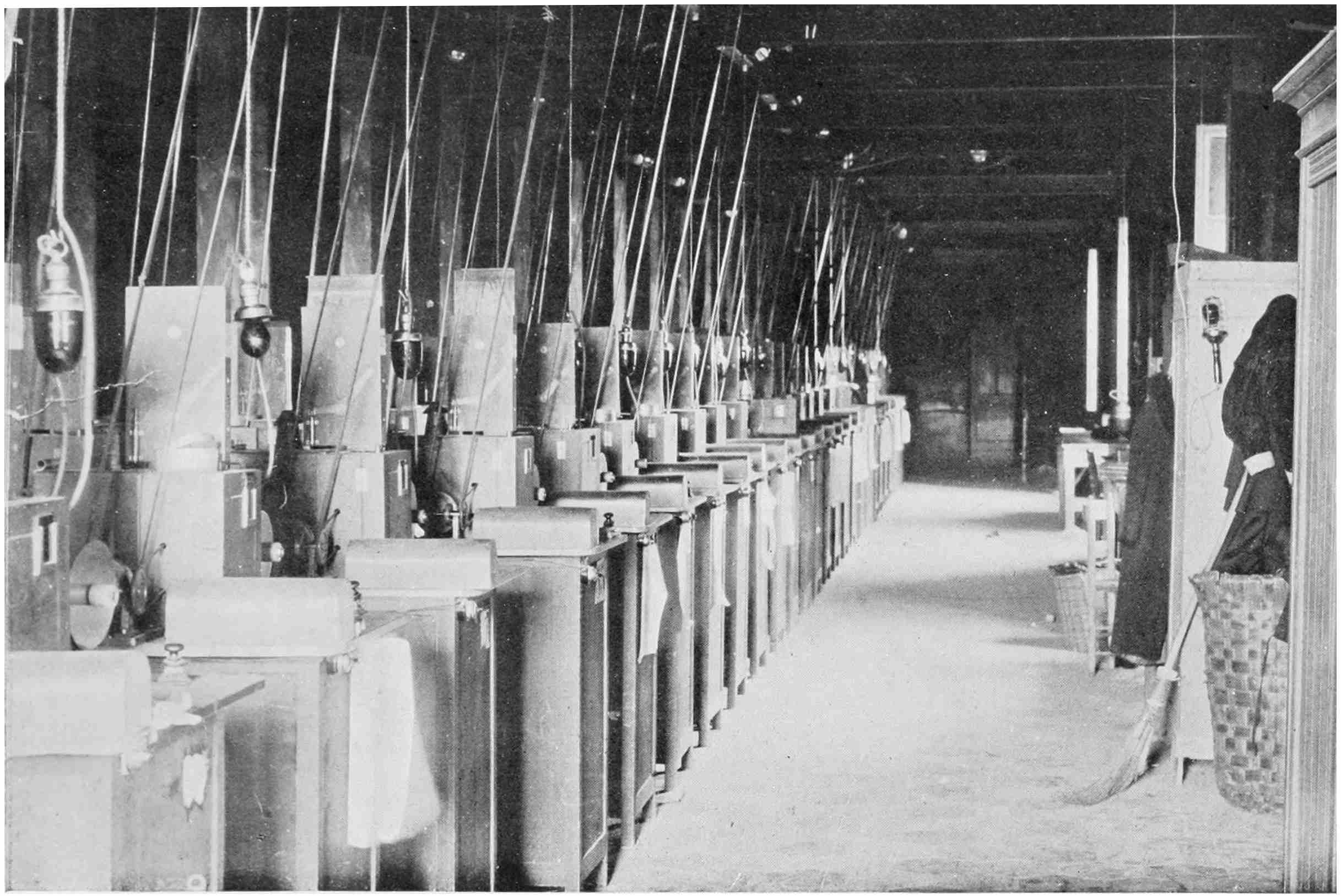
A ROW OF PRINTING MACHINES IN THE ROME WORKS OF THE CINES COMPANY.
This establishment is able to print 100,000 feet of film per day.
The film is drawn through the machine by a pair of
fingers or claws which engage with the perforations of the
two films and pull them downwards together. As the
pictures are printed, the negative and positive films pass
into boxes or other suitable receptacles to be re-wound on
their respective spools. The machine can be operated
either by hand or power according to the requirements of
the establishment. As the sensitised surface of the positive
film is slower than that of the negative, printing is carried
out at a reduced speed, the average recommended with
this apparatus being about five pictures per second.
Another printing machine has been recently produced
which is regarded as the simplest, most mechanically
perfect, most compact, and self-contained apparatus yet
devised for this work, and which compels attention as
much from its efficiency as from the point of view of
mechanical excellence. This is the Williamson printer.
It is a complete unit, and can be moved from place to
place with facility.
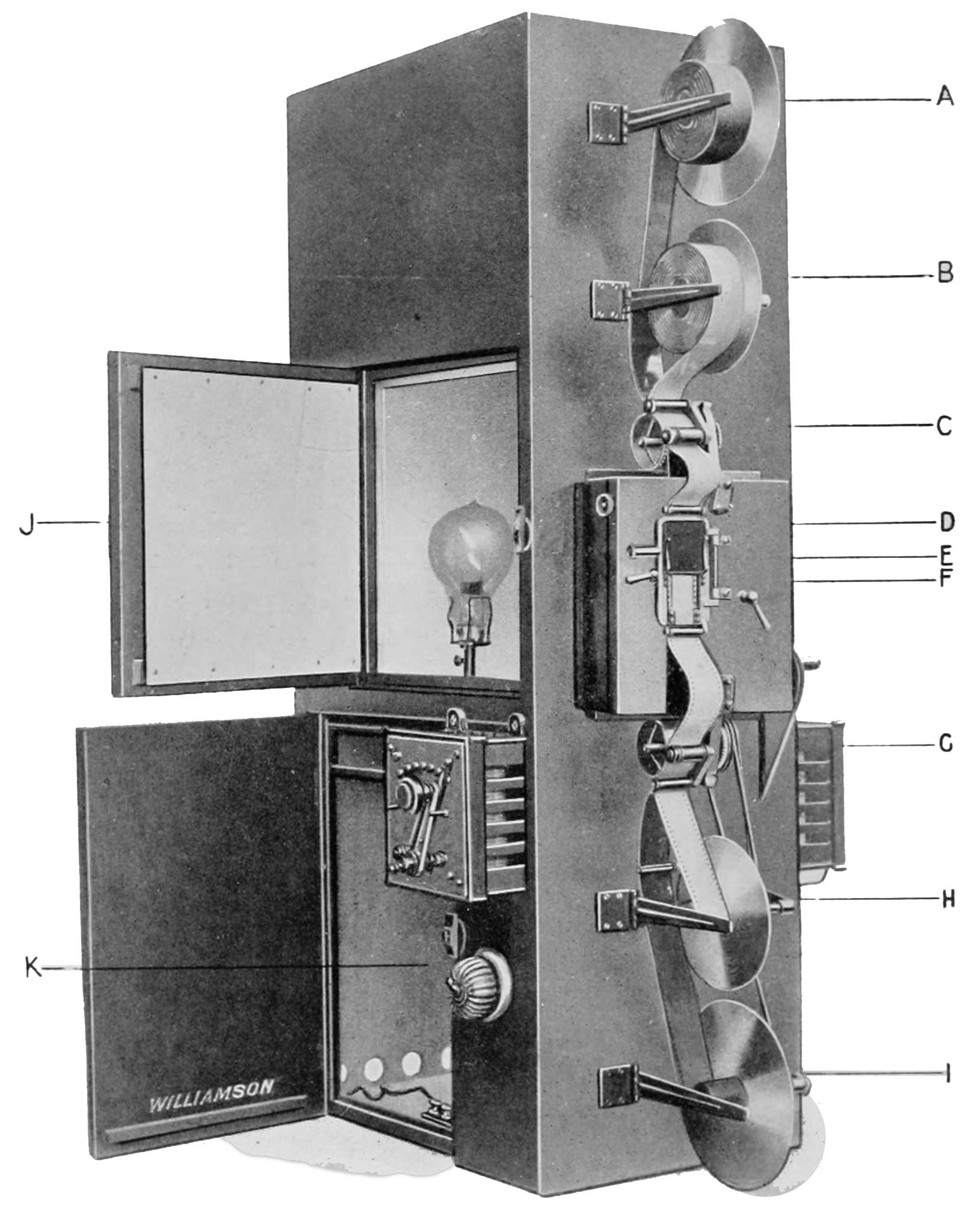
THE WILLIAMSON PRINTING MACHINE.
For making the positive films.—For explanation see page 82.
It comprises a large rectangular box or cabinet, standing
on one end. The front face carries the printing mechanism,
while the interior, divided into two compartments, contains
the driving mechanism and the illuminating agency for
printing. The apparatus is so designed that after printing
the films are wound upon separate spools at once, thus
saving time, and dispensing with the necessity of a box
or basket to gather the loose films, which is both a
dangerous and an unsatisfactory process, inasmuch as the
films are liable to become damaged by curling and cracking,
and through the surfaces rubbing against one another.
The negative film is placed upon the spool A immediately
below which is the positive film spool B. The
sensitised surfaces of the two films face one another, and
the two are brought together as they pass under the grip
rollers and over the toothed sprocket C, where the teeth
mesh with the perforations in the respective films.
Issuing from this sprocket a loop is formed, and then the
films enter the gate D over the printing aperture. This
gate is side-hinged, and when closed it presses evenly
upon the whole surface of the films under exposure,
ensuring a perfect even contact. There is a small red
screen E, which, when released by means of a small lever,
drops down, thus enabling the negative to be examined
without danger of the positive film being fogged in the
operation. By this means the printer can satisfy himself
that the picture is central to the exposure hole.
As the picture is printed, a simple claw device F, resembling
two hooked fingers, engages with the perforations
in the two films and draws them downwards. This claw
device is of very simple construction, working on a cam,
so that when the film has moved downwards the proper
distance—sufficient to bring the succeeding picture and its
area of unexposed positive film before the printing aperture—the
fingers disengage themselves from the films, rise,
and move upwards to drop into other perforations and
repeat the operation.
As the film descends, it forms a loop, and passes under
a double smooth-faced roller and a toothed sprocket G, at
which point the two films part company, the positive to be
wound upon the bobbin H, while the negative film is
wound upon the lower bobbin I. These lower spools are
driven by belt and pulleys from a bevel gear wheel, which
carries a spindle actuating the claw giving the intermittent
movement to the films, and which by means of another
spindle rotates the upper and lower sprockets C and G so
that the loops above and below the gate remain constant.
By this arrangement no pull or strain is imposed upon
the films by the sprockets, which act merely as guides
and not tractive devices.
The compartment J is lined with asbestos, and contains
the illuminant by means of which the printing is done.
An electric lamp of 50 candle-power, having a filament in
the form of a grid, is placed directly opposite the window
through which the exposures are made. This lamp is
mounted upon a slide controlled by a lever on a quadrant
on the face of the machine, by means of which it may be
moved as required from 2 inches to 10 inches from the
printing window. The power of the light may be varied
according to the density of the negative by means of a
controller, which increases or decreases its intensity in
much the same way as a gas jet can be turned up or down,
it being possible to secure six variations in light intensity
ranging between 16 and 50 candle-power. When the door
of the chamber is closed the compartment is perfectly light-tight,
though ample ventilation is secured.
The lower compartment K carries the electric motor by
means of which the apparatus is driven, and the speed of
printing is altered at will by means of a controller. The
motor is of 1/12 horse-power, and six direct speeds can
be obtained. The drive is communicated to the mechanism
through a system of cone pulleys, which enable three speeds
to be obtained; and as each of these three speeds can be
given one of the six speeds of the motor by means of the
regulating switch or controller, the apparatus can be driven
at eighteen different speeds, according to requirements.
Wide range of action, combined with simplicity of control,
characterise this apparatus. The printing speed varies
according to the density of negative and the intensity of
the light, but the average speed in printing from a
normal negative is about 500 exposures of pictures per
minute.
The positive film, after being exposed, is developed by
a method similar to that used for the negative. Both
these developing processes demand considerable skill and
experience in order to ensure the best possible results. An
accomplished developer, like his colleague working with
glass plates, can rectify many deficiencies arising during
exposure. The camera operator often has to work under
the most adverse conditions concerning light, and it is
the task of the man in the dark room to obtain the utmost
from a poor negative. By care and attention, combined
with experience and knowledge, he will be able to improve,
make up for under-exposure, and mitigate the evils due
to over-exposure. It will be realised that development is
the most critical stage in the whole operation, for upon
the manner in which it is carried out much of the excellence
and merit of the projected picture depends.
The fact that the cinematograph camera is being
regarded more and more as an indispensable unit in the
impedimenta for travelling and exploring expeditions has
resulted in attention being devoted to the perfection of a
small portable developing outfit to enable films to be
developed at once, instead of sending them home for treatment,
as hitherto has been the case. The “N.S.” developing
apparatus is an excellent appliance of this character.
It has been taken by Captain Scott, R.N., upon his
Antarctic expedition, and forms part of the photographic
outfit carried by Mr. Cherry Kearton upon his travels.
The developing apparatus consists of a rotating cylinder
and two or more semi-circular troughs. The film is wound
spirally upon the drum, being held in position by means
of wire staples, and the apparatus is so designed that the
drum with its film can be moved from one trough to the
other by the simple movement of a lever. The design of
the apparatus ensures economy in the quantity of developer
required. Three pints of solution are sufficient to treat
75 feet of film, and the bath can be thrown away when
work is finished or bottled for further use.
After washing, the film is wound upon a collapsible
drum, which folds into a small space when not in use.
The outfit is made of pine, with waterproofed joints, the
whole of the woodwork being treated with paraffin wax to
render it impervious to the action of chemicals and
moisture. When packed, the apparatus, capable of dealing
with 50 feet of film, measures 3½ feet in length, by 26
inches wide, and 18 inches deep. The outer packing
constitutes the support for the apparatus when in operation.
Waste is absolutely unavoidable in the cinematograph
industry, and no matter how carefully operations may be
conducted, it is bound to assume impressive proportions.
In a travelling expedition the operator records pictures of
what he deems to be sufficiently interesting from various
points of view—scenic, ethnographic, historical, or merely
anecdotal and humorous. When the films are developed
and a trial positive is struck for projection before the
powers that be, to receive official approbation and sanction
to enter the market, the critics in the private projecting
room sometimes fail to see eye to eye with the cinematographer,
and deem this and that to be lacking in the
essentials which render a film attractive to the public.
Accordingly, these sections are eliminated. From 300 to
3,000 feet may be destroyed in this manner.
The waste is still greater in the filming of picture plays.
Sometimes a scene, occupying 100 or 150 feet of film, will
have to be photographed three or four times. I once saw
a scene, taking 200 feet of film, recorded six times before
it gave satisfaction. It was a picture involving the movements
of a large crowd, and in five instances something
went wrong at one point or another, despite the fact that
rehearsals had been prosecuted with such energy and
persistence that at last everything appeared to move with
the precision of the wheels of a watch. A thousand feet
of film were spoiled in this particular case, which, at an
average of 1½d. (three cents) a foot, represented a waste
of £6 or $30 in film alone. Yet this is by no means an
isolated instance; the proportion often approximates 20 per
cent.; that is to say, 200 feet out of 1,000 feet are useless.
The bigger the production being recorded, the heavier the
waste in this direction.
When the positives have been dried and hardened sufficiently
to enable them to be handled, they are sent to a
room where the different sections are identified and allotted
to their positions in the subjects to which they belong.
The sections are joined together, the lengths of film bearing
the explanatory sub-titles are inserted in the proper places,
and the whole subject, after a final examination, is wound
upon a spool ready for the market. The examination of
the films is carried out rigorously, those suffering from
the slightest blemish or coming below the firm’s standard
being discarded.
It has been seen from the foregoing that the preparations
for developing and printing are somewhat elaborate, and
demand expensive apparatus in order to insure the most
satisfactory results. These considerations react against
the amateur cinematographer. But should one fall a victim
to the fascinating glamour of cinematography, one need
not apprehend difficulties in connection with developing
and printing. There is no necessity to acquire perforators,
to establish a complete developing room, or to invest in a
printing machine. The majority of cinematograph manufacturing
establishments undertake to develop negatives,
and to supply positive prints ready for projection at a
nominal figure. It is far better to entrust the work to a
skilled staff, who can be trusted to handle the film successfully,
than to attempt to wrestle with unknown difficulties
with a serpent-like film 200 feet long, in the murky gloom
of the dark room.
CHAPTER IX HOW THE PICTURES ARE SHOWN UPON THE SCREEN.
Having obtained the positive film, with its string of
consecutive pictures, we now proceed to reproduce upon a
large scale the animation which has been, so to speak,
harnessed by the camera. For this purpose three essentials
are necessary—a projecting apparatus, a powerful and brilliant
illuminant, and a white surface or screen, upon which
the pictures are thrown.
In its general appearance the projector resembles the
magic lantern, which before the advent of the cinematograph
held the field as a favourite source of amusement.
It has the small box or cabinet in which the light is placed,
and the condenser whereby the rays from the illuminant
are converged into a powerful beam to be thrown through
the picture and the lens upon the screen. This part of the
apparatus is practically the same as that required for the
purpose of showing still-life lantern slides. It is the
mechanism required to bring the consecutive pictures singly
before the lens in rapid succession that constitutes the real
difference between the modern projector and the old
stereopticon.
The projecting mechanism has the same task as the
camera for securing the pictures. That is to say, a small
section of film corresponding to the dimensions of a picture
has to be brought into position before the lens in such a
way as to permit the powerful concentrated beam of light
from the lantern to pass through it and throw an enlarged,
brilliant, and clearly defined picture upon the screen. The
image rests on the screen for the fraction of a second, to
be followed by the next picture. One does not observe the
change from one picture to the other, as there is a revolving
shutter, the opaque blade or blades of which cut across the
screen at regular intervals. While the shutter is passing
the lens, thereby interrupting the passage of light to the
screen, the succeeding picture is brought into position; and
when the opaque blade has passed, it is exposed in its turn
and makes way for the next picture, this alternate action
continuing until the end of the film is reached. It will be
seen that an intermittent motion has to be given to the film
in projection, in precisely the same manner as is required
in the camera for exposure.
Although the evolution of a smooth-working and perfect
camera taxed mechanical ingenuity to a high degree, the
proportions of the task were not to be compared with those
involved in the design of the projector. Many factors had
to be taken into consideration. In the first place, it was
imperative that each picture should be superimposed exactly
upon its predecessor, that when the image reached the sheet
it should stand as steadily and as still for the minute fraction
of a second as if it were a lantern slide, and that the
change from one picture to the other should be carried out
in such a way as to render the change as imperceptible as
possible to the spectator. In short, every effort had to be
made to reproduce by intermittent motion the effect obtainable
with the camera obscura.
The perfection of this illusion has demanded years of
unremitting experiment and research. When animated
pictures first came before the public they had a violent
flickering, oscillating, and jumping motion, which proved
exceedingly painful to the eyes. The effect was somewhat
similar to that produced by gazing at a picture which is
vibrating, and blinking rapidly meanwhile, or when a
flicker-disc is rotated very rapidly before the limelight
centred upon a stage scene and actors.
By dint of persistent effort and the perfection of mechanical
details, this serious flickering and jumping effect
has been eliminated; that is, so far as is possible with
an apparatus designed to convey the impression of continuous
motion by intermittent action. The projecting
mechanism is of substantial design, while the moving parts
subjected to wear and tear are made of the strongest metals.
The wear and tear, however, is tremendous, and as all the
moving parts are liable to displacement they must be fitted
with adjusting devices whereby all slackness can be taken
up and the apparatus be kept tuned to a high pitch of
efficiency. Great ingenuity has been displayed in the conception
and manufacture of these details, and the cinematograph
projector of to-day is a wonderful piece of
mechanism.
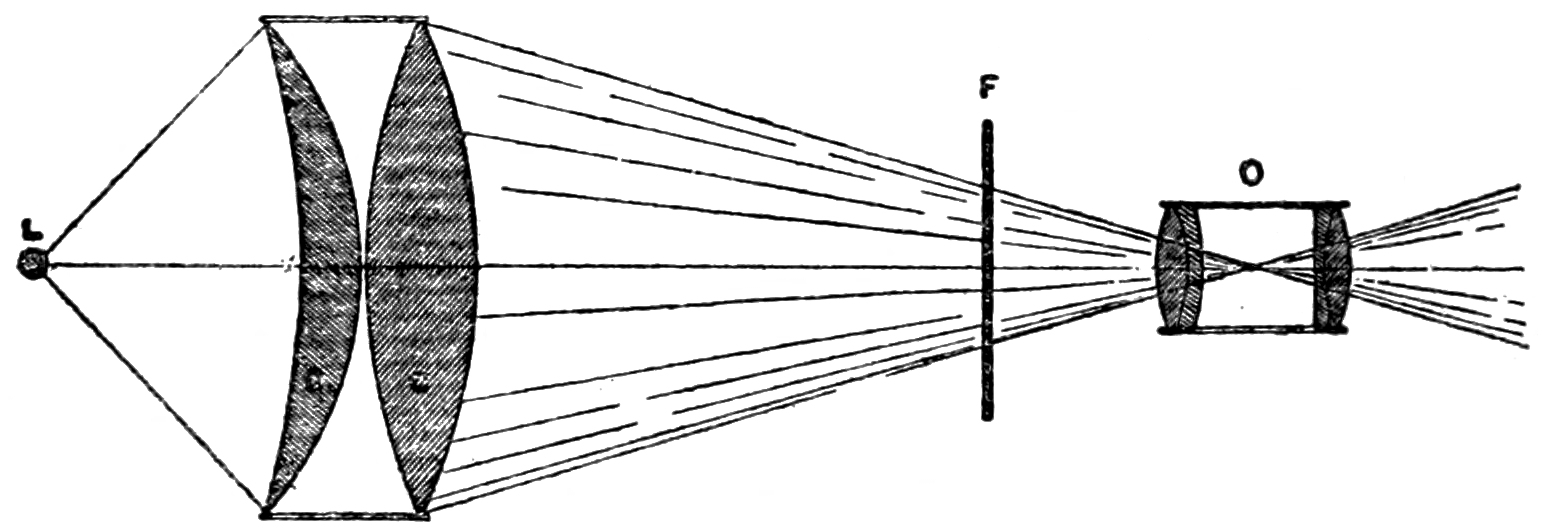
[By courtesy of Messrs. Butcher & Sons, Ltd.
Fig. 9.—The Optical Principle of the Cinematograph.
The optical principle of the cinematograph is exactly
that of the magic lantern. Reference to Fig. 9
will explain it fully. The illuminant is represented
by L and the centre of the light is opposite the centre of
the condensers C C, which receive the rays and condense
them, the point of convergence being in the lens or objective
O, from which they pass out in the form of an expanding
cone of light to fall upon the screen. The rays in
passing from the condensers penetrate the picture F on the
film in position before the lens. It will be seen that the
lens has to be mounted so that its longitudinal axis is level
with the light. The distance of the light L from the condensers,
and similarly the distance of the lens or objective
O from the picture F is governed by the focus of the
objective.
It is obvious, therefore, that the picture to be projected
must be brought to a stop in a position central to the lens,
and for this purpose there is a film trap or gate, where it
makes a momentary halt, in precisely the same way that
the unexposed film is arrested in its progress through the
camera.
The film to be projected is carried upon a spool mounted
on an arm or bracket above the mechanism, with the pictures
upside down as in the ordinary magic lantern. The
spools used are of the open or the closed type. The former
is permissible in countries where there is no rigid legislation
governing cinematograph displays, or where non-inflammable
films are used; but in Great Britain the film must
be wound upon a spool enclosed in a metallic case, to
provide protection against fire. The best spool boxes are
lined with asbestos, which ensures a greater degree of safety.
From the spool the film is threaded over a toothed
sprocket, which engages with the perforations, and also
under a spring grip roller which keeps the film in
contact with the sprocket. A loop is then formed, and
from this the film passes into the gate behind the lens.
This gate consists, as in the camera, of two pieces, one
rigid, the other swinging and hinged to the first, so that
it may be opened to enable the film to be introduced. When
closed, the film is held flat and rigid. As the shutter passes
across the field of the lens, cutting the picture off the sheet,
the film is given a sharp jerk downwards to bring the next
picture into exactly the same position in the gate before
the lens as that occupied by the preceding image. The
descending film passes round a second toothed sprocket,
with its grip roller, and thence into the second spool box,
where it is coiled upon the bobbin. The machine is
operated either by hand or by power and belting passing
over a pulley.
I have described the broad principle upon which the
projector operates; the details of the mechanism vary
according to the ideas of various makers. There are several
excellent projecting mechanisms on the market, each possessing
departures in detail, to some of which reference is
made later.
The great difficulty was to impart intermittent motion
to the mechanism which feeds the film to the lens at regular
intervals from a continuous rotary drive, the handle being
revolved at uniform speed. It occurred to Paul, who was
the first man in England to attack the problem scientifically,
that it might be feasible to employ the type of intermittent
gear used in watches, known as the Geneva stop. He
decided to adopt this mechanism.
The driving wheel when it completes a revolution falls
into a notch of the driven wheel, and in continuing its
rotary movement moves the latter forward the extent of one
notch, but no more, owing to the convex space between
each notch, or concave rim of each tooth, which coincides
with the curve of the driving wheel and fits closely against
its circumference. When the driving wheel makes its
second revolution it engages with the second notch, and
so on, with the result that in this case the driving wheel
makes seven revolutions to one of the driven wheel. Each
notch coincides with a picture; that is to say, each time the
driving wheel forces the second wheel forward one notch, a
picture on the film is brought before the lens for projection.
This novel gear gave the desired result, but it underwent
considerable modification, the number of teeth in the driven
wheel being ultimately reduced to four. The driving wheel
was also altered. Instead of being notched as in the
Geneva stop movement, it was fitted with a pin, which,
when the wheel made a complete revolution, fell into one
of the deep notches in the driven wheel, and so moved it
forward. By this modification the gearing was reduced to
4 to 1; the driving wheel made four revolutions to one
of the driven wheel, and each notch of the latter corresponded
to a picture. Owing to the fact that the notches
in this driven wheel resemble a Maltese cross in form, the
device became known as the “Maltese Cross” movement.
It is in use to-day. The notched Maltese cross wheel is
attached to the spindle of the sprocket wheel below the
lens, and the movement forward of one notch suffices to
jerk the film down smartly three-quarters of an inch or the
depth of one picture.
The advantage of this movement is that the film is pulled
down very quickly, and as a result the flicker is reduced to
a negligible quantity. The gear is noiseless and enables
a very steady picture to be obtained upon the screen. On
the other hand, not being a true mechanical movement, the
forward motion of the film is accompanied by a certain
degree of shock, which not only imposes a strain upon
the fragile film, but at the same time sets up great wear
and tear in the mechanism itself.
For these reasons another system of bringing the film
into place was evolved. A wheel having an eccentric movement
is introduced below the film gate. This wheel
carries a projecting roller, and with each revolution the
roller strikes the film which passes over the wheel, and pulls
it down the depth of a picture. This type of action is known
as the “dog” movement, and is incorporated in a variety
of ways for the purpose of facilitating the smooth and
regular movement of the film through the gate. Its disadvantages
are that it is noisy; and secondly, that it is almost
impossible to secure a steady picture upon the screen, as
the dog strikes the film so smartly as to set up a vibration
which is communicated to the picture in the gate. But it
is simpler than the “Maltese cross” movement, while the
wear and tear upon the mechanism itself is so slight as to
be almost non-existent.
These two movements have divided the cinematograph
world into two camps, one adhering to the “Maltese cross,”
the other staunch in its support of the “dog” movement.
But the former appears to be increasing in favour, despite
its acknowledged defects. Some years ago Paul indicated
an improvement on it which demands attention because it
converts an indifferent mechanical movement into one
scientifically correct. The principle is shown in Fig. 10.
Instead of having four notches or slots in the driven wheel,
as in the Maltese cross, he has only three slots. The driving
member A has an arm C carrying a roller E at its outer
edge. The driving member A when it completes a revolution,
enters the slot c in the driven wheel B, and at the
moment of entering the slot is at a tangent to the circular
path a of E, with the result that the roller E enters the slot
without setting up any shock whatever, carries the wheel
B round, and leaves the slot at a similar tangent to its
path, at the same time bringing the next slot tangent to
the path of the roller E on arm A. Thus the film is given
increasing speed without the slightest strain, and as the
movement enables the images to be changed rapidly without
jarring, it is possible to reduce the period of eclipse to
almost nothing. For this reason, the opaque sector of the
shutter can be cut down to one sixteenth of the area of the
circle described by the shutter. With the other movements
the sector of the shutter must cover at least one-quarter
of the superficies. In other words, the three-slot
wheel cuts down the period of eclipse to less than one-quarter
of that possible by any other mechanism, and as the sector
only covers one-sixteenth of the circle, the period of light
thrown through the film on to the screen is increased, with
an accompanying increase of brilliancy and a complete
absence of flicker.
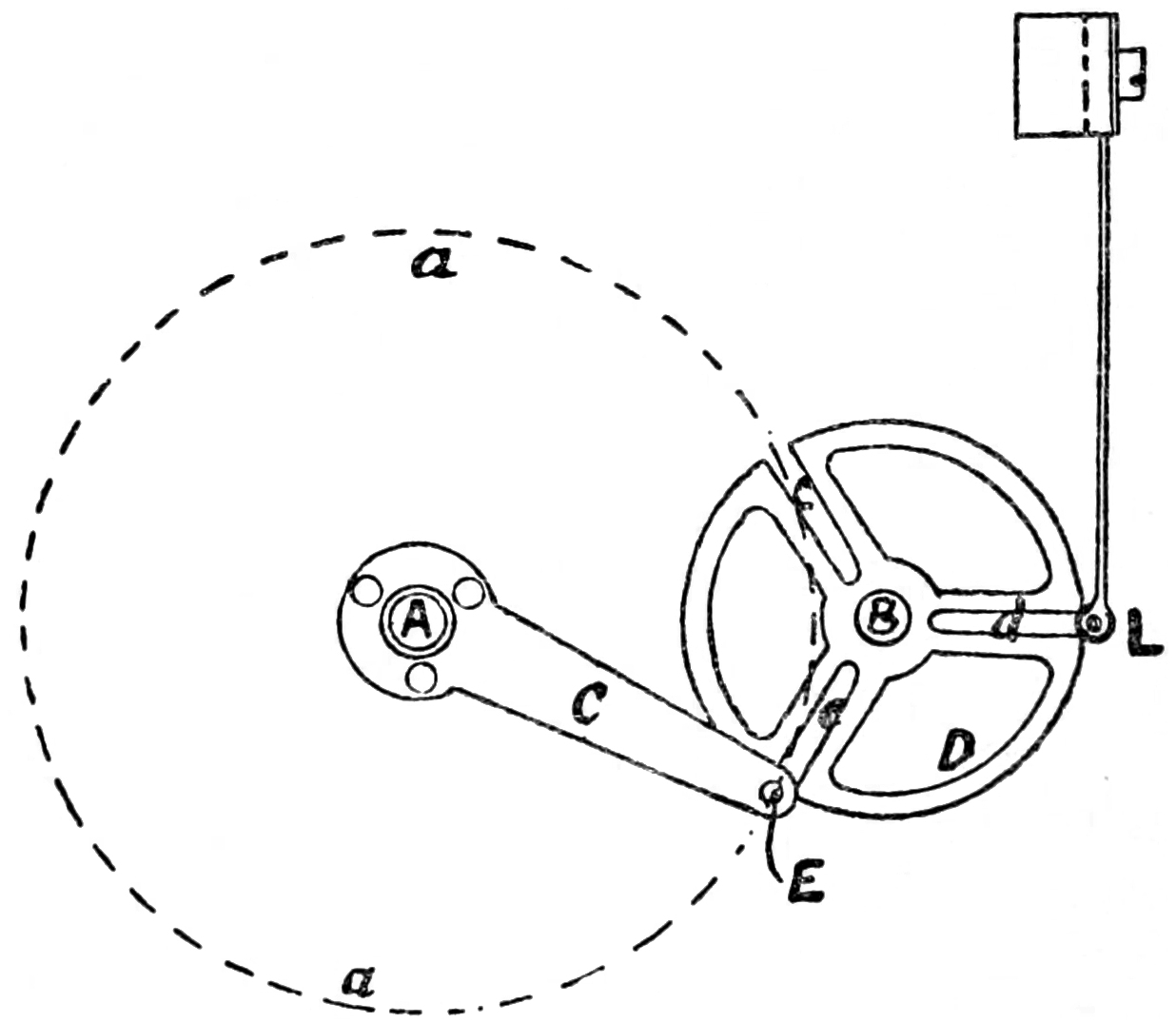
Fig. 10.—Paul’s Improved “Cross” Driving Mechanism.
The shutter is one of the most important features of the
projector. In the majority of cases it is placed before
the lens, but in the Gaumont “chrono” machine it is placed
between the condenser and the picture. In order to secure
the best results, the area of the opaque surface covering the
lens while the next picture is brought into position should
be reduced to the minimum, and the eclipsing action should
be so carried out as to reduce the flicker, which is directly
due to the cutting off of one picture to enable the next
to be brought into position. In the early days the shutter
had one blade only; when a brilliant light was used, the
alternate periods of light and darkness could be easily
distinguished, and the eyes suffered accordingly. An effort
to remedy this disastrous effect was made by the introduction
of a violet-coloured sector of similar area to the opaque
sector, and set opposite to the latter, which gave the shutter
the appearance of a two-bladed propeller. This is effective
to a certain degree; but it has been superseded by a
shutter having three blades. The shutter is mounted upon
a spindle in front of the lens, the distance therefrom being
determined by the focus of the objective.
The heat concentrated upon the film by the converging
rays of light from the condenser is tremendous. The effect
is identical with that produced by focussing the sun’s rays
with a lens upon a piece of paper. If the rays are permitted
to play upon one part of the celluloid film for four or
five seconds it will become ignited. So long as the film
is moving little apprehension need be entertained; the
danger arises when the film is stopped to attempt focussing
with a stationary picture, or the film breaks during projection
and stops in the gate. Several disastrous catastrophes
have arisen from the firing of the film during projection.
It is impossible to lay too great a stress upon the danger,
for the average operator is little more than a cog in the
machine, and fails to concentrate attention upon the work
in hand so as to anticipate and meet emergencies.
Manufacturers have tried to remove the danger by the
evolution of what is known as an automatic safety cut-off.
This is a second shutter, which, when the projector is at
rest, drops between the light and the lens. The shutter
is connected to the balls of a governor. As the revolving
speed of the governor is increased by the turning of the
driving handle, the balls assume a horizontal circle of
rotation, and in so doing, lift the shutter until it rises clear
of the aperture in the gate, through which the light strikes
the picture. In the same way, as the revolving speed of
the governor is decreased, the balls fall and the shutter
descends.
The introduction of this automatic cut-off is somewhat
to be deplored. It makes the operator less careful; he
trusts blindly to his automatic friend, which, though it functions
admirably, is, like all such mechanisms, liable to
fail at a critical moment. When such a breakdown
does occur, the average operator is invariably caught
napping, and the film is fired before he realises what has
happened. The older system, whereby the cut-off, a shutter
working upon a hinged flap principle, had to be operated
manually, was far safer. Its opening or closing constituted
a part of the cycle of operations in the preparations for
projection, thus calling for a definite movement on the
part of the operator.
The most efficient safety appliance yet associated with the
projector itself is the Urban-Joy-Harris anti-firing device,
Fig. 11, a very simple arrangement, whereby the rising and
falling gate is converted, to all intents and purposes, into a
fire-proof box. When the film is threaded through the gate,
only that part before the lens, upon which the light rays
are converged, is exposed to the air on the side nearest the
light. On the opposite side the exposure hole is contained
in a tube, holding the lens, which consequently forms an
air-tight chamber upon that side. Should the film catch
fire while stationary in the gate, the air contained in the
lens chamber A becomes heated suddenly, and expands,
so that the products of combustion are discharged through
the exposure hole of H into the air. The fire cannot creep
up and down the film, as small bars exactly above and below
the exposure hole successfully prevent such action.
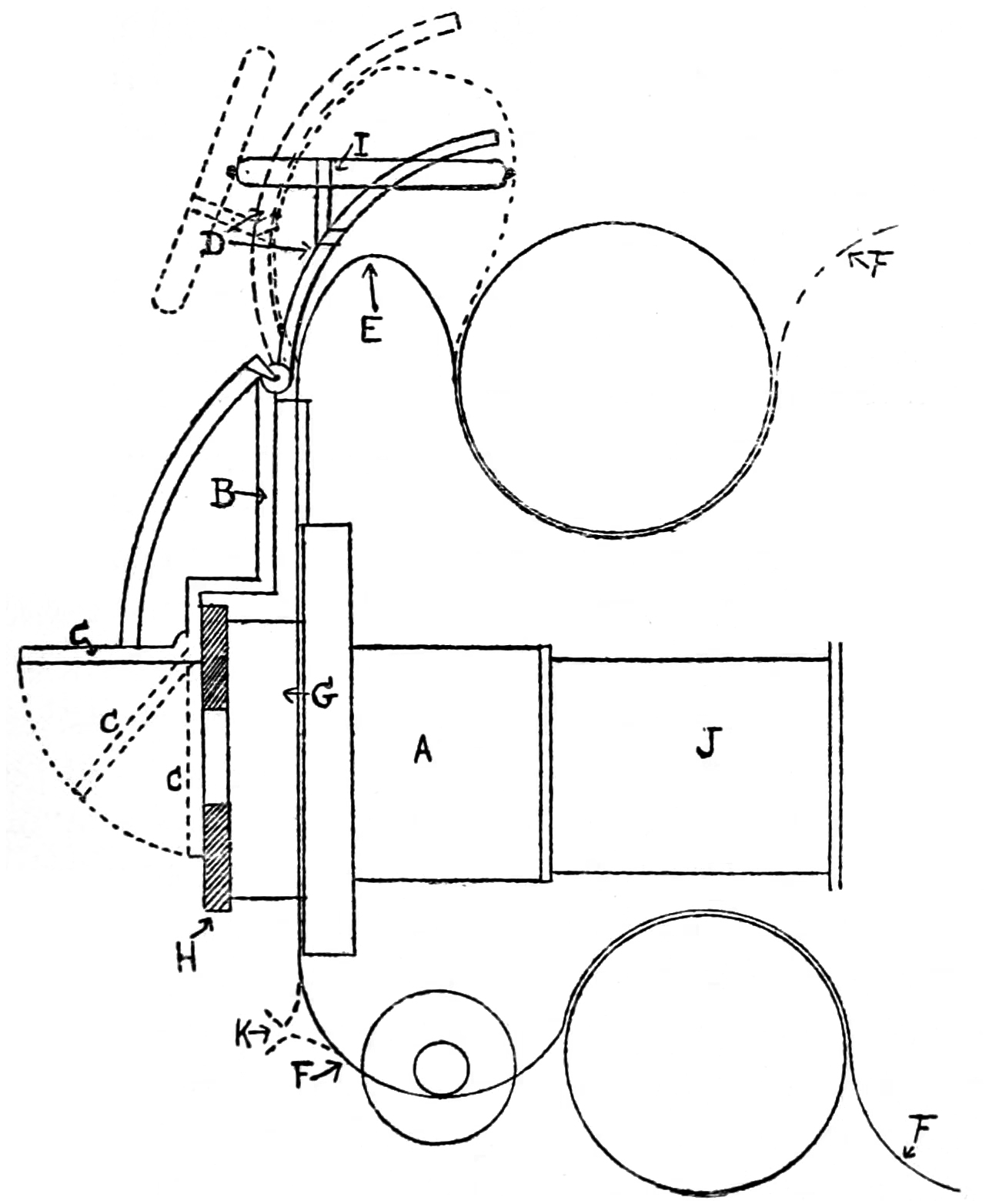
Fig. 11—The Urban-Joy-Harris Anti-Firing Device. The
Dotted Lines Show Action of Mechanism Closing
Shutter C when Film F Breaks at K.
In addition there is the Harris safety shutter, which in the
event of the film breaking below the gate, and thus preventing
its own passage owing to the interruption in the
driving effort, shuts off the light from the film, and also
stops the electric motor, should the machine be driven by
electricity. This safety-shutter B holds a semi-circular flap
D, which is connected by a small lever to a rectangular
flap C. The flap D is so adjusted as to hang over the loop
in the film E between the sprocket and the entrance to the
film gate. Under normal conditions the loop E does not
come into contact with the shutter D, but when the film F
becomes broken below at K, the loop E is enlarged suddenly
owing to the film not being able to pass through the
gate, with the result that it forces the flap D to a vertical
position, and this in turn throws the flap C down over the
exposure hole. There is a tube I which contains about
half-an-ounce of mercury with an electrical contact at either
end, the object of which is to change the centre of gravity
of the flap D, and also to cut off the supply of electric energy
to the motor. When the machine is running smoothly this
tube I is in a horizontal position making the electrical
connection at either end, but when the flap D rises, owing
to the enlargement of the loop E in the film, the weight of
mercury is thrown to one end of the tube, causing it to
cant in such a way as to retain the flap D in a vertical
position. If the film should take fire, only the picture
before the lens is consumed. Even the perforated edges
remain untouched, so that the film is not severed, and can
continue its travel through the machine when the breakdown
is repaired.
To supply the light necessary to projection, acetylene,
the oxy-hydrogen limelight, and the electric arc have all
been used; but the last is the illuminant most generally
favoured. It enables the maximum amount of light to be
collected by the condenser. When the projection of moving
pictures was first attempted an arc light was unavailable,
because that form of lighting had not been adapted to the
magic lantern. The late T. C. Hepworth, the eminent
authority on the lantern, was wrestling with the problem,
but there was no commercial apparatus suited to the
cinematograph. In using electric light a resistance is required
to absorb or dissipate in the form of heat the current
over and above that required for the light. Many types of
resistances have been devised for this purpose, to suit varying
requirements. This method of dealing with the surplus
current is, however, distinctly wasteful, and accordingly,
where picture projection is being carried out on a large
scale, a motor generator is adopted. The current derived
from the supply main is utilised to drive an electric motor,
which in turn actuates a dynamo, whereby current is furnished
for the light. This seems a roundabout process,
but it effects a great economy in the consumption of electricity.
The mounting for the lantern is also important. As
there is continual movement in the mechanism owing to
the communication of driving effort, either by hand or by
power, the mounting chosen must be of a sufficiently
massive character to absorb all the vibration set up. Paul
devised an iron pillar, to one side of the top of which the
lantern was fixed, while the projector was attached to the
other. The principle was similar to that used for the
mounting of a machine gun, and although the idea met
with considerable criticism, yet Paul succeeded in producing
steadier pictures than were possible with other
forms of mounting. That his idea was sound is witnessed
to-day, for the principle he advocated has been resuscitated
in the Brockliss Motiograph, which is mounted on a rigid
pillar, and undoubtedly throws a steadier picture than is
possible from any other system of supporting the projector.
In the majority of projecting mechanisms a second lens
is mounted upon the frame, in line with and beside the
cinematograph objective. This second lens is used for
the projection of lantern slides for the illustration of a song,
title announcement, or other purposes. In order to bring
the light of the lamp into line with this second lens the
lantern is moved bodily sideways the requisite distance;
the projector itself is not touched—it remains a rigid
fixture.
Paul also adopted a driving system which might be
revived profitably to-day where manual operation is practised.
Instead of the small handle placed somewhat high,
calling for quick rotation and fatiguing wrist movement,
he used a large wheel mounted at such a height that the
operator, when standing beside, had the lowest travel of the
handle almost at arm’s length. The wheel being of large
diameter, a slow, steady revolution was sufficient, which
caused no fatigue, the drive being transmitted through a
pulley or chain to the projector. In many of the latest
picture palaces, however, the apparatus is driven by an
electric motor, which yields a more uniform speed and
conduces to steadier projection.
I will now take up the distinctive features of some of the
best known makes of projector. A comparison of the
latest Edison model, the “B Underwriter,” with the first
kinetoscope, affords a striking illustration of the advance
of cinematography in twenty years. The new machine
is constructed throughout of metal, is wonderfully compact,
and the mechanism has been reduced to the acme of simplicity.
All moving parts subject to heavy wear and tear
are made of lignum vitæ. The shutter is of the three-bladed
type, while the intermittent action is conveyed by
the Maltese Cross movement. Being rigidly mounted upon
a heavy stand, the picture projected is very steady and free
from all disconcerting lateral and vertical movement.
In the “Gaumont Chrono” projector, the salient characteristic,
as I have mentioned already, is the position of the
shutter, which is placed between the film and the condenser.
The film-trap is worthy of notice because it conduces very
materially to the steadiness of the picture thrown with
this machine. The edges of the film are gripped by
means of burnished steel runners or vertical clamps, and
they secure it in position during exposure with the exact
degree of tension required to obtain steadiness, yet without
hindering the travel of the film through the gate, or inflicting
injury upon the celluloid. The trap is fitted with an
asbestos shield, which serves to insulate the film while
passing through the trap from the intense rays of the light,
which is continually playing upon the metal around the
exposure hole.
The dog movement has been adopted in this apparatus,
but upon an improved principle. Instead of striking the
film one smart blow to jerk it through the gate, it imparts a
steady pushing action. The result is that the film does not
suffer any injury. A massive dog striking the film heavily
is apt to produce cracks across the perforations at the points
of impact, which in time become weak spots in the film.
This well-conceived machine has met with remarkable
popularity among moving picture theatres in this country;
it is an excellent example of French engineering skill,
wherein lightness is combined with strength and simplicity.
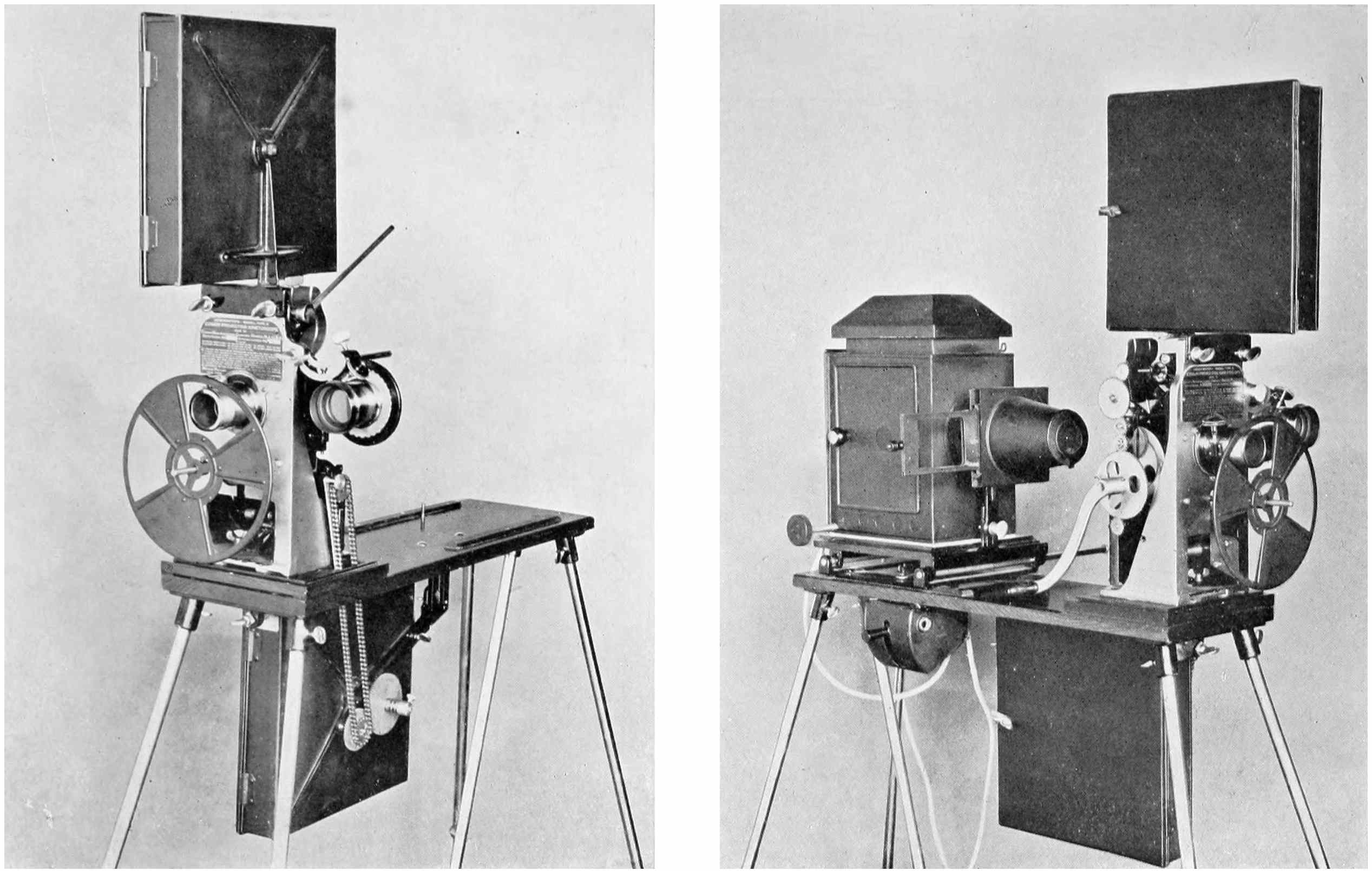
The projector and mechanism.
The complete projecting installation.
THE LATEST EDISON DEVELOPMENT IN CINEMATOGRAPHY.
This outfit is in striking contrast to the original “peep-hole” machine facing page 32.
The Ernemann “Imperator” projector commands deserved
attention. It is built stoutly so as to last and
withstand rough usage. Steel forms the constructional
material throughout, and a noticeable feature is that motion
is communicated to all driving parts through heavy gearing.
In this machine the “Maltese Cross” movement has
been brought to its highest pitch of perfection, being of
large substantial construction, and so designed as to
obviate the objections to its use. The driven part is made
of hardened silver steel, and there are means of taking up
all slack arising from wear directly it becomes manifest.
Instead of the cross being struck by a pin on the driving
wheel, the latter carries a roller which picks up the slotted
wheel without jar or noise. The mechanism is kept cool
by running in an enclosed oil bath, which tends to reduce
the wear and tear to a minimum, while at the same time
the machine is light and easy running, a feature which
appeals to the operator.
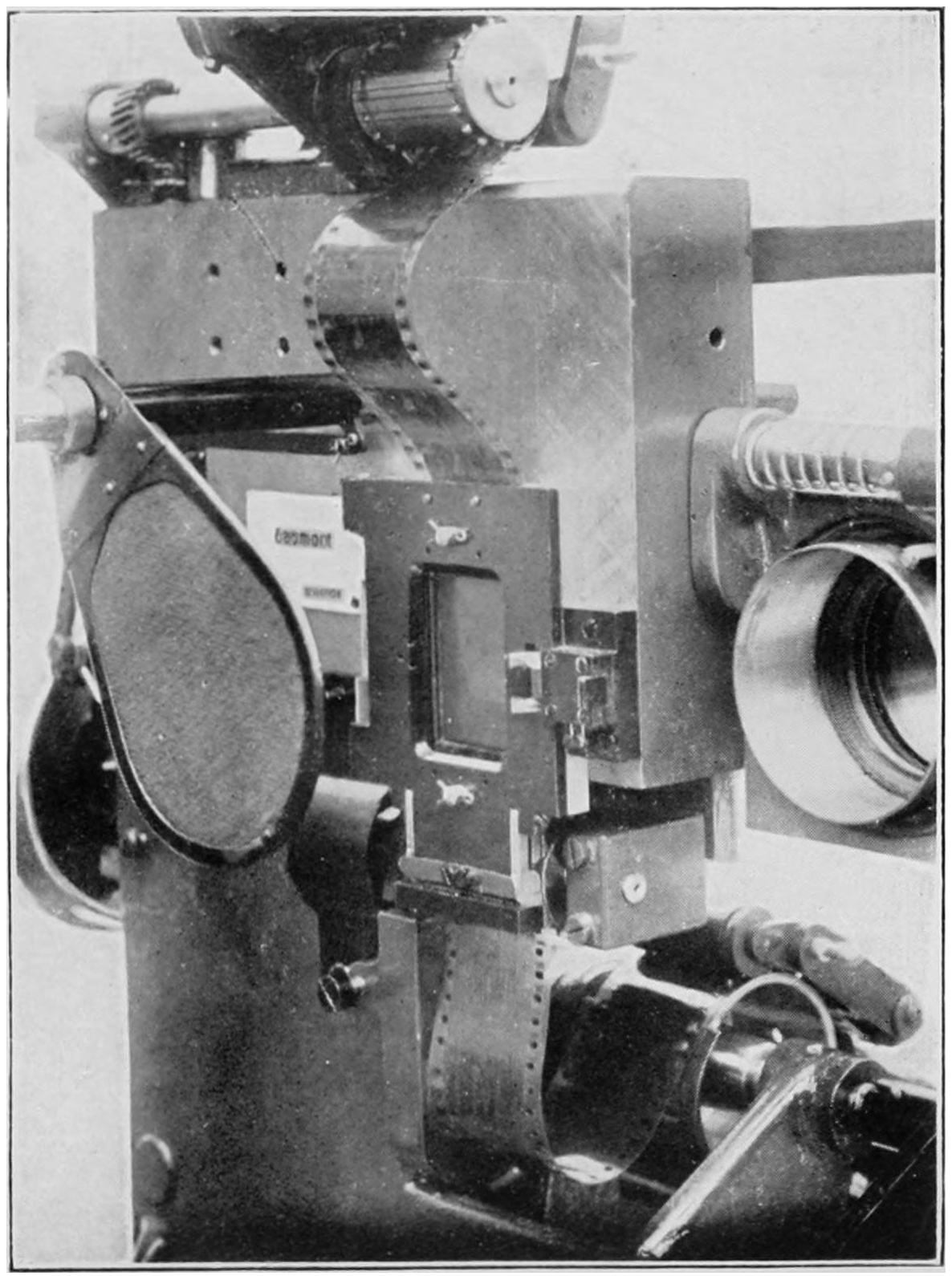
THE “CHRONO” PROJECTOR.
The main feature of the Gaumont lantern is the position of the
shutter between the film and the light, instead of outside the lens.
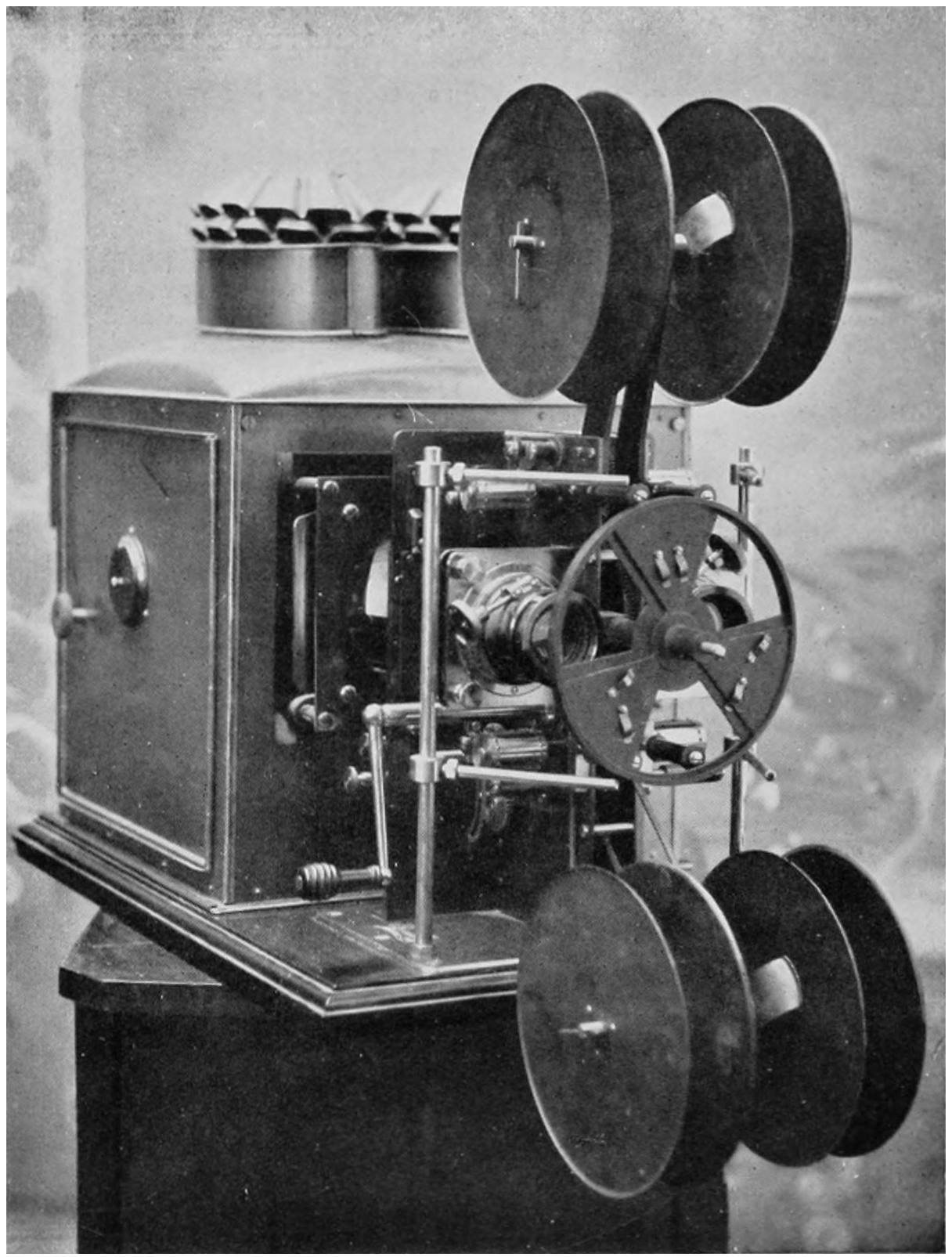
See page 319.
OUTSTRIPPING THE HUMAN EYE.
The Greene di-optic projector which shows on the sheet what the
organ of sight misses during blinking.
Another machine which possesses many interesting
points is the “Silent Knight,” its chief claim to attention
being, as its name implies, quietness in running, combined
with easy operation and steadiness of the pictures projected.
It has the fire-proof gate already described, and
also aluminium fire-proof spool boxes. The movement is
the Maltese Cross. Simplicity has been studied to the last
degree, and the necessity to withstand hard wear and tear,
as well as rough handling in inexperienced hands, has not
been overlooked. All the vital parts are made of chilled
steel running in an oil bath, with the necessity for adjustments
reduced to the minimum, though capable of being
carried out easily when the necessity arrives.
The foregoing by no means exhausts the variety of
machines on the market. There is the Pathé machine, a
masterpiece of French manufacture; the Kamm projector,
the “Empire,” remarkable for its many ingenious devices
to secure protection against fire, the chief of which is a
contrivance whereby the light is cut off automatically in
the event of the film breaking, although the machine is
still running, and so on. In every instance the direct aim
is the evolution of a projector which will produce an
absolutely steady picture, free from flickering and fluttering,
and as noiseless in operation as human skill can
contrive. In this particular field England and the Continent
are ahead of the United States manufacturers.
Except in one or two instances the American product is
distinctly inferior. It looks attractive, but its results fail to
stand comparison with the British and French machines.
The projecting features of the moving picture industry in
the United States have not advanced to the high state of
excellency attained in Europe.
In projecting, the pictures have to be thrown upon the
screen at the same speed as that at which they were taken
by the camera, that is, if steady continuous motion is to be
secured. The average speed is, as I have said, about sixteen
pictures per second, and it is essential that the handle
should be rotated at a regular uniform pace. Outside
influences appear to exercise a distinct effect upon this
manual action, just as we have seen them do in the process
of taking the original picture. The musical accompaniment
is likely to induce the inexperienced operator inadvertently
to accelerate or retard the speed of projection. For
this reason, power driving is coming more and more into
use, the motion being communicated to the mechanism by
means of a small electric motor. The results are far
superior to those produced by the average operator, though
not comparable to projection by a practised and intelligent
hand. The latter can tell the approximate speed at which
the pictures were taken, and can adjust his speed to a far
greater nicety than is possible by a mechanical agency
which maintains a constant speed.
CHAPTER X THE STUDIO FOR STAGING MOVING PICTURE PLAYS
When the cinematograph made its bow to the public
the latter were satisfied with the reproduction in animation
of scenes and incidents associated with every-day life—rather
trivial unrehearsed incidents which were void of
newspaper interest. There was the shoeblack at work, the
firing of a big gun, athletes at practice, and so on.
Humour was presented in Mammy washing her young
hopeful, a great favourite for many years, likewise in a
set of films depicting a mischievous youth indulging in
pranks with the garden hose.
But the popular taste changed in the course of time.
The audience became fastidious, and demanded novelty.
There was a clamour for picture-plays. The man in the
street saw no reason why dramas, tragedies, comedies and
farces should not be reproduced in pantomime upon the
screen. This popular demand was by no means easy to
meet. Obviously plays could not be photographed upon
the ordinary stage in the theatre owing to difficulties of
lighting. Special arrangements would entail a certain
outlay, to be entered upon without knowing whether the
results would justify the expense incurred. A further
complication lay in the attitude of the showmen themselves.
They wanted plays, but not with actors and
actresses, or “anything theatrical”; and they protested
against the incursion of the “legitimate” into their field.
Robert Paul decided to test the public taste with a
little comedy which he called “The Soldier’s Courtship.”
The roof of the Alhambra Theatre, in Leicester Square,
was extemporised as a stage, and Mr. Moul, the manager,
who had realised the possibilities of the cinematograph,
acted as stage manager. Scenery and properties were
brought up from the theatre below, and the assistance of
one or two actresses and actors were enlisted. With much
difficulty a film measuring 40 feet in length was obtained—the
standard length of the time, though it appears
insignificant in comparison with the films of to-day, which
vary between 500 and 3,000 feet in length. In 640 consecutive
pictures a pretty little “tabloid” comedy was
expressed.
Some apprehension was entertained as to the reception
the effort would receive. However, all doubts and
anxieties melted instantaneously when the picture was
shown for the first time. The audience gave it a hearty
welcome, and a new era dawned in the history of cinematography.
This initial effort—the first animated “picture
play” produced in Great Britain—tempted Paul to more
ambitious undertakings.
A plot of land was acquired at New Southgate in North
London, and here the first building was erected designed
essentially for the staging of picture plays. It was a combination
of a theatre with an ordinary photographic studio
utilised for portraiture, in a commodious lofty hall, with
a proscenium opening measuring 18 feet in width by 13
feet in height. The stage level was about 8 feet above
the ground, the under part being available for working
effects from below, such as bridges, stage traps, and other
artifices of the playhouse. The front wall, which faced
the northern sky, was divided vertically so as to permit the
sections to be opened out on either side to any required
extent to reveal the interior. The front roof, set at a
sharp angle was glazed to give top light.
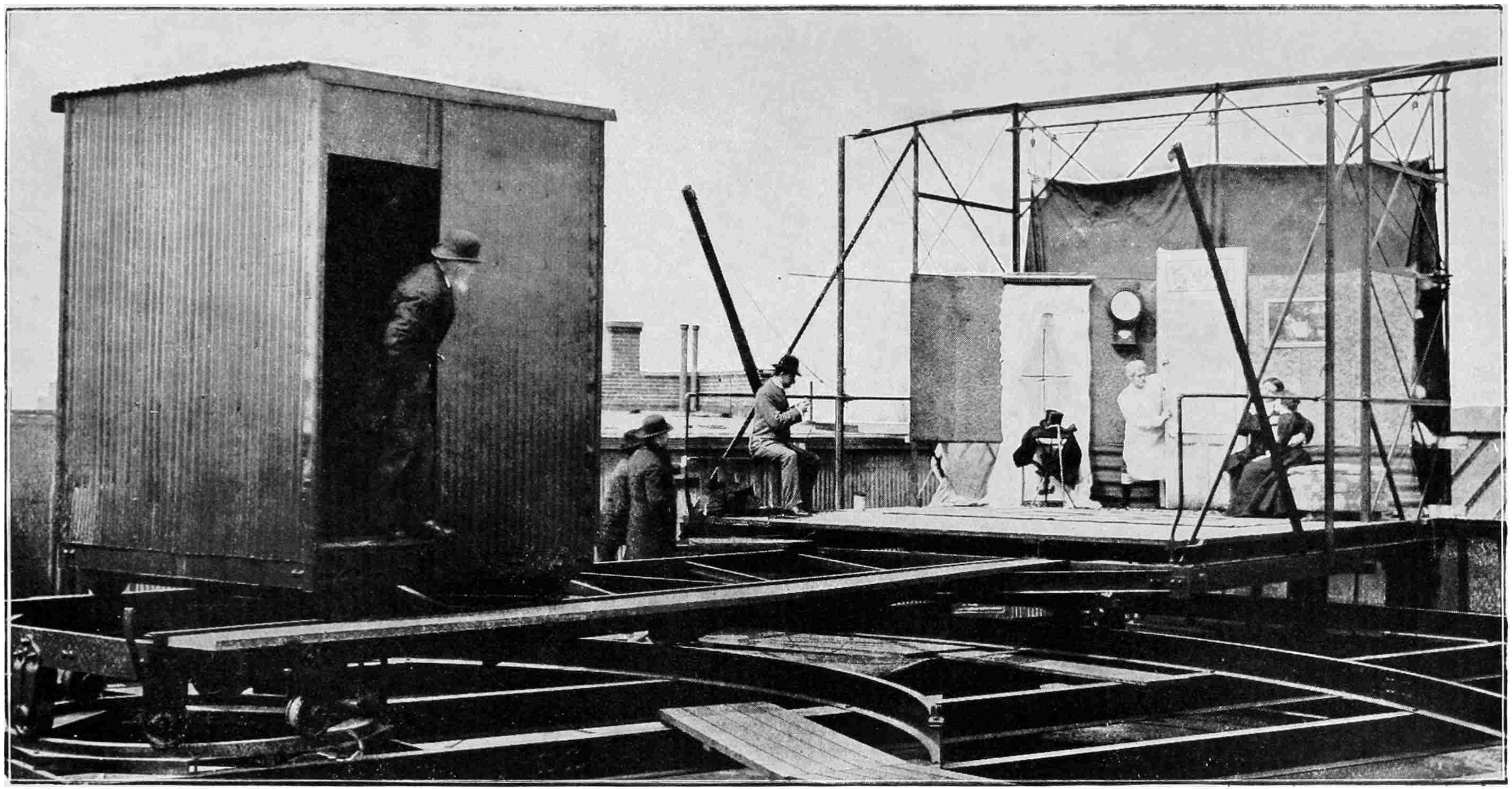
[By courtesy, “The Scientific American.”
AN EARLY OPEN-AIR STUDIO STAGE FOR PRODUCING CINEMATOGRAPH PLAYS.
It was on the flat roof of a building in New York City. The camera and operator were accommodated in the small hut. The whole revolved on a massive
iron turn-table so that the stage faced the sun throughout the day.
A special platform, running on a wheeled carriage and
track, the deck of which was level with the floor of the
stage, was laid opposite and at right angles to the proscenium
opening, to accommodate the camera and operator.
Looking into the studio from this point, one saw a familiar
theatre stage, with wings, flies, and other facilities. Such
was the earliest venture in what is now one of the most
important branches in the cinematographic industry.
Upon that stage Paul himself produced several hundred
plays of infinite variety, comedy, tragedy, melodrama,
farce, and magic.
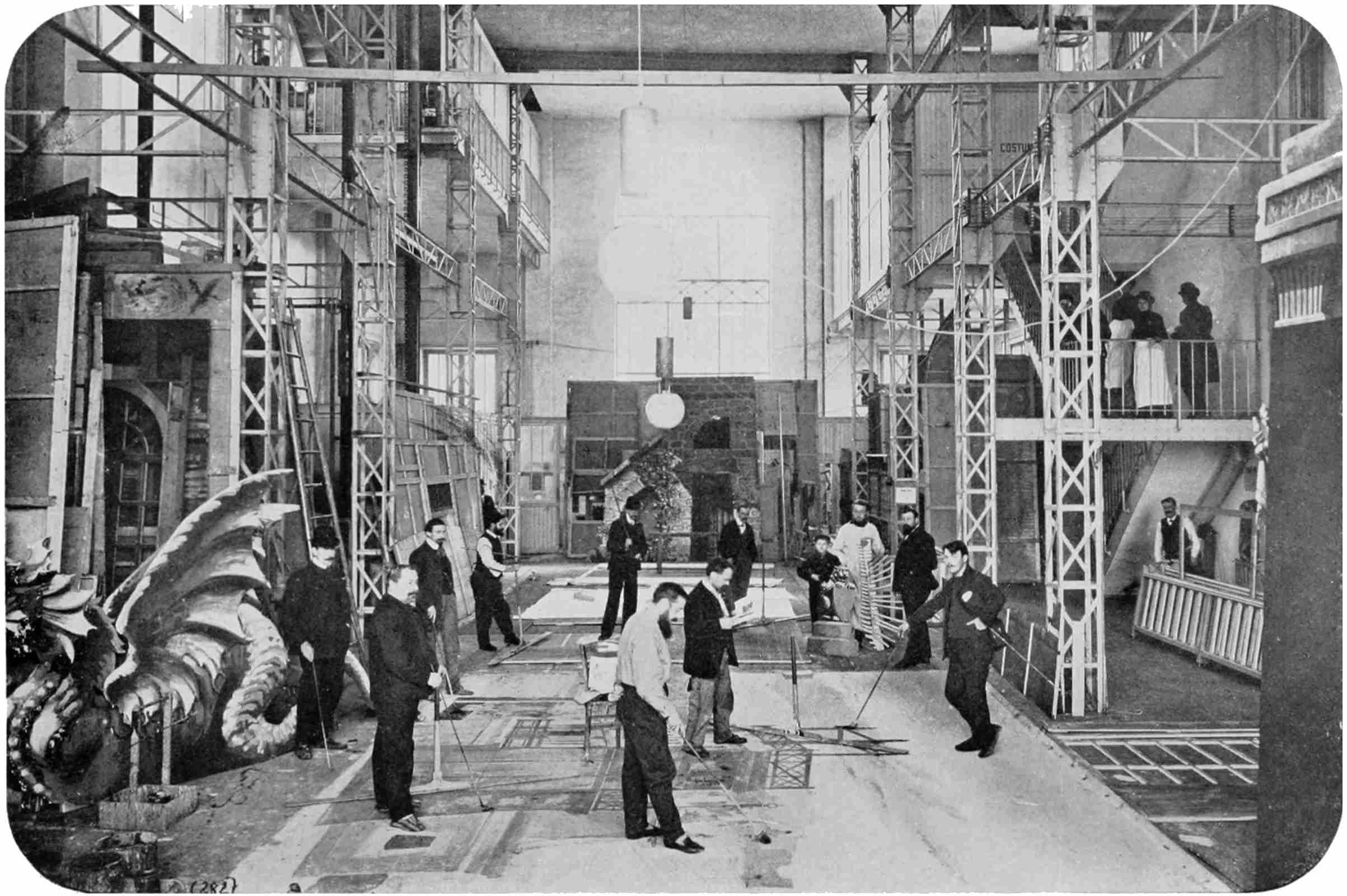
THE SCENE-PAINTERS’ SHOP AT A PATHÉ STUDIO.
The back-cloths and flats of canvas are stretched like carpets upon the floor for the artists.—See page 109.
In the United States a crude attempt in the same direction
was made by Thomas A. Edison in order to produce
films for his kinetoscope. His building was unpretentious
in the fullest sense of the word.
It was of the flimsiest character, with a movable top,
and covered externally with roofing material. It became
known colloquially as the “Black Maria,” a singularly
appropriate name. A notable feature was its central
mounting upon a pivot, and a circular track for wheels
placed under the extreme edges of the building. The
structure could thus be rotated in either direction like a
turn-table, according to the position of the sun, so that the
studio could be used at any time of the day. As the
kinetoscope failed to arouse public enthusiasm, work in
the studio was abandoned, until Edison, who had seen the
tendency towards projecting pictures upon an enlarged
scale before audiences, was able to perfect his projector.
At about the same time another American firm commenced
work in the same field—the American Mutoscope
Company. Their studio was open-air in the fullest sense
of the word; the stage was the roof of their own building
in New York City. A heavy network of steel beams was
laid down, upon which the stage was erected. Opposite
was a small hut built of corrugated iron, which housed
the camera, its accessories, and operator. The stage could
be swung round upon its track so that the bright sunlight
fell squarely upon the scene, and similarly the camera
house could be moved over its wheeled track to assume
the desired position for taking the pictures.
American enterprise, however, grew dissatisfied with
the short lengths of the picture films then produced.
Certain interests in New York resolved upon a masterstroke.
They cherished the idea of preparing something
staggering in its sensationalism: the production of a
gigantic film upon some striking subject which should
startle the cinematographic world, and completely eclipse
all previous efforts in the field. They succeeded to an
extent which surpassed their own most sanguine anticipations.
After prolonged discussion it was decided that the
“Passion Play” would prove a powerful magnet with the
public. But where was the man to be found sufficiently
daring to attempt to carry out the project? With the
crude facilities available at that time the task was one not
lightly to be undertaken. The New York interests
approached Mr. Richard G. Hollaman, the President of
the Eden Musée, who had been intimately identified with
the popularisation of moving pictures ever since the days
of the kinetoscope.
Mr. Hollaman was somewhat startled by the proposals,
and at first considered the task entirely out of his province,
and quite beyond him. However, he deliberated upon the
suggestion, and at length consented to undertake the work.
He secured the assistance of Mr. John Vincent as stage
manager, and Mr. Albert Eaves as costumier. No expense
was to be spared in its mounting—it was to be the most
gorgeous production of the day. The Salmi Morse version
of the “Passion Play” was prepared especially for the
cinematograph, and the company was enrolled.
The next obstacle was in getting the play staged. No
studio-theatre existed in America at that time, and the
open air roof-stages were far from being suited to the work
even if they had been available. As a result the producers
had to make their own arrangements. The roof of the
Grand Central Palace in New York was selected, and in
the middle of November, 1897, rehearsals commenced.
Several weeks were devoted to the preparation, and no less
than $16,000 (£3,200) were spent upon the preliminaries.
The film ran to three reels, or about 3,000 feet, and some
48,000 separate pictures. It was the first three-reel film
subject ever produced in the United States, if not in the
world.
The first exhibition took place at the Eden Musée, and
required about 55 minutes to project. It created a
tremendous sensation. Some idea of its popularity may
be gathered from the fact that it ran continuously for six
months. Copies of the film were printed off and sold
broadcast throughout the United States, the success of the
New York display ensuring it a warm reception wherever
it was exhibited. Few films have created such enthusiasm
as did the “Passion Play,” and it has never lost its popularity.
As Mr. Hollaman was not associated with the
film-manufacturing side of the industry, he accepted the
first offer he received for the negative. Thus the “Passion
Play” passed into the hands of Edison, who starred the
production in his catalogue of films for a considerable
period.
Meantime the movement went on in Great Britain.
Shortly after Paul brought his studio stage into full swing,
a second establishment came into existence at Hove, on
the Sussex coast. The promoter of this enterprise was Mr.
James A. Williamson, who, as the founder of the Hove
Camera Club, had been introduced to the cinematograph
in his official duties. He became fascinated with the work,
and procured a projector, but at first confined his efforts
to showing moving pictures for the edification and enlightenment
of his interested club-fellows. Then he
decided to participate in the taking of the pictures. The
camera at that time, however, was so expensive that he
resorted to an ingenious expedient. He took the lantern
projector, which is similar in its design and operation to
the camera mechanism, and fitted this into a light-tight
box carrying the spools for the unexposed and exposed
films. With this apparatus he secured many interesting
albeit conventional subjects, with which the public was
content at that time.
Meanwhile, Mr. Esmè Collings, the well-known portrait
photographer, had entered into partnership with W. F.
Greene, who produced the first model of a cinematographic
or chronophotographic apparatus, as it was called. With
his camera Mr. Collings secured an excellent varied series
of pictures. But after a time he lost interest in cinematography,
when his stock of films was acquired by Mr.
Williamson. The latter now decided to enter the stage-picture
film field, and a commodious and well-equipped
studio was erected on the outskirts of Hove. His
films, owing to their high technical or photographic qualities,
attracted widespread attention, especially in America.
In fact, the United States constituted his most valuable
market, the Williamson productions being in great
demand. Several of his pictures, as well as those of Paul,
created a sensation, and these two producers practically
controlled the play-picture film market of the world for
many years. The period between 1896 and 1900 was most
critical in the cinematograph industry, and it was due
mainly to the perseverance of the two pioneers that it
became firmly established. Lovers of moving pictures
to-day realise little of the innumerable difficulties which
confronted Paul and Williamson, and the puzzling
obstacles which they had to break down. They were
dependent upon their own resources and ingenuity, and
had to learn by their own mistakes instead of by the
example of others. They had to be photographic artists,
scene painters, stage carpenters, and stage managers.
Both Paul and Williamson have now retired from the
play-picture producing business, the first-named to revert
entirely to his original occupation, and the second to the
mechanical side of the industry, the manufacture of perforators,
printing machines, and so forth. His studio was
acquired for the production of Kinemacolor films, and is
in active use to-day during the summer months of the year
for the production of plays in natural colours.
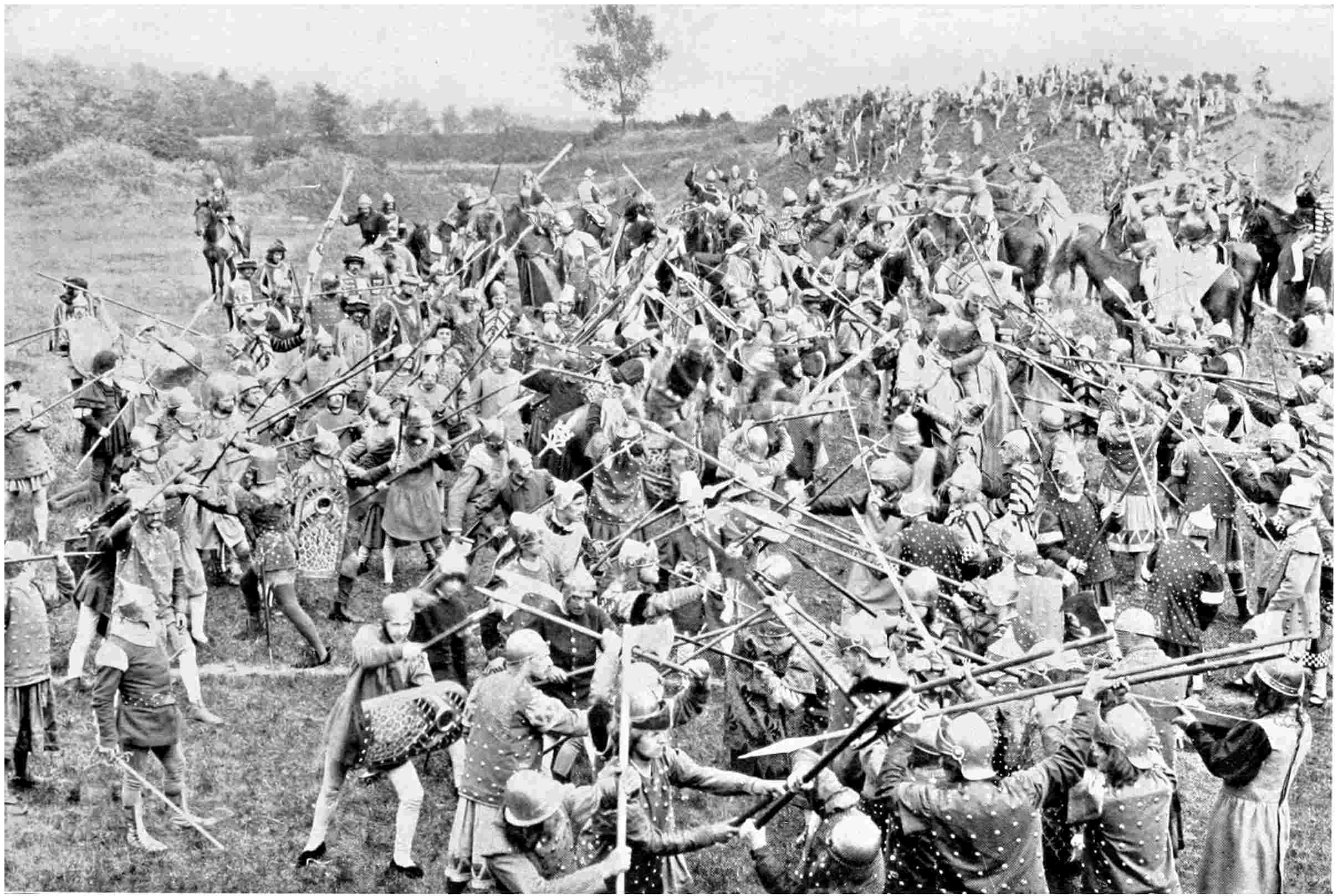
BATTLE SCENE FROM “THE SIEGE OF CALAIS.”
This film, produced by Pathé Frères, is the most ambitious ever attempted, 2,500 men and horses taking part therein.
Paul and Williamson led the way in the manufacturing
of picture films, and for a time controlled the market.
They were followed by several others, until about half-a-dozen
studio-theatres were scattered over the country. The
scope of their work was somewhat limited, yet their
products commanded a wide sale. They dominated the
American market; Williamson alone furnished some 60
or 80 films a week for the cinematograph theatres of the
United States, and he was patronised also by the German
public. Unfortunately, however, the industry in Great
Britain did not develop so promisingly as these early
achievements augured. The British producer does not
appear to be able to gain the confidence of the capitalist;
he is still as ambitious and as capable as ever, as witness
the production of Tennyson’s “Maud,” but he is handicapped
on every side. He finds it increasingly difficult
to compete with his foreign rivals. To-day there are only
two fields in which he reigns supreme—popular drama and
comedy; and this slight modicum of success is due rather
to the fact that the British public is somewhat insular in
its tastes; it does not understand foreign humour, and will
not tolerate foreign tragedy.
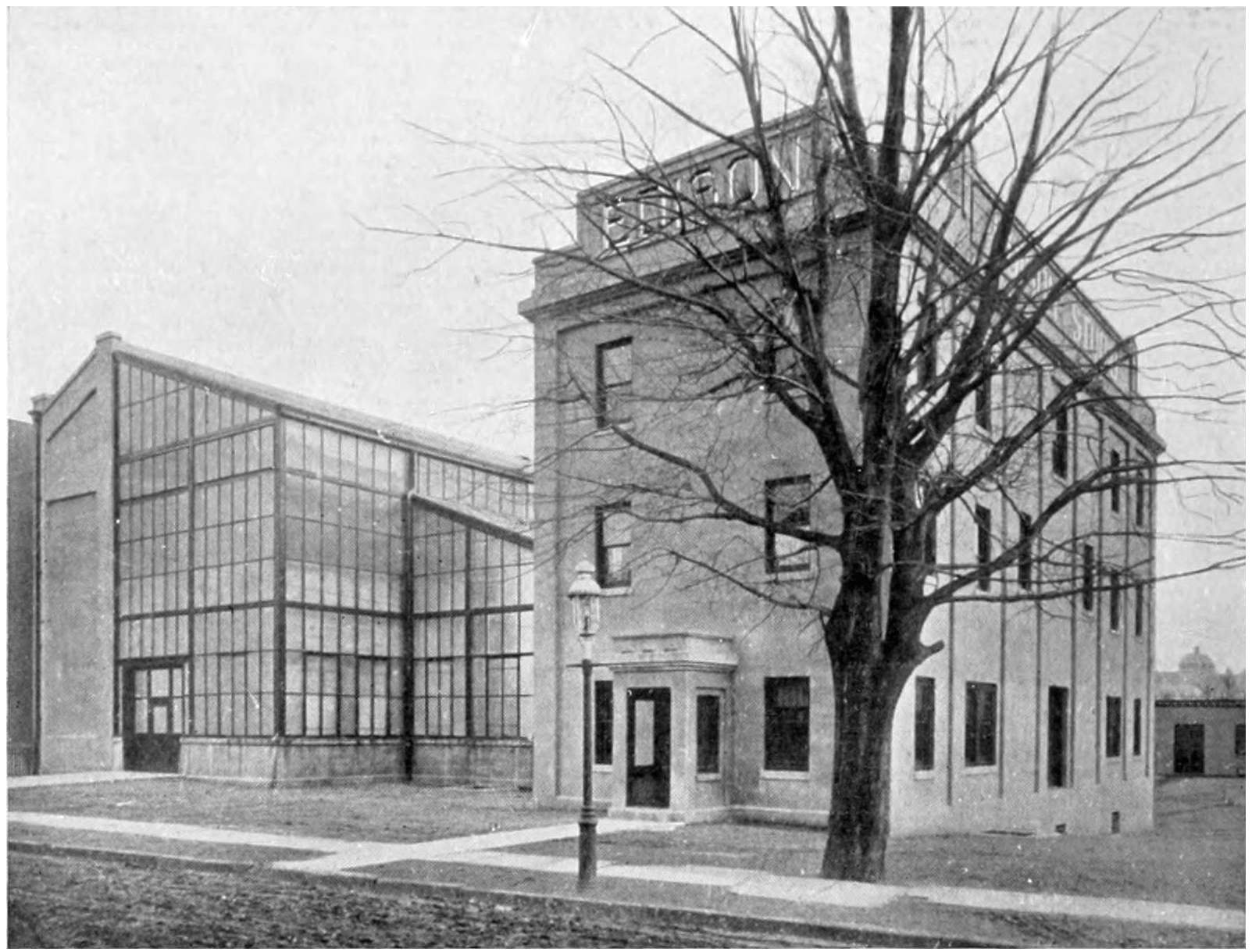
EXTERIOR OF THE MODERN EDISON FILM-PLAY-PRODUCING THEATRE.
This structure contrasts with the “Black Maria.” It is a lofty glass building, 100 feet long by
60 feet wide and 45 feet high, and cost £20,000.—See page 112.
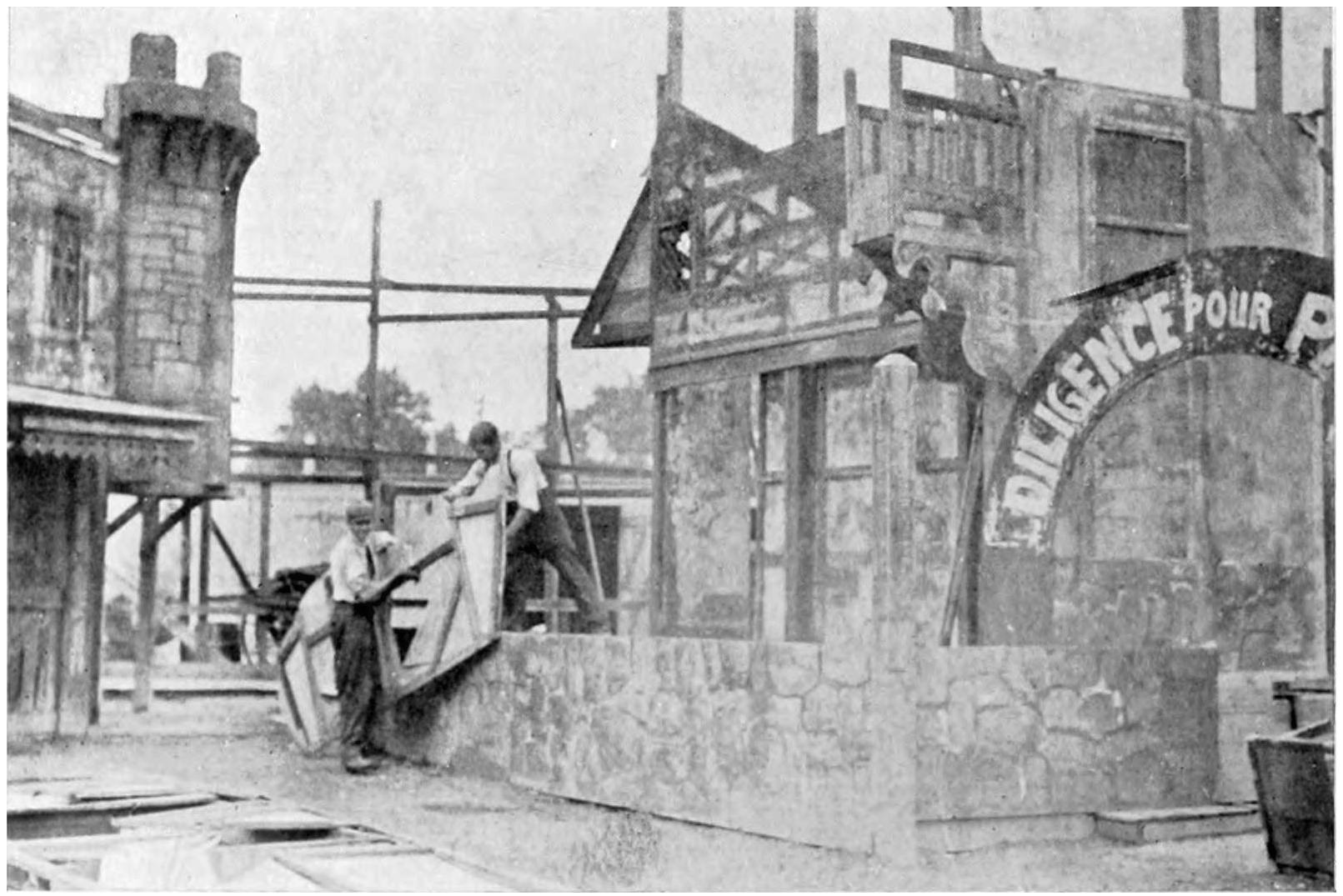
BUILDING A SOLID SET FOR “THE TWO ORPHANS.”
This scene, on one of the Selig open-air stages, shows the care and expense taken to mount
a modern film-play.—See page 112.
About six years ago the cinematograph play underwent
a great change. Up to that time the productions were
somewhat conventional both in plot and mounting. The
scenery was commonplace, and the dramatis personæ, as
a rule, comprised only about half-a-dozen persons. Moreover,
the pictures betrayed a sad deficiency in stage
technique, a result due entirely to the fact that the
producers were not conversant with stage-craft.
The French producers saw a unique opportunity, and
grasped it promptly. Foremost in the movement was the
firm of Pathé Frères, which is to-day one of the largest
and most enterprising film-producing establishments in the
world. They launched out upon the most elaborate lines.
Huge stages or studios, with the latest appliances, which
from the technical point of view would rival the famous
Drury Lane stage, were constructed at immense cost,
eminent stage managers, versed in every phase of the
technique of production, were obtained from the theatres,
while the services of the foremost French actors and
actresses were secured. The scenery was prepared upon
an extensive scale, the mounting was lavish, and plays
which hitherto had been considered beyond the scope of
the picture-producer were taken in hand boldly. If the
British producers introduced the stage-play to the cinematograph
film, the French certainly perfected the idea, and
set the elaborate production upon its feet. Some of the
plays which the French producers have filmed are
extremely bold in their conception, as well as being
wonders of stage-craft, scenery, and photography. At the
present moment the Pathé firm has no less than eight stage
managers engaged in the production of picture plays of
every description; the Gaumont establishment, which is
pressing the Pathé hard for first rank, has six producers,
while several other firms in the same country have
elaborate organisations. Gorgeousness of production is
the predominant key-note, associated with acting excellence;
and the policy has been attended with merited
success.
The triumph of the British and subsequently of the
French film producers reached the United States. Like a
huge wave the European films overwhelmed the country.
In comparison, the American productions were trash. The
native firms were confronted with extinction unless they
made a bold and united stand, which was hardly to be
expected, for at that time the American cinematograph
world was in a state of chaos. Litigation was raging on
all sides. Edison was engaged in a deadly struggle to
maintain his position according to his original, or kinetoscope,
patent. As a result of the turmoil, the industry
became unsettled, and the money which should have been
expended in the furtherance of the craft, simply went to
fill the pockets of hungry lawyers. Edison triumphed at
last; his claim was sustained by the Supreme Court. The
establishment of this contested point cleared the air, and
one outcome was the formation of a Cinematograph Trust
or community of interests to resist foreign invasion.
Several firms enlisted under the banner of the Edison
patent—other interests which still disputed his claim combined
to form a second trust.
The first move of the combination was to eliminate the
foreign competition from which it was suffering so disastrously.
Special terms were drawn up which European
firms were compelled to observe under threat of their films
being forbidden to the country. The European producers,
foreseeing the loss of a valuable market, tried desperately
to mitigate this drastic policy, but in vain. The American
terms were: either limited sale, as stipulated by the trust,
or else complete boycott. The British producers saw their
most remunerative market eliminated at a stroke. Williamson
suffered particularly from the decision, for all standing
contracts were cancelled. As he never had made strenuous
attempts to cultivate the British market, which was open
to producers in all parts of the world without the slightest
restraint, but had concentrated his efforts upon pleasing
his United States clients, he concluded that retirement
from play production was the wisest course, especially as
the mechanical side of the industry was so full of attractive
promise.
The American producers, entrenched firmly behind the
wall of protection, set to work energetically to make up
for lost time. The story of the automobile industry, which
was similarly hindered in its infancy by patent wars, was
repeated. The Americans imitated the French example
and embarked upon the most elaborate enterprises. Keen
rivalry was displayed between the various concerns to
acquire the best managers of the legitimate stage, with the
result that the theatre suffered heavily. Several stage
managers, seeing the trend of events, and realising that
cinematographic picture plays possessed a tremendous
future, abandoned their old field and gave their energies
to the new one, which offered such great scope for their
abilities.
The American stage, like that of Great Britain, France,
Germany, and Italy, had regarded the picture play with
disdain, and had ridiculed the possibility of its ever
becoming a spirited competitor to their particular interests.
To-day the American stage is engaged in a struggle for
supremacy with the moving-picture theatre. The
American picture producers erected huge studio-theatres,
with every convenience, capable of producing any type of
play demanded, and giving the author greater opportunity
for effect than ever the legitimate stage could hope to
offer.
It is difficult to realise the proportions which these
American studio-stages have attained, or the work they
can carry out. Take the Edison Company for instance.
We have seen the humble little “Black Maria” which
sufficed to supply the film needs of the Kinetoscope in
1892. The present Edison studio, which cost something
like $100,000 (£20,000) to build, is a huge glass building
measuring 100 feet in length, by 60 feet in width, and has
a height of 45 feet. The stage has a proscenium opening
of 30 feet and an area of 2,400 feet. In addition there is
a huge water-tank with a capacity of 130,000 gallons, which
is used for aquatic spectacles.
The Edison establishment is but one of many. In
Brooklyn the Vitagraph Company has a huge building,
the Lubin films are produced in spacious studios in Philadelphia,
while Chicago boasts the famous Essanay and
Selig plants. The latter is especially noteworthy owing
to its great size and the remarkable plays which it produces
for the delight of moving-picture lovers in all parts
of the world. It is devoted exclusively to making films,
and finds employment for 400 hands. The main studio,
in which are two stages, measures 179 feet in length by
80 feet wide. In addition to this indoor establishment,
there are between two and three acres of surrounding land
which have been enclosed for outdoor work. This field,
if such it may be called, presents a strange sight. It is
dotted with little groups of scenery. Here is a mediæval
castle with ruined battlements; a few yards away to the
right is a modern street; while on the left is the interior
of a stately drawing-room. In one corner are a number
of artificial hills fashioned by the dumping of earth, criss-crossed
with paths and trails. It is an incongruous medley
of periods and scenes, but one and all little assemblages
of back-cloths and wings represent a stage, and one and
all face the southern sun. Upon these little stages the
plays are produced.

BUILDING A SCENE ON ONE OF THE PATHÉ STUDIO-STAGES FOR A FILM PLAY.
The stage is fitted with every possible device, such as overhead bridges, to facilitate the moving and setting of scenery as well as
for the working of effects.
The Selig organisation is one of the largest in the
United States, having, in addition to the Chicago establishment,
another theatre at Los Angeles on the Pacific
coast, devoted to the portrayal of pictures having a western
setting. There is the Pacific Ocean on one side to form
a background for marine incidents; the Sierras, frowning
down upon the coast, provide a natural background for
subjects set among the mountains; while within easy reach
is the vast stretch of Nevada desert, where the atmosphere
of the Sahara of Africa, or the great wastes of Australia,
can be reproduced. The Chicago studio is provided with
an artificial pool of 60,000 gallons, where a lake, lagoon,
or swamp environment to a picture can be secured.
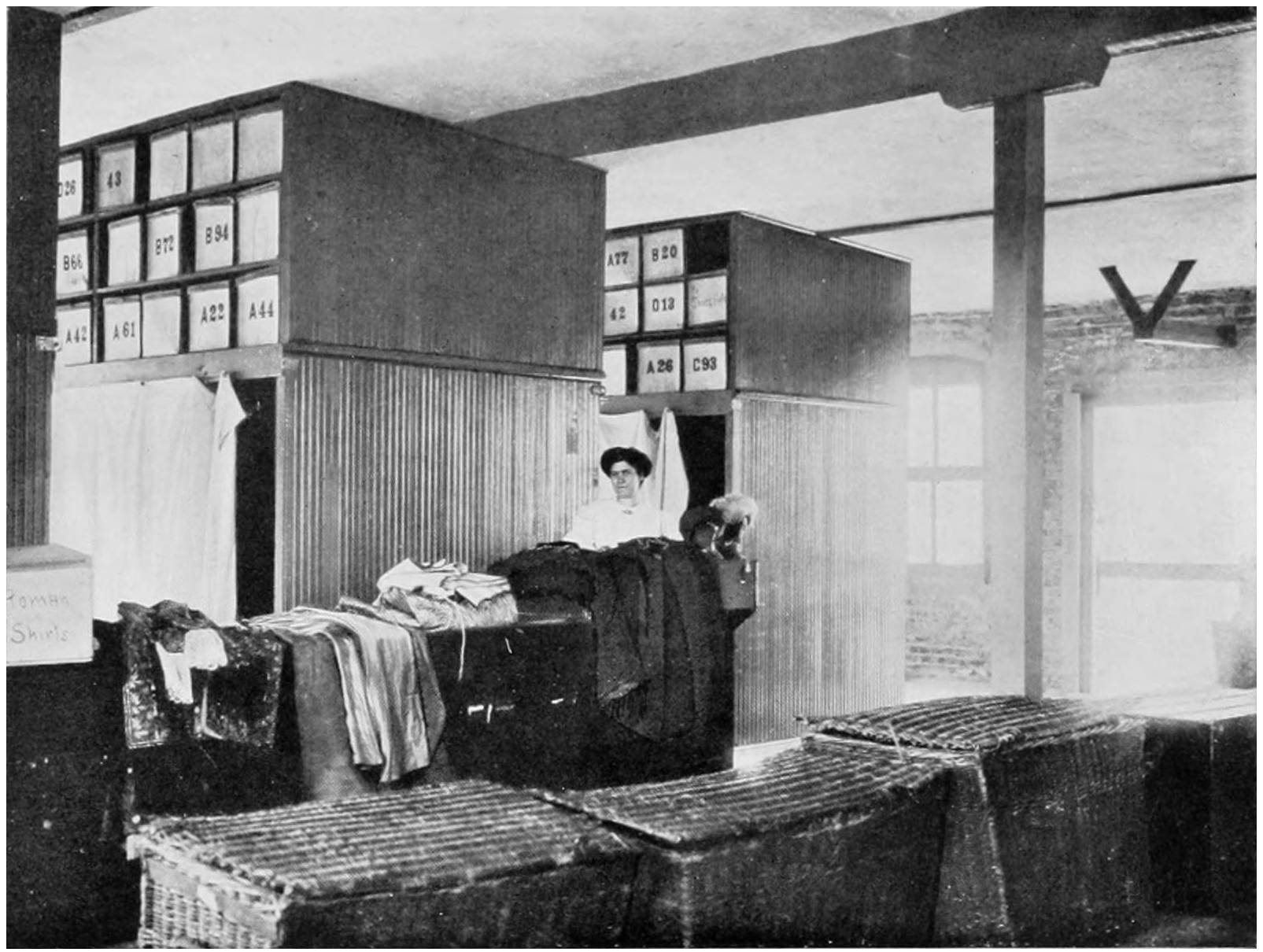
THE WARDROBE ROOM AT THE SELIG FILM FACTORY.
Over 7,000 costumes of all descriptions are stored ready for instant use.
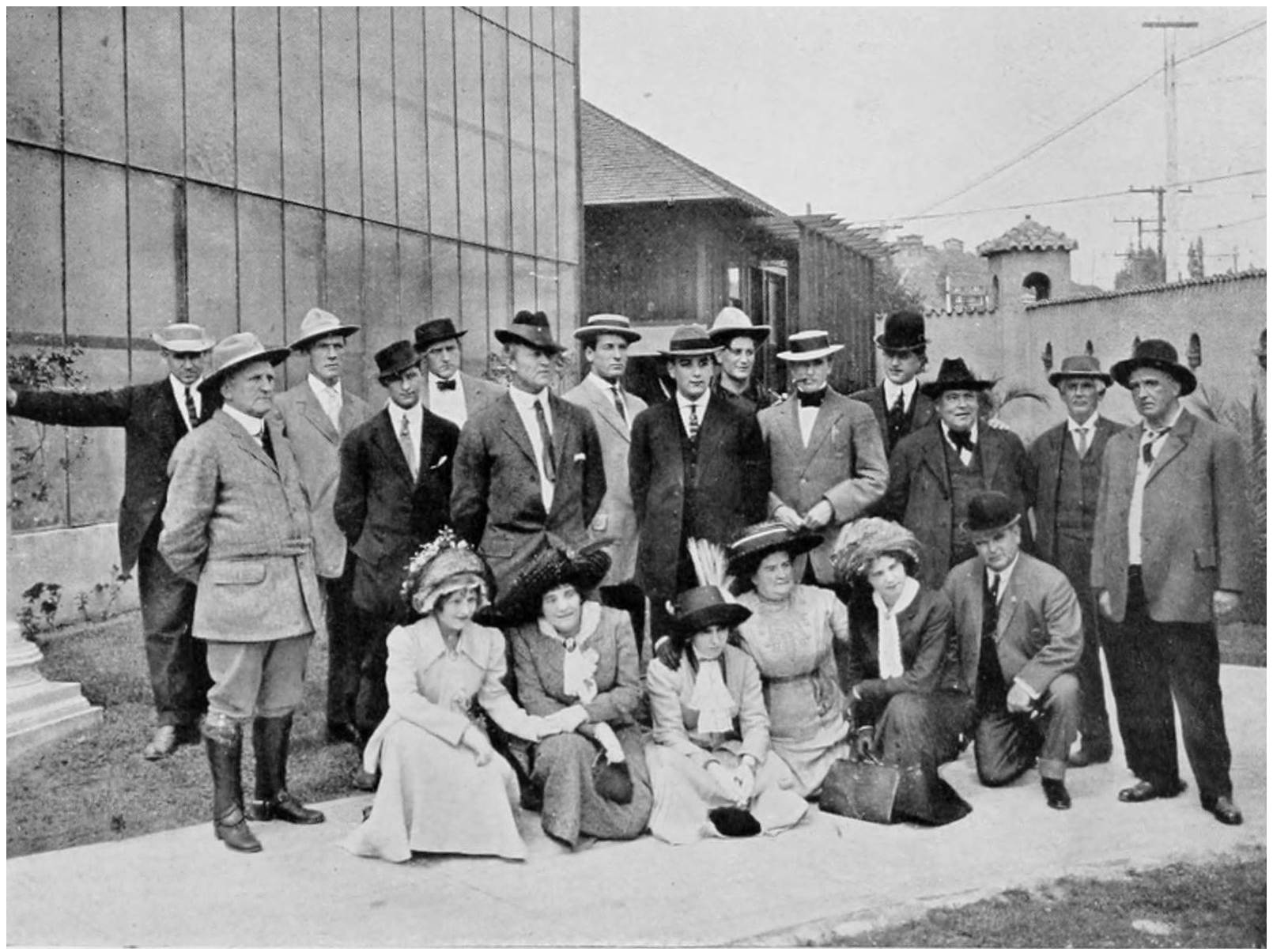
THE SELIG STOCK COMPANY AT LOS ANGELES.
The remarkable development of the picture-play industry has resulted in the acquisition of leading
actors and actresses by the largest producers. High salaries are paid for the exclusive services
of eminent artistes.
The modern cinematograph studio-stage is far more
elaborately equipped for the production of effects than its
counterpart behind the footlights, while the attendant
plant is overwhelmingly extensive. The stage of Drury
Lane Theatre in London and of the Opera House at Paris
respectively are considered marvellous homes of stage-craft,
and regarded as models of equipment. But compared
with the great French, Italian, or American cinematograph
studio-stages, they are insignificant. Large,
well-lighted and spacious rooms are set apart for the stage
carpenters and the scene painters to prepare the back-cloths,
wings, and flats. This work alone, owing to the
high pressure at which production is maintained, affords
employment to a large staff. As the average output is
three films per week—the Edison establishment produces
four or five subjects in that time—the scene painters are
kept busily engaged from morning to night. All scenery
has to be painted in black and white, and the excellence
of the work plays an important part in the effect of the
picture, for the camera is ruthless in its exposure of
indifferent work. The scene may be the interior of a
shack, or a sylvan valley with a river winding like a ribbon
of silver among the trees and a stately castle rearing above
the foliage. In each instance the same artistic care is
demanded, for it must be remembered that by the time
the picture reaches the screen it is of the same dimensions
as the original, or even larger.
As the picture-play producer roams through all the
periods of history in all countries, a large stock of properties
and an extensive wardrobe must be maintained.
The Selig establishment in Chicago has a wardrobe in
which are carefully packed and labelled ready for instant
use no fewer than 7,000 costumes, of all countries and
peoples scattered between the Arctic and Antarctic circles,
and ranging from prehistoric times through the picturesque
middle ages to the prosaic twentieth century.
From morning to night the studio-stage echoes the ring
of hammers and the shouts of the stage carpenters as they
set this scene or strike that. Frowning masonry castles
are pulled down, and suburban villas rise up with greater
speed than their jerry-built prototypes in bricks and
mortar. The numerous dressing rooms are busy hives,
where actors and actresses change swiftly from one costume,
age, and clime to another, separated from it by
centuries.
When the play is cinematographed indoors, a battery
of powerful electric lights is placed overhead in front of
the stage, corresponding to theatrical top-lights, and
throwing a powerful glare upon the scene. They are controlled
by switches, so that the light can be concentrated
as desired. When the lights are in full blast, more than
80,000 candle-power may be thrown upon the stage. In
addition, other lights are disposed for the purpose of producing
different effects, so that upon a large studio-stage a
body of well-trained electricians is indispensable.
The scene itself occupies but a small space, generally
about 12 or 16 feet in width. As a rule the camera is
brought within a few feet of the picture, in order that the
actors may be photographed as large as possible. On the
floor on either side battens are laid to indicate the limits
within which actors and actresses must move. Beyond
these confines is to vanish from the scene, and the stage
manager may be heard over the whirr of the camera
shouting peremptorily to one or other of the company to
keep in the picture.
The large producer thinks expense is a secondary consideration
in the preparation of plays. A simple conventional
modern comedy costs about £50 ($250), while a
gorgeous production runs well into £6,000 ($30,000). On
the average, about 150,000 feet of film are placed on the
British market every week, and this quantity is steadily
increasing. It is computed that there are some 50,000
picture theatres scattered throughout the world, and as the
number thereof is increasing daily the supply of films has
by no means yet reached the limits of demand.
CHAPTER XI THE CINEMATOGRAPH AS A RECORDER OF TOPICAL EVENTS: SCENIC FILMS.
In spite of the fact that the programme of the average
picture palace of to-day is chiefly occupied with film plays,
nevertheless the greatest attraction is undoubtedly the
“topical picture.” British audiences were first introduced
to its possibilities by seeing the 1896 Derby re-run before
their eyes on the screen in the Alhambra Theatre, creating
a tremendous sensation. In fact, the reproduction of this
classic British horse-race upon the white sheet twenty-four
hours after it was run excited more attention than the actual
race itself. In those days cinematography was unfamiliar
to the general public, and those who followed the race upon
the screen could not resist rubbing their eyes in amazement:
it seemed scarcely credible. Certainly, very few items
of sensational interest have ever created such a deep impression
and brought such heavy receipts to the box-office
of this famous vaudeville house as the first Derby film.
The manner in which the film was obtained was typical
of Paul’s quiet, unassuming methods. His “animatograph”
had become established firmly at the Alhambra, and
he was always on the alert to secure new and striking
subjects. When he decided to attempt the representation
of the classic race, he told no one, and sought no favours
to obtain commanding positions from which to photograph
the contest. On the morning of the race he appeared at
Epsom. He chartered a wagonette, upon the seats of
which he intended to set up his tripod and camera. He
hoped to be able to secure a good position unobserved, but
he came near to having his plans upset.
When he arrived on the course, one of the itinerant booth-holders,
a pugnacious, gipsy-like individual, thought the
vehicle was some form of rival side-show and barred its
progress. An altercation ensued, but Paul drove on with
the enraged gipsy in pursuit. The latter, seeing that his
irate remonstrances were of no avail, threatened to take the
law into his own hands and to upset the offending vehicle
and its strange contents. Paul thwarted this contingency
by tying the wheels of his vehicle firmly to the rails, along-side
of which he had taken up his position, and the film
was secured without further untoward developments.
From the night on which the Derby was run at the
Alhambra, the success of the topical film has been established.
Scarcely an item of absorbing public interest
escapes being recorded. Probably no topical film has
created such enthusiasm as that which Paul secured of the
“Prince’s Derby” when the late King Edward VII., as
Prince of Wales, carried off the blue riband of the British
turf. The Alhambra Theatre was converted into a reproduction
of the famous course, for the entire audience
cheered the moving pictures with as much gusto as if they
were following the actual struggle on Epsom Downs, and
would not desist until the film had been passed across the
screen three times. Paul cinematographed the Derby on
no less than six consecutive occasions, and there is probably
no established British annual event which he has not
recorded.
In the early days, as Paul was practically in full possession
of the topical film field, there was an entire absence of
that haste of competition. Then it was immaterial whether
the film were shown one or two days after the event. The
many processes which had to be carried out between the
securing of the negative and the production of the positive
print for the projector were not hurried, and in fact could
not be accelerated very well, if good results were desired.
But as other firms appeared on the scene, keen rivalry
sprang up. The various establishments left no stone unturned
to be first in projection, and the theatres, of course,
encouraged the enterprise. Consequently the race against
time and rivals became more and more bitterly contested.
As a natural result, great improvements were made in the
developing, drying, and printing operations. Whereas
twenty-four hours or so had been required to produce a
positive ready for use, it now became possible to reduce the
time of preparation to about eight hours. To-day a subject
can be thrown upon the screen four hours after it has
occurred. The topical film appears while the subject
to which it refers is still absorbing public interest; and
accordingly meets with overwhelming success. The men
armed with the camera have the same zeal that animates
the reporter bent on securing exclusive information for his
paper. No effort or expense is spared to outstrip a rival,
as the following incident shows.
An American firm required a film of an event which it
thought would be of absorbing interest to the American
public. It communicated with its agents in London to
“get it, and ahead of anyone else.” The outlay was such
that the firm could only hope to recoup itself by capturing
the entire market for that particular firm. As it happened,
only one other firm decided to exploit the same topical subject
in the United States. The first firm secured commanding
positions for its camera operators, and the films as they
arrived were packed and dispatched to New York by special
messenger. The competitors failed to show such initiative,
and had their films transmitted in the usual manner. Not
only did the first firm receive its negatives within the
shortest possible space of time, but it found itself in
undisputed command of the whole country, for the rival’s
product went astray in transit! The successful establishment
expended £300 ($1,500) in acquiring the negatives,
but it proved an excellent investment.
The Americans, however, have not made such a speciality
of the topical film as it has become in England, where
there are several firms excelling in this particular field of
activity. Under energetic management it is one of the
most lucrative branches of the industry, success attending
those who display the greatest amount of energy and
initiative.
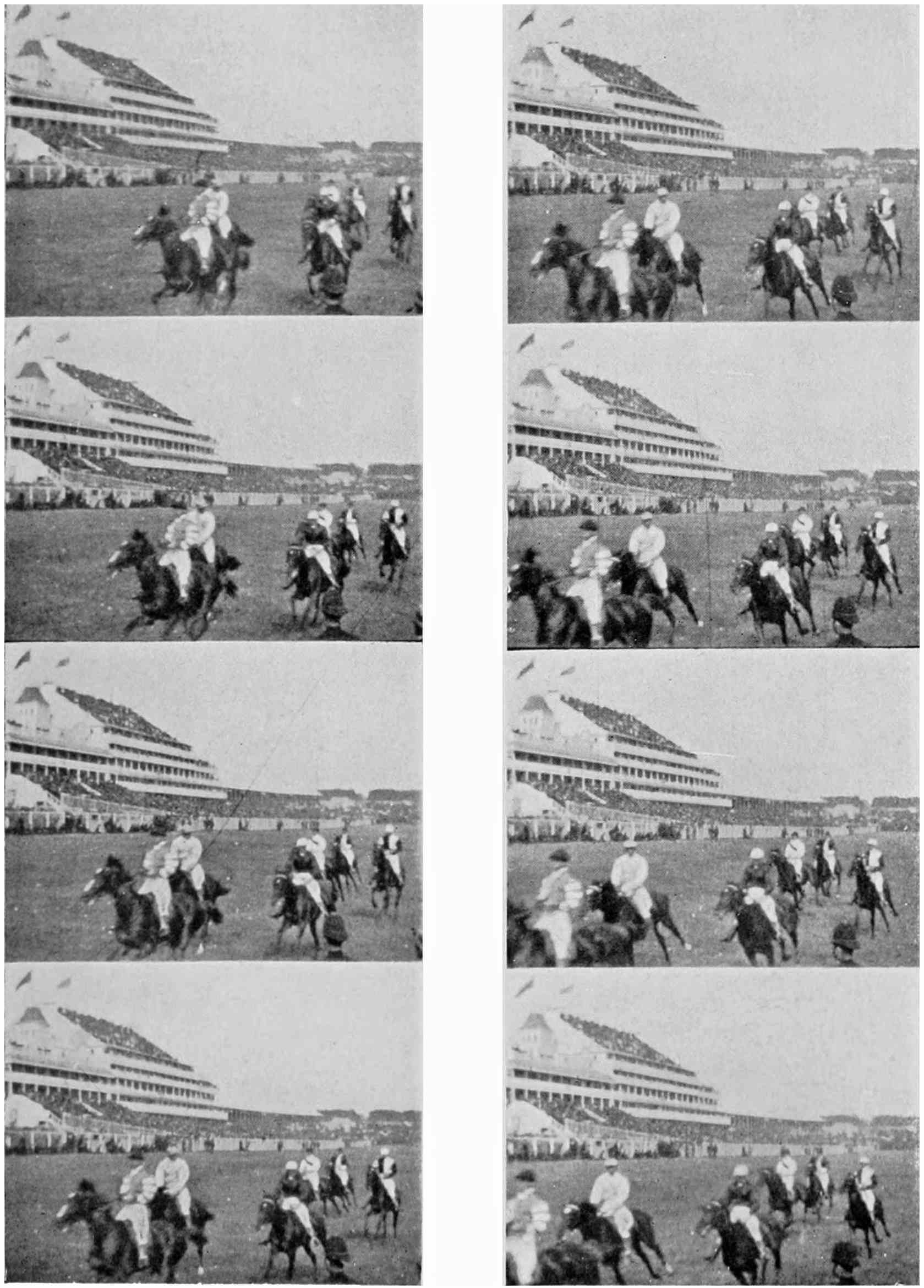
THE FIRST TOPICAL FILM.
The Derby of 1896 cinematographed by Robert W. Paul, and shown the day after the event at
the Alhambra Theatre, London.—See page 116.
The power of the topical picture was demonstrated most
convincingly by the Coronation festivities of King
George V. For some weeks after that event the picture
play fell into second position. The Coronation films were
in urgent demand on every hand, not only in Great Britain,
but in the Colonies as well. Some theatres even found it
profitable to give an extended run exclusively to Coronation
films and kindred subjects. The most remarkable outcome
of the popularity of the Coronation films was the establishment
of “Kinemacolor” in the favour of the public.
Cinematography in natural colours had not in the earlier
stages attracted more than passing interest, and had languished
somewhat. But when the royal festivities were
reproduced in the full glow and brilliancy of colour, the
success of this development of the art became assured.
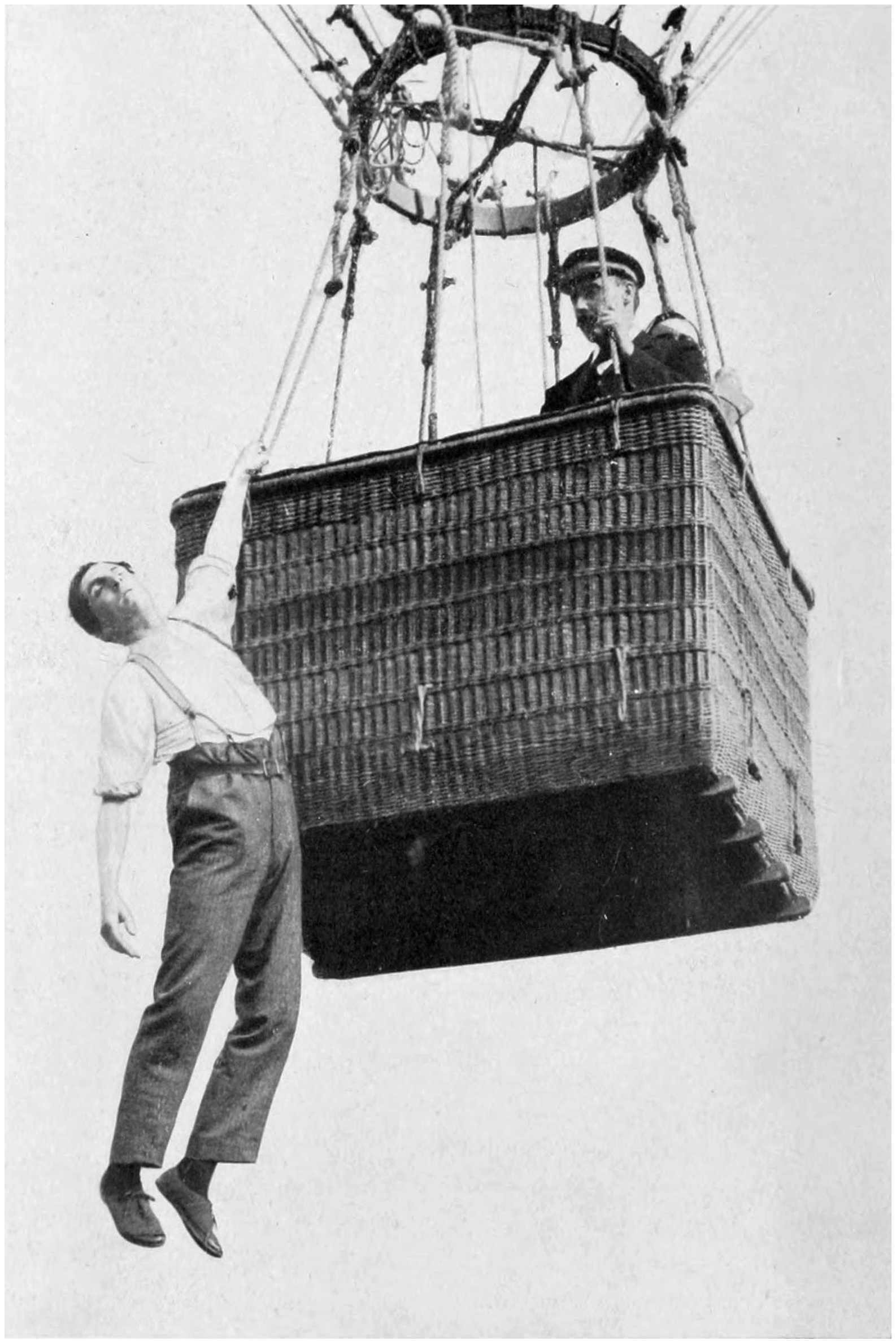
[By permission of the British and Colonial Kinematograph Co., Ltd.
THE FALL FROM THE BALLOON.
Sensationalism is a powerful feature in the modern cinematograph drama. The above incident
alone cost £300 ($1,500) to obtain.
The Coronation has probably been responsible for more
achievements in the work of topical cinematography than
any other event. On all sides the keenest competition was
displayed among the rival firms. In London, ere the Royal
procession left Westminster Abbey after the crowning ceremony,
films were being shown of the morning procession
to the Abbey; and before the crowds in the evening were
gazing upon the illuminated streets, the return journey to
Buckingham Palace was being thrown upon the screen of
a multitude of theatres throughout the country. Possibly
the most remarkable feat was that whereby English residents
in Paris and the French nation were enabled to see
the ceremony within a few hours of its occurrence. This
was an achievement of the English branch of the well-known
Gaumont Company, which is probably unexcelled in
time-saving ingenuity.
This firm had cameras and operators scattered freely
along the route of the Royal procession, and all the films
which were secured up to the time of the arrival at Westminster
Abbey had been packed and entrusted to a special
messenger. The train was due to leave Charing Cross at
2.20 p.m. The clock had barely struck two when the
return journey commenced to Buckingham Palace. The
operator stationed near the Abbey, in a position to secure
one of the best views along the route, was suddenly seized
with the idea to set up a new record. A taxi-cab was
engaged and held in readiness. At about ten minutes past
the hour the procession drew within the field of the camera
and the filming commenced. Within about four minutes the
coach bearing their Majesties had passed beyond the lens.
The film was slipped out of the camera, and the second
operator, snatching it up, entered the cab and drove off
at full speed to the station. The train was caught in the
nick of time, the film was handed over to the special messenger,
and before the whole procession had left the precincts
of Westminster Abbey, the film bearing the passing
of the crowned King and Queen was bound for the French
capital, where the pictures were thrown upon the screen
late that night.
On the occasion of the investiture of the Prince of Wales
at Carnarvon an even more astonishing performance was
accomplished by the same firm. A London manager,
Mr. Laurrilard, of the Marble Arch Electric Theatre, desired
to show the ceremonies on the evening of the day they took
place, if that were humanly possible. He approached the
Gaumont Company, which decided to make the attempt.
A great difficulty was sure to be encountered in dispatching
the film, on account of the enormous crowds and the strictness
of the traffic regulations; moreover, it was plain that
in order to project the film in London the same evening
it would have to be developed and prepared on the train.
With the greatest difficulty, owing to the abnormally heavy
traffic and arrangements already made for a large number
of extra trains, the Gaumont firm succeeded in chartering
a special train on the London and North-Western Railway.
The railway company stipulated that the train must leave
Bangor at exactly the time designated by them, in order
not to interfere with the departure of trains after the
ceremony was over.
Two brake vans (each measuring 50 feet in length) were
coupled up and converted into temporary dark-rooms.
They were fitted with tanks for developing, fixing, and
washing, together with a printing machine and a large
drum upon which the films could be dried quickly. A
great difficulty was an adequate supply of water for washing
the films, 75 gallons at least being required for the purpose.
Another quandary was the impossibility of obtaining electric
current to use with the printing machine; special lamps
had finally to be acquired to enable this task to be carried
out. By the time the arrangements were completed over
a ton of apparatus had been erected within the two vehicles.
This train was kept under steam at Bangor ready to start
at the pre-arranged minute. The distance between Bangor
and Carnarvon had to be covered by motor-cars chartered
from Chester, 94 miles distant. The police arrangements
would not permit these vehicles to approach within one-and-a-half
miles of the castle, and the latter stretch had to
be covered on foot.
The whole ceremony was recorded by operators posted
at convenient points, each of whom had to carry his film-box
at top speed to the waiting motor. All worked smoothly.
There was some fear lest the final scene in the ceremony
would have to be omitted, but by keen judgment and quick
work the last operator secured his film and left the scene,
the ceremony concluding at 4 p.m. The schedule had been
drawn up so accurately that a little delay at any one point
would have thrown the whole arrangements to the four
winds.
However, the train was caught and punctually to the
minute the special drew out. In addition to the cinematograph
dark-room on wheels a third dark-room, similarly
improvised from a baggage car, was attached for the Daily
Graphic, in order to enable this paper’s photographic correspondents
to develop their plates ready for the preparation
of the process blocks for the next day’s issue. The complete
character of the arrangements enabled the developing
of the films to proceed without a hitch, despite the fact
that the train was making a steady sixty miles an hour.
Within two hours the negatives had been developed,
washed, and were being dried upon a huge drum. Printing
was taken in hand, and a single positive was hurried
through its processes. The parts were connected together
in proper sequence, and the various titles and sub-titles,
prepared in both English and Welsh, were duly inserted.
By the time the train reached Willesden the film was completed
and wound up ready for slipping into the projector.
Arriving at Euston seven minutes late, the film was received
by a waiting motor-car; and at 10.15 a large audience
followed for some twelve minutes a ceremony which had
been performed six hours before over 200 miles away. The
film was 750 feet in length. As it was the only moving
picture record of the Investiture of the Prince of Wales
seen in London that night, as may be supposed it created
no slight sensation. By working all night the firm made
over 100 copies of the subject, varying from 500 to 1,000
feet in length, and by seven o’clock had dispatched them
to all parts of the country. Copies were hurried to the
Continent, and were seen in the French capital several
hours ahead of any rival.
A prize-fight between two famous champions provokes
extraordinary energy on the part of the cinematographic
artists. Fabulous prices are paid for exclusive rights to
photograph the contest, and no expense is spared to secure
a continuous record. In order to obtain adequate illumination
of the ring, a battery of powerful electric lamps has
to be set up, and the glare of tens of thousands of candle-power
concentrated upon the combatants. If the battle is
short and sharp the results are disappointing both to the
cinematographer and his public, but if it be long, requiring
several hundred feet of film, he is happy. The prize-fight
film, however, is meeting with considerable opposition,
which should be welcomed as a healthy sign even by the
film-producers themselves. The cinematograph can surely
do more elevating, profitable and entertaining work than
the recording of a prize-fight. Furthermore, the result has
not always paid the speculators concerned, and one or two
more heavy losses in the field, combined with popular
censorship, will result in the prize-fight being eliminated
entirely from the category of “topical” films.
At the present moment the largest film-producing establishments
refrain from practising in the “topical” world,
as the special requirements necessary to get the films
quickly upon the market upsets the arrangements of a
well-organised factory, where the day’s work must be very
carefully scheduled. When a topical subject is under contemplation,
it must be decided whether the financial results
will compensate for the losses arising from the disorganisation
of the film factory. This point of view is responsible
for the apathetic American attitude towards the “topical,”
as it is called in Great Britain.
Topical work, however, not only possesses its fascinations,
but is beset with considerable danger at times. A
calamity of such dimensions as to send a deep thrill around
the world is a powerful topical subject, and in their haste
to secure striking films, the operators occasionally run
extreme risks. The Messina earthquake was a striking case
in point. The first authoritative news of that catastrophe
precipitated the rush of a small army of operators and
cameras to the spot. Scarcely had the earth ceased its
mighty devastating shivers when the cinematographer was
among the tottering ruins securing records of the disaster.
Now and again there was a rush to a point of safety to
escape a collapsing wall. Sometimes the flight was so
hurried that the operator had to abandon his camera, and
saw it buried beneath thousands of tons of débris. Occasionally
the operator himself was too slow and was overwhelmed
while pursuing his dangerous work.
It is always possible for the film producer to realise large
profits on a great national disaster of this kind, provided he
displays the requisite energy and initiative. Colliery
accidents, conflagrations, railway collisions, are all sources
of income to him. He has often to contend with innumerable
adverse factors—the weather may be bad, or the
lighting conditions unadapted to this work; but the film
must be obtained by some means or other. The public
sometimes find fault with the quality of such pictures, expecting
the brilliance and perfect definition incidental to
the average picture play, and ignoring the fact that the
film may have been exposed upon a dreary, wintry day
in the pelting rain, or when the scene was enveloped in a
blanket of fog.
Now and again a stirring item of news enables striking
success to be achieved. During the battle with the
anarchists in the East End of London, an enterprising firm
dispatched its operators and assistants to the scene without
loss of time. In the course of an hour a short length of
film arrived at the factory, which, upon development, was
found to be capable of producing a sensation of the first
rank. Instantly telegrams with replies prepaid were dispatched
to all customers throughout the kingdom announcing
that a film had been secured. Of course, the
event constituted at the time the sole topic of conversation
in every walk of life. The films were brought in as fast
as possible; and by four o’clock in the afternoon eighty
copies thereof had been dispatched to all parts of the
British Isles; in several instances being shown on the
screen that evening whilst the newsboys outside the theatres
were shouting out the latest details concerning the episode.
The topical film is a favourite in the British Colonies, for
it enables audiences in the most remote parts of Greater
Britain to become more vividly familiar with incidents and
events in the Home Country than they could in any other
way. The Derby may be run in the Antipodes six weeks after
the horses have sped over the course at Epsom; a prominent
Royal function may have slipped from memory, but the
film revives it in all its freshness. When the film shows
such subjects as the funeral of King Edward VII., the
unveiling of the Queen Victoria Memorial, or the Coronation
of King George V., the sale of the films in the Colonies
aggregates several thousand feet per subject.
To be successful in the production of topical films one
must have not only an extensive and well-equipped organisation,
but also facilities for working at high pressure. The
business, moreover, is speculative to a degree; for the
average topical film is little more than a six days’ wonder—many
of them are less—and the manufacturer can make a
profit only by flooding the market within an hour or two of
the occurrence of the incident. Every hour means money,
and every day depreciates the value of the film from the
showman’s point of view.
Some of the firms concerned in the work of topical film
production, however, are jeopardising its future by doing
work of very indifferent quality. This is partly due to
heavy cutting in prices. It is possible to purchase topical
films for fifty per cent. less than the price charged per foot
for film plays; at which figure the margin of profit is slight
and quality must suffer. The public is displaying its disapproval
of these tactics, and unless a radical improvement
comes, the topical film will be ousted from the picture
palace by force of popular opinion. Indifferent workmanship
certainly does not assist those who are endeavouring
to lift this form of entertainment to its highest level.
If the topical film brings a glimpse of the great world
into remote and unsettled corners of the earth, the scenic
film, on the other hand, does a like service for the dweller
in cities; it brings sweeping panoramas of nature, magnificent
and unfamiliar landscapes before his eyes. He has
the joys of travel without stirring from his comfortable
chair in the cinematograph theatre! In fact, the best scenic
film is that taken from the front of a railway locomotive,
with the camera and operator mounted upon the cow-catcher
or its equivalent. In this instance the illusion is
conveyed that the audience are seated in the moving train;
the panorama is unfolded on all sides, and there are the
gleaming metals and the flitting in and out of tunnels to
assist in the illusion of actually travelling. The railway
scenic film has been modified recently to conspicuous advantage.
Instead of taking the picture from the front or
rear of the train, the practice of taking the film from the
carriage windows has been introduced with strikingly convincing
effects. The camera is mounted near the rear of
the train with the lens pointing towards the engine. The
result is that when the train swings round a sharp curve
a glimpse of the leading carriages is caught, giving a highly
realistic result.
When the Urban Trading Company sought to record
some of the natural marvels of the Tyrol in order to bring
them before large audiences in distant theatres, valuable
assistance was extended by the Imperial Austrian Railway
Ministry, which placed a special engine and carriage at
the disposal of the cinematographer, so that he might be
enabled to obtain his pictures under the best and most
advantageous conditions. Similarly when Kinemacolor
set out to harness the gorgeous beauties of Nature among
the Rocky Mountains of British North America, the
Canadian Pacific Railway, which co-operated in the enterprise,
provided a special engine attached to a dark-room
on wheels. This “Kinemacolor special” moved at leisure
among the snow-clad giants, and some very impressive
and beautiful pictures were obtained to delight vast
concourses.
The cinematographer of to-day acts in the capacity of
an explorer. At great risk he ventures into unknown or
forbidden territories, and brings back scenes of wonderful
interest, though in many instances he has to resort to novel
subterfuge to secure his results. For instance, when some
films of the country, habits and customs of the peoples of
inland China were desired, it was considered too dangerous
to entrust a white man with the work. Instead, an intelligent
and highly cultured Chinaman was obtained. Months
were devoted to initiating him into the mysteries of the
camera, and when at last he obtained proficiency he sallied
out upon his perilous mission.
Equally daring was the expedition of the Urban Trading
Company into Central Africa. The cinematographer followed
the route of the Cape to Cairo Railway so far as
practicable, securing magnificent film records as he proceeded
along the line, and then pushed on into the interior.
When the railway was left a number of native porters had
to be pressed into service to fulfil the work of the iron
horse, the members of this human pack-train bearing the
camera and its innumerable accessories, together with the
impedimenta of the operator, upon their heads.
The Victoria Falls upon the Zambesi River have proved
a happy hunting ground for the cinematographer, and this
enormous tumble of water promises to rival the famous
Falls of Niagara as a cinematographic centre of attraction.
Since the bridge has been thrown across the gorge excellent
coigns of vantage have been provided to secure
impressively beautiful films of this cataract. One of the
most powerful pictures of this wonder of Nature, however,
was a close view of the Boiling Pot, and the recording of
the seething water bubbling and frothing provided a unique
and thrilling experience for the operator. There was only
one means by which a close view of this awful spectacle
could be secured—that was to lower the operator and camera
by ropes from the bridge overhead to within a few feet
of the raging waters. The ropes were snubbed round
friendly posts and the operator with his camera was lowered
over the side for a distance of about 400 feet, being steadied
as much as possible while in that unenviable position by
his comrades on the bridge above. It was an eerie sensation
dangling in mid-air, and the cinematographer, after
swirling round at the end of the ropes, like a joint on a
roasting-jack, gave a breath of relief when he was hauled
up and felt his feet touching the roadway of the railway
bridge once more.
Possibly the greatest triumph of scenic cinematography
is the convincing manner in which the sensitised celluloid
band brings before the teeming thousands of the crowded
cities of civilisation the terrible difficulties confronting
polar exploration. The still-life studies of the interminable
wastes of snow and ice which were brought back by Nansen,
Jackson, Sverdrup, Captain Scott, and other intrepid spirits
who ventured into the silent, cold strongholds around the
poles, were indelibly powerful, but they failed to convince
the man in the street of the bitter hostility of those icy
climes in such a vivid manner as those produced in movement
upon the screen, which were taken for the first
time during the Shackleton expedition. This daring explorer
indicated a new opportunity for motion photography,
and since that expedition no other party has ventured into
those forbidding wastes without a cinematograph and a few
thousand feet of film. Captain Scott has a complete
cinematographic equipment, and his films initiated the
masses into the inconceivable difficulties, privations, and
peculiar existence of the small communities determined to
penetrate Farthest South.
Similarly, the Duke of the Abruzzi brought before one
and all the topmost heights of the Himalayas. The Roof of
the World has been wrapped in much legend, and has been
the scene of many remarkable mountaineering exploits, but
the task of scaling those dizzy peaks has never been conveyed
so realistically to the man in the armchair before
as by the films that were taken on this occasion. In a like
manner another daring explorer has penetrated the innermost
recesses of New Guinea, and in the heart of the
unknown has made several exposures, the value of which
is not confined to the satisfaction of the curious. The pictures
are also of incalculable value to geographical and
ethnographical science, as we see how these unknown
natives move, live, and have their being, just as vividly as
if we were transported to the spot by a magic carpet, and
viewed the sights with our own eyes, while we become
acquainted with the physical characteristics of the country.
Theodore Roosevelt also brought back striking films of life
in the lesser-known recesses of the African jungle. It is
stated that the cinematographic records of his journey cost
no less than £2,000 ($10,000), which affords an insight
into the expense incurred to bring the uttermost parts of
the earth to the city dweller.
Nowadays an explorer may reap appreciable financial
benefit by the display of a little forethought. The manipulation
of the moving picture camera does not demand a
long course of tutelage to enable pictures to be taken.
Accordingly, whereas formerly the hand camera constituted
a prominent part of the impedimenta, the cinematograph
now occupies the pre-eminent place. The films obtained
command a distinct value, which fluctuates according to
the popular interest created in the particular exploration
achievement to which they refer. Any film manufacturing
firm will undertake readily to place the subjects upon the
market under a handsome royalty. The Gaumont firm
has displayed considerable initiative in this direction; for
it introduced the films of Shackleton’s famous Antarctic
expedition to the masses, and has recently acquired the
films of Captain Scott relative to his Antarctic expedition,
and also those of the daring journey into the innermost
parts of New Guinea.
CHAPTER XII THE CINEMATOGRAPH THEATRE AND ITS EQUIPMENT
When moving pictures made their first claim on popular
interest, they did so in the form of an item to the programme
of the ordinary music-hall or vaudeville theatre.
In the front rank of this movement was T. J. West; in
fact, he might be considered the pioneer of the travelling
cinematograph show. He had seen the popularity of the
cinematograph feature on the programme of Professor
Treuwé, the French prestidigitateur, during his appearance
at the Regent Street Polytechnic. The conjurer used a
Lumière apparatus and operated it himself. When his
engagement was concluded, West decided that the Polytechnic
ought not to lose one of its greatest attractions;
accordingly he offered a complete entertainment in motion
photography. From this small beginning has grown up
one of the largest individual cinematographic exhibition
businesses in the world. West realised the possibilities
of the craft, and with commendable enterprise organised
a touring show, with which he travelled not only through
the towns and cities of the British Isles, but even in the
remote colonies. To-day he has no less than twenty permanent
establishments devoted to the projection of moving
pictures scattered throughout the British Empire, providing
employment for over 600 people.
The touring cinematograph proved conclusively the
popularity of entertainments devoted exclusively to
animated pictures. Permanent exhibitions were then tried,
at first in a somewhat unpretentious way. Empty shops
in prominent thoroughfares, which could be rented at a
low price, railway arches, and so forth were acquired, and
converted at small expense into dark halls. A screen and
apparatus were purchased; the seating accommodation
comprised hard wooden seats similar to school forms.
The show was continuous: it commenced about mid-day
and continued without intermission for ten or twelve
hours, sufficient pictures being secured to provide amusement
for about one hour, and repeated throughout the day.
The prices of admission were very low, averaging about
one penny, or two cents; and as the expenses were trifling,
it did not require very extensive patronage to ensure a
substantial weekly profit upon the investment.
In the United States the same practice was adopted.
The first steps there were taken just as warily as in Great
Britain; empty buildings were hired at a low price and
turned into temporary “store” theatres, as they were
called. If the enterprise proved unsuccessful, the energetic
showman simply closed down, vacated the building,
and tried his fortune in a more promising situation. This
practice is still followed extensively throughout North
America and Canada, and the initiative of the showman
knows no limits. He seeks to instal himself in a small
community where there is no competition. The experiment
invariably proves successful from the financial point
of view, because in the outlying townships the cinematograph
hall constitutes the sole centre of amusement for
miles around. If there is no available empty building, the
showman constructs a cheap wooden theatre. Often the
frontier moving picture palace is only a shack built of
logs, capable of seating 100 people or so, the price of
admission ranging between five and ten cents—2½d. to 5d.
The cinematographic entertainment in North America is
known colloquially as a “nickel” or “dime” show, from
the prices charged for admission. In Great Britain it
became known in the early days as a “penny gaff,” which
contemptuous colloquialism still remains in use, though
the price has gone up.
I have seen some very amusing and interesting manifestations
of the showman’s energy in remote districts of
America. When I visited Cochrane, a town which has
sprung up in the wilderness of Ontario within 175 miles of
the shores of Hudson Bay, the picture showman had
planted himself firmly in its midst. There was only one
masonry building in the place, the majority of the 300
inhabitants living in wooden shacks or tents, because the
town was in the formative stage. The showman had come
up with the first settlers, cannily foreseeing that a little
colony 150 miles from the nearest town would need some
form of diversion to while away the long evenings. He
acquired a site upon one of the main streets, and ran up
a cheap wooden building with an attractive arched front,
gaily bedecked with small red, white, and blue lamps.
There was not a unit of electricity or a cubic foot of gas
generated in the place, but the indefatigable showman
overcame these difficulties by recourse to substitutes. The
theatre was thronged the whole evening, a result due in a
great measure to the fact that Cochrane was situate in the
Prohibition Area, and the theatre consequently had not to
compete with the lures of the liquor saloon. The ranks of
the inhabitants were swelled every day by gangs of workmen
passing to and from the great railway construction
camps, and the theatre was a distinct success and source
of profit to the enterprising operator.
I encountered another quaint outburst of initiative at a
far more inaccessible spot—the town of Hazelton around
the Hudson Bay post at the head of navigation on the
Skeena River, in British Columbia. Prince Rupert, 186
miles away, was the nearest town, and that port is 550 miles
from Vancouver. A cinematograph showman arrived in
Hazelton, which at that time boasted a handful of white
men, and several Indians. The operator took over an
excavation in the side of the hill overlooking the town,
which had been made for storing various goods, but which
at that time was empty. In this cramped, unventilated
cellar he rigged his screen and lantern. On the wooden
door he nailed a large sheet of paper, on which was
scrawled the name of the “Theatre” and the programme
of films “now being shown.”
The preparations demanded only a few hours. Boxes,
barrels, and logs sufficed for seats, while a good many
patrons sat or sprawled upon the earthen floor. The little
vault was packed to suffocation on the opening night. The
Indians were amazed and the whites were amused, though
the films would not have been tolerated in London or New
York, having long since passed their span of usefulness.
The show was kept going day after day until the audience
became too small to defray the cost of the illuminant, when
the “theatre” was closed, and the showman haunted the
verandah of the hotel until he received some new subjects.
His supply of films was both uncertain and irregular. He
had to order them by post from Vancouver, whence they
were brought up by boat. If the fates were kind he
received an entire change of programme in about a fortnight; if
the river were difficult to navigate, a month passed
before they reached him, and often the boat came up
without his goods, owing to lack of space. Probably no
showman ever offered to amuse the public under more
difficult conditions. It was doubtful if he would secure
any films at all during the winter, as, the river being
frozen, communication between Hazelton and Prince
Rupert had to be maintained by dog trains, which carried
letter-mail only.
In comparison with the luxurious conditions under which
the triumphs of the art may be seen in London, New York,
or Paris, the “Hazelton Picture Palace” was a half-pathetic,
half-laughable spectacle—a strange link between
civilisation and the aboriginal. I saw it after being
immured for several weeks in the primeval bush; and
though the pictures in the cellar danced and flickered on
the screen, they seemed to me like a welcome handshake
with the great world.
About four years ago the cinematograph theatre underwent
a fresh change. The success of the “halls” extemporised
from empty shops and railway arches induced a
movement in favour of a theatre especially designed for
the projection of moving pictures. Companies sprang up
on all sides. At first empty buildings of all descriptions,
disused slaughter houses, empty factories, roller-skating
rinks, chapels without congregations, were taken over.
Landlords who had despaired of ever receiving an income
again from their vacant property reaped a golden harvest.
In the first enthusiasm little discrimination was displayed
in the acquisition of premises. The interiors, having been
cleared down to the bare walls and ceiling, were redecorated,
and provided with comfortable theatre seats.
The converted building was not entirely successful.
Moreover, the cinematograph theatre needed established
houses in order to compete with the vaudeville and legitimate
theatres. Managers became more and more
ambitious; and to-day rivalry is being displayed between
competitive interests to eclipse one another in the elaborate
construction and palatial appointment of the building.
Great improvement was made in the mechanical installations.
Hitherto they had been more or less haphazard;
but expert electrical knowledge naturally soon entered the
field, and the electrical engineer has found a new opportunity
for the display of his ability. Every large company
retains a highly competent electrical engineer and an
efficient corps of assistants, and the success of the twentieth
century picture palace is dependent to a very great extent
upon electricity.
Improvement in this particular field is probably responsible
for the fact that, taken on the whole, the British
picture theatre is the best in the world from every point
of view, as an inspection of the theatres on the Continent
and in North America will readily show.
The picture houses under the control of the Provincial
Cinematograph Theatres, Limited, offer a good illustration
of my point. This company has studied the tastes of the
British public and has set the pace in elaborate and comfortable
buildings. The day of the moving picture theatre
comprising only the box office and the dark hall screened
off from the street by heavy curtains is past; and the
comforts and conveniences of the vaudeville house and
the legitimate theatre have been incorporated.
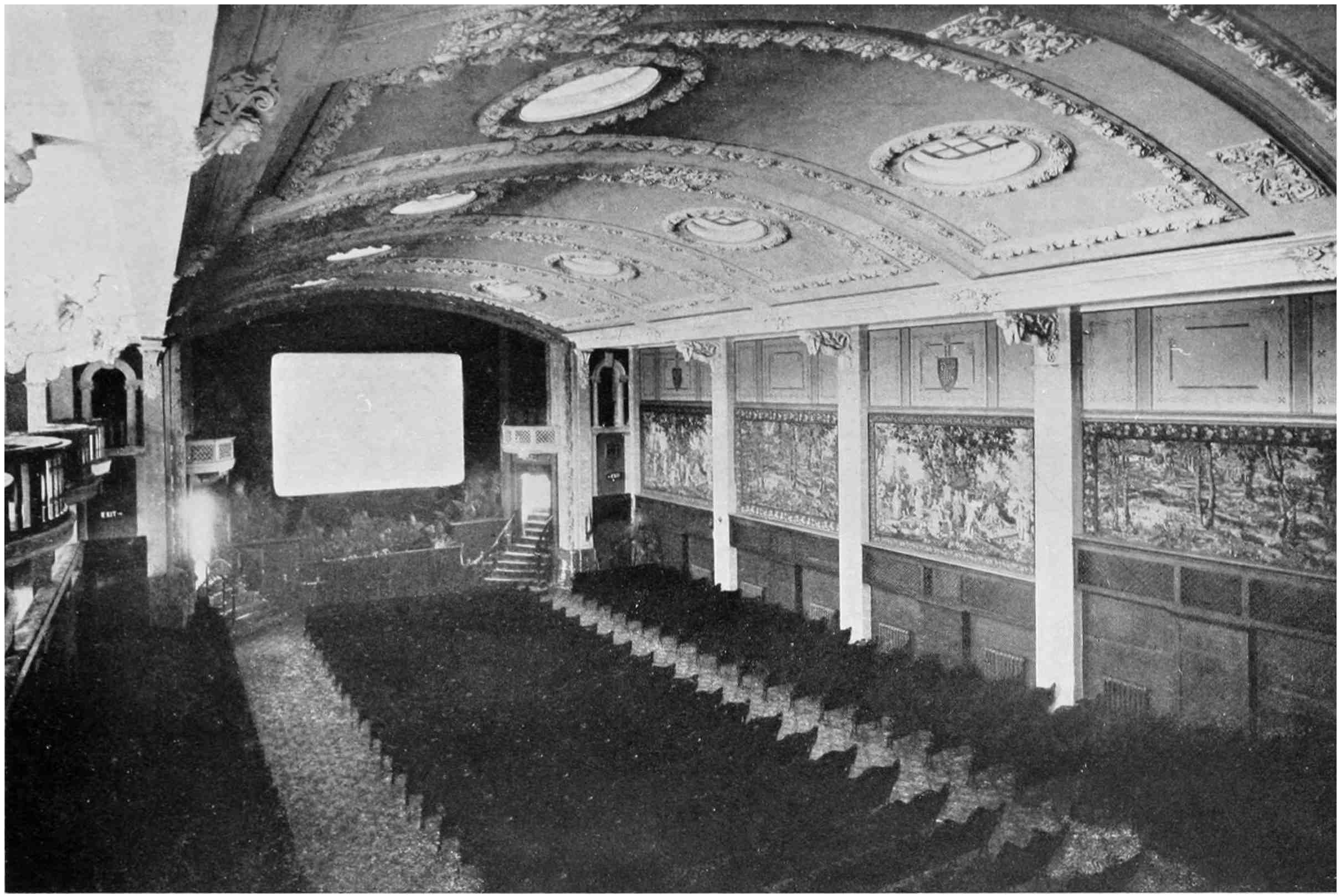
[By permission of the Provincial Cinematograph Theatres, Ltd.
THE LUXURY OF THE MODERN PICTURE PALACE.
General interior view of the Picture House, Briggate, Leeds.
Our illustration shows the Picture House at Briggate,
Leeds, one of the chain of theatres belonging to the Provincial
Theatre Company. The building is of fire-proof
construction, as every moving picture theatre should be;
the decorative details have been carried out upon a lavish
scale, and the seating arrangements have every device of
luxurious comfort.
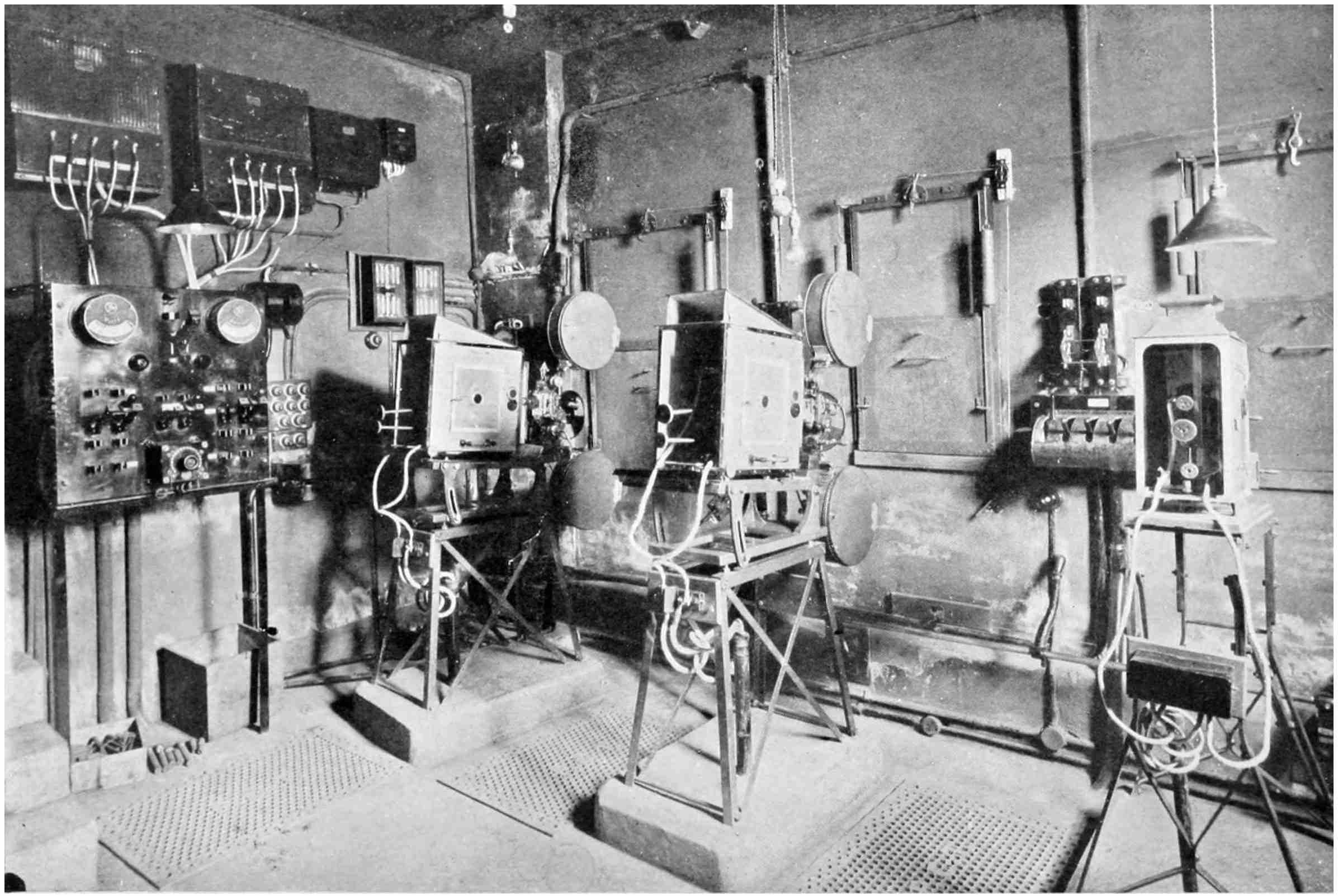
[By permission of the Provincial Cinematograph Theatres, Ltd.
THE LANTERN ROOM OF A MODERN CINEMATOGRAPH THEATRE.
The operating room of the Picture House, Briggate, Leeds, showing two film projectors and slide lantern.
The projecting hall has accommodation for about 600
people, and there is a lounge, a tea-room, and a smoking-room.
Such a liberal policy brings the picture theatre on
a level with the vaudeville house or legitimate theatre.
British law demands that the operating room shall be
insulated by means of steel walls. In the early days a
cupboard-like box built of iron met this requirement; but
nowadays larger accommodation is necessary, because the
compartment has to house far more than the mere projector.
When a continuous show is given, and the programme
lasts about an hour, the public insists upon full
value for its money; consequently the interval between
each film must be reduced to the minimum. Under
ordinary circumstances 1½ minutes suffice, not only to
enable the film to be changed easily, but to give sufficient
time for the audience to change.
The projecting apparatus should be in duplicate, not
only to provide a reserve apparatus in case of accident,
but to permit alternate use, so that the lantern does not
become overheated. Moreover, the advent of Kinemacolor
has made the 2-lantern plan essential. In colour
work the projector requires a special type of shutter with
alternate sectors of red and green glass, or screens, with
intervening opaque sectors; and thus, obviously, when
black and white alternate with colour pictures in the programme,
a second projector is essential, to obviate the
necessity for repeated detachment and re-attachment of
the Kinemacolor shutter. A third lantern is required for
stationary projections, such as announcements, titles, and
so forth. Under these conditions a commodious lantern
room is indispensable.
The front of the operating house is provided with small
sliding shutters through which the pictures are projected.
If a film should catch fire these doors, by a single movement,
close either from within or without the lantern room,
the fire is confined to the lantern house, and the public
within the theatre need receive no intimation of the mishap.
As the lantern house is provided with an ample ventilating
system, no smoke or gases find their way into the main
building.
In the modern theatre, however, the lantern room has to
fulfil other requirements beside merely housing the projectors.
From it control of the various electrical arrangements
is effected. The picture palace of to-day, instead of
being entirely dark during projection, is suffused with
the subdued glow of ruby lamps, which do not affect
projection, or the brilliancy of the picture to any material
degree. Under the old régime darkness prevailed from
one end of the programme to the other, save, perhaps,
during a short interval; but now the lights are turned up
throughout the hall while the films are being changed.
The conversion from darkness to brilliant light, and vice
versâ, which is so detrimental to the eyesight, is not,
however, carried out instantaneously, but gradually.
When the end of the film is reached the hall is filled—for
about five seconds—with a soft diffused light, followed
by full illumination; darkness comes on in the same
gradual manner when the next film is ready.
In the modern picture palace, such as we illustrate, the
electrical equipment is of the most elaborate character.
The supply of current is derived, as a rule, from the public
supply service, and the pressure has to be broken down to
meet the requirements of the projector and of the electric
lighting arrangements throughout the building. The
supply service is generally in duplicate to guard against
the failure of one installation, while should the whole
service break down some other form of illumination has to
be in readiness for use until the fault in the electric system
is repaired.
The electrical installation is essentially of technical interest,
appealing mostly to the engineer. In many
instances the projector mechanism is driven by electric
power, a small motor being fitted for this purpose. For
natural colour work, indeed, owing to the number of pictures
projected per second, a motor drive is imperative to
secure satisfactory results.
After a film has been passed through the lantern it must
be re-wound upon another reel to bring the first picture
into the starting position once more. This operation is
carried out with a film-winder. A large number of these devices
are on the market, all working upon the same fundamental
principle, but the “Empire” winders have achieved
a high reputation, being excellent machines for the work
and capable of withstanding hard wear. The operation is
so simple that there is no necessity to describe the apparatus,
as the illustration, Fig. 12, conveys its design and
method of working.
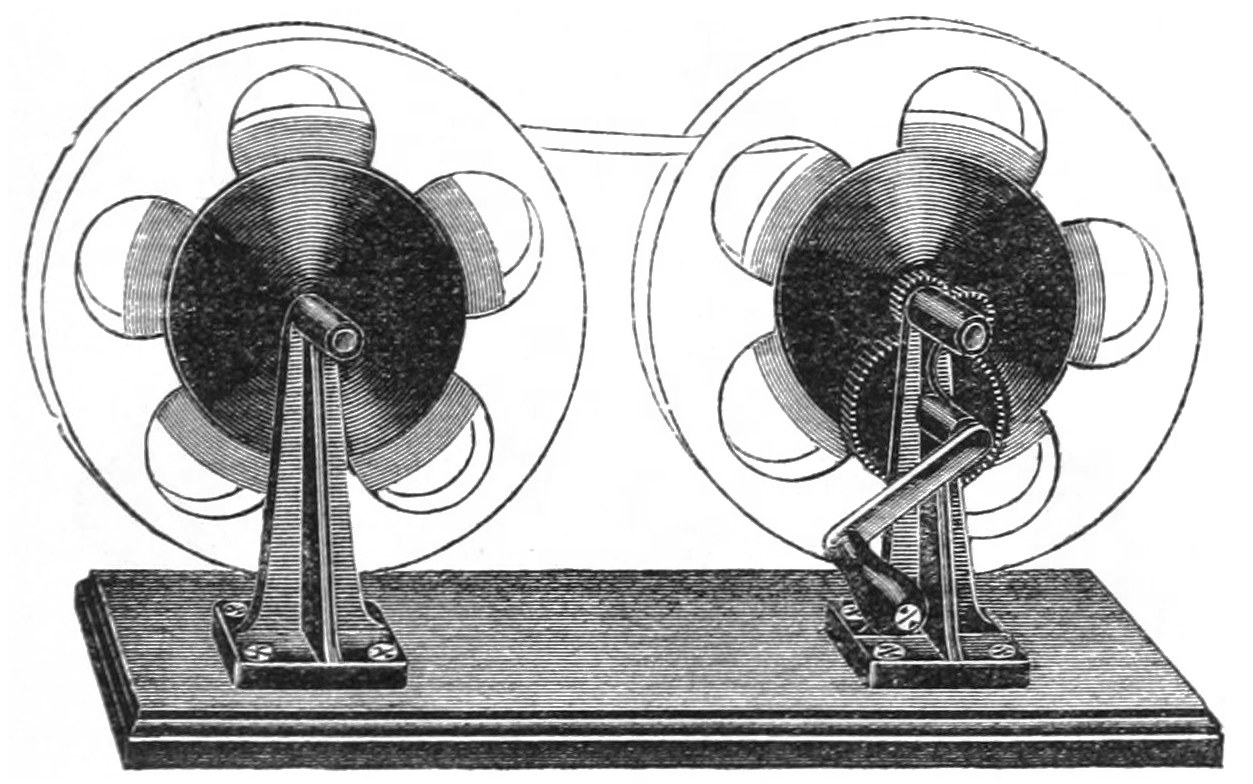
Fig. 12.—The “Empire” Film-Winder
After a picture has been run through the projector it has to be re-wound
upon its spool for the next display.
Occasionally when a film is being run through the projector
it becomes severed by some means or other. Before
it can be used again the break must be repaired by splicing
the two parts together. This is a simple task. The
broken edge of one film is cut off about one-eighth of an
inch below the line dividing one picture from the next.
The gelatine emulsion upon this small section is removed
with a knife. The other part of the film is trimmed exactly
at the dividing line between two pictures, and the two
facing surfaces of the film are treated with film cement,
applied by means of a brush, the overlapping edges then
being pressed tightly together and allowed to dry for about
three minutes. This cement is a combination of amyl-acetate
and acetone in the proportion of two to one for
ordinary celluloid films. When a non-inflammable film
is used the constitution of the cement is varied. To
facilitate such splicing a small clamping device is used
generally, and, although it is not essential to effect a good
joint, its use certainly enables the task to be performed
more neatly and satisfactorily. Fig. 13.
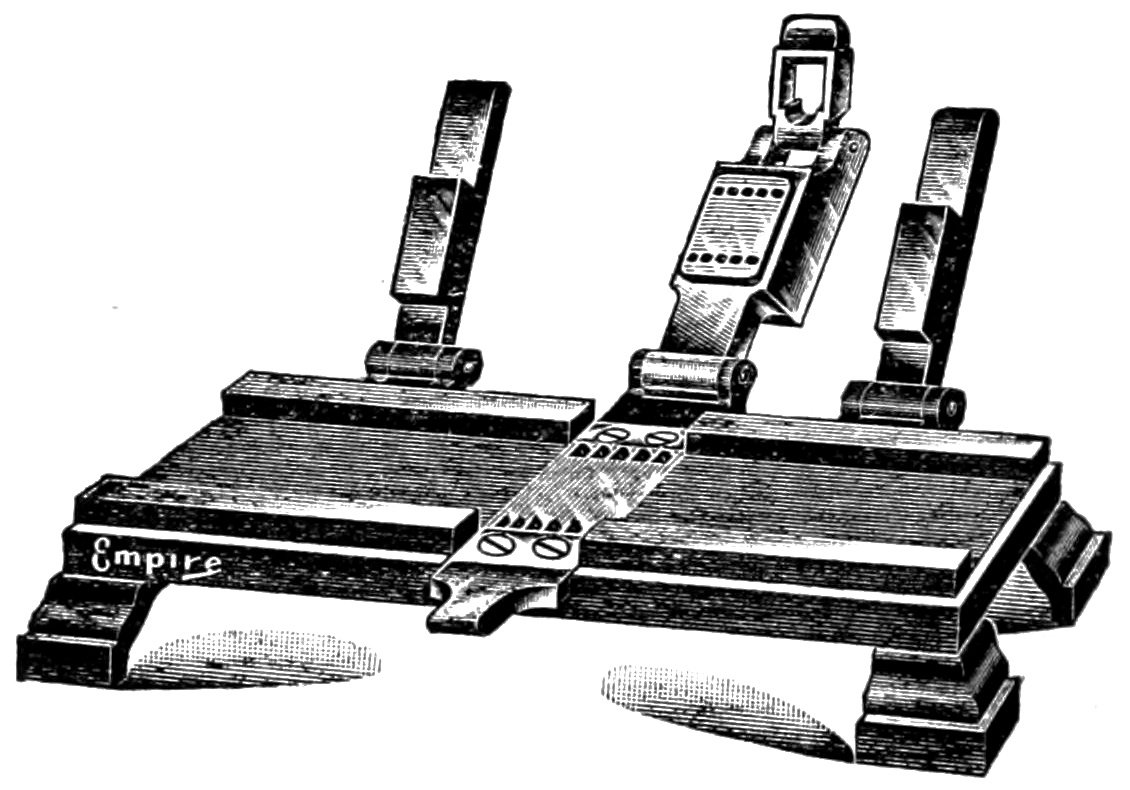
Fig. 13.—The “Empire” Film Mender. The
Illustration Shows how a Broken Film
is Rejoined.
Though the excellence of a moving picture display
depends primarily upon the projector and the film, its
brilliancy and clear definition can be made or marred by
the screen. When the pictures are being thrown from the
front of the house and the audience see a reflected projection,
the screen must be opaque and prepared from a
suitably woven cloth. It is stretched taut, and the surface
is treated with a good whitewash or matt white paint.
Recently, various preparations have been placed on the
market to enhance the brilliancy of the picture. They may
achieve the result; but often at the price of introducing
other flaws, such as alteration of the tone values and
occasionally the impoverishment of the pure whites in the
picture.
If the audience is viewing the picture through the
screen—that is, if the projector is placed at the back of
the stage and out of sight—the sheet must be made of
transparent material. This practice, however, has fallen
into disuse. The screen must be set perpendicular to the
horizontal axis of the projector objective and condenser,
and if the machine is inclined slightly the sheet must be
tilted in a corresponding degree, or it will be impossible to
secure a picture which is clear and sharp all over, for the
simple reason that some of the rays of light from the projector
will be shorter than others. If the former are
focussed sharp and clear the latter will be blurred, and vice
versâ. In hanging the screen a certain amount of care
must be taken to secure the best possible results. The
edges are covered with a black material—velvet is the best
medium—carried for a small distance on all sides of the
sheet, giving the appearance of a white surface being set
in a deep black frame. Such an arrangement improves the
pictures by throwing them into stronger relief.
Within the past two or three years the idea has come
into vogue of accompanying movements in the pictures
with characteristic sound effects. When a horse gallops,
the sound of its feet striking the road are heard; the
departure of a train is accompanied by a whistle and a
puff as the engine gets under weigh; the breaking of
waves upon a pebbly beach is reproduced by a roaring
sound. Opinion appears to be divided as to the value of
the practice. Some more cultivated motion photography
lovers are opposed to it, on the ground that unless every
motion is given its distinctive sound, none at all should
be audible; others contend that sound imparts an additional
realism to the scene. There is no doubt that at
times the sound effects come as an unpleasant and disturbing
shock, especially when they are neither in time nor
harmony with the motion—for example, when the realism
of a mediæval battle is heightened by the vigorous rattling
of a machine gun, or when horses galloping over the turf
make a clatter that only a city pavement could cause.
But, on the other hand, since sound effects are indispensable
to the legitimate stage, why should they not be
extended to the moving picture theatre? What would
Macbeth be without the crashing of thunder, and how
could the impression of rattling hail, or the howling and
shrieking of the wind, be conveyed without recourse to
various devices in the wings? Even if the play be in
pantomime, all sound is not suppressed. The players
may be mute, but yet one hears the slam of a door, or the
crash of an overturned chair as it strikes the floor, and
so on. Accordingly it would seem that sound effects are
perfectly justifiable in moving pictures, provided they are
judiciously managed.
The first attempts to introduce sound effects provoked
humorous situations. The boy deputed to the task enjoyed
the chance to make a noise, and applied himself with a
vigour of enthusiasm which overstepped the bounds of
common sense. Nowadays such effects are employed with
all the care and discrimination expended on the pictures
themselves, and the result is harmonious and pleasing.
Of course, it has been necessary to devise all sorts of
contrivances for realistic sound production, from the firing
of a 12-inch gun to the squeak of a mouse. The most
interesting of these is the “Allefex,” invented by Mr.
A. H. Moorhouse. It is the most comprehensive and
ingenious machine ever made for the mimicry of sound,
for although it measures only four feet in height, by about
three feet in width and depth, it produces some fifty
characteristic sounds, including the howl of a storm, the
rushing of waterfalls, the bark of a dog, and the twittering
of birds. Every artifice for producing these noises is contained
within a small cubical space, and the operation has
been so simplified that one man is sufficient for the task.
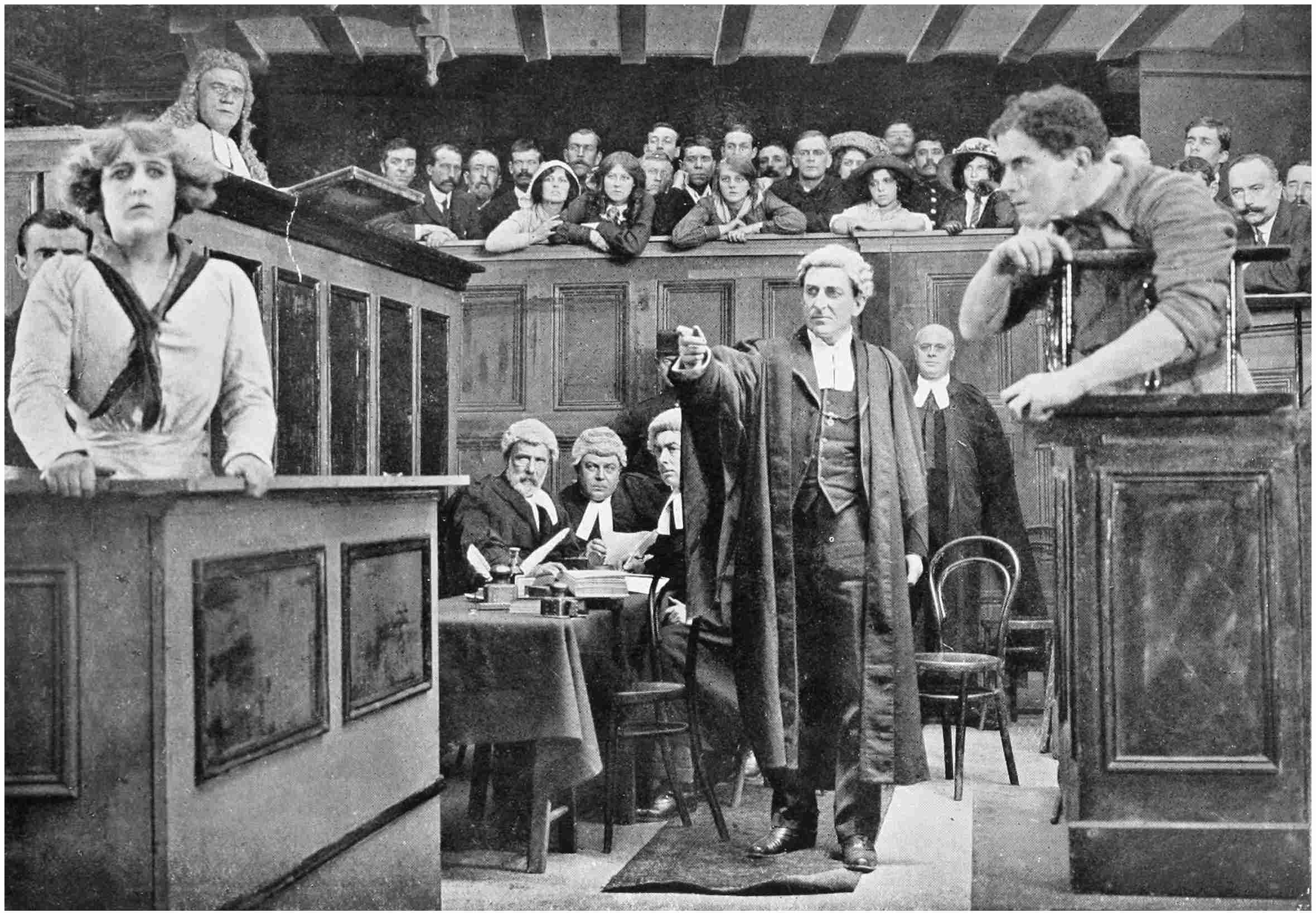
[Copyright the Hepworth Manufacturing Co., Ltd.
THE TRIAL SCENE FROM “RACHEL’S SIN.”
A striking example of a British picture play. From every point of view this film is equal to the finest foreign work. The English
home producers excel in domestic drama of this character.
A general impression of this machine may be gathered
from the illustration. It appears to be a maze of levers,
cranks, plug-holes, and bulbs, but each attachment performs
some definite purpose and produces one or more distinct
sounds. Another striking feature is that its operation demands
the minimum of practice, for the majority of the
effects are produced by straightforward action. It is only
here and there that a little practice is required, such as, for
instance, to imitate the bark of a dog, or the cry of a baby.
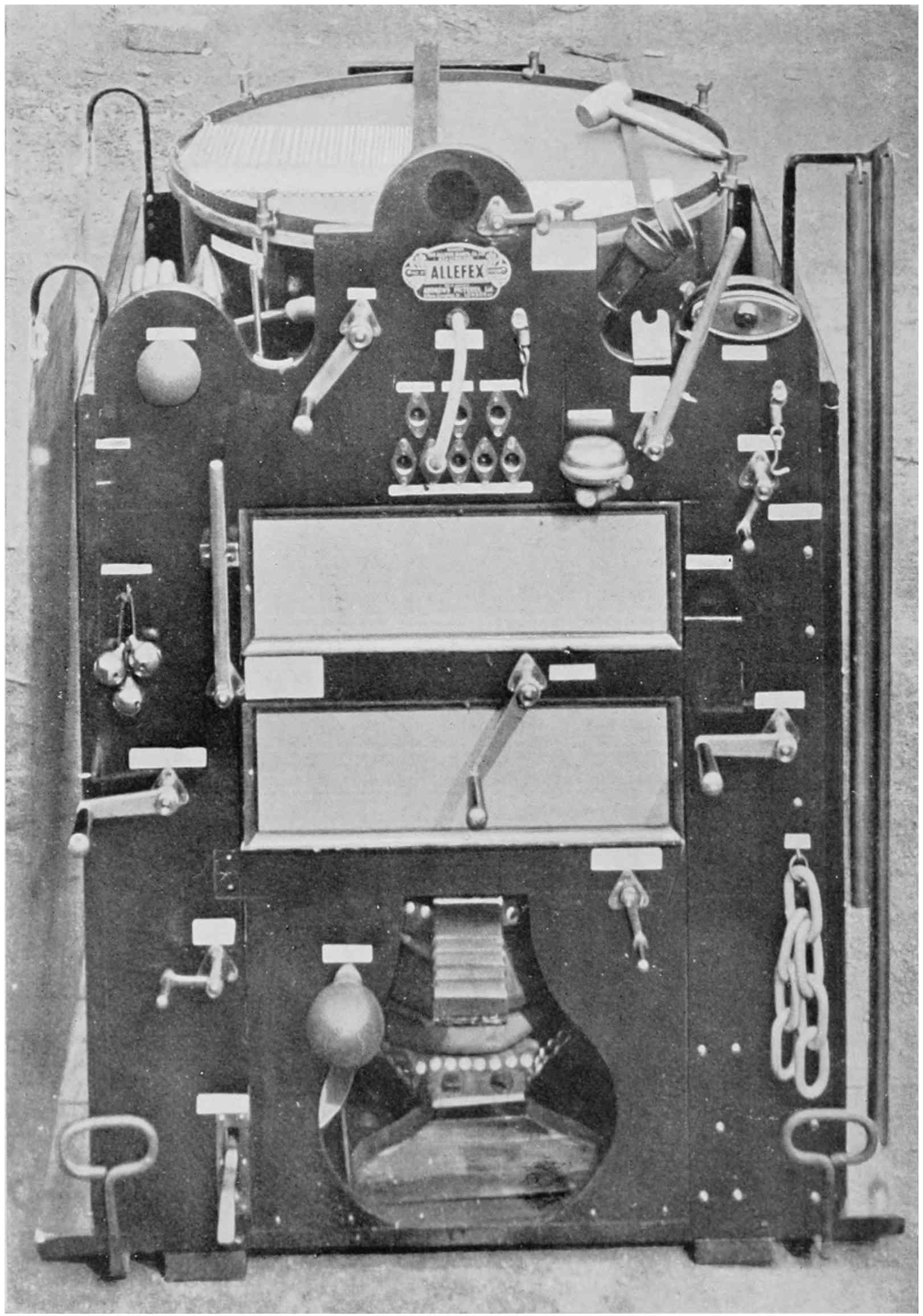
HOW THE SOUND EFFECT ACCOMPANIMENTS TO PICTURES ARE PRODUCED.
The ingenious “Allefex” machine, whereby over fifty distinctive noises can be made.
It would be impossible to describe in one chapter all the
various effects produced by means of this apparatus. I
will confine myself, therefore, to some of the more difficult
sounds, many of them apparently beyond the reach of
mechanical mimicry. The shot of a gun is imitated by
striking a drum at the top of the machine, on which a
chain mat has been placed, a smart blow with a felt drum-stick
as near the centre as possible. The same device
serves to represent successive shots. The interior of the
drum is fitted with three drum-sticks, which are manipulated
by the turning of a handle, the number of shots
varying, with the speed, according to the picture. At the
bottom of the machine is a large bellows worked by the
foot. Their manipulation in conjunction with one or other
of the handles will produce the sound of exhaust steam
issuing from a locomotive, the rumbling of a train rushing
through a tunnel, and so on. Running water, rain, hail,
and the sound of rolling waves are obtained by turning a
handle, which rotates a ribbed wooden cylinder against a
board set at an angle from the top of which hang a
number of chains. By varying the speed of the cylinder
any of the above sounds may be obtained with accuracy.
The puffing of an engine is made by revolving a cylinder
with projections against a steel brush; the crash of china,
pots and pans, &c., is due to the revolution of a shaft on
which are mounted a series of tappets striking against
hammers, which in turn come into contact with a number
of steel plates. The crackling of a machine gun is caused
by turning a shaft having tappets which strike and lift up
wooden laths, subsequently releasing them to strike smartly
against the framework of the machine. The same device
also serves for imitating the crash attending the upsetting
of chairs, tables, and so on. Pendant tubes serve to produce
the effects of church bells, fire alarm, ship’s bell, and
similar noises; the sound of trotting horses is caused by
revolving a shaft carrying three tappets which lift up inverted
cups. This shaft is slightly movable, so that by
adjustment a trot can be converted into a gallop and vice
versâ, while distance effects are obtained by a muffling
attachment. Thunder is made by shaking a sheet of steel
hanging on one side of the machine; the press of a bulb
gives the bark of a dog; the bellows and another attachment
operate the warbling bird; while the cry of the baby
is emitted by the dexterous manipulation of plug-hole and
bellows.
A machine like this is a distinct acquisition to the
modern picture theatre, for when skilfully controlled it
provides a scientific and perfect mechanical apparatus for
the production of distinctive sound, correctly, and at the
proper moment. At the same time, it is so simple that
little practice is demanded to make the operator expert in
the art of mechanical mimicry.
During the past two years special attention has been
devoted to what is called “daylight projection,” i.e., the
display of pictures in broad daylight. A method evolved
by Quentin for accomplishing this end was adopted at
the Cinéma Palace in Paris nearly three years ago. Here
the practice was to show the pictures upon the screen with
half the lamps in the theatre lighted, the projector being
66 feet from the screen, the size of the picture being 10 by
8 feet, and the arc lamp taking normally a current of
30 amperes from the supply mains of a 110-volt circuit.
Another system to the same end was evolved by Antoine
and Prosper Poch, the image being projected upon a
translucent screen placed between the spectators and the
projector. With this apparatus the pictures could be
thrown upon a screen measuring about 24 by 30 inches, so
as to be clearly visible in the middle of the day by people
passing along the street.
For this work the screen demands special treatment. If
it is to be used only temporarily, the tracing cloth used
by architects is a very satisfactory material. One inventor
produced what he called a “rainbow screen,” prepared by
soaking a suitable white material with fish glue and
attaching thereto a thin layer of tinted fabric. Moving
pictures “without darkness” have been exploited in the
United States upon a small scale, and on one or two
occasions in this country. The object of the plan, however,
is not quite clear, for moving pictures can obviously
be seen at their best only in total darkness or a very slight
suffused red glow. It is claimed by the advocates of the
daylight pictures that the eyes are fatigued less under such
conditions. The advantage, however, has not been recognised
by the public, for daylight projection is no more
popular to-day than it was in 1897, when the appearance
of a method for accomplishing it appeared and sank into
oblivion after causing a passing interest.
A prominent feature of the development of the cinematograph
theatre is the formation of “moving picture circuits,”
or chains of theatres controlled by one organisation. This
practice was taken over, of course, from the music hall
and the legitimate stage; and its application to the new
field has been largely responsible for the improved status
of the cinematographic industry. Keen and growing
rivalry is displayed between the various circuits. Thus has
developed a spirit of healthy competition, resulting in the
improvement of the picture theatre as a building, and in
the production of superior programmes. When two or
more rivals in a single town are making a common bid for
popular favour, the public naturally patronises the establishment
which offers the most refined pictures combined
with comfort in the seating arrangements. The inferior
film is being driven from the better class of cinematograph
theatre, where a programme is offered which is varied in
character, and of the highest excellence from the photographic,
dramatic, and educational point of view, as well
as from that of sheer amusement.
In the United States the growth of the cinematograph
theatre has been phenomenal. The success of the first
displays with the Lumière machine at the Eden Musée
prompted the proprietors of other places of entertainment
to introduce the biograph in their programmes. The
news of its success at the Alhambra in the English metropolis
doubtless likewise influenced the development on the
other side of the Atlantic. The first display in a New
York music hall was at the Union Square Theatre in the
Keith vaudeville circuit. It did not meet with an immediately
enthusiastic reception; but in a few days it caught
the public fancy, and thereafter the house was always well
filled. The value of the moving picture machine to this
house is reflected by the average weekly receipts. At the
time of its introduction the average receipts were £600
($3,000) per week; a month later they had risen to £1,400
($7,000)—the cinematograph more than doubled the
revenue of the theatre.
Within a year there was not a music hall of repute in
the country which did not possess its bioscope. Then
came the first movement towards the creation of a moving
picture palace, in the same way that it occurred in England.
Empty shops were taken on all sides, and within a few
years there were no less than 600 of these “store” theatres,
or “nickel” and “dime” shows, in New York alone, while
about 30,000 similar establishments dotted the country
between the Atlantic and the Pacific Oceans, and from the
Gulf of Mexico to the Great Lakes.
Men who started with no more capital than was barely
sufficient to purchase the outfit and rent the empty shop,
found that they had discovered an El Dorado. The more
energetic started theatre after theatre, and in a short time
possessed “circuits” of twenty or more moving picture
shows. One of these pioneers, Marcus Loew, starting
unpretentiously in a suburban district, found himself in
five years possessed of forty theatres, from which the
money rolled into his banking account in forty steady
streams. It must be borne in mind that this fortune was
accumulated from the public in five and ten cent pieces.
At the present time the moving picture theatre in the
United States is in a state of transition. The palatial
character of the British cinematograph theatre has spurred
ambitious spirits in the United States to like achievements.
Loew has built two palaces, spending some $1,000,000
(£200,000) upon the buildings and appointments.
Moving pictures are rivalling all other forms of entertainment
in the United States. As suitable buildings fall
vacant exorbitant bids are made by rival factions to secure
their acquisition, and the rents paid are very high.
William Fox, a man very similar in character to Loew,
who entered the field a year later than he, startled the
cinematographic world by acquiring the lease of a legitimate
theatre in the fashionable theatrical centre at a yearly
rental of £10,000 ($50,000), and converting it to cinematography.
Scarcely had the excitement died down when it
was announced that he had rented the Academy of Music
at £20,000 ($100,000) per annum. The price he is paying
in rental to bring moving pictures before the public continuously
throughout the day represents one-third of the
original cost of erecting the building, so that the proprietors
may be said to have profited handsomely in the
transaction. Gambling in sites for the establishment of
picture palaces in the United States has reached a far
greater climax than was ever attained in Great Britain in
the height of the enthusiasm. Here the bubble has been
pricked, and the same outcome is anticipated in the United
States. Probably the most luxurious picture palaces in
the world are in South America; there they are palaces in
the fullest sense of the word. That territory has scarcely
been touched yet, and is one of the most attractive fields
for development. It is in the “land of to-morrow” that
animated pictures promise to attain their greatest heights
of success.
CHAPTER XIII HOW A CINEMATOGRAPH PLAY IS PRODUCED
When a stirring drama or uproarious farce is projected
upon the screen the actions are so natural, the situations
develop so obviously—in fact, the whole thing proceeds
so smoothly—that the average person concludes that the
production of a picture play is the simplest thing in the
world. But the average person was never more mistaken.
A visit to a studio-theatre to follow a production from the
beginning to the end undeceives him very promptly and
thoroughly.
The stage management of a play before the celluloid
film is far more exacting than the staging of a play behind
the footlights. Situations have to be handled which never
develop on the legitimate stage. The picture play is essentially
pantomime and the camera is a searching, unequivocal
critic. It produces a stern, matter-of-fact
representation of what is enacted before it. There is no
dialogue to conceal blemishes, or mitigate the deficiencies
of the actors and actresses. Words have to be converted
into action and gestures. In a picture-play every muscle
of the body has practically to be called into use to convey
to the spectator a lucid and coherent idea of the progress
of the plot, since there is nothing but the action to tell
him “what it is all about.”
Furthermore, everything must be condensed to the irreducible
minimum without forfeiting coherency. The plot
must be unravelled without the slightest interruption of the
main thread of the story. Once the spectator loses grip
of the theme, interest is lost. As brevity is the soul of wit,
so terseness is the keynote of success in a picture-play.
The producer must be a man of many parts. He must
have a keen instinct for dramatic situation, possess wide
histrionic ability and experience, have a sharp eye for
minute detail, be supplied with unlimited energy, and
capacity to extract the utmost from his company. One
factor is all-important to him—time. The stage-manager
works on a time-schedule, not of minutes, but of seconds;
it must be remembered that every second of time is equivalent
to twelve inches of film. A producer will spend five
minutes in the effort to condense by five seconds the action
necessary for a certain situation.
In what form does the picture play reach the stage-manager’s
hands for production? Does the playwright
prepare the contribution in detail complete with dialogue
and business, as if for the theatrical stage, or does he supply
a bare outline? The answer varies according to the
dramatist, and to the stage-manager for whom he is working.
Some authors cannot convey their ideas coherently
without extensive dialogue. Others can achieve their end
in 200 words. Again, one producer fails to see eye-to-eye
with the author’s idea unless the latter is worked out
minutely, while another will grasp the whole situation
instantly. As a result, it is impossible to lay down any
hard and fast rules, as to how to write a picture-play; but,
generally speaking, the briefer the scenario or story of the
play, the more likely it is to find favour, all other things
being equal.
I have seen both methods in execution. In one case the
author’s story had been worked out to the smallest detail,
the manuscript covering some fifty pages. On the other
hand, a friend of mine who has produced many, eminently
successful picture films, scribbles the bare idea on a single
sheet of paper—the back of an envelope suffices sometimes—briefly
indicating the progress of the plot step by step,
retaining all the stage business in his head, and modifying
his ideas as he proceeds, to suit the circumstances.
Equally divergent is the practice followed in production.
Among the French producers the general method is to
write out all the parts complete with dialogue, and to hand
the lines to the members of the company concerned, to be
committed to memory in the usual way. Actors and
actresses thus become familiarised with the atmosphere of
the story, and are left to a great extent to their own histrionic
instinct to interpret the character assigned, the producer
introducing his ideas as rehearsals proceed.
On the other hand, many producers prefer to keep the
members of their company in ignorance of the plot. The
story is carried through in brief sections, step by step, the
lengths of each section being between 45 and 100 seconds
or thereabouts. The actors and actresses are given instructions
as to how to make up their characters, and are
then marshalled upon the stage. The first situation in the
play is taken, the producer showing each character concerned
how the part is to be played. The members are
put through their paces time after time, rehearsing being
continued until the whole company moves like a machine,
and then the camera films the incident. Sometimes the
producer himself will undertake a part, and shout instructions
on the stage as the action proceeds, keeping every
actor and actress moving just as he desires. This method
is followed very extensively in America. Its advantage is
that the members of the company, not knowing what is
coming next, are kept acutely expectant in order to fall
naturally into the spirit of the parts and plot; they work
themselves to a high pitch of intensity; and this gives the
play the vim and animation which are peculiarly requisite
for a picture-play.
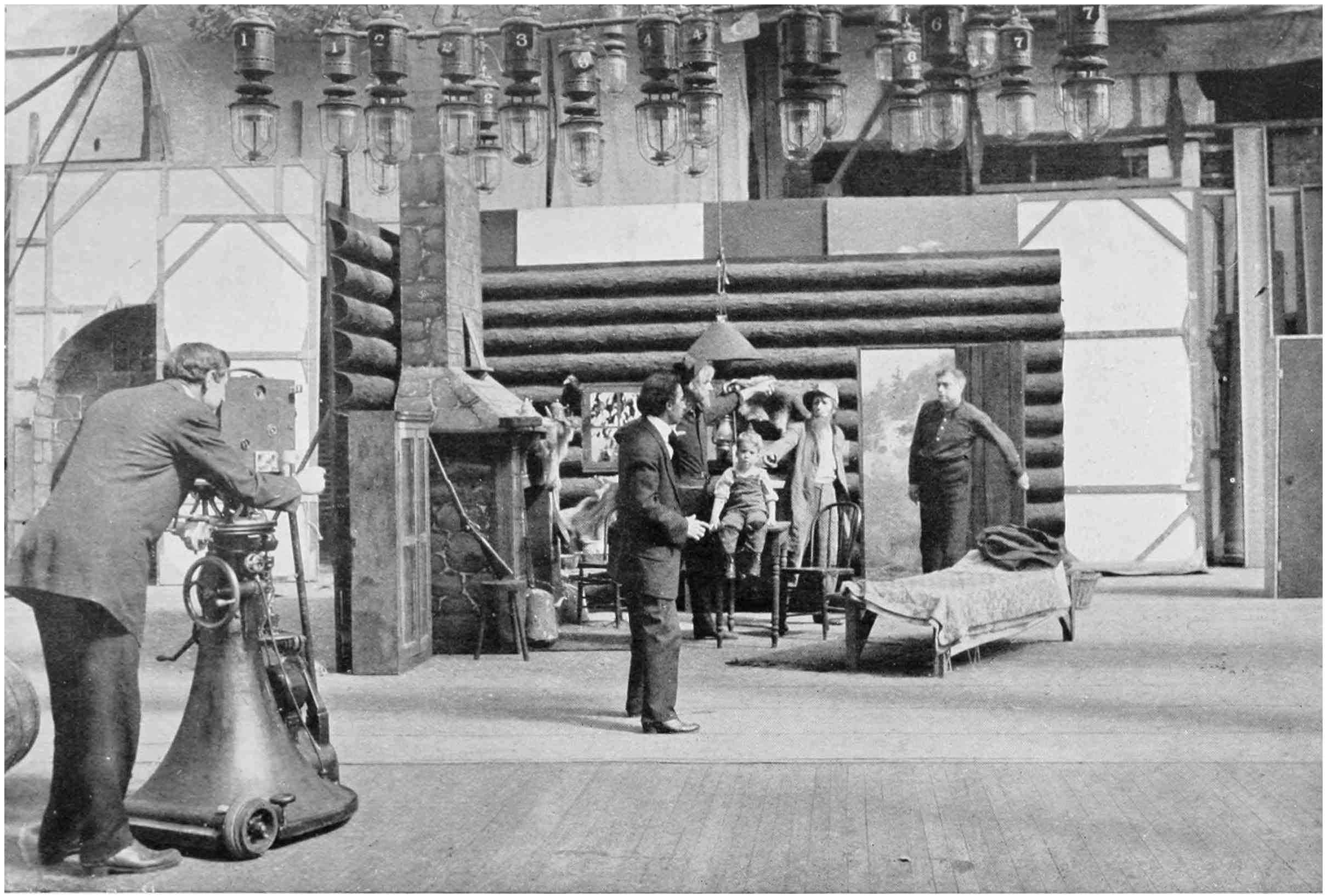
THE FILM-PLAY PRODUCER AT WORK.
Rehearsing at the Edison Cinematograph Theatre.
This picture shows the stage setting, the powerful battery of electric top-lights for illuminating the scene, and the electrically driven camera.
By this method also the stage-manager compels the actors
and actresses to interpret his ideas, which he regards as
suiting the man in the street. The members of the company
have no opportunity to thrust their own impressions
before the camera. When the lines are given out beforehand
to the members of the company, each naturally forms
an individual opinion as to how this or that part should
be played, and once this impression has taken root, it is
difficult for the producer to modify it upon the lines he
has conceived. Another disadvantage of the latter method
is that an actor or actress sometimes fails to regard a part
with sympathy, and the result lacks realistic effect.
Repeated rehearsals also tend to dull enthusiasm; the members
of the company become somewhat lethargic; and there
is a marked absence of zest and swing in the resultant
picture.
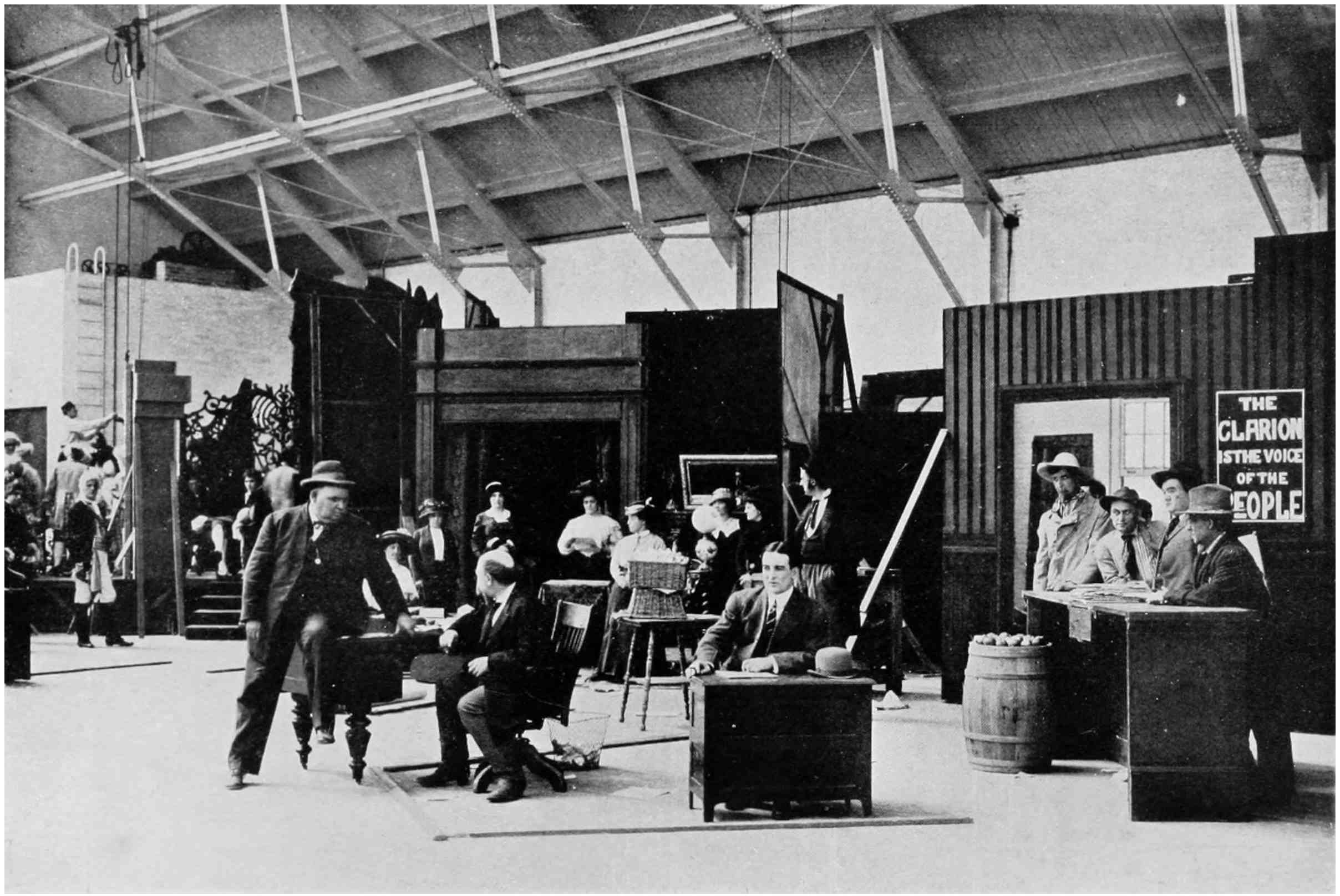
TAKING THREE PICTURE-PLAYS SIMULTANEOUSLY.
This photograph of the Selig Cinematograph Studios, in Chicago, shows how scenes are set side by side. The battens on the floor indicate
the boundaries of each stage.
When the play reaches the producer’s hands the first
point is to settle the length of film to which it shall
run. This depends upon the character of the play itself.
The average length varies between 600 and 1,000 feet, occupying
from ten to sixteen minutes to project upon the
screen. If an elaborate or novel production is contemplated
of a character able to sustain the interest of the audience,
the length may be doubled or quadrupled. The film version
of “A Tale of Two Cities,” for instance, ran to 3,000
feet, which meant that the screen was occupied for some
sixty minutes. That was an exceptional production, however,
and there are few plays which could rivet the attention
of an audience for an hour.
The actors and actresses, like the producer, are drawn
from the legitimate theatre. The majority of the large
organisations collect and maintain their own stock companies,
ready to produce any character for any description
of play. This idea was first practised, and is still continued
to a limited extent, in Great Britain, the company averaging
six or eight principals. But in the early days the public
resented the too frequent appearance of the same face
upon the screen; so the studios which were situated in the
vicinity of the metropolis began to draw their material from
the theatrical market, securing an excellent selection, and
at the same time plenty of variety.
Cinematograph studios situated farther afield availed
themselves of the touring theatrical companies, whose
members benefited appreciably from the introduction of the
film-play; as it gave them an opportunity to increase an
otherwise meagre weekly wage. The practice is still in
vogue in the British provinces, and has been found very
profitable to the producer, because the varied experience of
the average touring actor or actress is a valuable asset on
the picture-play stage.
The film-play does not offer any opportunity to the
amateur theatrical individual. The camera emphasises far
too acutely any weak points in histrionic ability. The professional
is the essential raw material, and the heart-breaking
drill of the legitimate stage renders the actor or actress
all the better adapted to the exacting requirements of the
film play; though at times it demands indescribable patience
and perseverance, if not bullying, on the part of the producer
to compel the professional to adapt himself to changed
conditions and realise the difference between the two phases
of the histrionic art. Many producers, in fact, prefer to
maintain their own stock company, every member of which
can grasp in an instant what the stage-manager demands,
thus saving much valuable time. The nucleus is increased
as necessity demands for special occasions or particular
characters from the ranks of available touring companies,
while the supernumeraries are likewise recruited from a
wide field.
The selection of the actors and actresses is by no means
easy. The cinematographic stage has its own peculiar
requirements. The pre-eminent one is that the actor or
actress must not only act but look the part. A young man
cannot make up to take an old man’s part—he must be an
old man. A woman of middle age may on the legitimate
stage excel in a young girl’s rôle; but she may not take it
on the camera stage.
Make-up has to be reduced to the minimum, because the
huge enlargement which the picture undergoes in projection
renders such artifices hideous. Facial make-up is practically
out of the question. Nowadays the practice is to
abandon general make-up entirely, and to whiten all the
faces. Under the glare of many thousand candle-power
emitted by several electric lamps it is possible in this way
to secure striking contrasts in facial expressions. When
the features are torn by malignant hatred, or uproarious
mirth, the shadows formed by the wrinkling of the skin
as the muscles are brought into operation emphasise the
expression. There is another reason for the whitening
process. An actor or actress may have a natural high
colour, or dark complexion, when the face comes out with
a dark or black tone, conveying the impression that the
part has been performed by a negro or mulatto. This
method of making up, however, it must be explained, applies
only to black and white cinematograph production.
There is no dearth in the supply of actors or actresses,
consequently the producers are able to carry out a weeding
process in order that they may secure the very best histrionic
ability. One large American company supplies
every aspirant with a form in which to record full particulars
of his or her stage career. If the applicant has had
no professional experience he or she is told at once that
the company needs none but experienced artistes.
Certain American producers have not only acquired a
large stock company, but have also, by offering large
salaries, attracted old favourites, whom they star precisely
as in the legitimate theatre. Posters and photographs
of their leading actors and actresses are circulated
broadcast, and the public has its favourites
on the cinematographic as on the legitimate stage.
The Edison Company has fourteen principals at Orange,
in New Jersey; and in addition a company of seven
stationed in Western America for plays having a western
setting. The Selig Company has thirty players permanently
attached to its Chicago and Los Angeles establishments.
The practice has by no means fallen into disuse
in Great Britain. The Hepworth Company, from whose
studios come some of the best films prepared especially to
suit British and Colonial tastes, maintains two stock companies
at Walton-on-Thames; while the Kinemacolor
plays are produced by a stock company of twelve players,
augmented as occasion demands, which divide their time
between the studio-stages at Hove and Nice, frequenting
the former during the English summer, and spending the
remaining six months of the year in the south of France,
being transported to and fro each season.
There has been considerable complaint, to some extent
justified, of the indifferent character of the British film play
productions. British producers have not received sufficient
encouragement to enable them to incur great expense in
mounting or in the maintenance of a large and excellent
stock company. However, there are signs of a change;
and as the technical quality of the picture is improving it
should not be long before the British film play industry
attains a position of importance. As soon as this happens
a wide success will be reaped; for this country possesses
unique and extensive opportunities for producing plays
capable of making a world-wide appeal, and is rich in the
natural settings so much in demand for the attainment of
atmosphere.
Let us follow the production of a picture play at a large
establishment having between three and six producers at
work every day from morning to night. The players upon
arrival consult the “call-board” to see when rehearsals
commence, upon what stage, and for what productions.
One artist may appear in two or three plays in a single
day, as a play is occasionally not photographed complete
through all its scenes; it may be interrupted for several
days from some reason or other.
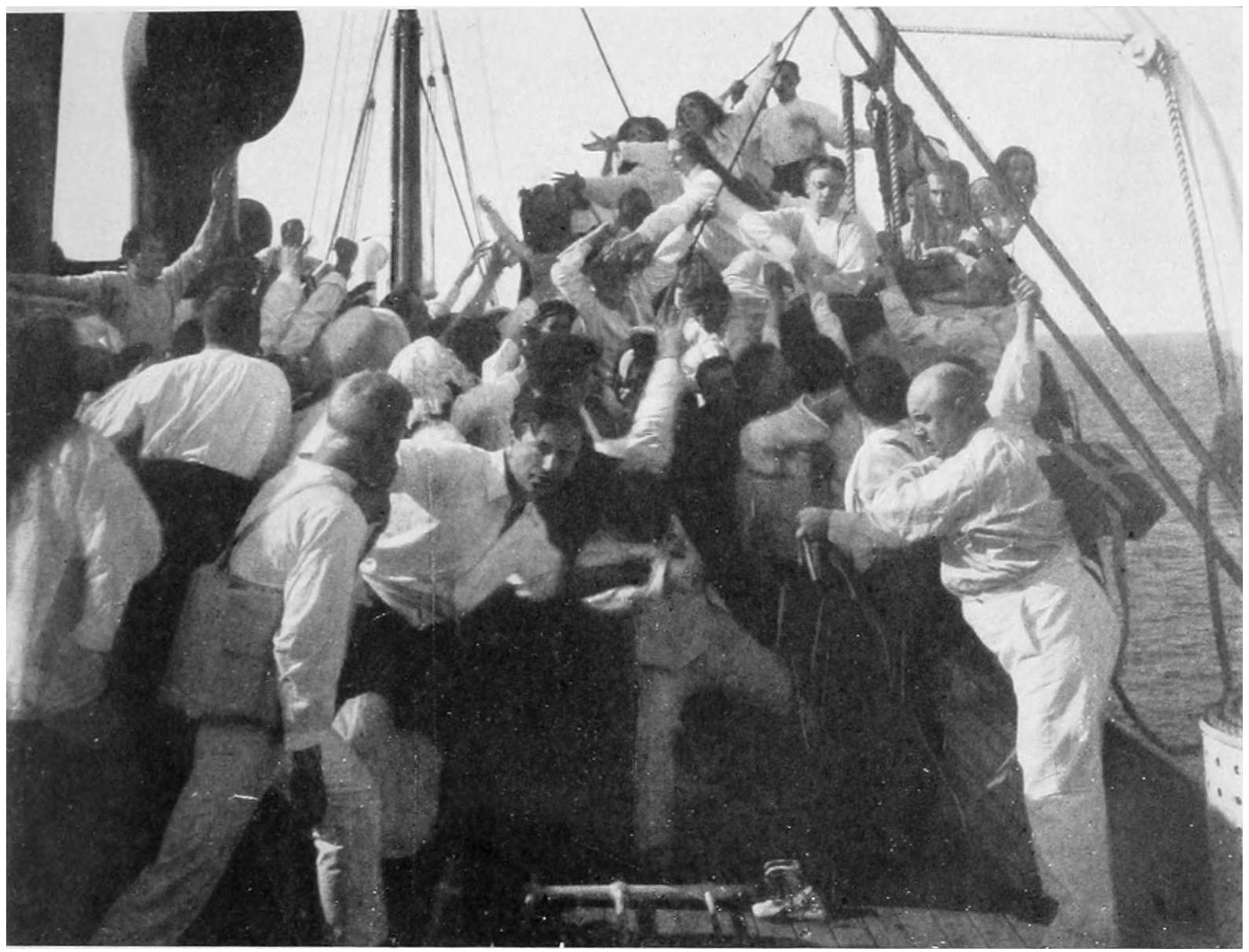
THE FIGHT FOR THE BOATS IN “ATLANTIS.”
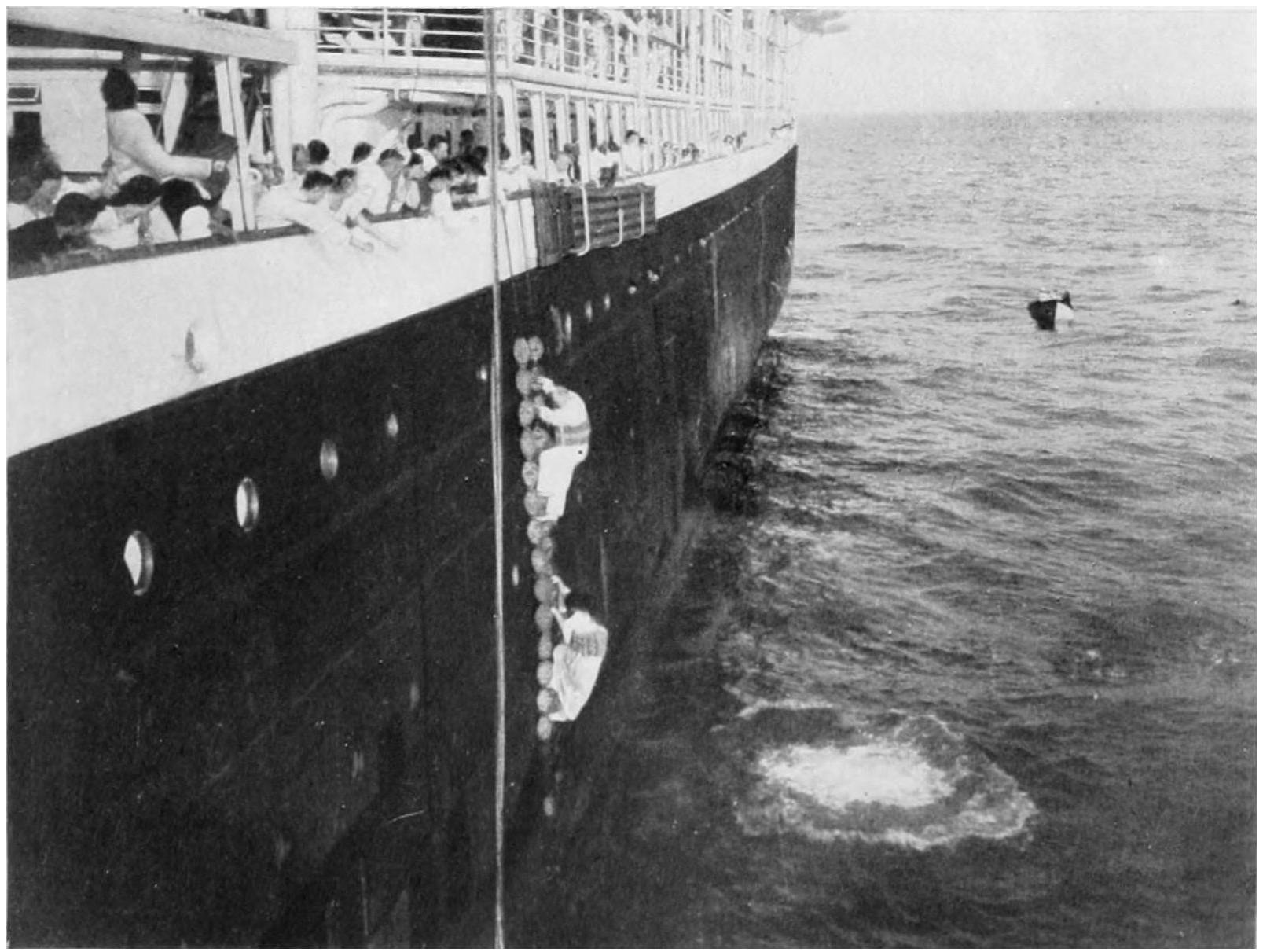
[By permission of the Nordisk Co.
“SAUVE QUI PEUT” AT THE WRECK OF THE LINER IN “ATLANTIS.”
At the pre-arranged time the company assembles upon
its allotted stage. The manager marshals those required
in the scene and explains precisely what he wants each
artist to do. The business on the stage is demonstrated,
and those in waiting are told just how to make their entrances,
and all exits are indicated very concisely. The
stage-manager rehearses the first episode before those concerned,
to convey a general idea of his requirements, and
they immediately repeat it. No dialogue is written, but
the actors of professional experience realise what words are
demanded for different situations, and accordingly extemporise
as they proceed. In the reproduction the movement
of the lips renders the action distinctly more conclusive and
realistic; moreover, the enunciation of suitable dialogue
induces the correct facial expression, one of the most important
requirements in the picture play, and the audience
must at times derive from it the significance of the situation.
In this fragmentary manner the producer carries the
company through the incident, and it is now rehearsed time
after time, little modifications and improvements being
made on each occasion to animate the action still further.
Those waiting to enter are given the cue, and when an exit
has to be made it is announced in an emphatic manner by
the manager. The scene is repeated perhaps a dozen times
before it goes with the swing that the producer desires.
Then what may be termed a dress rehearsal is carried out.
Watch in hand, the camera operator follows it through
from end to end. The producer has decided the length of
film the whole play shall occupy, and has allotted to each
incident a certain number of seconds, that is, of feet of film.
The final rehearsal completed, the producer inquires, “How
long?”
“Seventy seconds,” replies the operator.
“Too long,” remarks the producer, and forthwith the
scene is rehearsed once more, the producer abbreviating it
as the action proceeds, by shouting stentorian orders to
the players to make a quicker entry, cutting short a situation,
or by sharply and unceremoniously telling a member
to “get off” if there is a sign of lingering in the exit.
“Fifty-five seconds,” remarks the operator.
It is still too long by five or six seconds. The producer
sees where he can compress the scene still more, so decides
to do this while the camera is working. The operator takes
his position, and then a scene of great animation is witnessed.
“Are you ready?” shouts the manager. The actors
come to the alert. “Right!” The camera commences its
rhythmic purring, and as the first strains of the buzz
break out the manager gives vent to a loud “Go!”
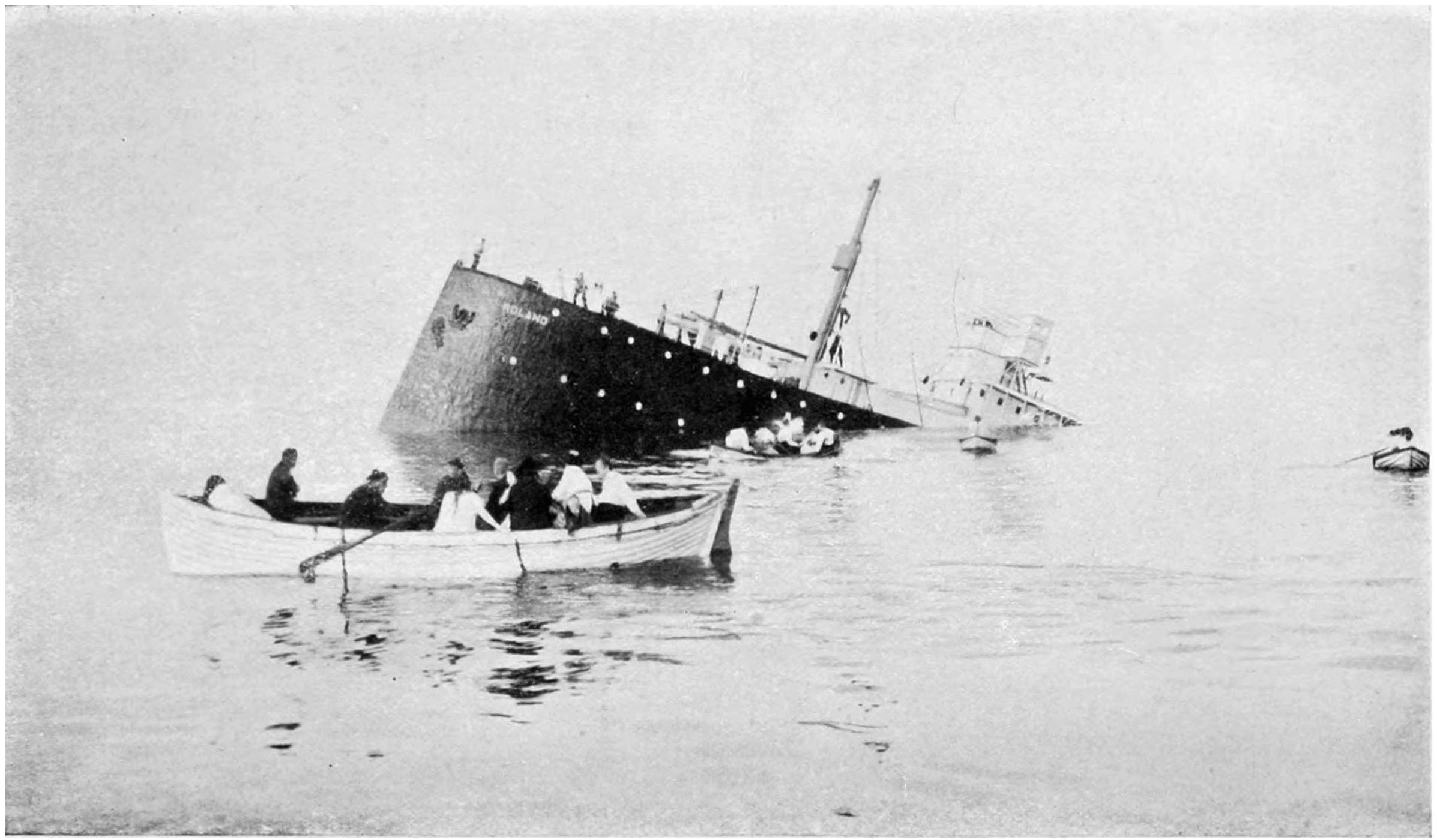
THE SINKING OF THE LINER “ROLAND.”
The Nordisk Company of Copenhagen filmed Gerhardt Hauptman’s striking novel “Atlantis,” the most sensational feature in which is the
sinking of a liner in Mid-Atlantic. This play cost £20,000 ($100,000) to produce.
The whole time the picture is being filmed the producer
is shouting instructions, giving abrupt cues, and sharp
orders as to how to improve the business. Although orders
and commands are delivered in an endless stream, not a
single player loses his head. One and all proceed as if the
manager were non-existent. It is a babel of noise; the
producer raps out breathless orders such as “Look towards
the camera”—“Shout out the dialogue”—“Come towards
the front”—“Get off!”—“Look happy”—“Not so quickly”—“Come
in”—“Roll your eyes”—“Don’t move your
hands as if you were playing the piano”—“Cry!”—
“Hurry up!” and so on without ceasing. The actors are
worked up to an exciting pitch, each man and woman
singling out the comment which concerns him or her. The
scene is brought to a climax, and there is a shout of “Stop.”
The purring of the camera ceases immediately.
“How many feet?” inquires the producer.
“Fifty-three,” replies the operator.
“Good! Next scene! Twelve years later,” and forthwith
every artist receives further explicit instructions.
Perhaps the operator finds that he has not enough film
in the box to carry him through the whole of a scene. In
such a case, when by reference to the dial on the camera
he finds that the film is on the verge of exhaustion, he cries
“Stop!” Immediately the actors become rooted to the
spot and remain motionless until a new loaded box of film
is inserted into the camera and threaded up, an operation
which takes half a minute or so. Occasionally the “Stop”
call is given at an awkward moment, when the stage hands
rush forward to support artists who have been interrupted
in the middle of some action, and are caught in difficult
positions. When the word “Go!” is given once more,
the supporters rush off the stage and the acting is resumed
as if there had been no interference. The first few pictures
upon the new film are afterwards cut out, and the connection
between the two bands is effected so neatly that no
evidence of a break in continuity is revealed upon the
screen.
As on the legitimate stage, so here also there is a tendency
to pay more and more attention to realistic detail. Once
upon a time it sufficed for a frontier scene if a shack were
painted on the back cloth. Every time an actor touched
the cloth a series of undulating waves went across it, with
ludicrous effect. A disconcerting ripple of laughter would
run through the house, even in the midst of an intensely
tragic situation. The public soon lost interest in plays so
ill mounted, and their dissatisfaction, of course, generated
the necessary improvement.
Audiences demand nature and realism, and the producer
responds. Instead of improvising a railway station in
canvas and battens upon the stage the producer transports
his company, lock, stock, and barrel, together with all the
properties in motor cars or cabs to an actual station to
secure the required results in a natural setting. If a scene
is laid in a given thoroughfare, the company is sent thither
to act the story.
In the United States the demand for realism has developed
almost into mania. The American Biograph
Company had arranged to produce a film version of the
famous Indian novel “Ramona,” in which the great scene
is the devastation of a white settlement by Indians. The
story is laid in California; so the firm assembled a company
of sixty-five artists and dispatched them across the continent
from New York to the Pacific Coast, where they
stayed five months so as to become saturated with the
environment. In order that the sacking and destruction
of homes might be correct in every detail, a small village
was purchased and fired! In another instance the same
company wanted a modern fire scene. They rented a plot
of land, upon which they built a house of the style required;
then they set it on fire and burned it to the ground. But
the Selig Company eclipsed even this performance. One
day a fire broke out in a large department store in the heart
of the city of Los Angeles. It was a unique opportunity to
obtain a powerful play; so the producers, after securing
over the telephone the sanction of the fire brigade authorities,
hurried principals and operators to the conflagration.
The film hero was garbed in the uniform of a fireman, and
at the head of a squad equipped with a hose, he dashed into
the burning building; the whirring of the camera testified
that this incident had been recorded. Shortly after, a
woman—one of the best actresses of the company—was
observed at an upper window surrounded by fire and smoke.
She uttered a despairing cry for “Help!” and in response,
the pseudo-fireman made a frantic rush up the ladder, broke
in the window, and snatched the prostrate form of the
actress from the flames. The players ran great risks, but
the film producer was satisfied. He had secured a sensational
fire rescue in an actual big fire in a crowded thoroughfare,
with the fire engines, a towering building, smoking
and well alight, and a huge crowd looking on as a setting.
It is hard to imagine a stage-manager attempting this feat
under similar conditions in London or any other European
city.
The feverish clamour for realism has occasionally met
the reward of rashness. In South London, in a scene where
a railway locomotive played an important part, one of the
men in the act was run over and killed; in another case an
actor was drowned while engaged in a thrilling water scene.
Mr. Edison relates that during the filming of a Boer War
play by his company, one of the actors dropped a lighted
match into a glass vessel containing gunpowder! He has
been picking stray pieces of glass from various parts of
his anatomy ever since! In another instance a superannuated
cannon was used, which killed one or two actors
and injured many others.
An elaborate production, which is a great favourite in
the United States, is “Uncle Tom’s Cabin,” which lends
itself admirably to film treatment. On the legitimate stage
“Uncle Tom’s Cabin” has become to the touring American
manager what “East Lynne” is to his English contemporary.
It will fill a house; and it has established the same
rank for itself in the cinematograph theatre.
As an amusing comment on this fact, I must tell the
story of the introduction of the cinematographic version
south of Mason and Dixon’s line. The stage version had
never been played in the Southern States—managers feared
it would kindle smouldering fires in the breasts of the
white population. An invisible barrier was drawn across
the country south of which the play never ventured. The
same apprehension was entertained in regard to the moving
picture production. However, one manager took the risk
and presented the film to a crowded house in New Orleans.
It had been announced for a night or two only, but its
success was so overwhelming that it held the screen for two
or three weeks, the house being crowded at each projection.
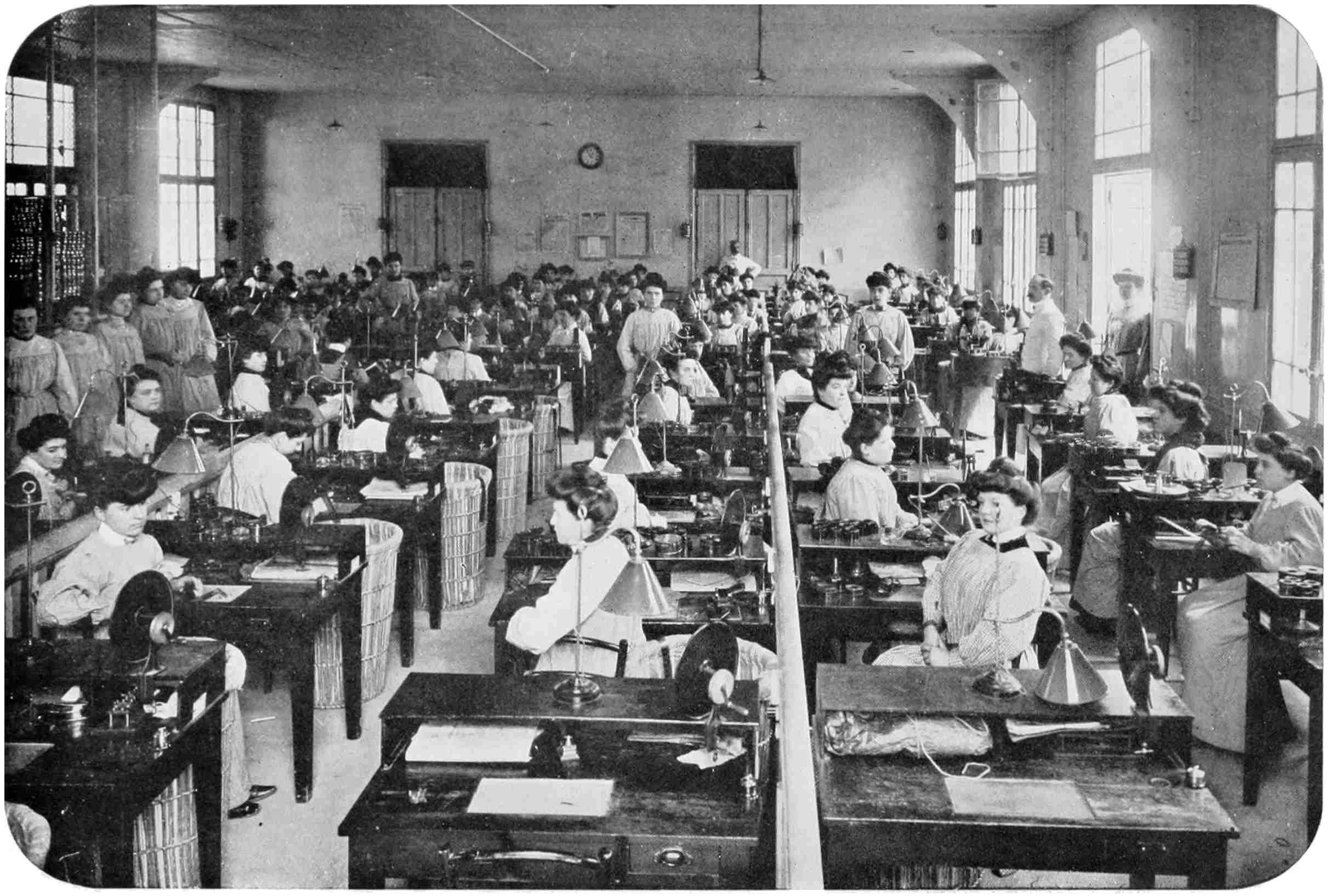
[By courtesy of Pathé Frères.
SORTING, EXAMINING AND JOINING THE STRIPS OF FILM.
The positives are prepared in varying lengths. The different sections of a subject have to be identified, trimmed, and connected
together to form a continuous ribbon.
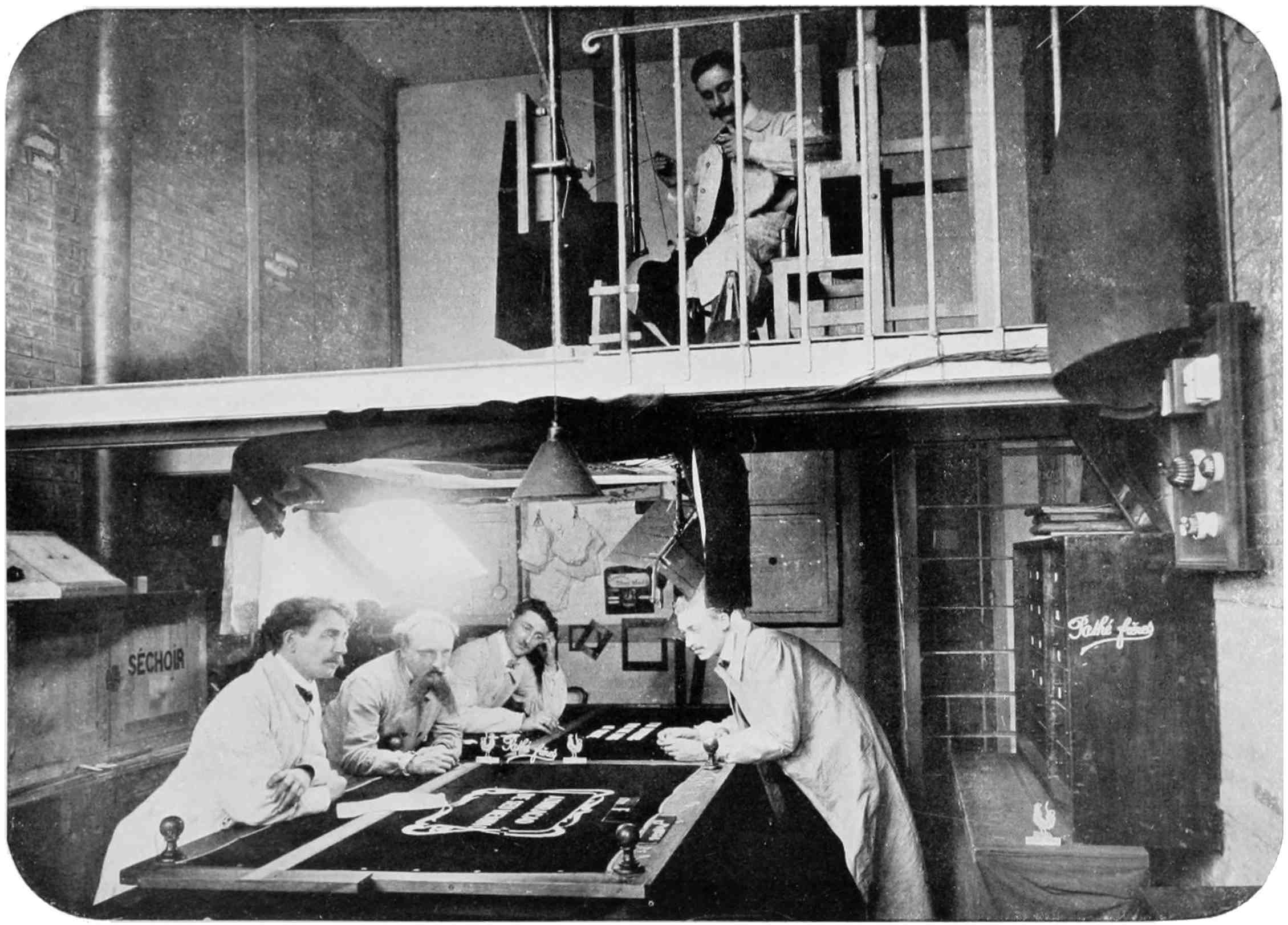
PREPARING THE TITLES.
This is an important operation. The title is designed upon a flat table, and under powerful electric lights is photographed from above,
the lens of the camera pointing downwards vertically. The cinematographer may be seen watch in hand, with his instrument.—See page 87.
The moving picture producer is even capable of turning
to account a disaster to his own plant. While a play was
in progress upon a studio-stage in New York the building
caught fire, and unrehearsed scenes were enacted. The
camera operator seized the opportunity. While the building
was blazing, and the company were rushing wildly
to and fro, he kept his handle turning lustily, and as a
result filmed the whole subject. In order to secure a
dramatic automobile disaster the Edison Company drove a
motor-car to the top of a lofty cliff. A dummy was seated
in the vehicle to take the part of the character who had been
acting in the play up to this point, the steering-wheel was
fixed in its hand, the car was started up, and it was driven
at full speed to the edge of the cliff, over which it plunged.
The film operator caught it falling through the air, as well
as the splash produced by its headlong dive into the waves.
Another company desired to secure a dynamite explosion
at sea. For this purpose it purchased an old schooner for
£200 ($1,000), stocked it with dynamite, towed it beyond
sight of land, where the charge was detonated, and a
stirring series of pictures of the disaster was recorded from
the deck of a yacht chartered especially for the occasion.
Sometimes the struggle after realism provokes humorous
situations. The Edison Company once wanted a riot scene,
so they produced one in a quiet country district by the aid
of their company and a number of local supernumeraries,
who entered into the plot with tremendous enthusiasm.
While the mock riot was at its height the
myrmidons of the law swept down and arrested all the
ringleaders, who, naturally, were the principals of the play,
and promptly incarcerated them. The players expostulated
that it was all make-believe, but the police were not to be
hoodwinked; they had heard that story before. Some time
elapsed before the mock rioters were released from gaol;
but the manufacturers scored, because the interference of
the police imparted additional versimilitude to the whole
proceeding.
In Germany an hilarious party was rowing up a river.
Suddenly all the gay company were seen struggling in the
water—the boat had capsized. There was a rush from all
sides to bring help; boats put off hurriedly, while spectators
either were rooted to the spot in horror or dived into
the water on rescue bent. The scene was intensely
dramatic, and it was not until one of the swimmers, while
bearing the frail form of a girl to the bank, hearing a
strange buzzing near his head, looked round and saw an
amused operator a few feet distant, nonchalantly turning
the handle of a camera. Then the fact dawned upon everyone
that the anxious rescuers had unconsciously contributed
to the greater success of a cinematograph play.
The French producers Pathé Frères once disturbed the
peaceful life of a sleepy village by acting a scene in the
deserted main street. While the work was in progress one
of the most prominent citizens hurried up. He was bursting
with righteous indignation at the noisy caprices of the
crowd of roysterers. While he was expostulating and uttering
dire threats of action, a policeman appeared, and clapping
a firm hand upon the shoulder of the interfering person,
threatened to arrest him for inciting a breach of the peace!
The admonished resident, somewhat amazed at the turn of
affairs, moved crestfallen away, and departed homewards.
He omitted to look round at the emissary of the law, and
ignored the guffaw of laughter which burst out at his
discomfiture. Had he done so he would have observed a
merry twinkle in the eye of the gendarme, who was a
member of the party!
A company desired to secure a love scene between an
engine-driver and a country maiden; so a small railway with
the whole of its rolling-stock on the outskirts of a town
was hired for a single day. Another firm, the Kalem Company,
decided to picture a series of Irish stories. Instead
of passing off American scenery as that of the Emerald
Isle, the company and properties were dispatched across
the Atlantic to the heart of the country which the author had
selected as the scenes of his stories. Recently, the Gaumont
Company, of London, dispatched its company to Scotland
in order to stage Rob Roy. The Duke of Argyll graciously
assisted in furthering the fidelity of the setting, by permitting
scenes to be enacted upon his estate and extending
invaluable aid, volunteering suggestions in order that everything
might be as correct as was humanly possible.
The Vitagraph Company undertook the filming of Fennimore
Cooper’s “Leather-stocking” stories. They sent their
company straightway to the scene of Natty Bumppo’s
adventures, and although the forest has disappeared long
since, they pressed the lake into useful service. Williamson,
the English producer, filmed a picture version of the
tragic story of Lady Jane Grey, and the Tower of London
formed the stage for some of the incidents in the sad story,
culminating in the execution of the “nine days’ queen.”
Where do the moving picture producers obtain their
plots? I have heard this question asked on many occasions,
and the answer might be “everywhere.” They have
such an inexhaustible mine in which to delve that there
is never any difficulty in finding an episode upon which to
base a straightforward simple drama, comedy, tragedy, or
farce. In this respect the cinematograph producer is far
better off than his rival on the real stage. Situations, scenes,
and episodes incapable of production by the latter, can
be produced very simply on the film. Novels, short stories,
plays, the Bible, Greek inscriptions, inventions, little episodes
and incidents in everyday life—anything and everything
is grist for his mill. Of course, fashions change just
as in any other phase of our complex life. To-day there
is a demand for subjects of mediæval English history;
to-morrow the French revolutionary period holds the
stage; three weeks hence there is a cry for Bible or ancient
history subjects; or a demand for something modern. It
is not difficult to meet each and every need. Most of the
large producing establishments retain competent writers
who know how to prepare plots for the picture producer,
and in addition there is a staff to consider plots submitted
from outside sources. The Edison Company receives 150
scenarios a week, and other companies as large or even a
larger number. It will be discouraging but salutary to
the beginner to hear that the chances of acceptance are
very slender, the number of suitable scenarios being not
more than one per cent. of those submitted. The remuneration
varies according to the merit of the work. It
may be taken merely for the title or one incident in the
story, and may be worth only four shillings or a dollar to
the producer; on the other hand, it may command £25
($125). There is no fixed scale. The trained dramatist
has realised that in the picture play he has a new and
increasing source of revenue, and as he is the best fitted
for the task, so he makes the greatest success in it. French
writers were the first to take advantage of the market, and
plays have been written and produced from the pen of
many of the foremost dramatists—such accomplished men
as Capus and others.
The entrance of the dramatist has precipitated a new
situation. The suggestion has been discussed that well-known
playwrights should decline to part with their work
for a fixed sum, but that they should earn a royalty precisely
as they do from their stage productions. It is an
intricate question to solve, but there is no doubt that the
time will come when such writers will receive a certain
percentage upon the price realised from the sale of every
film copy of a picture play from their pens.
A recent outcome of the development of the picture play
has been the appearance of “independent producers,” who
are in evidence mostly on the Continent. These men
enrol their own companies, rent or build a studio,
paint their own scenery, and hire whatever properties are
required from a theatrical costumier. The plays thus produced
are sold to some recognised manufacturing firm.
This “free lance” producer has an extensive market at
his disposal, but his enterprise demands a large initial
outlay. Yet it is a movement worthy of being fostered,
inasmuch as such a producer is thrown entirely upon his
own resources, and it is only the merit of his work from
all points of view which secures him a market. The
practice stimulates competition. Indeed, some manufacturers
have found that in this manner they can secure work
superior in character and treatment to that produced in
their own establishments.
CHAPTER XIV MOVING PICTURES OF MICROBES
During the past two or three years the cinematograph
has entered a new field, which, fifteen years ago, would
have been regarded as quite beyond its reach. With truly
wonderful ingenuity the camera is attached to the microscope
in such a way as to make possible the production of
the actual processes of germ life.
The microscope is always a source of infinite interest.
The thought of a whole world of organisms, existent,
material, yet so small as to be invisible, has a peculiar
fascination, and we are eagerly curious to get some conception
of their structure and movements. But the possibility
not merely of magnifying the red and white
corpuscles of the blood till they appear like huge hoops,
or the parasite of the sleeping sickness to a length of
some two feet, to follow the attacks of these foes upon the
human organism—such a possibility makes one feel that
there is no limit to the power of man over the natural world.
Micro-cinematography is surely one of the serious
triumphs of animated photography. Here again the
latter offers itself as a coadjutor to scientific research, and
proves its title to rank among the educational influences
of the age.
Micro-cinematography may be divided into two broad
classes—the study of bacteria, the most minute living
organism which the scientific photographer has ever attempted
to catch in motion, and popular microscopy, or
the study of insects, plants, pond life, and so on.
Bacteriological micro-cinematography is an abstruse and
difficult subject for investigation. The microbe is so sensitive
to various influences, and so difficult to handle, that
it is a formidable task to bring it within reach of the
sensitised celluloid film and seize it in its normal condition
and environment.
A French professor, Dr. J. Comandon, of Paris, has
been for years absorbed in the study of the blood, its
structure, functions, and the continuous warfare that is
waged between the corpuscles, and a host of parasites as
seen under the microscope and the ultra-microscope.
One supposes that the microscope is an ideal instrument
for the investigation of those objects which are so minute
as to be beyond the capacity of the human eye. This,
however, is far from being the case. Briefly described, the
microscopic investigation of bacteria is carried out by one
or more of three broad processes, which are regarded
almost as standardised methods. All three, however,
possess numerous shortcomings. Often the bacteria has
to be destroyed; and the slide has to be stained by means of
aniline dyes, in order to bring up the details of the object
sufficiently strongly for examinations; for the majority of
the organisms under investigation are transparent, and
their image stands out faintly against the brilliant light.
Greater success is possible with the ultra-microscope than
with the microscope. By its means objects so minute as
to be invisible, even with the microscope, can be thrown
as bright points upon a black background, not necessarily
with sizes and forms clearly defined, but yet in such a way
as to enable their positions and movements to be ascertained
and followed.
The disadvantages of ordinary microscopic investigation
are obvious. In many instances as the investigator has to
kill the germ before he examines it, he has perforce to
content himself with the study of coloured corpses of these
infinitesimally small organisms.
It occurred to Dr. Comandon that possibly the microscope
could be combined with the cinematograph in such
a manner that the microbes could be photographed distinctly
and brilliantly upon the film, and subsequently
projected upon the screen with tremendous magnification,
without the organisms suffering any distortion or other
ill-effects. He realised that if this could be achieved, the
scientist would be provided with a more powerful weapon
for the examination of a particular microbe than hitherto
has been available. Furthermore, if the object could be
thrown on to the screen with perfect detail, then, owing to
the tremendous magnification obtained, the study of the
life, movement, and habits of the parasite would be possible
under easy and congenial conditions.
The eminent French investigator approached Messrs.
Pathé Frères, and unfolded his ideas. The technical
difficulties in the way were prodigious, and the field was
untested, both in microscopy and cinematography. However,
as there was the possibility of some startling results
being achieved, Pathé Frères decided to collaborate, and
promised to provide Dr. Comandon with every facility
he desired.
The work was commenced without delay, and the manufacturers
proceeded with the construction of the special
apparatus that was required. This had to be of an
elaborate character, owing to the peculiar conditions; and
exasperating failures attended the early work.
Although a cinematograph picture only measures approximately
1 inch in width by three-quarters of an inch
in depth, the first magnification was considerable, ranging
in the case of bacteria to 300 diameters or more. This
had to be carried out with punctilious sharpness of detail,
because when it came to projection, the magnification was
multiplied enormously, and any error in the original
picture or negative would be proportionately increased.
Bacteria are extremely sensitive to light and heat. Sunlight
spells certain death to the microbe, and as a ray of
electric light is the nearest artificial approach to the
luminosity of our sun, its destructive component, the ultra-violet
rays, had to be eliminated. Again, as the rays from
the electric arc in the lantern focussed a strong heat upon
the object, and as this likewise would bring about the
sudden demise of the organism, the heat rays had to be
mitigated as much as possible.
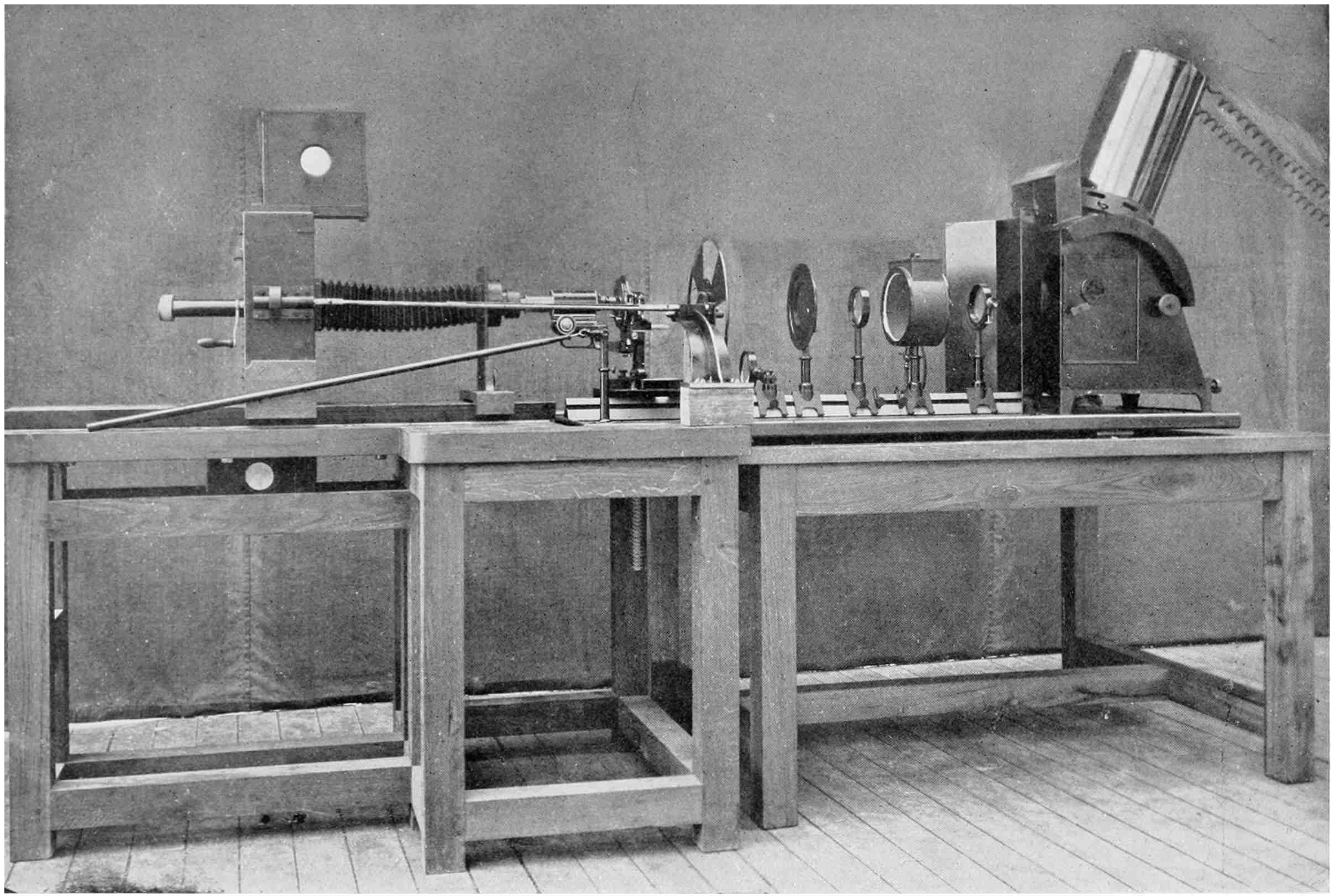
DR. COMANDON’S APPARATUS FOR TAKING MOVING PICTURES OF MICROBES.
The peculiar difficulties attending cinematographic work with germs demanded the preparation of special appliances. About twelve months
were spent in experiments.
These two adverse factors were removed entirely by a
novel arrangement. The illustration shows one of the
apparatuses used by Dr. Comandon to secure his wonderful
pictures. It is mounted on a rigid bench, and
the parts which have to be moved to and fro to obtain
adjustment, slide upon a horizontal triangular metal base,
to which they are clamped in the requisite positions to
secure rigidity. The lantern is mounted at the extreme
end, and the light, supplied from an electric arc of
30 amperes, is concentrated into a thin ray, or pencil,
which falls upon the object to be photographed, through
which it passes to the film. The illumination may be
either direct—that is, it may pass in a straight horizontal
line from the lantern—or it may be reflected by means of
a mirror in a direction perpendicular to the axis of the
instrument, or at right angles, as in the ultra-microscope.
The principle adopted varies according to the subject under
observation. The organisms contained in a drop of blood,
for instance, are dropped on to a carefully cleansed glass
plate, which is inserted in the microscope in the usual
manner.
At the opposite end of the bench is the cinematograph
camera, which in this case is provided with extending
bellows, as in the ordinary camera, for purposes of
focussing. At the back of the camera is a small attachment
whereby the bacteria, greatly magnified, can be
focussed sharply and clearly upon the film. On top of the
camera is mounted a small box containing the spool of
unexposed sensitised film. When the contents of this are
exhausted the box can be removed quickly and easily, and
another charged film box substituted. The film drops
from this box through the gate in the camera, and issues
below into a second film box, which can be removed
similarly when filled, to permit another empty case to be
introduced. The mechanism of the camera itself is the
same as that of the usual animated photographic camera,
and it is operated in the same way, by the turning of a
handle.
For the purpose of absorbing the heat rays, which in the
concentrated beam of light would kill the microbes within
a short space of time, a glass cell is inserted outside the
lantern through which the focussed beam of light is passed.
A stream of cold water is circulated continually through
this water condenser, thus absorbing the greater proportion
of the heat contained in the ray of light, without
affecting its luminosity in any way. It will be observed
that this is a reversion to the first projecting system
evolved by the firm of Lumière for the cinematograph.
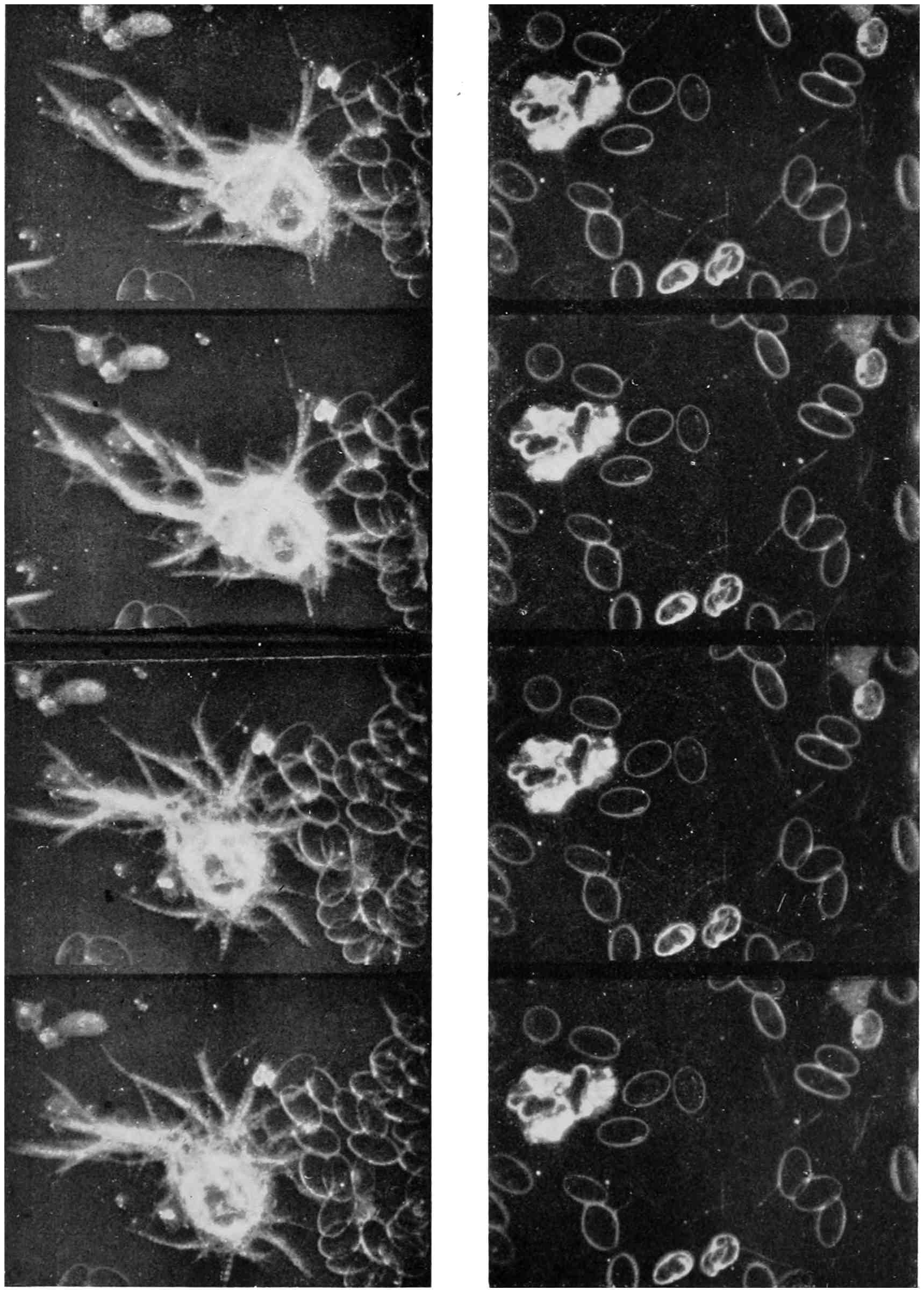
[Copyright, Pathé Frères.
CINEMATOGRAPH FILMS OF MICROBES.
1. The phenomenon of
agglutination in a fowl’s blood.
2. The blood of a fowl suffering
from
Spirochæta gallinarum.
In order that the organism under photography should
not be subjected to the action of the light any longer than
is necessary, a revolving disc, or shutter, is placed between
the microscope and the lantern. This shutter is fitted
with opaque sectors or blades, corresponding to those in
the camera, which at regular intervals eclipse the lens to
enable the film to be jerked forward the depth of a picture
intermittently after each exposure. This cut-off revolves
with the camera shutter, so that when the lens aperture
is closed, the light is also cut off from the organism slide
in the microscope. By this arrangement the light passes
through the slide of bacteria only during the fraction of
a second that the celluloid film in the camera is exposed.
The evolution of this ingenious apparatus occupied
several months of continuous work and hard thinking.
Indeed, nearly a year was spent in experiments before a
perfect film, suited to public exhibition, was produced.
As a result of the persevering and patient experiments
on the part of Dr. Comandon and Messrs. Pathé Frères, a
new and strange world has been revealed. The cinematograph,
in conjunction with the microscope, has opened
the gates of a kingdom long considered beyond the reach
of all but the privileged few. Not only this; the bacteriological
scientist is provided with facilities to study at ease
intricate subjects which had hitherto baffled his skill.
What the microscope is to the naked eye, the micro-cinematograph
is to the microscope.
Some of the pictures obtained by Dr. Comandon are
startling to such a degree as to be incredible. It was my
privilege to see one of the first experimental films thrown
upon the screen in the Paris Laboratory. It depicted the
main blood stream of the frog magnified about 25,000
times. The corpuscles were plainly visible, being about
the size of dinner plates. But most extraordinary was the
form and movement of the parasite in the blood stream.
This foreign organism resembled a tadpole in general
appearance, and it darted with lightning-like rapidity to
and fro, pressing home its attack upon the corpuscles of
the blood with tremendous energy. One could scarcely
believe that the eye was following the movements of an
organism which under natural circumstances is beyond
the scope of that organ. One had the sensation of gazing
into a pond, where the spawn of the frog was in course of
incubation, with specimens of the reptile in its first stages,
darting hither and thither through the water.
Dr. Comandon introduced the spectator to still greater
wonders in the under world. One may see in movement
on the screen a drop of blood such as courses through
one’s own body. There are the red corpuscles, or cells
of circular shape as large as saucers, and some are to be
seen piled upon one another like coins. The extent of the
magnification in this film may be seen when it is borne in
mind that a cubic space measuring 61/1000000 of an inch
contains some 5,000,000 and 6,000 red and white blood cells
respectively.
But the most fascinating spectacle to which we have been
introduced by Dr. Comandon is the attack of the parasites
upon the blood corpuscles, and the defensive tactics
followed by the latter. There is one film showing blood
infected with the trypanosome, discovered by Sir David
Bruce, who was dispatched to Uganda by the Royal
Society to investigate sleeping sickness. This malady
is communicated by a species of the Tsetse-fly, which
wreaks tremendous devastation among herds of cattle and
horses in South Africa. For the purpose of this film Dr.
Comandon inoculated a mouse with the parasite, and by
the aid of the micro-cinematograph he shows the action of
the disease germ through successive stages until the animal
succumbs.
In the early part of the film the parasites are few in
number; they are seen to dart to and fro among the blood
cells with striking vigour and rapidity, jostling the
corpuscles violently in all directions, and causing them to
bounce against one another like india-rubber balls. As
the film advances, showing the progress of the disease,
the parasites are to be seen increasing rapidly in number.
At last they appear to overwhelm the blood corpuscles, this
multiplication continuing until death supervenes some four
or five days after injection. The film was shown lately
before a gathering of medical men, and created widespread
interest, as it introduced them to a phase in the life
of the parasite which hitherto had been beyond their
comprehension.
Another film shows the “phenomenon of agglutination.”
The white cells of the blood act as the policemen of the
stream and maintain a vigilant outlook for criminals in
the form of parasites. When the microbe offenders come
within the strong arms, or embrace, of this guardian,
either they are seized, or serum substances are thrown out
by the white corpuscles, which agglutinate, kill, and
dissolve these enemies.
The film shows the blood of a fowl infected with spirochætes.
In the first instance, the microbes are to be seen
swimming about actively in the plasma—the liquid in
which the red and white corpuscles are held. The bird
is recovering from the malady; one sees the white cells
engaged in their task of restoring law and order in the
blood stream. The spirochætes commence to congregate,
become sluggish in their movements, forming first strings,
and then star-shaped groups. The white cell appears on
the scene, and these enemies gather round him in a dense
clump. The policeman grasps them in a sticky embrace
from which they cannot escape, and in a short time all
the spirochætes have joined one or other of the gatherings
about a policeman. The latter continues to throw out the
agglutinate, which locks the enemies as tightly together
as if they were handcuffed. At first they wriggle and
endeavour to escape, but the white blood cell is too powerful.
Their struggles become weaker and weaker until at
last they cease. The policeman completes his victory by
devouring the corpses.
One must see these pictures in animation upon the
screen to observe the wonderful definition, detail, and
brilliancy which they reveal. The magnification is
immense—the thousandth part of an inch is increased to
three feet or more. When the picture on the screen
measures some 16 feet in width, the organism is magnified
as much as 50,000 or possibly 100,000 times; a flea is so
increased in size that it represents a fearful prehistoric
monster as large as an ordinary dwelling house. A magnification
of 100,000 times the diameter of the original,
however, by no means indicates the limits of the eminent
French investigator’s work. When the necessity arises,
the enlargement can be carried to a far greater degree
without any sacrifice of essential details.
Dr. Comandon’s dogged perseverance in the face of
disappointments has been crowned with complete success.
Micro-cinematography is on the threshold of a vast field
in which it has tremendous opportunities, the limits of
which it is impossible to define.
CHAPTER XV SOME ELABORATE PICTURE PLAYS AND HOW THEY WERE STAGED
The first large film production, “The Passion Play,”
running to 3,000 feet, made its appearance, as we have
seen, as far back as 1897—the result of unquenchable
American ambition to be first in every field. It proved an
amazing success; but it was regarded with greater favour
by the public than by the manufacturers. They all
acknowledged it to be a wonderful piece of work, but the
prevailing opinion was that the public would tire of a
picture lasting nearly an hour, and monopolising the greater
part of the entertainment.
Moreover, such films were considered to be too speculative.
The expense of staging them upon a scale suited to
their length and importance was so heavy that the film-producers
doubted whether the sales would be adequate to
recoup the initial outlay. That fallacy, however, has
been completely exploded. What was a marvel in
1897 is to-day a commonplace. The “Big Picture Play” is
as much part and parcel of the cinematograph industry as
the spectacular stage play is of the legitimate theatre.
The movement was established and developed by the
firm of Pathé Frères. Having fixed their popularity upon
a firm basis and developed their organisation to a high
pitch of efficiency and resource, they decided to launch
out upon a large scale into the new field. Striking historical
subjects, especially of the French revolutionary period,
offered them the greatest scope for gorgeous mounting;
they had some apprehension about the attitude of the
public toward such subjects, but their anxiety was quickly
dissipated, partly, no doubt, because the plays were carried
through with a vigour and sustained interest that defied
the possibility of boredom.
French history has been a rich mine to the picture-play
producer. The Reign of Terror and the Life and Times of
Napoleon are the melodramatic episodes which offer such
peculiar scope to the film play. They make an appeal to
popular sentiment, especially to the French audience; the
incidents in the career of the Little Corporal never failing
to strike a strong emotional chord.
Such productions impose great responsibilities upon the
producer, and demand a mastery of stage-craft, both in
mounting the scenes and in handling the necessarily large
companies of actors and actresses. There can be no consideration
of expense; money must be poured out like
water. Weeks and even months must be expended upon
preliminaries; in order to achieve realism as many as
possible of the scenes must be enacted in their natural
surroundings, or else research must be carried out in order
to stage the action with absolute fidelity—an exacting task,
for the public is hypercritical.
In the first attempts the management of the crowds was
perhaps the most troublesome factor. Large bodies of
supernumeraries were enrolled, many possessed of stage
experience. They had to be marshalled and put through
their paces time after time, first without the principals, and
then with them. Often days elapsed before the incidents
in a scene dove-tailed tightly together, but the patience
and perseverance of the manager were rewarded. Such
scenes as the execution of Charlotte Corday, or the
arraignment of the aristocrats before the Tribunal of
Robespierre when thrown upon the screen stirred public
enthusiasm to an extravagant degree.
From the perfect manner in which the French producers
carried out this peculiar work, films of French origin
attained a well-deserved world-wide appreciation. At first
the American trade ridiculed the idea, maintaining that the
heavy expense attending the production of elaborate film
plays never could be recouped, and that the movement was
purely ephemeral. But their contentions were doomed to
disappointment. The cinema-loving public received films
of this character with open arms: they were a welcome
relief to the tawdry domestic drama or comedy with the
thread-bare plot, and, in which, perhaps, only half-a-dozen
or so players participated. Accordingly the American
producers were forced to embrace the movement, though
somewhat tardily. They made striking headway, but the
most elaborate American film productions never have compared
with those of European origin, although such firms
as the Edison, Selig, Vitagraph, the American Biograph,
Kalem, Lubin, and one or two other companies have been
responsible for many notable achievements. Technically
their films are in every way equal to the product of the
leading European manufacturers.
The Vitagraph production of “A Tale of Two Cities”
is a splendid example of the best American work. It tells
Dickens’s story in three chapters, otherwise three reels,
and from every point of view—photographic, staging,
and acting—it is an excellent production. By the time
the 3,000 feet containing 48,000 pictures reached the public
£4,000 ($20,000) had been expended, while the preparations
for staging occupied no less than three months. Curiously
enough, although the Americans are keen admirers of the
novelist who taught us how to laugh and cry, the demand
for this film came from Europe, and it is in Europe that
it has met with its greatest success. Within two or three
weeks of its appearance over 300,000 feet of this film
were sold in London alone.
The same firm produced another wonderful play on the
life of Napoleon. Mr. Stuart Blackton spent three months
in France searching records and archives to secure unimpeachable
historical accuracy of details. The country
was ransacked also for furniture of the period, and for
the staging of the interior scenes. No less than £6,000
($30,000) were sunk in this enterprise.
Another American producer who has achieved world-wide
fame from the striking and expensive character of his films,
is Mr. William N. Selig. His studios are located in
Chicago and California, while other studios are extemporised
from time to time in other parts of the country.
Mr. Selig’s name is most intimately associated with daring
and elaborate productions associated with life in the jungle,
and some of his plays of this character have been amazing.
He may be said to be the father of this type of picture-play.
It was an ingenious idea and he has carried it to
perfection. When he decided to exploit this untouched
field he concluded rightly that unless the subjects were
handled comprehensively and realistically the results would
be indifferent, so his first move was the acquisition of an
elaborate menagerie. This was one of the most difficult
proposals, inasmuch as menageries are not to be purchased
at a moment’s notice, because the market therefor is, to
say the least, extremely limited. Fortune assisted his
resolve. The opportunity to purchase a collection of wild
animals, complete enough to do credit to a large city, arose,
and he grasped it. The purchase comprised 12 lions and
lionesses, 9 lion cubs, elephants, 3 camels, 10 leopards,
7 leopard cubs, 5 pumas, 3 bears, 2 deer, 10 eskimo dogs,
8 grey wolves, as well as monkeys and other animals. As
an investment this menagerie represented several thousands
sterling. This zoo has its home at Chicago, special
arrangements having been completed, at enormous expense,
for its accommodation under the most perfect conditions.
From time to time additions are made to the collection,
until at the present day the zoo is about twice its original
size.
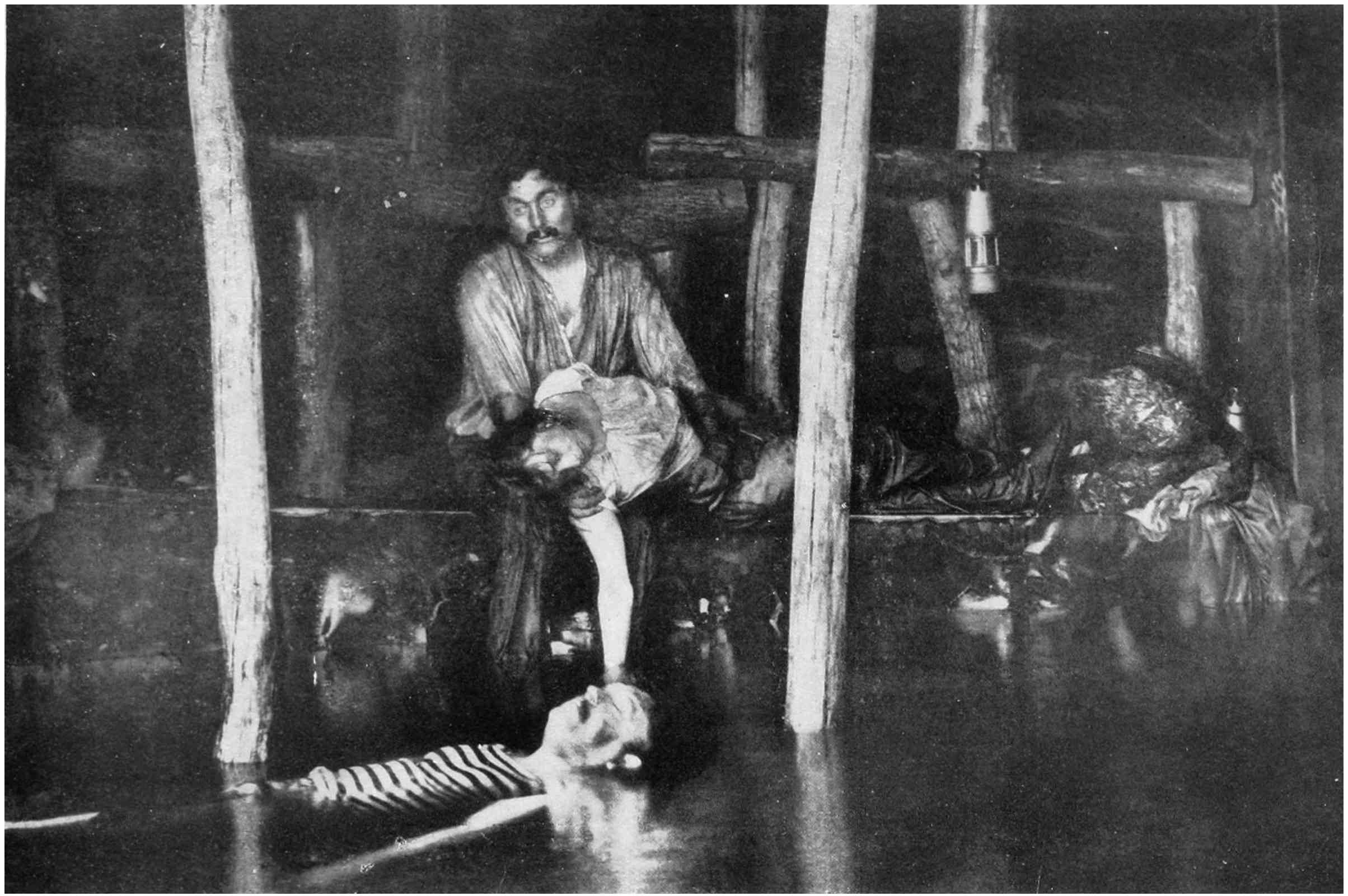
A TRIUMPH OF THE CINEMATOGRAPHER’S ART.
A thrilling incident from Zola’s “Germinal,” filmed by Messrs. Pathé Frères, showing the dramatic episode in the flooded coal mine,
which was built above ground.
The next matter in hand was the selection of the jungle.
Would it be necessary to transport the actors and actresses,
human and otherwise, to Africa in order to secure the
natural surroundings? It was decided that Florida would
suit just as well, because the flora near the coast is similar
to that of some parts of the African jungle. The
menagerie, together with the stock company of 30 performers,
as well as supernumeraries, travelled by special
train from Chicago to Florida, a journey of several hundred
miles. As African natives were impossible, Florida
negroes were employed.
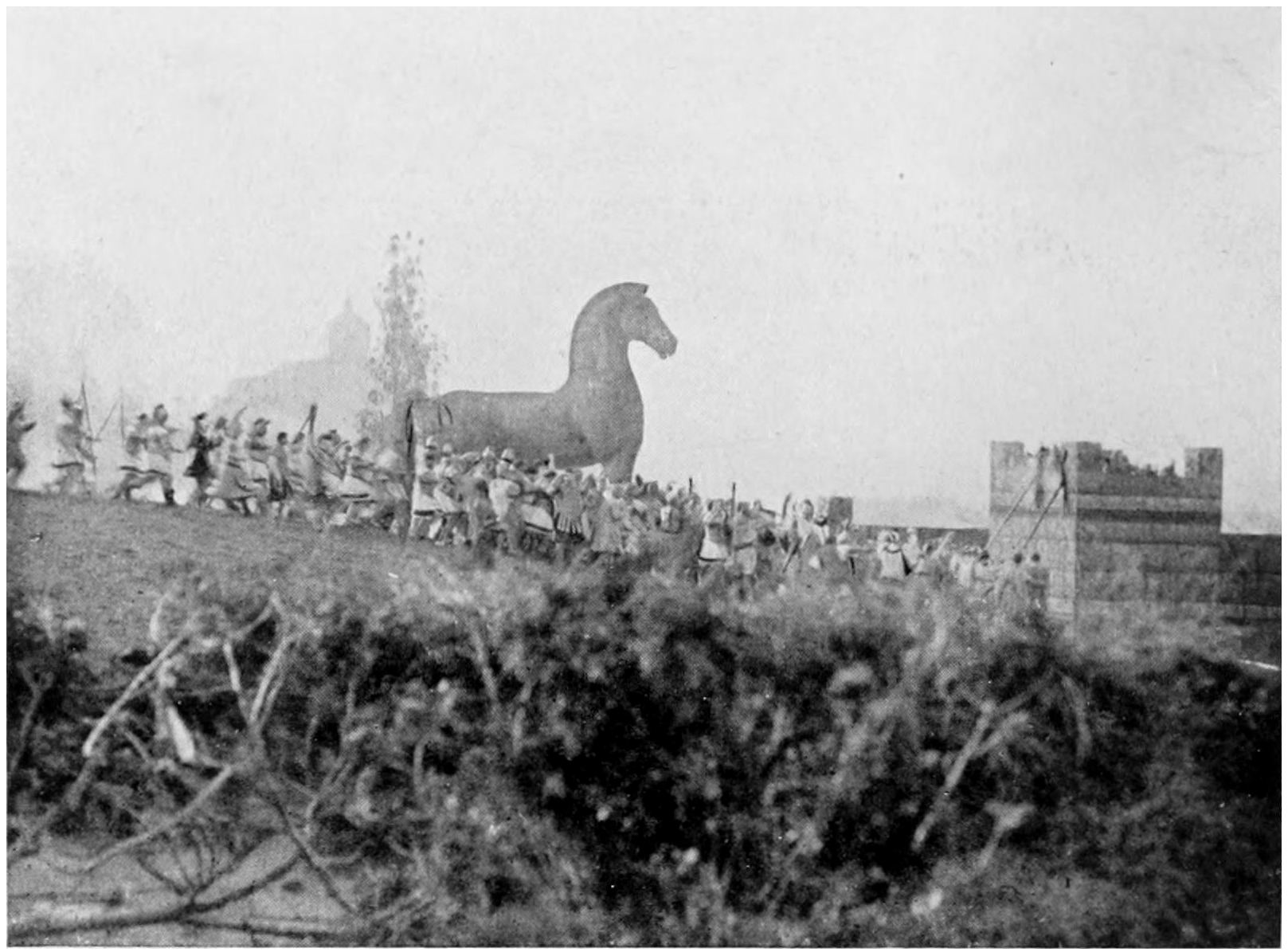
The gigantic horse being hauled by the Greeks under the walls of Troy.
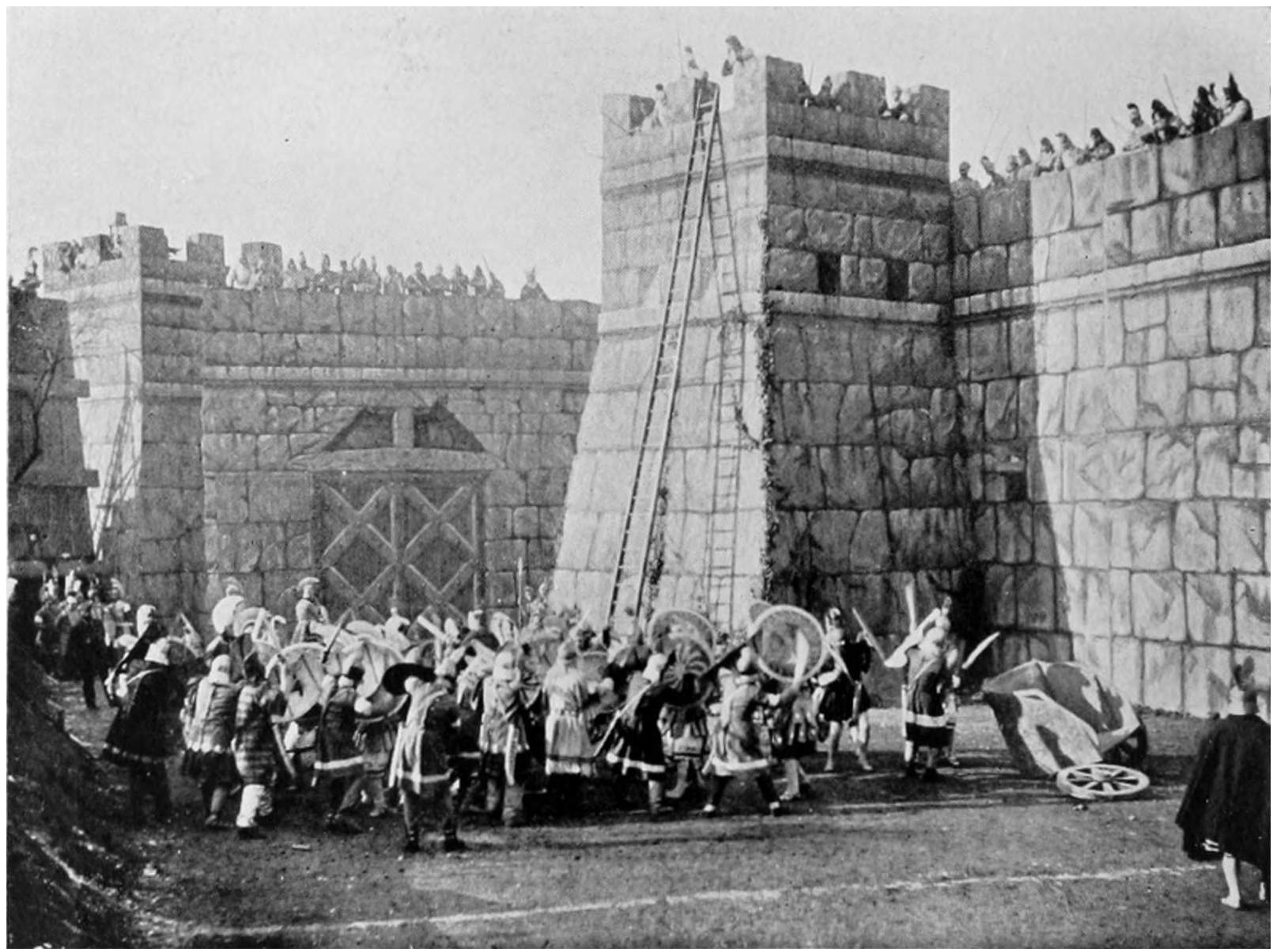
“THE FALL OF TROY.”
The repulsion of the Greeks. Over 800 actors appeared in this scene.
An ambitious film produced by the Itala Company.—See page 175.
The production of the plays was naturally a thrilling
affair, and many unexpected scenes were recorded. The
animals were under the care of experienced trainers, but
there was an occasional reversion to original habits under
the influence of the familiar environment. In one scene
the heroine was supposed to have lost herself in the dense
bush, and to sink down from sheer fatigue. A leopard was
to rush from the brush to spring upon her prostrate form.
The scene was rehearsed time after time to secure the
requisite dramatic effect; the operator was to stop the
camera when the leopard was in the air springing towards
the girl.
But when the picture was being taken the heroine did
not accept her cue with sufficient alacrity. She was late
in falling, and the leopard arriving exactly on his cue
caught her in the act. The woman had the presence of
mind to bury her face in her hands, but the animal’s claws
dug into her scalp. Had she made a movement, the leopard
would have mauled her terribly, but she kept still, and
when the trainer cracked his whip the animal scuttled off
according to pre-arrangement. It was a narrow escape,
but it gave the film a touch of vivid reality.
In another picture the heroine was protected by two
tame leopards who mounted guard over her dwelling. The
scene represented an attack upon her by a fierce lioness.
The girl released her two leopards, and a terrific animal
combat was the result. The beasts took the matter
seriously, and fought until the lioness was killed by the
two leopards. During the fray the operator, but a short
distance away, kept the camera handle turning as unconcernedly
as if the battling beasts were in a cage. Surely
such an unusual spectacle is sufficient to meet the most
querulous demands of the public for realism!
From the tropical jungle with its dense vegetation, to
the Arctic circles with its monotonous wastes of snow and
ice, is a far cry, but the Selig company dispatched its
company northward to secure another powerful film play.
The plot was slender, but the scenes portrayed the life of
the frozen north with great fidelity and vigour, showing
the Eskimo fishing through the ice, and hunting the polar
bear and walrus by his primitive methods. A valuable
polar bear was sacrificed to the desire for realism. The
Jungle play has become a speciality of the house of Selig,
and owing to the manner in which the subjects are handled,
giving no offence to humanitarian or animal-loving feelings,
they have proved unparalleled favourites with the public.
It is hard to estimate the educational service of scenes
like these in broadening the outlook of an untravelled,
perhaps unlettered, audience. And what they must contribute
to the expanding imagination of the child, one
would need to be a child again to know!
In the United States there are many theatres which can
show bigger receipts at the box office from the presentation
of moving pictures than from the staging of a play. Why
are many of the foremost producers of stage plays forsaking
the “legitimate theatre” to produce film plays, if
not because they recognise the future of the latter and the
scope offered for their technical ability.
Perhaps at this point I may be permitted to tell the story
of the cinematograph in Italy, since its success there is
phenomenal in its completeness. Less than ten years ago
the cinematograph was scarcely a feature of the Italian
amusement world. It suffered from the hostility of the
theatres, and there was but meagre enterprise enlisted in it.
The example of other countries gradually caused increased
popular demand, which was at first satisfied by French
films. Then the Italians saw their opportunity, money and
talent came to the service of the new development, and the
languishing enterprise not only came to rank among the
largest of Italian industries, but introduced its own wares
with great success into other countries. There seems good
ground for this state of things, and a special fitness in the
Italian success. The average Italian is artist by temperament
and a born actor; the Italian stage has long been
famous for technique and stage-craft; and these factors,
with the clear atmosphere, brilliant sun, and picturesque
landscape, make Italy the natural home of the highest
success in cinematograph production. Financially also the
Italian producers had an advantage over all competitors.
Luxurious picture plays could be staged in Italy for half
the cost they have entailed in France, England, or America.
A French producer informed me that supernumeraries alone
cost him from 10s. 6d. to 18s. ($2 to $4.50) a day, and that
the salaries of the principals were rising to high figures. In
Italy the remuneration was less than one-half. But as time
progressed the Italian supernumerary realised his value.
He demanded recompense upon the scale of his French
colleague, and to-day is in receipt of remuneration upon a
similar scale. But the early financial advantage facilitated
the firm foundation of the producing industry in Italy, and
it still ranks as the premier country for “Big Picture
Plays,” the high cost of such works notwithstanding.
In this development the Cines Societa Italiana has played
a prominent part. It had long been established in Rome,
but its efforts were purely conventional. In 1908 new
blood was infused into the undertaking, and its first
ambitious effort was the pictorial representation of
Alexander Dumas’ famous novel, “The Three Musketeers,”
which lent itself admirably to handsome mounting, and
fine acting in pantomime. The film ran to 1,500 feet. It
made an instant success. In Great Britain alone over 50
copies of the film found an immediate sale, and a far greater
number in Italy, France, Germany, and Russia. In
Australia its reception was particularly enthusiastic. Other
most successful presentations were “Macbeth,” which cost
£2,000 ($10,000) to produce, Shakespeare’s tragedy being
condensed into 23,360 pictures, occupying 1,460 feet of
film; “The Triumphant Hero,” “Faust,” “The Sacking of
Rome,” “Agrippina,” and so on. Its greatest triumph was
the film version of “Quo Vadis?” This film ranks as the
biggest success ever known in the cinema world. It built
the fortunes of several showmen; in fact, one man made a
round £50,000 ($250,000) therefrom in less than a year.
One might be inclined to suppose that some of the foregoing
subjects were somewhat beyond British taste, but
their success here has proved otherwise. As many as 80
copies of one of these big films have been sold in Great
Britain alone, the total output for the world aggregating
some 400 copies.
The experience of the Cines Company appears to confirm
the theory that historical subjects make the strongest
appeal. The public is fairly well acquainted with the milestones
in European history, particularly those in connection
with the rise and fall of Rome. Moreover, Italy is
especially rich in beautiful landscape and historical sites,
where the scenes can be re-enacted in their original setting—an
advantage which the large companies realise to the
uttermost.
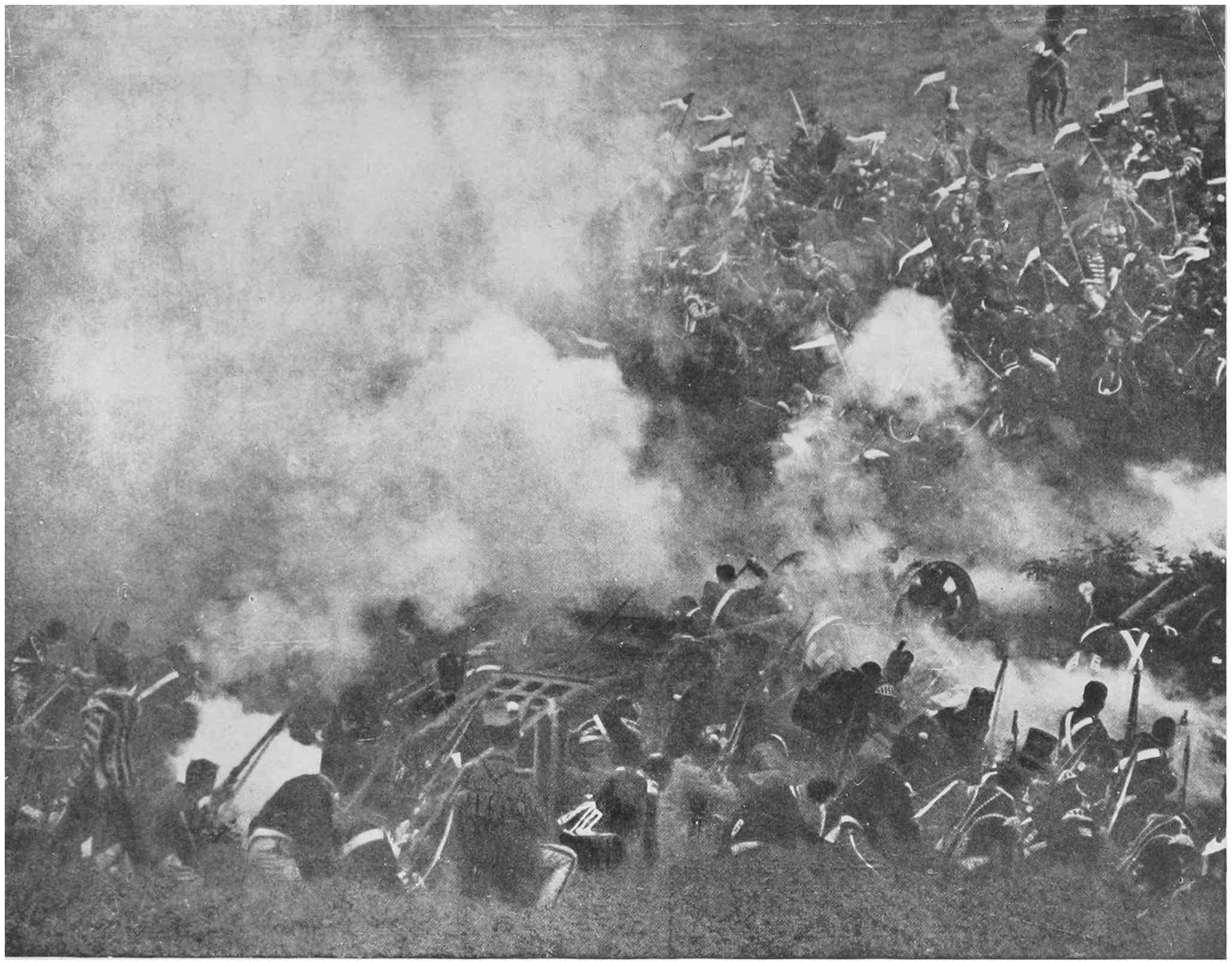
[By permission of the British and Colonial Kinematograph Co., Ltd.
THE “BATTLE OF WATERLOO” UPON THE FILM.
This desperate conflict was re-fought in England for the cinema at a cost exceeding £5,000 ($25,000).
The Cines Company is to-day one of the largest film-producing
establishments in the world. It has three
studios devoted to the staging of picture-plays, the premises
in Rome having an area exceeding 128,000 square feet.
Everything is installed upon a large scale—100,000 feet of
film can be turned out every day. Six new subjects of
travel, educational, and dramatic interest are placed
on the market every week. The big productions, however,
entail a strong element of risk. The first difficulty is to
select a subject which will make a world-wide appeal.
When the negative has been obtained “sample” positive
prints are prepared and dispatched to the great cities.
At each centre the firm attracts a certain number of
patrons—possibly the aggregate of the first order may be
only forty copies. Since a film running to 3,000 feet
entails an outlay of £50 ($250) on the part of the renter,
it is not surprising that he displays caution in making his
purchases, because half-a-dozen copies of varied ordinary
subjects can be acquired for the same money, with the
additional advantage that the risks are spread over six
subjects instead of being centred upon one. The initial
order is fulfilled, and should the venture prove popular, a
steady stream of orders may be expected to follow. However,
the producer does not breathe freely until the two
hundredth copy has been dispatched. Should the play fail
to please the public, the manufacturer is faced with a heavy
loss. The system has certain drawbacks, but it ensures the
showman and the public being given the very best material,
and causes very keen rivalry among the producers to eclipse
one another’s efforts.
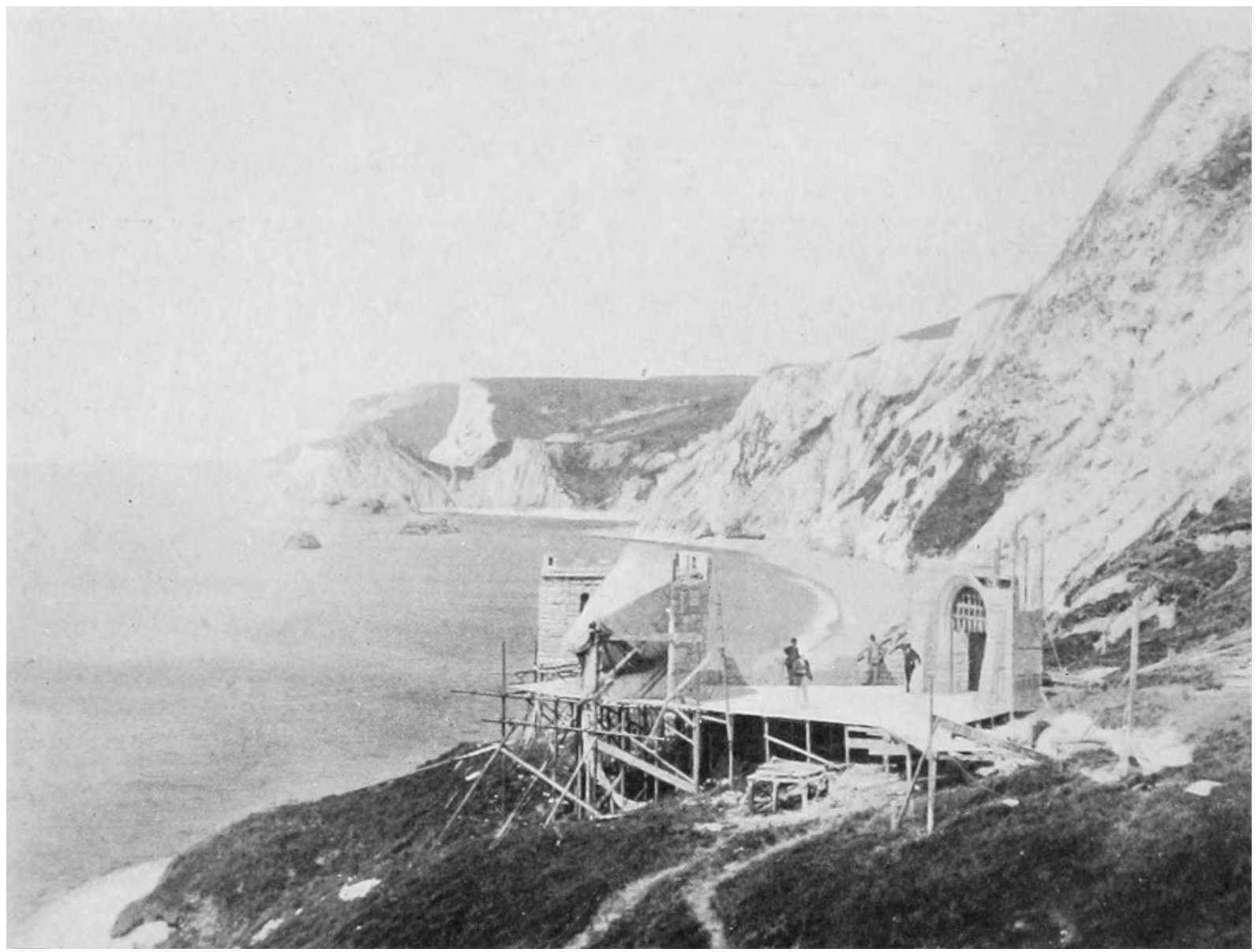
Building the scenery in a Devonshire bay for the film performance of “Hamlet.”
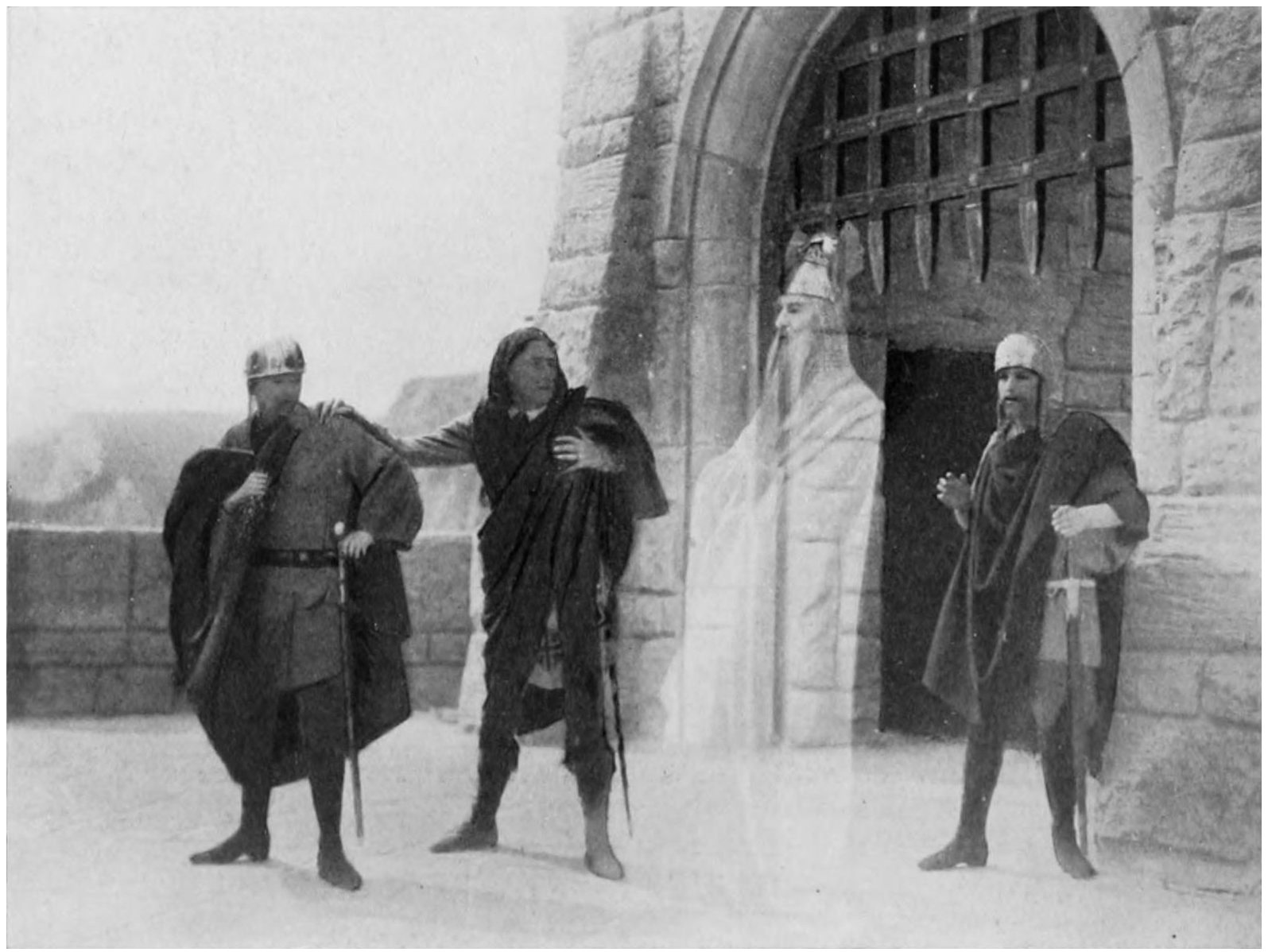
[By permission of the Gaumont Co., Ltd.
SIR HENRY FORBES ROBERTSON’S APPEARANCE BEFORE THE MOVING PICTURE CAMERA.
The Ghost scene from “Hamlet.”
Cinematography is far more realistic and convincing for this Shakespearean play than the legitimate theatre.
There are certain subjects, however, which rarely fail of
popular success, those of religious interest being foremost
in the group. The “Life of Christ” was possibly the
most successful venture of this description. It cost some
£2,000 to stage. There were thirty-nine epochs, divided
into four parts, and ranging from the “Nativity” to the
“Crucifixion.” Over 3,000 feet were required for their presentation.
The film was largely purchased by religious
societies. A certain “renter” is said to have amassed
£30,000 from this single film. The “Miracle,” the story of
“Cain and Abel,” “The Trial of Abraham’s Faith,” “The
Fall of Babylon,” “Samson and Delilah,” to name only a
few, have proved powerful magnets. In the last-named the
great scene was the destruction of the temple. The edifice
was built of cardboard, and when Samson bent his strength
in a final effort upon the columns, the whole structure came
crashing to the ground.
The development of the “Big Film” has been responsible
for a new movement in cinema circles. A firm which sinks,
say, £10,000 ($50,000) in one subject, naturally is anxious
to recoup this outlay with all possible speed. This can be
accomplished only in one way—the disposal of the sole
rights for each country exclusively to speculating and enterprising
individuals, instead of by the slower sale of copies
in the open market to renters. It was not difficult to carry
out operations upon the new basis. Cinema circles teem
with bold and daring spirits. Unfortunately the development
of this principle led to a certain degree of wild
gambling. Fancy prices, out of all proportion to the intrinsic
or showing value of the films, became the rage, high
water mark being reached with an Italian version of
“Antony and Cleopatra,” the limited rights in which for the
British Isles alone were sold for about £8,000 ($40,000).
Despite the antagonism of the “renter,” the attitude of
the public is distinctly favourable to the long film. Its
production in Italy is being carried out with great vigour.
CHAPTER XVI PICTURES THAT MOVE, TALK, AND SING
When Edison invented the “Kinetoscope,” his ambition
was, not only to produce movement by the aid of pictures,
but sound by the aid of the phonograph. But it proved
a hopeless quest; and accordingly Edison confined his
efforts for the time being to the perfection of animated
photography.
In an earlier chapter I have described some devices for
imitating sound. In this chapter I am speaking, not of
imitation, but of reproduction. In order to secure perfect
combination of movement and sound, it is essential to
secure absolute synchronism in the actuation of the camera
and that of the talking machine. This was Edison’s
insuperable difficulty. A single motor was utilised for
both machines; but the phonograph was easier to stop and
to restart than the camera, owing to the fact that the latter
had to be driven at sufficient speed to secure 46 pictures
per second.
The moving and singing picture machine known as the
“Kinetograph,” which worked upon the automatic “nickel-in-the-slot”
principle, had a very brief existence. It was
placed in cigar shops, railway stations, and other convenient
public places, but it failed to interest the public,
and was withdrawn in a short time.
Yet Edison did not relinquish his original plan. He
cherished the idea that combined pictorial and audible
records were feasible, and for nineteen years he devoted
his energies to the consummation of the task. It was only
a short time ago that the great inventor announced that
he had succeeded at last. In the meantime, however, he
had been anticipated by industrious and energetic experimenters
in Europe.
In 1908 an attempt to produce motion and sound was made
commercially with the “Cinephone.” The solution presented
in this apparatus is undoubtedly novel, but the
results are very unsatisfactory, and its success is dependent
entirely upon the skill of the operator. The “Cinephone”
is designed to accompany the motions of acting with the
sounds pertaining thereto. The pictures are fitted to the
talking machine records—that is to say, the cinematographer
merely takes a gramophone record and produces
a film suitable thereto. Edison’s plan was far more comprehensive.
His idea was to prepare the phonographic
record at the same time as the film pictures were made—for
example, while a football or baseball match was being
cinematographed, the phonograph was to record the
applause, cheers, shouts—in short, make as complete a
record for the ear as the camera did for the eye.
The principle governing the operation of the Cinephone
is extremely simple. An ordinary talking machine is
employed, without any modification beyond the addition
of a small box with a governing dial, and a similar dial
in the pictures upon the screen. The dial in each instance
is fitted with a revolving hand, similar to that of a clock,
and all that the operator is called upon to do is to keep the
respective hands in relative positions by the manipulation
of the projector.
The talking machine is mounted upon a baseboard,
which is extended in front a sufficient distance to carry a
small box the front face of which is fitted with the dial.
The clock-like hand is transparent, and when an electric
lamp, or other suitable illuminant, is placed within the
box, it becomes illuminated, so that its rotation may be
followed easily. The circle described by the hand is indicated
at its four quarters by a small transparent point,
through which passes the light from within the box. These
four spots of light can be eclipsed and revealed by the
movement of a shutter lever. When the lights appear the
operator knows that the talking machine is ready. The
hand of the rotating dial is actuated by mechanism driven
by the motor of the talking machine, through a horizontal
spindle.
In the bottom left-hand corner of each picture thrown
on the screen is a duplicate of the talking machine dial.
The position of the hand on each successive picture varies
correspondingly with that on the gramophone, because in
the preparation of the pictures the speaking or singing
characters have accompanied the gramophone with their
acting. When the picture is shown the speed of projection
gives a steady forward motion to the hand on the picture
dial.
When the apparatus is brought into play in the moving
picture theatre the talking machine is placed on the stage
in such a way that its illuminated dial is visible to the
cinematograph operator. The latter’s duty is to run the
film through the machine at such a speed that the position
of the hand on the picture dial keeps step with that of the
talking machine dial. If this is done with precision, the
action in the picture coincides with the sounds emitted
from the talking machine.
This apparatus can be applied to any type of projector
without any preliminary preparations whatever, and the
mechanism of the latter has not to be modified or touched
in any way. But, on the other hand, there are grave
defects. Synchrony between picture and talking machine
is dependent upon the operator, and until the latter has
become accustomed to the combination, the results are disconcerting.
It is no simple matter to keep the hands of
the two dials rotating harmoniously. When the film lags
behind the talking machine, a pronounced speeding up is
requisite to bring the two hands into synchrony. The
increased work thrown upon the operator is also far from
being a negligible quantity. He has to watch the two
dials intently, and cannot centre his mind upon the projector,
as he should be free to do. More than once I have
seen a film snap under the strain imposed in the effort to
catch up with the talking machine, or the light has demanded
attention, and the result has been far from
pleasing. However, the appearance of the “Cinephone”
served to stimulate inventive effort in this particular field,
and proved to the public that the production of pictures
that talked and sang, as well as moved, was by no means
so forlorn a possibility as had been imagined generally.
The next attempt in the same direction met with better
success—in the “Vivaphone,” perfected by the Hepworth
Manufacturing Company, Limited. In this machine the
two dials were eliminated in favour of a single electric
control or synchroniser.
In the projecting box by the operator’s side is a small,
compact case. This is the synchroniser, consisting
primarily of a vertical needle, which can move to the right
or to the left. The movement or deflection of this needle
is effected by means of two electromagnets. One exerts
a pull upon the needle towards the right, while the other
draws it in the opposite direction. These two electromagnets
are electrically connected to the cinematograph
and to the talking machine respectively.
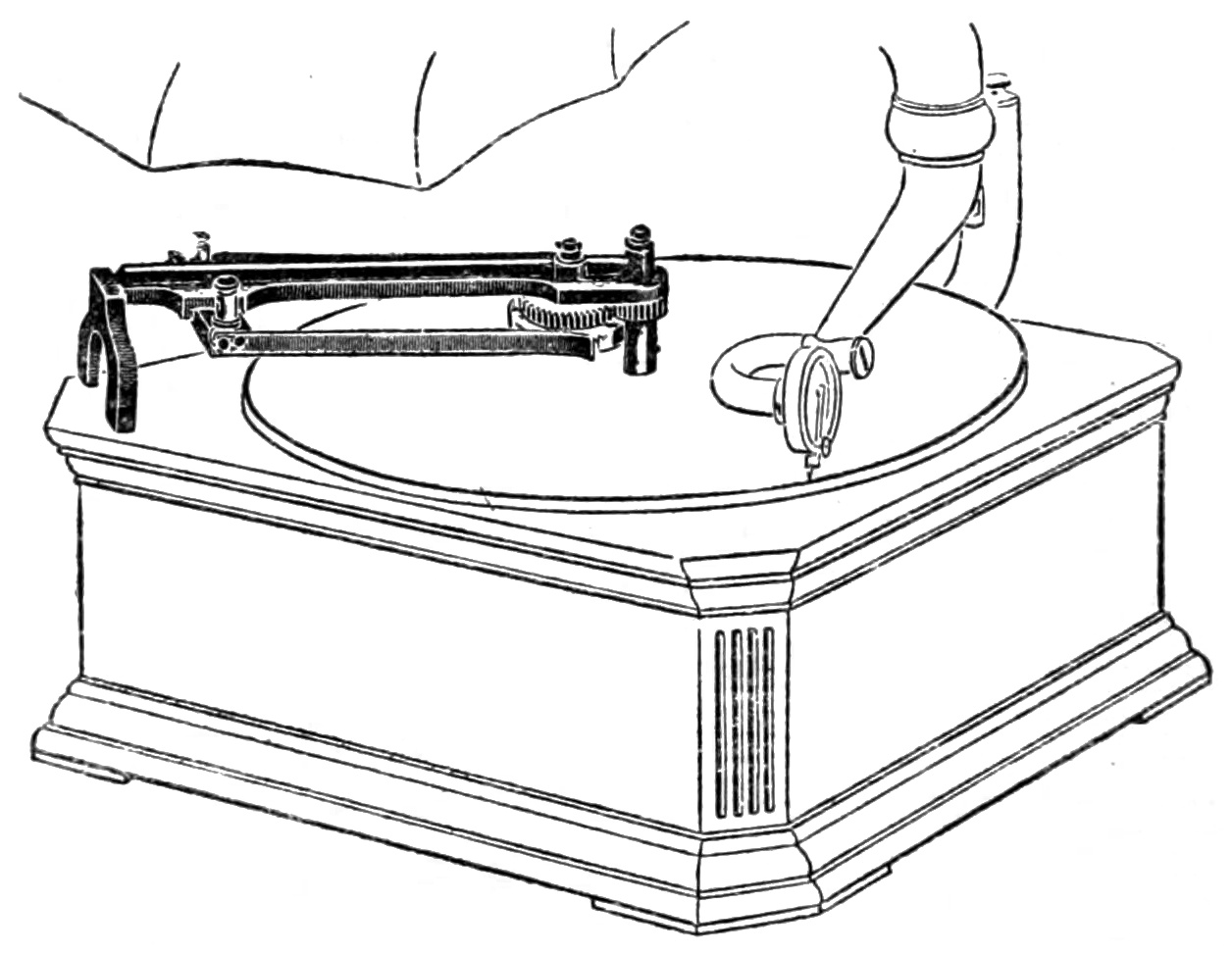
Fig. 14.—The Electrical Synchronising Attachment to
the Talking Machine in the “Vivaphone.”
The attachments to the projector and the gramophone are
very simple. The electrical contact device or commutator
is attached to the handle to establish connection between
the two parts of the apparatus. On the gramophone
is another commutator (Fig. 14). It consists of an
arm, one edge of which rests on the case of the talking
machine, while the opposite end engages with the motor
spindle of the gramophone projecting vertically through
the turn-table.
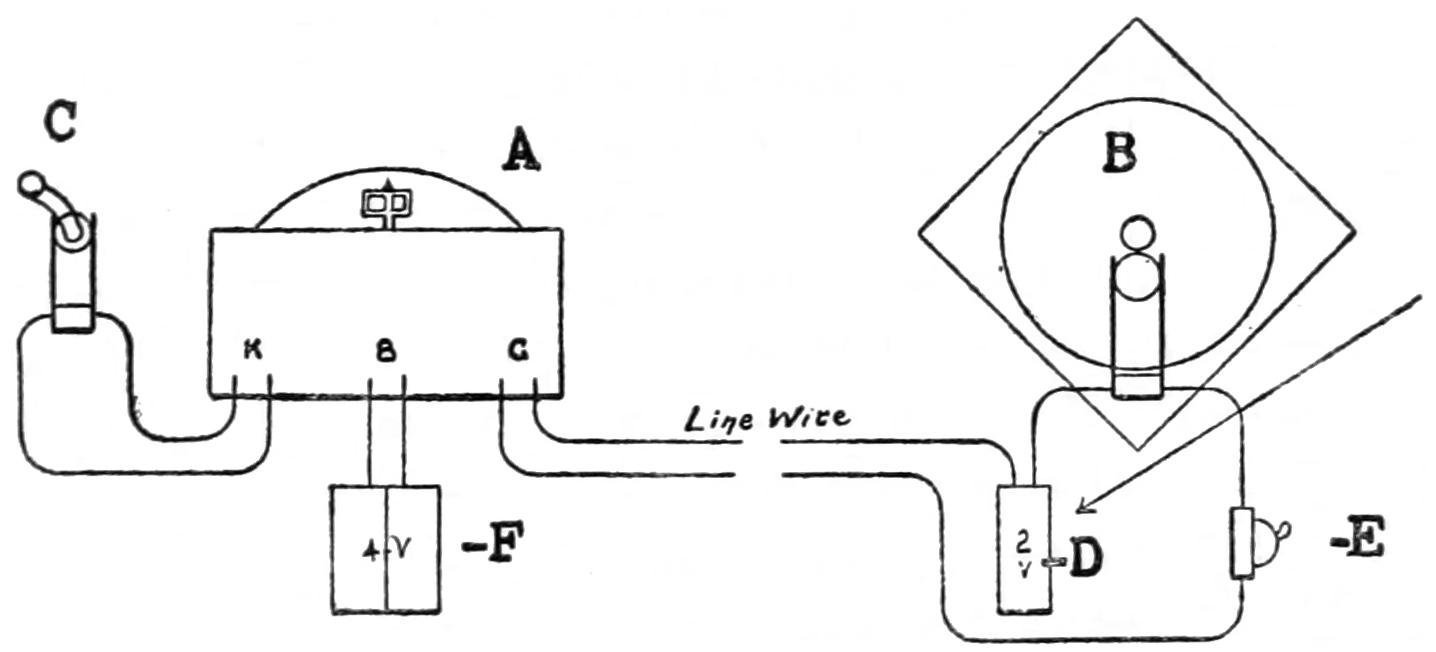
Fig. 15.—The Electrical Wiring System of the “Vivaphone.”
The installation of this apparatus (Fig. 15) is likewise
simple. The synchroniser A is placed in a convenient
position in the operator’s box, while the gramophone B
is set upon the stage. From the projecting handle commutator
C a pair of wires are run and attached to the connections
K in the synchroniser, while similarly a pair of
wires are carried from the talking machine commutator to
the connections G in the synchroniser. Two wires are led
from the terminals B in the synchroniser to the battery F.
Sufficient energy for the electric current is furnished from
a 4 or 6 volt accumulator, such as is used in automobile
practice, or from a dry storage battery. Ordinary bell wire
suffices for the purposes of the connections. If the distance
between the screen and the projecting box is very
great it is advisable to introduce an auxiliary cell D in the
gramophone circuit.
Behind the vertical needle of the synchroniser is a narrow
transparent slot, which, when the synchrony is perfect, is
covered by the needle itself. The upper end of the needle
is fitted with two small glazed apertures or spectacle
glasses, one on either side, fitted with red and green glass
respectively. When the apparatus is in use the two electromagnets
controlled by the cinematograph and the gramophone
respectively exert a pull in opposite directions—the
gramophone endeavours to draw the needle one way, and
the projector electromagnet attempts to pull it in the other
direction. If the projector is lagging, the needle moves
over, bringing the red spectacle before the light aperture,
and the red light thus shown warns the operator to accelerate
the projector. On the other hand, if the projector is
running too fast, the needle moves in the opposite direction
and brings the green light into prominence. The degree
of the deflection of the needle indicates how far the synchronisation
is disturbed. When the opposing forces of
the electromagnets are exactly equal, the needle maintains
a vertical position, and shows absolute synchrony. It will
be seen that the signalling system is very sensitive and
accurate, and at the same time enables the operator to have
complete control over projection. In fact this is the most
perfect system of synchronising the pictures with the sounds
emitted from the gramophone that has been yet produced
in the combination of sound and movement. Some excellent
subjects have been produced with this machine, one of
the finest being the sound and movement reproduction of
“Faust.”
But, after all, these devices are far from representing the
ideal singing and talking cinematograph. The drawback
is this: the conditions prevent the pictures being secured at
the same moment that the relative sounds are being
recorded by the gramophone.
While Edison was striving with the problem, French
investigators were active, and the first practical success
in the field must be credited to Monsieur Léon Gaumont,
the head of the French cinematograph establishment of
that name. He succeeded where Edison failed; or rather,
he anticipated the famous American inventor by several
years. It was as far back as November 7th, 1902, that
Monsieur Gaumont introduced his achievement for the
first time before the French Photographic Society. The
apparatus was not yet perfect, but it served to demonstrate
that the synchronous production of sound and movement
by the aid of the cinematograph and the talking machine
was within measurable distance of attainment. The
demonstration was held primarily to show how perfect a
synchronising mechanism had been evolved. The great
difficulty encountered was in regard to the sensitive character
of the material required for taking the records of sounds
from a distance. The ordinary process then in vogue was
far from being suitable. By the aid of several interested
friends and collaborators, however, Monsieur Gaumont was
able to conquer this obstacle, and on December 27th, 1910,
the “Chronophone,” as the new invention is called, was
submitted to the approval of the French Academy of
Sciences and was regarded as eminently successful by that
distinguished learned body.
Synchronism—both in producing and reproducing—between
the cinematograph and the talking machine is
secured by electrical connections between motors which
furnish the requisite power for driving the two essential
parts of the apparatus. In evolving such a combination as
this the inventor had to bear in mind that portability and
simplicity were two fundamental requisitions, so that resort
to heavy, bulky, and intricate mechanism was quite out of
the question. In comparison with the Cinephone and
Vivaphone, the Chronophone appears somewhat complicated.
But this is only relative. The apparatus is
almost entirely automatic in its operation. Yet it can be
operated by hand if necessary. If the latter method is
adopted, the energy required to secure synchrony is derived
from batteries or accumulators.
Synchrony is obtained by means of a patented system,
which may be briefly described. The two motors required
for driving the talking machine and the cinematograph
respectively are of identical design, of approximately the
same power, and are operated by the same direct current.
The armatures of each motor are divided into sections, and
the corresponding sections of the two armatures are connected
together. By means of this arrangement the two
armatures are rotated at the same speed, notwithstanding
the slight differences in the mechanical resistance opposed
to the machines.
The talking machine, driven by an electric motor, is of
the disc type, fitted with two horns, so as to diffuse the
sounds through the building. If the theatre is spacious
the number of horns may be increased, while the sound
waves projected into the hall may be intensified in volume
by means of compressed air, as in the Auxetophone devised
by the Hon. C. A. Parsons, which is also capable of considerable
adjustment, so that the volume of sound may
be accommodated to the acoustic properties of the building.
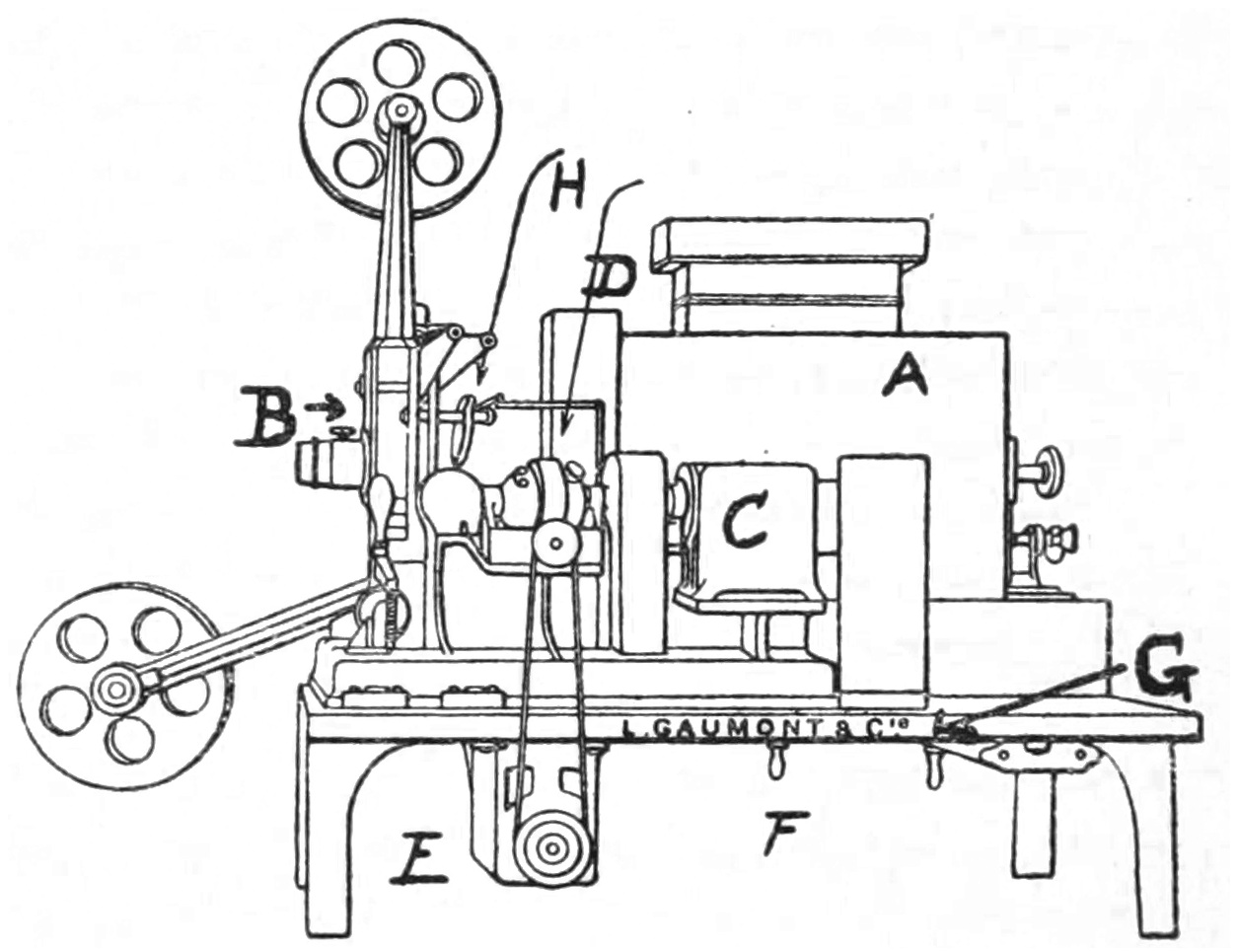
Fig. 16.—The Gaumont “Chronophone.”
In comparison with the ordinary bioscope mechanism
the Chronophone projector appears somewhat intricate, but
here again everything has been simplified to a remarkable
degree, while all adjustments are carried out automatically.
The projector installation (Fig. 16), in addition to the
lantern A and projecting mechanism B employed in the
ordinary equipment, consists of a small motor C, which
drives the projector mechanism proper and a differential D,
whereby error between sound and movement is corrected,
driven by a small motor E.
To start the apparatus, the first picture of the film, say
that of the title, is placed in the film gate before the
exposure aperture, and the needle of the talking machine
sound box is placed on the first groove of the disc record.
The talking machine motor is started, and the table carrying
the record commences to revolve. Directly the needle
reaches the point in the disc groove where the first sound
wave has been recorded, an electrical contact is established,
which is transmitted to the projector, and sets the latter
in motion. But it may be that the speed is too much or
not enough; the pictures move too slowly or too quickly,
and the tone of the sound emitted by the talking machine
is unnatural. In this case the operator moves the rheostat
handle F over its contacts, this movement accelerating both
the talking machine and the projector until the correct
natural speed has been secured.
Again it may be that the pictures are slightly in advance
of the phonograph, or vice versâ; the movements of the
lips of the singer or actions of the performer do not coincide
with the emission of sound. This error may be rectified
instantly. There is a two-way commutator on the control
board, which the operator moves in one direction or the
other according to requirements. This instantly starts up
the small dynamo E, the power of which is transmitted
through belt and pulley to the differential gearing D, which
works on the same shaft as that driving the projector.
If the projector is lagging it is speeded up, so as to overtake
the talking machine, or if the pictures are in advance
of the sound, it is retarded until synchronism is restored.
This device is particularly useful, inasmuch as the talking
machine is somewhat sensitive to outside disturbance; if
the machine is not set quite level, or receives a violent
vibration, the needle jumps suddenly from one groove into
another. By accelerating the projector this lead can soon
be reduced without touching the talking machine in the
slightest.
The operator need not follow the movement of the
pictures upon the screen, or listen to the talking machine
in order to ascertain that synchrony is perfect. He merely
keeps his eye on an ingenious, simple “control board,”
which is set up in a convenient position beside the projector
operator. It includes a starting gear, whereby
the talking machine is set in motion, and which in turn
actuates the cinematograph by the disc electrical contact,
an electric switch, a volt meter, which acts as a speed
indicator, its readings, in fact, having a constant relation
to the revolving speed of the talking machine turn-table;
and a two-way commutator, where the differential motor
is started up.
The differential gearing is somewhat interesting. It
belongs to the four-wheel type. There are two driven
cog wheels 1 and 2 keyed to the ends of the interrupted
shaft of the projector motor, and between these two wheels,
and set at right angles thereto, are two satellite wheels 3
and 4, which mesh with the former wheels. If the cinematograph
and the talking machine are moving in exact
synchrony, the wheels 1 and 2 run at similar speed, but
in opposite directions, and in harmony with wheels 3 and 4.
To the short end of the interrupted shaft a needle is
attached, and when synchrony is prevailing this needle
maintains a vertical position. Now, if the phonograph
runs away from the projector, this needle moves either to
the right or to the left, and as it slides over a graduated
scale the operator can detect in an instant how many pictures
the projector is lagging behind the talking machine.
The cinematograph projector accordingly must be speeded
up, and the operator moves the commutator on his control
board in the desired direction. Then instead of the two
satellite wheels meshing evenly with the two wheels 1 and
2, they become displaced, with the result that the shaft
driving the projector is rotated more rapidly, and overtakes
the talking machine, the needle on the dial meanwhile
moving towards zero, until, when it reaches its
vertical position, the differential gearing and its motor are
stopped. If the projector should have advanced before
the talking machine, it is retarded, the needle deflecting
in the opposite direction and requiring to be restored to
zero. It will be seen that the speed of the talking machine
remains constant. Any correction that has to be made is
effected by means of accelerating or retarding the speed of
projection.
As, however, the records of movement and sound are
made in synchrony, and in view of the fact that both projector
and talking machine run at the same speed, if started
simultaneously no displacement of one in relation to the
other should result. The differential, however, provides
a means of correcting any accidental displacement of the
phonograph needle when reproduction is carried out.
The Gaumont apparatus has proved highly successful,
and has been turned to useful account already; we have
excerpts from operas, ballets, recitations, and so forth
recorded and projected with a perfect relationship between
sound and movement. Through the energy and perseverance
of Monsieur Gaumont the value of animated
pictures has received a decisive forward impetus.
Edison has devoted his energies in the solution of the
problem to the perfection of a more sensitive material than
the wax hitherto employed. Naturally he has confined his
attention to adapting to this work the phonograph or
cylinder talking machine in preference to the disc machine,
the former being his own invention.
What is the future of the phono-cinematograph? In the
first place, until the peculiar nasal sound is eliminated
from the talking machine it will not prove popular. It is
well-nigh impossible, unless a speaker or singer has
peculiar characteristics, to identify voices on this instrument.
Furthermore expression in tone is practically non-existent.
Though the cinematographic world be flooded
with talking and singing pictures, unless they are of some
peculiar interest, the majority of picture-theatre lovers,
after the first wave of excitement and curiosity, will
patronise those establishments where they can see movement
alone.
CHAPTER XVII POPULAR SCIENCE AS REVEALED BY THE CINEMATOGRAPH
The average audience before the micro-cinematographic
film is very much in the attitude of the schoolboy in the
natural history lesson. Scarcely any other subject holds
such possibilities of interest for him; yet the instruction
must be given in some vivifying form, or it fails to touch
his latent sympathy, and becomes a tiresome repetition of
formulæ and inexplicable processes. Similarly an
audience will sit absorbed before a film displaying infinitesimal
organic life; but only on condition that its human
instincts are in some way appealed to. Science lessons
must be humanised, when they rival the most dramatic
films in interest.
Unfortunately the supply of this kind of film is extremely
limited. Producers are not convinced of the heartiness of
the demand; and the labour, expense, and anxiety attending
the preparation of such subjects prevent their development
upon any but a small scale.
An account has been given of Dr. Comandon’s wonderful
achievements in bacteriological micro-cinematography,
through the firm of Pathé Frères. In popular science the
world’s market is practically supplied by an English
company, Kineto, Limited.
This fact is due mainly to Mr. F. Percy Smith, who
possesses the happy faculty of investing his subjects with
a quaint fascination which compels appreciation. It is
doubtful whether any film has stirred popular interest so
intensely as that which he prepared for the purpose of
illustrating the physical energy possessed by the common
house-fly.
When this film appeared the newspapers far and wide
associated the cinematographer with strange powers, and
the capacity to train the bluebottle in much the same way
as the lion tamer subdues the King of the Forest. Nothing
was farther from the truth. The scientist merely devised
unusual and novel devices to illustrate the points which he
had in mind, and the fly was left more or less to follow its
own devices. For instance, it was seen to walk again and
again up the rim of a small wheel in a vain effort to reach
the highest point. “Trickery!” was the verdict when the
film was seen first, and it was hard to make people believe
that the picture was genuine. As a matter of fact, the fly
performed the operation quite naturally, though in order
to induce it to do so the experimenter had to resort to an
ingenious device.
A dark box was prepared with a very small door of thin
glass at one end. This piece of glass was fitted with a
narrow slit in which a small toothed wheel, similar to a
watch escapement wheel, was fitted in such a way as to be
free to revolve. The imprisoned fly, seeing the daylight
entering through the glazed end of the box, attempted to
escape in that direction, but found its passage obstructed
by the glass. When it struck the latter, it received a smart
tap on the head from a tooth in the wheel, which was
caused to move through the fly’s frantic efforts. Time
after time the fly threw itself against the glass door, and
on every occasion it received a rap on the head. At last
frenzy gave way to tractability, and it came to the conclusion
that the best means of escape was by walking up
the wheel. Of course, as it advanced the wheel slipped
round in the opposite direction. While the insect was
walking like a criminal on a treadmill, the pictures were
taken.
The results with the fly under restraint, however, were
not entirely satisfactory, so the experimenter set up the
wheel in the open, and withdrew a fly from its prison after
it had become tractable. Time after time the blue-bottle
would fly away directly it was placed on the wheel. The
camera, however, was kept in readiness for exposure the
moment a fly did attempt to walk along the rim, and at
length it was successfully caught in the act. Again, the
fly was laid upon its back beneath the wheel, and was seen
to revolve the disc with its legs. The simple explanation
of this seemingly clever juggling trick was that the fly
thought it was walking in the same way that it walks up
a wall or along the ceiling.
One fly in the same film was seen seated in a diminutive
chair nursing a smaller fly, or balancing and juggling with
articles such as tiny dumb-bells, but of large size in
comparison with its own bulk. In this instance the fly
was secured by a thin strand of silk passed around its
body; but here again, in performing the apparent juggling
feats, it was merely following its instinct. Being prevented
from flying, it naturally endeavoured to make
progress by walking.
The fly was to be seen endeavouring to balance a piece
of cork, and intense amusement was caused when it was
seen to wipe its feet, in the same way that a man rubs his
hands together, preparatory to making some kind of effort.
In reality, the fly found that the suckers on its feet, by
means of which it secures a grip upon a surface when
walking upside down, were somewhat dusty. The
apparent preparation for a herculean attempt was nothing
more than the fly cleaning its organs to achieve its
purpose.
This film occupied several weeks in preparation. Extreme
patience had to be exercised, and when a desired
phase of movement had been secured, often it was found
defective from the technical point of view, so that the
wearying round had to be repeated. Recently Mr. Smith
has continued his investigations, and has produced another
fascinating film, demonstrating still more clearly the
tremendous physical energy possessed by the bluebottle,
and the wonderful powers of its proboscis, the movements
of which, to assist the legs, are shown very distinctly.
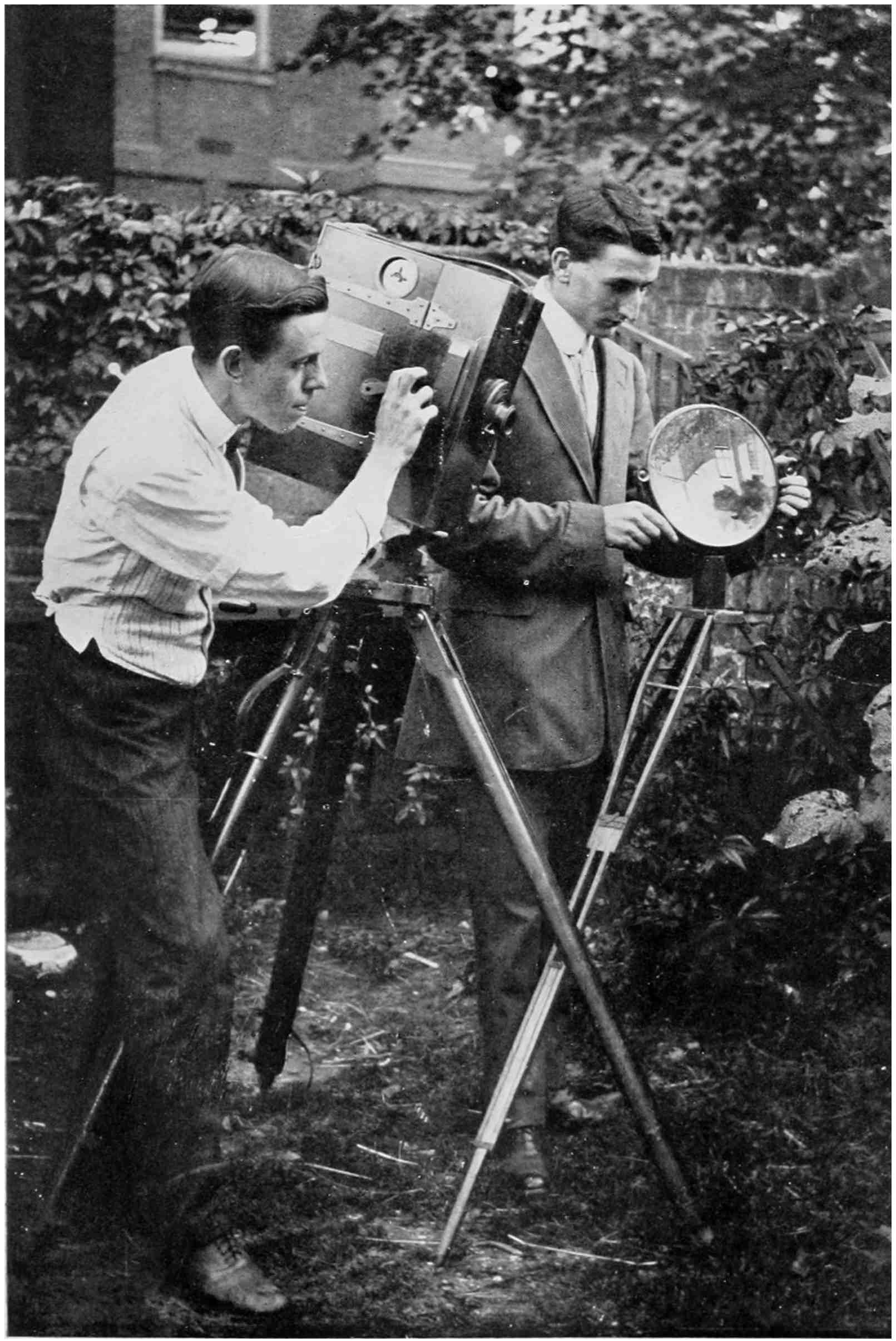
NATURE AND THE CINEMATOGRAPHER—MR. PERCY SMITH AT WORK.
Great Britain has taken the lead in bringing the wonders of science popularly before
the public.—See page 190.
Another of Mr. Smith’s achievements is the film showing
the hatching of a chicken’s egg. The period of
incubation is extended over 21 days—about 500 hours—and
the egg naturally has to be preserved at an even temperature
the whole time, so some special means had to be
devised to make the film without imperilling the life of the
embryo. The opaqueness of the shell constituted a
formidable stumbling-block. Moreover, in the initial
stages the embryo is so small, and its movement so slight,
that little difference is observable for the first 50 hours or
more. Direct photography was seen to be out of the
question.
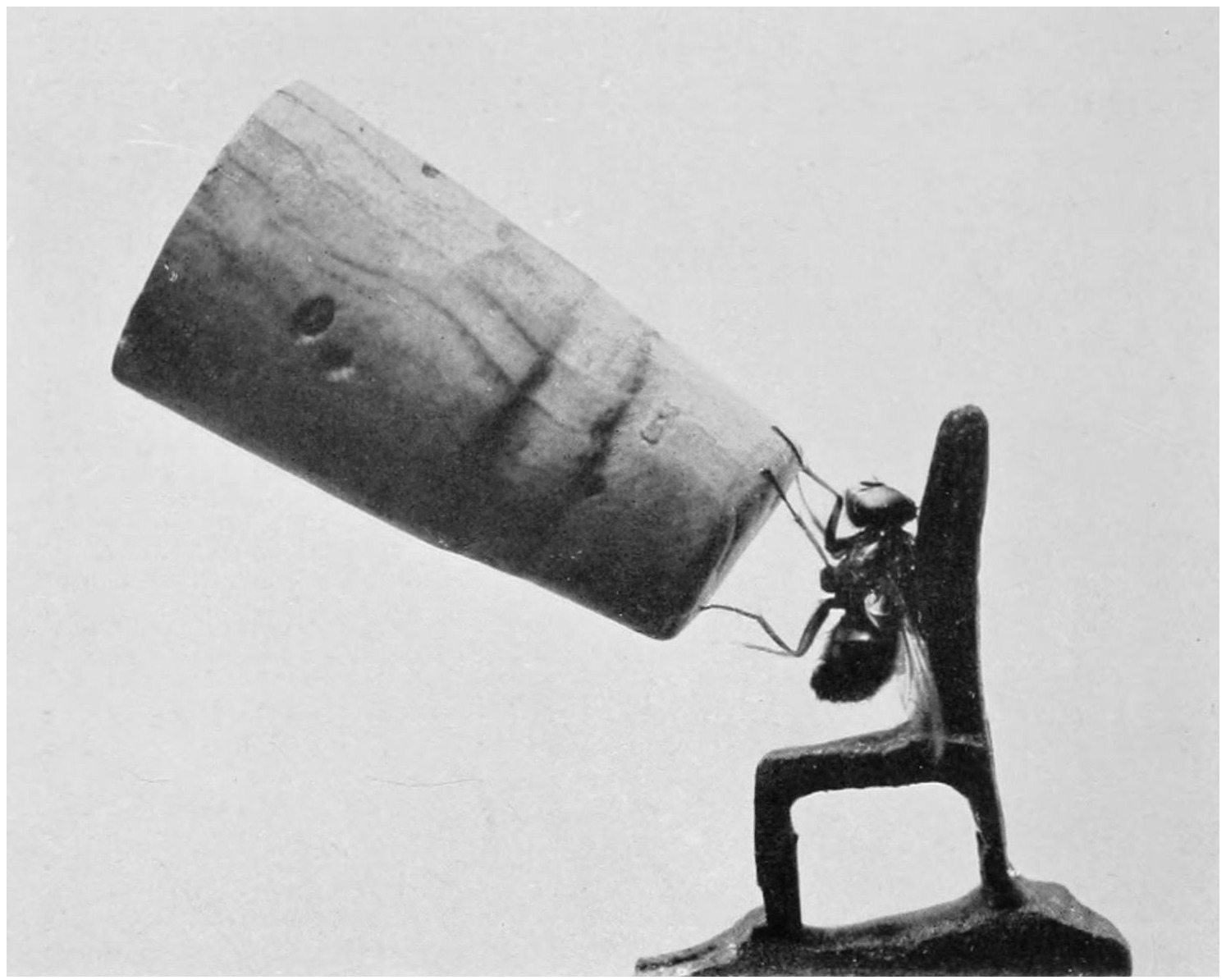
FLY SEATED IN A DIMINUTIVE CHAIR BALANCING A CORK.
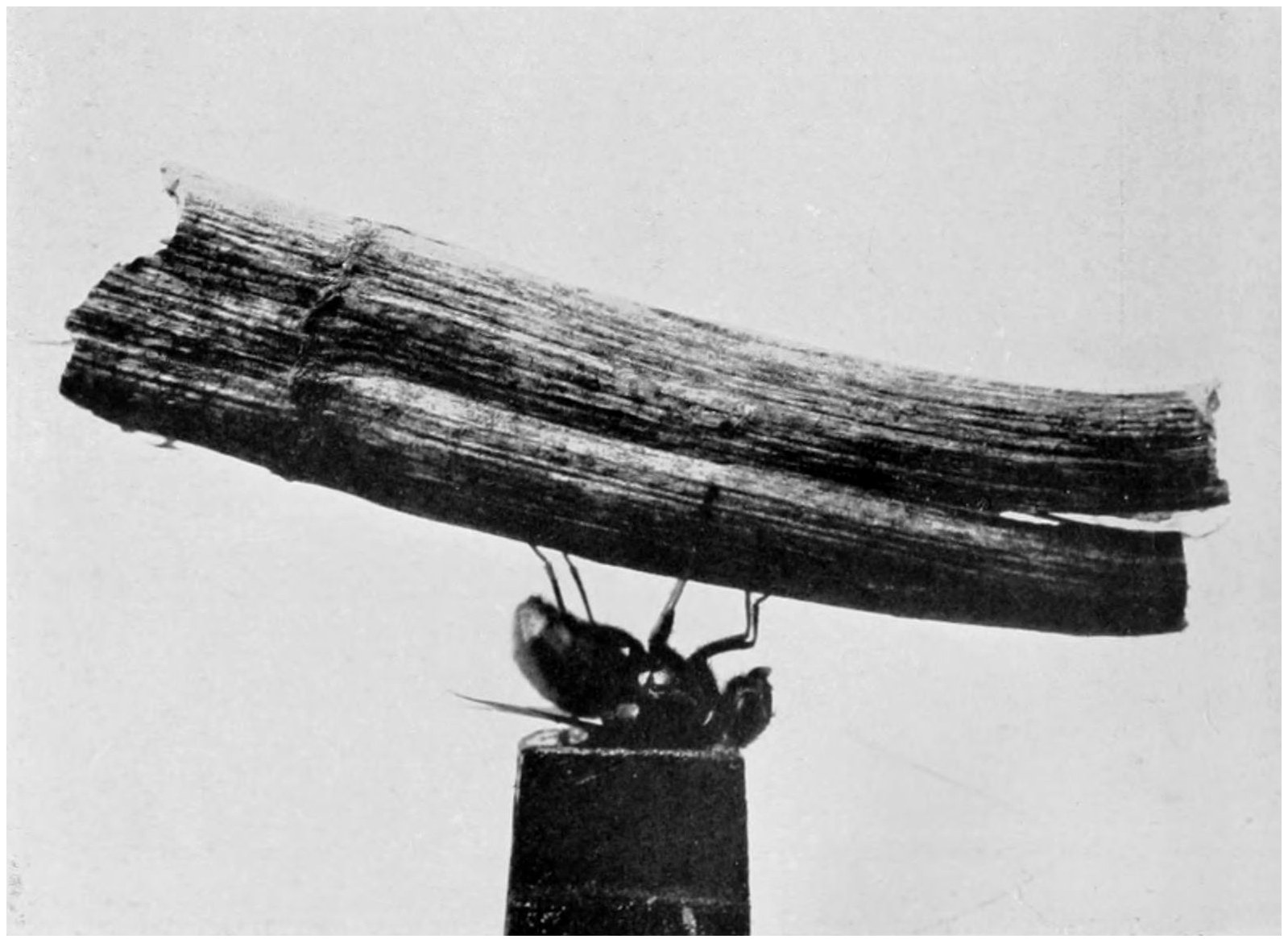
AN UNFAMILIAR JUGGLER—BLUEBOTTLE BALANCING A PIECE OF
VEGETABLE STALK.
An incubator was acquired, and the eggs were placed in
it. At regular and frequent intervals during the incubation,
some were withdrawn, and opened to ascertain the
size and position of the embryo.
From these data diagrams of the early stages were prepared.
They were drawn carefully to scale and accurate in
every detail. This task had to be continued during the
first 54 hours—the period when the movements of the
embryo were unknown—and involved the preparation of
no fewer than 1,000 diagrams, prepared in such a way that
they resembled photographs. From the number of these
records and the period occupied in incubation, it will be
seen that they were prepared at intervals of about three
minutes during both day and night. This consecutive
series were then cinematographed upon the film, and thus
a natural development lasting 2½ days was reduced to a
period of about one minute upon the screen.
The early part of the film is not so interesting to the
public as that showing the chick coming out of the shell.
Here again an initial difficulty was encountered. The
hatching, of course, could not be cinematographed inside
the incubator; and to remove the egg from the temperature
of 103° in which it had been kept was to arrest the process
at once.
Fortunately the experiment was being made in summer,
and the thermometer read 103° in the sun. The camera
was set up, and at the moment the chick gave signs of
breaking through its shell, the egg was removed from the
incubator and placed upon a table in the full glare and
heat of the sun. In a few seconds the chick made further
efforts to break down the walls of its prison, and very soon
made the first breach in the shell. As the heat of the sun
was exactly that of the incubator, hatching was continued
under precisely natural conditions. It was not long before
the hole in the shell was widened sufficiently to enable the
chick to wriggle its way into the world. From the cinematographic
point of view, the hatch was as perfect as could
be desired, especially as the chick was strong and active
after hatching.
Mr. Smith once ventured into the Sussex woods, to
obtain some animated photographs of the British adder in
its natural haunts. He succeeded in tracking down an
excellent specimen, of which some first-rate pictures were
taken. Then he proceeded to record on the film the
methods by which this reptile may be caught and handled
in safety. While holding a large specimen in his hand
he provoked it to fury, and caused it to strike out savagely,
so as to secure on the film some life-like pictures of an
adder striking, as well as details of its mouth and fangs.
As a contrast, he then decided to show how an adder should
not be handled. He took the precaution to chloroform the
reptile before mis-handling it, but the snake recovered too
soon from the anæsthetic, and striking out with its fangs,
caught the investigator a smart blow on the hand, leaving
two minute punctures. The bite of the adder is seldom
fatal, but, contrary to popular belief, it is far from harmless,
producing delirium and precipitating collapse,
recovery from which occupies several hours, or in some
cases even weeks, as Mr. Smith found to his cost.
An unusually successful popular science film is the one
showing the development of a flower from seed to blossom.
It has been encored more than once on being presented.
The average plant demands several weeks from seed to
blossom. Mr. Smith made an ingenious apparatus for
securing a continuous representation of growth. The seed
was shown first in the initial stages until the embryo burst
from the protective or outer shell or husk; and then continuously
from the moment the first sign of the shoot
appeared above the level of the soil.
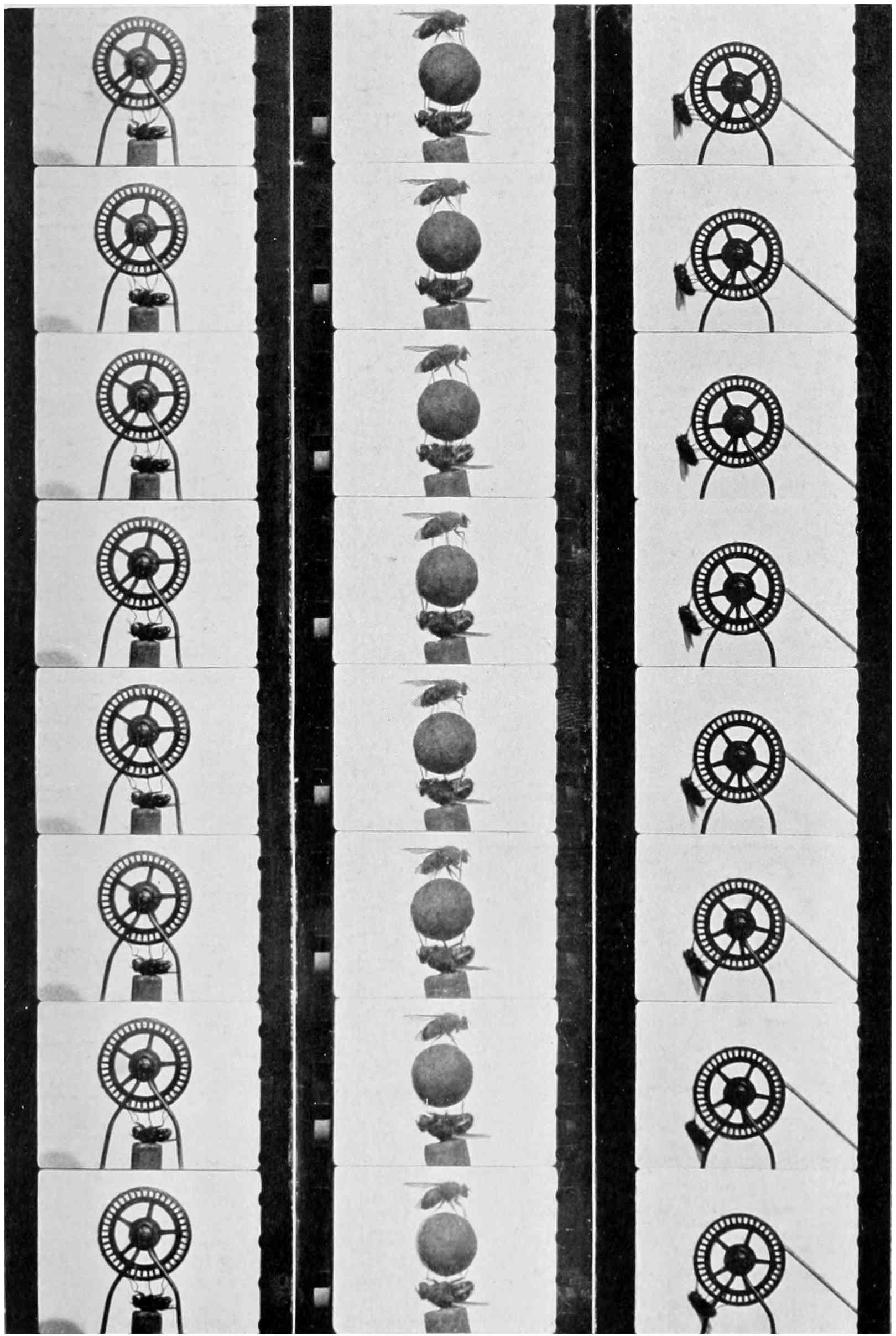
[Copyright, Urban Trading Co., Ltd.
1. 2. 3.
DEMONSTRATING THE PHYSICAL ENERGY OF THE FLY.
1. Fly lying on its back spinning a wheel. 2. Juggling flies.
3. The fly walking up the turning wheel.
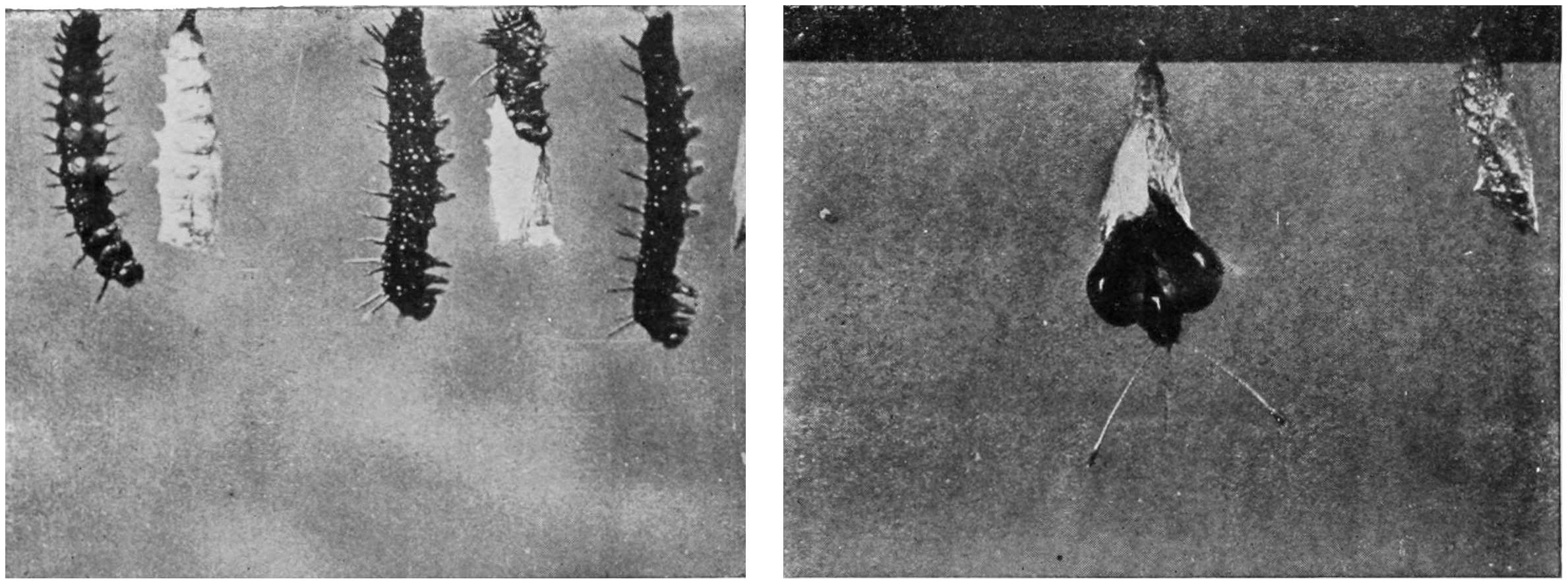
THE LIFE OF THE BUTTERFLY.
This remarkable film, prepared by the Ambrosio Company of Italy, illustrates the fascinating evolution of the butterfly from the caterpillar.
It secured the premier award of 5,000 francs for the best natural history film in the cinematograph section of the recent Turin Exhibition.—See
page 324.
The camera was set up and an automatic apparatus
attached thereto, which enabled an exposure to be made
at predetermined intervals both during the day and night.
The apparatus was driven by a curious motor which
obtained its power from dripping water; and the arrangement
was such that, after the exposure was made, the film
was moved forward to bring the next area of sensitised
surface before the lens. The receptacle containing the
seed was placed at the correct distance to ensure a large
picture, and for the purposes of illumination at night a
special device was connected to the driving mechanism of
the camera, whereby the subject was brilliantly illuminated
at the instant of exposure. The exposures were made at
average intervals of thirty minutes, giving forty-eight
exposures at different stages of the growth in the course
of the twenty-four hours. When projected on the screen
at the normal rate of sixteen pictures per second, it looks
as though the growth of the plant had been forced to
about 30,000 times its usual speed, with the camera
continuously in operation the whole time.
The great secret of Mr. Smith’s success is the simplicity
of the apparatus he employs for his work. Each subject
demands special arrangements. His contrivances for the
most part are extemporised from crude materials; even
the microscope, which he sometimes uses, being of the
simplest and cheapest pattern. He has found that
elaborate apparatus often complicates his work without
producing such good results as are procurable by the most
primitive devices.
Work in this field is attended with some curious results.
The eyes of some of the lower animals are extremely fine
lenses, and unless care is bestowed some sorry tricks are
played at the expense of the scientist. Mr. Smith related
to me that on one occasion he secured an excellent series
of pictures of the frog at close quarters; and congratulated
himself upon his success. His dismay was great when
he projected the pictures for the first time. Although the
frog itself was beyond reproach, interest in it paled before
the unexpected sight of the operator turning the handle
of the cinematograph, reflected with great distinctness in
the frog’s eye.
There is one great difficulty attending the photography
of the smaller organisms of Nature which is very difficult
to surmount; that is, unnatural results arising either from
the disturbance of the object under examination, or its
photography in a false environment. This complexity is
emphasised very strongly in connection with cinematography.
If it is desired, for instance, to record garden
pests engaged in their destructive work, it is trying indeed
to convey a correct pictorial description of their methods.
Troubles concerning illumination are particularly baffling
of solution. Mr. Smith has devised a special apparatus,
which is very similar in its general characteristics to a
heliograph, mounted upon a tripod stand so that it can
be revolved in any direction. With this parabolic reflector
the sunlight can be brought into position and concentrated
upon the subject under cinematographic observation without
disturbing it. The photographs by this means of
insects at work, no matter how unreal they may appear
at first sight, are absolutely true to Nature, and are taken
under incontestably natural conditions. In fact, the ray
of illumination thrown upon the object by this means is
so brilliant as to enable subjects to be photographed in
their natural colours; which fact may in the future afford
scientists a wonderful opportunity of studying protective
colouring in insects.
It is probably beyond dispute that the popular scientific
film, treated in such a manner as is indicated in this
chapter, is certain to command the approval of the public
in the end. At the present moment the popular scientific
cinematograph picture is in its infancy. It will be only
through the perseverance of the scientist who has the
happy faculty of amusing as well as entertaining a general
audience that this class of film ever will have a vogue.
The tendency towards this state of affairs, happily, is
improving every day, for the cinematograph is appealing
more and more to the cultured classes, who, after all,
constitute its most substantial support.
CHAPTER XVIII TRICK PICTURES AND HOW THEY ARE PRODUCED I.—The first attempts at cinematograph magic and the artifices adopted
As soon as the cinematograph had established itself
firmly in popular favour, and there was every indication
that it would become a permanent form of entertainment,
it entered one field after another of popular interest. We
have seen how the picture play was evolved from unrehearsed
episodes in everyday life; and when the studio-stage
became an indispensable acquisition to the picture
play producer, another movement was created. This was the
trick film. The pioneers realised that the intervals between
the exposure of successive sections of film corresponding
to an image offered extreme opportunities for the practice of
chicanery, and the presentation of weird, fantastic, and
mystifying effects.
The trick-film owes its inception to a well-known French
prestidigitateur, Monsieur Mélies. He was among the first
to embark upon the manufacture of film subjects, and
it naturally occurred to him to impress magic into the
service of the industry. His first attempts were of the
simplest description. He confined himself to the performance
before the camera of the same tricks that he offered
an audience from behind the footlights.
Having by this means tested the public and found it
responsive, he introduced all the devices known to the
“Black Art.” Furniture danced upon the screen, and
moved hither and thither about a room; skeletons gambolled
capriciously; weird displays of “Black Magic” were
shown; all sorts of inanimate objects were imbued with
life; dolls and toy animals and birds were given the
semblance of natural action. The films amused and
mystified the public exceedingly, and the Mélies trick films
enjoyed a remarkable vogue.
Meanwhile, Robert Paul in England had been considering
the feasibility of the same idea, but had feared that the
personality of the magician would be missed. Seeing the
success of the Frenchman, he decided to embark upon a
similar line of activity. He saw the possibility of producing
far more startling effects than even the most accomplished
and dexterous magician ever could hope to achieve. But
the task bristled with difficulties. The stage had to be
overhauled and equipped with elaborate devices to facilitate
sudden disappearances, apparitions, etc. A workshop also
was necessary for the preparation of the properties, and
the character of the work rendered indispensable the services
of an expert magician.
Cinematographic knowledge was in its infancy; and
accordingly some of the methods used in the late nineties
seem somewhat involved as compared with those practised
to-day. But it was upon these early struggles and failures
that the present adequate equipment was built up. Indeed,
from the point of view of the audience many of these first
films have never been surpassed.
To describe the methods adopted in the production of
every trick picture is obviously impossible in the compass
of this volume, but I am able, through the courtesy of
Mr. Robert Paul, to explain how many of the strange
effects in his most striking trick films were achieved. The
processes most generally practised were the “stop-motion”
and “double printing,” which are explained fully in the
next chapter, but in addition to these methods he devised
many others, some of which have been superseded by easier
operations. For example, where gradual disappearances
and appearances were desired, instead of using a rectilinear
diaphragm stop in the lens as is now usual, Paul occasionally
resorted to the chemical dissolution of the emulsion and
image from the film—an intricate and delicate manipulation
entailing considerable time and care, because if the dissolution
process were carried too far or undertaken by unskilled
hands, the film was spoiled and much labour fruitlessly
expended.
Sometimes the desired result was brought about by
means of two special detachable stops, which were placed
in the lens. Each of these stops had a V-shaped opening
of identical dimensions, and were set at right-angles to
one another. As they were gradually drawn apart the
aperture formed by the intersection of the V-openings
through which the light passed to the film was enlarged,
while, on the other hand, as they were moved towards one
another, the aperture was decreased, until at last the film
scarcely recorded any impression of the subject photographed.
The gradual synchronous movement of these two
V-shaped stops was somewhat difficult. To-day their place
is taken by the rectilinear stop in the lens, whereby the same
effect can be produced much more easily.
One of the best and most successful trick films Paul
ever produced was the mediæval mystery entitled “The
Magic Sword.” It appealed to the grown-up because of
the astonishing effects introduced, and to the children for
the reason that it provided an intimate glimpse of fairyland
with its giants, witches, good and bad fairies, and other
strange beings not encountered in this world. It was
sumptuously produced, and many of the tricks were introduced
to the public for the first time.
The first scene shows a gallant knight meeting his lady-love
on the battlements of the castle at midnight; a ghost
appears, towards which the knight advances, but it melts
from his grasp. A witch rides over the dark sky on her
broom, and the knight in turn endeavours to seize her, but
she eludes his attack and departs, shaking her fist in
rage. An ogre no less than fifteen feet tall thrusts his
head and shoulders over the battlements, seizes the damsel
and bears her off through the sky. The lover is in the
depths of despair, but a good fairy comes to his aid, gives
him a flaming sword, and bids him go in search of his
lady-love.
The battlemented castle gradually dissolves into a witch’s
cavern, to which the frightened lady is brought captive by
the witch, and transformed into a second hag. Many adventures
follow; finally the good fairy triumphs over evil,
and the witch is converted into a roll of carpet, on which
the lovers float through the air to fall from the sky upon
the lady’s parents while they are banqueting in the castle
grounds.
The trick effects in this film were produced almost entirely
by double printing, two negative films being superimposed
to make a positive. The accompanying illustration
shows how the appearance of the ogre was obtained.
The scene with the two principal players, the knight and
the lady, first was acted and photographed upon one film.
The sky was a neutral back-cloth with a crescent moon
painted on it. Then the second film was prepared bearing
the ghost, the witch, and the ogre respectively. The
spectral effect of the ghost named was realistically conveyed
by under-exposing the second film, so that the
stone of the battlements could be distinguished plainly
through the form of the figure. The ogre was an
actor of ordinary height, but as he was photographed
with a short-focus lens from a point nearer the object than
the characters in the first scene, when the print was made
he appeared to be more than twice as tall as the other
performers. In this scene the wall over which he reached
was covered with black cloth.
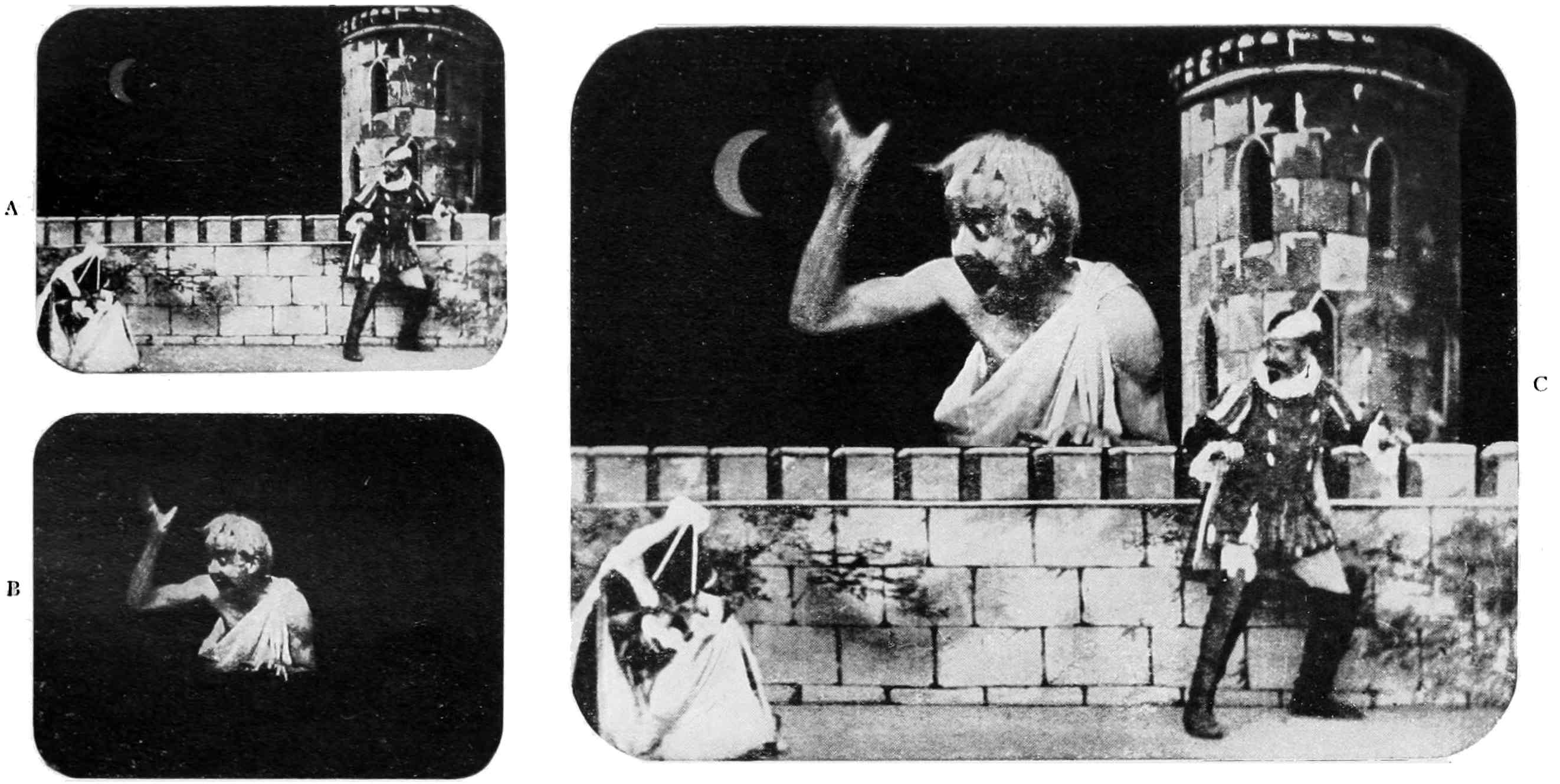
THE MAGIC SWORD: A MEDIÆVAL MYSTERY EXPLAINED.
Scene A was photographed first. The ogre was photographed against a neutral background upon a second film, B, the camera being brought
very close to the figure. When the two films were superimposed and printed the startling picture C was obtained.
In order to get the effect of the witch riding in the sky,
Paul invented a novel movement in the camera, which is
now in general use in trick cinematography. The lens
was arranged to be raised or lowered in relation to the area
of film in the gate, but still independently of the film itself.
This was done with a small gearing device whereby, when
the gear handle was turned, the lens was moved upwards
or downwards. The witch astride her broom stood upon
the floor of the stage, which was covered with black cloth,
against a background of similar material. By turning
the gear handle of the lens attachment the latter was
raised, until the witch riding on her broom was lifted to
the upper corner of the film and there photographed.
Although she simulated the action of riding through space
in the traditional manner, in reality she merely moved
across the black-covered floor of the stage.
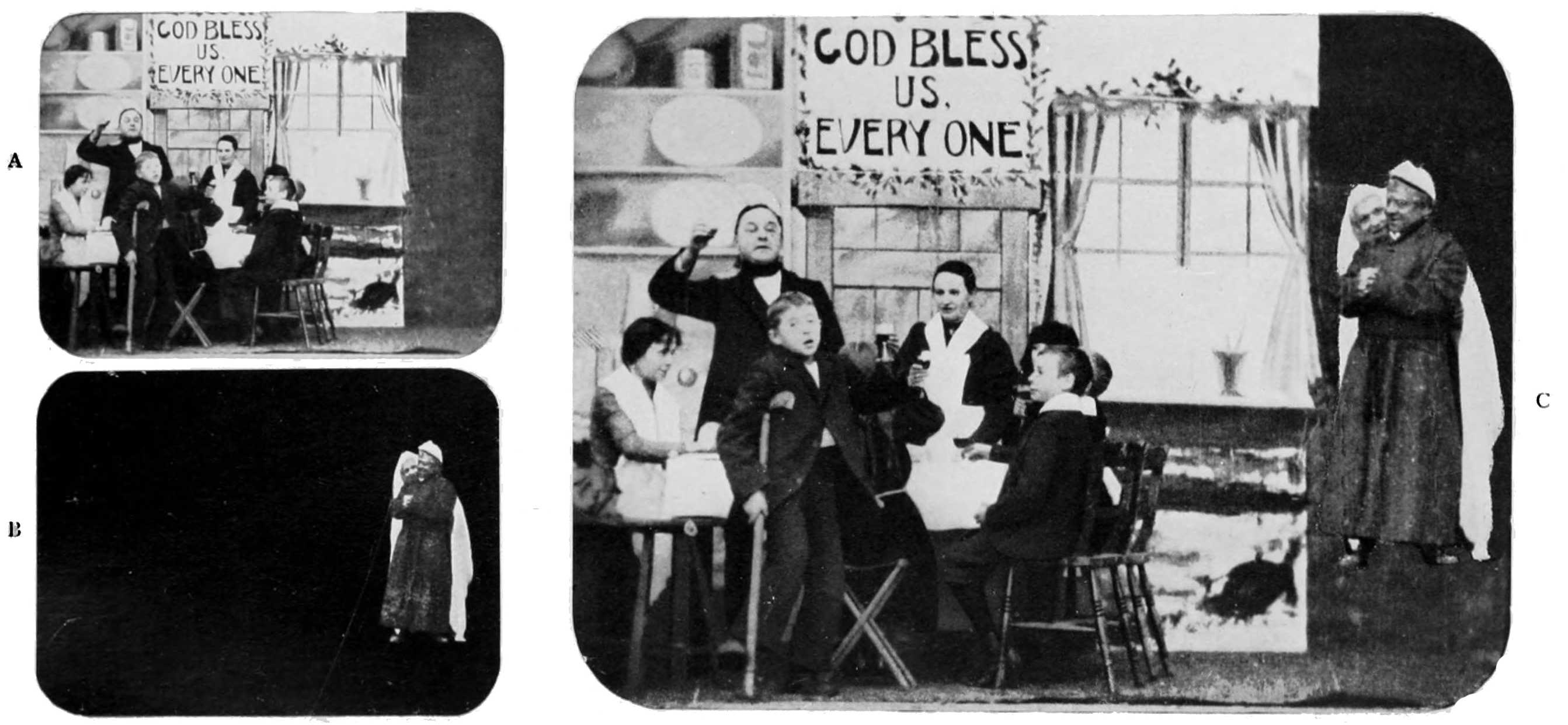
A CHRISTMAS CAROL: HOW SCROOGE SAW BOB CRATCHIT’S HOME.
The scene of the Xmas dinner, A, was photographed with the space at right. On the second film Scrooge and the spirit, B, were obtained.
These two films were placed together for printing the complete picture, C.
The strange effects produced in the witch’s cave were
obtained both by double printing and the “stop motion,”
as well as by the manipulation of the stop in the lens. The
conversion of the captured lady into a witch was accomplished
by stopping the camera; and while the lens was
covered by the shutter, introducing a second actress, already
made up, who stepped into the position occupied by the
lady, while the latter quickly left the stage. The other
actors maintained a rigid position while the camera lens
was closed and the substitution took place. The conversion
of the witch into a roll of carpet was effected in a similar
way. When the “stop” call was given the witch disappeared
from the stage, and a roll of carpet took her place.
The journey of the lovers through space upon the magic
carpet was carried out by the manipulation of the rising
and falling lens already described. When the solution
of the baffling trick is given it appears absurdly simple,
but the elaboration of the idea entailed several weeks’ preparation,
combined with hard thinking on the part of the
producers, while the filming alone occupied several days.
Paul’s studio was excellently adapted to producing strange
variations in stature. He could make a giant or Lilliputian
at will. The camera was mounted upon a special trolley,
which could be moved forwards and backwards in relation
to the stage over a pair of rails similar to a railway track.
The closer the camera was to the stage the larger were
the figures. A photograph at a distance of fifteen feet
presented people of normal height. But when the camera
was advanced close to the stage the players photographed
were of immense stature, an effect emphasised still further
when one film was printed over the other.
By varying the distance between the camera and the
stage Paul produced some delightful results. One picture
was called “The Cheese Mites,” or “Lilliputians in a
London Restaurant.” A traveller entered a café and took
his seat before a window. When he had finished his meal
the waiter brought him a mug of beer, out of which, to
the intense surprise of the traveller, a little sailor about
six inches in height climbed and executed a hornpipe on
the diner’s plate. The sailor then went to the cheese, which
was about his own height, and produced a lady therefrom.
The sailor and the lass were engaged in an animated conversation
when another little man appeared on the scene.
The two men ultimately quarrelled and there was a spirited
contest.
This introduction to modern Lilliput is simple to explain.
On one film the diner and his actions were photographed,
the camera being, say, fifteen feet distant. After this film
was secured a second film was made of the Lilliputians,
who, of course, were not midgets, but people of normal
stature. They acted against a background of neutral tint;
but the camera was set about 150 feet from the stage, and
a long-focus lens was used. The consequence was that the
figures appeared very tiny upon the second film, so that
when the two films were superimposed for the purposes
of printing the positive the contrast between the diner and
the sailors was strangely impressive, the latter being no
taller than the jug upon the table.
Some very astonishing results can be obtained by this
superprinting operation, either straightforwardly or in
combination with the variation in the photographic range
as described in the previous paragraph. The soldier dying
on the battlefield sees his home and mother in a dream
which occupies the whole of one corner of the picture; there
is the vision of Marley’s Ghost, and so on. One of the
earliest of Paul’s simple trick subjects was a film illustrating
the song “Ora Pro Nobis,” wherein the starving,
ill-clad orphan was seen to sink in collapse in the snow
outside the church door, the climax being the death of the
waif and the descent of the angel to receive and bear her
spirit heavenwards. This was effected purely by double
printing, the ascending and descending action of the angel
being carried out by means of the gear-operated falling and
rising lens of the camera.
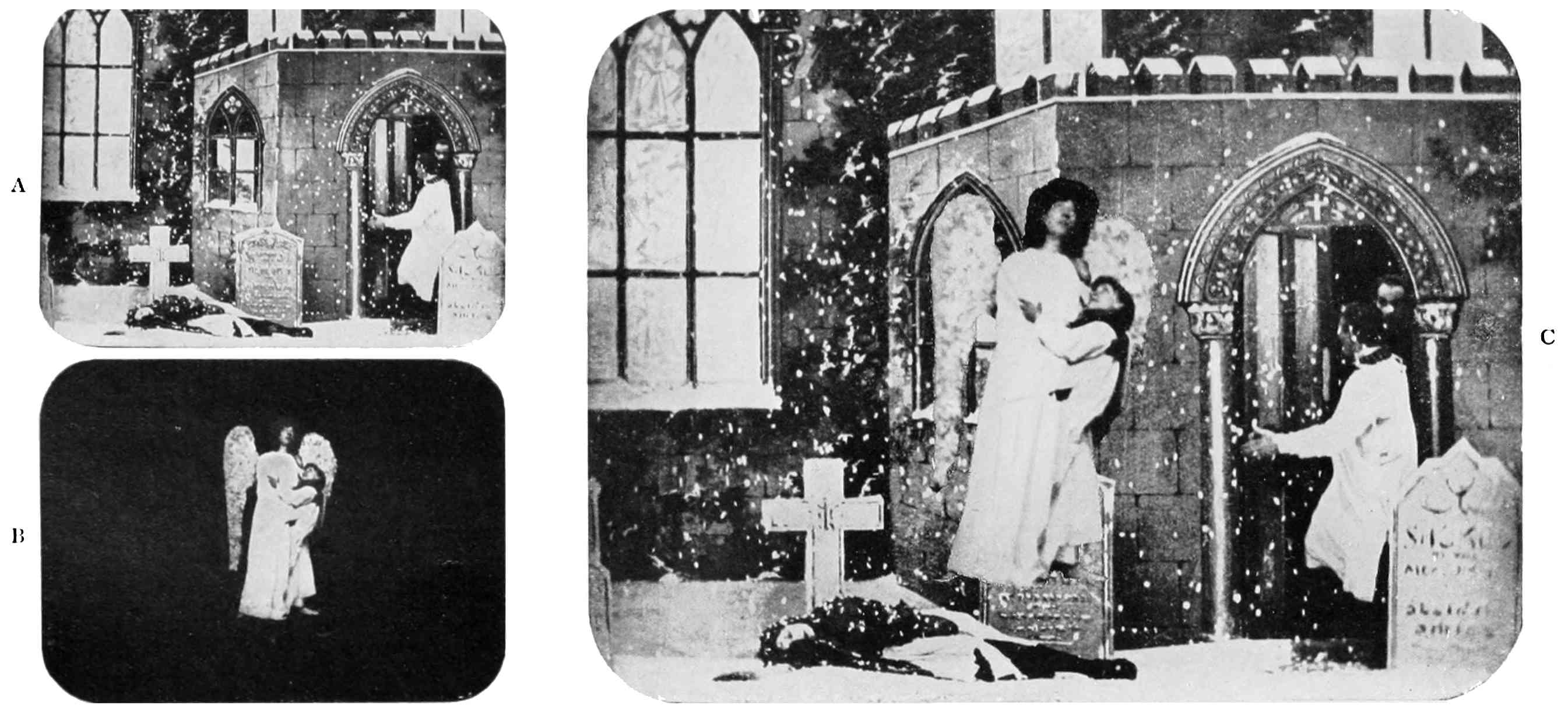
[By courtesy, R. W. Paul.
“ORA PRO NOBIS” AND HOW IT WAS PRODUCED.
The scene A was first recorded upon a film; then B was cinematographed, the angel and child being taken against a neutral background.
A special device provided the ascending movement of the angel with the spirit of the waif. By placing B over A in printing the result
C was obtained.
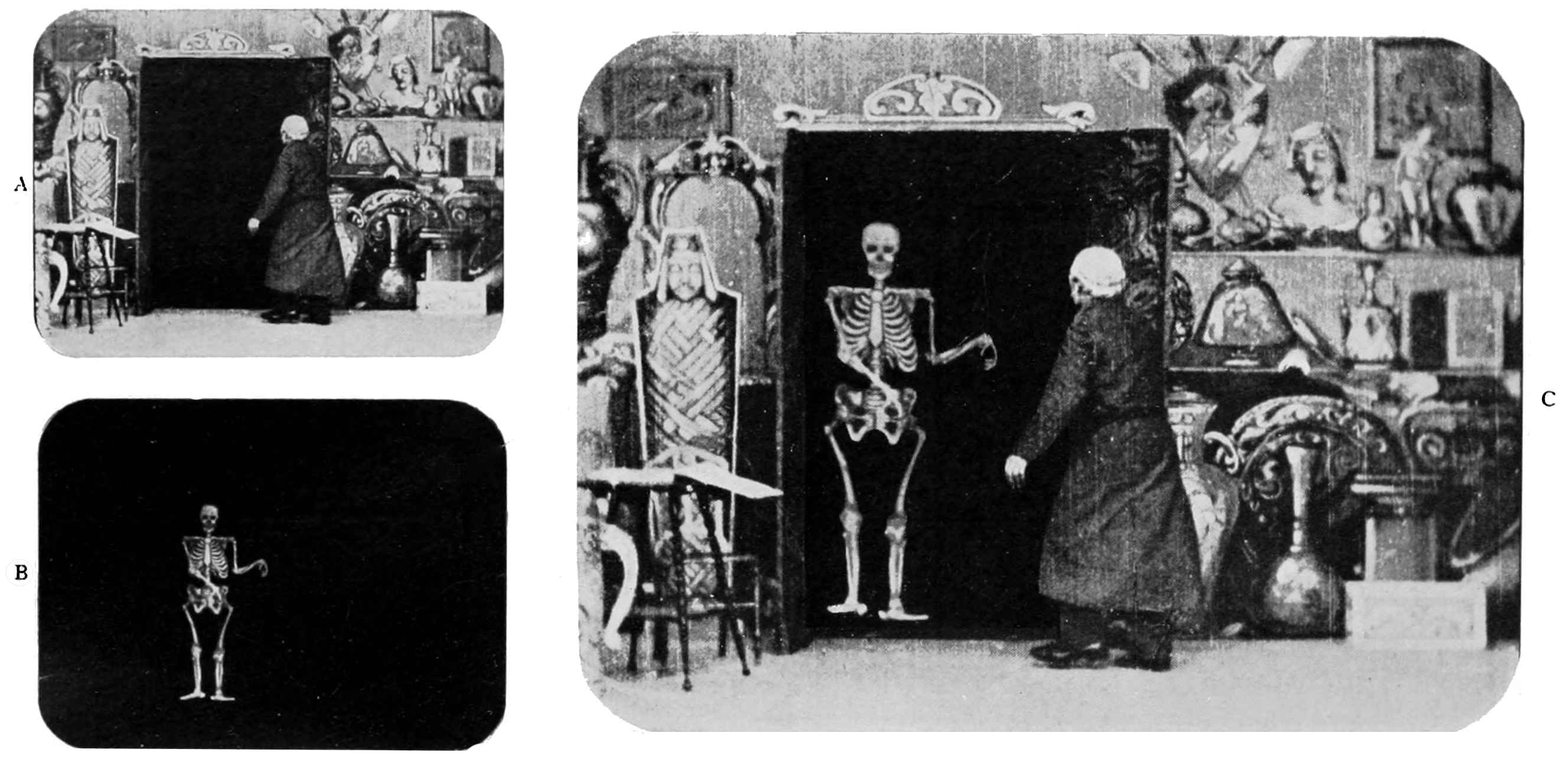
[By courtesy of R. W. Paul.
THE SECRET OF THE HAUNTED CURIOSITY SHOP.
The scene, A, was photographed first, the black space representing the interior of a wardrobe. Another film, B, was made of the skeleton
against a neutral background. When the two films were superimposed and printed the skeleton appeared to be imprisoned within the cupboard
upon the positive, C.
“The Haunted Curiosity Shop” was a well-executed and
startling trick film. A floating skull was transformed into
the bust of a charming lady, while the second half of the
body walked in and attached itself to the upper half. The
dealer attempted to grasp his strange visitor around the
waist with a view to stealing a kiss, but to his disgust
the fair damsel changed into a grinning negress. In anger
he thrust her into an old wardrobe, where she became
white again. The outline of the fair prisoner could be seen
through the woodwork of the cupboard; changing first
into an Egyptian mummy, then a living Egyptian, and
next into a skeleton. The dealer made a lunge at the
skeleton with a sword, but the weapon struck the breast-plate
of a man in armour. The latter was then torn limb
from limb, and the dismembered body was thrown into a
huge jar, from which rose three gnomes, who finally resolved
themselves into one. He was thrust back into the
jar, and a dense cloud of smoke rose, from which the
dealer fled in terror, while a large head appeared from the
smoke and advanced towards the audience.
This picture was produced by recourse to “stop-motion”
and double printing. The changes from white woman to
negress, mummy, Egyptian, skeleton, and man in armour,
were produced by substitution while the lens was closed
by the shutter. The space indicated by the wardrobe was
a recess having a black back-cloth, against which the
skeleton was photographed, and which when the two negatives
were superimposed was shown to be standing before
the astonished dealer. The photographs of the girl were
taken with the wardrobe doors open and well-exposed, so as
to obtain a strong image, which could be seen through the
other film showing the wardrobe doors closed. The dismemberment
of the man in armour was carried out with
properties, while the grotesque head was obtained by bringing
the camera within a short distance of the stage so as to
secure an enlarged photograph of an actor made up to
suit the part.
“The (?) Motorist” was an extraordinary example of
Paul’s handiwork. The effects were so startling and the
situations so unconventional that the spectators were sorely
puzzled as well as vastly entertained. The picture opens
with a motorist and a lady entering a small two-seated car.
They set off, but presently a policeman attempts to stop
them. He is picked up and dropped over the back of the
automobile. The motorist continues on his way, with the
offended emissary of the law in pursuit. Presently a public-house
bars the road, but the car, on reaching the obstruction,
runs up the wall, to the dismay of a large crowd, and
shoots into space. Without a pause it speeds over the
clouds, visits the sun, which it circles calmly, and once
more swinging into space runs over the clouds until it
reaches Saturn. The ring round this planet constitutes
an ideal motor track, around which the automobile rushes
in mad glee. Finally it shoots off this unusual highway
and drops through space, to crash into a court of justice.
After striking terra firma in this unconventional manner,
the car continues its journey out of the building, followed
by policemen, magistrate, and other officials. To their
amazement, however, just as they are about to arrest the
delinquent it vanishes, leaving in its place a countryman’s
cart, in which a smock-frocked farmer and his wife are
seated. When the pursuers are at a safe distance, the cart
changes back to the motor, and makes good its escape.
The point beyond the comprehension of the public was
the journey of the motor across the clouds and round the
sun and Saturn. It looked precisely as if the planets and
the car were viewed through a telescope. To get this
effect models were used. A suitable back-cloth was prepared
painted with clouds, stars, the planets, etc. On the
stage a large model was set up to represent Saturn with
its ring. A small model of a motor-car was prepared, in
which two dolls representing the motorist and his companion
were placed, and propelled round the ring at increasing
speed.
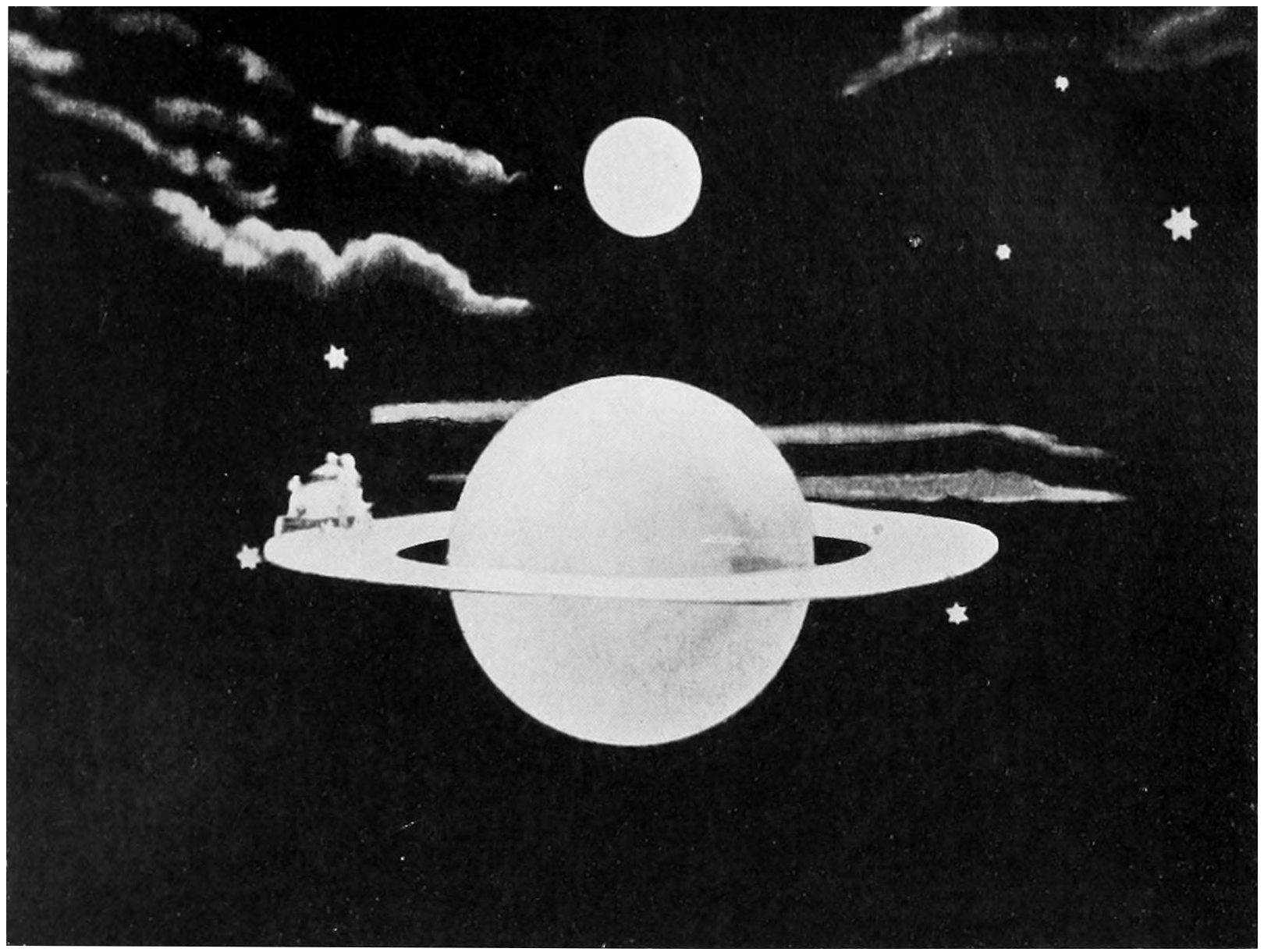
Motoring round the ring of Saturn.
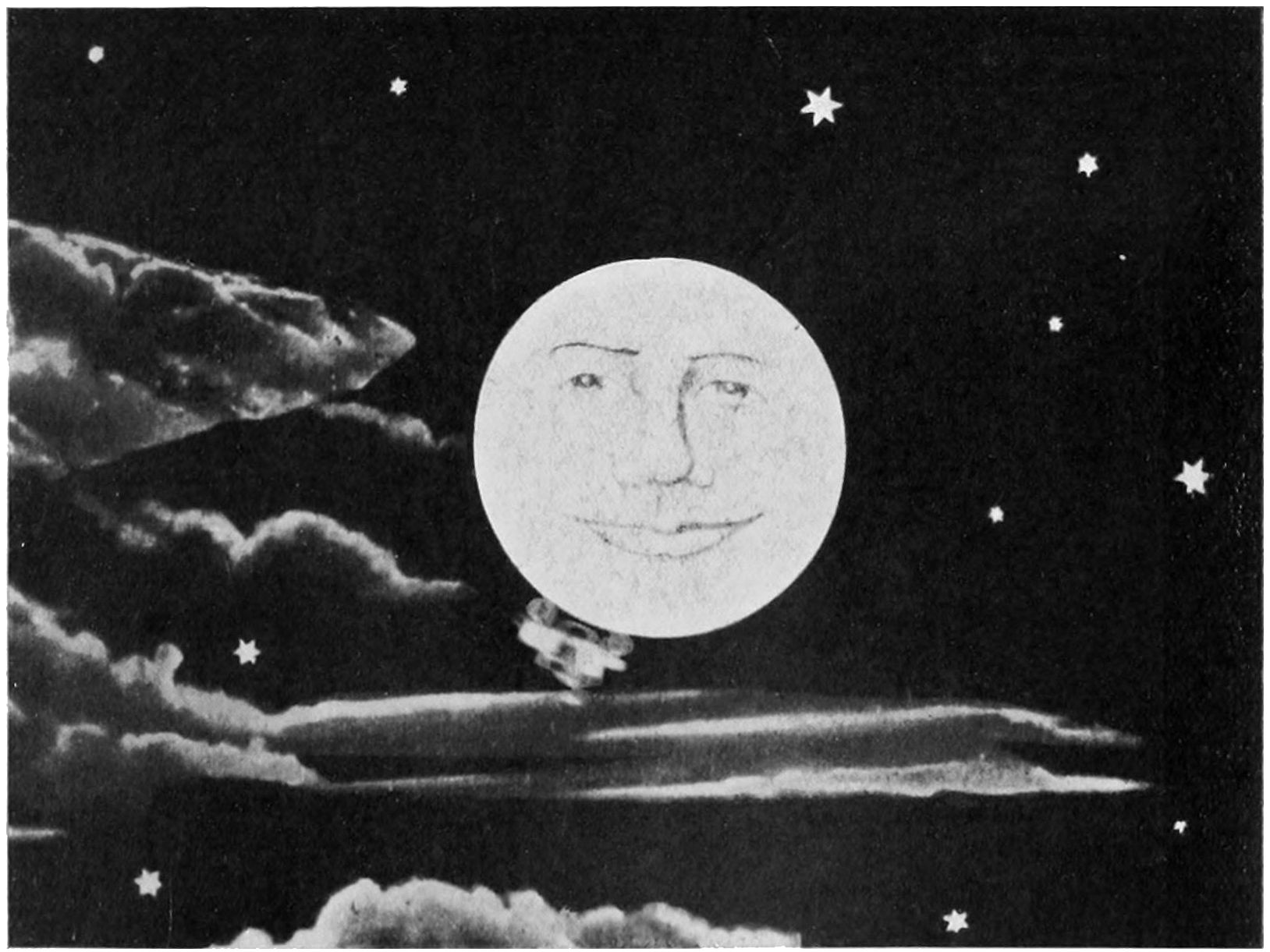
The car circling the sun.
THE ? MOTORIST—A STARTLING TRICK PICTURE.
Both car and planets were small models.
A model of the sun was suspended upon the stage
before the back-cloth. The model of the car was attached
to an arm, which was pivoted to the back of the sun,
like a clock hand, so that the wheels of the model car
rested on the circumference of the model of the planet.
This was revolved, thereby swinging the motor-car round
and round, conveying the impression that the car was
travelling round the sphere under its own power. For
the journey through the clouds the model of the car
was photographed against a back-cloth. The idea of falling
through space was conveyed by the manipulation of the
rising and falling lens. The success of this novel trick film
prompted many imitations. Working with models, however,
is by no means a simple operation, because, unless
they are prepared and manipulated very skilfully, the deception
is palpable.
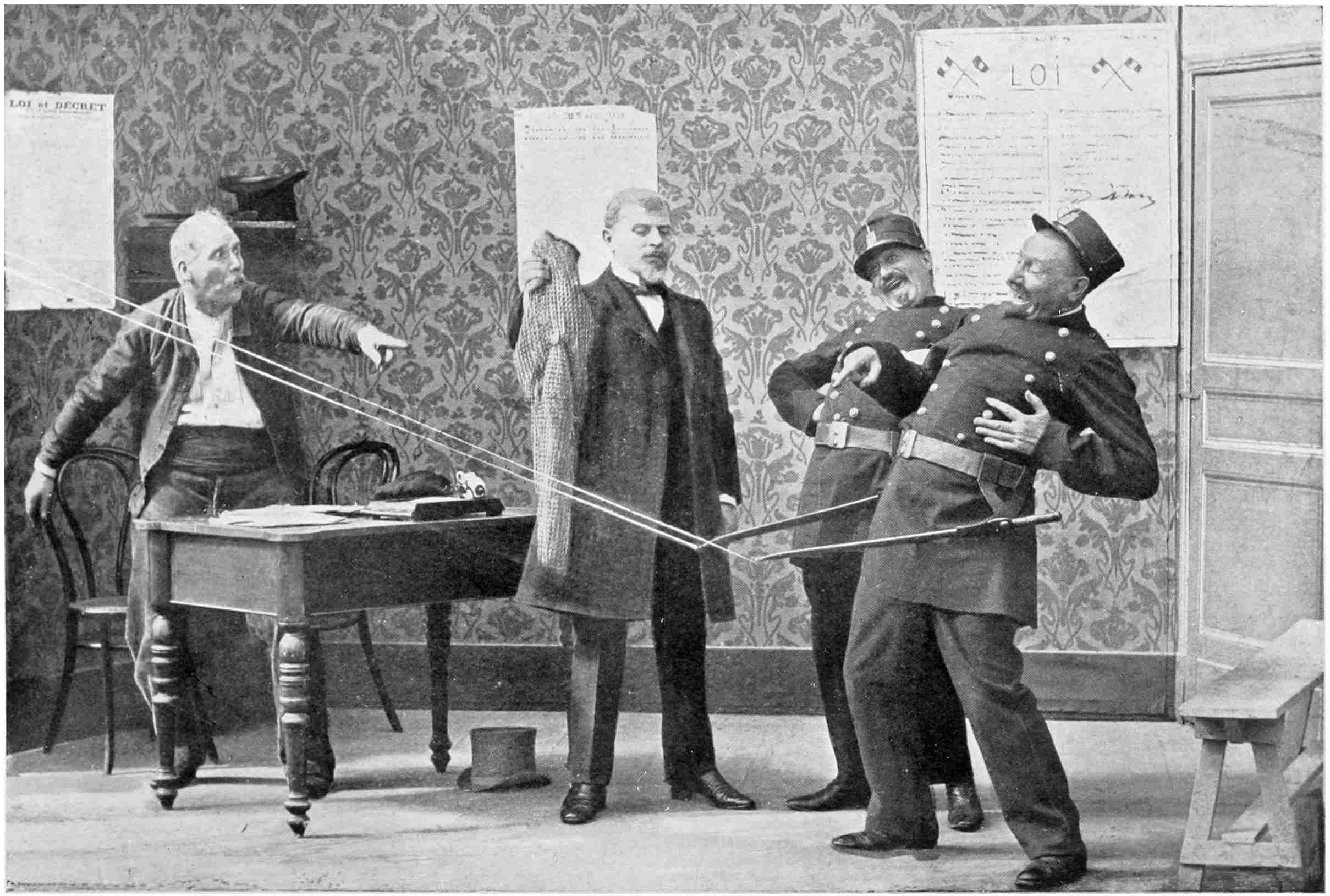
THE ANIMATED SWORDS.
The public is mystified by the manner in which inanimate objects apparently come to life. This picture shows one means of accomplishing
this end. The swords are manipulated by invisible wires, indicated in this illustration to show method of application.—See page 209.
Another of Paul’s films was the representation of a railway
collision. The scene represented a single railway line
threading mountainous country. A goods train came in
sight and overshot the danger signal. An attempt was
made to back the train, but before it could reach safety an
express dashed from the tunnel ahead and crashed into the
stationary train, precipitating a scene of wreckage. Carriages,
locomotives, and goods wagons were hurled down
the embankment and piled upon one another by the force of
the impact. Many people who saw this film marvelled at
Paul’s good fortune in being on the scene to photograph
such a disaster. They were convinced that it was genuine.
As a matter of fact, the scene of the accident was a field,
in which the scenery was erected with considerable care,
and a long length of model railway track was laid down,
while the trains were good toy models. The film only
measured forty feet, as it was designed originally for the
kinetoscope; but its popularity was so complete that it
was adopted extensively for the cinematograph. Certainly
it produced forty of the most thrilling seconds it is possible
to conceive, for the disaster was perfect in its swiftness and
wreckage; and the cinematograph film images being less
sharp and decisive than those obtained by a hand camera,
the illusion was conveyed very convincingly.
Scores of trick pictures of infinite variety were produced
by Mr. Robert Paul during his active connection with
the cinematograph industry. In common with other producers
of trick films, Paul found that the time involved
in their production was out of all proportion to the financial
results. It was no uncommon circumstance for a subject
approximating 100 feet in length to absorb a week or more
of continuous work. Moreover, his most successful subjects
were seized by American houses and “duped”—as
unauthorised reproduction is called in cinematographic
parlance in that country: no copyright law existed on the
subject. Some of the subjects thus exploited met with a
phenomenal success, from which he never received the
slightest benefit or even recognition.
CHAPTER XIX TRICK PICTURES AND HOW THEY ARE PRODUCED II.—Dancing Furniture: Strings, Cords and Wires: “The Magnetic Gentleman”: The “Stop and Substitution”: “The Automobile Accident”: Reversal of Action.
The achievements of Mélies and Paul set a very high
standard of excellence in trick pictures. Their popularity
precipitated a “trick film” fever. The market became
inundated with so-called magic pictures, of which the
majority were inane or conventional. The inevitable
happened; the public appetite became satiated. Consequently,
to-day, the popular taste demands extreme
novelty. Unless the subject is original in theme, and the
atmosphere of mystification is sustained, the effort is
regarded with indifference, if not with absolute contempt.
On the other hand, a first-class trick film commands the
highest admiration, is regarded with as much satisfaction
as were the products of the past masters in cinematographic
magic of fifteen years ago, and when once seen
is not forgotten very readily. There are certain producers
who specialise in trick films with considerable success;
but their number is small.
On the other hand, trick devices are introduced to a considerable
extent into the ordinary picture play. I recall a
film which depicted a scene at sea, where the vessel upon
which the action took place was shown rolling and plunging
in a truly appalling manner, and was swept from stem
to stern time after time by the angry waves and scud.
Wonder and admiration were expressed by the public at
the daring of the producer in venturing upon a small boat
under such terrible climatic conditions merely to procure a
sensational picture.
That scene was produced in the serenity and quietness
of the glass-covered studio under the glare of electric
lights. The boat deck was a stage property, comprising
a platform built to resemble the deck of an actual vessel,
mounted upon rollers in such a way that when the latter
were set in motion the boat was caused to rock, roll, and
pitch in the most alarming manner. The angry waves
seen on the horizon as the craft dipped its nose or rose
upon a crest were no more than back-cloths and flats
worked out by the scene painter, and set up by the stage
carpenter, while the driving spray and water came from
nothing more formidable than hydrants.
Behind the property boat deck, and disposed in concealed
positions, were stage hands, equipped with hoses
and nozzles. By manipulating these streams of water
dexterously as the craft dipped, the jets of water were
played upon its sides at varying angles, causing the
foaming liquid to shoot into the air to produce the precise
effect of a rolling boat dropping into the trough of the
sea and smashing into an angry wave in its descent. The
company suffered a severe drenching, it is true, and one
of the actresses was afflicted with an acute attack of mal-de-mer
provoked by the violent movement of the platform!
In another instance the public was shown a seaport town
bombarded by a hostile cruiser. In the foreground were
two big guns on the vessel’s deck, while in the distance
was the town. There was a puff of smoke, and the next
instant the buildings struck by the projectile were observed
to crumble into heaps of debris. The illusion was produced
very simply. The big guns were fabrications of
wooden laths and painted canvas, the smoke was a cloud
of steam, and the buildings collapsed because they were
built up with hinged sections, which were pulled down at
the critical moment by means of concealed wires and cords,
controlled from the back of the stage.
Through the courtesy of the Gaumont Company, of
London and Paris, who are in the front rank of masters
in film magic, at all events as far as Europe is concerned,
I have been allowed to go behind the scenes in
their studio, and am in a position to explain to a puzzled
public the secret of many an apparent miracle.
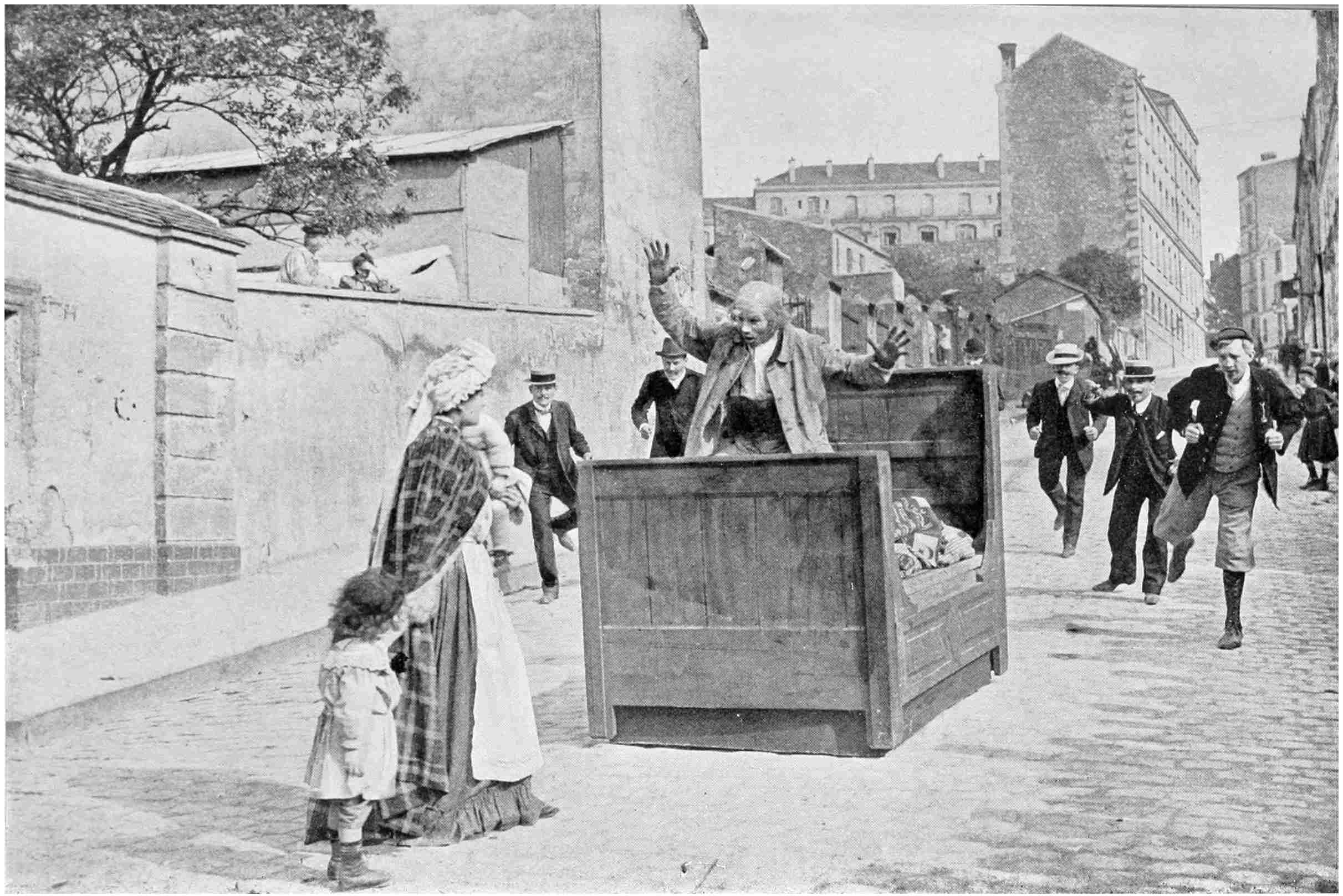
THE TRAVELLING BED.
The progress of the bed down the public street provokes amusement to the pedestrians and consternation to its owner, but its movement
is due to the fact that it is being pushed by concealed stage hands.
The film called “The Travelling Bed” is a typical subject
of mystification. An aged tenant has fallen into
arrears with his rent, and the long-suffering landlord at
last commands his eviction. The bailiffs duly arrive
upon the scene, but are spared all trouble by the fact that
directly they appear the chairs, table, and other articles
burst into life. They move about the room, and finally
file out of the door, in the most methodical manner,
to pass in a procession into the street. Meanwhile the
unhappy tenant is reclining upon his bed in the depths
of despair. He has no home and does not know where
to search for one. The bed, however, promptly sets out
to solve the problem. It bears its owner into the public
highway. The owner is overwhelmed with fright and
dismay at the unexpected development, and indulges in
frantic gesticulations as the bed canters merrily down the
centre of the road, with the passers-by pursuing the
unusual spectacle. The mystery of the Travelling Bed is
easily explained. It moves for the simple reason that it is
pushed from behind by stage hands. These men are
concealed from the camera, which merely records the
movement of the bed, the alarm of the owner, and the
excitement of the crowd.
This is the simplest and most usual means of imparting
animation to a lifeless object. With such an article as a
chair, which cannot hide a stage hand, recourse has to
be made to wires or strings manipulated from a point in
the wings, this being contrived in such a way as to be
invisible to the public. For instance, a gendarme is
astonished to see his sword whisked away from him. The
accompanying illustration shows precisely how this is
accomplished, the cords responsible for the action being
made visible purposely to explain the mystery, whereas
in the actual film these strings would be impossible of
detection.
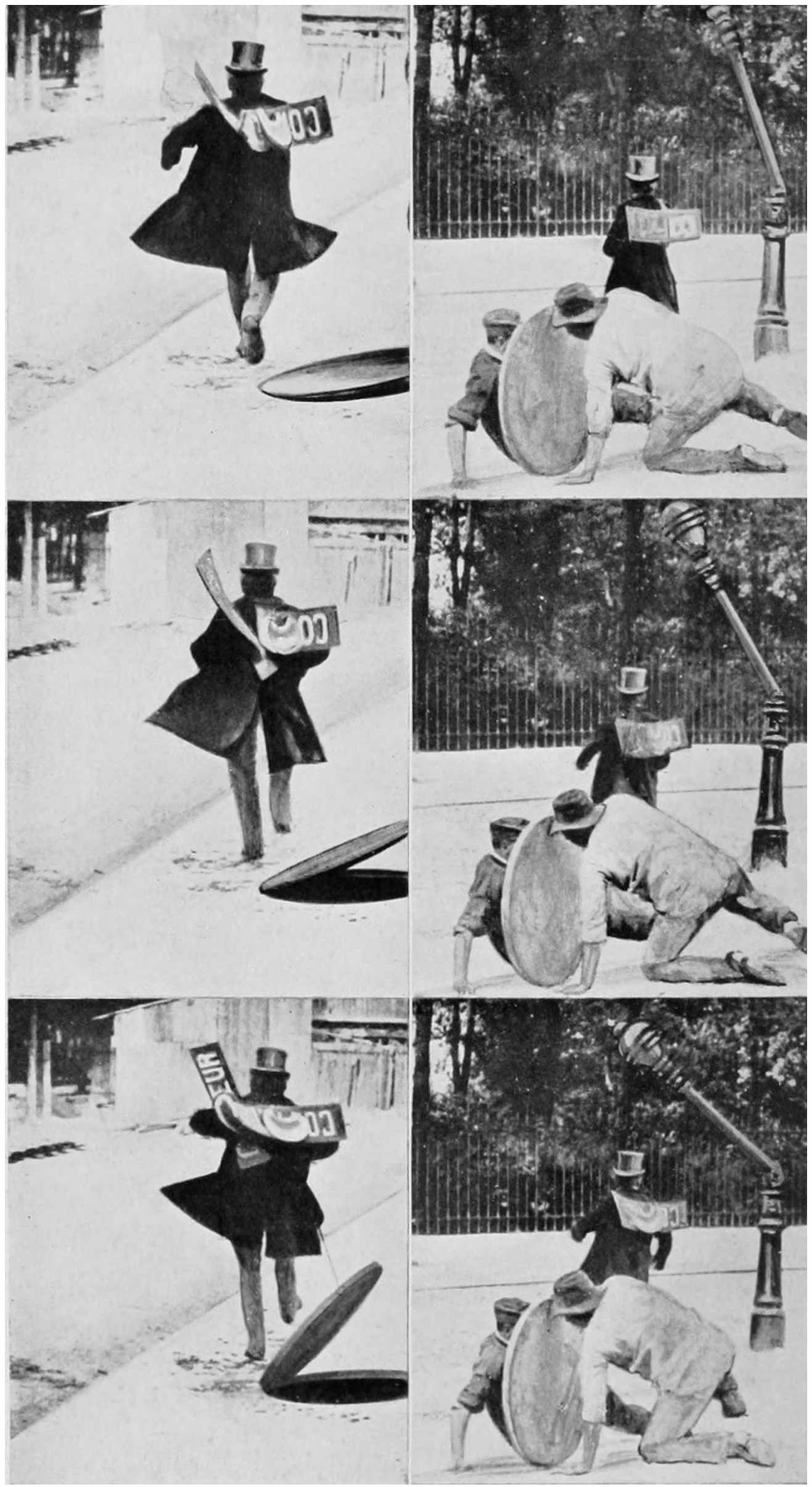
THE MAGNETIC GENTLEMAN.
The man-hole cover rises to pursue, and the lamp-post crashes over to strike
the actor by the aid of wires, a common expedient in trick cinematography.—See
page 210.
There is no limitation to the variety of effects which
can be produced by the invisible medium of cords, strings,
and wires. Probably their possibilities are revealed to the
most pronounced degree in such a film as “The Magnetic
Gentleman.” This unfortunate individual has been the
victim of an attack by Paris Apaches, and forthwith vows
never to venture through the streets again without a protective
coat of mail beneath his conventional waistcoat.
But he unintentionally comes into close proximity to a
dynamo, with the result that his protective coat becomes
highly magnetised. As he passes shops where metallic
articles are displayed for sale, they jump towards him and
cling tenaciously to his person. To one and all of these
articles thin wires or strings are attached, the free ends
of which are held either by stage hands or by the magnetic
gentleman himself. At the critical moment the cords are
pulled, and as the wires stretch across the path along which
the magnetic gentleman is passing they appear to jump
towards him. The articles which actually adhere to his
person are connected to cords held by the actor himself,
who merely pulls them to him as he passes the shops.
Presently the magnetic gentleman passes over a man-hole
cover set in the middle of the pavement. To the
amazement of the audience, the cover is seen to rise up on
its edge and to bowl along the street in pursuit of its
disturbing factor. The cover is a stage property made of
wood, manipulated by wires controlled by the actor.
When the cover is raised there is a short “stop” while a
stage hand enters the picture to give the cover its hoop-like
impetus necessary to start it rolling, the actor then
pulling it along by means of a wire, so that the cover
follows hard on the heels of the luckless individual, until
its career is arrested by two workmen, who struggle with
the strange runaway.
The pursuing man-hole cover is a wooden property.
The lamp-post is a stage article hinged in the centre.
HOW THE MAGNETIC GENTLEMAN TRICK FILM WAS PRODUCED.
But the magnetic gentleman’s misadventures have by no
means ended. He is passing a lamp-post, when suddenly
the metal, attracted by the coat of mail, endeavours to jump
towards him, with the result that the post snaps in twain.
The lamp-post is a dummy or stage property, hinged at
about half of its height so as to permit the upper part to
heel over like a flap. Wires are attached to the upper
half, and as the individual passes they are given a sharp
tug from the stage hands stationed outside the picture,
or by the actor himself, and it falls over.
In such instances as these the deception is improved by
the scenes being enacted in the public streets. Every
action appears to be carried out so naturally, and the
properties are designed so well and manipulated so carefully
at the critical moments, that the spectators are led
to believe in the actuality of the episodes.
Of course, a film of this character demands considerable
preparation, and photographing it occupies a long time.
The picture is built up incident by incident, in the same
way that a picture play is produced, there being an interval
of time between each series of exposures to permit the
arrangements for the next episode to be made; and each
phase is rehearsed over and over again before being filmed.
When the pieces of film are connected to form a complete
band, the continuity in action is so perfect that the public
is unable to detect the points where the sequence was
interrupted.
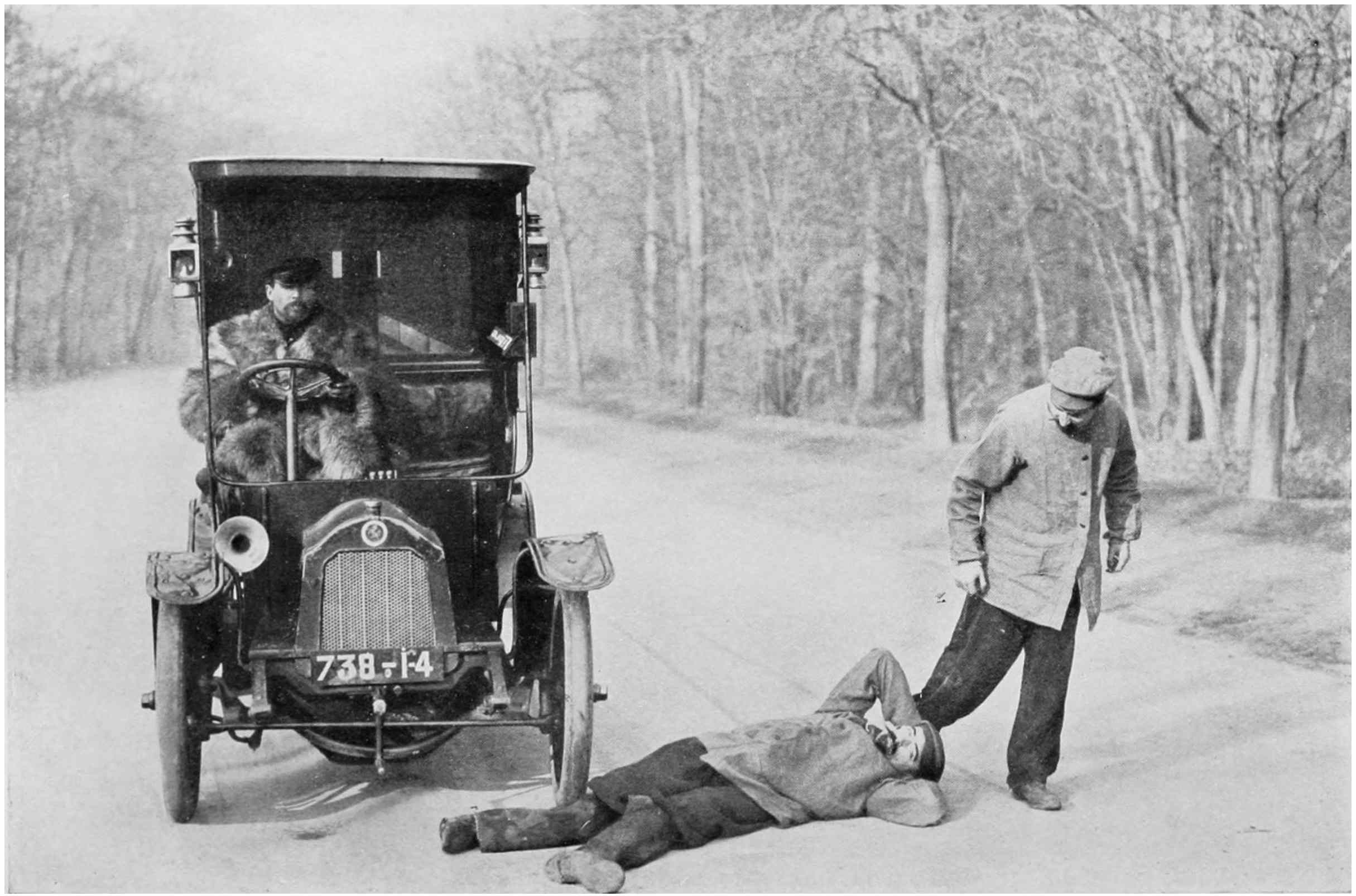
TRICK PICTURE—THE AUTOMOBILE ACCIDENT.
The actor being replaced by the legless cripple with the dummy legs.
A film which created a sensation when it appeared was
the “Automobile Accident.” A workman, who has imbibed
not wisely but too well, is homeward bound, and
describes grotesque geometrical patterns as he advances
along the thoroughfare. Presently he is smitten with an
irresistible desire to sleep. Although the couch is hard
and dangerous he lies down in the middle of the road,
and in a few seconds is in the arms of Morpheus. While
he is sleeping peacefully a taxi-cab comes along at a smart
pace, and, not observing the slumbering form of the
roysterer, the chauffeur drives over him, cutting off both
his legs. The shock awakes the man rudely, and he is
surprised to find his lower limbs scattered across the roadway.
The chauffeur is horrified by the unfortunate accident;
but his fare, on the contrary, a doctor, is not much
perturbed. He descends from his carriage, picks up the
dismembered limbs, replaces them in position, assists the
afflicted man to his feet, and after shaking hands each
proceeds on his separate way, the workman resuming his
journey as if nothing had happened.
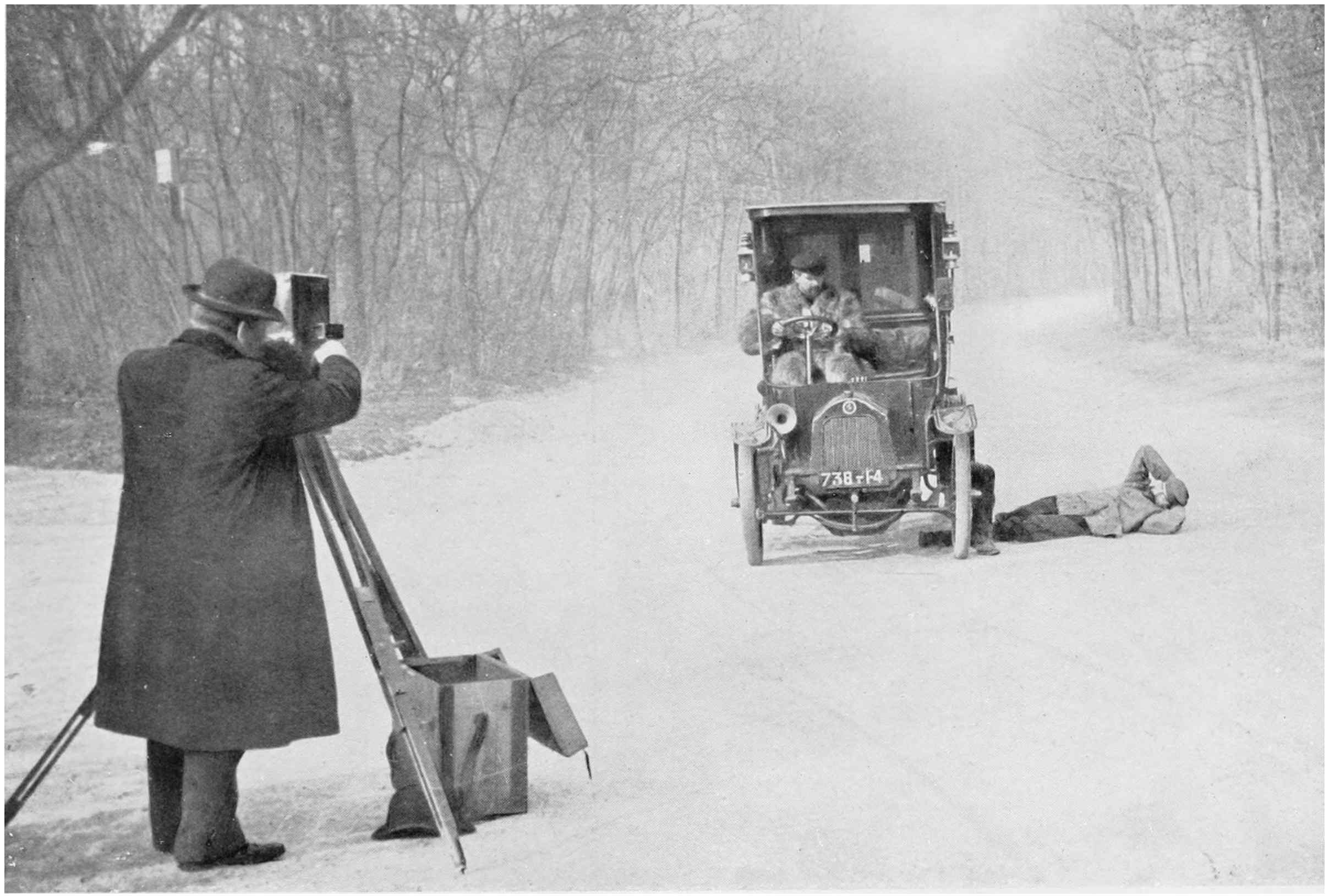
TRICK PICTURE—THE AUTOMOBILE ACCIDENT.
The taxi-cab running over the sleeper and apparently cutting off his legs, but in reality displacing the legless cripple’s property limbs.
The requirements for this terrible calamity were very
few. They consisted of three actors, to take the parts of
the intoxicated workman, the driver, and the doctor respectively;
a cripple who had lost both legs through an
accident, and for properties a taxi-cab and a couple of
artificial limbs. The legless cripple is, of course, the key
to the whole situation. The great difficulty was to find
such a luckless individual, and, when he had been discovered,
to bribe him to participate in a picture play.
Probably the unfortunate had never before found his misfortune
so profitable to him.
Observing the effects of the disaster, the doctor proceeds to replace the severed legs.
THE AUTOMOBILE ACCIDENT.
The limbs replaced, the patient and doctor shake hands.
In a trick film like this, success depends essentially upon
what may be described as the “Stop and Substitution”
action.
When the legless cripple was found, the leading actor
was made up in such a manner as to be his exact counterpart.
The company then proceeded to the scene of the
accident, which was in the Bois de Vincennes. The
camera was set up and the producer outlined the story to
the participants.
In taking the film the operations were as follows: The
leading actor, dressed like a French workman, ambled
down the road simulating inebriation, and presently prepared
his couch in the dust. While he was lying prone
and asleep, the taxi-cab drove up quickly in such a way
as to run over the sleeper’s legs just above the knees. Of
course, this did not actually take place, the chauffeur
drawing up a short distance from the prostrate form. At
precisely this point the camera stopped working, and the
cab slowly continued its way until its front wheels touched
the prostrate man’s legs at the required point. The tracks
of the vehicle’s wheels were plainly visible on the road.
TRICK PICTURE—THE AUTOMOBILE ACCIDENT.
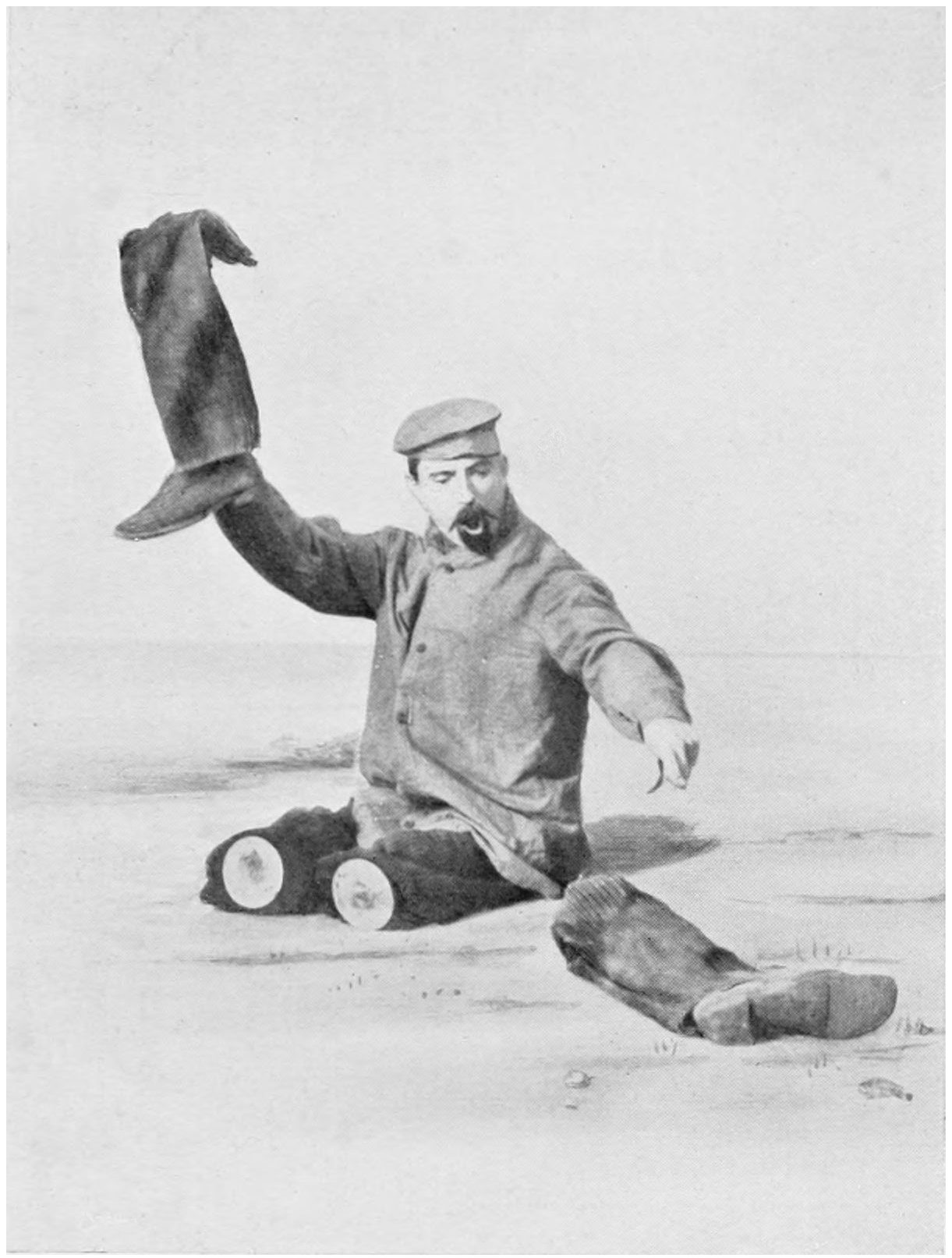
The roysterer after being run over by the taxi-cab sitting up and
brandishing his severed limbs.
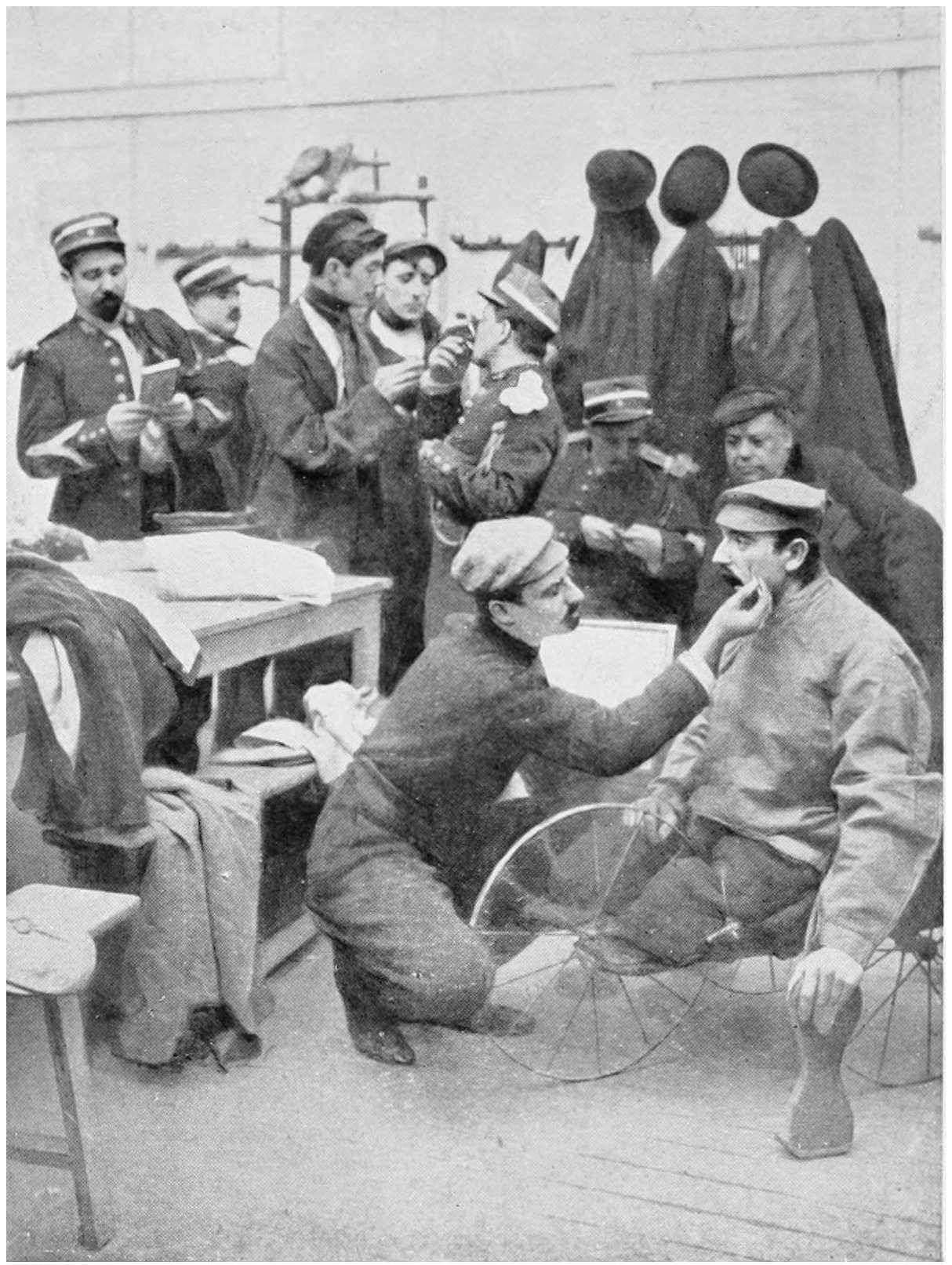
The legless cripple being prepared for the act. The second artist is
made up as the cripple’s double.
At this juncture the producer stepped forward with the
legless cripple mounted on his self-propelled wheeled truck,
from which he was lifted. The principal actor now got up
and left the scene. The cripple took his place in the road,
and the artificial legs were laid against his stumps in a
natural position. Care had to be taken that the cripple
occupied exactly the same position as that of the actor he
had displaced, so that no sign of the substitution could be
observed on the film.
The cab was now backed to its former starting point and
then re-started, the chauffeur making it follow the tracks
made by his wheels on the former journey. As the automobile
reached the point where it had stopped in the
previous picture, the camera started working again, and
the cab ran over the prostrate cripple, cutting off both his
legs—in reality displacing the dummy limbs and tumbling
them across the road.
Suddenly awakened in this rough manner, the sleeper
beholds his severed limbs with dismay, and then hops
after the vehicle which had been the cause of his disaster.
The cab stops, the doctor alights, picks up the severed
limbs, and, while the cripple is seated on the ground,
restores the displaced artificial limbs to their natural
positions.
The camera now stopped working once more. The
cripple was restored to his wheeled carriage and transported
out of the picture, while the dummy legs were
thrown on one side. In the place of the cripple the principal
actor reappeared, and when the camera started again
it photographed him sitting upon the ground. He is
helped to his feet and resumes his journey.
In this picture we have seen two “stop and substitution”
movements, once when the principal actor was
withdrawn from the scene to make way for the legless
cripple, and again when the reverse change was made.
Owing to the neat and skilful manner in which the change
from the actor to the cripple, and back from the cripple to
the actor, is effected, the public fails to observe either the
stop or the substitution, and thinks that one man acted the
rôle throughout. The fact that the accident occurs on the
high-road, and the possibility of a man being run over in
this manner, helps in the deception.
The “stop and substitution” movement is probably practised
more extensively than any other artifice in cinematography.
In picture dramas where a situation is presented
such as the throwing of the villain over a cliff, or before
an approaching train, or some other scene impossible to
picture without sacrifice of life, the camera is stopped
immediately before the incident. The actors engaged in
the scene become rooted to the spot when the “stop” call
is given, signifying the fact that the camera has ceased
its purring. At this juncture the villain disappears from
the picture, a lay or dummy figure being substituted for
him. When the camera resumes operation the episode is
completed with the dummy.
Perhaps the best example of this expedient is that represented
in the film illustrating the “Fountain of Youth,”
a version of the fable in which a beggar woman
is transformed suddenly into a beautiful maiden by the
kiss of a young gallant of good heart. A chivalrous
young prince is strolling through a wood when he is confronted
by an old and wrinkled witch, who makes supplication
to him. In an instant the audience realises that her
sombre garments have left her for brighter attire, and
that the haggard face has been converted into youthful
beauty. This wonderful transformation is worked by
recourse to the “stop and substitution” action. After the
“stop” call is given and while the lens is closed by the
shutter the hag leaves the scene, a young actress, suitably
attired, assumes her position, the actor retaining his position
while the change is effected. As the new actress
assumes the exact pose of the witch when the camera starts
again, there is a complete continuity of action recorded,
and the audience cannot detect that a pause and change
has taken place between the two consecutive pictures.
The “stop” movement is, as a rule, the secret to all
instantaneous disappearances. It enables people in the
scene to vanish and reappear apparently from space. It
explains the wrestling match, in which the audience is
startled to see that the challenger has disappeared suddenly—leaving
his antagonist wrestling with the air—only
to reappear just as startlingly in another part of the
picture. When the time arrives the “stop” call is given.
The disappearing actor slips out of the scene, while every
other holds the position in which he has been caught by
the last exposure. When the camera is re-started and the
actors continue their movements, the wrestler proceeds as
if gripping an opponent. When the “stop” call is given
again a little later, the elusive opponent steps into the
picture once more, assumes a suitable attitude, and his
movements are continued when the camera resumes
operation.
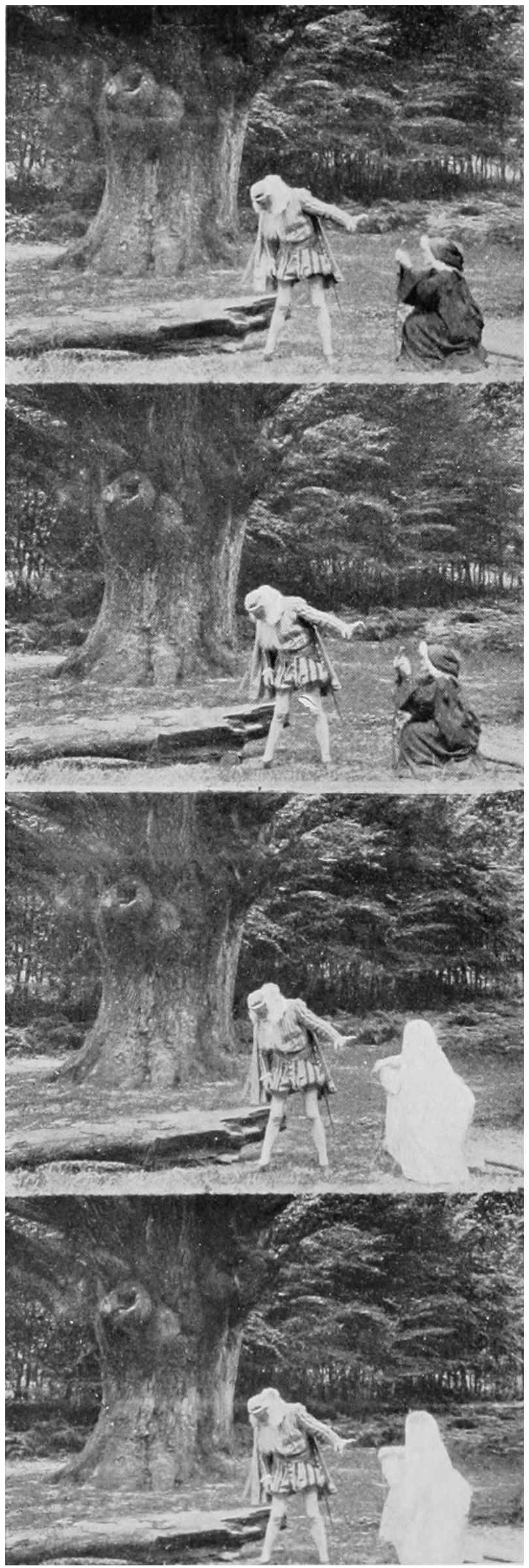
THE FOUNTAIN OF YOUTH.
The film is stopped between pictures 2 and 3
to permit the actress to change her costume.
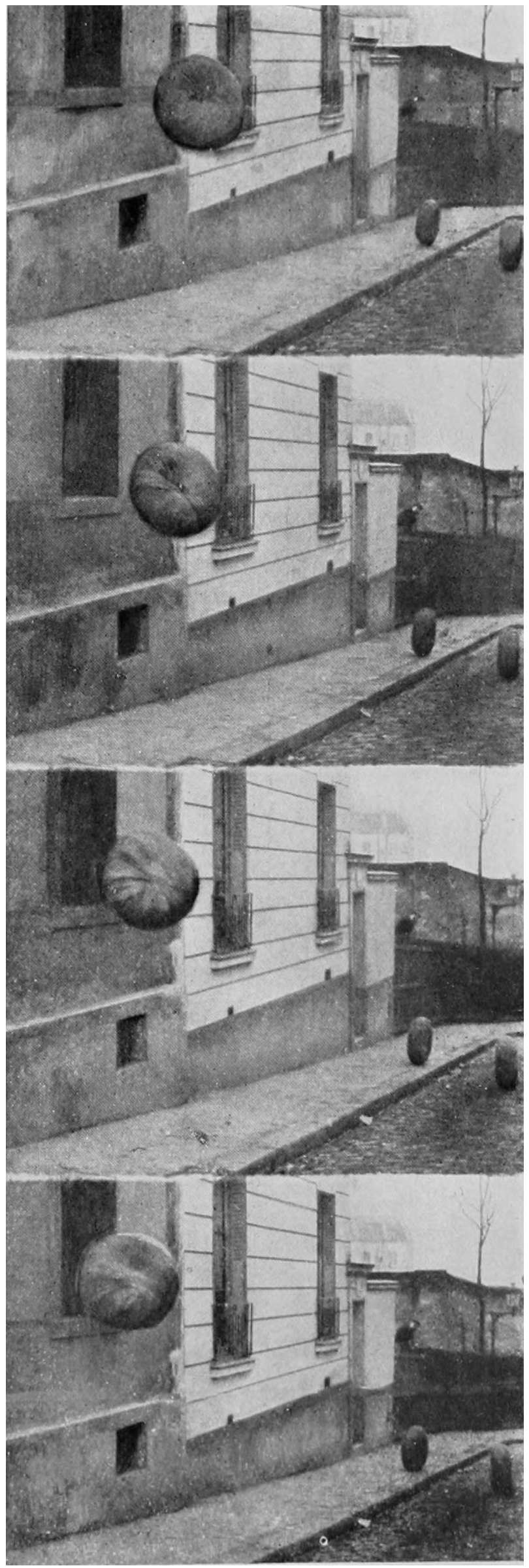
PUMPKINS RUNNING UPHILL.
This unusual effect is obtained by running
the film backwards through the projector.
THE “STOP AND SUBSTITUTION,” AND “REVERSAL OF ACTION” TRICK PRACTICES.
The power to stop the camera and arrest the action at
any point provides the trick-film maker with boundless
possibilities which are denied to his contemporary behind
the footlights. On the legitimate stage the sudden disappearance
and appearance has to be made through a trap
door, and, no matter how smartly the operation may be
performed, the public nevertheless sees the action taking
place. In the moving-picture record not the slightest trace
of the movement can be noted. The actor is seen in one
picture and is missing from the next. He appears to have
dissolved into thin air, and his reappearance is just as
magically produced. This mystification of the public is
rendered all the more complete by the environment in
which the action is photographed. When performed by
a magician or illusionist on the stage, the public naturally
thinks that it has been effected by the medium of a trap
door or some other artifice. When the magic takes place
in the public street, where no such trick facilities exist, the
natural surroundings lend the last touch to the illusion.
Another class of picture which causes considerable speculation
as to how it is contrived is that in which all natural
action becomes reversed. Horses, cabs, omnibuses, motor-cars,
and cycles run backwards, pedestrians walk backwards,
and smoke, instead of escaping from a chimney,
appears to flow into it. Everything is topsy-turvy: the
laws of gravitation appear to be defied. This novel
result is produced by “reversal of action.” The action
may be photographed in the natural forward manner, but
when the film is placed in the projector, the last picture
taken by the camera is shown first, and consequently all
movement becomes reversed.
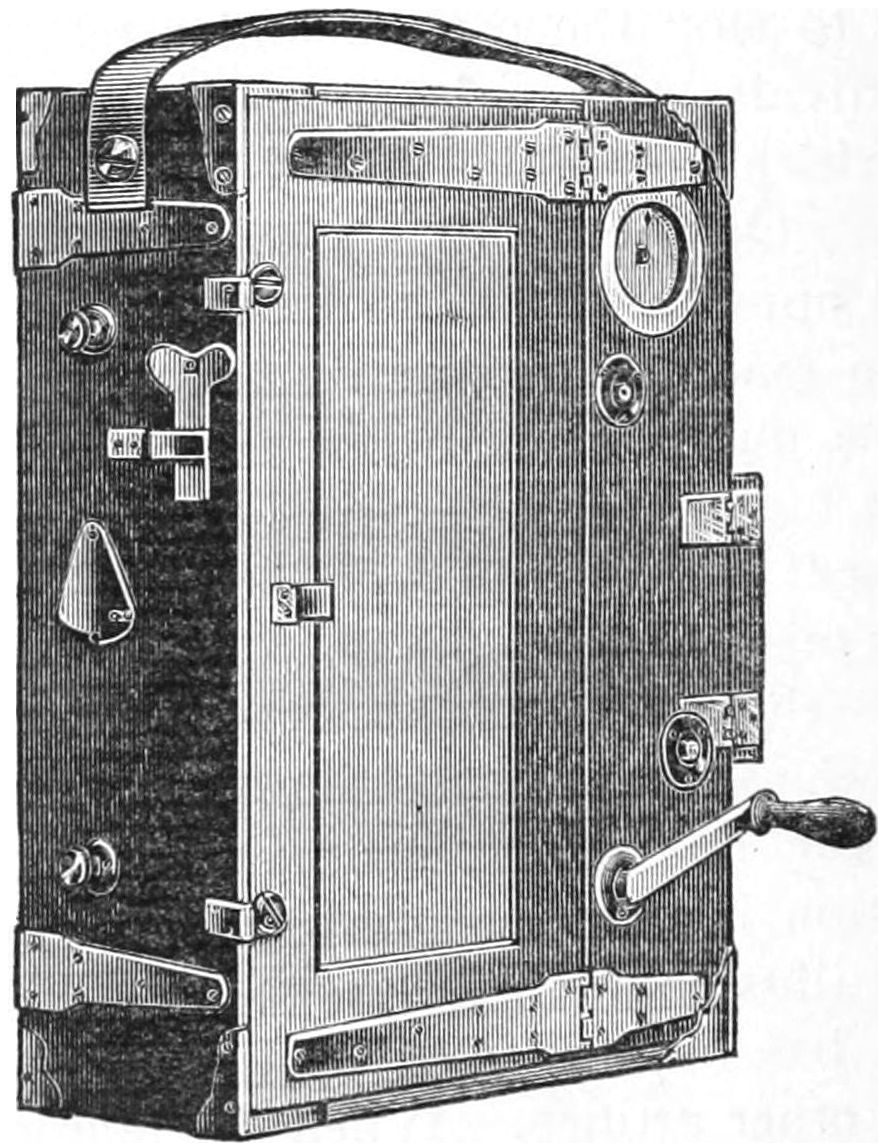
Fig. 17—The “Empire” Trick Camera.
It can be turned upside down while the film can be driven both
forwards and backwards.
Obviously the task could be simplified if the travel of
the film were reversed through the camera during exposure,
but in ordinary circumstances this would involve
rotating the handle in the reverse direction, and cause
unsteadiness in the picture. However, the camera manufacturer
has solved this problem. When a reversed motion
is required, the camera may be inverted upon its tripod,
both top and bottom faces having facilities for screwing
to the turn-table. When the camera is set upside down,
the handle is rotated in the natural forward manner, but
as the film is travelling backwards past the lens all movement
is reversed. By this means the necessity to run the
film backwards through the projector is avoided. It is not
even necessary to turn the camera upside down now.
Some manufacturers provide a second driving spindle, on
to which the handle is slipped and rotated in the usual
manner, the film being caused to travel backwards through
reverse gearing.
Some astonishing and highly ingenious pictures can be
obtained in this manner. For the purposes of illustrating
the subject I have taken one of the most simple results.
It depicts a “Pumpkin Race,” in which the vegetables are
seen to roll up a slope, to give one or two preliminary
bounces, and then to fly into the air through an open
window. When this film was taken the pumpkins were
thrown out of the window, bounced and rolled down the
declivity in the usual manner, but as the film for the
purposes of the exposure was run backwards through the
camera, when shown on the screen the opposite and
apparently impossible effect is produced.
Some years ago Mr. James Williamson produced a
subject of this class which provoked remarkable hilarity.
It was called “The Workman’s Paradise.” A building
was in course of construction, and the bricklayer duly
arrived upon the scene to carry out his task, but he never
stirred a hand. As he stood on the ground the bricks
jumped by invisible effort into the hod and set themselves
side by side in the most approved manner. Then the load
rose through the air to the scaffolding; the bricks fell from
the hod to the scaffold floor, and finally leaped into the
air one by one to settle themselves in position upon the
growing wall. Meanwhile the bricklayer surveyed the
scene with his pipe in his mouth and an air of supreme
satisfaction.
When the photographs of this picture were taken, the
action was just the reverse of that seen upon the screen.
The wall was standing, and the camera in reality photographed
its demolition and the transport of the bricks to
the ground. But the film was run through the camera
backwards, so that the last picture made became the first
projected upon the screen, and so on.
CHAPTER XX TRICK PICTURES AND HOW THEY ARE PRODUCED III.—Manipulation of the film: Apparitions and gradual disappearances by opening and closing the diaphragm of the lens slowly: “The Siren”: Submarine effects.
There are many curious and bewildering trick effects
which cannot be produced by recourse to the methods I
have already described. It is impossible to detail every
artifice employed; for every film possesses some individual
characteristics. Only the broad outlines of the general
processes employed can be described in the course of these
chapters, but the information thus afforded will enable one
to fathom how the majority of these miraculous pictures are
elaborated.
We have all laughed and enjoyed the class of trick-film
portraying frantic haste and its concomitant disasters or
escapades. The scene may represent a public street, a park,
a hotel, or even a private residence. The fact that the
ordinary members of the public figuring in the scene move
at the normal speed throws the frenzied haste of the principal
performers into more striking contrast. I recall two
excellent films of this character. In one case the story
represented the operation of a wonderful little machine
which, when its handle was turned, radiated a magical
influence of acceleration upon everyone within a certain
range, precipitating ludicrous incidents and situations.
One saw the vehicles and pedestrians flying along the
crowded Regent Street of Paris with terrible speed. The
dawdling nursemaid was galvanised into life when the
apparatus was brought within a few feet of her—she rushed
her perambulator and charged along the boulevard with the
velocity of a racing car; while the errand-boy completed
his duties at the pace of an aeroplane, and so on. Mr.
James Williamson was responsible for the second film of
this character, which portrayed the British Workman
“waking up” and becoming a “hustler” of the first water.
The bricklayers ran up and down the ladders like squirrels
racing up a tree, while the bricks were laid so rapidly that
one could not detect the movements of the workman’s
hands, and the carpenter plied his saw so vigorously that
it appeared to be a mere streak of light.
This peculiar effect may be produced easily by either of
two methods. One is to turn the handle of the camera very
slowly while photographing; but when the film is being
shown to rotate the handle of the projector at a very
high speed. The result is that the pace of every moving
object in the picture is increased upon projection four,
six, or eight times that recorded by the camera. In this
case every moving object in the picture moves at the same
pace. There are no contrasts between frantic movement
on the part of some and slow, natural motion on the part of
other people in the scene to enhance the ludicrous effect;
moreover, the required result is left very much in the hands
of the operator.
Accordingly, another and superior expedient was evolved
and is now adopted universally. The picture is taken at
the normal speed of sixteen pictures per second, but the
film thus obtained after development is taken in hand,
and its length is reduced by cutting out every other picture
—or perhaps even more. If every alternate image is
eliminated in this manner, and the remaining pieces of
film are re-joined, the length of the film is reduced by
one half, and when thrown upon the screen at the normal
speed of sixteen pictures per second, the moving objects
travel at twice the speed at which they were moving when
photographed.
This removal of the images from the string of consecutive
pictures is known as “manipulation of the film.” It
is a tedious and delicate process, because joining together
properly a series of images measuring only three-quarters
of an inch in depth demands skill and patience. By its
means, however, some bewildering effects may be obtained,
one of which is shown in the illustration. This film
depicts a lad who has been hypnotised. When he enters
a dwelling his presence sets the furniture dancing violently,
while a circular table round which four people are seated,
revolves at a dizzy pace. For the purposes of this film the
table and those seated around were mounted upon a pivoted
platform free to revolve, which was driven from beneath
the stage or from some other convenient point. At the
right moment the table commenced to spin around—at a
comparatively slow pace, so as not to unseat the performers
by the results of centrifugal force—the camera meanwhile
recording the movement. After the film was developed
images were cut out at certain points, these excisions being
so made as to reduce the length of film devoted to the
table-spinning incident from 100 feet as recorded by the
camera to twenty-five feet or so for the projector. Accordingly,
when the film was thrown upon the screen at a
speed of sixteen pictures per second, the table appeared to
whiz round at a fearful velocity.
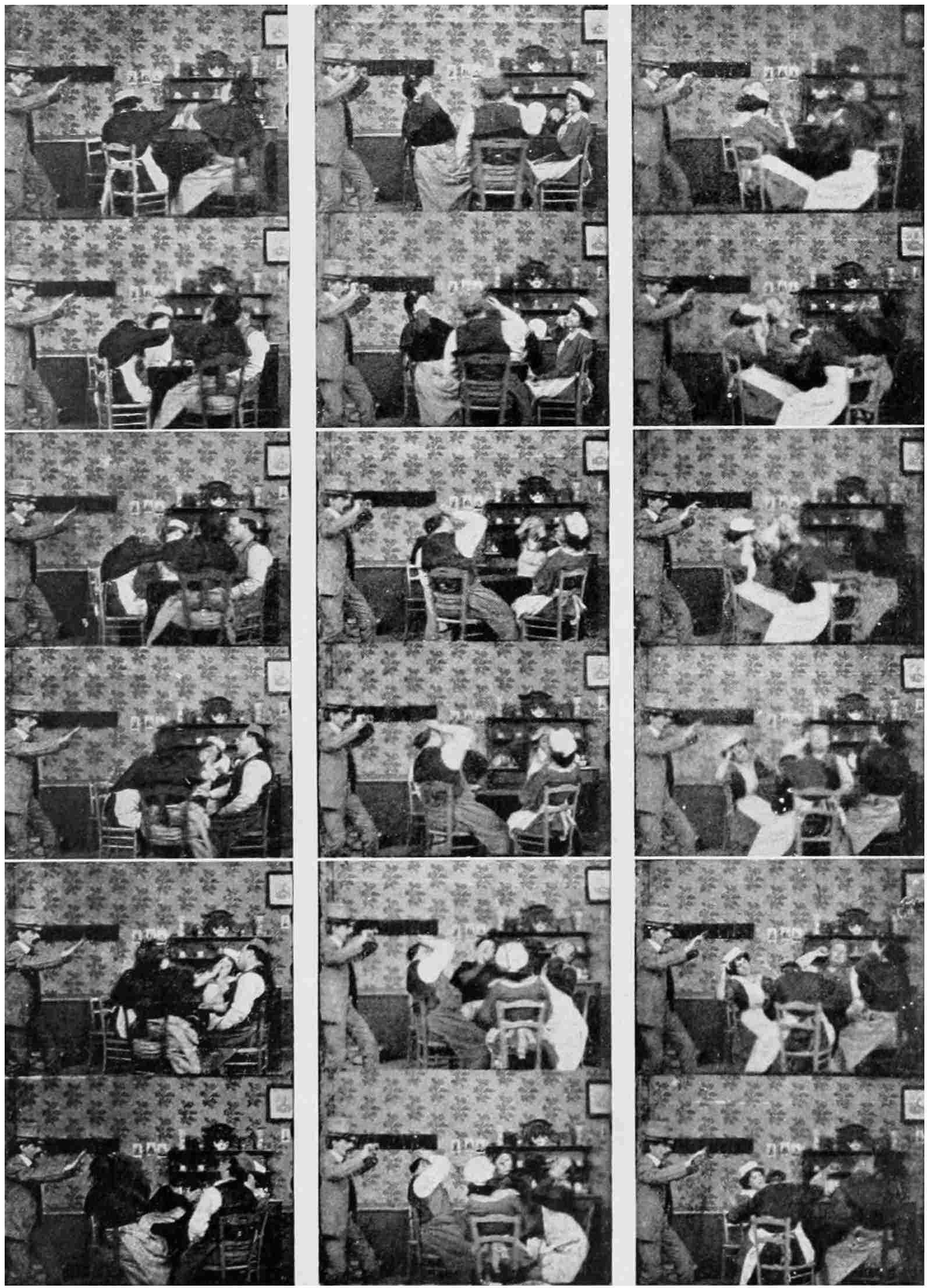
THE REVOLVING TABLE.
The puzzling trick effect of a table rotating at dizzy speed is obtained by cutting out pieces
of the film. The white lines show where excisions have been made.
If double printing be associated with this manipulation
of the film far more mirth-provoking and astounding situations
can be produced. For instance, such stories as that
of the magical apparatus described above, which spurs into
unwonted velocity the traffic in a crowded street, may be
prepared as follows:—The camera is set up in a suitable
position overlooking the thoroughfare, and one film is taken
very early in the morning, when the traffic is either absent
or very insignificant. Here and there may be a pedestrian
or vehicle, but their presence only heightens the effect.
Perhaps 125 feet of film are expended upon this subject.
The camera is then left until later in the day, when the
traffic is at its highest, and another film is secured of the
now busy street from the same point of view. Thus the
stationary objects—the shops, lamp-posts, and so forth—occupy
the same relative positions in each film, with the
result that when they are placed one on the other a single
impression of these fixed, inanimate objects is obtained.
The second film, however, is longer than the first—perhaps
it is 250 feet in length—but by cutting out each alternate
image its length is reduced to 125 feet. The two films are
now of the same length; one is placed on the other, and
the positive print is made.
When the picture is thrown upon the screen the greater
part of the wheeled traffic is observed to fly along in mad
haste, while here and there a pedestrian or vehicle is seen
sauntering in a very leisurely way—almost at a crawl by
comparison. The latter are those photographed upon the
first film which has not been touched, while the hastening
vehicles and people are those photographed upon the second
film, which has been manipulated into half its length.
If the excisions are made more heavily, and instead of
every alternate picture being cut out, three out of four consecutive
images are eliminated, the results are more ludicrous
still. Suppose a man is being pursued, and runs as for
dear life; if 100 feet of this episode are photographed, and
the negative subsequently is reduced to twenty-five feet by
manipulation, the man will not appear to be running when
the picture is shown upon the screen, but will seem to be
eluding capture by a series of long hops. In this instance
two films and superprinting are requisite to give the most
satisfactory result, the runaway being recorded upon one
film and the pursuing crowd upon the second. Then while
the man is shown to be leaping in a most extraordinary
manner down the street, the crowd will be seen running
in a perfectly natural manner.
Whereas the “stop” call is employed to effect sudden
appearance or disappearance, a different method is essential
for a gradual disappearance. Let us suppose the scene
represents a magic cave in which the daring young hero
is imprisoned by the wicked magician. Instead of the good
fairy springing into the picture through a trap-door in the
floor of the stage, as is the practice in legitimate pantomime,
she is seen to materialise from nothing. The first sign of
her advent is a slight nebulous haze in a certain part of
the picture. This mist grows stronger and stronger, until
at last it reveals the filmy outlines of the fairy, who in due
course becomes as distinct and as clearly defined as the
young hero she has come to assist. When the moment
arrives for her disappearance she vanishes in the same
mysterious manner, her body seeming to dissolve into thin
air.
This apparition effect always provokes considerable interest
and curiosity. It necessitates the use of a camera
of such a design that the film can be driven both forwards
and backwards, instead of in the first-named direction only.
It must be fitted also with a special measuring indicator,
and an easily adjustable diaphragm stop to the lens. The
latter is of the rectilinear type, the results therewith being
produced more easily and positively than by any other
means. All these requirements are fulfilled in the “trick”
camera, which is especially designed for work of this
character.
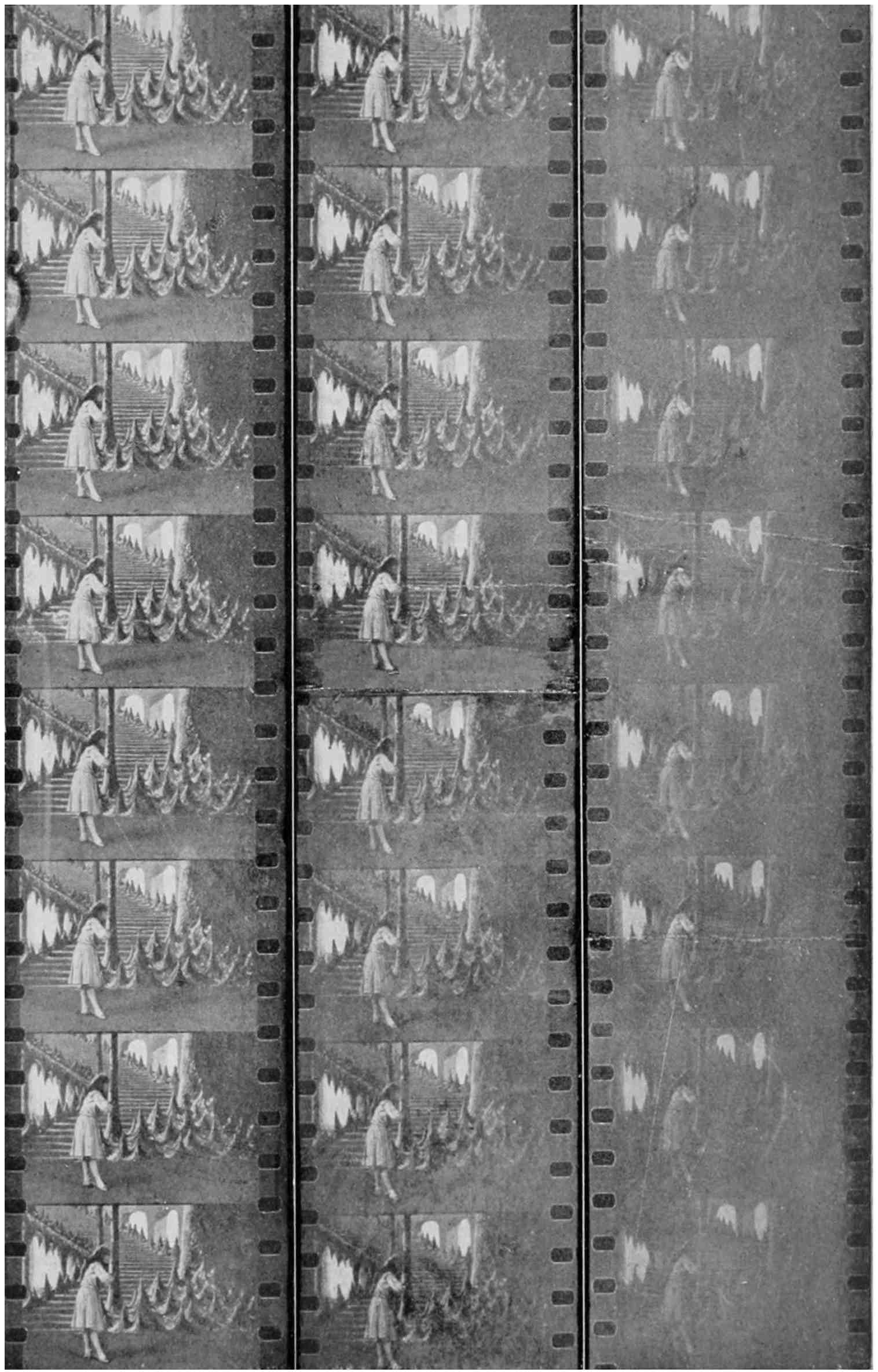
THE SECRET OF THE FAIRY’S APPEARANCE.
1. While a length of film is being exposed the diaphragm is closed slowly.
For the purposes of explaining this operation I have
obtained three films (see illustrations) by looking at which
the process will be clearly understood. It is well known
that as the aperture of a lens is closed, the quantity of light
admitted to the sensitised surface behind is reduced, and
if this action is carried out gradually by means of the rectilinear
stop, without any variation in the length of the
exposure, the image upon successive sections of the film
will become fainter and fainter until nothing at all is
recorded. The reverse action takes place as the lens aperture
is increased in size by opening the diaphragm to admit
a greater volume of light.
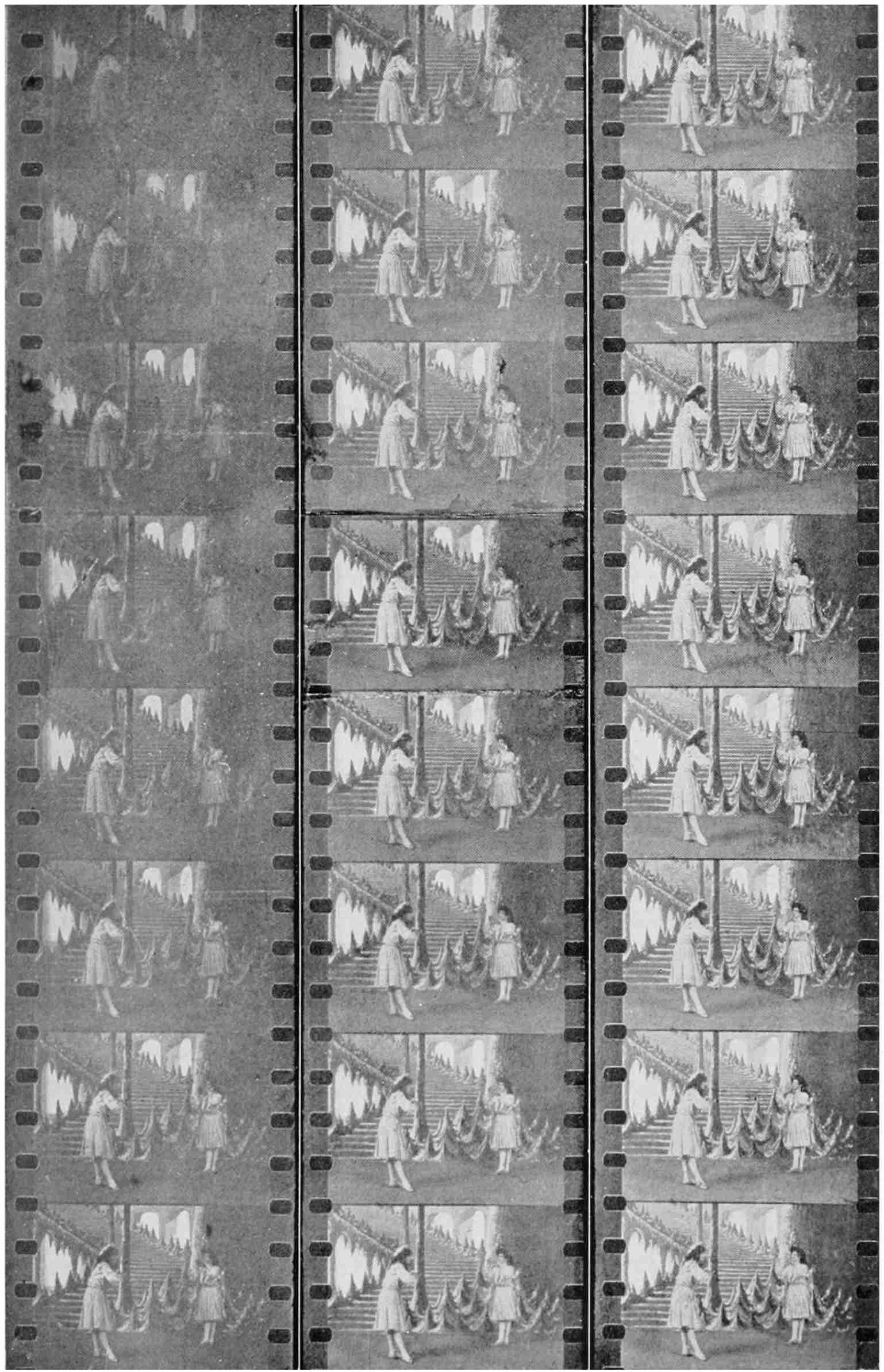
THE SECRET OF THE FAIRY’S APPEARANCE.
2. The same length of film is re-exposed after the fairy has entered the picture, under
a slowly opening diaphragm.
I will first explain the operation in its simplest form.
The stop call is given and all the actors become stationary
while the fairy stands alert to receive her cue to enter. The
operator notes the point upon his indicator of the length
of film used up to the time the stop call is given. For our
purposes we will say it is 100 feet. The operator continues
turning the handle at the same speed, but while so doing
he gradually closes the lens aperture by means of the rectilinear
stop, so that the images, owing to decreasing volume
of light admitted through the lens, become fainter and
fainter, until at last merely a haze is recorded. The effect
of closing the stop in this manner is shown in the first film.
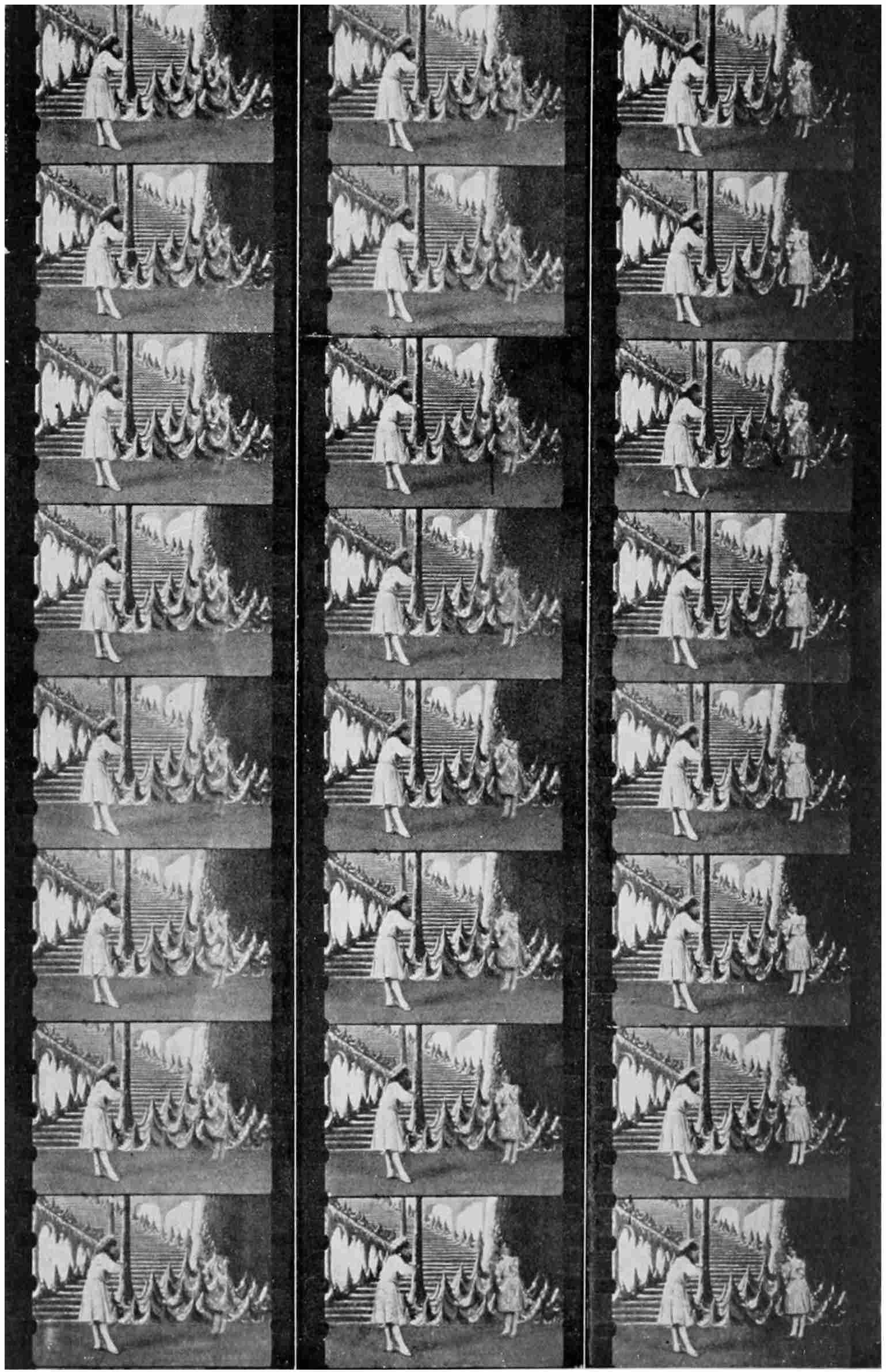
THE SECRET OF THE FAIRY’S APPEARANCE.
3. The effect of double exposure under closing and opening diaphragm. The subjects
photographed twice upon the same length of film stand out with uniform distinctness,
but the fairy being photographed only once gradually materialises apparently from thin air.
The operator consults his film register and finds that
two feet of film have been consumed, representing thirty-two
exposures, to carry the picture gradually to extinction,
the indicator accordingly registering 102 feet at the conclusion
of the operation. The fairy now receives her cue
and steps into the required position in the picture. The
operator resumes his turning, and during the next two
feet of film, that is, another thirty-two exposures, he opens
the stop just as gradually as he closed it, to its former aperture,
the image upon the film thereby becoming stronger
and stronger as increasing light is admitted through the
lens.
The effect produced by this process is shown in the illustration.
The first picture taken after the fairy has entered
is scarcely discernible; then it becomes a slight haze in the
next image, and as the aperture is increased her form slowly
materialises until at last she is quite as distinct as that of
the other actor in the scene, who meantime has retained
his rigid position during the whole 64 exposures. When
this second series of exposures have been completed, the
film indicator registers 104 feet, two feet of film having
been used in closing and another two feet in opening the
lens aperture.
Now if the film is cut at the point representing 102 feet,
and this second part of the film is superimposed upon the
first in such a way that the second thirty-two exposures
coinciding with the opening of the diaphragm are laid upon
the thirty-two exposures representing the closing of the
lens aperture, in the resultant positive the actor and the
surroundings will stand out with uniform brilliancy
throughout the superimposed section, and be equal in brilliancy
and distinctness to the remainder of the film, for
the simple reason that image 33—representing the first
exposure under the opening of the stop and consequently
the most indistinct picture—comes over image 1 in the
stopping-down series of pictures, which is, of course, the
most brilliant picture. Image 2 comes under image 34,
and so on throughout the whole thirty-two pictures. As
the pictures grow fainter on one film they become correspondingly
stronger on the other film, with the result that
when the two are overlapped and printed the sum of the
two exposures produces a complete and fully-detailed picture,
the second film supplying to the first precisely the
complement of its incomplete exposure, in the case of each
image.
But this action only affects the actor and scenery recorded
upon the two sections of film. The fairy, having entered
at picture 33, when the unstopping process was commenced,
appears at first very indistinctly, like a small patch of mist,
the nebulous haze resolving itself into her form slowly
during the successive thirty-one pictures. The sum of this
double exposure is represented by the third illustration,
where the fairy is to be seen slowly materialising, the other
parts of the picture under the double printing being of
uniform brilliancy throughout.
This was the method adopted in the early days, but it
was somewhat involved, and demanded recourse to double
printing. The perfection of the camera mechanism has
enabled the process to be considerably simplified. Now
the operator makes a double exposure, with closing and
then opening diaphragm upon the same length of film.
When the “stop” signal is given he observes the indication
on his film register. We will say it is 100 feet, as in
the previous case. The actor becomes motionless and the
operator resumes his turning while closing the stop slowly,
until 102 feet of film are registered upon the dial, thirty-two
exposures, or two feet of film having been made during
stopping down. He now winds the film backwards into
the upper film box until his dial registers 100 feet once
more, the lens being capped during this operation. Thus
he has regained the point upon his film where stopping-down
commenced, and the two feet used in this process
are ready to be exposed again.
At this point the fairy steps into position. The camera
is re-started, and while the first thirty-two exposures are
being made the lens aperture is opened, just as slowly and
gradually as it was closed during the previous exposures.
The result is that the portions of the films which in the
first instance received a diminishing volume of light now
receive a compensating increasing illumination, so that
the effect upon this particular two feet of film, so far as the
figure on the left and the scenery are concerned, is just as
if they had been exposed once under a full aperture. The
fairy, however, having been photographed only during
the second exposure, appears at first very indistinctly. The
result of the double exposure is shown in the illustration;
and the gradual appearance of the fairy may be followed
very easily. The outcome is exactly the same as obtained
by double printing; but it is infinitely easier, and far more
positive in its action than the delicate process followed by
Robert Paul in the early days—the dissolution of the
emulsion from the film by chemical action.
Exceedingly clever effects are obtainable under this
double exposure process. Transformations from one scene
to another are carried out in a manner that completely
eclipse the handiwork of the stage-manager behind the footlights.
Success depends to a great degree upon the skilfulness
of the operator, because it is imperative that the
stop of the lens should be closed and opened equally, in
order that the combined exposures upon each successive
image should be equal to a single exposure with a full
aperture, so as to provide a uniform intensity and brilliancy
throughout all the images.
The magic disappearances are worked in precisely similar
manner, only in this instance the character leaves the picture
at the moment the last image under the closing
diaphragm has been taken. The film is wound back as
before to the point where the “stop” call was given, and is
subjected to a second exposure under an opening stop.
There are no limitations to the application of this form
of trickery. Spirit forms can be produced to float in the air,
recourse to the rising and falling lens front being made
in conjunction with the manipulation of the diaphragm.
Sylphs can be materialised from evening vapours; and
articles of furniture can be transformed into human forms.
Many of the pictures obtained in this manner are startlingly
weird and magical. As a matter of fact, the manipulation
of the diaphragm may be considered as one of the most
useful weapons of trickery and magic in the hands of the
cinematographic wizard.
Another miracle is performed when the public is introduced
to the bottom of the sea to make acquaintance with
the denizens of the deep, and the strange mermaid population.
The audience is convinced that the pictures have been
taken in the actual surroundings, because divers descend
into the depths and they can see the air-bubbles rise from
their helmets during respiration. The effect is certainly
very realistic, and as the difficulties attending under-water
photography are well-known, one wonders how these pictures
can be obtained.
They can be produced by two methods. One is by using
a large tank with a glazed front, in which the properties
are distributed, while behind is a painted back-cloth to
represent a submarine scene. The tank is filled with water,
and fish are introduced to heighten the effect. Divers are
employed to carry out their evolutions in the tank, which
is brilliantly lighted, so that the sensitised ribbon in the
camera disposed before the front window may be able to
secure a well-defined image.
It is obviously impossible to introduce mermaids actually
under water, since they could not breathe there; so for this
part of the effect recourse to trickery is indispensable. A
narrow tank with glazed back and front is set up on the
stage, filled with water, and a few fish. The camera is
brought as near as possible to this large aquarium and
photographs the tank, the pictures being slightly under-exposed.
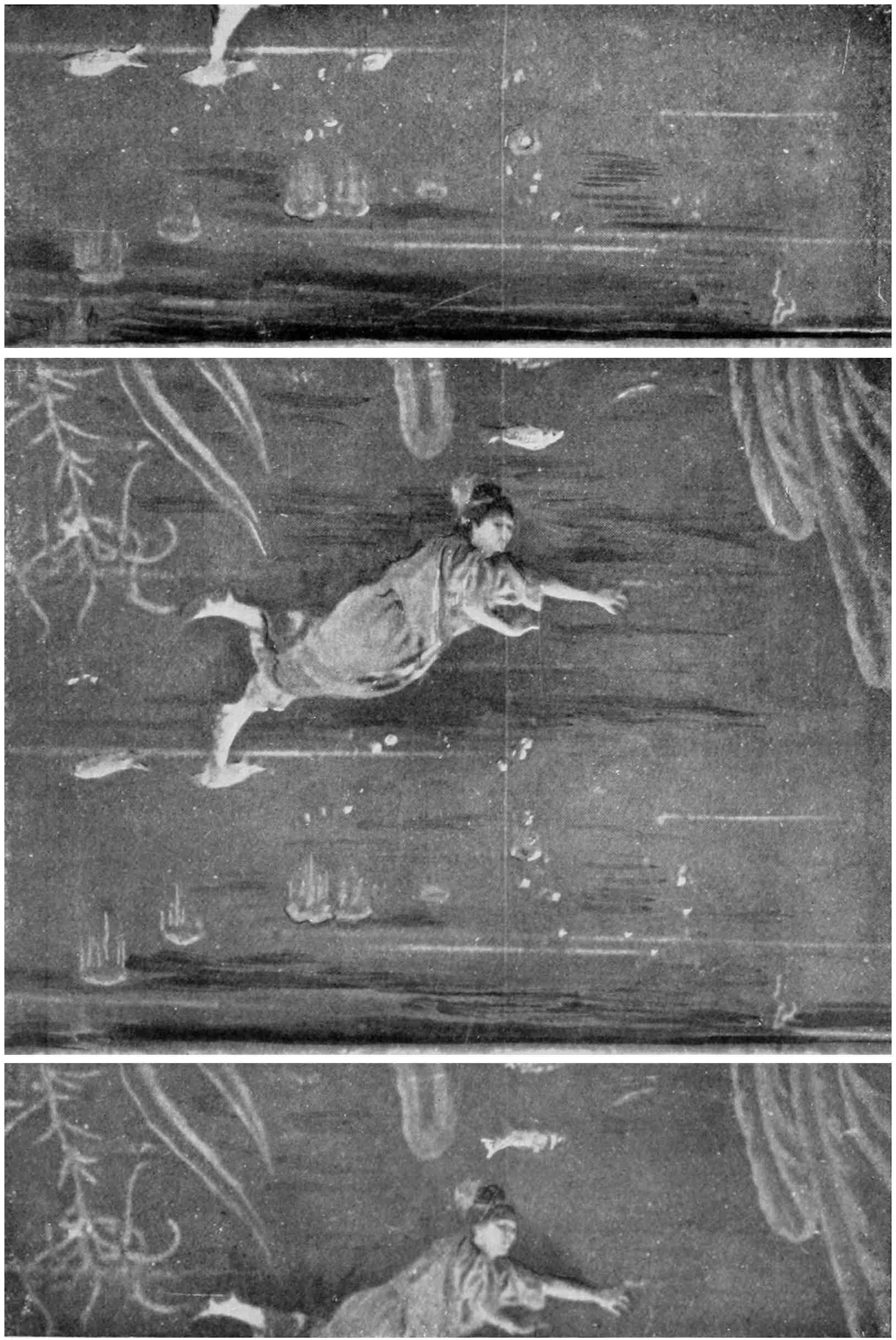
THE MYSTERY OF “THE SIREN.”
A beautiful woman is observed to be swimming gracefully in the depths of the sea, and the
public is mystified as to how she can exist under water.
The tank is then removed, and a scene depicting the floor
of the sea is prepared upon the stage, with a back-cloth
of a grey neutral tint. Perhaps a property ship to represent
a sunken wreck is set up to enhance the effect. Actresses
made up as mermaids disport themselves upon the sea-bed,
and divers are observed to make their descent from the
surface, which in this instance is the “flies” of the stage.
The film which the operator has exposed already upon the
stage tank is now exposed again before this scene, and the
commingling of the two produces a very mystifying effect
when shown upon the screen.
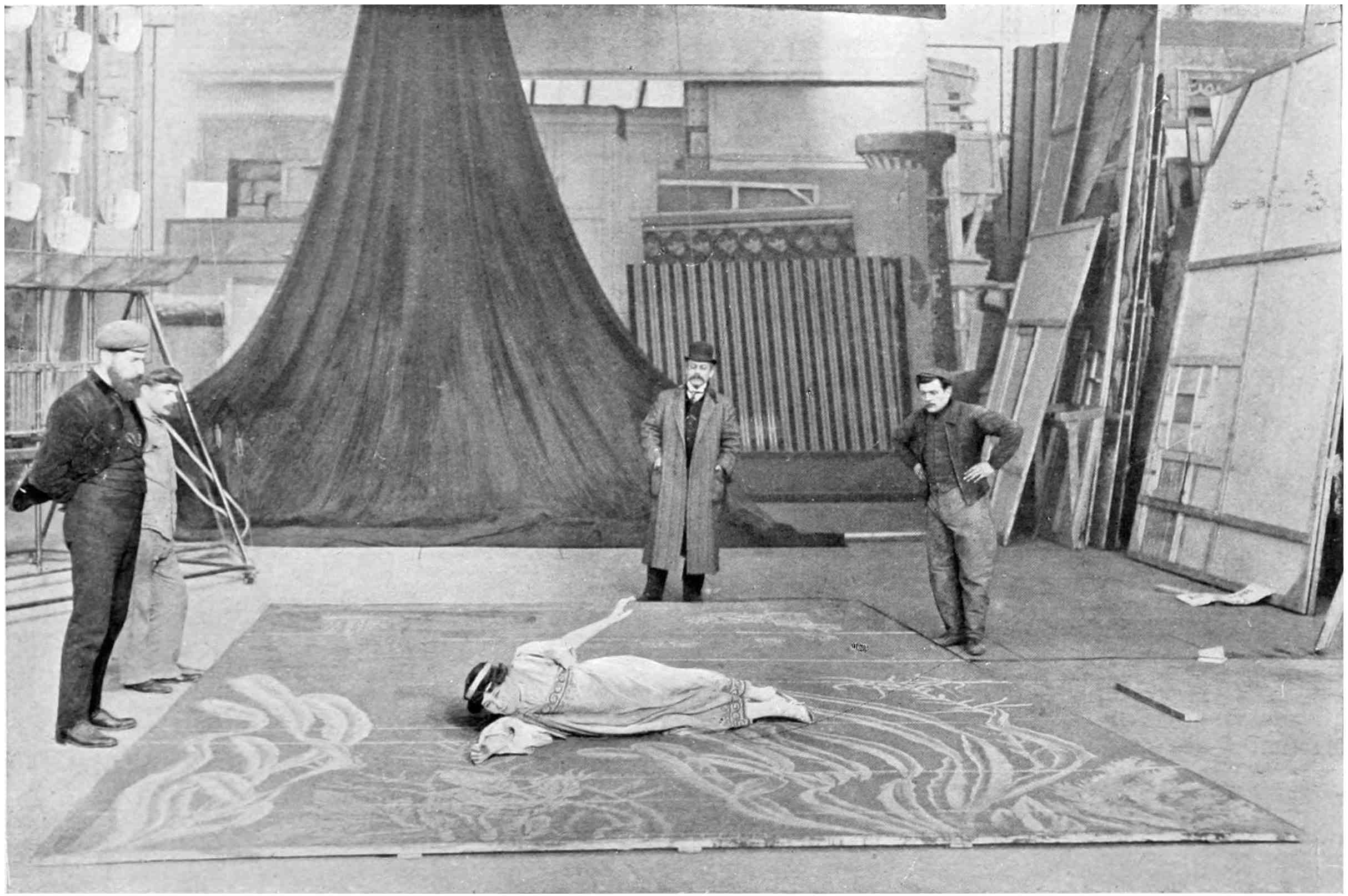
THE MYSTERY OF “THE SIREN” REVEALED.
The camera was placed in the flies with the lens pointing downwards upon the actress moving on the floor.
A fascinating film of this character was made by the
Gaumont establishment under the title of “The Siren.”
A beautiful woman was observed to be swimming and
diving in the watery depths with various fish as her
companions. Her movements were so graceful and natural
that it seemed impossible for them to have been produced
while the actress was suspended from the “flies” by the
aid of wires. How was it done? was an expression I heard
on several occasions during projection in the picture
palaces. The solution is very simple.
In the first place, a large aquarium was set upon the
stage. It was stocked with fishes, which gambolled in a
realistic manner, and the tank was photographed. When
this exposure was completed the “Siren” had to be
introduced.
The floor of the stage was cleared, and upon it, like
a carpet, was laid a large back-cloth of a grey neutral tint,
bearing faint designs of submarine growths, shells, weeds,
and so forth, the work of the scenic artist. The operator
carried his camera into the flies, and from a central point
overhead set it up with the lens pointing downwards, and
focussed the flat background spread out below. The actress
then entered, and lying prone upon the back-cloth, carried
out the movements necessary to simulate swimming and
diving, moving the arms and legs and writhing the body
to convey the correct natural impressions of under-water
movement.
The rehearsals completed, the operator re-exposed the
same film which had been previously exposed before the
aquarium, and which had received a faint impression
thereof. When the picture was projected the public was
completely deceived; for the actress moved to and fro, in
the company of fishes which darted from point to point,
apparently unperturbed by the existence of the fair feminine
form in their midst. In such operations as this, however,
where a photograph has to be taken of an aquarium in the
first instance, special attention has to be devoted to the
lighting arrangements, so as to prevent the camera and the
operator being reflected upon the film—since the water acts
in the same manner as a mirror.
The audiences in picture palaces are sorely puzzled at
the antics of motorists, cyclists, and others who, being pursued
by an infuriated crowd whose anger they have raised
for some reason or other, elude capture by turning their
vehicles and running up the vertical walls of houses and
buildings. The methods used in the presentation of the
“Siren” are adopted here also. A cloth carrying a painted
impression of the wall with its windows, doors, stack-pipes,
and so forth, is laid upon the floor, and the camera lens
is pointed thereon from a position in the flies. The vehicles
are driven over this back-cloth, and the film conveys the
idea that they have performed the impossible feat of riding
up the wall. The effect is often improved by following the
upward progress of the vehicle. This may be accomplished
in two ways. Either the camera is moved horizontally
along a track in the flies in synchrony with the advance
of the vehicle, or else the rising and falling front of the lens
is brought into use. Another means is to have resort to the
“stop” action, the camera being rigid and the back-cloth
moved across the floor a certain distance between each
series of exposures.
For the production of elaborate trick pictures an extensive
assortment of properties is demanded. When the
episodes are accompanied by ludicrous catastrophes and
smashes the public is moved to extreme mirth. In many
of these pictures the performers are obtained from the
vaudeville stage, being accomplished masters of knock-about,
tumblers, cyclists, etc. Suppose a chase over house-tops
is shown, accompanied by falls through the roof, the
actors and actresses tumbling from floor to floor down to
the basement. These pictures are prepared in sections.
The first scene represents the roof, which is built up on
the stage, while a back-cloth affords a vista of chimney-pots.
At certain points in the roof are concealed trap-doors
which, when the first actor brings his weight on them,
collapse by the movement of the bolt or other support
concealed beneath. The performers fall through the opening
on to a soft mattress within, the extent of the fall being
about four or five feet. In the next scene members of the
company in turn fall through the ceiling of the sixth floor
of the building. This scene is built up on the floor of the
stage, the performers being stationed out of sight in the
flies. The ceiling is represented by a piece of painted
canvas with attached pieces of cardboard and canvas to
resemble splintered woodwork and broken plaster. The
ceiling is intact, but when the cue is given the leading actor
jumps or falls through the painted canvas followed by
a mass of débris and dust. The débris is merely properties
thrown through the opening, while steam or smoke driven
through the hole serves as dust. Perchance a party is dining
in the room when the tumblers make their unexpected
entrance through the ceiling, and the scene undergoes
a complete disturbance as a result of the interruption. The
next floor is reproduced in turn in the same manner upon
the floor of the stage, and so on until the players come to
a dead stop in the basement, when the cardboard and
canvas débris produced by their hurried descent falls and
practically buries them. The force of the latter is increased
by men stationed in the flies, who hurl the material down
pell-mell from their points of vantage through the hole the
tumblers have made. As seen upon the screen it appears
as if the house were cut in two from top to bottom, and the
audience were permitted to follow the tumblers in their
descent from floor to floor; instead of which, as we have
seen, each floor is reproduced individually upon the stage.
There is no indication whatever of this piecemeal preparation,
although if the picture is followed closely it is readily
apparent, because the performers in their descent do not
comply with the laws governing the momentum of a falling
body.
The laughable incidents showing men climbing laboriously
through narrow chimney flues are attributable
likewise to trickery. The chimney is merely a stage
property, and generally is laid flat upon the stage, with the
operator and his camera stationed in the flies, as in the
production of the “Siren”; though, from the public point
of view, the players appear to be crawling upwards through
the narrow vertical brickwork passage, gathering an
accumulation of soot in their advance. The latter is applied
to their faces by the actors themselves as they move forward.
CHAPTER XXI TRICK PICTURES AND HOW THEY ARE PRODUCED IV.—Lilliputian figures: “The Little Milliner’s Dream”: the “one turn one picture” movement: how some extraordinary incidents are produced: “The Ski Runner.”
In Chapter XVIII. I made some reference to early
methods of producing a class of films in which the principal
performers were diminutive figures scarcely six inches
in height. This kind of picture has never lost its hold
upon the public. Indeed, experience has proved that it
constitutes one of the most popular subjects which it is
possible to throw upon the screen, especially when the tiny
actors and actresses are introduced into a play having a
well-defined plot carried to a logical conclusion.
I have related how Paul obtained the effect of pigmy
actors by combining the possibilities of superprinting and
photographing at varying distances from the stage.
This method is practised nowadays in somewhat modified
form. The stage is made so deep that there is no need to
move the camera.
Two of the most attractive films of this description produced
during recent years were “The Little Milliner’s
Dream” and “Princess Nicotine.” Curiously enough,
they represent two widely divergent methods of achieving
the same result, as practised by French and American
producers respectively. Both are associated with many
features of interest in cinematographic magic.
In “The Little Milliner’s Dream,” a young and charming
milliner’s assistant is sent by her employer to deliver
a creation to a customer. The girl sets out with the
milliner’s hat-box on her arm. On the way she pauses
to admire the glittering array of precious stones and gewgaws
in a jeweller’s shop. While she is gazing at the
articles longingly an old beau advances, makes himself
known, and tries to force his company upon her. With a
coquettish shrug of her shoulders she rebuffs him and
resumes her journey, but presently, overcome by the heat,
she sits down upon a seat in the street to take a rest.
Presently she falls asleep.
In her dreams she sees the lid of the bonnet-box open,
and from the interior steps the old gallant. At first he is
no taller than a coffee-pot, but he grows until he has
attained life-size proportions. Next, in the space occupied
by the upturned lid of the bonnet-box, a bevy of dancing
girls appear. They likewise are only a few inches in
height, but they increase in size until they assume normal
stature. To her astonishment each dancing girl proffers
the apprentice a magnificent present. In an instant, as if
under the magic spell of a fairy’s wand, she finds herself
attired in the rich clothes of a lady of rank, and taking the
arm of her admirer—who, by the way, shoulders the
bonnet-box—they march off together. The bonnet-box is
suddenly dropped and instantaneously becomes a luxurious
motor-car. The apprentice passes through many startling
adventures in the world of fashion and gaiety, but the
final scene reveals her still seated upon the seat, and being
roughly awakened by a gendarme from her delightful
dreams.
The first essential in such a picture as this is a deep
stage, so as to secure the impression of distance. The
Gaumont Theatre, from which this film emanated, is one
of the best designed and largest in the world, and the
preparation of such scenes as “The Little Milliner’s
Dream” offers them no difficulties. The street scene was
merely a back-cloth painted to resemble one side of the
street, with its shops, the roadway, and the kerb of the
second pavement. Before this was set up an ordinary
seat, such as is provided for the convenience of pedestrians
along the highway, and it was upon this that the little
milliner snatched her brief rest with the bonnet-box beside
her, and but a few feet from the camera.
When she fell asleep the lid of the bonnet-box was
opened by means of invisible wires, and the lid came to
rest in a vertical position against the back of the seat, the
top of the side of the box being level with the back rail
of the seat. The inner surface of the lid was a dead black.
At this moment the “stop” call was issued. While the
camera lens was closed the stage hands entered, took away
the bonnet-box lid, and removed a panel in the back-cloth
of the same shape and dimensions as the bonnet-box lid,
and immediately behind it. This left a hole in the back-cloth,
through which could be seen the stage behind. The
lens of the camera, however, was on a level with the top
of the bonnet-box, so that the floor of the stage behind
the back-cloth could not be seen through the panel. At
the extreme rear of the stage another back-cloth of black
velvet was hung. Consequently, looking at the picture
from the lens point of view, the black velvet, seen through
the panel in the scenic back-cloth, appeared to be the inner
surface of the bonnet-box lid; and the audience imagines
that what follows takes place upon the inside of the lid,
whereas it is, of course, seen through the back-cloth, and
enacted upon the back or rear half of the stage.
The camera is started up again. Suddenly the diminutive
figure of the old gallant is observed to rise from the
interior of the bonnet-box. As a matter of fact, he is at the
extreme rear edge of the stage, against the velvet back-cloth,
but seated below the line of sight of the camera until
he received his cue. The little milliner in her dream turns
her head as if to gaze more closely into the lid of her box—in
reality she is looking through the window in the back-cloth
upon the scene taking place behind her. The old beau,
having risen to his feet at the extreme rear of the stage,
and six or more times as far away from the camera as is the
milliner herself, appears, in accordance with the laws of
perspective, to be no taller than a bottle, this peculiarity
being accentuated by the distortion of the lens as in every
camera.
The old beau lifts his hat and instantly commences to
grow in size. This transformation was caused by his advancing
towards the hole in the back-cloth, which, as the
distance between him and the lens decreased, caused his
stature to enlarge. At last the actor advanced to the limit of
his forward movement, when his figure occupied the full
depth of the opening, or of the supposititious bonnet-box
lid. At this moment the camera paused to permit the actor
to walk round the back-cloth, representing the street, and
when the camera was re-started he was seen before the
bonnet-box as if he had stepped out of that receptacle.
Being as close to the camera as the milliner, he was now
brought to life-size.
The spectacle of the dancing girls was carried out in the
same manner. When the little milliner was urged to
look into the lid of the bonnet-box once more, she peered
through the back-cloth window. To her amazement she
saw six diminutive dancing forms rise up as if from the
interior of the box, but in reality from the floor against the
black background, at the point where the beau had first
appeared. They danced their way to the opening to a
point marked on the floor of the stage behind the scenic
back-cloth, thereby growing gradually in stature. Then
the camera made pause to permit the girls to come round
the back-cloth and to assume the required position before
the milliner near the camera, where likewise they were
brought to normal size. They presented their gifts to the
delighted girl, and then there was another pause on the
part of the camera.
During this stop the milliner changed her attire for that
of a lady of fashion. At the same time the stage hands
replaced the panel in the back-cloth, while the original
bonnet-box lid was brought in and restored to its former
position.
When the camera began again it recorded the beau
closing the lid of the box, and while he picked it up with
one hand he offered his other arm to his fair friend and
escorted her along the street. Presently he dropped the
box. Another “stop” call was given, during which the
bonnet-box was taken away by the stage hands, and an
automobile brought into position at the point where the
hat-box was dropped. When the camera re-started it revealed
the bonnet-box converted, like Cinderella’s pumpkin,
into an automobile. Entering the vehicle, the couple drive
off to the ball. The process of “stop and substitution,”
which has been described already, is carried out from time
to time to present sudden transformation effects; the
audience sees only the continuity of motion as produced
by joining the pieces of film together; and they marvel at
the result. The film was produced very cleverly and skilfully,
and it certainly ranks as one of the masterpieces of
the Gaumont establishment.
Another favourite artifice, with which some truly bewildering
effects can be produced, is known as the “stop
motion,” or “one turn one picture,” movement. As may be
imagined from the latter explanatory title, it resolves itself
into a pause between each picture, instead of continuous
exposure to record sixteen images per second.
This feature may be illustrated by reference to a popular
film which appeared a short time ago, called “Animated
Putty.” A lump of this material was shown upon a table.
Suddenly it was observed to become agitated, and to resolve
itself gradually into statues and busts of well-known people,
so cleverly wrought as to be instantly identified. In a
similar picture a rose was seen to detach its petals, which
became scattered over the floor; and just as mysteriously
the petals came together once more and assumed their
former positions. Another picture shows “Boots” going to
sleep at his task, and the foot-wear cleaning itself while he
dreams, brushes running to and fro to remove the dust,
apply the blacking, and to give a vigorous polishing off.
Upon waking, Boots gives vent to a self-satisfied smile
upon beholding the completion of his work without any
effort on his part.
In reality this is one of the simplest of trick effects; but
it is at the same time one of the most tedious to perform.
The method can be best explained by taking the “Animated
Putty” film as an example. The lump of material lies
upon the table, to be fashioned into a bust of the King, of
the American President, or some other illustrious personage.
The camera is set up. The modeller advances to
the table whilst the shutter is closed and moves the clay
slightly towards the desired result. He then steps out
of the picture, and the camera handle is turned sufficiently
to expose one picture and to cover the lens again. The
modeller comes forward once more and advances a little
further with his work; after which he retires from the
scene, and the second stage is recorded upon the next
picture. Again the modeller approaches the material to
mould it a further step, and upon his retirement the third
picture is taken. This alternate process of shaping the
putty a little at a time, and photographing every separate
movement, is continued until the bust is completed.
It is essential that the progress should be very gradual, or
else the material would look as if it took shape by spasmodic
jumps, and the illusion would be destroyed. Some films
of this character demand slighter movement between each
exposure than others. It depends entirely upon the subject.
It will be observed, however, that this magical effect is not
produced in accordance with the generally accepted principles
governing cinematography. It is merely a series of
snap-shots taken at certain intervals, and could be produced
just as well by a hand-camera if one had sufficient plates
or film.
As may be supposed, the task calls for unremitting
patience and perseverance, because it is so exasperatingly
slow. Several hours and even days are often expended in
producing a single film of this character. If, for instance,
the film measures 200 feet in length, no less than 3,200
distinct operations have been carried out and photographed
consecutively; yet when such a film is thrown upon the
screen at the rate of 16 pictures per second, the successive
snap-shots follow one another so regularly as to convey the
impression of continuous motion.
The same operation is practised with the rose, the petals
being torn apart a little for each successive exposure, while
to convey the effect of rolling along the table they are
moved a minute distance between each exposure, and supported
from behind in the requisite position while the
shutter is opened and the film exposed one picture at a time
between each movement of the rose. In the case of the
“Boots” who has his work done while he sleeps, the
brushes are manipulated by invisible wires. The interruption
in exposure can often be detected unless the task is
carried out with consummate skill, because the movement
appears to be jerky in the picture.
An amusing film of this type appeared some time ago,
in which cotton and wool appeared to be imbued with
life. The cotton arranged itself into fantastic designs upon
the table, while a stocking was knitted before the eyes of
the audience by unseen hands. So far as the cotton designs
were concerned this was the “one turn one picture” movement
in its simplest form, the design being furthered little
by little between each exposure. With regard to the mysterious
knitting, this was achieved by a combination of
the “one turn one picture” and the “reverse action”
artifices.
While the picture was being taken the producer stood
behind a table, concealed by a black cloth somewhat after
the manner practised in “black magic.” What the camera
actually recorded was the unravelling of the stocking stitch
by stitch, the needles being manipulated meanwhile in
the opposite direction. As the stocking was unravelled the
wool was pulled gently through a tube extending up the
producer’s sleeve to his back, where it was secured by a
confederate and rolled into a ball. In this way the length
of wool between the needles and the ball was kept fairly
taut, as would be the case if a person were knitting. Each
movement of the needles was photographed, the operator
setting the needles in the requisite position and then withdrawing
his hands from the scene. The task was continued
step by step until the sock had been completely unwound,
the last stitch pulled out and the end of the cotton and the
needles were shown lying on the table. The film itself
was driven backwards through the camera while the exposures
were made, so that when the picture was printed
and thrown upon the screen the movements were reversed—the
destructive action recorded by the camera became constructive
movement in the projector. The public first saw
the loose end of the wool and the needles. They observed the
needles rise up, form the first stitch, and then watched the
sock grow at an amazing speed until it was completed,
the needles moving in a perfectly natural manner to form
the stitches. Further realism was imparted to the picture
by the needles and work being jerked every now and again
to release a little wool from the ball.
The Americans have brought the “one turn one picture”
movement to a high state of perfection, and have produced
some astonishing pictures as a result of its application.
One is introduced to a magic carpenter’s shop, where
tools are manipulated without hands and where the wood
springs from the floor to the bench, is planed, sawn,
chiselled, and fashions itself into a box or whatever article
is desired by an apparently mysterious and invisible force.
TWO NOVEL TRICK EFFECTS.
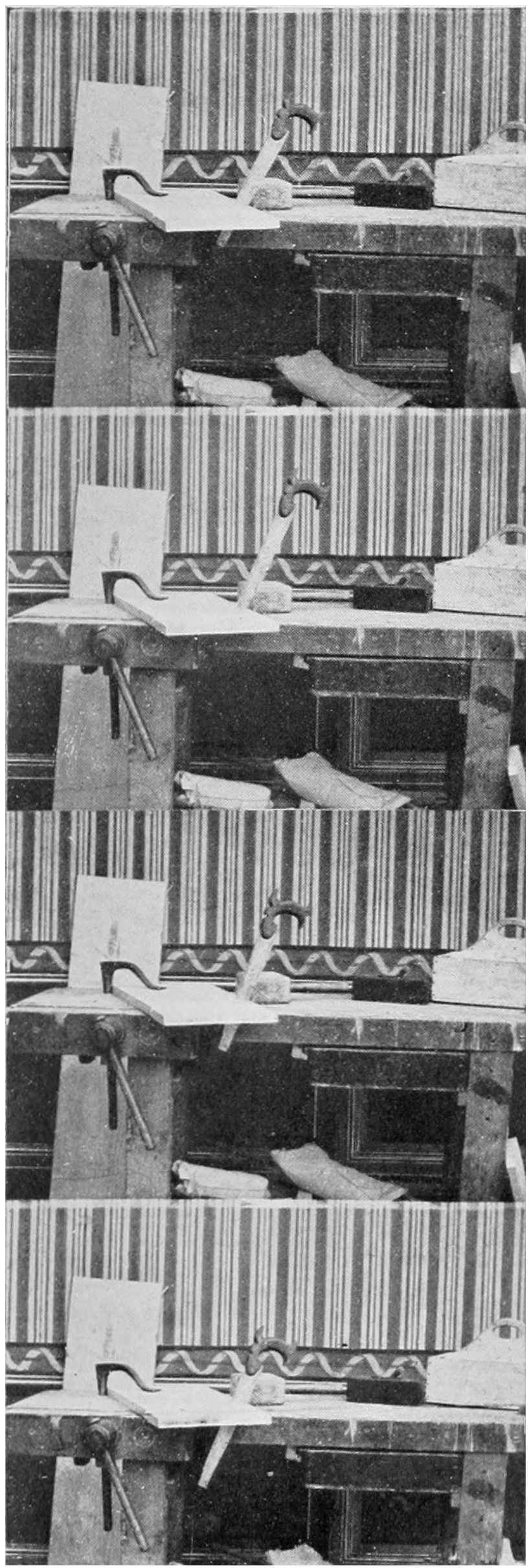
A workshop in which tools move without hands.
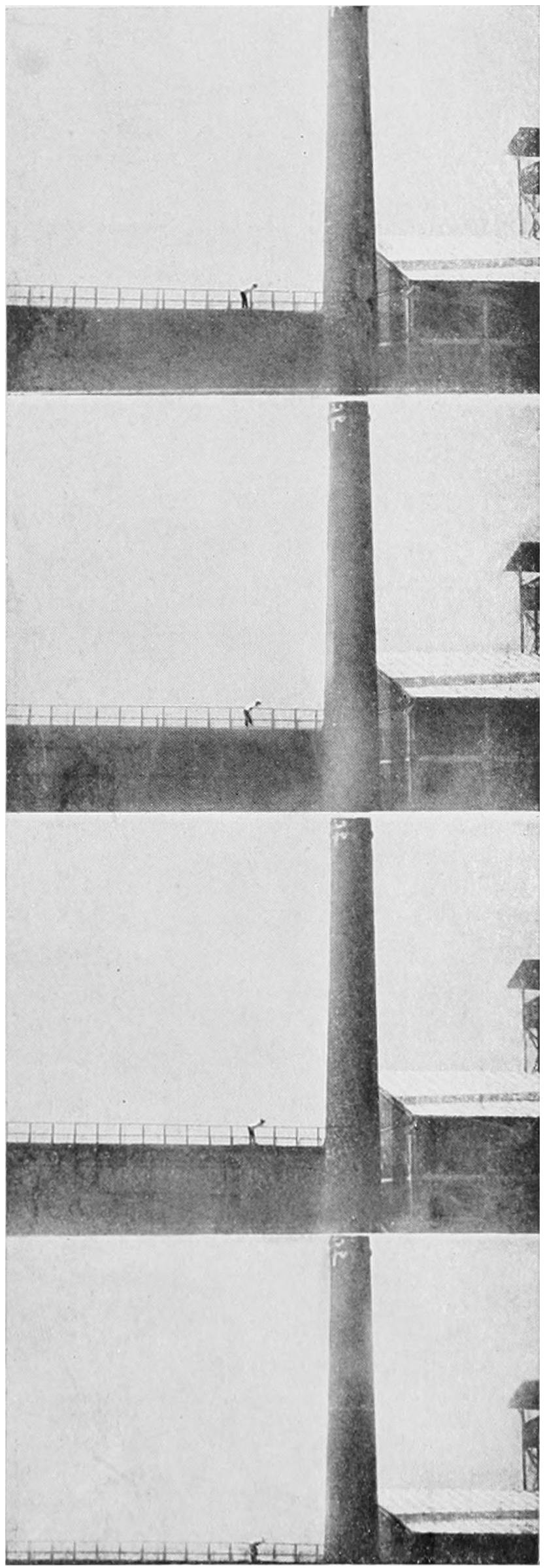
A.—The skater approaching the factory chimney.
The apparently impossible is brought about in this
instance by resort to a combination of the “one turn one
picture,” the “reversal of action,” and manipulation by
wires, strings, and threads. To secure the rising of the
plank from the floor to the bench the camera is stopped
when this incident is reached. The plank is laid on the
bench and a string is attached to it. The camera operator
runs his film forward a certain distance, say twenty-four
inches, which is indicated upon the dial while the lens is
covered. He then gives the signal, and the stage hand,
by pulling the wire attached to the plank, causes it to fall
to the floor. The operator of the camera meanwhile runs
the two feet of film backwards past the lens, thus photographing
the plank falling to the floor. But as he has
advanced his unexposed film two feet forwards and runs it
backwards during exposure, he has reversed the motion of
the falling plank, and the first image records the plank,
not as it moves off the bench, but as it strikes the floor,
while the other images up to the thirtieth show it in the
air; and the last exposure displays it lying flat on the bench.
Of course, when the film is thrown upon the screen the last
phase of the action is shown first, and the first movement
is the last image, so that the plank appears to rise from
instead of falling to the floor.
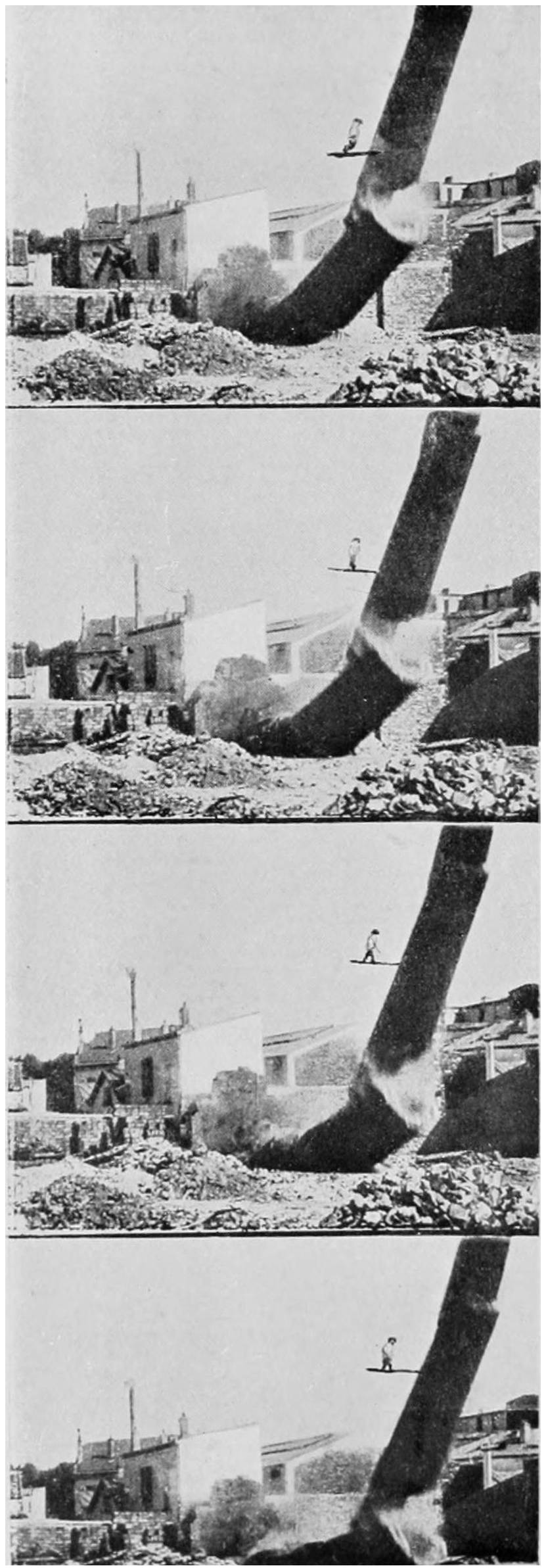
B.—The result of the collision with the chimney.
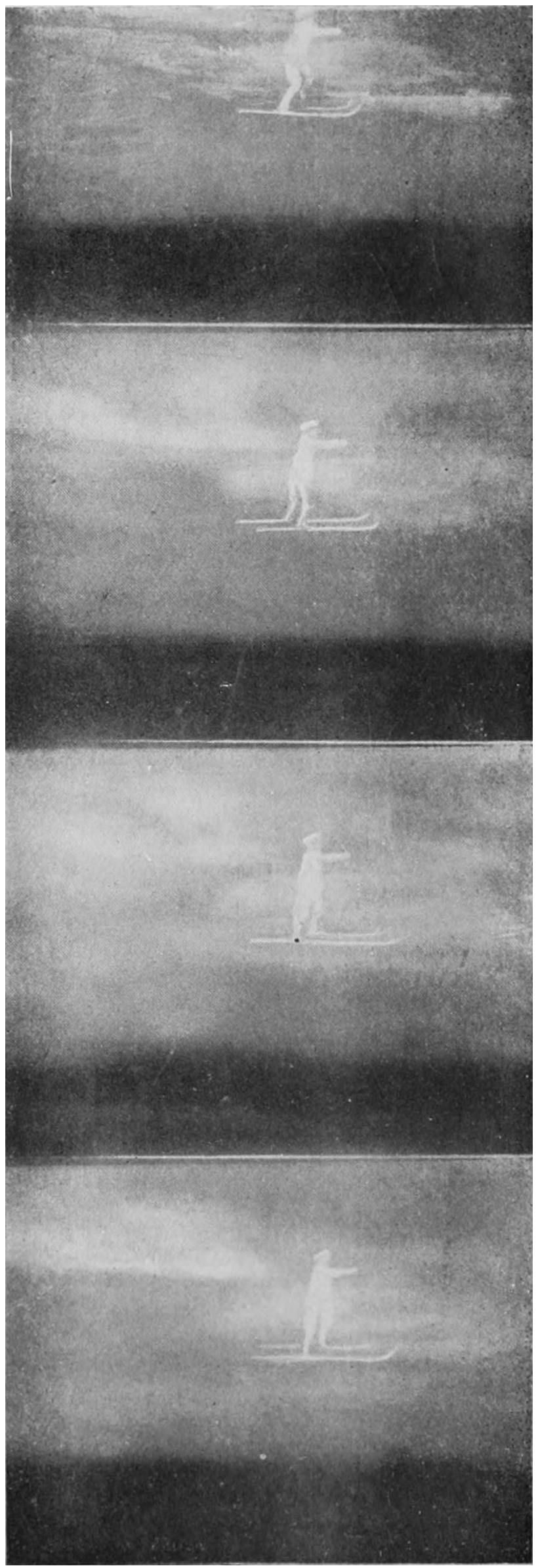
The ski runner disappears into space.
THE SKI RUNNER.
The methods adopted for the production of this novel trick film are described in the text.
The movements of the saw, chisel, and plane are carried
out upon the “one turn one picture” principle, the tools
being moved a slight distance between each exposure. In
planing, when the shaving rises after the tool has reached
the end of its stroke, a piece of thread attached to the shaving
is given a sharp jerk to flick it out of the way, simulating
the natural movement of the carpenter, who invariably,
as he draws the plane back with his right hand,
whisks the previous shaving out of the tool with his left.
The hammer, chisel, and screwdriver can be manipulated
by means of threads to give the varying positions of the
particular tool in the driving process, and so on.
A film which appeared some months ago aroused a lively
interest and speculation. It depicted a mysterious banquet
where viands and liquors were consumed by unseen guests.
The knife came suddenly into action to cut the bread,
the various dishes were served and disappeared, while
glasses of wine were filled and raised into the air by invisible
hands; toasts were given, the glasses were tilted
for the act of drinking, and became empty. The effect was
somewhat uncanny, but it afforded a striking instance
of the possibilities attending the utilisation of the “one
turn one picture” movement, in conjunction with wires
and threads. Each glass of wine was lifted into the air
by two invisible threads, one being placed around the
stem of the glass, while the other was connected to the
bowl. These threads were controlled by stage hands on
the overhead bridge. The glasses were lifted a slight
distance between each exposure and photographed, and
when the drinking act was demanded, while the thread
attached to the bowl was held stationary, the second,
attached to the stem, was steadily raised, giving the desired
tilt. The liquid as it escaped from the glass fell to the
floor, but its escape in this manner was not shown upon
the screen, for the simple reason that the liquid fell out
and was caught in a vessel held by a stage hand while the
lens of the camera was closed, the exposure being made
after the slightest quantity had fallen from the glass, this
process being repeated until the toast was drained.
In the early days of the art superprinting was the
favourite subterfuge used by the cinematographer magician
to produce strange effects; as I have described already in
regard to the pioneer work of Robert Paul. The composite
construction of pictures has not been abandoned by any
means, despite the advances in cinematographic magic.
Indeed, some of the most startling productions seen to-day
are prepared in this manner, two or even three films being
used for the purpose. One of the most telling recent
examples of this method is evinced in the pictures of the
“ski-runner.”
When first seen the actor is skating along a track in
the usual manner. He approaches a towering factory
chimney; but instead of avoiding the obstruction he crashes
into it. The solid mass does not bring about the skater’s
extinction, but instead collapses to the ground. In the last
picture the demon skater is seen ski-ing through the air,
over the clouds, into oblivion.
The first part of the scene was taken in the vicinity of
the Gaumont factory, and the chimney seen in film A
belongs to the works of the company. The skater seems
to strike the side of the chimney, but as a matter of fact
he glides behind it, as might be supposed, and the film
is cut short at this point. If one examines the film B
closely it will be observed that the chimney there shown
under collapse is not the same as that depicted in film A.
As a matter of fact, the scene was changed. When this film
was taken in hand the producers had heard that a chimney
was to be felled in a certain place by the method of
cutting away the masonry base, and supporting the structure
temporarily upon wooden members, which are afterwards
burned through to raze the chimney to the ground.
Accordingly a camera and operator were dispatched to the
scene to film this interesting operation, and a striking
picture of the falling chimney was secured.
The combination which presented the illusion that the
chimney was knocked over by the ski-runner was carried
out as follows:—A special back-cloth of a neutral grey
tint was prepared for the studio stage. When the ski-runner
ran across the stage before the camera only the
actor himself was seen in the resultant film. When this
film of the ski-runner was superimposed upon that showing
the demolition of the chimney, the former was seen to
be forging ahead through the air after apparently knocking
the structure out of his way. It will be observed that
the idea is so worked out that the ski-runner appears to
pursue the chimney as it crashes over, conveying the impression
that he is continuously pushing the crumbling
mass out of his way.
For the final disappearance of the skater into thin air
two similar films were prepared. One was exposed to a
cloudy sky, the lens being stopped down very severely to
give a small aperture and an under-exposed result. In the
studio the skater once more rushed across the stage before
the neutral-tinted background, the lens stop in this instance
being more open so as to secure a stronger image,
but when the end of his mad career was required, the closing
diaphragm was adopted. The first film was superimposed
on the second to print the positive, and the result on the
screen is of the ski-runner moving like a spectre through
the clouds, to disappear finally into a haze. This film
proved a conspicuous success owing to its novelty and
realistic appearance.
CHAPTER XXII TRICK PICTURES AND HOW THEY ARE PRODUCED V.—“Princess Nicotine” and her remarkable caprices
“Princess Nicotine” ranks as one of the finest trick
films ever made in the United States, and was the handiwork
of two producers who rank as the leading American
exponents of this strange craft—Messrs. J. Stuart Blackton
and Albert S. Smith. In its production, all the subterfuges
known to the cinematographic trick art were pressed into
service, rendering it completely mystifying from beginning
to end.
Some years ago these two artists were responsible for
a trick-film, “The Haunted Hotel,” which was so puzzling
and so cleverly worked out that it was regarded as a masterpiece
of cinematographic chicanery. It was a prodigious
success; some idea of its widespread popularity may be
gathered from the fact that over 150 copies of the subject
were disposed of in Europe alone, while its total sales
were well over 400 copies; for its success in the land of its
origin was quite as marked as that which it scored in the
Old World. For a long time it ranked as the finest trick-film
the United States had produced, and it precipitated
a “boom” in “haunted” subjects. The success of that
film, however, threatens to be surpassed by “Princess
Nicotine,” which, in addition to being a distinct novelty,
is dainty in its conception, fascinating in its theme, and
finished in its production.
The story of the play may be briefly related. The scene
opens with a young bachelor reclining in an armchair at
a table. Before him are scattered the indispensable adjuncts
to a bachelor’s comfort—a box of cigars, a tobacco-box, a
corncob pipe, a box of matches, a square white bottle standing
upon the cigar-box, a bottle of whisky and a syphon
of soda-water. In addition, there is a large, round reading-glass
with a handle. The bachelor fills his pipe, lights it,
leans back and dozes. Suddenly the lid of the tobacco-box
is opened and a small fairy, Princess Nicotine, jumps out
and falls over the pipe, which arrests her attention and
gives her a brilliant idea. Laughingly she returns to the
tobacco-box and helps out a second and smaller sprite,
whom she leads to the pipe and unfolds her scheme. The
fairies are no larger than the man’s hand, and the contrast
between their diminutive figures and the bachelor is decidedly
grotesque. At first sight one might think the two
tiny forms were dolls, but their movements are so graceful,
steady, and natural that this idea is quickly abandoned.
The two wee plotters pull out the tobacco, and the smaller
fairy jumps into the bowl and is buried beneath a layer
of the shredded weed, which is pushed in by Princess
Nicotine, who afterwards hides in the tobacco-box.
The bachelor wakes up, and after yawning turns to his
pipe once more. To his amazement the tobacco will not
light, and he looks at it closely. He starts in amazement
and picks up the hand-magnifying glass to examine the
contents. He reveals what he sees to the public, for the
magnifying-glass is held up as it were before the spectators,
who see the elfish face of the fairy peeping from the
tobacco and enveloped in wreaths of smoke.
The startled bachelor then inverts the pipe and raps
out the contents in true smoker’s fashion upon the table,
emptying the fairy in the process. She struggles to her
feet from the tobacco débris, and rushes to the tobacco-box,
into which she jumps, pulling the lid down after her.
Princess Nicotine thrusts her arm out of the box, which
the bachelor grasps, but instead of withdrawing the fairy,
he seizes a rose, which he proceeds to smell; but he is
seized with a violent fit of coughing caused by a cloud of
smoke which issues from the flower. He examines the rose
through the magnifying glass, this view as it appears to
him being held before the audience as before, so that it
sees the form of the fairy embedded among the petals,
smoking a cigarette. The man drops the rose and rushes
out of the room. The rose falls to pieces gradually, the
petals accumulating on the table and turning into a cigar.
The bachelor re-enters, picks up the cigar, lights it, the
smoke rises and whirls round rapidly, and presently rushes
into the white bottle. Startled at the extraordinary action
of the smoke, the bachelor picks up the bottle, examines
it and sees the fairy imprisoned within and vainly endeavouring
to escape. The man breaks the bottle, and the
fairy is seen standing on the tobacco-box. She picks up a
packet of cigarettes, proffers one to the bachelor, and
dances before him on the table.
The bachelor commences to tease Princess Nicotine. He
lights a match and holds it towards her. She shrinks
from it in fear, and in revenge she approaches the match-box,
extracts the matches, stacks them in a pile, and lights
them. The magnifying-glass is held up as before, and the
audience sees the pile of matches burning like a big bonfire.
The last scene shows the man, somewhat terrified at
the blazing pile on the table, picking up the soda-syphon
and endeavouring to quench the outbreak, at the same time
deluging himself in the process.
Through the kindness of Messrs. Blackton and Smith
I am able to explain how this apparently miraculous picture
is produced, and the various tricks employed. In describing
the “Little Milliner’s Dream” I have shown how the
appearance of a fairy can be produced, by placing the
performers fulfilling the rôle at the very back of the stage,
a long distance from the camera, whereas the principal
actor is caused to carry through his part but a few feet
away from the lens. The same effect can be produced by
the aid of a mirror placed at the back of the scene; when
the players fulfilling the rôles of fairies enact their parts
on a stage placed beside the camera, the film records simply
their reflection in the mirror, and the impression of extremely
small stature is conveyed. By pressing the mirror
into service a great saving in stage space is gained.
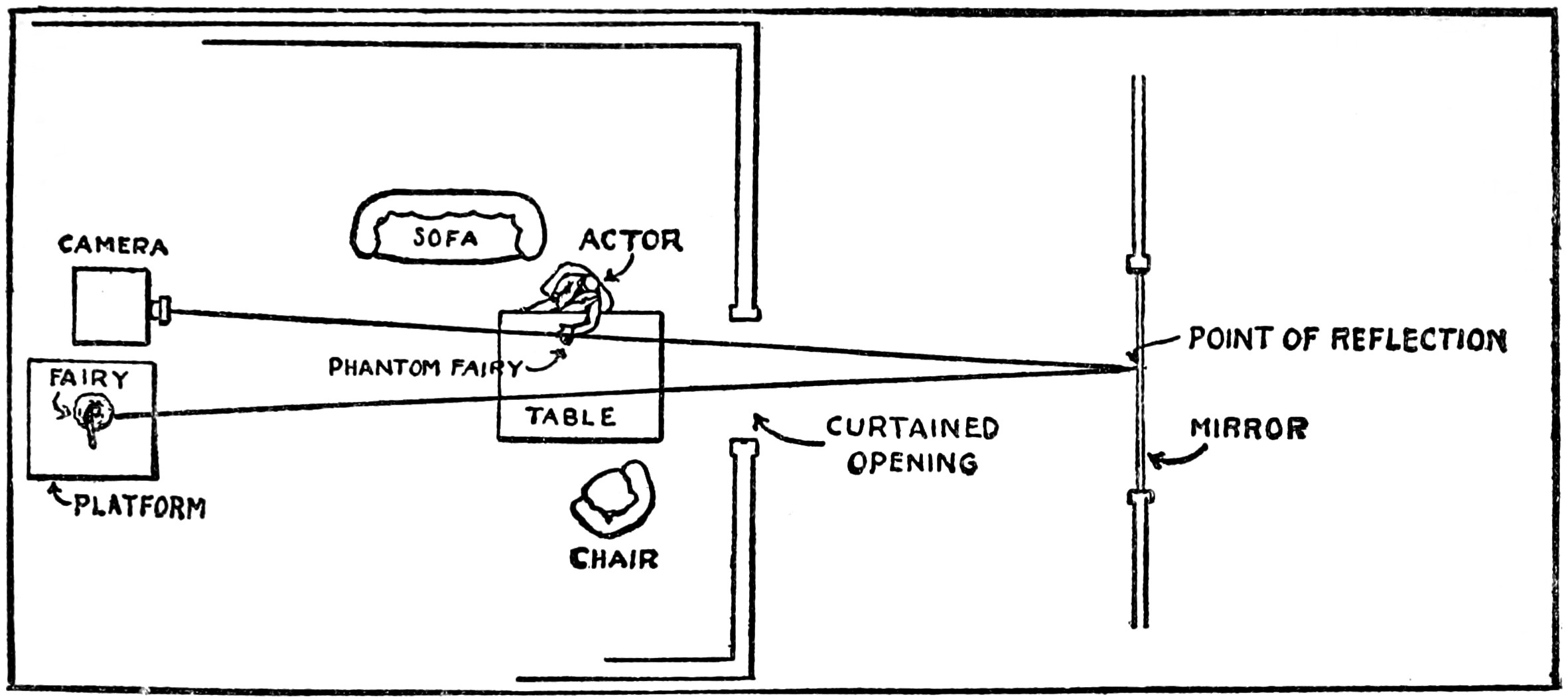
Fig. 18.—How the Stage was Set for Taking the Trick Film “Princess Nicotine.”
Two stages are required for the effect: the set stage on
which the scene is built up, and on which the bachelor
figures, and a temporary stage placed beside the camera,
whereon the fairies carry through their parts. The diagram,
Fig. 18, shows the setting of the stage. The mirror is placed
some distance behind the back-cloth of the stage scene,
immediately behind a curtained window, which is really
an opening in the back-cloth. As the action takes place
at night all is darkness outside the window. The lens is
exactly flush with the top of the table in the scene, so that
when the reflections of the fairies are caught they appear
to be moving upon the top of the table. The mirror at
the back of the stage is so disposed as to appear to be the
glass in the window of the back-cloth behind the actor,
and is arranged so skilfully as to betray no evidence of its
existence. The stage set up beside the camera is of such
dimensions that it keeps the actresses taking the parts of
the two fairies within the limits of the centre of the table;
while its floor is marked accurately for other purposes,
which will be described later. If the principle adopted
for presenting the diminutive players in “The Little Milliner’s
Dream” had been followed in this instance instead
of using a mirror, the fairies would have had to carry out
their work at a point equal to twice the distance between
the camera and the mirror to present the same effect. It
may be pointed out, in passing, that during the whole
play the actor fulfilling the part of the bachelor sees nothing
upon the table in front of him beyond the articles placed
there for his own comfort.
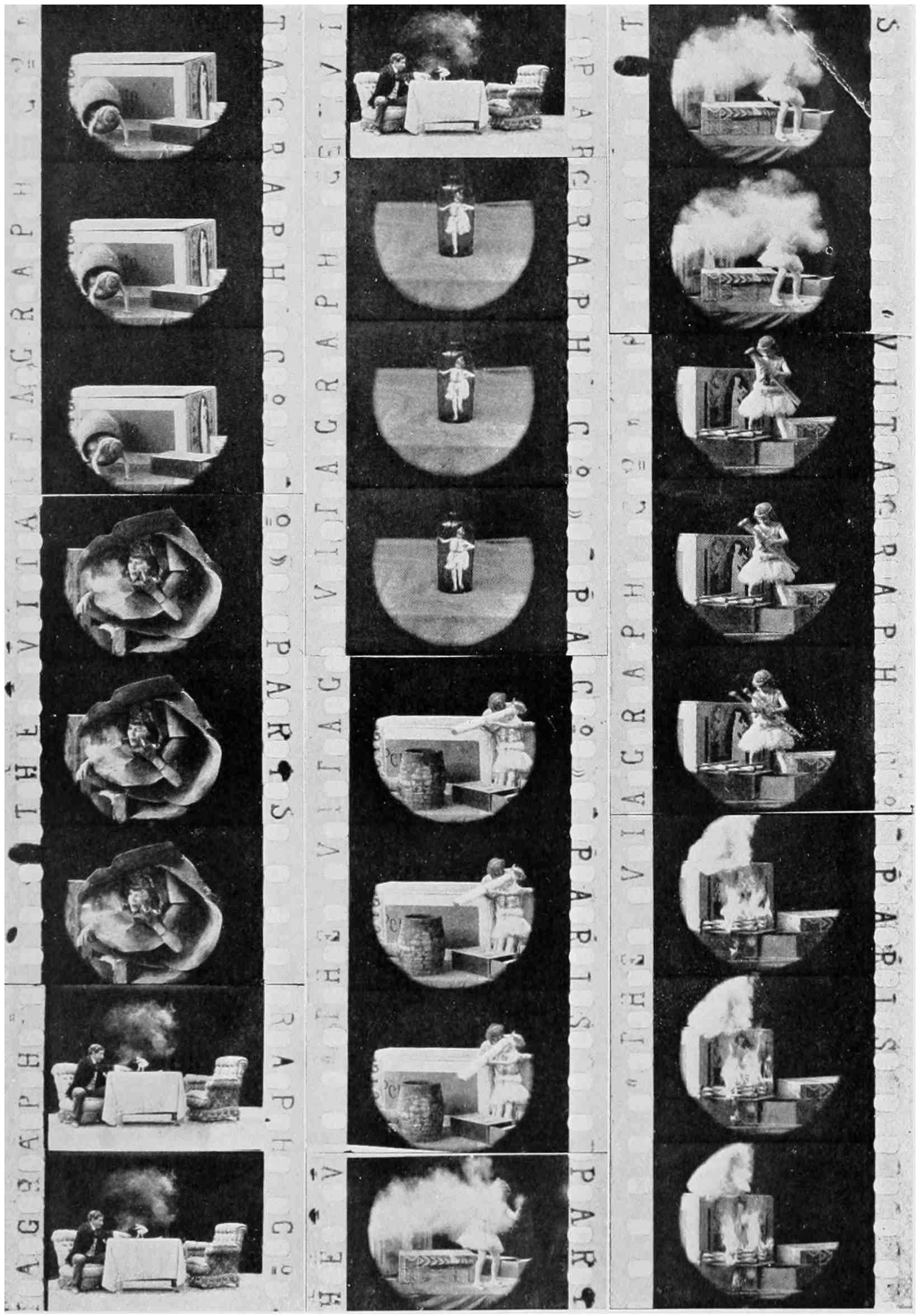
PRINCESS NICOTINE—A DAINTY TRICK FILM.
This subject, produced by the Vitagraph Company of America, has proved to be one of
the most popularly successful subjects of this description seen during recent years.
The rôle of Princess Nicotine was fulfilled by an actress
of average height, while her companion was a little girl
of about twelve years of age. In addition, certain properties
were required, all of which were enlarged facsimiles of
objects in daily use. These comprised a cigar-box of huge
dimensions capable of permitting the fairies to stand up-right
within it; a huge corn-cob pipe, the bowl of which
was as big as a barrel; a property match-box containing
matches measuring about thirty inches in length, with paper
rolled round one end to convey the impression of phosphorus
heads; a property packet of cigarettes nearly six
feet in height, containing cigarettes thirty-six inches long
formed of rolls of paper stuffed with straw, and more straw
to represent the tobacco. These properties had to be prepared
carefully to scale, while the actresses themselves had
to be accomplished performers. The play demanded
searching rehearsals, as in a trick picture of this character
the slightest slip in the acting destroys the illusion.
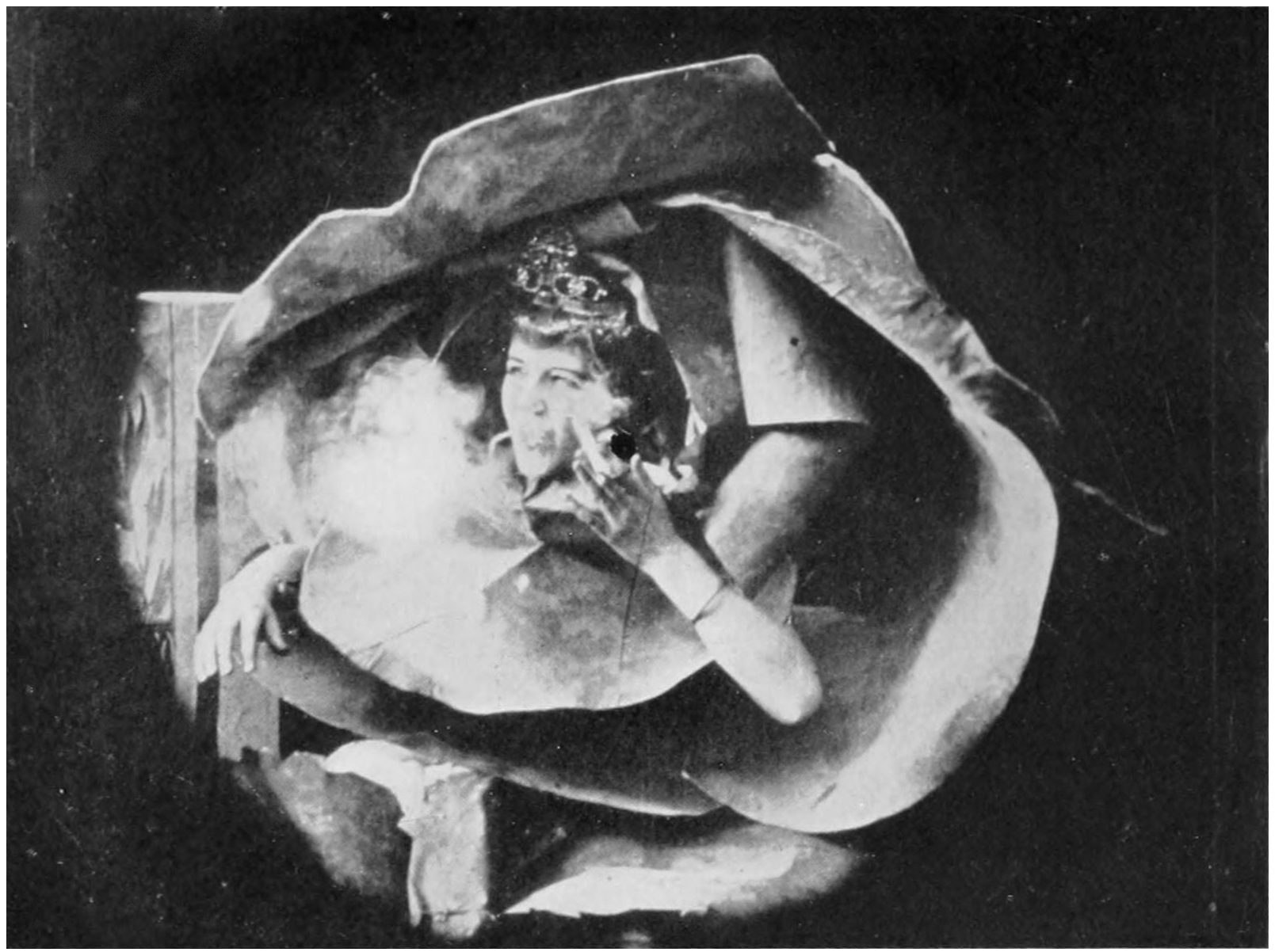
The fairy, buried in the heart of the rose, smoking a cigarette. The blossom is a large
paper property flower.
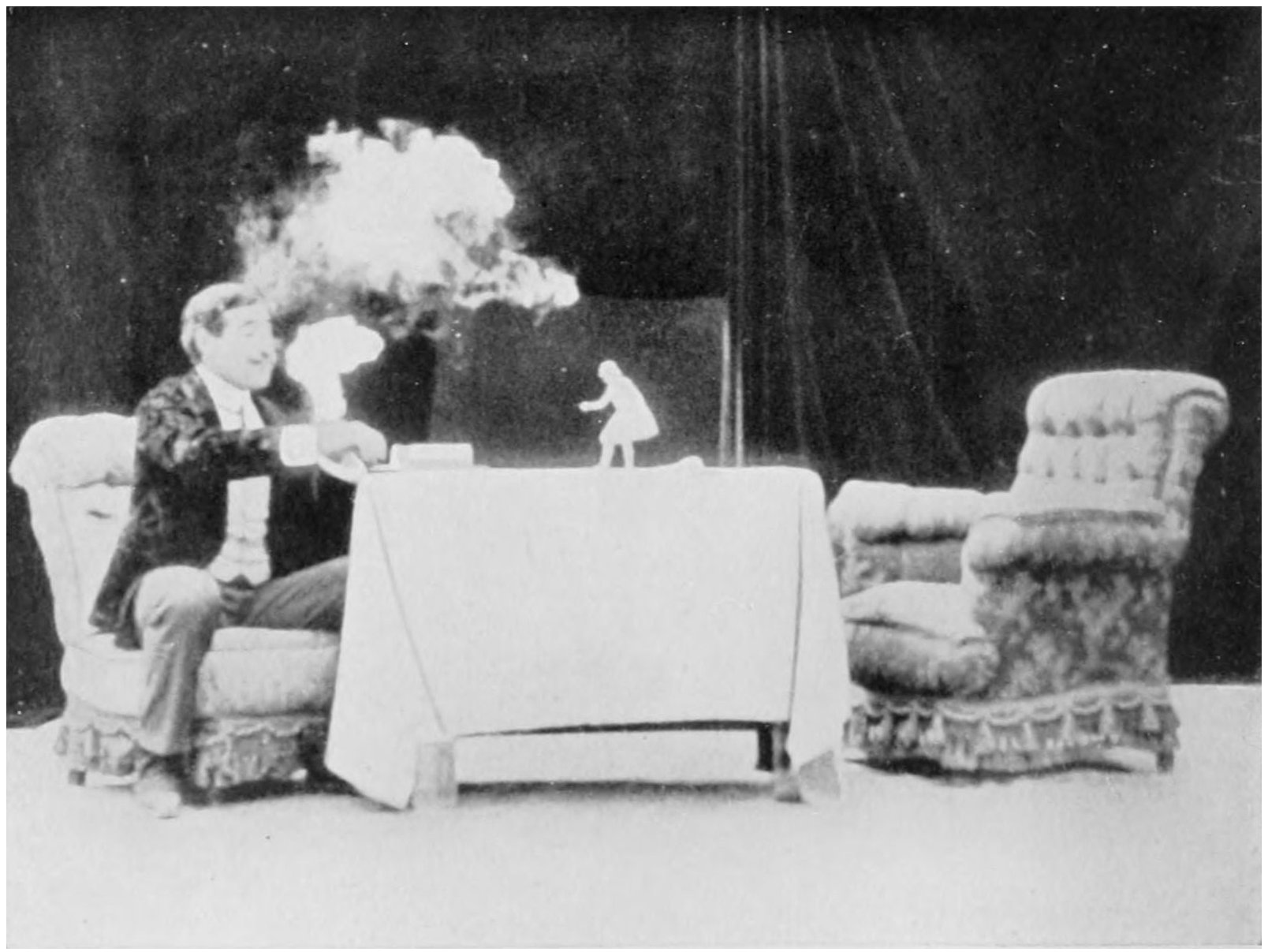
PRINCESS NICOTINE.
The diminutive form of the fairy on the table. The bachelor, although astonished, in
reality sees nothing.
The properties were used on the second stage beside the
camera operator, and when reflected in the mirror they
appeared no larger than the smoker’s companions lying
upon the table. Behind the fairies’ stage a back-cloth of
black canvas was stretched, so that all their movements
were against a black background, and this served to sustain
the impression of darkness behind the back-cloth window
of the scene, beyond the window in which the mirror was
placed.
In addition to these properties stage hands were required
at various intervals to complete certain operations, but
were concealed out of the sight of the lens of the camera.
Their tasks also will be described in due course.
In the opening scene the bachelor uses his own materials
lying upon the table. The camera stops, and in the interval
their place is taken by the properties, which are placed
upon the second stage to produce a reflection in the mirror.
When the fairy appears to jump out of the bachelor’s
cigar-box on the table she actually steps from the property
cigar-box on the second stage, the lid of which is opened
by means of a thread pulled by a stage hand concealed
behind. The antics of the fairies, which appear to take
place on the table before the bachelor, are carried out
upon the second stage, beside the camera, the smaller fairy
climbing into the property pipe.
When the bachelor wakes up and tries to light his pipe
the fairy stage properties are removed from the fairy stage,
and those of the bachelor replaced upon the table. Accordingly,
the audience see him vainly endeavouring to light
his own pipe, which finally he examines with the magnifying-glass.
When the scene revealed to the smoker is
flashed to the public on the screen in such a way that the
audience appear to be looking through the magnifying-glass,
they are not looking at the bachelor’s pipe, but at
the property one. To produce the effect of magnification
the second stage is photographed directly from a
short distance instead of by means of the reflection in the
mirror. The smoke curling lazily about the smaller fairy
and issuing from the pipe is produced by steam, there being
a tube carried beneath the table and connected to the
bottom of the bowl of the property pipe.
When the scene is flashed back once more, and the
bachelor is again seen seated at his table, photographing is
resumed of the mirror’s reflected image.
The second stage is cleared again, and we see the man
empty the ashes of his pipe upon the table. The débris
containing the fairy is again thrown upon the screen in
an enlarged form, as if through the magnifying-glass;
that is to say, the second stage and its properties are being
photographed once more to show the little lady laughing
and running among the smoking, half-burnt tobacco. The
tobacco is straw and the smoke is steam.
The scene reverts to the table showing the man. By
reflection the fairy is observed to jump into her property
cigar-box, leaving an arm protruding. This is a property
arm built to scale in the same manner as all the other
properties used on the fairies’ stage, and when the man
seizes it, in reality he grasps the stem of a paper property
rose of natural size protruding from the cigar-box standing
on his own table. He turns the rose over to smell it, but
beneath the table is a stage hand, who puffs a stream of
smoke through a flexible pipe connected to the stalk of
the rose which the bachelor is holding; the smoke provokes
a fit of sneezing and coughing, and the bachelor has recourse
to his magnifying-glass to examine the rose. Again
the second stage is brought into play, a large property rose
lying thereon, revealing the head of the fairy within
smoking a cigarette.
Every time the audience is permitted, as it were, to see
what the bachelor discovers beneath his magnifying-glass
the second stage is photographed direct, the camera being
placed about eight feet away. The fact that the properties
used are of large dimensions does not strike the public,
as they put themselves in the position of the bachelor at
the table and look through the magnifying-glass at the
articles lying upon the table, which naturally would undergo
tremendous magnification. This “flashing” to and
fro, as it is called, is so cleverly accomplished that the
public does not realise the fact that it is being deceived.
Everything that the bachelor handles on the table is of
natural size; every duplicate article which the audience
sees through the magnifying-glass belongs to the large-sized
properties upon the second stage.
In the next scene the bachelor is seen to drop his rose
and flee from the room. The rose instantly falls gradually
to pieces, petal by petal, each of which runs across the table
to roll into and form a cigar. To produce this effect recourse
has to be made to the “one turn one picture” movement
described in the previous chapter. Each petal is
displaced by hand and moved a slight distance by the
stage-manager between each exposure. This destruction of
the rose and fabrication of the cigar from the petals occupies
hours, but it passes across the screen in the course of a
few seconds.
When this strange act is completed, and while the camera
is not working, a real cigar is substituted on the table for
that apparently made from the rose. When the bachelor
returns he picks it up and lights it. Thenceforward various
tricks, the principle of all of which has been described
already, are practised in rapid succession. For instance,
the bachelor as he puffs the smoke into the air is astonished
to see it whirling rapidly, instead of curling slowly in the
usual way. The film is manipulated to produce this effect,
as explained in Chapter XX. The actor retains a fixed
position, puffing while the operator runs a few feet of film
to record the smoke. After development several images
on the film—perhaps fifty per cent. of the movement obtained—are
cut out, and thereby the smoke is accelerated
in its motion so as to become a whirl upon the positive.
While smoking the bachelor is somewhat astonished to
see the smoke disobey natural laws by rushing into the
square bottle beside him. This illusion is produced by
reversal of motion. The operator placed the cap upon the
lens and ran the film forward a certain distance, observing
the length of its travel on the measuring device. The
camera action was reversed, and the film run backwards
the length of the unexposed section. The smoke in the
bottle was supplied from beneath the table, there being a
hole in the base connected to a pipe, through which
steam was driven. Naturally the steam flows from the
mouth of the bottle, but by turning the film backwards the
smoke is made to appear to rush into the bottle. When
this incident has been recorded the lens is capped, the film
run forward the distance it was reversed, and everything
is ready for the next episode.
The bachelor, somewhat puzzled by the behaviour of
the smoke, picks up the bottle and looks at it. To his
astonishment he sees the fairy within dancing and endeavouring
to escape. He picks up his magnifying-glass and
examines it closely, and the bottle containing the girl, as
seen through the glass, is seen by the audience. The illusion
is produced by double exposure, a process fully described
already. The bottle was stood against a dark
background and photographed. Then the reflected image
of the fairy was photographed upon the same film. The
stage upon which she acted was marked out, and she had
to keep within these limits while making her assumed
efforts to escape. Thus the whole of her movements are
brought within the area of the image of the bottle already
secured upon the film, so that when the latter is developed
she appears to be imprisoned within the bottle. If she
should step outside the limits during this incident, the
reflection would be shown outside the bottle and the
illusion would be lost.
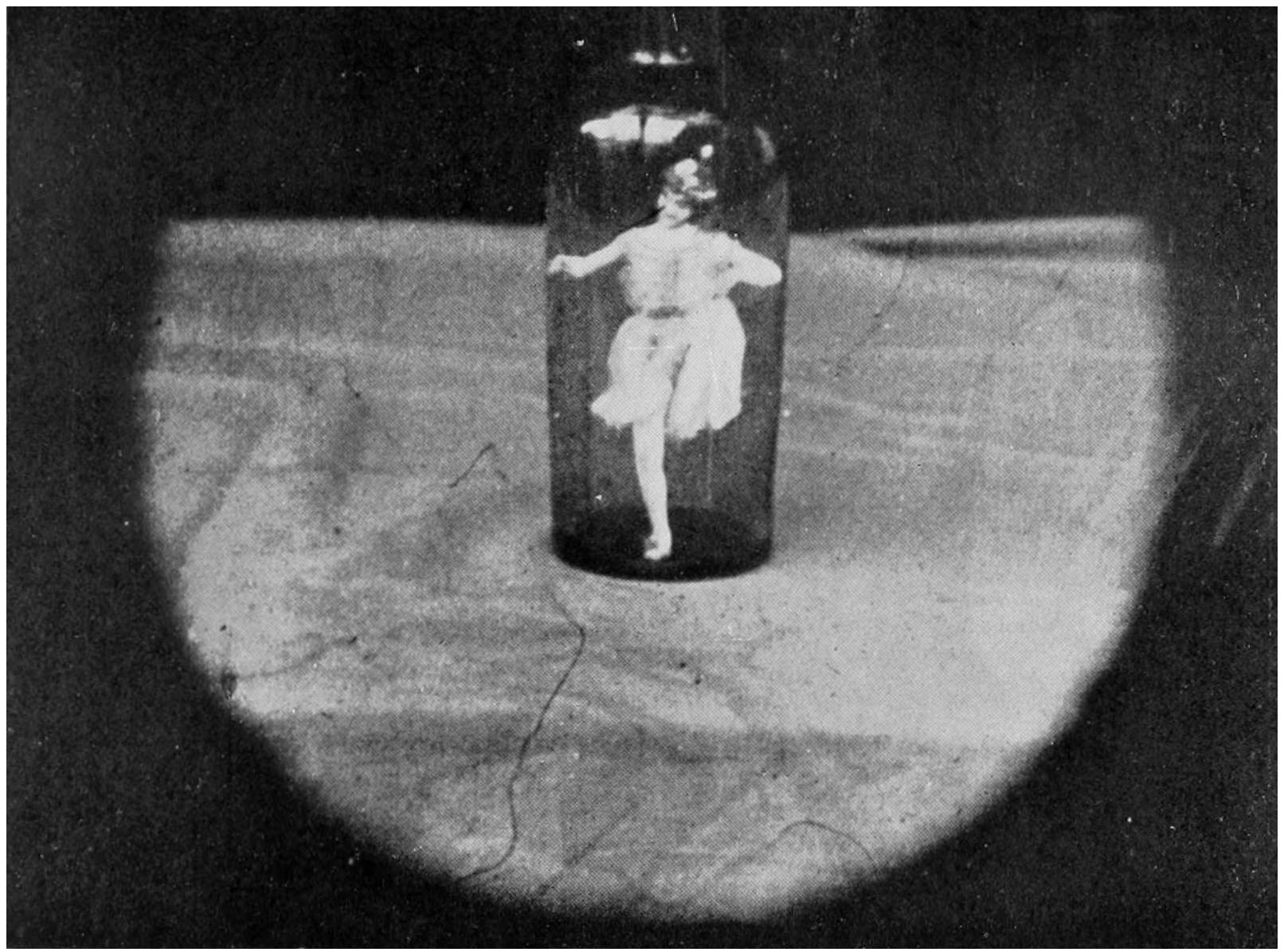
The fairy imprisoned in the bottle. This effect is obtained by double exposure.
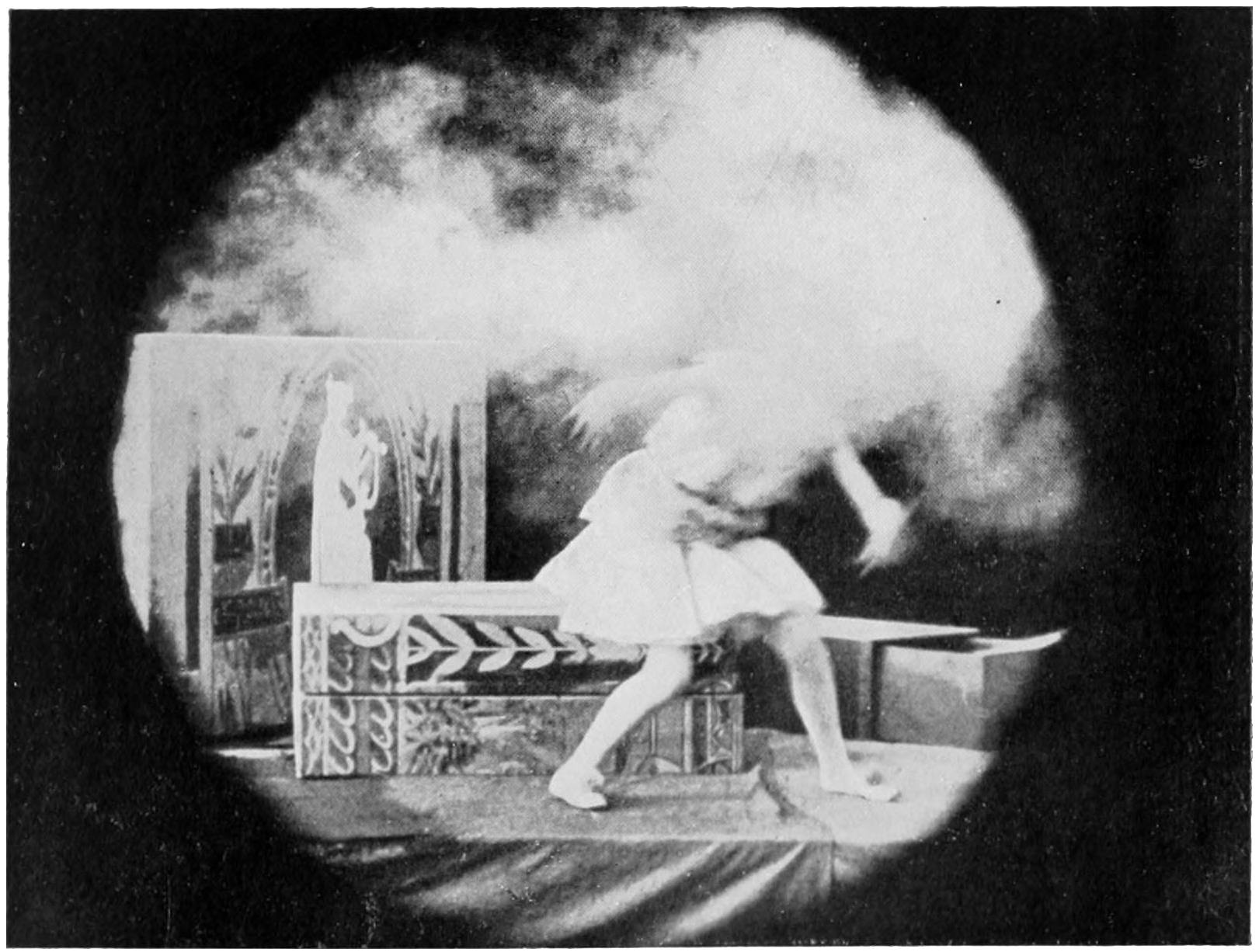
PRINCESS NICOTINE.
The fairy, after coquetting with the bachelor, is driven away by the smoke from his cigarette.
The smoke effect is produced with steam.
The man breaks the bottle with a hammer, and the released
fairy is seen standing upon the cigar-box. The
“stop motion” has been requisitioned to produce this
effect, the camera being stopped when the bottle is broken
to enable the fairy to assume her position upon the property
cigar-box on the second stage, the box and bottle on the
table in the meantime having been removed. Gratified
at her release, the fairy stoops down and draws out a
packet of cigarettes—the property package concealed
behind her property cigar-box on the second stage—and
withdrawing one of the cigarettes she offers it to the
bachelor. Although the cigarette she holds is three feet
long, the reflection in the mirror representing her standing
apparently on the table, brings the cigarette down to the
natural size. The bachelor holds out his hand to receive
it, and at this point the “stop” is called to enable the
bachelor to place a real cigarette in the position of the
property one, the stage-manager informing the actor when
the real article covers the reflection, because the actor himself
can see nothing. The property cigarette is withdrawn,
and the camera resumes. The bachelor places the cigarette
in his mouth, and as the audience cannot detect the “stop”
it appears as if he had taken the cigarette from the fairy.
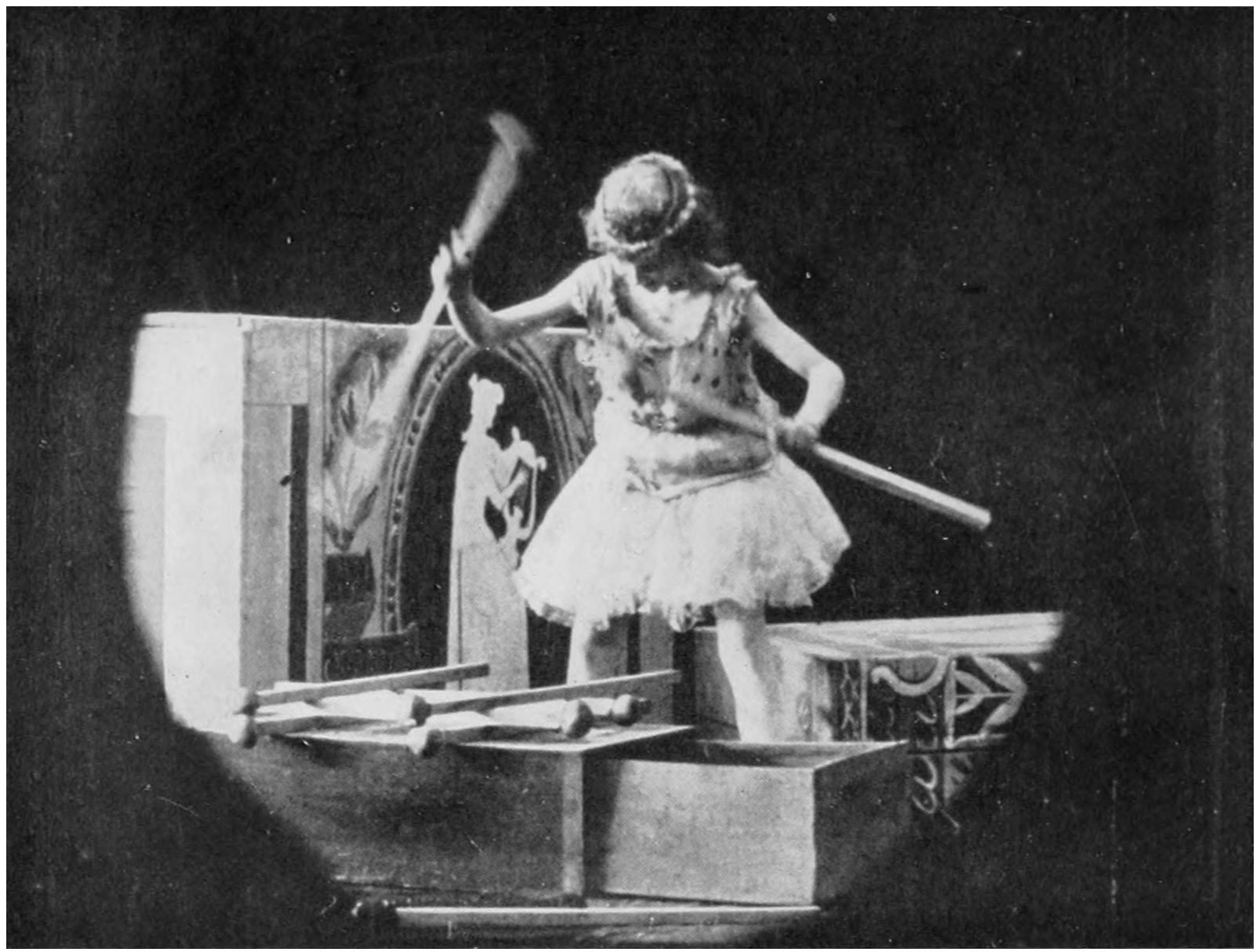
Enraged, the fairy proceeds to build a bonfire with matches. The property matches are
used for this purpose.
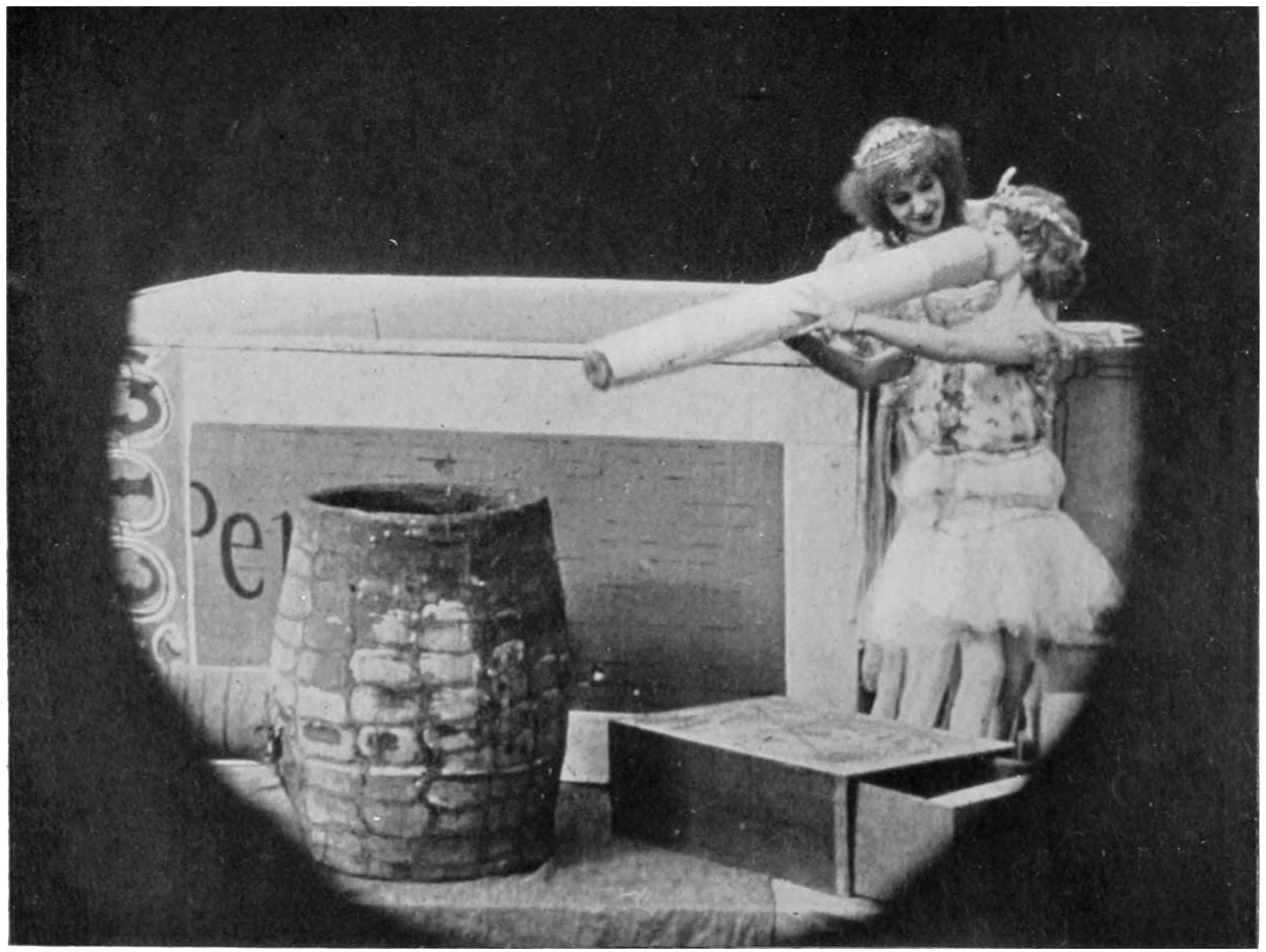
PRINCESS NICOTINE.
The fairy, her accomplice, and properties, which are enlarged reproductions of the actual
articles.
The smoker lights the cigarette and takes a fiendish
delight in blowing the smoke at his diminutive companion,
meanwhile coquetting with her. The little lady resents
the smoke; and as the bachelor again takes up the magnifying-glass
the public apparently looks through it at her
plight. The fairy is surrounded with cigarette smoke,
coughing and sneezing and shaking her fist furiously at
the bachelor, who is out of the picture, because in this
instance, as before, the actual scene is photographed direct,
and not its reflection in the mirror.
The magnifying-glass is laid down and the audience sees
the bachelor strike a match, from which his tiny visitor
shrinks in fear. The man laughs heartily at her discomfiture.
The fairy is bent upon revenge, and steals stealthily
towards the match-box. The bachelor follows the fairy’s
operations through the magnifying-glass, and the scene
is flashed to the spectators. They see the infuriated fairy
tearing out the matches and stacking them into a pile. Of
course she is handling the property matches, which, as I
have already said, are good-sized sticks. She strikes a
match and fires the pile upon her stage.
The scene is flashed back to the table, but in the meantime
the real matches have been taken out of the smoker’s
box and arranged in a pile, which is burning upon the
table, so that they appear to have been fired by the fairy.
The bachelor picks up the syphon of soda-water and directs
a stream upon the burning mass of matches. A final
glimpse of the fairy is given through the magnifying-glass
as a stream of water, this time from a hose, plays
upon the blazing property pile, and she falls over and
disappears.
The preparation of a film of this character involves the
utmost care in stage management, so that there may be
no disconcerting interruptions in the continuity of the
action. The greatest difficulty is to obtain exact overlapping
of the reflected and the real articles upon the
bachelor’s table; moreover, as the actor cannot see anything,
but has to act to an imaginary diminutive person
on the table, his every action has to be guided by the
producer. The actresses must be faultless in their movements.
A film of this description requires days to prepare,
especially since it entails resort almost to every subterfuge
known to trick cinematography.
It will be observed that the work resolves itself into two
essential parts—the photographing of the bachelor in his
sitting-room when in company with the fairies, as shown
by the mirror reflections, and the photographing of the
fairies and their properties. Whenever the latter have to
be taken, the idea of looking through the magnifying-glass
is adopted, and is artfully conveyed by the circular mask
of the picture. The magnification explains the apparently
abnormal proportions of the articles used; but the public
do not realise them as properties because they have been
watching the little ladies on the table. Naturally, when
the magnifying-glass is turned upon them, the audience
thinks that the fairies and their attributes have been enlarged
proportionately, whereas, as a matter of fact, they
are not enlarged at all, but are photographed direct from
a distance of only a few feet. In such a film as this the
producer, having sketched out the work and arranged the
scenes, photographs all the incidents pertaining to the
reflection one after the other, and subsequently photographs
the views apparently taken through the magnifying-glass
upon either the same or another stage. The trick effects,
such as the conversion of the rose into the cigar and so
forth, are taken at other times. When the numerous strips
of film are developed the various sections are sorted out
and placed in rotation, to be connected up to form one
continuous subject showing the natural progress of the
play.
Such is the story of the production of one of the prettiest
and apparently most miraculous trick-films that has ever
been seen. It should be said that such charming and
mystifying productions as “Princess Nicotine” appear
only at very long intervals, but their rarity is compensated
fully by their fascination and novelty, which, it may be
pointed out, is a salient feature of the productions of the
Vitagraph Company in this particular field.
CHAPTER XXIII TRICK PICTURES AND HOW THEY ARE PRODUCED VI.—Some Unusual and Novel Effects
At times a trick picture cannot possibly be produced
by any of the methods I have so far described. Accordingly,
the producer has to rely upon his own ingenuity
and inventiveness to cope with an unusual situation or
effect.
Some years ago an extraordinary film was produced by
Mr. James Williamson which created no little astonishment.
It was entitled “A Big Swallow,” and was
decidedly startling in its effect. It depicted a man to
whom the sight of a cinematographer acted as a red rag
to a bull. On this occasion he was goaded to such desperation
that he advanced towards the camera with open
mouth. Upon reaching it he gave a terrific bite, and
swallowed the whole apparatus and operator, the final
scenes showing him retracing his footsteps apparently
enjoying his strange meal, and satisfied that he had disposed
of one cinematographic fiend at least.
Curiously enough, although the idea adopted in this
instance offers illimitable possibilities, it apparently has
never been exploited since. This particular film never
failed to arouse the enthusiasm of the public, and there
was considerable speculation upon all sides as to how it
was carried out. Through the courtesy of Mr. Williamson
I am enabled to unravel the mystery.
It is well known by amateur photographers that when
a person is focussed a certain distance from the camera, if
he steps towards the instrument the focus is immediately
upset. When the individual is taken in motion, and in
such a way that he comes right up to the lens, this difficulty
is enhanced. It is impossible to keep adjusting the
focus of a cinematograph camera while the subject is
advancing, because the focussing tube is obstructed by
the passing of the film through the gate.
Accordingly, Mr. Williamson resorted to a combination
of the cinematograph with the racking bellows of the
ordinary camera. The latter, of special design, was
attached to the front of the cinematograph instrument,
the bellows attachment carrying the lens. The camera
was set up, and the distance between the apparatus and
the actor was measured and marked off upon the ground.
Observations were made to ascertain at what points the
actor in advancing should be re-focussed, and these points
were indicated upon the ground. The camera bellows
was then racked out until the figure was focussed sharply
once more, and this point was indicated upon the base-board
of the bellows. The figure then advanced still
closer, until a similar result was observed, when the
bellows was racked out a little farther, focussed, and a
second mark was placed on the base-board corresponding
to that on the ground. The process was continued until
the figure had advanced right up to the camera.
The picture had to be taken under the “stop motion”
principle. At the word “Go!” the actor advanced to the
first mark, where he stood stock-still, while the camera
bellows was racked to the point indicating the correct
focus. The second picture was taken under the same conditions,
and so on, until the actor’s face almost touched
the lens of the outstretched bellows. In the first photo the
actor was seen at full length, with the lens set in a horizontal
line with his mouth. As he approached the camera,
less and less of the lower part of his body was to be seen
in each successive picture. Presently only his head was
recorded; then nothing but the open mouth and teeth; and
at last, when he almost touched the lens, nothing but a
black cavity was revealed upon the film.
The actual swallowing operation had now to be carried
out. For this purpose a large window opening into a
darkened room was required. The window was covered
with dead-black material, leaving only the opening. The
camera was set upon a stage, and the window cavity
focussed in such a way that the opening occupied the whole
of the picture. On the inside of the building a thick mattress
was placed with stage hands in readiness. The
camera and operator were set up before this cavity as if
photographing the approaching irate individual, and were
photographed by a second camera. This was intended to
represent the former scene from the moment where the
man’s mouth only was visible upon the picture in the
form of a black space, and for which the opened window
sufficed.
At the critical moment the camera was pushed gently
over through the window opening, and immediately afterwards
the operator dived into the chasm, the last sign of
him being his upturned feet as he fell downwards head
first into the interior through the window, to alight upon
the mattress placed below to receive him.
When he had disappeared in this manner the third scene
had to be taken. This represented the actor stepping back
from the camera after he had devoured his antagonist.
When he retreated to the mark on the ground nearest to
the camera, the bellows was racked in to its corresponding
mark on the base; then the second backward step was
made by the actor to the next mark on the ground while
the bellows was racked back to the next mark, this succession
of stop-motions being in the reverse direction to the
advance. As the actor retreated, his teeth were seen to
close with a snap, and the look on his face as it came into
view revealed intense satisfaction with his strange feast.
Retreat was carried out in this series of steps until the
actor had regained his original position.
In this film the difficulty of keeping an advancing and
retreating figure in focus was solved very ingeniously;
and when the pictures were projected upon the screen the
illusion was perfect, not the slightest sign of a stop between
the exposures being detected. As a matter of fact, the
advance and retreat series of pictures were produced at
one time, the disappearance of the camera and operator
being taken later; and upon the development of the negatives,
the last episode was introduced between the other
two at the correct point. As the area of the open mouth
when close to the lens more than covered the sensitised
picture, the opening in the blackened window as it
appeared upon the screen gave no intimation as to the
manner in which an ordinary individual contrived to
swallow a camera, tripod, and operator at one gulp.
During a recent General Election infinite amusement
was provoked by the display upon the public screens,
which appear to have become an inseparable feature of
such political events, of a film depicting “The Dissolution
of the Government.” The dissolution was complete in the
fullest sense of the word. A picture—a conventional portrait—of
one of the members of the Cabinet was thrown
upon the screen. Slowly it was observed to undergo a
strange and ludicrous transformation. An eye slipped
down into the collar, the chin fell away, the nose was
lengthened abnormally, and the forehead narrowed to
nothing. The conditions presented were the most extraordinary
to conceive, and the manner in which the features
melted into oblivion leaving a transparent surface, or only
a series of indecipherable streaks, aroused indescribable
merriment in the crowd. It is certain that no “election”
film ever has proved such a diversion as this trick picture.
The idea was worked out by Mr. F. Percy Smith. Like
many other displays of cinematographic magic, its success
was due to its simplicity. Every amateur photographer
in his earliest days has endeavoured to force the drying
of a glass plate after development by placing it before the
fire. Invariably the effort ends in disaster. The gelatine
melts and causes the emulsion to run all over the plate,
producing grotesque results.
In order to produce this bizarre film a primitive apparatus
was contrived, consisting of a small tank the back
and front of which were cut out to admit pieces of glass.
This tank was filled with water and placed upon an ordinary
spirit stove. The cinematograph camera was placed
in front, and at the rear a powerful electric light was
arranged in such a manner that the illumination was diffused
equally over the rear glazed part of the tank. A
transparency portrait of the politician was then copied
upon a small glass dry photographic plate, developed and
fixed. It was then suspended in the small tank between
the camera lens and the electric light, so that the illuminating
rays passed through it, throwing the features in the
picture up brilliantly. The water was heated by the spirit
lamp beneath, the rise in the temperature being followed
closely with a thermometer; and when the requisite
degree of heat was obtained, the features upon the transparent
plate, owing to the melting of the gelatine emulsion,
commenced to slip and slide about over the glass
surface, and were caught in the act by the camera.
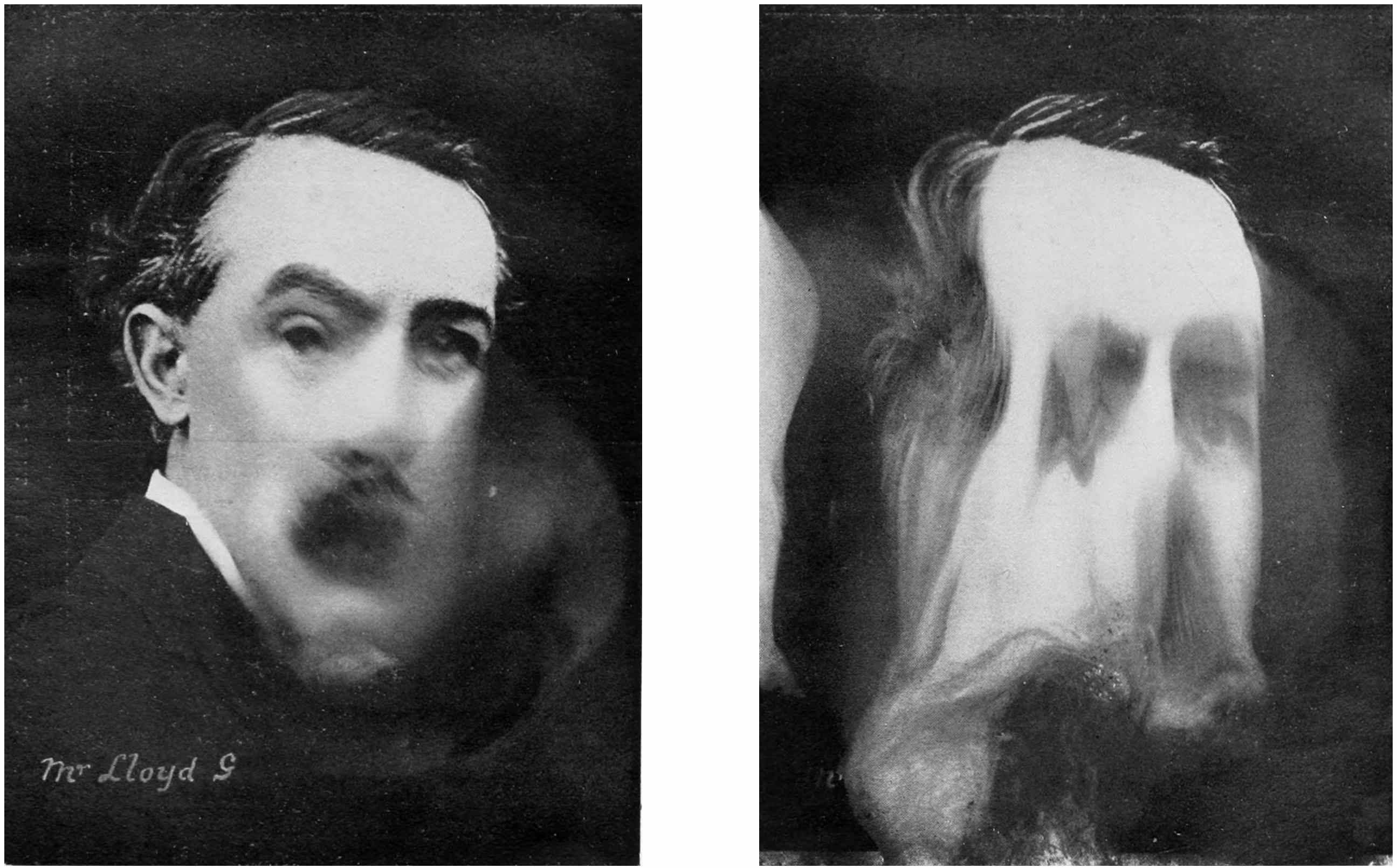
THE DISSOLUTION OF THE GOVERNMENT.
One of the most mystifying and amusing trick films ever produced.
Although the process appears absurdly simple, considerable
time had to be expended upon the subject to secure
the most grotesque results. One portrait frequently had
to be prepared and boiled in this manner six or more
times before a sufficiently ludicrous effect was secured.
Owing to the capriciousness of the gelatine emulsion, occasionally
the whole coating would slip bodily off its glass
support. The temperature of the water had to be judged
to a nicety, and suitable arrangements had to be made to
prevent the boiling water from marring the photographic
effect upon the celluloid film by the interposition of bubbles.
Our illustration shows a member of the Government
under photographic dissolution in this manner. The treatment
has almost infinite possibilities, for no two plates
are affected alike. This film appealed to the American
taste. After the British Government had been dissolved
in this manner, a second film had to be prepared, in
response to the demand from the United States, dealing
with the dissolution of the American Government at the
time of the last Presidential Election, the portraits subjected
to this drastic and peculiar treatment being those of
members of the United States Cabinet. This film created
just as great hilarity in the United States as attended its
exhibition in this country.
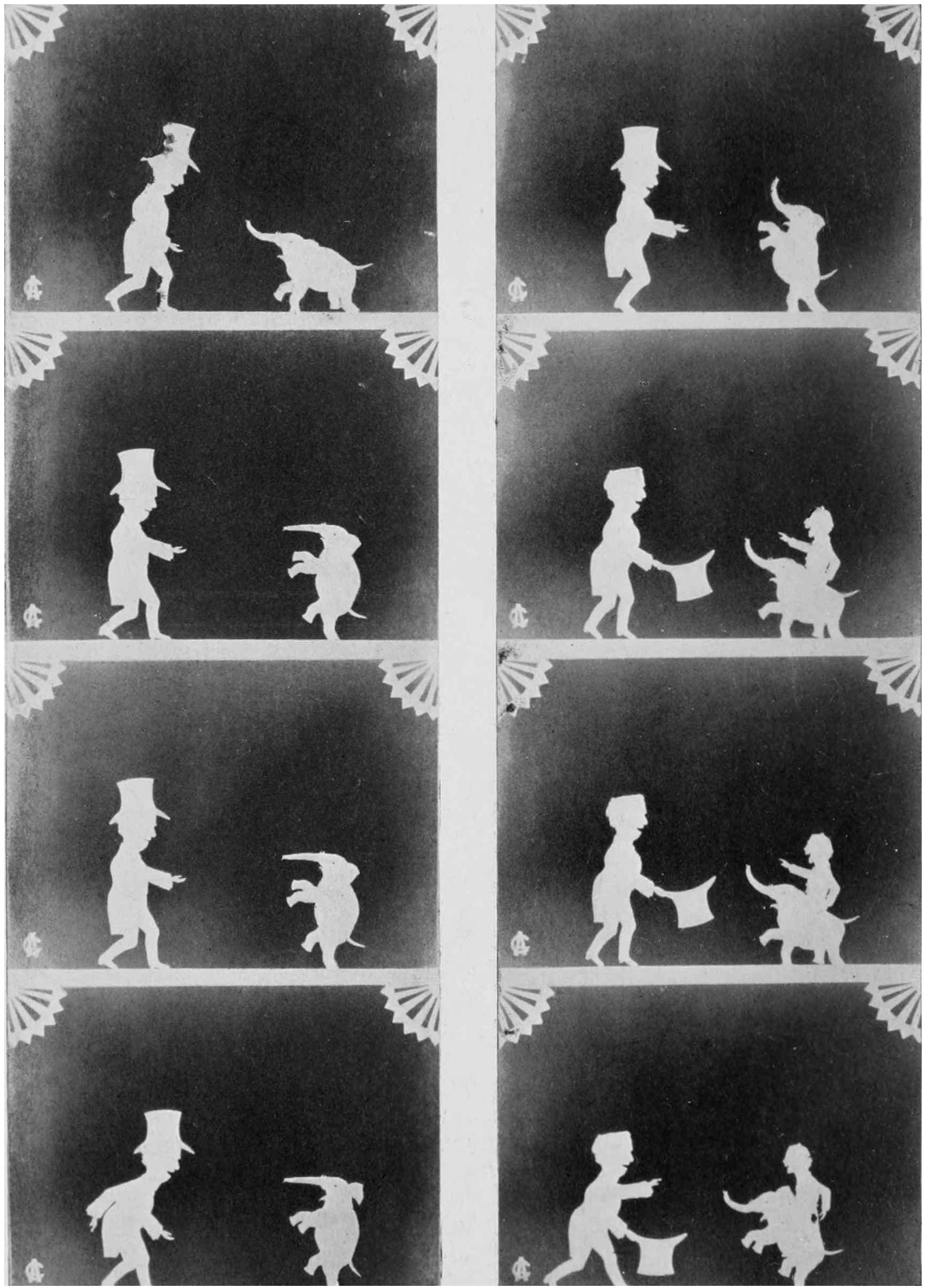
[Copyright, C. Armstrong.
THE LATEST CRAZE IN TRICK CINEMATOGRAPHY.
Silhouettes with models.
During the past two years the silhouette trick film has
come to the front owing to the novelty of the fundamental
theme and the successful combination of humour with
mystery. We all know the old shadowgraph play, wherein
the actors carry through their parts behind a white sheet
before a powerful light, which casts their shadows upon
the screen. The idea is now applied to cinematography.
One or two films of this character made their appearance
some time ago from foreign sources, but it has been left
to an English experimenter, Mr. C. Armstrong, to reduce
this ingenious trick subject to an exact science.
In an American attempt in this direction, living actors
were used, but the outcome was scarcely happy, inasmuch
as the trick effects were very limited, being confined mostly
to weird contrasts in the sizes of the figures thrown upon
the screen, arising from the proximity of the actor to the
light. If he stood near the illuminant his stature was that
of an immense giant, while if he enacted his rôle near the
screen, his shadow was just life-size. Mr. Armstrong has
improved upon this method by resorting to the use of
models, constructed of flat material, with jointed limbs, like
dolls, in order to secure ludicrous poses and situations and
impossible statures.
Seeing that only silhouette figures are required, it seems
a very simple and easy matter to fashion the models and
move them through their parts to obtain the desired effect;
but such is far from being the case. Both preparation and
manipulation demand unremitting care and patience. It
may be pointed out at once that exclusive use has to be
made of “the one turn one picture” movement, the models
being shifted a small fraction of an inch between each
exposure. When one has a group of figures to move in
this manner, the work is exceedingly tedious, weeks often
being spent upon the production of a single film.
When Mr. Armstrong embarked upon this enterprise
he concluded that the work could be accomplished without
any great effort, but he was soon disillusioned. Moreover,
he found, to his dismay, that in order to produce really
striking trick effects, combined with complex movements,
perfect in every detail, it was not only the construction of
the models which presented many difficulties and required
great mechanical skill, but that the most intricate part of
the work, involving a vast amount of patience and
extremely delicate manipulation, proved to be the actual
taking of the negatives. Innumerable failures attended
the first attempts. It was only after months of practice,
and after he had devised numerous special accessories,
that Mr. Armstrong gradually brought his methods to
perfection. The outcome of his perseverance was seen at
the Palace Theatre, London. The film was entitled “The
Clown and his Donkey,” and it provoked the audience to
unrestrained mirth.
Such work not only demands the conception of a suitable
subject, its adaptation to technical requirements, and the
preparation of the negatives to express humour and produce
movements portraying distinct traits of character and
temper; but, as I have said, the construction of the models
presents singular difficulty, in view of the complexity of
the movements. It is indispensable that the person who
takes the negatives should also construct the models, the
mechanical peculiarities of which must be understood to a
nicety.
The supplementary devices necessitated by the work seem
to be without limit; and to overcome the constantly recurring
technical obstacles, it is essential that the operator
should be endowed with quite exceptional mechanical
resourcefulness; otherwise he will be baulked time after
time. Frequently he will find himself faced with a difficulty,
successful extrication from which, without compromising
the subject upon which he is working, will tax
his ingenuity to the last degree.
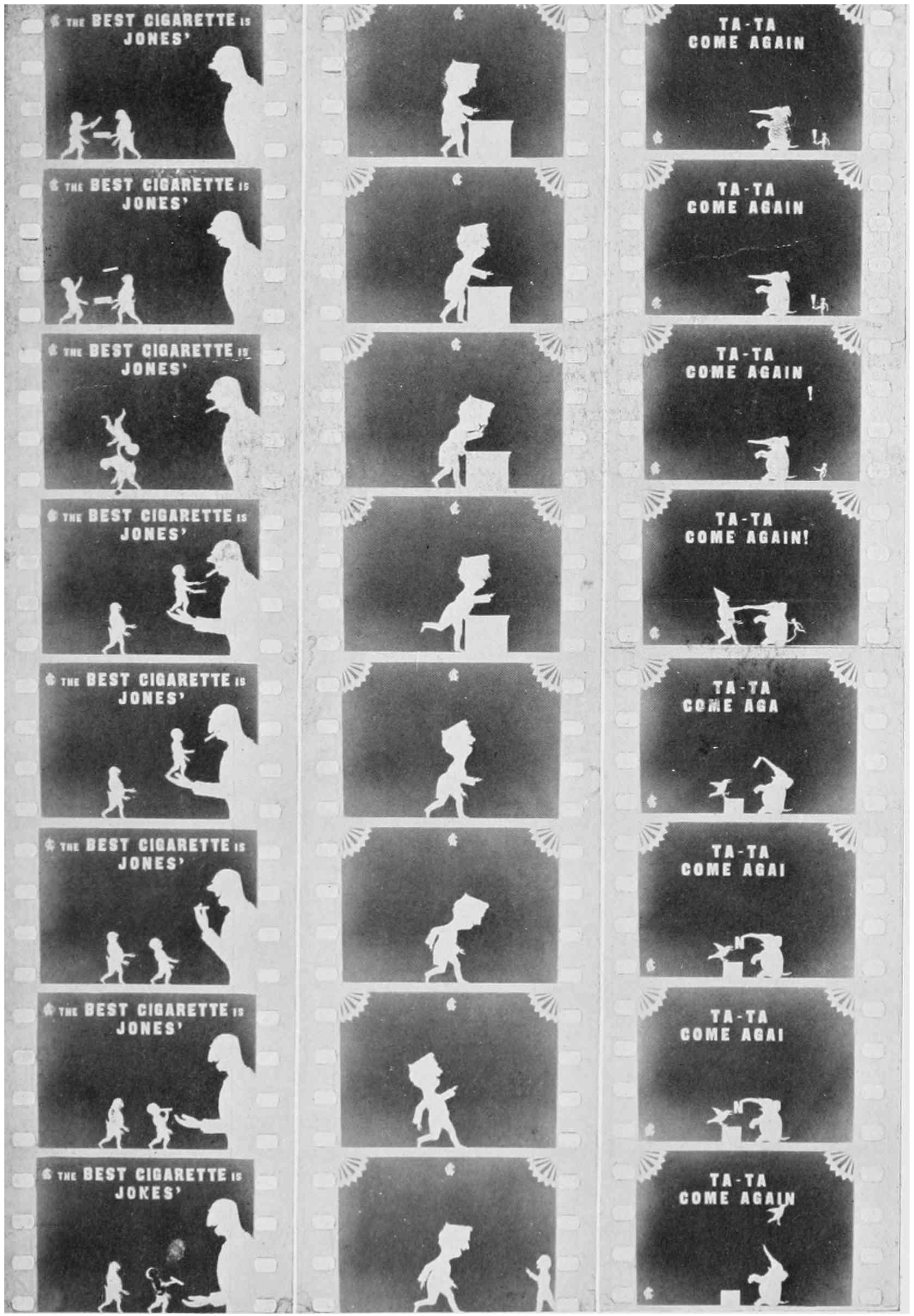
[Copyright, C. Armstrong.
THE POSSIBILITIES OF TRICK SILHOUETTE CINEMATOGRAPHY.
1.
A quaint
advertisement film.
2.
Mr. Asquith in cartoon.
The most lucrative field for silhouette trick cinematography
should lie in its application to the production of
animated advertisements and caricatures; for the idea
possesses the indispensable attribute of novelty, which is
the mainspring of commercial success.
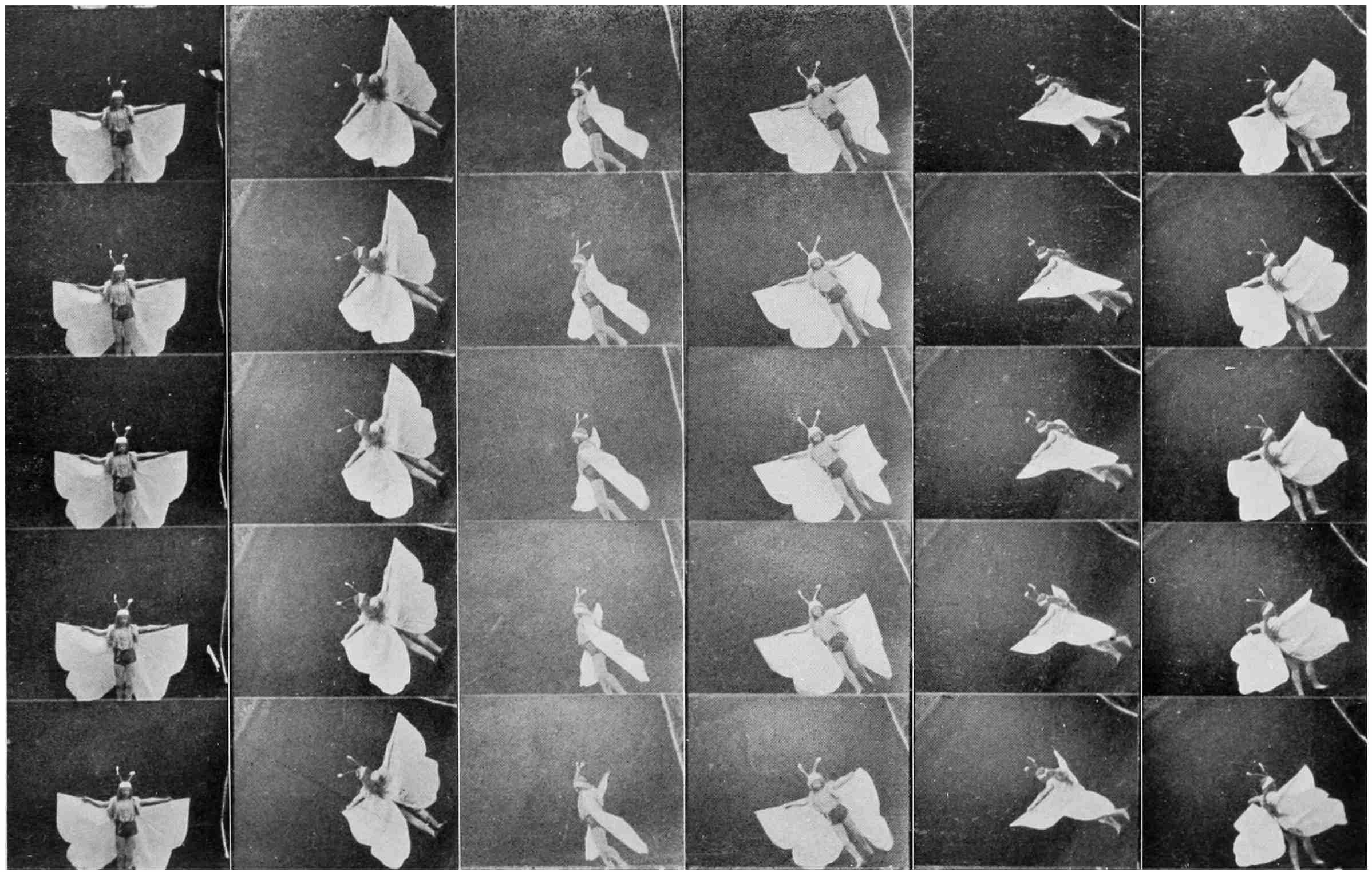
[Copyright, R. W. Paul.
THE HUMAN BUTTERFLY: HOW ARE THE EFFECTS OBTAINED?
The search for novelty in trick cinematography is very keen. This illustrates a new idea which so far has never been exploited.
See page 263.
As for caricature, despite the promising look of the field,
there are certain practical obstacles to success: first, the
time occupied in production, and second, a hostility on
the part of the theatres to political films of a party character—an
attitude easily explainable, as it is the aim of such
establishments to appeal to one and all.
We give a few illustrations showing, in caricature,
Mr. Asquith speaking. The various attitudes clearly show
the wonderful possibilities of silhouette trickery, and also
demonstrate strikingly what can be done by a skilful
operator with finely executed models. The ones in the
illustration are made of metal.
In regard to advertising, the innovation is unquestionably
of real importance, and I am told that use has been
made of it with conspicuous success by a prominent
European cigarette manufacturing company. This concern
acquired a film measuring 300 feet in length, which figured
continuously in the programmes of the picture palaces.
It was most ingeniously conceived and worked out, the
actors being a large burly figure endowed with a movable
nose, which changed from snub to aquiline, a baby boy,
and a chimpanzee, all of which characters are shown in
the illustration. The movements were carried out with
perfect realism. The burly figure is at one side of the
stage, while the words, “The Best Cigarette is——”
appears at the top of the picture.
The chimpanzee and the baby come forward from
opposite sides, each picks up a rod from the ground, by
means of which the letters forming the name of the firm
are jerked up alternately. They then drop the rods; a
box comes flying along, and is caught by the monkey,
who tenders it to the baby. The latter takes out a cigarette,
which he throws across the stage straight into the burly
figure’s mouth; he then does a somersault across the
monkey’s back, steps on to one of the hands of the large
figure, and after he is raised to the requisite height, the
baby produces a match and lights the cigarette. The
burly man puffs away, demonstrating his satisfaction with
the quality of the cigarette by facial contortions. In the
meantime the baby has descended, and the large figure
having lowered the hand holding the cigarette leisurely,
the baby seizes it, and, placing it in his mouth, sends
forth a big puff of smoke.
The effect of this absolutely novel advertisement seems
to have been extraordinary in Germany. One company
after another is being formed in that country, systematising
publicity in the picture halls, affiliating a number of them
under contracts involving sole rights for showing advertising
films on terms of payment according to the length
of film shown. The halls seem, naturally, to prefer
humorous and trick films to sober industrial subjects.
Things seem to move more slowly in this country. Many
halls would no doubt welcome good trick advertising films,
which would yield them an additional substantial income,
and at the same time would amuse and mystify their
audiences.
Finally, we would refer to the excellent purposes to
which this invention is being applied in the matter of
announcement films, to replace the conventional lantern
slides. A typical subject of this description, “Ta-Ta,
Come Again,” is illustrated. The actors comprise a baby
elephant, a jackdaw, a chimpanzee, and a tiny monkey.
The elephant and jackdaw alternately draw letters from
a box and throw them into the air to form the title. The
last letter, N, while being slowly raised into position by the
elephant, is snatched up by the jackdaw, who flies away
to set it in position. The tiny monkey then appears,
carrying an exclamation sign, which he balances on the
tip of one of his feet, and finally tosses into its place. He
then steps on to the tip of the elephant’s tail. The chimpanzee
now advances, seizes the elephant by the trunk, and
pulls him sliding off the stage.
Silhouette trick films, the production of which has
become the speciality of this manufacturer, lend themselves
to vast development. I have seen some subjects
produced by European and American firms which
represent possibly the high-water mark of this form of
magic cinematography. But the enterprise has one distinct
disadvantage. The preparation of the films is slow,
and the process is unavoidably expensive.
Novelty in trick cinematography, which is essential to
popular success, is difficult to hit upon. Some years ago
Mr. Robert Paul experimented with a new idea, the result
of which is shown in the illustration. The strange poses of
the actor will occasion interest and speculation as to how
they were obtained. The camera, while the exposures were
being made, was revolved, the actor on the stage meanwhile
maintaining his feet. The resultant pictures conveyed
the impression that the subject photographed was
rolling over and over, and flying through the air. This
idea does not appear to have been exploited, although it
should offer opportunities to produce some highly
bewildering effects.
Time and cost are the most adverse factors in this
ramification of moving pictures. The market could
absorb four times the number of trick subjects that are
produced at present, so long as they were comparable with
“The Little Milliner’s Dream” and “Princess Nicotine.”
But their popularity would not always compensate the
producer for the time and expense of the preparation.
Under the present conditions governing the manufacture
of trick films, distinct arrangements and facilities must be
provided for their manufacture, so as not to disturb the
routine preparation of ordinary subjects. These are the
main reasons why to-day trick films worthy of classification
in the first rank are so rarely seen—the majority of
so-called trick films are pure inanities. In fact, the trick
film of the highest order is in danger of extinction, because
for every trick film that is produced half a dozen ordinary
film plays can be placed on the market.
CHAPTER XXIV ELECTRIC SPARK CINEMATOGRAPHY
Although we commonly think of the human senses as
very acute, yet in reality they possess many imperfections.
For instance, our vision is too slow to follow the excessively
rapid and brief movements of insects. Strive as one may,
one cannot detect the flapping motion of a fly’s wing, or
follow the different methods of flying practised by the
dragon-fly and the bee. I have spoken early in this work
of Marey’s wonderful researches, which were spread over
a prolonged period, and carried out with the express object
of extending our knowledge of animal motion.
Marey’s experiments, however, were limited in their
scope, as he soon realised. The dry glass plate was not
a convenient medium for recording the impressions of
rapid motion, while extreme difficulties were encountered
in connection with the illuminant and the exposure. These
drawbacks became baffling when it was attempted to record
the movements of insects. He endeavoured to solve the
problem by concentrating a pencil of brilliant sunlight upon
a condenser, so as to secure such a powerful luminous
cone of light as to enable an exposure to be made in
1/42,000th of a second.
Marey wrestled with the task in a most determined
manner, and his efforts were supported by eminent physiologists
in other countries; but the obstacles were so formidable
and the available resources so limited that they
could not arrive at any practical result. It has been left
to Monsieur Lucien Bull, the accomplished assistant
director of the Marey Institute, to overcome the difficulty.
Through his courtesy I am enabled to describe his
fascinating researches, as well as the peculiar and efficient
apparatus he has evolved for the purpose. The beautiful
and highly interesting results he has achieved are shown
in the accompanying illustrations.
It was obvious at the outset that the familiar cinematograph
camera and its system of operation were unsuited
to recording such excessively rapid movements as take
place in the oscillation of a fly’s wing. Intermittent motion
was quite out of the question. No device working on this
principle was capable of enabling one hundred exposures
or more to be made in the short space of one second. If
it were attempted the film would only be torn and twisted
before it had moved twelve inches. In its place continuous
motion on the part of the film was imperative, and finally
this requisite was supplied in a decidedly novel manner.
The general characteristics of the apparatus conceived
and fashioned by Monsieur Bull may be gathered from
the illustrations. As the usual illuminants were unsuited to
photography of extremely rapid motion, recourse was had
to the electric spark, which is of tremendous luminous
intensity. These sparks are generated at uniform intervals
and as rapidly as the exigencies of the experiment demand.
In order to grasp the details of the installation a vertical
sectional diagram, Fig. 19, is given, and by its means
the design and operation of the apparatus may be gathered.
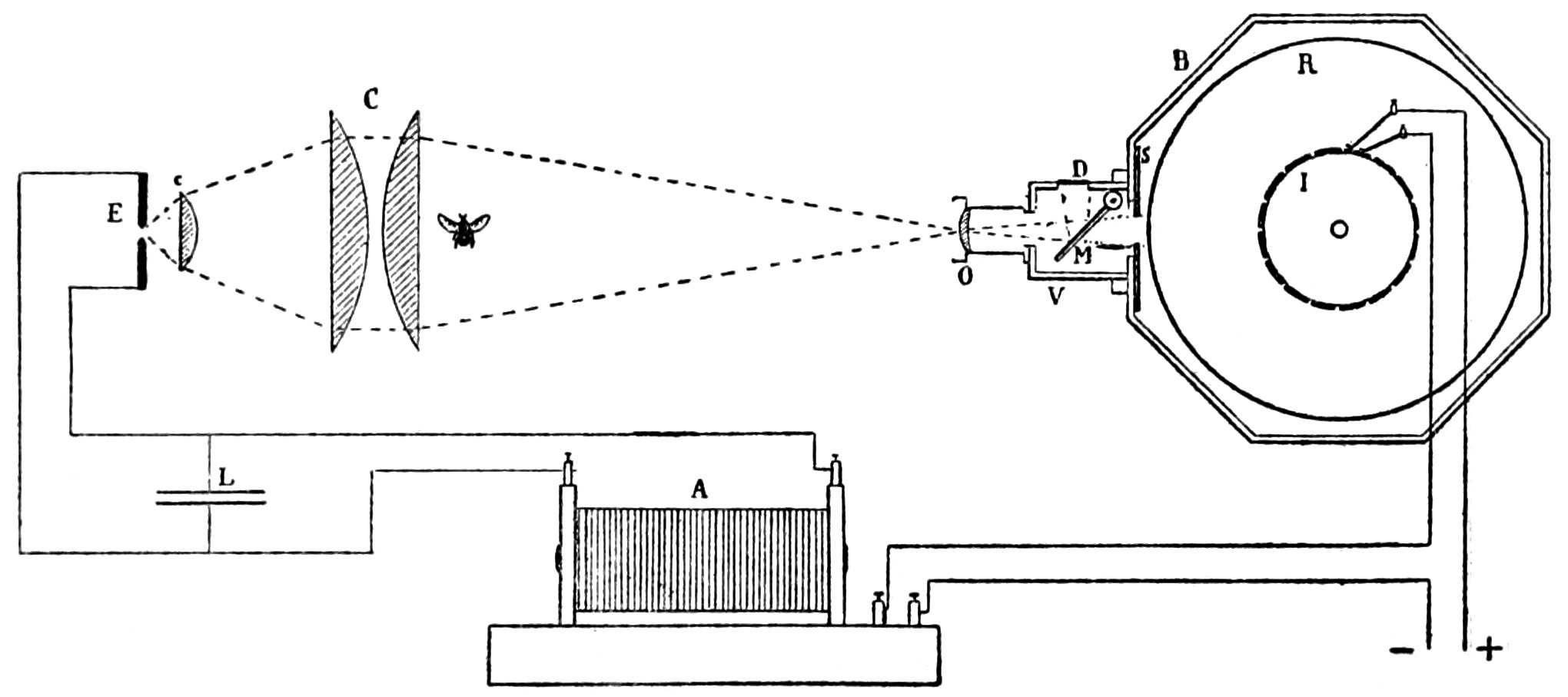
Fig. 19.—Diagram of Apparatus Employed by M. Lucien Bull to Photograph
Insects in Flight.
Instead of the ordinary camera there is a cylindrical
wheel R, mounted rigidly upon a shaft supported on
brackets at either end. The flat rim of this wheel carries
the sensitised film, which, as the wheel is 13½ inches in
diameter, is 42½ inches in length. This band is of the
standard width and is sufficiently long to receive fifty-four
pictures of the ordinary cinematographic dimensions
during one revolution of the wheel. As the pictures are
only three-quarters of an inch in depth, the deformation
arising from the impression being made upon a curved
surface is so slight as to be unworthy of consideration.
The arrangement adopted has the advantage of enabling
the wheel to be rotated very rapidly, so that consecutive
pictures may be taken at very brief intervals of time.
As the work is carried out in the laboratory in full daylight,
the wheel carrying the ribbon of sensitised film is
enclosed in an octagonal light-tight box B, the upper
half of which is hinged so that when the box is dismounted
and taken into the dark-room it can be opened easily to
permit the exposed film to be withdrawn and a new strip
inserted.
The shaft upon which the cylinder revolves is fitted with
an interrupter I, whereby the primary circuit of the induction
coil A may be broken at regular intervals during the
revolution of the wheel. If desired, as many as 2,000
interruptions can be made in one second, by rotating the
wheel at a very high speed, if the necessities of the experiment
demand such a high number of exposures; each
interruption producing an electric spark in the spark gap
E placed behind the condenser C. This condenser converges
the luminous rays into the objective O, which is
mounted in front of the travelling sensitised ribbon.
The lens is mounted in a small box V attached to the
front vertical face of the octagonal box, the latter being
pierced at this point to permit the light to pass from the
objective to the film behind. In this lens box, between
the back of the objective and the exposure aperture, there
is a mirror M, attached at its top to a horizontal rod
having a milled screw head. When the mirror is in the
position shown in the diagram, the image reflected therein
through the lens is thrown on to a ground-glass screen D,
set in the top of the lens box. This serves consequently
as a view-finder. When the exposures are to be made the
screw controlling the mirror is turned, and this swings the
mirror upwards like a flap until it lies flat against the under
side of the ground-glass D, forming a light-tight joint.
The wheel carrying the sensitised film is driven by an
electric motor, the shaft of the wheel being extended beyond
the box on one side to carry a small grooved pulley, the
drive from the motor being transmitted through a small
belt. The motor may be driven at varying speeds, so that
the number of exposures per second may be varied according
to the revolutions of the box completed in that period
of time.
The interrupter—also mounted outside the film-box—whereby
the make and break in the primary circuit of the
induction coil is controlled, and consequently the frequency
of the spark between the points E in the secondary coil
circuit, is a disc of ebonite, into which are compressed
fifty-four strips of copper spaced equidistantly—each strip
corresponding to a picture on the film—which are pressed
by two metal brushes as in the commutator of the ordinary
dynamo. As the copper strips in the ebonite disc pass
beneath these two brushes the electric circuit of the induction
coil is opened and closed, thereby producing an electric
spark in the secondary circuit of the coil. The intensity
of the spark is augmented by means of a small condenser
L, which is placed in parallel in the secondary circuit.
The sparks are produced between two pointed magnesium
electrodes, less than 1/12th of an inch in thickness, while
the spark is about 1/25th of an inch in length. The spark is
very rich in the ultra-violet rays, which possess a powerful
photographic quality. In order that these rays shall not
be absorbed during their passage through the condensers
C, the latter are made of Iceland spar. To secure
improved results, a small condenser c is sometimes placed
immediately in front of the spark-gap E. The general
arrangement of the apparatus for operation is shown on
page 266, the whole being mounted upon a bench with the
induction coil upon a shelf beneath.
The photographs obtained in this manner, however, are
purely of a silhouette character, and often it is very difficult
to interpret correctly the movement of the wings of an
insect from such a result. In order to obviate this drawback,
Monsieur Bull introduced a stereoscopic system,
wherein two lenses are mounted side by side before the
film box, with two spark-gaps in the same circuit. This
enables two sparks to be produced simultaneously with
each interruption of the primary circuit, to give two images
of the object upon the sensitised celluloid films.
In order that the two exposures should be made upon
the films exactly at the same time, a special type of shutter
had to be evolved, whereby the exposure apertures were
opened simultaneously at the critical moment when the
cylinder commenced to revolve, and which closed in concert
when the rotation was completed, because, as the films
were travelling continuously, there was no necessity for an
alternate closing and opening shutter movement, as is
required in ordinary cinematography working upon the
intermittent motion principle. The interval between the
sparks acts in the same manner as a shutter swinging
across the lens, and serves to secure a succession of instantaneous
pictures upon the films. The images are
obtained in such rapid succession that there is no possibility
of the films becoming fogged through the objective
apertures being open the whole time the wheel completes
a revolution. The two sparks being in the same circuit,
they must be produced in absolute synchrony.
The crucial question was how to open and close the
shutter simultaneously at the critical moments. This was
solved in an ingenious manner. The shutter itself is made
of brass and is placed close to the film. There are two
apertures, side by side, corresponding to the size of the
image upon the cinematograph film.
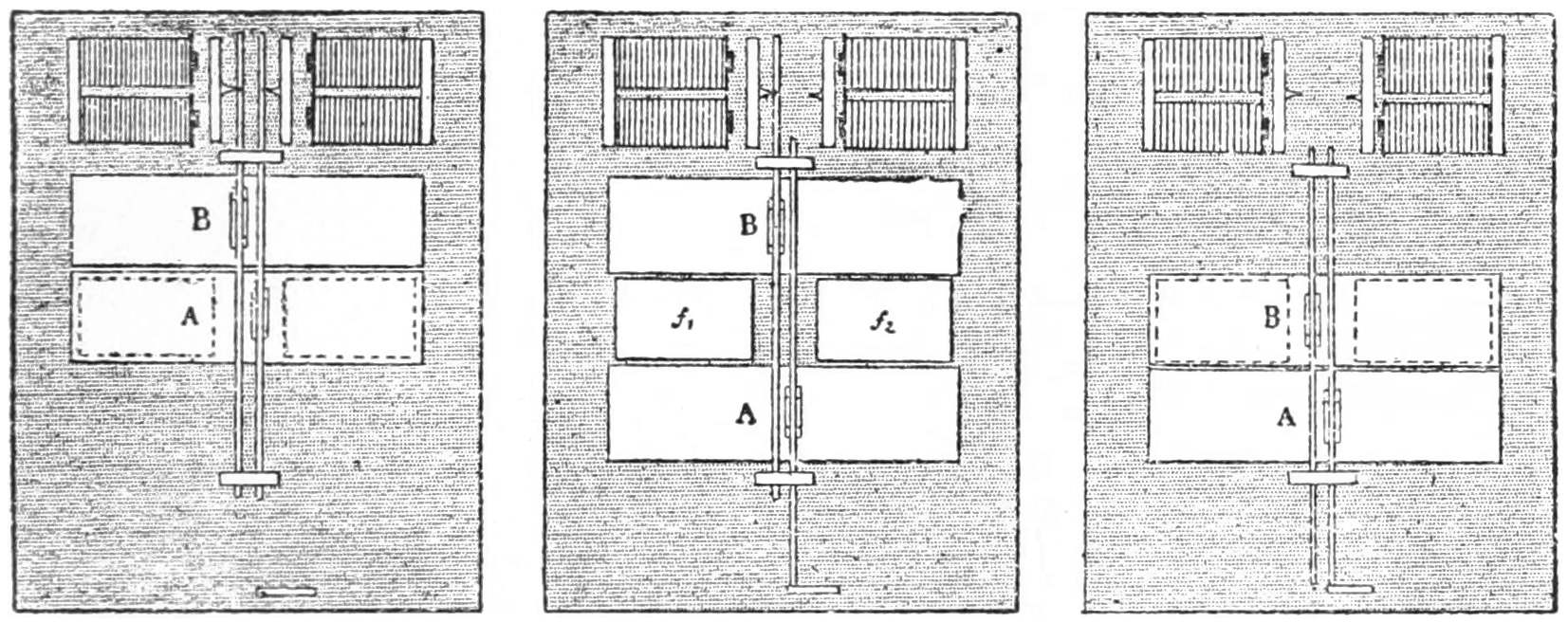
Fig. 20.—The Ingenious Stereoscopic Shutter to the Bull Camera.
The operation of the shutters is shown in Fig. 20.
When the cylinder is at rest, the exposure holes are closed
by a single curtain A, consisting of a thin sheet of steel
of sufficient length to cover the two holes. It is held in
position by means of an electromagnet controlling an extended
spring. When the cylinder commences to revolve
the spring connected to the shutter is released under an
electric impulse discharged through the electromagnet.
The shutter falls, exposing the two apertures f1 and f2.
When the cylinder has completed its revolution, another
electric impulse releases a second steel curtain B, held in
position by a second spring, controlled by an electromagnet,
so that it drops also and falls over the exposure
holes. This system is both simple and positive in its
operation, and it may be pointed out that this control is
quite independent of the interrupter, which works in conjunction
with the electric spark.
The interval of time elapsing between each picture is
determined by means of a tuning fork making 50 double
vibrations per second, which operates an electric signal.
This tuning fork is set up in such a manner that the ends
of its vibrating tongues are photographed upon the film
throughout the experiment. As the vibrations of the
tuning fork are known, it is only necessary, in order to
determine the interval of time between each exposure, to
count the number of photographs taken successively during
a complete vibration of the tuning fork. As a result of
experiment, however, it has been found that the ear can be
trained to determine with astonishing accuracy the speed at
which the apparatus revolves—and consequently the
number of pictures taken per second—by the succession of
sparks produced by a tuning fork the vibrations of which
are known. This means that in conjunction with the photographic
record, the speed at which the exposures were
made can be determined without effort, and this velocity
can be varied very easily. In addition, a measured scale,
engraved on glass, is placed in the field of the lens,
whereby the investigator is enabled to determine the exact
displacement of the insect in the field of vision within a
given period. Such is the apparatus, devised so far back
as 1904, with which Monsieur Lucien Bull has accomplished
some remarkable work of incalculable value to
science, and with striking precision.
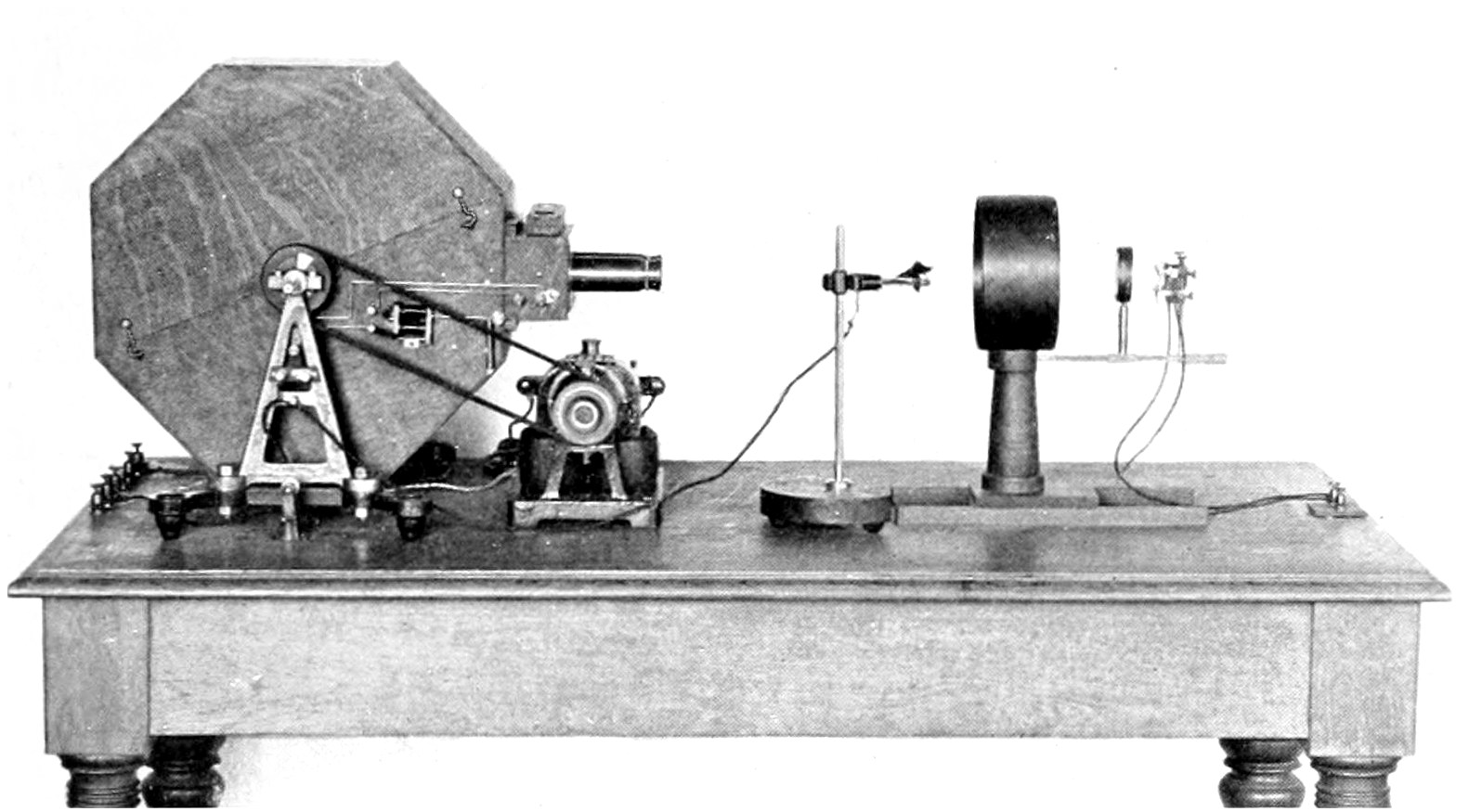
M. LUCIEN BULL’S COMPLETE APPARATUS.
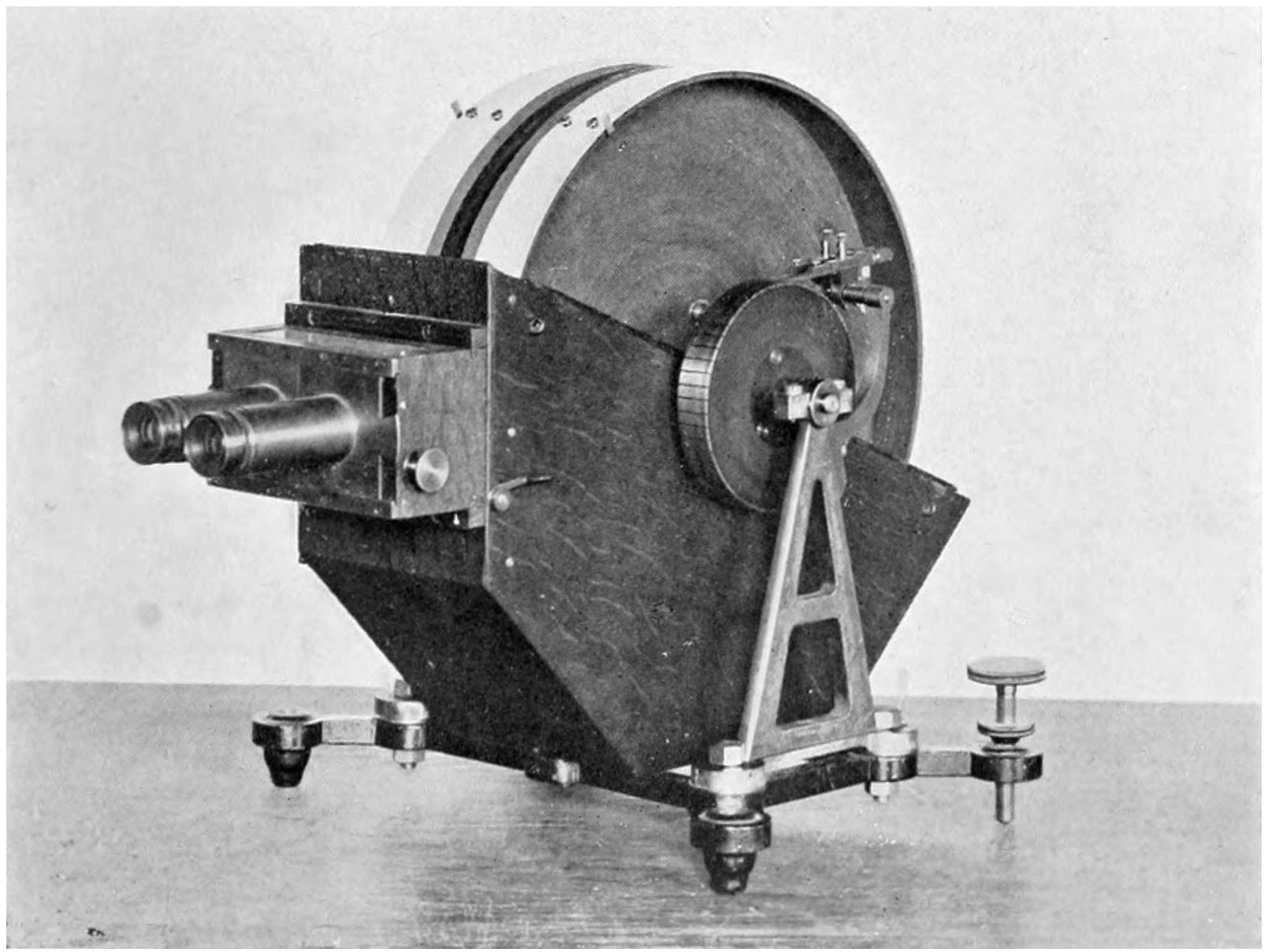
THE NOVEL CAMERA SHOWING STEREOSCOPIC LENS.
Taking 2,000 moving pictures per second.—See page 265.
I will now proceed to explain how the photographs are
taken. In the first place, in order to obtain natural and
conclusive data regarding the flight of insects, it is
imperative that they should be cinematographed while in
full liberty, but the point arose as to how to control the
instrument so that the camera and film did not commence
to revolve until the moment the insect entered the field
of the lens. The habits of insects vary greatly. Some fly
off immediately they are released, while others hesitate for
a minute fraction of a second. As the apparatus makes
only one complete revolution at a time, and that in the
fraction of a second, the control has to be of such a finely
adjusted character that the record obtained is of movement
purely and simply, and not of the insect in a quiescent
state preparatory to flight.
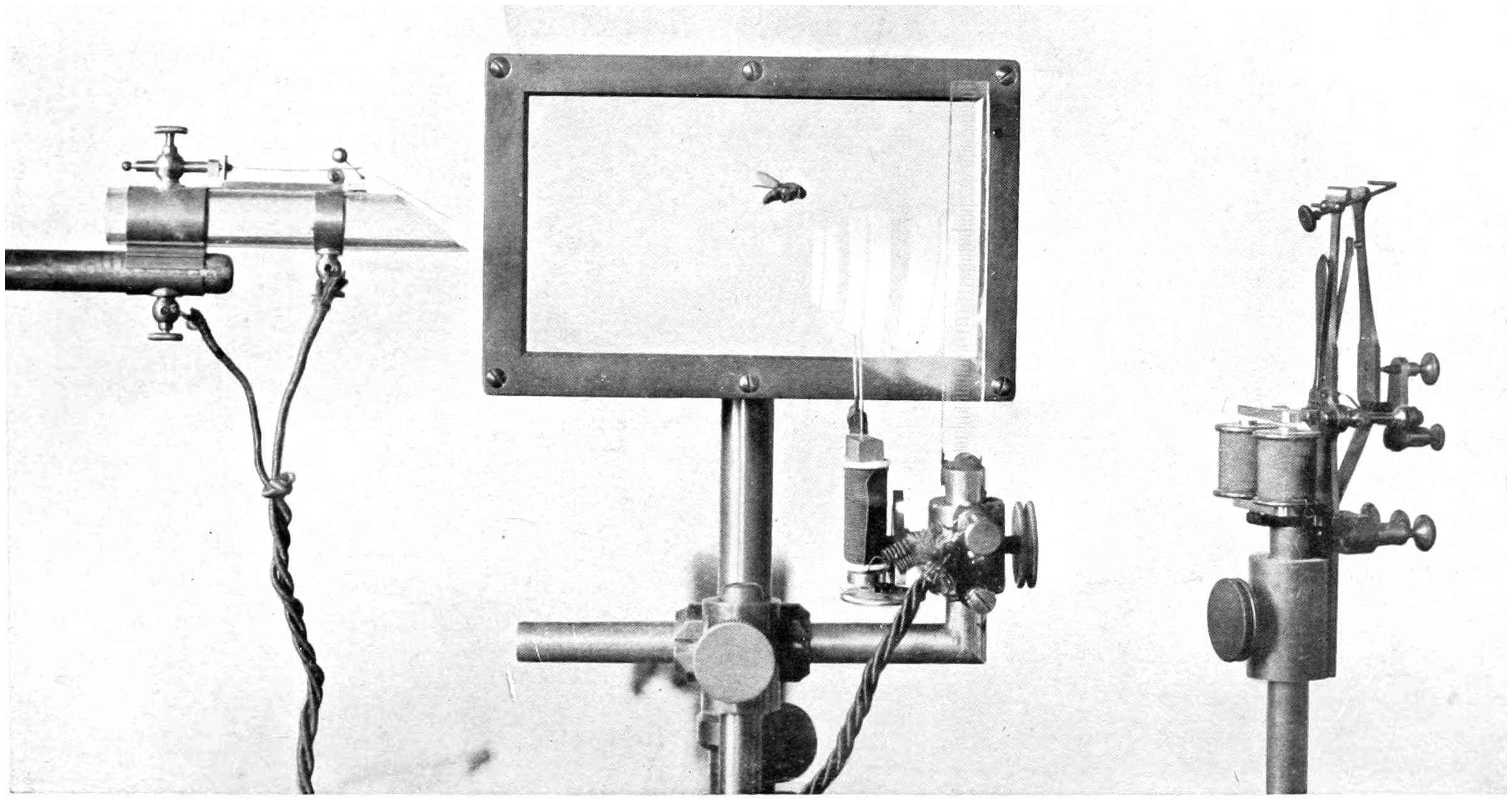
A BEE CINEMATOGRAPHED IN FULL FLIGHT.
At the left is the glass tube from which it has escaped.—See page 273.
Another question was how to induce the insect to cross
the field of the lens. All insects instinctively fly towards a
light. The apparatus therefore was set near a window,
the insect being released from the side away from the
window, so that in order to reach the light it had to traverse
the field of the lens. As the latter is very small, it was
essential that the release should be carried out in such a way
that the insect did not fly above or below the field of the
lens during exposure of the film.
At first sight these obstacles appeared insurmountable.
It was obvious that the release of a fly from the hand
would be too slow and uncertain, while the movement of
the insect after securing its liberty would be unnatural,
because no matter how delicately it might be handled,
there would be the liability of injuring its fragile frame.
The governing point was to devise ways and means of
opening the shutter just at the moment the insect started to
fly from one side of the lens field to the other, under completely
natural conditions.
This delicate problem was resolved by Monsieur Bull in
an ingenious manner, but not before he had carried out
innumerable experiments attended by dispiriting failures.
At last he succeeded in evolving means whereby the
insect automatically and instantaneously opened the shutter
of the camera at the moment it started to fly. The artifices
by which this end was achieved are shown in Fig. 21.
The system, however, had to be modified for different types
of insect. That marked A was used for the ordinary
house-fly and for dragon flies. It comprised a small pair
of pincers, or clamp, which held the fly firmly captive by
means of a small electromagnet, but in such a way as
not to inflict the slightest injury. This clamp was introduced
in the stereoscopic shutter electrical circuit. The
two legs of the clamp have a natural tendency to fly apart
under the action of a spring, but are held closed by a
tooth at the end of a rocking arm, mounted on one leg,
engaging with a fixed tooth on the second leg of the clamp.
The latter is placed in an electrical circuit with the shutter
of the camera. When all arrangements are completed, the
experimenter closes this circuit. This action causes the
electromagnet of the clamp to pull down the projecting
end of the toothed arm; the two legs are allowed to fly
apart, liberating the insect, and as the clamp releases the
fly the stereoscopic shutter is opened.
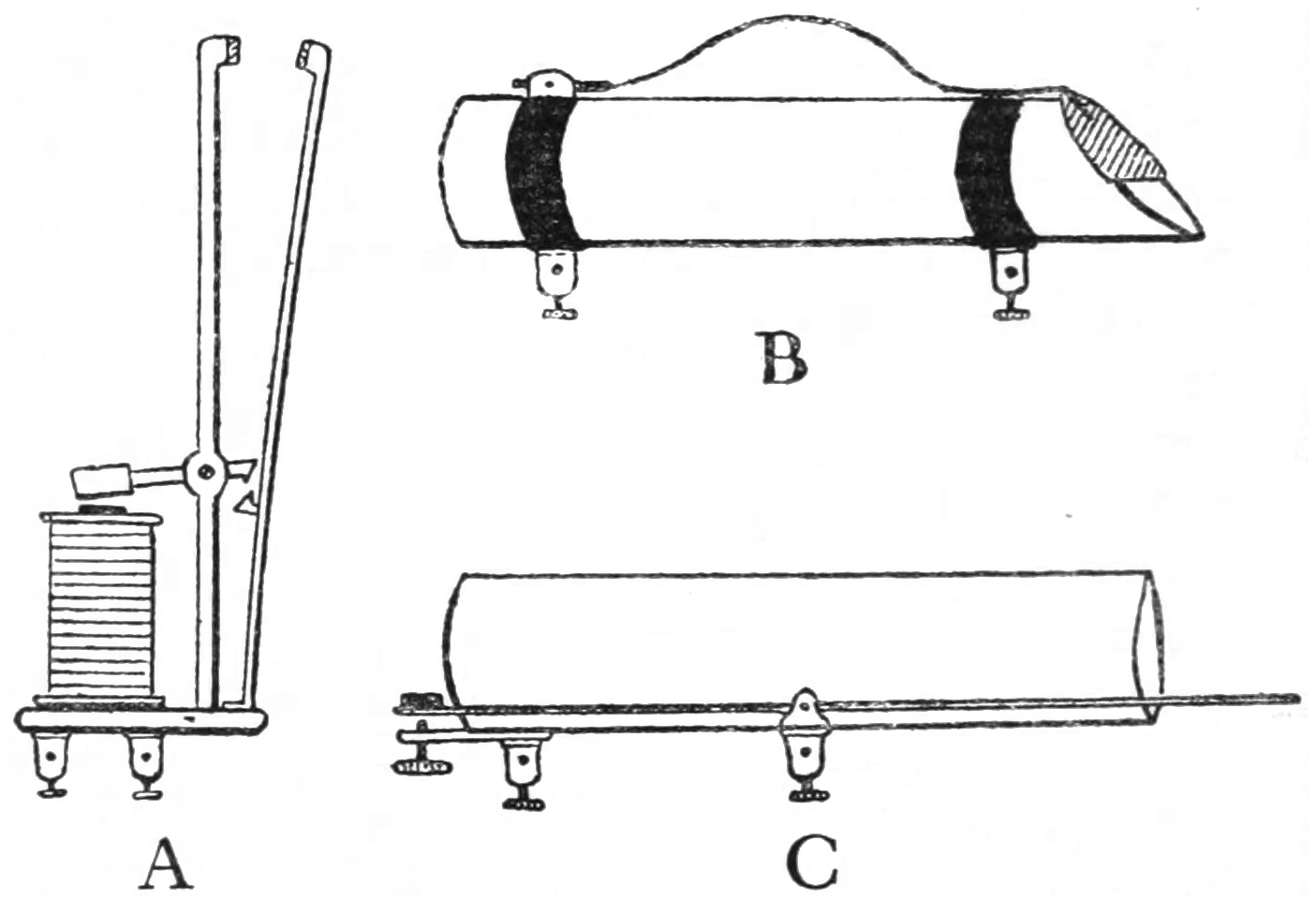
Fig. 21.—The Ingenious Devices Employed by M. Lucien Bull to
Release the Insect at the Critical Moment.
This system, however, was of no avail in connection
with the Hymenoptera group of insects, since wasps, bees,
and similar insects hesitate slightly before they seek safety
in flight. Consequently the device B was evolved. This
consists of a small glass tube, in which the insect is introduced
at one end. The opposite end is cut obliquely, and
is fitted with a very light hinged shutter of mica, having a
fragile spring, which covers about one-half of the opening.
The spring closes the electric circuit operating the stereoscopic
shutter of the camera.
Let us suppose a bee is to be cinematographed in flight.
It is pushed head foremost into the free end of the tube,
which is large enough to carry it comfortably, and the
half-closed mouth is pointed towards the window. The
insect naturally endeavours to approach the light, and
accordingly crawls along the tube until at last it reaches
the mica shutter, beneath which it endeavours to escape.
As it crawls out of the tube it lifts the mica flap, and the
circuit is broken. But the shutter does not open, because
at this moment the operator himself closes the contact.
By this time the insect has emerged a sufficient distance
from the tube to complete its final preparations preliminary
to flying away. Just as it springs from the tube the mica
shutter falls, the electrical circuit is closed once more, the
shutter is opened, and pictures of the bee on the wing are
recorded upon the celluloid film.
For the Coleoptera group of insects—beetles—where
there is still a more marked hesitation before flight, the
device C was prepared. In this instance Monsieur Bull
compels the weight of the insect, which is relatively heavy,
to establish the necessary contact to operate the shutter. A
glass tube without an oblique mouth is used for this purpose,
and instead of the mica flap, a very light horizontal
plate of aluminium, balanced by a counterweight at one
end, is passed through the tube. This plate is mounted
on a central pivot, and extends a certain distance from
either end of the tube. The counterweight is slightly
lighter than the weight of the insect, and rests in contact
with a platinum point. The beetle is introduced into the
tube at this end, and crawls along the rod towards the
opposite end. When it has passed about half-way through
the tube, and has crossed the fulcrum of the beam, it
causes the contact end to rise like a see-saw, thereby
breaking the electrical contact. In this case, as with the
device B, the operator recloses the break in the circuit.
The beetle continues its journey, and finally emerges from
the tube upon the flattened end of the beam, on which it
completes its arrangements to fly away. Directly it leaves
the platinum beam, the latter, under the action of the
counterweight, falls upon the platinum point, re-establishes
the contact, the circuit is closed, the shutter is opened, and
the flight is caught upon the sensitised band.
Monsieur Bull has devised a wide variety of these
ingenious appliances, whereby he is able to secure the
flight of any insect, and by the employment of which the
chances of failure are reduced to the minimum. Indeed,
when the apparatus is set up correctly, is in the hands of
a skilled operator, and every arrangement has been completed
satisfactorily, failure can only result from one cause—the
refusal of the insect to fly away. The best results
are obtained from insects which are in a fresh, healthy
condition. If they have been imprisoned for too long a
period, or are fatigued, the chances are that the results
will be very disappointing. The records which Monsieur
Bull has secured, showing insects in flight, illustrate some
very interesting facts, and are of far-reaching value from
the scientific point of view. At the present moment they
are of additional interest owing to the absorbing fascination
of aviation, inasmuch as they enable us to study with
ease the movement of the wings of powerful, speedy fliers,
which hitherto has been impossible under natural conditions,
owing to the excessive velocity with which the
wings move, and the brief character of the motion. With
such an apparatus as I have described, any very rapid
motion can be cinematographed, for the system is very
elastic, and capable of very extensive application.
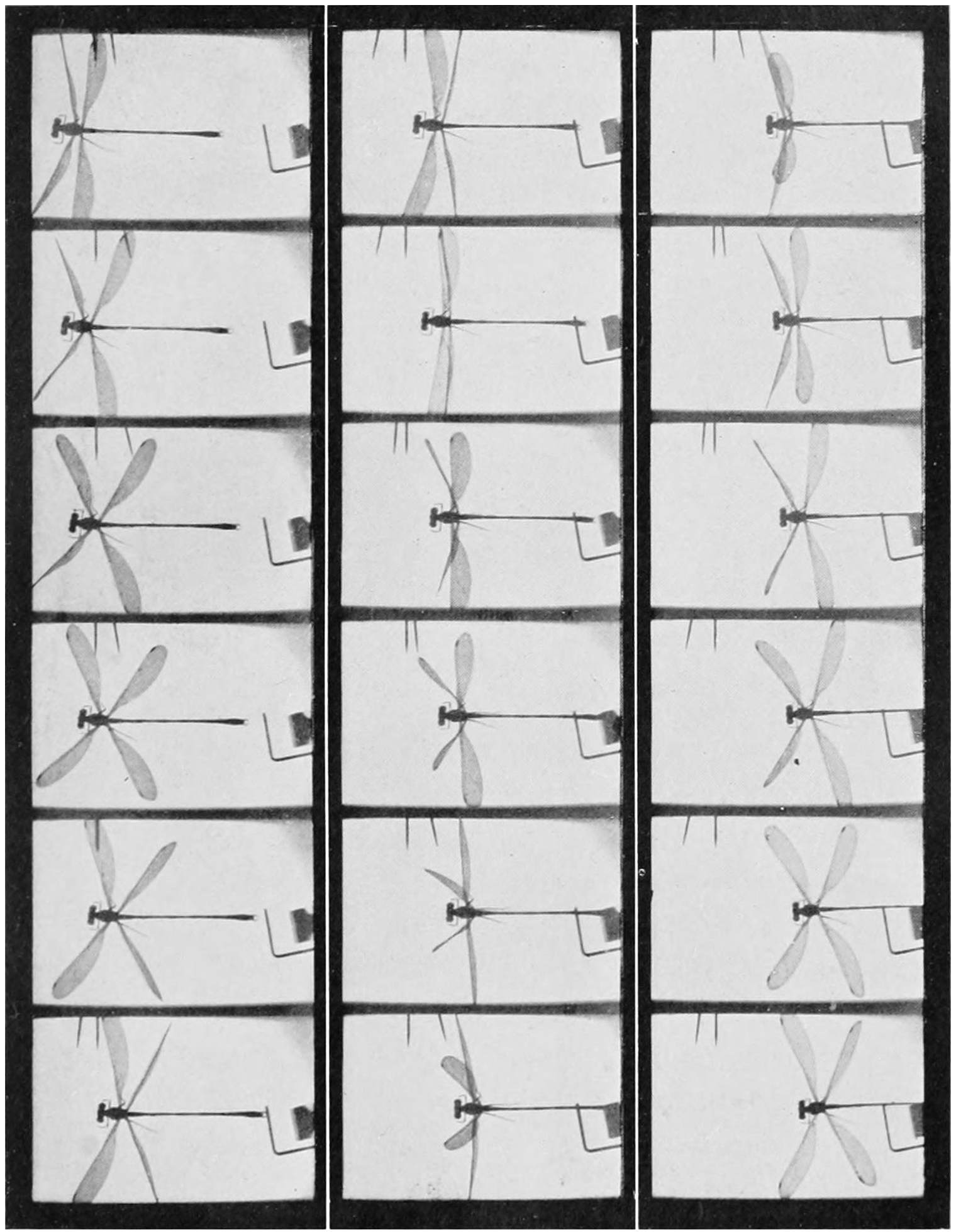
A DRAGON-FLY IN FLIGHT.
At left is the electric clamp from which the insect has been released, and at right
the tuning fork to determine the interval of time between successive pictures.
Another vast field of research which has been opened
by the cinematograph is the study of the flight of projectiles.
This subject has occupied earnest attention among
military authorities for some time past. A few years ago
Professor Vernon Boys carried out some wonderful experiments
in this direction, and produced some very striking
results. His work has been continued recently, by cinematographic
means, by an eminent German investigator, Dr.
C. Cranz, professor at the Berlin Military Academy. He
has succeeded in accelerating the exposures of the film to
such a degree that 500 consecutive pictures can be taken
in 1/10th of a second, the exposures varying from
1/1,000,000th to 1/10,000,000th part of a second, the last-named
period being such an infinitesimal fraction of time
as to be beyond human comprehension. The pictures
obtained are of the standard dimensions, and a striking
feature, despite the tremendous speed at which they are
taken, and the extremely brief exposure, is the clearness
and definition obtained.
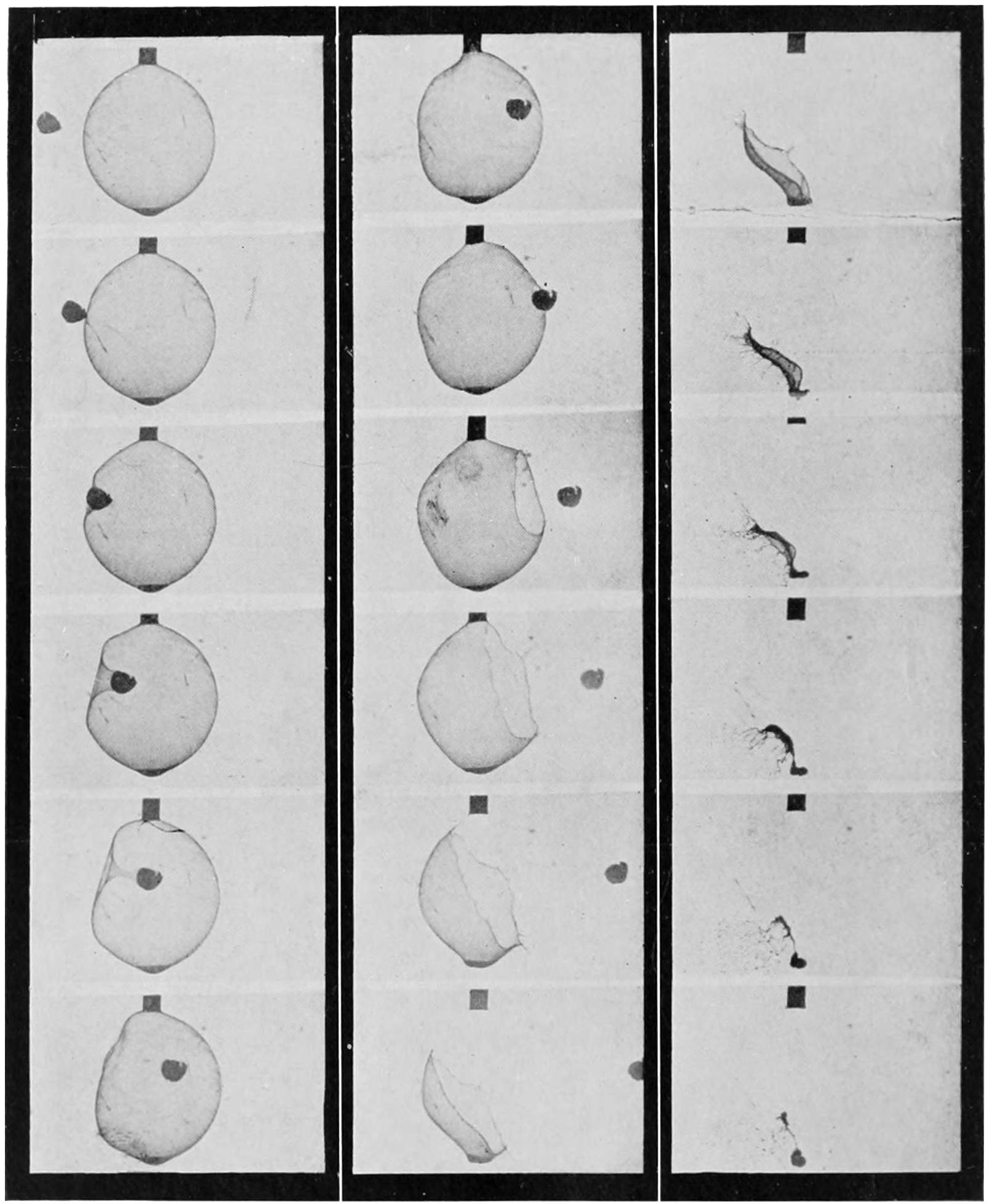
CINEMATOGRAPH FILM OF A BULLET FIRED THROUGH A SOAP BUBBLE.
The flight of the missile may be followed easily. It will be seen that the bubble breaks
not when the bullet enters, but when it emerges.—See page 276.
In this instance, also, the electric spark is called upon
to serve as the illuminant to enable the images to be
recorded upon the sensitised band, but the means whereby
the interruption of the primary circuit of the induction
coil is secured differs materially from that practised by
Bull. Obviously the film travels with a continuous, instead
of with an intermittent, motion, the sensitised band in
this instance being run over two steel cylinders. The
tremendous speed at which the film moves may be gathered
from the fact that, at the rate of exposures made, over 280
feet of film must pass before the exposure aperture in the
short space of one second—more than 2½ miles per minute.
The apparatus evolved by this German investigator is
more complicated than that of his French contemporary,
and the method of operation is widely dissimilar. The
arrangements, too, for preventing the film receiving more
than one series of pictures—the film is rotated before the
exposure aperture in the form of an endless band—demanded
a special electrical contact control system, while
the manipulation of the apparatus varies according to the
character of the experiment.
The results obtained are startling. Although taken at
such a tremendous speed, the pictures when thrown upon
the screen under normal conditions enable every motion to
be followed quite easily because everything moves slowly.
For instance, one can see the hammer of an automatic
pistol fall, and follow exactly what takes place during the
whole firing operation, and the ejection of the spent cartridge.
Similarly, when the pistol is fired, and the bullet
is photographed as it emerges from the muzzle or when it
strikes, passes through and emerges from a steel plate, the
movement can be followed with complete facility, as it
appears to move across the screen no more rapidly than a
person walks, because, although the exposures are made
at the rate of 30,000 pictures per second, they are projected
at a speed of only 16 pictures per second. By this means
analysis of extremely rapid motion in all its details can be
effected—a result of far-reaching possibilities to the study
of ballistics.
Facilities are provided to enable the progress of the
missile, both vertically and horizontally, to be measured,
so that the speed of the projectile may be determined with
unimpeachable accuracy. Fluctuations in the speed of a
missile can be ascertained and investigated. Suppose the
speed of the projectile is measured as it emerges from the
arm, and again as it reaches the end of an extensive free
trajectory; losses in velocity due to resistance of the air
and other causes can be calculated. Individual pictures,
when enlarged—and the sharp, well-defined character of the
images on the band enables this enlargement to be
carried out to a very wide limit—supply a ready means to
investigate any particular phase and phenomenon at close
quarters.
It is not generally known that about twelve years ago
the British Government set up such an installation at
Devonport to investigate the phenomena of bullets in
flight. Here also illumination was carried out by means of
the electric spark, but the rate of exposures was considerably
slower. The results of the work of Monsieur Bull
and Professor Cranz, however, has opened up another
and more wonderful province for the cinematograph, and
the investigation of rapid motion. The efforts of these two
scientists prove conclusively that motion photography is
capable of recording the most rapid movements known
with perfect success, although the circumstances may
demand such extraordinarily short exposure as the
10,000,000th part of a second.
CHAPTER XXV THE “ANIMATED” NEWSPAPER
We have seen how the topical picture has developed into
one of the most attractive and extensively appreciated
phases of the art. Events of annual occurrence like the
Derby or the Grand National, or those which have been
advertised widely on all sides, such as an aeroplane race,
are always anticipated with a keen curiosity.
At the same time, however, there are many incidents of
daily occurrence which are of absorbing passing interest,
such as the launch of a battleship, a railway collision, a
big fire, or a public demonstration. Such subjects are not
adapted to presentation as individual films of great length,
being insufficiently momentous to grip the public for
several minutes in the same way as the International Yacht
Race, or some other dramatic item in our complex social
and industrial life.
For some time occurrences like these were ignored.
Sometimes weeks slipped by without any public event
being presented on the screen, owing to lack of opportunity.
At this juncture one or two enterprising firms conceived
a brilliant idea of turning these events to interesting and
profitable account. Why not secure short lengths of film
on various subjects of passing interest, and join them
together to form one film between 200 and 350 feet in length,
to provide a regular weekly topical feature? These little
“topicals” were secured—a few feet of this, and a few feet
of that, subject depicting the most striking or interesting
phases in each news feature—and joined to form a continuous
miscellaneous moving mirror of the world’s
happenings.
When the idea was first carried into execution the film
could scarcely be described as “topical.” There was no
attempt to serve up the pictures to the public in a “red-hot”
condition. The incidents portrayed in many instances
had passed beyond the allotted nine days of wonder, and
having been almost forgotten, aroused but a flicker of
interest. The experiment recalled the days when newspapers
first resorted to photographic illustrations; when
the pictures were published often two or three days after
the occurrence of the event to which they referred.
Yet the results achieved sufficed to prove that a new
and promising field in cinematography had been tapped.
Great possibilities awaited enterprise and energy. All
that was required was to supply the pictures while the events
were still fresh in the minds of the public. Haphazard
methods promised only failure; a special organisation was
essential to cope with the situation. In order to emphasise
the motive of the undertaking, the topical film, which presented
in tabloid form an assortment of news, was given
a newspaper title; the animated “Chronicle,” “Gazette,”
and “Graphic” appeared; while to render the newspaper
idea more pronounced, the exteriors of the picture palaces
were emblazoned with placards drawn up in the most
approved newspaper style.
In the course of a few weeks, as the operators displayed
keener competition to outstrip rivals in securing the first
pictorial representation of something of importance, and
the pictures assumed a more and more up-to-date aspect,
the moving picture newspaper established its significance.
Showmen were tempted to assist in the enterprise by being
able to purchase the newspaper film at a lower price than
the ordinary subject. Although the animated newspaper
has been amongst us for only a few months, yet it has
already developed into an institution. Many people would
as soon think of missing the “newspaper” item as they
would think of overlooking an opportunity to see the Derby
re-run upon the screen.
From a cursory view no difficulty appears to be attached
to the preparation of a film of odds and ends of topical
interest; but as a matter of fact the task is quite as exacting
and strenuous as the production of the morning newspaper.
The work can be handled successfully only by a firm
having an extensive organisation, and with better chances
of success if it has specialised in the ordinary “topical.”
There must be an editor to direct operations and to prepare
the film. He must possess a large and scattered staff, so
that no part of the world is left uncovered by a cinematograph.
His scouts must be active and keen, always on
the alert, and ready to secure on the instant a few feet of
any incident of importance in their respective localities.
In the offices a number of skilled operators must be ready
to hurry off at a moment’s notice to any desired spot.
The first-named emissaries constitute the special foreign
correspondents, while the office staff feed the film in the
same manner that the newspaper staff reporters supply the
columns of the morning newspaper with material.
There is one feature in which the man with the camera
holds an undisputed advantage over his confrère armed
with notebook and pencil. He gives a truthful pictorial
account of what takes place, not the garbled product of a
vivid imagination. As a result the editor of the animated
picture newspaper is spared the menace which hangs
always over the head of the newspaper director. He is
immune from the pains and penalties of the libel law!
In order to secure a more intimate impression of the
work of the moving newspaper, we will go behind the
scenes of one of the most flourishing and successful of
these animated news-sheets—The Gaumont Graphic—and
follow it through its successive phases of production.
When the proprietors of this pictorial record embarked
upon this new development, they had the experience of
some twelve years’ work in the “topical” field, and their
machinery and staff had acquired the instinct to “get there
first.”
There is, of course, the editorial sanctum in which the
presiding genius holds autocratic sway, and directs the
many threads which control the acquisition of news. At
his elbow the tape machine ticks merrily the livelong day.
The telegraphic ribbon reels out the bald announcement
that a big fire is raging in the City, that a devastating
explosion has spread death and ruin somewhere in the
north of Scotland, or that a Transatlantic liner has run
on the rocks off some remote part of the coast. An
operator is rushed to the scene, and there left to his own
devices to secure a sensational few feet of film. He may
succeed or he may not; it all depends upon the circumstances
and conditions. Maybe he may have to wait four
or five hours perched in an uncomfortable position, but
if a few feet of film can be exposed to advantage he will
not have failed.
The country is divided up into districts where cinematographic
reporters are retained in readiness for any emergency,
and they have command over a certain radius
around that centre. For instance, if an accident happens
in northern Scotland a telegram to the operator responsible
for that locality hastens him to the spot. The editor of
the Gaumont Graphic has branch offices at Newcastle—which
covers the north-east of England—at Glasgow for
Scotland, and at Liverpool and Manchester for the north-west
of England, the Liverpool operators being ready to
proceed to Ireland or the Isle of Man should the necessity
arise. In addition, there are what might be described as
sub-offices at Bristol and Birmingham, whence any point in
the Midlands and the west of England can be gained, as
well as another at Scarborough, so that the whole of Great
Britain may be said to be mapped out and covered
cinematographically.
As far as the foreign areas are concerned, owing to
offices being established in all the large centres from China
to Peru, no difficulty is experienced in gathering items of
interest from all parts of the world. Operators are searching
constantly for films of general interest from the
industrial, commercial, scenic, travel, or some other point
of view, and in the course of their work secure pictorial
snippets of topical interest. As a result a steady stream
of items recorded in animation pour in constantly from all
parts of the world. The European and Asiatic items in
the form of lengths of film pass to the French headquarters
in Paris, while those of Canadian and Australian interest
flow to London. A daily record of the films of a news
interest received from foreign correspondents is received
from France for the London editor to sift and select what
he considers of interest. When this has been done, he
telegraphs to Paris for what he requires—so many feet of
this and so many feet of that film.
In addition, he has a tabulated statement of what may
be described as “fixed” functions, such as a race meeting,
a motor competition, a flying-machine test, a society
wedding, and what not, to which operators are dispatched.
In due course the small lengths of exposed film filter in
by train and post. So soon as they arrive they are
developed and printed. Proofs are handed over to the
editor to be scanned and revised, sections which he
considers the most suitable and likely to interest the
public being snipped from each film-proof, by the aid of
the indispensable scissors. Possibly much of the material
when it reaches the editor’s eye fails to win his appreciation,
and meets an inglorious and premature end in the
editorial waste-paper basket. A certain amount of wasted
effort is unavoidable; for space, that is to say, length of
film, is limited, and when the Graphic appeared only once
a week, sifting was of a searching character. When a
considerable amount of incident has occurred and has been
cinematographed during the week, the selection process is
by no means easy; many interesting items find themselves
crowded out to be held over until the next issue, or
destroyed.
As the pieces of each film are selected, they are “pasted”
together, and each incident receives its full explanatory
title and sub-title. These revised proofs are connected up
so as to form a continuous length of film, and copies are
reeled off in the printing, developing, and drying rooms at
tip-top speed, the operation corresponding with the printing
machine room of the newspaper. The first complete
proof is submitted to the editor’s approval by being projected
on the screen just as it will be submitted to the
public. Further revision may be requisite, in which event
the film undergoes another trimming process with the
scissors, or possibly some late news has been received, and
space has to be found for its inclusion at the expense of
some other item.
The “composition,” or, as it is called, the “make-up,”
of the animated news film is just as complex as that of a
newspaper or magazine. It is essential that it should be
diversified in its contents so as to appeal to the tastes of all
classes of the community. There are the big items which
stand pre-eminent, and which range from London to South
America, and from Paris to China. Around these have
to be disposed various other features of lesser importance.
Seeing that the length of the film newspaper is limited
to between 500 and 650 feet, and is built up of from
ten to seventeen subjects which vary in length according
to their respective importance, careful discrimination is
necessary. The public has become hypercritical in regard
to animated pictures, and the appeal has to be made to the
great majority. As a rule, endeavour is made to incorporate
regular features in each issue. Sport is represented
by some one or other of the many branches of athletics
and racing; society finds itself displayed in a wedding,
garden-party, ball, or other fashionable function; the
woman’s page has its equivalent in the animated portrayal
of the latest Paris fashions as displayed by the
manequins—generally in order to give an enhanced effect this section
is reproduced in colour—and so forth. Effort is made also
to incorporate, if possible, a special function of some description
performed by some personage looming prominently
in the public eye. Variety is the keynote of success
as much in the successful cinematograph newspaper as in
its ink-and-paper contemporary.
The Gaumont Graphic has an extensive and influential
foreign and colonial circulation, and accordingly special
attention has to be devoted to the requirements of these
readers, or rather spectators. The special topical films
are ransacked, and little excerpts made. For instance,
in the Coronation number of the Gaumont Graphic, two
or three of the greatest features of the long Coronation film
were cut out and pasted together to form a prominent
item of news; the same applies to the inter-University boat
race and other sports, the Derby and great race meetings,
the Football Final; in short, to every important annual
event. This procedure is necessary, for the animated
newspaper reaches remote parts of the world, where perchance
the complete film of an individual event may never
find its way.
One noticeable feature is the friendliness extended to
the cinematographic news-gatherer, who often meets with
greater appreciation than his confrère, the Press snap-shotter.
The latter, armed with his small camera, often
allows his zeal and enthusiasm to overstep his discretion—a
fact that is particularly noticeable with regard to society
and royal events. The cinematograph operator, on the
contrary, being burdened with a somewhat cumbrous
apparatus, is forced to remain at a fixed point. The
apparent drawback is really a blessing in disguise, because
special care is invariably taken to afford him an advantageous
position. The outcome is that cinematographic
portraiture ninety-nine times out of a hundred is far better
than that secured by the snap-shotting fiend, who thrusts
himself forward and catches his quarry, perchance, in an
unhappy moment.
Yet the editor of the film newspaper is not relieved from
worries and anxieties. Cinematography is dependent
mainly upon a bright light; thus the success of a film, at
least in Great Britain, is never certain beforehand. When
the elements are adverse it is difficult indeed to collect the
news. The operator may wait for hours to film a subject,
or perhaps he makes his exposures in despair, and with a
blind trust in luck. When heavy fogs hang like blankets
over the great centres, passing events of importance defy
recording, and it is a sheer waste of film to endeavour to
secure pictures. As a result the film newspaper is much
easier to produce in summer than in winter, and this
climatic influence probably constitutes a unique feature
in newspaperdom.
The animated newspaper even has its stop-press feature;
that is to say, it can deal with pictorial records of events
which occur after the paper is being printed off or has been
circulated. A short film of some great incident trickles
into the editorial room. It cannot be delayed until the next
issue—by that time public interest in the item will have
vanished. Consequently it is rushed through, and all
subscribers scattered throughout the country are advised
by telegraph that a record of such-and-such a topical subject
has been obtained, and can be dispatched at once for
display in the form of supplement to the animated newspaper
now being shown. The late item is sent out, and
upon arrival at the picture palace is attached to the end
of the newspaper film already received, its inclusion
perhaps necessitating sacrifice of some other item of less
importance.
When the Gaumont Graphic first appeared, it was issued
weekly, and accordingly corresponded to the weekly
illustrated newspaper. Now it is published twice weekly,
and with increased success. Indeed, the pictorial news
film reaches its subscribers in the colonies and foreign
countries contemporaneously, or even prior to the arrival
of the illustrated weeklies, which are dispatched by mail.
In Australasia, Canada, India, and the smaller British
colonies, the idea of giving the week’s news in animation
has met with a remarkably hearty reception, inasmuch as
it serves to bring the world’s happenings far more vividly
before the public in those remote parts of the world than
can be done in a brief newspaper cablegram or a single
photograph published in the pages of the illustrated
weeklies. The history of the world is re-enacted before
them; they are brought to the localities where the episodes
occurred—a miracle of transportation not to be effected
by any other known scientific means.
How does the film newspaper affect the cinematograph
theatre? What is the attitude towards the idea? Does
the showman regard it with favour? These are questions
which naturally occur to the mind. Opinion is best
reflected by the success of the enterprise. Now that the
picture paper is published twice a week, the expenditure
of the showman is doubled; but this fact does not appear
to have exercised a deterrent influence. When the
Gaumont Graphic was published weekly, its circulation
approximated 200 copies per week. In other words, 200
showmen subscribed towards this feature. This, by the
way does not represent its full circulation, as a single subscriber
may control two or more halls in one city, and very
often the one film suffices for several picture palaces under
one control. These 200 copies of the film newspaper, then,
were seen, at a modest computation, by several millions
of people weekly. Seeing that the subscriber is unable to
hire the film newspaper for the week, but has to purchase
it outright at a uniform price of 2½d. (5 cents) per foot,
and that its average length is 600 feet, his outlay amounts
to £6 ($30) for a subject, the exhibition life of which is
restricted to three or seven days. As the average showman
is a keen and shrewd business man, it is not to be
supposed for a moment that the investment of such a sum
every week is otherwise than remunerative from his point
of view.
Will the cinematographic newspaper ever supplant its
printed rival? By no means. It acts rather as an illustrated
supplement to printed details; it renders the latter
more comprehensive by bringing scenes and actors vividly
and naturally before the eye, thereby causing a more living
and detailed impression than can be obtained through the
medium of words. On the other hand, it is beginning to
rival the illustrated paper, which depends upon photographic
contents, and this competition will be felt more
keenly as time goes on.
The day is probably still far distant when a man, instead
of giving a penny for a printed daily newspaper to see
what has happened during the previous twenty-four hours,
will spend the same sum to enter a picture palace, and
devote a quarter of an hour to seeing in full animation
what paper and ink merely describe. The modern business
man acknowledges that he only has time to glance through
the staring headlines of his morning newspaper; and surely
comprehensive titles and a series of excellent pictures
would perform the same service for him, and more besides.
Producers would aid the development by giving careful
attention to titles and headlines.
Thus the era of the daily cinematographic newspaper is
not so remote as may be thought at first sight. The
Gaumont Graphic is quite ready to appear daily if the
demand should arise. The organisation is perfect so far
as the news-film collecting, printing, developing, and
other technical details are concerned. A complete paper
could be turned out in four hours. That is to say, films
could be received up to about ten o’clock at night, and
the newspaper could be ready for projection by two o’clock
in the morning. The early special trains which now leave
the great cities at express speed for the delivery of printed
newspapers to remote parts of the country may yet be
called upon to carry small boxes of daily news-film for
similar distribution. The manufacturing cost of the film is
being constantly reduced; and once this essential is
brought to a very low figure, enterprising showmen will
not hesitate to spend a few shillings per day to reproduce
in animation before the general public the chief episodes
of the preceding twenty-four hours.
CHAPTER XXVI ANIMATION IN NATURAL COLOURS
The perfection attained in the projection of animation
upon the screen in black and white naturally stimulated
efforts towards the achievement of similar results in natural
colours. As a matter of fact, experiments in this direction
were undertaken long before monochrome cinematography
was perfected. W. F. Greene indicated the development
when he produced his instrument in 1889; while as far
back as 1897 Frederick E. Ives, celebrated for his efforts
to solve the problem of still-life natural colour photography,
outlined a means of applying his process to
cinematography with glass plates, the celluloid film not
having appeared at that date. No doubt he was urged to
this development by the wonderful results achieved in
chronophotography with glass plates by Dr. Marey in
Paris.
Since that year experimenters without end have grappled
with the problem; but little material success has been
achieved. Indeed, commercial cinematography in the
true colours of Nature appears to be as far from realisation
as a simple process of still-life colour photography.
Nature defies the photographic investigator to capture and
reproduce the myriad tints and hues in which she is garbed.
We see colour pictures upon the white screen, but with
one or two exceptions the tints are the result of the artist’s
handiwork. An ordinary black and white film is taken,
and then coloured, in the same way that the photographic
artist tints his portraits. If the work is skilfully performed
the results are distinctly pleasing and effective. After one
has been watching brilliant black and white pictures, the
introduction of a coloured film comes as a restful interlude
to the eyes. The coloured cinematograph film was introduced
by Robert Paul, shortly after he established his
studio. As lantern slides could be coloured by hand with
brush and paints, he saw no reason why a film 40 feet in
length should not be treated in the same way. Accordingly
he enlisted the services of an expert artist to make the
experiment. But it was a laborious undertaking. A
picture measuring only 1 inch wide by ¾ths of an inch in
depth is a base of operations quite different from a lantern
slide measuring 3¼ inches square. A magnifying glass
had to be used, and a considerable length of time was
needed to treat a whole film.
One of the earliest colour effects to which the public were
introduced was a film produced by James Williamson, in
the ’nineties of the last century. It depicted a fire. The
conflagration was enacted realistically, an abandoned
house being used for the purpose. The flames and the
entire scene were coloured, giving additional sensationalism
to the picture. At that time the coloured film was very
rarely seen, owing to the expense involved in its production,
and when Williamson put his handiwork on the
market it received an extraordinary reception. The lurid
tinting of the flames caught the public fancy.
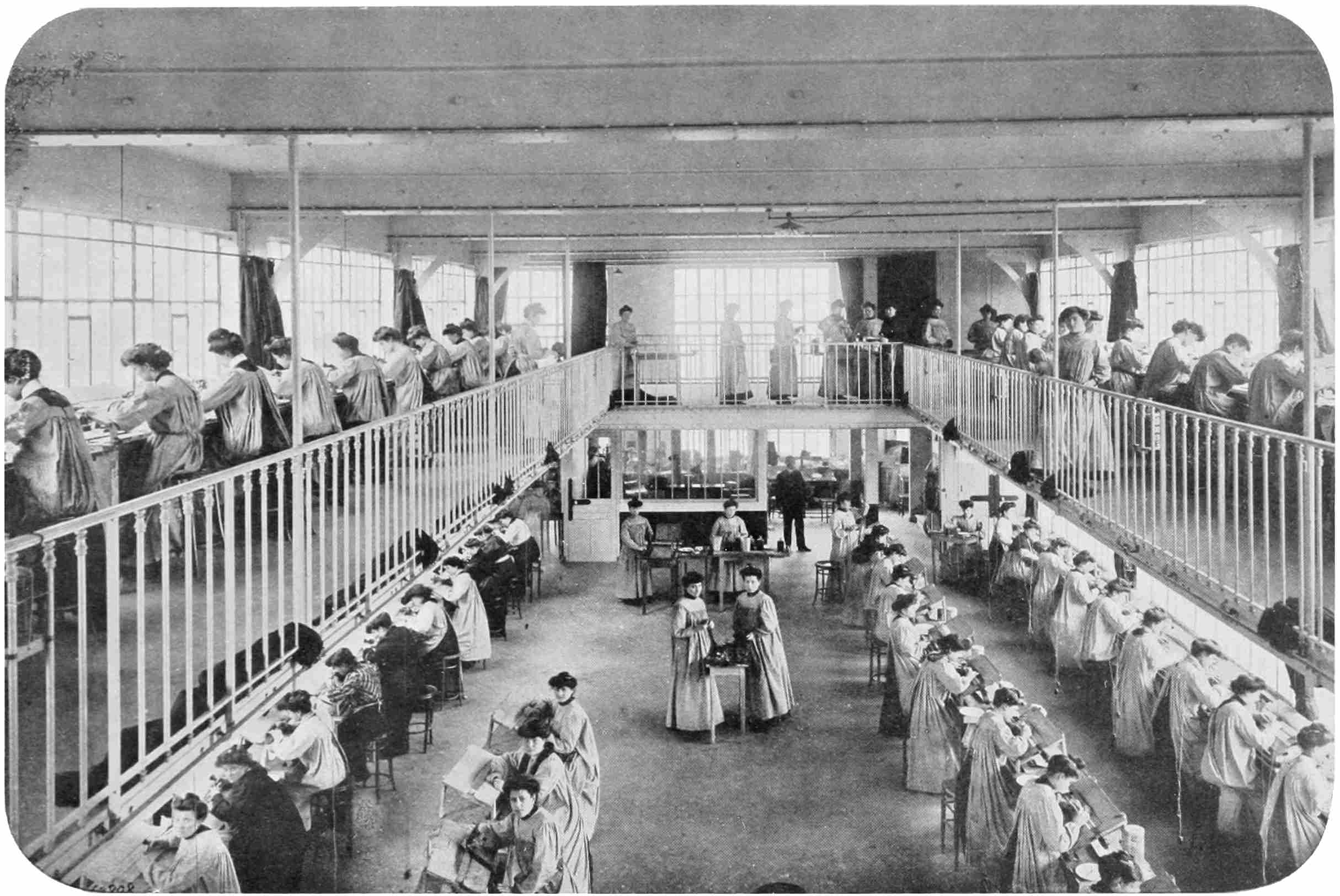
PREPARING THE PATHÉ COLOUR FILMS.
The colour system perfected by this famous French firm produces beautiful effects.
When the film measuring 400 feet or more came into
vogue it was recognised that hand colouring was no longer
feasible. The method was too slow and costly. Accordingly
a stencil process was evolved, and is in use to-day,
giving many of the beautiful effects seen in the moving
picture theatres. A mechanical method of tinting the films
by means of these stencils was next taken in hand, and
finally, after prolonged experiment, was perfected. In
this development the French firm of Pathé Frères played
the most prominent part, and to-day, despite the strides
made in natural colour cinematography, their productions
still rank first in popular estimation, owing to the delicacy
of the colouring. This Parisian firm has made the colour
film a prominent feature of its business, and laid down
an extensive and well-equipped establishment especially
for colouring operations.
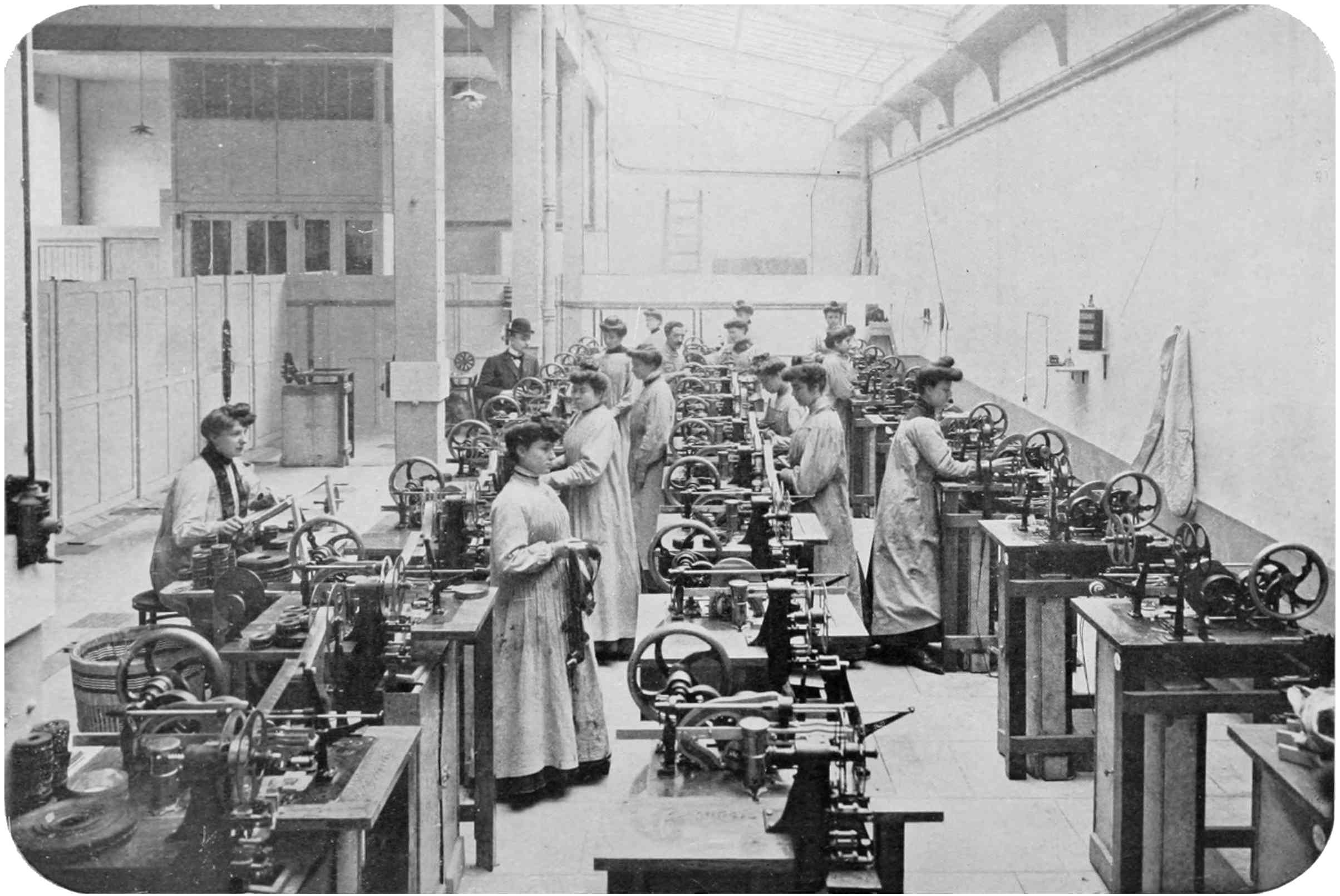
THE PATHÉ COLOUR MACHINE PRINTING ROOM.
Probably everyone knows what a stencil is. It is a
pattern cut out of a solid thin flat surface, which is afterwards
laid upon the subject to be treated, and paint applied
by means of a brush or some other medium. The colouring
only can reach the surface beneath the cut spaces in
the plate, and consequently is applied just where it is
desired. The process is practised freely in the printing of
wall-papers, and in applying designs to other surfaces, as
it is both cheap, rapid, and highly effective.
Cutting the stencils for a moving picture film is a long
and exacting task. Three stencils have to be prepared for
each subject. In the first the spaces corresponding to the
red tones in the picture have to be cut; in the second, those
for the yellow; and in the third stencil, those for the blue.
By putting one over the other the various mixtures and
tones are obtained. The process may be likened to the
preparation of the three process blocks for heliochromic
illustrations in letterpress printing. Since each picture
measures only 1 inch wide by ¾ths of an inch in depth, we
may gather some idea of the labour involved for the treatment
of, say, 8,000 pictures contained in a film 500 feet
long. It follows that unless a film is likely to have a large
demand, colouring is not attempted. In one case which
I have in mind, the firm will not attempt colouring unless
they are certain of the sale of 200 copies of the subject.
The colours—aniline dyes—are applied successively by
means of rollers, the film to be coloured being passed
through special machines contrived for the purpose.
In view of the expense and time entailed, it is not surprising
that many inventors have devoted their energies
to devise ways and means of taking colour pictures direct
from Nature. Greene evolved the first cinematographic
process for taking and projecting moving pictures in
natural colours, and his patent constitutes the base upon
which all other experimenters have worked, just as to-day
in America the kinetoscope is regarded as the progenitor
of the cinematograph. Six months later another process
working upon the same broad principle was patented by
Lee and Turner. But Greene’s process was premature;
at that time it was unworkable. The Lee and Turner
system, fundamentally the same, suffered from a similar
defect, as I shall explain a little later.
Natural light is the result of waves oscillating at a
tremendous speed per second, just as other waves, heavier
and travelling far more slowly in comparison with light
waves, produce sound. Our familiar conception of
natural light, or daylight, is that it is white; but we also
know that when a narrow beam is permitted to fall upon
a length of glass of triangular section, known as a prism,
the light which on the outer side appears white is found
to be resolved into colours on the opposite side. In
passing through the prism the beam of light has been
deflected from a straight path, and the result is that the
waves of varying length, of which white light is composed,
have been sorted out. The shortest rays are red, while the
longest rays have a violet tinge. The analysis of light,
as revealed by the spectrum in a dark chamber, is performed
for us by Nature in the rainbow.
If we examine that phenomenon we shall see that the
innumerable tints constituting it fall into three broad
groups—red, green, and violet. These therefore are regarded
as the primary colours. By combining any two,
or all three, of these, the multitudinous hues with which
we are familiar may be produced. The average person,
when he hears red, green, and violet described as the
primary colours, is inclined to remonstrate. At school or
when using his box of paints, he was taught to regard
yellow, red, and blue as the primary colours, and green,
a mixture of blue and yellow, as a secondary or complementary
colour. But the two instances deal with totally
different forms of light. The former is transmitted, and
the second is reflected, light. This confusion of thought
led to the undoing of many early experimenters in colour
photography. They took their images through successive
screens of red, yellow, and blue, and when projecting used
the complementary coloured screens—orange, green, and
violet. The results were startling. It was not until
Greene took his pictures through the red, green, and violet
screens, and subsequently projected them through screens
of the same colours—that is to say, the picture taken
through the green glass was projected through the green
glass, the red through the red, and the violet through the
violet—that any tangible progress was made.
When the celluloid film came into vogue the experimenters
lost no time in commercialising a system of
natural-colour cinematography. The idea was to take a
picture through each successive screen. In other words,
the first picture was taken through the red screen; the film
was jerked forward, and the second picture was taken
through the green screen; lastly, a fresh area of sensitised
surface was brought before the lens and third or violet
screen. Thus three consecutive pictures, taken through
three different screens, were secured. The screens comprised
sectors of red, green, and violet respectively,
each colour screen being succeeded by an opaque
sector. Thus the shutter was divided into six parts—three
colour screens and three opaque sectors alternately. After
exposure through one screen, as the following opaque
sector flitted across the lens, the film was jerked into position
to bring a fresh surface of sensitised surface before
the next screen in the revolving shutter.
When the red screen is brought into position before the
lens, the colours in the object are filtered, as it were, only
the red rays being permitted to pass through the screen to
the film. The picture on the film, therefore, is a photograph
of the red tones in the subject. Similarly the green
screen absorbs all but the green rays, and photographs
a record of the green tones in the subject. The same is
true of the violet screen. The developed film possesses
no tinge of colour in itself. It is merely a black-and-white
image. Close examination of three consecutive pictures,
however, reveals varying densities according to the filtering
action of the respective screens. In projecting, the
picture taken through the red screen is thrown through a
red screen, the green image through a green screen, and
the violet though a violet screen. Thus the lantern reconstructs
upon the sheet what the camera dissects when
photographing the object. Experimenters anticipated
that, in virtue of the law of visual persistence, if these
pictures were projected at a sufficient speed upon the sheet,
the three images taken through the red, green, and violet
screens would be superimposed one on the next, thereby
conveying to the eye a faithful colour record of Nature.
It sounds feasible and seems attractively simple to perform;
but Nature has not been caught yet.
At the very outset the investigators were baffled. The
sensitised emulsion on the film was too slow to render the
application possible. Every photographer knows that the
red light is non-actinic—he uses it for the illumination of
his dark-room while developing his plates. Obviously,
therefore, it was hopeless to endeavour to take a photograph
through the red screen in 1/100th part of a second.
For this reason Greene’s process failed, as did also that of
Lee and Turner.
Then another miscalculation was revealed. With black-and-white
pictures a speed of sixteen pictures is the minimum
capable of conveying the impression of continuous
motion to the brain. As the pictures are in monochrome,
the perfection of the illusion is facilitated. But when it
came to projecting the pictures taken in three different
colours, one after the other, this law was seriously upset.
When only sixteen pictures per second are shown, the eye
and brain are able to single out the respective colours.
The pictures do not run together to give a natural colour-effect,
but are merely successive flashes of red, green, and
violet light. Accordingly, the rate of projection had to
be increased three times at least—forty-eight pictures per
second—and the strain of this speed upon the film was so
great that often it succumbed.
Consequently, before colour-cinematography could advance
beyond the year 1899—when the first patent was
filed by Greene—the chemist had to be called in once more
to accomplish a miracle and make possible the dreams of
inventors. The sensitised emulsion had to be speeded up
to such a degree that it was sensitive even to red light.
By this means the film is made “panchromatic,” as it is
called; that is to say, it becomes so sensitive that it will
permit an exposure to be made as rapidly through the red
as through the green screen. But “panchromatism”
brought its own drawbacks. The film could no longer be
handled in the dark-room illumined with a ruby lamp, for
fear of becoming fogged.
It has not been found practicable to impart panchromatism
to the film at the time it is manufactured. I
do not mean to say that it cannot be done at that stage,
but the demand for such a film is so small that it is not
worthy of present consideration on the part of the manufacturer.
Until colour-cinematography becomes generally
practised, those engaged in its exploitation will be
compelled to render their film panchromatic preparatory
to exposure.
This means that the film as it arrives from the manufacturer
must be submitted to a preliminary operation to
augment its sensitiveness to light. For this purpose it is
passed through a “colour-sensitising” solution. The precise
constitution of this sensitising bath is jealously
guarded, though the materials employed in the process are
well known, and several formulæ which will render a film
panchromatic have been published. Any one of three
chemicals can be utilised to render the ordinary film so
sensitive to light that the ruby lamp will fog it. These
are pinachrome, pinacyanol, and ethyl-violet. The proportion
of these fundamental chemicals varies, the majority
of investigators having evolved a particular formula which
they have found to be the best suited to their own requirements.
The published formulæ, however, have proved
quite reliable, and have been productive of some excellent
results; and they provide the experimenter with a basis
upon which to carry out his work. Recently a further
development has been recorded. W. F. Greene, the
pioneer, has successfully employed a new colour sensitiser,
which is faster than either of the three above-mentioned
mediums.
Panchromatising is a tedious operation. The work has
to be carried out practically in total darkness, or at the
utmost in the faint glimmer of a blue-black light. Even
this slight illumination has to be used very sparingly,
being switched on only for a few seconds at a time. After
being passed through the colour sensitiser the film is wound
upon a large drum and dried, this operation being
accelerated by rotating the drum at a high speed in a
current of warm air. When dry the film is wound upon
the spool ready for use. As may be supposed, the operation
is somewhat slow, about three hours being occupied under
the most favourable conditions in the process of sensitising
and drying.
It is imperative that the film, after being sensitised,
should be used as soon as possible. It deteriorates rapidly;
the sensitiveness of the emulsion to red light becomes impoverished
through keeping, the life of stock so treated
being, as a rule, one of only a few weeks.
Another objection to colour cinematography is the
expense. When the three primary colours—red, green,
and violet—are used, demanding a photographing and
projecting speed of forty-eight pictures per second—sixteen
per second through each screen—as compared with sixteen
pictures per second with black and white work, three times
the quantity of film has to be used. Accordingly, the
expense of the film alone is three times as heavy. The
further necessity for panchromatising the film before use
increases the cost of the material still more. By the time
the “stock” has been treated with the colour sensitiser
its cost is increased from 1½d., or 3 cents, to about 3½d.,
or 7 cents, per foot.
When tricolour cinematography is attempted, three feet
of film are required to record the movements of the subject
during the space of one second, as against one foot for
black and white work. With a view to reducing this heavy
cost, inventors concentrated their attention on the possibility
of securing approximately true natural colours by
the aid of two screens only—the green and the red. In
this way a third less film was required and the cost was
reduced by an equal proportion.
This development was led by W. F. Greene. Realising
the disadvantages of the three screens, he abandoned that
system—although it has since been exploited—and in 1905
perfected the first practical method of natural-colour
cinematography through two screens—red and green. A
demonstration was given in the Library of the Royal Institution
on January 26th, 1906. This was not Greene’s first
demonstration in two-colour work, as in 1900 he devised
a machine for achieving the same object, which was exhibited
before the Royal Photographic Society in that year.
Another diligent investigator in this field was Mr. Albert
Smith, who was striving towards colour cinematography
at the same time as Greene, but independently of him.
The art fascinated him in the early days; and although
he prosecuted his experiments first in black and white, the
result of Ives’s efforts in still-life colour photography
prompted him to wrestle with the problem of producing
natural colours in moving pictures. The elimination of the
third or blue screen was his special study, and years were
expended in researches to this end, involving countless
experiments with the red and green screens, varying in
density and intensity from the colour point of view, and
in relation to one another. For instance, one screen, say, of
emerald-green and the other of orange-red would first be
used. This proving unsatisfactory, the proportion of the
red in the one screen was increased, the green remaining
untouched. Then the green would be varied, and then the
red again, the process being continued until a satisfactory
result was obtained. The search was rendered all the more
exasperating when the screens which produced satisfaction
on one day with a subject, failed altogether with another
subject the next day, owing to variation in the light. At
last, in 1906, Mr. Smith’s patent, known as “Kinemacolor,”
made its appearance some eighteen months behind
that of Greene; though it was not perfected sufficiently
to be introduced to the public until 1908.
Undoubtedly “Kinemacolor” is at present the best-known
commercial natural colour system. The appearance
of this process has stimulated the movement in
colour cinematography to a pronounced degree, and its
improved appearance in 1911 created a sensation. Some
of the effects produced have been very beautiful, and
although they are far from perfect, as those identified with
the process will readily admit, yet it constitutes an excellent
stepping-stone for further improvement.
The statement that the blue screen has been eliminated
will doubtless provoke discussion as to how the hues of a
pronounced blue or purple effect so common in nature
can be obtained. If one picture is photographed through
the red screen and the second through the green screen,
this alternation of exposure being continued throughout the
film, it seems certain that the result will be pictures wherein
only green and red tones exist, since no combination of
these colours will give purple. This, in fact, is the case,
and it constitutes the foremost imperfection in “Kinemacolor”;
the pictures do have a prevailing green or red
tone. But these tints become modified slightly. The
essential blue tone is partially supplied in two ways. In
the first place there is a certain proportion of blue associated
with the green screen; secondly, when the electric
arc light is used there is a pronounced blue tone in the
light. The combination of these factors, to a certain but
very small degree, compensates for the absence of the blue
screen.
On the other hand, resort to the two screens serves to
emphasise the direct colours. The red and green tones
do stand out with startling purity—“unnaturally vivid”
is a criticism that I have often heard—but the intermediate
tones, particularly those of the browns, are strikingly soft.
Some of the pictures are assailed as being unnatural in
tone; and to a certain extent the criticism is a just one.
In some instances, however, it is due to the fact that the
spectator has never actually concentrated his attention upon
colour effects in Nature. His eye has never given him a
faithful report of their quality.
That “Kinemacolor” has severe limitations cannot be
denied, especially when it comes to dealing with Nature
direct. Fidelity to the myriad hues of Nature, ranging
from one extreme end of the spectrum to the other, cannot
possibly be obtained by recourse to two screens.
One searches in vain for the true blue and the rich, deep
purple, while the pure yellow also is absent, being represented
by varying tones of orange. So far as the blues
and purples are concerned, they never can be obtained by
resort to the two screens—red and green respectively—because
what is known as the lower end of the spectrum
is lost entirely by “Kinemacolor.” The hues stop short
at the boundary where green meets blue.
The public has sometimes drawn attention to another
defect in colour cinematography. It appears to photograph
the subject in a brilliant sunlight, regardless of the fact
that sunlight kills colours. Every amateur photographer
knows that if he exposes his plate upon a brilliantly
lighted subject the tones are hard, everything being practically
resolved into an intense white and black, while the
leaves of trees appear to be covered with snow. When
such a disadvantage afflicts the black and white worker,
what can be said of a colour subject taken under the same
conditions? The brilliantly lighted points are lacking in
tone, and some very bizarre effects are produced in consequence.
When an essentially scenic subject is thrown
upon the screen these defects are very manifest, but when
it is applied to such a subject as the Coronation of the King
the flaws are overlooked, because public interest is concentrated
upon the principal actors.
It cannot be denied that from the popular point of view
the Kinemacolor records of the Coronation, the Investiture
of the Prince of Wales, and other Royal subjects of
the same time left little to be desired. They brought the
scene before millions with a wonderful realism and gorgeous
blaze of colour such as never before in the history
of moving pictures had been witnessed upon the screen.
The excellence of these portrayals established “Kinemacolor”
firmly in the mind of the public.
Another disconcerting feature which has aroused considerable
comment in the public mind is the apparent
duplication of the outlines of figures near the camera.
The most uninitiated observer cannot fail to see the outlines
in green and red, as if the superimposition were out
of register. “Fringing,” as this defect is called, is difficult
to eliminate in many instances, and although often it is
only momentary, it is decidedly distressing. It is due to
diffraction, the glass screen as the light passes through
acting somewhat as a prism, and splitting up the light
into its component parts or groups of wave-lengths.
“Kinemacolor” has vast possibilities in the presentation
of picture-plays; indeed, this may be said to be its
true province. Here one can prepare the scenery and
costumes to come within the limitations of the two screens
adopted; the drawbacks can be eliminated by proper
staging, and all those colours omitted which cannot be
faithfully reproduced. Even if the latter expedient is not
practised, the colour-distortion is not seen upon the screen.
The audience cannot see that a rich purple cloak has
turned to a whitish-green, or a brilliant yellow become
reddish-orange.
In justice, however, it must be said that Kinemacolor
is only in its infancy; it occupies the same position to-day
that black-and-white cinematography did in the early
’nineties. The combined efforts of several independent
investigators will eliminate the defects one by one and
effect steady improvements. Black-and-white cinematography
has passed beyond the formative period and
reached an advanced stage of development; natural-colour
cinematography must go through the self-same ordeal.
Operators have not become accustomed to the new order of
things, and have not realised the many new factors that
have to be taken into consideration. The sooner they do
so, the more profitable will the art become.
A new rival, “Biocolor,” has recently made its appearance.
This process is based upon the Greene patents, and
the results achieved so far, in combination with this
indefatigable experimenter’s latest discoveries, represent a
marked advance in the art. Not only are the tones purer
to Nature, but “fringing” and other defects have been
eliminated, while the process is much simpler and cheaper.
Considerable attention has been centred upon a new
natural-colour cinematographic process which has recently
made its appearance. The three primary colours are used,
and are projected upon the screen simultaneously to present
merely one image before the public, as in the Ives
system of lantern-slide colour-projection. The pictures
are projected at the rate of sixteen per second in groups
of three, and the lighting arrangement is carried out upon
different lines. Instead of a revolving shutter eclipsing
the red image to permit the green picture to be brought
into place, the light is extinguished, projection being carried
out upon a flash system, whereby a powerful beam of
light is thrown momentarily through the three images and
screens, the pictures being changed in the period of darkness.
The flashing must be carried out with uniformity,
which is assured by electric-mechanical means, independently
of the operator. The results, it is stated, show the
most distinct advance so far made in natural-colour cinematography.
Although colour-cinematography has made remarkable
strides, the monochrome picture has become established
more firmly than ever. The appearance of the new rival
has stimulated perfection in the technical excellence of the
latter process. The monochrome possesses one overwhelming
advantage over its competitor—it is far cheaper. A
subject which in black and white requires, say, 500 feet
of film, demands, as we have seen, 1,000 feet, or twice the
quantity of material, for the two-colour record of the same
subject. At present also the monochrome film possesses
finer and more brilliant detail, is clearer, and, from the
photographic standpoint, leaves little to be desired.
It is becoming quite a common practice to relieve the
monotonous black-and-white by the introduction of colouring
effects. For instance, the impression of a bright moon-light
night is conveyed by giving the pictures a prevailing
blue tone; for other scenes brown or red tones are given.
These effects are secured by steeping the film in a chemical
solution in precisely the same way as platinotype and
bromide papers are tinted after development.
“Toning,” as it is called, is coming into extensive use,
especially in connection with the most artistic films. The
treatment imparts a solidity to the figures in the picture,
and gives a pleasing softness, so that the pictures upon
the screen possess a quasi-stereoscopic effect highly pleasing
to the eye. The beauty of this treatment is revealed very
significantly in the films of Italian manufacture, and
especially in the “art” productions of the Cines Company,
of Rome. There is no limitation to subsequent improving
processes such as these, and their effect is to implant the
monochrome pictures more and more firmly in public estimation.
Consequently, the black-and-white picture is far
from being eclipsed by its new rival; in fact, such a contingency
is more remote to-day than it was ten years ago.
CHAPTER XXVII MOVING PICTURES IN THE HOME
Will the cinematograph ever enter home life? Will
the world and his wife ever become wedded to a camera
with which they can secure life in motion by some simple
and easy method, just as now they can obtain still-life
pictures by the aid of the hand-camera? Will the cinematograph
become as popular as the ubiquitous Kodak?
There is no doubt that the widespread favour extended
to cinematography has brought about a popular desire to
follow the art in an amateur manner, as is possible in
ordinary photography. Hitherto certain obstacles have
stood in the way of the amateur enthusiast; but these difficulties
have been broken down in an ingenious manner.
The desire to practise the new cult has been increased by
the number of firms engaged in the making of topical
pictures and by the increasing demand for such subjects.
Occasionally pictures command a high value, fluctuating in
proportion to public interest. For instance, the dramatic
manner of Blériot’s flight across the Channel caught the
professional cinematographers by surprise. Elaborate
arrangements had been made to secure pictorial records of
this journey, but only one man, a wide-awake amateur,
obtained a film of the embarkation. Although his film was
deficient in technique and photographic quality, it commanded
a high price; and the enterprising photographer
never had occasion to regret his enterprise, for his initial
expense was recouped several times over.
The cost of the camera and the expense of the film are
the chief drawbacks to the popularisation of cinematography;
the bulkiness of the apparatus has also militated
against its adoption by the amateur. Recently, however,
these admitted drawbacks have been overcome, and by
methods which claim the distinct merit of ingenuity and
resource.
About 1886 a novel device known as the “Kineograph”
appeared. It was an anticipation of the “Mutoscope,”
which made such a bold bid for public appreciation in the
early ’nineties and, like the Kineograph itself, failed to
make its mark. A number of instantaneous photographs
were printed and mounted upon separate leaves. The pictures
were placed in consecutive order and bound at one
side to form a kind of book. When the leaves were turned
over rapidly, giving fleeting though distinct glimpses of
the successive pictures, the idea was conveyed that motion
was being represented.
Recently this idea has been revived in the “Kinora”
motion photography system. This likewise made its first
appearance some years ago, but failed of success, although
it was distinctly ingenious. It offered to the home in pictures
just what the phonograph provides in regard to
sound—the capture of a particular incident to be reproduced
at leisure. In a highly improved form the same
device has recently reappeared, and its reception augurs
well for its future.
The amateur is provided with facilities for taking his
own photographs, a special camera having been evolved
for the purpose of simple design and operation. In general
appearance it resembles the ordinary hand-camera, measuring
9⅛ inches in length by 6⅝ inches wide by 7⅝ inches
deep. When loaded it does not weigh more than 7¼
pounds. Externally it possesses few fittings. There is the
lens, which can be focussed by moving the lens tube to
and fro in an outer sleeve, as in a telescope; the view-finder,
placed on the top, and the actuating handle at
the right-hand side. At the rear is the dial, whereby is
indicated the length of film exposed, a focussing tube
and the device whereby focussing is carried out.
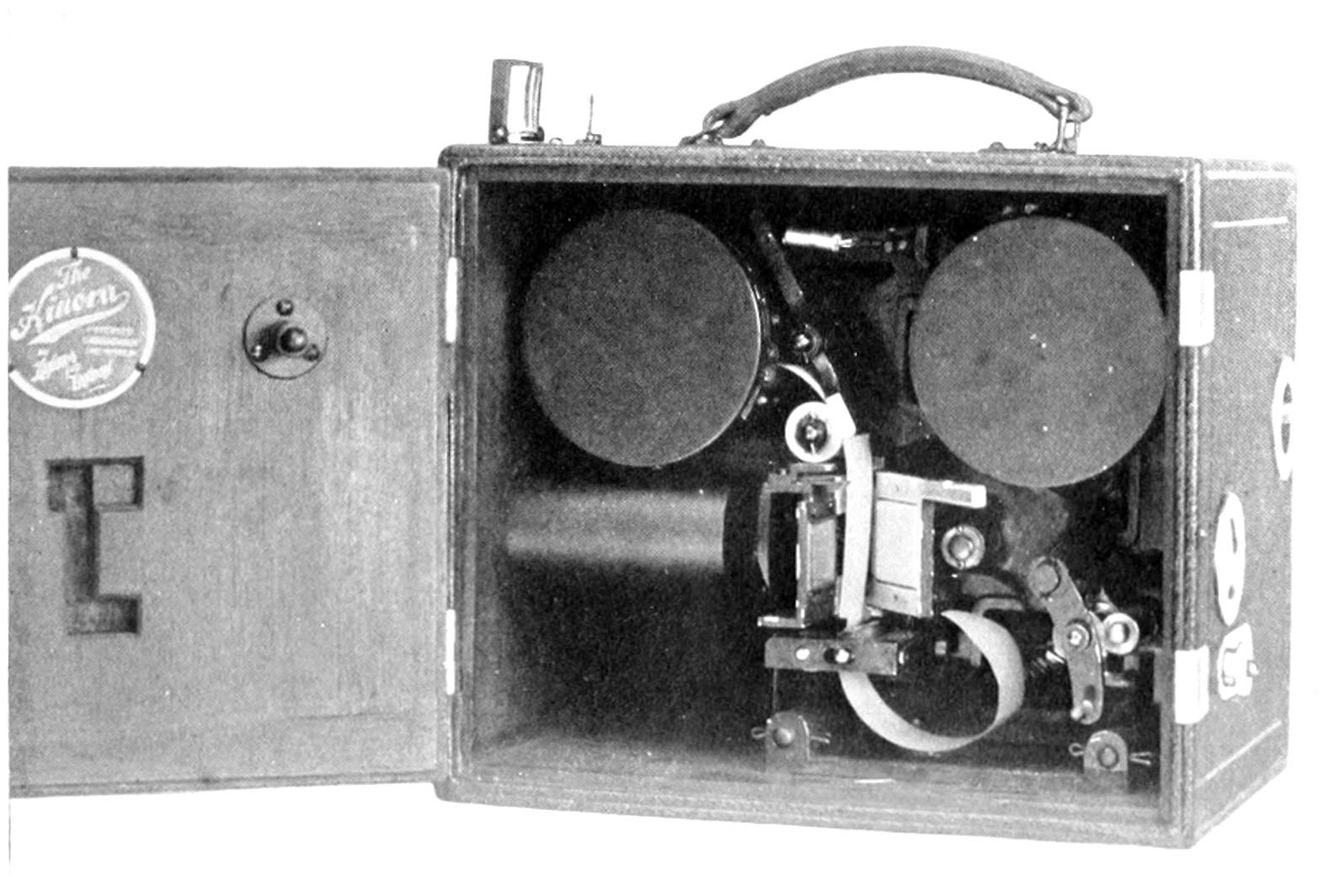
The mechanism of the Kinora camera showing paper negative film in position.
MOVING PICTURES AT HOME.
The mechanism of the camera is very simple. The
sensitised ribbon is placed in a circular spool box and then
is threaded through the film-gate and the intermittent gear,
to be taken finally in a second circular spool-box. The
intermittent gear differs entirely from that in the ordinary
camera, which works upon a claw or finger system with
the film running over sprockets. In the Kinora camera
below the gate there are two eccentric rollers, mounted
side by side, acting in the same way as the rollers of the
domestic mangle. These rollers are split at one point
through their entire length, and when these two edges,
rotating synchronously but in opposite directions, come
together and in contact with the film, which is fed between
them, they grip and pull it down the depth of one picture.
It may be pointed out that a similar movement was adopted
in the very earliest cinematograph cameras built by Greene
and other experimenters, in order to secure the requisite
intermittent motion. Their imperfection was the uncertain
motion of the rollers; but in the Kinora camera this defect
has been completely overcome.
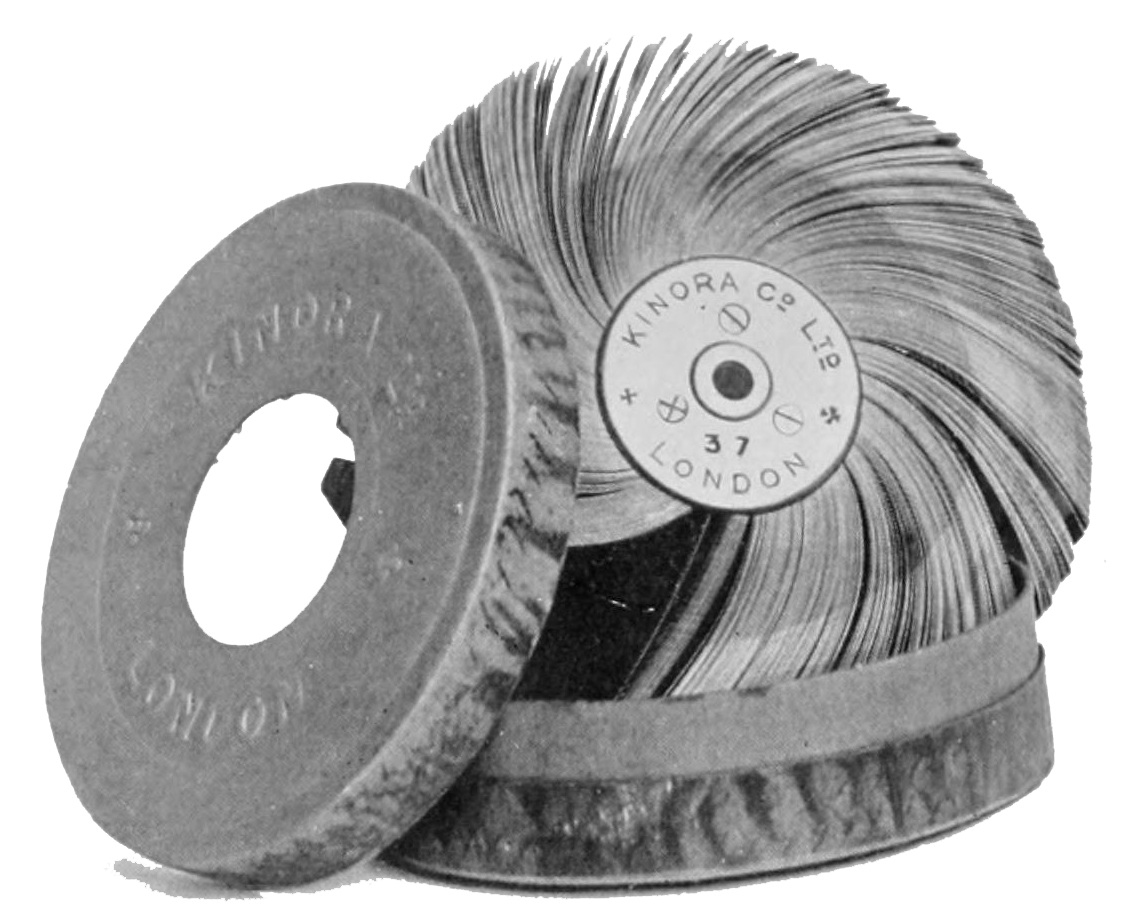
The reel of positive prints. The pictures are mounted separately upon leaves fixed to a core.
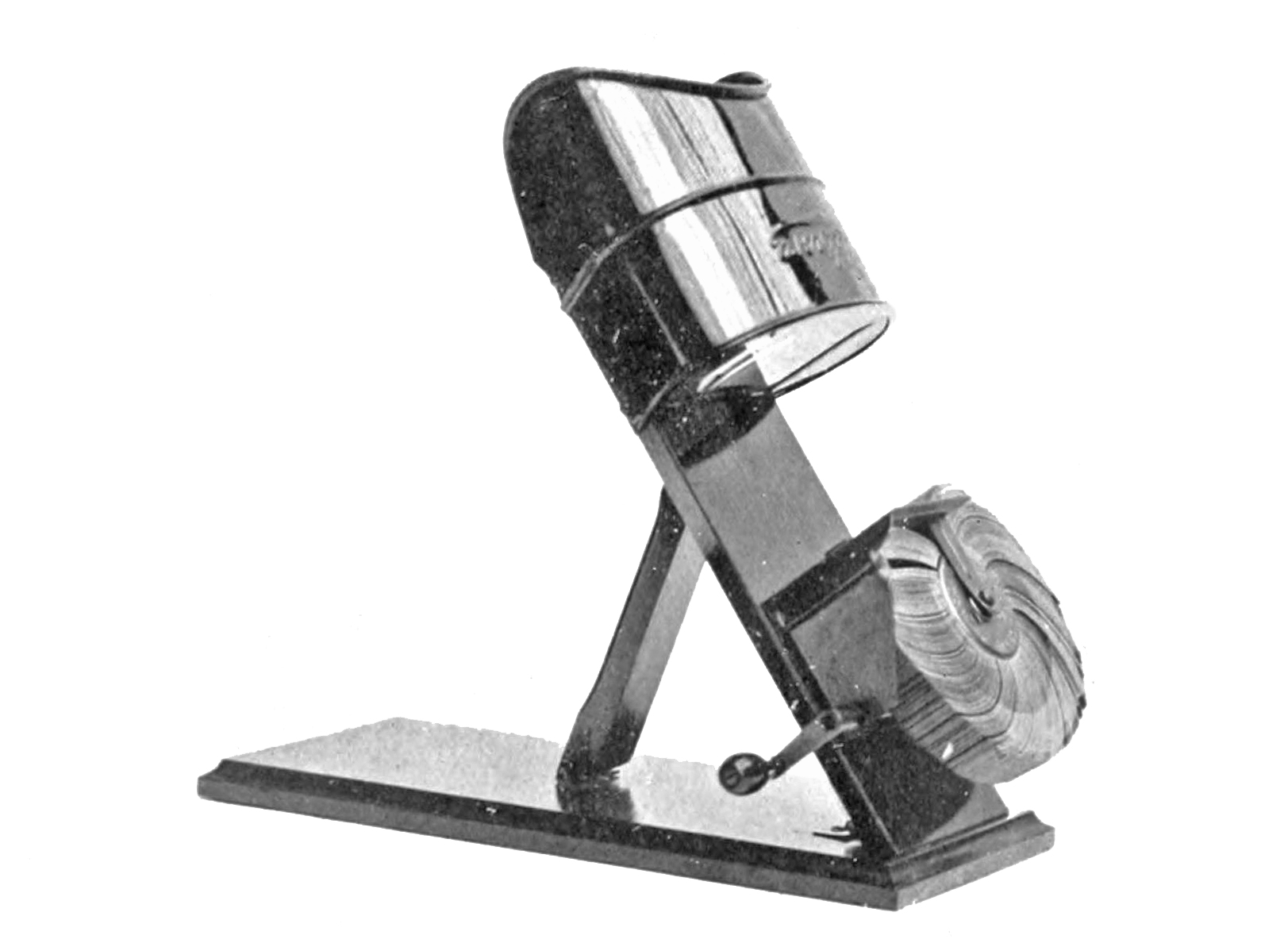
MOVING PICTURES AT HOME.
The Kinora reproduction instrument. It resembles a stereoscope, and the pictures are
exposed singly by rotating the handle.
The apparatus can be used either with a paper negative
or the celluloid film. The former is very satisfactory and
inexpensive, and it may be stated that this is the first
occasion in which the paper negative has been applied successfully
to motion-photography. The camera is adapted
to carry forty feet of ribbon, which is sufficient for 640
consecutive pictures, the latter being precisely of the same
dimensions as those obtained upon the ordinary celluloid
cinematograph film—one inch in width by three-quarters
of an inch deep. Paper is suited to ordinary work, although
the grain destroys sharpness to a slight extent; however,
as such sensitised ribbon costs only 1s. 6d. (36 cents) per
length of forty feet, the drawback is slight. If desired,
celluloid film can be used, in which case the ribbon is one
inch in width—three-eighths of an inch narrower than the
standard cinematographic film, although there is no variation
in the size of the image, since the necessity of perforating
the edges has been obviated. Celluloid film printed
in this manner cannot be used for the purposes of projection
upon a screen. Moreover, the celluloid film is expensive;
the paper sensitised ribbon is more suitable for home-work.
The paper negative is developed in the ordinary manner,
but as the operation is somewhat delicate, the exposed
ribbon should be sent to the manufacturers, who also prepare
the positive for a modest outlay. In any case, the
positive must be prepared by the manufacturers, as it is
a somewhat intricate process, demanding resort to special
machinery; the pictures have to be printed one by one, on
successive leaves in rotation, and attached by one end to
a bobbin so as to present a circular reel for use in the
Kinora projecting apparatus, as shown in the illustration.
The pictures are printed upon bromide paper in such a way
that the image stands upon a black background. The
latter is obtained by exposing the sensitised paper surrounding
the negative image to the light at the same time
that the negative is printed; and as it becomes thoroughly
exposed, development brings it out perfectly black. It
looks as though the positive were printed upon paper
and afterwards cut out and mounted upon a black background.
The positive has next to be submitted to a treatment
whereby the back of the paper is coated with a dead black.
The strip of paper carrying the images is then cut to the
requisite size by means of special machinery, so that each
picture forms a leaf about 3½ inches long by 1 inch deep.
The blank end of each leaf is attached to a central core
or reel, some 640 leaves being mounted edge-wise in this
manner, and the positive is then ready for projection.
The apparatus by means of which the motion is reproduced
varies slightly in the different types. In its simplest
form it recalls the stereoscope in design, only instead of
two lenses it has one large rectangular magnifying-glass.
The reel is mounted upon the opposite end of the instrument
in a horizontal manner so that the pictures stand
vertically and parallel to the lens. There is a small handle
at one side whereby the reel of pictures is rotated through
simple gearing, while a metal finger rests lightly upon
the extreme outer edge of the leaves in such a way as to
permit only one picture to turn over at a time. When this
handle is turned and one is looking through the magnifying-glass,
the leaves fly over in rapid sequence, producing
a vivid illusion of animation. In the second type of
machine the reel is mounted in a cabinet, which is fitted
with two or more lenses, so that two or more people can
follow the movement of the pictures simultaneously. The
actuating mechanism is driven by clockwork, as in a
gramophone.
Endless pleasure can be obtained with this instrument in
the home. Pretty little incidents of domestic life, such as
children playing, animals gambolling, and so forth, can
be photographed and reproduced upon the reel! If one
is more ambitious one can cinematograph great events,
such as a horse race, a boxing contest, an express train at
full speed—in short, anything in motion. It is only
necessary to set the camera upon some rigid foundation,
if a tripod is not carried, to secure steadiness during
exposure.
There is one great benefit accruing from the use of this
apparatus. Unless wanton carelessness is displayed, one
need not worry about under- or over-exposure. The paper
negatives are coated with an exceedingly rapid emulsion
of considerable orthochromatic quality, so that true colour-values
are ensured.
A very noticeable feature is the ingenious focussing
device. Instead of opening the camera and removing the
film from the gate, as in the ordinary cinematograph
camera, one has merely to slide a stop projecting from
the back of the camera to the length of its slot. By so
doing the whole of the internal mechanism is moved bodily
to one side to bring a small square of ground glass attached
to the gate into position before the lens-tube, when focussing
can be carried out very easily and readily.
As already pointed out, if celluloid films are employed
with this camera, they cannot be used for projection purposes,
because positives cannot be printed from them upon
the standard perforated positive film. Consequently, the
amateur who wishes to take motion pictures for projection
on the screen will find the Kinora system valueless. It
was designed especially for the production of positive
bromide prints mounted upon a reel to be used with the
special viewing machine.
The true future for this ingenious development of the
art undoubtedly lies in the possibility of purchasing at a
reasonable price reels of “star” events and subjects of
general interest or picture plays, in the same way that
one can purchase talking-machine records. In this way
motion-photography can indeed be brought to the fireside.
How can the art of cinematography be brought within
the reach of the amateur? This is the absorbing question
of the moment. Moving pictures having become so
popular, the traveller wishes to secure animated records of
the scenes which he has witnessed in foreign climes, to
reveal them to his friends, exactly as he saw them, within
the home circle. Unfortunately, such an achievement is
impossible under existing conditions. The apparatus,
both recording and projecting, is expensive; the film is
costly; while the problem incidental to the illuminant is
not easily solved in the average home.
Obviously, in view of the fact that the film is so expensive,
some other system of recording and projecting
animation must be employed. At the same time, any
invention of this character aspiring for commercial success
must be simple, inexpensive, immune from danger, and
compact. At first sight it seems an almost impossible
quest to secure all these essentials in a single stroke. But
it has been accomplished, and what is more, with absolute
perfection. To-day the amateur can take moving pictures
and project them upon a screen at will, for the edification
of his friends, more easily and cheaply than he can
“Kodak” and project snap-shots by lantern-slides. Moreover,
the results thus obtained and shown are far superior
to those obtainable with the methods and apparatus now
in vogue.
This revolutionary achievement has been attained
through the efforts of an indefatigable Italian worker,
M. Gianni Bettini. This persevering inventor recognised
that a totally different system would have to be evolved to
meet the requirements of the millions. The celluloid film
was quite impracticable, so he reverted to the early days
when investigators strove, and in vain, to utilise glass for
their purposes.
The early experimenters, as I have described already,
followed the principle of one plate one picture. The operation
of changing the standard-size plate in its holder, no
matter how deftly accomplished, occupied an appreciable
interval of time, which disturbed the rhythmic character
of the action photographed. Monsieur Bettini recognised
this insurmountable drawback, so set to work to devise a
means of taking several successive images upon a single
plate, and his success in this direction constitutes one of
the vital features of his invention.
The pictures are taken in a series of rows—sixteen to
a row—and at the rate of sixteen per second. But there
is a radical departure from prevalent practice. With the
ordinary cinematograph apparatus the lens is fixed and the
film is moved intermittently. In the Bettini system the
sensitised surface is held rigidly, and it is the lens which
moves. Now, this raises an important and novel point. As
the lens is moved continually to and fro a matter of 4¾
inches—no two successive pictures in a row, in fact, are
taken at the same focus—one would naturally expect that
the pictures would vary in sharpness. But such is not the
case: the picture at the left-hand extremity of the row is
as sharp as that at the opposite end.
The whole principle of the Bettini cinema-à-plaque, as
it is called, is entirely new. The camera itself, a small
contrivance, wrought in aluminium, measuring some
8 inches in length by 4 inches wide and 3½ inches high,
is no larger or heavier than a Kodak snap-shot camera.
This box contains the actuating mechanism, which comprises
a longitudinal shaft, carrying a peculiar thread, on
which is mounted, and along which moves, the objective,
motion being imparted thereto by the revolution of the
handle in the ordinary way. The sensitised plate, instead
of being slipped in position at the rear of the box and
facing the lens, is inserted at one side and at right-angles
to the front aperture. The objective is a combined lens
and a prism mounted upon the travelling part. The light,
passing through the front aperture, enters the prism and
thus is bent at right-angles through the objective on to
the plate.
The plate itself measures 130 by 215 millimetres (5¼ by
8½ inches), and is mounted in a toothed rod on one side.
This rack is vertical and is moved downwards, 6 millimetres
(¼ inch) at a time, by the mechanism on which
the objective is mounted, when the latter has completed
its length of travel. The plate is held in its holder upon
the left-hand side, but the top and bottom edges of the
respective first and last rows of pictures are flush with the
edge of the plate. The latter is slipped into the camera and
travels downwards intermittently. Instead of a slide being
used there are light-tight bags, both top and bottom, forming
the magazines. Directly the plate has passed through
the camera it falls into the lower bag, while simultaneously
a second plate follows in its train through the camera from
the upper bag.
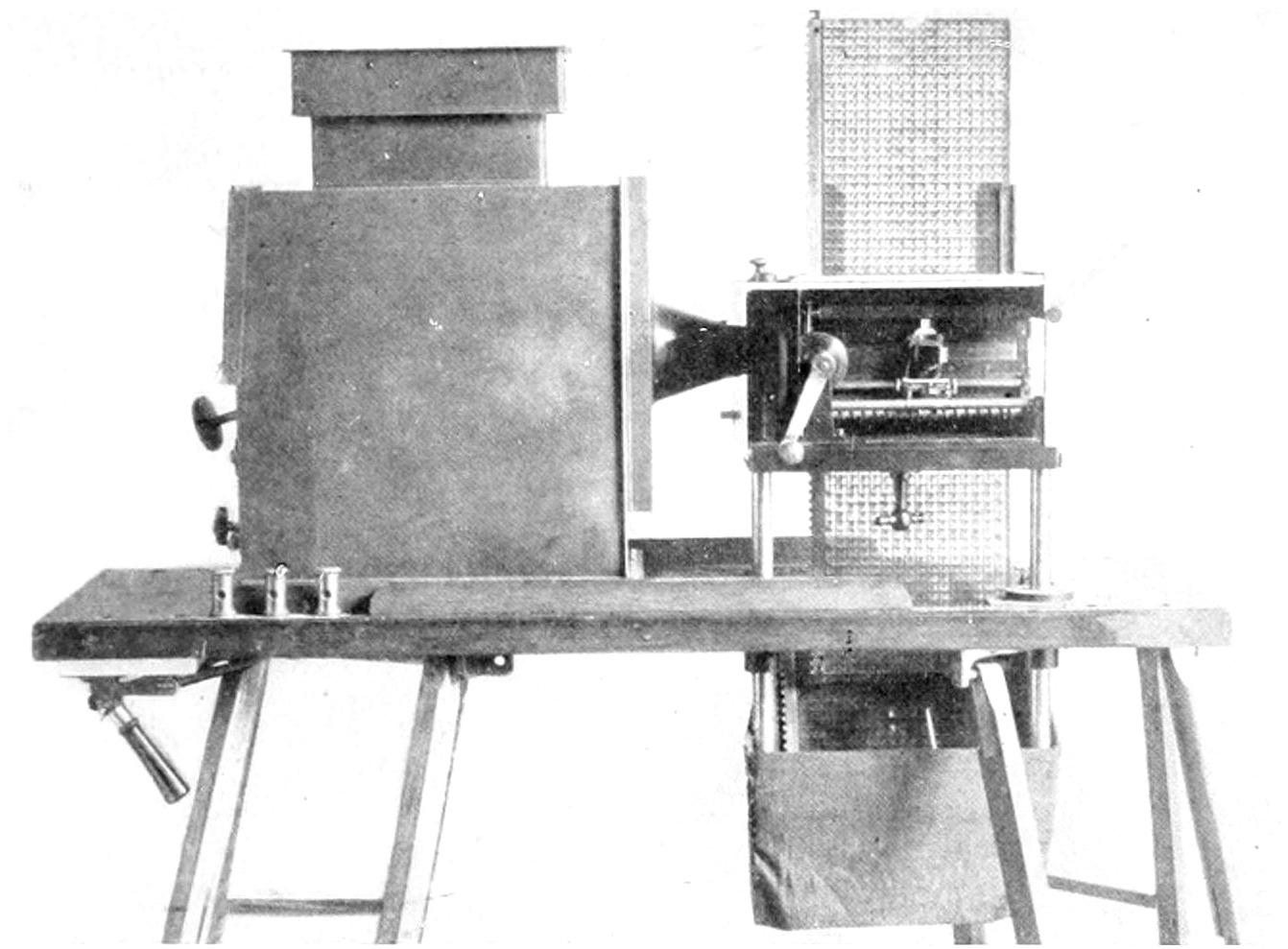
THE BETTINI GLASS PLATE CINEMATOGRAPH.
The camera is used for projection in conjunction with an ordinary lantern. The glass plates are
mounted in a rack, passed through the projector and collected in a magazine bag beneath.
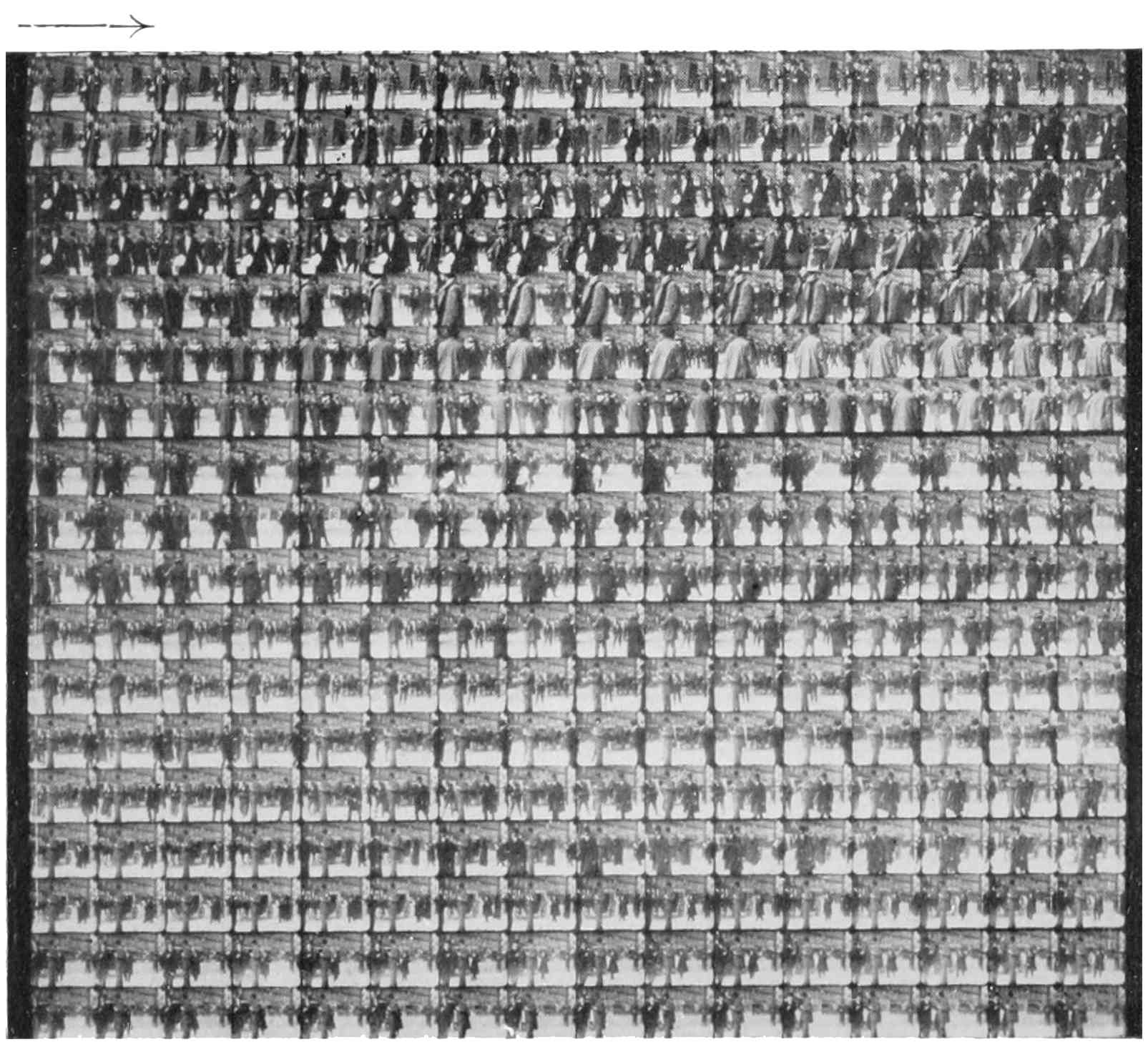
A SECTION OF A BETTINI GLASS PLATE RECORD.
The plate measures 8½ inches long by 5¼ inches wide. There are sixteen successive pictures, each
measuring ¼ in. by 3/16 in., to a row and 36 rows, representing 576 images, on a plate.
As mentioned previously, the depth of a row of pictures
is one-quarter of an inch, while the width of each image is
three-tenths of an inch. In commencing operations, we
will suppose that the objective is at the left-hand side of
the plate, and the first row of pictures is to be taken. The
handle is revolved, and the lens moves across the sensitised
surface intermittently, until it reaches the right-hand edge.
The first row of pictures is completed. At this moment,
while the shutter is closed, the plate descends the depth
of a picture—one-quarter of an inch—thereby bringing
another strip of unexposed surface before the objective.
The lens now travels in the reverse direction, i.e., to the
left-hand side of the plate, in a similar manner. When it
gains the limit of its travel, the plate again drops the depth
of a line of images, and the lens moves once more from left
to right, this see-sawing across the plate in parallel rows
continuing until the bottom edge of the plate is reached.
As the toothed rack of the exposed plate falls away the
toothed holder of the succeeding plate is taken up by the
mechanism and the cycle of operations continued until
the incident is recorded. There is no break whatever
between two successive plates, as the feed is positive and
accurate, while similarly there is no interruption in the
animation when the travelling lens reaches the end of a
line, because the movement of the plate takes place during
the fraction of a second when the lens is covered by the
opaque sector of the shutter.
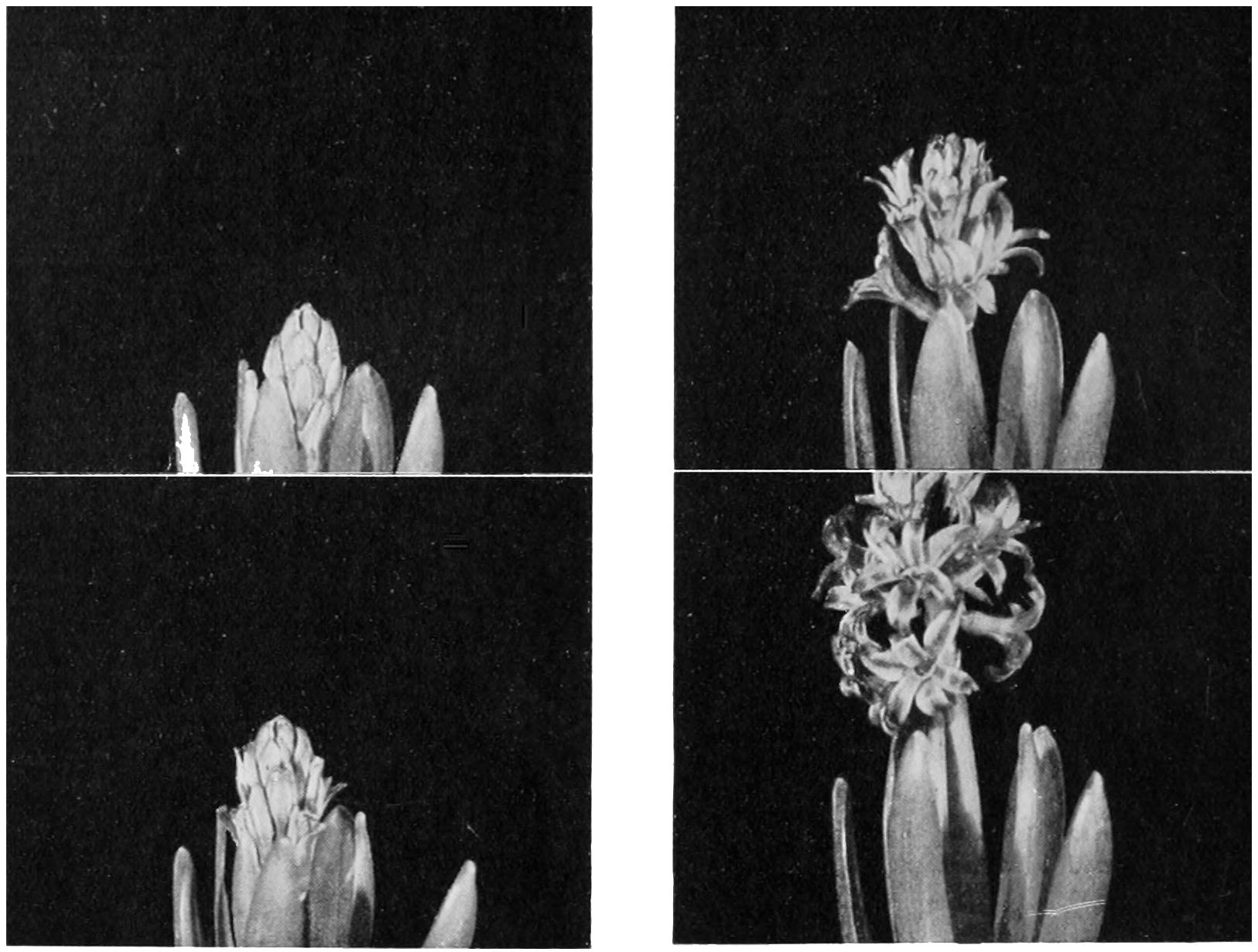
THE BIRTH OF A FLOWER.
A wonderful Kinemacolor film. The pictures represent the stages of growth on the second, fourth,
sixth, and eighth days respectively.—See page 194.
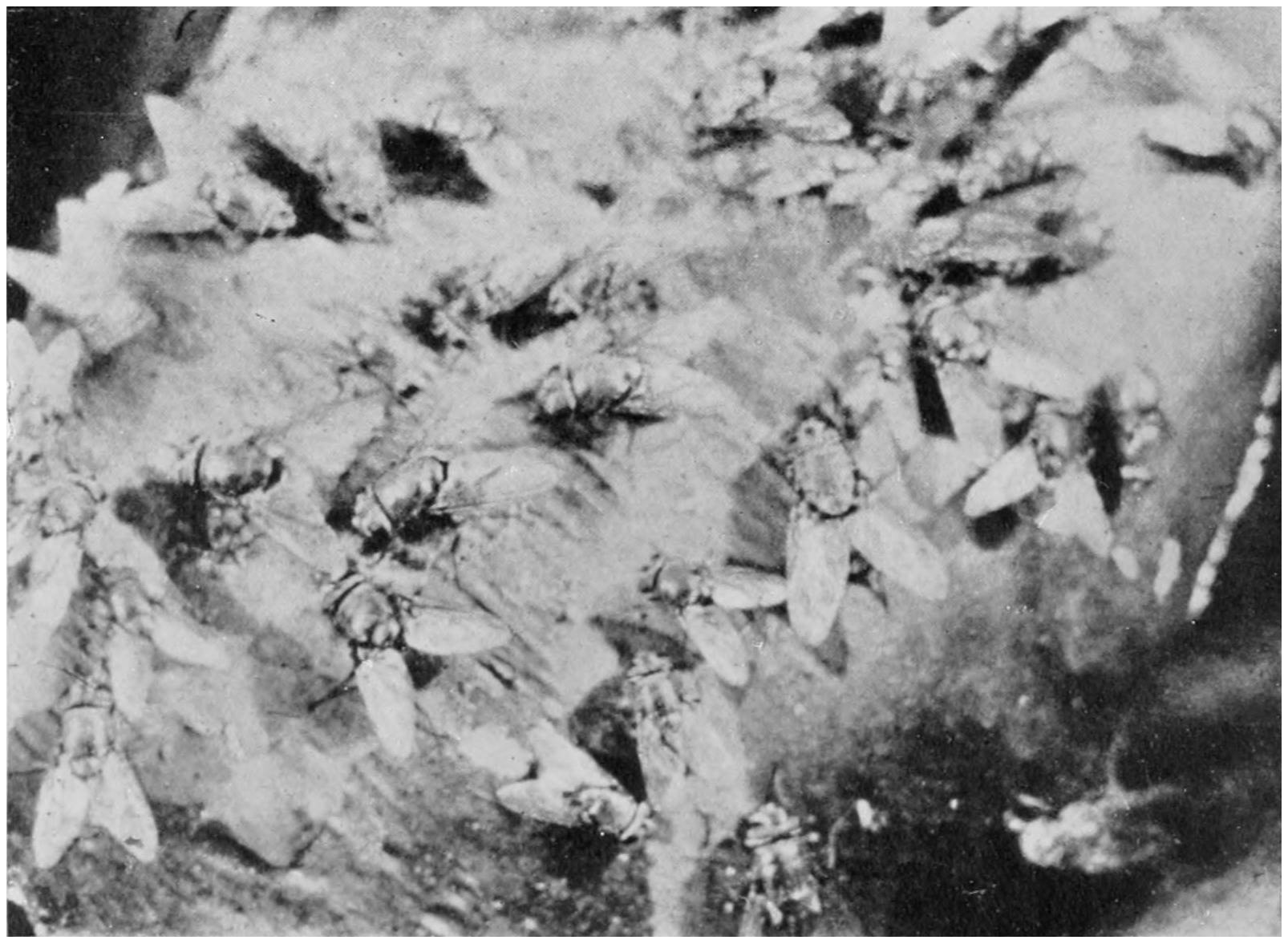
[Copyright, Kineto, Ltd.
WAGING A HEALTH CAMPAIGN BY MOVING PICTURES.
This film, representing flies upon putrid meat, was used in the United States in the war
against the house fly with conspicuous success.
As each plate carries 36 rows of pictures, each line
containing 16 images, it will be seen that no less than 576
images, each measuring three-tenths of an inch in width
by one-quarter of an inch in depth, can be recorded upon
a single plate. Although so small the pictures are remarkably
sharp, clear, distinct, and full of detail; indeed, they
rival the images upon the celluloid film in this respect.
Having obtained the negative, the positive is obtained by
contact printing upon another glass surface as with a
lantern slide. Now, for projection the operator uses the
camera with which the pictures were taken, in conjunction
with an ordinary projecting, or magic, lantern, and the
movement of the apparatus is precisely the same as in taking
the photos. The positive plate in its toothed rack is slipped
into the camera and the handle revolved, thereby causing
the lens to travel across the plate intermittently. When
it reaches the end of a row of pictures, the plate is forced
downwards, one-quarter of an inch at a time, while another
rack and positive plate are inserted when one plate is
exhausted.
The principle of projection is decidedly novel and may
be understood from the accompanying diagram, Fig. 22.
The objective with its prism is mounted on one side of the
plate, while on the other side of the latter is a second
prism on the longitudinal axis of the lantern condenser.
The light from the lantern B strikes the prism C and there
is bent at right-angles towards the image on the plate A.
Passing through the plate, it enters the lens D, to which
the prism E is attached, and once more the ray is deflected
at right-angles to be thrown upon the screen F. An
ordinary magic lantern suffices for the purpose, and the
incandescent mantle and gas may be used as an illuminant—petrol
gas and acetylene are equally suitable—if electricity
or the oxy-hydrogen light is not available. The
picture on the screen may be of any desired dimensions,
inasmuch as the small images, owing to their sharpness,
clearness, and striking wealth of detail, enable enlargement
to be carried to any degree, so long as the illuminant is
sufficiently powerful.
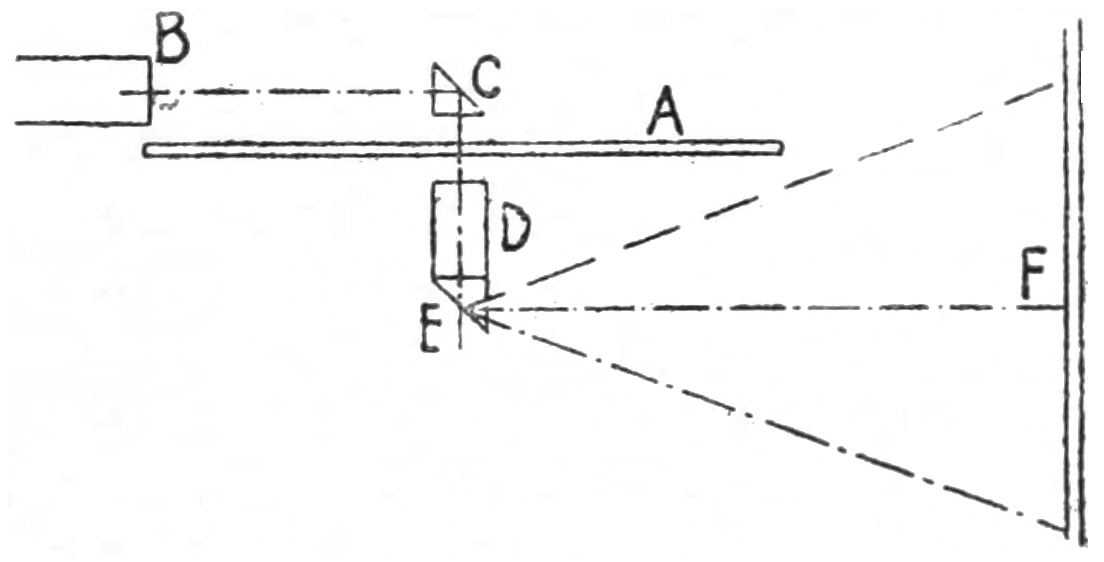
Fig. 22—The Optical Principle of Projection with
the Bettini cinema-à-plaque.
There is one point which must be explained. When
the lens in the camera is at the left-hand edge of the plate,
owing to the greater distance of the objective from the
object photographed, everything will be of smaller proportions
than when the lens is at the right-hand edge, as then it
is brought 4¾ inches nearer the subject. In other words, as
the lens moves across the plate from left to right, the
dimensions increase; on the other hand, they diminish as
the lens moves back again. This might be considered to
be an insurmountable obstacle, but it is not, because
when the positive is projected a different effect is produced.
The picture at the left-hand edge of the plate, which in the
camera was the smallest, owing to its greater distance from
the object, now becomes enlarged to a greater degree than
that at the opposite end of the row, since the former is
4¾ inches farther from the screen. By this arrangement
a correction takes place, the objects in all the images in
a row being brought to a uniform size.
Seeing that continuity of motion is governed purely by
the feeding of the plates, it will be seen that the whole of the
longest incidents may be photographed. A magazine can
take twelve plates, or more, according to desire. In the
former instance a total of 6,912 pictures may be obtained.
Seeing that each row of pictures upon a plate is equivalent
to a foot of celluloid film, a single plate will carry the
same number of pictures as thirty-six feet of the latter. On
this basis a dozen plates will be equivalent to 432 feet,
or more than two spools of celluloid film, seeing that a
spool as fed into the camera generally represents a length
of 200 feet.
The most influential factor, however, is that of running
costs, if the expense in regard to sensitised surface may
be so termed. A strip of film thirty-six feet in length, the
equivalent of a Bettini plate, at 2½d., or 5 cents, per foot,
would represent 7s. 6d., or approximately $2. The glass
plate costs two pence or four cents (both negative and
positive), so that with the Bettini glass plate system an
incident recorded in 6,912 pictures, and occupying about
seven minutes to take and project, would cost only 4s. ($1)
for both negative and positive plates, as compared with
£4 10s., or $22.50, for positive and negative film, to carry
the same pictorial record.
The possibilities of the Bettini cinema-à-plaque system,
therefore, are obvious. The invention brings the art of
cinematography within reach of the amateur; introduces
moving pictures to the drawing-room as completely and
cheaply as the phonograph conveys sound to the fireside;
provides the photographer with a far more fascinating
hobby; while its professional applications are illimitable.
CHAPTER XXVIII MOTION-PHOTOGRAPHY AS AN EDUCATIONAL FORCE
There remains no doubt whatever that the cinematograph
has completely won over the great public—the
many millions who are constantly seeking fresh fields
of amusement and diversion. Of all the classes that
patronise the moving-picture entertainment, the children
form the one most open to its influence and most responsive
to what it offers them; and it is this well-known impressionableness
of the young mind that has set people
thinking of the educational responsibility of the moving-picture
show. From this it is but a step to the question,
May not the cinematograph be brought into the schoolroom?
The subject has several aspects that are worth treating
somewhat at length. The firm of Pathé Frères has here,
as in so many other directions, been first in the field. Let
us examine some of its educational films.
The peculiar properties possessed by the magnet are
profoundly mysterious to the child. Text-books may be
written in the simplest language and freely illustrated with
diagrams, but the points still remain somewhat obscure.
This French manufacturing company has prepared a film,
“The Magnet,” in which the well-known subject-matter
of the school book is illustrated, and the phenomena described
therein are demonstrated in a simple manner by
visual records of the peculiar properties possessed by the
magnet.
The familiar experiments with the magnet and iron
filings are treated simply and with endless variety. If
the pupils see the teacher perform the manipulations with
filings and magnet in the usual way, the experiment conveys
no tangible idea, and interest is not greatly aroused.
But when the same magnet is thrown upon the screen in
movement, and is ten feet or so in height, while the iron
filings are so magnified that they resemble not dust, but
thorns or long pins, a more convincing and indelible impression
is conveyed.
One may have seen many diagrams showing the lines of
force, as they are called. But no diagram can produce the
unforgettable impression gained by the sight of the phenomenon
itself occurring before the eyes. The iron filings
may be seen resolving themselves into the two distinct
groups about the poles, as if imbued with life, and the
process may be followed from beginning to end with perfect
ease, owing to the size to which the filings are magnified
in projection.
The operation of natural laws is indelibly impressed
upon the schoolboy when he is shown some novel experiment
in physics carried out upon the screen. Physiology
and anatomy can be taught by producing pictures taken
by X-ray photography.
History ought surely to be a successful field for the
educational cinematograph. The portrayal by Pathé Frères
of episodes during the Reign of Terror and the Napoleonic
era; the representation of the Normans landing in England,
the discovery of America by Columbus—these and similar
pictures have already shown the wide possibilities of the
historical film. Of course, great care must be taken to
adhere to strict historical truth in fact and setting; when
they will greatly serve to fix in the pupil’s mind events
and historical atmosphere, and aid him in distinguishing
various periods.
A film worthy of introduction into the class-room is
that described in Chapter XVII., showing the birth of a
flower. The fact that this film is produced in natural
colours enhances its effect; a schoolboy would be hard
indeed to impress if he failed to appreciate the wonderful
significance of this evolution of the hyacinth from the bulb
to the flowering stage. Again, he is enabled to witness
upon the screen the birth of the common house-fly, and
its entire span of existence. He can see how ants work and
live, and how the bee manufactures its honey. As a
corollary to the matter-of-fact and uninteresting text-book
the cinematograph film cannot be excelled. It presents
in actual movement what mere words, which have to be
committed to memory, seek to convey without any durable
result. Indeed, there is not the slightest doubt that a
thousand pictures will impress themselves upon the schoolboy’s
mind, and impart to him more definite knowledge of
their subject in one minute than hours of hammering with
the aid of text-book and blackboard. Even actual ocular
demonstration fails to be so convincing as a projection
upon a whitened sheet, where everything immediately
concerned is magnified to an extreme degree.
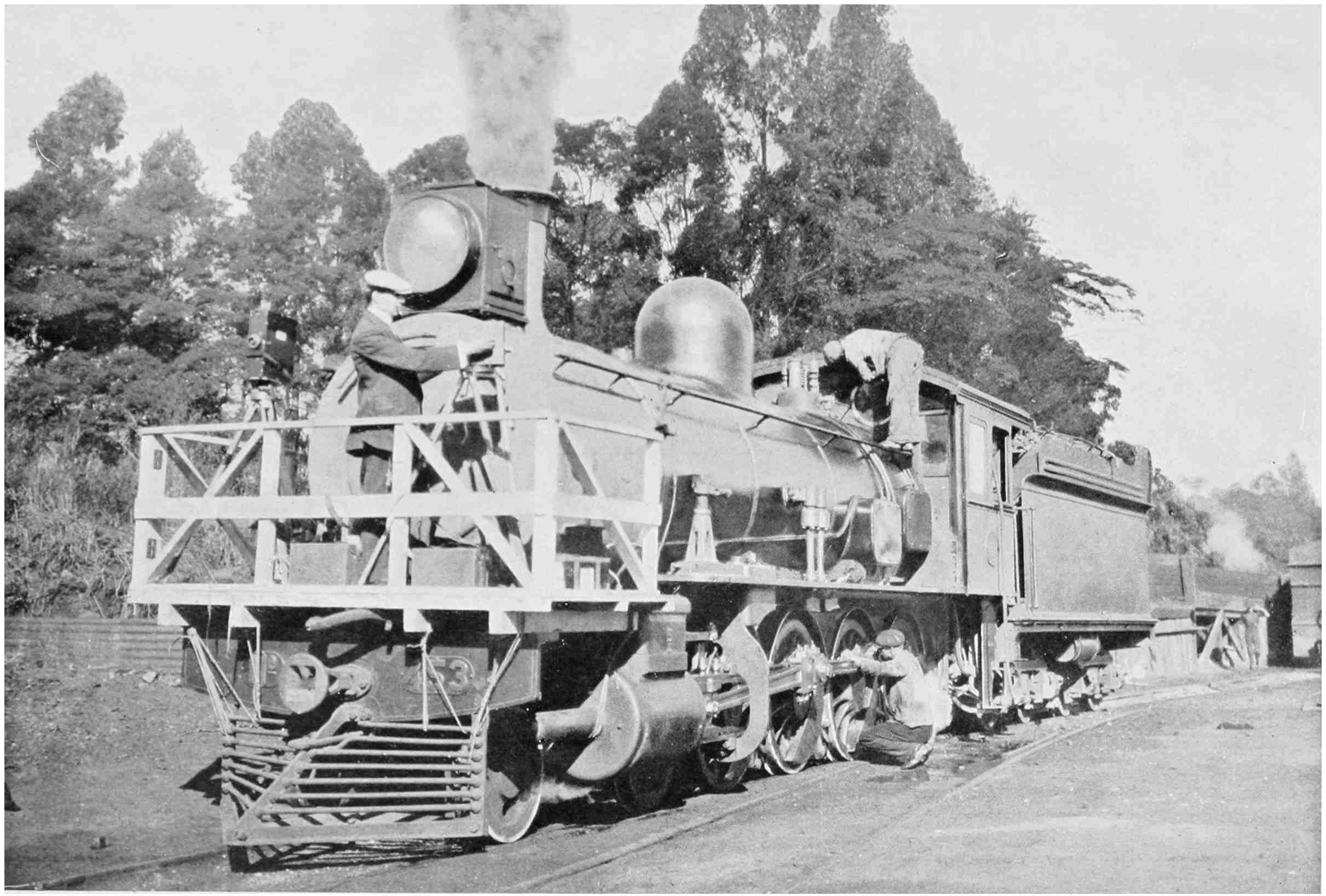
CINEMATOGRAPHING AFRICA FROM A LOCOMOTIVE.
In order to secure scenes along the Cape to Cairo Railway a special platform was erected over the cow-catcher of a railway engine for the
convenience of Mr. Butcher and his cameras.—See page 125.
The inventor of the Kinetoscope, Mr. Thomas Alva
Edison, is of opinion that the cinematograph will displace
all other methods in the schoolroom for the teaching of
geography. Both teachers and pupils will be inclined to
agree with this dictum. A teacher may talk for hours
about the tremendous height of the peaks in the Andes,
the racial characteristics of the natives of Abyssinia, or
the manner in which rivers are born on the flanks of mighty
glaciers. But words sometimes convey very little to the
immature mind. Throw upon the screen a series of pictures
of an actual journey, and the youngster gleans the
facts without the slightest effort. He sees the towering,
snow-capped rocks with their precipitous flanks; the melting
snow and ice flowing down from the mighty glacier
and forming a tempestuous, rushing river; he sees in their
natural surroundings the folk of a hundred strange and
distant tribes. Perhaps he is transported for the time to
the deck of a steamer driving its way up through the
St. Lawrence River and the Great Lakes. Books and
pictures have given him but a faint idea of these noble
waters; but when he sees their beauty, and witnesses the
enormous traffic carried upon their broad bosoms, figures
and facts take on new significance, and are never forgotten.
Whatever scene he sees, from the Atlantic to the Pacific,
from the Arctic to the Antarctic circle, that scene becomes
henceforth not a mere spot on the map, but a living reality.
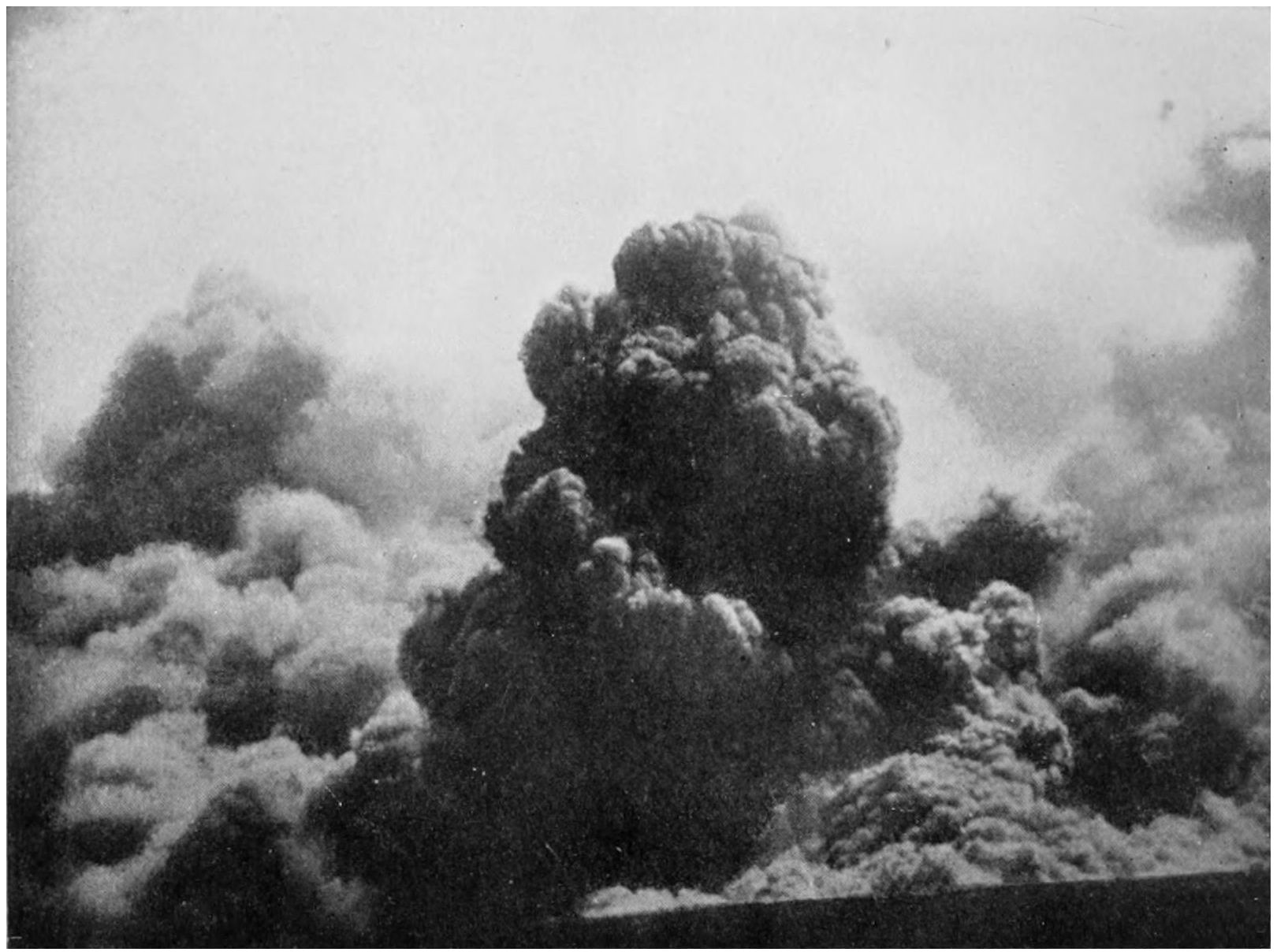
Looking into the Crater of the Volcano.
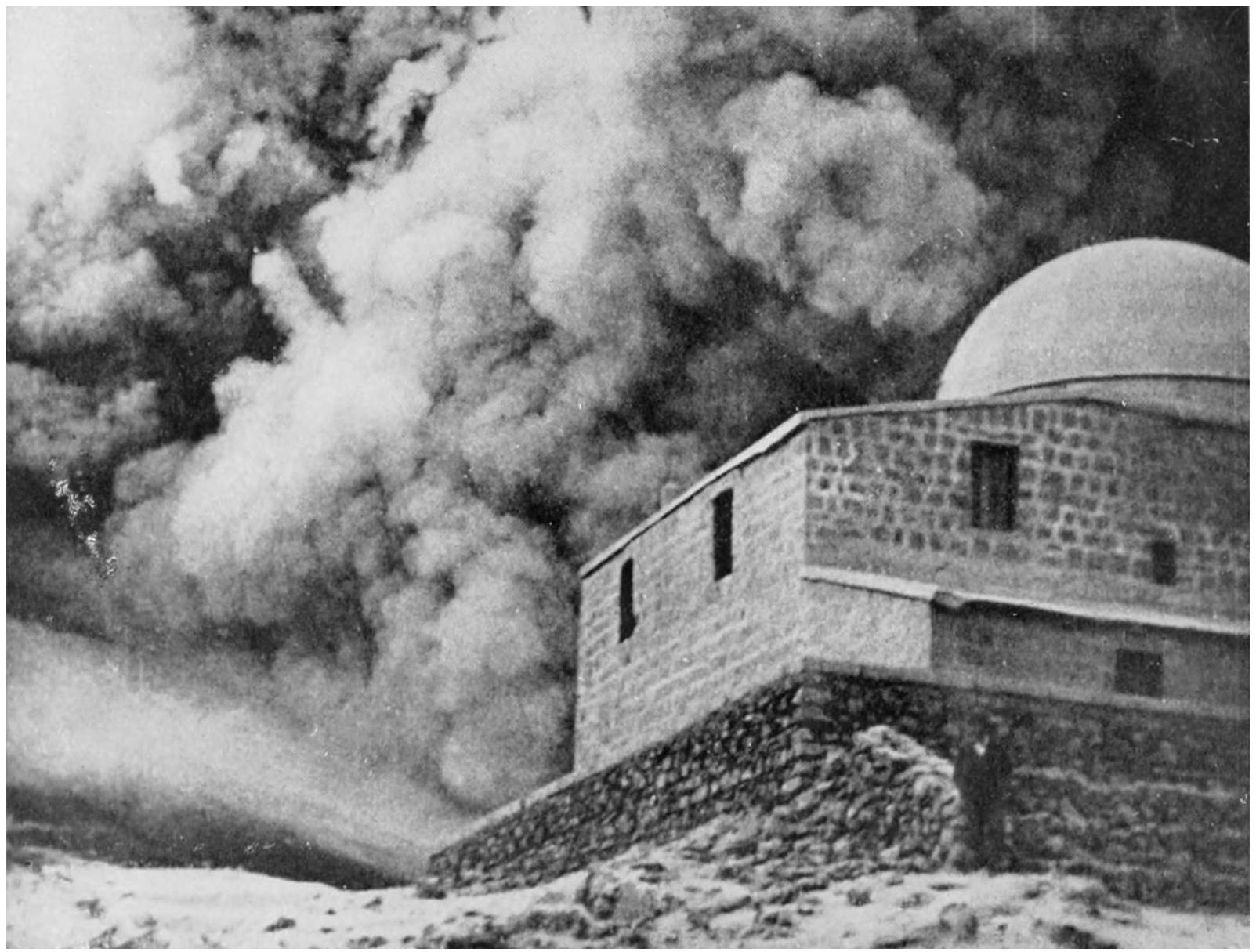
[By permission of Jury’s Imperial Pictures, Ltd.
MOUNT ETNA IN ERUPTION.
The plumes of smoke as seen from the Observatory.
One of the most daring and striking cinematograph films ever taken.
One of the most remarkable series of pictures worthy of
inclusion in this category is that obtained of Mount Etna
in eruption. The cinematograph operator displayed
wonderful daring in venturing to the verge of the crater
of this vent to internal fires. The reward for his intrepidity
certainly conveys a more realistic and vivid impression of
a belching volcano than the most imaginative flights of
description in text-books.
The success of the educational campaign of the cinematograph
depends upon the suitability of the film. The
cinematographer has roved through all the fields of science
securing interesting pictures in metallurgy, natural history,
manufacturing industries, electricity, agriculture,
horticulture, and so forth. The educational value of the
films now produced is beyond dispute; but it may be that
they are somewhat too old for children. The film manufacturers
have, up to the present, chiefly consulted the
tastes of adults; and the films of a distinctly educational
character which they produce appeal to the mature rather
than to the child mind. On the other hand, it should not
be at all difficult to produce films which, like the one already
described, representing experiments with the magnet,
would give regular instead of incidental instruction upon
subjects actually treated in schools—animated text-books,
in short. But as yet the picture producer has not received
sufficient encouragement from the educational authorities
to warrant him in preparing such films.
Unfortunately, the feeling against the moving picture
has not been entirely eliminated, despite its tremendous
popularity. Once an energetic Board of Education realises
the possibilities of cinematography as a supplement to
the information conveyed by text-books and manuals,
the film manufacturers will hasten to supply the demand
thus created. The last obstacle will have been removed;
for the field presents no special mechanical difficulties,
the only serious one having been removed by the discovery
of the non-inflammable film. The perfecting of this film
has obviated the necessity of confining the installation
within an iron box—a requirement which militated very
appreciably against the introduction of the cinematograph
into schools.
A striking illustration of the educational value of moving
pictures is revealed in the beautiful series of “Empire”
pictures which are being secured by Messrs. William
Butcher and Sons. They are completing what may be
described best as a cinematographic encyclopædia of
Greater Britain—its peoples, resources, industries, sports,
and scenic beauties. Every corner of the Empire is being
searched for entrancing pictorial contributions to this
project.
As might have been expected, others beside educational
institutions have seen in the moving-picture show a powerful
instrument of propaganda. Political, charitable, municipal,
and numerous other organisations have pressed the
celluloid ribbon into service to aid them in their crusades.
It has been of far-reaching utility in preaching the gospel
of sanitation and prosecuting the war against disease, for
the films convey their lessons in a terribly realistic manner.
The Americans have produced a striking film for the dissemination
of information as to how to combat advantageously
the ravages of the great “White Plague” of
consumption. The various American hygiene associations
also have pressed home their campaign against the
common house-fly with commendable vigour by means of
the cinematograph. Other photographs of a similar
character have been produced in various places for the
purpose of initiating the public into the causes of certain
diseases and maladies, and the best means of prevention
or treatment.
Medical science has profited materially from the perfection
of the art and its application to surgery. It is not
always possible for students to be present at a peculiarly
delicate and abnormal operation. Although the subject
may be described at length in the technical papers, words
fail to be so emphatic as a pictorial reproduction of the
feat. Not only can the operation be followed closely when
reproduced upon the screen, but, if desired, any particular
phase in the achievement can be selected, and by enlargement
upon photographic paper it can be subjected to closer
and more minute investigation at leisure.
Even the Government has not failed to recognise the
power of the cinematograph. Some years ago Mr. Robert
Paul applied to the War Office for permission to film
scenes in a soldier’s life. The facilities were granted, and
some first-class pictures were obtained. They proved
immensely popular with the public, and were far more
potent as a means of inducing enlistment with the colours
than the most glowing word-pictures painted by glib, persuasive
recruiting sergeants. This idea has been copied
by other nations, and to-day the cinematograph is regarded
as an indispensable weapon for attracting recruits to the
land and sea services.
Religious institutions have not been backward in realising
the value of animated pictures in preaching the gospel
of faith. The producer, by means of the stage and actors,
can present any episode from the Creation to the Resurrection.
The world before the Deluge, the toil of the Israelites
in the land of the Pharaohs, the Sacrifice of Abraham, the
Passage of the Red Sea, with the destruction of the
Egyptian hosts, the story of Samson and Delilah, the Fall
of Babylon, scenes from the Life of Christ—all these and
many others help to familiarise both old and young with
the Bible stories, and add wonderfully to their convincingness,
as the following episode shows:—A teacher was
describing the Passage of the Red Sea. The children
followed his words intently; and his peroration was accompanied
by a piping voice exclaiming:
“Yes, teacher, I know that is right!”
“Why?” asked the somewhat startled teacher.
“Because I saw it!”
The teacher was perhaps prepared to chide at this flight
of imagination; but the child soon explained that the
previous evening she had been to a picture theatre and
had seen the Israelites crossing the Red Sea.
Among the American preachers the significance of the
cinematograph is beginning to be recognised. Ministers
see in the projector a valuable adjunct to their teaching,
and are disposed to introduce it into their churches. I am
at liberty to quote in this connection a letter from one of
the leading luminaries in American church circles, which
was received by Mr. Richard G. Hollaman. The divine
wrote: “My opinion is that the moving picture is the
coming great educator. This I believe to be true, not only
in the education of the youth, but in the church. I believe
in a very few years every well-equipped church will have
a moving-picture apparatus, so that the minister will appeal
to the eye more than to the ear.”
CHAPTER XXIX RECENT DEVELOPMENTS: THE GROWTH AND POPULARITY OF THE CINEMATOGRAPH: SOME FACTS AND FIGURES: CONCLUSION
In the opening chapter of this book cinematography is
described as an illusion: that the eye believes it sees
continuous animation in the pictures thrown upon the
screen in accordance with the law of visual persistence. I
referred also to the fact that an effort had been made to
remove this illusory effect, and to produce upon the white
wall by photographic agency results identical with those
obtainable by the aid of the camera obscura. The outcome
of these investigations, which have been pursued patiently
for many years by one whose name is associated inseparably
with the art from its earliest days, W. F. Greene, is a new
type of camera and projector.
The camera is fitted with two lenses mounted side by
side. It is as if two cameras of the usual type were clamped
together to form a single instrument, the two film-moving
mechanisms being driven by one handle, and a single
shutter, mounted centrally, serving to open and close each
lens in turn.
In this system two spools of film are required, one for
each half of the camera, and an image is recorded upon
each sensitised band alternately. The shutter with its
opaque sector, being mounted between the two lenses,
eclipses one while the other is exposed. The result is that
two different cinematograph film records of the same subject
are obtained. The left-hand camera photographs those
incidents which are lost while the film is being moved in the
right-hand camera during the fraction of a second the lens
of the latter is covered, and vice versâ. If the camera is
run at a speed of thirty-two pictures per second, representing
sixteen pictures for each lens, either of the two films
when run through the ordinary projector gives a faithful
representation of the event photographed. At the same
time, however, each film gives a different record, for the
simple reason that one film carries the moving incidents
which the other has lost during the regularly intermittent
closing of the lens.
The projector works upon a similar principle. There
are the two objectives with attendant mechanisms driven
by a single handle, mounted side by side, and with a
common shutter mounted centrally between. Projection
is identical with recording. The picture is thrown from
the right-hand objective, while the left lens is covered,
and vice versâ.
At first sight the advantage of such a double system
might seem somewhat obscure, but a little explanation will
demonstrate its advantages. With the single camera and
projector the pictures shown on the screen are isolated
incidents—some phase of motion must be lost while the
lens is closed to permit a further area of unexposed film to
be brought into position behind the lens, although the
interval of eclipse is very short indeed. With the double
and alternating system complete continuous motion is
photographed and projected.
As a matter of fact, this double camera and projector
actually records and throws on the screen more than the
eye sees. The human organ works upon the same
principle broadly as the single camera, because the
periodical eclipse of the eye by the lid, which is known as
“blinking,” interrupts continuous vision, in just the same
manner as the shutter of the lens in its eclipsing action.
Although the lid falls and rises very quickly so that the
interruption of sight is exceedingly brief, a certain phase
of movement is lost. This is apparent when a very swiftly
moving object passes before the eyes. In order to lose
no part of the movement the eyes are strained, and the
periodical action of the eyelid is postponed so long as
possible. With the double cinematograph, therefore, as
a section of sensitised surface always is exposed during the
running of the machine, either through the right or left-hand
lens, it follows that the whole of the movement must
be photographed. In fact, the action is exactly the same
as if the eyelids closed and opened alternately. It might
be explained in connection with this physical action that
no apparent interruption in the sight is conveyed to the
brain, because the movement of the lids is very rapid, and
owing to the principles of the law of visual persistence.
The pictures thrown from this double projector produce
an effect upon the screen precisely similar to that of the
camera obscura. There is only one difficulty attending its
use. Unless the instrument is used in a large hall, and the
picture is thrown from a great distance, the images do not
superimpose correctly. They are thrown upon the sheet
at converging angles to one another, and the rays of light
accordingly from each lens do not strike the sheet at right-angles
to the longitudinal axis of each objective. The
result is that the picture is narrower slightly at one end
than the other, and the position of the narrow end flits from
one side of the sheet to the other, according as to whether
the picture is being thrown from the left or right-hand lens.
At short range and with a small picture this peculiarity is
very pronounced, but as the length of the throw—the distance
of the lantern from the sheet—is increased, it becomes
less and less observable until at last it escapes detection.
Although the mechanism requires two spools of film,
the total length needed to record faithfully a particular
event is no greater than with a single camera and projector.
In the latter case a minimum speed of about sixteen pictures
per second is required. With the double instrument a
similar number of exposures suffices, for the simple reason
that each lens records one half the movement while the
other photographs the second moiety of the movement.
This means eight pictures per second for each lens, making
sixteen pictures per second for the two—the same as by
the ordinary instrument. The disadvantage, of course, is
that two rolls of film are required to give a complete picture,
and care has to be displayed to keep the positive films in
pairs for the projector, while threading up the latter is a
somewhat longer process. Again, should one film break
and it become necessary to cut out a few pictures to obtain
a perfect joint, it would be necessary to remove the relative
pictures to an equal extent upon the second film. Under
these circumstances, therefore, it would appear that the
di-optic projector would be reserved to the more delicate
phases of cinematography, such as scientific research.
The development of cinematography in the past has been
attributable in a very great degree to the enterprise of the
French nation, and that country still remains ahead of all
others in this peculiar work. The valuable investigations
of Dr. Marey never have been forgotten, and the work with
which he was identified is continued still by enthusiastic
investigators in cinematographic science. The “Marey
Institute” is unique, in that it is the only establishment of
its class devoted to what might be termed the higher
branches of the art in the world. It is fitted with special
and complete apparatuses for the prosecution of any
especial research in which an experimenter may be interested,
so that he can carry out his work under the most
favourable conditions. The foremost scientists of the
world, who realise in moving pictures more than a means
of amusing the public, are members of the Institute, and
the results it has achieved are of far-reaching value.
A typical illustration of the work carried out at this
institution is described in Chapter XXIV. M. Lucien Bull,
the assistant director, is one of many indefatigable workers
in the particular field of operations with which the establishment
is identified. Pioneer investigation is fostered,
and accordingly often follows highly interesting lines,
not only in regard to cinematography in its most popular
form, but also in its collaboration with science in one or
other of its varied branches.
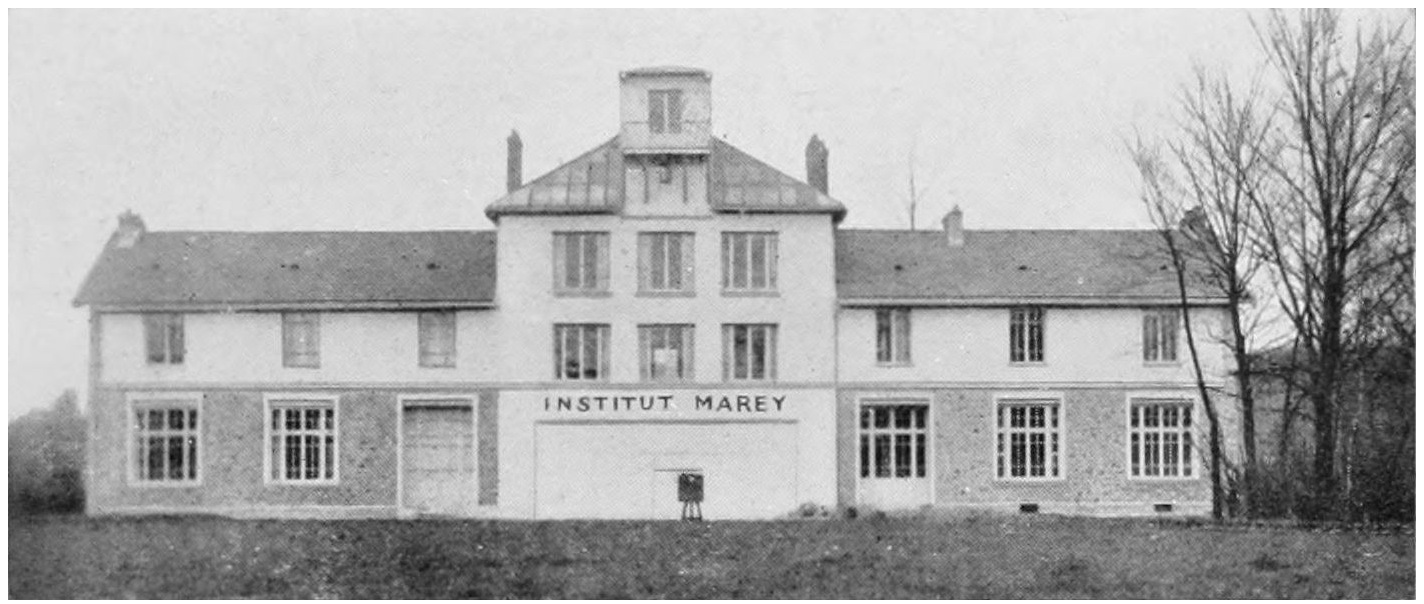
THE “CRADLE OF CINEMATOGRAPHY”:
THE MAREY INSTITUTE IN PARIS.
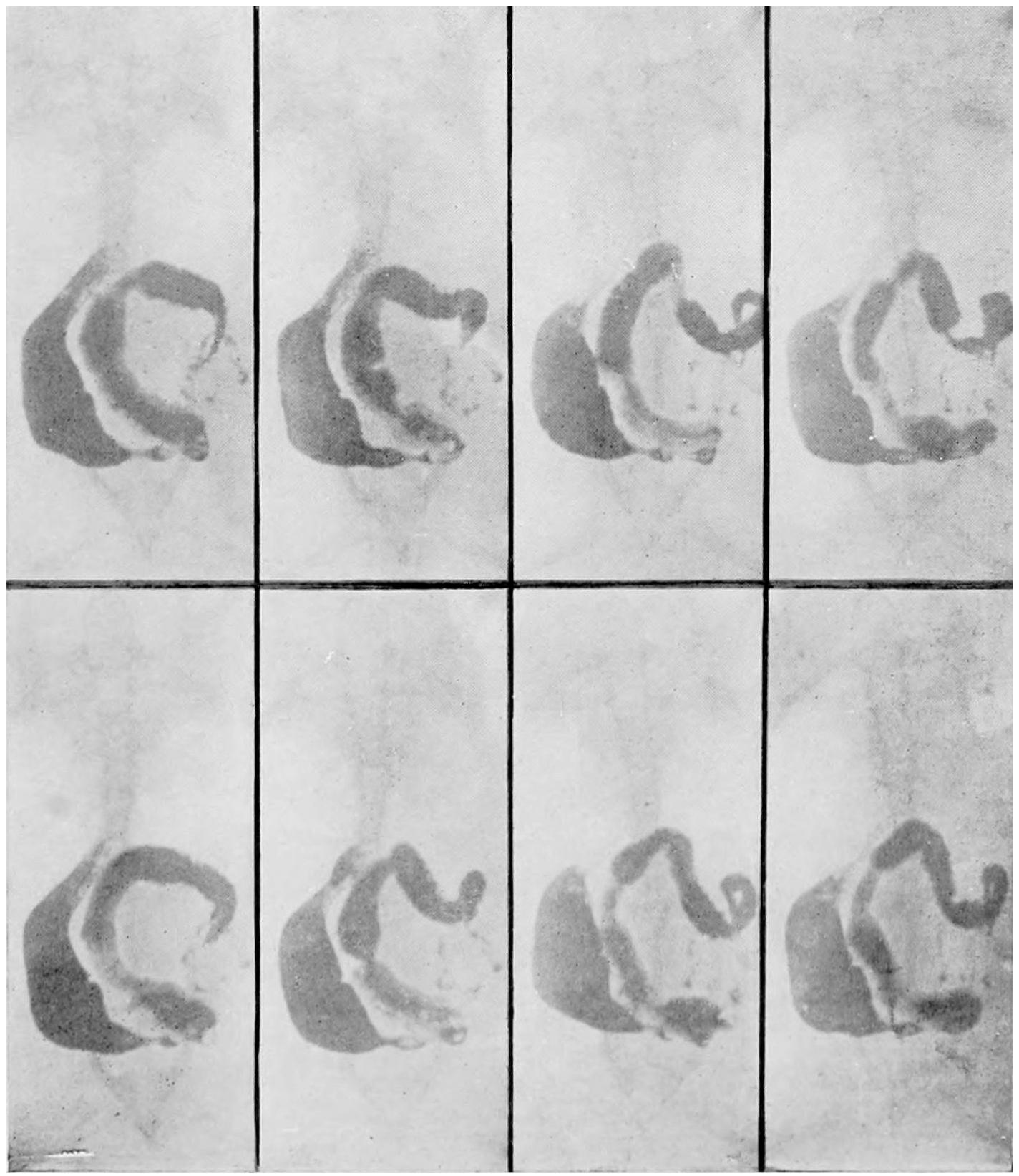
[By permission of the Director of the Marey Institute.
THE LATEST MARVEL IN MOVING PICTURES.
Combining the X-rays with the cinematograph. One of Monsieur Carvallo’s
remarkable films.
For instance, M. J. Carvallo embarked upon a series of
investigations to combine the Röntgen rays with the
cinematograph so as to obtain an absolutely reliable
moving-picture record of what takes place in the organs
of the human body. It was a difficult undertaking, owing
to the peculiar problems associated with the task. Many
experimenters had endeavoured to work with the X-rays,
but had failed. In the first place, M. Carvallo had to
evolve and construct a special type of apparatus for his
purpose. It is of a complicated character, more especially
as the exposures had to be made at a high speed per
second. Unlike M. Lucien Bull, whose apparatus I have
described already, M. Carvallo resorted to the familiar
intermittent motion, and in such a way that the number
of exposures may be varied from every twenty seconds to
one per hour, according to the character of the subject under
investigation. The camera is driven by an electric motor,
and the arrangement is of such a nature that once set in
operation it demands no further attention, even if the
experiment is prolonged over several days.
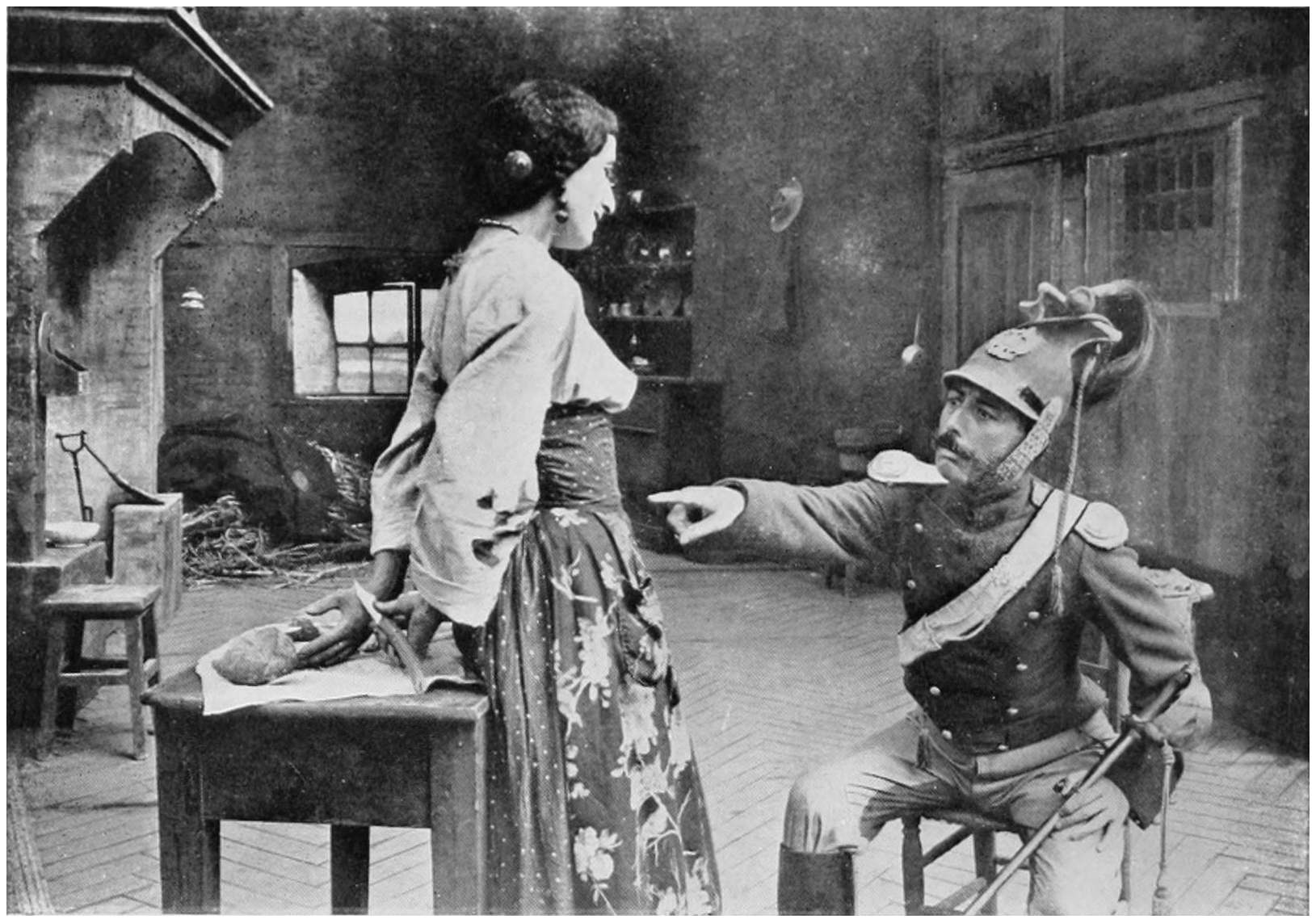
A sensational incident. The heroine gashing her hand to explain the presence of blood
on her sleeve to the Austrian soldier.
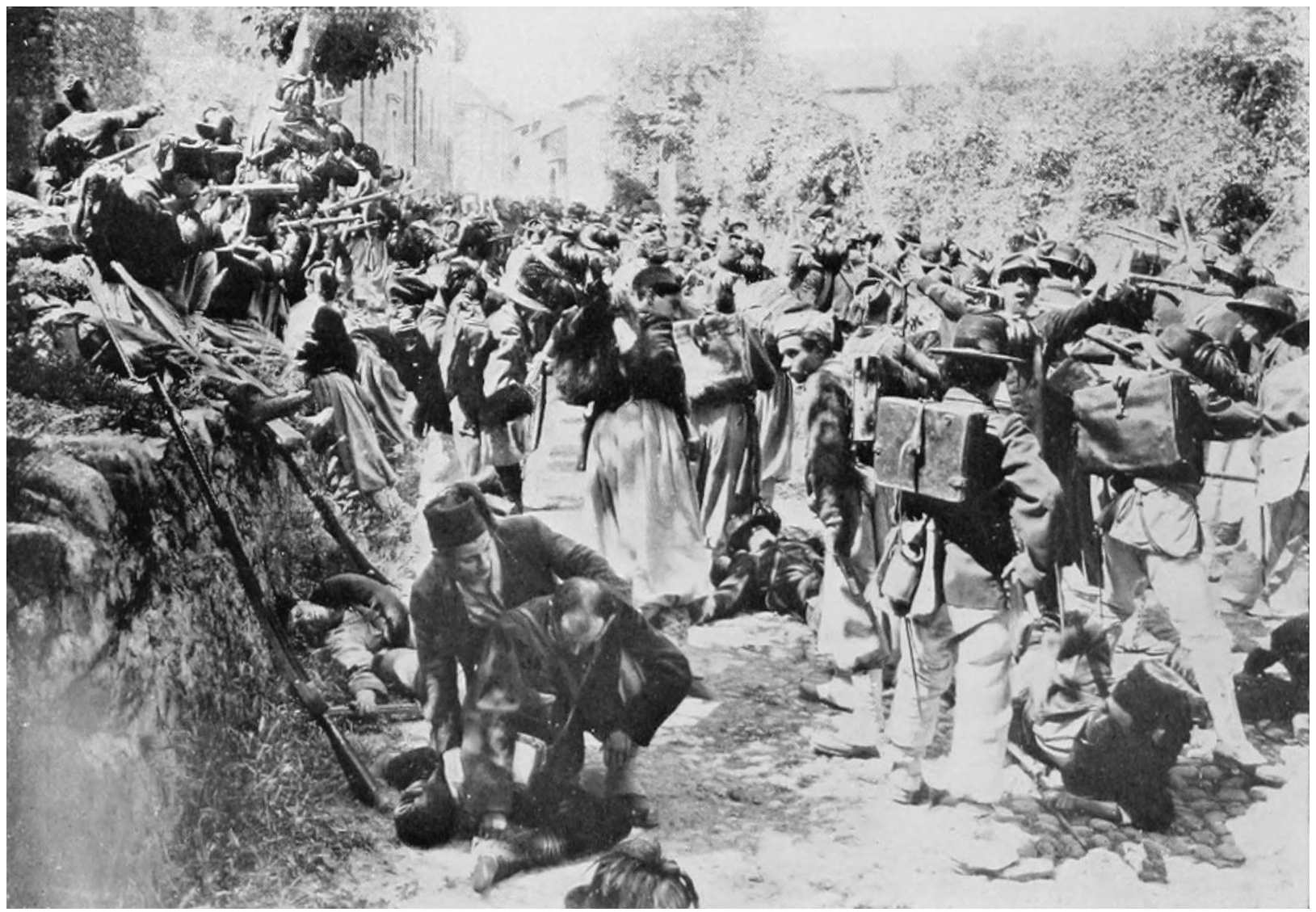
A mimic fight in the public street to produce a realistic battle scene between the Italian
and Austrian forces.
AFTER FIFTY YEARS.
This film won the first prize of 25,000 francs for the Ambrosio Company at the recent
Turin Exhibition.
He found also that the standard cinematograph film,
giving a picture one inch wide by three-quarters of an inch
deep, was not suited to his purpose, so a special film was
prepared to yield pictures of larger dimensions, while the
sensitiveness of the emulsion was also augmented very
appreciably. This was essential, inasmuch as the discharges
in the X-ray bulbs are of variable duration, ranging,
in fact, from 1/1200th to 1/1500th of a second.
By means of his apparatus he obtained some very interesting
and instructive pictures, such as showing the
process of digestion in the frog, mouse, chicken, etc. The
subjects were fed with a peculiar paste, or the usual food
combined with basic bismuth nitrate. As a result of these
successful experiments a further application of moving pictures
has been revealed. In combination with the X-rays
the apparatus should prove highly useful for ascertaining
what actually takes place under certain conditions in the
various organs of the human body.
The Marey Institute undoubtedly is the cradle of
cinematography, and similar institutions should be founded
in every country for the prosecution of scientific research.
Moving pictures have long since issued from the purely
amusing stage, and although they will never lose their
popular appreciation, the sterner phases of work open to
this craft should not be neglected, for there is no science
in which cinematographic records of certain phenomena
would not serve to widen our knowledge, and at the same
time offer conclusive evidence for the refutation of many
popular fallacies, or enlighten us regarding the mysteries
of others.
So far as the popular picture is concerned, every effort is
being made to elevate what may be termed the cinematograph
drama. Sensationalism is in keen demand, and is
likely to maintain its measure of appreciation so long as
it is free from demoralisation. An interesting illustration
of the manner in which this movement may be fostered has
been offered this year in connection with the International
Exhibition at Turin. Prizes exceeding 40,000 francs were
offered for the best films in a cinematograph competition,
the subjects to include popular drama, science, and education.
The Grand Prix of 25,000 francs was awarded to the
Ambrosio Film Company for the subject entitled “After
Fifty Years.” This concern has been responsible for many
striking and magnificent productions, which have compelled
attention as much for photographic quality, stage setting,
and technical excellence as for dramatic force. Indeed,
Signor Ambrosio, who was formerly a well-known Italian
portrait photographic artist, and consequently was able to
bring valuable knowledge and technique into the Italian
cinematographic industry, forced his way into the closed
American market by sheer merit, and forcibly impressed
upon the American picture palace public the high standard
of the films produced in his native land. “After Fifty
Years” is a film of powerful dramatic intensity, full of
that exciting incident, carefully blended with sentiment,
which appeals so strongly to the picture palace clientèle,
especially the vivid scenes of fighting in the streets between
Austrian and Italian forces in the troublous times of 1859.
The Ambrosio Company also carried off the first prize
of 5,000 francs for a popular science film dealing with
“The Life of the Butterfly” and “The Bee.” This is one
of the best natural history films that has been seen yet,
for it illustrates the marvellous metamorphosis of the caterpillar
into the butterfly in an attractive manner. The first
prize of 5,000 francs for educational films was given to
the Cines Company of Rome for a film entitled “The
Little Sardinian Drummer,” which company also secured
a prize of 4,000 francs for a dramatic subject, “St. Francis
of Assisi.” There is no doubt that the example of the
Turin Exhibition authorities will be followed in subsequent
expositions of such an international character, and this
tendency should promote a healthy competition and friendly
rivalry between the various producers of all countries to
excel.
Although the picture palace, with its attractive façade
and brilliantly illuminated entrance, is a familiar building
in our towns and cities, few people can form any idea
of the grip this form of amusement has secured upon the
public, of its commercial proportions, or of its rapid expansion.
Fifteen years ago there was not a single theatre
providing a complete entertainment with a programme of
moving pictures purely and simply.
The picture palace had its birth in France, and the
Parisian public extended such a warm greeting to the new
diversion, which offered a welcome and novel relief to the
prevailing forms of amusement, that it developed into a
rage. In a short time the craze spread throughout the
world, and moving-picture theatres sprang up like mushrooms
in every civilised country between the two Poles.
At the present day there are some 4,000 picture palaces
of all descriptions scattered throughout the British Isles,
and these are patronised by the public in their tens of
thousands daily. The money expended upon this form
of entertainment is incalculable, but it rolls continually
into the coffers of the theatres throughout twelve or fourteen
hours every day, the larger proportion of these establishments
offering a continuous show, with a programme
lasting 1½ hours. The remaining theatres give two performances,
afternoon and evening respectively, providing
about three solid hours of recreation and education in each
instance. The prices of admission for the most part are
very low, though in the better class theatres they approach
somewhat closely to those prevailing with the modern
music-hall.
On the Continent the picture palaces aggregate several
thousands, and are supported by the public with equal
enthusiasm. Curiously enough, Germany has been the
most lethargic nation. For many years an attitude of
complete indifference was maintained towards the cinematograph.
That country is now waking up, but so far as
the manufacturing aspect of the industry is concerned, it
is far behind the more progressive countries. The German
picture palaces depend for their programme almost exclusively
upon foreign films. Strange to say, the English
productions appear to make the strongest appeal to
Teutonic fancies, although the French, American, and
Italian producers are striving hard to capture this highly
promising and expanding market.
In the United States the development of the movement
has been phenomenal. I have described already the
wondrous boom in “store shows.” The greater majority of
these “palaces” enjoyed a brief meteoric career, as they
became superseded by more pretentious buildings with
perfection in comfort and luxury. To-day there are about
14,000 moving-picture theatres appealing for support between
the Atlantic and Pacific seaboards. It is computed
that these establishments are visited by nearly 5,000,000
men, women, and children every day. Although low prices
for admission rule, it is estimated that about $130,000,000,
or £26,000,000, are spent by the American public upon
this form of amusement in the course of twelve months.
The coming of the picture palace has created a new race
of playgoers who find infinite delight in the varied programme
offered upon the screen. At the same time, however,
the legitimate and vaudeville theatres have been
deprived of much of their support. This effect is reflected
by the number of buildings originally built for dramatic
presentations which have had to close their doors for lack
of patronage. When converted and re-opened under the
magic sway of the projector, film, and sheet, however, they
have embarked upon a remarkably prosperous new lease
of life.
The stage in Great Britain is threatened in a similar
manner. A few years ago, when the music-hall entertainment
was overhauled and an entirely new era was created,
the legitimate theatre suffered severely. Bitter antagonism
developed and has prevailed between the two caterers for
public amusement. Now both are being threatened by a
common enemy. The picture palace, which has been
despised for so long, is making its influence felt. In London
the competition is not experienced so keenly, perhaps, as
in the provinces, where many theatres have succumbed to
the attack of moving pictures.
There is no indication that the movement has gained the
height of its success. Moving picture palaces are being
built and opened on all sides every day. The irresistible
force with which the cinematograph is sweeping forward
is proved by the enormous quantity of film which is produced.
Great Britain is an open market for producers
throughout the world, and at the present day something
like 150,000 feet of new subjects are offered to the picture
palaces every week. If the present demand is maintained
together with the rate of production, this volume will be
doubled within the next five years. The output in America
likewise is enormous, although in that country it is confined
for the most part to the productions of home firms,
the foreign film being allowed to enter only in small
quantities. The Motion Picture Patents Company, composed
of the largest members in the United States’
manufacturing industry, and swearing allegiance to the
Edison patents, has an aggregate output of about
1,500,000 feet per week, each producer contributing from
three to five new subjects to this total.
This community of interests, which was formed primarily
to eliminate the objectionable pictures which were being
shown extensively throughout the country, and which were
responsible for considerable obloquy being hurled against
the cinematograph, arranged on its formation to pay
Mr. Edison a royalty of half-a-cent, or one farthing, upon
every foot of film which they printed in the United States.
On the above total output, therefore, it will be seen that
the famous American derives a revenue of $7,500, or
£1,500, per week from the American moving-picture loving
public.
The financial investments in the industry in all its
complex branches—film manufacture, play producing,
machine making, picture palaces, etc.—represent several
millions sterling, while tens of thousands of men,
women, and children find employment in different
capacities. Although it might appear that there are sufficient
producers in operation at present for the world’s
needs, this is far from being the case. New markets are
being opened up constantly, while others are in the early
stages of development. When the industry in these new
centres commences to move forward in a manner characteristic
of the expansion in the older countries, the demand
for film will become twice or thrice what it is to-day.
Consequently there is ample room for doubling the existing
manufacturing facilities. The promise of the future is
shown conclusively from the fact that the foremost film-play
manufacturers in France, Italy, and the United
States are extending and enlarging their plants to meet
the increasing demands for their particular products.
One might naturally ask: How is Great Britain benefiting
from this wonderful expansion? So far as film-play
production is concerned, there is every indication that this
country will profit now that conservatism is being abandoned.
The fiscal position places the English manufacturer
somewhat at a disadvantage, but this handicap can
be removed entirely by the display of more financial confidence
in the film-play producing business, where the
law of the “survival of the fittest” is waged to its logical
conclusion. A few years ago the British product was
distinctly inferior to the foreign films, whether considered
from the acting, dramatic, photographic, or any other point
of view. Even to-day the British films are not quite up
to the technical standard of the foreign manufacturers,
while the histrionic quality is deficient. The plays likewise
lack that grip incidental to the foreign picture dramas, and
there should be excellent scope in this country for competent
and imaginative picture-playwrights.
The British producers have failed also to recognise the
merit of the stock company, on the plea that the public
tires of seeing the same faces time after time in successive
plays. The fallacy of this contention has been recognised
at last, because the public now has its film idols on
the screen, in just the same way as it has its footlight
favourites on the stage. It is doubtful, however, whether
the English producers will ever rise to the same plane in
this respect as their contemporaries in the United States,
who gamble practically for the exclusive services of actors
and actresses. Some of the American cinematograph stars
receive fabulous salaries, while even the smaller and more
obscure members of the companies receive wages far
in advance of what they would obtain for similar work
on the legitimate stage. The protected nature of the
American industry, however, favours such tactics, which
probably will prevail only for a time.
There is every evidence that the British producers are
making up leeway. The Hepworth Manufacturing Company,
for instance, which is probably the foremost producing
company in this country, recently has produced several
powerful and excellent film-plays. They have extended
the stock-company practice, and the increasing popularity
of the “Hepwix” films offers convincing testimony to the
value of this procedure. The Colonies have become satiated
with the American products, and turn with relief to the
English films, but the supply is not equal to the demand.
Even the American public is nauseated with its home
productions, and as it appreciates the work of British
dramatists, so it approves of the British film play.
If England is behind her foreign rivals in the production
of picture plays, it cannot be denied that London is destined
to become the world’s clearing-house for films. Every large
foreign manufacturer has his representative in the British
metropolis, where the transactions in this article aggregate
a large sum every week. The Colonial picture palace
proprietor, film renter, or middleman retains a purchasing
agent in London, who scans the new productions
as they appear, to discover their suitability for the particular
corner of the world for which he is acting. These
agents are autocrats, and consequently the subjects have
to be brought direct to them for approval. The manufacturers
realise the situation, and as the Colonial market
is highly promising, spare no effort to secure its capture.
The suggestion has been made that records of the most
important events of to-day, such as the Coronation of King
George V., the Unveiling of the Victoria Memorial, the
Durbar, and so forth, should be preserved in a museum
for the benefit of generations a century or more hence.
Impressions of the voices of our greatest singers are being
preserved for posterity, and the question has been asked
why historical cinematographic films should not be treated
in the same manner. This is by no means a new idea.
Robert Paul advanced the same plea in the early days
of the art, but there were many objections against the
proposal which are just as acute to-day. The greatest is
the perishable character of the celluloid film, and also of
the photographic image upon the emulsion. Both would
deteriorate, even if preserved in hermetically sealed cases,
with the flight of time, and the chances are if a film
were held for one hundred years that it would be found
useless when opened at the end of that period.
The question often arises: What becomes of the
films? Bearing in mind the thousands of feet of new
subjects which are introduced to the market every week,
it is but natural to think that there must be an immense
accumulation of old subjects. When a new subject sees
the light it passes through its first “run” among the
foremost picture palaces of the country. Then it is returned
to the renter, who dispatches it upon a second journey
among the smaller halls. Once more it comes home, otherwise
to the shelves of the renter, as a rule bearing sad
evidences of its service. If of sufficient interest, the film
undergoes a third run among the cheapest halls, and upon
the completion of this round it is either shipped abroad
to the smaller colonies, or, scratched and torn, it is offered
for sale at a bargain price. The end is tragic: the film
slips from sight in flame and smoke.