"Here's your breakfast, miss. I hope it's
right. Your mother showed me how to fix it,
and said I'd find a cup up here."
"Take that blue one. I have not much appetite,
and can't eat if things are not nice and
pretty. I like the flowers. I've been longing
for some ever since I saw them last night."
The first speaker was a red-haired, freckled-faced
girl, in a brown calico dress and white
apron, with a tray in her hands and an air of
timid hospitality in her manner; the second a
pale, pretty creature, in a white wrapper and
blue net, sitting in a large chair, looking about
her with the languid interest of an invalid in a
new place. Her eyes brightened as they fell
upon a glass of rosy laurel and delicate maidenhair
fern that stood among the toast and eggs,
strawberries and cream, on the tray.
"Our laurel is jest in blow, and I'm real glad
you come in time to see it. I'll bring you a lot,
as soon's ever I get time to go for it."
As she spoke, the plain girl replaced the ugly
crockery cup and saucer with the pretty china
ones pointed out to her, arranged the dishes, and
waited to see if anything else was needed.
"What is your name, please?" asked the
pretty girl, refreshing herself with a draught of
new milk.
"Rebecca. Mother thought I'd better wait
on you; the little girls are so noisy and apt to
forget. Wouldn't you like a piller to your back?
you look so kind of feeble seems as if you wanted
to be propped up a mite."
There was so much compassion and good-will
in the face and voice, that Emily accepted the
offer, and let Rebecca arrange a cushion behind
her; then, while the one ate daintily, and the
other stirred about an inner room, the talk went
on,—for two girls are seldom long silent when
together.
"I think the air is going to suit me, for I
slept all night and never woke till Mamma had
been up ever so long and got things all nicely
settled," said Emily, graciously, when the fresh
strawberries had been enjoyed, and the bread and
butter began to vanish.
"I'm real glad you like it: most folks do, if
they don't mind it being plain and quiet up here.
It's gayer down at the hotel, but the air ain't
half so good, and delicate folks generally like our
old place best," answered Becky, as she tossed
over a mattress and shook out the sheets with
a brisk, capable air pleasant to see.
"I wanted to go to the hotel, but the doctor
said it would be too noisy for me, so Mamma
was glad to find rooms here. I didn't think a
farm-house could be so pleasant. That view is
perfectly splendid!" and Emily sat up to gaze
delightedly out of the window, below which
spread the wide intervale, through which the
river ran with hay-fields on either side, while
along the green slopes of the hills lay farm-houses
with garden plots, and big barns waiting for the
harvest; and beyond, the rocky, wooded pastures
dotted with cattle and musical with cow-bells,
brooks, and birds.
A balmy wind kissed a little color into the
pale cheeks, the listless eyes brightened as they
looked, and the fretful lines vanished from lips
that smiled involuntarily at the sweet welcome
Nature gave the city child come to rest and play
and grow gay and rosy in her green lap.
Becky watched her with interest, and was
glad to see how soon the new-comer felt the charm
of the place, for the girl loved her mountain
home, and thought the old farm-house the
loveliest spot in the world.
"When you get stronger I can show you lots
of nice views round here. There's a woodsy
place behind the house that's just lovely. Down
by the laurel bushes is my favorite spot, and
among the rocks is a cave where I keep things
handy when I get a resting-spell now and then,
and want to be quiet. Can't get much at home,
when there's boarders and five children round in
vacation time."
Becky laughed as she spoke, and there was a
sweet motherly look in her plain face, as she
glanced at the three little red heads bobbing
about the door-yard below, where hens cackled,
a pet lamb fed, and the old white dog lay blinking
in the sun.
"I like children; we have none at home, and
Mamma makes such a baby of me I'm almost
ashamed sometimes. I want her to have a good
rest now, for she has taken care of me all winter
and needs it. You shall be my nurse, if I need
one; but I hope to be so well soon that I can
see to myself. It's so tiresome to be ill!" and
Emily sighed as she leaned back among her
pillows, with a glance at the little glass which
showed her a thin face and shorn head.
"It must be! I never was sick, but I have
taken care of sick folks, and have a sight of
sympathy for 'em. Mother says I make a pretty
good nurse, being strong and quiet," answered
Becky, plumping up pillows and folding towels
with a gentle despatch which was very grateful
to the invalid, who had dreaded a noisy, awkward
serving-maid.
"Never ill! how nice that must be! I'm
always having colds and headaches, and fusses
of some kind. What do you do to keep
well, Rebecca?" asked Emily, watching her
with interest, as she came in to remove the
tray.
"Nothing but work; I haven't time to be
sick, and when I'm tuckered out, I go and rest
over yonder. Then I'm all right, and buckle
to again, as smart as ever;" and every freckle
in Becky's rosy face seemed to shine with
cheerful strength and courage.
"I'm 'tuckered out' doing nothing," said
Emily, amused with the new expression, and
eager to try a remedy which showed such fine
results in this case. "I shall visit your pet
places and do a little work as soon as I am able,
and see if it won't set me up. Now I can only
dawdle, doze, and read a little. Will you please
put those books here on the table? I shall want
them by-and-by."
Emily pointed to a pile of blue and gold volumes
lying on a trunk, and Becky dusted her
hands as she took them up with an air of reverence,
for she read on the backs of the volumes
names which made her eyes sparkle.
"Do you care for poetry?" asked Emily, surprised
at the girl's look and manner.
"Guess I do! don't get much except the
pieces I cut out of papers, but I love 'em, and
stick 'em in an old ledger, and keep it down
in my cubby among the rocks. I do love that
man's pieces. They seem to go right to the
spot somehow;" and Becky smiled at the name
of Whittier as if the sweetest of our poets was
a dear old friend of hers.
"I like Tennyson better. Do you know
him?" asked Emily, with a superior air, for
the idea of this farmer's daughter knowing
anything about poetry amused her.
"Oh yes, I've got a number of his pieces in
my book, and I'm fond of 'em. But this man
makes things so kind of true and natural I feel
at home with him. And this one I've longed
to read, though I guess I can't understand
much of it. His 'Bumble Bee' was just lovely;
with the grass and columbines and the yellow
breeches of the bee. I'm never tired of that;"
and Becky's face woke up into something like
beauty as she glanced hungrily at the Emerson
while she dusted the delicate cover that hid the
treasures she coveted.
"I don't care much for him, but Mamma
does. I like romantic poems, and ballads, and
songs; don't like descriptions of clouds, and
fields, and bees, and farmers," said Emily,
showing plainly that even Emerson's simplest
poems were far above her comprehension as
yet, because she loved sentiment more than
Nature.
"I do, because I know 'em better than love
and the romantic stuff most poetry tells about.
But I don't pretend to judge, I'm glad of anything
I can get. Now if you don't want me I'll
pick up my dishes and go to work."
With that Becky went away, leaving Emily
to rest and dream with her eyes on the landscape
which was giving her better poetry than any her
books held. She told her mother about the odd
girl, and was sure she would be amusing if she
did not forget her place and try to be friends.
"She is a good creature, my dear, her mother's
main stay, and works beyond her strength, I am
sure. Be kind to the poor girl, and put a little
pleasure into her life if you can," answered Mrs.
Spenser, as she moved about, settling comforts
and luxuries for her invalid.
"I shall have to talk to her, as there is no other
person of my age in the house. How are the
school marms? shall you get on with them,
Mamma? It will be so lonely here for us both,
if we don't make friends with some one."
"Most intelligent and amiable women all three,
and we shall have pleasant times together, I am
sure. You may safely cultivate Becky; Mrs.
Taylor told me she was a remarkably bright girl,
though she may not look it."
"Well, I'll see. But I do hate freckles and
big red hands, and round shoulders. She can't
help it, I suppose, but ugly things fret me."
"Remember that she has no time to be pretty,
and be glad she is so neat and willing. Shall
we read, dear? I'm ready now."
Emily consented, and listened for an hour or
two while the pleasant voice beside her conjured
away all her vapors with some of Mrs. Ewing's
charming tales.
"The grass is dry now, and I want to stroll
on that green lawn before lunch. You rest,
Mamma dear, and let me make discoveries all
alone," proposed Emily, when the sun shone
warmly, and the instinct of all young creatures
for air and motion called her out.
So, with her hat and wrap, and book and parasol,
she set forth to explore the new land in
which she found herself.
Down the wide, creaking stairs and out upon
the door-stone she went, pausing there for a
moment to decide where first to go. The sound
of some one singing in the rear of the house led
her in that direction, and turning the corner she
made her first pleasant discovery. A hill rose
steeply behind the farm-house, and leaning from
the bank was an old apple-tree, shading a spring
that trickled out from the rocks and dropped
into a mossy trough below. Up the tree had
grown a wild grape-vine, making a green canopy
over the great log which served as a seat,
and some one had planted maidenhair ferns
about both seat and spring to flourish beautifully
in the damp, shady spot.
"Oh, how pretty! I'll go and sit there. It
looks clean, and I can see what is going on in
that big kitchen, and hear the singing. I suppose
it's Becky's little sisters by the racket."
Emily established herself on the lichen-covered
log with her feet upon a stone, and sat
enjoying the musical tinkle of the water, with
her eyes on the delicate ferns stirring in the
wind, and the lively jingle of the multiplication-table
chanted by childish voices in her ear.
Presently two little girls with a great pan
of beans came to do their work on the back
door-step, a third was seen washing dishes at a
window, and Becky's brown-spotted gown flew
about the kitchen as if a very energetic girl
wore it. A woman's voice was heard giving
directions, as the speaker was evidently picking
chickens somewhere out of sight.
A little of the talk reached Emily and both
amused and annoyed her, for it proved that
the country people were not as stupid as they
looked.
"Oh, well, we mustn't mind if she is notional
and kind of wearing; she's been sick,
and it will take time to get rid of her fretty
ways. Jest be pleasant, and take no notice,
and that nice mother of hers will make it all
right," said the woman's voice.
"How anybody with every mortal thing to be
happy with can be out-of-sorts passes me. She
fussed about every piller, chair, trunk, and mite
of food last night, and kept that poor tired
lady trotting till I was provoked. She's right
pleasant this morning though, and as pretty as
a picture in her ruffled gown and that blue thing
on her head," answered Becky from the pantry,
as she rattled out the pie-board, little dreaming
who sat hidden behind the grape-vine festoons
that veiled the corner by the spring.
"Well, she's got redder hair 'n' we have, so
she needn't be so grand and try to hide it with
blue nets," added one little voice.
"Yes, and it's ever so much shorter 'n' ours,
and curls all over her head like Daisy's wool.
I should think such a big girl would feel real
ashamed without no braids," said the other child,
proudly surveying the tawny mane that hung
over her shoulders,—for like most red-haired
people all the children were blessed with luxuriant
crops of every shade from golden auburn
to regular carrots.
"I think it's lovely. Suppose it had to be
cut off when she had the fever. Wish I could
get rid of my mop, it's such a bother;" and
Becky was seen tying a clean towel over the
great knot that made her head look very like
a copper kettle.
"Now fly round, deary, and get them pies
ready. I'll have these fowls on in a minute,
and then go to my butter. You run off and see
if you can't find some wild strawberries for the
poor girl, soon's ever you are through with them
beans, children. We must kind of pamper her
up for a spell till her appetite comes back," said
the mother.
Here the chat ended, and soon the little girls
were gone, leaving Becky alone rolling out pie-crust
before the pantry window. As she worked
her lips moved, and Emily, still peeping through
the leaves, wondered what she was saying, for
a low murmur rose and fell, emphasized now
and then with a thump of the rolling-pin.
"I mean to go and find out. If I stand on
that wash-bench I can look in and see her work.
I'll show them all that I'm not 'fussy,' and can
be 'right pleasant' if I like."
With this wise resolution Emily went down
the little path, and after pausing to examine the
churn set out to dry, and the row of pans shining
on a neighboring shelf, made her way to the
window, mounted the bench while Becky's back
was turned, and pushing away the morning-glory
vines and scarlet beans that ran up on either
side peeped in with such a smiling face that the
crossest cook could not have frowned on her as
an intruder.
"May I see you work? I can't eat pies, but
I like to watch people make them. Do you
mind?"
"Not a bit. I'd ask you to come in, but it's
dreadful hot here, and not much room," answered
Becky, crimping round the pastry before she
poured in the custard. "I'm going to make
a nice little pudding for you; your mother said
you liked 'em; or would you rather have whipped
cream with a mite of jelly in it?" asked Becky,
anxious to suit her new boarder.
"Whichever is easiest to make. I don't care
what I eat. Do tell me what you were saying.
It sounded like poetry," said Emily, leaning both
elbows on the wide ledge with a pale pink
morning-glory kissing her cheek, and a savory
odor reaching her nose.
"Oh, I was mumbling some verses. I often
do when I work, it sort of helps me along; but
it must sound dreadful silly," and Becky blushed
as if caught in some serious fault.
"I do it, and it's a great comfort when I lie
awake. I should think you would want something
to help you along, you work so hard. Do
you like it, Becky?"
The familiar name, the kind tone, made the
plain face brighten with pleasure as its owner
said, while she carefully filled a pretty bowl with
a golden mixture rich with fresh eggs and country
milk,—
"No, I don't, but I ought to. Mother isn't
as strong as she used to be, and there's a sight
to do, and the children to be brought up, and
the mortgage to be paid off; so if I don't fly
round, who will? We are doing real well now,
for Mr. Walker manages the farm and gives us
our share, so our living is all right; then boarders
in summer and my school in winter help a deal,
and every year the boys can do more, so I'd be
a real sinner to complain if I do have to step
lively all day."
Becky smiled as she spoke, and straightened
her bent shoulders as if settling her burden for
another trudge along the path of duty.
"Do you keep school? Why, how old are
you, Becky?" asked Emily, much impressed
by this new discovery.
"I'm eighteen. I took the place of a teacher
who got sick last fall, and I kept school all winter.
Folks seemed to like me, and I'm going to
have the same place this year. I'm so glad, for
I needn't go away, and the pay is pretty good,
as the school is large and the children do well.
You can see the school-house down the valley,
that red brick one where the roads meet;" and
Becky pointed a floury finger, with an air of
pride that was pleasant to see.
Emily glanced at the little red house where
the sun shone hotly in summer, and all the winds
of heaven must rage wildly in winter time, for
it stood, as country schools usually do, in the
barest, most uninviting spot for miles around.
"Isn't it awful down there in winter?" she
asked, with a shiver at the idea of spending days
shut up in that forlorn place, with a crowd of
rough country children.
"Pretty cold, but we have plenty of wood,
and we are used to snow and gales up here.
We often coast down, the whole lot of us, and
that is great fun. We take our dinners and
have games noon-spells, and so we get on first
rate; some of my boys are big fellows, older
than I am, and they clear the roads and make
the fire and look after us, and we are real happy
together."
Emily found it so impossible to imagine happiness
under such circumstances that she changed
the subject by asking in a tone which had unconsciously
grown more respectful since this
last revelation of Becky's abilities,—
"If you do so well here, why don't you try
for a larger school in a better place?"
"Oh, I couldn't leave mother yet; I hope to
some day, when the girls are older, and the boys
able to get on alone. But I can't go now, for
there's a sight of things to do, and mother is
always laid up with rheumatism in cold weather.
So much butter-making down cellar is bad for
her; but she won't let me do that in summer, so
I take care of her in winter. I can see to things
night and morning, and through the day she's
quiet, and sits piecing carpet-rags and resting
up for next spring. We made and wove all the
carpets in the house, except the parlor one.
Mrs. Taylor gave us that, and the curtains, and
the easy-chair. Mother takes a sight of comfort
in that."
"Mrs. Taylor is the lady who first came to
board here, and told us and others about it,"
said Emily.
"Yes, and she's the kindest lady in the world!
I'll tell you all about her some day, it's real interesting;
now I must see to my pies, and get the
vegetables on," answered Becky, glancing at the
gay clock in the kitchen with an anxious look.
"Then I won't waste any more of your precious
time. May I sit in that pretty place; or is it
your private bower?" asked Emily, as she dismounted
from the wash-bench.
"Yes, indeed you may. That's mother's resting
place when work is done. Father made the
spring long ago, and I put the ferns there. She
can't go rambling round, and she likes pretty
things, so we fixed it up for her, and she takes
comfort there nights."
Becky bustled off to the oven with her pies, and
Emily roamed away to the big barn to lie on the
hay, enjoying the view down the valley, as she
thought over what she had seen and heard, and
very naturally contrasted her own luxurious and
tenderly guarded life with this other girl's, so hard
and dull and narrow. Working all summer and
teaching all winter in that dismal little school-house,
with no change but home cares and
carpet-weaving! It looked horrible to pleasure-loving
Emily, who led the happy, care-free life
of girls of her class, with pleasures of all sorts,
and a future of still greater luxury, variety, and
happiness, opening brightly before her.
It worried her to think of any one being contented
with such a meagre share of the good
things of life, when she was unsatisfied in spite
of the rich store showered upon her. She could
not understand it, and fell asleep wishing
every one could be comfortable,—it was so annoying
to see them grubbing in kitchens, teaching
in bleak school-houses among snow-drifts,
and wearing ugly calico gowns.
A week or two of quiet, country fare and the
bracing mountain air worked wonders for the
invalid, and every one rejoiced to see the pale
cheeks begin to grow round and rosy, the languid
eyes to brighten, and the feeble girl who
used to lie on her sofa half the day now go walking
about with her alpenstock, eager to explore
all the pretty nooks among the hills. Her
mother blessed Mrs. Taylor for suggesting this
wholesome place. The tired "school marms,"
as Emily called the three young women who
were their fellow-boarders, congratulated her as
well as themselves on the daily improvement in
strength and spirits all felt; and Becky exulted
in the marvellous effects of her native air, aided
by mother's good cookery and the cheerful
society of the children, whom the good girl considered
the most remarkable and lovable youngsters
in the world.
Emily felt like the queen of this little kingdom,
and was regarded as such by every one,
for with returning health she lost her fretful
ways, and, living with simple people, soon forgot
her girlish airs and vanities, becoming very sweet
and friendly with all about her. The children
considered her a sort of good fairy who could
grant wishes with magical skill, as various gifts
plainly proved. The boys were her devoted
servants, ready to run errands, "hitch up" and
take her to drive at any hour, or listen in mute
delight when she sang to her guitar in the
summer twilight.
But to Becky she was a special godsend and
comfort, for before the first month had gone
they were good friends, and Emily had made a
discovery which filled her head with brilliant
plans for Becky's future, in spite of her mother's
warnings, and the sensible girl's own reluctance
to be dazzled by enthusiastic prophecies and
dreams.
It came about in this way. Some three weeks
after the two girls met, Emily went one evening
to their favorite trysting-place,—Becky's bower
among the laurels. It was a pretty nook in the
shadow of a great gray bowlder near the head
of the green valley which ran down to spread
into the wide intervale below. A brook went
babbling among the stones and grass and sweet-ferns,
while all the slope was rosy with laurel-flowers
in their time, as the sturdy bushes grew
thickly on the hill-side, down the valley, and
among the woods that made a rich background
for these pink and white bouquets arranged with
Nature's own careless grace.
Emily liked this spot, and ever since she had
been strong enough to reach it, loved to climb
up and sit there with book and work, enjoying
the lovely panorama before her. Floating mists
often gave her a constant succession of pretty
pictures; now a sunny glimpse of the distant
lake, then the church spire peeping above the
hill, or a flock of sheep feeding in the meadow,
a gay procession of young pilgrims winding up
the mountain, or a black cloud heavy with a
coming storm, welcome because of the glorious
rainbow and its shadow which would close the
pageant.
Unconsciously the girl grew to feel not only
the beauty but the value of these quiet hours,
to find a new peace, refreshment, and happiness,
bubbling up in her heart as naturally as the
brook gushed out among the mossy rocks, and
went singing away through hay-fields and
gardens, and by dusty roads, till it met the river
and rolled on to the sea. Something dimly
stirred in her, and the healing spirit that haunts
such spots did its sweet ministering till the
innocent soul began to see that life was not perfect
without labor as well as love, duty as well
as happiness, and that true contentment came
from within, not from without.
On the evening we speak of, she went to wait
for Becky, who would join her as soon as the
after-supper chores were done. In the little cave
which held a few books, a dipper, and a birch-bark
basket for berries, Emily kept a sketching
block and a box of pencils, and often amused herself
by trying to catch some of the lovely scenes
before her. These efforts usually ended in a
humbler attempt, and a good study of an oak-tree,
a bit of rock, or a clump of ferns was the
result. This evening the sunset was so beautiful
she could not draw, and remembering that
somewhere in Becky's scrap-book there was a fine
description of such an hour by some poet, she
pulled out the shabby old volume, and began to
turn over the leaves.
She had never cared to look at it but once,
having read all the best of its contents in more
attractive volumes, so Becky kept it tucked away
in the farther corner of her rustic closet, and
evidently thought it a safe place to conceal a certain
little secret which Emily now discovered.
As she turned the stiff pages filled with all sorts
of verses, good, bad, and indifferent, a sheet of
paper appeared on which was scribbled these
lines in school-girl handwriting:—
MOUNTAIN-LAUREL
My bonnie flower, with truest joy
Thy welcome face I see,
The world grows brighter to my eyes,
And summer comes with thee.
My solitude now finds a friend,
And after each hard day,
I in my mountain garden walk,
To rest, or sing, or pray.
All down the rocky slope is spread
Thy veil of rosy snow,
And in the valley by the brook,
Thy deeper blossoms grow.
The barren wilderness grows fair,
Such beauty dost thou give;
And human eyes and Nature's heart
Rejoice that thou dost live.
Each year I wait thy coming, dear,
Each year I love thee more,
For life grows hard, and much I need
Thy honey for my store.
So, like a hungry bee, I sip
Sweet lessons from thy cup,
And sitting at a flower's feet,
My soul learns to look up.
No laurels shall I ever win,
No splendid blossoms bear,
But gratefully receive and use
God's blessed sun and air;
And, blooming where my lot is cast
Grow happy and content,
Making some barren spot more fair,
For a humble life well spent.
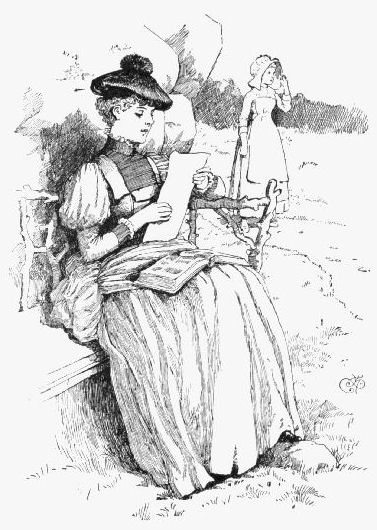 “She wrote it herself!”—Page 23.
"She wrote it herself! I can't believe it!"
said Emily, as she put down the paper, looking
rather startled, for she did believe it, and felt
as if she had suddenly looked into a fellow-creature's
heart. "I thought her just an ordinary
girl, and here she is a poet, writing verses
that make me want to cry! I don't suppose
they are very good, but they seem to come right
out of her heart, and touch me with the longing
and the patience or the piety in them. Well,
I am surprised!" and Emily read the lines
again, seeing the faults more plainly than before,
but still feeling that the girl put herself into
them, vainly trying to express what the wild
flower was to her in the loneliness which comes
to those who have a little spark of the divine
fire burning in their souls.
"Shall I tell her I've found it out? I must!
and see if I can't get her verses printed. Of
course she has more tucked away somewhere.
That is what she hums to herself when she's at
work, and won't tell me about when I ask. Sly
thing! to be so bashful and hide her gift. I'll
tease her a bit and see what she says. Oh dear,
I wish I could do it! Perhaps she'll be famous
some day, and then I'll have the glory of discovering
her."
With that consolation Emily turned over the
pages of the ledger and found several more bits
of verse, some very good for an untaught girl,
others very faulty, but all having a certain
strength of feeling and simplicity of language
unusual in the effusions of young maidens at the
sentimental age.
Emily had a girlish admiration for talent of
any kind, and being fond of poetry, was especially
pleased to find that her humble friend possessed
the power of writing it. Of course she exaggerated
Becky's talent, and as she waited for
her, felt sure that she had discovered a feminine
Burns among the New Hampshire hills, for all
the verses were about natural and homely objects,
touched into beauty by sweet words or tender
sentiment. She had time to build a splendid
castle in the air and settle Becky in it with a
crown of glory on her head, before the quiet
figure in a faded sunbonnet came slowly up the
slope with the glow of sunset on a tired but
tranquil face.
"Sit here and have a good rest, while I talk
to you," said Emily, eager to act the somewhat
dramatic scene she had planned. Becky sunk
upon the red cushion prepared for her, and sat
looking down at the animated speaker, as Emily,
perched on a mossy stone before her, began the
performance.
"Becky, did you ever hear of the Goodale
children? They lived in the country and wrote
poetry and grew to be famous."
"Oh yes, I've read their poems and like 'em
very much. Do you know 'em?" and Becky
looked interested at once.
"No, but I once met a girl who was something
like them, only she didn't have such an easy
time as they did, with a father to help, and a
nice Sky-farm, and good luck generally. I've
tried to write verses myself, but I always get
into a muddle, and give it up. This makes me
interested in other girls who can do it, and I
want to help my friend. I'm sure she has talent,
and I'd so like to give her a lift in some way.
Let me read you a piece of hers and see what
you think of it."
"Do!" and Becky threw off the sunbonnet,
folded her hands round her knees, and composed
herself to listen with such perfect unconsciousness
of what was coming that Emily both laughed
at the joke and blushed at the liberty she felt
she was taking with the poor girl's carefully
hidden secret.
Becky was sure now that Emily was going to
read something of her own after this artful introduction,
and began to smile as the paper was
produced and the first four lines read in a tone
that was half timid, half triumphant. Then with
a cry she seized and crumpled up the paper,
exclaiming almost fiercely,—
"It's mine! Where did you get it? How
dar'st you touch it?"
Emily fell upon her knees with a face and
voice so full of penitence, pleasure, sympathy,
and satisfaction, that Becky's wrath was appeased
before her friend's explanation ended with these
soothing and delightful words,—
"That's all, dear, and I beg your pardon.
But I'm sure you will be famous if you
keep on, and I shall yet see a volume of
poems by Rebecca Moore of Rocky Nook, New
Hampshire."
Becky hid her face as if shame, surprise,
wonder, and joy filled her heart too full and
made a few happy tears drop on the hands so
worn with hard work, when they ached to be
holding a pen and trying to record the fancies
that sung in her brain as ceaselessly as the soft
sough of the pines or the ripple of the brook murmured
in her ear when she sat here alone. She
could not express the vague longings that stirred
in her soul; she could only feel and dimly strive
to understand and utter them, with no thought
of fame or fortune,—for she was a humble
creature, and never knew that the hardships of
her life were pressing out the virtues of her
nature as the tread of careless feet crush the
sweet perfume from wild herbs.
Presently she looked up, deeply touched by
Emily's words and caresses, and her blue eyes
shone like stars as her face beamed with something
finer than mere beauty, for the secrets of
her innocent heart were known to this friend
now, and it was very sweet to accept the first
draught of confidence and praise.
"I don't mind much, but I was scared for a
minute. No one knows but Mother, and she
laughs at me, though she don't care if it makes
me happy. I'm glad you like my scribbling,
but really I never think or hope of being anybody.
I couldn't, you know! but it's real nice
to have you say I might and to make believe for
a little while."
"But why not, Becky? The Goodale girls
did, and half the poets in the world were poor,
ignorant people at first, you know. It only
needs time and help, and the gift will grow, and
people see it; and then the glory and the money
will come," cried Emily, quite carried away by
her own enthusiasm and good-will.
"Could I get any money by these things?"
asked Becky, looking at the crumpled paper
lying under a laurel-bush.
"Of course you could, dear! Let me have
some of them, and I'll show you that I know
good poetry when I see it. You will believe if
some bank-bills come with the paper the verses
appear in, I hope?"
Blind to any harm she might do by exciting
vain hopes in her eagerness to cheer and help,
Emily made this rash proposal in all good faith,
meaning to pay for the verses herself if no editor
was found to accept them.
Becky looked half bewildered by this brilliant
prospect, and took a long breath, as if some hand
had lifted a heavy burden a little way from her
weary back, for stronger than ambition for herself
was love for her family, and the thought of
help for them was sweeter than any dream of
fame.
"Yes, I would! oh, if I only could, I'd be
the happiest girl in the world! But I can't believe
it, Emily. I heard Mrs. Taylor say that
only the very best poetry paid, and mine is poor
stuff, I know well enough."
"Of course it needs polishing and practice and
all that; but I'm sure it is oceans better than
half the sentimental twaddle we see in the
papers, and I know that some of those pieces are
paid for, because I have a friend who is in a
newspaper office, and he told me so. Yours are
quaint and simple and some very original. I'm
sure that ballad of the old house is lovely, and I
want to send it to Whittier. Mamma knows
him; it's the sort he likes, and he is so kind to
every one, he will criticise it, and be interested
when she tells him about you. Do let me!"
"I never could in the world! It would be so
bold, Mother would think I was crazy. I love
Mr. Whittier, but I wouldn't dar'st to show
him my nonsense, though reading his beautiful
poetry helps me ever so much."
Becky looked and spoke as if her breath had
been taken away by this audacious proposal;
and yet a sudden delicious hope sprung up in
her heart that there might, perhaps, be a spark
of real virtue in the little fire which burned
within her, warming and brightening her dull
life.
"Let us ask Mamma; she will tell us what
is best to do first, for she knows all sorts of
literary people, and won't say any more than
you want her to. I'm bent on having my way,
Becky, and the more modest you are, the surer
I am that you are a genius. Real geniuses
always are shy; so you just make up your mind
to give me the best of your pieces, and let me
prove that I'm right."
It was impossible to resist such persuasive
words, and Becky soon yielded to the little siren
who was luring her out of her safe, small pool
into the deeper water that looks so blue and
smooth till the venturesome paper boats get into
the swift eddies, or run aground upon the rocks
and sandbars.
The greatest secrecy was to be preserved, and
no one but Mrs. Spenser was to know what
a momentous enterprise was afoot. The girls sat
absorbed in their brilliant plans till it was nearly
dark, then groped their way home hand in hand,
leaving another secret for the laurels to keep and
dream over through their long sleep, for blossom
time was past, and the rosy faces turning pale
in the July sun.
Neither of the girls forgot the talk they had
that night in Emily's room, for she led her captive
straight to her mother, and told her all their
plans and aspirations without a moment's delay.
Mrs. Spenser much regretted her daughter's
well-meant enthusiasm, but fearing harm might
be done, very wisely tried to calm the innocent
excitement of both by the quiet matter-of-fact
way in which she listened to the explanation
Emily gave her, read the verses timidly offered
by Becky, and then said, kindly but firmly:—
"This is not poetry, my dear girls, though the
lines run smoothly enough, and the sentiment is
sweet. It would bring neither fame nor money,
and Rebecca puts more real truth, beauty, and
poetry into her dutiful daily life than in any
lines she has written."
"We had such a lovely plan for Becky to come
to town with me, and see the world, and write,
and be famous. How can you spoil it all?"
"My foolish little daughter, I must prevent
you from spoiling this good girl's life by your
rash projects. Becky will see that I am wise,
though you do not, and she will understand this
verse from my favorite poet, and lay it to
heart:—
"So near is grandeur to our dust,
So nigh is God to man,
When Duty whispers low, 'Thou must!'
The youth replies, 'I can!'"
"I do! I will! please go on," and Becky's
troubled eyes grew clear and steadfast as she
took the words home to herself, resolving to
live up to them.
"Oh, mother!" cried Emily, thinking her
very cruel to nip their budding hopes in this
way.
"I know you won't believe it now, nor be
able to see all that I mean perhaps, but time
will teach you both to own that I am right, and
to value the substance more than the shadow,"
continued Mrs. Spenser. "Many girls write
verses and think they are poets; but it is only
a passing mood, and fortunately for the world,
and for them also, it soon dies out in some more
genuine work or passion. Very few have the
real gift, and those to whom it is given wait
and work and slowly reach the height of their
powers. Many delude themselves, and try to
persuade the world that they can sing; but it
is waste of time, and ends in disappointment,
as the mass of sentimental rubbish we all see
plainly proves. Write your little verses, my
dear, when the spirit moves,—it is a harmless
pleasure, a real comfort, and a good lesson for
you; but do not neglect higher duties or deceive
yourself with false hopes and vain dreams.
'First live, then write,' is a good motto for ambitious
young people. A still better for us all
is, 'Do the duty that lies nearest;' and the
faithful performance of that, no matter how
humble it is, will be the best help for whatever
talent may lie hidden in us, ready to bloom
when the time comes. Remember this, and do
not let my enthusiastic girl's well-meant but
unwise prophecies and plans unsettle you, and
unfit you for the noble work you are doing."
"Thank you, ma'am! I will remember; I
know you are right, and I won't be upset by
foolish notions. I never imagined before that I
could be a poet; but it sounded so sort of splendid,
I thought maybe it might happen to me,
by-and-by, as it does to other folks. I won't lot
on it, but settle right down and do my work
cheerful."
As she listened, Becky's face had grown pale
and serious, even a little sad; but as she answered,
her eyes shone, her lips were firm, and
her plain face almost beautiful with the courage
and confidence that sprung up within her. She
saw the wisdom of her friend's advice, felt the
kindness of showing her the mistake frankly,
and was grateful for it,—conscious in her own
strong, loving heart that it was better to live
and work for others than to dream and strive
for herself alone.
Mrs. Spenser was both surprised and touched
by the girl's look, words, and manner, and her
respect much increased by the courage and good
temper with which she saw her lovely castle
in the air vanish like smoke, leaving the hard
reality looking harder than ever, after this little
flight into the fairy regions of romance.
She talked long with the girls, and gave them
the counsel all eager young people need, yet are
very slow to accept till experience teaches them
its worth. As the friend of many successful
literary people, Mrs. Spenser was constantly receiving
the confidences of unfledged scribblers,
each of whom was sure that he or she had something
valuable to add to the world's literature.
Her advice was always the same, "Work and
wait;" and only now and then was a young
poet or author found enough in earnest to do
both, and thereby prove to themselves and others
either that they did possess power, or did not,
and so settle the question forever. "First live,
then write," proved a quietus for many, and
"Do the duty that lies nearest" satisfied the
more sincere that they could be happy without
fame. So, thanks to this wise and kindly
woman, a large number of worthy youths and
maidens ceased dreaming and fell to work, and
the world was spared reams of feeble verse and
third-rate romances.
After that night Becky spent fewer spare
hours in her nest, and more in reading with
Emily, who lent her books and helped her to
understand them,—both much assisted by Mrs.
Spenser, who marked passages, suggested authors,
and explained whatever puzzled them.
Very happy bits of time were these, and very
precious to both, as Emily learned to see and
appreciate the humbler, harder side of life, and
Becky got delightful glimpses into the beautiful
world of art, poetry, and truth, which gave her
better food for heart and brain than sentimental
musings or blind efforts to satisfy the hunger of
her nature with verse-writing.
Their favorite places were in the big barn, on
the front porch, or by the spring. This last was
Emily's schoolroom, and she both taught and
learned many useful lessons there.
One day as Becky came to rest a few minutes
and shell peas, Emily put down her book to
help; and as the pods flew, she said, nodding
toward the delicate ferns that grew thickly all
about the trough, the rock, and the grassy
bank,—
"We have these in our greenhouse, but I
never saw them growing wild before, and I don't
find them anywhere up here. How did you get
such beauties, and make them do so well?"
"Oh, they grow in nooks on the mountain
hidden under the taller ferns, and in sly corners.
But they don't grow like these, and die soon unless
transplanted and taken good care of. They
always make me think of you,—so graceful and
delicate, and just fit to live with tea-roses in a
hot-house, and go to balls in beautiful ladies'
bokays," answered Becky, smiling at her new
friend, always so dainty, and still so delicate in
spite of the summer's rustication.
"Thank you! I suppose I shall never be very
strong or able to do much; so I am rather like
a fern, and do live in a conservatory all winter,
as I can't go out a great deal. An idle thing,
Becky!" and Emily sighed, for she was born
frail, and even her tenderly guarded life could
not give her the vigor of other girls. But the
sigh changed to a smile as she added,—
"If I am like the fern, you are like your own
laurel,—strong, rosy, and able to grow anywhere.
I want to carry a few roots home, and see if they
won't grow in my garden. Then you will have
me, and I you. I only hope your plant will do
as well as mine does here."
"It won't! ever so many folks have taken
roots away, but they never thrive in gardens as
they do on the hills where they belong. So I
tell 'em to leave the dear bushes alone, and come
up here and enjoy 'em in their own place. You
might keep a plant of it in your hot-house, and
it would blow I dare say; but it would never be
half so lovely as my acres of them, and I guess
it would only make you sad, seeing it so far from
home, and pale and pining," answered Becky,
with her eyes on the green slopes where the
mountain-laurel braved the wintry snow, and
came out fresh and early in the spring.
"Then I'll let it alone till I come next summer.
But don't you take any of the fern into
the house in the cold weather? I should think
it would grow in your sunny windows," said
Emily, pleased by the fancy that it resembled
herself.
"I tried it, but it needs a damp place, and our
cold nights kill it. No, it won't grow in our old
house; but I cover it with leaves, and the little
green sprouts come up as hearty as can be out
here. The shade, the spring, the shelter of the
rock, keep it alive, you see, so it's no use trying
to move it."
Both sat silent for a few minutes, as their
hands moved briskly and they thought of their
different lots. An inquisitive ray of sunshine
peeped in at them, touching Becky's hair till
it shone like red gold. The same ray dazzled
Emily's eyes; she put up her hand to pull her
hat-brim lower, and touched the little curls on
her forehead. This recalled her pet grievance,
and made her say impatiently, as she pushed
the thick short locks under her net,—
"My hair is such a plague! I don't know
what I am to do when I go into society by-and-by.
This crop is so unbecoming, and I can't
match my hair anywhere, it is such a peculiar
shade of golden-auburn."
"It's a pretty color, and I think the curls much
nicer than a boughten switch," said Becky, quite
unconscious that her own luxuriant locks were
of the true Titian red, and would be much
admired by artistic eyes.
"I don't! I shall send to Paris to match it,
and then wear a braid round my head as you
do sometimes. I suppose it will cost a fortune,
but I won't have a strong-minded crop. A
friend of mine got a lovely golden switch for
fifty dollars."
"My patience! do folks pay like that for false
hair?" asked Becky, amazed.
"Yes, indeed. White hair costs a hundred, I
believe, if it is long. Why, you could get ever
so much for yours if you ever wanted to sell it.
I'll take part of it, for in a little while mine
will be as dark, and I'd like to wear your hair,
Becky."
"Don't believe Mother would let me. She is
very proud of our red heads. If I ever do cut
it, you shall have some. I may be hard up and
glad to sell it perhaps. My sakes! I smell the
cake burning!" and off flew Becky to forget the
chat in her work.
Emily did not forget it, and hoped Becky
would be tempted, for she really coveted one of
the fine braids, but felt shy about asking the
poor girl for even a part of her one beauty.
So July and August passed pleasantly and
profitably to both girls, and in September they
were to part. No more was said about poetry;
and Emily soon became so interested in the busy,
practical life about her that her own high-flown
dreams were quite forgotten, and she learned to
enjoy the sweet prose of daily labor.
One breezy afternoon as she and her mother
sat resting from a stroll on the way-side bank
among the golden-rod and asters, they saw Becky
coming up the long hill with a basket on her
arm. She walked slowly, as if lost in thought,
yet never missed pushing aside with a decided
gesture of her foot every stone that lay in her
way. There were many in that rocky path, but
Becky left it smoother as she climbed, and
paused now and then to send some especially
sharp or large one spinning into the grassy ditch
beside the road.
"Isn't she a curious girl, Mamma? so tired
after her long walk to town, yet so anxious not
to leave a stone in the way," said Emily, as
they watched her slow approach.
"A very interesting one to me, dear, because
under that humble exterior lies a fine, strong
character. It is like Becky to clear her way,
even up a dusty hill where the first rain will
wash out many more stones. Let us ask her
why she does it. I've observed the habit before,
and always meant to ask," replied Mrs. Spenser.
"Here we are! Come and rest a minute,
Becky, and tell us if you mend roads as well as
ever so many other things," called Emily,
beckoning with a smile, as the girl looked up
and saw them.
"Oh, it's a trick of mine; I caught it of
Father when I was a little thing, and do it without
knowing it half the time," said Becky,
sinking down upon a mossy rock, as if rest were
welcome.
"Why did he do it?" asked Emily, who
knew that her friend loved to talk of her
father.
"Well, it's a family failing I guess, for his
father did the same, only he began with his farm
and let the roads alone. The land used to be
pretty much all rocks up here, you know, and
farmers had to clear the ground if they wanted
crops. It was a hard fight, and took a sight of
time and patience to grub out roots and blast
rocks and pick up stones that seemed to grow
faster than anything else. But they kept on,
and now see!"
As she spoke, Becky pointed proudly to the
wide, smooth fields lying before them, newly
shorn of grass or grain, waving with corn, or
rich in garden crops ripening for winter stores.
Here and there were rocky strips unreclaimed,
as if to show what had been done; and massive
stone walls surrounded pasture, field, and
garden.
"A good lesson in patience and perseverance,
my dear, and does great honor to the men who
made the wilderness blossom like the rose," said
Mrs. Spenser.
"Then you can't wonder that they loved it
and we want to keep it. I guess it would break
Mother's heart to sell this place, and we are all
working as hard as ever we can to pay off the
mortgage. Then we'll be just the happiest
family in New Hampshire," said Becky, fondly
surveying the old farm-house, the rocky hill,
and the precious fields won from the forest.
"You never need fear to lose it; we will see
to that if you will let us," began Mrs. Spenser,
who was both a rich and a generous woman.
"Oh, thank you! but we won't need help I
guess; and if we should, Mrs. Taylor made us
promise to come to her," cried Becky. "She
found us just in our hardest time, and wanted to
fix things then; but we are proud in our way,
and Mother said she'd rather work it off if she
could. Then what did that dear lady do but
talk to the folks round here, and show 'em how
a branch railroad down to Peeksville would increase
the value of the land, and how good this
valley would be for strawberries and asparagus
and garden truck if we could only get it to
market. Some of the rich men took up the plan,
and we hope it will be done this fall. It will be
the making of us, for our land is first-rate for
small crops, and the children can help at that,
and with a deepot close by it would be such easy
work. That's what I call helping folks to help
themselves. Won't it be grand?"
Becky looked so enthusiastic that Emily could
not remain uninterested, though market-gardening
did not sound very romantic.
"I hope it will come, and next year we shall
see you all hard at it. What a good woman
Mrs. Taylor is!"
"Ain't she? and the sad part of it is, she can't
do and enjoy all she wants to, because her health
is so poor. She was a country girl, you know,
and went to work in the city as waiter in a
boarding-house. A rich man fell in love with
her and married her, and she took care of him
for years, and he left her all his money. She
was quite broken down, but she wanted to make
his name loved and honored after his death, as
he hadn't done any good while he lived; so she
gives away heaps, and is never tired of helping
poor folks and doing all sorts of grand things to
make the world better. I call that splendid!"
"So do I, yet it is only what you are doing in
a small way, Becky," said Mrs. Spenser, as the
girl paused out of breath. "Mrs. Taylor clears
the stones out of people's paths, making their
road easier to climb than hers has been, and
leaving behind her fruitful fields for others to
reap. This is a better work than making verses,
for it is the real poetry of life, and brings to
those who give themselves to it, no matter in
what humble ways, something sweeter than fame
and more enduring than fortune."
"So it does! I see that now, and know why
we love Father as we do, and want to keep
what he worked so hard to give us. He used to
say every stone cleared away was just so much
help to the boys; and he used to tell me his plans
as I trotted after him round the farm, helping all
I could, being the oldest, and like him, he said."
Becky paused with full eyes, for not even to
these good friends could she ever tell the shifts
and struggles in which she had bravely borne her
part during the long hard years that had wrested
the little homestead from the stony-hearted hills.
The musical chime of a distant clock reminded
her that supper time was near, and she
sprang up as if much refreshed by this pleasant
rest by the way-side. As she pulled out her
handkerchief, a little roll of pale blue ribbon fell
from her pocket, and Emily caught it up, exclaiming
mischievously, "Are you going to
make yourself fine next Sunday, when Moses
Pennel calls, Becky?"
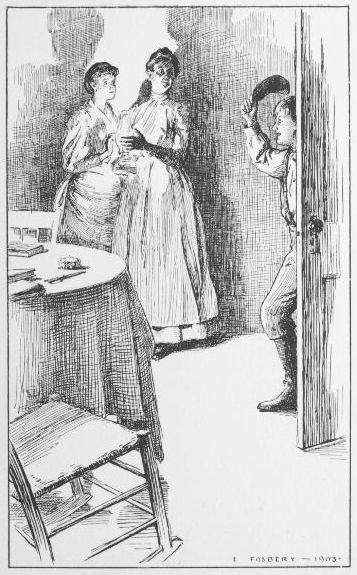 “Just as they were parting for bed, in rushed one of the boys with the exciting
news.”—Page 45.
“Just as they were parting for bed, in rushed one of the boys with the exciting
news.”—Page 45.
The girl laughed and blushed as she said,
carefully folding up the ribbon,—
"I'm going to do something with it that I like
a sight better than that. Poor Moses won't
come any more, I guess. I'm not going to
leave Mother till the girls can take my place,
and only then to teach, if I can get a good school
somewhere near."
"We shall see!" and Emily nodded wisely.
"We shall!" and Becky nodded decidedly,
as she trudged on up the steep hill beside Mrs.
Spenser, while Emily walked slowly behind,
poking every stone she saw into the grass, unmindful
of the detriment to her delicate shoes,
being absorbed in a new and charming idea of
trying to follow Mrs. Taylor's example in a
small way.
A week later the last night came, and just as
they were parting for bed, in rushed one of the
boys with the exciting news that the railroad
surveyors were in town, the folks talking about
the grand enterprise, and the fortune of the place
made forever.
Great was the rejoicing in the old farm-house;
the boys cheered, the little girls danced, the two
mothers dropped a happy tear as they shook each
other's hands, and Emily embraced Becky, tenderly
exclaiming,—"There, you dear thing, is
a great stone shoved out of your way, and a
clear road to fortune at last; for I shall tell all
my friends to buy your butter and eggs, and
fruit and pigs, and everything you send to
market on that blessed railroad."
"A keg of our best winter butter is going by
stage express to-morrow anyway; and when our
apples come, we shan't need a railroad to get 'em
to you, my darling dear," answered Becky, holding
the delicate girl in her arms with a look and
gesture half sisterly, half motherly, wholly fond
and grateful.
When Emily got to her room, she found that
butter and apples were not all the humble souvenirs
offered in return for many comfortable
gifts to the whole family.
On the table, in a pretty birch-bark cover, lay
several of Becky's best poems neatly copied, as
Emily had expressed a wish to keep them; and
round the rustic volume, like a ring of red gold,
lay a great braid of Becky's hair, tied with the
pale blue ribbon she had walked four miles to
buy, that her present might look its best.
Of course there were more embraces and kisses,
and thanks and loving words, before Emily at
last lulled herself to sleep planning a Christmas
box, which should supply every wish and want
of the entire family if she could find them out.
Next morning they parted; but these were
not mere summer friends, and they did not lose
sight of one another, though their ways lay
far apart. Emily had found a new luxury to
bring more pleasure into life, a new medicine
to strengthen soul and body; and in helping
others, she helped herself wonderfully.
Becky went steadily on her dutiful way, till
the homestead was free, the lads able to work
the farm alone, the girls old enough to fill her
place, and the good mother willing to rest at last
among her children. Then Becky gave herself
to teaching,—a noble task, for which she was
well fitted, and in which she found both profit
and pleasure, as she led her flock along the
paths from which she removed the stumbling-blocks
for their feet, as well as for her own.
She put her poetry into her life, and made of it
"a grand sweet song" in which beauty and
duty rhymed so well that the country girl became
a more useful, beloved, and honored woman
than if she had tried to sing for fame which
never satisfies.
So each symbolical plant stood in its own
place, and lived its appointed life. The delicate
fern grew in the conservatory among tea-roses
and camellias, adding grace to every bouquet of
which it formed a part, whether it faded in a
ball-room, or was carefully cherished by some
poor invalid's bed-side,—a frail thing, yet with
tenacious roots and strong stem, nourished by
memories of the rocky nook where it had learned
its lesson so well. The mountain-laurel clung
to the bleak hillside, careless of wintry wind and
snow, as its sturdy branches spread year by year,
with its evergreen leaves for Christmas cheer,
its rosy flowers for spring-time, its fresh beauty
free to all as it clothed the wild valley with a
charm that made a little poem of the lovely
spot where the pines whispered, woodbirds sang,
and the hidden brook told the sweet message it
brought from the mountain-top where it was
born.
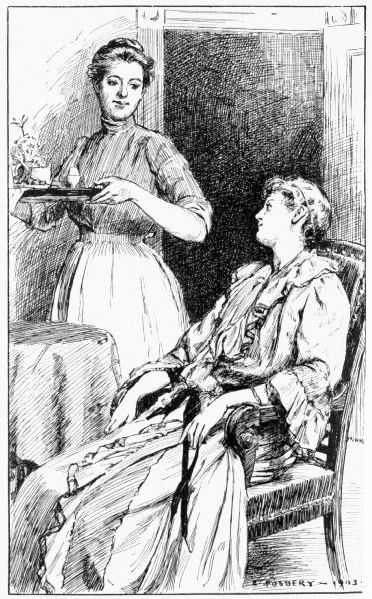 “Her eyes brightened as they fell upon a glass of
rosy laurel and delicate maidenhair fern.”—Frontispiece.
“Her eyes brightened as they fell upon a glass of
rosy laurel and delicate maidenhair fern.”—Frontispiece.