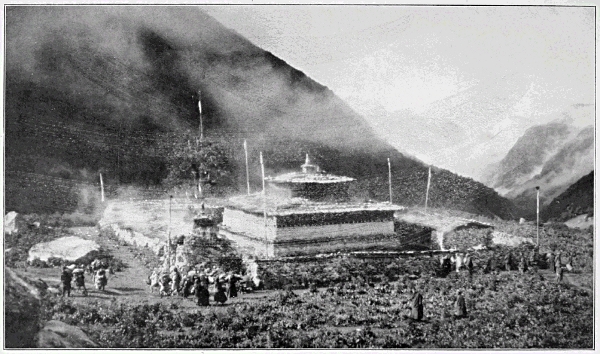
THE EASTERN APPROACH
The new base at Kharta established by Colonel Howard-Bury
at the end of July was well suited to meet the needs
of climbers, and no less agreeable, I believe, to all members
of the Expedition. At the moderate elevation of 12,300 feet
and in an almost ideal climate, where the air was always
warm but never hot or stuffy, where the sun shone brightly
but never fiercely, and clouds floated about the hills and
brought moisture from the South, but never too much rain,
here the body could find a delicious change when tired of
the discipline of high-living, and in a place so accessible
to traders from Nepal could easily be fed with fresh food.
But perhaps after life in the Rongbuk Valley, with hardly
a green thing to look at and too much of the endless unfriendly
stone-shoots and the ugly waste of glaciers, and even after
visions of sublime snow-beauty, a change was more needed
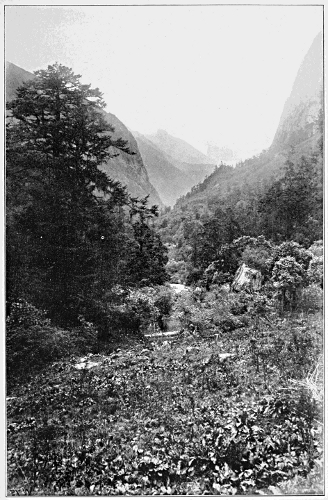
for the mind. It was a delight to be again in a land of
flowery meadows and trees and crops; to look into the deep
green gorge only a mile away where the Arun goes down
into Nepal was to be reminded of a rich vegetation and
teeming life, a contrast full of pleasure with Nature's
niggardliness in arid, wind-swept Tibet; and the forgotten
rustle of wind in the willows came back as a soothing sound
full of grateful memories, banishing the least thought of
disagreeable things.
The Kharta base, besides, was convenient for our reconnaissance.
Below us a broad glacier stream joined the
Arun above the gorge; it was the first met with since we
had left the Rongbuk stream; it came down from the West
and therefore, presumably, from Everest. To follow it
up was an obvious plan as the next stage in our activities.
After four clear days for idleness and reorganisation at
Kharta we set forth again on August 2 with this object.
The valley of our glacier stream would lead us, we supposed,
to the mountain; in two days, perhaps, we should see
Chang La ahead of us. A local headman provided by the
Jongpen and entrusted with the task of leading us to
Chomolungma would show us where it might be necessary
to cross the stream and, in case the valley forked, would
ensure us against a bad mistake.
The start on this day was not propitious. We had
enjoyed the sheltered ease at Kharta; the coolies were
dilatory and unwilling; the distribution of loads was
muddled; there was much discontent about rations, and
our Sirdar was no longer trusted by the men. At a village
where we stopped to buy tsampa some 3 miles up the valley
I witnessed a curious scene. As the tsampa was sold it
had to be measured. The Sirdar on his knees before a large
pile of finely ground flour was ladling it into a bag with a
disused Quaker Oats tin. Each measure-full was counted
by all the coolies standing round in a circle; they were
making sure of having their full ration. Nor was this all;
they wanted to see as part of their supplies, not only tsampa
and rice, but tea, sugar, butter, cooking fat and meat on
the Army scale. This was a new demand altogether beyond
the bargain made with them. The point, of course, had
to be clearly made, that for their so-called luxuries I must
be trusted to do my best with the surplus money (100 tankas
or thereabouts) remaining over from their allowances after
buying the flour and rice. These luxury supplies were
always somewhat of a difficulty; the coolies had been very
short of such things on the Northern side—we had no doubt
that some of the ration money had found its way into the
Sirdar's pockets. It would be possible, we hoped, to prevent
this happening again. But even so the matter was not
simple. What the coolies wanted was not always to be
bought, or at the local price it was too expensive. On this
occasion a bountiful supply of chillies solved our difficulty.
After too many words, and not all in the best temper,
the sight of so many of the red, bright, attractive chillies
prevailed; at length my orders were obeyed; the coolies
took up their loads and we started off again.
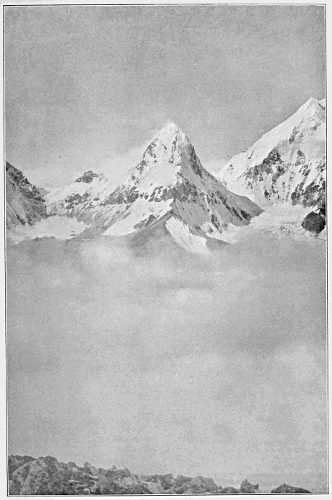
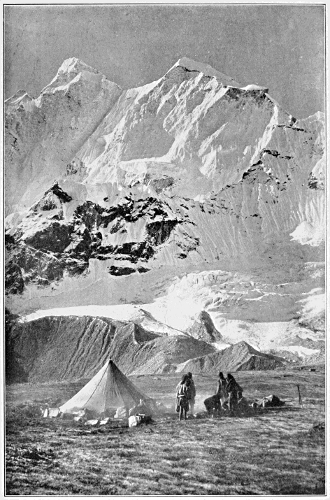
Pethang-tse.
With so much dissatisfaction in the air it was necessary
for Bullock and me to drive rather than lead the party.
In a valley where there are many individual farms and
little villages, the coolies' path is well beset with pitfalls
and with gin. Without discipline the Sahib might easily
find himself at the end of a day's march with perhaps only
half his loads. It was a slow march this day; we had barely
accomplished 8 miles, when Bullock and I with the hindmost
came round a shoulder on the right bank about 4 p.m. and
found the tents pitched on a grassy shelf and looking up a
valley where a stream came in from our left. The Tibetan
headman and his Tibetan coolies who were carrying some of
our loads had evidently no intention of going further, and
after some argument I was content to make the stipulation
that if the coolies (our own as well as the Tibetans) chose
to encamp after half a day's march, they should do a
double march next day.
The prospect was far from satisfactory: we were at a
valley junction of which we had heard tell, and the headman
pointed the way to the left. Here indeed was a valley,
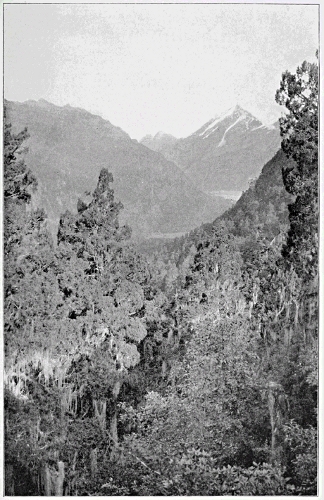
but no glacier stream. It was a pleasant green nullah covered
with rhododendrons and juniper, but presented nothing
that one may expect of an important valley. Moreover,
so far as I could learn, there were no villages in this direction:
I had counted on reaching one that night with the intention
of buying provisions, more particularly goats and butter.
Where were we going and what should we find? The headman
announced that it would take us five more days to reach
Chomolungma: he was told that he must bring us there
in two, and so the matter was left.
If the coolies behaved badly on this first day, they
certainly made up for it on the second. The bed of the
little valley which we now followed rose steeply ahead of
us, and the path along the hill slopes on its left bank soon
took us up beyond the rhododendrons. We came at last
for a mid-day halt to the shores of a lake. It was the first
I had seen in the neighbourhood of Everest; a little blue
lake, perhaps 600 yards long, set on a flat shelf up there
among the clouds and rocks, a sympathetic place harbouring
a wealth of little rock plants on its steep banks; and as
our present height by the aneroid was little less than 17,000
feet, we were assured that on this Eastern side of Everest
we should find Nature in a gentler mood. But we were
not satisfied with our direction; we were going too much
to the South. Through the mists we had seen nothing to
help us. For a few moments some crags had appeared to
the left looming surprisingly big; but that was our only
peep, and it told us nothing. Perhaps from the pass ahead
of us we should have better fortune.
At the Langma La when we reached it we found ourselves
to be well 4,000 feet above our camp of the previous night.
We had followed a track, but not always a smooth one,
and as we stayed in hopes of a clearing view, I began to
wonder whether the Tibetan coolies would manage to arrive
with their loads; they were notably less strong than our
Sherpas and yet had been burdened with the wet heavy
tents. Meanwhile we saw nothing above our own height.
We had hoped that once our col was crossed we should
bear more directly Westward again; but the Tibetan headman
when he came up with good news of his coolies, pointed
our way across a deep valley below us, and the direction
of his pointing was nearly due South. Everest, we imagined,
must be nearly due West of Kharta, and our direction at
the end of this second day by a rough dead reckoning would
be something like South-west. We were more than ever
mystified. Fortunately our difficulties with the coolies
seemed to be ended. Two of our own men stayed at the
pass to relieve the Tibetans of the tents and bring them
quickly on. Grumblings had subsided in friendliness, and
all marched splendidly on this day. They were undepressed
with the gloomy circumstance of again encamping in the
rain.
In the Sahibs' tent that night there took place a long
and fragmentary conversation with the headman, our Sirdar
acting as interpreter. We gained one piece of information:
there were two Chomolungmas. It was not difficult to
guess that, if Everest were one, the other must be Makalu.
We asked to be guided to the furthest Chomolungma.
The morning of August 4 was not more favourable to
our reconnaissance. We went down steeply to the valley
bed, crossed a stream and a rickety bridge, and wound on
through lovely meadows and much dwarf rhododendron
till we came to the end of a glacier and mounted by its left
bank. Towards mid-day the weather showed signs of clearing;
suddenly on our left across the glacier we saw gigantic
precipices looming through the clouds. We guessed they
must belong in some way to Makalu. We were told that
this was the first Chomolungma, while the valley we were
now following would lead us to the other. It was easy to
conclude that one valley, this one, must come up on the
North side of Makalu all the way to Everest. But we saw
no more. In a few moments the grey clouds blowing swiftly
up from below had enveloped us, rain began to fall heavily,
and when eventually we came to broad meadows above
the glaciers, where yaks were grazing and Tibetan tents
were pitched, we were content to stop. At least we should
have the advantage here of good butter and cream from
this dairy farm. There was indeed no point in going farther;
we had no desire to run our heads against the East face
of Everest; we must now wait for a view.
The weather signs were decidedly more hopeful as I
looked out of our tent next morning, and we decided at
once to spend the day in some sort of reconnaissance up
the valley. Presently away at the head of it we saw the
clouds breaking about the mountain-sides. Everest itself
began to clear; the great North-east arête came out, cutting
the sky to the right; and little by little the whole Eastern
face was revealed to us.
As I recall now our first impression of the amazing scenery
around us, I seem chiefly to remember the fresh surprise
and vivid delight which, for all we had seen before, seemed
a new sensation. Even the map of the Kama Valley, now
that we have it, may stir the imagination. Besides Everest
itself the crest of the South Peak, 28,000 feet high, and
its prodigious South-east shoulder overlook the Western
end; while Makalu, 12 miles from Everest, thrusts out
Northwards a great arm and another peak to choke the
exit; so that whereas the frontier ridge from Everest to
Makalu goes in a South-easterly direction, the Kangshung
Glacier in the main valley runs nearly due East. In this
spacious manner three of the five highest summits in the
world overlook the Kama Valley.
And we now saw a scene of magnificence and splendour
even more remarkable than the facts suggest. Among
all the mountains I have seen, and, if we may judge by
photographs, all that ever have been seen, Makalu is incomparable
for its spectacular and rugged grandeur. It was
significant to us that the astonishing precipices rising above
us on the far side of the glacier as we looked across from
our camp, a terrific awe-inspiring sweep of snow-bound
rocks, were the sides not so much of an individual mountain,
but rather of a gigantic bastion or outwork defending Makalu.
At the broad head of the Kama Valley the two summits
of Everest are enclosed between the North-east arête and
the South-east arête bending round from the South Peak;
below them is a basin of tumbled ice well marked by a
number of moraines and receiving a series of tributaries
pouring down between the buttresses which support the
mountain faces in this immense cirque. Perhaps the
astonishing charm and beauty here lie in the complications
half hidden behind a mask of apparent simplicity, so that
one's eye never tires of following up the lines of the great
arêtes, of following down the arms pushed out from their
great shoulders, and of following along the broken edge
of the hanging glacier covering the upper half of this Eastern
face of Everest so as to determine at one point after another
its relation with the buttresses below and with their abutments
against the rocks which it covers. But for me the
most magnificent and sublime in mountain scenery can
be made lovelier by some more tender touch; and that, too,
is added here. When all is said about Chomolungma, the
Goddess Mother of the World, and about Chomo Uri, the
Goddess of the Turquoise Mountain, I come back to the
valley, the valley bed itself, the broad pastures, where our
tents lay, where cattle grazed and where butter was made,
the little stream we followed up to the valley head, wandering
along its well-turfed banks under the high moraine, the
few rare plants, saxifrages, gentians and primulas, so well
watered there, and a soft, familiar blueness in the air which
even here may charm us. Though I bow to the goddesses
I cannot forget at their feet a gentler spirit than theirs, a
little shy perhaps, but constant in the changing winds and
variable moods of mountains and always friendly.
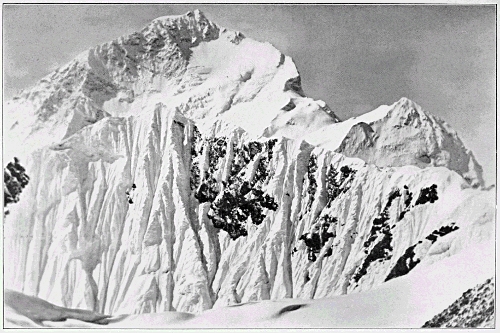
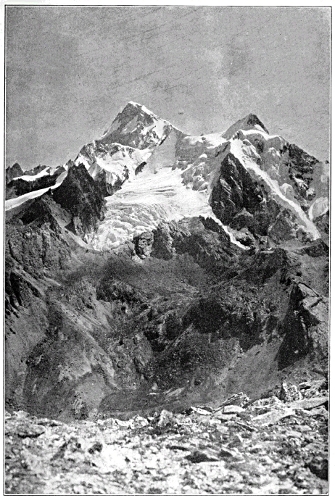
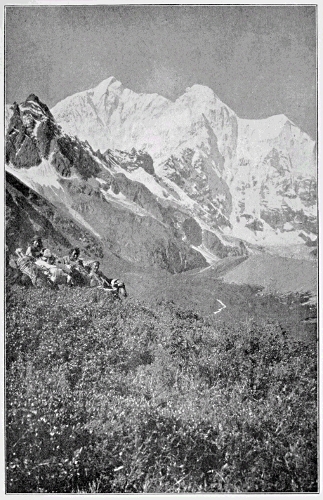
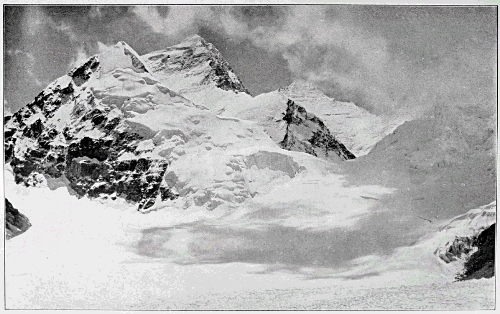
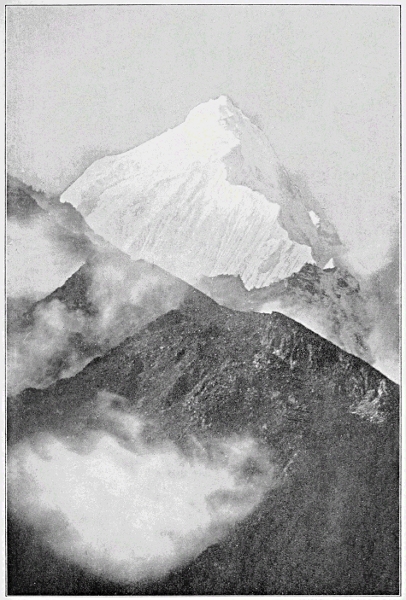
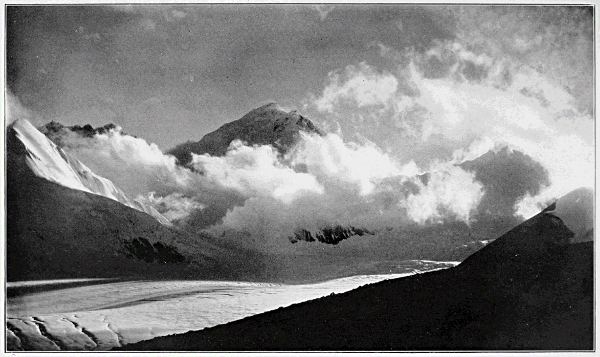
Summit of Makalu.
The deviation from our intended line of approach involved
by entering the Kama Valley was not one which we were
likely to regret. In so far as our object was to follow up
a glacier to the North Col we were now on the wrong side
of a watershed. A spur of mountains continues Eastwards
from the foot of Everest's North-east arête; these were
on our right as we looked up the Kama Valley; the glacier
of our quest must lie on the far side of them. But the pursuit
of this glacier was not our sole object. We had also to
examine both the East face and North-east arête of our
mountain and determine the possibilities of attack on this
side. A plan was now made to satisfy us in all ways. We
chose as our objective a conspicuous snowy summit, Carpo-ri,
on the watershed and apparently the second to the East
from the foot of the North-east arête. Could we climb it
we should not only see over into the valley North of us and
up to Chang La itself, we hoped, but also examine, from
the point most convenient for judging the steepness of its
slopes, the whole of the Eastern side of Mount Everest.
On August 6 the Whymper tents were taken up, and
a camp was made under a moraine at about 17,500 feet,
where a stream flows quietly through a flat space before
plunging steeply down into the valley. In this sheltered
spot we bid defiance to the usual snowstorm of the afternoon;
perhaps as night came on and snow was still falling we
were vaguely disquieted, but we refused to believe in anything
worse than the heavens' passing spite, and before we put
out our candles the weather cleared. We went out into
the keen air; it was a night of early moons. Mounting a
little rise of stones and faintly crunching under our feet
the granular atoms of fresh fallen snow we were already
aware of some unusual loveliness in the moment and the
scenes. We were not kept waiting for the supreme effects;
the curtain was withdrawn. Rising from the bright mists
Mount Everest above us was immanent, vast, incalculable—no
fleeting apparition of elusive dream-form: nothing could
have been more set and permanent, stedfast like Keats's
star, “in lone splendour hung aloft the night,” a watcher
of all the nights, diffusing, it seemed universally, an exalted
radiance.
It is the property of all that is most sublime in mountain
scenery to be uniquely splendid, or at least to seem so, and
it is commonly the fate of the sublime in this sort very soon
to be mixed with what is trivial. Not infrequently we had
experience of wonderful moments; it is always exciting
to spend a night under the stars. And such a situation
may be arranged quite comfortably; lying with his head
but just within the tent a man has but to stir in his sleep
to see, at all events, half the starry sky. Then perhaps
thoughts come tumbling from the heavens and slip in at
the tent-door; his dozing is an ecstasy: until, at length,
the alarm-watch sounds; and after?… Mean considerations
din it all away, all that delight. On the morning
of August 7 the trivial, with us, preponderated. Something
more than the usual inertia reigned in our frozen camp
at 2 a.m. The cook was feeling unwell; the coolies prolonged
their minutes of grace after the warning shout, dallied
with the thought of meeting the cold air, procrastinated,
drew the blankets more closely round them, and—snored
once more. An expedition over the snow to the outlying
tents by a half-clad Sahib, who expects to enjoy at least
the advantage of withdrawing himself at the last moment
from the friendly down-bag, is calculated to disturb the
recumbency of others; and a kick-off in this manner to
the day's work is at all events exhilarating. The task of
extricating our frozen belongings, where they lay and ought
not to have lain, was performed with alacrity if not with
zeal; feet did not loiter over slippery boulders as we mounted
the moraine, and in spite of the half-hour lost, or gained,
we were well up by sunrise. Even before the first glimmer
of dawn the snow-mantled, slumbering monsters around
us had been somehow touched to life by a faint blue light
showing their form and presence—a light that changed
as the day grew to a pale yellow on Everest and then to a
bright blue-grey before it flamed all golden as the sun hit
the summit and the shadow crept perceptibly down the
slope until the whole mountain stood bare and splendid
in the morning glory. With some premonition of what
was in store for us we had already halted to enjoy the scene,
and I was able to observe exactly how the various ridges
and summits caught the sun. It was remarkable that while
Everest was never, for a moment, pink, Makalu was tinged
with the redder shades, and the colour of the sky in that
direction was a livid Chinese blue red-flushed. Its bearing
from us was about South-east by South, and its distance
nearly twice that of Everest, which lay chiefly to the South-west.
The first crux of the expedition before us would evidently
be the ascent of a steep wall up to the conspicuous col lying
East of our mountain. The least laborious way was offered
by an outcrop of rocks. The obstacle looked decidedly
formidable and the coolies had little or no experience of
rock-climbing. But it proved a pleasure reminiscent of
many good moments once again to be grasping firm granite
and to be encouraging novices to tread delicately by throwing
down an occasional stone to remind them of the perils of
clumsy movements. The coolies, as usual, were apt pupils,
and after agreeable exertions and one gymnastic performance
we all reached the col at 9 a.m. with no bleeding scalps.
We had already by this hour taken time to observe
the great Eastern face of Mount Everest, and more particularly
the lower edge of the hanging glacier; it required but little
further gazing to be convinced—to know that almost everywhere
the rocks below must be exposed to ice falling from
this glacier; that if, elsewhere, it might be possible to climb
up, the performance would be too arduous, would take
too much time and would lead to no convenient platform;
that, in short, other men, less wise, might attempt this
way if they would, but, emphatically, it was not for us.
Our interest was rather in the other direction. We had
now gained the watershed. Below us on the far side was
a glacier flowing East, and beyond it two important rock
peaks, which we at once suspected must be two triangulated
points each above 23,000 feet. Was this at last the valley
observed so long ago from the hill above Shiling, more
than 50 miles away, to point up towards the gap between
Changtse and Everest? As yet we could not say. The
head of the glacier was out of sight behind the Northern
slopes of our mountain. We must ascend further, probably
to its summit, to satisfy our curiosity—to see, we hoped,
Changtse and its relation to this glacier, and perhaps the
Chang La of our quest.
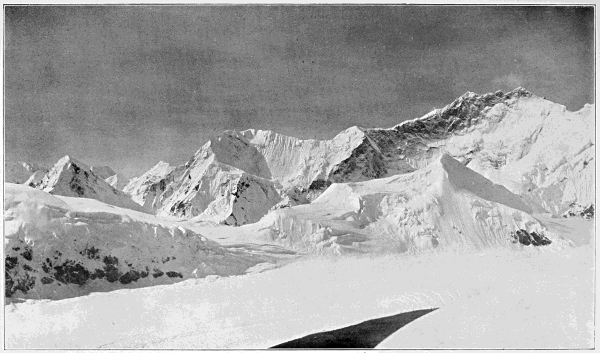
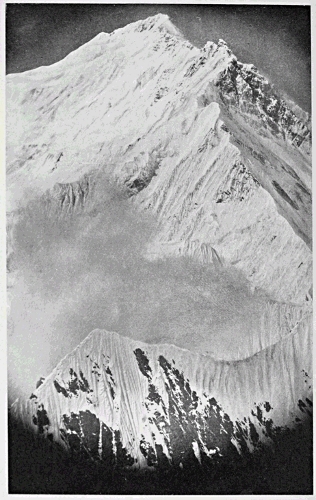
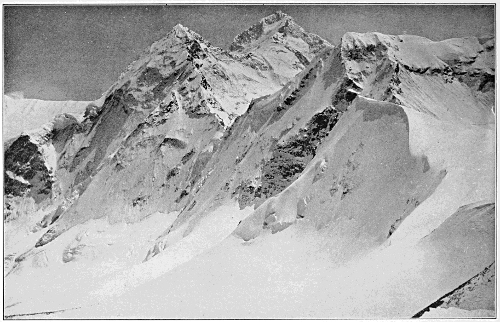
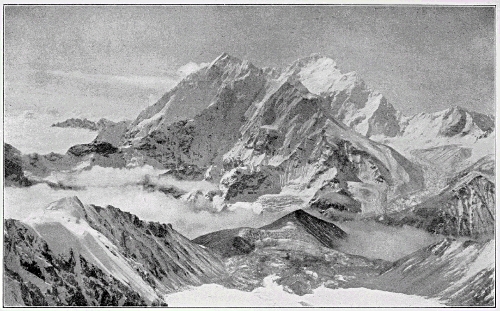
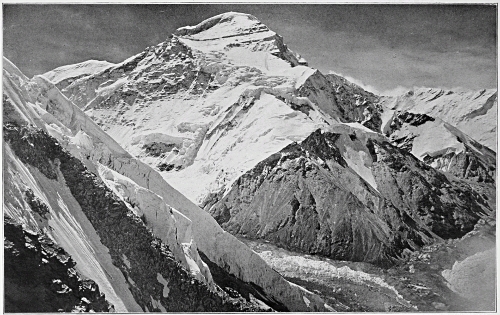
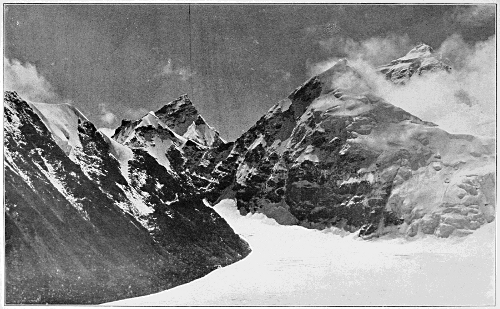
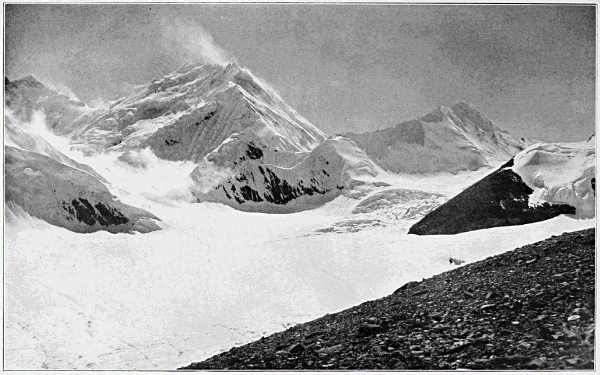
South-east Ridge of Mount Everest
from above the 20,000 foot camp, Kharta Valley.
The task before us was not one which had suggested
from a distant view any serious difficulties. The angle of
sight from our breakfast-place on the col to the next white
summit West of us was certainly not very steep. But no
continuous ridge would lead us upwards. The East face
in front of us and the South face to our left presented two
bands of fortification, crowned each by a flat emplacement
receding a considerable distance, before the final cone. We
knew already that the snow's surface, despite a thin crust,
could not hold us, and counted on snow-shoes to save labour
at the gentler angles. But the escarpments in front of us
were imposing. The first yielded to a frontal attack pushed
home with a proper after-breakfast vigour. The second
when we reached it was a more formidable obstacle. The
steepness of the Eastern slope was undeniable and forbidding
and the edge of its junction with the South side was defined
by a cornice. On that side, however, lay the only hope.
We had first to traverse a broad gully. The powdery
snow lay deep; we hesitated on the brink. Here, if anywhere,
the unmelted powdery substance was likely to
avalanche. Confidence was restored in sufficient measure
by contemplating an island of rock. Here lay a solution.
By the aid of its sound anchorage the party was secured
across the dangerous passage. With his rope adequately
belayed by a coolie, though the manner was hardly professional,
the leader hewed at the cornice above his head,
fixed a fist-and-axe hold in the crest and struggled over.
Such performances are not accomplished at heights above
20,000 feet without the feeling that something has been
done. Appearances suggested the necessity of establishing
the whole party firmly above the cornice before proceeding
many steps upward, and the first man had the diversion
of observing at his leisure the ungraceful attitudes and
explosive grunts of men strong indeed, but unaccustomed
to meet this kind of obstacle. But with the usual menace
of clouds, which even now were filling the head of the Kama
Valley, it was no season for delay; and it was no place to
be treated lightly. The angle was quite as steep as we
liked; on the slopes to our left again we should evidently
be exposed to the danger of an avalanche. It was necessary
to avoid treading on our frail cornice and no less important
to keep near the edge. Here a foot of powdery snow masked
a disintegrated substance of loose ice. Nothing less than
a vigorous swinging blow had any other effect than to bury
the pick and require a fourfold effort to pull it out again.
Luckily one or even two such blows usually sufficed to make
a firm step. But 400 feet of such work seemed an ample
quantity. If was a relief at length to reach level snow, to
don our rackets again and to follow a coolie bursting with
energy now sent first to tread a path. At 12.15 p.m. we
reached the far edge of this flat shoulder lying under the
final slopes of our mountain and at the most 500 feet below
the summit.
No one without experience of the problem could guess
how difficult it may be to sit down on a perfectly flat place
with snow-shoes strapped to the feet. To squat is clearly
impossible; and if the feet are pushed out in front the
projection behind the heel tends to tilt the body backwards
so that the back is strained in the mere effort to sit without
falling. The remedy of course is to take off the snow-shoes;
but the human mountaineer after exhausting efforts is too
lazy for that at an elevation of 21,000 feet. He prefers not
to sit; he chooses to lie—in the one convenient posture
under the circumstances—flat upon his back and with
his toes and snow-shoes turned vertically upwards. On
this occasion the majority of the party without more ado
turned up their toes.
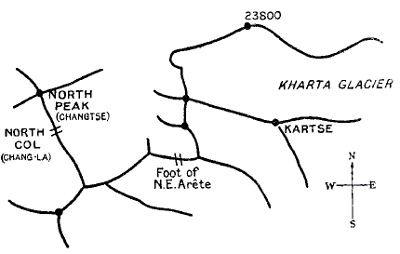
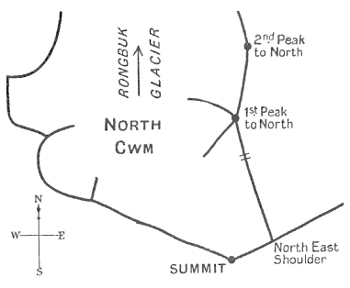
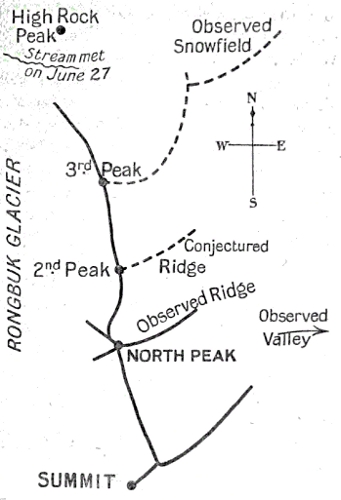
DIAGRAM SHOWING THAT THE KHARTA GLACIER DOES NOT LEAD TO THE NORTH COL.
The situation, however, was one of the greatest interest.
We were still separated from Mount Everest by a spur
at our own height turning Northwards from the foot of the
North-east arête and by the bay enclosed between this and
its continuation Eastward to which our mountain belonged.
But the distance from the North-east arête was small enough
and we were now looking almost directly up its amazing
crest. If any doubts remained at this time as to that line
of attack, they now received a coup de grâce. Not only was
the crest itself seen to be both sharp and steep, suggesting
an almost infinite labour, but the slopes on either hand
appeared in most places an impracticable alternative;
and leading up to the great rock towers of the North-east
shoulder, the final section, the point of a cruel sickle, appeared
effectually to bar further progress should anyone have been
content to spend a week or so on the lower parts. To discern
so much required no prolonged study; to the right (North)
the country was more intricate. The summit of Changtse
was eventually revealed, as the clouds cleared off, beyond,
apparently a long way beyond, the crest of the spur in front
of us. To the extreme right, looking past the final slopes
of the white cone above us was a more elevated skyline and
below it the upper part of the glacier, the lower end of which
we had seen earlier in the day descending Eastward. But
its extreme limit was not quite visible. We had still to
ask the question as to where exactly it lay. Could this
glacier conceivably proceed in an almost level course up
to Chang La, itself? Or was it cut off much nearer to us
by the high skyline which we saw beyond it? Was it
possible, as in the second case must be, that this skyline
was continuous with the East arête of Changtse, the
whole forming the left bank of the glacier? If no answer
was absolutely certain, the probability at least was all on
one side—on the wrong side alike for our present and our
future plans. We could hardly doubt that the glacier-head
lay not far away under Chang La, but here near at hand
under another col; beyond this must be the glacier of our
quest, turning East, as presumably it must turn beyond
the skyline we saw now, and beyond the rock peaks which
we had observed to the North of us when first we reached the
watershed.
One more effort was now required so that we might see
a little more. Chang La itself was still invisible. Might we
not see it from the summit of our mountain? And was
it not in any case an attractive summit? An examination
of the various pairs of upturned toes where the prostrate
forms were still grouped grotesquely in the snow was not
encouraging. But the most vigorous of the coolies was
with us, Nyima, a sturdy boy of eighteen, who from the very
start of the Expedition had consistently displayed a willing
spirit in every emergency. To my demand for volunteers
he responded immediately, and soon persuaded a second
coolie, Dasno, who had been going very strongly on this
day, to accompany him. As the three of us started off
the clouds suddenly boiled up from below and enveloped
us completely. A few minutes brought us to the foot of
the steepest slopes; we took off our snow-shoes and crossed
a bergschrund, wading up to our thighs. Dasno had already
had enough and fell out. But the conical shape of our
peak was just sufficiently irregular to offer a defined blunt
edge where two surfaces intersected. Even here the snow
was deep enough to be a formidable obstacle at that steep
angle; but the edge was safe from avalanches. As we
struggled on I glanced repeatedly away to the left. Presently
through a hole in the clouds all was clear for a moment
to the West; again I saw Changtse, and now my eyes
followed the line of its arête descending towards Everest
until the col itself was visible over the spur in front of us.
The view was little enough; the mere rim appeared; the
wall or the slopes below it, all that I most wanted to see,
remained hidden. We struggled on to the top, in all nearly
an hour's work of the most exhausting kind. The reward
was in the beauty of the spot, the faintly-defined edges of
clean snow and the convex surfaces bent slightly back from
the steepness on every side to form the most graceful summit
I have seen. To the North-east we saw clearly for a minute
down the glacier. The rest was cloud, a thin veil, but all
too much, inexorably hiding from us Changtse and Chang La.
A disappointment? Perhaps. But that sort of suffering
cannot be prolonged in a mind sufficiently interested.
Possibly it is never a genuine emotion; rather an automatic
reaction after too sanguine hopes. And such hopes had
no part in our system. We counted on nothing. Days
as we found them were not seldom of the disappointing
kind; this one had been of the best, remarkably clear and
fine. If we were baffled that was no worse than we expected.
To be bewildered was all in the game. But our sensation
was something beyond bewilderment. We felt ourselves
to be foiled. We were unpleasantly stung by this slap in
the face. We had indeed solved all doubts as to the East
face and North-east arête, and had solved them quickly.
But the way to Chang La, which had seemed almost within
our grasp, had suddenly eluded us, and had escaped, how
far we could not tell. Though its actual distance from
our summit might be short, as indeed it must be, the glacier
of our quest appeared now at the end of a receding vista;
and this was all our prospect.
Our next plans were made on the descent. With the
relaxation of physical effort the feeling of dazed fatigue
wears off and a mind duly strung to activity may work well
enough. The immediate object was to reach our tents
not too late to send a coolie down to the base camp the same
evening; on the following morning a reinforcement of four
men would enable us to carry down all our loads with
sufficient ease, and with no delay we should move the whole
party along the next stage back towards Langma La—and
thus save a day. The main idea was simple. It still
seemed probable that the elusive glacier drained ultimately
Eastwards, in which case its waters must flow into the
Kharta stream; thither we had now to retrace our steps
and follow up the main valley as we had originally intended;
it might be necessary to investigate more valleys than one,
but there sooner or later a way would be found. Only,
time was short. At the earliest we could be back in the
Kharta Valley on August 9. By August 20 I reckoned
the preliminary reconnaissance should come to an end, if
we were to have sufficient time before the beginning of
September for rest and reorganisation at Kharta—and such
was the core of our plan.
These projects left out of account an entirely new factor.
In the early stages of the reconnaissance I had taken careful
note of the party's health. One or two of the coolies had
quickly fallen victims to the high altitudes; but the rest
seemed steadily to grow stronger. Nothing had so much
surprised us as the rapid acclimatisation of the majority,
and the good effects, so far as they appeared, of living in
high camps. Both Bullock and myself left the Rongbuk
Valley feeling as fit as we could wish to feel. All qualms
about our health had subsided. For my part I was a
confirmed optimist, and never imagined for myself the
smallest deviation from my uniform standard of health
and strength. On August 7, as we toiled over the névé in
the afternoon, I felt for the first time a symptom of weariness
beyond muscular fatigue and beyond the vague lassitude
of mountain-sickness. By the time we reached the moraine
I had a bad headache. In the tent at last I was tired and
shivering and there spent a fevered night. The next morning
broke with undeniable glory. A photograph of our yesterday's
conquest must be obtained. I dragged myself and
the quarter-plate camera a few steps up to the crest of the
moraine—only to find that a further peregrination of perhaps
300 yards would be necessary for my purpose: and 300
yards was more than I could face. I was perforce content
with less interesting exposures and returned to breakfast
with the dismal knowledge that for the moment at all
events I was hors de combat. We learned a little later that
Colonel Howard-Bury had arrived the night before in our
base camp. It was easily decided to spend the day there
with him—the day I had hoped to save; after the long
dragging march down the green way, which on the ascent
had been so pleasant with butterflies and flowers, I was
obliged to spend it in bed.
Three days later, on August 11, our tents were pitched
in a sheltered place well up the Kharta Valley, at a height
of about 16,500 feet. Two tributary streams had been
passed by, the first coming in from the North as being clearly
too small to be of consequence, and the second from the
South, because wherever its source might be, it could not
be far enough to the North. Ahead of us we had seen that
the valley forked; we must follow the larger stream and
then no doubt we should come soon enough to the glacier
of our quest and be able at last to determine whether it
would serve us to approach Chang La. August 12, a day
of necessary idleness after three long marches, was spent
by the coolies in collecting fuel, of which we were delighted
to observe a great abundance, rhododendron and gobar
all about us, and, only a short way down the valley, the
best we could hope for, juniper. The last march had been
too much for me, and again I was obliged to keep my bed
with a sore throat and swollen glands.
It seemed certain that the next two days must provide
the climax or anticlimax of our whole reconnaissance. The
mystery must surely now be penetrated and the most
important discovery of all be made. A competition with
my companion for the honour of being first was, I hope, as
far from my thoughts as ever it had been. From the start
Bullock and I had shared the whole campaign and worked
and made our plans together, and neither for a moment had
envied the other the monopoly of a particular adventure.
Nevertheless, after all that had passed, the experience of
being left out at the finish would not be agreeable to me;
I confess that not to be in at the death after leading the
hunt so long was a bitter expectation. But the hunt must
not be stopped, and on the morning of August 13, from
the ungrateful comfort of my sleeping-bag, I waved farewell
to Bullock. How many days would he be absent before he
came to tell his story, and what sort of story would it be?
Would he know for certain that the way was found? or how
much longer would our doubts continue?
It was impossible to stay in bed with such thoughts,
and by the middle of the morning I was sitting in the sun
to write home my dismal tale. A hint from one of the
coolies interrupted my meditations; I looked round and
now saw, to my great surprise and unfeigned delight, the
approaching figure of Major Morshead. I had long been
hoping that he might be free to join us; and he arrived at
the due moment to cheer my present solitude, to strengthen
the party, and to help us when help was greatly needed.
Moreover, he brought from Wollaston for my use a medical
dope; stimulated by the unusual act of drug-taking, or
possibly by the drug itself, I began to entertain a hope for
the morrow, a feeling incommunicably faint but distinguishably
a hope.
Meanwhile Bullock, though he had not started early,
had got off soon enough in the morning to pitch his tents
if all went well some hours before dark, and in all probability
at least so far up as to be within view of the glacier snout.
As the night was closing in a coolie was observed running
down the last steep sandy slope to our camp. He brought
a chit from Bullock: “I can see up the glacier ahead of
me and it ends in another high pass. I shall get to the
pass to-morrow morning if I can, and ought to see our glacier
over it. But it looks, after all, as though the most unlikely
solution is the right one and the glacier goes out into the
Rongbuk Valley.”
Into the Rongbuk Valley! We had discussed the
possibility. The glacier coming in there from the East
remained unexplored. But even if we left out of account
all that was suggested by the East arête of Changtse and
other features of this country, there remained the unanswerable
difficulty about the stream, the little stream which we
had but just failed to cross in the afternoon of our first
expedition. How could so little water drain so large an
area of ice as must exist on this supposition?
In any case we were checked again. The mystery
deepened. And though the interest might increase, the
prospect of finding a way to Chang La, with the necessary
margin of time before the end of the month, was still
receding, and, whether or no the unexpected should turn out
to be the truth, the present situation suggested the unpleasant
complication of moving our base once more somewhere
away to the North.
On the following day with the gathering energy of
returning health I set forth with Morshead: we walked
in a leisurely fashion up the valley rejected by Bullock and
had the surprising good fortune of a clear sky until noon.
I soon decided that we were looking up the glacier where
we had looked down on the 7th, as Bullock too had decided
on the previous day: at the head of it was a high snow col
and beyond that the tip of Changtse. What lay between
them? If a combe existed there, as presumably it did, the
bed of it must be high: there could hardly be room, I
thought, for a very big drop on the far side of the col.
Might not this, after all, be a sufficiently good approach,
a more convenient way perhaps than to mount the glacier
from its foot, wherever that might be? The near col, so far
as I could judge, should easily be reached from this side.
Why not get to the col and find out what lay beyond it?
The time had come to abandon our object of finding the foot
of a glacier in order to follow it up; for we could more
easily come to the head of it and if necessary follow it down.
I was sanguine about this new plan, which seemed to
have good prospects of success and might obviate the
difficulties and inconvenience of shifting the base (possibly
again to the Rongbuk side, which I had no desire to revisit)
and, as I still felt far from fit, I was in some hopes now
that two more days would bring us to the end of our present
labours. Bullock very readily agreed to the proposal.
He brought no positive information from the col which he
had reached, though he inclined to the idea that the water
crossed at Harlung on our journey to Kharta, a moderate
stream, but perhaps too clear, might provide the solution
of our problem. A fresh bone was now thrown into our
stew. A letter arrived from Howard-Bury with an enclosure
from Wheeler, a sketch map of what he had seen more
particularly East of the Rongbuk Glacier, on which the
Eastern branch, with its Western exit, was clearly marked
where we now know it to be. It was, unfortunately, a very
rough map, professedly nothing more, and was notably
wrong in some respects about which we had accurate knowledge.
We were not yet convinced that the head of the
East Rongbuk Glacier was really situated under the slopes
of Everest, and not perhaps under the Eastern arm of
Changtse. Still, we had some more pickings to digest.
Our business was to reach the nearer pass, and I felt sure
that once we had looked over it to the other side whatever
doubts remained could be cleared up in subsequent discussion
with Wheeler. Meanwhile, I hoped, we should
have discovered one way to Chang La, and a sufficiently
good one.
It took us in the sequel not two but four days to reach
the pass which was ultimately known as Lhakpa La
(Windy Gap). The story may serve as a fair illustration
of the sort of difficulty with which we had to contend. It
was arranged on the 15th that we should meet Bullock's
coolies at the divide in the valley; they were bringing down
his camp and we could all go on together: but our messenger
succeeded in collecting only half their number and much
delay was caused in waiting for the others. From here
we followed the Western stream, a stony and rather fatiguing
walk of two hours or so (unladen) up to the end of the
glacier, and then followed a moraine shelf on its left bank,
I hoped we should find an easy way round to the obvious
camping place we had previously observed from the Carpo-ri.
But the shelf ended abruptly on steep stony slopes, clouds
obscured our view, and after our misfortunes in the morning
we were now short of time, so that it was necessary to stay
where we were for the night. A thick layer of mist was
still lying along the valley when we woke, and we could see
nothing, but were resolved, nevertheless, to reach the col
if possible. We went up, for the best chance of a view,
to the crest of the hill above us, and followed it to the summit
(6.30 a.m.). The view was splendid, and I took some good
photographs; but the drop on the far side was more serious
than our hopes had suggested. We tried to make the best
of things by contouring and eventually halted for breakfast
on the edge of the glacier a long way North of the direct
line at 8.45 a.m. Before we went on we were again enveloped
in mist, and after stumbling across the glacier in snow-shoes
to the foot of an icefall, we turned back at 11 a.m. By that
time we were a tired party and could not have reached
the col; and even had we reached it, we should have seen
nothing. Still we felt when we found our tents again that
with all we had seen the day had not been lost, and we
determined, before renewing our attempt on Lhakpa La,
to push on the camp. There was still time to send a message
down to the Sirdar so as to get up more coolies and supplies
and move forward next day. From this higher camp we
hoped that the col might be reached at an early hour, and
in that case it would be possible for a party to cross it and
descend the glacier on the other side.
The first coolies who came up in the morning brought
a message from the Sirdar to the effect that supplies were
short and he could send none up. The rations were
calculated to last for another three days, but their distribution
had been muddled. However, enough was subsequently
sent up to carry us over into the next day, though it was
necessary of course to abandon our project of a more distant
reconnaissance. Our camp was happily established in the
usual snowstorm. The weather, in fact, was not treating
us kindly. Snow was falling in these days for about eight
to ten hours on the average and we were relieved at last to
see a fine morning.
On August 18, with the low moon near setting, the three
of us with one coolie set forth on the most critical expedition
of our whole reconnaissance. Failure on this day must
involve us in a lamentable delay before the party could
again be brought up for the attack; at the earliest we
should be able to renew the attempt four days later, and if
in the end the way were not established here the whole
prospect of the assault in September would be in jeopardy.
We scaled the little cliff on to the glacier that morning
with the full consciousness that one way or another it was
an imperative necessity to reach the col. The first few
steps on the glacier showed us what to expect; we sank
in to our knees. The remedy was, of course, to put on
rackets—which indeed are no great encumbrance, but a
growing burden on a long march and on steep slopes most
difficult to manage. We wore them for the rest of the day
whenever we were walking on snow. About dawn the light
became difficult; a thin floating mist confused the snow
surfaces; ascents and descents were equally indistinguishable,
so that the errant foot might unexpectedly hit the slope
too soon or equally plunge down with sudden violence to
unexpected depths. Crevasses forced, or seemed to force,
us away to the right and over to the rocks of the left bank.
We were faced with one of those critical decisions which
determine success or failure. It seemed best to climb the
rocks and avoid complications in the icefall. There was
an easy way through on our left which we afterwards used;
but perhaps we did well; ours was a certain way though
long, and we had enough trudging that day; the rocks,
though covered with snow to a depth of several inches, were
not difficult, and a long traverse brought us back to the
glacier at about 8.30 a.m.
Our greatest enemy as we went on was not, after all, the
deep powdery snow. The racket sank slightly below the
surface and carried a little snow each step as one lifted
it; the work was arduous for the first man. But at a slow
pace it was possible to plod on without undue exhaustion.
The heat was a different matter. In the glacier-furnace
the thin mist became steam, it enveloped us with a clinging
garment from which no escape was possible, and far from
being protected by it from the sun's fierce heat, we seemed
to be scorched all the more because of it. The atmosphere
was enervating to the last degree; to halt even for a few
minutes was to be almost overwhelmed by inertia, so difficult
it seemed, once the machinery had stopped and lost
momentum, to heave it into motion again. And yet we
must go on in one direction or the other or else succumb
to sheer lassitude and overpowering drowsiness. The final
slopes, about 700 feet at a fairly steep angle, undoubtedly
called for greater efforts than any hitherto required
of us.
The importance of breathing hard and deeply had
impressed itself upon us again and again. I had come to
think of my own practice as a very definite and conscious
performance adopted to suit the occasion. The principles
were always the same—to time the breathing regularly
to fit the step, and to use not merely the upper part of the
lungs, but the full capacity of the breathing apparatus,
expanding and contracting not the chest only, but also the
diaphragm, and this not occasionally but with every breath
whenever the body was required to work at high pressure.
Probably no one who has not tried it would guess how difficult
it is to acquire an unconscious habit of deep breathing.
It was easy enough to set the machine going in the right
fashion; it was another task to keep it running. The
moment attention to their performance was relaxed, the lungs
too would begin to relax their efforts, and often I woke
from some day-dream with a feeling of undue fatigue, to
find the cause of my lassitude only in the lungs' laziness. The
best chance of keeping them up to their work, I found, was
to impose a rhythm primarily upon the lungs and swing
the legs in time with it.
The practice employed for walking uphill under normal
conditions is exactly contrary, in that case the rhythm is
consciously imposed on the legs and the rest of the body
takes care of itself.
During the various expeditions of our reconnaissance
I came to employ two distinct methods of working the legs
with the lungs. As soon as conscious breathing was necessary
it was my custom deliberately to inhale on one step and
exhale on the next. Later, at a higher elevation, or when
the expenditure of muscular energy became more exhausting,
I would both inhale and exhale for each step, in either case
timing the first movement of lifting the leg to synchronise
with the beginning, so to speak, of the breathing-stroke.
On this occasion as we pushed our way up towards Lhakpa
La I adopted a variation of this second method, a third
stage, pausing a minute or so for the most furious sort of
breathing after a series of steps, forty or thirty or twenty,
as the strength ebbed, in order to gain potential energy for
the next spasm of lifting efforts. Never before had our lungs
been tested quite so severely. It was well for us that these
final slopes were no steeper. It was difficult and tiring enough
as it was to prevent the rackets sliding, though without them
we could not possibly have advanced in such snow. But
happily the consequences of a slip were not likely to be
serious. We were able to struggle on without regarding
dangers, half-dazed with the heat and the glare and with
mere fatigue, occasionally encouraged by a glimpse of the
skyline above us, a clean edge of snow where the angle set
back to the pass, more often enveloped in the scorching
mist which made with the snow a continuous whiteness,
so that the smooth slope, even so near as where the foot
must be placed next, was usually indistinguishable. We
had proceeded a considerable distance and I was satisfied
with our progress, when the leader broke the monotony;
he was seen to hesitate in the act of stepping up, to topple
over and fall headlong downwards. This time he had guessed
wrong; his foot had hit unexpectedly against the steepening
slope. Somehow he had passed in extreme fatigue from the
physical state of stable equilibrium; he had become such a
man as you may “knock down with a feather,” and this
little misadventure had upset his balance. Mere surprise
gave him strength to stop his slide. He raised himself,
disgusted, to his feet again and after sundry gruntings the
party went on.
Some little way further up Major Morshead, who was
walking last in the party, with one brief exclamation to tell
us what he intended, quietly untied the rope and remained
where he was in his steps, unable to go further.
At length we found ourselves on flatter ground; the
pass was still invisible, how far ahead of us we could not
guess. Unexpectedly we came upon the brink of a crevasse.
We worked round it, vaguely wondering whether after all
our pains we were to meet with many troubles of this sort.
And then after a few more steps we were visibly on some
edge of things; we had reached the col itself.
Some twenty minutes later, as we sat on the snow gazing
most intently at all that lay about us, Bullock and I were
surprised by a shout. A moment later Major Morshead
rejoined us, to the great rejoicing of all three.
It was about 1.15 p.m. when the first two of us had
reached Lhakpa La; the clouds, which had been earlier
only a thin veil, rent occasionally to give us clear glimpses,
had thickened perceptibly during the last hour, so that we
had now no hope of a clear view. In a sense, despite our
early start from a high camp, we were too late. Little was
to be seen above our level. The slopes of Everest away on
our left were visible only where they impinged upon the
glacier. But we were not actually in cloud on the col. The
South-facing rocks of Changtse presented their profile, steep
and jagged, an imposing spectacle so far up as we could
see; between them and Everest we looked down on a broad
bay, the smooth surface of which was only occasionally
broken by large crevasses. The descent to it from where
we were could also be seen well enough, and we judged it
perfectly simple and not much more than 800 feet.[12] The
East ridge of Changtse had no existence for us; we looked
across at what presumably were the splayed-out slopes
supporting it. Below them was a narrow glacier (it grew
when we crossed it to broader dimensions), shaping its
course somewhat to the West of North, joined after losing
its white snow-covering by another and cleaner glacier
coming steeply down from the left, then apparently bending
with this confluent to the right, and finally lost to view.
We could see no more; the mountain sides, which must
hem it in on the North, remained completely hidden, and
for all we had seen the exit of this glacier was still a
mystery.
Another great question remained unsolved. We had
been able to make out the way across the head of the glacier
towards the wall under Chang La; and the way was easy
enough. But the wall itself, in spite of some fleeting glimpses
and partial revelations, we had never really seen. We
conjectured its height should be 500 feet or little more;
and it was probably steep. It had been impossible to found
an opinion as to whether the col were accessible. Nevertheless,
I held an opinion, however flimsy the foundations.
I had seen the rim of the col from both sides, and knew that
above it on either hand were unserrated edges. When we
added to whatever chances might be offered by the whole
extent of the wall, which was considerable, the possibilities
of finding a way to the col by the slopes of Everest to the
South or by those of Changtse to the North, I felt we had
enough in our favour. I was prepared, so to speak, to bet
my bottom dollar that a way could be found, and was resolved
that before we turned homewards this year we must get
up from the East. When I thought of the 4,000 feet on
the other side, the length combined with the difficulties,
the distance that would necessarily separate us there from
any convenient base and all the limitations in our strength,
I could have no reasonable doubt that here to the East lay
the best chance of success.
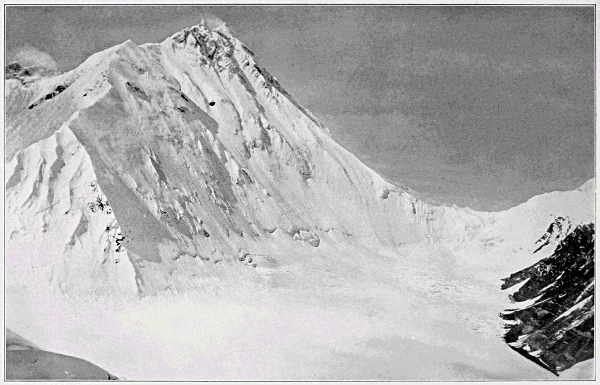
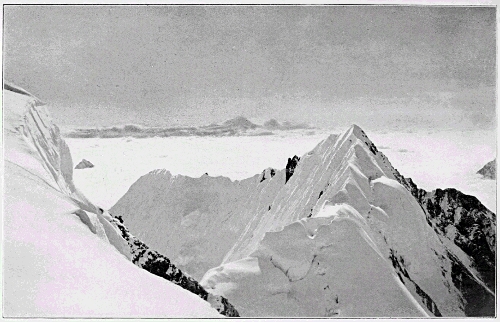
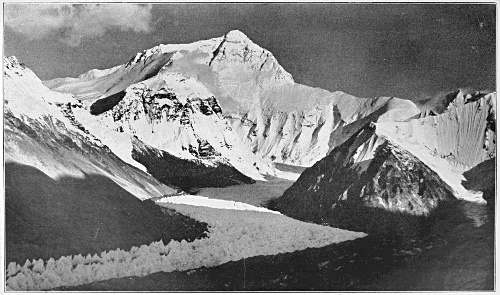
North-east of Mount Everest and Chang La
from Lhakpa La.
It remained to determine by which of two possible routes
we should reach the glacier-head between Lhakpa La and
Chang La. Presuming that Wheeler was right we could
use the old base at the foot of the Rongbuk Glacier which
was only one stage, though a very long one, from Chöbuk,
and proceed simply enough by two rough marches and one
which should be easier to a camp at the foot of the wall or
possibly to the col itself. On the East we could use as an
advanced base a place two easy marches from Kharta;
from there I reckoned one long day and two easy ones,
provided the snow were hard, to Chang La. Against this
route was the loss of height in crossing Lhakpa La; and
for it the convenience of a good encampment on stones at
20,000 feet, better than anything we might expect to find
at a similar elevation on the other side. So far the pros
and cons were evenly balanced. But there was one great
and perhaps insuperable obstacle in working from the
Rongbuk Valley. We had always found difficulties there
in obtaining an adequate supply of fuel. There is no wood
at Chöbuk or for some distance below it. A few small
bushes grow in a little patch of vegetation by the riverside
an hour higher up. But it is a very niggardly supply, and
when I thought of the larger scale of the preparations we
should now have to make, it became clear that we should
have to rely on gobar, which, besides being a more extravagant
fuel in the sense that it gives less fire for a given weight
than wood, is also difficult to get in the Rongbuk Valley,
for little enough is to be found there, and the monastery
at Chöyling is a large consumer. On the other hand, in
the Kharta Valley we were in a land of plenty. Gobar and
rhododendron were to be had within a stone's throw of our
present advanced base camp, and a little lower was an
abundance of juniper. Food supplies also were better
here; fresh vegetables and eggs, luxuries never seen on
the other side, could easily be obtained from Kharta, and
even the sheep in this region could be praised at the expense
of the Rongbuk breed, which was incomparably skinny;
lurking in the thigh of one recently killed we had actually
discovered a nugget of fat.
And presuming Wheeler were wrong? In any case we
knew enough of the country to be sure that a valley further
to the North would offer us little better than the Rongbuk
Valley, for it must be situated in the drier area unvisited
by the monsoon currents from the Arun. The conclusion
was drawn as we came down from Lhakpa La more swiftly
than the reader of these arguments might suppose. We
had now found a way to approach Chang La—not an ideal
way, because it would involve a descent, and not one that
could be used immediately; but good enough for our purpose.
If laden coolies could not be brought to the Lhakpa at
present over so much soft snow they might find the march
to their liking later; for good snow at angles not too steep
involves far less labour than rougher ground; and might
we not expect the snow to harden before long? The whole
plan of campaign had been founded upon the belief that
September would be the best month for climbing, and our
greatest efforts, some sort of an assault upon the mountain,
were timed to take place then. We must now proceed
upon the assumption that what the wise men prophesied
about the matter would come true; and they promised a
fine September. About the beginning of the month the
monsoon would come to an end; then we should have a
succession of bright, clear days to melt the snow and cold,
starry nights to freeze it hard. At worst the calm spell
would only be broken by a short anger. In September,
perhaps a fortnight hence, on these same slopes where now
we toiled we should find a solid substance beneath our feet
and an easy way.
The abiding thought, therefore, after the first rush
downwards on the steep slopes below the col contained a
measure of solid satisfaction. We had now brought to an
end our preliminary reconnaissance. Ahead of us was a
new phase in our operations, and one which should hold in
store for us the finest adventure of all, the climax of all
reconnoitring expeditions, that advance which was to bring
us as near to the summit as our strength would take us. As
we plodded on, retracing our steps, some little satisfaction
was highly acceptable. To the tired party even descent
seemed laborious. We reached the edge of the glacier
where we had come on to it at 5.30 p.m. But the march
from there to our lower camp was both long and rough.
Major Morshead, who had not been trained with Bullock
and me to the pace of such expeditions, had kept up so far
in the gamest fashion; but he was now much exhausted.
The day ended with a series of little spurts, balancing over
the snow-sprinkled boulders along and along the valley,
in the dim misty moonlit scene, until at 2 o'clock in the
morning we reached our lower camp, twenty-three hours
after the early start.
On August 20 we went down to Kharta for ten days'
rest and reorganisation. The party was gathering there
for the assault, in which all were to help to the best of their
powers. Col. Howard-Bury and Mr. Wollaston were there;
Dr. Heron came in on the following day, and a little later
Major Wheeler. A conversation with this officer, who had
been working in the Rongbuk Valley since Bullock and I
had left it, was naturally of the highest interest, and he
now confirmed what his sketch-map had suggested: that
the glacier on to which we had looked down from Lhakpa
La drained into the Rongbuk Valley. But this certain
knowledge could have no bearing on our plans; we remained
content with the way we had found and troubled our heads
no more for the present about the East Rongbuk Glacier.