The French Scheme—Notes on French Vehicles—Benzol
and Alcohol Fuels—The German Scheme,
Difficulties and Results—Austria, Italy, and
Russia.
The French subvention scheme, for reasons
already explained, has to be more comprehensive
in its financial clauses than that
in force in Great Britain. Without going
into details, it may be summed up in the
general statement that the subsidy paid
in respect of a lorry of about 3 tons capacity
aggregates about £300, spread over a period
of four years.
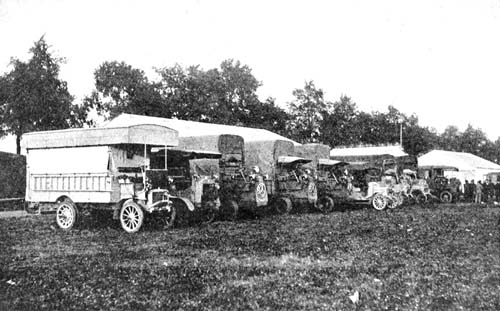
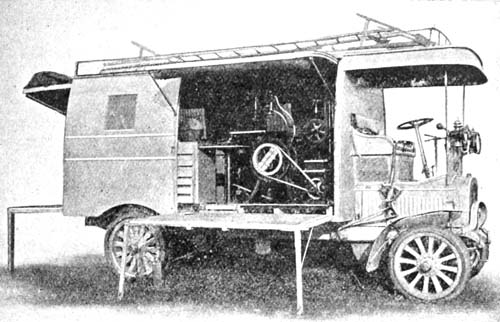
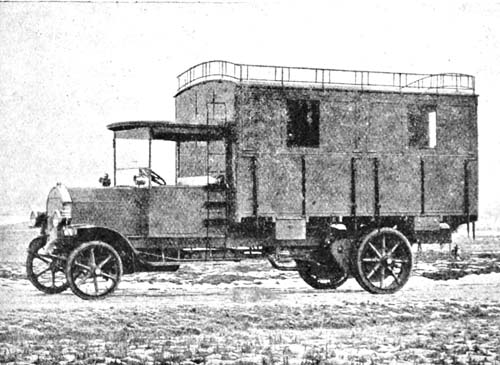
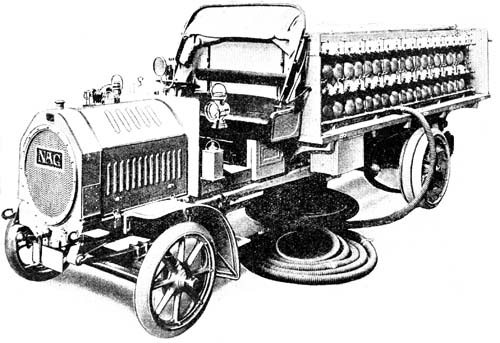
“The Autocar” photograph.
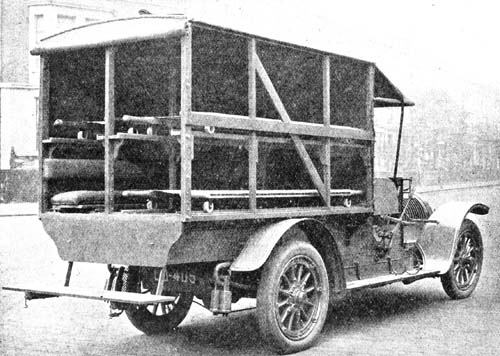
A GERMAN LORRY FITTED FOR REPLENISHING THE SUPPLY OF GAS IN THE ENVELOPES
OF ZEPPELIN AIRSHIPS.
The French Government have specialised
for many years past in machines of this and
somewhat lighter load-carrying capacity,
and more recently they have made serious
and fairly successful efforts to encourage
the employment of powerful vehicles in
which the engine power is arranged to
drive all four wheels, and which can be
used either as lorries or as tractors, or
as a combination of the two. The genius
of the French motor engineer, in the
opinion of the writer, expresses itself better
in the high-speed touring car than in the
industrial vehicle. There are excellent examples
of the latter to be found, but the
average quality of the products of well-known
manufacturers is almost certainly
not equal to that of corresponding British
firms. A comparison of the relative importance
of the two national industries
was possible to those who had opportunities
of visiting the Industrial Vehicle Show in
London in 1913, and subsequently of inspecting
the exhibits in the annexe of the
Paris Motor Salon later in the same year.
On these occasions, as well as during
previous opportunities of watching French
subvention vehicles undergoing trial, the
writer formed the opinion that in many
cases the various features of design in any
particular vehicle of French origin are
peculiarly unequal. In some portions of
the chassis we find adequate or even
unnecessarily great strength; in others,
unduly light construction and a certain
disregard of details making for safety in
operation. In many instances the steering
mechanism is unnecessarily exposed, and
placed very far forward so as to be liable
to injury in the case of slight collision or
passage over any considerable obstruction.
The chain drive is very popular among
French manufacturers. The chains are
usually not protected by cases, and in
very many instances an attempt is made to
obtain through the medium of the chain a
very large gear reduction, resulting in the
use of absurdly small chain pinions, which
will certainly need frequent renewal under
the conditions of rough service. In some
instances again, the chains themselves are
too light for durability. There is also
a certain disregard for accessibility of the
engine and clutch, and a tendency to
employ pneumatic tyres on vehicles designed
for heavy loads which would be
carried with far less risk of roadside trouble
on a rather more substantially constructed
solid-tyred vehicle with a good springing
system.
Admitting that the French Government
could not stipulate any degree of standardisation
until they had first obtained a
numerically adequate supply of vehicles,
one would have thought it possible at
least to do something towards standardising
the driving control. In some French subvention
models, the hand-brake lever is
nearer to the driver than the change-speed
lever; in others, the opposite arrangement
is adopted. Frequently, both levers are of
equal length and almost indistinguishable
to the touch, which must make it far more
dangerous to put a new driver on to a
subsidy car when required urgently for
night work.
The French subvention trials have been
held annually, usually in the months of
August and September, and have not been
as a rule of a very arduous character.
While accompanying the competing vehicles,
the writer has been forced to the conclusion
that the object of the authorities was rather
to pass for subvention any reasonably
efficient machine, than to weed out a considerable
number and depend only on the
most durable. As a rule, during these
trials, the competing lorries are parked at
Versailles, from which centre they run out
daily over a limited number of routes,
generally of a very easy character so far as
gradients are concerned. An interesting
and potentially valuable feature of the
annual French trials has been the compulsory
use on all the cars of a variety of
fuels. On some days petrol has been
used, on others benzol, and on others
again a half-and-half mixture of benzol
with denatured alcohol, which latter for
practical purposes may be regarded as the
same thing as methylated spirits. In this
way, the French Government have endeavoured
to make themselves at least partially
independent of any temporary stoppage
in the imports of petrol, though so far
as we can see at present no such stoppage
is in the least degree likely during the
present war. Benzol can of course be
produced in limited quantities in this
country and in France, and if the emergency
arose, the supplies of benzol could be
greatly increased at the expense of simultaneously
laying up stocks of other products
not at the moment marketable.
As regards alcohol, a considerable quantity
of beet is grown in France, from which
either sugar or alcohol can be produced.
As a rule, this beet is used mainly for sugar
manufacture, since this is the more profitable
method of employing it, but in emergency
it could be utilised for the production
of a very fair quantity of commercial
alcohol, thus, roughly speaking, doubling
the available stock of home-produced
fuel.
The results of these tests have been, on
the whole, very interesting. In almost
every case, benzol has given better results
than petrol, while the benzol-alcohol mixture
has given results in some cases rather
better than petrol, and in other cases not
quite so good. On the average, the mixture
has shown itself approximately equal to
petrol, so far as consumption is concerned.
By visiting Versailles in the early hours
of September mornings when the temperature
was fairly low, the writer satisfied
himself that the use either of benzol or of
the mixture did not constitute any serious
difficulty in the way of starting up the
engines. Moreover, the general absence of
offensive smell or smoke seemed to indicate
satisfactory combustion of the fuels.
As to the results of the French subvention
scheme, the fact that the regulations have
recently been made more severe, and certain
restrictions as to horse-power, weight, etc.,
introduced, seems to indicate that the
number of vehicles available at the time
of the outbreak of war must have been at
least approaching the number estimated
as required. The last series of trials were
only just over when war broke out. In
these trials some sixty vehicles competed,
representative of a considerable variety
of makes and types, including a small
number of Colonial lorries of special design,
and one or two tractors. On the whole,
the vehicles went through the trials well,
and the opinions of experts who were
present were all to the effect that great
improvement was noticeable in mechanical
details as compared with previous years.
Incidentally, it may be mentioned that
the big fleet of the Paris General Omnibus
Co. forms a very useful and conveniently
concentrated supply of substantial cars
available either for the rapid carriage of
troops, or—by the substitution or conversion
of bodies—for the transport columns.
Numerically, however, the Paris omnibus
fleet falls very far short of that of London,
while from the mechanical point of view
the vehicles are of heavier construction,
and one would imagine less easily handled
on narrow and winding country roads.
In Germany, a motor transport subvention
scheme was inaugurated in 1908.
At that time a limited number of German
manufacturers were producing considerable
quantities of heavy motor vehicles, more
especially for export, but it was becoming
evident that some very substantial encouragement
would be needed to make
the home market sufficiently active to be
of any real utility to the War Office.
Consequently, a scheme was got out which
was openly stated to be “a scheme for
popularising the use of mechanical transport,”
or, in other words, a scheme for
persuading business houses to adopt a
species of transport which, without Government
aid, would represent an uneconomical
and consequently undesirable feature of
an industrial concern. The German Government
decided in favour of heavy motor
lorries, capable of carrying 4 tons and
hauling an additional 2 tons on a trailer.
These trailers, contrary to usual commercial
practice, are fitted with rubber tyres, since
this addition is found to ease the work of
hauling by some 25 to 30 per cent. The
total subsidy for a subvention train consisting
of a power lorry and rubber-tyred
trailer amounts to something in the neighbourhood
of £450 spread over a period of five
years. The choice of a heavy type of
vehicle was probably justified by the need
for limiting the length of the transport
columns destined to accompany enormous
armies. At the same time consideration
has evidently shown that there are grave
disadvantages to the use of such heavy
cars, and recent regulations have provided
more stringent stipulations as to maximum
weight.
When the subvention scheme had been
in operation for five years, figures were
got out indicative of its results up to the
end of March, 1913. During this period
825 army trains were subsidised, namely,
743 in Prussia and the other states whose
armies are under Prussian control, and 82
in Bavaria. In addition, some 400 lorries
of very similar types were sold in Germany
outside the scheme, making about 1,200
trains available for use at that time. Allowing
for increase in the interval which has
since elapsed, we may perhaps put the
total available at the outbreak of war
at about 1,600. Captain Davidson estimates
that the German Army requires for
transport purposes about 2,000 of its trains,
but this figure presumably does not take
into account the needs of the whole of the
Landwehr and Landsturm. It is admitted
that the normal British Expeditionary
Force requires about 1,000 3-ton vehicles,
which would correspond in capacity to
about 500 of the German trains. Consequently,
2,000 of the German trains would
apparently only be about sufficient for
an army four times the size of our Expeditionary
Force. Similarly, the estimate that
France needs about 5,000 vehicles of the
3-ton type apparently does not take
into account the complete mobilisation of
reserves.
The manufacturing concerns which have
figured most largely in the German scheme
are the German Daimler, the Büssing, the
N.A.G., and the Gaggenau. These four
have all been participating in the scheme
from the start, and about ten other manufacturers
have more recently fallen into
line, while in Bavaria only three manufacturers
have been building to official
requirements. The states the industries
of which have enabled the strongest support
to be given to the scheme are Brandenburg,
Saxony, the Rhine Province, Würtemberg,
Westphalia, Baden, and Alsace-Lorraine.
No less than 41 per cent. of the total
machines enrolled are normally used in
the brewing trade. In this connection, an
official report from Bavaria is rather instructive
and amusing:
“There are so many breweries in
Bavaria, and these are so densely
distributed, that there is no need
anywhere to convey beer for long
distances. Hence there are practically
no vehicles employed.”
This seriously expressed implication that
beer is the only really essential commodity
seems to show that lack of humour which
appears to be a national characteristic
of the German race.
Next after the brewing interests, but far
behind in their practical support of the
Government scheme, come concerns engaged
in the transport of goods for export,
followed by those concerned in brick transport,
flour manufacture, carriage of building
materials, agricultural work, and haulage
of iron and steel goods.
In endeavouring to estimate how far
the existing fleet meets the requirements
of the Germany Army, we have to remember
that it consists, at least partially,
of machines that have been in service for
several years, and that consequently may
not be equal to any long strain under
peculiarly difficult conditions. It must be
presumed that the German Government
has made provision for the continued
manufacture of considerable numbers of
heavy motor lorries throughout the war,
and has not permitted the leading motor
works engaged in this class of production
to be too far denuded by the mobilisation
of their men.
The Austrian subsidy scheme is along the
same lines as that in force in Germany,
but favours a lorry of slightly lower carrying
capacity, probably in view of the mountainous
nature of many of the frontier roads.
The total amount of subsidy payable is
in the neighbourhood of £360 spread over
a period of five years. The scheme was
inaugurated some time after those of France
and Germany, the first trials being held
towards the end of 1911. Certain parts of
Austria are well provided with roads, so
that there is a fair field for the commercial
use of motor transport. A large number
of vehicles, not of subsidy type, but no
doubt capable of being made useful for
light work in time of war, are used for the
carriage of mails in Hungary. In the
Austrian Tyrol, there are numbers of motor
services for the carriage of mails and
passengers, but on the whole Austria is
probably not very well provided with
mechanical transport. Her manufacturing
industry is limited, and she imports in fair
numbers from her neighbour, Germany.
Italy can only find very small use for
heavy motor vehicles in commercial service,
and consequently it would be futile as yet
for the Government to depend upon anything
in the nature of a subsidy scheme.
During the Tripoli campaign, a considerable
number of rather lightly built lorries were
obtained by direct purchase and proved
very serviceable. Probably they are not
of a type which would be by any means
ideal in a European war, though they were
doubtless the right thing for work over
loose sandy tracks where heavier machines
might well have become inoperative.
Russia also has no subsidy scheme on
account of its comparatively poor industrial
development, and also the very inadequate
quantity and quality of its roads. For
such vehicles as are used, the country
is dependent upon import, while the army
must depend solely on direct purchase from
foreign manufacturers. It is rather interesting
to note that out of about 2,000
industrial motor vehicles exported by Germany
during the year 1913, no less than
25 per cent. went to Russia, practically
the whole of these being known to represent
Government orders. Russia has been buying
motor lorries for military use from
British firms for many years past. An
engineer who accompanied one of the first
vehicles supplied from this country, describes
the roads over which the car had to
work during its official trials as follows:
“The road was covered with fine
sand, banked up a few feet above
the level of the surrounding country,
in which the wheels of peasants’ carts
had cut ruts about 12 ins. to 14 ins.
in depth. The gauge of these ruts
being narrow, it was necessary to
drive with one pair of wheels in the
ruts, the other pair meanwhile cutting
ruts of their own. At intervals planked
bridges had to be crossed. These were
old and unsafe; therefore, it became
necessary to lay down a temporary
track of boards to distribute the weight
over as many planks as possible.”
At first sight it would appear that under
such conditions the purchase of motor
lorries by the Russian Government represents
a waste of money, but the facts are
explained by a credible story circulated
within a few days of the outbreak of war
to the effect that the Austrian military
attaché a day or so before leaving Petrograd
expressed surprise that so many
motors were being mobilised. “Your roads
are so bad,” he said. “Yes,” was the
reply, “but yours are good.”