THE DALES
In the motorist's life there are hours that
can never be forgotten. It may be some
hour of sunshine that haunts us, when the
warm wind, we remember, was heavy with
the scent of gorse or pungent with the stinging
breath of the sea; or some hour when
the road lay white and straight before us
across a moor, and the waves of heather
rolled away from us to the horizon in long
curves of colour, and as we sped over the
miles we seemed no nearer to the shore of
the purple sea nor to the end of the white
straight road; or it may be, perhaps, the
hour of our gradual approach to some ancient
city transfigured in the sunset, "soft as old
sorrow, bright as old renown." But, whatever
the scene may be, whether moor or fen,
forest or shore, there are two elements which
are always present in the motorist's memory
of a happy run—a good surface, and a good
engine.
No one could travel in Yorkshire, I think,
without adding to his store of unforgotten
hours. So great is the variety of scenery
and interest that all must somewhere find
the landscape that appeals to them. Some
will remember those moors of Cleveland that
have no visible limit, and some the many-coloured
dales of the West Riding, and some
the straight roads of the plain where the
engine hums so gaily. Some will ever after
dream of the day when they followed the
course of the wooded Tees; others will dream
of the distant towers of York or Beverley,
or of the heights and depths of the Buttertubs
Pass. And, to be quite frank, there are
some to whom this last exciting dream will
be rather of the nature of a nightmare.
In more ways than one Yorkshire is a good
field for motoring. Throughout the greater
part of the county there are few hedges, and
the stone walls that take the place of these
are low. The roads are wide and their surface
good, except in unfrequented places. Now in
Yorkshire the places that are unfrequented
are very few indeed, and it is in connection
with this fact that the motorist has the
greatest advantage over every other kind of
tourist. He can choose his own time for
visiting Bolton or Fountains or the incomparable
Rievaulx; he can see them when the
dew is on the grass and the glamour of solitude
is in the woods. To be alone with our
emotions is what we all desire in the presence
of wide spaces or stately aisles; and in this
county, where there is so much beauty to be
seen and so many to see it, those only who
possess "speed as a chattel" can ever hope
to be alone. It is almost impossible to lay
too much stress on our advantages, as motorists,
in this matter of securing peace.
Looking back upon a tour among the Yorkshire
dales, I see that the keynote was struck
at the very outset by the little town of Skipton,
with its grey granite houses and slated
roofs, its wide street and the castle above
it, the ancient church and the tombs of the
great. Such are a hundred Yorkshire villages
and little towns. Each of them, it seems, is
connected with some historic name. In the
case of Skipton the name is Clifford. If the
first builders of the castle and the church
were not Cliffords, but de Romilles, it was the
Cliffords who made both castle and church
what they now are. It was a Clifford who
built the long gallery and the octagon tower
that we see beyond the grass of the great
outer court; it was a Clifford who repaired
all the other towers; a Clifford who devised
the curious shell-pictures that line the guardroom;
Cliffords who lived for centuries in the
castle, and the few Cliffords that died in their
beds who enriched the church with their
tombs. Their motto, "Désormais," stands up
against the sky in letters of stone above the
round towers of their gateway, and their
arms are carved above the inner door.
The court on which this door opens, the
"Conduit Court," as it is called, is the very core
of Skipton, and one of the most romantic
places I have ever seen. It would seize the
dullest imagination—this little paved enclosure
shut in on every side, the long flight
of steps, the doorways with the crumbling
carvings, the mullioned windows, the yew-tree
that has seen so many centuries, the low
stone seat with its shields, the Norman archway
through which all the Cliffords have
passed. Most of the feet that came this way
awoke ringing echoes under the old arch,
for the Cliffords were wont to be dressed
in coats of mail. They were all mighty in
war. The first armour-clad baron of the
name, he who began the building of this
court and died at Bannockburn, has clattered
through this doorway; and after him the
hero of Créçy; and later on that other who
fought for Henry V. and died at Meaux; and
he who fell at St. Albans in the cause of
Lancaster; and his son and avenger, called
"the Butcher," who slew that "fair gentleman
and maiden-like person," the young Earl
of Rutland, and was himself slain at Towton;
and the great sailor, Cumberland, who made
nine voyages and fought the Spaniards for
Queen Elizabeth. Here, too, when he came
to his own at last, has stood that strange,
romantic figure, the Shepherd Lord, who
spent his youth in hiding among the northern
hills, yet who, despite his love of solitude and
learning, could not forget his long ancestry
of fighting men, and himself fought on
Flodden Field.
Among all these heroes the kings who have
come through this doorway cut rather a sorry
figure: Edward II., a sorry figure in any
company; Richard III., a usurper here as in
larger courts, playing the master while the
true lord of Skipton was keeping sheep; and
Henry VIII., who came here to take part in
a wedding—a spectator for once. The bride
on this occasion was his niece, Eleanor
Brandon, the daughter of that love-match
that was so great a failure, between the
Duke of Suffolk and Mary, Princess of
England and Queen Dowager of France.
The wedding ceremony took place in the
long gallery, which was built for the occasion
by the bridegroom's father. Lady Eleanor's
granddaughter, Lady Pembroke, was more
closely connected with this spot where we
are standing than any Clifford who came
before her.
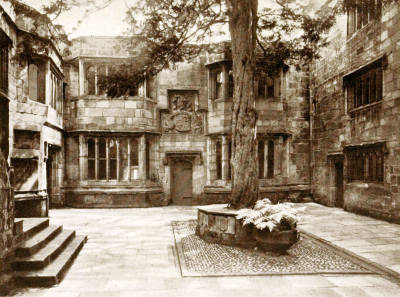
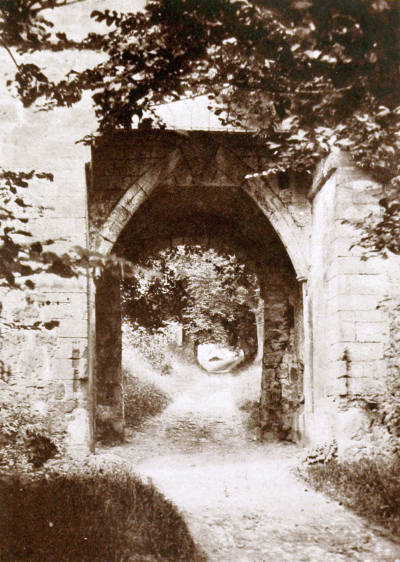
THE CONDUIT COURT, SKIPTON CASTLE.
Anne Clifford, Countess of Pembroke, who
rustled through this archway many a time,
no doubt, while the castle of her ancestors
was being repaired at her charges, was a
very busy woman. "Her house was a home
for the young, and a retreat for the aged;
an asylum for the persecuted, a college
for the learned, and a pattern for all." She
restored six castles, we are told, and built
seven churches and two hospitals; she erected
a monument to Spenser; she wrote some
memoirs, too, with a record of all these
things, and wherever she made her mark
she stamped her initials. You can see them,
very large and clear, if you look overhead
upon the leaden spouting of this court, and
you may see them again in the windows of the
church. Anne Clifford's disposition was in no
respect a retiring one, as we may gather from
her famous answer to the Secretary of State
who wished a nominee of his own to stand
for her borough of Appleby. "I have been
bullied by a usurper," she said, "and neglected
by a Court, but I will not be dictated to by
a subject. Your man shall not stand."
Her work in restoring her castle of Skipton
was no light undertaking, for it had lately
endured a three years' siege by the army of
the Parliament, and its seven towers must
have been sadly battered before the day of
its proud surrender. So defiant was that
surrender that the garrison marched out
through the great entrance gate beneath
the motto of the Cliffords, "accordingley to
the Honour of a Souldier, with colours flying,
Trumpets sounding, Drums beating, Matches
lighted at both ends, and Bullets in their
Mouthes," while the commissioned officers took
with them "their wearing apparell that was
properley their owne in their Portmantles."
One other pious work did Anne perform.
She made a magnificent tomb for her father
the Admiral, third Earl of Cumberland—who
fought the Armada with the Queen's glove
in his hat—and she set upon it seventeen
armorial shields, all gilt and painted, and
a mighty black marble slab, and a list of
honours. We may see it in the chancel of
the church she repaired; this grey church
that stands so picturesquely at the end of
the long street, with the hollyhocks and
daisies brightening its dark walls. Opposite
to the grave of Lady Pembroke's father is
that of her little brother, "an infant of most
rare towardness in all the appearances that
might promise wisdome"; and near to this
is the splendid tomb, with restored brasses,
of the first Earl of Cumberland. Such of
the earlier Cliffords as found burial at all,
including the Shepherd Lord, were laid in
Bolton Abbey, whose monks were connected
with this church and gave it the delicately
carved screen that adds so much to its
beauty.
It is sometimes said or hinted that Jane
Clifford, the Rose of the World, was in some
way connected with Skipton. This can hardly
be the case, however, for the Fair Rosamund
was born and spent her childhood on the
banks of the Wye, and was laid in her
temporary grave at Godstowe long before
Edward II. gave this castle to the Cliffords
who came after her.
From Skipton, where homely comfort may
be found at the sign of the "Black Horse," an
expedition should be made to Malham and its
famous Cove, about twelve miles away; and
if time allows, the run may be lengthened
very enjoyably by rejoining the main road
at Hellifield and skirting the moors as far
as Clapham or Ingleton. In this way we
shall see something of the craggy country of
Craven, of which Camden wrote long ago:
"What with huge stones, steep rocks, and
rough ways, this place is very wild and
unsightly." The huge stones and steep rocks
are still there, but the way by which we go
is very far from being rough; it is, on the
contrary, such an exceptionally fine road that
it seems almost a pity to leave it. Those
who wish to see Malham, however, must turn
off at Gargrave or Coniston.
Much has been written concerning Malham
Cove, and many long adjectives used. Some
writers have even declared themselves terrified
by it; but these, I think, must have been
of a timid temperament. It is the position
of the place, no doubt, that has this overwhelming
effect upon some minds: the sudden
and unexpected presence of a great semi-circular
cliff amid quiet undulating fields. If one
could be carried blindfold to the foot of it
I can imagine that it would be truly imposing;
but it is visible from a distance as a grey
scar on the face of the green hillside, and
thus a good deal of its effect is lost in the
course of a gradual approach. The best way
to reach it is to walk across the fields from
Malham village, following the course of the
Aire, the stream that tunnels its way so
strangely into the Cove. There is, it is true,
a narrow and steep road which commands
a fine view of it as a whole, but there is
no room here for any but a small car to
turn, and there is no doubt that the cliff
can best be seen on foot.
This is true also of its more imposing
neighbour, Gordale Scar. Says Wordsworth—
"Let thy feet repair
To Gordale chasm, terrific as the lair
Where young lions couch,"
and indeed, as the hill that approaches Gordale
Chasm is nearly as terrific as the chasm
itself, it is certainly best, if not imperative,
to repair to it on thy feet. I believe that the
tarn which lies upon the moor above Malham
Cove, and long ago belonged to the monks
of Fountains, may be reached by road, but
I have not been there myself.
From Malham the way is narrow and surprisingly
tortuous as far as Hellifield, but
here we rejoin the splendid high road we
left at Coniston, and speed along it through
Ribblesdale to Settle. This small town has
progressive ambitions. It "treats" the surface
of its main road, it lights its streets
by electricity, it has a fine new garage and
a hotel that has the air of being nice. It
is attractive, too, and pretty as well as praiseworthy,
with hills behind it and a tiny weir
above the bridge. Beyond it we pass the
ebbing and flowing spring of Giggleswick in
its stone basin by the wayside; climb the
long hill under the grey crags of Giggleswick
Scar, with a splendid backward view, and
run down by wood and beck to Clapham,
where the village cross stands close to the
stream in the shadow of the trees. Not very
far away is the famous cave, bristling with
stalactites. After leaving Clapham we cross
a wide heath, with the throttle open.
First and last this is a good run. On the
left is the open country; on the right that
wild land of huge stones and steep rocks that
seemed to Camden so unsightly, in an age
when the whole duty of a landscape was to
smile. Clambering on the hillside in a cleft
of the crags are the narrow, winding streets
of Ingleton, and a viaduct spanning the
valley. This valley, which is hardly wider
than a gorge, is said to be well worth
exploring; but neither its waterfall, Thornton
Force, nor its caves of Yordas and Weathercote,
can be seen by road. They hardly
concern us here. It concerns us rather to
return to Skipton, and thence to strike up
into the heart of the hills.
Climbing the road above the castle we see
how Skipton lies in a hollow among the
moors. Behind us to the south is the Brontë
country; Haworth and its graves far off
beyond Airedale, and Stonegappe only three
miles away. It was at Stonegappe that
Charlotte reluctantly taught the little Sidgwicks,
and no doubt made them suffer nearly
as much as she suffered herself from her
over-sensitive feelings. Embsay Moor appears
on our right as we rise, and beyond it the
savage outline of Rylstone Fell, with the
ruined watch-tower of the Nortons, the foes
of the Cliffords, showing desolately against
the sky upon the topmost crag. Of the
Nortons and their tower, and the daughter
of their house, and of the White Doe of
Rylstone and her weekly journey across the
moors to the grave of the youth with whom
the Nortons ended, Wordsworth has told us.
We are running down now into "the valley
small," where the house of the Nortons once
stood, and here is the Church where
"the bells of Rylstone played
Their Sabbath music—God us ayde!"
At Threshfield we turn to the left and are
in Wharfedale.
The names of all these Yorkshire Dales
are very familiar in our ears. Wharfedale,
Wensleydale, Swaledale, Teesdale—they are
all words with a charm in them. And here,
as we glide out of a wood, is Wharfedale
spread before us; and we know at last that
it is not only in the name that the charm
lies.
The river flows below through the wide
valley and winds away in shining curves into
the far distance, past the bluff outline of
Kilnsey Crag, past the dark belt of firs, till
it vanishes among the folds of the jewelled
hills. For in their liquid brilliancy the
colouring of all these dales is that of gems,
of amethyst and emerald, of sapphire and
turquoise and opal; and the sunlight that
floods them on the days when we are
fortunate has the luminous gold of the
topaz. As we drive under the overhanging
crag of Kilnsey—"the highest and steepest
that ever I saw," says Camden—and pass the
tiny village where the sheep belonging to the
Abbey of Fountains used to be shorn, the
hills begin to close in, till, as we draw near
Kettlewell, they rise round us so protectively
that we seem to have entered a new and
calmer world. Kettlewell itself is so calm as
to appear asleep. Its grey houses, shadowed
by trees and sheltered by the mighty shoulder
of Great Whernside, are defended from every
wind, and from every sound but the rippling
of the Wharfe. Beyond this peaceful spot,
where we cross the river, the road is rather
rough, and after passing through pretty
Buckden it is also extremely narrow. However,
it leads to Hubberholme, and no more
than that need be asked of any road.
At Hubberholme the river is still wide, and
thickly strewn with stones; the slopes of the
hills are very near and steep, and are clothed
with bracken and fir-trees, and deeply cleft
by tiny becks; masses of wild flowers fringe
the banks with clouds of mystic blue; and
beyond an old stone bridge stands the church,
low and grey, with a paved pathway and a
porch bright with crimson ramblers. The
rough walls have stood in this lonely spot
for many centuries. The door is open, and
we may see for ourselves the strange state
of the masonry within, whose builders, when
they left it thus rugged and unplastered,
little thought that its unfinished appearance
would be tenderly cherished by the antiquarians
of a future age. A rare rood-loft
of oak divides the tiny chancel from the
nave. This loft dates from the year 1558,
the last year that the Old Faith reigned in
England; and in this remote hiding-place
among the hills it escaped the vigilant eye
of Elizabeth and the destructive hands of
the Puritans.
On returning to Kettlewell we shall find
it worth our while to continue the journey
down the dale on the road that passes
through Conistone, for though it is not so
good, as regards surface, as that on the right
bank of the river, it commands a different—and
a very lovely—series of views. From
Grassington we cross to Linton, on the right
bank, where there are some little falls whose
prettiness is hardly striking enough to
allure us from our way; and at Burnsall
we should keep to the same side of the
stream rather than follow the public conveyances
to the left bank. Horse-drawn
travellers may well be excused for shirking
the hill above Burnsall; but few gradients
have any terrors for us, and the backward
view of Wharfedale from the high hillside
is more beautiful than anything we have yet
seen in Yorkshire. The two roads meet near
Barden Tower, the beloved retreat of the
Shepherd Lord.
Henry, the tenth Lord Clifford, was a very
small boy when his father, "the Butcher," lost
his estates, his cause, and his life, on the blood-red
grass of Towton. It was not without
reason that John Clifford was surnamed "the
Butcher." It was in vain that young Rutland
knelt to him for mercy on Wakefield Bridge,
"holding up both his hands and making
dolorous countenance, for his speech was
gone for fear." "By God's blood," snarled
Clifford, "thy father slew mine, and so will
I do thee and all thy kin!" And he plunged
his dagger into the boy's heart. "In this
act," says the historian, "the Lord Clifford
was accounted a tyrant and no gentleman.
With his hands still dyed with the son's blood
he savagely cut off the head of the dead
father, the busy, plotting head of Richard,
Duke of York, and carried it, crowned with
paper, 'in great despite and much derision,'"
to the Lancastrian Queen. "Madam, your
war is done," he cried, "here is your King's
ransom!" Margaret of Anjou, for all her
manly ways, became rather hysterical at the
hideous sight, laughing violently with pale
lips; and Clifford's triumph was short.
While he lay with an arrow through his
throat upon the field of Towton—which we
shall see later on—his little son was hurried
away to a shepherd's hut in the north, where
in the course of twenty-five years or so on
the hillside he learnt more than the tending
of sheep. He became the gentlest of his
line, a lover of learning, a watcher of the
skies; and though at last Skipton came back
to him, and Brougham, and Pendragon, and
many another castle, he lived here quietly
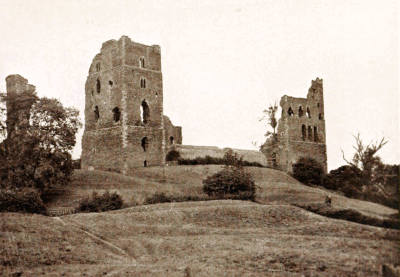
in this simple tower above the wooded
Wharfe, befriending the poor, reading his
books, and now and then reading the stars
as well, with his friends the monks of Bolton.
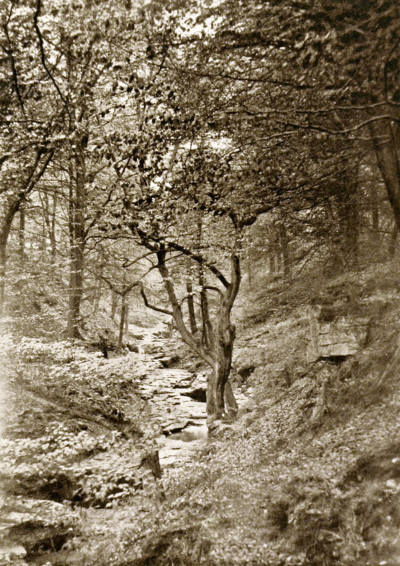
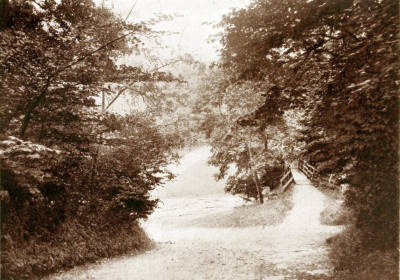
FROM THE ROAD NEAR BARDEN TOWER.
"And ages after he was laid in earth,
The good Lord Clifford was the name he bore."
His descendant, the notable Lady Pembroke,
whose initials are so conspicuous at
Skipton, expended some of her energy here
at Barden. This was one of the six castles
she restored, and over the door we may read
the inscription she placed there according to
her habit, with all her names and titles
recorded at length, and a reference to a
complimentary text about "the repairer of
the breach."
Those who wish to see the famous Strid—and
none should miss the sight—may leave
their cars by the wayside at a point not very
far from Barden Tower; but this is not the
course I recommend. The Bolton woods are
beautiful beyond description, and it is only
by walking or driving through them from
the Abbey to the Strid, or even to Barden
Tower, that one can fully enjoy their ferny
slopes and serried stems, and the little shining
streams that slip through them to the
Wharfe. George Eliot and George Lewes
once spent a whole day wandering together
along these paths, and we might follow in
their footsteps very happily, I think. Those
who prefer to drive must hire carriages, for
motors are not admitted to the woods; but
the existence of a very nice little hotel at
Bolton Bridge makes everything easy.
By one means or another the Strid must
be seen. Here the Wharfe is contracted into
a narrow cleft, an abrupt chasm between
low masses of rock; and the angry river,
suddenly straitened in its course, has in its
convulsions bitten into the stone till it is
riddled with a thousand holes and hollows.
When the river is low it is possible to leap
across from rock to rock. This is the leap
that Alice de Meschines' boy attempted but
failed to achieve so many years ago, when
the hounds he held in leash hesitated to
follow him, and so dragged him back into
the torrent. "I will make many a poor
man's son my heir," said his mother; and
the priory that her parents had founded at
Embsay was moved by her to Bolton, and
greatly enriched in memory of the drowned
Boy of Egremond. Here is the stone from
which he leapt, they say, and here the stone
he never reached, and both are polished by
the feet of those who have been more
successful. This legend—and I fear the
unkinder "myth" would be the more accurate
word—has prompted several poets to make
verses, but has signally failed to inspire them.
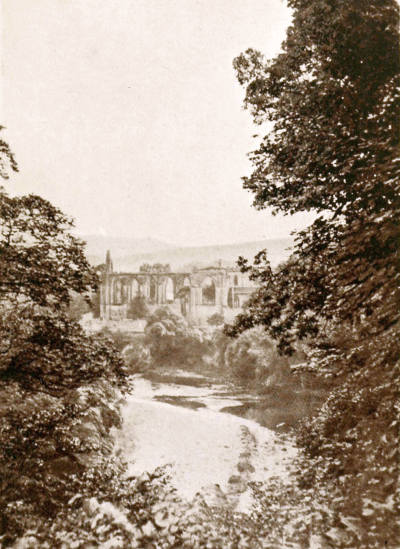
All that is left of Bolton Priory is before
us when we reach the Cavendish Memorial.
Close to this spot, though hidden from the
road, is the log hut known as Hartington
Seat, the point of view whence the ruin
looks its loveliest. We are at the edge of
a wooded cliff. The Priory lies far below
us in its level graveyard, framed in trees;
the river sweeps away from our feet, and
after curving thrice, disappears into the
blue haze of the hills. Between the churchyard
and the foot of the red cliffs beyond
the Wharfe lies the regular line of the
monks' stepping-stones, by which for many
centuries, probably, the congregation of the
faithful came from the hills to their devotions;
and came, too, on other occasions,
laden with fruit or game for the hospitable
table of the prior. Do not go to Bolton on
a bank holiday, nor, if you can help it, in
August, lest you should find as many people
as were there in the days of its splendour,
when the canons and the lay-brethren and
the men-at-arms and the thirty servants
and the unnumbered serfs and the frequent
guests made it a stirring place. Yet it is
always possible to find an early hour when
there is peace in the ruined choir, where
somewhere in the shadow of the arcaded
walls the dust of the Shepherd Lord lies
under the grass. Bolton was sold to the
Shepherd's son, the first Earl of Cumberland,
at the time of the Dissolution, when
the building of the west tower was brought
to a sudden standstill, and the nave, the
parish church, was separated by a wall
from the choir, the monks' church, which
would be needed no more. There stands
the tower, still unfinished; and here is the
nave, now, as then, a parish church, where
for seven hundred years without interruption,
it is said, services have been held
Sunday by Sunday. The beauty of the
interior, unfortunately, is not great. The
Early Victorian Age has left its fatal stamp
upon it. It was not till forty years ago
that the walls were cleansed of whitewash;
and in 1851 a large sum of money was
mis-spent at the Great Exhibition in acquiring
some dreadful glass.
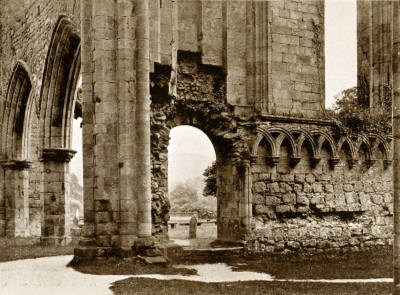
The motorist's route from Bolton Bridge
to Harrogate is undoubtedly the moorland
road by Blubberhouses. The contour-book
describes it as rough and steep; but the
steepness is nowhere very severe, and the
surface is now excellent, while the moors
have their usual charms—charms not only
for the artist, though these are appealing
enough, but special charms for the motorist
too, the delight of an unfenced road and
a wide country. Not that this road lies
altogether on the moors. There are woods
here and there, and soft, green beds of
bracken, and slopes of massive rock; and
presently we pass the great reservoir of the
Leeds waterworks. Then the country opens
out again, and we have a series of fine
wide views till Harrogate appears below
us, occupying a considerable proportion of
the landscape.
Harrogate is exactly what one would expect
it to be: a place of large hotels and fine
shops, a place whose ideals are comfort and
prosperity. Those who like to motor round
a centre—a plan which has many advantages—could
hardly find a better base for
their operations.
"The great merit of Harrogate," wrote
George Eliot, "is that one is everywhere
close to lovely open walks." Our field has
widened since her day, but Harrogate's
great merit is still its merit as a centre.
In this respect it is superior even to York,
though in itself not worthy to be named
with that incomparable city. To the west,
within easy distance, are Nidderdale and
Wharfedale; to the north are Ripon, Fountains,
and Jervaulx, with Middleham and
even Wensleydale for the enterprising; to
the south is Kirkstall Abbey on the outskirts
of Leeds. Byland and Rievaulx may
be seen in a single day's drive, and only
twenty-one miles away is York itself.
Harrogate is so entirely, so aggressively
modern, so resolute to let bygones be bygones,
that one learns with something of a
shock how it came by its name. Harrogate,
it appears, means the Soldiers' Hill on
the Road. The soldiers who lived on the
hill were Roman: the road was the Roman
road through the forest of Knaresborough.
Except for this faint hint of an earlier and
more strenuous life, the history of Harrogate
is the history of its "Spaw." These
crowded acres were a bare, uninhabited
common at the end of the sixteenth century,
when Captain Slingsby, wandering one
day across the Stray, was led by the tewits
to a spring that cured him of his ills,
which had hitherto yielded only to the
waters of Germany. He set a roof over
the precious spot, and so this spring became
the fons et origo of modern Harrogate.
And the Stray, though now in the heart
of a large town, is still uninhabited, still
common-land; for a century after the discovery
of the Tewit Well, when hotels were
already thick upon the surrounding ground,
an Act of Parliament was passed by which
two hundred acres of land were presented
for ever to the people of Harrogate, to
serve for the daily walks of those who
drank the waters.
At Knaresborough, only three miles further
on, we are in a very different world, the
world of old houses and older tales, of
monarchs and saints, of William the Conqueror
and the proud de Stutteville, of
Richard, king in name but not in deed, and
of Oliver, king in deed but not in name—an
inspiring world, one would think. The
first view of the town, too—the river, and
the high, unusual bridge, and the red
houses on the hillside, and above them the
castle that had once so proud a crown of
towers—seems to promise much. Looking
at that fragment of a fortress we remember
those who have owned it; the de
Burgh who built it; the de Stutteville who
fought in the Battle of the Standard; Piers
Gaveston, who is better forgotten; de
Morville, murderer of Beckett, hiding here
from justice; Queen Philippa, whom we are
glad to remember for any reason; John
of Gaunt; Charles I. And we remember
Richard II., a prisoner in the one tower
that still stands, alone with his humiliating
memories.
This one glimpse of the castle and its
past, however, is all that Knaresborough
can give us of romance. It is almost best
to ask no more, for a nearer view of the
crumbling keep will leave us very sad.
The path that leads to it, the path that
took de Morville to safety and Richard to
prison, is neatly asphalted, and lighted with
gas-lamps on stone bases, which the local
guide-book describes as "ornamental." Hard
by the door through which the sad king
passed from his shame at Westminster, and
went forth again to the mystery of Pontefract,
stands a penny-in-the-slot machine.
A custodian will show us the guardroom
and its relics, and even the dungeon; but
we must be careful to look at them in the
right order, or we shall be rebuked. The
wolf-trap must be seen before the Conqueror's
chest, and Philippa's chest before
the armour from Marston Moor. By this
time the glamour has faded. Even the fine
view from the castle rock must be inspected—inspected
is the right word—from
nicely painted seats, placed at regular intervals
in the shelter of clipped evergreens.
The most satisfactory place in Knaresborough
is the Old Manor beside the river,
where the original "roof-tree" round which
the house was built still grows up through
the rooms, and would be taller if a too
zealous workman had not aspired to "make
it tidy." A great deal of beautiful furniture
has been gathered in the panelled rooms,
including the sturdy and simple oak bedstead
in which Oliver Cromwell slept when
he was staying in the house that faces the
Crown Hotel, in the upper part of the
town. Perhaps the bed was brought here
when Oliver's lodging was pulled down and
rebuilt, as happened some time ago. The
floor of his room was carefully preserved;
that floor on which the landlady's little
girl, peeping through the keyhole at "this
extraordinary person," saw him kneeling at
his prayers. It was in this town that he
gathered his troops to meet the Scottish
invasion, and from hence that he marched
out, by way of Otley, Skipton, and Clitheroe,
to defeat the Duke of Hamilton at Preston.
The siege of the castle was not his work:
Fairfax had taken it by assault some years
earlier. Cromwell had sad memories in
connection with Knaresborough, for it was
somewhere in its neighbourhood that his
second boy, Oliver, was killed. "I thought
he looked sad and wearied," said a contemporary
who met him just before the battle
of Marston Moor, "for he had had a sad
loss—young Oliver had got killed to death
not long before, I heard; it was near
Knaresborough."
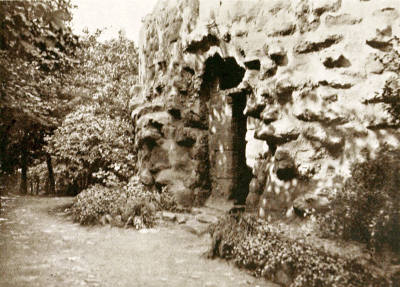
To see the Dropping Well we must cross
the river by bridge or ferry, and walk
along a pretty path under the beeches.
Here, as everywhere in Knaresborough,
disillusion dogs our steps. This beautiful
curiosity of nature, this great overhanging
rock, worn smooth by the perpetual dripping
of the water, framed in moss and
ferns, has been made into a "side-show,"
with a railing, an entrance fee, and a row
of bowler hats, stuffed parrots, and other
ornaments in process of petrifaction. On
the other side of the river is St. Robert's
Chapel. Here, too, the world is too much
with us.
Leland, that stout traveller, who "was
totally enflammid with a love to see
thoroughly al those partes of this opulente
and ample reaulme ... and notid yn so
doing a hole worlde of thinges very memorable,"
tells us how Robert Flower, the son
of a man "that had beene 2 tymes mair of
York," came to these rocks by the river
Nidd "desiring a solitarie life as an hermite."
He made himself this chapel, "hewen
owte of the mayne stone"; and he seems to
have had some persuasive power of goodness
or wisdom that turned his enemies
into friends. "King John was ons of an
il-wille to this Robert Flour," yet ended by
benefiting him and his, an unusual developement
in the case of King John; and
de Stutteville, who lived up at the castle,
had actually set out to raid the hermitage,
suspecting it to harbour thieves, when he
too, persuaded by a vision or otherwise,
suddenly became the hermit's friend. This
tiny sanctuary, eight or nine feet long, with
its altar and groined roof and recesses for
relics, all wrought in the solid rock, would
be a place to stimulate the imagination if
it were not that the surroundings and the
guide are such as would cause the strongest
imagination to wilt.
Some say that the black slab of marble
which is now a memorial to Sir Henry
Slingsby in the parish church once formed
the altar-top in St. Robert's Chapel; others
say it came from the Priory, and was raised
there in honour of the saint who "forsook his
fair lands" and caused the Priory's foundation.
The slab lies in the Slingsby chapel,
and records that Sir Henry was executed
"by order of the tyrant Cromwell." Carlyle
tells us that this Slingsby, "a very constant
Royalist all along," was condemned for plotting
the betrayal of Hull to the Royalists.
The road from Knaresborough to Ripon
follows the valley of the Nidd as far as
Ripley. This village has the air of being a
feudal survival. Its cottages with their neatness
and their flowers, its Hôtel de Ville, and
even the "treated" surface of its excellent
road, all bear the stamp of a close connection
with the castle whose park gates are
at the corner. In the sixteenth century the
village of Ripley was under the eye of a
very masterful lady. It was to this castle
that Oliver Cromwell, tired from fighting
on Marston Moor, came in search of rest.
Rest, however, was denied him. His hostess,
whose husband was away, had no sympathy
with fatigue that came from resisting the
King's Majesty, and so poor Oliver—"sad
and wearied," as we know, even before the
battle—spent the night on a chair in the
hall, while Lady Ingilby, seated opposite
to him with a couple of pistols in her
hands, kept her relentless eye upon him
till the morning. When he rode away she
told him it was fortunate for him that he
had been so tractable. I think this fierce
lady must have been agreeable to Oliver's
grim humour.
The approach to Ripon is pretty, by a
road shaded with trees. Above the town
rises the cathedral, massive and stately if
not superlatively beautiful. Though it is
not one of our largest cathedrals, its history
is immense.
Even St. Wilfrid's seventh-century church
was not the first that stood here, for before
his remote day Eata had founded a monastery
that was hardly built before the Danes
burnt it. Indeed, the monastery was destroyed
so often—by Danes, Anglo-Saxons,
Normans, and Scots in turn—that every
style of architecture, from Saxon to Perpendicular,
is represented in the various
restorations. There are even, I believe, in
the crypt and chapter-house, fragments of
Wilfrid's own church, among them being
the curious slit called Wilfrid's Needle,
which has been "mighty famous," as
Camden said, for a great many centuries.
The saint himself was mighty famous in
his day, as he well deserved to be. Even
still we know a good deal about him,
through Bede and others: how, when he
was a poor and ignorant boy of fourteen,
"not enduring the frowardness of his stepmother,
he went to seek his fortune," and
was brought to the notice of Queen Eanfled,
"whom for his wit and beauty he was
not unfit to serve"; and how she sent him
to Lindisfarne, where, "being of an acute
understanding, he in a very short time
learnt the psalms and some books"; and
how he refused a wife in France; and was
presented by King Alfred of Deira with a
monastery at Rhypum, here on this very
hill; and was consecrated at Compiègne in
a golden chair carried by singing bishops;
and how he converted the people of Bosham
by teaching them to fish with eel-nets, so
that "they began more readily at his preaching
to hope for heavenly goods"; and how
he won the day in the great controversy
at Whitby, and finally died as an archbishop
and was buried at the south end of
the altar here at Ripon. He was a very
human saint, and much beloved. His church
was destroyed by Edred, but his monastery
grew in power. The most beautiful part of
the present building is the Early English
west front, which dates from the reign of
Henry III.
Ripon is altogether charming, and still
does homage very prettily to its patron,
King Alfred, who made it a royal borough.
He it was who ordained that every night
a horn should be blown by the wakeman,
and that any one who was robbed between
the blowing of the horn and the hour of
sunrise should be repaid by the townsfolk.
From his day to ours each night at nine
o'clock the men of Ripon have heard the
horn—three long, penetrating blasts before
the town hall and three before the wakeman's
house. Several centuries ago the
wakeman became the mayor, and now he
blows the horn by deputy. "Except ye
Lord keep ye Cittie," are the words on the
town hall, "ye wakeman waketh in vain";
and not far away, at one corner of the
market-square, is a pretty old gabled house
bearing this legend: "1604. In thys house
lived a long time Hugh Ripley, ye last
Wakeman and first Mayore of Rippon."
Yet it is not these links with the beginnings
of our history, with Wilfrid the
Saxon saint and Alfred the Saxon king,
that draw so many people to Ripon.
Ripon has a greater attraction than these.
Only a few miles away is Fountains Abbey.
When approaching Fountains the motorist
may feel very thankful that a few additional
miles on the road are of little importance
to him. By choosing the longer way,
through the village of Studley Royal, he will
certainly save himself a considerable walk
and may possibly secure the unspeakable
blessing of solitude. The walk through the
park from the main entrance is, I know, regarded
as one of the chief beauties of the
place, with its Temple of Fame, and its Surprise
View, and its little cascades; but except
for the view of the Abbey, which is lovely,
these artificial prettinesses are more appreciated
by those who come forth on "an expedition"
than by those who really wish to
seize and keep something of the spirit of the
place. The distant abbey seen from the east
is part of a beautiful landscape, a satisfaction
to the eye, a picturesque incident in
the long glade; but those who approach it
from the west come upon it suddenly in all
its vastness, close at hand, and realise, probably
for the first time, something of the
splendour of the old monasteries.
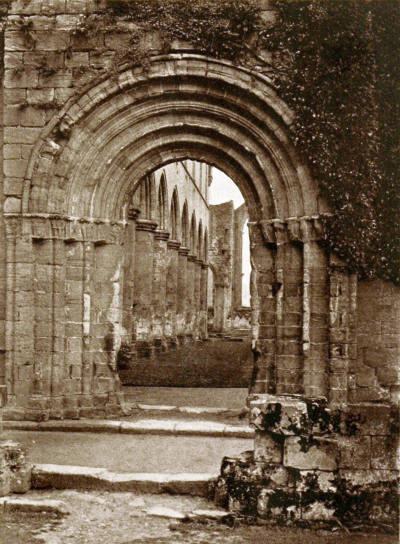
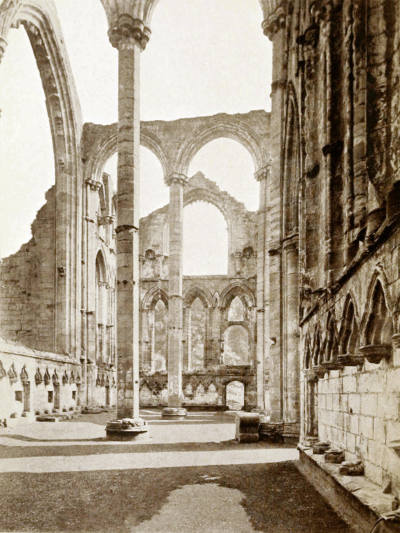
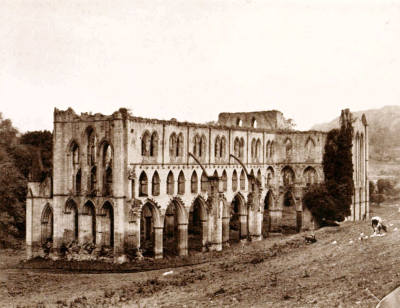
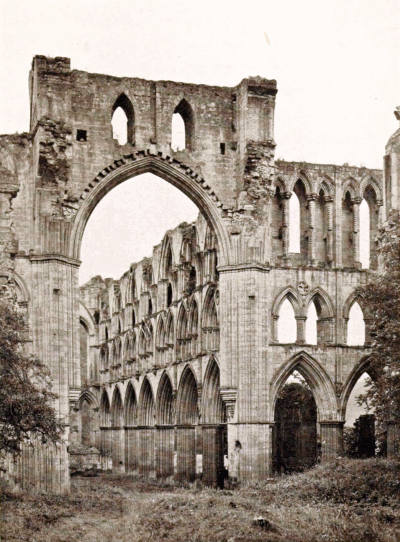
THE NAVE, FOUNTAINS ABBEY.
Here—in this long line of doorways, in
this enormous church which the choir of
birds still fills with sacred music, this
cloister-garth and chapter-house with the
rich archways, these stairs and domestic
buildings, wall beyond wall and room
beyond room—here truly was a power to
make a monarch jealous! It is no wonder
that Yorkshire, crowded as it was with
monasteries, thought a strength like theirs
might pit itself against the strength of the
king, and rose in protest against the Dissolution;
it is no wonder that the king's
agents could not find enough chains in the
country to hang the prisoners in. If this
vast skeleton is so magnificent, of what sort
was the actual life! Close your eyes for a
moment to it all, and think of the beginnings
of it.
Think of those thirteen monks, Prior
Richard and his brethren from St. Mary's
at York, hungering for a more perfect fulfilment
of their vows, who came here long
ago, when this green sward was "overgrown
with wood and brambles, more
proper for a retreat of wild beasts than
for the human species." Like wild beasts
they lived, with no shelter but the trees
and no food but herbs and leaves. They
worked with their hands by day, and kept
their vigils by night, "but of sadness or of
murmuring there was not one sound," says
the monk who wrote their story, "but
every man blessed God with gladness."
They lived under the thatched yews till
they had raised a roof for themselves, but
even when that was accomplished they
were often on the point of starvation.
One day when all the food they had was
two loaves and a half, a beggar asked for
bread. "One loaf for the beggar," was Abbot
Richard's decree, "and one and a half for
the builders. For ourselves God will provide."
The cartload of bread which arrived
immediately afterwards as a gift from a
pious knight was the cause of much thankfulness
among the monks, but of little
surprise.
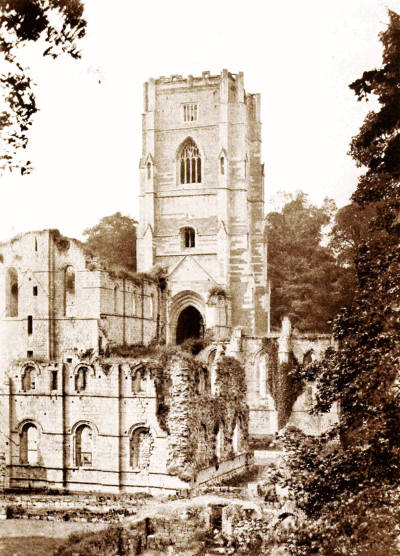
THE TOWER, FOUNTAINS ABBEY.
As the years passed, lands and legacies
made the monastery rich. And so at last
this splendid fabric rose—a triumph of the
spirit over circumstances, a monument to
those long-buried monks whose toils and
sufferings are built into the mighty nave,
though surely they never dreamed of such
power and wealth as we are forced to
dream of as we stand amid this mass of
broken walls, now green with moss and
weeds, but once the heart of a huge organism.
It is a monument, too, to many who
came after the brave thirteen: to Abbot
Huby, who built the tower and is said to be
buried near it; to John of Kent, who gave
us the bewildering beauty of the Chapel of
the Nine Altars, one of the most exquisite
things ever wrought in stone: so spiritual,
so aspiring, that it seems to be a prayer
made visible, or even—with its slender
arrowy columns rising into the air till, like
fountains, they break into curves—to be the
embodiment of the abbey motto: Benedicite
Fontes Domino.
And while we are remembering those who
laboured for Fountains, do not let us forget
the man who died for it at Tyburn—William
Thirsk. This abbot was rash enough to
resist the messengers of Privy Seal, and was
accused by them of many things. He had,
they wrote, "gretly dilapidate his howse" by
theft and sacrilege, had sold the plate and
jewels of the abbey, and had not even secured
a proper price for them. To those who were
themselves bent upon theft and sacrilege on
a large scale this last offence seemed worst
of all. He had actually, they declared contemptuously,
been persuaded by a jeweller
that a valuable ruby was a mere garnet;
"for the trewith ys he is a varra fole
and a miserable ideote." He joined in that
desperate protest the Pilgrimage of Grace,
and so was hanged.
Fortunately for posterity as well as for
himself, Thirsk's successor, Brodelay, who
was a creature of Thomas Cromwell and
chosen with a view to future events, was
not a "varra fole," and yielded meekly
when his abbey was demanded of him,
saving it from the fate of Jervaulx. As
it is, too much of it is gone—much that
might have been preserved. The cloisters
have vanished though the garth is there,
with the long flight of steps and the great
stone basin in the grass and the yew-tree
beside it; and gone, too, is the magnificent
infirmary, deliberately destroyed in the days
of James I. by the vandal who owned it
and was in want of some building material.
One thing, however, still stands, which is,
perhaps, the last relic of the monks of
Fountains that we should expect to find,
and is certainly the most touching relic
possible—actually linking us with those
far-off days when the patient thirteen were
left here in the wilderness by Archbishop
Thurstan to keep their vow of poverty
with such terrible literalness. Over there,
beside the wall, is one of the yew-trees
whose boughs, covered with thatch, formed
the first monastery of Fountains.
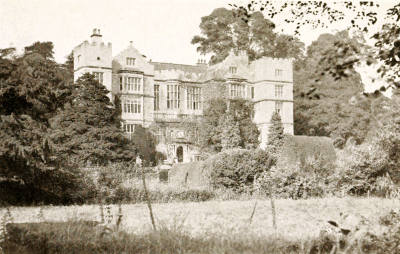
Close to the western entrance is Fountains
Hall. Surely we must forgive that wicked
man who pulled down the infirmary, since
the place he built with the stones is this
lovely Jacobean house, a thing as beautiful
in its own domestic way as time-worn stone
and bays and mullions can make it. A balustrade,
a sundial, an old-fashioned garden and
ancient yew-hedge make the picture and our
pleasure complete.
There is a comfortable hotel at Ripon, and
as we have a great deal to see before reaching
any other desirable shelter, we shall find it
best, I think, to spend a night there either
before or after visiting Fountains. From the
windows of the Unicorn, on market-day, the
paved square is a gay and pleasant sight, with
its crowded stalls and bright awnings, and
stores of fruit and flowers and basket-work;
and here on a summer's night the horn-blower
may be dimly seen at nine o'clock
in his three-cornered hat and laced coat,
doing the bidding of Alfred the Great.
From Ripon there are three ways of reaching
Richmond, without taking into account
the direct route, which would show us
nothing of the dales we came out to see.
In either case we must go by Jervaulx
and Middleham and Wensley.
Only a few miles from Ripon is a village
less famous, but not less attractive, than any
of these: a spot well-known to antiquarians,
and doubtless to artists too, but unfamiliar
to ordinary folk. The charm of West Tanfield
catches the eye at once from the bridge that
spans the Ure, and comes as a pleasant surprise
in the midst of rather tame scenery.
The red-roofed cottages are grouped upon the
river-bank, with gay little gardens sloping to
the water's edge; behind them rises the
church tower, and the square grey gatehouse
of the Marmions, with its delicate oriel. This
gateway was built by Henry V.'s friend and
executor FitzHugh, who married one of the
Marmions and lived here, and added to the
church that held the splendid tombs of his
wife's ancestors. He was not buried here
himself, but by his own wish with curious
haste at Jervaulx. It is seldom that a little
village church possesses such monuments as
these of the Marmions, so rich in ornament
and so marvellously preserved: the arched
and canopied recess that holds the effigy of
Sir John; the cloaked and coronetted figure
of Maud his wife, who built this aisle and
founded chantries here; the emblazoned tomb
of the unknown lady with the lion; the
knight in mail; and the magnificent monument
of that other knight and his wife which
is probably a cenotaph in memory of John
and Elizabeth Marmion of the fourteenth
century. Their effigies lie, perfectly preserved,
under a light and graceful "hearse"
of ironwork, with seven sconces for candles—the
only iron hearse, they say, in England.
Every detail of the dress, every line of the
features, is distinct. The knight's aquiline
nose and full lips, rather sweet in expression,
are encircled by a gorget of mail, over whose
delicate links droop the ends of his long
moustache. A collar of SS clasps his throat.
On the north side of the chancel there is a
curious recess, with a squint into the nave
and two little windows into the choir. It is
unique, I believe, and as regards its origin
and uses very baffling.
Beyond West Tanfield the scenery grows in
beauty, for we are nearing the hills. Masham
lies prettily in a valley, with a setting of
moors and dales, gold and emerald when the
sun is shining, soft grey and green when the
day is dull. Skirting the little town we go
on our way to Jervaulx.
The site of Jervaulx is not beautiful, but
pleasant and peaceful. It lies in a private
park, so the car must wait beside the
gardener's cottage while we walk, borrowed
key in hand, across the field to the scattered
fragments of what was once a great Cistercian
abbey. Of the ruins tragically little was left
standing by the energetic commissioners of
Henry VIII., though they apologised for some
necessary delay in their congenial work.
"Pleasythe your lordship to be advertysed,"
wrote Thomas Cromwell's "most bounden
beadman" Richard Bellyseys, "I have taken
down all the lead of Jervaulx ... and the
said lead cannot be conveit nor carried until
the next sommre, for the ways in that countre
are so foul and deep that no caryage can pass
in wyntre. And as concerninge the taking
down of the house I am minded to let it stand
to the next spring of the year, by reason of
the days are now so short it wolde be double
charges to do it now." The work was finished
with great thoroughness at last, however, as
all may see. Of the church the barest outline
only is left, with the raised platform where
once the high altar stood, and near it the
broken figure that is said to represent the
Henry FitzHugh who did so much for West
Tanfield and left such strange orders about
his funeral. He desired to be buried at
Jervaulx with all possible haste after his
death. "To be carried thither by daylight,
if it come not too late; but if so, then the
same night." The land on which this community
first settled, at Fors, was the gift
of one of FitzHugh's ancestors, which may
account for his wish to be buried here.
The case of the last abbot of Jervaulx,
Adam Sedbergh, was a sad one; for he
suffered the pains of martyrdom without
its exaltation, and while certainly failing to
please himself, pleased no one else. He was
a timid creature, apparently, and when Yorkshire
rose in the Pilgrimage of Grace, he was
so much afraid of king and rebels alike that
he simply ran away and hid. The rebel mob
came clamouring about the gates of Jervaulx,
crying: "Choose you a new abbot!" and
the frightened brothers gathered hurriedly
in the chapter-house. If we follow this
path, and turn down by these crumbling
steps, we may stand where they stood that
day; for there is more of the chapter-house
still in existence than of any other
part of the building. The roof that covered
the monks' bewildered heads is gone; but
here is the wide stone bench on which
they sat, trembling, through that hasty
conclave, and here are the columns and
the walls on which their eyes dwelt,
unseeingly, while the rebels threatened
them with fire at their gates and their
rightful leader was hiding in the heather.
They could think of no better course
than to seek the reluctant Adam, and
make a rebel of him whether he would
or no. They found him on the moors at
last, and lest his beautiful abbey should
be burnt to the ground because of him,
he came back to face the curses and
daggers of the mob, the futile sufferings
of rebellion, the prison-cell in the Tower
where his name still shows upon the
wall, and the gallows of Tyburn. His
tardy and unwilling heroism was piteously
useless, for not even the flames of the
Pilgrims of Grace could have laid the
walls of Jervaulx lower or left its altars
more desolate than did the hammers and
picks of the king's agents.
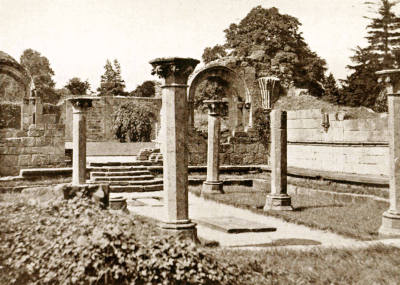
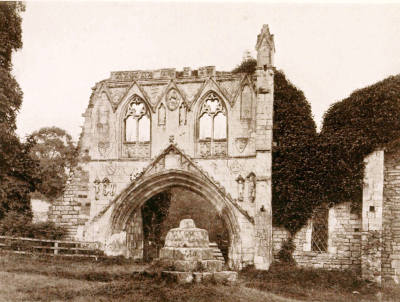
CHAPTER HOUSE, JERVAULX ABBEY.
Charles Kingsley came here once, and picked
a forget-me-not for his wife—a pleasant
memory among so many fierce ones. He was
the last canon of the collegiate church of
Middleham, where he stayed for several days
at the time of his instalment, and endured
"so much bustle, and robing and unrobing"
that he had no time to think. Middleham,
as a rule, is anything but a bustling place;
but in spite of its demure looks, I believe
there are still days when its streets are,
as Kingsley saw them, "crowded with
jockeys and grooms." We are now on
our way thither. After passing through
East Witton we cross the Cover, whose
pools are dear to fishermen, and were
therefore dear to Kingsley. "Little Cover,"
he called it affectionately, "in his deep
wooded glen, with his yellow rock and
bright white stones, and brown water
clearer than crystal."
We climb into Middleham past the base of
an old cross on which is fixed a modern head.
At the top of the hill is the curious structure
called the Swine Cross, with the mutilated
stone beast whose identity has proved so hard
to establish. Some say it is the Bear of
Warwick; others recognise in it the Boar of
Gloucester. As far as its personal appearance
is concerned it might with equal
plausibility be called the Lion of England
or the Hound of the Baskervilles, seeing that
its outline commits the sculptor to nothing
and it has no manner of face whatever.
Turning to the left we find the castle looking
down upon us gloomily.
This castle of Middleham is square and
stern; more strong than beautiful. Its
keep is Norman, and is the work of a
Fitzranulph of the twelfth century; but the
towered wall that hems it round so closely
was built by the Nevilles, who lived here
for many years in princely state. The
great Earl of Warwick, when he was not
making kings—and, indeed, sometimes when
he was—chose this to be a centre of his
pomp and power; and one of the kings he
made, Edward IV., is said to have been
imprisoned here for a short time. The time
would have been longer if Edward had not
cajoled his custodian, the Archbishop of
York, into allowing him to hunt in the
park. We know from Henry VI. how
Richard, Duke of Gloucester, and Lord
Hastings lay in ambush in the forest that
is no longer here, and rescued Edward from
those who were hunting with him.
That same Duke of Gloucester, who was
a trespasser on this occasion, came to
Middleham as its master later on. Poor
Anne Neville, the kingmaker's daughter,
spent most of her sad married life within
this melancholy fortress, with the husband
who asked no man to make him king, but
made himself Richard III. We may see the
gloomy walls of her withdrawing room—bereft
now of both roof and floor—where
she sat so often sick at heart and ailing;
and the banquet-hall where her father kept
such state; and the kitchen where six oxen
were sometimes roasted for one breakfast.
There, in the north wall, is the gateway
through which she watched her husband
riding out to entrap his little nephews, and
through which she herself soon followed
him to see him crowned; and here at the
south-west corner of the outer wall is the
tower where her only son was born. The
boy spent practically all his short life here,
all but that brief and brilliant interlude
of the coronation at Westminster and the
pageantry at York; and here, too, he died
in his parents' absence. I do not know if
Anne ever returned to Middleham. We
hear of her "in a state bordering on madness,"
and not long afterwards her tragic
life was over.
For many years the castle was left at the
mercy of all who cared to despoil it. It
was very literally treated as a quarry; for
when all the faced stone within reach had
been removed the walls were hollowed out
below, in the hope that the upper part
might fall and so provide more plunder.
Such is the cohesion of the masonry, however,
that this design was more or less
frustrated, and the undermined walls still
stand like overhanging cliffs. Here and
there, indeed, great masses have fallen in
huge boulders as solid as rock; but perhaps
the gunpowder of the Commonwealth was
responsible for these.
There was once a suggestion made, in a
letter from Lord Huntingdon to his "verrye
good lord ye lord Treasurer," that Queen
Elizabeth should join in this work of
quarrying. She purposed to pay a visit to
her city of York, a visit which was designed
to be "no small comforte to all hyr
good subjects, and no less terrour to ye
others." But the great difficulty was to
find "a good housse" for her. Huntingdon
excitedly laid his scheme before Burleigh.
"Ye meanes ys thys," he wrote. "Hyr
hyghness hathe heare ye Castell of Midham,
which ys in greate ruyne and daylye
wasteth, ... but ye tymber ye stone ye
lead and ye iron yt ys theare wold make
a fayre housse heare, and as I gesse with
good husbandrye paye all ye chargys. I am
sure if your L. dyd see ye place ... you
wolde thinke yt most convenient to be
pulled downe, rathyr than yt shuld stande
and waste daylye as yt dothe."[1] Fortunately
Burleigh did not think it most convenient,
and now the place no longer wastes
daily, but is daily being repaired.
When we crossed Cover Bridge we entered
Wensleydale, and a mile or two beyond
Middleham is the pretty little town from
which the dale takes its name. The scenery
is quiet and pastoral here, the Ure flows
smoothly, and it is difficult to realise how
near we are to the sort of country Defoe
was thinking of when he wrote in
his eighteenth-century way: "The black
moorish lands show dismal and frightful."
How near we are to the moorish lands,
however, we shall shortly find out, and it
is at Wensley that we have to decide by
which road we shall cross them.
But first, here is Wensley Church on the
left, with Saxon stones in it, and a splendid
brass that no one who cares for such things
would wish to pass by, and among its
graves one that has been thought to be of
interest to every British man and woman.
It is an altar-tomb with fluted corners
standing on the right of the path that leads
from gate to porch. Beneath it lies Peter
Goldsmith. It has been stated,[2] on what
grounds I cannot discover, that he was
surgeon of the Victory at Trafalgar, and
that Nelson died in his arms. This is
making a great claim for him. Yet his
name is not mentioned in the standard
accounts of Nelson's death,[3] nor does it
appear in the list of the Victory's officers.
As we all know, Beatty was the surgeon
who attended Nelson in the cockpit. The
assistant-surgeon was Neil Smith; the
surgeon's mate was Westerburgh.[4]
This is the country of the Scropes of
Bolton, and their names and arms are conspicuous
in the church—over the porch, on
the buttresses, on the carved chancel stalls,
and, above all, on Lord Bolton's screened
pew in the north aisle. The carved sides of
this were originally part of the parclose
by which the tombs of the Scropes were
surrounded in Easby Abbey. The front of
it is ugly and has an eighteenth-century
air. The horrible grey marbled paint that
defaces the woodwork suggests the nineteenth.
The famous brass, which lies within
the communion rails, is so beautiful as to
appeal to the most ignorant in such matters,
and dates from the fourteenth century. It
marks the grave of two men—Sir Simon
of Wensley, priest, and the seventeenth-century
rector who desired to be buried
under the same stone and brass.
Our course, after leaving Wensley, depends
on our further intentions. The course I
recommend is this: to drive up Wensleydale
on the lower road, past the cascades
and village of Aysgarth—named by the
Danes Asgard, the home of the gods—past
Bainbridge and Hawes; to cross the river
at Yorebridge, and return by Askrigg and
Redmire, making a short digression to
Bolton Castle; then, turning to the left
beyond Redmire, to strike across the
"moorish lands" to Richmond. These Yorkshire
moors, which seemed so "ill-looking"
to Defoe, are neither black nor frightful
in our later eyes, but glorious with colour
and light. The old road from Leyburn
across Barden and Hipswell Moors has
rather a bad surface, and a hill that is stiff
enough to account for the making of the
new road; but on a sunny summer's evening
the view from the highest point is lovely
beyond words. Beautiful it must be at all
seasons and in all weathers, but it is only
when the air is clear that the head of
Swaledale may be seen on one side of the
ridge and the far-away slopes of Wensleydale
on the other, and it is only when the
sun is sinking that those distant hills are
washed with gold. The moors sweep round
us far and near; a line of dark firs crosses
them mid-way; patches of vivid green
break through the heather; and down in
the valley the Swale shows as a thin thread
of twisted silver. Behind us, towards
Middleham, the more level country is a
dark blue streak beyond the crimson of the
sunlit heather. The white road, straight
and narrow, lies before us.
Those who choose this way will have
little to regret, and will have one real
advantage: they will approach Richmond
by the road which gives the finest view of
that fair town. They must remember, however,
that there is a very steep downward
gradient at one point between the moors
and the river, and at the bottom of it a
sharp turn over a bridge. The run up
Swaledale may easily be achieved from
Richmond, where there is a comfortable
hotel.
The other alternative is to cross from
Wensleydale to Swaledale by way of the
Buttertubs Pass. Now, I do not wish to be
too encouraging about this pass! It is a
place for the well-equipped only, and for
those who do not suffer too much when
their tyres are suffering. Many cars, of
course, have passed this way, and many
more will do so; but none the less it is not
a suitable road for motoring. It is precipitous
in places, narrow everywhere, and
the surface is almost entirely composed of
loose stones. Moreover, a grassy slope, so
steep as to be almost a precipice, drops
away from the edge of it; and though I
am assured the pass is perfectly safe, there
are points in it where nothing but faith in
one's driver can make it comfortable! The
scenery is magnificent.
Starting from Wensley, we must take the
upper of the two roads to Redmire marked on
Bartholomew's map, for the lower one, apparently,
runs through Lord Bolton's park. It
occurs to one here, as in several other places
in Yorkshire, that it would be a good plan
if map-makers would adopt some distinctive
way of marking private roads. The views
from the high ground are lovely. All Wensleydale
lies before us—green as an emerald
in the valley, bare and grey on the hilltops,
dimly blue in the distance. Over it all lies
that haze of luminous gold that the sunshine
gives to these dales. Far away, but clearly
visible, Bolton Castle stands up on the hillside,
massive and grey and relentless, a
queen's prison. At Redmire Station we turn
aside to see it.
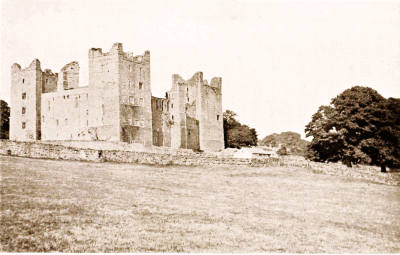
"The castelle," says Leland, "as no great
howse, is al compactid in 4 or 5 towers."
Outwardly, it is probably much the same as
in his day: a square of cold, grey stone with
a tower at each corner, gloomy and forbidding,
with no attempt at ornament, no break in the
solid masonry except the tiny windows. To
Leland it was simply the castle of the Scropes,
the work of the famous Chancellor who
fought at Créçy in his younger days, the
fortress of a family that was perpetually
distinguishing itself. So he looked at it and
passed it by. It was "no great howse."
But we see it with other eyes, because it has
been touched by the charm that wins us in
spite of our better judgment, just as it won
men long ago in spite of theirs—the glamour
of the Queen of Scots. The banquet hall
where so many Scropes have feasted—bishops,
statesmen, judges, Knights of the Garter—leaves
us cold; we do not care to know
there was a chantry here; even the cruel
dungeon in the ground, with the hole through
which the victim was lowered and the bolt
to which he was fastened and the slab of
stone that was fixed over the top, only
calls for a passing shudder. To us the
interest of Bolton Castle is centred in the
whitewashed room upstairs.
It was a summer evening, "one hour after
sunsetting," when Mary rode into that grass-grown
court with Sir Francis Knollys and
Sir George Bowes, and two companies of
soldiers, and six ladies, and forty-three
horses, and four cartloads of luggage. She
was not yet very unhappy. "She hath been
very quiet," wrote Knollys of the journey,
"very tractable, and void of displeasant
countenance." She was less tractable when
the time came for her to leave Bolton: she
had learnt much meanwhile. For the months
spent at Bolton were the crisis of her misfortunes.
In this upper room she sat
"knitting of a work" in the deep recess of
the window, or writing endless letters by
the fire, or turning young Christopher
Norton's head, while the Casket Letters
were being read at Hampton Court, and
her accusers were discussing her character
at York, and her "dear cousin and
sister" was pressing her to abdicate her
throne. It was in this room that she wrote
at last to her advisers: "I pray you do
not speak to me again about abdication,
for I am deliberately resolved rather
to die than to resign my crown; and
the last words that I shall utter in my
life shall be the words of a Queen of
Scotland."
She wrote a vast number of other letters
here. Some were to the young Queen of
Spain, her sister-in-law, who, as Elizabeth
of France, had been her playmate at the
Court of Henri II.; some were about the
care of her infant son; and some, of a conciliatory
kind, were to the Queen of England.
"Toutesfoyes," she wrote, "sur votre parolle
il n'est rien que je n'entreprisse, car je ne
doutay jamays de votre honneur et royalle
fidelitay."
It was here, too, that she wrote her first
English letter to her custodian, Sir Francis
Knollys—her schoolmaster, as she called him,
who had been giving her lessons, apparently
without any marked success.
"It is sed Seterday my unfrinds wil be wth
zou; y sey nething, bot trest weil. An ze
send one to zour wiff ze may asur her schu
wold a bin weilcom to a pur strenger....
Thus affter my commendations I pray God
heue you in his kipin.
"Your assured gud frind,
"Marie R.
"Excus ivel vreitn furst tym."
Mary's rooms have lately been restored;
but this plain stone fireplace is the same by
which she sat shivering while the news of
the Westminster Conference was so long in
coming through the snow, hoping against
hope that the English Queen would not
"make her lose all"; turning over in her
mind the scheme for marrying her to Don
John of Austria; reading specious letters
from Elizabeth pleading "the natural love of
a mother towards her bairn"; and smiling
upon Knollys till he credited her with "an
eloquent tongue, a discreet head, a stout
courage, and a liberal heart adjoined thereunto."
This is the window through which
she looked out over Wensleydale, luminous
in the August sunshine or white with snow,
and realised gradually that she was indeed
a prisoner, she who "loved greatly to go on
horseback." She was allowed to ride in the
park, it is true; but her riding was a
mockery with twelve soldiers at her horse's
heels.
Yet she was not always sad. She had
her lighter moments and pastimes other than
knitting. "The Queen here is merry, and
hunteth," wrote Knollys, "and passeth
her time in pleasant manner." She even
coquetted with the Reformed Faith, and
"grew into a good liking of the Liturgy";
and she took pleasure (of a more convincing
kind) in having her hair busked by Mistress
Mary Seaton, whom she declared to be the
finest busker in any country. Knollys, apparently,
was not insensible to the charms of
a coiffure. "This day she did set such a
curled hair upon the Queen that it was like
to be a periwig that showed very delicately;
and every other day she hath a new device
of hairdressing, without any cost, and yet
setteth forth a woman gaily well."
Here, up these steps upon which Mary's
skirts have trailed, is the room where Mistress
Seaton set such a curled hair upon the lovely
head, the room where the Queen slept, or
more often lay awake. There had been some
difficulty in making her rooms ready to receive
her. The Scropes were not luxurious, it
seems. Her bedding and hangings came
from Sir George Bowes' house, near Barnard
Castle; pewter vessels and a copper kettle
were hastily borrowed from the Court of
England; and the neighbours lent some
furniture with rather a bad grace. There
is a very strong local tradition that Mary
once escaped from Bolton Castle. The
"Queen's Gap" on Leyburn Shawl is pointed
out as the scene of her recapture, and this
little bedroom window as the way of her
escape. I cannot find the least evidence that
the story is true. But it was in this room
that she lay sick for days, before she was
dragged reluctantly away in the dusk of
a January dawn, bitterly cold and bitterly
angry, to her next prison at Tutbury.
This castle held for the king in the Civil
War, and that is why it has lost its north-west
tower. The actual fall was in a
storm, a hundred years later than the
siege that weakened the masonry.
As we drive away up Wensleydale we
look back again and again at the fortress,
which dominates the valley far more conspicuously
than its position on the green
hillside seems to warrant. The scenery
grows wilder and the slopes nearer before
a steep descent with a bad surface takes
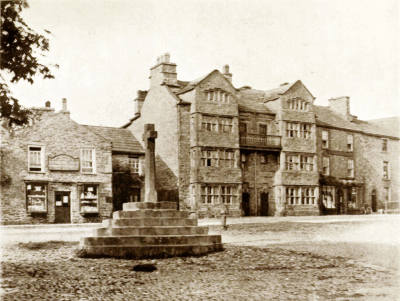
us into Askrigg. Here, in a little open
space beside the church, is a picturesque
Jacobean house of grey stone, bearing an
inscription and the date mdclxxviii. Its
projecting bays are joined by a wooden
gallery, which was designed, it is said, to
give a good view of the bull-baiting that
took place before it. There, hidden in the
grass, is the iron ring to which the bull
was tied; and close beside it stands the
restored village-cross—a strange conjunction
of symbols! In the fifteenth-century
church there are some pillars which are
thought to have been transported from
Fors, the original dwelling, about a mile
from here, of the brothers of Jervaulx—the
little band of monks from Savigny,
who came to this valley under the leadership
of Peter de Quincy, the Leech, in the
reign of Stephen. They found this place
too wild even for their Cistercian ideals,
too cold and foggy for the ripening of
crops, too frequently beset by wolves; and
so, though the optimistic Peter was "very
certain we shall be able to raise a competent
supply of ale, cheese, bread, and
butter," the community moved nearer to
civilisation, leaving behind them nothing
for us to see except a window in a barn
and these pillars in Askrigg Church.
As the road becomes narrower and
rougher the scenery every moment grows
more beautiful. Hawes lies on the other
side of the valley at the foot of the blue
hills, in a lovely position beside the Ure;
and when we have reached a point exactly
opposite to it we turn sharply up a steep
pitch on the right, with a splendid panoramic
view of mountains on the left as
we climb.
This is the beginning of the Buttertubs
Pass. From this point onwards, till the
road plunges down into Swaledale, the
surface is composed more or less of loose
stones. The stiffest upward gradients we
shall have to encounter are within a mile
or two of this spot, for the wild part of
the pass—the real moorland—is comparatively
level, and by the time we reach the
actual Buttertubs we are already running
down. This is the climax—this point
where the downward gradient begins—for
here suddenly the solid earth seems to fall
away from us: here suddenly the rough
and narrow road is no longer lying across
the far-stretching moorland, but is hanging
high upon the hillside, clinging upon the
extremest edge of a gulf which drops
dizzily into a blue sea of shadows. Thus
it clings for miles. Beyond the chasm the
bare hillside rises again above our heads
in magnificent curves, glowing with colour,
and cleft here and there into purple
gorges. Slightly above the road on the
left are the Buttertubs, strange crater-like
hollows of unplumbed depth, appearing at
intervals beside us, with sharp rocks bristling
through the grass at their mouths.
As we slowly descend, the hills of Swaledale
rise before us like a wall blocking the
defile; and presently a gate across the road
shows that we are near the world again.
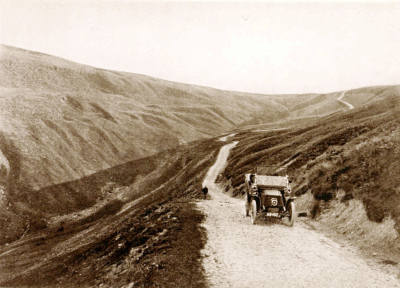
Truly this is one of the runs that are
unforgettable. To be among these savage
heights and depths, these heaving waves of
desolate moor, to have these solitudes above
us and these blue shadows so far below us,
is to know something of "the strong foundations
of the earth." It is with a feeling
of anti-climax that we close the gate
behind us, and, on a precipitous gradient
and no surface worth mentioning, steer
slowly down into Swaledale.
As we cautiously make our way over the
stones of this very trying lane, we are
confronted with rather a startling notice
board: "No Road." It seems a little late
to tell us that now: they might have mentioned
it before we crossed the pass! Then
it dawns upon us that the amateur hand
that traced the letters has sloped the board
in the wrong direction. It is really meant
to face down the valley, for the discouragement
of those who might stray up from
Swaledale, ignorant of the pass.
Swaledale, I think, is the most beautiful
of all the dales. Of course beauty varies
with the weather, and distant Muker in the
hollow of the hills cannot be the same on
a colourless, grey day as when it lies in a
pool of sunshine. But on any day Swaledale
must seem, to one who is fresh from
the elemental dignity of the pass, to hold
a wonderful variety of lovely things: opal
hills and soft woods, patches of heather
and slopes of fern, fir-trees and feathery
birches and clumps of scarlet rowans. There
are individual pictures that one remembers
as types of the whole. At Gunnerside, for
instance, where the road crosses the Swale,
cliffs rise from the stony river-bed, and are
crowned with overhanging trees, the banks
are smothered in masses of burdock leaves,
and the whole scene is encircled by the
hills. The road is not very good, and there
are some steep pitches between Gunnerside
and Reeth; but it matters little, for who
would care to hurry through such a land
as this?
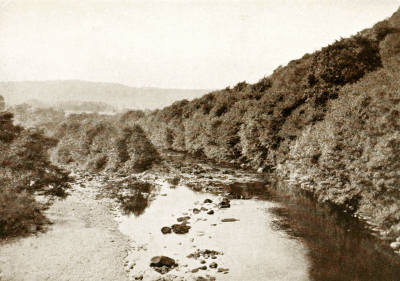
It was on the road near Low Row that
John Wesley began his preaching in this
part of the world, standing on a table by
the wayside. A little further on is Helaugh,
once a gayer place than it is at
present. The hills above it have echoed
many a time to the winding of the horn,
when John of Gaunt was lord here and
went out to chase the boar. Later on
these lands belonged to that strange Duke
of Wharton, "the scorn and wonder" of
Pope's day, who was a Whig when it was
unfashionable and a Jacobite when it
became dangerous, who fought against his
country and died a monk.
"Ask you why Wharton broke through every rule?
'Twas all for fear the Knaves should call him Fool."
At Reeth, a fascinating place built on a
slope at the mouth of Arkengarth Dale, we
cross the river again, and find a much
better road on the other side.
Between Reeth and Richmond the Swale,
flowing softly past its richly wooded banks,
is as beautiful as the lower Wye. On the
further side of it we see the Norman tower
of Marrick Priory, where once twelve blackrobed
nuns lived only a mile away from
their "white-clothid" sisters of Ellerton.
The nuns of Marrick were fortunate, for
though they were so few they won a short
respite for some unknown reason, and were
allowed to stay in their beautiful retreat
till the dissolution of the larger monasteries.
There are few places in England,
I think, that would be easier to love and
harder to leave than Swaledale.
Richmond, on its hill, guards the mouth
of the valley. This first view of it from
Swaledale, with the tower of the castle
rising slowly into sight, gives no idea at
all of the beauty and strength that have
made it famous. We only know how Richmond
has won its name when we see it
from below, with the buttressed bridge in
the foreground, and the bright waters of
the Swale reflecting the houses that are
clustered at their brink, and the sun-flecked
path under the trees, and the roofs, tier
above tier, climbing the steep hillside, and
above them all—foe of their foes and
shelter of their friends—the long curtain-wall
and towering keep of the castle. This
view of Richmond has been praised so
much that one fears disappointment. Yet
one is not disappointed. Richmond is not
only beautiful: it has that other quality—so
much more important than beauty in
woman or town—the quality of charm.
Richmond is lovable.
It was the Normans who first took advantage
of this fine position for a fortress:
the Saxon owners of the place were the
Earls of Mercia, and had no castle here, for
Gilling, their headquarters in the north,
was only a few miles away. We may
dream, if we like, that Ethelfled, the soldierly
daughter of Alfred the Great, and
Godiva, the Lady of Coventry, visited this
place when their husbands were minded to
chase the wolf or the boar in this part of
their lands. It is possible that they did
so: but there is no authentic history of
Richmond before the time when Alan the
Breton received from his kinsman, William
the Conqueror, "at the siege before York,"
a grant of "all the towns and lands which
lately belonged to Earl Edwin in Yorkshire."
It was this Alan who began to
build the castle. We may not enter it
without permission, for it is now used as
barracks; but we can walk up to the
gateway at the foot of the great keep and
see its buttresses and turrets towering
above us; and we can follow the path that
surrounds the walls and look at the view
that George IV. admired so much. This
view of the river from the castle is very
pretty, but is by no means comparable to
the view of the castle from the river.
Possibly George IV. fixed his eyes upon the
Culloden Tower among the trees to the right,
and was biassed by association.
Three times this castle wall behind us
has imprisoned a king. When five English
knights and their men-at-arms made their
dashing march to Alnwick and captured
William the Lion of Scotland, it was to
Richmond they brought him; and David
Bruce, another Scottish king, was here
nearly two hundred years later; and the
third was Charles I. Legend, indeed, tells
us of a fourth king still imprisoned here;
for this castle rock is one of the many
places wherein King Arthur lies asleep with
all his knights, awaiting the magic blast
upon the horn that shall some day wake
him. The Breton folk say he waits beneath
the island of Agalon; the Welsh look for
him to come forth from among the mountains
of Glamorganshire.
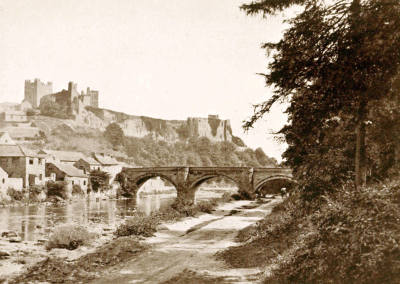
Soon after Bruce's imprisonment the castle
seems to have fallen into disrepair; and
this, I suppose, was the reason that John
of Gaunt, who was Lord of Richmond, made
his hunting expeditions from Helaugh
rather than from here. Harry of Richmond,
when he became Henry VII., gave
this castle of his to his mother, and finding
that the "mantill wall" was "in decay of
maisone wark," and "all the doyers, wyndoys,
and other necessaries," with much beside,
were also in decay, he gave orders that
the whole should "be new refresshede."
Though this attractive town possesses
much, it has also lost much. Once it had
a wall—built to keep the Scots out—and
several gates; but all are gone now, except
the postern in Friar's Wynd, and the old
pointed arch of Bargate, which we may see
from the foot of Carnforth Hill. Gone, too,
is the elaborate cross, which, according to
all accounts, was an object of beauty in
the paved market-place. This is more than
can be said for the strange obelisk that has
supplanted it. But in this same market-square
still stands Holy Trinity Chapel—not
beautiful, but very ancient, being that
"chapel in Richemont toune" which, Leland
says, had "straung figures in the waulles of
it. The people there dreme," he goes on,
"that it was ons a temple of idoles." Some
even dream that this chapel was founded
by Paulinus, the seventh-century saint, in
memory of an occasion when he baptized
an enormous number of converts in the
Swale; but, as Bede says the ceremony took
place in the river because it was impossible
to build oratories "in those parts," this
dream is not very credible. It is no dream,
I believe, but a fact, that the chapel stands
on the site of a Danish temple. In its
walls there are now no strange figures of
"idoles," but some very strange annexes for
a chapel. A butcher's shop is wedged
between the tower and the nave, and
several other shops are built into its side.
One of the most notable things here is
the Grey Friars' Tower, which we passed
on entering the town from Swaledale: a
peculiarly slender and graceful piece of
Perpendicular work. Like the campanile
at Evesham, it stands alone because the
building of the church connected with it
was suddenly brought to an end by the
Dissolution. The Franciscans who had their
friary here were mostly put to death or
imprisoned for life—yet not for long—because
they thought it their duty to obey
St. Francis rather than Henry VIII.
There are remains of another religious
house quite close to Richmond. Very little
is left at Easby of the abbey church of
St. Agatha, but the position of the ruins
beside the river is full of quiet charm.
Those who dwelt here were Premonstratensian
Canons, whose rather confusing
order was founded by the German visionary
St. Norbert, and whose white garments
were chosen for them by the Virgin herself.
They passed to their dormitory
through the Norman archway with the
ornamented mouldings, the last remaining
fragment of the original twelfth-century
building raised by Roald, the Constable of
Richmond. Until lately a very decorative
tree grew up through this archway and
figured in every picture of Easby, but it
threatened to break down the masonry, and
so was sacrificed. It is a sad loss to artists.
But the last memorial of Roald would have
been a loss still sadder, for, even as it is,
Roald is often forgotten in favour of the
Scropes, who practically rebuilt St. Agatha's.
Their shield is still over the porch of the
parish church, a hundred yards away; their
dust lies under the rough sods to the west of
the north transept. At Wensley we saw the
carved sides of what was once their parclose.
We finally leave the town by the same
road that leads to Easby, turning off to the
left to join the great Roman highway beyond
Gilling. It was just here, where the roads
fork, that the Lass of Richmond Hill lived
in the eighteenth century, till she married the
writer of the song; and hither, too, to the
same Hill House, came later songs, greater
than MacNally's—songs from Byron to his
future wife, Miss Milbank. Our last view of
Richmond, from Maison Dieu, is worthy of
remembrance. The town is spread before us
with all its towers; the slender Grey Friars'
Tower, the church, the soaring keep; and in
the background of hills is the green gap that
means so much to those who have lost their
hearts to Swaledale. That is behind us now;
and on the right is stretched the great green
plain of central Yorkshire—the plain that
divides the western moors from the moors
of Clevedon and Hambledon. Somewhere
in that plain is the Great North Road.
Soon after passing Lord Zetland's place,
Aske Hall, we drive through the wide street
of Gilling, the little village of gardens, where
there is nothing left, except a few Saxon
stones, to remind us that the great Earls of
Mercia made it one of their capitals till Alan
of Brittany laid it waste. A little way
beyond it we turn a sharp corner and are
on the Roman road. After speeding along
this for some minutes it is interesting to
look back and see the amazing straightness
of the white streak that stretches away
behind the car and disappears over the crest
of the hill. The scenery is dull at first; but
presently a new line of moors and dales
appears on the horizon, and the roadway
itself is shaded with trees and fringed with
grass and flowers. Meantime the surface is
enough in itself to make a motorist happy.
The car glides up the slope of a little
bridge; we pass a screen of trees; and the
extreme beauty of the Greta is revealed with
a suddenness that is almost startling. This
bridge with the stone parapet is the famous
Greta Bridge; this is the stream painted by
Turner and sung by Scott; there by the roadside
are the gates of Rokeby.
"Oh, Brignall banks are fresh and fair,
And Greta woods are green!"
Brignall banks are not in sight, but here are
Greta woods—intensely green—flinging their
branches across the river till they meet and
interlace in an archway over the clear water
and the yellow stones.
At the northern limit of Rokeby Park we
must leave the highway. There is a road
here that is not marked on Bartholomew's
map—a road that turns to the right and leads
to Mortham Tower, and the Dairy Bridge,
and the meeting of the Greta and the Tees.
The "battled tower" of Mortham is now
inhabited; we may not see the bloodstains
on the stairs; but from a little distance the
fifteenth-century peel and the Tudor buildings
that surround it make a pretty group.
Below the grassy knoll on which it stands
the Greta dashes down between its overshadowing
banks and veiling foliage to join
the quieter, statelier Tees.
The beauty of this place is really haunting.
Sir Walter Scott has described every inch of
it in "Rokeby," with complete accuracy if
with no great inspiration. For the wild
sweetness of this spot is not such as can be
put into words. It is a place of enchantment,
where the spell-bound poet can only
stammer helplessly, and the plain man for
a moment feels himself a poet.
Returning to the main road, we follow the
wooded Tees to Barnard Castle. For miles
the river is as we saw it at the meeting of
the waters, darkly shadowed by trees and
bound by rocky banks; more beautiful in
itself than Wharfe or Swale, though flowing
through a valley that cannot be compared
to the other dales except at its head: but
there, I think, excelling them all. Through
the greater part of Teesdale the beauty of
the river is so closely confined to its banks
that we only catch a glimpse of it now and
then, when actually crossing the stream.
One of these glimpses we have from the
toll-bridge just below Eggleston Abbey,
where we cross for a few minutes into the
county of Durham. The ruins of the abbey
are visible through the trees, standing on a
grassy hill upon the Yorkshire bank of the
river.
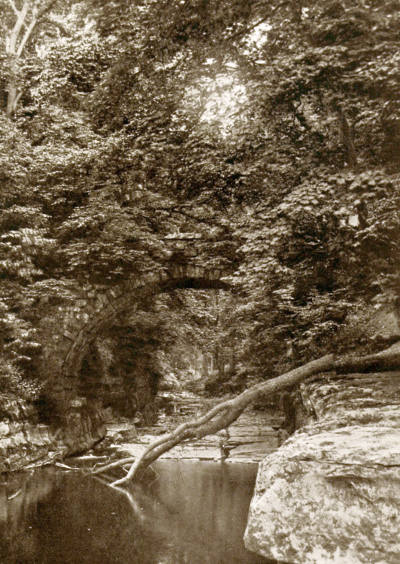
At Barnard Castle—which is not a very
attractive town at first sight, and is sorely
disfigured by its portentous museum—we
again cross the Tees into Yorkshire, near
the point where the familiar towers of the
Baliols' ruined fortress stand high above
the river on their cliff. This commanding
position was granted to the Norman Guy
de Baliol by Rufus, and Guy's son Bernard
raised on it the castle that was forfeited by
his descendant. This Bernard was no friend
to the throne on which the later Baliol sat,
for he was the most zealous of the five
knights who captured William of Scotland
and took him to Richmond Castle. When
the enterprise seemed about to fail, it was
Bernard who cried: "If you should all turn
back, I would go on alone!" A little more
than a hundred years later John Baliol, King
of Scotland, was rashly refusing to be at the
beck and call of the English king. "Has the
fool done this folly?" asked Edward. "If
he will not come to us we will come to him!"
So John lost his crown, and Barnard Castle
saw the Baliols no more. It was given to the
Nevilles, and so with many other things fell
into the capacious hands of Richard III., who
actually lived here for a time, and has left
his symbol, the wild boar, upon the oriel
window.
There is one gracious memory that makes
these towers sacred. The ruined halls are
haunted by the presence of that gentle and
sad lady who was the widow of one John
Baliol and the mother of another—Devorgilla,
daughter of kings, foundress of Baliol
College, and in her endless sorrow the builder
of Dulce Cor. When her husband died she
"had his dear heart embalmed and enshrined
in a coffer of ivory, enamelled and bound
with silver bright, which was placed before
her daily in her hall as her sweet, silent companion."
It was here at Bernard Castle that
she chiefly lived with that silent companion,
until the noble shrine of stone was ready to
receive the ivory coffer; it was here she
lived on alone, till she too died and was
carried out to be buried in Sweetheart
Abbey, with John Baliol's "dear heart"
upon her breast.
Of the two roads to Middleton-in-Teesdale
the one on the Durham side is the best as
regards both surface and scenery; but the
greater number of those who drive up
Teesdale will return to Barnard Castle
before going on their way to the north or
crossing Yorkshire to the coast, and will
probably prefer to drive up the valley by
one road and come down it again on
the other. On the Yorkshire side there
is nothing very striking. Lartington is
pretty, and gay with flowers; Cotherstone
still has a fragment of the FitzHughs'
castle in a field above the
river; Romaldkirk has an interesting
church. Beyond Mickleton we cross the
Lune, which is a miniature copy of the
Tees, with the same rocky bed and the
same close screen of overarching boughs.
A few minutes later we cross the Tees
itself and are in Middleton.
The road from Middleton to High Force
is surprisingly populous. Here among the
hills, where the fields are yielding to moorland,
and the river flows under bare crags,
one expects a certain amount of loneliness;
yet here is a broad and civilised highway,
with all the character of a road near some
large town. The scenery, however, is wild
enough; and more beautiful than anything
we have seen. Beyond the river—open now
to the sky, no longer veiled by trees—rise
the moors, piled high, fold upon fold, grand
in outline and glorious in colour, green and
purple and crimson. A wood by the wayside
blots out river and hills for a moment; then
suddenly through a gap we see High Force.
Looking down from the road we see it as
a picture framed in trees: the solid wall of
rock, the leap of the foaming waters, the
cloud of spray, the fir-trees with their spires
against the sky, the crimson moors beyond.
That white torrent is the boundary of the
county, the crown and climax of the beauty
of Yorkshire, and our last and most perfect
memory of the dales.