Here, on the very border of Wales, one
is conscious of the Celtic atmosphere.
We left the quiet orderliness of England
behind us when we dipped down into this
little valley, where the sparkling, bubbling
Ceiriog—every inch a Celt—calls to us to
follow it up into the hills. And so we will,
as soon as we have climbed the other side
of the valley into Chirk village; turning
there to the left, though our rightful road,
the road to Llangollen, lies directly in front
of us. In Wales we shall find ourselves
constantly tempted to leave the highway,
and in most cases we shall be rewarded if
we yield to the temptation without ado. In
this particular case we shall be rewarded
with a dear little glen, feathery birch-trees
on the steep slopes, a yellow carpet in primrose
time, and a most charming little hotel
about six miles up the valley, at Glyn
Ceiriog.
Near Chirk the road sweeps round under
the trees of the deer-park, where “there is
on a smaul hille a mighty large and stronge
castel with dyvers towers”; towers that have
stood here for many generations, defying
time and war; for this castle of Chirk is no
ruin like most of its contemporaries, but an
inhabited house. Yet not these towers, I
believe, but the old Welsh Castell Crogen,
stood here when Henry II., with “the chosen
warriors of England,” and of several other
countries, marched up this valley to join
battle with the great Owen Gwynedd and all
the might of Wales, who were encamped near
Corwen. The English, finding the trees in
their way, cut them down as they advanced,
which so much infuriated some of the Welsh
who were separated from their main army,
that the Ceiriog ran red with the blood of
Henry’s chosen warriors. This Battle of
Crogen took place just below the older
castle.
Perhaps the most dramatic event in the
life of the present Chirk Castle was when
it fell into the hands of the cavaliers, and
its owner, Sir Thomas Myddleton, a Parliamentary
leader, was obliged to besiege his
own house in his own person. I believe that
on one day of the week the world at large
is allowed to pass through the beautiful gates
of wrought iron, and up the long slope of
the avenue, and into the castle itself, to see
all the treasures of art and history that
George Borrow saw when he was here: the
cabinet of Charles II., and the portraits of
Nell Gwynne, and of “the very proud
daughter of the house,” as Borrow calls
Addison’s wife, “the Warwick Dowager who
married the Spectator, and led him the life
of a dog.”
Across Chirk Park runs Offa’s Dyke, the
long embankment “that was cast up with
great labour and industry by Offa the
Mercian, as a boundary between his Subjects
and the Britains, from the mouth of Dee to
that of the River Wye.... Concerning which
Joannes Sarisburiensis in his ‘Polycration’
saith that Harald establish’d a law that whatever
Welshman should be found arm’d on
this side the limit he had set up, then ...
his right hand should be cut off by the
King’s Officers.” It touches the high-road
a few miles beyond Chirk, just before
we begin the wonderful descent into the
Vale of Llangollen; that long slope down
which we swing for several miles on a
perfect gradient and a perfect surface—marred,
however, by an awkward turn—with
the whole beautiful valley spread
out before us, and the Dee sweeping far
below us, spanned by the remarkable aqueduct
called Pont-y-Cysylltau. Beyond it rise
the Eglwyseg crags, and far away the
shattered fortress of Dinas Bran is visible
almost from the first on its peak above
Llangollen. “The castelle of Dinas Brane,”
says Leland, “was never a bigge thing, but
sette al for strenght as in a place half inaccessible
for enemyes.” Even in his day it
was “al in ruine,” and now there is only
a fragment left of it to remind us of those
princes of ancient Powys who built it in days
so old as to be unchronicled, and defied the
power of the Saxon from within its walls;
and of its owner in later days, Madoc ap
Gryffyth Maelor, who built the Abbey of
Valle Crucis; and of the fair Myfanwy, “all
smiles and light,” who was loved by a poor
bard of the fourteenth century, and celebrated
by him in a poem that still exists.
At the foot of the crag on which Dinas
Bran is perched lies Llangollen—a little town
that owes its charm entirely to its position.
Only a few miles away, in Shropshire, an
ugly house is an exception: in Wales it is
unfortunately the rule. A town or village
that is really pretty in itself, apart from its
surroundings, is almost unknown. But so
lovely is the position of Llangollen that in
spite of its rather squalid streets it is an
entrancing place; so entrancing that Robert
Browning lived for some time at the Hand
Hotel, and the two famous “Ladies of Llangollen,”
Lady Eleanor Butler and Miss Ponsonby,
chose it out of all the world for their
life-long home. Llangollen is still dominated
by “the Ladies,” almost as much as by Dinas
Bran itself. They adorn the windows of all
its photograph shops; they shine in crude
colours from all its china mugs; and in its
churchyard we learn from an extremely ugly
tombstone that one of them, in the opinion
of the other, had “manners worthy of her
Illustrious Birth.” It must be admitted that
such is not the impression given by the impartial.
It became the fashion for travellers
of mark to visit this quaint couple in their
house up there on the hill, and they themselves
insisted on its being also the fashion
to give them presents—carvings, miniatures,
curiosities of all kinds. If we care to climb
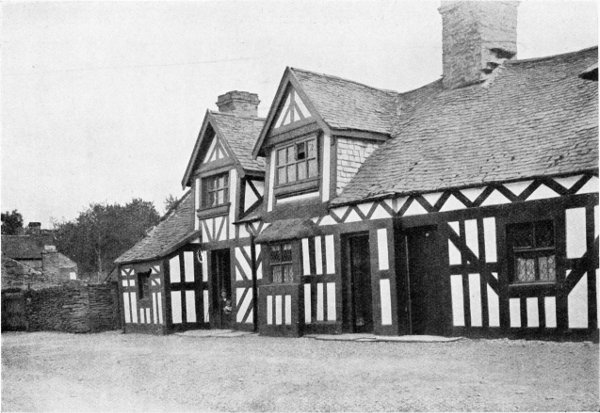
a steep hill we may see the outside of Plas
Newydd now, a black-and-white house, which
must have been really pretty in its original
simplicity, but is now overladen with a
mass of carving. From the road we can see
the porch in which “the Ladies” once stood
“fussing and tottering about in an agony of
expectation,” waiting for Sir Walter Scott,
and looking, says Lockhart, “like a couple
of hazy or crazy old sailors.” “Who could
paint,” he goes on, “the prints, the dogs, the
cats, the miniatures, the cram of cabinets,
clocks, glass-cases, books, bijouterie, dragon-china,
nodding mandarins, and whirligigs of
every shape and hue—the whole house outside
and in covered with carved oak ... and
the illustrated copies of Sir W.’s poems, and
the joking, simpering compliments about
Waverley.” But whether their manners were
worthy of their Illustrious Birth or not, they
were true friends to each other, and the
guardian angels, as Lockhart admits, of
Llangollen. It is an interesting fact (which
should not be forgotten) that the church
under whose shadow they lie is dedicated to
St. Collen ap Gwynnawg ap Clydawg ap
Cowrda ap Caradog Freichfras ap Llyr
Merimap Eini Yrth ap Cunedda Wledig.
Far more important than Plas Newydd
or its memories of vanished mandarins and
whirligigs is the work of that prince of
Powys, whose name I mentioned in connection
with Dinas Bran—Madoc ap Gryffyth
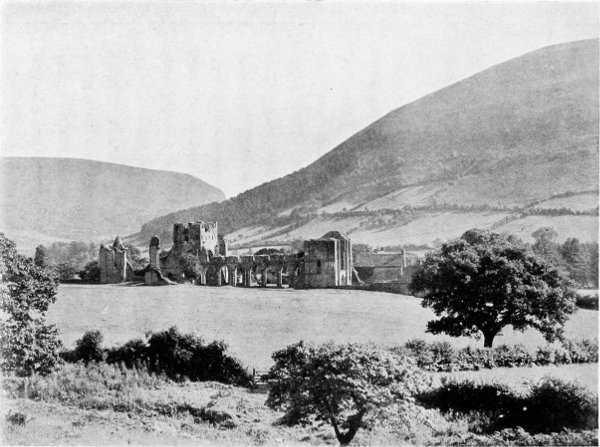
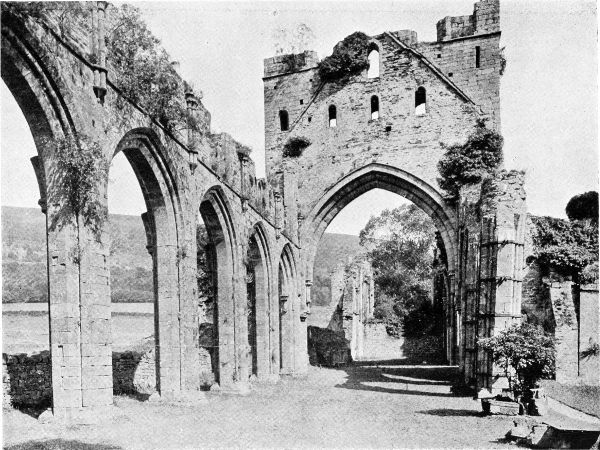
Maelor. In Pant-y-Groes, or the Valley of
the Cross, stands Madoc’s ruined abbey, the
most perfect retreat, surely, that ever brought
comfort to the sad or sinful. It was of the
Vale of Llangollen that Ruskin characteristically
wrote: “The whole valley, when once
I got up past the Works (whatever the
accursed business of them) seemed to me
entirely lovely in its gentle wildness.” And
it is this very quality of gentle wildness that
gives such charm to the little Glen of the
Cross, which joins the larger valley of the
Dee just above Llangollen, and is reached
by way of the old stone bridge that was
the first of its kind in Wales.
When, in a few minutes, we see the gable
of Valle Crucis Abbey below us on the right,
we leave our car by the roadside. We leave,
indeed, the whole world behind us as we
pass through the heavy door by which there
was once no returning. The narrow wooded
valley hems us in, the trees are close round
us, the waters of the fishpond, in their
absolute stillness, add to the sense of aloofness
and peace. And under our very feet,
perhaps, is the dust of Iolo Goch, the famous
bard who sang of “Owain Glyndwr, the
great, the good”; for Iolo’s unmarked grave
is here; and here, too, lies Madoc, who built
this abbey in the last year of the twelfth
century; and Myfanwy, the beautiful princess,
“fairer than the cherry’s bloom”; and
others who died long, long before them.
To antiquarians the tombs of Valle Crucis
are full of interest, for there are some that
seem to prove, says the custodian—himself
an antiquarian—that this Cistercian house
rose on the site of an older Benedictine
building. The Cistercians never used warlike
symbols, but always the sign of the Cross;
yet here on two stones of very early date—the
sixth or seventh century—are carved
the sword, the spear, and the battleaxe.
Fragments of stained glass, too, have been
unearthed, and coloured tiles, though the
Cistercian Rule forbade the use of colour
in any form. This austere Order, however,
while avoiding the use of the sword as a
symbol, was apparently not averse to using
it as a weapon on occasion, for it was by
fighting the Benedictines in a neighbouring
field, according to the custodian’s theory,
that they became possessed of the site of
their abbey. Truth to tell, the extreme
austerity of the Cistercians seems to have
relaxed in later days, for we hear after a
time of four courses of meat in silver dishes
at Valle Crucis, and of an abbot with three
of his fingers covered with rings. But these
are disturbing thoughts. Let us rather take
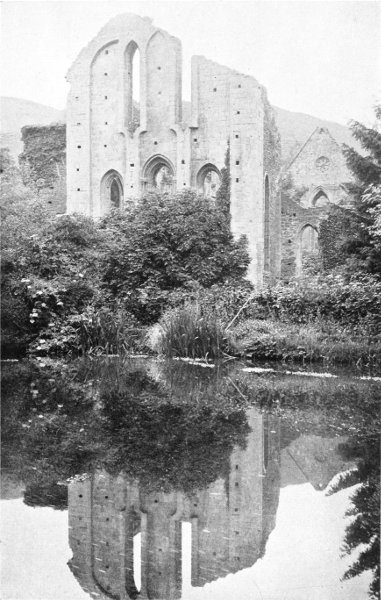
away with us a picture of the quiet fishpond,
with its water-weeds and clumps of
yellow flags, and the gable of the church
reflected in it line for line, and on the bank
a hooded figure, dressed in white, with a
placid face and a busy fishing-rod.
Quite near the abbey in a field is a far
older relic, Eliseg’s Pillar, the rough stone
monument that gave its name to the Valley
of the Cross, though as a matter of fact
it was probably never a cross. It was once
much higher than it is now, but in the
days of the Civil War the name of the
valley was enough to make it suspect, and
the pillar was thrown down by the Puritans
on the chance of its once having been a
cross. It has been much discussed and disagreed
about, but at all events its very
great antiquity is a certainty, and the inscription
that is now illegible was luckily
copied several centuries ago. “Concenn,” it
tells us, “the great grandson of Eliseg,
erected this stone to the memory of his
great-grandfather, Eliseg. This is that Eliseg
who recovered his inheritance of Powis by
his sword from the power of the Angles.”
Returning to Llangollen we cross the Dee
again and go on our way upon the road to
Holyhead, up the ridge of Rhysgog, past
Berwyn Station, and so out of the Vale of
Llangollen into that of Edeyrnion. The Dee
is still below us on the right, with thickly
wooded hills beyond it; and on the left are
rocky heights, sometimes bare and sometimes
softened by trees. We have a lovely
run before us down the valley, but if we
are prudent we will drive slowly in the
neighbourhood of Corwen.
But here, at the head of the valley, we
are eight miles away from Corwen, and
have other things to think of—great things,
indeed: the last struggle for Welsh freedom,
and the man who was the heart and
the head of it, that strange mixture of
ruthless vengeance and lovableness, Owen
Glyndwr, who as a pattern squire, rather
scholarly and very hospitable, spent many
quiet years, living sometimes here at Glyndyfrdwy
beside the Dee and sometimes at
his other house at Sycharth, and then suddenly,
at the touch of injustice, unfurled
the red dragon of Uther and became the
implacable devastator whose name meets us
in every ruin in Wales. Nothing remains
now of his house, for Prince Hal descended
upon it one day, and, having left it level
with the ground, wrote to his “very dear
and entirely beloved” Wardens of the
Marches to tell them all about it. After
describing the burning of Sycharth and of
many houses round it he goes on: “Then
we went straight away to his other place
of Glyndourdy, to seek for him there.
There we burnt a fine lodge in his park,
and all the country round; and we remained
there all that night.” Above the spot where
the fine lodge stood is a curious tumulus
crowned with firs, quite close to the road.
It is known as Owen’s Mount, not because
he made it, for it is far older than he, but
because there is a story that he used it as
a kind of watch-tower. It was at Corwen,
some say, that he first raised his standard;
but the other memories of him here are
legendary and trivial.
From Corwen to wild Cerrig-y-Druidion—the
Rock of the Druids—the road rises
steadily, and leads to nothing of note but
the lovely little Pass of Glyndyffws, a deep
and narrow defile of sudden unexpected
beauty that connects two tracts of rather
dull country. Here, where the Ceirw flings
itself into the ravine from a great height
and foams among the rocks far below us,
Telford has thoughtfully supplied us with
several little recesses in the wall from which
to enjoy the view. I have heard that he
cut his name in the stone of one of them,
but I have never been able to find it.
Perhaps it was to his name that George
Borrow objected when he came here and
laughed at “Mr. T.” for being eager for
immortality. There was no need for Telford
to be over-anxious about his immortality;
nor yet, indeed, was there any for Borrow
to flout him because he was not a Welsh
bard!
Tyn-y-nant, where “little Dick Vickers,”
late of Shrewsbury Mail, hanged himself
rather exclusively, is a place of a dreary sort;
and so is Cerrig-y-Druidion; and so, most
of all, is the straight road from Cerrig to
Cernioge, a piece of road that catches all
the winds of heaven, and always seems
longer than it was last time. Open the
throttle here, and be thankful—if the weather
be cold—that your good engine is humming
before you, and is making a better pace than
the eleven miles an hour of which the shivering
travellers on this road used to boast.
Cernioge is to us merely an unkempt farmhouse,
but to them it meant a fire and hot
drinks, for it was once a posting-house of
considerable renown.
At Cernioge begins the descent into the
valley of the Conway; and it is here that
we first see, stretched out before us like
the Promised Land, the distant grandeur of
Snowdonia, the wild, impenetrable fortress
of the Welsh and the trap of the invading
English. When Pentre Voelas is passed the
beauty grows and grows, mile by mile, and
we are gently gliding down into the very
heart of it; wild crags to the right of us,
and before and below us a sea of woodland,
valley beyond valley and hill beyond hill.
There is one turn of the road where nearly
every car draws up. The valley of the
Conway lies at our feet, with here and
there the river shining through the trees;
the Lledr Valley stretches away and merges
into the distant moors; Moel Siabod’s peak
rises at the end of it; and over Siabod’s
shoulder appears, on a clear day, a wedge-shaped
corner of Snowdon, faintly blue. I
have seen this view at many times of the
year, and the best time of all is May.
For the woods that are at our feet, the
woods that gave its name to Bettws-y-Coed,
the Chapel in the Wood, are at their best in
May, when every tree has its own individual
shade of colour, the larch its tender green,
and the budding oak its pink and gold. But,
indeed, Bettws is always lovely. Nothing
can spoil its innate simplicity; not even the
smart hats and parasols that look so incongruous
in its little street in July and August.
It exists only for tourists; there are several
good hotels, and, roughly speaking, all the
other houses are lodgings; yet in spite of
all, Bettws is a village still. Those who like
to settle down comfortably and motor round
a centre, instead of touring from place to
place, will find this much the most central
and convenient spot from which to explore
North Wales. And in any case, I think we
must stay here for a night or two. We
must drive to Rhuddlan and Conway and
Dolwyddelan; we must stand on the Pont-y-Pair
and watch the tempestuous Llugwy;
we must inspect David Cox’s famous signboard
at the Royal Oak; and in the evening,
when the dusky yews are all in shadow, we
must sit in the churchyard beside the Conway,
where the great artist loved to paint.
The church—the “Chapel in the Wood”—is
uncouth and bare, and not improved by
modern windows; but it has stood here for
many centuries, and among its ugly pews
we realise with a thrill that the tomb at
our feet holds the dust of a prince of
Llewelyn’s house.
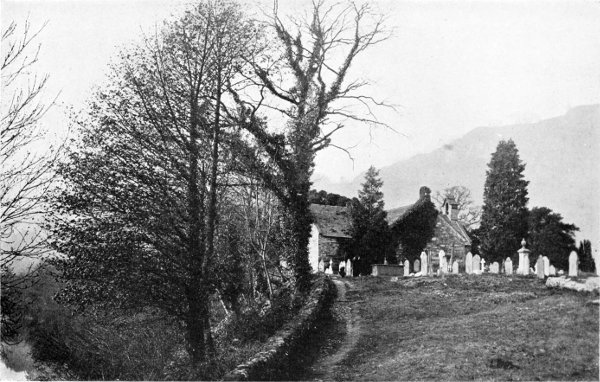
THE OLD CHAPEL, BETTWS-Y-COED.
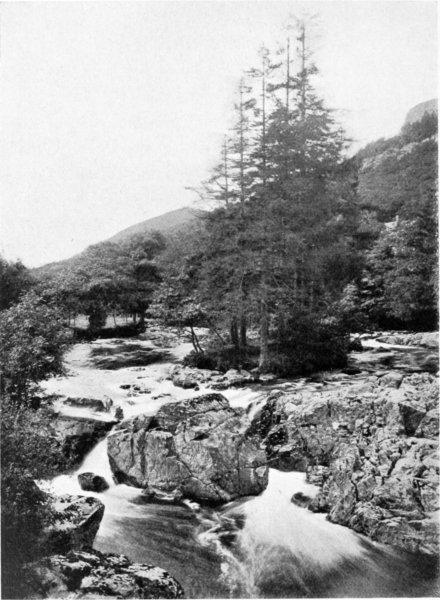
THE LLUGWY AT BETTWS-Y-COED.
This is the country of Llewelyn the Great.
On one side of us is the valley that tradition
names as his birthplace; on the other the
valley where he was buried. His grave we
cannot see, for his burial-place at Aberconwy
was desecrated when Edward I. built his
great castle; but on the way from Bettws to
Rhuddlan we may pause at the church of
Llanrwst and see there, on the floor of
Inigo Jones’s chapel of the Wynnes, the
coffin of stone that once held the bones of
the greatest of the Welsh princes. There
are a good many interesting things here—things
much older than the church itself;
but not the least pleasing, I think, is the
Latin epitaph that the former rector composed,
with a pretty wit, for his own tomb.
It has been thus translated:—
“Once the undeserving schoolmaster,
Then the more undeserving lecturer,
Last of all the most undeserving rector of this parish.
Do not think, speak, or write anything evil of the dead.”
If we are going to Rhuddlan it will not
be necessary for us to cross the shaking
bridge, designed—perhaps—by Inigo Jones.
I see no object in a bridge shaking, myself,
but there are always those at hand
who for a consideration will shake you the
bridge if it gives you pleasure. Our way,
however, lies to the right, up a winding hill
three miles in length, with an average
gradient of 1 in 12. It is a serious climb;
but the backward view of the mountain
range beyond the Conway is magnificent—a
view of rather a rare quality, and not often
seen by those who depend upon horses’
legs or their own. The road that crosses
the top of the hills runs through scenery
of rather a commonplace type; then, as we
drop down into Abergele the Morfa Rhuddlan
lies before us like a map—a dull map—with
fashionable Rhyl in the distance; and
from Abergele to Rhuddlan the road is surely
the straightest and flattest that ever was seen.
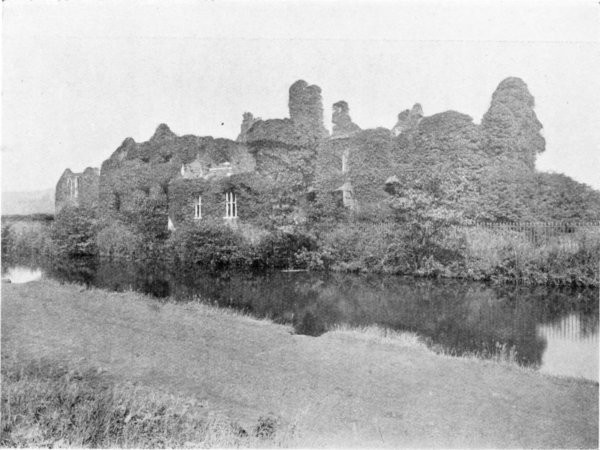
The ivy-smothered towers of Rhuddlan
Castle stand on the banks of the Clwyd.
That great statesman and soldier, Edward I.,
being weary of the “Welsh Question,”
determined to get the affair finished once
for all; so he rebuilt this castle, settled
down here with his Court and family, conquered
the country, made its laws, and saw
that they were carried out. There is a
remnant still standing of the house where
he held his parliament and “secured its independence
to the Principality of Wales.”
These words, though not Edward’s, are quite
in the spirit of his little jokes. It was here
that he played his historical practical joke
upon the Welsh nation, when he promised
them a prince who was a native of Wales
and could not speak a word of English—and
then showed them the baby. There is
nothing for us to see inside this castle, for
Cromwell altogether dismantled it, and its
heavy green towers, though impressive
enough as being the grave of Welsh independence,
are not nearly so typical of the
“ruthless king” as his great fortresses of
Carnarvon and Harlech and Conway.
Conway is only seventeen miles away, and
we may see it on our return journey to Bettws,
by driving back to Abergele, where there is
a nice old posting-house, and thence passing
on above Colwyn Bay. Five hundred years
ago another traveller came by this way
from Conway: a poor, duped, heart-sick king
riding helplessly to imprisonment and mysterious
death. It was at Conway that
Bolingbroke’s messenger Northumberland, a
man of a most treacherous heart, met
Richard II. with solemn vows of friendship;
and along this coast that they rode together,
still smiling, the knave and the fool,
to Rhuddlan and Flint, where Bolingbroke’s
army lay waiting on the sands o’ Dee.
Those splendid walls and towers of Conway
that we see beyond the estuary, piled high
above the water-side, were Richard II.’s last
refuge. From that day forward every roof
that sheltered him was a prison.
All through the history of Wales this
estuary has played an important part.
Long, long before Edward’s magnificent
towers rose over the desecrated burial-place
of the great Llewelyn there was a castle
guarding the river-mouth at Deganwy. We
can see its fragments still if we choose to
drive round that way before crossing to
Conway; but there is only a remnant left, a
few stones on a hillside facing the sea—stones
that tell of Maelgwyn of the sixth century,
and of Norman Robert, lord of Rhuddlan,
who rebuilt Maelgwyn’s fortress and met
his death there, and of King John of
England, who was starved out by the
Welsh. Robert of Rhuddlan’s death was
picturesque, and, I imagine, well deserved.
This was the manner of it. He was still
employed in rebuilding the Welsh castle of
Deganwy for the harrying of the people to
whom it really belonged, when one day he
fell asleep—a rash thing to do in those days
and in that place. Then came Griffith,
Prince of Gwynedd, with his ships, and
stole all Robert’s cattle, and was just setting
sail again when Robert awoke and saw
what was going forward. Down this steep
bank below the castle he dashed to the
shore, and fought desperately, with only one
follower to support him; but soon died, of
course, by the spears of the Welsh. Griffith
nailed his head to the mast and sailed away;
then, when the Normans chased him, flung
it into the sea before their eyes.
As for King John, when he in his turn
tried to strengthen the fortress of Deganwy,
he was glad enough to escape with his wicked
head on his shoulders. He had come into
Wales “minded to destroy all that had life
within the country”; but he departed, we
are told, in a great fury, leaving a large
proportion of his army behind him for
Llewelyn to bury. For the Welsh had cut
off all the supplies of the English, “so that
in time they were glad to take up with horseflesh
or anything, were it never so mean,
which might fill up their greedy and empty
stomachs.” So says Caradoc of Llancarvan.
Other historians give us a letter written on
the spot by a certain knight, a man of parts,
of whose life and letters one would like to
know more. He describes the royal army
as “watching, fasting, praying, and freezing.
We watch,” he continues, “for fear of the
Welsh.... We fast for want of provisions....
We pray that we may speedily return
safe and scot-free home; and we freeze for
want of winter garments, having but a thin
linen shirt to keep us from the wind.” This
vivid letter-writer goes on to tell us of the
spoiling of Aberconwy Abbey and the burning
of all the valuable old Welsh records
there, and he shows a good deal of nice
feeling in the matter.
It was on the ruins of Aberconwy that
Edward’s glorious castle rose later on to
overawe the Welsh. This Castle of Conway
is the most beautiful of all Henry de Elfreton’s
works, I think; more beautiful in itself
even than Harlech; and we can well believe,
as we drive across the bridge and under the
great machicolated town gate, that in early
days it could only be taken by the help of
guile or famine. Glyndwr’s men won their
way in by disguising one of their number
as a carpenter, and to dislodge them Hotspur,
finding his engines useless, was obliged
to starve them out. During the Civil War
the castle was held for the King by the
Archbishop of York, an extremely “muscular
Christian,” who on being superseded in
his command felt the slight so deeply that
he joined Mytton the Roundhead, and himself
led the assault! And these great walls,
fifteen feet in thickness, yielded at last. As
one climbs the long flight of steps to the
entrance with all these things in one’s mind
there is something almost overwhelming in
the grandeur of these strong towers.
“A very neat castle,” says Camden.
When we have had our luncheon at the
Castle Hotel we must cross the road to
Plas Mawr, the town house of the Wynnes
of Gwydir, who entertained Queen Elizabeth
there more than once, and even decorated
her rooms with appropriate symbols, royal
arms, and monograms. The plaster mouldings
in this house are its special feature:
fireplaces, ceilings, walls, all are ornamented
with them, and in each room the design is
different. One cannot, however, enjoy the
mouldings and the oak furniture and the
priests’ hiding-hole and the lantern window
with an undivided mind, for the Plas Mawr
ghost—unconventional soul!—walks by daylight.
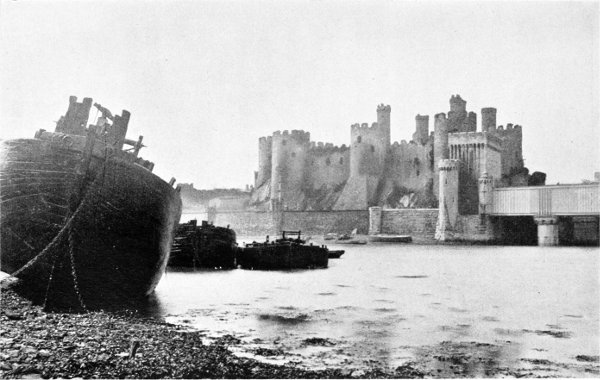
CONWAY CASTLE.
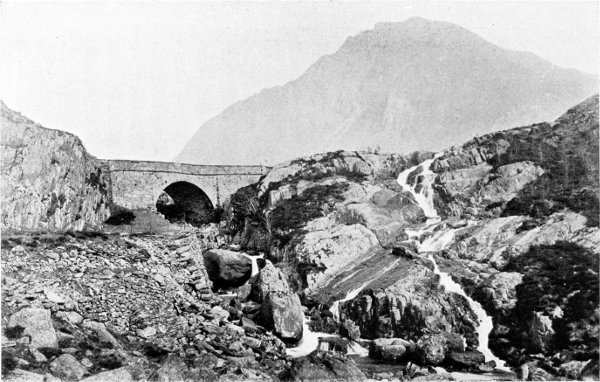
THE PASS OF NANT FFRANCON.
We leave Conway by the road that
follows the western bank of the river, for
by so doing we secure an impressive backward
view of the old town walls, which
is ample compensation for the steep ascent
that soon carries us out of sight. Moreover
this road, after a few more hills and
a few more miles of level going, with a
view up the valley that grows lovelier
every moment, will lead us to Trefriew, a
dear little watering-place with a good
hotel. The tiny church here has no outward
attractions; it has not even any
appearance of age. Yet it has its own
romance; for it is said that when the
English wife of Llewelyn the Great—Joan,
the daughter of King John—found the
severe climb to the old church of Llanrhychwyn
too much for her, her thoughtful
husband built this one for her at the foot
of the hill. Those who do not share her
feelings may still see, on the heights
above the village, the yet older church
where Llewelyn worshipped before his
wife objected to the walk. And beyond it
again, on the wild hill-top, is Llyn
Geirionydd, on whose shores lived Taliesin,
the Bard of the Radiant Brow, the most
famous of all the Welsh bards.
Between Trefriew and Bettws there are
but a few miles of level road and very
lovely scenery. Gwydir Castle, the old
house of the Wynnes, stands between us
and the river, and may be seen when
Lord Carrington is away. It is full, I
believe, of carvings and tapestry and relics
of history. Queen Elizabeth stayed here,
and Leicester, and Charles I.
But here among these wild Welsh hills
Elizabeth’s starched ruff and Charles’s
curls strike one as a little out of place.
We may find memories of Elizabeth—who
seems to have slept in as many different
places as a motorist—in half the towns
and big houses of England. This is the
country of the Kings of Gwynedd.
We saw the Lledr Valley stretched out
before us as we came down the hill from
Pentre Voelas to Bettws. But that bird’s-eye
view of it gives one no idea at all of
its extreme beauty; of the towering height
of its steep slopes, now bare and rocky,
now richly wooded: of its brilliant colouring
and deep purple shadows. At the head
of it, where its beauty is partly spoiled
by quarries and all their works, is Dolwyddelan
village; and beyond that again,
standing alone among the desolate hills,
is the stern tower where Llewelyn the
Great, the “eagle of men,” is believed to
have been born. It is only a square
tower now, and though it once had two
towers it was never a place of any size;
for Dolwyddelan and Dolbadarn, the two
mountain strongholds of the princes of
Gwynedd, did not rely upon their own
strength, but on the great bewildering
hills that defended them on every side.
Thus it was that this small fortress was
the last to yield to Edward I. And while
remembering Llewelyn here do not let us
forget to dedicate one sigh to his poor
father, Iorwerth Drwyndwn—of the broken
nose—who, when that unfortunate feature
kept him from his princedom, was given
this country and its tower by way of
compensation.
It is the custom to return to Bettws
from this point, for reasons that a glance
at the Contour Book may perhaps explain.
But the fashion has been set, I
think, by bicyclists, whom one really cannot
blame for shirking the hill that rises between
Dolwyddelan and Maentwrog. Here let me
assure motorists that there is little reason
why they should miss the wild beauty of
the moors above this point; the rolling
expanse of brown and purple bogland, the
endless succession of hills, the grand outline
of Moel Siabod. For though the road is
certainly steep the surface is excellent, except
for a mile or so above Blaenau Festiniog,
that strange town on the mountain ledge
that entirely owes its existence to the
neighbouring quarries, and yet is more
than a mile long and has three railway
stations. There is no need to brave the
hill again to return to Bettws, for the road
by Maentwrog, Penrhyndeudraeth, and the
Pass of Aberglaslyn is one of the loveliest
in Wales, and though we shall come down
the Pass by and by there is no hardship in
going over the ground twice. It is worth
remembering, too, that at Maentwrog it is
possible, if time allows, to cross the valley
and approach the famous toy railway-line
at its prettiest point, Tan-y-Bwlch, where a
lake lies hidden among the woods, and
where we may have tea on the grass close
beside the water, facing a scene of rich
colouring and deep, cool shadows.
All this, however, is a digression. It is
highly probable that the great majority
of motorists will look at the Contour Book
and return to Bettws from Dolwyddelan.
They will have the advantage of seeing
the Lledr Valley from a new point of view.
Now in the Snowdon country there are
three great passes through the mountains
to the sea: the Passes of Nant Ffrancon,
Llanberis, and Nant Gwynant combined
with Aberglaslyn. It is hard to say which
is the most beautiful of the three; and it
is quite imperative, and also quite easy, to
see them all by pursuing rather a zigzag
course. Nant Ffrancon is the route of the
Holyhead Road and the nearest to Bettws:
so we will go down by Nant Ffrancon, and
come up again by Llanberis on the same
day; and on the next start off again by
way of Nant Gwynant and Aberglaslyn,
passing through Bedd Gelert.
The road climbs out of Bettws through a
thick wood beside the rushing Llugwy, and
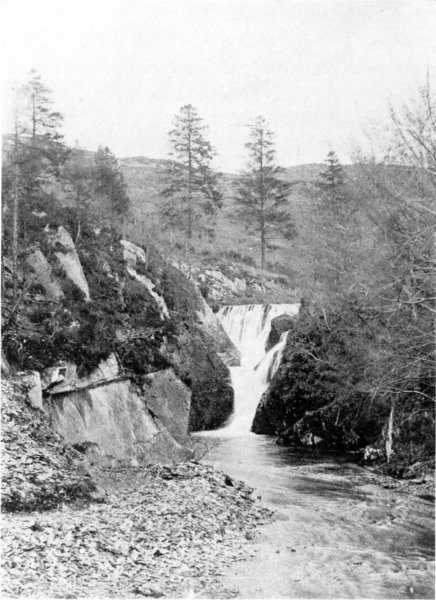
soon draws near the Swallow Falls.[7] This
triple fall is only a stone’s-throw from the
road, and it is worth while to follow the
slippery path across the pine-needles, and
stand for a moment in the pricking spray
watching the commotion. In the thick of
the hubbub they say the spirit of Sir John
Wynne, which left this mortal coil early
in the seventeenth century, is being
“purged, punished, and spouted upon”;
though I have never heard anything
definite against him except that he was
“shrewd and successful.” He was a member
of that Court of the Marches of which
we heard so much at Ludlow, and he left
a very valuable record of his family behind
him.
This bit of country between Bettws
and Capel Curig is one of the gems of
North Wales. Moel Siabod towers above
us; and beyond it soon appears that cloud-capped
peak whose name quickens every
Welsh heart—the rallying-point of heroes,
the symbol and stronghold of the liberties
of Wales. The finest view of Snowdon is
from Capel Curig, where the double peak
is reflected in the double lake.
Our road, still climbing, turns to the
right in Capel Curig and takes us up into
the heart of the hills, through a scene of
splendid desolation—bare heights, huge
boulders tossed and heaped upon the
ground, jagged outlines, and dark sullen
colours—a land that was vastly disconcerting
to those travellers of an earlier day
whose idea of beauty was “a smiling
landscape.” As we reach the summit and
see the waters of Llyn Ogwen below us,
sapphire-blue or lead-grey according to
circumstances, the great sides of Tryfaen
and the Glydyrs tower on the left. Beyond
the lake Alla Wen rises steeply. “A horrid
spot of hills,” says a seventeenth-century
writer. “The most dreadful horse-path in
Wales,” says Pennant; and that indeed it
may well have been before Telford came
here to perform his miracles of engineering.
“The district through which the
surveys were carried is mountainous,” he
says quietly; “and I found the existing
roads very imperfect.” When we have
passed Llyn Ogwen, and the cottage where
food is to be had if necessary, and the
sudden turning over the bridge, and are
swinging down the gentle slope of Nant
Ffrancon high up on the mountain-side,
we must surely give nearly as much
admiration to this road which descends for
ten miles with no steeper gradient than
1 in 15 as we give to the wide Valley of
the Beavers below us. Above us the
mountain is a mass of grey boulders, of
scars and landslips; below us it sweeps
down precipitously to where the little
Ogwen dances like a streak of quicksilver.
Presently we pass under the hideous
excrescence of the Penrhyn slate quarries,
grey terraces of rubbish contrasting cruelly
with the glowing gorse of the opposite
slopes; and then through the equally
hideous town of slate, Bethesda, the miners’
town, whose slate walls, slate steps, and
slate porches are enough, as Dr. Johnson,
would say, “to make a man hang himself.”
Let us hurry on into the Cochwillan
Woods.
Very soon after passing the modern towers
of Penrhyn Castle we reach the town of
Bangor, “which for the beauty of its
situation, was called Ban-cor, the high
or conspicuous choir.” It is not a very inviting
place, nevertheless, and there is no
need to pause here, for even the cathedral
is not beautiful. It has had a great deal to
bear; for it was burnt by Harold the Saxon,
and again by King John, and again by
Owen Glyndwr; and no doubt the castle
built by Hugh, Earl of Chester, suffered on
one or all of these occasions, for Camden
says, “though he made diligent inquiry he
could not discover the least footsteps” of
it. The original cathedral was founded by
St. Deiniol in the sixth century, and beneath
it is buried the great Welsh prince Owen
Gwynedd, hero of many battles, who fought
here on the heights above the straits a fight
so desperate that “the Menai could not
ebb on account of the torrent of blood
which flowed into it.” Before we go on to
Carnarvon we must cross those straits, for
the sake of the bridge, and of the view,
and of Beaumaris.
It was in the year 1826 that the mail-coach,
swaying under its burden of excited
officials, rolled slowly for the first time
over the Menai Bridge. It was a brave
scene. Telford, in his modest way, had
pleaded against a formal procession, but he
could not check personal enthusiasm nor
prevent the mustering of that long, long
line of carriages and horsemen and thousands
on foot, which followed the Royal London
and Holyhead Mail, amid the fluttering of
flags and the firing of guns, and the roaring
of a gale. Nor yet could he control the
shouts that rose above the wind when he
himself passed by in an inconspicuous
carriage.
As soon as we reach the sacred shore of
Mona, the last home of the Druids, we turn
sharply to the right; unless, indeed, we have
a mind to pursue the Holyhead road for a
couple of miles, for the pleasure of telling our
friends that we have seen Llanfairpwllgwyngyllgogerchwryndrobwllantysiliogogogoch.
I
once heard a rumour that this place was
to be connected by rail with Pontrhydfendigaedmynachlogfawr,
but as the scheme may
come to nothing perhaps it would be wiser not
to mention it.
From the shore road to Beaumaris we see
the whole grand panorama of the Gwynedd
mountains, height beyond height and range
beyond range, from the pale distant peak of
Snowdon to the dark shadows of steep Penmaenmawr.
It is a scene that has a quality
of strangeness in it. One looks at it from
the outside, as it were; for Anglesey, which
once was green with the sacred groves of
the Druids, is now, as it was in the days
of Giraldus Cambrensis, “an arid and stony
land, rough and unpleasant in its appearance.”
One feels, on this flat shore, worlds
away from that beautiful country beyond
the strait. On a day of sunshine and cloud,
when the mountains are glowing with every
imaginable colour and seem every moment
to be changing their shapes under the
moving shadows, it is worth driving many
a mile to sit on the beach of Beaumaris.
Behind us, close at hand, is Beaumaris
Castle; opposite to us, across the water, is
“Aber of the white shells,” where Llewelyn
the Great held his Court, and where his
English wife died; and a little further along
the Anglesey shore to our left is Llanfaes,
where he buried her “with dire lamentation
and no little honour,” and built over her grave
a monastery that was altogether destroyed
by Henry IV. Poor Joan’s coffin must have
been through many changes before the sad
day when it occurred to some thrifty farmer
that the queer old stone trough would do
finely for his cattle to drink out of. It was
fortunately discovered early in the last century,
and another watering-trough having
been found for the cows, it was placed in
safety in the garden at Baron Hill.
Beaumaris Castle does not make so brave
a show as most of Edward’s fortresses; but
its ten low towers and its double line of
defence were no doubt formidable enough
before their thick drapery of ivy gave them
so soft an air. The rusty iron rings that
hang on the outer wall give one of those
little touches of the commonplace that bring
the past so near. Edward I. cut a canal
and filled the moat of Beaumaris Castle
from the sea, and so the ships that brought
supplies to the garrison were moored and
unladed at the very walls.
The shores of the Menai have seen a vast
amount of fighting of a very desperate kind,
from the days when the Druids stood at bay
here to the time when Edward I. bridged
the strait with boats and was badly beaten
by the last Llewelyn. And as we re-cross
the bridge and look down at the ancient
little church of Llandysilio so far below us,
we may remember another scene—peaceful
in itself but not unconnected with bloodshed—when
on a hill near here, Archbishop
Baldwin and that delightful chronicler
Giraldus induced many persons, by persuasive
discourses, to “take the cross.”
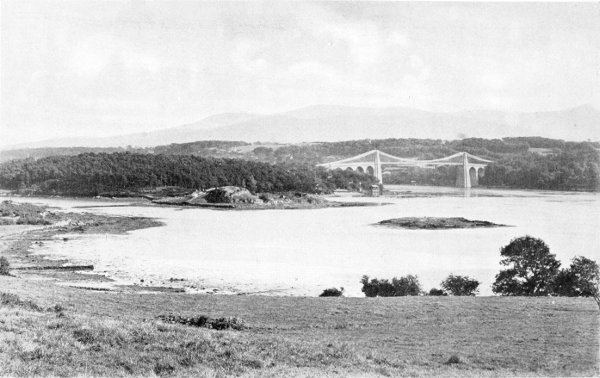
THE MENAI BRIDGE, FROM ANGLESEY.
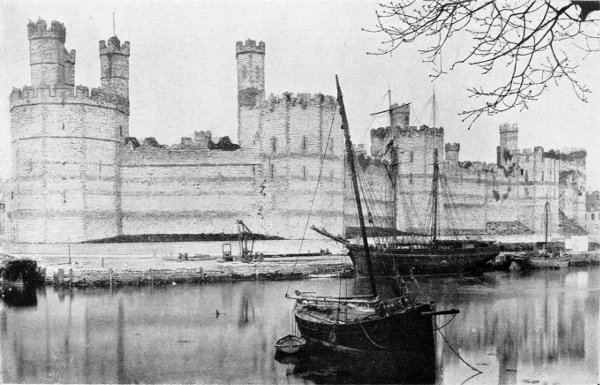
CARNARVON CASTLE.
From the other side of the Menai, on the
Carnarvon road, the view is, of course, comparatively
tame; but we have only eight
miles to travel before reaching Carnarvon,
and on a level road they are soon disposed
of.
It is difficult to realise at the first
moment that the well-preserved, clean walls
upon which one comes so suddenly in
the middle of Carnarvon were raised by
Edward I.; though that king himself stands
above the gateway, with his hand on the
sword that worked so hard. This is the
greatest of his castles; he chose it for
the birthplace of his son, and chose it too,
apparently, to be the monument and symbol
of himself. Nothing could be a more fitting
emblem of the unyielding strength of the
king who built castles in Wales almost as
profusely as other men build them in Spain.
On this, the town side of it, one is more
struck with its strength than with its
beauty. To see it at its best one must
cross the bridge, and from the other side
of the river-mouth look at the huge bulk
of it; the long line of the curtain-wall
reflected in the water; the great octagonal
towers, with their clusters of slender turrets;
the unutterable repellent air of it. There
are no windows in these cold walls; no ivy
or very little, to soften their austerity.
Even from this side, though the water and
the shipping give it picturesque surroundings,
I think Carnarvon Castle is not beautiful
so much as impressive. When Queen
Eleanor entered it through the gate still
called the Queen’s she did not see it as it
stands now, for it was finished by her son,
who was born in the castle soon after her
arrival. A little room in the Eagle Tower
is shown as his birthplace; but those who
have read the local records declare it to be
proved beyond doubt that the tower was
without a roof till the baby in question,
Edward II., put a roof on it himself.
It is surprisingly well preserved. This, no
doubt, is partly because it has never been
overcome by any more destructive agent than
the starvation of its garrison. Glyndwr
besieged it on its landward side, and his
French allies attacked it from the sea; but
they made little impression upon it, and
finally, since time was precious, they thought
it wiser to employ their engines elsewhere
more profitably, though the garrison within
numbered only twenty-eight men, in sore
want of provisions.
Between Carnarvon and the Pass of
Llanberis lie ten miles of undulating
country. But the mountains are towering
before us like an impassable wall, growing
ever higher and more formidable as we pass
Llyn Padarn and Llanberis town, whence
the mountain-railway starts for the summit
of Snowdon. No doubt the northern shores
of Llyn Padarn and of Llyn Peris, which
lies beyond it, were once beautiful; but
they are now merely a mass of unsightly
débris, mountains of broken slate, terrace
above terrace of melancholy grey. The
southern shore of Llyn Peris, however, at
the very foot of the Pass, has kept its
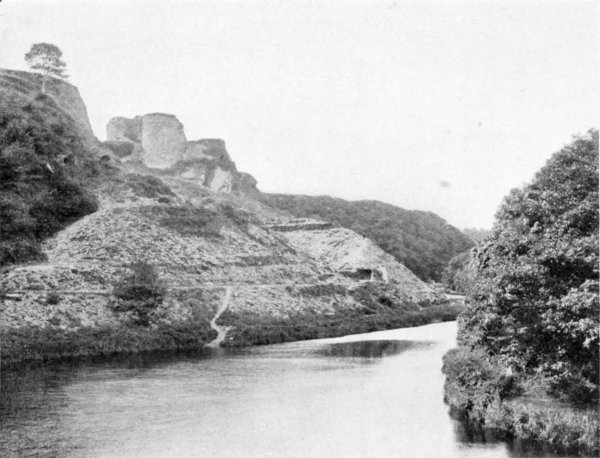
own wild beauty, and on a craggy little
hill that rises at the lower end “there is
yet a pece of a toure,” as Leland says.
A very notable piece of a tower it is too;
for Dolbadarn was the very centre and
heart and ultimate citadel of Welsh freedom
from the earliest days. Here Llewelyn,
the third and last, kept his brother a
prisoner for twenty-three years, and here
Owen Glyndwr hid himself whenever it
suited him to elude the English, who invariably
lost their way among these mountains.
It was here, too, that Owen hid his
chief enemy, Lord Grey of Ruthin, who
had embroiled him with the King of
England and caused all the trouble. But
this little square grey “pece of a toure”
is far older, they say, than Owen or
Llewelyn. It is supposed to have been
built by Maelgwyn, the same prince
who built that first castle at Deganwy
which was rebuilt by Robert of Rhuddlan
and King John at such large cost to themselves.
Maelgwyn, King of Gwynedd in the
sixth century, is one of the forceful
characters who stand out here and there
conspicuously in the rather bewildering host
of Cymric princes; a personable man, according
to all accounts, and one of great courage
and success in battle, yet not without leanings
towards the monastic life. He actually
became a monk for a time; but no one can
have been greatly surprised when he tired
of the constraint and took to soldiering
again. On the whole I fear he was a
truculent creature, for Taliesin, “chief of
the bards of the West,” proclaimed, with
the ambiguity common to prophets, that—
“A most strange creature should come from the sea-marsh of Rhianedd
As a punishment of iniquity on Maelgwn Gywnedd,
His hair, his teeth, and his eyes being as gold.”
And Maelgwyn died of the yellow plague.
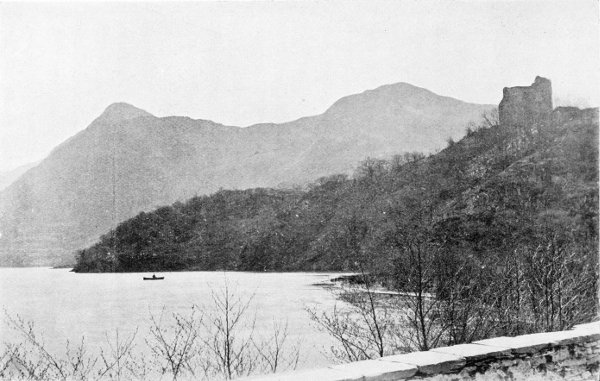
DOLBADARN CASTLE.
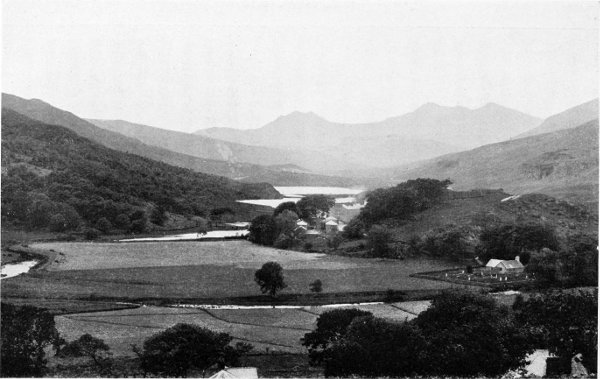
SNOWDON, FROM CAPEL CURIG.
It is only a little way beyond this point
that the actual Pass of Llanberis begins to
rise, cleaving its straight course between the
mountains to the very foot of Snowdon—“to
the Welsh always the hill of hills,” as
Borrow says. The highest peak, Y Wyddfa,
is not visible from the Pass, but one
sharp-edged shoulder in certain lights
seems to be within a stone’s-throw of the
road. This is the steepest of the three
passes near Snowdon, and the one whose
name is best known to the world in
general. As for beauty—the most beautiful
of the three is the one on whose royal
blues and imperial purples one’s eyes are
actually feasting at the moment. But I
would say this: to understand even the
elements of the beauty of these hills it is
imperative to travel up each of the three
passes, for as one climbs up into the heart
of the mountains the effect is in every
case more beautiful than on the downward
journey. On a continuous tour this is of
course impossible; and that is one reason
why the best way of seeing Snowdonia is
to stay for a few days at a centre, such as
Bettws, or Capel Curig, or Pen-y-Gwryd.
At one or other of the two latter places
it will probably be necessary to spend a
night after this run from Bettws to Bangor
and Carnarvon. Capel Curig has the finer
view, and a hotel that has overlooked Llyn
Mymbyr and faced the peaks of Snowdon
for many a year. I do not know if it is
the same that Sir Walter Scott stayed in
and Lockhart described as “a pretty little
inn in a most picturesque situation
certainly, and as to the matter of toasted
cheese, quite exquisite”; but it is without
doubt the same that seemed to George
Borrow “a very magnificent edifice.” He
dined here, he tells us, “in a grand
saloon amidst a great deal of fashionable
company,” who “surveyed him with looks
of the most supercilious disdain.” I strongly
suspect that both the fashion and the disdain
existed only in a sensitive imagination.
Pen-y-Gwryd is exactly at the junction
of the Pass of Llanberis with Nant
Gwynant, the valley down which our
future course lies; and here too there is a
comfortable inn, with memories of Charles
Kingsley and the author of “Tom Brown’s
Schooldays.” From this point we can start
off in the morning without retracing a step.
As one glides down the perfect gradient
of this entrancing valley of the Glaslyn,
with the very blue waters of Llyn Gwynant
glittering below and the sides of Snowdon
rising precipitously from the shore on the
right, and on the left the wild green slopes
climbing up and up from the roadside to
the sky, one comes after all to a decision
as to the comparative beauty of these
passes. Nant Gwynant is the best. The
hill is three miles and a half long, and in
some places just steep enough to force us
to slacken speed and so make the most of
our surroundings; then a few miles of
undulating road lead past Llyn Dinas and,
still by the side of the stony Glaslyn, into
the village of Bedd Gelert, which has won
fame on false grounds as the burial-place
of Llewelyn’s hound. The rough, pathetic
tomb, that stands in a meadow and is
reached by a path made by the feet
of thousands of pilgrims, has a most
plausible appearance; but it was, I believe,
raised by the forethought of a hotel-keeper—a
man who apparently knew his
world. No bones of a faithful dog lie
here; but if we may not weep over the
dust of Gelert we may at all events mourn
the loss of a beautiful, but dead, legend.
We drive through the village and enter,
almost at once, the Pass of Aberglaslyn.
The steep part of the road is quite short;
but this strange cleft in the rock, this
narrow ravine that holds only the river
and the road between its cliffs, forms an
imposing southern gate to the Snowdon
mountains. We pass out of it almost
suddenly into the wide, level meadowland
of the Traeth Mawr—and may the gorse be
in its full glory at the time!
This plain that we are swinging across
so happily, this plain of green and gold,
was a barren marsh, useless to man or
beast, till it was reclaimed in the early
part of last century by a certain Mr.
Maddox, who gave his name to the two
towns that own their existence to him—Portmadoc
and Tremadoc. At Tremadoc
lived Percy and Harriet Shelley for a little
time, while they were still happy. The
poet, with characteristic enthusiasm, was
fascinated by the great draining-scheme;
and in his leisure moments grounded poor
Harriet in Latin.
It is here or at Portmadoc that we turn
to the right, if we are minded, to explore
the little-known peninsula of Lleyn. For
some mysterious reason the greater part of
this promontory is seldom visited, though it
is not by any means without attractions.
It cannot, of course, compare in any respect
with the dramatic grandeur of the Snowdon
country; there are large tracts that
might even be called uninteresting; but
from the southern uplands the panorama
of the mountains of Gwynedd is really
magnificent, and on the northern coast the
fine outline of Yr Eifl—ridiculously corrupted
into the Rivals—rises very grandly from
the sea. And when the gorse is in blossom
the whole country is veined with gold, for
here they make their hedges of gorse, and
the air is heavy with its poignant
sweetness.
As for the roads, they are mostly good.
The roads from Pwllheli to Nevin, to Yr
Eifl and Clynnogfawr, and to Aberdaron
are all excellent; so also is the one that
connects Nevin with Aberdaron; but the
“Saints’ Road to Bardsey” from Nevin to
Llanaellraiarn should be avoided, since the
saints, apparently, employed indifferent
engineers.
To reach Pwllheli from Portmadoc we
must past through Criccieth, one of the
most popular places on this coast, and one
that must have been really beautiful before
its popularity spoilt it. It has a nice hotel,
and is, in any case, a far more attractive
stopping-place than the ambitious Pwllheli.
The castle, not without dignity, stands aloof
upon its abrupt round promontory, facing
the rows of modern lodging-house as though
they were some new kind of enemy drawn
up against it. For that Edwardian gateway
has faced many enemies, and the castle still
more. Of its original founding I believe
nothing is certainly known, but it is older
than its gateway, for Llewelyn the Great
chose it for the prison of his unruly son,
Gryffydd, of whom it was said that
“peace was not to be looked for in his
neighbourhood.” But, indeed, in those times
a strong prison seems to have been the
only way of securing peace in any one’s
neighbourhood.
Much the most picturesque person who
has ever been connected with Criccieth
was Sir Howel y Fwyall, or of the Axe.
So doughty were his deeds at Poictiers
that the Black Prince not only did him
honour in the usual ways, with money and
knighthood, but gave orders that the pole-axe
with which he had done so valiantly
should be set up in this castle of Criccieth—of
which Howel was Constable—and
should be served with a mess of meat
daily. Eight yeoman were entrusted with
this service, and after the ceremony the
meat was given to the poor. The custom
was kept up till the reign of Elizabeth.
The name of Pwllheli is well known, if ill-pronounced,
in the world of tourists. It
aspires to be a fashionable watering-place,
and one feels that success may possibly
crown its endeavours, when one considers
the natural disadvantages of Rhyl and Borth
and many another prosperous spot.
A few years ago we should have been
obliged, having once passed Criccieth, to
spend the night at Pwllheli; but now we
shall do well if we rather choose Nevin for
our stopping-place. A nice new hotel has
been built there—a hotel with no foolish
pretensions, but evidently with every intention
of gradually becoming a thoroughly
comfortable abiding-place for golfers who
like quietness. The little town lies close
under the shelter of the hills, and between
it and the sea is the flat land of the Morfa
Nevin, where Edward I. gathered all the
chivalry of England and many a foreign
noble to celebrate his conquest of Wales in
a great tournament.
Nevin is threatened with the railway,
which, if it actually approaches the place,
will certainly spoil it; but it will be long,
I imagine, before any intrusion of that kind
disturbs the peace or injures the beauty of
little Aberdaron. It is an elect spot, this
End of the World in Wales; more remote,
less visited than St. David’s, and infinitely
less famous; yet once trodden, like St.
David’s, by the weary feet of countless
pilgrims. For just beyond that low headland
on our right is sacred Bardsey, the
Island of the Saints, where lies the dust
of twenty thousand holy men. St.
Mary’s Abbey, of which some fragments
still are left, was founded in such early
days that Dubritius, who crowned King
Arthur and then resigned the See of
Caerleon to St. David, came to end his
day in this remote monastery; and so holy
was the soil at last that every monk in
Wales crossed this dangerous channel to
kneel upon it. It was here, from these
wide, white sands of Aberdaron, that they
embarked, half trembling, half inspired—white-robed
Cistercians and sombre Benedictines—and
here, in this little church
between the hills and the sea, that they
spent the night on their knees before braving
dangers that were not by any means
imaginary. The building has been re-roofed
and much restored, but these are the very
walls within which the pilgrims prayed, the
very walls that once gave sanctuary to any
man, innocent or guilty, who sought their
shelter. The blind wall on the north bears
witness to the early British origin of the
church.
And we must not forget, as we stand
thinking of the pilgrim monks on the
shore, that this sheltered, isolated corner,
hidden closely by the hills on the one side
and protected by the long headlands on the
other, was once visited by secular history.
Into this bay sailed Hotspur’s father, the
base Northumberland, from France, and
from Harlech came Owen Glyndwr and
Edmund Mortimer; and here in the house
of the lord of Aberdaron they swore to be
thenceforward “bound by the bond of a
true league and true friendship and sure and
good union,” and to act in all ways as
became “good true and faithful friends to
good true and faithful friends.”
The fascinations of the Bay of Aberdaron,
however, must not blind us to the fact that
the finest scenery in the Peninsula, of Lleyn,
is in the north. From Pwllheli we should
drive across to Llanaellraiarn under the
great brow of Yr Eifl, and then, turning
to the right, follow the road between the
wild, craggy hills and the sea to Clynnogfawr.
Here lived and died the great St. Beuno,
and the church that bears his name is of
a size and importance quite unusual in so
tiny a place: “almost as bigge as St.
Davides,” says Leland. This large church
only dates from the fifteenth century, but
the little chapel where St. Beuno is buried
is connected with it by a covered way, and
was founded by the saint himself in the
seventh century. His tomb was still to be
seen in Pennant’s day, and had the gift of
working miracles, but now both monument
and miracles are no more. In the larger
church is carefully preserved a strange old
chest that is said to have belonged to St.
Beuno.
To reach the Traeth Mawr from Clynnog
our best way is to go on to Pont-y-Croes,
then strike across to Pen-y-Groes, and
thence descend to Tremadoc. There is not
much to be said in favour of this road’s
surface, but the beauty of it increases every
moment, and for the last few miles, as we drop
gently down on to that plain of gorse that
lies like a sheet of flame between two ranges
of purple mountains, we have as fine a sight
above, below, and before us as any we shall
find in Wales. A few minutes later we are
in Portmadoc, and from the long embankment
there look up the valley of the
Glaslyn across the Traeth Mawr to that
gate of Gwynedd through which we came
a little while ago.
Presently we cross the estuary of the
river Dwryd by a toll-bridge. I think this
river-bank must be the scene of a touching
incident described by Giraldus. He and his
Archbishop, recruiting for the Crusades, were
met “at the passage of a bridge” between
the Traeth Mawr and Llanbedr near Harlech
by Meredyth ap Conan, a prince of this
country. He brought with him a large
suite, and then and there by the river-side
the Archbishop preached to them, and “many
persons were signed with the Cross.” Among
these ardent souls was a personal friend of
the young prince. Meredyth, seated higher
on the bank than his suite, looked on
while the symbolic cross was sewn upon
the cloaks of the new crusaders, till it came
to the turn of his own friend. Then Meredyth,
says Giraldus, “observing that the
cloak on which the cross was to be sewn
was of too thin and too common a texture,
with a flood of tears threw him down his
own.”
From the banks of the Dwryd a very level
road soon brings us within sight of Harlech.
It is a very distant glimpse of it that we
have first; an irregular outline, a grey mass
of towers standing out against the sky,
raised grandly upon a rock above a plain
that is nearly as flat as the sea beyond it.
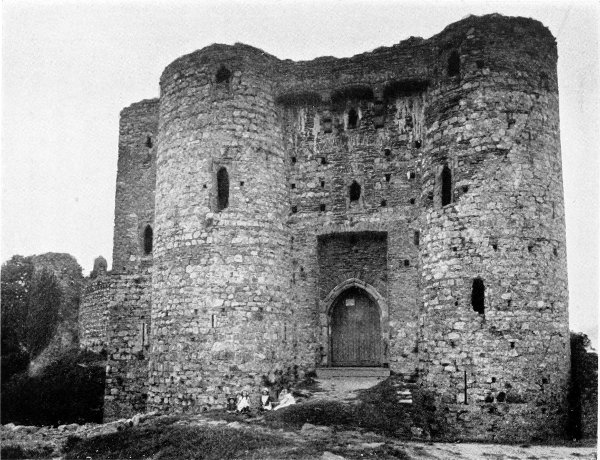
Then trees hide it, and we climb through
the woods to the level of the great gate
before which so many armies have stood
before us—armies of Owen and of Henry, of
Edward IV., and of Oliver.
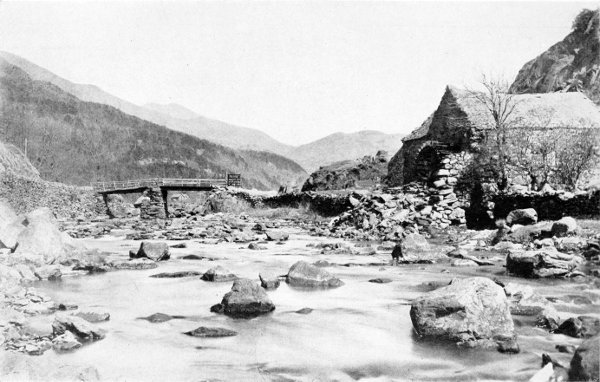
NEAR BEDD GELERT.
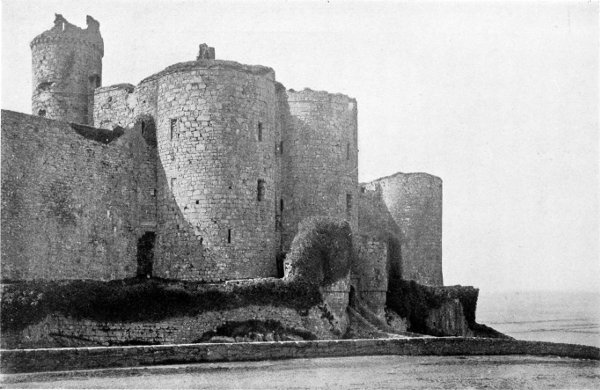
GATEWAY OF HARLECH CASTLE.
Long, long before Henry de Elfreton, king
of architects, built this grand fortress at
Edward’s command, a royal castle stood upon
this rock. So, at least, says one of the
“Mabinogion,” and here, under the spell of
the land that created those old romances,
I would fain believe that Branwen, the
daughter of Llyr, lived at Harlech with her
royal brother Bendigeid Vran, and that
Matholwch, King of Ireland, came across
the sea to woo her, with thirteen ships
flying beautiful flags of satin. At the
wedding, unfortunately, there was trouble
between the two kings; but after a certain
amount of friction the banquet was “carried
on with joyousness,” and the happy pair
journeyed towards Ireland with their thirteen
ships. In Ireland Branwen “passed her time
pleasantly, enjoying honour and friendship,”
which she owed to the fact—we are given to
understand—that she presented each of her
visitors with a clasp, or a ring, or a royal
jewel, “such as it was honourable to be seen
departing with.”[8] By and by mischief was
made between Matholwch and his wife, and
she was sent to the kitchen to cook for the
Court, which seems a drastic way of treating
a Queen Consort. Then came Bendigeid Vran,
her brother, to avenge her, with the hosts
of seven score countries and four, and there
was war between the two islands because
of her. And only seven men of the Welsh
escaped, and in Ireland none were left alive
except five women. And Branwen went with
the seven men of Wales to Mona, and she
“looked towards Ireland and towards the
Island of the Mighty, to see if she could
descry them. ‘Alas!’ said she, ‘woe is me
that I was ever born; two islands have been
destroyed because of me!’ Then she uttered
a loud groan and there broke her heart.
And they made her a four-sided grave, and
buried her upon the banks of the Alaw.” And
her name still lives upon this rock of Harlech
in Branwen’s Tower.
Bendigeid Vran, the son of Llyr, was not
the last Welsh prince who held his Court
here within sight of Snowdon. For Glyndwr
made his way in between those great towers
after a long siege, during which Henry’s
garrison, who were at last reduced to sixteen,
locked up their governor because they did
not trust his constancy. Glyndwr brought
his family here, and held a parliament, and
gathered a little Court round him; but after
another long siege he lost more than the
castle, for his son-in-law Mortimer was
killed, and his wife and grandchildren were
taken prisoners to London. But it was that
later siege by Edward IV.’s army that was
the most fierce of all. It was then that the
March of the Men of Harlech first stirred
the sea-breeze and the hearts of men; and
it was then that the blood of six thousand
men flowed here where we are standing
before the gates. Still later on Harlech held
very obstinately for Charles I.
At Harlech we look our last on Snowdon,
for the road, high above the sea, soon turns
a corner, then dips to the shore at Llanbedr.
At this pretty village those who are prepared
to face a road that finally becomes little more
than a track, and are, moreover, tolerably
good walkers, may leave the high-road and
drive up into a very wild and beautiful bit
of country to Cwm Bychan. I freely admit
that the enterprise is more suitable for
bicycles than for motors, and I further
confess that I have never undertaken it in
a car myself; but I should be extremely
happy to make the attempt on the first fine
day. For Llyn Cwm Bychan is a lovely
lake lying among moors and steep, rocky
hills; it has the wildness of a loch in
Galloway. And the only way out of this
hollow in the hills, except the track by
which we enter it, is a mighty staircase of
stone slabs set regularly in the hillside—a
staircase a mile in length, which has withstood
time and weather since the feet of the
Romans passed this way.
Even the best-advertised car could hardly
climb the Roman Steps; so we must rejoin
the coast road at Llanbedr and go on our
way to Barmouth. There was once a time
very long ago, it is said, when all the bay
that lies upon our right was a fertile plain,
the Plain of Gwaelod, with cities and
fortresses thick upon the ground, and a
great and busy population, and a king
called Gwyddno Longshanks. And because
the land lay so low and the sea so close at
hand a mighty embankment of stone was
built along the shore, and all went well for
many a year. But there came a time when
the chief overseer of this great dyke was
Seithenyn ap Seithyn Saidi, and he, unfortunately,
has been known ever since as
one of the “three immortal drunkards of
the Isle of Britain.” It is easy to imagine
the result: the decay of the dyke, and the
terrible night when the waters swept all
before them and drowned the whole Cantref
of Gwaelod. The point of Mochras near
Llanbedr was at one extremity of the
drowned cantref; and still, when the tide
is low, you may sometimes see the long line
of the broken dyke. As late as the year
1824 there was a stone in existence which
had been found below the sea a hundred
yards beyond the shore, and bore an inscription
meaning, “Here lies the boatman to
King Gwynddo.”[9] I do not know if the
stone still exists, but as it was used as a
footbridge it probably does not. At the
beginning of the nineteenth century this
seems, in Wales, to have been considered the
best way of using up old monuments. It was
certainly the quickest.
Eight miles from Llanbedr is Barmouth.
The town itself is becoming every year
more entirely a prey to the family group.
Every year there are more hotels, more
bathing-boxes, more wooden spades. But I
doubt if anywhere in England or Wales a
town is built in a more beautiful spot. You
cannot drive across the long bridge that
spans the estuary at its mouth, but you will
be a thousandfold repaid if you leave your
car and cross the bridge on foot, for the
best view—I think I am not too rash in
saying the best view in Wales—is from about
the middle of the bridge. The Mawddach
winds away between two ranges of mountains,
on whose grand slopes the brilliant
greens and purples, the rich browns and
far-away faint blues change every moment
under the varying sky. Cader Idris rises
on the right in gloomy dignity from the
soft drapery of foliage that is flung about
his feet. And in the foreground, when the
tide is low—and that, I maintain, is the
loveliest time—the blue sea is riven with
the rosy gold of wet sands, dotted with
countless sea-gulls.
A great deal of this we can see as we
drive up the estuary on its northern bank
to Dolgelley, by an excellent road that clings
close under the hills. Every moment the
scene changes, and all the changes are good;
whether we look across at Cader’s grand
shoulder against the sky, or up the valley
at the winding water and the distant hills,
or overhead on our left at the mountain-sides
that rise so steeply from the very
road, or even when, the trees hemming us
in for a moment, we see only glimpses
through them of purple rock or shining
river. At Llanelltyd the Mawddach meets
the Wnion, and our way lies to the right
over the bridge. As we cross the bridge
the ruins of Cymmer Abbey lie upon our
left on the river-bank—a Cistercian abbey,
as we may easily guess, since we know the
pretty taste in scenery possessed by that
sagacious Order. If the truth were known,
I fear we might find that their motive
in choosing, as they always did, the loneliest
and loveliest spots in the country,
was one of self-denial, for the mountainous
solitude that we love was in their day
regarded with little less than terror. This
particular abbey was founded in the last
years of the twelfth century, and it was
patronised by Llewelyn the Great. Behind
it, about two miles away, are the slopes
of Nannau, where Owen Glyndwr once
went for a walk with his cousin and came
back without him.
Owen, as I have already said, was a man
of swift and extremely complete vengeance,
and treachery made his gorge rise. His
cousin, Howel Sele, the lord of Nannau,
lived on that hill at the foot of Moel
Offrwm, and had little sympathy—so far
and so safe was he from the Marcher
Lords—with Owen’s overbearing ways.
Their relations had been strained, therefore;
but when Howel asked his kinsman
to visit him at Nannau Owen consented
without hesitation—yet not without a coat
of mail beneath his outer garment. As
they walked in the park with a few
retainers they saw a buck at some distance
among the trees, and Owen, anxious
to please, suggested that Howel should show
his well-known prowess with the bow.
Howel raised his bow, took aim, paused a
moment; then suddenly turned upon his
traitor’s heel and shot the arrow straight
at the heart of his kinsman. One can
picture Owen’s smile as the arrow rang
upon the coat of mail that he wore unseen.
Howel went home no more. What dreadful
fate befel him no one knows for certain;
for probably all his own retainers were
killed and Owen’s were too busy to talk.
But long afterwards a skeleton was found
in a hollow tree quite near the spot where
the famous bowman had drawn his bow
for the last time. The house of Nannau
was burnt to ashes.
Before we cross the bridge to Dolgelley
I should like to call attention to a very
beautiful drive over the hills between this
spot and Maentwrog. Beautiful as it is,
it must on no account be substituted for
the route by Harlech and the Barmouth
Estuary, by those who are travelling in
this neighbourhood for the first time; but
those who know the estuary well, or those
who are staying at Dolgelley and wish for
a circular drive, could not do better than
go up the Vale of Ganllwyd and over the
hills to Trawsfynydd and Maentwrog, lunch
at the Tan-y-Bwlch hotel, and return by
Harlech.
For the first few miles the road rises
through lovely woods; the tempestuous
Mawddach shines behind the trees, and
beyond it, bounding the narrow valley,
are steep and craggy slopes. At Tyn-y-Groes
is a charming little hotel, much
frequented by fishermen, with a fine view
of the Mawddach and the peak of Moel
Offrwm; a delightful place to spend a
week in summer, since it is within a drive
of many of the loveliest parts of Wales,
and has itself an outlook of very striking
beauty.
Beyond Tyn-y-Groes the scenery grows
wilder and the hills more bare; the road
rises rather steeply and the surface is not
all that could be wished. Presently we
pass a turning on the left that would
lead us, if we followed it, to the top of
that strange colossal flight of steps whose
lower end we saw at Cwm Bychan, the
way by which the Romans climbed this
mountain-side; and soon, as we reach the
summit of the hill, the many peaks of
the Snowdon range come into sight. After
this, as is only to be expected, the view
is continuously fine till we drop into Maentwrog
on a precipitous gradient, and find
ourselves in a valley famed for its beauty.
But we must return to Dolgelley.
“Dolgethle,” says Leland, who favoured
phonetic spelling, “is the best village in
this commote.” There is not much, if any,
of Leland’s Dolgelley left, I imagine; but
within the memory of this generation there
was still standing a battered little cottage,
built half of irregular stone-work and half
of timber and plaster, that Leland may
well have seen, though very likely it did
not interest him nearly as much as it
would interest us. It has been replaced
by an ironmonger’s shop, and we now
supply ourselves with petrol on the spot
where “Owen, by the Grace of God Prince
of Wales,” held his council, and drew up
the instrument that allied him formally with
the French. It was now some little time
since Henry IV.’s council had written to
him scornfully that the power of the rebels
was not so great as it was heretofore reported,
and that the people of Wales were
but of little reputation; for which reason it
seemed good to Henry, he said, “not to go
thither in person, but by one of our Lords
to do punishment on our said rebels.” Henry
had said that just three years ago, yet the
rebels were still unpunished. The chief rebel,
indeed, was now become “our illustrious
and most dread Lord, Owen, Prince of Wales,”
signing alliances with his royal hand and
seal, and receiving a gilded helmet as a
gift from the King of France.
At Dolgelley we turn eastwards and make
our way back to the English border. As
a matter of fact we have not actually reached
the limits of North Wales, which is divided
from South Wales by the river Dyfi, or
Dovey. But for our present purpose it
will be more convenient to consider a strip
of the North—overlapping our present
route—together with a strip of the South,
as Mid-Wales, and to return to the border
by the laborious but beautiful pass that
rises between Dolgelley and Dinas Mawddy.
We have six miles of climbing before us,
close under the heights of Cader Idris,
through one of the wildest tracts of country
in wild Wales, where the road at last rises
steeply between rough stone walls across a
desolate moor, and a mountain stream dashes
below us on the right, and in all probability
a flock of little Welsh sheep makes excitedly
for the nearest gap. For the Welsh sheep,
unlike the sheep of England, has somewhere
in its round, woolly head a glimmer of
intelligence, and instead of rushing madly
past every turning and every gap, knows
where it wants to go and goes there with
all possible despatch.
At a point six miles above Dolgelley we
reach the summit of this precipitous pass,
the Bwlch Oerdrws, and the valley lies
below us like a gulf. It is a fine scene
and a very wild one—wild even when the
sun is shining, but still wilder when the
great bare hills are looming through driving
clouds of rain, and wildest and most beautiful
of all when the April snow is glistening
upon the April gorse.
The steepest part of the descent, the average
gradient of which is between 1 in 7 and
1 in 8, is about two miles long. For the
rest of the journey, through Dinas Mawddy
and Mallwyd, and up the long climb to
Cann Office, and so by Llanfair Caereinion
to Welshpool, there is nothing to pause for,
except tea at Cann Office. This mysterious
name, oddly enough, does not appear on
Bartholomew’s map where the place it
denotes is called Llangadfan. The little inn
there is very popular with fishermen, who
seem to have a wonderful knack of securing
homely comfort.
Between Cann Office and Welshpool the
scenery gradually becomes more English in
character, for Welshpool, though not actually
on the border, is very near it. “The grounde
about the bankes and valley of Severn there
is most pleasunt,” says Leland; and “most
pleasant,” I think, describes this country
perfectly. I cannot do better than end in
his words. “And wille I passid this way
within a iii miles of Walsch Pole I saw a
veri notable hille beyound the valley on the
lift hond having iii toppes as iii heddes
rising owt of one body.... Communely
thei be caullid Brethin Hilles. Not far
from thes hilles enterith Shropshir.”
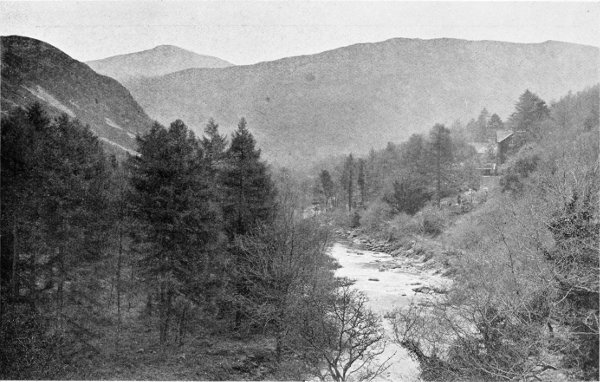
THE MAWDDACH, FROM TYN-Y-GROES HOTEL.
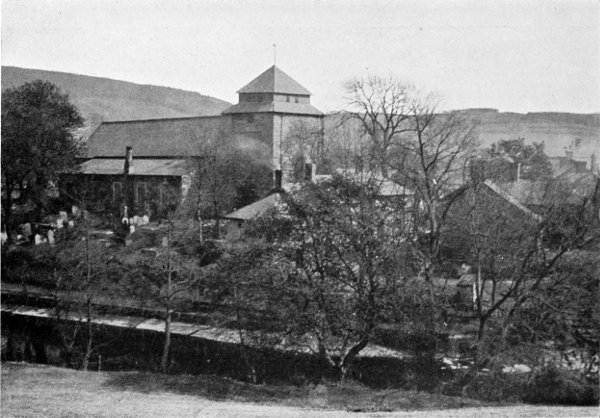
LLANIDLOES.