| Devon Border |
|
|
| Sidmouth |
22 |
miles |
| Exeter |
18 |
” |
| Moretonhampstead |
13½ |
” |
| Two Bridges |
12¼ |
” |
| Tavistock |
8¼ |
” |
| Total |
74 |
miles |
| Exeter to Plymouth viâ Ashburton |
44 |
miles |
| Exeter to Launceston viâ Okehampton |
42 |
” |
Hills steep and frequent.
Surface: rather rough on the Moor; between Exeter and
Launceston, variable; between Exeter and Plymouth, good.
To hurry in Devonshire is absurd. In
the first place, it is contrary to the
spirit of the country: no one does it. In
the second place, it is impossible.
I cannot conscientiously recommend Devon
as a motoring field for those who find
great speed essential to their happiness, for
to them the alternate use of the gear
lever and the brake is apt to be exasperating.
But to many of us the reduction of
our average mileage is a small matter in
comparison with certain important things;
such as scarlet poppies in the corn, and
high banks fringed with ferns, and cottages
smothered in flowers, and wide purple moors,
and the rippling of emerald seas, and the
complete serenity that fills the heart in Devon.
Here, on the very border, there is a long
rise and an extremely sharp turn, on the
hill where Yarcombe stands. After this
winding climb we run down easily through
lovely wooded country into the straight,
wide street of Honiton. This is a name that
rouses deep emotion in every female heart,
and to the female ear I will confide the fact
that Honiton lace, as made to-day in Honiton,
is perhaps more really beautiful than it has
ever been; and there is a certain little upper
room, not hard to find, where the enthusiast
may watch swift fingers and flying bobbins.
Except these filmy bramble-leaves and roses
there is nothing of interest in Honiton. Sir
William Pole summed it up three centuries
ago, and his words describe it accurately to
this day. “This towne is a very prety
towne indifferently well bwilded, and hath
his market on the Saterday.”
By the direct road Exeter is only fifteen
miles away, but by making quite a short
détour we may see the birthplaces of Coleridge
and Sir Walter Raleigh, and catch a
glimpse of the sea. A mile or two of
splendid Roman road, and a shady lane,
take us to Ottery St. Mary and its famous
church; the church, says Pole, that John
Grandison, Bishop of Exeter, “bwilded in
imitatinge of ye church of St. Peter’s in
Exon, with ye cannons’ howses round about,
standinge in a sweete wholsom advanced
ground.” He did not actually “bwild” it,
however, but rather enlarged it and made it
collegiate, and left upon it the marks of
that taste for splendour in which he indulged
more fully at Exeter. Not only a great
part of the fabric itself is his, but the
painted reredos and the stone screen and
the choir-stalls were his gifts. The pulpit
is of a much more modern date; but it is
the very same from which Coleridge’s father
was in the habit of addressing his congregation
in Hebrew, “the authentic language of
the Holy Ghost.” The grammar-school in
which the poet spent his childhood with
his twelve brethren no longer exists; but
we may still see the narrow lanes where
little Samuel, a visionary already, curvetted
on an imaginary horse and slew the enemies
of Christendom as represented by the wayside
nettle. And here, close at hand, is the
little Otter, and the “marge with willows
grey” by which he loved to dream.
Long before Coleridge played his warlike
games there were horsemen of a sterner
sort riding hither and thither through these
lanes. Fairfax spent a busy fortnight here,
resting his army, “who never stood in more
need of it,” but by no means resting himself:
visiting the works at Broad Clyst,
caring for his dying soldiers, and doing his
best to make peace between King and Parliament.
“To be general raised him onely to
do more, not to be more than others,” said
a man who was with him here. Where he
lodged I do not know, nor the spot where
he was presented with a “fair jewel” in the
name of both Houses, in gratitude for the
services “he performed for this kingdome
at Naseby Battel.” It is certain, however,
that a deputation brought it to Ottery, and
“tyed it in a blue Ribband and put it about
his neck.”
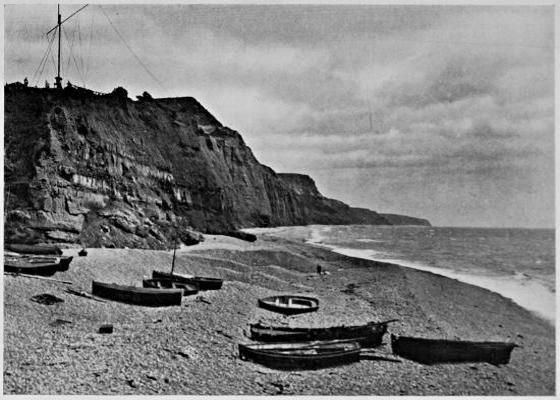
SIDMOUTH.
Sidmouth is only five miles away from
Ottery, and lies so prettily between its two
headlands that it is worth seeing, though
the lanes that lead to it are hilly. It is
quite an old place, really. Its prettiness,
however, does not at all depend upon its age,
but on the ruddy cliffs that bound the bay,
and the little brown stream that runs down
through the shingle to the sea, and the tiny
cascade that glitters in the sun, and the
groups of boats that lie upon the beach.
Yet, driving through the western part of
the town, we see that Sidmouth after all
is merely a typical watering-place. Here
is the esplanade we know so well, and the
row of bathing-boxes, and the shrill-voiced
nursemaid with her shriller charge, and the
dreaded pierrot. Beyond that western end
rises the Peak Hill, and up its steep side
lies our way.
It is steep indeed; both steep and very
long. Before it is faced the hill-climbing
powers of the car should be carefully considered,
for the gradient at one point is at
least one in five, and is extremely steep for
a considerable distance. But from this height
the blue bay and red rocks of Sidmouth look
very lovely through the trees, and at the
top of the hill there are colours enough on
a sunny day to repay us for much climbing:
pale blue hills and a dark blue sea, and a
wide expanse of varying greens, and to the
left a red cliff, and to the right, perhaps,
a patch of brilliant heather. Very carefully—for
the lanes are narrow and steep—we
run down the other side of the hill that
has just been laboriously climbed, and reach
the pretty street of Otterton, with its runnel
and little bridges, and thatched cottages,
and background of trees. We cross the
Otter, and are soon in East Budleigh, the
twisting, straggling village near which Sir
Walter Raleigh was born.
In the grey church on the knoll above
the street we may see the Raleigh arms, and
with them the three “horsemen’s rests” that
figure in so many shields—the arms of the
great Grenvilles. The bench-end that bears
them is the first on the left side of the aisle,
and was carved early in the sixteenth century,
when one of the Raleighs married Honor
Grenville. Sir Walter’s mother, we need not
doubt, sat in this pew many a time, for the
Raleighs lived only a mile away at Hayes
Barton. We can find the house quite easily,
standing beside a little sloping green: a low,
gabled, grey house, with a thatched roof
and a gay old-fashioned garden. There have
been many changes here, of course, since
that sixteenth-century baby first blinked at
the world he was destined to explore; but
even then this was a humble home for the
daughter of the Champernownes, the mother
of two great men. For through this heavy
oaken door that swings slowly open to admit
us has passed not only Walter Raleigh in
his nurse’s arms, but also the Eton boy
who was his big half-brother, Humphrey
Gilbert. Of the life that was lived and the
ideals that were taught under the gables
of Hayes Barton we may perhaps guess
something, not over rashly, from the last
words of these two boys when they came
to die, each his tragic death. “This,” said
Sir Walter with a smile as he felt the axe,
“is a sharp medicine that will cure all
diseases.” “We are so near Heaven at sea
as on land,” said Sir Humphrey as his
last storm broke over him.
That Sir Walter loved this house, of
which his father was only a tenant, we
have good evidence; for when he was a
man he tried in vain to buy it. Here, in
the room on the left side of the doorway,
is a copy of the letter he wrote to Mr.
Duke. “I will most willingly give you
what so:ever in your conscience you shall
deeme it worthe.… You shall not find
mee an ill neighbore.… For the naturall
disposition I have to that place, being borne
in that howse, I had rather seat mysealf ther
than any wher else.”
The little room where he was born, the
room upstairs with the high ceiling and
the latticed windows, has not been changed,
they say. They say too—and for this one
was prepared—that he smoked his first pipe
in England in the room over the porch.
Sir Walter’s first pipe had evidently some
of the qualities of the widow’s cruse.
Wherever his name is heard the tradition
of the first pipe lingers. He smoked it, we
are told, on a rock in the Dart, and beside
a Devon fireplace, and in an Irish garden,
and here at Hayes.
And now, returning first to East Budleigh,
we go on our way to the Ever Faithful City
by lovely woods of fir and beech, and wide
heaths, and hills and dales of richest green,
with here a glimpse of sea and there a
wealth of heather. Through Woodbury we
go; and Clyst St. George, where the Champernownes
lived; and Bishop’s Clyst, which
was once Clyst Sachvill. The last of the
Champernownes of Clyst was the unconventional
Elizabeth, who married her first
husband three days after her father’s death,
and her second husband two days after her
first husband’s death. “A frolic lady,” says
John Prince. As for the Clyst that once
belonged to the Sachvills and afterwards to
the bishops, it changed hands in this manner.
Sir Ralph Sachvill, being about to go to
France in the service of Edward I., was in
sore need of a large sum of money, and
mortgaged the manor of Clyst to Bishop
Branscombe of Exeter. The bishop, prudent
man, forthwith built largely on the
land, and made so many improvements
that poor Sachvill, coming home from the
wars with empty pockets, could not redeem
his estate. So Clyst Sachvill became Clyst
Episcopi, and the Bishops of Exeter visited
it when they needed change of air. The
time came, however, when “as Brounscomb
cuningly gott it, soe did Bishop Voisey
wastefully loose it.”
It was by this road that we are travelling
on, this very excellent road from Otterton,
that the Duke of Monmouth once came
riding into Exeter; and it was somewhere
near Bishop’s Clyst, I think, that a curious
spectacle met his eyes. Twenty thousand
people came out to welcome him, “but that
which was more remarkable,” says the
historian—and who will deny it?—“was
the appearance of a brave company of stout
young men, all clothed in linen waistcoats
and drawers, white and harmless, having
not so much as a stick in their hands.”
There were nine hundred or a thousand
of these innocents drawn up on a little hill.
The Duke reviewed them solemnly, riding
round each company. Then the stout and
harmless youths marched two by two, hand
in hand, before him into the city.
The story of Exeter has no beginning. To
Norman and Saxon, Roman and Celt, it was a
fortified stronghold, the Gate of the West.
For centuries it was the desire of kings, the
first thought of the invader, the forlorn hope
of the rebel. Yet, as we drive through the
dull suburb of Heavitree—which owes its
grim name to the gallows—and pass into the
heart of the town we see no sign of the walls
that endured so many sieges, the walls that
were built by Athelstane, that were attacked
by Alfred, that fell before the Conqueror, that
withstood Warbeck, that defended the cause
of Charles: no sign of the towered archway
that was once the entrance to Exeter and had
Henry VII.’s statue above it: nothing to
show us where poor Perkin, the king of straw,
battered in his futile way upon the gate,
“with casting of stones, heaving of iron
barres, and kindling of fire,” nor where
William the Conqueror, in ways that were
not futile, battered so successfully—“although
the citizens smally regarded him”—that it
was believed “some part of the walls miraculously
of his owne accord fell downe.” Nor is
there any sign of the western gate that once
stood at the further end of the High Street,
the gate through which another William,
seeking the same crown, came in a later
century. Through this street, which Leland
calls the fairest in Exeter, the great procession
of William of Orange swept in all its
splendour of bright armour and banners.
Here where we are driving they passed by:
the English gentlemen on Flanders steeds;
the two hundred blacks in embroidered fur-lined
caps with white feathers; the two
hundred men of Finland in bearskins and
black armour, with broad flaming swords,
very terrible to unaccustomed eyes; the motto
of the cause—“God and the Protestant Religion”—fluttering
on fifty banners borne by
fifty gentlemen; the led-horses and the pages
and the grooms; and the prince himself, all
glittering in armour upon his milk-white
palfry, surrounded by his running footmen
and followed by a mighty host. The billeting
of this host upon the citizens of Exeter, says
an eye-witness in a Letter to a Person of
Quality, “was done so much to the content
and satisfaction of the inhabitants, and such
just payments made for what the soldiers
had, and such civil behaviour among them,
without swearing and damning as is usual
among some armies, that it is admiration to
behold.”
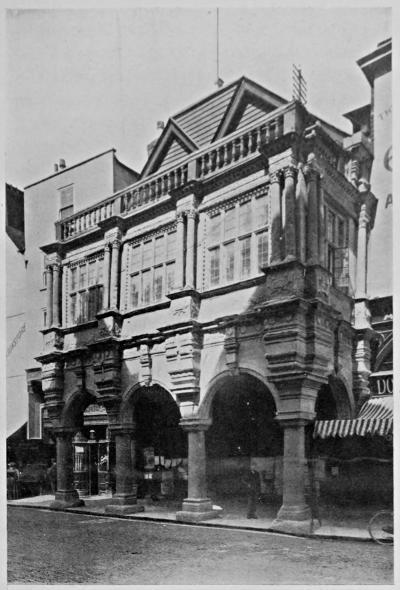
GUILDHALL, EXETER.
Of this brave show that meant so much
to England there is no relic left; but there is
still a memorial to be soon of another kingly
procession that once passed down this street.
Perkin Warbeck, after “mightily and tempestuously,”
but quite vainly, assaulting the
walls of Exeter, was pursued by Henry VII.
to Taunton, and “about midnight departed
in wonderful celerity” to the sanctuary of
Beaulieu. Then the King rode into Exeter in
state, and in his gratitude unbuckled the
sword that Perkin had not waited to see, and
took the beaver from his head, and gave both
sword and hat to the citizens in acknowledgment
of their “lusty hearts and manly
courage.” Here, in this old grey building that
projects across the pavement on our left, we
may see them still. In this fairest street of
Exeter there is nothing now so fair as the
Guildhall with the granite pillars and the
massive door of oak and the fluted panelling
of Tudor days. In the gallery above the great
hall are the two swords that won the crown
of England, so to speak: the simple sword of
Edward IV. and the splendid gilded one of
Henry VII.; and with them, cased in rich
embroidery, the black beaver hat in which
Henry gained his easy triumph over Perkin.
And among the pictures on the dark walls of
the hall itself are two that have a special
meaning in this place: Sir Peter Lely’s
portraits of the young Duchesse d’Orléans
and of the Duke of Albemarle. For it was in
Exeter, in a house that has now vanished,
that Charles I.’s daughter Henrietta was
born; and when the Articles of Surrender
were drawn up at Poltimore after the long
siege, there was special provision made for the
safety of the little princess; so that it was in
a “fit and convenient carriage” that she
started on that famous journey to Dover
which she ended, to her great annoyance, in
the disguise of a French peasant-boy. It was
in Exeter, too, that young George Monk
began his fighting career by thrashing the
under-sheriff of Devon. The exploit drove
him into the army, and when his talent for
fighting had made him Duke of Albemarle
the civic authorities let bygones be bygones,
and set up his portrait here. Perhaps they
recognised that the under-sheriff had richly
deserved his chastisement.[2]
Unfortunately the same Articles that provided
a convenient carriage for Princess
Henrietta also decreed the destruction of
Rougemont Castle, and there is nothing but
a tower and a gateway left of the stronghold
that Athelstane founded and William the
Conqueror rebuilt. Yet even in this fragment
there is one window, they say, of Saxon date,
one window that has looked out on all the
wild scenes that have been acted round the
Red Mount. Exactly how many sieges this
scrap of masonry has endured I do not know,
nor how many crowned heads it has helped
to shelter. William the Conqueror and
Stephen took possession of it in person;
Edward IV. and Richard III. visited it; and it
was probably here that Henry VII. stayed
when he came to Exeter at the time of the
Warbeck rebellion, to try “the chief stirrers
and misdoers.” “The commons of this shire
of Devon,” he wrote to the Mayor of Waterford,
“come daily before us in great multitudes
in their shirts, the foremost of them
having halters about their necks, and full
humbly with lamentable cries for our grace
and remission submit themselves unto us.”
In the same vivid letter he expresses a hope
that Perkin’s wife will soon come to Exeter,
“as she is in dole.” It is not from Henry
himself that we learn, however, that when
the poor lady actually arrived in this city he
“wondered at her beauty and her attractive
behaviour.”
When William of Orange rode into the
town with all his retinue of blacks and Finlanders
it was not to Rougemont that he
came, for Fairfax had nearly altogether destroyed
it. He slept at the deanery, and on the
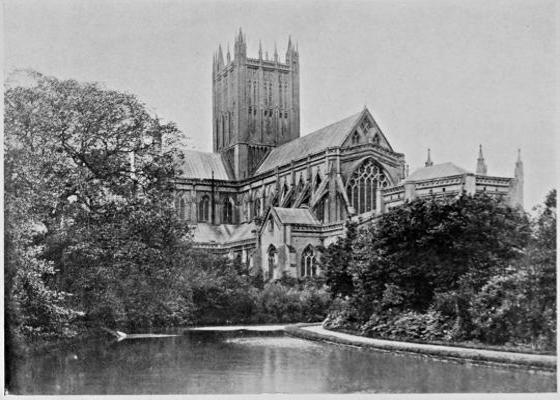
following day entered the cathedral in state.
It has not altered since then. He saw the
stately Norman towers as we see them, and
like ourselves passed into the building through
the vaulted porch and rich mouldings of the
west doorway. Over his head was the
splendid tracery that is over ours, and on
each side of him were the clustered pillars
that we see. “And as he came all along the
body of the church the organs played very
sweetly, and the quire began to sing Te
Deum.” Whether that Te Deum rang quite
true upon the vaulted roof is open to doubt,
for the choir, apparently, sang it with much
reluctance and left the church hurriedly
when their work was done, lest trouble
should come of it. Meantime the prince
sat down beneath the towering canopy of the
throne that the bishop had deserted, and
Burnet, standing at the foot of the pulpit,
read aloud the declaration that gave England
her liberties.
On the base of the throne are the painted
effigies of the four bishops who made Exeter
Cathedral what it now is: Warelwast, who
built the towers; Quivil, who designed the
Decorated building as it stands; Stapledon,
who set up this carved and pinnacled throne,
and the beautiful sedilia, and the “sylver
altare” that has vanished; and Grandison the
magnificent, who made the vaulted roof. Close
at hand on the north side of the choir, with a
restored canopy and a figure “very lively cut
in the same stone,” is the tomb where Stapledon’s
desecrated dust was laid. The enthroning
of this bishop, says Carew the chronicler,
was more than ordinarily splendid. Canons
and vicars-choral in their habits led him
to the throne, while “abundance of gentlemen
of place and quality” followed after.
Very splendid, too, was his burial in this choir.
There had, however, been a burial of another
sort in London; for, having been made
Keeper of the City by Edward II., he was
attacked by the mob who took the part of
Queen Isabel. They dragged him from his
refuge in St. Paul’s, “and having grievously
beaten and wounded him, haled him along
the streets to the great cross in Cheap, where
those sons of the devil most barbarously
murdered him.” His headless body lay buried
in a sand-heap till the Queen ordered it to be
brought hither in great honour.
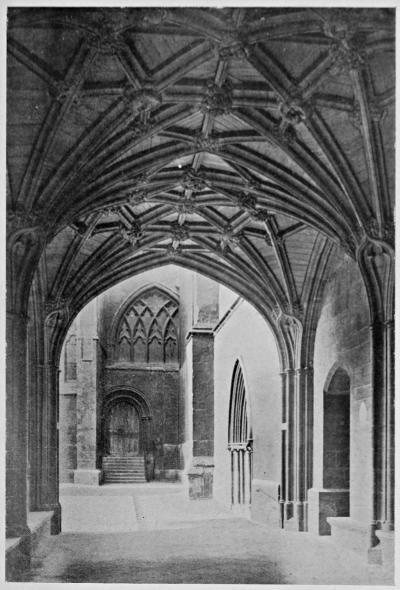
CLOISTER, EXETER CATHEDRAL.
The “grave, wise, politic” Grandison, though
much addicted to pomp, was personally simpler
than the murdered bishop, who possessed
no fewer than ninety-one rings. Grandison’s
splendour was shown in hospitalities and
lavish gifts to his cathedral. It owes much
to him: among other things, I believe, the
minstrels’ gallery that we see above us on
our right as we walk down the nave—the
gallery that was built, they say, in order
that the Black Prince might be fittingly
welcomed with music when he visited his
duchy. The west front is Grandison’s, too.
He once defended it and the dignity of his
office with a body of armed men, on an
occasion when the Archbishop of Canterbury
came on a visitation. Here at the west door
the angry prelates faced each other. Grandison
won the day, and the archbishop, says
Fuller, died of a broken heart.
It was possibly owing to the presence of
Fairfax, who reverenced all that was ancient
and beautiful, that the soldiers of the Parliament
did so little harm to the cathedral,
beyond destroying the cloisters. How much
else they destroyed in the close I do not
know: it is certain that much has vanished,
for in Leland’s day it had four gates, and
was “environid with many fair housis.”
There are still several fair houses in Cathedral
Yard that have survived the Civil War,
but not all of them have been admired
by Leland. He did not see, for instance,
the curious outline and picturesque bow-windows
of “Mol’s Coffee House,” nor the
panelled room that is emblazoned with the
shields of heroes and statesmen, of Talbot
and Somerset, of Cecil and Throgmorton, of
Drake and Raleigh and Gilbert. Tradition
says that the bearers of these sounding names
were wont to discuss the affairs of the nation
in this room.
Before leaving Exeter we have a weighty
matter to settle: our choice of a road. There
are four ways of reaching Cornwall. Of
these the shortest is by Okehampton to
Launceston, and this has the advantage of
passing through the bewitching village of
Sticklepath: the best as regards surface is
by Ashburton and Ivybridge to Plymouth:
the most beautiful is the road that leads
across the Moor by Moretonhampstead and
Two Bridges to Tavistock: the most interesting
and varied is the long way round by
the coast, by Torquay and Dartmouth, Kingsbridge
and Modbury. In the matter of hills
the second of these roads is the least severe,
and therefore on the whole I advise those
who desire to reach Cornwall quickly to skirt
the Moor upon the south; passing through
Buckfastleigh, which has a new abbey on
an old site, and Dean Prior, where Herrick
lived so reluctantly, and Plympton, where
old Bishop Warelwast died. There is no
really steep gradient on this road, and though
near Exeter there is a long climb followed by
a long descent, there are several surprising
miles, near Plymouth, that are almost level.
The surface is usually very good. The
scenery is not so strikingly beautiful as on
the other roads, but in places it is very lovely,
and everywhere there are the special charms
of Devonshire: the shadowing trees, the high
banks and trailing ivy, the stone walls green
with myriads of tiny ferns, the gardens full
of sunshine and flowers. Dean Prior, where
Herrick lived for many quiet years, singing in
sweet measures “how roses first came red
and lilies white,” and dreaming wistfully of
“golden Cheapside” and his Julia—and
others—seems at first sight an unlikely
place to be hated. Indeed, I think his hatred
of it and its inhabitants was merely a mood.
The same kind of mood that made him hurl
the manuscript of his sermon at his congregation
made him describe his neighbours as
“A people currish, churlish as the seas,
And rude almost as rudest savages,”
while all the time he was well aware that
Robert Herrick was ruder than either. There
were other days when he wrote very affectionately
of his little house and his placid
life in this village where he has so long been
lying at rest. There is an ugly modern
monument to him in his church, but his
grave and that of his housekeeper Prue are
unmarked by any stone. The beautiful
epitaph he wrote himself will serve them
well:
“Here’s the sunset of a tedious day:
These two asleep are; I’ll but be undressed,
And so to bed; pray, wish us all good rest.”
The Plympton through which this road
passes is not the birthplace of Sir Joshua
Reynolds, but has an interest of its own in
being the site of a monastery that was
founded by Warelwast, the bishop who
built the towers of Exeter Cathedral. When
he was very old he came hither to die. But
Plympton Earle is not a mile away; and
most of us will find time to drive into the
little town and pause for a moment by the
old house with the colonnade, wherein a little
boy used long ago to sit studying perspective
“with avidity and pleasure,” or copying his
sister’s sketches. Sir Joshua loved this place
where he first held a pencil, and in after
years painted his own portrait for the town.
The town sold it.
This road, then, is not without its attractions.
Infinitely greater, however, are the
charms of the two other alternative ways
from Exeter to Cornwall—the one that
bisects Dartmoor and the one that skirts
the coast more or less closely. Those whose
object is a short tour in South Devon I would
advise to combine these two routes by driving
from Exeter across the Moor to Tavistock,
thence turning south to Plymouth on a
splendid road through beautiful scenery, and
returning to Exeter leisurely by way of
Dartmouth and Torquay.
The traveller who chooses to leave Exeter
by the Moretonhampstead road is likely to
feel that he has chosen well.
Like all these roads that run towards the
west it begins by crossing the river Exe, the
river that for three centuries was commercially
useless because two men quarrelled
about a pot of fish. In the market of Exeter—so
runs the story—three pots of fish were
waiting to be sold one day, more than five
hundred years ago. Upon this fish the retainer
of the Earl of Devon cast an appreciative
eye at the very moment when the
servant of the Bishop of Exeter had determined
to buy it. In the fourteenth century
there could be but one result of this coincidence.
The matter, after a lively quarrel,
was laid before the mayor, and he, with
prudence that deserved to be more successful,
apportioned one pot to each customer
and the third to the market: whereupon the
Earl of Devon revenged himself upon the
corporation, against whom he already had
a grudge or two, “by stopping, filling, and
quirting the river with great trees, timber,
and stones, in such sort that no vessel or
vessels could passe or repasse;” and Topsham
became the port of Exeter. Now Topsham
was on the Earl of Devon’s land.
We go out of the town on a perfect surface,
and although, of the twelve miles between
Exeter and Moretonhampstead, there is only
one that is level and eleven that are steep
in varying degrees, the beauty that surrounds
us leaves us with no breath for
complaint. Whether we are climbing slowly
to the summit of a ridge, with valleys dipping
deeply on each side and beyond the
valleys fold on fold of wooded hills, or gliding
down past Culver into the shade, or running
softly through a little green glen, there is
nothing but content in our hearts. Presently
we cross the Teign upon an old stone bridge.
Beneath us the river makes slow, soft music
on its mossy stones; on each side the hills
rise steeply; here and there a great red rock
pierces the green and purple of the slopes;
and as the road winds up the long hill
through the woods we are shadowed by
hazels and larches and birches, and the scarlet
tassels of the mountain-ash hang heavily
over our heads. When at last we finish the
long climb Moretonhampstead lies below
us. From this height it appears to be in a
hollow, but after running down a steep
hill for a mile and a half we find ourselves
unexpectedly looking up to it.
Moreton is the best centre, I think, from
which to see the Moor. Chagford is in a
lovelier position, hemmed about with hills,
and is larger and more ambitious, with
electricity to light its streets; but it is not
nearly so central as Moreton, which stands
at the junction of four good roads. Gray’s
Hotel, though it makes no profession of
smartness, is comfortable and clean, and has
a capital new garage. The importance of
staying in this neighbourhood for a day or
two lies in the fact that there are several
lovely places within a radius of a few miles
which cannot easily be seen en route. Of
course, those who prefer more stately
quarters can use Exeter as their centre very
comfortably.
It is not to us who move at various speeds
from place to place—by motor-car, or bicycle,
or train, or even on foot—that Dartmoor
will reveal itself. Do not let us deceive
ourselves. We may have driven on every
road and every tortuous lane between the
Teign and Tavistock, yet we need not dream
that we know the Moor. That knowledge
comes only with the slow years, only with
the passionate love that begins in childhood
and lasts for life.
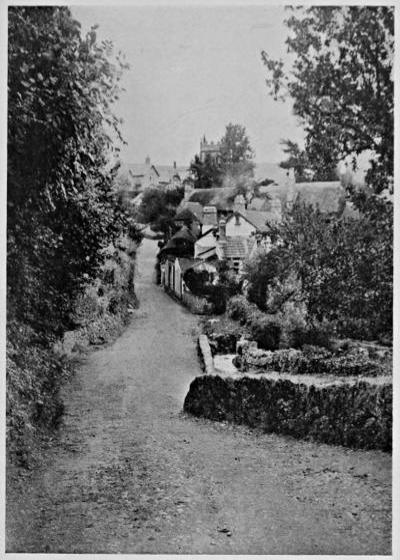
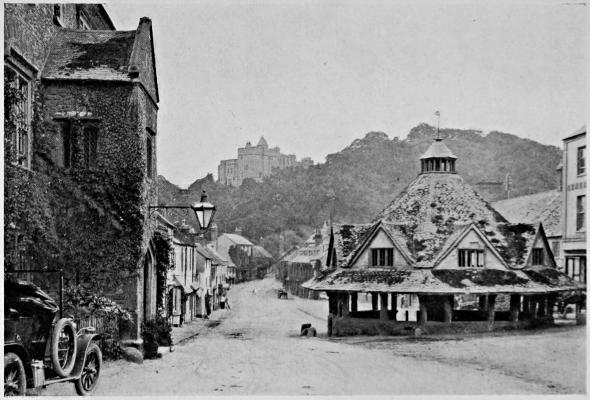
LUSTLEIGH.
That is no reason why we should not see
as much of the Moor as we can, and love
it dearly in our own poor fashion. There
is much, very much of its beauty which he
who runs—and even he who motors—may
read. And the most beautiful part of it, I
think, is this eastern side.
Quite a short run from Moreton is to Bovey
Tracey, Hey Tor, and Manaton. We drive
out of the little town, as we drove into
it, past the seventeenth-century almshouses,
whose thatched roofs are supported on a
row of granite pillars, and whose features
are feebly reproduced on the opposite side
of the street—a case in which imitation is
very far from flattery. A narrow road
follows the course of the Bovey through its
pretty valley. At a point where road, rail,
and river nearly touch one another a little
by-way crosses a bridge to Lustleigh, which
has a great reputation for beauty, and
deserves it; for with its church and modern
cross, its thatched cottages, its stream and
little bridge, half hidden in their setting of
woods and orchards, it is a very lovable
village. Its spaces, however, are limited.
Drivers of large cars must turn near the
church under the elms, and see Lustleigh
on foot, for there is no turning place further
on, and the road beyond the village is impracticable.
Its beauty is very alluring, but
its steepness is serious, and such is its narrowness
that even a car of moderate size brushes
the hedge on each side. It is far easier to
return to the main road, or rather the main
lane to Bovey, which has a good surface,
though it is narrow and winding.
The fine church that stands above the street
of Bovey Tracey was founded, it is said,
by the Tracy who was one of Becket’s
murderers, to atone for the deed by the
convenient method of the Middle Ages. But
all its splendour of carving and gilding, its
painted screen and pulpit, its porch with the
groined roof and grotesque bosses, are of a
later century than the twelfth.
There is nothing here to see except this
church and some restored stone crosses. For
no one knows, I believe, where the cavaliers
were quartered on that famous winter
evening when Cromwell rode into Bovey
with a band of horse and foot, and brought
dismay with him. “The Enemy in Bovey,”
says Joshua Sprigge, “were put to their
shifts, yet through the darkness … most
of the men escaped.” The shift the officers
made was an ingenious one. They were
playing cards when Cromwell’s men marched
up to their door, and with admirable presence
of mind they flung the stakes out of the
window. By the time the soldiers had finished
picking up the money the royalists had escaped
by the back door, and were beyond
the river.
Almost as soon as we have crossed the
same river we find ourselves on the fringe
of the Moor, and begin to rise slowly on a
fine curving road, through a scene that
grows in beauty moment by moment. On
one side are the sweeping lines and satisfying
colours of the moorland, the heather and
the yellow grass, the greens and browns of
the bracken: on the other are all the graces
of a copse of birch-trees. At every turn the
view widens, till on the skyline Hey Tor
appears, very sharp and dark. As the road
sweeps round it the Moor is everywhere
about us, an endless series of rounded hills,
with the line of their curved shoulders
broken here and there by jagged tors. Everywhere
the rim of the landscape is blue
beyond all experience. When green has
melted into grey, and grey has deepened
into an indigo so strong that it seems no
colour can be bluer, there is still beyond it
a line of hills as purely, piercingly blue as
the sky in June.
We run on between Saddle Tor and Rippon
Tor over hill and dale, till we look down
on the famous goal of a certain historic
grey mare—Widdecombe-in-the-Moor; then
past Hound Tor and round by the pretty
village-green of Manaton to the woods
through which the Becka’s waters dance
and sing. Here by the wayside the car
must wait a little time, while we are carried
to fairyland on a magic carpet of moss.
Long, long ago, say the fairies, this was a
stony, barren slope. Some wild spirit of the
storm had flung upon it a host of mighty
boulders, which lay there bare and grey
beneath the open sky. At last the fairies
came, and wove their wonderful carpet of
moss, soft and green, and laid it gently over
the great stones and over the earth, and
scattered their enchanted seeds upon the
ground so that the tall trees rose thickly
upon the hillside, and a mysterious, dusky
veil of leaves hid the river from the sky.
Then the fairies made their home here; and
we may walk with them through the woods
to that strange fall that in summer is no
waterfall, but a cascade of gigantic rounded
stones, flung from the height in a confused
mass, through which a thin stream trickles.
As we drive out of the dark and spellbound
wood we suddenly find ourselves on a
heathery hillside, all space and colour and
light; and by a winding road we return to
Bovey and Moretonhampstead.
Quite near to Moreton is one of those unforgettable
places of charm so rare that they
dwell in one’s mind for ever as types of
beauty. This is Fingle Bridge, which crosses
the Teign where the valley is narrow and
its sides are high and very steep, and the
brown river flows quickly among woods and
beds of fern, and a huge slope, completely
carpeted with heather, towers close at hand.
The best road is by Sandy Park, and beyond
that point even this is by no means good.
In Drewsteignton, indeed, a prudent owner
of any car that has more than a nine-foot
wheel-base will get out and walk, for between
that delightful village and the Teign there
is an extremely steep and narrow lane, with
a surface that is chiefly made of stones both
large and loose. There is, moreover, no good
turning-place in the narrow gorge through
which the river runs.
A longer run than either of these is through
Bovey Tracey and Ashburton, and across the
Moor to Two Bridges by a road whose hills
are grimly described in the contour-book as
“all highly dangerous.” The description is
justified, and it cannot even be pleaded that
the surface is good; but the sweeping moorland,
and the woods that veil the hurrying
Dart near Charles Kingsley’s birthplace at
Holne, and the valley at Dartmeet, will compensate
for much. From Two Bridges the
road to Moreton is the same by which we
must cross the Moor on our way to Tavistock.
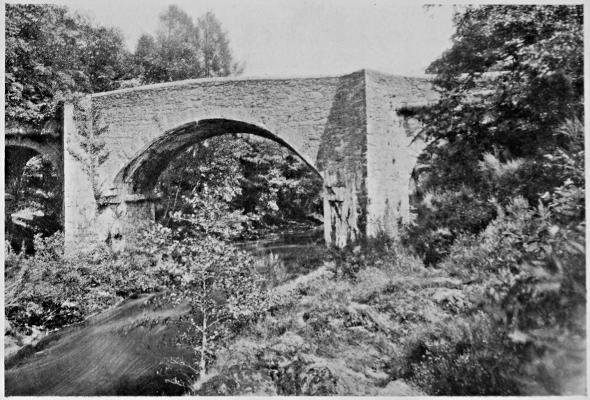
HOLNE BRIDGE.
It is no hardship to travel twice upon this
road. The run from east to west, from Moreton
to Tavistock, is one to repeat as often as
may be, and to remember whenever life seems
dull. It is a glorious run. The road is hardly
ever level, of course, but the surface for the
most part is fairly good, and the hills, if
steep, are straight. And from our feet a wide
sea of fern rolls away on every side, billow
beyond billow, till its waves break at last
upon the rocks of a hundred tors. There
are certain scenes that remain with one, a
possession for ever. One of them is on the
hill where Grimspound lies. A little by-road
takes us quickly to the wild spot where
neolithic man built himself this dwelling,
with the object, doubtless, of keeping an eye
upon his neighbours rather than that of
enjoying the view. Whatever his motive he
chose well. He saw this splendid panorama—a
pageant of green and purple and indescribable
blue. One thing only he did not see:
the tragic thing that gleams so suddenly
and whitely in the far distance, when a sunbeam
chances to fall upon it—Dartmoor
Prison.
When we have passed the stony stream
and pack-horse bridge of Postbridge the
scenery is less interesting for a mile or two,
for this is the more civilised part of the
Moor—a fact that has a brighter side in a
comfortable luncheon at Two Bridges. Unless
we change our minds and take the beautiful
road to Plymouth, we turn to the right here
after crossing the stream, and leave Princetown
and all its heavy hearts behind us on
the left. When the highest point of this
road is passed and the long descent begun,
the scenery is again of that well-wearing
kind that can be stored and put away for
the winter. And if I pay scant attention
to the vast host of most venerable relics
with which Dartmoor is dotted—I had almost
said crowded—this is not because neolithic
man seems to me a person of little account,
but because the study of his life and times
is not one that can be taken up suddenly
on a motor-tour. For one wayfarer who
takes heed of the menhir, and the stone-row,
and the pound near Merivale Bridge, there
will always be a hundred to gaze eagerly
from the hilltop at the long line of dark
and rugged tors that stretches across the
immense landscape, and at the gleaming
Hamoaze on the left, and at the clear outline
of Brent Tor Chapel on its rock, and
above all at blue Cornwall meeting the blue
sky. In the middle of this picture Tavistock
lies, and we run down into it on a splendid
road.
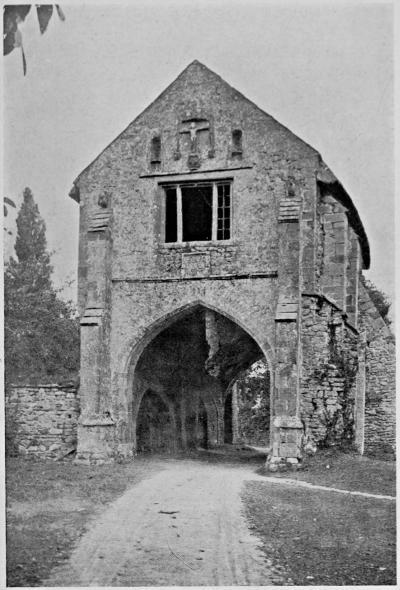
The abbey that once gave renown to
Tavistock has nearly vanished, but even its
fragments—an archway and an ivy-covered
tower—are enough to bring beauty and distinction
into these pleasant streets. Ordgar,
the man who founded it, was the father of
Elfrida, the wicked Queen who gave her
stepson a stirrup-cup, and had him stabbed
while he was drinking it. It was in Tavistock
or near it that she spent her childhood,
and to Tavistock that Ethelwold was sent
by the King, to see if her beauty deserved
a crown. Ethelwold, seeing her, forgot all
else and married her himself. “She is in
noe wise for feature fitt for a king,” he
told King Edgar. Then the King, whom
men did not lightly deceive, came hither to
Tavistock to judge for himself, and Ethelwold
at bay told the truth to his wife, begging
her—poor ignorant man!—“to cloath herself
in such attire as might least set forth
her lustre.” Elfrida smiled; and when her
lord was gone arrayed herself in all she had
that was most rich and beautiful, so that
“the sparkle of her fair look” made the
King mad for love of her. The next day he
took Ethelwold out upon the Moor to hunt,
and left him there with an arrow through
his heart; and after all Elfrida became a
queen.
The abbey her father founded was famous,
not only for its splendour, but also for its
learning. Though nearly all its stones are
gone there are still some of its documents
to be seen in the church, and certain ancient
books which were printed, I believe, in the
printing-press of these progressive monks.
It was in the year after the monks were
driven from their abbey that Francis Drake
was born to bring fresh glory to Tavistock.
At the end of a long, wide street his statue
stands—the familiar figure by Boehm, all
fire and energy, the “Francie Drake” we
know. His ardent face is turned towards
the town whose pride he must ever be;
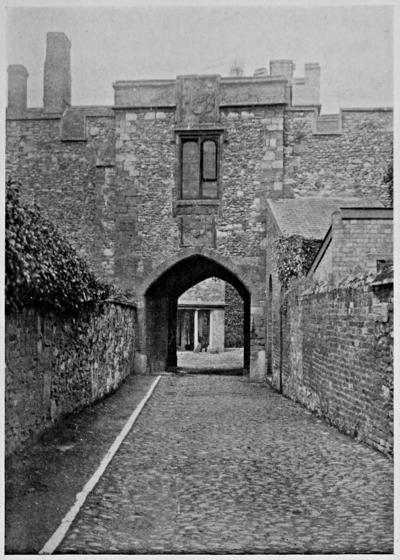
behind him is the ivy-covered gateway of
Fitzford House. Through that embattled
archway Sir Richard Grenville—“Skellum
Grenville” as he was called—came home
with his bride to her own house; the house
in which he afterwards shut her up, and
“excluded her from governing the affaires
within dore,” and even, it is reported, gave
her a black eye. This was the Richard
Grenville who was the King’s General in the
West, and was described by the Parliament
as “a villain and skellum.”[3] He raised an
army in Cornwall “with most extrem and
industrious cruelty” and brought it to this
place; and I believe it was here that young
Prince Charles stayed when he came to
Tavistock and complained so bitterly of
the weather. The soldiers of the Parliament
afterwards sacked the house, of which
nothing is now left but this gateway.
There may be some who have been led to
think that they have but to drive a few
miles from Tavistock to see the house that
belonged to the earlier, and far greater, Sir
Richard Grenville, the house of which an old
writer says: “The abbey scite and demesnes
was purchased by Sir Richard Grenvill,
whereon hee bwilt a fayre newe howse, and
afterward sold it unto Sir Francis Drake,
that famous travailer, wᶜʰ made it his
dwellinge-plaice.” These I must sorrowfully
inform that Buckland Abbey is no longer
open to the public.
From the statue of that “famous travailer”
we turn to the right upon a fine road, and
presently, crossing the Tamar by a beautiful
bridge, climb into Cornwall on a gradient
of one in seven.