MOTTO FOR THE MOTHER
Wisdom comes with all we see,
God writes His lessons in each flower,
And ev'ry singing bird or bee
Can teach us something of His power.
Grandmother's garden was a beautiful place,—more beautiful than all the
shop windows in the city; for there was a flower or grass for every
color in the rainbow, with great white lilies, standing up so straight
and tall, to remind you that a whole rainbow of light was needed to make
them so pure and white.
There were pinks and marigolds and princes' feathers, with bachelor's
buttons and Johnny-jump-ups to keep them company. There were gay poppies
and gaudy tulips, and large important peonies and fine Duchess roses in
pink satin dresses.
There were soft velvet pansies and tall blue flags, and broad
ribbon-grasses that the fairies might have used for sashes; and mint and
thyme and balm and rosemary everywhere, to make the garden sweet; so it
was no wonder that every year, the garden was full of visitors.
Nobody noticed these visitors but Grandmother and Lindsay.
Lindsay was a very small boy, and Grandmother was a very old lady; but
they loved the same things, and always watched for these little
visitors, who came in the early spring-time and stayed all summer with
Grandmother.
Early, early in the spring, when the garden was bursting into bloom in
the warm southern sunshine, Grandmother and Lindsay would sit in the
arbor, where the vines crept over and over in a tangle of bloom, and
listen to a serenade. Music, music everywhere! Over their heads, behind
their backs, the little brown bees would fly, singing their song:—
"Hum, hum, hum!
Off and away!
To get some
Sweet honey to-day!"
while they found the golden honey cups, and filled their pockets with
honey to store away in their waxen boxes at home.
One day, while Grandmother and Lindsay were watching, a little brown bee
flew away with his treasure, and lighting on a rose, met with a cousin,
a lovely yellow butterfly.
"I think they must be talking to each other," said Grandmother, softly.
"They are cousins, because they belong to the great insect family, just
as your papa and Uncle Bob and Aunt Emma and Cousin Rachel all belong to
one family,—the Greys; and I think they must be talking about the honey
that they both love so well."
"I wish I could talk to a butterfly," said Lindsay, longingly; and
Grandmother laughed.
"Play that I am a butterfly," she proposed. "What color shall I be?—a
great yellow butterfly, with brown spots on my wings?"
So Grandmother played that she was a great yellow butterfly with brown
spots on its wings, and she said to Lindsay:—
"Never in the world can you tell, little boy, what I used to be?"
"A baby butterfly," guessed Lindsay.
"Guess again," said the butterfly.
"A flower, perhaps; for you are so lovely," declared Lindsay, gallantly.
"No, indeed!" answered the butterfly; "I was a creeping, crawling
caterpillar."
"Now, Grandmother, you're joking!" cried Lindsay, forgetting that
Grandmother was a butterfly.
"Not I," said the butterfly. "I was a crawling, creeping caterpillar,
and I fed on leaves in your Grandmother's garden until I got ready to
spin my nest; and then I wrapped myself up so well that you would never
have known me for a caterpillar; and when I came out in the Spring I was
a lovely butterfly."
"How beautiful!" said Lindsay. "Grandmother, let us count the
butterflies in your garden." But they never could do that, though they
saw brown and blue and red and white and yellow ones, and followed them
everywhere.
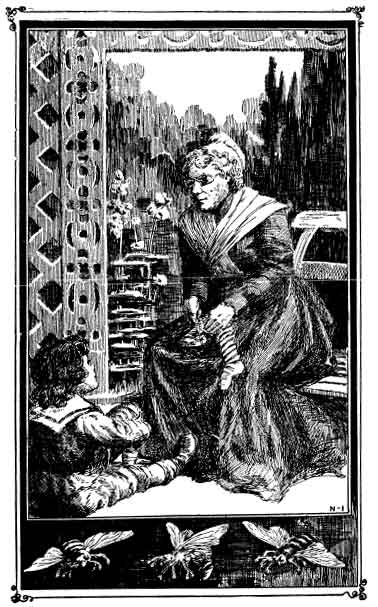
It might have been the very next day that Grandmother took her knitting
to the summer house. At all events it was very soon; and while she and
Lindsay were wondering when the red rose bush would be in full bloom,
Lindsay saw, close up to the roof, a queer little house, like a roll of
crumpled paper, with a great many front doors; and, of course, he wanted
to know who lived there.
"You must not knock at any of those front doors," advised Grandmother,
"because Mrs. Wasp lives there, and might not understand; although if
you let her alone she will not hurt you. Just let me tell you something
about her."
So Lindsay listened while Grandmother told the story:—
Once there was a little elf, who lived in the heart of a bright red
rose, just like the roses we have been talking about.
There were many other elves who lived in the garden. One, who lived in a
lily which made a lovely home; and a poppy elf, who was always sleepy;
but the rose elf liked her own sweet smelling room, with its crimson
curtains, best of all.
Now the rose elf had a very dear friend, a little girl named Polly. She
could not speak to her, for fairies can only talk to people like you and
me in dreams and fancies, but she loved Polly very much, and would lie
in her beautiful rose room, and listen to Polly's singing, till her
heart was glad.
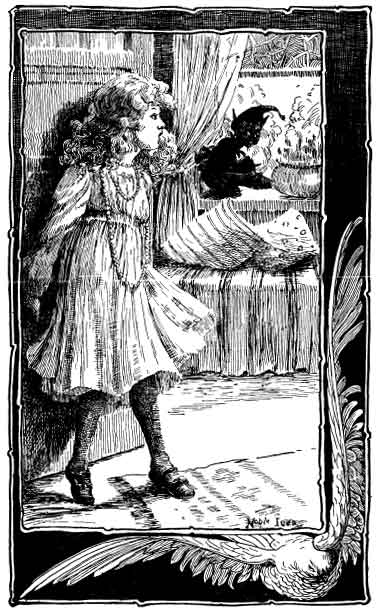
One day as she listened she said to herself, "If I cannot speak to
Polly, I can write her a letter;" and this pleased her so much that she
called over to the lily elf to ask what she should write it on. "I
always write my letters on rose petals, and get the wind to take them,"
said the rose elf. "But I am afraid Polly would not understand that."
"I will tell you," answered the lily elf, "what I would do. I would go
right to Mrs. Wasp, and ask her to give me a piece of paper."
"But Mrs. Wasp is very cross, I've heard," said the rose elf timidly.
"Never believe the gossip that you hear. If Mrs. Wasp does seem to be a
little stingy, I'm sure she has a good heart," replied the lily elf. So
the rose elf took courage, and flew to Mrs. Wasp's house, where, by good
fortune, she found Mrs. Wasp at home.
"Good morning Mrs. Wasp," called the little elf, "I've come to see if
you will kindly let me have a sheet of paper to-day."
"Now," said the wasp, "I have just papered my house with the last bit of
paper I had, but if you can wait, I will make you a sheet."
Then the rose elf knew that Mrs. Wasp had a kind heart; and she waited
and watched with a great deal of interest while Mrs. Wasp set to work.
Now, close by her house was an old bit of dry wood, and Mrs. Wasp sawed
it into fine bits, like thread, with her two sharp saws that she carries
about her. Then she wet these bits well with some glue from her mouth,
and rolled them into a round ball.
"Oh, Mrs. Wasp!" cried the rose elf, "I'm afraid I am putting you to too
much trouble."
"Don't fret about me," said the wasp; "I'm used to work." So she spread
out the ball, working with all her might, into a thin sheet of gray
paper; and when it was dry, she gave it to the rose elf.
"Thank you, good Mrs. Wasp," said the elf; and she flew away to invite
the lily elf and the poppy elf to help her with the letter, for she
wanted it to be as sweet as all the flowers of spring.
When it was finished they read it aloud.
"Dear Polly:
I'm a little elf
I live within a flow'r;
I live to hear your happy song,
It cheers my ev'ry hour.
That I love you, I'd like to say
To you, before I close,
And please sing sweetly ev'ry day
To
Your friend within a Rose."
The letter was sent by a bluebird; and the elf was sure that Polly
understood, for that very day she came and stood among the flowers to
sing the very sweetest song she knew.
Out in Grandmother's garden, just as the sun was up, a very cunning
spinner spun a lovely wheel of fine beautiful threads; and when
Grandmother and Lindsay came out, they spied it fastened up in a rose
bush.
The small, cunning spinner was climbing a silken rope near by with her
eight nimble legs, and looking out at the world with her eight tiny
eyes, when Grandmother saw her and pointed her out to Lindsay; and
Lindsay said:—
"Oh, Mrs. Spider! come spin me some lace!" which made Grandmother think
of a little story which she had told Lindsay's papa and all of her
little children, when they were lads and lassies, and this garden of
hers had just begun to bloom.
She sat down on the steps and told it to Lindsay.
Once, long, long ago, when the silver moon was shining up in the sky,
and the small golden stars were twinkling, twinkling, a little fairy
with a bundle of dreams went hurrying home to fairyland.
She looked up at the stars and moon to see what time it was, for the
fairy queen had bidden her come back before the day dawned.
All out in the world it was sleepy time; and the night wind was singing
an old sweet lullaby, and the mocking bird was singing too, by himself,
in the wood.
"I shall not be late," said the fairy, as she flew like thistle-down
through the air or tripped over the heads of the flowers; but in her
haste she flew into a spider's web, which held her so fast that,
although she struggled again and again, she could not get free.
Her bundle of dreams fell out of her arms, and lay on the ground under
the rose-bush; and the poor little fairy burst into tears, for she knew
that daylight always spoiled dreams, and these were very lovely ones.
Her shining wings were tangled in the web, her hands were chained, and
her feet were helpless; so she had to lie still and wait for the day
time which, after all, came too soon.
As soon as the sun was up, Mrs. Spider came out of her den; and when she
saw the fairy she was very glad, for she thought she had caught a new
kind of fly.
"If you please, Mrs. Spider," cried the fairy quickly, "I am only a
little fairy, and flew into your web last night on my way home to
fairyland."
"A fairy!" said Mrs. Spider crossly, for she was disappointed; "I
suppose you are the one who helps the flies to get away from me. You see
well enough then!"
"I help them because they are in trouble," answered the fairy gently.
"So are you, now," snapped the spider, "But the flies won't help you."
"But perhaps you will," pleaded the fairy.
"Perhaps I won't," said the spider, going back into her house and
leaving the little fairy, who felt very sorrowful.
Her tears fell like dew drops on the spider web, and the sun shone on
them, and made them as bright as the fairy queen's diamonds.
The fairy began to think of the queen and the court, and the bundle of
dreams; and she wondered who would do the work if she never got free.
The fairy queen had always trusted her, and had sent her on many
errands.
Once she had been sent to free a mocking-bird that had been shut in a
cage. She remembered how he sang in his cage, although he was longing
for his green tree tops.
She smiled through her tears when she thought of this, and said to
herself:—
"I can be singing, too! It is better than crying."
Then she began to sing one of her fairy songs:—
"Oh! listen well, and I will tell,
Of the land where the fairies dwell;
The lily bells ring clear and sweet,
And grass grows green beneath your feet
In the land where the fairies dwell,
In the land where the fairies dwell."
Now though the fairy did not know it, Mrs. Spider was very fond of
music; and when she heard the sweet song, she came out to listen. The
little fairy did not see her, so she sang on:—
"Grasshoppers gay, by night and day,
Keep ugly goblins far away
From the land where the fairies dwell,
From the land where the fairies dwell."
Mrs. Spider came a little farther out, while the fairy sang:—
"There's love, sweet love, for one and all—
For love is best for great and small—
In the land where the fairies dwell,
In the land where the fairies dwell."
Just as the fairy finished the song she looked up, and there was Mrs.
Spider, who had come out in a hurry.
"The flies are not going to help you," said she, "so I will;" and she
showed the fairy how to break the slender threads, until she was
untangled and could fly away through the sunshine.
"What can I do for you, dear Mrs. Spider?" the fairy asked, as she
picked up her bundle of dreams.
"Sing me a song sometimes," replied Mrs. Spider. But the fairy did more
than that; for soon after she reached fairyland, the fairy queen needed
some fine lace to wear on her dress at a grand ball.
"Fly into the world," she said, "and find me a spinner; and tell her
that when she has spun the lace, she may come to the ball and sit at the
queen's table."
As soon as the fairy heard this, she thought of the spider, and made
haste to find her and tell her the queen's message.
"Will there be music?" asked the spider.
"The sweetest ever heard" answered the fairy; and the spider began to
spin.
The lace was so lovely when it was finished, that the fairy queen made
the spider court spinner; and then the spider heard the fairies sing
every day, and she too had love in her heart.
A mocking bird sang in Grandmother's garden. He was king of the garden,
and the rose was queen. Every night when the garden was still, he
serenaded Grandmother; and she would lie awake and listen to him, for
she said he told her all the glad tidings of the day, and helped her
understand the flower folk and bird folk and insect folk that lived in
her garden.
Lindsay always thought the mocking bird told Grandmother the wonderful
stories she knew, and he wanted to hear them, too, late in the night
time; but he never could keep awake. So he had to be contented with the
mocking bird in the morning, when he was so saucy.
There were orioles and thrushes and bluebirds, big chattering jays,
sleek brown sparrows, and red-capped woodpeckers; but not a bird in the
garden was so gay and sweet and loving as the mocking bird, who could
sing everybody's song and his own song, too.
Night after night he sang his own song in Grandmother's garden. But
there came a night when he did not sing; and though Grandmother and
Lindsay listened all next day, and looked in every tree for him, he
could not be found.
"I'm afraid somebody has caught him and shut him up in a cage" said
Grandmother; and when Lindsay heard this he was very miserable; for he
knew that somewhere in the garden, there was a nest and a mother bird
waiting.
He and Grandmother talked until bed-time about it, and early next
morning Lindsay asked Grandmother to let him go to look for the bird.
"Please do, Grandmother," he begged. "If somebody has him in a cage I
shall be sure to find him; and I will take my own silver quarter to buy
him back."
So after breakfast Grandmother kissed him and let him go, and he ran
down the path and out of the garden gate, and asked at every house on
the street:—
"Is there a mocking bird in a cage here?"
This made people laugh, but Lindsay did not care. By and by, he came to
a little house with green blinds; and the little lady who came to the
door did not laugh at all when she answered his question:—
"No; there are no mocking birds here; but there are two sweet yellow
canaries. Won't you come in to see them?"
"I will sometime, thank you, if Grandmother will let me," said Lindsay;
"but not to-day; for if that mocking bird is in a cage, I know he's in a
hurry to get out."
Then he hurried on to the next house, and the next; but no mocking birds
were to be found. After he had walked a long way, he began to be afraid
that he should have to go home, when, right before him, in the window of
a little house, he saw a wooden box with slats across the side; and in
the box was a very miserable mocking bird!
"Hurrah! hurrah!" cried Lindsay, as he ran up the steps and knocked at
the door. A great big boy came to the window and put his head out to see
what was wanted.
"Please, please," said Lindsay, dancing up and down on the doorstep,
"I've come to buy the mocking-bird; and I've a whole silver quarter to
give for it, because I think maybe he is the very one that sang in
Grandmother's garden."
"I don't want to sell it," answered the boy, with a frown on his face.
Lindsay had never thought of anything like this, and his face grew
grave; but he went bravely on:—-
"Oh! but you will sell it, maybe. Won't you, please? Because I just know
it wants to get out. You wouldn't like to be in a cage yourself, you
know, if you had been living in a garden,—'specially my Grandmother's."
"This bird ain't for sale," repeated the boy, crossly, frowning still
more over the bird-cage.
"But God didn't make mocking-birds for cages," cried Lindsay, choking a
little. "So it really isn't yours."
"I'd like to know why it isn't," said the boy. "You'd better get off my
doorstep and go home to your Granny, for I'm not going to sell my
mocking-bird,—not one bit of it;" and he drew his head back from the
window and left Lindsay out on the doorstep.
Poor little Lindsay! He was not certain that it was the bird, but he
was sure that mocking-birds were not meant for cages; and he put the
quarter back in his pocket and took out his handkerchief to wipe away
the tears that would fall.
All the way home he thought of it and sobbed to himself, and he walked
through the garden gate almost into Grandmother's arms before he saw
her, and burst into tears when she spoke to him.
"Poor little boy!" said Grandmother, when she had heard all about it;
"and poor big boy, who didn't know how to be kind! Perhaps the
mocking-bird will help him, and, after all, it will be for the best."
Grandmother was almost crying herself, when a click at the gate made
them both start and, then look at each other; for there, coming up the
walk, was a great big boy with a torn straw hat, and with a small
wooden box in his hand, which made Lindsay scream with delight, for in
that box was a very miserable-looking mocking-bird.
"Guess it is yours," said the boy, holding the box in front of him,
"for I trapped it out in the road back of here. I never thought of
mocking-birds being so much account, and I hated to make him cry."
"There now," cried Lindsay, jumping up to get the silver quarter out of
his pocket. "He is just like Mrs. Wasp, isn't he, Grandmother?" But the
boy had gone down the walk and over the gate without waiting for
anything, although Lindsay ran after him and called.
Lindsay and Grandmother were so excited that they did not know what to
do. They looked out of the gate after the boy, then at each other, and
then at the bird.
Lindsay ran to get the hatchet, but he was so excited with joy that he
could not use it, so Grandmother had to pry up the slats, one by one;
and every time one was lifted, Lindsay would jump up and down and clap
his hands, and say, "Oh, Grandmother!"
At last, the very last slat was raised; and then, in a moment, the
mocking bird flew up, up, up into the maple tree, and Lindsay and
Grandmother kissed each other for joy.
Oh! everything was glad in the garden. The breezes played pranks, and
blew the syringa petals to the ground, and up in the tallest trees the
birds had a concert. Orioles, bluebirds, and thrushes, chattering jays,
sleek brown sparrows, and red-capped woodpeckers, were all of them
singing for Grandmother and Lindsay; but the sweetest singer was the
mocking bird who was singing everybody's sweet song, and then his own,
which was the sweetest of all.
"I know he is glad," Lindsay said to Grandmother; "for it is, oh, so
beautiful to live inside your garden gate!"