Mother, Nurse and Infant : A MANUAL ESPECIALLY ADAPTED FOR THE GUIDANCE OF MOTHERS AND MONTHLY NURSES, COMPRISING FULL INSTRUCTION IN REGARD TO Pregnancy, Preparation for Child-Birth, AND The Care of Mother and Child, AND DESIGNED TO IMPART SO MUCH KNOWLEDGE OF ANATOMY, PHYSIOLOGY, MIDWIFERY, AND THE PROPER USE OF MEDICINES AS WILL SERVE INTELLIGENTLY TO DIRECT THE WIFE, MOTHER AND NURSE IN ALL EMERGENCIES.
Transcriber’s Note:
The cover image was created by the transcriber and is placed in the public domain.
By S. P. SACKETT, M. D.
NEW YORK:
H. CAMPBELL CO., Publishers
140–142 Nassau St.
1889.
Copyrighted, 1889,
—BY—
S. P. SACKETT.
All rights reserved.
PRESS OF E. D. NORTON,
ITHACA, N. Y.
PREFACE.
iii
The object of the author in writing this volume is to
offer to nurses, and especially to those women who desire
to make “monthly nursing” a vocation, the instruction
which they need for that purpose, sufficiently illustrated
and at a moderate price.
The book is written under a firm conviction in the
mind of the author that a work of this character is needed
at the present time—a work that combines some information
to the monthly nurse in regard to her peculiar duties
with considerable instruction in midwifery. He has
many times heard inquiries made for a book of this kind
and has not been able to point to one of the character
desired. He has learned during the forty-five years that
he has practiced medicine in a small city and its vicinity,
that mother and nurse are often combined in the same
person. The important duty of nursing the sick is so
generally performed by mothers, that they also, as a class,
require some scientific knowledge to be acquired by
means of plain, practical instruction. And, in fact,
throughout our country, every mother is liable, in an
emergency, to be called upon to fill the office of an
accoucheur.
For the professional nurse, such technical and accurate
knowledge should be considered indispensable. The
training schools for nurses in some of our largest cities
are doing a noble work, and are elevating the standard of
requirements for those who seek this field of true womanly
ivlabor. But comparatively few of the many thousands
who follow this vocation are able to attend such schools;
yet they are willing and desirous to learn. Women seem
instinctively to desire such knowledge. A proper effort
to place within their reach the means of obtaining the
necessary technical knowledge for their work, and especially
for the work of the nurse who attends upon the
mother in childbirth, will not, the author trusts, be
deemed presumptuous. There are many excellent nurses,
who have become so without the aid of training school or
such a book as this, but it is hoped that this volume may
make the acquirement of the necessary knowledge more
easy and furnish ready information of value to those
nurses who are most thoroughly perfected in their work.
Physicians, they will find, stand ready to aid them. The
attending physician, as a rule, may be depended upon to
give such help as may be necessary to the understanding
of the instructions here presented, and through their cooperation
the number of earnest students in this department
of womanly labor may be multiplied.
The author, during the preparation of it, consulted
many writers upon obstetrics, medicine and nursing;
and it is only because it would not be compatible with
the size of this volume, that he has not made frequent
references to these excellent works. But all that he has
written has been founded on his own knowledge, experience,
and observation, while it coincides with the expressed
opinions of others who may be considered good
authority. In only two or three things has the author
ventured to advance beyond others.
INTRODUCTION. — TO THE MOTHER. — TO THE PROFESSIONAL NURSE.
9
From the nature of the subjects treated in this work,
the information given becomes of interest to every woman,
and is not intended for the nurse of lying-in women only.
It is believed that many young women will study it carefully,
that they may be prepared for all the duties and
responsibilities of life; some, perhaps, that they may be
fitted for a vocation under certain contingencies. But
many of the instructions are addressed particularly to
mothers, because they especially will be able to make a
practical application of the knowledge received. Hence
considerable matter is inserted which is designed to be
used by mothers in their daily life, and having only a
slight bearing on monthly nursing. Necessarily, as the
two objects are combined to suit the wants both of the
mother and nurse, there is not as much order and system
in the topics presented as would otherwise be desirable.
I seek only to have my instructions in the form that will
be most useful, and I believe that if mothers at the present
time are sufficiently taught there will be no lack, a
few years hence, of nurses who are fully competent to
care for the sick, under the direction of competent physician.
Hence I address myself, first,
10
To those who are mothers, every part of this small book
is especially commended. Upon the knowledge and skill
and right action of those who have the care of children
and of the household, it will depend that the right thing
shall be done in such emergencies as are liable to occur.
You must necessarily care for your children, both to guard
them from sickness and to relieve their ailments. You
must know the symptoms, at least, how to observe the
symptoms of diseases; and you may be called upon, in
the absence of the physician, to act as midwife. Be especially
careful to learn the instructions in regard to emergencies,
because upon your knowledge and prompt action
the lives of your dear ones may depend.
This work is written for you, and to you is especially
commended the modicum of medical knowledge herein
contained. It is better for you to learn well what you
read than it is to read very extensively. You will find
sufficient in this small volume to demand your time and
study for months, and even for years, in connection with
your nursing. It is not expected that you will learn all
the formulæ and prescriptions given. These are inserted
partly that you may learn to read prescriptions in the
various forms in which they are written, and partly that
you may occasionally use one, after consulting with your
physician. Sometimes you may copy one of them accurately
11and use it at the drug store, consulting only with
the apothecary.
But it will be of importance to you to obtain as much
medical knowledge as is herein contained, though it is not
designed to make you physicians. Do not act the part of
a doctor until you understand every thing pertaining to
Anatomy and Physiology, and the nature and properties
of every medicine employed in the cure of disease. Of
all sciences the medical should embrace the widest domain
of knowledge, because ignorance here is fatal. But ignorance
and thoughtlessness, and want of skill and adaptation,
may be fatal in your particular province. The
physician will generally tell you that the recovery of his
patient depends as much upon faithfulness and skill and
care on your part as upon his own medicines. Seek
always to aid him, never to supercede him. If you learn
midwifery, it should be with the design of co-operating
with the doctor, and assisting him. You should be so
educated that the physician will feel willing to leave a
case of tedious labor in your care, instead of waiting at
the bedside of the patient one or two days, and neglecting
his other patients. Your educated service will be appreciated
at such times by the doctor, as well as by the
patient and her friends. You will do the duties of nursing
well, and take upon yourself that part of the practice
of a physician which he does not desire, and which you
can do equally well. Your part will be an important one,
and second only to that of the physician.
12I expect, as the result of the study of this book, not that
you will assume to be physicians to any greater extent
than you otherwise would, but that you will act wisely
and intelligently instead of confusedly, or blindly, in the
emergencies in which you will be called upon to act,—that
you will be, not merely attendants at the bedside of
the sick, but, that best aid to the physician, the true nurse.
Do not claim to be doctor or midwife, or anything
whatever that you are not. If a smattering of knowledge
causes any affectation, it will only degrade you. Study
physiology in the books commonly used; store your
minds with the facts and instructions in this book; obtain
additional knowledge in every way that is practicable.
As you have opportunity, make practical application
of the knowledge received, and you will commend yourself
more and more to your sick or suffering friends.
PART I. PREGNANCY AND CONFINEMENT. — CHAPTER I. CONDUCT OF THE MOTHER BEFORE AND AFTER MARRIAGE. — CONDUCT OF THE MOTHER AFTER MARRIAGE. — CHAPTER II. CONDUCT OF THE MOTHER DURING PREGNANCY. — CHAPTER III. DISEASES OF PREGNANCY. — CHAPTER IV. INSTRUCTIONS TO A WOMAN DURING THE LAST MONTH OF PREGNANCY. — CHAPTER V. DIRECTIONS TO THE MONTHLY NURSE. — CHAPTER VI. CARE OF THE MOTHER DURING LABOR AND CONFINEMENT. — CHAPTER VII. DIRECTIONS TO THE NURSE DURING THE MONTH. — CARE OF THE MOTHER. — THE CARE OF THE CHILD.
13
The physical treatment of children should begin, as far
as may be practicable, with the earliest formation of the
embryo. It will involve the conduct of the female even
before her marriage, as well as during her pregnancy—the
various contingencies which effect her in health as
well as in disease. Very much depends on her to insure
for her child a vigorous constitution, or to prevent a feeble
frame in the child. She should not enter into the holy
state of marriage with heedless haste; if she does, she
will discharge its duties with inexcusable neglect. To
constitute a mother, in the best sense of the term, requires
a patient endurance of fatigue, and anxious solicitude,
which will sorely tax the mother’s strength. I would, if
possible, diminish the toil and danger of childbirth, and
relieve the fatigue and anxiety of nursing.
And let me, in one paragraph, give a hint to the husband:
that the responsibility and care of the children is
too much laid on the mother; she is overburdened. Let
the father partake in the arduous and responsible duty of
14their education. And let me hint, also, that the health
and strength of the child depends upon the father as well
as the mother.
Marriage should not be at too Early a Period
of Life.—I am not disposed to discourage early marriage,
but I am decidedly opposed to a premature one. Marriage
should not take place until the body is healthily and
completely developed; to bear offspring prematurely endangers
not only the mother’s health, but it materially
influences the health and well-being of the child.
We cannot fix rigorously the age at which the body becomes
fully expanded. I am inclined to say it is at 20 in
the female, and at 24 in the male; but original stamina,
education, climate, mode of life, etc., have their influence,
and may make an earlier or a later marriage proper.
The evil consequences resulting from precocious unions
in this country are: diminished vigor and shortened life
in the husband; faded beauty, blasted health, and premature
old age in the mother, and a diminutive stature, debility
of body and imbecility of mind, perhaps a strong
predisposition to consumption, rickets, scrofula, etc., in
the children.
Marriage should be when the Parties are in
Health.—I do not say that every ailment should be a
bar to marriage or child-bearing. It is possible that prolapsis
uteri may be benefited by a pregnancy and parturition.
But if a woman has prolapsis uteri, or other ailment,
it is a poor preparation for the burdens of gestation,
and good health is an important qualification for the responsibilities
of married life. No learning can be of more
importance to a young lady than to know how to preserve
health, and how to restore it when lost, for we cannot
reasonably expect healthy children from unhealthy parents.
15There are numerous other complaints besides
scrofula and insanity, inherited by children. If a wife is
to be healthy and strong, she must use means; health will
not come by wishing for it merely, and whether pleasant
at first or not, habit will make early rising, temperate living,
taking exercise, thorough ablution of the whole body,
etc., easy. That state of vigorous health and strength
which prepares a woman to bear strong and vigorous
children, is attained not by idleness and luxury, and neglect
of personal cleanliness, nor by tight lacing, the use
of stimulants, nor by irregular modes of sleeping, etc.,
but by rising early, and taking early walks in the open air,
and engaging in household labor, or other exercise during
the day, going to bed betimes, living on an abundance of
good, wholesome food, by daily ablutions, followed by rubbing
the skin thoroughly, and in general by observing the
laws of health. If a woman who has thus preserved her
health, marry a man who has been equally careful to observe
the laws of continence and hygiene, she may hope
to be the mother of a healthy child, and a blessing to all.
The Constitution of both the Male and Female
should be good and strong. It is not enough that the
body be well developed, if there is at the same time a very
feeble constitution. Even if the children of such parents
seem to be hale looking and robust, they do not attain old
age—are very liable to die young. If there is only a predisposition
to disease, such as is often inherited, it may be
very doubtful whether the parties ought to marry. If
there is only a disposition to habits of intoxication or dissipation,
or to gout, madness, scrofula, consumption, etc.,
in the man, we may advise the woman not to unite herself
to him, for these diseases do not show themselves until
called into action by some exciting cause.
16But we advise the woman, if there is any physical disability
which renders her ineligible to the married state,
that she should not pass it over lightly, or conceal it, and
we would recommend to a woman who may have deformed
pelvis, that she abstain from marriage, as she “may purchase
the title of wife at too dear a price.”
Temperament is a matter of less importance in choosing
a husband. It is said to be the case that in choosing
a mate, a person inclines strongly to one unlike themselves.
If it be true that a person of a nervous temperament has
a preference for the sympathetic, the sanguine for the bilious,
etc., it is probably nature imparts the liking that the
offspring may combine the excellence of both, the defects
of neither.
Blood relationship is not necessarily a bar to union.
Cousins may marry when the family has traits of mental
and physical excellence as a means of perpetuating them,
but it is not best to develop, by repeated unions, a lurking
disposition to disease, which may exist in any family.
Moral and mental character is of the greatest importance.
It is not true that “the reformed rake makes
the best husband.” If he is not the prey of loathsome
diseases, the results of a vicious life, his constitution is
probably impaired, so that he cannot be the father of good,
strong children. The only way that women can guard
their own health, and preserve from degeneracy their offspring,
is by having husbands of a different character from
that of the debauched rake.
The mother is accountable for the health and intelligence
of her first child; she must be careful of her own
health before marriage and at the time of marriage, as
well as for the succeeding time.
17I will here state a few things which seem unimportant,
and yet are of some little consequence. I consider that
the great object of conjugal union is the transmission of
life, and I cannot believe that anything is unnecessary or
unimportant that has a tendency towards the perfect health
or well-being of the child that is yet to be born.
During the first few months after marriage the
wife should seek to have bodily quiet, and mental calmness
and serenity. The custom of hurrying the bride
from place to place may properly be condemned. So we
would have her avoid going into a whirl of excitement and
pleasure—into a round of visiting and late hours—into
close, heated rooms—into fashionable amusements—rich
living and a want of rest—sitting in ill-ventilated apartments—quickly
bolting unquiet meals—drinking wine,
beer, or brandy, or other alcoholic stimulants—late rising
in the morning—sleeping in close, badly-ventilated rooms—living
in rooms that are kept dark—tight lacing—wearing
thin clothing—worrying, and indulging in ill-temper.
She should avoid these at all times, but her future health
and happiness depend so much upon her prudence and
care during the first year of married life, that we may properly
give these hints and cautions in regard to this particular
time.
18
There are no signs of a fruitful conjugation, which in
all cases indicate to the woman that she is pregnant.
Some few seem to know the exact time; in some instances
there is faintness, or vertigo, that in these particular cases
impress the fact upon the mind of the woman. But usually,
within a month, the point is tolerably certain, she being
assured by such signs as will be here pointed out. It
now becomes her duty to be especially careful, not only
for herself, but also for her offspring. Abortions frequently
occur, especially in the first and last pregnancies, and
in the first months of pregnancy, these should be avoided
if possible.
The train of evils which follow when the habit of abortion
is established, as well as the moral obligation she is
under to preserve the life committed to her, should make
her willing to endure the few privations and conformities
which her situation imposes on her. She must avoid undue
exercise of the muscles, such as long walks, dancing
in hot weather, hastily running up stairs, lifting heavy
weights; she must avoid things that inordinately hurry
the circulation, such as heated rooms, stimulating liquors,
etc.; she must not overload the stomach, or eat late suppers;
she must not take drastic purgatives; must not constipate
her bowels by taking laudanum, etc.; must not
19compress the chest by tight lacing; must not use strong
tea or narcotics; must not lie long in warm feather beds,
and must not engage in severe study, night watching, etc.
The pregnant woman need not indulge in a wayward or
voracious appetite, and, although there is a tendency to
fullness and fever, she need not necessarily be bled.
The pregnant woman needs fully as much food as usual,
but she must avoid excess in eating and drinking. Ripe
fruits, lamb, veal, fresh fish, milk, coffee, and, in general,
every thing which agrees with the stomach may be eaten;
the taste, as a rule, is a safe guide, and may be reasonably
indulged. After the sixth month, she may properly eat
four or five meals a day.
The best plan of treatment for one to adopt who has
longings is not to give way to them, unless the longings be
of a harmless, simple nature.
The CLOTHING of the pregnant woman should be suited
to the season; but as the vicissitudes of the weather affect
her more than they previously did, she should be dressed
rather warm. In general, she should wear flannel drawers,
especially during advanced pregnancy.
Many women have done themselves an injury by lacing
tight to conceal their pregnancy. The dress should be
loose and comfortable, nowhere pressing tightly or unequally.
Stays or corsets may be used, in a proper manner, during
the first five or six months; they should be moulded
to the shape of the changing figure, and must not depress
the nipple or the enlarging breasts. The garters ought to
be worn slack; tight garters are very injurious, and if the
veins are enlarged or varicose, it will be necessary for her
to wear an elastic silk stocking.
Moderate exercise in the open air is proper during the
20period of pregnancy, and walking is a good kind of exercise;
but very long walks, and dancing, ought not to be
indulged in. Riding in a wagon over rough roads, and
railway traveling, are objectionable.
Bathing should be practiced with great care. A warm
bath is too relaxing; a tepid bath once a week is beneficial.
Sponging the body every morning with lukewarm
water may be practiced, and the skin should be quickly
dried with a coarse towel. The temperature of the water
may be reduced gradually until it is quite cold. A sitz
bath may be used every morning, although it is best to sit
in it but a few seconds. If it gives a slight shock, it will
be immediately followed by an agreeable glow. Put a
little warm water with the cold at first.
Ventilation is of the utmost importance. During the
day time, the windows in every unoccupied room in the
house ought to be thrown open.
Attention should be directed to keeping the atmosphere
in the sitting and sleeping rooms of the house fresh. Many
poor people sleep in a very small, close bedroom, and
breathe an air that is really poisonous. The lady should
see also that the house is kept light, that the drains are in
good and perfect order; that the privies are frequently
emptied of their contents, and that the drinking water
supply be not contaminated.
Sleep, by its sedative influence, and by the calmness of
all the functions that attend it, has a favorable influence
upon the disturbed nervous system of the mother, and
upon the growth of the fœtus. Her bedroom ought to be
large and airy, and she should not have curtains closely
drawn about her bed. The windows of the room should
be opened during the day; the bedclothes should be thrown
back, and everything ventilated; the bed must not be
21loaded with clothes, and the bedroom at night should be
dark, and as far as possible from noise. These things
will tend to secure sleep; but if the pregnant woman
should still be restless, and feeling oppressed and hot, she
should perhaps admit more air into the room. Let her
also attend every day to her bowels, that they be not
allowed to become costive; perhaps eat cooling fruits, live
on an abstemious diet, and if there is a feeling of faintness
when she attempts to lie down, she should have a bed
so arranged that her shoulders and head are elevated.
The pregnant woman ought to retire early to rest, and
I would advise her to lie abed in the morning as long as
she can sleep well. If she cannot sleep well, let her get
up in good time in the morning, take a bath, or thorough
ablution, a stroll in the garden, an early breakfast, and
then perhaps a short walk, while the air is cool and exhilarating.
A nap of an hour or two after that, upon a sofa
or lounge, will prove very refreshing.
A TRANQUIL MIND is of the greatest importance. Forebodings
of a gloomy nature should not be encouraged, as
they often are, by relating dismal stories, etc. Unnecessary
fear upon the part of the mother may have a bad
effect upon the child, as may also the indulgence in unbridled
anger, or yielding to temper,—perhaps may cause
convulsions or hemorrhage, or even abortion. There is
reason to believe that the imagination of the mother has
an influence on the beauty of the child; and it is quite
certain that cheerfulness and equanimity of mind contributes
to the future good health of the child, and may even
affect its disposition and mental traits.
22
Pregnancy is not a disease. Many women enjoy better
health during its continuance than any other time, and in
general the pregnant woman is not quite as much exposed
to contagious and other diseases. But there are certain
disorders incident to pregnancy, of which it is necessary
to speak.
Morning sickness, when it is only troublesome during
the early part of the day, is generally borne without much
complaint, or much medical care. Before taking any
medicine for it, I advise that the lady try such simple
means as the following: Let her take a cup of coffee or
milk, and eat a few crackers or a biscuit, after washing
her hands and face, and before rising in the morning;
then let her remain in bed for about fifteen minutes, then
dress quickly and take a short walk. If the sickness continues,
let her eat freely of pop corn, and she may eat of
this occasionally during the day, or whenever she is suffering
from sickness, and let her partake of other food
also during the day. Persistent sickness and vomiting
indicates a disordered condition of the digestive apparatus,
and requires appropriate remedies. Use successively the
following: Formula 85, 104, 81, 107.
Vomiting is sometimes so persistent and severe that
the stomach can retain nothing, or but very little food.
23Of course, such cases demand the aid of a physician, and
his efforts to give relief may be effectual, when the medicine
here directed fails.
Costiveness is another complaint to which pregnant
women are liable. This is hurtful in its consequences,
being not uncommonly the cause of fever, tenesmus, pain
in the bowels, and abortion. Care must be taken to obviate
costiveness by the use of such food as will have a
laxative effect. The use of graham bread, oatmeal gruel,
raisins, figs, grapes, roasted apples, baked pears, brown
bread, cracked wheat, stewed prunes, and other varieties
of farinaceous food and fruit, may obviate the necessity of
taking opening medicines (F. 108, or milk of magnesia.)
An enema is an excellent remedy, and every lady should
have a good enema apparatus, by which she can administer
an injection to herself, and if she suffer from constipation,
she should take an enema twice or three times a week,
and the early morning is the best time. The clyster may
be warm water, or castile soap and water, of the temperature
of new milk. It may be well to give occasionally an
aperient to insure a thorough clearance of the whole bowels,
and castor oil, salad oil, citrate of magnesia, seidlitz
powder, stewed rhubarb, or an electuary of figs may be
given. I sometimes direct that the woman should take
every day a small dose of oil, in a cup of water gruel or
oatmeal gruel.
Severe pain in the bowels and rectum is sometimes
caused by a column of hard and indurated feces, which
remain for a number of days in the rectum and colon.
Not only pain but inflammation, and other serious ills, may
result if such a condition is neglected. If taking injections
does not suffice to give relief, manual assistance is
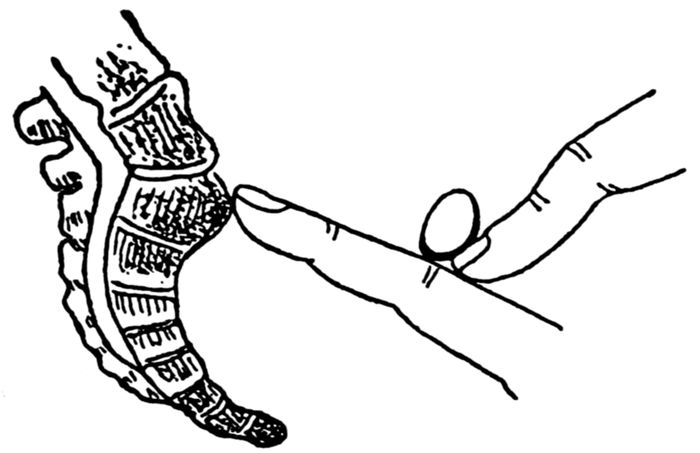
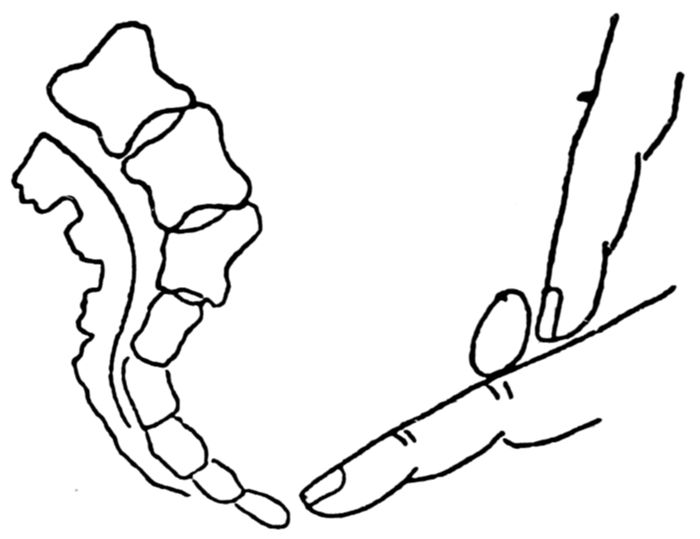
necessary. The nurse should learn the art of removing
24them if necessary; she should use a convenient instrument,
carefully conducting it into the anus, or she may
thrust her finger into the vagina to break the hard mass,
and assist in its expulsion, then she should wash it out
with repeated clysters.
For abdominal pains that are caused by its distention,
and by the weight of the enlarged uterus, the woman should
wear a bandage, or an abdominal supporter, adjusted to
fit the abdomen, and made with proper straps and buckles
to accommodate the increasing size of the abdomen. To
relieve the pain, the abdominal walls may be rubbed with
equal parts of sweet oil and laudanum.
Troublesome HEMORRHOIDS may be caused by constipation,
and also by the congestion in the parts, and by the
pressure made on the vessels of the part by the enlarged
uterus. It is proper sometimes to use emollient fomentations
and cataplasms. Relief may often be given by making
firm and gentle pressure between the finger and thumb
of each distinct tumor, till they are all compressed and
returned within the anus.
In cases of BLEEDING PILES, blood comes away each
time the patient has a stool. The patient ought to be as
quick as possible in relieving the bowels, and should not
at such times sit one moment longer than is absolutely
necessary. If the piles are inflamed and painful, foment
them three times a day, and for half an hour each time,
with hot water containing a little carbolic acid—a one per
cent. solution. Apply it by means of a sponge. Extract
witch hazel may be used also, and relief may often be obtained
by sitting over the steam of hot water for fifteen or
twenty minutes. Simply put hot water in a close vessel,
and sit over it. Sometimes the woman cannot sit in an
ordinary chair, and she should sit either on an air cushion,
25or a water cushion half filled with water, placed on the
chair. (F. 107.)
Diarrhœa is a less frequent attendant of pregnancy
than constipation, and the latter is sometimes the cause of
the former; in such cases an aperient is required. (F.
109.) Should the complaint remain after the operation of
the laxative, opiates are proper, mixed with some mild astringent
medicine, aromatics, antacids, etc. (F. 69, 74, 79,
80, 95.)
Tenesmus, and also diarrhœa, are common attendants
on abortion, of which they are, indeed, sometimes the
cause. Ipecac in half grain doses, with powdered opium,
and given every six hours; or frequently repeated doses
of opium may be needed. (F. 91, 92.) A flannel bag filled
with hot table salt, and applied near the part affected, may
give great relief to pain.
Heartburn is a common and often a distressing symptom
of pregnancy. I would prescribe in such cases an
abstemious diet, pepsin, ingluvin, and other medicine to
help digestion; antacids and laxatives. (F. 71, 72, 74.)
Calcined magnesia is good; prepared chalk is harmful.
It is not necessary for me to dwell upon the few ailments
that occasionally afflict pregnant women that I have
not yet referred to,—a few words must suffice. If a woman
who is pregnant is apt to be FAINT, or to FAINT AWAY,
I advise that she be laid down—that she lie flat on her
back, with a pillow under her head—that tight articles of
dress be loosened—windows raised—water should be
sprinkled on her face, a few drops of aromatic ammonia
may be administered, and perhaps smelling salts or hartshorn
held to the nose. If it is simply fainting, it is not
dangerous.
A nervous pregnant woman is sometimes subject to
26PALPITATION OF THE HEART, especially when lying down.
A small dose of aromatic ammonia will generally give relief.
If CRAMPS of the legs or thighs are troublesome, take
F. 92, and tie a handkerchief around the limb, above the
part affected, and let it remain a few minutes, and use friction.
If cramp attacks the bowels or back, a hot bag of
salt, or a stone bottle filled with hot water and wrapped in
flannel, may be pressed against the part, and something
similar should be placed to the sole of the feet.
If PRURITIS PUDENDI—irritation and itching of the external
parts—are troublesome, use F. 195, 217, 220, and
take frequently a tepid salt and water sitz bath, remaining
but a short time in the bath. If the parts are hot and inflamed,
and covered with an eruption, use either of the
following lotions: F. 217, 195.
1. Do not take too much exercise.—You may get relief
from some of your ailments by lying down considerably
during the day. If there is leucorrhœa (whites), strangury
(a frequent inclination to void the urine), incontinence (an
inability to hold the water), pain in the hips with numbness
of the inferior (lower) extremities—if the veins of the
leg become varicose—if there are anasarcous swellings of
the inferior extremities—if there is a pendulous belly, the
woman ought not to so exercise as to produce fatigue.
She may get some relief by sitting or reclining in the way
that is most agreeable.
272. Use means to harden the nipples.—Those women
who have never had children ought to observe, before
labor, whether there is a depressed condition of the nipples;
whether they contract as the breasts increase in size.
If they do, the condition can be corrected by wearing nipple
shields on them. And to harden the nipples: For at
least a month before labor, two or three times a day, rub
them between the thumb and finger, and bathe them in
tincture of myrrh or cologne water, in which a little alum
has been dissolved. This will render the skin less sensitive,
and avert the distress occasioned by the tenderness
of the nipples. If there is especial reason to apprehend
excoriated nipples, as there is when they are rough and
nodulated like a strawberry or raspberry, make a solution
of sulphate of zinc, one grain to the ounce of rosewater, in
a wide-mouth bottle, and tilt the bottle upon the nipple,
and allow it to remain there for a few minutes, several
times every day (F. 198, 217.) It is necessary also to
protect the part from the pressure of stays and the friction
of the flannel vest. The stays may be removed entirely,
or the nipple may be protected by laying a soft linen rag,
wet with water and cologne, around it so that the pressure
will not be directly on the nipple. If the breasts are
swollen or painful, the soreness will subside of itself before
the commencement of labor. It may be well, however,
to foment them with flannel wrung out of hot water,
and support them as in a sling by a broad handkerchief,
passing over the opposite shoulder.
3. Pay no attention to the chilling and “horrifying
tales of gossiping beldames.”—A cheerful flow
of spirits which arises from the hope of a happy event, inspires
a woman with activity and resolution, and is the
best preparation for the pains of labor. Do not give way
28to gloomy and melancholy forebodings or indulge in idle
reveries. Any person is your enemy who would exaggerate
to you the dangers of labor; and let me here say to
you, that if you read in this book of certain unfavorable
contingencies, do not let your mind dwell upon them;
they occur very rarely indeed, and I hope I have given
such advice and instruction, and that you have been so
cautious and careful that your chance is unusually favorable.
4. Do not expose yourself at this time to wet
and cold.—Do not go out in bad weather, and do not go
to theatres and other crowded places at all. You are
especially liable at this time to renal difficulties, and if you
take cold, it will cause congestion of the kidneys, and more
or less urinary difficulty. It is easier to prevent such complaints
than to cure them.
5. Take but little medicine.—In general you may
rest in the hope that all your troubles will vanish after
your confinement, and you can hardly hope to cure them
sooner. But keep your bowels loose. If you cannot have
daily passages by eating fruits, bread made from unbolted
flour, or other laxative diet, take saline waters, compound
licorice powder, etc., (F. 108.) If your bowels are constipated
at the time that labor commences, take at that time
an active cathartic (F. 109).
6. Seek and engage the best possible physician.—I
do not know but the educated monthly nurse of the
future may be well qualified to do all that is necessary in
an ordinary natural parturition. But heretofore very few
nurses trained in this country are thus prepared; perhaps
the popular sentiment is against such an education. But
you must always select a physician that you can confide
29in and trust if an operation is necessary, or there is unusual
difficulty.
7. It is generally well to have your physician
see you a month before the time that you expect
to be confined.—Indeed, I would have you consult with
your physician during the whole period of your pregnancy.
You may get very full directions from this book, but still,
where it is practicable, I advise that you consult with some
skilled medical friend, who knows your idiosyncracies, and
can suggest modifications of the directions as your own
case demands. Specimens of your water should be analyzed
each week during the last month, if there are any
signs of albuminaria, etc., (especially if the face and ankles
are bloated.) If there is inability to pass the water, it may
be necessary to draw it with a catheter.
8. Submit yourself entirely to the direction of
your physician.—Do not indulge in any opinion that may
clash with his, even if that opinion is founded upon what is
here written; you cannot expect to know more than he.
It may be that he will wish to examine you by palpation,
etc., to know if the fœtus lies as it should do, as something
may be done to correct a malposition by external
manipulation if the effort is made early. No good physician
will permit that your sensibilities should be shocked
by an unreasonable demand. If you have studied this
book diligently you will be prepared to converse intelligently
with your physician, and you will understand and
appreciate any directions that he may give. If you have
taken any medicine prepared from formula herein inserted,
you know, and can inform him what the medicine is;
this is better than it would be if you had taken patent
medicine, of the ingredients of which you are ignorant.
Consult with your physician in regard to the choice of a
30nurse, as he will be likely to know those that understand
their business, and that are in the habit of following the
doctor’s directions, or he may know whether the one you
selected is now attending a woman that has contagious
disease.
9. Choose a good nurse.—You should have the best
possible aid that the nature of circumstances will permit.
Do not get a fine lady nurse that requires to be constantly
waited on by a servant, and do not get a croaker that discourses
of the sad and dreadful cases that have occurred
in her experience. Do not get any one that is addicted
to intemperance, or a potterer that is devoid of method
and efficiency; that does the wrong thing in the wrong
way, and that is always out of her proper place. Get a
nurse that will not dose and medicate either the mother or
child when they are under the care of a physician, or assume
any duty or responsibility that belongs to him; that
admits that the doctor is the one to give orders. Get one
that never reveals the private concerns of her former employers;
one that is not a mischief-maker, causing dissention
and disagreement in the household. Do not get one
that is young, if she is giddy and thoughtless and inexperienced,
nor one that is old, if she is deaf and stupid. Get,
preferably, a married woman or a widow; one that has at
some time had the care of infants; one that has a pleasant
countenance, and is naturally cheerful; one that has
calmness and self possession, and firmness, and at the
same time is gentle, kind, good-tempered and obliging;
she should have a light step, a pleasant voice, a cheering
smile, a dextrous hand, a gentle touch, and be gifted in
cooking for the sick. By preference, engage a monthly
nurse; she will not be so likely to come to you from a
31case of scarlet fever or erysipelas, or other contagious disease.
If you can find a nurse of the kind described above, and
if she be properly instructed and educated, she will be
invaluable to you, and if she devotes her talents and her
best energies to you and your infant, she should be liberally
paid. But there are many such women all over the
country, or will be when we can induce them to qualify
themselves by study and special effort. But, as really
good nurses are full of engagements, it may be necessary
for you to engage her in the early months of your pregnancy;
only stipulate in the start that you will be obliged
to dispense with her services, if it happens that immediately
preceding your confinement she had been attending
a woman that had puerperal fever.
I do not say that you should necessarily engage a nurse
that is educated as a midwife. But such a one is to be
preferred even if you have a physician, and then the latter
need not be detained from his patients for so long a period
of time; and if the last stage of the labor is so rapid that
the child is born before the doctor arrives, there need be
no trepidation; she will know well what to do. Thousands
are born in this country without the slightest assistance
from a doctor, he not being at hand nor not being
in time, and yet both the mother and babe do well almost
invariably. As a rule the nurse that has studied and
learned the most is the best prepared to discharge the
duties resting upon her.
A NURSE MAY PROPERLY BE IN ATTENDANCE A WEEK
OR MORE BEFORE THE TERMINATION OF PREGNANCY, if
circumstances permit or require it. If present she will
attend to the following things: Choose a good airy room
for the lying-in chamber—one that can be well ventilated,
32where the temperature can be kept at from 60° to 65°;
one that is removed as much as possible from noise and
disturbance, and where the patient need not be exposed
to draughts. Provide needed articles of clothing for
mother and child, and dressings for the bed; short gowns
to wear over the chemise or ordinary night gown; a proper
bandage of heavy muslin, as much as one and a quarter
yards in length and fourteen inches in width. I prefer to
have it of several thicknesses, and if it is quite long so
that the ends meet to be folded it keeps in place better,
and if it is gored it should be in such a manner that it is
narrower at the lower edge than it is two inches above,
so as to prevent it when adjusted from sliding upwards;
the child’s binder, preferably some woolen material about
five inches in width and fourteen inches in length; the
child’s shirt (woolen or cotton, not starched); both a
long and a short petticoat; a frock or slip; a shawl or
flannel blanket; napkins and muslin diapers; also pieces
of old muslin to be used to absorb blood and water.
Provide also for dressing the bed, a piece of impervious
oiled cloth, oiled silk, or rubber cloth; old sheets and
comfortables; a piece of carpet; have in readiness a pair
of shears or scissors, a small box of prepared lard or vaseline
or a flask of salad oil, a package of pins one and a
half inches in length, besides ordinary pins; tape, bobbin
or wrapping twine; fine toilet soap; fine sponge for washing
the child; soft linen or carbolated cotton for dressing
the naval; a box of unirritating powder; a pile of towels,
and a little aromatic ammonia or brandy to be used in an
emergency. Let every thing be placed in such order that
either may be found without hurry or bustle at a moment’s
notice. Hot and cold water should always be in readiness.
33
If you attend a woman to whom the physician has already
been called, you will thereafter be subject entirely
to his orders. Whatever your opinion is, notwithstanding
you have this book or any good authority for your opinion,
if it seems to conflict with his directions, obey him; on
him rests the responsibility and he is presumed to know
what is best. But it is best that you should confide in
each other—be on such relations that you can communicate
to him anything you have learned about the case; be
free to ask of him explicit directions and instructions.
But your duties may precede his as well as accompany
them, and I wish now to give special directions in regard
to things that first demand your attention.
1. A nurse may properly provide a soft rubber catheter
and also a syringe; this should be constructed so that it
acts as an enema apparatus when one pipe is used, and as
a vaginal syringe when the other pipe is applied. The
holes in this pipe should be made so that the fluid injected
is thrown backward.
It is important that this last direction be observed. I
know of one instance where the vaginal pipe of a Davidson
syringe was used, yet the fluid injected passed through
the cavity of the uterus and through the Fallopian tube
and entered the cavity of the peritoneum, causing severe
pain and inflammation.
34Besides the things already mentioned, I advise that
there be furnished for use if needed a small blanket to
receive the baby, a little bath tub, two chamber vessels, a
bed pan, carbolic acid, fluid extract of ergot, and chloroform.
2. Being employed as a monthly nurse, do not (except
very rarely indeed in an emergency) give any medicine at
all or any stimulant that has not been ordered by the attending
physician. Many women do not consider that
labor is a natural process; it is painful indeed, and often
lingering and tedious, but will go to a safe termination
ordinarily without interference; any medicine given, unless
very wisely administered, is much more likely to do harm
than good.
3. Be still and noiseless as possible in doing necessary
duties when your patient is trying to sleep, or when she is
in special need of sleep. Sleep may be of great importance
to her, and it may be put to flight by a little carelessness
in renewing the fire, or in walking if you wear heavy
and creaking shoes. Nurses at these times should wear
slippers and not shoes.
4. If you attend the lady for a week or more before
the doctor is called, there may be different ailments which
you ought to note, at least enough to know their true
significance. Perhaps she has false pains, and suffers so
much that she believes that labor has commenced. You
will decide partly from the character of the pains. False
pains are colicky, though they may shift occasionally from
the bowels to the back and loins and may extend to the
hips and thighs. They come at irregular intervals, are
sometimes violent and sometimes feeble, and they are
particularly troublesome at night.
Spurious pains are often caused by disordered stomach
35and may be somewhat relieved by attention to the diet
and by mild aperients (F. 108, 109), or by applying a
flannel bag of hot salt. If quite severe send for the doctor;
do not give stimulants.
5. You may benefit the patient at this particular time
when labor is approaching, perhaps without giving her
medicine. Possibly she may feel very well for a day or
two, and you will need to direct her exercise so that she
does not do too much. You may keep from her unpleasant
sights and seeming dangers; keep her room from being
overheated; see that she does not have late suppers, too
great a quantity of food, or anything that will produce a
costive state of the bowels. See that her clothing is not
too light, that she does not have strong tea or coffee, and
that she does not lie too much in the bed. Secure as
much as possible tranquility and equanimity, by guarding
against gusts of passion, by keeping from her tales of
horror and disaster which have happened to the pregnant,
by teaching her that she has nothing to fear in regard to
her child from the simple fact that some longing has been
ungratified or that she was appalled at some frightful object,
as such fears are seldom if ever realized; relieve her
if possible of gloomy forebodings by informing her how
rarely death happens after a well conducted labor.
6. If you give any medicine at this time give only that
which is unirritating and mild.
7. Notice all the indications of approaching labor,
the sinking down of the uterus in the pelvis, the contractions
of the womb that come on without pain, or with
slight pain, the change in the mind and temper of the
lady, the augmented mucous secretion, &c.
8. Although there is usually a sensation of buoyancy
and lightness accompanying or preceding the setting in of
36labor, there may be on the other hand a feeling of anxiety
and depression of spirits. Be very careful that you are
not betrayed into any manifestations of impatience; no
words but those of gentleness and encouragement and
hope should fall upon her ear.
True labor pains are distinguished from the false by
the fact that they are felt considerably in the back, passing
down to the thighs, and by their coming on at regular
intervals. At first they recur nearly every two hours, and
they steadily increase in number and frequency, and are
grinding in their character. There are other signs which
denote the actual commencement of labor; there is usually
a frequent desire to empty the bowels and bladder, perhaps
shiverings or rigors unattended with a sensation of
cold, sometimes a severe rigor, and these signs are preceded
or accompanied or followed by a discharge of mucus
and blood, called the show.
It is well now to send for the medical man, though if
he lives near by it is only necessary to let him know that
his services may shortly be required. If the patient suffers
from nausea, vomiting, or chills and shiverings, let her
know that they are only incidents of her labor and not
unfavorable. Do not let her increase the pains or attempt
to increase them in any way; it is much better that the
labor should progress in a natural manner, even if it is
very slow.
37The preparation of the bed for the occupancy of
the mother is now to be attended to. Cover the right
side of the bed (as the patient will probably lie on her
left side) with a piece of water-proof cloth or oil cloth;
upon the top of this a sheet is to be placed and fastened
with safety pins. Over this permanent dressing (on the
top of the bed sheet) a neatly folded draw sheet is adjusted
(and a second rubber and draw sheet is desirable),
which, after the labor, can be removed, leaving the first
clean and dry. This second draw sheet and rubber, and
also a folded comfortable can be placed a little nearer the
foot of the bed than the other, and after the lady’s confinement
she can be drawn up on the permanent dressing,
and the temporary dressing can be easily removed. The
other bedclothes may be adjusted in the usual manner.
A piece of carpet can be thrown on the floor by the
side of the bed, and it is well to have a hassock to put between
the patient’s feet and the foot-board or bed-post.
To dress for the occasion, a folded sheet should be
adjusted around the waist (or, instead of this, or above
this, a petticoat), to extend from the waist to the feet.
(These will be removed after the delivery.) Then a chemise
should be put on in the usual manner, and drawn
up and folded high under the arms. She should then
have on a clean nightgown, and over it a warm wrapper;
this can easily be slipped off when she is about to go to
bed, and the night-dress, if it is a long one, can be folded
up under her arms, so that it will not be soiled.
The STAYS must not be worn, as that prevents the free
action of the muscles of the chest and abdomen. The
patient, during the first stage of labor, may walk about or
sit down, and need not confine herself to the bed. She
38may be allowed such food as she can eat, but should not
be urged to take food.
The best beverage for her is either a cup of warm
tea, or of gruel or arrowroot. Cold water will not hurt
her if she desires it. A patient ought, during labor, frequently
to pass water. Some women, from false delicacy,
do not attend to it, and suffer severely for it.
The doctor ought to have some room to retire to
that the patient may be left very much to herself, and
that she may have opportunity whenever she desires to of
thoroughly emptying either the bladder or bowels. It is
better that not more than two women be present with her,
and even one of these can be dispensed with if necessary.
The room should be kept quiet.—Let the attendants
be quiet and self-possessed, and let there be no noise,
or excitement, or whispering. There may be ordinary
cheerful conversation, but when the pains become very
frequent and severe, it is best that this should be hushed
enough to have the patient feel that the attendants are not
neglectful of her, or careless about her. Cheerful words
spoken to the patient of the blessed relief that will come
after enduring so much pain will do good.
When the membranes are ruptured and the waters discharged,
the doctor should be called in immediately.
When he is present you will be subject entirely to his
direction.
If the medical man cannot be present pretty soon, I advise
any nurse who has diligently studied this book to
make a digital examination, and ascertain if there is a
head presentation; if there is, there need not be any anxiety
about getting a doctor.
If the child is born before the doctor has time to reach
the house, let the patient be made to understand that there
39is not the slightest danger; and, for yourself, observe the
following directions:
Ascertain if a coil of naval string be about the neck of
the infant; if there is, remove it immediately. See that
it has room to breathe; that there is not a membrane over
its mouth, and that its face is not buried in the clothes or
the discharges. If the child cries, give a minute’s attention
to the mother, to see that she is in an easy position,
and for a few minutes make pressure with one hand over
her abdomen. If the child does not cry the moment it is
born, give it a smart blow on the back, sprinkle a little
cold water upon it, and put your finger in its mouth to
remove any mucus that may interfere with respiration.
After the child cries, and when no pulsation can be felt
in the cord, tie and cut it. Tie with a strong and not too
fine a string, about one and a half inches from the child’s
body, and cut so as to leave that portion of the cord attached
to the child’s body about two and a half inches
long. Cut far enough from the ligature so that it will not
be liable to slip off. The ligature should be drawn tight
when applied, and it ought to be examined afterwards to
know that it does not continue to bleed.
I shall here summarize, in a very brief way, what you
are to do in the absence of the doctor: After the child is
breathing properly and the cord is cut, the mother may
receive your attention. If the placenta is not expelled
spontaneously, place one or both your hands over the
uterus, and by friction, squeezing and pressure there, you
will probably cause enough contraction of the womb to
start the placenta from its attachments. You may then
make slight traction on the cord, pulling only gently, and
it will probably come down; as it emerges from the vagina
gently twist or turn over the afterbirth, and you will
secure the removal of the membranes.
40The soiled articles are now to be removed, a binder applied,
the patient placed nicely in bed and kept quiet; no
talking, no visiting, no excitement allowed.
The baby may now be attended to—be washed and
dressed. Have at hand a bowl of warm water, a small
quantity of lard or oil, soap, fine sponge, and the articles
of clothing, including a binder, and by preference a piece
of flannel for washing. It is well also to have a small tub
large enough to dip the child in. If the child is much
covered with the “vernix caseosa,” rub it over with some
unctuous substance, and then wipe it off with the flannel
or some soft cloth, being careful at the same time that
nothing gets into the eyes of the child, and being careful
to remove all the cheesy matter from the angles of the
joints, and from behind the ears. Have the water for the
bath warm, but not hot; take hold of the feet of the child
with your right hand and putting the left under its back
and shoulders, lower it into the water, supporting its head
by your arm. While supporting its head with your left
hand, wash it all over, using toilet soap and (if you have
it) a fine, clean sponge; then lift it out into a warm towel
and dry it thoroughly. Dust with fine starch powder,
made of wheaten flour, under the arms and between the
legs, and dress the naval by using a soft piece of linen
dipped in vaseline and having a hole in the center. It is
well to put another piece of linen around the cord, which
may then be turned upward or to the left side, and the
binder applied. Some prefer to put absorbant cotton
around the cord. The binder or belly-band should be
made of flannel, and should be cut bias. Care should be
taken to apply it tight enough not to slip, but too tight an
application should be particularly avoided. All the garments
of the child should be made subservient to comfort
41and not to show; should be warm and not too small;
should consist in part of flannel during cool weather.
When dressing the child put one garment inside the other,
and put the whole on over the feet. But few pins need
to be used if the clothes be properly arranged; three pins
are sufficient for the binder. The washing or dressing of
the child should be done quickly; a little cold water should
be given it; it should be all the time in a warm room, and
may be laid where it is quite warm.
The mother may demand a little more attention before
the child is applied to the breast. A folded napkin should
at first have been applied to the vulva. Look to it and
see if it is much soiled with blood. When it is, apply a
clean one, and observe particularly that one is placed so
that it is partly under her; observe if her bandage is well
retained in its place, and if it presses well on the lower
portion of the bowels. If the binder is kept well adjusted
it does good; it is of no use if it is allowed to slip up from
its place. A towel folded and laid over the lower portion
of the bowels, under the bandage, is useful as a compress,
and helps to keep the binder in place.
Everything should be arranged so that the patient can
have rest and quietness; but before she goes to sleep put
the child to the breast. If the nipple is retracted, an ordinary
tobacco pipe may be used to draw it out so that
the child can get hold of it. If the child draws on the
breast, the milk which it obtains will serve to physic it,
and it should be applied to the breast every four or five
hours; nothing else need be given it, except perhaps a
little sugar and water.
If necessary to induce the child to take the breast, a little
sweetened water or sweetened milk may be applied to
the nipple. While the child is nursing the mother may
42lay upon her side, and receive the child upon the arm of
that side upon which she is lying. Perhaps, in order to
draw out the nipple so that the child can grasp it in its
mouth, it may be necessary to use some bottle with a flat,
smooth mouth; fill the bottle with hot water; after a
minute, empty it and place the mouth of the bottle immediately
over the nipple; as the bottle cools there will be
sufficient suction to elevate the sunken nipple.
Soon after the termination of the labor the woman may
partake of some light food—tea and toast, panada, or anything
of a light, unirritating character. From the very
first, under ordinary circumstances, the woman may be
permitted to change her position as she may desire, from
side to side, or to be propped up in bed. Before going to
sleep she ought to urinate—in a lying position, if so inclined,
or she can be raised up and supported in a sitting
position for a few minutes, if she desires to be. The
patient must not be allowed to exert herself, or remain too
long in a sitting posture. But I have never known a woman
to be harmed by being raised up and sitting for a
minute at this particular time.
Unless there is unusual suffering from afterpains or
hemorrhage, or something that requires the attention of
the physician, the patient will now be desiring and seeking
sleep, and everything should be arranged for this
object.
43
The nurse will receive from the medical man such directions
as the peculiarities of the case seem to demand, but
I deem it proper here to give some general instructions.
First, in regard to
Rest is essential to the mother during the month. She
should remain in bed nearly all the time for at least two
weeks, and should not return to her household duties under
a month. Perfect tranquility is essential, that the
womb may resume its former size and situation, and that
inflammation, ulceration, prolonged debility, pain and excessive
discharges be avoided, and that a good form be
preserved. As a means of preventing a flabby, pendulous
belly, she may also, when she does walk around, wear a
utero-abdominal supporter or a well-fitting bandage. If a
bandage is worn it should be made of strong linen, cut
bias, setting snugly to the form, but not exerting unpleasant
pressure. Its breadth should be from twelve to eighteen
inches.
The diet of a nursing woman should be both light and
nourishing. I would suggest for the first day well-boiled
gruel, bread and milk, panada, tea, dry toast and butter,
or bread and butter. For the second day, beef tea may
be added (F. 58), and she should be served with food four
44times; the third day she may eat a little chicken or game,
and mashed potatoes or rice pudding, and on the fourth
day she can partake once of mutton or beef. Arrow root
(F. 44), with these articles mentioned, may form part of
her diet thereafter, but she may partake of such articles
of her former diet as are wholesome and nourishing. The
woman must not be starved; she demands food that will
allow her to recuperate her strength. Give her as nutritious
food as she has appetite for, and can easily digest
and assimilate. (F. 58.)
For a BEVERAGE give toast water, barley water, and milk
with the chill taken off and a little salt added, tea, cocoa,
or chocolate made with one-half milk, new milk and water,
cacao and broma, made with a large proportion of milk.
Either of these may be freely used as a drink. I have
always allowed my patients to drink freely of water from
the first, and an occasional cup of coffee is not harmful.
When the mother experiences any inconvenience from any
articles of diet or drink, she should not hesitate to abandon
them, for if they disagree with her they will also disagree
with the child. (F. 10, 16, 18, 19, 20, 23, 25, 28.)
The LOCHIAL DISCHARGE, which occurs directly after a
lying-in, is at first of a reddish color, and gradually changes
to a brownish hue, and afterwards to a greenish shade. It
is necessary that there should be some discharge to continue
for a week, and it often continues for three weeks
more. In some cases it has a disagreeable odor.
Ablutions and cleansings are very necessary at this
time. The parts should be carefully cleansed every day,
and it is never amiss to use for this purpose a weak solution
of chlorinated soda, or carbolic acid, or permangenate
of potassa, etc., (F. 153.) They may be used quite weak
at first, and afterwards of greater strength, if they do not
45cause smarting. Tar water is excellent for an injection.
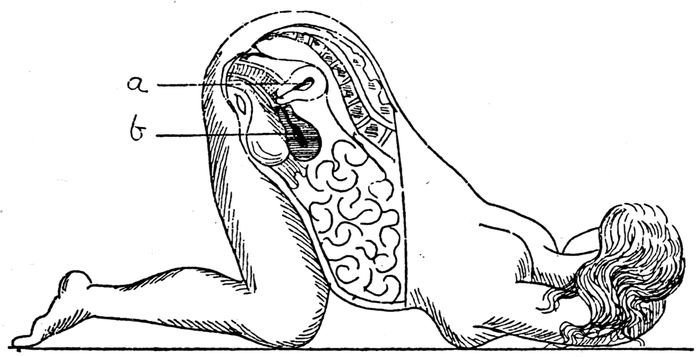
The woman should daily assume a position that will facilitate
the discharge of the lochia; sometimes get on
her knees, or she may occasionally lie on her face and
stomach. There should be no bandages applied so as to
confine the secretions. A soft sponge and warm water
may be used for ablutions at first, or the parts may be
bathed with warm water and oat meal gruel; after bathing
they should be dried with warm, dry towels; they
may then, by means of a piece of linen rag, be anointed
with salad oil or vaseline, or other bland oil. Once or
twice a day the vagina should be syringed out with some
injection. (F. 153, 155.)
To wash or cleanse the patient so that the pores of
the skin in every part are free and unobstructed, a soft
napkin wet with warm soap and water, should be passed
underneath the bedclothing, and she should be rubbed all
over without any exposure to a draught of air. In some
way she should take a sponge bath every day.
The CLOTHING which a patient will wear immediately
after a labor has been already, indicated. As some garments
worn during labor are not necessarily soiled, they
may be worn until the third or fourth day, when the dress
should be changed. This may be done without tiring or
exposing the patient. Without raising her up you can
pull the bedgown down from over each arm, and after
removing it from under the body, you can draw down the
chemise and remove it from below. You can place her
arms in the sleeves of the clean chemise, throw it over her
head and pull it down; and put on a clean bedgown in a
similar manner, or both may be put on at once.
The BED CLOTHING as well as the body linen should be
changed frequently. In changing the upper sheet it should
46be pulled off from below, and the clean one can be carried
down in its place without removing the other bedclothes,
by plaiting the lower half of it. To put on a clean under-sheet,
plait one side of it, and place that under the
patient while she lies on her side, then let her turn on her
back or other side onto it, and draw out the plaited part.
Care of this kind is necessary until she is able to sit.
Have the sheets well aired, and have a proper temperature
in the room.
The lying-in room should always be kept well ventilated
and rather cool; it is injurious to the patient to have
the room kept at a high temperature. Perhaps the ventilation
can be secured by having a little fire in the room,
and by occasionally leaving the door of the apartment
ajar, at the same time being careful to guard against
draughts. But visitors remaining in the room, or any additional
number of persons, serve to vitiate the air, as well
as to prevent the necessary repose of the patient. A sensation
of chilliness may be felt by the woman after delivery,
and her feet may be cold; if they are, something
warm should be applied to them, and sufficient clothing
should be on the bed; but afterwards be careful not to
overload her with clothes, as well as to avoid having the
room overheated.
Too much light in the room may be injurious to the
eyes of the mother or child, and it is often necessary to
darken the room somewhat for a few days.
The lying-in woman will usually be confined to her room
for two weeks. After the first fifteen days she may very
properly remove to another room adjoining, or near at
hand, and during her absence her room and bed may be
ventilated by throwing the windows wide open and throwing
the bedclothes back. Ordinarily she may, at the end
47of three weeks, take her meals with the family, but she
ought still to lie down occasionally to rest her back. At
about this time she may take an airing in a carriage, if the
weather be fine.
All lying-in women ought not to be treated alike in regard
to DIET, etc. While a light, unstimulating diet is
best at first in ordinary cases, the weak and delicate require
good, nourishing food from the commencement, such as
beef tea, chicken broth, mutton chops, eggs, etc., (F. 57,
58, 59.) Oatmeal gruel increases the secretion of milk,
is nourishing and easily digested, at the same time it
is simple and bland, and proper for those that are corpulent,
or strong and robust, and the same may be said of
good cow’s milk. But, as the healthy mother furnishes daily
from a quart to a quart and a half, she needs some meat
to keep up her strength. Never give stimulants to increase
the woman’s strength, or to increase the quantity of milk.
In some cases, after a severe and lingering labor, there
is RETENTION OF URINE. If the bladder cannot otherwise
be emptied, the catheter must be used every six or eight
hours.
The bowels are usually costive after a confinement, and
I prefer to give a dose of castor oil the third day. If this
or some other aperient is not given, enemas should be administered
sufficient to cause evacuations.
The care of the MOTHER’S BREASTS is important. Before
the milk is abundantly secreted, she should not be
fretted by very frequent ineffectual attempts at nursing,
though it may be necessary to draw out the nipple by
means of a breast pump. The milk should be drawn out
when the breasts become full and distended, and they
should not be allowed to remain hard and sore. Apply
fomentations; cabbage leaves, wilted in hot vinegar and
48water, or warm solution of carbolic acid, one part to eighty.
If they continue to be swelled and painful use F. 221, 223.
It may be necessary to make gentle pressure upon them by
means of strips of adhesive plaster, or by a sort of jacket
or bandage, that should be prepared especially for the
purpose. When the breasts are closely bandaged they
should be supported on each side by pads of cotton, so
that the pressure will be made equally upon them.
Delay in applying the child to the breasts is often a
cause of swelled breasts. After it has been fed for a few
days it may refuse to nurse, and if it does nurse the nipple
may be quite tender. But, unless for some cause
the secretion is to be checked, the effort should be made
every two hours to induce the child to draw. You will
be more successful in these efforts if you can reduce the
heat and swelling. Rub the breasts every four hours with
good, warm olive oil, vaseline, or camphorated oil, and keep
the excoriated nipple thickly coated with sub-nitrate of
bismuth.
The breast should be rubbed, and the child should be
nursed regularly, although I do not advise that the child
or the mother should be roused from their slumbers; it is
better to delay for awhile the usual effort. But, even at
first, a child can be nursed with considerable regularity
every hour and a half during the day, and twice during
the night; and it should be applied alternately to either
breast, even if it seems to prefer one to the other.
It is often necessary to wash the breast and nipple with
warm water, and dry it with a soft napkin, before applying
the babe.
During all the time that the mother nurses the child,
the MIND OF THE MOTHER exerts an influence on the latter
through her milk. If the mother’s mind is very much
49disturbed by any apprehensions, fears or anxieties, these
perturbations will not only be likely to check the flow of
milk, but will alter its quality, and perhaps render it
hurtful and dangerous to the infant. The nurse should
guard the patient as much as possible from anything causing
nervous agitation, fretting, anger, grief, fear, sudden
terror, or great anxiety, as these are injurious to the mother,
and may be harmful and fatal to the child. Equanimity
and cheerfulness of mind on the part of the mother
are important at any period of her pregnancy or nursing.
I will now give more particular directions in regard to
The food of the child, if it is necessary to feed it at
first, may be one-third of new milk and two-thirds of
warm water, slightly sweetened. It is not necessary that
it should be fed for at least eight hours after birth, and at
first the quantity fed it must be small. Except in rare
cases the milk furnished by the mother will come soon
enough, and in sufficient quantity to supply the wants of
the child, and it is best for both that the child should draw
it when secreted. For the instruction of the mother, as
well as the nurse, I here quote a paragraph upon the nourishment
and feeding of the child, not only of the new-born,
but also of the subsequent months:
“No form of artificial nourishment can compare with
that furnished by the mother. Women should know and
consider the probability of disease and death occurring
from any other mode, and the difficulties and annoyances
to be encountered in the use of artificial food. As a
further inducement to her to nurse her own child, she
should know that her offspring is sure to imbibe with its
milk, deep, earnest affection. The mother who can nurse
her own offspring should commence within eight hours
after delivery, and in the mean time no trash should be
50put in its mouth to still its cries, or for any other reason;
if it has not been surfeited, it will be disposed to take the
breast. It should be placed to the breast before they are
gorged with milk, for at that later time the flow is less
easy, the parts are more irritable, and the child sucking
with greater power, we are more likely to have, as the
result, irritated nipples. Nature prompts all animals to
suck their mother soon after they are born; we are
less liable to have sore, irritated, cracked nipples, and
there is less liability to infantile colics, etc., if we follow
the guidance of nature and instinct.”
As soon as possible accustom the child to the habit of
nursing every two hours. If there is a proper interval between
the times of nursing, the child draws with more
avidity, actually empties the breast, and obtains that
part that contains the most cream. Endeavor also to
have the intervals longer at night, so that, from 10 P. M. to
6 A. M., it nurses but once or twice. Still, if it wakes
every two or three hours, demands its supply of nourishment,
and you cannot otherwise quiet the child, you
must indulge it. Do not accustom the child to sleeping
on the mother’s breast. If it sleep in its own crib or bed,
properly clothed and protected, it is less liable to have its
rest disturbed. Avoid the custom of having a young
child sleep with old and sickly persons, and also of having
them sleep in ill-ventilated rooms, and of covering the
child’s face as it sleeps. There is danger that a child
may die from want of pure fresh air, from having its face
pressed tightly in the embrace of the person with whom
it sleeps, from the multiplicity of its clothes, and from the
mass of bedclothing used by the mother, as well as from
improper food. A child should never be covered to sweat
by reason of the warmth of its clothing, or of that of the
apartment.
51If the mother does not enjoy good health, it may be
better for her not to nurse the child at night, but to have
it fed once or twice with a little diluted cow’s milk at
night, and to nurse it during the day.
The following have been named as CAUSES WHY THE
MOTHER CANNOT PROPERLY NURSE THE CHILD:
1. When she cannot have a sufficient quantity of milk.
2. When the supply falls off from some defect which is
not remediable.
3. When there is a strong venereal or scrofulous taint
in the constitution.
4. When suckling produces an active or painful disease
in the mother, as colic, etc.
5. When the mother is subject to great nervous debility;
possesses an irascible temperament, and cannot avoid
grief and sorrow; and also when she is suffering from
certain hereditary chronic diseases.
When a mother cannot suckle her child, if circumstances
will allow, a healthy wet-nurse should be procured.
Choose one that is of a healthy family; ascertain
that there are no eruptions on her skin, or if there be other
disease; if she have a plentiful breast of milk, and if it be
of a good quality; if she has good nipples, and if her child
is born near the time that the one was that she is to nurse.
Do not get a nurse that menstruates during suckling, nor
one that has a child which is unhealthy, or has a sore
mouth or blotches upon the skin.
Very feeble new-born babes cannot take the breast sometimes.
In such cases cow’s milk, water and sugar (F. 1)
may be given in small quantities at a time, but frequently
repeated. If it takes only a teaspoonful at a time it should
be repeated every half hour.
Many mothers are unable to obtain the services of a
52wet-nurse. The milk of a cow is the best substitute, and
when this is of ordinary richness, it may be diluted with
an equal quantity of water, or thin barley water.
The following are leading principles to guide in giving
infant food:
1. Aliment should always be presented to the infant
stomach in a fluid form.
2. Bread and other farinaceous substances are generally
indigestible in the infant stomach, and may better be
excluded from infant feeding.
3. Cow’s or goat’s milk, when pure and modified so as
to resemble as much as possible human milk, will generally
be found sufficient without any other help to nourish
the new-born infant.
4. If cow’s milk is used at first, diluted with twice as
much water and slightly sweetened, the proportion of
water must be gradually lessened, until after six months
the milk may be given undiluted.
5. When good milk from one cow cannot be obtained,
and the child does not thrive upon the milk used, condensed
milk may properly be substituted.
6. There are various forms of infant food referred to
in F. 1, 2, 3, 4, 11, 28, 45, 49, and if one of these is tried
and proves satisfactory, it will not be advisable to try new
kinds of infant food which are at the present time offered
for sale. Milk should be the basis of all infantile food;
neither starch, dextrine or glucose sufficiently nourishes
without it; but we may use one of these foods without
milk for one or two days, in unsettled state of the stomach,
with good results. (F. 61.)
Thoroughly wash the babe every morning from
head to foot, using a large wash bowl or nursing basin,
half filled with water. First wet the head, then immediately
53put the body in the bath, and with a sponge or piece
of flannel, cleanse the whole body, particularly the armpits,
groins, and between the thighs. The skin, after being
thus cleansed, must be quickly and thoroughly dried
with soft towels, and the parts liable to become sore, powdered;
then all parts of the body and limbs should be
gently rubbed. During all the time, when the child is but
a few days old, it should not be exposed at all to the cold.
The water for its bath should be slightly warmer than
new milk, and the time occupied in the bathing should be
short. Each time, after a passage from the bowels, the
parts should be washed with warm water, and if there is
any chafing the calamine powder should be applied.
The naval string should receive the attention of the
nurse; within an hour of the time it is at first tied, she
should examine the dressing to see if there has been any
bleeding. If it bleeds, and the doctor is not at hand, retie
with a stout cord, drawing it quite tight. Each morning,
when the child is bathed, lift up the naval string with
the rag dressing and insert a little nice fresh tallow under
it. When it is loose remove it, but use no means to cause
the separation. The naval is sometimes a little sore, but
seldom needs any dressing more than simply vaseline or
tallow.
At night a child should be entirely undressed, and its
clothing replaced by other garments, those that are loose,
light, and sufficiently warm for it while it is under the bedclothes.
For a very young child the proper night-dress is
a loose slip; when older, a pair of drawers, fitting up well
around the neck and covering the body and limbs, is a
good article. The clothing worn during the day should
not be worn at night, and the clothing when soiled should
be immediately changed. Whenever the child seems disposed
54to sleep, this should be encouraged. Never arouse
a child suddenly from its sleep. Be careful that there is
no unnecessary noises to disturb its sleeping. Time the
bathing and dressing so that the little one may not be unnecessarily
disturbed. But never give soothing syrups,
anodynes for infants, or other nostrums to induce them
to sleep. If the child is restless, endeavor to ascertain if
there is not some cause that can be removed, such as tight
clothing, etc.
Premature infants may, under favorable circumstances
and assiduous care, live and thrive. Immediately
after birth the child should be placed in a warm bath, and
then wrapped in cotton. The baths should be warmer
than usual, and must be frequently repeated. Awaken
the child every one or two hours to feed it. Milk (woman’s
milk is the best) must be given it by a teaspoon.
With a view to the better development of the lungs, it may
be excited to cry by a slight irritation. Do not bring such
children into the open air for several months after the
birth, as their passages are readily affected.
PART II. ANATOMY AND PHYSIOLOGY OF THE FEMALE ORGANS AND FŒTAL DEVELOPMENT. — CHAPTER I. OF THE PELVIS. — THE SACRUM. — THE OSSA INNOMINATA. — THE OS COCCYGIS. — OF THE PELVIS IN GENERAL. — THE BRIM OF THE PELVIS. — DIAMETER OF THE PELVIS. — DIFFERENCES OF THE PELVES. — USES OF THE PELVIS. — TERMINAL OUTLET OF THE PELVIC CANAL. — CHAPTER II. PARTS CONTAINED IN THE PELVIS. — THE UTERUS. — STRUCTURE OF THE UTERUS. — THE FALLOPIAN TUBES. — THE OVARIES. — THE VAGINA. — THE EXTERNAL ORGANS. — CHAPTER III. PHYSIOLOGY OF THE UTERUS AND OVARIES. — MENSTRUATION. — THE FUNCTION OF THE OVARIES. — CHAPTER IV. OF DISPLACEMENTS OF THE UTERUS. — RETROFLEXION AND ANTIFLEXION. — RETROVERSION AND ANTEVERSION. — CHAPTER V. Mismenstruation. — AMENORRHŒA. — DYSMENORRHŒA. — MENORRHAGIA. — CHAPTER VI. GENERATION. — UTERO-GESTATION. — CHAPTER VII. THE OVUM AND ITS DEVELOPMENT. — CHAPTER VIII. THE FŒTUS. — THE PHYSIOLOGY OF FŒTAL LIFE.
55
The formative organs of generation are situated within
a large cavity, called the cavity of the pelvis, the walls of
which are composed of bones and soft parts. This basin
(in Latin, pelvis) is an irregular, long cavity, situated at
the base of the spinal column, and above the inferior extremities.
In the adult the bony pelvis may be divided
into four parts or bones, viz: the os sacrum, two ossa innominata,
and the os coccygis, but in early life they are
more minutely divisible.
The sacrum (Fig. 1) terminates the vertebral column,
and is perhaps the most important bone in the pelvis, obstetrically
considered, as it enters largely into the various
deformities of the pelvis. In the adult it is of a triangular
shape, the base of the triangle being above and inclining
forwards, the apex below and somewhat backwards; its
length is from four to four and a half inches; its breadth
about four inches, and the greatest thickness, two and a
56half inches. The internal surface is concave to the amount
of half an inch, crossed by four transverse lines, marking
the former division by cartilage; here are four pair of
holes, through which pass numerous nervous filaments,
which afterwards form part of the great sciatic nerve.
Fig. 1–
A
represents the internal or anterior surface of the sacrum.
B B
represents the articular processes.
C C
represents the anterior sacral foramen.
D
represents the articulating surface.
It is placed at the posterior part of the pelvis, where it
appears like a wedge forced in between the ossa innominata,
immediately below the vertebral column and directly
above the coccyx.
The os innominata (nameless bone, Fig. 2) is of a very
irregular figure, and the pair occupy the lateral and anterior
parts of the pelvis. The external or femoral surface
is turned backwards and downwards, as well as outward;
at its superior part, inferiorly it looks downwards. Towards
57the front, the external face presents the cotyloid
cavity, or the acetabulum; a little more in advance and
below is the subpubic or obturator foramen, which is nearly
closed by the obturator ligament.
Fig. 2. Right os innominatum, external surface.
Fig. 2—Represents the external surface of the right os innominatum. A. The external iliac fossa; B, crest of the ilium; C, anterior superior spine of the ilium; D, anterior inferior spine of the ilium; E, horizontal branch of the pubis; F, posterior superior spine of the ilium; G, posterior inferior spine of the ilium; H, acetabulum; I, ischium; K, obturator foramen. At birth the haunch bone, or os innominata, is composed of three bones connected by cartilage. Fig. 3.
The superior portion of the bone is characterized on its
abdominal or internal face by a large excavation called the
internal iliac fossa (Fig. 4.) This portion is terminated
below by a large rounded and concave line. The inferior
(lower) portion presents behind a nearly triangular plane
surface; near the middle of this is the obturator foramen,
and in front is the internal face of the os pubis.
58
Fig. 3. Left os innominatum, external surface, etc.
Fig. 3—Left os innominatum, partly ossified. The haunch bone as it exists in the child. A, pubis; B, ilium; C, ischium.
Fig. 4. Right os innominatum, internal surface.
Fig. 4—Right os innominatum, internal surface. A, internal iliac fossa; B, anterior superior spinous process of the ilium; C, crest of the ilium; D, posterior superior spinous process of the ilium; E, posterior inferior spinous process of the ilium; F, articular surface; G, spine of the ischium; H, tuberosity of the ischium; I, obturator foramen; K, ischia pubic ramus; L, crest of the pubis; M, the pectineal eminence.
59
Fig. 5.
The os coccygis.
The OS COCCYGIS (Fig. 5) is three or four little bones
united together on the median line of the body,
and attached to the os sacrum. Each little
bone is tipped with cartilage, and they are so
united as to be movable. The entire bones
form a pyramid, the apex of which is below.
The internal surface is smooth, like that of the sacrum,
terminating the plane of the sacrum and bounding it anteriorly.
Fig. 6. Vertical section of the pelvis.
Fig. 6—Inlet, outlet, and axis of the pelvis. a, b, plan of inlet—superior strait; c, d, plan of outlet, or inferior strait; e, f, axis of cavity; g, the coccyx extended as it is in labor.
Of the JOINTS OF THE PELVIS it is only necessary here
to say that there is no motion in them to facilitate labor,
except that the sacro-coccygeal joint is of the kind called
ginglymoid, admitting of extensive motion, especially backward,
60so as to permit the enlargement of the lower outlet
an inch or more. (Fig. 6.)
We will now consider the pelvis collectively or as a
whole; its relation to the rest of the body; its magnitude,
axis, etc. It is connected with the trunk by the articulation
of the sacrum with the last lumber vertebra, effected
in the same manner as the junction of the vertebra with
each other; with the lower extremities it is connected by
means of the hip joints. When the pelvis is in situ, the
brim is neither horizontal nor perpendicular. It represents
a cone, slightly flattened from before backwards, the
base of which being above, while the apex is directed
downwards.
When the body is erect the upper part of the sacrum
and the acetabula are nearly on the same descending line,
the point of the os coccygis being a little above the arch of
the pubis, and the sacro-vertebral angle three inches and
nine lines higher than the pubis. Were it not for the obliquity
owing to the upright position of the human female,
the womb would gravitate low in the pelvis, and produce
most injurious pressure on the contained viscera. The
lower or true pelvis is the part involved in parturition, and
its size and shape demands our attention.
This is defined by the LINEO ILIO PECTINEA, which
marks the boundary of the true and false pelvis, and this
superior strait is the entrance of the lesser pelvis. Its
form has been variously described as being oval, heart-shaped,
and triangular. If we call it “triangular with angles
rounded off,” the base of the triangle is behind and
the apex in front. It would be nearly oval were not the
61oval form broken by the promontory of the sacrum. This
brim is the first solid resistance the head of the fœtus
meets in its descent through the pelvis.
Different estimates are made by different anatomists of
the measurements of the brim of the pelvis. The following
is nearly the correct size of the ordinary female pelvis:
Fig. 7. The bony pelvis.
Fig. 7—The pelvis seen from above. a a, The antero-posterior or sacro-pubic diameter; b b, the transverse diameter; c c, the two oblique diameters.
The circumference varies from thirteen to fifteen inches;
the antero-posterior diameter, i. e., from the prominence
of the sacrum to the upper edge of the symphasis pubis,
(Fig. 6), is about four and a quarter inches; the transverse
across the widest part of the brim, at right angles to the
antero-posterior, is five and a quarter inches, and the
oblique from the sacro-iliac synchondrosis of one side to
the opposite of the brim, just above the acetabulum, is five
inches. (Fig. 7).
62The cavity of the pelvis, of which the fixed boundaries
are the sacrum and the pubis, is of unequal depth.
The height in front is one and a half inches; upon the
sides, three and three-quarter inches, and it is four and a
quarter inches if a straight line be drawn from the sacro-vertebral
angle to the point of the coccyx, five and a
quarter inches following the curve of the sacrum, and six
inches if the coccyx be extended. (Fig. 6).
The antero-posterior diameter of the outlet from the
arch of the pubis to the point of the coccyx is usually
four and a quarter inches, but may increase to five inches
during labor by the retrocession of the coccyx (Fig. 8);
the transverse from one tuber ischii to another is four and
a quarter inches, and the oblique about four and three-quarter
inches.
Fig. 8—Position of the pelvis and the axis at the termination of labor.
Fig. 8—a b, Total axis of the excavation; c, the axis of the superior strait; d e, perineum as distended at the moment of the passage of the head.
It is important to notice that the diameters are entirely
changed between the rim and the outlet, and that the
change is effected gradually. The axes of the inlet and
outlet form an obtuse angle with each other (this is illustrated
in Figs. 6 and 8.) The three diameters taken at
63the center of the pelvis are very nearly equal—about four
and three-quarter inches.
There is considerable difference between the male and
female pelvis, in shape and size. The pelvis in the male
is smaller but deeper; the bones are thicker and the brim
is more circular, the depth of the symphasis pubis is
greater, the sacrum is more perpendicular, the arch of the
pubis is narrower, the tuber ischii are nearer each other,
and the coccyx less movable. In the female the iliac
fossæ are larger, the interval separating the angle of the
pubis from the acetabulum is greater, causing the prominence
of the hips and wider separation of the thighs, the
superior straight is larger and more elliptical, the curve
of the sacrum deeper and more regular, the tuberosities of
the ischii are further apart, and the arch of the pubis
broader. From the greater width of the female pelvis,
and from the upper end of the thigh bones being farther
apart than in the male, the thigh bones approach each
other in their descent, giving a peculiarity to the movements
of the female in walking.
The soft parts lining the pelvis and covering it externally
modify the diameters of the pelvis, but the effect of
these additions in diminishing the internal diameter is not
very great. The diameter of the cavity is lessened thereby
from one-fourth to one-half an inch.
One function of the pelvis is to inclose and protect the
bladder, rectum and seminal vesicles of the male, the uterus,
Fallopian tubes and ovaries, as well as the bladder and
rectum in the female. During labor it affords a passage
for the child.
64
This is not at the coccyx, but rather at the anterior
commissure of the perineum. This is so greatly distended
at the last moment of labor as to much prolong the
posterior wall of the pelvic excavation and the canal to
be traversed by the fœtus. (Fig. 8).
Fig. 9—Section of sacrum and pubis.
Measuring superior strait.
Fig. 10.
Measuring inferior strait.
The internal organs of generation are the vagina and
uterus with its appendages; but I will first describe the
urethra and the perineum.
The URETHRA is a membranous dilatable canal about an
inch and a half in length, and directed obliquely from before
backwards, and from below upwards, running under
and behind the symphasis pubis, from which it is separated
by loose celular tissue. Its inferior portion is intimately
united to the vaginal walls. Its meatus, the outlet
for the urine, is situated about an inch from the clitoris,
and immediately above the prominent enlargement of the
anterior part of the vagina.
65Internally the urethra opens into the bladder. Its direction
is subject to variation during pregnancy, the bladder
being carried upwards with the uterus, the urethra
curves under the pubic arch, and then ascends perpendicularly.
The same change occurs when the uterus is enlarged
from other causes. In prolapse of the pelvic viscera
the course is reversed.
The PERINEUM is the portion between the rectum and
the vagina.
The uterus is the organ provided for the reception,
growth, and ultimately for the expulsion of the fœtus.
In the virgin normal state it is pear-shaped, flattened from
before backwards; is situated in the cavity of the pelvis,
between the bladder and the rectum, and projects into the
upper end of the vagina below. Its upper end or base is
directed upwards and forwards, so that its axis corresponds
very nearly with that of the superior strait, and forms an
angle with the vagina.
The uterus measures about three inches in length, at its
upper part two in breadth, an inch in thickness, and it
weighs from one ounce to an ounce and a half. The
fundus is the upper broad extremity of the organ; it is
convex, covered by peritoneum, and placed in a line below
the level of the brim of the pelvis. The body gradually
narrows from the fundus to the neck. Its anterior
surface is flattened, covered by peritoneum in the upper
three-fourths of its extent, and separated from the bladder
by some convolutions of the small intestines; the
lower fourth is connected with the bladder. Its posterior
surface is convex, covered by peritoneum throughout, and
separated from the rectum by some convolutions of the
intestines. The lateral margins are concave, and give attachment
66to the Fallopian tubes above or superiorly, and
the round ligaments below; and behind these, and also
below the ligament of the ovary. The cervix is the lower
and constricted portion of the uterus; around its circumference
is attached the upper end of the vagina, and this
extends upwards a greater distance behind than in front.
At the vaginal extremity of the uterus is a transverse
aperture, the OS UTERI, bounded by two lips, an anterior
one which is thick, and a posterior one, narrow and long.
The os uteri, or os tincæ, is generally about the size of a
small goose-quill. The canal of the cervix is from half to
three-quarters of an inch long; leading from the os uteri
it first widens and then contracts again where it enters the
body of the uterus. The surface of the canal exhibits a
67variable number of follicles or vesicles called the glandula
nabothi, which secrete a thick mucus; this blocks the canal
after impregnation. The cavity of the body and neck has
a longitudinal extent of about two and a half inches; in
virgins it is much less. (Fig. 12).
Fig. 11—Section of pelvis. a, section of pubis; b, bladder distended; c, the uterus in normal position; e, sacrum; f, urethra; g, vagina; h, hymen; i, the os uteri; j, meatus of urethra; k, vagina.
The proper tissue of the womb is composed of fibres,
and is proved to be muscular. In the unimpregnated
state it is dense, firm, and of a grayish color. The neck
appears less firm than the body.
The internal or mucous membrane is thin, smooth, and
closely adherent to the subjacent tissue. It is a quarter
of an inch thick at the middle of the body of the uterus;
in the neck it does not exceed one-twenty-fourth part of
an inch in thickness. It is continuous through the fimbriated
extremity of the Fallopian tubes with the peritoneum,
and through the os uteri with the mucous membrane
of the vagina.
The uterine or Fallopian tubes are two canals, about
four inches long, placed in the superior border of the broad
ligaments of the uterus. They extend for about three
inches and a half, when they expand and terminate with
a fringed process called the fimbria, which is applied to
the ovary after impregnation. The Fallopian tubes serve
the double purpose of a canal for transmitting the fecundating
principle of the male and for carrying the germ
furnished by the female to the uterus—in fact they are
excretory ducts of the ovary.
Injections into the uterus may pass into the peritoneal
cavity, through the Fallopian tubes, and cause peritonitis.
At each menstrual period an ovula passes along with
the serum current in the Fallopian tubes to the uterus.
68
The ovaries in the female are said to be the analogues
of the testicles in the male; they both secrete a fluid that
is essential to impregnation. They are situated on either
side of the uterus, and are attached to either side of it by
the posterior duplicature of the broad ligament called the
ligament of the ovary. (Fig. 12).
They are oval flattened bodies about an inch and a half
long, three-quarters of an inch wide at their greatest
breadth, and a quarter of a inch thick. They are situated
on the sides of the uterus in that portion of the broad
ligament called the posterior wing, just behind the Fallopian
tubes. The ovary consists of a peculiar structure
enclosed by two envelopes, one of which is serous and the
other fibrous. Within the fibrous coat is a special tissue
called the stroma; imbedded in this are numerous small
round transparent vesicles in various stages of development,
varying in size from that of a millet seed to that of
a hemp seed. They are the ovisacs, containing the ova,
and are called the Graafian vesicles. These have thin
transparent walls and contain a clear fluid, and within that
the ovula. Fifteen or twenty may readily be distinguished
in the adult female without the aid of magnifying glasses.
The vagina is a membranous canal, extending from the
vulva to the uterus obliquely through the pelvic cavity,
between the bladder and rectum, having about the same
direction as the axis of the pelvis. It is described as being
five or six inches in length and about two inches in
diameter, but it would be more correct to say that it is
capable of being distended to these or greater dimensions,
for in its common state the os uteri is seldom found to be
69more than three inches from the external orifice, and the
vagina is contracted as well as shortened. In great part
the walls of the vagina are composed of spongy erectile
tissue, and their vascularity is a cause of considerable
hemorrhage consequent on their rupture. Three layers
combine to form the walls; one external or cellulo-fibrous,
a middle or muscular one, and the internal or mucous one.
The latter is of a pale red hue, which becomes violet during
menstruation and especially during pregnancy. The
mucous coat is disposed in the form of rugæ or folds
anteriorly and posteriorly, which are better developed in
young virgins and aged females; during advanced pregnancy,
and for a short time after delivery, they are entirely
effaced.
Fig. 12—Section of the Uterus, &c.
Fig. 12—Uterus, ovaries and Fallopian tubes. Section of the uterus, etc. a, Fundus of the uterus; b, cavity of the womb; c, cavity of the neck of the uterus; d, d, the cavity of the Fallopian tubes; e, fimbriated extremity; f, f, the ovaries; g, the vagina; h, h, the round ligaments; i, i, the ligaments of the ovaries.
The upper part of the vagina is connected to the circumference
of the os uteri but not in a straight line, for
the former stretches beyond the latter, and being joined
to the cervix, its mucous membrane is reflected over the
os uteri, which by this mode of union is suspended with
70protuberant lips in the vagina, and permitted to change its
position in various ways and directions.
The situation of the external organs of generation are
indicated in the accompanying diagram (Fig. 11.) It is
not deemed necessary here to describe these, but in regard
to the hymen (the membrane that in infancy nearly closes
the orifice of the vagina), we may remark that it is not a
perfect test of virginity. There are, however, examples
recorded in works on midwifery where a slight surgical
operation was necessary after marriage, because this membrane
was uncommonly strong.
Menstruation is a periodical flow of blood having its
source in the walls of the uterus. But menstruation is
excited by and dependent upon ovulation, and the effective
cooperation of both the uterus and ovaries is necessary
to both menstruation and conception. We shall consider
these functions separately.
In healthy women at the period of puberty, a certain
amount of sanguineous fluid is secreted by the lining
membrane of the uterus, and is excreted through the vagina
every month; this is termed the catamenia, or menses,
and the function itself menstruation. A female in whom
the discharge recurs at the usual periods, in the usual
quantity, and of the usual quality, is said to be regular,
71The occurrence of menstruation defines the period of
puberty at which a girl becomes a woman capable of conception,
and its cessation terminates the prolific period of
female life.
Dr. Robinson, of Manchester, England, in a paper on
the natural history of menstruation, has stated the age at
which it occurred in 450 cases.
According to his table, 10 menstruated for the first time
at 11 years of age, 19 at 12, 53 at 13, 85 at 14, 97 at 15,
76 at 16, 57 at 17, 26 at 18, 23 at 19, and 4 at 20.
The time at which the first menstruation occurs varies
exceedingly from the influence of climate, habits of life
and constitution. There have been occasional instances
of very precocious menstruation, in which the first appearance
of the discharge was attended with all the attributes
of puberty. I myself knew one case where a girl
of nine years, not only menstruated, but presented the
external signs of puberty, such as prominent breasts, wide
pelvis, rounded contour of body, &c.
The first appearance of the menses very rarely occurs
without being preceded by premonitory symptoms. There
is usually a degree of languor and lassitude, fatigue after
exertion, inequality of spirits, dark shade under the eyes,
headache, sometimes pain in the thyroid gland, pain in
the back, a sensation of tension and swelling in the lower
part of the abdomen, and occasionally considerably fever.
Not unfrequently strange nervous disturbances occur;
but all of these symptoms may pass off, the first and second
time, without the appearance of the menses, or with
a white discharge only. Usually the phenomena may last
from one to eight days, then there is an abundant flow of
mucus, which after one or two days is mixed with blood,
72and soon gives place to almost pure blood. When this
discharge takes place most of the unpleasant symptoms
disappear, and the female only complains of weakness
and is somewhat pale. The hemorrhage continues for
several days, then the amount of blood mingled with the
vaginal mucosities diminishes, soon there is mucus alone,
then the discharge ceases.
I should remark now that the propriety of applying the
terms, blood or hemorrhage, to the menstrual secretion is
properly questioned.
Sometimes the first menstruation takes place without
being preceded by any discomfort, but pretty generally
there is a change in the girl at the time, both in her body
and mind, a change that fits her for the important duties
that devolve upon her.
Most young girls have a return of the discharge after a
month, the menses afterwards recurring regularly; some
do not become regular until after several months. Sometimes
the function is imperfectly performed; such cases
are accompanied with considerable distress.
In some young girls the precursory symptoms of the
first appearance of the menses may not be followed by a
flow of blood, and there is an apparent effort of nature
recurring monthly for several months before the courses
become established.
There are occasional examples of retarded menstruation.
I am acquainted with one woman who at the age of twenty-five
years has not menstruated. The absence of the
menses does not render conception impossible, in every
case.
After the menses are established, until the time of their
cessation, they generally return every month, unless interrupted
by pregnancy or nursing. The average of the
73catamenial period is about twenty-eight days; in a large
number it is thirty days; in some instances they recur
every fifteen days.
The duration of the flow varies from one to eight days;
three or four days is the most usual duration. The quantity
of blood lost is variable; from three to five ounces is
said to be the average.
When the ovaries are congenitally absent, or have been
removed, or have become disorganized, menstruation is
absent, or ceases. The cause of the menses is the successive
evolution of the Graafian vesicles; but the regular
process may go on in the ovary without the regular sanguineous
discharge.
The menses continue in the majority of cases until
about the age of 46 years, or perhaps in this country 48
years.
According to Dr. Robertson, of England, the periods
at which it closed in 77 individuals was, in 1 at the age of
35 years, 4 at 40, 1 at 42, 1 at 43, 3 at 44, 4 at 45, 3 at
47, 10 at 48, 7 at 49, 26 at 50, 2 at 51, 2 at 52, 2 at 53,
2 at 54, 1 at 57, 2 at 60, and 1 at 70.
The average duration of the menstrual function is about
30 years. The cessation of the ovarian function is generally
announced several years in advance by irregularities
of the menses. Besides the intermissions and irregularities,
there are other symptoms; a general and indefinite
feeling of uneasiness, pelvic pains, itching at the genital
parts, flashes of heat in the face, alterations of chilliness
and perspiration, leucorrhœa, etc. These troubles are usually
slight, and disappear promptly. The time of life has
been called the CRITICAL PERIOD, because there has been
an opinion prevalent that peculiar dangers attend it.
However, the mortality is not greater between the ages of
7445 and 50 years than at any other period of life. Yet it is
true that in some instances diseases that had been latent
previously, declare themselves at this period.
We will now consider the physiological action of the
ovaries and its intimate connection with the action of the
uterus in menstruation, etc.
Preceding the first menstruation an ovary is considerably
enlarged, becomes of a red color, and its vascular apparatus
is considerably congested; the Fallopian tube
also becomes congested; its fimbriated extremity is of a
violet red color, and has a velvety appearance. The
Graafian vesicles increase in size; fifteen or twenty of
them, more advanced than the others, project from the
surface of the ovary; one of these grows so that after a
few days it forms a tumor of the size of a cherry; the
walls of the vesicle, being distended by an increased secretion
of fluid, becomes quite thin, and at last are ruptured.
When the thinned walls give way, the ovule is expelled,
with a part of the granular contents of the vesicle; these
are grasped by the fimbriated extremity of the Fallopian
tube which is prepared to receive it and convey it through
its canal into the cavity of the uterus.
This evolution of an ovule excites numerous sympathies
throughout the organism of the female, and especially the
generative organs. The vascular apparatus of the womb
becomes developed in an unusual manner; a network of
fine blood vessels surround the orifices of the numerous
glandular tubes, of which the membrane is almost entirely
composed; this gives a violet hue to the internal surface
of the womb; the utricular glands increase in size, the
muscular structure of the uterus acquires greater extension,
75becomes redder and more spongy and supple, the
volume of the organ is increased, the neck is tumefied
and its orifice narrower, the lips of the os tincæ are warmer
and their color deeper.
The vascular congestion which the uterus undergoes is
accompanied with the exudation of sanguineous fluid,
which is at first but a few drops; this communicates to
the increased vaginal mucus a reddish hue. After a day
or two there is a bloody flow from the vascular network
of the mucous membrane. This flow, which constitutes
the menses, is diminished after three or four days, and the
discharge again contains a large proportion of mucus and
serum. It is probable that the rupture of a Graafian vesicle
occurs during the last days of the flow, ordinarily,
and it is also believed that venereal excitement is capable
of exerting so much influence upon it that it may determine
the rupture of an enlarged vesicle, which, without
sexual intercourse, would have remained whole several
days longer.
After the discharge of the ovule consequent on the rupture
of the Graafian vesicle, the walls of the vesicle contract
on the matter that is effused within it, and form a
compact mass, which after a time has an orange yellow
color—this is called the corpus luteum.
Ordinarily, in the human female in the normal condition,
a new Graafian vesicle increases in size every month,
becomes excessively developed, and finally bursts and discharges
its ovule, to become, through successive transformations,
the corpus luteum. What is called the “monthly
sickness,” “monthlies,” “courses,” etc., never occurs
without having been preceded and accompanied by the
development of a Graafian vesicle.
76
In order to compress as much as possible what I say
upon these topics, I shall consider here displacements of
the uterus, both of those which occur in the pregnant and
non-pregnant women.
By the inflection of the peritoneum the uterus is permitted
to expand freely during pregnancy, and to rise
without inconvenience into the cavity of the abdomen;
this it could not do if it was confined to its place by short
ligaments, or by adhesions. But from the same cause,
women become liable to various diseases; to the retroversion
of the uterus, and other displacements; to dropsy
of the peritoneum, and to that species of hernia which is
occasioned by the descent of the intestines between the
vagina and rectum.
By PROLAPSIS is meant that condition in which the
uterus falls below its natural level in the pelvic cavity.
Procidentia is a term used to signify the protrusion of
the uterus beyond the vulva. Women are liable, even
when young, to a falling of the womb, but it occurs most
commonly after the age of thirty-five, in such as lead a
laborious life. Amongst other causes may be enumerated
violent bearing down efforts, such as are made in straining
to pass hardened feces, or in urging an evacuation
through a stricture in the rectum, in coughing, lifting
heavy weights, etc.
77The immediate causes of the displacements are the
pressure on the uterus by the viscera above it, and a diminution
in tone of the uterine supports.
Displacements of the womb are more common among
women who have hollow and capacious pelves; in sufferers
from dropsy, and in delicate, flabby subjects, where
the broad and round ligaments are affected and elongated.
There may be prolapsis during the early months of
pregnancy, and in cases where the pelvis is large and the
ligaments are relaxed, the womb may rest on the perineum;
or the neck, and even the body may become visible
externally; but it subsequently rises out of the pelvic cavity,
assuming a normal position.
When a woman has prolapsis uteri she often complains
of a sense of weight about the pelvis, of dragging pains,
of a wearisome backache, and of a leucorrhocal discharge.
Menstruation is seldom interfered with, and as the uterus
goes back of itself, or is easily pushed up when the patient
is in bed, conception may take place, and the general
health may not be directly affected.
In some few instances there is complete inability to pass
water until the patient lies down and replaces the uterus
with her finger; in other cases micturition may be annoyingly
frequent. Constipation is often complained of,
and, if the woman be careless, a large accumulation of
feces may take place in the rectum.
By a vaginal examination the os uteri is found low
down, and if the cervix is of the natural length, we know
that it is prolapsis.
If a round tumor is seen projecting beyond the vulva,
and if at the lowest part of it there is what seems to be the
mouth of the uterine cavity, it may be advisable to introduce
a sound or catheter, to make sure that the opening
78is not a mere cleft in a uterine polypus. (Of course, you
would not use a sound if you suspected pregnancy.) If
there are ulcers, cracks, etc., they may be detected, the
ulcers looking as if portions of the mucous lining had been
punched out.
In pregnancy, displacements may occur either slowly or
suddenly, though the woman may have had nothing of the
kind previously, or they may be the continuation of a previous
prolapse. The progressive development of the uterus
generally removes the prolapsis about the fourth or
fifth month, but if the pelvis is very large, it may possibly
continue.
As in other cases of prolapsis, the pregnant woman may
suffer very much from it. She may suffer from a feeling
of weight at the anus; painful tractions in the groins, lumber
regions and umbilicus; a fetid discharge may come
on; there may be complete retention of urine, very obstinate
constipation, etc.; and the pressure on the uterus
may cause abortion.
For complete retention of the urine the catheter may be
used, or the womb may be pressed up by one or two fingers
introduced into the vagina; or the woman may be
able to urinate if she lies down and elevates her hips considerably.
THE OPERATION OF INTRODUCING THE CATHETER may
be performed by the educated nurse. The patient being
placed upon her back and the labia separated, the point
of the forefinger of the left hand should be placed just
within the orifice of the vagina so as to press slightly the
upper edge; the catheter should then be passed along the
inner surface of the finger until it is arrested by the anterior
part of the vagina; when there, a very slight movement
so as to elevate the point of the instrument a little,
79enables the operator in the majority of cases to enter the
catheter into the canal. The operation is more difficult
when the parts are swollen or distended, as happens occasionally
from disease, during pregnancy or labor, or after
delivery. If we cannot detect the orifice by the touch,
we may use a light, and the patient may be placed on her
side. We may adopt another way to proceed. The point
of the forefinger finds the clitoris, and passes from above
downwards to the middle of the vestibule; the first inequality
met with is the orifice of the urethra, into which
the instrument can then be passed. It will easily slide in
if the instrument is not passed either to the right or the
left of the median line.
When a woman who has previously suffered from prolapsis
becomes pregnant, it is sometimes necessary for her
to keep the horizontal position during the first three or
four months of pregnancy, and after her confinement she
should keep her bed a considerable time—perhaps for two
months.
For the treatment of prolapsis in non-pregnant women,
the general principles are to be applied: To afford artificial
support to the superincumbent abdominal viscera;
give tone to the broad and round ligaments of the uterus,
to the vaginal walls and the perineum; and to remove any
complications that induce the falling, such as uterine congestion,
hypertrophy, cough, constipation, etc.
The uterus may usually be easily pushed back to its
place when the patient is lying down, or, what is better,
her head much lower than her pelvis. (Fig. 13). The
knee-chest position is the best one.
Without going into the details of treatment in the use
of bandages, tents, etc., I may say that a nurse may, in the
absence of a physician, use astringent vaginal injections,
80astringent pessaries (F. 154, 163), and cold soft water;
hip baths may also be used. The nurse should know how
to tamponade the vagina, because, when this is deemed
advisable by the physician, he desires that the process be
repeated every day, and in many instances it is not convenient
or possible for him to make daily visits. The
vaginal tampon is used as a means of retaining the uterus
in its normal position, and also to hold medicinal agents
applied to the cervix and vagina; besides, in some cases,
direct pressure on the pelvic vessels stimulates and thus
benefits them when in a state of chronic, passive dilatation,
or venous hyperemia. Tampons are also used in
cases of hemorrhage from the uterus, and as an absorbent
of vaginal or uterine discharges, and for various other
purposes.
The nurse may receive instruction from the physician
in each case in regard to the material, etc., to be used as
tampon. When it is desired to simply support the uterus
in its place, fine cotton batting may be used, and this perhaps
is, in ordinary cases, as good as any material. But
in some cases absorbent cotton, oakum, marine lint, or
wool may be preferred. The size of the tampon will, of
course, vary; ordinarily one as large as a hen’s egg may
be introduced without difficulty; sometimes one nearly as
large as a goose egg may be necessary, because a small
one would not be retained. Cotton may be rolled tightly
into the form of a cylinder, or a small bag may be made
of muslin or linen, and cotton or other substance can be
enclosed in this and applied.
The knee-pectoral position (Fig. 13) is the one in which
a prolapsed uterus can best be replaced, and the nurse
can best tamponade the vagina while the patient is in that
81position. The proper knee-pectoral or knee-chest position
is shown in Fig. 13.
The physician would, with or without the aid of the
nurse, use a Sims’ speculum, and first pack four small
pledgets of cotton around the neck of the uterus. One
string can be tied in the kite-tail manner around each of
these pledgets, and there should be an end about ten
inches long to be left out from the vagina, so that the
whole may be easily removed. The nurse, if alone, however,
will usually press in but one tampon, and she may
do this while the patient is in the knee-chest position, or,
what is nearly as well, on her side or back, having first, by
a digital examination, ascertained that the uterus is in its
proper position.
Fig. 13. Genu-pectoral position.
Fig. 13—Knee-chest or genu-pectoral position.
a,
Retroversion of the uterus.
b,
Natural position of the uterus.
Either the nurse or the patient herself may easily press
a tampon into its proper position, if she possesses an ordinary
amount of boldness and dexterity. She will find it
more difficult to properly place it, however, if there is tannin
82or other astringent substance on the outside of it.
This has an astringent effect immediately when it comes
in contact with the vagina, and an unusual amount of vaseline
is necessary to cover it.
If a solution of tannin, alum, acetate of lead, sulphate
of zinc, or carbolic acid be used, it is best to prepare several
tampons at the same time; soak all the tampons in
the solution, squeeze them out and dry them, then when
one is used put it inside a bag and apply it dry.
The patient herself, if she is intelligent, and is not too
timid, can introduce the tampon. She should first smear
its surface with vaseline, lard, or olive oil. Then lying on
her back with thighs separated and flexed, draw the labia
apart with the fingers of one hand and steadily crowd the
tampon into the vagina with the other, always taking care
to have a good, strong cord, one end attached to the tampon
and the other hanging down to facilitate removal.
It is well also, sometimes, to place another pledget of
cotton between the labia, that can be removed when the
woman urinates. When all is well crowded into place,
the tampon should be retained by a broad T bandage,
covered by oiled silk when it rests against the vulva.
Generally the whole should be removed within from
eighteen to twenty-four hours, and hot water or some
cleansing injection used, and the tampon be soon reapplied.
If opium or morphine is used with the tampon, as it is
sometimes when there is considerable pain, first dip the
cotton in glycerine, and then sprinkle the narcotic on the
outside.
If borax, tannin, alum, acetate of lead, sulphate of zinc,
chlorate of potash, or carbolic acid is used, I think it well
to envelop the undissolved drug in cotton, put it in the
83middle of the tampon, and let it dissolve slowly in the
vagina. It is best when thus applied to let the whole suppository
remain as much as forty-eight hours; it should,
however, be removed when it seems to cause smarting or
excoriations.
The accompanying cut (Fig. 13) is inserted to show
what is the knee-chest or genu-pectoral position, as well
as to exhibit the retroversion of the uterus. Note that in
this position the hips are elevated, and remember that it
does not suffice to get on the hands and knees if the
haunches are low down on the legs and ankles.
Fig. 14. Retroflexion of the uterus.
The condition known as retroflexion consists of a bending
back of the uterus at a point where the neck joins the
body, so that the fundus is found between the cervix and
rectum, the os uteri being in the natural position.
In antiflexion we find the fundus pressing upon the
bladder. These displacements are rare in virgins. The
false membrane formed in peritonitis is now and then the
cause of these deviations, when there is superadded such
84causes as are mentioned for prolapsis. The symptoms of
RETROFLEXION are usually a dull, weary and constant
backache, which is more marked about the sacral region,
pains that shoot down the thighs or the groins, and a frequent
desire to go to stool, although nothing comes away.
The passage of a motion that is not at all constipated aggravates
the pain and aching; sexual intercourse is attended
with suffering, and is not followed by pregnancy;
and just before and after the monthly periods there is so
much tenderness that sexual connection cannot be tolerated.
Fig. 15. Antiflexion of the uterus.
The catamenia come on with pain and difficulty, but
about the second day the flow of blood seems to give some
relief. The general health is bad, there are frequent attacks
of nausea, the appetite is small, the spirits are depressed,
and there are many what are called hysterical
symptoms. On examination the congested fundus may be
found encroaching upon the rectum; on touching this
part the patient will exclaim that it is the seat of her sufferings,
and it is not uncommon to find tenderness of one
or both ovaries.
85Not many of these symptoms are present in ANTIFLEXION,
but this commonly produces great irritability of the
bladder, so that when the patient is in the erect position,
the desire to micturate is almost as great as in disease of
the bladder.
Fig. 16. Anteversion of the uterus.
The treatment includes replacing the uterus with the
sound. Should there be adhesions, however, this might
cause intolerable pain. In such cases relief is given by
the use of belladonna plasters and belladonna, opium,
hyoscyamus, or conium tampons. One-half to one dram
of the tincture of one of the narcotics may be added to
the glycerine in which the tampon is soaked, or the cervical
end of the tampon may be dipped in the tincture.
Suppositories and ointments may also be used. (F. 163, 214).
In RETROVERSION (Fig. 13) the fundus is turned toward
the hollow of the sacrum, while the os is drawn under the
arch of the pubis.
Anteversion is characterized by the fundus being towards
86or against the bladder, the os being directed to the
cavity of the sacrum. (Fig. 16.) Retroversion is liable to
occur at the third month of pregnancy, from the neglected
distention of the bladder, and from a morbid weight
and enlargement, though after the fourth month the uterus
is too much enlarged to fall down in any way. The
chief symptoms are backache and bearing down pains.
It may happen that micturation will be impeded; and if
the bladder may be felt at the lower part of the abdomen,
or if the patient complain of a constant desire to pass
water, or especially if the urine should dribble away, the
catheter ought to be passed without loss of time, and the
bladder should be kept evacuated. It may be necessary,
in order to restore the organ to its proper position, to introduce
the first and second fingers of one hand into the
vagina, and a finger of the other into the rectum.
87
The first variety of cases of amenorrhœa are those
where no menstrual fluid has ever been secreted. All
girls, as we have seen, do not menstruate at fifteen years,
as all children do not cut their first teeth at seven months,
and in either case there may be no disease. But when a
female has reached adult life, when her frame has assumed
the character of womanhood, when she is not chlorotic,
and when all her organs (save the sexual) perform their
functions naturally, then a cause of the absence of the
flux should be looked for. Menstruation may be absent
from congenital malformation. The ovaries may be wanting,
or if present may be atrophied or diseased; perhaps
they present scarcely a trace of a Graafian vesicle; or
these glands can exist and the uterus be absent or imperfect;
or there may not be found a trace of a vagina. In
the second variety of amenorrhœa there has been a secretion
of the menses but no evacuation of them. This
may be because there is an occlusion of the vagina, or the
os uteri may be imperforate. When the os is closed by a
membrane, the structure may be incised with the bistoury,
or perhaps be ruptured by the uterine sound.
The third variety is the most common form of amenorrhœa,
viz: that in which the flux having been properly
88established and appearing regularly for a time, has been
prematurely arrested. But it may be said of amenorrhœa
in its various forms, that it is not so much a disease as a
symptom of disease; a consequence of either individual
organization, disorder of the uterus or ovaries, or of some
other organ or organs sufficiently important to affect the
constitution.
Hence all the means that restore the system to health,
medicinal and hygienic, may be recommended as tending
to cure the complaint, and hence we have to inquire
whether there is serious disease in any of the organs when
the question of pregnancy arises, on account of the disappearance
of the menses.
It is always necessary in treating amenorrhœa to consider
the cause of it, and we should know that it may
come from torpitude of the secernent vessels of the uterus,
produced by anxiety of mind, cold, or suddenly suppressed
perspiration; falls, especially when accompanied with terror;
or a general inertness and flaccidity of the system,
and more particularly of the ovaries. (F. 172, 173).
There are few women who pass through the whole period
of sexual vigor without having more or less frequently
to endure an attack of dysmenorrhœa. Some few females
experience great pain with each flow, from puberty to the
change of life, while in others pain is only an exceptional
accompaniment. With some women marriage effects a
cure, while in others it either aggravates or originates dysmenorrhœa.
Three distinct varieties of dysmenorrhœa
have to be considered: the neuralgic, the congestive, and
the mechanical.
The variety which is called NEURALGIC DYSMENORRHŒA89is more frequent in unmarried females; and if married, in
those that have not borne children; and most frequently
affects those of a nervous temperament, and of a thin, delicate
habit. The paroxysms present all the characteristics
of neuralgia. For a time before the catamenia appear
there is a sense of general uneasiness, a deep-seated feeling
of cold and headache, sometimes alternating with pain
in the back and lower part of the abdomen, perhaps extending
down the thighs.
The flux comes on sometimes slowly and scantily, or in
some cases in slight gushes. The discharge may be paler
than natural, and may be mixed with slight clots. In
some cases there is a membrane of plastic lymph discharged
either in shreds, or in the form of the uterine cavity that
it has lined. Conception is rare under such circumstances.
Though the disease seems to be of a simple neuralgic
character, it is supposed that there is a degree of inflammation
of a peculiar kind in the mucous membrane where
the plastic lymph is thrown off.
In regard to the duration of the period, the constitutional
injury sustained, and as to the relief on the appearance
of the menses, the cases vary.
A peculiar irritability of the uterus is a common cause
of this form of the disease, but, like amenorrhœa, it may
be caused by cold, mental emotion, or local injury from a
fall.
In the treatment of this class of cases, to reduce the
pain, opium, conium, hyoscyamus, etc., are given, often
combined with camphor. (F. 161, 163, 166, 167.) These
should be given in the form of an enema, or a suppository,
if the stomach is irritable. (F. 160.) The hot hip bath
should be employed, the patient remaining in it from thirty-five
90to forty minutes; an ounce of carbonate of soda
may be added to the water. The good effects of the
bath may be kept up by the use, immediately afterwards,
of a pessary of oxide of zinc and belladonna. (F. 163.) It
will be of benefit to take vaginal injections of tepid, or
warm, or hot water on the approach of the menses, and
the patient should use a pediluvium, or a hip bath, for two
or three nights in succession antecedent to the show
of the menses. During the interval every effort should be
made to strengthen the patient, and to diminish the irritability.
Injections of tepid or cold water may be taken
daily; the diet should be nourishing, and plenty of exercise
in the open air should be taken by the patient. Some
preparation of iron should be given, and I have found F.
177 particularly useful.
Congestive dysmenorrhœa, sometimes described as
inflammatory dysmenorrhœa, generally comes on at a later
time of life than the neuralgic form. It occurs in females
of a full habit and of a sanguine temperament; in the married
as well as the unmarried, and those that have not
borne children.
Restlessness and feverishness, rigors, flushing and headache
generally precede the severer symptoms. The sufferings
commence, or are generally aggravated four or five
days before the period, and it may continue for a week or
more. Both before and after the catamenia appear, there
is great pain across the back, aching of the limbs, intolerance
of light and sound, weariness, the face is flushed, the
skin hot, the pulse full and bounding; when the flow gets
abundant the pain is mitigated, though there are paroxysms
of pain, as small clots and shreds of membrane are
thrown off from the uterine cavity. Under the influence
of inflammation, the epithelial coat of the uterine cavity
91and of the vagina is sometimes expelled. In the interim
between the periods the cervix uteri is congested and tender,
and pain will be excited by pressing the ovaries; usually
there is a tenacious leucorrhœal discharge. Frequently
the breasts swell and become tender as the period approaches.
In treating this form of dysmenorrhœa, opiates must be
used, as in the former variety, to afford some alleviation.
Give also saline purgatives, febrifuge medicines, such as
aconite, veratrium, and gelsemium; also cooling drinks.
During the interval the patient should live plainly, avoid
stimulants, and take moderate outdoor exercise. The
suppositories (F. 163) may be used steadily. If the disease
be associated with a rheumatic diathesis, the appropriate
remedy for that should be used. It is in such cases
especially that chalybeate mineral water, warm sea water,
baths, colchicum, iodide of potassium, with friction and
electricity applied directly to the hypogastric region, succeed
in restoring health. (F. 103, 165).
Mechanical dysmenorrhœa is that form in which
there is some mechanical obstruction to the escape of the
menstrual discharge. The causes of the obstruction are
various. There may be either a stricture of the internal
orifice of the uterus, or a narrowing of the whole canal of
the cervix, or the external os uteri may be small and contracted,
or some tumor may interfere with the patency of
the cervical canal, and there may be retroflexion or antiflexion
of the uterus.
In these cases there is more or less violent expulsive
pain coming on in paroxysms, and there is usually a scanty
flow. Often the discharge escapes in gushes, each gush
being preceded by a bearing down effort, and accompanied
by an expulsive pain. There are attacks of nausea,
92restlessness and retching, with flatulence; there is always
severe headache and congestion, with tenderness of the
ovaries; and if there is endometritis, there are some other
inflammatory symptoms.
Modern gynecology has various remedies for this class
of cases, of which it is not necessary to speak here.
The term menorrhagia should be applied only to cases
of menstrual flow, although it is often employed to signify
any considerable sanguineous discharge from the uterus,
other than normal monthly escape. But I will say something
here of cases where there is a more abundant or a
more prolonged flow than is natural to the subject of it,
and of cases where there is a recurrence of the discharge
at short intervals, so as to seem almost continuous.
In that variety in which the discharge is normal in quality
but the quantity is increased, there is undue uterine
congestion, set up by constitutional causes, or it is induced
by slight disease of the uterus or ovaries.
When menorrhagia takes place in plethoric habits, it is
manifestly remedial, and ought not to be restrained hastily.
We may endeavor to reduce the plethora, and a cooling
diet, the recumbent position, and saline cathartics
may be enjoined. (F. 61).
If the flow continues five days or more, and especially
if depressing effects are manifested, such as general weakness,
languor, mental depression, with pain in the head,
loins or back, the patient is undoubtedly suffering from
the loss of blood, and it is best to restrain the flux by general
and local means (F. 176.) At the time when the flow
is profuse or long continued, give strong cinnamon tea, a
teacupful at a time, or teaspoonful doses of tincture cinnamon
93every hour. Astringent pessaries should sometimes
be used. Formerly injections of cold water were
given; recently injections of hot water, as hot as can be
borne in the vagina, are considered more effectual. Fluid
extract of ergot, in half-teaspoonful doses, may be given
every hour for two or three successive hours. Other remedies
are elixir vitriol and turpentine, opium and acetate
of lead during the attack; and counter irritation to the
sacrum, the douche to the loins, sponging, cold vaginal
injections, and the sitz bath during the interval. (F. 175).
If astringent or cold injections are used, the patient
should lie upon her back in bed, and the fluid should be
thrown up gradually. Of course, there are cases where
only an experienced, well-educated physician can do all
that is required in removing the cause of the difficulty.
Generation is effected in the human species through
the medium of the two sexes; to effect it there must be
the actual contact of the male semen, or its spermatozoa,
with a healthy Graafian vesicle.
In CONCEPTION the SPERMATIC FLUID is furnished by
the male. When this is examined under the microscope
it exhibits a great number of little bodies, which are moving;
these are termed spermatic animalcules, or spermatozoa.
These are met with in all animals capable of reproduction,
and they do not appear in the human species
before puberty.
The ovule furnished by the female is existent in the
94ovary at the marriageable period. Fecundation takes
place in the ovary; probably, sometimes, also in the tube
or uterus when the ovule is passing out after menstruation.
Ordinarily the fluid ejaculated by the male must reach
the uterus, and in some way be conveyed to the ovaries
through the Fallopian tubes to produce fecundation.
It is believed that, as the consequence of copulation,
the semen is thrown on the neck of the uterus; that it is
carried forward, first, by the movements proper to the
uterus and tubes; second, by the movements proper to
the spermatozoa till it reaches the ovum, generally in the
ovary; that it enters the ovum, and that then fecundation
takes place.
Upon being impregnated and the vesicle bursting, the
ovum is grasped by the free extremity of the Fallopian
tubes, which is in contact with the ovary, the ovum
passes from the ovary to the canal, is pressed onwards
by the peristaltic motions of the tube through the duct,
and finally reaches the uterine cavity; there it continues
to grow during the ordinary term of gestation. After two
hundred and seventy days the ovule has developed into a
child, and is expelled through the natural parts of generation.
When gestation proceeds in this manner, it is said
to be normal, or good, or uterine; sometimes (though
very seldom) the ovule is arrested at some point in its
passage, and is developed outside of the womb; this is
termed an extra uterine pregnancy.
The time at which conception is most likely to occur is
that immediately following the flow of the menses; it may
take place immediately before the flow, and sexual intercourse
may be fruitful even when it takes place in the
middle of the interval between the sexual periods, though
the latter is unusual.
95When conception takes place a few days or a few hours
before the period, it is not followed by the menstrual flow.
At each menstrual period the bulk or size of the uterus
is for the time increased, and if conception takes place
about that time, the excitement maintains and soon increases
the enlargement. The mucous membrane becomes
almost doubled in thickness, and when the ovule
arrives in the womb, it finds it filled with the membrane,
the whole uterus is congested, its vessels enlarge, and are
filled with blood, many which were invisible before are
now filled with red blood, and the whole form an intricate
network on the surface, and in the substance of the organ;
the coats of the arteries increase in thickness; the
coats of veins are thinner, and admit of still greater distention;
the nerves increase in size, and may be seen accompanying
the blood-vessels, and there are changes not
only in the volume, but in the shape, situation, direction,
and relations of the uterus.
The organ increases slowly in size during the early.
months of pregnancy, and more rapidly in the later. The
walls are distended, however, not mechanically from the
development of the ovum, but simultaneously with it, and
from a physiological cause; in shape it becomes rounder,
and towards the end of pregnancy it has an ovoid form.
Simultaneously there is an alteration in its position; at
first the neck subsides towards the floor of the pelvis; the
presence of the rectum may incline the fundus to the
right and the neck to the left; about the fourth month
the uterus rises above the superior strait; at four months
the fundus uteri is two or three fingers in breadth above
the pubis; at five months it is within one finger’s breadth
96of the umbilicus; between the fifth and sixth month it
passes the umbilicus; at seven months it is three fingers’
breadth above the naval; at eight months it is four or five
above, but it does not rise higher during the last month.
While it is rising it follows the direction of the axis of the
superior strait; afterwards it inclines to the right oftener
than to the left.
At term, the superior part of the uterus is in contact
with the abdominal walls usually, but sometimes there may
be some of the intestines interposed between them.
At full term the parietes of the womb are thicker than
in the unimpregnated condition; at the point corresponding
to the insertion of the placenta, thinner at the neck,
and otherwise it retains about its original thickness.
The uterus increases about forty times in weight during
pregnancy; at term it weighs about twenty-four ounces,
and its length is from twelve to fourteen inches, its breadth
from nine to ten, and its depth, antero-posteriorly, eight
to nine inches.
The os uteri, after it is in the gravid state, becomes
somewhat swollen, but soft and cushion-like. This softening
is at first superficial. Towards the end of the third
month, the lips of the os tincæ are softened throughout
their whole thickness, and the softening increases from
below upward.
The neck of the uterus seems somewhat elongated at the
first, but at the commencement of the sixth month the
length of the cervix seems to diminish; there is, however,
no considerable shortening until the middle of the eighth
month; during the last fortnight of pregnancy it diminishes
very rapidly, and finally is totally effaced.
In primapara the os tincæ is rounded at first, and is
not dilated. In females that have had children the external
97orifice is widely open, and the cavity in the neck is
funnel-shaped, continuing to increase until it reaches the
internal orifice.
As gestation progresses the texture of the uterus changes.
The peritoneum spreads out in all directions without a
decrease in thickness; the mucous coat becomes apparent,
it grows redder and more vascular, and its folds disappear;
the glands of the body of the womb grow longer;
the middle coat is enlarged by the increase in size of always
existing muscular elements, and the formation of
new fibres and increased connective tissue. There is,
towards the end of pregnancy, an astonishing development
of the vascular system; the lymphatic vessels acquire
considerable calibre, and the nerves are developed
in every way, although the neurilemma is most affected.
The changes developed in the uterine mucous membrane
are of especial interest. Its vascularity is greatly
increased during menstruation, the glands are enlarged,
the membrane thickened, thrown into folds and becomes
of a violet color; this condition continuing until the ovule
is discharged, or until the last of the menstrual period.
The fecundation of the ovum will maintain and increase
this vascular condition of the membrane. Its vessels are
so enlarged as to cause small effusions beneath the epithelium,
which gives to the internal surface a spotted appearance;
after two or three weeks it is still more mottled,
more puffed up, and furrowed with folds and wrinkles.
This membrane is the decidua, which is afterwards expelled,
with other contents of the uterine cavity.
The DECIDUA REFLEXA is a fold of the decidua in which
the fœtus is enveloped, and both of these membranes,
which are at the last expelled with the fœtus, are developed
from the uterine mucous membrane. The uterine
98decidua, after the second month, grows thinner, and its
folds are gradually effaced; after the fifth month it is only
one twenty-fifth of an inch in thickness, and it is still
thinner at the termination of pregnancy. At the fifth
month it is separable from the uterus, and the first trace
of the new membrane which is to replace the decidua may
be detected under it. A partly uterine membrane may be
thrown off when an abortion occurs, during the early
months of pregnancy.
The ovum at maturity (and not impregnated) is described
as being composed of the vitelline membrane,
which seems like albumen in appearance, but is a thick,
transparent membrane, without determinate texture; second
of the vitellus or yolk, a granular liquid contained in
the vitelline membrane, composed of a coherent transparent
viscid mass; third of the germinal vesicle, which
is composed of a transparent colorless membrane, enclosing
a liquid also transparent; and lastly, of the germinal
spot, that is held in suspension in the liquid that the germinal
vesicle contains.
The ovum passes slowly through the Fallopian tubes,
and during the twelve days or more that it is passing to
the uterus, there is some development, some increase in
size, and by the time it has reached the uterus it has become
impossible to find in it either vesicle or germinal
spot.
99It is probable that in its passage it is nourished by the
granulations which accompany it, and by absorbing the
liquid secreted by the oviduct.
As the impregnated ovum is developed, the chorion, the
amnion and the embryo may be observed.
The chorion, which corresponds to the membrane lining
in the shell of an egg, is found covering the ovum at the
earliest period that it has been seen in the uterus. It is
smooth internally, but externally it is covered with short
round villi, which at a later period remain only where the
placenta is developed. The chorion is enveloped in a
great measure by the reflected decidua; there is at the
outset considerable space between the two, mostly filled
at first by the villi of the chorion, though there may be between
the two an effusion of blood; these villi soon disappear,
and the membranes come in contact.
In that part of the chorion that is not covered by the
decidua reflexa, the villi are more and more developed,
and they contribute a most important part in the formation
of the placenta.
At the same time that the placenta is formed, the villi
on the other portion of the chorion is obliterated, so that
the principal part of the chorion is a thin, colorless, transparent
membrane, united outwardly to the reflexed decidua
by short, delicate filaments, and inwardly to the
amnion by an albuminous layer called the tunica media.
There is also between the two membranes the vesicula
alba. This bears a perfect analogy to the yolk of an egg;
it is the vitellus surrounded by the blastoderm. Its use
is to contain nutriment for the fœtus before the development
of the placenta.
The amnion is the most internal membrane of the ovum;
it is continuous with the margins of the ventral opening
100in the fœtus, and closely envelopes the embryo in the
early period. Its internal surface exhales a liquid into its
own internal cavity, and in this the embryo swims freely.
As this membrane is more and more filled, it presses
back the exterior liquid and thereby condenses it until the
amnion comes in contact with the chorion. And since it
adheres to the abdominal parietes of the fœtus, it furnishes
as it extends a membranous sheath to the allantoid
and umbilical vesicle, and these vessels, and all parts thus
enclosed constitute the umbilical cord.
The placenta is an appendage of the chorion; it is a
soft, spongy mass, constituting the principal connection
between the ovum and the uterus, being destined to the
hematosis and (as we suppose) to the nourishment of the
fœtus. The placenta, at the termination of utero gestation,
is a flattened body about an inch in thickness at the
center; its shape is circular or oval, and it is from six to
eight and one-half inches in diameter; its internal surface
is covered by the chorion and amnion, and exhibits plainly
the umbilical arteries and veins which converge to form
the umbilical cord. Its fœtal portion is formed by the
hypertrophied villi of the chorion, with which its circumference
is continuous, and its maternal portion is continuous
with the decidua, and is in fact a thickened part of
that membrane. As the villi of the chorion are developed
on one part of its surface, they ramify and form filaments
that engraft themselves upon the uterine mucous membrane
and adhere closely. At the same time there is an
inverse development of the uterine vessels, which form
vast numbers of loops that descend between the villi of
the chorion, and extend through to the fœtal surface of
the placenta. An amorphous matter is soon thrown out
which unites the two parts together.
101The placenta is, therefore, composed of two parts, distinct
in their physiological action, though they together
present but one mass to our view. One part is the fœtal
portion formed from the chorion; the other is the maternal
portion formed from the uterine mucous membrane, of
which it is a greatly thickened part. After delivery the
fœtal placenta comes entirely away with the epithelial
layer of the placental decidua, and the placental distribution
of the maternal vessels; a portion of the maternal
vessels remains attached to the uterus.
The placenta may be inserted upon any part of the
uterine cavity, although it is most usually near the fundus
where the ovum must enter the womb. If, as is
sometimes the case, it is attached at the lower part, over
the orifice of the womb, it causes unavoidable hemorrhage
in the later months of pregnancy.
The umbilical cord, funis, or naval string, is the connecting
link between the child and mother. It commences
when the external lamina of the blastoderm with the alantois
are so changed as to form a mere cord upon which
the two umbilical arteries ramify, and when all these have
an enveloping sheath from the amnios. It may be discerned
in this state at the end of the first month; at that
time the fœtal intestines may be seen to protrude beyond
the umbilicus into the amnionic sheath, but the cord is
then cylindrical and very small. There are progressive
changes, the cord becomes simplified, the canal of the
amnionic sheath is obliterated gradually at its extremity,
and as the effacement proceeds towards the umbilicus the
intestine is pressed back so that no hernia remains.
There are two arteries in the cord; these arise from the
abdominal aorta in the fœtus; they go by a flexed and
tortuous course to the placenta, where they ramify and
102are distributed. There is only one vein which returns the
blood from the placenta; there the radicles coalesce to
form the branches; these unite to form the umbilical vein.
This is not as flexuous as the arteries, which, being longer,
wind around the one venous trunk. After the third
month these may be plainly seen in the sheath imbedded
in what has been called Wharton’s gellatine.
Ordinarily the cord lies free and loose in the cavity of
the amnion, but occasionally owing to the movements of
the child it may be coiled around the child’s neck, be tied
in knots, or it may escape below the head so as to prolapse
during labor.
The length of the cord varies; it is very rarely less than
eight inches, and it is sometimes six or eight feet long.
After the birth of the child, the pulsation in the cord
ceases within about fifteen minutes. After the cord is
cut that portion that is attached to the umbilicus dies and
usually falls off about the fifth day.
The blood of the fœtus is ærated or undergoes a change
in the placenta analagous to the change that our blood
undergoes in the lungs.
103
The embryo first begins to be distinct about the third
week; is then about two lines long, weighing one to two
grains; is surrounded by an amnion which lies loosely
about it, and obviously proceeds from the abdominal
laminæ; it presents cerebral vesicles; there is the appearance
of an eye, several arteries are seen though not distinctly
formed; the abdominal cavity is open for a considerable
extent in front.
About the fifth week the embryo becomes more consistent;
the head is disproportionately large; rudimentary
eyes are indicated by two black spots; the abdomen is
nearly closed, though at the umbilical aperture a loop of
intestine escapes; the abdominal members are present,
and the cord exists in a rudimentary condition; the embryo
is nearly two-thirds of an inch long and weighs about
fifteen grains.
The successive changes in the development were, 1st,
a germ membrane visible immediately after the bursting
of the vesicle; 2d, at some point an aggregation of granules
forming the cumulus of the blastoderma; 3d, the
embryo developed lying at this point, as it were upon the
membranes, which consist of three superimposed laminæ
or layers; 4th, on the serous layer arise the organs of
animal life, the brain and spinal marrow, organs of sense,
skin, muscles, tendons, ligaments, cartilage, and bone;
104on the mucous the organs of vegetative life, the intestinal
canal, lungs, liver, spleen, pancreas and other glands.
The heart and vascular system arise from the vascular
layer (if this can be considered a separate one).
About the second week, or perhaps the third, there is a
mass of globules loosely connected together forming the
primitive streak of Von Baer, and around this the area
vasculosa is developed. The globules of the primitive
streak, seem next to be developed into two laminæ dorsales,
which is the axis of the future embryo, and the origin
of the spinal column. That portion of the fluid that separates
the chorda dorsalis from the lamina dorsalis is the
future spinal cord, and brain. Two other lamina—laminæ
ventrales of Von Baer—are in the mean time proceeding
from the axis of the embryo, one on each side; they grow
laterally and converge below the axis.
After the rudiments of organic life have been commenced
in the central portion of the serous layer, a fold
of its peripheral portion arches over the dorsal surface of
the embryo so as to represent a sac, and is composed of
two membranes; the one next to the fœtus is the amnion,
the other is gradually separated from the amnion and
joins the serous lamina of the blastoderma; this is the
false amnion of Pander.
The heart is formed at this early period, and although
there is no septum between the ventricles, a vein may be
seen entering into it, and an artery passes out which divides
into four branches to be distributed and ramified in
different portions of the fœtus.
The abdomen is yet an open cleft, in which (but projecting
beyond it) is the heart, which is of very large dimensions;
behind the heart is the liver, and under the
liver the intestine which is attached by means of a distinct
105mesentery. At this period (three weeks) the lungs are
constituted of five or six lobules, and two large glandular
structures may also be discerned along the vertebral column,
which are called Wolfian bodies; these anticipate
the function of the kidneys. The alantois is seen arising
from the lower part of the intestinal canal on a little vesicle
and extending so as to encircle the embryo.
During the second month the extremities are growing,
and become more projecting; the body is curved and the
head bent downwards; there are indications of the nostrils
and a gaping oral aperture; the forehead is more
swelled because of the development of the hemispheres of
the brain; the spinal cord is cylindrical of nearly uniform
thickness and terminating in a blunt extremity—posteriorly
it is open; the medulla oblongata makes a bend forwards
at the top of the neck, and then ascends perpendicularly
into the capacious cranium.
The first centres of ossification appear about the seventh
week on the clavicle and lower jaw. At this time
the kidneys and renal capsules begin to appear. The
only trace of muscular fibre is in the diaphragm. The
vertebral arches are not yet closed in, and the ribs appear
like little streaks; the liver is very large and granular.
The stomach is assuming somewhat of its normal form;
the urinary bladder is enclosed, but the anus is imperforate.
At this time the embryo is about an inch in length.
At two months the rudimentary organs of generation
may be distinguished, but their development does not
clearly show the sex. The embryo is from one and a half
to two inches long and weighs near half an ounce, the
head forming two-thirds of the whole.
After this period the different parts are developed with
tolerable rapidity. At ten weeks the embryo is about two
106and a half inches in length. At the end of the third month
it is from five to six inches long and weighs from three to
four ounces. The thorax is closed at all points but is
only slightly developed; the cord contains no intestines,
and its spiral turns are evident; the nails are beginning
to appear; the sex is distinct, and the skin acquires some
consistence. At the fourth month the fœtus is six to
eight inches in length, and weighs from seven to eight
ounces. A fœtus born at this period might live for an
hour or two. At five months the length of the body, including
head and feet, is from eight to ten inches, and
weighs from eight to eleven ounces; at six months the
weight is about one pound, and the length is eleven to
twelve and a half inches.
At seven months the fœtus is from twelve and a half to
fourteen inches long and weighs from three to five pounds.
The hands and feet, including the nails, are developed;
all its parts are tolerably firm, and their respective dimensions
better proportioned than formerly. The scrotum
usually contains one or both testicles, they having descended
through the inguinal ring, from their original
place near the vertebral column; the eyelids are partly
open; the skin is very red and covered with down.
Many children live and are reared that are born at seven
months.
The length of a fœtus born at term is eighteen or nineteen
inches, though the utmost limit is more than two
feet. The usual weight is from six to seven pounds;
children have been born, however, that were as much as
eighteen pounds in weight. I suspect that this will never
occur unless the term has been extended beyond the usual
period.
At term the fœtus that is twenty inches long will generally
107measure ten and a half to eleven inches from the
crown to the umbilicus. The different parts are well
developed and partly covered by a smegma called the
vernix caseosa; the head has attained the proper hardness,
and the scrotum usually contain the testicles. In female
children the nymphæ are generally covered entirely by
the labia, the breasts project, and in both sexes contain
frequently a milky fluid.
As soon as the child that has been carried the full time
is born it usually cries, opens its eyes, and makes some
struggling motions with its limbs; it soon passes urine
and feces, and readily takes the breast.
With occasional exceptions the position of the child is
unaltered from an early period of pregnancy to its termination,
whether the head be upwards or downwards. The
arms are generally folded over the chest, the knees drawn
up to the abdomen; the back curved, and the head bent
upon the chest, so as to occupy as little space as possible.
In ordinary cases the head is directed downwards, and
the face looks obliquely, so that in the first and second
position the back of the fœtus is turned partly forwards,
and the belly in the third and fourth. We are enabled in
many cases to ascertain the position of the fœtus in the
uterus before labor has commenced, by means of the
stethescope, by noting whether the pulsation is felt on one
side or the other of the abdomen and observing whether
it is heard clearly or not.
The longitudinal diameter of the head is from 4 to 4½
inches, the transverse from 3½ to 4, the vertical 3 to 3¾
inches. The transverse diameter of the shoulders and
thorax is 4¾ to 5½; the widest diameter of the hips 4 to 5
inches. In general the measurements are a little less in
the female than in the male.
108The head of the fœtus is large, and as it is less compressible
at term than other portions it merits a particular
description; we should be acquainted with all its characters,
that we may recognize them and thereby determine
the position during labor.
The fœtal head is ovoidal in form, the large extremity
being posterior. Several bones enter into the formation
of the cranium; they are, 1st, the frontal bone forming
the forehead; in the fœtus even at term it is usually divided;
2d, the two parietal bones, one on each side of the
head, meeting on the median line at the top of the head;
they help to form the vault of the cranium; 3d, the occipital
bone, forming the posterior and part of the base of
the skull; and 4th, the temporal bones, one on the right
and one on the left side below the parietal, completing
the lateral portions of the cranium and contributing to
form the base of it. The cranial bones are not united to
each other by sutures as they are in the adult, but are
separated, the parietal bones especially, by membranous
intervals, the intervals being larger in some children than
in others. These intervals, or sutures and fontanelles,
must be carefully studied.
The sagittal suture is the antero-posterior one, and extends
from the root of the nose to the occipital bone. It
is formed in front by the interval that separates the frontal
bone into two halves, and superiorly by that between the
two parietals. There is a suture which crosses this, called
the transverse or coronal suture, which is formed by the
space existing between the frontal and parietal bones.
When the sagittal suture arrives at the superior angle of
the occipital bone, it seems to part and give rise to two
oblique lateral sutures which are called lambdoidal; these
109are formed by the posterior borders of the parietal bones
and the superior one of the occipital.
Just at the point where the coronal and the lambdoidal
sutures join the sagittal one, two membranous spaces,
larger than those just described, are found; these have
received the name of fontanelles.
In cases of head presentation during labor, one or the
other of the fontanelles may be felt by the attending practitioner,
and this indicates to him the position of the head
and the presentation.
The anterior fontanelle presents an extensive surface at
the place where the transverse crosses the sagittal suture.
It is lozenge-shaped, and is bounded by four bony angles.
The posterior fontanelle is formed by the union of the
two lambdoidal sutures with the termination of the sagittal
suture. It is smaller than the anterior one, and is of
a triangular form. It is bounded by the occipital bone
and the angles of the parietal bones. During labor the
bones may overlap each other so that the sutures cannot
be felt, but the prominences of the bony margins will aid
the diagnosis.
The ovule, after it arrives in the uterine cavity, comes
in contact at all points with the mucous membrane of the
uterus. Its nutrition at first is organic by superficial
imbibition; afterwards, probably the villi of the chorion
imbibe the fluids there secreted, and transmit them into
the space between the chorion and the amnion, thence it
transcends through the walls of the amnion, and a portion
is conveyed into the fœtus through the umbilical vesicle.
After the placenta is formed there may still be some absorption
of some of the nutritive matters contained in the
110liquor amnii through the skin of the fœtus, but its growth
is principally maintained by an assimilation of that which
the radicles of the umbilical vessels take up in the placenta.
By means of the extensive contact existing between
the vascular apparatus of the two placentas, a transudation
probably takes place of some part of the maternal
blood, which is absorbed and mingled with the fœtal
blood, and furnishes some of the nutritive material.
When mingled with the fœtal blood, the nutritive elements
supplied by the mother are devoted to the development
of the organs. It is supposed, however, that they
undergo changes in the large liver of the fœtus and in its
intestines.
There is no true respiration in the uterine cavity, but
one function of the placenta is to renew the blood of the
fœtus from that of the mother, in about the same way
that the blood of fishes is ærated by the water passing
through the gills.
Whether in the earlier months absorption is carried on
by the surface alone, or whether a portion of the liquor
amnii finds its way to the stomach is difficult to decide,
but, without doubt, a certain amount of digestion is carried
on.
The CIRCULATION of the blood in the fœtus cannot be
understood without referring to certain anatomical peculiarities
that do not exist in the adult. These characteristics
depend on the absence of respiration, and disappear
when it is established.
1st. The septum between the auricles of the heart is
imperfect, having in its center a valvular oval aperture
called the foramen ovale.
2d. The pulmonary artery, soon after its origin, gives
off a branch, the ductus arteriosis, which enters the aorta
111just below the arch. The pulmonary arteries are very
small.
3d. The umbilical artery in the fœtus is a large vascular
trunk, which is nearly obliterated in after life. The two
umbilical arteries run forwards and inwards along the lateral
and superior parts of the bladder, then curve forwards
to the abdominal wall, along which they ascend to the
umbilicus, then pass along the cord to the placenta.
4th. The fœtus further differs from the adult in having
an umbilical vein, which comes from the placental tissue,
traverses the length of the cord, passes through the umbilical
ring, is mostly distributed to the liver, but has a
supplemental vein situated at the thick edge of the liver,
and leading to the vena cava ascendens, called the ductus
venosis.
The general effect of all these peculiarities is to render
the heart virtually a single one; to provide for the quiescent
state of the lungs, and to modify the distribution of
fresh blood.
The course of the blood in the fœtus is as follows:
The blood circulating in the umbilical vein is, on
entering the fœtus, a part of it discharged through the
ductus venosis into the vena cava; another part is distributed
to the liver, and is brought to the vena cava by the
hepatic veins, and then mingles also with that from the
inferior extremities, and then with that from the upper
extremities as it passes into the right auricle. A part of
this is transmitted through the right ventricle, and thence
(except a supply for the nourishment of the lungs) through
the ductus arteriosis into the descending aorta. A second
and larger part passes through the foramen ovale into the
left auricle, then into the left ventricle and arch of the
aorta, the branches of which supply the head and upper
112extremities. The continued stream passes into the descending
aorta, mixing with that already described. The
whole now descends to the lower part of the aorta, where
a portion is sent to the inferior extremities, but a larger
part is drawn into the umbilical arteries, and is carried by
them into the placenta.
After birth remarkable changes take place. Something
in the circumstances in which the child is placed stimulates
respiration and crying, by which means the lungs are
inflated, and space is afforded to the pulmonary circulation,
which supercedes the use of the foramen ovale
and ductus arteriosis; the blood from the lower extremities
cannot pass through the umbilical arteries, and does
pass through the ascending cava into the right auricle and
ventricle, then into the lungs, where it undergoes analagous
changes to those effected in the placenta, and is distributed
to the body generally. The fœtal openings are
generally obliterated in the course of a week, though the
foramen ovale, or the ductus venosis, may continue pervious
for two or three weeks; but soon the ductus venosis
and the umbilical arteries are obliterated and the adult
circulation established.
PART III. Pregnancy and Parturition. — CHAPTER I. DIAGNOSIS OF PREGNANCY. — CHAPTER II. ABORTION. — CHAPTER III. PARTURITION. — PERIOD OF GESTATION. — PARTURITION. — PHYSIOLOGICAL PHENOMENA OF LABOR. — CHAPTER IV. MECHANICAL PHENOMENA OF LABOR. — PRESENTATIONS AND POSITIONS. — CHAPTER V. DIAGNOSIS OF ARTIFICIAL LABOR.
113
A few of the early signs of pregnancy are not made
available to the physician ordinarily when his opinion is
demanded. A woman is naturally unwilling that her
physician, if he be a man, should make even a digital examination,
and this makes it more necessary that the nurse
should know all the rational signs.
One of these signs is the changed color of the mucous
membrane of the vagina and labia. This membrane is of
a pale red color, but it becomes of a violet hue during the
time of menstruation, and if a woman becomes pregnant,
the violet or deep red color becomes continuous.
There is also, even in the commencement of pregnancy,
a peculiar odor to the secretion from the vagina and os
uteri, which has been compared to that of the vernix
caseosa.
There is no sign of pregnancy by which we can always
distinguish it in its early stages; in some instances nearly
all the rational signs are absent. The general condition
114of a pregnant woman is changed in a greater or less degree,
but all are not changed alike.
Generally she is plethoric, the pulse is fuller and quicker;
the quantity of circulating fluid is augmented, the
quality altered by the increase of fibrine; but these
changes are not always obvious. Well marked sympathies
are excited in various organs; the nervous system may
suffer especially; the woman’s temper and disposition
may change; she may become capricious, may have likes
and dislikes in eating, especially if her digestion is weak;
there may be loss of appetite, heartburn, increased flow of
saliva, toothache, excitability of mind, sleepiness, etc.;
but even when many of these symptoms are present, even
when the liver and kidneys are affected, so that the skin
is sallow or discolored in patches, and irritability of the
bladder causes much pain and distress, these various signs
may only furnish a sum of probabilities amounting almost
to certainty.
In some cases of pregnancy the skin, instead of becoming
sallow, is more florid, with occasional eruptions on the
face.
Some women become fat during pregnancy; others
lose flesh; their faces, in the early months, are pinched
and pointed, and their features altered.
Milk in the breasts, especially in the first pregnancy, is
a sign which is said to be reliable; but it is true of some
women that, during their period of menstruation, their
breasts enlarge; there is a sensation of fullness, with
throbbing and tingling pain in them, and that a milk fluid
may be secreted; the same symptoms that are present
with others at the second month of pregnancy.
Another change is a more marked sign in the breasts.
There is at first a soft and moist state of the skin, and the
115little glandular follicles around the nipples are bedewed
with a secretion. This may often be seen at the second
month, and it may also be noticed that the veins of the
breast look more blue, and that the breasts themselves are
firmer and more knotty to the touch.
There are, however, other signs which are more to be
depended on than these that have been mentioned.
Females cease to be regular during pregnancy. A healthy
married woman, during the period of child-bearing, bases
her prediction upon this sign, and is seldom disappointed.
But women are not all healthy; disease and disorder of the
womb, or other organs of the body, especially of the lungs,
may cause suppression of the catamenia; and, on the
other hand, the discharge may recur for several months
after conception, or even monthly during the period of
utero gestation; and, in anomalous cases, some young
married women, who had hitherto been quite regular,
ceased to menstruate for several months without any
known cause.
Morning sickness is one of the earliest signs of pregnancy,
as it often occurs within two weeks. The nausea
may be slight or it may be very distressing; it may happen
to be soon relieved, but it usually continues for three
or four months or longer. It varies also as regards the
time of day during which it continues to be bad; but if
it recurs at the regular time and in the regular manner, it
is of great value as an evidence of pregnancy, when combined
with other symptoms.
A dark brown areola around the nipple may usually be
noticed at the end of the second month; this is a distinguishing
sign, especially if it be a first pregnancy. A
month or two later, the dark color is more obvious, and it
is darker in persons with dark hair, etc. It may be described
116as being a dark circle, somewhat swollen, or with
a puffy turgescence, both of the nipple and the surrounding
disk; the surface of the areola studded over and rendered
unequal by the prominence of the glandular follicles,
the integument covering the part soft and moist;
sometimes small mottled patches, of a whitish color, scattered
over the outer surface of the areola, and for about
an inch all around it.
These marks are quite plain at the fifth month, and at
six months a number of silvery streaks may be observed.
Quickening is one of the most important signs of pregnancy,
and occurs about the fourth or fifth month; not
because the child is then first alive, but because the womb
then rises higher in the abdomen, and because the child
has reached a further state of development. Quickening
is a proof that the woman is near half her time gone;
though it may happen that the sensation is observed as
early as the third or fourth month, instead of at four and
a half months. In some cases women do not know the
time when they quicken, as only a slight sensation is felt;
this some compare to the fluttering of a bird. But a lady
may at that time be faint, or giddy, or sick, though there
seemed to be nothing more than a mere pulsation. Subsequently,
however, the movements become stronger and
more frequent. The motions of the child may be felt by
a third person on placing the hand on the woman’s abdomen,
especially if the person’s hand be cold. I have
known one case in which, by placing my hand on the woman’s
abdomen, I caused motions which simulated active
movements of the child, although there was no fœtus
present.
Increased size and hardness of the abdomen is
characteristic of pregnancy. Enlargement of the abdomen
117may be from flatulence, but such enlargement is not
persistent; the belly is large one hour and small the next,
and on pressing the bowels firmly, a rumbling of wind may
be heard, which perhaps may move about, and on percussing
(tapping) the part, a hollow sound may be elicited,
as from a drum. A large abdomen may be due to fat,
but there is a soft and doughy feeling that is characteristic
of fat. On the contrary, in pregnancy, hardness, solidity
and resistance to pressure characterize the gravid uterus,
and the enlargement is not only persistent, but gradually
increasing. It is true that when a very fat woman is pregnant,
percussion or palpation of the abdomen may be
fruitless, and any certain diagnosis cannot be made, but
in most cases, if we are careful to observe these conditions,
and also whether there is a distended bladder and
rectum, the diagnosis can be made after the fourth or fifth
month.
To make an examination by percussion and palpation,
let the female lie down, with the head raised and the thighs
flexed on the abdomen; then examine with both hands,
especially near the pubis. Pressure with the ends of all
the fingers, gradually moving them upward, will enable us
to detect the womb, if it rise above the symphasis, and
also the size and height of the fundus.
Ballottement, or repercussion, is used as a means of deciding
upon the presence of a fœtus; a means that is most
available about the fifth and sixth month. The female
examined should be in an upright position, or if she be in
bed, her shoulders should be raised. We are directed to
introduce the forefinger into the vagina and touch the
cervix uteri, or, rather, in front of the neck upon the walls
of the uterus; then slightly jerking upward by slightly
flexing the first joint of the finger; observe if something
118recede from it and fall again in a moment. The ballottement
is said to be a sensation “analagous to that produced
by placing a ball of marble in a bladder full of water and
then striking the bladder with the finger just under where
the ball rests, when the latter is thrown up and falls from
its own weight upon the finger that displaced it.”
When the vaginal touch is practiced, while one finger
remains in the vagina, palpation of the uterus with the
other hand may assist in the diagnosis by depressing the
uterus, or by holding it firmly in place. Then the jerk
of the finger upon the head of the fœtus causes it to float
upwards a little in the liquor amnii and descend.
Auscultation is used to decide many cases of doubtful
pregnancy. The pulsations of the fœtal heart are
generally perceptible by the fifth month. The examination
may be made by applying the naked ear to the abdomen
of the mother, she being placed on her back in the
bed with her head raised.
The fœtal pulsations are frequent, generally from 120 to
140 a minute. The uterine souffle or bellows murmur may
often be heard as early as the fourth month; it is synchronous
with the mother’s pulse; its seat is said to be the
uterus, and some believe that it indicates the position of
the placenta. This sound and the pulsation of the umbilical
cord are not very important diagnostic signs, and the
same may be said of the presence of kiestiene in the urine,
which may, however, be detected as early as the third
month.
Some of the ailments that attend pregnancy I will now
merely mention: There may be irritability and a disposition
to inflammation; violent and obstinate vomiting; indigestion
and depraved appetite, heartburn, costiveness,
hemorrhoids, liver spots or blotches, especially about the
119face; diarrhœa or dysentery; strangury, with a frequent
inclination to void the urine; leucorrhœa; varicose veins
in the legs, thigh and abdomen; inquietude, and sleeplessness;
dropsy, or an œdematous condition of the lower
extremities; prurigo vulva; either of these may be more
or less troublesome, but can hardly be regarded as diagnostic
signs. Some remedies for these will be mentioned
hereafter. (F. 69, 72, 75, 81, 131, 173, 206, 220).
The abdominal walls are often distended beyond what
the woman is able to bear without inconvenience, as the
skin may become inflamed and crack. It is much more
common that the true skin beneath the epidermis cracks,
and, although the outside is not altered, there often remains
upon the abdomen of women who have had children
a number of small marks, or little whitish streaks.
If a premature expulsion of the fœtus occur before the
end of the seventh month, it is called an abortion, or miscarriage;
subsequent to this period, premature labor.
The cause of abortion may be in the ovum or in the
mother, and it is more liable to occur at the beginning of
each month corresponding to the menstrual period. The
maternal causes may arise from the condition of the
mother or may be accidental; may be anything that injuriously
affects the mind or body. Debility of constitution,
consumption, leucorrhœa, uterine irritation, febrile
complaints, and obstinate constipation may be causes, but
some women who are weak or sick retain the ovum with
120wonderful tenacity. Blows, falls, violent concussions, excessive
or sudden exertions, straining, severe coughing,
taking long walks, riding on horseback, or over rough
roads in a carriage, a long railway journey, fright, sudden
shocks, anger, joy, sorrow, good or bad news suddenly
told, taking a wrong step in ascending or descending
stairs, lifting heavy weights, violent drastic purgatives,
calomel, dancing, and tight lacing may excite the uterus
to action and effect the expulsion of its contents.
It is an unfortunate thing for a woman if she miscarry
with her first and second child, for it often becomes a
habit. Having once miscarried, she is more likely to miscarry
again, and by repeated miscarriages her constitution
is broken, and the chances of her ever having a living child
become very small.
A woman may experience some threatening or warning
symptoms of miscarriage for one or two days before those
of labor supervene. There is usually a feeling of languor
or weariness, of lassitude and depression of spirits, and a
sense of uneasiness, and then, after these premonitory
symptoms have lasted for some time, there may be a discharge
of mucus or blood from the vagina. The show
may increase to flooding, and soon there may be pain, at
first slight and irregular, afterwards of a grinding character,
and subsequently severe, irregular, and bearing down.
At this stage we may be quite certain that the pains will
continue to recur until the fœtus at least, if not the afterbirth,
have passed into the vagina.
The progress in different cases is, however, quite dissimilar.
In the beginning of pregnancy the expulsion of
the ovum might closely follow the accident that caused
it. For example, a woman might slip in descending a
staircase and fall violently on her seat, causing immediate
121expulsion of the ovum, with a large quantity of fluid
blood. There are some women who have acquired the
habit of aborting, and the ovum passes out of the womb
with scarcely any pain, little or no hemorrhage, and the
woman speedily recovers. But it will very seldom happen,
after the first six weeks, that there is not some interval
between the accident and the consequent abortion,
and that there is not considerable and protracted pain.
If the cause of the abortion affects the mother instead
of the ovum, she generally experiences, at the time of the
accident, a sharp pain about the loins or abdomen, which
may continue slightly for several days, and then be renewed,
with violent uterine contractions, and some serous
and then bloody discharges from the vagina.
The progress of a miscarriage is not as regular as a labor
at full term. In many cases there are shiverings succeeded
by fever for a day or more preceding the hemorrhage.
Severe indisposition may continue for several days. There
may be not only considerable uterine pain, but much pain
in the bladder and loins; a sense of sinking in the epigastrium,
of weight near the vulva and anus, and an ineffectual
desire to urinate.
Such symptoms continue a longer or shorter time, and
then usually the fœtus alone is expelled, the placenta being
retained. The latter is generally detached after a
time, or it may (if within the first three months) be discharged
and pass out in a dissolved condition, with the
lochia. Very alarming hemorrhage may precede and accompany
abortion; this makes the case one of danger
at the time, and may permanently affect the health of the
woman afterwards. The flooding may continue after the
expulsion of the ovum; but I have always found that in
such cases there was a portion of the placenta that was
122detached, and that might be removed, though not perhaps
without some difficulty. A good physician should always
be called in cases of continued flooding.
The patient ought always to preserve any and every
substance discharged, that it may be showed to the physician.
He should make a digital examination, and he
usually finds the os uteri to be partially dilated, and a
portion of the placenta hanging in the orifice. It has
always been my practice to see that all was removed before
leaving my patient, and I have known very dangerous
hemorrhage to occur where this rule was not observed.
The placenta can generally be seized by two fingers and
removed; but if persevering efforts are necessary, they
should not be relinquished until the safety of the mother
is assured, which cannot be while the ovum, or membranes,
or placenta remain in the uterus separated from their connections.
But it should always be considered especially important
to PREVENT THE ABORTION. If a woman is prone to miscarry,
she ought, as soon as she is pregnant, to lie down
a great part of the day; she must keep her mind calm and
unruffled, and must live on plain diet; she should retire
early to rest, and she must have a separate sleeping apartment.
She should avoid taking active physic, but keep
her bowels open by diet or by the mildest aperients, or,
possibly, daily enemata. Gentle exercise may be taken,
alternated with frequent rest. Cold ablutions are proper
every morning, but the body should be rubbed afterwards
with a coarse towel.
The most usual time for a woman to miscarry is from
the eighth to the thirteenth week, but if a woman have a
particular time, which to her is the usual period, whenever
that time approaches she should be unusually careful.
123Let her lie down more than she usually does; let her
avoid exciting amusements. She might try to keep her
bowels open by the external application of castor oil, or by
the mildest aperients, or by hot water enemata.
If slight hemorrhage and trifling pains come on, we
should seek to arrest the abortion by giving perhaps grain
doses of opium every four or five hours. If the hemorrhage
is severe, a drachm dose of fluid extract of ergot
may be given, and a large draught of cinnamon tea; perhaps
a quarter of a grated nutmeg, and, in extreme cases,
a spoonful of brandy with it.
But let it be understood that in all such cases a physician
should be called as soon as possible; and while waiting
for him the patient ought to lie on a hair mattress;
a vaginal injection of hot water may be given; she should
have but scant clothing upon the bed; her room should
be well ventilated, and if she is faint from the loss of
blood, a little aromatic ammonia may be given.
False pains occur most frequently in a first pregnancy,
but most pregnant women have occasional pains, and
these become more violent within three weeks of the full
time. They may be owing to a disordered stomach, as
well as to the action of the uterus; but they usually come
on at night, and are liable to be mistaken for labor pains.
They are, however, unattended with show; they often
change from place to place, perhaps going successively
to the hips, loins, lower extremities and abdomen; they
124come on at irregular intervals, and are at one time violent,
at another feeble, and they occasion no dilation of the os
uteri; but true pains come on with some regularity, and
usually increase in severity. False pains are from various
causes, such as fatigue of any kind, especially too long
standing, sudden and violent motions of the body, costiveness
or diarrhœa, general feverishness, agitation of the
mind, or a spasmodic action of the abdominal muscles.
It is necessary to adopt the means used for the relief of
the pains to the apparent cause, and generally to give an
opiate proportioned to the degree of pain, or to repeat in
small quantities at proper intervals till the patient shall
be composed.
The duration of pregnancy is not always absolutely a
certain number of days. The usual term is ten lunar
months, or nine calendar months and one week. If we
could have correct records of all cases we should probably
find that half the cases of pregnancy terminated in
labor in the fortieth week, but that in a few instances the
term was prolonged to the forty-fifth week and that in as
many cases women were delivered of fully developed
children as early as the thirty-seventh week.
A woman may make her count pretty correctly as follows:
She should first note the last day of her being unwell.
Let forty weeks from that day be marked in an
almanac, and she may expect her labor to come on near
that time.
It may happen that a woman who never has her menses
while she is suckling, may become pregnant and not have
a date to count from; but she ought in that case to reckon
from the time that she quickens. Although quickening
125takes place at various periods, she may then consider
herself nearly half gone in her pregnancy, and calculate
that in four and a half months she will be delivered.
A woman may have a show for one or two monthly
periods after her gestation commences, but the discharge
may be distinguished from the regular menstrual fluid by
its being either small in quantity, or by its clotting, and
generally by its lasting but a few hours. The woman
should reckon from the time when she had her last regular
menstruation.
Natural labor. The uterine functions are characterized
by periodicity. If an abortion occurs that is not
the result of an accident, it is generally at what would
have been, but for conception, a monthly period, and even
injuries are more likely to produce their bad effects at that
particular time. So the normal period for parturition
corresponds to a menstrual period, and generally labor
may be looked for at about the tenth period after the last
appearance of the catamenia. We can hardly tell why it
so uniformly happens at that particular time; the process
is analagous to the falling of ripe fruit—it drops because
the fruit is fully matured.
It is not in accordance with the plan of this work to
dwell at all upon any other than what is called natural
labor, but I shall include in this class all such as are terminated
by the natural powers, whether they be head,
face, breach, or foot presentations.
By PRESENTATION, I mean that part that presents itself
at the brim of the pelvis, so that the accoucheur’s finger
impinges upon it as the end is passed into the center of
the os uteri.
126The DIAGNOSIS of the different presentations is made
by the touch. The head may be known by the hardness
and roundness, and more certainly by the fontanelles and
sutures; the breach by its general softness, and by the
tuberosity of the haunch bone; by the cleft between the
buttocks, the scrotum or the vulva, and the anus; the
knee by the hardness and roundness of the bone; the foot
by its form, its being at right angles with the leg, the
nearly equal length of the toes, the narrow heel, etc.; and
the face by the inequalities of the presenting part. (These
inequalities cannot at first be felt; upon touching it we
first perhaps detect the brow, then, as labor progresses,
we may feel the nose, mouth, etc.) The head presents in
about 98 cases out of 100.
According to the division made by standard authors on
parturition, its first stage extends from the beginning of
labor to the complete dilatation of the os uteri; the second
terminates by the birth of the child, and the third by
the expulsion of the placenta.
During the last two or three weeks of the term, the uterus
sinks lower in the pelvis, and seems to spread out laterally;
the lungs and stomach are not so much compressed,
and respiration and digestion, if difficult, become
more easy, and often the patient becomes more cheerful
and active. The precursory symptoms of labor vary in
intensity in different women; but it may be observed
pretty generally that there is more activity and disposition
to movement for one day preceding the real labor.
But during the last few days of the gestation there are
contractions of the uterus, which, though short and distant,
and not attended with much pain, are effective in
dilating the cervix, and preparing for the subsequent labors.
127The subsidence of the lower end of the uterus into the
pelvis, however, causes many unpleasant symptoms. The
pressure upon the bladder renders a frequent evacuation
of its contents necessary; there is often an ineffectual desire
to urinate, and sometimes strangury. There is often
a sense of weight about the anus, an irritable state of the
bowels, occasional griping pains, and a desire to go to
stool when but little is passed, and sometimes diarrhœa.
The œdema and varices of the lower extremities augment,
the hemorrhoidal vessels swell up, and the piles are larger.
These precursory symptoms are manifested more in primapara
than in others. To some, walking becomes at
this time impossible.
There are during the last month, and especially toward
the close of it, painless uterine contractions; there may
be at first a sort of squeezing sensation with it. But
about twenty-four hours previous to the commencement
of actual labor, these contractions are accompanied with
some pain and are periodical, recurring perhaps every
twenty or thirty minutes. If an examination be made of
the os tincæ at the COMMENCEMENT OF LABOR it will be
found that the rounded collar of the os is already effaced.
The pains then suddenly become acute, and it can be
observed that the uterus contracts if we notice its greater
hardness and roundness during a pain. The os uteri if
somewhat dilated closes partially with each contracting,
and it can be observed that its margins are growing thinner
though tense and resistant at the time of the pain.
The contractions distend the membranes; these are
first pressed on the neck, then into it, then as soon as the
dilatation is sufficiently advanced engage in it in the form
of the segment of a sphere, whose dimensions progressively
increase with the dilatations.
128There is now and perhaps has been for several hours a
glairy discharge from the vagina, which becomes streaked
with blood, there are perhaps shiverings or rigors (not
accompanied with a cold skin), the pains increase in force
and frequency, the pulse is hard, full, and rather frequent,
the countenance is flushed, often there is vomiting, and
the patient is prone to despond and be discouraged.
She is less agitated after the pain subsides, though it
does not cease entirely. During the interval the margins
of the os again become supple, the membrane that was
tense while the pain lasted becomes flaccid, and the child’s
head can be more plainly felt. As the contractions are
repeated the os uteri dilates more and more until it is
completely opened and no part of its margin can be
touched; though very frequently from some obliquity of
the uterus, the margin on one side can be observed pushed
down before the head of the child, while that on the other
side cannot be reached. In ordinary cases the membranes
are ruptured and the waters escape at the commencement
of the second stage, and the time occupied by the first
stage is nearly three-fourths that for the whole labor. But
the duration of the stages as well as the time occupied by
the parturition is exceedingly variable, and the same may
be said in regard to the duration and character of the
pain.
We may observe here that pain is nearly inseparable
from the contractions of the uterus, so that in common
language the two expressions are used indifferently; but
using the word in its ordinary sense the pain in the first
stage of labor is different from that in the second. What
are called grinding pains characterize the first part of labor,
and although they differ in different individuals, they
are pretty generally so severe as to cause the patient to
129cry out. As soon as the labor advances to the second stage
there is a change in the character of the pains. They are
more frequent and longer and the intervals shorter; but
though the suffering may be greater the cry is more suppressed,
the bearing down is carried to a greater degree,
and each pain is succeeded by a calm more perfect than
that in the first stage. Should the interval be rather long
some patients get a little sleep between the pains, but if
there has not been a bursting of the waters previously
there is generally now a pain sufficiently hard to break
the membrane.
Either in the first or last part, or during the whole of
the labor, the woman says that the pain is in her back, it
being in the lumber and dorsal region; the grinding pain
she speaks of as being forward, they seem however to go
through from the umbilicus to the sacrum. In cases
where there is rigidity of the uterine orifice, there is I believe
pain especially in the back; and when the os becomes
fully dilated, the pains are bearing down; the patient at
the accession of a pain holds her breath, and seizing hold
of something with her hands, brings the muscles of the
back and abdomen and extremities to aid the expulsive
efforts of the uterus. I do not doubt that this straining
of the mother at this time is advantageous; these efforts
of the mother should not be encouraged, however, at the
first part of the labor, because then they do no good, nor
at the very last, as combined efforts then may rupture the
perineum.
As the head advances through the pelvic cavity the
pressure upon the nerves which pass through it gives rise
to cramps in the thighs and legs.
As the head passes into the vagina the walls become
flabby and the canal seems to enlarge and elongate and to
130be prepared to yield to the pressure of the head. If an
internal examination be made the head will be perceived
filling the cavity, descending with each pain and receding
at its conclusion—the advance ordinarily exceeding the
recession, though sometimes the gain is not perceptible.
When the head rests on the perineum, that offers some
resistance, which seems to stimulate the uterus and abdominal
muscles to greater efforts and more forcible
contractions.
If it be a first labor there may be at this point a little
delay in its progress. But the fœtal head being forced
down by the rapidly recurring pains so presses against the
floor of the pelvis that it yields and becomes bulging in
front, and distended, though there still is recession as the
pain intermits. But adequate force is called into action;
each pain gains upon the advance made by its predecessor;
the vulva partially opens, and at each pain they open
more and more; the resistance of the parts is finally overcome.
After the perineum has given the head its proper
direction in its transit, there usually comes a hard pain—forcing
a loud cry from the woman—another pain succeeds
immediately, which expels the head altogether from
the parts; then after a short rest the uterine power is
again exerted to expel the body of the child.
There may be an interval of a few minutes before the
pains return with sufficient force to expel the shoulders,
but the child is in no particular danger; it is best to wait
awhile, the nurse in the meantime making pressure with
her hand over the uterus, before any traction is made on
the head or shoulders. If the body is very large, however,
it may be well soon to draw a little on the head or to
reach with one finger into the axilla and to bring down
131the lower shoulders; then the rest will be delivered without
any difficulty.
The intense suffering of the mother is now exchanged
for perfect joy or ease; there is at once a transition from
extreme misery to total freedom from pain, though the
labor is not yet completed. Ordinarily a few pains return
before many minutes, and complete the last stage of labor—the
expulsion of the placenta. Sometimes the contractions
that expel the child, expel also the membranes and
placenta; but more generally they are only partially detached
or they may be adherent and not easily removed.
After the birth of the child, and the tying of the naval
string, it is proper to apply the hand upon the abdomen
of the mother to ascertain whether there be another child,
and whether the uterus be contracting properly. I advise
that an effort should be made immediately to remove the
afterbirth and secundines, making firm pressure over the
womb; this will generally stimulate the uterus to make
good contractions, and may assist in pressing out the placenta.
I do not advise that a midwife should pull upon
the cord, but it is my practice to press the fingers of my
right hand well into the vagina, and as soon as possible
grasp a little of the placenta; my left hand at the same
time pulling slightly on the cord, and thus by combined
effort removing the afterbirth pretty quickly.
I have never had much trouble about retained or adherent
placenta in cases where I myself officiated in the
delivery, and I attribute my good fortune in this respect
to the fact that I do not tie the placental portion of the
cord, preferring to let some blood discharge from the
afterbirth, thus diminishing its size, and then if necessary
I direct that considerable effort be made in the way of
squeezing and pressure and friction over the uterus.
132It is true that if nothing is done a pain will usually
come on within twenty minutes that will expel the afterbirth
very effectually including all the membranes, and
considerable clots of blood; but I apprehend that in
many cases during this delay there is an hour-glass contraction
of the womb comes on, which retains the placenta
and prevents its proper separation.
But before attending to the placenta, the necessary attention
should be paid to the child. A little cold water
sprinkled on it will usually make the child cry, if it does
not breath immediately after it is born, and this makes the
change in it from uterine to breathing life. The child
may then be separated from the mother by cutting the
cord. After the removal of the child it is proper to endeavor
to deliver the afterbirth, though it may not be
necessary at first to do anything more than to use friction
over the uterus with moderate pressure, which may be
gradually increased.
The cavity of the uterus and that of the pelvis form a
continuous PASSAGE through which the child must be
forced in its exit from the womb at birth. The uterus
possesses the character of muscularity and is the main
agent in the expulsion of the child. By its own muscular
action the cavity of the uterus is diminished and pressure
made on the fœtus, forcing it down towards the orifice,
distending the cervix, and dilating the passage. During
the second stage of labor the power of the uterus is aided
133by the voluntary muscles of the abdomen and by the depression
of the diaphragm.
The character of the passage will be brought to mind
by recalling what was heretofore said of the diameter of
the pelvis. It will be remembered that the usual antero-posterior
diameter of the brim does not exceed 4½ inches
while the transverse is 5¼ inches, and that at the lower
outlet the antero-posterior diameter is about 5 inches and
the transverse about 4 inches.
The FIRST OBSTACLE which the child meets in its progress
is the cervex uteri. This being composed partly of
muscular fibre which acts somewhat as a sphincter, and
partly of elastic celular tissue, holds the sphincter in the
tissue with a tenacity which is not easily overcome. But
repeated muscular contractions of the womb force down
the bag of waters, which forms a sort of wedge, and this
is forced down and into the os uteri, compelling it to open.
There are also muscular fibres in the uterus which have
a longitudinal as well as some that have a circular course,
and the action of the former tend after a time to retract
the os, over the fœtal head.
The second obstacle is the bony brim of the pelvis into
which the head of the fœtus cannot pass until its long
diameter is adapted to certain diameters of the pelvis.
The diameter of the bony pelvis is diminished over one-fourth
of an inch by the soft parts upon it, but the oblique
diameter of the pelvis will admit the long diameter of the
head of the child, which does not often exceed 4½ inches.
The head usually presents in this way, and passes in a
somewhat spiral manner until it arrives at the outlet where
the diameters are adjusted to each other. The head is,
however, too large to pass, even in this way, were it not
that it admits of a degree of compression to facilitate the
134entrance and progress through; this moulding is effected
by the continued pains. The head of the child which
presents at the brim with the occiput towards the left
acetabulum rotates during the passage, so that the occiput
at its exit is directly under the symphasis pubis; the
cause of the rotation is found in the form and direction
of the passage and in the shape and size of the fœtal head.
This presentation and position is the most common one,
though either of the following is liable to occur. By
naming the position we indicate just how a presenting part
lies, or is turned. We adopt the following classification,
which accords with several good authors:
Presentations.
No.
Position.
Name of Position.
A—Vertex or head
1
Occiput to left acetabulum.
Left occipito-iliac anterior.
2
Occiput to right acetabulum.
Right occipito-iliac anterior.
3
Occiput to Symphasis pubis.
Occipito pubic.
4
Occiput to r. sacro-iliac junc.
R. occipito-iliac posterior.
5
Occiput to l. sacro-iliac junc.
L. occipito-iliac posterior.
6
Occiput to promon’y of sacrum
Occipito sacral.
B—Breach, including inferior extremities.
1
Sacrum to left acetabulum.
Left sacro-iliac anterior.
2
Sacrum to right acetabulum.
Right sacro-iliac anterior.
3
Sacrum to symphasis pubis.
Sacro pubic.
4
Sacrum to r. sacro-iliac junction.
Left sacro-iliac posterior.
5
Sacrum to l. sacro-iliac junction.
Right sacro-iliac posterior.
6
Sacrum to promont’y of sacrum.
Sacro sacral.
C—Body, including shoulders, elbow and hand.
D—Face, including six varieties.
The right occipito-iliac posterior (A 4) position is not
a very uncommon one, but that variety which is described
and named as the left occipito-iliac anterior (A 1), in
which the occiput is directed in front and to the left, is
most frequent. These and other vertex presentations
may be recognized even in the commencement of labor
through the vaginal walls, the head being known by its
rounded spheroidal surface.
Supposing that we have a case of the kind that is most
common (A 1), and that labor has begun, we may introduce
135the finger through the os uteri and we encounter a
rounded, smooth and resistant surface, which is the anterior
part of the head, and then by directing the finger
upwards and backwards it will come in contact with the
sagittal suture.
If the direction of the suture is oblique, and if it runs
from before backwards and from the left towards the right,
the position must be either the left anterior or the right
posterior occipito-iliac one. (A 1 or A 4).
To complete the diagnosis we follow with the finger the
sagittal suture until it reaches the fontanelle, and this
determines the position. If the posterior fontanelle is
found to the left and in front, and the anterior one is to
the right and behind, the position is A 1, or the left antero-occipito-iliac
one. The back of the fœtus is turned forwards
and towards the left side, while its face and anterior
plane is turned backwards and towards the right, and the
occipito-frontal diameter of the child’s head corresponds
to the oblique diameter of the pelvic brim.
As the labor progresses and the head is forced down in
the pelvis, it is also more strongly flexed on the chest and
the occiput is pressed down in the excavation. With the
occiput thus presenting, it traverses all the space between
the superior and inferior straits until it reaches the floor
of the pelvis; there it makes what is sometimes called the
pivot turn—it executes a movement of rotation, which
carries the occiput behind the symphasis pubis and the
forehead towards the hollow of the sacrum; then the head
being pressed forwards and stretching the perineum, the
forehead and face being disengaged from it, emerge; then
after the perfect expulsion of the head it again rotates, the
occiput turns somewhat to the left thigh and the face towards
the right thigh.
136In the beginning of labor the shoulders are turned so
as to correspond to the oblique diameter of the pelvic
cavity, but they pass through the pelvis in a transverse
position. After they reach the inferior strait, the body
rotates so that the right shoulder of the child turns towards
the left side of the mother and the wide diameter
of the shoulders is accommodated to the wide diameter of
the strait, and the rotation of the head, which is free externally,
is secondary to the rotation of the shoulders.
In the EXPULSION OF THE BODY the right shoulder, or
subpubic one, is the first one to appear in the vulvar fissure,
but the left or posterior one may be disengaged at
the commissure of the perineum before the right one is
delivered; the remainder of the trunk is expelled very
soon, describing a prolonged spiral course in its passage.
A child originally in the RIGHT POSTERIOR-ILIAC position
becomes converted towards the last of the labor into
an occipito pubic or anterior one, and the labor terminates
as it does in A 1, when the occiput was originally in front.
It is the left shoulder, however, which gets behind the
arch of the pubis, and the occiput is directed towards the
right thigh after the head emerges.
In some instances, though rarely, the child originally in
A 4 position remains with the occiput behind to the termination
of the labor. In such cases the forehead comes
under the pubis and remains there for a time, while the
occiput traverses the whole circle of the perineum; then
the whole head and face is immediately delivered.
It is not deemed necessary to describe here the mechanism
of labor in the more unusual varieties which are so
very numerous.
As regards PROGNOSIS, head presentations are the most
favorable of all, and those in which the occiput looks anteriorly
137in the beginning of labor are more favorable than
those in which it is turned posteriorly. In occipito-posterior
positions the labor is more tedious than when the
occiput is in front, and the expulsion becomes particularly
difficult when the head maintains its original position and
does not rotate or take the pivot turn.
Upon the fœtal head after it is delivered there is almost
always a protuberance to be found—a tumefaction, more
or less considerable upon some point of the vertex; its
greater size indicating a longer continuance of the labor,
and its seat indicating in what position the child was born.
This tumor is almost always located on one of the posterior
superior angles of the parietal bones, and shows that
the occiput escaped under the pubic arch. During the
labor the whole head is strongly compressed except at one
point on the vertex, which therefore becomes the seat of
a sero-sanguinolent infiltration. This tumor disappears
usually within forty-eight hours; if it does not, it may
properly be punctured. It may contain either serum, or
serum and blood, or grumous blood.
138
When the expulsion of the fœtus takes place from the
efforts of nature alone, the labor is called by some authors
spontaneous or natural, but when art is obliged to interfere
it is called artificial. It would be very useful to us
if we could always decide in the commencement of labor
whether the assistance of art would be required, and I
will group together in a few pages such instructions as I
am able to give on this important subject.
The nurse or midwife will not very generally be able to
decide any point by auscultation, but she as well as the
physician may judge from the appearance of the woman,
from her past history, from palpation of the abdomen, and
from vaginal touch. She should accustom herself to
judging by all these means, that she may be able to decide
early whether the help of an accoucheur will be imperatively
needed.
No one can decide certainly from simply seeing a patient
in the beginning of labor, whether her labor will be
natural and spontaneous, or artificial; but I have many
times when first looking at a lady, if her complexion was
fair, and her form good, but rather tall, predicted that her
accouchement would proceed regularly and favorably.
But in forming our opinion we need to know something
of the previous health and present ailments of the patient,
and, if a multipara, the character of former labors. If
nausea and vomiting or any other ailment has reduced
139her strength so that she is exceedingly weak, this may give
rise to some reasonable apprehension; but I have known
a woman that could scarcely retain a morsel of food on
her stomach for seven or eight months, that had become
very weak indeed and exceedingly emaciated, who yet
endured her labor well and soon recovered. The general
rule is, that the more perfect the woman’s health is, the
better she is fitted for child bearing, but if her general
health and strength is reduced below its proper standard
by some previous or accompanying disease, such for example
as consumption, she may endure the labor very well,
and succumb to the disease afterwards.
Pregnant women are liable to be attacked with epidemic,
endemic, and sporadic diseases. Eruptive fevers, etc.,
may attack parturient women, and if they do, the disease
and labor in every case will have a reciprocal influence on
each other—the disease will complicate the case. Influenza
or intermittent fever may attack a woman at any
period of gestation, and there may be no serious results.
Cholera, small pox, typhoid fever, scarlet fever, measles,
pneumonia, and jaundice are liable to cause abortion, and
there is danger of fatal results, or either of them would be
a dangerous complication at the time of labor. Syphilis
would be a cause of abortion or premature labor, and any
disease which allows the mother to carry the child the full
term may reduce and weaken her. Glandular engorgements
and scrofulous ulcers improve during gestation, but
if the woman is suffering from a fracture, the bones will
not unite very well. Tumors in the abdomen and pelvis
may be an obstacle to delivery, and ulcerations of the
cervix may also be harmful and protract the labor, as also
may constipation, dropsy, and albuminuria.
The latter may not be detected without an analysis of
140the urine, but dropsy will be obvious as soon as it exists.
The evidences of tumors and ulcerations are found by
palpation and the touch—sometimes by the use of the
speculum.
After learning the present appearance and the former
history of the patient it may be necessary to examine further
perhaps by palpation.
By PALPATION we may sometimes (but not always) distinguish
the head of the child, and perhaps tell to which
side its back is turned. When making the examination
let the patient lie on her back, make gentle pressure when
the pains are off and the abdomen is relaxed; press the
ends of your fingers above the body of the pubis; by
pressing downwards you may perhaps feel the head if it
has descended into the pelvis. You will need to press
the abdomen carefully all over to ascertain if there are
tumors, and also to ascertain if the body or some other
part presents at the cervix uteri.
If auscultation is used we may determine positively the
position of the fœtus by observing just where the sounds
of the fœtal heart may be most plainly heard.
The VAGINAL TOUCH is the usual mode of determining
whether there is an unfavorable presentation of the child,
as well as whether there is deformity of the pelvis, tumors
in the vagina, ulcerations, &c.
When the head presents in the commencement of labor,
if the fundus of the uterus is not too much inclined forwards,
and there is no deformity of the pelvis, the os may
easily be reached, and the hard round head of the child
be felt without difficulty. Should a hard presenting part
not be felt either through the dilated os or the walls of
the uterus, it may be because there is a breech or body
presentation, or there may be twins, or there may be an
141unusual amount of water in the uterus, or the child may
have hydrocephalus—in either of these cases it might not
be possible to decide immediately about the presentation
and position.
Face presentations cannot be detected very early in
the labor. Before the membranes are ruptured the head
is high and difficult of access. When it is reached the
forehead is first encountered, afterwards we may feel the
nose and mouth. It is unfortunate for us that we cannot
usually distinguish a face presentation in the early stage
of labor. It is not so important that we make an early
diagnosis of presentation of the breech, as there is no
danger to the mother involved in the latter.
Presentation of the body should always be detected
early, at least as soon as the membranes are ruptured.
The abdomen of the mother is much longer in the transverse
diameter than is usual, and the head of the child
may sometimes be felt in the iliac fossa. The form of the
mother’s abdomen is irregular as the fœtus lies curved on
itself. When we are able to touch the fœtus, if the
shoulder presents, we first feel a small bony projection,
the acromion point of the shoulder; then other points,
including the acute angle of the shoulder blade. We
should ascertain as soon as possible on which side the
head lies, and also the posterior plane of the child.
Sometimes the hand comes down in the vagina or even
appears at the vulva; if it does we may know by that
(and by slipping the finger of our hand up into the axillary
space) just how the child lies. If the back of the
child’s hand is turned towards the mother’s right thigh
the head is to the right, and if to the left thigh, to the
left. The little finger being towards the coccyx indicates
that the child’s back is towards the mother’s loins, and
142the same finger being towards the pubis is evidence that
this is in front. It is quite important that these points
should be noted.
There are various causes of tedious, difficult and obstructed
labor, and in each case we are obliged to depend
principally upon the touch for diagnosis. In some instances
the difficulty will be obvious as soon as we attempt
to make an examination. A NARROW and UNDILATABLE
VAGINA will be easily recognized, but this will rarely be
found a serious obstacle to the passage of the child; as
the labor proceeds the vagina seems naturally to dilate
and to be more softened and relaxed.
Cases have been reported where there was a scirrhus
tumor or cancer connected with the neck of the uterus,
even during labor; happily such cases are rare. The
scirrhus would be felt hard and unyielding. A tumor of
any kind connected with the os uteri, the vagina or the
rectum may obstruct the descent of the child’s head more
or less according to its size and mobility. Of course they
can be detected.
A VAGINAL CYSTOCELE ought always to be rectified. It
sometimes happens that the bladder is caught by the head
of the child in its descent into the cavity of the pelvis
and pushed before it, and it can be seen as a soft red
tumor between the vulva. The finger can be passed posterior
to it, but not anterior, and the catheter cannot be
passed in the usual direction.
A few cases are on record where a stone (calculus) in
the bladder was pushed down before the fœtal head. A
careful examination will show that the tumor is covered
by the bladder; its hardness will indicate its nature.
A collection of hardened feces in the rectum is
143detected without difficulty. It will be of an irregular
form, hard and inelastic.
Swelling of the soft parts may cause obstruction.
If the child’s head is detained for a long time pressing
upon the brim of the pelvis, it may obstruct the circulation
and diminish the capacity of the passage. In such
cases there is unusual heat and dryness in the parts.
When a nurse or midwife makes an examination by
touching, she needs to continue it through several pains,
and to repeat it again soon to know if there is any progress
to the labor. If the progress is very slow this may be
from various causes, some of which I will now simply
name. It may be because the uterus is very much distended,
and this renders the pains inefficient; there may
be partial and irregular contractions of the uterus, weakness
of constitution, fever or local inflammation, a want
of irritability in the constitution, a deformity of the pelvis
and spine, or doubts and fears on the part of the patient
may diminish the action of the uterus. The labor may
be slow because it is the first one, or because the membranes
were ruptured too early, or because the woman is
advanced in years at the time of having her first confinement.
The uterus may be pitched over obliquely, there
may be extreme rigidity of the os uteri, extreme rigidity
of the soft parts of the mother, a contracted or small pelvis,
the head of the child may be large and ossified so as
to be unyielding. One or both arms may come down by
the side of the head of the child; on the part of the
mother there may be a distended bladder from inability
to void the urine, there may be cicatrices (scars) or adhesions
of the vagina, and in some cases it has happened
that an enlarged ovary has dropped down into the pelvis,
or a portion of intestine containing scybala or hardened
144feces obstructs the passage, or the os uteri is very minute,
or imperforate, or totally absent.
Some of these cases may demand the interference of
art in the first stage of labor, but delay at that time involves
very little danger; as a rule neither the mother nor
child is in danger (except when there is hemorrhage or
convulsions) on account of labor before the membranes
are broken. If the nurse can ascertain the cause of the
delay and finds that time is what is especially needed, she
must exercise patience herself and encourage her patient
to do so.
It is hardly possible to predict beforehand in what cases
convulsions will occur, but if there is much headache in
the commencement of labor and if there has been considerable
albumen in the urine of the patient, we have especial
reason to apprehend trouble of that kind.
The history of the case is important in forming an
opinion as to whether there may be severe hemorrhage.
Some women are naturally predisposed to flowing.
PART IV. SKILLED NURSING AND MIDWIFERY. — CHAPTER I. PRELIMINARY INSTRUCTION TO THE NURSE MIDWIFE. — PRELIMINARY INSTRUCTIONS. — INSTRUCTION TO THE NURSE MIDWIFE. — CHAPTER II. THE NATURAL LABOR. — CHAPTER III. CONVALESCENCE. — CHAPTER IV. CARE OF INFANT CHILDREN. — CHAPTER V. CASES OF DIFFICULT LABOR. — TEDIOUS LABOR. — POWERLESS LABOR. — OBSTRUCTED LABOR. — DEFORMED PELVIS. — MALPOSITION AND MALPRESENTATION OF THE CHILD. — CHAPTER VI. CONCLUDING INSTRUCTIONS IN MIDWIFERY. — PLACENTAL PRESENTATION. — ACCIDENTAL HEMORRHAGE.
145
It is my design in giving the following instructions to
prepare the student of this work to be a skilled or skillful
nurse, not to be simply a midwife; to act in conjunction
with, not in opposition to, physicians; to conform to, and
not to violate laws which regulate the practice of medicine;
to officiate in cases of easy, natural labor sometimes,
but never in cases requiring the use of instruments;
to be prepared to act in emergencies until the doctor can
come and take the case; not to treat the case when the
services of a physician can be obtained and is desired or
needed; in short to act intelligently in all cases in which
women now act perhaps blindly, hurriedly and ignorantly.
The present state of feeling among our people, and
especially among the medical profession in this country,
would not sanction an effort to educate women solely as
midwives.
But there is a general feeling or sentiment that every
young lady ought to have that kind of education which
may render her useful; that she should be prepared in
some way to minister to the desires, wants and needs of
146her fellow creatures, and that some part of that knowledge
or skill should be of that kind which would be available
if these persons were thrown on their own resources;
hence I would have some of you to be, not only nurses of
the sick, but skilled nurses of lying-in women. And
should some young lady after studying this work, decide
to pursue the study of medicine thoroughly and become
a physician, the knowledge here obtained would be available.
1. Do not stop short of a thorough knowledge of this
book, every part of it.
2. Endeavor here to get a knowledge of midwifery
that will qualify you to attend ordinary cases of natural
labor, and enable you sometimes to give medicine when
needed, and when there are no physicians in attendance;
but understand that there are many times when the only
proper thing for you to do is to send for a physician or
experienced accoucheur.
3. Do not hesitate to seek knowledge and experience
and instruction from any source where you think that you
can obtain it. Physicians will be willing to aid you, and
I think the time is coming when he will regard the educated
nurse as his friend, and not as his natural enemy.
4. I do not think it best that you should call yourself
a midwife, because if you do it will excite misapprehension
and prejudice. Seek in every way to be skillful as a
nurse, and seek to have a corresponding reputation.
5. Do not undervalue your position, if you have the
wisdom and courage and perseverance necessary to prepare
you to minister to your sex in their time of greatest
suffering and trial. Do not doubt that your mission is an
147honorable one. And even if you do not minister very
often to the sick in labor, except as the right arm of the
medical man, you may help to raise the standard qualifications
of the nurses of our land. Do not suppose that
I am complaining harshly of our present supply of nurses.
Women have shown a wonderful adaptability to the needs
and exigencies of their suffering friends in nursing and
caring for them. And it is because they are so ready to
receive instruction that I endeavor here to furnish good
instruction for them.
6. Do not suppose that your knowledge obtained by
study is sufficient to enable you to act as midwife (except
in an emergency), unless your studies are supplemented
by observation, as mother nurse, &c.
7. Do not be unwilling to minister to women who are
poor. The young physician is willing to do something in
this way to gain experience and for the sake of humanity,
and this will be your opportunity to gain experience without
coming in competition with rivals.
8. The nurse as well as the medical man, must study
the phenomena of labor at the bedside of the patient.
No one can be qualified by mere reading for the duties of
a midwife, and no woman that is diligent and observing
can attend a case of labor without some addition to her
knowledge.
When I use the term nurse midwife I mean a nurse
that has some knowledge of midwifery, that can be called
to attend to women near the time that she expects to be
confined, and that can remain in attendance for two
weeks or more if it is desired or necessary. Sometimes a
woman would, if possible, have a skilled nurse with her a
148week or more before confinement, especially because she
would thereby avoid sending for the physician unnecessarily,
and because she would be less likely to detain him
for a long period of time.
If the nurse midwife understands her business she will
in some cases do better for the woman than a physician
in the commencement of labor. For instance, suppose
that a doctor is called a distance of five miles and away
from his home and his other patients, and when he examines
the case the pains seem to be of the character of
false labor pains. He knows that the real good of the
patient might require that she should take an opiate, but
the doctor would be unwilling to give it lest it might protract
a real labor, and subject all parties to the inconveniences
of a prolonged labor including unnecessary
visits of the doctor. The nurse who can remain with the
patient, if the labor should not be concluded in several
days, would be more likely to do just what the good of
the woman requires. And in such a case a skilled nurse
would be peculiarly acceptable to a physician if he
chanced to be called, because he would be much more at
liberty to leave his patient if it seemed necessary to do so.
When a nurse midwife is called to attend a case, she
should carry with her besides disinfectants, a male
catheter, some laudanum or other opiate, quinine, and
extract ergot, in order to be prepared for emergencies.
Ordinary cases may require no medicine, but some
cases do.
149
A NATURAL LABOR has been described as one “in which
the head presents, and descends regularly into the pelvis;
where the progress is uncomplicated, and concluded by
the natural powers within twenty-four hours, (each stage
being of due proportion), with safety to the mother and
child, and in which the placenta is expelled in due time.”
A skillful, careful examination in the commencement
of labor will enable you perhaps to decide whether the
labor will be natural or otherwise. But it may be your
duty first to know if your patient is in ordinary health, or
if she have any fever or organic disease, and you should
enquire about the bodily functions generally, the condition
of the pulse, skin, &c. Before making a digital examination
you should notice the character of the pains,
their frequency, force and regularity, the amount of voluntary
effort, the character of the outcry, &c. From
these enquiries you probably will be able to decide
whether she is suffering from real labor, or false pains.
She will, however, probably not object to a digital examination
and your opinion will be founded principally
upon that. The modern practice is to wash the hands in
antiseptic soap or some solution before making an examination.
We are directed by most writers to have the patient lie
upon her left side near the edge of the bed when we examine
her. The fore finger of the right hand (sometimes
150the left) after being well oiled or soaped should be passed
along the perineum into the vaginal orifice, and is to be
pressed upward and backward towards the promontory of
the sacrum until the os uteri or the presenting part is
found. Sometimes this is not reached without an effort.
When reached endeavor to find the fœtal head or to determine
what is the presenting part—feel sufficiently to
distinguish the lips of the os uteri from the presenting
portion of the fœtus. Do not be hasty in making the
examination; wait till you examine sufficiently to know
if the child is forced down; observe both during the time
of a pain and during an interval, and observe if the pains
dilate the os. Sometimes during a natural labor there
may be a severe pain, and when the pain is hardest, the
os contracts. By waiting to take a number of pains you
will learn if there is real progress. When examining,
note the calibre, heat and moisture of the vagina; the
general condition of the cervix; the dilatability of the os
uteri and the actual dilatation by the bag of waters or
the fœtal head during a pain. If the head presents you
can best learn the particular position when the pain is
off; and after the membranes are ruptured you can decide
better than previously. Ordinarily the sagittal suture
can be felt, and perhaps both fontanelles, but you must
not be discouraged at all if you cannot determine the
exact position. Doctors ordinarily do not deem it necessary.
If you can decide that it is a head presentation and
that the woman is undoubtedly in labor, you may probably
decide that the labor will be natural, and you may
properly tell the friends so, adding perhaps, that it will
depend upon the character of the ensuing pains whether
the labor will be protracted or short.
151Various circumstances of which you are possibly not
yet cognizant may make your case of labor a tedious or
difficult one. You have decided, perhaps, that there is
no obstruction to the passage of the child, no deformity
of the pelvis, scirrhus or other tumors in the vagina, no
cystocele, no prolapsed ovary, and that there is not a
rigid perineum or imperforate vagina. If there is, you
need to have a medical man present, but should none be
obtained you will need to repeat your examination from
time to time. Observe if each pain presses down the bag
of waters and dilates the mouth of the womb, and if the
soft parts are in a relaxed state, and if there is a show.
Even if the appearances are thus promising, the labor may
be slow and tedious from various causes.
1. Possibly hardened feces maybe in the rectum; if
they are you may be assured of the fact when you make a
digital examination, as they seem like tumors posterior
to the vagina. The remedies are physic, enemas, rest—possibly
opium.
2. Inefficient pains may be due to a bladder distended
with urine. When this is suspected we should observe
whether there is abdominal swelling (not tympanitic) low
down; pain on pressure which gives rise to a desire to
urinate; a constant desire to pass water though the patient
has just performed the act, or a dribbling of water
from the parts. If the bladder cannot otherwise be relieved
a catheter should be used, and as a precaution to
avoid wetting the bedclothes it is well to have a catheter
made long enough by affixing a piece of India rubber
tubing to the end of it to reach a vessel at the side of the
bed. Never use force in passing a catheter in. It is very
seldom that it is necessary to use it at all during labor.
3. If there is a hernial protrusion of the bowel, or a
152calculus of the bladder falling down in the passage you
will probably have a medical man to officiate. But I may
say that if there is need of your doing anything to replace
them, or if it is necessary to return a prolapsed bladder,
you can best do it when your patient is in the knee-chest
position.
4. The lack of expulsive power is sometimes due to
the want of sleep. If the first stage, that of dilatation, is
prolonged the subsequent uterine contractions seem to
want efficiency. In such cases if the patient can have a
dose of opium or morphine administered to induce sleep
it acts favorably. Where there is nervous excitement
particularly, the efficiency of the pains are increased if
we give opium and first procure a period of rest.
5. The uterus may be greatly distended and its expulsory
power thereby weakened. In such cases there
may be a suspension of the action of the uterus for several
hours although the labor before that had made considerable
progress. If pains of labor are feeble or slow or
suspended, no harm can come to the mother or child (in
such cases) except that the mother is compelled to bear
them for a longer time. The only remedy that I would
suggest is that the distention be relieved by the rupture
of the membranes and discharge of water. If more efficient
pains did not come on, then I would give a dose of
morphine, which would either increase the pains, or give a
period of rest.
6. Sometimes there are vehement and cramp-like pains
in the abdomen producing no effect that is good and adequate,
caused by partial irregular or spasmodic contractions
of the uterus—usually what are called hour-glass
contractions. If the bowels have been evacuated and
there is no improvement, I would give one-fourth grain of
153morphine which will enable the woman to go through her
labor more easily, and perhaps quite as quickly.
7. It is generally believed that a cord being very short
and being around the neck of the child may protract a
labor. I do not deny that this may possibly occur, and
when the child’s head is born, and I find that there is a
coil of the funis on its neck I loosen it.
8. Weakness of the constitution when the general
health of the woman is below the natural proper standard
may be a cause why the uterine contractions are not
severe. But in such cases the parts are not rigid, and
nothing more than a dose of four or five grains of quinine
is needed to make the pains effectual.
9. A want of irritability in the constitution frequently
observed in fat and inactive women, or in those who are
exceedingly timid, will sometimes be a cause of slow and
lingering labor. Fear often lessens the energy of all the
powers of the constitution, and diminishes or wholly suppresses
for a time the action of all the parts concerned in
parturition. Attendants should endeavor to inspire such
patients with activity and resolution, and remove all fear
from their minds. These cases are not dangerous but I
have often found it necessary in this kind of cases to apply
forceps. The skilled nurse might perhaps give eight
or ten grains of quinine, if no physician has charge of the
case.
10. Every woman is expected to suffer greater pain
and to have a more tedious labor with her first child, and
if a woman be advanced in age at the time of having her
first child the difficulty attending her labor may be somewhat
greater. A longer time may be required for the
completion of the labor than in ordinary cases, but I do
not advise giving any medicine unless it is perhaps a dose
154of quinine. There may be a little more need of assistance
by instruments, &c.
11. An oblique position of the os uteri, it being projected
on one side or the other of the center of the superior
strait, or so far backwards that it cannot be felt for
several hours after labor has begun, is a cause of delay.
The presenting part may be found pressing against the
walls of the pelvis at one point, instead of keeping its
course in the center of the pelvic cavity. You should
endeavor to place the patient so as to remedy this condition.
When the presenting part is found to one side, it
will be found that the fundus of the womb is lying to the
opposite side; this should be remedied by a proper support
of the abdominal tumor or by holding it up by the
hands. For example, if the os uteri be projected to the
left side, she ought to rest on the right side and have a
pillow placed under her body; some physicians would prefer
that she lay on the left side, but without the pillow
under her.
12. Extreme rigidity of the os uteri is a cause of
tedious and very painful labors. It sometimes happens
that the os is dilatable, but the pains are not sufficiently
expulsive. Perhaps at the same time the os is found far
back towards the promontory of the sacrum, and the head
appears not to be driven directly into the os so as to aid
in its dilatation, but rather presses against the anterior
wall of the cervix. In such a case the end of the finger
can be hooked into the anterior lip of the os uteri so as to
aid in the dilatation, and also to help correct the displacement
of the os. In other cases we may help dilate the os
by a firm and gentle sweep of the finger around the advancing
part of the child’s head within the os. But
we cannot always do this, because we may be afraid of
155rupturing the membranes prematurely. If the membranes
have been already ruptured, we may act more boldly, but
we must never make any great efforts to dilate it artificially
lest we excite inflammation. In many cases it is
best to give ¼ gr. of morphine, and inform the suffering
woman that she cannot possibly get through her labor in
a short time, but if you can give her an hours’ rest, the
os, which is rigid, will be more relaxed and pains more
effectual.
13. In first labors there is sometimes unusual rigidity
of the soft parts, which are external. Where the perineum
is rigid it may require several hours continuance of
the pains before it is sufficiently stretched to allow the
head of the child to pass. But the difficulty can hardly
be relieved by our interposition. We should generally
wait the due time, as we must also if the os coccygis is
anchylosed with the sacrum.
14. The head of the child may be comparatively large
when the pelvis is of the ordinary form and size. This
may be a cause of delay though it may perhaps cause
nothing more than prolonged, tedious labor. In such
cases you have time to send for a doctor, even if he lives
at a distance. After the woman has been a long time in
labor he will think it best to apply the forceps.
You will be importuned in cases of slow and tedious
labor to administer ergot, but any one who knows the
action of the drug would never give it in any of the following
cases: 1. Where the os is not well dilated. 2.
When any mechanical obstacle exists to the passage of the
child, or when there is a tendency to convulsions, and you
should never give ergot except for hemorrhage; and when
you have much reason to fear it, you may in such cases
give one or two twenty drop doses of the fluid extract very
156near the termination of labor. Quinine may be given as
an oxytocic with safety. Morphine is liable to render the
pains weak for a time, but it often increases their efficiency.
I will now enumerate your duties when you act as accoucheur.
1. Ascertain if the lady is really in labor. Make a
digital examination. If the os is high up so as to be
reached with difficulty, slightly patulous and rigid, and the
pains are felt in front, there is reason to believe that the
labor has not yet commenced—that she only has false
labor pains. At this time attend to the bowels; give
perhaps paregoric or morphine to relieve her of what is to
her useless and exhausting agony, and enjoin rest. You
may at this time properly give her an enema containing ¼
of a grain of morphine or fifteen grains of chloral dissolved
in gruel or starch or mucilage.
2. When you make an examination and find that the
pains are efficient in producing a dilatation of the os
uteri, that the parts are soft and relaxed, if there is a
secretion called the show, if there is a favorable presentation,
and the labor is making some progress, the patient
should be told of all that is favorable in the case.
3. Be careful in making early examinations to, first, if
possible, reach the os with the finger. When your finger
presses against the cervix it will hurt her considerably
more than it will when it presses against the presenting
part of the child. 2. Avoid rupturing the membranes.
3. Notice if there is anything observable to hinder the
progress of the labor. 4. Note any progress of the labor.
4. If everything is favorable, assure the patient of the
fact; if you have doubts and fears upon some point, you
need not express all your fear, but do not delay to send
for a physician.
1575. You may in the early stage of labor, permit the
patient to move about as she wishes, and she may rest on
the sofa when tired. She may have her usual diet, but
not any stimulants.
6. From time to time make an examination. If the
os is dilatable you need not fear that the membranes may
then be ruptured. Learn as fully as possible the presentation
and position, and if you press your finger against
the child’s head you may thereby reinforce weak pains.
7. Do not annoy the patient by pressing upon the
back or anywhere during a pain if she requests you not
to, but when she does not object you can make such pressure
as will reinforce the action of the abdominal muscles.
When she is lying on her back with her shoulders elevated
so that she is in an almost vertical position, you can stand
beside her with your back towards her head, and make
the necessary palpation by pressing with your hands on
her abdomen, one of them on each side. Do this only
when there is no tenderness, when the os is dilated, when
there is a normal pelvic canal and a low position of the
presenting part. Seek in thus pressing to move the
uterus to the axis of the pelvic brim, then with the palms
of your hands to the sides or fundus of the uterus press
gradually downward, increasing the pressure for six or
eight seconds, and then gradually diminishing. You may
repeat this as often as she has a pain, and with an increasing
force, and if the patient assents, you may make such
pressure unremitting.
8. When the os uteri is fully dilated or soft and dilatable,
the membranes may be broken by pressing with the
end of your finger against it, or if this does not suffice,
the finger nail previously nicked may open it.
9. When free hemorrhage occurs prior to delivery, it
158may depend upon placenta previa; that is, upon the
placenta being attached very near or over the mouth of
the womb; in such a case obtain a physician to take
charge of the case if possible. You may yourself give
half a teaspoonful of extract of ergot in the emergency.
10. During the progress of the labor you must always
remember that the unassisted, natural powers are in most
instances fully sufficient to bring the labor to a safe termination,
and whatever you do should be of the kind that
is not harmful. The important thing for the attendants
to possess is gentleness and patience, and it is a good
thing for the patient if she can be kept tranquil and
cheerful.
11. A little light food may be offered the patient at
any time during labor.
12. During the first stage of labor the patient must
not strain or bear down to the pains, but it is my practice
when I examine my patient and find that the head has
not yet entered the pelvis, at the same time that the touch
stimulates the uterus to contract, I direct the patient to
bear down during each pain. After the head is fully engaged
in the bones, no stimulus to pain is needed; however,
as the bearing down pains come on, she should be
advised to strain or press down.
13. Towards the last, when she is in great pain, if she
be inclined to cry out, let her do so; never reprove her.
14. I approve of giving chloroform in some cases, but
I do not advise the skilled nurse to give it except when a
physician is present to direct its use.
15. During the latter part of the labor the only assistance
you can render the woman is to support the back,
and to give her something to pull upon if she is so inclined.
A sheet tied to the foot of the bed may be useful
159for this purpose. At the very last, bearing down efforts
should be discouraged.
16. When the head is about to be expelled we always
fear there may be slight or severe lacerations of the
perineum. Do not in any way hasten the expulsion, even
if there should be a number of pains in which a part of
the head presents externally during the pain, and then
recedes when the pain goes off. I have not always been
able to prevent laceration, but the following directions are
the best that I can give: Endeavor to have the patient
extend her legs, and do not have her knees drawn up
close to the body at the last. When the perineum is put
on the stretch, place the thumb and forefinger of the right
hand on either side of the perineum, and press so as to
aid the stretching or distention. When the perineum is
distended and protruding you may cover the hand with a
soft napkin and apply it across the perineum, also by
the sides of the vulva, and make firm, moderate pressure
during the pain. Endeavor to have the pressure equable
around the head of the child.
17. When the head is expelled an attendant should
make steady gentle pressure upon the uterus and follow it
down, keeping her hand firmly upon it for several minutes,
perhaps for half an hour, or if you have given a little attention
to the child, you yourself may put your hand on
the contracted uterus and firmly knead it for ten minutes.
18. It is not necessary to extract the body immediately
after the expulsion of the head. It is better to wait
three or four minutes for the return of a pain before
making any traction.
19. Although a little traction can be made on the
head, it is a better way while an attendant presses on the
uterus, and while you hold on to the child’s head with one
160hand, insert a finger of the other hand into the axilla,
(under the child’s arm) and gently extract the body.
20. The child may be born apparently asphyxiated—its
face swollen—and of a dark livid color, and at first
make only feeble and gasping efforts at respiration; if
there is the least beating of the heart can be perceived,
there is fair hopes of its recovery. The cord should at
once be tied and the child removed from the mother. If
one or two slaps on its body does not make it cry, try
immediately artificial respiration by the Sylvester method
perhaps, not omitting at first and afterwards to throw a
little cold water on its body. If these efforts fail I would
try to induce respiration by placing my hand over its
nostrils and blowing into its mouth, and immediately
afterwards compressing its lungs.
21. As soon as the child cries, as it most generally
will as soon as it is born, proceed to tie and separate the
cord. Tie the cord tight, so that it is thoroughly compressed
and the vessels obliterated, applying the ligature
about one and a half inches from the child, and then cut
the cord one inch further from the child. The child can
be rolled in flannel and removed, and you can attend to
the mother and to the removal of the afterbirth.
22. In only a very few cases I have had post partem
hemorrhage or adherent placenta to trouble me, and I
commend to you the method that I have used for the removal
of the placenta. I do not tie the cord until circulation
has ceased in it. I then sever it, and usually two
or three ounces of blood may flow from it. This I suffer
to run into some vessel to avoid soiling the bed uselessly,
and then wind the cord around my right hand so that I
can hold it. If I cannot have an attendant to make
proper pressure on the uterus, I immediately endeavor to
161compress it as much as I possibly can with my left hand,
but I make very little traction on the cord. I usually
instruct some one else to make strong and firm pressure
upon the uterus, and I pass two fingers of one hand into
the vagina, and learn thereby when the placenta descends,
and if necessary assist in its removal. Although we
should never hurry in removing the afterbirth, I believe
that it always is easily removed if we make the effort very
soon after the child is born, and if it is necessary for you
to pass your hand into the uterus you can do so then better
than at any other time. Judging from my own experience
in cases of retained placenta, if you pass your
hand along the cord into the uterus, you will find that an
hour-glass contraction retains the afterbirth (whether adherent
or not) in the fundus. You will have to press
your fingers through the constricted portion and grasp it,
and you can remove it steadily and slowly, but not stopping
to give it “one or two turns in the vagina.”
23. Post partem hemorrhage is liable to occur;
when it does, obtain a physician as soon as you can, but
some things must be done immediately. 1. Some one
must grasp and compress the womb continually. 2. Remove
the pillows and raise the foot of the bed so that the
patient’s body lies higher than her head. 3. If you
have it, give a small teaspoonful of extract of ergot, or
twenty drops spirits turpentine or (F. 96.) 4. Examine
to know if possible, the source of the hemorrhage; if it
comes from the vagina or perineum where there is laceration,
it is not very dangerous. Inject hot water of the
temperature of 115° into the uterus, and apply a dry cotton
cloth, heated as hot as possible, to the abdomen externally.
5. Before using the injections remove all clots
from the vagina. 6. Quinine and stimulants may be
162exhibited if there is sinking, and ice may be applied to
the abdomen and to the internal surface of the uterus, if
the bleeding continues. I will here direct another thing
which is very effectual, and which might be used at first
in preference to anything else. 7. After removing the
clots take a handkerchief or piece of muslin, saturated
with vinegar, in your hand, pass it entirely into the
uterus, and let it remain there 15 or 20 minutes, and your
hand also. Your hand will compress the open blood
vessels, and keep a clot in the mouth of them, and the
vinegar will act as the best astringent that can be used.
In one case of violent flooding I simply held my hand still
in the uterus for five minutes, and the flow ceased. After
the hemorrhage subsides you must be careful not to raise
the patient’s head above the level suddenly; her life may
be put in jeopardy by suddenly raising her so that she
sits up.
After pains are very seldom severe in primapara
cases, and they are less likely to be severe if the proper
manipulations have compelled the womb to close completely,
expelling all clots, &c. But sometimes there is a
peculiar irritability or neuralgic condition of the womb
which gives rise to excruciating pains. Ordinarily you
may use Tully’s powder. (F. 123, 93, 95, 107.)
Retention of urine in some cases necessitates repeated
visits of the physician, and he will appreciate a
nurse who can introduce the catheter. If the patient
cannot at first void the urine, perhaps the application of a
hot wet sponge over the pubis may enable her to do so.
But it may be necessary to introduce a catheter two or
three times a day until she regains her power over her
bladder, or until the swelling of the urethra subsides.
It is well for the nurse to know that owing to the distensible
163state of the abdominal parietes, the patient will
lay twelve or fourteen hours, perhaps, after the child is
born, without manifesting a desire to void the urine,
though her bladder may be very full, and you should remind
her of the necessity of passing the water, lest it
produce cystitis. In some instances the urethra and neck
of the bladder are extremely irritable, causing strangury,
and there may be some difficulty in passing the catheter,
but the urine must be evacuated, and afterwards it may
be necessary to use ergot, laxatives, opiates and fomentations.
(F. 125, 126, 162.)
Variations from ordinary convalescence will,
under ordinary circumstances, receive necessary attention
from the physician, but the skilled nurse should know as
much about them as possible, and I here make a brief
reference to some of them.
The NERVOUS SHOCK, caused by the last pains of labor,
in some cases is very severe. This is indicated not only
by the exhaustion, but by the countenance which is expressive
of suffering, anxiety and oppression. The pulse
may be very slow or unusually rapid, the breathing may
be panting. Opium is the best remedy, and this may be
given in small doses repeated, or a teaspoonful of paragoric
may be given, also aromatic ammonia, and 3 or 4
drops of spirits of camphor.
The STATE OF THE PULSE after a natural labor soon
comes down to near the ordinary standard; if it remains
164above a hundred it is because there is some special cause.
It will be quick if there are very hard afterpains, a tendency
to flooding, diarrhœa or disturbance of the stomach,
and it is quickened also when lactation commences.
The LOCHIAL DISCHARGE ordinarily continues about
three weeks, at first of pure blood mixed with coagula,
and if good uterine contraction has not been secured,
coagula may be expelled for several days after the delivery.
Sometimes there is a SUDDEN DECREASE OF THE LOCHIA,
perhaps on the fifth and sixth day, and at the same time
an increased bulk of the womb, and increased frequency
of the pulse. Apply hot fomentations to the abdomen,
and probably some clots will be expelled, but at the same
time give purgative enemata; and if there is abdominal
tenderness give an aromatic purgative and laudanum.
(F. 108, 122). There are remarkable differences in the
QUANTITY, QUALITY AND ODOR OF THE LOCHIA without
any morbid affection of the uterus or vagina. But when
the lochia are acrid, the vagina, labia and external parts
become excoriated, and smarting or itching is caused.
Try extreme cleanliness, frequent bathing, lead lotions,
black wash, vaginal injections of warm water, and F.
153, 154.
If the discharge ceases a few hours after birth, or if it
continues the usual time, but in very small quantity, or if
it is prolonged beyond the usual period, or if it is excessive
at first, and if at the same time all the other symptoms
are favorable, there is not occasion for much medicine,
though it may be necessary to give the patient a better
diet, possibly some tonics. (F. 174, 175). It sometimes
occurs that the lochia is suddenly discharged in double
quantity after the patient is permitted to sit up or walk
about. In such cases enjoin extra rest.
165If the red discharge continues longer than usual, or if
it return after yellow or greenish discharges, you should
be on your guard against HEMORRHAGE. Enjoin rest in a
horizontal position under light clothing.
Occasionally the LOCHIA HAVE A VERY FETID ODOR.
It is not very rare to observe a very disagreeable odor in
the lochia without any bad results, but this often indicates
the retention and putrefaction of coagula or a small portion
of the placenta or membranes. Syringe out the
vagina freely night and morning with Labaraques solution
or some other antiseptic wash, (F. 153) and once or twice
a day with warm milk and water. A weak solution of
carbolic acid 1 in 50 may be used, and it may be proper
to throw it into the uterus.
The SECRETION OF MILK generally becomes established
in about forty-eight hours, and very often on the third
day the breasts become turgid, hot and painful. There
may, or may not, be some general disturbance, fever, chills,
&c., but if there is it will usually be relieved after the
milk is drawn out. It is customary on the morning of
the third day to secure an action of the bowels, and this
generally allays the vascular action if it is excessive. But
very trivial causes may set up INFLAMMATION OF THE
BREAST, and this is always liable to end in suppuration,
which may be long continued and distressing.
The MAMMARY INFLAMMATION may follow exposure to
cold, a blow or other injury on the breast, some temporary
engorgement of the lacteal tubes, or sudden and depressing
mental emotions, and it often follows from fissures
and erosions of the nipples. To prevent the formation of
an abscess, endeavor to remove the engorgement of the
lacteal ducts by gentle hand friction with oil or F. 209,
202. Moderate the inflammation by giving five drops of
166the extract Phytolacca decandra (Poke root) every two
hours—give saline cathartics, minute doses of aconite,
and perhaps a large dose of quinine. Keep the patient
in bed and have the affected breast supported by a suspensory
bandage. Apply hot fomentations containing a
solution of carbolic acid, or poultices containing it, and
the breasts may be smeared with belladonna extract rubbed
down with glycerine; or belladonna liniment or ointment
may be applied (F. 201). Belladonna plasters or
diachylon plasters may be useful. Give 15 grains bromide
potassa.
When pus has formed notwithstanding efforts made
to cure the inflammation, as soon as it is near the surface
so that it can be detected by the fluctuation, the abscess
should be opened. During the last few years careful
surgeons have been unwilling to make any incision or
lance even an ordinary abscess without employing some
antiseptic method, such perhaps as the following:
The patient’s skin where the incision is to be made, is
first to be washed in 1 to 1000 bichloride of mercury solution—hands
and instruments employed in the work
must touch nothing that is not sterilized; hands must be
washed in the same solution before operating—sponges
that are used must be cleaned and stored in a 1 to 20
carbolic acid solution, and instruments must be soaked in
the same for 15 minutes before being used, and some
apply a large wad of bichloride of cotton or gauze to
catch the exuded pus.
The following is Lister’s antiseptic method which he
first directed, to prevent the introduction of air containing
living germs:
“A solution of one part of crystalized carbolic
acid in four parts of boiled linseed oil having been
167prepared, a piece of rag from four to six inches square
is dipped into the oily mixture and laid upon the
skin where the incision is to be made. The lower edge
of the rag being then raised a scalpel or bistoury dipped
in the oil is plunged into the abscess and an opening
about three-quarters of an inch in length is made, and the
instant the knife is withdrawn the rag is dropped upon
the skin as an antiseptic curtain, beneath which the pus
flows out into a vessel placed to receive it, and all the pus
should be pressed out as near as may be. For a dressing
afterward Playfair recommends the following: About
six teaspoonfuls of the above mentioned solution of carbolic
acid in linseed oil is mixed up with common whiting
to the consistence of firm paste; this is spread upon a
piece of tin foil about six inches square, so as to form a
layer about a quarter of an inch thick; the tin-foil thus
spread with putty is placed upon the skin, so that the
middle of it corresponds to the position of the incision,
the antiseptic rag used in making the incision being removed
the instant before. The tin-foil is then fixed securely
by adhesive straps, the lower edge being left free
for the escape of the discharge into a folded towel placed
over it, and secured by a bandage. The dressing is
changed once in twenty-four hours, as a general rule, and
must be methodically done. A second similar piece of
tin-foil having been spread with the putty, a piece of rag
is dipped in the oily solution and placed on the incision
the moment the first tin is removed. This prevents
mischief during the cleaning of the skin with a dry cloth,
and pressing out the discharge from the cavity.”
The same author directs methodical strapping of the
breast with adhesive plaster, in cases of long continued
suppuration, and he adds that “much attention must be
paid to general treatment, and abundance of nourishing
food, appropriate stimulants and such medicine as iron
and quinine will be indicated.”
I give on the authority of another the following as good
treatment for SORE NIPPLES:
“1. Keep everything that will irritate, whether clothing
168or medicine, away from the nipple, and have the excess
of milk drawn from the breast in the easiest way possible.
2. Keep the excoriated nipple thickly covered with sub-nitrate
of bismuth. 3. When the nipples are cracked at
the base keep the cracks filled with bismuth, and put on a
round piece of adhesive plaster starred in the centre, and
just large enough to slip over the nipple and extend
around its base an inch or more every way. When this
is loosened it must be reapplied.” (F. 231, 243).
There are certain accidents of parturition so grave in
their nature, and attended by symptoms so alarming and
urgent that no nurse would attempt to treat the patient
except under the direction of a physician. I only refer
to them because it is believed that some of these serious
cases might have been prevented by early proper action
on the part of the midwife or other attendant.
Inversion of the uterus sometimes occurs, though
but rarely. If it is in the practice of a midwife, and if
she be at the time pulling on the cord, that will be assigned
as the cause of the accident. Inversion consists
essentially in the enlarged and empty uterus being either
partially or entirely turned inside out. The immediate
symptoms are those of shock or collapse—fainting, small,
rapid and feeble pulse, possibly convulsions, or vomiting,
and a cold, clammy skin. The countenance becomes
deadly pale, the voice weak, and other symptoms indicates
sudden exhaustion or sinking. In cases of partial
inversion the symptoms are not so striking. Hemorrhage
to a large amount, frequently but not always occurs. In
more than half the cases no mechanical cause can be
traced, but as it is sometimes attributed to pulling on the
cord, to pressure with the hand on the fundus, and also
to the patient straining forcibly, these combined causes
should be avoided. When the symptoms named are present,
169you can give the patient some aromatic ammonia or
other stimulant; always obtain a physician as soon as
possible.
Puerperal mania is nearly always preceded by restlessness,
want of sleep, and other premonitory symptoms.
When the mania first comes on there is usually
causeless dislike to those around her, and as the child may
be the object of suspicion, the nurse must be extremely
careful that the patient does not have an opportunity to seriously
injure it. The course of treatment must be mainly
directed to the maintenance of the strength of the patient,
and the two things most needful are a sufficient quantity
of suitable food and sleep. Possibly your efforts in this
direction before the disease is fully developed, may ward
off the disease.
Puerperal septicemia was formerly called puerperal
fever; as its nature is now better understood than formerly,
we hope to do more than was formerly done to prevent
it. This fever is now very generally believed to be produced
by the absorption of septic matter into the system,
through some tear or laceration in the generative tract
such as exists after labor.
This septic matter may be from within the patient such
as coagula, or membrane, or placenta partly decomposed;
or from without as might be on the hands of physician
and nurse, or in the air from cases of erysipelas, &c., or
in some way from puerperal patients.
The notion that puerperal fever and septicemia is produced
by BACTERIA has now become an established doctrine,
and has given rise to a rational treatment based
thereon, especially for their prevention.
As prophylactic means may be mentioned, the use of a
carbolic solution 1 in 30 which the practitioner or nurse
170applies before touching any case, the use of carbolized oil
1 in 8 for lubricating the fingers, catheter, forceps, &c.;
syringing out the vagina with diluted Condy’s fluid, rigid
attention to cleanliness in napkins, &c. The nurse should
use antiseptics to only a very limited extent without the
advice of a physician.
Infants sometimes require treatment for ailments either
slight or severe when the advice of a physician cannot be
obtained.
The NAVAL is sometimes a little sore after the naval
string comes away. It may be dressed by putting a little
simple cerate or vaseline or carbolized cosmoline on lint
or a linen rag, and applying it to the part affected every
morning, and a bread poultice every night until it is quite
healed.
A RUPTURE OF THE NAVAL is sometimes caused by
much crying, and it may be occasioned by the nurse pulling
on the cord to remove it before it will readily separate
from the infant’s body.
The best treatment is a piece of adhesive plaster as
large as the top of a tumbler, with a properly adjusted
pad made of several folds of muslin fastened on the plaster,
which will keep the bowels from protruding. The
bandage or belly band can be put on over this.
If the infant have a GROIN RUPTURE the only proper
treatment is to keep on it day and night if it cry much, a
171well fitting truss. In applying the truss be careful to return
the rupture thoroughly, and endeavor to have it well
adjusted or it will chafe and will not effectually cure.
If the child is TONGUE TIED so that it cannot apply its
tongue to the nipple to suck, the frenum may be cut, but
it will not be necessary to make more than a small nick
or a slight cut in it.
Milk in the breasts of new born infants, or a
serous fluid resembling it, is often found, and sometimes
there is considerable swelling both of the breasts of male
and female children. It is not the better way to apply
plasters or to squeeze or press them, but the milk may be
drawn out by putting an open top thimble over the nipple
and drawing on it.
Chafings may be caused by inattention to cleanliness.
Fat babies are subject to them, and when there is disorder
of the bowels or kidneys they cannot at all times be prevented.
Thoroughly sponge the parts with tepid rain
water, allowing the water from a well filled sponge to
stream over them, then carefully dry with a soft towel,
and perhaps dust over them sub-nitrate of bismuth.
(F. 202.)
Diarrhœa and DYSENTERY and also COSTIVENESS are
among the ailments with which infants may be afflicted.
I wish to be particular in giving directions, that these
may generally be avoided, but I must again repeat that
the nurse should never be influenced by my advice to do
any thing contrary to the directions of the attending physician.
To avoid the subsequent necessity of giving medicine
you must be very careful in their administration at first.
It is indeed necessary that the meconium should be
purged off at first, but nature in general provides such
172physic as is required, and if the child is applied to the
mother’s breast, it obtains in the colostrum such medicine
as it needs. Where the infant cannot obtain anything
from the breast a gentle aperient may be given, and I
name the following as being suitable: either molasses and
water, raw sugar, a solution of manna in warm water, a
teaspoonful of sweet oil, or of simple syrup of rhubarb,
or in more obstinate cases, of castor oil, or one-fourth
teaspoonful compound licorice powder, (F. 108.) but you
must never give a drastic purgative, and you must not
repeat the aperient if the discharges become yellow and
natural. A young infant ought to have from three to six
motions in the twenty-four hours, the color ought to be
of a bright yellow or orange, and of the consistency of
mustard as ordinarily prepared for the table, and there
ought not to be any lumps or curds in its motions. A
mother or nurse ought to be very observant of the state
of the bladder and bowels—should inspect motions daily
and see that they are not slimy, or curdled, or green. If
they are she should be very careful, especially in regard
to what the mother eats and drinks. If the bowels are
costive she must avoid the frequent repetition of opening
medicine, however gentle and well selected the aperients
may be. They interfere with digestion, often irritate the
bowels, and render them more costive. For the sake of
the child as well as herself, the mother may vary her diet
considerably after the first week, she may eat boiled and
stewed, broiled and roast meats, mutton, lamb, and beef,
fish, game, and chickens, potatoes, turnips, spinach, celery,
peas, beans, figs, bananas, prunes, baked apples, &c. (F.
45 to 60.) The bowels of the child that nurses generally
(not always) keep pace with those of the mother, and she
must endeavor both for her own sake and that of the
173child, to keep her bowels loose by means of diet. If
necessary she must take physic. (F. 107, 108, 109.)
If the constipated child nurses the mother and the
mother constantly pays proper attention to her own
health, and especially to her diet, the child will very seldom
require physic. Indeed I would not give active physic
when the child seemed well, if it did not have a passage
oftener than once a week. If it has cow’s milk or other
food besides the mother’s milk, do not boil the milk and you
can add to the cow’s milk, corn starch, or the following:
Make a thin mush by boiling a small quantity at a time
of unbolted wheat flour in water and straining it through
a sieve while hot. The child may sometimes be fed with
this alone, a little sweetened. Molasses may be given
freely, or molasses and soda. The child should be
watched, and if there is occasional costiveness, and at the
time any indisposition, make a suppository of common
soap about an inch in length and a quarter of an inch
thick, dip it in water and pass it into the rectum. Or
give an injection of less than a gill of water with perhaps
a teaspoonful of molasses and a pinch of salt. But I
would avoid the practice of giving an enema daily, as tending
to get up a bad habit in the system. Should the costiveness
have provoked fever, induced pain, or excited
convulsions, active physic may be given, either castor oil,
magnesia, calomel, or F. 108. But be sure that costiveness
is not brought on by giving paregoric or other
opiates, and let a child drink freely of pure cold and
fresh water. The water may be boiled to destroy germs,
and then cooled in a refrigerator; it should always be
boiled before being used when there is an epidemic of
bowel complaint prevailing.
In DYSENTERY there is a specific inflammation and
174ulceration of the mucous membrane of the colon, especially
of the lower part, and of the rectum—there is generally
some fever, frequent and bloody stools, tenesmus, and
griping pains. Sometimes it attacks an infant or a delicate
child, there being at first for several days diarrhœa,
the motions being slimy and frothy like frogspawn, afterward
entirely mucous and blood. The child is dreadfully
griped, strains violently, and screams, and twists about
every time it has a motion, and there is vomiting and
great prostration.
You should in treating the child at the breast still keep
him to it, and give it no other food. If the mother’s milk
is not good, procure if possible a healthy wet nurse. If
the child must be fed give it cow’s milk from one healthy
cow—fresh from the cow—small quantities at a time and
frequently, mixed with gum arabic water. In the commencement
a warm bath may be used, or as a substitute
you may wrap the child in a blanket that has been previously
wrung out of hot water; over this put a dry blanket
and keep the child thus enveloped for twenty or thirty
minutes.
Formula 74 and 99 may be used, but the dose for a
young child must be small to accord with its age.
Cholera infantum is more prevalent in the United
States than in any other country. The continued heat of
summer is a predisposing cause, and improprieties in diet
and clothing, worms, premature weaning, and teething are
exciting causes.
You may treat this disease in the initial stage by giving
F. 80, and also for a child a year old, injections of a gill
of warm water in which a teaspoonful of common salt has
been dissolved, allowing the patient three or four times a
draught of warm water, as much as it desires to drink.
175Perhaps the drink will be immediately vomited, but it
will at least remove irritating matter from the stomach.
The injection, too, may operate immediately, but it may
bring with it a fecal or bilious discharge, and if several
times repeated, its effects will be salutary. A muslin
cloth heated almost to scorching and applied once or
twice dry to the neck, may stop vomiting, and draughts
applied to the extremities may also be of much benefit.
After using injections of warm soft water, anodyne injections
may be given three or four times a day; but cases
of this kind are too serious for any nurse or mother to
treat, if the services of a physician can be obtained; and
I will only mention one or two things more. When the
extremities are cold put the child for a few minutes in a
warm bath of mustard water, and then employ friction to
the skin.
I have found chicken tea made by boiling the chicken
very soon after it is killed, very useful in checking the
vomiting and curing the child.
Of course a physician will be obtained in these serious
cases if possible.
Retention of urine in the newly born infant if slight
is easily removed by giving two or three drops of spirits
of nitre once an hour in a little sweetened water, or if
obstinate it may be aided by castor oil and the warm bath.
A little pumpkin seed or parsley root tea also succeeds
remarkably well.
Apthæ is usually called the baby’s sore mouth. It
generally begins on the inner part of the lower lip or corner
of the mouth, as a small white speck which resembles
a coagulum of milk. These aphthous white pustules soon
appear over the inside of the cheeks and on the tongue
and gums. The eruption is very white and looks as if
176whey or curds were spread over the mouth, which is hot
and painful, and the disease sometimes does, and at other
times does not cause fever. I regard this complaint as
being one of the germ diseases, although the fact has not
yet been demonstrated. The children fed upon farinaceous
food are most liable to this disease, and during its
continuance, if the child is not at the breast it should be
kept entirely to the milk of one cow. Medicine should
be given with regard to the stomach and bowels. If the
passages from the bowels are green, magnesia is a proper
kind of physic, and when there is diarrhœa use formula
80, 77, 81.
Genuine jaundice may attack a young child, but this
is to be distinguished from those cases where there is only
a generally diffused YELLOW COLOR OF THE SKIN. In the
latter class of cases there are no symptoms indicating any
serious disease; the yellowness may continue for several
days, and this disappears without the aid of any medicine
and without leaving any evil behind. But in jaundice
the whites of the eyes and the tears are tinged yellow,
and, besides, the feces are paler than they should be,
the urine is yellow, and other serious symptoms are added.
If the bowels be costive, or irritated to frequent efforts,
if the abdomen swells and becomes tense, if the child is
uneasy and inclined to vomit, if it refuse the breast and
frequently moans as if in pain, if it emaciate rapidly,
jaundice in a bad form is present, and there is probable
disease of the liver. Call the doctor.
I need not continue my instructions any farther in regard
to the diseases of infancy, as you are expected to
act as far as you can under the directions of a physician.
But I must again advise you as to how you are to treat
your medical advisor. Give him your entire confidence.
177Be truthful and candid with him. Have no reservations;
give him a plain statement of the symptoms. Be prepared
to state the exact time the child showed any illness. Tell
him if the child had a chill; if there be any eruption on
the skin, note the quantity and appearance of the urine,
the number, color, &c., of the stools—all the symptoms of
the disease. Strictly obey the doctor’s orders in diet, in
medicine, in everything, and never omit any of his suggestions.
If the case be severe, never call a second physician
without first consulting and advising with the one
first chosen; speak in the presence of children with respect
and reverence of the doctor, and endeavor to have
them like him. Send for the doctor when practicable
early in the morning, as the daylight is most favorable for
making the examination, but if the illness come in the
night do not delay on that account; if you do not know
what to do, it is better that the doctor be called early
than late.
I wish to give you so much instruction in regard to
cases of difficult labor that you may at least be prepared
to decide in any case when the services of a physician is
indispensably necessary, to decide whether the parturition
in a given case is a natural one that does not need any
assistance, or an unnatural one requiring the assistance of
the art of midwifery, scientific or manual, for the relief of
irregularities and difficulties. In general I shall adopt
Churchill’s divisions and definitions as I think they are
very concise and correct.
178
“Definition. The head of the child presents and the
labor is terminated without manual or instrumental assistance,
but it is prolonged beyond twenty-four hours from
causes which occasion delay in the first stage.”
Prolongation of labor is of comparatively small consequence
when the membranes are still intact, as they serve
to protect the soft parts of the mother as well as the body
of the child from injurious pressure, but the mere lengthening
of the labor may become a serious thing when the
head has entered the pelvis, when the uterus is strongly
excited by reflex stimulation, and when the maternal soft
parts as well as the fœtus and cord are exposed to severe
pressure. When we find no evil resulting from the delay
we need not interfere, but when we can remove the cause
of it we are bound to do so.
In tedious labors the woman becomes fatigued, the loss
of sleep is much felt, her spirits become depressed, and
the stomach is more or less disturbed, but when the other
bodily functions are performed regularly, the skin is cool,
the pulse quiet, the tongue clean and moist, there is no
headache, and the pains recur tolerably regularly, the
condition of the patient is favorable, though the pains are
inefficient and vary in their duration and frequency.
There is usually loud outcry during the pain in the first
stage of labor, but there is often sufficient remission of
the suffering for the woman to get some quiet sleep, and
generally there is progress to the labor.
Inefficient action of the uterus occurs most
commonly in women confined for the first time, and
sometimes we can ascribe it to no cause but constitutional
peculiarity, or a deranged state of the digestive organs, or
179mental depression; in other cases it may be caused by
irritation of the os and cervex uteri.
The skilled nurse may properly send for a medical man,
though he is not indispensably necessary in such cases.
The best thing which she can give in such cases is a
quarter grain dose of morphine to suspend the pains and
induce sleep, or if this is not thought best it may be proper
to give physic or stimulating enemata. Never give ergot
to increase the pains, but it may be proper to give several
grains of quinine. However, giving medicine must be
left as much as possible to the physician.
Excessive amount of liquor amnii with undue distention
of the uterus in some cases renders the pains inefficient.
The unusually large size, and the fluctuation of
the abdominal tumor may be obvious, but although an
accoucheur might deem it advisable to evacuate the
waters, the skilled nurse who could not be certain that
there was a favorable presentation, should not do it. She
must exercise patience herself and encourage the patient
to do so, and time will probably do the work, though it is
better to commit the case to a doctor.
An undilatable os uteri, which remains rigid although
the pains are severe, may sometimes be felt with
its edges thin and stretched over the head, and sometimes
thick and tough. In the majority of cases patience and
time may overcome the obstacle, but as it is best in some
cases to give chloroform, chloral, &c., and in some instances
to use local means to relax or dilate the os, the
physician should be sent for. The nurse may properly
give the patient a hip bath.
Premature escape of the liquor amnii and OBLIQUITY
OF THE UTERUS are both causes of tedious labor,
but not cause for apprehension or special interference.
180I have already given some hints in regard to the treatment
of the latter class of cases.
The posterior lip of the cervix uteri in some
instances is retracted while the anterior is drawn
tightly over the crown of the head. In such
cases it has been my practice to draw with my finger the
anterior lip forward, and during the time of the pain to
press my finger against the head of the child. I do this
believing that the anterior lip is caught between the head
and symphasis pubis, and that it will be better retracted
while support is given to the head.
“Definition. The labor is prolonged in the second
stage by causes which act on the uterine powers primarily
or secondarily, rendering the pains feeble and inefficient
or totally suppressing them.” In consequence of the
stage at which the delay takes place, certain symptoms
arise which render speedy delivery imperative.
The second stage may continue twenty hours or more
without any bad symptoms, but usually if it exceeds
twelve hours some of the following symptoms may be observed:
The pains become irregular as to recurrence
and force—perhaps become weaker—there may be rigors
or shiverings—the vomiting may be distressing—there
may be constant restlessness and fever—the vagina and
uterus may be hot and tender to the touch—and the
pressure of the child’s head may prevent the evacuation
of the bladder. The same causes (weak constitution,
mental emotion, disease, &c.), which in the first stage
rendered the labor tedious without bad symptoms, now
occasion these and perhaps even more alarming indications.
If an experienced accoucheur now arrives to take charge
181of the case he will be likely to apply the forceps, but it
would have been better if he had been there and applied
them sooner, before the patient had undergone so much
suffering; and the midwife who attends a woman in the
first stage of the labor should ascertain if any of the following
causes of powerless labor exists: Is there a weak
constitution or one exhausted by disease? Is it a first
labor and the woman of advanced age? Has the patient
had very many children? Is there excess of liquor
amnii? Is there malposition of the uterus? No midwife
should undertake to manage such a case alone.
“Definition. The progress of the labor is impeded
by some mechanical obstruction in the passages connected
with the soft parts, which by causing delay in the second
stage leads to the developement of symptoms of powerless
labor.”
The symptoms that arise and that cause anxiety are the
same as in a case of powerless labor, except that while in
the latter kind the pains are feeble, in the case of obstructed
labor the pains may be vigorous and severe but
ineffective in consequence of obstacles. I may say, however,
that these obstacles have not been often met with in
my practice. Since I commenced the practice of midwifery
three thousand cases of pregnancy have been under
my observation for treatment, and I have not yet met
with any of the following causes of obstructed labor:
Occlusion of the os uteri, cancer of the os uteri, undilatable
vagina, tumors in the pelvis, or diseased ovary,
stone in the bladder, imperforate hymen, hernial protrusion
into the vagina, or blood effusions, or swelling of the
soft parts. I have met with one case of excessive œdematous
182effusion of the vulva, which I relieved by puncturing
the skin; one case of cystocele which I relieved by
first drawing the water and then returning the bladder,
before the head of the child descended into the pelvis;
one case of ovarian tumor that was not at that time in
the pelvis; one case of small fibrous tumor on the neck
of the uterus, which did not much obstruct the labor;
and numerous cases where hardened feces in the rectum
was an obstacle until they were removed by the use of
enemata. In cases of obstructed labor the skilled nurse
will show her wisdom by detecting the obstructions and
sending for an accoucheur.
“Definition. The progress of the labor impeded by
abnormal deviations in the form of the pelvis, giving rise
to delay in the second stage, or rendering the descent of
the child impossible without assistance, or altogether impracticable.
The symptoms are those of powerless
labor.”
The EQUALLY ENLARGED PELVIS, enlarged in all its
parts, is not often met with, and is of no obstetric importance.
If in any case this condition is diagnosed preceding
or during labor, the patient should be watched by the
nurse lest labor close so precipitately that the child falls
to the ground.
The equally contracted pelvis—equally contracted
in all its diameters, generally renders the labor difficult
and tedious but not impracticable, by the natural
powers. Other distortions such as has often been caused
by rickets, &c., offer great obstruction to the passage of
the child. In some cases a modification of the position
of the child allows it to descend, but in many cases it is
183necessary to interfere and terminate the labor artificially.
The nurse should not wait for unfavorable symptoms to
appear before she sends for a man that is able to use the
forceps, &c.
Unnatural or abnormal labor may be caused by some
peculiarity on the part of the child, in the position or
presentation. These cases demand the services of the
skilled accoucheur, and I do not intend to hint that the
nurse should ever attempt to do what an educated physician
should be called to do in these cases.
Face presentations sometimes retard the labor so
much in the second stage as to give rise to unfavorable
symptoms. In cases where the action of the uterus is so
energetic as to finally expel the child, the sufferings of
the mother are severe and prolonged. I have in my
practice met with four cases, three of which were delivered
by the natural powers, the children living; in one
case craniotomy was performed. The mothers all lived.
The diagnoses of face presentations is not easy at an early
stage of labor. The finger first touches the forehead,
which may be mistaken for the vertex. When the membranes
are ruptured we may be able to make out the presentation.
We may distinguish the edges of the orbits,
the prominence of the nose, the mouth, &c. The bridge
of the nose is the best guide, it being prominent, firm,
and unlike any part of the breech or vertex. The face
becomes tumefied during the labor, and the cheeks pressed
together to resemble the nates, and it may be mistaken
for a breech presentation. But in either presentation the
proper course for the nurse is to leave the case alone in
the expectation that the natural efforts will be sufficient
184to complete delivery. The child when born has a frightful
appearance from the swelling and discoloration of one
cheek, &c., but the injuries pass away in a day or two.
The forehead towards the arch of the pelvis at
the time of delivery is not favorable, but unless the pelvis
is proportionately small no interference is necessary.
The BREECH may present at the brim in different positions,
and the breech is distinguished by its roundness
and softness, by the cleft between the buttocks, by the
arms and by the organs of generation. In some cases the
labor is concluded as quickly as if the head descended,
in others it is more tedious. The results as regards the
mother are as favorable as in head presentations. The
danger to the child is in direct proportion to the length of
time between the birth of the body and that of the head.
When the body is expelled so far as the umbilicus, the
danger to the child commences, for at this time the cord
may be pressed between the body of the child and the
pelvic walls. A loop of the cord should be pulled down,
and if it freely pulsates the child can probably be delivered
alive. Generally a judicious traction on the part of
the accoucheur, combined with firm pressure through the
abdomen applied by an assistant, will effect delivery of
the head before the delay has had time to prove injurious
to the child. If the arms of the child are above at the
side of the head, the doctor will bring one down by passing
a finger over the shoulder as near as possible to the
elbow, and then drawing it across the face and chest until
it arrives at the external orifice, but all this time it is the
part of the nurse to continue to make effective pressure
upon the abdomen of the mother—also while he delivers
the shoulders—and while he perhaps introduces two fingers
into the vagina of the mother to reach the upper jaw
185of the child and make pressure upon it, so as to depress
the chin and facilitate the expulsion of the head.
Presentation of the knees and PRESENTATION OF
THE FEET is identical in its progress with breech cases,
and the treatment of breech cases applies to footling presentations,
but it is best to avoid pulling on the foot or
feet that come down, as it is safer for the child if the
lower part of the body is delivered quite slowly. Even if
the nurse should in an emergency deliver the child, she
should help principally by pressure on the mother’s abdomen.
The only rule that I would have the skilled nurse adopt
in regard to these cases, is that it is necessary that she
should discover as early as possible if the labor is not a
natural one, and if it is unnatural, should obtain the services
of a physician as soon as possible. The same rule
applies to cases of placenta previa hemorrhage, but I
shall have more to say of these hereafter. A case of
compound presentation where the hand and arm presents
with the head, or in which the feet and hands, or one of
each present together, also imperatively demand the services
of an experienced accoucheur without delay. The
nurse will be impotent to give any efficient help until the
doctor arrives.
Presentation of the SUPERIOR EXTREMITIES will receive
from me a full and complete description, because I believe
that under certain circumstances the nurse should be prepared
to operate by turning. As this radical opinion may
perhaps be opposed by my medical brethren, I offer the
following reasons for it which I consider a sufficient justification.
1. Cases of this class commence with the ordinary
symptoms of labor; their peculiar character cannot usually
186be distinguished until the os is well dilated, and this is
the only favorable time to perform the operation of
turning.
2. Although in cities and villages generally, a physician’s
services can in most instances be immediately
obtained, in the country it is not always practicable to
obtain them within an hour or two of time.
3. Such knowledge as is necessary for the performance
of this operation may be obtained from such description
and instruction as can be given in books.
4. There are some women who possess the necessary
traits of character, the complete exercise of their faculties,
with the perfect coolness which is demanded of the
operator in such a case.
5. I do not advocate trusting the operation to a nurse
when the services of an accoucheur can possibly be obtained
within the proper time.
6. The services of a physician, if obtained one or two
hours after the arm is first thrust down in the vagina, may
not be of any use because the time for turning is passed.
7. The operation of turning, performed by a properly
instructed nurse, does not involve the least danger to the
mother or child.
8. The only danger connected with this operation
arises from the size of the hand of the operator, and the
woman’s hand is small.
9. It is a historical fact that at one period practitioners
overrated the performance of turning, and extended
its use to unsuitable cases, and after the invention of the
forceps, they fell into an opposite error. It is possible
that we may be in error if we hold that the nurse cannot
be instructed to perform the operation of turning.
10. I do not advise that the nurse should ever attempt
187to turn in those cases in which the membranes have been
long ruptured—the shoulder and arm pressed down into
the pelvis, and the uterus contracted around the body of
the child. I once succeeded in a case that two experienced
physicians had tried in vain for several hours to
turn, and I never had very much difficulty in turning, but
there have been many cases where excellent operators
could not succeed in turning.
In cases of PRESENTATION OF SHOULDER, ARM OR
TRUNK, delivery by the natural powers is quite exceptional,
though the natural powers have occasionally succeeded
in expelling the child. The safety of the mother and
child depend upon the early detection of the abnormal
position of the fœtus, and upon their receiving proper
treatment before labor has been long in progress.
The position of the child is one intermediate between
the long and transverse diameters. It may lie with its
back towards the abdomen of the mother or with the back
towards the spine of the mother, and the head of the
child may be towards the right or the left of the mother.
The existence of a shoulder presentation is not commonly
suspected until the first examination is made during
labor. Suspicion will arise from finding on examination
that we are not able to reach the presenting part, and that
the os uteri does not dilate as usual, and that when it becomes
dilated the bag of membranes protrude of a conical
form, but this is common to all malpresentations.
When the shoulder has descended a little it is recognized
as a round, smooth prominence, rounder than the elbow,
and we may be able to reach the axilla, &c. The elbow
may be recognized by the sharp prominence of the bone,
and the hand can be distinguished from the foot by the
fingers being wider apart and more readily separated
188from each other than the toes, and by the thumb which
can be carried across the palm. The situation of the
thumb and the aspect of the palm of the hand will mark
whether it is the right hand or the left.
As soon as the nurse ascertains or suspects from an
external palpation or a vaginal examination, that it is a
cross birth she should send for the doctor, who ought to
be there as soon as the membranes are ruptured, and the
nurse must not be very persistent in making examinations
lest she rupture the membranes prematurely. She may
perhaps give a small dose of morphine, but I would not
advise that she give chloroform as it is not necessary.
The right time to turn the child is when the os uteri is
dilated, either before or immediately after the rupture of
the membranes, and if a doctor cannot be soon obtained,
it is better that a skilled nurse should turn the child, and
if she is properly instructed, she should do it carefully
and slowly, but without any fear and confidently. She
can assure the patient that she will be able in a short time
to relieve her sufferings.
In England the ordinary position for turning is on the
left side. I prefer that the patient be placed across the
bed on her back with her legs drawn up and supported
by assistants. I now describe my own mode of operating.
I bare my right arm and hand (sometimes the left),
lubricating it freely. If the waters have only recently
escaped, and the os be dilated, the operation is performed
with ease, especially after we have determined the position
of the child.
I press the fingers together in the form of a cone, the
thumb between the fingers—slowly and carefully press
them into the vagina in an interval between the pains,
and constantly and slowly press the hand in, only when
189the contractions of the uterus remit; never using any
force, gently pass the fingers into the os; gently open the
fingers a little occasionally to dilate the os sufficiently,
and when it is expanded pass the hand into the uterus,
make out the presentation accurately, so as to keep my
hand to the abdomen of the child; always keep the hand
still during a pain; when there is an interval between the
pains, carefully search for the feet; when one of the feet
is found, clasp the leg at the knee with one finger; flex
the leg at the knee so that the finger has a good hold of
it, draw it down in the absence of a pain; as the knee
approaches the os when it is drawn down over the abdomen
of the child, the shoulders and head recede towards
the fundus, and when the head has reached the fundus
and the knee is brought through the os, the case is converted
into a knee presentation, and I deliver slowly but
without needless delay—making a little traction during
each pain, the management being conducted as in feet
presentations, and the whole process being assisted by
pressure made on the uterus by my left hand, or by the
hand of an assistant.
Possibly these directions will be better understood if I
use the language of another who directs:
1. That the patient be placed on her left side near the
edge of the bed.
2. The os externum is then to be dilated with the fingers
reduced into a conical form, acting with a semi rotary
motion of the hand.
3. When the hand is passed through the os externum
it must be slowly conducted to the os uteri. We may
perforate the membranes with the finger if they are not
broken.
4. The hand must then be passed along the thighs and
190legs of the child until we come to the feet. If both the
feet lie together we must grasp them firmly with one hand,
but if they are distant from each other we may deliver by
one foot.
5. Before we begin to extract we must be sure that we
do not mistake a hand for a foot. The feet must be
brought down with a slow, waving motion into the pelvis,
when we are to wait till the uterus contracts, still retaining
them in the hand.
6. The feet are to be brought down with each return
of the pain, and the labor may be finished partly by the
efforts of the mother and partly by art.
7. If the toes are turned towards the pubis the back
of the child is towards the back of the mother which is
an unfavorable position.
8. If the toes are towards the sacrum, the back of the
child is towards the abdomen of the mother, and this
position is advantageous when the head comes to be extracted.
9. When the feet of the child has passed through the
os externum, wrap them in a cloth and holding them firm
wait till there is a pain, during the continuance of which
gently draw down the feet. When the pain ceases we
must rest, we merely assisting the efforts of the patient.
10. When the child is brought so low that the funis
reaches the os externum, a small portion of it is to be
brought out to slacken it, and from this time the operation
is to be finished as speedily as it can be with safety,
but if the circulation of the funis be undisturbed, there is
no occasion for haste as the child is in safety.
11. If the child should stick at the shoulders the arms
must be successively brought down.
12. When both the arms are brought down the body
191of the child must be supported upon our left arm and
hand, the fingers on each side of the neck, and if the
head should not come easily away, we must introduce the
forefinger of one hand into the mouth of the child to
render the position of the head more convenient for
passing.
12. When a child has been extracted by the feet, the
placenta usually separates very easily, but in the management
we are to be guided by the general rules.
13. In these cases the child usually needs to be resuscitated,
and the nurse should arrange so that hot and cold
water may be at hand if required.
In these descriptions of the operation I have mentioned
both the back and side as good positions for the mother,
because some accoucheurs prefer one position and some
the other. Some prefer to have the patient on the hands
and knees. But if the nurse have the instructions here
given well in her mind, she can operate in either position.
If she ascertains at first how the child lies she may sometime
reach its abdomen better if she introduces her left
hand, but the main point is to proceed slowly and carefully.
She should be careful in passing in her hand to
change the direction of it in accordance with the pelvic
axis, and should not use much force at any time. The
danger to the mother is very small indeed; the danger to
the child arises, as in breech presentations, from the compression
of the funis, which commences about the time
the buttocks appear at the os externum. But the safety
is only when the operation is performed at the proper
time. The nurse must never operate if the services of a
physician can be obtained at that time, but when it is
necessary she may proceed to turn, doing it slowly and
properly, but fearlessly and confidently. If the doctor
192that is sent for is informed before he arrives that it is a
case of hand presentation, he will come dreading the difficulties
that he may encounter, and if he can have the
satisfaction of knowing when he comes that the woman is
safely delivered, he will be exceedingly glad.
What I shall say of PLURAL BIRTHS, and MONSTERS, of
CHILDREN AFFECTED WITH HYDROCEPHALUS, OR ASCITES,
of EXCESSIVE SIZE OF THE FŒTUS, of DEFECTS IN THE
FORMATION OF THE FŒTUS, of PROLAPSE OF THE FUNIS,
&c., will be compressed in a few words. I am not instructing
the nurse to attempt to conduct a case of even
natural labor without having a physician if he can be obtained,
but she should consider the services of a trained
practitioner imperatively necessary in these unusual cases.
In either instance there may be a safe delivery by the natural
powers alone, and the nurse may act in an emergency,
but it would not be consistent with the plan of this work
for me to describe in detail the various operations that are
sometimes performed in these several cases, or to give instructions
in the use of instruments, which I advise the
nurse never to use.
In regard to those instances where it seems as if it
would be necessary to use instruments, I quote the following
rules adopted by accoucheurs: 1. Meddlesome
midwifery is always bad. 2. In no case need we interfere
when the obstacles to be overcome can be overcome
193in a reasonable time by nature or without an operation.
3. Cases in which instruments are to be used are exceptions
to the general rule, and no instrument should be
used in a clandestine manner. 4. We should not have
such an aversion to the use of instruments that we too
long delay that assistance we have the power of affording
with them.
Placenta previa will never be treated by the nurse,
but she should know its nature, know that it is this that
causes unavoidable hemorrhage, and she should not fail
to obtain a skillful physician early, to attend the case.
The flooding is the necessary consequence of the dilatation
of the os uteri, by which the connection between the
placenta and uterus is separated, and the more the labor
advances, the greater the disruption, and the more excessive
the hemorrhage.
The woman usually passes through the early part of
pregnancy without any sign that denotes the peculiar attachment,
but the placenta can easily be distinguished
from the membranes or coagulated blood as soon as the
os uteri is a little opened. When a hemorrhage comes on
from this cause the patient is never free from danger till
she be delivered. Often the medical man is obliged to
free the patient from imminent danger by artificial delivery,
but I can conceive of no circumstance in which a
nurse would be justified in turning for unavoidable hemorrhage.
Before, during, and after the delivery, the appliances
used in other cases of hemorrhage may be used with some
advantage, but I would hardly advise the nurse to do any
thing before the doctor arrives.
194
That form of FLOODING that arises from a partial and
accidental separation of the placenta which occupies its
usual position, must here be briefly referred to, as the
nurse may be called on to do something in an emergency.
The immediate cause of the flow is the separation of some
portion of the placenta from the womb, and the laceration
of the vessels. The hemorrhage is at first internal,
is accompanied with dull pain at the spot where it takes
place, it generally becomes external, it may or may not be
attended with the discharge of coagula from the os uteri,
and when the discharge commences it varies in quantity
from a few ounces to an amount that is alarming. It is
generally necessary to make a digital examination, to distinguish
the accidental from the unavoidable hemorrhage.
Until the doctor arrives the patient should be kept in
bed on a hard mattrass and very lightly covered with bed
clothes. The temperature of the room should be kept
very low, and nothing but cold water allowed.
The danger from hemorrhages that occur at or near the
full period of utero gestation, may often be estimated by
the absence or degree of pain, as well as from the quantity
of the discharge. Hemorrhages are much more dangerous
with sudden than with slow discharges of blood,
and women are always in greater danger when they are not
accompanied with pain. Puerperal convulsions, whether
of the hysteric, epileptiform, or apoplectic variety will
always demand and almost always receive the prompt
attention of the physician.
While the nurse is waiting for the doctor to arrive she
might possibly administer a cathartic, thirty grains of
bromide of potash, and an enema, but as a general rule
195she should not give anything. She might insert a wedge
or roll of linen between the teeth to prevent injury to the
tongue, and she should remove every thing out of the
way, by striking against which, the patient might hurt
herself.
PART V. Ætiology , Symptomotology , Medication , Nursing . — CHAPTER I. CAUSES OF DISEASE. — OF HEAT AND COLD AS EXTERNAL AGENCIES CAUSING DISEASE. — EFFECTS OF THE SEASON UPON HEALTH. — CHAPTER II. SYMPTOMS OF DISEASE, WITH INSTRUCTION TO NURSES. — OF THE TEMPERATURE. — THE RESPIRATION. — OF THE AIR. — VENTILATION. — THE SYMPTOMS OF INFLAMMATION. — OF HEAT AS A SYMPTOM OF INFLAMMATION. — ŒDEMA, DROPSY, ANASARCA. — CHAPTER III. DIAGNOSIS OF DISEASES IN CHILDREN, EARLY TREATMENT, &C. — EARLY TREATMENT OF INFANTILE DISEASES. — CHAPTER IV. TREATMENT OF INFLAMMATION IN ITS INCIPIENT STAGES. — OF TOPICAL APPLICATIONS FOR INFLAMMATION. — OF THE APPLICATION OF COLD. — CHAPTER V. DUTIES OF THE NURSE IN VARIOUS CIRCUMSTANCES, CONTAGION, DEATH, &C. — OF THE NURSE’S DUTIES IN CARING FOR THE DYING AND DEAD. — SOME GENERAL LESSONS IN NURSING. — BEDSORES. — BATHS. — BATHING OF INFANTS. — CHANGING CLOTHING. — CHAPTER VI. SURGICAL NURSING. — FRACTURES AND DISLOCATIONS.
196
The causes of disease are spoken of by authors as predisposing,
and exciting. By proximate cause of disease
is meant the cause of the symptoms present; this cannot
appropriately be dwelt upon here.
By exciting cause is meant the immediate cause of a
disease, and the distinction from predisposing cause arises
from the fact that when two persons are exposed to something
injurious to the health, they may not be equally
affected.
It has been said that if twenty persons undergo hardship
and exposure from shipwreck, the effect of the wet
and cold may be in one to cause catarrh, in another rheumatism,
in a third pleurisy, in a fourth opthalmia, in another
inflammation of the bowels, and fifteen may escape
without any illness at all. A predisposing cause is defined
to be anything whatever, which has had such an influence
on the body as to have rendered it unusually susceptible
to the exciting cause of the particular disease. In most
cases the distinction is obvious, but it is sometimes difficult
to say of a given cause whether it ought to be ranked
among the predisposing or the exciting causes.
197Disease is often warded off notwithstanding the presence
of the exciting cause, when we ascertain and prevent the
predisposing cause of it, and it may sometimes be averted
in despite of strong predisposition, if we know and can
guard against the agencies by which it is capable of being
excited.
When we enumerate causes of disease we see among
them many that under ordinary circumstances minister to
life, health, and enjoyment; and I can hardly refer at all
to the varying circumstances under which they become
the medium of pain, disease and death. These circumstances
are so various, so many of them are apt to be put
in operation at the same time, and so little power have we
of excluding them one after the other, so as to ascertain
the exact efficiency of each, that our observation respecting
their actual effects are open to much fallacy.
We cannot for instance in a given case estimate accurately
the effect of impurities in the atmosphere such as
organic and inorganic dust, nor the effect of differences
in degree of its natural qualities such as extremes of heat
and cold, sudden variations of temperature, excessive
moisture or dryness, different electric conditions, differences
of pressure, a deficiency of light, and the amount
of ozone, &c.
The range of temperature compatible with human life
is very great; men live in the hottest and the coldest climates,
where the earth produces any sustenance for them.
It requires more care to preserve life under intense cold
than under intense heat. Tropical climates are thickly
peopled where the thermometer ranges from 80° to 100°
198for a long time together. In arctic countries on the other
hand where the thermometer sinks to 40° or 50° below
zero, we still find inhabitants, but they are few and thinly
scattered. It is probable that at a degree of temperature
a little greater than that of the equator or a little less than
that of the poles men would perish.
Man is capable of existing under certain circumstances
for a short time, and enduring a much higher degree of
heat than the general atmosphere attains in the hottest
portions of the earth, but there are generally some deleterious
effects from hot climates or continued hot weather.
The effect of HEAT is to stimulate the organic functions
of the body, but when considerable heat is applied for
some time together its effect is to cause languor and lassitude,
want of energy, a disinclination for exertion both
bodily and mental; it has a depressing effect generally upon
the animal functions or the nervous system, and there
are some forms of disease that are distinctly traceable to
heat as a cause.
We all know the effect of hot weather in causing perspiration,
and when the operation of high temperature is
continued for some time it has a marked influence upon
the liver, increasing the quantity of bile that is secreted,
and altering its sensible qualities; this is sometimes followed
by inflammation of the liver.
In this country those attacks of vomiting and diarrhœa
which are so common towards the latter end of summer
or in autumn are the effects of a succession of hot days.
In tropical climates the morbific effects of external heat
are still more conspicuous, tending to violent disorders of
the stomach and intestines, and also to acute inflammation
of the liver and to acute abscesses in that organ.
In these cases the heated atmosphere unduly stimulating
199the secreting function of the liver creates the predisposition
to the disease, while the exciting cause of the
inflammation may be exposure to cold.
There may be deleterious effects from exposure to cold
where the climate is quite hot. For instance a man may
after the heat occasioned by the employments of the day,
undress and lie opposite a window, his shirt wet with
perspiration, to enjoy the sea breeze at night, and though
the thermometer may be as high as 80° he may have a
sensation of cold. If there is real chilliness it may be
deleterious.
Heat sometimes acts as an exciting cause of disease—it
produces sunstroke, or it may produce an eruptive disease
such as prickly heat, &c.
The effect of extreme COLD (I use the term cold in the
popular acceptation), when its application is continued, is
that of a sedative upon the organic functions. Though
at first causing pain in the extremities, if continued it
causes sleep or overpowering drowsiness. Before this
complete stupor comes on there may be a blunting of the
sensations and confusing of the intellect, giving to the
person exposed to it, the appearance of one intoxicated.
When persons in this state are suffered to sleep, and the
operation of the cold continues, they become less and less
sensible to external impressions until death closes the
scene.
But the effect of cold upon the body within certain
limits of intensity and duration is that of a tonic. When
its refrigerating and sedative properties can be sufficiently
counteracted by exercise and warm clothing, cold is stimulating,
refreshing, and invigorating to mind and body, it
clears and sharpens the faculties, bestows alacrity and
cheerfulness of spirits, and may become a curative agent.
200Yet exposure to cold is one of the most common causes
of various complaints. As a rule it is true that there is
danger from sudden vicissitudes of temperature, although
the proposition requires limitation. No peril need attend
a change from a hot to a cold temperature if the power to
evolve heat inherent in the system be entire and active
and persistent, not lessened by any of those circumstances
which have the effect of weakening it, such as local
disease, and fatigue. Cold is dangerous, not especially
when the body is hot, but when it is cooling after being
heated. At such times taking a large draught of cold
water, or cooling the body suddenly some other way
might cause death immediately; if not, an inflammation
of some internal part of the body might arise.
Every thing that has the effect of weakening the system
and so diminishing the power of evolving heat, favors the
morbific effect of cold, and is a predisposing cause of
disease. The most common of these debilitating circumstances
are fasting, evacuations, fatigue, a last night’s
debauch, excess in venery, long watching, much study,
and rest or inaction immediately after it, or after great
exercise.
The faculty of evolving heat is weak in old persons and
in the newly born, and these are often the victims of the
power of cold.
The bad effects of cold depend very much upon the
duration of the sensation. Even slight feelings of chilliness,
if long protracted, are apt to terminate in some form
of disease.
Cold is more likely to prove injurious when it is applied
by a wind or currant of air, and the injurious operation of
cold is augmented when it is accompanied with moisture—wetness
is the worst way in which cold can be applied.
201The contact of wet or damp clothes with the skin, both
increase and prolong the sensation of cold. A foggy
atmosphere is more prejudicial than a clear one of the
same temperature. While we are asleep, also, our power
of resisting the effects of cold is diminished.
The power of habit enables a person to resist the effect
of cold, and we may sometimes turn our knowledge of it
to good account in gradually fortifying the system against
the influence of cold that cannot be avoided. But we
must not, while we fear to render our children effeminate
by over care and much clothing, run into the opposite
extreme and endanger their health by exposure. The
process of hardening is doubly dangerous when it is attempted
with children who were originally delicate, and
should never be tried on any child or any person who is
unsound, who shows any signs of present or approaching
disease, or any marked predisposition to future, and especially
to scrofulous disease.
An abiding sense of chilliness must never be permitted
even when we are endeavoring to accustom a child to
cold. If they can be kept in the cold air, and at the same
time be kept feeling warm either by exercise, diversion of
the mind, or by clothing, the result as regards the health
is good.
The cold bath, and especially the shower bath, is a
good means of fortifying the body against cold air. When
we take a cold bath in the morning, if the sense of cold does
not remain long, and is followed by a glow of warmth, the
bath is sure to do good. If, however, after the bath we
suffer headache, and continue to be chilly and languid or
uncomfortable, it should at once be given up as useless
and dangerous.
202
In this country, generally, catarrh and coughs and pectoral
complaints of all kinds, are most apt to prevail in
the winter and spring months, while bowel complaints are
more numerous and distressing in the summer. The
mucous membranes of the air passages sympathize with
the skin under the agency of external cold; those of the
stomach and intestines under that of heat.
The thoracic disorders which commence or grow worse
in the winter are often fatal, and there are various other
maladies that are aggravated by cold, so that the mortality
of winter is greater than that of summer. Bowel complaints
are more prevalent at the latter part of summer or
early fall, when moderately cold days succeed a long
period of hot weather, the high diurnal temperature being
the predisposing cause, and the cold exciting or bringing
on the disease.
I shall not refer to other causes of disease except to
say that if two persons marry each other who have a
hereditary predisposition to disease, their children, if they
have any, will probably not be healthy.
203
Symptoms are the signs by which we know that disease
is present. Every circumstance happening in the body
of the sick person capable of being perceived by himself
or others, which can be made to assist our judgment concerning
the seat or nature of the disease, its probable
course and termination or its proper treatment, is a sign
or symptom.
These phenomena are the evidence upon which the
whole art of the physician proceeds. It is important that
the nurse should know how to note the symptoms, not
only that she may know how and report to the doctor
changes that occur in his absence, but that she may be
able also to minister to those who are suddenly attacked
with sickness, and to judge whether in cases of slight indisposition
it is necessary to send for a physician.
By arranging and comparing symptoms, and by noting
the circumstances under which they occur, the physician
can distinguish the disease, and learn what are the indications
of treatment—this belongs especially to him.
But it is very important that a nurse should know how to
note all changes as they occur, and sometimes it is best
she should keep a written record of them. An important
point in a trained or skillful nurse is that of her ability to
observe accurately and describe intelligently what comes
under notice in the absence of the physician. She should
cultivate the habit of strict observation, and simple and
204truthful statement—neither deficient, exaggerated, or perverted,
stating facts and not opinions.
Symptoms or phenomena which accompany disease
may be subjective, those which are evident only to the
patient, or objective which are observable by others. Both
sorts of symptoms shed mutual light on each other, and
as the statements of the patient are not always trustworthy,
the nurse should be careful not to let anything
pass unseen that can by vigilance be noted.
The following directions will help the nurse to cultivate
the habit of observing symptoms:
Try to learn all you can of the previous history of the
case; you will sometimes get information which the patient
would not be likely to communicate to the doctor in
person.
Note the patient’s apparent age with any indications of
disguised age, signs of weakness—whether corpulent or
bloated; note any deformities, swellings or wounds, and
notice the attitudes and expression of the countenance.
A sufferer instinctively takes THE POSITION most conducive
to ease. When one lung is affected the patient
lies on that side, that the healthy one may have the greater
freedom of motion. When there is peritonitis (inflammation
of the bowels), he lies on his back with his knees
drawn up to relax the abdominal muscles. If there is
colic alone he may lie on the abdomen, as pressure may
relieve his pain. When a patient has been persistently on
his back, if he turns onto his side it is a sign of improvement.
Inability to breathe termed ORTHOPNŒA, occurs in
affections of the heart, and also in asthma. Lying quietly
in bed is usually a favorable sign. Restlessness and slipping
205to the foot of the bed, in low stages of fever, are bad
signs.
Of the uneasy, morbid symptoms, pain is the most important,
and most common. Pain occurs in nearly all
inflammations, and it may occur where there is no inflammation
at all.
Bones, muscles, tendons, ligaments, the bladder, the
kidneys, the uterus, all modify in a manner that is peculiar
to themselves the pain that is produced by injury or
disease. Such terms as the following are used to express
a peculiar character of pain: It is said to be sharp, shooting,
growing, burning, dull, heavy, tearing, and so on.
If pain is felt in any part when pressure is made upon
it the heightened sensibility is called TENDERNESS, the
part is said to be tender. A part may be both painful
and tender, as it usually is if the pain continue for a time;
it may be tender without being painful as it is usually, if
pain continued for a time and then ceased.
Itching is an uneasy sensation allied to pain. It often
affects the natural outlets of the body. It occurs about
the rectum from the motions of little worms that nestle
there, and other causes; and this itching of the rectum,
and likewise of the pudendum, are distressing complaints,
harassing the patient continually, preventing sleep and
requiring medical treatment (F. 195). The tingling and
pricking often felt in the windpipe, and provoking coughing,
has some analogy to itching.
Nausea is sometimes a direct symptom of gastric disorder,
at other times it is a very important indirect result
of disease at some distance from the stomach. The
nausea which is so troublesome to pregnant women, is an
instance of a morbid sensation, sympathetic of irritation
in a distant organ.
206Dizziness or vertigo results sometimes from disease
within the head, and sometimes it is the indirect result of
disease of the stomach or of mere debility.
A sensation of sinking, sensations of weight and lightness,
of drowsiness, tenesmus, strangury, heartburn, and
various conditions of the special senses are mostly SUBJECTIVE
SYMPTOMS.
One of the first symptoms of diabetis is a preternatural
keenness of appetite, but in most diseases the appetite is
lost or impaired or perverted.
Thirst is generally great in diabetis, and there is commonly
considerable thirst in inflammatory complaints.
The above named symptoms are mostly subjective, but
are accompanied by others that are objective, that show
that the functions of certain parts are disturbed or suspended;
and it is of especial importance to notice the
PULSE, as this is a valuable guide in treating disease.
Each contraction of the heart sends out a wave which
distends the blood vessels, and they by their contractility
or elasticity carry it on through the entire arterial system.
This periodical distention is the pulse.
The PULSE BEATS can be felt wherever an artery approaches
the surface; it is usually taken and counted at
the wrist; in children it can be best taken at the temporal
artery during sleep.
To take the pulse accurately place two or three fingers
on the artery making moderate pressure, and note particularly
its frequency, its regularity, its forces and its
fullness.
The RATE varies with varying circumstances. The
average number of pulsations in a healthy adult is from
70 to 75, but there are some persons who, when they are
quite well have a pulse of 80 or 90 to the minute, and
207there are others in whom it seldom rises above 60. It is
usually more rapid in women than in men, is much more
frequent in early life than in old age, and the average
rate in a healthy child is 120.
In disease, the pulse may acquire a great degree of
frequency. It may reach 150 or even 200, but in such
cases it is generally feeble and can hardly be counted.
Besides observing the frequency of the pulse, its character
in other respects must be noted.
Irregularity of the pulse generally indicates
disease, and there are two varieties of it. In most instances
of irregular pulse, succeeding beats differ in
length, force and character; in the other variety a pulsation
is from time to time left out; the pulse is said to
intermit.
In the DICROTIC PULSE a secondary wave or undulation
can be felt. It is often met in typhoid fever, and an inexperienced
person might be led to count double the
number of beats.
Another important quality of the pulse is its hardness
or compressibility. The hard pulse ordinarily, though
not always, indicates inflammation. This hard pulse may
be known by pressing pretty hard with one finger, while
we observe with the others whether we arrest or abolish
the pulse.
A pulse is said to be full or large if it is felt to strike a
large portion of the finger; other departures from the
normal standard are spoken of as soft, quick, or sharp,
throbbing, bounding, thready, wiry, flickering, &c.
The normal standard of the temperature of a healthy
person is 98.4°. There is some variation, and indeed a
208daily cycle of variations, so that in the morning it is 99 or
at least 98½ and in the evening 97½, but the range is small,
and if the variation is more than that, it is indicative of
disease. There is only a deviation of about 15° within
which life can be sustained; a temperature of more than
107° or less than 93° will almost certainly prove fatal.
Every mother who can, as well as every nurse, ought to
own a clinical thermometer, as thereby she may detect
the beginning of a disorder before there are other marked
signs of indisposition. She should use it upon the first
suspicion of a departure from health and frequently afterwards,
until she knows that the temperature is normal.
An increase, especially if beginning each day a little
earlier, is a bad indication; a decrease from a high temperature
each day is a sign of improvement. In pneumonia
and generally in such disorders as are initiated
with a chill, the rise is sudden and rapid.
In typhoid and some other fevers, the elevation is slight
at first and gradually rises. The exacerbations and remissions
or other deviations can only be recognized by
taking the temperature frequently, and it should be taken
at the same hour each day to exhibit the cycle of changes.
An irregularity of temperature in the course of a disease
that has a regular type may indicate a complication, or it
may depend upon local causes, such as constipation, bad
air, &c. The decline of fever and of temperature may be
gradual, or it may drop to a steady normal within a few
hours.
Before using the thermometer the index must be thrown
down to a point below the normal. Hold it with the bulb
down and shake till it falls sufficiently.
The part (the axilla) should not have been exposed
for washing for at least half an hour before taking the
209temperature, and it is a good precaution to keep the
axilla (or mouth) closed for ten minutes before putting
the bulb of the thermometer into it, and a little time may
be saved by slightly warming the bulb in the hand before
its introduction. If we are careful and see that the axilla
is first dried from perspiration, and that the clothing is
not in the way, and that the thermometer is held firmly in
position a sufficient time, we may get a correct axillary
temperature, unless in a very emaciated person. If taken
in the mouth the lips must be closed during the process.
The rectum gives the most reliable temperature, and
this method is employed for infants. The thermometer
should be oiled and introduced for about two inches.
Unless the presence of feces prevent, the thermometer
will be half a degree higher than if taken in the axilla.
It will sometimes take ten minutes or more to obtain the
temperature, but some thermometers will do the work in
less than five minutes.
That respiration and circulation are intimately connected,
and that whatever modifies the pulse usually effects
the breathing is a fact generally known. That the proper
performance of the function of every organ in the body
depends somewhat upon proper respiration, is a fact not
so generally known and recognized, and as this is an important
topic we may properly here enlarge upon it.
By the muscular action of the diaphragm and intercostal
muscles, and the consequent contractions and expansion
of the lungs, the alternate inspirations and expirations
are produced which we call breathing. The lungs
are not completely filled and emptied by each respiration,
and a certain amount of air remains stationary in them.
210Were this air which remains stationary constantly in a
particular portion of the lungs, the same without change,
we would derive no benefit from that portion of the lungs.
Practically, however, it is believed that the additional supply
breathed in and out is diffused through and alters the
character of the whole.
A healthy adult ordinarily breathes about eighteen
times per minute, taking in each time about twenty inches
of air. It is said that it takes at this rate sixteen respirations
to completely renovate the air. This is probably
true of our ordinary breathing, but the renovation of the
air depends upon our manner of breathing. It is possible
for us to breath so that at one expiration we almost displace
the air from every portion of our lungs, and then
by a full, deep, prolonged inspiration, (throwing forward
the chest, throwing back the shoulder, and keeping the
body erect,) fill the lungs fully with air and thus not only
change the air in our lungs, but change in some degree
the character of our blood so as to increase its purity.
In order to test this let me ask anyone who is suffering
from any slight indisposition, if it be headache, nausea,
pains in different parts of the body, or any sickness, to
try to breathe in this manner for half an hour, and observe
if they do not feel better, being careful at the same
time that the air breathed is good and pure. This point
is of so much importance that I will refer to it again
hereafter.
The character of the respiration is an important diagnostic
symptom and should always be noted. The rate
of respiration varies as does that of the pulse, but the
former is partly under the control of the will. The
respirations are more rapid in women than in men, in
children than in adults; it is modified also by position,
211exertion, excitement, and other conditions. We may
count the respirations by observing the rise and fall of
the chest, but it is well to put our hand on the stomach
where the motions may be felt.
Breathing is in man mostly abdominal, in woman mostly
thoracic, but inflammation in the chest or abdomen will
affect its character.
Dyspnœa, difficulty of breathing, arises when from
any cause the amount of air entering the lungs does not
correspond to the amount of blood sent by the heart for
purification. The air may be unfit for its work, or disease
in the lungs, or air passages may shut it out. Asphyxia
results if the supply of air is in any way cut off.
In this connection I will say to the nurse, give the
patient pure air. Learn how indispensable this is to life,
or health, or comfort; how indispensable to any person,
and especially to the sick; how liable the air in the room
is to be contaminated by the air breathed or expired by
those in the room; by lights burning in the room; by
exhalations from the bodies of the sick; by excreta left
for a time in the room; by the inevitable floating dust
from the floors and walls; from clothing, bedding, and
furniture; and from the presence of organic matter in
increased quantity, and of most deleterious quality in and
around the sick.
A thousand feet of air space where the air is constantly
renewed, is necessary for a healthy adult; a sick person
should have two or three times as much, because with
them there is increased susceptibility to draughts. Be
very careful that the sick are not placed so that a direct
current of air can blow on any part of the body, but
212either by the use of fans or in some other way the air
must be renewed around their bed.
The problem to be solved is, how can fresh, pure air be
best supplied? The inequalities of temperature within
and without the room produces some natural ventilation,
as this sets the air in motion and effects an exchange of
air, if there are some apertures around the doors and
windows.
This, however, is seldom sufficient, and artificial ventilation
is often necessary. An open fire is a good apparatus
for this purpose. The draught which it creates carries
the air from the room up the chimney, while a fresh supply
is drawn in to take its place. This supply should be
from the outward air, or from an adjoining room in which
the air is not contaminated.
The inlets and outlets for air should be of equal capacity,
on opposite sides of the room, and of different
heights to secure thorough ventilation. They should be
as far as possible from the patient and from each other.
In cold and damp weather great care is necessary to keep
the air fresh and wholesome and at the same time to avoid
chilling the patient. But even in cold weather the doors
and windows may be thrown open for a minute at a time,
if the patient is at the time protected by additional
clothing.
However, during the night and in cold and wet weather,
the principal supply of air will be from an adjoining room,
air that is warmed, but it should be as pure as possible.
When the weather is cold, and especially the latter part
of the night, have more heat in the room and not less
213fresh air; if needed give your patient additional clothing
and foot warmers.
The windows may be thrown open once or twice a day
in cold weather, if the patient is protected by putting additional
clothing on the bed, and using some sort of a
screen, (an umbrella may be used for a screen), as a protection
from the cold and direct draughts. But as the
contamination of the air continues, the purification of it
should be equally so, and some fresh air must constantly
be admitted—some device used for the purpose. The
window may be raised two or three inches and the aperture
closed with a board, then the air will find admittance
through the opening between the two sash; or when the
window is raised three inches, a board six inches wide
may be placed on the window sill a little inside of it; thus
there will be an aperture both at the top and bottom of
the lower sash. Or the upper sash may be lowered a little.
The current of air which comes in (this is usually
the lower one) should be directed upwards.
In the summer a lamp may be kept burning in the fireplace
or grate; flues must in some way be kept heated or
they will not draw. Stoves assist ventilation to some extent,
but furnaces and radiators do not assist at all to
ventilate, and the air is thereby especially dry. A pan of
water may be kept boiling in the room, or perhaps merely
setting on the stove, or a towel or two may be hung near
a radiator and kept constantly wet; these will dampen the
air by evaporation, and this is often necessary when the
rooms are kept warm by artificial heat. About 66° is a
proper temperature for a sick room in most cases, but 60°
to 65° is suitable for fever cases; feeble and emaciated
persons require a temperature of 70° to 75°.
Be careful to have the room warm when the patient is
out of bed.
214
The ordinary symptoms which characterize inflammation
may be known if we observe what takes place when
an external part is injured. Let us suppose that a healthy
man has a piece of glass stuck in his arm. He soon has
pain, then redness in that part of his arm, then swelling,
which is hard near the injury, and increases so that some
swelling may be observed, though not so hard at a little
distance, and the part is quite tender and hot.
These are the ordinary symptoms of inflammation:
pain, redness, heat, and swelling, with tenderness that is
manifested when the part is pressed.
If the inflammation increases there are signs of disorder
in other parts of the body; the patient may be first chilly
and feeble, then the skin may become hot and dry all
over the body, the pulse fall hard and frequent, lassitude
comes on with headache, perhaps pain in different parts
of the body; he has also other symptoms of fever; is
restless, sleeps ill, loses his appetite, his tongue becomes
white, his mouth is dry, he is thirsty, the secretions of the
body are diminished, has what is called inflammatory
fever, or sympathetic fever, or pyrexia, the last term being
now most generally used.
These phenomena, this inflammation, ends in two or
three different ways. If measures have been taken for
subduing the inflammation—in the supposed case of the
arm—if the glass has been removed, it will probably happen
that the symptoms above named will disappear. This
is to end in what is called RESOLUTION.
When the inflammation goes on until pus is formed it
is said to end in SUPPURATION. The symptoms grow
more severe for several days, the swelling at length assumes
a more pointed form, the skin in its centre begins
215to look white, and the swelling there gets softer; there is
throbbing pain, perhaps the patient has chills or rigors;
then when the swelling is cut open or the cuticle breaks a
yellow creamlike fluid is poured out which is pus, and
there is generally an abatement of the symptoms. If,
however, the suppuration or discharge of pus continues
for some time, other symptoms are manifested such as
frequent shiverings, followed by flashes of heat which end
in perspiration; this is HECTIC FEVER.
When the inflammation is still more intense it sometimes
ends in MORTIFICATION, the part dies by the violence
of the disease, the red color changing to a livid or
purplish, or greenish black hue, the flesh losing its sensation
and having an offensive odor.
Of course inflammation may be in an organ or structure
that is internal, and we determine the seat of the disease,
partly by the character of the pain. Sometimes the pain
is sharp and piercing; this is its character generally in
serous membranes such as the pleura or peritoneum (membranes
covering the lungs and intestines.) There is less
pain when the inflammation is in the mucous membrane,
or in the parenchymatous structure of organs, such as the
lungs, liver, and spleen.
There is generally an aggravation of pain upon pressing
a part that is inflamed. Pain caused by air distending
the bowels and stretching the nerves may be relieved
by pressure. Spasmodic contractions of the muscles will
cause pain without much tenderness.
The temperature of an inflamed part exceeds that
which belongs to it in health. In inflammation as in
fever, it has been known to rise to 107°. The increase of
216heat depends upon an influx of arterial blood, and therefore
of oxygen into the part. There is probably always
some increase of heat, though it may not always be noticed
in every case of inflammation.
There is more REDNESS than is natural in a part that is
inflamed. There is more blood than usual in the vessels
that carry red blood, and the red blood enters into the
small vessels where the red particles cannot commonly be
seen. All the minute vessels seem to be enlarged. The
redness often remains sometime after the inflammation
has ceased.
The degree of SWELLING in different cases depends
partly on the nature and structure of the part affected
and partly on the intensity of the inflammation; in some
instances there is so little that it is not appreciable.
Almost all the swelling results from the presence of
matters thrown into the inflamed part. In the central
hard portion the hardness is to be ascribed to an effusion
into the areolar tissue of it, of a fluid which is transparent
at first, afterwards becoming opaque, called coagulable
lymph. Serum is effused into the areolar tissue of the
softer swelling at the circumference.
Even under moderate inflammation some amount of
effusion takes place into the texture or from the surface
of a part. This effusive serous fluid called also serosity,
resembles and probably is the scrum of the blood.
When this passes into the areolar structure of a part it is
called œdema, (though this is not always by inflammation)
and if the serosity passes out extensively over the
body, the disease is called anasarca or general dropsy.
If a considerable amount of this serous fluid is poured
217out in a short time from the peritoneum, it is a form of
ascites or abdominal dropsy. If it is thus poured into
the pleura it causes apnœa, or difficulty of breathing, and
requires aspirating.
It is not often that a correct diagnosis can be made of
a disease by a single symptom, but there are marked and
characteristic symptoms which indicate some diseases in
children with considerable certainty.
A strongly marked nasal or palate sound in the child’s
cry indicates an abscess behind the pharynx. When this
nasal tone is heard we should palpate with the finger on
the throat to ascertain the degree of soreness.
A long drawn, ten times lengthened, loud sounding
expiration with normal inspiration, and no dyspnœa is
sufficient for the diagnosis of CHOREA MAJOR (St. Vitus
dance.)
A high thoracic continually sighing inspiration, the
upper part of the thorax doing the work of breathing, and
with a sighing or groaning sound, shows the commencement
of HEART WEAKNESS, CARDIAC PARALYSIS OR FATTY
DEGENERATION OF THE HEART, and will probably be followed
by such symptoms as cyanosis, coldness of the extremities,
&c.
Strongly marked diaphragmatic expiration accompanied
by a fine, high whistling sound, points to BRONCHIAL
ASTHMA. This sound, however, resembles that made in
218croup. If there is a pause between the end of expiration
and the beginning of inspiration, croup may be excluded.
Sleepiness, lasting twenty-four to thirty-six hours, occurring
without fever or other disturbance to account for
it, is an initial symptom of MENINGITIS, though it might
be caused by narcotics or uremia.
A prominent, firm fontanelle means increase in quantity
of the contents of the cranium-exudation of some
sort. It cannot be caused by fullness of the vessels alone
if it is firm and resisting. We know that we have cerebral
disease with DROPSY or exudation (Hydrocephalus).
When the fontanelle is deeply sunken, it points to loss
of blood or other nutritive juices, as in cholera, &c.
A sharp, shrill cry, accompanied by an expression of
fright or great anxiety, and occurring about an hour after
the child has fallen asleep, is the only symptom of the
“Alp”—night terrors, sudden awaking from bad dreams.
Periodical crying, lasting from five to ten minutes,
should always make us think of spasm of the bladder or
PAINFUL URINATIONS.
Violent crying at stool with fear of the act, and general
avoidance of it, points to FISSURE OF THE ANUS, and is
usually accompanied with constipation.
A violent cry full of pain and almost continuous, with
the throwing about of the head on the pillow and grasping
it with the hands, means OTITIS or EARACHE.
Weakness or immobility of the child, after a comparatively
slight or short illness, points to SPINAL PARALYSIS.
Delayed ossification of the cranial bones is an early
sign of RICKETS, as is crying continued for weeks (increased
on touch of the extremities), accompanied with fever and
incessant sweating.
Vomiting of all kinds of food continued for weeks in
219children of closed cranium but with large cranial measurements,
when there is no fever, pain, idiopathic disease, or
a cerebral tumor, indicates chronic HYDROCEPHALUS with
an acute onset.
Congestion of the cheeks in children, excepting in cases
of cachexia and chronic disease, indicates an INFLAMMATION
or a febrile condition.
Congestion of the face, ears and forehead of short duration,
strabismus with febrile reaction, oscillation of the
iris, irregularity of the pupil with falling of the upper lids,
indicates a brain affection.
Enlargement of the spongy portions of the bones indicates
RICKETS.
A thick and purulent secretion between the eyelids may
indicate great PROSTRATION of the general powers.
Passive congestion of the conjunctival vessels indicates
approaching DEATH.
Long continued lividity, as well as lividity produced by
excitement or exercise, the respirations continuing normal,
are indices of FAULT IN THE FORMATION OF THE HEART,
or great blood vessels.
A temporary lividity indicates the existence of a grave
acute disease, especially of the respiratory organs.
Irregular muscular movements, which are partly under
the control of the will, indicates the existence of CHOREA
(St. Vitus dance).
The contraction of the eyebrows, together with a turning
of the head and eyes to avert the light, is a sign of
cephalalgia (headache).
When the child holds its hand upon its head, or strives
to rest the head upon the bosom of the mother or nurse,
it may be suffering from ear disease.
When the fingers are carried to the mouth, and there is
220besides great agitation apparent, and when it turns its
head from one side to another, there is probably some
obstruction or some abnormal condition of the larynx.
A feeble and plaintive cry indicates a trouble in the
abdominal regions.
If the respiration is intermittent but accelerated, there
is capillary bronchitis. In bronchitis the cough is clear
and distinct.
A hoarse and rough cough is indicative of true CROUP.
When the cough is suppressed and painful, there is PNEUMONIA
or PLEURISY.
In diseases of the stomach, liver or bowels we have
usually a coated tongue; a white tongue indicates FEBRILE
disturbance or some THROAT trouble; a brown moist
tongue, INDIGESTION; a brown dry tongue, DEPRESSION,
BLOOD POISONING or TYPHOID FEVER; a red moist tongue,
INFLAMMATORY FEVER; a broad, pale flabby tongue accompanies
a DROPSICAL CONDITION of the system; a
tremulous, moist and flabby tongue indicates FEEBLENESS,
NERVOUSNESS; a pale flabby tongue which shows the
pressure of the teeth, a generally relaxed condition of the
system; the irritable or strawberry tongue with its red
papilla, points to an irritated stomach, and is met with in
SCARLET FEVER; a furred and dry tongue is indicative of
VIOLENT LOCAL INFLAMMATION; if afterwards clean, red
and dry, protracted INFLAMMATORY FEVER.
Wheezing cough and wheezing breathing indicates
ASTHMA; dull, heavy aching pain at the base of the chest,
ACUTE BRONCHITIS; urgent desire to go to stool, DYSENTERY;
diminished secretion of urine, INFLAMMATORY and
FEBRILE DISORDERS; cold hands and feet, NERVOUS DISEASES
and low states of the blood.
In general, the diagnosis of diseases of children is easy
221if we simply compare the objective symptoms with those
which should obtain in a healthy child of the same age.
But we must remember that with children symptoms which
appear very grave are often evanescent, and on the other
hand the indications of very serious disease may be disregarded
on account of their natural vivacity and recuperative
powers. In each case each child should be studied
by itself considering its antecedents, its peculiarities, its
surroundings, and its relations to them.
The mother has the best chance to know these; she
sees the child when awake and asleep, when dressed and
undressed; she knows its history, what has been its diet,
what her own health has been, her own habits, her surroundings
and occupations, and whether there may or
may not have been anything to cause sickness of the child
in her own toils or trials. The nurse and the mother
should note all the facts, for their own guidance and for
the guidance of the physician if he is called.
Very few of the symptoms heretofore mentioned can
be neglected with impunity. While some cases of sickness
may be left to the powers of nature to restore health,
others require judicious early treatment, and a physician
should be called. We should generally enjoin rest, but
we should act by our medicines to meet every positive
indication.
We are the assistants of nature; we must act by removing
the causes where they can be reached; we must
relieve pain, but we must not by officious kindness do too
much and interfere with the natural return to health.
Remember that drugs are not all powerful, that time, rest,
diet and numberless little things are the means by which
we aid in the fight against disease.
222It is an excellent plan not to continue medicine too
long. Place the child on the road to health and see if it
will not with a little supervision improve—still, however,
using proper rest, diet, &c.
But as the apparently trifling symptoms of to-day may
become the full fledged attack of to-morrow, we must pay
attention to every untoward symptom. Parents are liable
to be unnecessarily scared, and afterwards go to the other
extreme and neglect calling a physician until serious injury
has occurred.
I will here give you a few aphorism and general rules:
Treatment of the sick should be according to the patient
as well as according to the disease. Adult males are not
so sensitive as females; young children, whether male or
female, are sensitive, tender and excitable, and alive to
every irritation. But young children differ in their constitution,
and some have peculiarities or idiosyncracies so
that medicines of ordinary activity act very powerfully or
even violently.
Small children are always sensitive to the action of
medicine, and small doses only are required for them.
And in consequence of the activity of the vital powers,
and the quickness and force of the circulation, there is a
remarkable susceptibility to inflammatory action, disease
sometimes running on rapidly to organic and incurable
mischief.
In treating children employ the mildest remedies at
first, and aid their action by regimen. When an emergency
demands, use those articles which experience has
shown to have power to meet such an emergency. Exhibit
such medicine in the minimum dose and increase or
repeat until the desired effect is produced. Be very careful
not to fill the child with nostrums for some imaginary
223ill, lest you thereby make it ill. Always remember that
the first step in treatment is to change the conditions
which produced the disease—remove the cause and assist
nature to repair the injury.
Usually the nurse or the mother does not treat disease,
or administer medicine except under the direction of a
physician, and it is not always necessary for her to know
the principles that guide in their administration, or why
particular medicines are given. But it is sometimes
necessary for the nurse or mother to decide what shall be
done, and to act before the doctor can be consulted.
Accidents and emergencies occur, distress and sickness
may suddenly attack some member of a family at any
time, and little ailments are complained of every day by
some of them; the question arises, what shall be done?
It is not necessary every time to send for the physician,
and he cannot at a moment’s notice be obtained. For
many ailments the mother prescribes, and many times the
early and judicious use of medicines or regimen not only
relieves present suffering, but also prevents the developement
of serious, and protracted and dangerous maladies.
This is especially true in regard to incipient inflammation,
and I shall here speak particularly of its treatment.
What has heretofore been said about inflammation
gives us some guide to enable us to know whether the
case calling for our care is one of an inflammatory character.
If the pulse is full and hard and a little more
224frequent than usual, and there is restlessness and some
pain we may conclude that there is IRRITATION that precedes
inflammation at least, before such symptoms as depression,
chilliness followed by heat, headache, a furred
tongue, loss of appetite, and apparent weakness come on.
But if any of these symptoms are present we should
search for the cause. Perhaps if the inflammation is external
we shall be able to ascertain what produces the
trouble. In every case we ought to know the cause if
possible, as we thus have more clear indications for treatment.
But we may use the sedative treatment in all cases
where these symptoms come on in a person who has previously
been healthy. Of course you will not bleed—that,
if done at all, should be done by the doctor. But
all sources of irritation ought to be removed, so that the
patient may enjoy perfect quiet; the sick room should be
ventilated, and kept at the temperature of about 60°; let
the diet be light; allow ice and cold water freely, and if
there is much febrile excitement use sedatives and saline
refrigerants. The best sedative is veratrum viride, and
the following is a convenient way of administering it:
Drop 30 drops of the fluid extract of veratrum in 30 teaspoonfuls
of water and give 1 teaspoonful every two hours.
To adult subjects if there is considerable fever two drops
of the extract, or two teaspoonfuls of the diluted preparation
may be given at first and the dose may be repeated
in an hour, but it will not be best to continue such large
doses. Aperients may be given if there are fecal accumulations
in the bowels. Although quinine is a tonic, six to
ten grains of it are sometimes given with good effect in a
case of inflammation.
Opium is a good remedy judiciously given; one dose
225(1 grain for an adult) is good in a case of catarrh or cold;
successive doses are necessary in a case of peritonitis or
enteritis, but this should be given on a physician’s advice.
It acts probably by quieting the nerves—by sustaining
the faltering action of the heart, and by keeping the inflamed
part at rest. Sometimes cold, and sometimes hot
applications are made to inflamed parts, and it is said that
the sensations of the patient are the best criterion of their
usefulness. Except, however, in cases of inflammation of
the brain, and perhaps even then, I think that hot applications
are the best. When we wish to promote suppuration
hot fomentations should be applied.
Counter irritants relieve inflammation of the deeper
parts by drawing the circulating fluid and the nervous
energy to the surface. The milder kinds called rubefacients,
produce merely local warmth and redness; these
may often be used advantageously. Mustard applied so
as to redden the skin is generally useful.
Vesicants, epispastics, or blistering agents are safe
appliances but they are distressing, and their use may be
deferred until a physician advises them.
I have said that the diet should be light while the pulse
is hard and full. Afterwards when the pulse is natural,
or if it becomes irregular or small, good broths or other
nutrients are to be given, milk, cream, and even raw eggs
may be administered. In general food should not be
pressed upon a patient.
I have mentioned counter irritants and I think it best
at this time to advert to all the various topical applications,
irritating, soothing and protective, and to give such
instructions as I can in regard to them.
226Counter irritants are frequently applied over or near
the seat of the disease, and often also at a remote part to
obtain what is called revulsive action. In both instances,
however, their action may be revulsive. If applied to the
thorax or chest, for example in a case of pneumonia, the
cuticle to which it is applied is almost as remote from the
lung by the way of the circulation, as is the cuticle of the
wrist or ankle. But practically a sinapism may be very
useful applied at either place—possibly more useful if
applied over the seat of the inflammation, because there
is a sympathy between the parts—they may be used very
beneficially in domestic medication.
In a few succeeding pages I give some directions to
the nurse who acts under the doctor’s orders.
Ammoniacal liniments, and other washes and embrocations
that are sufficiently irritating to produce redness
when rubbed on the skin, should be rubbed on
briskly so as to produce considerably increased circulation
in the capillaries, &c. One of the most commonly
used rubefacients is mustard. To make a mustard plaster,
or sinapism, take one part of powdered mustard, and
about three times the quantity of flour and mix into a
paste with tepid water, and spread it evenly between two
pieces of thin muslin. As hot water or vinegar weakens
the active principle of mustard, tepid water is best, even
if it seems cold when applied to the patient. Good sinapisms
are conveniently made also by doubling brown
paper several thicknesses, wetting it and sprinkling on
the mustard alone.
The mustard must not be left on long enough to vesicate;
usually it should be taken off within half an hour
(or moved,) except when applied to the soles of the feet,
when they may commonly be left on for several hours.
227Their action must be carefully watched upon an insensible
or delirious patient, or a little child. In mixing the plaster
for children glycerine may be used, and then the plaster
may remain on longer. Confine in place by a bandage.
If the patient complain of the burning or smarting after
the plaster is removed, dust the part with starch or fine
flour, or dress with vaseline to exclude the air.
You may make a cayenne pepper plaster in the same
way that a mustard plaster is made, or you may sprinkle
pepper upon a thin slice of pork. This makes good
draughts for children and may be useful sometimes for
sore throat if applied to the neck. But capsicum plasters,
&c., can be bought at the drug store. In the country it
is generally convenient to obtain and apply horse radish
leaves; these are good rubefacients. In order to produce
immediate VESICATION I have known a doctor to heat an
iron spoon until it was sufficiently hot, and then rub it
over a small space of skin; and a small blister may be
quickly made by saturating a bit of cotton with hartshorn,
putting it in a top thimble and applying it to the skin to
remain seven or eight minutes. But the agent most commonly
used to produce vesication is the CANTHARIDEAL
PLASTER. If you are to produce a blister with this, the
part should first be washed and dried, shaved if there is
any hair upon it, then if you wish the blister to rise soon
wet the plaster and also the skin with vinegar; apply, and
secure the plaster in place by a bandage. Most commonly
it will rise in from four to eight hours, but without
waiting for it to rise fully you may remove the plaster and
apply a poultice which will produce the desired effect.
Do not tear the skin in taking the plaster off. When the
blister is well raised make a slight incision or two for the
escape of serum, and dress with vaseline or tallow. This
228is the usual way, but in some cases the physician may
direct differently, perhaps may leave the blister undisturbed
and allow the fluid to be reabsorbed.
Strangury and congestion of the kidneys sometimes
follow the prolonged use of cantharides; to prevent this,
it is sometimes recommended that tissue paper be well
oiled and interposed between the plaster and skin. And
as camphor corrects the action of cantharides upon the
bladder, it is recommended that in case of a child particularly,
a solution of camphor in ether be sprinkled upon
the plaster. If a blister is applied to a young child, it
should be carefully watched and not allowed to remain
too long. In two or three hours the skin will be well
reddened, and the plaster may be removed and a poultice
applied.
Tincture of iodine is sometimes applied as a counter
irritant, but several coats and repeated applications are
necessary to produce a blister.
Local stimulation can be obtained from bits of cantharideal
plaster kept on for an hour or two, and removed or
changed before the point of vesication is reached. The
same effect follows the rapid passage of a hot flat iron
over a piece of brown paper or flannel laid upon the skin.
It is generally best that the flannel should be wet first;
and should an emergency arise when from hemorrhage or
some other cause there is danger of immediate collapse,
the application of heat in this way may rouse the sufferer
and prevent immediate death. This or the actual cautery
is sometimes used to relieve lumbago, or rheumatism. If
you have thereby a slight burn, you may dress it in a solution
of bicarbonate of soda and cover from air with
rubber tissue.
229If a SETON is inserted in the skin, the silk should be
moved daily and the matter well cleared out.
Wet cups are applied to relieve congestion and to abstract
blood, the skin being first scarified.
Dry cupping is most practiced for the relief of pain
and to draw the blood away from an inflamed organ.
Small tumblers may be used in the absence of cupping
glasses, if the edges are smooth. When you apply the
cups have at hand also a lamp, a saucer of alcohol, a bit
of sponge or a wad of lint fastened to the end of a stick.
Have the cups perfectly dry, dip the sponge in the alcohol
which you will ignite from the lamp, (they being near
the patient), and let it burn for an instant in the inverted
glass, then withdraw and extinguish it, and rapidly place
the cup over the intended spot. As the heated air in the
glass condenses in cooling, the skin will be forcibly sucked
up, and the blood drawn towards the surface. Each cup
will remain on from three to five minutes. Do not attempt
to apply them to a bony and irregular surface, and
be very careful not to burn the patient by getting the
edges of the glass too hot. To remove the cup press
with the finger close to the cup so that air will be admitted.
Wet cupping will be attended to by the physician,
who will provide the scarificator, and adhesive straps.
See that plenty of soft towels are provided.
There are two varieties of LEECHES used in this country,
the American and the foreign. The latter differs
from the former in having five or six stripes down its
back instead of three, and it will draw from five to six
times its own weight of blood as it is larger and more
voracious than the American variety.
The domestic variety is sometimes preferred for children,
230as it will draw a sufficient amount of blood usually.
Leeches should not be applied over any large vessel, and
preferably should be over a bony surface where pressure
can be made to stop the blood if it continues to run.
The leech should not be handled, it may be washed and
dried in the folds of a towel.
To induce them to bite, the part to which they are to
be applied must be perfectly clean, and it may be best to
pick or scratch the skin so that the leech has first a taste
of blood; or you may put the leech in a wine glass, test
tube, leech glass, or small bottle filled with water; cover
with a cord and invert over the place; hold it close and
slip out the paper. The leech will then probably take
hold and the glass can be taken off, and the water absorbed
by a towel. If one is to be applied inside the
mouth or nostril, put a thread through its tail to prevent
its being swallowed. If such an accident should occur
have the patient drink freely of salt and water, and induce
vomiting.
If the leech seems sluggish when applied stroke it gently
with a dry towel. When full it will drop off. If you
wish to take them off sooner, do not remove by force, but
put a little salt on their heads. If the bleeding from the
orifice continues too long it may be checked by a compress
of lint, an application of ice, or by touching with
nitrate of silver, or carbolic acid. Leeches not used may
be kept in a jar of water with sand in the bottom, and a
perforated cover, or it may be covered with a linen cloth.
The water in which they are kept should be changed
twice a week in winter and oftener in summer. Salt will
make a leech disgorge the blood with which it is filled,
but if kept afterwards it is liable to be diseased, and to
cause disease in those that are with it.
231By FOMENTATIONS or stupes is commonly meant the
application of flannels or towels wet with hot water or
some medicinal decoction. If hot water only is used,
they are a convenient means of applying warmth and
moisture, but they require constant attention, needing to
be changed every ten or fifteen minutes. They are chiefly
of use in relieving pain and inflammation, and in promoting
suppuration when that is desirable.
Two pieces of flannel should be at hand each doubled
to the desired size; they are to be saturated with boiling
water and wrung out dry as possible. To wring it out
without scalding one’s fingers, put it inside a towel, and
this may be made with a hem at the end so that a stick
can be thrust through it. Wring the flannel so dry that
it will not make the bed or bed clothing wet. Cover with
oiled muslin a little larger than the fomentation, and over
that lay some dry flannel or cotton. If the stupe is put
on hot, and frequently changed, it derives or draws blood
towards the skin, and is often useful in relieving spasm
and pain; and the continued use of them prevents suppuration.
Medicaments are sometimes added to make
them more irritant or sedative; then they are not changed
so often, but they must not be allowed to get cold. After
the fomentations are discontinued, carefully wipe the
parts dry to which they have been applied, and cover
with a warm, dry flannel.
I subjoin a few useful fomentations in which decoctions
or medicines are used.
1. Add one ounce muriate of ammonia and two ounces
spirits of camphor to 1 quart of boiling water just before
dipping the flannel into it.
2. For a fomentation to the bowels, chest, &c., of a
232child, take 1 oz. paragoric, 1 oz. Jamaica ginger, and 4
ozs. hot water.
3. Twenty drops spirits turpentine may be sprinkled
over each stupe, but be careful about blistering the skin
or making a sore.
4. A decoction of chamomile flowers, hops, or conium,
may be used for the fomentation instead of water.
5. Twenty drops or more of laudanum may be dropped
over each stupe. This might soothe pain without causing
stupor.
Poultices, like stupes, are means of applying warmth
and moisture. If applied early, it is believed they may
prevent the formation of pus, as they bring about a resolution
of the inflammation. When suppuration has commenced
they facilitate the passage of matter to the surface,
and lessen the extent of the disease. When applied
to an inflamed part or swelling they should extend over
considerable surrounding surface, but for a suppurating
wound they should be but little larger than the opening.
Avoid putting them on very hot in a case of paralysis
and also upon children, though they should be applied
quite hot usually.
To make BREAD POULTICES pour boiling water on slices
of bread without crust, simmer a few minutes, then beat
up the bread quickly and spread it upon a piece of muslin
previously cut of the desired size, leaving about two
inches of margin upon each side. Then put on the poultice
some lard or oil or vaseline to keep it from getting
dry and hard, and to make it less likely to stick. It
will be well to put on it a cover of thin muslin or mosquito
netting, or tulle, or illusion, and then fold over like
a broad hem the edges of both the covers. The poultice
should be evenly spread about a quarter of inch in thickness
233and may be carried to the patient on a small tray or
board, and if you are changing the poultice you should
also have a small basin to carry away the old ones. After
applying the poultice cover with some impervious material
(oiled muslin or rubber cloth) to keep in the heat. Such
a poultice as this will keep warm for five or six hours, but
it should not be allowed to become cold and hard. Milk
should not be used in making poultices as it quickly
sours.
Poultices are made of various materials. Flax
seed meal, starch, powdered slippery elm, Indian meal,
and oat meal are used. They should all be made of such
a consistence that they will be tenacious as possible, and
should have at least a little oil on them to prevent their
getting dry.
For PUTRID SORES some disinfectant solution may be
used instead of water in making the poultice, such as a
weak solution of chlorinated soda.
Yeast poultices are used to hasten the separation of
gangrenous sloughs. Mix six ounces of yeast with the
same quantity of water at blood heat. Stir in fourteen
ounces of wheat flour and let it stand near the fire until
it rises. Apply while fermenting, or, “Take of wheat
flour a pound, yeast half a pint, mix, and expose the
mixture to a gentle heat until it begins to rise.”
The following are old officinal forms for poultices:
Alum cataplasm. Take the whites of two eggs, of
alum a drachm, shake them together so as to form a coagulum.
(A common mode of preparing the alum poultices
is to rub the whites of two eggs briskly in a saucer
with a lump of alum till the liquid coagulates.) The
curd produced by coagulated milk with alum is sometimes
used as a substitute. The alum cataplasm is sometimes
234employed in incipient or chronic opthalmia as an astringent
application. It is placed over the eye enveloped in
folds of cambric or soft linen.
Cataplasm Carbonis ligni. Take a sufficient quantity
of wood charcoal red hot from the fire, and having
extinguished it by sprinkling dry sand over it, reduce it
to very fine powder and incorporate in the simple cataplasm
in a tepid state. Charcoal recently prepared has
the property of absorbing those principles upon which
the offensive odor of putrefying, animal substance depends.
In the form of poultice it is an excellent application
to foul and gangrenous ulcers, correcting their fetor
and improving the condition of the sore. It should be
frequently renewed.
Conium Cataplasm. Take of extract of poison hemlock
(conium) two ounces, water a pint. Mix and add
of bruised flax seed sufficient to produce a proper consistence.
This cataplasm may be advantageously employed
as an anodyne in cancerous, scrofulous, and
other painful ulcers, but its liability to produce narcotic
effects in consequence of the absorption of the active
principle of the hemlock must not be overlooked.
Sometimes a bag is made to contain a poultice, and
such a bag should be used if we desire to apply a large
poultice to the chest or abdomen. One can be made for
the breast and for the back at the same time, and two
straps over the shoulder may unite them. A hop poultice
is a thin bag loosely filled with hops and wrung out of
hot water.
Dry fomentations are sometimes employed. Thin
bags filled with heated sand, ashes, salt, bran, or hops are
used, to keep the heat applied to the skin; and to warm
the feet and quicken the circulation in the extremities,
235hot bricks, bottles filled with water, &c., are applied.
These should be rolled in hot flannel or at least enveloped
in something.
Cold applications are sometimes used to subdue inflammation
in the early stages. They are not good when
matter is forming, or during sloughing. When they are
used they ought to be continuously applied so as to keep
up a constant cooling effect. Sometimes either water or
some lotion is used with the design of cooling by evaporation.
If a part is wet with water, alcohol, vinegar, a
solution of muriate of ammonia, or other fluid, and left
uncovered, the effect will be to cool it. When you design
to cool by evaporation do not lay on more than one thickness
of muslin or lint, and this must be wet so often that
it does not get nearly dry. But a part may be cooled by
several folds of muslin wet in ice water, and changed for
fresh ones before they get warm. It is important that
they do not become warm, and hence they should be
frequently changed; alternate cooling and reaction is
hurtful rather than beneficial. A steady cold stream of
water is one means of cooling, and another device is to
carry across a part a long strip of muslin or lamp wicking,
having one end in a vessel of cold water higher than the
bed, and the other leading to a basin below it. Protect
the bed well with India rubber cloth so that both the
patient’s clothing and the bed are kept dry.
Rubber bags are made to contain ice, and these are
made in different shapes to be adapted to different parts
of the body. They should not be more than half filled,
and as soon as the ice melts the supply must be renewed.
The ice used should be finely broken; this may be done
236by wrapping it in a fine cloth and pounding it. If mixed
with one-third saw dust the ice will keep longer. A fold
of muslin should be interposed between the ice bag and
the skin, and they should be kept in their place by a bandage
or some other means. An ice bladder for application
to the head can be kept from pressing on the head by
being folded in a napkin, which may be attached to the
pillow by a pin. A cup shaped sponge may answer in
the place of the ice cap to contain the ice; this must be
wrung out before it is saturated, so that the pillow may
not become wet.
Collyria are best applied to the eye at the outer angle;
a glass dropper or a camel’s hair pencil may be used—this
same one should be used for nothing else. Draw
down the lower lid, and tell the patient to look up at the
same time that the drop of eyewater is slid in. Do not
leave moist cloths bound upon the eye as they become
hot and may do harm.
If you rub in liniment with your hand, wash the hand
carefully before touching a sensitive spot, as some of the
ingredients may cause smarting or other injury.
237
The fact that certain diseases are contagious is one
that throws some grave responsibilities upon the nurse,
and on account of the importance of the subject, I will
here discuss it in the light of modern science.
Infectious diseases are supposed to be propagated by
the agency of minute living parasites given off from the
body of the sick and conveying the specific virus. The
germ thereby includes this for the cause of all the zymotic
diseases—diseases that are contagious and produced by
some morbid principle or germs acting on the system like
a ferment. They are claimed to be a vegetable growth of
a fungoid nature, and the theory is that during the process
or period of each—a period of growth like mildew—the
victim is a sufferer from a more or less violent fever;
that the period varies; in typhoid it is twenty-one days,
in other forms of fever perhaps a shorter time, till the
microscopic fungoid growth may be said to effloresce and
shed its spores. Some diseases also that are not contagious
are believed to be caused by organisms in the air.
There are various kinds; monads, bacteria, vibriones,
&c., are among the substances found in the atmosphere
of a large city, and elsewhere.
A very great variety of these forms called fungoid
growth have been seen and distinguished, and it is demonstrated
clearly that certain forms cause certain diseases.
238For example, cholera or choleraic symptoms have been
induced in animals by the introduction of the cholera
bacillus into their intestines, and almost invariably the
dead animals showed a great abundance of the characteristic
bacillus in the intestinal tract. The diseases which
are now known or believed to be caused by such virus
are very numerous, and directions for preventing a disease
from spreading are based upon this theory; epidemic
and endemic diseases are generally attributed to such a
cause. The list of germ diseases is about as extensive as
the list of contagious diseases.
Epidemic diseases are those that act upon numbers of
people at the same time. Probably there is generally,
though not always, disease organisms diffused through
the air.
Endemic diseases are confined to particular localities.
Sporadic cases of disease are those occurring singly, or
scattered considerably.
Disinfectants are such substances as act upon the
specific germs or minute living particles to destroy them.
Antiseptics are such as prevent decomposition or putrefaction.
Septic germs are generally destroyed when widely
diffused in the air. It is believed that oxygen acts as a
disinfectant, at least dry air is not favorable to their
growth. A dry heat of 300 degrees will destroy them,
and they are generally killed by a freezing temperature.
Against communicable diseases the chlorine class of antiseptics
including iodine, iodoform, bromine, and sulphur
are the most effectual, and chlorine and sulphuric acid
may without danger be used in the sick room to a sufficient
extent to do some good.
The most rapid and powerful of the disinfectants is the
239solution of the bichloride of mercury (corrosive sublimate).
The solution most commonly used is of the
strength of fifteen grains to the quart. It can be applied
directly to floors, beds, walls, sinks, drains, vessels, &c.
For clothing use a solution of common salt and sulphate
of zinc, two ounces of the salt and four ounces of the
sulphate to a gallon of hot water; soak the clothes in this
and then boil them in water with borax, or soap or soda.
When a disease is known to be very contagious and
dangerous, especial care is necessary to avoid contact on
the part of patients and nurses with outsiders. All superfluous
things must be taken out of the room before the
patient is put into it, and care will be necessary continually
to make the quarantine effectual. Every article
carried out of the sick room must be disinfected; a set
of dishes should be kept for the patient’s exclusive use,
washed only by the nurse; the bedding, clothing, &c.,
must be washed by the nurses themselves, after being
soaked in a disinfecting solution; dressings and other
cloths, such as old cloths used for handkerchiefs, may be
burned; all excrementitious and vomited matter must be
disinfected; the broom that is used to sweep the room
must not be used elsewhere; no current of air must be
permitted to pass from the sick room to the rest of the
house; and it is well also to hang about the room cloths
wet with some disinfectant solution; hang over the doorway
a sheet similarly disinfected; and the nurse should
cover her head with a close cap.
Lest the confinement and isolation make the nurse sick
she must take care of her own health. Two nurses should
be employed for every such case, so that neither may be
obliged to sleep in the same room with the patient, and
240each should change her clothes and go out of doors for a
time every day and take a brisk walk in the open air.
The ventilation is of especial importance in contagious
diseases, as no disinfection can render the air entirely
pure. To prevent the infectious particles that are thrown
off the skin in cases like small pox and scarlet fever, from
polluting the air of the room, the clothes should be frequently
changed, and the patient’s body be washed and
anointed with some ointment.
Charcoal placed about the room in shallow vessels does
some good by means of its property of absorbing gas;
and solutions of carbolic acid, chloride of lime, soda, and
zinc are germicides, but the chief use of the carbolic acid
family is where suppuration is going on, to prevent the
spread of septic infection. It is also a means of disinfection
perhaps, if the spray is used in malarial disease. Condy’s
fluid and sulphate of iron are used as antiseptics, but
these stain clothing.
Chlorine should not be used with sulphuric acid, or
carbolic acid.
Either copperas or chloride of lime may be thrown dry
into water closets. A little disinfectant should be kept
standing in all sputa cups, urinals, and bedpans, and in
cases of typhoid, and cholera, the stools must be carefully
disinfected. These diseases are not only directly infectious,
but the germs in the discharges may multiply and
spread the disease. Cover the bottom of receiving vessels
for stools with copperas or chloride of lime, and after use
add crude hydrochloric or sulphuric acids in quantity
equal to half the bulk of the discharge. Cover closely
and carry from the room, and empty into a trench prepared
to receive them, at a distance from the water supply,
241and all clothing and bedding soiled by the discharges
must be disinfected and boiled.
After a case is ended the room must be subjected to a
cleaning and fumigation. Everything that can be so
treated should be either boiled or subjected to a heat of
220° in a disinfecting oven. Rubber sheets and aprons
may be cleaned with bichloride solution, and the floors,
woodwork, and perhaps the walls should also be washed
with a solution of bichloride of Mercury. While the
room is being fumigated, drawers and closets should be
open and things not thoroughly disinfected should be
hung up in it. A good way to fumigate the room is to
burn sulphur in it, but you may evolve chlorine from
common salt in the following way: Mix an equal bulk of
common salt and black oxide of manganese in a shallow
earthen dish, add two pints of sulphuric acid previously
diluted with two pints of water, and stir with a stick. It
is best in using this to have also steam in the room.
To fumigate a room have the doors, windows, and fireplace
closed, and paste paper carefully over the cracks.
If sulphur is used put it in iron pans, allowing two
pounds to every thousand cubic feet of space; set the
pans on brick, so that they will not burn the floor; pour
a little alcohol on the sulphur and ignite, then leave the
room quickly so that you do not breathe the gas; paste
up the door when you go out; keep it closed for twenty-four
hours, then open all the windows and let the
room air.
Those directing the disinfection should always remember
the bleaching and corroding power of chlorine and
sulphurous acid gas.
When a patient has died from any infectious disease
the body should be washed in some disinfectant solution,
242or soap should be used containing bichloride of mercury,
and a sheet should be wrapped around the body wet
with the same. Saturate also a large wad of cotton with
it and leave it under the hips. The burial should be soon
and private in these cases.
Certain duties devolve upon the nurse in cases of
DEATH from any disease, and I prefer to refer to those
duties here.
Among the signs that indicate approaching dissolution
are a peculiar sharpness of the features; coldness of the
toes, fingers and nose; a dusky shade about the finger
nails; cold perspiration, restlessness, and muscular
twitchings or stupor. When you are sure that the end is
near it is best that the friends should be informed.
While there is slight grounds for hope do not give up all
efforts, but do not disturb the dying by useless ministrations.
Note the exact time at which death takes place;
this is usually, though not always, obvious.
There may be a rise of temperature, and the body be
quite warm a short time after death; this is produced by
chemical changes, but after a short time its temperature
corresponds with that of the room in which it is lying.
Then the peculiar stiffening of the muscles called RIGOR
MORTIS sets in which lasts for a time and then disappears.
Before rigor mortis comes on prepare the body for burial
by washing it (using a weak solution of chlorinated soda
or carbolic acid), closing the eyes, arranging the lips
naturally, and combing the hair. Bandage the jaws
closely, stuff all the orifices of the body with absorbent
cotton to prevent discharges, and bind a cloth around the
243hips. A clean night dress or shroud or any other clothing
desired can be over this, then cover the face and all with
a sheet.
The arrangements can be put in the hands of an undertaker,
but it is quite likely the friends will wish you to
superintend them. If the body is to be kept for several
days it must be packed in ice, and after twenty-four hours
the face has a more natural appearance. The dark discoloration
of the skin observable a few hours after death
on the neck and sides and more dependent parts, is
caused not by mortification, but by the blood settling or
gravitating downwards. Slight discolorations about the
face can be made less conspicuous by dusting them with
toilet powder.
After the body has been taken from the house, the bedding
must be sent out to be disinfected, all the appliances
of sickness removed, the room put in order, and the windows
left wide open for several hours.
Rule 1. Do not get out of temper, but try to make the
sick chamber the pleasantest and yet the quietest room
in the house. Do not appear anxious however great your
anxiety.
2. Do not converse in whispers; invalids generally
are suspicious and will imagine all sorts of things if they
see their friends conversing in this manner.
3. Do not urge the invalid to eat and drink when she
does not feel like it.
4. Do not ask a convalescent if she would like this or
that to eat and drink, but prepare the delicacies and present
them in a tempting way.
2445. Do not allow the nauseating medicine bottles to
stand in the sight of the patient.
6. Study all the peculiarities of your patients, and instead
of opposing them by arguments or otherwise, humor
them whenever they do not interfere with the physician’s
orders or instructions.
7. In all cases keep everything that is used by the
patient perfectly clean.
8. If the patient is not allowed to drink as much as
she desires, give her the limited quantity instead of a full
glass. If she is allowed to drain the glass she will probably
be satisfied.
9. Do not allow flowers or plants to remain in the
room over night, and always remove flowers from the sick
chamber as soon as they become stale.
10. In all cases the patient should have baths so often
that the skin is kept clean, and the pores are not
stopped up.
11. Take care not to chill or fatigue a patient while
bathing. A sponge bath can be given in bed, the bed being
protected by an extra draw sheet.
12. The mouth should be often washed and the teeth
brushed or wiped off with a soft cloth.
13. The hair should be combed at least once daily.
The ladies’ hair is braided or twisted on top of the head
so that she will not have to lie on a knot.
14. Do not light a sick room at night by means of a
jet of gas burning low.
15. Preferably use sperm candles.
16. Do not have the temperature of the sick room
much above 60°.
17. Do not allow offensive matters to remain; but in
a case of emergency where these cannot be removed at
245once, you can wring a heavy cloth out of cold water and
use as a cover, placing over this ordinary paper.
18. Do not neglect during the day to attend to necessaries
for the night, that the rest of the patient and family
be not disturbed.
19. To avoid making a noise by throwing coals on the
fire, place it in paper bags and lay them on the fire.
20. Do not lean or sit upon the bed, if this is disagreeable
to the patient.
21. Always remember that nothing which contributes
to the welfare of those who require the nurse’s care, is too
trivial to demand her attention.
22. The following may by some be called little matters,
but attention to them will add materially to the well
being of the sick: Refrain from constant enquiries of
patients as to how they feel, for sick people are easily
annoyed; anticipate the wants of your patient if possible;
never tiptoe about the room; if the patient is very sick
have the courage to tell the friends who call that the invalid
cannot see friends, if able to see them their stay
must not be prolonged; do not allow a patient to sit up
in bed without covering the shoulders with some light
wrap; support them properly with pillows, or a chair and
pillows; when obliged to leave the room take something
with you which is no longer needed, and bring back
necessary articles, thus saving annoyance to the patient
and labor to yourself.
23. To AVOID MISTAKES IN GIVING MEDICINE it is a
good rule to always read the label before and after measuring
the dose; no medicine should ever be given in the
dark; tie a ribbon on bottles that contain remedies for
external use; shake a bottle before opening it; do not
leave a bottle uncorked; generally keep medicines in a
246dark closet which is cool as possible; have every medicine
that is dangerous taken internally labeled “poison”;
keep them under lock and key.
24. The nurse should know the ordinary doses of
medicines and the symptoms of overdosing. Every unusual
and inordinate action of a drug may be a good
reason for omitting a dose or two till the physician is
seen and new directions are given, otherwise be always
regular and prompt in the administration of medicines.
25. But in general the nurse can best display her
knowledge and exercise her skill by faithfully carrying out
the instructions she has received from the physician. If
the directions are not what she would expect, it may be
an exceptional case; the doctor and not the nurse is the
judge as to what is exceptional; she must obey his orders.
Do not receive orders from the physician in silence, and
when he is gone refuse to obey them. The nurse should
never hide anything from the doctor, even if she has done
wrong; it is a serious thing to think that life should be
risked in order to conceal wrong doing. Never be afraid
of troubling the doctor; he will always be glad to hear
anything that will help in the diagnosis or treatment of
the case. The nurse has much to do with an art whose
end is the saving of human life; any neglect to act openly
and intelligently becomes a crime.
26. Remember that kindness and tenderness as well
as faithfulness are needful to successful nursing.
Every precaution should be taken by the nurse to
avoid bedsores on her patient. These appear most frequently
upon the hips, but may develop elsewhere in
parts subjected to pressure. To harden the parts they
247must be frequently washed with soap and water and
thoroughly dried. A draw sheet should be placed under
the patient that can be changed as often as it becomes
wet and damp. Be careful to keep the sheet free from
wrinkles and inequalities, and the patient’s clothes must
be kept smooth under her. Occasionally rub on the skin
oil or vaseline, and then dust on some fine powder such
as oxide of zinc, fine starch, or toilet powder.
Plasters that are entirely unirritating may be applied
either before or after there is an evident sore, and if
change of position is not possible, it may be necessary to
obtain air cushions or a water bed.
An air mattrass or air cushions may be put on any bed,
but a water bed must be put in a trough or wooden
frame made of just the right size. The water in a bed of
this kind should be of a temperature of 70° and renewed
every two weeks. To prevent a water bed from sticking
to the boards some old cloths must be interposed.
Reddening and roughening of the skin, and pain on
pressure indicate an approaching bedsore before there is
an abrasion of the skin. Those washes that cause smarting
must be discontinued, and sulphate of zinc ointment,
and unirritating plasters used.
If a part is dead and likely to slough off, apply charcoal
or yeast or chlorinated poultices until the gangrenous
parts can be removed. After the separation of the slough
you can apply lint smeared over with carbolated cosmoline
or whatever application the surgeon or doctor may
direct. The sore must be washed and applications renewed
each day, and at each time it may be covered with
a piece of oiled silk or muslin, or rubber tissue confined
in place by adhesive straps.
248
The SPONGE BATH or washing can be done partly under
the bed clothes, and but a small part of the body
need to be exposed at a time. Do not bathe immediately
after a meal.
Always have a bath of the temperature directed by the
doctor. The following terms are used to indicate different
temperatures:
BATH.
WATER.
VAPOR.
AIR.
Cold,
32° to 65° Fahr.
Cool,
65 to 75
Temperate,
75 to 85
Tepid,
85 to 92
90° to 100°
96° to 106°
Warm,
92 to 98
100 to 115
106 to 120
Hot,
98 to 112
115 to 140
120 to 180
To put a feeble patient in a bath wrap her in a sheet
and lower her gently down in it. When she is taken out
wrap her in a warm dry sheet and over this fold a blanket.
After a few minutes’ rest and a little wiping with a
soft dry towel the clothes may be put on.
Do not give a cold bath when the patient feels chilly,
when there is perspiration, or there is inflammation or
congestion of an internal organ.
The temperature of the body may be lessened by means
of the wet pack in cold water, or by means of a sheet
wrung out of cold water wrapped around the patient, and
changed every ten or fifteen minutes, or by applying
towels from the neck downwards, wrung out of cold
water.
For the wet pack the sheet may be wrung out of either
hot or cold water. Spread a comforter and two blankets
on the bed and over these a sheet wrung out of the water.
Remove all the patient’s clothing, lay her in the middle
of the sheet, then draw over one side after another of the
blankets and comforter, wrapping her from the neck to
249ankles; apply something to the feet to keep them warm,
give plenty of drink, and put a wet compress on the forehead.
If this is intended to induce perspiration or repose,
the patient may remain in the pack two or three
hours.
A BLANKET BATH is used as a means of sweating. A
blanket is wrung out of hot water and wrapped around
the patient. She is to be packed in three or four dry
blankets and allowed to rest quietly for thirty minutes.
Then the surface of the body must be well rubbed with
warm towels, and the patient made comfortable in bed.
Cold or tepid sponging is sometimes directed when
there is a fever. Commence at the head and sponge
downwards, then wrap in a blanket and leave her undisturbed
for an hour or more.
The effect of the HOT BATH if long continued is to induce
languor and weakness. Watch by the patient while
she is in the water, and take her out if there is any sign
of fainting. Do not give a hot bath during a menstrual
period.
A hot foot bath is one of the best means of revulsion
to relieve the head. Let the water come nearly to the
knees, cover both the patient and tub with a blanket,
keep the feet in the hot water for about twenty minutes.
If a HOT AIR BATH or a VAPOR BATH is given, some
device should be used to keep the blankets from pressing
upon the patient. Two half hoops may be tied together
so that they answer the purpose. By the same means
steam may be diffused around her, if hot bricks wrapped
in wet flannel and put on dishes are placed in the bed
beside her, or steam can be conducted from a boiling
teakettle under the blankets. Or place the patient in a
large cane seated chair, and surround both completely
250with blankets, letting them extend to the floor and be
secured about the patient’s neck. Under the chair, place
a basin of hot water with an alcohol lamp beneath it;
bring the water to boiling, and the patient will soon be in
a perspiration which may be carried to any extent.
For a BRAN BATH, boil two pounds of bran in a gallon
of water and add to the bath.
For a SALT BATH, add one pound rock salt to every four
gallons of water.
For a SULPHUR BATH, add twenty grains sulphuret of
potassium to a gallon of water. Used for skin diseases
and rheumatism.
In cases where there is a high fever, especially in children,
the warm water bath is given to reduce the temperature.
If a child that has a temperature of 104° is
immersed in water heated only to 98° for fifteen or twenty
minutes, it will part with some of its heat.
The bath for very young infants should be quite warm—about
97°. Some nurses ascertain if it is an agreeable
warmth by dipping an elbow in the water. The temperature
may from week to week be lowered gradually to 85°
or 80°. Two baths a day may be given. The evening
bath should be warmer than the morning. A brisk, gentle
rubbing after the bath is beneficial. If a child gets
blue and shivers the bath is too cold. The warm bath
will often serve to put a restless and feverish child to
sleep.
To bathe an infant support its head on your hand and
arm, dip the baby into the bath; then rub the whole surface
of the skin rapidly with a soft sponge or piece of
flannel soaped; next again immerse the body in the
251water, then quickly and thoroughly dry with a fine warm
towel.
Before giving a bath have every thing likely to be needed
at hand, and the room warm.
Before raising up a patient to put on a chemise or
night dress, pull up the soiled one towards the neck, and
as soon as the head and shoulders are raised, the soiled
garment can be slipped off over the head and a clean
one put on; then pull this down smoothly under the back
before laying the patient down.
If two garments are worn one can be slipped inside the
other, and they can be slipped on as one.
Before I dwell particularly upon surgical cases and
wounds of all kinds, I will refer to some general duties of
the nurse who attends during a surgical operation.
Generally the patient to be operated on should have a
bath the previous night, and perhaps an enema on the
morning of the operation; if the operation is on the
female genital organs a warm douche should be given.
Prepare the room by having it well cleaned and aired
and of a temperature of about 85°. Such things as are
likely to be needed; for example, vaseline, carbolic acid,
basins, sponges, towels, scissors, needles, pins, ice, hot
and cold water, should be provided. If you have to make
bandages, an old cotton sheet is good material from which
to tear the strips. To join the strips lay two ends flat on
252each other overlapping for an inch, and baste together all
four sides. A roller bandage may be from two to twelve
yards long; it must be rolled as tightly as possible; the
selvage and all loose threads must be trimmed off.
The proper cleaning and preparing of sponges is important.
If one has been used it should be well washed
and left in a solution of sal soda, and then kept for several
days in a five per cent. solution of carbolic acid. New
sponges should be prepared with twice as much care.
In a case where there is to be an operation upon the
female genitals, a T bandage may be required; this should
be put on before the ether is given, at least the part above
the hips, the other part may be left free till after the
operation, to be then brought between the thighs and
attached to the other in front.
Only a little light food should be taken for three or
four hours before etherization. Prepare the patient for
going to the room by having her hair combed and braided,
artificial teeth must be taken out, and all tight bands
loosened. Arrange the clothing so that it will be protected,
and so that it can be changed afterwards easily.
See that she passes the urine the last thing before taking
her place for the operation.
Have a bed ready that is properly made and protected,
to which she can be moved when the doctors allow it,
and where she can be kept quiet. If there is nausea and
vomiting, the effects of the ether, you may quiet it by
letting her sip a little hot water or by putting a hot, dry
cloth on her neck and chest. During the operation you
had simply to wait on the surgeon, now the patient will
be principally in your care.
You will receive instruction from the surgeon in regard
253to things needing peculiar watchfulness and every point
must be carefully noted.
As the wound may need to be watched during the first
twenty-four hours for hemorrhage, it must be so arranged
that it can be looked at without waking the patient.
The danger to which surgical cases are liable are, 1.
Shock; 2. Hemorrhage; 3. Erysipelas; 4. Pyemia; 5.
Tetanus. If there is TRAUMATIC ERYSIPELAS the edges
of the wound are red and swollen, the secretion of
pus ceases, and by the next day the skin around the
wound becomes of a peculiar red color. There will be
fever, headache, nausea, and a coated tongue.
Erysipelas can be generated by inattention to sanitary
laws. It is infectious and spread by fomites, and the
virus of erysipelas may give rise to puerperal fever. It is
not proper for a nurse that has had the care of a case of
erysipelas, to soon be the nurse of a lying-in woman, even
if she is careful about using disinfectants on her hands
and changing her clothes.
Certain influences augment the susceptibility of the
body to the agency of the poison. Among the influences
are intemperance, low spirits, anxiety, insufficient nourishment,
and foul air. There should be great care in regard
to ventilation, and clearing and cleaning the room where
it has been present.
The disease cannot be cut short by active remedies,
but may be made to terminate favorably by the use of the
perchloride of iron, &c. (F. 177.)
Tetanus (lockjaw) may follow slight wounds. At
first the muscles of the jaw are rigid, but the rigidity or
spasms may extend all over the body. It may result from
exposure of the wound to cold, and some cases of tetanus
in infants have been attributed to the funis, in instances
254where as much as three or four inches were left attached
to the umbilicus. In a case of tetanus the patient should
lie in a darkened room, and noise should also be excluded.
Incised wounds, made in the flesh by sharp cutting
instruments, of course may be trivial cuts, or deep incisions,
and may sometimes be treated by the nurse, either
because they are slight injuries or because a surgeon cannot
immediately be obtained.
If there is not much bleeding there will not be very
much to do. It is well to have a little carbolic acid in
the water with which it is washed. The bleeding will
soon cease if only small vessels are divided. If there is
any extraneous matter on the surface of the wound it
must be removed. Then put the surface of the lips of
the cuts together, and take measures to keep them in this
state till they have become firmly healed. If sutures are
necessary take one or more stitches. The most common
method of keeping the surface of divided parts in contact
is by strips of adhesive plaster. Apply them after having
put the wounded parts in a position favorable for bringing
the edges of the wound together, then while one holds
the lips of the wound evenly together secure them in this
position by strips of adhesive plaster applied across the
line of the wound. Leave a little interspace between each
two strips of plaster. It is not best to bind it up so that
there is no passage or exit for blood. But slight wounds
may become serious if some poison or virus gets into it;
you may need to put on lint or a compress over the strips
of plaster and then a roller or bandage.
But some incised wounds instead of being immediately
dressed and bound up, demand that immediate attention
should be paid to the hemorrhage. We may usually know
whether the bleeding is arterial, venous or capillary. If
255the wound is open, blood from an artery will spurt out in
jets and is of a bright red color. Unless the artery is
very small a surgeon will be needed, but you may be required
to act very promptly to suppress for a time a dangerous
flow of blood. If a large artery is cut or punctured
the hemorrhage may be fatal in a short time. The application
of heat or cold, and the elevation of the part injured,
may suffice in slight cases, but in these severe cases
other means are necessary.
First endeavor to arrest the rapid flow of blood by
pressure upon the wounded artery with your thumb.
Then if the wound is in a limb let some one tie a handkerchief
loosely around the limb, and if you know the
course of the artery have the knot directly over it and
between the heart and the wound. Then put a stick in
under and twist the handkerchief so that it is tight enough
to compress the artery. The hemorrhage can thus be
checked until the surgeon arrives. If the wound is over
a bone in the head or body, the bleeding may probably
be checked by binding on a hard compress where the
artery is cut, thus making direct pressure upon it. A
ligature upon a limb ought not to remain very tight more
than an hour.
If the hemorrhage is from a leg below the knee it may
be checked by putting a firm roll of cotton in the flexed
joint, and pressing the lower part of the leg against the
thigh; this will compress the artery.
Contused wounds are not often attended with serious
hemorrhage. If there is in the bruised part only slight
subcutaneous laceration, nature may soon repair the injury.
But if there is considerable contusion indicated by
the ecchymosis where small blood vessels have been lacerated
and the blood extravasated into celular tissue,
256causing the dark discolored spots and other evidences of
severe injury, there will be subsequent inflammation, perhaps
suppuration, demanding treatment. A proper mode
of dressing at first is to bind on a compress saturated
with a four per cent. solution of carbolic acid, and for the
fever and inflammation one drop doses of ext. veratrum
may be given.
But in all cases where wounds are severe the services
of a physician will be required.
A PUNCTURED WOUND signifies one made with a sharp
pointed instrument, the external opening being small
compared to its depth. It is a good rule in these cases
to leave a free vent for any discharge that may be set up.
The danger in these cases is from serious injury to the
deep seated parts, and from suppuration which may burrow
and extend still deeper if there is not free exit for
the pus.
One mode of treating POISONED punctural wounds
(serpent bites, &c.), which of course are peculiarly dangerous,
is by applying cups over the wound.
Any wound that suppurates much or sloughs causes a
cavity to be filled up, and the process by which the
wounds and sores heal is called granulation, and cicitrization.
The wound is gradually filled up to the surrounding
level by new tissue appearing in the form of small
red granules bathed in pus. Healthy granulations on an
exposed or flat surface rise nearly even with the surrounding
skin, and often a little higher, but when they
are much higher, and take on a growing action, they are
what is called proud flesh. Their growth may be checked
by the application of active astringents; nitrate of silver
or burnt alum may be used, or adhesive straps may be
applied. The skin with which it is covered when healed
257is formed from the surrounding skin, and the process
which is called CICITRIZATION does not go on well except
when the granulations are nearly level with the adjacent
skin. The centre of a sore has power to form new skin
when there is a particle of live skin there, and for this
reason skin is sometimes grafted in.
A patient suffering from a suppurating wound becomes
enfeebled from the discharge of pus, and should have his
strength kept up by nourishing food. A surgeon will always
endeavor to prevent the retention and decomposition
of discharges, and to protect from external contamination.
He will direct the time and means of dressing
the wounds, but the nurse must remember that decomposed
animal matter acts as a virulent poison introduced
into the system as it may be through any abrasion of the
skin. All instruments used about a wound must be thoroughly
cleansed before being put away. Dressings which
have been next the wound should be burned; those
which are to be washed should be disinfected. Avoid
soiling your own hands with discharges; protect with a
bit of plaster every place where there is any cut, or scratch,
or sore. If you fear that any virus has got in where
there is any sore, or where the skin is broken, touch it
with carbolic acid.
One of the signs of a FRACTURE is crepitus, the sound
made by the rubbing of the ends of broken bones together.
This sound cannot always be obtained, even when the
bone can be moved so that the ends rub each other, and
as such motion causes considerable pain the nurse should
not seek for it, except as she harkens when the limb is
accidentally or necessarily moved. The separation and
258inequalities of the ends of the fracture (when the bones
are superficial), the change in the form of the limb, and
the shortening of it, are circumstances communicating information
in very many cases, and the diagnosis is made
pretty certain if there is unnatural mobility of the limb.
In other cases there is loss of motion or immobility,
swelling and pain in the injured part, &c., but it will possibly
require the services of the skillful surgeon to detect
the existence and character of a fracture; and generally
the coaptation or setting of the bone, can be deferred
until he arrives. The nurse can do something in the
meantime—can have the patient and fractured limb put
in as easy a position as possible; perhaps have something
ready for bandages and splints. A splint may be made
of anything that will hold the bone securely in place; it
should be longer than the bone that is broken. Sole
leather is sometimes used; cut the required size, softened
in hot water, moulded to fit the part and left on until dry,
when it will be of the desired shape. Plaster of Paris
bandages are sometimes used. These are prepared by
rubbing into the ordinary muslin rollers dry plaster.
They are then rolled. When they are applied, soft flannel
bandages are first put on the broken limb, then the
one containing plaster is (after being dipped in water, and
some of the water squeezed out), applied over the flannel.
It takes ten or twelve hours for this to set and become
hard, and the broken limb must be kept still during the
time. Dust the part over with toilet powder before the
bandage is applied. The success of the surgeon depends
very much on the good constant care of the nurse. If it
is necessary to move the limb keep up some extension on
it and do not twist it. Be very careful that the directions
of the surgeon are carried out, and it will probably be
259necessary to keep up extension all the time, otherwise the
deformity may return and the limb be shortened.
Dislocations are not so easily reduced as fractures,
but after the setting and reduction of a dislocated joint
the action of the muscles tends to keep it in place.
There is always some laceration of the ligaments and sufficient
injury to the soft parts to excite a little inflammation,
but the pain is relieved as soon as the bones are
replaced.
In general recent dislocations are easily reduced, but
when the head of a bone has been out of its place for
several days the reduction becomes exceedingly difficult,
and as a rule the difficulty of reduction arising from the
muscles is proportioned to the length of time that has
elapsed from the period of the accident. For this reason
a person who has a little general knowledge on the subject
of dislocations, should sometimes make an attempt
at reduction immediately after the accident.
The signs of dislocations are pain, incapacity of motion
in the limb, change in the length of the limb and in the
direction of its axis. Sometimes the dislocated limb is
nearly incapable of any motion, and sometimes the destruction
of the means of union, allows the limb to obey
any extraneous influence.
The replacing of the dislocation would require very
little effort or force were it not for the resistance of the
muscles and tendons attached to them. In reducing a
luxated bone the main point is to apply force until the
head of the bone dislocated can be slipped into its place,
which is generally when it is nearly to a level with its
socket. This is easily effected immediately after the accident,
because at that time the resistance of the muscles
is not great; it may be best to attempt it, but there should
be no delay in sending for a surgeon.
260I recommend that an attempt be made to set a DISLOCATED
THUMB or FINGER by making extension on the
lower member and at the same time pressing the head of
the bone towards its natural situation. If the reduction
is effected, the thumb or finger should be rolled with tape
and surrounded and supported with pasteboard; and the
hand and forearm put in a sling. A surgeon may be
necessary even in a case of dislocated thumb or finger,
but bones out of joint are so much more easily set at first,
that it is best to attempt to set them then, and the same
may be said of some larger bones.
For instance, if there is a DISLOCATION OF THE ELBOW,
the patient being settled, let one man take hold of his arm
near the shoulder, to make counter extension while another
makes extension at the wrist. You yourself being
seated grasp the elbow with your two hands by applying
your fingers to the anterior part and your thumbs to the
posterior, press on the projecting point of bone downwards
and forwards. You will generally be successful,
but I do not advise five minutes’ delay in sending for a
surgeon. I only advise that an effort be made immediately.
After thus reducing a dislocation of the forearm backwards
at the elbow, apply a bandage in the form of a figure
of eight; apply some lotion or liniment, and keep the
arm in a sling. At the end of seven or eight days when
the inflammation has subsided, the articulation can be
gently moved, and the motion may be increased every day.
The figure of eight bandage is a roller applied alternately
above and below a joint, the roll being carried
obliquely over a central point.
The art of putting on a roller bandage is an important
one for a nurse to acquire, and I may here give a few
261general principles though no exact directions can be
given. In applying a bandage care must be taken that it
is put on tight enough to fulfil the object in view, without
running any risk of stopping the circulation. A bandage
must lie smoothly, without wrinkles, and making an even
pressure. For bandaging an arm or leg a roller from two
to three inches wide may be used; a few turns may first
be given on the hand or foot, and after this every circle
is to be applied so as to ascend up the limb in a gradual
spiral form and cover about one-third of the turn of the
roller immediately below it. To accommodate it to the
shape of the limb reverses are made. The bandage is
doubled back by placing a finger on the lower edge to
hold it firmly, and turning the bandage downward over
itself, at such an angle as properly shapes its direction,
and these turns can be made as often as is necessary.
PART VI. REMEDIES AND REGIMEN. — CHAPTER I. HINTS IN REGARD TO THE TREATMENT OF COMMON DISEASES. — HOME REMEDIES AND APPLIANCES FOR SICK CHILDREN. — CHAPTER II. EMERGENCIES, ACCIDENTS, SUDDEN SICKNESS. — POISONS. — ACIDS OF AN IRRITATING CHARACTER. — OTHER EMERGENCIES, PERSONS ASPHYXIATED FROM DROWNING, HANGING, &C. — GIVING ANESTHETICS. — CLOTHES ON FIRE. — CHAPTER III. SLIGHT HURTS AND AILMENTS. — WATER. — TAR WATER. — SALT WATER. — CARBONATE OF SODA AND WATER. — HONEY AND TAR. — OIL. — SPIRITS NITRE. — OTHER REMEDIES, REGIMEN, &C. — CHAPTER IV. DIETETICS—FOOD FOR CHILDREN. — COOKING FOR THE SICK AND FOR YOUNG PERSONS. — FOOD FOR CONVALESCENTS. — FLUID ALIMENTS. — Recipes for Beverages and Food. — CHAPTER V. THE ART OF PRESCRIBING. — THE DOSES OF MEDICINE. — MODE OF ADMINISTERING MEDICINE. — CLASSIFICATION OF REMEDIES. — CHAPTER VI. MEDICAL FORMULARY. — Formula 61. FIAT HAUSTUS . — ANTACIDS. — ANTISEPTICS. — ANTISPASMODICS. — ASTRINGENTS. — CATHARTICS. — ANTHELMINTICS. — CAUSTICS AND RUBEFACIENTS. — DIAPHORETICS. — DIURETICS. — EMETICS. — EXPECTORANTS. — ENEMATA AND INJECTIONS. — EMMENAGOGUES—UTERINE THERAPEUTICS. — NARCOTICS AND SEDATIVES. — LOTIONS, LINIMENTS, COLLYRIA, OINTMENTS, SALVES, &C.
262
It is my design in a subsequent part of this work, under
the head of emergencies, to refer to those exceptional
cases in which there is peculiar danger, where some
prompt action, something done immediately may either
save life or save from protracted disease. In such cases
the well instructed nurse may often do something without
assuming undue responsibility.
But I now intend to give such instruction in regard to
the treatment of minor ailments and complaints which are
liable to arise in every family daily, as will enable the
mother or nurse to often relieve present distress, and
prevent future sickness and suffering. But I hope it is
fully understood that while I give such instruction as is
founded upon many years of study, and experience, and
observation, I do not expect that any one can become a
doctor by the perusal of this small treatise, or that the
student of this book will ever set herself in opposition to
those who have devoted years to the study of the healing
art. With the understanding, then, that the mother is to
prescribe medicine only in such cases as mothers usually
263do prescribe, I will now give some directions that will
enable the nurse or mother to act with promptness and
assurance and efficiency.
Some medicine should be kept in every house, and I
suggest the following as a good list: Aconite, veratrum,
paregoric, aromatic ammonia, spirits camphor, essence
peppermint, spirits nitre, syrup ipecac, witch hazel, adhesive
plaster, chlorate of potash, gum arabic, compound
licorice powder, carbolic acid, and the sanguinaria powder.
The last, which is the medicine that I always use in
diphtheria, may be prepared according to the following
formula: Take of pulverized blood root ½ ounce, Ferri
sulphas Exsiccata ½ ounce. Triturate together. Dose, 1
grain put on the tongue dry every four hours. The
medicine should be kept dry and is best kept in a phial
corked.
All the medicines should be labeled with the name and
ordinary dose.
A small quantity of medicine will suffice to keep in the
house. I suggest the following amounts and labels: ½ oz.
tinct. aconite. Dose, 1/20 of a drop (or less) every hour.
Poison. ½ oz. veratrum viride. Dose, ½ drop every two
hours. 1 oz. paregoric. Dose, 1 drop to a teaspoonful. 1
oz. aromatic ammonia. Dose, 20 drops diluted in water.
1 oz. ess. peppermint. Dose, 10 drops. 1 oz. spirits
camphor. Dose, 1 to 5 drops. 1 oz. syrup ipecac. Dose,
5 drops to a teaspoonful. 1 oz. spirits nitre. Dose, ¼
teaspoonful in water. ½ oz. fld. ex. witch hazel. Dose,
1 drop every hour. ½ oz. chlorate potash. ¼ lb. compound
licorice powder. Dose, 1 teaspoonful. 1 oz. gum
Arabic. ¼ yd. adhesive plaster. 1 oz. carbolic acid and
glycerine. Poison. 1 oz. sanguinaria powder. Dose, 1
grain.
264I will now give my treatment of diphtheria which is
mostly by the use of the Sanguinaria powder, as this very
well illustrates the benefit of having some mild safe medicine
in the house, and using it early in the disease.
Nearly thirty years ago I was so well satisfied of the efficacy
of this medicine, that I advised all the families with
which I was acquainted and where I was their physician,
to keep the powder in the house and use it whenever any
of them had sore throat; very many of them did so, and
it has happened that so far as I know, there has not been
a fatal case of diphtheria among them.
I advise that it be given in all cases of sore throat, for
although it is not so important a remedy in all these cases,
it will very generally be useful in a greater or less degree,
and as the sore throat is usually the first thing complained
of in diphtheria, its early application is thereby assured.
A very small dose will suffice, but there is no objection
to taking two or three grains for a dose every 4 hours,
except the disagreeable taste. I advise that it be taken
alone, and not covered up, as I believe that it acts locally
perhaps directly upon the organism or germ that is the
cause of the disease. I have not, however, relied exclusively
upon the one medicine, but have always directed
that they should give about a teaspoonful of the saturated
solution of chlorate of potash every hour, and that they
keep kerosene applied on the outside of the throat or
neck. Give plenty of milk and other nourishing diet, and
but little other medicine is usually required.
The SANGUINARIA (bloodroot) POWDER is properly
given in other cases besides diphtheria. A small dose
given three times a day is not only a good worm medicine,
but will prevent the subsequent developement and growth
and multiplication of worms for some time. It is also a
265cure for a cough that is dependent on an irritated state of
the fauces.
Three grains taken after each meal is a good remedy in
chlorosis or suppression of the menses. In these cases it
can be taken covered up in wafers or in rice paper, thereby
avoiding the bitter taste.
Aconite should be kept in the house, and very small
doses given in cases where there is a little feverishness,
and no marked symptoms of disease. It is useful when
there is an ordinary cold, and may be given two drops of
the tincture in half a glass of water, one teaspoonful every
hour. These small doses may be given to a little child,
and yet they have some effect upon older persons.
Ordinary colds, however, require more efficient treatment,
and I often direct the following: A teaspoonful
ginger, a teaspoonful cream of tartar, and three large teaspoonfuls
of sugar in a small glass of water, to be drank
as one draught after being stirred. Heat the feet and
keep them warm especially at night. The combination of
ginger, cream of tartar, &c., opens all the secretions so
that the lungs, liver, bowels, skin, and kidneys act in a
natural manner, and there is immediate benefit.
Veratrum has already been mentioned as a remedy in
inflammation. If good extract or tincture is used it can
always be relied on to reduce the force and frequency of
the pulse. It is frequently applicable because in most of
our diseases the force and frequency of the pulse is increased.
The pulse should be counted when it is first
given, and counted occasionally afterwards, and when the
pulse becomes less frequent the dose must be diminished
or omitted. If an overdose is given it is commonly vomited,
otherwise it might be dangerous. Ordinarily half a
drop every two hours of the fluid extract is sufficient, but
266for adults two drops may sometimes be given and repeated
in an hour. We have so many maladies that are inflammatory,
where the pulse is full and hard, that the indications
for its use are frequent. Even in the commencement
of fevers, when the pulse is full and quick—where
it was formerly the practice of physicians to bleed, veratrum
should be given till it has a decided effect upon the
pulse. In intermittent fever the effect of this sedative
upon it, given at the commencement of the fever or hot
stage, is as salutary as is the effect of quinine given during
the intermission.
Moderate doses are not liable to do harm except to
those who have become quite weak and low. A convenient
way of administering it is to prepare twenty drops
of the extract in twenty teaspoonfuls of water, and the
dose can be easily regulated.
Croup may generally be cured if veratrum is given
early and in efficient doses. It is of no avail to administer
it at an advanced stage when there is apnœa; the
pulse becoming feeble and intermitting, the lips blue, the
skin losing its heat; and when drowsiness, coma or other
fatal symptoms are coming on. When cough, hoarseness,
catarrh, and loss of voice are noticed in a young child, it
should be narrowly watched and protected against all circumstances
likely to aggravate inflammation; it should
be kept in the house, and a warm, moist air should be
kept in the room (about 65°), its diet should be milk or
farinaceous food; the functions of the bowels and skin
should be attended to; some aconite should be given; if
there is a slight, ringing cough, place the patient in a
warm bath for ten minutes, then confine it to bed; keep
the air of the room moist by the evaporation of boiling
water; give castor oil or other physic, and small doses of
267syrup ipecac, and spirits nitre. If the respiration becomes
sonorous and difficult, the voice hoarse and gruff, the
cough croupy and brassy as it is called, you have the
characteristic symptoms of croup. But the peculiar
breathing, making a sort of crowing sound with each inspiration,
will always distinguish it, and there will always
be some fever attending it. Croup sometimes commences
with sore throat, and I believe that the sanguinaria powder
will usually be efficacious in its cure; but prompt
doses of veratrum are still more effectual. At the early
stages you may give two drops of the extract, and the
dose may be repeated in half an hour, and perhaps repeated
afterwards. If there is not evident improvement
an ounce of syrup of ipecac or a teaspoonful of sugar and
alum pulverized together, may be given if necessary to
make the child vomit.
In the meantime hot fomentations should have been
applied to the throat. A sponge the size of a large fist,
dipped in water as hot as can be borne, should be squeezed
half dry and applied under the child’s chin so as to cover
the larynx, and the temperature maintained by resoaking
it every two or three minutes.
Baths may be used during the second stage of the
croup; if the child has a temperature of 104°, a warm
bath ought to be administered, and the child immersed in
it up to its chin for fifteen or twenty minutes.
After the breathing is relieved, still give small doses of
syrup of ipecac, or alum, or veratrum, sufficient to keep
up nausea for a time. After there is a decided amelioration
of the symptoms, give the following: To a teacupful
of ginger tea add a teaspoonful of aromatic ammonia, and
a teaspoonful syrup of ipecac, and give a teaspoonful
every hour.
268Veratrum is the medicine upon which you must rely
in croupy cases; this disease requires vigorous treatment,
but vigorous measures in the start will generally save the
life of the patient.
Paregoric is a useful medicine for pain, diarrhœa,
cough and restlessness, and may generally be given advantageously
when two of these symptoms are present.
Opium has some beneficial effect in inflammation, and
very generally paregoric can be given where there is
febrile excitement. I would never give it when the child
is only cross and irritable, as a bad habit may thereby be
engendered. There is always danger of giving an overdose
of any opiate; and although an adult may sometimes
take as much as two ounces of paregoric when he is suffering
severe pain, I do not advise that it be given to
children often in doses that exceed five drops.
Diarrhœa may be treated in the following manner:
To four ounces of ginger tea add one teaspoonful paregoric,
one teaspoonful aromatic ammonia, one teaspoonful
ess. peppermint, one half teaspoonful spirits camphor,
and two ounces of mucilage of gum arabic, and shake the
whole together. This is good medicine for all forms of
summer complaint, diarrhœa, dysentery, or cholera morbus.
One-half teaspoonful of this is a dose, but it can be
given efficiently in a larger or smaller dose. It acts by
correcting the disordered state of the stomach, and it is
upon this usually that these diseases depend.
If the diarrhœa continues for a day or two, some mild
astringent may be given; perhaps three drops every two
hours of the extract of witch hazel. The diet is important,
and it is well in these cases to have some wheat
flour boiled. (F. 47.) The flour grated from it and
269sifted, and made into a gruel, may be profitably used with
milk.
A thin solution of gum Arabic with milk affords both
food and drink, and is one of the most useful, and safe,
and efficient remedies.
Such medicines as F. 74, 77, 79, 80, may be given in
almost every case with benefit. The alkalies neutralize
the acids in the stomach, and the aromatics have a grateful
action. If the pain continues, a warm bath may be
given. Should the gums be swollen, they should be cut
down to the teeth.
But there are many cases of diarrhœa where my prescription
would be the following: Give no kind of food
save that of the milk of the mother, and that only once in
four hours. Should the thirst require more fluid to satisfy
it, give from time to time a teaspoonful of cold water;
put flannel on its body, and woolen stockings on its legs;
rub the abdomen three or four times a day with the bare
warm hand; do not ever wake the child when asleep;
when awake give it five drops paregoric every two hours.
In the preliminary stage of CHOLERA INFANTUM, besides
giving the diarrhœa mixture with ar. ammonia, I
would enjoin absolute rest in the recumbent position,
with warmth to the surface and extremities; perhaps total
abstention from mother’s and cow’s milk, and would order
either condensed milk or arrow root prepared with water.
I would also make counter irritation over the abdomen
by poultices and sinapisms.
Dysentery when first coming on is attended with more
fever than diarrhœa is. It will be distinguished by the
character of the pain and the discharges. The patient is
tormented by a sensation as if there was some excrement
to be dislodged; he goes often to the night chair, and
270strains to get rid of the irritation; he discharges but little,
and what is voided is either a jelly like or bloody mucus;
perhaps mixed with films and membranous shreds. The
pulse is hard and frequent, the skin hot, the face flushed,
and the patient complains of headache and thirst.
You may give some veratrum at first; one-half drop of
the extract every two hours for one day; and to allay the
thirst, give cold water in which some wheat flour has been
stirred.
My principal remedies if the diarrhœa mixture does
not cure, is to give the sour drops (elixir vitriol), and
either large or small doses of ipecac. I also use injections
of starch and laudanum, and rectal suppositories.
(F. 155, 160.)
You may find much benefit from some domestic remedies.
Give either occasional doses of strong table tea, or
spoonful doses of vinegar and table salt, or freshly prepared
melted mutton suet.
Aromatic spirit of ammonia is useful in hysteria,
flatulent colic and nervous debility. It is not a powerful
medicine to overcome disease, but it is a medicine that
ought to be at hand to relieve many little ailments that
are liable to occur, when much medicine cannot be given.
I advise those that are suffering from sick headache to
take 30 or 40 drops of it as a stimulant antacid. It may
be well also to take a teaspoonful of paregoric, and to lie
down till sleep gives relief. Fainting fits or FAINTING
may demand a remedy, and 15 drops ar. spts. ammonia
may give the desired relief, if the sufferer lie down and
a little cold water be sprinkled in her face also.
This medicine is a grateful antacid in cases of SOUR
STOMACH, and it will usually give some relief in the flatulence
and distress of DYSPEPSIA.
271It may often be used as a slight stimulant, but as it is
an alkaline remedy it should not be given conjoined with
acids.
Essence peppermint and SPIRITS CAMPHOR are often
used in ailments similar to those in which I use aromatic
ammonia, and this may be given in combination with
them. Some persons have a decided preference for
essence cinnamon, or wintergreen, and these may be substituted
for peppermint; aromatics also, such as sweet
flag, will have a similar effect.
Spirits nitre is often a grateful stimulant to the stomach,
but it is also used in febrile affections, and inflammatory
complaints. Four parts of spirits nitre to one of
ar. ammonia is diuretic, diaphoretic, and is well suited to
certain states of febrile disease.
When given to promote the action of the kidneys, a
half teaspoonful or more may be given every two hours in
a spoonful of water. Scanty and high colored urine,
especially when it is acrid and burning, is an indication
for its use.
Syrup of ipecac is used as an expectorant and emetic
in colds and coughs. If given to a child, one teaspoonful
is an emetic dose, to be repeated every fifteen minutes
till it operates. If given to loosen a cough, five or six
drops repeated every half hour will suffice; but it may be
given in much larger doses. It is often given in combination.
(F. 137, 139.)
Witch Hazel. Pond’s Extract Hamamelis is kept by
many people in the house, and as it is usually accompanied
with directions, I shall refer to it very briefly.
The ordinary fluid extract is perhaps five times as strong
as Pond’s extract, and when used may be diluted accordingly.
It is astringent, and a medicine of that kind is
272often useful both internally and externally. A few drops
taken each day may prevent bleeding, when there is a
tendency to hemorrhage, although ergot would be a more
efficient remedy if given for immediate effect.
Chlorate of potash is very generally given in diphtheria,
and is generally safe; no harm can come from the
advice to keep it constantly in the house; it is not very
soluble, and the saturated solution is not too strong for
use. It is a good way to put a half teaspoonful of it in a
glass, and keep a little water on it all the time, and give
ten or twelve teaspoonful doses of the solution a day for
any kind of sore throat or mouth.
Compound licorice powder (F. 108) is a mild laxative,
and may be given to a young child in half teaspoonful
doses. In larger doses it will serve well for older persons
for physic. While I think it well to keep this in the house
and to occasionally administer it, some other sort of
cathartic may at times properly be preferred. A great
variety of this sort of medicine is attainable, no one kind
is always the best; this powder is however a good laxative,
in doses of a teaspoonful repeated in eight hours if
necessary.
Gum arabic is not often kept in the house as a medicine,
but I think it eminently proper to keep it; scarcely
any other medicine is so safe and harmless either in large
or small doses, and few are more decidedly useful than
this in some cases. Made into an emulsion and taken
either alone or in combination with other medicine, or
used as food, it is good in every variety of bowel complaint.
A teaspoonful of the mucilage stirred into a cup of
cold water and drank by the patient, may serve as medicine
and drink and sustenance when he can take no other
food. It may properly be added to expectorant and
273diuretic medicines; but the beneficial effects are most
obvious when it is administered for inflammatory affections
of the gastric and intestinal mucous membrane.
Slippery elm and flaxseed tea have a similar effect, but
are not so decidedly beneficial.
Carbolic acid nine parts and GLYCERINE one part
may be kept mixed together; not because the glycerine
assists or modifies the action of the carbolic acid, but because
it renders the acid soluble in the water, so that the
solution may be of any strength desired. Carbolic acid
is not much used internally; it is so powerful that it
ought to be regarded as a poison; its effect is good, however,
if given in small doses very much diluted. It is believed
to be destructive to disease germs, and may very
properly be given in bad cases of diarrhœa and dysentery.
Two drops of the acid in a glass of water is a weak solution,
and may be given without harm; a half teaspoonful
every two hours.
There is not space in this work to describe particularly
the various cases in which it may be used externally. A
solution one part in 100 of water, may be applied advantageously
to any inflamed part or to any CUTANEOUS
ERUPTION, or may be used as a wash or gargle in any
SORE MOUTH or SORE THROAT. To cure sores or eruptions,
however, it is often necessary to apply it much stronger.
I apply a 1 to 5 solution to the sores once or twice, and
to burns a solution 1 to 30 for a few days.
I will give more particular directions for its use in
HEMORRHOIDS or PILES. Apply the acid and glycerine
(9 to 1) to the piles by dropping 3 drops upon a bit of
tissue paper and pressing it against the tumors, and into
the anus. Repeat this each day for three days, then use
a mild ointment or suppositories. (F. 206.)
274A few doses of the compound licorice powder will be
useful for piles if the bowels are not regular.
I have already given some specific directions in regard
to some diseases in very young children; what further
instructions I give will be of a general character.
Dentition predisposes to sickness, if it does not cause
it, and it may call into activity latent tendencies to disease.
It may cause such symptoms as the following:
redness, heat, and tenderness of the gums; an increase
of saliva; starting as if in fright; restlessness, or interrupted
sleep; eruptions on the head or body; derangement
of the digestive organs, and sometimes convulsions.
During the period of dentition, be especially careful that
the child has its food and sleep regularly, and that it is
restricted to suitable quantities of food at a time. Keep
the head cool and the feet warm; wash the child daily in
cold water, and allow it to be much in the open air. If a
child is worrisome and irritable it will be necessary to cut
the gums. Lance them at the elevated points, cutting
them down to the teeth. At the same time, aconite can
be given, and perhaps a warm bath; and if there is considerable
fever give ordinary doses of veratrum. These
remedies are so generally useful where there is fever, that
I will venture to recommend them when either THRUSH,
MEASLES, German measles, MUMPS, SCARLET FEVER,
CHICKEN POX, or WHOOPING COUGH is coming on or suspected.
Each of these diseases have a natural course
which they must run before they terminate, and it is best,
as in diphtheria, not to give medicines powerful enough
to interfere with the natural course of the disease. Do
not give physic. (F. 121, 122.)
275So in OPTHALMIA it is better to have nothing but a little
salt in the water than it is to use harsh things to bathe
the child’s eyes. Do not rub the eyes; let a small stream
of tepid water trickle onto them, and wipe the discharges
away with a soft rag. Burn the rag, wash your own
hands, and keep them away from your own eyes, on account
of the danger from contagion. (F. 210, 211.)
Constipation cannot be treated in all cases without
giving some aperient medicine. (F. 108, 109.) Oat meal
gruel as a diet may be helpful; and fresh vegetables—cabbages,
turnips, onions, ripe fruit; oatmeal porridge
with molasses, and brown bread may be taken freely.
Infants may be partly fed on corn starch, and older children
may have cracked wheat (F. 35), or peas, beans,
squashes, and other fresh vegetables and fruits in their
season. A good draught of water on rising and retiring
is advisable; and a teaspoonful of soda and molasses
mixed together and taken daily for a week may cure a
costive habit. A suppository of castile soap may induce
a movement in a child, or it may be best to give an injection
of tepid water, or soap and water.
For CHAFINGS bathe the parts well in tepid water, dry
with soft cloths, and apply by means of a soft sponge,
F. 212.
The following diseases are inflammatory, and demand
at first mild treatment with aconite, veratrum, and warm
baths:
In TONSILITIS (quinsy), use the blood root powder and
bicarbonate of soda. The patient can apply the bicarbonate
of soda to the inflamed tonsil with his finger, or it
can be blown into his throat through a quill, or through a
hollow roll of stiff paper that contains a few grains. For
the chronic form of tonsilar enlargement use F. 213.
276Coryza or snivels is an inflammatory affection of the
mucous lining of the nose, attended with an abnormal
secretion. Sometimes the child can only breathe through
its mouth; in such cases you may draw the breast milk,
and feed the child by means of a spoon. Give aconite,
and as a local application the inside of the nose may be
often smeared with vaseline, or cold cream, or carbolated
cosmoline.
Bronchitis, pneumonia, pleurisy, and other inflammatory
diseases, may not show their distinctive character in their
incipient stage, but there will be at first sufficient fever to
indicate the need of aconite, veratrum, and perhaps the
warm bath. Accessary means may be used, such as the
following: the patient should be placed in a warm room
(about 65°) and have only light bed clothing; if the child
is taken out of bed he must have on a warm wrapper, or
be otherwise well covered; he should not lie flat in bed,
but he should be somewhat propped up with pillows;
and it may be best to keep on a continuous poultice to
the chest in front and back. The patient should be kept
very quiet, have mucilaginous drinks and farinaceous
diet; and the air of the room should be moistened by
steam or the evaporation of wafer; and the ventilation of
the apartment must not be neglected. They must have
frequent sips of cold water to allay thirst, besides marshmallow,
slippery elm, or flaxseed tea, and revulsives must
be used as well as poultices and fomentations.
By the aid of a CLINICAL THERMOMETER many diseases
may be distinguished even in the incipient stage.
If a person without any premonitory symptoms is seized
with a chill, followed by rapid breathing, a dull pain in
the chest, cough, high fever, and comparatively slow pulse;
if the thermometer indicates a temperature of 104° or
277105°, and the pulse does not beat over 110 a minute, the
case is one of ACUTE PNEUMONIA. Sometimes the temperature
is below 90°; if it exceed 120° it is almost certain to be
fatal.
Ague.Chills recurring regularly for a few days indicate
the intermittent nature of a disease. But during the
first chill if the thermometer is applied, we may know that
a case is one of fever and ague, if while the skin is yet
cold the thermometer rises to 105°, and later to 107°, and
during the stage of sweating the instrument shows a decline
of 2° every fifteen minutes till it has reached 98½°.
This rapid rise and decline is due only to malaria, and
quinine is indicated. (F. 182.)
Tubercular Phthisis. If a patient has been losing
flesh of late and been troubled with a short, dry cough,
take his temperature at about six P. M. for a few evenings.
If the thermometer records 99° to 100°, and no other
cause exists for this regular nightly increase of temperature,
the case can be put down as one of incipient consumption,
especially if tuberculosis has been in the family.
Endeavor to improve the general nutrition by attention
to the quantity and quality of the food (as generous
diet as can be taken without disturbing the stomach
or increasing the feverish symptoms); by enjoining a residence
in a healthy climate; by exercise in the open air;
by warm clothing; by daily tepid sponging, with friction
of the skin; and by cod-liver oil or petroleum emulsion
with hypophosphites. An animal diet is generally necessary.
If digestion fails and there is acidity of the stomach,
give pepsin. (F. 72.) Add a teaspoonful of sweetened
lime water to a tumbler full of milk, and if this
agrees with his stomach, he can take that amount four
times a day.
278In TYPHOID FEVER the patient may complain of lassitude,
headache, pain in the back, etc., for several days
before he is feverish. Then his temperature is 99°, and
it may be one degree higher each night, until on the sixth
and seventh evening it is 104°; it being each morning
one degree less than at night. Even if there is no diarrhœa,
tympanitis, or eruption, we may by observing the
temperature, feel sure that we have a case of typhoid
fever. If it is a moderate case the temperature will be
104° at night, and 103½° in the morning, till the fourteenth
day, when it may decline one degree in the morning,
and half a degree or one degree in the evening.
After that it may decline regularly till on the 21st day it
may be 98½°. Relapse or chest difficulty may modify this
regular decline, and the nurse must carefully note and
report to the physician the temperature each morning
and night.
In TYPHUS FEVER the temperature reaches its height,
104° or 105°, within thirty-six hours. It continues at
that height, with morning remissions of one-half degree,
till the eleventh or thirteenth day, when it rapidly falls to
the normal; a sweat or a long sleep ushering in the favorable
termination.
Scarlet Fever. If a child is suddenly taken ill with
a chill, vomitings, very rapid pulse, and the thermometer
records 105° or more, very early in the disease, it denotes
scarlet fever; and from this sign alone, even without any
sore throat or eruption, a diagnosis may be made. This
disease may very frequently go on well without any danger
till the eruption subsides, but danger arises from exposure
of the child to cold any time during the subsequent
four weeks.
Hysteria. There may be pain perhaps in the bowels,
279abdominal tenderness, and vomiting; or there may be
symptoms of inflammation in some other part; if the
thermometer does not register more than 98½° it is probably
hysteria. Assafœtida, valerian, and such remedies will
probably cure.
Apoplexy. In this disease the thermometer soon after
the attack shows a temperature of only 97°, and lower
still if there should be a second effusion to still more
compress the brain. On the contrary, in a fully developed
case of sunstroke, the thermometer will not record
less than 107°.
It would be a good thing if every nurse and every
mother kept a clinical thermometer.
The diseases last named were there mentioned because
their distinctive character could be determined by the
thermometer. They are, however, examples of the kind
of cases that I design now to speak of particularly; where
there is apparent cause for alarm, and where there is apparent
necessity that something should be done immediately.
These cases demand the services of a physician, and
my design is only to instruct you what to do before the
doctor arrives; or rather I should say, the instructions
that I give are not intended to supercede medical advice,
though some cases may be of a kind in which little or
nothing can be done. These emergencies are of every
280variety, and I shall bring the different kinds before you
as fully as I can. Ordinarily it is not at first apparent
what the real malady is.
We will suppose that during the heat of summer a man
drops down unconscious. At first no one knows whether
it is apoplexy or SUNSTROKE. Do not get excited and do
things that are rash; if you do not know what ought to
be done, do nothing; if you are not excited you may at
least use what knowledge you have acquired.
Send a message to the doctor, giving a description as
far as you can of the case, so that he may come prepared
to treat it. Secure plenty of fresh air and room, and get
rid of those who are around, who cannot be useful; if
respiration is suspended, and there is immediate danger,
something may be done at once; at least to know if the
man has merely fainted. Have him laid in a horizontal
position; you may soon have him carried to the nearest
house. For this something should be provided on which
he can lie horizontally; instruct the bearers to avoid unnecessary
jolting; have a bed ready to put him on; if
the case is supposed to be fainting give aromatic ammonia
or a little stimulant of some kind; do not raise the head,
but keep it low as the feet. If it is a severe case of sunstroke,
the skin is hot and the pulse weak and fluttering;
there may be convulsions, but probably there will be no
movement; remove the clothing with as little disturbance
as possible; do not cut anything that can be ripped;
throw cold water on the head and chest, or put the patient
in a cold bath of about 70° at first, and gradually
reduce the degree of cold; give a cup of good table tea;
do not give alcoholic stimulants without medical advice.
If consciousness returns and the temperature again rises,
repeat the cold applications to the head, neck, and chest;
281give ice water or ice tea; it may be best to rub the head
and body an hour longer, and to give stimulant enemata.
Apoplexy can be distinguished from syncope by the
pulse, which beats perhaps with unnatural force; the face
instead of being pale is generally flushed, and turgid, and
the respiration goes on though it may be labored and
stertorous. The condition of the sensorial functions is
much the same as it is in narcotic poisoning, or when a
man is dead drunk. The nurse should make all necessary
enquiries so that she can furnish the physician with
a full history of the case to help him in his diagnosis. In
apoplexy the pulse is rather slow though full, and the
pupils of the eyes, one or both, dilated. There may be
paralysis of one side.
Loosen the clothes, elevate the head and chest, apply
cold water to the head, and heat to the extremities, and
perhaps sinapisms also. Giving physic may be deferred
until the doctor arrives; and in general you may pursue
a similar course whether the case is one of CONCUSSION
OF THE BRAIN, or COMPRESSION or narcotic poisoning;
cold may be applied to the head by means of pounded
ice in a bladder; keep the head cool and the feet warm.
Many of this class of cases require still very careful
nursing after the dangerous symptoms are relieved. The
skin should be kept healthy by daily friction and bathing.
The bowels must not be permitted to become costive;
the diet should be light, the food well chewed, the mind
kept cheerful and free from excitement.
In cases of poisoning no time is to be lost in administering
relief, and it is important that the nurse should be
familiar with all the usual antidotes.
282Most commonly in a case of poisoning, speedy free
vomiting should be induced by those articles that are at
hand, and that are quick and prompt in their effects.
Even if the poison has been taken hypodermically,
emetics may be given; these will do no harm: Sulphate
of zinc (white vitriol), is very prompt in its action, and
may be used when it can be procured (F. 134); and if
vomiting be present, we may aid it by giving warm water,
or perhaps pulv. ipecac, or some other vegetable emetic.
But either common salt or mustard is nearly always at
hand and may be given. Stir up a tablespoonful of salt
or a teaspoonful of mustard in a cup of warm water, and
give immediately, and repeat until a pint is swallowed;
do not stop to stir them very much, but give as quickly
as possible. You may tickle the throat with a finger or a
feather to induce immediate vomiting. Do not give tartar
emetic; do not give fluids so as to distend the stomach
too much; some bland fluid may be given with or
immediately after giving mustard and salt; either milk,
lime water, white of egg, flour and water, gruel, drinks
sweetened with honey or sugar. Oil should not be given
unless ordered.
Before naming the antidotes for particular poisons I
wish to instruct the nurse to not only note the symptoms,
but also to examine every article of a suspicious nature,
(such as phials, boxes, or papers containing powders), and
preserve them. Preserve also all vomited matter and
everything that may afford a clue to the poison for after
inspection, if the nature of the poison is likely to be a
subject of after inquiry.
In regard to the symptoms it may be well to know that
Prussic acid, cyanide of potassium, strong ammonia, pure
carbonic acid gas, or pure carbonic oxide may KILL almost
283at once, as indeed almost every poison may if taken
in a very large dose; strong acids, alkalies, aconite, antimony,
arsenic, tobacco, or lobelia may cause SPEEDY
COLLAPSE.
Belladonna, hyoscyamus, strammonium, canabis indica,
alcohol or camphor, may cause DELIRIUM.
Nux vomica, strychnine, antimony, or arsenic may cause
TETANUS or tonic contraction of the muscles.
Antimony, arsenic, carbonic oxide, aconite, strong acids
or alkalies may cause CONVULSIONS.
Gelsemium, conium, aconite, arsenic, or lead may cause
PARALYSIS.
Belladonna, atropine, hyoscyamus, or strammonium
causes DRY SKIN; and opium, aconite, antimony, alcohol
or lobelia causes MOIST SKIN. The skin is almost always
moist in collapse.
Belladonna, atropine, hyoscyamus, stammonium, aconite,
alcohol, chloroform or conium may cause DILATED
PUPILS.
Opium or chloral may cause CONTRACTED PUPILS, especially
during sleep.
Prussic acid, laudanum, alcohol, carbolic acid, acetic
acid, ammonia, chloroform, creosote, iodine, phosphorus,
camphor, or nitro benzole can often be smelled in the
BREATH.
Belladonna, atropine, hyoscyamus, strammonium or
opium cause the MOUTH and TONGUE to be DRY.
Arsenic, ammonia, cantharides, jaborandi or mercury
cause SALIVATION.
Arsenic, antimony, corrosive sublimate, cantharides,
digitalis, colchicum or colycinth causes VOMITING and
PURGING.
284Lead, colycinth, copper, or arsenic causes COLIC. Arsenic,
antimony and lead cause CROUP.
These include ACETIC, CITRIC, MURIATIC, NITRIC, OXALIC,
SULPHURIC, and ARSENIOUS acids. Their irritating
and corrosive character depend upon their strength and
concentration, or the amount taken, some or all of them
being salutary in small diluted doses. Their injurious
effects are severe the moment they are swallowed, as they
excoriate the throat and gullet at the time of swallowing.
But antidotes will lessen their power on the stomach and
bowels if given soon, and if given with the emetic will
render the vomited matter less irritating. Their corrosive
character causes severe pain, which may be followed
by symptoms of shock.
Alkalies are the antidotes. Give some one that is at
hand, either calcined magnesia, a solution of soda or soap,
lime water or whiting. At the same time the emetics and
alkalies are taken, give demulcents, such as milk, mucilage,
gruel, flaxseed tea, etc. Of course the inflammation
consequent on the poison must be treated.
Carbolic acid might be included among those above
named; the same treatment would be proper, except that
strong alkalies are ineffectual as antidotes. Besides emetics
give milk, demulcent drinks, and carbonate of magnesia,
with a little paregoric in water. Secure rest and
warmth to the body, use counter irritants externally.
Arsenious acid is included in the above list. The
antidote for this is hydrated peroxide of iron, recently
prepared, and given in large doses. It is prepared by the
addition of liq. ammonia to muriated tinct. of iron, or
liq. ferri sulph., which yields the hydrated peroxide of iron
285as a dense precipitate; and this should be given in tablespoonful
doses every five minutes until the symptoms are
relieved. The nurse and attendant’s duty, however, is to
give emetics and demulcents freely.
Alkalies are like the acids, irritating; if strong they
excoriate the fauces and esophagus. Caustic potash,
lye, soda and hartshorn are examples. In these cases
give acids such as vinegar and lemon juice as antidotes,
and oils also to unite with the alkali and render it less
irritating. Demulcent drinks must be given with the
emetics, and acids must be continued afterwards.
For LUNAR CAUSTIC (nitrate of silver) give two teaspoonfuls
of salt in a pint of water, also the white of egg
with other demulcents.
Corrosive sublimate. For this poison the antidote
is white of egg and milk, or a mixture of wheat flour and
water and soap, which may be given with emetics, or
after them; before if no emetic is at hand. The attendant
nervous symptoms may be alleviated with paregoric.
Tartar emetic of itself produces vomiting, but this
may be kept up by giving mucilage and such astringent
infusions as common tea, &c.
Copper. The sulphate or acetate of copper might act
as an emetic, but small quantities remaining in the stomach
might act as irritant poisons. Give large doses of
simple syrup as warm as can be swallowed; give also the
whites of eggs and large quantities of milk; and as an
antidote the hydrated peroxide of iron.
For BISMUTH, IODINE, or COPPERAS taken in an overdose,
give the same emetics and demulcents as for copper.
Zinc and Tin. The sulphate of zinc and the salts of
tin when not vomited entirely, produce severe irritating
286effects on the stomach. Besides milk and albumen give
carbonate of soda in solution.
Colycinth, CROTON OIL, and SAVINE OIL may produce
like the above, vomiting, diarrhœa, and also constriction
of the throat. Give copious doses of barley water, etc.;
give opium and perhaps stimulants. These cases and all
the rest of the above may be benefitted by taking freely
of gum Arabic mucilage, and may demand treatment for
inflammation.
Cantharides may produce severe pain in the bowels,
bloody evacuations, strangury, burning thirst and fever.
Give emollient drinks with enemata, to which some laudanum
may be added, and also camphor; oil must not be
given in cases of poisoning by cantharides or phosphorus.
Toadstools, AGARIC, ACONITE, BELLADONNA, CONIUM,
COLCHICUM, HELLEBORE, and ALCOHOL, are acro-narcotics
which may cause severe irritation of the throat and stomach,
and such symptoms as burning heat of the esophagus
and stomach, thirst, violent nausea, purging, dryness and
constriction of the mouth and throat; and be followed by
such symptoms as are produced by narcotic poisons:
vertigo, headache, perversion of vision, sense of suffocation,
disposition to sleep, numbness or paralysis of the
limbs, prostration of the strength, cold extremities, feeble
pulse, and stupor.
Strammonium, CAMPHOR, CHLORAL, DIGITALIS, BITTER-SWEET
and HYOSCYAMUS may be called narcotic
poisons. Give prompt emetics, demulcents, witch hazel,
active purgatives, strong coffee; keep the patient roused,
use electro-magnetism, cold douche, and employ friction.
For PHOSPHORUS, which a child sometimes obtains
from the ends of matches, give emetics, and administer
big doses of magnesia in water and mucilage. There are
287a few other poisons which might be classed as irritant,
such as nitrate potash (salt petre) which need the same
class of remedies as those already named. For nitre give
also stimulants freely.
Opium and BELLADONNA are antidotes to each other, and
if a person has taken an overdose of one, the other should
be given if it is at hand. Evacuate the stomach perhaps
by tickling the fauces; give also strong coffee, active
stimulants, witch hazel; employ friction, perhaps electro
magnetism, and keep the patient moving. Morphine of
course demands the same.
For NUX VOMICA and STRYCHNINE, besides giving an
emetic give aromatic spirits ammonia, and also chloroform
internally in ½ drachm doses diluted. Give tannin and
also animal charcoal, milk and spirits camphor in large
doses.
Carbonate and ACETATE of LEAD sometimes act as
poisons. Give sulphate of zinc as an emetic, and epsom
or glauber salts as a cathartic. A mixture of syrup and
persulphuret of iron may be given as an antidote to any
mineral poison.
Hydrocyanic or PRUSSIC ACID, LAUREL WATER, and
CYANIDE OF POTASH cause immediately extreme prostration,
nausea, giddiness, pale countenance, slow breathing,
and paralysis. Dash cold water on the face to produce a
shock, taking care not to soak the clothes of the patient;
we may produce a more decided effect if we alternate
cold and hot effusions. Have the patient inhale steam
containing liquor ammonia or hartshorn; give internally
aromatic ammonia and chloroform; use friction, especially
along the spine and feet; artificial respiration may
be necessary. Give chlorine water of the strength of two
drachms to the ounce.
288Animal Poisons. For BITES OF SERPENTS apply a
ligature above the wounded part; use carbolic acid or
any active caustic; apply cupping glass (or mouth, when
there is no sore in the mouth). Bisulphite of soda in
large doses is said to be an antidote. Give stimulants in
large quantities.
Mad Dog Bites. A person having been bitten by a
mad dog, or one suspected of rabies, the wound must
first be made to bleed, then washed, and finally cauterized.
Enlarge the wound so that the blood may flow out freely;
press out still more blood, and you may safely suck out
some if you do not have any sore on your mouth or lips.
After tying a bandage above the wound it must be washed
until cauterization can be effected. This can be made
either with Vienna paste, butter of antimony, chloride of
zinc, or a red hot iron. If the dog can be secured and
shut up it is better than that he should be immediately
killed. If the dog does not prove to be mad, the person
bitten should know the fact, as this may prevent the
alarming fears that of themselves sometimes prove disastrous.
The bitten person should have his mind diverted
as much as possible.
Carbonic Acid Gas. A person having been poisoned
by inhaling choke damp or the fumes of burning charcoal,
loosen the clothing, dash cold water on the head
and face, give plenty of fresh air, stimulants, and inhalations
of ammonia. Employ artificial respiration if necessary.
If the body is cold employ hot applications.
When a person is asphyxiated treat him instantly. Give
all the fresh air possible; remove all light clothing from
289the chest and neck and face; try to restore respiration
first; clear the throat by placing the patient on the face
with one arm under the forehead; the tongue falls forward
and leaves the windpipe free; then wipe and cleanse
the mouth.
To excite respiration turn the patient on his side
and apply some stimulating agent (as camphor or ammonia)
near the nostrils, and dash cold water, or hot and
cold water alternately on the chest, which may have been
previously rubbed briskly. (The effort to promote
warmth and circulation by rubbing should be kept up
continuously as far as possible.) Should there be no
respiration immediately you can use
Marshall Hall’s method to imitate respiration.
“Turn the patient again on his face, raising and supporting
the chest well on a folded coat or other article of dress;
make gentle pressure on the back, after which turn him
over on his side; then again on his face, and again press
a little; repeat these motions at the rate of fifteen a minute.
During the operation let one person attend to the
movements of the head and the arm placed under it.” If
there is respiration and consequent life, dry the hands, in
cases of drowning; and as soon as you can, strip the
body and gradually reclothe or cover it; but if the breathing
is not satisfactory, after continuing these same efforts
to restore respiration for about fifteen minutes, you
may use
Sylvester’s Method. “Place the patient on the back
on a flat surface, inclined a little upward from the feet;
raise and support the shoulders and head on a cushion or
a folded article of dress; draw forward the patient’s
tongue, and keep it projecting beyond the lips, by having
a band or string around the tongue and chin, or by raising
290the lower jaw so that the teeth retain it; standing at
the patient’s head, grasp the arms near the elbows and
draw them steadily upward above the head, and keep
them stretched upwards for two seconds; then turn down
the patient’s arms and press them gently and firmly
against the chest for two seconds; repeat the movement
alternately about fifteen times every minute until a spontaneous
effort to inspire is perceived; then proceed TO
INDUCE CIRCULATION AND WARMTH.” Rub the limbs
upward with energy, and continue the friction under the
blanket and over the dry clothing; promote the warmth
of the body by applying flannels, bottles of hot water to
the pit of the stomach, the armpit, the thighs, and the sole
of the feet; then if the power of swallowing has returned,
stimulants and coffee should be administered.
A STROKE OF LIGHTNING may cause immediate death
by its effects on the nervous system. Sometimes it produces
unconsciousness without being fatal. In attempting
resuscitation employ artificial respiration, and if there are
any signs of life treat as directed for shock. If there are
burns complicating the case, of course the burns must be
treated. When there is SHOCK the patient lies in an
apoplectic state, the surface pale; there is faintness, trembling,
cold perspiration, low temperature, feeble pulse,
and probably nausea and vomiting. Keep the patient’s
head low, give aromatic ammonia, and apply heat to the
extremities and to the stomach. Strong beef tea should
be given, and hot tea and coffee.
There are but few exigencies that generally occasion
more alarm than CONVULSIONS. Fits may come on without
premonitory symptoms; there is sudden loss of consciousness,
accompanied by irregular and powerful contractions
of the muscles. All the voluntary muscles may be affected,
291or there may be only spasm of the features, or of one
side, or of a single limb. During a general paroxysm the
countenance is distorted, and the face pallid or livid;
generally there is stertorous breathing, and as the attack
subsides a disposition to sleep. It is seldom fatal in
adults, unless caused by brain or kidney disease.
Do not attempt too much treatment, but you may put
the patient in such a condition as to help his recovery.
His dress is to be loosened, and all clothing about his
neck removed; place him where he can breathe pure and
cool air, and you may prevent his falling out of bed; if
the face is flushed, cold may be applied to the head and
warmth and sinapisms to the extremities. If occurring in
a young child you may give a warm bath, or a warm hip
bath. If there is ability to swallow, give bromide of potassium,
either alone or simultaneously with the administration
of chloroform and ether.
If you give chloroform you may pour a few drops on a
handkerchief and hold it an inch from the patient’s nose
and lips. Ether and chloroform together may be poured,
a teaspoonful at a time on a little cotton inside a cone of
paper made large enough to fit over the mouth and nose,
the air being nearly shut out. The head of the patient
must be kept low while he is under the influence of it.
Observe the pulse while giving it; a feeble pulse is a sign
of danger, and if the pulse is growing weak, or the face is
growing livid or pale, stop giving the chloroform; if the
symptoms continue, and there is no natural respiration,
draw the tongue forward so that it will not obstruct the
trachea; have plenty of fresh air; apply friction by rubbing
the limbs, and if necessary artificial respiration.
292
Accidents from fire are very likely to cause a panic,
but possibly you may by effort so cultivate coolness and
presence of mind, as to act wisely and deliberately even
then, even if your own clothes are on fire. If you are
able to think at all, the question will be if there is water
within reach that can be used to extinguish it immediately;
if there is not, how can it be smothered? Possibly
the burning portion can be enveloped in that part of
the dress that is not burned; or a rug may be within
reach, or some woolen thing that may be used to stifle it,
without pressing it against the person’s flesh. But very
probably the best that the person can do is to lie down on
the floor and roll on the carpet. If you see another woman
on fire, do not scream or run away; grasp her clothes
all together, if you can without pressing the fire against
her person; or if you can immediately put out the fire by
catching up a rug or some heavy woolen thing and enveloping
her in it, do so. Remember at the same time to
avoid inhaling much of the flames or setting fire to your
own clothes.
Burns and Scalds. There are various modes of
treating burns, but one good general rule is that the
dressings should be so applied as to exclude the air. If
the skin is not destroyed or removed, either the bicarbonate
of soda may be applied dry, or in a strong solution; or
wheat flour may be applied dry, and the burn covered
with a thick layer of cotton batting; or the white of egg
may be spread over it, and another layer put on as soon
as one dries, until some six or eight layers are applied.
If the skin is abraded either olive oil or vaseline or carbolated
cosmoline applied and covered with cotton or
wool is a good dressing. (F. 187, 214.)
293Burns produced by strong acids should be first
bathed with some alkaline solution such as soda or ammonia;
on the contrary if lime or caustic potash cause
the injury, neutralize the alkali by applying acid diluted;
a teaspoonful of vinegar or lemon juice in a teacupful of
water would suffice.
If a BAD SCALD is occasioned by a child falling backward
in the water, carefully undress the child; lay it on
a bed on its breast if the burn is on its back; then dust
over the parts with bicarbonate of soda; lay muslin or
cotton wool over it, and so arrange the bed by means of
two boxes and a board that the covering cannot press on
the scald.
If a FRAGMENT OF LIME GETS INTO THE EYE, bathe it
immediately with a weak solution of vinegar or lemon
juice.
If something like dust or dirt gets in the eye, it may be
cleaned out by taking hold of the eye lash and pulling the
upper lid down, and forcibly blowing the nose. You
may sometimes wipe the dirt from the eye with a soft
handkerchief. Always wipe the eye towards the nose.
When something like a PEA or CHERRY PIT IS IN THE
NOSTRIL direct the patient to draw in a full breath, then
close the mouth and the other nostril and try to blow the
offending object out. If he fails you can probably remove
it by means of a hair-pin; or while the other nostril is
closed, blow forcibly into the mouth and dislodge the
object.
Remove insects from the ear by oil or tepid water. A
little oil or glycerine may first be dropped into the ear;
and then it may be syringed with warm or tepid water,
taking care not to close the opening with the nozzle of
294the syringe. This may be tried if the substance in the
ear is hard.
If a child is choked let it get on all fours and cough.
Anything stuck or lodged in the throat may sometimes be
worked out with a hair-pin or bent wire.
If a CROCHET NEEDLE’S HOOKED POINT IS IN THE FLESH
make certain on which side the hook is, then put an ivory
bodkin or any similar article down to the hook, and draw
both out together.
If a FINGER OR THUMB IS CUT in two, without any
crushing of the parts, the severed portion should be immediately
applied to its place; if the cut is clean, the
hewn off part may be made to unite, possibly if it has
been off for two hours. The wound should be washed
with carbolic solution if that is immediately procurable,
and the severed parts should be accurately fixed by
sutures (stitches) in their normal position, and a splint
applied.
Life is sometimes destroyed suddenly by persons drinking
a large quantity of cold water when greatly fatigued.
To avoid all danger in these cases, a small quantity
should be sipped at a time; and washing the face, hands
and temples before drinking is a good precaution.
But if by drinking cold water the system is severely
chilled so that prostration takes place, endeavor to secure
warmth by giving a teaspoonful paregoric, and rubbing
the hands and body briskly; and if the patient can be
brought sufficiently to his senses he should be made to
drink enough warm water to induce vomiting; this excites
circulation and perspiration, and determines towards
the surface. Warm applications should be made to the
feet and to the region of the stomach, and the body
should be warmed as soon as possible.
295
There are a hundred little accidents liable to occur in
a household which a very little surgical skill would suffice
to set right.
Besides medicines, there are several handy articles
which should be always kept ready in a clean drawer,
should an emergency arise that demands their use. Have
a little case containing a lancet, scissors, pins, needles
and thread; have also one or two bandages, some lint
and oiled silk, a bit of lunar caustic (nitrate silver), and
some strips of adhesive plaster, a stimulant lotion, an eye
lotion, a liniment, and one or two kinds of ointment.
Use the lancet to open small abscesses or gum boils;
the pins are handy for fastening bandages, &c., and
should be of different sizes; the thread should be strong
and white; the needles of fair size, with good large eyes;
charpie may take the place of lint; it is made by scraping
old linen; it is often useful; for instance, to heal old
sores, dip LINT or CHARPIE in clean, cold water, to which
a few drops of carbolic acid has been added; then apply
it to the sore, which it must more than cover; then apply
oiled silk and a retaining bandage. The lint may be used
for water dressings to wounds, and these may take the
place of poultices in treating swellings which we wish to
reduce or soothe.
Keep the best ADHESIVE PLASTER procurable; and it
ought to be cut up into different breadths. When it is
296necessary to use this plaster, see that the wound is perfectly
clean, and apply long narrow slips. Warm the
plaster by holding it against a can of boiling water for a
few seconds, then apply it across the wound. In case of
scalp wounds the hair must be cut off before the plaster
is applied.
In a case of fractured ribs, strapping should be applied
to the injured side.
Lunar caustic is used to cauterize dog, or cat, or
skunk bites that are supposed to be POISONOUS.
An excellent LOTION for HEADACHE and other pain is
made of a quart of water, a teacupful of common salt,
one ounce of hartshorn, and a half ounce of spirits of
camphor; mix and keep in a bottle tightly corked; saturate
a cloth and apply to seat of pain.
That form of conjunctivitis (sore eyes), which occurs in
new-born infants, is in the vast majority of cases, easily
removed by lukewarm water, or by such simple astringents
as alum and borax. (F. 193, 215, may be properly kept
in the house for ordinary sore eyes.) Of course severe
cases require skilled treatment, but in all ordinary cases
careful wiping away of the secretion, the use of the alum
solution, and the greasing of the skin to avoid excoriations,
are in order. For œdematous inflammation with
little purulent or mucous secretion, but with the tissues
loaded with serum, a dilute wash of the witch hazel extract
acts very beneficially.
The teeth of children when they are pressing on the
gums and trying to make their way out, should sometimes
be lanced by cutting the gums. Cut down to the new
tooth until it is felt under the lancet; for incisors and
cuspids a straight line; for molars a cross cut.
The best way to do it is—let the operator and nurse
297sit opposite each other, close together; the child is laid
down face upwards, its head in the operator’s lap, and its
feet in the nurse’s lap; the nurse holds the limbs of the
child quietly; with his left hand the operator takes the
jaw between his fingers, and then slowly and firmly does
the cutting. As the child is still, there is no false cut.
Sprains caused by a twisting of the ankle cause very
much pain, although there is no displacement of bone.
When it first occurs, put the foot and ankle in hot water
and let it remain for an hour in water as hot as can be
borne; then wrap the part in several folds of flannel
which have been wrung out of hot water, and cover it
with a dry bandage, and let it rest for several days, keeping
it elevated as high as may be comfortable. When
first used again, support the joint by strapping. Strips of
adhesive plaster cut an inch wide, may be applied both
above and below the joint. It may be best to renew the
straps every day,—the hair should be shaved off before
the plaster is applied.
There are many LITTLE AILMENTS that may be cured
or relieved by regimen; or by such articles as are in every
house.
A glass of HOT WATER taken in the morning before
breakfast washes off a coating which is sometimes adhering
to the lining membrane of the stomach, and affecting
the digestion.
Hot water after continuous application renders great
service to the WEARY EYE and cures the slighter maladies
of the eye. If an eye is contused and blackened, foment
the parts continually with hot water until the pain ceases,
then keep the eye wet with a lotion, or bind on a bit of
lean, fresh beef, to remove the dark discolored spot.
298The itching of pruritis may be much relieved by the
application of a cloth wet in hot water.
The HOT FOOT BATH is especially efficacious for some
HEADACHES. If the head is filled with blood and the
temples throb, soak the feet in very HOT WATER in which
a spoonful of ground mustard or of salt has been stirred.
The blood will be drawn from the head and relief obtained.
For those who are troubled with EXCESSIVE SWEATING,
tepid sponging of the neck, face, chest and hands with
equal parts of vinegar and water at bedtime is useful and
agreeable.
Convulsions may frequently be cut short by turning
the patient on the left side; but as soon as possible put
the feet in a basin of warm water in which is a little mustard,
and apply a cloth saturated with cold water to the
forehead.
A woman who suffers acute pain in the pelvic region a
few days antecedent to the menstrual flux, should take a
WARM SITZ BATH of fifteen minutes’ duration before retiring
at night.
The ENEMA OF TEPID WATER may be useful in constipation,
and in looseness of bowels, in spasmodic colic,
and in painful menstruation; also for piles. The temperature
of the enema should be agreeable to the patient.
The itching that accompanies many skin diseases is
much reduced by a warm bath containing a handful of
borax, and a handful of bicarbonate of soda, in about
thirty gallons of water.
Those who practice daily bathing, and indulge freely in
COLD WATER, are seldom troubled with a cold. Frequent
bathing, the head being well dipped, will brace the system
and render a person proof against draughts.
299There are many obstinate affections of the head that
have been known to give way to affusion of COLD WATER
upon the part. For inflammation of the brain, headache,
earache, drunkenness, delirium tremens, the delirium of
fever, epilepsy, rheumatism of the head, diseases of the
eye, deafness, loss of smell and taste, and in nose bleed
this remedy may be brought to bear. One mode of taking
the HEAD BATH is for the patient to lie down, placing the
back of his head in a shallow dish filled only an inch or
two with water.
The WET GIRDLE is a useful medical appliance to give
tone and strength to certain parts. Two and a half or
three yards of good toweling with tapes arranged at one
end, the corners of which have been turned over so as to
form a point, is a good girdle. It should pass about
three times around the body; one-half having been wet
and put on so as to have two thicknesses of the wet part
upon the abdomen and one upon the back. The girdle
may be worn every day, but the folded wet sheet is used
for a time in febrile diseases, such as inflammation of the
lungs, or of the bowels, colic, cholera morbus, &c. Fold
a common coarse sheet four double; wet two thicknesses
of this in cold water to come next the body; have the
patient lie in bed with the four thicknesses around her,
using warm bricks, bottles, &c., for the feet.
A table spoonful of CHARCOAL powdered, stirred into a
glass of water and drank at once, is excellent in many
cases of headache from SOUR STOMACH, FLATULENCE, &c.
Children who complain of choking sensations in the
throat (caused by worms), may find relief from swallowing
salt and water.
Those who are suffering from DYSENTERY should have
300a little WHEAT FLOUR stirred into the water that they
drink.
Every body ought to have TAR WATER in the house.
It is made by adding one pint of wood tar to four pints
of cold water, mixing thoroughly and shaking frequently
during twenty-four hours, and then filtering the water
which may be poured from the tar. Given internally it is
stimulative in its action, and acts somewhat upon the
kidneys; is useful for cough and hoarseness, and for incipient
urinary difficulty; locally applied it is slightly
astringent, antiseptic and disinfectant; and by destroying
the putrefactive germs, it prevents or restrains the process
of suppuration. It is especially useful in puerperal septic
diseases, as it is antiseptic and disinfectant; the resinous
principle which it contains, exerts a healing action upon
the genital lesions, and suppuration is prevented. It may
be used three times a day as a vaginal wash during the
lying-in period, and cloths used to protect the vulva and
receive the discharges should be moistened with it. It is
a useful local application in the treatment of various
diseases of the vulva and vagina, especially for the horrible
itching of pruritis. Its use renders innocuous the
irritating discharges, and its sedative and alterative action
restrains and stops the morbid process. It has a curative
value in skin diseases, and in general it may be used in
the various cases where carbolic acid is usually prescribed.
Other medicine may be dissolved in it.
Salt is a promoter of health and longevity, and people
generally who like salt, vinegar, &c., should be allowed
to gratify their taste. If the blood is too rich, salt may
301restore it to a normal condition; and may restore to it
the needed elements if the blood is impoverished. One
of the best remedies for SPITTING OF BLOOD is to drink a
little salt water.
For persistent bleeding from the nose, cut a piece of
raw fat salt pork, about four inches long, and near half
an inch thick and over half an inch wide, wedge shaped
at the ends, and force it through the nostril clear back to
the pharynx.
A teaspoonful of salt taken just before a fit of the ague
may effectually break up an intermittent fever, and prevent
a recurrence of the chills.
A spoonful of vinegar with salt in it is an excellent
remedy for dysentery.
Probably the anesthetic, antiseptic, and disinfectant
property of bicarbonate of soda is due to the ready disengagement
of carbonic acid from it. For BURNS AND
SCALDS where the skin is not broken, powdered bicarbonate
of soda may be strewn over the burned parts. If the
burns are deep and attended with much suppuration,
linen rags sprinkled with a solution of the soda (1 to 50)
should be laid on, and as soon as these rags become dry,
they should be replaced by others, or be moistened again
in the solution. But for most burns the rags should be
kept on constantly, and moistened by pouring the solution
over them, as changing the compresses would cause
more suppuration and delay the healing process.
If a hand or foot is burned, and soda, &c., is not obtainable,
it may be kept immersed for a considerable time
in cold water with a salutary effect.
A teaspoonful of baking soda taken each day, dissolved
302in a pint of water, is a good remedy for habitual constipation.
“For the BITES OF REPTILES (rattlesnakes, moccasins,
&c.), give the patient about a gill of strained honey every
ten or fifteen minutes until vomiting is produced.”
A table spoonful of powdered charcoal mixed with
honey, milk, or cold water, and taken every morning will
tend to cure any one who is troubled with either constipation
or diarrhœa.
The application of OIL to the whole surface of the body
is a simple method of treatment of such infantile complaints
as ATROPHY, BRONCHITIS, CONVULSIONS, DIARRHŒA,
and FEBRILE DISTURBANCE generally. Smear
SALAD OIL all over, from the crown of the head to the
toes, three or four times a day.
For PRURITIS ANI rub on linseed oil freely at bedtime
each night.
For RHUS POISONING (poison oak) apply sweet SPIRITS
OF NITRE. Where the discharge of urine is attended
with heat and pain, pound a handful of melon or pumpkin
seed with a lump of white sugar, add a quart of boiling
water, then add half an ounce of spirits of nitre and rub
them together. A teacupful may be taken every two
hours by adults.
For STRANGURY use bee tea made by pouring a pint of
boiling water on fifteen or twenty honey bees.
For ERYSIPELAS apply cranberries locally, either cooked
or uncooked. Another good local application for erysipelas
303is ELDERFLOWER TEA. Linen cloths wet with the
cold infusion should be applied, and before they are dry
should be wrung out of clean water, then dipped in the
infusion and reapplied. The patient should also drink
some of the elder flower tea. (F. 177.)
For BEE and WASP STINGS apply the tincture of arnica,
or sweet oil.
Lean fresh meat is the best absorbant substance to
apply to relieve the pain of a WASP STING.
“To give relief to a child that has the EARACHE close
the mouth and blow into the nose.”
Children suffering from whooping cough should inhale
the vapor of turpentine. Place this on plates and allow
these to stand in the room.
Where there are suppurative DISCHARGES FROM THE
EAR, the dry dressing with ABSORBENT COTTON, after dry
cleansing with the same, protects the wound from the air,
and attracts the discharge from the middle ear. It is
mildly stimulant and conduces to healing.
For SOFT CORNS wear loose shoes, and every morning
place a little ABSORBANT COTTON between the toes.
For mosquito bites apply a mixture of carbolic acid
and glycerine in the proportion of one of the former to
twenty of the latter.
For the vomiting which often complicates cases of
CONSUMPTION and chronic BRONCHITIS, give three or four
grains of alum in a little ginger tea every three or four
hours.
Inhalations of steam are useful in quinsy; and all
affections of the throat that are painful, are much relieved
by inhaling steam impregnated with the oil of peppermint.
Tea and coffee are of some value in nervous headaches
304produced by cerebral congestion, and are indicated
when the face is flushed.
A weak solution of COMMON SALT snuffed up into the
nose daily, is a remedy for CHRONIC CATARRH; if a decoction
of GREEN TEA is snuffed up immediately afterward
the remedy is more effectual.
Cold tea is a good mild astringent application to sore
eyes.
Patients who suffer at night from cramps may find relief
by having the head of the bed raised. Cause the
head of the bed to be raised the thickness of two bricks.
Those persons who are troubled with dizziness after
smoking early in the morning, may avoid it generally by
not smoking until after eating.
To remove needles, nails, &c., from the extremities,
make a small incision at the place of entrance through
the skin, and with an obtuse pointed stick, and the
stronger solution of carbolic acid on the end of it, by a
boring action penetrate to the necessary depth, occasionally
making search with a metalic probe to learn of its
whereabouts. When reached remove with small forceps.
For PRURITIS PUDENDI, NEURALGIA, TOOTHACHE, SICKNESS
and vomiting, when these are due to the pregnant
state, apply a blister to the back, over the fourth and fifth
dorsal vertebra.
Children who are exceedingly SHORT SIGHTED, may by
WEARING GLASSES be benefitted, not only physically but
mentally; becoming more active and lively and less reserved
and taciturn. A child may be thought a dullard,
and to have no aptitude for observation or learning, because
his misfortune is to have bad sight; and such a
character may be fastened upon him for life, because in
305his young days he was cut off from the enjoyment of the
visible world which his fellows were favored with.
Oculists say that when with the arrival of middle life
the focusing power of the eye declines so far that at the
usual distance for reading, a sufficient adjusting force no
longer exists, it is the preferable thing to put on WEAK
MAGNIFYING GLASSES, to take off strain, rather than to
postpone their use as long as possible. My own opinion
is that when a man can, by sitting with his back to the
window and holding a book in the light, at the usual distance
from the eye, read the fine print of the newspapers,
it is better to avoid wearing magnifying glasses. But we
should always be careful to have the light shine on the
paper, and not on our eyes when we are reading.
Many invalids, especially those who suffer from uterine
disease, are distressed to find that they begin to fail to
command the services of their eyes. When persons are
recovering from any severe illness such as fever, or from
protracted exhaustion, or after prolonged lactation, or
watching with invalids, or great loss of sleep; where
there has been much grief and weeping, or a severe mental
strain, or loss of blood, or in severe or chronic dyspepsia,
impaired eye power is pretty sure to appear.
The essential condition to recovery lies in restoration to
vigor, and sound health, and habits.
They can probably develop and recover their ocular
energy by the graduated use of their eyes, beginning with
short periods and advancing by small additions.
Ladies that suffer from painful menstruation should
not read in bed at the time of the menstrual flow. Weakly
persons should not read while lying down; and to
them umbrellas, and parasols, and colored glasses become
needful as protection from the sun and wind. For such
306it is hurtful to read in railway cars or in carriages; and to
them an atmosphere of smoke, or the air of an ill ventilated,
crowded, or brightly lighted room is injurious.
For SLEEPLESSNESS the best remedy is to so REGULATE
THE BREATHING that it shall induce the right circulation
in the brain, and the repose of the faculties. In breathing
have the inspirations and expirations of equal length,
and it will at least conduce to the repose of the brain.
For a SLIGHT ILLNESS all that you need to do very often
is to breathe full, so as to make deep inspirations for
half an hour; and you can rear healthy children if you
can secure to them good round chests. To do this, first
measure each of them with a tape; then teach them to
practice forced inspiration through the nostrils several
times a day; offer a prize for the first inch gained in circumference.
Flat chested children will soon grow round
and full, and the breathing space large. The result will
be good health of the children.
A child not more than four years old is sometimes
afflicted with DIABETIS; this is usually due to farinaceous
food, and the child should be debarred from starchy food
and sugar.
One important means to arrest BLEEDING FROM THE
NOSE is to put a tight ligature on a finger or on a larger
limb. An attempt may also be made to check the hemorrhage
by firmly grasping the nose with the finger and
thumb, so as to prevent any air from passing through the
cavity.
A GARGLE of strong BLACK PEPPER TEA used freely
will sometimes be an effectual remedy for APHONIA, when
the patient is not able to speak louder than a whisper.
307
But little pure milk can be obtained in cities, and a
substitute may sometimes be used; but where good milk
can be obtained, it may usually be made the principal
food of young persons.
The mother’s milk, if the mothers are healthy, is the
best food for infants; and those that nurse should not as
a general rule be weaned during the summer months,
when diarrhœas most prevail. When the mother has a
sufficient quantity of milk, an infant requires and should
receive no other food but breast milk until the sixth and
perhaps the ninth month, when other food than breast
milk must be provided. New-born babies until the age
of twenty-one days should be fed with one part of milk
to three of water; between the ages of three and six
weeks, with one of milk and two of water; from six
weeks to three months, two of milk to three of water; at
three months, half milk and half water; at six months
three of milk and one of water. It should be good new
milk, and the water should be warm, or only hot enough
to bring the temperature to that of breast milk.
This diet is better than any variety of starch food, but
if the best milk that is obtainable does not agree well
with the child, a light gruel made from any of the derivatives
of starch may be substituted for water in the above
admixtures. If a feeding bottle is used, the food should
be given at regular intervals, as has been heretofore
308directed in regard to nursing. As soon as the child’s
meal is over, the tube should be removed from its mouth.
The bottle and teat should be thoroughly washed after
each meal, and the former always kept in a basin of cold
water when not in use. A sweet feeding bottle is of great
importance, and neglect of scrupulous attention to it is a
frequent cause of sickness in a child.
A few more general directions will be given to afford
some guide under varying circumstances.
The degree of dilution of the milk may vary with the
richness of the milk used.
When the mother gives evidence of feebleness it may
be best to wean the child at six months, or even sooner
if the mother evidently suffers from lactation. If the
mother’s health is robust it may be well to nurse it to the
twelfth or thirteenth month, but we should always endeavor
to know whether the child thrives best on the
mother’s milk. Before the twelfth month she should
gradually diminish the allowance of the breast, and increase
the supply of suitable food; perhaps suckling the
child twice in the twenty-four hours, and otherwise feeding
it at proper intervals.
If the child is weaned at seven or eight months or later,
it may take for a meal a breakfast-cup full of milk to
which is added a teaspoonful of lime water, or a weak
solution of soda; and sometimes it may take the yolk of
an egg well beaten up in a teacupful of milk, or a dessert
spoonful of pearl barley jelly dissolved in a breakfast-cup
full of warm milk, and slightly sweetened with white sugar.
Food for infants or for the sick should neither be
rewarmed nor kept warm on a stove or in an oven, especially
if either sugar or salt has been added to the composition;
it is better to prepare no more than is required at
309once, but if any should remain and be used, let it be
brought to a proper warmth by the addition of a little hot
water, broth, or gruel, as the case may be.
Food made of bread so as to constitute pap or PANADA
has a great tendency to become sour, and a quantity only
sufficient for a single meal should be made at a time.
Oatmeal and Indian meal have a loosening effect
upon the bowels, but these as well as wheaten bread, contain
more nutritive matter than sago, tapioca, and similar
substances which may be regarded as modifications of
starch.
For the sick have hot things very hot, and cold things
very cold. Food should never be prepared in the presence
of the sick, nor so that the smell of cooking be allowed
to reach them if it can be avoided.
Never taste of the patient’s food in her presence or
with her spoon; give food regularly, but in most cases
the patient should not be roused from sleep for food;
some light food at night will often serve to send the patient
to sleep.
Rice forms an excellent diet for the sick and for convalescents.
Preliminary remarks. Cleanliness is eminently essential
in cooking for the sick and for infants. The vessel
in which milk or gruel is boiled should not be used
for anything greasy or seasoned; a sauce pan in which
broth has been made, flavored perhaps with onions or
parsley, unless very nicely cleaned will impart a disagreeable
taste to delicate food. Whatever vessel is used the
food should not be allowed to remain in it, but should be
poured out as soon as done, and the vessel put to soak in
310cold water. If it is of tin it should soon be cleansed with
wood ashes, but enameled sauce pans or granitized iron
ware may be washed clean; when taken down for use
wipe with a clean, dry cloth.
For stirring use either a silver or wooden spoon; not
one of iron or other metal.
The earthenware dishes, basins or whatever else may
be used for keeping food already cooked, or for milk,
should be scalded after using, made perfectly dry with a
clean cloth, and left to become quite cold before milk
broth or whatever it may be, is put into them. For preserving
liquids (broth, gruel, or milk), a wide, shallow
vessel is better than a thin, narrow one; milk should
never be kept in a jug; cooked food should not be shut
in with a lid; a hair sieve, or wire cover, or common
colander may preserve from cats, mice, slugs, &c.
The cake of fat which collects on the top of broth tends
to preserve the liquor while it remains unbroken; but if
the skin or fat at top is broken, and if the broth or gruel
is designed for use at a subsequent meal, the fat should
be removed, and the remainder should be transferred to
a clean, dry vessel.
Many questions in regard to diet are left by the physician
to the nurse, especially while she has the care of
convalescents. I give for her guidance a few more
aphorisms and directions:
1. While it is true that as a general rule people who
like salt, vinegar, &c., ought to be allowed to gratify their
taste, and that the cravings of a sick person are not always
to be denied, yet appetite and taste were intended
to govern the choice and quantity of food in health; and
311even then, they should be guided by reason and experience.
Such articles as fruit, jam, cake, cheese, butter, and milk
may generally be taken if there is a craving for them, but
if they are not digested, the stomach must be consulted,
and not the cravings. Milk and eggs are important articles
of food, but they must not be forced upon the
patient; cheese is sometimes craved; it is concentrated
nutriment, but in some person’s stomachs it is digestible,
and it may perhaps favor digestion of other food; do not
entirely disregard the desires and taste of the patient; as
a rule if meat is craved it is allowable, and it is better to
chew and swallow it, than it is to chew it and spit out its
nutritive contents.
2. During convalescence, as soon as ANIMAL FOOD
can be taken with impunity, that which is most digestible
should be selected. With the exception of poultry the
flesh of middle aged animals affords the most digestible
food. Keeping animal food for a certain time before it
is cooked lessens the density of the fibre and renders it
more tender, but the utmost caution is requisite to prevent
the change from advancing so far as to present the
slightest trace of taint in the food.
3. Gellatine in the form of BOUILLON or concentrated
broths is valuable in fevers, &c., as an addition to
other diet, as it prevents or rather retards the process of
denutrition.
4. Sour milk is to some sick persons and convalescents
an agreeable beverage, and in cases of atonic dyspepsia
and many other cases, it is a good adjuvant in the
treatment of slow digestion, where flatulence and a sensation
of cramp in the stomach are prominent symptoms.
The good effects of drinking a tumbler full or half a tumbler
full of ordinary cold sour milk or BUTTERMILK, is
312probably owing in a measure, to the lactic acid which it
contains. It may be taken regularly half an hour after
each meal, in cases of weak stomach.
5. Milk is digestible when it is drunk immediately
after it is drawn from the udder of the cow or that of the
goat, but it is often necessary in convalescence to dilute
it in water. It may be kept for some time from souring
in warm weather by adding to each quart fifteen grains of
bicarbonate of soda. When there is evidence of over-acidity
of the stomach, lime water may be added in any
proportion up to one-half.
6. Raw egg somewhat in the form of an emulsion, has
been useful in certain diseases. Four raw eggs may be
beaten up in a pint of cold water, a little flavoring and
sugar added, and the patient may take it by sips during
the day. This is a light and nutritive diet, but eggs are
much less digestible in this form than when they are
lightly boiled.
7. Raw oysters are somewhat nutritive, but are not easy
of digestion. Lobsters, CRABS, PRAWNS, CRAYFISH,
SCALLOPS, and other shell fish are more objectionable than
oysters. Fish, especially of the white kind, is not stimulating;
if it is simply boiled it is admissable for convalescents,
and for those laboring under some acute diseases.
In the decline of fevers some animal food may be given;
first beef tea, chicken broth, and mutton broth, and other
liquid animal decoctions; then white fish and a more
generous diet.
8. The value of soups depends upon the freshness of
the meat, the manner in which they are boiled, and the
delicacy with which they are seasoned; for the latter any
of the vegetable condiments may be used according to
the taste of the consumer.
3139. The nurse should know that certain articles in a
certain form cannot be digested in the stomach, because
they cannot be dissolved in the fluid contained there.
Rich pastry, pieces of hard potato, rich puddings and
dumplings, hard stringy meat, and greasy fibred meat,
new bread, and rolls that are not well baked are, in general,
indigestible. Pie is not essentially indigestible; indeed
indigestibility cannot be affirmed of any article of
food, apart from a consideration of the digestive capacity
of the particular stomach, the powers of which are to be
tested.
10. Some mild ESCULENT ROOTS are fitted for the
use of the sick if they are boiled in two waters, but they
are not well adapted to those who are liable to sour
stomachs. Some vegetables, on account of their peculiar
qualities, have peculiar effects as remedies. It is asserted
that spinach and asparagus act as diuretics, dandelion as
a tonic and laxative, tomatoes as a cholagogue, beets and
turnips as a tonic, onions, garlic, and leeks as stimulants
and narcotics, the red onion as a narcotic in neuralgia
and insomnia, and cabbages, tomatoes, and other salad
material as anti-scorbutics.
11. Fruits produce the most diversified effects; but
peaches and nectarines, very soluble pears if they are ripe,
apples if they are roasted, the orange if it is fully ripe,
grapes if the skin be rejected, strawberries and mulberries
are pretty generally admissible.
12. Fluid food can in most cases be taken more conveniently
by suction through a BENT GLASS TUBE. After
feeding, dry the mouth if the patient cannot well do it for
herself.
31413. Water is demanded in every disease in which a
dry skin and an elevation of temperature is present.
The temperature of the water may be from 60° to 50°.
Small bits of ice swallowed whole are excellent to control
nausea. It is refreshing and harmless.
To keep a small piece of ice from immediately melting:
Cut a piece of flannel six inches square, snip one or two
holes in the centre for water to run through; confine it
by an elastic band about the edge of a tumbler or goblet;
depress the middle of the flannel, and a small piece of ice
may be kept in it for some time; bits of ice may be split
off from it with a knife. Ice and water should be pure.
14. Toast water when properly prepared forms a useful
beverage in the sick room. As it contains a small
proportion of gluten it is slightly nutritive.
15. While febrile symptoms are present, farinaceous
matters such as barley water gruel, arrow root, mucilage
or sago acidulated with lemon juice, and sweetened to the
taste of the patient, are most commonly suitable, but
water is the most salutary diluent.
16. Gruel is less mild and demulcent than barley
water, and is more likely to sour, but it is nutritive food.
17. Tea is refreshing, and may be taken in moderate
quantity, provided it be not strong. Coffee may be taken
largely combined with milk.
18. Beer, brandy, and other stimulants should be
given only after proper medical examination and advice.
FORMULA 1. FOOD FOR INFANTS.
Take of new milk, warm water, of each equal parts;
table salt, sugar, of each a small quantity, to salt and
sweeten it slightly; warm the milk by the water, so that
315it will be of the same temperature as the mother’s milk—about
90°; the proportion of milk may be a little less
than this when the infant is newly born, and should be
increased as it grows older, but water must always be
given with the milk. Give by means of a feeding bottle
that has been properly cleansed.
2. GUM ARABIC MUCILAGE.
Take of gum Arabic one ounce, boiling water one pint;
after the gum Arabic is dissolved, add two table spoonfuls
of sugar and the juice of a lemon; cool and add ice.
This may be taken as a drink in diarrhœa.
3. INFUSION OF FLAX SEED.
Take of flax seed two table spoonfuls, water one pint,
sugar two table spoonfuls; steep for an hour or more
and strain, then add the juice of a lemon and set on ice.
Use as a demulcent drink.
4. MILK AND CINNAMON DRINK.
Take of cinnamon one teaspoonful, boiling water one
pint; steep for a few minutes, sweeten with sugar, and
mix with half a pint of milk. Good in diarrhœa.
5. VINEGAR WHEY.
Take of milk one pint, vinegar one ounce; boil for a
few minutes and separate the curd. Good in dysentery,
and may be taken freely.
6. DECOCTION OF BRAN.
Take of wheat bran one pint, boiling water three pints;
let the mixture stand in a covered vessel for two hours;
strain and serve, with sugar and cream. This is slightly
laxative.
316
7. SAGE TEA.
Take of the dried leaves of sage half an ounce, boiling
water one quart; infuse for half an hour and then strain.
Sugar and lemon juice may be added in the proportion
required by the patient. In the same manner balm and
other teas may be made.
8. A REFRESHING DRINK IN FEVERS.
Boil one ounce and a half of tamarinds, three ounces
of cranberries, and two ounces of stoned raisins, in three
pints of water till the water is reduced to two pints;
strain and add a bit of lemon peel, which should be removed
in an hour as it gives a bitter taste if left long.
9. TOAST WATER.
Take slices of toast nicely browned, enough hot water
to cover them, cover closely and let them stand until cold;
strain the water, sweeten to taste, and put a piece of ice
in each glassful. If the physician thinks it safe add a
little lemon juice. Good for nausea and vomiting.
10. APPLE WATER.
Take three juicy pippins or other fine flavored apples,
one quart cold water; pare and quarter the apples, but
do not core them; stew the apples to pieces in a tin or
porcelain sauce-pan, closely covered; strain the liquor at
once, closely pressing the apples in the cloth; sweeten
and ice for drinking. Slightly laxative.
11. SLIPPERY ELM BARK TEA.
Break the bark into bits, pour boiling water over it,
cover and let it infuse till it is cold.
12. JELLY WATER.
Take one large teaspoonful currant or other kind of
317jelly, one goblet ice water; beat up well. A good drink
in fever, and if of wild cherry or blackberry jelly it is
very good for those suffering from diarrhœa.
13. CORN TEA.
Take a cupful of dry corn, parch it brown, grind it, or
pound it in a mortar; pour over it two cups of boiling
water, and steep for a few minutes. This is nutritious.
14. TARTAR WHEY.
Take of milk one quart, cream of tartar half an ounce;
boil until the curd separates. This is somewhat laxative.
15. HERB TEAS.
Take of the dried or green leaves about one ounce,
boiling water one pint, and let them stand until cold.
Catnip tea is good for colds and coughs in infants; spearmint
and peppermint tea is good for disordered stomach
and bowels; pennyroyal for a cold if recently taken;
chamomile tea is a good tonic, blackberry root tea is
good for summer complaint, raspberry leaves (green) for
dysentery, sweet apple tree bark tea for a child’s cankered
sore mouth, pumpkin seed and parsley tea for suppression
of urine; mullien leaf tea is good in kidney complaints;
mullien leaves infused in milk makes a medicinal
drink in a case of phthisis.
16. MILK AND ISINGLASS (GELATIN.)
Dissolve a little gelatin in water and mix with half a
pint of milk. Boil and sweeten to taste.
17. EFFERVESCING LEMONADE.
Take the juice of a large lemon, two or three teaspoonfuls
of sugar, half a pint of spring water; add half a
small teaspoonful of carbonate of soda. Stir and drink
while effervescing.
318
18. INDIAN MEAL GRUEL.
Take of Indian meal one small teacupful, wheat flour
one table spoonful, boiling water two quarts; wet the
meal and flour to a smooth paste, and stir into the water
while it is boiling. Boil slowly for thirty or forty minutes,
frequently stirring from the bottom; salt to taste; add
sugar and nutmeg if you like; if too thick reduce with
boiling water to the desired consistency; if a laxative
effect is desired omit the flour. Raisins may be boiled
with the gruel, and cream may be added if desired.
19. OATMEAL GRUEL
is made in the same way as the above. Gruel drank
warm at bed time is a soothing remedy for a bad cold.
20. MILK AND RICE GRUEL.
Take boiling milk one quart, ground rice two table
spoonfuls wet with cold milk, salt one salt spoonful; stir
in the rice paste and boil ten minutes, stirring constantly.
Season with sugar and nutmeg, and eat warm with cream.
21. TAPIOCA JELLY.
Take of tapioca two spoonfuls, water one pint; boil
gently for an hour, or until it assumes a jelly-like appearance.
Add sugar and nutmeg with lemon juice to suit
the taste of the patient.
22. RICE GRUEL.
Take of ground rice one ounce, cinnamon one drachm,
water one quart; boil for thirty minutes, adding the cinnamon
near the conclusion. Strain and sweeten it.
23. PANADA.
Take of wheat bread one ounce, cinnamon one drachm
(or if preferred a little mace), water one pint; boil without
319stirring until they mix and turn smooth. Then add a
grate of nutmeg, a small piece of butter, and sugar according
to taste. Some add a table spoonful of wine.
24. BREAD JELLY.
Steep stale bread in boiling water, and pass through a
fine sieve while still hot. This is a light, nourishing diet
for a weak stomach, which may be taken alone, or after
being boiled with milk.
25. RICE CREAM.
Steep a quarter of a pound of whole rice in milk, and
put in a sieve to drain and cool; mix the rice with a gill
of cream whisked to a froth, and a little powdered sugar,
and a teaspoonful of lemon juice. Some add wine but it
is not necessary.
26. TO MAKE FAT.
The diet to be prescribed when the aim is to produce
increased weight should include such articles as fat meats,
butter, cream, milk, cocoa, chocolate, bread, potatoes,
peas, parsnips, beets, farinaceous and flour puddings,
pastry, almond puddings, and biscuit, custards, oatmeal
porridge, sugar and sweets, porter, &c.
27. MILK PORRIDGE.
Take wheat flour two table spoonfuls, milk one pint,
water one pint; mix the flour with cold water to form a
thin paste; put the milk and water over the fire, and
when they come to a boiling point add the paste, carefully
stirring.
28. FRENCH MILK PORRIDGE.
Stir some oatmeal and water together, let the mixture
stand to clear, and pour off the water; then put more
water to the meal, stir it well and let it stand till the next
320day; strain through a fine sieve and boil the water, adding
milk while so doing. Let the proportion of milk
exceed one-half. With toast this is good diet for the sick.
29. LIME WATER AND MILK.
Take of lime water one to two ounces, milk four
ounces. This will sometimes be retained on the stomach
when other food is rejected. The addition of fifteen
grains of bicarbonate of soda has a similar effect if added
to a quart of fresh milk, and prevents milk from turning
sour for several hours.
30. MUSH AND MILK.
Take of Indian meal one coffee cupful, water two
quarts, salt to taste; when the water is boiling, stir the
meal into it, adding meal gradually till it thickens so that
it is difficult to stir. It should be permitted to remain
where it will cook slowly for twenty or thirty minutes,
stirred often with a pudding stick. Eat with milk.
31. LEMON JELLY.
Soak half a box of gelatin in a cup of cold water;
steep the grated or pared rind of two lemons in a pint of
boiling water for ten minutes, add the gelatin, one cup
of sugar, and four table spoonfuls of lemon juice. When
all is dissolved, strain and place in a vessel to cool.
32. ALUM WHEY.
Take alum one teaspoonful, milk one pint; boil together
and strain to separate the curd.
33. TABLE TEA.
Allow a small teaspoonful of tea to each half pint of
water. After rinsing the teapot with boiling water put in
the tea, and let it stand a few minutes in the steaming
321pot; add the water freshly boiling, and let it stand where
it will keep hot three or four minutes.
34. NUTRITIOUS COFFEE.
Take one pint of nearly boiling milk, and add half an
ounce of freshly ground coffee, and boil together for three
minutes. Clear it by pouring into a cup and dashing
back. Add a little isinglass dissolved in water and leave
to settle. If preferred, beat up an egg with sugar and
pour the coffee upon it.
35. NUTRITIOUS LAXATIVE.
Take one table spoonful of lump magnesia, pulverized,
one teaspoonful of saleratus or soda, sugar and salt as
desired, and stir them in a quart of hot milk porridge
made in the usual way. This will operate as an antacid
and as physic if taken during the day; at the same time
it is nourishing.
36. POTUS IMPERIALIS.
Take half an ounce of cream tartar, the juice of one
lemon, and two table spoonfuls of sugar; pour on them
a quart of boiling water, and let it stand on ice till cold.
If this is drank it will increase the action of the kidneys.
37. VEGETABLE SOUP.
Take one potato, one turnip, one onion; let them be
sliced and boiled in one quart of water for an hour. Add
as much salt and pepper as is agreeable, and pour the
whole upon dry toast. Add butter if desired.
38. SWEET PTISAN, FOR A DRINK IN DYSENTERY.
Take of sheep’s suet two ounces, milk one pint, starch
half an ounce, water one pint; boil slowly for fifteen
minutes.
322
39. MUCILAGE OF STARCH.
Take of starch one ounce, powdered cinnamon one
drachm, gum Arabic one ounce, boiling water three pints;
boil until reduced to two-thirds and strain. This is a useful
drink in dysentery.
40. BOILED FLOUR.
Take of fine wheat flour a pound, tie it up in a linen
cloth, boil until it becomes a hard dry mass. A table
spoonful of this may be grated off and used to make milk
porridge.
41. TOAST.
The bread must be cut thin, the crust trimmed off, and
then the slice held in a toaster over a bed of coals, and
turned from side to side till all the moisture is removed,
then allowed to become a golden brown. Serve it on a
hot plate as soon as it is done.
42. VERY NICE PANADA.
Take three Boston crackers, split them and arrange
them in a bowl in layers, sugar and salt scattered among
them; cover with boiling water, and set in a warm place
with a close cover over the bowl, to remain one hour. A
little nutmeg should be added, and it should be eaten
from the bowl.
43. HOW TO PREPARE ARROW ROOT.
Put two teaspoonfuls of the powder into a basin, mix
them smooth with a few teaspoonfuls of cold water, and
let another person pour boiling water over the mixture
while you continue to stir it until it forms a starchy looking
substance. It may be used in the same manner as
gruel, a little milk and salt being added to it.
323
44. ARROW ROOT CUSTARD.
Take two teaspoonfuls arrow root, wet them up with a
little cold milk; stir for three minutes in a cup of boiling
milk, take from the fire and stir in an egg, already well
beaten; boil two minutes longer, flavor with vanilla or
rose water, and pour into moulds.
45. BOILED RICE AND COCOA-NUT.
Take one teacupful of rice, one heaping teaspoonful of
cocoa-nut, and the milk from the centre of the nut; one
quart of water, one pint of milk, and salt to taste; boil
three or four hours in a double boiler. If it boils away
too much add more water. Serve with canned strawberries
for sauce.
46. BREAD JELLY FOR CHILDREN WEANED.
Take a quantity of the soft part of a loaf, break it up,
cover it with boiling water and allow it to soak for several
hours; the water is then to be poured off completely, and
fresh water added; place the mixture on the fire and
allow it to boil until it becomes smooth. The water is
then to be pressed out, and the bread on cooling will
form a thick jelly. Mix a portion of this with sugared
milk and water as it is wanted.
47. HOW TO COOK RICE.
Erratum. On page 268, bottom line, for 47 read 40.
In preparing it only just enough cold water should be
poured on to prevent from burning at the bottom of the
pot, which should have a close fitting cover, and with a
moderate fire the rice is steamed rather than boiled until
it is nearly done; then the cover is taken off, the surplus
steam and moisture allowed to escape, and the rice turns
out a mass of snow white kernels.
324
48. OYSTER BROTH.
Take half a pint of oysters, cut into small pieces, put
them into a gill of water and let them simmer for eight or
ten minutes. Skim and strain, then add a little new milk,
salt, and pepper.
49. POACHED EGG.
A fresh egg broken into boiling water and cooked till
the white is congealed, then laid on a piece of newly
toasted bread dipped in hot milk and buttered, is an appetizing
dish for convalescents.
50. CHICKEN TEA.
To relieve the nausea and vomiting of cholera morbus:
Kill a chicken, and strip off the feathers as soon as possible
after it is killed; boil the wings and legs in a little
water. This, if simply seasoned with a little salt, will be
acceptable to the stomach.
51. RESTORATION SOUP FOR INVALIDS.
Take one pound of newly killed beef or fowl, chop it
fine; add one-half pint of pure water, and perhaps four
or five drops of pure muriatic acid, one-half teaspoonful
of common salt, and stir well together. After three hours
the whole may be thrown in a sieve, and the fluid allowed
to pass through on slight pressure; on the flesh residue
in the sieve pour slowly one-half teacupful of water, and
let it run slowly through the sieve while squeezing the
meat. There will thus be obtained about ten ounces of
cold juice (extract of meat), having a pleasant taste of
soup, of which a wineglassful may be taken at pleasure.
If preferred one part of meat may be taken with two
parts of white sugar, one teaspoonful every three hours.
The two may be pounded in a mortar.
325
52. BEEF TEA.
Take one pound of beef minced very fine, and put it in
a common earthenware pot with a pint and a half of cold
water; stand the pot on the stove, so that it may simmer
for at least three hours.
53. CHICKEN BROTH.
When it is desired that chicken broth should be very
nutritious, take an old fowl; cut up and break the bones
with a mallet; cover with three or four pints of cold
water, and add some rice or tapioca; salt to taste and
boil for two hours.
54. MUTTON AND VEAL BROTH.
Take of either mutton, beef, or veal one pound and a
half, cold water two quarts, rice two ounces; simmer for
four hours, boil for a few minutes, strain and serve.
55. EGGS, CREAM, AND EXTRACT OF BEEF.
Wash two ounces of the best pearl sago until the water
poured from it is clear, then stir the sago in half a pint of
water until it is tender and very thick; mix with it half a
pint of good boiling cream, and the yolks of four fresh
eggs, and mingle the whole carefully with one quart of
good beef tea, which should be boiling; serve. Good in
cases of lingering convalescence after acute diseases.
56. BEEF TEA MADE NUTRITIOUS.
To a pint of beef tea add bread crumbs, and boil for
five minutes; or mix a table spoonful of cooked oatmeal
or rice with two of boiling water, add a cupful of strong
beef tea and boil a few moments. Serve with toast.
57. MUTTON BROTH.
To a pound of meat cut in small pieces put a quart of
cold water, boil slowly three or four hours in a closely
326covered kettle till the meat falls to pieces; strain, remove
all fat, and put in two table spoonfuls of rice that has
been soaked half an hour; simmer until the rice is well
cooked, season with salt, and serve with toasted cracker.
58. BEEF TEA.
Take lean beef, cut into shreds one pound, cold water
one quart; boil for thirty minutes, taking off the scum as
it rises; when it grows cold, strain.
59. ESSENCE OF BEEF.
Take of lean beef sliced, one pound; put into a bottle
or fruit jar, cork it loosely and place it in a pot of cold
water (attaching the neck by means of a string to the
handle of the vessel.) Boil for two hours and then decant
the liquor and skim it.
60. BEEF JUICE.
Take a nice juicy steak, remove all the fat, broil it over
a bright coal fire long enough to heat it through; then
with a meat or lemon squeezer press out the juice into a
cup; set in hot water. Remove any fat that may be in
it; shake the salt box slightly over it and serve.
I shall not refer to the different alimentary preparations
now thrown in the market, which come with printed
directions on the packages, farther than to say that I
have a favorable opinion of Carnrick’s Soluble food for
infants. I have tested it well.
327
The nurse will not often prescribe medicine, but it may
be of use to know how to read the prescriptions of others,
and to know a few of the general rules or principles upon
which physicians act in trying to produce the greatest
curative effect with least possible inconvenience.
Generally in the following prescriptions the ordinary
dose for an adult is stated. The young require a smaller
dose than older persons, or those at maturity; and the
very aged cannot bear as large doses as the middle aged.
The following is designed to exhibit the dose proportioned
to the age; the dose for a person of middle age being
one drachm:
That for a person from
14
to 21
will be
2
scruples.
That for a person from
7
to 14
will be
½
a drachm.
That for a person from
4
to 7
will be
1
scruple.
That for a person of
4
years
will be
15
grains.
That for a person of
3
years
will be
10
grains.
That for a person of
2
years
will be
8
grains.
That for a person of
1
years
will be
5
grains.
There are some medicines however which require to be
given to children in much larger proportioned doses than
those stated above. For example, a child of three years
might require half as much castor oil for a dose as an
adult. Females usually require smaller doses than males,
328and those of sanguine temperament than the lymphatic
and phlegmatic. Idiosyncracies sometimes exist in individuals
rendering them peculiarly susceptible to the action
of certain remedies, or causing a medicine to act on
an individual in a manner wholly different from the ordinary
mode.
In general the susceptibility to the action of a medicine
is diminished by its frequent use; some medicines are of
variable strength, and all these considerations should lead
to great care in prescribing; some medicines require more
care than others, however, and such formula will be
selected for insertion here as may be pretty generally used
with safety. I believe they do not require more effort to
adapt them to particular cases than ordinary patent
medicines.
Medicines given together should be combined with a
definite purpose in regard to each article in the formula.
Remedies of the same general character may be given together
in order to increase their efficacy. In F. 74 there
are several aromatics because a small amount of each
when combined, will be more certain in their action than
a large amount of one kind, and at the same time they
will be less irritating.
The effects of one medicine are in many cases increased
by the influence of another in augmenting the natural
susceptibility of the system to its action.
One medicine is given with another to counteract the
more disagreeable effects of the more active one.
One medicine is sometimes given as a vehicle for another;
perhaps to cover the disagreeable taste or odor
and to render the medicine acceptable to the stomach.
329For example, the aromatics and ammonia in F. 74 are
much more agreeable to the stomach than either of them
would be separately.
In the mixing of medicines care should be taken that
they are neither chemically nor physiologically incompatible.
When the action of an acid is desired, an alkali
should not be given at the same time, as they unite to
form a compound different from either. A soluble salt
should not be given with another, or with an acid that
would decompose it, and produce an inert compound. If
medicines are given that have an apparent physiological
incompatibility, it should be with a full understanding of
their effects, and with reference to them. The FORM in
which medicine is given must vary according to the nature
of the medicine, the taste of the patient, or the condition
of his stomach, as it is always desirable to have it so that
it can be swallowed without difficulty.
The physician should always write his prescription
with neatness, order and precision, but it will be found
an advantage to the nurse to have a ready comprehension
of the symbols and abbreviations used in writing prescriptions.
Hence I have appended a table designed to
explain the signs and abbreviations habitually used. Ordinarily
the Roman numerals are employed, and follow
always the symbols to which they relate. A glossary
which will include some latin terms will hereafter be
added.
330
Sign or Abbreviation.
LATIN WORD.
ENGLISH WORD.
℔
Libra or libræ.
A pound or pounds.
℥
Uncia or unciæ.
An ounce or ounces.
ʒ
Drachma or drachmæ.
A drachm or drachms
℈
Scrupulus or scrupuli.
A scruple or scruples
aa.
Ana.
Of each.
Add.
Adda.
Add to it.
Ad. saturand
Ad saturandum.
Until saturated.
Ad. lib.
Ad libitum.
At pleasure.
Alt. hor.
Alternis horis.
Alternate hours.
Ante Cib.
Ante cibum.
Before food.
Aq. ferv.
Aqua fervens.
Hot water.
Aq. pluv.
Aqua pluvialis.
Rain water.
Aq. pur.
Aqu pura.
Pure water.
Aq. tepida.
Aqua tepida.
Tepid water.
Bis die.
Bis die.
Twice a day.
Bull.
Bulliat.
Let it boil.
Cap.
Copiat.
Let him take.
Coch. mag.
Cochlear magraum.
A large spoonful.
Coch. parv.
Cochlear parvum.
A tea spoonful.
Colent.
Colentur.
Let them be strained
Collyr.
Collyrium.
An eye water.
Comp. or Co.
Compositus.
Compound.
Contus.
Contusus.
Bruised or crushed.
Cong.
Congius or Congii.
A gallon or gallons.
Decoct.
Decoctum.
A decoction.
Det.
Detur.
Let it be given
Dil.
Dilutus.
Dilute.
Div. in p. æq.
Divitur in partes æqualis.
Divide in equal parts
Duo.
Duo.
Two.
Ft.
Fiat.
Let them be made.
Garg.
Gargarisma.
A gargle
Gr.
Granum or granæ.
A grain or grains.
Gtt. or gut.
Gutta or guttæ.
A drop or drops.
Haust.
Haustus.
A draught.
Ind.
Indico.
Daily.
Infus.
Infusum.
An infusion.
Inject.
Injectio.
An injection.
Min. or M.
Minim.
1–60 of a fluid drachm
M.
Misce.
Mix
Mass.
Massa.
A mass
Mist.
Mistura.
A mixture.
Pil.
Pilula or pilulæ
A pill or pills.
ppt.
Preparata.
Prepared.
Pulv.
Pulvis.
A powder.
P.R.N.
Pro re nata.
As occasion requires.
q. s.
Quantum sufficit.
A sufficient quantity.
℞
Recipe.
Take.
Rad.
Radix.
A root.
S. or Sig.
Signatur.
Write.
ss.
Semisis.
A half.
Tinct.
Tinctura.
A tincture.
2 dis.
Duo dis.
Every two hours.
f. ℥ or fl.
Fluid uncia or unciæ.
Fluid oz. or ounces.
331The succeeding chapter is composed of formulæ giving
numerous examples of the different forms in which prescriptions
are written. Good taste requires that all directions
should be in the English language, and that hieroglyphics
and absurd abbreviations should be discarded as
much as possible. Very many physicians write the directions
in latin, and the druggist is expected to write the
same in English and attach a label thus written to the
bottle containing the medicine. I have given some examples
of the old-form prescriptions written entirely in
latin, and also some where the new notation (figures, &c.)
is used. Whoever reads them over will learn how to read
prescriptions; but I have given none but such as I value
highly, and I have used almost every one in my practice,
and tested its excellence. I advise people to obtain these
rather than those patent medicines whose composition is
secret. The person who desires one of these prescribed
medicines can obtain it by copying the formula accurately
and taking it to a druggist. I adopt the usual
Antacids neutralize acids existing in the alimentary
canal, or circulating with the blood; ANTISEPTICS counteract
putrefaction; ANTISPASMODICS relax spasm and
calm nervous irritation; ASTRINGENTS cause vital contraction
of the organic textures; ANTHELMINTICS destroy
worms, or expel them from the bowels; CATHARTICS act
on the bowels, producing a purgative effect; CAUSTICS
destroy the life of the part upon which they act; DIAPHORETICS
increase the cutaneous discharge; DIURETICS
produce an increased flow of urine; EMETICS produce
vomiting; EXPECTORANTS augment the secretion from
the pulmonary mucous membrane; ENEMATA cause
332evacuations from the rectum, &c.; EMMENAGOGUES excite
the menstrual secretion; NARCOTICS affect the cerebral
functions; TONICS exalt the energies of the whole
system. I shall give examples of remedies which are designed
to produce these several effects, besides some belonging
to other classes.
Where the word teaspoon is used it signifies one holding
about 55 drops of water = ʒ j. (one drachm); 1
table spoon about half an ounce, and this is written ℥ ss;
one wineglass equals two ounces, written ℥ ij; one teacup
equals four ounces, written ℥ jv.; one coffee cup equals
eight ounces, and is written ℥ viij.
The gramme of the French metric system equals
about 15 grains, and this is the unit of weights. The
system is of the decimal character and the latin prefixes
deci, centi, milli, &c., are used to indicate its subdivisions,
and the Greek deca, hecto, kilo, myria, &c., are its multiples,
always on the scale of ten.
.001
gramme
= 1 milligramme.
.01
gramme
= 1 centigramme.
.1
gramme
= 1 decigramme.
1
gramme
10
gramme
= 1 decagramme.
100
gramme
= 1 hectogramme.
1000
gramme
= 1 kilogramme.
Physicians, many of them, prefer to employ latin names
to designate the ingredients of their prescriptions, and to
write the directions to the druggist in latin. I will first
give a few latin prescriptions with the translation.
333
(Let a draught be made.)
℞
Magnesiæ sulphatis
drachmas duas.
Infusi sennæ
fluidunciam.
Syrupi rhei
fluidrachmam.
Misce et fiat haustus, in jusculo calido, partítis vicibus sumendus.
The above prescription translated into English would
read:
Take of
sulphate of magnesia
two drachms.
Infusion of senna
one fluid ounce.
Syrup of rhubarb
one fluid drachm.
Mix and let a draught be made to be taken in divided doses in
warm broth.
The following is a convenient form and one not liable
to mistakes:
℞
Magnesiæ sulph.
ʒ ij.
Syr. rhei
f ʒ j.
Infus. sennæ.
f ℥ j. M., et fiat haustus.
S. To be taken in divided doses in warm broth.
62. FOR COLIC.
℞
Magnes. alb. ust
℈ j.
Tinct. fœtid
gtt. lx.
Tinct. theb
gtt. xx.
Aq. font
℥ j.
Translation.
Take
Calcined magnesia
20 grains.
Tincture of assafœtida
60 drops.
Laudanum
20 drops.
Water
1 ounce. Mix.
S. Dose. 20 drops for a child, in sweetened water.
334
63. FOR CHOLERA INFANTUM AND DYSENTERY.
℞
Sal tart. vel carb. sod
gr. xxx.
Gum Arabic.
Sacch. Alb
aa. ʒ j.
Tinct. theb
gtt x.
Aq. Font
℥ iij.
Translation.
Take
salt of tartar or soda
20 grains.
Gum Arabic and loaf sugar
each 1 drachm.
Tincture of opium (laudanum)
10 drops.
Water
3 ounces.
To the above a drop of oil of cinnamon may be added
and it may be given in doses of one teaspoonful in lime
water and milk, when cholera morbus is followed by
diarrhœa and dysentery.
64. FOR CROUP, &C.
℞
Tr. phytolac dec
gtt. vj.
Tr. aconit
gtt. iij.
Aqua.
℥ iv. M.
Translation.
Take
Tinct. of poke root
6 drops.
Tinct. of aconite
3 drops.
Water
4 ounces. Mix.
Dose a teaspoonful every five or thirty minutes, as is necessary.
For a case of mammary abscess it may be given internally,
and also rubbed upon the breast in the forming
stage.
65. FOR CHRONIC ENLARGEMENT OF THE SPLEEN.
Errata. On page 44, for 12, 18, 23, 52, 54, 57, 61, 62, 65, read 10, 16, 18, 19, 20, 23, 25, 28. On page 43, last line, for 65 read 58.
℞
Tinct. cinch. comp.
℥ viij.
Aq. menth. pip.
℥ xij.
Ammon. murias
℥ j. M.
Translation.
Take of
Compound tincture of Peruvian bark
8 ounces.
Peppermint water
12 ounces.
Muriate of ammonia
1 ounce. Mix
335S. Dose one teaspoonful three times a day, one hour before
meals.
66. CHRONIC RHEUMATISM.
℞
Pulveris guaiaci resinæ,
Potassæ nicratas
aa. ʒ j.
Pulveris ipecacuanhæ
gr. iij.
Opii
gr. ij.
Fiat pulvis in charletas sex dividendus.
Translation.
Pulverized gum guiac,
Nitrate of potash
of each 1 drachm.
Powdered ipecac
3 grains.
Opium
2 grains. Mix.
Divide into six powders.
S. One powder to be taken every three hours in syrup or molasses.
67. FOR SCIATICA AND FOR THE KIDNEYS.
℞
Ol. cubeba,
Ol. copaiba
aa. f. ʒ jv.
Ol. tenebinth.
f. ʒ ij.
Spts. nit. æth.
f. ʒ vj.
Mucilagio acacia
f. ℥ ij. M.
Translation.
Take
oil of cubebs,
Oil of copaiva
of each four fluidrachms.
Oil of turpentine
two fluidrachms.
Spirits of nitric ether
six fluidrachms.
Mucilage of gum Arabic
two fluid ounces. Mix.
Mark. One teaspoonful three times a day.
68. FOR GASTRIC ULCER.
℞
Morphine sulphatis
gr. j.
Bismuth subnitratis
ʒ ss. M. S. Ft. Chart. No. vj.
Translation.
Take
morphine
1 grain.
Sub nitrate of bismuth
½ drachm. Mix.
Make six powders. Mark. One powder to be taken every four
hours.
336
69. CARBONATE OF MAGNESIA.
℞
Magnesia carbonatis
grs. 80.
Extracti opii liquidi
min. 30.
Spiritus etheris
fl. drs. 3.
Aqua mentha viridis
ad fl. oz. 6. Mix.
One fourth part occasionally. Useful where there is much oppression
from flatulency.
70. CHALK MIXTURE AND HOPS.
℞
Tincture lupuli
ʒ vj.
Tinct. cardamomi compositae
fl. ʒ jv.
Vini ipecacuanhæ
fl. ʒ ij.
Extractii opii liquidi
min. xxx.
Mistura creta
ad. fl. ℥ vj. M.
Translation.
Take
tincture of hops
6 drachms.
Compound tinct of cardamom
4 fluidrachms.
Wine of ipecac
2 fluidrachms.
Liquid extract of opium
25 minims.
Chalk mixture (add to it)
6 fluid ounces. Mix.
Mark. One teaspoonful every three or four hours. Useful in
diarrhœa due to acidity in the stomach.
71. FOR HEARTBURN.
℞
Liquor magnes. carb.
℥ ss.
Sp. lav. comp.
ʒ ij. M. Ft. haust.
Translation.
Take
liquor of carbonate of magnesia
½ ounce.
Compound spirits of lavender
2 drachm.
Make a draught. Take immediately and repeat if necessary.
72. FOR ACIDITY OF THE STOMACH.
℞
Pepsin
5 grains.
Sub nitrate bismuth
5 grains.
Glycerine
½ ounce. M.
Sig. After each meal.
337
73. FOR INFANTILE COLIC.
℞
Magnesia carb.
ʒ ij.
Tinct assafœtida
min. xx.
Aqua.
℥ ij. M.
Sig. Thirty drops and repeat every half hour until relieved.
74. FOR DISORDERED STOMACH.
℞
Aqua ammonia
ʒ ij.
Essence cinnamon
Tinct. ginger
aa. ℥ ss.
Tinct. pimento
℥ j.
Alcohol
℥ ij.
Water
℥ viij. Mix.
Of this one teaspoonful may be put in a glass of water, of
which the patient may take a teaspoonful every hour.
75. NAUSEA AND VOMITING.
No. 1. ℞
Bicarb. potass.
grs. xxx.
Water
f. ℥ ij.
Bromide potass.
grs. xxx. M.
No. 2. ℞
Citric acid.
ʒ j.
Water
℥ jv.
Syrup
f. ʒ x. M.
Add a table spoonful of No. 2 to a teaspoonful of No. 1 and
drink immediately.
76. A POWDER FOR HEARTBURN.
℞
Magnesia calcinatæ
℥ ss.
Bicarbonate sodæ
Pulveris zinziberis
aa. ℈ j. M.
Sig. A small teaspoonful occasionally.
77. CHALK MIXTURE.
℞
Prepared chalk
ʒ jss. to ʒ ij.
White sugar
Pulv. gum Arabic
aa. q. s.
Peppermint water
℥ vj. M.
Sig. A table spoonful for a dose every two hours. When administered
for diarrhœa, astringents and laudanum may be added.
78. CHOLERA MIXTURE.
℞
Chalk mixture
℥ j.
Spirits chloroform
xx.
Tinct. opium
min. jv. M.
To be taken every four hours.
338
79. NEUTRALIZING CORDIAL.
℞
Bicarbonate of potash
Pulv. rhei
aa. ʒ ij. Mix and add of
Boiling water
f. ℥ viij.
Let
it stand for two hours,
filter and add
Brandy
f. ℥ j.
Essence peppermint
f. ℥ j.
Add white sugar to an agreeable sweetness.
Highly useful in diarrhœa, dysentery, summer complaint,
&c., especially of children.
80. FOR DIARRHŒA AND DYSENTERY.
℞
Oil cinnamon
Oil cloves
Extract ginger
aa. ℥ ss.
Morphine
grs. ij.
Rhubarb
grs. xx.
Aqua ammonia
ʒ ij.
Spirits camphor
ʒ ij.
Alcohol
℥ viij.
Water
℥ iv. M.
S. Dose, ¼ teaspoonful every two hours, in water.
81. SODA MINT FOR NAUSEA, &C.
℞
Sodæ bicarbonas
℥ j.
Aqua Menth. pip.
℥ xvj.
Spirits ammon. arom.
℥ ss. M.
Dose. 1 table spoonful.
82. FOR FLATULENT DYSPEPSIA.
℞
Salacylate of bismuth
2 parts.
Calcined magnesia
3 parts.
Oil of anise
1 part. M.
Of this powder a small teaspoonful may be taken before a meal.
83. LAVENDER AND CAMPHOR.
℞
Spirits of camphor
min. xx.
Spirits of lavender
f. ʒ j.
Gum trugacanth mucilage
f. ʒ vij.
Make a draught. To be taken every six or eight hours by a
nervous attendant in a sick room.
339
84. SOLUTION OF CHLORINATED SODA.
℞
Liquoris chlorinatæ
ʒ j.
Tinct. opii
min. xv.
Camphonæ aquæ
f. ℥ xij. M.
A table spoonful three times a day relieves the fetor, and is
otherwise useful in low cases of fever, gangrene of the lungs, &c.
85. AMMONIA MIXTURE.
℞
Aromatic spirits of ammonia
fl. ʒ j.
Dilute hydrocyanic acid
min. ij.
Syrup ginger
min. f. ʒ j.
Caraway water
fl. ʒ vîj.
Make a draught. To be taken twice or three times a day if
there be flatulence or languor. In dyspepsia, debility, irritable
stomach, &c.
86. FOR ASTHMA.
℞
Tinct. lobelia
℥ j.
Ammon. iodide,
Ammon. bromide
aa. ʒ ij.
Syrup tolu.
℥ iij. M.
Sig. A table spoonful every one, two, three, or four hours.
87. FOR WHOOPING COUGH.
℞
Aluminis
℈ ijss.
Syrup zinzib.
℥ j.
Syrup acaciæ
℥ j.
Aqua
℥ j. M.
Sig. One teaspoonful three times a day.
88. FOR ASTHMA.
℞
Ext. Jamaica dogwood
fl. ℥ ij.
Syrup ipecac
fl. ℥ j.
Syrup aurant. cortex
℥ ss. M.
Sig. A teaspoonful every hour until the paroxysm should
cease. Afterwards every four hours for the day.
89. ASIATIC MIXTURE FOR CHOLERA.
℞
Gum opii,
Gum camph.
aa. ℥ j.
Ol. caryoph.
f. ℥ j.
Capsicum (cayenne)
℥ j.
Sp. æth sulph. Co.
Oij. Digest 15 days.
Dose for an adult, 20 to 60 drops every 2, 3, or 4 hours.
340
90. FOR DYSMENORRHŒA.
℞
Tinct. gelsemium,
Tinct. camphor,
Tinct. opii deodorized
aa. ʒ ij. M.
S. Dose 20 drops every two hours until relieved. Useful in
dysentery after the operation of Epsom salts.
91. HOFFMAN’S ANODYNE AND LAUDANUM.
℞
Liquoris anodyne Hoffman’s
ʒ iij.
Tincturæ thebiacæ
gtt. lxxx.
Aqua cinnamomi
℥ vj.
Fiat Mistura. Signa, A teaspoonful every hour in hysteria,
&c. May sometimes be taken in a dose of a table spoonful.
92. FOR AFTER PAINS.
℞
Morphia sulphas
gr. j.
Pulv. camphoræ,
Creta preparata,
Pulv. glycerhiza
aa. ℈ j. M.
Given in 10 grain doses and repeated, when required, every 4
hours.
93. FOR DYSENTERY.
℞
Acidi tanici
gr. xxx.
Tinct. camphoræ comp
f. ℥ j.
Aqua cinnamomi
ad. f. ℥ viij. M.
Label. One sixth part three times a day, about an hour before
each meal.
94. CINNAMON MIXTURE.
℞
Tinct. cinnamon
f. ʒ ij.
Cinnamon water
f. ℥ j. M.
Make a draught to be taken thrice daily. In menorrhagia especially,
but also in other varieties of passive hemorrhage.
95. CHLOROFORM, OPIUM, AND CASTOR OIL.
℞
Chloroform
min. x.
Tinct. camph. comp.
f. ʒ ij.
Castor oil
f. ʒ iij.
Make a draught to be taken immediately. In choleraic diarrhœa.
341
96. FOR HEMORRHAGE OF THE URETHRA, &C.
℞
Tinct. ergot,
Oil of turpentine
aa. f. ʒ ij.
Tinct. chloride of iron,
Laudanum
aa. f. ʒ j.
Gum Arabic mucilage
f. ℥ viij. M.
Sig. Take one table spoonful hourly.
97. IN HEMOPTYSIS (BLEEDING FROM THE LUNGS.)
℞
Fld. ext. ergot,
Paregoric,
Syrup tolu equal parts.
M.
S. Half a table spoonful every hour if necessary.
98. FOR PHTHISIS WHEN NIGHT SWEATS AND COUGH ARE BAD.
℞
Acidi sulphurici diluti
gtt. x.
Tincturæ opii deodoratæ
gtt. x.
Syrupi hypophosphatis
f. ʒ j.
Extracti Pruni Virginiani fluidi
f. ʒ ij. M.
For a dose ter. die.
It will be more convenient to have the above put up
according to the following form:
℞
Elixir vitriol
ʒ iij.
Deodorized laudanum
ʒ jss.
Syrup hypophosphitis
f. ʒ xv.
Fld. ext. wild cherry
f. ʒ xxx. M.
Sig. Take nearly a table spoonful three times a day. (For an
adult.)
99. FOR INFANTILE DIARRHŒA.
℞
Sub. nitrate bismuth
ʒ ij.
Laudanum
min. ij.
Gum Arabic mucilage
℥ jv. Mix.
S. A teaspoonful every two hours.
100. FOR CHOLERA MORBUS.
℞
Spirits am. arom.
℥ j.
Spirits lav. co.
℥ j.
Tinct. opii camph.
℥ ss. Mix.
S. A teaspoonful in water every two hours or oftener, until
relieved. In cholera morbus, colic, dysentery, &c.
342
101. FOR CHOLERA INFANTUM.
℞
Bismuthi sub carbonatis
gr. xvj.
Pulv. ipecacuanha comp.
gr. j.
Pulv. sacchari albi
grs. xij. Mix.
For viij. powders. One to be taken every three hours in the
mother’s or cow’s milk.
102. FOR CHRONIC DYSENTERY.
℞
Sodæ bicarbonas
℥ ss.
Zinci oxide
ʒ ij. M.
Sig. 6 grains every six hours.
103. FOR PROLAPSIS UTERI.
℞
Fld. ext. nux vomica
f. ℥ j.
Fld. ext. blue cohash
f. ℥ ss.
Fld. ext. ergot
ʒ ij.
Simple syrup
℥ ij.
Chloroform
min. x. M.
S. One-half a teaspoonful three times a day.
104. ASTRINGENT POWDER.
℞
Sub. nitrate of bismuth
grs. xij.
Pulv. geranium root
grs. jx.
Dover powder
gr. j. M.
Divide into six powders. Give one powder every six hours.
105. THE WHITE MIXTURE FOR RHEUMATISM.
℞
Epsom salts
℥ jss.
Carbonate magnesia
ʒ ij.
Peppermint water
f. ℥ viij.
Wine of colchicum
f. ʒ ij. M.
One-sixth part early every morning.
106. FOR DYSENTERY.
℞
Syrup of rhubarb
f. ℥ ij.
Syrup of ginger
f. ℥ iij.
Tincture of opium
f. ℥ j.
Oil of cloves
gtt. xxx. M.
S. One teaspoonful every two or three hours.
343
107. FOR VOMITING OF PREGNANCY.
℞
Rad. columbo (columbo root),
Rad. ginger (ginger root),
aa. ℥ ss.
Fol. senna (senna leaves)
ʒ j.
Boiling water
Oj.
Sig. Wineglassful before meals.
108. COMPOUND LICORICE POWDER.
℞
Powdered senna leaves,
Powdered licorice root
aa. ℥ vj.
Powdered fennel seed,
Powdered sulphur
aa. ℥ iij.
Powdered sugar
℥ xvj. M.
Dose one teaspoonful as a mild laxative.
109. AS A LAXATIVE FOR ANTIPARTEM ADMINISTRATION.
℞
Senna leaves
℥ iij.
Sulphate of magnesia
℥ xx.
Bruised ginger
℥ x.
Boiling water
cong. j.
Let the mixture stand over night; filter. Dose, two or three
ounces.
110. FOR PILES.
℞
Magnesia sulp.,
Magnesia carb.,
Sup. tart. potass.,
Sulphur sublim.
aa. ℥ j. Mix thoroughly.
Sig. One, two, or three teaspoonfuls of the powder before eating
in the morning.
111. FOR DYSENTERY.
℞
Mucilaginis tragacanthæ
fl. ℥ ij.
Aqua cinnamomi
fl. ℥ iij.
Olei ricini
fl. ʒ xij.
Tinct. rhei,
Syrup aurantii
aa. fl. ʒ vj.
Tinct. opii
min. xxx. Mix.
S. One-eighth part for an adult every three hours. In dysentery
where there are scybala in the rectum. Also where an
aperient with a sedative is needed.
344
112. TO EXPEL THE ROUND WORMS.
℞
Santonin
gr. 3.
Sacchari lactis
gr. 10.
Make a powder to be taken early in the morning in a table
spoonful of milk or cream. Its exhibition should be followed at
the end of six hours by mild physic.
113. FOR TAPE WORMS.
℞
Oil of turpentine
4 drachms.
Gruel (not too thick)
3 ounces. Mix well.
Abstain from supper; take a mixture on waking in the morning,
and lie down until it operates.
114. FOR WORMS.
℞
Santonin
16 grs.
Flu. ext. spigelia
16 drops.
Simple syrup
2 ounces. Mix.
Sig. Teaspoonful morning and night.
115. CHROMIC ACID.
℞
Acidi chromici
grs. 60.
Aqua
fl. drs. 4. M.
Apply directly to warts, &c., to destroy them.
116. IODINE PAINT.
℞
Iodini
grs. xl.
Potassai iodidi
ʒ ss.
Spirits vini rectificati
f. ℥ j. M.
To be applied with a camel’s hair brush.
117. BURNT ALUM.
The alumen ustem is made by depriving the alum of its water
of chrystalization by heat. It is applied in powder to fungous
granulations of ulcers, and mixed with sugar is used to remove
nebulous spots on the cornea.
118. FOR PRICKLY HEAT.
℞
Sulphate of copper
grs. xx.
Water
℥ ij. M.
345Apply daily by means of a camel’s hair brush or a sponge. It
is applied after a morning bath, after the skin has been well
rubbed with a towel, and it must be allowed to dry on the skin
before dressing.
119. A PLEASANT DIAPHORETIC IN FEVERS.
℞
Citratis potasæ preparatæ
ʒ ij.
Aqua distilatæ
℥ jv. to ℥ vi.
Olei limonis
gtt. ij.
Sacchari alba
ʒ j. Misce.
S. A table spoonful to be taken every two hours. Spirits of
nitre may be added.
120. INFUSION OF BONESET.
℞
Eupatorii perfoliati
℥ j.
Aqua bulientis
Oj.
Infuse for thirty minutes in a covered vessel; then decant and
take a wineglassful every hour till there is free perspiration. The
infusion must be taken hot as it can be drunk, otherwise it may
produce vomiting.
This and the following prescriptions in doses of from
two to eight grains may be used as a
346
123. SUBSTITUTE FOR DOVER POWDERS.
℞
Morph. sulph.
ʒ j.
Camphoræ,
Oreta prep.,
Saccharum
aa. ʒ xx.
124. DIAPHORETIC AND EXPECTORANT.
℞
Potass citrat.
℥ j.
Suc. limonis
f. ℥ jss.
Syr. ipecac.
f. ℥ ss.
Tr. opii camph.
f. ʒ iij.
Syrupi
q. s. ad. f. ℥ iij. M.
S. Dessert spoonful every two hours. For colds and coughs.
125. NITRE, JUNIPER, AND ETHER.
℞
Potassa nitratis
grs. 60.
Spiritus juniper
f. dr. 1.
Spiritus œtheris nitrici
f. dr. 3.
Decocti chimaphilæ
ad. f. oz. 8. Mix.
One-sixth part every six hours.
126. DIURETIC AND LAXATIVE.
℞
Potassæ tartratis
ʒ iij.
Infus. buchu
f. ℥ viij. Mix.
S. One-sixth part three times a day.
127. FOR CYSTITS—IRRITABLE CONDITION OF THE BLADDER.
℞
Acidi benzoici,
Sodii biboratis
aa. gr. x.
Inf. buchu
℥ ij. M.
Sig. This amount three times a day.
128. INFUSION OF UVA URSI.
℞
Uva ursi foliorum
℥ j.
Aqua bulientis
Oj.
Pour the water boiling hot on the leaves and let them macerate
for several hours. To be taken cold, from half a pint to a pint
daily. Chiefly used for irritable bladder and strangury.
347
129. FOR SUBACUTE AND CHRONIC RHEUMATISM.
℞
Potass iod.
ʒ ij.
Vin. calc. rad.
f. ʒ ij.
Tinct. guiac ammon.
f. ℥ iij.
Fld. ext. belladonna
min. xx.
Aqua cinnamon
℥ iij. M.
A teaspoonful in water three times a day.
130. FOR MUSCULAR RHEUMATISM.
℞
Potasii iodide
ʒ j.
Vini colchici rad.
f. ʒ ij.
Morphia sulphatis
gr. iij.
Syrupi
f. ℥ j.
Aquæ
f. ℥ iij. M.
S. A teaspoonful three times a day.
131. FOR DROPSY.
℞
Fld. ext. apocynum Canabinum
ʒ ij.
Spts. lav. comp.
℥ ss.
Syrup simplex
℥ iij ss. M.
S. A teaspoonful every three or four hours.
132. FOR URETHRAITIS.
℞
Tinct. gelsemii
ʒ ss.
Potassii bromidi
ʒ ijss.
Potass. bicarb.
℥ ss.
Aqua
℥ iv. M.
S. Dessert spoonful in water three times a day.
133. POWDER OF IPECAC.
℞
Pulvis ipecacuanha
℈ ij. Divide into two doses.
Signa. One to be taken in a little sweetened water or warm
water. If one powder does not produce the desired effect within
thirty or forty minutes, the second to be taken in like manner.
It may be followed by a draught of tepid water after vomiting
commences.
134. POWDER OF SULPHATE OF ZINC.
℞
Sulphate of zinc
10 grs. to ʒ ss.
Signa. To be taken in syrup, and followed by a draught of
warm water.
348
135. EMETIC FOR A CHILD.
℞ Very young children in some instances suffer from indigestion.
If delicate give five grains ipecacuanha, and after that
sickens the child give a dose of castor oil to remove the offending
matter from the stomach.
136. EMETIC USED IN CAPILLARY BRONCHITIS OF CHILDREN.
℞
Zinchi sulphatis
gr. iij.
Pulveris ipecacuauha
gr. ij. M.
For one dose; to be repeated every ten minutes until emesis is
produced.
137. SEDATIVE COUGH MIXTURE.
℞
Vinum ipecacacuanha
fl. dr. 1½.
Spiritus etheris nitrosa
fl. dr. 6.
Infusi senega
ad. fl. oz. 8. Mix.
One-sixth part every six hours. In chronic bronchitis when an
expectorant and sedative is desired.
138. INFUSION OF FLAXSEED, &C.
℞
Seminum lini
℥ j.
Radicis glycerhiza
℥ ss.
Aqua bulientis
Oij.
Macerate for two or three hours near the fire in a covered vessel,
strain, and add lemon juice sufficient to make it agreeable. This
may be given as a common drink in catarrh.
S. Dose for an adult, a teaspoonful three times a day and
after each fit of coughing.
349
140. TAR WATER.
℞
Picis liquida
Oij.
Aqua
Cong. j. M.
Stir them together with a wooden rod for ten minutes, then let
the tar subside. Strain the water and keep in well corked bottles.
A pint may be taken daily.
141. FOR WHOOPING COUGH.
℞
Ammon. bromide
ʒ j.
Tinct. strammonii, sem.
gtt. xx.
Syrup simplex
℥ ij.
Aqua
℥ ij. M.
Sig. A teaspoonful three times a day for a child.
142. FOR PNEUMONIA.
℞
Syrup senega
℥ ss.
Spirits nitre,
Tinct. digitalis
aa, f. ʒ ij.
Morphine
gr. ij.
Simple syrup
f. ℥ ij. M.
Sig. Dose, a half teaspoonful every three hours or oftener.
143. PNEUMONIA.
℞
Tinct. aconite
gtt. xxx.
Fld. ext. jaborandi,
Spirits nitre dulcis
aa. ℥ ij.
Aqua
℥ jv. M.
Sig. A teaspoonful every four hours for an adult.
144. FOR COUGH.
℞
Syrup wild cherry
℥ iij
Tinct. sanguinaria
℥ j.
Morphine
grs. ij.
Chlorate potash
grs. xv.
Muriate of ammonia
grs. x.
Aqua
℥ j. M.
Sig. Dose, ½ a teaspoonful every six hours, and after each
spell of coughing.
145. FOR ASCARIDES.
℞
Sulphuric ether
5 to 20 drops.
Water
½ pint to a pint. M.
Inject into the bowels.
350
146. INJECTION FOR ASCARIDES OR PINWORMS.
℞
Acid carbolici
℈ j.
Potassa chloratis
ʒ ij.
Aqua
Oj. M.
Warm to 98° and inject into the bowels.
147. INJECTION FOR THE VAGINA. (THIS MAY BE USED DILUTED WITH WATER.)
℞
Tannin
℈ j.
Zinci sulphatis
ʒ ij.
Aqua tepidi
Oj. M.
Inject with a Davidson or a fountain syringe.
148. ENEMA FOR PINWORMS.
℞
Argenti nitratis (nitrate silver) cryst.
8 grs.
Aqua distilat
6 oz. for an enema.
Repeat this each day for four or five days. This will stain
clothing.
149. ENEMA TO MOVE THE BOWELS.
℞
Ol. ricini (castor oil)
f. ℥ ij.
Ol. terebinth. (spirits turpentine)
f. ʒ i.
Aqua fervent
Oij.
To be administered at once.
150. FOR ASCARIDES CAUSING VAGINAL DISCHARGE.
℞
Tinct. ferri chloridi
℥ ss.
Aqua calcis
Oj. Ft. injectio.
Inject one-half into the rectum at night and the other half the
next morning.
151. EMMENAGOGUE ENEMA.
℞
Aloes barbadensis
gr. x.
Tepid milk
f. ℥ M.
To be injected twice a day when the menstrual flow is due, for
one or two days.
152. FOR IRRITABLE UTERUS.
℞
Bromide potash
ʒ j.
Water
Oj. M.
Use as a rectal injection. Where there is pain in the part, one
drachm of the tincture of opium hyoscyamus or conium may be
used in the same way.
351
153. VAGINAL INJECTIONS.
Errata. On page 85 for (F. 153, 199) read (163, 214).
The vaginal injections most used when disinfection is
the special object, and the usual proportions are the following:
℞ Corrosive sublimate, 1 to 1000 or 2000; carbolic acid, 5
or 10 to 1000; thymal, 1 to 1000; sulphite of soda, 5 to 1000;
permangenate of potash, 5 to 1000; liquor sodii chlorinatæ
(Labaraques solution), 1 to 2; chlorine water, 1 to 2; salacylic
acid, 1 to 1000 hot water.
For medicinal astringent vaginal injections, give alum, sulphate
of zinc, or lead, copper, and iron, salts of the strength of one or
two per cent.
The permangenate of potash, silver nitrate, and iron
solutions all make almost indelible stains on the linen.
If the injections are corrosive, a large straight glass
syringe should be used.
154. INJECTION FOR LEUCORRHŒA.
℞
Alum,
Sulphate of zinc,
Borate of soda,
Pure carbolic acid
aa. ℥ jss.
Water
Oij. M.
Of this two table spoonfuls in a pint of water.
155. VAGINAL INJECTION.
℞
Zinci sulphatiz,
Aluminis exsiccata
aa. ℥ j.
Acidi tannici
℥ ij. Mix. Label.
Half a teaspoonful to be mixed with a pint of tepid or cold
water to form an injection.
156. INJECTION FOR DYSENTERY.
℞
Mucilage of gum Arabic or starch
℥ ij.
Laudanum
gtt. xx. M.
For an injection.
157. INJECTION FOR FETID LEUCORRHŒA.
℞
Chlorate of potash
ʒ j.
Laudanum
f. ʒ j.
Tar water
Oij. M.
352S. Three table spoonfuls to be added to the pint of warm
water as a vaginal injection.
158. STIMULANT EMMENAGOGUE.
℞
Potassa bromide
ʒ j.
Tinct. cantharides
f. ʒ jss.
Tinct. cinnamomi
f. ʒ jv.
Aqua
q. s. ad. f. ℥ jss. M.
S. Teaspoonful three times a day for amenorrhœa and hysteria.
159. FOR CHLOROSIS.
℞
Tinct. ferri per chloridi
f. ʒ jss.
Potassa chloratis
℈ jss.
Tinct. actea racemosa
f. ʒ jv.
Infusi serpentaria
ad. f. ℥ M.
Sig. One-eighth part three times a day.
160. RECTAL SUPPOSITARY.
℞
Ext. opii aq.
3 grains.
Ext. belladonna
1½ grains.
Buteri cacao
q. s. 1½ ounces. M. ft. suppos. No. 12.
S. Apply one to relieve pain in the region of the uterus or
rectum.
161. FOR PAINFUL MENSTRUATION.
℞
Ferri carbonate pulv.
ʒ iij.
Ext. conii mac.
ʒ ijss.
Ol. cinnamon.
min. xx.
Syrup tolutani
℥ ij.
Syrup simplici,
Aqua
aa. ℥ vij. M.
S. Dose, a table spoonful four times a day. To be given for a
week or ten days before the menstrual period.
162. FOMENTATION FOR PAIN IN THE BLADDER AND UTERUS.
353Sig. Make fomentations. To be applied topically and covered
with oiled silk to retain heat and moisture.
163. VAGINAL SUPPOSITARY.
℞
Zinci oxide vel bismuth carbonatis
ʒ jss.
Extracti belladonnæ
ʒ ss.
Olei theobroma
℥ j.
Olei olivæ
ʒ ij. M.
Divide into eight pessaries. Used in chronic leucorrhœa, vaginitis,
&c.
164. FOR HEADACHE.
℞
Morphiæ sulphatis
gr. ss.
Sodii bromidi
gr. xj. M. et fiant. charlutas No. ij.
Sig. Take one powder dissolved in a wineglass of water, to be
repeated in an hour if necessary.
165. FOR SUBACUTE RHEUMATISM.
℞
Vinum colchici rad.
f. ℥ j.
Morphia sulph.
gr. v.
Magnesia sulph.
℥ j.
Potassa iod.
ʒ iv.
Aquæ
f. ℥ iij. M.
Sig. Half a teaspoonful in water.
166. EPILEPTICAL SEIZURES AT THE MENSTRUAL PERIOD.
℞
Potassa bromide
grs. xx.
Tinct. belladonna
min. ij.
Syrup,
Aqua
q. s. ad. ft. ʒ jv. M.
S. One dose three times a day.
167. OVARIAN NEURALGIA.
℞
Ammon murias
ʒ ij.
Tinct. aconit.
ʒ j.
Syrup aurant. cort.
℥ xij. M.
S. One teaspoonful three times a day.
354
168. SOOTHING NERVINE AND TONIC.
℞
Pot. bromide
℥ ss.
Ferri pyrophos
℥ j.
Elixir humuli, Aquæ
aa. ℥ jv. M.
Sig. Table spoonful three times a day.
169. FOR HEADACHE.
℞
Ammonia murias
ʒ iij.
Morphia acetat.
gr. j.
Caffeine citrat.
ʒ ss.
Spts. ammon. aromat.
ʒ j.
Elixir guarana, Aqua rosæ
aa. ℥ jv. M.
Sig. Dessert spoonful every ten or twenty minutes.
170. TOOTHACHE DROPS.
℞
Chloroform
4 parts.
Mastich
8 parts.
Bals. Peru
5 parts. M. ft. sol.
Sig. Place two or three drops in cavity of tooth.
171. FOR FUNCTIONAL PALPITATION.
℞
Tr. digitalis
ʒ v.
Tr. veratrum
ʒ ij.
Tr. aconite
ʒ j.
Tr. ginger
ʒ ijss. M.
S. One teaspoonful three times a day.
172. STIMULANT EMMENAGOGUES.
℞
Ferri phosphatis
ʒ ij.
Manganesii phosphatis
gr. xxx.
Tincturæ columbæ
fl. ℥ j.
Syrupi zinziberas
fl. ℥ ij. M.
S. One teaspoonful in a wineglassful of water three times a
day.
173. FOR NEURALGIA, &C.
℞
Tincturæ aconiti
min. xx.
Spiritus ætheris
fl. ʒ jv.
Mistura guaiaci
ad. fl. ℥ viij. M.
S. One table spoonful every four hours.
355
174. FOR NERVOUS DEPRESSION WITH CONSTIPATION.
℞
Spiritus ammoniæ aromatic
fl. ʒ iv.
Extracti cinchonæ flavæ liquidi
fl. ʒ jss.
Tinct. rhei
fl. ʒ jv.
Infusi rhei
ad. fl. ℥ viij. M.
S. Two table spoonfuls three times daily.
175. ACID MIXTURE.
℞
Acidi sulphurici aromatici
fl. ʒ ij.
Syrup aurantii
fl. ℥ j.
Tincturi cinchonæ compositæ
fl. ʒ vj.
Infusi cinchonæ flavæ
fl. ℥ viij. M.
S. One table spoonful before each meal in depressing disorders;
if there is hemorrhage, give larger doses.
176. FOR LEUCORRHŒA.
℞ Water, one pint; sulphate of magnesia (epsom salts), as
much as the water will dissolve; sulphate of iron, one drachm.
Mix and add aromatic sulphuric acid, one fluid drachm. Dose, a
table spoonful or a sufficient quantity to relax the bowels.
177. FOR ERYSIPELAS.
℞
Spiritus etheris nitrici
f. ℥ ij.
Tinct. Ferri chloridi
ʒ ij.
Quinia sulphatis
grs. xvj. M.
S. A teaspoonful every three hours after the action of a
cathartic.
178. AROMATIC INFUSION IN DYSENTERY.
Errata. On page 164 for (F. 178, 179) read (F. 153, 154.)
℞
Bruised calamus root
℥ iij.
Coriander seed
ʒ j.
Black pepper
℥ ss.
Water
Oj.
Boil to twelve ounces and cool. S. Dose for an adult, an
ounce, three times daily; for a child, one to three teaspoonfuls.
Sweeten if preferred.
179. INCONTINENCE OF URINE.
℞
Tinct. belladonna
ʒ ss.
Tinct. ignatia amara
ʒ ss.
Tinct. cantharides
ʒ ss.
Tinct. cinchonia comp.
℥ jv. M.
Sig. One teaspoonful in water three times a day.
356
180. HOP BITTERS.
℞
Tinct. of Hops
f. ℥ ss.
Tinct. of buchu
f. ʒ iij.
Tinct. of senega
f. ʒ iij.
Podophyllin, dissolved in spts. of wine
℥ ss. gr. j.
Tincture of cochinael
gtt. xx.
Distilled water
ad. ℥ xvj. M.
This is said to be the same as the nostrum which is sold for one
dollar (costing only a few cents).
181. TONIC IN NEURALGIA.
℞
Cinchonidia
grs. 5.
Ferri carb.
grs. 10. M.
One to be taken every four hours, and when the pain is severe
give a little opium or Dover powder.
182. FOR CHRONIC CHILLS.
℞
Cinchonidæ
ʒ vj.
Acid sulph.
q. s. ad. solv.
Ol. piper niger
ʒ ss.
Ol. limonis
ʒ j.
Alcohol
q. s. ad. solv. M. E. adde.
Aqua
q. s. ad. Oj.
Syrup
Oj. M.
Sig. One table spoonful every four hours.
183. FOR ST. VITUS DANCE. (CHOREA.)
℞
Zinci sulphatis
gr. xxx.
Ext. valerian (fluid)
℥ j.
Syrup limonis
fl. ℥ iij. M.
S. A half teaspoonful three times a day, gradually increasing
the dose.
184. TONIC AFTER SEVERE HEMORRHAGE.
℞
Tinct. ferri chloridi,
Tinct. nucis vomicæ
aa. f. ʒ ij.
Spiritus etheris nitrosi
f. ℥ iij. Misce fiat mistura.
S. Take a teaspoonful in plenty of water three times a day.
357
185. FOR SCIRRHOUS TUMORS.
℞
Ext. eucalyptus
2 drachms.
Vaseline
1 ounce.
Acid salacylic
4 drachms. Ft. Unguent.
Apply to tumor and wear it constantly. Use also for indolent
ulcerations where stimulation and purification is needed.
186. TO REMOVE CLOASMA, (BROWNISH DISCOLORATIONS OF SKIN.)
℞
Hydrarg. bichlor.
8 gr.
Boracis pulv.
2 drs.
Acidi acetic
2 oz.
Alcohol
2 oz.
Aqua
4 oz. M.
If it roughens the skin too much omit its use and apply sweet
cream. Sig. Apply locally to the spots. Poison.
187. SALVE FOR BURNS, &C.
℞
Yellow wax melted and strained
f. ℥ j.
Linseed oil raw
f. ʒ iij.
Tannin
ʒ j.
Sub nitrate of bismuth
℈ j. Mix as follows:
Heat the wax in a clean tin vessel, add the oil and stir till they
are thoroughly incorporated; then set off the fire and continue to
stir until cold, adding first the tannin and then the bismuth.
188. TO CURE SORE EYES.
℞
Sulph. zinc,
Rock salt
aa. ʒ j.
White sugar
ʒ ij.
Soft water
℥ xij. Mix and use as an eye water.
189. LINIMENT USED IN CEREBRO SPINAL MENINGETIS.
℞
Oil sassafras
℥ ss.
Chloroform
℥ ss.
Aqua ammonia
℥ ss.
Oil cloves
ʒ ij.
Tinct. camphor
℥ ss.
Alcohol, strong
℥ jv. M.
S. Apply the whole length of the spine.
358
190. FOR WHOOPING COUGH.
℞
Rectified oil amber,
Tinct. opium,
Hartshorn,
Olive oil
aa. ℥ ss. M.
S. Rub well the whole length of the spine two or three times a
day, until there is tenderness of the skin.
191. AMMONIACAL GAS FOR DYSMENORRHŒA.
℞
Spirits of ammonia
℥ j.
Put a teaspoonful of this in a chamber and have the patient sit
for one or two minutes over it. In cases of severe tenesmus, or
strangury, or dysmenorrhœa, relief may be obtained in about two
minutes if the first pungent effects of the gas can be borne.
192. ANODYNE LOTION.
℞
Tinct. aconite
fl. drs. 12.
Aqua
ad. fl. oz. 4. Mix.
For acute superficial pain, pruritis, hyperesthesia of the skin,
gout, &c.
193. COOLING LOTION FOR INFLAMED EYES.
℞
Pulv. borax
½ ounce.
Aqua camphor
1 ounce.
Aqua cherry laurel
q. s. 4 ounces. M.
S. Drop in the eyes ad. lib. A good vehicle for the addition
of one or two grains atropia sulphate when indicated.
194. ANAL TROUBLES.
℞
Stramonium ung.
1 ounce.
Extract conium
½ drachm.
Sodæ salicyl.
10 grains. M.
Sig. Use quite within the anal folds once or twice a day.
195. LOTION FOR PRURITIS ANI.
℞
Soda bibor.
ʒ ij.
Morphia muriat.
gr. xvj.
Acid hydrocyan. dil.
℥ ss.
Glycerine
℥ ij.
Aqua ad.
f. ℥ viij. M.
S. For external use.
359
196. LOTION FOR TINEA CAPITIS. (SCALD HEAD.)
℞
Acid carbolici
℥ ss.
Acid acetici
℥ ijss.
Aqua distilata
ʒ ijss. M.
Sig. Apply pro re nata.
197. OINTMENT FOR SKIN AFFECTIONS.
℞
Carbolic acid chrys,
Sulphate soda
aa. ℈ j.
Sulphur sublim.
ʒ j.
Adipis
℥ j. M.
S. Apply two or three times a day. This is effectual for scald
head, and either with or without the sulphur is good for the eruption
of poison oak, foul ulcers, &c.
198. FOR SORE NIPPLES.
℞
Aqua rosæ,
Glycerinæ
aa. ℥ ij.
Acid tanica
ʒ ij. ft. lotion.
Soak lint in the solution and apply to the nipples.
199. TURPENTINE LINIMENT.
℞
Olei terebinthanæ
℥ ij.
Olei olivarum
℥ ij.
Tinct. camphoræ
℥ j.
Aqua ammonia
ʒ j. M. Fiat Linamentum.
200. A GOOD LINIMENT.
℞
Oil lavendar
℥ ss.
Alcohol
℥ jv. M. Digest then add.
Sulph. ether
℥ iij.
Laudanum
℥ ij. M. Apply externally.
201. BELLADONNA AND OPIUM.
Errata. On page 88 for (201, 202) read (172, 173.)
℞
Extract belladonna,
Extract opium
aa. ʒ j.
Laurel water
ʒ jv. M.
To be painted over painful or inflamed parts. A sheet of tissue
paper may be laid over this, and then a hot fomentation.
360
202. OINTMENT FOR MAMMARY ABSCESS.
℞
Unguentum tabaci
℥ ij.
Pulv. camph.
ʒ ij.
Ext. belladon.
ʒ jss. M. ft. ung.
203. FOR PAIN.
℞
Sweet oil,
Laudanum
aa. ʒ ij.
Rub on the affected parts.
204. BALSAM FOR WOUNDS.
℞
Balsam fir,
True Venice turpentine,
Oil of almonds
aa. ℥ ij.
Add carbolic acid ℥ ss., previously dissolved in warm glycerine
℥ ij. Apply with a camel hair brush, having previously cleansed
the wound with very warm water.
205. FOR BOILS.
℞
Tr. arnica flowers
ʒ j.
Tannic acid
ʒ ss.
Gum Arabic pulv.
ʒ ss. M.
Let the inflamed surface and all around it be painted with the
medicine every fifteen minutes. It should be used as soon as
prepared.
206. FOR HEMORRHOIDS. (PILES.)
℞
Powdered opium
grs. xxx.
Tannin
ʒ j.
Carbolic acid
gtt. xv.
Oil of tobacco
gtt. x.
Sol. of sub acetate of lead
gtt. xx.
Vaseline
ʒ j. Mix intimately.
Apply at night and morning.
207. FOR TENDER NIPPLES.
℞
Sulphate zinc
gr. j.
Cologne water
℥ j. M.
208. Fld. ext. pinus canadenses may be used topically for tender
nipples.
361
209. PILES OINTMENT.
℞
Acidi tannici
gr. xx.
Morph. sulphatis
gr. v.
Ext. belladonnæ,
Ext. strammonii
aa. ʒ ij.
Ungt. petrolei
℥ ij. M.
After bathing and cleansing, rub well on the parts once or
twice a day.
210. FOR SORE EYES.
℞
Ferri sulphas exsiccata
grs. vj.
Rain water
℥ jv. M.
S. Use as a collyria. (Eye water.)
211. FOR OPTHALMIA.
℞
Sulph. zinc
grs. ij.
Sulph. morphia
gr. j.
Glycerine
ʒ jv.
Rose water
ʒ xij. M.
S. For eye water.
212. CHAFINGS.
℞
Finely pulverized native carbonate of zinc
℥ j.
Finely pulverized starch
℥ ij. M.
To be dusted on the parts.
213. FOR ENLARGED TONSILS.
℞
Zinci sulphatis
gr. xx.
Syrupi mori
fl. ʒ jv.
Glycerina
fl. ℥ j.
Infusi krameria
ad. fl. ℥ viij. Mix.
S. Use as a gargle.
214. FOR BURNS.
℞
Beeswax melted and strained
℥ j.
Flaxseed oil and sweet oil
℥ ij.
Tannic acid
ʒ j.
Mix as in formula 187, and after adding the tannin, add 6 or 8
drops of carbolic acid to the ounce.
362
215. ASTRINGENT COLLYRIA.
℞
Zinci sulphatis
gr. jv.
Aluminis exsiccata
gr. jv.
Tinct. arnica
min. x.
Aqua distilata
f. ℥ j. M.
216. FOR TETTER AND RINGWORM.
℞
Borax
ʒ ss.
Tar water
℥ ij. M.
217. FOR PRURITIS OF VULVA.
℞
Borax
ʒ ij.
Morphine
grs. jv.
Tar water
f. ℥ vij. M.
Sig. Apply three times a day to the affected parts by means of
a sponge, &c. First wash with warm water and soap, and dry before
applying the lotion.
218. DANDRUFF LOTION.
℞
Tinct. of cantharides
ʒ ij.
Glycerine
℥ ij.
Rose water
℥ iij. M.
219. SULPHATE OF IRON IN ERYSIPELAS.
℞
Ferri sulphas pulverized
℥ j.
Aqua
Oss.
Apply to affected cuticle with a cotton cloth well wetted in the
solution every thirty minutes till the inflamed part is restored.
220. PRURIGO VULVA.
℞
Soda bicarb.
℥ ss.
Morph sulph.
gr. vj.
Rose water
℥ viij. M.
S. Apply locally.
221. MAMMARY SWELLINGS.
℞
Gum camphor
℥ j.
Sulph. ether,
Tinct. opii
aa. ℥ ij.
Aqua
Oj.
Dissolve the camphor in the ether, then add the opium and the
water. Wet linen or cotton cloths and keep applied to the breasts.
363
222. FOR A BLACKENED EYE.
℞
Muriate of ammonia
ʒ ij.
Water,
Vinegar
aa. ℥ ij.
First foment the part with hot water if there is much pain, then
keep the contusion wet with the lotion.
223. CHLORAL LINIMENT.
℞
Chloral hydrat.
ʒ j.
Liniment saponis
f. ℥ jv. M.
Sig. For external use. Do not apply so as to cause much
soreness.
224. BARBER’S ITCH.
℞
Hydrarg. ammoniat.
10 grains.
Bismuth. subnit.
1 drachm.
Liq. carbonis deterg.
1 drachm.
Lanolin
6 drachms. M.
Sig. To be applied night and morning.
225. COMEDONES.
℞
Sulphuric ether
8 drachms.
Ammonia carbonate
1 drachm.
Boracic acid
20 grains.
Water, to make
16 drachms. M.
Sig. Apply twice a day.
226. OINTMENT FOR FRECKLES.
℞
Subnitrate of Bismuth
2 drachms.
Simple ointment
2 ounces.
Apply to the skin at night and remove in the morning with a
little cold cream previous to washing.