
The day passed in a motley blur of recollections, in a depressing state
of exhaustion, which tightly clutched at the mother's body and soul. The
faces of the young men flashed before her mental vision, the banner
blazed, the songs clamored at her ear, the little officer skipped about,
a gray stain before her eyes, and through the whirlwind of the
procession she saw the gleam of Pavel's bronzed face and the smiling
sky-blue eyes of Andrey.
She walked up and down the room, sat at the window, looked out into the
street, and walked away again with lowered eyebrows. Every now and then
she started, and looked about in an aimless search for something. She
drank water, but could not slake her thirst, nor quench the smoldering
fire of anguish and injury in her bosom. The day was chopped in two. It
began full of meaning and content, but now it dribbled away into a
dismal waste, which stretched before her endlessly. The question swung
to and fro in her barren, perplexed mind:
"What now?"
Korsunova came in. Waving her hands, she shouted, wept, and went into
raptures; stamped her feet, suggested this and that, made promises, and
threw out threats against somebody. All this failed to impress the
mother.
"Aha!" she heard the squeaking voice of Marya. "So the people have been
stirred up! At last the whole factory has arisen! All have arisen!"
"Yes, yes!" said the mother in a low voice, shaking her head. Her eyes
were fixed on something that had already fallen into the past, had
departed from her along with Andrey and Pavel. She was unable to weep.
Her heart was dried up, her lips, too, were dry, and her mouth was
parched. Her hands shook, and a cold, fine shiver ran down her back,
setting her skin aquiver.
In the evening the gendarmes came. She met them without surprise and
without fear. They entered noisily, with a peculiarly jaunty air, and
with a look of gayety and satisfaction in their faces. The yellow-faced
officer said, displaying his teeth:
"Well, how are you? The third time I have the honor, eh?"
She was silent, passing her dry tongue along her lips. The officer
talked a great deal, delivering a homily to her. The mother realized
what pleasure he derived from his words. But they did not reach her;
they did not disturb her; they were like the insistent chirp of a
cricket. It was only when he said: "It's your own fault, little mother,
that you weren't able to inspire your son with reverence for God and the
Czar," that she answered dully, standing at the door and looking at him:
"Yes, our children are our judges. They visit just punishment upon us
for abandoning them on such a road."
"Wha-at?" shouted the officer. "Louder!"
"I say, the children are our judges," the mother repeated with a sigh.
He said something quickly and angrily, but his words buzzed around her
without touching her. Marya Korsunova was a witness. She stood beside
the mother, but did not look at her; and when the officer turned to her
with a question, she invariably answered with a hasty, low bow: "I don't
know, your Honor. I am just a simple, ignorant woman. I make my living
by peddling, stupid as I am, and I know nothing."
"Shut up, then!" commanded the officer.
She was ordered to search Vlasova. She blinked her eyes, then opened
them wide on the officer, and said in fright:
"I can't, your Honor!"
The officer stamped his feet and began to shout. Marya lowered her eyes,
and pleaded with the mother softly:
"Well, what can be done? You have to submit, Pelagueya Nilovna."
As she searched and felt the mother's dress, the blood mounting to her
face, she murmured:
"Oh, the dogs!"
"What are you jabbering about there?" the officer cried rudely, looking
into the corner where she was making the search.
"It's about women's affairs, your Honor," mumbled Marya, terrorized.
On his order to sign the search warrant the mother, with unskilled hand,
traced on the paper in printed shining letters:
"Pelagueya Nilovna, widow of a workingman."
They went away, and the mother remained standing at the window. With her
hands folded over her breast, she gazed into vacancy without winking,
her eyebrows raised. Her lips were compressed, her jaws so tightly set
that her teeth began to pain her. The oil burned down in the lamp, the
light flared up for a moment, and then went out. She blew on it, and
remained in the dark. She felt no malice, she harbored no sense of
injury in her heart. A dark, cold cloud of melancholy settled on her
breast, and impeded the beating of her heart. Her mind was a void. She
stood at the window a long time; her feet and eyes grew weary. She heard
Marya stop at the window, and shout: "Are you asleep, Pelagueya? You
unfortunate, suffering woman, sleep! They abuse everybody, the
heretics!" At last she dropped into bed without undressing, and quickly
fell into a heavy sleep, as if she had plunged into a deep abyss.
She dreamed she saw a yellow sandy mound beyond the marsh on the road to
the city. At the edge, which descended perpendicularly to the ditch,
from which sand was being taken, stood Pavel singing softly and
sonorously with the voice of Andrey:
"Rise up, awake, you workingmen!"
She walked past the mound along the road to the city, and putting her
hand to her forehead looked at her son. His figure was clearly and
sharply outlined against the sky. She could not make up her mind to go
up to him. She was ashamed because she was pregnant. And she held an
infant in her arms, besides. She walked farther on. Children were
playing ball in the field. There were many of them, and the ball was a
red one. The infant threw himself forward out of her arms toward them,
and began to cry aloud. She gave him the breast, and turned back. Now
soldiers were already at the mound, and they turned the bayonets against
her. She ran quickly to the church standing in the middle of the field,
the white, light church that seemed to be constructed out of clouds, and
was immeasurably high. A funeral was going on there. The coffin was
wide, black, and tightly covered with a lid. The priest and deacon
walked around in white canonicals and sang:
"Christ has arisen from the dead."
The deacon carried the incense, bowed to her, and smiled. His hair was
glaringly red, and his face jovial, like Samoylov's. From the top of the
dome broad sunbeams descended to the ground. In both choirs the boys
sang softly:
"Christ has arisen from the dead."
"Arrest them!" the priest suddenly cried, standing up in the middle of
the church. His vestments vanished from his body, and a gray, stern
mustache appeared on his face. All the people started to run, and the
deacon, flinging the censer aside, rushed forward, seizing his head in
his hands like the Little Russian. The mother dropped the infant on the
ground at the feet of the people. They ran to the side of her, timidly
regarding the naked little body. She fell on her knees and shouted to
them: "Don't abandon the child! Take it with you!"
"Christ has arisen from the dead," the Little Russian sang, holding his
hands behind his back, and smiling. He bent down, took the child, and
put it on the wagon loaded with timber, at the side of which Nikolay was
walking slowly, shaking with laughter. He said:
"They have given me hard work."
The street was muddy, the people thrust their faces from the windows of
the houses, and whistled, shouted, waved their hands. The day was clear,
the sun shone brightly, and there was not a single shadow anywhere.
"Sing, mother!" said the Little Russian. "Oh, what a life!"
And he sang, drowning all the other sounds with his kind, laughing
voice. The mother walked behind him, and complained:
"Why does he make fun of me?"
But suddenly she stumbled and fell in a bottomless abyss. Fearful
shrieks met her in her descent.
She awoke, shivering and yet perspiring. She put her ear, as it were, to
her own breast, and marveled at the emptiness that prevailed there. The
whistle blew insistently. From its sound she realized that it was
already the second summons. The room was all in disorder; the books and
clothes lay about in confusion; everything was turned upside down, and
dirt was trampled over the entire floor.
She arose, and without washing or praying began to set the room in
order. In the kitchen she caught sight of the stick with the piece of
red cloth. She seized it angrily, and was about to throw it away under
the oven, but instead, with a sigh, removed the remnant of the flag from
the pole, folded it carefully, and put it in her pocket. Then she began
to wash the windows with cold water, next the floor, and finally
herself; then dressed herself and prepared the samovar. She sat down at
the window in the kitchen, and once more the question came to her:
"What now? What am I to do now?"
Recollecting that she had not yet said her prayers, she walked up to the
images, and after standing before them for a few seconds, she sat down
again. Her heart was empty.
The pendulum, which always beat with an energy seeming to say: "I must
get to the goal! I must get to the goal!" slackened its hasty ticking.
The flies buzzed irresolutely, as if pondering a certain plan of action.
Suddenly she recalled a picture she had once seen in the days of her
youth. In the old park of the Zansaylovs, there was a large pond densely
overgrown with water lilies. One gray day in the fall, while walking
along the pond, she had seen a boat in the middle of it. The pond was
dark and calm, and the boat seemed glued to the black water, thickly
strewn with yellow leaves. Profound sadness and a vague sense of
misfortune were wafted from that boat without a rower and without oars,
standing alone and motionless out there on the dull water amid the dead
leaves. The mother had stood a long time at the edge of the pond
meditating as to who had pushed the boat from the shore and why. Now it
seemed to her that she herself was like that boat, which at the time had
reminded her of a coffin waiting for its dead. In the evening of the
same day she had learned that the wife of one of Zansaylov's clerks had
been drowned in the pond—a little woman with black disheveled hair, who
always walked at a brisk gait.
The mother passed her hands over her eyes as if to rub her reminiscences
away, and her thoughts fluttered like a varicolored ribbon. Overcome by
her impressions of the day before, she sat for a long time, her eyes
fixed upon the cup of tea grown cold. Gradually the desire came to see
some wise, simple person, speak to him, and ask him many things.
As if in answer to her wish, Nikolay Ivanovich came in after dinner.
When she saw him, however, she was suddenly seized with alarm, and
failed to respond to his greeting.
"Oh, my friend," she said softly, "there was no use for you to come
here. If they arrest you here, too, then that will be the end of Pasha
altogether. It's very careless of you! They'll take you without fail if
they see you here."
He clasped her hand tightly, adjusted his glasses on his nose, and
bending his face close to her, explained to her in haste:
"I made an agreement with Pavel and Andrey, that if they were arrested,
I must see that you move over to the city the very next day." He spoke
kindly, but with a troubled air. "Did they make a search in your house?"
"They did. They rummaged, searched, and nosed around. Those people have
no shame, no conscience!" exclaimed the mother indignantly.
"What do they need shame for?" said Nikolay with a shrug of his
shoulders, and explained to her the necessity of her going to the city.
His friendly, solicitous talk moved and agitated her. She looked at him
with a pale smile, and wondered at the kindly feeling of confidence he
inspired in her.
"If Pasha wants it, and I'll be no inconvenience to you——"
"Don't be uneasy on that score. I live all alone; my sister comes over
only rarely."
"I'm not going to eat my head off for nothing," she said, thinking
aloud.
"If you want to work, you'll find something to do."
Her conception of work was now indissolubly connected with the work that
her son, Andrey, and their comrades were doing. She moved a little
toward Nikolay, and looking in his eyes, asked:
"Yes? You say work will be found for me?"
"My household is a small one, I am a bachelor——"
"I'm not talking about that, not about housework," she said quietly. "I
mean world work."
And she heaved a melancholy sigh, stung and repelled by his failure to
understand her. He rose, and bending toward her, with a smile in his
nearsighted eyes, he said thoughtfully, "You'll find a place for
yourself in the work world, too, if you want it."
Her mind quickly formulated the simple and clear thought: "Once I was
able to help Pavel; perhaps I will succeed again. The greater the number
of those who work for his cause, the clearer will his truth come out
before the people."
But these thoughts did not fully express the whole force and complexity
of her desire.
"What could I do?" she asked quietly.
He thought a while, and then began to explain the technical details of
the revolutionary work. Among other things, he said:
"If, when you go to see Pavel in prison, you tried to find out from him
the address of the peasant who asked for a newspaper——"
"I know it!" exclaimed the mother in delight. "I know where they are,
and who they are. Give me the papers, I'll deliver them. I'll find the
peasants, and do everything just as you say. Who will think that I carry
illegal books? I carried books to the factory. I smuggled in more than a
hundred pounds, Heaven be praised!"
The desire came upon her to travel along the road, through forests and
villages, with a birch-bark sack over her shoulders, and a staff in her
hand.
"Now, you dear, dear man, you just arrange it for me, arrange it so that
I can work in this movement. I'll go everywhere for you! I'll keep going
summer and winter, down to my very grave, a pilgrim for the sake of
truth. Why, isn't that a splendid lot for a woman like me? The
wanderer's life is a good life. He goes about through the world, he has
nothing, he needs nothing except bread, no one abuses him, and so,
quietly, unnoticed, he roves over the earth. And so I'll go, too; I'll
go to Andrey, to Pasha, wherever they live."
She was seized with sadness when she saw herself homeless, begging for
alms, in the name of Christ, at the windows of the village cottages.
Nikolay took her hand gently, and stroked it with his warm hand. Then,
looking at the watch, he said:
"We'll speak about that later. You are taking a dangerous burden upon
your shoulders. You must consider very carefully what you intend doing."
"My dear man, what have I to consider? What have I to live for if not
for this cause? Of what use am I to anybody? A tree grows, it gives
shade; it's split into wood, and it warms people. Even a mere dumb tree
is helpful to life, and I am a human being. The children, the best blood
of man, the best there is of our hearts, give up their liberty and their
lives, perish without pity for themselves! And I, a mother—am I to
stand by and do nothing?"
The picture of her son marching at the head of the crowd with the banner
in his hands flashed before her mind.
"Why should I lie idle when my son gives up his life for the sake of
truth? I know now—I know that he is working for the truth. It's the
fifth year now that I live beside the woodpile. My heart has melted and
begun to burn. I understand what you are striving for. I see what a
burden you all carry on your shoulders. Take me to you, too, for the
sake of Christ, that I may be able to help my son! Take me to you!"
Nikolay's face grew pale; he heaved a deep sigh, and smiling, said,
looking at her with sympathetic attention:
"This is the first time I've heard such words."
"What can I say?" she replied, shaking her head sadly, and spreading
her hands in a gesture of impotence. "If I had the words to express my
mother's heart—" She arose, lifted by the power that waxed in her
breast, intoxicated her, and gave her the words to express her
indignation. "Then many and many a one would weep, and even the wicked,
the men without conscience would tremble! I would make them taste gall,
even as they made Christ drink of the cup of bitterness, and as they now
do our children. They have bruised a mother's heart!"
Nikolay rose, and pulling his little beard with trembling fingers, he
said slowly in an unfamiliar tone of voice:
"Some day you will speak to them, I think!"
He started, looked at his watch again, and asked in a hurry:
"So it's settled? You'll come over to me in the city?"
She silently nodded her head.
"When? Try to do it as soon as possible." And he added in a tender
voice: "I'll be anxious for you; yes, indeed!"
She looked at him in surprise. What was she to him? With bent head,
smiling in embarrassment, he stood before her, dressed in a simple black
jacket, stooping, nearsighted.
"Have you money?" he asked, dropping his eyes.
"No."
He quickly whipped his purse out of his pocket, opened it, and handed it
to her.
"Here, please take some."
She smiled involuntarily, and shaking her head, observed:
"Everything about all of you is different from other people. Even money
has no value for you. People do anything to get money; they kill their
souls for it. But for you money is so many little pieces of paper,
little bits of copper. You seem to keep it by you just out of kindness
to people."
Nikolay Ivanovich laughed softly.
"It's an awfully bothersome article, money is. Both to take it and to
give it is embarrassing."
He caught her hand, pressed it warmly, and asked again:
"So you will try to come soon, won't you?"
And he walked away quietly, as was his wont.
She got herself ready to go to him on the fourth day after his visit.
When the cart with her two trunks rolled out of the village into the
open country, she turned her head back, and suddenly had the feeling
that she was leaving the place forever—the place where she had passed
the darkest and most burdensome period of her life, the place where that
other varied life had begun, in which the next day swallowed up the day
before, and each was filled by an abundance of new sorrows and new joys,
new thoughts and new feelings.
The factory spread itself like a huge, clumsy, dark-red spider, raising
its lofty smokestacks high up into the sky. The small one-storied houses
pressed against it, gray, flattened out on the soot-covered ground, and
crowded up in close clusters on the edge of the marsh. They looked
sorrowfully at one another with their little dull windows. Above them
rose the church, also dark red like the factory. The belfry, it seemed
to her, was lower than the factory chimneys.
The mother sighed, and adjusted the collar of her dress, which choked
her. She felt sad, but it was a dry sadness like the dust of the hot
day.
"Gee!" mumbled the driver, shaking the reins over the horse. He was a
bow-legged man of uncertain height, with sparse, faded hair on his face
and head, and faded eyes. Swinging from side to side he walked alongside
the wagon. It was evidently a matter of indifference to him whether he
went to the right or the left.
"Gee!" he called in a colorless voice, with a comical forward stride of
his crooked legs clothed in heavy boots, to which clods of mud were
clinging. The mother looked around. The country was as bleak and dreary
as her soul.
"You'll never escape want, no matter where you go, auntie," the driver
said dully. "There's no road leading away from poverty; all roads lead
to it, and none out of it."
Shaking its head dejectedly the horse sank its feet heavily into the
deep sun-dried sand, which crackled softly under its tread. The rickety
wagon creaked for lack of greasing.

Nikolay Ivanovich lived on a quiet, deserted street, in a little green
wing annexed to a black two-storied structure swollen with age. In front
of the wing was a thickly grown little garden, and branches of lilac
bushes, acacias, and silvery young poplars looked benignly and freshly
into the windows of the three rooms occupied by Nikolay. It was quiet
and tidy in his place. The shadows trembled mutely on the floor, shelves
closely set with books stretched across the walls, and portraits of
stern, serious persons hung over them.
"Do you think you'll find it convenient here?" asked Nikolay, leading
the mother into a little room with one window giving on the garden and
another on the grass-grown yard. In this room, too, the walls were lined
with bookcases and bookshelves.
"I'd rather be in the kitchen," she said. "The little kitchen is bright
and clean."
It seemed to her that he grew rather frightened. And when she yielded to
his awkward and embarrassed persuasions to take the room, he immediately
cheered up.
There was a peculiar atmosphere pervading all the three rooms. It was
easy and pleasant to breathe in them; but one's voice involuntarily
dropped a note in the wish not to speak aloud and intrude upon the
peaceful thoughtfulness of the people who sent down a concentrated look
from the walls.
"The flowers need watering," said the mother, feeling the earth in the
flowerpots in the windows.
"Yes, yes," said the master guiltily. "I love them very much, but I have
no time to take care of them."
The mother noticed that Nikolay walked about in his own comfortable
quarters just as carefully and as noiselessly as if he were a stranger,
and as if all that surrounded him were remote from him. He would pick up
and examine some small article, such as a bust, bring it close to his
face, and scrutinize it minutely, adjusting his glasses with the thin
finger of his right hand, and screwing up his eyes. He had the
appearance of just having entered the rooms for the first time, and
everything seemed as unfamiliar and strange to him as to the mother.
Consequently, the mother at once felt herself at home. She followed
Nikolay, observing where each thing stood, and inquiring about his ways
and habits of life. He answered with the guilty air of a man who knows
he is all the time doing things as they ought not to be done, but cannot
help himself.
After she had watered the flowers and arranged the sheets of music
scattered in disorder over the piano, she looked at the samovar, and
remarked, "It needs polishing."
Nikolay ran his finger over the dull metal, then stuck the finger close
to his nose. He looked at the mother so seriously that she could not
restrain a good-natured smile.
When she lay down to sleep and thought of the day just past, she raised
her head from the pillow in astonishment and looked around. For the
first time in her life she was in the house of a stranger, and she did
not experience the least constraint. Her mind dwelt solicitously on
Nikolay. She had a distinct desire to do the best she could for him,
and to introduce more warmth into his lonely life. She was stirred and
affected by his embarrassed awkwardness and droll ignorance, and smiled
to herself with a sigh. Then her thoughts leaped to her son and to
Andrey. She recalled the high-pitched, sparkling voice of Fedya, and
gradually the whole day of the first of May unrolled itself before her,
clothed in new sounds, reflecting new thoughts. The trials of the day
were peculiar as the day itself. They did not bring her head to the
ground as with the dull, stunning blow of the fist. They stabbed the
heart with a thousand pricks, and called forth in her a quiet wrath,
opening her eyes and straightening her backbone.
"Children go in the world," she thought as she listened to the
unfamiliar nocturnal sounds of the city. They crept through the open
window like a sigh from afar, stirring the leaves in the garden and
faintly expiring in the room.
Early in the morning she polished up the samovar, made a fire in it, and
filled it with water, and noiselessly placed the dishes on the table.
Then she sat down in the kitchen and waited for Nikolay to rise.
Presently she heard him cough. He appeared at the door, holding his
glasses in one hand, the other hand at his throat. She responded to his
greeting, and brought the samovar into the room. He began to wash
himself, splashing the water on the floor, dropping the soap and his
toothbrush, and grumbling in dissatisfaction at himself.
When they sat down to drink tea, he said to the mother:
"I am employed in the Zemstvo board—a very sad occupation. I see the
way our peasants are going to ruin."
And smiling he repeated guiltily: "It's literally so—I see! People go
hungry, they lie down in their graves prematurely, starved to death,
children are born feeble and sick, and drop like flies in autumn—we
know all this, we know the causes of this wretchedness, and for
observing it we receive a good salary. But that's all we do, really;
truly all we do."
"And what are you, a student?"
"No. I'm a village teacher. My father was superintendent in a mill in
Vyatka, and I became a teacher. But I began to give books to the
peasants in the village, and was put in prison for it. When I came out
of prison I became clerk in a bookstore, but not behaving carefully
enough I got myself into prison again, and was then exiled to Archangel.
There I also got into trouble with the governor, and they sent me to the
White Sea coast, where I lived for five years."
His talk sounded calm and even in the bright room flooded with sunlight.
The mother had already heard many such stories; but she could never
understand why they were related with such composure, why no blame was
laid on anybody for the suffering the people had gone through, why these
sufferings were regarded as so inevitable.
"My sister is coming to-day," he announced.
"Is she married?"
"She's a widow. Her husband was exiled to Siberia; but he escaped,
caught a severe cold on the way, and died abroad two years ago."
"Is she younger than you?"
"Six years older. I owe a great deal to her. Wait, and you'll hear how
she plays. That's her piano. There are a whole lot of her things here,
my books——"
"Where does she live?"
"Everywhere," he answered with a smile. "Wherever a brave soul is
needed, there's where you'll find her."
"Also in this movement?"
"Yes, of course."
He soon left to go to work, and the mother fell to thinking of "that
movement" for which the people worked, day in, day out, calmly and
resolutely. When confronting them she seemed to stand before a mountain
looming in the dark.
About noon a tall, well-built lady came. When the mother opened the door
for her she threw a little yellow valise on the floor, and quickly
seizing Vlasova's hand, asked:
"Are you the mother of Pavel Mikhaylovich?"
"Yes, I am," the mother replied, embarrassed by the lady's rich
appearance.
"That's the way I imagined you," said the lady, removing her hat in
front of the mirror. "We have been friends of Pavel Mikhaylovich a long
time. He spoke about you often."
Her voice was somewhat dull, and she spoke slowly; but her movements
were quick and vigorous. Her large, limpid gray eyes smiled youthfully;
on her temples, however, thin radiate wrinkles were already limned, and
silver hairs glistened over her ears.
"I'm hungry; can I have a cup of coffee?"
"I'll make it for you at once." The mother took down the coffee
apparatus from the shelf and quietly asked:
"Did Pasha speak about me?"
"Yes, indeed, a great deal." The lady took out a little leather
cigarette case, lighted a cigarette, and inquired: "You're extremely
uneasy about him, aren't you?"
The mother smiled, watching the blue, quivering flame of the spirit
lamp. Her embarrassment at the presence of the lady vanished in the
depths of her joy.
"So he talks about me, my dear son!" she thought.
"You asked me whether I'm uneasy? Of course, it's not easy for me. But
it would have been worse some time ago; now I know that he's not alone,
and that even I am not alone." Looking into the lady's face, she asked:
"What is your name?"
"Sofya," the lady answered, and began to speak in a businesslike way.
"The most important thing is that they should not stay in prison long,
but that the trial should come off very soon. The moment they are
exiled, we'll arrange an escape for Pavel Mikhaylovich. There's nothing
for him to do in Siberia, and he's indispensable here."
The mother incredulously regarded Sofya, who was searching about for a
place into which to drop her cigarette stump, and finally threw it in a
flowerpot.
"That'll spoil the flowers," the mother remarked mechanically.
"Excuse me," said Sofya simply. "Nikolay always tells me the same
thing." She picked up the stump and threw it out of the window. The
mother looked at her in embarrassment, and said guiltily:
"You must excuse me. I said it without thinking. Is it in my place to
teach you?"
"Why not? Why not teach me, if I'm a sloven?" Sofya calmly queried with
a shrug. "I know it; but I always forget—the worse for me. It's an ugly
habit—to throw cigarette stumps any and everywhere, and to litter up
places with ashes—particularly in a woman. Cleanliness in a room is the
result of work, and all work ought to be respected. Is the coffee ready?
Thank you! Why one cup? Won't you have any?" Suddenly seizing the
mother by the shoulder, she drew her to herself, and looking into her
eyes asked in surprise: "Why, are you embarrassed?"
The mother answered with a smile:
"I just blamed you for throwing the cigarette stump away—does that look
as if I were embarrassed?" Her surprise was unconcealed. "I came to your
house only yesterday, but I behave as if I were at home, and as if I had
known you a long time. I'm afraid of nothing; I say anything. I even
find fault."
"That's the way it ought to be."
"My head's in a whirl. I seem to be a stranger to myself. Formerly I
didn't dare speak out from my heart until I'd been with a person a long,
long time. And now my heart is always open, and I at once say things I
wouldn't have dreamed of before, and a lot of things, too." Sofya lit
another cigarette, turning the kind glance of her gray eyes on the
mother. "Yes, you speak of arranging an escape. But how will he be able
to live as a fugitive?" The mother finally gave expression to the
thought that was agitating her.
"That's a trifle," Sofya remarked, pouring out a cup of coffee for
herself. "He'll live as scores of other fugitives live. I just met one,
and saw him off. Another very valuable man, who worked for the movement
in the south. He was exiled for five years, but remained only three and
a half months. That's why I look such a grande dame. Do you think I
always dress this way? I can't bear this fine toggery, this sumptuous
rustle. A human being is simple by nature, and should dress
simply—beautifully but simply."
The mother looked at her fixedly, smiled, and shaking her head
meditatively said:
"No, it seems that day, the first of May, has changed me. I feel awkward
somehow or other, as if I were walking on two roads at the same time. At
one moment I understand everything; the next moment I am plunged into a
mist. Here are you! I see you a lady; you occupy yourself with this
movement, you know Pasha, and you esteem him. Thank you!"
"Why, you ought to be thanked!" Sofya laughed.
"I? I didn't teach him about the movement," the mother said with a sigh.
"As I speak now," she continued stubbornly, "everything seems simple and
near. Then, all of a sudden, I cannot understand this simplicity. Again,
I'm calm. In a second I grow fearful, because I am calm. I always used
to be afraid, my whole life long; but now that there's a great deal to
be afraid of, I have very little fear. Why is it? I cannot understand."
She stopped, at a loss for words. Sofya looked at her seriously, and
waited; but seeing that the mother was agitated, unable to find the
expression she wanted, she herself took up the conversation.
"A time will come when you'll understand everything. The chief thing
that gives a person power and faith in himself is when he begins to love
a certain cause with all his heart, and knows it is a good cause of use
to everybody. There is such a love. There's everything. There's no human
being too mean to love. But it's time for me to be getting out of all
this magnificence."
Putting the stump of her cigarette in the saucer, she shook her head.
Her golden hair fell back in thick waves. She walked away smiling. The
mother followed her with her eyes, sighed, and looked around. Her
thoughts came to a halt, and in a half-drowsy, oppressive condition of
quiet, she began to get the dishes together.
At four o'clock Nikolay appeared. Then they dined. Sofya, laughing at
times, told how she met and concealed the fugitive, how she feared the
spies, and saw one in every person she met, and how comically the
fugitive conducted himself. Something in her tone reminded the mother of
the boasting of a workingman who had completed a difficult piece of work
to his own satisfaction. She was now dressed in a flowing, dove-colored
robe, which fell from her shoulders to her feet in warm waves. The
effect was soft and noiseless. She appeared to be taller in this dress;
her eyes seemed darker, and her movements less nervous.
"Now, Sofya," said Nikolay after dinner, "here's another job for you.
You know we undertook to publish a newspaper for the village. But our
connection with the people there was broken, thanks to the latest
arrests. No one but Pelagueya Nilovna can show us the man who will
undertake the distribution of the newspapers. You go with her. Do it as
soon as possible."
"Very well," said Sofya. "We'll go, Pelagueya Nilovna."
"Yes, we'll go."
"Is it far?"
"About fifty miles."
"Splendid! And now I'm going to play a little. Do you mind listening to
music, Pelagueya Nilovna?"
"Don't bother about me. Act as if I weren't here," said the mother,
seating herself in the corner of the sofa. She saw that the brother and
the sister went on with their affairs without giving heed to her; yet,
at the same time, she seemed involuntarily to mix in their conversation,
imperceptibly drawn into it by them.
"Listen to this, Nikolay. It's by Grieg. I brought it to-day. Shut the
window."
She opened the piano, and struck the keys lightly with her left hand.
The strings sang out a thick, juicy melody. Another note, breathing a
deep, full breath, joined itself to the first, and together they formed
a vast fullness of sound that trembled beneath its own weight. Strange,
limpid notes rang out from under the fingers of her right hand, and
darted off in an alarming flight, swaying and rocking and beating
against one another like a swarm of frightened birds. And in the dark
background the low notes sang in measured, harmonious cadence like the
waves of the sea exhausted by the storm. Some one cried out, a loud,
agitated, woeful cry of rebellion, questioned and appealed in impotent
anguish, and, losing hope, grew silent; and then again sang his rueful
plaints, now resonant and clear, now subdued and dejected. In response
to this song came the thick waves of dark sound, broad and resonant,
indifferent and hopeless. They drowned by their depth and force the
swarm of ringing wails; questions, appeals, groans blended in the
alarming song. At times the music seemed to take a desperate upward
flight, sobbing and lamenting, and again precipitated itself, crept low,
swung hither and thither on the dense, vibratory current of bass notes,
foundered, and disappeared in them; and once more breaking through to an
even cadence, in a hopeless, calm rumble, it grew in volume, pealed
forth, and melted and dissolved in the broad flourish of humid
notes—which continued to sigh with equal force and calmness, never
wearying.
At first the sounds failed to touch the mother. They were
incomprehensible to her, nothing but a ringing chaos. Her ear could not
gather a melody from the intricate mass of notes. Half asleep she looked
at Nikolay sitting with his feet crossed under him at the other end of
the long sofa, and at the severe profile of Sofya with her head
enveloped in a mass of golden hair. The sun shone into the room. A
single ray, trembling pensively, at first lighted up her hair and
shoulder, then settled upon the keys of the piano, and quivered under
the pressure of her fingers. The branches of the acacia rocked to and
fro outside the window. The room became music-filled, and unawares to
her, the mother's heart was stirred. Three notes of nearly the same
pitch, resonant as the voice of Fedya Mazin, sparkled in the stream of
sounds, like three silvery fish in a brook. At times another note united
with these in a simple song, which enfolded the heart in a kind yet sad
caress. She began to watch for them, to await their warble, and she
heard only their music, distinguished from the tumultuous chaos of
sound, to which her ears gradually became deaf.
And for some reason there rose before her out of the obscure depths of
her past, wrongs long forgotten.
Once her husband came home late, extremely intoxicated. He grasped her
hand, threw her from the bed to the floor, kicked her in the side with
his foot, and said:
"Get out! I'm sick of you! Get out!"
In order to protect herself from his blows, she quickly gathered her
two-year-old son into her arms, and kneeling covered herself with his
body as with a shield. He cried, struggled in her arms, frightened,
naked, and warm.
"Get out!" bellowed her husband.
She jumped to her feet, rushed into the kitchen, threw a jacket over her
shoulders, wrapped the baby in a shawl, and silently, without outcries
or complaints, barefoot, in nothing but a shirt under her jacket, walked
out into the street. It was in the month of May, and the night was
fresh. The cold, damp dust of the street stuck to her feet, and got
between her toes. The child wept and struggled. She opened her breast,
pressed her son to her body, and pursued by fear walked down the street,
quietly lulling the baby.
It began to grow light. She was afraid and ashamed lest some one come
out on the street and see her half naked. She turned toward the marsh,
and sat down on the ground under a thick group of aspens. She sat there
for a long time, embraced by the night, motionless, looking into the
darkness with wide-open eyes, and timidly wailing a lullaby—a lullaby
for her baby, which had fallen asleep, and a lullaby for her outraged
heart.
A gray bird darted over her head, and flew far away. It awakened her,
and brought her to her feet. Then, shivering with cold, she walked home
to confront the horror of blows and new insults.
For the last time a heavy and resonant chord heaved a deep breath,
indifferent and cold; it sighed and died away.
Sofya turned around, and asked her brother softly:
"Did you like it?"
"Very much," he said, nodding his head. "Very much."
Sofya looked at the mother's face, but said nothing.
"They say," said Nikolay thoughtfully, throwing himself deeper back on
the sofa, "that you should listen to music without thinking. But I
can't."
"Nor can I," said Sofya, striking a melodious chord.
"I listened, and it seemed to me that people were putting their
questions to nature, that they grieved and groaned, and protested
angrily, and shouted, 'Why?' Nature does not answer, but goes on calmly
creating, incessantly, forever. In her silence is heard her answer: 'I
do not know.'"
The mother listened to Nikolay's quiet words without understanding them,
and without desiring to understand. Her bosom echoed with her
reminiscences, and she wanted more music. Side by side with her memories
the thought unfolded itself before her: "Here live people, a brother and
sister, in friendship; they live peacefully and calmly—they have music
and books—they don't swear at each other—they don't drink whisky—they
don't quarrel for a relish—they have no desire to insult each other,
the way all the people at the bottom do."
Sofya quickly lighted a cigarette; she smoked almost without
intermission.
"This used to be the favorite piece of Kostya," she said, as a veil of
smoke quickly enveloped her. She again struck a low mournful chord. "How
I used to love to play for him! You remember how well he translated
music into language?" She paused and smiled. "How sensitive he was! What
fine feelings he had—so responsive to everything—so fully a man!"
"She must be recalling memories of her husband," the mother noted, "and
she smiles!"
"How much happiness that man gave me!" said Sofya in a low voice,
accompanying her words with light sounds on the keys. "What a capacity
he had for living! He was always aglow with joy, buoyant, childlike
joy!"
"Childlike," repeated the mother to herself, and shook her head as if
agreeing with something.
"Ye-es," said Nikolay, pulling his beard, "his soul was always singing."
"When I played this piece for him the first time, he put it in these
words." Sofya turned her face to her brother, and slowly stretched out
her arms. Encircled with blue streaks of smoke, she spoke in a low,
rapturous voice. "In a barren sea of the far north, under the gray
canopy of the cold heavens, stands a lonely black island, an unpeopled
rock, covered with ice; the smoothly polished shore descends abruptly
into the gray, foaming billows. The transparently blue blocks of ice
inhospitably float on the shaking cold water and press against the dark
rock of the island. Their knocking resounds mournfully in the dead
stillness of the barren sea. They have been floating a long time on the
bottomless depths, and the waves splashing about them have quietly borne
them toward the lonely rock in the midst of the sea. The sound is
grewsome as they break against the shore and against one another, sadly
inquiring: 'Why?'"
Sofya flung away the cigarette she had begun to smoke, turned to the
piano, and again began to play the ringing plaints, the plaints of the
lonely blocks of ice by the shore of the barren island in the sea of the
far north.
The mother was overcome with unendurable sadness as she listened to the
simple sketch. It blended strangely with her past, into which her
recollections kept boring deeper and deeper.
"In music one can hear everything," said Nikolay quietly.
Sofya turned toward the mother, and asked:
"Do you mind my noise?"
The mother was unable to restrain her slight irritation.
"I told you not to pay any attention to me. I sit here and listen and
think about myself."
"No, you ought to understand," said Sofya. "A woman can't help
understanding music, especially when in grief."
She struck the keys powerfully, and a loud shout went forth, as if some
one had suddenly heard horrible news, which pierced him to the heart,
and wrenched from him this troubled sound. Young voices trembled in
affright, people rushed about in haste, pellmell. Again a loud, angry
voice shouted out, drowning all other sounds. Apparently a catastrophe
had occurred, in which the chief source of pain was an affront offered
to some one. It evoked not complaints, but wrath. Then some kindly and
powerful person appeared, who began to sing, just like Andrey, a simple
beautiful song, a song of exhortation and summons to himself. The voices
of the bass notes grumbled in a dull, offended tone.
Sofya played a long time. The music disquieted the mother, and aroused
in her a desire to ask of what it was speaking. Indistinct sensations
and thoughts passed through her mind in quick succession. Sadness and
anxiety gave place to moments of calm joy. A swarm of unseen birds
seemed to be flying about in the room, penetrating everywhere, touching
the heart with caressing wings, soothing and at the same time alarming
it. The feelings in the mother's breast could not be fixed in words.
They emboldened her heart with perplexed hopes, they fondled it in a
fresh and firm embrace.
A kindly impulse came to her to say something good both to these two
persons and to all people in general. She smiled softly, intoxicated by
the music, feeling herself capable of doing work helpful to the brother
and sister. Her eyes roved about in search of something to do for them.
She saw nothing but to walk out into the kitchen quietly, and prepare
the samovar. But this did not satisfy her desire. It struggled
stubbornly in her breast, and as she poured out the tea she began to
speak excitedly with an agitated smile. She seemed to bestow the words
as a warm caress impartially on Sofya and Nikolay and on herself.
"We people at the bottom feel everything; but it is hard for us to speak
out our hearts. Our thoughts float about in us. We are ashamed because,
although we understand, we are not able to express them; and often from
shame we are angry at our thoughts, and at those who inspire them. We
drive them away from ourselves. For life, you see, is so troublesome.
From all sides we get blows and beatings; we want rest, and there come
the thoughts that rouse our souls and demand things of us."
Nikolay listened, and nodded his head, rubbing his eyeglasses briskly,
while Sofya looked at her, her large eyes wide open and the forgotten
cigarette burning to ashes. She sat half turned from the piano, supple
and shapely, at times touching the keys lightly with the slender fingers
of her right hand. The pensive chord blended delicately with the speech
of the mother, as she quickly invested her new feelings and thoughts in
simple, hearty words.
"Now I am able to say something about myself, about my people, because I
understand life. I began to understand it when I was able to make
comparisons. Before that time there was nobody to compare myself with.
In our state, you see, all lead the same life, and now that I see how
others live, I look back at my life, and the recollection is hard and
bitter. But it is impossible to return, and even if you could, you
wouldn't find your youth again. And I think I understand a great deal.
Here, I am looking at you, and I recollect all your people whom I've
seen." She lowered her voice and continued: "Maybe I don't say things
right, and I needn't say them, because you know them yourself; but I'm
just speaking for myself. You at once set me alongside of you. You don't
need anything of me; you can't make use of me; you can't get any
enjoyment out of me, I know it. And day after day my heart grows, thank
God! It grows in goodness, and I wish good for everybody. This is my
thanks that I'm saying to you." Tears of happy gratitude affected her
voice, and looking at them with a smile in her eyes, she went on: "I
want to open my heart before you, so that you may see how I wish your
welfare."
"We see it," said Nikolay in a low voice. "You're making a holiday for
us."
"What do you think I imagined?" the mother asked with a smile and
lowering her voice. "I imagined I found a treasure, and became rich, and
I could endow everybody. Maybe it's only my stupidity that's run away
with me."
"Don't speak like that," said Sofya seriously. "You mustn't be ashamed."
The mother began to speak again, telling Sofya and Nikolay of herself,
her poor life, her wrongs, and patient sufferings. Suddenly she stopped
in her narrative. It seemed to her that she was turning aside, away from
herself, and speaking about somebody else. In simple words, without
malice, with a sad smile on her lips, she drew the monotonous, gray
sketch of sorrowful days. She enumerated the beatings she had received
from her husband; and herself marveled at the trifling causes that led
to them and her own inability to avert them.
The brother and sister listened to her in attentive silence, impressed
by the deep significance of the unadorned story of a human being, who
was regarded as cattle are regarded, and who, without a murmur, for a
long time felt herself to be that which she was held to be. It seemed to
them as if thousands, nay millions, of lives spoke through her mouth.
Her existence had been commonplace and simple; but such is the simple,
ordinary existence of multitudes, and her story, assuming ever larger
proportions in their eyes, took on the significance of a symbol.
Nikolay, his elbows on the table, and his head leaning on his hands,
looked at her through his glasses without moving, his eyes screwed up
intently. Sofya flung herself back on her chair. Sometimes she trembled,
and at times muttered to herself, shaking her head in disapproval. Her
face grew paler. Her eyes deepened.
"Once I thought myself unhappy. My life seemed a fever," said Sofya,
inclining her head. "That was when I was in exile. It was in a small
district town. There was nothing to do, nothing to think about except
myself. I swept all my misfortunes together into one heap, and weighed
them, from lack of anything better to do. Then I quarreled with my
father, whom I loved. I was expelled from the gymnasium, and
insulted—the prison, the treachery of a comrade near to me, the arrest
of my husband, again prison and exile, the death of my husband. But all
my misfortunes, and ten times their number, are not worth a month of
your life, Pelagueya Nilovna. Your torture continued daily through
years. From where do the people draw their power to suffer?"
"They get used to it," responded the mother with a sigh.
"I thought I knew that life," said Nikolay softly. "But when I hear it
spoken of—not when my books, not when my incomplete impressions speak
about it, but she herself with a living tongue—it is horrible. And the
details are horrible, the inanities, the seconds of which the years are
made."
The conversation sped along, thoughtfully and quietly. It branched out
and embraced the whole of common life on all sides. The mother became
absorbed in her recollections. From her dim past she drew to light each
daily wrong, and gave a massive picture of the huge, dumb horror in
which her youth had been sunk. Finally she said:
"Oh! How I've been chattering to you! It's time for you to rest. I'll
never be able to tell you all."
The brother and sister took leave of her in silence. Nikolay seemed to
the mother to bow lower to her than ever before and to press her hand
more firmly. Sofya accompanied her to her room, and stopping at the door
said softly: "Now rest. I hope you have a good night."
Her voice blew a warm breath on the mother, and her gray eyes embraced
the mother's face in a caress. She took Sofya's hand and pressing it in
hers, answered: "Thank you! You are good people."
Three days passed in incessant conversations with Sofya and Nikolay. The
mother continued to recount tales of the past, which stubbornly arose
from the depths of her awakened soul, and disturbed even herself. Her
past demanded an explanation. The attention with which the brother and
sister listened to her opened her heart more and more widely, freeing
her from the narrow, dark cage of her former life.
On the fourth day, early in the morning, she and Sofya appeared before
Nikolay as burgher women, poorly clad in worn chintz skirts and blouses,
with birch-bark sacks on their shoulders, and canes in their hands. This
costume reduced Sofya's height and gave a yet sterner appearance to her
pale face.
"You look as if you had walked about monasteries all your life,"
observed Nikolay on taking leave of his sister, and pressed her hand
warmly. The mother again remarked the simplicity and calmness of their
relation to each other. It was hard for her to get used to it. No
kissing, no affectionate words passed between them; but they behaved so
sincerely, so amicably and solicitously toward each other. In the life
she had been accustomed to, people kissed a great deal and uttered many
sentimental words, but always bit at one another like hungry dogs.
The women walked down the street in silence, reached the open country,
and strode on side by side along the wide beaten road between a double
row of birches.
"Won't you get tired?" the mother asked.
"Do you think I haven't done much walking? All this is an old story to
me."
With a merry smile, as if speaking of some glorious childhood frolics,
Sofya began to tell the mother of her revolutionary work. She had had to
live under a changed name, use counterfeit documents, disguise herself
in various costumes in order to hide from spies, carry hundreds and
hundreds of pounds of illegal books through various cities, arrange
escapes for comrades in exile, and escort them abroad. She had had a
printing press fixed up in her quarters, and when on learning of it the
gendarmes appeared to make a search, she succeeded in a minute's time
before their arrival in dressing as a servant, and walking out of the
house just as her guests were entering at the gate. She met them there.
Without an outer wrap, a light kerchief on her head, a tin kerosene can
in her hand, she traversed the city from one end to the other in the
biting cold of a winter's day. Another time she had just arrived in a
strange city to pay a visit to friends. When she was already on the
stairs leading to their quarters, she noticed that a search was being
conducted in their apartments. To turn back was too late. Without a
second's hesitation she boldly rang the bell at the door of a lower
floor, and walked in with her traveling bag to unknown people. She
frankly explained the position she was in.
"You can hand me over to the gendarmes if you want to; but I don't think
you will," she said confidently.
The people were greatly frightened, and did not sleep the whole night.
Every minute they expected the sound of the gendarmes knocking at the
door. Nevertheless, they could not make up their minds to deliver her
over to them, and the next morning they had a hearty laugh with her over
the gendarmes.
And once, dressed as a nun, she traveled in the same railroad coach, in
fact, sat on the very same seat, with a spy, then in search of her. He
boasted of his skill, and told her how he was conducting his search. He
was certain she was riding on the same train as himself, in a
second-class coach; but at every stop, after walking out, he came back
saying: "Not to be seen. She must have gone to bed. They, too, get
tired. Their life is a hard one, just like ours."
The mother listening to her stories laughed, and regarded her
affectionately. Tall and dry, Sofya strode along the road lightly and
firmly, at an even gait. In her walk, her words, and the very sound of
her voice—although a bit dull, it was yet bold—in all her straight and
stolid figure, there was much of robust strength, jovial daring, and
thirst for space and freedom. Her eyes looked at everything with a
youthful glance. She constantly spied something that gladdened her heart
with childlike joy.
"See what a splendid pine!" she exclaimed, pointing out a tree to the
mother.
The mother looked and stopped. It was a pine neither higher nor thicker
than others.
"Ye-es, ye-es, a good tree," she said, smiling.
"Do you hear? A lark!" Sofya raised her head, and looked into the blue
expanse of the sky for the merry songster. Her gray eyes flashed with a
fond glance, and her body seemed to rise from the ground to meet the
music ringing from an unseen source in the far-distant height. At times
bending over, she plucked a field flower, and with light touches of her
slender, agile fingers, she fondly stroked the quivering petals and
hummed quietly and prettily.
Over them burned the kindly spring sun. The blue depths flashed softly.
At the sides of the road stretched a dark pine forest. The fields were
verdant, birds sang, and the thick, resinous atmosphere stroked the face
warmly and tenderly.
All this moved the mother's heart nearer to the woman with the bright
eyes and the bright soul; and, trying to keep even pace with her, she
involuntarily pressed close to Sofya, as if desiring to draw into
herself her hearty boldness and freshness.
"How young you are!" the mother sighed.
"I'm thirty-two years old already!"
Vlasova smiled. "I'm not talking about that. To judge by your face, one
would say you're older; but one wonders that your eyes, your voice are
so fresh, so springlike, as if you were a young girl. Your life is so
hard and troubled, yet your heart is smiling."
"The heart is smiling," repeated Sofya thoughtfully. "How well you
speak—simple and good. A hard life, you say? But I don't feel that it
is hard, and I cannot imagine a better, a more interesting life than
this."
"What pleases me more than anything else is to see how you all know the
roads to a human being's heart. Everything in a person opens itself out
to you without fear or caution—just so, all of itself, the heart throws
itself open to meet you. I'm thinking of all of you. You overcome the
evil in the world—overcome it absolutely."
"We shall be victorious, because we are with the working people," said
Sofya with assurance. "Our power to work, our faith in the victory of
truth we obtain from you, from the people; and the people is the
inexhaustible source of spiritual and physical strength. In the people
are vested all possibilities, and with them everything is attainable.
It's necessary only to arouse their consciousness, their soul, the great
soul of a child, who is not given the liberty to grow." She spoke softly
and simply, and looked pensively before her down the winding depths of
the road, where a bright haze was quivering.
Sofya's words awakened a complex feeling in the mother's heart. For some
reason she felt sorry for her. Her pity, however, was not offensive; not
bred of familiarity. She marveled that here was a lady walking on foot
and carrying a dangerous burden on her back.
"Who's going to reward you for your labors?"
Sofya answered the mother's thought with pride:
"We are already rewarded for everything. We have found a life that
satisfies us; we live broadly and fully, with all the power of our
souls. What else can we desire?"
Filling their lungs with the aromatic air, they paced along, not
swiftly, but at a good, round gait. The mother felt she was on a
pilgrimage. She recollected her childhood, the fine joy with which she
used to leave the village on holidays to go to a distant monastery,
where there was a wonder-working icon.
Sometimes Sofya would hum some new unfamiliar songs about the sky and
about love, or suddenly she would begin to recite poems about the fields
and forests and the Volga. The mother listened, a smile on her face,
swinging her head to the measure of the tune or rhythm, involuntarily
yielding to the music. Her breast was pervaded by a soft, melancholy
warmth, like the atmosphere in a little old garden on a summer night.
On the third day they arrived at the village, and the mother inquired
of a peasant at work in the field where the tar works were. Soon they
were descending a steep woody path, on which the exposed roots of the
trees formed steps through a small, round glade, which was choked up
with coal and chips of wood caked with tar.
Outside a shack built of poles and branches, at a table formed simply of
three unplaned boards laid on a trestle stuck firmly into the ground,
sat Rybin, all blackened, his shirt open at his breast, Yefim, and two
other young men. They were just dining. Rybin was the first to notice
the women. Shading his eyes with his hand, he waited in silence.
"How do you do, brother Mikhaïl?" shouted the mother from afar.
He arose and leisurely walked to meet them. When he recognized the
mother, he stopped and smiled and stroked his beard with his black hand.
"We are on a pilgrimage," said the mother, approaching him. "And so I
thought I would stop in and see my brother. This is my friend Anna."
Proud of her resourcefulness she looked askance at Sofya's serious,
stern face.
"How are you?" said Rybin, smiling grimly. He shook her hand, bowed to
Sofya, and continued: "Don't lie. This isn't the city. No need of lies.
These are all our own people, good people."
Yefim, sitting at the table, looked sharply at the pilgrims, and
whispered something to his comrades. When the women walked up to the
table, he arose and silently bowed to them. His comrades didn't stir,
seeming to take no notice of the guests.
"We live here like monks," said Rybin, tapping the mother lightly on the
shoulder. "No one comes to us; our master is not in the village; the
mistress was taken to the hospital. And now I'm a sort of
superintendent. Sit down at the table. Maybe you're hungry. Yefim, bring
some milk."
Without hurrying, Yefim walked into the shack. The travelers removed the
sacks from their shoulders, and one of the men, a tall, lank fellow,
rose from the table to help them. Another one, resting his elbows
thoughtfully on the table, looked at them, scratching his head and
quietly humming a song.
The pungent odor of the fresh tar blended with the stifling smell of
decaying leaves dizzied the newcomers.
"This fellow is Yakob," said Rybin, pointing to the tall man, "and that
one Ignaty. Well, how's your son?"
"He's in prison," the mother sighed.
"In prison again? He likes it, I suppose."
Ignaty stopped humming; Yakob took the staff from the mother's hand, and
said:
"Sit down, little mother."
"Yes, why don't you sit down?" Rybin extended the invitation to Sofya.
She sat down on the stump of a tree, scrutinizing Rybin seriously and
attentively.
"When did they take him?" asked Rybin, sitting down opposite the mother,
and shaking his head. "You've bad luck, Nilovna."
"Oh, well!"
"You're getting used to it?"
"I'm not used to it, but I see it's not to be helped."
"That's right. Well, tell us the story."
Yefim brought a pitcher of milk, took a cup from the table, rinsed it
with water, and after filling it shoved it across the table to Sofya. He
moved about noiselessly, listening to the mother's narrative. When the
mother had concluded her short account, all were silent for a moment,
looking at one another. Ignaty, sitting at the table, drew a pattern
with his nails on the boards. Yefim stood behind Rybin, resting his
elbows on his shoulders. Yakob leaned against the trunk of a tree, his
hands folded over his chest, his head inclined. Sofya observed the
peasants from the corner of her eye.
"Yes," Rybin drawled sullenly. "That's the course of action they've
decided on—to go out openly."
"If we were to arrange such a parade here," said Yefim, with a surly
smile, "they'd hack the peasants to death."
"They certainly would," Ignaty assented, nodding his head. "No, I'll go
to the factory. It's better there."
"You say Pavel's going to be tried?" asked Rybin.
"Yes. They've decided on a trial."
"Well, what'll he get? Have you heard?"
"Hard labor, or exile to Siberia for life," answered the mother softly.
The three young men simultaneously turned their look on her, and Rybin,
lowering his head, asked slowly:
"And when he got this affair up, did he know what was in store for him?"
"I don't know. I suppose he did."
"He did," said Sofya aloud.
All were silent, motionless, as if congealed by one cold thought.
"So," continued Rybin slowly and gravely. "I, too, think he knew. A
serious man looks before he leaps. There, boys, you see, the man knew
that he might be struck with a bayonet, or exiled to hard labor; but he
went. He felt it was necessary for him to go, and he went. If his mother
had lain across his path, he would have stepped over her body and gone
his way. Wouldn't he have stepped over you, Nilovna?"
"He would," said the mother shuddering and looking around. She heaved a
heavy sigh. Sofya silently stroked her hand.
"There's a man for you!" said Rybin in a subdued voice, his dark eyes
roving about the company. They all became silent again. The thin rays of
the sun trembled like golden ribbons in the thick, odorous atmosphere.
Somewhere a crow cawed with bold assurance. The mother looked around,
troubled by her recollections of the first of May, and grieving for her
son and Andrey.
Broken barrels lay about in confusion in the small, crowded glade.
Uprooted stumps stretched out their dead, scraggy roots, and chips of
wood littered the ground. Dense oaks and birches encircled the clearing,
and drooped over it slightly on all sides as if desiring to sweep away
and destroy this offensive rubbish and dirt.
Suddenly Yakob moved forward from the tree, stepped to one side,
stopped, and shaking his head observed dryly:
"So, when we're in the army with Yefim, it's on such men as Pavel
Mikhaylovich that they'll set us."
"Against whom did you think they'd make you go?" retorted Rybin glumly.
"They choke us with our own hands. That's where the jugglery comes in."
"I'll join the army all the same," announced Yefim obstinately.
"Who's trying to dissuade you?" exclaimed Ignaty. "Go!" He looked Yefim
straight in the face, and said with a smile: "If you're going to shoot
at me, aim at the head. Don't just wound me; kill me at once."
"I hear what you're saying," Yefim replied sharply.
"Listen, boys," said Rybin, letting his glance stray about the little
assembly with a deliberate, grave gesture of his raised hand. "Here's a
woman," pointing to the mother, "whose son is surely done for now."
"Why are you saying this?" the mother asked in a low, sorrowful voice.
"It's necessary," he answered sullenly. "It's necessary that your hair
shouldn't turn gray in vain, that your heart shouldn't ache for nothing.
Behold, boys! She's lost her son, but what of it? Has it killed her?
Nilovna, did you bring books?"
The mother looked at him, and after a pause said:
"I did."
"That's it," said Rybin, striking the table with the palm of his hand.
"I knew it at once when I saw you. Why need you have come here, if not
for that?" He again measured the young men with his eyes, and continued,
solemnly knitting his eyebrows: "Do you see? They thrust the son out of
the ranks, and the mother drops into his place."
He suddenly struck the table with both hands, and straightening himself
said with an air that seemed to augur ill:
"Those——"—here he flung out a terrible oath—"those people don't know
what their blind hands are sowing. They will know when our power is
complete and we begin to mow down their cursed grass. They'll know it
then!"
The mother was frightened. She looked at him, and saw that Mikhaïl's
face had changed greatly. He had grown thinner; his beard was roughened,
and his cheek bones seemed to have sharpened. The bluish whites of his
eyes were threaded with thin red fibers, as if he had gone without sleep
for a long time. His nose, less fleshy than formerly, had acquired a
rapacious crook. His open, tar-saturated collar, attached to a shirt
that had once been red, exposed his dry collar bones and the thick
black hair on his breast. About his whole figure there was something
more tragic than before. Red sparks seemed to fly from his inflamed eyes
and light the lean, dark face with the fire of unconquerable, melancholy
rage. Sofya paled and was silent, her gaze riveted on the peasant.
Ignaty shook his head and screwed up his eyes, and Yakob, standing at
the wall again, angrily tore splinters from the boards with his
blackened fingers. Yefim, behind the mother, slowly paced up and down
along the length of the table.
"The other day," continued Rybin, "a government official called me up,
and, says he, 'You blackguard, what did you say to the priest?' 'Why am
I a blackguard?' I say. 'I earn my bread in the sweat of my brow, and I
don't do anything bad to people.' That's what I said. He bawled out at
me, and hit me in the face. For three days and three nights I sat in the
lockup." Rybin grew infuriated. "That's the way you speak to the people,
is it?" he cried. "Don't expect pardon, you devils. My wrong will be
avenged, if not by me, then by another, if not on you, then on your
children. Remember! The greed in your breasts has harrowed the people
with iron claws. You have sowed malice; don't expect mercy!"
The wrath in Rybin seethed and bubbled; his voice shook with sounds that
frightened the mother.
"And what had I said to the priest?" he continued in a lighter tone.
"After the village assembly he sits with the peasants in the street, and
tells them something. 'The people are a flock,' says he, 'and they
always need a shepherd.' And I joke. 'If,' I say, 'they make the fox the
chief in the forest, there'll be lots of feathers but no birds.' He
looks at me sidewise and speaks about how the people ought to be
patient and pray more to God to give them the power to be patient. And I
say that the people pray, but evidently God has no time, because he
doesn't listen to them. The priest begins to cavil with me as to what
prayers I pray. I tell him I use one prayer, like all the people, 'O
Lord, teach the masters to carry bricks, eat stones, and spit wood.' He
wouldn't even let me finish my sentence.—Are you a lady?" Rybin asked
Sofya, suddenly breaking off his story.
"Why do you think I'm a lady?" she asked quickly, startled by the
unexpectedness of his question.
"Why?" laughed Rybin. "That's the star under which you were born. That's
why. You think a chintz kerchief can conceal the blot of the nobleman
from the eyes of the people? We'll recognize a priest even if he's
wrapped in sackcloth. Here, for instance, you put your elbows on a wet
table, and you started and frowned. Besides, your back is too straight
for a working woman."
Fearing he would insult Sofya with his heavy voice and his raillery, the
mother said quickly and sternly:
"She's my friend, Mikhaïl Ivanovich. She's a good woman. Working in this
movement has turned her hair gray. You're not very——"
Rybin fetched a deep breath.
"Why, was what I said insulting?"
Sofya looked at him dryly and queried:
"You wanted to say something to me?"
"I? Not long ago a new man came here, a cousin of Yakob. He's sick with
consumption; but he's learned a thing or two. Shall we call him?"
"Call him! Why not?" answered Sofya.
Rybin looked at her, screwing up his eyes.
"Yefim," he said in a lowered voice, "you go over to him, and tell him
to come here in the evening."
Yefim went into the shack to get his cap; then silently, without looking
at anybody, he walked off at a leisurely pace and disappeared in the
woods. Rybin nodded his head in the direction he was going, saying
dully:
"He's suffering torments. He's stubborn. He has to go into the army, he
and Yakob, here. Yakob simply says, 'I can't.' And that fellow can't
either; but he wants to; he has an object in view. He thinks he can stir
the soldiers. My opinion is, you can't break through a wall with your
forehead. Bayonets in their hands, off they go—where? They don't
see—they're going against themselves. Yes, he's suffering. And Ignaty
worries him uselessly."
"No, not at all!" said Ignaty. He knit his eyebrows, and kept his eyes
turned away from Rybin. "They'll change him, and he'll become just like
all the other soldiers."
"No, hardly," Rybin answered meditatively. "But, of course, it's better
to run away from the army. Russia is large. Where will you find the
fellow? He gets himself a passport, and goes from village to village."
"That's what I'm going to do, too," remarked Yakob, tapping his foot
with a chip of wood. "Once you've made up your mind to go against the
government, go straight."
The conversation dropped off. The bees and wasps circled busily around
humming in the stifling atmosphere. The birds chirped, and somewhere at
a distance a song was heard straying through the fields. After a pause
Rybin said:
"Well, we've got to get to work. Do you want to rest? There are boards
inside the shanty. Pick up some dry leaves for them, Yakob. And you,
mother, give us the books. Where are they?"
The mother and Sofya began to untie their sacks. Rybin bent down over
them, and said with satisfaction:
"That's it! Well, well—not a few, I see. Have you been in this business
a long time? What's your name?" he turned toward Sofya.
"Anna Ivanovna. Twelve years. Why?"
"Nothing."
"Have you been in prison?"
"I have."
He was silent, taking a pile of books in his hand, and said to her,
showing his teeth:
"Don't take offense at the way I speak. A peasant and a nobleman are
like tar and water. It's hard for them to mix. They jump away from each
other."
"I'm not a lady. I'm a human being," Sofya retorted with a quiet laugh.
"That may be. It's hard for me to believe it; but they say it happens.
They say that a dog was once a wolf. Now I'll hide these books."
Ignaty and Yakob walked up to him, and both stretched out their hands.
"Give us some."
"Are they all the same?" Rybin asked of Sofya.
"No, they're different. There's a newspaper here, too."
"Oh!"
The three men quickly walked into the shack.
"The peasant is on fire," said the mother in a low voice, looking after
Rybin thoughtfully.
"Yes," answered Sofya. "I've never seen such a face as his—such a
martyrlike face. Let's go inside, too. I want to look at them."
When the women reached the door they found the men already engrossed in
the newspapers. Ignaty was sitting on the board, the newspaper spread
on his knees, and his fingers run through his hair. He raised his head,
gave the women a rapid glance, and bent over his paper again. Rybin was
standing to let the ray of sun that penetrated a chink in the roof fall
on his paper. He moved his lips as he read. Ignaty read kneeling, with
his breast against the edge of the board.
Sofya felt the eagerness of the men for the word of truth. Her face
brightened with a joyful smile. Walking carefully over to a corner, she
sat down next to the mother, her arm on the mother's shoulder, and gazed
about silently.
"Uncle Mikhaïl, they're rough on us peasants," muttered Yakob without
turning.
Rybin looked around at him, and answered with a smile:
"For love of us. He who loves does not insult, no matter what he says."
Ignaty drew a deep breath, raised his head, smiled satirically, and
closing his eyes said with a scowl:
"Here it says: 'The peasant has ceased to be a human being.' Of course
he has." Over his simple, open face glided a shadow of offense. "Well,
try to wear my skin for a day or so, and turn around in it, and then
we'll see what you'll be like, you wiseacre, you!"
"I'm going to lie down," said the mother quietly. "I got tired, after
all. My head is going around. And you?" she asked Sofya.
"I don't want to."
The mother stretched herself on the board and soon fell asleep. Sofya
sat over her looking at the people reading. When the bees buzzed about
the mother's face, she solicitously drove them away.
Rybin came up and asked:
"Is she asleep?"
"Yes."
He was silent for a moment, looked fixedly at the calm sleeping face,
and said softly:
"She is probably the first mother who has followed in the footsteps of
her son—the first."
"Let's not disturb her; let's go away," suggested Sofya.
"Well, we have to work. I'd like to have a chat with you; but we'll put
it off until evening. Come, boys."
The three men walked away, leaving Sofya in the cabin. Then from a
distance came the sound of the ax blows, the echo straying through the
foliage. In a half-dreamy condition of repose, intoxicated with the
spicy odor of the forest, Sofya sat just outside the door, humming a
song, and watching the approach of evening, which gradually enfolded the
forest. Her gray eyes smiled softly at some one. The reddening rays of
the sun fell more and more aslant. The busy chirping of the birds died
away. The forest darkened, and seemed to grow denser. The trees moved in
more closely about the choked-up glade, and gave it a more friendly
embrace, covering it with shadows. Cows were lowing in the distance. The
tar men came, all four together, content that the work was ended.
Awakened by their voices the mother walked out from the cabin, yawning
and smiling. Rybin was calmer and less gloomy. The surplus of his
excitement was drowned in exhaustion.
"Ignaty," he said, "let's have our tea. We do housekeeping here by
turns. To-day Ignaty provides us with food and drink."
"To-day I'd be glad to yield my turn," remarked Ignaty, gathering up
pieces of wood and branches for an open-air fire.
"We're all interested in our guests," said Yefim, sitting down by
Sofya's side.
"I'll help you," said Yakob softly.
He brought out a big loaf of bread baked in hot ashes, and began to cut
it and place the pieces on the table.
"Listen!" exclaimed Yefim. "Do you hear that cough?"
Rybin listened, and nodded.
"Yes, he's coming," he said to Sofya. "The witness is coming. I would
lead him through cities, put him in public squares, for the people to
hear him. He always says the same thing. But everybody ought to hear
it."
The shadows grew closer, the twilight thickened, and the voices sounded
softer. Sofya and the mother watched the actions of the peasants. They
all moved slowly and heavily with a strange sort of cautiousness. They,
too, constantly followed the women with their eyes, listening
attentively to their conversation.
A tall, stooping man came out of the woods into the glade, and walked
slowly, firmly supporting himself on a cane. His heavy, raucous
breathing was audible.
"There is Savely!" exclaimed Yakob.
"Here I am," said the man hoarsely. He stopped, and began to cough.
A shabby coat hung over him down to his very heels. From under his
round, crumpled hat straggled thin, limp tufts of dry, straight,
yellowish hair. His light, sparse beard grew unevenly upon his yellow,
bony face; his mouth stood half-open; his eyes were sunk deep beneath
his forehead, and glittered feverishly in their dark hollows.
When Rybin introduced him to Sofya he said to her:
"I heard you brought books for the people."
"I did."
"Thank you in the name of the people. They themselves cannot yet
understand the book of truth. They cannot yet thank; so I, who have
learned to understand it, render you thanks in their behalf." He
breathed quickly, with short, eager breaths, strangely drawing in the
air through his dry lips. His voice broke. The bony fingers of his
feeble hands crept along his breast trying to button his coat.
"It's bad for you to be in the woods so late; it's damp and close here,"
remarked Sofya.
"Nothing is good for me any more," he answered, out of breath. "Only
death!"
It was painful to listen to him. His entire figure inspired a futile
pity that recognized its own powerlessness, and gave way to a sullen
feeling of discomfort.
The wood pile blazed up; everything round about trembled and shook; the
scorched shadows flung themselves into the woods in fright. The round
face of Ignaty with its inflated cheeks shone over the fire. The flames
died down, and the air began to smell of smoke. Again the trees seemed
to draw close and unite with the mist on the glade, listening in
strained attention to the hoarse words of the sick man.
"But as a witness of the crime, I can still bring good to the people.
Look at me! I'm twenty-eight years old; but I'm dying. About ten years
ago I could lift five hundred pounds on my shoulders without an effort.
With such strength I thought I could go on for seventy years without
dropping into the grave, and I've lived for only ten years, and can't go
on any more. The masters have robbed me; they've torn forty years of my
life from me; they've stolen forty years from me."
"There, that's his song," said Rybin dully.
The fire blazed up again, but now it was stronger and more vivid. Again
the shadows leaped into the woods, and again darted back to the fire,
quivering about it in a mute, astonished dance. The wood crackled, and
the leaves of the trees rustled softly. Alarmed by the waves of the
heated atmosphere, the merry, vivacious tongues of fire, yellow and red,
in sportive embrace, soared aloft, sowing sparks. The burning leaves
flew, and the stars in the sky smiled to the sparks, luring them up to
themselves.
"That's not my song. Thousands of people sing it. But they sing it to
themselves, not realizing what a salutary lesson their unfortunate lives
hold for all. How many men, tormented to death by work, miserable
cripples, maimed, die silently from hunger! It is necessary to shout it
aloud, brothers, it is necessary to shout it aloud!" He fell into a fit
of coughing, bending and all a-shiver.
"Why?" asked Yefim. "My misery is my own affair. Just look at my joy."
"Don't interrupt," Rybin admonished.
"You yourself said a man mustn't boast of his misfortune," observed
Yefim with a frown.
"That's a different thing. Savely's misfortune is a general affair, not
merely his own. It's very different," said Rybin solemnly. "Here you
have a man who has gone down to the depths and been suffocated. Now he
shouts to the world, 'Look out, don't go there!'"
Yakob put a pail of cider on the table, dropped a bundle of green
branches, and said to the sick man:
"Come, Savely, I've brought you some milk."
Savely shook his head in declination, but Yakob took him under the arm,
lifted him, and made him walk to the table.
"Listen," said Sofya softly to Rybin. She was troubled and reproached
him. "Why did you invite him here? He may die any minute."
"He may," retorted Rybin. "Let him die among people. That's easier than
to die alone. In the meantime let him speak. He lost his life for
trifles. Let him suffer a little longer for the sake of the people. It's
all right!"
"You seem to take particular delight in it," exclaimed Sofya.
"It's the masters who take pleasure in Christ as he groans on the cross.
But what we want is to learn from a man, and make you learn something,
too."
At the table the sick man began to speak again:
"They destroy lives with work. What for? They rob men of their lives.
What for, I ask? My master—I lost my life in the textile mill of
Nefidov—my master presented one prima donna with a golden wash basin.
Every one of her toilet articles was gold. That basin holds my
life-blood, my very life. That's for what my life went! A man killed me
with work in order to comfort his mistress with my blood. He bought her
a gold wash basin with my blood."
"Man is created in the image of God," said Yefim, smiling. "And that's
the use to which they put the image. Fine!"
"Well, then don't be silent!" exclaimed Rybin, striking his palm on the
table.
"Don't suffer it," added Yakob softly.
Ignaty laughed. The mother observed that all three men spoke little, but
listened with the insatiable attention of hungry souls, and every time
that Rybin spoke they looked into his face with watchful eyes. Savely's
talk produced a strange, sharp smile on their faces. No feeling of pity
for the sick man was to be detected in their manner.
Bending toward Sofya the mother whispered:
"Is it possible that what he says is true?"
Sofya answered aloud:
"Yes, it's true. The newspapers tell about such gifts. It happened in
Moscow."
"And the man wasn't executed for it?" asked Rybin dully. "But he should
have been executed, he should have been led out before the people and
torn to pieces. His vile, dirty flesh should have been thrown to the
dogs. The people will perform great executions when once they arise.
They'll shed much blood to wash away their wrongs. This blood is theirs;
it has been drained from their veins; they are its masters."
"It's cold," said the sick man. Yakob helped him to rise, and led him to
the fire.
The wood pile burned evenly and glaringly, and the faceless shadows
quivered around it. Savely sat down on a stump, and stretched his dry,
transparent hands toward the fire, coughing. Rybin nodded his head to
one side, and said to Sofya in an undertone:
"That's sharper than books. That ought to be known. When they tear a
workingman's hand in a machine or kill him, you can understand—the
workingman himself is at fault. But in a case like this, when they suck
a man's blood out of him and throw him away like a carcass—that can't
be explained in any way. I can comprehend every murder; but torturing
for mere sport I can't comprehend. And why do they torture the people?
To what purpose do they torture us all? For fun, for mere amusement, so
that they can live pleasantly on the earth; so that they can buy
everything with the blood of the people, a prima donna, horses, silver
knives, golden dishes, expensive toys for their children. You work,
work, work, work more and more, and I'll hoard money by your labor
and give my mistress a golden wash basin."
The mother listened, looked, and once again, before her in the darkness,
stretched the bright streak of the road that Pavel was going, and all
those with whom he walked.
When they had concluded their supper, they sat around the fire, which
consumed the wood quickly. Behind them hung the darkness, embracing
forest and sky. The sick man with wide-open eyes looked into the fire,
coughed incessantly, and shivered all over. The remnants of his life
seemed to be tearing themselves from his bosom impatiently, hastening to
forsake the dry body, drained by sickness.
"Maybe you'd better go into the shanty, Savely?" Yakob asked, bending
over him.
"Why?" he answered with an effort. "I'll sit here. I haven't much time
left to stay with people, very little time." He paused, let his eyes
rove about the entire group, then with a pale smile, continued: "I feel
good when I'm with you. I look at you, and think, 'Maybe you will avenge
the wrongs of all who were robbed, of all the people destroyed because
of greed.'"
No one replied, and he soon fell into a doze, his head limply hanging
over his chest. Rybin looked at him, and said in a dull voice:
"He comes to us, sits here, and always speaks of the same thing, of this
mockery of man. This is his entire soul; he feels nothing else."
"What more do you want?" said the mother thoughtfully. "If people are
killed by the thousands day after day working so that their masters may
throw money away for sport, what else do you want?"
"It's endlessly wearying to listen to him," said Ignaty in a low voice.
"When you hear this sort of thing once, you never forget it, and he
keeps harping on it all the time."
"But everything is crowded into this one thing. It's his entire life,
remember," remarked Rybin sullenly.
The sick man turned, opened his eyes, and lay down on the ground. Yakob
rose noiselessly, walked into the cabin, brought out two short
overcoats, and wrapped them about his cousin. Then he sat down beside
Sofya.
The merry, ruddy face of the fire smiled irritatingly as it illumined
the dark figures about it; and the voices blended mournfully with the
soft rustle and crackle of the flames.
Sofya began to tell about the universal struggle of the people for the
right to life, about the conflicts of the German peasants in the olden
times, about the misfortunes of the Irish, about the great exploits of
the workingmen of France in their frequent battling for freedom.
In the forest clothed in the velvet of night, in the little glade
bounded by the dumb trees, before the sportive face of the fire, the
events that shook the world rose to life again; one nation of the earth
after the other passed in review, drained of its blood, exhausted by
combats; the names of the great soldiers for freedom and truth were
recalled.
The somewhat dull voice of the woman seemed to echo softly from the
remoteness of the past. It aroused hope, it carried conviction; and the
company listened in silence to its music, to the great story of their
brethren in spirit. They looked into her face, lean and pale, and smiled
in response to the smile of her gray eyes. Before them the cause of all
the people of the world, the endless war for freedom and equality,
became more vivid and assumed a greater holiness. They saw their
desires and thoughts in the distance, overhung with the dark, bloody
curtain of the past, amid strangers unknown to them; and inwardly, both
in mind and heart, they became united with the world, seeing in it
friends even in olden times, friends who had unanimously resolved to
obtain right upon the earth, and had consecrated their resolve with
measureless suffering, and shed rivers of their own blood. With this
blood, mankind dedicated itself to a new life, bright and cheerful. A
feeling arose and grew of the spiritual nearness of each unto each. A
new heart was born on the earth, full of hot striving to embrace all and
to unite all in itself.
"A day is coming when the workingmen of all countries will raise their
heads, and firmly declare, 'Enough! We want no more of this life.'"
Sofya's low but powerful voice rang with assurance. "And then the
fantastic power of those who are mighty by their greed will crumble; the
earth will vanish from under their feet, and their support will be
gone."
"That's how it will be," said Rybin, bending his head. "Don't pity
yourselves, and you will conquer everything."
The men listened in silence, motionless, endeavoring in no way to break
the even flow of the narrative, fearing to cut the bright thread that
bound them to the world. Only occasionally some one would carefully put
a piece of wood in the fire, and when a stream of sparks and smoke rose
from the pile he would drive them away from the woman with a wave of his
hand.
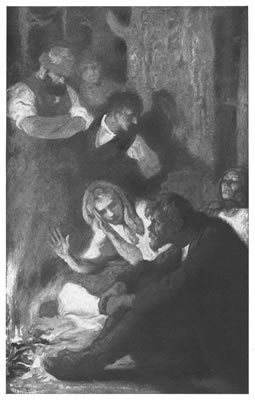 "The men listened in silence."
Once Yakob rose and said:
"Wait a moment, please." He ran into the shack and brought out wraps.
With Ignaty's help he folded them about the shoulders and feet of the
women.
And again Sofya spoke, picturing the day of victory, inspiring people
with faith in their power, arousing in them a consciousness of their
oneness with all who give away their lives to barren toil for the
amusement of the satiated.
At break of dawn, exhausted, she grew silent, and smiling she looked
around at the thoughtful, illumined faces.
"It's time for us to go," said the mother.
"Yes, it's time," said Sofya wearily.
Some one breathed a noisy sigh.
"I am sorry you're going," said Rybin in an unusually mild tone. "You
speak well. This great cause will unite people. When you know that
millions want the same as you do, your heart becomes better, and in
goodness there is great power."
"You offer goodness, and get the stake in return," said Yefim with a low
laugh, and quickly jumped to his feet. "But they ought to go, Uncle
Mikhaïl, before anybody sees them. We'll distribute the books among the
people; the authorities will begin to wonder where they came from; then
some one will remember having seen the pilgrims here."
"Well, thank you, mother, for your trouble," said Rybin, interrupting
Yefim. "I always think of Pavel when I look at you, and you've gone the
right way."
He stood before the mother, softened, with a broad, good-natured smile
on his face. The atmosphere was raw, but he wore only one shirt, his
collar was unbuttoned, and his breast was bared low. The mother looked
at his large figure, and smiling also, advised:
"You'd better put on something; it's cold."
"There's a fire inside of me."
The three young men standing at the burning pile conversed in a low
voice. At their feet the sick man lay as if dead, covered with the
short fur coats. The sky paled, the shadows dissolved, the leaves
shivered softly, awaiting the sun.
"Well, then, we must say good-by," said Rybin, pressing Sofya's hand.
"How are you to be found in the city?"
"You must look for me," said the mother.
The young men in a close group walked up to Sofya, and silently pressed
her hand with awkward kindness. In each of them was evident grateful and
friendly satisfaction, though they attempted to conceal the feeling
which apparently embarrassed them by its novelty. Smiling with eyes dry
with the sleepless night, they looked in silence into Sofya's eyes,
shifting from one foot to the other.
"Won't you drink some milk before you go?" asked Yakob.
"Is there any?" queried Yefim.
"There's a little."
Ignaty, stroking his hair in confusion, announced:
"No, there isn't; I spilled it."
All three laughed. They spoke about milk, but the mother and Sofya felt
that they were thinking of something else, and without words were
wishing them well. This touched Sofya, and produced in her, too,
embarrassment and modest reserve, which prevented her from saying
anything more than a quiet and warm "Thank you, comrades."
They exchanged glances, as if the word "comrade" had given them a mild
shock. The dull cough of the sick man was heard. The embers of the
burning woodpile died out.
"Good-by," the peasants said in subdued tones; and the sad word rang in
the women's ears a long time.
They walked without haste, in the twilight of the dawn, along the wood
path. The mother striding behind Sofya said:
"All this is good, just as in a dream—so good! People want to know the
truth, my dear; yes, they want to know the truth. It's like being in a
church on the morning of a great holiday, when the priest has not yet
arrived, and it's dark and quiet; then it's raw, and the people are
already gathering. Here the candles are lighted before the images, and
there the lamps are lighted; and little by little, they drive away the
darkness, illumining the House of God."
"True," answered Sofya. "Only here the House of God is the whole earth."
"The whole earth," the mother repeated, shaking her head thoughtfully.
"It's so good that it's hard to believe."
They walked and talked about Rybin, about the sick man, about the young
peasants who were so attentively silent, and who so awkwardly but
eloquently expressed a feeling of grateful friendship by little
attentions to the women. They came out into the open field; the sun rose
to meet them. As yet invisible, he spread out over the sky a transparent
fan of rosy rays, and the dewdrops in the grass glittered with the
many-colored gems of brave spring joy. The birds awoke fresh from their
slumber, vivifying the morning with their merry, impetuous voices. The
crows flew about croaking, and flapping their wings heavily. The black
rooks jumped about in the winter wheat, conversing in abrupt accents.
Somewhere the orioles whistled mournfully, a note of alarm in their
song. The larks sang, soaring up to meet the sun. The distance opened
up, the nocturnal shadows lifting from the hills.
"Sometimes a man will speak and speak to you, and you won't understand
him until he succeeds in telling you some simple word; and this one word
will suddenly lighten up everything," the mother said thoughtfully.
"There's that sick man, for instance; I've heard and known myself how
the workingmen in the factories and everywhere are squeezed; but you get
used to it from childhood on, and it doesn't touch your heart much. But
he suddenly tells you such an outrageous, vile thing! O Lord! Can it be
that people give their whole lives away to work in order that the
masters may permit themselves pleasure? That's without justification."
The thoughts of the mother were arrested by this fact. Its dull,
impudent gleam threw light upon a series of similar facts, at one time
known to her, but now forgotten.
"It's evident that they are satiated with everything. I know one country
officer who compelled the peasants to salute his horse when it was led
through the village; and he arrested everyone who failed to salute it.
Now, what need had he of that? It's impossible to understand." After a
pause she sighed: "The poor people are stupid from poverty, and the rich
from greed."
Sofya began to hum a song bold as the morning.
The life of Nilovna flowed on with strange placidity. This calmness
sometimes astonished her. There was her son immured in prison. She knew
that a severe sentence awaited him, yet every time the idea of it came
to her mind her thoughts strayed to Andrey, Fedya, and an endless series
of other people she had never seen, but only heard of. The figure of her
son appeared to her absorbing all the people into his own destiny. The
contemplative feeling aroused in her involuntarily and unnoticeably
diverted her inward gaze away from him to all sides. Like thin, uneven
rays it touched upon everything, tried to throw light everywhere, and
make one picture of the whole. Her mind was hindered from dwelling upon
some one thing.
Sofya soon went off somewhere, and reappeared in about five days, merry
and vivacious. Then, in a few hours, she vanished again, and returned
within a couple of weeks. It seemed as if she were borne along in life
in wide circles.
Nikolay, always occupied, lived a monotonous, methodical existence. At
eight o'clock in the morning he drank tea, read the newspapers, and
recounted the news to the mother. He repeated the speeches of the
merchants in the Douma without malice, and clearly depicted the life in
the city.
Listening to him the mother saw with transparent clearness the mechanism
of this life pitilessly grinding the people in the millstones of money.
At nine o'clock he went off to the office.
She tidied the rooms, prepared dinner, washed herself, put on a clean
dress, and then sat in her room to examine the pictures and the books.
She had already learned to read, but the effort of reading quickly
exhausted her; and she ceased to understand the meaning of the words.
But the pictures were a constant astonishment to her. They opened up
before her a clear, almost tangible world of new and marvelous things.
Huge cities arose before her, beautiful structures, machines, ships,
monuments, and infinite wealth, created by the people, overwhelming the
mind by the variety of nature's products. Life widened endlessly; each
day brought some new, huge wonders. The awakened hungry soul of the
woman was more and more strongly aroused to the multitude of riches in
the world, its countless beauties. She especially loved to look through
the great folios of the zoölogical atlas, and although the text was
written in a foreign language, it gave her the clearest conception of
the beauty, wealth, and vastness of the earth.
"It's an immense world," she said to Nikolay at dinner.
"Yes, and yet the people are crowded for space."
The insects, particularly the butterflies, astonished her most.
"What beauty, Nikolay Ivanovich," she observed. "And how much of this
fascinating beauty there is everywhere, but all covered up from us; it
all flies by without our seeing it. People toss about, they know
nothing, they are unable to take delight in anything, they have no
inclination for it. How many could take happiness to themselves if they
knew how rich the earth is, how many wonderful things live in it!"
Nikolay listened to her raptures, smiled, and brought her new
illustrated books.
In the evening visitors often gathered in his house—Alexey Vasilyevich,
a handsome man, pale-faced, black-bearded, sedate, and taciturn; Roman
Petrovich, a pimply, round-headed individual always smacking his lips
regretfully; Ivan Danilovich, a short, lean fellow with a pointed beard
and thin hair, impetuous, vociferous, and sharp as an awl, and Yegor,
always joking with his comrades about his sickness. Sometimes other
people were present who had come from various distant cities. The long
conversations always turned on one and the same thing, on the working
people of the world. The comrades discussed the workingmen, got into
arguments about them, became heated, waved their hands, and drank much
tea; while Nikolay, in the noise of the conversation, silently composed
proclamations. Then he read them to the comrades, who copied them on the
spot in printed letters. The mother carefully collected the pieces of
the torn, rough copies, and burned them.
She poured out tea for them, and wondered at the warmth with which they
discussed life and the working-people, the means whereby to sow truth
among them the sooner and the better, and how to elevate their spirit.
These problems were always agitating the comrades; their lives revolved
about them. Often they angrily disagreed, blamed one another for
something, got offended, and again discussed.
The mother felt that she knew the life of the workingmen better than
these people, and saw more clearly than they the enormity of the task
they assumed. She could look upon them with the somewhat melancholy
indulgence of a grown-up person toward children who play man and wife
without understanding the drama of the relation.
Sometimes Sashenka came. She never stayed long, and always spoke in a
businesslike way without smiling. She did not once fail to ask on
leaving how Pavel Mikhaylovich was.
"Is he well?" she would ask.
"Thank God! So, so. He's in good spirits."
"Give him my regards," the girl would request, and then disappear.
Sometimes the mother complained to Sashenka because Pavel was detained
so long and no date was yet set for his trial. Sashenka looked gloomy,
and maintained silence, her fingers twitching. Nilovna was tempted to
say to her: "My dear girl, why, I know you love him, I know." But
Sashenka's austere face, her compressed lips, and her dry, businesslike
manner, which seemed to betoken a desire for silence as soon as
possible, forbade any demonstration of sentiment. With a sigh the mother
mutely clasped the hand that the girl extended to her, and thought: "My
unhappy girl!"
Once Natasha came. She showed great delight at seeing the mother, kissed
her, and among other things announced to her quietly, as if she had just
thought of the thing:
"My mother died. Poor woman, she's dead!" She wiped her eyes with a
rapid gesture of her hands, and continued: "I'm sorry for her. She was
not yet fifty. She had a long life before her still. But when you look
at it from the other side you can't help thinking that death is easier
than such a life—always alone, a stranger to everybody, needed by no
one, scared by the shouts of my father. Can you call that living? People
live waiting for something good, and she had nothing to expect except
insults."
"You're right, Natasha," said the mother musingly. "People live
expecting some good, and if there's nothing to expect, what sort of a
life is it?" Kindly stroking Natasha's hand, she asked: "So you're alone
now?"
"Alone!" the girl rejoined lightly.
The mother was silent, then suddenly remarked with a smile:
"Never mind! A good person does not live alone. People will always
attach themselves to a good person."
Natasha was now a teacher in a little town where there was a textile
mill, and Nilovna occasionally procured illegal books, proclamations,
and newspapers for her. The distribution of literature, in fact, became
the mother's occupation. Several times a month, dressed as a nun or as a
peddler of laces or small linen articles, as a rich merchant's wife or a
religious pilgrim, she rode or walked about with a sack on her back, or
a valise in her hand. Everywhere, in the train, in the steamers, in
hotels and inns, she behaved simply and unobtrusively. She was the first
to enter into conversations with strangers, fearlessly drawing attention
to herself by her kind, sociable talk and the confident manner of an
experienced person who has seen and heard much.
She liked to speak to people, liked to listen to their stories of life,
their complaints, their perplexities, and lamentations. Her heart was
bathed in joy each time she noticed in anybody poignant discontent with
life, that discontent which, protesting against the blows of fate,
earnestly seeks to find an answer to its questions. Before her the
picture of human life unrolled itself ever wider and more varicolored,
that restless, anxious life passed in the struggle to fill the stomach.
Everywhere she clearly saw the coarse, bare striving, insolent in its
openness, deceiving man, robbing him, pressing out of him as much sap as
possible, draining him of his very life-blood. She realized that there
was plenty of everything upon earth, but that the people were in want,
and lived half starved, surrounded by inexhaustible wealth. In the
cities stood churches filled with gold and silver, not needed by God,
and at the entrance to the churches shivered the beggars vainly awaiting
a little copper coin to be thrust into their hands. Formerly she had
seen this, too—rich churches, priestly vestments sewed with gold
threads, and the hovels of the poor, their ignominious rags. But at that
time the thing had seemed natural; now the contrast was irreconcilable
and insulting to the poor, to whom, she knew, the churches were both
nearer and more necessary than to the rich.
From the pictures and stories of Christ, she knew also that he was a
friend of the poor, that he dressed simply. But in the churches, where
poverty came to him for consolation, she saw him nailed to the cross
with insolent gold, she saw silks and satins flaunting in the face of
want. The words of Rybin occurred to her: "They have mutilated even our
God for us, they have turned everything in their hands against us. In
the churches they set up a scarecrow before us. They have dressed God up
in falsehood and calumny; they have distorted His face in order to
destroy our souls!"
Without being herself aware of it, she prayed less; yet, at the same
time, she meditated more and more upon Christ and the people who,
without mentioning his name, as though ignorant of him, lived, it seemed
to her, according to his will, and, like him, regarded the earth as the
kingdom of the poor, and wanted to divide all the wealth of the earth
among the poor. Her reflections grew in her soul, deepening and
embracing everything she saw and heard. They grew and assumed the bright
aspect of a prayer, suffusing an even glow over the entire dark world,
the whole of life, and all people.
And it seemed to her that Christ himself, whom she had always loved with
a perplexed love, with a complicated feeling in which fear was closely
bound up with hope, and joyful emotion with melancholy, now came nearer
to her, and was different from what he had been. His position was
loftier, and he was more clearly visible to her. His aspect turned
brighter and more cheerful. Now his eyes smiled on her with assurance,
and with a live inward power, as if he had in reality risen to life for
mankind, washed and vivified by the hot blood lavishly shed in his name.
Yet those who had lost their blood modestly refrained from mentioning
the name of the unfortunate friend of the people.
The mother always returned to Nikolay from her travels delightfully
exhilarated by what she had seen and heard on the road, bold and
satisfied with the work she had accomplished.
"It's good to go everywhere, and to see much," she said to Nikolay in
the evening. "You understand how life is arranged. They brush the people
aside and fling them to the edge. The people, hurt and wounded, keep
moving about, even though they don't want to, and though they keep
thinking: 'What for? Why do they drive us away? Why must we go hungry
when there is so much of everything? And how much intellect there is
everywhere! Nevertheless, we must remain in stupidity and darkness. And
where is He, the merciful God, in whose eyes there are no rich nor poor,
but all are children dear to His heart.' The people are gradually
revolting against this life. They feel that untruth will stifle them if
they don't take thought of themselves."
And in her leisure hours she sat down to the books, and again looked
over the pictures, each time finding something new, ever widening the
panorama of life before her eyes, unfolding the beauties of nature and
the vigorous creative capacity of man. Nikolay often found her poring
over the pictures. He would smile and always tell her something
wonderful. Struck by man's daring, she would ask him incredulously, "Is
it possible?"
Quietly, with unshakable confidence in the truth of his prophecies,
Nikolay peered with his kind eyes through his glasses into the mother's
face, and told her stories of the future.
"There is no measure to the desires of man; and his power is
inexhaustible," he said. "But the world, after all, is still very slow
in acquiring spiritual wealth. Because nowadays everyone desiring to
free himself from dependence is compelled to hoard, not knowledge but
money. However, when the people will have exterminated greed and will
have freed themselves from the bondage of enslaving labor——"
She listened to him with strained attention. Though she but rarely
understood the meaning of his words, yet the calm faith animating them
penetrated her more and more deeply.
"There are extremely few free men in the world—that's its misfortune,"
he said.
This the mother understood. She knew men who had emancipated themselves
from greed and evil; she understood that if there were more such people,
the dark, incomprehensible, and awful face of life would become more
kindly and simple, better and brighter.
"A man must perforce be cruel," said Nikolay dismally.
The mother nodded her head in confirmation. She recalled the sayings of
the Little Russian.

Once Nikolay, usually so punctual, came from his work much later than
was his wont, and said, excitedly rubbing his hands: "Do you know,
Nilovna, to-day at the visiting hour one of our comrades disappeared
from prison? But we have not succeeded in finding out who."
The mother's body swayed, overpowered by excitement. She sat down on a
chair and asked with forced quiet:
"Maybe it's Pasha?"
"Possibly. But the question is how to find him, how to help him keep in
concealment. Just now I was walking about the streets to see if I
couldn't detect him. It was a stupid thing of me to do, but I had to do
something. I'm going out again."
"I'll go, too," said the mother, rising.
"You go to Yegor, and see if he doesn't know anything about it," Nikolay
suggested, and quickly walked away.
She threw a kerchief on her head, and, seized with hope, swiftly sped
along the streets. Her eyes dimmed and her heart beat faster. Her head
drooped; she saw nothing about her. It was hot. The mother lost breath,
and when she reached the stairway leading to Yegor's quarters, she
stopped, too faint to proceed farther. She turned around and uttered an
amazed, low cry, closing her eyes for a second. It seemed to her that
Nikolay Vyesovshchikov was standing at the gate, his hands thrust into
his pockets, regarding her with a smile. But when she looked again
nobody was there.
"I imagined I saw him," she said to herself, slowly walking up the steps
and listening. She caught the sound of slow steps, and stopping at a
turn in the stairway, she bent over to look below, and again saw the
pockmarked face smiling up at her.
"Nikolay! Nikolay!" she whispered, and ran down to meet him. Her heart,
stung by disappointment, ached for her son.
"Go, go!" he answered in an undertone, waving his hand.
She quickly ran up the stairs, walked into Yegor's room, and found him
lying on the sofa. She gasped in a whisper:
"Nikolay is out of prison!"
"Which Nikolay?" asked Yegor, raising his head from the pillow. "There
are two there."
"Vyesovshchikov. He's coming here!"
"Fine! But I can't rise to meet him."
Vyesovshchikov had already come into the room. He locked the door after
him, and taking off his hat laughed quietly, stroking his hair. Yegor
raised himself on his elbows.
"Please, signor, make yourself at home," he said with a nod.
Without saying anything, a broad smile on his face, Nikolay walked up to
the mother and grasped her hand.
"If I had not seen you I might as well have returned to prison. I know
nobody in the city. If I had gone to the suburbs they would have seized
me at once. So I walked about, and thought what a fool I was—why had I
escaped? Suddenly I see Nilovna running; off I am, after you."
"How did you make your escape?"
Vyesovshchikov sat down awkwardly on the edge of the sofa and pressed
Yegor's hand.
"I don't know how," he said in an embarrassed manner. "Simply a chance.
I was taking my airing, and the prisoners began to beat the overseer of
the jail. There's one overseer there who was expelled from the
gendarmerie for stealing. He's a spy, an informer, and tortures the life
out of everybody. They gave him a drubbing, there was a hubbub, the
overseers got frightened and blew their whistles. I noticed the gates
open. I walked up and saw an open square and the city. It drew me
forward and I went away without haste, as if in sleep. I walked a little
and bethought myself: 'Where am I to go?' I looked around and the gates
of the prison were already closed. I began to feel awkward. I was sorry
for the comrades in general. It was stupid somehow. I hadn't thought of
going away."
"Hm!" said Yegor. "Why, sir, you should have turned back, respectfully
knocked at the prison door, and begged for admission. 'Excuse me,' you
should have said,'I was tempted; but here I am.'"
"Yes," continued Nikolay, smiling; "that would have been stupid, too, I
understand. But for all that, it's not nice to the other comrades. I
walk away without saying anything to anybody. Well, I kept on going, and
I came across a child's funeral. I followed the hearse with my head bent
down, looking at nobody. I sat down in the cemetery and enjoyed the
fresh air. One thought came into my head——"
"One?" asked Yegor. Fetching breath, he added: "I suppose it won't feel
crowded there."
Vyesovshchikov laughed without taking offense, and shook his head.
"Well, my brain's not so empty now as it used to be. And you, Yegor
Ivanovich, still sick?"
"Each one does what he can. No one has a right to interfere with him."
Yegor evaded an answer; he coughed hoarsely. "Continue."
"Then I went to a public museum. I walked about there, looked around,
and kept thinking all the time: 'Where am I to go next?' I even began to
get angry with myself. Besides, I got dreadfully hungry. I walked into
the street and kept on trotting. I felt very down in the mouth. And then
I saw police officers looking at everybody closely. 'Well,' thinks I to
myself, 'with my face I'll arrive at God's judgment seat pretty soon.'
Suddenly Nilovna came running opposite me. I turned about, and off I
went after her. That's all."
"And I didn't even see you," said the mother guiltily.
"The comrades are probably uneasy about me. They must be wondering where
I am," said Nikolay, scratching his head.
"Aren't you sorry for the officials? I guess they're uneasy, too,"
teased Yegor. He moved heavily on the sofa, and said seriously and
solicitously: "However, jokes aside, we must hide you—by no means as
easy as pleasant. If I could get up—" His breath gave out. He clapped
his hand to his breast, and with a weak movement began to rub it.
"You've gotten very sick, Yegor Ivanovich," said Nikolay gloomily,
drooping his head. The mother sighed and cast an anxious glance about
the little, crowded room.
"That's my own affair. Granny, you ask about Pavel. No reason to feign
indifference," said Yegor.
Vyesovshchikov smiled broadly.
"Pavel's all right; he's strong; he's like an elder among us; he
converses with the officials and gives commands; he's respected. There's
good reason for it."
Vlasova nodded her head, listening, and looked sidewise at the swollen,
bluish face of Yegor, congealed to immobility, devoid of expression. It
seemed strangely flat, only the eyes flashed with animation and
cheerfulness.
"I wish you'd give me something to eat. I'm frightfully hungry," Nikolay
cried out unexpectedly, and smiled sheepishly.
"Granny, there's bread on the shelf—give it to him. Then go out in the
corridor, to the second door on the left, and knock. A woman will open
it, and you'll tell her to snatch up everything she has to eat and come
here."
"Why everything?" protested Nikolay.
"Don't get excited. It's not much—maybe nothing at all."
The mother went out and rapped at the door. She strained her ears for an
answering sound, while thinking of Yegor with dread and grief. He was
dying, she knew.
"Who is it?" somebody asked on the other side of the door.
"It's from Yegor Ivanovich," the mother whispered. "He asked you to come
to him."
"I'll come at once," the woman answered without opening the door. The
mother waited a moment, and knocked again. This time the door opened
quickly, and a tall woman wearing glasses stepped out into the hall,
rapidly tidying the ruffled sleeves of her waist. She asked the mother
harshly:
"What do you want?"
"I'm from Yegor Ivanovich."
"Aha! Come! Oh, yes, I know you!" the woman exclaimed in a low voice.
"How do you do? It's dark here."
Nilovna looked at her and remembered that this woman had come to
Nikolay's home on rare occasions.
"All comrades!" flashed through her mind.
The woman compelled Nilovna to walk in front.
"Is he feeling bad?"
"Yes; he's lying down. He asked you to bring something to eat."
"Well, he doesn't need anything to eat."
When they walked into Yegor's room they were met by the words:
"I'm preparing to join my forefathers, my friend. Liudmila Vasilyevna,
this man walked away from prison without the permission of the
authorities—a bit of shameless audacity. Before all, feed him, then
hide him somewhere for a day or two."
The woman nodded her head and looked carefully at the sick man's face.
"Stop your chattering, Yegor," she said sternly. "You know it's bad for
you. You ought to have sent for me at once, as soon as they came. And I
see you didn't take your medicine. What do you mean by such negligence?
You yourself say it's easier for you to breathe after a dose. Comrade,
come to my place. They'll soon call for Yegor from the hospital."
"So I'm to go to the hospital, after all?" asked Yegor, puckering up his
face.
"Yes, I'll be there with you."
"There, too?"
"Hush!"
As she talked she adjusted the blanket on Yegor's breast, looked fixedly
at Nikolay, and with her eyes measured the quantity of medicine in the
bottle. She spoke evenly, not loud, but in a resonant voice. Her
movements were easy, her face was pale, with large blue circles around
her eyes. Her black eyebrows almost met at the bridge of the nose,
deepening the setting of her dark, stern eyes. Her face did not please
the mother; it seemed haughty in its sternness and immobility, and her
eyes were rayless. She always spoke in a tone of command.
"We are going away," she continued. "I'll return soon. Give Yegor a
tablespoon of this medicine."
"Very well," said the mother.
"And don't let him speak." She walked away, taking Nikolay with her.
"Admirable woman!" said Yegor with a sigh. "Magnificent woman! You ought
to be working with her, granny. You see, she gets very much worn out.
It's she that does all the printing for us."
"Don't speak. Here, you'd better take this medicine," the mother said
gently.
He swallowed the medicine and continued, for some reason screwing up one
eye:
"I'll die all the same, even if I don't speak."
He looked into the mother's face with his other eye, and his lips slowly
formed themselves into a smile. The mother bent her head, a sharp
sensation of pity bringing tears into her eyes.
"Never mind, granny. It's natural. The pleasure of living carries with
it the obligation to die."
The mother put her hand on his, and again said softly:
"Keep quiet, please!"
He shut his eyes as if listening to the rattle in his breast, and went
on stubbornly.
"It's senseless to keep quiet, granny. What'll I gain by keeping quiet?
A few superfluous seconds of agony. And I'll lose the great pleasure of
chattering with a good person. I think that in the next world there
aren't such good people as here."
The mother uneasily interrupted him.
"The lady will come, and she'll scold me because you talk."
"She's no lady. She's a revolutionist, the daughter of a village scribe,
a teacher. She is sure to scold you anyhow, granny. She scolds everybody
always." And, slowly moving his lips with an effort, Yegor began to
relate the life history of his neighbor. His eyes smiled. The mother saw
that he was bantering her purposely. As she regarded his face, covered
with a moist blueness, she thought distressfully that he was near to
death.
Liudmila entered, and carefully closing the door after her, said,
turning to Vlasova:
"Your friend ought to change his clothes without fail, and leave here as
soon as possible. So go at once; get him some clothes, and bring them
here. I'm sorry Sofya's not here. Hiding people is her specialty."
"She's coming to-morrow," remarked Vlasova, throwing her shawl over her
shoulders. Every time she was given a commission the strong desire
seized her to accomplish it promptly and well, and she was unable to
think of anything but the task before her. Now, lowering her brows with
an air of preoccupation, she asked zealously:
"How should we dress him, do you think?"
"It's all the same. It's night, you know."
"At night it's worse. There are less people on the street, and the
police spy around more; and, you know, he's rather awkward."
Yegor laughed hoarsely.
"You're a young girl yet, granny."
"May I visit you in the hospital?"
He nodded his head, coughing. Liudmila glanced at the mother with her
dark eyes and suggested:
"Do you want to take turns with me in attending him? Yes? Very well. And
now go quickly."
She vigorously seized Vlasova by the hand, with perfect good nature,
however, and led her out of the door.
"You mustn't be offended," she said softly, "because I dismiss you so
abruptly. I know it's rude; but it's harmful for him to speak, and I
still have hopes of his recovery." She pressed her hands together until
the bones cracked. Her eyelids drooped wearily over her eyes.
The explanation disturbed the mother. She murmured:
"Don't talk that way. The idea! Who thought of rudeness? I'm going;
good-by."
"Look out for the spies!" whispered the woman.
"I know," the mother answered with some pride.
She stopped for a minute outside the gate to look around sharply under
the pretext of adjusting her kerchief. She was already able to
distinguish spies in a street crowd almost immediately. She recognized
the exaggerated carelessness of their gait, their strained attempt to be
free in their gestures, the expression of tedium on their faces, the
wary, guilty glimmer of their restless, unpleasantly sharp gaze badly
hidden behind their feigned candor.
This time she did not notice any familiar faces, and walked along the
street without hastening. She took a cab, and gave orders to be driven
to the market place. When buying the clothes for Nikolay she bargained
vigorously with the salespeople, all the while scolding at her drunken
husband whom she had to dress anew every month. The tradespeople paid
little attention to her talk, but she herself was greatly pleased with
her ruse. On the road she had calculated that the police would, of
course, understand the necessity for Nikolay to change his clothes, and
would send spies to the market. With such naïve precautions, she
returned to Yegor's quarters; then she had to escort Nikolay to the
outskirts of the city. They took different sides of the street, and it
was amusing to the mother to see how Vyesovshchikov strode along
heavily, with bent head, his legs getting tangled in the long flaps of
his russet-colored coat, his hat falling over his nose. In one of the
deserted streets, Sashenka met them, and the mother, taking leave of
Vyesovshchikov with a nod of her head, turned toward home with a sigh of
relief.
"And Pasha is in prison with Andriusha!" she thought sadly.
Nikolay met her with an anxious exclamation:
"You know that Yegor is in a very bad way, very bad! He was taken to the
hospital. Liudmila was here. She asks you to come to her there."
"At the hospital?"
Adjusting his eyeglasses with a nervous gesture, Nikolay helped her on
with her jacket and pressed her hand in a dry, hot grasp. His voice was
low and tremulous. "Yes. Take this package with you. Have you disposed
of Vyesovshchikov all right?"
"Yes, all right."
"I'll come to Yegor, too!"
The mother's head was in a whirl with fatigue, and Nikolay's emotion
aroused in her a sad premonition of the drama's end.
"So he's dying—he's dying!" The dark thought knocked at her brain
heavily and dully.
But when she entered the bright, tidy little room of the hospital and
saw Yegor sitting on the pallet propped against the wide bosom of the
pillow, and heard him laugh with zest, she was at once relieved. She
paused at the door, smiling, and listened to Yegor talk with the
physician in a hoarse but lively voice.
"A cure is a reform."
"Don't talk nonsense!" the physician cried officiously in a thin voice.
"And I'm a revolutionist! I detest reforms!"
The physician, thoughtfully pulling his beard, felt the dropsical
swelling on Yegor's face. The mother knew him well. He was Ivan
Danilovich, one of the close comrades of Nikolay. She walked up to
Yegor, who thrust forth his tongue by way of welcome to her. The
physician turned around.
"Ah, Nilovna! How are you? Sit down. What have you in your hand?"
"It must be books."
"He mustn't read."
"The doctor wants to make an idiot of me," Yegor complained.
"Keep quiet!" the physician commanded, and began to write in a little
book.
The short, heavy breaths, accompanied by rattling in his throat, fairly
tore themselves from Yegor's breast, and his face became covered with
thin perspiration. Slowly raising his swollen hand, he wiped his
forehead with the palm. The strange immobility of his swollen cheeks
denaturalized his broad, good face, all the features of which
disappeared under the dead, bluish mask. Only his eyes, deeply sunk
beneath the swellings, looked out clear and smiling benevolently.
"Oh, Science, I'm tired! May I lie down?"
"No, you mayn't."
"But I'm going to lie down after you go."
"Nilovna, please don't let him. It's bad for him."
The mother nodded. The physician hurried off with short steps. Yegor
threw back his head, closed his eyes and sank into a torpor, motionless
save for the twitching of his fingers. The white walls of the little
room seemed to radiate a dry coldness and a pale, faceless sadness.
Through the large window peered the tufted tops of the lime trees, amid
whose dark, dusty foliage yellow stains were blazing, the cold touches
of approaching autumn.
"Death is coming to me slowly, reluctantly," said Yegor without moving
and without opening his eyes. "He seems to be a little sorry for me. I
was such a fine, sociable chap."
"You'd better keep quiet, Yegor Ivanovich!" the mother bade, quietly
stroking his hand.
"Wait, granny, I'll be silent soon."
Losing breath every once in a while, enunciating the words with a mighty
effort, he continued his talk, interrupted by long spells of faintness.
"It's splendid to have you with me. It's pleasant to see your face,
granny, and your eyes so alert, and your naïveté. 'How will it end?' I
ask myself. It's sad to think that the prison, exile, and all sorts of
vile outrages await you as everybody else. Are you afraid of prison?"
"No," answered the mother softly.
"But after all the prison is a mean place. It's the prison that knocked
me up. To tell you the truth, I don't want to die."
"Maybe you won't die yet," the mother was about to say, but a look at
his face froze the words on her lips.
"If I hadn't gotten sick I could have worked yet, not badly; but if you
can't work there's nothing to live for, and it's stupid to live."
"That's true, but it's no consolation." Andrey's words flashed into the
mother's mind, and she heaved a deep sigh. She was greatly fatigued by
the day, and hungry. The monotonous, humid, hoarse whisper of the sick
man filled the room and crept helplessly along the smooth, cold, shining
walls. At the windows the dark tops of the lime trees trembled quietly.
It was growing dusk, and Yegor's face on the pillow turned dark.
"How bad I feel," he said. He closed his eyes and became silent. The
mother listened to his breathing, looked around, and sat for a few
minutes motionless, seized by a cold sensation of sadness. Finally she
dozed off.
The muffled sound of a door being carefully shut awakened her, and she
saw the kind, open eyes of Yegor.
"I fell asleep; excuse me," she said quietly.
"And you excuse me," he answered, also quietly. At the door was heard a
rustle and Liudmila's voice.
"They sit in the darkness and whisper. Where is the knob?"
The room trembled and suddenly became filled with a white, unfriendly
light. In the middle of the room stood Liudmila, all black, tall,
straight, and serious. Yegor transferred his glance to her, and making a
great effort to move his body, raised his hand to his breast.
"What's the matter?" exclaimed Liudmila, running up to him. He looked at
the mother with fixed eyes, and now they seemed large and strangely
bright.
"Wait!" he whispered.
Opening his mouth wide, he raised his head and stretched his hand
forward. The mother carefully held it up and caught her breath as she
looked into his face. With a convulsive and powerful movement of his
neck he flung his head back, and said aloud:
"Give me air!"
A quiver ran through his body; his head dropped limply on his shoulder,
and in his wide open eyes the cold light of the lamp burning over the
bed was reflected dully.
"My darling!" whispered the mother, firmly pressing his hand, which
suddenly grew heavy.
Liudmila slowly walked away from the bed, stopped at the window and
stared into space.
"He's dead!" she said in an unusually loud voice unfamiliar to Vlasova.
She bent down, put her elbows on the window sill, and repeated in dry,
startled tones: "He's dead! He died calmly, like a man, without
complaint." And suddenly, as if struck a blow on the head, she dropped
faintly on her knees, covered her face, and gave vent to dull, stifled
groans.
The mother folded Yegor's hands over his breast and adjusted his head,
which was strangely warm, on the pillow. Then silently wiping her eyes,
she went to Liudmila, bent over her, and quietly stroked her thick hair.
The woman slowly turned around to her, her dull eyes widened in a sickly
way. She rose to her feet, and with trembling lips whispered:
"I've known him for a long time. We were in exile together. We went
there together on foot, we sat in prison together; at times it was
intolerable, disgusting; many fell in spirit."
Her dry, loud groans stuck in her throat. She overcame them with an
effort, and bringing her face nearer to the mother's she continued in a
quick whisper, moaning without tears:
"Yet he was unconquerably jolly. He joked and laughed, and covered up
his suffering in a manly way, always striving to encourage the weak. He
was always good, alert, kind. There, in Siberia, idleness depraves
people, and often calls forth ugly feelings toward life. How he mastered
such feelings! What a comrade he was! If you only knew. His own life was
hard and tormented; but I know that nobody ever heard him complain, not
a soul—never! Here was I, nearer to him than others. I'm greatly
indebted to his heart, to his mind. He gave me all he could of it; and
though exhausted, he never asked either kindness or attention in
return."
She walked up to Yegor, bent down and kissed him. Her voice was husky as
she said mournfully:
"Comrade, my dear, dear friend, I thank you with all my heart! Good-by.
I shall work as you worked—unassailed by doubt—all my life—good-by!"
The dry, sharp groans shook her body, and gasping for breath she laid
her head on the bed at Yegor's feet. The mother wept silent tears which
seared her cheeks. For some reason she tried to restrain them. She
wanted to fondle Liudmila, and wanted to speak about Yegor with words of
love and grief. She looked through her tears at his swollen face, at his
eyes calmly covered by his drooping eyelids as in sleep, and at his dark
lips set in a light, serene smile. It was quiet, and a bleak brightness
pervaded the room.
Ivan Danilovich entered, as always, with short, hasty steps. He suddenly
stopped in the middle of the room, and thrust his hands into his pockets
with a quick gesture.
"Did it happen long ago?" His voice was loud and nervous.
Neither woman replied. He quietly swung about, and wiping his forehead
went to Yegor, pressed his hand, and stepped to one side.
"It's not strange—with his heart. It might have happened six months
ago."
His voice, high-pitched and jarringly loud for the occasion, suddenly
broke off. Leaning his back against the wall, he twisted his beard with
nimble fingers, and winking his eyes, rapidly looked at the group by the
bed.
"One more!" he muttered.
Liudmila rose and walked over to the window. The mother raised her head
and glanced around with a sigh. A minute afterwards they all three stood
at the open window, pressing close against one another, and looked at
the dusky face of the autumn night. On the black tops of the trees
glittered the stars, endlessly deepening the distance of the sky.
Liudmila took the mother by the hand, and silently pressed her head to
her shoulders. The physician nervously bit his lips and wiped his
eyeglasses with his handkerchief. In the stillness beyond the window the
nocturnal noise of the city heaved wearily, and cold air blew on their
faces and shoulders. Liudmila trembled; the mother saw tears running
down her cheeks. From the corridor of the hospital floated confused,
dismal sounds. The three stood motionless at the window, looking
silently into the darkness.
The mother felt herself not needed, and carefully freeing her hand, went
to the door, bowing to Yegor.
"Are you going?" the physician asked softly without looking around.
"Yes."
In the street she thought with pity of Liudmila, remembering her scant
tears. She couldn't even have a good cry. Then she pictured to herself
Liudmila and the physician in the extremely light white room, the dead
eyes of Yegor behind them. A compassion for all people oppressed her.
She sighed heavily, and hastened her pace, driven along by her
tumultuous feelings.
"I must hurry," she thought in obedience to a sad but encouraging power
that jostled her from within.
The whole of the following day the mother was busy with preparations for
the funeral. In the evening when she, Nikolay, and Sofya were drinking
tea, quietly talking about Yegor, Sashenka appeared, strangely brimming
over with good spirits, her cheeks brilliantly red, her eyes beaming
happily. She seemed to be filled with some joyous hope. Her animation
contrasted sharply with the mournful gloom of the others. The discordant
note disturbed them and dazzled them like a fire that suddenly flashes
in the darkness. Nikolay thoughtfully struck his fingers on the table
and smiled quietly.
"You're not like yourself to-day, Sasha."
"Perhaps," she laughed happily.
The mother looked at her in mute remonstrance, and Sofya observed in a
tone of admonishment:
"And we were talking about Yegor Ivanovich."
"What a wonderful fellow, isn't he?" she exclaimed. "Modest, proof
against doubt, he probably never yielded to sorrow. I have never seen
him without a joke on his lips; and what a worker! He is an artist of
the revolution, a great master, who skillfully manipulates revolutionary
thoughts. With what simplicity and power he always draws his pictures of
falsehood, violence and untruth! And what a capacity he has for
tempering the horrible with his gay humor which does not diminish the
force of facts but only the more brightly illumines his inner thought!
Always droll! I am greatly indebted to him, and I shall never forget his
merry eyes, his fun. And I shall always feel the effect of his ideas
upon me in the time of my doubts—I love him!"
She spoke in a moderated voice, with a melancholy smile in her eyes. But
the incomprehensible fire of her gaze was not extinguished; her
exultation was apparent to everybody.
People love their own feelings—sometimes the very feelings that are
harmful to them—are enamored of them, and often derive keen pleasure
even from grief, a pleasure that corrodes the heart. Nikolay, the
mother, and Sofya were unwilling to let the sorrowful mood produced by
the death of their comrade give way to the joy brought in by Sasha.
Unconsciously defending their melancholy right to feed on their sadness,
they tried to impose their feelings on the girl.
"And now he's dead," announced Sofya, watching her carefully.
Sasha glanced around quickly, with a questioning look. She knit her
eyebrows and lowered her head. She was silent for a short time,
smoothing her hair with slow strokes of her hand.
"He's dead?" She again cast a searching glance into their faces. "It's
hard for me to reconcile myself to the idea."
"But it's a fact," said Nikolay with a smile.
Sasha arose, walked up and down the room, and suddenly stopping, said in
a strange voice:
"What does 'to die' signify? What died? Did my respect for Yegor die? My
love for him, a comrade? The memory of his mind's labor? Did that labor
die? Did all our impressions of him as of a hero disappear without
leaving a trace? Did all this die? This best in him will never die out
of me, I know. It seems to me we're in too great a hurry to say of a man
'he's dead.' That's the reason we too soon forget that a man never dies
if we don't wish our impressions of his manhood, his self-denying toil
for the triumph of truth and happiness to disappear. We forget that
everything should always be alive in living hearts. Don't be in a hurry
to bury the eternally alive, the ever luminous, along with a man's body.
The church is destroyed, but God is immortal."
Carried away by her emotions she sat down, leaning her elbows on the
table, and continued more thoughtfully in a lower voice, looking
smilingly through mist-covered eyes at the faces of the comrades:
"Maybe I'm talking nonsense. But life intoxicates me by its wonderful
complexity, by the variety of its phenomena, which at times seem like a
miracle to me. Perhaps we are too sparing in the expenditure of our
feelings. We live a great deal in our thoughts, and that spoils us to a
certain extent. We estimate, but we don't feel."
"Did anything good happen to you?" asked Sofya with a smile.
"Yes," said Sasha, nodding her head. "I had a whole night's talk with
Vyesovshchikov. I didn't use to like him. He seemed rude and dull.
Undoubtedly that's what he was. A dark, immovable irritation at
everybody lived in him. He always used to place himself, as it were,
like a dead weight in the center of things, and wrathfully say, 'I, I,
I.' There was something bourgeois in this, low, and exasperating." She
smiled, and again took in everybody with her burning look.
"Now he says: 'Comrades'—and you ought to hear how he says it, with
what a stirring, tender love. He has grown marvelously simple and
open-hearted, and possessed with a desire to work. He has found himself,
he has measured his power, and knows what he is not. But the main thing
is, a true comradely feeling has been born in him, a broad, loving
comradeship, which smiles in the face of every difficulty in life."
Vlasova listened to Sasha attentively. She was glad to see this girl,
always so stern, now softened, cheerful, and happy. Yet from some deeps
of her soul arose the jealous thought: "And how about Pasha?"
"He's entirely absorbed in thoughts of the comrades," continued Sasha.
"And do you know of what he assures me? Of the necessity of arranging
an escape for them. He says it's a very simple, easy matter."
Sofya raised her head, and said animatedly:
"And what do you think, Sasha? Is it feasible?"
The mother trembled as she set a cup of tea on the table. Sasha knit her
brows, her animation gone from her. After a moment's silence, she said
in a serious voice, but smiling in joyous confusion:
"He's convinced. If everything is really as he says, we ought to try.
It's our duty." She blushed, dropped into a chair, and lapsed into
silence.
"My dear, dear girl!" the mother thought, smiling. Sofya also smiled,
and Nikolay, looking tenderly into Sasha's face, laughed quietly. The
girl raised her head with a stern glance for all. Then she paled, and
her eyes flashed, and she said dryly, the offense she felt evident in
her voice:
"You're laughing. I understand you. You consider me personally
interested in the case, don't you?"
"Why, Sasha?" asked Sofya, rising and going over to her.
Agitated, pale, the girl continued:
"But I decline. I'll not take any part in deciding the question if you
consider it."
"Stop, Sasha," said Nikolay calmly.
The mother understood the girl. She went to her and kissed her silently
on her head. Sasha seized her hand, leaned her cheek on it, and raised
her reddened face, looking into the mother's eyes, troubled and happy.
The mother silently stroked her hair. She felt sad at heart. Sofya
seated herself at Sasha's side, her arm over her shoulder, and said,
smiling into the girl's eyes:
"You're a strange person."
"Yes, I think I've grown foolish," Sasha acknowledged. "But I don't like
shadows."
"That'll do," said Nikolay seriously, but immediately followed up the
admonition by the businesslike remark: "There can't be two opinions as
to the escape, if it's possible to arrange it. But before everything, we
must know whether the comrades in prison want it."
Sasha drooped her head. Sofya, lighting a cigarette, looked at her
brother, and with a broad sweep of her arm dropped the match in a
corner.
"How is it possible they should not want it?" asked the mother with a
sigh. Sofya nodded to her, smiling, and walked over to the window. The
mother could not understand the failure of the others to respond, and
looked at them in perplexity. She wanted so much to hear more about the
possibility of an escape.
"I must see Vyesovshchikov," said Nikolay.
"All right. To-morrow I'll tell you when and where," replied Sasha.
"What is he going to do?" asked Sofya, pacing through the room.
"It's been decided to make him compositor in a new printing place. Until
then he'll stay with the forester."
Sasha's brow lowered. Her face assumed its usual severe expression. Her
voice sounded caustic. Nikolay walked up to the mother, who was washing
cups, and said to her:
"You'll see Pasha day after to-morrow. Hand him a note when you're
there. Do you understand? We must know."
"I understand. I understand," the mother answered quickly. "I'll deliver
it to him all right. That's my business."
"I'm going," Sasha announced, and silently shook hands with everybody.
She strode away, straight and dry-eyed, with a peculiarly heavy tread.
"Poor girl!" said Sofya softly.
"Ye-es," Nikolay drawled. Sofya put her hand on the mother's shoulder
and gave her a gentle little shake as she sat in the chair.
"Would you love such a daughter?" and Sofya looked into the mother's
face.
"Oh! If I could see them together, if only for one day!" exclaimed
Nilovna, ready to weep.
"Yes, a bit of happiness is good for everybody."
"But there are no people who want only a bit of happiness," remarked
Nikolay; "and when there's much of it, it becomes cheap."
Sofya sat herself at the piano, and began to play something low and
doleful.
The next morning a number of men and women stood at the gate of the
hospital waiting for the coffin of their comrade to be carried out to
the street. Spies watchfully circled about, their ears alert to catch
each sound, noting faces, manners, and words. From the other side of the
street a group of policemen with revolvers at their belts looked on. The
impudence of the spies, the mocking smiles of the police ready to show
their power, were strong provocatives to the crowd. Some joked to cover
their excitement; others looked down on the ground sullenly, trying not
to notice the affronts; still others, unable to restrain their wrath,
laughed in sarcasm at the government, which feared people armed with
nothing but words. The pale blue sky of autumn gleamed upon the round,
gray paving stones of the streets, strewn with yellow leaves, which the
wind kept whirling about under the people's feet.
The mother stood in the crowd. She looked around at the familiar faces
and thought with sadness: "There aren't many of you, not many."
The gate opened, and the coffin, decorated with wreaths tied with red
ribbons, was carried out. The people, as if inspired with one will,
silently raised their hats. A tall officer of police with a thick black
mustache on a red face unceremoniously jostled his way through the
crowd, followed by the soldiers, whose heavy boots trampled loudly on
the stones. They made a cordon around the coffin, and the officer said
in a hoarse, commanding voice:
"Remove the ribbons, please!"
The men and women pressed closely about him. They called to him, waving
their hands excitedly and trying to push past one another. The mother
caught the flash of pale, agitated countenances, some of them with
quivering lips and tears.
"Down with violence!" a young voice shouted nervously. But the lonely
outcry was lost in the general clamor.
The mother also felt bitterness in her heart. She turned in indignation
to her neighbor, a poorly dressed young man.
"They don't permit a man's comrades even to bury him as they want to.
What do they mean by it?"
The hubbub increased and hostility waxed strong. The coffin rocked over
the heads of the people. The silken rustling of the ribbons fluttering
in the wind about the heads and faces of the carriers could be heard
amid the noise of the strife.
The mother was seized with a shuddering dread of the possible collision,
and she quickly spoke in an undertone to her neighbors on the right and
on the left:
"Why not let them have their way if they're like that? The comrades
ought to yield and remove the ribbons. What else can they do?"
A loud, sharp voice subdued all the other noises:
"We demand not to be disturbed in accompanying on his last journey one
whom you tortured to death!"
Somebody—apparently a girl—sang out in a high, piping voice:
"In mortal strife your victims fell."
"Remove the ribbons, please, Yakovlev! Cut them off!"
A saber was heard issuing from its scabbard. The mother closed her eyes,
awaiting shouts; but it grew quieter.
The people growled like wolves at bay; then silently drooping their
heads, crushed by the consciousness of impotence, they moved forward,
filling the street with the noise of their tramping. Before them swayed
the stripped cover of the coffin with the crumpled wreaths, and swinging
from side to side rode the mounted police. The mother walked on the
pavement; she was unable to see the coffin through the dense crowd
surrounding it, which imperceptibly grew and filled the whole breadth of
the street. Back of the crowd also rose the gray figures of the mounted
police; at their sides, holding their hands on their sabers, marched the
policemen on foot, and everywhere were the sharp eyes of the spies,
familiar to the mother, carefully scanning the faces of the people.
"Good-by, comrade, good-by!" plaintively sang two beautiful voices.
"Don't!" a shout was heard. "We will be silent, comrades—for the
present."
The shout was stern and imposing; it carried an assuring threat, and it
subdued the crowd. The sad songs broke off; the talking became lower;
only the noise of heavy tramping on the stones filled the street with
its dull, even sound. Over the heads of the people, into the transparent
sky, and through the air it rose like the first peal of distant thunder.
People silently bore grief and revolt in their breasts. Was it possible
to carry on the war for freedom peacefully? A vain illusion! Hatred of
violence, love of freedom blazed up and burned the last remnants of the
illusion to ashes in the hearts that still cherished it. The steps
became heavier, heads were raised, eyes looked cold and firm, and
feeling, outstripping thought, brought forth resolve. The cold wind,
waxing stronger and stronger, carried an unfriendly cloud of dust and
street litter in front of the people. It blew through their garments and
their hair, blinded their eyes and struck against their breasts.
The mother was pained by these silent funerals without priests and
heart-oppressing chants, with thoughtful faces, frowning brows, and the
heavy tramp of the feet. Her slowly circling thoughts formulated her
impression in the melancholy phrase:
"There are not many of you who stand up for the truth, not many; and yet
they fear you, they fear you!"
Her head bent, she strode along without looking around. It seemed to her
that they were burying, not Yegor, but something else unknown and
incomprehensible to her.
At the cemetery the procession for a long time moved in and out along
the narrow paths amid the tombs until an open space was reached, which
was sprinkled with wretched little crosses. The people gathered about
the graves in silence. This austere silence of the living among the dead
promised something strange, which caused the mother's heart to tremble
and sink with expectation. The wind whistled and sighed among the
graves. The flowers trembled on the lid of the coffin.
The police, stretching out in a line, assumed an attitude of guard,
their eyes on their captain. A tall, long-haired, black-browed, pale
young man without a hat stood over the fresh grave. At the same time the
hoarse voice of the captain was heard:
"Ladies and gentlemen!"
"Comrades!" began the black-browed man sonorously.
"Permit me!" shouted the police captain. "In pursuance of the order of
the chief of police I announce to you that I cannot permit a speech!"
"I will say only a few words," the young man said calmly. "Comrades!
over the grave of our teacher and friend let us vow in silence never to
forget his will; let each one of us continue without ceasing to dig the
grave for the source of our country's misfortune, the evil power that
crushes it—the autocracy!"
"Arrest him!" shouted the police captain. But his voice was drowned in
the confused outburst of shouts.
"Down with the autocracy!"
The police rushed through the crowd toward the orator who, closely
surrounded on all sides, shouted, waving his hand:
"Long live liberty! We will live and die for it!"
The mother shut her eyes in momentary fear. The boisterous tempest of
confused sounds deafened her. The earth rocked under her feet; terror
impeded her breathing. The startling whistles of the policemen pierced
the air. The rude, commanding voice of the captain was heard; the women
cried hysterically. The wooden fences cracked, and the heavy tread of
many feet sounded dully on the dry ground. A sonorous voice, subduing
all the other voices, blared like a war trumpet:
"Comrades! Calm yourselves! Have more respect for yourselves! Let me go!
Comrades, I insist, let me go!"
The mother looked up, and uttered a low exclamation. A blind impulse
carried her forward with outstretched hands. Not far from her, on a worn
path between the graves, the policemen were surrounding the long-haired
man and repelling the crowd that fell upon them from all sides. The
unsheathed bayonets flashed white and cold in the air, flying over the
heads of the people, and falling quickly again with a spiteful hiss.
Broken bits of the fence were brandished; the baleful shouts of the
struggling people rose wildly.
The young man lifted his pale face, and his firm, calm voice sounded
above the storm of irritated outcries:
"Comrades! Why do you spend your strength? Our task is to arm the
heads."
He conquered. Throwing away their sticks, the people dropped out of the
throng one after the other; and the mother pushed forward. She saw how
Nikolay, with his hat fallen back on his neck, thrust aside the people,
intoxicated with the commotion, and heard his reproachful voice:
"Have you lost your senses? Calm yourselves!"
It seemed to her that one of his hands was red.
"Nikolay Ivanovich, go away!" she shouted, rushing toward him.
"Where are you going? They'll strike you there!"
She stopped. Seizing her by the shoulder, Sofya stood at her side,
hatless, her jacket open, her other hand grasping a young, light-haired
man, almost a boy. He held his hands to his bruised face, and he
muttered with tremulous lips: "Let me go! It's nothing."
"Take care of him! Take him home to us! Here's a handkerchief. Bandage
his face!" Sofya gave the rapid orders, and putting his hand into the
mother's ran away, saying:
"Get out of this place quickly, else they'll arrest you!"
The people scattered all over the cemetery. After them the policemen
strode heavily among the graves, clumsily entangling themselves in the
flaps of their military coats, cursing, and brandishing their bayonets.
"Let's hurry!" said the mother, wiping the boy's face with the
handkerchief. "What's your name?"
"Ivan." Blood spurted from his mouth. "Don't be worried; I don't feel
hurt. He hit me over the head with the handle of his saber, and I gave
him such a blow with a stick that he howled," the boy concluded, shaking
his blood-stained fist. "Wait—it'll be different. We'll choke you
without a fight, when we arise, all the working people."
"Quick—hurry!" The mother urged him on, walking swiftly toward the
little wicket gate. It seemed to her that there, behind the fence in the
field, the police were lying in wait for them, ready to pounce on them
and beat them as soon as they went out. But on carefully opening the
gate, and looking out over the field clothed in the gray garb of autumn
dusk, its stillness and solitude at once gave her composure.
"Let me bandage your face."
"Never mind. I'm not ashamed to be seen with it as it is. The fight was
honorable—he hit me—I hit him——"
The mother hurriedly bandaged his wound. The sight of fresh, flowing
blood filled her breast with terror and pity. Its humid warmth on her
fingers sent a cold, fine tremor through her body. Then, holding his
hand, she silently and quickly conducted the wounded youth through the
field. Freeing his mouth of the bandage, he said with a smile:
"But where are you taking me, comrade? I can go by myself."
But the mother perceived that he was reeling with faintness, that his
legs were unsteady, and his hands twitched. He spoke to her in a weak
voice, and questioned her without waiting for an answer:
"I'm a tinsmith, and who are you? There were three of us in Yegor
Ivanovich's circle—three tinsmiths—and there were twelve men in all.
We loved him very much—may he have eternal life!—although I don't
believe in God—it's they, the dogs, that dupe us with God, so that we
should obey the authorities and suffer life patiently without kicking."
In one of the streets the mother hailed a cab and put Ivan into it. She
whispered, "Now be silent," and carefully wrapped his face up in the
handkerchief. He raised his hand to his face, but was no longer able to
free his mouth. His hand fell feebly on his knees; nevertheless he
continued to mutter through the bandages:
"I won't forget those blows; I'll score them against you, my dear sirs!
With Yegor there was another student, Titovich, who taught us political
economy—he was a very stern, tedious fellow—he was arrested."
The mother, drawing the boy to her, put his head on her bosom in order
to muffle his voice. It was not necessary, however, for he suddenly grew
heavy and silent. In awful fear, she looked about sidewise out of the
corners of her eyes. She felt that the policemen would issue from some
corner, would see Ivan's bandaged head, would seize him and kill him.
"Been drinking?" asked the driver, turning on the box with a benignant
smile.
"Pretty full."
"Your son?"
"Yes, a shoemaker. I'm a cook."
Shaking the whip over the horse, the driver again turned, and continued
in a lowered voice:
"I heard there was a row in the cemetery just now. You see, they were
burying one of the politicals, one of those who are against the
authorities. They have a crow to pick with the authorities. He was
buried by fellows like him, his friends, it must be; and they up and
begin to shout: 'Down with the authorities! They ruin the people.' The
police began to beat them. It's said some were hewed down and killed.
But the police got it, too." He was silent, shaking his head as if
afflicted by some sorrow, and uttered in a strange voice: "They don't
even let the dead alone; they even bother people in their graves."
The cab rattled over the stones. Ivan's head jostled softly against the
mother's bosom. The driver, sitting half-turned from his horse, mumbled
thoughtfully:
"The people are beginning to boil. Every now and then some disorder
crops out. Yes! Last night the gendarmes came to our neighbors, and kept
up an ado till morning, and in the morning they led away a blacksmith.
It's said they'll take him to the river at night and drown him. And the
blacksmith—well—he was a wise man—he understood a great deal—and to
understand, it seems, is forbidden. He used to come to us and say: 'What
sort of life is the cabman's life?' 'It's true,' we say, 'the life of a
cabman is worse than a dog's.'"
"Stop!" the mother said.
Ivan awoke from the shock of the sudden halt, and groaned softly.
"It shook him up!" remarked the driver. "Oh, whisky, whisky!"
Ivan shifted his feet about with difficulty. His whole body swaying, he
walked through the entrance, and said:
"Nothing—comrade, I can get along."

Sofya was already at home when they reached the house. She met the
mother with a cigarette in her teeth. She was somewhat ruffled, but, as
usual, bold and assured of manner. Putting the wounded man on the sofa,
she deftly unbound his head, giving orders and screwing up her eyes from
the smoke of her cigarette.
"Ivan Danilovich!" she called out. "He's been brought here. You are
tired, Nilovna. You've had enough fright, haven't you? Well, rest now.
Nikolay, quick, give Nilovna some tea and a glass of port."
Dizzied by her experience, the mother breathing heavily and feeling a
sickly pricking in her breast, said: "Don't bother about me."
But her entire anxious being begged for attention and kindnesses.
From the next room entered Nikolay with a bandaged hand, and the doctor,
Ivan Danilovich, all disheveled, his hair standing on end like the
spines of a hedgehog. He quickly stepped to Ivan, bent over him, and
said:
"Water, Sofya Ivanovich, more water, clean linen strips, and cotton."
The mother walked toward the kitchen; but Nikolay took her by the arm
with his left hand, and led her into the dining room.
"He didn't speak to you; he was speaking to Sofya. You've had enough
suffering, my dear woman, haven't you?"
The mother met Nikolay's fixed, sympathetic glance, and, pressing his
head, exclaimed with a groan she could not restrain:
"Oh, my darling, how fearful it was! They mowed the comrades down! They
mowed them down!"
"I saw it," said Nikolay, giving her a glass of wine, and nodding his
head. "Both sides grew a little heated. But don't be uneasy; they used
the flats of their swords, and it seems only one was seriously wounded.
I saw him struck, and I myself carried him out of the crowd."
His face and voice, and the warmth and brightness of the room quieted
Vlasova. Looking gratefully at him, she asked:
"Did they hit you, too?"
"It seems to me that I myself through carelessness knocked my hand
against something and tore off the skin. Drink some tea. The weather is
cold and you're dressed lightly."
She stretched out her hand for the cup and saw that her fingers were
stained with dark clots of blood. She instinctively dropped her hands on
her knees. Her skirt was damp. Ivan Danilovich came in in his vest, his
shirt sleeves rolled up, and in response to Nikolay's mute question,
said in his thin voice:
"The wound on his face is slight. His skull, however, is fractured, but
not very badly. He's a strong fellow, but he's lost a lot of blood.
We'll take him over to the hospital."
"Why? Let him stay here!" exclaimed Nikolay.
"To-day he may; and—well—to-morrow, too; but after that it'll be more
convenient for us to have him at the hospital. I have no time to pay
visits. You'll write a leaflet about the affair at the cemetery, won't
you?"
"Of course!"
The mother rose quietly and walked into the kitchen.
"Where are you going, Nilovna?" Nikolay stopped her with solicitude.
"Sofya can get along by herself."
She looked at him and started and smiled strangely.
"I'm all covered with blood."
While changing her dress she once again thought of the calmness of these
people, of their ability to recover from the horrible, an ability which
clearly testified to their manly readiness to meet any demand made on
them for work in the cause of truth. This thought, steadying the mother,
drove fear from her heart.
When she returned to the room where the sick man lay, she heard Sofya
say, as she bent over him:
"That's nonsense, comrade!"
"Yes, I'll incommode you," he said faintly.
"You keep still. That's better for you."
The mother stood back of Sofya, and putting her hand on her shoulders
peered with a smile into the face of the sick man. She related how he
had raved in the presence of the cabman and frightened her by his lack
of caution. Ivan heard her; his eyes turned feverishly, he smacked his
lips, and at times exclaimed in a confused low voice: "Oh, what a fool I
am!"
"We'll leave you here," Sofya said, straightening out the blanket.
"Rest."
The mother and Sofya went to the dining room and conversed there in
subdued voices about the events of the day. They already regarded the
drama of the burial as something remote, and looked with assurance
toward the future in deliberating on the work of the morrow. Their
faces wore a weary expression, but their thoughts were bold.
They spoke of their dissatisfaction with themselves. Nervously moving in
his chair and gesticulating animatedly the physician, dulling his thin,
sharp voice with an effort, said:
"Propaganda! propaganda! There's too little of it now. The young
workingmen are right. We must extend the field of agitation. The
workingmen are right, I say."
Nikolay answered somberly:
"From everywhere come complaints of not enough literature, and we still
cannot get a good printing establishment. Liudmila is wearing herself
out. She'll get sick if we don't see that she gets assistance."
"And Vyesovshchikov?" asked Sofya.
"He cannot live in the city. He won't be able to go to work until he can
enter the new printing establishment. And one man is still needed for
it."
"Won't I do?" the mother asked quietly.
All three looked at her in silence for a short while.
"No, it's too hard for you, Nilovna," said Nikolay. "You'll have to live
outside the city and stop your visits to Pavel, and in general——"
With a sigh the mother said:
"For Pasha it won't be a great loss. And so far as I am concerned these
visits, too, are a torment; they tear out my heart. I'm not allowed to
speak of anything; I stand opposite my son like a fool. And they look
into my mouth and wait to see something come out that oughtn't."
Sofya groped for the mother's hand under the table and pressed it warmly
with her thin fingers. Nikolay looked at the mother fixedly while
explaining to her that she would have to serve in the new printing
establishment as a protection to the workers.
"I understand," she said. "I'll be a cook. I'll be able to do it; I can
imagine what's needed."
"How persistent you are!" remarked Sofya.
The events of the last few days had exhausted the mother; and now as she
heard of the possibility of living outside the city, away from its
bustle, she greedily grasped at the chance.
But Nikolay changed the subject of conversation.
"What are you thinking about, Ivan?" He turned to the physician.
Raising his head from the table, the physician answered sullenly:
"There are too few of us. That's what I'm thinking of. We positively
must begin to work more energetically, and we must persuade Pavel and
Andrey to escape. They are both too invaluable to be sitting there
idle."
Nikolay lowered his brows and shook his head in doubt, darting a glance
at the mother.
As she realized the embarrassment they must feel in speaking of her son
in her presence, she walked out into her own room.
There, lying in bed with open eyes, the murmur of low talking in her
ears, she gave herself up to anxious thoughts. She wanted to see her son
at liberty, but at the same time the idea of freeing him frightened her.
She felt that the struggle around her was growing keener and that a
sharp collision was threatening. The silent patience of the people was
wearing away, yielding to a strained expectation of something new. The
excitement was growing perceptibly. Bitter words were tossed about.
Something novel and stirring was wafted from all quarters; every
proclamation evoked lively discussions in the market place, in the
shops, among servants, among workingmen. Every arrest aroused a timid,
uncomprehending, and sometimes unconscious sympathy when judgment
regarding the causes of the arrest was expressed. She heard the words
that had once frightened her—riot, socialism, politics—uttered more
and more frequently among the simple folk, though accompanied by
derision. However, behind their ridicule it was impossible to conceal an
eagerness to understand, mingled with fear and hope, with hatred of the
masters and threats against them.
Agitation disturbed the settled, dark life of the people in slow but
wide circles. Dormant thoughts awoke, and men were shaken from their
usual forced calm attitude toward daily events. All this the mother saw
more clearly than others, because she, better than they, knew the
dismal, dead face of existence; she stood nearer to it, and now saw upon
it the wrinkles of hesitation and turmoil, the vague hunger for the new.
She both rejoiced over the change and feared it. She rejoiced because
she regarded this as the cause of her son; she feared because she knew
that if he emerged from prison he would stand at the head of all, in the
most dangerous place, and—he would perish.
She often felt great thoughts needful to everybody stirring in her
bosom, but scarcely ever was able to make them live in words; and they
oppressed her heart with a dumb, heavy sadness. Sometimes the image of
her son grew before her until it assumed the proportions of a giant in
the old fairy tales. He united within himself all the honest thoughts
she had heard spoken, all the people that she liked, everything heroic
of which she knew. Then, moved with delight in him, she exulted in
quiet rapture. An indistinct hope filled her. "Everything will be
well—everything!" Her love, the love of a mother, was fanned into a
flame, a veritable pain to her heart. Then the motherly affection
hindered the growth of the broader human feeling, burned it; and in
place of a great sentiment a small, dismal thought beat faint-heartedly
in the gray ashes of alarm: "He will perish; he will fall!"
Late that night the mother sank into a heavy sleep, but rose early, her
bones stiff, her head aching. At midday she was sitting in the prison
office opposite Pavel and looking through a mist in her eyes at his
bearded, swarthy face. She was watching for a chance to deliver to him
the note she held tightly in her hand.
"I am well and all are well," said Pavel in a moderated voice. "And how
are you?"
"So so. Yegor Ivanovich died," she said mechanically.
"Yes?" exclaimed Pavel, and dropped his head.
"At the funeral the police got up a fight and arrested one man," the
mother continued in her simple-hearted way.
The thin-lipped assistant overseer of the prison jumped from his chair
and mumbled quickly:
"Cut that out; it's forbidden! Why don't you understand? You know
politics are prohibited."
The mother also rose from her chair, and as if failing to comprehend
him, she said guiltily:
"I wasn't discussing politics. I was telling about a fight—and they did
fight; that's true. They even broke one fellow's head."
"All the same, please keep quiet—that is to say, keep quiet about
everything that doesn't concern you personally—your family; in general,
your home."
Aware that his speech was confused, he sat down in his chair and
arranged papers.
"I'm responsible for what you say," he said sadly and wearily.
The mother looked around and quickly thrust the note into Pavel's hand.
She breathed a deep sigh of relief.
"I don't know what to speak about."
Pavel smiled:
"I don't know either."
"Then why pay visits?" said the overseer excitedly. "They have nothing
to say, but they come here anyhow and bother me."
"Will the trial take place soon?" asked the mother after a pause.
"The procurator was here the other day, and he said it will come off
soon."
"You've been in prison half a year already!"
They spoke to each other about matters of no significance to either. The
mother saw Pavel's eyes look into her face softly and lovingly. Even and
calm as before, he had not changed, save that his wrists were whiter,
and his beard, grown long, made him look older. The mother experienced a
strong desire to do something pleasant for him—tell him about
Vyesovshchikov, for instance. So, without changing her tone, she
continued in the same voice in which she spoke of the needless and
uninteresting things.
"I saw your godchild." Pavel fixed a silent questioning look on her
eyes. She tapped her fingers on her cheeks to picture to him the
pockmarked face of Vyesovshchikov.
"He's all right! The boy is alive and well. He'll soon get his
position—you remember how he always asked for hard work?"
Pavel understood, and gratefully nodded his head. "Why, of course I
remember!" he answered, with a cheery smile in his eyes.
"Very well!" the mother uttered in a satisfied tone, content with
herself and moved by his joy.
On parting with her he held her hand in a firm clasp.
"Thank you, mamma!" The joyous feeling of hearty nearness to him mounted
to her head like a strong drink. Powerless to answer in words, she
merely pressed his hand.
At home she found Sasha. The girl usually came to Nilovna on the days
when the mother had visited Pavel.
"Well, how is he?"
"He's well."
"Did you hand him the note?"
"Of course! I stuck it into his hands very cleverly."
"Did he read it?"
"On the spot? How could he?"
"Oh, yes; I forgot! Let us wait another week, one week longer. Do you
think he'll agree to it?"
"I don't know—I think he will," the mother deliberated. "Why shouldn't
he if he can do so without danger?"
Sasha shook her head.
"Do you know what the sick man is allowed to eat? He's asked for some
food."
"Anything at all. I'll get him something at once." The mother walked
into the kitchen, slowly followed by Sasha.
"Can I help you?"
"Thank you! Why should you?"
The mother bent at the oven to get a pot. The girl said in a low voice:
"Wait!"
Her face paled, her eyes opened sadly and her quivering lips whispered
hotly with an effort:
"I want to beg you—I know he will not agree—try to persuade him. He's
needed. Tell him he's essential, absolutely necessary for the
cause—tell him I fear he'll get sick. You see the date of the trial
hasn't been set yet, and six months have already passed—I beg of you!"
It was apparent that she spoke with difficulty. She stood up straight,
in a tense attitude, and looked aside. Her voice sounded uneven, like
the snapping of a taut string. Her eyelids drooping wearily, she bit her
lips, and the fingers of her compressed hand cracked.
The mother was ruffled by her outburst; but she understood it, and a sad
emotion took possession of her. Softly embracing Sasha, she answered:
"My dear, he will never listen to anybody except himself—never!"
For a short while they were both silent in a close embrace. Then Sasha
carefully removed the mother's hands from her shoulders.
"Yes, you're right," she said in a tremble. "It's all stupidity and
nerves. One gets so tired." And, suddenly growing serious, she
concluded: "Anyway, let's give the sick man something to eat."
In an instant she was sitting at Ivan's bed, kindly and solicitously
inquiring, "Does your head ache badly?"
"Not very. Only everything is muddled up, and I'm weak," answered Ivan
in embarrassment. He pulled the blanket up to his chin, and screwed up
his eyes as if dazzled by too brilliant a light. Noticing that she
embarrassed him by her presence and that he could not make up his mind
to eat, Sasha rose and walked away. Then Ivan sat up in bed and looked
at the door through which she had left.
"Be-au-tiful!" he murmured.
His eyes were bright and merry; his teeth fine and compact; his young
voice was not yet steady as an adult's.
"How old are you?" the mother asked thoughtfully.
"Seventeen years."
"Where are your parents?"
"In the village. I've been here since I was ten years old. I got through
school and came here. And what is your name, comrade?"
This word, when applied to her, always brought a smile to the mother's
face and touched her.
"Why do you want to know?"
The youth, after an embarrassed pause, explained:
"You see, a student of our circle, that is, a fellow who used to read to
us, told us about Pavel's mother—a workingman, you know—and about the
first of May demonstration."
She nodded her head and pricked up her ears.
"He was the first one who openly displayed the banner of our party," the
youth declared with pride—a pride which found a response in the
mother's heart.
"I wasn't present; we were then thinking of making our own demonstration
here in the city, but it fizzled out; we were too few of us then. But
this year we will—you'll see!"
He choked from agitation, having a foretaste of the future event. Then
waving his spoon in the air, he continued:
"So Vlasova—the mother, as I was telling you—she, too, got into the
party after that. They say she's a wonder of an old woman."
The mother smiled broadly. It was pleasant for her to hear the boy's
enthusiastic praise—pleasant, yet embarrassing. She even had to
restrain herself from telling him that she was Vlasova, and she thought
sadly, in derision of herself: "Oh, you old fool!"
"Eat more! Get well sooner for the sake of the cause!" She burst out all
of a sudden, in agitation, bending toward him: "It awaits powerful young
hands, clean hearts, honest minds. It lives by these forces! With them
it holds aloof everything evil, everything mean!"
The door opened, admitting a cold, damp, autumn draught. Sofya entered,
bold, a smile on her face, reddened by the cold.
"Upon my word, the spies are as attentive to me as a bridegroom to a
rich bride! I must leave this place. Well, how are you, Vanya? All
right? How's Pavel, Nilovna? What! is Sasha here?"
Lighting a cigarette, she showered questions without waiting for
answers, caressing the mother and the youth with merry glances of her
gray eyes. The mother looked at her and smiled inwardly. "What good
people I'm among!" she thought. She bent over Ivan again and gave him
back his kindness twofold:
"Get well! Now I must give you wine." She rose and walked into the
dining room, where Sofya was saying to Sasha:
"She has three hundred copies prepared already. She'll kill herself
working so hard. There's heroism for you! Unseen, unnoticed, it finds
its reward and its praise in itself. Do you know, Sasha, it's the
greatest happiness to live among such people, to be their comrade, to
work with them?"
"Yes," answered the girl softly.
In the evening at tea Sofya said to the mother:
"Nilovna, you have to go to the village again."
"Well, what of it? When?"
"It would be good if you could go to-morrow. Can you?"
"Yes."
"Ride there," advised Nikolay. "Hire post horses, and please take a
different route from before—across the district of Nikolsk." Nikolay's
somber expression was alarming.
"The way by Nikolsk is long, and it's expensive if you hire horses."
"You see, I'm against this expedition in general. It's already begun to
be unquiet there—some arrests have been made, a teacher was taken.
Rybin escaped, that's certain. But we must be more careful. We ought to
have waited a little while still."
"That can't be avoided," said Nilovna.
Sofya, tapping her fingers on the table, remarked:
"It's important for us to keep spreading literature all the time. You're
not afraid to go, are you, Nilovna?"
The mother felt offended. "When have I ever been afraid? I was without
fear even the first time. And now all of a sudden—" She drooped her
head. Each time she was asked whether she was afraid, whether the thing
was convenient for her, whether she could do this or that—she detected
an appeal to her which placed her apart from the comrades, who seemed to
behave differently toward her than toward one another. Moreover, when
fuller days came, although at first disquieted by the commotion, by the
rapidity of events, she soon grew accustomed to the bustle and
responded, as it were, to the jolts she received from her impressions.
She became filled with a zealous greed for work. This was her condition
to-day; and, therefore, Sofya's question was all the more displeasing to
her.
"There's no use for you to ask me whether or not I'm afraid and various
other things," she sighed. "I've nothing to be afraid of. Those people
are afraid who have something. What have I? Only a son. I used to be
afraid for him, and I used to fear torture for his sake. And if there is
no torture—well, then?"
"Are you offended?" exclaimed Sofya.
"No. Only you don't ask each other whether you're afraid."
Nikolay removed his glasses, adjusted them to his nose again, and looked
fixedly at his sister's face. The embarrassed silence that followed
disturbed the mother. She rose guiltily from her seat, wishing to say
something to them, but Sofya stroked her hand, and said quietly:
"Forgive me! I won't do it any more."
The mother had to laugh, and in a few minutes the three were speaking
busily and amicably about the trip to the village.
The next day, early in the morning, the mother was seated in the post
chaise, jolting along the road washed by the autumn rain. A damp wind
blew on her face, the mud splashed, and the coachman on the box,
half-turned toward her, complained in a meditative snuffle:
"I say to him—my brother, that is—let's go halves. We began to
divide"—he suddenly whipped the left horse and shouted angrily: "Well,
well, play, your mother is a witch."
The stout autumn crows strode with a businesslike air through the bare
fields. The wind whistled coldly, and the birds caught its buffets on
their backs. It blew their feathers apart, and even lifted them off
their feet, and, yielding to its force, they lazily flapped their wings
and flew to a new spot.
"But he cheated me; I see I have nothing——"
The mother listened to the coachman's words as in a dream. A dumb
thought grew in her heart. Memory brought before her a long series of
events through which she had lived in the last years. On an examination
of each event, she found she had actively participated in it. Formerly,
life used to happen somewhere in the distance, remote from where she
was, uncertain for whom and for what. Now, many things were accomplished
before her eyes, with her help. The result in her was a confused
feeling, compounded of distrust of herself, complacency, perplexity, and
sadness.
The scenery about her seemed to be slowly moving. Gray clouds floated in
the sky, chasing each other heavily; wet trees flashed along the sides
of the road, swinging their bare tops; little hills appeared and swam
asunder. The whole turbid day seemed to be hastening to meet the sun—to
be seeking it.
The drawling voice of the coachman, the sound of the bells, the humid
rustle and whistle of the wind, blended in a trembling, tortuous stream,
which flowed on with a monotonous force, and roused the wind.
"The rich man feels crowded, even in Paradise. That's the way it is.
Once he begins to oppress, the government authorities are his friends,"
quoth the coachman, swaying on his seat.
While unhitching the horses at the station he said to the mother in a
hopeless voice:
"If you gave me only enough for a drink——"
She gave him a coin, and tossing it in the palm of his hand, he informed
her in the same hopeless tone:
"I'll take a drink for three coppers, and buy myself bread for two."
In the afternoon the mother, shaken up by the ride and chilled, reached
the large village of Nikolsk. She went to a tavern and asked for tea.
After placing her heavy valise under the bench, she sat at a window and
looked out into an open square, covered with yellow, trampled grass, and
into the town hall, a long, old building with an overhanging roof. Swine
were straggling about in the square, and on the steps of the town hall
sat a bald, thin-bearded peasant smoking a pipe. The clouds swam
overhead in dark masses, and piled up, one absorbing the other. It was
dark, gloomy, and tedious. Life seemed to be in hiding.
Suddenly the village sergeant galloped up to the square, stopped his
sorrel at the steps of the town hall, and waving his whip in the air,
shouted to the peasant. The shouts rattled against the window panes, but
the words were indistinguishable. The peasant rose and stretched his
hand, pointing to something. The sergeant jumped to the ground, reeled,
threw the reins to the peasant, and seizing the rails with his hands,
lifted himself heavily up the steps, and disappeared behind the doors of
the town hall.
Quiet reigned again. Only the horse struck the soft earth with the iron
of his shoes.
A girl came into the room. A short yellow braid lay on her neck, her
face was round, and her eyes kind. She bit her lips with the effort of
carrying a ragged-edged tray, with dishes, in her outstretched hands.
She bowed, nodding her head.
"How do you do, my good girl?" said the mother kindly.
"How do you do?"
Putting the plates and the china dishes on the table, she announced with
animation:
"They've just caught a thief. They're bringing him here."
"Indeed? What sort of a thief?"
"I don't know."
"What did he do?"
"I don't know. I only heard that they caught him. The watchman of the
town hall ran off for the police commissioner, and shouted: 'They've
caught him. They're bringing him here.'"
The mother looked through the window. Peasants gathered in the square;
some walked slowly, some quickly, while buttoning their overcoats. They
stopped at the steps of the town hall, and all looked to the left. It
was strangely quiet. The girl also went to the window to see the street,
and then silently ran from the room, banging the door after her. The
mother trembled, pushed her valise farther under the bench, and throwing
her shawl over her head, hurried to the door. She had to restrain a
sudden, incomprehensible desire to run.
When she walked up the steps of the town hall a sharp cold struck her
face and breast. She lost breath, and her legs stiffened. There, in the
middle of the square, walked Rybin! His hands were bound behind his
back, and on each side of him a policeman, rhythmically striking the
ground with his club. At the steps stood a crowd waiting in silence.
Unconscious of the bearing of the thing, the mother's gaze was riveted
on Rybin. He said something; she heard his voice, but the words did not
reach the dark emptiness of her heart.
She recovered her senses, and took a deep breath. A peasant with a broad
light beard was standing at the steps looking fixedly into her face with
his blue eyes. Coughing and rubbing her throat with her hands, weak with
fear, she asked him with an effort:
"What's the matter?"
"Well, look." The peasant turned away. Another peasant came up to her
side.
"Oh, thief! How horrible you look!" shouted a woman's voice.
The policemen stepped in front of the crowd, which increased in size.
Rybin's voice sounded thick:
"Peasants, I'm not a thief; I don't steal; I don't set things on fire.
I only fight against falsehood. That's why they seized me. Have you
heard of the true books in which the truth is written about our peasant
life? Well, it's because of these writings that I suffer. It's I who
distributed them among the people."
The crowd surrounded Rybin more closely. His voice steadied the mother.
"Did you hear?" said a peasant in a low voice, nudging a blue-eyed
neighbor, who did not answer but raised his head and again looked into
the mother's face. The other peasant also looked at her. He was younger
than he of the blue eyes, with a dark, sparse beard, and a lean freckled
face. Then both of them turned away to the side of the steps.
"They're afraid," the mother involuntarily noted. Her attention grew
keener. From the elevation of the stoop she clearly saw the dark face of
Rybin, distinguished the hot gleam of his eyes. She wanted that he, too,
should see her, and raised herself on tiptoe and craned her neck.
The people looked at him sullenly, distrustfully, and were silent. Only
in the rear of the crowd subdued conversation was heard.
"Peasants!" said Rybin aloud, in a peculiar full voice. "Believe these
papers! I shall now, perhaps, get death on account of them. The
authorities beat me, they tortured me, they wanted to find out from
where I got them, and they're going to beat me more. For in these
writings the truth is laid down. An honest world and the truth ought to
be dearer to us than bread. That's what I say."
"Why is he doing this?" softly exclaimed one of the peasants near the
steps. He of the blue eyes answered:
"Now it's all the same. He won't escape death, anyhow. And a man can't
die twice."
The sergeant suddenly appeared on the steps of the town hall, roaring in
a drunken voice:
"What is this crowd? Who's the fellow speaking?"
Suddenly precipitating himself down the steps, he seized Rybin by the
hair, and pulled his head backward and forward. "Is it you speaking, you
damned scoundrel? Is it you?"
The crowd, giving way, still maintained silence. The mother, in impotent
grief, bowed her head; one of the peasants sighed. Rybin spoke again:
"There! Look, good people!"
"Silence!" and the sergeant struck his face.
Rybin reeled.
"They bind a man's hands and then torment him, and do with him whatever
they please."
"Policemen, take him! Disperse, people!" The sergeant, jumping and
swinging in front of Rybin, struck him in his face, breast, and stomach.
"Don't beat him!" some one shouted dully.
"Why do you beat him?" another voice upheld the first.
"Lazy, good-for-nothing beast!"
"Come!" said the blue-eyed peasant, motioning with his head; and without
hastening, the two walked toward the town hall, accompanied by a kind
look from the mother. She sighed with relief. The sergeant again ran
heavily up the steps, and shaking his fists in menace, bawled from his
height vehemently:
"Bring him here, officers, I say! I say——"
"Don't!" a strong voice resounded in the crowd, and the mother knew it
came from the blue-eyed peasant. "Boys! don't permit it! They'll take
him in there and beat him to death, and then they'll say we killed him.
Don't permit it!"
"Peasants!" the powerful voice of Rybin roared, drowning the shouts of
the sergeant. "Don't you understand your life? Don't you understand how
they rob you—how they cheat you—how they drink your blood? You keep
everything up; everything rests on you; you are all the power that is at
the bottom of everything on earth—its whole power. And what rights have
you? You have the right to starve—it's your only right!"
"He's speaking the truth, I tell you!"
Some men shouted:
"Call the commissioner of police! Where is the commissioner of police?"
"The sergeant has ridden away for him!"
"It's not our business to call the authorities!"
The noise increased as the crowd grew louder and louder.
"Speak! We won't let them beat you!"
"Officers, untie his hands!"
"No, brothers; that's not necessary!"
"Untie him!"
"Look out you don't do something you'll be sorry for!"
"I am sorry for my hands!" Rybin said evenly and resonantly, making
himself heard above all the other voices. "I'll not escape, peasants. I
cannot hide from my truth; it lives inside of me!"
Several men walked away from the crowd, formed different circles, and
with earnest faces and shaking their heads carried on conversations.
Some smiled. More and more people came running up—excited, bearing
marks of having dressed quickly. They seethed like black foam about
Rybin, and he rocked to and fro in their midst. Raising his hands over
his head and shaking them, he called into the crowd, which responded now
by loud shouts, now by silent, greedy attention, to the unfamiliar,
daring words:
"Thank you, good people! Thank you! I stood up for you, for your lives!"
He wiped his beard and again raised his blood-covered hand. "There's my
blood! It flows for the sake of truth!"
The mother, without considering, walked down the steps, but immediately
returned, since on the ground she couldn't see Mikhaïl, hidden by the
close-packed crowd. Something indistinctly joyous trembled in her bosom
and warmed it.
"Peasants! Keep your eyes open for those writings; read them. Don't
believe the authorities and the priests when they tell you those people
who carry truth to us are godless rioters. The truth travels over the
earth secretly; it seeks a nest among the people. To the authorities
it's like a knife in the fire. They cannot accept it. It will cut them
and burn them. Truth is your good friend and a sworn enemy of the
authorities—that's why it hides itself."
"That's so; he's speaking the gospel!" shouted the blue-eyed peasant.
"Ah, brother! You will perish—and soon, too!"
"Who betrayed you?"
"The priest!" said one of the police.
Two peasants gave vent to hard oaths.
"Look out, boys!" a somewhat subdued cry was heard in warning.
The commissioner of police walked into the crowd—a tall, compact man,
with a round, red face. His cap was cocked to one side; his mustache
with one end turned up the other drooping made his face seem crooked,
and it was disfigured by a dull, dead grin. His left hand held a saber,
his right waved broadly in the air. His heavy, firm tramp was audible.
The crowd gave way before him. Something sullen and crushed appeared in
their faces, and the noise died away as if it had sunk into the ground.
"What's the trouble?" asked the police commissioner, stopping in front
of Rybin and measuring him with his eyes. "Why are his hands not bound?
Officers, why? Bind them!" His voice was high and resonant, but
colorless.
"They were tied, but the people unbound them," answered one of the
policemen.
"The people! What people?" The police commissioner looked at the crowd
standing in a half-circle before him. In the same monotonous, blank
voice, neither elevating nor lowering it, he continued: "Who are the
people?"
With a back stroke he thrust the handle of his saber against the breast
of the blue-eyed peasant.
"Are you the people, Chumakov? Well, who else? You, Mishin?" and he
pulled somebody's beard with his right hand.
"Disperse, you curs!"
Neither his voice nor face displayed the least agitation or threat. He
spoke mechanically, with a dead calm, and with even movements of his
strong, long hands, pushed the people back. The semicircle before him
widened. Heads drooped, faces were turned aside.
"Well," he addressed the policeman, "what's the matter with you? Bind
him!" He uttered a cynical oath and again looked at Rybin, and said
nonchalantly: "Your hands behind your back, you!"
"I don't want my hands to be bound," said Rybin. "I'm not going to run
away, and I'm not fighting. Why should my hands be bound?"
"What?" exclaimed the police commissioner, striding up to him.
"It's enough that you torture the people, you beasts!" continued Rybin
in an elevated voice. "The red day will soon come for you, too. You'll
be paid back for everything."
The police commissioner stood before him, his mustached upper lip
twitching. Then he drew back a step, and with a whistling voice sang out
in surprise:
"Um! you damned scoundrel! Wha-at? What do you mean by your words?
People, you say? A-a——"
Suddenly he dealt Rybin a quick, sharp blow in the face.
"You won't kill the truth with your fist!" shouted Rybin, drawing on
him. "And you have no right to beat me, you dog!"
"I won't dare, I suppose?" the police commissioner drawled.
Again he waved his hand, aiming at Rybin's head; Rybin ducked; the blow
missed, and the police commissioner almost toppled over. Some one in the
crowd gave a jeering snort, and the angry shout of Mikhaïl was heard:
"Don't you dare to beat me, I say, you infernal devil! I'm no weaker
than you! Look out!"
The police commissioner looked around. The people shut down on him in a
narrower circle, advancing sullenly.
"Nikita!" the police commissioner called out, looking around. "Nikita,
hey!" A squat peasant in a short fur overcoat emerged from the crowd. He
looked on the ground, with his large disheveled head drooping.
"Nikita," the police commissioner said deliberately, twirling his
mustache, "give him a box on the ear—a good one!"
The peasant stepped forward, stopped in front of Rybin and raised his
hand. Staring him straight in the face, Rybin stammered out heavily:
"Now look, people, how the beasts choke you with your own hands! Look!
Look! Think! Why does he want to beat me—why? I ask."
The peasant raised his hand and lazily struck Mikhaïl's face.
"Ah, Nikita! don't forget God!" subdued shouts came from the crowd.
"Strike, I say!" shouted the police commissioner, pushing the peasant on
the back of his neck.
The peasant stepped aside, and inclining his head, said sullenly:
"I won't do it again."
"What?" The face of the police commissioner quivered. He stamped his
feet, and, cursing, suddenly flung himself upon Rybin. The blow whizzed
through the air; Rybin staggered and waved his arms; with the second
blow the police commissioner felled him to the ground, and, jumping
around with a growl, he began to kick him on his breast, his side, and
his head.
The crowd set up a hostile hum, rocked, and advanced upon the police
commissioner. He noticed it and jumped away, snatching his saber from
its scabbard.
"So that's what you're up to! You're rioting, are you?"
His voice trembled and broke; it had grown husky. And he lost his
composure along with his voice. He drew his shoulders up about his head,
bent over, and turning his blank, bright eyes on all sides, he fell
back, carefully feeling the ground behind him with his feet. As he
withdrew he shouted hoarsely in great excitement:
"All right; take him! I'm leaving! But now, do you know, you cursed
dogs, that he is a political criminal; that he is going against our
Czar; that he stirs up riots—do you know it?—against the Emperor, the
Czar? And you protect him; you, too, are rebels. Aha—a——"
Without budging, without moving her eyes, the strength of reason gone
from her, the mother stood as if in a heavy sleep, overwhelmed by fear
and pity. The outraged, sullen, wrathful shouts of the people buzzed
like bees in her head.
"If he has done something wrong, lead him to court."
"And don't beat him!"
"Forgive him, your Honor!"
"Now, really, what does it mean? Without any law whatever!"
"Why, is it possible? If they begin to beat everybody that way, what'll
happen then?"
"The devils! Our torturers!"
The people fell into two groups—the one surrounding the police
commissioner shouted and exhorted him; the other, less numerous,
remained about the beaten man, humming and sullen. Several men lifted
him from the ground. The policemen again wanted to bind his hands.
"Wait a little while, you devils!" the people shouted.
Rybin wiped the blood from his face and beard and looked about in
silence. His gaze glided by the face of the mother. She started,
stretched herself out to him, and instinctively waved her hand. He
turned away; but in a few minutes his eyes again rested on her face. It
seemed to her that he straightened himself and raised his head, that his
blood-covered cheeks quivered.
"Did he recognize me? I wonder if he did?"
She nodded her head to him and started with a sorrowful, painful joy.
But the next moment she saw that the blue-eyed peasant was standing near
him and also looking at her. His gaze awakened her to the consciousness
of the risk she was running.
"What am I doing? They'll take me, too."
The peasant said something to Rybin, who shook his head.
"Never mind!" he exclaimed, his voice tremulous, but clear and bold.
"I'm not alone in the world. They'll not capture all the truth. In the
place where I was the memory of me will remain. That's it! Even though
they destroy the nest, aren't there more friends and comrades there?"
"He's saying this for me," the mother decided quickly.
"The people will build other nests for the truth; and a day will come
when the eagles will fly from them into freedom. The people will
emancipate themselves."
A woman brought a pail of water and, wailing and groaning, began to wash
Rybin's face. Her thin, piteous voice mixed with Mikhaïl's words and
hindered the mother from understanding them. A throng of peasants came
up with the police commissioner in front of them. Some one shouted
aloud:
"Come; I'm going to make an arrest! Who's next?"
Then the voice of the police commissioner was heard. It had
changed—mortification now evident in its altered tone.
"I may strike you, but you mayn't strike me. Don't you dare, you dunce!"
"Is that so? And who are you, pray? A god?"
A confused but subdued clamor drowned Rybin's voice.
"Don't argue, uncle. You're up against the authorities."
"Don't be angry, your Honor. The man's out of his wits."
"Keep still, you funny fellow!"
"Here, they'll soon take you to the city!"
"There's more law there!"
The shouts of the crowd sounded pacificatory, entreating; they blended
into a thick, indistinct babel, in which there was something hopeless
and pitiful. The policemen led Rybin up the steps of the town hall and
disappeared with him behind the doors. People began to depart in a
hurry. The mother saw the blue-eyed peasant go across the square and
look at her sidewise. Her legs trembled under her knees. A dismal
feeling of impotence and loneliness gnawed at her heart sickeningly.
"I mustn't go away," she thought. "I mustn't!" and holding on to the
rails firmly, she waited.
The police commissioner walked up the steps of the town hall and said in
a rebuking voice, which had assumed its former blankness and
soullessness:
"You're fools, you damned scoundrels! You don't understand a thing, and
poke your noses into an affair like this—a government affair. Cattle!
You ought to thank me, fall on your knees before me for my goodness! If
I were to say so, you would all be put to hard labor."
About a score of peasants stood with bared heads and listened in
silence. It began to grow dusk; the clouds lowered. The blue-eyed
peasant walked up to the steps, and said with a sigh:
"That's the kind of business we have here!"
"Ye-es," the mother rejoined quietly.
He looked at her with an open gaze.
"What's your occupation?" he asked after a pause.
"I buy lace from the women, and linen, too."
The peasant slowly stroked his beard. Then looking up at the town hall
he said gloomily and softly:
"You won't find anything of that kind here."
The mother looked down on him, and waited for a more suitable moment to
depart for the tavern. The peasant's face was thoughtful and handsome
and his eyes were sad. Broad-shouldered and tall, he was dressed in a
patched-up coat, in a clean chintz shirt, and reddish homespun trousers.
His feet were stockingless.
The mother for some reason drew a sigh of relief, and suddenly obeying
an impulse from within, yielding to an instinct that got the better of
her reason, she surprised herself by asking him:
"Can I stay in your house overnight?"
At the question everything in her muscles, her bones, tightened stiffly.
She straightened herself, holding her breath, and fixed her eyes on the
peasant. Pricking thoughts quickly flashed through her mind: "I'll ruin
everybody—Nikolay Ivanovich, Sonyushka—I'll not see Pasha for a long
time—they'll kill him——"
Looking on the ground, the peasant answered deliberately, folding his
coat over his breast:
"Stay overnight? Yes, you can. Why not? Only my home is very poor!"
"Never mind; I'm not used to luxury," the mother answered
uncalculatingly.
"You can stay with me overnight," the peasant repeated, measuring her
with a searching glance.
It had already grown dark, and in the twilight his eyes shone cold, his
face seemed very pale. The mother looked around, and as if dropping
under distress, she said in an undertone:
"Then I'll go at once, and you'll take my valise."
"All right!" He shrugged his shoulders, again folded his coat and said
softly:
"There goes the wagon!"
In a few moments, after the crowd had begun to disperse, Rybin appeared
again on the steps of the town hall. His hands were bound; his head and
face were wrapped up in a gray cloth, and he was pushed into a waiting
wagon.
"Farewell, good people!" his voice rang out in the cold evening
twilight. "Search for the truth. Guard it! Believe the man who will
bring you the clean word; cherish him. Don't spare yourselves in the
cause of truth!"
"Silence, you dog!" shouted the voice of the police commissioner.
"Policeman, start the horses up, you fool!"
"What have you to be sorry for? What sort of life have you?"
The wagon started. Sitting in it with a policeman on either side, Rybin
shouted dully:
"For the sake of what are you perishing—in hunger? Strive for
freedom—it'll give you bread and—truth. Farewell, good people!"
The hasty rumble of the wheels, the tramp of the horses, the shout of
the police officer, enveloped his speech and muffled it.
"It's done!" said the peasant, shaking his head. "You wait at the
station a little while, and I'll come soon."
The mother went to the room in the tavern, sat herself at the table in
front of the samovar, took a piece of bread in her hand, looked at it,
and slowly put it back on the plate. She was not hungry; the feeling in
her breast rose again and flushed her with nausea. She grew faint and
dizzy; the blood was sucked from her heart. Before her stood the face of
the blue-eyed peasant. It was a face that expressed nothing and failed
to arouse confidence. For some reason the mother did not want to tell
herself in so many words that he would betray her. The suspicion lay
deep in her breast—a dead weight, dull and motionless.
"He scented me!" she thought idly and faintly. "He noticed—he guessed."
Further than this her thoughts would not go, and she sank into an
oppressive despondency. The nausea, the spiritless stillness beyond the
window that replaced the noise, disclosed something huge, but subdued,
something frightening, which sharpened her feeling of solitude, her
consciousness of powerlessness, and filled her heart with ashen gloom.
The young girl came in and stopped at the door.
"Shall I bring you an omelette?"
"No, thank you, I don't want it; the shouts frightened me."
The girl walked up to the table and began to speak excitedly in hasty,
terror-stricken tones:
"How the police commissioner beat him! I stood near and could see. All
his teeth were broken. He spit out and his teeth fell on the ground. The
blood came thick—thick and dark. You couldn't see his eyes at all; they
were swollen up. He's a tar man. The sergeant is in there in our place
drunk, but he keeps on calling for whisky. They say there was a whole
band of them, and that this bearded man was their elder, the hetman.
Three were captured and one escaped. They seized a teacher, too; he was
also with them. They don't believe in God, and they try to persuade
others to rob all the churches. That's the kind of people they are; and
our peasants, some of them pitied him—that fellow—and others say they
should have settled him for good and all. We have such mean peasants
here! Oh, my! oh, my!"
The mother, by giving the girl's disconnected, rapid talk her fixed
attention, tried to stifle her uneasiness, to dissipate her dismal
forebodings. As for the girl, she must have rejoiced in an auditor. Her
words fairly choked her and she babbled on in lowered voice with greater
and greater animation:
"Papa says it all comes from the poor crop. This is the second year
we've had a bad harvest. The people are exhausted. That's the reason we
have such peasants springing up now. What a shame! You ought to hear
them shout and fight at the village assemblies. The other day when
Vosynkov was sold out for arrears he dealt the starosta (bailiff) a
cracking blow on the face. 'There are my arrears for you!' he says."
Heavy steps were heard at the door. The mother rose to her feet with
difficulty. The blue-eyed peasant came in, and taking off his hat asked:
"Where is the baggage?"
He lifted the valise lightly, shook it, and said:
"Why, it's empty! Marya, show the guest the way to my house," and he
walked off without looking around.
"Are you going to stay here overnight?" asked the girl.
"Yes. I'm after lace; I buy lace."
"They don't make lace here. They make lace in Tinkov and in Daryina, but
not among us."
"I'm going there to-morrow; I'm tired."
On paying for the tea she made the girl very happy by handing her three
kopecks. On the road the girl's feet splashed quickly in the mud.
"If you want to, I'll run over to Daryina, and I'll tell the women to
bring their lace here. That'll save your going there. It's about eight
miles."
"That's not necessary, my dear."
The cold air refreshed the mother as she stepped along beside the girl.
A resolution slowly formulated itself in her mind—confused, but fraught
with a promise. She wished to hasten its growth, and asked herself
persistently: "How shall I behave? Suppose I come straight out with the
truth?"
It was dark, damp, and cold. The windows of the peasants' huts shone
dimly with a motionless reddish light; the cattle lowed drowsily in the
stillness, and short halloos reverberated through the fields. The
village was clothed in darkness and an oppressive melancholy.
"Here!" said the girl, "you've chosen a poor lodging for yourself. This
peasant is very poor." She opened the door and shouted briskly into the
hut: "Aunt Tatyana, a lodger has come!" She ran away, her "Good-by!"
flying back from the darkness.
The mother stopped at the threshold and peered about with her palm
above her eyes. The hut was very small, but its cleanness and neatness
caught the eye at once. From behind the stove a young woman bowed
silently and disappeared. On a table in a corner toward the front of the
room burned a lamp. The master of the hut sat at the table, tapping his
fingers on its edge. He fixed his glance on the mother's eyes.
"Come in!" he said, after a deliberate pause.
"Tatyana, go call Pyotr. Quick!"
The woman hastened away without looking at her guest. The mother seated
herself on the bench opposite the peasant and looked around—her valise
was not in sight. An oppressive stillness filled the hut, broken only by
the scarcely audible sputtering of the lamplight. The face of the
peasant, preoccupied and gloomy, wavered in vague outline before the
eyes of the mother, and for some reason caused her dismal annoyance.
"Well, why doesn't he say something? Quick!"
"Where's my valise?" Her loud, stern question coming suddenly was a
surprise to herself. The peasant shrugged his shoulders and thoughtfully
gave the indefinite answer:
"It's safe." He lowered his voice and continued gloomily: "Just now, in
front of the girl, I said on purpose that it was empty. No, it's not
empty. It's very heavily loaded."
"Well, what of it?"
The peasant rose, approached her, bent over her, and whispered: "Do you
know that man?"
The mother started, but answered firmly:
"I do."
Her laconic reply, as it were, kindled a light within her which rendered
everything outside clear. She sighed in relief. Shifting her position on
the bench, she settled herself more firmly on it, while the peasant
laughed broadly.
"I guessed it—when you made the sign—and he, too. I asked him,
whispering in his ear, whether he knows the woman standing on the
steps."
"And what did he say?"
"He? He says 'there are a great many of us.' Yes—'there are a great
many of us,' he says."
The peasant looked into the eyes of his guest questioningly, and,
smiling again, he continued:
"He's a man of great force, he is brave, he speaks straight out. They
beat him, and he keeps on his own way."
The peasant's uncertain, weak voice, his unfinished, but clear face, his
open eyes, inspired the mother with more and more confidence. Instead of
alarm and despondency, a sharp, shooting pity for Rybin filled her
bosom. Overwhelmed by her feelings, unable to restrain herself, she
suddenly burst out in bitter malice:
"Robbers, bigots!" and she broke into sobs.
The peasant walked away from her, sullenly nodding his head.
"The authorities have hired a whole lot of assistants to do their dirty
work for them. Yes, yes." He turned abruptly toward the mother again and
said softly: "Here's what I guessed—that you have papers in the valise.
Is that true?"
"Yes," answered the mother simply, wiping away her tears. "I was
bringing them to him."
He lowered his brows, gathered his beard into his hand, and looking on
the floor was silent for a time.
"The papers reached us, too; some books, also. We need them all. They
are so true. I can do very little reading myself, but I have a
friend—he can. My wife also reads to me." The peasant pondered for a
moment. "Now, then, what are you going to do with them—with the
valise?"
The mother looked at him.
"I'll leave it to you."
He was not surprised, did not protest, but only said curtly, "To us,"
and nodded his head in assent. He let go of his beard, but continued to
comb it with his fingers as he sat down.
With inexorable, stubborn persistency the mother's memory held up before
her eyes the scene of Rybin's torture. His image extinguished all
thoughts in her mind. The pain and injury she felt for the man obscured
every other sensation. Forgotten was the valise with the books and
newspapers. She had feelings only for Rybin. Tears flowed constantly;
her face was gloomy; but her voice did not tremble when she said to her
host:
"They rob a man, they choke him, they trample him in the mud—the
accursed! And when he says, 'What are you doing, you godless men?' they
beat and torture him."
"Power," returned the peasant. "They have great power."
"From where do they get it?" exclaimed the mother, thoroughly aroused.
"From us, from the people—they get everything from us."
"Ye-es," drawled the peasant. "It's a wheel." He bent his head toward
the door, listening attentively. "They're coming," he said softly.
"Who?"
"Our people, I suppose."
His wife entered. A freckled peasant, stooping, strode into the hut
after her. He threw his cap into a corner, and quickly went up to their
host.
"Well?"
The host nodded in confirmation.
"Stepan," said the wife, standing at the oven, "maybe our guest wants to
eat something."
"No, thank you, my dear."
The freckled peasant moved toward the mother and said quietly, in a
broken voice:
"Now, then, permit me to introduce myself to you. My name is Pyotr
Yegorov Ryabinin, nicknamed Shilo—the Awl. I understand something about
your affairs. I can read and write. I'm no fool, so to speak." He
grasped the hand the mother extended to him, and wringing it, turned to
the master of the house.
"There, Stepan, see, Varvara Nikolayevna is a good lady, true. But in
regard to all this, she says it is nonsense, nothing but dreams. Boys
and different students, she says, muddle the people's mind with
absurdities. However, you saw just now a sober, steady man, as he ought
to be, a peasant, arrested. Now, here is she, an elderly woman, and as
to be seen, not of blue blood. Don't be offended—what's your station in
life?"
He spoke quickly and distinctly, without taking breath. His little beard
shook nervously, and his dark eyes, which he screwed up, rapidly scanned
the mother's face and figure. Ragged, crumpled, his hair disheveled, he
seemed just to have come from a fight, in which he had vanquished his
opponent, and still to be flushed with the joy of victory. He pleased
the mother with his sprightliness and his simple talk, which at once
went straight to the point. She gave him a kind look as she answered his
question. He once more shook her hand vigorously, and laughed softly.
"You see, Stepan, it's a clean business, an excellent business. I told
you so. This is the way it is: the people, so to speak, are beginning
to take things into their own hands. And as to the lady—she won't tell
you the truth; it's harmful to her. I respect her, I must say; she's a
good person, and wishes us well—well, a little bit, and provided it
won't harm her any. But the people want to go straight, and they fear no
loss and no harm—you see?—all life is harmful to them; they have no
place to turn to; they have nothing all around except 'Stop!' which is
shouted at them from all sides."
"I see," said Stepan, nodding and immediately adding: "She's uneasy
about her baggage."
Pyotr gave the mother a shrewd wink, and again reassured her:
"Don't be uneasy; it's all right. Everything will be all right, mother.
Your valise is in my house. Just now when he told me about you—that you
also participate in this work and that you know that man—I said to him:
'Take care, Stepan! In such a serious business you must keep your mouth
shut.' Well, and you, too, mother, seem to have scented us when we stood
near you. The faces of honest people can be told at once. Not many of
them walk the streets, to speak frankly. Your valise is in my house." He
sat down alongside of her and looked entreatingly into her eyes. "If you
wish to empty it we'll help you, with pleasure. We need books."
"She wants to give us everything," remarked Stepan.
"First rate, mother! We'll find a place for all of it." He jumped to his
feet, burst into a laugh, and quickly pacing up and down the room said
contentedly: "The matter is perfectly simple: in one place it snaps, and
in another it is tied up. Very well! And the newspaper, mother, is a
good one, and does its work—it peels the people's eyes open; it's
unpleasant to the masters. I do carpentry work for a lady about five
miles from here—a good woman, I must admit. She gives me various books,
sometimes very simple books. I read them over—I might as well fall
asleep. In general we're thankful to her. But I showed her one book and
a number of a newspaper; she was somewhat offended. 'Drop it, Pyotr!'
she said. 'Yes, this,' she says, 'is the work of senseless youngsters;
from such a business your troubles can only increase; prison and Siberia
for this,' she says."
He grew abruptly silent, reflected for a moment, and asked: "Tell me,
mother, this man—is he a relative of yours?"
"A stranger."
Pyotr threw his head back and laughed noiselessly, very well satisfied
with something. To the mother, however, it seemed the very next instant
that, in reference to Rybin, the word "stranger" was not in place; it
jarred upon her.
"I'm not a relative of his; but I've known him for a long time, and I
look up to him as to an elder brother."
She was pained and displeased not to find the word she wanted, and she
could not suppress a quiet groan. A sad stillness pervaded the hut.
Pyotr leaned his head upon one shoulder; his little beard, narrow and
sharp, stuck out comically on one side, and gave his shadow swinging on
the wall the appearance of a man sticking out his tongue teasingly.
Stepan sat with his elbows on the table, and beat a tattoo on the
boards. His wife stood at the oven without stirring; the mother felt her
look riveted upon herself and often glanced at the woman's face—oval,
swarthy, with a straight nose, and a chin cut off short; her dark and
thick eyebrows joined sternly, her eyelids drooped, and from under them
her greenish eyes shone sharply and intently.
"A friend, that is to say," said Pyotr quietly. "He has character,
indeed he has; he esteems himself highly, as he ought to; he has put a
high price on himself, as he ought to. There's a man, Tatyana! You
say——"
"Is he married?" Tatyana interposed, and compressed the thin lips of her
small mouth.
"He's a widower," answered the mother sadly.
"That's why he's so brave," remarked Tatyana. Her utterance was low and
difficult. "A married man like him wouldn't go—he'd be afraid."
"And I? I'm married and everything, and yet—" exclaimed Pyotr.
"Enough!" she said without looking at him and twisting her lips. "Well,
what are you? You only talk a whole lot, and on rare occasions you read
a book. It doesn't do people much good for you and Stepan to whisper to
each other on the corners."
"Why, sister, many people hear me," quietly retorted the peasant,
offended. "I act as a sort of yeast here. It isn't fair in you to speak
that way."
Stepan looked at his wife silently and again drooped his head.
"And why should a peasant marry?" asked Tatyana. "He needs a worker,
they say. What work?"
"You haven't enough? You want more?" Stepan interjected dully.
"But what sense is there in the work we do? We go half-hungry from day
to day anyhow. Children are born; there's no time to look after them on
account of the work that doesn't give us bread." She walked up to the
mother, sat down next to her, and spoke on stubbornly, no plaint nor
mourning in her voice. "I had two children; one, when he was two years
old, was boiled to death in hot water; the other was born dead—from
this thrice-accursed work. Such a happy life! I say a peasant has no
business to marry. He only binds his hands. If he were free he would
work up to a system of life needed by everybody. He would come out
directly and openly for the truth. Am I right, mother?"
"You are. You're right, my dear. Otherwise we can't conquer life."
"Have you a husband?"
"He died. I have a son."
"And where is he? Does he live with you?"
"He's in prison." The mother suddenly felt a calm pride in these words,
usually painful to her. "This is the second time—all because he came to
understand God's truth and sowed it openly without sparing himself. He's
a young man, handsome, intelligent; he planned a newspaper, and gave
Mikhaïl Ivanovich a start on his way, although he's only half of
Mikhaïl's age. Now they're going to try my son for all this, and
sentence him; and he'll escape from Siberia and continue with his work."
Her pride waxed as she spoke. It created the image of a hero, and
demanded expression in words. The mother needed an offset—something
fine and bright—to balance the gloomy incident she had witnessed that
day, with its senseless horror and shameless cruelty. Instinctively
yielding to this demand of a healthy soul, she reached out for
everything she had seen that was pure and shining and heaped it into one
dazzling, cleansing fire.
"Many such people have already been born, more and more are being born,
and they will all stand up for the freedom of the people, for the
truth, to the very end of their lives."
She forgot precaution, and although she did not mention names, she told
everything known to her of the secret work for the emancipation of the
people from the chains of greed. In depicting the personalities she put
all her force into her words, all the abundance of love awakened in her
so late by her rousing experiences. And she herself became warmly
enamored of the images rising up in her memory, illumined and beautified
by her feeling.
"The common cause advances throughout the world in all the cities.
There's no measuring the power of the good people. It keeps growing and
growing, and it will grow until the hour of our victory, until the
resurrection of truth."
Her voice flowed on evenly, the words came to her readily, and she
quickly strung them, like bright, varicolored beads, on strong threads
of her desire to cleanse her heart of the blood and filth of that day.
She saw that the three people were as if rooted to the spot where her
speech found them, and that they looked at her without stirring. She
heard the intermittent breathing of the woman sitting by her side, and
all this magnified the power of her faith in what she said, and in what
she promised these people.
"All those who have a hard life, whom want and injustice crush—it's the
rich and the servitors of the rich who have overpowered them. The whole
people ought to go out to meet those who perish in the dungeons for
them, and endure mortal torture. Without gain to themselves they show
where the road to happiness for all people lies. They frankly admit it
is a hard road, and they force no one to follow them. But once you take
your position by their side you will never leave them. You will see it
is the true, the right road. With such persons the people may travel.
Such persons will not be reconciled to small achievements; they will not
stop until they will vanquish all deceit, all evil and greed. They will
not fold their hands until the people are welded into one soul, until
the people will say in one voice: 'I am the ruler, and I myself will
make the laws equal for all.'"
She ceased from exhaustion, and looked about. Her words would not be
wasted here, she felt assured. The silence lasted for a minute, while
the peasants regarded her as if expecting more. Pyotr stood in the
middle of the hut, his hands clasped behind his back, his eyes screwed
up, a smile quivering on his freckled face. Stepan was leaning one hand
on the table; with his neck and entire body forward, he seemed still to
be listening. A shadow on his face gave it more finish. His wife,
sitting beside the mother, bent over, her elbows on her knees, and
studied her feet.
"That's how it is," whispered Pyotr, and carefully sat on the bench,
shaking his head.
Stepan slowly straightened himself, looked at his wife, and threw his
hands in the air, as if grasping for something.
"If a man takes up this work," he began thoughtfully in a moderated
voice, "then his entire soul is needed."
Pyotr timidly assented:
"Yes, he mustn't look back."
"The work has spread very widely," continued Stepan.
"Over the whole earth," added Pyotr.
They both spoke like men walking in darkness, groping for the way with
their feet. The mother leaned against the wall, and throwing back her
head listened to their careful utterances. Tatyana arose, looked around,
and sat down again. Her green eyes gleamed dryly as she looked into the
peasants' faces with dissatisfaction and contempt.
"It seems you've been through a lot of misery," she said, suddenly
turning to the mother.
"I have."
"You speak well. You draw—you draw the heart after your talk. It makes
me think, it makes me think, 'God! If I could only take a peep at such
people and at life through a chink!' How does one live? What life has
one? The life of sheep. Here am I; I can read and write; I read books, I
think a whole lot. Sometimes I don't even sleep the entire night because
I think. And what sense is there in it? If I don't think, my existence
is a purposeless existence; and if I do, it is also purposeless. And
everything seems purposeless. There are the peasants, who work and
tremble over a piece of bread for their homes, and they have nothing. It
hurts them, enrages them; they drink, fight, and work again—work, work,
work. But what comes of it? Nothing."
She spoke with scorn in her eyes and in her voice, which was low and
even, but at times broke off like a taut thread overstrained. The
peasants were silent, the wind glided by the window panes, buzzed
through the straw of the roofs, and at times whined softly down the
chimney. A dog barked, and occasional drops of rain pattered on the
window. Suddenly the light flared in the lamp, dimmed, but in a second
sprang up again even and bright.
"I listened to your talk, and I see what people live for now. It's so
strange—I hear you, and I think, 'Why, I know all this.' And yet, until
you said it, I hadn't heard such things, and I had no such thoughts.
Yes."
"I think we ought to take something to eat, and put out the lamp," said
Stepan, somberly and slowly. "People will notice that at the Chumakovs'
the light burned late. It's nothing for us, but it might turn out bad
for the guest."
Tatyana arose and walked to the oven.
"Ye-es," Pyotr said softly, with a smile. "Now, friend, keep your ears
pricked. When the papers appear among the people——"
"I'm not speaking of myself. If they arrest me, it's no great matter."
The wife came up to the table and asked Stepan to make room.
He arose and watched her spread the table as he stood to one side.
"The price of fellows of our kind is a nickel a bundle, a hundred in a
bundle," he said with a smile.
The mother suddenly pitied him. He now pleased her more.
"You don't judge right, host," she said. "A man mustn't agree to the
price put upon him by people from the outside, who need nothing of him
except his blood. You, knowing yourself within, must put your own
estimate on yourself—your price, not for your enemies, but for your
friends."
"What friends have we?" the peasant exclaimed softly. "Up to the first
piece of bread."
"And I say that the people have friends."
"Yes, they have, but not here—that's the trouble," Stepan deliberated.
"Well, then create them here."
Stepan reflected a while. "We'll try."
"Sit down at the table," Tatyana invited her.
At supper, Pyotr, who had been subdued by the talk of the mother and
appeared to be at a loss, began to speak again with animation:
"Mother, you ought to get out of here as soon as possible, to escape
notice. Go to the next station, not to the city—hire the post horses."
"Why? I'm going to see her off!" said Stepan.
"You mustn't. In case anything happens and they ask you whether she
slept in your house—'She did.' 'When did she go?' 'I saw her off.'
'Aha! You did? Please come to prison!' Do you understand? And no one
ought to be in a hurry to get into prison; everybody's turn will come.
'Even the Czar will die,' as the saying goes. But the other way: she
simply spent the night in your house, hired horses, and went away. And
what of it? Somebody passing through the village sleeps with somebody in
the village. There's nothing in that."
"Where did you learn to be afraid, Pyotr?" Tatyana scoffed.
"A man must know everything, friend!" Pyotr exclaimed, striking his
knee—"know how to fear, know how to be brave. You remember how a
policeman lashed Vaganov for that newspaper? Now you'll not persuade
Vaganov for any amount of money to take a book in his hand. Yes; you
believe me, mother, I'm a sharp fellow for every sort of a
trick—everybody knows it. I'm going to scatter these books and papers
for you in the best shape and form, as much as you please. Of course,
the people here are not educated; they've been intimidated. However, the
times squeeze a man and wide open go his eyes, 'What's the matter?' And
the book answers him in a perfectly simple way: 'That's what's the
matter—Think! Unite! Nothing else is left for you to do!' There are
examples of men who can't read or write and can understand more than the
educated ones—especially if the educated ones have their stomachs
full. I go about here everywhere; I see much. Well? It's possible to
live; but you want brains and a lot of cleverness in order not to sit
down in the cesspool at once. The authorities, too, smell a rat, as
though a cold wind were blowing on them from the peasants. They see the
peasant smiles very little, and altogether is not very kindly disposed
and wants to disaccustom himself to the authorities. The other day in
Smolyakov, a village not far from here, they came to extort the taxes;
and your peasants got stubborn and flew into a passion. The police
commissioner said straight out: 'Oh, you damned scoundrels! why, this is
disobedience to the Czar!' There was one little peasant there, Spivakin,
and says he: 'Off with you to the evil mother with your Czar! What kind
of a Czar is he if he pulls the last shirt off your body?' That's how
far it went, mother. Of course, they snatched Spivakin off to prison.
But the word remained, and even the little boys know it. It lives! It
shouts! And perhaps in our days the word is worth more than a man.
People are stupefied and deadened by their absorption in breadwinning.
Yes."
Pyotr did not eat, but kept on talking in a quick whisper, his dark,
roguish eyes gleaming merrily. He lavishly scattered before the mother
innumerable little observations on the village life—they rolled from
him like copper coins from a full purse.
Stepan several times reminded him: "Why don't you eat?" Pyotr would then
seize a piece of bread and a spoon and fall to talking and sputtering
again like a goldfinch. Finally, after the meal, he jumped to his feet
and announced:
"Well, it's time for me to go home. Good-by, mother!" and he shook her
hand and nodded his head. "Maybe we shall never see each other again. I
must say to you that all this is very good—to meet you and hear your
speeches—very good! Is there anything in your valise beside the printed
matter? A shawl? Excellent! A shawl, remember, Stepan. He'll bring you
the valise at once. Come, Stepan. Good-by. I wish everything good to
you."
After he had gone the crawling sound of the roaches became audible in
the hut, the blowing of the wind over the roof and its knocking against
the door in the chimney. A fine rain dripped monotonously on the window.
Tatyana prepared a bed for the mother on the bench with clothing brought
from the oven and the storeroom.
"A lively man!" remarked the mother.
The hostess looked at her sidewise.
"A light fellow," she answered. "He rattles on and rattles on; you can't
but hear the rattling at a great distance."
"And how is your husband?" asked the mother.
"So so. A good peasant; he doesn't drink; we live peacefully. So so.
Only he has a weak character." She straightened herself, and after a
pause asked:
"Why, what is it that's wanted nowadays? What's wanted is that the
people should be stirred up to revolt. Of course! Everybody thinks about
it, but privately, for himself. And what's necessary is that he should
speak out aloud. Some one person must be the first to decide to do it."
She sat down on the bench and suddenly asked: "Tell me, do young ladies
also occupy themselves with this? Do they go about with the workingmen
and read? Aren't they squeamish and afraid?" She listened attentively to
the mother's reply and fetched a deep sigh; then drooping her eyelids
and inclining her head, she said: "In one book I read the words
'senseless life.' I understood them very well at once. I know such a
life. Thoughts there are, but they're not connected, and they stray like
stupid sheep without a shepherd. They stray and stray, with no one to
bring them together. There's no understanding in people of what must be
done. That's what a senseless life is. I'd like to run away from it
without even looking around—such a severe pang one suffers when one
understands something!"
The mother perceived the pang in the dry gleam of the woman's green
eyes, in her wizened face, in her voice. She wanted to pet and soothe
her.
"You understand, my dear, what to do——"
Tatyana interrupted her softly:
"A person must be able— The bed's ready for you. Lie down and sleep."
She went over to the oven and remained standing there erect, in silence,
sternly centered in herself. The mother lay down without undressing. She
began to feel the weariness in her bones and groaned softly. Tatyana
walked up to the table, extinguished the lamp, and when darkness
descended on the hut she resumed speech in her low, even voice, which
seemed to erase something from the flat face of the oppressive darkness.
"You do not pray? I, too, think there is no God, there are no miracles.
All these things were contrived to frighten us, to make us stupid."
The mother turned about on the bench uneasily; the dense darkness looked
straight at her from the window, and the scarcely audible crawling of
the roaches persistently disturbed the quiet. She began to speak almost
in a whisper and fearfully:
"In regard to God, I don't know; but I do believe in Christ, in the
Little Father. I believe in his words, 'Love thy neighbor as thyself.'
Yes, I believe in them." And suddenly she asked in perplexity: "But if
there is a God, why did He withdraw his good power from us? Why did He
allow the division of people into two worlds? Why, if He is merciful,
does He permit human torture—the mockery of one man by another, all
kinds of evil and beastliness?"
Tatyana was silent. In the darkness the mother saw the faint outline of
her straight figure—gray on the black background. She stood motionless.
The mother closed her eyes in anguish. Then the groaning, cold voice
sullenly broke in upon the stillness again:
"The death of my children I will never forgive, neither God nor man—I
will never forgive—never!"
Nilovna uneasily rose from her bed; her heart understood the mightiness
of the pain that evoked such words.
"You are young; you will still have children," she said kindly.
The woman did not answer immediately. Then she whispered:
"No, no. I'm spoiled. The doctor says I'll never be able to have a child
again."
A mouse ran across the floor, something cracked—a flash of sound
flaring up in the noiselessness. The autumn rain again rustled on the
thatch like light thin fingers running over the roof. Large drops of
water dismally fell to the ground, marking the slow course of the autumn
night. Hollow steps on the street, then on the porch, awoke the mother
from a heavy slumber. The door opened carefully.
"Tatyana!" came the low call. "Are you in bed already?"
"No."
"Is she asleep?"
"It seems she is."
A light flared up, trembled, and sank into the darkness.
The peasant walked over to the mother's bed, adjusted the sheepskin over
her, and wrapped up her feet. The attention touched the mother in its
simplicity. She closed her eyes again and smiled. Stepan undressed in
silence, crept up to the loft, and all became quiet.
The mother lay motionless, with ears strained in the drowsy stillness,
and before her in the darkness wavered Rybin's face covered with blood.
In the loft a dry whisper could be heard.
"You see what sort of people go into this work? Even elderly people who
have drunk the cup of misery to the bottom, who have worked, and for
whom it is time to rest. And there they are! But you are young,
sensible! Ah, Stepan!"
The thick, moist voice of the peasant responded:
"Such an affair—you mustn't take it up without thinking over it. Just
wait a little while!"
"I've heard you say so before." The sounds dropped, and rose again. The
voice of Stepan rang out:
"You must do it this way—at first you must take each peasant aside and
speak to him by himself—for instance, to Makov Alesha, a lively
man—can read and write—was wronged by the police; Shorin Sergey, also
a sensible peasant; Knyazev, an honest, bold man, and that'll do to
begin with. Then we'll get a group together, we look about us—yes. We
must learn how to find her; and we ourselves must take a look at the
people about whom she spoke. I'll shoulder my ax and go off to the city
myself, making out I'm going there to earn money by splitting wood. You
must proceed carefully in this matter. She's right when she says that
the price a man has is according to his own estimate of himself—and
this is an affair in which you must set a high value on yourself when
once you take it up. There's that peasant! See! You can put him even
before God, not to speak of before a police commissioner. He won't
yield. He stands for his own firmly—up to his knees in it. And Nikita,
why his honor was suddenly pricked—a marvel? No. If the people will set
out in a friendly way to do something together, they'll draw everybody
after them."
"Friendly! They beat a man in front of your eyes, and you stand with
your mouths wide open."
"You just wait a little while. He ought to thank God we didn't beat him
ourselves, that man. Yes, indeed. Sometimes the authorities compel you
to beat, and you do beat. Maybe you weep inside yourself with pity, but
still you beat. People don't dare to decline from beastliness—they'll
be killed themselves for it. They command you, 'Be what I want you to
be—a wolf, a pig'—but to be a man is prohibited. And a bold man
they'll get rid of—send to the next world. No. You must contrive for
many to get bold at once, and for all to arise suddenly."
He whispered for a long time, now lowering his voice so that the mother
scarcely could hear, and now bursting forth powerfully. Then the woman
would stop him. "S-sh, you'll wake her."
The mother fell into a heavy dreamless sleep.
Tatyana awakened her in the early twilight, when the dusk still peered
through the window with blank eyes, and when brazen sounds of the church
bell floated and melted over the village in the gray, cold stillness.
"I have prepared the samovar. Take some tea or you'll be cold if you go
out immediately after getting up."
Stepan, combing his tangled beard, asked the mother solicitously how to
find her in the city. To-day the peasant's face seemed more finished to
her. While they drank tea he remarked, smiling:
"How wonderfully things happen!"
"What?" asked Tatyana.
"Why, this acquaintance—so simply."
The mother said thoughtfully, but confidently:
"In this affair there's a marvelous simplicity in everything."
The host and hostess restrained themselves from demonstrativeness in
parting with her; they were sparing of words, but lavish in little
attentions for her comfort.
Sitting in the post, the mother reflected that this peasant would begin
to work carefully, noiselessly, like a mole, without cease, and that at
his side the discontented voice of his wife would always sound, and the
dry burning gleam in her green eyes would never die out of her so long
as she cherished the revengeful wolfish anguish of a mother for lost
children.
The mother recalled Rybin—his blood, his face, his burning eyes, his
words. Her heart was compressed again with a bitter feeling of
impotence; and along the entire road to the city the powerful figure of
black-bearded Mikhaïl with his torn shirt, his hands bound behind his
back, his disheveled head, clothed in wrath and faith in his truth,
stood out before her on the drab background of the gray day. And as she
regarded the figure, she thought of the numberless villages timidly
pressed to the ground; of the people, faint-heartedly and secretly
awaiting the coming of truth; and of the thousands of people who
senselessly and silently work their whole lifetime without awaiting the
coming of anything.
Life represented itself to her as an unplowed, hilly field, which mutely
awaits the workers and promises a harvest to free and honest hands:
"Fertilize me with seeds of reason and truth; I will return them to you
a hundredfold."
When from afar she saw the roofs and spires of the city, a warm joy
animated and eased her perturbed, worn heart. The preoccupied faces of
those people flashed up in her memory who, from day to day, without
cease, in perfect confidence kindle the fire of thought and scatter the
sparks over the whole earth. Her soul was flooded by the serene desire
to give these people her entire force, and—doubly the love of a mother,
awakened and animated by their thoughts.
At home Nikolay opened the door for the mother. He was disheveled and
held a book in his hand.
"Already?" he exclaimed joyfully. "You've returned very quickly. Well,
I'm glad, very glad."
His eyes blinked kindly and briskly behind his glasses. He quickly
helped her off with her wraps, and said with an affectionate smile:
"And here in my place, as you see, there was a search last night. And I
wondered what the reason for it could possibly be—whether something
hadn't happened to you. But you were not arrested. If they had arrested
you they wouldn't have let me go either."
He led her into the dining room, and continued with animation: "However,
they suggested that I should be discharged from my position. That
doesn't distress me. I was sick, anyway, of counting the number of
horseless peasants, and ashamed to receive money for it, too; for the
money actually comes from them. It would have been awkward for me to
leave the position of my own accord. I am under obligations to the
comrades in regard to work. And now the matter has found its own
solution. I'm satisfied!"
The mother sat down and looked around. One would have supposed that some
powerful man in a stupid fit of insolence had knocked the walls of the
house from the outside until everything inside had been jolted down. The
portraits were scattered on the floor; the wall paper was torn away and
stuck out in tufts; a board was pulled out of the flooring; a window
sill was ripped away; the floor by the oven was strewn with ashes. The
mother shook her head at the sight of this familiar picture.
"They wanted to show that they don't get money for nothing," remarked
Nikolay.
On the table stood a cold samovar, unwashed dishes, sausages, and cheese
on paper, along with plates, crumbs of bread, books, and coals from the
samovar. The mother smiled. Nikolay also laughed in embarrassment,
following the look of her eyes.
"It was I who didn't waste time in completing the picture of the upset.
But never mind, Nilovna, never mind! I think they're going to come
again. That's the reason I didn't pick it all up. Well, how was your
trip?"
The mother started at the question. Rybin arose before her; she felt
guilty at not having told of him immediately. Bending over a chair, she
moved up to Nikolay and began her narrative. She tried to preserve her
calm in order not to omit something as a result of excitement.
"They caught him!"
A quiver shot across Nikolay's face.
"They did? How?"
The mother stopped his questions with a gesture of her hand, and
continued as if she were sitting before the very face of justice and
bringing in a complaint regarding the torture of a man. Nikolay threw
himself back in his chair, grew pale, and listened, biting his lips. He
slowly removed his glasses, put them on the table, and ran his hand over
his face as if wiping away invisible cobwebs. The mother had never seen
him wear so austere an expression.
When she concluded he arose, and for a minute paced the floor in
silence, his fists thrust deep into his pockets. Conquering his
agitation he looked almost calmly with a hard gleam in his eyes into the
face of the mother, which was covered with silent tears.
"Nilovna, we mustn't waste time! Let us try, dear comrade, to take
ourselves in hand." Then he remarked through his teeth:
"He must be a remarkable fellow—such nobility! It'll be hard for him in
prison. Men like him feel unhappy there." Stepping in front of the
mother he exclaimed in a ringing voice: "Of course, all the
commissioners and sergeants are nothings. They are sticks in the hands
of a clever villain, a trainer of animals. But I would kill an animal
for allowing itself to be turned into a brute!" He restrained his
excitement, which, however, made itself felt to the mother's
perceptions. Again he strode through the room, and spoke in wrath: "See
what horror! A gang of stupid people, protesting their pernicious power
over the people, beat, stifle, oppress everybody. Savagery grows apace;
cruelty becomes the law of life. A whole nation is depraved. Think of
it! One part beats and turns brute; from immunity to punishment, sickens
itself with a voluptuous greed of torture—that disgusting disease of
slaves licensed to display all the power of slavish feelings and cattle
habits. Others are poisoned with the desire for vengeance. Still others,
beaten down to stupidity, become dumb and blind. They deprave the
nation, the whole nation!" He stopped, leaning his elbows against the
doorpost. He clasped his head in both hands, and was silent, his teeth
set.
"You involuntarily turn a beast yourself in this beastly life!"
Smiling sadly, he walked up to her, and bending over her asked, pressing
her hand: "Where is your valise?"
"In the kitchen."
"A spy is standing at our gate. We won't be able to get such a big mass
of papers out of the way unnoticed. There's no place to hide them in and
I think they'll come again to-night. I don't want you to be arrested.
So, however sorry we may be for the lost labor, let's burn the papers."
"What?"
"Everything in the valise!"
She finally understood; and though sad, her pride in her success brought
a complacent smile to her face.
"There's nothing in it—no leaflets." With gradually increasing
animation she told how she had placed them in the hands of sympathetic
peasants after Rybin's departure. Nikolay listened, at first with an
uneasy frown, then in surprise, and finally exclaimed, interrupting her
story:
"Say, that's capital! Nilovna, do you know—" He stammered, embarrassed,
and pressing her hand, exclaimed quietly: "You touch me so by your faith
in people, by your faith in the cause of their emancipation! You have
such a good soul! I simply love you as I didn't love my own mother!"
Embracing his neck, she burst into happy sobs, and pressed his head to
her lips.
"Maybe," he muttered, agitated and embarrassed by the newness of his
feeling, "maybe I'm speaking nonsense; but, upon my honest word, you
are a beautiful person, Nilovna—yes!"
"My darling, I love you, too; and I love you all with my whole soul,
every drop of my blood!" she said, choking with a wave of hot joy.
The two voices blended into one throbbing speech, subdued and pulsating
with the great feeling that was seizing the people.
"Such a large, soft power is in you; it draws the heart toward you
imperceptibly. How brightly you describe people! How well you see them!"
"I see your life; I understand it, my dear!"
"One loves you. And it's such a marvelous thing to love a person—it's
so good, you know!"
"It is you, you who raise the people from the dead to life again; you!"
the mother whispered hotly, stroking his head. "My dear, I think I see
there's much work for you, much patience needed. Your power must not be
wasted. It's so necessary for life. Listen to what else happened: there
was a woman there, the wife of that man——"
Nikolay sat near her, his happy face bent aside in embarrassment, and
stroked his hair. But soon he turned around again, and looking at the
mother, listened greedily to her simple and clear story.
"A miracle! Every possibility of your getting into prison and
suddenly— Yes, it's evident that the peasants, too, are beginning to
stir. After all, it's natural. We ought to get special people for the
villages. People! We haven't enough—nowhere. Life demands hundreds of
hands!"
"Now, if Pasha could be free—and Andriusha," said the mother softly.
Nikolay looked at her and drooped his head.
"You see, Nilovna, it'll be hard for you to hear; but I'll say it,
anyway—I know Pavel well; he won't leave prison. He wants to be tried;
he wants to rise in all his height. He won't give up a trial, and he
needn't either. He will escape from Siberia."
The mother sighed and answered softly:
"Well, he knows what's best for the cause."
Nikolay quickly jumped to his feet, suddenly seized with joy again.
"Thank you, Nilovna! I've just lived through a magnificent moment—maybe
the best moment of my life. Thank you! Now, come, let's give each other
a good, strong kiss!"
They embraced, looking into each other's eyes. And they gave each other
firm, comradely kisses.
"That's good!" he said softly.
The mother unclasped her hands from about his neck and laughed quietly
and happily.
"Um!" said Nikolay the next minute. "If your peasant there would hurry
up and come here! You see, we must be sure to write a leaflet about
Rybin for the village. It won't hurt him once he's come out so boldly,
and it will help the cause. I'll surely do it to-day. Liudmila will
print it quickly. But then arises the question—how will it get to the
village?"
"I'll take it!"
"No, thank you!" Nikolay exclaimed quietly. "I'm wondering whether
Vyesovshchikov won't do for it. Shall I speak to him?"
"Yes; suppose you try and instruct him."
"What'll I do then?"
"Don't worry!"
Nikolay sat down to write, while the mother put the table in order, from
time to time casting a look at him. She saw how his pen trembled in his
hand. It traveled along the paper in straight lines. Sometimes the skin
on his neck quivered; he threw back his head and shut his eyes. All this
moved her.
"Execute them!" she muttered under her breath. "Don't pity the
villains!"
"There! It's ready!" he said, rising. "Hide the paper somewhere on your
body. But know that when the gendarmes come they'll search you, too!"
"The dogs take them!" she answered calmly.
In the evening Dr. Ivan Danilovich came.
"What's gotten into the authorities all of a sudden?" he said, running
about the room. "There were seven searches last night. Where's the
patient?"
"He left yesterday. To-day, you see, Saturday, he reads to working
people. He couldn't bring it over himself to omit the reading."
"That's stupid—to sit at readings with a fractured skull!"
"I tried to prove it to him, but unsuccessfully."
"He wanted to do a bit of boasting before the comrades," observed the
mother. "Look! I've already shed my blood!"
The physician looked at her, made a fierce face, and said with set
teeth:
"Ugh! ugh! you bloodthirsty person!"
"Well, Ivan, you've nothing to do here, and we're expecting guests. Go
away! Nilovna, give him the paper."
"Another paper?"
"There, take it and give it to the printer."
"I've taken it; I'll deliver it. Is that all?"
"That's all. There's a spy at the gate."
"I noticed. At my door, too. Good-by! Good-by, you fierce woman! And do
you know, friends, a squabble in a cemetery is a fine thing after all!
The whole city's talking about it. It stirs the people up and compels
them to think. Your article on that subject was excellent, and it came
in time. I always said that a good fight is better than a bad peace."
"All right. Go away now!"
"You're polite! Let's shake hands, Nilovna. And that fellow—he
certainly behaved stupidly. Do you know where he lives?"
Nikolay gave him the address.
"I must go to him to-morrow. He's a fine fellow, eh?"
"Very!"
"We must keep him alive; he has good brains. It's from just such fellows
that the real proletarian intellectuals ought to grow up—men to take
our places when we leave for the region where evidently there are no
class antagonisms. But, after all, who knows?"
"You've taken to chattering, Ivan."
"I feel happy, that's why. Well, I'm going! So you're expecting prison?
I hope you get a good rest there!"
"Thank you, I'm not tired!"
The mother listened to their conversation. Their solicitude in regard to
the workingmen was pleasant to her; and, as always, the calm activity of
these people which did not forsake them even before the gates of the
prison, astonished her.
After the physician left, Nikolay and the mother conversed quietly while
awaiting their evening visitors. Then Nikolay told her at length of his
comrades living in exile; of those who had already escaped and continued
their work under assumed names. The bare walls of the room echoed the
low sounds of his voice, as if listening in incredulous amazement to the
stories of modest heroes who disinterestedly devoted all their powers to
the great cause of liberty.
A shadow kindly enveloped the woman, warming her heart with love for the
unseen people, who in her imagination united into one huge person, full
of inexhaustible, manly force. This giant slowly but incessantly strides
over the earth, cleansing it, laying bare before the eyes of the people
the simple and clear truth of life—the great truth that raises humanity
from the dead, welcomes all equally, and promises all alike freedom from
greed, from wickedness, and falsehood, the three monsters which enslaved
and intimidated the whole world. The image evoked in the mother's soul a
feeling similar to that with which she used to stand before an ikon.
After she had offered her joyful, grateful prayer, the day had then
seemed lighter than the other days of her life. Now she forgot those
days. But the feeling left by them had broadened, had become brighter
and better, had grown more deeply into her soul. It was more keenly
alive and burned more luminously.
"But the gendarmes aren't coming!" Nikolay exclaimed suddenly,
interrupting his story.
The mother looked at him, and after a pause answered in vexation:
"Oh, well, let them go to the dogs!"
"Of course! But it's time for you to go to bed, Nilovna. You must be
desperately tired. You're wonderfully strong, I must say. So much
commotion and disturbance, and you live through it all so lightly. Only
your hair is turning gray very quickly. Now go and rest."
They pressed each other's hand and parted.
The mother fell quickly into a calm sleep, and rose early in the
morning, awakened by a subdued tap at the kitchen door. The knock was
incessant and patiently persistent. It was still dark and quiet, and the
rapping broke in alarmingly on the stillness. Dressing herself rapidly,
she walked out into the kitchen, and standing at the door asked:
"Who's there?"
"I," answered an unfamiliar voice.
"Who?"
"Open." The quiet word was spoken in entreaty.
The mother lifted the hook, pushed the door with her foot, and Ignaty
entered, saying cheerfully:
"Well, so I'm not mistaken. I'm at the right place."
He was spattered with mud up to his belt. His face was gray, his eyes
fallen.
"We've gotten into trouble in our place," he whispered, locking the door
behind him.
"I know it."
The reply astonished the young man. He blinked and asked:
"How? Where from?"
She explained in a few rapid words, and asked:
"Did they take the other comrades, too?"
"They weren't there. They had gone off to be recruited. Five were
captured, including Rybin."
He snuffled and said, smiling:
"And I was left over. I guess they're looking for me. Let them look. I'm
not going back there again, not for anything. There are other people
there yet, some seven young men and a girl. Never mind! They're all
reliable."
"How did you find this place?" The mother smiled.
The door from the room opened quietly.
"I?" Seating himself on a bench and looking around, Ignaty exclaimed:
"They crawled up at night, straight to the tar works. Well, a minute
before they came the forester ran up to us and knocked on the window.
'Look out, boys,' says he, 'they're coming on you.'"
He laughed softly, wiped his face with the flap of his coat, and
continued:
"Well, they can't stun Uncle Mikhaïl even with a hammer. At once he says
to me, 'Ignaty, run away to the city, quick! You remember the elderly
woman.' And he himself writes a note. 'There, go! Good-by, brother.' He
pushed me in the back. I flung out of the hut. I scrambled along on all
fours through the bushes, and I hear them coming. There must have been a
lot of them. You could hear the rustling on all sides, the devils—like
a moose around the tar works. I lay in the bushes. They passed by me.
Then I rose and off I went; and for two nights and a whole day I walked
without stopping. My feet'll ache for a week."
He was evidently satisfied with himself. A smile shone in his hazel
eyes. His full red lips quivered.
"I'll set you up with some tea soon. You wash yourself while I get the
samovar ready."
"I'll give you the note." He raised his leg with difficulty, and
frowning and groaning put his foot on the bench and began to untie the
leg wrappings.
"I got frightened. 'Well,' thinks I, 'I'm a goner.'"
Nikolay appeared at the door. Ignaty in embarrassment dropped his foot
to the floor and wanted to rise, but staggered and fell heavily on the
bench, catching himself with his hands.
"You sit still!" exclaimed the mother.
"How do you do, comrade?" said Nikolay, screwing up his eyes
good-naturedly and nodding his head. "Allow me, I'll help you."
Kneeling on the floor in front of the peasant, he quickly unwound the
dirty, damp wrappings.
"Well!" the fellow exclaimed quietly, pulling back his foot and blinking
in astonishment. He regarded the mother, who said, without paying
attention to his look:
"His legs ought to be rubbed down with alcohol."
"Of course!" said Nikolay.
Ignaty snorted in embarrassment. Nikolay found the note, straightened it
out, looked at it, and handed the gray, crumpled piece of paper to the
mother.
"For you."
"Read it."
"'Mother, don't let the affair go without your attention. Tell the tall
lady not to forget to have them write more for our cause, I beg of you.
Good-by. Rybin.'"
"My darling!" said the mother sadly. "They've already seized him by the
throat, and he——"
Nikolay slowly dropped his hand holding the note.
"That's magnificent!" he said slowly and respectfully. "It both touches
and teaches."
Ignaty looked at them, and quietly shook his bared feet with his dirty
hands. The mother, covering her tearful face, walked up to him with a
basin of water, sat down on the floor, and stretched out her hands to
his feet. But he quickly thrust them under the bench, exclaiming in
fright:
"What are you going to do?"
"Give me your foot, quick!"
"I'll bring the alcohol at once," said Nikolay.
The young man shoved his foot still farther under the bench and mumbled:
"What are you going to do? It's not proper."
Then the mother silently unbared his other foot. Ignaty's round face
lengthened in amazement. He looked around helplessly with his wide-open
eyes.
"Why, it's going to tickle me!"
"You'll be able to bear it," answered the mother, beginning to wash his
feet.
Ignaty snorted aloud, and moving his neck awkwardly looked down at her,
comically drooping his under lip.
"And do you know," she said tremulously, "that they beat Mikhaïl
Ivanovich?"
"What?" the peasant exclaimed in fright.
"Yes; he had been beaten when they led him to the village, and in
Nikolsk the sergeant beat him, the police commissioner beat him in the
face and kicked him till he bled." The mother became silent, overwhelmed
by her recollections.
"They can do it," said the peasant, lowering his brows sullenly. His
shoulders shook. "That is, I fear them like the devils. And the
peasants—didn't the peasants beat him?"
"One beat him. The police commissioner ordered him to. All the others
were so so—they even took his part. 'You mustn't beat him!' they said."
"Um! Yes, yes! The peasants are beginning to realize where a man stands,
and for what he stands."
"There are sensible people there, too."
"Where can't you find sensible people? Necessity! They're everywhere;
but it's hard to get at them. They hide themselves in chinks and
crevices, and suck their hearts out each one for himself. Their
resolution isn't strong enough to make them gather into a group."
Nikolay brought a bottle of alcohol, put coals in the samovar, and
walked away silently. Ignaty accompanied him with a curious look.
"A gentleman?"
"In this business there are no masters; they're all comrades!"
"It's strange to me," said Ignaty with a skeptical but embarrassed
smile.
"What's strange?"
"This: at one end they beat you in the face; at the other they wash your
feet. Is there a middle of any kind?"
The door of the room was flung open and Nikolay, standing on the
threshold, said:
"And in the middle stand the people who lick the hands of those who beat
you in the face and suck the blood of those whose faces are beaten.
That's the middle!"
Ignaty looked at him respectfully, and after a pause said: "That's it!"
The mother sighed. "Mikhaïl Ivanovich also always used to say, 'That's
it!' like an ax blow."
"Nilovna, you're evidently tired. Permit me—I——"
The peasant pulled his feet uneasily.
"That'll do;" said the mother, rising. "Well, Ignaty, now wash
yourself."
The young man arose, shifted his feet about, and stepped firmly on the
floor.
"They seem like new feet. Thank you! Many, many thanks!"
He drew a wry face, his lips trembled, and his eyes reddened. After a
pause, during which he regarded the basin of black water, he whispered
softly:
"I don't even know how to thank you!"
Then they sat down to the table to drink tea. And Ignaty soberly began:
"I was the distributer of literature, a very strong fellow at walking.
Uncle Mikhaïl gave me the job. 'Distribute!' says he; 'and if you get
caught you're alone.'"
"Do many people read?" asked Nikolay.
"All who can. Even some of the rich read. Of course, they don't get it
from us. They'd clap us right into chains if they did! They understand
that this is a slipknot for them in all ages."
"Why a slipknot?"
"What else!" exclaimed Ignaty in amazement. "Why, the peasants are
themselves going to take the land from everyone else. They'll wash it
out with their blood from under the gentry and the rich; that is to say,
they themselves are going to divide it, and divide it so that there
won't be masters or workingmen anymore. How then? What's the use of
getting into a scrap if not for that?"
Ignaty even seemed to be offended. He looked at Nikolay mistrustfully
and skeptically. Nikolay smiled.
"Don't get angry," said the mother jokingly.
Nikolay thoughtfully exclaimed:
"How shall we get the leaflets about Rybin's arrest to the village?"
Ignaty grew attentive.
"I'll speak to Vyesovshchikov to-day."
"Is there a leaflet already?" asked Ignaty.
"Yes."
"Give it to me. I'll take it." Ignaty rubbed his hands at the
suggestion, his eyes flashing. "I know where and how. Let me."
The mother laughed quietly, without looking at him.
"Why, you're tired and afraid, and you said you'd never go there again!"
Ignaty smacked his lips and stroked his curly hair with his broad palm.
"I'm tired; I'll rest; and of course I'm afraid!" His manner was
businesslike and calm. "They beat a man until the blood comes, as you
yourself say—then who wants to be mutilated? But I'll pull through
somehow at night. Never mind! Give me the leaflets; this evening I'll
get on the go." He was silent, thought a while, his eyebrows working.
"I'll go to the forest; I'll hide the literature, and then I'll notify
our fellows: 'Go get it.' That's better. If I myself should distribute
them I might fall into the hands of the police, and it would be a pity
for the leaflets. You must act carefully here. There are not many such
leaflets!"
"And how about your fear?" the mother observed again with a smile. This
curly-haired, robust fellow put her into a good humor by his sincerity,
which sounded in his every word, and shone from his round, determined
face.
"Fear is fear, and business is business!" he answered with a grin. "Why
are you laughing at me, eh? You, too! Why, isn't it natural to be afraid
in this matter? Well, and if it's necessary a man'll go into a fire.
Such an affair, it requires it."
"Ah, you, my child!"
Ignaty, embarrassed, smiled. "Well, there you are—child!" he said.
Nikolay began to speak, all the time looking good-naturedly with
screwed-up eyes at the young peasant.
"You're not going there!"
"Then what'll I do? Where am I to be?" Ignaty asked uneasily.
"Another fellow will go in place of you. And you'll tell him in detail
what to do and how to do it."
"All right!" said Ignaty. But his consent was not given at once, and
then only reluctantly.
"And for you we'll obtain a good passport and make you a forester."
The young fellow quickly threw back his head and asked uneasily:
"But if the peasants come there for wood, or there—in general—what'll
I do? Bind them? That doesn't suit me."
The mother laughed, and Nikolay, too. This again confused and vexed
Ignaty.
"Don't be uneasy!" Nikolay soothed him. "You won't have to bind
peasants. You trust us."
"Well, well," said Ignaty, set at ease, smiling at Nikolay with
confidence and merriness in his eyes. "If you could get me to the
factory. There, they say, the fellows are mighty smart."
A fire seemed to be ever burning in his broad chest, unsteady as yet,
not confident in its own power. It flashed brightly in his eyes, forced
out from within; but suddenly it would nearly expire in fright and
flicker behind the smoke of perplexed alarm and embarrassment.
The mother rose from behind the table, and looking through the window
reflected:
"Ah, life! Five times in the day you laugh and five times you weep. All
right. Well, are you through, Ignaty? Go to bed and sleep."
"But I don't want to."
"Go on, go on!"
"You're stern in this place. Thank you for the tea, for the sugar, for
the kindness."
Lying down in the mother's bed he mumbled, scratching his head:
"Now everything'll smell of tar in your place. Ah, it's all for nothing
all this—plain coddling! I don't want to sleep. You're good people,
yes. It's more than I can understand—as if I'd gotten a hundred
thousand miles away from the village—how he hit it off about the
middle—and in the middle are the people who lick the hands—of those
who beat the faces—um, yes."
And suddenly he gave a loud short snore and dropped off to sleep, with
eyebrows raised high and half-open mouth.
Late at night he sat in a little room of a basement at a table opposite
Vyesovshchikov. He said in a subdued tone, knitting his brows:
"On the middle window, four times."
"Four."
"At first three times like this"—he counted aloud as he tapped thrice
on the table with his forefinger. "Then waiting a little, once again."
"I understand."
"A red-haired peasant will open the door for you, and will ask you for
the midwife. You'll tell him, 'Yes, from the boss.' Nothing else. He'll
understand your business."
They sat with heads bent toward each other, both robust fellows,
conversing in half tones. The mother, with her arms folded on her bosom,
stood at the table looking at them. All the secret tricks and passwords
compelled her to smile inwardly as she thought, "Mere children still."
A lamp burned on the wall, illuminating a dark spot of dampness and
pictures from journals. On the floor old pails were lying around,
fragments of slate iron. A large, bright star out in the high darkness
shone into the window. The odor of mildew, paint, and damp earth filled
the room.
Ignaty was dressed in a thick autumn overcoat of shaggy material. It
pleased him; the mother observed how he stroked it admiringly with the
palm of his hand, how he looked at himself, clumsily turning his
powerful neck. Her bosom beat tenderly with, "My dears, my children, my
own."
"There!" said Ignaty, rising. "You'll remember, then? First you go to
Muratov and ask for grandfather."
"I remember."
But Ignaty was still distrustful of Nikolay's memory, and reiterated all
the instructions, words, and signs, and finally extended his hand to
him, saying:
"That's all now. Good-by, comrade. Give my regards to them. I'm alive
and strong. The people there are good—you'll see." He cast a satisfied
glance down at himself, stroked the overcoat, and asked the mother,
"Shall I go?"
"Can you find the way?"
"Yes. Good-by, then, dear comrades."
He walked off, raising his shoulders high, thrusting out his chest, with
his new hat cocked to one side, and his hands deep in his pockets in
most dignified fashion. On his forehead and temples his bright, boyish
curls danced gayly.
"There, now, I have work, too," said Vyesovshchikov, going over to the
mother quietly. "I'm bored already—jumped out of prison—what for? My
only occupation is hiding—and there I was learning. Pavel so pressed
your brains—it was one pure delight. And Andrey, too, polished us
fellows zealously. Well, Nilovna, did you hear how they decided in
regard to the escape? Will they arrange it?"
"They'll find out day after to-morrow," she repeated, sighing
involuntarily. "One day still—day after to-morrow."
Laying his heavy hand on her shoulder, and bringing his face close to
hers, Nikolay said animatedly:
"You tell them, the older ones there—they'll listen to you. Why, it's
very easy. You just see for yourself. There's the wall of the prison
near the lamp-post; opposite is an empty lot, on the left the cemetery,
on the right the streets—the city. The lamplighter goes to the
lamp-post; by day he cleans the lamp; he puts the ladder against the
wall, climbs up, screws hooks for a rope ladder onto the top of the
wall, lets the rope ladder down into the prison yard, and off he goes.
There inside the walls they know the time when this will be done, and
will ask the criminals to arrange an uproar, or they'll arrange it
themselves, and those who need it will go up the ladder over the
wall—one, two, it's done. And they calmly proceed to the city because
the chase throws itself first of all on the vacant lot and the
cemetery."
He gesticulated rapidly in front of the mother's face, drawing his plan,
the details of which were clear, simple, and clever. She had known him
as a clumsy fellow, and it was strange to her to see the pockmarked face
with the high cheek bones, usually so gloomy, now lively and alert. The
narrow gray eyes, formerly harsh and cold, looking at the world sullenly
with malice and distrust, seemed to be chiseled anew, assuming an oval
form and shining with an even, warm light that convinced and moved the
mother.
"You think of it—by day, without fail by day. To whom would it occur
that a prisoner would make up his mind to escape by day in the eyes of
the whole prison?"
"And they'll shoot him down," the woman said trembling.
"Who? There are no soldiers, and the overseers of the prison use their
revolvers to drive nails in."
"Why, it's very simple—all this."
"And you'll see it'll all come out all right. No. You speak to them. I
have everything prepared already—the rope ladder, the screw hooks; I
spoke to my host, he'll be the lamplighter."
Somebody stirred noisily at the door and coughed, and iron clanked.
"There he is!" exclaimed Nikolay.
At the open door a tin bathtub was thrust in, and a hoarse voice said:
"Get in, you devil."
Then a round, gray, hatless head appeared. It had protruding eyes and a
mustache, and wore a good-natured expression. Nikolay helped the man in
with the tub. A tall, stooping figure strode through the door. The man
coughed, his shaven cheeks puffing up; he spat out and greeted hoarsely:
"Good health to you!"
"There! Ask him!"
"Me? What about?"
"About the escape."
"Ah, ah!" said the host, wiping his mustache with black fingers.
"There, Yakob Vasilyevich! She doesn't believe it's a simple matter!"
"Hm! she doesn't believe! Not to believe means not to want to believe.
You and I want to, and so we believe." The old man suddenly bent over
and coughed hoarsely, rubbed his breast for a long time, while he stood
in the middle of the room panting for breath and scanning the mother
with wide-open eyes.
"I'm not the one to decide, Nikolay."
"But, mother, you talk with them. Tell them everything is ready. Ah, if
I could only see them! I'd force them!" He threw out his hands with a
broad gesture and pressed them together as if embracing something
firmly, and his voice rang with hot feeling that astounded the mother by
its power.
"Hm! what a fellow you are!" she thought; but said aloud: "It's for
Pasha and the comrades to decide."
Nikolay thoughtfully inclined his head.
"Who's this Pasha?" asked the host, seating himself.
"My son."
"What's the family?"
"Vlasov."
He nodded his head, got his tobacco pouch, whipped out his pipe and
filled it with tobacco. He spoke brokenly:
"I've heard of him. My nephew knows him. He, too, is in prison—my
nephew Yevchenko. Have you heard of him? And my family is Godun. They'll
soon shut all the young people in prison, and then there'll be plenty
and comfort for us old folks. The gendarme assures me that my nephew
will even be sent to Siberia. They'll exile him—the dogs!"
Lighting his pipe, he turned to Nikolay, spitting frequently on the
floor:
"So she doesn't want to? Well, that's her affair! A person is free to
feel as he wants to. Are you tired of sitting in prison? Go. Are you
tired of going? Sit. They robbed you? Keep still. They beat you? Bear
it. They have killed you? Stay dead. That's certain. And I'll carry off
Savka; I'll carry him off!" His curt, barking phrases, full of
good-natured irony, perplexed the mother. But his last words aroused
envy in her.
While walking along the street in the face of a cold wind and rain, she
thought of Nikolay, "What a man he's become! Think of it!" And
remembering Godun, she almost prayerfully reflected, "It seems I'm not
the only one who lives for the new. It's a big fire if it so cleanses
and burns all who see it." Then she thought of her son, "If he only
agreed!"
On Sunday, taking leave of Pavel in the waiting room of the prison, she
felt a little lump of paper in her hand. She started as if it burned her
skin, and cast a look of question and entreaty into her son's face. But
she found no answer there. Pavel's blue eyes smiled with the usual
composed smile familiar to her.
"Good-by!" she sighed.
The son again put out his hand to her, and a certain kindness and
tenderness for her quivered on his face. "Good-by, mamma!"
She waited without letting go of his hand. "Don't be uneasy—don't be
angry," he said.
These words and the stubborn folds between his brows answered her
question. "Well, what do you mean?" she muttered, drooping her head.
"What of it?" And she quickly walked away without looking at him, in
order not to betray her feelings by the tears in her eyes and the quiver
of her lips. On the road she thought that the bones of the hand which
had pressed her son's hand ached and grew heavy, as if she had been
struck on the shoulder.
At home, after thrusting the note into Nikolay's hand, she stood before
him, and waited while he smoothed out the tight little roll. She felt a
tremor of hope again; but Nikolay said:
"Of course, this is what he writes: 'We will not go away, comrade; we
cannot, not one of us. We should lose respect for ourselves. Take into
consideration the peasant recently arrested. He has merited your
solicitude; he deserves that you expend much time and energy on him.
It's very hard for him here—daily collisions with the authorities. He's
already had the twenty-four hours of the dark cell. They torture him to
death. We all intercede for him. Soothe and be kind to my mother; tell
her; she'll understand all. Pavel.'"
The mother straightened herself easily, and proudly tossed her head.
"Well, what is there to tell me?" she said firmly. "I understand—they
want to go straight at the authorities again—'there! condemn the
truth!'"
Nikolay quickly turned aside, took out his handkerchief, blew his nose
aloud, and mumbled: "I've caught a cold, you see!" Covering his eyes
with his hands, under the pretext of adjusting his glasses, he paced up
and down the room, and said: "We shouldn't have been successful anyway."
"Never mind; let the trial come off!" said the mother frowning.
"Here, I've received a letter from a comrade in St. Petersburg——"
"He can escape from Siberia, too, can't he?"
"Of course! The comrade writes: 'The trial is appointed for the near
future; the sentence is certain—exile for everybody!' You see, these
petty cheats convert their court into the most trivial comedy. You
understand? Sentence is pronounced in St. Petersburg before the trial."
"Stop!" the mother said resolutely. "You needn't comfort me or explain
to me. Pasha won't do what isn't right—he won't torture himself for
nothing." She paused to catch breath. "Nor will he torture others, and
he loves me, yes. You see, he thinks of me. 'Explain to her,' he writes;
'soothe her and comfort her,' eh?"
Her heart beat quickly but boldly, and her head whirled slightly from
excitement.
"Your son's a splendid man! I respect and love him very much."
"I tell you what—let's think of something in regard to Rybin," she
suggested.
She wanted to do something forthwith—go somewhere, walk till she
dropped from exhaustion, and then fall asleep, content with the day's
work.
"Yes—very well!" said Nikolay, pacing through the room. "Why not? We
ought to have Sashenka here!"
"She'll be here soon. She always comes on my visiting day to Pasha."
Thoughtfully drooping his head, biting his lips and twisting his beard,
Nikolay sat on the sofa by the mother's side.
"I'm sorry my sister isn't here. She ought to occupy herself with
Rybin's case."
"It would be well to arrange it at once, while Pasha is there. It would
be pleasant for him."
The bell rang. They looked at each other.
"That's Sasha," Nikolay whispered.
"How will you tell her?" the mother whispered back.
"Yes—um!—it's hard!"
"I pity her very much."
The bell rang again, not so loud, as if the person on the other side of
the door had also fallen to thinking and hesitated. Nikolay and the
mother rose simultaneously, but at the kitchen door Nikolay turned
aside.
"You'd better do it," he said.
"He's not willing?" the girl asked the moment the mother opened the
door.
"No."
"I knew it!" Sasha's face paled. She unbuttoned her coat, fastened two
buttons again, then tried to remove her coat, unsuccessfully, of course.
"Dreadful weather—rain, wind; it's disgusting! Is he well?"
"Yes."
"Well and happy; always the same, and only this—" Her tone was
disconsolate, and she regarded her hands.
"He writes that Rybin ought to be freed." The mother kept her eyes
turned from the girl.
"Yes? It seems to me we ought to make use of this plan."
"I think so, too," said Nikolay, appearing at the door. "How do you do,
Sasha?"
The girl asked, extending her hand to him:
"What's the question about? Aren't all agreed that the plan is
practicable? I know they are."
"And who'll organize it? Everybody's occupied."
"Give it to me," said Sasha, quickly jumping to her feet. "I have time!"
"Take it. But you must ask others."
"Very well, I will. I'll go at once."
She began to button up her coat again with sure, thin fingers.
"You ought to rest a little," the mother advised.
Sasha smiled and answered in a softer voice:
"Don't worry about me. I'm not tired." And silently pressing their
hands, she left once more, cold and stern.
The mother and Nikolay, walking up to the window, watched the girl pass
through the yard and disappear beyond the gate. Nikolay whistled
quietly, sat down at the table and began to write.
"She'll occupy herself with this affair, and it'll be easier for her,"
the mother reflected.
"Yes, of course!" responded Nikolay, and turning around to the mother
with a kind smile on his face, asked: "And how about you, Nilovna—did
this cup of bitterness escape you? Did you never know the pangs for a
beloved person?"
"Well!" exclaimed the mother with a wave of her hand. "What sort of a
pang? The fear they had whether they won't marry me off to this man or
that man?"
"And you liked no one?"
She thought a little, and answered:
"I don't recall, my dear! How can it be that I didn't like anybody? I
suppose there was somebody I was fond of, but I don't remember."
She looked at him, and concluded simply, with sad composure: "My husband
beat me a lot; and everything that was before him was effaced from my
soul."
Nikolay turned back to the table; the mother walked out of the room for
a minute. On her return Nikolay looked at her kindly and began to speak
softly and lovingly. His reminiscences stroked her like a caress.
"And I, you see, was like Sashenka. I loved a girl: a marvelous being, a
wonder, a—guiding star; she was gentle and bright for me. I met her
about twenty years ago, and from that time on I loved her. And I love
her now, too, to speak the truth. I love her all so—with my whole
soul—gratefully—forever!"
Standing by his side the mother saw his eyes lighted from within by a
clear, warm light. His hands folded over the back of the chair, and his
head leaning on them, he looked into the distance; his whole body, lean
and slender, but powerful, seemed to strive upward, like the stalk of a
plant toward the sun.
"Why didn't you marry? You should have!"
"Oh, she's been married five years!"
"And before that—what was the matter? Didn't she love you?"
He thought a while, and answered:
"Yes, apparently she loved me; I'm certain she did. But, you see, it was
always this way: I was in prison, she was free; I was free, she was in
prison or in exile. That's very much like Sasha's position, really.
Finally they exiled her to Siberia for ten years. I wanted to follow
her, but I was ashamed and she was ashamed, and I remained here. Then
she met another man—a comrade of mine, a very good fellow, and they
escaped together. Now they live abroad. Yes——"
Nikolay took off his glasses, wiped them, held them up to the light and
began to wipe them again.
"Ah, you, my dear!" the mother exclaimed lovingly, shaking her head. She
was sorry for him; at the same time something compelled her to smile a
warm, motherly smile. He changed his pose, took the pen in his hand,
and said, punctuating the rhythm of his speed with waves of his hand:
"Family life always diminishes the energy of a revolutionist. Children
must be maintained in security, and there's the need to work a great
deal for one's bread. The revolutionist ought without cease to develop
every iota of his energy; he must deepen and broaden it; but this
demands time. He must always be at the head, because we—the
workingmen—are called by the logic of history to destroy the old world,
to create the new life; and if we stop, if we yield to exhaustion, or
are attracted by the possibility of a little immediate conquest, it's
bad—it's almost treachery to the cause. No revolutionist can adhere
closely to an individual—walk through life side by side with another
individual—without distorting his faith; and we must never forget that
our aim is not little conquests, but only complete victory!"
His voice became firm, his face paled, and his eyes kindled with the
force that characterized him. The bell sounded again. It was Liudmila.
She wore an overcoat too light for the season, her cheeks were purple
with the cold. Removing her torn overshoes, she said in a vexed voice:
"The date of the trial is appointed—in a week!"
"Really?" shouted Nikolay from the room.
The mother quickly walked up to him, not understanding whether fright or
joy agitated her. Liudmila, keeping step with her, said, with irony in
her low voice:
"Yes, really! The assistant prosecuting attorney, Shostak, just now
brought the incriminating acts. In the court they say, quite openly,
that the sentence has already been fixed. What does it mean? Do the
authorities fear that the judges will deal too mercifully with the
enemies of the government? Having so long and so assiduously kept
corrupting their servants, is the government still unassured of their
readiness to be scoundrels?"
Liudmila sat on the sofa, rubbing her lean cheeks with her palms; her
dull eyes burned contemptuous scorn, and her voice filled with growing
wrath.
"You waste your powder for nothing, Liudmila!" Nikolay tried to soothe
her. "They don't hear you."
"Some day I'll compel them to hear me!"
The black circles under her eyes trembled and threw an ominous shadow on
her face. She bit her lips.
"You go against me—that's your right; I'm your enemy. But in defending
your power don't corrupt people; don't compel me to have instinctive
contempt for them; don't dare to poison my soul with your cynicism!"
Nikolay looked at her through his glasses, and screwing up his eyes,
shook his head sadly. But she continued to speak as if those whom she
detested stood before her. The mother listened with strained attention,
understanding nothing, and instinctively repeating to herself one and
the same words, "The trial—the trial will come off in a week!"
She could not picture to herself what it would be like; how the judges
would behave toward Pavel. Her thoughts muddled her brain, covered her
eyes with a gray mist, and plunged her into something sticky, viscid,
chilling and paining her body. The feeling grew, entered her blood, took
possession of her heart, and weighed it down heavily, poisoning in it
all that was alive and bold.
Thus, in a cloud of perplexity and despondency under the load of painful
expectations, she lived through one day, and a second day; but on the
third day Sasha appeared and said to Nikolay:
"Everything is ready—to-day, in an hour!"
"Everything ready? So soon?" He was astonished.
"Why shouldn't everything be ready? The only thing I had to do was to
get a hiding place and clothes for Rybin. All the rest Godun took on
himself. Rybin will have to go through only one ward of the city.
Vyesovshchikov will meet him on the street, all disguised, of course.
He'll throw an overcoat over him, give him a hat, and show him the way.
I'll wait for him, change his clothes and lead him off."
"Not bad! And who's this Godun?"
"You've seen him! You gave talks to the locksmiths in his place."
"Oh, I remember! A droll old man."
"He's a soldier who served his time—a roofer, a man of little
education, but with an inexhaustible fund of hatred for every kind of
violence and for all men of violence. A bit of a philosopher!"
The mother listened in silence to her, and something indistinct slowly
dawned upon her.
"Godun wants to free his nephew—you remember him? You liked Yevchenko,
a blacksmith, quite a dude." Nikolay nodded his head. "Godun has
arranged everything all right. But I'm beginning to doubt his success.
The passages in the prison are used by all the inmates, and I think when
the prisoners see the ladder many will want to run—" She closed her
eyes and was silent for a while. The mother moved nearer to her.
"They'll hinder one another."
They all three stood before the window, the mother behind Nikolay and
Sasha. Their rapid conversation roused in her a still stronger sense of
uneasiness and anxiety.
"I'm going there," the mother said suddenly.
"Why?" asked Sasha.
"Don't go, darling! Maybe you'll get caught. You mustn't!" Nikolay
advised.
The mother looked at them and softly, but persistently, repeated: "No;
I'm going! I'm going!"
They quickly exchanged glances, and Sasha, shrugging her shoulders,
said:
"Of course—hope is tenacious!"
Turning to the mother she took her by the hand, leaned her head on her
shoulder, and said in a new, simple voice, near to the heart of the
mother:
"But I'll tell you after all, mamma, you're waiting in vain—he won't
try to escape!"
"My dear darling!" exclaimed the mother, pressing Sasha to her
tremulously. "Take me; I won't interfere with you; I don't believe it is
possible—to escape!"
"She'll go," said the girl simply to Nikolay.
"That's your affair!" he answered, bowing his head.
"We mustn't be together, mamma. You go to the garden in the lot. From
there you can see the wall of the prison. But suppose they ask you what
you are doing there?"
Rejoiced, the mother answered confidently:
"I'll think of what to say."
"Don't forget that the overseers of the prison know you," said Sasha;
"and if they see you there——"
"They won't see me!" the mother laughed softly.
An hour later she was in the lot by the prison. A sharp wind blew about
her, pulled her dress, and beat against the frozen earth, rocked the old
fence of the garden past which the woman walked, and rattled against the
low wall of the prison; it flung up somebody's shouts from the court,
scattered them in the air, and carried them up to the sky. There the
clouds were racing quickly, little rifts opening in the blue height.
Behind the mother lay the city; in front the cemetery; to the right,
about seventy feet from her, the prison. Near the cemetery a soldier was
leading a horse by a rein, and another soldier tramped noisily alongside
him, shouted, whistled, and laughed. There was no one else near the
prison. On the impulse of the moment the mother walked straight up to
them. As she came near she shouted:
"Soldiers! didn't you see a goat anywhere around here?"
One of them answered:
"No."
She walked slowly past them, toward the fence of the cemetery, looking
slantwise to the right and the back. Suddenly she felt her feet tremble
and grow heavy, as if frozen to the ground. From the corner of the
prison a man came along, walking quickly, like a lamplighter. He was a
stooping man, with a little ladder on his shoulder. The mother, blinking
in fright, quickly glanced at the soldiers; they were stamping their
feet on one spot, and the horse was running around them. She looked at
the ladder—he had already placed it against the wall and was climbing
up without haste. He waved his hand in the courtyard, quickly let
himself down, and disappeared around the corner. That very second the
black head of Mikhaïl appeared on the wall, followed by his entire body.
Another head, with a shaggy hat, emerged alongside of his. Two black
lumps rolled to the ground; one disappeared around the corner; Mikhaïl
straightened himself up and looked about.
"Run, run!" whispered the mother, treading impatiently. Her ears were
humming. Loud shouts were wafted to her. There on the wall appeared a
third head. She clasped her hands in faintness. A light-haired head,
without a beard, shook as if it wanted to tear itself away, but it
suddenly disappeared behind the wall. The shouts came louder and louder,
more and more boisterous. The wind scattered the thin trills of the
whistles through the air. Mikhaïl walked along the wall—there! he was
already beyond it, and traversed the open space between the prison and
the houses of the city. It seemed to her as if he were walking very,
very slowly, that he raised his head to no purpose. "Everyone who sees
his face will remember it forever," and she whispered, "Faster! faster!"
Behind the wall of the prison something slammed, the thin sound of
broken glass was heard. One of the soldiers, planting his feet firmly on
the ground, drew the horse to him, and the horse jumped. The other one,
his fist at his mouth, shouted something in the direction of the prison,
and as he shouted he turned his head sidewise, with his ear cocked.
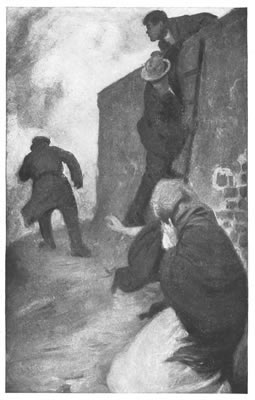 "'Run, run!' whispered the mother."
All attention, the mother turned her head in all directions, her eyes
seeing everything, believing nothing. This thing which she had pictured
as terrible and intricate was accomplished with extreme simplicity and
rapidity, and the simpleness of the happenings stupefied her. Rybin was
no longer to be seen—a tall man in a thin overcoat was walking there—a
girl was running along. Three wardens jumped out from a corner of the
prison; they ran side by side, stretching out their right hands. One of
the soldiers rushed in front of them; the other ran around the horse,
unsuccessfully trying to vault on the refractory animal, which kept
jumping about. The whistles incessantly cut the air, their alarming,
desperate shrieks aroused a consciousness of danger in the woman.
Trembling, she walked along the fence of the cemetery, following the
wardens; but they and the soldiers ran around the other corner of the
prison and disappeared. They were followed at a run by the assistant
overseer of the prison, whom she knew; his coat was unbuttoned. From
somewhere policemen appeared, and people came running.
The wind whistled, leaped about as if rejoicing, and carried the broken,
confused shouts to the mother's ears.
"It stands here all the time."
"The ladder?"
"What's the matter with you then? The devil take you!"
"Arrest the soldiers!"
"Policeman!"
Whistles again. This hubbub delighted her and she strode on more boldly,
thinking, "So, it's possible—he could have done it!"
But now pain for her son no longer entered her heart without pride in
him also. And only fear for him weighed and oppressed her to
stupefaction as before.
From the corner of the fence opposite her a constable with a black,
curly beard, and two policemen emerged.
"Stop!" shouted the constable, breathing heavily. "Did you see—a
man—with a beard—didn't he run by here?"
She pointed to the garden and answered calmly:
"He went that way!"
"Yegorov, run! Whistle! Is it long ago?"
"Yes—I should say—about a minute!"
But the whistle drowned her voice. The constable, without waiting for an
answer, precipitated himself in a gallop along the hillocky ground,
waving his hands in the direction of the garden. After him, with bent
head, and whistling, the policemen darted off.
The mother nodded her head after them, and, satisfied with herself, went
home. When she walked out of the field into the street a cab crossed
her way. Raising her head she saw in the vehicle a young man with light
mustache and a pale, worn face. He, too, regarded her. He sat slantwise.
It must have been due to his position that his right shoulder was higher
than his left.
At home Nikolay met her joyously.
"Alive? How did it go?"
"It seems everything's been successful!"
And slowly trying to reinstate all the details in her memory, she began
to tell of the escape. Nikolay, too, was amazed at the success.
"You see, we're lucky!" said Nikolay, rubbing his hands. "But how
frightened I was on your account only God knows. You know what, Nilovna,
take my friendly advice: don't be afraid of the trial. The sooner it's
over and done with the sooner Pavel will be free. Believe me. I've
already written to my sister to try to think what can be done for Pavel.
Maybe he'll even escape on the road. And the trial is approximately like
this." He began to describe to her the session of the court. She
listened, and understood that he was afraid of something—that he wanted
to inspirit her.
"Maybe you think I'll say something to the judges?" she suddenly
inquired. "That I'll beg them for something?"
He jumped up, waved his hands at her, and said in an offended tone:
"What are you talking about? You're insulting me!"
"Excuse me, please; excuse me! I really am afraid—of what I don't
know."
She was silent, letting her eyes wander about the room.
"Sometimes it seems to me that they'll insult Pasha—scoff at him. 'Ah,
you peasant!' they'll say. 'You son of a peasant! What's this mess
you've cooked up?' And Pasha, proud as he is, he'll answer them so——!
Or Andrey will laugh at them—and all the comrades there are hot-headed
and honest. So I can't help thinking that something will suddenly
happen. One of them will lose his patience, the others will support him,
and the sentence will be so severe—you'll never see them again."
Nikolay was silent, pulling his beard glumly as the mother continued:
"It's impossible to drive this thought from my head. The trial is
terrible to me. When they'll begin to take everything apart and weigh
it—it's awful! It's not the sentence that's terrible, but the trial—I
can't express it." She felt that Nikolay didn't understand her fear; and
his inability to comprehend kept her from further analysis of her
timidities, which, however, only increased and broadened during the
three following days. Finally, on the day of the trial, she carried into
the hall of the session a heavy dark load that bent her back and neck.
In the street, acquaintances from the suburbs had greeted her. She had
bowed in silence, rapidly making her way through the dense crowd in the
corridor of the courthouse. In the hall she was met by relatives of the
defendants, who also spoke to her in undertones. All the words seemed
needless; she didn't understand them. Yet all the people were sullen,
filled with the same mournful feeling which infected the mother and
weighed her down.
"Let's sit next to each other," suggested Sizov, going to a bench.
She sat down obediently, settled her dress, and looked around. Green and
crimson specks, with thin yellow threads between, slowly swam before her
eyes.
"Your son has ruined our Vasya," a woman sitting beside her said
quietly.
"You keep still, Natalya!" Sizov chided her angrily.
Nilovna looked at the woman; it was the mother of Samoylov. Farther
along sat her husband—bald-headed, bony-faced, dapper, with a large,
bushy, reddish beard which trembled as he sat looking in front of
himself, his eyes screwed up.
A dull, immobile light entered through the high windows of the hall,
outside of which snow glided and fell lingeringly on the ground. Between
the windows hung a large portrait of the Czar in a massive frame of
glaring gilt. Straight, austere folds of the heavy crimson window
drapery dropped over either side of it. Before the portrait, across
almost the entire breadth of the hall, stretched the table covered with
green cloth. To the right of the wall, behind the grill, stood two
wooden benches; to the left two rows of crimson armchairs. Attendants
with green collars and yellow buttons on their abdomens ran noiselessly
about the hall. A soft whisper hummed in the turbid atmosphere, and the
odor was a composite of many odors as in a drug shop. All this—the
colors, the glitter, the sounds and odors—pressed on the eyes and
invaded the breast with each inhalation. It forced out live sensations,
and filled the desolate heart with motionless, dismal awe.
Suddenly one of the people said something aloud. The mother trembled.
All arose; she, too, rose, seizing Sizov's hand.
In the left corner of the hall a high door opened and an old man
emerged, swinging to and fro. On his gray little face shook white,
sparse whiskers; he wore eyeglasses; the upper lip, which was shaven,
sank into his mouth as by suction; his sharp jawbones and his chin were
supported by the high collar of his uniform; apparently there was no
neck under the collar. He was supported under the arm from behind by a
tall young man with a porcelain face, red and round. Following him three
more men in uniforms embroidered in gold, and three garbed in civilian
wear, moved in slowly. They stirred about the table for a long time and
finally took seats in the armchairs. When they had sat down, one of them
in unbuttoned uniform, with a sleepy, clean-shaven face, began to say
something to the little old man, moving his puffy lips heavily and
soundlessly. The old man listened, sitting strangely erect and immobile.
Behind the glasses of his pince-nez the mother saw two little
colorless specks.
At the end of the table, at the desk, stood a tall, bald man, who
coughed and shoved papers about.
The little old man swung forward and began to speak. He pronounced
clearly the first words, but what followed seemed to creep without sound
from his thin, gray lips.
"I open——"
"See!" whispered Sizov, nudging the mother softly and arising.
In the wall behind the grill the door opened, a soldier came out with a
bared saber on his shoulder; behind him appeared Pavel, Andrey, Fedya
Mazin, the two Gusevs, Samoylov, Bukin, Somov, and five more young men
whose names were unknown to the mother. Pavel smiled kindly; Andrey
also, showing his teeth as he nodded to her. The hall, as it were,
became lighter and simpler from their smile; the strained, unnatural
silence was enlivened by their faces and movements. The greasy glitter
of gold on the uniforms dimmed and softened. A waft of bold assurance,
the breath of living power, reached the mother's heart and roused it. On
the benches behind her, where up to that time the people had been
waiting in crushed silence, a responsive, subdued hum was audible.
"They're not trembling!" she heard Sizov whisper; and at her right side
Samoylov's mother burst into soft sobs.
"Silence!" came a stern shout.
"I warn you beforehand," said the old man, "I shall have to——"

Pavel and Andrey sat side by side; along with them on the first bench
were Mazin, Samoylov, and the Gusevs. Andrey had shaved his beard, but
his mustache had grown and hung down, and gave his round head the
appearance of a seacow or walrus. Something new lay on his face;
something sharp and biting in the folds about his mouth; something black
in his eyes. On Mazin's upper lip two black streaks were limned, his
face was fuller. Samoylov was just as curly-haired as before; and Ivan
Gusev smiled just as broadly.
"Ah, Fedka, Fedka!" whispered Sizov, drooping his head.
The mother felt she could breathe more freely. She heard the indistinct
questions of the old man, which he put without looking at the prisoners;
and his head rested motionless on the collar of his uniform. She heard
the calm, brief answers of her son. It seemed to her that the oldest
judge and his associates could be neither evil nor cruel people. Looking
carefully at their faces she tried to guess something, softly listening
to the growth of a new hope in her breast.
The porcelain-faced man read a paper indifferently; his even voice
filled the hall with weariness, and the people, enfolded by it, sat
motionless as if benumbed. Four lawyers softly but animatedly conversed
with the prisoners. They all moved powerfully, briskly, and called to
mind large blackbirds.
On one side of the old man a judge with small, bleared eyes filled the
armchair with his fat, bloated body. On the other side sat a stooping
man with reddish mustache on his pale face. His head was wearily thrown
on the back of the chair, his eyes, half-closed, he seemed to be
reflecting over something. The face of the prosecuting attorney was also
worn, bored, and unexpectant. Behind the judge sat the mayor of the
city, a portly man, who meditatively stroked his cheek; the marshal of
the nobility, a gray-haired, large-bearded, ruddy-faced man, with large,
kind eyes; and the district elder, who wore a sleeveless peasant
overcoat, and possessed a huge belly which apparently embarrassed him;
he endeavored to cover it with the folds of his overcoat, but it always
slid down and showed again.
"There are no criminals here and no judges," Pavel's vigorous voice was
heard. "There are only captives here, and conquerors!"
Silence fell. For a few seconds the mother's ears heard only the thin,
hasty scratch of the pen on the paper and the beating of her own heart.
The oldest judge also seemed to be listening to something from afar. His
associates stirred. Then he said:
"Hm! yes—Andrey Nakhodka, do you admit——"
Somebody whispered, "Rise!"
Andrey slowly rose, straightened himself, and pulling his mustache
looked at the old man from the corners of his eyes.
"Yes! To what can I confess myself guilty?" said the Little Russian in
his slow, surging voice, shrugging his shoulders. "I did not murder nor
steal; I simply am not in agreement with an order of life in which
people are compelled to rob and kill one another."
"Answer briefly—yes or no?" the old man said with an effort, but
distinctly.
On the benches back of her the mother felt there was animation; the
people began to whisper to one another about something and stirred,
sighing as if freeing themselves from the cobweb spun about them by the
gray words of the porcelain-faced man.
"Do you hear how they speak?" whispered Sizov.
"Yes."
"Fedor Mazin, answer!"
"I don't want to!" said Fedya clearly, jumping to his feet. His face
reddened with excitation, his eyes sparkled. For some reason he hid his
hands behind his back.
Sizov groaned softly, and the mother opened her eyes wide in
astonishment.
"I declined a defense—I'm not going to say anything—I don't regard
your court as legal! Who are you? Did the people give you the right to
judge us? No, they did not! I don't know you." He sat down and concealed
his heated face behind Andrey's shoulders.
The fat judge inclined his head to the old judge and whispered
something. The old judge, pale-faced, raised his eyelids and slanted his
eyes at the prisoners, then extended his hand on the table, and wrote
something in pencil on a piece of paper lying before him. The district
elder swung his head, carefully shifting his feet, rested his abdomen on
his knees, and his hands on his abdomen. Without moving his head the old
judge turned his body to the red-mustached judge, and began to speak to
him quickly. The red-mustached judge inclined his head to listen. The
marshal of the nobility conversed with the prosecuting attorney; the
mayor of the city listened and smiled, rubbing his cheek. Again the dull
speech of the old judge was heard. All four lawyers listened
attentively. The prisoners exchanged whispers with one another, and
Fedya, smiling in confusion, hid his face.
"How he cut them off! Straight, downright, better than all!" Sizov
whispered in amazement in the ear of the mother. "Ah, you little boy!"
The mother smiled in perplexity. The proceedings seemed to be nothing
but the necessary preliminary to something terrible, which would appear
and at once stifle everybody with its cold horror. But the calm words of
Pavel and Andrey had sounded so fearless and firm, as if uttered in the
little house of the suburb, and not in the presence of the court.
Fedya's hot, youthful sally amused her; something bold and fresh grew up
in the hall, and she guessed from the movement of the people back of her
that she was not the only one who felt this.
"Your opinion," said the old judge.
The bald-headed prosecuting attorney arose, and, steadying himself on
the desk with one hand, began to speak rapidly, quoting figures. In his
voice nothing terrible was heard.
At the same time, however, a sudden dry, shooting attack disturbed the
heart of the mother. It was an uneasy suspicion of something hostile to
her, which did not threaten, did not shout, but unfolded itself unseen,
soundless, intangible. It swung lazily and dully about the judges, as if
enveloping them with an impervious cloud, through which nothing from the
outside could reach them. She looked at them. They were incomprehensible
to her. They were not angry at Pavel or at Fedya; they did not shout at
the young men, as she had expected; they did not abuse them in words,
but put all their questions reluctantly, with the air of "What's the
use?". It cost them an effort to hear the answers to the end. Apparently
they lacked interest because they knew everything beforehand.
There before her stood the gendarme, and spoke in a bass voice:
"Pavel Vlasov was named as the ringleader."
"And Nakhodka?" asked the fat judge in his lazy undertone.
"He, too."
"May I——"
The old judge asked a question of somebody:
"You have nothing?"
All the judges seemed to the mother to be worn out and ill. A sickened
weariness marked their poses and voices, a sickened weariness and a
bored, gray ennui. It was an evident nuisance to them, all this—the
uniforms, the hall, the gendarmes, the lawyers, the obligation to sit in
armchairs, and to put questions concerning things perforce already known
to them. The mother in general was but little acquainted with the
masters; she had scarcely ever seen them; and now she regarded the faces
of the judges as something altogether new and incomprehensible,
deserving pity, however, rather than inspiring horror.
The familiar, yellow-faced officer stood before them, and told about
Pavel and Andrey, stretching the words with an air of importance. The
mother involuntarily laughed, and thought: "You don't know much, my
little father."
And now, as she looked at the people behind the grill, she ceased to
feel dread for them; they did not evoke alarm, pity was not for them;
they one and all called forth in her only admiration and love, which
warmly embraced her heart; the admiration was calm, the love joyously
distinct. There they sat to one side, by the wall, young, sturdy,
scarcely taking any part in the monotonous talk of the witnesses and
judges, or in the disputes of the lawyers with the prosecuting attorney.
They behaved as if the talk did not concern them in the least. Sometimes
somebody would laugh contemptuously, and say something to the comrades,
across whose faces, then, a sarcastic smile would also quickly pass.
Andrey and Pavel conversed almost the entire time with one of their
lawyers, whom the mother had seen the day before at Nikolay's, and had
heard Nikolay address as comrade. Mazin, brisker and more animated than
the others, listened to the conversation. Now and then Samoylov said
something to Ivan Gusev; and the mother noticed that each time Ivan gave
a slight elbow nudge to a comrade, he could scarcely restrain a laugh;
his face would grow red, his cheeks would puff up, and he would have to
incline his head. He had already sniffed a couple of times, and for
several minutes afterward sat with blown cheeks trying to be serious.
Thus, in each comrade his youth played and sparkled after his fashion,
lightly bursting the restraint he endeavored to put upon its lively
effervescence. She looked, compared, and reflected. She was unable to
understand or express in words her uneasy feeling of hostility.
Sizov touched her lightly with his elbow; she turned to him, and found a
look of contentment and slight preoccupation on his face.
"Just see how they've intrenched themselves in their defiance! Fine
stuff in 'em! Eh? Barons, eh? Well, and yet they're going to be
sentenced!"
The mother listened, unconsciously repeating to herself:
"Who will pass the sentence? Whom will they sentence?"
The witnesses spoke quickly, in their colorless voices, the judges
reluctantly and listlessly. Their bloodless, worn-out faces stared into
space unconcernedly. They did not expect to see or hear anything new. At
times the fat judge yawned, covering his smile with his puffy hand,
while the red-mustached judge grew still paler, and sometimes raised his
hand to press his finger tightly on the bone of his temple, as he looked
up to the ceiling with sorrowful, widened eyes. The prosecuting attorney
infrequently scribbled on his paper, and then resumed his soundless
conversation with the marshal of the nobility, who stroked his gray
beard, rolled his large, beautiful eyes, and smiled, nodding his head
with importance. The city mayor sat with crossed legs, and beat a
noiseless tattoo on his knee, giving the play of his fingers
concentrated attention. The only one who listened to the monotonous
murmur of the voices seemed to be the district elder, who sat with
inclined head, supporting his abdomen on his knees and solicitously
holding it up with his hands. The old judge, deep in his armchair, stuck
there immovably. The proceedings continued to drag on in this way for a
long, long time; and ennui again numbed the people with its heavy,
sticky embrace.
The mother saw that this large hall was not yet pervaded by that cold,
threatening justice which sternly uncovers the soul, examines it, and
seeing everything estimates its value with incorruptible eyes, weighing
it rigorously with honest hands. Here was nothing to frighten her by its
power or majesty.
"I declare—" said the old judge clearly, and arose as he crushed the
following words with his thin lips.
The noise of sighs and low exclamations, of coughing and scraping of
feet, filled the hall as the court retired for a recess. The prisoners
were led away. As they walked out, they nodded their heads to their
relatives and familiars with a smile, and Ivan Gusev shouted to somebody
in a modulated voice:
"Don't lose courage, Yegor."
The mother and Sizov walked out into the corridor.
"Will you go to the tavern with me to take some tea?" the old man asked
her solicitously. "We have an hour and a half's time."
"I don't want to."
"Well, then I won't go, either. No, say! What fellows those are! They
act as if they were the only real people, and the rest nothing at all.
They'll all go scot-free, I'm sure. Look at Fedka, eh?"
Samoylov's father came up to them holding his hat in his hand. He smiled
sullenly and said:
"My Vasily! He declined a defense, and doesn't want to palaver. He was
the first to have the idea. Yours, Pelagueya, stood for lawyers; and
mine said: 'I don't want one.' And four declined after him. Hm, ye-es."
At his side stood his wife. She blinked frequently, and wiped her nose
with the end of her handkerchief. Samoylov took his beard in his hand,
and continued looking at the floor.
"Now, this is the queer thing about it: you look at them, those devils,
and you think they got up all this at random—they're ruining themselves
for nothing. And suddenly you begin to think: 'And maybe they're
right!' You remember that in the factory more like them keep on coming,
keep on coming. They always get caught; but they're not destroyed, no
more than common fish in the river get destroyed. No. And again you
think, 'And maybe power is with them, too.'"
"It's hard for us, Stepan Petrov, to understand this affair," said
Sizov.
"It's hard, yes," agreed Samoylov.
His wife noisily drawing in air through her nose remarked:
"They're all strong, those imps!" With an unrestrained smile on her
broad, wizened face, she continued: "You, Nilovna, don't be angry with
me because I just now slapped you, when I said that your son is to
blame. A dog can tell who's the more to blame, to tell you the truth.
Look at the gendarmes and the spies, what they said about our Vasily! He
has shown what he can do too!"
She apparently was proud of her son, perhaps even without understanding
her feeling; but the mother did understand her feeling, and answered
with a kind smile and quiet words:
"A young heart is always nearer to the truth."
People rambled about the corridor, gathered into groups, speaking
excitedly and thoughtfully in hollow voices. Scarcely anybody stood
alone; all faces bore evidence of a desire to speak, to ask, to listen.
In the narrow white passageway the people coiled about in sinuous
curves, like dust carried in circles before a powerful wind. Everybody
seemed to be seeking something hard and firm to stand upon.
The older brother of Bukin, a tall, red-faced fellow, waved his hands
and turned about rapidly in all directions.
"The district elder Klepanov has no place in this case," he declared
aloud.
"Keep still, Konstantin!" his father, a little old man, tried to
dissuade him, and looked around cautiously.
"No; I'm going to speak out! There's a rumor afloat about him that last
year he killed a clerk of his on account of the clerk's wife. What kind
of a judge is he? permit me to ask. He lives with the wife of his
clerk—what have you got to say to that? Besides, he's a well-known
thief!"
"Oh, my little father—Konstantin!"
"True!" said Samoylov. "True, the court is not a very just one."
Bukin heard his voice and quickly walked up to him, drawing the whole
crowd after him. Red with excitement, he waved his hands and said:
"For thievery, for murder, jurymen do the trying. They're common people,
peasants, merchants, if you please; but for going against the
authorities you're tried by the authorities. How's that?"
"Konstantin! Why are they against the authorities? Ah, you! They——"
"No, wait! Fedor Mazin said the truth. If you insult me, and I land you
one on your jaw, and you try me for it, of course I'm going to turn out
guilty. But the first offender—who was it? You? Of course, you!"
The watchman, a gray man with a hooked nose and medals on his chest,
pushed the crowd apart, and said to Bukin, shaking his finger at him:
"Hey! don't shout! Don't you know where you are? Do you think this is a
saloon?"
"Permit me, my cavalier, I know where I am. Listen! If I strike you and
you me, and I go and try you, what would you think?"
"And I'll order you out," said the watchman sternly.
"Where to? What for?"
"Into the street, so that you shan't bawl."
"The chief thing for them is that people should keep their mouths shut."
"And what do you think?" the old man bawled. Bukin threw out his hands,
and again measuring the public with his eyes, began to speak in a lower
voice:
"And again—why are the people not permitted to be at the trial, but
only the relatives? If you judge righteously, then judge in front of
everybody. What is there to be afraid of?"
Samoylov repeated, but this time in a louder tone:
"The trial is not altogether just, that's true."
The mother wanted to say to him that she had heard from Nikolay of the
dishonesty of the court; but she had not wholly comprehended Nikolay,
and had forgotten some of his words. While trying to recall them she
moved aside from the people, and noticed that somebody was looking at
her—a young man with a light mustache. He held his right hand in the
pocket of his trousers, which made his left shoulder seem lower than the
right, and this peculiarity of his figure seemed familiar to the mother.
But he turned from her, and she again lost herself in the endeavor to
recollect, and forgot about him immediately. In a minute, however, her
ear was caught by the low question:
"This woman on the left?"
And somebody in a louder voice cheerfully answered:
"Yes."
She looked around. The man with the uneven shoulders stood sidewise
toward her, and said something to his neighbor, a black-bearded fellow
with a short overcoat and boots up to his knees.
Again her memory stirred uneasily, but did not yield any distinct
results.
The watchman opened the door of the hall, and shouted:
"Relatives, enter; show your tickets!"
A sullen voice said lazily:
"Tickets! Like a circus!"
All the people now showed signs of a dull excitement, an uneasy passion.
They began to behave more freely, and hummed and disputed with the
watchman.
Sitting down on the bench, Sizov mumbled something to the mother.
"What is it?" asked the mother.
"Oh, nothing—the people are fools! They know nothing; they live groping
about and groping about."
The bellman rang; somebody announced indifferently:
"The session has begun!"
Again all arose, and again, in the same order, the judges filed in and
sat down; then the prisoners were led in.
"Pay attention!" whispered Sizov; "the prosecuting attorney is going to
speak."
The mother craned her neck and extended her whole body. She yielded anew
to expectation of the horrible.
Standing sidewise toward the judges, his head turned to them, leaning
his elbow on the desk, the prosecuting attorney sighed, and abruptly
waving his right hand in the air, began to speak:
The mother could not make out the first words. The prosecuting
attorney's voice was fluent, thick; it sped on unevenly, now a bit
slower, now a bit faster. His words stretched out in a thin line, like a
gray seam; suddenly they burst out quickly and whirled like a flock of
black flies around a piece of sugar. But she did not find anything
horrible in them, nothing threatening. Cold as snow, gray as ashes, they
fell and fell, filling the hall with something which recalled a slushy
day in early autumn. Scant in feeling, rich in words, the speech seemed
not to reach Pavel and his comrades. Apparently it touched none of them;
they all sat there quite composed, smiling at times as before, and
conversed without sound. At times they frowned to cover up their smiles.
"He lies!" whispered Sizov.
She could not have said it. She understood that the prosecuting attorney
charged all the comrades with guilt, not singling out any one of them.
After having spoken about Pavel, he spoke about Fedya, and having put
him side by side with Pavel, he persistently thrust Bukin up against
them. It seemed as if he packed and sewed them into a sack, piling them
up on top of one another. But the external sense of his words did not
satisfy, did not touch, did not frighten her. She still waited for the
horrible, and rigorously sought something beyond his words—something in
his face, his eyes, his voice, in his white hand, which slowly glided in
the air. Something terrible must be there; she felt it, but it was
impalpable; it did not yield to her consciousness, which again covered
her heart with a dry, pricking dust.
She looked at the judges. There was no gainsaying that they were bored
at having to listen to this speech. The lifeless, yellow faces expressed
nothing. The sickly, the fat, or the extremely lean, motionless dead
spots all grew dimmer and dimmer in the dull ennui that filled the
hall. The words of the prosecuting attorney spurted into the air like a
haze imperceptible to the eye, growing and thickening around the judges,
enveloping them more closely in a cloud of dry indifference, of weary
waiting. At times one of them changed his pose; but the lazy movement
of the tired body did not rouse their drowsy souls. The oldest judge did
not stir at all; he was congealed in his erect position, and the gray
blots behind the eyeglasses at times disappeared, seeming to spread over
his whole face. The mother realized this dead indifference, this
unconcern without malice in it, and asked herself in perplexity, "Are
they judging?"
The question pressed her heart, and gradually squeezed out of it her
expectation of the horrible. It pinched her throat with a sharp feeling
of wrong.
The speech of the prosecuting attorney snapped off unexpectedly. He made
a few quick, short steps, bowed to the judges, and sat down, rubbing his
hands. The marshal of the nobility nodded his head to him, rolling his
eyes; the city mayor extended his hand, and the district elder stroked
his belly and smiled.
But the judges apparently were not delighted by the speech, and did not
stir.
"The scabby devil!" Sizov whispered the oath.
"Next," said the old judge, bringing the paper to his face, "lawyers for
the defendants, Fedoseyev, Markov, Zagarov."
The lawyer whom the mother had seen at Nikolay's arose. His face was
broad and good-natured; his little eyes smiled radiantly and seemed to
thrust out from under his eyebrows two sharp blades, which cut the air
like scissors. He spoke without haste, resonantly, and clearly; but the
mother was unable to listen to his speech. Sizov whispered in her ear:
"Did you understand what he said? Did you understand? 'People,' he says,
'are poor, they are all upset, insensate.' Is that Fedor? He says they
don't understand anything; they're savages."
The feeling of wrong grew, and passed into revolt. Along with the quick,
loud voice of the lawyer, time also passed more quickly.
"A live, strong man having in his breast a sensitive, honest heart
cannot help rebelling with all his force against this life so full of
open cynicism, corruption, falsehood, and so blunted by vapidity. The
eyes of honest people cannot help seeing such glaring
contradictions——"
The judge with the green face bent toward the president and whispered
something to him; then the old man said dryly:
"Please be more careful!"
"Ha!" Sizov exclaimed softly.
"Are they judging?" thought the mother, and the word seemed hollow and
empty as an earthen vessel. It seemed to make sport of her fear of the
terrible.
"They're a sort of dead body," she answered the old man.
"Don't fear; they're livening up."
She looked at them, and she actually saw something like a shadow of
uneasiness on the faces of the judges. Another man was already speaking,
a little lawyer with a sharp, pale, satiric face. He spoke very
respectfully:
"With all due respect, I permit myself to call the attention of the
court to the solid manner of the honorable prosecuting attorney, to the
conduct of the safety department, or, as such people are called in
common parlance, spies——"
The judge with the green face again began to whisper something to the
president. The prosecuting attorney jumped up. The lawyer continued
without changing his voice:
"The spy Gyman tells us about the witness: 'I frightened him.' The prosecuting attorney
also, as the court has heard, frightened witnesses; as a result of which
act, at the insistence of the defense, he called forth a rebuke from the
presiding judge."
The prosecuting attorney began to speak quickly and angrily; the old
judge followed suit; the lawyer listened to them respectfully, inclining
his head. Then he said:
"I can even change the position of my words if the prosecuting attorney
deems it is not in the right place; but that will not change the plan of
my defense. However, I cannot understand the excitement of the
prosecuting attorney."
"Go for him!" said Sizov. "Go for him, tooth and nail! Pick him open
down to his soul, wherever that may be!"
The hall became animated; a fighting passion flared up; the defense
attacked from all sides, provoking and disturbing the judges, driving
away the cold haze that enveloped them, pricking the old skin of the
judges with sharp words. The judges had the air of moving more closely
to one another, or suddenly they would puff and swell, repulsing the
sharp, caustic raps with the mass of their soft, mellow bodies. They
acted as if they feared that the blow of the opponent might call forth
an echo in their empty bosoms, might shake their resolution, which
sprang not from their own will but from a will strange to them. Feeling
this conflict, the people on the benches back of the mother sighed and
whispered.
But suddenly Pavel arose; tense quiet prevailed. The mother stretched
her entire body forward.
"A party man, I recognize only the court of my party and will not speak
in my defense. According to the desire of my comrades, I, too, declined
a defense. I will merely try to explain to you what you don't
understand. The prosecuting attorney designated our coming out
under the banner of the Social Democracy as an uprising against the
superior power, and regarded us as nothing but rebels against the Czar.
I must declare to you that to us the Czar is not the only chain that
fetters the body of the country. We are obliged to tear off only the
first and nearest chain from the people."
The stillness deepened under the sound of the firm voice; it seemed to
widen the space between the walls of the hall. Pavel, by his words,
removed the people to a distance from himself, and thereby grew in the
eyes of the mother. His stony, calm, proud face with the beard, his high
forehead, and blue eyes, somewhat stern, all became more dazzling and
more prominent.
The judges began to stir heavily and uneasily; the marshal of the
nobility was the first to whisper something to the judge with the
indolent face. The judge nodded his head and turned to the old man; on
the other side of him the sick judge was talking. Rocking back and forth
in the armchair, the old judge spoke to Pavel, but his voice was drowned
in the even, broad current of the young man's speech.
"We are Socialists! That means we are enemies to private property, which
separates people, arms them against one another, and brings forth an
irreconcilable hostility of interests; brings forth lies that endeavor
to cover up, or to justify, this conflict of interests, and corrupt all
with falsehood, hypocrisy and malice. We maintain that a society that
regards man only as a tool for its enrichment is anti-human; it is
hostile to us; we cannot be reconciled to its morality; its double-faced
and lying cynicism. Its cruel relation to individuals is repugnant to
us. We want to fight, and will fight, every form of the physical and
moral enslavement of man by such a
society; we will fight every measure calculated to
disintegrate society for the gratification of the interests of gain. We
are workers—men by whose labor everything is created, from gigantic
machines to childish toys. We are people devoid of the right to fight
for our human dignity. Everyone strives to utilize us, and may utilize
us, as tools for the attainment of his ends. Now we want to have as much
freedom as will give us the possibility in time to come to conquer all
the power. Our slogan is simple: 'All the power for the people; all the
means of production for the people; work obligatory on all. Down with
private property!' You see, we are not rebels."
Pavel smiled, and the kindly fire of his blue eyes blazed forth more
brilliantly.
"Please, more to the point!" said the presiding judge distinctly and
aloud. He turned his chest to Pavel, and regarded him. It seemed to the
mother that his dim left eye began to burn with a sinister, greedy fire.
The look all the judges cast on her son made her uneasy for him. She
fancied that their eyes clung to his face, stuck to his body, thirsted
for his blood, by which they might reanimate their own worn-out bodies.
And he, erect and tall, standing firmly and vigorously, stretched out
his hand to them while he spoke distinctly:
"We are revolutionists, and will be such as long as private property
exists, as long as some merely command, and as long as others merely
work. We take stand against the society whose interests you are bidden
to protect as your irreconcilable enemies, and reconciliation between us
is impossible until we shall have been victorious. We will conquer—we
workingmen! Your society is not at all so powerful as it thinks itself.
That very property, for the production and preservation of which it
sacrifices millions of people enslaved by it—that very
force which gives it the power over us—stirs up discord
within its own ranks, destroys them physically and morally. Property
requires extremely great efforts for its protection; and in reality all
of you, our rulers, are greater slaves than we—you are enslaved
spiritually, we only physically. You cannot withdraw from under the
weight of your prejudices and habits, the weight which deadens you
spiritually; nothing hinders us from being inwardly free. The poisons
with which you poison us are weaker than the antidote you unwittingly
administer to our consciences. This antidote penetrates deeper and
deeper into the body of workingmen; the flames mount higher and higher,
sucking in the best forces, the spiritual powers, the healthy elements
even from among you. Look! Not one of you can any longer fight for your
power as an ideal! You have already expended all the arguments capable
of guarding you against the pressure of historic justice. You can create
nothing new in the domain of ideas; you are spiritually barren. Our
ideas grow; they flare up ever more dazzling; they seize hold of the
mass of the people, organizing them for the war of freedom. The
consciousness of their great rôle unites all the workingmen of the world
into one soul. You have no means whereby to hinder this renovating
process in life except cruelty and cynicism. But your cynicism is very
evident, your cruelty exasperates, and the hands with which you stifle
us to-day will press our hands in comradeship to-morrow. Your energy,
the mechanical energy of the increase of gold, separates you, too, into
groups destined to devour one another. Our energy is a living power,
founded on the ever-growing consciousness of the solidarity of all
workingmen. Everything you do is criminal, for it is directed toward the
enslavement of the people. Our work frees the world from the delusions
and monsters which are produced by your
malice and greed, and which intimidate the people. You have torn man
away from life and disintegrated him. Socialism will unite the world,
rent asunder by you, into one huge whole. And this will be!"
Pavel stopped for a second, and repeated in a lower tone, with greater
emphasis, "This will be!"
The judges whispered to one another, making strange grimaces. And still
their greedy looks were fastened on the body of Nilovna's son. The
mother felt that their gaze tarnished this supple, vigorous body; that
they envied its strength, power, freshness. The prisoners listened
attentively to the speech of their comrade; their faces whitened, their
eyes flashed joy. The mother drank in her son's words, which cut
themselves into her memory in regular rows. The old judge stopped Pavel
several times and explained something to him. Once he even smiled sadly.
Pavel listened to him silently, and again began to speak in an austere
but calm voice, compelling everybody to listen to him, subordinating the
will of the judges to his will. This lasted for a long time. Finally,
however, the old man shouted, extending his hand to Pavel, whose voice
in response flowed on calmly, somewhat sarcastically.
"I am reaching my conclusion. To insult you personally was not my
desire; on the contrary, as an involuntary witness to this comedy which
you call a court trial, I feel almost compassion for you, I may say. You
are human beings after all; and it is saddening to see human beings,
even our enemies, so shamefully debased in the service of violence,
debased to such a degree that they lose consciousness of their human
dignity."
He sat down without looking at the judges.
Andrey, all radiant with joy, pressed his hand firmly; Samoylov, Mazin,
and the rest animatedly stretched toward him. He smiled, a bit
embarrassed by the transport of his comrades. He looked toward his
mother, and nodded his head as if asking, "Is it so?"
She answered him all a-tremble, all suffused with warm joy.
"There, now the trial has begun!" whispered Sizov. "How he gave it to
them! Eh, mother?"
She silently nodded her head and smiled, satisfied that her son had
spoken so bravely, perhaps still more satisfied that he had finished.
The thought darted through her mind that the speech was likely to
increase the dangers threatening Pavel; but her heart palpitated with
pride, and his words seemed to settle in her bosom.
Andrey arose, swung his body forward, looked at the judges sidewise, and
said:
"Gentlemen of the defense——"
"The court is before you, and not the defense!" observed the judge of
the sickly face angrily and loudly. By Andrey's expression the mother
perceived that he wanted to tease them. His mustache quivered. A
cunning, feline smirk familiar to her lighted up his eyes. He stroked
his head with his long hands, and fetched a breath.
"Is that so?" he said, swinging his head. "I think not. That you are not
the judges, but only the defendants——"
"I request you to adhere to what directly pertains to the case,"
remarked the old man dryly.
"To what directly pertains to the case? Very well! I've already
compelled myself to think that you are in reality judges, independent
people, honest——"
"The court has no need of your characterization."
"It has no need of such a characterization? Hey? Well, but after all
I'm going to continue. You are men who make no distinction between your
own and strangers. You are free people. Now, here two parties stand
before you; one complains, 'He robbed me and did me up completely'; and
the other answers, 'I have a right to rob and to do up because I have
arms'——"
"Please don't tell anecdotes."
"Why, I've heard that old people like anecdotes—naughty ones in
particular."
"I'll prohibit you from speaking. You may say something about what
directly pertains to the case. Speak, but without buffoonery, without
unbecoming sallies."
The Little Russian looked at the judges, silently rubbing his head.
"About what directly pertains to the case?" he asked seriously. "Yes;
but why should I speak to you about what directly pertains to the case?
What you need to know my comrade has told you. The rest will be told
you; the time will come, by others——"
The old judge rose and declared:
"I forbid you to speak. Vasily Samoylov!"
Pressing his lips together firmly the Little Russian dropped down lazily
on the bench, and Samoylov arose alongside of him, shaking his curly
hair.
"The prosecuting attorney called my comrades and me 'savages,' 'enemies
of civilization'——"
"You must speak only about that which pertains to your case."
"This pertains to the case. There's nothing which does not pertain to
honest men, and I ask you not to interrupt me. I ask you what sort of a
thing is your civilization?"
"We are not here for discussions with you. To the point!" said the old
judge, showing his teeth.
Andrey's demeanor had evidently changed the conduct of the judges; his
words seemed to have wiped something away from them. Stains appeared on
their gray faces. Cold, green sparks burned in their eyes. Pavel's
speech had excited but subdued them; it restrained their agitation by
its force, which involuntarily inspired respect. The Little Russian
broke away this restraint and easily bared what lay underneath. They
looked at Samoylov, and whispered to one another with strange, wry
faces. They also began to move extremely quickly for them. They gave the
impression of desiring to seize him and howl while torturing his body
with voluptuous ecstasy.
"You rear spies, you deprave women and girls, you put men in the
position which forces them to thievery and murder; you corrupt them with
whisky—international butchery, universal falsehood, depravity, and
savagery—that's your civilization! Yes, we are enemies of this
civilization!"
"Please!" shouted the old judge, shaking his chin; but Samoylov, all
red, his eyes flashing, also shouted:
"But we respect and esteem another civilization, the creators of which
you have persecuted, you have allowed to rot in dungeons, you have
driven mad——"
"I forbid you to speak! Hm— Fedor Mazin!"
Little Mazin popped up like a cork from a champagne bottle, and said in
a staccato voice:
"I—I swear!—I know you have convicted me——"
He lost breath and paled; his eyes seemed to devour his entire face. He
stretched out his hand and shouted:
"I—upon my honest word! Wherever you send me—I'll escape—I'll
return—I'll work always—all my life! Upon my honest word!"
Sizov quacked aloud. The entire public, overcome by the mounting wave
of excitement, hummed strangely and dully. One woman cried, some one
choked and coughed. The gendarmes regarded the prisoners with dull
surprise, the public with a sinister look. The judges shook, the old man
shouted in a thin voice:
"Ivan Gusev!"
"I don't want to speak."
"Vasily Gusev!"
"Don't want to."
"Fedor Bukin!"
The whitish, faded fellow lifted himself heavily, and shaking his head
slowly said in a thick voice:
"You ought to be ashamed. I am a heavy man, and yet I
understand—justice!" He raised his hand higher than his head and was
silent, half-closing his eyes as if looking at something at a distance.
"What is it?" shouted the old judge in excited astonishment, dropping
back in his armchair.
"Oh, well, what's the use?"
Bukin sullenly let himself down on the bench. There was something big
and serious in his dark eyes, something somberly reproachful and naïve.
Everybody felt it; even the judges listened, as if waiting for an echo
clearer than his words. On the public benches all commotion died down
immediately; only a low weeping swung in the air. Then the prosecuting
attorney, shrugging his shoulders, grinned and said something to the
marshal of the nobility, and whispers gradually buzzed again excitedly
through the hall.
Weariness enveloped the mother's body with a stifling faintness. Small
drops of perspiration stood on her forehead. Samoylov's mother stirred
on the bench, nudging her with her shoulder and elbow, and said to her
husband in a subdued whisper:
"How is this, now? Is it possible?"
"You see, it's possible."
"But what is going to happen to him, to Vasily?"
"Keep still. Stop."
The public was jarred by something it did not understand. All blinked in
perplexity with blinded eyes, as if dazzled by the sudden blazing up of
an object, indistinct in outline, of unknown meaning, but with horrible
drawing power. And since the people did not comprehend this great thing
dawning on them, they contracted its significance into something small,
the meaning of which was evident and clear to them. The elder Bukin,
therefore, whispered aloud without constraint:
"Say, please, why don't they permit them to talk? The prosecuting
attorney can say everything, and as much as he wants to——"
A functionary stood at the benches, and waving his hands at the people,
said in a half voice:
"Quiet, quiet!"
The father of Samoylov threw himself back, and ejaculated broken words
behind his wife's ear:
"Of course—let us say they are guilty—but you'll let them explain.
What is it they have gone against? Against everything—I wish to
understand—I, too, have my interest." And suddenly: "Pavel says the
truth, hey? I want to understand. Let them speak."
"Keep still!" exclaimed the functionary, shaking his finger at him.
Sizov nodded his head sullenly.
But the mother kept her gaze fastened unwaveringly on the judges, and
saw that they got more and more excited, conversing with one another in
indistinct voices. The sound of their words, cold and tickling, touched
her face, puckering the skin on it, and filling her mouth with a
sickly, disgusting taste. The mother somehow conceived that they were
all speaking of the bodies of her son and his comrades, their vigorous
bare bodies, their muscles, their youthful limbs full of hot blood, of
living force. These bodies kindled in the judges the sinister, impotent
envy of the rich by the poor, the unwholesome greed felt by wasted and
sick people for the strength of the healthy. Their mouths watered
regretfully for these bodies, capable of working and enriching, of
rejoicing and creating. The youths produced in the old judges the
revengeful, painful excitement of an enfeebled beast which sees the
fresh prey, but no longer has the power to seize it, and howls dismally
at its powerlessness.
This thought, rude and strange, grew more vivid the more attentively the
mother scrutinized the judges. They seemed not to conceal their excited
greed—the impotent vexation of the hungry who at one time had been able
to consume in abundance. To her, a woman and a mother, to whom after all
the body of her son is always dearer than that in him which is called a
soul, to her it was horrible to see how these sticky, lightless eyes
crept over his face, felt his chest, shoulders, hands, tore at the hot
skin, as if seeking the possibility of taking fire, of warming the blood
in their hardened brains and fatigued muscles—the brains and muscles of
people already half dead, but now to some degree reanimated by the
pricks of greed and envy of a young life that they presumed to sentence
and remove to a distance from themselves. It seemed to her that her son,
too, felt this damp, unpleasant tickling contact, and, shuddering,
looked at her.
He looked into the mother's face with somewhat fatigued eyes, but
calmly, kindly, and warmly. At times he nodded his head to her, and
smiled—she understood the smile.
"Now quick!" she said.
Resting his hand on the table the oldest judge arose. His head sunk in
the collar of his uniform, standing motionless, he began to read a paper
in a droning voice.
"He's reading the sentence," said Sizov, listening.
It became quiet again, and everybody looked at the old man, small, dry,
straight, resembling the stick held in his unseen hand. The other judges
also stood up. The district elder inclined his head on one shoulder, and
looked up to the ceiling; the mayor of the city crossed his hands over
his chest; the marshal of the nobility stroked his beard. The judge with
the sickly face, his puffy neighbor, and the prosecuting attorney
regarded the prisoners sidewise. And behind the judges the Czar in a red
military coat, with an indifferent white face looked down from his
portrait over their heads. On his face some insect was creeping, or a
cobweb was trembling.
"Exile!" Sizov said with a sigh of relief, dropping back on the bench.
"Well, of course! Thank God! I heard that they were going to get hard
labor. Never mind, mother, that's nothing."
Fatigued by her thoughts and her immobility, she understood the joy of
the old man, which boldly raised the soul dragged down by hopelessness.
But it didn't enliven her much.
"Why, I knew it," she answered.
"But, after all, it's certain now. Who could have told beforehand what
the authorities would do? But Fedya is a fine fellow, dear soul."
They walked to the grill; the mother shed tears as she pressed the hand
of her son. He and Fedya spoke kind words, smiled, and joked. All were
excited, but light and cheerful. The women wept; but, like Vlasova, more
from habit than grief. They did not experience the stunning pain
produced by an unexpected blow on the head, but only the sad
consciousness that they must part with the children. But even this
consciousness was dimmed by the impressions of the day. The fathers and
the mothers looked at their children with mingled sensations, in which
the skepticism of parents toward their children and the habitual sense
of the superiority of elders over youth blended strangely with the
feeling of sheer respect for them, with the persistent melancholy
thought that life had now become dull, and with the curiosity aroused by
the young men who so bravely and fearlessly spoke of the possibility of
a new life, which the elders did not comprehend but which seemed to
promise something good. The very novelty and unusualness of the feeling
rendered expression impossible. Words were spoken in plenty, but they
referred only to common matters. The relatives spoke of linen and
clothes, and begged the comrades to take care of their health, and not
to provoke the authorities uselessly.
"Everybody, brother, will grow weary, both we and they," said Samoylov
to his son.
And Bukin's brother, waving his hand, assured the younger brother:
"Merely justice, and nothing else! That they cannot admit."
The younger Bukin answered:
"You look out for the starling. I love him."
"Come back home, and you'll find him in perfect trim."
"I've nothing to do there."
And Sizov held his nephew's hand, and slowly said:
"So, Fedor; so you've started on your trip. So."
Fedya bent over, and whispered something in his ear, smiling roguishly.
The convoy soldier also smiled; but he immediately assumed a stern
expression, and shouted, "Go!"
The mother spoke to Pavel, like the others, about the same things, about
clothes, about his health, yet her breast was choked by a hundred
questions concerning Sasha, concerning himself, and herself. Underneath
all these emotions an almost burdensome feeling was slowly growing of
the fullness of her love for her son—a strained desire to please him,
to be near to his heart. The expectation of the terrible had died away,
leaving behind it only a tremor at the recollection of the judges, and
somewhere in a corner a dark impersonal thought regarding them.
"Young people ought to be tried by young judges, and not by old ones,"
she said to her son.
"It would be better to arrange life so that it should not force people
to crime," answered Pavel.
The mother, seeing the Little Russian converse with everybody and
realizing that he needed affection more than Pavel, spoke to him. Andrey
answered her gratefully, smiling, joking kindly, as always a bit droll,
supple, sinewy. Around her the talk went on, crossing and intertwining.
She heard everything, understood everybody, and secretly marveled at the
vastness of her own heart, which took in everything with an even joy,
and gave back a clear reflection of it, like a bright image on a deep,
placid lake.
Finally the prisoners were led away. The mother walked out of the court,
and was surprised to see that night already hung over the city, with the
lanterns alight in the streets, and the stars shining in the sky.
Groups composed mainly of young men were crowding near the courthouse.
The snow crunched in the frozen atmosphere; voices sounded. A man in a
gray Caucasian cowl looked into Sizov's face and asked quickly:
"What was the sentence?"
"Exile."
"For all?"
"All."
"Thank you."
The man walked away.
"You see," said Sizov. "They inquire."
Suddenly they were surrounded by about ten men, youths, and girls, and
explanations rained down, attracting still more people. The mother and
Sizov stopped. They were questioned in regard to the sentence, as to how
the prisoners behaved, who delivered the speeches, and what the speeches
were about. All the voices rang with the same eager curiosity, sincere
and warm, which aroused the desire to satisfy it.
"People! This is the mother of Pavel Vlasov!" somebody shouted, and
presently all became silent.
"Permit me to shake your hand."
Somebody's firm hand pressed the mother's fingers, somebody's voice said
excitedly:
"Your son will be an example of manhood for all of us."
"Long live the Russian workingman!" a resonant voice rang out.
"Long live the proletariat!"
"Long live the revolution!"
The shouts grew louder and increased in number, rising up on all sides.
The people ran from every direction, pushing into the crowd around the
mother and Sizov. The whistles of the police leaped through the air,
but did not deafen the shouts. The old man smiled; and to the mother all
this seemed like a pleasant dream. She smilingly pressed the hands
extended to her and bowed, with joyous tears choking her throat. Near
her somebody's clear voice said nervously:
"Comrades, friends, the autocracy, the monster which devours the Russian
people to-day again gulped into its bottomless, greedy mouth——"
"However, mother, let's go," said Sizov. And at the same time Sasha
appeared, caught the mother under her arm, and quickly dragged her away
to the other side of the street.
"Come! They're going to make arrests. What? Exile? To Siberia?"
"Yes, yes."
"And how did he speak? I know without your telling me. He was more
powerful than any of the others, and more simple. And of course, sterner
than all the rest. He's sensitive and soft, only he's ashamed to expose
himself. And he's direct, clear, firm, like truth itself. He's very
great, and there's everything in him, everything! But he often
constrains himself for nothing, lest he might hinder the cause. I know
it." Her hot half-whisper, the words of her love, calmed the mother's
agitation, and restored her exhausted strength.
"When will you go to him?" she asked Sasha, pressing her hand to her
body. Looking confidently before her the girl answered:
"As soon as I find somebody to take over my work. I have the money
already, but I might go per étappe. You know I am also awaiting a
sentence. Evidently they are going to send me to Siberia, too. I will
then declare that I desire to be exiled to the same locality that he
will be."
Behind them was heard the voice of Sizov:
"Then give him regards from me, from Sizov. He will know. I'm Fedya
Mazin's uncle."
Sasha stopped, turned around, extending her hand.
"I'm acquainted with Fedya. My name is Alexandra."
"And your patronymic?"
She looked at him and answered:
"I have no father."
"He's dead, you mean?"
"No, he's alive." Something stubborn, persistent, sounded in the girl's
voice and appeared in her face. "He's a landowner, a chief of a country
district. He robs the peasants and beats them. I cannot recognize him as
my father."
"S-s-o-o!" Sizov was taken aback. After a pause he said, looking at the
girl sidewise:
"Well, mother, good-by. I'm going off to the left. Stop in sometimes for
a talk and a glass of tea. Good evening, lady. You're pretty hard on
your father—of course, that's your business."
"If your son were an ugly man, obnoxious to people, disgusting to you,
wouldn't you say the same about him?" Sasha shouted terribly.
"Well, I would," the old man answered after some hesitation.
"That is to say that justice is dearer to you than your son; and to me
it's dearer than my father."
Sizov smiled, shaking his head; then he said with a sigh:
"Well, well, you're clever. Good-by. I wish you all good things, and be
better to people. Hey? Well, God be with you. Good-by, Nilovna. When you
see Pavel tell him I heard his speech. I couldn't understand every bit
of it; some things even seemed horrible; but tell him it's true. They've
found the truth, yes."
He raised his hat, and sedately turned around the corner of the street.
"He seems to be a good man," remarked Sasha, accompanying him with a
smile of her large eyes. "Such people can be useful to the cause. It
would be good to hide literature with them, for instance."
It seemed to the mother that to-day the girl's face was softer and
kinder than usual, and hearing her remarks about Sizov, she thought:
"Always about the cause. Even to-day. It's burned into her heart."

At home they sat on the sofa closely pressed together, and the mother
resting in the quiet again began to speak about Sasha's going to Pavel.
Thoughtfully raising her thick eyebrows, the girl looked into the
distance with her large, dreamy eyes. A contemplative expression rested
on her pale face.
"Then, when children will be born to you, I will come to you and dandle
them. We'll begin to live there no worse than here. Pasha will find
work. He has golden hands."
"Yes," answered Sasha thoughtfully. "That's good—" And suddenly
starting, as if throwing something away, she began to speak simply in a
modulated voice. "He won't commence to live there. He'll go away, of
course."
"And how will that be? Suppose, in case of children?"
"I don't know. We'll see when we are there. In such a case he oughtn't
to reckon with me, and I cannot constrain him. He's free at any moment.
I am his comrade—a wife, of course. But the conditions of his work are
such that for years and years I cannot regard our bond as a usual one,
like that of others. It will be hard, I know it, to part with him; but,
of course, I'll manage to. He knows that I'm not capable of regarding a
man as my possession. I'm not going to constrain him, no."
The mother understood her, felt that she believed what she said, that
she was capable of carrying it out; and she was sorry for her. She
embraced her.
"My dear girl, it will be hard for you."
Sasha smiled softly, nestling her body up to the mother's. Her voice
sounded mild, but powerful. Red mounted to her face.
"It's a long time till then; but don't think that I—that it is hard for
me now. I'm making no sacrifices. I know what I'm doing, I know what I
may expect. I'll be happy if I can make him happy. My aim, my desire is
to increase his energy, to give him as much happiness and love as I
can—a great deal. I love him very much and he me—I know it—what I
bring to him, he will give back to me—we will enrich each other by all
in our power; and, if necessary, we will part as friends."
Sasha remained silent for a long time, during which the mother and the
young woman sat in a corner of the room, tightly pressed against each
other, thinking of the man whom they loved. It was quiet, melancholy,
and warm.
Nikolay entered, exhausted, but brisk. He immediately announced:
"Well, Sashenka, betake yourself away from here, as long as you are
sound. Two spies have been after me since this morning, and the attempt
at concealment is so evident that it savors of an arrest. I feel it in
my bones—somewhere something has happened. By the way, here I have the
speech of Pavel. It's been decided to publish it at once. Take it to
Liudmila. Pavel spoke well, Nilovna; and his speech will play a part.
Look out for spies, Sasha. Wait a little while—hide these papers, too.
You might give them to Ivan, for example."
While he spoke, he vigorously rubbed his frozen hands, and quickly
pulled out the drawers of his table, picking out papers, some of which
he tore up, others he laid aside. His manner was absorbed, and his
appearance all upset.
"Do you suppose it was long ago that this place was cleared out? And
look at this mass of stuff accumulated already! The devil! You see,
Nilovna, it would be better for you, too, not to sleep here to-night.
It's a sorry spectacle to witness, and they may arrest you, too. And
you'll be needed for carrying Pavel's speech about from place to place."
"Hm, what do they want me for? Maybe you're mistaken."
Nikolay waved his forearm in front of his eyes, and said with
conviction:
"I have a keen scent. Besides, you can be of great help to Liudmila.
Flee far from evil."
The possibility of taking a part in the printing of her son's speech was
pleasant to her, and she answered:
"If so, I'll go. But don't think I'm afraid."
"Very well. Now, tell me where my valise and my linen are. You've
grabbed up everything into your rapacious hands, and I'm completely
robbed of the possibility of disposing of my own private property. I'm
making complete preparations—this will be unpleasant to them."
Sasha burned the papers in silence, and carefully mixed their ashes with
the other cinders in the stove.
"Sasha, go," said Nikolay, putting out his hand to her. "Good-by. Don't
forget books—if anything new and interesting appears. Well, good-by,
dear comrade. Be more careful."
"Do you think it's for long?" asked Sasha.
"The devil knows them! Evidently. There's something against me. Nilovna,
are you going with her? It's harder to track two people—all right?"
"I'm going." The mother went to dress herself, and it occurred to her
how little these people who were striving for the freedom of all cared
for their personal freedom. The simplicity and the businesslike manner
of Nikolay in expecting the arrest both astonished and touched her. She
tried to observe his face carefully; she detected nothing but his air of
absorption, overshadowing the usual kindly soft expression of his eyes.
There was no sign of agitation in this man, dearer to her than the
others; he made no fuss. Equally attentive to all, alike kind to all,
always calmly the same, he seemed to her just as much a stranger as
before to everybody and everything except his cause. He seemed remote,
living a secret life within himself and somewhere ahead of people. Yet
she felt that he resembled her more than any of the others, and she
loved him with a love that was carefully observing and, as it were, did
not believe in itself. Now she felt painfully sorry for him; but she
restrained her feelings, knowing that to show them would disconcert
Nikolay, that he would become, as always under such circumstances,
somewhat ridiculous.
When she returned to the room she found him pressing Sasha's hand and
saying:
"Admirable! I'm convinced of it. It's very good for him and for you. A
little personal happiness does not do any harm; but—a little, you know,
so as not to make him lose his value. Are you ready, Nilovna?" He walked
up to her, smiling and adjusting his glasses. "Well, good-by. I want to
think that for three months, four months—well, at most half a
year—half a year is a great deal of a man's life. In half a year one
can do a lot of things. Take care of yourself, please, eh? Come, let's
embrace." Lean and thin he clasped her neck in his powerful arms, looked
into her eyes, and smiled. "It seems to me I've fallen in love with you.
I keep embracing you all the time."
She was silent, kissing his forehead and cheeks, and her hands quivered.
For fear he might notice it, she unclasped them.
"Go. Very well. Be careful to-morrow. This is what you should do—send
the boy in the morning—Liudmila has a boy for the purpose—let him go
to the house porter and ask him whether I'm home or not. I'll forewarn
the porter; he's a good fellow, and I'm a friend of his. Well, good-by,
comrades. I wish you all good."
On the street Sasha said quietly to the mother:
"He'll go as simply as this to his death, if necessary. And apparently
he'll hurry up a little in just the same way; when death stares him in
the face he'll adjust his eyeglasses, and will say 'admirable,' and will
die."
"I love him," whispered the mother.
"I'm filled with astonishment; but love him—no. I respect him highly.
He's sort of dry, although good and even, if you please, sometimes soft;
but not sufficiently human—it seems to me we're being followed. Come,
let's part. Don't enter Liudmila's place if you think a spy is after
you."
"I know," said the mother. Sasha, however, persistently added: "Don't
enter. In that case, come to me. Good-by for the present."
She quickly turned around and walked back. The mother called "Good-by"
after her.
Within a few minutes she sat all frozen through at the stove in
Liudmila's little room. Her hostess, Liudmila, in a black dress girded
up with a strap, slowly paced up and down the room, filling it with a
rustle and the sound of her commanding voice. A fire was crackling in
the stove and drawing in the air from the room. The woman's voice
sounded evenly.
"People are a great deal more stupid than bad. They can see only what's
near to them, what it's possible to grasp immediately; but everything
that's near is cheap; what's distant is dear. Why, in reality, it would
be more convenient and pleasanter for all if life were different, were
lighter, and the people were more sensible. But to attain the distant
you must disturb yourself for the immediate present——"
Nilovna tried to guess where this woman did her printing. The room had
three windows facing the street; there was a sofa and a bookcase, a
table, chairs, a bed at the wall, in the corner near it a wash basin, in
the other corner a stove; on the walls photographs and pictures. All was
new, solid, clean; and over all the austere monastic figure of the
mistress threw a cold shadow. Something concealed, something hidden,
made itself felt; but where it lurked was incomprehensible. The mother
looked at the doors; through one of them she had entered from the little
antechamber. Near the stove was another door, narrow and high.
"I have come to you on business," she said in embarrassment, noticing
that the hostess was regarding her.
"I know. Nobody comes to me for any other reason."
Something strange seemed to be in Liudmila's voice. The mother looked in
her face. Liudmila smiled with the corners of her thin lips, her dull
eyes gleamed behind her glasses. Turning her glance aside, the mother
handed her the speech of Pavel.
"Here. They ask you to print it at once."
And she began to tell of Nikolay's preparations for the arrest.
Liudmila silently thrust the manuscript into her belt and sat down on a
chair. A red gleam of the fire was reflected on her spectacles; its hot
smile played on her motionless face.
"When they come to me I'm going to shoot at them," she said with
determination in her moderated voice. "I have the right to protect
myself against violence; and I must fight with them if I call upon
others to fight. I cannot understand calmness; I don't like it."
The reflection of the fire glided across her face, and she again became
austere, somewhat haughty.
"Your life is not very pleasant," the mother thought kindly.
Liudmila began to read Pavel's speech, at first reluctantly; then she
bent lower and lower over the paper, quickly throwing aside the pages as
she read them. When she had finished she rose, straightened herself, and
walked up to the mother.
"That's good. That's what I like; although here, too, there's calmness.
But the speech is the sepulchral beat of a drum, and the drummer is a
powerful man."
She reflected a little while, lowering her head for a minute:
"I didn't want to speak with you about your son; I have never met him,
and I don't like sad subjects of conversation. I know what it means to
have a near one go into exile. But I want to say to you, nevertheless,
that your son must be a splendid man. He's young—that's evident; but he
is a great soul. It must be good and terrible to have such a son."
"Yes, it's good. And now it's no longer terrible."
Liudmila settled her smoothly combed hair with her tawny hand and sighed
softly. A light, warm shadow trembled on her cheeks, the shadow of a
suppressed smile.
"We are going to print it. Will you help me?"
"Of course."
"I'll set it up quickly. You lie down; you had a hard day; you're tired.
Lie down here on the bed; I'm not going to sleep; and at night maybe
I'll wake you up to help me. When you have lain down, put out the lamp."
She threw two logs of wood into the stove, straightened herself, and
passed through the narrow door near the stove, firmly closing it after
her. The mother followed her with her eyes, and began to undress
herself, thinking reluctantly of her hostess: "A stern person; and yet
her heart burns. She can't conceal it. Everyone loves. If you don't love
you can't live."
Fatigue dizzied her brain; but her soul was strangely calm, and
everything was illumined from within by a soft, kind light which quietly
and evenly filled her breast. She was already acquainted with this calm;
it had come to her after great agitation. At first it had slightly
disturbed her; but now it only broadened her soul, strengthening it with
a certain powerful but impalpable thought. Before her all the time
appeared and disappeared the faces of her son, Andrey, Nikolay, Sasha.
She took delight in them; they passed by without arousing thought, and
only lightly and sadly touching her heart. Then she extinguished the
lamp, lay down in the cold bed, shriveled up under the bed coverings,
and suddenly sank into a heavy sleep.

When she opened her eyes the room was filled by the cold, white glimmer
of a clear wintry day. The hostess, with a book in her hand, lay on the
sofa, and smiling unlike herself looked into her face.
"Oh, father!" the mother exclaimed, for some reason embarrassed. "Just
look! Have I been asleep a long time?"
"Good morning!" answered Liudmila. "It'll soon be ten o'clock. Get up
and we'll have tea."
"Why didn't you wake me up?"
"I wanted to. I walked up to you; but you were so fast asleep and smiled
so in your sleep!"
With a supple, powerful movement of her whole body she rose from the
sofa, walked up to the bed, bent toward the face of the mother, and in
her dull eyes the mother saw something dear, near, and comprehensible.
"I was sorry to disturb you. Maybe you were seeing a happy vision."
"I didn't see anything."
"All the same—but your smile pleased me. It was so calm, so good—so
great." Liudmila laughed, and her laugh sounded velvety. "I thought of
you, of your life—your life is a hard one, isn't it?"
The mother, moving her eyebrows, was silent and thoughtful.
"Of course it's hard!" exclaimed Liudmila.
"I don't know," said the mother carefully. "Sometimes it seems sort of
hard; there's so much of all, it's all so serious, marvelous, and it
moves along so quickly, one thing after the other—so quickly——"
The wave of bold excitement familiar to her overflowed her breast,
filling her heart with images and thoughts. She sat up in bed, quickly
clothing her thoughts in words.
"It goes, it goes, it goes all to one thing, to one side, and like a
fire, when a house begins to burn, upward! Here it shoots forth, there
it blazes out, ever brighter, ever more powerful. There's a great deal
of hardship, you know. People suffer; they are beaten, cruelly beaten;
and everyone is oppressed and watched. They hide, live like monks, and
many joys are closed to them; it's very hard. And when you look at them
well you see that the hard things, the evil and difficult, are around
them, on the outside, and not within."
Liudmila quickly threw up her head, looked at her with a deep, embracing
look. The mother felt that her words did not exhaust her thoughts, which
vexed and offended her.
"You're not speaking about yourself," said her hostess softly.
The mother looked at her, arose from the bed, and dressing asked:
"Not about myself? Yes; you see in this, in all that I live now, it's
hard to think of oneself; how can you withdraw into yourself when you
love this thing, and that thing is dear to you, and you are afraid for
everybody and are sorry for everybody? Everything crowds into your heart
and draws you to all people. How can you step to one side? It's hard."
Liudmila laughed, saying softly:
"And maybe it's not necessary."
"I don't know whether it's necessary or not; but this I do know—that
people are becoming stronger than life, wiser than life; that's
evident."
Standing in the middle of the room, half-dressed, she fell to reflecting
for a moment. Her real self suddenly appeared not to exist—the one who
lived in anxiety and fear for her son, in thoughts for the safekeeping
of his body. Such a person in herself was no longer; she had gone off to
a great distance, and perhaps was altogether burned up by the fire of
agitation. This had lightened and cleansed her soul, and had renovated
her heart with a new power. She communed with herself, desiring to take
a look into her own heart, and fearing lest she awaken some anxiety
there.
"What are you thinking about?" Liudmila asked kindly, walking up to her.
"I don't know."
The two women were silent, looking at each other. Both smiled; then
Liudmila walked out of the room, saying:
"What is my samovar doing?"
The mother looked through the window. A cold, bracing day shone in the
street; her breast, too, shone bright, but hot. She wanted to speak much
about everything, joyfully, with a confused feeling of gratitude to
somebody—she did not know whom—for all that came into her soul, and
lighted it with a ruddy evening light. A desire to pray, which she had
not felt for a long time, arose in her breast. Somebody's young face
came to her memory, somebody's resonant voice shouted, "That's the
mother of Pavel Vlasov!" Sasha's eyes flashed joyously and tenderly.
Rybin's dark, tall figure loomed up, the bronzed, firm face of her son
smiled. Nikolay blinked in embarrassment; and suddenly everything was
stirred with a deep but light breath.
"Nikolay was right," said Liudmila, entering again. "He must surely have
been arrested. I sent the boy there, as you told me to. He said
policemen are hiding in the yard; he did not see the house porter; but
he saw the policeman who was hiding behind the gates. And spies are
sauntering about; the boy knows them."
"So?" The mother nodded her head. "Ah, poor fellow!"
And she sighed, but without sadness, and was quietly surprised at
herself.
"Lately he's been reading a great deal to the city workingmen; and in
general it was time for him to disappear," Liudmila said with a frown.
"The comrades told him to go, but he didn't obey them. I think that in
such cases you must compel and not try to persuade."
A dark-haired, red-faced boy with beautiful eyes and a hooked nose
appeared in the doorway.
"Shall I bring in the samovar?" he asked in a ringing voice.
"Yes, please, Seryozha. This is my pupil; have you never met him
before?"
"No."
"He used to go to Nikolay sometimes; I sent him."
Liudmila seemed to the mother to be different to-day—simpler and nearer
to her. In the supple swaying of her stately figure there was much
beauty and power; her sternness had mildened; the circles under her eyes
had grown larger during the night, her face paler and leaner; her large
eyes had deepened. One perceived a strained exertion in her, a tightly
drawn chord in her soul.
The boy brought in the samovar.
"Let me introduce you: Seryozha—Pelagueya Nilovna, the mother of the
workingman whom they sentenced yesterday."
Seryozha bowed silently and pressed the mother's hand. Then he brought
in bread, and sat down to the table. Liudmila persuaded the mother not
to go home until they found out whom the police were waiting for there.
"Maybe they are waiting for you. I'm sure they'll examine you."
"Let them. And if they arrest me, no great harm. Only I'd like to have
Pasha's speech sent off."
"It's already in type. To-morrow it'll be possible to have it for the
city and the suburb. We'll have some for the districts, too. Do you know
Natasha?"
"Of course!"
"Then take it to her."
The boy read the newspaper, and seemed not to be listening to the
conversation; but at times his eyes looked from the pages of the
newspaper into the face of the mother; and when she met their animated
glance she felt pleased and smiled. She reproached herself for these
smiles. Liudmila again mentioned Nikolay without any expression of
regret for his arrest and, to the mother, it seemed in perfectly natural
tones. The time passed more quickly than on the other days. When they
had done drinking tea it was already near midday.
"However!" exclaimed Liudmila, and at the same time a knock at the door
was heard. The boy rose, looked inquiringly at Liudmila, prettily
screwing up his eyes.
"Open the door, Seryozha. Who do you suppose it is?" And with a composed
gesture she let her hand into the pocket of the skirt, saying to the
mother: "If it is the gendarmes, you, Pelagueya Nilovna, stand here in
this corner, and you, Ser——"
"I know. The dark passage," the little boy answered softly,
disappearing.
The mother smiled. These preparations did not disturb her; she had no
premonition of a misfortune.
The little physician walked in. He quickly said:
"First of all, Nikolay is arrested. Aha! You here, Nilovna? They're
interested in you, too. Weren't you there when he was arrested?"
"He packed me off, and told me to come here."
"Hm! I don't think it will be of any use to you. Secondly, last night
several young people made about five hundred hektograph copies of
Pavel's speech—not badly done, plain and clear. They want to scatter
them throughout the city at night. I'm against it. Printed sheets are
better for the city, and the hektograph copies ought to be sent off
somewhere."
"Here, I'll carry them to Natasha!" the mother exclaimed animatedly.
"Give them to me."
She was seized with a great desire to sow them broadcast, to spread
Pavel's speech as soon as possible. She would have bestrewn the whole
earth with the words of her son, and she looked into the doctor's face
with eyes ready to beg.
"The devil knows whether at this time you ought to take up this matter,"
the physician said irresolutely, and took out his watch. "It's now
twelve minutes of twelve. The train leaves at 2.05, arrives there 5.15.
You'll get there in the evening, but not sufficiently late—and that's
not the point!"
"That's not the point," repeated Liudmila, frowning.
"What then?" asked the mother, drawing up to them. "The point is to do
it well; and I'll do it all right."
Liudmila looked fixedly at her, and chafing her forehead, remarked:
"It's dangerous for you."
"Why?" the mother challenged hotly.
"That's why!" said the physician quickly and brokenly. "You disappeared
from home an hour before Nikolay's arrest. You went away to the mill,
where you are known as the teacher's aunt; after your arrival at the
mill the naughty leaflets appear. All this will tie itself into a noose
around your neck."
"They won't notice me there," the mother assured them, warming to her
desire. "When I return they'll arrest me, and ask me where I was." After
a moment's pause she exclaimed: "I know what I'll say. From there I'll
go straight to the suburb; I have a friend there—Sizov. So I'll say
that I went there straight from the trial; grief took me there; and he,
too, had the same misfortune, his nephew was sentenced; and I spent the
whole time with him. He'll uphold me, too. Do you see?"
The mother was aware that they were succumbing to the strength of her
desire, and strove to induce them to give in as quickly as possible. She
spoke more and more persistently, joy arising within her. And they
yielded.
"Well, go," the physician reluctantly assented.
Liudmila was silent, pacing thoughtfully up and down the room. Her face
clouded over and her cheeks fell in. The muscles of her neck stretched
noticeably as if her head had suddenly grown heavy; it involuntarily
dropped on her breast. The mother observed this. The physician's
reluctant assent forced a sigh from her.
"You all take care of me," the mother said, smiling. "You don't take
care of yourselves." And the wave of joy mounted higher and higher.
"It isn't true. We look out for ourselves. We ought to; and we very
much upbraid those who uselessly waste their power. Ye-es. Now, this is
the way you are to do. You will receive the speeches at the station." He
explained to her how the matter would be arranged; then looking into her
face, he said: "Well, I wish you success. You're happy, aren't you?" And
he walked away still gloomy and dissatisfied. When the door closed
behind him Liudmila walked up to the mother, smiling quietly.
"You're a fine woman! I understand you." Taking her by the arm, she
again walked up and down the room. "I have a son, too. He's already
thirteen years old; but he lives with his father. My husband is an
assistant prosecuting attorney. Maybe he's already prosecuting attorney.
And the boy's with him. What is he going to be? I often think." Her
humid, powerful voice trembled. Then her speech flowed on again
thoughtfully and quietly. "He's being brought up by a professed enemy of
those people who are near me, whom I regard as the best people on earth;
and maybe the boy will grow up to be my enemy. He cannot live with me; I
live under a strange name. I have not seen him for eight years. That's a
long time—eight years!"
Stopping at the window, she looked up at the pale, bleak sky, and
continued: "If he were with me I would be stronger; I would not have
this wound in my heart, the wound that always pains. And even if he were
dead it would be easier for me—" She paused again, and added more
firmly and loudly: "Then I would know he's merely dead, but not an enemy
of that which is higher than the feeling of a mother, dearer and more
necessary than life."
"My darling," said the mother quietly, feeling as if something powerful
were burning her heart.
"Yes, you are happy," Liudmila said with a smile. "It's magnificent—the
mother and the son side by side. It's rare!"
The mother unexpectedly to herself exclaimed:
"Yes, it is good!" and as if disclosing a secret, she continued in a
lowered voice: "It is another life. All of you—Nikolay Ivanovich, all
the people of the cause of truth—are also side by side. Suddenly people
have become kin—I understand all—the words I don't understand; but
everything else I understand, everything!"
"That's how it is," Liudmila said. "That's how."
The mother put her hand on Liudmila's breast, pressing her; she spoke
almost in a whisper, as if herself meditating upon the words she spoke.
"Children go through the world; that's what I understand; children go
into the world, over all the earth, from everywhere toward one thing.
The best hearts go; people of honest minds; they relentlessly attack all
evil, all darkness. They go, they trample falsehood with heavy feet,
understanding everything, justifying everybody—justifying everybody,
they go. Young, strong, they carry their power, their invincible power,
all toward one thing—toward justice. They go to conquer all human
misery, they arm themselves to wipe away misfortune from the face of the
earth; they go to subdue what is monstrous, and they will subdue it. We
will kindle a new sun, somebody told me; and they will kindle it. We
will create one heart in life, we will unite all the severed hearts into
one—and they will unite them. We will cleanse the whole of life—and
they will cleanse it."
She waved her hand toward the sky.
"There's the sun."
And she struck her bosom.
"Here the most glorious heavenly sun of human happiness will be
kindled, and it will light up the earth forever—the whole of it, and
all that live upon it—with the light of love, the love of every man
toward all, and toward everything."
The words of forgotten prayers recurred to her mind, inspiring a new
faith. She threw them from her heart like sparks.
"The children walking along the road of truth and reason carry love to
all; and they clothe everything in new skies; they illumine everything
with an incorruptible fire issuing from the depths of the soul. Thus, a
new life comes into being, born of the children's love for the entire
world; and who will extinguish this love—who? What power is higher than
this? Who will subdue it? The earth has brought it forth; and all life
desires its victory—all life. Shed rivers of blood, nay, seas of blood,
you'll never extinguish it."
She shook herself away from Liudmila, fatigued by her exaltation, and
sat down, breathing heavily. Liudmila also withdrew from her,
noiselessly, carefully, as if afraid of destroying something. With
supple movement she walked about the room and looked in front of her
with the deep gaze of her dim eyes. She seemed still taller, straighter,
and thinner; her lean, stern face wore a concentrated expression, and
her lips were nervously compressed. The stillness in the room soon
calmed the mother, and noticing Liudmila's mood she asked guiltily and
softly:
"Maybe I said something that wasn't quite right?"
Liudmila quickly turned around and looked at her as if in fright.
"It's all right," she said rapidly, stretching out her hand to the
mother as if desiring to arrest something. "But we'll not speak about it
any more. Let it remain as it was said; let it remain. Yes." And in a
calmer tone she continued: "It's time for you to start soon; it's far."
"Yes, presently. I'm glad! Oh, how glad I am! If you only knew! I'm
going to carry the word of my son, the word of my blood. Why, it's like
one's own soul!"
She smiled; but her smile did not find a clear reflection in the face of
Liudmila. The mother felt that Liudmila chilled her joy by her
restraint; and the stubborn desire suddenly arose in her to pour into
that obstinate soul enveloped in misery her own fire, to burn her, too,
let her, too, sound in unison with her own heart full of joy. She took
Liudmila's hands and pressed them powerfully.
"My dear, how good it is when you know that light for all the people
already exists in life, and that there will be a time when they will
begin to see it, when they will bathe their souls in it, and all, all,
will take fire in its unquenchable flames."
Her good, large face quivered; her eyes smiled radiantly; and her
eyebrows trembled over them as if pinioning their flash. The great
thoughts intoxicated her; she put into them everything that burned her
heart, everything she had lived through; and she compressed the thoughts
into firm, capacious crystals of luminous words. They grew up ever more
powerful in the autumn heart, illuminated by the creative force of the
spring sun; they blossomed and reddened in it ever more brightly.
"Why, this is like a new god that's born to us, the people. Everything
for all; all for everything; the whole of life in one, and the whole of
life for everyone, and everyone for the whole of life! Thus I understand
all of you; it is for this that you are on this earth, I see. You are in
truth comrades all, kinsmen all, for you are all children of one
mother, of truth. Truth has brought you forth; and by her power you
live!"
Again overcome by the wave of agitation, she stopped, fetched breath,
and spread out her arms as if for an embrace.
"And if I pronounce to myself that word 'comrades' then I hear with my
heart—they are going! They are going from everywhere, the great
multitude, all to one thing. I hear such a roaring, resonant and joyous,
like the festive peal of the bells of all the churches of the world."
She had arrived at what she desired. Liudmila's face flashed in
amazement. Her lips quivered; and one after the other large transparent
tears dropped from her dull eyes and rolled down her cheeks.
The mother embraced her vigorously and laughed softly, lightly taking
pride in the victory of her heart. When they took leave of each other
Liudmila looked into the mother's face, and asked her softly:
"Do you know that it is well with you?" And herself supplied the answer:
"Very well. Like a morning on a high mountain."

In the street the frozen atmosphere enveloped her body invigoratingly,
penetrated into her throat, tickled her nose, and for a second
suppressed the breathing in her bosom. The mother stopped and looked
around. Near to her, at the corner of the empty street, stood a cabman
in a shaggy hat; at a slight distance a man was walking, bent, his head
sunk in his shoulders; and in front of him a soldier was running in a
jump, rubbing his ears.
"The soldier must have been sent to the store," she thought, and walked
off listening with satisfaction to the youthful crunching of the snow
under her feet. She arrived at the station early; her train was not yet
ready; but in the dirty waiting room of the third class, blackened with
smoke, there were numerous people already. The cold drove in the
railroad workmen; cabmen and some poorly dressed, homeless people came
in to warm themselves; there were passengers, also a few peasants, a
stout merchant in a raccoon overcoat, a priest and his daughter, a
pockmarked girl, some five soldiers, and bustling tradesmen. The men
smoked, talked, drank tea and whisky at the buffet; some one laughed
boisterously; a wave of smoke was wafted overhead; the door squeaked as
it opened, the windows rattled when the door was jammed to; the odor of
tobacco, machine oil, and salt fish thickly beat into the nostrils.
The mother sat near the entrance and waited. When the door opened a
whiff of fresh air struck her, which was pleasant to her, and she took
in deep breaths. Heavily dressed people came in with bundles in their
hands; they clumsily pushed through the door, swore, mumbled, threw
their things on the bench or on the floor, shook off the dry rime from
the collars of their overcoats and their sleeves and wiped it off their
beards and mustaches, all the time puffing and blowing.
A young man entered with a yellow valise in his hand, quickly looked
around, and walked straight to the mother.
"To Moscow, to your niece?" he asked in a low voice.
"Yes, to Tanya."
"Very well."
He put the valise on the bench near her, quickly whipped out a
cigarette, lighted it, and raising his hat, silently walked toward the
other door. The mother stroked the cold skin of the valise, leaned her
elbows on it, and, satisfied, began again to look around at the people.
In a few moments she arose and walked over to the other bench, nearer to
the exit to the platform. She held the valise lightly in her hand; it
was not large, and she walked with raised head, scanning the faces that
flashed before her.
One man in a short overcoat and its collar raised jostled against her
and jumped back, silently waving his hand toward his head. Something
familiar about him struck her; she glanced around and saw that he was
looking at her with one eye gleaming out of his collar. This attentive
eye pricked her; the hand in which she held the valise trembled; she
felt a dull pain in her shoulder, and the load suddenly grew heavy.
"I've seen him somewhere," she thought, and with the thought suppressed
the unpleasant, confused feeling in her breast. She would not permit
herself to define the cold sensation that already pressed her heart
quietly but powerfully. It grew and rose in her throat, filling her
mouth with a dry, bitter taste, and compelling her to turn around and
look once more. As she turned he carefully shifted from one foot to the
other, standing on the same spot; it seemed he wanted something, but
could not decide what. His right hand was thrust between the buttons of
his coat, the other he kept in his pocket. On account of this the right
shoulder seemed higher than the left.
Without hastening, she walked to the bench and sat down carefully,
slowly, as if afraid of tearing something in herself or on herself. Her
memory, aroused by a sharp premonition of misfortune, quickly presented
this man twice to her imagination—once in the field outside the city,
after the escape of Rybin; a second time in the evening in the court.
There at his side stood the constable to whom she had pointed out the
false way taken by Rybin. They knew her; they were tracking her—this
was evident.
"Am I caught?" she asked, and in the following second answered herself,
starting: "Maybe there is still—" and immediately forcing herself with
a great effort, she said sternly: "I'm caught. No use."
She looked around, and her thoughts flashed up in sparks and expired in
her brain one after the other.
"Leave the valise? Go away?"
But at the same time another spark darted up more glaringly: "How much
will be lost? Drop the son's word in such hands?"
She pressed the valise to herself trembling. "And to go away with it?
Where? To run?"
These thoughts seemed to her those of a stranger, somebody from the
outside, who was pushing them on her by main force. They burned her, and
their burns chopped her brain painfully, lashed her heart like fiery
whipcords. They were an insult to the mother; they seemed to be driving
her away from her own self, from Pavel, and everything which had grown
to her heart. She felt that a stubborn, hostile force oppressed her,
squeezed her shoulder and breast, lowered her stature, plunging her into
a fatal fear. The veins on her temples began to pulsate vigorously, and
the roots of her hair grew warm.
Then with one great and sharp effort of her heart, which seemed to shake
her entire being, she quenched all these cunning, petty, feeble little
fires, saying sternly to herself: "Enough!"
She at once began to feel better, and she grew strengthened altogether,
adding: "Don't disgrace your son. Nobody's afraid."
Several seconds of wavering seemed to have the effect of joining
everything in her; her heart began to beat calmly.
"What's going to happen now? How will they go about it with me?" she
thought, her senses strung to a keener observation.
The spy called a station guard, and whispered something to him,
directing his look toward her. The guard glanced at him and moved back.
Another guard came, listened, grinned, and lowered his brows. He was an
old man, coarse-built, gray, unshaven. He nodded his head to the spy,
and walked up to the bench where the mother sat. The spy quickly
disappeared.
The old man strode leisurely toward the mother, intently thrusting his
angry eyes into the mother's face. She sat farther back on the bench,
trembling. "If they only don't beat me, if they only don't beat me!"
He stopped at her side; she raised her eyes to his face.
"What are you looking at?" he asked in a moderated voice.
"Nothing."
"Hm! Thief! So old and yet——"
It seemed to her that his words struck her face once, twice, rough and
hoarse; they wounded her, as if they tore her cheeks, ripped out her
eyes.
"I'm not a thief! You lie!" she shouted with all the power of her chest;
and everything before her jumped and began to whirl in a whirlwind of
revolt, intoxicating her heart with the bitterness of insult. She jerked
the valise, and it opened.
"Look! look! All you people!" she shouted, standing up and waving the
bundle of the proclamations she had quickly seized over her head.
Through the noise in her ears she heard the exclamations of the people
who came running up, and she saw them pouring in quickly from all
directions.
"What is it?"
"There's a spy!"
"What's the matter?"
"She's a thief, they say!"
"She?"
"Would a thief shout?"
"Such a respectable one! My, my, my!"
"Whom did they catch?"
"I'm not a thief," said the mother in a full voice, somewhat calmed at
the sight of the people who pressed closely upon her from all sides.
"Yesterday they tried the political prisoners; my son was one of them,
Vlasov. He made a speech. Here it is. I'm carrying it to the people in
order that they should read, think about the truth."
One paper was carefully pulled from her hands. She waved the papers in
the air and flung them into the crowd.
"She won't get any praise for that, either!" somebody exclaimed in a
frightened voice.
"Whee-ee-w!" was the response.
The mother saw that the papers were being snatched up, were being hidden
in breasts and pockets. This again put her firmly on her feet; more
composed than forceful, straining herself to her utmost, and feeling how
agitated pride grew in her raising her high above the people, how
subdued joy flamed up in her, she spoke, snatching bundles of papers
from the valise and throwing them right and left into some person's
quick, greedy hands.
"For this they sentenced my son and all with him. Do you know? I will
tell you, and you believe the heart of a mother; believe her gray hair.
Yesterday they sentenced them because they carried to you, to all the
people, the honest, sacred truth. How do you live?"
The crowd grew silent in amazement, and noiselessly increased in size,
pressing closer and closer together, surrounding the woman with a ring
of living bodies.
"Poverty, hunger, and sickness—that's what work gives to the poor
people. This order of things pushes us to theft and to corruption; and
over us, satiated and calm, live the rich. In order that we should obey
the police, the authorities, the soldiers, all are in their hands, all
are against us, everything is against us. We perish all our lives day
after day in toil, always in filth, in deceit. And others enjoy
themselves and gormandize themselves with our labor; and they hold us
like dogs on chains, in ignorance. We know nothing, and in terror we
fear everything. Our life is night, a dark night; it is a terrible
dream. They have poisoned us with strong intoxicating poison, and they
drink our blood. They glut themselves to corpulence, to vomiting—the
servants of the devil of greed. Is it not so?"
"It's so!" came a dull answer.
Back of the crowd the mother noticed the spy and two gendarmes. She
hastened to give away the last bundles; but when her hand let itself
down into the valise it met another strange hand.
"Take it, take it all!" she said, bending down.
A dirty face raised itself to hers, and a low whisper reached her:
"Whom shall I tell? Whom inform?"
She did not answer.
"In order to change this life, in order to free all the people, to raise
them from the dead, as I have been raised, some persons have already
come who secretly saw the truth in life; secretly, because, you know, no
one can say the truth aloud. They hunt you down, they stifle you; they
make you rot in prison, they mutilate you. Wealth is a force, not a
friend to truth. Thus far truth is the sworn enemy to the power of the
rich, an irreconcilable enemy forever! Our children are carrying the
truth into the world. Bright people, clean people are carrying it to
you. Thus far there are few of them; they are not powerful; but they
grow in number every day. They put their young hearts into free truth,
they are making it an invincible power. Along the route of their hearts
it will enter into our hard life; it will warm us, enliven us,
emancipate us from the oppression of the rich and from all who have sold
their souls. Believe this."
"Out of the way here!" shouted the gendarmes, pushing the people. They
gave way to the jostling unwillingly, pressed the gendarmes with their
mass, hindered them perhaps without desiring to do so. The gray-haired
woman with the large, honest eyes in her kind face attracted them
powerfully; and those whom life held asunder, whom it tore from one
another, now blended into a whole, warmed by the fire of the fearless
words which, perhaps, they had long been seeking and thirsting for in
their hearts—their hearts insulted and revolted by the injustice of
their severe life. Those who were near stood in silence. The mother saw
their gloomy faces, their frowning brows, their eyes, and felt their
warm breath on her face.
"Get up on the bench," they said.
"I'll be arrested immediately. It's not necessary."
"Speak quicker! They're coming!"
"Go to meet the honest people. Seek those who advise all the poor
disinherited. Don't be reconciled, comrades, don't! Don't yield to the
power of the powerful. Arise, you working people! you are the masters of
life! All live by your labor; and only for your labor do they untie your
hands. Behold! you are bound, and they have killed, robbed your soul.
Unite with your heart and your mind into one power. It will overcome
everything. You have no friends except yourselves. That's what their
only friends say to the working people, their friends who go to them and
perish on the road to prison. Not so would dishonest people speak, not
so deceivers."
"Out of the way! Disperse!" the shouts of the gendarmes came nearer and
nearer. There were more of them already; they pushed more forcibly; and
the people in front of the mother swayed, catching hold of one another.
"Is that all you have in the valise?" whispered somebody.
"Take it! Take all!" said the mother aloud, feeling that the words
disposed themselves into a song in her breast, and noticing with pain
that her voice did not hold out, that it was hoarse, trembled, and
broke.
"The word of my son is the honest word of a workingman, of an unsold
soul. You will recognize its incorruptibility by its boldness. It is
fearless, and if necessary it goes even against itself to meet the
truth. It goes to you, working people, incorruptible, wise, fearless.
Receive it with an open heart, feed on it; it will give you the power to
understand everything, to fight against everything for the truth, for
the freedom of mankind. Receive it, believe it, go with it toward the
happiness of all the people, to a new life with great joy!"
She received a blow on the chest; she staggered and fell on the bench.
The gendarmes' hands darted over the heads of the people, and seizing
collars and shoulders, threw them aside, tore off hats, flung them far
away. Everything grew dark and began to whirl before the eyes of the
mother. But overcoming her fatigue, she again shouted with the remnants
of her power:
"People, gather up your forces into one single force!"
A large gendarme caught her collar with his red hand and shook her.
"Keep quiet!"
The nape of her neck struck the wall; her heart was enveloped for a
second in the stifling smoke of terror; but it blazed forth again
clearly, dispelling the smoke.
"Go!" said the gendarme.
"Fear nothing! There are no tortures worse than those which you endure
all your lives!"
"Silence, I say!" The gendarme took her by the arm and pulled her;
another seized her by the other arm, and taking long steps, they led her
away.
"There are no tortures more bitter than those which quietly gnaw at your
heart every day, waste your breast, and drain your power."
The spy came running up, and shaking his fist in her face, shouted:
"Silence, you old hag!"
Her eyes widened, sparkled; her jaws quivered. Planting her feet firmly
on the slippery stones of the floor, she shouted, gathering the last
remnants of her strength:
"The resuscitated soul they will not kill."
"Dog!"
The spy struck her face with a short swing of his hand.
Something black and red blinded her eyes for a second. The salty taste
of blood filled her mouth.
A clear outburst of shouts animated her:
"Don't dare to beat her!"
"Boys!"
"What is it?"
"Oh, you scoundrel!"
"Give it to him!"
"They will not drown reason in blood; they will not extinguish its
truth!"
She was pushed in the neck and the back, beaten about the shoulders, on
the head. Everything began to turn around, grow giddy in a dark
whirlwind of shouts, howls, whistles. Something thick and deafening
crept into her ear, beat in her throat, choked her. The floor under her
feet began to shake, giving way. Her legs bent, her body trembled,
burned with pain, grew heavy, and staggered powerless. But her eyes were
not extinguished, and they saw many other eyes which flashed and
gleamed with the bold sharp fire known to her, with the fire dear to her
heart.
She was pushed somewhere into a door.
She snatched her hand away from the gendarmes and caught hold of the
doorpost.
"You will not drown the truth in seas of blood——"
They struck her hand.
"You heap up only malice on yourself, you unwise ones! It will fall on
you——"
Somebody seized her neck and began to choke her. There was a rattle in
her throat.
"You poor, sorry creatures——"