Note.—Action takes place about the year 1915.
Ralston strode briskly up Fifth Avenue, conscious all about him of the
electric pressure of War. It was six o'clock—the hour when the hard
outlines of the tops of office buildings and the prosaic steeples of
contemporary religion, flushed with rose, and "fretted with golden
fire," melt with a glow of unreality into the darkening blue. Here and
there in the eastern sky tiny points trembled elusively, and a molten
crescent followed him along the housetops, its pale disk growing each
instant brighter.
Wheel traffic on the avenue, between the hours of nine and seven, had
been suspended, and many pedestrians preferred the icy inequality of the
street to the crowds upon the pavements. For the most part the movement
was northward, meeting at the corners transverse streams of clerks and
salesgirls jostling one another, arm in arm, down the side streets. Here
and there could be seen an officer in service coat, with sword dangling
beneath, and occasional knots of soldier boys in the uniform of the
National Guard.
A little lad with an air of vast importance ran just ahead of Ralston,
unlocking the bases of the electric lights and, in some mysterious way,
turning them on. To his intense gratification he had succeeded in
distancing his fellow across the way by half a block. Above the shuffle
of feet could be heard the cries of the newsmen, "Extra! Extra!
President calls for twenty new regiments! Latest extra! Twelfth to the
front." These, clutching huge bundles of papers to their breasts, hurled
themselves against the tide of humanity, appearing from all directions
and sweeping down like vultures upon any individual wayfarer so
unfortunate as to have his hand momentarily in his pocket. Their bundles
quickly disappeared. Then they would run panting to the corners where
the paper wagons were in waiting. It was a scene full of inspiration to
Ralston, but it impressed him that, after all, the crowd seemed
primarily interested in its own affairs—its business, its cold ears,
its suppers.
For the newspapers the war had created a fierce, insatiable public maw.
Circulations sprang by leaps into the millions. Extras followed one
another by minutes. For the people in the shops it meant night work and
longer hours; for society, something new to talk about; for the
theaters, packed houses which roared at topical songs in which "war"
rhymed with "bore," "rations" with "nations," "company" with "bump any,"
"foes" with "toes," "sword" with "board," and gloried in "Eddie" Foy and
"Jo" Weber dressed as major generals. "Light Cavalry" and "Dixie" had
superseded all other selections upon the musical programmes, and special
rows of seats were reserved for "officers in uniform." The bars were
jammed, traveling men sat in more thickly serried ranks than usual in
the hotel windows, and Slosson's Billiard Parlors were lined with
standing spectators. The commercial life of the city boiled over. Only
the brokers came home early.
As Ralston entered Madison Square he found himself entangled in a dense
throng wedged around an improvised scaffolding, upon which was displayed
the electric-lighted bulletin of one of the big dailies. A man in a
yellow-and-black-striped sweater was rapidly painting with a brush upon
a blackboard in some white liquid the latest marching orders:
"Twelfth Regiment leaves via Penn. R. R. to-morrow 7 A.M."
"Terrible Riots in Tokio."
"R. W. Ralston appointed Second Assistant Secretary of the Navy."
As he fought his way through the crush he heard his name repeated on all
sides, and a strange exaltation took possession of him. He had a curious
desire to call out: "Yes. I'm Ralston! The Ralston up there! I'm he!
That one! I'm Ralston!"
He felt like a prince suddenly called from seclusion to rule his people.
He was going to do things which these garlic-breathing folk would spell
out and marvel at. How often his name would flash across the square or
play duskily upon the curtains at the theaters, linked with generals and
"fighting" admirals. He laughed with the joy of it, that he, the
settled-down man of the world, the hunter, the manager of estates, the
student of literature, the lover of poetry, was going to play the
popular hero.
He broke through the outer ring of the crowd and made for the park. A
huge flag draped the porch of the Fifth Avenue Hotel. The flush in the
west had faded to a streaky white and the stars had sprung from behind
their curtains. A white beam of light played steadily from the tower of
the Garden into the north. When it should swing to the south actual
hostilities would have commenced. All the windows in the office
buildings gleamed with activity. As he looked back he could see the man
in the sweater erasing his name with a sponge, and his heart sank with
momentary disappointment. Some new thing was coming over the wires hot
with the fire of war. At the same moment he heard up the avenue the
faint tapping of drums and the shriek of the fifes.
A line of mounted police burst into the square. The throng in front of
the bulletin board surged over to the park. Then with a clash of cymbals
and a prolonged rattle from the drums a full band burst into "There'll
be a Hot Time in the Old Town To-night." The regimental flags came into
view. In the light of the stars, in the dying of the day, in the moment
of his exaltation, Ralston recognized the colors of his old regiment.
Had he chosen he might have been marching at the head of his company
even then. The crowd, cheering, forced him to the curb and into the
street. With brimming eyes he doffed his hat and saluted the colors.
As he did so a sudden wild yell went up from the multitude. From one
side of the square to the other reigned pandemonium. The very sound of
the band was drowned in the uproar. From the top of the Flatiron
Building a stream of rockets broke into the sky, and with a single
movement the throng turned and gazed tensely at the Garden Tower, as the
white shaft of light slowly swung into the south.
The little white house on East Twenty-fifth Street was ablaze with light
as Ralston eagerly mounted the low stoop and pressed the bell. The
visitor knocked the slush from his overshoes, slapped the left pocket of
his coat as if to make certain that something was still safely there,
stepped quickly across the threshold when the butler opened the door,
handed the man his hat, threw off his fur coat upon an ebony chair, and
only paused, and that but for a moment, at the entrance of the
drawing-room. He was a tall, clean-built, brisk young man, thoroughly
American in type, with an alert face, which, if not handsome, was
nevertheless agreeable and attractive—a man, in a word, whom one would
not hesitate to address upon the street, provided the question was
pertinent and the information essential.
It was clear from his manner that he was no stranger, but to-day there
were more women than usual at Miss Evarts's Monday afternoon, and the
lights and chatter seemed a bit confusing to one whose mind was charged
with the importance of a newly acquired responsibility. Miss Evarts was
an old friend of his mother's, who, somewhat to his amused annoyance,
took it upon herself to assume toward him a sort of sisterly attitude,
which allowed her the privileges of relationship without prejudice to a
certain degree of elderly sentiment. Attendance upon her selectly
Bohemian gatherings was a duty which he performed when in town, with a
regularity attributable less to a regard for Miss Evarts herself than to
the fact that Ellen Ferguson was usually to be found there presiding
over the tea table and ready for a brisk walk uptown afterwards.
"Ha! There he is now!" exclaimed a middle-aged man, with iron-gray hair
and pointed mustaches, as the newcomer parted the portières.
The group about the warrior turned with one accord and stared, at
present teacups, in his direction.
"Good afternoon, ladies and soldier," said Ralston. "I am the
torchbearer of war. Firing has begun. The searchlight on the Garden is
leveled south—like the lance of the horseman on the tower in Irving's
'Legend of the Arabian Astrologer.'"
The colonel set down his cup and pulled his mustaches with a heavy
frown. He took pains to let it be seen that he was overcome with
conflicting emotions—that stern duty summoned him from home and dear
ones, but that his heart was throbbing to avenge his country's honor.
They all looked toward him as if expecting a few appropriate remarks.
The colonel's hands trembled, the veins upon his forehead swelled, and
he seemed about to speak. Then he did.
"You don't say!" he remarked.
There was a sigh of disappointment from the ladies, and in the hiatus
which followed Miss Evarts shook hands with Ralston and introduced him
to the others as "the newly appointed secretary, you know." Which, or
what of, she did not disclose.
"I always thought Ralston was cast for a topliner," continued the
hostess, as he modestly evaded their congratulations.
"It's about time I left the chorus," answered her guest, adapting his
language to Miss Evarts's open predilection for the footlights.
"Kicked your way up?" inquired, in a hoarse voice, a stout lady of stage
traditions, who was clad in a wall-paper effect of gay brocade.
"My dear Mrs. Vokes, don't judge everybody by your own professional
experience," remarked a young lady in brown, whose aquiline features
were accounted "perfectly lovely" by a large suburban, theater-going
public.
"Come! Come!" interrupted Miss Evarts loudly. "Miss Warren, order
yourself more humbly before your betters."
The two popular favorites glared at one another defiantly.
"Well, in any event, Colonel Duer, he'll soon be giving you your sealed
orders," said Miss Evarts, thus disposing of a situation which might
have become awkward.
"Not unless the colonel gets a transfer. I'm steering the navy, not the
army," laughed Ralston.
"The man behind!" murmured Mrs. Vokes.
Ralston bowed. "Very good, Mrs. Vokes," said he. "Yes, too far behind!"
"The navy, of course," Miss Evarts corrected herself, letting fall a
lump of sugar and following it with an attenuated rivulet of cream.
"Just a drop, as usual?"
"Did you read the President's proclamation?" asked a young girl in a
gray picture hat. "Wasn't it splendid?"
"Mr. Ralston will probably write the next one," interjected another.
"No, only correct the proof," amended the hostess.
"And point it with 'Maxims'?" ventured the Vokes, now restored to
complete good humor.
"Very sweet of you, Mrs. Vokes," said Ralston, recognizing the
artificial dove of theatrical peace.
"You leave very soon, don't you, colonel?" asked Miss Evarts. "Is your
kit-bag ready?"
"Yes, we leave by the Pennsylvania, at seven o'clock. The armory's a
perfect bedlam. It looks as if every man in New York had collected all
his worldly goods and chattels and dumped them on the tan bark," replied
the colonel.
"The confusion must be something delightful. I suppose you have plenty
of canned peaches?" inquired the brown girl innocently. "I understand
that they are the staple food of heroes."
"They're certainly an indispensable stage property," admitted the
colonel with something of an effort, recalling various evaporated
valiants of the Cuban campaign.
During this profound discussion Ralston's eyes had been wandering from
group to group, and at this moment the object of their search herself
joined the party upon the other side of the table.
"Have another cup of tea, Ellen," urged Miss Evarts.
"I can't, positively, Aunt Bess," responded the girl; "I must go
presently."
"How are things?" said the girl in brown, looking significantly at the
colonel. "Have all your officers turned up?"
"Ye-es," he replied. "Constructively."
"Constructively?" persisted his inquisitor. "What a queer way to be
present! Rather bad for an officer in a swell regiment to be dilatory,
isn't it?"
"Every man has shown up," replied the rather nettled veteran, "except
one, and he'll be along, all right."
"Oh, of course!" murmured the girl. "By the way, have you seen John
Steadman? My cousin Fred, you know, is an officer in the same company,
and he said last night at dinner that he hadn't seen him at the armory.
Some one was mean enough to suggest that these ferocious military men
aren't always 'warlike.'"
"There are no tin soldiers in my regiment," answered the colonel
severely, turning for reënforcement to Mrs. Vokes.
Ellen Ferguson bit her lip, flashed a glance at the girl in brown and
pulling her chinchilla boa into place departed with her nose in the air
toward the next room. She paused for a moment to read the faded
inscription, framed and hanging beneath an old cavalry saber on the
opposite wall, then turning toward Ralston, raised her eyebrows
inquiringly as if to ask how long he was going to occupy himself with
fat old ladies and cheap actresses, and vanished. But the brown girl
turned her guns on Ralston again before he could get away.
"I didn't know you had any drag at Washington," she remarked. "Who have
you got on your staff—a senator or just a common garden M.C.?"
"Neither," he answered politely. "I don't know either of our senators,
and I couldn't name a single congressman from the State."
"And then you have been away so long," added Miss Evarts. "Why, it's
eight months, isn't it? If you ever had any pull I should think it would
have faded away long ago."
"I was certainly the most surprised of all," said Ralston. "I haven't a
blessed qualification for the job. I suppose the fact that I've just
come from the Philippines and have seen something of the Asiatic
Squadron may have had a little to do with it."
"For the navy as against the army, perhaps," said the brown girl. "But
it doesn't explain your getting an appointment in the first place. You
must be a politician in sheep's clothing."
"Well, to be perfectly frank," answered Ralston, seeing that he was in
for it, "a year ago last September, when I was shooting out at Jackson's
Hole, I ran across the President and saw something of him for a week or
so. I was able to help him in a matter of no importance, and you know he
isn't the kind that forgets anything. He's a good fellow!"
"Just like him," commented the young lady. "Now, why didn't he give it
to my brother George, who got nervous prostration making stump speeches
for him at the last election?"
"Oh, I admit it's entirely undeserved, but I must plead guilty to being
glad of a branch office in the White House and of a chance to be one of
the boys in the conning tower," answered Ralston.
"Well, you're only an assistant secretary, anyway," said the girl. "I'm
green with jealousy as it is. But aren't you sorry not to be going with
your old company?"
"Don't!" he exclaimed. "You make me feel as if I belonged to the Home
Guard. Honestly, I'd rather be back with the regiment, but, you see, I
had served my five years ages before you were born. I ought to give the
younger fellows a chance."
"I see," said the girl. "When do you go?"
"To-morrow morning at ten. I reach Washington in time to dine at the
White House."
Several of the women arose and the group about the table gradually
drifted away. The crowd was thinning out. Ralston, knowing very well
that Ellen would be waiting for him, mumbled something to Miss Evarts
and escaped.
"Well!" he exclaimed, entering the other room, and seizing her hands as
she stood with her back to the fire. "Pretty good, isn't it?"
"I should say it was!" she cried delightedly. "Why, Dick, it's the
chance of your life. If you make good only a little bit you may get
anywhere. It's perfectly splendid! I'm so glad!"
Genuine pleasure shone in her eyes. Ralston's heart beat faster. Of
course she cared for him. She must care for him. There was a tide in the
affairs of men which, taken at the flood— He stepped closer and bent
his head toward hers.
"Nell—" he began.
But she apparently was not listening, and the glad look had quickly
given place to another. He paused, wondering at the change. Her dark
eyes, with their Oriental, upturned corners, were half veiled and her
high-arched brows were contracted in a frown. He drew back and pulled
out his cigarette case.
"Dick," she cried suddenly, "I want to tell you something! I'm sorry to
bother you when you're so happy, and I'm so proud of you, but I'm
terribly worried about something."
"Dear! Dear!" laughed Ralston, striking a match and seeing that his
opportunity had somehow vanished. "What's up? Been losing at bridge?"
She smiled faintly.
"Don't make fun of me," she replied. "No, I'm really bothered." She put
her hand to her forehead and pushed back her hair. "I'm afraid one of my
friends isn't— Oh, I don't know how to explain it!"
A momentary suspicion flashed across his mind.
"Do you think I ought to go to the front?" he asked, relieved.
She gave a little laugh.
"You? What a goose! Of course not!"
Ralston experienced a shock of disappointment.
"What is it, then?"
"Dick," said she in quick, subdued tones, "I can't help speaking about
it, and you're the best friend I've got. It's about John."
Ralston moved uneasily.
"John Steadman?"
"We're old friends, you know."
"Yes, I remember."
"I don't suppose you've seen him?"
"Not since I came back. Before that, often."
Ellen again passed her hand wearily across her forehead and turned
abruptly away from the fire. The action was unconscious, involuntary. He
had never associated Ellen with Steadman.
"What is it?" he asked sympathetically.
"Oh, nothing definite. Only he's been a little irregular of late. I
haven't seen him for over a week. I don't think anybody has."
"He's a captain in the Twelfth, isn't he?"
"Yes. O Dick! You heard what that spiteful Warren girl said about tin
soldiers?"
"Of course. Nonsense!"
"I can't help it. It's Honor, you know!"
"You mean you think he mayn't turn up?"
"I can't—I won't think that."
"But he hasn't?—and they're beginning to talk?"
"You heard for yourself."
"Oh, that!"
"Some people never live down less."
"But if he does turn up, why there's an end to it," he said.
"But why isn't he here?" she cried.
"How do I know? He may be on a business trip."
"Of course I thought of that," she replied.
"Oh, he'll be there, all right, when the time comes."
She began arranging her furs. One thing Ralston always admired about her
was her care in dress. He did not know how few clothes she really had.
She seemed always elegantly, if not luxuriously, clad.
They strolled slowly toward the door.
"Well," he said, "I'm awfully sorry you're upset. I'm sure he'll turn up
all right. A man couldn't afford not to. Don't worry. If there was
anything that I could do, no matter what, you know I'd be glad to do it
for your sake, Ellen."
"Thank you, Dick. I know that," she answered.
"Well, good-by," said he. "Say good night to Miss Evarts for me, will
you? I've got to run. I'm late for dinner as it is."
She gave him her hand and he held it for a moment. As he did so he
looked her full in the face.
"Ellen," said he, "tell me something. Do you care about—Steadman?"
She turned her head slightly from him before replying. Then she looked
back again and answered hesitatingly:
"I think—I care."
As she spoke the words she withdrew her hand. Then she flushed and her
eyes brightened.
"Dick," she said slowly, in a voice that trembled a little, "I know I
care."
The portières fell behind him. Mechanically he put on his overcoat and
left the house, pausing for a moment at the top of the steps. A little
smile hovered on his lips, but his eyes were very sad.
Ralston walked as far as the Twenty-eighth Street subway station, where
he caught a local for Forty-second Street. Thence he hurried to
Delmonico's. It was now seven o'clock, and already the restaurant was
nearly full.
"Philip, have you seen Mr. Scott?" he asked of the doorman.
"In the palm room, Mr. Ralston," answered the servant at once. "The head
waiter told me to say that your dinner was ready."
Ralston checked his coat, and soon caught sight of his newly engaged
private secretary at a small table in a corner. They shook hands, and
Scott pointed to a pile of letters and papers beside him.
"This stuff came while you were out. I thought I'd better bring it along
to save time."
"Good!" commented Ralston. "What is most of it?"
"Eight letters of congratulation, which I listed. A long letter from
some old lady friend of yours when you were in Exeter——"
"I know—Mrs. Gorringe."
"Then that power of attorney from Bee, Single & Quick, that you
expected. Oh, I don't know—a lot of circulars: 'Red Cross,' 'Special
Relief,' 'Society for Assisting Wives and Children of Enlisted Men.'"
"Send 'em twenty-five apiece."
Mr. Scott took out his notebook and made an entry.
"How about that power of attorney?"
"It seemed all right. I don't know. We never had anything just like it
in the law school."
Ralston burst out laughing.
"How old are you, Jim?"
"Twenty-five."
"Well, just wait ten years, and if you ever see a legal paper that looks
like anything but a page out of Doomsday call my attention to it, will
you?"
"Well, it's got a seal, anyway."
"How about those antelope heads from Livingston that were being
mounted?"
"Wilcox telephoned they'd be shipped to-morrow."
By this time the soup had arrived, and both fell to with appetites born
of a hard day's labor. The waiters were apparently serving "extras" with
every course, and more than half the men at the tables were in uniform.
Flags hung everywhere, and at each plate a papier-maché cannon held
the customary bonbons. In the extreme eastern corner the Hungarians were
playing "Dixie," "Old Kentucky Home," "Maryland," "Star-Spangled
Banner," "Suwanee River," "A Hot Time," and other patriotic airs, one
after the other, the conclusion of each being marked by loud applause
from all sides.
"Isn't it great!" exclaimed Scott. "You know my governor thinks my going
down with you is out of sight. He'd hate to have me enlist. Of course,
I'd rather really, but in the long run I fancy there'll be more doin'
right in Washington."
"You'll be busy, all right," said Ralston. "Has Thompson packed all the
trunks?"
"Sure; ages ago."
"And did you buy the tickets?"
Scott produced the tickets with obvious pride.
"Well, you're satisfactory so far. By the way, what are you going to do
to-night?"
"Mrs. Patterson's theater party—'The Martial Maid.'"
"And you skipped the dinner?"
"To dine with my chief. Orders, you know. Duty before pleasure."
"Good boy!" said Ralston. "How did you fix it?"
"Why, I spoke to Ellen and she managed it for me. Of course, if it was
for you anything would go with her. Isn't she a stunner?"
"You spoke to Ellen, did you? Well, you have a confidence born of your
newly acquired elevation. I saw her at Miss Evarts's this afternoon. She
didn't mention you, however."
"Do you know a fellow named Steadman?" continued Scott. "Good-looking
chap, but a 'weak sister,' I think."
"Yes, I know him. Why?"
"Oh, nothing. He's around with her a good deal."
"Well?"
"Well, I hate to see a girl like that throw herself away, that's all,"
burst out the secretary with energy.
"Why, Steadman used to be a decent fellow enough," said Ralston,
thinking rapidly. "Anything the matter with him that you know of?"
"He bats an awful lot."
"Something new?"
"Yes; within six months. Uncle died and left him a lot of loose change.
He's been blowing it in."
"How? Of course, it's on the quiet?"
"Oh, yes! He's at church every Sunday."
"Yesterday?"
"No. I meant metaphorically."
By eight o'clock dinner had been entirely served, and Scott had received
all his instructions.
"Guess I'll step over to the Pattersons' now for a short cigar," he
remarked, "and pick up the crowd. See you to-morrow at eight-thirty."
"Good night. Have a good time," called Ralston after him, as the
youthful figure passed out. He was very fond of Scott. He wondered if
what the boy had said about Steadman was true. A fellow could go down a
lot in six months, or in less. Steadman had always had a weakness.
Ralston had never liked him, though forced to be in his company on many
occasions.
"I'll smoke at the room," he thought, and paid his bill. "I'm going off
to Washington, William, so I'd better settle," he remarked to the old
waiter.
From Delmonico's he crossed the avenue, walked north for two blocks, and
turned into his rooms, which were situated in a small, new bachelor
apartment house. He found everything in confusion and Thompson hard at
work packing books.
He shed his frock coat for a smoking jacket, and took his seat at a low
desk with a drop light, having brought his letters with him from the
restaurant. First he rapidly answered his notes of congratulation,
following a set form, then hastily read the power of attorney from his
lawyers, and signed it, after which he O. K.'d a pile of bills, gave
some instructions to Thompson about his library, wrote a long letter to
his mother, who was spending the winter in Italy, then took up the
letter from the "old lady in Exeter," and threw himself back into a
chair before the fire.
It was eighteen years since he had seen her, the woman who had kept the
boarding house in which he had lived at school—who had mended his
clothes, lent him small sums of money, brought him his meals when sick,
served him for a temporary mother, lied for him when necessary, and been
rewarded with the real affection of her young lodger. This was the first
letter she had ever written him. In the left-hand corner of the white,
blue-lined paper was an embossed reproduction of the State House in
Boston, and the shaking penmanship filled every inch of space and ran
back to the front page again.
Exeter, March 5, 19—.
Dear Richard
You must forgive an old woman calling you Richard, who
worked so hard for you when you was a boy. You must be
quite a man by this time to be made Secretary of the
Navy as I was told by Deacon Stillwater. I am proud of
you, Richard, and so is everybody here, that one of my
boys should rise so high, whom I never thought of
except throwing apples at Mrs. Abbott's goat and
playing baseball in the middle of the street. I was
hoping to hear from you that you had married some
lovely young lady in New York. Don't put it off too
long. If you are not going to fight you would not even
have to wait until after the war. I am glad you are
not going to fight and yet will serve the country.
Think how long it is since I lost my dear husband at
Antietam—nearly fifty years. I am an old woman,
Richard, and shall not live long. I am going to leave
you my chest of drawers with brass handles you used to
like—you remember you used to keep chestnuts in the
bottom. Be a good boy. If you can spare the time from
your duties I shall be pleased to hear from you.
Your old friend,
Sarah Gorringe.
"Dear old soul!" he sighed, staring into the fire. "What a brute I am
never to have written to her after all she did for me. The good woman's
reward!"
For nearly a half hour he sat thinking of his life at Exeter and of the
changes time had wrought in his existence. Then he arose, carefully
selected some writing materials, and wrote for some time without
finishing his letter. Once he got up, crossed to the fire and studied
for several minutes a photograph which stood on the mantel, after which
he took a few strides around the room and returned to his task.
Twenty minutes later he laid down his pen, and taking the pile of
manuscript in his lap read it over carefully. The last paragraph he
reread several times. Then he placed the whole thing in an envelope and
addressed it—to Exeter, New Hampshire. The little clock on the mantel
pointed to half-past nine as he took off his smoking jacket and called
for his coat and hat. He was tired—very tired—but something made him
restless.
"I'm going to the club for a while," he said to his valet. "I'll be back
in half an hour. Call a hansom."
He waited with his back to the fire, still smoking.
"Second Assistant Secretary to the Navy!" he muttered. "Not bad for
thirty-four! . . . But what does it amount to? . . . What does anything amount
to? . . . Who really cares? . . . It's like making the 'varsity or your senior
society. . . . You always think there's some one—or that there may be some
one . . ."
"Cab's here, sir," said his man.
Ralston gathered up the mail and started down the stairs. At the curb
stood a hansom, the driver cloaked in a heavy waterproof. A fine rain
had begun to fall, making the light from a nearby street lamp seem dim
and uncertain. As Ralston stepped toward the lamp-post to mail his
letters he observed a diminutive messenger boy vainly trying to decipher
the address upon a telegram, which he was holding to the light. Ralston
pushed the letters into the box and closed it with a slam.
"Does Mr. Ralston live here?" asked the boy.
"Right here!" answered Ralston, holding out his hand.
"Please sign."
He scrawled an apology for a signature upon the damp page of the book
and tore the end off the envelope. Then, like the boy, he held the
yellow paper to the light. It bore but nine words:
Please try to find John for my sake.—E.
He read the words several times and repeated them aloud, as if in doubt
as to their meaning. "Find Steadman!" Where? Find him! How? Why? . . .
The messenger boy had started away, whistling shrilly "Marching Through
Georgia." Ralston wrinkled his forehead. Here was irony of Fate for you!
She called upon him to save the honor of this man, whom he hardly knew,
for whom he cared not a whit, whom by this time he had begun to hate, to
save him—for her. He stood motionless in the rain, the telegram hanging
limply from his fingers. He had not seen Steadman for nine months. Knew
practically nothing of him except from clubroom gossip. And Ellen asked
him to find the man for her, in the seething life of the city—find him
in such a way that, wherever found, his honor would be safe, find him
secretly, surely, and place him upon his feet at the head of his company
before the next morning at seven o'clock. He crumpled the paper into
his pocket and turned to the waiting driver.
"Just drive down the avenue slowly."
"Yes, sir."
He climbed in and threw himself back upon the seat.
"Something of a large order, my dear young lady," he muttered. "If your
attractive friend is to be found, it must be done without publicity. It
would be a great deal worse to find him where he ought not to be, than
not to find him at all. There are many cycles in New York's Inferno. If
it were not for that, my old friend Inspector Donahue could send out a
general alarm and turn him up before daylight. But that won't—no, that
won't do. He's got to be located on the quiet and put into shape to
march respectably off with his company.
"By George!" he exclaimed aloud, "only a woman would think of asking a
chap to set out on such a wild-goose chase! But then I don't suppose she
realizes. She thinks he's playing billiards at the club, or something
like that, maybe!" He set his teeth.
"If she only knew!" he muttered. "Why didn't I speak a little sooner!"
"She thought she cared. . . . She knew she cared!" he whispered to
himself. Then he laughed rather grimly.
And one who had happened to glance into the cab at that moment, as it
passed a lamp, would have seen the gaunt face of a man smiling behind
the tip of a cigar. Farther down the avenue another would have seen the
same face without the cigar—without the smile.
"Jerry's!" said Ralston sharply, through the manhole.
The driver jerked the reins, wheeled his horse round abruptly, and
started on a brisk trot through Forty-fourth Street. Then turning
quickly down Sixth Avenue, he brought the hansom to a sudden stop in
front of a restaurant whose electric lights flared valiantly into the
rain and mist.
There were three doors, but Ralston, without pausing, passed into the
hostelry through the middle one. The cabman waited without orders, well
aware that those who frequent Jerry's presumably desire the means of
transportation therefrom. A bar ranged opposite an oyster counter gave a
narrow passage to the dining room. At the end of the bar was a cashier's
desk.
The after-theater crowd had not yet arrived, it was too late for dinner
guests, and few tables were occupied. Ralston, however, had not expected
to find Steadman there. As he reached the desk a well-built, red-cheeked
Irishman stepped forward.
"How are you, Mr. Ralston? Congratulations!"
Our friend grasped the hand of the other cordially.
"How are you, Jerry?"
"You're a bit of a stranger."
"Yes. Something like a year. Been out looking over the Philippines."
"Not so good as the little old place?"
"I should say not. By the way, sit down over here a minute. I want to
speak with you."
Jerry led the way to the rear of the restaurant and offered Ralston a
chair. Then he drew up across the table, while the latter put him a few
brief questions.
"Well, that's what I wanted," said Ralston, as they arose. "Yes, I
remember now, he used to know her. I'll try it!"
"I'm afraid it's the only tip I can give you, Mr. Ralston."
"Thank you very much, Jerry. Remember, now. I haven't seen you—no
matter what happens."
"Not a word!"
"Good night."
"Good night, sir."
Ralston crossed the sidewalk and sprang into the cab.
"The Moonshine—stage," said he shortly.
The party of which Ellen Ferguson was a member did not leave Sherry's
until a comparatively late hour, and, while she was in no mood for
gayety, anything which could fill the hours pending news of Steadman was
a relief. She had found pleasure in talking to Jim Scott, that
good-natured, immature, and loyal son of old Harvard, who had hardly
opened his mouth the entire evening save in eulogy of his new chief.
From the time they had left the house in the omnibus to the moment she
had been deposited at her apartments he had not ceased his pæan of
praise. Ralston was a "corker," a "crackajack," it was a great thing to
be going to work with a man like that—a fellow who had done things, not
one of your sit-in-the-club-window-and-have-a-little-drink style of
chappies (this with a significant glance at a certain Mr. Teadle who
made one of the party), but one who could use a rifle or write a book
with equal skill.
Mr. Teadle saw no particular reason for Ralston's appointment? Jim
supposed sarcastically that the only proper candidate would have been
an absinthe-drinking scribbler of anæmic little poems. For a short time
it looked as if Jim were going to utilize Mr. Teadle as a mop, until
Ellen came to the rescue by entering into a violent flirtation with the
new secretary, who furtively wondered if she really cared for that
Steadman fellow, after all. Miss Ferguson, on her side, like the boy
immensely, but did not stop to analyze her reasons. His freshness and
enthusiasm were enough to account for the attraction.
The Moonshine Theater had suggested a ludicrous parody of Brussels on
the eve of Waterloo, and Scott had loudly regretted that his job did not
carry a uniform with it. There were whole rows of them in the orchestra
and the gallery. For a finale the chorus sang the "Star-Spangled
Banner"—all up, of course, with the whole house cheering and waving
hats and handkerchiefs. Tears were in Ellen's eyes as the party made
their way out of the box, along the side of the house, to the entrance
where the omnibus was waiting. They had piled in, and then, just as they
had started—Ralston!
How strange that she should cross him in this fashion at such an hour!
Could he have received her message? Perhaps, even now, a yellow slip was
lying beneath her door marked: "Party not found." But if not on her
mission, what was he doing at the stage entrance of the Moonshine?
All through the supper at Sherry's, with its martial airs, its patriotic
ices and confections, its wine and laughter, she was tormented by
uncertainty. If he had not received the message! Time was flying,
Steadman was not being sought for, Ralston was—dallying.
Her maid removed her cloak and helped her undo her dress.
"Has anything come for me?"
"No, miss."
"Telephone to the Western Union office and ask if my telegram was
delivered."
The maid disappeared, returning presently with the information that it
had been receipted for at nine-thirty o'clock. With a warm wave of
relief flooding her heart Ellen slipped on a light wrapper, and threw
herself into an armchair before the sea-coal fire.
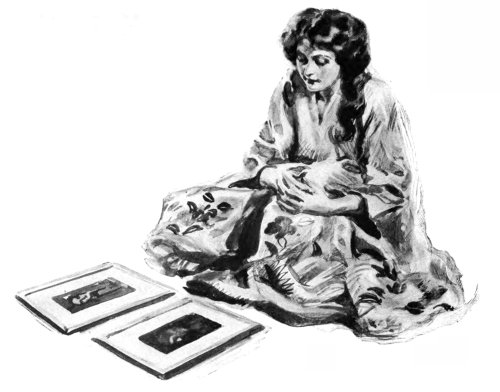
"She studied the faces alternately."
"You need not wait, Elise. I shall sit up and read."
"Very well, miss. Good night."
"Good night," answered her mistress dreamily.
Outside the rain swept steadily against the glass with a soft, silting
sound. From time to time drops fell down the chimney and hissed for a
moment ere they vanished black splotches upon the vermilion coals.
Behind her an electric lamp of bronze, with an opaque shade, threw a dim
light over her shoulder and lit up the masses of her loosened hair.
Presently she arose slowly and went into an adjoining room, returning
with a large photograph in either hand. They were framed alike. Placing
them side by side upon the rug before her, she locked her hands across
her knee, and studied the faces alternately. One was of a young
man—almost a boy—with a narrow, high-bred face, dark eyes, sallow,
with a mouth curved like a woman's. The other was Dick Ralston, taken
about five years before, although the high cheekbones, the gaunt energy,
the mature thoughtfulness suggested a man much older. That she cared for
Steadman there was no doubt in her own mind. Had she refused to admit it
definitely heretofore, the fact that he was now on the verge of social
and moral annihilation made it no longer a matter of question. She felt
that Steadman's honor was at this moment the most vital thing in her
existence. He had thrown it at her feet after a long and romantic
wooing. Had laid bare his entire past. She was convinced that he loved
her. But at the crucial moment she had hesitated, had not responded in
quite the way she had probably given him reason to expect. She had
asked for time for reflection, and could give no adequate explanation in
answer to his imperative "Why?" When later he had renewed his suit she
had again forced a postponement, and he had departed, annoyed and
perplexed.
It was at this juncture that the money had dropped into his hands and he
had disappeared. Where was he? On a shooting trip? He frankly admitted
caring nothing for sport or hunting. It was not the season for travel,
and his name was not upon the sailing lists. Her instinct told her that
somewhere in the great city Steadman, oblivious to the call of duty, was
living the life from which her influence had called him for a time,
reckless of consequences, disregardful of the beckoning finger of
opportunity. She knew also that this was his last chance.
She realized that she could never marry Steadman disgraced, yet she felt
now that she loved him, and that could she see him and watch him start
for the front with his regiment, she would promise him what he had
asked.
She took Ralston's picture in her hand and held it to the light. It
trembled a little. She knew she could have cared for him—but he was so
stern, so strong, so capable. He had never treated her save as a sort of
younger sister. She had often wondered if he cared or could care for any
woman. With her he was always the same—kindly, sympathetic, obliging,
thoughtful. What must he think of her, sending him forth in the dead of
night to search the city for a man whom he scarcely knew? Her cheeks
burned at the thought of what she had done.
She had hardly known what she was asking when she had sent the message.
It had been done hurriedly, as she was leaving for the Pattersons', on
the impulse of a moment when she felt that, unless John Steadman could
be found, life would cease for her to be worth living—sent in a sort
of hysteria in which she instinctively turned to the one man in all the
world upon whom she could call for any service she might ask. Dear old
Dick! How tired he had looked in the rain! He might be up all night
looking for Steadman, and then not find him! And he was to leave for
Washington to-morrow.
She went to the window, against which the rain drove in a fine shower,
blurring the myriad lights below her that marched in long, straight
lines to north, south, and east. On the Tower the searchlight still
burned steadily. She shivered and went back to the fire. Then she laid
one of the pictures gently against her cheek.
The Moonshine Theater blazes its defiance into the night from a gleaming
Broadway promontory, whose cape divides the restless human tide that
rises to its neap every evening about eleven and falls to its ebb in the
neighborhood of two or three in the morning. Through its arched portals
one might drive a hansom cab, and tradition says that the feat has been
accomplished.
Here Mrs. Vokes, under the alias of "Hélène DeLacy," first minced her
way into popularity—but that was in the days of crinoline. The youths
who loitered about its iron-bound stage entrance are gray-headed men
to-day, those of them who are still alive. Only old Vincent remains, as
rugged as a granite cliff, and as impervious to persuasion, bribery, or
anger. "I'm sorry, gents, but it's against my orders," is said as
conclusively to-night as it was twenty years ago. He got as far as:
"I'm sorry, sir, but it's against—" then changed it to a wondering:
"Bless my soul, Mr. Ralston! Is it you?" as he encountered the set face
of our friend.
"Why, Vincent," exclaimed the latter, "you still here? What luck! You
don't look a day older!"
"I can't say the same for you, sir. I understand congratulations are in
order. Oh, I read the papers. But—" he hesitated.
"But you think I'm rather old for 'Johnnying'?" interpolated Ralston.
"You're quite right. I am. But don't be alarmed; this is business. I
want to find a young woman named Ernestine Hudson. I must see her at
once. Can you fix it for me?"
"I think so," answered the guardian of the wings. "I'd do it if I lost
my job. I won't forget in a hurry what you did for my little Bill. Just
step——"
At that instant the door was thrust violently open and a gray-coated
messenger boy, carrying a large oblong box, projected himself violently
against Vincent.
"For Hudson!" he ejaculated shortly.
"Put 'em on that desk," directed Vincent.
"Say, boss, let me take 'em in," pleaded the boy.
"Who do you think you are, anyway?" inquired the doorkeeper. "Get out of
here."
The boy lingered, gazing wistfully down the gas-lighted passage, through
which floated the hum of the orchestra, confused by the shuffle of feet
and inarticulate orders.
Vincent took a threatening step in the direction of the boy, who made a
grimace at him and backed slowly through the door. Ralston smiled and
looked inquiringly at the box.
"It might serve as an introduction," he suggested with a smile.
"You don't need it," said Vincent. "I guess you remember the way. Just
step down the passage, and you'll find the chorus ready to go on for the
second act. Hudson's the wheel horse for the partridges. She has a bunch
of tail sprouts like a feather duster. What fool things the public pay
to see nowadays! Why, they ain't content to let a girl be a girl, but
they have to turn her into a bird, or a dress form, or a wax figger, or
an automobile, or a flower. Now take this show. It's supposed to be a
kind of a 'flag-raiser.' 'Marchin' Through Georgy' and 'Campin'
To-night' and all that, and the chorus is birds. Birds! Sparrers,
canaries, and partridges!" he grunted scornfully. "Well, good luck. See
you later."
Ralston walked down the passage and pushed open the skeleton canvas door
that separated him from the wings. The curtain was down, and a small
army of men were noisily pulling enormous flies into place by means of
pulleys. One group in the center of the stage were erecting a "Port
Arthur" bristling with guns, and several with wheelbarrows were bringing
in a foreground of rocks, which others arranged with elaborate
carelessness. Overhead hung a wilderness of ropes and drops, with
sections of scenery suspended in mid-air. Two spiral staircases of iron
sprang from either side and lost themselves in the tangle above.
Ascending and descending were a perpetual stream of heterogeneous
figures, who went up as birds and came down as village maidens, or who
from grand dames of fashion were transformed into Quakeresses or drummer
boys. There was loud chattering on all sides, interspersed with deep
invectives from the coatless hustlers on the stage. Above all shrieked
and rattled the pulleys.
The blinding light and the clouds of dust made the scene utterly
confusing, and for a moment Ralston hesitated vaguely. To his left a
flock of "partridges" clustered about one of the flies, while one little
lady partridge sat apart on a nail keg, and eased her little partridge
foot by loosening her slipper.
To the nearest Ralston turned and inquired for Miss Hudson. The girl
whom he had addressed stared boldly at him, and without replying waved
languidly toward the partridge on the barrel. It was evident that she
took no interest in the friends of Miss Hudson. Ralston turned, and at
the same moment heard a shrill cackle from the group behind him. In
spite of himself he could feel the red coursing up to his ears. The girl
on the barrel had entirely removed her slipper and was stretching her
toes. She did not look up at his approach, having already minutely
studied his make-up under the shelter of her heavily corked eyebrows, as
he emerged from the passage.
"Are you Miss Hudson?"
"Yes," said the partridge, critically examining her instep.
"My name is Ralston," he began rapidly. "I'm looking for a friend of
mine, who must be turned up at once. It's a matter of life and death,
and he's got to be found. I have an idea you know him."
"Have you?" said the partridge innocently.
"The man I refer to is John Steadman. Do you know where he is?"
The girl slowly lifted her head and looked at him rather impudently. She
seemed more like a large doll than a girl.
"I haven't the pleasure of your acquaintance, Mr. Ralston, if that is
your name, and I don't know your friend Steadman."
There was something about her manner that convinced Ralston that she
knew more than she admitted, but it was obvious that for purposes of her
own she had made up her mind to treat him with the scant courtesy
usually extended by show girls to people who are not worth while, and to
people it is worth while to keep for a time at a distance.
"I'm very sorry," said Ralston. "I believed that you were the one
person in New York who could tell me where he was. Of course, you might
know him under some other name."
"Why are you so interested in finding this Mr.—Steadman?" asked the
partridge, studiously inserting her foot in a shoe that seemed all toe.
"Simply for his own sake."
"Don't you ever come behind for yours?" she inquired abstractedly.
Ralston suppressed a smile.
"See here, young lady—" he began, changing his tactics.
"All on for the second!" shouted a big man in a Derby hat. "Here you,
Hudson, stop fooling and get into your place! Clear the wings."
From behind the wall of curtain came the distant crash of the contending
chords of the overture. "Port Arthur" with its rocks was in place, the
Japanese flag flying defiantly in a strong current of air, generated by
a frenzied electric fan held by a "super" in the moat. The chorus
trooped from the flies, and came tumbling down fire escapes and
staircases.
The partridge knocked her heels together and jumped lightly to her feet.
"Peep-peep!" she said. "See you later, old man. Stage door about
eleven-thirty."
She nodded at him and started hopping toward the stage. The other
partridges were forming in long lines, with much jostling of tail
feathers and fluttering of pinions.
"Hurry up there!" shouted the assistant "stage" in Miss Hudson's
direction, and then turned hastily toward the opposite flies where some
mix-up had attracted his attention.
Ralston saw his last clew hopping away from him. A bell rang loudly, and
the orchestra struck up the first few bars of the opening chorus. Hardly
conscious of what he was doing Ralston strode quickly after the
partridge and, grasping her firmly by the wings, drew her back into the
flies.
"Let me go!" she gasped, struggling to free herself. "Let me go! What
are you trying to do? Do you want to get me fined?"
"Keep quiet," whispered Ralston, "I've got to speak to you. Do you
understand? I can't let you go on. I'll stand for any fine, and square
you into the bargain. It's too late, anyway! The curtain's up already."
"Let me go!" she cried, the tears starting into her eyes. "You're
hurting me, you brute! I'll lose my job. The management don't stand for
this kind of thing. You're a fine gentleman, you are! Oh, what shall I
do?"
Ralston's heart smote him. He knew well the hideous uncertainty which
being out of a job means to the chorus girl, and its more hideous
possibilities.
"I'm sorry," he said humbly. "I had to do it, and I promise you shall
lose nothing by it. Now, quick, where can we talk? Not here? The manager
would see you."
The partridge wiped her eyes.
"Do you promise to square the management?"
"I certainly do—on my honor as a gentleman."
"Then come!" Hudson darted quickly back among the scenery, and Ralston
followed her down a flight of iron steps which led beneath the stage.
Pipes ran in all directions, and great heaps of old flies and useless
properties reached toward the low ceiling, between which narrow alleys
led off into the darkness. A smell of mold and of paint filled the air.
Even the scant gas jets seemed to burn with a peculiar dimness in the
damp atmosphere.
"Come along!" whistled the partridge.
Beyond a pile of lumber in a sort of catacomb she stopped. A bead of gas
showed blue against some whitewashed brickwork.
"Turn it up," said Hudson, and Ralston did so.
"Hungry?" she continued. "I could eat anything that 'didn't bite me
first!'"
Ralston laughed.
"Were you in that show?" he asked. "It was a good one. No, I'm not
hungry. Suppose I were?"
"This is our rathskeller," she laughed. "Are you thirsty?"
Ralston admitted to a certain degree of dryness.
"Certainly," he said, "I should like nothing better than a large
schooner of dark, imported beer. What will you have?" he continued,
carrying on the jest.
Hudson, who had seated herself on a low seat by the wall, got up and
struck sharply on the wooden partition with a stick.
"What's that?" asked Ralston.
"Perhaps some beer will come out!" remarked the partridge. "Moses was
not the only one."
A rattling followed, and a square opening appeared in the wall, in which
the shaggy tow-head of a young man was visible.
He grinned at sight of Miss Hudson.
"How vas de shootink?" he inquired. "Does de bartridges vant more vet?
Ha! Ha! You vas a bird!"
"Ya, Fritz. Two schooners and a hot dog. Hustle 'em up."
Fritz closed the slide which covered the opening and the partridge
turned gayly toward Ralston.
"What do you think of that? Pretty good, eh?"
"I don't understand," he replied. "Where did he come from? What is in
there?"
"I'll tell you. When 'Abe' Erlanger built this house there was a row of
old tenements on the side street. Well, Jo Bimberger tore 'em down and
built a rathskeller. While he was doing it one of the girls tipped off
the boss carpenter to leave this place. Ain't it grand? Say, you get
almost dead jumping around on the boards. It looks easy enough, but I
tell you sometimes you're ready to scream."
"Just the thing," answered our friend. "Do the management object?"
"Not a bit. 'Abe' gets a rake-off from the saloon. It's good business."
The slide opened and two dripping glasses made their appearance. Ralston
received them and handed one to Miss Hudson. Then Fritz passed in a
frankfurter about the size of a policeman's night stick.
Ralston drew half a dollar from his pocket and exchanged it for the
sausage.
"That's all right, keep the change," he remarked.
"My, you must have it to throw away!" said Hudson. "Twenty-three for
you, Fritz. Shut the slide."
Ralston took a deep draught of the beer. He could not help smiling as he
thought of the picture he would present could any one of his associates
see him at the moment. What, for instance, would the President have
said? And the Secretary of War! Underneath the stage of a theater,
drinking beer with a chorus girl! He put down the glass and pulled
himself together.
"Now to business!" he exclaimed. "This is jolly good fun, but I've a
long night in front of me, and I've got work to do in it. Where is
Steadman?"
The partridge looked at him inquiringly.
"You don't mean you really are trying to find anyone?"
"Certainly I do."
"Steadman?"
"Yes."
She shrugged her shoulders. It was clear, even to Ralston, that she was
disappointed.
"I can't help you."
"You know him?" Ralston's gaze penetrated her feathers.
"Yes. But I don't know where he is—and what is more, I don't care. He's
a cad."
"Well, let it go at that. But I've got to find him. How long is it since
you've seen him?"
"Three weeks."
"What was he up to?"
"Oh, the usual business. He's badly in. Let him go; he's not worth your
while."
"I didn't say he was. But he must be turned up. Was he drinking?"
"Yes!"
"Ah!" Ralston scowled.
"He's a bad one," continued the partridge. "He began at the bottom and
worked down."
"You must help me to find him. Who is he running with?"
"I don't know anything about him. I've heard he knows a girl named
Florence Davenport. If you can find her she might help you."
"Where does she live?"
"On Forty-sixth Street," and she gave him a number.
Ralston arose and put his hand in his pocket.
"I am very much indebted to you," he said courteously. "You won't mind
if I make good your fine?"
He drew out a bill and placed it in her hand. She raised her eyebrows at
sight of its denomination.
"No," she said, "I haven't done anything for you. I don't want the
money."
"But your fine?"
"That's all right," she replied, shrugging her shoulders. "I could have
gone on—if I'd wanted to. I was merely bluffing. You couldn't have held
me. You're a gentleman, and I don't want the money." She spoke quietly,
and looked him full in the face. Ralston wavered.
"Please don't," said the girl, and held out the bill. Ralston took it
and returned it to his pocket.
"Miss Hudson," said he, "you have placed me under a great obligation,
one that money cannot repay. If I can ever help you in any way let me
know."
The partridge got up and led the way toward the staircase. At the top
she held out her hand and Ralston took it in his.
"He's not worth it," she repeated. "Let him go."
"Noblesse oblige," he smiled, looking down at her.
The chorus had filed off the stage and were standing on the other side.
"Here you, Hudson! Where have you been?" whispered the manager hoarsely,
grasping her roughly by the shoulder. "Get over there."
"Leave me alone!" she cried sharply, shaking off his arm. Then, turning
to Ralston:
"Good night, sir," she said.
Outside the Moonshine Ralston found the usual congestion of cabs,
landaus, and wagons. He had delayed to exchange a few reminiscences with
old Vincent, and it was fully ten minutes before he could find his cabby
in the tangle of vehicles. As he stepped into the street, to save the
time requisite for the man to draw to the curb, an omnibus was vainly
trying to force its way through the side street. It had paused for an
instant in front of the stage entrance, and Ralston had caught a glimpse
of Ellen's face inside.
A momentary impulse had seized him to stop the coach and tell her of the
hopelessness of the task upon which she had sent him, but in the instant
of his uncertainty the way had cleared and they had driven on. He had
climbed into his own hansom, little the wiser for his experience at the
Moonshine.
The sidewalks were jammed with the usual after-theater crowd hurrying
either to get home as quickly as possible or to secure seats in
restaurants which pandered less to the taste of the gourmet than to
those of the roué. For a solid mile on either side of Broadway
stretched house after house of entertainment, any one of which could
harbor a hundred Steadmans, and for a quarter of a mile on either hand
lay twenty streets, lined with places of a character vastly more likely
to do so. He followed the crowd slowly northward, wondering why so few
of them walked in the opposite direction. Whenever he came to a
well-known hostelry he went in and eagerly scanned the tables, but,
although he recognized many he knew and who knew him, he found naught of
Steadman.
Having visited five "chophouses," a "rathskeller," two "hofbraus," and
several more pretentious places, he abandoned the idea of trying to
stumble upon his man, and returned to his original belief that only by
following some sort of a clew could he succeed. Somewhere in the hot
clasp of the city lay the miserable youth he had promised to find. For a
moment he regretted the answer which he had just sent to Ellen's
apartment—the four words that had pledged him to a fool's errand, the
absurdity of which was now apparent. Then came a realizing sense of the
importance to Ellen of his mission, and a grim determination to find
this man wherever he might be.
He had now reached Forty-second Street, and the crowd divided into two
streams, one moving eastward and the other northward, a part of the
latter to plunge beneath the Times Building into the subway, and the
remainder to add to the already existing congestion in front of the
Hotel Astor, Rector's, Shanley's, and the New York Theater. Longacre
Square boiled with life—a life garish, tawdry, sensual and vulgar,
unlike that of any other city or generation.
The restaurants could seat no more, and a bejeweled, scented throng
stood in the doorways and struggled for the vacant tables. The night
hawks lining the curb peered eagerly at every passer-by to note signs of
intoxication or indecision. Tiny newsboys thrust their bundles of papers
against dress waistcoats and felt for loose watches, ready to dart into
the throng at the first move of suspicion on the part of their victims.
Clerks with their best girls pointed out these and made witticisms upon
them, hoping thus to divert attention from the attractions of the
restaurants, for whose splendors they intended later to substitute the
more substantial, if more economical, pleasures of the dairy lunch.
Automobiles, in which sat supercilious foreign chauffeurs, blocked the
entrances of the pleasure palaces. Streams of country folk poured in and
out of hotels which made a specialty of rural trade, promising to their
patrons, in widely distributed circulars, easy access to everything
"worth seeing." These came, were relieved of their money, and, after
fervid correspondence on the hotel stationery, went home to poison the
minds of their townfolk with descriptions of scenes which existed only
in their imaginations.
For every person on Longacre Square after midnight who is there for an
honest purpose, there are three who are there either to do that which
they should not do or to see that which they should not see. It is the
white light in which the New York moth plays before he plunges into the
withering flame. It was here Steadman had begun, and like enough he was
not far off.
The electric clock above the roof tops moved to a quarter before one as
Ralston turned into Forty-sixth Street, and he looked both ways before
springing from his hansom and dashing up the steps of the number to
which he had been directed. After some time a mulatto maid opened the
door and asked his business. Miss Davenport was out, she said. Ralston
stretched the truth far enough to say that he was a friend. The girl had
no idea where she could be found. Then Ralston also volunteered that he
was a friend of Mr. Steadman's. Still the maid remained imperturbable.
The sight of a bill, however, led to an immediate change of demeanor.
Yes, Miss Davenport had gone out with a gentleman—not Mr.
Steadman—early in the evening. Did she know Mr. Steadman? Yes, she
thought she knew Mr. Steadman—a dark gentleman. She seemed anxious to
help Ralston, but doubtful of success.
As was not unreasonable, Ralston was beginning to be quite disgusted at
the position in which he found himself, a condition which was by no
means relieved by the fact that, as he reached the bottom of the steps,
he found himself face to face with Colonel Duer and a somewhat elderly
lady companion. The new Assistant Secretary felt distinctly
uncomfortable. Another man might have turned away his face, but Ralston
looked steadily into the colonel's under the full light of the street
lamp. Simultaneously he raised his hand to his hat, then crossed the
sidewalk and jumped into the hansom. The cabby lifted the manhole and
looked down the air shaft.
"Huh?" said he. "Where'll I go now?"
"I don't know," said Ralston.
The cabby chuckled. He was satisfied one way quite as well as another.
From his seat of vantage he was able to look down critically upon
mankind in general, and had learned to distinguish "the real thing" when
he saw it. He had no doubts as to Ralston, and no misgivings at all as
to the latter's ability to pay and pay well, and he was as confident
that his tip would be in accordance with the most advanced ideas of
liberality as he was that this same fare of his was quite out of the
ordinary. He had sized Ralston for a thoroughbred from the moment that
he had come downstairs. For one thing he did not waste words, for
another he neither looked at his watch nor inquired the price; for
another—and you could always tell by that—he knew just what he was
doing. Moreover, he was perfectly sober. He belonged to that small and
distinguished body of midnight travelers who realize that they are in a
cab and not in a hammock. Hence Ralston's admission that he did not know
where to go to next struck upon the cabby intelligence in the light of a
joke.
"Huh?" said he again, removing his cigar.
"I said I didn't know," repeated Ralston.
"Up against it!" said cabby with divination.
"Exactly," returned his fare with a slight laugh. "You are a man of
perspicacity."
"Huh?" repeated the cabby.
"I said you were a mind reader," answered Ralston.
"I guess I can see furder'n most," admitted cabby complacently.
Ralston had struck a match and lit a fresh cigar. He was feeling very,
very tired. His watch showed that there were exactly six hours left
before the Twelfth would start—not a minute more.
The cabby was still peering down the manhole and dropping an occasional
sympathetic ash on Ralston's silk hat. His fare interested him—he was
beginning to have a notion that Ralston was somebody. Maybe a big
military gun. He had that clean, hard look those fellers have.
Suddenly the fare spoke again, in an even more amiable tone than before.
"My friend, how long have you been in this business?"
The cabby hesitated while he made an accurate mathematical computation.
"Five years on a percentage—ten years on my own—fifteen years, sir."
"You know the town pretty well, eh?"
"Fairly well, sir."
"Is there a café somewhere a bit out of the way—something quiet, you
know?"
"Sure, across the square. Shall I drive you there?"
"Yes."
The cabby clucked to his horse, and they wheeled about and crossed the
White Way again. The pedestrians were thinning out. The rain had ceased,
the clouds had parted, and the sky was sprinkled with brightly burning
stars. Up in the Times Tower the afternoon before one of the editorial
writers had polished up a "war-whoop" such as, he had said to himself,
would make the Japanese emperor scratch his head. It was a half-column
"drip" in the nature of a "Godspeed" to the first volunteer regiment to
start for the front. He liked the Twelfth, and had been in it himself
under Ralston. The thought had reminded him that he ought to give his
old captain a bit of a send-off as well, and he had penned a dozen lines
to be inserted after the other, and headed "A Wise Appointment," ending
his short paragraph with the words: "The nation is to be sincerely
congratulated on the wisdom of the Executive's selection."
Twenty-five stories below, the subject of his encomium was now entering
the side door of a shabby café, followed by his cabby. They seated
themselves at a table in the corner of the sawdust-covered floor.
"The situation is this," began Ralston, after the waiter had picked up
his tip and retired. "I must, inside of six hours, turn up a man who is
somewhere in the city. He doesn't know enough to want to be found. He
must be located without outside help—quietly. The only clew I have to
his whereabouts is that he knows a young woman named Florence Davenport.
She lives in that house we stopped at. She has gone out with a man named
Sullivan. I don't know the fellow, but the chances are he won't help me.
But whether he will or not, I don't know where he is, and I must find
him in order to find her."
He looked at the cabby inquiringly.
"I know him, all right," said the cabby. "A big 'harp' with a sandy
mustache. I know her, too. I took 'em both out this very night."
"Took them out!" exclaimed Ralston. "Why, in Heaven's name, didn't you
say so before!" Then he remembered and laughed at the absurdity of his
question. The fatigue of a severe day was dissipated in a moment.
"Sure," continued the cabby, "I took 'em out just before I answered your
call. She uses the same stable."
"Where did they go?"
"Proctor's."
"Where do you suppose they are now?"
"You can search me!" responded the cabby, now thoroughly interested.
"The chances are about even between Shanley's and the Martin, but you
tried Shanley's. Better hike right down to the other place."
Ralston started swiftly to his feet, made his way to the cab, and in a
moment more they were galloping down Broadway.
The electric timepiece on the roofs marked four minutes past one as they
rattled past. What people were still awake were most of them inside the
shining windows of the restaurants, and the big porters were leaning
sleepily against the doorposts of their hostelries. In the cab Ralston
wondered what the President would say if he could see him then, chasing
all over the town after a young woman and her male escort. He was
dreadfully sleepy, and the cushions of the cab were so
soft—soft—sof——
He pulled himself together as the cab reined up sharply at the
Twenty-sixth Street entrance of the Café Martin. His driver did not need
to be told to wait, and Ralston hurriedly pushed his way through the
revolving doors into the hot, scented air of the waiting hall. If it was
late on Broadway, it was early enough inside the Martin.
On the right, in a crowded café, two hundred soldier boys and
civilians with their sweethearts sat noisily discussing broiled
lobsters, Welsh rarebits, caviare sandwiches, and such less important
matters as were suggested by the last news from Washington. The air
reeked with the fumes of hot food, cigarette smoke, and steam heat. When
the side door opened, and the draught pulled through from the main
dining room, one caught a whiff of rice powder and violets. The chatter
and clatter were deafening.
To Ralston the chances seemed in favor of the other and more conspicuous
company in the front room, so he turned back and crossed the hall. At
the door of the main dining room he paused. At fully eighteen out of the
twenty-five tables which were presented to his view sat an equal number
of young women who might have qualified as Miss Florence Davenport.
There was more room here, the music was louder, and the men had on
either uniforms or evening dress. The confusion was even greater than in
the café, due to the greater amount of light and music and the
variation of color. Here and there at the larger tables sat groups of
officers, indulging in pompous patriotic toasts.
Ralston moved toward the center of the room, eagerly scanning the tables
in search of a blond man with a light mustache, but he saw none to
correspond with the cabby's description. Then from behind him he heard
his name called, and he turned to be greeted by a chorus of
congratulatory welcome from a party of his old comrades of the Twelfth,
who crowded around him, drew him into a chair and ordered more bottles.
Ralston protested but feebly. He was out of sorts with the whole
miserable business.
"Here's to you, old man!" exclaimed Peyton, one of Duer's lieutenants.
"Boys, here's to the next Secretary of the Navy, and then, who
knows—well, here's to Dick Ralston, the best ever—bumpers!"
"Fellows," answered Ralston, "it's very good of you. It's very good of
the President. I hope I'll do him credit, but the best any of us can do
is the right way as each of us sees it at the moment—and no one knows
where it may lead us. Here's to being on the level—here's to the right
way and the white way!" He started to drink off the toast when a man's
head and shoulders arose behind Peyton, and a thick voice cried:
"That for mine! Th' White Way—th' Great White Way!" and he raised a
goblet and drained it. The men in the group laughed, and the laugh was
echoed from several of the tables. As the fellow stumbled back into his
seat Ralston realized suddenly that he had found his man. A red face and
a blond mustache! The elusive Sullivan at last!
For a moment our hero chatted animatedly with his friends, while taking
note of the position of the table at which the fellow sat. As yet he
could not see whether Sullivan had a companion, for the table was in a
recess and behind a stand of artificial palms. Then he leaned across the
shoulder of the man next him and caught sight of a gray silk dress and a
rose-trimmed hat. Who the lady was it was impossible for him to
discover, as her head was completely hidden by the paper foliage toward
which her companion was bending. They were, apparently, by no means near
the end of their supper, so that there was time to consider the
situation and to decide upon a course of action. But the situation
itself was a novel one to Ralston.
Now the mere accosting of a young lady in a public restaurant is not a
very serious matter, even if she be accompanied by a male escort, so
long as the matter be done decently and in order. But to suddenly burst
upon a tête-à-tête couple from behind a bunch of palms, and demand
what has been done with a young man, especially if it be nearly three in
the morning, is somewhat different. One mistaken move, and the search
would have to be abandoned. How was he to introduce himself to a strange
woman and compel her to divulge information which she might have no
intention of disclosing, and how, moreover, could this be accomplished
in the presence of a person of the type of Mr. Sullivan? He had no claim
on either of them. Even assuming that the bounder did not object to his
having speech with the lady, it was unlikely that she would admit any
intimacy with Steadman in the presence of her companion. No, he must
speak to the girl by herself—that was clear enough. But how? Obviously,
he could not invite her escort to step out into the next room for a few
moments. Neither was it at all likely that she would accede to any
request of his (carried by a waiter) either to speak to him or to get
rid of her companion. Again he was, in the vernacular, "up against it"
as his cabby had suggested on a previous occasion.
Meantime the moments were slipping by, with Ralston trying hard to keep
up his end of the conversation. Ten minutes more, and he had determined
definitely that there was no course open but to trust to the girl
herself for a solution. All he could do was to throw his hand down, face
up, before her, and let her decide. In the event of his request being
ignored, he must face it boldly out with both of them.
Borrowing a pencil he wrote upon his visiting card: "Miss Davenport will
place the writer under the greatest possible obligation by allowing him
to speak to her privately upon a matter of the utmost importance. He is
in civilian dress at the next table." Underneath his name he wrote:
"Second Assistant Secretary of the Navy." Summoning the head waiter he
instructed the latter to carry it to the lady behind the palm in such a
manner that it should be unobserved by her companion.
He felt instantly relieved—the relief the rider feels the moment he has
decided to take the jump and his horse rises beneath him. He plunged
anew into the banter going on about him. He saw, out of the corner of
his eye, his messenger circle the room, approach the couple from the
other side, address Mr. Sullivan, call his attention to something behind
him, and slip the card into his companion's lap. Then the attendant
moved on.
Several moments passed. He began to feel that nothing had been
accomplished when there came a crash of glass, the palm rocked, and the
lady in some confusion sprang to her feet, shaking her dress. Her escort
arose more slowly, cursing the nearest waiters in a comprehensive
manner. The hubbub in the restaurant ceased momentarily, but quickly
began again as the manager and his aids hurried forward to offer their
assistance.
They had hard work to appease Mr. Sullivan, however. He wanted to see
the proprietor, and insisted loudly, although irrelevantly, that he was
an "American gentleman." The table was righted, and the head waiter
promised that a second supper should be instantly forthcoming, but
Sullivan remained in a state of defiance. He insisted on seeing "Monseer
Martin"—"my fren' Monseer Martin," and called loudly for a "garsoon" to
take him there.
Apparently the lady herself was indignant, and was not at all averse to
having her escort see his "fren' Monseer Martin." Then, with his head
high in air like a red harvest moon, the rampant Sullivan made his way
toward the main door of the dining room, followed by the apologetic and
deprecatory head waiter.
As the two passed out Ralston arose.
"Going?" inquired Peyton.
"Not very far. I'll be right back," replied our friend.
The others watched him curiously.
In a moment he was behind the palm, and had sunk into Sullivan's vacant
seat.
"How d'y do, Mr. Second Assistant Secretary of the Navy?" remarked the
young woman nonchalantly. "Glad to know you. Rather a noisy
introduction, eh?"
"I'm surprised you thought it worth while," answered Ralston. "Our
friend has probably polished off Martin by this time, and is already on
his way back. Then he'll be ready to polish off me!"
"I guess you're able to take care of yourself, all right," replied the
girl. "What is it you want?"
"I don't know that it's wise for me to tell you on this short
acquaintance."
"Short? Yes. I suppose it is. But, you see, I know you. And if I can
help Mr. Ralston, why I will."
"Thank you," said Ralston. The words sounded entirely malapropos and
inadequate. "Tell me, then—tell me where to find John Steadman."
Instantly the girl's whole manner changed and she drew back.
"Steadman!" she exclaimed uneasily.
"Yes, Steadman! John Steadman. I must find him to-night!"
"You can't!" she cried in some agitation. "You can't. I've no business
to tell you even that, but you can't."
Ralston's face settled into a grim mask.
"I will!" he answered steadily. "And you're going to help me."
"I can't, Mr. Ralston. I can't. I don't know where he is."
Ralston's heart fell again.
"But you can help me?" he asked.
"I can't. I swear I can't," she replied almost hysterically, and Ralston
could see that she was speaking the truth.
"Tell me," he said, "tell me, and I'll give you anything you ask—does
Sullivan know?"
As he spoke the girl's face turned pale under the electric light. She
nodded her head slightly, while at the same moment a thick hand
descended on Ralston's shoulder and a heavy, wine-laden voice growled in
his ear:
"Whatcher doin' in my seat?"
Ralston sprang to his feet and shook off the hand.
"Whatcher doin' talkin' to this lady?" inquired the other, his eyes
blazing with anger. His voice rang loudly above the roar of
conversation.
"Miss Davenport is a friend of mine," replied Ralston as quietly as he
could.
"Frien' nothin'!" cried Sullivan. "I'll teach you to mind your own
business." He took a step backward and began to pull off his dinner
jacket.
"Don't, Jim!" cried the girl. "Don't! Please! Please don't!"
"Shut up!" snarled Sullivan. "I'll attend to you later!"
There was a great uproar in the restaurant. At the same instant Sullivan
led heavily at Ralston's head. Almost automatically, with every ounce of
his body at the end of an arm trained into a steel rod, Ralston ducked
and countered. His fist caught Sullivan squarely on the chin, and the
man went down and backward like a duck shot on the wing. His head struck
on a corner of the table, and he lay motionless.
The next instant Ralston was the center of an excited, jostling crowd.
Peyton had his arm around him and was whispering: "Get out quick, old
man. Awfully unfortunate. Get out while there's time."
"Some one ring for an ambulance!" shouted a civilian at a nearby table.
"Is there a doctor here?" inquired the head waiter mechanically,
hurrying toward the door.
Ralston's head reeled. The President's latest appointee mixed up in a
drunken brawl at a public hostelry! Worse than that, if possible, he
had, perhaps, killed the only man who knew where Steadman could be
found. It had all happened so quickly that he saw it like the scenes of
a vitagraph, with little twinkles of light glinting all about. Then a
girl's voice whispered in his ear:
"Get away! You mustn't be mixed up in this. Get away while you can!"
Somebody began to fling water in Sullivan's face and to rip off his
collar. The crowd forced itself almost upon the prostrate man. "Get
away," he heard Peyton repeating. "Don't be a fool! Think of the
Administration!"
Men were climbing upon tables to see what was going on. There was a
deafening hubbub from the main hall, into which the crowd from the other
room was pouring. Ralston was thinking as quickly as he could. He saw
his whole public career shattered by a single blow. He saw Ellen's
anxious face and heard her words: "Please find Steadman." He ground his
teeth. The only clew to Steadman lay like a log before him, struck down
by his own hand.
Some one in the back of the room shouted: "Send for the police—a man
has been shot!" and he heard the silly cry repeated in the outer
corridor. Less than half a minute had passed, but to Ralston it had
already seemed twenty, when he decided upon the only course Fate had
left open to him.
How he managed to do it he never really knew. Afterwards it appeared
absurdly impossible, but Peyton said that at the time it seemed
reasonable enough. There had been a moment when, in the confusion, the
crowd had blocked its own efforts to get closer, a moment when no one
apparently had known what to do, a moment which Ralston, in his
businesslike and rather autocratic fashion, had turned to his own
advantage.
A hurried whisper to Peyton, and with the help of one of their brother
officers they had raised Sullivan from the floor and, followed by the
girl, had carried him to the Fifth Avenue entrance. "Keep back the
crowd!" Peyton had cried to the head waiter. "We must give this man
air," and in a moment more they had staggered with Sullivan's limp form
to the ever-ready hansom, which had wheeled quickly to their assistance,
and shoved him in.
In another moment there had appeared around the corner of the building a
throng of men and women in evening dress, among whom were mingled
waiters, pedestrians, and cabmen.
"To the hospital!" cried Ralston, and pushing in the girl, sprang after
her himself. The cabman cut furiously at his horse, the bystanders
parted, and the hansom leaped forward like a chariot in a Roman
amphitheater, with Ralston, who had snatched the reins from above his
head, guiding the excited animal down Fifth Avenue.
A policeman made an ineffectual attempt to stop them at Twenty-third
Street, but quickly stepped aside to avoid being run down.
"Hully gee!" shouted the cabman inconsequently, "Hully gee!" while the
girl, staring abstractedly at the motionless face beside her, murmured
excitedly, "A clean get-away! A clean get-away!"
They turned west at Eighth Street and crossed Sixth Avenue at a slow
trot. Ralston had surrendered the reins to the driver and was now
racking his brains for a solution of his extraordinary and sensational
predicament. The girl had taken Sullivan's motionless head into her lap.
"Where to, sir?" inquired the cabby through the manhole.
"I don't know," answered Ralston. "Lose us if you can, that's all. Lose
us so we won't be able to find our own way back."
They continued west, following narrow, dimly lit streets, under the
shadow of high warehouses. Sullivan had given as yet no sign of life and
the girl had not spoken since Twenty-third Street. The strain of the
situation began to tell.
"Well, what are we going to do now?" inquired Ralston with an attempt at
jocularity. The girl did not reply, and as he heard her sobbing softly a
pang of remorse touched him. What business had he to force this young
woman into being an accessory after the fact in what might be heralded
as a crime?
"Miss Davenport," he said, "I'm awfully sorry to have dragged you into
this. Indeed, I am. Let me drive you home. I'll look after Sullivan, and
if necessary take him to a hospital."
"And leave you to stick this out by yourself? Not on your life!" she
replied. "It's a bad mix-up, but we've got to pull it off somehow. But
first we've got to do something for Jim. Look, there's a drug store over
there and a night light."
"But that won't do," expostulated Ralston. "We never could explain to
the officer on post. We'll have to go somewhere else. You know about
these things. Where?"
"Yes, yes—I know."
"Well, quickly!"
The cabman was peering down through the manhole.
"Do you know Commerce Street?" asked the girl.
"Sure I do," said the cabby.
"Well, go to No. 589."
The cabman jerked around his horse. They were in Greenwich Village now,
and not far from the old New York Central freight depot. Trim little
brick houses with white portals and tiny eves lined the streets. Slender
lanes led away into black distances. The night was silent save for the
rush and roar of the elevated and the clack of their own horse's hoofs.
Not a window was agleam. In this respectable neighborhood folks went to
bed betimes, and got up early.
The cool night air soothed Ralston's nerves, but with it he felt limp
and tired. The excitement at the restaurant, the wild dash down Fifth
Avenue, the presence with them of a man who might perhaps be dead, the
fear of pursuit, the extraordinary situation in which he, a man of so
much recent prominence, found himself, the strange way in which this
girl had become a partner in his fortunes, dazed and bewildered him.
"He can't be dead," muttered Ralston. "He can't be dead!"
The cab turned into a little street lined with irregularly shaped
houses. A few gnarled and distorted trees, whose trunks burst out of the
concrete pavement, raised their dust-laden branches, prehensile and
unnatural, into the starlight. A hundred feet from where the street
began it turned sharply to the left, forming a right angle, and
debouched again into another thoroughfare. Had one of the ends of it
been closed it would have formed a natural cul-de-sac—an appendix to
one of the great canals of the city. And with curious impropriety the
city fathers had named this "accidental" Commerce Street, leaving it to
the imagination as to what sort of commerce had been intended. A rickety
gas lamp leaned dangerously toward a flight of high wooden steps in the
angle of the street. Strangely enough, when the street turned the house
turned, too, so that half its front faced north and half east. The
natural inference was that the inside of the house was shaped like a
piece of pie, with its partially bitten point abutting on the corner.
Ralston took charge of Sullivan and the girl sprang down and stepped
into the area. Somewhere at a great distance a bell rang once, and then,
more faintly, a second time. They waited in silence. On the main
thoroughfare beyond the gnarled trees a policeman slowly sauntered
across the street. At the top of one of the opposite houses a window was
raised cautiously and voices could be heard whispering. Again the bell
jangled loosely in the distance, then came the sound of iron bars
rattling and bolts being shot back. A grating creaked rustily.
"It's me—Floss. Let me in."
The girl ran back to the cab and a match flared in the grating. Ralston
thought he saw a wrinkled face behind the light.
"All right. Bring him in," said the girl.
Ralston and the cabman lifted the lank form of Sullivan to the sidewalk
and half carried, half dragged him into the area. At their feet lay a
small flight of steps upon which played a feeble light from the inside.
Down this they pulled the victim of Ralston's strange quest. A passage
opened before them, in the middle of which stood a tiny, wrinkled Jewish
woman, who watched them with snapping, restless eyes, like those of a
blackbird.
The girl pushed by them and, taking the candle from the woman, opened a
door leading to the right. The air was close and unwholesome. A bed with
only a mattress covering the springs stood in the corner, and upon this
Ralston and the cabman placed the still unconscious form of Mr.
Sullivan.
"That'll do for the present," said the girl. "Now you" (addressing the
cabman) "wait outside. If the cop asks what you are doin', you're
waiting for a fare in another house, see?"
The cabman retired, and the Jewish woman lit a kerosene lamp. The girl
disappeared and returned with a wet sponge and a bottle of ammonia. She
now opened Sullivan's shirt and sponged his face with perfect
confidence. Then she poured some ammonia upon the sponge and applied it
to his nostrils. Ralston, leaning over the bed, coughed in spite of
himself.
Sullivan opened his eyes a little; the girl removed the sponge and put
her head close to his face.
"He's breathing—he'll come round all right," she said. "He stays 'out'
an awful long time."
She gave him the ammonia again and the patient gasped audibly. Ralston
heaved a great sigh of relief. Although he had known himself to be
absolutely in the right he was aware that this body-snatching was, to
say the least, irregular. Had the fellow died it would have made a nasty
story for the papers. He sank back on a horsehair rocking chair and the
room grew black with little pricking stars. The next moment he felt the
sponge thrust in his face.
"You're almost out yourself, Mr. Ralston. I'll have a cup of coffee
ready for you in a minute. Lie down on the sofa."
Ralston indeed felt sick and faint, the lids of his eyes seemed like
lead, pulled down by invisible but powerful strings. The man was not
dead! But Steadman—he'd think of Steadman in a moment, after he had
rested his eyes a little——
He leaned back his head—and slept. A light touch on his forehead
awakened him half an hour later, and he opened his eyes upon a strange
picture. The room was stuffy and warm as ever. The lamp cast but an
uncertain light on the walls, which, he noticed, were quite bare of
ornament. Over the windows were heavy wooden shutters, bolted on the
inside. On the bed lay Sullivan, breathing heavily. The floor was
covered by a dirty rag carpet, and the only articles of furniture
besides the bed itself were a horsehair-covered lounge, a small table,
and two horsehair-covered chairs, and in the midst of these uncouth
surroundings stood a girl in shimmering evening dress, her white
shoulders shining in the lamplight, offering him a cup of hot and
fragrant coffee.
"You're a brick," said Ralston feebly.
The girl smiled.
"Kind of funny, ain't it? To think of you and me and him"—she pointed
over her shoulder—"being here. What a rumpus the police'll make when
they can't find him at any hospital. It's a queer mix-up, now, ain't
it?"
"I should say it was!" echoed Ralston. He gulped down the coffee. "Do
you live here?" he asked, sweeping the room again with his eyes. The
girl smiled.
"Not generally," she said.
"But this house—whose is it?"
The girl shrugged her shoulders.
"They've never been able to find out at the tax office," she said.
"You're a good girl," said Ralston inconsequently.
The smile on the girl's face changed. She started to speak. Then she
closed her eyes and covered them with her hands.
The figure in the bed gave vent to a long-drawn-out snort and tossed
heavily. The girl dabbed her eyes with her wrists and turned with an
anxious look.
"He's waking up," she whispered. "He'll be crazy when he sees you here."
"But I brought him here," said Ralston, "and it was his own fault.
Besides, he is going to find Steadman for me."
"Find Steadman for you?" she exclaimed.
"Why, certainly! Why not?"
The girl looked at him in amazement.
"And that's why you carried him off?"
"Yes—naturally—of course. What did you think?"
She gave a low laugh and clapped her hands softly together.
"And I thought all along it was just to get yourself out of the mess you
were in—to avoid the publicity and all. I didn't see your game. I
thought it was all up for you—and the best you could do was to get out
of having to go to court! But they can't count you out, can they? My,
you have got a nerve!" she finished enthusiastically.
Ralston shrugged his shoulders.
"I assure you it wasn't as clearly thought out as all that. It was like
clutching at whatever was left. Sullivan's my only clew. How can I force
a statement from this fellow? What has he done? What hold can I get on
him?"
The girl looked at him half frightened yet full of admiration.
"Don't try it, Mr. Ralston," she whispered. "Give it up. You can't do
it. It's too late. Besides, Sullivan's a dangerous man—a man who stands
in with all the politicians—a bad fellow to threaten. He's done things
enough, God knows, to send him to jail a dozen times—but leave him
alone! You've done enough for Steadman. If you try to monkey with
Sullivan anything might happen to you. You mightn't leave this house
alive. Get away before it's too late. You're probably due in Washington
about now. This night's work will blow over, and Steadman isn't worth
the powder to blow his brains out." She clasped her hands with a gesture
of entreaty.
"No," said Ralston. "I've begun, and I must finish the job. I mightn't
have gone into it if I had known what it was going to cost, but it's too
late to back out now. Besides, I've nothing to lose. I'm done for. This
'Martin' business would kill the Administration if I didn't resign. In
fact, the public need never know that I have accepted. Fancy! The police
looking for the Second Assistant Secretary of the Navy as a fugitive
from justice! Why, the papers will be full of it. But that doesn't help
me with Steadman. I've got to force this fellow here to give up. Tell me
something to use as a lever."
The man on the bed groaned loudly and elevated one knee high in the air.
The girl hesitated, evidently torn between various conflicting claims of
loyalty.
"Tell him," she whispered after a moment—"tell him you know all about
Shackleton and the Mercantile bonds. If that isn't enough, say you'll
hand him over for the Masterson deal—that'll fetch him, but be careful
and don't get him angry. He may not know where Steadman is, after all.
But I heard him say that the gang had almost finished trimming Steadman
and were going to finish him up to-night—at cards I think. They've
gotten almost every cent he has already——"
Sullivan gave a harsh cough and arose to a sitting position.
"Shackleton—Mercantile bonds—Masterson deal," murmured Ralston to
himself.
"Huh! That you, Floss?" grunted Sullivan. "What are we doin' here?
Where's the old woman?"
"Sh-h! It's all right, Jim," said the girl. "We made a clean get-away.
You came near running in the lot of us."
"Whatcher talking about?" mumbled Sullivan. "'Bout 'getaways'?" Then he
caught sight of Ralston. "Who's this feller?"
"All right, Mr. Sullivan, I'm a friend of yours," said Ralston quietly.
Sullivan looked fixedly at him for a moment without speaking.
"I've seen you before," he muttered. "Somewheres."
"Sure," said Ralston with a laugh. "You tried to do me up at 'The
Martin' not over an hour ago."
Sullivan glared at him.
"You that feller?"
"I am."
"Whatcher doin' here?"
"Same thing I was going to do at 'The Martin' if you'd given me the
chance—have a talk with you."
Sullivan looked puzzled and rubbed the back of his head. He had none of
the resplendency of his earlier appearance.
"Must ha' fallen an' hit my head," said he in an explanatory manner.
"Say, did anyone club me?"
"No," said Ralston. "But you got a pretty rough deal."
"Say," repeated Sullivan, "how'd you come to bring me to the old
woman's?"
"I had to take you somewhere," said Ralston. There was a pause of
several seconds, during which Sullivan endeavored to readjust himself.
"What's yer name?" he inquired.
"Sackett," said Ralston.
"Sackett," repeated Sullivan. "I don't know Sackett. What's yer
business?"
"Oh, I'm a detective," answered Ralston lightly.
Sullivan started and clutched at the mattress.
"Detective!" he muttered. "What d'yer want?"
"I don't want anything," said Ralston. "I know quite a lot about you,
Mr. Sullivan, but it stays where it is. All I want is a little help."
"You go to hell!" growled Sullivan.
"No—no!" replied Ralston. "Not yet. I want you to tell me where I can
find Steadman. You see, his folks are anxious, and it's worth quite a
little to me to locate him. It needn't interfere with any of your
plans. Besides, I imagine you're about through with him, eh?"
The color returned to Sullivan's face and he snarled angrily.
"None of that to me, see? I am on to you, understand? You'd better get
out of here, while you're still able."
The girl, who had remained silent, now spoke again:
"Be careful, Jim; this man can make trouble for us."
Sullivan looked sharply at her, but evidently nothing about her
appearance or speech excited his suspicions.
"Mr. Sullivan," continued Ralston from his seat in the horsehair rocker,
"I don't mean you any harm. In fact, I can do you a good turn now and
then if you'll help me out. All I want is my coin for turning up this
chap Steadman. I know he's no good. He's anybody's money. He's nothing
to me. But it's all in my day's work. Now, don't think me disagreeable.
I want Steadman, you want—well, you don't want certain little incidents
of your career to get to the ears of the district attorney—the
Shackleton bonds, for example. Now, don't be alarmed. I haven't the
slightest intention of giving you away, but, come now, let's be on the
level with each other."
Sullivan cast an evil look at him.
"You think you've got something on me, eh? Prove it! What bonds did you
say?"
Ralston saw that he had nearly made a slip.
"Quite right," said he. "I said Shackleton bonds—I was thinking of
Shackleton. Of course I meant the Mercantile bonds. But if you have any
doubt about my sincerity I might go into the Masterson matter——"
But Sullivan was on his feet, his eyes staring, and his face as pale as
it had been on the floor of "The Martin."
"For Heaven's sake!" he implored.
Ralston rose.
"Come! Come! Is it a bargain? You help me and I help you. Where is he?"
"I'll go with you," muttered Sullivan. "Where's my coat?" He looked
around anxiously. There was no doubt as to the effectiveness of the
reference to the Masterson case.
"Get me a coat," he ordered of the girl. Florence Davenport left the
room, leaving the two men facing one another—the criminal and the
gentleman. It would have been hard to say which looked the more haggard.
The light of the dim lamp made the rings around Ralston's eyes look like
huge horn-rimmed spectacles, and his mouth was drawn to a thin line.
Inside his head was beginning to sing and the corners of his lids to
twitch. He knew the symptoms. He was beginning to "fade out." But he was
getting warm now and he paid no heed to himself.
The girl returned, bringing in her arms a pile of new silk-lined black
overcoats. Ralston remembered the incident afterwards, but at the time
it did not impress him. It is doubtful whether he knew definitely the
meaning of the term—"a fence."
Mechanically he selected a coat to fit him and Sullivan did the same.
The Davenport girl put on the smallest.
"Gimme a hat," said Sullivan.
Again the girl departed and presently returned with an odd collection of
old felt hats of various styles. Now, fully arrayed, Sullivan felt his
way gingerly to the door. A pale gleam filtered through the grating. The
bolt was shot back and Ralston found himself in the fresh morning air.
A white, misty light filled the sky like a diaphanous, pulsating sheet.
If you looked for it it was gone, but as you watched the opposite houses
you knew it to be there. Night was struggling with the day, and the
cohorts of darkness were barely in the ascendant. The tang of the breeze
told the story, filtering in from the river. But the lamps showed
brighter than ever. On his box the cabman slumbered, while his steed did
likewise in cabhorse fashion.
Sullivan reached up and shook the man roughly. Across the end of the
street heavy vans were making their way eastward, filling the little
niche in which they stood with a deafening clatter.
"Drive up Broadway," ordered Sullivan.
The cabman removed his hat, ran his finger around the sweatband and
replaced it on his head.
"Hully gee!" he repeated reminiscently. Several yanks were required to
hoist the horse into a position appropriate to locomotion, and when
action was achieved the animal started as if walking on eggs. Sullivan
and Ralston took Miss Davenport in her black overcoat between them.
Ralston could not tell whether the sky above was white or blue.
Slowly they dragged out into Barrow Street and turned into Green Street.
Once or twice they passed a lonely pedestrian or a stray policeman. Soon
they saw the lights of the elevated structure at Jefferson Market and
caught the moving windows of the trains. A line of truck wagons was
moving slowly southward, the drivers sleeping, unmindful of their route.
Milk wagons jangling from Hudson Avenue added a livelier note. There was
a smell of morning everywhere.
Suddenly Ralston knew he saw white and not blue above the housetops.
The thought filled him with a nervous anxiety to lose no time, and he
pushed up the manhole and ordered the cabby to make haste.
"What do you think I am—a bloomin' steamboat?" inquired the cabby in
sleepy wrath.
They wheeled into Sixth Avenue and Ralston noticed that the surface cars
which passed already had some passengers. Men were standing in twos and
threes upon the street corners. Most of them were smoking clay pipes. He
wondered what manner of men went to work at this hour. They passed
Fourteenth Street and found many persons walking westward—at nightfall
they would plod back. It was a long, long way to go to work. No one had
spoken in the cab as yet.
"Funny how small the city seems at night," said the girl.
Although there was a germ of psychological truth in the remark, Ralston
could think of nothing in reply. He had often noticed the same
phenomenon. Of an afternoon, with Fifth Avenue crowded to the curbs, the
distance from his club to Forty-second Street appeared immense. By night
it seemed no more than a block or two. Now, as they rode northward in
the graying light, the distances which his mental cyclometer ticked off
seemed small and their pace inordinately slow.
Sullivan had maintained a consistent silence. The Masterson affair had
effectually put a quietus upon his belligerency. Ralston was overwhelmed
with sleep. There was a weight behind each of his eyeballs that seemed
forcing them downward and outward, and the humming in the back of his
head had returned. A faint odor of violets and rice powder emanated from
the overcoat beside him. Now and again the small head, with its piles
of brown hair and old slouch hat, would begin to incline gradually and
gently in his direction, only to be raised again when the brim of the
hat touched his shoulder. He leaned his own head in the corner and
closed his eyes.
Instantly a heavy curtain, warm, fragrant, deliciously soothing, seemed
drawn over him. He found himself talking to Ellen in Miss Evarts's
drawing-room. He felt again the elation of his appointment, the
gratefulness of appreciation. The man was painting in his name on the
blackboard—the man in the yellow-and-black sweater, and he heard the
crowd spelling it out and repeating it. Once again he experienced the
thrill it had occasioned him the night before. He realized anew the
extent to which his selection had brought him into the public eye—the
influence which the success or failure of his appointment would have
upon the Administration.
The President had been already severely criticised for giving important
places to comparatively young and untried men—men of the silk-stocking
class—and the President had but a doubtful hold upon the people.
Several canards had been started which, in the face of recent
socialistic propaganda, had made considerable headway. The yellow
journals were denouncing the war as imperialistic, as an excuse for an
ambitious executive to play the part of a Cæsar or a Napoleon. They
charged that he was surrounding himself with the rich and powerful, and
their sons. He was contrasted with Lincoln and Jefferson. In a word, the
Administration was in a ticklish position.
Then upon Ralston's wearied brain flashed the picture of his meeting
with Colonel Duer; the tawdry, tarnished environment of his search for
the worthless Steadman; his arrival at "The Martin" at two in the
morning; his open solicitation of a woman's acquaintance, and the
consequent free fight in which, so far as the onlookers knew, he might
have killed her companion; then, and most unpleasant of all, his flight,
bearing away his victim with him. How could he explain that? Why, the
thing must have been wired to every morning paper in the country. He
could see the headlines:
ASSISTANT SECRETARY OF NAVY KILLS MAN
FIGHT AROSE OVER WOMAN IN RESTAURANT
A NEW SCANDAL FOR THE PRESIDENT TO HUSH UP
He shuddered at the thought of it. If he gave himself up and declared
that he had struck in self-defense, how could he explain having dashed
away with the woman in a hansom? Where had he gone? Why had he gone
there? His lips were sealed. He could make no statement without
publicly avowing the whole object of his night's work—the necessity for
finding Steadman, and Steadman's relations with Ellen. He saw column
after column of interviews with himself, real and imaginary. The most
sacred passages of Ellen's life would be made public property, dressed
up to suit the editor's fancy, and sold on the corner for a penny.
The possibility sickened him. There was nothing to be done but to resign
and go away. In that way only could the Administration be relieved from
a most embarrassing situation, and by no other means could Ellen be
saved from the humiliation incident to a truthful explanation of the
affair. Then, too, he must continue his search. He could not give it up
now. He must find Steadman, even while a fugitive from justice himself.
He would find him.
He opened his eyes. They were still following Sixth Avenue beneath the
elevated tracks. It had grown brighter. Sullivan had lighted a cigar.
Ralston found himself trembling with excitement. A sweat had broken out
all over him. Across the way, on the opposite corner, he saw the lights
of a telegraph office, and he raised the manhole and told the cabby to
stop.
"What's up?" inquired Sullivan, removing his cigar.
"I've got to send a telegram," said Ralston unsteadily.
Sullivan looked at him with suspicion.
"You ain't givin' me the double cross, eh?"
"I give you my word I'm not," replied Ralston. "It's only a matter of
private business."
"Guess it can wait, can't it?"
Ralston smiled in spite of himself. He wished he could tell Sullivan the
purport of this telegram which gave him so much anxiety. Simultaneously
it occurred to him that it was undesirable to leave the cab even for a
moment Sullivan might take it into his head to disappear.
"Oh, well," he retorted, "it doesn't entirely suit my book to allow you
a chance to side-step me either, so we'll settle it by letting Miss
Davenport send the wire for me. In that way we can each continue in the
other's company. Much more agreeable, of course. Miss Davenport, may I
ask you to get me a blank from inside?"
The girl sprang down and quickly returned with a sheaf of blanks and a
pencil. Ralston scribbled on his knee a hasty message:
To the President, White House, Washington. Am forced,
after all, to decline appointment. See morning papers.
Am writing fully.
Ralston.
He handed her half a dollar and she reëntered the office.
Now Miss Davenport was a young person wise in her generation. She had
seen many men in many situations, and she realized that the man who had
handed her this particular telegram was in a condition bordering on
collapse. Had she seen fit to use a sporting term she would have said
that Ralston was "groggy" with nervousness and excitement. In addition
she was not devoid of the usual amount of feminine curiosity. At any
rate, her first move was to read the telegram.
"He's crazy!" she exclaimed under her breath. "Why, he doesn't even know
whether they got his name! And Jim's all right." She turned the message
over in her hand.
"I guess that telegram can wait. There won't be anything in the
papers. The presses are locked at one o'clock."
"Say," she remarked to the sleepy operator, "what's the rate to
Washington, D. C.?"
"Twenty-five for ten words, and two cents a word over."
"Change that for me, will you? Let me have some coppers?"
The man fished out the small change and went back to his accounts.
Miss Davenport slipped the paper into her pocket and returned to the
cab.
"Nineteen cents change," she said, handing it to Ralston.
"Where to?" asked the cabby mechanically.
"West Forty-fifth Street," said Sullivan.
They started on. The street lamps were fast paling beneath the dawn. At
Thirty-third Street and Broadway a newsboy was hopping on the cars and
shouting his items. A strange thrill of determination had seized
Ralston. The die was cast now. There was nothing more to consider.
"Here's your Morning Journal!" cried the boy as the cab swung by. "New
Assistant Secretary of the Navy. Twelfth Regiment starts with a full
quota of officers!" He waved his sheets at them.
Inside the cab Ralston set his teeth.
"I'll make it a full quota!" he muttered.
They turned down Thirty-third Street into Fifth Avenue.
"Look here," said Sullivan suddenly, "all I do is to show him to you,
see? Understand, I don't get into no mix-up myself! My job ends when I
give you the pass."
"All right," said Ralston. "Just show him to me. That's all I ask."
"All right," repeated Sullivan.
They passed Forty-second Street and turned into Forty-fifth, just as the
lights in the crosstown cars had been put out.
The house before which they stopped was an old-fashioned brownstone
front. A brownstone flight of steps with a heavy brownstone balustrade
and huge, carved newel post of the same depressing material led to a
pair of ponderous stained doors tight shut with the air of finality
possible only to a brownstone side street. The shades on the four rows
of windows of this impenetrable mansion were smoothly drawn. At the
grated window in the area the lower half of a bird cage, just visible
beneath the screen, was the only indication of occupancy. The whole
aspect of the place was that of somnolent respectability. One could
imagine the door being swung wide, the rug shaken, the broom making a
fictitious passage through the vestibule, the curtains going up unevenly
in the front parlor, the shades raised in the area, the canary thrilling
in response to the shaking of the kitchen range, and Paterfamilias
coming down the steps at about eight twenty-five in a square Derby hat,
to go to his real estate office. This is what occurs at four homes out
of five in this locality every morning from the first day of October to
the first day of July.
But no eye within the last ten years had beheld a shade raised in this
particular establishment. The census taker had never entered its doors.
No woman had ever passed its threshold. No child had ever played within
its halls. Once a year a load of wines was deposited there and once a
month a grocer's wagon paused outside. The coal was put in during the
summer—forty tons, C. O. D. and five per cent off. The milkman was the
only matutinal visitor, and the milkman left his wares upon the flagging
of the servants' entrance. At eleven o'clock a colored man emerged from
the area and departed in the direction of Sixth Avenue with a basket
upon his arm. In half an hour he returned. This was the chief occurrence
of the day. At seven in the evening two hansom cabs drew up before the
door to allow four men to enter the house—also by the area. That was
all, except that the ice wagon stopped daily, but the colored man took
the ice off the hooks at the door.
The visitors at the house arrived in cabs between the hours of eight and
twelve P.M., and departed between the latter hour and five in the
morning. There are forty similar ménages north of Thirty-third Street
and east of Long Acre Square.
"He's in here," said Sullivan. "But I ain't goin' inside."
"You're not, eh?" remarked Ralston. "Very well, we stay here together
then until he comes out—and then you go down to headquarters with
me."
"Look here, Sackett," whined Sullivan, "how can I go in? They'd see me
and know I'd sold 'em out. I can't do it. It would finish me. Don't be
unreasonable."
"Well, how do I know he's here?" asked Ralston. "Don't be unreasonable
yourself."
"Well, I know he's here," said Sullivan. "I tell you what I'll do.
I'll go into the hall, and when you're satisfied I ain't givin' you the
double-cross, I'll slip out. Suppose I showed you Steadman, that would
satisfy you, wouldn't it?"
"It certainly would," said Ralston.
Sullivan looked up and down the street and then clambered out in a
disjointed and rheumatic fashion.
"I'm sorry, Miss Davenport, I can't let you have the cab," said Ralston.
"I shall need it—I hope."
Sullivan was on the sidewalk, looking at the house.
The girl suddenly seized Ralston's hand.
"Mr. Ralston," she said, "be careful while you are in that house. Don't
mention a word of what I've told you about Sullivan. They're a reckless
lot. Watch yourself and them. Play it easy, and good luck to you. Some
time, I hope, I'll see you again."
Ralston pressed her hand.
He climbed down.
"Where to?" mumbled the cabby.
"Stay right here until I come out—if it's six hours!" directed
Ralston.
The dawn was flushing the chocolate-colored fronts before them and a
milk wagon was working gradually down the block. Ralston felt weak in
the knees, but he pounded his feet on the pavement and stepped quickly
after Sullivan, who had started up the steps.
"I needn't warn you that there must be no funny business, Sullivan,"
said Ralston, as the other fumbled in his trousers pocket. "Our bargain
holds. Your life for mine and Steadman's."
"You needn't worry," replied Sullivan. "Homicide isn't in our business.
I wish I could turn Steadman over to you bound hand and foot, but I
can't. You've got him to deal with. The rest is easy. The gang's
pretty near through with him. But you've got to handle him yourself."
Sullivan inserted the key and turned the handle of the door, which swung
open as if on greased hinges.
As Ralston crossed the threshold it occurred to him forcibly that
although the house in which he now stood was not over three blocks from
his lodgings, and that his round-the-clock chase had brought him, like a
man lost in the woods, back almost to his starting point, the fact that
he had actually struck Steadman's trail at all, to say nothing of having
run him to earth, was in itself no less than a miracle. Fate had
certainly favored him upon the one hand, if it had dashed his hopes upon
the other. He was the same Ralston that had jumped into the same cab
just around the corner some seven hours before, but in that short
passage of time the current of his existence had gone swirling off in an
entirely unexpected direction. The hopes and ambitions of the evening
had faded to fair dreams lingering on after a disappointing awakening.
Apart from his utter exhaustion a pall had fallen upon his spirit—he
had become undervitalized physically and psychically. He did not care
what might happen before he regained the street, and he knew that almost
anything might happen. The gamblers had been in an ugly mood for a long
time. Yet he knew that his hold on Sullivan, fictitious as it was, was
for the time being a sure one. Moreover, the experiences of the night
had not lessened his confidence in his capacity to handle any new
situation as it might arise.
Sullivan now addressed himself to the inner door, which opened as easily
as its predecessor, and an old-fashioned hall disclosed itself before
them. On the right a pair of heavy portières concealed the entrance to
what was, or at least some time had been, the drawing-room. The usual
steep flight of carpeted walnut stairs ascended to the usual narrow
hallway on the second floor. A massive walnut hatrack supported a huge
mirror and a collection of Inverness coats and tall hats. A bronze gas
chandelier burned brightly, and a colored man lay extended at full
length upon the floor with his head resting upon the bottom stair. The
air was close and heavy and filled with the thin blue smoke of distant
cigars. Apart from the audible repose of the negro the house was as
silent as a New England Sabbath morning.
Sullivan strode toward the recumbent figure upon the floor and
administered a stout kick, at which the sleeper suddenly raised his head
and drew up his knees.
"Here you, Marcus, wake up!" growled Sullivan. "Where's Mr. Farrer?"
The negro rubbed his eyes and gazed stupidly at the two figures before
him without replying.
"Where's Mr. Farrer?" repeated Sullivan.
Marcus pointed over his shoulders and up the stairs.
"He's in de back room, boss."
"Who's up there?"
"Jes' a single game—five gen'lemen."
"How long they been playin'?"
"Couple days, Ah reckon."
"How long have you been asleep?"
"Couple days, Ah reckon, boss," repeated Marcus.
"Is Mr. Steadman up there?"
"He de gen'leman they calls Mr. X?" asked Marcus with more interest.
"I think so," answered Sullivan.
"Yes, sir, he's up dere. Say, boss, what day is this?" asked Marcus.
"Sunday, ain't it? We began playin' Satudy, but Ah reckon Ah done got
'fused 'bout de time."
But Sullivan did not reply. Instead he turned to Ralston and said:
"Look here, I don't see any way out of my having to introduce you to the
game. After I've done that you'll have to manage the thing for
yourself."
He started laboriously upstairs. Marcus returned to his previous picture
of elegant repose. At the top of the first flight they turned and,
passing along the hall, ascended another. The smoke grew thicker as they
progressed. The only light came from the gas brackets, for the skylight
over the wall was draped with a sheet of black cloth. At the top of the
second flight Ralston caught the faint click of chips.
"It's up to you," said Sullivan, "if you want to go in."
"I'll take the responsibility," answered Ralston, but his heart began to
beat faster, a phenomenon he attributed to the fact that there was no
elevator.
At the top of the last flight they paused. The sound of chips and low
voices came distinctly from beneath the door of the room in the back.
Then followed a pause, during which some one cursed his luck loudly.
Sullivan pushed open the door and Ralston entered at his elbow. At first
he could see nothing, owing to the thick haze that hung like a cloud
throughout the room. Then he made out the figures of five men in their
shirt-sleeves seated at a medium-sized table. These started to their
feet at the interruption, and one of them, larger than the others, cried
out:
"What do you want?"
"It's only me—little, tiny me," said Sullivan with a laugh. "I've
brought a new come-on that thinks he knows the game. Can you let him sit
in?"
Ralston was watching Sullivan narrowly for the first sign of betrayal,
but it was clear that Sullivan was living up to his bargain.
A drawling voice came from the table. "Five's the gambler's game—we're
nearly through, anyhow."
The tall man hesitated.
"We're nearly through, as Mr. X says," he remarked, not impolitely.
"It's quite late. Of course, if you're a friend of Sullivan's——"
"Oh, let me take a stack. I've made a night of it and I want to get my
bait back. I guess I've still got the price," said Ralston. He pulled a
roll of bills from his pocket.
"Well," said the other, "gamblers' rules. This is an open game. I'm
afraid he's entitled to come in. Goin', Sullivan? Well, so-long. Close
the door after you."
"So-long, Sackett," said Sullivan.
"Good-by!" said Ralston, with emphasis. "We're quits, aren't we?"
"Sure," replied Sullivan.
"Let me present you to the company," said the tall man. "My name's
Farrer. I guess you've heard of me. These are my friends, Messrs. Brown,
Jones, and Robinson, and Mr. X. Your own name is Mr. ——?"
"Sackett," said Ralston.
"All right, Mr. Sackett. We were just about goin' to pull out, but we'll
hold the game open for you for a few minutes, just to give the boys a
chance to even up. No, we're not playing dollar limit. The lid's off.
But just out of respect for the cloth we don't go above a thousand at
one clip. Take a full stack? Amounts to exactly forty-nine hundred and
seventy-five. Brown, a thousand; yellow, five hundred; blue, one
hundred; red, fifty; white, twenty-five and the blind."
"Thank you," said Ralston, with a slight leap of the heart, as Farrer
pushed over the little pile of ivory counters. "If you don't object I'll
take off my overcoat for luck."
Ralston removed his dress coat and seized the opportunity for a rapid
glance around the room. Farrer had retaken his seat and the others were
moving over to make room for an extra chair. The curtains, tightly
drawn, repelled the eddying smoke, which slowly drew toward the
fireplace.
Ralston had no time to study the men about him. He had recognized
Steadman immediately, but it was apparent that Steadman himself was in
no condition to recognize anybody. The boy sat limply in his chair with
his head down and his eyes rolled toward the ceiling, apparently
incapable of speech or action, yet suddenly returning to life and to
complete lucidity at irregular intervals. Farrer he knew by reputation.
The other three men were probably professional card sharps masquerading
under the guise of men about town. Of what he should eventually do
Ralston had no clear idea. It was obvious that the gang were not yet
through with Steadman, and, moreover, that until Steadman wanted to go
away he would stay where he was. He must fight for time and await his
opportunity.
Farrer sat with his back to the door, the two chairs to his left being
occupied by the gentlemen introduced as "Brown" and "Jones." Next to
them and facing Farrer came Steadman, with "Robinson" between him and
Ralston, who sat immediately to the right of Farrer and filled the last
seat. He thus had one of the most advantageous places at the table.
"Deal out," said Farrer to the man on his left. "It's getting late. Ante
up, boys. I have a hunch that something is coming my way this time."
The dealer dealt rapidly round, using, Ralston was particular to notice,
the same cards which had been laid on the table when he entered. It was
clear that a pack "stacked" for five could not be used for six, and
Ralston, picking up his hand and finding he had three jacks pat, pushed
in his white chip.
"I'll draw cards," said he quietly. All came in except Steadman, who
threw his cards down upon the table with an oath.
The dealer handed the remaining two men three cards each, Ralston took
one, Farrer three, and the dealer one. Although our novice did not
improve his hand, he raised a fifty-dollar bet made by the man upon his
right by a blue chip. Farrer dropped out and the dealer raised Ralston
another blue. The other two men dropped, and Ralston "saw" the dealer,
who threw down a busted flush.
"Good work, old man!" exclaimed Farrer. "You're no sucker. Deal for Mr.
X, there, Robinson."
"I can deal for myself, thanks," remarked Steadman, and indeed he
managed to do so surprisingly well.
This time Ralston held nothing and declined to play, while Steadman won
a small amount with two large pair. Each man had lying before him a pile
of greenbacks held in place by a heavy paper weight of brass surmounted
by an ash receiver, Steadman's pile being composed almost entirely of
one-thousand-dollar bills.
Presently Ralston found himself holding three queens on the deal and
filled on the draw with a pair of nines. The cards had been running
low, and he had already won in the neighborhood of twelve or thirteen
hundred dollars. The three queens following his three jacks struck him
as rather a coincidence, and betting merely a white chip he watched the
others to see what would happen. To his surprise all dropped out but
Steadman, who had drawn but a single card and who raised him a blue
chip. Ralston now raised in his turn a like amount, and Steadman, there
now being nearly five hundred dollars on the table, raised him a yellow.
But Ralston, feeling confident of his position, pushed in a brown—the
first thousand-dollar bet he had ever made. The gamblers were watching
them with interest.
"I win," said Steadman, shoving over a brown chip and throwing down a
flush. "All sky blue."
"Sorry," answered Ralston, "three ladies and a little pair."
"Curse the luck," growled Steadman. "One more hand and I quit."
"Quit?" cried one of the men. "Why, the game's young yet. Nobody's won
or lost anything to speak of. Don't go now! Mr. Sackett wants to play
and he's got a lot of our money. We're entitled to our revenge."
"I didn't ask him to play," mumbled Steadman. "I'm sick of the game and
I don't feel just right. I feel sort of sick. I'm only goin' to play one
more hand."
"All right! Jack pot!" cried Farrer cheerfully. "It's a house rule. Jack
pots on all full houses containing the royal family. A 'palace pot' we
call it. Give us a new pack."
One of the men leaned back and reached down a new unopened pack from a
side table. The cards they had been playing with were red. These were
blue and the revenue stamp was unbroken. But a new pack on a
declaration that the game was going to end struck Ralston as curiously
unnecessary. The air in the room was beginning to make his head swim,
and a glance at his watch disclosed that it was half after five. It was
time for him to get Steadman away, but how to do it?
"Hundred-dollar ante," said Farrer, shuffling the cards ostentatiously
and dealing himself a jack. They each put in a blue. Steadman was
helplessly fumbling his chips, counting and recounting them. Silence
fell upon the table as Farrer tossed the cards accurately to each
player.
As the last cards were being dealt Steadman's fifth card struck his
glass, balanced, and fell slowly over. It was a deuce of hearts.
"I beg your pardon!" exclaimed Farrer apologetically.
"Hang you!" escaped from one of the others, and Ralston saw that the
man's hands were trembling.
"I won't take that card," said Steadman, awaking suddenly as out of a
trance. "It's no good. Gimme another!"
Farrer flushed.
"I'm sorry, you'll have to take it. It's on the deal, not the draw. The
rule is as old as the game."
"I say I won't take it," snarled Steadman. "I haven't seen my hand. I
won't take it. I'll stay out, but I won't pick up that card—it's no
good." He gave a silly laugh.
One of the other men sprang to his feet.
"You've got to take it," he cried. "You can't refuse it. You've got to
abide by the rules."
"Sit down, you fool!" shouted Farrer, almost losing control of himself.
"Who's running this game? Mr. Steadman can't have another card. He can
look at his hand, and if he wants to stay out he can, but he's got to
play the cards he's got. Pick up your hand, old man. Don't let's get
upset over a little thing like that. Why, it may be the very card you
want."
But Steadman's obstinacy was aroused.
"I won't do either," said he. "You can't make me play. I can stay out,
can't I? I can forfeit my ante. That's my own business, ain't it? Well,
I'll watch you fellers play for once. What's a blue chip!"
"You fool!" broke in one of the others. "Why don't you look at your
cards? Don't throw away a hundred dollars like that! Here, if you're so
proud, I'll look at 'em for you—and stay out."
He reached for the cards, but Steadman struck his hand away.
"Touch those cards if you dare!" he shouted, his eyes glaring. "Leave my
cards alone!"
"Gentlemen! Gentlemen!" exclaimed Farrer soothingly. "Of course, Mr. X
can refuse to play if he likes. It's his privilege. Won't you change
your mind? Well, take out your chip—nobody objects. Count it a dead
hand."
"My chip stays in and I stay out," muttered Steadman.
Ralston saw a furtive look pass between two of the others. Farrer dealt
the remaining cards and picked up his hand, grunting as he looked at his
cards. The man next him swore softly.
"I can't open it," he growled.
"Nothin' doin'," said the second gambler.
Steadman remained staring at his deuce of hearts.
"By me!" remarked the third gambler. Then Ralston picked up his hand.
He felt as he used to feel when under the student lamp in his college
room he had calculated the chances of filling a bobtail straight as
against a four flush. The others were watching him eagerly. Four jacks
closely backed one another in his hand. He could hardly suppress a grin.
"Ye-es, I'll open it," he remarked hesitantly. He toyed with the yellows
and the browns. Then his fingers slipped across the pile. "I'll let you
all in easy," he said affably, "for a little white seed."
The gambler across the table bit his lip.
"Well, I'm in!" exclaimed Farrer with an affectation of
light-heartedness. "It's just about my limit."
The other three pushed in their chips without comment. Each of them took
one card. Ralston took one. Farrer took four.
"Ah!" sighed the latter, half to himself.
"Well, this looks pretty good to me," said the first gambler with a
slight smile, pushing in a brown chip.
The second gambler pursed up his lips and shrugged his shoulders. "Suits
me, too," he remarked good-naturedly, "I'll up you a thousand."
He contributed two brown chips with great deliberation. Steadman was
giggling foolishly.
"Where would I have been?" he gibbered. "The tall grass wouldn't have
hidden me."
The third gambler now came into the game. It appeared that he, also,
thought highly of his hand, for he raised both his comrades by a brown
chip.
"One, two—and back again!" he murmured. "I've got you pinched. Only six
thousand in the pot—and four aces will take it all! Come right in, Mr.
Sackett, the water's warm." They watched him covetously.
"Oh, I don't know," answered Ralston with deliberation. "I have one or
two cards myself. They look pretty good to me! But then I'm not used
to the game. I wonder if you'd stand a raise." He picked up four brown
chips and counted them slowly. They eyed him, hardly breathing. Then
Ralston laid the chips back on the table.
"No," said he regretfully. "It's too high for me. Here are my openers,"
and he threw down his hand face upward on the table.
"Four j-jacks!" stammered Steadman, rubbing his eyes. "Four j-jacks!"
The others, with the exception of Farrer, had arisen and stood glowering
at Ralston.
"What's this?" exclaimed Farrer harshly.
"What's your game?" cried another.
"Nothing, gentlemen. I lie down. That's all. It's my privilege."
The gambler ground his teeth and placed his cards on the table.
"Aren't you going to finish the game?" asked Ralston with elaborate
sarcasm.
"Of course we are," shot back Farrer. "Only to see a man do a damn fool
thing like that is enough to bust up any game." He looked at his cards.
"I'm out," he added shortly.
The first gambler did not seem to regard his hand any longer with favor,
for he "dropped" immediately. So also did the second, and the third drew
the chips toward him, no cards having been disclosed.
Steadman was still giggling feebly.
"I say," he mumbled again, "you are easy! Four jacks! O my! O——"
"Do you think so?" inquired Ralston politely, as he reached quickly
across the table and, picking up the first gambler's hand, turned it
over. The man grabbed for the cards, but he was an instant too late.
Four aces lay under the gaslight.
"Not so easy, eh?" continued Ralston. "Pretty good judgment, it seems to
me. I'll have my ante back, if you please," and he replaced one of the
blue chips on his own pile. "It requires more nerve to lay down four
aces than four jacks."
The men stared at him without speaking, and Farrer arose abruptly.
"I supposed I was in a respectable game," he announced with severity.
"If you gentlemen," turning to Ralston and Steadman, "will step
downstairs I will adjust matters with you. As for you," addressing the
other three, "make yourselves scarce and never come into my house
again." They moved slowly toward the door.
"Don't worry on our account, Mr. Farrer," remarked Ralston suavely. "I'm
sure the matter was merely a coincidence. Seeing a man lie down on four
jacks is enough to account for any apparent little irregularity." But,
before he had finished, the three, closely followed by Farrer, had
departed. Then Ralston looked over to where Steadman was sitting with a
smile of utter lassitude.
"We were well out of that, I fancy," said he.
"I wonder what I had?" answered Steadman dreamily. He fumbled
unsteadily for his hand and turned it over card by card.
The first was a deuce of spades.
"Oh!" he remarked, "a pair of 'em, anyhow."
The next was a deuce of diamonds, and the last a deuce of clubs.
Steadman looked stupidly around the table.
"Four little twos!" he muttered. "And you had four knaves and he had
four aces. I guess there's a special Providence looking out for me.
Say, what won that pot, anyway?"
Farrer suddenly reappeared at the door.
"Here's your money, gentlemen," he remarked, counting the chips in front
of each of them and throwing down the appropriate number of bills.
"Sorry to have the game broken up in such a way, but these sharps get in
everywhere. I hope you won't mention the incident. I have a very fine
line of patrons and nothing of the kind has ever occurred before."
As he turned away Steadman raised his eyes and looked the gambler full
in the face.
"Farrer," said he, "you've robbed me—you and your gang. Some time I'll
make you pay for it, you—thief!" Then the fire died as suddenly as it
had come, his head dropped forward listlessly, his eyes rolled
ceiling-ward, and he fell to mumbling and muttering to himself. Ralston
sprang to his side, as Farrer slid through the door.
"I'm Dick Ralston," he said. "Don't you recognize me?"
Steadman gazed at him stolidly.
"Rals'on?" he muttered. "Rals'on? So you are! I guess you are. Why not?
What of it?"
He put his head on his arms and leaned them against the table top.
Ralston grasped him by the shoulder and shook him roughly.
"Pull yourself together!" he cried. "You must get out of here quickly."
He shook Steadman again.
"Don't you understand?" he said sharply. "Your regiment leaves in an
hour. Your regiment! Your company!"
Steadman looked at him dully. A burned-out cigarette hung from his under
lip by its own cohesive ability.
"Rats!" he muttered. "I've chucked all that. Regiment can go for all of
me unless it wants to wait."
"You fool!" shouted Ralston. "Don't you see it's the end of you if you
don't go!"
"The end's come already! I'm a dead one now!"
"Get up there!" returned Ralston. "I'll put you at the head of your
company in forty minutes. Get up, I say."
"Don't be an ass, Rals'on!" snarled Steadman. "I'll do as I choose. I
tell you it's too late!"
"It's nothing of the kind. Why, man, your uniform's all ready for you.
They haven't started yet. Buck up!"
"You seem awful interested, it strikes me."
"Never mind that. Just be thankful some one cared enough to give you the
tip. Come on now."
"I tell you it's too late. How the hell can I go—to war?" Steadman
laughed in a sickly fashion.
Ralston's heart sank and his gorge rose. Had he sacrificed his future
for a cad like this? And was he going to fail besides?
"You miserable snipe!" he cried, for an instant utterly losing control
of himself.
"You shan't—insult me!" chattered Steadman, rising unsteadily to his
feet. In a flash Ralston perceived the possibilities of the situation.
"You're a coward, Steadman!" he cried. "A welcher!"
Steadman's eyes glared wildly. "I'll kill you for that!" he gasped.
"Come on down and fight it out then, if you're a man," sneered Ralston,
turning and making for the head of the stairs. Steadman groped his way
after him along the wall.
"Come on, you welcher!" taunted Ralston.
With an inarticulate cry of anger, Steadman clasped the banisters and
half slid, half stumbled to the entrance hall.
"I'll fight you here!" he cried. "I'll kill you!"
"No! No!" answered Ralston. "Outside."
Marcus attempted to put on Steadman's coat, but the latter fought him
angrily off. Then he staggered and nearly fell.
"Oh, I'm sick!" he cried. "I can't see."
"Catch him!" directed Ralston, springing to his side and guiding him
across the threshold. They led him down the steps, hustled him across
the sidewalk and into the hansom.
"Where to?" inquired cabby automatically.
"John McCullough's—drive like mad!" replied Ralston.
"Keep away from me," muttered Steadman, as Ralston climbed into the cab
beside him. "Keep away, or I'll kill you." His face had turned a livid
yellow, and he lay limp against the cushions. The cabby started his
horse round the corner into the avenue.
"Steadman!" cried Ralston, sick at heart. "Steadman, old man! I
apologize! I beg your pardon! Do you understand? I apologize. It was
just a trick to get you out—away."
"Ugh!" groaned the other.
"Brace up! You'll be all right in a minute. All right—in a minute.
Understand? Fit as a preacher!"
"I don't know. I'm awfully sick!"
They raced down the avenue in silence until, with a sharp turn, the
hansom dashed into East Twenty-seventh Street and stopped with a lurch
in front of a low red-brick house close to the corner.
The clock on the corner church showed that he had less than an hour and
a half as Ralston rushed to the steps and rang the bell. The door was
almost instantly opened by a heavily built man with a pleasant Irish
face.
"Hello, Mr. Ralston!" he ejaculated.
"Sh!" answered the other. "Get this man out quick and into the house.
You've got to knock him into shape inside of ten minutes. He's at the
end of a long one. Ten minutes, do you understand?"
"Leave him to me," answered the matter-of-fact McCullough, then crossing
to the cab, "Give me your arm, sir," he said to Steadman.
"Leave me alone!" muttered Steadman.
Without another word the Irishman put his arms around him, and, as if he
were a child, lifted him to the ground, across the sidewalk, and into
the house.
Ralston followed and closed the door. Outside, the cabby fell asleep
again and the horse stood with one hip six inches higher than the other
and its head between its legs.
"Hi there, Terry! Sthrip off the gent's clothes!"
Another husky Irishman appeared from somewhere, and the two led Steadman
into a sort of dressing room, where they speedily relieved him of his
garments. Without a pause McCullough opened a glass door into a tiled
passage at the end of which could be seen another door clouded with
steam. First, however, he poured a teaspoonful of absinthe into the palm
of his hand and held it to Steadman's face. "Snuff it up yer nose!" said
he.
Steadman seemed dazed. Like a half-resuscitated man he did as he was
told, gagging and coughing.
"Come here now," said Terry.
Steadman walked quietly down the passage.
"Only for a minute," said the bath man.
He opened the door and shoved Steadman in, closing and locking it behind
him.
"That's all he needs," commented McCullough.
"How long will you give him?"
"Just five minutes. He didn't like the absinthe, did he?"
Ralston laughed softly. He knew what twentieth century miracles
McCullough could work.
"Have you got a telephone?" he inquired.
"Shure," answered Mac, leading the way to the office.
Ralston lost no time in calling up the armory.
"I want Clarence. Send him to the 'phone!"
A wait of a couple of minutes followed.
"Is that you, Clarence?"
"Yassah."
"Jump on a car and bring Mr. Steadman's uniform and valise to —— East
Twenty-seventh Street at once."
When he returned to the passage Steadman was beating feebly on the glass
door from the inside. Terry grinned and shook his head, holding up two
fingers. The tortured one threw himself in agony into a steamer chair,
only to leap instantly to his feet with an inaudible yell of pain.
"Are you ready?" Terry inquired of his employer.
"Shure."
They threw open the door and each grabbed an arm of their victim,
dragging him down the passage into the dressing room. Another door
opened into a room in which was a large tank. Without ceremony the two
Irishmen swung their glistening patient off the edge and into the water.
Steadman shrieked, choked and splashed helplessly.
"Down wit' him!" cried McCullough, and they forced him beneath the
surface.
"Ag'in!"
Down he went.
"Now up!" and they lifted him bodily up on to the floor once more, and
yanked him streaming into the dressing room. Steadman's face was a
bright red, but he walked to a corner, while the two Irishmen with two
little towels gently blotted the water from his back, sides, and arms.
His legs they left to take care of themselves.
"Ready there!" cried McCullough, giving Steadman a sharp blow that sent
him staggering across the room.
"Back again!" yelled Terry, punching his victim in the chest with his
open hand and sending him reeling toward McCullough.
Then they threw themselves upon him, slapping him, banging him from side
to side, pulling his ears, arms and nose until he holloed for mercy,
tossing him from one to the other, and swinging him at full length by
his hands and feet. Finally, they flung him helpless, red and gasping
for breath, upon a table. Once more they slapped him until he glowed
like a lobster, and then rubbed him down with alcohol.
"On with his clothes!" shouted Ralston. "How do you feel, Jack, old
man?"
"All right!" replied Steadman weakly, with a grin. "How they murdered
me!"
At this moment the street bell rang and a middle-aged negro appeared
with a valise, tin box, and chamois-covered sword.
"Why, it's old Clarence!" ejaculated Steadman.
The negro undid the valise and took out the olive-drab khaki field
uniform. In a trice he had buckled and buttoned the delinquent officer
into it. From the tin box came a campaign hat. Steadman fastened on the
sword himself. There were tears of feeble excitement in his eyes.
"Are you sure it's not too late?" he asked anxiously.
"I've taken my oath to get you there," answered Ralston.
"By George! You're a good fellow!" repeated Steadman. He held out his
hand. "You've saved my reputation—I might almost say—my life."
Ralston took the hand held out to him, the hand only a few moments
before raised against him in anger. It was quite warm. McCullough had
done his bit well.
"You weren't yourself. You didn't realize—" he began, and stopped. The
room swam before his eyes, and he groped for a chair. With the partial
accomplishment of his object, and the consequent physical and mental
relaxation, the fatigue of the pursuit and the nervous strain which he
had been under took possession of him. He found the chair and sank into
it, shutting out the light with his hand. Steadman called McCullough,
who quickly brought him something to drink. Somewhat revived, Ralston
staggered to his feet eager to escape from the warmth of the overheated
room and to finish his task.
"Come along, Steadman. We haven't much time. Less than an hour."
"Poor old chap, you're done up!"
"No, no; I'm all right. We must be getting along."
"But we don't leave, you say, until seven!"
"I know, but we must be getting along."
"Where?"
Ralston hesitated.
"I'll tell you outside." He shuffled toward the door. Steadman followed.
On the steps he turned toward Ralston inquiringly.
"Ellen has been waiting," said the latter in a low voice, looking away.
"What do you mean? Does she know?" asked Steadman in a whisper.
"I don't know how much," replied Ralston. "She feared you were going to
lose your chance—that you'd be done for, and asked me to try and look
you up. She—she cares for you, I think."
Steadman uttered a groan.
"Oh, I'm a brute," he muttered.
He looked anything but a brute in his olive-drab uniform, campaign hat
and shining sword.
"Come along," said Ralston, grabbing him by the arm. They took their
seats in the hansom.
"Where to?" asked the cabby monotonously.
"The Chilsworth," said Ralston.
Once more the exhausted animal climbed wearily up Fifth Avenue. A touch
of yellow sunlight was just gilding the housetops on the left, and the
street stretched gray and solitary northward.
"You say she's waiting?" Steadman asked nervously.
"Yes."
"For how long?"
"All night."
Steadman shuddered.
"How did you know where to look for me?"
"I didn't."
Ralston was beginning to feel the revivifying effects of the whisky and
soda and the fresh morning air.
"''Twas like looking for a needle in haystack,'" he hummed. "'Although
the chance of finding it was small.' Not an easy job, my friend."
"But I didn't know you were in New York!"
"I'd only been back a few days."
"And Ellen asked you to hunt me up?"
"Ye-es."
Again Ralston felt weary, awfully weary, and sleepy.
"By George, you're a brick!"
"Oh, don't mention it!" yawned this "finder of lost persons."
"But why should you? You hardly knew me!"
"Somebody had to do it."
"And that somebody had to know how, eh?"
"It would appear so. You'd concealed yourself pretty effectually for
some time. Your friend the colonel was getting anxious, you know."
"How on earth did you ever do it?"
"Tell you some time," answered Ralston sleepily. "By the way, do you
mind saying how long you'd been in that house?"
"Three days."
"And lost——?"
"Twenty-seven thousand dollars."
"No one seemed to know you gambled."
"I don't. It was my first experience."
"How long has this little expedition lasted?"
"Two weeks."
The Searcher glanced at his companion. Already the stimulus of the bath
had succumbed to fatigue. The face was drawn and hollow; the eyes red;
the mouth twitched. Ralston turned away, his old loathing and disgust
returning in an instant.
The driver turned into Fifty-seventh Street, and the sun jumped above
the housetops. Suddenly Steadman burst into tears, sobbing in long-drawn
hollow sobs like a wearied child, covering his face with his hands.
"Come, come, buck up! This won't do!" exclaimed Ralston.
"O God!" groaned Steadman tremulously. "I can't face her. Turn around!
Anywhere!"
"You shall see her!" answered the other. "And now!"
Steadman wiped his eyes. His chest heaved convulsively. He had grown
quite pale.
"Don't make me!" he gasped.
"You shall see her—as you are," repeated Ralston, "and thank her for
having saved you from disgrace."
Steadman said nothing more. The cab drew up before the door of an
apartment house.
"Here we are," said Ralston. "Get out!"
Steadman hesitated.
"Get out! Do you hear?" shouted Ralston, with anger in his eyes.
Steadman obeyed, his companion following close behind him. Inside, a
darky sat fast asleep by the elevator. Ralston rapped loudly upon the
glass and the man moved, rubbed his eyes, and came stupidly to the door.
"Take this gentleman up to Miss Ferguson's apartment," said Ralston.
"I'll wait below for you. You can have just ten minutes, understand?"
He returned to the sidewalk. The cabby had fallen asleep again. A
feeling of intense loneliness swept over him. He longed to throw himself
inside the hansom and rest his exhausted frame. His bones ached and his
muscles seemed strange and raspy, and he kept himself awake by walking
nervously backward and forward before the house. He could hardly keep
his eyes from closing and his knees trembled as if he were convalescing
from an illness.
"I did it!" he repeated over and over to himself. "By George! I did
it!—saved him for her. Only for me and he would be what he called
himself—'a dead one.'"
The sunlight in the street grew momentarily brighter. Milk wagons groped
their way from door to door, the horses stopping undirected at the
proper places, and starting up again in response to uncouth roars from
the drivers.
An elevated train rattled by at the end of the street, and some workmen
in overalls, conversing loudly in a foreign dialect, hurried noisily
past. A few maids unchained front doors, gave the rugs feeble flaps, and
eyed Ralston curiously before going inside to resume their domestic
duties.
He found that he was walking in a circle. His brain had fallen asleep.
He realized that he had been dreaming, but the dream was vague and
indistinct. Then he heard the faint sound of distant music. A housemaid
dropped her rug and ran toward the avenue. Two pedestrians turned back
in the same direction. A driver jumped into his milk wagon and sent the
horse galloping.
Ralston listened. Yes, the music was getting louder. They were playing
"Good-by, Little Girl, Good-by!" It must be the regiment on their way
from the armory to the ferry. He looked at his watch with a lump in his
throat. It was "good-by" for him as well as for Steadman. There was no
longer any doubt. Perhaps he could get a commission. He'd go away,
anyhow.
A hastily formed group of spectators on the corner began to wave their
hats. The band was very near. A squad of figures stepping briskly in
time came into view, at their head the erect form of Colonel Duer. He
could recognize the other members of the staff, the adjutant, the
commissary, the quartermaster, the doctor—he knew them all. On the left
trudged the chaplain.
"Good-by, Little Girl, Good-by!"
The drum major following the staff turned and swung his baton, then
resumed his former position. By George, they were playing well! Ah! What
a difference it made when it was real business. Just behind the band
followed the field music, with old "Davie" carrying the drum.
"Good-by, Little Girl, Good-by!"
The drums passed and the fifers. Then at a little distance came the
lieutenant colonel and his staff at the head of the first battalion,
marching full company front down the avenue. Ralston's heart beat
faster. That was where he could have been. How well those boys
marched; just like a parade, their yellow legs eating up—eating
up—eating up—eating up the ground. The band had grown fainter. You
could hear the chupp—chupp—chupp—chupp of the hundreds of feet. Eyes
front! No one to look at them, but eyes front! This was business. How
trim they looked, each man in his olive-drab uniform, leggings, and
russet shoes. How set were the faces beneath the gray felt hats! How
lightly they bore their heavy load of haversack, yellow blanket roll,
canteen, and cartridge belt. How the sword bayonets at their sides
clinked and threw back the light to the blue barrels of their
Krag-Jorgensens!
"Good-by, Little Girl, Good-by," came faintly from the distance. Still
the yellow rows kept passing. The first battalion ended.
Then a major appeared, walking alone, followed closely by a captain and
first lieutenant. Ralston strained his eyes for the yellow line behind
them. Ah, there they were! Good boys! Good boys!
The even companies swung by until the battalion had passed.
Then came another major at the head of the third battalion. The third
battalion! The line swept across from curb to curb with a single man
behind the major—a lieutenant. Company D! Steadman's! The major's face
was set in a hard frown. Ralston laughed feebly. That was all right.
He'd fix that. Just wait a few minutes. His captain would be there.
The little crowd on the corner began to cheer. Another company came into
view. They had the colors—the dear old colors. Ralston doffed his hat
and held it to his breast, straining his glance after the flag. The
pavement floated away from him and his eyes filled with hot tears. He
could not see the lines of marching men, but stood staring at the corner
beyond which the colors had disappeared.
Overcome with utter exhaustion, he sobbed hysterically, grasping the
iron railing at his side. In a moment he got the better of himself and
brushed the tears hastily away. Then a hand was laid upon his shoulder
and he turned to see Ellen, her own eyes moist, and her face pale,
looking up at him.
"Ellen!"
"Dick!"
That was all. At the end of the block the hospital corps with their
stretchers were just passing out of sight. Steadman stood on the steps,
leaning against the doorway. He grinned in a sheepishly good-natured
manner at Ralston.
"Well, I found him!" the latter managed to announce in a fairly natural
tone.
"So I see," answered Ellen, "and ready to report for duty."
"Well, I guess I'll say good-by," said Ralston awkwardly. "You people
can have the cab as long as the horse lasts."
"No, you don't," said Steadman. "Remember you've agreed to put me at the
head of my company. You haven't done it yet! Has he, Ellen?"
"No, we intend to take you with us to the ferry," she answered with a
smile.
The word "we" sent a pang through Ralston's tired heart, and for an
instant the sunlight paled before his eyes.
"Come, jump in, both of you," said Ellen.
She seemed very cheerful, and strangely enough, so did Steadman. Ralston
wondered if when people cared like that just seeing each other again
would have such a stimulating effect. For his own part he was too tired
to speak. As they trotted slowly down Fifth Avenue Ellen and Steadman
kept up a lively conversation. She admired his uniform, his sword, his
belt; talked of the other men and officers she knew in the regiment, and
of the chagrin of Lieutenant Coffin, when his captain should oust him
from his temporary place at the head of the company. On Twenty-third
Street, near Eighth Avenue, they overtook the regiment, and followed the
remainder of the distance close behind the hospital corps. Then silence
fell upon them. The actual parting loomed vividly just before them at
the ferry.
Crowds of people, mostly small tradesmen and persons living in the
neighborhood, had already begun to collect and follow the troops toward
the place of embarkation. Ahead, the band was playing "Garry Owen," and
the colors blazed in the sunlight. The regiment looked like a field of
yellow corn waving in the breeze. About a hundred yards from the ferry
house a few sharp orders came down the line and the regiment halted—at
"rest."
Steadman looked at his watch.
"Three minutes to seven," he said, snapping the case. "I guess the old
man will drop when he sees me!"
"Just in time!" murmured Ellen.
"Drive along, cabby, to the head of the procession," added Steadman.
There was plenty of space to allow the hansom to pass near the curb, and
they drove slowly along past the three battalions to where the colonel
and his staff stood waiting for the gates to be opened. The band had
ceased playing. The men laughed and jested, watching the lone hansom and
its three occupants with interest.
At the stone posts by the entrance the cab stopped and Steadman shook
hands with Ellen. The smile had gone from his face.
"Good-by, Ellen—good-by!"
"Good-by, John," she answered.
Ralston had turned away his head.
"Well, good-by, old man! Accept the prodigal's insufficient thanks.
You're a brick, Ralston. Good-by!"
Beside the hansom Steadman paused for an instant and looked up.
"Don't forget what I said, Ellen! The fellow I spoke of is 'a prince.'
Good-by!"
He turned and walked rapidly to where the colonel stood talking to the
chaplain. All the fatigue had vanished from his step as he drew himself
up before his commanding officer and saluted.
The staff had turned to him in amazement.
"I report for duty, sir!" he said simply.
The colonel stared at him for a moment.
"Take your company, sir!" he replied tartly.
Steadman saluted again, and grasping his sword ran down the line, while
a wave of comment and ejaculation followed just behind him.
At this moment a whistle blew inside the ferry house, and a porter
slowly swung the gates open.
The colonel drew his sword.
"Attention!" said he, glancing behind him.
"Attention!" ordered the lieutenant colonel.
"Attention!" shouted the majors.
As the regiment stiffened, Steadman stepped to the head of his company.
"Good morning, Mr. Coffin," he remarked nonchalantly.
"Good morning," replied the astounded lieutenant.
Then as the order flew down the line Steadman drew his sword.
"Attention!" he cried in a clear voice.
Behind the staff the drum major held his baton in air, and the musicians
stood with their instruments at their lips ready for the order.
The colonel's eye flew down the line.
"Forward—" he cried.
Down came the drum major's baton. The band started "There'll be a Hot
Time!"
"—March!" concluded the colonel, and, turning front, stepped ahead.
"Forward—march!" shouted the lieutenant colonel. The order was
instantly repeated by the captains.
The battalion came to shoulder arms and moved forward.
"Horrard, Hutch! Horrard, Hutch!" howled the majors.
"Urrgh! Uhh! Huh! Huh!" yelled the captains.
Each company tossed its rifles into place, dressed down the line, marked
step for a moment, and then flashed its hundred legs in unison to the
band. The yellow field of corn once more wavered in the wind and blew
slowly forward.
Ellen and Ralston sat motionless in the hansom as the battalions tramped
by. At the head of his company marching with drawn sword, his head
slightly bent and his gaze straight before him, came Steadman, but his
eyes sought them not. The hospital corps with their stretchers brought
up the rear and disappeared through the gates. The commissariat wagons
followed stragglingly. The band could be heard dimly in the distance.
Then the whistle blew again and the man who had opened the gates ran out
and closed them. The Twelfth had gone—with a full quota of officers.
"The Chilsworth," said Ralston, through the manhole.
The driver once more hitched the reins over the back of his moribund
beast, and they started uptown.
"Dick," said Ellen suddenly, in a whisper, "Dick!"
He turned toward her inquiringly.
"Yes, Ellen?"
"I—I was mistaken last night," she said, coloring and looking away from
him.
"What do you mean?" cried Ralston, his heart leaping.
"That—there was only one," she answered softly, smiling through her
tears, "and—and—it wasn't John!"
The cabby grinned sleepily and silently closed the manhole, with a
fatherly expression illuminating his corrugated countenance.
"Hully gee!" he muttered meditatively. "I mighta known there was a woman
mixed up in it, somehow! Glad he got her!—Git on thar, you!"
Between the ferry houses the boat was swinging out into midstream, her
decks crowded with yellow figures, and across the dancing waves the wind
bore the faint strains of "Good-by, Little Girl, Good-by."