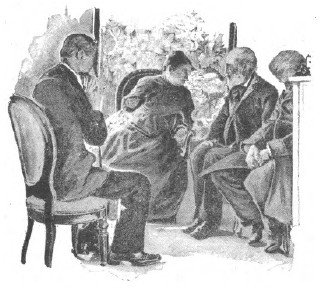
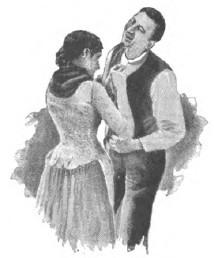
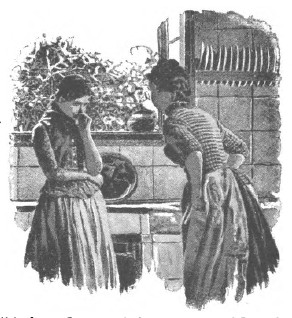
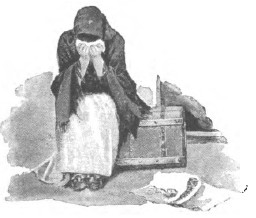
The commandant, dressed in the costume of a peasant, unceremoniously
entered the room with his niece, who was the apple of his eye, his arm
encircling her waist as if he was going to dance a waltz with her. In
the salutation he exchanged with his sister, however, Doña Aurora could
detect a shade of coldness, not far removed from dislike, a feeling
which can sometimes be dissimulated where strangers are concerned, but
never where its object is a member of one’s family. After the customary
salutations and compliments, Señora de Pardiñas, who did not belie her
race so far as wiliness and obstinacy were concerned, said tentatively:
“Well, I will leave you now. After all, I did not find out what I had
come to learn, and consequently—— Your sister is very reserved, Señor
de Pardo.”
“Upon my faith, I have never thought so,” answered the artilleryman
bluntly, almost rudely.
“Well, every one speaks of the fair according to the bargain he has
made. With me she has shown herself extraordinarily reticent.” And
without heeding the gesture or the glance of Rita, she continued
undaunted: “For the last quarter of an hour I have been asking
information from her in vain about a young countrywoman of ours,
Esclavita Lamas, the niece of the rector of Vimieiro.”
Pardo listened like one in whose memory some vague recollection has been
awakened.
“Stay—let me think—Vimieiro—Lamas—Lamas Tarrío. He was an intimate
friend of papa’s. Rita knows all about him; she has the whole story at
her fingers’ ends.—What objection have you to tell it to Doña Aurora?”
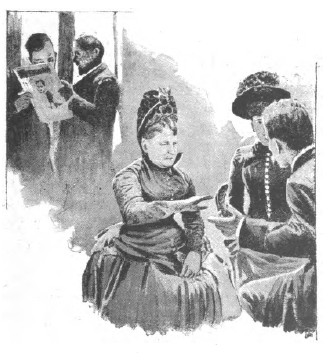
A caricaturist desiring to represent bourgeois dignity in its most
exaggerated form might have copied with exactness the features and
expression of Rita as, arching her brows and pointing to her eldest
daughter leaning against the commandant’s knees, she exclaimed
impressively:
“The child!”
“Well, what of the child?” responded Don Gabriel, imitating his sister’s
tragic tone. “Is it one of those shocking things that innocent ears must
not hear—that the cat has had kittens, for instance?”
“Gabriel, you are dreadful,” groaned Rita, casting up her beautiful
southern eyes. “When one is killing one’s self, trying to make your
nieces what they ought to be in society, you must do your best to—there
is no use in trying to struggle against people’s dispositions.”
“Well,” insisted the obstinate Doña Aurora, “I come back to my
complaint. Rita, don’t say that it was for the child’s sake that you
refused to give me the information I asked. The child was not present,
and even if she had been, by sending her out of the room——”
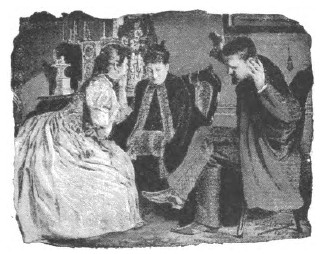 “Well, what of the child?”
“Which is what I am going to do now. Eugenita, child, go practice your
Concone.”
The girl left the room, much against her will, casting on her uncle, as
she went, a couple of affectionate farewell glances; but no scale or
study was heard to tell that she had shut herself in the musical
torture-chamber in which our young ladies, worthy of a better fate, are
condemned to dislocate their fingers daily.
“You shall hear,” said Doña Aurora, emphatically, “now that we can speak
freely. The question is that that girl, Esclavita Lamas, wants to enter
my service; and that I, for my part, am greatly pleased with what I have
seen of her. But I know nothing about her past, nor why she left her
native place. There seems something odd in the whole affair. Your sister
knows the story, and neither for God’s sake nor the saints’ will she
tell it to me. There you have the cause of our dispute. It was beginning
to grow serious when you came in.”
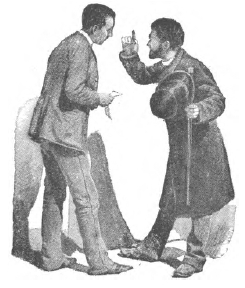
“The story,” said Gabriel, nervously wiping his gold-rimmed spectacles,
and putting them on again carefully. “Wait a moment, Señora; for if my
treacherous memory does not deceive me—Rita, is not that the Father
Lamas who took a poor girl off the street into his house for charity?
Tell the truth, or I shall write this very day to Galicia to inquire.”
“Heavens! What notions you have! You are growing more unbearable every
day—Was I not going to tell you the truth? Yes, that was the Lamas, and
since you insist upon opening his grave, and dragging him out to public
shame, do it you, for I don’t want to have such a thing on my
conscience.”
“It should weigh more heavily upon your conscience,” replied Gabriel,
with vehemence, “to try to prevent the girl getting her place on account
of the sins of others. Now I can tell you the whole story, Doña Aurora,
by an end I have unwound the skein; it is the same with stories as with
an old tune—if one remembers the first bar, one can sing the whole of
it through without a mistake. And I can tell you that it is a novel, a
real novel.”
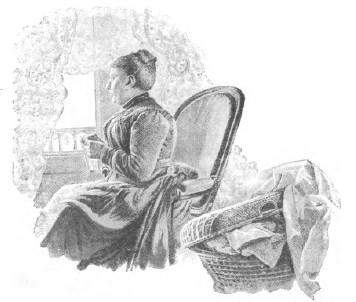
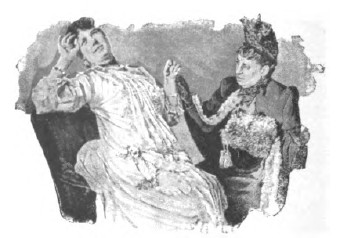
“It may seem so to you,” said Rita, venomously, pulling the lace of her
sleeves again. “As for me—there are certain things—— Well, I wash my
hands of it.”
Doña Aurora concealed the satisfaction her victory gave her, but, a
woman after all, she said to herself, casting a side glance at Rita:
“I’ve got the best of you, hypocrite!”
“You shall hear,” began the commandant. “This Father Lamas was a
simple-minded man, illiterate as all the rural clergy were at that
time,—now they are much more enlightened,—and not over-intelligent;
but he performed all his parochial duties faithfully, and if he
committed faults he succeeded in hiding them. If you cannot be chaste,
be cautious, as the saying is. Well, one night there came to the door of
the rectory a girl, about tea years old, an orphan, who lived upon
charity; in one house they gave her a piece of corn bread, in another a
bundle of corn leaves to sleep upon, here a ragged shawl, there a pair
of old shoes. In this way the wretched girl managed to live. The rector
took pity upon her and said to her: ‘Stay here; you can learn housework;
you will have clothes to wear, a bed to sleep in, and good hot soup to
nourish you.’ And so it was decided—the girl stayed.”
“The girl was Esclavita?”
“No, Señora, no Señora. Wait a while. The girl turned out bright and
capable; she put away from her her melancholy, as they say in our
country, and she even grew rosy and handsome. And—” here the voice of
the commandant took a sarcastic tone—“when the flower of maidenhood
bloomed—”
“Oh, Gabriel,” remonstrated Rita, “certain things should be spoken of in
a different way. There is no need of entering into details that——”
“Bah!” said Doña Aurora. “We are all of us married and I am an old
woman. We know all about it and are not to be so easily shocked as that
comes to, my dear. Go on. What came afterward?”
“Afterward came Esclavita.”
Although Señora Pardiñas had affirmed that she knew all about it, this
piece of information, given thus suddenly, almost made her jump in her
chair.
“Ah!” she exclaimed, and then looked very thoughtful. “That is why the
poor girl—well, and afterward?”
“Afterward,” cried Rita impetuously, unable to keep silent any longer,
“papa had the greatest difficulty to pacify Señor Cuesta, the Cardinal
Archbishop. As the Archbishop himself was so virtuous he maintained
strict discipline and permitted no misconduct. If it were not for all
papa’s efforts with his eminence, to-day one entreaty and to-morrow
another, Lamas Tarrío would have been deprived of his license and would
have been left to rot in the ecclesiastical prison. For it is one thing
for a priest to commit a fault that no one knows anything about, and
another to scandalize his parishioners, bringing up the child in his own
house, outraging public opinion, petting and indulging her——”
“My father,” said Gabriel, interrupting his sister, “with one hand
smoothed down the Archbishop and with the other hammered away at the
sinner. By dint of exhortations he succeeded in having the siren sent
away from the rectory; but Lamas continued to see her. At last papa
took a firm stand and prevailed on him to allow the mother to be sent to
Montevideo, on condition that he was permitted to keep the child.”
“Yes,” again interposed Rita, “a fine remedy that was, worse than the
disease. The man became wilder and more reckless than he had been
before. He spent night after night without closing an eye, crying and
screaming. He had a rush of blood to the head—he was in our house at
the time—so that they were obliged to apply more than forty leeches to
him at once, and the blood that came was as black as pitch. We thought
he would go mad; he would go about the corridors tearing his hair,
calling on the woman’s name with maudlin expressions of endearment.”
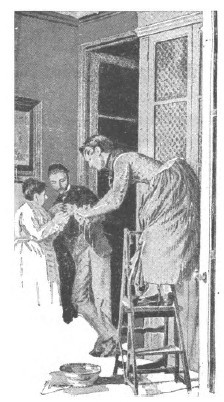
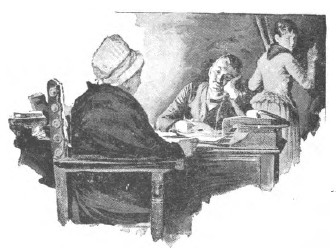
As Rita said this her brother observed that the curtains of the
adjoining room moved as if they had been stirred by a breath of
hoydenish curiosity, and the outlines of an inquisitive little nose
were vaguely defined against them.
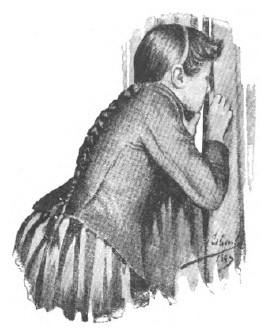 “The outlines of an inquisitive little nose were vaguely
defined against them.”
“See,” he said, “now it is you who are getting beyond your depth. All
that has nothing whatever to do with the case. Let us end the story at
once, and let me tell it in my own way. Poor Lamas became so ill that
the Archbishop himself was sorry for him, and sent for him to cheer him
and inspire him with thoughts of penitence. And in effect, in process of
time he grew calmer and even behaved himself very well afterward. The
only fault to be found with him was that he brought up the child with
extraordinary indulgence; but as the feelings of a father, even when
they contravene both human and divine laws, have something sacred,
people shut their eyes to this. He introduced the girl as his niece. As
such children do not inherit, the priest saved up money, ounce upon
ounce, which he put into Esclavita’s own hand; but the girl, who had
turned out very discreet and very devout, and, in addition to that, very
unselfish, when Lamas died, gave all this money, in gold as she had
received it, for masses and prayers for the soul of the sinner. This act
alone will give you an idea of the girl’s character. There are not many
girls who would do so much even if they had been born in a better
station and in a more orthodox manner.”
“As my brother is of a romantic turn he sees things in that way,”
interposed Rita.
“Señora de Pardiñas, I give you my word as a gentleman that I neither
add nor diminish. That girl, in my opinion, would be capable of going
bare-footed on a pilgrimage to any part of the world in order to get the
soul of the rector of Vimieiro out of purgatory.”
“And well he would need it,” said Rita, “and her mother too, who, by all
accounts, does not lead the life of a saint over there in America.”
“Good Heavens! How merciless you women can be, who have never had to
suffer for the want of consideration or of bread,” exclaimed Pardo, now
really angry. “I do not err on the side of philanthropy, but there are
certain things that I cannot understand in people who make a boast of
being good Christians and who go to mass and say their prayers. Fine
prayers those are! Is that what you understand by charity? Well, my
dear, I declare that Esclavita is worth more than——”
Fortunately he restrained himself in time and ended:
“Than some other people. How is she to blame for her parents’ faults?
Tell me that! And she is expiating them as if she had committed them.
She even left her native place, it seems, so as not to be where people
know and remember and discuss——”
“I would swear the same thing,” asserted Doña Aurora warmly. “Now I know
why it was that she became so confused when she was asked certain
questions. I am of the same opinion as you, Pardo, that she is good,
that she has noble sentiments, and that those traits do her honor.”
“Yes, be guided by my brother, admit her into your house,” exclaimed
Rita, with a spiteful and insolent laugh. “For giving advice, Gabriel
has a special gift. I tremble when he and my husband get together. If
Eugenio were to be led by him we should be living on charity. Take that
girl on your hands, and you will see how it will end. Then you will say,
‘Rita Pardo was right after all.’”
Señora Pardiñas thought within herself:
“I will take her if only to spite you, hypocrite, impostor. I have taken
your measure, now.”
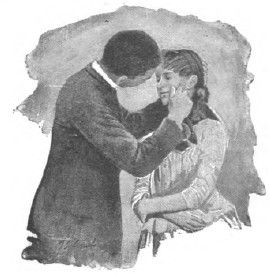
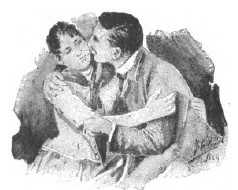
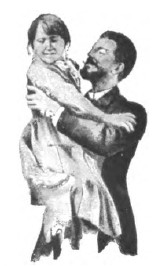
When Gabriel was going out, he found his eldest niece waiting for him in
the reception room. He caught her by the waist, and lifting her up to a
level with his mouth, whispered in her ear:
“Good little girls, if they want Uncle Gabriel to love them, must not
go peeping and spying and hiding themselves behind portières. They must
obey mamma because she is mamma, and she will not tell them to do
anything wrong. Take care and don’t bite, little lizard. Good little
girls—are good. Ah-h-h! my cravat!”
 “He caught her up by the waist.”
“Uncle Gabriel, will you take me with you?” coaxed the little madcap.
“With you, yes; with you, no; with you, yes, I will go. Come, take me
with you!”
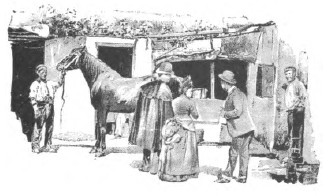
 “The commandant threw a kiss to the girl, which she
promptly returned.”
“To Leganes it is that I will take you. Be good now! Study your French
lesson! Comb that mane of yours! Run into the kitchen to see what the
girl is about there! Papa likes his roast beef well done! See to papa’s
roast beef!”
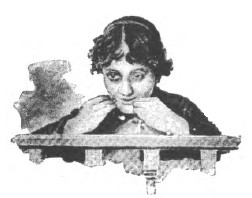
As he crossed the threshold the commandant threw a kiss to the girl,
which she promptly returned.