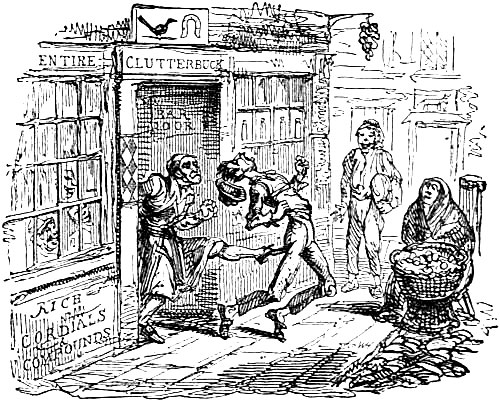
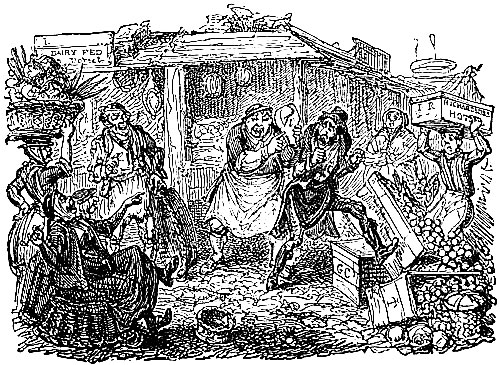
Mrs. O'Reilly, wife of Laurence O'Reilly, "coal and potaty merchant, handy
by Clear market," charged Mr. Ralph Hogan, a comely young man, of
five-and-twenty, with attempting to make her a false woman to her own
lawful married husband!
"And please your magistrate," said Mrs. O'Reilly, "Misther Hogan is a
lodger of ours, and a civilish sort of a jantleman in gineral, and
turncock to the New River Company"—
"Faith that I am, Misthress O'Reilly," responded Mr. Hogan, "any time
these three years—come a fortnight after last St. Patrick's-day!"
"Very good, Misther Hogan; and ye see I wouldn't be telling a lie for the
matter—why should I?" rejoined Mrs. O'Reilly very complacently;—and
then, turning to the magistrate, she proceeded—"And plase your
magistrate, Misther Hogan is a nice civilish sort of a young jantleman as
a body would wish to be spaking to—ounly that time he couldna withstand
timptation; and that was last Sathurday, after tay, when my husband
wasn't in the place, and the childer were abed, and I was ironing their
best bits of frocks for the Sunday, plase your magistrate. And Misther
Hogan sat down by the fire mighty quiet—'And what do I owe you, Misthress
O'Reilly,' says he—'for the rint?' says he. 'Just one week of it, Misther
Hogan,' say I, 'for you're a nice man, and always true for the rint, and I
likes to have you for a lodger overmuch.' Och! bad luck to me for saying
that! for Mr. Hogan couldna stand the kind word at all, but must be
flinging out his coortships at me—against both the law and the
gospel—saving your magistrate's presence. 'And what would ye be after,
Misther Hogan?' says I—'Don't you know I'm the mother of my husband's
childer any time these thirteen long years—and himself coming in every
minute may be, Misther Hogan!' says I. 'Gad's blood! Misthress O'Reilly,'
says he, 'to the devil I will pitch him, for myself can't do without ye
any longer at all!' and down on his knees he went to me at that time,
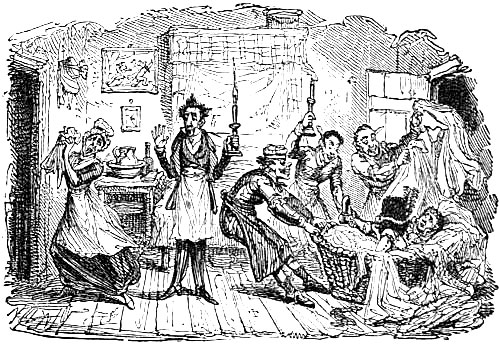
mighty queer; and up he gathers himself again, and comed at me; and I
tried to smooth him down with the hot-iron, but he wouldn't be quiet by no
manes for me; and a noise comed to the door, and I squaled, and the
neighbours comed trembling into the place, and there was an end
on't—plase your magistrate."
Whilst Mrs. O'Reilly was telling her story, Mr. Hogan stood carefully
wiping his hat; and when she had done, the magistrate asked him what he
had to say for himself; at the same time telling him he thought he had
behaved very grossly.
"Devil burn me! your worchip," replied Mr. Hogan—"but I'm just fit to
split for spaking! Och! woman, woman! what is there half?——but my
honour's consarned, your worchip, and I won't—I won't say nothing, come
what will!"
The gallant Turncock persisted in this generous forbearance, and he was
held to bail to answer for the loving assault at the ensuing Sessions.
THE END.
Footnotes:
[1] This was before the passing of the New Vagrant Act—
"When free to follow nature was the mode,
And tyrant tread-mills had not shackled man."
[2] A tailor, when asked what he is, never replies simply, "I am a
tailor;" but, "I am a tailor, by trade"—thereby seeming to signify
that he is not a tailor by nature.
[3] An ultra-napped driving, or box coat.
[4] Toggery, from the Roman toga.
[5] Gumption, strength, either bodily or mental.
[6] Peel, to strip, to disrobe.
[7] Done, caught, beat.
[8] A dram, a drop of max.
[9] Spouted—Pawned. The business of the pawnbrokers has so much
increased in London of late years, that they find it necessary to have
extensive ware-rooms at the top of the house; and in order to save the
trouble of running up and down stairs, they have invented a spout of
communication between the ware-rooms and the shop. So that, whenever an
unfortunate takes his unmentionables, or any other article to pledge, the
pawnbroker places them at the bottom of the spout, and "by some cantrip
slight" or other, up the spout they go slap into the ware-rooms in an
instant, where they remain until the day of redemption, and then, up goes
the duplicate ticket, and down comes the unmentionables again.
[10] The Waits—Those wandering minstrels, who, on the approach of
Christmas, nightly serenade the sleeping public by license of the king's
sergeant trumpeter.
[11] Bread-basket, dumpling depot, victualling office, &c., are
terms given by the "Fancy" to the digestive organ.
[12] Gin.—Deady is, or was, a celebrated distiller of that lively
liquid.
[13] Charley—Corinthianish for Watchman.
[14] Canisters—Corinthianish for Heads.
[15] Riddled it—made it full of holes, like a riddle.
[16] Bilk, from the Gothic Bilaican, to cheat, to defraud.
[17] What a pity it is that the poor gentleman never thought of cutting
his boots away with a knife! But nemo mortalium, &c.
[18] Something which may be drank in a short time, and yet have a lengthy
effect.
[19] A dodger is ginshop-ish for a dram.
[20] "This is a sessionable assault; that is to say, an assault worthy
of trial at Quarter Sessions."—Country Justice.
[21] Kennedy—St. Giles's for the poker, from a man of that name being
killed by a poker, or a man of that name killing another with that
instrument.
[22] Query inured.
[23] Gal—cockney for girl.
[24] Heavy wet—Porter;—because, the more a man drinks of it, the
heavier he becomes.
[25] A back room on the third floor.
[26] A jemmy is a sheep's head—a favourite dish with those who can get
no other. For jugg'd, see Dr. Kitchiner on "jugg'd hare," &c.
[27] Max-upon-tick—pronounced, maxapóntic—a very gentleman-like term,
invented by certain learned tailors, signifying scored gin—or gin upon
credit—max being cockneyish for gin, and tick being synonymous with
credit, all the world over.
[28]
"Bleak winter wears a coat of snow."
Recit.—Mr. Gluckman.
"A lily-white benjamin—is it not so?"
Air—Lord Mops.
[29] These lads were tried at the Old Bailey, and being found guilty, they
were sentenced to seven years' transportation,—which sentence was
afterwards commuted to five years' imprisonment in the Millbank
Penitentiary.
[30] Squad—diminutive of squadron; applied generally to little
parties, of little sense—as, an awkward squad, a blackguard squad, a
squandering squad, &c.
[31] Seedy—a highly fashionable term, applied chiefly to dress. Thus
when a man's coat begins to manifest symptoms of worn-out-ishness, he is
said to look seedy—run to seed, and ready for cutting; and whenever
this is the case, all his acquaintance cut him as fast as they can, until
he is quite cut down and done with. Holywell-street is a famous mart for
these ripe garments.
[32] Bub and Grub—drink and victual—
—"And we'll broach a tub,
Of humming bub,
With lots of hot and chilly grub,
To welcome you home with a rub a dub dub."
Old Song.
[33] Ramshackle—corrupted from ramshatter, to shatter as with a
battering ram.
[34] A resplendent gas-light was just then shedding its radiance over
the happy pair.
Transcriber's Notes:
Images have been moved from the middle of a paragraph to a nearby paragraph break.
The text in the list of illustrations is presented as in the original text, but the links
navigate to the page number closest to the illustration's loaction in this document.