THE LARK’S NEST A STORY OF A BATTLE — I — II — III
It was close upon Midsummer Day, but it
was not midsummer weather. A mist rose from
moist fields, and hung over the whole countryside
as if it were November; the June of 1815
was wet and chill, as June so often is. And
as the mist hung over the land, so a certain
sense of doubt and anxiety hung over the hearts
of man and beast and bird. War was in the
air as well as mist; and everything wanted
warmth and peace to help it to carry out its
appointed work; to cheer it with a feeling of
the fragrance of life.
The moisture and the chilliness did not
2
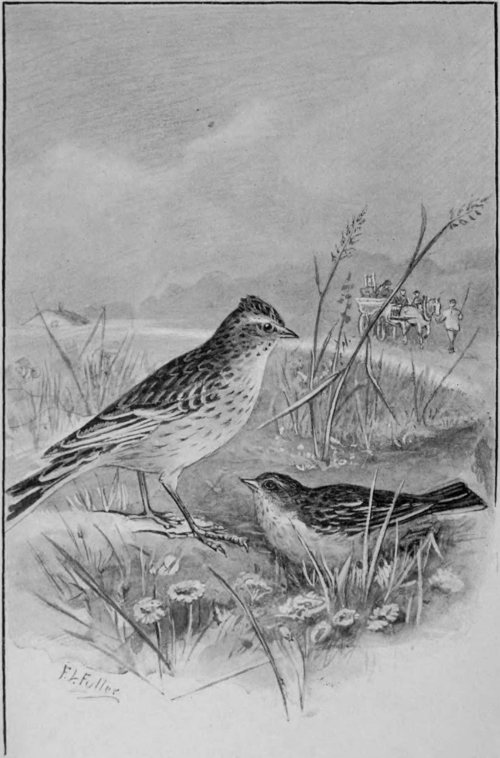
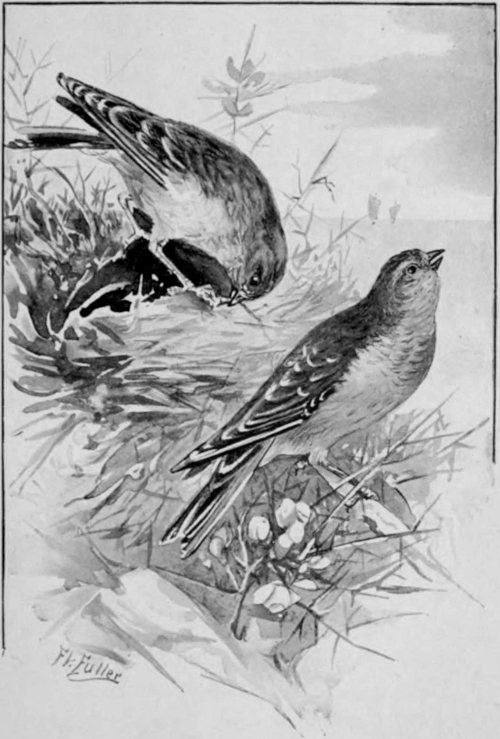
prevent the Skylark from taking a flight now
and then into the air, and singing to his wife
as she sat on the nest below; indeed, he rose
sometimes so high that she could hardly hear
his voice, and then the anxious feeling got the
better of her. When he came down she would
tell him of it, and remind him how dear to her
that music was. “Come with me this once,” he
said at last in reply. “Come, and leave the
eggs for a little while. Above the mist the
sun is shining, and the real world is up there
to-day. You can dry yourself up there in the
warmth, and you can fancy how bad it is for
all the creatures that have no wings to fly with.
And there are such numbers of them about
to-day—such long lines of men and horses!
Come and feel the sun and see the sights.”
He rose again into the air and began to
sing; and she, getting wearily off the nest,
followed him upwards. They passed through
the mist and out into the glorious sunshine;
and as they hung on the air with fluttering
wings and tails bent downwards, singing and
still gently rising, the sun at last conquered the
3
fog to the right of them, and they saw the great
high road covered with a long column of
horsemen, whose arms and trappings flashed
with the sudden light. They were moving
southward at a trot as quick as cavalry can
keep up when riding in a body together; and
behind them at a short interval came cannon
and waggons rumbling slowly along, the drivers’
whips cracking constantly as if there were great
need of hurry. Then came a column of infantry
marching at a quickstep without music, all intent
on business, none falling out of the ranks;
they wore coats of bright scarlet, which set off
young and sturdy frames. And then, just as
an officer, with dripping plume and cloak
hanging loosely about him, turned his horse
into the wet fields and galloped heavily past the
infantry in the road, the mist closed over them
again, and the Larks could see nothing more.
But along the line of the road, to north as
well as south, they could hear the rumbling of
wheels and the heavy tramp of men marching,
deadened as all these sounds were by the mud
of the road and by the dense air. Nay, far
4
away to the southward there were other sounds
in the air—sounds deep and strange, as if a
storm were beginning there.
“But there is no storm about,” said the
Skylark’s wife; “I should have felt it long
ago. What is it, dear? what can it be? Something
is wrong; and I feel as if trouble were
coming, with all these creatures about. Look
there!” she said, as they descended again to
the ground at a little distance, as usual, from
the nest; “look there, and tell me if something
is not going to happen!”
A little way off, dimly looming through the
mist, was a large cart or waggon moving slowly
along a field-track. Leading the horses was the
farmer, and sitting in the cart was the farmer’s
wife, trouble written in her face; on her lap
was a tiny child, another sat on the edge of
the cart, and a third was astride on one of the
big horses, holding on by his huge collar, and
digging his young heels into the brawny shoulders
below him. All of these the Skylarks knew well;
they came from the farm down in the hollow, and
they must be leaving their old home, for there
5
was crockery, and a big clock, and a picture or
two, and other household goods, all packed in
roughly and hurriedly, as if the family had been
suddenly turned out into the world. The farmer
looked over his shoulder and said a cheering word
to his wife, and the Skylark did the same by his.
“Don’t get frightened,” he said, “or you won’t
be able to sit close. And sitting close is the
whole secret, dear, the whole secret of nesting.
I’m sorry I took you up there, but I meant well.
Promise me to sit close; if any creature comes
along, don’t you stir—it is the whole secret.
They won’t find you on the eggs, if you only
sit close; and think how hard it is to get back
again without being seen when once you’re off
the nest! There’s nothing to alarm you in what
we saw. See, here we are at the nest, and how
far it is from the big road, and how snugly
hidden! Promise me, then, to sit close, and in
a day or two we shall begin to hatch.”
She promised, and nestled once more on the
eggs. It was true, as he had said, that the nest
was some way from the road; it was in fact
about halfway between two high roads, which
6
separated as they emerged from a great forest
to the northwards, and then ran at a wide angle
down a gentle slope of corn-land and meadow.
In the hollow near to the western road lay the
farmhouse, whose owners had been seen departing
by the Skylarks, standing in a little enclosure
of yard and orchard; near the other road, but
higher up the slope, was another homestead.
On the edge of the slope, connecting the two
main roads, ran a little cart-track, seldom used;
just such a deeply-rutted track as you may see
on the slope of a south-country down, cutting
rather deeply into the ground in some places, so
that a man walking up to it along the grass
slope might take an easy jump from the edge
into the ruts, and need a vigorous step or two
to mount on the other side. Just under this edge
of the grass-field, and close to the track, the
Larks had placed their nest; for the grass of the
field, cropped close by sheep, offered them little
cover; and they did not mind the cart or waggon
that once in two or three days rolled lazily by
their home, driven by a drowsy countryman in a
short blue frock.
7
Next day the weather was worse, though the
fog had cleared away; and in the afternoon it
began to rain. Long before sunset the Larks
began to hear once more the rumbling of
waggons and the trampling of horses; they
seemed to be all coming back again, for the
noise grew louder and louder. Each time the
cock bird returned from a flight, or brought food
to his wife, he looked, in spite of himself, a little
graver. But she sat close, only starting once
or twice from the nest when the distant crack
of a gun was heard.
“Sit close, sit close,” said her consort, “and
remember that the way to get shot is to leave
the nest. We are perfectly safe here, and I will
be hiding in the bank at hand, if any danger
should threaten.”
As he spoke, men passed along the track;
then more, and others on the grass on each side
of it. Then that dread rumbling grew nearer,
and a medley of sounds, the cracking of whips,
the clanging of metal, the hoarse voices of tired
men, began to grow around them on every side.
Once or twice, as it began to grow dusk, men
8
tried to kindle a fire in the drizzle, and by the
fitful light groups of men could be seen, standing,
crouching, eating, each with his musket in
his hand, as if he might have to use it at any
moment. Officers walked quickly round giving
directions, and now and then half-a-dozen horsemen,
one on a bay horse always a little in
advance, might be seen moving about and surveying
the scene. Then more men passed by,
and ever more, along the slope; more horses,
guns, and waggons moved along the track. A
deep slow murmur seemed to rise in the air, half
stifled by the pouring rain, and broken now and
then by some loud oath near at hand, as a
stalwart soldier slipped and fell on the soppy
ground. Then, as lights began to flash out on
the opposite rise to the southward, a noise of
satisfaction seemed to run along the ground—not
a cheer, nor yet a laugh, but something
inarticulate that did duty for both with wet and
weary men. In time all became quiet, but for
the occasional voice of a sentinel; and now and
then a cloaked form would rise from the ground
and try to make a smouldering fire burn up.
9
All this time the Skylark’s wife had been
sitting close; men and horses were all around,
but the nest was safe, being just under the lip
of the bank. Her husband had crept into a hole
close by her, and was presently fast asleep, with
his head under his wing. They had already got
used to the din and the sounds, and they could
not abandon the nest. There they slept, for the
present in peace, though war was in the air, and
seventy thousand men lay, trying to sleep, around
them.
On that first day, when the sun had broken
through the mist and shone upon the army
hastening southwards, an English lad, in the
ranks of an infantry regiment, had heard the
singing of the Larks high above them. He was
a common village lad, a “Bill” with no more
poetry or heroism in him than any other English
Bill; snapped up at Northstow Fair by a recruiting
serjeant, who was caught by his sturdy
limbs and healthy looks; put through the mill of
army discipline, and turned out ready to go
10
anywhere and do anything at command—not so
much because it was his duty, as because it was
the lot that life had brought him. He was
hardly well past what we now call schoolboy
years, and he went to fight the French as he
used to go to the parson’s school, without asking
why he was to go. He might perhaps have told
you, if you had asked him the question, that
trudging along that miry road, heavily laden, and
wet with the drippings of the forest they had just
passed through, was not much livelier than trying
to form pothooks under the parson’s vigilant eye.
When they emerged from the forest into the
open, and began to descend the gentle slope into
the hollow by the farmhouse, the sun broke out,
as we have seen, and Bill, like the rest, began
to look about him and shake himself. Looking
up at the bit of blue sky, he saw two tiny
specks against it, and now for the first time the
Lark’s song caught his ear.
At any other moment it would have caught his
ear only, and left his mind untouched. But it
came with the sun, and opened some secret spring
under that red coat, without the wearer knowing
11
it. Bill’s sturdy legs tramped on as before, but
his thoughts had suddenly taken flight. There
was nothing else to think of, and for a minute or
two he was away in English midlands, making his
way in heavy boots and gaiters to the fields at
daybreak, with the dew glistening on the turnip-leaves,
and the Larks singing overhead. In those
early morning trudges, before work drove all else
from his mind, he used to think of a certain Polly,
the blooming daughter of the blacksmith; so
he thought of Polly now. Her vision stayed
awhile, and then gave way to his mother and the
rest of them in that little thatched cottage
shrinking away from the road by the horsepond;
and then the Rectory came in sight just beyond,
and the old parson’s black gaiters and knotted
stick. Bill, the parson’s schoolboy, bringing
home one day a lark’s nest entire with four
eggs, had come upon the parson by the gate,
and shrunk from the look of that stick.
Bill had put the nest behind him, but it was
too late; and he was straightway turned back
the way he came, and told to replace the nest
where he found it.
12
“And mind you do it gently, Bill,” said the
old parson, “or the Lord won’t love you any
more!”
To disobey the parson would have been for
Bill a sheer impossibility, though easy enough for
other lads. For him the old parson had been in
the place of a father ever since he lost his own;
and at home, in school, in church, or in the
village, he often saw the old man many times a
day. Not that he exactly loved him—or at least
he was not aware of it; he had more than once
tasted of the big stick, and oftener deserved it.
But in Bill there was a feeling for constituted
authority, which centred itself in those black
gaiters and in that bent form with the grey hair;
and it was strengthened by a dim sense of
gratitude and respect; so he turned back
without a word, and put back the nest with
all the care he could.
When he came in sight once more, the parson
was still at his gate, looking down the road
for him from under the wide brim of his old
hat.
“Have you done it, Bill?” he said, and
13
without waiting for an answer, “will they thrive
yet, do ye think?”
“I see the old ’uns about, sir,” says Bill
“There’s a chance as they may take to ’un again,
if the eggs be’ant to’ cold ’owever.”
“Then the Lord’ll love you, Bill,” said the old
man, quite simply, and turned away up his
garden. And Bill went home too; he told no
one the story, but the parson’s last words got a
better hold of him than all the sermons he had
ever heard him preach.
And so it came about that, years afterwards,
as he trudged along that Belgian highroad,
besides Polly and his mother and the cottage, he
saw the Rectory and the old parson, standing at
the gate—waiting for the postman, perhaps with
news from the seat of war. “I never wrote to
’un,” thought Bill, “as I said I would, to let ’un
see a bit of my scrawlen——”
But a nudge of the elbow from the next man
drove all these visions away.
“D’ye hear that, youngster?” said this neighbour,
an old Peninsular veteran, once a serjeant,
and now degraded to the ranks for drunkenness;
14
“d’ye hear that noise in front? That’s a battle,
that is, and we’ll be too late for it, unless Bony
fights hard, drat him!”
The pace was quickened, and for several miles
they went on in silence, the sound of battle
gradually getting louder. At last it began to die
away; and soon an aide-de-camp came galloping
up and spoke to their colonel, who halted his men
in a field by the roadside. Then tumbrils full of
wounded men began to roll slowly along the road,
at which Bill looked at first with rather a wistful
gaze. At last night set in, and they bivouacked
on the field as they were.
Early next morning troops began to file past
them—infantry, artillery, and baggage; the
cavalry, so Bill was told by his neighbour in the
ranks, was in the rear keeping off the enemy.
Bony was coming after them, sure enough, he
said, and the Duke must draw back and get
all his troops together, and get the Prussians too,
before he could smash that old sinner.
At last their turn came to file into the road,
and retrace their steps of yesterday. It was now
raining, and already wet and cold, and Bill
15
simply plodded on like a machine, till a slight
descent, and the sight of the farmhouse, and of
the dark forest looming in front of them, told
him that he was again on the ground where
the sun had shone and the Lark sung. And
his trials for that day were nearly at end,
for no sooner had they mounted the slope on
the further side, than they were ordered to the
right, and turning into the fields by the little
cross-track, were halted between the two roads,
and lay down as they were, tired out.
Dawn was beginning at three o’clock on Sunday
the 18th of June, and the Lark was already
astir. In the night an egg had been hatched,
and great was the joy of both parents. All was
quiet just around the nest; at a little distance
a sentinel was pacing up and down, but no one
else was moving. The wife, at a call from her
mate, left the nest, and rose with him through
the drizzling rain.
“Higher, higher,” cried the cock bird, “let
16
us try for the blue sky again, and look for the
sunrise as we sing!” And higher they went,
and higher, but found no blue that day; and
when the sun rose behind the clouds, it rose with
an angry yellow light, that gave no cheer to man
or beast. And what a sight it showed below
them! All along the ridge for a mile and a half
lay prostrate forms, huddled together for warmth;
picketed horses stood asleep with drooping
heads; cannon and waggons covered the ground
towards the forest. And all that host lay silent,
as if dead. And over there, on the opposite
height, lay another vast and dark crowd of human
beings. What would happen when they all
woke up?
The Larks spent some time, as was their wont,
bathing themselves in the fresher air above, and
then descended slowly to find insects for the
new-born little one. Slowly—for a weight lay
on the hearts of both; there was peril, they knew,
though neither of them would own it. As they
approached the earth, they saw a figure kneeling
against the bank, and prying into the ground just
where lay the home of all their fond desire.
17
Each uttered at the same moment a piteous cry,
and the figure, looking up, rose quickly from his
knees and watched them. Then he went slowly
away, and lay down among a group of cloaked
human forms.
It was Bill, just released from sentinel duty.
As he paced to and fro, he had seen the Larks
rise, and, relieved by a comrade in a few minutes,
he searched at once for the nest. Bill was not
likely to miss it; he knew the ways of larks, and
searched at a little distance right and left from
the spot he had seen them leave. There was
the nest—three brown eggs and a young one; it
brought back once more the Rectory gate, and
the old parson, and those few words of his. “I
wish as I’d sent ’un a letter,” he said to himself,
as he heard the Larks’ cry, and rose from his
knees. That was all he said or thought; but
Bill went quietly back to his wet resting-place,
and slept with a clear conscience, and dreamed
of pothooks and Polly.
When he woke nearly every one was astir: all
looking draggled, cold, and dogged. Breakfast
was a poor meal, but it freshened up Bill, and
18
after it he found time to go and spy again at the
nesting-place. The hen was sitting close, and
he would not disturb her. The cock was singing
above; presently he came down and crept through
the grass towards her. But Bill saw no more
then, for the bugles began to call, and all that
great host fell gradually into battle array.
Bill’s regiment was stationed some little way
behind the cart-track, and was held ready to
form square at a moment’s notice. Hours passed,
and then a hurried meal was served out; the
battle was long in beginning. Every now and
then Bill could hear the Lark’s song overhead,
and he listened to it now, and thought of the
nest as he listened. He could not see it, for a
battery of artillery was planted between him and
the track; but he kept on wondering what would
happen to it, and it helped him to pass the weary
hours of waiting.
At last, just at the time when the bells of the
village church were beginning to ring at home—when
village lads were gathering about the
church door, and the old clerk was looking up
the hymns, and getting the music out on the
19
desks for the two fiddles and the bassoon—a
flash and a puff of white smoke were seen on
the opposite height, then another and another,
and every man knew that the battle had
begun.
And then the time began to go faster. Bill
watched the artillerymen in front of him, and the
smoke in the enemy’s lines, when he was not
occupied with something else under his serjeant’s
quick eye. Something was doing down there
at the farmhouse; he could hear it, but could
not see. Away on the left, too, he could see
cavalry moving, and once saw the plumes of the
Scots Greys on the enemy’s side of the valley,
and then saw them galloping back again,
followed by squadrons of French horse. Then
an order was given to form square; cannon-balls
began to whistle round, and as the square was
formed, some men fell. Then a long pause.
Suddenly the artillerymen came running back
into the square, and Bill, in the front of the
square, could see the further edge of the cart-track
in front of him lined with splendid
horsemen, who dropped into it and rose again
20
on the other side, charging furiously at the
square. Not a word was said, or a gun fired,
till they were quite close; then the word was
given, the front ranks of the square fired, and
half the horsemen seemed to fall at once.
Others rode round it, and met the same fate
from the other sides. Then back went all the
rest as best they could, with another volley
after them, and Bill had seen his first fight.
Again and again this wave of cavalry came
dashing against them, and each time it broke
and drew back again. So the day wore on,
and the battle raged all round. Ranks grew
thinner and men grew tired of carrying the dead
and dying out of their midst. Bill’s square was
never broken, but the men were worn out, the
colonel and most of the officers were killed or
wounded, and still the battle went on.
At last, when the sun was getting low, the
regiment was suddenly ordered forward. Glad
to move their stiffened limbs at last, the men
deployed as if on parade-ground, and dashed
forward in line at the double. Bill saw that he
would cross the cart-track close by the Lark’s
21
nest; in all that din and fever of battle, he
still thought of it, and wondered what its fate
had been. Another minute and they were
crossing the track, and as they leapt up the
other side, he saw a bird fly out from under
the feet of a soldier next but one to himself.
The next moment he felt a sudden sharp blow,
and fell insensible.
When he came to himself he could see the
redcoats pouring down the slope in front of him;
every one was going forward, and the enemy’s
cannonade had ceased. A wounded soldier close
by him groaned and turned heavily on his
side. Bill tried to pull himself together to walk,
but his right leg was useless, and he could only
crawl. He crawled to the edge of the bank
and found himself close to the nest; he put his
hand in and found two warm eggs and two
nestlings. Then he slipped down the bank and
fainted at the bottom.
A fortnight afterwards, the old parson came
down to his garden-gate with a letter in his
hand, and stepped across to the thatched cottage.
22
Bill’s mother met him at the door with a
curtsey and a pale face.
“It’s his own writing,” said the parson, “so
don’t be frightened. Shall I read it you?”
And he opened and read the letter; here is a
faithful copy of it—
“Brussles Ospitle, June 22.
“Dear Mother,—We ave won a glorous
Victry, and old Bony and all of em they run
away at last. I see em a runnin just as I got
nocked over my dear mother I did for some on
em but don’t know how many twas, them cavalry
chaps mostly twas as I nocked over I be rather
smartish badly hit dear mother the Doctor ave
took off my rite Leg but I feels as if twur thur
still it do hurt so tell passon I found a Lark’s
nestie as I didn’t never take none of the eggs on
twur a marvelous wunder as they warn’t scruncht
with them Frenchies a gallopin over the place
and our fellows wen they sent em a runnin tell
passon as the Lord do love me I partly thinks
I carn’t rite no more dear mother but I’m a
comin ome soon as I’m better so no more now
from yr affexnit son
“Bill.”
23
The letter was read a hundred times, and
laid carefully away when all the village had
seen it. But the lad never came home; he
lies in the cemetery at Brussels. The Larks
brought up their young, and sang even while
the dead were being buried; then they left the
terrible field of Waterloo, and never dared
return to it.
24
THE SORROWS OF A HOUSE MARTIN
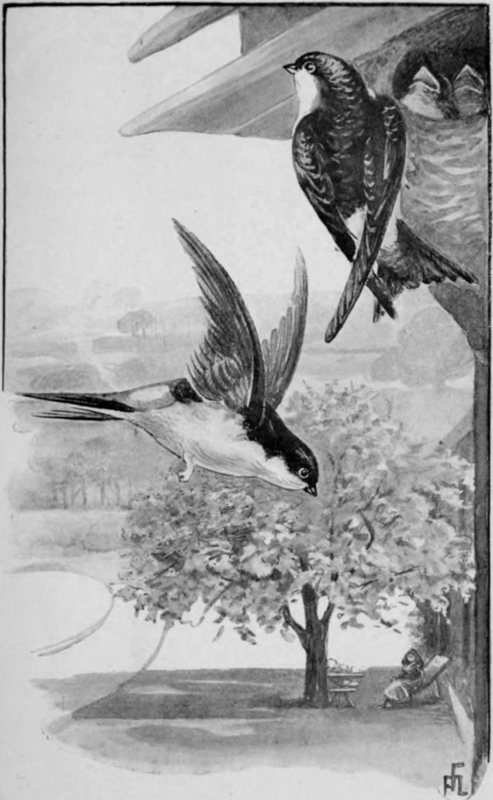
Little Miss Gwenny was sitting alone in the
garden, taking her tea. Her comfortable little
garden chair was placed under the projecting
eaves on the shady side of the Parsonage; the
unclipped jessamine that climbed up the wall was
clustering round her, and a soft breeze was
stirring its long shoots, and gently lifting the
little girl’s long hair with the same breath. She
looked the picture of comfort and enjoyment.
The Sorrows of a House-Martin.
25
On the table by her side were the tea-tray
and a well-worn copy of “Alice’s Adventures in
Wonderland.” She was not reading, however,
though now and then she turned over the pages
and looked at a picture. Except when she did
so, she kept her eyes half closed, and leaning
back in her chair gazed sleepily into the garden
through her drooping eyelashes. The fact was
that she was every minute expecting something
wonderful to happen. What it would be she
could not in the least guess; but that lovely September
day it really seemed as if there might
be fairyland in the garden at last. Twice
before during that summer she had contrived to
have the garden to herself, without fear of interruption
from parents, brothers, servants, or
visitors; but nothing wonderful had happened,
and this would probably be her last chance
before cold and wet set in.
But in spite of her tea and her book and her
beloved solitude, Miss Gwenny was not at this
moment in quite such a happy frame of mind
as to deserve to have her garden turning into
fairyland. Several things had happened to vex
her; and when one is vexed it is too much to
expect White Rabbits or Cheshire Cats or Mock
Turtles or March Hares to wait upon one at
pleasure and tell their tales. It was true indeed
that her brothers were well out of the way at
a cricket-match, and that her father and mother
had just set out on a long drive, taking with
26
them the manservant, who was always spoiling
her plans by poking about in the garden with
his tools. But this same man had spitefully (so
she thought) locked up the tool-house before he
went away, and it was just this very tool-house
on which she had been setting her heart all the
morning. There she could not possibly be seen
either from the road or the windows, while she
could herself see enough of the garden to catch
sight of anything wonderful that might come;
and there too she had some property of her
own in a dark corner, consisting of a dormouse,
the gift of her brothers, and sundry valuable
odds and ends, with which she might amuse
herself if nothing did come.
And this was not the only thing that troubled
her. She had heard her mother say that she
was going to ask Aunt Charlotte to look in
and see after Gwenny: and Gwenny did not
want, I grieve to say, to be seen after by
Aunt Charlotte. That kind lady was sure to
stay a long time in the garden fidgeting with
the rose-trees, and collecting snails and caterpillars
in an old tin pan. These creatures she
27
always carefully killed, to the great delight of
the boys, by pouring boiling water on them,
and she had more than once sent Gwenny to
the kitchen to fetch a kettle for this purpose.
Gwenny secretly determined to rebel if such
were her lot this afternoon; for how could
there be fairyland in the garden if all the
animals were killed? And every minute she
was expecting to hear the latch of the gate
lifted, and the quick decided step of her aunt
coming up the garden path.
Several times as she sat there a quick
shadow had passed over the white page of her
book, but she did not notice it, nor did she
heed a continuous quiet chatter that was going
on over her head. At last, just as she happened
to turn to the page on which is the picture of
the Duchess carrying the pig-baby, the shadow
hovered for a moment and darkened the leaf, so
that she looked up with a little frown on her face.
“Everything teases me this afternoon!” she
exclaimed. But the House Martin, whose
shadow had disturbed her, had flown into his
nest with food for his young ones. Gwenny
28
watched for his coming out again, and listened
to the chattering that was going on in the
nest. She could just see his tail, and the bright
white patch above it, as he clung to the door
of his nest up there under the eaves. Presently
he came out, and then she watched for
his return; and soon, so constant was the
hovering and chattering, that Aunt Charlotte,
and the gardener, and fairyland itself, were all
forgotten, and she began, after her own odd
fashion, to talk to the Martins in a dreamy
way.
“What busy people you are!” she said, very
softly, so as not to disturb them: “how tired you
must get, fussing about like that all day long!
Fancy if my mother had to run round the garden
twenty times before giving me anything to eat!
That would be more in Aunt Charlotte’s way,
wouldn’t it? I won’t get the boiling water today,—or
at least I’ll spill it. You look very
happy, gossiping away all day, with a nest full
of young to look after; anyhow it’s lucky for
you that you can’t be caught, and have boiling
water poured on you. She’d do it if she could,
29
though. Yes, you are certainly very happy; you
don’t come back to your nest and find it locked
up like my tool-house. How you do skim
about, like fish swimming in the air! And how
nice and clean you are!—though I did see you
grubbing in the mud the other day on the road.
I say, I should like to be you instead of me,
with all sorts of things to worry me.”
At this moment a Martin stopped to rest on
a bare twig of the apple-tree which grew close
to the house and almost touched it; and at
once fell to ruffling up its feathers, and pecked
at them with great energy.
“What are you doing that for?” asked
Gwenny, watching in a lazy way, with her eyes
half closed.
The Martin seemed to take no notice, but
clinging to his twig with some difficulty against
the rising breeze (for his feet were not much
used to perching) he went on diligently searching
his feathers with his bill.
“What are you doing that for?” asked
Gwenny again, rousing herself. And recollecting
her manners, she added, “If you will be
30
kind enough to tell me, I should really like to
know, because, you see, I’m interested in all
the animals in our garden.”
“That’s easily answered,” said the Martin:
“it’s only because these things I’m pecking at
tease me so.”
“Tease you!” cried Gwenny. “Why, I was
just thinking that you had nothing in the world
to tease you. I’m sure you look as happy as
the day is long. I have so many little things
to worry me, you see!”
“Dear little Gwenny!” said the Martin,
after a pause, “so you have your troubles too!
Do you know, I’ve seen you here every summer
since you were hardly big enough to toddle
about the garden, and I should have thought
you were the happiest little girl in the world.”
Gwenny shook her head sadly; and indeed
at that moment she heard the latch of the
gate lifted. But it was only the postman, and
there was no sign yet of Aunt Charlotte. The
Martin went on:
“And do you really think that a House Martin
has not troubles? Why, dear me, to think only
31
of these ticks! There are half a dozen in each
feather, I really believe; and if you had to
count my feathers, it would be your bedtime
long before you got through half of them. I
could sit here by the hour together hunting for
them, if I hadn’t plenty of other work to do.
You can’t think how they fidget one, tickling
and creeping all day long! And the nest up
there is swarming with them! Have you got
ticks under your feathers, I wonder?”
“Don’t talk of such horrid things,” said
Gwenny. “Of course I haven’t. Please don’t
fly down: you might drop some about. I had
no idea you were such nasty creatures!”
“Speak gently, please,” returned the Martin.
“It’s not our fault. They will come, and there’s
not a Martin in the world that hasn’t got them.
You see we have our troubles; and you are a
very lucky little girl. You have no ticks, and
no journeys to make, and no droughts to go
through, and no sparrows to bully you, and no
men or cats to catch and kill you. Dear
me,” he added with a sigh, “such a spring and
summer as my wife and I have had! Troubles
32
on troubles, worries on worries—and, depend
upon it, we haven’t seen the end of it yet.
But it’s no good talking about it. When one is
worried the best thing is to be as busy as
possible. So I had better say goodbye and
get to work again.” And he fluttered off his
perch.
“No, don’t go,” said Gwenny. “Tell me all
about it; I’m sure it’ll do you good. I
always go and tell some one when I get into
trouble.”
So the Martin began, while Gwenny arranged
herself comfortably as for a story, while the
breeze blew the brown locks all about her
face.
“The wonder is,” he said, “that I am here
at all. Every year it seems more astonishing,
for half the Martins that nested in the village
in my first summer are dead and gone. And
indeed our numbers are less than they used to
be; we have to face so many troubles and
perils. When we left Africa last spring——”
“Why did you leave it?” asked Gwenny. “If
you will make such terribly long journeys, (and I
33
know you do, for father told us) why do you ever
come back? Of course we’re very glad to see you
here,” she added, with an air of politeness caught
from her mother, “but it seems to me that you
are very odd in your ways.”
The Martin paused for a moment. “I really
don’t quite know,” he presently said; “I never
thought about it: we always do come here, and
our ancestors always came, so I suppose we
shall go on doing it. Besides, this is really our
home. We were born here, you see, and when
the heat begins in South Africa there comes
a strange feeling in our hearts, a terrible homesickness,
and we must go.”
“Then when you are once at home, why do
you leave it to go away again so far?” asked
Gwenny.
“My dear,” said the Martin, “if you will
listen, and not ask so many questions beginning
with ‘why,’ you may possibly learn something
about it. Let me begin again. When we left
Africa this year we went our usual way by some
big islands in a broad blue sea, where we can
rest, you know, and stay a day or two to recruit
34
ourselves,—and then we made another sea-passage,
and came to land near a large and
beautiful town, with great numbers of ships lying
in its harbour. Of course we are not afraid of
towns or men: we have always found men kind
to us, and willing to let us build our nests on their
houses. Long ago, you know, we used to build
in rocks, and so we do now in some places; but
when you began to build houses of stone we
took to them very soon, for then there was plenty
of room for all of us, and no one to persecute
us either, as the hawks used to do in the rocky
hills. But really I begin to fear we shall be
obliged to give it up again one of these days.”
“Why?” said Gwenny. “Don’t think of
such a thing, now we’re friends. Why should
you?”
“If you want to know why,” continued the
Martin, “you must wait a little till I get on
with my story. When we reached that fine town
with the ships, we rested, as we always do, on
any convenient place we can find,—chimneys,
towers, telegraph wires; and of course as we
come in thousands and much about the same
35
time, the people look out for us, and welcome us.
So they used to, at least: but of late years something
has possessed them,—I don’t know what,—and
they have set themselves to catch and kill
us. It may be only a few wicked persons: but
this year nearly all those towers and wires were
smeared with some dreadful sticky stuff, which
held us fast when we settled on it, until rough
men came along and seized us. Hundreds and
thousands of us were caught in this way and
cruelly killed, and will never see their old home
again.”
“Horrible!” cried Gwenny. “I believe I know
what that was for: I heard mother reading about
it in the paper. They wanted to sell the birds
to the Paris milliners to put on ladies’ bonnets.
But how did you escape?”
“Only by a miracle,” said the bird. “And
indeed I do wonder that I’m safe here; I
alighted on a tall iron fence near the sea, and
instantly I felt my claws fastened to the iron,—not
a bit would they move. A few yards off
were two or three of my friends just in the same
plight; and after a time of useless struggling, I
36
saw to my horror a man come along, with a boy
carrying a big bag. As the fence was high, he
carried a pair of steps, and when he came to the
other birds, he put these down and mounted them.
Then he seized my poor friends, gave their necks
a twist, and dropped them into the bag, which the
boy held open below. It was sickening: I could
see one or two which he had not quite killed
struggling about at the bottom of the bag. Poor
things, poor things! And there was I just as
much at the mercy of these ruffians, and my turn
was to come next.”
“It’s too horrible,” said Gwenny: “I wonder
you can bear to tell it.”
“Ah, my dear,” said the Martin, “we have
to get hardened to these things. And it’s good
for you to hear my story, as you thought our lives
were all happiness. Well, the man came along
to me with his steps, and I struggled, and he
chuckled, and in another moment it would have
been all over. But just as he was going to
grip me, he noticed that his boy was not below
with the bag, and turning round he saw him a
little way off in the road practising standing on
37
his head, while the bag was lying in the dust
with its mouth open. He shouted angrily,
scolded the boy, and bade him bring back the
bag directly; and when he came, gave him a
kick in the back that made him squeal. Then
he turned round again, seized me with a rough
dirty hand, and wrenched my claws loose. Oh,
the dreadful misery of that moment! But it was
only a moment. At the very instant when he
got me loose, the steps were pulled from beneath
him, and as he struggled to save himself he let
go his hold of me. Away I went as fast as I
could fly, only looking back for a moment to see
the man on his face in the dust, and the boy
running away with all his might. I owe my life
to that urchin’s mischief. He served his master
out well, and I hope he didn’t get beaten for it
afterwards.
“Well, I flew off, as I said, and it was a long
time before I rested again. I was afraid that
sticky stuff would hold me fast again, and I
dipped into the rivers and scraped myself in the
dusty roads, till I felt I had pretty well got rid of
it. And no other misadventure happened while
38
we were in France; and then there came a
pleasant morning with a gentle breeze, in which
we crossed the sea to this dear home of yours
and ours, where no one wants to catch and
kill us; and then we felt as happy as you fancy
we always are. It was mid-April, and your fields
looked so fresh and green, we had not seen such
a green for nearly a whole year. The sun shone
into the grass and lit it up, and forced the
celandines and marigolds to open their blossoms
all along the valley as we made our way to our
old home here. Every now and then a delicious
shower would come sweeping down from the
west, and the labouring men would get under a
tree, and throw old sacks over their shoulders to
keep them dry; and the gentlefolk out walking in
the roads would put up their umbrellas and run
for it. But we,—ah! how we did enjoy those
showers after the long weary journey! We
coursed about and chatted to each other, and
greeted our friends the Sand Martins by the
river bank, knowing that the sun would be out
again in a few minutes, and would bring all
sorts of juicy insects out of the moistened grass.
39
And when the rain had passed, and the blue sky
above was all the bluer for the dark cloud in the
distance, where the rainbow was gathering its
brightness, what delicious feasts we had! how
we did career about, and chatter, and enjoy
ourselves!”
“I daresay you did,” said Gwenny. “And I’m
very glad you are happy some time: but I’m
sure there’s something dreadful coming yet!”
“Only too soon there came something dreadful,”
the Martin continued,—“dreadful to us at least.
The very next day—the day we came here—the
soft west wind dropped, and no more showers
came. Quite early in the morning I felt a
difference—a dryness about the skin, and a
tickling at the roots of my feathers, which I knew
was not caused by those little creepers I told you
of. And when I rested on the telegraph wires to
scratch myself with my bill, I got so cold that
I had to leave off and take to flight again. And
then I knew that the wind was in the east, and
that I should get very little good by flying,
though fly I must, for the insects would not
rise. Those of yesterday were dead already,
40
nipped with a single night’s frost, and there
was no sun to bring new ones to life. But we
managed to get on fairly that day, and hoped
that the east wind would be gone the next
morning.”
“Why, what a difference the east wind does
make to some people!” put in Gwenny. “You’re
just like Aunt Charlotte; whenever she’s sharper
than usual, my mother says it’s the east wind,
and so it is, I believe. It dries up the snails, so
that they go under the bushes, and she can’t find
them. That’s the only way I can tell an east
wind: the snails go in, and Aunt Charlotte gets
put out.”
“Then Aunt Charlotte must have been very
cross last spring,” said the Martin; “and so
were we, and very wretched too. It lasted quite
three weeks, and how we contrived to get through
it I hardly know. Some of us died—the weaker
ones—when it turned to sleeting and freezing;
and when the Swifts came early in May they had
a dreadful time of it, poor creatures, for they are
very delicate and helpless, in spite of their long
wings. There were no flies to be had, except in
41
one or two places, and there we used all to go,
and especially to that long strip of stagnant water
which the railway embankment shelters from the
east. We used to fly up and down, up and down,
over that dreary bit of water: but to collect a
good beakful of flies used to take us so long that
we had often to rest on the telegraph wires before
it was done, and we got so cold and so tired
that we could only fly slowly, and often felt as
if we should have to give in altogether.”
“I saw you,” said Gwenny; “I watched you
ever so long one day, and I was quite pleased
because I could see the white patches over your
tails so nicely; you flew so slowly, and sometimes
you came along almost under my feet.”
“And I saw you,” returned the Martin,
“one day, but one day only; for you caught
your bad cold that very day while you were
watching us; and the next time I saw you,
when I peeped in at the window as I was
looking for my old nest, you were in bed, and
I could hear you sneezing and coughing even
through the window panes. It was a bad time
for all of us, my dear.”
42
“Well, I don’t know,” said Gwenny. “I
don’t much mind staying in bed, especially in
an east wind, because then Aunt Charlotte
stops at home, and can’t——”
“Never mind Aunt Charlotte,” said the
Martin. “She’ll be here directly, and you
mustn’t say unkind things of her. I can feel
with her, poor thing, if she lives on snails like
the thrushes, and can’t catch them in an east
wind.”
Gwenny was about to explain, but the Martin
said “Hush!” and went on with his tale, for he
was aware that it was getting rather long, and
that Aunt Charlotte might be expected at any
moment.
“At last the east wind went, and then for a
while we had better luck. Rain fell, and the
roads became muddy, and we set to work to
rebuild our nest. For you must know that it
was one of our bits of bad luck this year that
our dear old nest had been quite destroyed when
we returned, and instead of creeping into it to
roost during that terrible east wind, as we like
to do, we had to find some other hole or corner
43
to shelter us. You see your home is our home
too; and how would you like to have to sleep
in the tool-house, or under the gooseberry bushes
in the garden?”
“I should love to sleep in the tool-house,”
said Gwenny, “at least, if I could have my bed
in there. But I didn’t know you slept in your
old nests, nor did father, I am sure, or he would
have taken care of them when the workmen
were here painting the window-frames and the
timbers under the roof.”
“I thought that was how it was done,” said
the Martin; “they like to make everything
spick and span, and of course our nests look
untidy. Well, it can’t be helped; but it was
bad luck for us. We went to work all the
same, gathering up the mud in our bills, and
laid a fresh foundation, mixing it with a little
grass or straw to keep it firm.”
“Like the Israelites when they had to make
bricks!” cried Gwenny.
“Just so,” said the Martin, though he did
not quite understand. “And all was going on
nicely, and my wife up there was quite in a
44
hurry to lay her eggs, and we were working
like bees, when out came the sun, and shone
day after day without a cloud to hide him, and
all the moisture dried up in the roads, and our
foundations cracked and crumbled, because we
could get no fresh mud to finish the work with.
We made long journeys to the pond in the next
village and to the river bank, but it was soon
all no good; the mud dried in our very mouths
and would not stick, and before long there was
nothing soft even on the edge of pond or river—nothing
but hard-baked clay, split into great
slits by the heat.”
“Why, we could have watered the road for
you, if we had known,” said Gwenny.
“Yes, my dear, to be sure; but then you
never do know, you see. We know a good
deal about you, living as we do on your houses;
we know when you get up (and very late it is)
and when you go to bed, and a great deal more
that you would never expect us to know; but
you know very little about us, or I should not
be telling you this long story. Of course you
might know, if you thought it worth while; but
45
very few of you take an interest in us, and I’m
sure I don’t wonder.”
“Why don’t you wonder?” asked Gwenny.
“Because we are not good to eat,” said the
Martin decisively. “Don’t argue,” he added,
as he saw that she was going to speak: “think
it over, and you’ll find it true. I must get on.
Well, we waited patiently, though we were very
sad, and at last came the rain, and we finished
the nest. Ah! how delicious the rain is after a
drought! You stay indoors, poor things, and
grumble, and flatten your noses against the
nursery windows. We think it delightful, and
watch the thirsty plants drinking it in, and the
grass growing greener every minute; it cools
and refreshes us, and sweetens our tempers, and
makes us chatter with delight as we catch the
juicy insects low under the trees, and fills us
with fresh hope and happiness. Yes, we had a
few happy days then, though we little knew
what was coming. An egg was laid, and my
wife nestled on it, and I caught flies and fed
her,—and soon another egg was laid, and then,—then
came the worst of all.”
46
The Martin paused and seemed hardly able
to go on, and Gwenny was silent out of
respect for his feelings. At last he resumed.
“One afternoon, when the morning’s feeding
was over, I flew off, so joyful did I feel, and
coursed up and down over meadow and river
in the sunshine, till the lengthening shadows
warned me that my wife would be getting
hungry again. I sped home at my quickest
pace, and flew straight to the nest. If I had
not been in such a hurry I might have noticed
a long straw sticking out of it, and then I
should have been prepared for what was
coming; but I was taken by surprise, and I
never shall forget that moment. I clung as
usual to the nest, and put my head in before
entering. It was a piteous sight I saw! My
wife was not there; the eggs were gone; and
half a dozen coarse white feathers from the
poultry yard told me what had happened.
Before I had time to realise it, I heard a loud
fierce chatter behind me, felt a punch from a
powerful bill in my back, which knocked me
clean off the nest, and as I flew screaming
47
away, I saw a great coarse dirty sparrow, with
a long straw in his ugly beak, go into the
nest just as if it were his own property. And
indeed it now was his property, by right of
wicked force and idle selfishness; for as long
as I continued to hover round, he sat there
looking out, his cruel eyes watching me in
triumph. I knew it was no good for me to
try and turn him out, for I should never have
lived to tell you the story. Look at my bill!
it’s not meant to fight with, nor are my claws
either. We don’t wish to fight with any one;
we do no one any harm. Why should we be
bullied and persecuted by these fat vulgar
creatures, who are too lazy to build nests for
themselves? Up there at the farm-house they
have turned every one of us out of house and
home, and I daresay that next year we shall
have to give up your snug house too. You
could prevent it if you liked, but you take no
notice, and you think us always happy!”
This was too much for poor Gwenny, and
the tears began to fall. “No, no,” she implored,
“you shall come here again, you must come here
48
next year! I’ll tell father, and I know he’ll
protect you. We’ll do all we can if you’ll
only promise to come again and have a better
summer next year—I’ll promise, if you’ll
promise.”
“Dear child, I didn’t mean to make you cry,”
said the Martin. “It’s all right now, so dry your
eyes. We built another nest, and there it is
over your head. But it’s very late in the
season, and if the cold sets in early my little
ones will have hard work to keep alive. In any
case they will be late in their journey south, and
may meet with many trials and hardships. But
we must hope for the best, and if you’ll do your
best to keep your promise, I’ll do my best
to keep mine. Now we are friends, and must
try not to forget each other. As I said, this is
your home and mine too. Often and often have
I thought of it when far away in other lands.
This year I thought I should have hardly one
pleasant recollection to carry with me to the
south, but now I shall have you to think of, and
your promise! And I will come back again in
April, if all is well, and shall hope to see you
49
again, and your father and mother, and Aunt
Charlotte, and the sn——”
“Gwenny, Gwenny!” said a well-known voice;
“my dear child, fast asleep out of doors, and
evening coming on! It’s getting cold, and you’ll
have another chill, and drive us all to distraction.
Run to the kitchen and make the kettle boil,
and you can warm yourself there before the
fire.”
“I’m not cold, Aunt Charlotte, and I’m not
asleep,” said Gwenny, stretching herself and
getting up. “And, please, no boiling water
to-day! It’s fairyland in the garden to-day,
and I really can’t have the creatures killed, I
really can’t!”
“Can’t what!” cried Aunt Charlotte, lifting the
pan in one hand and the garden scissors in the
other, in sheer amazement. “Well, what are
we coming to next, I wonder! Fairyland! Is
the child bewitched?”
But at that moment the Martin, who had left
his perch, flew so close to Aunt Charlotte’s ear
that she turned round startled; and catching
sight at that moment of the carriage coming
50
down the lane, hastened to open the gate and
welcome Gwenny’s father and mother.
Gwenny looked up at the Martin’s nest and
nodded her thanks; and then she too ran to
the gate, and seizing her father with both hands,
danced him down the garden, and told him she
had made a promise, which he must help her
to keep. It was an hour before they came in
again, looking as if they had greatly enjoyed
themselves. Aunt Charlotte had gone home
again, and the snails were left in peace. And
as the Martin flew out of his nest, and saw
Gwenny and her father watching him, he knew
that the promise would be kept.
51
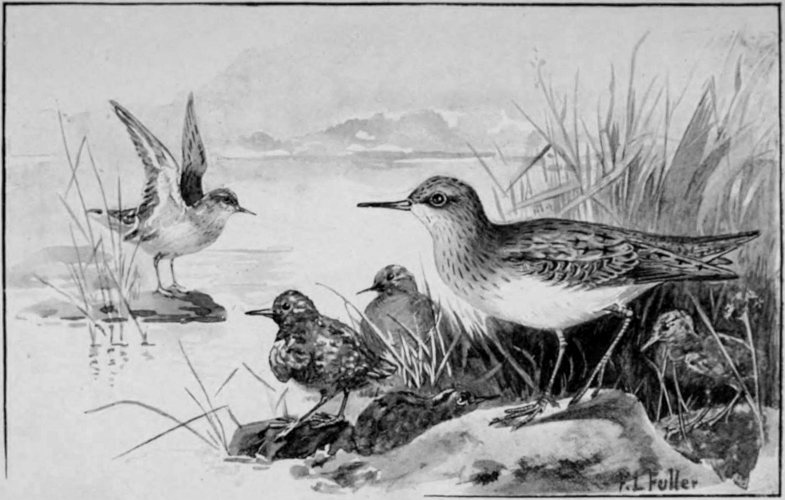
THE SANDPIPERS
Fresh and sweet from its many springs among
the moors, where the Curlew and the Golden
Plover were nesting, the river came swiftly down
under the steep slopes of the hills; pausing here
and there in a deep, dark pool under the trees,
into which the angler would wade silently to
throw his fly to the opposite bank, and then
hurrying on for a while in a rapid flow of constant
cheerful talk. Then making for the other
side of its valley, it quieted down again in another
deep pool of still water: and, as the valley opened
out, it too spread itself out over a pebbly bed,
welcoming here another stream that rushed down
from the hills to the west.
Just here, where winter floods had left a wide
space of stones and rubbish between the water
and the fields, and before the river gathered itself
52
together again for a swift rush into another pool,
a pair of Sandpipers had made their scanty nest
and brought up their young in safety for two
years running. And here they were again, this
last June, safely returned from all the perils of
travel, and glorying in a nestful of four large
and beautiful eggs of cream colour spotted with
reddish-brown blotches. The nest was out of
reach even of the highest flood, but within
hearing of the river’s pleasant chat: for without
that in their ears the old birds could not have
done their work, nor the young ones have learnt
the art of living. It was placed among the
bracken under an old thorn-bush, on the brink
of a miniature little precipice some four feet
high, the work of some great flood that had
eaten out the shaly soil.
The Sandpipers felt no fear, for there was no
village at hand, and hardly a boy to hunt for
nests: the fishermen kept to the bank of the
river or waded in it, and only glanced for a
moment in admiration at the graceful figure of
the male bird, as he stood bowing on a stone
in mid-stream, gently moving body and tail up
and down in rhythmical greeting to the water
that swirled around him, and piping his musical
message to the wife sitting on her eggs near at
hand.
The Sandpipers.
53
One day when he was thus occupied, before
making a fresh search for food for her, an
answering pipe from the nest called him to her
side. He guessed what it was, for hatching time
was close at hand. When he reached the nest,
he found that inside the first egg that had been
laid a tiny echo of his own clear pipe was to
be heard. Whether you or I could have heard
it I cannot say; but to the keen ears of the
parents it was audible enough, and made their
hearts glow with the most delightful visions of
the future. And this hidden chick was wonderfully
lively and talkative, more so than any chick
of theirs had been before he came out into the
world. It was quite unusual for a Sandpiper,
and both the parents looked a little serious. Nor
was their anxiety allayed when the egg-shell
broke, and a little black eye peered out full of
life and mischief.
Then out came a head and neck, and then a
54
sticky morsel of a mottled brown body, which
almost at once got its legs out of the shell, and
began to struggle out of the nest. Was ever
such a thing known before? The old birds knew
not whether to laugh or cry, but they hustled him
back into the nest in double quick time, and made
him lie down till the sun and air should have
dried him up a little. Hard work the mother
had of it for the next day or two to keep that
little adventurer under her wing while the other
eggs were being hatched. When he was hungry
he would lie quiet under her wing; but no sooner
had his father come with food for him than he
would utter his little pipe and struggle up for
another peep into the wide world. Terrible
stories his mother told him of infant Sandpipers
who had come to untimely ends from disobeying
their parents.
One, she told him, had made off by himself
one day while his mother was attending to his
brothers and sisters, and before he had gone
many yards along the pleasant green sward, a
long red creature with horrible teeth and a tuft
to his tail, had come creeping, creeping, through
55
the grass, and suddenly jumped upon him. His
mother heard his cries, and flew piping loudly to
the spot; but it was too late, and she had to
watch the cruel stoat bite off his head and suck
his blood. Another made off towards the water
and was crushed under foot by an angler who was
backing from the river to land a fish, and never
even knew what he had done. Another fell into
a deep hole at nightfall and could not get out
again, and was found starved and dead when
morning came.
After each of these stories the little bird shuddered
and crouched under his mother’s wing
again: but the mastering desire to see the world
always came back upon him, and great was the
relief of the parents when the other eggs were
hatched and education could begin. Then the
nest was soon abandoned, and the little creatures
trotted about with their mother; for they are not
like the ugly nestlings that lie helpless and
featherless in their nests for days and days, as
human babies lie in their cradles for months.
Life, and manners, and strength, and beauty,
come almost at once on the young Sandpipers,
56
as on the young pheasants and partridges and
chickens. And their education is very easy, for
they seem to know a good deal already about
the things of the world into which they have
only just begun to peep.
So one lovely day in June the whole family
set out for the bank of the river, the young ones
eager to learn, and the old ones only too anxious
to teach. For what they had to learn was not
merely how to find their food—that they would
soon enough discover for themselves—but what
to do in case of danger; and as they tripped
along, the mother in her delicate grey dress,
white below with darker throat and breast, and
the young ones in mottled grey and brown, so
that you could hardly tell them among the pebbles
and their shadows, she gave them their first
lesson, while the father flew down the river and
back again to exercise his wings and to look
for food.
They had not gone far when suddenly their
mother cried “wheet whee-t” with an accent
they already knew, and flew away from them,
calling loudly as she went. The little ones,
57
unable to fly, did the first thing that came into
their heads (and it seemed to come into all their
little heads at one moment), and dropped down
among the pebbles motionless, with eyes shut.
There they stayed some time, and the eldest,
getting tired of this, at last opened a bright black
eye, and turned it upwards. There, far up above
them, hovering with poised wings, was a Kestrel
clearly marked against the sky. The little black
eye closed again, and there they waited without
moving till at last the mother returned.
“Well done, my dears,” she said, “that was
a good beginning; there was no great danger,
for the Kestrel would hardly be looking for
you among these stones; but do that as you
did it then whenever I make that call to you;
drop exactly where you may be, and shut your
eyes. All together and side by side, if you are
together when I call; and when I fly round
above you, still calling, creep into any holes you
see, or under a stone or a tuft of grass, and wait
there till I come again. Now the hawk has
gone, so we may go on to the water.”
There was no need to bid them go; had not
58
the noise of that water been in their ears ever
since they broke their shells, telling them all the
secrets of their life? And had not their mother
told them wonderful things of it—of the food
about its banks, and on its stones, and in its
shallows, the cool refreshing air that breathes
from it, the lights and shadows that play on it,
and above all, the endless music without which
a Sandpiper could hardly live?
“You cannot fly yet,” she told them, “but we
will go to the water’s edge, and then your father
and I will show you how to enjoy it.” And as
just then it came in sight, she opened her wings
and flew out on it piping, while the little ones
opened their wings too in vain, and hurried on
to the edge, and watched her as she alit on a
stone, and bowed gracefully to the dancing water.
And they too bowed their tiny bodies and felt
the deliciousness of living.
All that livelong day, a day no one of them
ever forgot, they spent by the river side, dabbling
their little dark-green legs in the water when an
eddy sent it gently up to them, learning to find
the sweetest and wholesomest insects lurking
59
among the pebbles, with now and then a little
worm, or caterpillar that had fallen from the
bushes above: watching the trout turning up
their golden sides in the dark water of the pool
as they rose to the flies: practising their voices
in a feeble piping, and always moving bodies
and tails as they saw their parents do it.
They had very few alarms, but quite enough
for practice in hiding. Once as they were following
their mother by the very edge of the
deep pool, a huge silver creature, flashing in the
sunlight, leapt clean out of the water and fell in
again with a splash. The little ones all dropped
to ground and lay silent, but their mother never
uttered a note, and they soon got up again. She
told them it was only a salmon, who could not
possibly do them any harm, and would not if he
could; that she and their father were good friends
with the salmon, and often sat on the big boulder
under which he loved to lie; but that it was only
a bowing acquaintance, because the salmon could
not talk their language.
Once or twice an angler came along slowly,
and then they had to drop while their parents
60
flew up and down stream loudly calling; but
there was always plenty of time for them to get
into holes and corners safely, and the anglers
passed on again without noticing either young
or old. At last the light began to fade, the
young ones were tired and sleepy—even the
eldest, who had distinguished himself by trying
to fly, and actually getting out on a stone half
a foot from the shore, where he stood bowing
with great pride till his father came and shoved
him into the water to scramble ashore in a
fright—and so this delightful day came to an
end, and they all went back to the shelter where
the nest was placed.
The next day was a Sunday, and they spent
half the morning in great happiness without
seeing a single fisherman. But after all they
were to learn this day that life has its troubles:
for a huge heron took it into his head to fish
while human beings could not, and alighted at
the water’s edge within a dozen yards of the
spot where they were already motionless in
obedience to their mother’s signal pipe. And
there the great bird kept standing on one leg
61
for a full hour, and would not move a muscle,
except when now and then he darted his long
bill into the water, and then heaved it up into
the air with a trout struggling at the end of it.
At last, as his back was turned to them, their
parents whistled them away, and they crept
back to the nest in deep disappointment.
“Why should we be afraid of that creature?”
asked the eldest: “he eats fish, not Sandpipers.”
“Let him see you, my child,” said the father,
“and he’ll snap you up with that long bill of
his as quick as a trout can snap a fly. There
was a wild duck up the stream which had a
nice little family just learning to swim, when
down came a heron before they could hide
themselves—and indeed they can’t hide themselves
so well, poor things, as you have learnt
to—and he just took those ducklings one after
another, and made such a good meal of them
that he went away without stopping to fish,
and the poor parents had to make another nest
and go through their work all over again.”
So they had to stop at home while the heron
62
was there, and it was past midday when at last
he flew away. Then out they came again, and
were making their way with glad hearts down to
the water, when the warning “wheet-whee-et”
was heard very loud indeed. Down they all
went, in a row together, on the bit of shaly bank
where they were running at the moment. And
now they knew that there was indeed danger; for
the old birds flew piping wildly up and down as
they had never yet heard them, and close by
they could hear some great creature trampling
about all around, and searching every bit of stone
and grass and bush. Once they felt its shadow
come over them, and could hear it breathing
within a yard or two of them. Then it went
away, letting the sun come on them again; but
their parents kept up their wild piping, and they
knew that the danger was still there. Then
more searching and shuffling and routing, and
once more the shadow came upon them, and the
footsteps crunched the shale on which they lay.
And now, as ill-luck would have it, the eldest
opened one black eye and looked out of the corner
of it. In another moment he felt himself seized
63
in a mighty grasp, but not ungently, and lifted
high into the air, while in wildest consternation
the old birds flew close around him.
It was a terrible moment, but the little bird
was plucky, and something in the way he was
held told him that he was not going to be eaten.
He opened both eyes, and saw one of those
human anglers, without his rod. The great
animal handled him gently, stroked his plumage,
and looked him all over, and then put him softly
down beside his brothers and sisters, who were
still motionless but palpitating. He stood there
for a minute or two gazing at them, no doubt in
wonder and admiration, and then hastened away
towards the farmhouse under the hill. The little
birds began to move again.
“Whisht, wheet, wheet,” cried their mother;
“it’s not all over yet. He wouldn’t have gone
so fast if he hadn’t meant to come back again.
Get into holes and corners, quick!”
“I don’t mind if he does come back again,”
said the eldest. “He didn’t hurt me. His great
claw was warm and comfortable, and he stroked
my down the right way. I looked up and saw
64
his great eye: it was like the salmon’s, only
pleasanter.”
“Holes and corners, quick, quick, quick, wheet,
whee-et,” cried both parents again in dismay at
the folly of their eldest; and all four crept up the
shaly ledge and hid themselves under tufts of
grass and bits of stick. It was none too soon,
for the footsteps were now heard again, and the
creaking of a gate as the angler got over it.
And this time he was not alone; another human
creature was with him. They came up to the
spot, glanced at the frightened parents with
admiration, and then looked for the young
ones.
“Well, this is provoking,” said the one who
had been there before; “if they haven’t gone
and hid themselves away! Here have I dragged
you from your comfortable pipe for nothing at
all! They’re not far off, though, or the old birds
would not be here.” And stooping down, he
examined the ground carefully.
At that moment that perverse eldest chick,
conscious that his right leg was sticking out into
the sunshine, instinctively drew it in under him,
65
and doing so, he again caught the angler’s eye.
And he had to be pulled out of his hiding-place
with rather more force than he liked. The
angler put him into his friend’s hands, and for
a moment the audacious chick was frightened.
But he was soon down in his cover again safe
and sound; and then the rest were found and
admired, and the big creatures turned to go
away.
“Wait a minute, though,” said the angler,
pausing; “let us sit down a bit and see what
they will do. My dears,” (addressing the old
birds,) “you must put up with a little more
anxiety, and then you shall be happy for ever
afterwards, if you can.” So the two human
beings sat down on the stones and watched,
while the old birds flew round piping, perching
here and there and bowing, and giving them such
pictures of grace and beauty as they were not
likely soon to see again. And neither of them
can ever forget the charm of that quarter of an
hour; the music of the river, the fragrance of
the scented fern, the outlines of the rocky hills
against the sky, and the gentle grace of the pair
66
of little grey fairies that flew around them piping,
less timid now that they saw no chance of harm
to their brood.
At last, urged by some signal from the parents,
the little birds all came out of their holes and
corners, and trotted along one after another, the
eldest leading, right under the very eyes of the
two men. Piping faintly as if to call attention to
their beauty, and moving tails and bodies like
their parents, they passed along the shaly bank
till they reached the roots of an old battered
thorn-bush, where they disappeared into a hole
and were seen no more by the human eyes.
After this adventure the old Sandpipers had
a long talk. All had gone well so far; but it
would not do to run these risks any longer if
they could help it. And not without some misgivings
as to the difficulty of the task, they
determined to get the young ones across the
river without delay; for on the further side some
jutting rocks made it impossible for anglers to
pass, and they were seldom seen there.
So next morning at break of day the little
family was called down to the water’s edge,
67
and told that they must do exactly as they were
bid, and not be frightened. The father crouched
down among the pebbles, and the mother bade
the eldest chick mount upon his back, and stick
his three long toes, whose claws were already
beginning to get strong, fast into the soft and
yielding plumage. This he did in a moment,
and the next one found him shooting across
the narrow head of the pool, with its rush of
tumbled water, and landed safely at the foot of
the rock. It was a delightful sensation, and as
the father opened his wings and sped back
again to fetch the others, the little one opened
his too, and felt almost as if he could do it by
himself. Then one after another the three
younger ones were carried over, piping faintly
from fear, and clinging for their lives to their
perilous perch. And lastly came the mother
with kind words of praise for all, and they set
out to enjoy themselves for a whole long day of
peace and plenty.
And indeed in peace and plenty they passed
many days without further troubles or adventures,
while the little wings began to put out
68
their quill feathers, and the little voices to gain
in strength and tone. And all this time the
sun shone and the river sang a quiet song, as it
slowly sank for want of rain, leaving new and
varied margins of sand and pebbles for the
Sandpipers to search for food.
But one morning the sun did not greet them
as usual with his warmth; the sky was grey
and streaky, and seemed to hang lower over
the hills than when it was all clear blue. At
first all was still and silent, but presently a gust
of wind came up the river, and then another
as suddenly came down, worrying the early
angler on the opposite bank, and teasing the
little Sandpipers as it blew their soft plumage
the wrong way. And then a large white bird
sailed gracefully up the valley, balancing itself
against the wind, to the great admiration of the
chicks.
“That is a Seagull, children,” said the mother,
“and you will see plenty of them when you
cross the sea to the warm southern lands for
the winter. And he is telling us that there is a
storm coming—listen!”
69
And they listened to the melancholy wail of
the great bird, but felt no fear of him, for the
parent birds showed none. But the old ones
knew the meaning of that sad music, and thought
of the weary waste of sea over which they would
soon have to pass, and the sudden squall at
night, and the loss of old friends and comrades.
Before the morning was out the storm began
in earnest, and the chicks, after enjoying the
first soothing rain for a while, were hustled
under the shelter of the big rock, and crept into
a hole to leeward. The eldest of course was
the last to go in; for as a sudden strong gust
swept past him, he opened his growing wings,
and to his great delight found himself carried
off his legs and almost flying. But the watchful
father had seen him, and in a moment was ahead
of him, just as he was being carried out upon
the stream.
“Back into the hole!” he called with real
anger; “look at the river! Even if you could
use those wings as you think you can, it would
be unsafe for you in wind and flood.” And the
little bird looked at the water, and saw that it
70
was coming much faster than he had ever seen
it, and its voice was deeper and hoarser; for
far away up on the hills the great storm was
already travelling round and round, and the
growling of its thunder mixed ominously with
the deepening tone of the river. So he crept
into the hole and lay down by the others; and
they all listened to the fearful splashing of the
rain, and the scream of the tearing gusts, and
the sighing of the trees on the hill above them.
From time to time the old birds went out to
get food for themselves and the young, and
perhaps, too, to enjoy the freshening moisture,
and the towzling worry of the wind, as old birds
can and may after a long calm and drought. It
might have been wiser if one of them had
stayed at home; but the young ones were quiet
and overawed, and, what was more, they were
hungry.
During one of these absences the violence of
the storm seemed to abate a little, and the
flashes of sudden fire which had been making
them shut their eyes came now but very faintly.
It was getting towards evening, and the restless
71
eldest chick wanted badly to be out again, and
all the more because he heard the roar of the
river below him, and could hear its waves
leaping and splashing on the rocky promontory
in the side of which they were sheltered. So,
without saying a word to the rest, he got up
and went out of the hole on to a little ledge of
rock which overhung the water.
What a sight it was! Dark-brown water
rushing madly down into the pool, carrying with
it logs and branches of trees with all the glory
of fresh foliage wasted, and then the pool itself
no longer golden-brown and clear, but black as
ink, and flecked with creamy patches of surf.
But the wind seemed lighter, and there were
the Sandmartins, who had their nests in the cliff,
flitting up and down just over the water as if
nothing had happened, and there too was the
friendly Grey Wagtail, with his long tail going
up and down just the same as ever. Feeling
that he might safely see more still, that adventurous
young bird trotted round the corner of
the ledge.
In a twinkling the wind had carried him off
72
his feet, and he was flying—really flying for the
first time in his life. He needed no teaching in
the art—whether he would or no, fly he must.
Those growing quills were big enough to carry
him along with the wind, and he had only to
guide himself as well as he could. It was
glorious, and he felt no terror, for there was no
time to feel it. Over the black pool, past the
foot-bridge, over which he shot like one of the
Sandmartins which he had so often watched
with envy and admiration; over the ford, now
impassable, and then, as the river made a
sharp curve, over field and hedge to the roaring
flood again where it turned once more
in the wind’s direction. But those weak
wings were getting tired, and piping loudly
for help, he looked for some safe place to
drop upon.
Suddenly the wind fell for an instant, and a
puff from the opposite direction brought him
to. He was over the very middle of the river:
a great boulder, water-splashed, lay just under
him. How he managed it I cannot tell, but
he dropped exhausted on the rough damp surface
73
of the stone, and felt himself safe at
last.
Safe! for the moment perhaps, but what was
to become of him? The water was surging and
roaring against his boulder: was it going to rise
upon him and carry him away helpless? The
wind was so strong that to fly up stream was
hopeless, and as he sat there exhausted, he felt
that he could not even use his wings to get to
shore. Uttering from time to time a plaintive
“wheet,” he clung to the stone with all his
might, balancing himself with body and tail against
the gusts: not reflecting, nor despairing, but just
wondering what would happen.
The Sandmartins shot by overhead, but not one
of them seemed to notice him, or to be the least
inclined to perch on his stone. A Dipper came
slowly up stream against the wind, perched on
another stone not far off, bowed repeatedly and
went on again. A Grey Wagtail coming down
stream in graceful waves of flight, poised himself
over the stone, and for a moment actually
alighted on it: then, seeing his mate pass down
after him, opened his wings and was gone. The
74
Sandpiper opened his too, but his heart sank
within him, and he clung still more passionately
to his stone.
Two figures came rapidly up the river-bank,—two
drenched human creatures, fighting against
the wind, but enjoying it. Just as they came
level with the boulder they caught the sound of
a faint “whee-et.” The angler turned sharp
round, and after some search with a fieldglass,
discovered the little brown object on the
boulder.
“It’s a young one,” he said to his companion:
“it’s a veritable infant! And see, it can’t fly,—it’s
clutching at the stone like grim death! By
all that’s feathered, it must be one of our young
friends blown away, for there’s no brood between
them and this, and the wind’s been down stream
pretty well all day. I say, we must have him off
that somehow.” They looked at each other and
at the swollen river.
“I’ll go,” said the friend the next moment:
“I’m taller and stronger. I should rather like a
towzle, but it won’t be easy. I can’t try it from
above, or I shall come with a bang on the stone:
75
but there are the stepping-stones just below. I
can get out there if I can see them through the
flood, and then I sha’n’t have above twenty yards
to swim.”
While he said this he was pulling off his
clothes, and then he leapt exuberantly down the
bank to the water. Suddenly he stopped.
“How am I to bring him back?” he shouted.
The angler was puzzled. To swim in a
current like that with a bird in your hand was
impossible without crushing it; and a naked man
has no pockets. But necessity is the mother of
invention. Quick as thought he whipped a
casting-line off his hat, taking two flies off it and
sticking them into his coat: this he wound
round his friend’s wrist, and making the end fast,
told him to tie it round the bird’s leg if he
reached him.
Carefully into the water his companion descended,
feeling with his hand for the first
stepping-stone; then balancing himself between
this and the rushing water, he went on to the
second. It was teasing work, but he managed
the third, the fourth, the fifth, and then it was
76
high time to swim, for the water was up to his
middle and higher, and swayed him to and fro
in a way that made the angler watch him
eagerly. Then came a splash and a plunge,
and his head was seen working up against the
current, zigzagging to diminish the force of it.
Twenty yards is a long way in such a stream,
but if he could once get under the lee of that
great boulder he would do. And in something
like five minutes he was under the stone, and
then on it.
A strange sight it was to see a naked
human creature sitting cross-legged on a boulder
in such a flood! But he has caught the truant,
and now he is tying that handy gut line round
his leg. And then, standing up on the boulder,
he flings the bird shorewards, one end of the
line being still fast round his wrist.
The bird sank on the water, and the man
plunged in; fighting with the current that was
sweeping him down, he made for the shore,
and reached it breathless far below the stepping-stones,
where the angler pulled him out of
the water as joyfully as he ever pulled a
77
trout. Then they wound up the line, and
sure enough there came ashore at the end of
it, a draggled, exhausted, and almost lifeless
Sandpiper.
To be carried in a human pocket is not
pleasant for a bird, but our young scapegrace
was too far gone to trouble himself about it.
At his birthplace he was taken out, and there
the angler stayed with him, sending his companion
home to change. It was getting dark
fast, but the old birds were still flying wildly
up and down the river, piping loudly in a forlorn
hope of finding their young one ere night
should wrap the river in darkness. The angler
put him down near the water and waited at a
little distance.
Ere long his wits came back to him, as the well-known
notes told him that he was indeed again
near home. And weak as he was, he found
strength to send out over the river his own
little feeble pipe. In a moment his mother
was by his side.
The angler watched them for a moment, and
then left them to tell his friend of the good
78
result of a kindly deed. The next day they
had to leave the river and all its delights, and to
return to work and duty: but they cannot forget
the Sandpipers, nor, when the birds return
after their winter sojourn in the far south, will
they fail to look out without misgiving for their
human friends.
79
THE LAST OF THE BARONS — I — II — III
The Baron sat perched on an old gnarled
oak, gazing across the deep ravine below him,
where the noisy river leapt from pool to pool.
He had been far over the moorland that day
with his wife, searching for a safe nesting-place,
and had given up the search in despair and
returned to his old home; but the Baroness had
dallied and been left behind, and now he was
expecting her as the sun began to sink in the
west. He sat there silent and sad, the last, so
he thought, of an ancient race; his head, almost
white with age, slightly bent downwards, and
his long forked tail sadly weather-worn and
drooping.
It was a fresh evening in early April, and one
sweet shower after another had begun to entice
80
the ferns to uncurl themselves, and the oaks
on the rocky slopes of the Kite’s fortress to
put on their first ruddy hue; and now the
showers had passed, and the setting sun was
shining full in the old Baron’s face as he sat
on his bough above the precipices. But neither
sun nor shower could rouse him from his
reverie.
Suddenly he raised his head and uttered a
cry; and at the same moment you might have
seen the Baroness gliding slowly over the opposite
hill. As she neared him, she stopped in
mid-air over the roaring torrent and answered
his call; and then he slipped off his bough,
like a ship launched into the yielding water,
and silently joined her. They flew round and
round each other once or twice, and the fisherman
on the rocks below looked up and gazed
at them with admiration. You could tell them
apart without difficulty: the Baroness was the
larger bird of the two, and her feathers were
in better order—she was still young, not more
than twenty or so; while the old Baron looked
worn and battered, though the red of his back
was brighter, and his fine tail was more deeply
forked than that of his lady.
The Last of the Barons.
81
They began to circle round each other slowly,
hardly moving their wings, but steering with
their long tails, and soon they were far above
the isolated hill which was known as the Kite’s
fortress. Sweeping in great circles higher and
higher, they seemed to be ascending for ever
into the blue, never to come down again; now
and again a white cloud would pass above them,
against which their forms looked black and clear-cut,
and then it would drift away, and you had
to look keenly to see them still sailing slowly
round and round, tiny specks in the pure
ether.
All this time they were talking about a very
important matter; not chattering and fussing,
as common birds do—starlings, sparrows, and
such low-born creatures—but saying a few words
gravely as they neared each other in their great
circles of flight, and thinking of the next question
or answer as they parted for another sweep.
“Well,” said the Baron after a while, “have
you found a better place than this, where our
82
persecutors cannot reach us without risking their
miserable lives?”
“No,” she answered, “none as good as this,
and I have been far over the moors toward the
setting sun. There are the crags looking down
on the flat country and the sea, but they are not
so well wooded, and they are too near that
seaside town where we have enemies. I have
looked at many other places too, but there were
none to please me much.”
“I thought so,” said the Baron. “I have
known all this country, every tree and every crag,
since I first learnt to fly on the hill down below;
and there is no such place as this. I and my
old Baroness brought up many broods here,
and now that I have a young wife again,
she wanders about and wants to find a new
home.”
“But men found you out and shot her here,”
said the Baroness. The Baron sailed away from
her in a wide sweep, but soon returned and
spoke gravely again.
“Don’t talk of that, dear,” he said. “I have
found another wife, and that was more than I
83
could expect. I searched far and wide, over land
and over sea; I reached the ugly country to the
south, where the smoke made my eyes water,
and the fields were no longer green, and no
mice or beetles were to be found; I turned
again for fresher air, and came to a wild and
treeless sea-coast, where the Gulls mobbed me
and a gun was fired at me: but not one of our
kind did I see—only the stupid Buzzards, and
a Kestrel or two. I gave it up, and thought I
was indeed the last of the Barons.”
“And then you found me after all near your
old home,” said the Baroness, tenderly. “And
we have brought up two broods, though what has
become of them I know not. And last year we
should have done the same, but for the creatures
that came up the valley when we were just ready
to hatch.”
“Ah,” sighed the Baron, and swept away
again in a grand ascending curve.
“Why should they wish to ruin us?” asked
she, as with motionless wings he came near her
again. “Do we do them any harm, like the
Ravens who dig out the young lambs’ eyes, or
84
the vulgar Jays and Magpies—poachers and
egg-stealers?”
“Do them harm?” said the Baron, with anger
in his voice. “Look at the white farmhouse
down yonder! They are good people that live
there, and know us well. For generations my
family has been on friendly terms with them;
they know we do not steal, or pick the lambs’
eyes, and in hard winters they do not grudge us
a duckling or two, for if we were to die out it
would be bad luck for them. We have our own
estate, which seldom fails us; we have the wide
moorland and are content with it, and can live
on it without meddling with old friends’ property,
like the Buzzards and the Ravens.”
“Then why are those other men so mad
against us?” asked the Baroness again. “Is not
this our own fortress, our old estate, entailed
from father to son as you have so often told me,
and called by our name? Why do they come
and trouble us?”
“Perhaps the old Raven was right,” said the
Baron, after a wide sweep; “he told me he had
spent years among them as a captive, and had
85
learnt their language and their notions. A great
change, he told me, had come over them in the
course of his long life. They are now too much
interested in us, he said. Once they did not
care at all about us, and then we flourished.
Now they are poking and prying everywhere;
they run about on all sorts of machines, find us
out, and won’t let us alone. They go to the
ends of the earth to worry us birds, wear our
feathers in their hats, and put our skins and our
eggs in their museums. It isn’t that they hate
us, he said: it’s much worse than that. No,
they pretend to love us, and they show their love
by coming and spying after us and watching all
we do. They are so fond of us that they can’t
keep their hands off us; and the harder it is to
find us the more trouble they take. Yes, I
believe that old Raven was right! Man takes
such an interest in us that there will be none of
us left soon!”
“Let us try once more,” said the Baroness,
with all the hopefulness of youth. “Come down
and find a tree on the steepest face of the old
fortress. It is quite time we were beginning;
86
the oaks are reddening. Let us do what we can,
and hope they will not take an interest in us
this year.”
The Baron silently assented, glad that the
ancestral rock should not be deserted; and descending
rapidly, still in circles, they reached it as
the sun set. Next morning at daybreak the tree
was chosen—an oak, high up on a rocky shelf,
looking to the west across the ravine and the
tumbling river. And before the sun was high
the foundation of the nest was laid.
In a close little room, in a narrow little street of
a large town, poor Mrs. Lee, pale and worn, and
rather acid, was scraping bread and butter for
her children’s breakfast, and doling out cups of
watery tea. Five young ones, of various ages,
hungry and untidy, sat expectant round the table.
Two places were still vacant; one, the father’s,
as you might guess from the two letters awaiting
him there, and the other for the eldest son, who
helped his father in the workshop. In that shop
87
father and son had been already hard at work for
a couple of hours, stuffing an otter which had
been brought in the day before.
Now the two came in; the father keen-eyed
but sad-looking, the son a big bold lad, the hope
of an unlucky family.
Mr. Lee sat down and opened one of the two
letters. As he read it, his face grew dark, and
his wife watched him anxiously.
“Not an order, Stephen?” she asked.
“O yes, it’s an order,” he said bitterly; “a
very nice order. It’s an order to pay up the rent,
or quit these premises. Twenty pounds, and
arrears five pounds ten. Where am I to get
twenty-five pounds just now, I should like to
know? Look at the jobs we’ve had all this last
winter, barely enough to feed these little beggars,
let alone their clothes. A few miserable kingfishers,
and a white stoat or two, and such-like
vermin. This otter was a godsend, and I shall
only get a guinea for it. There’s Lord —— gone
round the world, and no orders from him: and
young Rathbone killed by the Boers, and no one
with any money to spare, or this fellow wouldn’t
88
be pressing so. I tell you, Susan, I don’t know
how to pay it.”
“Well, don’t pay it,” she said; “it’s not worth
paying for. Take a house in Foregate Street,
where people can see you, if you want to get on;
I’ve told you so again and again. You’ll never
get new customers in this slum.”
“I like to pay my debts,” he answered slowly,
“and the workshop here is good. But there’s
one advantage in Foregate Street, Susan: it’s
nearer the workhouse!”
“Don’t talk nonsense before the children,
Stephen. What’s the other letter?”
“I don’t know the hand,” he said, fingering it
as he drank his tea. “I daresay it’s an offer to
make me chief stuffer to the British Museum, or—Hallo!”
All eyes were fixed upon him; his teacup descended
with a rattle into the saucer. The
mother got up and came to look over his
shoulder. And this was the letter:—
London, April 15, 1901.
Sir,—I learn from my friend Mr. Scotton of
Eaton Place that you supplied him a year ago
89
with a full clutch of British Kite’s eggs. I hope
you will be able to do the same for me this
year, as you know where they are to be obtained.
I have in my cabinet full clutches of nearly all
the British-breeding birds of prey, but the Kite
is now so rare that I had despaired of adding
its eggs to my collection till my friend gave me
your address. I am ready to offer you twenty-five
guineas for a clutch properly authenticated
as British, and if you should be able to get me
a bird as well I will give you ten guineas more,
and employ you to set it up. I trust this offer
will be satisfactory to you.
Yours truly,
William Gatherum.
“Satisfactory! I should think so,” cried the
eldest son.
“Satisfactory! Why, you’ll get fifty guineas,
if you ask for them, Stephen,” said the excited
mother.
“Well, we could pay the rent anyhow with
what he offers,” said Stephen, as he put the
letter in his pocket. “But to tell you the truth,
90
Susan, I don’t much like the job. I’ve a tender
feeling about those eggs.”
“Don’t like the job!” she cried, looking at
him almost fiercely. “Why, what’s the matter
with it? Look at these children—haven’t they
as much right to be fed as young Kites?” And
Stephen, looking on his young birds, felt a
twinge at his heart, while the fledglings opened
all their young mouths at once in a chorus of
protest.
“It’s a bad trade,” he said at last: “I wish
I had never taken it up. So long as I collected
in foreign parts, it was all very well, and I was
young and independent; but now I’m getting
old, Susan, and the travellers won’t take me
with them; and here in England there’s no
price for anything but what’s a rarity—and
rarities do me as much harm as good. I tell
you, Susan, those Kite’s eggs last year were the
very mischief: it got about that I had taken
them, and my name’s in bad odour with the best
naturalists. It’s those private collectors, with
their clutches and their British-killed specimens
that I have to live by now; and a precious
91
set they are! What’ll they do with all their
cabinets, I should like to know! Sell them to
be scattered all over the place! Stow them
away in a garret and forget all about them!
Die some day, and have the public-house
people picking ’em up cheap at your sale, to
put in a glass case in the parlour! It’s infernal;
I don’t like this job, Susan.”
Susan’s tears were beginning to run down.
The sun had shone upon her for a moment,
and then suddenly gone behind a cloud again.
Two or three of the children, seeing their
mother troubled, began to roar. Poor Stephen
swallowed his tea, and fled from the confusion
to his workshop, followed by his son.
“We must do this job, dad,” said Tom, when
they were alone.
“I tell you I don’t like it, my lad,” said his
father: “’tis bad for us in the long run, and bad
for the Kites too. Your mother will say I am
a fool; but there are not half a dozen pairs left
in the kingdom, and I can’t go and persecute
them for these private collectors. There’s a lot
of nonsense talked about these things—extinction
92
of birds, and all the rest of it: but the Kites
are going sure enough, and I won’t have a
hand in it.”
“We must do this job all the same, this year,”
said Tom, “for the sake of the rent, and then
let ’em alone. We must pay that rent, Kites
or no Kites: and see what’s to be done next.”
“Well then,” said his father, “you must go
without me. You know where to go. There’s
no County Council order there against taking the
eggs, but all the same, I hope you won’t find
’em. Don’t take a gun: I won’t have the old
birds killed, for any collection, public or private.”
Great was the rejoicing in the family when
Tom was found to be packing up. His mother
gave him a few shillings from her scanty stock,
and urged him to bring a bird as well as the
eggs; but this Tom steadily refused to do.
“Dad’s tender about it,” he said. “We only
want the rent, and when that’s paid, I shall look
out for another start in life.”
Stephen Lee sat down and wrote this letter
to Mr. Gatherum, which next morning greatly
astonished that young gentleman in London.
93
Sir,—It is true that I robbed a Kite’s nest
a year ago for your friend Mr. Scotton, and I
am sorry I did it, for it was a mean and cruel
act in this country, where Kites are almost extinct.
Please excuse my freedom.
As I have a wife and six children to feed, and
my rent to pay after a bad season, I must accept
your offer, and do another mean and cruel act.
My wife says that my children have as much right
to live as the Kites, and that as I was brought
up to this business I must take it as it comes.
Women are mostly right when there are children
to be thought of, and I must pay my rent. I
am sending my son, as I don’t relish the job
myself.
Your humble servant,
Stephen Lee.
By return of post there came a letter for
Stephen, containing a cheque for twenty-five
guineas, which he handed to his astonished wife.
The letter ran thus:
Dear Sir,—I send you a cheque for present
needs. Your feelings do you credit. I showed
94
your letter to a famous ornithologist, who said
that you are a fine fellow, and I am a pestilent
one. All I ask of you in return for the cheque is
to save the eggs before your son takes them. I
am going to Spain, and will send you my skins to
set up, and mention your name to others. Let
me know as soon as you can whether the eggs
are saved.
Yours faithfully,
W. Gatherum.
Mr. Lee rushed to the nearest telegraph office,
and wired after his son, “Hold your hand till
I come.” Then he put up travelling bag, and
went off by the next train for Wales.
April was drawing to an end, and the oaks
on the Kite’s fortress were growing ever ruddier;
on the steep mossy slopes among the rocks the
ferns were really beginning to uncurl. All was
very quiet and peaceful; over the opposite hill
a pair of Buzzards soared about unmolested;
95
the Woodwrens had arrived, to spend the summer
among the oaks; the Sandpipers were whistling
along the river below, and the trout were lazily
rising in the pools among the rocks.
The Baroness was happy and cheerful; the
Baron, looking back on the experience of half
a century, knew well that a tranquil April does
not always lead to a happy May; but he said
nothing of his doubts, and encouraged his wife.
She had presented him, one after another, with
three beautiful eggs; they lay in the nest, which
had been built of sticks, and ornamented, according
to the ancestral custom of the race, with
such pleasing odds and ends as could be found
at hand, to occupy her attention during the weary
days of her sitting. A long shred of sheep’s
wool: a fragment of an old bonnet that had been
a scarecrow, blown by winter winds from a cottage
garden: a damp piece of the Times newspaper,
in which a fisherman’s lunch had been
wrapped, containing an account of Lord Roberts’
entry into Bloemfontein; such were the innocent
spoils collected to amuse the Baroness. She
had been greatly tempted by some small linen
96
put out to dry at the farmhouse; but the Baron
kept her away from these treasures, as a needy
Peer might keep his Peeress from the jewellers’
shops. Such objects, he told her, were dangerous,
and might betray them.
So she sat on her beautiful eggs, greenish
white with dark red blotches, and contented
herself with the Times and the scrap of old
bonnet, while the Baron sailed slowly round
the hill looking out for enemies, or made longer
excursions, if all seemed safe, in search of food
for his wife. And so far he had seen nothing
to alarm him. A fisherman would come up the
river now and again, and look up at him with
interest as he rested to eat his lunch; but the
Baron knew well that fishermen are too busy
to be dangerous. Nor was there any other
human being to be seen but a farmer on his
rough-coated pony, or the parson striding over
the hills to visit a distant parishioner.
But one morning in May—a lovely morning,
too fresh and clear to last—as the Baron was
gliding round and round far above the hill, his
keen eye caught a slight movement among the
97
rocky ridges on its summit. Poised on even
wings, his tail deftly balancing him against the
breeze, he watched: and soon he knew that he
was being watched himself. For a human figure
was there, lying on its back in a cleft of the grey
rock, and looking up at him with a field-glass.
For a long time they watched each other,
motionless and in silence; but at last the human
creature seemed to weary of it, and rose. A cry
escaped the Baron—he could not help it; and
from over the craggy side of the fortress came
the answering cry of the Baroness as she sat on
her treasures.
“Fool that I am,” thought the Baron, “I have
betrayed her, and she has betrayed the nest.”
One hope remained; the nest was in a stronger
position than last year. On the top of the cliff
towards the river no trees could grow; but some
fifty feet below there was a mossy ledge on
which three oaks had rooted themselves. Then
came another ledge with more trees: then a
steep space covered with large boulders: and
then another cliff falling sheer into a deep pool of
the river. In the middle oak on the highest
98
ledge the nest had been placed; once on the
ledge, a clever climber might mount the tree, but
to get there was no easy matter, and a fall from
the tree or ledge would be almost certain
death.
The human creature began to move along the
top of the fortress towards its rocky face above
the river; he had heard the Baroness’s answering
cry, and had attained his object. He knew now
where the nest must be; and peeping over the
edge, he soon made it out in the still almost
leafless oak. He surveyed his ground carefully
and then vanished for an hour or two; and the
Baron, who had not yet told his wife, felt a faint
gleam of hope, which increased as the rain began
to sweep down the lonely valley, hiding the
fortress in swirls of mist, while now and then
a cold blast rushed up from below, shaking the
oak to its very roots.
But late in the afternoon, wrapped in a
macintosh, and carrying a bag, the minister of
evil again appeared upon the hill-top; and now
the Baron gave full vent to his anger and
distress, calling loudly to his wife. She left the
99
nest and joined him, wailing bitterly as she saw
that ominous black figure standing but fifty feet
above her treasures. Round and round they
flew, anger and despair in their hearts.
Tom Lee had not been overtaken by his
father’s telegram; it was he who stood there,
half sorry for the Kites, but with a youngster’s
love of climbing, and a keen desire to see the
eggs. Now he fixed a short iron bar into the
ground at the top of the cliff, and to this he
fastened a stout rope. There would be just light
enough to do the deed that day, and to-morrow
he would travel home with the rent of one house
and the spoil of another in his bag. Taking off
his waterproof, and slinging on his shoulder a
small basket full of cotton-wool, he seized the
rope and let himself down it. As he hung in
mid-air he thought he heard a call on the hill,
and arriving safely on the ledge, he stood for a
moment and listened. There it was again, not
the Baron’s angry cry, nor yet the Baroness’s
wail. But there was no time to lose, and with
firm grasp of hand and foot he began to climb the
oak. The boughs were sound and strong; all
100
that was needed was a nimble frame and a steady
head, and of both these Tom had been possessed
from his earliest boyhood. In three minutes the
eggs were within his reach, and in another they
were within the basket, safely covered up in the
cotton-wool. At this moment the call caught his
ear again, and ere he descended he paused to
listen once more, and began to fear that some
other human being was on that lonely hill. The
Baron and the Baroness, who had been flying
about him, though not daring to attack so formidable
a foe, flew further and further away
with heart-piercing cries as Tom descended the
tree safely, gripped his rope again, and swarmed
up it to the cliff-top.
No sooner was he safe and sound on terra
firma, than a figure emerged from the drizzling
mist and advanced towards him. Tom’s heart
quaked within him; was it the angry spirit of
the mountains, or a constable come to carry out
a new County Council order? But in another
moment he saw that it was his father, wet
through and with an excited glow in his
eyes.
101
“Why, dad,” he said, “I thought you were
the Old Man of the Mountain. Was it you that
called? Well, I’m blest,—you’ll catch your death
of cold!”
“I’ve been calling ever so long,” said his
father, out of breath. “I couldn’t have found
you but for the Kites. Didn’t you get my
telegram?”
“Not I,” answered Tom; “we don’t get
telegrams up to time in these parts. But here’s
the rent all safe, dad.” And he opened the
basket.
The father looked with eager eyes at those
beautiful eggs, and handled one gently with the
deepest professional admiration.
“Well,” he said, quietly, “now you’ve been
down there once, you may as well go again.
You just go and put ’em straight back, my
lad.”
Tom stared at his father, and thought the old
man had gone clean daft. At that moment the
Kites returned, and came wheeling overhead
with loud melancholy cries.
“I’ve no time to explain, Tom; it’s getting
102
dark, and there’s not a moment to be lost. You
do as I tell you, and put ’em straight back,
all of them, as they were. We’ve got the
rent.”
At these last words, Tom seized the rope
again, and in a minute was once more on the
ledge below. His father watched him from the
top, pretty confident in his son’s powers of
climbing. There was no need for anxiety: the
good deed was done even quicker than the bad
one; and Tom, puzzled but obedient, stood safe
and sound once more by his father’s side.
As they went back to the little inn down the
valley in the drizzling rain, the story of the
cheque was told; and nothing remained but to
make sure that the Kites returned to their nest.
Armed with a field-glass they climbed next day
another hill, and lying there on the top, they
watched the fortress long and anxiously. When
they left the inn that afternoon on their homeward
journey, the old dealer’s heart was light.
The Baron and the Baroness had not forsaken
their treasures; and it may be that after all they
will not be the last of their race.
103
Late that evening there arrived in London this
telegram for the expectant collector from Stephen
Lee:
“Your great kindness has saved two broods,
mine and the Kites’.”
104
DOWNS AND DUNGEONS
Two small cages hung side by side just
above the open door of a dingy house in a
dingy London street. It was a street in the
region of Soho, gloomy and forlorn; dirty bits
of paper, fragments of old apples, treacherous
pieces of orange-peel, lay sticking in its grimy
mud, and a smutty drizzle was falling which
could do no honest washing away of grime, but
only make it stickier. It was not a cheerful
place to live in, nor did the creatures living in
it seem to rejoice in their life,—all except the
Canary in one of the two cages, who sang a
rattling, trilling, piercing song incessantly, with
all the vigour of a London street-boy whistling
in the dark mist of a November evening. Cats
slunk about disconsolate; carmen sat on their
vans and smoked resignedly, with old sacks on
their shoulders; women slipped sadly with
draggled feet into the public-house and out
again for such comfort as they could get there;
but that Canary sang away as if it were living
in a Paradise. The street rang with the shrill
voice, and a cobbler in the shop opposite shook
his fist at the bird and used bad language.
Downs and Dungeons.
105
At last the Canary suddenly stopped singing,
dropped to the floor of its cage, pecked up a
few seeds, and drank water; then flew up
again to its perch, and addressed the occupant
of the other cage, a little insignificant-looking
brown Linnet.
“What ever is the matter with you? Here
you’ve been two nights and a day, and you
don’t say a word, nor sing a note! You don’t
even eat,—and of course you can’t sing if you
can’t eat.”
The Linnet opened its bill as if to speak, and
shut it again with a gasp as of a dying bird.
“Come now,” said the Canary, not unkindly,
but with a certain comfortable Cockney patronising
way, “you must eat and drink. We all
eat and drink here, and get fat and happy, and
106
then we sing—Listen!” And from the neighbouring
tavern there came a chorus of coarse
voices.
“This is a jolly street,” the Canary went on.
“I was brought up in a dealer’s shop in the
East End, in very low society, in a gas-lit
garret among dirty children. Here we can be
out of doors in summer, and see a bit of blue
overhead now and then; and in the winter I
am warm inside, with plenty of seed and water,
two perches in my cage, and both of them all
to myself. It’s a life of real luxury, and makes
one sing. I could go on at it all day, trying
to convince those miserable black Sparrows that
they do not know what happiness means. But
really it chills one’s spirits a little to have
another bird close by one who mopes and
won’t sing. Perhaps you can’t? I have heard
the dealer say that there are birds that can’t:
but I didn’t believe it. One can’t help one’s self,—out
it comes like a hemp-seed out of its
shell.”
The Canary rattled off again for full five
minutes, and then said abruptly,
107
“Do you really mean you can’t sing at
all?”
“I used to sing on the Downs,” said the
Linnet at last, “but not like that.”
“No, no,” said the Canary; “that’s not to
be expected from such as you—one must have
advantages, of course, to sing well. A natural
gift, to begin with; and that only comes when
you are well born. You see I come of a good
stock of singers. My father sang at the Crystal
Palace Show, and won a prize. I have heard
the dealer say that we have a pedigree going
up for generations, and of course we improve
as we go on, because each of us gets the
benefit of the education of all our ancestors.
Just let me show you what birth and education
can do.” And he set off once more with such
terrific energy that the cobbler over the way
seized an unfinished boot, and looked as if he
meant to hurl it at the cage.
Fortunately the Canary ceased at that moment,
and turned again to the Linnet.
“You said you used to sing on the Downs.
Pray, what are the Downs, and why can’t you
108
sing here? With plenty to eat and nothing to
do and a whole street of men and women to sing
to, what more can you want? I fear you have
a selfish and discontented disposition,—want of
education, no doubt. But we must make allowance
for every one, as Griggs the dealer used
to say when he got in new birds that couldn’t
sing properly.”
“I don’t know why I can’t sing here,” the
Linnet answered, rousing itself a little, “but I
can’t. You see we used to sing on the Downs as
we flew about in the sun and the breeze and the
sweet-scented air; and here I am shut up in foul
air, with my wings tingling all day, and the song
sticks in my throat. There was a little brook
where we lived, that came out of the hill-side and
sang gently all day and night as it ran down
among the daisies and the gorse. We couldn’t
have gone on singing if it had had to stop running.
We drank of it, and bathed in it, and
listened to it; and then we danced away over the
hills, singing, or perched on a gorse-spray, singing.
And we knew what our singing meant; but
I don’t know what yours means. It’s just a little
109
like the song of the Tree-pipit who lived at
the foot of the Downs, but it’s far louder.”
“Naturally,” said the Canary. “I have no
acquaintance with Tree-pipits, but I presume
they have not birth and education. But go on
about the Downs; perhaps if you were to talk
about them you might find your voice. I
should like to hear you sing; I might give you
some hints; and if we are to be neighbours, I
should wish you to acquit yourself properly
here—you really are not fit to be seen in such
a street as this, but if you could sing our
people might think better of you. Now go on,
and when I want to sing I’ll tell you to stop
for a bit.”
This was really very kind and condescending
of the high-born Canary, and so the Linnet
felt it: and sitting a little more upright on
his perch, he began. “I was born on those
Downs nearly three years ago. The first thing
I can remember is the lining of our nest, which
was so soft that I have never felt anything like it
since, except the thistledown from which we
used to get the seed when we were on our
110
rambles in the autumn. And the next thing I
recollect is the prickles of the gorse-bush in
which our nest was hidden, and the splendid
yellow bloom, and the strong sweet scent it gave
to the air. We were always being fed by our
parents, but I needn’t trouble you with that.”
“No,” said the Canary, “but I’m glad you were
fed well, all the same: it’s the main thing for
song and satisfaction. Well, go on; this is all
dreadfully provincial, but one must make allowance,
as the dealer said.”
“When we grew big enough we all five got
up to the edge of the nest one by one, and our
mother teased us to come out through the green
prickles the same way that she came in and out
to feed us. One by one we fluttered out, and
perched on a bare hawthorn twig close by.
Never shall I forget that moment! The world
was all open to us,—a world of rolling
green Downs, flecked here and there with
yellow gorse like that of our home, and ending
in a sparkling blue that I afterwards found was
the sea. Skylarks were singing overhead: a
Stonechat was perched on a gorse-twig close by,
111
balancing himself in the breeze,—a fine bird,
with black head and russet breast. Swallows
darted about catching the flies that haunted the
gorse-bloom; and our own people, the Linnets,
were dancing about in the air and twittering their
song, or sitting bolt upright on the gorse over
their nests, singing a few sweet notes as the
fancy took them. We could tell them from all
the others by the way they perched, and we tried
to do it ourselves. I would show you myself
how a Linnet perches when it’s free, but I hardly
have the strength, and I might knock my
head against these wires.”
“Don’t trouble about it,” said the Canary;
“it’s no doubt a vulgar pastime, which would not
be appreciated in educated society. Go on; I’m
not much bored yet—anything will do that will
make you sing.”
“I’ll get on,” said the Linnet; “but I have
never felt such pain as in telling you of those
happy times. We grew up, and in the later
summer we joined a great gathering of our
people from other Downs, and went down to the
sea-side. There were thousands of us together,
112
and yet there was always food for us. Thistles,
charlock, all sorts of tall plants grew there, on
which we perched and hung, and pecked the
delicious seeds. We could all twitter by that
time, though we did not know how to sing
properly; and the noise we made as we all rose
together from a meal in the fresh sea air made
all our hearts cheerful. And here, moving along
the coast, and always finding food, we passed
the winter. In the bitterest cold the seeds were
always there; and at night we crept into hollows
under shelter of the cliffs and slept soundly.
Very few of us died, and those were nearly all
old birds who were not strong enough to bear
the force of the fierce winds that now and then
swept along the coast and hurled the spray into
the hollows where we roosted.”
“Ah,” said the Canary, “think what a
privilege it is to be safe here in your own house,
with food and water given you gratis, no rough
winds, and a warm room in winter, that makes
you sing, sing!” And off he went into one of his
gay, meaningless songs, and the cobbler looked
fierce and red in the face (he had been to the
113
public-house while the Linnet was talking), and
laid his hand again upon a hob-nailed boot.
But the Canary again stopped in time, and when
the din ceased, the Linnet went on.
“When the days grew longer, and the sun
gained strength, we broke up our great company.
New thoughts and hopes broke in upon our
hearts,—hopes that for me were never to be
realised,—and a new beauty seemed to come
upon all of us. My forehead and breast took a
crimson hue, and my back became a beautiful
chestnut; I know I was a handsome bird, for
one little darling told me so, and said she would
unite her lot with mine. With her I left the sea,
and followed the Downs inland till we came to the
place where I was born; and there, in a gorse-bush
near our old home, we decided to build
our nest. Do you know how to build a nest?”
“No,” said the Canary. “We have those
things done for us if we want them, while we
sit and sing, in polite society. I can’t imagine
how you could stoop to do such work yourself,
as you seem to have the making of good breeding
in you. But we must make allowance!”
114
“Well, we did it,” the Linnet continued, “and
I never enjoyed anything so much. My darling
and I had a great stir in our hearts, you see,
and we could not stop to think whether it was
genteel or not. There was stir and force and
great love in our hearts, which taught us how to
do it, and carried us through the work. And
then the eggs were laid,—six of them; I knew
them all from each other, and every one of the
spots on each of them. While she sat on them,
steadily, faithfully, wearing away her best feathers
with the duty, I danced in the air, and brought
her food, and sang my love to her from the
twigs of the gorse; for I loved her, how I loved
her! My heart went out to her in song, and she
knew every note I sang.”
“Then sing now,” said the Canary. “Show
me how you did it, and we shall get on better.”
“I can’t, I can’t,” said the Linnet, “and I am
going to tell you why. One day I was looking
for food for my sitting mate, when I saw another
cock Linnet on the ground, hopping about and
picking up seed. How the seed came to be
there I did not stay to ask, nor notice anything
115
unusual about the manner of the bird; it was
high time that my wife should be fed. The
traitor called me to share the seed; it was our
well-known call, and I answered it as I flew
down. For a moment I noticed nothing, and
was about to fly off when I saw that that bird
had a string round his leg, which came from
behind a little thorn-bush in front of the hedge
close by. I started, suspicious, and at that same
moment down came on the top of me a heavy
net, half stunning me, and a man came from
behind the bush and seized me. I struggled,
but it was no use. With a grimy hand he held
me fast and put me into a cage like this, and in
a cage I have existed ever since, without hope
or liberty or the power to sing as I used to.”
“What became of your mate and the eggs?”
asked the Canary, interested for the first time
in his life in some one besides himself.
“How should I know?” answered the Linnet.
“She could not well feed herself and hatch the
eggs. I don’t wish to think about it, for she
is lost to me, and the Downs are lost to me,
and all is lost to me that made life worth
116
living. The bitterness of that first moment in
the cage I won’t and can’t describe to you.
If you were turned out of your cage into the
street to keep company with the Sparrows,
you might feel a little, a very little, like it.
At first it was furious anger that seized me,
then utter blank stupefying despair.
“The man flung something over the cage,
and I was in darkness. I suppose he went on
with his wicked work, for after a while the
cage door was opened, and another Linnet was
put in, struggling and furious: and this happened
several times. Each time the door was
opened I made a frantic effort to get out, and
the others too, and the little cage was full of
loose feathers and struggling birds. One of
us did get away, with the loss of his tail, and
most gladly would I have given my tail for
liberty and one more sight of my mate and
the eggs.
“At last the cage was taken up: we all
fluttered and scrambled over each other, thinking
something better was going to happen
now. But nothing happened for a long time,
117
and then nothing but misery. Half dead with
jolting, shaking, and swaying, we found ourselves
at last in a small close room, where we were
taken out and examined one by one, and put
into separate small cages, so small that we
could hardly turn round in them. The room
was full of these cages, and there was a continual
noise of hysterical fluttering and sorrowful
twittering. None of us cared to talk, and there
was nothing but misery to talk about. Seed
and water were given us, and we ate and
drank a little after a while, but there was no
delight in that lukewarm water and that stale
seed.
“But I had better stop: I’m sure you want
to sing again. And there is nothing more to
tell; one by one my fellow-captives were taken
away, and I suppose what happened to me
happened to them too. Caged we all are, and
expected to sing, and to forget the Downs and
the gorse and the brook and the fresh air!
But we don’t and we can’t,—it is the little
life left within us, to hope against hope for
the Downs again.”
118
“Don’t you think it may be all a dream?”
said the Canary, kindly; “are you sure there
are such things as you talk of? You can’t
see the Downs from here, can you? Then
how do you know there are such things? It’s
all a dream, I tell you: I had such a dream
once, of rocky hills and curious trees, and
fierce sun, and a vast expanse of blue waves,
and all sorts of strange things that I have
heard men talk of; but it was only because
my grandmother had been telling us of the old
island home of our family, that belongs to us
by right if we could only get there. I never
was there myself, you see, yet I dreamed of
it, and you have been dreaming of the Downs,
which no doubt belong to your family by
right.”
“I can’t see the Downs,” said the Linnet,
“but I can feel them still, and I know that
my feeling is true.”
After this there was silence for a few
minutes. Suddenly the Canary burst into song,
as if to drive away the Linnet’s sad thoughts.
And so indeed he meant it, and also to ease
119
his own mind, after it had been bottled up so
long. Little did he know what was to come
of that outburst, as he poured forth rattle and
reel, reel and rattle, every feather quivering,
the cage vibrating, the air resounding, the
street echoing! Children playing in the gutter
stopped to look up at the cages, at the
triumphant yellow bird in all the glow of
effort, and at the ugly brown one that seemed
trying to hide away from this hurricane of
song. Even the costermonger’s placid donkey
in the cart two doors away shook its long
ears and rattled its harness. A policeman at
the end of the street turned his head slowly
round to listen, but recollected himself and
turned it slowly back again. The red-faced
cobbler, who had been more than once to the
drink-shop while the birds were talking, once
more seized the hob-nailed boot he was mending,
and as the Canary burst afresh, and after
a second’s pause, into a still shriller outpouring,
he glanced out of the open window
up the street, saw the policeman’s back
vanishing round the corner, and then took
120
wicked aim and flung the boot with all his
force at the unconscious singer.
The song suddenly ceased; there was the
crash of wood and wirework tumbling to the
ground, and the gutter children scrambled up
and made for the fallen cage. The cobbler
rushed out of the opposite house, snatched up
the boot and vanished. A woman with dishevelled
hair came tearing into the street and
picked up the cage. It was empty, and the
door was open. She glanced up, and with a
sigh of relief saw the Canary still safe in his
cage.
The cobbler’s arm had swerved ever so
little, and the boot had hit the wrong cage.
The door had come open as it reached the
ground, and the Linnet had escaped. The
woman thanked her stars that it was “the
ugly bird” that was gone, and so too did the
cobbler, now repentant, as he peered from
behind the door of his back-kitchen. The
Canary sat still and frightened on his perch,
and for a full hour neither sang a note nor
pecked a seed.
121
When the cage fell and the door had come
unlatched, the Linnet was out of it in a moment,
but, dizzy and bruised with the fall, and feeling
his wings stiff and feeble, he looked for something
to rest on. The first object that met his
eyes was the donkey in the coster’s cart,—and
indeed there was nothing else in the street that
looked the least bit comfortable. Donkeys had
been familiar to Lintie on the Downs, and among
the thistles they both loved. So he perched
on the donkey’s back, his claws convulsively
grasping the tough grey hair.
The sharp eyes of a small muddy boy in the
gutter instantly caught sight of him, and with
a shrill yell he seized an old tin sardine-box with
which he had been scraping up the mud for a
pie, and aimed it at the bird. But that yell
saved Lintie; the donkey shook his ears as
it pierced their hairy recesses, and the bird at
the same instance relaxed his hold of the hair
and flew up above the house-roofs.
The air up there was even worse than down
in the street. It was still drizzling, and the fine
rain, clogged with the smoke from countless
122
crooked chimney-pots, seemed to thicken and
congeal upon every object that it met. It clung
to the Linnet’s feathers, it made his eyes smart,
and his heart palpitate fiercely; he must rest
again somewhere, and then try his wings once
more.
Fluttering over those horrible chimney-pots,
he spied at last a roof where there was an
attempt at a little garden: a box of sallow-looking
mignonette, and two or three pots of old
scarlet geraniums. Lintie dropped upon the
mignonette, which refreshed him even with its
sickly sweetness, and for a moment was almost
happy. But only for a moment; suddenly, from
behind one of the geranium-pots there came a
swift soft rush of grey fur, a lightning-stroke
of a velvet paw, a struggle in the mignonette,
and Lintie emerged with the loss of three white-edged
tail-feathers, while a pair of angry yellow
eyes followed his scared flight into the grimy
air.
The very fright seemed to give his wings a
sudden convulsive power. Where they were
carrying him he could not tell, and the loss of
123
three of his steering feathers mattered little.
Over the crooked chimneys, over dismal streets
and foul back-yards he flew, till the air seemed
to clear a little as a large open space came in
sight. There were tall fine houses round this
space, but all the middle part of it was full of
trees and shrubs, and even flower-beds. The
stems of the trees were dead-black with smoke,
and the shrubs looked heavy and sodden; but
yet this was the best thing that Lintie had seen
for many long and weary days. Even the
sounds as well as sights revived him, for surely,
heard through the roar of the great street hard
by, there came the cooing of Woodpigeons,—the
very same soothing sound that used to
come up to the Downs from the beech-woods,
that hung on their steep sides.
He flew down into one of the thick shrubs,
found a way in, and hid himself. He seemed
as secure as in his native gorse-bush; and as
it was dark in there and he was tired, and
evening was not far distant, he put his head
under his wing and went to sleep.
He had not slept very long when he was waked
124
up by a sparrow coming into the bush and
beginning to chatter loudly. The next minute
there came another, then a third, a fourth, half-a-dozen
together, all chattering and quarrelling
so noisily that for the moment they did not
notice the stranger. But more and more came
bustling in, and the din and the hubbub were
so overwhelming that Lintie felt he must go at
all risks. He moved, was detected, and instantly
pounced upon.
“Who are you? What’s your name? What
are you doing in our roosting-bush? What do
you want here? No vulgar vagrants here!
Take that, and that, and that!”
So they all shouted in chorus, pecking at him
the while, and the noise was so unusual that two
young men of the law, looking out of a first-floor
window in Lincoln’s Inn Fields, took their
pipes out of their mouths and listened.
“It’s all over with me at last,” thought Lintie;
but he made one brave effort to escape, found
his way out of the bush, and flew into the open
roadway, pursued by half a hundred sparrows.
“What in the world is up?” said one of the
125
men up in the window. “By George, it’s murder
they’re at,” he cried, as he saw a whirling,
screaming cloud of sparrows on the ground below
him, and their victim resigning himself to inevitable
death. In a moment his pipe was on
the floor, and he himself was in the street. The
sparrows flew away swearing; Lintie crouched
on the ground, a heap of dishevelled feathers.
The student took him gently in his hand and
carried him into the house.
“They’d all but done for him, the beggars,”
he said to his friend. “I fancy he might come
round if we only knew what to do with him. I
say, I wish you’d see whether M—— has gone
home; it’s only just round in New Square,—you
know the staircase. He’ll like to see the bird
anyhow, and he can doctor it if he thinks it
worth while.”
The friend went out, grumbling but compliant,
and in five minutes returned with the Ornithologist,
keen-faced and serious. He took the bird
in his hand.
“It’s only a damaged cock linnet,” he said at
once and decisively: “an escaped one, of course,
126
for his crimson has turned a dirty yellow, you see,
as it always does in confinement. I think he may
live if he’s cared for. If he does, I’ll take him on
my cycle into Sussex on Saturday, and I’ll let
him go there. Can you find a cage?”
An old cage was found somewhere, and Lintie
was a prisoner once more; but he was past caring
about that, and simply sat huddled up at the
bottom of it with his head under his wing. The
Ornithologist called a cab,—a very unusual step
for him,—put his great-coat over the cage, and
drove off to the West End.
Two days later the Ornithologist was wheeling
swiftly southwards, with a little cage fixed to the
saddle in front of him. The motion was not
unpleasant to Lintie when once they were free of
streets and crowds, and out of suburbs, even to
the last new house of dreary Croydon. He was
in a cage still; but birds, even more than other
animals, have a subtle inward sense of sympathy
that tells them surely in whose hands they are.
Lintie was in the strong hands of one who loves
all birds, and whose happiness is bound up in
theirs.
127
When they came to the North Downs between
Croydon and Reigate, he stopped and looked
about him. The fringe of London still seemed
there; he saw villas building, men playing golf,
advertisements in the fields. “Better go on,” he
said to himself; “this is too near London for a
damaged linnet.” And they slipped rapidly
down into a verdant vale of wood and
pasture.
At last they began to mount again. The
Ornithologist had avoided the main route, and
was ascending the South Downs at a point little
known to Londoners. Near the top the hollow
road began to be fringed by the burning yellow
of the gorse-bloom; the air grew lighter, and the
scent of clean, sweet herbage put new life into
man and bird. The Linnet fluttered in his cage
with wild uncertain hopes; but that determined
Ornithologist went on wheeling his machine up
the hill.
In a few minutes they came out of the hollow
road on to the bare summit of the Down. It
was an April day; the drizzle had given way to
bright sunshine and a bracing east wind. Far
128
off to the south they could see the glitter of the
sea fretted into a million little dancing waves.
Nearer at hand were the long sweeping curves of
chalk down, the most beautiful of all British hills,
for those who know and love them; with here and
there a red-tiled farmhouse lurking in a cool
recess, or a little watercourse springing from the
point where down and cultivation meet, and
marking its onward course by the bushes and
withy-beds beside it.
A Wheatear, newly arrived in the glory of
slaty-blue plumage, stood bowing at them on a
big stone hard by. A Stonechat, on the top twig
of a gorse-bush, bade a sturdy defiance to all
bird-catchers. The Cuckoo could be faintly
heard from the vale behind them; still the Ornithologist
held his hand.
Suddenly there came dancing overhead, here,
there, and everywhere, gone in a moment and
back again, half a dozen little twittering fairies;
and then one of them, alighting no one knows
how or when, sat bolt upright on a gorse-bush,
and turned a crimson breast and forehead towards
the Ornithologist. His hand was already on the
129
cage-door; in a moment it was open, and Lintie
was gone.
I cannot tell you whether those linnets were
his own friends and relations; but I think that,
thanks to the Ornithologist’s true instinct, he was
not far from his old home. And as the summer
was all before him, and the hearts of linnets
are kind, and Nature in sweet air repairs all
damage quickly, I cannot doubt that his sky soon
cleared, and that the heavy London thundercloud
rolled far away out of his horizon.
130
DOCTOR AND MRS. JACKSON
Doctor and Mrs. Jackson were, for all we
knew, the oldest pair in the parish: their heads
were very grey, and they had an old-world look
about them, and an air of wisdom and experience
in life, that gave them a place of importance in
our society and claimed the respect of us all.
Yet I cannot remember that any of us noticed
them until they became the intimate friends of
the old Scholar. Then we all came to know
them, and to feel as though we had known
them all our lives.
Doctor and Mrs. Jackson.
131
Their heads were grey, and their dress was
black, and as they lived in the old grey tower of
the church they seemed to have something ancient
and ecclesiastical about them; no one inquired
into their history or descent; we took it all for
granted, as we did the Established Church itself.
They were there as the church was there, looking
out over meadows and ploughed fields as it had
looked out since good souls built it in the reign of
Henry III., and over these same fields Dr. and
Mrs. Jackson looked out with knowing eyes as
they sat on their gurgoyles of a sunshiny
morning. The water that collected on the tower
roof was discharged by large projecting gurgoyles
ending in the semblance of two fierce animal
heads, one a griffin, and the other a wolf; and on
these the Doctor and his wife loved to sit and
talk, full in view of the old Scholar’s study
room.
The church was not only old, but mouldy and
ill cared for. It had escaped the ruthless hand of
the restorer, the ivy clung around it, the lights
and shadows still made its quaint stone fretwork
restful to the eye, but I fear it cannot be denied
that it needed the kindly hand of a skilful architect
to keep it from decay. Half of a stringcourse
below the gurgoyles had fallen and never been
replaced: and below that again the effigy of the
patron saint looked as if it had been damaged by
132
stone-throwing. The churchyard was overgrown
and untidy, and the porch unswept, and the old
oaken doors were crazy on their hinges. Inside
you saw ancient and beautiful woodwork
crumbling away, old tiles cracking under the
wear and tear of iron-heeled boots and old
dames’ pattens, and cobwebs and spiders descending
from the groined roof upon your prayer-book.
If you went up the spiral staircase into
the ringers’ chamber, you would see names
written on the wall, two or three empty bottles,
and traces of banquets enjoyed after the clock had
struck and the peal ceased,—banquets of which
the Doctor and his wife occasionally partook,
coming in through that unglazed lancet window
when all was still.
The church indeed was mouldy enough, and
the air within it was close and sleep-giving: and
as the old parson murmured his sermon twice a
Sunday from the high old pulpit, his hearers
gradually dropped into a tranquil doze or a
pleasant day-dream,—all except the old Scholar,
who sat just below, holding his hand to his ear,
and eagerly looking for one of those subtle
133
allusions, those reminiscences of old reading, or
even now and then three words of Latin from
Virgil or the “Imitatio,” with which his lifelong
friend would strain a point to please him. They
had been at school together, and at college together,
and now they were spending their last
years together, for the old Scholar had come,
none of us knew whence, and settled down in the
manor-house by the churchyard, hard by the
Rectory of his old companion. And so they
walked together through the still and shady
avenues of life’s evening, wishing for no change,
reading much and talking little, lovers of old
times and old books, seeking the truth, not
indeed in the world around them, but in the
choice words of the wise man of old: “Pia et
humilis inquisitio veritatis, per sanas patrum
sententias studens ambulare.”
And Dr. and Mrs. Jackson looked down on
them from their gurgoyles, and approved. I
suppose that old grey-headed bird did not know
that he had been honoured with a doctorate,
though he looked wise enough to be doctor of
divinity, law and medicine, all in one; it had
134
been conferred upon him by the old Scholar one
day as he walked up and down his garden path,
glancing now and then at the friendly pair on the
tower. And in one way or another we had all
come to know of it; and even visitors to the
village soon made acquaintance with the Doctor
and his wife.
No one, as I said, unless it were his old friend
the Vicar, knew whence or why the old Scholar
had come to take up his abode among us. We
thought he must have had some great sorrow in
his life which was still a burden to him: but if it
was the old old story, he never told his love.
Yet the burden he carried, if there were one, did
not make him a less cheerful neighbour to the
folk around him. He knew all the old people in
the village, if not all the young ones: he would
sit chatting in their cottages on a wet day, and
on a fine one he would stroll around with some
old fellow past his work, and glean old words and
sayings, and pick up odds and ends of treasure
for the history of the parish which he was going
to write some day.
“I am like Dr. and Mrs. Jackson,” he would
135
say: “I poke and pry into all the corners of
the old place, and when I find anything that
catches my eye I carry it home and hide it away.
And really I don’t know that my treasures will
ever come to light, any more than the Doctor’s
up there in the tower.”
Those who were ever admitted to his study, as
I sometimes was in my college vacations, knew
that there was great store of hidden treasure
there; and now and again he would talk to me of
the church and its monuments, of the manor and
its copyholds, of furlongs and virgates and courts
leet and courts baron, and many other things
for which I cared little, though I listened to
please him, and left him well pleased myself.
But at other times, and chiefly on those dim
still days of autumn when a mist is apt to hang
over men’s hearts as over field and woodland, he
would walk up and down his garden path ‘talking
to hisself in furrin tongues’ as our old sexton
expressed it, who heard him as he dug a grave
in the adjoining churchyard. Once or twice I
heard him myself, when I happened to be within
range of his gentle voice. Sometimes it was
136
Greek, and then I could not easily follow it.
Once I heard “Sed neque Medorum silvæ,” and
could just catch sight of him pausing to look
round at the grey fields as he slowly added line
to line of that immortal song. And there were
single lines which he would repeat again and
again, cherishing them with tenderness like old
jewels, and doubtless seeing many a sparkle in
them that I could not, as he turned them over
and over. And there were bits of Latin from some
author unknown to me then, known to me later
as the unknown author of the “De Imitatione”:
“Unde coronabitur patientia tua, si nihil adversi
occurrerit;” or, “Nimis avide consolationem
quæris.”
At one time he took long walks or rides, and
coming in after dark to dinner, would spend the
evening in “logging” (as he called it) all that he
had seen or heard. But when I knew him he
was getting old, and the rambles were growing
shorter: it was not often that he was seen
beyond the village. He would go up to the
village shop of afternoons, where a chair was
always set for him, and talk to the people as they
137
came in on various errands. But his old friends
died off one by one: he followed them to the
churchyard, and would stand with bare head
there, listening to the Vicar reading the prayers,
while Dr. and Mrs. Jackson looked down on the
scene from the tower as usual. And really it
seemed as if they would soon be the only old
friends left to him.
For the greater part of the year they were his
companions most of the day: they became a part
of his life, and we called them his familiar spirits.
When he woke in the morning he could see them
as he lay in bed, and sometimes they would come
to his window if he had put out a breakfast for
them overnight. But as a rule they took their
own breakfast in the fields with the rooks and
starlings and peewits, while he was dressing; and
when, after his own breakfast, he took his walk
up and down the garden path, they were to be
seen perched on their gurgoyles, preening their
feathers, chatting, and turning their wise old
heads round and round in great ease of body and
contentment of mind. In the early spring, after
a bath in the large flat earthenware pan, which
138
was daily filled for them by the housekeeper, they
would turn their attention to a heap of odds and
ends laid out for them in a corner of the garden:
bits of string, old shoe-laces, shreds of all sorts,—everything
that was wanted for nothing else went
into the Doctor’s “library,” as the old Scholar
called it, in which he and his wife conducted
their researches. Nor could our dear old friend
always refrain from adding some special treasure
to the heap: he is known to have cut off one
button after another from his coat, because they
had a gleam upon them that he thought would
please, and fragments of his old neckties were
found in the tower when the long companionship
had at last come to an end. It was only after
the nesting season that for a time he missed
them, when they took their young family out into
the world, and introduced them to the society of
which we may hope they have since become
ornaments; and this absence the old Scholar took
in very good part, being confident that he should
see them again in August at latest. Besides, at
the end of June I myself came home to the
village: and though I could not hope to rival
139
them in his esteem or respect, I might make shift
to fill the gap till they returned. When I went
to see him he would take my hand with all
kindness, and invariably point to the vacant
church tower. “I am glad to see you, my
lad: Dr. and Mrs. Jackson have gone for a
few days into the country with the children, but
they will be home again long before you leave
us.”
It is sad to me even now to think that such
an old friendship, which I am sure was felt in
equal strength by both men and birds, should
ever have come to an end. It had to be, but it
gives me pain to tell the story.
The old Vicar fell into a drowsy decay, and the
murmur of his sermons was heard no more in the
church. A Curate took the work for him, and
the old Scholar came and listened as before; but
the sweet old memories of a long friendship
were not to be found in those discourses, nor the
flashes of light from the world’s great poets and
thinkers that had been wont to keep him awake
and cheer him. And at last the old shepherd
died, and slept among the sheep to whose needs
140
he had been ministering so quietly for half a
century. The old Scholar, bent and withered,
was there to see the last of his friend, and the
Doctor and his wife looked sadly down from the
tower. They never saw him again outside his
own garden.
A new Vicar came, a kindly, shrewd, and
active man, whose sense of the right order of
things was sadly wounded as he examined the
church from end to end in company with his
churchwardens. “You have let the fabric fall
into ruin, Mr. Harding,” he said, “into ruin: I
can’t use a milder word. We must scrape together
what we can, and make it fit for divine
worship. Let us come up into the tower and
see how things are there.”
The crestfallen churchwardens followed him
up the well-worn stairs, but were left far behind,
and his active youthful figure disappeared in
front of them into the darkness. When they
found him at last in the ringers’ chamber, he was
kicking at a great heap of refuse accumulated on
the floor in a corner.
“What on earth is this, Mr. Harding?” asked
141
the Vicar. “Who makes a kitchen-midden of
the church tower?”
“That there belongs to Dr. and Mrs. Jackson,”
said poor Harding.
“Then Dr. and Mrs. Jackson had better come
and fetch it away at once!” cried the Vicar,
forgetting in his indignation to ask who they
were. “See about it directly, please: it is your
duty as churchwarden, and if your duties have
so far been neglected, you cannot do better than
begin to make up for the past. I do not mean to
speak harshly,” he added, seeing Mr. Harding’s
grave face grow graver, “but the state of this
tower is dreadful, and we must see to it at
once.”
Mr. Harding said nothing, but made for the
staircase, disappeared from view, and went home
very sad at heart. “I doubt the old Doctor
and his missus will have to go,” said he. Mrs.
Harding let her work drop to the floor and stared
at him. “Then the old gentleman’ll have to
go too,” she said. And there was consternation
among all the old folks that evening.
Next day I happened to be sitting with the
142
old Scholar when the new Vicar called. He
was received with all the gentle grace and
cordiality which our old friend showed to
strangers, and we sat for a few minutes talking
of the weather and the village. Then the Vicar
came to the point of his mission, and I am
bound to say that he performed his operation with
tenderness and skill, considering how little he
could have guessed what pain he was inflicting.
“You love the old church, I am sure,” he
began. “And I daresay you like it better as it is,
and would not care to see it restored. I don’t want
to spoil it, but I must at least begin by cleaning
it thoroughly: and even that alone will cost a
good deal. It is inches deep in dust and mess in
places, and up in the tower they eat and drink
and smoke and write their names,—and what
they do it for I don’t know, but they have made
it the common rubbish-heap of the parish. By
the way, can you tell me anything of a Dr. and
Mrs. Jackson, who seem to have goings on up
there,—some eccentric old people are they?
or——” At this point he caught sight of my
face, which was getting as red as fire.
143
“Dear me,” he said, turning suddenly upon
me, and losing his balance as he saw that something
was wrong, “I hope they are not—not—”
and he stopped in some perplexity.
“No, Sir,” said I. “My name is Johnson.”
And I broke out into an irresistible peal of
laughter, in which even the old Scholar joined
me,—but it was the last time I ever saw him
laugh.
We cleared up the mystery for the discomfited
Vicar; and the old Scholar went quietly to his
desk and wrote a cheque with a trembling Hand.
“I will give you fifty pounds,” he said, “to
help to put the old church in good repair, and I
will trust you not to ‘restore’ it. We have
neglected it too long. Dr. and Mrs. Jackson
must take their treasures elsewhere: but I trust
that they will long remain your parishioners.”
And so they parted, each with a pleasing sense
of duty done: but the Vicar had high hopes
before him, while our dear old Scholar began to
nurse sad misgivings. I cheered him up and
bade him goodbye, and meant to tell the Vicar
all about him. But one thing and another
144
prevented me, and the next day I left the
village.
This happened at the end of June, and it was
September before I was home again from the
Continent. The man who drove me from the
station told me that the old Scholar was dying.
I went to his gate through the churchyard, and
found it neat and well-trimmed: the church was
looking brighter and tidier, and the door was
open; and the tower seemed to have found a
fresh youth, with its stringcourse and effigy
repaired, and its abundant crop of ivy lopped
away from the lancet windows. But no Doctor
or his wife were sitting on the gurgoyles, or
taking the air on the battlements. I knocked
sadly at the old Scholar’s door, fearing that he
had spent his last days in utter friendlessness.
His old housekeeper let me in, and took me
at once upstairs. He was lying on his bed,
facing an open window that looked towards the
tower; there was another to the right with a view
of distant cornfields full of autumn sheaves. For
once, she told me, that he looked at the cornfields,
he looked a dozen times at the tower:
145
“and if the Doctor and his wife would but come
back,” she said, “he would surely die happy.
They should be here by now, if ’twere like it
was in the old times: but they went off without
their young ones when the men began to rummage
in the tower, and I doubt they’ll never
come back again now.”
The old Scholar was only half conscious, but
he seemed to know me and kept my hand in his.
I made up my mind not to leave him, and sat
there till the shadow of the tower grew long
enough to reach us, and then till the great
harvest moon arose over the distant corn-sheaves.
Sometimes he would murmur a few words, and
once or twice I caught the favourite old
treasures,—“Unde coronabitur patientia tua,”
and “Nimis avide consolationem quæris.” And
so we passed the night, till the moon sank again,
and ‘the high lawns appeared, Under the opening
eyelids of the Morn.’
Then I left him for a few minutes, and
descending to the garden filled the earthenware
pan with fresh water, and scattered food on the
dewy grass in the dim hope that the Doctor and
146
his wife might have come back to see the last of
their old friend.
And I had no sooner returned and drawn up
the blinds of the sick-room than I saw them once
more on the gurgoyles. I could hardly believe
my eyes: I threw up the window and let the
sweet air into the room. The light roused the
old Scholar; he opened his eyes, and at that
moment the Doctor and his wife flew past the
window to their morning bath. I am sure he
saw them; a smile of great happiness came over
his wasted features, and he lay back and closed his
eyes again. I read him the Lord’s Prayer: and
after a while I heard him whisper, “Nunc coronabitur—,”
as he sank into sleep.
Each day, until he was laid by his old friend
the Vicar, we put out the morning bath and
breakfast for his last old friends; then the
house was shut up, and finding that they were not
expected, the Doctor and his wife departed, and
were seen no more by any of us. They had
done their kindly work well, and they took our
thanks with them.
147
A LUCKY MAGPIE
“So you’ve kept old Mag safe all this time,”
I called out, as I came through the little croft
under the apple-trees, and caught sight of the
farmer sitting at his door and smoking his
evening pipe; and not forgetting my duty as
became a midshipman in Her Majesty’s Service,
I took off my cap and made three bows to the
magpie, whose wicker cage was hanging just
over the farmer’s head.
Farmer Reynardson and his magpie and I
had always been great friends. Ever since I
was a little fellow I had had a great liking for
the farmer’s friendly face, and a still greater
reverence for his bird, for he never would let
me come within sight of it without making my
obeisance in due form.
“It’s a lucky magpie,” he always said, “and
148
I don’t know what mightn’t happen if you didn’t
treat him with proper respect. Honour where
honour is due, my boy!”
So I always made my three bows, which
seemed to please both the bird and his master.
I say “master” now, but in those days I
never thought of him as the magpie’s master,
nor of the bird as his property. I considered
Mag as a member of the family, about whom
there was something rather mysterious. It was
only when I grew older that I began to think
of asking questions about him, and it was not
till the very last evening before I left to join
the training-ship that I ventured to ask the
history of my revered friend. But the farmer
would not tell me then. “When you’re ready
to fight for the Queen, then I’ll tell you the
story,” he said.
So I had to wait a pretty long time; and
whenever I came home from the Britannia and
called at Slade Croft, I felt my curiosity increasing.
The story must be worth hearing, or
I should not have been kept waiting for it so
long. And when I was gazetted midshipman,
and ran home to my grandfather’s for a week
before joining my ship, I slipped off to the
farm the very first evening after dinner.
A Lucky Magpie.
149
Farmer Reynardson rose, shook hands warmly,
and slapped me on the back. Then he turned
me round and inspected my jacket and Her
Majesty’s buttons carefully.
“Now for the story,” I cried. “It’s all right,
you needn’t look at my boots too, you know,”
as his eye travelled down my uniform trousers.
“Now for the yarn of the lucky magpie.”
“George,” said the farmer gravely, putting
his hand on my shoulder, “you shall have it,
my lad, this very evening. But I must show
you something first.” He walked me through
the orchard to a shady corner by the hedge,
and showed me a little stone set upright in the
ground, on which I read this inscription—
Here lies the body of
a lucky Magpie
and an
attached
Friend.
(J. R.)
“It’s a new one, he in the cage,” he said,
150
quite sadly. “Neither I nor the missis could
get along without one. Old Mag died quite
easy, of nothing but old age, and old he was,
to be sure. He’d have died years ago, if he’d
been any one else’s bird. He’d have been shot
years ago if he’d lived his own natural life.
They say it’s cruel keeping birds in cages;
but if ever a bird was happy, that one was.
And what’s more,” he said, with a touch of
pathos in his voice which I have often remembered
since then, when I have been telling his
story to others, “he had his share in making
others happy, and that’s more than can be said
for some of us, my boy. However, come along,
and I’ll spin you the yarn (as you seafaring
folks say); and, indeed, I’ll be glad to tell it
to some one, for poor old Mag’s sake. Honour
where honour is due.”
We sat down on the bench by the front
door, and Mrs. Reynardson, bonny and bright-eyed,
came and gave me her hand and sat
down with us. The farmer paused a bit to
collect his thoughts, while he pensively tickled
the newly-installed genius of the house with the
151
sealing-waxed end of his long pipe. The genius
seemed not unworthy of his venerable predecessor,
for he showed no resentment, and
settled himself down comfortably to hear the
tale—or to roost.
“Now then. Once upon a time,” said I, to
jog his memory.
But that dear old fellow never did things
quite like other people; perhaps that was why
I was so fond of him. He withdrew his pipe-stem
from the cage, and patting the back of his
wife’s hand with it in passing (an action I did
not then understand), he pointed it in the
direction of the hills which bounded our view.
“If you were to go up there,” he said, “just
where you see the gap in the long line of trees,
you would see below you, on the other side, a
small village, and on beyond the village you’d
see a bit of a hillock, with three big elms
on it. And if you got near enough, I’ll be
bound you’d see a magpie’s nest in the tallest
tree to the right. There always was one, when
I was a boy there, and there has always been
one whenever I’ve happened to be over there
152
since; and it was in that nest that my old Mag
was born, and I was born within sight of it.
“Of course, we knew of it, we boys of the
village, and we’d have been up there often,
only that tree was a bad one to climb, as the
magpie knew very well. Easy work when you
got to the branches, but, unlike most elms, this
one had fifteen feet of big broad stem before you
reached them. None of us could get up that
fifteen feet, though the bark was rough and we
could get some hold with fingers and toes;
sooner or later we were sure to come slipping
down, and it was lucky for us that the grass
was long and soft below.
“Well, when it’s a matter of fingers and toes,
a girl is as good as a boy, if she has some
strength and pluck, and it was a girl that showed
me how to climb that tree. Nelly Green was her
name; we were fast friends, she and I, and it
was between us two that the solemn treaty and
alliance—as the newspapers say—was concluded,
by which we were to get possession of a young
magpie. First it was agreed that when we had
got our bird (we began at the wrong end, you
153
see), I was to keep it, because Nelly’s mother
would have no pets in the house. Secondly,
she was to go no higher than the first branch,
because girls were not fit to go worming themselves
up to the tops of trees in petticoats. And
then—let me see—she was to climb the bark
first, because of her small hands and feet, and
was to carry a rope round her waist, which she
was to tie to a branch to help me in coming
up after her. Fourthly, we were only to take
one nestling, and to leave the others in
peace.
“Nelly said that this treaty was to be written
out and signed with hedgehog’s blood. Where
she got the notion from I can’t tell, but no
hedgehog turned up in time, and we were neither
of us too fond of writing, so we let that plan
drop.”
“What a dreadful tomboy she must have been,
John!” said Mrs. Reynardson.
“Well, I won’t say she wasn’t a bit of one,”
said the farmer, with a twinkle in his eye; “but
she turned out none so badly—none so badly,
as you shall hear, my dear.”
154
“We knew very well, of course, how the magpies
were getting on, and when the eggs were
hatched; and a few days after that, we got our
rope and reached the hillock by a roundabout
way, not to attract notice. Nelly had been
studying the bark of that tree for many a day,
though I never would let her go up lest she
should come to grief coming down again. Up
she went just like a creep-mouse, got a good seat
on the branch and tied the rope round it. Then
up I went too, hand over hand, and in five
minutes more I was at the nest; a huge bit of
building it was, roofed all over with sticks. The
old birds flew round screaming, but I put one
young bird in my pocket, and came down safely
to where Nelly was sitting. Then the bird was
put into her pocket, and she let herself down by
the rope; and lastly I untied the rope (for it
would never have done to have left it there),
and wondered how I was to come down.
“At last I resolved on climbing out on my
stomach to the very end of the branch, where
I could bear it down with my weight, and then
dropping. But my weight was too little to pull
155
the big branch down far, and as I came to the
ground, I sprained my ankle badly.
“However, there was the bird all safe, and
that was the great thing. Nelly helped me
home, and Mag was put into a wicker cage we
had ready for him. Of course we got scolded,
but I was in too great pain to mind, and Nelly
was used to it from her mother, so we got off
pretty well.
“Of course, too, I couldn’t go to school, and
Mag was my companion all day long. He had
a tremendous appetite, and it was as much as
I could do to find food for him. If I let him
out of his cage he would follow me about,
opening his bill and crying for food; and at
night he slept outside my bedroom window. I
had never had a pet before, and I got to love
that bird better than anything in the world,
except Nelly; and, indeed, I’m not sure that
Nelly was not a bit jealous of him those few
weeks.”
“I should have been,” said Mrs. Reynardson.
“Of course you would, my dear,” said her
husband. “Men were deceivers ever, as they
156
say; and boys too. But Mag was to be Nelly’s
property as much as mine, by that treaty of
alliance, for ever and ever; and that treaty was
never broken. But I must go on.
“When my ankle was getting well, there came
a neat maidservant to the cottage one day, and
said that Miss Pringle wished to see me at six
o’clock precisely; and wondering what she could
want with me, I made myself uncomfortable in
my best clothes and limped up the village to
her back door. I was shown into a very neat
parlour, where Miss Pringle sat in a stiff chair
knitting.
“She was the old maid of our village, and
when I’ve told you that, you know a good bit
about her. She was a tightish sort of an old
maid—tight in the lips, and tight in her dress,
and tight, so they said, in her purse-strings too;
but you shall form your own opinion of that
presently. She had neat curls on each side
of her head, and a neat thin nose, rather large,
and she sat a bit forward and looked at you
as if she’d found a speck of dirt on you
somewhere. I always felt as if I had a smut
157
on my nose when Miss Pringle was speaking
to me.
“‘Come in, John Reynardson,’ says she.
‘You may stand on that bit of matting by the
door. What is the matter with your foot?’
“‘Sprained my ankle, ma’am, climbing a tree
with Nelly Green.’
“‘With Nelly Green?’ says Miss Pringle.
‘Then Nelly Green ought to be ashamed of
herself! Boys may be monkeys if they like,
but not girls. Tell Nelly Green I’m ashamed
of her!’”
“Did she say that?” asked Mrs. Reynardson.
“She did, and she never liked Nelly Green
too much after that. She asked me several
times afterwards if that monkey-girl was ashamed
of herself.” Here the farmer stopped a minute
to laugh. “And I always told her she wasn’t.
No more she was—not a bit!
“Well, she told me frankly that she didn’t
like boys—and that was very kind of her!—but I
could have told her so myself as soon as ever I
was put on the matting and had my face looked
at for smuts. Miss Pringle was not one of
158
that soft kind of single ladies who think all boys
angels—not she! But, bless her old soul! the
Jackdaw, as Nelly and I used to call her, because
of her grey head and her black dress and her
pecking way—the Jackdaw was nearly as lucky
a bird for me as the magpie—in the long run,
that is.
“She told me she wanted a boy to look after
her pony and carriage, and as I was recommended
by the Vicar, and was strong and active,
she would offer me the place. But I wasn’t
to climb trees, and I wasn’t to spin halfpence,
and I wasn’t to do this, and I wasn’t to do that,
and lastly, I wasn’t to keep animals about the
house. ‘Mind,’ she said, shaking her nose and
her forefinger at the same time, ‘I allow no pet
animals about this house, so if you take my offer
you must give up your rabbits.’
“‘Yes, ma’am,’ says I, though I hadn’t any;
but her nose was so tight when she said that,
that I knew I had better hold my tongue.
“Then she took me through her garden,
making me pull up some weeds by the way,
and lay them neatly in a heap in a corner,
159
with a spadeful of ashes on them to keep the
seeds from flying; and so to her little stable,
where she showed me the pony and harness, and
a little whitewashed room upstairs where I was
to sleep. It was as neat as herself, and over
the bed was a large piece of cardboard with
three words on it—‘Tidiness, Punctuality, Obedience.’
Very good words for a lad just beginning
to serve the Queen,” added the farmer,
“and very good they were for me too; but if
I’d stuck hard to them all three I shouldn’t be
here now, as you shall hear.
“So I said very humbly that I was very
thankful to take the place, if my parents
agreed; and when I got home they were very
thankful too. And then I went off to find
Nelly, and hold a council of war about poor
Mag.
“We went up to the hillock and the three
elms to be out of the way. Nelly cried a bit
when she heard that our climbing days were
over, and that I was to be what she called
slave to a Jackdaw; but she dried her eyes
on her frock on my telling her that she should
160
come and see the pony when the Jackdaw was
off her perch; and then we had our council of
war. I told her exactly what Miss Pringle had
said—that she allowed no pets about the house.
Nelly’s mother was just as bad, and no one
at my home could be trusted to feed a young
bird regularly; so we were rather beaten, and
I was for giving Mag his liberty.
“Nelly gave her hair a toss over her face,
and sat down on the wet grass to think for a
minute. Then she tossed it back again, looked
up, and said, ‘Johnny, you old noodle, the
stable isn’t the house, is it now?’
“She was a sharp one, you see—always was,
and always has been. Men are a bit half-hearted
and shy-like; but it’s the women that
know how to find a hole in your hedge, and
make a good broad gap for us to jump
through.”
“Do you know Nelly Green still, Mr. Reynardson?”
I asked.
“Yes, yes, my boy, I know her,” he answered;
“and she’s not grown blunt yet. Well, she it
was that decided that, after waiting a week to
161
see if the Jackdaw would come poking about
the stable or not, she should bring Mag to me
there, if all went well, and see the pony too;
and in the meantime she was to go twice a
day to our cottage and feed him. And when
she had made the hole in the hedge, I jumped
through, and never minded a prick or two I
got—meaning in my conscience, you know—from
the brambles.
“All did go well; Miss Pringle—I really
don’t like calling her the Jackdaw now she’s
dead and gone—soon found I was handy, and
as she disliked the smell of stables, she gave
up pecking round there after the first day or
two. So Nelly brought round Mag by the
back way through the fields, and I hung up
his cage in the hayloft, by the window looking
away from the house and garden.
“And now my story really begins,” he went
on; “and I’d be glad if you’d give me a flick
with the whip now and again, for I’m as bad
as my old mare at a jog-trot.
“I settled down into my place with a good
heart, and soon got fond of the pony. Mag,
162
up in the hayloft, escaped Miss Pringle’s notice,
and though the cook found him out, she was a
good-natured body and held her tongue. Nelly
paid me many visits, stealing round to my stable
by the fields; and she made the gap in our
hedge so much bigger that once, in the Jackdaw’s
absence, both she and Mag had a ride on
the pony in the paddock.
“Mag grew to be nearly a year old, and the
cleverest bird you ever saw; I had hard work
to keep him in his wicker cage, for he was
always pulling away at the door-fastening with
his bill. One warm morning in spring I was
sent for to take Miss Pringle’s orders, and found
her sitting at her desk in her parlour, with the
window open, and the garden scents coming
into the room. I stood on the matting as usual
while she wrote a note. She then gave it to
me, and told me to take it to a village three
miles away, but first to get the carriage ready,
as she was going for a drive, and should be
away all the morning. She was very gracious,
and less tight about the lips than usual, I
fancied.
163
“‘If I am not back after your dinner, John,’
she said, ‘come and tidy up this bed under
the window, for I shall have to sow my annuals
soon.’
“I got the pony ready, and off she went,
holding the reins and whip as if ponies were
almost as unruly animals as boys. Then I
started for my walk, delivered the note, and
turned homewards by a field-path to try for a
look at the hounds, for they had met that day
near our village. I missed them, however; but
on getting over a stile I saw a gentleman in
scarlet trying to catch his horse. He had been
thrown, and his horse was having a fine time
of it; grazing quietly till his master was within
a yard or two of him, and then throwing up
his heels and scampering off. Of course I
joined in the chase, for I was pretty well used
to these tricks from our pony; and the gentleman,
who was out of breath, sat down and
watched me. It was a long job, but at last I
pinned him in a corner, and brought him, well
pleased, to his master, who praised me kindly,
and put his hand in his pocket as he mounted.
164
“He had only a sovereign, which seemed to
puzzle him. First he put it back again, and was
beginning to tell me to ‘come over to his place
and I should have half-a-crown.’
“‘But it’s far,’ he said, ‘and I’m off to London
to-night. I can trust you, can’t I?’ he added,
turning a pair of very pleasant blue eyes on me.
‘Whom do you work for?’
“‘Miss Pringle at Cotteswell,’ I answered,
touching my hat.
“‘Very well,’ he said; ‘you take the sovereign
and get it changed, and I’ll send my groom over
for the change to-morrow.’
“I thought he might have sent the groom over
with the half-crown; but I fancy he liked trusting
me, and thought he might forget to send the
groom, as in fact he did.
“He was off before I could get any words out;
so home I went, thinking I should like to be his
groom, such a pleasant way he had about him.
On my way I passed the village shop, where I
got the change, which I put safely away in a
drawer with my ties and collars. Miss Pringle
had not come back, nor did she come till the
165
afternoon. I had my dinner, and saved a bit as
usual to give Mag when my day’s work should
be over. Then I worked in the garden, and
tidied up the bed under the window. When she
returned I had a good long job with the pony and
carriage; and before it was over I was sent for
suddenly into the house. The maid who fetched
me was crying.
“In the parlour Miss Pringle was again at her
desk, with her bonnet on, looking very tight and
stiff indeed; the cook was wiping her eyes with
her apron, and on my matting was standing a
policeman, who moved me on to the front of Miss
Pringle by the window, and then retired to the
door.
“‘John,’ she said, very distinctly and slowly,
‘I have missed a sovereign, which I accidentally
left on this desk this morning. Do you
know anything of it? You have been at work
outside. The other servants know nothing
of it, and they and their rooms have been
searched.’
“I was dreadfully taken aback, but I denied all
knowledge.
166
“‘Policeman, search him,’ said Miss Pringle,
shaking her curls sadly.
“The policeman turned my pockets out, but
only found a small curtain-ring, with which I had
been betrothed to Nelly a day or two before.
(She had another like it; we couldn’t wear them
on our fingers, so we kept them always in our
pockets.)
“‘Cook, take the policeman to search his
room,’ said Miss Pringle, with another shake.
“Cook and policeman went down the garden.
Miss Pringle locked the door and pocketed the
key. ‘I don’t accuse you,’ she said, ‘but I must
take precautions.’
“It was now that I first thought of the money
in my drawer. I turned hot all over, and felt my
head swimming.
“‘Please, ma’am,’ I stammered, ‘there’s money
in my room, but I was given it by a——’
“‘Don’t incriminate yourself,’ said she, coldly
and precisely; ‘there are no witnesses present.
Silence.’
“The cook and policeman came up the garden;
I can hear their footsteps on the gravel now, and
167
the ticking of Miss Pringle’s neat-faced clock.
It was half-past four by that clock, I remember—my
tea-time, and the time when I usually fed
Mag. The thought rushed into my head, if I
am taken up what will Mag do? How am I to
tell Nelly?
“They knocked at the door, which Miss
Pringle unlocked. The policeman put the money
he had found on the desk in front of her, and put
his hand on my shoulder. The cook sobbed, the
clock ticked; no one said anything; Miss Pringle
looked away from me, and I really think she was
sorry.
“At last she looked up and opened her tight
lips, but what she was going to say I never knew,
for at that moment I made a bolt through the
window, upsetting the neat geraniums in their
pots, and tumbling headlong into the flower-bed
which I had tidied in the morning, I scudded
down the garden into the yard, over the gate into
the paddock, through the hedge, and away at full
speed in the direction of Nelly’s cottage.
“I can recollect all quite clearly now, up to the
moment when I saw the policeman running after
168
me and gaining ground while I struggled through
a hedge. Then I got wild and heated, I suppose,
and I remember nothing more distinctly. But
Nelly says that I came rushing into their garden,
shouting to her, ‘Look after Mag,’ for the police
were after me for stealing. She thought at first
I was at one of my games, and told me to run off
and climb up a tree, and she would bring me
food; and I was just going off towards the three
elms when the policeman ran in and collared me,
and then she fought him and called him names
till her mother came out and dragged her away.
This is what she told me months afterwards.
“That was the last I saw of Nelly for a long,
long time. I was locked up, and the magistrates
made short work of me. Of course they laughed
at my story of the sovereign and the gentleman,
for I neither knew his name nor where he lived.
All went against me; the shopkeeper proved that
I had changed a sovereign, Miss Pringle proved
she had left one on her desk, the housemaid
proved that I had been gardening at the window,
the cook that the money was found in my drawer,
and the policeman that I had run away; and
169
that groom never came for the change. The
parson gave me a good character, and Miss
Pringle asked them to be merciful. How could
she help it, poor soul? She really had begun to
like me, I believe, but I spoilt it all by telling her
that I wanted no mercy from her, as she believed
I was a liar. So they sentenced me to be imprisoned
for a fortnight, and then to be sent for
three years to the Reformatory School which had
lately been opened in the county.
“The gaol I didn’t mind so much, though it
was bad enough, but that school took all the
spirit out of me. There’s no need for me to
tell you what I went through there, the washings
and scrubbings, the school dress—a badge of
disgrace; the having to obey orders sharp, or
get sharp punishment; the feeling that all the
boys thought me a thief like themselves, and
up to all their low ways and talk; and then
the bad things I heard, the sense of injustice
rankling in my heart, and making me hate
every one. I think I should have soon become
as bad as any young thief in the place, but for
the thought of Nelly and Mag, and even they
170
were beginning to be less in my thoughts, and
I was beginning to get hammered down by hard
work and punishment into an ordinary dogged
young sinner, when something happened which
brought the old life into me again, like a shower
of rain on a crop in August.
“One day, when I was working at the bottom
of the big school field, with a squad of young
criminals, under the eye of a task-master, I
heard from the other side of the thick hedge
the note of a yellow-hammer. Yes, it was the
yellow-hammer’s song, ‘a little bit of bread
and no che-e-se;’ but I knew in an instant
that it was not the voice of a bird, and I knew
of only one human creature who could whistle
the song so exactly. It was the signal by
which Nelly used to make me aware of her
arrival, when she came over the fields to see
me and Mag at Miss Pringle’s.
“My heart, as they say, nearly jumped into
my mouth. I can’t describe to you how it was;
I only know that I went on digging with my
eyes full of tears—for of course the first fancy
that Nelly was really there, fled away almost at
171
once, and left me feeling as if I had had a
dream. But then it came again, twice over, and
louder, not twenty yards away from me.
“The dream was gone now, and I edged
myself down as near as I could to the hedge,
keeping my eye on the master. Luckily for me
at this moment one young rascal contrived to
dig his spade into another’s heel, and got a
blow in the face for his pains; and the master
was down on the boy that hit him, and marched
him off to the house for punishment. I seized
the chance, and was at the hedge in a moment,
carrying an armful of weeds to throw away in
the ditch, so as not to attract the notice of the
others. Sure enough there was my own dear
old Nelly’s face peering up through a tiny
opening which some rabbit had made in coming
to feed on our cabbages.
“‘Johnny,’ she whispered, ‘give me a kiss.’
“I scrambled into the hedge and gave her
half-a-dozen; but I couldn’t speak; I was far
away in a dream again. Nelly, however, was
wide awake and knew the value of her time.
“‘I’m staying with Uncle Jonas, in the white
172
cottage next to the turnpike. It’s not a mile
away. And look here, Johnny, Mag’s there too.
He’s all safe; I’ve put a bit of wire on his
door-fastening ever since you were taken up.
Do you know, it was open when I took him
away that day, but there he was all safe, and
I’ve taken such care of him for your sake. We
talk about you a great deal, Mag and I do.
And, Johnny, you come down and see him.
Uncle Jonas says you’re to run away. You’re
innocent, you know, so it doesn’t matter. I’ve
arranged it all, clothes and everything. We’ll
go to America till it’s all blown over, and
then——’
“‘Reynardson, down there, what are you
doing?’ calls out the master, as he came back
to look after his charges. And Nelly’s head
slipped away in an instant, leaving, in the hurry,
as I noticed, a wisp of her brown hair sticking
on a thorn; which, by the way, I managed to
secure later in the day, and put away in my
trousers pocket for want of a safer place.
“I suppose it was from her Uncle Jonas that
Nelly got this notion of America, and waiting
173
there ‘till it’s all blown over.’ Anyhow, Uncle
Jonas, like many of the neighbours of the new
Reformatory, were on the side of us boys, and
aided and abetted Nelly in her scheme for
getting me away. He never thought, poor
man, he was laying himself open to the law.
And that good uncle would have got himself
into a serious scrape if things had turned out as
they ought to have done, for I contrived to slip
away from the school the very next day, and
was hidden in the white cottage all that night.
“I had got quite reckless; for, as Nelly
said, when one is innocent, what does it matter?
And she was so exactly her old self, and took
such care of me—burying my school dress in
the garden, and rigging me out in some old
things of her uncle’s, and laughing at me in my
big coat that I soon felt my pluck coming back
again, though I cried a good deal at first, from
fright as much as joy. And Mag, too, was
exactly his old self, and was not a bit ashamed
of me; it was some one else he ought to be
ashamed of, as you shall soon hear.
“Our good time was soon over. It was the
174
turnpike-keeper who did the mischief. He had
seen me come down to the cottage, and he
couldn’t resist the reward they offered early
next morning to any one who caught me. He
sent up a message to the school, and at nine
o’clock the master and two policemen walked
into the house. Nelly didn’t try to fight this
time, but she spoke up and told them it was
all her doing and neither mine nor Uncle Jonas’s.
She told them that she had brought Mag to
see me all the way from home, and that she
was sure I wouldn’t run away any more if I
might have Mag with me there.
“It was well for me that my wonderful
Nelly kept her senses and could use her
tongue, for my luck began to turn from that
time forwards. The sergeant of police patted
her on the head, and took Mag’s cage himself;
and the other policeman put into his pocket
the handcuffs he had begun to fasten on my
wrists, saying they were ‘too big for such a
kid;’ and even the master said that though I
was in a bad scrape, he would speak for me
to the magistrates.
175
“So we went back in procession to the
school after I had kissed Nelly, and my clothes
had been dug up in the garden, brushed, and
put on me again; and when they locked me
up in the whitewashed cell, where refractory
boys were confined, the sergeant winked at
the master, and put Mag’s cage in with me.
When the labour-master unlocked the door to
give me my dinner of bread and water, he
brought something for Mag, and said a kind
word to both of us.
“I was quite happy in Mag’s company all
that day and night. Nelly’s pluck had made a
man of me, in spite of all her fine schemes
being upset. And I had a sort of dim hope
that the magistrate, who was coming to see
the runaway boy, might bring me some kind
of good luck.
“Next morning I heard a carriage drive up,
and in a few minutes I heard the key put
into the lock. I stood up, and put my hands
behind me, as we were always made to do
when visitors arrived. Mag’s cage was on the
floor at my feet.
176
“The door opened, and there stood the
long-lost gentleman who had given me the
sovereign, looking down on me with the same
pleasant face and the same lively blue eyes!
He recognised me at once; to him it was but
the other day that I had caught his horse for
him; but it had been long years of misery
and disgrace to me. But he had been in
London and in foreign parts, and had never
thought of me since then—so he told me
afterwards.
“‘Why, who’s this, and where’s my change?’
he said at once. ‘Didn’t I ask you if I could
trust you? And how did you come here, I
wonder, with that honest face?’
“It was too much for me, and for all the
pluck I had got from Mag and Nelly, I burst
into a fit of crying, and leant against the wall,
heaving and sobbing. ‘The groom never
came,’ was all I could get out at last.
“‘Bring me a chair here, Mr. Reynolds,’
said he, ‘and leave me alone with him. I
know this boy.’
“The master went away, and my kind
177
gentleman and I were left alone. I won’t tell
you all that passed,” said the farmer tenderly,
“it was only the first of a long string of kindnesses
he has done me, and made me the
happy old fellow I am. He got it all out of
me by degrees. He heard all about Mag and
Nelly, and all about Miss Pringle and the
robbery. He took particular notice of Mag,
and seemed very curious to know all about
his ways. And when he went away he told
the master to treat me as usual till he came
back the next day.
“And now I’ve nearly done my yarn,” said
the farmer; “she must be tired of Nelly and
me by this time,” he added, looking at his wife,
but it was getting too dark for me to see the
twinkle that I know now was in his eyes as
he said it.
“My gentleman came early, and to my
astonishment, both I and Mag were put into
his carriage, and he drove us away. Still
more taken back was I when we stopped at
Uncle Jonas’s, and out came Miss Nelly and
climbed into the seat next me. We were
178
too shy to kiss each other or talk, but after
a bit I pulled out the wisp of hair from my
trousers pocket and showed it her. Nelly
couldn’t make it out, then, but she knows now
how I got it. She knows—she knows,” said
the farmer; “and here it is now,” and he
showed me a locket, attached to his watch-chain,
with some brown hair in it.
I looked, and was going to ask a question,
when he held up his hand to hush me, and
went on.
“We drove many miles, the gentleman
asking questions now and then, especially about
Mag, but for the most part we were silent.
At last I saw the three elms and the spire
come in sight, and I had hard work to keep
the tears in. I sat with Nelly’s hand in mine,
but we said never a word.
“We dropped Nelly at her mother’s cottage,
and she was told that she would probably
be sent for presently. Then we drove on to
Miss Pringle’s, and went straight to the stable-yard;
there was no pony, and the grass was
growing in the yard. Miss Pringle, I found
179
afterwards, would have no more boys about the
place.
“‘Which was your room?’ said the gentleman,
and I showed him upstairs.
“‘Stay here till I come for you,’ said he.
‘Can I trust you?’
“He did not wait for an answer, but went
away, taking Mag with him. I sat down and
looked out at the garden, and at the window
where I had jumped out that terrible day, and
wondered what was going to happen; and what
happened is the last thing I am going to tell
you.
“He went round to the front door, and
presently came out into the garden, still carrying
Mag’s cage. Then he put down the cage
on the lawn, leaving its door open. Then he
went back into the house, and I could see
him and Miss Pringle come and sit at the
open window of the parlour. He kept his eye
on the cage, and seemed to say little; Miss
Pringle looked rather puzzled, I thought, and
shook her curls pretty often in a fidgety sort
of way.
180
“Mag sat there in his cage for some time,
though the door was wide open, as if he didn’t
quite see what it all meant; and I sat at my
window, too, as much puzzled as the bird or
Miss Pringle.
“At last Mag began to stir a bit; then he
came out and looked carefully all round, hopped
about a bit, and at last got upon the garden
chair, and seemed to be thinking of something,
with his head on one side. All of a sudden he
gave his long tail a jerk, and uttered a kind
of a knowing croak; then he came down from
the seat and hopped away towards the flower-bed
under the window. The gentleman pulled
Miss Pringle behind the curtain when he saw
Mag coming, and I couldn’t see her any more;
but I should think she must have been more
puzzled than ever, poor lady.
“From my window I could see Mag digging
away in the earth with his bill just in the corner
of the flower-border by the house; and it wasn’t
long before he got hold of something, and went
off with it in his bill down the garden, as pleased
as Punch, and talking about it to himself. And
181
well he might be pleased, for it was the saving
of me, and I believe he knew it; bless his old
bones down yonder by the hedge!
“As soon as Mag began to hop down the
garden I saw my gentleman do just what I had
done before him; he jumped straight out of the
window, and down came the flowerpots after him.
I saw Miss Pringle give a jump from behind the
curtain and try to save them; but it was too
late, and there she stood in the window wringing
her hands, while Mag and the gentleman raced
round the garden, over the neat beds and through
the rose-bushes, until everything was in such a
mess that I can tell you it took me a good long
time to tidy it all up early next morning.
“At last he got Mag into a corner by the
toolhouse, and a minute later he was in my room,
with Mag in one hand, pecking at him till the
blood came, and in the other a sovereign!
“‘Here’s the thief,’ he said; ‘shall we send
for a policeman?’ But Miss Pringle had already
done that, for she thought that every one was
going mad, and that somebody ought to be taken
up; and when I had been taken over to the
182
house, feeling rather queer and faint, and had
been put on the sofa in the drawing-room, in
came the neat maidservant and said that the
constable was at the door. And when I heard
that, I went straight off into a downright
faint.
“When I woke up I was still on the sofa,
the neat-faced clock was ticking, there were
steps on the gravel path in the garden, Miss
Pringle was sitting there looking very sad, and
there were tears in her eyes, and I thought for
a moment that that dreadful hour had never
come to an end after all.
“But there was no policeman; and who was
this sitting by my side? Why, it was dear old
Nelly! And as she laid her head against mine,
with all that hair of hers tumbling over my face,
that kind gentleman came into the room from
the garden, where he had been trying to quiet
himself down a bit, I think, and patted both our
heads, without saying ever a word.
“After a bit, however, he made us sit up,
and gave us a good talking to. It was not
Mag’s fault, he said, that we had got into such
183
a terrible scrape, but mine for disobeying Miss
Pringle and keeping the bird in the stable; and
Nelly’s, too, for leading me on to it. And we
must take great care of Mag now that he had
got us out of the scrape, and keep him, to remind
us not to get into any more.
“And we kept him to the last day of his life;
and as for scrapes, I don’t think we ever got into
any more, at least, not such bad ones as that was—eh,
Nelly?”
And seeing me open my eyes wide, he
laughed, and asked me whether I hadn’t found
it out long before the story came to an end,
and then, putting his arm round his bonny wife,
he added, “Yes, lad, here’s my old Nelly, and
she’ll climb a tree for you to-morrow, if you
ask her.”
I gave my old friend Nelly a good kiss (with
the entire approval of her husband), made my
bow to the magpie, and ran home to my grandfather’s.
And as we sat together that night, I
got him to tell me the Story over again, from
the moment when he took a fancy to the boy
who caught his horse, to the time when he gave
184
him his best farm, and saw him safely married
to Nelly.
“I gave her away myself,” said he, “and I
gave her to one of the best fellows and truest
friends I have ever known. Miss Pringle gave
him £50, and left him £500 more. But he
always will have it that the magpie was at the
bottom of all his luck, and I never would contradict
him.”
185
SELINA’S STARLING
There was no such plucky and untiring little
woman as Selina in all our village. I say was,
for I am thinking of years ago, at the time when
her Starling came to her; but she is with us still,
plucky and indefatigable as ever, but now a bent
and bowed figure of a tiny little old woman, left
alone in the world, but for her one faithful
friend.
Untiring she has ever been, but never, so far
as we can recollect, a tidy woman in her own
cottage; perhaps it was natural to her, or more
likely she fell in with the odd ways of her husband,
a man whom no wife could ever have made
tidy himself. They never had any children, and
they did not see much of their neighbours; their
society was that of pigs and fowls and cats, and
such society, inside a cottage, is not compatible
186
with neatness. These animals increased and
multiplied, and man and wife were their devoted
slaves. Their earnings were eaten up by the
creatures, and nothing ever came of it so far as
we could see; for it was seldom any good to ask
Selina to sell you a fowl or a duck—she never
had one ready to kill. We believed that they
grew to a comfortable old age, and then died a
natural death; and however that may be, it is
true enough that neither Selina nor her husband
could ever bear to part with them.
But the member of the household dearest to
Selina’s heart was an old pony that lived in a little
tumble-down hovel adjoining the cottage. Fan
was perfectly well known to all the village, for
she was always being taken out to graze on odd
bits of grass which were the property of no one
in particular, where, if kindly accosted, and in a
good humour, she would give you her off fore
foot to shake. Like Selina, she was of very
small make; she had once been a pretty roan,
but now wore a coat of many faded colours, not
unlike an old carpet, well worn and ragged.
Some people in the village declared that she was
getting on for forty years old, and I am inclined
to think they were not far wrong; but she was
still full of life, and as plucky and hard-working
as Selina.
Selina’s Starling.
187
Twice a week, on Wednesdays and Saturdays,
Fan went up to Northstow with her master (I
use the word by courtesy rather than as expressing
their real relation to each other); she
waited patiently at shops and market, had a
dinner of hay at an inn, and returned with her
little cart laden with parcels, which she had to
distribute about the village before she turned in
for the night. For many a year she performed
these duties, and she was as well known in
Northstow as she was in our village. But one
day, some ten years ago, Selina’s husband fell
down suddenly and died; and then for a short
time there was a break in Fan’s visits to the
market-town.
When the funeral was over, Selina returned to
her solitary home, and busied herself as best she
could. The fowls and ducks came trooping
around her, anxious to be fed, and anxious for
nothing else; they did not seem in the least to
188
miss any one from the house. Selina turned them
out of the kitchen, and quietly made up her mind
that she could not now afford to keep them; they
must go, with all their mess and litter, and she
would begin to tidy up a bit at last. Then she
went out to the hovel, for she heard a subdued
whinnying there. Fan was the one creature in
the place that had felt as she had; Fan had been
wanting to know where the old man was, and
had lost her spirits and her appetite. So she
went and spent a full half hour with Fan, talked
to her, made her comfortable, and cried a little on
her rough old neck. At last she went once more
into her kitchen, and thence into her tiny parlour,
and after a little tidying up, she took the big
family Bible from under the photograph book
and the glass case with the stuffed kitten, and, laying
it on the table, sat down and put on her
spectacles.
She opened the book at haphazard, and began
to read in the Old Testament, but she could not
fix her attention. Her thoughts wandered far
away, until she was suddenly roused by something
falling down the chimney into the grate.
189
It was a warm April day, and she was sitting
without a fire; only in the kitchen was there a
little bit of coal smouldering, to be woke up into
life presently when it should be tea-time. She
went and examined the grate; a few fragments of
half-burnt stone had come down, and, as she
looked, another bit and another fell with a rattle
into the fender. Then there was a scuffle and a
beating of wings; and a young starling suddenly
shot down into the room, made straight for the
window, banged himself against it, and fell to the
ground.
Selina picked it up; it was only stunned,
and soon revived in her hands. She took it
gently, and put it into an old cage which lay
among the lumber of the yard, brought the
cage in again, set it on the table, and resumed
her reading. It was the book of Ruth; and
the first name she came to was Elimelech—and
Elimelech, she thought, would make a
good name for her visitor. All the rest of the
day she tended her starling, which had come
to her in this strange way just when she
needed something better in the house to keep
190
her company than those unfeeling fowls and
ducks; and Elimelech, who was stupid from
his fall, made no attempt to escape, but took
her advances in a grateful spirit.
This was how Selina came by her Starling,
and with the natural instinct she possessed of
attracting all living creatures to her, she very
soon made a friend of it. It was young enough
to feel no shyness for the quiet little old
woman: it was hardly out of its nursery, and
had only just begun to learn to scramble up
to the top of the chimney from the ledge on
which the nest was placed, when it took a
sudden panic, failed to reach the top, and came
scrambling down into a new world.
For some time she kept Elimelech in his
cage, but gradually she accustomed him to
shift for himself. He would sit on her
shoulder as she went about her household
work, and when she went into the hovel he
would perch on Fan’s back. Fan did not
seem to mind, and very soon Elimelech took
to roosting there, and a strangely devoted
friendship was established between them.
191
While Elimelech was thus growing up as a
member of the household, Selina was beginning
to wonder how she was to keep that household
together. How was she to keep herself and
pay her rent without the little incomings that
had found their way into her husband’s pocket
when he took a fancy now and then to ask his
customers to pay their debts? She parted
with her fowls and ducks, but most of these
were ancient skinny creatures, whose lives had
been prolonged beyond the usual limit by
careless kindness, and they brought her but
little profit. It was some time before it dawned
on her that she must part with Fan too, but
when at last it did, she felt a terrible pang.
It would be like parting with a sister. And
who indeed would buy poor old Fan, and if a
purchaser were found, what would he give for
such an ancient little animal?
She banished the notion from her mind:
she and Fan must stick together for what
years of lonely life still remained to them.
One Tuesday morning, she was grazing the
pony on the strip of turf that ran through the
192
middle of the village allotments; Elimelech
was perched on Fan’s back as usual, for he
now insisted upon occupying his favourite
station during all these little excursions, amusing
himself by occasional flights into the air,
or sometimes walking at the pony’s heels and
picking up the insects that were disturbed as
she grazed. There in the dewy summer
morning the three had a consultation together,
and it was decided that the next day, Wednesday,
being market day at Northstow, Selina
and Fan should journey thither, show themselves
once more, and try and start the carrying
business afresh before it was too late.
There was no time to be lost; already one
villager more enterprising than his fellows had
purchased a donkey, and threatened to step
into the place left vacant by Selina’s husband.
The day was spent in going round to the old
customers, and by nightfall Selina had a fair
number of commissions. A heavy cloud had
suddenly lifted from the little old woman’s
heart; she saw her way before her and went
to bed happy.
193
Next morning early she went into her hovel,
where Elimelech had passed the night on his
usual perch. She fed the pony, and then,
gently removing the bird, began to put on
the harness. Elimelech flew up to a rafter,
and began to utter dolorous crooning whistles;
and no sooner was the harnessing finished, than
down he flew again with a persistence that
somewhat perplexed his mistress.
“No, my dear,” she said to him, “you just
stay at home and keep house till we come
back.” And laying hold of him tenderly, she
began to carry him across the garden to the
cottage, meaning to shut him up safe in his
cage till evening. But Elimelech seemed to
divine what was coming, and objected strongly;
he struggled in her hand, and making his
escape, flew up and perched on the cottage
chimney. She shook her finger at him.
“Don’t you get into mischief,” she said, “or
you’ll make us both unhappy.” Elimelech
looked very wise up there, bowing and
whistling. “I’ll take care of myself,” he seemed
to say, and she thought he might be trusted
194
to do so. Anyhow, go she must, and without
him.
She mounted into the seat of the little pony-cart,
and turned out into the village street;
but she had hardly done so, when a whirring
of wings was heard, and down came Elimelech
to his perch again. There was no time to stop
now; and Selina was obliged to let him have
his own way, though she was not without misgivings
for what might happen at Northstow,
if they ever reached it all three still together.
In the village there was no fear; Fan and Elimelech
were now as well known as Selina herself,
but at Northstow what might happen if the
children were coming out of school just as she
got there?
She tried to time herself so as to escape such
a catastrophe, but as usually happens in such
cases, she did after all run right into the middle of
the school as it broke up at twelve o’clock. Elimelech,
who had been perfectly well behaved all the
way, only taking a little flight now and then as
a relief, now thought he saw an opportunity to
display himself; and no sooner did the children
195
begin to gather round than he fluttered his
wings and saluted them with a cheery whistle.
Instantly the pony and cart were surrounded with
a crowd of imps shouting and dancing; Fan was
hustled and began to kick, and one or two boys
made a dash for the starling. But Elimelech
was a match for them; he quietly flew up to
a neighbouring roof and waited there till the
hubbub had subsided. Before Selina had reached
her inn, he was on the pony’s back again.
Once in the stable, both Fan and Elimelech
were safe; but Selina had to do a good deal of
extra carrying that day, for she could not venture
to drive the cart about the town, and had to drag
every parcel separately from shop or market to
the inn. At last she got away, escaping by a
back lane which joined the main road outside
the town, and reached home without further
adventures.
On the Saturday following she started again,
and again Elimelech insisted on being of the
party. She had no great fear for his safety this
time, for unless it came to throwing stones, which
was unlikely on a market-day with policemen
196
about, she knew that he could save himself by
flight. And so it happened; whenever anything
occurred to disturb him, Elimelech would fly up
to some lofty point of vantage, and as regularly
rejoin his company at the inn. But as time went
on, he had less and less need for these sallies;
Northstow grew accustomed to the strange trio,
and though a boy would sometimes howl, or a
passer-by stop and stare, no one seriously troubled
them.
So the autumn and winter passed, and Selina
began to thrive. Cheerfully and untiringly she
went about her business; she was always to be
relied on, and apart from her own virtues her
pony and her starling attracted attention to her,
and got her many new customers. Indeed Selina
began to think Elimelech so important a partner
in the concern, that when February came and
the wild starlings in the village began to mate,
she took the precaution of cutting one of his
wings, lest his natural instincts should get the
better of him. To lose him would be a terrible
thing both for herself and Fan, who showed
197
much discontent if the bird were not on her
back, gently probing her old coat with his bill.
“Oh, he loves Fan better than me,” Selina
would say to her visitors, of whom she now had
plenty; “he loves me, but he loves Fan better.”
If we could have penetrated into Elimelech’s
mind, I do not think we should have found that
this was exactly so. I believe that he loved
Selina as well as we all did—I believe that he
looked upon her, as Mr. Dick looked upon Aunt
Betsey, as the most wonderful woman in the
world. But I think that Fan’s back was a more
comfortable perch than Selina’s shoulder, and
the hovel more suited to his turn of mind than
her kitchen—and that was all.
So the years went on, Selina throve, Elimelech’s
partnership was unbroken, but Fan began
to grow really old at last. She struggled up
the hill with all her old pluck, but her breath
came short and quick. Many a time in those
days have I watched the three making their
way up the long hill beyond the village, Fan
panting and struggling, Elimelech whistling
198
encouragingly on her back, and Selina, who had
dismounted to ease her friend, following the cart
slowly, her old black bonnet nodding with each
step, and the head inside it bending over till
it was almost on a level with her waist.
One day in the winter I had given Selina a
commission—it was a mere trifle, but one of
those trifles, a packet of tobacco or what not,
which one wishes there should be no delay about.
At tea-time it had not arrived, and it was past
the time when Selina might be expected. I put
on my hat and went out to look for her, but no
pony and cart was to be seen. Then I set off
strolling along the road to Northstow, asking
a labourer or two whether they had seen Selina,
but nothing was to be heard of her. With half
a misgiving in my mind, I determined to go
right on till I met her, and I was soon at the
top of the hill, and pacing along the stretch of
high road that lay along the uplands in the
direction of the little town. It grew quite dark,
and still no Selina.
I was within a mile and a half of Northstow,
199
where the road is bordered by a broad rim
of grass, when I thought I saw a dark object a
little in front of me by the roadside. I went up
to it, and found it was Selina’s cart, without Selina
or the pony. Then I struck a match, shading it
with my hand from the breeze. I just made out
the pony was lying on the grass under the hedge,
and that the little woman was lying there too, with
her head resting against his side. She seemed to
be fast asleep. As I approached Elimelech rose
from the pony’s neck, and fluttered around me.
Hardly knowing what to do, and feeling as if
I were breaking in ruthlessly on a scene so full
of tender sadness, I stood there for a moment
silent. Then I put my hand on Selina’s shoulder,
saying, “How are you, Selina? What’s the
matter? Has Fan come to grief?”
Selina opened her eyes and looked at me; at
first she did not know where she was. Then it
all came back to her.
“She’s dead,” she said at last. “She fell
down suddenly in the cart and died. I took her
out and dragged her so that no one should run
200
over her, but it made me so tired that I must
have fallen asleep.”
The poor little woman put her arm round the
dead pony’s neck, and began to caress it. I saw
that it was hopeless to get her home without
help, and went on up the road towards the
nearest farmhouse, telling her to stay where she
was till I came back. There was no need to tell
her: she neither could nor would have moved.
I had not gone far when by good luck I met
a waggon returning empty to our village. I
stopped the driver, whom I knew, told him what
had happened, and got him to undertake to carry
both Selina and her pony home in his waggon.
I felt sure she would not leave her Fan to the
mercy of any one who came by; and indeed I
would not have left her there myself. Fan had
so long been one of us that I shuddered to think
of what nocturnal creatures might find her out
in the night. There was a horrible story of a
tramp who had passed a night in a barn not half
a mile from this very spot, and had been attacked
by rats in his sleep.
201
When we reached the cart, Selina was again
fast asleep. Gently we raised her from the
pony’s side, and I had to almost use force to
unfasten the grip of her arm on its neck. I
whispered to her that we were going to take Fan
and Elimelech too, and she made no more
resistance, but lay down quietly on some straw
in a corner of the waggon. It was hard work to
get poor Fan in after her; but she was so small
and thin that at last we managed it. Elimelech
perched himself upon his friend’s motionless
body, and so we set off, a strange funeral
procession.
Arrived at the village, I roused the neighbours,
and Selina, now almost unconscious, was put to
bed by kindly hands. Fan we deposited in her
old hovel, and Elimelech, subdued and puzzled,
was left there too.
Next morning Selina was unable to get out of
her bed, though she struggled hard to do so;
fatigue and exposure on the wet grass had brought
her very low, and the doctor thought she would
hardly get over it. We had to tell her that she
202
would see Fan no more. She only sighed, and
asked for Elimelech.
I went down to the hovel; the men were come
to take the poor old pony away. Elimelech was
there, not upon poor Fan’s body, but upon a
rafter; and when the pony was taken out, he
followed, and evaded all my efforts to catch him.
I saw the cart with its burden turn the corner of
the street, with the bird perched on the edge of
it, fluttering his wings, as if he were expostulating
with the ruthless driver.
I returned to Selina. “Elimelech is gone to
see the last of poor Fan,” I said; “but we shall
see him back here before long.”
“He loves me,” answered she; “but he loves
Fan better, and I don’t think he’ll come back.”
And Elimelech did not return that day.
But the next morning I found him sitting on
her bed. She told me that he must have come
back to the hovel, and when he found that shut,
have come in by the front door and made his
way upstairs. “And now poor Fan is gone, he
loves me better than any one,” she said.
203
Selina is still alive, as I said at the beginning
of this tale; she still finds work to do, and does
it with all her might. All her animals are gone
now—cats, fowls, ducks, and pony; Elimelech
alone remains; he has never been unfaithful to
her. But they are both growing old—too old to
last much longer; and all we can hope is that
Elimelech will be the survivor.
204
TOO MUCH OF A GOOD THING — WORKS BY W. WARDE FOWLER, M.A. — TALES OF THE BIRDS — Crown 8vo. 3s. 6d. MORE TALES OF THE BIRDS. Illustrated — Crown 8vo. 3s. 6d. Illustrated by Bryan Hook A YEAR WITH THE BIRDS — Crown 8vo. 3s. 6d. SUMMER STUDIES OF BIRDS AND BOOKS — Extra Crown 8vo. 6s. THE ROMAN FESTIVALS OF THE PERIOD OF THE REPUBLIC. An Introduction to the Study of Roman Religion. — Crown 8vo. 5s. THE CITY-STATE OF THE GREEKS AND ROMANS
“Bessie, my lassie,” exclaimed the Poet, as
they entered their new garden for the first time
together, “what a time we shall have!”
When the Poet called his wife “lassie” she
knew he was in a happy frame of mind, and
was happy herself. It was long since she
had heard the word; illness, overwork, and the
dull surroundings of a London suburban villa,
had taken all the spring out of his body, and
all its natural joyousness from his mind. I
call him Poet because it was the name by
which his best friends knew him; I cannot be
sure that he ever wrote poetry, and certainly he
never published any; but they called him Poet
because he was dreamy, and hated the fag and
the noise of London, and pined for the country,
and loved to talk of his old Yorkshire home and
205
its plants and animals, and its beck curling
under heathery banks on the edge of the moor.
He was indeed only a London clerk, released
at last from long years of drudgery by a happy
stroke of good fortune.
They had just arrived from London to take
possession of their cottage and garden in the
country. It was a frosty evening early in
March, and the sun was just setting as they
went up the garden together; it lit up the bare
boughs of a tree which stood just in front of
the cottage.
“Look here, Bessie,” said the Poet; “that is
a rowan tree, and it was the sight of that rowan
that fixed me. The cottage was snug, the
garden was good, but the rowans—there are
three of them—were irresistible. There were
three just outside our garden in Yorkshire, and
every August the berries turned orange-red and
made a glory before my window. Next August
you shall see them, and you’ll see nothing quite
so good till then.”
Bessie, London born and bred, was glad to
get into the house, and make herself snug
206
before the fire, where the kettle was singing an
invitation to tea. She too was ready to welcome
the slow and gentle ways of the country, and
to be rid of perpetual bell-ringing, and postmen’s
knocks, and piano-practising next door, and the
rattle of carts and cabs; but I doubt if the
rowans would have decided her choice. I think
she thought more of the useful fruits of the
garden—of the currants and gooseberries of
which good store of jam should be made in the
summer, of the vegetables they would grow for
themselves, and the strawberries they would
invite their London friends to come and share.
Next morning quite early the Poet threw his
window wide open and looked out into his
garden. It was not a trim and commonplace
garden; it was an acre of good ground that
had grown by degrees into a garden, as in the
course of ages of village life one owner after
another had turned it to his own purposes. The
Poet looked over a bit of lawn, in the corner
of which stood one of his favourite rowans, to
an old bulging stone wall, buttressed up with
supports of red brick of various shades, and
207
covered with ivy. Over the top of it he could
see the church tower, also ivy-clad, the yews of
the churchyard, and the elms in the close beyond,
in the tops of which the rooks were already busy
and noisy. A thick and tall yew hedge separated
the lawn from the village allotments, where one
or two early labourers were collecting the winter’s
rubbish into heaps and setting them alight; the
shadow of the hedge upon the lawn was sharply
marked by a silvery grey border of frost. On
these things the Poet’s eye lingered with wonderful
content for a while, and then wandered
across the allotments over meadow and rich red
ploughland to the line of hills that shut in his
view to the south. There came into his mind
the name he used to give to the moors above
his Yorkshire dale in his young days when his
mother read the Pilgrim’s Progress to her
children—the Delectable Mountains.
He was suddenly recalled to his garden by a
low melodious pipe, as of a bird practising its
voice for better use in warmer days; it came
from one of the rowans. Sometimes the notes
were almost whispered; sometimes they rose for
208
an instant into a full and mellow sweetness, and
then died away again. They were never continuous—only
fragments of song; as if the
bird were talking in the sweetest of contralto
voices to a friend whose answers were unheard.
No other bird was singing, and the rooks were
too far away in the elms to break harshly with
their cawing on the blackbird’s quiet strain.
The Poet listened for a while enraptured,
watching the dark form of the singer, and the
“orange-tawny” bill from which the notes came
so softly, so hesitatingly; and then drew in his
head and began to dress, still keeping the
window open, and repeating to himself—
“O Blackbird, sing me something well:
Though all the neighbours shoot thee round,
I keep smooth plats of garden ground
Where thou may’st warble, eat, and dwell.
“The espaliers, and the standards, all
Are thine; the range of lawn and park:
The unnetted blackhearts ripen dark,
All thine, against the garden wall.”
A few minutes later he was in the garden
himself, scenting the dew and the fragrant earth,
209
listening to the blackbird—his own blackbird,
that meant to be his cherished guest all that spring
and summer—to the singing of a skylark high
above the allotment field, and to the distant
murmur of the rooks. The garden was in disorder—what
delicious work there would be in it!—fruit-trees
to prune, vegetables to plant, a big
strawberry bed to tend, borders to make gay.
All this he would fain have done himself, even
though he knew as little of gardening as he did
of Hebrew; why not learn to do it himself, make
mistakes and profit by them? So he had written
to the friendly Parson of the village, who had
been looking after his interests for him; but the
Parson would not bear of it, and he was despotic
in his own parish. He had decided that old
Joseph Bates was to start the work and direct the
Poet’s enthusiasm into rational channels; and
after breakfast Joseph and the Poet were to meet.
“A worthy old man,” the Parson had written;
“you can’t do better than give him a little employment;
if he gives you any trouble, send for me
and I’ll settle him.”
So after breakfast—a delicious one it was, that
210
first breakfast in the country—the Poet left his
wife to her household duties, and went again into
the garden to face Mr. Bates. He made his way
towards his yew hedge, where he could see the
old fellow busy clearing the ground beneath it of
a melancholy tangle of decayed weeds. As he
reached the hedge, one blackbird and then
another flew out with awkward impetuosity and
harsh chuckles, and the Poet stopped suddenly,
sorry to have disturbed his friends.
Joseph touched his hat. “Good morning, Sir,”
he said, “and welcome to your garden, if I may
make so free. I’ve known it any time these fifty
years and more, and my father he worked in it
long afore I were born. We’d use to say as the
Bateses belonged to this here bit of land years
and years ago, when times was good for the poor
man; but ’tis all gone from us, and here be I
a working on it for hire. And ’tis powerful
changed since I were a lad, and none for the
better either. Look at this here yew hedge
now; ’tis five and twenty year ago since I told
Mr. Gale as ’twouldn’t do no good but to harbour
birds, and here they be. And here they be,” he
211
repeated, as another blackbird came scurrying out
of the hedge a little further down.
At this point Joseph broke off his discourse,
thrust his arm into the hedge, lifting the thick
branches here and there, and pulled out a lump
of fresh green moss, the first preparations for
a blackbird’s nest.
“Ah, ye blackguards,” he cried, “at it already,
are ye? I’ll be bound there are a dozen or
two of ye somewhere or another on the premises.
You see, Sir, ’tis their nater, when they’ve had
it all their own way so long, and no one to look
after ’em, a year come next June. They take
it as the garden belongs to them; they’re like
rats in a stack-yard, and you won’t have a thing
to call your own by summer. But don’t you
take on, Sir,” he went on, seeing the Poet’s
visage lengthening; “we’ll nip ’em in the bud
in no time. There’s my grandson Dan, a wonderful
smart lad to find nests—you give him
a sixpence, Sir, or what you please, and he’ll
have every nest in the garden in an hour or two.
Take it in time, Sir, as the doctor says to my
wife when her rheumatics is a coming on.”
212
Mr. Bates chucked the unfinished nest on to
a heap of weeds, thrust in his arm again, and
began a fresh search. The Poet’s face grew
dark: he could hardly find his voice.
“Bates,” he said at last, “stop that. You’ve
taken one nest already, and if you or your
grandson take another here, I’ll send you
straight about your business. Do you think
I took this garden to rob my blackbirds of their
nests?”
“Lord save us,” cried Joseph, suddenly bewildered
by this vehemence, “do I rightly
understand you, Sir?”
“You needn’t understand me, if you can’t do
so,” said the Poet, feeling a great dislike and dread
for this terrible old man and his barbarian grandson;
“but I mean to keep my blackbirds, so if
you take another nest I’ll find another man.”
Joseph admitted to his wife afterwards that
he was “clean took aback by this queer gentleman
from London;” but, recovering himself
quickly, he stuck his spade into the ground to
lean upon, and began a further discourse.
“Begging your pardon, Sir, if I’ve in any
213
ways offended you; but may be you ben’t
quite accustomed to our country ways. You
see, Sir, a garden’s a garden down our way:
we grows fruit and vegetables in it for to eat.
If the birds was to be master here, ’twouldn’t
be no mortal manner of use our growing of ’em.
Now I’ve heard tell as there’s gardens in London
with nothing but wild animals in ’em, and maybe
folks there understands the thing different to
what we does.”
The Poet was inclined to think he was being
made a fool of: this mild and worthy old man
was quite too much for him. But he swallowed
his temper and made an appeal to Joseph’s better
feelings.
“Bates,” he said, in that gentle pathetic tone
that his friends knew so well, “if you had lived
in London for thirty years you would love to
have the birds about you. Don’t people down
here like to hear them sing? Don’t you feel
a better man when you listen to a blackbird at
dawn, as I did this morning?”
“Bless your heart, Sir,” answered Joseph, beginning
to understand the situation, “I loves
214
to hear ’em whistling, in their proper place!
There’s a place for everything, as the Scripture
says, and the garden’s no place for thieves; so
we thinks down here, Sir, and if ’tis different
where you come from, there’s no call for me to
be argufying about it. We’ll let ’em be, Sir,
we’ll let ’em be. I hope I knows my place.”
“Better than the birds, eh, Joseph,” said the
mollified Poet. Joseph resumed his digging,
and, as the newspapers say, the incident was
closed.
Later in the morning the Parson dropped in
to see his new parishioner, and was told of
Mr. Bates’s loquacity.
“Well, well,” he said, “old Joseph is an oddity,
and you must take him as you find him. But
he’s quite right about the birds. They simply
swarm here: the rooks and sparrows take your
young peas, the bullfinches nip off your tender
buds, and the blackbirds and thrushes won’t leave
you a currant or a gooseberry to make your jam
of.” Bessie looked up from her work with a
face of alarm.
“You ask my wife,” continued the Parson.
215
“One year when we were abroad in June, and
there was no one to keep watch, she hadn’t a
chance with anything except the plums. Next
spring we took all the nests we could find, and
even then we came off second-best. Of course
we like to hear them singing, as you do, but when
it comes to June, you know, you can thin them
off with a gun, and that frightens the rest. I
always shoot a few, and stick them up on the
gooseberry bushes as scarecrows. I suppose
you’re not much of a hand at a gun? I or my
boys will do it for you with pleasure.”
“Oh, thank you,” cried Bessie, “I should be
so sorry to have them killed, but we must have
our jam now we’ve come to live in the country.
When the time comes, I’m sure Gilbert will be
most grateful to you.”
“No he won’t,” said the Poet:
“Though all the neighbours shoot thee round,
I keep smooth plats of garden ground
Where thou may’st warble, eat, and dwell.”
“Well, well,” said the Parson, rather puzzled,
“there’s time enough, there’s time enough.
Tackle your weeds first, and plant your borders,
216
and if you want the policeman in June, here he
is.” And the hearty Parson took his leave, the
Poet escorting him down the garden, where a
blackbird was still singing. They stopped and
listened.
“Beautiful, isn’t it?” said the Parson. “It’s
a pity they’re such rascals. I’m an enthusiastic
gardener, and I have to choose between my
garden and the birds, and I think you’ll have
to choose too.”
“Is there no compromise?” asked the Poet
mildly.
“Not for an enthusiast,” said the Parson,
decidedly.
“Then my choice is made already,” said the
Poet. And so they parted.
So the birds built where and when they
pleased, and brought up crowds of hungry young
ones; the old gardener kept his word and his
place. They throve upon a juicy diet of grubs
and caterpillars, and the garden throve in getting
rid of these; so that by May it was such an
Eden as even the Poet’s fancy had never
dreamed of. His ear was daily soothed with a
217
chorus of mellow song: he began to make a list
of all the birds that visited his garden, to take
notes of the food they seemed to love, and to
record the dates of their nest-building, egg-laying,
and hatching. His eyes were daily
feasting on the apple-blossoms and lilacs, and
there was promise of a full harvest of fruit on
espaliers, standards, and garden-walls. The
rowans were gay with heavy bunches of white
flowers, which promised a glorious show of
orange-red berries for August.
Joseph Bates had long ago given up engaging
his master in conversation, and maintained in
the garden an air of silent wisdom which quite
baffled the Poet’s advances; but in the village,
when asked by his friends about his employer,
he would touch his forehead significantly, as
implying that the good man was “weak in the
upper storey.”
Bessie’s careful mind was already providing
for the fruit-harvest; a huge cooking-vessel was
procured, and scores of clean white jam-pots
graced the larder shelves. The Poet wrote to
a congenial friend, an ardent member of the
218
Society for the Prevention of the Extinction of
Birds, who, living in a London suburb, had
come to believe that in the course of a few years
the whole race of birds would be exterminated
in this country through the greed and cruelty of
that inferior animal Man. This enthusiast was
now bidden to come in a month’s time, eat his
fill of fruit, and bask in one garden where birds
still built and sang and fed in unmolested freedom.
Nor did the blackbirds watch the ripening
treasure unmindful of the future; they, and the
thrushes, and the starlings, while they did their
duty towards the grubs and caterpillars, looked
forward to a plentiful reward, and told their
young of new treats and wonders that were yet
in store for them.
And now a spell of fine sunny weather began
to bring out a blush on the cherries and gooseberries
and red currants; the roses burst into
bloom; and the Poet and his wife were busy
tending and weeding the garden they had learnt
to love so well. In the warm afternoons he sat
out reading, or walked up and down the path
through the allotments listening to the birds and
219
nursing his thoughts; and the villagers were
quite content to see him doing this, for, as one
of them expressed it to Joseph Bates, “he do
make a better scarecrow than all the old hats
and bonnets in the place.” So the Poet, with
his white terrier at his heels (he kept no cat, I
need hardly say), was all unknown to himself
doing a work of grace for his neighbours.
He noticed, in these perambulations, that the
birds now sang less frequently and heartily; but
then there were more of them than ever, for the
young ones were now all about the garden, and
had grown so bold and tame that they would
hardly get out of the Poet’s way as he moved
gently along his paths. He loved them all,
and thought of them almost as his own children;
and no shadow of a foreboding crossed his mind
that they, born in his garden, reared under his
protection, could ever vex the even flow of his
happiness.
One fine evening, just as the strawberries were
ripening, the Member of the S.P.E.B. arrived
on his visit. It was agreed that they should
open the strawberry season next morning after
220
breakfast; for that, as the Poet observed, is the
real time to eat strawberries, “and the flavour
is twice as good if you pick them yourself in the
beds.” So in the fresh of the morning they all
three went into the garden, and the Poet pointed
out with pride the various places where the birds
had built.
“We’ve had half a dozen blackbirds’ nests
that we know of,” he said, “and probably there
are others that we never found. See there—there’s
a nice crop of blackbirds for a single
season!”
Out of the strawberry beds, hustling and
chuckling, there arose a whole school of youthful
blackbirds, who had been having their first
lessons in the art of sucking ripe fruit. The
elders set off first, and the young ones followed
unwillingly, one or two bolder spirits even yet
dallying in the further corner of the bed.
The Member hardly seemed enthusiastic; he
had been invited from London to eat strawberries,
not to see the birds eat them. The Poet
half divined his thoughts: “Plenty for all,” he
cried; “we share and share alike here.”
221
They began to search; but alas! wherever a
ripe fruit betrayed itself among the leaves, its
juicy flesh had been cut open by a blackbirds
bill. A few minutes’ hunt had but scanty result,
and the Poet became the more uncomfortable
as he caught sight of Joseph Bates’s face, wearing
an expression of taciturn wisdom, which
suddenly emerged from behind a row of peas
and disappeared again.
“Poet,” said the Member, raising himself and
straightening an aching back, “if it’s share and
share alike, does that mean that each of us is
only to count as one blackbird? I say, my good
fellow, you really must net this bed if we’re to
get anything out of it.” In this suggestion
he was warmly seconded by Bessie, aghast at
finding her treasure slipping from her so fast.
The Poet was a little disconcerted; but he
faced it out bravely, and with the obstinacy of
his northern blood:
“The unnetted blackhearts ripen dark,
All thine, along the garden wall,”
he quoted “No; I will net no fruit in this
garden.”
222
“Then it will be all theirs, and no mistake,”
said the Member. “Poet, I shall go back to
London and found a Society for the Protection
of Man from the Birds. The plain fact is
that you have too many birds here; they
have increased, are increasing, and ought to be
diminished.”
“Such language from you—you,” cried the
Poet, half angry and half amused: “look at all
the work they have done for me this spring in
clearing off all manner of pests: think of all the
songs they have sung for me! Are they to
have no reward?”
“But haven’t you worked in your garden
too, and are you to have no reward?” said the
perverse Member. “Why can’t they go on
with their grubs and caterpillars, instead of devouring
your strawberries, which are in no way
necessary to their existence?”
“Are they necessary to ours?” retorted the
Poet. This brought the argument to a standstill:
it had got twisted up in a knot. The
Member wished to say that he had not been
asked into the country to restrict himself to the
223
necessaries of life; but friendship prevailed, and
he suppressed himself. They returned to the
house a trifle dejected, and trying to keep
the tempers which those thoughtless birds had
roused.
The next day the Poet arose very early in
the morning, to gather strawberries for breakfast
before the birds should have eaten them all.
But the birds had got up still earlier, and were
there before him; and now for the first time
they aroused in his gentle heart a mild feeling
of resentment. He stood there and even expostulated
with them aloud; but they gave him
little heed and as soon as his back was turned
they were down on his strawberries again.
That day he was persuaded to have a boy in,
who was to come next morning at daybreak,
and keep the birds away till after breakfast;
then (so the Poet bargained) they should have
their turn. Joseph Bates, with much satisfaction,
but nobly concealing his triumph, undertook
to procure a trusty and humane boy.
Next day the Poet in the early morning threw
open his window and looked out on his garden.
224
The humane boy was there, faithful to his trust—so
faithful that, even as the Poet looked, he
drew from his pocket a catapult, picked up a
stone, and discharged it (luckily without effect)
at a black marauder. The Poet quickly huddled
on his clothes, and hurried down into the garden,
only to find the humane boy on his knees
among the dewy plants, eagerly devouring the
fruit that the blackbirds should have had!
In two minutes he was turned neck and crop
out of the garden. The Poet utterly refused to
listen to his plea that a boy had as good a
right to a strawberry as a blackbird. He was
beginning to get irritated. For the moment he
loved neither boys, nor strawberries, nor even
blackbirds. Misfortunes never come alone, and
as he turned from the garden gate he began
to be aware that it was raining. He looked
up, and for the first time for weeks he saw a
dull leaden sky, with here and there a ragged
edge of cloud driven across it from the west.
The thirsty soil began to drink in the moisture,
and dull and dusty leafage quickly grew clean
and wholesome; but the strawberries—such few
225
as they could find—had no flavour that day;
and now too the slugs came out refreshed, and
finished the work of the blackbirds.
The rain went on next day, and when at last
it stopped the strawberry-bed was sodden and
uninviting. The Member, tired of staying in
the house, and eager to get back to his London
suburb, where certain fruits should now be ripening
on the walls of a small rectangular garden,
happily free from birds, proposed that they
should travel thither, and perhaps take a short
tour on the Continent. By August, he urged,
the garden would be delightful again, and the
rowan-berries would be in all their glory; and
perchance even the blackbirds would have gone
into the country for a change, willing to leave
poor Man a trifle in his own garden, after six
months of stuffing themselves and their young.
To this plan the Poet was brought to consent
for he felt a little tried by his friends both
human and winged. But Bessie would not go;
she had too much to do at home, she said.
The fact was that during those rainy days she
and the Member had entered into a conspiracy
226
with Joseph Bates and the cook—a conspiracy
of which indeed, poor soul, she felt a little
ashamed; but the sight of those empty white
jam-pots was too much for her, and a little
plotting seemed unavoidable if they were to get
filled. Joseph was instructed to procure a supply
of nets, and the cook a supply of sugar.
The conspirators kept their secrets, and for
once a plot went off without detection. The
day arrived; the Poet was carried off, half unwilling,
into exile: by nightfall Joseph had
netted all the gooseberries and currants, and
within a week a fair fruit-harvest graced the
cupboard shelves.
The blackbirds and their friends knew not
what to make of it. It was bad enough to be
disturbed, just as you were enjoying a juicy
gooseberry, by the Poet mooning up and down
the garden path; but to have their sweet freedom
curtailed by grievous netting in the one
romantic home of liberty left them in a malicious
and self-seeking village—this was the
unkindest cut of all. Depressed and angry,
they determined to withdraw for a while and
227
moult, and to leave the garden to the mercy of
the grubs and wasps; when August came they
might perhaps return to see how far wilful
Man was having his own way.
Mid-August arrived, with its gentle indications
of approaching autumn, its deepening
colours and grey dewy mornings. The rowan-berries
were turning a rich red, and Bessie
longed for the Poet’s coming that he might fill
his eyes with this last glory of the garden before
the autumn set in. The nets had been
long removed from the bushes, and the birds
were beginning to return to the garden and
resume their duties as grub-eaters—nay, some
of them were even breaking out again into
song. The only drawback to their happiness
was the arrival of two nephews of the Poet
for their holidays, who prowled about the garden
with an air-gun, letting fly little leaden
bullets at the birds with very uncertain aim.
These boys, thus employed the Poet found
on his return, and strictly enjoined to restrict
their sport to such cornfields as they might
find to be the especial prey of the omnivorous
228
sparrow. He noted the presence of his birds
with joy, and was still more delighted to find
his treasured rowans covered with pendulous
bunches of magnificent red berries, which would
be a daily treat to his eyes for weeks to come.
They had home-made jam that evening, and he
took it as a matter of course and asked no
questions.
The next morning broke fresh and fine, and
the Poet threw open his window long before
any one in the house was stirring. His mind
was filled with comfortable thoughts of home
after the discomforts of foreign travel; how
delicious was a garden in August—one’s own
garden, with one’s own birds and flowers and
trees!
Ah, hapless Poet! Do not look at your beloved
rowans; there is a sight there that will
not please you!
Three blackbirds, a missel-thrush, and half-a-dozen
starlings, were hard at work snipping
off the berries, and gaps in the golden bunches
already told the tale of what was to happen; the
ground below was strewn with the relics of the
229
feast, which these careless epicures were leaving
to rot unheeded. The Poet’s face grew dark.
“Confound it all,” he broke out, with quite
unusual vehemence, “they can’t have everything!”
And he looked about the room—the
truth must out—for something to throw at his
darlings. But if he threw his boots or his soap,
he might have to go and pick them up again,
with Joseph Bates looking on sardonically; and
then another thought, a wicked thought, came
into his head and prevailed over him. He crepe
softly downstairs, found the air-gun and the box
of little bullets lying on the hall table, and carried
them guiltily upstairs. The gun was loaded
the indignant Poet leant out of the window
and took a trembling aim at one black robber.
His finger was on the trigger, and in another
moment he might have been a conscience-stricken
man for life, when a bright metallic sound suddenly
broke upon his ear and held his hand.
Tac-tac-tac! Tac! Ta-tac!
What was it that seemed so familiar to his
Yorkshire ears, bringing up mental visions of
long rambles over bracing moors? Softly as a
230
cat the Poet stole downstairs again, replaced
the gun on the table, and returned swiftly with
a field-glass, which now showed him, as he
expected, the grey-black plumage and white
crescent of a Ring-ousel. Little did that wandering
stranger, so happy in the discovery, here
in the far south, of its beloved northern berries,
imagine that its voice had saved the Poet’s hands
from bloodshed, and his mind from a lifelong
remorse!
He knelt long at the window, watching the
berries disappear without demur, dreaming of
rushing streams and purple heather, and welcoming
in his heart the stranger to the feast.
Then rousing himself he fetched his wife to
share his pleasure, and told her of his boyhood
among the moors, and of the Ring-ousel’s nest
found in the gorsebush as he was fishing in the
tumbling beck. And then he told her of the
air-gun—and she told him of the conspiracy.
From that moment peace returned to the garden
and to the Poet’s mind. All day long they
heard and saw the Ring-ousel, who could not
find it in his heart to leave the berries, and
231
delayed his journey southward for a whole day
to enjoy them. Joseph Bates looked at him
with indifference when the Poet pointed him
out. “The thieves are welcome to anything
they can get there,” he said, pointing to the
tree: “that fruit’s no mortal use to no one. But
they’ve had a lot more than their share this
year of what’s good for us poor men and women,”
he added; “and if I may make so bold, Sir, I
would throw it out as that kind of thing should
not happen next year.”
The Parson came up the garden walk and
joined the group: the news of the Ring-ousel
had reached him.
“There he is,” said the Poet “and there they
all are, taking my berries as they’ve taken
my fruit. And as far as I’m concerned they
may have it every bit; but for my wife’s sake
I must consent to a compromise, if there is
one.”
“Well,” said the Parson, “give them a tithe
of all you have. Give them every tenth fruit
tree, and a corner of the strawberry bed. As
for the rowan-berries, you must let them go.”
232
“And welcome,” said the Poet; and Bessie
and old Joseph made no objection.
Next year the Parson’s compromise was carried
out; and Man successfully asserted his
right to share in the Blackbirds’ feast.
THE END
RICHARD CLAY AND SONS, LIMITED, LONDON AND BUNGAY.
SATURDAY REVIEW.—“It is one of the most delightful books about
birds ever written. All the stories are good.... He knows all about
their social habits and their solitary phases of life from close and constant
observation, and makes the most profitable use of his study as ornithologist
by the prettiest alliance of his science with the fancy and humour
of an excellent story teller.... The book finds sympathetic illustration
in Mr. Bryan Hook’s clever drawings.”
GLOBE.—“Mr Fowler’s book will be especially appreciated by young
readers. He displays both a knowledge and love of nature and of the
animal creation, and his tales have the merit moreover of conveying in
an unostentatious way the best of morals. The illustrations by Mr.
Bryan Hook are admirably drawn and engraved.”
GUARDIAN.—“Mr. Fowler has produced a charming book, which
none are too old and few too young to appreciate. He possesses the rare
art of telling a story simply and unaffectedly; he is pathetic without
laborious effort; he excels in suggesting the effect which he desires to
produce. A quiet vein of humour runs through many of the stories, and
many shrewd strokes of kindly satire are given under the guise of his
pleasant fables.... Apart from the interest of the stories themselves,
the pages are brimful of minute observation of the ways and habits of
bird life. The Tales of the Birds would be an admirable present to any
child, and if the grown-up donor read it first, the present would, in a
peculiar degree, confer the double blessing which proverbially belongs to
a gift.”
ST. JAMES’S GAZETTE.—“We scarcely know which we like best
of these charming stories ... Every piece gives as some further glimpse
into the ways of birds and makes us feel fonder of them.”
234
[Handbooks of Archæology and Antiquities
SPECTATOR.—“This work is intended as an introduction to the
study of the religion of the Romans, and a very faithful and accurate
piece of work it is, as indeed might be expected by those who know
Mr. Fowler’s previous studies of ancient life.”
LITERATURE.—“Mr. Fowler has admirably summed up the results
of the folklore school as far as Rome is concerned; and it is much to
have a scholar’s unprejudiced opinion on them. The book marks
a distinct step in advance.”
GUARDIAN.—“A delightful volume which will attract and interest
any educated and thoughtful reader.”
SPEAKER.—“This delightful book, which leads us by the plain
path of the calendar, illuminating every step with now a curious parallel
from Samoa, now a pretty tale from Ovid, now an observation made in
Oxfordshire. And it is not of every work that you can say with truth
that it is the work of a scholar, a gentleman, a philosopher, a naturalist,
and an understanding lover of the country.”
ACADEMY.—“A book with which every student of Roman religion
will have to make his account.... Alike as a storehouse of critically
sifted facts and as a tentative essay towards the synthetic arrangement
of these facts, Mr. Fowler’s book seems to us to mark a very distinct
advance upon anything that has yet been done.”
ATHENÆUM.—“From cover to cover the book is readable and
instructive, and to the general reader it should prove as attractive as
a novel.”
SPECTATOR.—“On the ‘city-state’ Mr. Warde Fowler gives us
a very valuable discussion.”
WESTMINSTER REVIEW.—“The best recent English work on the
subject.”
MORNING POST.—“Mr. Fowler’s well-written and excellently
arranged treatise will be valued not only for the information which it
contains, but for the light which it throws on various historical
questions.”
LONDON: MACMILLAN AND CO., LTD.
Transcriber’s Notes
Retained the copyright notice from the printed edition (although this book is in the public domain.)
Silently corrected a few palpable typos.
In the text versions only, delimited italicized text in _underscores_.