 was a long, rough, sunlit stretch of stony turnpike that climbed
across the flanks of a mountain range in Maine, and skirted a great
forest for many miles, on its way to an upland farming-country near the
Canada border.
As you ascended this road, on your right hand was a continuous wall of
dull-hued evergreens, straggly pines and cedars, crowded closely and
rising high above a thick underbrush. Behind this lay the vast,
mysterious, silent wilderness. Here and there the emergence of a foamy,
rushing river, or the entrance of a narrow corduroy road or trail,
afforded a glimpse into its depths, and then you saw the slopes of hills
and valleys, clad ever in one smoky, bluish veil of fir and pine.
On the other hand, where you could see through the roadside brush, you
looked down the mountain slope to the plains below, where the brawling
mountain streams quieted down into pleasant water-courses; where broad
patches of meadow land and wheat field spread out from edges of the
woods, and where, far, far off, clusters of farm-houses, and further
yet, towns and villages, sent their smoke up above the hazy horizon.
It was a road of so much variety and sweep of view, as it kept its
course along the boundary of the forest’s dateless antiquity, and yet in
full view of the prosperous outposts of a well-established civilization,
that the most calloused traveler might have been expected to look about
him and take an interest in his surroundings. But the three people who
drove slowly up this hill one August afternoon might have been passing
through a tunnel for all the attention they paid to the shifting scene.
Their vehicle was a farm-wagon; a fine, fresh-painted Concord wagon. The
horses that drew it were large, sleek, and a little too fat. A
comfortable country prosperity appeared in the whole outfit; and,
although the raiment of the three travelers was unfashionably plain,
they all three had an aspect of robust health and physical well-being,
which was much at variance with their dismal countenances—for the
middle-aged man who was driving looked sheepish and embarrassed; the
good-looking, sturdy young fellow by his side was clearly in a state of
frank, undisguised dejection, and the black-garbed woman, who sat behind
in a splint-bottomed chair, had the extra-hard granite expression of the
New England woman who particularly disapproves of something; whether
that something be the destruction of her life’s best hopes or her
neighbor’s method of making pie.
For mile after mile they jogged along in silence. Occasionally the elder
man would make some brief and commonplace remark in a tentative way, as
though to start a conversation. To these feeble attempts the young man
made no response whatever. The woman in black sometimes nodded and
sometimes said “Yes?” with a rising inflection, which is a form of
torture invented and much practiced in the New England States.
It was late in the afternoon when a noise behind and below them made
them all glance round. The middle-aged man drew his horses to one side;
and, in a cloud of dust, a big, old-fashioned stage of a dull-red color
overtook them and lumbered on its way, the two drivers interchanging
careless nods.
The woman did not alter her rigid attitude, and kept her eyes cast down;
but the passing of the stage awakened a noticeable interest in the two
men on the front seat. The elder gazed with surprise and curiosity at
the freight that the top of the stage-coach bore—three or four
traveling trunks of unusual size, shape and color, clamped with iron and
studded with heavy nails.
“Be them trunks?” he inquired, staring open-mouthed at the sight. “I
never seen trunks like them before.”
Neither of his companions answered him; but a curious new expression
came into the young man’s face. He sat up straight for the first time;
and, as the wagon drew back into the narrow road, he began to whistle
softly and melodiously.
* * *
When Samantha Spaulding was left a widow with a little boy, she got, as
one of her neighbors expressed it, “more politeness than pity.” In
truth, in so far as the condition has any luck about it, Samantha was
lucky in her widowhood. She was a young widow, and a well-to-do widow.
Old man Spaulding had been a good provider and a good husband; but he
was much older than his wife, and had not particularly engaged her
affections. Now that he was dead, after some eighteen months of married
life, and had left her one of the two best farms in the county,
everybody supposed that Mis’ Spaulding would marry Reuben Pett, who
owned the other best farm, besides a saw-mill and a stage-route. That
is, everybody thought so, except Samantha and Pett. They calmly kept on
in their individual ways, and showed no inclination to join their two
properties, though these throve and waxed more and more valuable year by
year. They were good friends, however. Reuben Pett was a sagacious
counselor, and a prudent man of affairs; and when Samantha’s boy became
old enough to work, he was apprenticed to Mr. Pett, to the end that he
might some day take charge of the saw-mill business, which his mother
stood ready to buy for him.
But the youthful Baxter Spaulding had not reached the age of twenty when
he cast down his mother’s hopes in utter ruin by coming home from a
business trip to Augusta and announcing that he was going to marry, and
that the bride of his choice was a young lady of the variety stage who
danced for a living, her specialty being known as “hitch-and-kick.”
Now, this may not seem, to you who read this, quite a complete, perfect
and unimprovable thing in the way of the abomination of desolation; but
then you must remember that you were not born and raised in a far corner
of the Maine hills, and that you probably have so frequently seen
play-actoress-women of all sorts that the mere idea of them has ceased
to give you cold creeps down your back. And to Samantha Spaulding the
whole theatrical system, from the Tragic Muse to the “hitch-and-kick
artiste,” was conceived in sin and born in iniquity; and what her son
proposed to do was to her no whit better than forgery, arson, or any
other ungodliness. To you of a less distinctively Aroostook code of
morals, I may say that the enchainer of young Spaulding’s heart was
quite as good a little girl in her morals and her manners as you need
want to find on the stage or off it; and “hitch-and-kick” dancing was to
her only a matter of business, as serio-comic singing had been to her
mother, as playing Harlequin had been to her father, and as grinning
through a horse-collar had been to her grandfather and
great-grandfather, famous old English clowns in their day, one of whom
had been a partner of Grimaldi. She made her living, it is true, by
traveling around the country singing a song called “Ta-ra-ra
Boom-de-ay,” which required a great deal of high-kicking for its just
and full artistic expression; but then, it should be remembered, it was
the way she had always made her living, and her mother’s living, too,
since the old lady lost her serio-comic voice. And as her mother had
taught her all she knew about dancing, and as she and her mother had
hardly been separated for an hour since she was out of her cradle,
Little Betty Billington looked on her profession, as you well may
imagine, with eyes quite different from those with which Mrs. Samantha
Spaulding regarded it. It was a lop-sided contest that ensued, and that
lasted for months. On one side were Baxter and his Betty and Betty’s
mama—after that good lady got over her natural objections to having
her daughter marry “out of the profession.” On the other side was
Samantha, determined enough to be a match for all three of them. Mr.
Reuben Pett hovered on the outskirts, asking only peace.
At last he was dragged into the fight. Baxter Spaulding went to Bangor,
where his lady’s company happened to be playing, with the avowed
intention of wedding Betty out of hand. When his mother found it out,
she took Reuben Pett and her boy’s apprenticeship-indenture to Bangor
with her, caught the youngster ere the deed was done, and, having the
majesty of the law behind her, she was taking her helpless captive home
on this particular August afternoon. He was on the front seat of the
wagon, Samantha was on the splint-bottomed chair, and Reuben Pett was
driving.
* * *
It was a two-days’ drive from the railroad station at Byram’s Pond
around the spur of the mountain to their home. The bi-weekly stage did
it in a day; but it was unwonted traveling for Mr. Pett’s easy-going
team. Therefore, the three travelers put up at Canada Jake’s camp; so
called, though it was only on the edge of the wilderness, because it was
what Maine people generally mean when they talk of a “camp”—a large
shanty of rough, unpainted planks, with a kitchen and eating-room below,
and rudely partitioned sleeping-rooms in the upper story. It stood by
the roadside, and served the purpose of an inn.
Canada Jake was lounging in the doorway as they came up, squat,
bullet-headed and bead-eyed; a very ordinary specimen of mean French
Canadian. He welcomed them in as if he were conferring a favor upon
them, fed them upon black, fried meat and soggy, boiled potatos, and
later on bestowed them in three wretched enclosures overhead.
He himself staid awake until the sound of two bass and one treble snore
penetrated the thin partition planks; and then he stole softly up the
ladder that served for stairway, and slipped into the moonlit little
room where Baxter Spaulding was lying on a cot-bed six inches too short
for him. Putting his finger upon his lips, he whispered to the wakeful
youth:
“Sh-h-h-h-h-h! You got you’ boots on?”
“No,” said Baxter softly.
“Come wiz me and don’ make no noise!”
And the next thing that Baxter Spaulding knew, he was outside of the
house, behind the wood-pile, holding a slight but charming figure in his
arms, and saying:
“Why, Betty! why, Betty!” in a dazed sort of way, while a fat and
motherly lady near by stood shaking with silent sobs, like a jelly-fish
convulsed with sympathy and affection.
“We ’eaded you off in the stage-coach!” was all she said.
* * *
The next morning Mr. Reuben Pett was called out of the land of dreams by
a familiar feminine voice from the next room.
“Reuben Pett!” it said; “where is Baxter?”
“Baxter!” yelled Mr. Pett; “your ma wants yer!”
But Baxter came not. His room was empty. Mr. Pett descended and found
his host out by the wood-pile, splitting kindling. Canada Jake had seen
nothing whatever of the young man. He opined that the youth most ’ave
got up airlee, go feeshin’.
Reuben Pett went back and reported to Samantha Spaulding through the
door. Samantha’s voice came back to him as a voice from the bottom
sub-cellar of abysmal gloom.
“Reuben,” she said; “them women have been here!”
“Why, Samantha!” he said; “it ain’t possible!”
“I heard them last night,” returned Samantha, in tones of conviction. “I
know, now. I did. I thought then I was dreamin’.”
“Most likely you was, too!” said Mr. Pett, encouragingly.
“Well, I wa’n’t!” rejoined Mrs. Spaulding, with a suddenness and an
acerbity that made her listener jump. “They’ve stole my clothes!”
“Whatever do you mean, Samantha?” roared Reuben Pett.
“I mean,” said Mrs. Spaulding, in a tone that left no doubt whatever
that what she did mean she meant very hard; “I mean that that hussy has
been here in the night, and has took every stitch and string of my
clothing, and ain’t left me so much as a button-hole,
except—except—except—”
“Except what?” demanded Reuben, in stark amazement.
“Except that there idolatrous flounced frock the shameless critter doos
her stage-dancing in!”
Mr. Pett might, perhaps, have offered appropriate condolences on this
bereavement had not a thought struck him which made him scramble down
the ladder again and hasten to the woodshed, where he had put up his
team the night before. The team was gone—the fat horses and fresh
painted wagon, and the tracks led back down the road up which they had
ridden the day before.
Once more Mr. Pett climbed the ladder; but when he announced his loss he
was met, to his astonishment, with severity instead of with sympathy.
“I don’t care, Reuben Pett,” Samantha spoke through the door; “if you’ve
lost ten horses and nineteen wagons. You got to hitch some kind of a
critter to suthin’, for we’re goin’ to ketch them people to-day or my
name’s not Samantha Spaulding.”
“But Law Sakes Alive, Samantha!” expostulated Mr. Pett; “you ain’t goin’
to wear no circus clothes, be ye?”
“You go hunt a team, Mr. Pett,” returned his companion, tartly; “I know
my own business.”
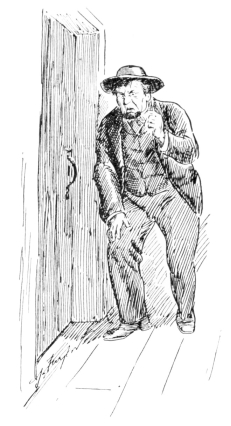
Mr. Pett remonstrated. He pointed out that there was neither horse nor
vehicle to be had in the neighborhood, and that pursuit was practically
hopeless in view of the start which the runaways had. But Mrs. Spaulding
was obdurate with an obduracy that made the heart of Reuben Pett creep
into his boots. After ten minutes of vain combating, he saw, beyond a
doubt, that the chase would have to continue even if it were to be
carried on astraddle a pair of confiscated cows. Having learned that
much, he went drearily down again to discuss the situation with Canada
Pete. Canada Pete was indisposed to be of the slightest assistance,
until Mr. Pett reminded him of the danger of the law in which he stands
who aids a runaway apprentice in his flight. After that, the sulky
Canadian awoke to a new and anxious interest; and, before long, he
remembered that a lumberer who lived “a piece” up the road had a bit of
meadow-land reclaimed from the forest, and sometimes kept an old horse
in it. It was a horse, however, that had always positively refused to go
under saddle, so that a new complication barred the way, until suddenly
the swarthy face of the habitant lit up with a joyful, white-toothed
grin.
“My old calèche zat I bring from Canada! I let you have her, hey? You
come wiz me!”
And Canada Pete led the way through the underbrush to a bit of a
clearing near his house, where were accumulated many years’ deposits of
household rubbish; and here, in a desert of tin-cans and broken bottles
and crockery, stood the oldest of all old calashes.
There are calashes and calashes, but the calash or calèche of Canada is
practically of one type. It is a high-hung, tilting chaise, with a
commodious back seat and a capacious hood, and with an absurd, narrow,
cushioned bar in front for the driver to sit on. It is a
startling-looking vehicle in its mildest form, and when you gaze upon a
calash for the first time you will probably wonder whether, if a stray
boy should catch on behind, the shafts would not fly up into the air,
bearing the horse between them. Canada Pete’s calash had evidently stood
long a monument of decay, yet being of sturdy and simple construction,
it showed distinct signs of life when Pete seized its curved shafts and
ran it backward and forward to prove that the wheels could still revolve
and the great hood still nod and sway like a real calash in commission.
It was ragged, it was rusty, it was water-soaked and weather-beaten,
blistered and stained; but it hung together, and bobbed along behind
Canada Pete, lurching and rickety, but still a vehicle, and entitled to
rank as such.
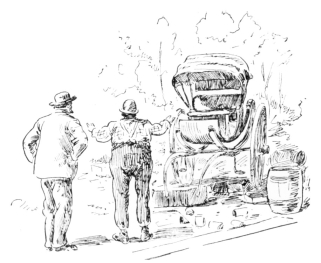
The calash was taken into Pete’s back-yard; and then, after a brief and
energetic campaign, Pete secured the horse, which was a very good match
for the calash. He was an old horse, and he had the spring-halt. He held
his long ewe-neck to one side, being blind in one eye; and this gave him
the coquettish appearance of a mincing old maid. A little polka step,
which he affected with his fore-feet, served to carry out this idea.
Also, he had been feeding on grass for a whole Summer, and his spirits
were those of the young lambkin that gambols in the mead. He was happy,
and he wanted to make others happy, although he did not seem always to
know the right way to go about it. When Mr. Pett and Canada Pete had
got this animal harnessed up with odds and ends of rope and leather,
they sat down and wiped their brows. Then Mr. Pett started off to notify
Mrs. Samantha Spaulding.
Mr. Pett was a man unused to feminine society, except such as he had
grown up with from early childhood, and he was of a naturally modest,
even bashful disposition. It is not surprising, therefore, that he was
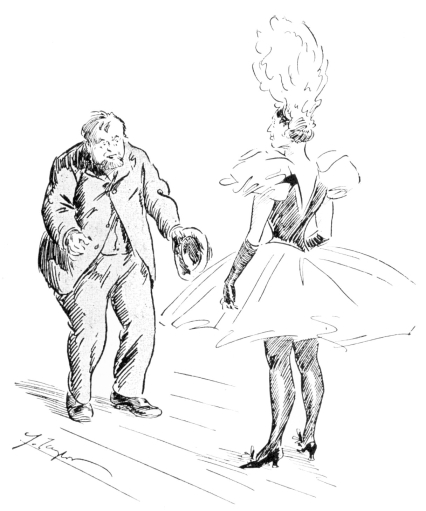
startled when, on re-entering the living-room of Canada Pete’s camp, he
found himself face to face with a strange lady, and a lady, at that, of
a strangeness that he had never conceived of before. She wore upon her
head a preposterously tall bonnet, or at least a towering structure that
seemed to be intended to serve the purpose of a bonnet. It reminded
him—except for its shininess and newness—of the hood of the calash;
indeed, it may have suggested itself vaguely to his memory that his
grandmother had worn a piece of head-gear something similar, though not
so shapely, which in very truth was nicknamed a “calash” from this
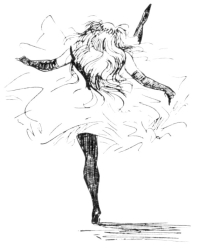
obvious resemblance. The lady’s shapely and generously feminine figure
was closely drawn into a waist of shining black satin, cut down in a V
on the neck, before and behind, and ornamented with very large sleeves
of a strange pattern. But her skirts—for they were voluminous beyond
numeration—were the wonder of her attire. Within fold after fold they
swathed a foamy mystery of innumerable gauzy white underpinnings. As Mr.
Pett’s abashed eye traveled down this marvel of costume it landed upon a
pair of black stockings, the feet of which appeared to be balanced
somewhat uncertainly in black satin slippers with queer high heels.
“Reuben Pett,” said the lady suddenly and with decision, “don’t you say
nothing! If you knew how them shoes was pinching me, you’d know what I
was goin’ through.”
Mr. Pett had to lean up against the door-post before recovering himself.
“Why, Samantha!” he said at last; “seems to me like you had gone
through more or less.”
Here Mrs. Spaulding reached out in an irritation that carried her beyond
all speech, and boxed Mr. Pett’s ears. Then she drew back, startled at
her own act, but even more surprised at Mr. Pett’s reception of it. He
was neither surprised nor disconcerted. He leaned back against the
door-post and gazed on unperturbed.
“My!” he said; “Samantha, be them that play-actresses’ clo’es?”
Mrs. Spaulding nodded grimly.
“Well, all I’ve got to say, Samantha,” remarked Reuben Pett, as he
straightened himself up and started out to bring their chariot to the
door; “all I’ve got to say, and all I want to say, is that she must be a
mighty fine figure of a woman, and that you’re busting her seams.”
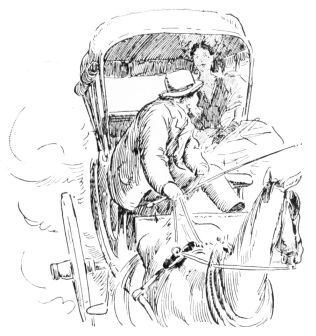
Down the old dusty road the old calash jiggled and juggled, “weaving”
most of the way in easy tacks down the sharp declivities. On the front
seat—or, rather, on the upholstered bar—sat Reuben Pett, squirming
uncomfortably, and every now and then trying to sit side-saddle fashion
for the sake of easier converse with his fair passenger. Mrs. Spaulding
occupied the back seat, lifted high above her driver by the tilt
of the curious vehicle, which also served to make the white foundation
of her costume particularly visible, so that there were certain jolting
moments when she suggested a black-robed Venus rising from a snowy
foam-crest. At such moments Mr. Pett lost control of his horse to such
an extent that the animal actually danced and fairly turned his long
neck around as though it were set on a pivot. When such a crisis was
reached, Mrs. Spaulding would utter a shrill and startling “hi!” which
would cause the horse to stop suddenly, hurling Mr. Pett forward with
such force that he would have to grab his narrow perch to save his neck,
and for the next hundred yards or so of descent his attention would be
wholly concentrated upon his duties as driver—for the horse insisted
upon waltzing at the slightest shock to his nerves.
Mr. Pett’s tendency to turn around and stare should not be laid up
against him. For twenty years he had seen his neighbor, Mrs. Samantha
Spaulding, once, at least; perhaps twice or thrice; mayhap even six or
seven times a week; and yet, on this occasion, he had fair excuse for
looking over his shoulder now and then to assure himself that the fair
passenger at whose feet he—literally—sat, was indeed that very
Samantha of his twenty years’ knowledge. How was he, who was only a man,
and no ladies’ man at that, to understand that the local dressmaker and
the local habit of wearing wrinkly black alpaca and bombazine were to
blame for his never having known that his next door neighbor had a
superb bust and a gracious waist? How was he to know that the blindness
of his own eyes was alone accountable for his ignorance of the whiteness
of her teeth, and the shapeliness of the arms that peeped from the big,
old-fashioned sleeves? Samantha’s especial care upon her farm was her
well-appointed dairy, and it is well known that to some women work in
the spring-house imparts a delicate creaminess of complexion; but he was
no close observer, and how was he to know that that was the reason why
the little V in the front of Samantha’s black satin bodice melted so
softly into the fresh bright tint of her neck and chin? How, indeed,
was a man who had no better opportunities than Reuben Pett had enjoyed,
to understand that the pretty skirt-dancer dress, a dainty, fanciful
travesty of an old-time fashion, had only revealed and not created an
attractive and charming woman in his life-long friend and neighbor?
Samantha was not thinking in the least of herself. She had accepted her
costume as something which she had no choice but to assume in the
exercise of an imperative duty. She wore it for conscience sake only,
just as any other New England martyr to her New England convictions of
right might have worn a mealsack or a suit of armor had circumstances
imposed such a necessity.
But when Reuben Pett had looked around three or four times, she grasped
her skirts in both hands and pushed them angrily down to their utmost
length. Then, with a true woman’s dislike of outraging pretty dress
material, she made a furtive experiment or two to see if her skirts
would not answer all the purposes of modesty without hanging wrong.
Perhaps she had a natural talent that way; at any rate, she found that
they would.
“Samantha,” said Reuben Pett, over his shoulder, “what under the sun
sense be there in chasin’ them two young fools up? If they want to
marry, why not let ’em marry? It’s natural for ’em to want to, and it’s
agin nature to stop ’em. May be it wouldn’t be sech a bad marriage,
after all. Now you look at it in the light of conscience—”
“You’re a nice hand to be advocating marriage, Reuben Pett,” said
Mrs. Spaulding; “you jest hurry up that horse and I’ll look out for the
light of conscience.”
Mr. Pett chirruped to the capering ewe-neck, and they jolted downward in
silence for a half a mile. Then he said suddenly, as if emerging from a
cloud of reflection:
“I ain’t never said nothing agin marriage!”
* * *
Noon-time came, and the hot August sun poured down upon them, until the
old calash felt, as Mr. Pett remarked, like a chariot of fire. This
observation was evolved in a humorous way to slacken the tension of a
situation which was becoming distinctly unpleasant. Moved by a spirit of
genial and broadly human benevolence which was somewhat unnatural to
him, Mr. Pett had insisted upon pleading the cause of the youthful
runaways with an insistence that was at once indiscreet and futile. In
the end his companion had ordered him to hold his tongue, an injunction
he was quite incapable of obeying. After a series of failures in the way
of conversational starters, he finally scored a success by suggesting
that they should pause and partake of the meagre refection which Canada
Pete had furnished them—a modest repast of doughnuts, apples and
store-pie. This they ate at the first creek where they found a
convenient place to water the horse.
When they resumed their journey, they found that they were all refreshed
and in brighter mood. Even the horse was intoxicated by the water and
that form of verdure which may pass for grass on the margin of a
mountain highway in Maine.
This change of feeling was also perceptible in the manner and bearing of
the human beings who made up the cavalcade. Samantha adjusted her
furbelows with unconscious deftness and daintiness, while she gazed
before her into the bright blue heaven; and, I am sorry to say, sucked
her teeth. Reuben frankly flung one leg over the end of his seat, and
conversed easily as he drove along, poised like a boy who rides a
bare-back horse to water. After awhile he even felt emboldened to resume
the forbidden theme of conversation.
“Nature is nature, Samantha,” he said.
“’Tis in some folks,” responded Samantha, dryly; “there’s others seems
to be able to git along without it.” And Reuben turned this speech over
in his mind for a good ten minutes.
Then, just as he was evidently about to say something, he glanced up and
saw a sight which changed the current of his reflections. It was only a
cloud in the heavens, but it evidently awakened a new idea in his mind.
“Samantha,” he said, in a tone of voice that seemed inappropriately
cheerful; “they’s goin’ to be a thunder storm.”
“Fiddlesticks!” said Mrs. Spaulding.
“Certain,” asseverated Mr. Pett; “there she is a-comin up, right agin
the wind.”
A thunder storm on the edge of a Maine forest is not wholly a joke. It
sometimes has a way of playing with the forest trees much as a table
d’hôte diner plays with the wooden tooth-picks. Samantha’s protests,
when Mr. Pett stated that he was going to get under the cover of an
abandoned saw-mill which stood by the roadside a little way ahead of
them, were more a matter of form than anything else. But still, when
they reached the rough shed of unpainted and weather-beaten boards, and
Mr. Pett, in turning in gave the vehicle a sudden twist that broke the
shaft, her anger at the delay thus rendered necessary was beyond her
control.
“I declare to goodness, Reuben Pett,” she cried; “if you ain’t the
awkwardest! Anybody’d a’most think you’d done that a purpose.”
“Oh, no, Samantha!” said Reuben Pett, pleasantly; “it ain’t right to
talk like that. This here machine’s dreadful old. Why, Samantha, we’d
ought to sympathize with it—you and me!”
“Speak for yourself, Mr. Pett,” said Samantha. “I ain’t so dreadful old,
whatever you may be.”
At the moment Mr. Pett made no rejoinder to this. He unshipped the merry
horse, and tied him to a post under the old saw-mill, and then he pulled
the calash up the runway into the first story, and patiently set about
the difficult task of mending the broken shaft, while Samantha, looking
out through the broad, open doorway, watched the fierce Summer storm
descend upon the land; and she tapped her impatient foot until it almost
burst its too narrow satin covering.
“No, Samantha,” Mr. Pett said, at last, intently at work upon his
splicing; “you ain’t so dreadful old, for a fact; but I’ve knowed you
when you was a dreadful sight younger. I’ve knowed you,” he continued,
reflectively, “when you was the spryest girl in ten miles round—when
you could dance as lively as that young lady whose clo’es you’re
a-wearin’.”
“Don’t you dare to talk to me about that jade!” said Mrs. Spaulding,
snappishly.
“Why, no! certainly not!” said Mr. Pett; “I didn’t mean no comparison.
Only, as I was a-sayin’, there was a time, Samantha, when you could
dance.”
“And who says I can’t dance now?” demanded Mrs. Spaulding, with anger in
her voice.
“My! I remember wunst,” said Mr. Pett; and then the sense of Samantha’s
angry question seemed to penetrate his wandering mind.
“‘Dance now?’” he repeated. “Sho! Samantha, you couldn’t dance nowadays
if you was to try.”
“Who says I couldn’t?” asked Samantha, again, with a set look developing
around the corners of her mouth.
“I say you couldn’t,” replied Mr. Pett, obtusely. “’Tain’t in nature.
But there was a time, Samantha, when you was great on fancy steps.”
“Think I’m too old for fancy steps now, do you?” She looked at her
tormentor savagely, out of the corners of her eyes.
“Well, not too old, may be, Samantha,” went on Mr. Pett; “but may be you
ain’t that limber you was. I know how it is. I ain’t smart as I used to
be, myself. Why, do you remember that night down at the Corners, when we
two was the only ones that could jump over Squire Tate’s high andirons
and cut a pigeon-wing before we come down?”
Mr. Pett appeared to be entirely unconscious that Mrs. Spaulding’s bosom
was heaving, that her eyes were snapping angrily, and that her foot was
beating on the floor in that tattoo with which a woman announces that
she is near an end of her patience.
“How high was them andirons?” she asked, breathlessly.
“Oh, I don’t know,” answered Reuben, indifferently. He kept his eyes
fixed on his work; but while he worked his splice closer with his right
hand, with his left he took off his hat and held it out rather more than
two feet above the floor.
“’Bout as high as that, may be,” he said. “Remember the tune we done
that to? Went some sort of way like this, didn’t it?” And with that
remarkable force of talent which is only developed in country solitudes,
Mr. Pett began to whistle an old-time air, a jiggetty, wiggetty
whirl-around strain born of some dead darkey’s sea-sawing fiddle-bow,
with a volume of sustained sound that would have put to shame anything
the saw-mill could have done for itself in its buzzingest days.
“Whee-ee-ee, ee-ee, ee ee ee, whee, ee, ee, ee ee!” whistled Mr. Pett;
and then, softly, and as if only the dim stirring of memory moved him,
he began to call the old figures of the old dance.
“Forward all!” he crooned. “Turn partners! Sashay! Alleman’ all!
Whee-ee-ee, ee-ee, ee ee, ee ee ee, whee, ee, ee, ee, ee, ee ee!”
And suddenly, like the tiger leaping from her lair, the soft pattering
and shuffling of feet behind him resolved itself into a quick, furious
rhythmic beat, and Samantha Spaulding shot high into the air, holding up
her skirts with both hands, while her neat ankles crossed each other in
a marvelous complication of agility a good twelve inches above his
outstretched hat.
“There!” she cried, as she landed with a flourish that combined skill
and grace; “there’s what I done with you, and much I think of it! If you
want to see dancin’ that is dancin’ look here. Here’s what I did with
Ben Griggs at the shuckin’ that same year; and you wa’n’t there, and
good reason why!”
And then and there, while Reuben Pett’s great rasping whistle rang
through the old saw-mill, shrilling above the roar of the storm
outside, Mrs. Samantha Spaulding executed with lightning rapidity and
with the precision of perfect and confident knowledge, a dancing-step
which for scientific complexity and daring originality had been twenty
years before the surprise, the delight, the tingling, shocking, tempting
nine-days’-wonder of the country-side.
“Whee-ee-ee, ee-ee, ee ee, ee ee ee, whee, ee, ee ee, ee ee!” Reuben
Pett’s whistle died away from sheer lack of breath as Samantha came to
the end of her dance.
* * *
There is nothing that hath a more heavy and leaden cold than a chilled
enthusiasm. When the storm was over, although a laughing light
played over the landscape; although diamond sparkles lit up the grateful
white mist that rose from the refreshed earth; although the sun shone as
though he had been expecting that thunder storm all day, and was
inexpressibly glad that it was over and done with, Samantha leaned back
in her seat in the calash, and nursed a cheerless bitterness of
spirit—such a bitterness as is known only to the New England woman to
whom has come a realization of the fact that she has made a fool of
herself. Samantha Spaulding. Made a fool of herself. At her age. After
twenty years of respectable widowhood. Her, of all folks. And with that
old fool. Who’d be’n a-settin’ and a-settin’ and a-settin’ all these
years. And never said Boo! And now for him to twist her round his finger
like that. She felt like—well, she didn’t know how she did feel.
She was so long wrapped up in her own thoughts that it was with a start
that she awoke to the fact that they were making very slow progress, and
that this was due to the very peculiar conduct of Mr. Pett. He was
making little or no effort to urge the horse along, and the horse,
consequently, having got tired of wasting his bright spirits on the
empty air, was maundering. So was Mr. Pett, in another way. He mumbled
to himself; from time to time he whistled scraps of old-fashioned tunes,
and occasionally he sang to himself a brief catch—the catch coming in
about the third or fourth bar.
“Look here, Reuben Pett!” demanded Samantha, shrilly; “be you going to
get to Byram’s Pond to-night?”
“I kin,” replied Reuben.
“Well, be you?” Samantha Spaulding inquired.
“I d’no. Fact is, I wa’n’t figurin’ on that just now.”
“Well, what was you figurin’ on?” snapped Mrs. Spaulding.
“When you’s goin’ to marry me,” Mr. Pett answered with perfect
composure. “Look here, Samantha! it’s this way: here’s twenty years
you’ve kept me waitin’.”
“Me kept you waitin’! Well, Reuben Pett, if I ever!”
“Don’t arguefy, Samantha; don’t arguefy,” remonstrated Mr. Pett; “I
ain’t rakin up no details. What we’ve got to deal with is this question
as it stands to-day. Be you a-goin’ to marry me or be you not? And if
you be, when be you?”
“Reuben Pett,” exclaimed Samantha, with a showing of severity which was
very creditable under the circumstances; “ain’t you ashamed of talk
like that between folks of our age?”
“We ain’t no age—no age in particular, Samantha,” said Mr. Pett. “A
woman who can cut a pigeon-wing over a hat held up higher than any two
pair of andirons that I ever see is young enough for me, anyway.” And he
chuckled over his successful duplicity.
Samantha blushed a red that was none the less becoming for a tinge of
russet. Then she took a leaf out of Mr. Pett’s book.
“Young enough for you?” she repeated. “Well, I guess so! I wa’n’t
thinkin’ of myself when I said old, Mr. Pett. I was thinkin’ of folks
who was gettin’ most too old to drive down hill in a hurry.”
“Who’s that?” asked Reuben.
“I ain’t namin’ any names,” said Samantha; “but I’ve knowed the time
when you wasn’t so awful afraid of gettin’ a spill off the front seat of
a calash. Lord! how time does take the tuck out of some folks!” she
concluded, addressing vacancy.
“Do you mean to say that I da’sn’t drive you down to Byram’s Pond
to-night?” Mr. Pett inquired defiantly.
“I don’t know anything about it,” said Mrs. Spaulding.
Mr. Pett stuck a crooked forefinger into his lady-love’s face, and
gazed at her with such an intensity that she was obliged at last to
return his penetrating gaze.
“If I get you to Byram’s Pond before the train goes, will you marry me
the first meetin’ house we come to?”
“I will,” said Mrs. Spaulding, after a moment’s hesitation, well
remembering what the other party to the bargain had forgotten, that
there was no church in Byram Pond, nor nearer than forty miles down the
railroad.
* * *
In the warm dusk of a Summer’s evening, a limping, shackle-gaited,
bewildered horse, dragging a calash in the last stages of ruin, brought
two travelers into the village of Byram’s Pond. Far up on the hills
there lingered yet the clouds of dust that marked where that calash had
come down those hills at a pace whereat no calash ever came down hill
before. Dust covered the two travelers so thickly, that, although the
woman’s costume was of peculiar and striking construction, its
eccentricities were lost in a dull and uniform grayness. Her bonnet,
however, would have excited comment. It had apparently been of
remarkable height; but pounding against the hood of the calash had so
knocked it out of all semblance to its original shape, that with its
great wire hoops sticking out “four ways for Sunday,” it looked more
like a discarded crinoline perched upon her head than any known form of
feminine bonnet.
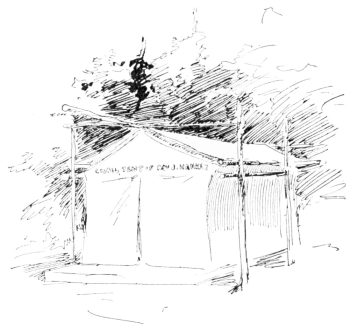
The calash slowed up as it drew near the town. Suddenly it stopped
short, and both the travelers gazed with startled interest at a
capacious white tent reared by the roadside. From within this tent came
the strains of a straining melodeon. Over the portal was stretched a
canvas sign:
GOSPEL TENT OF REV. J. HANKEY.
As the travelers stared with all their eyes, they saw the flap of the
tent thrown back, and four figures came out. There were two ladies, a
stout, middle-aged lady, a shapely, buxom young lady, a tall,
broad-shouldered young man, and the fourth figure was unmistakably a
Minister of one of the Congregational denominations. The young man and
the two ladies walked down the road a little way, and, entering a
solid-looking farm wagon, drove off behind a pair of plump horses, in
the direction of the railroad station, while the minister waved them a
farewell that was also a benediction.
“Git down, Samantha!” said Reuben Pett, “and straighten out that bonnet
of yours. Parson’s got another job before prayer-meetin’ begins.”