MORE ITALIAN YESTERDAYS — CONTENTS — ILLUSTRATIONS
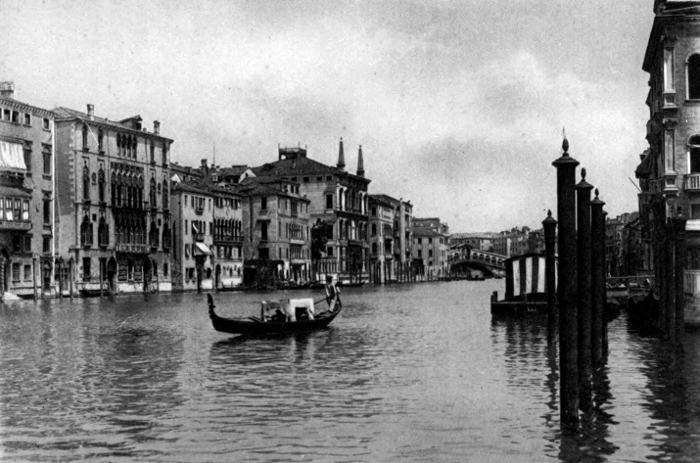
VENICE. THE GRAND CANAL.
MORE
ITALIAN YESTERDAYS
BY
MRS. HUGH FRASER
AUTHOR OF
“ITALIAN YESTERDAYS,” “A DIPLOMATIST’S WIFE IN JAPAN,”
“A DIPLOMATIST’S WIFE IN MANY LANDS,”
“FURTHER REMINISCENCES OF A DIPLOMATIST’S
WIFE,” ETC., ETC.
WITH SIXTEEN ILLUSTRATIONS IN PHOTOGRAVURE
LONDON HUTCHINSON & CO. PATERNOSTER ROW 1915
CHAPTER I
SAINTS OF THE CHURCH
A Friend in Rome—A story of two ways of loving—Aglaë
and Boniface—Become Christians—A new life—Boniface
endures terrible tortures—Martyrdom—Death of
Aglaë—Church of St. Boniface—Alexis, the pilgrim—His
travels—Return to Rome—A ragged beggar—His death and
burial in St. Boniface’s Church—St. Alexis’
Monastery—Trials of the Church after
Constantine—Rome’s lowest ebb—Growth of the spiritual
city—Benedict the Blessed, and Scholastica pp. 1-15
CHAPTER II
FOUNDER OF MONASTICISM
Norcia in the Sabines—A matrona—The twins, Benedict
and Scholastica—Benedict goes to Rome—Conversion of
Placidus—Benedict’s retirement to La Mentorella—Life
in a cave—Temptations—Visit of St. Francis—Benedict’s
ministering—Real founder of monastic life—Growth of
his order—Placidus and Maurus—St. Benedict’s personality
and conversions—His ideal of the religious life—His greatest
miracles—His sister, Scholastica—The last day together—His
ascension pp. 16-38
CHAPTER III
ST. GREGORY THE GREAT
Birth and lineage of St. Gregory—Path from the world to the
cloister—Prayer, study, and charity—His cat—A prophecy—A
Cardinal Deacon—Mission to Constantinople—Eutyches’
heresy—Rome in pestilence—Gregory elected Pope—His
unbelievable accomplishments—His life as Pope—Championship
of the oppressed—Bond with English-speaking
people—The great procession during the pestilence—Gregory’s
successors pp. 39-54
CHAPTER IV
MEMORIES OF THE PANTHEON
The Pantheon—Hadrian’s best monument—Long idle—Consecrated
as St. Mary of the Martyrs—The Cathedral, the
symbol of the soul—Its purification—Continuity of the
Church—A priest’s visit—The alabaster square—Procession
of the martyr’s relics—Giovanni Borgi, the workman—Italian
Guilds—Giovanni’s selflessness—His rescue of
the forsaken children—Care of them—Crusade in behalf
of all the waifs of Rome—His work of love—Giovanni’s
successor, later Pius IX pp. 55-72
CHAPTER V
EARLY LIFE OF FATHER MASTAI
Birth in 1792—A happy family—His youth—Epilepsy—The
Church at the time of Napoleon—Abduction of Pius to
Avignon—Napoleon’s downfall—Return of the Pope to
Rome—His reception—Prophecies regarding Pius IX—His
journey to Chile—Ocean trip—Across the Andes—Failure
of mission—Rounding Cape Horn—English Settlement
on the Cape—“Love-of-the-Soil”—The Falkland
Islands pp. 73-94
CHAPTER VI
POPE PIUS IX
Director of Ospizio di San Michele—A splendid
record—Archbishop of Spoleto—A turbulent populace—Order
restored—Revolution in Europe—Spoleto saved—The earthquake
in Umbria—New post at Imola—Secret societies—A
Cardinal—Attack upon the three Prelates—The Cardinal’s
bravery—How the Saints forgive—Pope Pius IX—His
charity and justice—Defenders of the poor—Anecdotes
of the Cardinal’s generosity pp. 95-112
CHAPTER VII
CAPTIVITY OF POPE PIUS VII
Lebzeltern, the Ambassador of the Austrian Emperor—Origin
of his mission—Napoleon’s anger against Pius VII—Arrest
of the Pope—Protests from the Church—Napoleon
excommunicated—Vaine efforts to evade the Bull—Instructions
for the mission—“Do all, or else, do nothing”—Pius
VII in his sixty-eighth year—The interview—The
Pope’s position—His generosity—Message to Napoleon—Continued
captivity—Return to Rome—Napoleon’s expiation pp. 113-136
CHAPTER VIII
IN SABINA
Castel Gandolfo—Its gardens—The Sabine Hills—The
Reverendo—An expedition into the hills—The Campagna in
the early morning—“Our Lady of Good Counsel”—Ancient
Præneste—Italy’s landscape—Struggles of the
Colonna—Destruction of Palestrina—Boniface’s revenge
and expiation—Olevano, the haunt of artists—“Picturesque
utility”—The wrong train—Romance of a pebble—The
work of the Saints pp. 137-158
CHAPTER IX
PEOPLE OF THE HILLS
The Apennines—View from a peak—Real hospitality—Polenta—Woods
of Sabina—A hill family—The cook—A queer adventure—People
of the South—A night festival in the Abruzzi—The journey—The
old organ—Marion Crawford’s boys—Juvenile
theatricals pp. 159-179
CHAPTER X
A STORY OF VENICE
A follower of the Condottieri—The raw recruit—Division of
the Dukedom of Milan—Carmagnola’s turn—Growth in
wealth and power—Disaffection—Venice acquires his
services—War with Milan—A leisurely campaign—Carmagnola
at the height of his glory—Fortune turns against
the Venetians—Stirrings of suspicion—Reception in Venice—The
Senate Chamber—Growing dusk—The attack—End
of his part in the world—Another story of the North—St.
Raniero, the patron of Pisa—The power of temperance pp. 180-199
CHAPTER XI
QUEEN JOAN OF NAPLES
A conspicuous feminine sinner—Marriage of State—Her
beauty—Her Hungarian husband—Petrarch and the monk—Joan’s
ascent to the throne—The Naples succession—Her
favourites—The churches of Naples—Joan’s lovers—Factions
of Naples—Charles of Durazzo—A bold proposal—Charles’s
ambitious plots—War of the Factions—Disappearance
of Maria—Becomes the wife of Charles—Joan’s
horror pp. 200-217
CHAPTER XII
A MEDIÆVAL NIGHTMARE
Pact between Charles and Andrew of Hungary—Joan’s homage
to the Papal Legate—Andrew ignored—Arrival of Andrew’s
mother—Andrew upheld by the Pope—His reprisals—“The
man must die”—The Queen’s conspiracy—Last
meeting of Charles and Andrew—The hunting expedition—The
banquet in the monastery—The murder—Tempest
breaks over Joan’s head—An evil blow at Charles—Trial
of Andrew’s murderers—A nightmare of cruelty and
fear pp. 218-243
CHAPTER XIII
THE VAMPIRE-MONARCH FROM HUNGARY
Charles’s further acts as dictator—Rise of the favoured Louis
of Taranto—Civil war—A scheme of the Empress of Constantinople—Interference of the King of Hungary—The
Empress again to the rescue—Hungary’s advance—Death
of the Empress—Flight of the Neapolitan nobles—Joan
and her husband in Provence—Charles’s well-merited fate—The
King of Hungary’s vengeance—Government by
execution pp. 244-257
CHAPTER XIV
END OF JOAN’S CAREER
Joan detained at Aix—Greeted as a Queen—Joan pronounced
innocent—Plans to regain Naples—Sale of a city—Return
to Naples—Indecisive war—Proposal for personal
conflict—Flight of the Royal Family—Maria’s narrow
escape—Hungarians repulsed—Pope Clement as
intermediary—Departure of the King of Hungary—Festivity
in Naples—Death of Louis and Joan’s further marital
adventures—Joan in trouble—Her untimely end pp. 258-275
CHAPTER XV
NAPLES UNDER MURAT
Beauty of Naples—Figures of its history—St. Januarius—Murat,
King of Naples—Achievements as King—The Carbonari—England’s
promises—Napoleonic diplomacy—Rise of the
Bourbons—Alliance with Austria—Murat’s indecision—Distrust
of the Allies—Murat’s statesmanship—Talleyrand’s
diplomacy—Naples the gay—Conspiracy in the
palace—The escape from Elba—Ideal government—War
against Murat—Advance of the Austrians—Murat driven to
Naples—Interview with his wife—Last instructions to his
ministers—Escape pp. 276-312
CHAPTER XVI
MURAT’S LAST DAYS
Naples in anarchy—Entrance of Austrians—Murat’s repulse by
Napoleon and by Louis—His demon of ill-luck—Shipwrecked—Aid
in Corsica—Emperor of Austria’s proposal—Attempt
against Naples—Murat betrayed into Ferdinand’s
hands—Murat’s “trial”—Letter to his wife—Before his
“judges”—A brave death—Ferdinand, the “Butcher
King” pp. 313-328
CHAPTER XVII
ITALIAN SEAS
Our moods and the seas—Memories in landscapes—The healing
of the sea—A vision in the Bay of Naples—Marion Crawford’s
yacht expected—The family together at Leghorn—Lady
Paget—A bathing scene—Hugh Fraser—“Spannocchi”
for dinner—The avenging boatman—Livorno,
an anomaly—Sunset on the Mare Ligure—Bay of Spezia,
a splurge of colour and light—A hail-storm in Venice—The
joy of a gondola—Moods of Venice—A Giorgione
beauty—The nurseries of Venice—Her shops—Saints and
heresies of the thirteenth century pp. 329-353
CHAPTER XVIII
SOUTHERN SHORES
Melancholy Ravenna—Early Byzantine architecture—Forests
of stone-pine—Smiles and tears—The need of a little
misfortune—Monte Gargano—Millions of Spanish
merinos—Primæval forest—A forest miracle—Church of the
Apparition of St. Michael—Other apparitions of the
Archangel—The revelation to St. Aubert—The great round
church—Order of the Knights of St. Michael—A “maiden”
fortress of France pp. 354-365
It was my good fortune, many years ago, to make
friends with a woman whose name was as beautiful
as her mind—Mary Grace. We met in another hemisphere,
under the Southern Cross, and for many days
lived together in Chile’s one little Paradise, Viña del
Mar. There, in shady patios, trellised with jessamine
and bougainvillea, we talked of the impossible—of
meeting in Rome and going together to the holy places
and making better acquaintance with the Saints. Two
or three years later the impossible happened. My
Mary, with her daughter, Lilium, floated into my
mother’s drawing-room in the Odescalchi one April
afternoon, when the swallows were whirling above the
courtyard and the house seemed all roses and sunshine.
In the weeks that followed all our dream programme
was realized; together we went to the Pope’s Mass,
together knelt at his feet while Leo XIII laid his hand
on Lilium’s golden head and blessed us and promised
to pray for us and all our dear ones; and together we
wandered from place to place in the Eternal City, I,
who had known it all my life, learning many things
from her who came there for the first time, as so often
happens. Of all those pleasant inspiring hours, the one
we both remembered most appreciatively, I think, was
that of our visit to a lonely spot on the Aventine—the
hill that somehow has always kept its character and is
even to-day very little hurt by the destructions that
have defaced most of the other quarters of the town.
My friend was Irish, pur sang, and her appreciations
were extremely individual ones: things that other people
felt obliged to rave about left her quite cold; but
when she had caught and joined the links of some
beautiful story that the world had overlooked or forgotten,
she became a veritable flame of enthusiasm, and
every tiny detail and souvenir she could connect with
it had to be sought out and stored in the big warm
shrine of her heart. I think, though I am not certain,
that she knew the story of the house on the Aventine
before she came to Rome. Any way, it was she who took
me there, and we went over story and house together,
and were exceeding loath to come away when the Ave
Maria rang over the city and all respectable people
turned their faces homewards.
Here is the story, a story of two ways of loving. It
is in two parts, and I only learnt the first long after I
was familiar with the second. The beginning takes
us back to the last years of the third century, to the oft-mentioned
reign of Diocletian. At that time, although
the Aventine had never been one of the most distinguished
quarters of Rome, it contained a few dwellings of nobles,
who, doubtless, overlooked the mass of poorer houses
that swarmed about its base, for the sake of the view,
both over the city and towards the sea, from which
comes always the pleasant west wind that we Romans
love. I have spoken of the palace of the good Marcella,
where in her old age she was so roughly treated by
Alaric’s Goths; before Marcella’s time there lived
another noble lady on the Aventine, with very different
ideas as to the conduct of life. Her name was Aglaë,
not a Roman name, and I fancy she must have come
of Greek parentage, although she is spoken of as a noble
Roman matron. Of her husband, who seems to have
died before the story begins, we are told nothing; her
whole existence was wrapped up in a quite unsanctified
passion for a handsome pagan called Boniface, a man
of generous heart, as the sequel shows, but a sensualist,
like most of his class at that time. He adored Aglaë,
and the two must have passed some enchanting hours
wandering on the terraces of the Aventine villa, or
sitting hand in hand to watch the sun sinking red into
the distant sea. No thought of the future seems to
have come to them there, nor any gleam of a scruple
as to their way of life. Youth and beauty and love were
theirs; this world was sweet, and they had never heard
of another.
Then something happened. We are not told what
it was—perhaps some miracle witnessed by Boniface at
the martyrdom of some obscure Christian, one of those
miracles which so often converted a crowd of brutal,
mocking bystanders into Christians, on the spot. Whatever
it was, it rent his soul, summoned his intelligence,
and claimed him for ever. If Aglaë was not with him
at the moment he must have rushed to her for one last
visit to tell her of it, for her conversion was simultaneous,
and sudden as his own. From that moment the lovers
renounced each other for the love of Christ, and the
remainder of their lives was devoted to atoning for their
guilt in the past. Aglaë, in her lonely palace, gave
herself up to prayer and penance; Boniface at once
joined himself to the band of Christians who made it
their business to gather up and bury the bodies of the
martyrs. In no other way could he assuage the tumult
of pain and repentance that filled his heart at the remembrance
of his sins. Diocletian’s persecution was not
confined to Rome, but was raging in many other parts
of the Empire, notably in Asia Minor, and thither Boniface
travelled with some devoted companions, in order
to help and cheer the poor Christians in their sufferings.
On arriving at Tarsus, St. Paul’s city, he got separated
from his fellow travellers, and, wandering around,
found that a great number of the Faithful were being
cruelly tormented that day, in divers ways, for the
name of Christ, and his heart was torn both with compassion
for their pains and admiration for their heroism.
Approaching them, he kissed their chains and encouraged
them to endure these passing tortures for the sake of
Him who would so quickly and splendidly reward them
by an eternity of joy. Of course he was at once arrested,
and the tormentors seem to have tasked their ingenuity
in inventing agonies for him to bear. His sins of the
flesh were expiated by having his whole body ploughed
with hooks of iron, and by spikes of wood run in under
his nails and on his limbs; he had spoken sinful words—they
poured molten lead into his mouth; he had sinned
in the lust of the eyes and the pride of life—the executioners
plunged him head downwards in a cauldron
of boiling pitch. But from this the Lord delivered
him. When they drew him forth, his eyes were clear,
his brow unscarred, and he looked once more—his last
look—on the fair world where he had been so sinfully
happy, and through it all he praised God aloud, saying,
“Lord Jesus Christ, Son of God, I thank Thee!”
Then came the order—so usual when all the torments
had failed, and the clear spirit still clung to the lacerated
body—“Behead him!”
As the axe fell, there was a terrific earthquake, and
many of the bystanders were converted then and there,
but no one was allowed to touch his body. Meanwhile
his friends, who had been seeking for him everywhere,
learnt of his martyrdom, and came to gather up his
remains. But a strict watch had been set, and it was
only after paying five hundred pieces of silver that they
could obtain possession of the dear corpse. With love
and tears they anointed it with precious balms and
wrapped it in costly coverings and transported it to
Rome.
During these months Aglaë had been living a life
of such whole-hearted repentance that our dear Lord
had taken her into great grace; and now, by an exquisite,
divine bit of indulgence—one of those flashes of hot
sympathy that come straight from the Sacred Human
Heart of Him in heaven to some poor broken human
heart on earth—He sent an Angel to tell her that her
Boniface’s body was returning to Rome, and that she
could go and meet it. So Aglaë, in her sombre penitential
dress, her beautiful face covered with a veil,
went forth, and, at a given place, saw the little procession
approaching from the sea. There was no danger
for her in looking at the beloved features now. Very
quiet and strong she seems to have been as she met the
wayfarers, bade them pause with their holy burden, and
then led them back to her own house. There, where
he and she had loved and sinned, she received him who
was to leave her no more. Those who had brought him
told her of his glorious end, and she thanked the Lord
for it again—for the angel had not let her wait so long
for the story. And when she had shown her gratitude
by most loving hospitality and precious gifts to those
who had brought his body, they went away and left her
alone with her beloved. Ask any loving woman what
she did then. Which of us would not place our dear
tortured dead in our hall of honour, and burn sweet
spices round them, and light tall tapers and fill the
place with every fragrance and loveliness that the garden
has to give?
All this, we may be sure, Aglaë did for Boniface;
but she did that from which most women are debarred.
She turned her palace into a church for his tomb, and
prayed near it till she died; and then the poor and
suffering, who had been her one care from the day of
her conversion, came there and prayed for her soul.
But we know that that went straight to heaven.
So there stood the Church of St. Boniface, and,
some two hundred years later, a most noble Roman
family had established their own palace close to it, and
the church, as we know it, now includes a part of the
house of Alexis. For this is where a great saint grew
to manhood, the loved son of rich and affectionate
parents. Alexis had every gift of mind, with beauty of
countenance and strength of body; and, when the
time was ripe, his father and mother betrothed him to
a bride of their choosing, good and sweet, and very fair
to see. In this they had, for the first time, met with
stubborn opposition from the boy who had never
opposed them before. He told them that he had vowed
himself to a single life for God’s service, and that no
earthly bride, however beautiful, should make him
swerve from that allegiance. But they, like many other
good parents, persisted in their project, convinced that
they knew what was good for their son; and the preparations
for his marriage went merrily forward, each
day but adding to the young man’s grief and perplexity.
Rome was Rome still; he could protest, but he had to
obey his father’s direct commands, and obey he did;
but his vow had been made to a still higher Authority,
and he meant to keep it, and prayed for grace and
guidance to do so, nor were grace and guidance refused
him, who, as the Breviary puts it, “was of Rome’s
noblest, but nobler yet through his great love for Christ.”
On the night of his wedding, when the feasting and
singing and congratulating were over, and the matrons
conducted the bride, probably a child of thirteen or
fourteen, to the lighted, perfumed bridal chamber,
Alexis would not so much as touch her hand, but like
one, Galahad, of another time and clime, bade her
farewell and departed, having received from God a
special command to go on a pilgrimage to the “illustrious
Churches of the Universe.” He left all behind,
riches and servants, and even his name, and for seventeen
long years, with no companion but the Lady Poverty,
wandered, a nameless poor pilgrim through all the
Holy Places, praising the Redeemer for His great mercies,
and praying for the hastening of the Kingdom of
Heaven.
At the end of those seventeen years he was one day
praying fervently before an image of the Blessed Virgin,
in the great church at Edessa, when a voice came from
the image, proclaiming his name and rank. The people
were greatly excited and wished to show him honour,
both for his own sake and because Our Lady herself
seemed to wish it. But Alexis knew better. That
strange sweet voice had not rung in his ears to lure him
back to things of earthly pride, and for him the disclosure
of his identity was the command to depart
from that land. He fled, and boarded the first ship he
could find to carry him away from Syria. He never
asked the vessel’s destination; it was enough for him
that he was obeying a command, but he was being led
back to where the second phase of his spiritual career
awaited him—in his old home in Rome.
As the ship sped north and west, and one by one
the lovely Greek islands seemed to come floating towards
him, like opals on the shifting sapphire of the sea, he
still kept silence, still prayed and praised. What cared
he whither her course was set? The white sails might
have been angel’s wings—so sure was Alexis that God
was leading him. Then, when the Apennines swam up
blue from the bluer water, and scents of violet and
orange blossom were wafted out to greet the wanderer,
he knew that this was Italy—and home. Still he spoke
not—questioned not; past the isles of the Sirens, past
Circe’s Promontory, still on, past all that shore of coral
and pearl, of palm and ilex and olive, with Vesuvius’s
dark smoke hanging like a menace in the background,
the little Syrian galley held her way, and at last the
helmsman turned her prow to the land; the sails were
all furled but one; the enormous oars worked her up
against a rushing yellow current till the long quay
was reached, and with a rattling of chains the weary
galley slaves shipped their oars and bent down to look,
each through his little opening, at “the port of Rome.”
With the merchants and the free seamen Alexis
stepped on shore, and gazed at the city of his birth.
He had been brought back—for what? Blindly, joyfully,
obediently, he had gone forth, to fare alone with
God, and alone with God he was still to be. An hour
or so later a haggard mendicant stood at the gate of a
palace on the Aventine, asking for charity. That was
never refused in that house, and the servants brought
him in, showed him a dark corner under a stairway,
close to the entrance, where they told him he might
sleep, and gave him some scraps of food. Humbly and
gratefully he accepted it all; he heard them speak of
the master and the mistress and the “widow” of the
eldest son who was long since dead; and that day or
the next he must have seen his father and mother, and
the maid who had never been a wife, passing through the
courtyards or lingering in the garden.
God’s ways are not our ways. When He covets the
love of certain souls for Himself, He will not share it
with any one, and that Divine jealousy leads the chosen
soul through hard paths. The hearts that love God
intensely are the very ones that are the most loving of
their fellows, especially of all who hold close to them
in the sacred ties of family affection. But these ties
have to be snapped on earth when the Divine Lover
so wills—and Saints like Alexis, and poor sinners like
the rest of us, have to leave the broken ends in His
hands, knowing that the pain we are made to cause
our dear ones is as necessary for them as that which we
suffer is for us, and that every pang of theirs is a golden
strand in the garment of their immortality.
Alexis’s parents had sinned against him and Heaven
in trying to force him to break his vow of virginity;
their son had long forgiven them, but Heaven in its
mercy was allowing them to expiate their sin here
instead of hereafter; and, through their obstinacy, the
young girl who might, wedded to another spouse, have
become a joyful mother of children, had to spend her
life in their sad house, waiting upon them, and with
the prospect of a very lonely age before her when they
should have passed away.
We may be sure that many and many a time Alexis
longed to emerge from his despised obscurity and comfort
them all three, but it was not for that God had brought
him back. The command of silence was never lifted,
and so the son—the heir—lived on, a ragged beggar,
laughed at and also abused by his father’s servants,
praying in St. Boniface’s Church by day, sleeping in
the cranny under the stairs at night, allaying his hunger
by the scraps the servants threw him, and always blessing
them and praising God, who thus satisfied His own
servant’s hunger for poverty and suffering and humiliation.
This second trial, this exile of the heart, lasted
also seventeen years. At that time the very existence
of Rome was threatened by Alaric the Goth; once
and twice he had turned from its gates laden with the
ransom exacted for not entering them; he was threatening
to approach again, and this time he had sworn to
enter and destroy. The population was crowding the
churches to pray for deliverance, when a mysterious
voice rang out in each separate church, “Seek ye the
man of God, that he may pray for Rome!” Terror
fell upon the suppliant masses, and none dared speak or
move. Then the same voice cried, “Seek in the house
of Euphemian.”
There was a rush to the Aventine, for all knew the
great noble’s dwelling. The Pope, Innocent I, had
heard the command and himself went thither, followed
by all his ecclesiastics and the Senators as well. When
they reached Euphemian’s house it was the Pope who
led them to the dark corner under the stairs—dark no
longer, but flooded with celestial light, where the nameless
beggar lay dying alone. His hands were already
cold, but in one he held a crucifix, in the other a slip
of parchment which no one could make him relinquish,
though many tried to take it away from him. Then
Innocent commanded him, in the Name of God, to give
it up, and immediately Alexis let him take it with his
own hand. And the Pope, standing up beside the dying
man, opened the slip, and read aloud therefrom the
name and family of the beggar; and a great cry went
through the house that it was Alexis, the son who had
been mourned for dead these many years. And father
and mother and wife threw themselves down beside
him, embracing him and weeping bitterly, for in that
moment his soul had gone to God.
Then Innocent buried him in the Church of St.
Boniface, and it was called both by his name and that
of Alexis for many years. Both their bodies rest there,
and a chapel was thrown out at one side to take in the
stairway, which, now covered with glass, remains to this
day. Both Boniface and Alexis had travelled and
prayed and suffered in the East, and their church came
to be a heritage of both East and West; for, five hundred
years after the July day on which Alexis died, a great
monastery called after him and built close to the church
on the hill of the “house of Euphemian” sheltered
monks of the Basilian and Benedictine orders at the
same time, an innumerable spiritual family “to replace
the fair family he had renounced to this world.”
The Aventine has been little touched by time and
is still one of the quietest and loveliest spots in Rome.
At certain season it suffers from malaria—blown up
from the marshes near Ostia—and for that reason both
mediæval and modern builders have generally avoided
it. But it is full of gardens. That of St. Alexis’s Convent,
now an Asylum for the Blind, is famous for its
orange and lemon trees; and one can trace the dispositions
of the terraces and courts of the old house
in the approaches to the church. I do not think that
when my friend and I were wandering there we noticed
one curious feature which, however, still exists to give
one a glimpse of old Roman domestic ways—the queer
little cells, one on each side of the inner porch of
Euphemian’s house where the slave porter, and his
companion the watch-dog, were chained opposite to
each other, to their respective posts! What queer and
sympathetic confidences they must have exchanged
sometimes!
Alexis surely prayed for his native city, but all the
prayers of all her Saints could not avert the trials that
were to visit on Rome her past sins. Constantine the
Great believed that he had left the Church in the West
impregnable in strength and assured of peace; and for
nearly three centuries after his death she was forced to
fight for her existence almost as stubbornly as she had
during the three centuries preceding it. In 361, only
twenty-four years after the death of Constantine, Julian
the Apostate reversed his edicts and strained every nerve
to re-establish the worship of the Olympian deities.
Paganism was dead, and he failed in his iniquitous efforts
to restore animation to its corpse, but much suffering
did he bring to the Church, and it was only at the price
of blood that she conquered in the end. After Julian
came the Barbarians—Alaric, Genseric, Odoacer, Totila—during
the short space of one hundred and thirty years
Rome was taken and ravaged five separate times, so that
when, in 553, Narses, the prototype of Napoleon,
abolished the Senate and annexed the city to the Eastern
Empire, she had reached the lowest point in her history,
and was scarcely regarded as a prize even by the Lombards
when, in response to the invitation of Narses
himself, they overran Italy from the Alps to the sea,
only to be finally expulsed by Charlemagne some two
hundred years later.
But the Church had realized the truth of the saying
that the darkest hour comes just before the dawn. The
high courage that had come unscathed through such
appalling conflicts rose gallant and audacious in its
certainty of final victory, and at the very moment
when Rome seemed to be annihilated, decreed to it
such a triumph as the world had never seen before.
In 568, just a year after Narses, to gratify a personal
spite, had invited the hornet swarm of Lombards to
cross the Alps, he died in the city he had insulted. We
must remember that there were two Romes, the corporeal
city, depopulated and impoverished, despoiled and
dying—the city of the government of the once proud
“Senatus Populusque Romanus,” which had failed
signally at every point, and had crawled to the feet of
every conqueror; and the spiritual city, ruled by strong
and holy men who patiently went on with their invisible
building, adding stone to stone with such calmness and
patience that in contemplating their work one is almost
led to believe that they were unconscious of the material
ruin around them.
During the forty years that followed the death of
Narses there was growing up in Rome a phalanx of
learned and holy ones to replace the leaders who had
been found wanting, and we of to-day are still the
inheritors and possessors of the treasures they amassed.
While the grass grew unchecked in the streets, and all
who could migrated to happier lands, while commerce
and war turned aside from the now worthless prize, and
the poor tethered their few goats and sheep in the
courtyards of the great ruined houses, the Benedicts,
the Gregorys, the Bonifaces, with their clear-eyed,
disciplined cohorts, were building the Liturgy, building
the Monastic Orders, building the polity that guides
and rules the Church and the Faithful to-day. Nothing
escaped them; whether it were a question of the right
antiphon for one of the psalms of a Nocturn, the placing
on the Index some doubtful legend of a Saint (like that of
our Saint George, which the popular fancy was turning
into a grotesque myth), the annihilation of some startling
new heresy which was raising its poisonous head, or the
question of bringing Constantinople to its senses by
bold remonstrance with the Emperor—to every detail
was brought the thoroughness and directness of trained
minds, the compelling force of superior courage and
invincible intellect.
And this work had been going on silently and infallibly
from the moment that official persecution ceased.
Through sieges and invasions, desertions and desolations,
the mills of God were grinding the grain and filling the
great storehouses with golden wealth. In 480, in the
little town of Nursia, high among the fastnesses of
the Abruzzi, where the snow lay thick in winter, as in
the Alps, there was born to the lord of the place a son,
who was christened Benedict—“the Blest,” and a little
daughter whom the father, a great admirer of learning,
called Scholastica. When these two passed away, sixty-three
years later, Literature and Saintliness were throned
in Europe, and hold their thrones still in the innumerable
fortresses manned by the spiritual descendants of the
Nursian twins. Outside the Church few, comparatively,
knew their names when they died. Learning and piety
would scarcely exist for us had they not lived.
CHAPTER II FOUNDER OF MONASTICISM
In the heart of the Sabines, where the Nar breaks out
from the rock near the mountain called the Lioness,
there has been since very early times a little town, too
inaccessible to tempt the spoiler and the invader, too
sturdy and independent to serve long as a footstool for
mediæval tyrants. It was well fortified, however, and
the ancient walls encircle it still, in good repair, as
witnesses to its immunity from the fate that has annihilated
so many other little old cities, its neighbours.
Nature, stern and wild enough here, helped to protect
it. Even now it can only be reached by a carriage
journey, a lengthy, tedious business in the winter time,
when the snow almost cuts it off from communication
with the outside world.
The townsfolk have long memories, however. The
chief square is called Piazza Sertorio, after the Roman
General, Quintus Sertorius, who was born here in the
second century before Christ, and the only public
monument in Norcia is a statue of their other distinguished
citizen, St. Benedict, in the same square. People
from other places do not interest the good burghers of
Norcia. They have accorded a passing notice to a
gentleman named Vespasian, known elsewhere as a
fairly successful Emperor, but, as they would tell you,
“a person quite without education”—that is to say,
with no manners; nevertheless they have allowed a
hill in the vicinity to be called Monte Vespasio because
his mother was a decent woman and owned a farm there.
I fancy life in Norcia is in its essentials very much
what it was when, in the year of grace 480, the lord
of the manor was informed that his good wife had
borne him twins, a son and a daughter. It is easy,
knowing the ways of the people, to call up the picture
of the “Matrona” in her best gown—the midwife is
the most honoured woman in every Roman town—coming
down from the lady’s apartment in the tower
to the head of the house, sitting, quite forgotten and
rather lonely, in the hall, waiting for news from the
centre of interest upstairs. His own servants would
only approach with signs of submission and respect; not
so the all-important Matrona! Conscious of her dignity
and grave as a judge, she would advance a few steps
and wait for him to rise. Then, as he approached on
tiptoe and with some timidity, she would turn back the
woollen covering from the unexpectedly large bundle
on her left arm, and, without a word, show him two
little pink faces where he only expected one.
“Yes,” she would say in answer to his exclamations
of delight and astonishment, “two has Domine Dio sent
to this noble house. Two will be the gifts my lord
must bestow on his lady”—this to remind him as well
of the double remuneration due to herself. “Pretty?
Oh no, but they are not bad—thanks be! Will it
please my lord to send for the priest—the ‘feminuccia’
is the younger—and seems not over strong! I thank
my lord!”
My lord has been feeling in his pouch and has
slipped two of his few gold pieces into her hand, and,
seeing that he is inclined to admire the babies, she
covers them up and stalks away. Her demeanour has
been rhadamanthine throughout. There must be no
expression of admiration, no kissing or fondling of the
little creatures before they are baptized. That would
call the attention of the devil to the small unregenerates
who are still his property. When the taint of original
sin has been washed away they will be angels of innocence,
beautiful cherubs to be shown proudly to all and sundry—but
not before!
So my lord sent for the priest, and pondered meanwhile
on the names he would give the new son and
daughter, little dreaming, good man, that fifteen centuries
later those names would be household words to
every Catholic ear and perpetuated in the colossal
literature of sanctuaries of holiness and learning. He
fixed on Benedict for the boy, and Scholastica for the
girl, and, so far as I can trace, it was the first time the
names had been used. Benedict means “the Blest”
or “Well-spoken,” Scholastica signifies a lover of learning,
or “the Well-taught”; so we may infer that the
Lord of Norcia (it was called Nursia then) was a man
of more education than most country gentlemen of
those rough times, times of which history says, “Europe
has perhaps never known a more calamitous or apparently
desperate period than that which reached its
climax at this date, the year 480. Confusion, corruption,
despair, and death were everywhere; social dismemberment
seemed complete. In all the ancient Roman
world there did not exist a prince who was not either
a pagan, or an Arian, or a Eutychian. In temporal
affairs, the political edifice originated by Augustus—that
monster assemblage of two hundred millions of
human creatures, ‘of whom not a single individual
was entitled to call himself free’—was crumbling into
dust under the blows of the Barbarians.”[1]
Nevertheless Rome still continued to be looked upon
by the surrounding provinces as the centre of education—there
was none, at any rate, to be had anywhere else
within reach; and thither the Lord of Norcia, a descendant
of the great family of the Anicia so often mentioned
in the Roman chronicles, sent his son to be instructed
in philosophy and law—the two subjects which still
promised some kind of a career to an intelligent youth.
Benedict was scarcely that yet—he was certainly not
more than twelve years old, so much of a child that his
nurse, Cyrilla, was sent with him to take care of him.
Doubtless she found some respectable people with
whom to lodge, and indeed one feels some pity for the
simple countrywoman, charged with such a heavy
responsibility in a strange and, as it must have seemed
to her, a very wicked great city.
So it seemed to the boy too. He studied, tried to
carry out his father’s instructions as faithfully as he
could, but all he saw around him inspired him with
such a horror of the world and its ways that life became
insupportable to him, and he resolved to fly into the
wilderness and seek for God. He was only fourteen
years old, but he knew with certainty that his life was
not to lie in the crowded places. The devout nurse
did not oppose his decision; his will was hers, and
together they left Rome and took the road towards
their old home. I fancy that the boy only then told
her that Norcia was not to be their destination. Before
reaching it he would find the place where Heaven willed
him to stay.
Thus they travelled on, till they came to La Mentorella,
one of the strangest spots in all those strange
mountains. Its parent is Guadagnolo, the highest
standing town in the whole of Romagna, perched on a
peak 4,000 feet high, and yet shut in on every side
with a wall of rock that completely hides it from the
outer world. Just below the town a ledge of the precipitous
rock juts out abruptly and affords foothold for
a church and hermitage, built here in memory of the
conversion of St. Eustace, the mighty hunter. He was
called Placidus then, and was a soldier, a noble and a
good man, a commander-in-chief much trusted by his
Emperor, Trojan, and very upright and charitable in
all his dealings with his fellow men. It has been thought
by scientific historians that it is of him that Josephus
spoke when recounting the exploits of the Tribune
Placidus in the war with the Jews. There are links which
seem to connect Placidus with the Octavian family,
thus making him a relation of Augustus, and some
writers see in the young Placidus, whom his father
Tertullus confided to Benedict’s care, a descendant of
the gallant soldier and hunter of Trojan’s time.
Be all that as it may, we do know that in the days
of his pagan prosperity Placidus, hunting in the mountains,
sighted a magnificent stag and pursued it madly
through the narrow defiles till it fled up to the summit
of an apparently inaccessible rock, and there turned and
stood still, gazing down on him. Then Placidus fell
on his knees in mortal fear, for between the creature’s
antlers was a crucifix of fire from which shot forth rays
of such brilliance that they lighted up all the hillside.
And from it came a voice saying, “Placidus, why dost
thou pursue me? I am Christ, whom thou hast hitherto
served without knowing Me. Dost thou now believe?”
Yes, indeed, Placidus believed, and his whole house
with him, and in the after years was privileged to suffer
great things for his, till then, unknown Master. But
for me, I never got much farther with his story than
that blessed word, “Whom thou hast served without
knowing Me.” When I read it I think of all the good,
brave souls who thus served in past ages, and of those
who are serving thus now, all over the world, truly and
successfully, by the inner light which is imparted to
all, of every clime and every faith, so long as they are
sincere and have the “single eye” to which Christ
promised that “the body shall be full of light.”
Placidus, on becoming a Christian, took (or began
to use, it may have been his already) the name of Eustace.
Either in his time or soon afterwards a church was
built on the site of his vision, and the bell-tower of the
“Madonna della Vulturella,” although its name has
been shortened to “La Mentorella,” still carries on its
summit a gigantic pair of antlers in commemoration of
the miracle. Until a few years ago (it may be so even
now) the Feast of St. Eustace attracted great crowds of
pilgrims to the wild and beautiful spot. His day—the
day of his martyrdom under Trajan, who, after all his
great services, could not forgive him for refusing to
sacrifice to the gods on the occasion of the triumph
which Eustace had won for him—falls on September 20,
that ominous “date which marks one of the blackest
steps of history,” as Dom Guéranger says, and the
martyr’s Feast has been combined with that of St.
Michael on the 29th.
Then the lonely rocks of Guadagnolo resound to
hymns and litanies, and at night are all lit up with
bonfires, one to every little group of pilgrims, who make
a point of passing the night there, each family sleeping
round its own well-stacked fire. For the autumn nights
are keen among those wild precipices, with two cold
mountain streams, the Girano and the Siciliano, roaring
along their deep beds in the impenetrable darkness
below; and also the crags used to be the haunts of
naughty brigands who might well covet the gold chains
and silver buttons, the rich cloth and lace of the peasants’
costumes. So some of the men kept watch, with their
old-fashioned muzzle-loaders across their knees, while
their rosaries slipped through their fingers—and the
Blessed Madonna and St. Eustachio were pleased with
their faith and kept the robbers away, for never yet
has the pilgrimage been disturbed by those sons of
Belial.
It was to La Mentorella that Benedict came, in the
year 494, and there he remained for a while, praying to
be delivered from the snares of the world. And the
faithful Cyrilla stayed with him, and, their little store
of money being exhausted, begged food from the good
people round about, for herself and him. For she had
not the courage to send and ask for money at home,
now that the boy had broken away from teachers and
parents to follow the higher call. And the neighbours
gave gladly, and lent her utensils to cook with. One
day she was grinding meal in a little sieve, a stone bowl
pierced with holes. To her dismay she let it drop, and
it shivered in pieces at her feet. What should she say
to the lender? Hearing her lamentations, Benedict
came to see what was the matter. He picked up the
broken pieces, and at once they welded themselves
together in his hands, and he gave her back the sieve,
whole. Her delight got the better of her prudence, or
else some one witnessed the miracle, for immediately
the people cried out that they had a saint in their midst,
and they hung the stone bowl up in the church as a
sacred thing.
Their laudations horrified Benedict, and he ran
away, alone this time, to find a place where no such
temptations could assault his humility. At last he came
to a solitary ravine with steep rocky walls through which
rushed a turbulent little river, which four hundred
years earlier had served Nero unwillingly, being dammed
up and made to spread out into pleasure lakes for his
gardens a little farther on. All was deserted now, and
Benedict, being an active, agile boy, crept along the
face of the cliff and found a cave, so deep that the light
of day never penetrated beyond the entrance; and here
he remained, sure of the food his soul needed, solitary
communion with God—and royally careless about
sustenance for his body. But a kindred heart found
him out. Lower down on the course of the Anio, a
company of monks had established themselves on the
ruins of Nero’s villa. There were many such communities
then, living apart from the world to pray and
do works of charity and penance, under no fixed rule,
and therefore insufficiently organised, but many of them
leading very holy lives all the same.
One of these monks of Sub Laqueum (as the place
was called from the artificial lakes), Romanus by name,
found out Benedict’s hiding-place, and took it upon
himself to provide him with food. He told none of his
companions about the ardent young recluse, but every
day he cut his one loaf of bread in two, and going to the
edge of the cliff he let down the half loaf on a string,
to which he had attached a little bell so that Benedict
should know when to come to the mouth of the cave
and reach out to catch the bread.
Romanus had given him a hair shirt and a monastic
habit made of skins. He slept on the bare ground and
waged constant war on all the impulses of the flesh.
That rebelled, fiercely. Many a temptation assailed
him. The remembered beauty of one woman in Rome
continually haunted him, and very nearly dragged him
forth from his cave to go and find her; but when that
thought came to him he pulled off his fur robe and
rolled his young body in a clump of thorns that grew on
the platform of his cave, till it was all one bleeding
wound, and his soul regained the mastery.
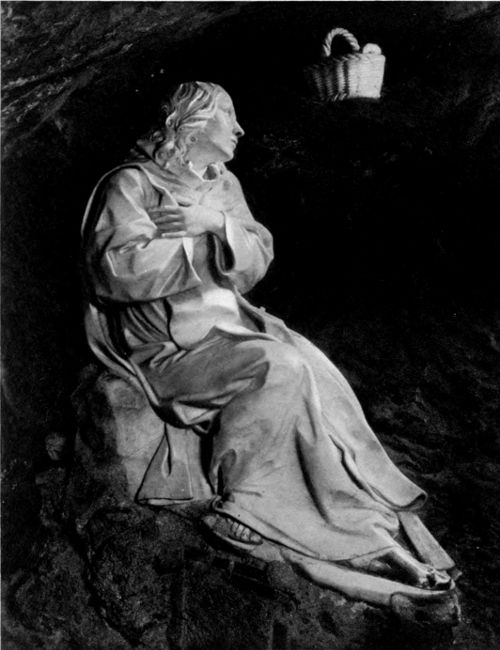
STATUE OF ST. BENEDICT.
In a cave at Subiaco, near Tivoli.
Seven centuries afterwards St. Francis came from
Assisi to visit the spot. He knelt there long, and shed
many tears over the thicket of thorns. Then he planted
two rose trees there, and the thorns gave place to roses
that have bloomed for eight hundred summers, and
were blooming when I saw them, with never a thorn
on their stems. But every leaf of their foliage has
a little white line zig-zagging across it—to mark the
flight of the defeated Serpent from St. Benedict’s Eden.
There is a pretty story that tells how, after nearly three
years, the hermit’s retreat was discovered. Sometimes
the devil, in sheer spite (or maybe the chafing points
of rock on which Romanus was letting down the bread)
would cut the string, and then, as Romanus could not
come back till the next day, poor young Benedict, his
whole supply for twenty-four hours whirled away into
the river below, would grow faint and hungry before
his benefactor could reach him again.
The devil is always rampantly busy at holy seasons—it
enrages him to see everybody trying to be good—and
when Benedict had held out against him for three
solid years, he selected Easter Sunday for one of these
wicked tricks. Romanus’s string snapped, the loaf
plunged into the river, and Benedict, always blessing
God, resigned himself and went on with his prayers.
The pangs of hunger made themselves felt with painful
persistence, but he tried to take no notice of them.
Not so his kind Creator. In His love for this faithful
child He spoke to a good parish priest who was sitting
down to his Easter dinner at that moment with a glad
heart. “How canst thou enjoy these luxuries while a
servant of God is pining for food?”
The good priest sprang up, gathered together all
that he could carry, and, leaving his own dinner untouched,
started out to find the suffering recluse. He
knew not his name or his dwelling, but angels guided
his steps and helped him to reach the inaccessible cave.
There, instead of some aged penitent, he found a tall
boy, with beautiful, serious eyes, and lithe and strong,
though his body, clothed in tattered skins, was terribly
thin.
Benedict was as much surprised as his visitor. The
latter spread the good things before him and bade him
eat.
“Nay, friend,” said Benedict, “thou bringest meat,
eggs! How can I partake of such luxurious food in this
season? It is Lent.”
“Lent!” replied the Priest. “No, indeed, my
son! Lent is over. This is Easter Sunday!”
Then the boy fell to, rejoicing. He had lost count
of the days in his solitude.
The priest stayed some time with him and questioned
him of his way of life, and Benedict answered in all
humility; and the visitor went away convinced of
the truth proclaimed by the mysterious voice when it
called him a servant of God.
Now some of the shepherds of that country—doubtless
in seeking for some strayed kid of the goats—had
caught sight of Benedict in his dark cave, and his matted
hair and robe of skins had so terrified them that they
fled, thinking they had seen a strange wild beast. Now
their pastor told them about him, and the poor people
began to come to him to ask for his prayers. And
those who felt called to a higher life gathered themselves
to him for guidance, and the fame of his sanctity and
the miracles he wrought went abroad, so that certain
monks of Vico Varo begged him to come and rule over
them. He consented at last and came, but when they
realized that he meant to enforce a strict rule instead of
letting them follow their own varying inclinations,
their admiration—it had never been love—turned to
hatred. Satan entered in amongst them, and they
resolved to poison him. When the fatal cup was handed
to Benedict, he took it without a word—and made the
sign of the Cross over it. It was shivered to fragments
on the instant.
Then he left these false brethren and returned to
his grotto, but never more to his solitude. Many came
to him, some praying that he would guide their steps
in religion, some to confide to him their sons to educate.
This multitude could not be housed in the clefts of
the rock, so he built twelve monasteries at Sub Laqueum,
on the ruins of Nero’s villa, and placed in each twelve
monks who bound themselves to live under certain
plain and simple rules—much prayer, much labour,
fasting and penance, active charity, life-long chastity,
and finally, poverty, for no individual might own property
of any kind. Thus began the monastic life of the West.
Up to Benedict’s time, as I have said, the religious life
was indeed led by many devout persons, but also by
many who lacked true devotion and brought the calling
into some disrepute. The founder par excellence
appeared, and immediately it took on the character by
which we recognize it now.
Its deepest and strongest foundation was in its
humility. In Benedict nature had been wholly subdued;
his self-abasement was complete. No vision of
the future had been granted him as yet, no breath of
prophecy had whispered that in the years to come
thirty thousand monasteries in Europe would be called
by his name.
Meanwhile his twelve little houses at Sub Laqueum—our
Subiaco—prospered exceedingly, and the numbers
of his subjects increased daily. The times were so
terrible that men who loved God and His peace were
overjoyed to find a spot where war and murder came
not, and where they could serve God with quiet hearts.
There were some such among the Barbarians themselves,
and more than one Goth asked to be enrolled
among Benedict’s spiritual children. All had to work,
and the Goths, big honest fellows, but dense and unskilful,
joined the band of builders and cultivators of the
soil. The country was thickly wooded then, and there
was much felling to be done. One day a Goth, hewing
away at a tree, let his axe slip and fall into the lake.
Immediately he began to weep and lament, for the
implements were few and precious. Benedict came to
him, saw what had happened, and made the sign of the
Cross over the water. At once the heavy axe floated
to the surface, and the Saint drew it forth and gave it
back to the poor man, saying, “Ecce, labora, et noli
contristare!” (“There, work, and be not afflicted!”)
“Symbolical words,” says Montalembert, “in which
we find an abridgment of the precepts and examples
lavished by the monastic order on so many generations
of conquering races! ‘Ecce, labora!’”
In the miserable and confused condition of public
affairs it was difficult for parents of the better classes
to procure proper education for their sons, and as soon
as the fame of Benedict’s holiness spread abroad, young
boys of noble families were brought to him at Subiaco
and confided to his care in the hope that they too
would devote themselves to the service of God. Two
of these, Placidus and Maurus, were especially dear to
him and were destined to become in a special manner
his disciples and helpers. Placidus, the younger of the
two, was the son of Tertullus, the feudal lord of Subiaco
and of many other towns, and a great benefactor to
the infant community. But Benedict would allow no
distinctions of rank to interfere with the training in
obedience and humility which is the only sure foundation
for the religious life, and the two young patricians had
to perform their share of menial labour like all the rest.
One day Placidus had been sent to fetch water from
the lake, and as he stooped to lift out his heavy pitcher
he lost his balance and fell into the water, which at that
spot formed a dangerous whirlpool. St. Benedict
witnessed the accident, and turning to Maurus, who
stood, horrified, beside him, said, “Go, my son, and
save thy companion.”
Without an instant’s hesitation Maurus walked across
the water with a step as firm as if it had been dry land,
drew the drowning boy out of the whirlpool and set him
safely on the bank. St. Gregory, in his life of St. Benedict,
says, “To what shall I attribute so great a miracle?
To the virtue of the obedience, or to that of the commandment?”
“To both,” says Bossuet; “the obedience had grace
to accomplish the command, and the command had
grace to give efficacy to the obedience.”
St. Gregory gives us a beautiful picture of St. Benedict’s
loving training of these two predestined souls.
He kept them always near him, and would walk along
the woody banks of the Anio leaning on Maurus and
leading Placidus by the hand, discoursing so wisely and
yet so clearly that the appeal to the more mature intelligence
of the one was as convincing as to the childlike
mind of the other. They witnessed his many miracles
trembled at the punishments that fell on some unfaithful
members of the community, and stored up all his words
in their hearts—Placidus to be the Apostle of Sicily
and the first martyr of the Order, Maurus to become
the founder of the religious life in France, where he
died at the age of seventy, after having, as the Breviary
puts it, “seen already more than one hundred of his
spiritual children precede him to heaven.”
Those first years at Subiaco were very happy and
consoling ones for St. Benedict, but wicked men, some
envious of his fame, some the open enemies of all virtue,
tried by all means in their power to injure him and
corrupt his followers. He took no notice of their
calumnies, was unmoved by the attempt of one wretch
to poison him; as long as he only was attacked he went
calmly on his way. But when the conspirators sent a
crowd of abandoned women to invade the garden where
the monks were working, he felt the time had come
when he should depart and draw the attacks away from
his beloved disciples. So, having set all things in order
and adjured the mountain community to be faithful to
its vows, he travelled southwards, surely with a heavy
heart, and did not pause till he had put nearly a hundred
miles between himself and his beloved retreat at Subiaco.
About eighty-five miles from Rome, where the ever-capricious
Apennines sink to a rounded plain and rise
in its centre in a natural fortress of rock, there stood, in
Roman times, the little town of Cassinum, once the
home of Varrus, whom Cicero called “sanctissimus et
integerrimus,” one of those who served God without
knowing Him. The place was in ruins when St. Benedict
reached it, but he cared nothing for that; what arrested
him was the sight of the poor country people climbing
the hill to sacrifice to Apollo in the temple on the summit.
Pagans yet! He stayed to teach them Christianity, and
very soon the temple and grove of Apollo gave place to
a church and monastery—the most famous in the world,
the monastery of Monte Cassino.
St. Benedict must have possessed even more than
the Saint’s usual gift of divine magnetism, for wherever
he went eager disciples sprang up around him—many
faithful, some few less so, but all irresistibly attracted to
the man himself. As it had been at Subiaco, so it was
here. Very quickly he converted the poor people of
the district, signs and wonders too many to recount
“confirming the word,” and his inexhaustible charity
making the harried peasants feel that they had found
a father, a doctor, a protector, in the benignly gentle
monk. The great heart that was utterly empty of
self felt for all their sorrows and hardships; the eyes
that, as St. Gregory tells us, had already been opened
to the vision of the Godhead, saw, as mortals do not
see, into the hearts of men, and showed events taking
place hundreds of miles away as clearly as those close by,
so that when his monks returned from the missions on
which he sent them, it was he who told them all they
had said and done and thought on the way.
He seems to have understood that God would spare
him further wandering, and accepted Monte Cassino as
the cradle of the Order he was called to found. Here
he composed the Rule which became the model of all
succeeding Orders, and in its simple completeness contains
the essence and ideal of the religious life. That,
according to St. Benedict, must include prayer and
praise and penance, labour, and unbounded charity,
but it does not consist in them. They are its garment,
its inevitable expression, so to speak, but the life is the
life of the heart in constant union with God. He was
opposed to all undue extremes in outward observances,
though inflexible as to the keeping of the Rule. “Let
this,” he said, “be arduous enough to give the strong
something to strive for, but not so hard as to discourage
the weak!”
He worked at Monte Cassino as if for eternity, yet
it was revealed to him that forty years after his death
the Lombards would destroy the convent and disperse
the monks. It puzzles one to understand that perfect
trust and obedience. The knowledge saddened him,
but it never made him desist from his labours, so splendidly
justified by after events. “I have obtained from
the Lord this much,” he told the frightened disciples:
“when the Barbarian comes he will take things, not
lives—res, non animas.” But other Barbarians were
overrunning the country, left now to its fate by its
supine and helpless rulers in Constantinople. The
Goths were everywhere; many, indeed, became devout
followers of Benedict, but their Arian brethren pillaged
and persecuted, burnt and ravaged, unchecked, and
terribly did the people suffer. St. Benedict, who
foresaw the great destinies of these northern races when
they should become enlightened, stood between the
conquerors and the conquered as judge and protector,
and both in the end always bowed to his ruling.
There is a wonderful story that I must set down,
because it shows his power over nature, both animate
and inanimate things. To me it seems more impressive
than all his other miracles, even those of restoring the
dead to life. A particularly fierce Goth robber, named
Galla, “traversed the country, panting with rage and
cupidity, and made a sport of slaying the priests and
monks who fell under his power, and spoiling and
torturing the people to extort from them the little
they had remaining. An unfortunate peasant, exhausted
by the torments inflicted upon him by the pitiless
Goth, conceived the idea of bringing them to an end
by declaring that he had confided all that he had to
the keeping of Benedict, a servant of God; upon which
Galla stopped the torture of the peasant, but, binding
his arms with ropes and thrusting him in front of his
own horse, ordered him to go before and show the way
to the house of this Benedict who had defrauded him of
his expected prey. Both thus pursued the way to
Monte Cassino, the peasant on foot, with his hands tied
behind his back, urged on by the blows and taunts of
the Goth, who followed on horseback.
“When they reached the summit of the mountain
they perceived the Abbot, seated alone, reading at the
door of his monastery. ‘Behold,’ said the prisoner,
‘there is the Father Benedict of whom I told thee.’
“Then the Goth shouted furiously to the monk,
‘Rise up, rise up, and restore quickly what thou hast
received from this peasant!’ The man of God raised
his eyes from his book, and, without speaking, slowly
turned his gaze first on the Barbarian on horseback,
and then upon the husbandman, bound, and bowed
down by his cords. Under the light of that powerful
gaze the cords which tied his poor arms loosed of themselves,
and the innocent victim stood erect and free,
while the ferocious Galla, falling on the ground, trembling
and beside himself, remained at the feet of Benedict,
begging the Saint to pray for him. Benedict called
his brethren and directed them to carry the fainting
Barbarian into the monastery and give him some blessed
bread. And when he had come to himself the abbot
represented to him the injustice and cruelty of his
conduct, and exhorted him to change it for the future.
The Goth was completely subdued.”[2]
The picture of the holy Abbot sitting and reading
in the doorway is one which recurs several times in his
history, and it is good to know that the doorway is one
of the very few fragments remaining of Benedict’s
home at Monte Cassino. It still contains, I believe, an
inscription to that effect. The Lombard destruction
left this archway standing, and also the little tower
whence Benedict’s bell called the monks to work and
prayer. One loves even to touch the stones that knew
his presence at Monte Cassino. Subiaco is full of him
indeed, but it was at Monte Cassino that his greatest
work was done; over its foreseen destruction he wept
bitterly and it was there that he died.
A yet more notable encounter than the one with
Galla took place at the arched doorway, in 542, one year
before Benedict’s death. Totila, the Ostrogoth, swept
down through Italy to retrieve the losses and defeats
inflicted on his predecessor by Belisarius. It was a
triumphal progress. He was on his way to Naples when
the whim took him to see for himself the venerated
prophet of the holy mountain. But first he wished to
test the prophet’s powers. So he caused the captain
of his guard to be dressed in all his own royal robes,
down to the famous purple boots, gave him three noble
counts for his attendants and a great escort of soldiers,
and told him to go and pass himself off on Benedict as
the real Totila. We are not informed how the unlucky
captain regarded his mission—probably with fear and
reluctance—but it failed dismally. As he approached
the monastery, St. Benedict perceived him from afar,
and called out, “My son, put off the dress you wear!
It is not yours.”
The captain, terrified, threw himself on the ground.
Then remounting, he and his whole company turned
round and galloped away at full speed to tell Totila
that it was useless to attempt to deceive the man of God.
And Totila understood, and came himself, very humbly,
and saw the Abbot sitting as usual, in the doorway,
reading a holy book. The conqueror was afraid. He
threw himself face downward on the sward and dared
not approach. Three times Benedict bade him rise—still
he lay prone. Then the Saint left his seat and
came and raised Totila up and led him to the house
and talked long and earnestly with him, reproving him
for the wrong he had done, and showing him that he
must treat his conquered subjects kindly and justly.
Also St. Benedict, mercifully moved thereto by the
sincerity of the Barbarian, told him what lay in store
for him. “You shall enter Rome; you shall cross the
sea; nine years you shall reign, and in the tenth you
shall die.”
And Totila repented of his many evil deeds and
begged the seer to pray for him, and went back to his
camp a changed man. Thenceforth he protected the
weak, restrained his followers and showed himself so
mild and wise that the delighted Neapolitans, who had
been expecting a repetition of the awful massacres
ordered by Belisarius, said that Totila treated them as
if they were his own children. From that time the
tenth year was ever before his eyes, and when it came
he died, contrite and resigned.
One gleam from home was shed on St. Benedict at
Monte Cassino. His sister Scholastica had long since
followed his example and given herself to God. It was
not permitted to women to take the final vows before
the age of forty, but that did not prevent them from
preparing for the irrevocable dedication by living
together in religious communities, under a fixed rule,
from their early youth, when they were so inclined.
Such a life Scholastica had led, somewhere in the solitudes
of the Sabines—perhaps in her own home at
Norcia; but she came at last to Monte Cassino and
built a convent there for herself and her companions, so
as to be near the brother she loved. Only once a year
did they meet, and then they spent the day together
in a hut on the side of Benedict’s mountain, he coming
down with a few of the brethren, and she accompanied
by some of the nuns. All their discourse was of holy
things, and much they spoke of the longed-for joys of
heaven.
Now in the year 543 they had thus passed the day
together, and evening was drawing on. St. Benedict
rose, saying that he and his companions must return
to the monastery, but Scholastica, for the first time in
all those years, begged him to remain with her till the
morning. The Saint was horrified. “Do you not know,
my sister,” he exclaimed, “that the Rule forbids a
monk to pass the night out of the monastery? How
can you ask me to do such a thing?”
Scholastica did not reply. She bowed her head on
her hands on the table that had served for their repast,
and wept, praying to God that her brother might stay,
for she knew that they were to meet no more in this
world. She wept so heart-brokenly that her tears
flooded the table and made little rivers on the ground.
It was a mild February evening, and the sun had sunk
away from a calm and cloudless sky. But suddenly a
fearful tempest arose, the thunder roared, the rain
came down in torrents, the lightning seared the heavens
from side to side.
“Sister, what have you done?” St. Benedict
exclaimed, fearing that the storm was a manifestation
of the Divine displeasure.
Scholastica raised her head and smiled at him through
her tears. “God has granted what you refused,” she
said. “Go back to the monastery now, brother, if
you can!”
But there was no going back through that tempest,
and St. Benedict, perceiving that the Lord was on
Scholastica’s side, stayed with her till morning, and
they had great sweetness of holy converse all night
long. And when the sun rose, Scholastica asked for
his blessing and said farewell for the last time, and she
and her nuns went down the hill to their own convent,
looking back many times, I think, to that other one
on the hill. And three days later she died, and her
brother saw her soul mount to heaven under the appearance
of a spotless dove, and he called his monks and
said to them with great rejoicing: “My sister is with
God. Go and bring her body hither that we may bury
it with honour.” Which they did, and Benedict made
her a grave at the foot of the altar in his church.
Now he knew that his own end was approaching, and
he disposed all things rightly, and mightily exhorted
his brethren to persevere and to be faithful to their
Rule. And he more than ever afflicted his body with
penance and abounded in charity to the poor. And
thirty-four days after Scholastica had departed, a great
fever seized him, so that he had no strength and suffered
much. But he never ceased from praying, and bade
all his monks pray that God would have mercy on his
soul. On the sixth day of the fever he bade them
carry him into the church, where he had already caused
his sister’s grave to be opened to receive him. There,
on the edge of the grave, supported by his disciples, he
received the Holy Viaticum, and then bade them lift
him to his feet. He stretched out his arms, praised
God once more for all His goodness, and died—standing,
like the gallant warrior he was!
They buried him beside Scholastica. Two of his
monks, whom he had sent forth on a mission, were very
far away from Monte Cassino when they saw, in the
dead of night, a vast number of the stars of heaven
run together to form a great bridge of light towards
the east. A voice spoke to them, saying, “By this road,
Benedict, the beloved of God, has ascended to heaven.”
CHAPTER III ST. GREGORY THE GREAT
Three years before St. Benedict and his sister
Scholastica passed away, there was born, in a
palace on the Cœlian Hill, a child who was christened
Gregory, a name which signified “Vigilant.” His
lineage was exceedingly illustrious, his parents belonging
to the great old Gens Anicia, a family of nobles which
had been respected and honoured ever since the days
of the Republic, and in which, to use the words of a
chronicler of Gregory’s time, “the men seemed all to
have been born Consuls, and the women Saints.”
Gregory’s mother was St. Silvia, and I have seen
the garden, on the quiet Cœlian Hill, where as a child
he ran about at her side, asking a thousand questions,
as clever children will, while she tended her flowers
and gathered healing herbs—the “basilica” and “Madrecara”
and “erba della Madonna” still dear to
Roman apothecaries, to make into medicines for the sick
poor who thronged her charitable doors. Mothers see
a long way, and while Gregory’s father was planning a
great career in the world for his only son, Silvia was
praying that God would keep him pure, and make him
great in His sight. And her prayers prevailed, as
mothers’ prayers generally do, and though she had to
wait a little, she lived to see their fulfilment.
As the boy grew up he threw himself heart and soul
into his father’s plans; he studied hard, and his naturally
brilliant gifts brought him much distinction. He
rejoiced in all the pleasant things that birth and wealth
had bestowed on him—good looks, popularity, rich
garments, and sparkling jewels—and no doubt was immensely
pleased and flattered when, being still quite
young, he was made Proctor of Rome. That charge,
however, was a grave one at the time, as the Lombards,
the most cruel and brutal of all the savage tribes that
had threatened the eternal city, chose the period of
Gregory’s proctorship to descend upon her and make
her feel the weight of their heavy hand. There were
religious troubles too, and Gregory, who, through all his
busy official life in the world, was an ardent Christian,
was deeply exercised and distressed by them. But the
world was only to claim him for a little while, in his
early manhood. Then he was withdrawn from it to
be prepared, through many long years of prayer and
penance and study, to step forth towards the end of his
life as its rescuer and ruler. Little by little the inner
call came, faint at first, sometimes resisted, but ever
stronger, till Gregory understood and obeyed.
His heart had gone out at once to the Benedictine
monks, when, on the destruction of Monte Cassino by
the Lombards, they had sought refuge in Rome. Some
of them became his most intimate friends, and their
encouragement smoothed his path from the world to
the cloister. From the moment when he recognized
and embraced his vocation, all hesitation left him. He
sold all his goods, distributed the larger part to the
poor, and, as if to atone for what the Lombards had
destroyed, built and endowed six new monasteries,
placing twelve Benedictines in each, in Sicily. That
done, he converted his home on the Cœlian into a
seventh, where he gathered another community about
him, of the same learned Order. His father was dead,
and his mother, on becoming a widow, had already
built a convent close by, where she had taken the veil
herself.
Gregory now devoted himself to three things,
prayer, study, and charity. For his own use—he was
quickly elected Abbot of the monastery—he reserved a
small cell, where he could enjoy the solitude he now
so greatly desired, but—a delightfully human touch!—he
could not get on without his favourite cat, and one
can see him in imagination, pausing from his writing
to smooth her velvety head when she sprang upon the
table and rubbed it against his cheek! I had a little
cat once who would sit motionless on a chair beside me
all night while I was writing, but the instant I laid
down the pen she was on my lap or my shoulder, talking
in her own way, most intelligently and cheeringly; so I
was mightily pleased when I read about St. Gregory’s
cat!
The Benedictine Rule provided for all hospitality to
strangers and the poor, but at the same time directed
that the monks themselves were not to be disturbed
from prayer and study. St. Gregory, however, seems
to have received all who wished to see him, perhaps as
an exercise of patience. Now there was a poor shipwrecked
sailor who seemed inclined to abuse the privilege.
He came again and again, and was never turned
away, but on the occasion of what proved to be his last
visit Gregory had not a single thing left to give him.
He was looking round his rough cell in perplexity, when
a messenger appeared bringing the silver basin full of
porridge which was the only food he allowed himself,
and which his mother sent him every day. Here was
what was needed! The next moment the needy sailor
man was walking away with the hot porridge and the
silver porringer. What St. Silvia said when she heard
of the incident has not been recorded—but Gregory
never gave the matter another thought until one day,
long after, when the importunate sailor appeared to
him in his true character, that of an angel of light, and
told him that God had taken note of his charity, and—an
alarming prophecy for the Saint—that he would be
elected Pope and do great things for the Church.
All he asked was to be left quiet in his monastery,
where he was putting his whole heart into living the
life of a model monk. In his ardour against himself,
he carried his penances too far and fasted so rigorously
that he came near to dying—an imprudence for which
he paid ever after in broken health and in being debarred
from fasting at all. He complains pitifully of having
to “drag about such a big body with so little strength,”
but this was the least of the trials that awaited him.
In the year 577, when Gregory was about thirty-seven
years of age, the reigning Pope, Benedict I, sent
for him and insisted upon making him one of the Cardinal
Deacons to whom was entrusted the jurisdiction of the
seven “Regions” into which the city was divided.
Gregory protested, but had to take on the charge, and
from that time forward he belonged less to himself than
to others. He was too necessary and valuable to be
spared. The next year, Pope Benedict being dead, his
successor, Pelagius II, decided to send Gregory on a
very difficult and important mission to the Emperor
Tiberius Constantinus at Constantinople, where trouble
of all kinds seemed to be brewing. Although Gregory
bewails this “thrusting out from port into the storm,”
one cannot but feel how the alert fighting spirit in the
man leaps to the call. The born leader may persuade
himself that he is happiest in the seclusion he thinks
good for his soul, but when the call to arms comes, every
repressed fibre of his being wakes and cries for action.
When Gregory, taking with him several of his monks,
sailed away from Italy, he little dreamed that years
were to pass before he should return. On his arrival
in Constantinople the first matter to claim his attention
was the ugly new heresy started by Eutychius, who had
drawn the Emperor and many others into the path of
error by declaring that there was to be no resurrection
of the flesh. Gregory was politely received by the
Emperor, and instantly requested the latter to call a
conference in which the dogma should be discussed.
Tiberius consented, and there followed the famous
conference in which Gregory’s fiery eloquence and
invincible logic quashed the heresy at once. When he
had finished speaking the Emperor commanded that a
fire should be lighted, and with his own hands, and in
the presence of a vast concourse, burnt the book which
Eutychius had written to propound the heresy, and
declared himself now and for ever the faithful son of the
Church. Eutychius, touched to the heart by Gregory’s
arguments, accepted defeat and rebuke as but small
punishment for his fault, and when he was dying, soon
afterwards, pulled up the skin of one poor emaciated
hand with the fingers of the other, and cried to those
around him, “I confess that in this flesh we shall rise
from the dead.”
Gregory proved a successful ambassador in every
way. The relations between the Church and the
imperial court had been badly interrupted by the
Lombard invasion, but he welded them smoothly and
firmly together. Tiberius died while Gregory was in
Constantinople, and his successor, Maurice, was badly
disposed to the Church. Gregory brought him to a
better mind and obliged him to rescind an edict he had
just issued forbidding any member of the army to
embrace the monastic life.
At last, after six years of what must have been the
most anxious work, requiring all that the great man had
of wisdom and firmness and tact, he returned to Italy—to
find his beloved Rome in terrible distress from a
visitation of the pestilence. Gregory at once devoted
himself to the care of the sick and dying, and one can
fancy how the poor people’s eyes lighted up when he
appeared among them again. Then the good Pope
Pelagius succumbed to the disease, and at once all
eyes turned to Gregory, who was unanimously elected
as his successor.
ST. GREGORY THE GREAT.
Photo by Anderson, from the Statue in the Church of St. Gregory, Rome.
Gregory was honestly horrified. He refused, he
pleaded, he argued, but no one would listen to him.
Then he fled. Disguised as a peasant, he slipped away
and hid himself in a secret cave in the hills, entreating
the Lord to protect him from the awful honour which
his fellow-citizens wished to thrust upon him. They
meanwhile were searching for him in every direction,
and would have failed in their quest had not Heaven
put itself visibly on their side. From very far off they
beheld a tall pillar of light resting before the fugitive’s
cave—they rushed to it, dragged him forth, and made
him Pope. Seeing that his fellow-citizens would not
listen to him, he wrote to the Emperor Maurice, begging
him not to confirm the election, but the Romans intercepted
the letter; the Emperor was informed of the
election in the usual way, and was only too glad to
give it the imperial sanction, still required then from
Constantinople.
For once the “Vox Populi” had proved itself
what it never is nowadays, the “Vox Dei,” and for
fourteen years Gregory reigned, in virtue and wisdom
and glory, for the everlasting good of the people of God.
Every gift that Heaven had bestowed upon him vindicated
its unerring designs. He accomplished in those
fourteen years so many wonderful things that cold sense
almost refuses its adherence to the visible facts. His
colossal labours for the Church gave us the Gregorian
chant, the Sacramentary of the Missal and the Breviary;
his correspondence, so vast that, like Napoleon and
Julius Cæsar, he is supposed to have dictated to several
secretaries at once, embraces every point that required
treating of at home and abroad. His sermons, day
after day, instructed the ignorant in the plain truths
of salvation while they no less amazed and illuminated
the minds of the most learned; and through it all his
soul was never disturbed from the calm heights of
union with God, his heart never closed to a single cry
from the suffering and the weary.
The much-abbreviated list of “some of his labours,”
as the Breviary puts it, would stagger the grasp of any
modern scholar or ruler. In a few lines he is shown to
us “re-establishing the Catholic Faith in many places
where it had suffered, repressing the Donatists in Africa,
the Arians in Spain, expelling the Agnostics from Alexandria,
and refusing the ‘Pallium’ (the sign of pontifical
investiture) to Syagrius, the Bishop-elect of Autun,
until he had turned the ‘heretic Neophytes’[3] out of
Gaul; quelling the audacity of John, the Patriarch of
Constantinople, who had dared to call himself the
‘Head of the Universal Church,’ and so on, preaching,
writing, praying, and through it all suffering constantly
and acutely.”
There is a legend to the effect that all these pains
and sicknesses had been voluntarily accepted in order to
deliver a certain soul from purgatory. The legend is
only a legend, unsupported by the authority of the
Church—but it would have been just like St. Gregory
to do it!
In every public or private trouble or upheaval, as
well as in every effort to reorganize and restore, his
name, his presence is dominant. After becoming Pope
he lived chiefly at the Lateran palace, then the official
Papal residence, and they still keep there the narrow
pallet that served him for a bed, and—mark this, ye
modern schoolboys!—the little rod which he had to
use to keep his dark-eyed, rampageous young choristers
in order!
The men who can govern others with the most
unerring wisdom are often entirely mistaken in their
appreciation of themselves. Only the other day the
local and most successful Superior of a great missionary
order in America was bewailing his fate to me. “I
told the Bishop he was making a dreadful mistake in
making me the Rector,” he declared, “it is not my
work—I was not intended to govern and lead! I am a
born free-lance—I want to travel all over the country
seeking out the lost souls. I am no good at anything
else!”
But the Bishop knew better; and so it was with the
great crowd of clergy and laity who designated Gregory
for the Papacy. What he accomplished during his
pontificate has been well summed up by Montalembert:
“Gregory, who alone amongst men has received, by
universal consent, the double surname of Saint and
Great, will be an everlasting honour to the Benedictine
order, as to the Papacy. By his genius, but especially
by the charm and ascendancy of his virtue, he was
destined to organize the temporal power of the Popes,
to develop and regulate their spiritual sovereignty,
to found their paternal supremacy over the new-born
crowns and races which were to become the great nations
of the future, and to be called France, Spain, and
England. It was he, indeed, who inaugurated the
Middle Ages, modern society, and Christian civilization.”
The task he undertook was a gigantic one, for on
the one side he had to contend with the exactions and
oppressions of the corrupt and decrepit Byzantine
Emperors who were still the nominal rulers of Rome
and his own secular masters on the other, with the
great new forces let loose on the world in the increasing
vigour and supremacy of the Lombards and other
northern nations, more than half barbarous still, but,
as Gregory clearly perceived, possessed of an intelligence
and vitality which only required training and instruction
to grow into great new polities which would replace
the already dead Roman Empire.
To appreciate his labours one would have to read
that colossal correspondence which has fortunately been
preserved entire. Beside the mighty matters of Church
and Empire which it sets forth, there shows all through
the most tender and minute care for the lower and
therefore unprotected classes, as well as for individual
souls. Slavery, in every form, excited Gregory’s generous
indignation, and his most earnest efforts were devoted
to restoring slaves to the rank of human beings. The
peasants on the great estates were serfs—practically
slaves. He decreed that their marriages should be
inviolable, their property their own, their wills valid;
that wherever possible the Church revenues should be
devoted to buying the freedom of slaves, and that never,
on any plea, should Christians be sold to Jews or pagans.
At the same time he enacted that neither Jews nor
pagans should be baptized by force, and commanded
that the synagogues of the Jews should be restored to
them and that they should be allowed freedom of
worship.
Always humble and diffident about asking anything
for himself, it is amusing to find him severely reprimanding
a Bishop who had authorized or permitted extortionate
exactions to be practised against an obscure
farmer in Sardinia, and at the same time writing meekly
to the overseer of some ecclesiastical property in Sicily—a
stud farm where were kept four hundred stallions:
“You have sent me one bad horse and four asses. I
cannot ride the horse, because it is bad, nor the asses,
because they are asses. If you would assist to sustain
me, send me something that I can use!”
But after all the special bond between St. Gregory
and English-speaking peoples lies in the memorable act
by which England was evangelized, after the Faith first
planted there had been annihilated by the pagan
Barbarians, Saxons, Angles, Scandinavians, to whom she
fell an easy prey when Rome withdrew its protecting
legions and abandoned her to her fate.
It is rather sweet to know that it was the fair, innocent
beauty of a group of English children, standing, dazed
and frightened, in the market to be sold, that first
touched his heart to such warm pity for their country.
He was then living as the Abbot of the community
he had founded on the Cœlian Hill, and enough
has been said to show how happy he was in his quiet
life there.
It must have been some unusual necessity which
took him far down into the town on a certain day and
through the noisy crowded slave market. But on
seeing the children, with their blue eyes full of tears
and their long golden hair shining in the sun, everything
else was forgotten; he stopped abruptly to ask who
they were.
“Angles, from the isle of Britain,” was the answer,
given indifferently enough. The keeper knew that the
big, dark-faced monk was not a slave-buyer.
“Angles! They are born to be angels!” cried
Gregory, and straightway he flew to the Pope and
besought permission to go with some of his monks to
Britain, to preach the Gospel. The Pope, taken by
surprise, consented; and before he had time to think
over the matter, Gregory, with his volunteers, had
put three days of travelling between himself and Rome.
Then the news leaked out, and the people rose like one
man and rushed to the Pope, who was on his way to
St. Peter’s, and, arresting his progress, burst into indignant
cries: “You have offended St. Peter! You have ruined
Rome in allowing Gregory to leave us!”
Pelagius saw his mistake and sent messengers in all
haste to call Gregory back. Of course he obeyed; he
never forgot England, but it was only in the sixth year
of his own pontificate (596) that he could carry out his
design, and then he could not himself take part in the
expedition. He found a noble substitute in St. Augustine,
and it must have been with a glad heart that he
sent him forth, and gave him and his forty Benedictines
the final blessing, as they knelt (so we are told) on the
grassy stretch below the steps of Gregory’s own convent
on the Cœlian Hill. The grass grows there still; still
the green trees shadow the enclosure called St. Gregory’s
park, through which one approaches the church, and
still the flowers bloom in Silvia’s garden where he played
as a little boy. Even modern Rome has been loath to
encroach on the place so dear to him who loved Rome
so much.
I have often wondered what became of the little
English children he saw, and seeing, loved. Surely he
rescued them and placed them with kind people to be
cared for. His quick notice of them reminds one of
our own Pius IX, who could never pass an English
child without stopping to bless it, and, while blessing the
child, to pray for England, whom Augustine and his
companions made “the Isle of Saints” and the “Dowry
of Mary.”
One more picture of St. Gregory must close this
humble sketch of his great life. As already related,
after he had been elected Pope he sent a letter to the
Emperor Maurice, imploring him not to confirm the
decision of the people. And just then, as if jealous of
all the good work that was going forward, the Powers
of Evil let loose a terrible outbreak of the pestilence
in Rome. They could not touch the spiritual city—Rome
invisible, the Sanctuary of the Faith—but the
material one seemed to be delivered into their hands,
and terrible were its sufferings. Poverty and neglect,
and the ruin of ceaseless wars, had made it vulnerable
at every point; the pestilence had swept it again and
again, but this was the most frightful visitation of all.
Gregory and his monks, and many other charitable
persons devoted themselves to the sick and dying; the
lazarets and hospitals were crowded—every day with
new sufferers as the dead were carried out; but it
became impossible to bury the dead fast enough. Neither
prayer nor effort seemed of any avail, and dull despair
settled on all hearts. Apparently this was to be
the end.
Then Gregory instituted the first of those great
processions which, in moments of stress, have moved
across the pages of history ever since, aweing us a little
by the whole-hearted faith and trust of our ancestors
in the mercy of Heaven. Gregory decreed that all,
clergy and laity, who could stand on their feet should
put on the garments of penitence and follow him through
the stricken streets to pray at the tomb of St. Peter.
And all who could obeyed like one man. What a sight
that must have been when the Saint, “the strong, dark-faced
man of heavy build,” led his afflicted people from
the “Mother of Churches” at the Lateran Gate, down
past all the ruined pomp of the Palatine and the Colosseum
and the Forum towards the river and the great Basilica
of Constantine beyond! How the response of the
Major Litanies must have thundered up from all those
breaking hearts to the “skies of brass” that hung over
Rome! The ever-repeated “Te rogamus, audi nos!”
and “Libera nos, Domine,” even now bring tears to
one’s eyes with their almost despairing simplicity; then
they were the last appeals of a crushed and ruined race
for one more chance to repent and atone for its heaped
misdeeds.
And the chance was granted. As the endless procession
moved along towards St. Peter’s its leader paused
before the Mausoleum of Hadrian, that huge monument
of pagan ambition, and raised his eyes and heart
in supplication, offering we know not what of his own
life and destiny for his people’s sins.
Suddenly he stood transfigured. The chanting
ceased; all eyes followed Gregory’s gaze, all ears were
strained to catch the heavenly melody that floated, high
and clear, fresh as the song of birds at dawn, over the
sorrowing city.
“Regina Cœli, laetare,
Quia quem meruisti portare,
Resurrexit, sicut, dixit!”
It was the chant of the Resurrection!
“Alleluia, Alleluia!” came the sequel in one burst
from that great multitude, as the angels’ voices grew
fainter and were lost in the depths overhead. And
then, on hearts bursting now with relief and joy there
fell the awe that mortals feel in the presence of the
Heavenly Ones, for there, on the summit of the towering
fortress, stood the radiant archangel—and he was sheathing
his flaming sword.
The pestilence was over. Once more God had had
mercy on his people. And, since the angels’ song was
addressed to the Queen of Heaven, we know that it was
she whose prayers had stayed the arm that had clung
round her neck in Bethlehem.
St. Gregory passed to his reward on March 12, 604,
having reigned nearly fourteen years. The mourning
city chose Sabinianus of Volterra to succeed him, but
only three years had elapsed when Sabinianus in his
turn made place for a Boniface (III) who lived but one
year after his election, and then came another Boniface,
a Saint, a strong man of the Abruzzi, and in his reign
the world found out that though imperial Rome was
indeed dead, the Rome that Gregory and Benedict and
their fellow-workers had planted on her grave during
that century of apparent eclipse had taken root below
and shot out branches above, and had become as a mighty
tree affording guidance, shelter, and sustenance to
the whole Christian world.
Each of the great Popes seems to have had a special
mission to fulfil, one that coloured all his acts and sheds
its individual lustre on his memory. No doubt or
hesitation seems to accompany the acceptance and fulfilment
of it. Boniface’s mission bade him place the
seal of visible Christianity on the city and consecrate
it to the Faith for all time. To it was Boniface, the
fourth of that name, who decreed and carried out the
triumph of which I spoke in a preceding chapter. But
it is a big subject and it must have a chapter to itself.
CHAPTER IV MEMORIES OF THE PANTHEON
If you stand before San Pietro in Montorio and look
down from the spot where St. Peter was crucified,
you will see, rounding up in the low-lying heart of the
city, a dome, white, huge, uncrowned, standing out
from the darker buildings round it like an enormous
mother-of-pearl shell, softly iridescent, yet, when storm
is in the air, taking on a grey and deathlike hue.
That is the Pantheon, and thus it has stood, reflecting
every mood of the Roman sky, since the days of Hadrian,
who became Emperor in the year 117. Hadrian built
the magic dome, but it is not his name that stands out
in the gigantic lettering on the pediment over the
portico. Ninety years before his time, Marcus Agrippa,
the intimate friend and (for his sins!) the son-in-law
of Augustus, erected a magnificent temple close to the
Baths which still bear his name in the Campus Martius,
the field of which my brother has told the touching
story in “Ave Roma Immortalis.” Agrippa must have
forgotten to properly propitiate the gods; we moderns
should say that he “had no luck,” for his gorgeous
temple was soon struck by lightning and presented a
forlorn appearance when Hadrian, that enthusiastic
builder, decided to restore it.
This he did on his usual princely scale; when he
had done with it, the Pantheon (properly “Pantheum,”
“all-holy”) must indeed have dazzled the eyes of the
beholders, for the dome was entirely covered with tiles
of gilt bronze that under the rays of the sun made it
seem a second sun that had come to rest on earth. The
gilt tiles were stripped off in 663 by a greedy little
Emperor, Constans II, who took them away to Syracuse,
whence the Saracens successfully looted them a few
years afterwards. So the thing that looks like mother-of-pearl
is really only covered with sheets of lead—but
even lead, when the heavens have looked on it long
enough, may become a thing of life and beauty. When
Hadrian had finished his building there was nothing
left of Agrippa’s original one except the portico; but
Hadrian, with rare moderation, left the original founder’s
name on that. The Pantheon, which is called by
archæologists “the most perfect pagan monument in
Rome,” seems to have been, in its beginnings, unfortunate,
for only sixty-four years after Hadrian’s death
it again stood sadly in need of repair, if we may believe
the magniloquent inscription left on its front by Septimus
Severus and his son, Caracalla, when they had carried
out their pious designs of further restoration.
But it remains Hadrian’s best monument, substantially
what he made it, a vast and perfect round
under a vast and perfect dome, a place where the winds
of heaven may sweep down from the central opening—thirty
feet across—overhead, and circle round the wide
well of the interior and rise to the sky again without
having encountered the shock of a single angle on their
way. And for more than seventeen hundred and fifty
years the rain has fallen and the sun has shone, and
the stars have looked down on Hadrian’s pavement
through the great opening, whence worshippers now,
like the worshippers in his time, could raise their eyes
and thoughts to the vault of heaven above.
But for two hundred years—as if to partly balance
the three centuries of persecution which had preceded
them—the Pantheum was closed and none were permitted
to pray there, two hundred years during which
the silence was never broken, and stars and sun and winds
had their way in the stupendous empty fane. It was
the Emperor Honorius of inglorious memory who
closed and sealed its bronze doors—the same that guard
it now (and perhaps this and a few other such acts,
which showed him at heart a sincere believer, should
be remembered to his attenuated credit), preferring to
have it abandoned altogether rather than used for the
service of idols. And so it stood, a beautiful reproach,
from 399 to 609, when our Pope Boniface told the
Emperor Phocas that it was a burning shame not to
wash it of pagan stains and consecrate it a church of
the Lord.
Phocas—that blood-stained figure who emerges now
and then to surprise us by some memorable action—said
the Pope was right, and gave him the building to
do with it as he liked. And then Boniface carried out
the great plan which must have been simmering in his
brain for years. The temple, built for the seven deities
of the seven planets, was to become the shrine of the
bodies of the Saints and be consecrated to the one
True God, under the title of “St. Mary of the Martyrs.”
Under that perfect dome of exactly equal height and
diameter (142 feet) he would finally lay to rest all the
sacred remains which were still buried in the Catacombs
all round the city. But there was much to do first.
The rich architectural disposition of the interior required
no alteration beyond the erection of a High Altar; the
great window to the sky Boniface would not close; when
dust and rubbish were cleared away the material preparations
were over, but the tremendous ceremony of
purification and consecration had yet to be accomplished.
For these the illustrious predecessors of Boniface
had been inspired to draw up a ceremonial of such
profound meaning and glorious diction as remains
matchless in the annals of the Liturgy.
We can only see it now with the eyes of the spirit,
but, even while trying to do that, we must not let the
magnificence of the external function make us forget
that which the Church so lovingly and repeatedly
impresses upon us—first, that there is but one Sanctuary
worthy of the Most High, His Throne and dwelling in
the inaccessible light of the Fixed Heaven, round which
all universes that the human mind can grasp revolve,
like starry spindrift round a living sun; and, secondly,
that the home God has built for Himself on earth and
loves with the most passionate tenderness is the heart
of the Christian, where He will abide for time and
eternity if it do not cast Him out.
The chief object of ecclesiastical architecture is to
symbolize the grandeur of the union between the soul
and its Creator; as such, and as the storehouse and
dispensary of graces, the banqueting-hall where He
feeds us with Himself, the arsenal where He arms us
for the combat and trains us for His soldiers, where, in
His surpassing love and mercy, He deigns to remain in
the adorable Eucharist, the consecrated Church is the
crown of human production, and rightly do we strain
every nerve to make it rich and noble and fair.
When that is done, and all that men can give has
been lavished on beautifying and enriching it, it has to
be cleansed from every blemish of earthy contact before
it can be offered to the service of God. When we
wander through the Cathedrals of the world, Westminster
Abbey, Strasburg, Notre Dame, Milan, asking ourselves
how mere men ever attained to the production of such
beauty and grandeur, do we ever stop to think that those
towering walls were washed from vault to pavement,
within and without, with holy oil, on the day of consecration?
The Cathedral was the symbol of the soul, and every
act and prayer of the ceremonial depicted for our fore-fathers—so
well instructed in the truths we first take
for granted and then forget—the processes by which
God confers on us the gift of immortality. On the eve
of the great day all left the building, the new doors
were closed, no step sounded on the pavement, no voice
might break the stillness of the place. It was a dead
thing waiting for life, as the soul that is not united to
God waits, under its inherited burden of sinfulness, for
regeneration.
Outside the precincts a great tent has been erected,
and here, all through the night, the Bishop and his
assistants have been praying the prayers of David the
great penitent. All night long the penitential psalms
have been going up, beseeching the Lord to wash away
the sins of His people, His exiles on earth who are waiting
without the camp and entreating Him to take them
into grace and bring them to their Father’s home.
With the first faint light of dawn the prayers cease, the
supplicants arise, and the Bishop puts on his vestments,
one by one and with a special prayer for each, because
he thus figures the Son of God putting on the garment
of our humanity. And because Christ, as man, prayed
to His Father and ours, the Bishop comes forth from
the tent and prostrates himself before the steps of the
church in fervent prayer, with all his clergy kneeling
around him.
Now the natural soul is cold and blind, and closed
to Grace; so the church stands, unlighted and with
fast-closed doors. And because the Spirit of God is all
gentleness and mercy, and condescends to most patient
stratagems to capture the heart He covets, the Bishop
goes three times round the great building, praying and
knocking softly at its doors, while the clergy follow
him and pray too, as the angels pray for us. At last
the first barrier falls; the doors open, reluctantly as
it were. The Bishop crosses the threshold saying,
“Peace eternal to this House, in the Name of the
Eternal.” The procession passes within, the shadows
swallowing up the gold and crimson of the vestments
that had been sparkling in the sun.
A strange sight the empty church presents now.
On the pavement two broad paths of ashes traverse its
entire length and breadth, in the form of a Greek cross.
The assistants stand in silent groups while the Bishop,
slowly moving down from the apse to the entrance, and
then across from one transept to the other, traces in
the ashes the Latin and Greek alphabets with his crozier.
Why? Because the first need of the soul is instruction.
“How shall they know except they first be
taught?” And since God will not take possession of
a soul without its own concurrence and consent, it must
know Him before it receives Him.
Knowledge brings the desire for purification from
sin, original or actual; and now the church, the symbol
of the soul, must be purified. The Bishop mingles
wine with water, to denote the Humanity and the
Divinity of Christ; to these he adds ashes to commemorate
His death, and salt as an emblem of His
resurrection; the mystic flood is poured in waves over
the altar, and thence all down the pavement of the
church, while hundreds of acolytes scale the ladders
placed against the walls and the mystic liquid runs down
them in glistening sheets to mingle with the mimic
ripples on the floor. Let it run. When it has drained
away the holy oil flows golden and fragrant over the
carved and gleaming walls, and pious hands are applying
it to the exterior of the building—sometimes even to
its roof—in copious floods.
Now indeed the church is ready for its destiny, even
as the Christian emerges from Baptism ready for his
God. The chants swell louder and sweeter, the Alleluia
rings out triumphantly from a thousand hearts, the
incense sends up its first perfumed spirals to hang among
the fretted arches of the deep vault; the sub-deacons
approach the Pontiff and offer for his blessing the rich
vessels and vestments which are the wedding presents
of the Faithful to the new-born Bride of Christ—the
House is ready for the Master and His guests.
The guests are waiting still in the exiles’ tent, with
Knights and Prelates for their Guard of Honour. Such
nobility could not be entertained save in a spotless
mansion. Their names? Oh, they had many—Greek
and Latin and Persian and Armenian—besides the
“wonderful new names” that had been given them in
heaven, for these guests were Holy Martyrs, and their
relics were to be placed in the stone of the High Altar,
because the Holy Sacrifice of the Mass must always be
offered on them to-day, even as when the fervent yet
trembling Christian knelt before their tombs in the
catacombs, and the doomed priest asked the Lord to
accept the sacrifice in honour of those whom perhaps
he had laid there an hour before.
Oh, the adorable continuity of the Church! In my
eyrie in the Rockies, one of the loneliest spots on earth,
there came to my door quite unexpectedly one summer
evening—it was June 28—a missionary priest, very tired.
He had driven some hundred and fifty miles to get to
us; his game little horses, his buggy, his coat—everything
about him was covered with dust, but his eyes beamed
with benevolence as he said, “I have come to say Mass
for you.” We could have kissed his feet. The next
morning, very early, in the sitting-room that was a bower
of wild flowers, my son and I knelt and watched him
prepare the altar. From his worn portmanteau the
first thing he drew out was a square of white alabaster
of which the centre had been removed, replaced, and
sealed with a cross sunk into the stone. Very reverently
he slipped it under the white linen “corporal,” lighted
the blessed candles on either side—and began “Introibo
ad altare Dei.”
ROME. THE PANTHEON.
The alabaster square contained relics of the Martyrs;—and
our humble home-made altar was, through them,
His friends, as worthy of Him who was about to descend
upon it as the High Altar of St. Peter’s on that morning
of his Feast in Rome.
When St. Boniface cleansed and consecrated the
Pantheon, he showed, in the name he gave it, that it
was to be the shrine of many valiant ones, a shrine of
which, more truly than of any of our battlefields, it
could be said:
“On Fame’s eternal camping-ground
Their silent tents are spread,
And glory guards, with solemn round,
The Bivouac of the Dead!”
But one almost doubts whether the Pontiff himself
appreciated the magnitude of the task he had undertaken.
In person he went through the many catacombs,
for he was resolved that no smallest, humblest hero of
the Lord should miss his share of the final triumph.
He had had great cars prepared, decked with all possible
richness, to convey the precious remains, which had so
long held the outposts of the city, to the Pantheon in
its very heart; but when he had gone through all the
dark, intricate passages of the underground cemeteries,
tapping at the walls and examining every atom of surface
that might conceal a once-proscribed tomb, I think his
artificers must have had to build more chariots for the
returning army than they had expected, for it was very
great.
At last, however, all was ready. It was May 13,
A.D. 609, and a glorious morning, when the converging
processions set forth, met, and entered the city in triumph.
The Pontiff in his splendid vestments led the procession,
swelled as it went along by all the inhabitants of Rome.
Long, serried ranks of prelates, priests, and monks followed
him, carrying tall lighted tapers that gleamed but
faintly in the Roman sun; the air was sweet with fragrances
that grew stronger as the convoy passed along
the flower-strewn streets, and the perfume of hundreds
of censers swung up on the bright air. Rome was
poor then, but the Romans had still found blue and
crimson tapestries to hang from the windows, and every
portico and window was crowded with eager onlookers
who, as the procession approached, took up the roar of
welcome with which the city greeted its dead.
But I think a hush fell when the dead came into
sight at the turn of the street or the entrance of the
square, and the enormous cars moved nearer, their
dear terrible burden piled high above the sides, and
covered with silks and flowers through which here and
there showed just enough of a coffin’s outline to wring
the heart and let loose a rain of tears. “Twenty-seven
great cars filled with the bones of the Martyrs did
Boniface the Pope bring to the Pantheum now consecrated
to the service of God and the honour of the
Blessed Virgin.”
Truly may that splendid temple, open to the sky,
claim its title of “St. Mary of the Martyrs,” and rightly
did the Pontiff and his followers, as they brought them
in, raise the triumphal shout, “The Saints shall rejoice
in their beds! Arise, ye friends of God, and enter into
the glory He has prepared for His elect!”
After all these great names it seems strange to have
to record a very humble one, that of a poor working-man,
in connection with the Pantheon, but I can never pass
the famous church without remembering a certain
Giovanni Borgi whose memory was held in great benediction
in Rome in my young days.
During the preceding century the city was really
in a fairly peaceful and prosperous condition, but the
many institutions of charity which flourished under
Gregory XVI and Pius IX had not reached the point
where they could provide night refuges for its many
waifs and vagrants. There were numbers of poor
boys—street Arabs, as we should call them—who wandered
about in the daytime, earning a little here and
there, but subsisting chiefly on charity and having
no fixed dwelling-place of any kind. To these the
broad steps and portico of the Pantheon offered at
least shelter from the weather, and they used to gather
there in crowds after dark, and sleep—as boys can sleep—on
the stones.
Now there was in Rome, towards 1780 or thereabouts,
a poor mason called Giovanni Borgi. He
belonged to the “opera di San Pietro”—that is, he was
one of the workmen engaged for life by the administration
of St. Peter’s for the maintenance and repair of
the Basilica, the Vatican Palace and its many dependent
buildings. The “opera” was a close corporation and
included artisans of every necessary craft, from mosaic
workers to bricklayers, plumbers, and carpenters. Of
course the privileges were largely hereditary, the Italian
traditions of Guilds leading the son to follow the trade
or profession of his father whenever possible, but high
character and a blameless record were also indispensable
qualifications for every appointment.
Giovanni Borgi, though poor and almost illiterate,
had worked all his life in the holy places and was regarded
by his fellows as very nearly a saint. While he worked
he prayed, and when working hours were over he went
regularly to the great Hospital of Santo Spirito in the
“Borgo” and sat up late into the night nursing the
sick and comforting the dying. The only reproach ever
addressed to him was that he sometimes got sleepy over
his work the morning after some unusually long vigil
by the bedside of some sufferer who had entreated him
to remain with him. Everybody loved the queer little
man, and he loved all the world but himself. To this
person he never gave a thought. Heaven had made
him short and stumpy—but he could walk as well as
the youngest; he had but one eye—but its sight was
perfect; a funny bald head—but somebody had given
him an old wig to cover it with; what was there to
complain about? So, being empty of itself, his heart
had room for others, and he took his fellow-beings’
wants and sufferings very seriously.
One evening, before going to the hospital, he was
accompanying a religious procession through the streets,
when he noticed the dark forms of a little crowd of
sleepers on the steps of the Pantheon. Coming nearer,
he found that they were boys of various ages, ragged
and forlorn, huddled together for warmth, and sound
asleep. A little farther on, under the tables where
fowls were sold in the daytime, more of these waifs had
taken refuge. The sight grieved the good mason
deeply. He could not pass on and leave them thus.
Rousing some of them, he asked many questions and
learnt that not one of them had a home or a guardian.
Orphans, runaway boys from the hill villages, waifs of
one sort and another—here was one of those collections
of abandoned children who would later become criminals
unless some kind hand were stretched out to save them.
Giovanni did not hesitate for a moment. He bade the
little crowd follow him to his lodging. There was one
of those great ground-floor rooms only used for storing
properties or cattle—no Roman will sleep near the
ground if he can help it, for fear of fever—and in this
barn-like place Giovanni bestowed his ragged guests after
giving them whatever he could beg or buy for their supper.
I do not think he went to the hospital at all that
night. I fancy he sat long in the brick-floored room,
staring at the three wicks of the “lucerna” and begging
Heaven to show him what to do next. In the morning
he had to let his flock out, promising them some supper
if they would come back at nightfall, and exhorting
them to be good meanwhile. The poor little creatures
needed no second invitation and turned up faithfully,
their numbers swelled by others to whom they had
spoken of their good luck. Giovanni saw that he
would soon have a community on his hands, and went to
tell some priests, who were his friends, that he must
be helped to teach and govern as well as to maintain
the forsaken children. For their food—breakfast and
supper—he begged, and the kind-hearted neighbours
responded generously. His first care was to teach them
the catechism, sitting among them in the evening and
getting them to talk about themselves; he also taught
them what little he knew of reading and writing; but
it hurt him sorely to turn them out to face all the temptations
of the streets during the daytime.
Very soon the priests and some other charitable
persons raised money to rent a part of an old palace,
somewhat in ill repair, but providing luxurious quarters
in comparison to the church steps and the fowl market.
The priests offered to devote their evenings to teaching
the boys, and found their efforts well rewarded, for the
waifs, under the kind, firm rule of old Giovanni, were
eager to make the best of their wonderful new advantages.
He very soon solved the question of occupation
during the daytime by placing them out in a number
of workshops, where they could learn useful trades and
earn something towards their own maintenance. He
sent them out in the morning, giving each a loaf of
bread to take with him for dinner; then he went to his
own work at St. Peter’s. During the dinner hour he
would rush round from one workshop to another to see
that his “children” were behaving themselves and
that none had played truant. Then in the evening he
would go and fetch those of whose steadfastness he had
any doubts, and by nightfall the whole big family was
safely housed in the corner of the old Palazzo.
Whatever they had earned during the day had to be
rendered up to “Tata Giovanni” (Daddy John), as
they had come to call him, and very dearly they came
to love their queer, kind protector. Old people used
to describe his taking them all out to Villa Borghese on
holidays, and said it was wonderful to see the old fellow
flying round, playing ball with the rest, his wig all awry
and his mighty laugh showing how happy he was with
his children.
His good work had found friends and supporters
from the beginning, and being brought to the notice
of Pius VI, the pontiff bought the Palazzo Ruggia as
a permanent home for it, and constituted himself its
chief protector. Thus encouraged, Tata Giovanni started
on a crusade which had for its object nothing less than
the reclamation of all the good-for-nothing boys in
Rome! He used to seek them out and follow them
up, and if persuasion proved unavailing the dogged old
man would seize them by the arm and march them off
to his “Asilo” without more ado. Vagrancy, mendicancy,
gambling roused his ire to such an extent that
his name became a terror to all youthful evil-doers, and
they would fly at the mere mention of it.
Life at the Asilo was conducted on lines of military
precision. The youngsters rose early, heard Mass, got
a good breakfast, and marched away to their work, where,
as I have said, their guardian looked in on some of them—and
they never knew which it would be—during the
course of the day. When the Ave Maria rang they all
came home, and as they passed into the house, Tata
Giovanni stood at the door with a bag in his hand, and
into this they had to drop their earnings—not a baiocco
was to be spent on the way or kept back!
Then came the lessons, followed by the rosary, and
supper, this last the crown of the day for the tired,
healthy young people. The old ideals still found many
followers in those days, and it was not at all unusual to
see some great Cardinal “gird himself with a towel”
and trot humbly a score of times between the kitchen
and the refectory to wait on the boys. There were a
hundred of them by this time, and great was Daddy
John’s preoccupation as to their morals. Long inured
to shortening his hours of sleep, he would pace the
dormitories all night long to see that all was as it should
be, only sleeping himself for a short hour in the morning;
and certainly Heaven blessed his efforts, for as years
went on, and his waifs grew old enough to go out into
the world on their own account and others took their
places, not one that I ever heard of brought discredit
on his education.
The sick at the hospital were not forgotten amid all
these new labours and responsibilities; Tata Giovanni
(no one ever called him anything else) went to them
whenever he could, and when he could not he would
send some of the older boys in his place, thus teaching
them the lesson which had been the moral of his whole
life—that no one must live for himself alone, and that
the poorest and most ignorant can always find some
sufferer to cheer and console. He died at last, the
good, humble old workman, fifteen years after he had
strayed from the procession to inspect the ragged sleepers
on the steps of the Pantheon. He passed away on June 28,
1798. The whole city mourned for him, and his boys
were broken-hearted. His work of love had become a
public institution, and, incorporated with another of
the same kind, lived till a few years ago, when it was
swept aside and swallowed up with hundreds of other
beneficent foundations in the “indiscriminate brigandage”
of Rome’s latest rulers.
Several years after Tata Giovanni’s death a young
gentleman of noble birth, who came from Sinigaglia,
was appointed the director of the Asilo. It was not a
distinguished appointment by any means; of course
no salary was attached to the position—it was not till
the recent laicization of charity that any but unpaid
volunteers attended to the wants of the poor in the
Eternal City. That made no difference to this handsome
young man, for he came of a wealthy family, but his
father, who had had great ambitions for his son, was
by no means pleased to see him buried in an orphan
asylum. The young man himself was suffering under
great despondency. He desired with all his heart to be
a priest, but his health was so bad that the Bishop did
not think it wise to ordain him. As a child he had
suffered a severe shock from falling into the water and
narrowly escaping drowning, and ever since his early
youth he had suffered from sharp attacks of epilepsy,
terrible in themselves and yet more terrible in the constant
dread that hung over their victim, who never knew
when he might be struck down by the fearful visitation.
Very gladly did Giovanni Maria Mastai-Ferretti of
Sinigaglia accept the charge of the Asilo which he had
already constantly visited as a helper and instructor.
And here, for four years, he who was to become Pius IX
lived with the orphans, subsisted on their rough fare
and devoted all his powers to making forsaken lads
into good Christians and useful citizens. Workshops were
now installed in the Asilo itself, and the higher arts
went hand in hand with humble trades, each boy’s talent
and inclinations being carefully observed and consulted.
Many good artists and good workmen were given
to the world by the orphanage which had such humble
beginnings, but for many of us its chief interest lies in
its connection with the Pope, to whom it furnished the
first opportunity of developing those gifts of organization
and command that later served humanity so well.
Here he waited, a humble postulant on the threshold
of the priesthood; here he prayed, as we know, those
fervent, almost heart-broken prayers that God would
remove the infirmity which darkened his life and barred
his way to the Altar; it was to his little room in the Asilo
that he was brought back one night, apparently dying,
having been struck down by one of those fearful attacks
in the street. From here he used to go, day after day, to
one or another of the city’s holy places to pray for relief
or resignation; from here he started on the pilgrimage
to Loreto, where the first light broke across the darkness
and he received the divine assurance that his prayers
were heard, that the affliction was about to pass away.
It was, finally, in the little Church of San Giuseppe
dei Falegnami (St. Joseph of the Carpenters) close to
the Orphanage of Tata Giovanni, that he said his first
Mass, on Easter Sunday, April 11, 1819. It was a very
quiet affair, only a few near relations and his beloved
orphans assisting at it. His uncle Paulinus, who was a
Canon of St. Peter’s and who had been his tutor in
sacred studies, stood beside him all through, for the
Pope had only consented to the young man’s ordination
on condition that he would never celebrate the Holy
Mysteries unless accompanied by another priest. This
command the Pontiff rescinded soon afterwards at
Father Mastai’s earnest request. He felt assured that
his malady would trouble him no more, and Pius VII,
in reply, said, “I also believe that, my son.” From
that moment, during his long and eventful life, Giovanni
Maria Mastai never suffered from any recurrence of
the attacks which had, to outward seeming, saddened so
many years of his life, but in reality had preserved and
prepared him for his true vocation.
CHAPTER V EARLY LIFE OF FATHER MASTAI
Nearly a hundred years have passed since the day
when the young priest who was to be the best
loved and the worst hated man in Europe said his first
Mass, and Time’s heavy wings have already blurred his
memory in their flight, to a fading outline for the present
generation. Very few now know anything about his
early years, and in the story of them the finger of God
is so clear that it seems to be worth while to make a
brief record of the steps by which he was prepared for
the burdens and honours of his Pontificate. In reading
about his childhood one seems to be carried back not
one, but many centuries, so sharply does it contrast with
the ideals placed before children in these latter days.
It seems to be a road on which there is no returning, but
there can be no harm in glancing back at it for a moment.
It was on May 13, 1792, that Pius IX was born, in
the Umbrian seaport of Sinigaglia, in the Papal States.
His father, Count Mastai-Ferretti, was the descendant
of a long line of noblemen who had come thither from
Crema in Lombardy towards the end of the fourteenth
century. Home-loving but public-spirited men they
had been, and for a long time their fellow-citizens had
confided to them the chief interests of the town, one
of the family always filling the office of Mayor, which
had thereby become practically hereditary, to the
advantage and convenience of all concerned. So Count
Mastai was Mayor of his native city at the time that
his youngest son came to make the eighth in the house
already filled with the laughter and play of three sons
and four daughters.
The mother of this large family was Caterina Solazzo,
one of those noble ladies of whom there were yet so
many in Italy when I was a child—a woman of high
education and devout soul, who saw in her maternal
duties the highest honour to which woman could aspire,
and fulfilled them with whole-hearted joy and ardour.
That meant work such as the modern woman, who
thinks she is an example to toilers for the benefit of the
race, would shrink from; the Countess had to rise very
early so that she should be the first to approach her
children’s bedsides when the rising sun woke the nursery
to the frolic and laughter of a new day, and from that
moment till all were tucked up and asleep at night she
never let them out of her sight. The first words they
had ever spoken were the Holy Names, the first conscious
movement of each baby hand had been trained to make
the sign of the Cross.
They were all good and happy children, and the
mother-heart prayed and watched and taught, doubtless
forming noble plans for all; but as the youngest grew
older his sweetness and goodness filled her with the
hope that he might be called to the special service of
God. Even as a tiny child his charity was of the alert,
all-embracing kind that generally spells saintship in the
end; toys, sweets, money—the little boy always found
poor children to bestow them upon, and would beg
from his protégés when his own stores were exhausted.
Naturally of a particularly cheerful and sociable disposition—as
indeed he remained all his life—yet he
pondered much on the stories he heard, and took things
to heart in a way very unusual for a child of his age.
All devout and loyal subjects of the Papacy were
grieving at that time over the trials inflicted by Napoleon
on Pius VI, kept a prisoner far from his own dominions,
and subjected to many insults and privations. The
Countess one evening told her son that he must pray
for the Holy Father, thus suffering at the hands of
wicked men. The child was deeply impressed; he
obeyed, and prayed with tears for the Pope, and then,
in his young logic, proposed to pray for the prompt
punishment of his persecutors. Great was the surprise
of the ardent little champion when his mother pointed
out that that would be wrong—he must pray for their
conversion instead!
Giovanni Maria was about ten years old when,
romping about the ground of his father’s country
house, he fell into a pond and was nearly drowned. At
first the accident seemed to have had only slight effects,
but the malady which showed itself a little later, and
from which he suffered so long, was, probably with
reason, ascribed to that cause. It was a great sorrow to
his father, who was bent upon his son’s entering the
army, a desire which the boy was ready to satisfy through
filial sentiment, but which went contrary to all his
own wishes and to those of his mother. He was sent
to an ecclesiastical school, of course—no other could be
thought of then for a gentleman’s son—and, in spite of
bad health, worked hard and attained much distinction.
As he grew up, tall, handsome, and brilliantly intelligent,
his father repeatedly applied for a commission in the
Noble Guards for him, but Prince Barberini, then the
chief authority in the Papal army, sternly refused to grant
it, saying that an officer subject to epileptic attacks
would be a danger to himself and others.[4]
By the time he was seventeen it was fairly clear to
all that he could never be a soldier, a relief to him and
his mother, though a terrible disappointment to the old
Count. They had already brought him to Rome, and
under the care of his Uncle Paulinus, a Canon of St.
Peter’s, he worked assiduously at his theological studies,
always hoping and praying that the strange malady which
had kept him out of the army would not, in the end,
keep him out of the Church.
Those early years in Rome were illuminated with
the crowning joy of seeing Pius VII return in triumph to
the Throne of St. Peter, an event which threw the
Romans, gentle and simple, into a state of delirious joy.
Pius VI had died in captivity at Valance, on August 29,
1799; his successor, Cardinal Chiaramonti, was elected
at Venice (Rome being in the hands of the French) on
March 16, 1800, and on July 3 of the same year, the
French having been expelled from the Papal States by
the Neapolitans and Austrians, the new Pope, who had
taken the name of Pius VII, came back to his own.
Everybody believed that once more “the Church would
have peace”; Napoleon, whose genius realized that
there was no governing a nation of atheists, had restored
Religion to her public place, and was preparing, by the
Concordat, to harmonize Church and State as far as
the times would allow.
But the Napoleon whose unerring eye showed him
the necessity of religion for mankind had counted
without the other Napoleon, whose towering ambition
demanded the sacrifice of all other claims to itself. With
his coronation as Emperor, all barriers seemed to break
down; the Pope was to become his submissive vassal
or cease to reign. His demands became more imperious
and unreasonable every day, and reached the limit of
arrogance when he decided that the centre of Christendom
was to be transferred to Avignon: France was
to enjoy that glory instead of Italy, and the Pope,
no longer an independent sovereign, was to rule the
Church for the advantage and according to the caprices
of the Emperor.
This proposition was first made soon after the election
in Venice, when Napoleon had brought the Pope to
Paris to crown him in Notre Dame. Pius VII replied,
in an outburst of righteous indignation, that rather than
so degrade his office he would resign it, and cause
another election to be carried through; Napoleon
could then do as he pleased with the obscure Benedictine
monk who would be left on his hands!
Surprised at his firmness, the Emperor yielded for
the moment and permitted him to return to Rome, but,
amidst all the rejoicings with which he was greeted,
the good Pope’s heart was heavy. He knew the character
of his adversary too well. On the day of his coronation,
at the foot of the altar, Napoleon had solemnly sworn
to uphold and protect the Church. Immediately
afterwards had come the insulting proposal to transfer
the seat of her government to his own dominions. Who
could say what he would do next?
That question did not long wait for its answer. The
notion of having the Papacy established at Avignon was
too alluring to be renounced. Again and again was
it put forward, each time accompanied by some outrageous
demand. The Pope was informed that he was
to close all the Roman ports to British vessels; that
he was to declare war (!) on Great Britain; that he
was to annul the marriage of Jerome, the Emperor’s
brother, with a Protestant lady in America; and so
on. And always Pius VII replied by his quiet “non
possumus” (“we cannot”). Then the great break
came. The Emperor permitted himself an outburst
of temper in which all considerations of policy and
decency were thrown to the winds. On May 13, 1809,
the trembling world was informed that the States of
the Church had become part of the French Empire.
On June 10 all the Pope’s insignia in Rome were torn
down and replaced by the heraldic réchauffé which now
represented the arms of France; Rome was elevated to
the dignity of being proclaimed “a free French city!”
The outraged Pontiff responded by laying the
usurper and his supporters under the major excommunication;
and then came the crowning atrocity, the
one which Napoleon, a contrite prisoner in St. Helena,
called the beginning of his own downfall.
In the darkness of a soft summer night the Vatican
was surrounded by French troops, and General Radet,
sickly frightened at the task laid upon him, made his
way with a detachment of soldiers to the Pope’s bedroom.
The horrified attendants in the corridors and ante-rooms
were forcibly silenced, and Pius VII was roused from
his sleep by the sudden entrance of this sinister company.
He was a brave man, and, although it seemed
only too probable that they had come to murder him,
he lost neither his nerve nor his dignity. He asked
them what the errand was which caused them thus to
transgress on the rules of respect. At first the general
and his aides stood dumb, trembling with fear before
the helpless old man. At last Radet found his tongue
and delivered his master’s orders. The Pope was to
rise at once and come downstairs, where a coach was
waiting to take him into France. The instructions were
that he was to be taken by force if he resisted, but so
great was the awe inspired by his sacred person that
even in pronouncing the arrest Radet could not bring
himself to touch his victim.
There was no question of physical resistance. Gathering
courage from the Pontiff’s calm demeanour, Radet
gave him a few minutes to put on his clothes, and then
hurried him downstairs surrounded by the soldiers.
Only two attendants were allowed to follow him. He
was hustled into the coach; mounted guards closed
in on every side, and the party galloped at full speed
out of the Porta del Popolo, heading for the north.
By this time the people had learnt what was happening,
and they came out in crowds and ran beside the
coach entreating with tears and sobs that their Father
might not be taken away from them. The Pope blessed
them from the carriage window as he was whirled along;
soon all the mourning crowd was left behind, but at
each town that he passed through in his dominions
the same heart-rending scenes were renewed. His
captors dared not pause—some attempt at a rescue
might yet snatch him from their grasp—and it was
only when they reached Grenoble that they stayed their
flight. From there he was transferred to Savona, where
he passed three melancholy years of captivity; when
Napoleon was preparing to start on the Russian campaign
he brought the Pope to Fontainebleau for safer
keeping, and there Pius VII remained for nearly two
years more.
The first care of the allies after the taking of Paris
on March 31, 1814, was to officially reinstate the Pope
in his temporal sovereignty, and secure it from future
molestation, but Pius VII was even then approaching
his own frontier.
After Leipsic and the train of disasters which marked
the close of 1813, Napoleon had informed his prisoner
that he was free to go whither he chose. But it was not
until January 25 following that the preparations for his
journey were sufficiently completed for the Pope to
leave Fontainebleau, and then, worn out with suffering
of mind and body, he had to travel by stages of only
a few miles at a time and to rest for long periods on the
way. He finally reached Rome in May of that year,
a few weeks after Napoleon had signed his abdication
at Fontainebleau. Then for Napoleon came Elba—the
hundred days—the short triumph, the irrevocable
eclipse, and the five years at St. Helena. “Qui mange
du Pape en meurt.”
I used to have among my possessions a number of
old coloured drawings, the original designs for the
decorations put up in Rome for the return of Pius VII.
It was a triumph not decreed by politicians, but a
spontaneous outburst of overwhelming joy. For five
years the entire government of the Church had been
suspended; not once had the Pontiff been allowed
to make his voice heard in her affairs. There is something
strangely sinister in that silence, during which
no Bishops were appointed, and not a single line was
added to the ecclesiastical archives. The fear and
depression that weighed down Catholic hearts were
indescribable, and the relief when the cloud lifted
almost too overwhelming to be borne. The Papal
States had suffered much during those years, and the
Pope’s own city worst of all. Business was at a standstill;
more than a third of the population had migrated
elsewhere, preferring exile to the tyranny of the French
rule. Those who remained were frightfully impoverished
by heavy taxation and by the general paralysis of commerce
which Napoleon’s wars and blockades had brought
not only on Italy, but on the whole of Europe.
The populations turned out en masse to meet their
sovereign as he travelled home, and as he neared Rome
many nobles who had retired to their estates came to
accompany him on the last stages of his journey. Among
these were Count Mastai-Ferretti and his son, Giovanni
Maria, now eighteen years of age. The event made a
profound impression on the young man. As a child he
had wept and prayed for the Holy Father in his captivity;
through the first years of his youth the thought of
Pius VII, a helpless prisoner, had ever been present to
his mind, and many a fervent prayer had gone up for
his sovereign’s and his country’s deliverance. Now it
had come, and to him, not yet illuminated with knowledge
of the future, as well as to all those around him,
it seemed as if all trouble were passed away, and the sun
that shone so gloriously on that 24th of May, when the
people took the horses from the Pope’s carriage and themselves
dragged it through the rejoicing streets, were but
an earnest of unbroken peace and happiness to come.
Rome had seen many festivals, but none so spontaneously,
madly joyful as this. From every window
floated crimson and blue silk draperies rich with gold;
the thousands of balconies were wreathed in flowers,
and the vast procession moved along in a rain of roses
and lilies and violets showered from above; music
was everywhere, but it was drowned in the shouts and
hosannas of the multitude that had gone out to meet
the traveller with palms in their hands and now thronged
the way before, beside, behind him. The women were
weeping for joy and audibly thanking God for this
great day; a hundred thousand persons knelt to receive
his blessing, and many, many of them must have remembered
how they knelt to receive it last, as the coach
was whirled along the highway in the summer’s dawn
and the weeping supplicants just caught a glimpse of
the pale face and the blessing hand as it flashed by.
PIUS THE NINTH.
From a portrait taken soon after his election to the Papacy in 1846.
Every town in the dominions had raised its triumphal
arches, gathered all its flowers for his progress, but
Rome surpassed them and all the records of herself that
day. The “Te Deum” was sung in all the churches
as it had never been sung before; Rome’s thousand bells
rang as if they would never cease; and when darkness
fell, St. Peter’s gathered the stars to itself, and the magic
dome, a hive of breathing gold, glowed through the
night, a beacon of joy to the dwellers in a hundred
mountain towns of Sabina and Latium and all the
country round.
Thirty-two years were to elapse before the youth
kneeling beside his father to receive the Pope’s blessing,
on that day, would himself ascend the Papal Throne,
but strange to say, Pius VII himself had already foreseen
the event. Pius IX had been reigning for some years
when, through the merest accident, the written prophecy
was discovered. Pius VII, while a prisoner at Fontainebleau,
one day handed to his body-servant a sealed
packet, saying that it was not to be opened until 1846.
The man religiously regarded the prohibition, and put
the packet away carefully. Before his own death he
gave it to his son, repeating the Pope’s instructions.
1846 was still far off, and the son laid the thing aside
and had forgotten all about it when the year in question
came round. Having occasion, however, to look through
a number of old papers, he came across this, and broke
the seal. Inside, in Pius VII’s handwriting, were these
words, “The prelate who fills the office of Bishop of
Imola in 1846 will be elected Pope and will take the
name of Pius IX.”
Another prophecy, that of the venerable servant
of God, Anna Maria Taigi, uttered in 1823, is very
full and clear. After describing minutely the revolution
of 1848 and all the sufferings that Rome and its ruler
would undergo at that time, she added, “The Pope
whose destiny this is, is now a simple priest and far
beyond the sea.” After minutely describing the personal
appearance of Pius IX, she continued: “He will be
elected in a very unusual way and contrary to his own
and general expectation. He will inaugurate many
wise reforms which, if gratefully and wisely accepted
by the people, will bring great blessings upon them.
His name will be honoured throughout the world.”
She spoke much of the great trials that he was to undergo
in defence of the Church, and of the special assistance
Heaven would give him to sustain them, and also of
the gift of miracles which would be bestowed on him
during the latter years of his life. All that came to
pass precisely as the Saint foretold, and the present
generation seems to be seeing the beginning of the
fulfilment of her closing prophecy: “At last, after
many and varied trials and humiliations, the Church
shall achieve, before the eyes of the world, such a glorious
triumph that men will be struck silent with awe and
admiration.”
The famous prophecy of St. Malachy, the Archbishop
of Armagh, who died at Clairvaux in the arms
of his friend St. Bernard, in 1148, designated the title
of Pius IX as “Crux de Cruce”—“Cross of a Cross”—and
certainly that prediction, supposed to refer to
the Cross of Savoy, was fulfilled!
Anna Maria Taigi’s mention of a “simple priest
then beyond the sea” refers to the mission to Chile,
undertaken by Pius IX when he was as yet only Father
Mastai, the director of Tata Giovanni’s orphanage. It
is an episode of his history so generally forgotten that
it seems worth while to recall it briefly to the minds
of Catholic readers. The Republic of Chile was just
five years old—it concluded its victorious struggle with
Spain for independence in 1818—when the Government
sent a respected prelate, Canon Cienfuegos, to Rome,
to ask Pius VII to reorganize ecclesiastical matters in
Chile, where everything had been left in a very unsatisfactory
condition after the separation from the Mother
Country.
Pius VII gladly complied with the request. The
mission would require delicate handling, and he singled
out a diplomatist prelate, Monsignor Muzi, then Auditor
of the Nunciatura at Vienna, for its accomplishment.
In order that his rank should be consonant with its
dignity Monsignor Muzi was made Archbishop of
Philippi, and then appointed Vicar Apostolic of Chile.
He asked that Father Mastai might accompany him as
Auditor, a post corresponding to that of “Conseiller
d’Ambassade” in a secular embassy; and another well-known
ecclesiastic, Father Sallusti, was named as the
secretary.
Long years afterwards one of the “boys” described
the last evening of Father Mastai at the Asilo. He had
as yet said nothing to them of his approaching departure,
but at supper they noticed that he seemed very sad.
When the meal was over and they were about to leave
the table, he motioned to them to sit down again, as
he had something to say to them. Then he told them
that the next day he must leave them, to travel far
away on the business of the Church. There were a
hundred and twenty boys, big and little, in the hall,
and there broke from them one simultaneous cry of
grief. Sobbing and wailing they threw themselves upon
him, the little ones climbing up into his arms and clinging
to his knees, others catching at his garments as if to
hold him back by force, and those who could not reach
him through the press lifting up their voices in supplication
that the “Caro Padre” would not leave them.
The father wept too as he caressed and embraced
the piccolini, and when at last he tore himself away
and shut himself up in his room, a number of the older
boys broke in and insisted on staying with him all night.
The dear patient man did not resent thus being robbed
of his rest; he let them have their way, and talked
to them long and earnestly of their present duties and
their future lives. He would return some day, and
how eagerly he would inquire for every one by name,
how rejoiced he would be at a good report, how immeasurably
grieved at a bad one.
With the dawn he had to leave them, and, as the
narrator said, “We were orphans more than ever before.”
Great as was the grief of “Tata Giovanni’s” boys
on losing their beloved Director, it did not equal the
despair and indignation of Countess Mastai when she
learnt that her son had been picked out for a journey
which was full of perils and hardships so late as twenty
years ago, and in those early days was veritably appalling.
To the ardent young priest, this fact had only
added to the readiness he felt in carrying out the Pope’s
wishes; he asked nothing better than to suffer in such
a cause, but his mother, without saying anything to
him, flew to Cardinal Consalvi, then Secretary of
State, and implored that the appointment might be
cancelled. Pius VII, however, refused to yield to her
entreaties, and when Father Mastai came to receive his
final blessing before departing, he told him of the Countess’s
request and added “I assured her that you would
return safe and sound.”
The embassy was to embark at Genoa, and it was
there, while waiting for the final preparations to be
made, that its members received the sad news of the
death of Pius VII. This caused delay, and it was only
after the election of Leo XII and his confirmation of
Archbishop Muzi’s powers that the mission finally
sailed from Genoa, on October 5, 1823. Ninety years
ago! The world has shrunk since then; the voyage
that I made in 1885 in three weeks took Monsignor
Muzi and his companions three months to accomplish.
The “good barque Eloïse,” manned by “thirty
experienced seamen,” had been chartered for the expedition,
but one’s heart aches to think of what those
three good ecclesiastics must have suffered in one way
and another on board of her. Very few Italians of
their class are good sailors, and all the horrors of sea-sickness
were certainly theirs, combined with the
unsavoury and unwholesome food that was all people
had to depend upon during sea-journeys before the
discovery of steam and cold storage. Storm after
storm broke over the little vessel; she was nearly wrecked
off Teneriffe; one dreadful night, November 5, she
was waylaid by pirates, who overhauled her from stem
to stern seeking for plunder, and only abandoned her—in
furious disgust—when Father Mastai had shown
them that there was not a single article of value on
board. Then came a sad encounter with a Brazilian
slave-trader, packed with unfortunate negroes, a sight
most grievous and terrible to the kind-hearted priests;
and then, after two long months’ sailing, a fearful storm
which lasted eight days, during which the Eloïse was so
beaten about that no one hoped to escape alive. It was
all a searching dispensation for quiet, stay-at-home
Italian gentlemen who had followed their pious way
hitherto along the most familiar lines!
They reached Monte-Video on New Year’s Day,
1824, stopped a few days for repairs, and made Buenos
Ayres soon after, their joy at finding themselves on
terra firma much tempered by the extremely rude
reception accorded to them by the civil authorities. But
Buenos Ayres was merely the starting-point for the
most difficult part of the journey, the crossing of the
Andes. Had the good Countess Mastai-Ferretti had
the slightest idea of what her cherished son was to
encounter there, I believe she would have died of anxiety
before his return! I only met one or two Europeans,
when I was in Chile, who had accomplished the feat,
and they told me that nothing would induce them to
attempt it again.
I have described some of the terrors of the passes
in former works,[5] and will not enlarge upon them here.
Suffice it to say that for two whole months Monsignor
Muzi and Fathers Sallusti and Mastai rode through
those appalling solitudes, over the bridle paths cut in
the face of the rock that towers thousands of feet above
and sinks sheer down thousands of feet below, paths
where one false step means death, and so narrow in
some places that if two parties meet it is usual for them—if
they are not the fighting sort—to decide on the
spin of a coin which shall dismount, pitch its mules
over the precipice and crawl past the winners as best
they can—to continue the journey on foot!
The resting-places are even now the haunts of
outlaws and robbers. The members of the Roman
embassy of 1824 only escaped being murdered en masse
because, through some unforeseen occurrence, they
changed the time of their departure from a hamlet called
Desmochadas. Had they waited till the hour first
fixed upon, they would have shared the fate of a party
of merchants who, on that day, were massacred, to a
man, by a band of robbers. It was Father Mastai who
discovered—and stayed behind to take care of—a sick
English officer named Miller, forsaken in a wayside
inn; and it was Father Mastai, the others said, who
had during the whole journey sustained their courage
by his unfailing fun and good humour. It seems to
me that this is not the least glorious note in all his
wonderful record, and because few, even of those who
most loved and venerated him in his later years, have
ever heard of it I have written it here. The whole
thing, somehow, is so absolutely Pius IX!
Very sore and weary, the travellers reached Santiago
on March 17, only to encounter every kind of obstacle
and annoyance in the attempt to carry out the object
of their mission. The Government had changed, and
the party in power had no desire to come to an understanding
with the Holy See. The people, indeed,
received the envoys most enthusiastically, but Chile in
1824 was apparently much what I found it in 1885—a
country of ardent believers ruled by atheists. Let
some expert explain the problem; I cannot! For seven
months Monsignor Muzi remained in Santiago, perseveringly
trying to clear matters up and reach some
modus vivendi between Church and State. But his
efforts were nullified by the hostility of the President
and his supporters, and at last he had to acknowledge
his defeat and withdraw from the conflict.
The Eloïse meanwhile had successfully rounded Cape
Horn and reached Valparaiso, and on October 19 the
Archbishop and his party embarked once more on the
gallant little vessel and started for home. Of course
no sailing vessel can pass through the twisting narrows
and rocks of the Straits of Magellan, so for three weeks—surely
the most miserable of their lives—those poor
priests, children of Italy and the sun, shivered in the
awful cold of those frozen regions, where the sea is the
colour of cold steel, and the sailors, as they have often
told me, come down from the deck at night with their
garments frozen stiff, and have to work their way into
them, still frozen stiff as boards in the morning.
My own travelling in that part of the world did not
include the rounding of Cape Horn, but even the passage
of the Straits in a big liner, with the water smooth as
glass, was such a freezingly wretched experience that,
having made it once, the prospect of its repetition took
something away from my eagerness to go home. But
outside the Horn, with the Antarctic Ocean, unbroken
from the South Pole, flinging its icy rollers against a
little sailing vessel that took three weeks to beat up on
the other side—that, the skippers have told me, furnishes
merchant seamen with their best nightmares to their
dying day! Most of the coal supply for the West Coast
is carried by this route, and by the time it has reached
the Horn, the coal, loaded under the damp English
skies, has ignited, and the remainder of the trip is made
with hatches battened down and the pleasing knowledge
that a puff of air finding its way into the hold will send
the whole mass into a blaze!
Yet, there is a little English colony that lives and
flourishes in these cold seas some two hundred and
fifty miles to the east of the Horn, and we in England
wear its wool and eat its mutton quite habitually. I
never could learn my geography properly until I began
to travel round the world. From that time maps
became a special recreation of mine, and I had, when
travelling through the Straits of Magellan, thought with
both curiosity and pity of the handful of islands, so
much more exposed than even we were in those comfortless
days. I was told the place was a purgatory—that
it was just possible to carry on life, and that no one
stayed there who could help it.
Some time afterwards, when we were established in
Santiago, a card was brought up and I gazed at it for
a moment in some bewilderment. “The Governor of
the Falkland Islands!” Then it was true! Our
indomitable fellow-countrymen had really added another
mesh to the net of empire which Great Britain has
cast over the world. My reflections were interrupted
by the entrance of a big handsome man who looked as
if he had just come out of Yorkshire. His clear blue
eyes, ruddy cheeks, and joyful bearing belied the sad
tales I had heard, and when, in the course of conversation,
I asked some timid questions about his frozen place of
exile, he laughed in a way that was good to hear. Frozen?
Exile? Why, he would not live anywhere else for the
world! A grand climate, pleasant society, and better
pasturage for sheep than could be found anywhere
else!
“Pasturage!” I exclaimed. “Do you mean to say
that anything will grow in that latitude?”
“Grow? I should think so!” he replied. “We
get the back wash of the Gulf Stream down there, and
our sheep can graze all winter in the open. Why, I
have three trees, real trees, on Stanley Island! I wish
you and Mr. Fraser would come and pay me a visit
there. My wife and daughters would be so delighted
to see you.” Then, turning to my husband, he continued,
“Our flocks are getting too big for their feeding-grounds,
so I have come to ask the Chilean Government
to rent us five hundred thousand acres in Patagonia for
a supplementary run. The pasturage is not as good as
that in the Falklands, but it will be better than nothing.”
Of course we instantly invited our visitor to dine.
An English face was always a joy to look at where one
saw so few, and this man brought the very atmosphere
of the North Country with him. He told us many
interesting details about his little domain, the management
of which he took very seriously and evidently
accomplished with much success. “Of course I could
do more,” he said regretfully, “if it were not for the
blind hostility of the Opposition.”
“Does it reach so far?” I asked politely. “I
should have thought there was quite enough to keep it
busy at home.”
“Oh, I don’t mean the little crowd at Westminster,”
he replied indignantly. “Please understand, Mrs. Fraser,
that I have an Opposition of my own!”
“I do congratulate you,” I said; “that is certainly a
triumph! What Britisher could ask more?”
There is a little plant of which every Englishman
carries the seeds about with him. It is called Love-of-the-soil.
Give him a bit of land anywhere—the best
or the worst, a vast fertile tract or a few miles of desert
island; tell him it is his very own to do as he likes
with; and before you can turn round every grain of
its dust is sprouting with Love-of-the-soil. He sees,
knows, loves, only that spot. He will fight for it, work
for it, cheat for it if need be, perhaps even slay; for
to him it has taken on the sacred character of the mother
country; it is his piece of England, and woe to any one
who tries to take it away from him! That is why
English colonies succeed. And it is the lack of this
passion for the land which makes bad colonists of men
of other nationalities.
The Americans are simply brutal about their possessions.
Out here in the North-west one is horrified
at the general callousness. I have watched people
making what we should call a home, breaking new land,
building a charming house, working hard to make
everything within and without as perfect as they know
how. A cloud of dust shows up on the road, a motor
car full of “land grabbers” kicks and coughs and stinks
at the gate; the next minute the hard-eyed hucksters
are being shown into all the sacred arena of airy rooms
and flowering garden, are fingering, valuing, depreciating;
there follows an hour or two of hard bargaining, and
then your neighbour’s wife flies across lots to tell you,
with shining eyes, “We’ve sold the place!” “Sold
the place?” I cry. “Why, I thought it was to be your
home!” “What does that matter?” she retorts,
huffed. “I got my price! We can easily build another
house that we shall like just as much.”
I suppose it is a form of the disease now diagnosed
as Americanitis, the feverish restlessness that would
rather “trek” anywhere than stay put for more than
a year or two. But it is a terrible disqualification for
building a State. Since I have seen it at close quarters,
I have often thought of the contrast presented by that
handful of North Country shepherds and their descendants
in the Falklands,[6] so proud of doing their best
with the best they could get, pleased with their drizzly
climate (it rains two hundred and fifty days in the year)
because it is so English, proud of their thriving little
community, sending out their pelts and mutton by
the once-a-month steamer, actually growing their pelargoniums
and fuchsias in the open air, and so furiously
interested in their miniature politics that the Government
and the Opposition are ready to knock each other
forty ways from Sunday every time they meet! Good
luck and long life to you, my incorrigible brothers!
The secret of success is certainly yours, and it all comes
from the little plant called Love-of-the-soil.
CHAPTER VI POPE PIUS IX
After his return from Chile, Father Giovanni
Maria Mastai was appointed Director of the
Ospizio di San Michele, a position which could not be
called a great advancement in the eyes of the world,
but which carried with it a most weighty burden of
responsibility. Some idea of this charge can be grasped
when we explain that the so-called “Hospital” embraced
six separate large establishments—namely, an orphanage
for boys, another for girls (both containing complete
schools for general education as well as for the learning
of trades and arts), a home for the aged poor, a “protectory”
for unruly boys, a reformatory for fallen
women, and a prison for political offenders. The
endowments of the Ospizio, together with its earnings,
rendered an income of fifty thousand dollars a year,
then considered an ample sum for providing for the
wants of some thousands of persons. It will readily be
understood that this left little or nothing over for salaries
to those in charge, but, fortunately, in those days these
were not needed, as all the employees, except a few
servants, were priests and religious who gave their
services for nothing except food and lodging.
In his own financial affairs Father Mastai was the
worst manager possible; he never kept any money
longer than was needed to give it away; but where
other funds were concerned he made no mistakes, and
his administration was as wise and careful as possible.
His friends and family seem to have been a little surprised
when his labours and trials during the South
American mission received no more public recognition
than this appointment to a burdensome task, but he
himself was delighted. He had looked back to the years
spent with “Tata Giovanni’s” boys with homesick
regret; the work at San Michele was of the same kind
on a much larger scale—more orphans to train, more
poor to cherish, more sinners to help and save, and
his generous heart was fully satisfied.
The Holy Father, Leo XII, watched the new Director
closely during the two years he left him in charge. At
the end of that short time the improvement in all the
different departments of the Ospizio was fully evident,
and its self-supporting funds had increased, in spite of
the innovation introduced by the new Director, who
ordained that a fair share of the inmates’ earnings should
be set aside for their own after-use and benefit.
Leo XII was now satisfied that he had not been
mistaken in his judgment of Father Mastai’s abilities
and virtues, so, without any intermediate promotion,
on May 21, 1827, he appointed him Archbishop of
Spoleto, the Pope’s own native town. Great was the
grief of the vast family at San Michele on learning the
news, for whether as simple priest, powerful prelate, or
Supreme Pontiff, Pius IX was always enthusiastically
loved by all who approached him.
Spoleto, as we know it to-day—but how can I
describe it? One magic pen has pictured the Umbrian
cities with such divine felicity that the rest of us must
be for ever mute. Read what Edward Hutton says
about Spoleto, “a beautiful city of rose colour set on a
high hill.... Spoleto, like a tall and sweet maiden ...
kneeling at the head of her long valley under the soft
sky.” Read all that that pure-souled genius has written
about Umbria and Tuscany, and you will know whatever
your mind can grasp of that which the poet and the
mystic and the artist feel in that immortal region. My
business is not with them, but with the anima latina
of a holy, hard-working prelate sent in troublous times
to govern a turbulent populace already inoculated with
the fever of revolution, and preserving, in its murderous
hatreds, the best traditions of the late Middle Ages.
This was what the new Archbishop saw before him
as, with his two brothers, he approached Spoleto towards
the end of June 1827: “A violent party-feud raging
between two factions, finding its way into families,
separating father from son, brother from brother, sister
from sister. Even the clergy had allowed themselves
to be drawn into the unhappy conflict, and as a natural
consequence the interests of religion were suffering
lamentably.”[7] So the new Archbishop had no light
task before him. I fancy, however, that his was a nature
which was happiest in strenuous effort. There are
people, even in the modern world, who seem out of
place unless they are leading a forlorn hope. We had
a friend long years ago, the Marquis de Bâcourt, a
delightful French diplomatist, with whom, after the
vagrant manner of diplomatists, we foregathered in
various parts of the world before meeting him again
in Chile, which certainly just then was not a bed of
roses for foreign representatives. I was bewailing our
own luck and commiserating his, when he interrupted
me by exclaiming. “Oh, but I am really enjoying
myself! I love difficult and disagreeable affairs!”
Of these we know that Monsignor Mastai found
many to adjust in his new charge, and that he was
signally successful in smoothing them out. Within
two years faction had died in the pretty Umbrian city
on the hill, enemies were reconciled, order restored,
and the clergy aroused to new zeal and regularity under
his wise, strict rule. At the end of those two years he
held the people’s hearts in his hands, and well it was
for them that he did, for thus he was enabled to save
the town and its inhabitants from the terrible danger
which suddenly threatened to overwhelm Spoleto in
1830.
Leo XII had died on February 10 of the preceding
year, and had been succeeded by Pius VIII, whose
beneficent reign was ended all too soon by death on
the eve of All Saints, 1830. The gentle old man had,
during his short Pontificate, attacked and handled with
vigour and wisdom some of the most important questions
of the day, notably in his regulations for mixed marriages
and in his stern condemnation of the secret societies.
These had, during the last momentous year of his life,
produced the harvest of revolution which convulsed
Europe more or less from Warsaw to Rome; yet worse
was to come, but Pius VIII was spared the trial of
witnessing it. That was reserved for his successor,
Gregory XVI, sturdy, imperturbable, broad-shouldered,
bringing with him the breezes of the Julian Alps and
the hard good sense of the Venetian from the mountains
and the sea. He needed it all, for, as I have said elsewhere,
the storm that had muttered so long broke
loose even before his election; the henchmen of anarchy,
who had long been secretly busy in the Papal States,
started a revolution in Rome itself in February 1830;
this was promptly quelled, but the trouble in the more
northerly provinces was very serious, and the Pope had
to appeal to Austria to subdue it.
Spoleto had by no means escaped the general infection,
but the Archbishop had, by constant watchfulness
and his great personal influence, succeeded in preventing
any open outbreak of the revolutionary spirit which
lurked there; what was his horror, and that of the
citizens, when it became known that a body of four
thousand insurgents, retreating before the Austrians,
were approaching the town with the intention of holding
it against their pursuers! The place was in a panic—the
inhabitants already saw themselves trampled down
and massacred in the bloody conflict that would take
place—saw the stern punishment that the Austrians
would inflict upon them for harbouring the desperate
revolutionaries.
It was in this emergency that Giovanni Maria Mastai
showed the coolness of a statesman and the courage of a
soldier. At the risk of his life he drove at full speed
to the Austrian head-quarters and insisted on interviewing
the commander. To the surprised general he
explained that the armed insurgents who were demanding
Spoleto’s hospitality at the point of the bayonet were
strangers to her, that she was in no way responsible for
them, and that she disclaimed all part in their designs.
This point being made clear, he undertook to bring the
rebels to submission, single-handed, if the general
would promise not to let his own men enter Spoleto.
The promise was, naturally, most readily given, the
irritated commander being only too glad to relinquish
an unpleasant job. And then the Archbishop, getting
into his carriage again, rushed off to intercept the revolutionaries
in their march on the town.
To them he spoke only in words of tenderest pity.
He said he knew that they had been misled and deceived
by wicked men, that their hearts were not in this conflict,
but really loyal to their sovereign, the Pope; he told
them that he would sympathize with their present
situation, brought about by despair at finding themselves
far from their houses, without means of returning,
and threatened with the reprisals of the Austrians. He
showed them the hopelessness of the struggle into which
they had been drawn, and promised them, if they would
lay down their arms, not only a free pardon, but the
means of returning to their homes. His fatherly kindness
carried all before it. Touched and grateful, they
surrendered their funny old muskets and cannon; the
Archbishop went to his palace, scraped together all the
money he had or could borrow on his own credit, and
came back with twenty thousand francs which he distributed
amongst them according to their needs, and
had the joy of seeing them all depart, pacified and
sober, for their respective provinces.
History does not say that the people of Spoleto
suggested any refunding of that big sum of money,
but they showed their gratitude and delight in very
enthusiastic ways—illuminating the city, having processions
and fireworks in honour of him who had obtained
its deliverance, and cheering to the skies whenever he
showed himself, all of which was doubtless most gratifying
to their kind pastor’s heart; but he was almost
too busy to think much about such things at that moment,
having been charged by the Secretary of State with the
conduct of all civil matters in Umbria, the proper
authorities—to a man—having fled at the approach of
the Austrians.
Talking of those penniless rebels, I ought to say
that there was one among them whom the Archbishop
did not send home, because the man had no home to
go to. So he brought him into his own house, kept
him there in safety and comfort, and, regardless of what
was sure to be said in Rome about his interceding for
such a character, sent to beg the Pope to give him a
passport which would take him across the frontier.
The passport was granted, and the next time any communication
passed between the charitable host and his
quondam pensioner, the former had become Pius IX
and the latter Napoleon III, Emperor of the French.
In 1832 the whole province of Umbria was desolated
by a destructive earthquake in which a great number
of lives were lost and many thousands of persons rendered
homeless. Spoleto suffered severely, and once more
the good Archbishop was the comfort and mainstay
of his people. He seemed to be everywhere at once,
and called up doctors, nurses, and provisions with
miraculous celerity, finding money somehow for all
the dreadful needs and sending aid of every kind to the
more distant places where he could not go himself.
Other pastors were doing all they could for their
own flocks, but Monsignor Mastai’s zeal and charity
were so conspicuous as to draw down the special and
enthusiastic commendation of Gregory XVI, who immediately
promoted him to the Archbishopric of Imola,
a far more important see than that of Spoleto. Naturally
the Spoleto people were frantic at the idea of losing
him, and sent a deputation of their most notable citizens
to Rome to beg the Pope to change his mind. But
they failed in their object, and at the appointed time
their Archbishop received their last farewells—a tumult
of tears and blessings—and set out for his new post,
stopping on the road at Loreto to ask for Heaven’s
assistance, as he had asked for it in his early youth,
when his malady appeared to be barring his way to the
priesthood.
He found even more to do at Imola than he had at
Spoleto in the matters of reorganization and reform,
and he threw himself into the work with all the ardour
of his brave, energetic soul, encountering many trials,
but coming victoriously through them all. Of course
he made bitter enemies, for his boundless charity to the
poor broke out in a blaze of indignation whenever he
found that they were being oppressed or defrauded.
In such cases instant retribution overtook the offender,
and no amount of apparent contrition could ever obtain
office for him again if it depended on the decision of
the Archbishop.
The secret societies, following their usual programme,
had decided to “remove” Monsignor Mastai without
delay. He was sitting in his study one morning when
his faithful old servant, Baladelli, who had accompanied
him everywhere, entered to say that a lady, who seemed
in a great hurry, begged him to grant her a few minutes’
“conversation.”
“Ask her to wait a little,” said the Archbishop, as
he rose and went into his private chapel. Some time
passed and the servant came and found his master on
his knees.
“Monsignore, will you not speak to that lady now?”
he asked.
“Tell her to wait a little longer,” was the reply.
The man retreated, to return more than once.
Monsignore, still on his knees, always gave the same
message, and at last Baladelli, after the manner of old
servants, lost his temper and exclaimed, “For goodness’
sake come and speak with that poor woman! She has
been waiting for hours.”
Then the Archbishop looked around at him and
said, very quietly, “I speak with the living, not with
the dead.”
The frightened domestic rushed into the ante-room
where the petitioner had been left, and beheld a tumbled
heap on the floor. Calling his fellow-servants to help
him, he raised it up. The heavy veil had slipped from
the face. The “lady” was a man, with a great sharp
knife concealed in his feminine garments. He was stone
dead.
Monsignor Mastai was made a Cardinal (with the
titular of the Church of SS. Peter[8] and Marcellinus)
on December 14, 1840, to the great happiness of his
mother, a widow since 1833. During her lifetime he
made a point of going once or more every year to visit
her at Sinigaglia in the old house where his childhood
had been passed. He frequently was obliged to come
to Rome on business, and so long as he was Archbishop
of Spoleto he lodged at the orphanage of Tata Giovanni
on these occasions. That was no longer possible after
he had been promoted to the more important See of
Imola, as he was then expected to travel with a larger
suite, for whom the orphanage did not provide fitting
quarters. He resented the expense of these more
ostentatious journeys, complaining that the money they
cost would have been better spent among his poor at
Imola, but he had no choice in the matter and had to
submit to custom and tradition.
A very unpleasant adventure marked the third year
of his Cardinalate. In the heat of the summer he and
two of his colleagues in the Sacred College arranged to
take a few weeks of rest in a small and lonely villa in a
remote part of the country. They knew, of course, that
the revolutionary agents were abroad and at work, but
it had not occurred to any of the trio that their own
illustrious persons might be designated as worthy objects
of attack. But a certain Riotti, a Piedmontese, deep-dyed
in conspiracy, conceived the brilliant idea of
kidnapping the three prelates and holding them as
hostages, to be ransomed at the price of his own immunity
should his treasonable designs be discovered.
So, in the dead of night this hero, with six of his fellow-conspirators,
broke into the Villa, and the unfortunate
prelates were roused from their sleep to find themselves
confronted with a band of desperate men armed to the
teeth. The two other Cardinals were not fighters, but
Giovanni Maria Mastai was. What weapons he used I
know not—he had none at hand except his high courage
and biting tongue; but the outcome was that the ruffians
fled from his presence and were heard of no more. His
companions said that it was entirely owing to his bravery
that the whole party was saved.
One spring day at Imola, while the Carnival was
roaring through the streets, the Archbishop was down
on his knees in the church praying for his people that
they might not sin in their mirth. Alas, even his
fervent prayers could not altogether avert that calamity!
A sudden tumult of cries and footsteps came from the
sacristy, and he rushed thither to almost fall over a
young man who lay gasping in his blood on the pavement.
At the same moment his pursuers broke in after him—three
men with knives in their hands, furiously intent
on finishing their victim. The Cardinal instantly placed
himself before him, and, holding up the gold cross which
he wore on his breast, forbade them to come a step
nearer. In a torrent of burning eloquence he reproached
them with their atrocious cruelty and the
sacrilege of which they had been guilty, and ordered
them to quit the church.
They stood for a moment cowed and broken, then
they fled, and he turned to the poor boy on the ground.
Very tenderly he knelt down beside him, and soothed
and comforted him, pillowing his bleeding neck on his
arm, while the attendants who had arrived on the
scene ran for a physician. The latter came promptly,
but said that the wound was mortal—there was nothing
to be done. Then, still kneeling on the ground and
holding the poor dying boy in his arms, the Cardinal
helped him to make his confession, called one of the
priests of the church to administer the last Sacraments,
and knelt there till the young soul passed away, comforted
and at peace.
Where injuries or insults were offered to himself,
Cardinal Mastai forgave as only the Saints can forgive.
The chief magistrate of Imola, a hard and cruel man,
had conceived the most bitter hatred of him for his
gentle methods and broad, progressive views, and expressed
his hostility with much violence. The Mayor’s
wife, a good, devout woman, was much distressed at his
attitude, and sought by every means in her power to
heal the one-sided feud. A child was born to her, and
she secretly begged the Cardinal to volunteer to be
its godfather—she was sure her husband’s heart would
be softened at such an evidence of condescension and
goodwill! Nothing loath, the good Cardinal approached
the Mayor personally, and with much gentleness and
humility asked if he would permit him to stand sponsor
for the baby. Whereupon the Mayor flew into a
passion and exclaimed: “You! You presume to suggest
such a thing! You, who are a friend of malcontents
and rebels! No, indeed! You are too liberal for
me!” Then he turned his back on his Archbishop and
left him—a suppliant refused!
PIUS THE NINTH.
In later life.
The Archbishop accepted both the insult and the
calumny without a word of protest. A month later
he changed his name and assumed that of Pius IX.
Learning that his old enemy was in Rome with his family
at the time, he sent him word that although he had
refused to allow the Archbishop of Imola to stand
godfather to his child, he might not feel the same
objection to the Pope, who, if the infant were not yet
baptized, would be glad to be its sponsor. En passant
one is struck with wonder that amid all the preoccupation
and inevitable excitement of that great change in his
life, Pius IX should have found time to think of the man
at all. Naturally he had conquered, and his old enemy
could scarcely express his gratitude at receiving such
an honour. Even then the Pope remembered him
again, and very soon afterwards seized an opportunity
of conferring on him a great material benefit. That is
how the Saints forgive!
Naturally he had conquered, and the favour was
received with almost unbelieving joy.
Oh, they were a good family, those Mastai-Ferrettis.
After the accession of Pius IX, his brother, Cardinal
Ferretti, a most wise and saintly man, acted as his
Prime Minister for a time, before the revolution. His
memory was greatly venerated in Rieti, of which place
he was Cardinal-Bishop. A terrible thing happened
while he was there. One of the churches was broken
into at night, the Tabernacle violated, and the pyx
containing the Blessed Sacrament stolen. On learning
of this frightful sacrilege, the next morning, the Cardinal
called all his clergy together, and he and they, with
bare feet and ropes round their necks, went in procession
to the public square. The entire population
gathered round them, and then the Cardinal, standing
bare-headed and barefooted under the noonday
sun, preached a sermon, taking for his text the cry of
Mary Magdalene on Easter morning, “They have
taken away my Lord, and I know not where they have
laid Him.”
When the sermon ended, the people were kneeling
on the stones, sobbing like children. That night the
door of the church was left open, and the pyx was
restored; its sacred contents were intact.
Pius IX early let his family know that they were to
expect neither wealth nor promotion from his hands.
One ambitious relation asked him for a title. “You
have not the income to maintain it, my dear fellow,”
the Pope replied, “and I shall not provide you with one.
Stay as you are.” Another, a young nephew, was
idling about Rome, giving himself no end of airs because
his uncle was on the Throne. His uncle sent him back
to Sinigaglia to learn sense in obscurity. Yet the
poorest and meanest could always obtain aid and sympathy
from Pius IX. I remember seeing the people
push forward their written petitions as he used to
drive through the city or walk in the environs. The
queer, often dirty scraps of paper were received by
one of the Cardinals or the chamberlain who accompanied
the Pope on these occasions, and every one was
examined, the circumstances verified, and genuine cases
relieved within twenty-four hours.
Only one class dreaded the approach of the Holy
Father—neglectful or fraudulent officials. He relied on
no reports of public or private institutions, but descended
on them at all hours of the day or night, in person and
without giving the slightest warning, to see for himself
how things were being managed. Like Haroun-al-Raschid,
he would slip out alone, dressed as a layman,
and dive unrecognized into hospitals, schools, and prisons,
only revealing his rank when he could not obtain admittance
otherwise; and where he found anything out
of order, correction and in serious cases heavy retribution
instantly followed.
One night, dressed as a private gentleman, he was
thus going through the wards of the great Hospital of
Santo Spirito, where, as in most of the Roman hospitals,
charitable visitors were always free to come and cheer
or tend the sick. That night a poor French artist was
dying, and he called for a priest. The attendants
looked everywhere for the Almoner or Chaplain of the
Institution, but he was not to be found. The Pope
said, “I will take his place,” and to him the dying man
made his confession, from him received the last Sacraments,
and passed away, comforted and in peace. The
next morning the Almoner was dismissed.
One day the Holy Father, walking in the Quirinal
Gardens, passed a sentry on duty. The man silently
held out a loaf of bread for his inspection. Pius IX
took it, examined it, and asked one question, “Do you
always get bread as bad as this?” “Always, Santo
Padre,” was the reply. A sudden descent on the Commissariat
department showed that he had spoken the
truth. When the sun rose again the cheating commissary
was repenting of his sins in prison. There is a
beautifully practical side to autocratic government!
Justice had nothing to blush for in the Rome of
those days, and the poor could obtain it as promptly
and easily as the rich. There were three separate
institutions devoted entirely to the legal defence and
protection of persons who could not pay for the services
of a lawyer. One was the Arch-Confraternity of St.
Ives, thus named after the Saint still so dear to the
people of Brittany, the lawyer who was a priest and
who devoted all his talents to the defence and protection
of the poor. But long before his time (he died on
May 19, 1303) St. Gregory had instituted in Rome seven
official defenders of the poor, one for each Region of
the city. They were called defensori; some eight
hundred years later their official descendants, the
College of Procurators, took the title of “the Rights of
the Poor,” and there was also a civil office established
by Urban VIII, of which the holder, who had to be a
noble and a layman, took the title of “Advocate of the
Poor,” exercising his powers in cases that came outside
any ecclesiastical administration.
The congregation of St. Ives remained the great
stand-by of the lower classes down to my own time.
It was partly a religious sodality, comprising both
prelates and lawyers, who met every Sunday for pious
exercises, which were followed by a careful examination
of such appeals as had been laid before them during the
week. They took up all just and genuine claims and
defended them at their own expense. Besides looking
after the rights of their humble fellow-countrymen,
they undertook the cases of all poor strangers who got
into trouble in the city.
There was a third body, the Arch-Confraternity of
the San Girolamo, that devoted itself to the defence
and aid of prisoners, and more especially of poor widows.
The gentlemen composing it—and they were the flower
of the aristocracy, ecclesiastical and social—made it
their business to assist impecunious prisoners in every
possible way, paying their fines, if such had been imposed
on them, and arranging matters with their creditors
if they had been imprisoned for debt. The members
had free access to all the prisons, and they took their
duties very seriously, some of their number examining
the food every day of the year, and inquiring into all
matters connected with the treatment of the prisoners.
Indeed some of the most important prisons were confided
to their sole charge. They did no end of good,
particularly in bringing about amicable settlements
of disputes which would otherwise have caused fierce
litigation.
Our blessed Pius IX had a tender sympathy for
poor debtors, and often came to their assistance. He
was constantly in money difficulties himself—as generous
people so often are—during the earlier part of his career.
When he became Archbishop of Spoleto he had to
borrow a goodly sum, on his brother’s security, from a
Roman money-lender, to defray the expenses of his
installation, and he was so recklessly charitable that
again and again there was not wherewithal to buy food.
His old housekeeper at Spoleto used to weep over
the bare shelves of her larder—everybody was fed, she
declared, except her master and his household! It was
hoped that things would be better when he moved to
Imola, where the Episcopal revenue was double that of
Spoleto, but the master’s ways were hopeless, and he
only laughed when his people remonstrated with him.
There came a day at Imola when the distracted steward,
ready to tear his hair, exclaimed, “Eminenza, there
was a hundred dollars in the treasury this morning, and
it is all gone! I have not a cent for the spese” (the
current expenses); “what shall we do?”
The Cardinal reminded him that the Good God
had promised daily bread to his children.
“That is true, Eminenza,” said the poor man,
“but—I am in terrible difficulty, all the same!”
“Well,” said his master, “to-morrow is a fast day.
I know you have some cheese in the house. Serve that
for dinner.”
“But the next day, Eminenza?”
“Oh, I will take care to leave enough for the next
day!” was the Cardinal’s reply.
On another occasion he was about to entertain a
distinguished party at dinner. The gentlemen were
already gathered in the drawing-room when their host
was informed that a man wished to speak with him on
urgent business. He excused himself, and came into
the dining-room, where he found one of his parishioners
in frantic distress. He wanted a loan to save him from
immediate bankruptcy.
“I have not a single dollar in my possession, my
poor friend,” said the Cardinal, “but——” he glanced
round the room, where all his best plate was laid out in
preparation for the coming feast, and pounced on a great
gold soup-tureen, a cherished gift from his mother.
“Take this,” he said, putting it into the man’s hands,
“it will pay your debts.”
With sublime carelessness he returned to his guests,
and they and he soon began to wonder why dinner was not
served. A long time passed, and then the steward, pale
as death and with tears in his eyes, came and informed
him that somebody had stolen the gold soup-tureen! He
had looked everywhere, searched the servants’ rooms—the
household was in an uproar—but the tureen was gone!
“Oh, is that all?” he laughed. “I stole it myself!
Get the old china one and let us eat.”
CHAPTER VII CAPTIVITY OF POPE PIUS VII
One beautiful evening of early summer in the year
1810, the packet-boat plying between Genoa
and Savona reached the latter port after a fair, but
exciting passage; for, albeit the sea was scarcely ruffled
by the breeze—which in itself was barely sufficient
to fill the sails—yet during the whole of the voyage
from Genoa a couple of British frigates had accompanied
the packet-boat, keeping, however, much to the surprise
of the voyagers, at a considerable distance and without
manifesting any hostile intention. And when, at last,
the packet-boat was safe at anchor in the harbour of
Savona, the frigates likewise lay to, within about a
cannon-shot of the land, and began, apparently, to
make all snug for the night.
Among the passengers who now walked down the
gang-plank of the packet-boat on to the quay, thankful
for once to British eccentricity for its unaccountable
generosity in letting them go their way unmolested,
was a man, still young, with an expression of imperturbable
good nature not unmixed with a certain bland
shrewdness. This person, after directing a servant, by
whom he was accompanied, to have his baggage taken to
an hotel—possibly the Roma—betook himself alone
and on foot to the Vescovado, the palace of the Bishop
of Savona—“a fairly large house,” as Napoleon had
described it in a letter in which he had attempted to
excuse himself for the choice of it as a residence for
his prisoner, Pope Pius VII.
The traveller, on arriving at the door of the Vescovado,
found his farther way barred by a couple of
gendarmes who were mounting guard there; to them,
on their asking his business, he replied that he desired
an interview with the Sovereign Pontiff, and requested
that they would let him pass. For all answer they
stared at him, open-mouthed, taking him for an eccentric;
when their commander, a Colonel Thévenot,
who chanced to be passing, took the matter out of
their hands.
“Who are you, sir, and what do you want?” he
inquired.
“I wish to see the Holy Father, as soon as possible,”
replied the other. “Allow me”—handing the colonel
a visiting-card inscribed:
Le Chevalier de Lebzeltern,
Conseiller d’Ambassade
de
Sa Majesté l’Empereur d’Autriche et Roi
Apostolique de Hongrie.
Having read the card, Thévenot glanced suspiciously
at the owner of it; then, seeing that he had indeed
to do with a serious person, he turned rather red in
the face.
“Tut-tut, my dear sir, surely you cannot expect to
obtain admission to the Pope in this rough-and-ready
way,” he stammered. “It is really quite out of the
question, you know,” with a wave of the hand to where,
in the courtyard, a corporal’s guard of Fusiliers was
preparing to relieve the sentries posted in all the approaches
of the building.
“Ah, the guard of honour, I suppose, for His
Holiness,” returned the Austrian, with the vestige of
a smile; whereat Colonel Thévenot’s equanimity gave
way.
“Frankly, sir,” he broke out, “please understand
that no living being is allowed to enter here without a
written order from General Berthier, the commandant
of the town.”
“Frankly, sir,” retorted Lebzeltern in his turn,
“that does not apply to myself, and I am going to
enter.”
Happily for all concerned, the situation was dispelled
at that moment by the sound of heavy firing from the
direction of the harbour, where the British frigates had
suddenly come in closer towards the town, with the
intention of ascertaining the range of the French artillery,
especially of some large cannon on a new fort. The
orders of Napoleon himself, who was acquainted with
this custom of the British, were positive in regard to
such provocations; and it was strictly enjoined upon
his officers to take no notice of them except in the
event of a serious attack. Nevertheless the garrison of
Savona lost its head upon this particular occasion and
opened an extensive fire upon the two inquisitive ships.
As Lebzeltern described it:
“It was a splendid sight; the weather was superb,
the sea like a mirror, the whole coast, as well as the
English ships, being turned to gold in the sunset. On
the side of Savona thundered the cannon, their smoke
shot with flame; from the English, though, there came
no sound except that of their bands playing their well-known
air of ‘Go to bed, go to bed, and get up as
quickly as you can!’”
In the confusion of what the French imagined to be
the preliminaries of an action, the gates of the Vescovado
were closed, and Lebzeltern, thus forced to abandon his
quest for the moment, turned his footsteps towards the
hotel. There was nothing for it, as he saw, but to
obtain General Berthier’s permission to see the Pope,
with whom alone his mission to Savona was concerned.
Having dined therefore, he dispatched a messenger
to the Papal maestro di camera, Monsignor Doria,
bearing a letter from Count Metternich, the Austrian
Ambassador in Paris, under whose instructions he was
acting, together with a formal request for an audience
of the Holy Father.
Some explanation is necessary of the origin of Lebzeltern’s
mission to Savona; and so I trust the reader
will not take it amiss if I venture upon the attempt.
When, in the summer of 1809, Napoleon sent orders
to Rome for the arrest of the Pope, he did so under the
impulse of one of those blind rages of his which upset
all the calculations of his wisest advisers, and which
only ended in raising up insurmountable barriers in
the way of his ultimate triumph. For years he had
been angered by the Pope’s refusal either to close the
ports of the Papal States against English ships and
merchandise, or to expel the English residents in his
dominions. In answer to the Emperor’s repeated
demands, Pius VII had said that, as the Universal
Spiritual Father of all the Christian family, he absolutely
refused to close their home and his (i.e. the Papal States)
against his English children. Whereupon, in 1807,
Benevento and Pontecorvo were taken from the Papal
States and erected into French Duchies for Talleyrand
and Bernadotte, to be held by them as fiefs of the Empire.
The next year Rome itself was occupied by French
troops, and the “legations” of Ancona, Urbino, Macerata,
and Camerino seized by Napoleon’s orders; and
in 1809 the Eternal City was declared to be annexed
to the Empire as the capital of the French département
or county of Rome. Finally, in the night of July 5-6,
1809, Pope Pius VII was arrested by General Radet
and taken as a prisoner to Savona.
Napoleon’s idea, in thus imprisoning the Pontiff
and isolating him from his accustomed friends, counsellors,
and surroundings, was to wring from him by
suffering that compliance with the Imperial diplomacy
which the good old man had hitherto refused so uncompromisingly.
To be sure, now that Rome and the
Papal States were in the hands of his soldiers, the Emperor
had no difficulty either in expelling or arresting the
English residing there, or in closing the whole of Romagna
to British merchandise; but, in his haste and anger,
he had reckoned without the religious difficulties of the
new situation.
To begin with, in thus laying violent hands upon
the person of the Pope, he struck a blow not only at a
fellow Sovereign, but at the Head of the Catholic Church
on earth, and in so doing wounded the whole of the
Church in its tenderest feelings, stirring up against
himself a resentment that knew no bounds, not only
in France, Belgium, and Italy, but also in Spain and
Austria, as well as throughout the Catholic parts of
Germany and the Netherlands. Protests multiplied on
every hand, becoming increasingly violent, until Napoleon
was forced to admit to himself that he had made a
terrible mistake, and that his glory and power were
insufficient to seduce the souls of men from their religious
allegiance to the successor of Saint Peter.
Moreover, the dangers and discomforts of his situation
were rendered intolerable by a Bull of Excommunication
issued against him in that summer of 1809, in the
hour of his triumph over the Austrians at Wagram; which
Bull was served upon him in person, whilst surrounded
by his marshals, by a solitary ecclesiastic who, true to his
mission, did not honour him with any kind of salutation,
but merely delivered the parchment into the Emperor’s
hand, turned his back upon him and walked away.
Napoleon, indeed, feigned to make light of the
excommunication, asking of those about him whether
the Pope expected the muskets to fall from the hands
of his, the Emperor’s, soldiers: but, in his heart, he
was greatly troubled. He had known for some time
that such a Bull was on its way to him, but had contrived
to evade the service of it on him. For Lebzeltern
himself, who was Secretary of the Austrian Embassy in
Rome at the period of the Holy Father’s arrest, and
who had long been a valued and intimate friend of
Pius VII, had been entrusted with another such document
at his departure from Rome on an order transmitted
to him from Napoleon through General de Miollis,
ordering him (albeit a foreign diplomatist) to quit
French territory immediately.
Bearing with him, therefore, the Bull of Excommunication,
Lebzeltern had departed from Rome, being
escorted on his way to Vienna as far as Klagenfurt in
Styria by a French officer. On reaching Schönbrunn,
however, he was arrested by the French military police;
his baggage and even his person was submitted to a
degrading search, and at length, every other means
of purloining the Bull having been tried in vain, Lebzeltern
was threatened with being shot unless he gave
up the document—for Napoleon would appear to have
entertained a superstition that, if only he could escape
from having the Bull served on him, its effect would be
annulled!
But nothing would induce Lebzeltern to reveal its
hiding-place; and so he was sent off as a State prisoner
to Munich, with a special recommendation to the
Bavarian Government to treat him as harshly as possible.
Having passed some months there, however, he was
exchanged against a Baron d’Arétin, and came to Vienna,
believing himself to be free at last. But now Wagram
had been fought, and Napoleon was master there; and
Lebzeltern was again arrested on a trumped-up charge
of seeking to escape from giving satisfaction to a French
officer in an affair of honour! Nor would Napoleon let
him go, until compelled to do so by the insistent demands
of Metternich, who was just then negotiating the peace
preliminaries at Altenburg. At long length, however,
Lebzeltern was released, and joined the Austrian headquarters
near Schönbrunn, a few days before the signing
of the Treaty of Vienna; and it was he to whom Emperor
Francis unburdened himself with tears in his eyes on
the subject of the Treaty.
Soon afterwards Lebzeltern went to Paris as Secretary
of Embassy under Metternich; and when, in the
late spring of 1810, Napoleon asked Metternich to
find him a man to entrust with the errand of persuading
the Holy Father to accede to his views (i.e. the removal
of the Excommunication and the abdication of the
Temporal Power in favour of the Napoleonic dynasty),
Metternich recommended Lebzeltern as the one person
qualified to speak to the Pope with any chance of being
accorded a favourable hearing.
The whole hinge of the matter was the Pope’s renunciation
of the Temporal Power; only in return for
which would Napoleon (as he made perfectly clear to
Metternich) allow the Pontiff to return to Rome,
whence, alone, it was possible for Pius VII to direct the
way of the Catholic Church. And, unless the Pope
would surrender the patrimony of Peter, he should never
see Rome again, and the Emperor would nominate
another Pontiff in his stead. The position was certainly
simple enough, according to Napoleon.
But Metternich had added, in private, a little word
of his own in the ear of his estimable subordinate on the
eve of the latter’s departure for Italy: “Do all,” said
he, with a peculiar emphasis, “or else do nothing.” And
Lebzeltern, grasping the significance of the words, had
bowed, smilingly, before withdrawing to prepare for
the journey. He perfectly understood; what Metternich
meant was, that he was either to effect in toto
what both of them knew to be impossible, or else he
was to effect nothing at all. That is to say, he was
not to attempt any compromise by which the Pope
might be hoodwinked into doing what Napoleon wanted;
for it was perfectly certain that Pius VII would refuse
to meet the Emperor’s views as laid down by the Emperor
himself for transmission by Lebzeltern. And, as Metternich
realized, the salvation not only of Austria, but
of all Europe, depended upon the Pope’s holding out
against Napoleon; for the only thing that must inevitably,
sooner or later, bring about the Emperor’s downfall was
the sense of their outraged religion in the hearts of the
vanquished.
After sending in his request for an audience to Monsignor
Doria, Lebzeltern went to call upon General
Berthier, who was the commandant of Savona and the
Pope’s jailer. Berthier had heard of his arrival, and
began by telling Lebzeltern—who had told him that
the object of his mission was to discuss some Austrian
religious business with the Holy Father—that he could
only be allowed to converse with Pius VII in the presence
of witnesses. To this Lebzeltern replied that it was
impossible for him to speak freely of the affairs of the
Austrian Court in the presence of any third party whomsoever;
that, according to Napoleon himself, the Pope
was under no kind of restraint; and lastly, that Napoleon
both knew and approved of his, Lebzeltern’s, mission.
But it was not until Lebzeltern threatened to go back
to Paris immediately and to complain of the obstacle
placed in his path, that Berthier finally surrendered the
point—albeit not without a violent scene, in which he
complained bitterly of the Emperor for placing him
(as was true enough) in so equivocal a position by first
forbidding him to allow any one to have access to the
Pope without direct orders to do so from Paris, and
then sending Lebzeltern thus (under-handedly and
without as much as a line from any French official
excepting a passport) to match, as it were, his, Berthier’s,
intelligence against his obedience. Finally, he himself
decided to give the preference to his intelligence.
So it was all of four days after his arrival at Savona
that Lebzeltern was ushered by Monsignor Doria into
the Pope’s presence.
At that time Pius VII although in his sixty-eighth
year, looked considerably younger, his hair being still
jet-black and abundant, and his dark eyes full of life
and light. The smile too, which rarely left his pale,
kindly face, was peculiarly winsome in its frankness
and its serenity. The only signs about him of what he
had endured of late at the hands of the French administration
were a weariness in his voice and a marked stoop
like that of a very old or very tired man. On seeing
Lebzeltern, though, he showed a greater animation
and pleasure than he had done for many months;
especially was he delighted to learn that their interview
was to be an absolutely private one—for this he regarded
as a great indulgence on the part of his jailers, it being
the first time in his captivity (then nearly a year old)
that he had been allowed to speak with any except in
the presence of a third party.
At first, records Lebzeltern, the Holy Father spoke
of his sufferings in the journey from Rome and of all
he had endured since being torn from the Eternal
City; also he expressed his sympathies for his visitor
in what the latter had undergone of unjust imprisonment
at the hands of the French and the Bavarians.
In return,[9] Lebzeltern, as he tells himself, gave the
Pontiff an outline of public events since their last meeting
in Rome, prior to the battle of Wagram: the Treaty of
Vienna and its results; the progress of the war in
Portugal; and the marriage of Napoleon to the Archduchess
Marie-Louise. All of which events Lebzeltern,
a professional diplomatist and an Austrian official, believed
to be hitherto unknown to the Pope—wherein lies one of
the most curious points of modern history. For if
Pope Pius VII was supposed even by such men as Metternich
and Lebzeltern to be still, in May 1810, in ignorance
of the marriage of Napoleon to Marie-Louise, how
can it be claimed that the Supreme Pontiff’s sanction
had ever been given to that marriage?
Apparently to Lebzeltern’s surprise, Pius VII had,
however, actually learned of the Imperial marriage
through some secret channel. “... Outwitting the
watchfulness of his jailers, he received news day by
day....” For, amongst other indignities, no letters
were ever permitted to reach or issue from the Holy
Father except such as had been approved by Berthier
and by a certain Chabrol, Prefect of the département
of Montnotte, by whom the Papal correspondence was
always read and censored; so that it was evidently
Napoleon’s purpose to keep his august prisoner in total
ignorance of the majority of the world’s events.
Nevertheless Pius VII spoke with no bitterness, but
only with great grief of the French Emperor, expressing
the most sorrowful tenderness towards the man whom
he had crowned Emperor at Notre Dame a few years
previously. And all he asked was that he might be
allowed to go back to Rome in order to be able to do his
duty by the Church as her Pastor.
At this point Lebzeltern made known the real
object of his coming to Savona: namely, that Napoleon
was anxious to come to an understanding with the Pope.
To the latter this was, indeed, a most welcome surprise:
but almost immediately he seemed to realize that he
was suddenly in the presence of some sort of insidious
temptation which was preparing to attack him. And
here Lebzeltern, by turning the talk during some minutes
to Austrian affairs, sought to give his listener time in
which to recover from the first effects of his surprise.
And so for a while they spoke of the dangers of a schism
that threatened the German episcopate, so long deprived
by Napoleon of the guidance of their Shepherd. And
then as the Pope began more clearly to divine the probable
intentions of the Emperor towards him, he reverted
to the subject of his captor:
“I want nothing for myself,” he said, by way of
warning Lebzeltern that it would be of no use for him
to offer any personal advantage to the Pope (as such)
as the price of a reconciliation with Napoleon. “I am
old, and have no need of anything; I have sacrificed
all I had to my duty. I have nothing left to lose.
Therefore no personal consideration can make me
turn aside from the narrow road along which the sacred
voice of my conscience has so far led me. I want no
pension; the alms of the faithful will suffice me....
All I insist upon—and with all my strength—is that I
be allowed free communication with the Bishops and
the faithful.” Once, too, he seemed uncertain of even the
diplomatist’s own intentions towards him: “At Rome,
my dear Lebzeltern,” he reminded him, “I opened my
heart to you in the conviction that you were incapable of
abusing my confidence....”—speaking rapidly in Italian.
And now, as Lebzeltern felt, the moment had come
when he could no longer defer the revelation of what
it was that Napoleon proposed to the Pope as the only
possible basis of an agreement between them—that is to
say, the only price he would accept to let Pius VII out
of prison. It was by no means easy, as he gives one to
understand, for the young Austrian to do this thing;
but at length he forced himself to the point. After
assuring the Holy Father once more of his own devotion
to him, as well as of that of Metternich and the Emperor
Francis, Lebzeltern proceeded to explain that Napoleon
had in no way abated his desire to be the Lord of Rome,
which had long been one of the principal objects of his
ambition; also that he had in no way changed his
mind in regard to the Pope’s surrender of the Temporal
Power; and that, although Napoleon would not insist
upon a formal deed of renunciation on the part of
Pius VII, yet, at the same time, he must insist that the
Pope should maintain an attitude of absolute submission
in the matter, an attitude which should in no way
recall the past political position of the Papacy, and
which at bottom should be, in fact, an acknowledgment
of the suzerainty of the French Emperor.
The words were scarcely out of Lebzeltern’s mouth
when the Pontiff took him up with an amazing energy
for so delicate a man.
“Is not Napoleon already, de facto, the master of
Rome?” he demanded. “Does he not parcel out
my States as he pleases? Do not his troops already hold
my ports, camp in my capital, and live at my expense?
And all I can do is to oppose a few protests to his armed
force. But I know him; he is a man who never really
wants what he says he wants—and what he really wants
he will never admit to a living soul beforehand.”
To which Lebzeltern, in order to restore the Pope’s
equanimity, replied by telling him how Metternich in
speaking to Napoleon had declared himself openly on
the side of the Holy Father; and, moreover, had emphatically
impressed upon the Emperor the unchangeable
principles[10] of the Austrian Government in regard to the
Catholic Church and its visible spiritual Head on earth.
“I should indeed be grateful for any help that
Austria could give me,” said the Pope. “All I ask is
that Napoleon will let me go back to Rome, and that
he will allow me to keep about me a sufficient number
of people for the business of consistories and councils—and
that my relations with the faithful may be free and
unhampered. I have no means of compelling Napoleon
to restore the dominions of which he has robbed me—very
well, all I can do is to protest. Beyond that I
can do nothing.”
Here Lebzeltern, it must be recorded, made some
attempt to persuade the Holy Father to make what he
called “sacrifices” in the interests of the distracted
Church—but of what nature, precisely, he did not
specify. But Pius VII, reading his mind, replied that
the duty imposed upon him by his conscience of defending
the rights of the Holy See and the patrimony of the
Church—which patrimony he was bound by his oath
as Pope to transmit intact, in so far as in him lay, to his
successors—forbade his remaining silent under Napoleon’s
iniquity: his silence would be understood, by his
enemies, to be a tacit abdication of the Temporal
Power, and would be considered by the faithful as a
cowardly surrender.
From this point in the conversation the two men
understood each other’s position and standpoint clearly—and
yet both did their best to avoid the blind-alley
into which the talk was surely leading them.
“Let Napoleon only allow me to return to Rome,”
pleaded the Pope—“the catacombs will be enough for
me, they have served as a shelter before now for other
Pontiffs.... As to my sustenance, as I said before, the
faithful will take care for it. No doubt Napoleon would
offer me a revenue from the funds of the religious orders
he has suppressed—in the same way that, when I went
to Paris to crown him, he offered me some eighteen or
twenty million francs of such stolen money—an unspeakable
suggestion which I refused with horror and indignation!
But, indeed, now that I think of it—how could
I possibly hold my tongue as he proposes I should do,
and not protest, while he would go on suppressing
convents and religious orders under my very eyes,
as well as introducing innovations that I could not pass
over in silence without becoming his accomplice in the
face of all Christendom?”
In response Lebzeltern submitted that, possibly,
Napoleon’s malevolent dispositions towards the Church
might be beneficially affected by the removal of the ban
of excommunication under which he still lay.
“But Napoleon would be excommunicated without
any Bull of mine,” replied the other. “For he is, ipso
facto, as a persecutor of the Church, outside her pale.
Even if I had never issued any such ban against him,
he would still be excommunicated by his own acts.”
Lebzeltern now proposed that the Holy Father
should write a letter to Napoleon, demanding with all
gentleness and moderation to be set at liberty and
allowed to resume his apostolic functions. “I would
even ask his help to that end,” pursued the Austrian,
“and I would publish the letter. Such a letter would
in no way disparage the Vicar of Christ, ever ready to
forgive sinners; and, at the same time, it would place
Napoleon in an exceedingly embarrassing situation
before the world. By so doing, your Holiness would
infallibly destroy at a single blow those weapons of
calumny which he is employing against you, and which
he means to go on employing.”
“Listen, Lebzeltern. You know that I am willing
to concede all that it is possible to concede; but where
my conscience is concerned you behold me perfectly
resigned to remain as I am, a prisoner. If my captivity
were a thousand times harsher—if I had, even, to mount
the scaffold—I should not deviate by so much as a
hair’s breadth from what my duty demands of me.
And it would be an unworthy betrayal of that duty if
I were to remove the ban of excommunication from
Napoleon without good and sufficient reason. As to
the letter you propose that I should write to him—a
kind of encyclical, as it were—frankly, I feel that, in
sending such a thing to a man like Napoleon, who is
capable of changing the wording of it, and then publishing
it to my detriment and his own ends, I should do wrong
in taking so grave a risk without first consulting the
Sacred College.”
And on Lebzeltern’s arguing that it was the Pope’s
duty to make the first move towards a reconciliation with
the Emperor, Pius VII was silent for a moment, as
though deliberating upon his next words. At last he
spoke again.
“If Napoleon shows a desire to become reconciled
to the Church, and if he will prove his sincerity by
some deed, the thing can be arranged—and I assure
you that no one is more desirous of it than I.”
And with that the first interview came to an end.
Lebzeltern did not see the Pontiff again until two
days later. On May 18 he found him in a condition
of great fatigue from overwork (as may be easily understood
when one remembers that the entire business of
the Church had fallen upon the shoulders of the venerable
Pontiff, deprived by Napoleon’s orders of assistance of
any kind in the transaction of that stupendous task!),
and having before him a letter recently received from
Cardinal Fesch. In this letter the Cardinal had written
of the Emperor’s intention—unless an agreement were
speedily come to between himself and the Holy Father—of
settling the question by choosing bishops that would
do his will from among the French clergy, bishops who
would administer their dioceses in accordance with
Napoleon’s instructions alone, and without any reference
to the Pope.
In answer the Holy Father had condescended to
write back to the Cardinal to say that the Emperor was
evidently bent upon making impossible any reconciliation
between them; and that any Episcopal Council that
the Emperor might call together upon his own initiative
would be absolutely null and void. Nevertheless he,
the Pope, being unwilling to refuse any chance of reconciliation,
the Cardinal was to exhort Napoleon upon the
subject; to assure him of his glory in this world and in
the next if he would but sincerely become reconciled
to the Church; and, equally, to threaten him with
condign punishment upon himself and his dynasty if
he should persist in his persecution of the Church.
Lebzeltern now had to recognize that the Sovereign
Pontiff had, in his heart, lost all confidence in Napoleon’s
good intentions; for Pius VII now spoke of yet further
pains and penalties that he had not made use of and
which were still at his disposal. Lebzeltern, though
undiscouraged, only tried the harder to incline the
Pope towards an understanding with the Emperor.
“If Napoleon will do something in favour of the
Church, then, and not before, will I withdraw my
excommunication of him,” replied the Pontiff. “To
gain absolution, one must do penance——”
“Surely, Holy Father—but, generally speaking, the
absolution precedes the penance”—a specious argument
this, of the diplomatist, seeing that the fruit of
the absolution is dependent upon the performance of
the penance.
All preliminaries being exhausted, it only remained
for Lebzeltern to disclose the absolutely last possible
basis of an understanding between the Pope and the
Emperor.
“If the Emperor were willing to forgo any formal
act of abdication of the Temporal Power on the part
of your Holiness,” he ventured, “might he count in
return upon your absolute silence as to the past?”—by
which Lebzeltern meant that the Pope should by
his silence give a tacit sanction to all the things that
Napoleon had done to the Church and her ministers—his
imprisonment of the Pope and many of the Cardinals,
his sequestration of countless Church moneys, his closing
of the multitudes of religious houses, and his throwing of
their occupants, destitute and homeless, upon the world.
“Out of the question,” said the Pope. “I could
never feel sure of any pact with Napoleon.” Presently,
however, he added, “The guarantee, though, of a third
party to any treaty I might make with him would
certainly ease my mind considerably—especially if
Austria would furnish the guarantee.” And then, in
an access of reconciliation he continued: “I have
already told you what I would be disposed to do on my
side towards healing the breach between Napoleon and
the Church. What more does he want of me? Does
he wish me to recognize him as Emperor of the West?
Very well, I am willing to do so. Does he wish me to
crown him as such at Rome? Very well, again I am
quite ready to do so. For that would not in any way
be contrary to my conscience, provided only that he
makes his peace with the Church and ceases from persecuting
her; but I insist upon it that he shall respect
her earthly Head in that Head’s unchangeable capacity
as the spiritual chief of Christendom!”
Lebzeltern was, indeed, astounded at the Pope’s
generosity.
“Most Holy Father,” he stammered, “you have
given too much not to give just one little thing more—merely
to allow your subjects to obey the present Government
in the Papal States, and to order them expressly to
do so.”
There followed a gesture of such pain on the part of
the Sovereign Pontiff, expressing so eloquently his
repugnance to this proposal, that Lebzeltern was penetrated
with a shaft of regret for having made it. Moreover,
as he says himself, “I trembled at the thought of
all I had obtained from him!”
At the same time Lebzeltern felt convinced of the
uselessness of the Pope’s concessions. He knew that
Napoleon, unless he could obtain the one thing on which
his heart was set—the actual sovereignty of the Papal
States, and that with the Pope’s consent and blessing—would
not for a moment consider anything else that
might be offered him instead.
So Lebzeltern parted from the Holy Father for that
day, his heart full of indefinable misgivings for the
dark future in which the power of Napoleon loomed so
vast and menacing, and in which there was no great
light visible to him of the Church, save only here and
there, so to speak, where the feeble red glow of a few
distant, wide-scattered sanctuary-lamps starred the mirk
of the new Europe.
On May 20 Lebzeltern went for the last time to the
Vescovado, to take leave of the august prisoner within
its walls.
PIUS THE SEVENTH.
Photo by Levy et ses freres after the painting in the Louvre, by David.
On this last occasion of their meeting at Savona, the
diplomatist found Pius VII in a very strange frame of
mind. Not by any means inclined to withdraw the
concessions he had made in the previous interview with
Lebzeltern, but only regretting them bitterly; hoping
they might not satisfy Napoleon, and so be rejected by
him. On Lebzeltern’s presenting for his consideration
a written outline of the concessions in question, the
Pontiff, after considering them a little while, rose suddenly
from his chair and spoke as follows:
“I have made known to you, Lebzeltern, many of
my most secret thoughts and sentiments which I would
never have entrusted to another living man except my
confessor; and I do not regret it because I am perfectly
certain that you will never abuse the confidence I have
placed in you. Nevertheless, please bear in mind that
I only authorize you to report of me to Napoleon and
Metternich what I am now going to tell you, and which
is just what you yourself have seen and heard—that I
am perfectly resigned to God’s will regarding me, and
that I humbly place my cause in His hands. Say that
no consideration of any kind shall induce me to disobey
my conscience and the Divine law. Tell them that I
am calm and serene, and that all I ask of the Emperor—for
whom I only hope and pray that he may be granted
the grace to make his peace with our holy mother the
Church—is that he will allow me the means of communicating
freely with the faithful, and that he will
no longer deprive them of the services of their father
and servant. Tell the Emperor that I entreat him to
remember that the glory of this world is in itself no
passport to heaven; that, albeit I yearn with all my
heart to be reconciled with him, yet that I will never
be so at the price of my conscience. Assure him very
earnestly that I have not the smallest personal feeling
against him; that I forgive him with my whole heart
all that he has done to me; and that nothing could
hurt me more than that he should imagine me capable
of harbouring resentments—which in themselves are
forbidden by God and have no place either in my heart
or in my inclination.”
Presently, among other things, he went on to speak
of the private misgivings with which Napoleon’s character
inspired him. “Between ourselves, Lebzeltern,
I am convinced that Napoleon is not in good faith when
he says that he wishes to become reconciled with me....
If only he would let me have some one here, at Savona,
to help me in my work, which is really and truly overwhelming;
moreover, there is a vast amount of specialist
and technical business which I cannot possibly transact
by myself without consulting my expert advisers. And
to make matters worse for me, my health and my eyesight
are giving out; I do not feel that I shall be able to
carry my burden of solitary labour very much longer;
besides, it is bad for my temper, which I confess frankly
I often have great difficulty in curbing.”
Nor is there anything wonderful in this when one
remembers the Pope’s situation after being imprisoned
nearly a year in the house of the Bishop of Savona, shut
off from the Cardinals (of whom the only news he had
was that they had been imprisoned and maltreated in
French fortresses by order of Napoleon) and from the
faithful. Alone with his doubts and difficulties and age
and ill health, and the insidious temptations put before
him by the Emperor’s instruments (conscious, some of
these, as was Fesch; unconscious, again, as was Lebzeltern)—what
is there astonishing or blameable in this
“great difficulty” so well and simply confessed by the
most benignantly human Barnabo Chiaramonte?
Presently he spoke again, to utter a final warning
to Napoleon.
“If Napoleon continues to make war upon religion
(even although he does so under the guise of extending
to it his hypocritical perfidious protection); if he
attempts to have me dragged to Paris; if he goes on
spreading the lie of my sacrificing the real interests of
the Church to secondary matters and to worldly motives;
if he persists in forcing me to more active reprisals,—then
I shall have to use the last weapons that remain
to me and which would make a stir in the world that he
does not yet dream of. The only regret I should have
in that case would be that some others—who have
been less unkind to me than he—might suffer too. As
to the precise nature of those weapons, it is possible that
their effect might be very different from anything you
could imagine. But make your mind easy; have no
fear that I shall employ them unless I am absolutely
obliged to do so. Do not be afraid of my doing anything
precipitately, for I pray constantly for grace and
strength sufficient to enable me to carry my cross patiently.
But if you only knew the unvarying torment
of my nights as well as of my days, Lebzeltern—the
unceasing anguish of my solitude—you would not wonder
at what must sometimes appear to you incomprehensible
inconsistencies in my attitude towards many things—as
must have been noticeable in the talks between
us!”
And with that he dismissed Lebzeltern, who was as
much moved as he; for they now shared the same
conviction of the utter emptiness of Napoleon’s professions
of a desire for reconciliation.
And as it proved; the doors of Savona did not open
for Pius VII until the next year, 1811—and then only
to allow of his deportation to another prison at Fontainebleau,
where he was to remain until Napoleon’s downfall.
Once only did the Sovereign Pontiff weaken (with none
but the purest of good intentions) when, in 1813, he
consented, for a moment, to renounce the Temporal
Power, in order that he might be allowed to go back
to Rome, thence to direct the Church. But in vain,
for Napoleon would not let him out of his hands, and
Pius VII, perceiving the mistake he had made, announced
to all whom it might concern his resumption of the
inalienable dominions and Temporal Sovereignty of the
Popes. And in 1814 he returned to his rightful throne
in the Vatican amid the rejoicing of his subjects.
But what must have been his reflections in regard
to his oppressor during the five years (the exact duration
of Napoleon’s crime against him) that were consumed
in the terrific expiation of St. Helena? And his awe
and amazement at the stupendous vindication of his
trust in the providence of Heaven?—for, as the Italian
saying has it, “God does not pay wages day by day, but
only on Saturdays—and then He pays in full with
interest!”
Pius VII’s own revenge on Napoleon took the form
of offering safe and honoured homes, and the means to
live, to his mother and his entire family after his downfall.
Whereby many descendants of the Bonapartes are
counted among the Roman nobles at this day.
CHAPTER VIII IN SABINA
We had chosen Castel Gandolfo for our summer
quarters and had spent two or three delightful
months in the Villa Brazzà, situated on the lower edge
of the town which climbed up the gentle slope behind,
and having for ourselves the open view of all the Campagna
below us, before. The house did not look very
large from the road, but very little of it showed itself to
the road at all. When one had passed under the arched
portone one found a great rambling residence with a
long terraced wing stretching down into the garden, and
in the garden itself pavilions, grottos, terraces, all
bowered in flowers and so artistically disposed that every
one seemed isolated and only approached by long winding
walks delightfully shady and green.
Where the chief sitting-room opened towards the
garden there was a small terrace, completely shaded from
the morning sun, with a fountain so disposed that it fell
all down one wall like a waterfall, and round it clambered
and waved the wreaths of a hundred creepers, ivy and
stephanotis and jessamine and maidenhair fern, all wet
and blooming in the gentle moisture of its spray. To the
left, the wing in which my own rooms were situated
ran far down, affording shade and coolness; a stairway
led up to its roof where vast beds of petunias gave out
their sweet perfume and were visited every evening at
sunset by humming-bird moths who fed on the honey
in the white and purple chalices till they could scarcely
fly away.
The house had been full of guests through July and
August and the summer had been divinely bright and
cool. Through it all I had looked, day after day, over
towards the Sabine Hills, so remote and mysterious for
all their nearness to Rome, and a great desire was upon
me to penetrate into those blue fastnesses. They had
been friends—at a distance—all my life, since I could
remember anything, and probably before that, for the
big eastern window of the room where I was born looked
straight towards them, and doubtless their sun-smitten
peaks were the first outside objects my eyes ever beheld.
They are our Sibyls, in Rome. They reflect every
change of sun and wind, and very early I learnt to tell
the signs of the coming weather which they infallibly
gave us.
I made up my mind to reach them at last, and with
some difficulty persuaded my brother and my stepfather
to come with me. We were joined by a friend, an
elderly English clergyman much loved by us and always
known as the “Reverendo.” He came of exceedingly
well-known people, but was a younger son with no
money—and no encumbrances—and he had long amused
us with his quaint ways. He was rather elderly, very
tall, with a paganly handsome head, and a quiet way of
saying incredible things that made me love him much—and
work him hard, for I was a rather spoilt young
person in those days and allowed myself unlimited whims,
which my blessed family helped me to carry out in the
most exemplary way.
I always had a very tender spot for the Reverendo,
and it became something uncomfortably near pity when
I heard, from our servants, of certain straits to which
he was put in order to appear properly at the little
gatherings to which we were always inviting him. He
lived a long way from our house, and his means quite
forbade the luxury of cabs, so in all weathers he came
on foot. The carefully turned-up evening trousers
could be kept out of the mud, but not so the shoes below;
so the Reverendo brought clean ones—and evening
socks—with him. The porter’s lodge was just inside
the porte-cochère, and he would turn in there, regardless
of what the inhabitants might be doing, sit down, pull
off the condemned foot-gear, toss it into various corners,
put on the clean things, and walk upstairs—all without
a single word to the porter’s wife and children, who put
him down, quite smilingly, as another “mad Englishman.”
When the function upstairs was over he would
reappear, change once more, and depart, always in
perfect silence.
But one evening Mrs. Porter told my maid she
could have wept for the poor gentleman! He came in
as usual, sat down and pulled off boots and socks, flung
them away, and then discovered that he had forgotten
to bring fresh ones. Quite meekly he gathered up the
muddy articles, put them on and disappeared into the
night, to return, nearly an hour later, with his forgotten
properties and go through the whole ceremony over
again.
Like so many quiet cultivated Englishmen whom
circumstances more than taste have landed in the “Establishment,”
for life, he had the social instinct very
strongly developed, loved bright society, and never
refused an invitation. He caught gladly at the idea
of riding through Sabina with us, and I knew that our
expedition would be a success, which it might not have
been without the little spice of interest that an outsider
always brings into an otherwise too strictly family party.
So, one divine September morning, we four rode
forth, my dear mother almost crying at our temerity in
facing the brigands who were then supposed to haunt
the Eastern Hills. “Do bring back your ears with
you!” was her parting recommendation, and I know
that during the days of our absence she constantly
dreaded receiving the grim packet of severed ears which
the old-time brigands were in the habit of sending, with
their little account for ransom, to the relatives of those
they had captured.
Years before, when we children were making expeditions
from Rocca di Papa, we had, to our immense joy,
been provided with big, formidable-looking toy pistols,
which we were enjoined to carry “in evidence” so that
the report might go about that the party was always
strongly armed! The only brigand we ever caught
sight of in our rambles through the lonely country would
be an occasional outlaw who had escaped from the
police to take hiding in the woods (where he was charitably
maintained by his sympathizing fellow-townsfolk)
and who would scuttle away like a startled hare at the
approach of a big party of young foreigners, whose yells
would probably reach to Rome itself if anybody interfered
with them. The brigand of Romagna is, or was,
a poor creature, very easily disposed of; his cousin in
Calabria or Sicily is quite a different kind of person, a
resolute, unscrupulous gentleman whom it is not at all
pleasant to meet.
In one of his Roman books Mr. Hare speaks of the
unearthly beauty of the Campagna and its surrounding
hills in the first moments of the dawn, and deplores the
fact that so many travellers come and go away again
without ever having risen early enough to see it. I
think dear Mr. Hare made the discovery late in life
himself, for, if I remember rightly, it was during a journey
of exploration that we made together somewhere that
the fact struck him—and I and my sister regarded him
then as distinctly middle-aged. My poor Annie was
always a late riser, and vehemently deprecated the unripe
hours of the morning, as she did every other kind of
discomfort; but to me they were hours of purest romance,
and seldom have they seemed more perfect than
on the day when I and my three cavaliers rode away
from Castel Gandolfo through the woods towards
Genazzano (not Genzano), where we were to halt on our
way to Palestrina.
Have you ever ridden through deep chestnut woods
when the sun is still so low that it only strikes the under
branches of the trees, and creeps up their trunks like a
rising bath of gold? When every dell is still a mist of
cool emerald, and on the banks the level beams are
kissing open the tightly whorled fronds of the fern,
filling the tiny cups of the moss with topaz wine and
turning its million-feathered spikelets into an upstanding
frieze of fairy spears, each strung with a yellow pearl?
Where some stream has cut its way deep through
the rich soil the forget-me-nots have grown so high and
thick that they almost meet across the water; their
blue is too dreamy yet to reflect the sky; they look
up to that with the calm unseeing innocence of a newborn
child that as yet knows not day from night. Ah, look
well then, for later in the day the jealous tree-tops will
take all the light to themselves, and every lovely detail,
below, only visible in that first fleeting hour, will be
lost in the deep forest shadow that is neither light nor
darkness, but all one quivering mysterious green.
We four rode through the woods silently, drinking
in the crystal freshness of the air; and then, almost
before we knew it, we were out in a blaze of heat, leaving
the Alban Hills behind and crossing the plain that
divides them from the Sabines, one of the old roads to
Naples. In that first week of September it was like an
unroofed hot-house, vines and corn and pomegranates
crowding against each other till one would hardly have
known where to get in the shears or the sickle; the
dust from our horses’ feet rose in golden clouds as we
went along, and everywhere was the whirr of wings and
the long droning note of the cicala.
We were glad enough to reach Genazzano and
pause in the shade before the old church; but we had
had some difficulty in penetrating so far, the Piazza
and every street leading to it being full of peasants,
who had come in from all the surrounding district to
pay their respects to the Madonna del Buon Consiglio, on
this, September 8, our Blessed Lady’s birthday. Of course
the greatest concourse takes place here on April 25, the
especial Feast of “Our Lady of Good Counsel,” but the
people are always glad to repair to this famous sanctuary,
and on the day we visited it the little town was full of
the brilliant costumes which one very rarely sees now.
The picture round which so much devotion centres
is a very sweet one, rather Byzantine in character, as is
natural, for it came to Italy from the other side of the
Adriatic—miraculously transported, probably at the
time when all that country came under Moslem rule.
It was thus that the Holy House of Loreto, when the
holy places of Jerusalem fell into the hands of the Turks,
was carried by the angels to Christian shores and thence
to Italy, the dwellers near its last Eastern resting-place
mourning despairingly round the deserted spot from
which it disappeared between dark and dawn on the
night of December 9, 1294. I am writing of Genazzano
and not of Loreto just now, but I must pause to remark
that this miracle of the transportation of the house of
the Blessed Virgin is far more clearly attested than
many events in our own modern history; yet there are
people, who would stake their lives on the truth of those
events, who dismiss the miracle of Loreto with a smile
of incredulity.
This picture of Our Lady of Good Counsel would
not interest them. Yet I would advise even such persons
to go and have a look at the beautiful copy of it in St.
John Lateran’s. It is quite small, a half length or less;
the Blessed Mother holds the Child in her arms, and
He is reaching up to whisper in her ear; she listens,
with her heart in her deep sweet eyes, and the “counsel”
is stored up for the children who appeal to her in their
perplexities. There is an exquisite expression of confidence
and familiarity on both the celestial Faces.
Our Holy Father, Pius X, has such a great devotion to
Our Lady of Good Counsel that, as all Catholics
know, he has added the invocation “Mater Boni,
Consilii, ora pro nobis,” to the Litany of the Blessed
Virgin.
From Genazzano we went on to Palestrina, arriving
there in time to go and watch the sunset from the
ruined terraces of the Temple of Fortune. The place
has passed from hand to hand, used as a fortress at one
time and another since the fourth century before Christ;
but to me its interest never lay in those comparatively
modern developments. It is the story of times lost in
the mist of ages, when those first cyclopean blocks were
fitted together without the aid of cement—when a
race, whose only traces are these mute huge stones that
suggest all and tell nothing, lived and fortified itself on
this outpost of the mountains—that is the story that I
want to hear.
There at Palestrina, when the sun was sinking into
the level gold of the sea—forty miles away, but so clear
and calm—I leaned over the stone bulwark, red in the
sunset, hot to my hand (had it not baked in four or five
thousand years of sunshine?), and felt that unearthly
thrill of a revelation palpitatingly near yet still withheld.
It has come only a few times in my life—once at Torcello,
once among the lost tombs of Etruria, there at Palestrina,
and in the great hall of the unmarked sepulchre of the
last Ming Emperor in Pechilia. That was modern
indeed, a seventeenth-century affair, but the ancient
spirit was there—something that brooded over a lonely
mighty country, unchanged, untampered with, before
the beginnings of history.
At Palestrina—or, to give the place its right name,
Præneste—the Emperors were mere upstarts; Camillus,
who took it and made it an appanage of Rome four
hundred years or so before this time—Marius and
Sulla, and the Roman ladies who had summer villas
here and left those amazing “vanity boxes” (such
arsenals of cosmetics and beautifiers as surprise even our
modern beauty-artists) behind them—all these seem
vulgar intruders on that sacredly ancient ground.
For, of all the cities of Romagna, Præneste has, I
think, the most perfect situation. It seems to have
grown out of the wall of the hills to watch over the
southern roads to Rome. Before it the Campagna
stretches away to the sea and to the north, the horizon
there brokenly outlined by the low Volscian and Ciminian
Hills. Not so towards the sea; in the near distance a
castle or a single tower breaks the plain, midway Rome
shimmers like a net of pearls thrown down across the
Tiber; but the west is the empty west always, left
to the sun and the wind, with the wide heavens above,
and that one long sword of light laid on its farther bound
where the tideless Mediterranean laps against the shore.
To the south, at an almost direct angle, rise the Alban
Hills, near, familiar, friendly, with their symmetrical
volcanic slopes so restful to the eye; where they sink
to the plain farthest from Palestrina, the Appian Way
leads on to Naples, and that is the way most of the
world travels; but the more beautiful road is the one
which leads, right past the foot of the Sabines, through
the level valley which separates them from the Alban
range, to Anagni and Valmontone and Frosinone,
following the classic Liris as it takes an almost straight
course through the garden it has ploughed and watered.
Seen from the Campagna, the Albans seem to be a
range running east and west, thrown up to make a
frame and background for Rome; but travel down the
Liris and you will realize that all we see from Rome,
Monte Cavo and his lesser brethren, with their scores
of white towns, is simply the culmination of a long
branch of the Apennines, set up like a screen between
the central range and the fever-haunted sea-board called
Maremma. When about two-thirds of the distance to
Naples is accomplished the range rises in the isolated
peak of Rocca Monfina to the height of nearly 4,000 feet
and becomes merged in the central Apennines once
more. The railway runs through now, but it is still a
wild, remote country, very feudal in its ways, with half-ruined
castles on every point of vantage, scowling down
on a land that needs them no longer, where fighting has
ceased, and the good soil that has had its way for centuries
has brought forth those stores of corn and wine
and oil which seem to be South Italy’s inalienable dower.
From Palestrina, looking down on that September
evening, the bursting richness of it all seemed almost
incredible. Right at the foot of the hills a deep abandoned
watercourse was a golden river of standing corn, bordered
far on either side with dense greenery fringing off into
vineyards so teeming with fruit that seen from above
it was like a great mantle of dark amethyst patterned
here and there, where the white grapes grew, with jade.
The woody slopes of the Sabines sank into the rich carpet,
and rose, away to the north, in stormy outlines, now
softened into dreamy rose and lilac, against the clear
evening sky.
As the sun sank, even the cold silver of the olive
trees, standing tier above tier on their shallow terraces,
took on the flush, as if bathed in wine, and the darker
foliage of oak and chestnut burned with sombre yet
vivid intensity. Then the sun touched the sea—lingered,
a ball of living crimson, for an instant, and plunged out
of sight. One star hung its new-born silver against
the paling west; another and another answered it, till
all the dying blue overhead was pierced and patterned
with the faint sparklets in their eternal dance. Then
from behind the wall of peaks a broad fan of misty silver
was thrown up against the sky, growing, spreading,
washing purple and crimson to one untinted sheen;
another moment, and the harvest moon heaved a golden
shoulder over the crags, rolled up, rounded itself, and
hung, a great honey-coloured globe, flooding the hills
and the Campagna and the distant sea with calm all-embracing
effulgence.
At the time of my first visit to Palestrina I was still
sufficiently attracted by the Middle Ages to find much
romance in the struggles of the Colonnas and their
contemporaries, struggles which dragged the harrow
over the vast Temple of Fortune, reputed the biggest in
the world, threw its stones one upon another, and left
the place merely a beautiful tomb. Since then, I confess,
my interest has died away. I can feel no sympathy
with the noble cut-throats—Sciarras, Colonnas, Orsinis,
whose deeds are written in blood over every page of the
time. I used to weep over the sufferings they inflicted
on Boniface VIII, but, apart from the outrage on his
sacred office, which can never be condoned, one cannot
help feeling that he deserved something of what he
got, and that in spite of his high courage and notable
intellect, he had treated those his enemies very basely
and cruelly.
His election in 1217 had been bitterly opposed by
two Colonna Cardinals, Giacomo and Pietro, who were
furious at the thought that the Papal chair should be
filled by one of the Gaetanis of Anagni, the hereditary
rivals and enemies of their own family. The election
went through, in spite of them, and they, fearing the
new Pope’s wrath, fled to Palestrina, taking every
member of the family with them. This was an open
declaration of war, and the Pope realized that there
would be no peace for his realm till they were subdued.
With truly mediæval promptitude he at once confiscated
all their estates and called on all good Christians to
take up arms against them. Their other strongholds fell
one by one into his hands, but Palestrina, with its tremendous
defences and commanding position, resisted
every attack of the besiegers. It seemed impregnable.
Then Pope Boniface remembered that the most
victorious and ruthless leader of the day, Guido de
Montefeltro, was down on his knees in a convent at
Ancona, praying to be forgiven some of his deeds of
blood before death should call him to judgment. He
commanded him to leave his retreat and come to give
his advice as to the reduction of Palestrina. Very unwillingly
the old soldier obeyed, and returned to that
world which he had left just in time to save his wicked
soul. He went and looked at the Colonna fortress,
examined the defences with the eye of an expert, and
returned to the Pope, who was at Rieti. He told him
that there was no hope of taking Palestrina by force of
arms. “What, then, am I to do?” cried Boniface.
Guido knew, but was unwilling to say. The Pope
insisted on his giving his opinion, and the crafty old
fighter proffered the counsel for which Dante, with
some justice, put him in Malebolge—“Prometter
lungo e tenere corto!” “Promise much—fulfil little,”
it would run in English.
Boniface instantly acted on the advice. The Colonnas
were promised full forgiveness. They thought it wise
to accept and submit. In all the habiliments of mourning
repentance they issued from the stronghold they were
never to see again, and came in a body to Rieti. The
Pope received them, pronounced their crimes against
himself forgiven, and kept them at Rieti as his guests.
But prudence, as he apprehended it, forbade that he
should leave that eyrie and refuge of rebellion standing
for them to fly to the next time they picked a quarrel
with him. So, while they were sunning themselves in
his favour in the mountain city of the south, he secretly
dispatched a faithful friend, Ranieri, the Bishop of
Pisa, to wipe Palestrina off the face of the earth. Nothing
was to be spared except the cathedral. And very
thoroughly did Ranieri do his work. Every vestige of
the fortress and palace and the big town which had
grown up with them was destroyed, “a plough was
driven over the ruins, the ground was sown with salt,
and even the famous marble staircase of a hundred steps,
up which people could ride their horses into the palace,”
was swept away.
Then the Colonnas, landless, homeless, penniless,
understood how much the Pope’s forgiveness was worth,
and they fled from his domains to nurse their wrongs
and wait for revenge.
That came in good, or rather, very evil time, and
Boniface paid in full during the awful days at Anagni,
days so dreadful that one quarrels with Dante for not
regarding them as sufficient expiation for the harassed
Pontiff’s one great sin. He was driven into a quarrel
with Philippe le Bel, the King of France, and Sciarra
Colonna, the head of the proscribed house, caught at
the chance, and offered his services to the French. In
company with their leader, William de Nogaret, he
broke into Anagni, Boniface’s own city where he had
taken refuge, and, but for the opposition of Nogaret,
he would, apparently, have murdered his great enemy
on the spot.
Here Boniface showed all the valour of his race and
place. He prepared to meet death with the dignity of a
priest and the courage of a soldier. “If I am to die,
I will die like a Pope,” he said. Every friend, every
Cardinal and chaplain and courtier fled as the shout of
“A Colonna, a Colonna,” rose from the lower streets of
the mountain town. Not a soul was left in the palace
but the Pope. He put on his pontifical vestments,
placed the tiara on his head, and mounted his throne,
where he sat like a statue, awaiting certain death.
Colonna and Nogaret, with three hundred steel-clad
men at their heels, clanked into the hall, and stood
dumb for a moment at the sight of their great enemy,
who neither spoke nor moved. Then they rushed upon
him, and Sciarra Colonna assailed him with a fiery torrent
of abuse, his anger feeding on itself till it ran through
him like a flame, and he struck the Pontiff on the face
with his mailed hand. Nogaret protested—Boniface
said no word. He meant to suffer for his sins in silence
because so had the Redeemer suffered for sins not His.
They dragged the Pope from his throne, hustled him out
into the Square, all black with the gaping, cowardly
crowd of his own subjects, put him on a vicious horse
with his face to the tail, and led him with outbursts of
derision through the streets. Not a hand was raised
to defend him, not a protest was heard. Then his
conquerors brought him back to his palace and locked
him up, without food or drink, for three miserable days,
during which they sacked not only the palace, but every
house in the town, riding away at last glutted with
plunder, destroying what they could not carry off, and
leaving literally nothing but bare walls behind them.
Then, all danger being past, Boniface’s loving subjects
bethought themselves of letting him out. They
found him fainting from exhaustion, crying like a starved
child for a morsel of bread and a cup of water. The
women wept over him then, and ran to minister to his
wants; not so much as a water-jar had been left in the
palace, and they emptied their bronze concas into a
wooden chest. Boniface died soon after, in Rome,
broken-hearted, and the carnival of anarchy in high places,
with its raging hate, and its fury of bloodshed, went
on for many a long year afterwards.
Truly, mediæval history makes depressing reading!
How gladly the mind reverts from it to the dawn of
the centuries, when men fought for their cities and
their wives and children, but not for mere hatred of
their kind. And what a relief it is to turn from the
endless carnage of the later Middle Ages to the history
that is not written in blood and that charms and dominates
us still, the history of strange, holy lives every pulse
of which was an act of love to God and mankind. It is
but a step from one to the other—from Boniface VIII
and the Colonnas and the Orsinis to Benedict and
Scholastica—from smitten Palestrina to cloistered Subiaco
behind it in the hills.
On the way thither one stopped for a day in Olevano,
to me the least Italian, the most completely “foreignized”
spot in all that country. It has been for so many
years the haunt of artists of every nationality that it has
none left of its own. Its beauty there is no denying;
it laughs in sunshine and prosperity, and for that, in
these bad times, one is grateful to it. But it is no more
Italian than a fine piece of staging at the Haymarket.
The background is perfect, and the inhabitants are healthy
and handsome, but the moment they see a traveller
coming they throw themselves into paintable attitudes;
all naturalness seems gone; everything and everybody
is harnessed to the service of picturesque utility.
The famous inn, about which Gregorovius and Mr.
Hare raved so enthusiastically, resounds with northern
tongues and with that ear-splitting affliction known as
German Italian. The walls are a visitors’ book of
untold price, where almost every notable artist of the
last hundred years has left his signature in sketch or
portrait. At every turn you are tripped up by easels,
wet canvases, and artists’ umbrellas, and in the evening
the beer flows freely and the jolly brotherhood talks
about itself at the top of its German voice, till Italy—our
shy melancholy Italy—fades into the background,
and the weary traveller trying to sleep in one of the
bedrooms, which all open out of the central dining-room,
is led to believe that he has taken the wrong train and
been transported unawares to the scene of a “Kneipe”
in Munich or Dresden.
Talking about “wrong trains” reminds me of an
absurd incident that happened in England. A wayfarer
who had taken a little more than was good for him
wandered into Victoria Station, having quite forgotten
the name of the place he wished to make for. But he
could remember what it was not. Into every train that
came along he climbed—and then asked the guard for
what point it was bound. None of the answers satisfied
him, and he tumbled out on the platform again and
again, wailing, “Wrong train! wrong train!” At
last, however, he struck the right one, the guard’s answer
to his query brought back the memory of his domicile,
and, much relieved, he sank down against the cushions
and began to smoke. At the first station on the road
a clergyman got into the compartment, and the train
steamed on. Harder and harder the reverend gentleman
stared at his companion, who showed all too plainly
the evidences of his spree. Pretty soon, just as they
were pulling into another station, the Christian’s conscience
bade him admonish his erring brother.
“My friend,” he began in solemn tones, “do you
know where you are going to?” The overtaken one
was all attention at once, and his monitor went on,
“You are going straight to Hell!”
“Oh, Lord!” moaned the sinner on the opposite
seat, “wrong train again!” And he sprang out of the
carriage and stood weeping on the platform while his
one chance of getting home sped away from him into
the night.
We were little troubled by railways in the Sabines
in my young days; such innovations had not ever been
contemplated, and all our travelling was done on horses
or mules. It was rather a long ride from Olevano to
Subiaco, and I was very tired and stiff when our little
party straggled into the road leading up to the town.
But—what is youth without some impossible romance?
My “romance” had marched that way the year before,
with his company of Zouaves, condemned to garrison
duty for three dreary months in the hills, and this
(“parents, do you think you know your children?”) was
the utterly idiotic motive which had made me drag my
three unsuspecting men to Subiaco! I wanted to pick
up a stone that had been touched by the adored one’s
foot! Very gingerly I climbed down off my weary
beast, selected a fine smooth pebble from the side of
the road where I knew my idol must have passed, and,
with much difficulty, scrambled up again. The pebble
was afterwards polished, cut, and set in Etruscan gold
as a pendant, marked with a mystic inscription signifying
a challenge to fate to lessen the ardour of my attachment;
and when I found it among my trinkets, long
years after my real fate had found and claimed me, I
could have wept for the delicious rainbow-tinted sorrows
of first youth!
But the treasure once secured, and the luxury of
tears reserved for some future unoccupied moment, I
gave myself up to the magic of the consecrated cleft in
the hills, and, in spite of my own profound ignorance in
those days, in spite of the sceptical attitude of my
Presbyterian step-father and the Anglican Reverendo,
and my dear Marion’s bubbling fun and laughter—for he
was a mere boy then, of the most irrepressible kind—the
“Sacro Speco” made a profound impression on me.
It was as if a door leading out of some gay ball-room,
all lights and flowers and dance music, had suddenly
been opened and I had passed through it from the
things of time to those of eternity. Fifteen hundred
years were wiped out—I saw St. Benedict, the “beloved,
called from the cleft in the rock,” praying, rejoicing,
hiding from men to be alone with God. And that
seems to me the most wonderful thing in the lives of
the great founders—they had not at first the smallest
forethought of their mission. They only knew that
they must save their souls in fear and trembling, and
in blind humility they withdrew from all occasions of
sin and prayed for purification.
It forms a curious contrast to the life led by most
of us who consider ourselves pretty decent Christians in
the eyes of the world. Our question is, “How much
pleasure and amusement can I get in without actually
falling into mortal sin?” and many a dangerous permission
we grant ourselves or wring from our unwilling
directors, that refused would have prevented, or at
least delayed, a hundred falls. It is so terribly easy
to do what all the rest are doing—to go and see the
problem play, read the interesting bad book, pay the
visit at the country house where the old admirer will
meet us and spread the old snares for our destruction
and his own! We know all about it; it has happened
so often; but we go ahead, telling our hearts the lie
they know so well—“Oh, it doesn’t matter! I know
just where to stop!” Steeped in affection to sin—with,
at the best, ages of Purgatory awaiting us—we add every
straw we can gather to our already huge burden, and
imagine we can lay it down with a good deathbed
confession and slip into Paradise with the best!
Very different was the point of view of the great
Saints. For one who was converted late in life, we
read of scores to whom Perfection called in the very
dawn of reason; and it is precisely these, who never
committed a mortal sin in their lives, who were most
severe with themselves—most nervous, as we should
say, about their final salvation.
Their sight, never clouded by any consent to evil,
saw even in the most trifling failings a heinous offence
against the Divine Majesty, and its infinite purity,
visible to them, made their own fallen nature black
by contrast. So they took that nature in hand, these
athletes (called Benedict, and Francis, and Anthony,
and many another blessed name written in the libro
d’oro of the recording angel), and thought a lifetime
would not be too much to give to the task of subduing
it. And the Heavenly Father bade them go on and be
of good courage; and never, till the predestined moment
came, did He let them dream that their years of prayer
and fasting were just a preparation for generalship in
His army, that in humbly striving to save their own
souls they were fitting themselves to save millions and
millions of others.
The first symptom one notices about them is their
complete disregard of the natty little idol we call “respectability”—the
Church calls it “human respect.”
We quite understand that great men should kick it
out of the way—who ever heard of Wellington or
Kitchener asking “What are people going to say?”
Their gifts and their calling place them above the reach
of considerations by which we ordinary mortals are
content to regulate our actions. We admire, rave over,
their splendid carelessness. But when it comes to the
Saints we take our shrunken measure, try to fit it to
their conduct, and shake our heads. Their whole-heartedness
is eccentricity, they thought nothing of
inflicting most damaging shocks on public opinion—what
a pity! And if we see any of our acquaintances
beginning to follow in their steps we look the other
way, as if the poor dears had come out into the street
half-dressed.
I wonder how many of her friends cared to bow to the
late Countess of Denbigh when, a few years ago, she
took Bridget’s place at the crossing near Farm Street,
and swept it diligently, and stretched out her blessed
hand for the pennies, and never thought she was doing
anything heroic—just keeping old Bridget’s crossing for
her while she went to Mass! I believe the very angels
wanted to throw down their shining mantles for her
to walk over when she went to heaven—but I am sure
some of her friends on earth thought she was putting
them in a most embarrassing position.
Lady Georgiana Fullerton, in her “Life of Santa
Francesca Romana,” has described very truly and
sympathetically these—to us—puzzling stages in the
development of saintship. They vary in degree, of
course, in each individual case, but the same note runs
through all. “Permission to labour first—the result far
distant, but clear; the vision of that result when once
He had said, ‘Begin and work.’ To tarry patiently for
that signal, to obey it unhesitatingly when once given,
is the rule of the Saints. How marvellous is their instinct!
How accordant their practice! First, the hidden life,
the common life; the silence of the house of Nazareth;
the carpenter’s shop: the marriage-feast, it may be,
for some; and at last ‘the hour is come,’ and the true
work for which they are sent into the world has to be
done, in the desert or in the cloister, in the temple or
in the market-place, on Mount Tabor or on Mount
Calvary; and the martyr or the confessor, the founder
or the reformer of a religious order, comes forth, and in
an instant, or in a few years, performs a work at which
earth wonders and angels rejoice.”
CHAPTER IX PEOPLE OF THE HILLS
How much our Italy of Rome and Naples owes to
the Apennines! How gratefully should lovers of
romance and history regard that mighty chain that runs,
an inland sea of crag and peak, forest and ravine, between
shore and shore! Physically and morally, it is the
backbone of the country, the fortress of tradition, the
nurse of what our modern cant calls “plain living and
high thinking.” Its hard yet beneficent climate, with
sharp delimitations of season, its passes so obdurate to
the tainting allurements of railways, its hundreds of
sturdy self-contained little towns, each with its story
of its own saints and heroes, its ancestry of tradition that
laughs at the flight of centuries—all this has bred a race
of men and women of whom modern Italy knows little,
but who form the residue by which the mixed enfeebled
masses of her cities and plains will in the end be saved.
Faith is strong; morals, though often transgressed,
still clear and commanding. New fads, make-believe
religions, free love and race-suicide presented as twin
benefits to humanity, the worship of materialism—all
the old crimes that come dressed up as new virtues—find
no foothold here. The “pale pink uplift” of these
modern shams would be laughed to scorn by our people
of Sabina and Abruzzi and Ciocciarìa. Their parish
priests tramp round amongst them as friends and
mentors. The parroco and the apothecary may be the
only persons in a whole community who can read,
but the child of ten knows the commandments of God
and the Church, and the innovator who attempts to
make little of these meets with a very cold reception.
The people have many faults and many weaknesses,
but they are all human ones, and, frankly, I would
rather have to do with the man who has slain a rival
or a sweetheart in a fit of jealous anger than with a
railway magnate or a prophet of the Decadent! The
murderer’s record is probably a good deal cleaner than
theirs.
So my inheritance of Sabina has always been very
precious to me. Many weary years have passed since
I set foot there, but the remembrance of young days
spent in those high rich solitudes comes still as a fresh
breeze across the dusty wastes of the world, and very
gladly shall I return to them before I die. I have
travelled so far and seen such strange and endless varieties
of scenery that I think I have a right to say that there
are few places on earth where nature has done more to
rejoice and strengthen the body and soul of man.
From Rome the Sabines are merely a noble chain of
peaks culminating in the calm lion profile of the couchant
“Lionessa,” her face to the north, waiting through the
long blue days of summer for the crown of snow that
the winter lays on her brow. The slopes and spurs that
descend towards the Campagna are smiling enough—as
they should be, turned everlastingly to the sun and the
sea. One must pass beyond all that, climb by rough and
narrow paths to the great tossed heart of the hills and
stand on some peak like Guadognolo, to take in the
amazing grandeur of the Sabines. Even from lower
places, Olevano, for instance, you may look east and
west and south and north, and feel as if you were standing
on an island crag in an ocean of long sapphire billows
rolling away, breaker beyond breaker, into infinity—a
sea that in some moment of surpassing pride raised its
breast too near the sky and froze to stone in that passion
of ambition; and your heart, the heart of the native-born,
tells you that every hollow between the breakers
holds its rivers and lakes smothered in olives and vines
and corn, its walled town and ancient church, its old
fortified farm-houses, dazzlingly white against the sun-warmed
rock of the mounting ridge—farm-houses with
broad brick loggias garlanded with festoons of scarlet
and orange, the bursting red pepperoni as big as
citrons, and strings of flame-coloured maize like golden
pear-heads, all drying in the sun for the winter’s needs.
Stop at one of these houses and ask for hospitality,
and you will find out what the word really means. I
have often thought of it when I was sitting through
huge official dinners where the great ones of the earth
were arranging its destinies over the champagne and
truffles—with the murder of a nation in their hearts.
The commanded smile, and the cold, watchful eyes—the
men fencing with words for rapiers, and we women
watching every play of the shrouded steel and pretending
to talk amiable nothings to each other; the gasp
of relief at parting, and the consignment to everlasting
perdition of the adversary, which broke from our worried
mate when the door of the brougham had been clapped to
and we could sink back on the cushions as we rolled away!
Then would return a vision of some halt in the hills
at home, of the dark, cavernous kitchen with its freshly
sprinkled brick floor and its bunches of herbs hanging
from the high blackened beams overhead shedding
their dry fragrance on the air, so cool and refreshing on
entering from the burning midday sunshine outside.
“Favorisca!” cries the “Sposa”—she may be eighteen
or eighty, but that is her title from her wedding day
forward—“Condescend to enter! Let the signori be
accommodated!” The rush-bottomed chairs are set
out on the loggia in the shade, the boys are sent to fetch
ice-cool water from the well, and as the bucket goes
splashing down into the invisible flood and comes up
all diamonds in the sun, “Sposa” brings out four or five
heavy glasses, freshly rinsed, in the fingers of one hand
and a straw-bound fiaschetta of her own wine in the
other. “Vino sincero, signori miei!” she assures you
as she sets it down on the deal table already spread with
the clean cloth that smells of rosemary. Aye, a “sincere
wine,” with no “dope” in its crimson or topaz depths,
and the welcome is as sincere as the wine. She pours
it out, smiling, her handsome head and rich costume
standing out picturesquely against the dark doorway
behind her, within which one of her girls is kneeling on
the bricks, washing freshly pulled lettuce for your salad
in a great copper bowl, hand-beaten and reflecting the
light from every one of its red-bronze facets. Everything
in the kitchen is of beaten copper; these people
would as soon think of cooking in any other metal as
of sleeping in cotton sheets—a degradation the poorest
scorns to put up with.
“Sposa” disappears within the kitchen and one of
the girls comes out to entertain the visitors while the
dinner is cooking. She stands with one hand on the
back of a chair, the other fingering her blue-and-yellow
apron, pink with shyness, but devoured with curiosity.
Every detail of one’s dress, every bit of jewellery, is being
taken in—to be described to all the other girls of the
place when they meet at church on Sunday, but she
answers one’s questions with a confident smile. How
old? Oh, “in seventeen”—that is, sixteen last birthday.
Her name? Candiduccia, at the Signora’s service!
Betrothed? A pinker flush and an indescribable
little movement of the shoulders, and then down goes
her head, while “Mammà,” whose sharp ears have
heard all, replies in her deep, sonorous tones, from among
the pots and pans: “A good youth, but he is getting a
bad bargain! This lazy one has not spun half her
linen yet. I had mine all spun and woven by the time
I was fourteen! Here, thou! come and fetch the
plates! The illustrious ones are hungry!”
Candiduccia dives into the kitchen, and a moment
later your dinner is before you—a big, dimpled omelet,
trout from the stream fried in olive oil, and crisp salad
in a big majolica bowl. “Sposa” cuts the fresh, rough
bread—first making the sign of the Cross over the loaf—and
serves you cream-cheese made from goat’s milk,
instead of butter. Butter and cow’s milk do not enter
into the Sabina bill of fare—our mountain people do
not care about these things; but it is a feast for the
gods, all the same.
When the time comes to go, you give “Sposa” what
you think right, and she takes it rather unwillingly, but
very gratefully, and as you ride away she and her girls
stand at the door and wave their hands and say “La
Madonna v’accompagni,” and the boys, young rascals,
will race your horses to the foot of the hill or the turn
in the road, knowing well that you will give them a
few coppers for their very own as soon as you are out
of sight of “Mammà,” who, you may be sure, will
never hear of the transaction.
If one is an invited guest at some important farm-house
an elaborate feast is prepared, and there are
heart-burnings if the guests do not eat heartily of
everything. I remember once going with the Cavalettis
to the bene of one of their tenants, for dinner—a
really mediæval repast which staggered even my robust
young appetite. It began with the polentata, a
curious first course which is de rigueur in Sabina when
guests of honour are being entertained. The chief
table was already set out with a dozen kinds of fresh
and dried fruits, alicetti (the tiny local sardines),
smoked ham, and home-made liqueurs, all intended to
stimulate the appetite.
But before sitting down to that we were led to a
small pine-wood table at one side of the room and
requested to take our seats around it. Then the mistress
of the house advanced with a huge cauldron of polenta,
which, to my consternation, she poured out on the
freshly-scrubbed table-top, so deftly that it exactly
covered the entire surface. I stared, wondering what
was to happen next; but my companions took no
notice of me, and the Marchese, whom his peasants
adored—as did everybody else who knew him—leant
back in his chair and discussed the condition of the
game in the woods with “Sor Giacomo,” while the
wife, a piece of new string in her hands, watched the
polenta cool and fix to about the consistency of cream
cheese. Then, suddenly leaning over my shoulder,
she cut it swiftly across and across with the string in
symmetrical divisions nearly a foot square, one for each
person, solemnly handed us each a spoon, and, bowing
gracefully, begged us to eat!
It was a searching preparation for a hearty meal!
On another occasion we were invited to dinner at
the house of a country notable many miles away, but
still connected with the Cavaletti domains. It was early
autumn, and we had an enchanting ride in the bright,
cool morning through the deep woods where the chestnut
burrs came padding down on the moss with soft
thuds as we passed, and here and there some delicate
ash or birch was already flaming into orange with the
first touch of the frost. They looked like torches alight
in the forest. They are so deep and green, those woods
of Sabina, rich with oak and chestnut, elm and beech,
a fairyland of moss and fern below, a world of sun and
shadow above. The flowers are very delicate too,
harebells like thin amethyst, and the dainty wild pansy
that lifts her little startled head like a Louis XV beauty
who has lost her way; and there are stars of Bethlehem,
growing always apart and lonely, five white petals with
a touch of greenish-gold for a heart, swinging in the
breeze on a long, translucent stem; and wild strawberries—snowy
flower and crimson berry springing side
by side among the broad trefoil leaves; and wild garlic,
a mass of spotless bloom; and magic elder with great
posies of perfumed level rime; and fern so tall that
one could lose oneself in it, seeking for the threaded
turquoise of forget-me-nots that grow beneath; and
thousands more, fragile, exquisite things blooming in
the deep peace of the undergrowth, while far overhead
the strong tree-tops laugh in the wind and take all
the sun.
I remember how sorry I was when we left the woods
behind that day and reached a tiny walled town with,
of course, a church, a piazza, a fountain, and one big
house standing aggressively square to the street, a typical
Italian house with as many windows as could possibly
be put into it, all green-shuttered, and most of them
balconied. That was all I saw, for as we drew rein at
the entrance we were surrounded by the whole family,
all grown-up men and women, who lifted us girls down
from our saddles, took possession of all our belongings,
and all but carried us up to a big, cool room on the
first floor, with many expressions of sympathy for our
supposed fatigue after the long ride. I believe they
thought us rather daring for venturing ourselves on the
shaggy mountain ponies at all, for few Italian women
in the country ever mount anything more frisky than a
tried and sober donkey.
Having settled us on the canapé—a very large
sofa covered with green and scarlet checks—and provided
us with rosolio and cakes to keep us good, all the ladies
disappeared together. The men were buzzing around
the Marchese, who, like the lover of horses he was,
insisted on seeing the animals housed and fed; then a
kind of electric thrill ran through the house, the Signora
and her daughters came to fetch us from the salone, and
everybody moved towards the dining-room. I was a
little surprised to see so few seats at the table, which
was covered with every kind of dainty and very prettily
arranged; but the matter was explained, when it
became evident that the ladies of the family were to
wait upon us and their own men in approved feudal
fashion.
I say “ladies” advisedly, for these were people as
far removed from the peasant class as they considered
themselves from that of the Marchese. They had
never worn the costume of the contadine; they belonged
to the great respectable middle class from which most
of the professions are supplied; both men and women
spoke without a trace of dialect, and their manners
were perfect—but then, thank Heaven, Italy is the
natural home of good manners! I shall never forget
the gentle, unobtrusive sweetness of those women as
they moved about in perfect silence, in their black
Sunday frocks and little bits of ancient jewellery, attending
to all our wants so carefully and deftly, but refusing
to take any part in the conversation. That was not
what was expected of them!
The long, elaborate feast had gone from ante-pasto
and vermouth right through to the sweets; my girl
friend and I looked at each other questioningly. We
were growing fidgety and wondered who was to give
the signal to rise, since we were the only women at the
table—when, to our dismay and despair, the whole
meal began all over again! Course after course, in
regular sequence, we had to sit it through and pretend
to taste the new varieties of fish, flesh, and fowl which
came in a steady stream from the kitchen. It was like
some crazy dream!
I think we had sat at that table nearly four hours
before we were invited to take our coffee in the salone.
The sun was sinking then, and, to our intense relief, the
Marchese announced that we must be moving or we
should not reach home that night. The farewells were
elaborate, and our gratitude for all the trouble the
dear people had taken was very real; they packed a
whole hamper of ancient Roman dainties for us to take
along lest we should faint by the way; but our joy
when we got into the open air with our faces towards
home was inexpressible. As we entered the woods—less
alluring in the dusk than in the fresh morning hours—a
shadowy fourth joined our party, a smiling little
man on a very small donkey. In two minutes the
Marchese had made friends with him, and called out to
us in English, “Girls, think up some compliments! This
is the man who cooked the dinner! They sent twenty
miles for him—and he wants to know if you liked it!”
A woman noted for the charm and variety of her
entertainments once said to me, “I do try to give
respectable parties, but somehow they always turn into
school feasts!” I am afraid the same kind of thing
happens to me in regard to serious subjects. With the
best intentions in the world I start to tell the story of
some great person who has kindled my admiration—and
in the middle of the tale the sun strikes on my
page—a child laughs across the street—or some old
refrain comes lilting to my ears, and farewell to the
historic train of thought! My hero or Saint recedes
into the shadows and relinquishes the canvas to a thousand
amiable little sprites of memory who hold it till they
have frisked through the very last step of their dance!
I do not know why, on this sunny July morning,
there should rise before me a picture of a dark old house
in the steep street of a Sabina town, where we drew
rein after a long day’s ride to ask for rooms. The night
was falling, there was no inn in the place, and somebody
had told us that perhaps the people here would take
us in. Our party was that with which I left Castle
Gandolfo some chapters ago—my stepfather, Marion, and
the Hon. and Rev. G—— C——, who had already several
times saved my life by stopping my runaway steed, a
wall-eyed old crock given to me because he looked so
reassuringly tame. He was quiet enough at that moment;
we were both stiff and tired; and I slid to the
ground resolved not to go a step farther, whatever the
people of the house should say. The padrona came
down and looked us over critically. Yes, she could take
in the gentlemen if they would all sleep in one room,
but it was impossible to receive the signorina—there was
really nowhere to put her! I replied by walking into
the house and sitting down on the first chair I could
find, and defying her to turn me out. She stood and
looked at me, considering. “Well,” she said at last,
“there is a room—it belongs to my little boy—perhaps
he will not come home to-night. Yes, you may sleep
there, Poverina! I see you are tired out.”
She led me down a long, twisting passage and threw
open a door, holding the brass lucerna high to light
me in. I saw a bed and a chair, and what I took to be
a highly variegated wall-paper. “It will do beautifully,”
I said. “Tell the gentlemen that I don’t want
any supper—I am going straight to bed!”
“Buon riposo, bella mia!” (“A good rest, my
beautiful”) she replied, and shutting the door tramped
away till her footsteps were lost in the distance. Then
I looked round. “What a funny room for a little boy!”
I thought. Guns and hunting-knives hung on racks all
about, and what I had thought was wall-paper turned
out to be a gigantic collection of the pictures off the
French match-boxes which had just begun to find
their way into our part of the world, and which were
not admitted into our house because they were so
improper. The little boy had covered the walls with
them from top to bottom! Well, it was none of my
business, and I prepared to lie down and forget them,
but when I went to lock the door I found that it had no
key and would hardly close at all. Fatigue, however,
got the better of nervousness—it was a respectable house,
after all.
I was almost ready to get into bed, when a heavy
step came along the passage accompanied by the cheerful
whistling of an old opera air. I sprang up, too late to
prevent the door being thrown wide open—and found
myself staring at a tall young man in town clothes and
a red tie, who jumped back as if he had been shot. I
screamed—he swore—and then we both broke into peals
of laughter. As soon as he could get his breath he
apologized abjectly for the intrusion—“Mammà” had
not told him about any guests—I was a thousand times
welcome to his room—and would I permit him to look
for some necessary articles before he relieved me of the
inconvenience of his presence? I tried to bow with
proper dignity, sitting on the edge of the bed with a
cloak around me, and he scuttled about, dived into
various drawers for garments, tobacco, matches, and
took his leave with careful courtesy, never having even
glanced in my direction after the first startling encounter.
The country dandy was quite as much of a
“blue-rose” as the Austrian Prince who earned his
name among the girls in Rome—but that paladin belongs
to another story.
As one travels southward the character of the people
changes, and in the later years of my life I have felt
more at home with my fellow beings of the South than
with the inhabitants of Romagna. Their outlook is
simpler, more indulgent, and their religious faith far
more fervent. I think the southern custom of going on
pilgrimages was a very valuable one to the contadini
of the “Regno.” It used to be rare to find middle-aged
people of the labouring class in the province who had
not travelled a little in that way and thus learnt that
the world was not confined to their own small town
or hamlet. I suppose the good custom will die out in
time, like so many others, but it will not suffer much
diminution while such wonderful new centres of attraction
spring up as, for instance, the “Santuario” of New
Pompeii, which I described in a former book.[11] But
many an unforgotten shrine in the more remote hills
has, like La Mentorana in the Sabines, its one day or
night of glory in the year, when the peasants come in
great bands, even from far away, and the chants and
litanies go up all night long in and around some dim
old church. Such a festival takes place at San Salvatore
in the Abruzzi, in the late summer, and is the scene of
a great gathering of the people of the Penisola Sarrcutina.
A night expedition is always alluring; and besides,
I had wanted to see this particular festa for years, so I
took one of the servants with me, a broad-shouldered
woman of the people, strong enough to carry me if
need be, and we set out, in a carrozzella, on a moonless
night towards nine o’clock. Very soon we had left
Sorrento and its lights behind and were climbing by
steep, narrow roads into the wild mountains that cluster
round Monte Sant’ Angelo. The chain of the Abruzzi
that runs out into the sea as the backbone of the Penisola
rises sharp and high from the rounded cup of the Piano
di Sorrento, and, elsewhere, gives way but little on
either side to the needs of men. From the “Piano”
and the narrowing strip of level land, the cliffs facing the
north plunge clear into the water, which has worn them
into huge caves, each with its tiny cove of sand, divided
from one another by great out-standing buttresses of
rock. As soon as one turns inland one is lost in the
twisting defiles that scar the mountains through and
through; and the deep old roads, narrow and steep,
crawl up away from the regions of vines and olives till
they reach wild, empty highlands where only the hardiest
shrubs and flowers will grow.
It is an impressive experience to travel through these
forgotten roads on a starlit night, farther and farther
from the sound of the sea and the haunts of men. The
loneliness is enormous; earth recedes from sight and
one is conscious of very little except that unfathomable
sky overhead, dripping and sprayed with live silver to
its farthest faintest depths, while some gorgeous planet
of our own system wheels its way between crag and
crag as one moves along. Broom and wild rosemary
reach out from the wall of rock to brush your face; a
tang of bitter sweetness, clear as an exclamation, fills your
nostrils for an instant, and you know that you are passing
a clump of immortelles hidden in a cleft you cannot see.
And then the wild power of it all goes to your head;
you are not a modern mortal with a thousand anchors
fastening you to the scrap-heap of the workaday world,
but a newborn princess of romance, travelling through
the hills of fairyland to take possession of your unknown,
enormous castle; its thousand windows are glowing
gold beyond that last peak, all lighted up for your
reception; in its deep courts and airy bowers invisible
subjects will minister to your wants. In a high tower
looking south all the great books in the world are waiting
to be read; there is a terrace a hundred feet from
the ground, perfumed and trellised, where you can
watch the stars; and not a single creature in the whole
world will ever find the way to the castle!
“Quì si và a piedi, ’cellenza!” said Maria, climbing
down from her seat. The little carriage could go no
farther, and I returned suddenly to earth and meekly
followed her example. The sound of voices and footsteps
began to fill the air, and we came on shadowy
groups resting by the wayside, pilgrims who had come
from far on foot. Then at a sudden turn we were in
the piazza, and all outer things, sky and stars and peaks,
were swallowed up in blackness, for the piazza was one
blaze of orange light from hundreds of torches, burning
luridly and outlining the dark façade of the church with
red-gold gleams that rose and sank like dancing waters;
turning a face here, a costume there, to unearthly brightness
and then leaping away in tall tongues of fire, to
be lost in the mist of smoke overhead.
The crowd was so thick that we could scarcely
reach the church, from the open doors of which a flood
of broad yellow radiance streamed out over the heads
of the pilgrims who knelt in serried ranks on the portico,
all faces turned to the interior, whence streamed that
soft illumination. When we stood on the threshold I
saw that it came from the High Altar, which seemed to
be floating in a vast mandorla of light. Hundreds
and hundreds of wax candles, each a tongue of steady
golden flame, surrounded the Tabernacle and reached,
in an oval of fire, almost to the roof. The walls of the
church were covered with white draperies to which
were fastened wreaths and garlands and single sprays
of flowers, a delicate ornamentation as old as ancient
Rome and always used in the Penisola; and every
pilaster was panelled from top to bottom with crimson
damask trimmed with gold—those precious strips of
drapery which the well-to-do families hoard from
generation to generation and lend to the different
churches as required.
From door to altar rails the church was packed
with kneeling worshippers, and a great hush prevailed,
for midnight had struck and Mass was about to begin.
My companion, threading her way with coaxing
apologies, pulled me along till she found a place where
we could both kneel by a pillar at the top of the church,
and just as we had settled ourselves a sweet-voiced old
organ, high up in an invisible gallery, sent out the first
notes of the chant, filling the little ancient building with
a flood of music—not the usual gay tunes that Italians
love to hear in church, but solemn, thrilling airs from
some old Mass that I had never heard before. The
singers had been brought from far, and the voices were
of the best—which is saying a great deal in South Italy,
where everybody is born with “a harp in his throat.”
Somehow it was one of the most beautiful services I ever
attended. The absorbed devotion of the people, the
reverent manner of the Celebrant and his assistants, the
full-throated responses that were taken up by the
kneeling crowd outside, where every sound was hushed
the moment Mass began—it was the very essence of
whole-hearted, loving worship.
A number of persons went to Communion; there
was a rousing sermon, and then came much jollification
in the piazza, crammed with little booths that looked
like altars of flame themselves, the wildly flaring torches
lighting up strange wares—long rosaries of yellow nuts
that swung in the wind, artificial roses set in a whirl of
spun glass, each with its pin to stick into hat or braids
of hair, holy pictures in the crude reds and blues that
the people love, sweetmeats and honey-cakes and fruit.
Outside and everywhere beyond, the blackness of night,
and on that tiny plateau of the rocks a little whirlpool
of life and fire.
We crept away, I and my Maria, and after some
trouble found our carrozzella and its driver, and started
for home just as the darkness thinned before the dawn.
It was cold enough in the mountain roads then, and I
was glad to reach the lower levels and the hospitable
gate of the villa by the sea.
I think it was in that same year that my brother’s
two boys, enthusiastically aided by all the sailors, invented
a kind of switchback railway which really carried passengers!
They got four or five little trucks built—without
saying a word to any of us—and, coupling them
together, started at the outer gate of the villa and
raced down the long paved incline which led, between
walls covered with stephanotis and jasmine, to the
round garden in front of the house. Here the encircling
walk was also paved, and the impetus of the downward
rush carried the train once or twice round the whole
space, after which Luigi and Antonio submissively
dragged it all the way to the front gate again.
There was quite an excitement in whirling round
the corners, and for some days every member of the
family had to get into the cars and be carried along, an
occasional upset only adding to the delight of the experience,
as far as Harold and Bertie were concerned.
Then they built a ristorante at one point, and installed
their sisters to dispense lemonade and bonbons to the
weary travellers, who were supposed to have come
from an immense distance. Of course the travellers
had to pay—such an undertaking costs money! Then,
as the autumn days drew in, there were night excursions,
when the train, with headlights on, came roaring down
the garden to a great accompaniment of hoots and
whistles, quite an alarming thing to meet if one were
taking a stroll in the twilight.
The ferro-via was a great success, but the owners of
the line panted for more public recognition. We
elders did not care to risk ourselves in the trucks after
dark, and for two or three evenings, as we sat over
our tea in the drawing-room, we wondered rather at
the steady persistence with which the train rushed
backwards and forwards outside. The boys were unusually
silent about their exploits now, but from their
bright eyes and their sisters’ obstinate refusal to answer
questions, we could not help fancying that some kind
of mischief was afoot. Then one evening, just before
dinner, Bonifazio came into the drawing-room, looking
very scared.
“Signora mia,” he exclaimed to my sister-in-law,
“do you know what the Signorini are doing? The
entire town is gathered in the piazzale outside the gate,
and the young gentlemen are taking all the passengers
the cars will hold, twice round the garden—for two sous
the trip! And the young ladies are actually selling
refreshments to these contadini! For the love of Heaven,
let the Signora stop this scandal! The people are
fighting to get into the cars!”
It would be interesting to know what is really going
on in children’s minds—those fairy plans which they
weave steadily through lessons and play and would rather
die than confide to their elders! I remember a surprise
that my small brother and sister sprung upon the family
before I was married—a scheme all worked and irrevocably
launched before accident revealed it to any of the
grown-ups in the house. Daisy was about nine years
old, and Arthur, her submissive slave, just over seven.
It was the height of the winter season, and there was
the usual rush of engagements for weeks ahead, when
at some afternoon reception a friend of my mother’s
said to her: “We are so glad next Thursday is free!
We shall be so much interested to see your children’s
play!”
“My children’s play? There must be some mistake,”
my mother replied. “I have not issued any
invitations for theatricals!”
“Your little people have,” the lady retorted; “look
at this!”
And she produced a card on which was written in
a nice round hand, “Miss Terry and Master Arthur
Terry request the pleasure of Mrs. ——’s company on
Thursday next at 9 o’clock. (Theatrakulls.)”
My mother’s feelings were not to be described!
Within ten minutes three or four other people smilingly
informed her that they, too, had been invited and
certainly meant to come. There was nothing for it
but to go straight home and find out what the little
monkeys had committed us to. On being sternly
questioned, Daisy, with the imperturbable calmness
that distinguished her even then, produced a list of
some two hundred names, culled from mamma’s visiting-book,
and said: “These are the people we have asked.
We chose the ones we liked, of course. I have composed
the play and it will be most interesting. Arthur is in
love with me, Sofia is my rival—I have one or two
other children in it, but they are rather stupid, so I shall
have to do most of the acting myself. Don’t worry
me, please—you have nothing to do but order the supper
and send for the chairs!”
Of course we submitted. Everything had been done
in order; Daisy (Arthur could not write well enough
as yet) must have devoted her playtime, for days, to
writing out the invitations, which the servants had
carried to their addresses, never doubting but that the
Signora’s authorization had been obtained. We were
not allowed to see the last rehearsals even—the drop-curtain
of the little theatre in the ballroom being
jealously closed while they went on. I tried to get taken
on as manager—no use! “I know exactly what I am
about,” said my small sister, “I haven’t watched you
grown-ups all these years for nothing! It’s going to
be a great success!”
Which it certainly was! Daisy’s speeches were a
little long, because some of the others forgot their
parts and she had to bridge their silences by expressing
their sentiments for them. “I know what you would
say, dear friend—your heart is true, but you fear the
vengeance of the Marquis! Oh, I understand!” And
so on. Then, at the critical moment of the love scene,
Arthur got stage-fright, and the Marquise, who was
naturally taller than her adorer, stooped towards him
and energetically whispered, “Go down on your knees
and kiss my hand this minute, stupid!” at which a roar
of merriment swept through the room, to end in a
storm of applause, as the small boy, dropping on one
knee, gave the hand a smacking kiss and exclaimed
ardently, “My angel!”
Oh yes, it was a great success. The little Marquise
was a born actress, and carried it all off so well that
the guests declared they had never enjoyed an evening
so much. But we “grown-ups” had passed some
anxious moments; and when it was all over and the
triumphant performers had had all the applause, as
well as all the cake and goodies, they wanted, we extracted
a sleepy promise that we should be at least
warned the next time they asked the town to a play!
CHAPTER X A STORY OF VENICE
Here is a story of Venice.
In the early part of the fifteenth century a
Northern soldier, riding home through the sweet-smelling
summer twilight, dreaming in all probability
of some dusky-eyed maiden of the border States, stopped
by the side of a field to look about him for a shelter for
the night. That he would be welcome at any inn, he
was sure, for he was returning from the wars to spend his
not very hard-earned prize money, of which his saddle-bags
were full.
One can imagine him, pushing back his helmet and
regarding the fair country-side with the appreciative
eye of the professional marauder, smacking his dusty
lips at the thought of the weeks of hilarious wickedness
that his loot would buy for him. The picture is not
overdrawn, I can assure the reader, for they were little
more than wild beasts, those followers of the great
Condottieri, brought under an iron discipline, the
yoke of which they were willing to bear for a time, in
return for the ample pay and the opportunities which
their service afforded them of sacking unoffending towns
and robbing and spearing harmless and unarmed citizens
and ravishing their wives and daughters. Here and
there, stray flowers in those acres of weeds, a fairly
decent character appeared among them, but, from such
accounts as can be found, these latter never seem to
have stayed long in their ranks.
As it has been said, the rival bands that infested Italy
and Southern France in those merry days never made
any serious attempt to injure each other, unless driven
to such unpleasant measures by the sternest necessity—or,
to be sure, unless some particularly rich bit of loot
was between them. As a general thing, though, they
do not seem to have displayed even the common courage
of the wolf. The longer a campaign could be dragged
out the better for all concerned was their motto, and
they lived up to it, even to the point of punctiliously
letting loose all the prisoners they took from each other
after every engagement. A safer and more care-free
life than theirs would be difficult, if not impossible, to
imagine. The people who hired them were, of course,
utterly unable to cope with their enemies—with their
enemies’ bravos, that is to say—by themselves, and
were as completely helpless against their own servants;
it was altogether an ideal state of things.
To return to our trooper, breathing his horse and
probably smacking his lips over the prospect of the
cheer with which his blood-spotted loot would provide
him for the next month or so. Looking around in the
early dusk, he noticed a boy working desultorily in the
fields, and, while his horse rested, he studied him.
There was something in the way in which he carried
his head, and the set of his chin and jaw, which sounded
a sympathetic echo in the trooper’s breast. This was
no common peasant, he told himself, and called out
to the boy to come over and speak to him. Nothing
loath, the youth obeyed, and the upshot of this conversation
was that the boy elected to take the trooper’s
advice and follow him.
The trooper, one imagines, must have been in the
service of Facino Cane, a grizzled, deaf old soldier with a
high reputation, as reputations went in those days, and
it did not take the new recruit long to show his worth.
Even when he was still young, Cane seems to have
recognized in him an equal if not a superior, and refused
flatly to promote him, swearing that if he was given one
step he would take all the rest for himself.
Francesco Borsone, better known as Carmagnola,
retired into himself, and bided his time. Cane was
great, and with Cane there was always profitable employment
in plenty. So he decided to remain where
he was; but if Facino Cane continued to behave as
he had been doing of late, it was not likely that he
would last for very long, and in the happy and quite
possible event of his being assassinated before long
Carmagnola would take his place. There would be no
one, he felt sure, who would wish to oppose him, and
if there were, he thought he knew how to overcome
their opposition. Cane had a splendid force under him—and
they would need a leader, to be of any use to
themselves. They would choose him for themselves.
One can almost hear him saying to himself, as he leaves
the chief’s presence and looks back at the door, “Eh!
chì va piano va sano—chì va sano va lontano!” (“Who
goes slowly goes safely—who goes safely goes far!”)
Cane, for his part, was neither going slowly nor
safely. Giovanni, Duke of Milan, had but recently
died. He had been as good a soldier as any Condottiere
that ever drew sword, and he had held his dukedom
together with his own good right arm. But now, in
the hands of his eldest son, Gian Maria, the inheritance
was falling to pieces. Gian Maria was a degenerate—a
lunatic—it is even said that he fed his hounds with
human flesh; and, in a very short time, the cities of
the dukedom—Piacenza, Parma, Cremona, Lodi—revolted,
and the several Condottieri, who had formerly
served Giovanni, seized the opportunity of realizing
their ambition, which was to become independent
rulers themselves. There was no great difficulty about
this, once a division of the spoil was agreed upon, for
each had a small army at his back and the ability to
use it. The inhabitants, helpless in the face of trained
fighters, put forward no opposition, so that, in six
months or less, six or seven dukes existed where only
one had existed before.
Cane seized upon Pavia, the younger son’s portion,
and kept the heir a prisoner in his own court. Not
long afterwards he dethroned the elder son, and, it is
to be supposed, arranged his end for him at the hands
of the Milanese. He himself died in Pavia within a
day of the Duke’s assassination. No remark is made
by historians on the subject of his death save that he
died, but where the character of his ducal prisoner is
considered and the excellent reasons he had for wishing
his jailor dead are taken into account, the latter’s end
may, I think, be safely laid at Filippo Maria’s door.
So that, in the end, Carmagnola was right in his
determination to wait upon events.
Now his turn came. The soldiers were left leaderless,
and Carmagnola seized the captainship instantly—at
the age of twenty-two—while Filippo Maria as
instantly married Cane’s widow, in order to get the
old soldier’s estates, and, these being secured, brought
a false accusation against her, and had her executed.
This worthy couple then joined hands, to recover
the lost cities, and Carmagnola began to show something
of his quality. He recaptured Milan, killing the usurper,
and one by one brought back the other cities to his
employer, as a reward for which he was made Count of
Castelmuro and married to a daughter of Giovanni
Galleazzo, one Antonia.
It seemed as though Fortunatus’s purse had been
emptied over him in the years that followed; wealth,
honour, position, all were his, and so rich and powerful
did he become that he was even permitted to invest
in the bonded debt of Venice.
He must have grown careless after a while, for his
enemies—and they were numbered by the score—contrived
to get the Duke’s ear, and to poison his mind.
They probably used Carmagnola’s popularity with his
men as an instrument, and played upon Filippo’s morbid
pride and his unhealthy nerves until he saw in his great
general a Frankenstein of his own creation, which, if
it were not itself destroyed, would presently destroy
him.
One cannot think that Carmagnola was anything
but careless—for when Philip demanded some of his
bodyguard from him for a special purpose he protested
with honest vigour against this taking of a weapon from
one who knew how to use it and handing it to one who
did not. Getting no reply, he became impatient, and
sought one in person, by forcing his way into Philip’s
presence, but he was stopped at the gate, and then his
temper left him.
His remarks were few and incisive, his opinions of
the courtiers about Philip’s person plain as the tower
at which he shouted them, and he wound up with an
open threat directed at both. That done he turned and
rode off with his half-dozen attendants, and one brave
gentleman who had ridden out to pursue him was so
terrified at the sight of him, as he galloped across the
marshy fields, his head on his chest, rage like an embodied
spirit beside him, that he thought better of his intention
and made back into the safe shelter of Abbiti. Carmagnola
pursued his way without pausing until he came
to the Court of Amadeus of Savoy, who was his own
liege lord, and here he immediately offered his services,
explaining at the same time what had just happened to
him.
Filippo, in the meanwhile, confiscated his estates
and seized his wife and daughter as hostages. That
Antonia was his own sister—or, at least, had always
passed as such—made not the slightest difference to the
scoundrelly Filippo, and Carmagnola does not seem
to have so much as troubled his head about the women.
Yet, for some reason, he seems to have excused
Filippo’s conduct—openly, at least—and to have placed
the blame where most of it belonged—on his surroundings.
Then, casually, as though the idea had only
just occurred to him, he spoke of various and choice
pieces of territory whose ownership, though nominally
Filippo’s, was, he averred, doubtful.
To his disappointment, Amadeus refused to be
drawn into the affair, and Carmagnola presently set off
for Venice, always a safe resort for warriors of any
quality.
He arrived at an auspicious moment, for Venice was
hesitating as to the worth-whileness of an alliance which
had been proposed to her by Florence for the purpose
of attacking Carmagnola’s late master, Filippo of Milan.
The Venetians, living as they did in an almost
continuous state of war with one or other of their
neighbours, were only too glad of the opportunity of
gaining the services of the famous freelance, and gave
him the command of their land army, within a very
few weeks of his arrival—Foscari, the Procurator of
St. Mark, in the meantime pushing forward the alliance
with Florence, in season and out of season. In this he
was opposed by Mocenigo, the Doge, who, in spite of
his eighty years, and even on his deathbed, in the presence
of senators and ministers, uttered a solemn and prophetic
warning against the war. He must have been a truly
wonderful old man, for in that farewell speech of his,
delivered from the edge of the grave, he gave a complete
and accurate account of the State’s finances, and of its
employees’ down to the ships’ caulkers and the manufacturers
of fustian, besides remembering the number of
gentlemen with incomes between seven hundred and
four thousand ducats. At the end of it he told his
hearers that if they rejected his advice and quarrelled
with Milan, in a very short while they would find themselves
under the heel of a military despotism which
would take the very coats from their backs—all of which
presently came to pass. Finally he warned them against
Foscari, whose election to the Dogeship some of them,
as he knew, favoured.
But his warnings were in vain, for Foscari was elected
over Loredano, in a conclave, the account of which is
curiously like that of a political convention of to-day—the
holding of a number of votes in reserve, the speeches
on both sides, the trick by which Foscari irritated his
noble old opponent into losing his temper and abusing
his adversaries. There is nothing new, of course, under
the sun, but it gives one a queer thrill when one comes
upon things like these.
Soon afterwards Carmagnola was offered the command
already referred to, and Filippo, on hearing the
news, made an attempt to have his old comrade poisoned,
but the agents were caught and executed after having
been thoroughly and soundly tortured.
There followed visits and embassies from Milan and
Florence, the Milanese, gay, careless, assured, the
Florentines, grave and soberly clad, leaving no stone
unturned, no mine of favour unworked. Carmagnola
stalked through the Milanese Masque like a shadow
through a field of poppies, and when the Senators,
torn between the pleadings of the Florentine Ambassador
and the easy, somewhat scornful reply of the Milanese
envoy, hesitated, the Condottiere, enraged by the
attempt just made upon his life, presented his side of
the case, pointing out that Filippo’s apparent strength
was only the result of his, Carmagnola’s, victories, and
that of his own he had none at all, and openly proclaiming
his hatred and scorn both of the Duke and his soldiers.
That settled the matter, and the league with Florence,
which presently embraced Ferrara, Mantua, the
Sienese, Amadeus VIII of Savoy, and King Alphonso
of Naples, was formed.
It is extremely difficult if not impossible to discover
the true character of Carmagnola at this time of day.
Some speak of him as being a double-faced villain, some—Sismondi,
for instance—as of a demi-god. Great he
was, talented in many directions, and all but invincible;
like others, he may have had several sides to his nature, and
each of these, as it met for the moment the sun of events,
may have represented the whole man for the time being.
The Duke of Milan now began to feel the weight
of the hand he had turned against himself, although, at
the outset of the war, Carmagnola does not appear to
have exerted himself greatly. Brescia fell—whether
to the Florentine commander or to the Venetian is a
matter of opinion. Probably the Florentine siege works
and the effect of Carmagnola’s reputation were equally
responsible—and the Duke ceded the conquest on
December 30; not, however, before he had made an
attempt to burn down the Venetian arsenal, and another
of his several agents had been caught by the Venetians
and carefully tortured to death.
Carmagnola, from all accounts, seems still to have
been divided between the desire of earning his pay from
the Venetians and an unwillingness, even now and in
spite of everything, to push his old employer more
than was necessary to accomplish the ends he had in
mind. This was difficult, for the Venetians, having
paid, like the hard-headed merchants they were, wanted
plenty of blood and destruction for their money; and
the amicable habit, which time and practice had crystallized
into a precedent, of returning prisoners after an
engagement, in order to keep the good work going on,
was not at all to their minds.
It was not long before Filippo began to tire of the
almost monotonous series of defeats which overtook
his leaders, and, though breathing fire against Carmagnola,
and complaining bitterly of what he was pleased
to call the “bad faith” of the poor Florentines (whom
he had been bullying so heartily and for so long), he
was forced to sue for the good offices of Pope Martin V,
who, although none too pleased at being dragged into
such company, yet helped him, for the sake of the smudged
name he bore.
Of course such a peace could not last for any length
of time. No one of the parties to it trusted any of the
others in the slightest, and Venice had, so far, swallowed
up all the profits of the campaign, which included
Brescia and all its castles and territory up to the Lago
di Garda, and a portion of Cremona besides.
This peace was concluded on December 30, 1426,
and Carmagnola went into winter quarters, under the
admiring eyes of his temporary fellow-citizens.
His family had contrived to join him by now, and
the time passed pleasantly away for the grizzled and
somewhat war-worn captain. He had punished Filippo,
and had, besides, secured what promised to be the most
profitable employment upon which he had ever entered.
He knew the Visconti; he must have been quite
sure that Filippo had no intention of giving up the
struggle as tamely as that, and when it recommenced
he would, he imagined, be able to dictate the terms
under which he could condescend to serve.
He was right in both conjectures. No sooner was
the peace signed than Filippo turned his energies to
the accumulation of a force with which to open a campaign
in the spring. Besides this he assembled a fleet
for the purpose of attacking Mantua and Ferrara. This
the Venetians destroyed near Cremona on May 21, 1427.
Filippo, who had, up till now, taken small thought
of anything except numbers and talent, soon began
to feel, as so many others have done before and since,
the extreme difficulty of getting any cohesive action
from a force which, split up into many small bodies,
gave its allegiance to six or seven separate commanders,
all of equal merit, and all claiming, on their records,
the right to administer the whole. Carmagnola, on
the other hand, being a Condottiere himself, allowed no
one, however distinguished his birth or his position,
even to approach his throne, much less share it. The
Venetian authorities themselves he handled as roughly
as he dared, and they, as Mocenigo had prophesied, found
themselves under a despotism which made the rule of
the dreaded “Ten” a kindergarten affair in comparison.
Filippo, exercising a purely imaginary authority,
gave the command of his troops to Nicolo Piccino, a
pupil of the celebrated Braccio, and he attacked Carmagnola
at Casalecco on July 12, but so thick was the dust
under foot that before they had well engaged they
became invisible and separated without shock.
It was a leisurely campaign. Whatever might be
the anxiety of the principals to settle the quarrel, their
defenders were not to be hurried, and it was not until
October 11 that Carmagnola was called upon to fight
a pitched battle. He had been spending most of his
time in the interval at the baths of Albano, where he
took a cure for rheumatism.
Suspicion is a disease among some people, and
though its workings are not by any means confined to
one class, it must be owned that power of any kind has
always been a happy breeding-ground for it. With the
rulers of Venice it was hereditary, and, since it was
unsafe openly to suspect each other, they invariably
lavished their venomous mistrust upon their servants
and instruments. But true to their Latinity, they gave
their victim no chance of feeling it or even of defending
himself. In silence they judged, in silence they acted,
and always with such a wealth of deception, cunning,
and falsehood as to proclaim their own cowardice and
meanness from the housetops.
The battle of October 11 took place in a marsh
near Macalo, and Carmagnola, having lured his adversary
Carlo Malastata into the swamps—with which he
himself was perfectly familiar—turned upon and beat
him soundly, capturing, it is said, upwards of five
thousand, including Malastata himself.
He made no attempt to pursue, and immediately
released all of his prisoners, thereby giving the Venetian
Senate a solid handle for the blade of calumny which
they had been forging. When the protests of the
Venetians reached him, he refused to discuss the matter,
merely replying that it was the custom of war, and,
further, that it was his wish. His contempt for his
employers was a little too open, and they, though
apparently acquiescing and praising his skill, were already
plotting his end. The gentle habit of executing a
defeated general, wherever possible, was in vogue then
and for many years afterwards. As long as Carmagnola
could continue to win cities and provinces for them, so
long could he continue to live, but no longer.
A new peace was signed on April 18, 1428, and
peace descended upon Venice for nearly three years.
Carmagnola passed the time in Venice with his family
around him; treated with all honour and respect to his
face, laughed at, as he knew, for his low birth and rough
ways behind his back. Disliked, but courted under
pressure—for no one could say how long this new peace
would last, and Venice, in the field, was Carmagnola.
Without him, Filippo’s men—Piccino, Tonelli, and the
rest—would strip her to the waterfront.
The Florentines, grown confident and aggressive,
now took the opportunity to attack the Lord of Lucca,
Paolo Quinigi, a one-time ally of Filippo’s, and the
Lucchesi, revolting, deposed Quinigi and sent him to
Milan as a prisoner. The Florentines were, soon afterwards,
attacked and routed by Piccino at Sarchio, on
December 2, 1430; and once again the old flame broke
out.
Carmagnola, to everybody’s surprise, resigned his
commission or, rather, attempted to resign it, and the
Senate, in a panic, offered him such terms for another
campaign as were never offered to any Condottiere,
before or since.
Carmagnola, who was then, or had been but a short
while before, in communication with Filippo, finally
accepted the command, though with reluctance. Perhaps
he had the prophetic depression which so often
seizes commanders before a disaster; perhaps he had
tired of Venice and her service.
Fortune had turned against the Venetians. First
their admiral, Trevisano, was caught napping at Cremona
and his fleet destroyed under Carmagnola’s furious eyes.
His remarks to the admiral afterwards and to the Venetian
Senate were so mixed and incoherent with rage that the
Senate hurriedly sent down special commissioners to
assure him of their confidence and love.
Piccino wandered about picking up odds and ends,
a castle here, a town there, but Carmagnola refused to
move. Filippo, wild with delight, hovered in his
neighbourhood, sending taunts and insults to him on
every opportunity; but the old tiger lay in his lair.
He had been defeated at Soncino, and though that
was a small and unimportant event in itself, yet taken
in conjunction with the disaster to the fleet it became
a disaster too. A distemper arose among the horses
that year in Italy, which accounts, in a large degree, for
Carmagnola’s inaction, and, though he roused himself
sufficiently to defeat the Hungarians at Friuli, he relapsed
again afterwards into inactivity.
No signs of impatience or mistrust escaped the
Senate, however. Instead, they sent a splendid deputation,
begging him to give himself the trouble of
returning to Venice for a while to consult with the
Signoria as to the conduct of the coming campaign;
and he, never doubting that his position was unchanged,
and that, surrounded by enemies, Venice still looked
to him as the one man who could save her, rode through
Lombardy in April 1432, accompanied by Gonzaga,
the Lord of Mantua, and embarked on the Brenta, hailed
by the populace and loaded with marks of deference
and confidence by the great men of the Senate who
went out to meet him. All along the waterway crowds
turned out to greet the hope of Venice, and the rich
and noble, whose country houses stood along the banks
of the river, turned out likewise, decorating their homes
and making festas as he passed.
A gay people they were, with their satins and their
music and their dancing and their love-making. April
in Venice is made for kissing, it is the only suitable
occupation for any one with a spark of life in his soul,
and one can imagine the boats on the slow-moving river,
as the evening came on, and the lovers’ moon came out
over the water—music, love, youth, and fire.
It was through this that the great captain journeyed,
leisurely, as became his dignity. At Mestre he was
met by some gentlemen of his acquaintance, all smiles
and bows and compliments, in whose company he
crossed the shadowy lagoons and disembarked.
Nine Senators, red-robed, capped, monuments of
the dignity of the State, were waiting for him here,
and his progress to the Palace of the Doge was almost
regal in its splendour. With all formality he was
introduced into the presence of the Senate, and given
a chair of honour. He was welcomed, praised, and
listened to with deferential attention. It was growing
late by now, and the Senate Chamber was becoming
too dim to distinguish the faces of those about him.
But no lights were called for, and he, dreaming no
doubt of seeing his wife and children again that night,
sat on, while one Senator after another rose and spoke
and sat down again.
He had other things upon his mind too. Filippo—old
days—old triumphs. The promise that had been
made him, that if he could but extinguish the Visconti
for ever, his old estates were to be given back to him,
besides new ones here in Venice. It had even been
hinted, and hinted strongly, that the only obstacle to
his becoming Duke of Milan himself was the man
who called himself the Duke—Filippo Visconti. There
seemed to be no bar to his advancement to any position
he might choose—he, the son of a peasant, picked up
at dusk by a wandering trooper in Savoy!
Dusk! It was getting towards dark now!
He stirred in his chair and looked about him. The
place seemed less crowded than it had been when he
had last observed it, and thinking that the moment had
arrived when he could, at last, fling aside the world
and return to his family, he rose to depart.
What were those dark shapes hovering near his chair?
Those were no Senators! He peered at them as he
passed; but they paid him no attention, and he moved
on towards the door.
Instantly he felt himself seized from behind, and
the dark shapes materialized into Sbirri—soldier police—as
he struck out right and left, bellowing and roaring
in his fury. But he was only one, and there were twenty
or thirty of them, and he was chained hand and foot
before he had recovered from his first amazement.
The place was deserted now, save for them, and in
the gloom he was hurried along, pushed and hustled
down, down, until a door creaked open and he was flung
into a cell, pitch-black and damp. The door slammed to
behind him, and his little part in the world was played.
The next day he was “put to the question,” but no
records remain—none being kept—of what passed in
the little cell during the dread ordeal; and twenty days
later, gagged and chained, he was led out to the piazza,
and there, between the pillars, beheaded.
His grave is in the great Church of St. Francis, in
Milan, beside his wife.
While we are still in the North, the story of the
Patron of Pisa, St. Raniero, may interest my readers.
He was a Scacciari, born in Pisa about the year
1100, and grew up with the other noble children of
the place, cheerful and pleasure-loving as were they—and
as, it may be noticed in passing, were several of
the greatest Saints in the Calendar.
His conversion came about through a holy man,
whose name has not survived. Raniero, one day, was
playing and dancing with some damsels in the shade
of a great tree, outside the city, when he noticed a man
standing near who seemed to be studying him intently;
after a while, he laid his lyre down on the grass and
returned the gaze, with the intention of bringing home
to the stranger the annoyance which the look was
causing him. But the stranger continued to stare, and
presently the boy arose to approach him.
But, although he had risen to his feet, he made no
attempt to advance, for something in the stern, yet
gently pitying eyes of the other arrested his movement,
and, before he could recover from the half-hypnotized
condition, the stranger himself was moving off.
Then the boy came to life, and ran after the man
of God, flinging himself upon his knees, and catching
at the hem of his garment, and crying out his sorrow
for his sins; the other lifted him up, and bade him be
of good cheer, but Raniero by now was half blind with
weeping, and it was some time before he could see or
hear clearly.
He did not turn back again towards Pisa, but made
his way, by slow stages, to the Holy Land—no very
safe harbourage in the middle of the twelfth century.
On arriving, he took off his own clothes, and received from
a priest the shirt of a slave, which, for the proper humiliation
of the flesh, he continued to wear until he died.
Now it is the habit even of the most broad-minded
of our Protesting brethren deliberately to close every
avenue by which information might reach their intelligences,
and to seal them up tightly, before they embark
upon any study of the Saints, or of the Church. In
parenthesis it must be said of the Germans, doubtless
true to the Teutonic passion for accuracy, that as a
general rule they will and do search after and transcribe
the true facts of a happening, at whatever cost to their
own private feelings—as Haeckel found to his cost.
Not so with the English. They glory in incredulity—and
prune their belief daily until nothing more than
the bare tree is left. So that one is not in the least
astonished to find in the middle of an Englishman’s
otherwise fairly faithful tale a shocked horror—indeed
it cannot be described in any other terms—at the
thought of the desert’s being an abiding-place for devils.
Unprejudiced people, on the other hand, find that
persons with any real experience of the desert are quite
ready to believe that anything horrible might be found
there. If ever there was a proper ball-room for Satan,
says one, it is the desert!
St. Raniero found them there, aplenty—so did
St. Anthony, and St. Ephrem, and St. Procopius, and
St. Jerome, and many, many more.
St. Raniero vowed himself to abstinence, and a hard
struggle he found it to be until one morning, very early,
when, after a night of tossing and turning and praying,
he fell asleep and dreamed that a wonderfully wrought
vessel of gold, covered with the most beautiful gems,
stood beside him. It was full of pitch and sulphur,
and these presently ignited, burning fiercely, and threatening
the destruction of the vase. But, just as it seemed
to be on the point of destruction, a little phial containing
a few drops of water appeared, and he was bidden to
sprinkle some upon the fire; he did so with some difficulty,
since it was burning so fiercely, and behold, the
fire was extinguished in a moment.
On awakening he considered the dream for some
time, trying to read some meaning into it, and presently
it was borne in upon him that the vessel was his body,
the pitch and sulphur his passions and appetites, and
that the water was temperance, which would quench
these. From that time onward he lived altogether
upon bread and water, even performing the most of his
miracles with water, for which he had an especial reverence,
so that he came to be known in Pisa as “San
Domini dell’ Acqua.”
That he was a water-drinker himself did not affect
his detestation of dishonesty in the matter of wine,
however. Being at one time in Messina, he stayed one
night at an inn there, and, after watching the inn-keeper
for a little while, became persuaded that he was
mixing water with the wine which he was selling. Beckoning
to him, Raniero told him to cease, but the host first
laughed and then grew angry, telling him to mind his
own business. Then the Saint took him by the shoulder
and turned him round, and pointed to a cask which was
set in a distant corner.
“See there,” he said. Every one by now was
looking in the same direction, and, to their terror and
amazement, there appeared upon the cask a huge black
cat with enormous wings. The host flung himself at
the Saint’s feet, howling, and the rest of the company
began to crowd and push out of the place, but the Saint
directed them to remain, and dismissed the demon
swiftly.
He returned afterwards to Pisa, where he lived for
many years, and performed many wonders, healings, and
conversions before he died, and his tomb is in the wall
of the Duomo, where an altar has been erected to his
memory.
CHAPTER XI QUEEN JOAN OF NAPLES
Of all feminine sinners known to history, Joan of
Anjou, Queen of Naples and of Jerusalem, affords,
perhaps, the most conspicuous example of the perils
attendant upon what are known as “marriages of State”—that
is to say, marriages brought about for reasons of
State and without reference to the personal inclinations
of the contracting parties themselves.
QUEEN JOAN OF NAPLES.
The elder of the two daughters born to Charles,
Duke of Calabria, and Marie of Valois—both of whom
had predeceased their father and father-in-law, Robert,
King of Naples—Joan was married, as a child of fourteen,
to her cousin Andrew the grandson of King Charles of
Hungary, the brother of King Robert; and on the
death of the latter in the month of January 1343,
succeeded him as his granddaughter on the throne of
Naples. At that time Joan, although not yet fifteen
years old, was beautiful with the beauty and grace of a
grown woman; her eyes were of a shade of brown so
deep as to be almost black; whilst the pallor of her
complexion was enhanced by the lustrous dark hair of
her, which she wore, according to the fashion of the
day, in two long and heavy plaits that fell nearly to her
knees. Moreover, her tall, slender figure added several
years to her appearance, whilst the expression of her
face, albeit sensitive and gentle, was one of determination
and of a latent strength of purpose far beyond that of
most girls of her age. For Joan of Anjou had already
learned the meaning both of love and of hate—the hate
of her husband, and the guilty love of another than he.
The name of the man for whom she had, even then,
betrayed her Hungarian husband was Robert of Cabano,
the son of Filippa Cabano, and her husband Raymond,
a Saracen, bought out of slavery by another Raymond
Cabano who had given him his own name in baptism
and had procured for him the post of head cook to
Charles the Hammer, King of Naples and elder brother
of King Robert, the grandfather and precursor of
Queen Joan. From being head cook, Raymond had
since risen to the most eminent post of Seneschal of the
Kingdom of Naples.
The way of Joan’s loveless marriage—the source of
all her sins and misfortunes—to her cousin Andrew of
Hungary was this: it had been arranged by her grandfather,
King Robert, in the intention of making amends
to Andrew for having usurped the sovereignty of Naples
from Andrew’s father, Carobert of Hungary, the eldest
son of King Robert’s brother, Charles the Hammer.
With this object, King Robert had caused Andrew to
be brought as a child to his Court at Naples, that the
boy might become fitted by education and surroundings
to be the husband of Joan, and share with her the crown
of Naples and of Jerusalem. For, be it said, the Hungarian-born
Andrew was by nature uncouth and savage
and cold, and altogether unsuited, both in his temperament
and his views of life, to fulfil King Robert’s expectations
of him. Instead of growing more tender, more
responsive and affectionate in the genial surroundings
of the Neapolitan Court, as had been hoped might
prove to be the case, he seemed, on the contrary, to
become daily more reserved, more imbued with the
sense of his own importance, more generally domineering
and less sympathetic towards those about him.
However, his marriage with Joan had been duly
solemnized some months before the death of old King
Robert in order that the latter’s fondest wish might be
accomplished betimes; but, to the rage and disappointment
of Andrew, as soon as the King was dead, Joan
alone had been proclaimed as his successor by her cousin,
Charles Duke of Durazzo and Albania, who had presented
her as their sole, legitimate sovereign, to the
populace assembled below the windows of the Castel
Nuovo in a room of which King Robert’s dead body,
the breath but scarcely gone out of it, lay still warm
upon the bed on which he had died. Moreover not
only Charles of Durazzo, but others, including principally
Robert of Cabano and another cousin of the Queen,
Louis of Taranto, had absolutely refused to do homage
to Andrew of Hungary; to Joan alone had they bent
the knee and sworn fealty.
Only one person of all those present had protested
energetically against the exclusion of Prince Andrew
from the immediate proclamation of sovereignty; this
was a certain Father Robert, a monk, the tutor of
Andrew, whom he had accompanied from Hungary to
Naples and whom he never deserted as long as the prince
lived. This Father Robert earned the especial dislike
of Petrarch, to whom the monk’s austere and masterful
personality was as gall on the tongue, to judge from the
poet’s description of him.
As has been told, then, by the time that King Robert
passed away, leaving his kingdom to Joan and to Andrew
her consort, these two had been man and wife for long
months; during which period Joan had loved, not her
husband, but the handsome, swaggering Saracen, Robert
of Cabano. But by now, when she was become Queen
of Naples by the death of her grandfather, Joan had
grown weary of the insolence of Robert’s dominion over
her, and was minded to throw off the yoke of it. Also,
her affections—which, be it said in justice to her, had
formerly been consistently offered to her husband and
as consistently rejected by him—had turned towards
one of the very few completely disinterested and unselfish
persons at the Court. This was Bertrand of Artois,
whose father, Charles of Artois, had been appointed by
King Robert’s will one of the regents of the kingdom
until Andrew and Joan should have attained their
twenty-fifth year.
Joan had only one sister, Mary, a mere child, who
was scarcely thirteen years old when Joan came to the
throne; this Princess Mary, by the terms of King
Robert’s testament, was to inherit the throne in the
event of her elder sister’s dying without issue; in
addition, the old king had expressed a wish that Princess
Mary should be affianced either to Louis, King of
Hungary, elder brother of Andrew, or, failing Louis, to
the Duke of Normandy, eldest son of the King of France.
In case of the death without heirs of both Joan and
Mary, the sovereignty would by rights fall to Charles
of Durazzo, eldest son of King Robert’s younger brother
who had died some years previously, John, Duke of
Durazzo and Albania. John of Durazzo had left behind
him a widow, Agnes, and two younger sons besides
Charles; these were Ludovico, Count of Gravina, and
Robert, Prince of the Morea. The youngest brother of
King Robert, Philip, Prince of Taranto, who had likewise
predeceased him, had also left a widow who bore
the title of Empress of Constantinople inherited from
her grandfather, Baldwin II, and three sons, Robert,
Philip, and finally, Louis of Taranto, the handsomest
and most accomplished knight of his day, then but
barely turned three-and-twenty.
There had survived King Robert, too, his widow,
Sancia of Aragon, a character as noble and holy as the
majority of those composing the Neapolitan Court were
debased and self-seeking and unscrupulous. Before
departing this life, King Robert had obtained from
Queen Sancia a promise to the effect that she would
remain in the world and at Court for a whole year in
order to watch over the young King and Queen, Andrew
and Joan—it being Queen Sancia’s announced intention
to enter as soon as possible into a convent, there to end
her days in peace and prayer—and to protect their
relationship to one another from the perils which, as
the dying man had clearly foreseen, must inevitably
menace it. And, very particularly, he had warned his
widow to be on her guard, where Joan was concerned,
against three especial dangers—the love of Bertrand of
Artois, the beauty of Louis of Taranto, and the ambition
of Charles of Durazzo.
So that, no sooner was King Robert dead, than his
wishes in respect to the mutual sovereignty of Andrew
and Joan were contemptuously put aside by those who
proclaimed Joan, and Joan alone, as their new Queen
to the Neapolitan people; but Joan’s acquiescence in
their proclamation of her as sole sovereign cannot be
overlooked, foreshadowing, as it would almost seem to
do, some already half-formed instinctive project of
becoming actually that which she had been proclaimed
to be—the single occupant of the throne.
Instantly, moreover, her Hungarian husband and
his partisans, Father Robert the Dominican Friar,
together with divers Hungarian nobles, and Giovanni
Pipino, Count of Altamura, one of the most powerful
lords of the kingdom and the most hated by the people,
held counsel among themselves as to how they might
best defeat the projects of the Queen’s party. This,
they decided, could only be done by acquainting King
Andrew’s mother, Elizabeth of Poland, and his brother,
King Louis of Hungary, with the terms of King Robert’s
last will, and of how a conspiracy had been set on foot
to deprive King Andrew of his rightful share in the
government of Naples. Also, a complaint in the same
terms was to be sent to the Pope at Avignon and a request
made of the Holy Father that he would issue a Bull of
coronation on King Andrew’s behalf, thereby duly
confirming him in his rights of, at least, equal sovereignty
with Joan his wife. At the same time, Father
Robert tried to impress upon Andrew the advisability
of coming as soon as possible to some kind of understanding
upon the subject with Joan herself before her
favourites should have alienated her affections entirely
from him.
These favourites whom the good monk had in mind
were some of them men and some of them women.
Of the men—Robert of Cabano, Louis of Taranto, and
Bertrand of Artois—we have already seen something;
of the women we have as yet made acquaintance with
only two, Filippa Cabano, the mother of Robert the
half-breed, and formerly governess to the princesses
Joan and Mary; and the Empress of Constantinople,
their aunt and the mother of Louis of Taranto and
his brothers. Besides Donna Filippa and the Empress,
however, there were three others who had influence
over Joan—the Countesses of Terlizzi and Morcone,
daughters of Donna Filippa, and, lastly and supremely,
a young and lovely girl of sixteen, known simply as
“Cancia,” who occupied, officially, the position of
tiring-woman to the young Queen.
Cancia had been put into this employment by her
protectoress, Donna Filippa, in order that by her wiles
and companionship she might corrupt the spirit of
Joan, and render her the more averse to the remonstrances
of Father Robert the Dominican on behalf of
Andrew of Hungary his pupil, and so bring her more
and more under the influence of her lover, Robert of
Cabano, Filippa’s own son. And Cancia had played her
part so effectually that, it is said, Joan loved her more
even than she did her own sister, Princess Mary.
And as it happened, Donna Filippa was beginning
to suspect that, at last, Joan was tiring of her intrigue
with Robert, and that she might at any moment turn
elsewhere for the love denied her by her rightful husband—for
life without love was insupportable to Joan’s
passionately affectionate nature.
Old King Robert—Robert the Wise, as he is commonly
styled—was buried behind the high altar in the
Church of Santa Chiara that he had built himself, and
where his splendid Gothic tomb may be seen to this
day, having on it his likeness both as King and as Franciscan
monk; for he was a tertiary of Franciscans and died,
as becomes one, in their uniform. In the same church
are to be found the tombs, too, of many of the actors
in the tragedy of Queen Joan; of her father and mother
and her little sister Maria, and of Maria’s children by
three successive husbands, together with the graves
of Charles of Durazzo and of Raimondo Cabano the
Seneschal. And here, in passing, I would like to say
that there are no churches in the whole world that can
compare with the old churches of the city of Naples
for the number and the beauty and the poignant interest
of the tombs that these contain.
Some days after King Robert’s burial in Santa
Chiara, Joan was approached by Filippa Cabano with
a request that she would create Filippa’s son Robert
Grand Seneschal of the Kingdom in succession to his
father, who was but shortly deceased; also that he
might receive the title of Count of Eboli. To both
these outrageous demands the young Queen at first
turned a deaf ear; not until Filippa—who was accompanied
by Robert in person—threatened to make known
to all the world the fact of Joan’s new intrigue with
Bertrand d’Artois did the young Queen surrender to
her demands. It would seem that Filippa had, for
some time, suspected the cooling of Joan’s fondness for
her son, and so had determined to obtain from her for
Robert a commanding and unassailable position in the
State.
In that same State of Naples, then, there were
already two increasingly definite factions, each with a
different aim; the party of the Dominican Father
Robert and of the Hungarian nobles, that sought to
bring about the supremacy of King Andrew and the
subjugation of Queen Joan; and the party of Donna
Filippa with their programme of “Naples for the
Neapolitans”—that is, firstly of securing sole sovereignty
for the Queen, and secondly of making the Queen herself
the puppet of their own will and the instrument of their
aggrandizement.
And round about these openly contending factions
there prowled, watchful and ruthless, Charles of Durazzo,
seeking only the opportunity to make himself master of
the situation. There were no lengths to which Duke
Charles was not prepared to go in order to attain his
aim and to satisfy the ambition that devoured him; no
crime, however frightful, from the contemplation of
which he shrank as a means to his end. Cost what it
might, he would be King of Naples and of Jerusalem.
The chroniclers describe him as a pale man with close-cropped
hair and a thick beard; and, when agitated, he
had a trick of frowning. Charles of Durazzo had felt
greatly aggrieved at the bestowal of Joan’s hand in
marriage upon Andrew of Hungary; for of all King
Robert’s nephews he, Charles, had been the nearest
in blood to the throne; and to him, as such, Joan
ought to have been given. But never for an instant
had he allowed so much as a glimpse of his disappointment
to be seen by any one; never once had he suffered
a breath of complaint to escape him.
Nevertheless, his resolve was only the stronger for
the iron self-discipline of the man; and, now that
Joan was Queen, the hour was come for him to try the
first of the two alternatives by which he was to achieve
his object. He was still a bachelor, and Joan had
found favour in his eyes by reason of her loveliness;
therefore, before having recourse to the other expedient
that he had laid out for himself in case of need, Charles
had determined to attempt the enlistment of Joan’s
co-operation in his designs.
With this object he obtained a private audience
of the Queen, and straightway proceeded to lay siege
to her sympathies by every kind of flattery and the
most skilful hints of the dangers that threatened her
from the side of ungrateful and grasping favourites.
Though he named no names, yet Joan understood only
too well whom he meant, and could not help evincing
signs both of her comprehension and of her agreement
with him. From that he went on to speak more particularly
of the popular rejoicing at her succession to
the throne, and, finally, of the universal regret that
she should be compelled by an unkind fate to share that
throne with one in every way unworthy both of herself
and of it.
Seeing clearly who it was to whom he referred in
these terms, Joan attempted feebly to protest; but
was powerless to prevent him from continuing with
what he had to say of the certainty he felt that, if Andrew
of Hungary were ever to be admitted to an actual share
in the government, the people of Naples would infallibly
rise in arms against him and the detested Hungarians
who surrounded him. It would, indeed, Duke Charles
assured the unhappy Queen, be only another instance
of the Sicilian Vespers; the Neapolitans would, of a
surety, rise up as one man and exterminate their foreign
oppressors, including Andrew himself and the monk
whose mistaken counsels had inspired him with so
suicidal an ambition.
“But of what fault do they accuse Andrew?”
asked Joan uncertainly.
In reply, the Albanian said that the people hated the
Prince for his stupidity, his coarseness and savagery;
that the nobles accused him of violating their privileges
and of surrounding himself to their detriment with the
basest adventurers; and that, lastly, he himself, Charles
of Durazzo, accused Andrew of making Joan’s life a
misery to her.
And then, before she could recover from her amazement
at his boldness, Charles wound up by offering to
remove Andrew from her path by murdering him;
whereupon, the better part in Joan triumphing for a
moment over the lower side of her nature, she dismissed
Charles angrily from her presence, calling him coward
and insolent. Without undue haste or appearance of
anger, Charles left her, merely reminding her that it
was not altogether impossible that some day it should
be his turn to condemn and hers to be judged.
So that Duke Charles, having failed in his attempt
to obtain Joan’s consent to the murder of Andrew, must,
instead, have recourse to the second of the alternatives
that had presented themselves to him.
This was to make himself the husband of the next
heir to the throne—the thirteen-year-old Maria, sister
of Queen Joan. On reaching his own palace, therefore,
he sent for a notary, one Nicholas of Melazzo, whose
fate he held in his hands by means of a certain knowledge,
and ordered him to draw up a contract of marriage
between the Princess Maria, his cousin, and himself,
Charles of Durazzo. This the notary, albeit terrified
at the audacity of the thing (seeing that Maria, as will
be remembered, was intended by the terms of King
Robert’s will to be the wife of either King Louis of
Hungary or of the Duke of Normandy) consented to
do; and then Duke Charles ordered him at the same
time to seek out Tommaso Pace, the valet of King
Andrew and the notary’s own closest friend, and to
find out if Pace had been approached at all by any of
Queen Joan’s partisans with a view to drawing him
into any plot against Andrew’s life. For, as Charles
argued, if such a conspiracy should ever arise, those
concerned in it would be almost sure to endeavour to
win over the King’s valet to their undertaking in order
the more easily to carry it into effect.
From that day on it was noticed that a complete
change had taken place in the manner of the Duke of
Durazzo towards King Andrew—or, to give the latter
the only title hitherto accorded to him, the Duke of
Calabria. For whereas hitherto Charles had shown
himself the reverse of friendly towards Andrew, and had
been ever the loudest in his denial of Andrew’s right
to be crowned King of Naples, he now overwhelmed the
Hungarian with every kind of courtesy and friendly
advance. Charles even took pains to propitiate Andrew’s
shadow, the honest Dominican, excusing himself to
Father Robert for his outrageous conduct in proclaiming
Joan alone as their new Queen to the people of Naples
by pleading the necessity of making an apparent concession
to the popular dislike of the Hungarian element
in the kingdom. He did not hesitate to declare to
Father Robert his detestation of the persons who were
bent upon estranging the young Queen from her husband
for their own ends; finally he concluded by placing
what power he possessed at the monk’s disposal for the
purpose of defeating the machinations of Joan’s treacherous
favourites directed against her rightful husband
and the legal partner of her throne.
To these assurances Father Robert lent a willing,
although not an entirely believing ear; for he could
only attribute the change in Duke Charles to some
misunderstanding with the young Queen. At the same
time Charles and Andrew of Hungary were become the
closest of comrades; never, now, was Andrew seen in
public without his Albanian cousin-by-marriage; never
did he withdraw himself from the circle of his friends
to the seclusion of his apartments but Charles of Durazzo
walked at his elbow.
And so things went on for a while, until at length
the whole Court was ranged definitely on one side or
on the other: on that of Queen Joan and the Neapolitan
people itself, to whom Andrew and his followers were
entirely odious; or else on that of Andrew and those
who hoped eventually to make him sole sovereign of
Naples to their own advantage—the Hungarian “Heyducs,”
the Count of Altamura, and their kind.
The war of the factions had begun by the omission
of Andrew’s name from all the proclamations, warrants,
and so forth issued by the Queen in her own sole name.
In retaliation for this indefensible slight, Andrew had
ordered his followers to break open all the prisons within
reach and to liberate their tenants, criminal or otherwise,
in his name alone and in honour of his succession
to the throne of Naples. He had also loaded the members
of his own party—and especially the execrated
Altamura—with honours and riches by means of patents
signed by himself only, as the one supreme temporal
authority in the kingdom. It may be added that in all
these arbitrary and illegal measures, so admirably calculated
to arouse the bitterest anger and the most murderous
hatred of the Queen’s supporters against him, Andrew
of Hungary’s one confident adviser was none other than
his evil genius, Charles of Durazzo.
From that moment the party of Joan, led by the
Counts of San-Severino, Mileto, Terlizzi, Balzo, Morcone,
Catanzaro and Sant’ Angelo, and, more especially, by
the Queen’s ex-favourite Robert of Cabane, Count of
Eboli, and his successor in her affections, Bertrand
d’Artois, was resolved upon ridding the land of Andrew
and of his minions. Of all the angry barons who had
rallied to Joan’s support, the last-mentioned, Bertrand
d’Artois, really loved her for herself, and was actuated
by no motive of personal gain, except—alas!—his lawless
hope of becoming united to her in matrimony once her
husband were removed from the path of his criminal
passion. In vain his father, the brave and noble Charles
of Artois, one of the regents of the kingdom, strove to
dissuade him from the perilous course of a love as treasonable
as it was immoral; nothing was of any avail to hold
back the young man from the pursuit of his designs.
More successful, however, was the restraining influence
of another parent over another child in the same situation—the
influence of the Empress of Constantinople
over her youngest-born, the handsome Louis of Taranto,
who, in deference to his mother’s entreaties, turned
away his eyes as well as he could from his lovely ill-mated
cousin.
After the rupture between Joan and the Duke of
Durazzo, many weeks elapsed without her either meeting
him or hearing much of his doings, beyond that he
was become the inseparable comrade of her husband;
although, indeed, at times she cannot have helped
wondering what shape his enmity towards her might
eventually assume.
One radiant morning of spring, however, as she was
in her room in the Castel Nuovo, looking out over the
town and the sea beyond, all shimmering in the sunlight,
towards Sorrento, there came a knock on the door,
and Donna Filippa Cabano, mother of the Grand
Seneschal, entered precipitately, her face blanched with
alarm and anger, to say that Princess Maria, Joan’s little
sister, was nowhere to be found.
A short while previously the child had been playing
happily by herself in the castle grounds; and then, soon
afterwards, she had simply disappeared, none could say
where or in what direction.
Joan’s consternation may be more easily imagined
than described. Her love for Maria was the one perfectly
innocent, unspoilt love of her whole existence,
the very tenderest spot in all her heart. And now
Maria was gone from her; the horror and grief of it
were such that she shrieked as though a live coal had
been laid upon her breast. That, however, was only in
the first anguish of her loss; recovering herself quickly,
she broke out in a storm of anger upon those responsible,
by their want of vigilance for the catastrophe; such
was the Queen’s fury, indeed, that Filippa fled from her
in fear for her life. Instantly the whole castle was in
an uproar, its inhabitants scouring every nook and
cranny, indoors and out; but without success; and,
presently, the whole city of Naples was bent distractedly
upon the same quest, hunting high and low for the
beloved little girl. All, though, was in vain; and
albeit during that day, and many days and nights to
follow, the search was diligently pursued, yet in spite of
every effort no trace could be found of the lost Princess.
The only drop of comfort vouchsafed to Joan during
all those weary hours of agonizing anxiety came from
Bertrand d’Artois, who had been led, somehow, to
suspect the agency of the Duke of Durazzo in respect to
Maria’s disappearance; a drop, however, that Joan
refused to accept, saying that such a thing was beyond
the bounds of probability. For no one, even of Duke
Charles’s household, let alone the Duke himself, had
so much as set foot within the castle precincts since
the day when he had left the place in anger. No
stranger, even, had set foot, that morning of Maria’s
disappearance, inside the gates, except Nicholas of
Melazzo, for whose integrity Tommaso Pace, Prince
Andrew’s own body-servant, was willing to answer on
his life.
In this manner a month went by, bringing to Joan
despair of ever seeing her sister again, until on April 30,
1343, there occurred an event so amazing as to deprive
her at first of every other sensation; until her astonishment
turned to fury at the insolent daring of it. On
first learning of it, she refused to believe it, and then,
as the certainty of it took the place of incredulity, her
indignation knew no bounds.
For, on the stroke of noon on that day, she learned
that her sister had become the legal wife of Charles of
Durazzo, having been publicly married to him at an
altar erected in the open air and in sight of all the people
before the church of Saint John by the Sea, not a bowshot
distant from the great gates of the Palazzo Durazzo.
The marriage had been solemnized by Duke Charles’s
chaplain, the necessary dispensation for the marriage
of cousins, one of them being a minor, having been
received from Rome the day before; and, at its conclusion,
the newly-wedded pair had faced the spectators
hand in hand, and had solemnly declared that they took
one another as husband and wife, calling upon God and
the people to bear witness to it. Their announcement
had been acclaimed with tumultuous vociferations of
applause and delight; after which the Duke and Duchess
of Durazzo received the Papal benediction, prior to
being escorted in procession round the city by their
men-at-arms and the sympathetic populace to the
beating of drums and the blowing of trumpets.
So that Charles of Durazzo was now the husband—and,
it need hardly be said, the master—of the thirteen-year-old
heir to the throne. And when, after curbing
the useless rage in her heart, Joan summoned the pair
to receive her congratulations, she realized her folly in
quarrelling with that all-daring and remorseless man;
also she understood that nothing short of the throne
itself—let the price be what it might—would ever
satisfy his lust of power and glory and hate.
Thenceforth the temptation of Joan to be in very
truth at once the real ruler of her own dominions and
at the same time the arbiter of her own destiny increased
and grew to terrific powers; the desire to satisfy her
wishes absolutely in everything became a kind of diabolical
possession, sweeping away every consideration
of virtue and of mere worldly prudence; save only
when, in rare intervals of reaction, she would fall upon
her knees in the solitude of her chamber, her face in
her hands, sobbing as though her heart would break
with the horror of her situation.
CHAPTER XII A MEDIÆVAL NIGHTMARE
To judge from the sequence of events, it would
appear almost certain that, in his amazing marriage
with Princess Maria, Charles of Durazzo must
have had the assistance—or, at least, the tacit approval—of
Andrew of Hungary; and that, in return for this,
Charles had promised Andrew that he would take his
part and support him against the faction of the Queen.
Certain it is, at all events, that, immediately after the
marriage of Charles and Maria, the party of Andrew,
his Hungarian barons and soldiers, redoubled in arrogance
towards the Neapolitans, and their excesses of violence
and rapine which, erstwhile, had been subjected to an
intermittent restraint, now became such as to evoke
not only complaints but threats as well on the part of
the unfortunate people. Andrew, himself, however,
took no notice of such protests, but appeared, rather, to
approve the outrages committed by his underlings.
And as certain was it in the opinion of his enemies
that the time was come when they might strike him
with propriety as well as with impunity.
On August 31, 1344, Queen Joan came, surrounded
by her friends, to the Church of Santa Chiara, there to
do homage for her crown to the Papal legate, Cardinal
San Martino de Monti; for the Kingdom of Naples,
having been bestowed by the Pope upon the House of
Anjou after the deposition by them of that of the Hohenstaufen,
was considered as a fief of the Church.
By this ceremony the claims of Andrew of Hungary
to a share in the throne were formally ignored, and
the single sovereignty ceremoniously confirmed to
Joan; for her husband was in no way admitted to join
with her in the act of homage, nor was there any reference
to him by word or deed from first to last; thereafter
his position in the realm was that of its first subject
and nothing more. In fact, he was simply the Prince
Consort of Naples. During the ceremony—for he, like
Joan, had come to it with a numerous armed retinue—the
followers of the husband and wife not only kept up
a brisk exchange of threats, but had actually to be
prevented by repeated energetic commands from drawing
their swords then and there. When it was over,
and Andrew had returned to the Castel Nuovo, his
heart on fire with rage and humiliation and disappointment,
his first act was to dispatch a message to his mother,
Elizabeth of Poland, informing her of his resolution
to depart forthwith from the country which offered
him nothing but deception and betrayal.
Many months passed away, however, without either
his carrying out his avowed intention or any answer
reaching him from his mother; for had he meant what
he said in the letter, the letter would never have been
written at all, but he would have gone himself instead
of sending it. So he had hesitated in his choice of a
course of action; and, hesitating, was lost.
In place of a return letter, his mother came to fetch
him away with her on the vessel in which she had sailed
from the port of Danzig; and no sooner was it known
what she had come to do than there went up a sigh of
thankfulness from all the Court, most especially from
those who by her advent saw themselves delivered from
the detestable necessity of assassinating the Hungarian
Prince in order to ensure their own safety from his
jealousy and resentment. At once, too, the friends—or,
rather, the party—of Joan set themselves to convince
the Queen of Poland of their amiable intentions towards
her ungracious son by overwhelming her with all manner
of undesired civilities and entertainments. But nothing
could procure them the confidence of the terrified
mother, or turn her from her purpose of removing Prince
Andrew from their midst.
The only person, though, who expostulated with
Queen Elizabeth for her project of withdrawing her son
from Naples was his courageous and resolute tutor, the
Dominican, Father Robert, who implored her to have
patience and courage for a little while until he should
have received from the Pope, who was then living at
Avignon, an answer to the entreaty dispatched so long
before, and in which Prince Andrew’s claims to be the
King of Naples—in accordance with the wishes of the
deceased King Robert—had been submitted to the
judgment of the Holy Father with an entreaty that he
would ratify them.
But all that Father Robert could obtain from the
thoroughly terrified Elizabeth was a delay of three days,
at the expiration of which time, unless a favourable
answer had been received from the Pope, she would set
sail once more for Danzig, taking Prince Andrew with
her.
Not until the evening of that momentous third day,
as she was completing her preparations for departure,
did the Dominican come hurrying into Elizabeth’s
presence, having in his hands a sheet of parchment
from which swung a seal upon a cord.
“Now, God be thanked!” he cried, proffering her
the parchment, “you see for yourself, madam—the
Holy Father consents, and your son is King of Naples
and of Jerusalem! And, if I may say so, I think it is
owing to me more than to any one else!”
And he went on to explain to the delighted Elizabeth
how, without mentioning it to any one, he had taken on
himself the responsibility of promising that certain laws
prejudicial to the Church in the Kingdom of Naples
should be abolished if the Pope would confirm the
crown to Andrew of Hungary. At this juncture Andrew
himself entered the room and was informed of the
change in his situation by being hailed as King of Naples
by the Dominican. At once the young man’s whole
nature leapt out to grasp the splendour of his new power
in an outburst of revengeful exaltation over those who
had hitherto insulted and belittled him. Now, as he
swore, they should indeed have reason to tremble for their
former boldness, their contempt and defiance of him!
A few days later Queen Elizabeth sailed away from
Naples, her head still full of forebodings; try as she
would, she could not shake off the fears that beset her
so increasingly for the safety of her son whom she was
leaving behind with none but a handful of foreign
adherents in the midst of a Court and of a people bent,
as she felt certain, upon his destruction.
But these misgivings were in no wise shared by
Andrew of Hungary, who now proceeded without loss
of time to carry out his intention of punishing his
seditious subjects.
The first of those upon whom his hand fell was one
of the chief Councillors of the Kingdom, a certain
Andrew of Isernia, who had been chiefly concerned in
persuading Queen Joan—who had looked upon him as a
father—to set at naught the provisions of King Robert’s
will and to let herself be proclaimed the sole ruler of
Naples to the detriment of her husband.
In passing be it said that, instead of at once making
public the Pope’s recognition of him as King of Naples,
with, of course, absolute rights of life and death over its
people, Prince Andrew had chosen to keep the fact of
his kingship a secret for a little time in order the better
to enjoy the grim jest of his opponents’ ultimate discomfiture
when they should learn of his real power over
them. Nevertheless, in the meantime, he had not been
able to resist tasting the fruits of sovereignty in the
shape of an hors d’œuvre to his banquet of reprisals;
with the consequence that Andrew of Isernia was found
dead one morning, near the Porta Petruccia of the city,
bathed in blood, with a score of sword-wounds on his
body.
The news of Isernia’s murder was brought to Joan
by Bertrand of Artois, who had learned also of Andrew’s
confirmation as King by the Pope, as well as of the fact
that a list of persons to be summarily dealt with had
been drawn up by the Hungarian; and, supremely, that
his, Bertrand of Artois’, name was the first upon the list.
This last item it was that finally removed any lingering
scruples from Joan’s heart; for she loved Bertrand with
all the passionate recklessness of her fiery nature, and
the thought that his handsome head should roll upon the
board of a scaffold maddened her against Andrew.
“That decides it,” she is said to have declared to her
lover. “The man must die.”
And, when he left her, Bertrand of Artois went out
to gather together the others who were also of his conspiracy
in the Queen’s service—Robert of Cabano, and
the Counts of Terlizzi and Morcone; Charles of Artois,
the father of Bertrand himself; Godfrey of Marsano,
High Admiral of the Realm and Count of Squillace; and
the Count of Catanzaro. With these men were allied
several women: notably, Catherine of Taranto, Empress
of Constantinople, mother of that Louis whose beauty
was splendid like the sun; Filippa, the mother of
Robert of Cabano and of his sisters the Countesses of
Morcone and Terlizzi; those two dusky beauties themselves;
and, finally, Donna Cancia, the laughing girl-demon
and bosom-friend of the Queen.
To these was joined that same Tommaso Pace,
valet to Prince Andrew, with whom the notary, Master
Nicholas of Melazzo, had of late maintained the closest
of relations in obedience to the orders of Charles of
Durazzo. No wonder, then, that within an hour
after the conference of the plotters Charles of Durazzo
was in possession of every detail of it, as well as of the
names of the plotters themselves.
Now, before the actual ceremony of Andrew of
Hungary’s proclamation as King could take place, it
was unavoidable that a few days should be devoted to
making all suitable preparations for that event; for, so
soon as Isernia’s killing had become known, Andrew
had caused it to be announced that the murder was not
a murder at all in reality; but merely a legal execution
duly carried out by the person—a certain Conrad de
Gotis—empowered to do so by Andrew himself as King
of Naples by favour of the Pope. The unrest and uproar
caused by this news in the city were such that Andrew
had thought it prudent to retire thence into the neighbouring
country until the time were come when, as
crowned and anointed King, he should be endowed
with a real and efficient majesty the which he was as
yet very far from possessing. In this intention, therefore,
he had given out that he would go with the Court for a
while upon a hunting expedition into the district between
Capua and Aversa.
Charles of Durazzo received a personal invitation
from Prince Andrew to join him and the others of the
party, but declined on the ground of his wife’s being
extremely indisposed; this, the last meeting on earth
of the two men, took place on August 19 in the year
1345, towards evening in a hall of the Castel Nuovo.
It is said that, in declining Andrew’s invitation, Charles
begged him to accept a very fine falcon from among
those for which his perch was justly celebrated. The
falcon presented by Charles to Andrew may have been
a jer-falcon, but I cannot help thinking that in all
likelihood the bird was a peregrine from the cliffs between
Sorrento and Amalfi. With Charles was also Nicholas
of Melazzo, from whom he had just been receiving the
details of the Queen’s conspiracy; and Charles, as he
himself understood triumphantly, was thenceforth to
be master of the situation in the Kingdom of Naples.
The dawn of the next day saw a numerous cavalcade
pass out from the gate of the Castel Nuovo, and file
slowly down through the city and so out into the misty
lowlands towards Melito, where the sport was to begin.
The illustrious company was headed by Andrew of
Hungary in person, and beside him rode Queen Joan
on a white palfrey; whilst close behind them pressed
the throng of those who had sworn to return to Naples
only when Andrew should have ceased to breathe.
Never before had Andrew shown himself so gay, so
responsive to all the delights of life and friendship as
on that morning; although he knew that he, as well
as the men who rode behind him, had death in his
heart—the death of many among those very men who
were now preparing to consummate their treachery by
murdering him. But they, like Andrew of Hungary,
were loud in talk and laughter, exchanging jests incessantly
amongst themselves and even, now and again,
with their victim himself as he turned in his saddle and
threw back to them a challenge of wits.
Of all that festive throng two alone rode silent and
preoccupied. Both were women. One of them, the
Queen, kept her eyes fixed steadfastly on the landscape
before her from which the vapours were being rapidly
scattered and dispelled by the sunrise, so that none
might read her thoughts; whilst the other was an
elderly German called Isolda, once the nurse of Andrew
and now his mother’s ambassador, who, like Queen
Joan, was too occupied with her own reflections to pay
attention to what was going on about her. For old
Isolda’s heart was heavy with an indefinable presentiment
of some evil that threatened her beloved foster-child;
and her powerlessness to analyse or to avert it
was frightful to the faithful soul of her.
And so the August day grew to its full, hot and
windless, and drew on to afternoon and sank to airless
evening, whilst hawk after hawk soared into the grey-blue
sky all a-quiver with the heat, after heron and
duck; or, else, hung poised there, hovering a little before
swooping down upon crouching hare or rabbit or partridge.
But the main feature of the sport was the
hunting of wild boars with hound and spear; at which
Andrew of Hungary is said to have been an expert.
At dusk the royal party bent its way towards the
town of Aversa, there to pass the night in the monastery
of San Pietro a Maiella, a house of Celestine monks;
for there was at hand no other building capable of
sheltering so many persons and their horses. The
choice of a fitting asylum for the Queen and her Consort
and their followers was the business of the Grand Seneschal,
Robert of Cabano; and he it was who undertook
the necessary arrangements. By his orders a bed was
prepared for Joan and her husband in a room at the
end of a corridor on the third floor of the monastery and
about sixty feet above the ground.
That night, the monks having retired long before to
their cells, the great refectory of the monastery rang
with the jests and laughter of the royal supper-party.
Wine flowed in abundance—and none drank more
deeply than did Andrew of Hungary; until Robert of
Cabano rose and said that a draught of the same wine
ought by rights to be given to each of the Hungarian
sentries posted outside the monastery to compensate
them for keeping their cheerless watch outside in the
darkness. Which proposal was carried out with loud
applause in which the sentries, who had been called into
the hall to drink the health of the royal pair, joined
heartily, so that the place echoed to the thunderous
shouts of “Long live their Majesties, the King and
Queen of Naples!”
This feasting and good fellowship were prolonged to
a late hour, until at length the conspirators became
impatient of Andrew’s wakefulness. Bertrand of Artois
remarked pointedly that the chances were against any
of them rising betimes in the morning after sitting up
so late the night before. To which Andrew answered
scornfully that, speaking for himself, an hour or two
of sleep was amply sufficient, and that in this he hoped
he was not alone. But when the Count of Terlizzi
expressed a doubt of Andrew’s being able to set an
example of early rising under the circumstances, the
Prince gave a challenge to all present to be up as soon
as he in the morning; after which he withdrew with
the Queen to their apartment, and silence soon fell over
all the building.
Towards two o’clock there came a knock on the
door of the royal bed-chamber, followed by a second and
a third; at the last of which Andrew sprang out of
bed, calling out that he was awake and was coming
at once. It is said that Joan, who had not closed an
eyelid, was minded to warn her husband of his danger,
but thought better of it, and kept silence whilst he drew
on his clothes and, going to the door, opened it—to
find himself confronted by a group of men, including
his valet, Tommaso Pace, who had knocked on the
door, and Nicholas of Melazzo.
On the instant that Andrew showed himself, Bertrand
of Artois, as some say, seized him by his long hair
and tried to pull back his head; but he contrived to
free himself, exclaiming, “This is a base jest!” Then,
perceiving that the intentions of the group were really
hostile, he endeavoured to retreat into the room for
his sword, but was prevented from doing so by Nicholas
of Melazzo, who thrust his dagger for a bolt through the
staples of the door, whilst others, led by Bertrand of
Artois and Robert of Cabano, flung themselves upon
the Prince like a pack of wolves, trying to pull him down.
But Andrew, now fighting with all his strength, threw
them off, and fled from them, shouting loudly for help,
and looking for an avenue of escape.
There was none, however, to be found; and at
length, turning and twisting from his assailants, Andrew
slipped and fell; so that Bertrand of Artois, the nearest
of them, was enabled to grapple with him on the floor,
calling for a certain rope with which to strangle him.
This rope, which was of silk twisted with gold threads,
they had had made on purpose to kill the Prince with,
because of a talisman that he was said to have received
from his mother that was held to render him invulnerable
to steel or poison. It seems to me probable
that Robert of Cabano had the rope ready in his hands,
and that between them he and Bertrand of Artois
contrived to place it about the Prince’s neck; for, as
Gravena tells us, when Robert of Cabano saw that one
of their lot, the Count of Terlizzi, was turning away
from the horrid scene, he made him take hold of the
rope and help them to draw it tight, saying: “What
are you doing, my brother-in-law? Here, take hold—the
rope is long enough for each of us to put a hand to
it. What we want are accomplices, not witnesses!”
And so, between them all, they dragged Prince
Andrew to a balcony overlooking the garden of the
cloister, and, lifting him up, threw him over, so that
he was hanged. And when they knew that he was dead
they let go of the rope; and the body fell down into the
moonlit garden, and they went away to their beds.
But the din of the murder had awakened Andrew’s
old nurse Isolda, who now, looking out of her window,
saw him lying there, and thought that he was asleep.
Going to the Queen’s room, the door of which was
fastened on the inside, she called out to Joan, saying
that the Prince was asleep in the garden. To which
Joan only made reply, “Let him sleep,” and would not
speak further. Then Isolda went and awakened the
monks and made them go with her into the garden to
where Andrew lay on the grass; and when she saw
that he was dead she rent the night with her lamentations.
And two of the monks knelt down by the corpse,
one at the head and the other at the feet, and said the
Penitential Psalms for the repose of the Prince’s soul,
while two other monks went up to the door of the Queen’s
room and asked of her through it:
“Oh, Queen, what are your commands that we
should do with the dead body of your husband?”
But she would not return any answer to them; so
they went away again, very greatly affrighted and
troubled in spirit. And later they sent others of their
company once and twice on the same business; but
Joan either would not or could not speak with them,
until at last the townspeople of Aversa gathered about
the monastery gates began to howl and to murmur
amongst themselves, calling the Queen a murderess, and
saying that she was afraid to look upon the face of her
dead husband. Nor did she show herself at all to
them; but, later in the day, was borne out of Aversa
and so back to Naples in a closed litter guarded by
horsemen.
And now, at last, the tempest which had been brewing
for so long in silence broke into lightning over the
head of Joan.
Charles of Durazzo, who, as husband to the heir to
the throne, was now, next to Joan herself, the most
considerable person in the kingdom—and, further, by
reason of all he knew, far the most powerful—now took
the chief direction of its affairs.
After leaving the body of Andrew of Hungary where
it lay, exposed for two whole days to the battering of
the elements—for the weather had suddenly turned wet
and gusty—at the foot of the monastery wall at Aversa,
in order thereby to arouse to the full the compassion of
the populace that flocked to behold it, as well as to
arouse their indignation against the murderers, Charles
ordered the remains to be brought in state to the Cathedral
of San Gennaro in the city. There, having rallied
to him the dead Prince’s Hungarian barons together
with the Count of Altamura, he met the funeral procession
and caused the coffin containing the body to be
placed upon a catafalque, by which he took his stand.
“Oh, people of Naples, gentle and simple alike,
behold your King, miserably strangled by his murderers!”
he cried, drawing his sword and laying it upon
the coffin. “I appeal to you to help me avenge him!”
And immediately the vast church rang and echoed
with the roar of those to whom he addressed himself.
“Vengeance!” they bellowed, forgetting in their
desire for savagery how, but a short while before, they
had groaned beneath the insolent brutality of that same
Andrew of Hungary. “Vengeance, vengeance, vengeance!”—and
from out the sombre interior of the
cathedral the roaring gushed in a flood of terrible sound,
filling all the streets with its clamour for blood. And,
when the funeral was over, and the coffin had been put
away in the place prepared for it in the left transept of
the building, Duke Charles withdrew once more to his
own palace, well pleased with what he had done, there
to apply his energies to the work in hand.
Now it so happened that several of those who had
conspired with Joan to make an end of her husband
had lost no time in claiming the various rewards that
they deemed to be due to them from her. Filippa
Cabano and Robert her son, as well as her daughters of
Terlizzi and Morcone and their husbands, redoubled
in arrogance and in the daring of their clamour for
honours and money; whilst Cancia, their lascivious
instrument and the handmaid of their Sovereign, now
secured from punishment by that Sovereign’s impotence
even to protest against her shamelessness, turned the
Castel Nuovo into a place without a name.
But of all Joan’s fellow-conspirators the one who
asked her the most staggering price was her aunt, Catherine
of Taranto, Empress of Constantinople, who asked
that she should consent to announce her betrothal to
Robert of Taranto, the Empress’s eldest son. To this
insolent demand Joan could only summon sufficient
strength to reply by asking a delay of three days in
which to make up her mind upon the subject; which
delay was granted her, the Empress only stipulating that
Prince Robert, in the meantime, should be allowed to
take up his quarters in the Castel Nuovo and to see
and speak with Joan at least once a day.
No sooner, though, did it reach the ears of Charles
of Durazzo that Robert of Taranto was installed in the
Castel Nuovo as a preliminary to his betrothal to the
Queen, than the Duke flung himself on to a horse and
galloped furiously to the castle. On entering Joan’s
presence, he spoke briefly and to the point. To begin
with, she must create him Duke of Calabria in his own
right, thereby acknowledging him to be the heir to the
throne as the husband of her sister. And as to Robert
of Taranto, Charles absolutely forbade her to marry
him or any other man without his express permission;
threatening that if she dared to do otherwise he would
reveal to the whole world his knowledge of her participation
in the murder of Andrew of Hungary. This he
did because he had no intention whatsoever of allowing
her to marry again and so providing, possibly, a direct
heir to the throne other than his wife and himself.
And again, Joan, helpless to refuse beneath her burden
of remorse and of terror both for herself and for others,
had no choice but to temporize as best she could.
There was now no other course open to her than
that of an explanation upon the subject of her situation
with the Empress of Constantinople.
The latter, however, on learning of Duke Charles’s
opposition to the marriage of her son to Joan, declared
her resolution of striking him a blow that should assuredly
wound him frightfully both in his affections as well as
in the esteem of the public, before whom, she assured
Joan, he would be eternally dishonoured by it in the
event of his refusing to listen to the voice of reason.
First of all, advised the Empress, Charles must be
made acquainted with the fact that his veto of Joan’s
espousal to Robert was without reason; for in very
truth Joan was expecting shortly to become the mother
of Andrew of Hungary’s posthumous child, who, in the
natural course of things, must eventually succeed to the
throne of Naples. Should Charles, however, in the
face of this, persist in placing obstacles in the way of
Joan’s marriage to Robert, then the blow of which
mention had been made—albeit the Empress had not
divulged its nature precisely—should be launched upon
him. Furthermore, added the Empress, she herself
would at once inform Charles of Joan’s expectation of
soon becoming a mother.
Joan, it must be added, had told her aunt of Charles’s
knowledge of the persons primarily responsible for
Andrew’s death; so that the Empress should realize the
peril that menaced her at the Duke of Durazzo’s hands.
Undeterred, though, by learning of his power over
her, Catherine of Taranto betook herself immediately
to the Palazzo Durazzo and boldly faced the arch-schemer.
In wickedness and courage she was a match
for him, and he knew it; so he received her news of the
Queen’s condition with smooth words very delicately
barbed and very poisonous. Thanking the Empress
with every show of respectful gratitude for the honour
that she had conferred upon him by coming thus in
person with the all-important and all-welcome news,
for himself he asked only the title of Duke of Calabria,
which alone could enable him to watch over Joan’s
interests properly, and those of her child. Should the
Queen, he added, see her way to complying with his
request, then he should no longer feel it his duty to
bring all the accomplices of her husband’s murder to
justice; since if Andrew of Hungary’s progeny were,
in time, to occupy the throne, the murder itself would
be rendered in a measure of no effect. In the event of
Joan’s refusal, however, the inquiry already instituted
in regard to the King’s assassins would be prosecuted to
the bitter end without respect for any one whosoever—an
eventuality which, as Charles pointed out to the
Empress, with a diabolical smile, might be very unpleasant
for several of their mutual friends. By which
she was made to understand that Charles was perfectly
aware of her own share in that detestable transaction.
In answer, the resourceful Empress, careful to appear
suitably frightened by Charles’s hints, declared her
willingness to do all she could to promote his wishes,
begging only a little time in which to bring the Queen
round to a more yielding frame of mind; a favour that
Charles could not help but grant her. And so they parted
with the mutual assurance of a complete understanding.
On returning to the Castel Nuovo, the Empress,
having reported what had passed to the unhappy Joan,
withdrew to consider her own plan of action in the
struggle with Charles of Durazzo. At length she hit
upon a scheme so truly infernal as to claim pre-eminence
over anything that had preceded it in the long list of
her iniquities. She would strike her enemy to the heart;
she would kill his intellect and break him as surely as
with an iron bar upon the wheel, through the one
person that he loved and venerated in all the world—his
widowed mother, the saintly Duchess Agnes of
Durazzo.
Now it chanced that during those days Agnes of
Durazzo lay sick of a lingering and mysterious malady,
the nature of which it was beyond the ability of her
physician to determine. In all probability the Duchess’s
disease was one of an internal tumour; be that as it
may, it was in every symptomatic particular only too
well adapted to the unspeakable purpose of the Empress,
who forthwith set herself to disseminating rumours
destructive to the reputation of the good and gentle
Duchess. Not satisfied with this alone, moreover, she
contrived by a hellish stratagem to deceive even the
Duchess’s doctor, so that he believed himself justified
in imparting his opinion to Charles of Durazzo in
person.
So that mad horror, as of a lost soul, took possession
of Charles, and the desire of the Empress that his mind
should become the prey of devils was fulfilled.
The luckless, blundering physician he dismissed
curtly from his presence after their interview. An hour
later the unfortunate man was discovered in a back
street of Naples, stabbed to death—but not before he
had written out, by Charles’s orders, the recipe of a
certain draught to be administered to his illustrious
patient; which thing was done in the evening of the
same day.
Shortly afterwards Charles was hastily summoned
to his mother’s bedside from the room in which he had
spent the rest of that awful day alone with his thoughts
after parting from the doctor. On entering that of his
mother, her attendants withdrew, leaving the fast
dying woman alone with the son who had destroyed her
in the interests of the family honour.
What passed between them no man may say with
any certainty; all that is absolutely sure is that, when a
few minutes had gone by, the scream of a man in intolerable
agony of soul rang out through the stone corridor;
and the Duchess’s servants, rushing to her room, found
her lying dead in the arms of her stricken son, who,
himself, was entreating her frantically to come back
to him, sobbing as though his heart would break, and
imploring the mercy of Heaven for his misjudgment of
her.
From that hour there was something very dreadful
in the look of the Duke of Durazzo, as though he were
afraid of his own thoughts, and were for ever struggling
to free himself from their compulsion. The only
person who understood a little of what was in his mind
was doubtless the Empress of Constantinople, and,
when she saw that the man was, for the first time in all
his life, the prey of a hideous remorse, she became
gradually afraid for herself and for her first-born, Robert
of Taranto, for whom she was plotting to secure the
hand of the Queen.
Towards the end of the time agreed upon between
Joan and the Empress for the former to make public
her betrothal to Robert, who was still living in the
Castel Nuovo, and while the whole town was lamenting
the mysterious death of the beloved Duchess Agnes of
Durazzo, there came to pass a thing which utterly set
at naught all the calculations of the Empress and of
her eldest son.
It so happened that one day Robert of Taranto had
gone out riding with Charles of Durazzo, whom the
astute mother of Robert had, since the demise of Duchess
Agnes, persuaded her son to conciliate by every possible
means in his power. Now both Robert and his mother
had overlooked, or were in ignorance of, the surpassing
love that Louis of Taranto, the youngest of Robert’s
two brothers, had for some years borne to Joan; which
love Louis had kept in check to the best of his ability
while Andrew of Hungary lived. But now that Joan
was a widow and the prize of any man bold enough to
snatch it from the rest, Louis of Taranto felt no hesitation
in doing so when the opportunity offered.
Therefore it came about that, on his return to the
Castel Nuovo, Robert found himself shut out. Despite
his clamour to be admitted, as he termed it, “to his
own house,” and his threats to exact bloody retribution
from the sentries within for keeping him waiting, he
received no attention from anybody until his mother
came out to him, trembling and confused, to say that
in his absence his brother Louis had effected an entry
into the castle, and had compelled Joan to go through a
form of marriage with him.
The effect of the news upon Robert may be easily
imagined. After staring, speechless, at his informant
for a few minutes, there broke from him a cry of rage,
and, turning his horse, he tore off at a gallop towards
the Palazzo Durazzo. Here he found Duke Charles in
the company of the Duchess Maria and informed them,
as well as he could for fury, of what had taken place.
It ended in Charles promising him that he would leave
no stone unturned to prevent the necessary confirmation
by the Pope of the union of Louis with the Queen; and
that, so long as he, Charles of Durazzo, lived, no such
confirmation should be put into practice.
That same day he wrote to the Pope at Avignon
asking for a Papal inquiry into the murder of Andrew
of Hungary and laying before the Holy Father the
names of those implicated in it; thus he hoped to
obtain the deposal of Joan from the throne and the
reversion of it to himself as husband of the next rightful
heir, Maria of Anjou; also to ensure the destruction of
the Empress of Constantinople as a participant in
Andrew’s death.
It was long before the Pope’s answer reached him,
and when at last it did it was rather disappointing. For
Clement VI replied with a Bull dated June 2, 1346,
addressed to Beltram des Baux, Count of Monte Scaglioso
and Chief Justice of Sicily, bidding him draw up a
charge against the murderers of King Andrew—who
were formally anathematized—and to punish them with
the utmost severity. A secret codicil to the Bull,
however, expressly forbade the Chief Justice to proceed
against, or in any way to implicate in his handling of
the case, either the Queen herself or any of her relatives.
So, to avoid causing still more lamentable disorders in
the already distracted kingdom, any such malefactors
of the Blood Royal, added the Pope, would be dealt
with later by himself, alone, as the Supreme Head of
the Church and suzerain lord of the Kingdom of Naples.
The Count of Monte Scaglioso showed himself no
laggard in discharging the duty thus entrusted to his
zeal and ability.
Within three days from the reception of the Papal
Bull, he was able to announce that the trial of the late
King’s murderers would be held on the following day
in the great hall of San Luigi in the Castel Nuovo, the
same vast apartment in which Pope Celestino V had
abdicated the pontificate in 1294. In the hall were
seats for all the principal nobles of the kingdom round
about that of the Chief Justice himself. The two
accused persons were both men—Tommaso Pace, King
Andrew’s valet, and Nicholas of Melazzo, the confederate
of Charles of Durazzo and the same who had played the
part of Judas, as well as that of “Omri who slew his
master.” Both were brought from their prison to the
Castel Nuovo to undergo a preliminary torture that
should make them confess their guilt at once and so save
the time and trouble of their judges.
On the way from the prison to the palace the accused
passed by Charles of Durazzo, to whom the wretched
notary whispered, it is said, a promise to reveal nothing
of what had formerly passed between them, on condition
that Charles would provide for the other’s widow and
orphans; to which the Duke assented with a nod of the
head.
And Nicholas of Melazzo kept his word; for, during
all the torments to which he was presently subjected,
he held his mouth and played the man. But with the
valet it was very different; no sooner did Tommaso
Pace feel his arms being dislocated at the shoulder in
the torture known as that of “the Cord” than he
shrieked for mercy, swearing to tell everything, and
imploring to be conducted before his judges. And
now there ensued the first of a series of hellish scenes
that were to follow each other in the drama of mediæval
reprisal, that nightmare of cruelty and fear.
As the two prisoners were being taken from the
cell where they had been tortured, to the hall of San
Luigi, up a narrow, winding stairway, the Count of
Terlizzi, who was bringing up the doleful procession
with several of his men-at-arms—he having been present
at the torturing of both the accused, and being in terror
of what Tommaso Pace might be about to reveal—suddenly
sprang upon the valet (who was walking behind
Nicholas of Melazzo and their jailers) and with the
help of one of his soldiers dragged him back into an
embrasure of the stairway, and there, taking him by
the throat, forced him to put out his tongue, which
they cut out with a knife. Then pushing the fainting
wretch before them, they rejoined the procession; but
not before Pace’s howls had drawn the attention of
Charles of Durazzo, who, like Terlizzi, had been a
witness of what had taken place in the torture-chamber.
So struck was he by the horrid energy of Terlizzi’s act,
and understanding its purport as he did, Charles fell
for an instant beneath the spell of the very danger which
he had so laboriously created for the removal of Joan
and Louis of Taranto from his path. It may be that
there rang in his ears, together with the miserable
valet’s inarticulate protests, the words of the Psalm:
“He hath digged a pit for others and is fallen into it
himself”; at any rate he glanced at Nicholas of Melazzo,
and, halting the procession, drew him aside to where
they could speak without being overheard. And Nicholas,
reading the half-formed purpose in his face, once
more whispered his promise of secrecy. Whereupon
Charles, recovering his courage, promised on his part
to take care of the notary’s family, adding a command
that Nicholas should name every person concerned in
the King’s assassination to the Chief Justice, excepting
Charles himself and the Queen and the members of
the royal family.
Which command Nicholas obeyed implicitly; but
when the Chief Justice began to question Tommaso
Pace for a confirmation of the notary’s evidence, the
mutilated valet could only open his mouth and point
to where his tongue had been.
Nevertheless the Chief Justice ordered the immediate
arrest of such of the conspirators as were present
in the hall of San Luigi; Robert of Cabano and the
Counts of Morcone and Terlizzi, the last of whom had
thus gained nothing by his barbarity upon Tommaso
Pace. Of the other conspirators, Filippa Cabano and
her two daughters, together with Donna Cancia, were
thrown into prison immediately afterwards; and the
rest, the Lords Mileto, Catanzaro, and Squillace, being
warned in season, saved themselves by flight; old
Charles of Artois and his son Bertrand being still secure
in their fortress of Sant’ Agata of the Goths, near what
was probably the real site of the Caudine Forks, and
from which, centuries later, the last Father of the Church,
Saint Alphonsus Liguori, was destined to take his episcopal
title as Bishop of Sant’Agata, where he died
in the year 1788.
And when Nicholas of Melazzo had concluded his
testimony, he was sentenced, with his accomplice, Tommaso
Pace, to be dragged at the tail of a horse throughout
the town, and then hanged by the neck in the
Mercato, the great market square in which Conradin of
Hohenstaufen and Frederick of Baden had been decapitated
by order of Charles I of Anjou in 1268, after the
battle of Tagliacozzo. It was in this same square of
the Mercato that Masaniello’s rebellion broke out in
the seventeenth century; and here took place, also,
the executions of the misguided Liberals in 1799.
The sentence upon the notary and the valet having
been forthwith carried into effect, the other prisoners
were on the following day taken out of the Castel
Nuovo and conveyed on to a galley in the bay, their
hands tied behind their backs, and having each a hook
passed through their tongue to prevent them from
calling out to the crowd, in passing, any mention of
some forbidden name. When they had been tortured
on the galley—a precaution for which the Count of
Monte Scaglioso would seem to have been answerable—and
their depositions against one another duly written
down and signed, needless to say they were, one and
all, condemned to be burned alive.
The next morning the crowd (composed mainly of
descendants of the slaves of the long-ago Romans) filled
all the ways from the prison to the Mercato, where on
the side towards the Church of Sant’ Eligio—the spot
on which executions usually took place being before
the other church in the piazza, the ancient Church of
Santa Croce—was erected a huge pile of wood and
many bundles of twigs about a number of posts with
staples to them. This was the pyre.
From an early hour the populace had been swarming
the city, tossed and churned hither and thither by its
ravening for blood—no matter of whom—and by its
impatient excitement for the gratification of its lust
of cruelty. At last, however, its waiting was rewarded,
and there went up to the heavens a roar of pleasure as
the prison-gates were thrown open and the spectacle
began of the procession to the Mercato. I need not
describe it, save to say that all along the way the condemned,
each in a separate cart, were tortured in a
revolting manner with scourges, razors, and red-hot
pincers, so that several succumbed to their sufferings
before reaching the pyre intended for them. Amongst
those who died thus was Robert of Cabano, Grand
Seneschal of the Kingdom, and the only one of them
all who refused to utter the least sound by which to
betray his torments to the mob. And when, finally,
the dying unfortunates were all made fast to the stakes
and fire was put to them, that same mob rushed over
the intervening soldiers, extinguishing the flames, and
seizing the still palpitating bodies, tore them in pieces
for the sake of the bones, with which to make whistles
and dagger-handles.
CHAPTER XIII THE VAMPIRE-MONARCH FROM HUNGARY
This detestable butchery, strictly in accord with
the criminal procedure of the day, was but the
beginning of a reign of terror in the city and realm of
Naples. The murder of Andrew of Hungary was soon
no more than a pretext to serve Charles of Durazzo for
ridding himself of all persons who, in any way, dared to
manifest their disapproval of his assumption of the
Dictatorship of the Kingdom, or to murmur against
his unbearable tyranny. Nor was it long before Louis
of Taranto, who by now had completely won the heart
of Joan, and was seeking to obtain from the Pope the
dispensations necessary to make lawful their irregular
union, began to consider the high-handed and arrogant
conduct of Charles—whom and all whose works he
abominated—as an intolerable affront to himself. In
consequence, having armed his retainers and increased
his forces as much as he could, Louis raised his standard
as King of Naples and Jerusalem, and bade his loyal
subjects rally to him in opposition to the Albanian
usurper of his sovereign rights.
In this manner there broke out a regular civil war
throughout the country; now the victory inclined to
Louis, and now to Charles and his ally, Robert of Taranto,
the elder brother of Louis and the disappointed suitor
of Joan. But a day soon came when there was no longer
left to Louis any more money; and without money he
was naturally helpless to pay his troops. Both he and
Joan were in despair, when his mother the Empress of
Constantinople, who was living with them, showed the
true metal of which she was made.
Bidding the young couple take heart, Catherine of
Taranto promised solemnly that, if they would but lend
her the half of their forces and would content themselves
with remaining for a week on the defensive in the Castel
Nuovo, she would bring them at the end of that time
a treasure such as they had never yet even imagined.
To this proposal they perforce consented; and the
Empress, leading half her son’s army, marched boldly
out from Naples by the Porta Capuana, along the road
towards Benevento, and so came by way of the Caudine
Forks to the castle of Saint Agatha of the Goths, where
Queen Joan’s former lover, Bertrand of Artois, and his
father, old Count Charles, were still skulking from the
law.
Now when Count Charles perceived that troops were
preparing to besiege him, and recognized their leader as
the Empress, he sent out messengers to inquire her
intentions in coming thus with a large force into his
neighbourhood; to which Catherine replied, speaking
as follows—her speech is translated literally:
“My most beloved ones” (Dilettissimi miei), “pray
report to our friend Charles that we desire to speak
with him privately upon a matter of equal interest to
us both; and that he need feel no uneasiness at seeing
us come thus with an armed force to him, for we have
done so expressly for a certain purpose, the which we
will explain to him at our leisure. We know that he is
confined to his bed with an attack of gout, and so we
were not surprised that he did not come out in person
to greet us. And so pray salute him from us and reassure
him as to our intentions towards him; and say that we
would fain enter to him—if such be his pleasure—with
Master Nicholas Acciajuoli our privy councillor, and
no more than ten of our soldiers, in order to confer with
him upon a subject too important to be confided to
messengers.”
Completely deceived by the pernicious woman’s
fair words as reported to him, Count Charles sent out
his son Bertrand to receive her with all due ceremony,
and to escort her to where he himself lay prostrate
with illness. Their meeting was cordial in the extreme;
after expressing the most heartfelt regrets at the venerable
knight’s sad condition, the Empress so soon as they
were alone together, lowering her voice, said that her
object in so coming to him was to consult him in regard
to the state of affairs in Naples and to enlist his active
support on behalf of the Queen. At the same time, she
went on to say, there being no immediate reason for
her return to the capital, she would be more than grateful
for the favour of being allowed to remain yet a few days
with him at Saint Agatha, in order to profit by his
advice, and to give him some account of all that had come
to pass in Naples during his absence.
It ended in Count Charles’s head being quite turned
by the Empress’s flattery; so that he not only begged
her to remain his guest for so long as she pleased, but
also gave orders for the gates of the castle to be left
open so that she might be accessible at all times to her
officers, civil and military, that were encamped outside
the walls with her army.
But the fatuous credulity of Count Charles was soon
undeceived. At a late hour of the following night, the
gates of the fortress being still open, and its rightful
inmates sound asleep for the most part, the foolish old
Count was suddenly awakened from his slumbers by
the Empress of Constantinople, who, followed by several
of her soldiers, entered his room, a dagger in her hand,
and, advancing to his couch, seized him by the throat.
“O accursed traitor, you are now going to be
punished as you deserve!” she cried. And when he
begged only mercy for his son—thinking the Empress
had in mind to slay them both lest at any time they
should conspire against the kingship of her son, Louis
of Taranto—and offered to put her in possession of his
entire treasury if only she would spare the life of his
adored son. But to all his entreaties she answered only
that he must prepare to part for ever from his son, whom
she had decided to send away to the castle of Malfi;
and that as for Count Charles himself, the probability
was that he would end his days in the dungeons of that
of Saint Agatha of the Goths. Prior to pronouncing
these sentences, however, she had compelled him to
show her where his immense treasures were concealed
behind the wall of his bed-chamber—a veritable Aladdin’s
cave of gold in bars and in plate and of precious stones.
The chronicler, Domenico Gravina, relates how that,
a few days later, Count Charles was found dead in his
prison, the lips covered with a bloody froth and the
wrists all gnawed away—so we may suppose him to
have died either of rage or of some corrosive poison;
or, very likely, of both. And not long afterwards, his
son Bertrand, in despair, hanged himself from a grating
in the vault at Malfi, into which he had been transferred
by order of Catherine of Taranto.
But retribution as condign as it was merited was
about to fall upon the head of that wicked woman.
On returning, laden with her ill-gotten spoils, to
Naples, her triumph was dashed to the ground to learn
that, during her absence, Charles of Durazzo, her ancient
enemy and that of her house, had once more sent word
to Joan, demanding that she should instantly create
him Duke of Calabria, and so acknowledge him to be
the rightful heir to the throne as the husband of her
sister Maria. This demand the Queen had rejected
with contumely; and Charles, stung to madness by
her refusal, had thereupon sent back word to inform her
that he had, accordingly, written to King Louis of
Hungary, inviting him to take possession of the kingdom,
and promising to deliver to him the chief murderers of
his brother Andrew, who had so far escaped the just
consequences of their iniquity.
It was now indispensable, as Joan saw clearly, to
secure the public opinion of Europe to her side in the
life-and-death struggle with her implacable foe. Therefore
she sent ambassadors to plead her cause with the
Florentine Republic, and to exonerate her of the crime
generally imputed to her of having caused the murder
of her husband. She even wrote in the same sense to
the Hungarian King himself; but only received for
reply a letter in which Louis of Hungary enumerated
the proofs against her: her disordered life both before
and after marriage; the exclusive power that she had
arrogated to herself; the fact that it had been in no
way owing to her exertions that King Andrew’s murderers
had ever been brought to justice; and that she had so
quickly taken another husband in his place,—all of
which certainly pointed to Joan’s aggravated guilt.
Indeed, the King of Hungary had already, on receipt
of Charles of Durazzo’s letter, written back to accept
the offer of the throne and to say that he would at once
set about making preparations for coming down to
Naples at the head of a large army of Hungarians. For,
apart from Charles’s invitation to him, King Louis,
stirred up by love for his murdered brother, as well as
by the tears of their mother, Elizabeth, and the incitement
of the Dominican Father Robert, who after
Andrew’s demise had taken refuge in Budapest, was
now entirely bent on avenging his brother to the utmost
of his ability.
He had in the past made strong endeavours to obtain
from the Pope at Avignon a condemnation of Joan
herself and of her accomplices of the Blood Royal, complaining
that whereas the less prominent members of
the plot against his brother had suffered the just penalty
of their sins, yet the principal authors of it had been
let go unpunished; and that Joan herself, the most
guilty of all, had been suffered to continue with impunity
her career of shameless immorality. To which the
Holy Father had answered that the Queen’s conduct,
both during and after the murder of her husband, was
of a surety most blameworthy; but that, no tangible
proof of complicity in Andrew’s death having been
brought against her, he, the Pope, although willing
to do justice to all parties in so far as in him lay, could
not condemn Joan upon mere hearsay evidence. Should
such good and solid evidence be produced before him
against her, however, he would not fail to deal with
her accordingly; until then he must suspend judgment.
As before, it was again the Empress Catherine who
came to the rescue of the situation in which her son
and his wife were now placed by the action of Charles
of Durazzo in inviting Louis of Hungary’s intervention
against them. As she saw clearly, the only thing left
for them to do now was to come to terms with their
nearest enemy, Charles himself, and to bribe him to
combine with them against the invader who was already
hastening to overwhelm them. Accordingly, she arranged
a truce with Charles; and, together with Joan
and Louis of Taranto, met him in the gardens of the
Castel Nuovo, where it was agreed between him and
Joan that he should be created Duke of Calabria, and
formally acknowledged as the heir to the throne. In
return he was to join forces with Joan and Louis against
the King of Hungary.
So soon as this agreement had been carried out,
Charles, who now saw himself within measurable distance
of the throne itself, set out from Naples, with all the
troops that could be spared for the purpose, for the city
of Aquila, where the populace was already declaring for
Louis of Hungary. With him went also Robert of
Taranto, who had become reconciled to his brother
Louis in this the hour of the latter’s greatest danger.
And just as they departed for Aquila, the Empress
Catherine, who was watching the troops defile along
the street towards the Porta Capuana, was taken suddenly
ill, and died, without speaking again, in the evening
of the same day.
In the meantime the King of Hungary had already
entered Italy from the north, and had struck into the
Neapolitan territory on the side of Apulia; and the
news of his coming filled the Court of Naples with
dismay. For it had been hoped that his progress might
have been stayed by a legate whom the Pope had sent
to meet him at Foglino, within a long day’s march of
the Neapolitan frontier, and to bar the way to him
with a threat of excommunication if he dared to advance
any further without the permission of the Holy Father;
but the Hungarian had refused to pay any attention
to Papal remonstrances, and had continued on his way
through the States of the Church into the Kingdom of
Naples.
On learning of these events Queen Joan hastily
assembling such of the nobles as she knew to be loyal
to her, made them swear fidelity to Louis of Taranto,
her husband, and then took ship by night in one of her
own Provençal galleys for Marseilles, the port of Avignon,
which belonged to her—so that she was, in a sense, the
landlady of the Pope. So soon, then, as Joan had
departed to seek refuge at the Papal Court, Louis of
Taranto, taking with him his dead mother’s Counsellor,
Nicholas Acciajuoli, set out with a small force for the
citadel of Capua on the River Volturno, thinking there
to check the enemy. Unhappily, though, the Hungarian
monarch, obtaining information of his adversary’s
movements, turned aside, and, marching round the
flank of the Neapolitan forces by way of the mountains
of Alife and Morcone, seized upon the city of Benevento,
in rear of Louis of Taranto’s army.
At Benevento, however, the King of Hungary was
met by a deputation of Neapolitan subjects who, frightened
by the rapidity of his advance, as well as by the
Queen’s flight and by the sudden departure of her
husband for they knew not what place, had decided
to make the best terms they could for themselves with
the revengeful new-comer. And so they brought him
the keys of the City, and made submission to him as the
rightful successor of the late King Robert. The news of
this event soon reached Louis of Taranto’s army, and at
once a vile panic set in, and very soon Louis found himself
deserted by all save only the faithful, intrepid Acciajuoli;
for there was more courage beneath the lawyer’s gown
than beneath the breastplates of all the army.
Resistance to the Hungarian was no longer possible
for Louis; and, together with Acciajuoli, he returned
to Naples in the evening of the day on which he had
learned of the Hungarian’s arrival at Benevento. At
Naples Louis was met by his brother Robert and by
Charles of Durazzo, both of whom, as well as all his
other relations, entreated him to go away at once, lest
he should bring down the wrath of the Hungarian upon
them and upon the whole city. Turning his back upon
the cowards, Louis went down to the sea-shore, and,
accompanied as ever by the loyal Acciajuoli, embarked
in a crazy, rotten rowing-boat manned by four sailors,
thanks to whose devotion he ultimately reached Leghorn,
whence he shortly joined Queen Joan in their
kingdom of Provence.
The King of Hungary being encamped at Aversa,
Charles of Durazzo and Robert of Taranto now repaired
there to him with the purpose of turning away his
anger from themselves and their families. They were
received, to their great consolation and encouragement,
with every possible manifestation of benignity; the
King even going so far as to inquire after their youngest
brothers, Louis of Durazzo and Philip of Taranto, and
to express the most lively desire to make their acquaintance
as soon as possible. Finally, he begged they might
be sent for, in order, as he put it, “that he might make
his entry into Naples in the midst of all his family.”
With these requests their elders made all speed to comply,
so that, within a few hours, the boy, Louis of Durazzo,
and the young man, Philip of Taranto, were with them
in the castle of Aversa, the Hungarian head-quarters.
On their being presented to him, the King embraced
them, and chatted with them a little while; after
which he made them, with their elder brothers, sit down
with him to supper, not parting with them until a late
hour of the night.
Now there were with the King of Hungary two
noblemen of Naples, Lillo of Aquila and the Count of
Fondi, both of them brave and honourable gentlemen
and haters of cruelty and treachery. And when Charles
of Durazzo went to bed that night, these came to his
bedside and bade him beware, for that the Hungarian
was a tyrant and no gentleman, and that, for all his fair
words, he had, only that morning, taken council with
his followers that he might put Charles himself to death
and send the other Neapolitan princes in captivity into
Hungary. But to these warnings Charles turned a deaf
ear, although Lillo persisted in them and implored him,
for the sake of all he held dear in this world, to save
himself with his brothers and his cousins; until Charles
angrily bade his well-wishers to leave him in peace.
All the next day the demeanour of the King continued
the same until the evening, when, as they were
all at supper, Charles received yet a last warning of his
danger from Lillo of Aquila, who was waiting upon him
at table.
“Oh, why does your Highness refuse to listen to
me?” he whispered. “Fly—fly—there is still time
to save yourself.”
But Charles, irritated by Lillo’s persistency, threatened,
unless he held his peace, to repeat his words aloud
to the King; and Lillo could only bow in submission,
whispering as he did so:
“At least, I have done my duty; and now may
the will of God be done, likewise, in regard to you.”
At that moment the King rose and confronted
Charles with a terrible countenance; so that the latter
was now, at last, rudely awakened from his dream of
security.
“Ah, traitor, now I hold you in my hand!” cried
the King. “Be sure that I will do justice upon you—full
justice—for your crimes—your daring to march
against my city of Aquila—you, by whose invitation I
came to give peace to this miserable land that has groaned
so long beneath the burden of you and yours.”
He then went on to reproach Charles with having
been, together with his mother’s brother, Cardinal de
Périgord, the means of postponing the coronation of
Andrew, and so of bringing him to his untimely end;
furthermore he accused Charles of designing to obtain
the kingdom for himself by his abductive marriage with
the Princess Maria, his own, King Louis’, intended
bride; which last delinquency had all along rankled
fearfully in the King’s mind, so that as he referred to
it his voice broke into a shout of fury. And then
turning away from the excuses and pleadings for mercy
of his victim, he ordered the Voivode, Stephen of Transylvania,
to take charge of all the prisoners and to keep
them for the night in a room near his, the King’s, own
apartment.
The next day King Louis, having visited that balcony
in the Castle of Averna from which the dead body of his
brother Andrew had been hanged and then thrown
into the garden below, sent an order to the Voivode
Stephen that he was to have Charles of Durazzo brought
by soldiers to that same place and that they were to
cut his throat; but the King himself did not stay to
witness the execution. And when word of the King’s
order was brought to the Voivode he told Charles to
follow him, and, together with some soldiers, they
went out to the room of the balcony. There the
Voivode asked of Charles whether he wished to confess
his sins to a priest, who answered in the affirmative, and
so one of the monks came to him from the monastery
and heard his confession, and absolved him in so far as
he was able to do. After which Duke Charles knelt
down over against the fatal balcony and commended
his poor soul to God, and was killed by having a very
sharp knife drawn across his throat (so that his head
was nearly severed from his body) by one of the soldiers,
whilst another plunged a sword into his heart that he
might die quickly. And when the thing was done they
threw the dead body of the Duke over the balcony into
the garden.
After that King Louis rode away with all his army
from Aversa to Naples, being met on the way by a large
deputation of nobles and citizens, of whom he took no
notice, refusing to acknowledge their greeting or to
ride beneath a canopy they had provided for his entry
into the capital. On arriving in Naples the King at
once gave himself up to the work of vengeance. The
first to die was Donna Cancia, who, ever since the death
of the other regicides, had been lying in prison; she
was burned alive in the Mercato. Soon after Cancia’s
death the King ordered the arrest of the Count of
Squillace, Godfrey of Marsano, promising to spare him
if he would deliver up one of his relations, a certain
Conrad of Catanzaro, accused of having been among
those privy to the murder of Andrew. To this infamy
Squillace consented, saving his life by betraying Conrad
to the Hungarian authorities, who had him broken
alive, as is related, upon a wheel studded with razor-blades—but
I incline to doubt this for more reasons than
one.
But instead of assuaging the rage of King Louis,
these monstrous executions seem only to have filled him
with a further appetite for blood. As during the usurpation
of power by Charles of Durazzo after King Andrew’s
murder, so now executions multiplied to such an extent
that they threatened soon to become the principal
medium of government; just as four centuries and a
half later, in the time of suppression of 1799, there
set in an epidemic of frantic denunciation, the general
terror making of society a hot-bed of the basest passions
and motives—avarice, cowardice, and hate. And soon
the people began to think how they might rid them
of the ghastly incubus that had come to prey upon
them in the person of the vampire-monarch from
Hungary.
CHAPTER XIV END OF JOAN’S CAREER
In those days of the King of Hungary’s assize in
Naples Queen Joan reached her county of Provence
and began to travel across it from Nice, where
she had landed, towards Avignon.
On coming to the town of Aix, however, to her
astonishment and perplexity, her journey was interrupted
by the townspeople, who, albeit they received
her with every mark of respect, yet set a guard about
the castle of the place, the Château d’Arnaud, in which
she stayed; and refused to let her issue thence until,
as they said, they should have had word from Avignon—but
in regard to what matter, they would not tell her
at once.
Only after two months had gone by did the Archbishop
of Aix present himself before her with an explanation.
It appeared that, at the very moment of Joan’s
landing in Provence, news had been brought to Aix that
the King of France had sent his son, the Duke of Normandy,
to Avignon to negotiate with Joan as to the
cession of Provence to the French Crown in exchange
for a proportionate territory elsewhere; so that, on
seeing Joan arrive thus timely in their midst, the people
of Aix imagined, not unnaturally, that her presence
among them must be connected with the negotiations
in question. And as they were determined to die to the
last man rather than pass under the detested rule of
the French, they had resolved, if need be, to keep the
Queen a hostage among them, in order to prevent her
from carrying on the dreaded negotiations. Having,
however, and to their great thankfulness, received from
the Sovereign Pontiff himself an absolute denial of
any such purpose of negotiation, they at once and with
many apologies restored the Queen to liberty.
On nearing Avignon, what was her delight on seeing
the beloved Louis of Taranto come out to meet her,
accompanied by all the Cardinals then in attendance
upon the Pope! Joan was now, indeed, greeted as a
Queen by her people, who strewed the way with flowers,
the while a number of mounted pages rode beside the
royal pair, holding above them a canopy of crimson
velvet; and from every church the bells pealed out a
welcome to the sovereigns. In the castle they were
received with all pomp and circumstance by the Holy
Father, who embraced and blessed them; after which
they took up their residence in the Ursuline Convent;
and a little later, to complete the gladness of Joan,
her younger sister, Maria, now the mother of two baby
girls, arrived at Avignon from the stricken city of Naples.
After the death of her husband in the castle of
Aversa, Maria, bearing her children in her arms, had
taken refuge from the reprisals of the King of Hungary
in the monastery of Santa Croce, where the monks took
her in and fed and sheltered her during some days,
although they knew that not only their lives but the
existence of the monastery itself would fall a sacrifice
to the Hungarian’s anger should he ever learn of their
charity to the widow of Charles of Durazzo. At length
she had contrived, thanks to the disguise of an old
monastic gown, to embark with her babies upon a ship
bound for Provence; and her account of the things that
were being done by the Hungarian in Naples made
both Joan and her husband long to get back there with
an army behind them, that they, in their turn, might
satisfy their vengeance.
About this time there arrived, too, at Avignon
ambassadors from the King of Hungary to the Pope,
demanding in no measured terms the formal condemnation
of Joan as an accessory before the fact to the
murder of her husband, and her deposition from the
throne of Naples; and, most especially, that the Holy
Father should give the kingdom instead to Louis of
Hungary. And now the Pope appointed a day for
Joan on which to plead her cause before him and to
disprove the charges made against her if she could; and
this she did so ably that those who heard her broke
into loud applause, and the Pope pronounced her innocent
before all the world, and the Hungarian envoys
were compelled to go away empty—although, to this
day, there are those who have their doubts as to the
veracity of Joan’s denial of the sin imputed to her. At
any rate, Pope Clement, who was a good and truth-loving
Pontiff, believed her, and there is an end of it.
CLEMENT THE SIXTH.
After the discomfiture of the Hungarians the Pope
confirmed the marriage of the Queen to her cousin,
Louis of Taranto, and bestowed upon the latter the
title of King of Naples and of Jerusalem; he had already,
on March 27, given him the Golden Rose. Simultaneously
the Holy Father sent an apostolic legate,
Cardinal de Boulogne, to the King of Hungary, at
Naples, to persuade him to cede the kingdom peaceably
to its rightful sovereigns.
While the Cardinal was engaged on this difficult
task Nicholas Acciajuoli betook himself, likewise, into
Naples and set about raising an army wherewith to
drive out the Hungarians in the event of their refusing
to listen to the Cardinal’s arguments. But to maintain
such an army great expenses were unavoidable; and
the Queen, who had sent him in answer to a deputation
of Neapolitans entreating her to return and rule over
them, was now obliged to raise money by every means
at her disposal. For this purpose she sold all her jewels;
but these proving insufficient, she begged the Pope to
buy of her the city of Avignon. To this he consented,
and, on June 19, 1348, gave her for it a sum about equal
to sixty thousand pounds of our money. Which amply
disproves the statement made by Alexandre Dumas,[12]
who says that the sale took place on the day immediately
prior to Joan’s trial, suggesting as he does that the
Pope’s decision was influenced by his eagerness to acquire
possession of the city—for the trial was held almost at
once after Joan’s arrival at Avignon on March 15.
In the meantime the King of Hungary had declined
to accede to the Pope’s instance that he should retire
from Naples to his own kingdom; and so there was
nothing left for Joan and Louis of Taranto to do but
to dispossess him at the sword’s point. Thanks to the
indefatigable efforts of Acciajuoli—and, in perhaps
even greater measure, to the misrule of the Hungarian
himself—matters were now ripe for an armed intervention
in Naples, where every strong place had surrendered
to the enemy, with the glorious exception of
the castle of Melfi, of which Lorenzo Acciajuoli, the
son of Nicholas, was the commander. From Melfi,
where he had conferred with his son, Nicholas Acciajuoli
travelled throughout the country, crying the Queen’s
acquittal and the confirmation of her union with Louis
of Taranto, and proclaiming far and wide the great
indulgences and blessings promised by the Pope to all
who should submit themselves to their lawful rulers,
Queen Joan and her consort, King Louis. And, finding
himself everywhere greeted with tumultuous declamations
of loyalty towards Joan, and of detestation of the
Hungarian, Acciajuoli returned to the Queen at Avignon
with the news that she might safely entrust her cause
to her own people.
On September 10, 1348, she left Provence for Naples,
accompanied by her husband and her sister and the
counsellors Acciajuoli and Spinelli. But when they
came to the shores of Naples they could not land in
the harbour because all the castles on that side of the
city were occupied by the Hungarians, so that they had
to go on to where the mouth of the classic river Sebeto
was crossed by a bridge, the Ponte Guiscardo; thence
they were escorted by the nobles and townspeople to
the Palazzo Adjutorio by the Porta Capuana, where
they proceeded to establish themselves and their Court.
For many months the fortunes of war inclined first
to one side and then to the other. It began by Nicholas
Acciajuoli’s blockading the Hungarians in their strongholds,
whilst Louis of Taranto employed his energies
in reducing various of the rebellious barons to allegiance.
Little by little he extended his operations from the
city of Naples into the farthest confines of the kingdom;
until, by dint of perseverance, he had contrived to make
himself, as it appeared, master of it. But suddenly
his good fortune deserted him, owing to his abandonment
by one of the King of Hungary’s mercenaries
whom Louis had seduced to the side of the Queen by
heavy bribes. This was that Werner who styled himself
“the enemy of God,” and who now resold himself to
the Hungarian, to whose Vicar-General, Conrad Wolf
(Conrado Lupo, as the chronicler makes it), he opened
the gates of Benevento.
The consequence of Werner’s treachery was to force
Louis of Taranto to fall back upon Naples; when the
King of Hungary, on learning of it, made all speed to
rejoin his troops—he had fled from Italy for a while to
escape an epidemic of the plague—before Aversa, bringing
with him heavy reinforcements. Landing at Manfredonia,
he advanced, practically unopposed, so swiftly
as to take his adversary completely by surprise. Having
made himself master of the fortresses of Trani, Canosa,
and Salerno in rapid succession, thus hemming in Louis
of Taranto on the east and on the south, he proceeded
to lay siege to Aversa on the north of Naples. This
new move threatened disaster to Joan and her husband,
who, being forced to remain on the defensive in Naples,
were obliged to witness the spectacle of as gallant a
resistance as was ever made by any beleaguered garrison;
and that without being able to come in any way to the
assistance of Pignatelli, the commandant of the place,
and his heroic soldiers, who only numbered about five
hundred men, as against some seventeen thousand of
the enemy’s forces. During three months Pignatelli
flung back the King of Hungary’s attacks upon the
town; until, finally, despairing of taking Aversa by
assault, the Hungarian resolved to reduce it by starvation.
Gradually the circumstances of the little garrison
became hopeless; so that Pignatelli was confronted
with the alternative of surrender or of death either by
starvation or in a last grapple with the besiegers. To
add to the general distress, a fleet of vessels bringing
reinforcements to Queen Joan from Provence under the
leadership of Renaud des Baux—some relation this, I
fancy, of that terrible Chief Justice, the Count of Monte
Scaglioso—and upon the timely arrival of which all
depended, was delayed by contrary winds so that none
could say where it was or whether it would ever arrive
at all.
CASTEL DELL’UOVO, NAPLES.
From an engraving after P. Sandby.
Under these circumstances Louis of Taranto, abhorring
the thought of allowing the brave Pignatelli
and his soldiers to sacrifice themselves to no purpose
(seeing that the ultimate surrender of Aversa was
inevitable), sent a message to the King of Hungary
inviting him to a personal encounter in the same spirit
in which the Emperor Paul Petrovitch sent a similar
challenge to King George III of England. Louis of
Taranto’s proposal to the Hungarian was simplicity
itself: that he of them who should kill the other should
be King of Naples and of Jerusalem. To this the King
of Hungary consented with the advice of his counsellors,
stipulating only that the combat should take place in
the presence of the Emperor of Germany as Cæsar and
sovereign lord of all the princes of the West; or of the
King of England as a friend of both parties; or of the
Patriarch of Aquileia, whose pretensions to equality
with the Pope the Hungarian appears to have been by
way of encouraging in revenge for Clement VI’s decision
in favour of Joan.
These proposals, however, came to naught, for in
the meanwhile Aversa surrendered to the Hungarians;
so that there was no longer any call for him to risk his
life for nothing. He had only to close in upon Naples,
and the doomed city must at once fall into his hands;
it was not more than twelve miles from Aversa to the
capital, and the Hungarian advance-guard under Lupi
was soon visible to the Neapolitans at the Porta Capuana;
for it was easier for them, being mounted troops, to
approach the city from the direction of Poggia than
from that of Capodimonte, the more direct but more
hilly road to Aversa.
Providentially it was at this moment that the ships
of Renaud des Baux hove in sight of Naples, and speedily
came to anchor in the port. Now it chanced that
Maria of Durazzo with her two children had taken
refuge from a possible sack of the city by the Hungarians in
the Castel dell’ Uovo; that, as the reader will remember,
stands upon a rock surrounded on three sides by the
sea and connected with the mainland by a causeway on
arches. Both Joan and Louis, being occupied in the
town itself at the time of the fleet’s arrival, and supposing
that Maria had already preceded them on board
the flag-ship, remained at their posts until the last,
encouraging their people and exhorting them to hold
firm against the foe. But the Neapolitans, preferring
surrender to possible annihilation, sent out a deputation
to the King of Hungary to beg for terms; to the great
anger and sorrow of their rightful sovereigns, who only
now, when all seemed over, reluctantly sought the shelter
of Des Baux’s vessels, off the Castel dell’ Uovo. Here,
being now much pressed for time, they embarked on
the nearest of the ships and, still in the belief that the
Duchess of Durazzo was safe on board that of the
Admiral, they gave the signal to depart and sailed out
of the harbour, followed, as they imagined, by the rest
of the fleet; for it was now drawing on to night, and
too dark for them to see clearly what was taking place
in rear of them.
Not until they reached Gaeta, towards noon of the
following day, after fighting their way through a dreadful
storm, did they realize that the Admiral’s ship, with the
Queen’s sister on board, was not with the rest of the
squadron that now came toiling, ship by ship at long
intervals, into the harbour. What had happened to it?
Had it sunk, or been flung ashore by the waves during
the night at some lonely spot upon that inhospitable
coast? This was the agonizing question that Joan
asked of herself and of Louis and of all about them. And
none could answer her.
Suddenly, as all hope of her ever again holding her
sister in her arms seemed to be on the point of vanishing
from before Joan’s eyes, a cry of joy broke from her
where she was leaning upon the gunwale of the vessel,
her gaze fixed upon the sea and the cloud-scuds to southward.
Hastening to her side, Louis saw that a ship in
difficulties, a considerable distance from them, was
being driven, in spite of persistent “tacking,” towards
them in the harbour of Gaeta. Thinking it must be
the Admiral, Louis hoisted signals to him that he should
join them; but, to his amazement, no attention was at
first paid to his signals; by which I mean to say that
Louis had flown the Royal Standard, and that the other
only continued the more desperately to endeavour to
keep out to sea.
Of a sudden, though, the new-comer’s sails were
seen to collapse and fall to the deck; and, judging from
the way in which she was tossed and rolled about by
the waves, albeit without changing her position, the
watchers could see that she had cast anchor. Without
further delay, Louis, in order to put an end to Joan’s
suspense, ordered a boat to be lowered, and, together
with several of his comrades-in-arms, sprang into it and
was rowed out—not without considerable difficulty—to
the vessel in the offing.
On drawing alongside, their feelings may more
easily be imagined than described at hearing the cries of
a woman in distress come to them from out the creaking,
storm-tossed galley which was unquestionably that of
Des Baux. Moreover, the deck was crowded with
sailors, who now called to them to come quickly. Clambering
over the side by means of a rope-ladder thrown
down by the crew, Louis of Taranto and his comrades
rushed towards the Admiral’s quarters at the poop end
of the deck, to find his cabin shut and barred, the while
the voice of Maria of Durazzo called to them from
within, with redoubled energy, to come to her assistance.
In an instant they had broken down the door, and
surging into the roomy cabin, found themselves in the
presence of Maria and of the Admiral, who was endeavouring
to stifle her cries and to push her, with the
help of his son, Robert des Baux, into a cupboard of
the apartment.
Without a moment’s hesitation, Louis of Taranto
smote the Admiral with his sword, so that he fell dead,
whilst Maria sank on to a couch, her face in her hands
to shut out the sight of the killing. But having slain
the Admiral, Louis was content and ordered Robert
des Baux to be merely put in irons and taken with them
back to the other vessel, where Queen Joan was waiting
so feverishly to learn if her sister were alive and on
board or not. And when Maria at last rejoined the
Queen she told her how, having once taken her away
from the Castel dell’ Uovo on his flag-ship, the Admiral,
instead of sailing in the wake of the rest of the fleet,
had shaped his course for Marseilles; how he had tried
to compel her to marry his son, and how at length the
sailors, learning of it, and angered at his attempt to
make the coast of France instead of following the Queen,
had broken into mutiny on coming within sight of the
ships at Gaeta.
It would seem that the younger Des Baux was less
to blame in the affair than his father. At any rate,
there is no evidence to show that he shared the latter’s
fate; although this may well have been owing to the
fact that soon after Louis of Taranto’s return with her
sister to the Queen, news was brought to them from
Naples of a sudden change in the situation there. It
appeared that, soon after the departure of the Queen and
her husband from the city, the answer of the King of
Hungary to the deputies sent out to surrender the city
to him was received and made known to the inhabitants.
But of such a nature was it, so atrociously haughty and
so sinister withal, that, rather than submit themselves
to so despotic and so resentful a Prince, the unhappy
Neapolitans declared their intention of dying with
arms in their hands in the defence of their families and
their homes. No sooner did the Hungarians learn of
this resolve than a desperate attack was delivered by
them upon the Porta Capuana, which they succeeded
in penetrating, and compelled the defenders to fall back
towards the harbour and the fortresses in the southern
quarter of the city.
As the Hungarians were, however, advancing through
the black, deserted streets upon the Castel Nuovo, in
the hope of capturing at least a portion of the royal
family, the amazing rashness of their venturing thus
under cover of night into the midst of a hostile, well-armed,
and well-barricaded populace suddenly became
patent to the Neapolitans, as well as the extreme
exhaustion of the Hungarian men and horses. No
sooner had the Neapolitans recognized their opportunity
than they seized it, flinging themselves upon their
enemies, whom they now beat back to the Porta Capuana
and out through it into the country beyond, amidst
great slaughter and an indescribable confusion, taking
no prisoners, but killing all who fell into their hands.
This was practically the end of that war of the
Hungarians against Queen Joan and Louis of Taranto,
after whom messengers were dispatched that night to
Gaeta, asking them to return, and to lead their subjects
once more against the foreigners, who, said the message,
had been beaten back from Naples and were in full
retreat upon their former eastern base about Benevento.
Soon after the return to Naples of Joan and Louis,
however, a truce for twelve months was arranged between
them and the Hungarian, who was now more willing to
listen to reason than he had been before; so that when
the Pope was invited by Joan to mediate between them,
he welcomed the suggestion thankfully enough. Pope
Clement’s first proposal, though, that Joan should make
the King of Hungary the heir to her crown, and so put
her sister Maria out of the succession, Joan refused even
to contemplate; and then the Pope suggested that she
should pay a lump sum in cash to the King of Hungary
as ransom for all the fortresses that he still held in his
hands in the Kingdom of Naples; in return for which he
was to abandon all further claims upon and to the Crown.
To this Joan agreed willingly; but when the proposal
was made known to the King of Hungary, he said:
“It is not for money or lands that I have fought, but
for vengeance on my brother’s murderers. But now
my work is done; the angry shades are satisfied, and I
am going back to my own country.” Nor would he
accept so much as a single piece of money for all the
strong places and the power that were still his in the
Kingdom of Naples; but gave all over, undefiled by
money, to Joan, and then departed as he had come,
triumphant and unapproachable.
After Louis of Hungary had gone away, there came
a legate from the Pope to crown Louis of Taranto as
King of Naples and to solemnly ratify once more his
marriage with the Queen. All of which was carried out
on May 25, 1351, and the next three days, with an
accompaniment of much feasting and tourneys; also
a general amnesty was issued to all who had in any way
taken part against their lawful Sovereigns in the late
wars. The ecclesiastical ceremonies took place in the
Chapel of Justice built by Charles II, to which Joan
afterwards added the church called “Chiesa dell’ Incoronata”
in memory of her wedding to Louis of Taranto.
Among the frescoes in the church are portraits of Joan
and of Louis and of the infant son of the Duke of Calabria,
all painted by Roberto di Oderisio or, as some say,
by his master, the great Giotto, himself.
It is recorded that the festivities passed off to the
satisfaction of all and were only marred by a single
untoward event. For it happened that as King Louis
was riding back from his coronation beside the Queen,
and was passing through the Porta Petruccia towards
the Castel Nuovo, a party of ladies threw down upon
him an immense quantity of flowers, making his horse
rear up and break the rein. To save himself lest it
should fall and crush him, the King sprang out of the
saddle; but in doing so he loosened the crown so that
it fell from his head into the roadway and was broken
into three pieces. And that same day there fell sick
and died his infant daughter by Joan. However, the
King forbade that the festivities should be spoiled by
mourning; and so they were carried to their conclusion.
And in memory of his coronation King Louis instituted
the Order of the Knot.
The short rest of his life, though, was full of wars
and disquiet and disillusionment, for he was constantly
employed in repressing rebellion and in checking the
independent tendencies of his barons. Among the
most formidable of the disturbers of his peace was
Louis of Durazzo, brother of that evil Charles who had
perished by order of the King of Hungary at Aversa.
Louis of Durazzo was defeated, however, and ended
his days in the Castel dell’ Uovo. But he left behind
him a son Charles, whose life was spared in answer to
the pleading of Joan, who took charge of him and loaded
him with kindnesses and married him to her niece,
Margaret, the daughter of Maria of Durazzo and of that
other Charles.
Worn out by incessant campaigning, King Louis fell
victim to a malarial fever on June 5, 1362, in the forty-third
year of his age.
Soon afterwards Joan married James of Aragon,
King of Minorca, who had first fallen in love with her
at Avignon, where the history of his fortunes and adventures,
combined with the melancholy handsomeness of
him, had made a deep impression both upon Joan and
upon her sister. For James of Aragon had spent no
less than thirteen years of his life as a prisoner in an
iron cage, and was even said to have been reduced to
the necessity of begging his bread. No sooner was
he married to Joan than he devoted himself to making
war upon Pedro the Cruel, the usurper of his throne,
and died near Navarre, in 1375.
After King James’ demise Joan married again, as
her fourth husband, Duke Otho of Brunswick; by now
having no children alive of her own, she adopted as her
successor Charles of Durazzo, her nephew by marriage,
whose life she had saved.
During the next few years, Joan, as the result of a
quarrel with Pope Urban VI (who, as Bartolomeo
Prignani, had been formerly one of her own subjects)
gave her support to the Anti-Pope, Clement VII, whom
she sheltered in the Castel dell’ Uovo. For this she
was promptly excommunicated, being at the same time
declared deposed from the throne, whilst her subjects
were formally relieved of their allegiance to her. The
Crown of Naples was bestowed by the Holy Father
upon Charles of Durazzo, whom Joan had already proclaimed
her successor, and who now showed his gratitude
in the following remarkable manner. Hastily borrowing
an army from his great-uncle, old King Louis of Hungary,
who was still alive, Charles set out for Naples,
where his wife and their two children were even then
living as honoured guests and relatives under Joan’s
roof. So soon as she learned of this, Joan sent word
to Louis of Anjou, brother of the King of France, to
say that she appointed him her successor instead of
Charles, and begging him to come to her aid against
the latter.
On the approach of Charles’s army, Joan sent out
his wife and children to plead with him that he would
treat her generously; but, instead of doing so, Charles
laid siege to Joan in the Castel Nuovo; her husband,
Duke Otho, he had blockaded behind him in the castle
of Aversa. At length, though, the German fought his
way through the containing force before Aversa, and
fell upon Charles of Durazzo’s flank and rear-guard by
way of Piedigrotta. Long the unequal combat raged,
but at last when Otho himself, after being wounded
and having broken his sword, and, thanks to his leading
his men and becoming separated from them in the
midst of the enemy, had been taken prisoner, the little
remnant of his followers, surrounded and hopelessly
outnumbered, had no choice but to surrender. Whereupon
Charles of Durazzo redoubled his efforts against
the Castel Nuovo, and shortly afterwards succeeded
in taking it; after which he wrote to the King of Hungary
to say that the Queen of Naples was his prisoner,
and asking that monarch’s good pleasure in regard to
her.
Some months now passed, during which Otho of
Brunswick, on promising to quit Neapolitan territory
for ever, was given his liberty, and the French army
of Louis of Anjou compelled to abandon its march upon
Naples. At the end of that time an answer was received
from the King of Hungary, commanding that Joan
should be put to death as a last propitiatory sacrifice
to his murdered brother.
Since the taking of Naples the Queen had been sent
for safe keeping to the castle of Muro in Calabria.
THE TOMB OF QUEEN JOAN AT NAPLES.
On May 5, 1385, as she was praying in her room
there, that looked out over the ravine and the town
below, the door was opened very stealthily, so that the
Queen thought it was one of her maids and did not turn
her head to look at the intruder. Nor did she ever, in
all probability, see who it was that had entered, for
in the same moment a cord was slipped over her head
and swiftly drawn right about her throat as only a man
of strong hands could draw it; so that she died instantly,
her unfinished prayer upon her lips. And the four
Hungarian soldiers who had seen her die left her lying
there, and went away quietly to report to their commanding
officer that the thing was done as it had been
ordered. And the cord with which they had done it
was the same with which Andrew of Hungary had been
strangled at Aversa; so, at least, it is said.
CHAPTER XV NAPLES UNDER MURAT
The fairest and, in some respects, the wickedest
spot on the face of the earth is that wonder-city
that broods by the “tideless, dolorous, midland sea,”
Vesuvius smoking like some monstrous chimney of hell
behind her, the deep blue, translucent glory of the sea
like a drift of our Blessed Lady’s mantle before.
Travelling round that bay, and on, around the point,
towards Calabria, hardly a dreamy mile goes by that
some of the history of thousands of years ago does not
present itself.
It has been the home of saints and of scholars; of
soldiers a few, of statesmen a many; of some of the most
beautiful characters that ever walked the earth, and of
some of the very worst that ever polluted the world
with their presence. At the top of the list stands
St. Januarius, Bishop of Benevento, who with six of his
companions came to Naples during the ninth persecution
to comfort and strengthen the Faithful, and,
being seized with his companions, was taken to Pozzuoli,
and there flung to the wild beasts, and who, when they
refused to harm him, was plunged into a blazing furnace
out of which he came intact, and was thereafter beheaded;
but who stands at the bottom I should be
afraid to say. At this point there is an embarras de
richesses!
Of all the landmarks of history with which the
kingdom of Naples is dotted, none perhaps is more
rich in romance or more imbued with the spirit of
tragedy than a certain straggling, half-ruined castle
near the little village of Pizzo, upon the coast of Calabria.
A round tower, grey and sullen with age, faces the
sea; in the wall of it is set a small, heavily barred window
through which one of the very few comparatively good
kings of Naples looked his last upon a world which had
seen him rise from a peasant to a monarch.
There is neither space nor need to recapitulate here
the life of Murat. Italy, Russia, Germany, Austria,
Egypt, had felt the tread of his all-shattering squadrons,
whose onset no horse or foot of continental Europe had
ever been able to withstand. The Dictator of Europe
had given him his sister for a wife. Naples had been
proud to own him for her king. Glory, wealth, splendour
had been his, and he could have kept them—I
think it is safe to say that he could have kept them,
had he been able to stand firm. But he had not the
strength, even when he joined the Coalition in 1814.
While he was still fighting Eugène he could not resist
the temptation to intrigue with the viceroy, who, of
course, instantly saw to it that the allies were notified
of the fact. In those stormy days nobody trusted his
neighbour, nor did any one blame his neighbour particularly
for trying to keep his political balance in any
way that he could; so that Murat’s inconsistency, let
us call it, was not held against him afterwards. The
Bourbons were not popular, either, and Ferdinand,
that perfect product of the hapless, helpless race, was
generally detested. It must be said for the Bourbons
that their sins are, as a rule, of the negative sort, and
cruelty is not one of them. Ferdinand, however,
besides being a spineless king, was a brute and a coward,
which, again, are not Bourbon traits.
Joachim Murat’s position was always a difficult one,
to be sure. Although King of Naples, he was, in Napoleon’s
time, only a king at his imperial brother-in-law’s
pleasure, and regarded by the latter as a little more
than a Pro-Consul, elevated to a throne in order to
carry out his master’s wishes. At the same time he was
conscientious enough to attempt the task of being a
real king—and a good one. He loved the flaire of
kingship, but he did recognize some of his responsibilities
towards his subjects, and continued, while Napoleon’s
back was turned, to govern fairly well. The Neapolitans
loved show and noise and ceremony, and they
liked the handsome, dashing, open-handed cavalryman.
The country was rich too. In those days, even if the
peasants lived like cattle, at least they had plenty to eat
and drink, and even now those times are spoken of as a
bankrupt speaks of the fat years behind him.
“Era una schiuma d’oro” (“It was a froth of gold”),
said one old man to me, some years ago, “before this
Government of robbers took possession of it!”
Of all Napoleon’s kinglings, Bernadotte alone contrived
to keep his crown, and that may very well have
been because Napoleon did not choose him, but only
acceded to the popular demand when he let him
reign.
Murat came to the throne of the Two Sicilies in
1808, when poor unlucky Joseph was compelled, much
against his will, to go to Spain. Joachim was not always
popular; indeed, that would have been impossible in
the condition of things which prevailed in 1810 and
1811. He could not always be on the spot, and, in his
absence, he had to trust to his Government. This being
made up of Neapolitans—both Liberal and otherwise—and
of the Frenchmen who had come in with
him, did not trust itself, and the King’s authority came
to be decentralized beyond all control from the throne.
His life was conspired against several times. Once in
particular a plot was hatched to assassinate him while
he was hunting in the woods of Mondragone, but one
of the conspirators turned king’s evidence and the
plotters were caught. When they were brought to
trial, and their guilt was proved, their advocate was
making the best he could of a bad job, when the presiding
judge stopped the proceedings to read aloud a
paper which he had just received from the King.
“I had hoped,” it said, “that those accused of
conspiring against my person might have been proved
innocent; but I have heard with regret that the Solicitor-General
has demanded a heavy punishment against them
all. Their guilt may perhaps be real, but I am desirous
of still preserving a ray of hope that they may be innocent,
and I hasten to stop the decision of the Tribunal
and to pardon the accused. I order that upon receipt
of this paper the trial be closed and the unhappy men
set at liberty. As the trial concerns a foolish attempt
upon my life, and the sentence is not yet pronounced,
I do not offend against the law of the State if, without
having received a recommendation to mercy, I thus use
the highest and best prerogative of the Crown.”
Murat set many public works on foot, notably during
1812. Roads and bridges and theatres were built,
marshes drained and aqueducts constructed, the most
noteworthy of which achievements were the Strada di
Posilippo, the Campo di Marte, the observatory on the
height of Miradone, and a lunatic asylum. This latter
caused a good deal of surprise as well, for lunatics were
not generally coddled in that fashion in the Naples of
1812.
In the middle of all this activity Murat was recalled
to Paris, and it was only after many months and many
experiences that he set eyes upon his kingdom again.
Had his advice, which was to halt the 1812 campaign
at Smolensk and establish a settled Government in
Poland, been followed, it is possible, and more than
possible, that the disastrous affair would have had a
different termination, for Napoleon could have kept his
communications open; but the Emperor, at that time,
suspected Murat and Ney and Rapp, believing that a
weariness of war and a desire to reap some of the fruits
of their labour were at the bottom of the really excellent
counsel that they offered him, and so he pushed on to
Moscow, partly from impatience, partly to satisfy the
gnawing appetite of the folie de grandeurs which had
hold of him, partly because he did not trust his own
men. “Ours is not an army of position,” he said; “it
is an army of attack—not of defence.”
Murat’s conduct during the campaign was such as
to extract an unwilling praise even from the Emperor,
who was no believer in praise as an agent for anything
but the rank and file. Only when Murat left the wreck
of the army, the command of which Napoleon had
entrusted to him, on the Oder, did the quarrel which
the war had drugged into a false quiet break out again.
Napoleon, on hearing of Joachim’s return to his
kingdom, wrote a frightful letter to Caroline, and this
falling into her husband’s hands drew from him a
reply which threatened to break up the relations between
the two for all time, and it was only Caroline’s self-control
and tact that healed the breach for the time-being.
A common danger and the ties of their old comradeship
drew them together again when Murat arrived in
Bohemia, and then he fought stoutly and well. It is
hardly credible and, were it not history, it would be
absolutely inconceivable, that, while battling whole-heartedly
for the French in Bohemia, Murat was engaged,
through his Government, in an attempt to unify Italy by
the assistance of Great Britain, which was to supply
25,000 men, who, with his own troops and the disaffected
Italians in the ranks of the French garrisons,
were to drive the tricolour over the Alps. He contrived
to persuade himself that he was honest in his intentions,
too, by a process of reasoning peculiar to several of the
Emperor’s lieutenants in those times. As Frenchmen
they marched with the armies of France, and served
her to the best of their splendid ability; as kings and
grand dukes they served their subjects—or thought
they did—with equal enthusiasm. Bentinck, however,
being an Englishman, failed to understand the presence
of their separate political entities in one person, and
withdrew, so that the unification of Italy, fortunately,
one cannot but think, fell through, and Joachim returned
to Naples in 1813.
It was then that the society known as the Carbonari,
who had appeared in the kingdom three years before,
began to spread themselves in all classes of society,
conspiring in the sweet Italian fashion, which conspires
for the sake of the pure delight of intriguing. They
had no definite aim. Their professed raison d’être was
a vague dream of a vague constitution, à l’Anglaise.
In such hands, of course, this would have been about
as fruitful of any real liberty as the Commune, and
none knew this better than Lord William Bentinck;
but any stone will do to throw at the devil, and Lord
William hastened to communicate with the liberty-loving
thieves, murderers, and brigands who represented
the society of Naples. There were, to be sure, some
honest men among them, whose hearts were stronger
than their heads. There always are a few in these
affairs, enticed in by flattery and utterly uninformed as
to the real object of their associates, who are pushed to
the front for the public to see.
Among these was a certain young gentleman, a man
of fortune and courage—a captain of militia in his own
town, which stood upon the summit of a high and
precipitous mountain. His name was Capobianco (“white-head”),
and at the time when he came to the notice of
the authorities they had discovered the trafficking of
the society with Lord William, who had been sending
across volumes containing the new Sicilian laws which
had been enacted in that island under the Bourbons, or,
to speak more accurately, had been forced upon the
Bourbons by Lord William under pain of being left to
look after themselves and being compelled to fight for
their own possessions. The conspirators must have
been a simple-minded people if they really believed
that Ferdinand had promulgated anything of the kind
without compulsion.
Lord William promised the Neapolitans a similar
code if they would only restore Ferdinand—Lord William
was always rather free with his promises—and the
Government of Naples, finding the horrid thing in their
midst, proscribed the society and threatened with most
dreadful punishments any one who mentioned the word
“constitution.” Whereupon the Carbonari dropped down
into Calabria and proceeded to shout it aloud, among
them young Capobianco.
As it has been said, his town was practically inaccessible,
so that, despairing of his capture, General
Janelli made a pretence of refusing to believe in his
association with the Carbonari; after several ineffectual
efforts to entrap him (for Capobianco had a native
mistrust of authority under any guise save that of the
Church), he one day invited him to dinner upon the
occasion of a public festival in Cosenza. Capobianco
hesitated, but finally made up his mind to attend,
feeling that he would be safe if he took unfrequented
byways and surrounded himself with a dependable escort.
He would feel safe, he told himself, in Cosenza, for
he intended to arrive when the banquet should be
already begun, and leave before it was over, and, in the
house of the General, he would be in the company of
all of the authorities of the Province, whose presence he
seems to have conceived to be a safeguard, for some reason
or another.
So he went and was royally entertained. Healths
were drunk, compliments were exchanged, and Capobianco
proposed to depart, followed by the salutations
of the General. He got no farther than the ante-room,
though, where the gendarmes were waiting for him.
They seized him and dragged him off to prison, where,
the next morning, he was tried by a Military Commission,
condemned, and publicly beheaded before midday in
the Square.
When this was bruited abroad, some of the “patriots”
fled to Sicily and the Bourbons, to breathe, as we are
told, “the free atmosphere of Sicily under the Bourbons,”
and Joachim’s unpopularity began to assume the
proportions of a menace.
Still, however, the better elements were upon his
side, perhaps from expediency—for Murat’s servants
would receive short shrift at Ferdinand’s hands should
that monarch return—but they gave Joachim some very
good advice among them, even if some of it is rather too
subtle. Napoleon’s hands were too full to allow of his
interference, and he, in his dealings with the allies,
invariably quoted 50,000 Neapolitan troops as part of
his own force. The allies knew better, though. Two
fatal defects in a ruler are overcraftiness and inconsistency.
Murat had both. At one time, as it has
been seen, he hastened to pardon those who had conspired
against his life; a year later he allowed his own
resentment against the Carbonari to lead him into an
attempt to crush them by a severity which merely
drove them in on each other and made a solid body
out of a struggling mob. Before this, with an ideal the
meaning of which very few of them understood, the
Carbonari—the leaders of the movement, that is to say—were
fighting the clouds; but the harrying they
received gave them a definite grievance and one that
was shared, for purely personal reasons, by thousands,
who would otherwise never have joined the movement
at all.
The craftiness which Murat conceived to be policy
delivered him into the hands of men far cleverer than
himself, whose life’s business it was to overreach one
another.
He was a brave man and a most excellent soldier,
but those were not qualities that could help him in the
thimble-rigging, knife-in-the-boot game of Napoleonic
statecraft, played by men who had not an illusion
remaining about each other, and who, with the possible
exception of the Russians, had each and all betrayed
their neighbours over and over again.
Murat, at Ollendorf upon the shores of the Ulm,
received several very polite and pressing invitations to
an alliance from the Austrian Commissioner, Count
von Mier, and he had listened to them, as one of his
contemporaries says, without disdain. Wishing, though,
to get an idea of what his own people might think of
such a suggestion, he consulted two or three of his
Ministers and generals on the subject. The result did
not help him much, for they all held different opinions.
One held that France’s welfare was that of Naples, and
that, with the return of the Bourbons to Paris, everything
that the Revolution and the Empire had done
for Italy would be wiped out; another that Murat’s
duty was to establish himself firmly and hold fast to
his throne, whatever might happen to his own people
and the Emperor. Upon one point they were all
agreed, and that was that Murat’s first and most imperative
duty was to so order his relations with the Powers
as to exclude any possible chance of Ferdinand’s return—it
was as to the best way of attaining that desired
condition of things that they differed.
“The old and the new era,” said one, advocating the
continuance of the existing alliance with France, “are
at war with one another, and the victory cannot for the
present be assigned to any particular state or people.
Should the new triumph, all the social institutions of
Europe will, in twenty years’ time, be established upon
the basis of the civil polity introduced by the French;
but if the old, all progress will be arrested and the new
States be thrown back towards the hated condition of
the past.”
He goes on to remark upon the reliance to be placed
upon the word of the kings, then struggling against
Napoleon, “for if kings promise to-day, they will break
their words to-morrow.”
The other finishes his address, in which he advises
Murat to let France bleed to death by herself, thus:
“Above all, I beseech you not to be caught by false
glory, but to believe that there is only one way to preserve
your reputation, which is to preserve your throne!”
The military element seems to have been of the same
opinion as number two, but Joachim wavered—as well
he might, for both parties to the discussion were right.
Even if he joined himself to the allies, it was quite
likely that this throne would be taken from him at the
first convenient moment. The Bourbons were everywhere,
and Spain, Italy, Austria, and presently France
would be filled with them. Their clamour would rise,
in a hurricane, and what could those who professed to
hold their own crowns as gifts from the Almighty say
in answer to them? If the Emperor of Austria ruled
by Divine Right, he must believe that Ferdinand did
the same. If the Divine Right could be disregarded
in one case, it could be disregarded in all, and there
were plenty of evilly disposed persons who desired
nothing better. It would be a weapon in their hand,
and they had plenty of weapons already.
In spite of this, and in the face of it, Francis of Austria,
by a treaty concluded on January 11, 1814, acknowledged
Joachim’s dominion and sovereignty over the States
he ruled, and Joachim, as a matter of form, returned the
compliment.
Thus Naples was definitely placed in the ranks of
France’s enemies, Austria agreeing to furnish 30,000
men for Italy, and Naples 30,000, the allied forces to be
under the command of the King of Naples, or, in his
absence, of the officer highest in rank in the Austrian
army.
This, together with a promise that Francis would
use his good offices to bring about a reconciliation
between Naples and England, as well as with Austria’s
allies, was the published treaty, but there were several
secret clauses, some of which seem to indicate a lack of
humour in the high contracting parties.
Francis, having acknowledged Joachim’s sovereignty,
pledged himself to obtain the renunciation of it from
Ferdinand (as though the consent of that individual
made any difference to anybody!), while Joachim promised,
on his part, to indemnify Ferdinand, thereby
acknowledging that his own claim was that of force
majeure and nothing else; and yet the principle of
Ferdinand’s Divine Right was never called into question!
But at the same time Murat was in correspondence with
General Miollis commanding the French troops in
Rome, and with Barbou and Fouché, assuring them of
his devotion and attachment to France, and endeavouring
to explain away his treaty with Francis on the ground
of political necessity!
Miollis withdrew into Sant’ Angelo, and the Neapolitan
troops forced the little body of French under
Lascolette to shut themselves up in the citadel of Civita
Vecchia. But now, after having inaugurated his campaign,
Murat’s indecision prevented him from giving
any definite orders, and his generals instantly began to
suspect him of playing them false.
Proceeding into the States of Rome, he found anarchy
prevailing in every direction, and, already torn with
conflicting emotions, he found himself the target of
generals, magistrates, and Austrian Ministers, who
maintained that he had not acted up to his part of the
treaty.
JOACHIM, KING OF NAPLES.
Photo copyright by Neurdein Freres.
That aroused him, and he woke up from his lethargy
long enough to start the Neapolitan troops forward and
to settle the civil administration a little. A good many
Frenchmen still remained in the Neapolitan army, and
in order to retain them, and have some company in
his matricidal course, he assured them that the treaty
was a feint, and that he was working heart and soul for
his beloved country. But he so entangled himself with
lies that he presently found it difficult to move in any
direction without finding the net of them about his
feet. The Neapolitans disliked and distrusted the
French, because they saw in them a drag upon Joachim’s
wheel. The French despised the Neapolitans, and
presently departed, seeing clearly whither they were
being led. Since the only officers of any value in the
Neapolitan army were these Frenchmen, Murat was now
compelled to rely upon the Germans—that is to say,
the very men he had fought against in the preceding
year.
The French were not in sufficient numbers to offer
any real resistance, and it was not long before Civita
Vecchia, Sant’ Angelo, Florence, Leghorn, Ferrara, and
Ancona were in Murat’s hands.
Bentinck presently landed at Leghorn with 14,000
Anglo-Sicilians, and Eugène, the Viceroy, found himself
with 50,000 men opposed to 45,000 Austrians, 20,000
Neapolitans, 8,000 Germans under Murat, and Bentinck’s
Anglo-Sicilians.
Of course Murat mistrusted his allies, and the allies
returned the compliment with interest. He had no
very high opinion of them as soldiers either, in which
he was justified. Bellegarde carried his suspicion so
far as to refuse to build a bridge or two over the Po,
lest Murat might use them against him, and Murat
became convinced that Bellegarde and Bentinck wanted
to make him attack the Viceroy in order to injure his
troops and his reputation—for what were 30,000 Neapolitans
in the scale against 50,000 Frenchmen commanded
by good officers and in the hands of such generals
as Eugène had on his staff? He discovered, too, that
Bentinck, who had landed as his ally, was permitting
his Sicilians to distribute pamphlet copies of an edict of
Ferdinand’s, reminding the Neapolitans of his rights,
and inciting them to rise against Joachim!
Bentinck was not a very clever man, and here he
showed himself to be a fool. He had already given the
Duke of Wellington a good deal of trouble by ruining
the Duke’s market for specie in Spain, offering a higher
price for it than the Duke could afford to give, and by
various other ill-judged and ill-timed schemes. Now,
having Joachim on his side—the one man among them
all who could lead an army—he deliberately attempted
to ruin his influence in the moment of action, by turning
his own men against him, and by siding with Bellegarde
in every question of military policy, wherein
neither of them was really worthy to be allowed to
carry out his, Joachim’s, orders.
From the Austrian monarch Murat might have
expected that sort of thing, for Austria had at one time
and another during the last twenty years broken her
word to about everybody with whom she had had any
dealings. Metternich boasted of it openly, and had
Murat been gifted with a little more political foresight,
he might have felt even then the hands that were pulling
him down.
It may be said that he hoped for Napoleon’s triumph
in the latter’s Homeric fight, nor could he be blamed
where all the circumstances are considered. In every
transaction, says one of his staff, “whether emanating
from the rulers of kingdoms or the commanders of the
armies that were sitting about in Italy, some perfidy
transpired or lay concealed.”
The only people who were really happy at this time
were the Neapolitans, who, with the English markets
opened, began to prosper after the long, lean years, and
held their heads high now that their King and their
armies had been, as they thought, distinguishing themselves.
Poor Joachim now received a petition from his
generals, published with the approval of the whole army,
begging him to summon a council of war and hear their
“opinions”! It is a wonder that the veteran of a
hundred pitched battles did not hang somebody for the
impertinence, for from any point of view it is difficult
to understand what they expected of him in the way
of action. But he let the incident pass.
Now the Pope, who had been released by Napoleon,
approached the Papal Dominions and reached Taro
before Joachim, who was in Bologna, was aware of the
fact. Joachim, who had a good part of the Papal
States in his possession and hoped for more—since Francis
of Austria had promised him his assistance in the matter—sought
by every means to avert the Holy Father’s
onward progress from Reggio; but he had a stronger
man than himself to deal with, and one who had at his
back the enthusiasm of a people. Murat’s own officers
helped to draw the Papal carriage in one place, and his
men broke their ranks, falling over one another for the
privilege of being allowed to approach the returning
exile.
In spite of all that Joachim’s envoy, General Carrascosa,
could do, Pius’s determination to proceed was
unaffected, and the General returned to his master,
begging him for his own sake to give way before the
popular enthusiasm, which every day was increasing.
Murat, however, decided upon a middle course. He
would render to the Pope all the honour in his power,
but he would give him no assistance.
At Bologna the Pope called upon Murat, and, though
alone and helpless in the face of his opponent’s armed
strength, extracted from him the return of the Patrimony
of Peter to the Church. Pius did not relinquish
his claim to the rest of the Papal possessions either, and
continued on his way to Cesena, his native place, by
the Strada Emilia, among his own subjects, although
Murat, fearing the excited feeling among the latter,
wished him to go through Tuscany.
Murat’s power was toppling over, for, do what he
might, his interests were the interests of the France that
he was fighting. But what could he do? It would
take a clever man to find his way safely out of such an
impasse as confronted Joachim. Could he have remained
neutral, it is possible that he might have survived
the hurricane; but that was almost impossible,
cut off as he was from France and encircled by the
allies. Besides, the quarrel with England had brought
such misery to his subjects that this condition alone was
reason enough for attempting the impossible. Napoleon
was battling with his back to the wall, and even though
he fought as man never fought before or since, the tide
was engulfing him. His own Ministers were carrying
on secret correspondence with the enemy, and preparing
their own salvation, careless either of their duty
or of their country’s humiliation.
When on April 15, 1814, Murat received the news
of the capitulation of Paris and the abdication of the
Emperor, he paled as he read the dispatch, and betrayed
great agitation and nervousness, and for several days
afterwards he was gloomy and unapproachable.
He repaired quietly to Bologna, and, while Italy
went mad and raved in its madness, while the Milanese
murdered Prina, and Eugène Beauharnais took refuge
with the King of Bavaria, he returned to Naples, where
he was received like a conqueror and was compelled to
bow his appreciation and render his thanks for a display
not one word or one smile of which, as he well knew,
was genuine. The people expected very naturally that
a new order of things would bring them a new Government,
and Murat’s own suspicions were confirmed when
the treaty of peace was signed at Paris, and the Congress
of Vienna was summoned without any mention of him
at all. Legitimacy was now the rage, and Joachim,
though without an invitation, dispatched the Duke di
Campochiaro and Prince de Cariati as his representatives
to Vienna. That done, he turned to his kingdom
and, taking time by the forelock, summoned the most
able men of the country to him and set them to work
upon the land, the finances, and the army, only warning
them not to follow too hard after the latest fashion, nor
to “run backwards blindfold.”
At the same time, on his own account, he lightened
the heaviest of the taxes, brought in measures for the
encouragement of trade with England, and permitted
the free export of grain. Then he decreed that the
offices of State were to be given only to Neapolitans, and
that foreigners holding them, who refused to be naturalized,
must resign, after which he sat down to wait upon
events.
By these measures he contrived to win over a large
part of the people, and, by degrees, the old Murat began
to emerge from his hiding-place in the personality of
the new. His council had agreed with him in almost
every question of importance; the counsels which he
received, while suggesting a constitution, were really
sincere in their hopes for the maintenance of his dynasty.
His army, which he had had time to put into shape again,
was with him; the newspapers were obsequious in their
praises of his virtues; and all the corporate bodies in
the State announced their readiness to pledge their lives
and property in his support.
The Congress of Vienna began to pay some attention
to these signs of popular approval, and it was noised
abroad that the Emperor of Russia had let fall the
remark that “it was impossible to restore the ‘Butcher
King’ now that the interests of the people had to be
considered.” Then Caroline of Austria, Ferdinand’s wife,
died suddenly, and so little was her decease lamented that
Francis forbade the Court to go into mourning for her.
It may well be imagined that Joachim began to feel
safe on his throne, and the fact that, by an agreement
concluded at Charmont some little time before the fall
of Napoleon, Austria, Russia, Prussia, and England had
confirmed the principles of the alliance between Austria
and Murat helped him to hope that after all, and in
spite of everything, he might be allowed to remain. He
had not reckoned, though, with Talleyrand, whose
desire it was, just then, to show himself as a reformed
character who was ready to do anything to prove his
detestation of the fiend whom he had been serving, and of
all the fiend’s family, which, of course, included Joachim.
Talleyrand had besides a private grudge against
Joachim, for the latter had openly mistrusted him for
years, and Napoleon’s parting remarks on the subject
of his late Minister for Foreign Affairs must still have
been tingling in that gentleman’s ears when he set out
for Vienna. “I should have hanged him long ago,” said
the Emperor: “I always knew that he would be the
first to betray me when the occasion offered itself!”
Talleyrand, who had arrived at the Congress as an
apologist both for France and himself, a man with no
claims to consideration from anybody, outside the pale
of Christian intercourse as an excommunicate bishop
and an unfrocked priest, a creature at the sight of whom
Francis and his Catholic princess must have shuddered;
without a friend—or a case—bankrupt of power and
credit—contrived by the sheer force of his own genius
to dominate the whole Congress after the first half-dozen
sittings.
He set Austria and Russia by the ears, and heated
up the quarrel until there was every prospect of war;
lined up their adherents and pushed them into the
conflict, and manœuvred so marvellously that, in a very
short while, France and her friendship were the objects
of the diplomacy of both contending parties. Metternich,
Nesselrode, Hardenberg, Castlereagh, Stewart, and
Stackelberg were little more than children in his hands.
His confrères, Noailles, Dupin, and Dalberg, had no
voice in the questions that arose. Talleyrand was the
Congress, and when he began to use his power to pay
off some of his grudges and enmities, it was on Murat
that his hand first fell. More Legitimist than the
Legitimists, he set out to earn the million francs promised
him by Ferdinand for the throne of Naples.
The first inkling that Murat received of the turn
that affairs had taken was a request, couched in the
terms of a command, from Francis that he would restore
the Marches to the Pope. Now the Marches in question
had been promised to Murat by Francis himself,
not twelve months before, and Murat in answer proceeded
to increase his garrison and commenced to
strengthen the fortifications of Ancona. He, besides,
started a quarrel with the Pope, and dispatched a
Minister of his called Magella into the Marches to
assist the Carbonari in their plots against the dominion
of the Holy Father.
It was about this time that he began to receive overtures,
couched in the most affectionate and brotherly
language, from Napoleon at Elba. A succession of disguised
conspirators from Paris and other places passed
in and out of the Palace in Naples, generally under
cover of the spring night, while the city disported itself
along the waterfront, and gay ladies and gay men sat
over their cards in the great cool rooms, or wandered
about in the sleeping gardens.
For Naples was gay in those days. People saw light
ahead after the years of gloom. Hunger had vanished—real
hunger, at any rate. The king’s public works gave
employment. Uniforms glittered everywhere. To their
minds, Naples was a Paris in miniature; so the lights
shone and the world danced and played on, music lay
over the place in a rainbow web of sound, and the blue
sea smiled at the stars.
But up in the palace, behind closed doors, Murat
sat with his chin in his hand, and his eyes wandering
out to the sea from time to time, as though he expected
to see something there—something whose name was
never mentioned except between him and his wife, and
then only in whispers.
By ones and twos the mysterious figures arrived,
coming in through side doors, and staying awhile, talking
with their hands to their mouths, some volubly and
eagerly, some gently and hesitatingly; but one thing
could be observed of all of them, and that was that
somewhere on their persons, casually as a trifle, but
plain enough to eyes that looked for it, was either a small
bunch of violets, or a strip of violet-coloured ribbon, or a
bit of violet-coloured silk.
“Are you fond of the violet?” they would ask
when they met. “It will return in the spring,” was
the answer—and it was spring already down there.
Spring breaks February in Naples. The king was,
outwardly, as gay as any, and only Caroline and a very
few devoted friends saw the other side of him. The
ambassadors of the allies were watching him, as he
knew, and, as was bound to happen, word came to them
that strange visitors were being entertained at the
palace, among them Princess Pauline, Napoleon’s sister,
who shortly afterwards returned to Elba.
Ferdinand, free of his rather dreadful Austrian
consort, proceeded to espouse a certain Lucia Migliano,
a lady, it is said, of noble birth, but of a vulgar and
immoral character—which is probably true, for how
could any clean and self-respecting woman have ever
been induced to marry Ferdinand?
That monarch now swore to the constitution of 1812.
He opened, dissolved, and reopened a Parliament, and
generally walked in the popular path. Those happenings,
naturally, reacted upon the Neapolitans and helped
to undermine Joachim’s position badly. The Carbonari
broke out again, soon afterwards, and Joachim began
to be afraid lest these popular spasms should come to
the ears of the Congress and affect his interests; so he
attempted to arrange matters with the Carbonari, which
only went to their heads and made them more offensive
than ever.
Things could not remain so for long, and there is no
saying what might have happened had not Napoleon
discovered that the allied Powers had not the slightest
idea of living up to their word with him, that the promised
annuity—promised on the basis of the huge
private fortune which they had looted from him—was
never going to be paid, and that some one, whom he
had small difficulty in connecting with the Bourbon
Government in Paris, was attempting to poison him.
On the evening of March 4, 1815, Murat, with some
of his family, was amusing himself as best he could,
attempting to divert his mind from the problems and
questions which had harassed him all day, in his wife’s
apartments, when there appeared in the doorway a
bowing attendant, begging the King and Queen Caroline
to give an audience to a messenger who was awaiting
their pleasure in the next room. Murat assented carelessly
and told the attendant to bring him in, but the
former replied that the new-comer had particularly
asked that the King and Queen would give themselves
the trouble to hear what he had to say, alone.
By this time Murat had an inkling of the news which
awaited him and hurried out of the room, the Queen
upon his arm. In the small apartment leading out of
the gallery they found Count Colonna, who came forward
out of the dark corner where he had been waiting,
and presented his dispatches.
It is a picture that stands out vividly in the imagination:
the Count studying Murat’s face as the latter
reads the message, and glancing from time to time at the
Queen, trying to read something of her husband’s mind
in her face; Murat blinking in the half light over the
words, rejoicing in the news as he thinks of the manner
in which the Congress of Legitimacy has been treating
him, but endeavouring to keep his features composed
and his pleasure out of his voice.
“That will spoil Metternich’s sleep for awhile,” one
can almost hear him saying to himself. “And Talleyrand—how
will he get out of this? On guard, messieurs!
You will have to exercise something besides your tongues
now!”
Napoleon had escaped from Elba, and announced
that he proposed to chase the Bourbons out of France,
and suggested an alliance, begging Murat at the same
time to place a battleship or a frigate at the disposition
of his, the Emperor’s, mother and sister.
Hurrying back to his guests, Murat divulged the
news, and his cheer and excitement were so obvious that
some of them guessed then the course which he would
pursue.
The next morning Murat dispatched special messengers
to Vienna and London, in which he assured the
Governments of Austria and Great Britain that, whatever
might be the result of Napoleon’s raid, he himself
would remain faithful to his treaty obligations.
Neither of his correspondents had the slightest belief
in his protestations, and Francis, without waiting, took
steps to crush him if he moved—or if he did not. But
Murat’s heart was high, and the memories of the golden
years were like wine. He felt a real remorse for the part
which he had played, and the splendour of Napoleon’s
lone-handed assault upon a world in arms appealed to
every soldierlike instinct in him.
He did not forget his own ambition, though, and
he desired to make himself so powerful that he could
treat with either Austria or France upon terms of something
like equality. It was Italy that he wanted. The
great Powers would have their hands full now, and he
hoped to be able to surprise the Germans while the
armies of Europe were engaged with the Emperor.
Caroline, however, joined with his Ministers and his
Council in opposition to war. Naples and Italy had
had enough, and, even in the unlikely event of Murat’s
correspondents in the north having been accurate in
their figures or right in their appreciation of the popular
feeling, it was practically certain that, whether the victor
in the coming contest were to be the Emperor or the
allies, neither would allow Murat to attack Italy and rule
it undisturbed.
He assured his Council that Italy was ready to rise
on either side of the Po. He explained his mistrust of
the Congress. He agreed that, although it would be
unsafe to diminish the army in the present condition of
Europe, yet Naples could not support the troops unless
fresh taxes were imposed; and that being out of the
question the only alternative was to quarter them upon
somebody else. He went on to point out that political
liberty was at the last gasp in Italy. But even that
battle-cry failed to arouse the enthusiasm of his audience.
Political liberty as a theory upon which to
speculate over a glass or two of wine in the cool of the
evening was well enough, but political liberty as a
reason for draining the country of blood and money
any longer was quite another affair.
The common people cared very little, if anything at
all, for it; what they wanted was food and drink, and a
chance to save a little money, and marry, and be happy.
The taste survives in Naples and Calabria to this day.
They like an overlord, they like having somebody over
them who will order their ways and provide them with
work and see to their well-being, and knock their heads
together when they misbehave and pat them upon the
back before their fellows when they are good. It is,
after all, the ideal form of government. No other
approaches in efficiency to a beneficent and intelligent
autocracy. The main trouble is that very few autocracies
have any intelligence. I am sure I do not know
why. Logically a man who has been trained to rulership
from the cradle should make a better ruler than the
accident of a convention; and on the whole, one may
say, he does. A constitutional monarch is generally
a far better ruler than either Mr. Roosevelt, Mr.
Taft, or Mr. Wilson, or any President of the French
Republic that ever lived. So was King Edward VII,
so was Queen Victoria. And then, from nowhere in
particular and without any training at all, a Lincoln
emerges and gets elected—that is the mystery which I
have never been able to fathom—by a number of people
whose individual opinions upon any subject of real
importance are worth less than nothing!
Murat, as has been seen, made a habit of mistaking
craft for statesmanship, and his Council, by now, were
beginning to be aware of it. Frenchmen and Neapolitans,
they saw that war would be extremely dangerous
for both countries—particularly for Naples—and they
resolved to wait to declare themselves until word came
from London and Vienna. Murat, however, paid no
heed to their resolution or their opinion, and broke up
the Council, secretly determined to make the effort.
Some of the troops with which he proposed to
undertake the conquest of Italy were more fit for sneak-thieving
than for actual fighting against drilled men.
The artillery, sappers, and cavalry were even worse than
the infantry, and when we are told that regiments of
the latter were taken from the prisons and from the
galleys, and that half of the generals and colonels were
French, and the dissensions between the natives and
the foreigners are remembered, one cannot but think
that Joachim must have been a little off his head with
the strain he had been enduring for the past year, if he
hoped to annex Italy with such a force as that.
In reply to Murat’s request for permission to pass
through the Papal States, the Holy Father appointed a
regency and betook himself to Genoa, accompanied by
many of the cardinals. As this occurred in the middle
of Holy Week, the sacred offices were interrupted, many
of the priests leaving the city to follow the Pope, and
the indignation of the Romans knew no bounds. Murat
wisely refrained from approaching the city, and proceeded
to Ancona, from whence he instructed the ambassadors
at the Congress to renew his protestations of
fidelity to his treaties.
This quite unnecessary insult roused Francis of
Austria effectually, and he dispatched Frimont, Bianchi,
Mohr, Neipperg, and Wied, with 48,000 infantry,
7,000 cavalry, and 64 guns, to repay Joachim for it.
Besides these, Nugent had a brigade in Tuscany, the
Po was fortified at Piacenza, Borgoforte, Occhiobello,
and Lagoscuro by the Germans, who occupied every
possible crossing, and had at their backs the fortresses
of Pizzighettone, Mantua, and Legnano, with
detachments in Commachio and at the bridge of Goro.
It was a solid affair against which Joachim was ramming
his head.
He, as soon as war had been declared, on March 30,
annexed—on paper—the districts of Cerebino, Pesaro,
and Gubbio, and issued edicts vilifying in the usual
manner his opponents, whom he accused of every fault
of which he himself had been guilty. Also he addressed
the inattentive and quite careless Italians, reminding
them of such grievances as he could remember, and,
when the stock of those ran short, inventing several
entirely new ones.
He had a few partial successes at first before Frimont
arrived upon the scene. Carrascosa managed to
drive some Austrians—it is all but impossible to arrive
at the real figures and facts of these contests, but I
should be inclined to say about 1,500—from Cesena.
Later they came upon some more at Anzola, and these
retired before them, probably, or, I should say, certainly,
under orders. At Spilimberto he had a personal brush
with them, which resulted in a haphazard sort of success
which he seems to have made no attempt whatever to
push. A few days later after investing Ferrara—the
operation could not have been a very serious one, for
it was only conducted for two and a half days—he
attempted to storm the bridge-head at Occhiobello,
but finding it to be out of the question, left the army
encamped on the spot, and returned to Bologna, where
he learned what had become of two legions of his Guard
which he had sent to Tuscany—for no military reason
that I have been able to discover, save the very problematical
one of “rousing” the Tuscans.
They were commanded by Generals Pignatelli,
Strongoli, and Livron, who, being of equal rank, were to
act in concert, but not to attempt to take precedence of
each other—which, as one historian very truly says, was
a “strange and unusual idea in the composition of the
army.”
These contrived to get as far as Pistoia, where,
hearing that the garrison had designs upon them, they
retired in something of a hurry to Florence.
It was there that Joachim received a communication
from Lord William Bentinck to the effect that since he
had broken his treaty with Francis he could consider
the treaty with England broken as well. He might have
expected this piece of information, one would think,
but it seems to have depressed him greatly.
The King’s edicts, too, had fallen flat. They had
produced, we are told, “promises, applause, poetic
effusions, and popular orations, but neither arms nor
action; thus furnishing much future work for the
police, and nothing for war.”
The forces he had counted upon did not materialize,
and Joachim called his Ministers together. These had
discovered by now that he never called upon them for
advice unless he was in trouble, and their ardour and
loyalty were shaken. Still, when he laid the facts before
them they gave him the best they had, in the face of
the rather desperate circumstances. The army was
straggled out over a line between Reggio, Carpi, and
Ravenna, without any supports or reserves, in the face
of an enemy stronger, numerically and morally, and in
their position. One blow might be the end; so Joachim’s
advisers recommended him to hold on to the
places he had only so long as it would take to send back
the sick and the baggage, and then look for some point
of attack where the result would be a little less certain.
A few days later the Germans stormed Carpi and
chased General Pepes almost as far as Modena, and only
Murat’s appearance upon the scene halted the pursuit.
On the 15th they seized Spilimberto, the defenders of
which retired in considerable disorder to Sant’ Ambrogio.
By now, however, the advice of the Council had
been carried out, and the remains of the army, unhampered,
were able to move about and were directed
upon the Reno, Ravenna, and Forlì. The troops upon
the Reno were, however, attacked by the Germans and,
after a three-hours’ fight, retreated upon Bologna.
Joachim, at Imola, now discovered that the Austrian
army had been divided into two parts, one under Bianchi,
the other under Neipperg.
The former was advancing by the Florentine Road,
the latter by the Strada Emilia, the idea being to enclose
Joachim and force him into a general engagement
between them. They were divided by the chain of the
Apennines, and Murat perceived that Neipperg, at
least, was inferior to him. Fired by the memories of ’96,
he resolved to attack Bianchi and, if possible, cripple
him before Neipperg could come to his assistance, after
which he would still be able to fight Neipperg, unless
things went very wrong indeed, with superior numbers.
Macerata was Murat’s objective; but it was twenty
days’ march for troops who reckoned a day’s work as
lightly as did his. For all that, he contrived the retreat
with creditable skill in spite of a scuffle with Neipperg
near the Roneo.
But when the battle of Macerata was fought,
Joachim’s fortune, which had been so shy and fickle of
late, deserted him entirely. Though he fought a
stubborn enough battle, and though his own dispositions
were solid and well thought out, his instruments failed
him. General Maio and General Lecchi made little or
no attempt to shock their opponents, allowing their
men to drift into action anyhow; and as the day waned,
and the Neapolitans became too listless even to fire,
word came to the king from General Montigny in the
Abruzzi, telling him that the Germans had taken
Antrodoco and Aquila, that the people were rising for
the Bourbons, and that the magistrates had transferred
their allegiance, while he and the few faithful men
who had remained with him had been forced back to
Popoli.
At the same time came a dispatch from the Minister
of War, telling him of the enemy’s appearance upon the
Liris, of the horrified feelings of the people, and of the
helpful activities of the Carbonari in Calabria.
Joachim instantly decided to take his troops back
into the kingdom of Naples, and ordered a general
retreat.
Then it was that he became fully aware of the sort
of staff he had been leaning upon. Some of the troops
seem to have been prepared to behave themselves, had
their commanders given them any opportunity of so
doing, but the generals had had enough and more
than enough, and, to use an Americanism, they “lay
down upon him” completely.
When he called a Council the next morning they
informed him that the larger part of their men had
deserted, and that the rest would not obey orders.
When one comes to think about it, there does not seem
to be any particular reason why they should have, since
no one made the faintest show of imposing any kind of
discipline upon them.
The enemy advanced on either side while this discussion
was in progress, and one brigade, which had
obeyed the order to march and which Joachim opposed
to them, rested upon their arms, and proved to be
utterly indifferent to the results. On his arrival in the
Abruzzi, Joachim was astounded to discover that Montigny—he
of the “faithful few”—had abandoned his
post at Antrodoco without even waiting for the enemy
to appear, and that his unedifying conduct alone was
the cause of the magistrates’ defection. Also it was
Montigny and no one else who had deliberately abandoned
Aquila, although the enemy, by reason of the
condition of the roads, could not have brought up the
guns necessary to reduce the place.
Joachim, still dazed with this infamy, now received
word, through Prince Cariati, whom he had sent to
the Congress of Vienna, that the allies were going to
exterminate him, that no hope of any sort of reconciliation
remained; at the same time a letter from Napoleon
censured the recklessness of his campaign and went on
to say that it might prove the ruin of his own effort.
In this state of affairs Murat bethought himself of
the possibilities of a constitution as a prop to his now
tottering throne. It would be funny if it were not so
melancholy! A constitution! with the Austrians at
his gates, an English fleet in the Bay, the entire kingdom
torn to pieces, the Carbonari in every quarter, his army
vanished, and his friends in flight!
Commodore Campbell had already threatened, unless
the ships and the stores in the arsenal were delivered
up to him, to fire a thousand rockets into the city.
Poor Caroline collected some of the Ministers and
magistrates and asked for their advice, whereupon the
Minister for Police informed her that the first assault
of an enemy would ignite a conflagration in the city
which nothing would be able to suppress. They were
reminded too, by a general officer, that there were still
ten double ranges of batteries wherewith to defend
themselves, and he suggested that Campbell was counting
upon the moral effects of his threat among the people.
So Caroline, after the invariable accusations of
treaty-breaking with which everybody opened verbal
fire on an enemy, and the equally invariable appeal to
history, stipulated for her own and her family’s safe
return to France in an English vessel. Caroline was a
Bonaparte, and she could keep her head even in a crisis
of this sort. She had ruled wisely and well in her
husband’s absence, backing him up, in spite of her
opposition to the war, stoutly. Now she proclaimed
the terms of accommodation, and, having provided for a
temporary peace, she turned to the immediate needs
of the situation, and, having heartened the city militia
with her own courage, she pacified and quieted the
populace. With her in the palace was her sister Pauline
and her uncle, Cardinal Fesch, besides her four young
children, whom she decided to send to Gaeta.
Stout old Macdonald, the Minister for War, of
whom Napoleon said during the Peninsular Campaign,
“I would not dare to let McDonald within sound of
the pipes!” was sent to supersede Manhir, and he
did presently succeed in driving the Austrians beyond
the Melfa; but no further advantage was gained,
because the troops with which Murat was hoping to
effect a junction were stampeded at Mignano.
Murat’s reign was over. The Bourbons were upon
the top of him, and all that he could do, now, was to
escape before they closed every road. He believed that
the Bourbons wished to capture him and wreak their
vengeance upon him for the lean and restricted years.
Leaving the wreck of his army to Carrascosa, he
made his way into Naples as the sun was dropping over
the hills, and hurried by roundabout ways towards the
Palace. He was in civilian dress, having discarded his
uniform when he left the army, but he was recognized
and, to his surprise, treated by those whom he met with
all the respect which had been his as a king. In the
harbour he could see the British fleet lying at anchor,
and perhaps the sight was not altogether an unwelcome
one, for he had learned of Caroline’s treaty with Campbell,
and, little as the English might be to his taste, at
least they had been worthy and steadfast enemies and
infinitely better company for him than the Bourbons.
A little pleased, even through the fogs of his depression,
at the manner in which he had been received by
the people, he ran into the palace, seeking for his wife.
He found her in her own apartment, in the same room
where they had first heard of Napoleon’s departure from
Elba, two short months before, and in which he had left
her to depart upon this last disastrous campaign.
It must have been rather dark in there now that
the twilight had come down, and the memories of the
past must have crowded thickly about him as he entered.
He found Caroline alone, save for a lady-in-waiting,
and he went straight to her and caught her in his arms,
his voice, at first, too choked for utterance.
At last, when he could master his voice, he spoke
calmly enough, and his tremendous self-restraint was
worthy of the old Murat of Jena and Eylau.
“We are betrayed by fortune, my dear,” he said,
“and all is lost!”
Caroline was even steadier than he, and she smiled
into his eyes.
“Not all,” she answered quickly, “if we preserve our
honour and our constancy!”
CAROLINE, QUEEN OF NAPLES.
From a photo by Mansell after the picture by Madame Lebrun.
Sitting down together, they dismissed the lady-in-waiting
with instructions to gather together the few
proved friends who still remained to them, and then set
themselves to the preparations for their departure. An
hour or more they spent together, and then Murat
emerged, his head high, and his face alight from the
contact with his splendid wife. His Ministers had
assembled, and with them he arranged such of the
affairs of the kingdom as admitted of arrangement, and
placed them in such a shape that the Bourbon could
not help but keep them so, for his own sake, and every
last one of his acts and thoughts was directed towards
the future welfare of his people. Nothing else appeared
to have any place in his mind at all. He was cool, quiet,
cheerful, and collected, heartening those around him,
and as freehanded to the French who were leaving him,
and the servants whom he was leaving, as though he
were taking the Crown instead of laying it down.
He had regained the priceless possession of hope.
Napoleon’s star was still shining. France had taken
him to her arms. Without the shedding of a single
drop of blood he had regained the throne and, though
all the world might be in arms against him, he had faith
in himself, the faith that moveth mountains. Murat had
resolved to go and join him, and, when the world war was
over, and Napoleon’s foot was again upon the neck of
his enemies, to return to Naples and drive Ferdinand
into the sea and under it.
Caroline knew of his intention, for she let him go
alone, and his instructions to Carrascosa (before the
latter departed to the little house, three miles out of
Capua, where Lord Burghersh, Bianchi, and Neipperg
waited to arrange the terms of the treaty of Casa Lanza)
show her hand plainly, for Carrascosa was told to stipulate
that the property sold or given away by Murat
must be guaranteed to its possessors, in order, as Joachim
said, to leave him the character of a good king and
that the Neapolitans might cherish his memory. He
knew, and so did Caroline, exactly how long it would
take Ferdinand to make himself loathed and abominated
by the people whose yoke Joachim had lifted.
That these did not trust Ferdinand’s eloquent vow
to abstain from retaliation against those who had served
Murat was made plain in the very beginning of the
negotiations, for they refused to take his personal word
for the fulfilment of any part of the treaty, and demanded
the guarantee of the Emperor of Austria.
It was little security enough, in all conscience, for the
guarantees of Francis had been the jest of Europe for
years past, but they seemed to think that it might bind
the hands of the “Butcher King” for awhile.
On the same evening that the treaty was ratified
Joachim departed incognito for Pozzuoli. From there
he went on to Ischia, where he was received with all the
respect due to a monarch, and on the 22nd he sailed
for France with a few friends. Caroline, as regent, still
remained in the palace, and the Neapolitan populace
in the absence of the troops went off their heads. They
had been hard held lately, and now they made up for
it. They broke open the prisons and committed atrocities
that do not bear writing about. Even the presence
of 300 marines from the British fleet could do little
to control the mob, but they produced a temporary
calm, during which Caroline embarked on one of the
British men-of-war with Macdonald and two others.
CHAPTER XVI MURAT’S LAST DAYS
No sooner was Caroline on board than the city
broke out again and anarchy reigned, until the
Austrians sent in some troops in answer to the frantic
appeals of the magistrates, and these, with the British
Marines, set upon the mob, killing a hundred or more
of the worst of them before order was restored.
The riot and the subsequent slaughter had apparently
no effect upon the people’s feelings, for on the
very next day they illuminated the city gorgeously, and
the sound of their merriment could be heard out at
sea. All the ships in the harbour were dressed, even
that one which sheltered Caroline and her followers,
and on the 23rd the Austrians entered with Crown
Prince Leopold of Bourbon at their head, who graciously
acknowledged the howls of the crowd. Everything
that suggested Murat—flags, statues, pictures—was
destroyed, and Caroline, from the deck of the British
ship, watched the general jubilation over her husband’s
fall.
Joachim, passing Gaeta, saw his standard still flying
from that fortress, and, even then, would have landed
and joined the garrison had he been permitted to do so,
but the port was blocked up with vessels and he was
forced to proceed on his way.
He reached Fréjus on May 28; but as the shore
became clearer and the outline of the coast grew into
the horizon, the hopes with which he had left Caroline
began to weaken, and he became oppressed with a sense
of helplessness, seeming to feel that he was struggling
against hopeless odds. The sight of the country he
had once served so well, and where his name had been a
household word—he was known as “the Achilles of
France”—struck chill upon his heart. He had loved
his mistress, and had never counted the cost, but he
had sided against her too, and, as he well knew, a country,
like a woman, forgets a thousand acts of devotion in the
face of one affront. He had no friends there any more
save, perhaps, his brother-in-law; but Napoleon had
a woman’s memory for past wrongs too, and though
his letters had been full of affection while the issue of
his own attempt was still problematical, now that he
had succeeded he could repay to the uttermost farthing.
He might need Murat to lead the cavalry—nay, as
it seemed, he must need him, for he could not, surely,
allow a personal spite to prevent him from using that
weapon of weapons when the hilt of it was held out to
him! Murat was not the only one either. Ney had
sworn to bring the Emperor back in a cage like a wild
beast—and he had taken Ney to his heart as soon as
they met. Marmont had deliberately gone over to the
enemy—taking his corps with him. Indeed, of all
Napoleon’s former adherents it might be said that
only Soult had proved to be the true metal, for he had
not laid down his arms till after the Emperor had
descended from the throne, and he had fought his last
fight with as high a courage and as steadfast a heart as
his first. Soult had never surrendered, nor had he ever
allowed it to be said that force of arms had compelled
him to submit to the allies. He had obeyed the decision
of his countrymen, and that was all.
The evil days upon which he had fallen had eaten
into Murat’s self-confidence badly, and he dared not
even proceed to Paris, but remained at Toulon. From
there he wrote to Fouché, whom he still imagined to
have kindly feelings towards him—Fouché!—because in
his prosperity he had befriended him.
“You know,” he wrote, “the motive and the result
of the war in Italy. Arrived in France. I now offer
my arm to the Emperor and trust that Heaven may
allow me to atone for the disasters of the King by the
success of the Captain.”
Fouché presented the letter to Napoleon without
comment, and the latter read it. “What treaties of
peace have I concluded with the King of Naples since
the war of 1814?” he asked, handing it back, and
Fouché bowed himself out.
Murat remained at Toulon, growing daily more
hopeless, although the inhabitants treated him with
great respect. But he had passed the point where the
respect or otherwise of private citizens could affect him.
Then came Waterloo, and the South of France took on
the political aspect of the unhappy kingdom which he
had just quitted. The Monarchists rose and smote out
right and left, massacring their political opponents, and
looting everything that those unfortunates left behind
them. Marshal Brune, who had previously been sent
by the Emperor to maintain order in the south, was torn
to pieces by a mob, and Joachim was forced to hide
himself as best he could from the “White Terror,”
which was overrunning the land.
From his hiding-place he wrote again to Fouché,
but that adaptable gentleman was now Minister to
Louis XVIII, and vouchsafed no answer. Fouché was
one of those human chameleons that fit themselves into
any colour scheme, and all the wars, plots, revolutions,
and armageddons of the past years had passed him by.
He had just succeeded in betraying Wellington, to
whom he had promised Napoleon’s plan of campaign,
by sending the plans and then taking steps to see that
the messenger was delayed long enough on the frontier
to make the delivery of them useless; and now he was
more monarchist than the poor old monarch himself,
hunting out his late associates mercilessly. Murat
begged for a passport to England, but no notice was
taken of his appeal.
In despair, and having escaped, by what seemed to
be a miracle, from the hands of the Marquis de la Rivière,
who owed his life to Joachim’s favour, he wrote to
Louis himself, requesting Fouché to deliver his letter.
But Fouché sent no word, and no answer came from
Louis, who probably never saw the letter at all; and,
seeing no other hope for him, Murat resolved to go to
Paris and place himself in the hands of the allied Sovereigns.
They could not, in reason, blame him for doing
to them that which they had all at various periods during
the past twenty years done to one another. He had
been a great figure—a greater figure than any of them.
They had now no reason for betraying his confidence;
and they were neither vengeful nor bloodthirsty. He
would be safer with them than among his own countrymen.
His idea was to travel by sea—for to attempt a
land journey would have been something not far removed
from suicide—to Havre de Grâce, whence he could
make his way to Paris with little risk. So, having made
arrangements for a vessel, and chosen a wild and
unfrequented part of the coast and a dark night for
his embarkation, he set out.
But the vessel, for some reason or other, did not
arrive at the spot that night, and Murat was compelled
to retire among the rocks and vineyards for shelter, and
here he remained, hoping against hope, until the darkness
gave way to the summer dawn, and the light from the
faint topaz-coloured east on the waters showed nothing
that looked like the craft he had bargained for.
Perhaps it was meant, that crushing disappointment,
for there is no saying, in the light of the conditions which
reigned at the capital, whether he would ever have
reached the sanctuary of the allies at all. The White
Terror, a plague as fierce and irresponsible as the Red
one of a quarter of a century earlier, was raging uncontrolled
and uncontrollable, and the deeds of Murat, as
King of Naples in 1814, would not have counted then
for the Emperor’s broken Marshal. Fouché’s agents
very nearly caught him that time, and he had to fly
from cover to cover like a hunted hare; but he escaped
from them, and a while later slipped away in a little
ship that was bound for Corsica.
Even now the demon of his ill luck, still unsatiated,
continued to pursue him, for, after two days, a storm
overtook them which forced them to lower their single,
three-cornered sail, and let the boat run under bare
poles for a day and a half, at the end of which time,
when the little ship was filling rapidly, they were picked
up by the Corriera on her way to Bastia. A large French
vessel which they had spoken a few hours earlier had
refused to have anything to do with them, and, when
this other one, more charitable, came alongside, Murat,
uncovering his face, told the captain his name.
“A Frenchman,” he said, “I speak to Frenchmen,
and, nearly shipwrecked, I ask aid from those who are
themselves out of danger.”
Greatly to his surprise and his gratification, he was
treated with every honour and welcomed on board as a
king, and the next day he landed at Bastia.
He had come at a moment when Corsica was in the
throes of a civil war of its own, between the followers
of the Bourbons, the adherents of Napoleon, and a
party who, sitting on the fence between, called themselves
Independents. Many of Murat’s old-time companions
in arms had been natives of Corsica, and, the
Napoleonists and Independents being in the majority,
they called upon Joachim to help them crush the remainder
and rule over the island afterwards. This
was the sort of invitation which the fiery cavalryman was
always only too ready to accept, and his heart soared
into the heavens!
One begins to understand the reason why Napoleon
could hold all Europe down when one reads the adventures
of Murat and Ney and Soult. Even when the
great force behind them was removed, and they were
struggling single-handed, while the least and weakest
chance remained to continue fighting they would fight.
They never counted the odds, they never parleyed with
a compromise, repeated defeats never cooled their
courage; they would follow as hard upon the faintest
ray of hope as they had galloped into the blazing sunlight
of an assured victory.
It was not long before Joachim became the object
of the deepest suspicion to such authorities as still
remained in Corsica, and he removed himself to Vescovado,
and thence to Ajaccio, with the enthusiastic assistance
of the discontented element in the island. Once
more, under the action of the popular support, he began
to feel a king, and frequently remarked that if strangers
rallied to him in this fashion, the Neapolitans might be
expected to rise en masse at his appearance. “I accept
it as a happy augury!” he exclaimed.
It seems incredible that, after his experience among
them, Joachim should have an illusion left about his late
subjects. But he evidently had, and he determined to
descend upon Salerno, where 3,000 of his former troops
were quartered. They were, he was sure, discontented
with the Bourbons—being what they were, they were
bound to be discontented with any sort of established
authority—and with these he expected to march towards
Avellino, increasing his following as he went, throwing
a panic into the capital before him; in fine, repeating the
Napoleonic performance, and seating himself firmly upon
the throne before the Austrians could descend upon him.
He had completed his arrangements, when he received
a letter from Maceroni informing him that the
latter was upon his way to Ajaccio, and that he was
bringing good news with him.
He waited a day for him, and Maceroni, when he
appeared, presented Murat with a note written in
French.
“His Majesty the Emperor of Austria” (it ran)
“will grant an asylum to King Joachim on the following
conditions:
“First. That the King shall assume a private name;
and the Queen having taken that of Lipano, the same
is proposed to the King.
“Second. That the King shall reside in one of the
cities of Bohemia, Moravia, or Upper Austria, or, if he
should prefer it, in the country; but in one of these
provinces.
“Third. That he shall pledge his word of honour
not to quit the Austrian territory without the express
permission of the Emperor, and to live as a private
individual subject to the laws of the Austrian monarchy.”
It was signed by Metternich, and dated from Paris,
on September 1.
But Joachim, in spite of his friend’s entreaties,
would have none of it.
“Quem Deus vult perdere, prius dementat.” Joachim’s
soul was aflame now, and he spoke contemptuously of
the offer.
“A prison, then,” he cried, “is to be my asylum!
A prison is a tomb, and nothing remains for a king who
has lost his throne but the death of a soldier. You
have come too late, Maceroni. I have already determined
on my fate.... If I fail, imprisonment must be
the natural consequence, but I will never consent to
drag out the miserable remnant of my days in slavery.
Bonaparte resigned the throne of France, yet he returned
to it in the same way which I now attempt.... I have
not resigned my throne or forfeited my right, therefore
a fate worse than imprisonment would be contrary to
human justice; but be assured that Naples shall be
my St. Helena!”
On the night of September 28 the forlorn hope
embarked at Ajaccio. The weather was mild and
clear, the sea calm, and both the troops and their leader
happy and confident. They did not know that Ferdinand
had had intelligence of every move that Joachim
had made since his landing in Corsica, through one of
Joachim’s own servants, a man of the name of Cabarelli.
This man, who owed everything that he possessed to
Murat’s kindness, accosted him at Ajaccio, and, while
offering himself to his old master’s service, begged him
not to attempt the crazy enterprise. In this he was
acting according to his orders, for the Neapolitan Government
was frightened; but having discovered, doubtless
from Joachim’s own rash words, that he was bent upon
the affair and would allow nothing to stop him, Cabarelli
forwarded to his employers Joachim’s entire plans,
preparations, and movements.
The only thing that he did not learn was the destination
of the little force, and the lack of that knowledge
prevented Ferdinand from taking any steps towards
dealing with Joachim when he should arrive. Ferdinand
was afraid, too, of any rumour spreading, for Murat had
still many friends in the kingdom, and he, Ferdinand,
had none.
For a week all went well with the expedition, but
on the seventh day a storm arose which lasted for three
days and which scattered the little fleet hopelessly.
Joachim’s boat chanced to find its way into the Gulf of
Santa Eufemia, and Joachim, after some hesitation,
resolved to stake all upon the throw, and land at Pizzo
with the twenty-eight men remaining to him.
This was on October 8. It was a festa, and, in
consequence, the militia were paraded in the market-place,
when the party came ashore. No sooner were
these on land than they raised Murat’s standard and
advanced upon the town, shouting “Long live King
Murat!”
But there was no response, and the onlookers remained
silent. It was as though a cold mist had settled
upon the sunny morning, and Murat hastened on to
Monteleone, where he trusted to the gratitude of the
citizens for many favours which he had done them in
the past. But two Bourbon adherents, a certain Captain
Trentacapilli, and an agent of the Duke dell’ Infantado,
hastily collected a following of men and weapons and
met Joachim on the road, where they opened fire upon
him.
He, however, did not return their fire, but only
saluted them, whereupon, taking heart from his inaction,
they fired again, killing one and injuring another of his
followers. The remainder prepared to defend themselves,
but Joachim prevented them.
Now a crowd began to collect, and very soon the
only avenue of escape for Joachim was by the steep cliff,
down which he ran, hailing, as he arrived upon the
beach, his ship, which was still but a little distance from
the land. His captain, Barbara, though—another upon
whom Joachim had lavished every sort of kindness and
whom he had raised from nothing at all to the rank of
a baron—paid no heed to him, and sailed away with the
booty which he had on board.
Then Joachim, despairing at last, attempted to
make his escape in a small skiff which lay on the beach;
but it was too heavy for him to move, and the next
moment Trentacapilli and his rabble were upon him,
striking him in the face and tearing off the jewels which
he wore upon his cap and breast, and bellowing their
insults at him, while he was being led up to the grey,
straggling castle; and only when he was inside the gates
and out of sight did their howling cease.
A tiny light penetrated through the gloom that
surrounded him when Captain Stratti, upon hearing
who the prisoner was, treated him with marked deference
and respect, addressing him as “Majesty” and
securing for him the best room that he could. General
Nunziante also, upon arriving, paid him every mark of
respect, and endeavoured, as far as it was possible for
him to do, to show his sympathy for the unfortunate
and betrayed captive.
This treatment appears to have restored Murat
considerably, and that night he slept soundly and peacefully.
No idea of the sort of vengeance which Ferdinand
and his abominable Government were preparing for him
appears to have entered his head, and he still seems to
have thought it possible to come to some arrangement
with that royal hyena, for he remarked to Nunziante,
the day before his execution, that it would be easy to
come to an accommodation with Ferdinand by the latter
yielding to him the kingdom of Naples and by his yielding
to Ferdinand his claims to Sicily.
Ferdinand, in the meanwhile, having recovered from
the nightmare of terror which had seized him upon the
receipt of the news of Joachim’s landing at Pizzo, allowed
his joy and relief full play. At first he wanted to imprison
every one who could even be suspected of a
suspicion in the direction of Muratism, but his courage
failed him, and he had to content himself with dispatching
Canosa—who may, I think, without injustice, be
classed among the three or four worst and most despicable
characters that ever infested that sunny land—into
Calabria with carte blanche to represent his master.
The order for Murat’s execution was sent down by
signal telegraph, and, that done, a court-martial was
composed to try him! Seven “judges” were chosen,
three of whom, besides the Procurator-General, had
been raised from poverty and obscurity and loaded with
money and honours by Murat himself; and, in order
to save themselves from any taint of common gratitude
or even decency, which might bring them into disfavour
with their present sovereign lord, they first of all thanked
the latter humbly for deigning to make use of them, and
by their bearing and remarks during the trial made it
impossible for Murat to sit in the same room with
them even had he desired to do so.
In the round tower Joachim spent the last night of
his life, mercifully undisturbed by the knowledge of the
court which was to go through the farce of trying him.
It was long after daylight when Nunziante entered, so
softly that the sleeping man did not awaken. Nor did
Nunziante arouse him—an act of charity which must
surely have been put to his credit when the long roll-call
summoned him in his turn.
On Joachim’s awakening and opening his eyes,
Nunziante broke the news of his approaching trial as
gently as possible.
“I am lost, then!” exclaimed Murat. There were
tears in his eyes, and Nunziante himself was unable to
speak for emotion, but he brought his prisoner pen and
paper.
“My dear Caroline,” wrote Murat. “My last
hour has struck. Within a few moments I shall have
ceased to live and you will have lost your husband. Do
not forget me! My life has never been stained by an
act of injustice. Adieu, my Achilles, my Letitia, my
Lucian, and my Louisa. Show yourselves worthy of
me. I leave you without a kingdom, without wealth,
in the midst of many enemies. Be united and rise above
misfortune. Look upon yourselves as you are, not as
you might be, and God will bless your humility. Do
not curse my memory. Know that my greatest misery
in this last hour of my life is to die far from my children.
Receive your father’s blessing—receive my embraces
and my tears. May the memory of your unhappy father
be ever present with you.
“Joachim.”
In the letter he placed some locks of hair.
With infamous cynicism, a defender had been
appointed for him before the court, but Murat, rising
above his misery, rejected the melancholy foolery with
a contempt the expression of which must have cut into
the horny feelings of his judges and left them sore for
many a long day.
He was their King, he told them, but went on to
observe: “If I am to be tried in the light of a Marshal
of France, I may be tried by a Council of Marshals; if
as a General, by Generals. But before I descend so
low as to submit to the decision of the judges who have
been selected many pages must be torn from the history
of Europe!”
To Storace, who had been appointed to defend
him, and who now begged to be allowed to do what he
could, Joachim replied: “You cannot save my life.
Allow me to save my dignity. I forbid you to speak
in my defence.”
Storace, who, with Stratti and Nunziante, appears
as one of the three rays of human light in the whole
horrid affair, left him sadly, as the magistrate entered and
with gusto proceeded to torment the victim with questions.
But he did not get very far before Joachim
turned upon him.
“I am Joachim Murat,” he replied, “King of the
Two Sicilies and your King. Leave me and relieve my
prison of your presence!”
It seems to have occurred to him that possibly
Ferdinand was revenging himself now for the murder
of the Duc d’Enghien—for he mentioned the tragedy
and swore to Stratti that he had had no hand in it. He
had been Governor of Paris when the young Duke was
kidnapped and shot, but he could have done nothing to
save him. Murat was speaking the truth. The Duc
d’Enghien was murdered by Talleyrand, who devised
the whole affair and drove Napoleon into giving the
order by suggesting the result of it upon the Royalists,
who had, then, made several attempts upon the First
Consul’s life.
Murat then thanked Stratti for his kindness and
begged to be left alone, when he crossed his arms on his
breast and stared at the portraits of his family. His
first notice of the sentence which had been pronounced
upon him came through a priest, whose name was Masdea.
The latter, as he told Joachim, had had cause to be grateful
to him in the past for some unexpected help in the
building of a church, and it was that which had induced
him to brave the displeasure of Joachim’s enemies now.
He assured Joachim that his prayers would be offered
up for the repose of his soul, and begged him to prepare
himself as a Christian to appear before his Maker; and
Joachim did so, Masdea says, with philosophic resignation.
The “court” by now had its sentence ready.
“Joachim Murat, by the fortune of arms, having
returned into that private life in which he was born,
and having ventured with twenty-eight comrades to
attempt this rash enterprise, not trusting to the force
of arms [this, by the way, seems to be a queer sort of
grievance], but to rebellion, has excited the people to
rise against the lawful sovereign, endeavoured to revolutionize
the kingdom and Italy, and is therefore condemned
to die as a public enemy, by the law made during the
Decennium, and which is still maintained in full vigour.”
Joachim seemed to be very little interested in the
reading of his doom. Except for an occasional glance of
cold contempt, he paid no attention to the herald or his
message.
Then he was led down some stone steps into a sort
of court, which may be seen to this day, and placed
against the wall on the left of the foot of the stairs.
He refused to have his eyes bound, and looked calmly
on while the muskets of the firing party were being
loaded. When all was ready, he straightened himself
up and looked steadily at his executioners.
“Spare my face,” he said, “and aim at my heart.”
So died Joachim Murat, in the forty-eighth year of
his life, and he met his end with a fearlessness and dignity
which shone the brighter for the squalid surroundings
in which he displayed them.
There is a story still current in the Penisola, that after
his death his head was cut off, by Ferdinand’s order,
and carried to Naples, in order that the “Butcher King”
might be sure that his gallant enemy was no more.
One would have imagined that the gruesome proof
would have satisfied him, and having seen it he would
have been content to bury it decently. But the report
goes on to say that nothing would induce him to part
with it afterwards, and that he kept it in a specially
constructed case, under lock and key, by the side of
his bed. Here, whenever his crazy panics seized him,
he could open the box and finger the head and reassure
himself again.
And all this happened, not in the time of Caligula
or Tiberius, but three years before the birth of Queen
Victoria.
CHAPTER XVII ITALIAN SEAS
Let us return to happier themes!
Many and enchanting books have been written
about Italian cities and Italian country, but none about
our Italian seas. People who look at the map may
think this a limited subject; there is the Mediterranean,
and there is the Adriatic—what more can be said? Amici
miei, to a sea-lover there are as many seas as ports; the
dear salt water and the sunrise and the sunset know it,
and have a separate caress for each. They make—or fit
into—the thousand moods of mind that colour a pilgrim’s
life, and the pictures of them in my gallery of
remembrance are clearer than any of my landscapes
and more helpful—because they never hurt.
The landscapes, all except the loveliest ones where
the spirit poised for one longing instant—like a bird
on the topmast of a ship, and, like the bird, was given
no more than time to take breath and wing away again—are
mostly inhabited. Here your friend quarrelled
with you; there your true love kissed you and betrayed;
farther on your child was sick and every aspect
of the most beautiful scenery in the world brings back
only the poignant watches when a flush of colour in the
little face sent you crazy with joy, and something wrong
again with the little pulse froze your heart with fear.
On land we cannot get away from ourselves and others;
earth is greedily dominant, monstrously exacting. But
the sea repudiates all individual ties. You must be
empty of yourself, or it will not speak to you at all. Its
laws are not our laws, and the first thing it does, if you
are docile to its magic, is to wash out your personality,
and oh, how glad some of us are—or would be—if we
only could utterly forget that irritant, insistent factor
of existence!
In our long wanderings most paths, as we look back
on them, show the little red stains where we cut our
feet; we have left shreds of our soul’s garments on
many a thorn by the way; but for me, and I fancy for
some of you others, the breath and the sound and the
touch of the sea have been nothing but coolness and
healing, a sunbath for life’s chillinesses, a fountain of
strength in its languors. I think I should know now
the right point to make for, according to the distemper
that might be assailing me; and though twenty years
ago I sought and loved the onslaught of the Atlantic
and the Valhalla of the March tides in the Channel,
to-day I would fare no farther than my home seas, those
that lap and sing on the Italian shores.
I was sailing up into the Bay of Naples once just as
the morning had conquered the last star; the sky was a
faint milky blue and the mountains were cowled outlines,
very dark and still. Not a breath stirred the sea,
not a sound came from the land. Suddenly from the
shadows that were neither land nor sea, I saw coming
towards me a tall, glorious form, floating on the water,
pointing to the sky, clothed in long, straight robes of
white, making for open sea with the steady rush of a
seabird on rested pinions. It took all the growing daylight
to itself—it was the daylight, for a few breathless
seconds—a vision of the Immaculate Conception, it
seemed to me; then the music of ripple on prow
whispered across the water, the sun leapt up behind
Sant’ Angelo; I rubbed my eyes, and lo, a slender vessel
with snowy sails, tall and narrow, from some strange port,
such sails as our seamen never unfurled. She brought
the wind as she had taken the daylight, and a moment
later she swept past in her immaculate pride and was
gone.
I always rather resented the advent of battleships and
royal yachts and gaudy truck of that kind in our southern
waters, but the private yachts inspired us with a pleasant
mysterious interest that was not unwelcome. Once,
when we were watching anxiously for my brother,
during his venturesome sail from New York to Naples, and
the children were cruising round the Bay not far from
Naples, a large, beautiful yacht was seen to come in
and cast anchor off Santa Lucia, and at once the greatest
excitement prevailed on the Crawford felucca. Was
that the Alda? Oh, surely it must be! At once the
Margherita headed for the port, and the nearer she came
to the new arrival, the surer was everybody that the
Alda—which none of them had seen, as Marion had
just bought her—had reached port at last. How well
she had stood the voyage! No sign of the heavy weather
mentioned in the wire from Gibraltar! No sign of
the Padrone either, but, of course, he would have had
to go on shore to report himself and get his harbour
papers from the Consul. What was this? Dark-faced
sailors in fezes? How like Marion to pick up a Lascar
crew in New York! Let us row round her and hail
somebody. Good heavens! The first shout brought a
dozen lovely Turkish ladies to the cabin windows,
smiling, interested, only too ready to ask the pretty
boatful on board. The children stared open-mouthed!
Then a burst of uncontrollable laughter shook the
Margherita from stem to stern. Papa had certainly not
brought a harem from New York! “A casa,” came the
order to the grinning sailors, and the Margherita turned
tail and ran for home.
There is a busy, unromantic seaport called Livorno,
a long way up the coast from Naples, a Tuscan town of
white streets and shadeless squares, all alive with commerce,
and, until I came to years of reason, represented
to me by the huge flapping straw hats, fine as silk and
pale gold in colour, which we children regarded as signals
of summer, when, on the first hot day, the ribbons that
held them were tied under our chins, and we were
admonished, on pain of sunstrokes and spankings, not
to take them off. I had among my possessions a toy
Swiss cottage all made of the same pretty straw, and I
imagined that “Leghorn” was a straw city with bunches
of red poppies and blue ribbons on the house-tops for
ornament. It was rather a blow to discover, on being
taken there when I was seven years old, that the
only traces of my toy city were the thin golden strings
which most of the women were plaiting with lightning
quickness as they walked in the streets or sat in the
doorways.
LIVORNO.
Photo by Brogi.
After that, as I grew older, Leghorn meant just the
sea in some of its most enchanting aspects, for it was
very rarely that we missed our few weeks of bathing
there in September, if we had spent the summer in the
north. It was the beginning of the autumn homecoming;
we took an apartment on the long, bright
boulevard that faces the sea, the cook and one or two
of the servants came up from Rome to look after us,
and, always, we had a royally good time. The last,
I think, was the best of all, happening after a memorable
summer in the Bagni de Lucca, which I have described
elsewhere. My sister had just become engaged, and
her fiancé, Erich von Rabe, of course followed us to
Leghorn. Hugh Fraser was there, occupied mostly,
it seemed to me, in saving the Paget children from getting
drowned, since they would attempt to follow their
indomitable young mother in her long swims out into
the deep.
Lady Paget did everything beautifully; she was
built like a goddess and could not do anything else,
whether she rode or danced or glided about in great
old rooms or flowery gardens; but she never seemed
more of a goddess than when she stood for an instant
in her clinging draperies with her arms above her head
and then leapt, like a curved arrow, out and down into
the sun-kissed waves. One held one’s breath while
they engulfed her—and then, yards beyond, up came
that proud, small head, and away she would go, with
long, easy strokes, a being at one with the sun and the
sea—a joy to behold.
All that was in the morning when the spaces under
the big tents on the outrunning piers of the stabilimenti
were crowded to the very edge with cheery, chattering
groups, the ladies embroidering as fast as they talked, the
children romping, the young men making love, and the
old people, who would not face the cold joy of a plunge,
smiling benignly on it all. The piers were low, and a
sudden gust of wind would fling the salt water up without
warning; then there were shrieks mingled with laughter,
flurrying of skirts and scraping of chairs and snatching up
of babies, and all the fun of settling down again, only
to renew the game at the next shower. This gathering
only took place in the morning. As soon as the sun
was right overhead, the ladies packed their fancy-work
into their reticules, wiped the remains of ciambelle
from the children’s mouths, straightened their hats—all
with an incessant fire of chatter like that of a tree
full of roosting sparrows suddenly disturbed—and away
everybody trailed along the blazing white boulevard
for home, midday dinner, and the rapturous quiet of the
siesta afterwards.
I believe I was a little jealous, even then, of the
kind of official ownership which the Ambassador and
his family seemed to claim in the man who, though
neither of us dreamed it yet, was very soon to be my
husband. Anyway, I permitted myself an occasional
mood of pleasant melancholy towards evening when
my own dear people, like all the others who had any
deference at all for public opinion, were driving round
and round the public gardens, listening to the band.
Two of our party had agreed to slap public opinion quite
brutally in the face; these were my erratic sister and
her equally erratic fiancé. They hired a little sailing
boat, and day after day, towards 4 o’clock, went off
by themselves, unchaperoned save by the boatman, for
long expeditions, whence they returned, gloriously
happy and hungry, just in time for a very late dinner.
Once and once only they lured me out, why, I could
not imagine at the moment, as I was a bad sailor in those
days and did not in the least want to go. But I soon
found out their wicked motive. I had taken it upon
myself to order the meals while we were at Leghorn, as
my mother thought it would be good practice for me.
Now there was one dish which we all, except Annie and
Erich, particularly disliked, a fry of very bony, very
rank-smelling crayfish, called spannocchi. After one
trial I had steadily refused to have it brought to the
table. But those two young monsters liked spannocchi,
and they laid their plot quite cleverly, and everything
turned out just as they intended. We beat out to sea,
the weather was squally, and in a short time I was
lying, a sea-sick heap, in the bottom of the boat, begging
with tears to be taken home. This was what they had
been waiting for. “Not unless you promise us spannocchi
for dinner to-morrow!” they exclaimed in a
breath, grinning down at me in my misery. They
looked as big and wicked as the pictures of the demon
lover in our old ballad book, when he is sailing the
faithless wife to hell!
Of course I promised—and was a most unpopular
person with the rest of the family at dinner time the
next night. But their boatman avenged me in the
end. The day before we returned to Rome they took
leave of him with a little present, and he, who had all
along imagined them to be a young married couple,
because they came unaccompanied, testified his gratitude
and goodwill in true Italian fashion, by crying enthusiastically,
“Heaven bless you, my good Signori, and
may it be a fine boy!”
Annie put her head down and ran for home, and
Erich was not allowed to come to dinner that night.
Livorno is an anomaly—an Italian city with no
history, no ancient monuments, no works of art. In
fact it always seemed to me less Italian than any spot
I knew in the whole country, but in the days when
we used to frequent it I took that, as one took everything
else in that cheerful age, for granted, and it was
only long afterwards that I gave myself the trouble
to hunt up the cause of the phenomenon. Then I
learnt that down to the days of the Medici it was a small
fishing village with a few hundred inhabitants, bearing
for some unknown reason the name of another tiny
place farther north, Livorno Vercellese. The Medici
first noted its possibilities, and set to work to make it the
real port of Florence, till then largely dependent for
such a commodity on Pisa, a little farther up the coast.
Pisa, the ancient rival of Genoa and Venice, still
sick with memories of her past greatness, and, since 1405,
the bought-and-paid-for fief of Florence, was always
seething with disaffection and conspiracy. Its last
desperate effort at retrieving its independence was
made in 1494, and the Florentines were put to the
trouble of besieging it and taking it by force. It was
some sixty or seventy years later (I think during the
reign of Francesco, the father of Marie de Medici) that
Livorno recommended itself to the Ruler of the Republic
as a fine spot for a port that would have no disturbing
memories of independence to interfere with its usefulness.
In order to ensure this they did not colonize it
with Italians at all, but craftily invited the more commercially
minded among the malcontents of all Europe
to come and open up trading houses there. The invitation
was eagerly accepted; persecuted Catholics from
England and Germany, Moors from Spain, Jews in great
numbers from all parts, came, settled, and flourished,
the Jews of course outnumbering all the rest, so that
the Leghorn population is largely Jewish to this day.
But there are also several old English merchant houses,
that, while still affecting to regard England as “home,”
are deeply rooted in the bright little city on the Ligurian
Sea, and very kind and hospitable were their representatives
to us. I remember certain commodities—great
chests of tea, rolls of English flannel, and fine table linen—my
mother always sent for to one of these Leghorn
merchants, and I fancy it is due to the little English-speaking
community that the town is generally known
by that barbarous travesty of its Italian name.
In our times it has of course all the unsightly riches
of a great modern military and commercial centre—foundries,
docks, shipyards, fortifications, naval arsenals,
and all the rest of it, but its real attractions lie in the
marvellous freshness of its air and its unbroken sea-line,
changing in tint at every hour of the day and taking on
certain splendours that I never remember seeing elsewhere.
Livorno always seems cool, for when the sun
is shining his hottest the breeze never fails, and the
billows roll in and break in laughter and thunder on
the rocks and toss their spray almost to the windows of
your room, where the light comes up in a glow of green
and gold through the Venetians and the wind plays
games with the clean white curtains all day long.
But it is at evening that the Mare Ligure takes you
and holds you with a spell of its own. At sunset the
wind generally dies down, and then the sun sinks slowly
over a softly moving but untroubled sea. The sky
clears of its dancing clouds, and becomes not sky,
somehow, but a fathomless infinity of breathing rose and
topaz, transparent and liquid like jewelled wine. And
every ripple and dimple of the water soaks up the transcendent
flush, swaying rhythmically, and smoothing
out into vast pools of melting mother-of-pearl in which
that living wet crimson seems to lie like a transparent
veil over deeper tints that float beneath. When the
sun is gone, the red deepens to the velvet of a dark
June rose, and the western sky is flame, not light; but
hurrying night has chilled the east behind you, and
now every ripple is violet blue on its hither side, the
golden glow recedes farther and farther towards the
west, is sucked away in the trail of the sun at last, and
then nothing is left of the day but a forsaken sweep
of primrose and the wraith of a new-born star.
For sheer splurge of colour and light one must go
farther north and be out in the Bay of Spezia some
September noon, when the harbour is full of white
battleships all beaconed with signals like strung flowers,
and the bands are playing madly and salutes are crashing
through the music for some royal holiday. The white
town and the green hills behind it seem to thrill visibly
in unison, and the sea is cobalt, that would make your
eyes ache but for the fringe of feathery white ripples
that the breeze combs up all over its surface, and the
sky is transparent turquoise, and night seems a thousand
years away. Farther on yet Genoa the Superb has a
sea as blue, a sky as stainless, but she dominates in her
white and emerald loveliness so that her setting is almost
effaced. One forgets to notice the steps of the throne
where Sovereign Beauty queens it so royally.
Then cross the plain to Venice, the witch who
holds east and west in her soft hands and plays with
their riches as a millionaire’s child might slip a rain of
gold pieces from one palm to another, in idleness, recking
nothing of their value. Sea and sky, priceless palace
and empty island—it is all hers—she can never exhaust
her past; and our century, jejune and vulgar as it is,
only seems to touch her to a scornful smile.
But Venice can tremble still. Once in many years
there sweeps down on her one of Nature’s handfuls of
retribution—a storm that makes her quake to her artificial
incredible foundations. I saw one such. It was
in May, Venice’s most perfect month. We had been
out to the Lido that morning, bathing in water smooth
as cream; there was not a cloud in the sky. We had
barely got home when inky darkness descended, and
out of it burst a gale that lashed the Grand Canal to
fury, and a machine-gun fire of hail was flung against
the windows, to result, an instant later, in a crash of
broken glass and tumbling bricks that was truly appalling.
Through the tumult came shrieks and cries. Every
window in the Ducal Palace was smashed, and most of
the others in the town. When it was over—the whole
thing did not last more than twenty minutes—I went
out on our balcony and picked up, from the thick layer
lying there, hailstones as big as pigeons’ eggs. The next
day we went out again to the Lido, and where a long,
green pergola of vines had shaded the way to the bathing
establishment now stood a bare tracery of dry branches.
Not a single leaf was left.
But generally the Adriatic waits on Venice with
subservient calm, and one can float over those vast yet
not unpictured lagoons in still assurance that one’s
reveries will not be disturbed. I doubt whether such
lengths of languorous idling be good for young, strong
people, but as a rest-cure for tired ones there can be
nothing more complete. The shape and build of the
gondola (what a perfect name for the gliding, sinuous
thing!) was evolved by an artist in comfort; the enormous
leather cushions let you sink into their thickness
as far as you please without ever touching the limit of
their pleasant elasticity. Whether cowled in to keep
off the sun’s rays in the day, or uncovered to give you
all the coolness of the evening, the gondola seat relieves
you of all responsibility for your body; it holds you as
an experienced nurse holds a tired child; and in its
silent, swan-like rush through the water you get just
the sense of motion necessary to keep your nerves employed
yet soothed.
With the right companion, what talks are possible,
as you glide out in the last flush of evening towards
the more distant lagoons and wait for the moon to come
up out of Istria across the sea! Your gondolier, silent
as Charon, is behind you and you forget his existence.
And all the rest is behind too, but very far behind—daily
life with its horrid strident claims and calculations
that won’t even leave honey-mooning couples alone!
Time has ceased, and the world is standing still to let
you look at life in its beauty and kiss its face in its peace.
When at last you say, without turning your head, “A casa,
Sandruccio,” your black swan quivers an instant from
low stern to dark-arched prow, swings round in the
smallest space any boat did ever turn in, and you float
back to the regular rhythm of Sandruccio’s twenty-foot
oar, till a necklace of light lies low on the land, and the
faintest of songs—a very mist of music—is wafted over
the water.
“Alla Pizzetta?” inquires Sandruccio, speaking
for the first time, and in a voice expressing much amused
indulgence for dreaming lovers. A few minutes later
he is imperiously ordering fellow-gondoliers out of his
way to the steps, is holding the side of the swan the eighth
of an inch off the grind of the stone, and you and your
other self dance on shore to become light-hearted young
people, keeping time surreptitiously to the gay waltz of
the band and laughing at everything and nothing because
all the festive crowd around you is doing the same thing.
Witch and tyrant as she is—and perhaps for that very
reason, since tyrants must know how to yield as well as
how to rule—Venice will meet you in almost all your
moods, and create new ones for you if you have none
of your own.
I used to get dazzled with all the splendour of palaces
and churches; these last are so full of the glorification
of great men—the monuments and ornamentation are
so obtrusive that there seems scarcely any room for
prayer. San Marco itself, dream of beauty as it is,
inspires less devotion than many a humble country
church without a single work of art to recommend it.
Without the ineffable Presence in the Tabernacle I
should have felt more piously disposed at the foot of the
lonely shrine out in the lagoon, where the Blessed
Madonna’s picture smiles down from its tall tarred post
on the flowers that one or other of her children brings
there every day. The water laps gently at her feet,
the sky arches blue overhead, and one can dream very
good and happy dreams as one gazes up at her. But in
San Marco, just as in the Doges’ Palace, one is teased
by two things—the necessity of thought and appreciation,
and that horrid sense one has in so many places in Italy
of all the prying irreverence that expert—sceptic—heretics
have brought to bear on it—as if the cleverest
ant that ever crawled and builded underground could
measure the courses of the stars!
To forget, and rest from, other people’s thoughts, I
used to walk a good deal through those narrow noiseless
streets where never hoof or wheel comes to break the
stillness, where old houses lean close to share old secrets,
and the shadows lie clear and cool through most of the
daylight hours. When the sun does strike down he
turns the grey to gold, seems to gather up all the perfume
of the small hidden gardens and fling it to you with a
laugh on a spray of jasmine that has tossed itself over
some ancient wall, or a tangle of red carnations spilling
down through the scroll-work of a balcony projecting
the wide curve of its iron bars far overhead, above the
street.
Through a half-open portone, dull green like the narrow
canals in the shade, you catch a glimpse of a courtyard
deep-sunk between high walls that are dimpled and
lichened to indescribable richness of colour, and gleaming
here and there with some lovely fragment of bas-relief.
Cupid with one wing gone and half a bow, a row of
bursting pomegranates trailing off into nothing, a few
letters of some once-pompous inscription—who knows,
who cares? They served out their own uses centuries
ago and were stuck in here to corner a window-frame, to
key an arch, to replace a brick, but the sun and the rain
and the salt sweetness of Adriatic airs have fused and
mellowed them to the gold-white tint of fresh curds,
smoothed their marbled surface to the velvet uniformity
of magnolia petals.
There is a fountain in the courtyard, of course, a
rough half-shell of stone set into the wall, where a slow
jet trickles all day long, and is just now spilling over the
brim of the red copper conca that some woman has set
atilt below it—and forgotten, perhaps to run upstairs
and pull in the wire that dangles overhead between two
windows, flapping with garments of many colours like a
string of signals at sea. For there are windows that
look into the courtyard, row above row—and there she
is, looking out of one, a red-haired, brown-eyed young
creature, with broad shoulders and sunburnt throat, a
strapping baby, trying to wriggle out of its swaddling
bands, in her arms. In a minute she comes down, and
clatters over the broad, damp stones in her wooden
clogs with yellow-velvet toe-caps—and the sight of them
sets me dreaming of the Venetian ladies three hundred
years ago, picking their way to Mass through the narrow
twisting calle on clogs too, but such clogs! A narrow
stem, twelve or fourteen inches high, resting on a
base not more than two inches wide, and spreading at
the top into a pretty little slipper, lined with velvet,
and the whole thing was covered with crimson velvet
and gold lace held in place by dozens of gold-headed
nails! How any woman grown ever balanced herself on
those stilts is a mystery to me still.
My father at one time collected ancient footgear
and then forgot all about it; so it came to pass that
in a corner of our old nursery at the Villa Negroni there
lay the strangest heap of toys that any modern child
ever had to play with—several pairs of these exquisitely
ornamented sabots tumbled in with pink and scarlet
silk slippers of the Watteau period, and later. One
pair I remember, with heels like knitting-pins, so high
that only the very point of the foot touched the ground
at all. But oh, how the little feet that wore them
must have suffered! They had certainly walked in
such shoes from childhood, for the foot had sunk down
and lost shape until, pathetically small as the little
slipper was, it was as lumpy and shapeless as a clenched
fist and almost as broad as it was long.
By the time I remembered her again, after my
mental excursion, my Giorgione beauty had twisted a
towel into a turban, placed it on her red hair, and, lifting
the conca on to her head with a turn of the hand, and
without spilling a drop, had disappeared up the dark
stairway, all in less time than it takes to tell. Then,
after stealing one fat pink oleander blossom from the
tree in the corner, I went on my way, sniffing its nutty
sweetness, to lose myself in the silent labyrinth of those
little-trodden alleys, and then be suddenly brought to
a standstill by a deep, narrow canal, unbridged, green,
silent, serving as the water door to the rooms of dark
old houses that frowned at each other across it. At
every few yards stone steps led down, the water lapping
confidentially over the lowest ones.
TORCELLO. THE CATHEDRAL AND THE CHURCH OF St. FOSCA.
Photo by Alinari.
From far away comes the long warning cry, “O,
Premí,” that has puzzled generations of etymologists
unable to give even a guess at its derivation. But everybody
knows its meaning—you hear it a hundred times
a day at every angle of the canals, telling those whom
it concerns that a gondola is coming round the corner.
The next moment it has swung into sight, the long,
sinuous black thing cutting through the water so smoothly
and imperiously, pulling up suddenly without jerk or
sound beside the steps to let its fare slip on shore or its
gondolier deliver a message—in the soft, lisping dialect
that sounds like insects’ wings in a summer noon—to
some one waiting for it on a balcony above.
It is the little things that are so real and charming
in Venice, I think—the glimpses of life among the unchanging,
persistent common people, who live as they
have always lived in the discreet, still atmosphere of the
back streets and the forgotten waterways.
Sometimes grown-up Venice is a little overpowering;
one feels called upon to note every turn and building
for fear of missing some exquisite bit of architecture,
some play of light and shade that must be remembered.
Then one is glad to get away to one or another of the
islands that lie around her, the nurseries where she
played, and dreamed of the future, a thousand years
ago. The dearest of them all to me is Torcello. We
rowed out there one morning in August, when the sea
was very calm and the sun a little veiled by clouds sweeping
slowly up from the south. As we approached the
island it seemed as if its few buildings were flush with
the water; so low does it lie that the grasses and wild
roses on the shore were dipping in the wash of the
ripples. Some peasants had been cutting the grass, the
scent of new-mown hay filled the air, and two great
boats pushed out from some inlet and passed between
us and the land, laden ten feet high with a cargo of
fragrant green gold. As they met the breeze, up went
the tawny sails, and they skimmed away over the blue
water like bees heavy with pollen.
Then there was the cool rush of the turning prow,
our gondola ran in softly to the strand, some one held
up an arm and I sprang on shore—to find myself in
another age and another clime. I had to wait a few
minutes to realize what it all meant, for the ambiente
was new to my senses. A stretch of turf and wild roses—that
explained itself—youth and roses never need
introduction—but the still white church, so long and
low, with its slender columns like altar candles, its grave
Byzantine lines—that made me pause. It seemed as if
some saint had turned from his prayers to ask me what
I came for, and I could only reply, “You must tell me:
there is nothing here that I have a name for, but there
is something that was mine—give it back to me!”
When I walk through a familiar room in the dark, a
peculiar warning like a ghostly touch is laid on my
forehead as I come near any object on a level with it,
and that same feeling came to me there at Torcello, I
remember. It seemed as if it all were known to me,
as if every flower and blade of grass called out, “We were
here with you before!”—as if the small forsaken basilica
had meant the heart of home in some lapsed period
that life, as I knew it, could in no way account for. Its
loveliness was so removed, so ascetic, that one held one’s
breath for fear of disturbing its peace: the marble seats,
the central throne, seemed all peopled by grave shades
of presbyters, surrounding their Bishop, their long, straight
vestments marked with the gold cross from shoulder to
shoulder and from neck to feet: I could almost fancy
I heard their deep chant, first from this side of the
mounting tribune and then from that, echoing in the
cold spaces overhead and dying away down the nave
among the columns.
I believed the old story then, that Torcello had been
the first resting-place of the hunted exiles fleeing seaward
from the Huns. It was not that; I doubt whether
the basilica was really built in the seventh century as
the guide books say; Rialto had its church long before
Torcello; but Rialto has been the artery of Venice’s
throbbing vitality too long for any associations to cling
to it now, while Torcello has stood aside, a recluse that
has never wavered in its loyalty to the Past, and the
Past is enshrined there for all time. I was surprised to
find that it and I were friends. There are only two of
all the dead-and-gone centuries of Europe that seem
really my own besides the one I was born in—and they
do not belong to the chaotic times of Barbarian invasion
and Byzantine supremacy. But the nameless sweetness
of the airs that play so gently over the forsaken island
said something that day that could never be forgotten,
and the impression was so strong and so perfect that I
have never wished to tamper with it by a second visit.
Strangely enough, Torcello dismissed us with contumely,
for as we left it in the late afternoon we encountered
a fearful storm and came, I think, very near to
being swamped. The thunder simply hurled itself
from every quarter at once, the sea rose in inky billows
of terrifying dimensions, and between them and the
rain we were drenched to the skin, and very thankful
when Sandruccio, who behaved splendidly, finally landed
us on the slippery steps of our hotel.
For a day or two after that we stayed within call,
so to speak, and had no fancy for putting out to the
lagoons. There were mornings when it was pleasant
to be utterly and frankly frivolous and do nothing but
wander under the arcades of the Piazzetta and in and
out of the bewilderingly pretty shops. Such a spread
of colour and glitter they were, and so tempting was
it to pick up some of the alluring trifles for the new
home we were going to make in Peking! The Murano
glass at Salviati’s I still think the most beautiful product
of our own or any other time. Every tint of sea and
sky and jewel gleamed in the ethereal beakers and
vases; I remember a tall goblet of transparent topaz
shot with gold, that twisted and curled on its tendril
stem like a newly opened convolvulus, spreading at last
into a cup too ethereal for earthly lips to touch, so full
of light that the most sparkling wine would have darkened
it; and all round, for handles, were blown wreaths
of milky, iridescent foam, so faint that it seemed as if
they must run down its sides and wet your fingers with
salt spray. It was like getting into the Sea-king’s
palace under the sea to spend an hour at Salviati’s;
every lovely freak and fancy of sun and water, from the
brooding sapphire of secret caves to the last bubble of
spray on a curling wave, it was all there, caught and
crystallized for mortals to love and handle.
Those were the days of beads—one wore as many
chains as one liked, the more the better—and for years
I went round with a little Venetian rosary of blue and
gold flecked with fairy roses round my neck. The
mother-of-pearl overcame me altogether—long garlands
of the tiny shells strung in fanciful patterns—each
perfect in itself and shot with rainbows through its moonlight
sheen—but the dignity of a married woman forbade
the wearing of such things now. For years they lay
about on my dressing-table reflected in the depths of a
Venetian mirror which also accompanied me everywhere,
a big oval set in a frame of translucent flowers and
leaves, neither white nor silver nor pearl, but just the
colour of the foam when the sun shines through it.
We went out to Murano once and saw all the processes
of glass-blowing, and they made a little vase for
me while I was there; but the secrets of those marvellous
colours were not explained, and I came away with
one cherished illusion intact—I am still sure that the
glass-blowers have a tributary tribe of nymphs and
fairies who gather their tints for them out at sea, in
nets woven of sunbeams and moonrays!
During that honeymoon summer, Venice indoors,
with all its matchless art treasures, appealed to me less
than Venice out-of-doors. At the time of my first stay
there I was only sixteen, but mature enough to appreciate
what I was seeing, and my dear old step-father
was a splendid guide and allowed us to miss nothing.
He was a strange combination, dear man—an expert at
explaining beauty of colour and technique and stonily
impervious to impression or atmosphere. All that
remained to him of his Calvinistic New England education
was a giant conscience, to which other people’s
inclinations had to bow wherever he took the lead, as
he did, imperiously, in matters of sight-seeing. Often
I would have begged off some expedition, feeling surfeited
already with beauty and history, and longing to
be healthily frivolous for a few hours, as youth needs to
be sometimes.
But it was of no use—go with him I must, and very
glad I was of it afterwards, for, returning in later years
to the places where he had piloted me about, I could
make at once for the things I wanted to see again, without
troubling my head about the others. One of these,
alas! was gone when Hugh and I, just married, came
to Venice. The St. Peter Martyr of Titian had perished
in a fire. I had lingered before it long, as a girl, for
there was something more than mere beauty in the
painting; one felt there was truth, relatively as absolute
as that for which the Saint gave his life—a picture not
only of himself, but of what he died for, loyalty to the
unalterable essence of things as they are.
It is as hard to describe a beloved picture as a beloved
face, but this one had been seldom copied or reproduced,
and it is gone now, so I will try. In a dark glade of
the woods through which flamed red bars of sunset,
two ruffians were attacking the Saint and his companion;
Peter knelt between them in the foreground,
looking up to heaven ere the last blow fell, with a
wonderful expression of mingled pain and joy. The
sweep of the drapery, the slight sinking to one side,
showed that his strength was gone already, but through
the physical anguish on his face there shone such radiance
that one knew heaven was already opened to his eyes—it
was not trust, it was certainty. The assassins, great
bulky brutes, towered over him, but their figures were
shadowed and dark and formless as evil itself; all the
light, all the reality, were centred on the bending head,
the dying eyes, the praying hands, the mystic cross that
barred the priestly garment. I think there were palms
and angels hovering overhead; but in a very old drawing,
half life-size, of this picture—to all appearance
contemporary with the painting—that I found among
my dear father’s possessions, they were absent.
In the background lay the body of the martyr’s slain
companion, martyred too, but all the glory and the
promise seemed to be for Peter—none for him. As I
have said, I was only sixteen then, and knew less about
Peter the Martyr than I did about Confucius or Genghis
Khan, and for many years I wondered why the other
martyr had remained nameless and unsainted. It
shows the incompleteness of my education when I
confess that it was only a year or two ago that I pieced
his story together for myself. Let some one correct
me if I am wrong, but I think the neglected companion
was Conrad, the confessor of Saint Elizabeth of Hungary,
a man of high learning and much piety, but to
whom, on account of his harsh treatment of the “dear
Saint,” the Church refused the honours of canonization.
But we know that Conrad was murdered for the Faith,
and may be equally sure that it was owing to Saint
Elizabeth’s prayers that Heaven allowed him to expiate
his fault by a heroic death.
The thirteenth century, so rich in Saints, was appallingly
prolific in heresies too, and of these the Manichæan,
ancient as the devil himself, was just then the most
aggressive. It had gained much ground in the north
of Italy, and when Peter was born in Verona his whole
family had been led away by it. But the true Faith was
still taught in the schools, and by the time the boy was
seven years old he had learnt the Apostles’ Creed, and
neither blows nor caresses at home could shake him in
his loyalty to it. Later he was sent to Bologna to pursue
the studies considered necessary for a gentleman in those
days, but Providence had other designs and uses for him.
He was yet in his teens when the call came; he answered
it at once, renounced the world and took the Habit of
the Preachers, the sons and followers of Saint Dominic.
The Breviary says, “With great splendour did his
virtues shine in religion,” especially in his gifts of preaching,
which brought the strayed lambs back to the fold
by thousands at a time. He had always prayed for the
crowning grace of martyrdom, and when it approached
he told those who loved him that his end was close at
hand. The Manichæans feared him as much as they
hated him, for he was as stern with the recalcitrant as
he was tender to the contrite. He was returning, in the
exercise of his ministry, from Como to Milan when
they murdered him. With his last breath he repeated
the Apostles’ Creed.
The antiphon for his Feast repeats the words used
by Innocent IV in the Bull of his canonization, which
took place the year after his death, an immense number
of authentic miracles having already testified to the
honour and glory God had bestowed upon him in Paradise.
“As purest flame leaps up from the depths of
smoke, as the rose blooms on the thorny branch, so
Peter, Teacher and Martyr, is born of faithless parents.”
“Soldier in the Preachers’ camp, he stands now in the
ranks of the warriors triumphant.” “His soul was all
angelic, his tongue fruitful, his life apostolic, and his
death precious.” “The unconquered athlete battles
strong in death, professing aloud the Faith for which he
bleeds. It is thus that the martyr triumphs as he dies
for the Faith.”
To all but us benighted Catholics “the Faith,” in
these latter days, is a mere sun-myth, and the blackest
heresy a disease that has lost all its terrors—as harmless
as chicken pox or a cold in the head. Let us, who
know better, at least have the grace to acknowledge our
debt to the great ones who fought for our heritage and
kept it clean with their blood!
CHAPTER XVIII SOUTHERN SHORES — INDEX — FOOTNOTES:
The real life of the Adriatic coast seems to diminish
visibly when one leaves Venice and drops down
towards Ravenna; it has been drawn away inland
to busy cities that turn their backs on the sea, and the
sea itself has sullenly withdrawn, leaving ancient ports
empty and useless, like stranded wrecks that will never
feel the leap of the waves beneath their keels again. One
should visit Ravenna either in the heyday of irrepressible
youth, or much later in life when twilight is companionable
and sympathetic; otherwise its melancholy is too
all-pervading, too depressing to be healthy. It is a city
of ghosts, big-eyed, hard-featured Byzantine ghosts;
the great mosaics are full of their portraits, and, with all
the beauty of gold and colour, there is something sinister
and deathly in those tall, straight figures, stiff of gesture,
rapacious of eye—likenesses caught unawares of people
who in their hearts prized power and wealth above all
other things in this life or the next.
I do not think any one Italian-born can feel much
more than judicial admiration of the severe early architecture,
perfect though it be. The sharp square outlines,
the sulky red—that might be rosso antico, so
little has it yielded in tint or surface to the touch of
Time—all this, to me, seems misplaced under the dreamy
blue of the Italian sky. Within the churches the long
aisles of double-storied arches cramp the spaces where
fancy might soar and prayer take wing. They make
an impression of narrowness, almost of Puritanism, that
stifles emotion and frowns at joy. Of course all this
is rank artistic heresy, or will seem so to the crowd
of submissive art experts who tumble over each other
in their haste to repeat the dictums of a few famous
specialists; but I fancy there are many simple-minded
people who will agree with me all the same.
RAVENNA.
A general view of the town.
It has always puzzled my own ignorance to understand
how anything so un-Italian as the early Byzantine
style came to take root and flower successfully on Italian
soil. The radiant, light-flooded climate does so much
to soften and humanize the alien growth that it buys
its pardon for it in the end; but when some enthusiast,
thrilled with admiration for what he has seen basking
in southern sunshine, undertakes to reproduce it under
the cold and lowering English skies, its true character
is shown at once. It is all too akin to them. One
escapes from the prison gloom of Westminster Cathedral
to fly to the Brompton Oratory and sink down in a
corner and thank Heaven that St. Philip Neri was a
Roman, and that his sons and followers can still give us
churches with big, airy domes and broad, smooth naves
where the light flows free, and transepts that open wide
for worshippers and pool up the blessed sunshine like
any bay in the Mediterranean.
But there was one point on which Ravenna, in my
day at least (for it has suffered since then), yielded the
palm to no Mediterranean port—the stately forest of
stone-pines that stood like troops at rest, for miles along
the shore. The stone-pine is always beautiful, whether
as a solitary, striking up, one shaft of grace and strength,
against the sky, or as in great companies sunk to the
knees in the deep turfy mould that their needles have
piled below them in the course of centuries. They
grow thus in the south over many a green acre of Villa
land, sheltering an unending profusion of the delicate
wild flowers that thrive in that rich soil.
But for real forests of stone-pines you must go
farther north and skirt the coast. There you will see
them in their glory, miles of them together, and if you
are quiet and will listen, you will learn a great deal.
For, like the sons of the prophets, they have secrets of
their own that have never been shared with other tribes,
secrets that have only been confided to them—and that
is why the solitary pine is such a true solitary; he
invites no companions from the gregarious world around:
towering and alone, he seems to gaze at unseen horizons,
to praise the Lord in the murmur of the far-spreading
branches that crown the fretted column of his stem;
as for Elijah on Mount Carmel, so for him the past and
the present and the future blend unto one great chord
of trusting acceptance that no passing storms can shatter,
no warm caress lure from its allegiance.
Have you, in some fleeting moment, caught the
opening bars of an air that has haunted you afterwards
for years, and then been led to where some great orchestra
gave it to you in all its completeness? That was what
happened to me when I first stood in the “Pineta” of
Viareggio, and heard the full-voiced chant of the pines
and the sea. I realized that they were part of one
another, so to speak, that the whisper of the Villa pine
in the south is an echo and a greeting brought by the
wind from the family home in the north, where all the
secrets of tree music are guarded as in some jealous
ancient academy—no outsiders are ever privileged to
carry them away! Psalms and marches and dirges, the
wild call of the Laga, the C Major of the Te Deum, the
wail of the De Profundis—the trees overhead and the
surges on the shore will let you hear it all, and once
heard it can never be forgotten.
It seems strange that Viareggio, the most prosaic and
unpicturesque of all the Italian watering-places on the
Ligurean shores, should possess this wonder still in its
perfection, while the sister forest on the Adriatic side
has been forsaken by the sea and devastated both by
fire and by the frosts of that terrible winter of 1878-1879.
We once abandoned Leghorn and went instead
to Viareggio for our September bathing—a great mistake
only made up to us by the drives through the Pineta
in the evenings. The discomforts and the ugliness of the
town have long since been forgotten—perhaps because
the ups and downs of existence have shown me far less
bearable ones—and now the most vivid recollection is
that of the enchanted air and fragrances of the Pineta.
I think it will be so in the next life; if we win
through all right, we shall remember nothing of earth
but its sweetnesses, and the very wise people refuse to
look at anything else, even now! The real philosophers,
who are the real Saints, always seem to smile, though
sometimes it is through tears. And there is one queer
thing about tears—the people who have never wept
don’t begin to know even how to smile, much less how
to laugh. I am always sorry and frightened for them if
they are nice good people, for we all have to pay our
little tribute to trouble, our tithe to humanity’s debt;
some get it spread all over a lifetime, some all in a
moment, and these are the spoiled ones of the nursery
on whom I suppose long discipline might have lain too
heavily for their courage. I remember one startling
case that impressed me very deeply, that of a nice American
family, father, mother, and daughters twain, pleasant,
harmless, good-looking people with plenty of money and
perfect health. I liked being with them, though our
views of life were severed as the poles, mine reaching
out to the impossible and sensational (I was very young!),
and theirs so satisfied with the comfortable half-lights
of their own surroundings that they simply could not
imagine anything desirable beyond.
One day I gave voice to my curiosity. “Do tell me
about yourself, Mrs. ——,” I said to the mother. “You
look just as young as your own daughters. I don’t think
you can ever have had a trouble!”
“I never have,” she replied, turning on me her mild,
satisfied gaze. “I cannot remember a single sorrow in
all my life, not a death in my family, not an hour’s
sickness even, amongst us all. We have all, always, had
everything we could wish for.”
It was the first time I had ever heard any one say
such a thing, and I felt awe-struck and envious. A
few months afterwards they all went back to America—at
least they started to go. Their ship went down in
mid-ocean, and the dear people reached home sooner
than they had expected. But for that sharp, short
suffering, it is just possible that life and its unending
pleasantnesses might have made it hard for them to
get to heaven at all.
There was more than mere fun in Thackeray’s tale
of “The Rose and the Ring.” When the Fairy Blackstick
frowned at Prince Giglio and said, “What you
need, young man, is a little misfortune!” she asserted
a most obvious and irritating fact. But it has one
delightful side to it—that bitter draught that wise
Doctor Fate insists on our taking from time to time;
the good things, even tiny little ones that we never
noticed before, do taste so wonderfully sweet afterwards!
We were talking of shore forests—there is one, not
of pine, but beeches, on the Adriatic, exactly opposite
Naples on the Tyrrhenian Sea.[13] Here a great promontory
runs out towards the east, rising into mountains
which have caused the whole to be called the
“Monte Gargano,” though each peak has its own name
besides. People call the isolated district (which really
belongs to the Province of Molise) Manfredonia, from
the name of its chief town, long a pet stronghold of
Suabian King Manfred, who founded and fortified it
in the thirteenth century. But Nature protected the
Monte Gargano in another way and a very effectual
one. It was meant to be an island; on the western side
the Abruzzi shrinking back in the real mainland, and
the Adriatic, withdrawing slowly from the coast, have
left a strip of land many miles wide, flat, marshy, abominably
feverish, as a kind of defensive trench to cut off
the Gargano promontory from the rest of Italy, and,
as it were, remind it for ever that by formation it does
not belong to her at all, but to the limestone plateau
of Dalmatia, across the way.
This vast plain (for it stretches far and far past the
promontory, towards the south) refuses to nourish a
single tree on the few feet of soil which cover the mother-rock,
but it provides such splendid food for sheep that
since time immemorial it has been given up to them.
Alphonsus I annexed it as a royal meadow in 1445, and
imported his Spanish merinos with such success that
two hundred years later four and a half million of the
beautiful creatures were herded by Neapolitan peasants
on these pastures. Even now, though only a scanty
half-million graze on them, the sheep are lords and
owners of all that ground.
During the summer they are led to the mountains,
partly for their own sake, partly for that of their keepers,
who could not live in the miasma-haunted plains in
August and September. In crossing, even by train, the
twenty-two miles that separate Foggia from Manfredonia,
the traveller is always warned to close the carriage
windows; but in October the sheep are all driven back,
and for weeks the three great roads that converge towards
the flats are just broad ribbons of dust through
which comes the drumming of invisible millions of
little hoofs. Along the edges of the yellow cloud phantom
figures of shepherds dressed in sheepskins take
shape at intervals and disappear again, and the dogs,
dear faithful things, fly round and herd up the stragglers
and nip at the legs of truants with the noisy joy that
even long marches through the scorching plains can
never quite suppress.
From every point on those plains Monte Gargano
can be seen, raising its peaks against the blue, and clothed
down to the very water’s edge in magic beechwoods,
homes of light and shadow and flickering gold, musical
with song, fragrant with wild flowers and carpeted
with the rich mould that a thousand autumns have
spread along its ways. Nothing is ever disturbed on
Monte Gargano. But for the sea and the fever-land,
the forest would long ago have been cut down, its
riches dispersed, its very site perhaps forgotten; but
now all stands as it did from the first, and winter and
summer have their own way there, and the herdsmen
fold their cattle in the deep caves of the hills even as
they did fourteen hundred years ago, in the reign of the
holy Pope St. Gelasius, when heaven’s gates opened
one May morning to let through a flash of wings and
the gleam of an archangel’s sword, and the fairest of
Gargano’s peaks became Monte Sant’ Angelo.
And this was the way of it. While the rest of Italy
was torn with the struggles of rival barbarians, and
desolated by the rapacity of men like the Galla who drove
his poor captives before him to the feet of St. Benedict
at Monte Cassino, the peasants of Monte Gargano, safe
in their isolation, lived as they live to-day, obscure,
contented, minding their own affairs—which are chiefly
their own cattle—with all their mind.
In that wild place the cattle stray sometimes, and it
is hard to find them again. And so it happened that
on May 8, towards 493, or thereabouts, a young herdsman
went climbing in the hills with some companions
to look for a valuable steer that he had lost. Having
wandered and searched for some time in vain, they were
feeling deeply discouraged, when they perceived the
creature hopelessly entangled in a thicket of briars at
the entrance of a deep cavern. In fear, or irritation,
one of the pursuers drew his bow and let fly an arrow
at the animal, but, to the men’s amazement, the missile
turned in the air and struck him who had shot it. Terrified
at this portent, they all fled and did not stop till
they reached the town of Sipontum, far below, where
they related what had happened to them. Fear fell
on the inhabitants, and no one had the courage to go
and examine the cavern, though all were consumed
with curiosity to know what, or who, it contained. In
this dilemma they referred the case to their Bishop, and
he replied that he must lay the thing before the Lord,
and ordained three days of fasting and prayer for all
the population, during which they were to join him in
begging that Heaven’s will in the matter might be made
clear.
And the petition was granted, for on the third day
the great Archangel Michael appeared to the Bishop
and told him that the portent of the returning arrow
was intended to show that he wished to have a sanctuary
consecrated in that cave to the glory of God, and in
honour of the angels. So immediately the Bishop came
forth, and, gathering all the people to him, led them,
with prayers and chants, into the heart of the hills to
the mysterious cavern, and entering in, they found it
hollowed out and disposed in the form of a church, with
all things ready, so that the Bishop at once said Mass
there; and from that hour so many wonderful miracles
took place on that spot that all men knew certainly that
it was greatly favoured by heaven. And from that day
to this it has been a place of holy pilgrimage, where
many sinners have been converted, and many, afflicted
with terrible diseases, cured.
The church celebrates the Apparition of St. Michael
the Archangel on Monte Gargano, on May 8, but the
feast of that spring morning is not the only one in
which she commemorates his glorious interventions on
her behalf. Far away in the north, another promontory,
strangely like that of Monte Gargano, once encircled
by forests too, but now cut off from the land at each
return of the tide, the Mont Saint-Michel, stands as
the last outpost of France, flinging defiance at its twin
peak across the water in Britain. There is something
strangely significant in the choice of these two points
for the most notable apparitions of the great Archangel
who commands the heavenly hosts and watches with
such sublime benignity over the destinies of men. One
in the north and one in the south, the great lonely rocks
rise sheer from the sea as if set apart as resting-places
where the glorious pinions might be folded for a while,
and the effulgence of the angelic countenance, too
overwhelming for man to bear as it comes straight
from the Presence of God, a little tempered and veiled
by the mists of sorrowful earth. But one feels, too,
that the purity of the lonely rock, the brave song of
the wind, the long roll of Atlantic surge and the chant
of Adriatic billows, were dear and welcome to the
Warrior Angel, who holds our world in his hands as
the Creator’s chief Minister, who carries out His mandates,
chastizing when he must, but so tender to the
contrite, so inspiring to the valiant, so royal in protection
to the oppressed!
Of all the peaks that bear his name through the
length and breadth of Europe none has been more
signally his own than this one on the coast of Brittany.
The East has its own, in Phrygia, where also the Archangel
deigned to manifest his love for us poor mortals
by his visible presence, and where the marvel of that
love is commemorated under the title of “The Synax
of Michael, Prince of the Army and of the other Incorporeal
Powers.” The Greeks always give such thunderously
full titles to their friends in heaven! But I am
sure they cannot honour their great protector half so
heartily as he has been honoured on the Mont Saint-Michel
ever since he touched it and consecrated it for
all time, in the eighth century. The details that have
come down to us of that Apparition are somewhat less
full than those of the one at Monte Gargano, but the
subsequent history of the French sanctuary, which stood
for just a thousand years as an impregnable fortress, is
connected, right through, with humanity as the lonely
shrine of the South has never been. Its name alone
is like a war-cry—“Saint Michel au Péril de la Mer,”
Saint Michael of the Peril of the Sea—and bespeaks the
invincible ally of the race that was once the ardent
apostle of Christianity and its most valiant champion.
It was to Saint Aubert that the revelation came, when
he was Bishop of Avranches, in the reign of Childeburt II.
The Archangel appeared to him in his sleep, says the
Breviary, and bade him build a church on the sentinel
rock, round which already many pious hermits were
gathered to serve God in solitude. Now Saint Aubert was
a man who reflected much before taking any new step, and
he hesitated so long that the Archangel had to repeat his
visit three times before he was obeyed—a great encouragement,
this, to timid souls!—but then the Saint
went to work valiantly enough. The rock was of a
strange rounded shape, and he built on its summit a
great round church, as closely resembling the holy cave
at Monte Gargano as possible. Then he sent to that
place to fetch stones and relics from it, all of which he
set with great honour in the newer sanctuary; and
when all was done he established and endowed there
a monastery of twelve “holy clerks for the perpetual
service of the Blessed Archangel.”
But Richard I, Duke of Normandy, wished still
further to honour St. Michael, so he sent away the clerks
and established the Benedictines in their place; and
the fame of the Shrine and of the many miracles performed
there drew a great concourse of pilgrims from
all over the world, especially royal pilgrims from England
and Europe generally, so that when the Order of the
Knights of St. Michael was instituted, this was their
Chapter House. By that time it was already one of
the most ancient and one of the few “maiden” fortresses
of the realm, and never, until the monarchy
succumbed to the Revolution, did a single foe to France
succeed in setting foot within its walls. For a thousand
years, seven times a day, the praises of God had rung
out from it over the sea; for a thousand years the
standard of France floated stainless above its battlements.
“Monsieur Saint-Michel, Archange, premier
Chevalier, qui pour la querelle de Dieu victorieusement
batailla contre le dragon” (it is thus that his titles are
given in the Institutes of the Order founded in 1469),
took care of his own—till France drove him away.
Andrew of Hungary, Prince (Duke of Calabria), 1st Consort of Queen
Joan of Naples, his marriage to
Queen Joan, 200et sq.; his temperament,
201-2; his disappointment
at Joan’s sole occupancy
of the throne, 202et sq., 219;
Charles of Durazzo plots against, 210;
forms a friendship with Charles of Durazzo, 211et sq.;
begged to leave Naples by his mother, 219et sq.;
his crown confirmed by the Pope, 221-2;
his murder planned, 223et sq., 254;
goes on a hunting expedition, 224et sq.;
murdered by his enemies, 228-9, 248, 255, 275;
lying-in-state of, 230-1;
Papal Bull to inquire into the murder of, 238et sq.;
his murderers tried and sentenced, 239et sq.;
Joan’s complicity in the death of, 249et sq., 260;
King Louis seeks to avenge the death of, 248et sq.
Charles, Duke of Durazzo, presents Joan as sole sovereign to the Neapolitans, 202;
refuses to do homage to Andrew of Hungary, 202;
his ambition, 204, 208;
obtains an audience with Joan and plots against Andrew, 209et sq.;
secretly marries Princess Maria of Calabria, 211, 216et sq.;
propitiates Andrew, 211et sq.;
appeals to the people to avenge Andrew’s death, 231;
objects to re-marriage of Joan, 232et sq.;
tragic death of his mother, 235-6;
and the Papal inquiry into the murder of Prince Andrew, 238et sq.;
his tyranny, 244;
civil war between Louis of Taranto and, 244et sq.;
invites King Louis of Hungary to take possession of Naples, 248et sq.;
a truce with Joan, 250;
attempts to conciliate King Louis, 253;
King Louis’s accusations against, 254-5;
his execution by order of King Louis, 255-6
Charles, Duke of Durazzo (son of Prince Louis), 272et sq.
Joan of Naples, Queen, her beauty, 200, 209, 214;
her marriage to Andrew of Hungary, 200et sq.;
her intrigue with Robert of Cabano, 201, 203, 206et sq.;
is proclaimed sole ruler of Naples, 202et sq., 222;
and Charles of Durazzo’s scheming against Andrew, 209, 210;
her love for Bertrand d’Artois, 213, 223;
abduction of her sister, Princess Maria, 214et sq.;
and Charles of Durazzo’s marriage to Princess Maria, 216-17;
her act of homage for her crown, 218-9;
Andrew’s confirmation as King, 222;
and the murder of Prince Andrew, 223et sq.;
her fellow-conspirators’ claims, 231et sq.;
her marriage to Louis of Taranto, 237-8, 244;
Charles of Durazzo and Robert of Taranto make war upon, 244et sq.;
accused by King Louis of Hungary of the murder of Prince Andrew, 248et sq.;
departs for Marseilles on the entrance of King Louis into Naples, 251;
her reception at Aix, 258;
Clement VI declares her innocent of Andrew’s death, 260;
her
marriage to Louis of Taranto confirmed by the Pope, 260, 271;
returns to Naples, 262;
her attempt to wrest Naples from Louis of Hungary, 262et sq.;
invites the Pope’s mediation, 270;
her third marriage to James of Aragon, 272;
her fourth marriage to Duke Otho of Brunswick, 273;
supports the anti-Pope, Clement VII, 273;
the ingratitude of her successor and nephew, 273et sq.;
put to death by order of Louis of Hungary, 274-5
Louis, King of Hungary, 211;
informed of conspiracy to deprive his brother Andrew of sharing the crown with Joan, 205;
invited by Charles of Durazzo to take possession of Naples, 248-9;
accuses Joan of complicity in the murder of Andrew, 248et sq.;
enters Italy, 251;
Charles of Durazzo and Robert of Taranto attempt to conciliate, 253;
orders Charles to be executed, 255, 272;
wreaks vengeance on Andrew’s murderers, 256, 270;
terrorises the country, 256-7;
requested by the Pope to retire from Naples, 261;
fighting between Louis of Taranto and, 262et sq.;
consents to abandon Naples, 270;
orders Queen Joan to be put to death, 274-5
Louis of Taranto, Prince (afterwards King of Naples), 2nd husband of Queen Joan, his personal appearance, 204, 214;
marries Joan of Naples, 237;
civil war between Charles of Durazzo and, 244et sq.;
resists Louis of Hungary, 250et sq., 262et sq.;
joins Queen Joan at Provence, 252;
his marriage to Joan confirmed by Clement VI, 260;
his rescue of Princess Maria, 265et sq.;
returns to Naples with Queen Joan, 270;
his coronation, 271;
his death, 272
Murat, Caroline Queen of Naples, 297et sq., 308et sq., 325
Murat, Joachim, King of Naples, his descent from power, 277;
his difficult position, 278;
conspiracies against his life, 279, 280;
his public works, 280;
and the Smolensk campaign, 280;
attempts to unify Italy, 281;
and the suggested alliance with Austria, 285et sq.;
and Pope Pius VII, 291-2, 296;
receives the news of Napoleon’s abdication, 292-3;
adjusts his kingdom, 293-4;
Talleyrand’s enmity towards, 294et sq.;
and Napoleon’s escape from Elba, 299et sq.;
engages in war against Austria, 303et sq.;
his defeat, 309et sq.;
resolves to join Napoleon, 311;
at Toulon, 315-16;
his perils en route for Paris, 316et sq.;
and Austria’s offer to, 319et sq.;
lands at Pizzo, 3;
is imprisoned, 322et sq.;
his trial and death sentence, 324et sq.;
last letter to Caroline, 325;
his execution, 327-8
Naples, under Queen Joan, 201et sq.;
under Murat, 276et sq.
Napoleon I, 13,45;
his persecution of Pius VII, 75, 77et sq., 114et sq.;
elevates Murat to the throne of Naples, 278;
pushes on to Moscow, 280;
his quarrel with Murat, 281;
his abdication, 292, 294;
his distrust of Talleyrand, 295;
at Elba, 296;
his escape from Elba, 299, 310;
suggests an alliance with Murat, 299-314;
his star once more in the ascendant, 311;
and Murat’s appeal to, 315;
his power in Europe, 318;
and Duc d’Enghien, 326
Pius VII, and the ordination of Pius IX, 72;
returns in triumph to the throne of St. Peter, 76-7;
Napoleon’s insolent demands upon, 77-8, 116et sq.;
excommunicates
Napoleon, 78, 119et sq.;
is arrested by the French troops, 79, 116;
imprisoned at Savona and Fontainebleau, 80;
returns to Rome, 80, 291;
rejoicing in Rome, 81et sq.;
prophesies the election of Father Mastai to the Papacy, 83;
reorganizes ecclesiastical matters in Chile, 85;
his death, 87;
Lebzeltern obtains an audience with, 122et sq.;
his personal appearance, 122;
and Murat, 292, 296, 302
Pius IX, 50, 65;
appointed director of the Asilo, 70et sq.;
his infirmity, 71-2, 76;
his ordination, 72;
his birth and early life, 73et sq.;
witnesses the return to Rome of Pius VII, 76, 81-2;
prophecies concerning his election to the Papacy, 83-4;
undertakes mission to Chile, 84et sq.;
last evening at the Asilo, 85-6;
appointed Director of the Ospizio di San Michele, 95-6;
appointed Abp. of Spoleto, 96et sq.;
and the revolutionaries in Spoleto, 99et sq.;
appointed Abp. of Imola, 102;
his fearless zeal, 102;
his escape from assassination, 103;
made a Cardinal, 103;
Riotti’s attempt to kidnap, 104-5;
his great humility, 106-7;
his charity and love of justice, 108et sq.
Rome, the Aventine, 2et sq.;
the centre of education, 19;
pestilence in, 51et sq.;
the Pantheon, 55et sq.;
Giovanni Borgi founds the Asilo in, 65et sq.;
Pius VII returns to 76-7, 81, 136, 291;
the Vatican, 78et sq., 136;
the Campagna and its cities, 137et sq.;
the Sabines from, 160
3. This term requires explanation. The two great sins of the Church
in Gaul were, first, simony, and secondly, the practice of admitting
unprepared laymen to Holy Orders and often to the Episcopate. This
last vice Gregory called “the heresy of Neophytes.”
4. In a former volume I stated that Pius IX had for a short time
served in the Noble Guards. This was an error, for he never obtained
admittance, although I believe a portrait of him in the uniform was
extant in the earlier years of the nineteenth century. It may have
been altogether a “fake” or else taken to please his father when there
appeared to be some hope of the latter’s ambition being fulfilled.
5. “Reminiscences of a Diplomatist’s Wife” (Hutchinson & Co.).
“The Looms of Time” (Isbister).
6. The Islands, about a hundred in number, but most of them very
small and uninhabited, have been the cause of sharp contention and
have changed hands several times since their discovery in 1656—France,
Spain, England, and the United States have variously claimed them.
Twice the matter has been decided by an Englishman’s landing and
running up the Union Jack. The last time this occurred was in 1833,
when, in the middle of the quarrel, Captain Falkland took possession
of them on his own responsibility. Great Britain has held them ever
since as one of her recognized colonies. They are self-governing, and
have a population altogether of two thousand souls, the capital, Stanley,
claiming nearly half of the number.
7. “A Popular Life of Pius IX,” Rev. Richard Brennan. (Benziger,
1877.)
8. St. Peter the exorcist, martyred with the priest Marcellinus under
Diocletian. His name occurs in the Canon of the Mass.
9. H. Chatard, “Le Pape Pie VII à Savone,” p. 83. (Plon. Nourrit
et Cie. Paris: 1887.)
10. Unchangeable principles—unchangeable, that is to say, until, of
course, 1870, since when——!
13. In our parlance all that is not the Adriatic is the Mediterranean,
but the Italians only give this name to the waters that separate Italy
and Spain from Africa, and differentiate the remainder as the Ligurean
Sea—in the Bay of Genoa, the Tyrrhenian that Rome and Naples contemplate,
and the Ionian, which washes up from Sicily under Italy’s
instep in the Gulf of Taranto.
Transcriber's Notes
Original spelling and punctuation have been preserved as much as possible. Minor typographical errors have been corrected without note.
Cover created by Transcriber and placed into the Public Domain.