Tick Hush looked like a negro who would work
like a horse, and who would do as he was told.
Colonel Tom Gaitskill leaned back in his swivel
chair for a comprehensive survey of this new applicant
for a job.
He saw a brown-skinned man, with a big round
head, a flat nose, heavy lips that were easy-smiling,
and eyes which were as wide-open, as simple and
innocent as the black, glass eyes of a china doll. He
noticed that the man stood perfectly straight, without
nervousness, and that his big hands were hard
and square—the hands of a willing worker.
“I don’t know nothin’ but how to wuck de lan’,
Marse Tom,” Tick told him. “Farmin’ is my trade.
So when I heerd tell dat you done bought dat farm
whar de ole pest-house was located at, I figgered dat
dis wus a chance to git me a good job wid a good
boss.”
The speech won Gaitskill’s favor. Negroes are
afraid of hospitals, quarantine stations, and graveyards.
He had had difficulty in securing a negro
tenant for this newly acquired farm because the pest-house
occupied a portion of the plantation.
“Aren’t you afraid of that farm, Tick?” Gaitskill
smiled.
“Naw, suh,” Tick chuckled. “De cullud folks
orate ’bout all dem bad ketchin’ diseases in de pest-house,
but I ain’t gwine pester aroun’ in dat neighborhood
none.”
Gaitskill determined to test the negro’s sincerity
once for all.
“Think of the people who have died out there,
Tick,” he said. “When I was a boy there was an
epidemic of cholera, and the people died in that old
stone house like flies. After that there was yellow
fever, and nobody who was taken into that house for
quarantine ever came out alive. There have been
epidemics of diphtheria, scarlet fever, and smallpox.
People are buried all around that quarantine station—you
mean to tell me that you are not afraid?”
“Naw, suh, I ain’t skeart,” Tick grinned. “Dem
folks is all been dead so long dey done fergot whut
dey died of. Dem bad ketchin’ diseases is done
kotch on to somebody else by dis time an’ been toted
away. Of co’se, I ain’t gwine dig fer no buried
money aroun’ dat spot.”
“I’m sure of that,” Gaitskill told him.
“An’ I don’t figger on havin’ much comp’ny out
dar,” Tick chuckled. “Niggers ain’t gwine make
my place no hangout. Ef I got inter real bad
trouble, I might could hide in dat pest-house—nobody
ain’t comin’ dar atter me.”
“I hadn’t thought of that,” Gaitskill smiled.
“But I will not object if your idle, loafing friends
stay away. At the same time, I presume you will
often be lonesome—are you married?”
“Naw, suh.”
Gaitskill leaned back in his chair and tapped the
top of the table with the rubber of his pencil.
“Why haven’t you married, Tick?” he inquired.
“Cain’t affode it, Marse Tom.”
“How do you know you can’t?” Gaitskill asked
curiously.
“I figgered dat all out once, boss,” Tick grinned.
“I wus wuckin’ as a wage-han’ on de Coon-Skin
plantation. I tuck a notion I wus qualified to take a
wife, I wus shore I could git one, but I warn’t
shore I could suppote her.”
“How did you decide that matter?” Gaitskill
asked.
“I wus doin’ my own cookin’ an’ livin’ in a cabin
by myse’f alone, so I fixed up a way to try it out.
I sot two plates at de table. Eve’y time I et a biskit,
I sot a biskit on dat yuther plate. Eve’y time I
he’ped myse’f to a b’ilin’ of greens, I put some on dat
yuther plate. Eve’y time I wanted a corn pone, I
baked two in de hot ash, and’ throwed one of ’em out
to my houn’ dawg. At de eend of de month I counted
up my money whut wus lef’ over, an’—my Gawd,
boss—it shore cain’t be did by me. Keepin’ a wife is
too blame expenshus.”
Gaitskill pulled his heavy silken mustache down
over his mouth to hide his widely smiling lips. Thus
disheveled, he resembled a venerable walrus with an
amiable disposition. After a while he spoke.
“I want a married man for the quarantine plantation,
Tick. There is a good house on the other side
of the farm from the pest-house, and there is ample
accommodation for cows, chickens, and hogs. There’s
a good garden plot and a number of fruit trees. An
unmarried man won’t attend to these things, and I
want some one who will keep the place up.”
“Dat’s powerful bad news, Marse Tom,” Tick
replied as he took a step backward toward the door.
“I suttinly had my whole insides sot on gittin’ charge
of dat plantation. Yes, suh.”
Gaitskill sat waiting, confidently anticipating
Tick’s next remark. The colored man’s mental
processes were slow, but at last he arrived.
“Mebbe I might could git me a wife, Marse
Tom,” he suggested.
“That’s the very idea I had in mind,” Gaitskill
smiled. “If you promise to get married within the
next two weeks, I’ll locate you on the pest-house
plantation for the next five years.”
“Mebbe no woman won’t take no ole tough gizzard
like me,” Tick remarked with humility.
“That’s up to you,” Gaitskill laughed. “I think
if you will emphasize the fact that you are getting the
management of a good farm, a good house, plenty of
fruit, a number of cows, chickens, and a good garden,
and the woman is sure that you will put as much on
her plate as you do on your own—well, try it, anyway.”
“I’ll shore try it on,” the negro answered with
ludicrous solemnity as he turned and started out of
the door.
“And, listen, Tick!” Gaitskill exclaimed as he
turned to pick up some papers on his desk and resume
his interrupted work. “If you find a woman who
is willing to marry you, let me know, and I’ll furnish
the marriage license—it won’t cost you a cent!”
“Thank ’e, suh!” Tick grinned. “Dat ’ll he’p
me a heap!”
Tick passed out of the bank and stood on the
street in front of the big plateglass window. He
took off his battered wool hat and scratched his
woolly head in real perplexity. Certainly, Marse
Tom had assigned him a tremendous task.
The world was full of marriageable colored women.
What woman should he ask?
He looked up and down the street with an appraising
eye. He could see ten women; some were fat
and some were lean, some were kind and some were
mean—what kind should he choose?
“Dat white man shore is wropped up my kinky
hair with a strong string,” he sighed as he mopped
the sweat from his face. “I b’lieve I’ll go ax a few
advices outen Skeeter Butts.”
No one knows how Skeeter Butts got his reputation
among the members of his race as the possessor
of supernal wisdom. Nevertheless, in every emergency
it was their custom to ask Skeeter Butts, and
Skeeter was always there with the good advice.
Inexpert physicians frequently say to their
patients, “I’ll try this medicine, and if it don’t do
the work, I’ll change to something else.” Skeeter
followed the same method with his advice. With the
inexpert physician, too, often one medicine calls for
another; always with Skeeter, one suggestion led to
another; and the reason with both was the same—because
dangerous complications “set up.”
On matrimonial matters, Skeeter was supposed
to be extremely wise.
He had courted every woman in Tickfall and its
environs without actually committing matrimony.
His experiences had been many and varied, and
highly educational. So when Tick Hush appeared
in the Hen-Scratch saloon with a look of perplexed
melancholy upon his brown face, Skeeter at once
heated up his mental incubator to hatch out a few
rare thoughts.
“Dis here is a awful mess, Skeeter,” Tick began as
he held an ill-smelling perique stogie between his
stiff and trembling lips. “Marse Tom Gaitskill is
shore kotch my tail in a cuttin’-box.”
“How come?” Skeeter asked.
“He offered me a job on de pest-house plantation
pervidin’ only but dat I gits married inside two
weeks.”
“Dat’s easy,” Skeeter grinned. “Lady folks is
crazy ’bout steppin’ off, an’ anybody kin git married.”
“How is dat did?” Tick asked.
“At de fust off-startin’, you seleck a woman whut
you wants to marry,” Skeeter suggested.
“Dat gits me in a jam right now,” Tick mourned.
“I’s powerful fondish on two nigger women.”
“Uh-huh,” Skeeter grunted. “Dat looks like
cormpilations mought set up an’ us ’ll hab plenty
doin’s. Name de femaleses!”
“Limit Lark an’ Vakey Vapp,” Tick told him.
“Gosh!” Skeeter sighed. “Why cain’t you rattle
de bones, or cut cyards, or flop up a jitney, an’ decide
which am de whicher?”
“’Tain’t pious,” Tick replied.
“You needn’t let dat pester you,” Skeeter cackled.
“Ary one of dem womens will make you lose yo’
religium powerful soon atter you marries ’em.”
“Cain’t you think up no highbrow way of deecidin’?”
Tick inquired.
“Suttinly,” Skeeter snapped. “But I don’t
think brains he’ps a man whut’s got his mind sot on
mettermony. Look at me—I’s a smart, up-to-date,
new-issue nigger—an’ I cain’t git married to nothin’!
Brains don’t git me even a two-times, secont-han’,
hand-me-down widder!”
“Dat’s because you is too choosey,” Tick grinned.
“Mebbe so,” Skeeter replied, as he applied his
mind to the problem before him. At last he suggested:
“How would it suit to write a letter to one of dem
niggers an’ ax her to marry you?”
“Dat don’t he’p me,” Tick explained. “Ef I
knowed which one to write to fust, I’d know which
one to ax fust——”
“I sees,” Skeeter interrupted. “You likes ’em
bofe alike, each one as much as de yuther. Well—whichsomever
one you take, you’ll wish to Gawd
you’d tuck de yuther one—lemme think!”
Skeeter lighted a cigarette and rubbed his nervous
hands over his closely cropped head. Then he jumped
to his feet with a yelp.
“I got it, Ticky!” he squealed. “Dis here is a
histidious notion—listen. You an’ me will write
a letter to bofe dem nigger womens. Den we’ll git a
nigger whut cain’t read ner write to pick out one of
dem letters outen a hat. De letter whut de igernunt
coon picks out is de one to be sont.”
“Listen to dat!” Tick Hush applauded. “Dat
sounds real cute. Git some paper an’ a writin’ pencil!”
Skeeter found two soiled envelopes, a writing-pad
and the stub of a pencil. Sitting down at a table,
he arranged them carefully, and said:
“You do de heavy thinkin’, Ticky, while I writes!”
Tick Hush rose to his feet and began a nervous
pacing up and down beside the table. He cleared
his throat, wiped the sweat from his face, fanned
himself with his hat, took off one brogan shoe and
shook the gravel out of it.
Skeeter Butts sat and waited.
At length, Tick straightened up, breathed like a
husky bellows, and began:
“Dear Limit—” Then he broke off to ask:
“How’m I gittin’ along so fur, Skeeter?”
“Dat’s a fine start-off,” Skeeter assured him. “I
think she’ll kotch on to dat easy.”
“Say, ’I wants to git married right away’—hold
on, Skeeter!” Tick exclaimed in a sudden panic.
“Don’t be so peart ’bout writin’ how soon—tell her
atter while, befo’ long, when I kin git aroun’ to it,
when de craps is all in, or somepin like dat.”
“Naw!” Skeeter retorted as he began to write.
“Tell her de real facks: ‘I wants to git married in
de nex’ ten days.’”
“O Lawdy,” Tick sighed. “Dat sounds powerful
early to me!”
“Go on!” Skeeter snapped.
“Say, ‘I hopes—I hopes—I hopes——’”
“Shut up!” Skeeter snapped. “You sound like a
danged ole donkey brayin’—you don’t hope nothin’!
Tell on!”
“Say, ‘Me an’ Skeeter—us thinks you-all oughter
marry us’!” Tick Hush dictated.
Skeeter Butts laid aside his pencil and leaned back,
glaring at Tick with mingled pity and contempt.
“You is de worst igermus I knows of, Ticky Hush!”
he squealed. “Ef you an’ me wus to swap heads,
I’d die a durn fool! Stop talkin’ wid yo’ mouth an’
think!”
Thus admonished, Tick Hush took a big breath
and a tidal wave of dictation splashed all around the
head of Skeeter Butts.
“Say, ‘Will you marry me real soon?’ Say, ‘I
got a job on Marse Tom Gaitskill’s pest-house farm.’
Say, ‘I’ll take you out to see de place.’ Say, ‘We
lives togedder—plenty money, plenty eats. Answer
prompt! Yours—yo’ husbunt—yo——’”
“Naw!” Skeeter interrupted. “You don’t want
no answer through de mail-box—tell her to meet
you somewhar to-morrer night, ef she is willin’ to
take you on!”
“Dat’s right!” Tick agreed. Then he dictated:
“Say, ‘Answer prompt. Ef you is willin’, meet
me to-morrer night behime de Shoofly church under
dat big sycamo’ tree. Yours truly Tick
Hush.”
“Dat’s de way to talk it,” Skeeter applauded.
“Ef you wants a hoe-cake, reach out yo’ hand fer it.
Now wait a minute till I copy dis same letter, because
we got to hab two.”
When Skeeter had made the copy, he addressed
the two envelopes and slipped one message into each,
being extremely careful not to get the letters mixed
and put them in the wrong envelopes.
“Now, Skeeter,” Ticky asked, “who we gwine git
to pick out dis letter?”
“Little Bit cain’t read nothin’,” Skeeter suggested.
“Let him pick,” Tick agreed.
In answer to Skeeter’s call, a diminutive, bullet-headed
boy came from the rear room and picked up a
white envelope.
“Dat’s all, Little Bit!” Skeeter told him. “You
git!”
With the nervous solemnity of a man who was
determining the destiny of two lives, Skeeter turned
the envelope so he could see the address.
“It’s de letter to Limit Lark,” he almost whispered.
Tick Hush sighed deeply.
“Dat’s fine, Skeeter,” he said in a low voice. “I
sorter hoped it’d be Limit Lark, an’ I’d be plum’
happy ef she takes me—only but now I kinder wish
de yuther woman hadn’t drawed no blank.”
“Mebbe Limit won’t take you an’ dat ’ll gib you a
shot at de yuther gal,” Skeeter said hopefully.
“Lemme see. Limit wucks fer Judge Lanark. I’ll
write his name on one corner of dis, an’ dey ’ll put
de letter in de judge’s box.”
Skeeter stamped the envelope and called Little
Bit.
“Take dis right straight to de post-office, boy,”
he commanded.
“Much obleeged, Skeeter,” Tick said as he started
out. “Dat he’ps a mighty load offen my mind.”
When Tick Hush had gone, Skeeter stood fumbling
with the letter addressed to Vakey Vapp. He
placed a stamp upon it. Then a slow grin spread
over his face.
“It’s a plum’ pity dat Vakey Vapp don’t git no
letter,” he murmured. “I’s gwine down an’ mail
dis letter to her as soon as Little Bit gits back. Bofe
dem womans cain’t want Tick, an’ ’twon’t do no
harm. Mebbe it’ll do a large amount of great
good.”
On his way to keep his engagement with Limit
Lark under the tree behind the Shoofly church, Tick
Hush had to pass the Hen-Scratch saloon. When he
reached the door he walked in.
“I helt up a minute fer a few last advices, Skeeter,”
he said nervously as he fumbled with his hat and
panted like a tired dog.
“Whut ails you now?” Skeeter demanded.
“Ef dat woman meets me under dat tree, whut
muss I say to her?” Tick inquired.
“Ax her did she git yo’ letter,” Skeeter suggested.
“She won’t be dar ef she don’t git de letter,” Tick
protested.
“Suttinly,” Skeeter agreed, “but dat will make
talk an’ it’s a good way to begin.”
“Whut muss I say atter dat?” Tick asked helplessly.
“Ax her will she marry you,” Skeeter said.
“Ef she say she will, whut muss I do next?” Tick
wanted to know.
“Grab her!” Skeeter cackled. “Swing onto her
like a cockle-bur to a woolly dawg’s y-ear!”
“Dat sounds easy!” Tick remarked, in a tone
which indicated that he considered the task attended
by both difficulty and danger. “I shore hopes I
don’t make no miscue!”
“You cain’t make no mistake,” Skeeter grinned.
“Womens likes to be hugged. I knows—I done
tried it a millyum times. Dat’s yo’ one safe bet!”
“All right!” Tick remarked in a tone indicating
that it was all wrong, and he rose reluctantly to his
feet. “I’ll try to make de riffle—but you listen out,
Skeeter! Ef you hear any real loud hollerin’ up de
Shoofly way, you’ll know it’s me! I got a hunch dat
de grabbin’ will be on de yuther foot—dat nigger
woman is gwine grab me!”
“Dat’ll be best of all,” Skeeter said, with a knowing
grin. “Ef she do de grabbin’, dat means you is
shore kotch—pervidin’ she don’t bite an’ scratch at
de same time.”
Tick slowly retreated from the room, and Skeeter
promptly reached for his own hat and started in the
same direction.
“Dat po’ fool nigger mought need a little back-up-ance,”
said Skeeter, grinning to himself.
In the shadow of the Shoofly church Tick Hush
waited, his anxious eyes fixed upon a bench under a
sycamore tree where he was to meet and make the
final matrimonial arrangements with Limit Lark.
Sometimes there comes out of the swamp into Tickfall
a negro so simple that his life has consisted of
eating, sleeping, and working. Having lived far
from civilization, his innocence and ignorance are
amazing. He is a joy to the planter, for he works
hard and does just as he is told to do. Coming into
contact with the negro social life of Tickfall, he is also
a joy to his colored friends—he contributes so largely
to the funny side of life.
Skeeter knew that Tick Hush was sure to contribute
much to the gaiety of the negro inhabitants
of Tickfall, and he had already tipped off his friends
to be ready to help him when he needed them.
So Tick waited at the church, peering across the
yard in the dim light of a young moon, feeling more
nervous and panicky as the moments passed, repeating
with dry lips the instructions of Skeeter Butts:
“Ax her did she git de letter—ax her to marry me—grab
her!”
Then a sudden weakness overcame him and he sat
down upon the ground so forcibly that he nearly
jarred his head loose from the rest of his anatomy.
“Gosh!” he murmured.
A woman dressed in white had moved quickly
across the churchyard and had seated herself upon the
bench under the sycamore tree. Tick experienced
about the same sensation that might come to a war
spy backed up against a church wall and facing a
firing squad. Tick knew he was facing his fate.
“I guess I’m got to make de riffle,” he sighed as he
started slowly across the churchyard.
The woman saw him and stood up.
“Hello, Limit!” Tick began. “Did you git my
letter?”
“Yes, suh,” the girl giggled.
She was a tall, neatly dressed woman, with typical
African features and skin as black as coal. In the
dim moonlight she began to look good to the embarrassed
Tick Hush.
Tick felt his courage oozing away, so he began to
speak in a loud voice:
“Is you gwine marry me?” he howled.
“Hush!” Limit whispered. “Some nigger woman
is comin’ dis way—she mought hear us!”
The two sat down on the bench and waited.
The second woman came up confidently, jauntily.
She was a square-headed, woolly-haired, pout-lipped
negro, with a short temper and a long tongue.
It was Vakey Vapp.
Tick Hush gazed at her in horror. Already he
could hear himself squalling to Skeeter Butts to come
and rescue him from the wrath of these two women.
“Hello, Ticky,” Vakey said easily. “I got yo’
letter all right an’ I got here as quick as I could.
Dat Gaitskill plantation looks good to me. I favors
ownin’ it right now!”
“Hold on, cullud folks!” Tick begged. “Don’t
shove me along so peart. You got to start me slow
an’ gimme time. S’pose you-alls sets here a minute
an’ converse yo’se’ves, an’ lemme go git Skeeter
Butts.”
“Whut you need wid Skeeter?” Limit Lark inquired.
“Eh—uh—oh, Lawdy, I needs him bad—Skeeter’s
pretty handy to hab aroun’. I needs him fer comp’ny—social
puppuses—gosh!”
“Whut’s pesterin’ yo’ mind, Tick?” Vakey snapped.
“You ain’t actin’ plum honest about somepin!”
“Yes’m—dat’s a fack—er—I speck I better git
gwine!” Tick moaned.
“Not yit, Ticky!” Limit Lark said sharply. “I
done walked pretty fur to dis place an’ I wants my
permittune to marry you right now. Is you gwine
hitch up wid me?”
“Honey,” Tick said desperately, “I don’t like to
say nothin’ ’bout dat befo’ comp’ny—less git off
alone by ourse’ves fust!”
“How’s dat?” Vakey snapped. “Whut you
sayin’, Ticky? Is you figgerin’ on marryin’ dis here
Limit nigger?”
“No’m,” Tick began, “I ain’t really especkin’
to——”
“Whut you say, nigger man?” Limit howled,
laying a firm and competent hand upon Tick’s coat
collar. “Talk straight, Ticky! An’ don’t you fergit
dat I always totes a mighty hard fist fer social
pupposes!”
She thrust a big clenched hand under Tick’s nose,
and Tick whistled through his nostrils like a mustang
smelling a bear.
“I totes a big gun fer social pupposes!” Vakey
Vapp announced in a raucous voice as she thrust
her right hand into the folds of her ragged dress.
Then Tick squalled and bolted. But he did not
get very far. Limit and Vakey pooled their interests.
They laid hold upon the struggling colored man,
fought with him across the yard, and backed him
up against the church, a terrified chunk of cringing
flesh.
“Now, Ticky,” Vakey proclaimed as she flourished
her big pistol before Tick’s frightened face, “me an’
Limit is gwine straighten you out flat. You cain’t
fool no ole ginny-hens like us—so you better tell de
Gawd’s truth.”
“Yes’m,” Tick stuttered.
“Did you write dis letter to me?” Vakey howled,
shaking a soiled envelope under Tick’s nose.
“Yes’m,” Tick stuttered.
“Did you write dis here letter to me?” Limit
whooped, waving another soiled envelope before his
face.
“Yes’m,” Tick chattered.
“How come?” the two whooped in irate tones.
Vakey’s right hand was waving a pistol with what
seemed to Tick to be extreme carelessness. He was
sure he was going to be killed, and he lifted his terrified
eyes for one startled look at the white tombstones
which stood in the graveyard beside the church.
Then the only inspiration he had ever had came
to him in a flash.
“My Gawd!” he whooped, and his face and voice
were certainly expressive of terror, an alarm he had
been feeling for ten minutes. “My Gawd! Look
over yander at that graveyard!”
The two women turned to look with startled
suddenness.
It was quite an artful ruse for a slow wit like Tick
Hush. He had not seen a thing, but as the women
turned Tick took the first step in his getaway.
Then a fortuitous circumstance contributed to
Tick’s escape.
Skeeter Butts had concealed himself on the far
side of the churchyard near to the cemetery fence in
order to command a large view of the locality near
the sycamore tree where Tick was to meet the two
women.
Skeeter was afraid of that graveyard. He did not
like to lie down so near to it. For ten minutes the cold
shivers had been chasing up and down his spine, and he
earnestly desired to be anywhere but where he was.
As soon as he heard Tick’s horrified exclamation
he felt like he must leave the vicinity of the burying-ground
at once. He arose to depart, and thus it
happened that it was Skeeter dressed in a ghostly
white duck suit, that the two negro women saw!
Vakey Vapp raised the pistol which she kept for
social purposes and fired five shots in rapid succession
at Skeeter Butts. For the first time in his adventurous
life Skeeter went through a graveyard at night
alone!
Tick Hush went to Tickfall, running about one
hundred yards in advance of the two women, and the
trio made as much noise as a calliope played by a
maniac with a hundred fingers!
In every storm Tick Hush always anchored himself
to a white man. So, on this occasion, he did not
stop running until he stood gasping for breath on
Colonel Tom Gaitskill’s lawn.
Tick heard voices coming from the porch, and he
knew better than to rush precipitately into the presence
of guests. He began to listen, and after a while
he broke into a grin.
“Dem white men is feelin’ good. Dey’s jes’ explodin’
jokes to each yuther. I’s gwine bust in an’
explode my tale of trouble.”
He walked closer to the porch and stood where the
pale moonlight fell upon him.
“Is dat Marse Tom Gaitskill’s voice I hears?” he
asked in a timid tone.
“Yes. What is it?”
“Marse Tom, I’s in powerful deep trouble,” Tick
sighed as he came up to the porch steps. “Yes, suh,
trouble is done slopped my trough good.”
“Well—tell us about it,” Gaitskill said impatiently.
“Spill it!”
“You tole me I had to git married, Marse Tom,”
Tick began. “I fanciated two nigger womens pretty
good, so I writ a letter to bofe of ’em an’ axed ’em to
marry me. Bofe of ’em tuck me up on dat.”
“That ought to make you feel happy,” Gaitskill
chuckled.
“Naw, suh, it worries me in my mind. You see,
bofe dem niggers met me under a sycamo’ tree, an’ one
of ’em bragged her brags dat she toted a pistol reg’lar,
an’ dey backed me up ag’in’ de chu’ch to pussuade me,
an’—an’ a ha’nt come outen de graveyard——”
Tick stopped and chuckled.
“That ha’nt shore done me a good favor. I’d ’a’
been a ha’nt myse’f by now ef he hadn’t showed up
so handy.”
“What did you do?” Gaitskill laughed.
“I lef’ dem two nigger womens wid him,” Tick
snickered. “Dat ha’nt never could ’a’ kep’ up wid
me—he didn’t had no use fer me nohow—an’ I didn’t
need him—so I let de lady folks hab him all to deirse’ves.”
“You’ve heard this negro’s testimony, judge.
What’s your verdict?” Gaitskill asked smilingly of
Judge Henry Lanark, who sat beside him on the
porch.
“Thank the Lord, I’m no lunacy jury,” Lanark
laughed. Then he asked: “Was one of those women
named Limit, Tick?”
“Yes, suh.”
“I have a little corroborating testimony to offer,”
Judge Lanark remarked to Gaitskill. “I got a letter
in my post-office box to-day addressed to Limit Lark,
my cook. I presume Tick picked her for matrimonial
honors.”
“Yes, suh, dat’s her,” Tick chuckled.
“What do you want me to do about it, Tick?”
Gaitskill asked.
“I dunno, Marse Tom. I jes’ come to git a view
from you ’bout dat.”
“What do you think those two women will do to
you?” Gaitskill queried.
“Kill me dead,” Tick answered simply.
“In that case, I presume you do not care to consider
a matrimonial alliance with either,” Gaitskill grinned.
“Naw, suh, nothin’ like dat.”
“What do you think those two women will do to
each other when they compare the contents of those
two letters?” Gaitskill asked next.
“Gawd knows,” Tick sighed.
“It would be wise to recover those letters, if possible,”
Judge Lanark suggested.
“I kin git ’em all right,” Tick said. “Bofe letters
is layin’ on de groun’ close to de Shoofly chu’ch whar
dey dropped ’em down when dey seed de ha’nt.”
“Go get them at once!” Lanark commanded.
“I’ll git ’em in de mawnin’, jedge,” Tick replied.
“Nobody ain’t gwine pick ’em up to-night—not no
niggers—dey ain’t!”
“Isn’t there some other woman you could fall in
love with?” Gaitskill wanted to know.
“I ’speck so, boss.”
“I advise you to choose a third party and marry
her,” Gaitskill said.
“I’s kinder squeamish ’bout dat, kunnel,” Tick
said earnestly. “You see, dis am de fustest time I is
ever messed wid mattermony, an’ I ain’t real shore
of my foot-holt.”
“You have messed it pretty well, so far,” Gaitskill
laughed. “Of course, if you don’t want to marry, I
think I can find some other man to put on my plantation
as tenant——”
“Naw, suh, kunnel,” Tick interrupted with emphasis.
“I’s gwine git dat job ef I’s got to mess up
wid all de mattermony ladies in dis town. I needs
dat job.”
“Go as far as you like,” Gaitskill smiled. “You
can’t make me mad. If you get into trouble I’ll
help you all I can, and I am sure the judge will give
you the benefit of his legal knowledge and experience.”
“Will you-alls really he’p me, Marse Tom?” Tick
asked eagerly.
Gaitskill did not know that his jesting words were
being taken seriously. So his answer to Tick’s eager
question was unfortunate. It had the effect of turning
Tick loose on the community, feeling that he
could do anything with impunity because the colonel
and the judge were with him.
“Certainly,” Gaitskill said. “We’ll be glad to
help you.”
“Could you begin he’pin’ by loantin’ me five
dollars?” Tick asked diffidently.
“Give it to him!” Lanark exploded. “War munitions—campaign
expenses!”
Tick turned away with the money in his pocket
and exultation in his heart. With two great men to
back his enterprises, he was sure he could accomplish
great things. Whatever the risks, he would be perfectly
safe. Even if he got into jail, the judge would
help him out again.
“I’ll mess wid mattermony, all right!” he chuckled.
“It’s de kunnel’s awders!”
Early the next morning Tick Hush appeared at
the Hen-Scratch saloon and found Skeeter Butts
nursing a grouch and sundry bruises, all of which he
had received in his wild flight through the graveyard.
“Whut you showin’ up here fer?” Skeeter snarled.
“Troubles,” Tick told him.
“I’m got ’em of my own,” Skeeter snapped.
“Don’t pesticate me.”
“You’s de only good-advicin’ nigger in Tickfall,
Skeeter,” Tick said earnestly. “Ef a feller cain’t
ax you ’terrogations, he mought as well go out an’
suicide hisse’f!”
“Ain’t it de trufe!” Skeeter grinned, greatly mollified
by this praise. “Whut ails you now?”
“I had a leetle talk wid Limit an’ Vakey las’ night,
an’ I done decided to cut ’em bofe out. Dey argufies
pretty sharp yistiddy evenin’. One of ’em applied
at me wid a big gun—I don’t favor dat kind of
nigger.”
“Ef you is done got dat wise, you don’t need no
more advices,” Skeeter grinned. “Eve’y nigger
woman argufies wid guns an’ razors an’ skillets, an’
truck like dat. Of co’se, ef you cuts all dat out, dat
means you ain’t gwine hitch double wid nobody.”
“But I got to marry!” Tick exclaimed. “Marse
Tom specify——”
“All right!” Skeeter interrupted tartly. “Who
am de choosen woman now?”
“Well, suh, I cogitate dat Button Hook is de right
kind of meekified woman fer me to take on,” Tick
declared. “Button is kinder sweet an’ soft-spoke.”
“I fell in love wid a woman like dat wunst,” Skeeter
grinned. “Us wus about to git married. I axed her
whut she done fer a livin’ so she could suppote me
like I wus raised—an’ she said she an’ her pap kotch
snakes in de swamp an’ sold ’em to show folks in a
circus. De nex’ time I seed her she had a lapful of
rattlesnakes—dat wus de last time I looked at her,
too!”
“My Lawd!” Tick murmured.
“You cain’t tell nothin’ ’bout pickin’ ’em,” Skeeter
continued. “Dey’s wuss’n race-hosses. You bet
yo’ money an’ you lose it on a hoss; you bet yo’ money
an’ you lose it on a woman; an’ on top of dat you is
wished yo’se’f a live job, losin’ money all de time.”
“Now, ’bout dis Button Hook—” Tick began.
“Suttinly,” Skeeter Butts interrupted. “She’ll
throw de hook inter you all right. You go nibblin’
aroun’ dat hook an’ you’s already a sucker on a string—powerful
soon you’ll be crackin’ an’ fryin’ in a skillet.
Suttinly—go ahead! Whut wus you gwine to
say?”
“I wus fixin’ to remark dat she comes in pretty
handy right now. Dat’s my onlies’ chance. Marse
Tom specify fer me to seleck a third party. De kunnel
an’ Judge Lanark gib me a few advices las’ night,
an’ bofe dem white mens said dey would stan’ by me.”
Skeeter sat up with a sudden and great interest.
“Why’n’t you tell me dat Kunnel Gaitskill an’
Jedge Lanark wus backin’ you in dis race? Dat
makes it plum diffunt. I jines in wid de white folks,
too.”
“Dat happifies me consid’able, Skeeter,” Tick
exclaimed with a wide grin. “Whut is our fust
move-up?”
“We mought write a letter to Button——”
“Naw!” Tick exploded. “Jedge Lanark say
dat govermint wus agin love letters—dey gits you in
trouble wid de cotehouse. Dem two niggers drapped
dem letters on de groun’ las’ night, an’ I foun’ ’em
close to de Shoofly chu’ch dis mawnin’. I got ’em in
de inside coat-pocket right now, next to my heart.”
“Gib ’em to me—” Skeeter said eagerly.
“Naw, suh. I’ll tote ’em in my own coat-pocket,”
Tick snarled. “I let you keep one yistiddy an’ it
got away from you! Go on wid dem Button advices!”
“You mought send Button a box of candy, den
wait a day or two an’ go out dar an’ talk sweet——”
“’Twon’t do, Skeeter. Candy costs money; excusin’
dat, I got to hurry along wid dis mattermony—I
needs somepin hasty.”
“Run in dar some night an’ kidnap her up!”
Skeeter suggested.
“Say, Skeeter,” Tick asked with a wide grin, “did
you ever hear a skeart nigger woman holler?”
“Yes, indeedy,” the little barkeeper snickered.
“I heerd two las’ night. Steamboat whistles am jes’
little wheezes when a nigger woman begins to squall.”
“No nigger-stealin’ fer me,” Tick announced with
finality.
Skeeter lighted a cigarette and began to ponder.
Give Skeeter Butts the number two, and his active
brain could always make four or forty-four by the
simple process of multiplying. From the little Tick
Hush had said, Skeeter multiplied and got this result:
Gaitskill and Lanark had selected Button Hook as a
suitable wife for Tick Hush; the white folks would be
greatly disappointed if Tick did not marry her; any
man who helped Tick get married to the woman of
their choice would be in good favor with those two
influential white men.
Reasoning thus, Skeeter determined to invent a
plan which would insure a hasty marriage between
Tick and Button, and he resolved at the same time to
be the best man at their wedding. Most people, facing
this situation, would have told Tick to go to Button
Hook and ask her to marry him, pressing his suit
with ardor, eloquence, and affection until the lady
consented. But Skeeter never could think of the
obvious thing.
There was a long silence in the Hen-Scratch saloon,
interrupted only by the scratching of matches and the
jiggering of feet.
At length Skeeter stood up with a loud laugh.
“Gee,” he howled. “My brains shore is actin’
like gourd-seeds to-day—I wonder how I never thunk
of dat at fust!”
“Don’t bust no jokes on me, Skeeter,” Tick warned
him. “Dis here is solemn bizzness, an’ de white folks
don’t take no nigger foolishness.”
“Listen, Tick!” Skeeter commanded. “Whut
you needs is a few lessons in coteship an’ marriage.”
“Dat’s a fack,” Tick agreed. “I needs a shawt
cut-off.”
“Dar’s a actor-woman in dis town named Dazzle
Zenor. She plays love parts in shows. I acted wid
her once—we wus stunt-dancers fer de Nigger Uplift
dat time I got shotted accidental.”
“Dat don’t he’p me none——”
“Aw, shut up!” Skeeter snapped. “You listen to
me talk! Fools like you gimme a pain. Now, dis
here Dazzle gal, she knows all about how to make
love an’ how to cote a gal an’ how to ax to git married
because she studies dat fer de stage.”
“I sees de light,” Tick grinned.
“Now, de dog’s tail wags dis way,” Skeeter said,
warming up to his great idea. “You wants to go to
Dazzle Zenor an’ ax her to gib you a few cheap lessons
on how to make love an’ git married quick.”
“Dat’s whut I needs!” Tick agreed hesitatingly.
“Is you got any money on yer?” Skeeter demanded.
“De kunnel gib me five dollars las’ night,” Tick
replied reluctantly.
“Dat’s a plenty,” Skeeter told him. “Dazzle will
gib you five dollars’ wuth of lessons, an’ den you kin
git married jes’ like drappin’ a hat.”
“Whar do Dazzle stay at?”
“She stays at Ginny Babe Chew’s house.”
“Would you mind gwine wid me, Skeeter?” Tick
inquired. “I needs somebody to he’p me make de
fust arrangements.”
“I never had no yuther idear!” Skeeter howled.
“Ain’t dis here my plan? I don’t let no rooster like
you crow up my big idears—I sees ’em through.”
He reached for his hat, and Tick stood up to go
with him. Then he whooped:
“Oh, Little Bit! You take keer dis saloom till I
gits back!”
“You do de talkin’ fer me, Skeeter,” Tick begged as
they entered Ginny Babe Chew’s yard. “I ain’t
never got into no mess like dis befo’, an’ I cain’t
tongue it out as free as you kin.”
“Dar she am,” Skeeter exclaimed, as he pointed to
a young colored woman sitting on a bench under a
pecan tree at the side of the house. “Come on!”
Dazzle Zenor was certainly the sort of woman a
colored man would naturally select to teach him the
art of love. She was slim and graceful, neat as a new
pin and beautifully dressed; she had fine Moorish
features, and smiled with beautiful teeth and did
flattering things with her eyes, for Dazzle was a real
actress.
“Dis here cullud gen’leman is got de love-bug,
Dazzle,” Skeeter explained. “He wants to cote a
gal so dat he kin marry her real prompt, an’ he don’t
know how it is did. I tole him you wus a female
actor an’ you could teach him how to love wid one
lesson.”
Then Skeeter executed an elaborate wink.
“How much kin you pay?” Dazzle asked, looking
at Tick.
“How much do it cost?” Tick asked cautiously.
“How many money is you got?” Dazzle inquired.
Tick handed her a five-dollar bill.
“Dat’s a plenty,” Dazzle laughed as she folded the
bill and slipped it into the palm of her kid glove.
Then she looked Tick over as if he were a horse she
was thinking of buying. After a while she asked:
“Whut does you know about makin’ love to a
woman, Tick?”
“Nothin’,” Tick answered modestly.
“Ain’t you never kissed no womens?” Dazzle
asked incredulously.
“Yes’m.”
“Well, what happened?”
“Dey batted me over de head wid de fust thing
whut come handy. De las’ one broke a puffeckly
good settin’-chair on my noodle.”
“Ain’t you never hugged no womens?” Dazzle
asked.
“I can’t perzackly call it huggin’,” Tick explained.
“Quick as I grab ’em, dey squall an’ fight an’ ack like
dey wus ag’in it.”
Dazzle turned to Skeeter with an amazed question:
“Did you ever see de beat?”
Skeeter was evidently stricken dumb before such
complete inexperience and such colossal ignorance.
Tick wadded his hat into a tight ball and waited
while Dazzle thought out a course of instruction.
“All right, Ticky,” she said, at last. “I’ll set here
on dis bench an’ you come a-courtin’ me. Do de
very best you knows how, an’ Skeeter kin stan’ off on
one side an’ suggest improvements on de lesson.”
Dazzle sat down and waited.
Tick fumbled with his hat, and breathed like a
choking horse.
Skeeter stood like a motion-picture director looking
at the actors in this drama of love.
“Git busy!” Skeeter howled.
“Whu—whut muss I do fust?” Tick growled.
“Kiss her—kiss her!” Skeeter ordered.
Tick sat down beside Dazzle, and started to kiss
her. Then he backed away, and took up his position
at the far end of the bench, looking at her with extreme
embarrassment.
“Aw, shuckins!” Skeeter howled. “You kissed
at dat purdy gal like a sick sheep lickin’ salt! Don’t
be skeart you’ll git too much—she ain’t p’ison—git
yo’ five dollar’s wuth!”
Tick Hush “sulled.”
“I ain’t gwine take no mo’ lesson,” he declared.
“You-all is jes’ prankin’ wid me. I wants my five
dollars back.”
“Nothin’ doin’, Ticky,” Dazzle laughed. “I
ain’t gwine git in de habit of givin’ money back—it’s
too expensive. Bless Gawd, I ain’t never gib none
back yit. Come on wid yo’ lessons!”
“I’s jes’ losin’ time an’ money monkeyin’ wid you-alls,”
Tick growled. “You niggers is flimflamuxed
me.”
“Naw!” Skeeter howled. “You’ll git yo’ money’s
wuth. Lemme take yo’ place an’ show you how it is
did!”
“You needn’t apply, Skeeter,” Dazzle grinned.
“I’s givin’ dese here lessons. I’ll let Tick set on de
bench an’ I’ll show him how it oughter be did. Set
down, Tick!”
Tick sat down on the bench with about as much
eagerness as a condemned man takes his seat in the
electric chair. And he waited for what was to happen
with about the same feeling that a man awaits the
electric shock.
“Here’s de way to do de kissin’ ack,” Dazzle
exclaimed in her best stage voice.
She swept forward in her best stage manner and
threw her eager arms around—empty air.
Tick bolted.
Skeeter Butts grabbed a tree, laid his head back
between his shoulder blades, opened his mouth to its
fullest extent, and laughed like a fool.
Tick got a Cherokee rosebush between himself and
the histrionic beauty and took a lesson in watchful
waiting.
“Ketch him, Dazzle,” Skeeter screamed. “Ketch
him—O my Lawd!”
His voice trailed off in demoniacal whoops of
laughter like a wind-broken calliope, and Dazzle sat
down with an astonishment which left her perfectly
helpless.
In all her earthly career, she had never before found
a man who bolted when she wanted to kiss him!
With a decisive gesture, she removed the five-dollar
bill from the palm of her glove, and stood up,
facing Tick Hush.
“Come here, Tick, an’ git dis money!” she commanded.
“No’m,” Tick chattered. “I wouldn’t come even
fer five dollars!”
“Come on! I won’t kiss you—I jes’ want to han’
dis change back—honest!” Dazzle urged.
“Hang it on de rose bush an’ git back about fawty
feet!” Tick commanded. “I ain’t trustin’ nobody
no more!”
Dazzle solemnly laid the bill upon a branch of the
rose, piercing it with a thorn so that it would not fall
to the ground.
“Tick,” she said in a serious tone, “my advices to
you is dis: You buy a real nice present fer dat gal of
your’n wid dis money. Gib it to her an’ tell her you
wants to marry her, den ax her paw to throw you
down an hawg-tie you ontil she kin git her fust engagement
kiss. Good-by!”
Dazzle Zenor turned away from the two men, went
straight to her room, and sat down before a mirror.
For half an hour, she studied every feature of her
face with critical inspection. But her silent inquiry
was in vain. To the end of her life, she wondered
why Tick had bolted when she had tried to kiss him!
As for Tick, he edged around the rosebush until he
got within reaching distance of that five-dollar bill.
He grabbed it and ran down the street as if he were
chased by a dozen pretty women desirous of presenting
him with an affectionate osculation.
Skeeter’s maniacal laughter subsided to a hysterical
giggle, as he watched Tick’s precipitous flight.
“Dar now!” he snickered. “De kisser’s gone an’
pulled his freight to kiss her on some later date!”
Then Skeeter sat down on the bench where Tick had
received his first and last lesson in the art of love, and
smoked one cigarette after another, sighing frequently
and thinking hard. He decided that Tick had lost
the opportunity of a lifetime to be kissed by the
prettiest woman in the world, one who knew how to
do it. Skeeter wished that he had had Tick’s chance.
“Shuckins!” he said in deep disgust. “A nigger
like Tick don’t never know whut’s good fer him!”
Deeply embarrassed by his experience, and sorely
perplexed over his difficulties, Tick Hush wandered
down toward that portion of the town occupied by
the whites, and stopped short in his meditations before
a drug-store which carried a stock of cheap
jewelry. He held his retrieved five-dollar bill in
his sweating palm and looked into the dusty show-window.
“Dat nigger actor gimme one good tip,” he murmured.
“I’ll buy my gal a real nice present, and
take it to her when I git ready to express my bizzness.”
He entered the drug-store timidly and leaned
against a show-case.
“What you want, colored man?” the clerk asked.
“I wants a little gold fitten fer a cullud lady to
wear on her,” Tick grinned diffidently.
“Everything in this show-case comes up to your
specifications in one respect,” the clerk said flippantly.
“There’s mighty little gold about the stuff. What
do you fancy?”
“Dunno, suh. I wants a view from you on dat.”
“I’ve got it,” the clerk said, as he lifted out a piece
of jewelry and held it up for inspection. “A wrist
watch—just the thing—all the women wear them and
every woman is crazy about them.”
“How much do dat’n cost?” Tick inquired.
“Four-ninety-eight—let you have it for five dollars,
cash!” the clerk responded.
“Thank ’e, suh. Dat’s about de size of my little
dab of money. Please wrop it up in a real nice box.”
The clerk polished the piece of jewelry, wrapped it
neatly, and Tick started for the home of Button Hook
with the package in his hip pocket.
Button lived on the edge of the negro settlement
known as Hell’s Half-Acre, and Tick had no trouble
learning whether or not she was at home, for he heard
her voice, as high and as strident as the call of the
katydid, singing a song which assured him:
“O love’s my meat, an’ love’s my drink, an’ love’s my
daily fare—an’ Love an’ me walks han’ in han’ when I
has a han’ to spare!”
Tick’s method of presenting her with the wristwatch
was unique. He walked into the yard and
knocked loudly upon the front door. Then he ran
down to the street, laid his package in a conspicuous
place on top of the gatepost, and hid behind a convenient
stump upon the other side of the road to
watch proceedings.
The girl came to the door and looked out. She
spied the package and ran down after it. She
unwrapped it, gave a squeal of delight, and ran back
into the house.
“Dat made a fine hit!” Tick exclaimed, cutting
a caper behind the stump.
He waited about ten minutes, then announced to
himself:
“I reckin it’s ’bout time I wus gwine in an’ tellin’
her who sont her dat gift.”
He entered the yard and knocked loudly upon the
door. Button Hook responded and Tick entered the
house.
“Did you git a leetle somepin a while ago, Button?”
he began.
“Naw,” the girl responded.
“Didn’t nobody leave you nothin’ on dat gatepost
out dar?” Tick asked in a surprised tone.
“Naw!” the girl answered.
She sat before him quietly, a small, tan-colored
woman, with small eyes, small hands, and features as
dull and expressionless as the face of a rag doll.
“My gosh,” Tick howled. “Whut become of dat
leetle gold wrist-watch I lef’ on dat gatepost?”
“Did you leave one out dar?” Button asked
innocently.
“Suttinly!” Tick said. “An’ you got it, too. I
know, because I peeped at you from behime a stump.”
“Dat’s right!” Button snickered.
“Whar is it?” Tick demanded.
“It didn’t hab no name on it an’ maw claimed it
wus her’n,” she told him.
“Huh,” Tick grunted in despair. “Dat wus fer
you—it was my weddin’ present to you.”
“Yo’—which?” the girl inquired in a startled tone.
“Yes’m,” Tick plunged on. “You an’ me is
gwine git married. It’s Marse Tom Gaitskill’s awders—de
Kunnel, an’ Jedge Henry Lanark, an’ Skeeter
Butts—dey all agrees dat it’s shore got to be.”
The girl took a breath of astonishment which
threatened to consume all the air in the room.
“Marse Tom says we kin live on de pest-house
plantation. Dem deaders buried aroun’ dar won’t
gib us no ketchin’ disease. We got a good cabin an’
plenty to eat, an’ I’ll make plenty dollars.”
Then while Button Hook still gasped for air, Tick
stood up. He assumed Dazzle Zenor’s best stage
manner, and swept down upon Button Hook to give
her an imitation of Dazzle Zenor’s best stage kiss.
And Button did just what Tick had done—she
bolted.
She ran out of the room and left Tick to embrace
the empty air.
“Huh!” Tick grunted. “Dazzle should had
gib me anodder lesson so I would know whut to do
now.”
The windows in the room were closed tight, and
Tick felt extremely warm. He tramped the floor for
a few minutes, then took off his coat and hung it
across the back of a chair.
“I reckin I better make myse’f at home an’ wait
till Buttons gits back,” he soliloquized. “I don’t
know whut else to do. Mebbe she’ll come back some
time to-day.”
In the rear of the house, Button’s father was lying
asleep on a pallet on the porch. He was an old man
with long woolly hair, and long cork-screw whiskers;
his feet were bare, and his body was clothed with a
pair of ragged pantaloons and a soiled, patched,
yellowish undershirt.
“Wake up, pap,” Button panted when she ran out
of the room where Tick had tried to kiss her. “I got
somepin to tell you.”
“Whut’s dat?” her parent inquired, rubbing his
hands over his face and head and rumpling his hair
and whiskers into a frightful disorder. “Whut you
want?”
“A nigger man named Tick Hush is asettin’ in de
front room an’ he wants to borrer yo’ shotgun,”
Button told him.
“Shore!” old Hook exclaimed. “I’ll loant Ticky
de gun!”
He hastily lifted the gun down from two nails
upon the kitchen wall, and in his frightful disarray,
he went prancing into the front sitting-room. When
he appeared in the doorway, Tick Hush looked up
and beheld a barefooted, shirtless old man, with disheveled
hair and beard, holding a double-barreled
shotgun, and Tick had just made an unsuccessful
attempt to kiss that old gentleman’s lovely daughter!
“My Gawd!” Tick howled. “Somebody is got to
take my place right now—it’s vacant!”
He went through the nearest window without taking
the trouble to raise the sash. There was a crash
of glass, and Tick picked himself up from the ground
where he had fallen, and broke the world’s record for
a half-mile dash.
He staggered into the Hen-Scratch saloon in the
last stages of exhaustion and sank down weakly upon
a chair.
Skeeter came and looked the fugitive over. His
clothes were torn and covered with dust, and his face
and head were bleeding from half a dozen slight cuts.
“Is you hurted, Ticky?” Skeeter asked sympathetically.
“I axed Button to marry me,” Tick panted. “I
ain’t come away from no place as fast sence dat bear
chased me through de swamp las’ year.”
“Did she take on much?” Skeeter snickered.
“Naw,” Tick growled. “Her ole pap chased me
wid a shotgun. I loped plum’ acrost deir chicken-yard
wid a winder sash hung aroun’ my neck like a
dawg-collar.”
Skeeter bean to laugh.
“’Tain’t no use to cackle, Skeeter,” Tick exclaimed.
“I’s gwine up to Marse Tom Gaitskill’s an’ tell him
dat I won’t take charge of dat pest-house plantation
at no price. I ain’t gwine be pestered to death
messin’ wid mattermony no longer.”
“Dat’s too bad,” Skeeter said.
Then he stopped with mouth agape.
The door of the saloon opened, and Button Hook
was standing in the room.
Her afterthought had been better than her forethought.
She had considered Tick’s offer of marriage
as soon as her father had chased him off the
place, and had decided to take it. So now, she was
hunting for her fugitive lover to entice him to renew
his suit.
“Fer Heaven’s sake, Ticky,” she began, “whut
made you run off so soon?”
“I needed some place fer to git,” Ticky growled.
“Dat ole varmint wus fixin’ to shoot me wid dat
gun.”
“’Tain’t so!” Button exclaimed. “He jes’ wanted
to cornverse you a little about de pest-house plantation—an’
you busted a whole winder outen our
cabin.”
“I shore busted it,” Tick agreed. “I’s gwine bust
one eve’y time a nigger wants to cornverse me wid a
shotgun.”
“Dat wus jes’ a joke, Ticky,” Button smiled,
patting him on the shirt-sleeve where a slight cut
showed the red. “I was prankin’ wid you all de
time. Maw didn’t had dat watch; I had it hid behime
de big clock in de very room whar you wus
settin’ at.”
Button dropped her left hand down Tick’s arm
until it rested upon his wrist. Tick looked, and saw
his wrist watch clasped around her small brown arm.
“Did you really mean whut you wus sayin’ in my
house, Ticky?” she asked.
“Yes’m,” Tick replied.
“I’m wid you in dat offer, Ticky,” Button said
easily. “I says—Yes!”
“Listen to dat word!” Skeeter Butts exploded.
“De arrangements is all sottled up—you’s got her,
Ticky!”
Tick looked like a man who had drawn a grand
prize in the lottery.
“Honey, you shore is lifted a weight offen my
mind,” he assured her.
“I’s gwine expeck you up at my house to-night,
Ticky,” Button told him as she started out. “You
lef’ yo’ coat hangin’ on a chair in de front settin’-room
an’ you got to come an’ git it.”
A moment after she had passed out Skeeter exclaimed:
“Telephome Marse Tom Gaitskill, Ticky. Tell
him to git out dem pair of cotehouse licenses befo’
de clerk’s office shuts up. Hurry!”
Colonel Tom Gaitskill left the bank and walked
across the street to the office of the clerk of the Third
District Court.
“I want a colored marriage license, Mack,” he
remarked as he leaned against the desk and began
the ceremonial process of lighting a big cigar.
The deputy clerk grinned and opened a big book.
“What’s the man’s name?” he asked.
“Tick Hush.”
“Who’s the lady of color?” the clerk inquired, as
his pen scratched on the paper.
Gaitskill’s hand paused, holding a lighted match
about two inches from the end of his cigar. He held
it there until the flame scorched his fingers. He
dropped the match and sucked the blisters, uttering
sundry expletives as sulfurous as the head of the
match. Then he gave himself up to thought.
“Let me see,” he said. “Do you know I forgot to
ask that negro what woman he was going to marry?”
He struck another match and lighted his cigar.
He puffed like a steamboat for a minute, and spoke
again:
“I was talking to Tick last night and he mentioned
two negro women, Limit and Vakey. Now I wonder
which one he decided to marry?”
“Which is the best cook?” the clerk grinned.
“Limit Lark, I presume,” the Colonel answered.
“Limit cooks for Judge Lanark—ah, that’s the one.
I remember now, because Judge Lanark was sitting
on the porch with me at the time and I
heard him complain that he was about to lose his
cook—make out the license for Tick Hush and Limit
Lark!”
The clerk quickly completed the document, collected
two dollars and fifty cents of the banker’s
money, and handed over the long envelope.
“How many of these licenses have you bought in
your life, Mr. Gaitskill?”
“Two barrels full,” Gaitskill chuckled. “It’s
a good investment. Courthouse marriages, as the
negroes call them, stick better, and the negroes seem
to get along with less fuss.”
Slipping the envelope in his pocket, he walked out.
When he reached his home about dark, he found Tick
Hush sitting under a tree waiting for him.
“Did you git dem pair of marriage license, Marse
Tom?” Tick asked eagerly.
“Here is the document,” Gaitskill said, handing
it to the grinning negro.
Tick seized it with trembling fingers, opened it
hastily, then glared at it with popping eyeballs.
“Lawdymussy, Marse Tom!” he exclaimed.
“You done had dem license made out fer de wrong
gal.”
“How’s that?”
“Yes, suh, dat’s suttingly a miscue, kunnel. Dis
paper says dat I’s gwine marry Limit Lark, but de
real gal is Button Hook!”
“Aw, shucks!” Gaitskill exclaimed disgustedly.
“I couldn’t remember what the woman’s name was.
I don’t think you ever mentioned Button Hook to
me. Give that paper back. I’ll have it changed.”
“Will it cost some more money to git it changed,
kunnel?”
“I suppose the clerk will charge about a dollar for
his extra work,” Gaitskill said. “I think I’ll let you
pay that dollar—you ought to have telephoned me
the woman’s name.”
Gaitskill pocketed the license and entered his
home. Tick went out on the street and sat down on
the pavement curbing with his feet in the gutter.
“Marse Tom is shore messed up dis bizzness awful
bad,” he sighed to himself. “Dat white man is
chargin’ me a puffeckly good dollar because he made
a miscue. Dat ain’t right.”
He thought the matter over for a while and then
broke into a low chuckle.
“By gosh, I b’lieve I’ll try dat on.”
He hastened down the street to Skeeter Butts.
“Loant me five dollars, Skeeter!” he exclaimed
earnestly. “Marse Tom is done made a mistake wid
dat weddin’ paper an’ I wants to git it fixed up right
soon. He says it’ll cost me a dollar.”
The name of Gaitskill worked the miracle of liberality
in Skeeter, and he handed over the money without
a word of protest.
“Now I’s done got financial agin,” Tick panted, as
he stepped rapidly along the street.
Suddenly a tremendous idea struck his brain and
shocked him to a standstill. He leaned weakly
against a convenient fence and waited till he could
recover. Then he began to laugh so loud that a
number of pickaninnies trotted out of the cabins and
came across to where they could observe him with
closer scrutiny.
“I’s done thunk up de onliest good idear I’s had
sence dis bizziness started,” he exclaimed to himself.
“I’s gwine peg it down befo’ de wind blows it away.”
He went straight to the kitchen of Judge Henry
Lanark, where Limit Lark was serving as cook. He
held an earnest and satisfactory conversation with
her for about five minutes, and then hurried to the
home of Colonel Gaitskill. Gaitskill was sitting
upon the front porch.
“Marse Tom,” Tick began eagerly, “is you had
dem license changed yit?”
“No.”
“I’s glad of dat, kunnel,” Tick chuckled. “I
don’t want ’em changed a-tall!”
“Why is that?”
“I done decided to marry Limit Lark, Marse
Tom,” Tick explained. “I talked it up wid Limit an’
she agreed wid me.”
“I thought you loved Button Hook,” Gaitskill
protested.
“I does love her pretty good, kunnel,” Tick snickered.
“But I been thinkin’ it over, an’ you wus
gwine charge me a dollar to change de names in dem
license, an’ I figger dat dar ain’t a dollar’s wuth of
diffunce between dem two nigger womens!”
Having made this arrangement by which he had
secured a marriage license, the promise of a wife, the
loan of five dollars which he never expected to repay,
and the saving of one dollar of his funds, Tick sauntered
away with a big chunk of tobacco in his cheek
and a large gob of peace in his soul.
Which goes to show that Tick’s social education
was progressing.
In the mean time, Button Hook was carefully
cleaning up the room in her home for the entertainment
of Tick Hush when he fulfilled his promise to
call that night and make the final arrangements for
their wedding.
In that same room, Button found Tick’s coat. He
had not taken it with him when her father appeared
with the shotgun.
With her first thought of wifely care, she picked up
the coat, brushed it until it was free from dust, then
gave it a hard shake.
Two letters fell to the floor.
Button stooped and picked them up. One was
addressed to Miss Limit Lark, and the other to Miss
Vakey Vapp.
Then, with true wifely curiosity, Button opened
both letters and read them. Except for the superscription,
they were exactly the same.
Almost every sentence was preceded by the word—“say.”
Button could not understand that, for she
did not know that Tick had dictated while Skeeter
had written the letters, and Skeeter was not experienced
in writing dictation.
Here is an absolutely accurate transcription of
what Button read:
D one
say this thought come to Me to Address you of Helth
this Letr im wel and i truste this wil find you Enjoin Life
say i aint so faraway i cant come & see you but dont
thing Hord of me for Not coming i were call away i wil
Be Back to Morrer Nite
say if you want to See Me i want to See You the yorse
in the world but i Wil Weight ontil i Here from you
say i want to ef you have Made up yo mine at Marring
i want to Before Ten Das i Got a Job at Moss Tm Gatskills
farm wher the pess Hous is at say the farm is only 8
Mile from you it is a short Diston if you want to see it say
if you want to come out Here and look at the Plase i wil
take you say im fixt to go to Work Now say im runing the
Pest Farm im Geting 15D a month
say B swete as you can B
say we wil Do fine when we ar working to Gether
say i am making all these Dols for you & i and Dont
tel me Noh because i M Bisnes.
say i am Not Goin With No other one i Have my
Hold Hart & mine on you & no other
say if you say Yess meat me at sickmore tre Behine the
Shoefli ch to Morrer Nite say I am looking for you at the ch
say Dont lett me be DCd in you
yos T
Tick Hush
When Button had deciphered this communication
she placed both letters back in their envelopes and
hid them behind the clock. Then she removed the
little brass wrist-watch which Tick had given her
from her arm and placed that with the two letters.
After that she turned around and addressed aloud
the chair upon which Tick’s coat had rested:
“I wonder whut pap done wid dat double-barrel
shotgun of his’n?”
She threw Tick’s coat disdainfully upon the floor,
and stamped it with her feet.
“I’s gwine vowlate de law!” she announced. “I’s
gwine scramble de remainders of Tick Hush all over
Tickfall. Ef dey gits enough of him to hold a funeral
over, dey’ll have to mop de pieces up wid a rag!”
She walked back to the porch in the rear of the
house, and lifted down the heavy muzzle-loading
shotgun. She examined it carefully, muttering
threats.
“Lemme think,” she mumbled. “I b’lieve pap
said when you gits ready to shoot you cocks back bofe
hammers an’ pulls bofe triggers!”
She stepped out into the yard, the gun resting upon
her arm.
“Soon as it gits good dark, I’ll start,” she murmured.
“I muss git him befo’ de moon rises!”
“I shore am feelin’ fine to-night,” Tick muttered,
as he walked away from Gaitskill’s home. “I feels
like a cel’bration of some kind. De fust notion whut
comes acrost my head, I’ll back it.”
Feeling hungry, he wandered toward the Shin Bone
eating-house, and there, near the entrance, he met
Dazzle Zenor.
“How am de love case gittin’ on, Ticky?” she
giggled.
“Eve’ything is done sot an’ settled,” Tick grinned
back. “Dat piece of love lesson you gimme wus
suttinly a plenty.”
“You oughter stayed through it all, honey,”
Dazzle smiled. “I’d ’a’ learnt you how to flash de
glad eye, how to hold yo’ gal’s hand, how to hug her
so tight she’d holler fer her mammy, an’ how to bite
yo’ name in her cheek.”
“I didn’t need dat many lessons,” Tick informed
her.
“Rememberin’ dat you ain’t paid me nothin’ fer
whut I did learn you, it seems nachel to me dat you
oughter buy me somepin to eat,” Dazzle suggested.
“Dat’ll suit me,” Tick exclaimed. “I ain’t got de
same five dollars whut you gib me back, but I got
anodder five whut is jes’ as good.”
It did not occur to Tick until afterward that it is
not wise to tell an actress how much money you have
in your possession when you take her out to supper.
Dazzle revealed a perfectly amazing appetite for
both food and drink. She wanted her food cooked
in sundry unique and most expensive ways, and she
wanted a mixture of drinks which were several times
as expensive as any that Tick had ever had to pay
for.
For two hours they sat at the table laughing and
talking, and Dazzle found that she had merely to flatter
Tick about his social accomplishments to get him
to go the limit financially.
Finally Dazzle announced that she had to go, and
refused to let Tick accompany her to her destination.
Left alone in the restaurant, Tick counted his
change and found that less than fifty cents remained
of the five dollars which Skeeter had lent him.
He left the restaurant, entered a nearby saloon,
and invested some more of his money in drink.
When he reappeared upon the street he possessed one
silver dime and a jag.
“Huh,” he grunted, as he looked down at the battered
dime. “I’s suttinly pretty well ’luminated up
to now. Wonder how come I still got dis here little
dime? I b’lieve I’ll buy a watermellyum.”
He entered the restaurant again, purchased a large
melon, and staggered solemnly down the street, hugging
it in his arms. He walked into a little grove of
trees and sat down on the ground.
By this time his ideas were extremely vague.
He cut his watermelon in two halves, carving across
the middle; he surveyed both ends with ludicrous
gravity, cogitating deeply.
Then remembering that he had left his hat in the
Shin Bone eating-house, he scooped all the red meat
out of one end of his melon, and turned the empty
rind over his head, fitting it on his skull like a cap!
Thinking at the same time that he needed a chair, he
scooped the red meat out of the other end of the
melon, and sat down in that half of the empty rind.
Having made himself comfortable, he proceeded with
his meal!
“Hey!” he bawled to the world at large. “Dinner’s
ready! Come an’ git it!”
The thunder roared, and a summer shower, driven
before a strong Gulf breeze, swept over Tickfall. It
was gone in five minutes, and the moon came out
clear and bright, but the rain had drenched Tick
Hush to the skin.
“It’s a good thing I fotch my hat out here wid
me,” he mumbled, holding the watermelon rind on
his head. “I mought ketch cold ef my head gits wet.
Gotter take keer of myse’f—gwine git married.”
The cold water had a slightly sobering effect upon
him, and he suddenly realized that he was without
his coat.
“Dar now! I done lef’ dat coat at Button Hook’s
house, an’ I done decided not to marrify Button.
Dat’s bad luck! I’ll go ax Skeeter Butts ’bout
dat!”
Still holding his watermelon-rind hat upon his
wabbly head, he staggered slowly down the street,
balancing himself carefully as he walked up the steps
of the saloon and entered the swinging door.
Then he stumbled and threw out both hands to
steady himself. His unique hat fell to the floor
breaking into a hundred fragments, and splashing to
all parts of the room. Tick gave a low moan of sorrow,
stepped on a piece of the melon, slid about ten
feet, and sat down upon the floor with a jolt which
almost loosened his ears.
He got to his feet with difficulty, motioned mysteriously
to Skeeter, and led the way to the room in the
rear.
“Bad luck, Skeeter!” he growled. “I done messed
my mattermony up agin.”
“Slop it out!” Skeeter snapped. “Whut you done
now?”
“Button Hook is done promise to marry me,
an’ Limit Lark is done promise to marry me, an’
Dazzle Zenor is done promise to marry me—leastwise,
I think she done it. I cain’t remember real
good.”
“Why cain’t you remember?” Skeeter snarled.
“I’s so full of booze my y-ears is stopped up an’ my
back teeth is a-floatin’,” Tick explained.
“I know dat! Go on!”
“Whut griefs my mind is dis,” Tick went on. “I
lef’ my coat wid dem two marrifyin’ letters in it down
at Button’s house; Button is got my wrist-watch, an’
I ain’t gwine marry Button!”
“Aw, good gosh!” Skeeter exclaimed disgustedly.
“Whut is de most properest thing fer me to do nex’,
Skeeter?” Tick inquired with alcoholic gravity.
“You better do like a mud-turtle do!” Skeeter
snarled.
“How do a mud-turtle ack under dem succumstances?”
Tick inquired.
“When a turtle gits in trouble, he puts his hands
an’ foots in his pocket, takes a big breath, an’ swallers
his head, den he rolls offen a log an’ stays under
de water fer fawty days,” Skeeter informed him.
“Dat’s onpossible fer me to do, Skeeter,” Tick
replied earnestly. “I’d git drowndead shore, an’
Marse Tom don’t want no harm to happen to me.”
“’Twouldn’t be no great big loss,” Skeeter snapped.
“It ’pears to me like I could do widout you
powerful easy.”
“De lady folks would miss me,” Tick said with a
drunken grin.
“Git outen here, Tick, befo’ I git you put in jail,”
Skeeter howled. “You is a noosunce.”
“Don’t go back on yo’ lodge brudder, Skeeter,”
Tick begged. “Tell me whut to do to git outen my
jam.”
“All right,” Skeeter said ungraciously. “Go
down to Button Hook an’ git yo’ coat, yo’ letters, an’
yo’ wrist-watch back—an’ I hopes to Gawd dat
Button Hook will chaw you up an’ spit you out!”
“Marse Tom don’t want his pest-house nigger
ruint like dat!” Tick protested.
Skeeter pushed him out of the back door and
returned to the barroom.
Thus dismissed, Tick went slowly toward the cabin
occupied by Button Hook. Then he thought of
something which quickened his footsteps and gave
him courage.
“I won’t hab no trouble to git my coat back. I
jumped through dat winder an’ busted it to smashereens,
an’ of co’se it will be open.”
He sneaked up to the house from the side nearest
to the woods, and approached the window with the
utmost caution. Climbing in over the broken frame,
he felt about the room until he located his coat.
Thrusting his hand into the inside pocket, he brought
it out empty.
“Dey’s gone!” he sighed. “Mo’ an’ mo’ trouble
all de time!”
He stood thinking and listening until his attention
was attracted by the loud ticking of a clock in the
room.
“I gitcher!” he grinned. “Button said she hid de
wrist-watch behime de clock.”
He thrust his hand between the wall and the clock,
and in a hollow space behind the timepiece, he found
the watch and the two envelopes.
“Huh,” he grunted, “dese here is shore my losted
letters. De Lawd am shorely wid me.”
Climbing cautiously and noiselessly out of the
window, he walked out of the front gate, and, all
danger being over, he started jauntily down the
street. He felt care-free and happy once more, and
he began to sing.
Several hundred yards down the road Button Hook
heard him, and concealed herself behind a clump
of bushes. She carried a double-barreled, muzzle-loading
shotgun, and she had the face and manner of
one who was determined to use it.
Button had been hunting through all the negro
settlements of the town for the man who was now
approaching, singing at the top of his voice. She
listened to the song with an ugly smile upon her lips:
“Look on de sunny side,
Git on de sunny side,
Stay on de sunny side
Of life!”
The song ended in a howl of fright.
Tick Hush came to a stand with both hands outstretched
to ward off the attack of a girl who stood in
the middle of the moonlit road with a shotgun at her
shoulder.
“Git ready to die, Ticky!” she snarled. “Dis am
de end of you!”
Then both barrels of the gun went off at about
the same time.
Tick went off, too.
Fortunately for Tick, Button Hook was not familiar
with the use of firearms. She had heard her
father say that his old shotgun kicked like a yearling
mule. She was afraid of the gun, afraid of the noise
it made, and afraid of the kick. She had held it far
from her shoulder to avoid the rebound, had shut
both her eyes, and pulled both triggers. When the
gun went off she dropped it on the ground, and went
home at full speed, squalling at every step.
Tick leaped to one side of the road, tore both legs
off his pantaloons at the knee clambering over a
barbed-wire fence, and went howling through the
woods, bumping against nearly every tree in his
flight.
Like a crawfish, Tick went forward and looked
back.
When at last he felt that he had escaped from
danger, he was bleeding from a number of wounds on
his head, bleeding at both knees, bleeding where the
barbed-wire had cut his lips, and his nose was a
spouting fountain of red.
“I’ll go ax Skeeter Butts ’bout dis,” the wretched
man moaned.
When he staggered into the Hen-Scratch saloon
he made a big sensation. Negroes were standing at
the bar, others were playing pool, some were engaged
at various games at the table, and a big group was
assembled in the center of the room singing, cracking
jokes, and laughing as they smoked. The crowd
sprang up and rushed forward as Tick stumbled in,
sobbing like a little child.
“My Gawd, niggers!” he howled. “Marse Tom is
got to git him anodder nigger. Dis’n is plum’ ruint.
Send fer de dorctor! I’s been helt up an’ robbed an’
shotted to death!”
Tick flopped over on a battered pool-table, and
dyed the green cloth red with his blood.
A bunch of negroes gathered close around the
table, cackling their comments like a flock of excited
hens.
“I heerd dat gun go off!” Figger Bush squeaked.
“Dey shot him twicet. Dat gun went bang! bang!”
“Us heerd it, too,” Hitch Diamond growled. “He
shore is bad hurted. Dey shot bofe de legs off his
pants. I ’speck he fixin’ to die!”
Skeeter Butts talked excitedly over the telephone
and five minutes later a big automobile stopped in
front of his place, and Dr. Moseley came in.
“Get all these niggers out of here, Skeeter!” he
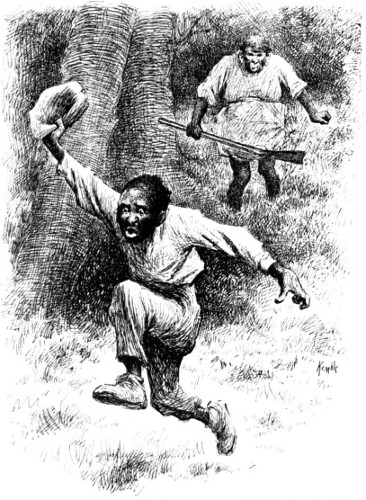
commanded sharply. “Clear the house!”
The negroes tramped out of the door like a drove
of horses going through a gap, and then they scattered
to all parts of the town to carry the dreadful
news.
Dr. Moseley’s examination failed to find a single
gunshot wound.
“You are not shot, Tick,” Moseley said. “You’ve
been lying to these friends of yours. Somebody beat
you over the head with a club.”
“Naw, suh; dat warn’t it, doc,” Tick insisted.
“I wus shotted wid bofe barrels of a shotgun!”
“Tick don’t know whut happened, doc,” Skeeter
commented. “He come in here ’bout a hour ago so
full of booze dat he sloshed like a water-wagon when
he walked.”
Moseley bandaged the cut lips and legs and the
bruised head, and left Tick to the care and nursing
of Skeeter Butts.
“Yes, suh; I’ll set up wid him all night, doc,”
Skeeter said. “He’s a fool frien’ of mine.”
Skeeter was aching to know exactly what had
happened to Tick, and as soon as the physician left,
Tick was served with a drink which sobered him
almost immediately, and then he told Skeeter all
about his affair in the road.
When Tick had finished, Skeeter sat for a long time
in deep thought, at intervals grunting like a pig when
some new idea punched him in a new place.
At last he rose to his feet and got his hat.
“Ticky,” he said, “you stay here till I gits back.”
“Suttinly,” Tick said pitifully. “I’s skeart to go
anywhar else; lock all de doors up tight.”
Skeeter ran across lots to his home on the premises
of Sheriff John Flournoy.
Flournoy had a little automobile, which he used
for fishing and hunting trips, and Skeeter pushed
this out of the garage, cranked it, and jumped to the
seat. In a few minutes he was back again at the
saloon.
“Climb in dis machine, Ticky,” he commanded.
“A leetle fresh air will rest yo’ mind an’ do you good.
Git in!”
Then Skeeter steered the machine straight toward
the home of Button Hook. Tick uttered angry and
frightened protests, but in vain. Skeeter persisted in
his plan.
“Dis is whar it happened, Skeeter,” Tick said as
they passed a place in the road. “Dis is whar I wus
shotted!”
“Whoa!” Skeeter said, as he brought the car to a
stop. “Look dar—dat is de gun whut Button
drapped!”
Placing the gun in the machine, Skeeter hurried
on toward Button Hook’s home.
“Dis gun will he’p me a heap!” he exulted.
When they reached the house, Skeeter picked up
the shotgun and, leaving Tick in the machine, he
walked through the yard, stamped up the steps and
onto the little porch, and knocked loudly and authoritatively
upon the door. He heard shuffling noises
with low talking, and movements which indicated
that the occupants of the house were waking from
sleep and getting out of bed.
“Who dar?” old man Hook inquired in a frightened
voice.
“Open up!” Skeeter yelled. “I got a little word
wid you an’ Button Hook from Sheriff John Flournoy
an’ Doc Moseley.”
At this there was a frightened squeal from Button
Hook, excited voices talking, swift movement of
feet, and the door opened a little crack. Old Hook
stuck his corkscrew whiskers through the opening
and asked:
“Whut word is sont?”
“I’s got Ticky Hush out here in Sheriff John
Flournoy’s autermobile,” Skeeter announced in a
loud voice. “Ticky is been shot two times wid a
double-barrel, muzzle-loadin’ shotgun. Nobody ain’t
know who done it, but we done foun’ de shotgun, an’
Marse Tom is tryin’ to find out who owns it.”
Button Hook uttered a frightened whine.
“Doc Moseley say Ticky is gittin’ ready to die
befo’ mawnin’,” Skeeter resumed. “Ticky ain’t got
no kinnery an’ I knowed he wus gwine marry Button
Hook, so I fetch him down here so he could die in yo’-all’s
house!”
“Gawda’mighty, naw!” old Hook wailed. “I
don’t want no dead nigger in my cabin. Take him
somewheres else.”
“It’s Marse John Flournoy’s awders to leave him
here wid you-alls!” Skeeter lied.
“Naw!” Daddy Hook squalled. “Dis fambly
ain’t gwine be home in de mawnin’—us is gittin’
ready trabble to right now, an’ we’s fixin’ to take a
soon start!”
“Does you know who dis shotgun belongs to?”
Skeeter asked, producing the gun with a dramatic
flourish.
“Naw!” Daddy Hook wailed, motioning Skeeter
away. “Ain’t never seed dat gun befo’.”
A frightened wail sounded behind old man Hook,
informing Skeeter that Button was being strongly
affected by what she heard.
“All right!” Skeeter said, as if in doubt what to do
next. “I’ll go tell Marse John Flournoy dat you-all
won’t take Tick in. I reckon him an’ Marse Tom
Gaitskill will come right down an’ cornverse you-all
about it. De Sheriff don’t take no nigger foolishness.”
Skeeter turned and walked away. When he got to
the automobile it was empty. Tick had climbed out
and had hidden behind the same stump which had
served him when he delivered the wrist-watch to
Button Hook. As Skeeter cranked the machine,
Tick emerged from his hiding-place and climbed back
into the car.
“Now, Ticky,” Skeeter said when they were once
more in the saloon and had sat down. “A long time
befo’ mawnin’, Button Hook an’ all dat crowd will be
gittin’ to some place fur away in a mighty big hurry.
Dey’ll trabble wid a looseness, an’ dey won’t look
back, an’ dey won’t never come back.”
“Dey won’t make me mad ef dey stays away,”
Tick spoke, trying to grin through his cut and plaster-covered
lips.
“Dat saves yo’ life, an’ it gits you good riddunce
of one of yo’ to-be wives!”
“Thank ’e, suh,” Tick said gratefully. “You
shore is a noble nigger man!”
“You tole me dat Dazzle promise to marry you—is
dat so?”
“Naw, suh. Me an’ Dazzle et a little dinner
togedder, but dar ain’t nothin’ to dat.”
“Dat leaves jes’ Limit Lark fer you to marry—ain’t
dat so?” Skeeter asked.
“Dat’s all!” Tick said. “Thank de Lawd!”
“You done got yo’ license to marry Limit, Ticky,”
Skeeter said. “Now, fer goodness sake don’t ax
nobody else!”
“I won’t,” Tick promised. “I’s mighty glad we’s
done shaved ’em down to jes’ me an’ one woman.”
There was a loud knock upon the front door, and
some one on the outside shook it violently, trying to
get in.
“Git over dar an’ crawl under de bar, Ticky,”
Skeeter whispered. “Dar ain’t no tellin’ whut is
gwine happen now!”
When Tick was hidden, Skeeter tiptoed to the door
and opened it very cautiously.
“Dis here is Vakey Vapp,” a woman’s voice announced
in high, shrill tones. “Lemme in, I got
somepin to say offen my mind!”
“Come in, Vakey,” Skeeter said in propitiating
tones. “I’s de onliest one here.”
“Whar is Tick Hush?” Vakey snapped.
“Tick is gittin’ ready to die,” Skeeter answered
evasively. “Doc Moseley is he’pin’ him along.”
“I come here to tell Tick dat he better make a good
job of dyin’, an’ drap off real soon,” Vakey bellowed.
“Ef he don’t, I’s gwine meet him in de big road an’
cyarve his gizzard an’ his backbone out!”
“Whut’s done made you mad?” Skeeter asked in
surprised tones.
“Dat nigger is done monkeyed wid my affectations,”
Vakey howled.
“Dat’s too bad,” Skeeter sympathized.
“It don’t hurt me none, but it’s shore bad fer
Tick!” Vakey said in a deadly tone.
Then they sat for a long time in silence, while
Vakey Vapp breathed deeply with a heaving breast,
like a motion-picture star. At last she stood up to go.
“I comed here to gib Ticky Hush a dyin’ message,
Skeeter,” she announced. “I’s sorry he ain’t here.
But ef Doc Moseley makes a mistake an’ cures Tick,
well, I’s gwine bestow my dyin’ message wid de edge
of a sharp razor. Good-by!”
When the door closed behind her, Tick stood up
from his hiding-place, showing a face full of tragedy
and despair.
“We forgot all about dat one, Skeeter,” he
mourned. “Oh, lawdy! Ef I ever gits outen dis
mess, I ain’t gwine mess wid mattermony no more!”
Early the next morning, Colonel Tom Gaitskill
heard from Hitch Diamond, who worked about his
place, that Tick Hush had been held up, robbed, and
shot to death.
At the bank, where Vinegar Atts worked, Gaitskill
heard that a woman named Button Hook had shot
Tick Hush, and that Skeeter had nursed him all night.
From Dr. Moseley Gaitskill learned that Tick had
not been shot or robbed, but had been beaten over
the head with some blunt instrument, and his face
had been badly cut with some sharp tool.
All of which was interesting enough to induce
Gaitskill to make a personal investigation.
He found Tick Hush lying upon a pallet in the rear
of the Hen-Scratch saloon, and from him and Skeeter
Butts he heard the whole story.
Being familiar with the details of numberless
negro courtships, this lengthy narrative lacked the
spice of novelty, and Gaitskill was weary long before
it was finished.
At last he looked at his watch and rose to his feet.
“Well, Tick,” he smiled, “I think if I were in your
predicament I would go out to the pest-house on my
farm and run up the yellow flag.”
Then Gaitskill went back to the bank.
The two negroes sat in perfect silence for a long
time. Finally Tick asked:
“Skeeter, whut did Marse Tom mean by dem
words?”
“Gawd knows,” Skeeter mumbled.
Skeeter smoked four cigarettes in rapid succession.
Then the meaning of Gaitskill’s remark shot through
him like an electric current.
Given Gaitskill’s two, he multiplied and made
forty-four.
He grabbed his hat and ran up the street at full
speed.
He stopped first at the home of Ginny Babe Chew,
where he held an excited conversation with Dazzle
Zenor, the actress. That young woman laughed and
applauded, and promptly left the house after Skeeter’s
rapid departure.
After that, he ran to the livery stable and held an
excited conversation with the negro owner of that
establishment.
The liveryman was not at all disposed to do what
Skeeter wanted, but Skeeter had learned certain conjuring
tricks to attain his ends, and he now performed
these tricks with the influential names of
Colonel Tom Gaitskill, Sheriff John Flournoy, and
Dr. Moseley.
With these big names thundering in his ears, the
liveryman consented.
“Keep dis quiet, Lon!” Skeeter warned. “It’s
de white folks’ awders. Don’t speak a word!”
Two hours later, a long, black carriage, known to
the negroes of Tickfall as the “pest-wagon,” drawn
by two solemn mules and driven by Skeeter Butts,
stopped at the rear door of the Hen-Scratch saloon.
Skeeter dismounted from the driver’s seat and
opened the door in the rear of the ambulance. Hitch
Diamond, Figger Bush, and the Reverend Vinegar
Atts climbed out. They pulled a stretcher into view,
and Skeeter laid hold upon it.
They tramped into the Hen-Scratch saloon like a
quartette of pall-bearers, and walked to the pallet
where Dazzle Zenor, the actress, now acting the part
of a Red Cross nurse, had just completed a major
operation upon the face and hands of Tick Hush.
Tick was lifted upon the stretcher, carried to the
ambulance and placed inside.
Skeeter tied a piece of yellow cloth a yard wide
and two yards long to the door knob of the ambulance,
and climbed back to the driver’s seat.
The four stretcher bearers walked solemnly beside
the pest-wagon.
Every negro inhabitant of Dirty-Six crowded the
sidewalks and watched this dreadful wagon go by.
All the older ones recalled that fearful epidemic of
yellow fever years before when this wagon had rolled
along the streets at midnight, and a driver with
muffled mouth, breathing through a cloth saturated
with disinfectants, called aloud in sepulchral
tones:
“Bring out your dead!”
For the first time in thirty years, the pest-wagon
was on the streets of Tickfall again. It was no
longer a shiny, black vehicle, but was rusty, dusty,
weather-beaten, and time-worn, more than ever suggestive
of diseases and pestilence and sudden death.
As the stretcher bearers marched, they sang.
The superb baritone of the Reverend Vinegar Atts
rolled like an organ:
“Somebody buried in de graveyard,
Somebody buried in de sea;
Gwine to git up in de mawnin’
Shoutin’ de jubilee.
If you git dare befo’ I do,
Run an’ tell de Lawd I’m comin’, too.
Oh!
Somebody dyin’ on de mountain,
Somebody dyin’ in de bed,
Somebody gwine to rise like a fountain,
Gwine to rise from de dead!
Oh!
If you git dar befo’ I do,
Run an’ tell de Lawd I’m comin’, too!”
“Git back, niggers!” Hitch Diamond bellowed to
the crowd when he saw they were disposed to follow.
“Keep away! I got awders from de white folks!”
In front of the home of Vakey Vapp the ambulance
came to a stop.
“Come out here, Vakey!” Skeeter called.
Vakey stepped out into the middle of her yard with
plenty of fresh, untainted air around her.
“You tole me las’ night dat you wanted to deliver
to Tick Hush a dyin’ message!” Skeeter exclaimed
as he opened the door of the ambulance. “Come up
close so you kin speak to him!”
Vakey took a half-step forward and stopped.
Skeeter spread wide the doors of the ambulance and
exclaimed dramatically:
“Stick out yo’ head, Ticky, an’ git yo’ dyin’
word!”
Ticky stuck out his head.
Dazzle Zenor had done her work well.
The actress had exhausted all her paints and all her
mental resources in helping Tick in his theatrical
make-up for the part he had to play.
The result was simply horrifying!
Tick’s ears were both a bright green in color, his
nose was yellow, his lips were purple, his forehead
was a bright red, and his cheeks were as white as milk,
while under his chin the natural brown of his skin
was striped with orange!
Tick held up both hands with a pitiful gesture, and
each finger was a different color!
Vakey Vapp emitted a squall which put her in a
class by herself as a maker of strange, loud noises.
“Pore ole Ticky is got some kind of ketchin’ disease,
Vakey,” Skeeter exclaimed. “Us is takin’ him
out to de pest-house.”
“Whut ails him?” Vakey wailed.
“Doc Moseley specify dat Tick is got scrambaloodums,
an’ it’s powerful ketchin’. Is you touched
Ticky any time recent?”
“O Lawd yes!” Vakey screamed. “I rush-housed
him powerful bad at de Shoofly chu’ch de yuther
night!”
“I’s mighty sorry to hear you speak dem words,
Vakey,” Skeeter said with a tearful tremolo in his
voice. “You’ll kotch de scrambaloodums, too.
We’ll come back an’ take you to de pest-house
next!”
Skeeter shut the ambulance door and ostentatiously
draped the yellow flag over the knob.
“You fergot to deliver yo’ dyin’ message, Vakey,”
Skeeter reminded her.
“’Tain’t nothin’,” Vakey howled. “O my lawdymussy!”
“All right,” Skeeter said. “You kin speak yo’
dyin’ words when we takes you out to de pest-house
whar Tick is gwine!”
Vakey gave another loud squall and started across
the fields toward the woods, going at full speed, and
covering a long distance in a very brief time.
“She’ll be mighty fur away pretty soon—ef she
keeps up dat gait,” the Reverend Vinegar Atts
chuckled. “Dat’s jes’ de way de niggers runned
from de pest-house thirty years ago!”
Skeeter clucked to his mules and started off at a
brisk trot, leaving the three other stretcher bearers
in the middle of the road, looking at the cloud of dust
the team raised.
“Come on, niggers,” Vinegar Atts chuckled as he
turned back toward the town. “We done runned
Vakey off now—less git aroun’ among de niggers an’
succulate de repote dat Skeeter an’ Tick is gittin’
ready to git up a show!”
“Dat’s right!” Figger Bush cackled. “We’ll tell
’em dis ain’t no real disease, but Tick an’ Skeeter is
rehearsin’!”
“’Tain’t really needful to do dat,” Hitch Diamond
rumbled. “Excusin’ Vakey, all of ’em knows it ’tain’t
nothin’ but a joke nohow. Niggers didn’t sing no
religium tunes aroun’ dis pest-wagon thuty year ago
when de yeller fever kotch us.”
Two hours later, a wagon drawn by two mules, and
occupied by three men and one woman, stopped on
top of a hill near the pest-house.
With shouts of laughter the four colored people
looked down at the four-room stone house with the
metal roof, behind which were many graves and leaning
tombstones.
In front of the building was a yellow flag, draped
from the limb of a small tree. Skeeter Butts sat in
front, his chair-back propped against the stone wall,
smoking his cigarette.
They climbed out of the wagon, Limit Lark, the
Reverend Vinegar Atts, Figger Bush, and Hitch
Diamond.
After consulting with his two male companions,
Vinegar Atts conducted Limit Lark to a little knoll
about one hundred feet from the pest-house, and
told her to stand there until he could complete his
arrangements.
Then he took his own stand on another little rise of
land, with Figger Bush and Hitch Diamond beside
him.
“Hey, Tick Hush!” Vinegar bawled in a voice
which could be heard a mile. “Come out to de front
of de pest-house a minute!”
Tick had been busy trying to get the make-up off
his face, and he emerged from the building and stared
about him in surprise.
“Listen, Tick!” Vinegar Atts whooped. “I got
somepin to say to you. Will you take Limit Lark to
be yo’ wedded wife?”
“Suttinly!” Tick squalled, after a moment of
astonished silence and a kick from Skeeter Butts.
“Limit, will you take Tick Hush to be yo’ wedded
husbunt?” Vinegar bellowed.
“You bet!” Limit shrieked.
“Jine yo’ right hands!” Vinegar howled.
“Aw, dat won’t do to say,” Hitch Diamond
growled. “It cain’t be did.”
Vinegar hesitated a moment, then got his second
wind and bawled:
“I now pernounce you husbunt an’ wife, an’ may
de good Lawd hab mussy on yo’ souls. Amen!”
“Come away from dis pest-house, Tick!” Skeeter
snapped as soon as the ceremony was ended. “I
been skeart to death fer eve’y minute I been here, an’
I’s smoked cigareetes to keep de ketchin’ miseries
away till I sees double!”
The two men ran up the hill toward Limit Lark.
Limit took one horrified look at her husband’s face
and reeled backward.
Dazzle Zenor had failed to tell Tick how to get the
make-up off his face, and now he was an awful looking
thing.
He had rubbed the various paints with a dry cloth
and had made a horrifying smear; he had washed
the paints with hot and cold water, and some of the
colors had “run,” and the effect was one which would
make any alcoholic imagine he had ’em again and
mount the water-wagon.
“My Gawd, Ticky!” Limit shrieked. “How
come you got yo’ face in such a devilish mess?”
“I’s had bad luck, honey,” Tick said mournfully.
“I s’pose I got to wait till dis paint wears off!”
“You ain’t nothin’ but a gorm!” Limit shrieked.
“You look like a Whut-is-it in a circus show!”
“Cain’t he’p it, honey,” Tick replied. “It’ll wear
off in about six months!”
“Dat’s right!” Vinegar Atts howled. “Marse
Tom Gaitskill sent word by me dat you two niggers
is in quaremtime fer six months. Ef you or
Limit comes to town, he’ll hab you put in de jailhouse.”
“Limit kin wear a blind bridle till you git yo’
nachel-bawn color back, Ticky,” Skeeter snickered.
“Good-by!”
The four stretcher bearers left the bride and groom
and walked up the hill to where their mules were
standing.
When Skeeter picked up his driving lines he broke
into a loud cackle of laughter.
“Say, fellers,” he snickered. “Ain’t dat Tick
Hush a funny nigger man? Ef you wus to set him in
one of dese here revolvin’ chairs, he wouldn’t hab
sense enough to turn aroun’.”