It was such a strange, sad, old face to be on such a young, slight
form, that you could not help looking at it again and again. Otherwise
there was nothing remarkable about her. She was just a girl sweeping a
crossing, in a bustling, dirty street, on a muddy, sloppy March day.
She was thinly clothed, but not more so than others of her class;
and there was nothing in particular to make me notice her except
this queer, expressive, melancholy, unyouthful countenance. She wore
a worsted hood which left the whole face visible. You could see the
forehead, broad and low, and lined with puzzled thinking; the dusky,
tumbled hair; the wishful, pathetic mouth with its drooping corners;
and the great, strange, olive-colored eyes, which looked as if they
had asked for something they could never find for such a weary while
that now they would never ask again,—eyes dark with despair, and yet
with a suggestion of something else in them which set you questioning.
Patiently she swept on. Sometimes she had to spring aside from the
rapid passage of cart or carriage, sometimes she made clean the way
of some dainty foot passenger, who rewarded her with a penny; but all
the time the hopeless, unchildlike visage never betrayed the slightest
gleam of interest. I was dabbling in art a little, just then; and
I stood in the window of a picture store and watched her, thinking
that her strange, impassive face ought to fit, somewhere, in the
illustrations I was making for a book of ballads, but not knowing quite
how to use it.
All at once, as I watched, I saw a singular change pass over her. She
held her broom motionless, her lips parted, a light as if at midnight
the sun should rise, lighted the darkness of her eyes, her whole
expression kindled with something,—interest, surprise, expectation,—I
hardly knew what, but something that transformed it as by a spell. I
stepped to the door then, and followed her eyes up the street.
It takes ten times as long to tell this as it was in happening. It
all came in an instant,—the change in her face, my going out to look
for its cause, and the sight which, following her eyes, I saw,—a
carriage coming swiftly down street, an elegant open barouche, in
which sat a lady dressed in furs and velvet, and a wonderfully
beautiful, golden-haired child. It was at the child that my little
crossing-sweeper was looking, with a gaze which seemed to me to say,—
"So this, then, is childhood? This is what we ought to be when we are
young; and how beautiful it is!"
She looked so intently that she forgot she was standing in the way,
until the coachman shouted out to her, while he tried with all his
strength to pull up his horses. She had looked one moment too long.
Somehow the pole knocked her down, and the horses stepped over or on
her, which I could not see; but in another moment they were drawn up a
rod farther on, the lady was getting out of her carriage, and I myself
was in the heart of the crowd which gathered at once, as usual. "Her
arm is broken," one cried. "She has fainted," said another.
"Where is her home; can any one tell?" asked the lady in the furs and
the velvet, standing now beside her.
A ragged little newsboy stepped from the ranks and pulled at some
ghost of a cap. "Please, ma'am, I know," he said. "It's down here in
Moonstone Court, with old Sally."
"Hey for Sally, in our alley," sang another little limb of evil, vexed
that he had not been the one who knew the local habitation aforesaid.
Newsboy No. 1 was elevated to the coachman's box, and was desired to
show the way. The lady got into the carriage herself, and received
the injured and swooning girl, whom there were strong arms enough to
lift,—the golden-haired child looked on with the compassion of an
angel in her angelic face,—newsboy No. 2 hung on behind dexterously,
making sure that his offence would pass unnoticed in the general
mêlée, and the carriage rolled away toward Moonstone Court. Presently
the golden-haired child spoke.
"What if they haven't any good place for her there, mamma?"
Mrs. Brierly, for that was the lady's name, bent forward and addressed
newsboy No. 1, on the box.
"Is the old Sally you spoke of the girl's mother?"
"No, ma'am. She ain't no relation to her. I've heard folks say, Ruthy's
father and mother died, and old Sally took her in to beg for her; to be
a sufferin' orphin, you know; and lately Ruthy won't beg any more, and
they say the old un do beat her awful."
"O mamma!" It was all the pitiful, childish lips said; but the blue
eyes full of tears finished the prayer.
"Don't be afraid, Gracie," the lady answered, smiling; "she shall not
go there." Then she turned to newsboy No. 1. "Here is some money for
you. You can tell old Sally that the girl got hurt, and has been taken
to the hospital. You had better go and let her know at once."
So newsboy No. 1 got down from his unwonted elevation, pulled again
at the phantom of a cap, and, looking curiously at the fresh, crisp
currency in his hand, walked away. Newsboy No. 2, correctly divining
that nothing was to be gained by remaining, while, by following his
comrade he might perhaps come in for a treat, let go his hold on the
carriage, and went after the other.
"Now, James," Mrs. Brierly said to the coachman, "you may drive to the
Children's Hospital, on Rutland Street."
"We shall go right by home, shan't we, mamma?"
"Yes, dear."
"I suppose we couldn't be a hospital, could we?"
"Not very conveniently, I think. It is better to help keep up a
hospital outside than to turn our own house into one."
"Yes'm," Gracie said, thoughtfully, "only this once, when we did the
hurting, I didn't know but it would be nice if we did the curing."
Just then, before Mrs. Brierly answered, the swooning girl revived,
and opened for an instant her curious, olive-colored eyes. There was
something in their look, perhaps, which went farther than Gracie's
argument. At any rate, the lady said,—
"After all, James, you may as well leave us at home, and go at once for
Dr. Cheever."
In five minutes more the carriage had stopped before a substantial,
prosperous-looking house, the coachman had carried the poor, suffering
little waif upstairs in his arms, and Mrs. Brierly had summoned Mrs.
Morris, the good, motherly woman who had been Gracie's nurse, to her
councils.
When Dr. Cheever came, he found his patient in clean, pure clothes, in
a fresh, lovely room, waiting for him with a piteous, silent patience
which it was pathetic to see. She suffered cruelly from her hurt, a
compound fracture of the wrist, but she was not used to making moans
or receiving sympathy; and it would have seemed to her a sort of
sacrilege to cry out with human pain in this paradise to which she had
been brought. One could only guess at her suffering by her compressed
lips, with the white pallor round them, and the dark rings about her
eyes.
Dr. Cheever listened to the account of the accident, while he dressed
the poor hurt wrist with a gentleness which soothed the pain his touch
caused. When he had done all he could, he followed Mrs. Brierly from
the room.
"This will be an affair of several weeks," he said. "Would it not have
been better to take the girl to one of the hospitals?"
"I thought so, at first; but, as Gracie said, we did the hurting, and
it seemed right we should do the healing. Besides, the child's face
interested me strangely, and I think it will not be a bad thing for us
to have a little experience of this sort."
Meantime Ruthy lay and looked about her, as we have all fancied
ourselves looking when, the death sleep over, we shall open our eyes
to a new morning in some one of the Father's "many mansions." To a
denizen of Moonstone Court this peaceful spot in which Ruthy found
herself might well seem no unworthy heaven. The walls were tinted a
soft, delicate gray, with blue borderings. On the drab carpet blue
forget-me-nots blossomed. Blue ribbons tied back the white muslin
curtains, and all the little china articles for use or ornament were
blue and gilt.
Only one picture was in the room, and that hung over the mantel,
directly opposite the pure white bed where Ruthy lay. It was a
landscape by Gifford,—one of those glorified pictures of his which
paint nature as only a poet sees her. Soft meadows sloped away into
dreamy distance on one side, and, on the other, into the green
enchantment of a wood a winding path beguiled you. In the centre, with
her raised foot upon a stile by which she was about to cross into the
peaceful meadows, a young girl stood with morning in her eyes. Just
as she raised her foot she had paused and turned her head to look over
her shoulder, as if she heard a voice calling her, and was hesitating
whether to go on her appointed way or back into the green wood's
enchantment. There was a wonderful suggestion for a story in the girl's
face, her attitude, her questioning eyes. But if Ruthy felt this at
all, it was very vaguely and unconsciously; yet the picture revealed to
her a new world. Somewhere, then, meadows bloomed like these meadows,
and woods were green, and light flickered through tender leaves, and
over all the great, glorious blue sky arched and smiled. Somewhere!
That must be country,—outside of the pavements and the tall, frowning
houses. Oh, if she could go! Oh, but she would go! Let her wrist
but get well, and then! She had never had these dreams before. The
vision of the country, the true country, had never dawned on her till
now. And yet she must have seen pictures of it in the windows of print
shops; but her eyes had not been anointed, or Gifford had not painted
the pictures.
All through the quiet weeks in which her sore hurt was healing, she
watched that painted landscape, and her longing to find it grew and
grew. But she never said a word about it. Indeed, she seldom spoke at
all except to answer some question.
Mrs. Brierly became strangely interested in her in spite of this
silence, which piqued and disappointed Gracie. The child could not
understand what the mother guessed at,—the sense of isolation which
tormented Ruthy. She was among them, but not of them, the girl felt.
She had been injured by an accident for which these people in some
wise held themselves responsible, and so they were good to her, and
gave her this glimpse of heaven. But they were of the chosen people,
and she a Gentile, an outcast at their gates. If she could but go away
from every thing she had ever known, and follow that winding path into
the still wood, she should be happy. Who knew what she might not find
there,—love, may be, and friends, and home,—perhaps, even, the father
and mother who, as old Sally said, were dead? Who knew?
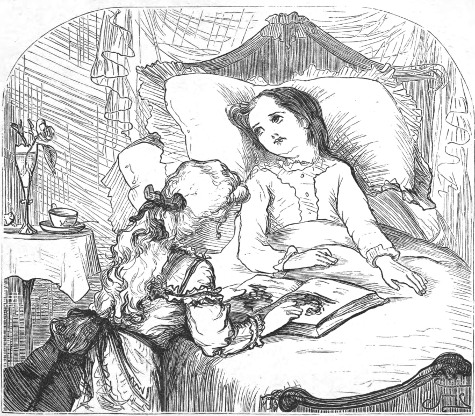
One day Mrs. Brierly came in to sit with her. Ruthy could sit up now,
and she was in a low rocking-chair, still facing the picture. The lady
saw the direction of her eyes, and said, gently,—
"I think you must like pictures very much, Ruthy?"
The olive-colored eyes gleamed, and a flickering flush came and went in
the thin cheeks, but the girl answered shyly and guardedly, as her wont
was.
"I don't know, ma'am; I have never seen any. I like this one. It is the
country; isn't it?"
Mrs. Brierly smiled.
"Yes; it is the country as Gifford, the man who made the picture, saw
it. Country means ploughed fields and potatoes to some people, and
paradise to others. I think you could find Gifford's country, Ruthy."
The girl's heart gave a great, sudden bound. That was just what she
meant to do; but she was silent. Soon Mrs. Brierly asked,—
"Do you remember your father and mother, Ruthy? I think they must have
been very different people from old Sally."
"Yes, ma'am, I remember my mother. Father died so long ago I have
forgotten all about him, and mother and I grew poorer and poorer, until
one day I woke up, as it seemed, from a long dream, with my hair all
gone, and very weak; and the neighbors said mother and I had both had
a fever, and she was dead. Then Sally took me and sent me out to beg,
until I wouldn't beg any more; and since then I've sold matches and
swept crossings, and done any thing else I could. My wrist is getting
so I can use it now, and I must go to work again. I am very thankful
to you, ma'am. I would have my wrist broke twenty times to come once
into this house and lie in this white bed, and see that picture. But
to-morrow I shall be well enough to put on my own clothes again and go
to work, and I will, please, ma'am."
"These are your own clothes that you have on, Ruthy, your very own. And
here are more changes for you in this drawer, and here in the closet
are your shawl and hat. You must not go away yet, till you are much
stronger; but when you do go, all these things are your own."
"My very own!" It was a sort of glad cry which came from the girl's
quivering lips. Her eyes filled, and the flickering color came into her
cheeks. Mrs. Brierly got up and went away. She had never heard Ruthy
speak so many words before, and she began to feel that she should get
to the girl's heart in time, but she would not let her excite herself
any more, now. And Ruthy sat and looked at the picture, and thought.
The next morning rose bright and clear,—a summer morning, which had
slipped away from its kindred and stolen on in advance to brighten the
last week in April. Nurse Morris went first into Ruthy's room, and
found the little white bed empty, and the room empty also. She called
the maid who had been sweeping down the steps and washing the sidewalk,
and asked if she had seen any one go out. No one, the girl said, but
she had left the door unfastened while she just chatted a bit with
Katy, next door, and some one might have gone, and she not know it.
Mrs. Morris went next to Mrs. Brierly with her tale, and Mrs. Briefly
came in dressing-gown and slippers to look at the empty room. The
hat and shawl she had put in the closet for Ruthy were gone, but the
changes of clothes in the drawer were untouched; and upon them lay a
piece of paper on which the girl had printed laboriously, in great
capital letters,—
"I AM GOING TO FIND THE COUNTRY. I DID NOT TELL, FOR FEAR I WOULD
NOT BE LET TO GO. GOD BLESS YOU, MA'AM, I'M VERY THANKFUL."
It seemed useless to try to follow her on her unknown road. No one
could guess in what direction she had gone. Tender-hearted little
Gracie cried over her departure; Mrs. Brierly felt very anxious and
uneasy, but they could only wait. And it was three days before any
news came. It was brought, at last, by an odd messenger. A market-man
stopped with his wagon before the house, and, ringing the bell, asked
to see the mistress, and was shown upstairs.
"Did a young girl, sort of delicate lookin', leave you lately, ma'am?"
"Yes, on Tuesday morning. Can you tell me any thing of her?"
"Well, you see, I get up nigh about in the middle of the night to get
things ready for market, and Wednesday morning I found a girl lying in
a dead faint on my barn floor. I called my wife, and we brought her
to, and wife asked her where she came from. 'Mrs. Brierly's, No. 775
Tremont Street,' she answered, straight enough; and then she went off
again, and the next time we brought her to there was no more sense to
be got out of her. She just kept saying over something about finding
the country, and 'it ain't there.'
"I had to come off to market, but we carried her into the house, and
in the middle of the forenoon wife see the doctor goin' by, and she
jest called to him. He said it was brain fever; and she don't get any
better; and wife said I'd better stop at 775, and if there was a Mrs.
Brierly here, why, I could let her know. We live at Highville, about
fifteen miles from Boston; and if you ask for Job Smith's you'll find
my house."
So poor little Ruthy had walked all those lonesome miles to find the
country that Gifford saw, and had found, instead, pain and weariness,
and who knew what more?
That day Mrs. Brierly drove out there, and took Nurse Morris with her;
Ruthy recognized neither of them, and at length Mrs. Brierly drove
sadly away, leaving Nurse Morris behind to care for the sick child, as
busy Mrs. Job Smith, with all her kindliness, was unable to do.
And after a while the fever wore itself out, and Ruthy, a white wraith
of a girl, was carried back into the chamber of peace, where the
country Gifford saw was hanging on the wall. But the days went by, and
the spring came slowly up that way, and the young summer followed,
and Ruthy was still a pale, white wraith, and grew no rosier and no
stronger.
"Do get well, Ruthy," loving little Gracie used to say, "and we'll take
you to find the country." But Ruthy would shake her head with a slow,
mournful motion, and answer,—
"No use, Miss Gracie, it is in the picture, but it ain't anywhere
else."
And by and by they began to know that Ruthy would never go where
pleasant paths led through the wood's green enchantment, or peaceful
meadows smiled in the summer sunshine. Sorrow and privation and
weariness had done their work too well, and the little heart, that
beat so much too fast now, would stop beating soon. But Ruthy was very
happy. The unrest that had possessed her before she went to find the
country was all over. She had tried her experiment, and found out, as
she thought, that the true country was not to be reached by earthly
winding ways, and she was content to watch it as Gifford painted it,
and dream her silent dreams, which no one knew, as she watched.
One night when Gracie bade her good-night and danced away, she looked
after her with the old, wistful wonder in her eyes, and then looked up
at Mrs. Brierly.
"How beautiful God can make children, ma'am. I think they'll all be
so, in the true country." Then reaching forward she took Mrs. Brierly's
hand and touched it for the first time with her humble, grateful lips.
"Oh, ma'am," she said, "you are so dear and good."
The next morning, when they found her lying still, she was whiter
than ever. She would never speak again to tell her disappointment or
her joy, but a wonderful smile, a smile of triumph, was frozen on her
young, wistful mouth, and Mrs. Brierly, looking at her, stooped to kiss
Gracie's tears away, and said,—
"Do not cry, my darling,—I think, at last, Ruthy has found the true
country."